MID AMERICA APARTMENT COMMUNITIES INC.
10-Ks and 10-Qs
|
|
|
|
|
|
|
|
|
|
|
|
|
|
|
|
|
|
|
|
|
|
|
|
|
|
|
|
|
|
|
|
|
|
|
|
|
|
|
|
|
|
|
|
|
|
|
|
|
|
|
|
|
|
|
|
|
|
|
|
UNITED STATES
|
|||||
|
SECURITIES AND EXCHANGE COMMISSION
|
|||||
|
Washington, DC 20549
|
|||||
|
FORM 10-K
|
|||||
|
(Mark One)
|
|||||
|
ý
|
ANNUAL REPORT PURSUANT TO SECTION 13 OR 15(d) OF THE SECURITIES EXCHANGE ACT OF 1934
For the fiscal year ended December 31, 2016 |
||||
|
OR
|
|||||
|
o
|
TRANSITION REPORT PURSUANT TO SECTION 13 OR 15(d) OF THE SECURITIES EXCHANGE ACT OF 1934
For the transition period from __________ to ___________ |
||||
|
Commission File Number 001-12762 (Mid-America Apartment Communities, Inc.)
|
|||||
|
Commission File Number 333-190028-01 (Mid-America Apartments, L.P.)
|
|||||
|
MID-AMERICA APARTMENT COMMUNITIES, INC.
|
|||||
|
MID-AMERICA APARTMENTS, L.P.
|
|||||
|
(Exact name of registrant as specified in its charter)
|
|||||
|
Tennessee (Mid-America Apartment Communities, Inc.)
|
62-1543819
|
||||
|
Tennessee (Mid-America Apartments, L.P.)
|
62-1543816
|
||||
|
(State or other jurisdiction of incorporation or organization)
|
(I.R.S. Employer Identification No.)
|
||||
|
6584 Poplar Avenue, Memphis, Tennessee, 38138
|
|||||
|
(Address of principal executive offices) (Zip Code)
|
|||||
|
Registrant's telephone number, including area code:
(901) 682-6600
|
|||||
|
Securities registered pursuant to Section 12(b) of the Act:
|
|||||
|
Title of each class
|
Name of each exchange on which registered
|
||||
|
Common Stock, par value $.01 per share (Mid-America Apartment Communities, Inc.)
|
New York Stock Exchange
|
||||
|
8.50% Series I Cumulative Redeemable Preferred Stock, $.01 par value per share (Mid-America Apartment Communities, Inc.)
|
New York Stock Exchange
|
||||
|
Securities registered pursuant to Section 12(g) of the Act: None.
|
|||
|
Indicate by check mark if the registrant is a well-known seasoned issuer, as defined in Rule 405 of the Securities Act.
|
|||
|
Mid-America Apartment Communities, Inc.
|
YES
ý
|
No
o
|
|
|
Mid-America Apartments, L.P.
|
YES
o
|
No
ý
|
|
|
Indicate by check mark if the registrant is not required to file reports pursuant to Section 13 or Section 15(d) of the Act.
|
|||
|
Mid-America Apartment Communities, Inc.
|
YES
o
|
No
ý
|
|
|
Mid-America Apartments, L.P.
|
YES
o
|
No
ý
|
|
|
Indicate by check mark whether the registrant (1) has filed all reports required to be filed by Section 13 or 15(d) of the Securities Exchange Act of 1934 during the preceding
|
|||
|
12 months (or for such shorter period that the registrant was required to file such reports), and (2) has been subject to such filing requirements for the past 90 days.
|
|||
|
Mid-America Apartment Communities, Inc.
|
YES
ý
|
No
o
|
|
|
Mid-America Apartments, L.P.
|
YES
ý
|
No
o
|
|
|
Indicate by check mark whether the registrant has submitted electronically and posted on its corporate Web site, if any, every Interactive Data File required to be submitted and
|
|||
|
posted pursuant to Rule 405 of Regulation S-T (§232.405 of this chapter) during the preceding 12 months (or for such shorter period that the registrant was required to submit and
|
|||
|
post such files).
|
|||
|
Mid-America Apartment Communities, Inc.
|
YES
ý
|
No
o
|
|
|
Mid-America Apartments, L.P.
|
YES
ý
|
No
o
|
|
|
Indicate by check mark if disclosure of delinquent filers pursuant to Item 405 of Regulation S-K is not contained herein, and will not be contained, to the best of registrant's
|
|||
|
knowledge, in definitive proxy or information statements incorporated by reference in Part III of this Form 10-K or any amendment to this Form 10-K.
R
|
|||
|
Indicate by check mark whether the registrant is a large accelerated filer, an accelerated filer, a non-accelerated filer, or a smaller reporting company. See the definitions of “large
|
|||
|
accelerated filer,” “accelerated filer” and “smaller reporting company” in Rule 12b-2 of the Act. (Check one)
|
|||
|
Mid-America Apartment Communities, Inc.
|
||||
|
Large accelerated filer
ý
|
Accelerated filer
o
|
Non-accelerated filer
o
|
Smaller reporting company
o
|
|
|
(Do not check if a smaller reporting company)
|
||||
|
Mid-America Apartments, L.P.
|
||||
|
Large accelerated filer
o
|
Accelerated filer
o
|
Non-accelerated filer
ý
|
Smaller reporting company
o
|
|
|
(Do not check if a smaller reporting company)
|
||||
|
Indicate by check mark whether the registrant is a shell company (as defined in Rule 12b-2 of the Exchange Act).
|
|||
|
Mid-America Apartment Communities, Inc.
|
YES
o
|
No
ý
|
|
|
Mid-America Apartments, L.P.
|
YES
o
|
No
ý
|
|
The aggregate market value of the 56,652,573 shares of the registrant's common stock held by non-affiliates of Mid-America Apartment Communities, Inc. was approximately
$6,027,833,767
based on the closing price of $106.40 as reported on the New York Stock Exchange on June 30, 2016. This calculation excludes shares of common stock held by the registrant's officers and directors and each person known by the registrant to beneficially own more than 5% of the registrant's outstanding shares, as such persons may be deemed to be affiliates. This determination of affiliate status should not be deemed conclusive for any other purpose. As of
February 20, 2017
there were
113,545,231
shares of Mid-America Apartment Communities, Inc. common stock outstanding.
There is no public trading market for the partnership units of Mid-America Apartments, L.P. As a result, an aggregate market value of the partnership units of Mid-America Apartments, L.P. cannot be determined.
Documents Incorporated by Reference
Portions of the proxy statement for the annual shareholders meeting of Mid-America Apartment Communities, Inc. to be held on May 23, 2017 are incorporated by reference into Part III of this report. We expect to file our proxy statement within 120 days after
December 31, 2016
.
1
|
MID-AMERICA APARTMENT COMMUNITIES, INC.
MID-AMERICA APARTMENTS, L.P.
|
|||
|
|
|
|
|
|
TABLE OF CONTENTS
|
|||
|
Item
|
|
Page
|
|
|
|
PART I
|
|
|
|
1.
|
Business.
|
5
|
|
|
1A.
|
Risk Factors.
|
13
|
|
|
1B.
|
Unresolved Staff Comments.
|
28
|
|
|
2.
|
Properties.
|
28
|
|
|
3.
|
Legal Proceedings.
|
37
|
|
|
4.
|
Mine Safety Disclosures.
|
37
|
|
|
|
|
|
|
|
|
PART II
|
|
|
|
|
|
|
|
|
5.
|
Market for Registrant’s Common Equity, Related Stockholder Matters and Issuer Purchases of Equity Securities.
|
38
|
|
|
6.
|
Selected Financial Data.
|
41
|
|
|
7.
|
Management’s Discussion and Analysis of Financial Condition and Results of Operations.
|
44
|
|
|
7A.
|
Quantitative and Qualitative Disclosures About Market Risk.
|
60
|
|
|
8.
|
Financial Statements and Supplementary Data.
|
61
|
|
|
9.
|
Changes in and Disagreements With Accountants on Accounting and Financial Disclosure.
|
61
|
|
|
9A.
|
Controls and Procedures.
|
61
|
|
|
9B.
|
Other Information.
|
62
|
|
|
|
|
|
|
|
|
PART III
|
|
|
|
|
|
|
|
|
10.
|
Directors, Executive Officers and Corporate Governance.
|
63
|
|
|
11.
|
Executive Compensation.
|
63
|
|
|
12.
|
Security Ownership of Certain Beneficial Owners and Management and Related Stockholder Matters.
|
63
|
|
|
13.
|
Certain Relationships and Related Transactions, and Director Independence.
|
63
|
|
|
14.
|
Principal Accountant Fees and Services.
|
63
|
|
|
|
|
|
|
|
|
PART IV
|
|
|
|
|
|
|
|
|
15.
|
Exhibits and Financial Statement Schedules.
|
64
|
|
|
16.
|
Summary
|
67
|
|
Explanatory Note
This report combines the annual reports on Form 10-K for the year ended
December 31, 2016
of Mid-America Apartment Communities, Inc., a Tennessee corporation, and Mid-America Apartments, L.P., a Tennessee limited partnership, of which Mid-America Apartment Communities, Inc. is the sole general partner. Unless the context otherwise requires, all references in this Report to “MAA” refer only to Mid-America Apartment Communities, Inc., and not any of its consolidated subsidiaries. Unless the context otherwise requires, all references in this Report to "we," "us," "our," or the "Company" refer collectively to Mid-America Apartment Communities, Inc., together with its consolidated subsidiaries, including Mid-America Apartments, L.P. Unless the context otherwise requires, the references in this Report to the “Operating Partnership” or “MAALP” refer to Mid-America Apartments, L.P. together with its consolidated subsidiaries. “Common stock” refers to the common stock of MAA and “shareholders” means the holders of shares of MAA’s common stock. The limited partnership interests of the Operating Partnership are referred to as “OP Units” and the holders of the OP Units are referred to as “unitholders”. This combined Form 10-K is being filed separately by MAA and MAALP.
As of
December 31, 2016
, MAA owned
113,518,212
OP units (or approximately
96.4%
) of the limited partnership interests of the Operating Partnership. MAA conducts substantially all of its business and holds substantially all of its assets through the Operating Partnership, and by virtue of its ownership of the OP Units and being the Operating Partnership's sole general partner, MAA has the ability to control all of the day-to-day operations of the Operating Partnership.
We believe combining the annual reports on Form 10-K of MAA and the Operating Partnership, including the notes to the consolidated financial statements, into this single report results in the following benefits:
|
•
|
enhances investors' understanding of MAA and the Operating Partnership by enabling investors to view the business as a whole in the same manner that management views and operates the business;
|
|
•
|
eliminates duplicative disclosure and provides a more streamlined and readable presentation since a substantial portion of the disclosure in this Report applies to both MAA and the Operating Partnership; and
|
|
•
|
creates time and cost efficiencies through the preparation of one combined report instead of two separate reports.
|
Management operates MAA and the Operating Partnership as one business. The management of the Company is comprised of individuals who are officers of MAA and employees of the Operating Partnership. We believe it is important to understand the few differences between MAA and the Operating Partnership in the context of how MAA and the Operating Partnership operate as a consolidated company. MAA and the Operating Partnership are structured as an "umbrella partnership REIT," or UPREIT. MAA's interest in the Operating Partnership entitles MAA to share in cash distributions from, and in the profits and losses of, the Operating Partnership in proportion to MAA's percentage interest therein and entitles MAA to vote on substantially all matters requiring a vote of the partners. MAA's only material asset is its ownership of limited partnership interests in the Operating Partnership; therefore, MAA does not conduct business itself, other than acting as the sole general partner of the Operating Partnership, issuing public equity from time-to-time and guaranteeing certain debt of the Operating Partnership. The Operating Partnership holds, directly or indirectly, all of our real estate assets. Except for net proceeds from public equity issuances by MAA, which are contributed to the Operating Partnership in exchange for limited partnership interests, the Operating Partnership generates the capital required by the Company's business through the Operating Partnership's operations, direct or indirect incurrence of indebtedness and issuance of partnership units.
The presentation of MAA's shareholders' equity and the Operating Partnership's capital are the principal areas of difference between the consolidated financial statements of MAA and those of the Operating Partnership. MAA's shareholders' equity may include shares of preferred stock, shares of common stock, additional paid-in capital, cumulative earnings, cumulative distributions, noncontrolling interest, preferred units, treasury shares, accumulated other comprehensive income and redeemable common units. The Operating Partnership's capital may include common capital and preferred capital of the general partner (MAA), limited partners' preferred capital, limited partners' noncontrolling interest, accumulated other comprehensive income and redeemable common units. Redeemable common units represent the number of outstanding limited partnership units as of the date of the applicable balance sheet, valued at the greater of the closing market price of MAA's common stock or the aggregate value of the individual partners' capital balances. Holders of OP Units (other than MAA and its corporate affiliates) may require us to redeem their OP Units from time to time, in which case we may, at our option, pay the redemption price either in cash (in an amount per OP Unit equal, in general, to the average closing price of MAA's common stock on the New York Stock Exchange over a specified period prior to the redemption date) or by delivering one share of our common stock (subject to adjustment under specified circumstances) for each OP Unit so redeemed.
1
In order to highlight the material differences between MAA and the Operating Partnership, this Report includes sections that separately present and discuss areas that are materially different between MAA and the Operating Partnership, including:
|
•
|
the selected financial data in Item 6 of this Report;
|
|
•
|
the consolidated financial statements in Item 8 of this Report;
|
|
•
|
certain accompanying notes to the financial statements, including Note 3 - Earnings per Common Share of MAA and Note 4 - Earnings per OP Unit of MAALP; Note 10 - Shareholders' Equity of MAA and Note 11 - Partners' Capital of MAALP; and Note 19 - Selected Quarterly Financial Information of Mid-America Apartment Communities, Inc. (Unaudited) and Note 20 - Selected Quarterly Financial
Information of Mid-America Apartments, LP (Unaudited);
|
|
•
|
the controls and procedures in Item 9A of this Report; and
|
|
•
|
the certifications of the Chief Executive Officer and Chief Financial Officer of MAA included as Exhibits 31 and 32 to this Report.
|
In the sections that combine disclosure for MAA and the Operating Partnership, this Report refers to actions or holdings as being actions or holdings of the Company. Although the Operating Partnership (directly or indirectly through one of its subsidiaries) is generally the entity that enters into contracts, holds assets and issues debt, management believes this presentation is appropriate for the reasons set forth above and because the business is one enterprise and we operate the business through the Operating Partnership.
2
Risks Associated with Forward Looking Statements
We consider this and other sections of this Annual Report on Form 10-K to contain forward-looking statements within the meaning of Section 27A of the Securities Act of 1933, as amended, or the Securities Act, and Section 21E of the Securities Exchange Act of 1934, as amended, or the Exchange Act, with respect to our expectations for future periods. Forward-looking statements do not discuss historical fact, but instead include statements related to expectations, projections, intentions or other items related to the future. Such forward-looking statements may include, without limitation, statements concerning property acquisitions and dispositions, joint venture activity, development and renovation activity as well as other capital expenditures, capital raising activities, rent and expense growth, occupancy, financing activities and interest rate and other economic expectations and statements regarding the benefits of our merger with Post Properties, Inc. ("Post Properties"), Post GP Holdings, Inc., and Post Apartment Homes, L.P ("Post LP"). Words such as “expects,” “anticipates,” “intends,” “plans,” “believes,” “seeks,” “estimates,” and variations of such words and similar expressions are intended to identify such forward-looking statements. Such forward-looking statements involve known and unknown risks, uncertainties and other factors which may cause our actual results, performance or achievements to be materially different from the results of operations, financial conditions or plans expressed or implied by such forward-looking statements. Although we believe that the assumptions underlying the forward-looking statements contained herein are reasonable, any of the assumptions could be inaccurate, and therefore such forward-looking statements included in this report may not prove to be accurate. In light of the significant uncertainties inherent in the forward-looking statements included herein, the inclusion of such information should not be regarded as a representation by us or any other person that the results or conditions described in such statements or our objectives and plans will be achieved.
The following factors, among others, could cause our future results to differ materially from those expressed in the forward-looking statements:
|
•
|
inability to generate sufficient cash flows due to market conditions, changes in supply and/or demand, competition, uninsured losses, changes in tax and housing laws, or other factors;
|
|
•
|
exposure, as a multifamily focused REIT, to risks inherent in investments in a single industry and sector;
|
|
•
|
difficulty in integrating Post Properties' operations, systems and personnel with ours;
|
|
•
|
adverse impact of any financial, accounting, operational, legal or regulatory issues that have arisen or may in the future arise in connection with the Merger (as defined below) specifically and the inability to successfully combine the businesses of MAA and Post Properties, which together we refer to as the Combined Corporation, generally;
|
|
•
|
adverse changes in real estate markets, including, but not limited to, the extent of future demand for multifamily units in our significant markets, barriers of entry into new markets which we may seek to enter in the future, limitations on our ability to increase rental rates, competition, our ability to identify and consummate attractive acquisitions or development projects on favorable terms, our ability to consummate any planned dispositions in a timely manner on acceptable terms, and our ability to reinvest sale proceeds in a manner that generates favorable returns;
|
|
•
|
failure of new acquisitions to achieve anticipated results or be efficiently integrated;
|
|
•
|
failure of development communities to be completed, if at all, within budget and on a timely basis or to lease-up as anticipated;
|
|
•
|
unexpected capital needs;
|
|
•
|
changes in operating costs, including real estate taxes, utilities and insurance costs;
|
|
•
|
losses from catastrophes in excess of our insurance coverage;
|
|
•
|
ability to obtain financing at favorable rates, if at all, and refinance existing debt as it matures;
|
|
•
|
level and volatility of interest or capitalization rates or capital market conditions;
|
|
•
|
loss of hedge accounting treatment for interest rate swaps or interest rate caps;
|
|
•
|
the continuation of the good credit of our interest rate swap and cap providers;
|
|
•
|
price volatility, dislocations and liquidity disruptions in the financial markets and the resulting impact on financing;
|
|
•
|
the effect of any rating agency actions on the cost and availability of new debt financing;
|
|
•
|
significant decline in market value of real estate serving as collateral for mortgage obligations;
|
|
•
|
significant change in the mortgage financing market that would cause single-family housing, either as an owned or rental product, to become a more significant competitive product;
|
|
•
|
our ability to continue to satisfy complex rules in order to maintain our status as a REIT for federal income tax purposes, the ability of the Operating Partnership to satisfy the rules to maintain its status as a partnership for federal income tax purposes, the ability of our taxable REIT subsidiaries to maintain their status as such for federal income tax purposes, and our ability and the ability of our subsidiaries to operate effectively within the limitations imposed by these rules;
|
|
•
|
inability to attract and retain qualified personnel;
|
3
|
•
|
potential liability for environmental contamination;
|
|
•
|
adverse legislative or regulatory tax changes;
|
|
•
|
litigation and compliance costs; and
|
|
•
|
other risks identified in this Annual Report on Form 10-K including under the caption "Item 1A. Risk Factors" and, from time to time, in other reports we file with the Securities and Exchange Commission, or the SEC, or in other documents that we publicly disseminate.
|
New factors may also emerge from time to time that could have a material adverse effect on our business. Except as otherwise required by law, we undertake no obligation to publicly update or revise these forward-looking statements to reflect events, circumstances or changes in expectations after the date on which this Annual Report on Form 10-K is filed.
4
Overview
MAA is a multifamily focused, self-administered and self-managed real estate investment trust, or REIT. We own, operate, acquire and selectively develop apartment communities primarily located in the Southeast and Southwest regions of the United States. As of December 31, 2016, activities include full ownership and operation of
302
multi-family properties, which includes commercial space at certain properties, and four additional commercial properties, along with partial ownership in one multifamily property . These properties are located in Alabama, Arizona, Arkansas, Florida, Georgia, Kansas, Kentucky, Maryland, Mississippi, Missouri, Nevada, North Carolina, South Carolina, Tennessee, Texas, Virginia and Washington, D.C.
As of
December 31, 2016
, we maintained full or partial ownership in the following properties:
|
Multifamily:
|
|||||||
|
Consolidated Properties
|
Units
|
Unconsolidated Properties
|
Units
|
Total Properties
|
Total Units
|
||
|
302
|
99,124
|
1
|
269
|
|
303
|
99,393
|
|
|
Commercial:
|
|||||||
|
Consolidated Properties
|
Sq. Ft.
(1)
|
Unconsolidated Properties
|
Sq. Ft.
|
Total Properties
|
Total Sq. Ft.
|
||
|
4
|
269,242
|
—
|
—
|
|
4
|
269,242
|
|
(1)
Excludes space owned by anchor tenants as well as commercial space located at multifamily communities.
Our business is conducted principally through the Operating Partnership. MAA is the sole general partner of the Operating Partnership, holding
113,518,212
OP units, comprising a
96.4%
partnership interest in the Operating Partnership as of
December 31, 2016
.
MAA and MAALP were formed in Tennessee in 1993. Our offices are located at 6584 Poplar Avenue, Memphis, Tennessee 38138 and our telephone number is (901) 682-6600. As of
December 31, 2016
, we had
2,466
full-time employees and
62
part-time employees.
Merger of MAA and Post Properties
On December 1, 2016, MAA completed its previously announced merger with Post Properties. Pursuant to the Agreement and Plan of Merger (the "Merger Agreement"), Post Properties merged with and into MAA, with MAA continuing as the surviving corporation (the "Parent Merger"), and Post LP merged with and into MAALP, with MAALP continuing as the surviving entity (the "Partnership Merger"). We refer to the Parent Merger, together with the Partnership Merger, as the Merger in this Annual Report on Form 10-K. Under the terms of the Merger Agreement, each share of Post Properties common stock was converted into the right to receive 0.71 of a newly issued share of MAA common stock including the right, if any, to receive cash in lieu of fractional shares of MAA common stock. In addition, each limited partner interest in Post LP designated as a "Class A Unit" automatically converted into the right to receive 0.71 of a newly issued partnership unit of MAALP. Also, each share of Post Properties Series A Preferred Stock was automatically converted into the right to receive one newly issued share of MAA's 8.50% Series I Cumulative Redeemable Preferred Stock, $0.01 par value per share, which we refer to as MAA Series I preferred stock. Each newly issued share of MAA Series I preferred stock has the same rights, preferences, privileges, and voting powers as those of the Post Properties Series A preferred stock.
The net assets and results of operations of Post Properties are included in our consolidated financial statements from the closing date, December 1, 2016, through December 31, 2016, the end of our fiscal year.
5
Reporting Segments
As of
December 31, 2016
, we owned 302 multifamily apartment communities located in
16
states from which we derived all significant sources of earnings and operating cash flows. Additionally, we had full ownership of
four
commercial properties in
three
states. Senior management evaluates performance and determines resource allocations by reviewing apartment communities individually and in the following reportable operating segments:
|
•
|
Large market same store communities are generally communities in markets with a population of at least 1 million and at least 1% of the total public multifamily REIT units that we have owned and that have been stabilized for at least a full 12 months.
|
|
•
|
Secondary market same store communities are generally communities in markets with populations of more than 1 million but less than 1% of the total public multifamily REIT units or markets with populations of less than 1 million that we have owned and that have been stabilized for at least a full 12 months.
|
|
•
|
Non same store communities and other includes recent acquisitions, communities in development or lease-up, communities that have been identified for disposition, and communities that have undergone a significant casualty loss. Also included in non same store communities are non-multifamily activities which represent less than 1% of our portfolio's net operating income.
|
On the first day of each calendar year, we determine the composition of our same store operating segments for that year as well as adjust the previous year, which allows us to evaluate full period-over-period operating comparisons. For financial reporting purposes, the operating results of the Post Properties assets that we acquired in the Merger are within the "non-same store communities and other" reporting segment. The legacy Post Properties assets will not be eligible to be included in same store segments until January 1, 2018. Properties in development or lease-up will generally be added to the same store portfolio on the first day of the calendar year after they have been owned and stabilized for at least a full 12 months. Communities are considered stabilized after achieving 90% occupancy for 90 days. Communities that have been identified for disposition are excluded from our same store portfolio.
During 2016, we added 12 communities to our same store portfolio and moved 13 communities to our non-same store and other segment. In addition, as a result of the Merger, we added 58 wholly-owned apartment communities to our non-same store and other segment.
A summary of segment operating results for
2016
,
2015
and
2014
is included in Item 8. Financial Statements and Supplementary Data – Notes to Consolidated Financial Statements, Note 16. Additionally, segment operating performance for such years is discussed in Item 7, “Management’s Discussion and Analysis of Financial Condition and Results of Operations” in this Annual Report on Form 10-K.
Business Objectives
Our primary business objectives are to protect and grow existing property values, to maintain a stable and increasing cash flow that will fund our dividends and distributions through all parts of the real estate investment cycle, and to create shareholder value by growing in a disciplined manner. To achieve these objectives, we intend to continue to pursue the following goals and strategies:
|
•
|
effectively and efficiently operate our existing properties with an intense property and asset management focus and a decentralized structure;
|
|
•
|
manage real estate cycles by taking an opportunistic approach to buying, selling, renovating and developing apartment communities;
|
|
•
|
diversify investment capital across both large and secondary markets to achieve a growing and less volatile operating performance; and
|
|
•
|
actively manage our capital structure to help enhance predictability of earnings to fund our dividends and distributions.
|
2016 Highlights
|
•
|
Completed the Merger with Post Properties
|
|
•
|
Independent of the Merger, acquired
five
multifamily communities, totaling 1,626 units, and sold 12 multifamily communities, totaling 3,263 units.
|
6
|
•
|
Completed the construction of two development communities, and had nine communities, totaling 2,816 units, under construction at the end of the year.
|
|
•
|
During the second half of 2016, both Fitch Ratings and Standard & Poor’s Ratings Services upgraded MAA's senior unsecured rating to BBB+ with a stable outlook.
|
|
•
|
On December 1, 2016, after the close of trading, MAA was added to the benchmark S&P 500 Index.
|
Operations Strategy
Our goal is to generate return on investment collectively and in each apartment community by increasing revenues, controlling operating expenses, maintaining high occupancy levels and reinvesting in the income producing capacity of each community as appropriate. The steps taken to meet these objectives include:
|
•
|
providing management information and improved customer services through technology innovations;
|
|
•
|
utilizing systems to enhance property managers’ ability to optimize revenue by adjusting rental rates in response to local market conditions and individual unit amenities;
|
|
•
|
implementing programs to control expenses through investment in cost-saving initiatives;
|
|
•
|
analyzing individual asset productivity performances to identify best practices and improvement areas;
|
|
•
|
proactively maintaining the physical condition of each property through ongoing capital investments;
|
|
•
|
improving the “curb appeal” of the apartment communities through extensive landscaping and exterior improvements, and repositioning apartment communities from time-to-time to enhance or maintain market positions;
|
|
•
|
aggressively managing lease expirations to align with peak leasing traffic patterns and to maximize productivity of property staffing;
|
|
•
|
allocating additional capital, including capital for selective interior and exterior improvements;
|
|
•
|
compensating employees through performance-based compensation and stock ownership programs; and
|
|
•
|
maintaining a hands-on management style and “flat” organizational structure that emphasizes property level decision making coupled with asset management and senior management's monitoring.
|
We believe that our decentralized operating structure capitalizes on specific market knowledge, provides greater personal accountability than a centralized structure and is beneficial in the acquisition and redevelopment processes. To support this decentralized operational structure, senior and executive management, along with various asset management functions, are proactively involved in supporting and reviewing property management through extensive reporting processes and frequent on-site visits. To maximize the amount of information shared between senior and executive management and the properties on a real time basis, we utilize a web-based property management system. The system contains property and accounting modules that allow for operating efficiencies, continued expense control, provide for various expanded revenue management practices, and improve the support provided to on-site property operations. We use a “yield management” pricing program that helps our property managers optimize rental revenues, and we also utilize purchase order and accounts payable software to provide improved controls and management information.
Advances in technologies continue to drive operating efficiencies in our business and help us to better meet the changing needs of our residents. Since October 2012, our residents have been utilizing our web-based resident internet portal on our website. Our residents have the ability to conduct business with us 24 hours a day, 7 days a week. In February 2013, we completed the roll out of online leasing renewals throughout our portfolio. As a result of transforming our operations through technology, resident’s satisfaction improved, and our operating teams have become more efficient. Web-based technologies have also resulted in declining marketing and advertising costs, improved cash management, and better pricing management of our available apartments.
Acquisition Strategy
One of our growth strategies is to acquire apartment communities that are located in large or secondary markets primarily throughout the Southeast and Southwest regions of the United States. Acquisitions, along with dispositions as discussed below, help us achieve and maintain our desired product mix, geographic diversification and asset allocation. Portfolio growth allows for maximizing the efficiency of the existing management and overhead structure. We have extensive experience in the acquisition of multifamily communities. We will continue to evaluate opportunities that arise, and will utilize this strategy to increase the number of apartment communities in strong and growing markets.
7
The following apartment communities and land parcels, in addition to the 61 properties encompassing 20,818 units, along with 6 land parcels, acquired through the Merger, were acquired by us during the year ended
December 31, 2016
:
|
Multifamily Acquisitions
|
Market
|
Apartment Units
|
Year Built
|
Closing Date
|
||||
|
The Apartments at Cobblestone Square
|
Fredericksburg, Virginia
|
314
|
2012
|
March 1, 2016
|
||||
|
Residences at Fountainhead
|
Phoenix, Arizona
|
322
|
2015
|
June 30, 2016
|
||||
|
Yale at 6th
|
Houston, Texas
|
352
|
2015
|
September 8, 2016
|
||||
|
Innovation Apartment Homes
|
Greenville, South Carolina
|
336
|
2015
|
September 22, 2016
|
||||
|
1201 Midtown
|
Charleston, South Carolina
|
302
|
2015
|
December 15, 2016
|
||||
|
Total Multifamily Acquisitions
|
1,626
|
|||||||
|
Land Acquisitions
|
Market
|
Acres
|
Closing Date
|
|||||
|
1201 Midtown
|
Charleston, South Carolina
|
4
|
December 29, 2016
|
|||||
Disposition Strategy
We sell apartment communities and other assets that no longer meet our long-term strategy or when market conditions are favorable, and we redeploy the proceeds from those sales to acquire, develop and redevelop additional apartment communities and to rebalance our portfolio across or within geographic regions. Dispositions also allow us to realize a portion of the value created through our investments and provide additional liquidity. We are then able to redeploy the net proceeds from our dispositions in lieu of raising additional capital. When we decide to sell a community, we consider current market conditions and generally solicit competing bids from unrelated parties for these individual assets and consider the sales price and other key terms of each proposal. We also consider portfolio dispositions when such a structure is useful to maximize proceeds and efficiency of execution. During the year ended December 31,
2016
, we disposed of
12
multifamily properties totaling
3,263
units, two commercial properties totaling 325,418 square feet, and four land parcels totaling 67 acres.
Development Strategy
As another part of our growth strategy, we invest in a limited number of development projects. Development activities may be conducted through wholly-owned affiliated companies or through joint ventures with unaffiliated parties. Fixed price construction contracts are signed with unrelated parties to minimize construction risk. We typically manage the leasing portion of the project as units become available for lease. We may also engage in limited expansion development opportunities on existing communities in which we typically serve as the developer. While we seek opportunistic new development investments offering attractive long-term investment returns, we intend to maintain a total development commitment that we consider modest in relation to our total balance sheet and investment portfolio. During the year ended December 31,
2016
, we incurred
$58.9 million
in development costs.
8
The following multifamily projects were under development as of
December 31, 2016
(dollars in thousands):
|
Project:
|
Market
|
Total Units
|
Units Completed
|
Cost to Date
|
Budgeted Cost
|
Estimated Cost Per Unit
|
Expected Completion
|
|||||||||||
|
Post Parkside at Wade II
|
Raleigh/Durham, North Carolina
|
406
|
|
263
|
|
$
|
55,528
|
|
$
|
58,900
|
|
$
|
145
|
|
2nd Quarter 2017
|
|||
|
Retreat at West Creek II
|
Richmond, Virginia
|
82
|
|
—
|
|
$
|
12,530
|
|
$
|
15,100
|
|
$
|
184
|
|
2nd Quarter 2017
|
|||
|
CG at Randal Lakes Phase II
|
Orlando, Florida
|
314
|
|
212
|
|
$
|
35,060
|
|
$
|
41,300
|
|
$
|
132
|
|
2nd Quarter 2017
|
|||
|
Post Afton Oaks
|
Houston, Texas
|
388
|
|
225
|
|
$
|
76,363
|
|
$
|
79,900
|
|
$
|
206
|
|
2nd Quarter 2017
|
|||
|
The Denton II
|
Kansas City, Missouri-Kansas
|
154
|
|
—
|
|
$
|
12,526
|
|
$
|
25,400
|
|
$
|
165
|
|
4th Quarter 2017
|
|||
|
Post South Lamar II
|
Austin, Texas
|
344
|
|
—
|
|
$
|
44,351
|
|
$
|
65,600
|
|
$
|
191
|
|
4th Quarter 2017
|
|||
|
Post Millennium Midtown
|
Atlanta, Georgia
|
332
|
|
—
|
|
$
|
44,648
|
|
$
|
91,100
|
|
$
|
274
|
|
1st Quarter 2018
|
|||
|
Post River North
|
Denver, Colorado
|
358
|
|
—
|
|
$
|
51,391
|
|
$
|
88,200
|
|
$
|
246
|
|
1st Quarter 2018
|
|||
|
Post Centennial Park
|
Atlanta, Georgia
|
438
|
|
—
|
|
$
|
34,150
|
|
$
|
96,300
|
|
$
|
220
|
|
3rd Quarter 2018
|
|||
|
2,816
|
|
700
|
|
$
|
366,547
|
|
$
|
561,800
|
|
|||||||||
Redevelopment Strategy
In 2005 we began an initiative of upgrading a significant number of our existing apartment communities in key markets across our portfolio. We focus on both interior unit upgrades and exterior amenities above and beyond routine capital upkeep in markets that we believe continue to have the ability to support additional rent growth. During the year ended
December 31, 2016
, we renovated 6,812 units and exterior amenities at an average cost of $4,478 per unit. We believe that the rents received on these renovated units were approximately
9.8%
above the normal market rate for similar but non-renovated units.
Capital Structure Strategy
We use a combination of debt and equity sources to fund our business strategy. We maintain a capital structure, focused on maintaining access, flexibility and low costs, that we believe allows us to proactively source potential investment opportunities in the marketplace. We structure our debt maturity schedule to avoid significant exposure in any given year. Our primary debt financing strategy is to access the unsecured debt markets to provide our debt capital needs, but we also maintain a limited amount of secured debt and maintain our access to both the secured and unsecured debt markets for maximum flexibility. We also believe that we have significant access to the equity capital markets.
At
December 31, 2016
,
28.1%
of our total market capitalization consisted of borrowings, including
19.8%
under our unsecured credit facilities or unsecured senior notes and
8.2%
under our secured borrowings. We currently intend to target our total debt, net of cash held, to a range of approximately 32% to 38% of the undepreciated book value of our assets. Our charter and bylaws do not limit our debt levels and our Board of Directors can modify this policy at any time. We may also issue new equity to maintain our debt within the target range. Covenants for our unsecured senior notes limit our debt to undepreciated book value of our assets to 60%. As of
December 31, 2016
, our ratio of total debt to total assets was approximately 33.9%.
We continuously review opportunities for lowering our cost of capital. We plan to continue using unsecured debt in order to take advantage of the lower cost of capital and flexibility provided by these markets. We will evaluate opportunities to repurchase shares when we believe that our share price is significantly below our net present value. We also look for opportunities where we can acquire or develop apartment communities, selectively funded or partially funded by sales of equity securities, when appropriate opportunities arise. We focus on improving the net present value of our investments by generating cash flows from our portfolio of assets above the estimated total cost of debt and equity capital. We routinely make new investments when we believe it will be accretive to shareholder value over the life of the investments.
On December 9, 2015, we entered into distribution agreements with J.P. Morgan Securities, LLC, BMO Capital Markets Corp. and KeyBanc Capital Markets Inc. to sell up to an aggregate of 4.0 million shares of common stock, from time-to-time in at-the-market offerings or negotiated transactions through controlled equity offering programs, or ATMs. As of
December 31, 2016
, there were 4.0 million shares remaining under the ATMs.
9
The following are the issuances of common stock which have been made through these types of ATM agreements from January 1, 2012, through
December 31, 2016
:
|
Number of
Shares Sold
|
Net Proceeds
|
Net
Average
Sales Price
|
Gross Proceeds
|
Gross Average Sales Price
|
|||||||||||||||
|
2012
|
1,155,511
|
|
$
|
75,863,040
|
|
$
|
65.65
|
|
$
|
77,019,121
|
|
$
|
66.65
|
|
|||||
|
2013
|
365,011
|
|
24,753,492
|
|
67.82
|
|
25,067,009
|
|
68.67
|
|
|||||||||
|
2014
|
—
|
|
—
|
|
—
|
|
—
|
|
—
|
|
|||||||||
|
2015
|
—
|
|
—
|
|
—
|
|
—
|
|
—
|
|
|||||||||
|
2016
|
—
|
|
—
|
|
—
|
|
—
|
|
—
|
|
|||||||||
|
Total
|
1,520,522
|
|
$
|
100,616,532
|
|
$
|
66.17
|
|
$
|
102,086,130
|
|
$
|
67.15
|
|
|||||
We also have a dividend and distribution reinvestment stock purchase plan, or DRSPP, which allows for the optional cash purchase of shares of common stock totaling at least $250, but not more than $5,000 in any given month, free of brokerage commissions and charges. We, in our absolute discretion, may grant waivers to allow for optional cash payments in excess of $5,000. During the year ended
December 31, 2016
, we issued a total of
1,579
shares through the optional cash purchase feature of the DRSPP, resulting in net proceeds of
$152,463
.
Share Repurchase Program
On December 8, 2015, MAA's Board of Directors authorized us to repurchase up to 4.0 million shares of MAA common stock, which represented approximately 5.3% of MAA's common stock outstanding at the time of such authorization. This December 2015 authorization replaced and superseded a previous authorization from 1999, under which approximately 2.1 million shares remained at the time of the December 2015 authorization but through which no shares had been repurchased since April 2001. From time-to-time, we may repurchase shares under the current authorization when we believe that shareholder value would be enhanced. Factors affecting this determination include, among others, the share price and expected rates of return. No shares were repurchased from December 8, 2015 through December 31, 2016 under the current authorization.
Competition
All of our apartment communities are located in areas that include other apartment communities. Occupancy and rental rates are affected by the number of competitive apartment communities in a particular area. The owners of competing apartment communities may have greater resources than us, and the managers of these apartment communities may have more experience than our management. Moreover, single-family rental housing, manufactured housing, condominiums and the new and existing home markets provide housing alternatives to potential residents of apartment communities.
Competition for new residents is generally intense across all of our markets. Some competing communities offer features that our communities do not have. Competing communities can use concessions or lower rents to obtain temporary competitive advantages. Also, some competing communities are larger or newer than our communities. The competitive position of each community is different depending upon many factors including sub-market supply and demand. In addition, other real estate investors compete with us to acquire existing properties and to develop new properties. These competitors include insurance companies, pension and investment funds, public and private real estate companies, investment companies and other public and private apartment REITs, some of which may have greater resources, or lower capital costs, than we do.
We believe, however, that we are generally well-positioned to compete effectively for residents and investments. We believe our competitive advantages include:
|
•
|
a fully integrated organization with property management, development, redevelopment, acquisition, marketing, sales and financing expertise;
|
|
•
|
scalable operating and support systems, which include automated systems to meet the changing electronic needs of our residents;
|
|
•
|
access to a wide variety of debt and equity capital sources;
|
|
•
|
geographic diversification with a presence in approximately 39 defined Metropolitan Statistical Areas, MSAs, across the Southeast and Southwest regions of the United States; and
|
|
•
|
significant presence in many of our major markets that allows us to be a local operating expert.
|
10
Moving forward, we plan to continue to optimize lease management, improve expense control, increase resident retention efforts and align employee incentive plans with our bottom line performance. We believe this plan of operation, coupled with the portfolio’s strengths in targeting residents across a geographically diverse platform, should position us for continued operational upside. We also make capital improvements to both our apartment communities and individual units on a regular basis in order to maintain a competitive position in each individual market.
Environmental Matters
As a normal part of our apartment community acquisition and development processes, we generally obtain environmental studies of the sites from outside environmental engineering firms. As part of the due diligence process for the Merger, we reviewed the existing environmental studies and other related documents outlining potential risk on the properties acquired through the Merger. The purpose of these studies is to identify potential sources of contamination at the site and to assess the status of environmental regulatory compliance. These studies generally include historical reviews of the site, reviews of certain public records, preliminary investigations of the site and surrounding properties, inspection for the presence of asbestos, poly-chlorinated biphenyls, or PCBs, and underground storage tanks and the preparation and issuance of written reports. Depending on the results of these studies, more invasive procedures, such as soil sampling or ground water analysis, may be performed to investigate potential sources of contamination. These studies must be satisfactorily completed before we take ownership of an acquisition or development property; however, no assurance can be given that the studies or additional documents reviewed identify all significant environmental risks. See "Risk Factors - Risks Relating to Our Real Estate Investments and our Operations - Environmental problems are possible and can be costly."
The environmental studies we received on properties that we have acquired have not revealed any material environmental liabilities. Should any potential environmental risks or conditions be discovered during our due diligence process, the potential costs of remediation will be assessed carefully and factored into the cost of acquisition, assuming the identified risks and factors are deemed to be manageable and within reason. We are not aware of any existing conditions that we believe would be considered a material environmental liability. Nevertheless, it is possible that the studies do not reveal all environmental risks or that there are material environmental liabilities of which we are not aware. Moreover, no assurance can be given concerning future laws, ordinances or regulations, or the potential introduction of hazardous or toxic substances by neighboring properties or residents.
Website Access to Our Reports
MAA and the Operating Partnership file combined periodic reports with the SEC. These filings are available on the SEC's website which is http://www.sec.gov. In addition, all filings made by MAA and the Operating Partnership with the SEC may be copied or read at the SEC’s Public Reference Room at 100 F Street NE, Washington, D.C. 20549. Information on the operation of the Public Reference Room may be obtained by calling the SEC at 1-800-SEC-0330.
Additionally, a copy of this Annual Report on Form 10-K, along with our Quarterly Reports on Form 10-Q, Current Reports on Form 8-K and any amendments to the aforementioned filings, are available on our website free of charge. The filings can be found on the "For Investors" page under "SEC Filings". Our website also contains our Corporate Governance Guidelines, Code of Conduct and the charters of the committees of the Board of Directors. These items can be found on the "For Investors" page in the "Governance Documents" section under "Corporate Overview". Our website address is http://www.maac.com. Reference to our website does not constitute incorporation by reference of the information contained on the site and should not be considered part of this Annual Report on Form 10-K. All of the aforementioned materials may also be obtained free of charge by contacting our Legal Department, 6584 Poplar Avenue, Memphis, TN 38138.
Qualification as a Real Estate Investment Trust
MAA has elected to be taxed as a REIT under the Internal Revenue Code of 1986, as amended, or the Code. To continue to qualify as a REIT, MAA must continue to meet certain tests which, among other things, generally require that our assets consist primarily of real estate assets, our income be derived primarily from real estate assets, and that we distribute at least 90% of our REIT taxable income (other than our net capital gains) to our shareholders annually. If MAA maintains its qualification as a REIT, MAA generally will not be subject to U.S. federal income taxes at the corporate level on its net income to the extent it distributes such net income to its shareholders annually. Even if MAA continues to qualify as a REIT, it will continue to be subject to certain federal, state and local taxes on its income and its property. In
2016
, MAA paid total distributions of
$3.28
per share of common stock to its shareholders, which was above the 90% REIT distribution requirement and was in excess of REIT taxable income.
11
Inflation
We believe that the direct effects of inflation on our operations have been immaterial. While the impact of inflation primarily impacts our results through wage pressures, property taxes, utilities and material costs, substantially all of our leases are for a term of one year or less, which generally enables us to compensate for any inflationary effects by increasing rents on our apartments. Although an escalation in energy and food costs could have a negative impact on our residents and their ability to absorb rent increases, we do not believe this has had a material impact on our results for the year ended
December 31, 2016
.
Insurance
We carry comprehensive general liability coverage on our communities, with limits of liability we believe are customary within the multi-family apartment industry, to insure against liability claims and related defense costs. We also maintain insurance against the risk of direct physical damage to reimburse us on a replacement cost basis for costs incurred to repair or rebuild each property, including loss of rental income during the reconstruction period.
Recent Developments
On February 7, 2017, we paid off the $15.8 million remaining principal balance of the mortgage on the Grand Cypress apartment community.
12
In addition to the other information contained in this Annual Report on Form 10-K, we have identified the following additional risks and uncertainties that may have a material adverse effect on our business prospects, financial condition or results of operations. Investors should carefully consider the risks described below before making an investment decision. Our business faces significant risks and the risks described below may not be the only risks we face. Additional risks not presently known to us or that we currently believe are immaterial may also significantly impair our business operations. If any of these risks occur, our business prospects, results of operations or financial condition could suffer, the market price of our capital stock and the trading price of our debt securities could decline and you could lose all or part of your investment in our capital stock or debt securities.
RISKS RELATED TO THE POST PROPERTIES MERGER
We have incurred and expect to incur substantial expenses related to the Merger.
We have incurred and expect to incur substantial expenses in connection with the Merger and integrating Post Properties’ business, operations, networks, systems, technologies, policies and procedures with ours. There are a large number of systems that are in the process of being integrated, including property management, revenue management, resident payment, credit screening, lease administration, website content management, purchasing, accounting, payroll, fixed assets and financial reporting. Moreover, there are a number of factors beyond our control that could affect the total amount or the timing of these integration expenses. Many of the expenses that will be incurred, by their nature, are difficult to estimate accurately at the present time. As a result, expenses associated with the Merger could, particularly in the near term, exceed the savings that we expect to achieve from the elimination of duplicative expenses and the realization of economies of scale and cost savings related to the integration of the businesses.
We may be unable to integrate Post Properties' businesses with ours successfully or realize the anticipated synergies and other benefits of the Merger or do so within the anticipated time frame.
Because Post Properties was a public company, we expect to benefit from the elimination of duplicative costs associated with supporting Post Properties' public company platform and the leveraging of our technology and systems. These savings are expected to be realized upon full integration, which is expected to occur during the next 12 months. However, we are required to devote significant management attention and resources to integrating the business practices and operations of Post Properties with our business practices and operations. Potential difficulties we may encounter in the integration process include the following:
|
•
|
the inability to successfully combine the businesses of MAA and Post Properties in a manner that permits the Combined Corporation to achieve the cost savings anticipated to result from the Merger, which would result in the anticipated benefits of the Merger not being realized in the timeframe currently anticipated or at all;
|
|
•
|
the complexities associated with managing the combined businesses out of several different locations and integrating personnel from the Combined Corporation;
|
|
•
|
the additional complexities of combining two companies with different histories, cultures, regulatory restrictions, markets and customer bases;
|
|
•
|
potential unknown liabilities and unforeseen increased expenses, delays in completing integration or regulatory conditions associated with the Merger; and
|
|
•
|
performance shortfalls as a result of the diversion of management’s attention caused by completing the Merger and integrating the Combined Corporation’s operations.
|
For all these reasons, you should be aware that it is possible that the integration process could result in the distraction of the Combined Corporation’s management, the disruption of the Combined Corporation’s ongoing business or inconsistencies in the Combined Corporation’s operations, services, standards, controls, procedures and policies, any of which could adversely affect the ability of the Combined Corporation to maintain relationships with tenants, vendors and employees or to achieve the anticipated benefits of the Merger, or could otherwise adversely affect the business and financial results of the Combined Corporation.
We may be unable to retain key employees as a result of the Merger
The success of the Combined Corporation after the mergers will depend in part upon its ability to retain key MAA employees, including those from Post Properties. Key employees of the Combined Corporation may depart because of, among other things, issues relating to the combination of two companies, and uncertainty and difficulty of integration or a desire not to
13
remain long term with the Combined Corporation. Accordingly, no assurance can be given that we will be able to retain key employees to the same extent as in the past.
The mergers will result in changes to the board of directors and management of the Combined Corporation that may affect the strategy of the Combined Corporation as compared to that of MAA and Post Properties independently.
The composition of MAA's Board of Directors changed as a result of the Merger. MAA’s Board of Directors now consists of thirteen members, including all ten directors from MAA’s Board of Directors prior to the Merger and three directors who were members of the Post Properties’ board of directors prior to the Merger. This new composition of the Board of Directors of MAA may affect our business strategy and operating decisions going forward.
Our future results will suffer if we do not effectively manage the expansion of its operations following the Merger.
We have expanded our operations as a result of the Merger and intend to continue to expand our operations through additional acquisitions and development of properties, some of which may involve complex challenges. Our future success will depend, in part, upon our ability to manage the integration of Post Properties’ operations and our expansion opportunities, each of which may pose substantial challenges for us to integrate new operations into our existing business in an efficient and timely manner, and upon our ability to successfully monitor our operations, costs, regulatory compliance and service quality, and to maintain other necessary internal controls. There is no assurance that our expansion or acquisition and development opportunities will be successful, or that we will realize any operating efficiencies, cost savings, revenue enhancements, synergies or other benefits from any future acquisitions we may complete.
Our joint ventures could be adversely affected by our lack of sole decision-making authority, our reliance on our joint venture partner’s financial condition and disputes between us and our joint venture partner.
Post Properties had a joint venture investment that now constitutes a portion of our assets as a result of the Merger. In addition, we may enter into additional joint ventures in the future. These joint venture investments involve risks not present with a property wholly owned by us, including that: (i) one or more joint venture partners might become bankrupt or fail to fund a share of required capital contributions and we may be responsible to our partners for indemnifiable losses; (ii) one or more joint venture partners may have economic or other business interests or goals that are inconsistent with our business interests or goals, creating a conflict of interest; or (iii) disputes between us and one or more of our joint venture partners may result in litigation or arbitration that would increase our operating expenses of and divert management time and attention away from our business.
The occurrence of one or more of the events described above could cause unanticipated disruption to our operations or unanticipated costs and liabilities to us, which could in turn adversely affect our financial condition, results of operations and cash flows and limit our ability to make distributions to our shareholders.
We have a significant amount of indebtedness and may need to incur more in the future.
We have substantial indebtedness following completion of the Merger. In addition, in connection with executing our business strategies following the Merger, we expect to continue to evaluate the possibility of acquiring additional properties and making strategic investments, and we may elect to finance these endeavors by incurring additional indebtedness. The amount of such indebtedness could have material adverse consequences for us, including:
|
•
|
reducing our credit ratings and thereby raising its borrowing costs;
|
|
•
|
hindering our ability to adjust to changing market, industry or economic conditions;
|
|
•
|
limiting our ability to access the capital markets to refinance maturing debt or to fund acquisitions or emerging businesses;
|
|
•
|
limiting the amount of free cash flow available for future operations, acquisitions, dividends, stock repurchases or other uses;
|
|
•
|
making us more vulnerable to economic or industry downturns, including interest rate increases; and
|
|
•
|
placing us at a competitive disadvantage compared to less leveraged competitors.
|
Moreover, to respond to competitive challenges, we may be required to raise substantial additional capital to execute our business strategy. Our ability to arrange additional financing will depend on, among other factors, our financial position and performance, as well as prevailing market conditions and other factors beyond our control. If we are able to obtain additional
14
financing, our credit ratings could be further adversely affected, which could further raise our borrowing costs and further limit our future access to capital and our ability to satisfy our obligations under our indebtedness.
RISKS RELATED TO OUR REAL ESTATE INVESTMENTS AND OUR OPERATIONS
Developments such as another economic downturn, instability in the banking sector or a negative impact on economic growth resulting from current or future legislation or government initiatives may materially and adversely affect our financial condition and results of operations.
The industry in which we operate may be adversely affected by national and international economic conditions. Although the U.S. real estate market has recently improved, certain international markets are experiencing increased levels of volatility due to a combination of factors, including, among others, political instability from ongoing geopolitical conflicts, high unemployment rates, fluctuating oil and gas prices and fiscal deficits, and these factors could contribute to another economic downturn in the U.S. If the U.S. experience another downturn in the economy, instability in the banking sector or a negative impact on economic growth resulting from changes in legislation, government tax increases, debt policy or spending restrictions, we may experience adverse effects on our occupancy levels, our rental revenues and the value of our properties, any of which could adversely affect our cash flow, financial condition and results of operations.
Other economic risks which may adversely affect conditions in the markets in which we operate include the following:
|
•
|
local conditions, such as an oversupply of apartments or other housing available for rent, or a reduction in demand for apartments in the area;
|
|
•
|
low mortgage interest rates and home pricing, making alternative housing more affordable;
|
|
•
|
government or builder incentives which enable home buyers to put little or no money down, making alternative housing options more attractive; and
|
|
•
|
regional economic downturns which affect one or more of our geographical markets.
|
Failure to generate sufficient cash flows could limit our ability to make payments on our debt and to pay distributions to shareholders and unitholders.
Our ability to make payments on our debt and to make distributions depends on our ability to generate cash flow in excess of operating costs and capital expenditure requirements and/or to have access to the markets for debt and equity financing. Funds from operations and the value of our apartment communities may be insufficient because of factors that are beyond our control. Such events or conditions could include:
|
•
|
competition from other apartment communities;
|
|
•
|
overbuilding of new apartments or oversupply of available apartments in our markets, which might adversely affect occupancy or rental rates and/or require rent concessions in order to lease apartments;
|
|
•
|
conversion of condominiums and single family houses to rental use or the increase in the number condominiums and single family homes available for sale;
|
|
•
|
weakness in the overall economy which lowers job growth and the associated demand for apartment housing;
|
|
•
|
increases in operating costs (including real estate taxes, utilities and insurance premiums) due to inflation and other factors, which may not be offset by increased rental rates;
|
|
•
|
inability to initially, or subsequently after lease terminations, rent apartments on favorable economic terms;
|
|
•
|
failure of development communities to be completed, if at all, within budget and on a timely basis or to lease up as anticipated;
|
|
•
|
changes in governmental regulations and the related costs of compliance;
|
|
•
|
changes in laws including, but not limited to, tax laws and housing laws including the enactment of rent control laws or other laws regulating multifamily housing;
|
|
•
|
withdrawal of government support of apartment financing through its financial backing of the Federal National Mortgage Association, or the Federal Home Loan Mortgage Corporation;
|
|
•
|
an uninsured loss, including those resulting from a catastrophic storm, earthquake, or act of terrorism;
|
|
•
|
changes in interest rate levels and the availability of financing, borrower credit standards, and down-payment requirements which could lead renters to purchase homes (if interest rates decrease and home loans are more readily available) or increase our acquisition and operating costs (if interest rates increase and financing is less readily available); and
|
|
•
|
the relative illiquidity of real estate investments.
|
15
At times, we have relied on external funding sources to fully fund the payment of distributions to shareholders and our capital investment program, including our existing property developments. While we have sufficient liquidity to permit distributions at current rates through additional borrowings, if necessary, any significant and sustained deterioration in operations could result in our financial resources being insufficient to make payments on our debt and to pay distributions to shareholders at the current rate, in which event we would be required to reduce the distribution rate. Any decline in our funds from operations could adversely affect our ability to make distributions to our shareholders or to meet our loan covenants and could have a material adverse effect on our stock price or the trading price of our debt securities.
We are dependent on a concentration of our investments in a single asset class, making our results of operations more vulnerable to a downturn or slowdown in the sector or other economic factors.
As of December 31, 2016, substantially all of our investments are concentrated in the multifamily sector. As a result, we will be subject to risks inherent in investments in a single type of property. A downturn or slowdown in the demand for multifamily housing may have more pronounced effects on our results of operations or on the value of our assets than if we had diversified our investments into more than one asset class.
Our operations are concentrated in the Southeast and Southwest regions of the United States; we are subject to general economic conditions in the regions in which we operate.
As of December 31, 2016, approximately 39.7% of our portfolio is located in our top five markets: Atlanta, Georgia; Dallas, Texas; Austin, Texas; Charlotte, North Carolina; and Tampa, Florida. In addition, our overall operations are concentrated in the Southeast and Southwest regions of the United States. Our performance could be adversely affected by economic conditions in, and other factors relating to, these geographic areas, including supply and demand for apartments in these areas, zoning and other regulatory conditions and competition from other communities and alternative forms of housing. In particular our performance is disproportionately influenced by job growth and unemployment. To the extent the aforementioned general economic conditions, job growth and unemployment in any of these markets deteriorate or any of these areas experiences natural disasters, the value of the portfolio, our results of operations and our ability to make distributions to our shareholders and pay amounts due on our debt could be materially adversely affected.
Failure to succeed in new markets or sectors may have adverse consequences on our performance.
We may make acquisitions outside of our existing market areas if appropriate opportunities arise. Our historical experience in our existing markets does not ensure that we will be able to operate successfully in new markets, should we choose to enter them. We may be exposed to a variety of risks if we choose to enter new markets, including an inability to accurately evaluate local market conditions, to identify appropriate acquisition opportunities, to hire and retain key personnel, and a lack of familiarity with local governmental and permitting procedures. In addition, we may abandon opportunities to enter new markets that we have begun to explore for any reason and may, as a result, fail to recover expenses already incurred.
Substantial competition among apartment communities and real estate companies may adversely affect our rental revenues and development and acquisition opportunities.
There are numerous other apartment communities and real estate companies, many of which have greater financial and other resources than we have, within the market area of each of our communities that compete with us for residents and development and acquisition opportunities. The number of competitive apartment communities and real estate companies in these areas could have a material effect on (1) our ability to rent our apartments and the rents charged, and (2) development and acquisition opportunities. The activities of these competitors could cause us to pay a higher price for a new property than we otherwise would have paid or may prevent us from purchasing a desired property at all, which could have a material adverse effect on us and our ability to make distributions to our shareholders and pay amounts due on our debt.
Actual or threatened terrorist attacks may have an adverse effect on our business and operating results and could decrease the value of our assets.
Actual or threatened terrorist attacks and other acts of violence or war could have a material adverse effect on our business and operating results. Attacks that directly impact one or more of our apartment communities could significantly affect our ability to operate those communities and thereby impair our ability to achieve our expected results. In addition, the adverse effects that such violent acts and threats of future attacks could have on the U.S. economy could similarly have a material adverse effect on our business and results of operations.
16
Breaches of our privacy or information security systems through cyber-attacks, cyber-intrusions or otherwise, could materially adversely affect our business, results of operations, financial condition and/or reputation.
We face risks associated with security breaches or disruptions, which could result from, among other incidents, cyber-attacks or cyber-intrusions over the Internet, malware, computer viruses or employee error or malfeasance. The risk of a security breach or disruption, particularly through cyber-attacks or cyber-intrusion, including by computer hackers, foreign governments and cyber-terrorists, has generally increased as the number, intensity and sophistication of attempted attacks and intrusions from around the world have increased.
The protection of customer and employee data and our network systems is critically important to us. Our business requires us and our service providers (including service providers engaged in providing web hosting, property management, leasing, accounting and/or payroll software/services) to use and store personally identifiable information of our customers and employees, which may include names, addresses, phone numbers, email addresses, contact preferences, tax identification numbers, and payment account information. We also rely extensively on computer systems to process transactions and manage our business.
We devote significant resources to protect our customer and employee data and our network systems. However, the security measures put in place by us and our service providers cannot provide absolute security and there can be no assurance that we will not suffer a data security incident in the future, that unauthorized parties will not gain access to sensitive data stored on our systems, that such access will not, whether temporarily or permanently, impact, interfere with or interrupt our operations, or that any such incident will be discovered in a timely manner. Our information technology infrastructure could be compromised as a result of third-party security breaches, employee error, malfeasance, faulty password management, or other irregularity, and result in persons obtaining unauthorized access to company data or accounts. Even the most well protected information, networks, systems and facilities remain potentially vulnerable because the techniques used in such attempted security breaches evolve and generally are not recognized until launched against a target, and in some cases are designed not be detected and, in fact, may not be detected. Accordingly, we and our service providers may be unable to anticipate these techniques or to implement adequate security barriers or other preventative measures, and thus it is impossible for us and our service providers to entirely mitigate this risk. Further, in the future, we may be required to expend additional resources to continue to enhance information security measures and/or to investigate and remediate any information security vulnerabilities.
Any privacy and information incident could compromise our network systems, and the information stored by us could be accessed, misused, publicly disclosed, corrupted, lost, or stolen resulting in fraud or other harm. Moreover, if a data security incident or breach affects our systems or results in the unauthorized release of personally identifiable information, we could be materially damaged and we may be exposed to a risk of loss or litigation, possible liability and remediation costs which could result in a material adverse effect on our business, results of operations, financial condition and/or reputation and adversely affect investor confidence.
We may not realize the anticipated benefits of past or future acquisitions, and the failure to integrate acquired communities and new personnel successfully could create inefficiencies.
We have selectively acquired in the past, and if presented with attractive opportunities we intend to selectively acquire in the future, apartment communities that meet our investment criteria. Our acquisition activities and their success are subject to the following risks:
|
•
|
we may be unable to obtain financing for acquisitions on favorable terms or at all;
|
|
•
|
even if we are able to finance the acquisition, cash flow from the acquisition may be insufficient to meet our required principal and interest payments on the acquisition;
|
|
•
|
even if we enter into an acquisition agreement for an apartment community, we may be unable to complete the acquisition after incurring certain acquisition-related costs;
|
|
•
|
we may incur significant costs and divert management attention in connection with the evaluation and negotiation of potential acquisitions, including potential acquisitions that we are subsequently unable to complete;
|
|
•
|
when we acquire an apartment community, we may invest additional amounts in it with the intention of increasing profitability, and these additional investments may not produce the anticipated improvements in profitability;
|
|
•
|
we may be unable to quickly and efficiently integrate acquired apartment communities and new personnel into our existing operations, and the failure to successfully integrate such apartment communities or personnel will result in inefficiencies that could adversely affect our expected return on our investments and our overall profitability; and
|
|
•
|
we may acquire properties that are subject to liabilities or that have problems relating to environmental condition, state of title, physical condition or compliance with zoning laws, building codes or other legal requirements and in each case, our acquisition may be without any, or with only limited, recourse with respect to unknown liabilities or conditions and we may be obligated to pay substantial sums to settle or cure it, which could adversely affect our cash flow and operating results.
|
17
We are subject to certain risks associated with selling apartment communities, which could limit our operational and financial flexibility.
We periodically dispose of apartment communities that no longer meet our strategic objectives, but adverse market conditions may make it difficult to sell apartment communities like the ones we own. We cannot predict whether we will be able to sell any property for the price or on the terms we set, or whether any price or other terms offered by a prospective purchaser would be acceptable to us. We also cannot predict the length of time needed to find a willing purchaser and to close the sale of a property. Furthermore, we may be required to expend funds to correct defects or to make improvements before a property can be sold. These conditions may limit our ability to dispose of properties and to change our portfolio promptly in order to meet our strategic objectives, which may in turn have a material adverse effect on our financial condition and the market value of our securities. We are also subject to the following risks in connection with sales of our apartment communities:
|
•
|
a significant portion of the proceeds from our overall property sales may be held by intermediaries in order for some sales to qualify as like-kind exchanges under Section 1031 of the Code, so that any related capital gain can be deferred for federal income tax purposes. As a result, we may not have immediate access to all of the cash proceeds generated from our property sales. In addition, if a transaction intended to qualify as a Section 1031 exchange is later determined to be taxable, we may face adverse consequences, and if the laws applicable to such transactions are amended or repealed, we may not be able to dispose of properties on a tax deferred basis. Intermediary agents of Section 1031 exchange transactions typically handle large sums of money in trusts. Misappropriation of funds by one of these agents could have a material negative impact on our results of operations. Additionally, misappropriation of funds could result in the disposal of the property not qualifying for a tax deferred basis and adversely affect our financial condition. It is also possible the qualification of a transaction as a Section 1031 exchange could be successfully challenged and determined to be currently taxable. In such case, our taxable income and earnings and profits would increase, which could increase the dividend income to our shareholders by reducing any return of capital they received. In some circumstances, we may be required to pay additional dividends or, in lieu of additional dividends, corporate income tax, possibly including interest and penalties. As a result, we may be required to borrow funds in order to pay additional dividends or taxes and the payment of such taxes could cause us to have less cash available to distribute to our shareholders. In addition, if a Section 1031 exchange were later to be determined to be taxable, we may be required to amend our tax returns for the applicable year in question, including any information reports we sent our shareholders; and
|
|
•
|
federal tax laws applicable to REITs limit our ability to profit on the sale of communities, and this limitation may prevent us from selling communities when market conditions are favorable.
|
Environmental problems are possible and can be costly.
Under various federal, state and local laws, ordinances and regulations, a current or previous owner or operator of real estate may be liable for the costs of removal or remediation of certain hazardous or toxic substances in, on, around or under such property. Such laws often impose such liability without regard to whether the owner or operator knew of, or was responsible for, the presence of such hazardous or toxic substances. The presence of, or failure to remediate properly, hazardous, toxic substances or petroleum product releases may adversely affect the owner’s or operator’s ability to sell or rent the affected property or to borrow using the property as collateral. Persons who arrange for the disposal or treatment of hazardous or toxic substances may also be liable for the costs of removal or remediation of hazardous or toxic substances at a disposal or treatment facility, whether or not the facility is owned or operated by the person. Certain environmental laws impose liability for release of asbestos-containing materials into the air, and third parties may also seek recovery from owners or operators of real property for personal injury associated with asbestos-containing materials and other hazardous or toxic substances. Federal and state laws also regulate the operation and subsequent removal of certain underground storage tanks. In connection with the current or former ownership (direct or indirect), operation, management, development or control of real property, we may be considered an owner or operator of such communities or as having arranged for the disposal or treatment of hazardous or toxic substances and, therefore, may be potentially liable for removal or remediation costs, as well as certain other costs, including governmental fines, and claims for injuries to persons and property.
Our current policy is to obtain a Phase I environmental study on each property we seek to acquire, which generally does not involve invasive techniques such as soil or ground water sampling, and to proceed accordingly. We cannot assure you, however, that the Phase I environmental studies or other environmental studies undertaken with respect to any of our current or future communities will reveal:
|
•
|
all or the full extent of potential environmental liabilities;
|
|
•
|
that any prior owner or operator of a property did not create any material environmental condition unknown to us;
|
18
|
•
|
that a material environmental condition does not otherwise exist as to any one or more of such communities; or
|
|
•
|
that environmental matters will not have a material adverse effect on us and our ability to make distributions to our shareholders and pay amounts due on our debt.
|
Certain environmental laws impose liability on a previous owner of property to the extent that hazardous or toxic substances were present during the prior ownership period. A transfer of the property does not relieve an owner of such liability. Thus, we may have liability with respect to communities previously sold by our predecessors or by us.
There have been a number of lawsuits against owners and managers of multifamily communities alleging personal injury and property damage caused by the presence of mold in residential real estate. Some of these lawsuits have resulted in substantial monetary judgments or settlements. Insurance carriers have reacted to these liability awards by excluding mold related claims from standard policies and pricing mold endorsements separately. We have obtained a separate pollution insurance policy that covers mold-related claims and have adopted programs designed to minimize the existence of mold in any of our communities as well as guidelines for promptly addressing and resolving reports of mold. To the extent not covered by our pollution policy, the presence of mold could expose us to liability from residents and others if property damage, health concerns, or allegations thereof, arise.
Losses from catastrophes may exceed our insurance coverage, which may negatively impact our results of operations and reduce the value of our properties.
We carry comprehensive liability and property insurance on our communities and intend to obtain similar coverage for communities we acquire in the future. Some losses, generally of a catastrophic nature, such as losses from floods, hurricanes or earthquakes, are subject to limitations, and thus may be uninsured. We exercise our discretion in determining amounts, coverage limits and deductibility provisions of insurance, with a view to maintaining appropriate insurance on our investments at a reasonable cost and on suitable terms. If we suffer a substantial loss, our insurance coverage may not be sufficient to pay the full current market value or current replacement value of our lost investment. Inflation, changes in building codes and ordinances, environmental considerations and other factors also might make it infeasible to use insurance proceeds to replace a property after it has been damaged or destroyed. Any losses we experience that are not fully covered by our insurance may negatively impact our results of operations and may reduce the value of our properties.
Increasing real estate taxes, utilities and insurance costs may negatively impact operating results.
As a result of our substantial real estate holdings, the cost of real estate taxes, utilities, and insuring our apartment communities is a significant component of expense. Real estate taxes, utilities costs and insurance premiums are subject to significant increases and fluctuations, which can be widely outside of our control. If the costs associated with real estate taxes, utilities and insurance should rise, without being offset by a corresponding increase in rental rates, our results of operations could be negatively impacted, and our ability to pay our dividends and distributions and senior debt could be affected.
Compliance or failure to comply with laws requiring access to our properties by disabled persons could result in substantial cost.
The Americans with Disabilities Act, the Fair Housing Act of 1988 and other federal, state and local laws generally require that public accommodations be made accessible to disabled persons. Noncompliance could result in the imposition of fines by the government or the award of damages to private litigants. These laws may require us to modify our existing communities. These laws may also restrict renovations by requiring improved access to such buildings by disabled persons or may require us to add other structural features that increase our construction costs. Legislation or regulations adopted in the future may impose further burdens or restrictions on us with respect to improved access by disabled persons. We cannot ascertain the costs of compliance with these laws, which may be substantial.
Development and construction risks could impact our profitability.
As of December 31, 2016, we had nine development communities under construction totaling 2,816 units. We had completed 700 units for these development projects as of December 31, 2016. We may make further investments in development communities as the opportunities arise and may do so through joint ventures with unaffiliated parties. Our development and construction activities are subject to the following risks:
|
•
|
we may be unable to obtain, or face delays in obtaining, necessary zoning, land-use, building, occupancy and other required governmental permits and authorizations, which could result in increased development costs, could delay
|
19
initial occupancy dates for all or a portion of a development community, and could require us to abandon our activities entirely with respect to a project for which we are unable to obtain permits or authorizations;
|
•
|
we may be unable to obtain financing for development activities under favorable terms, which could cause a delay in construction resulting in increased costs, decreases in revenue, and potentially cause us to abandon the opportunity;
|
|
•
|
yields may be less than anticipated as a result of delays in completing projects, costs that exceed budget and/or higher than expected concessions for lease up and lower rents than pro forma;
|
|
•
|
bankruptcy of developers in our development projects could impose delays and costs on us with respect to the development of our communities and may adversely affect our financial condition and results of operations;
|
|
•
|
we may abandon development opportunities that we have already begun to explore, and we may fail to recover expenses already incurred in connection with exploring such opportunities;
|
|
•
|
we may be unable to complete construction and lease-up of a community on schedule, or incur development or construction costs that exceed our original estimates, and we may be unable to charge rents that would compensate for any increase in such costs;
|
|
•
|
occupancy rates and rents at a newly developed community may fluctuate depending on a number of factors, including market and economic conditions, preventing us from meeting our profitability goals for that community;
|
|
•
|
when we sell to third parties communities or properties that we developed or renovated, we may be subject to warranty or construction defects that are uninsured or exceed the limit of our insurance; and
|
|
•
|
our failure to successfully enter into a joint venture agreement may prohibit an otherwise advantageous investment if we cannot raise the money through other means.
|
We may be adversely affected by new Federal laws and regulations.
The Trump Administration and Congress have enacted, or called for consideration of, proposals relating to a variety of issues, including with respect to financial regulation reform, tax reform, infrastructure spending, climate change, executive compensation and others. We believe that these and other potential proposals could have varying degrees of impact on us ranging from minimal to material. At this time, we are unable to predict with certainty what level of impact specific proposals could have on us.
Federal rulemaking and administrative efforts that may have an impact on us focus principally on the areas perceived as contributing to the global financial crisis and the most recent economic recession. These initiatives have created a degree of uncertainty regarding the basic rules governing the real estate industry and many other businesses. The federal legislative response in this area culminated in the enactment on July 21, 2010 of the Dodd-Frank Wall Street Reform and Consumer Protection Act, or the Dodd-Frank Act. Many of the provisions of the Dodd-Frank Act have extended implementation periods and delayed effective dates and continue to require rulemaking by regulatory authorities; thus, the impact on us may not be known for an extended period of time. The Dodd-Frank Act, including rules implementing its provisions and the interpretation of those rules, along with other legislative and regulatory proposals that are proposed or pending in the United States Congress, including the repeal of or additional amendments to the Dodd-Frank Act, may limit our revenues, impose fees or taxes on us, and/or intensify the regulatory framework in which we operate in ways that are not currently identifiable.
Changing laws, regulations and standards relating to corporate governance and public disclosure in particular, including certain provisions of the Dodd-Frank Act and the rules and regulations promulgated thereunder, and the possibility of repeal or amendments to the Dodd-Frank Act, have created uncertainty for public companies like ours and could significantly increase the costs and risks associated with accessing the U.S. public markets. Because we are committed to maintaining high standards of internal control over financial reporting, corporate governance and public disclosure, our management team will need to devote significant time and financial resources to comply with these evolving standards for public companies. We intend to continue to invest appropriate resources to comply with both existing and evolving standards, and this investment has resulted and will likely continue to result in increased general and administrative expenses and a diversion of management time and attention from revenue generating activities to compliance activities.
Short-term leases expose us to the effects of declining market rents.
Our apartment leases are generally for a term of one year or less. As these leases typically permit the residents to leave at the end of the lease term without penalty, our rental revenues are impacted by declines in market rents more quickly than if our leases were for longer terms.
20
RISKS RELATED TO OUR INDEBTEDNESS AND FINANCING ACTIVITIES
Our substantial indebtedness could adversely affect our financial condition and results of operations.
As of
December 31, 2016
, the amount of our total debt was approximately
$4.50 billion
. We may incur additional indebtedness in the future in connection with, among other things, our acquisition, development and operating activities.
The degree of our leverage creates significant risks, including the following:
|
•
|
we may be required to dedicate a substantial portion of our funds from operations to servicing our debt and our cash flow may be insufficient to make required payments of principal and interest;
|
|
•
|
debt service obligations will reduce funds available for distribution to our shareholders and funds available for acquisitions, development and redevelopment;
|
|
•
|
we may be more vulnerable to economic and industry downturns than our competitors that have less debt;
|
|
•
|
we may be limited in our ability to respond to changing business and economic conditions;
|
|
•
|
we may default on our indebtedness, which could result in acceleration of those obligations, assignment of rents and leases and loss of properties to foreclosure; and
|
|
•
|
if one of our subsidiaries defaults, it could trigger a cross default or cross acceleration provision under other indebtedness, which could cause an immediate default or would could allow the lenders to declare all funds borrowed thereunder to be due and payable.
|
If any one of these events were to occur, our financial condition and results of operations could be materially and adversely affected.
We may be unable to renew, repay or refinance our outstanding debt which could negatively impact our financial condition and results of operations.
We are subject to the normal risks associated with debt financing, including the risk that our cash flow will be insufficient to meet required payments of principal and interest, the risk that either secured or unsecured indebtedness, will not be able to be renewed, repaid or refinanced when due or that the terms of any renewal or refinancing will not be as favorable as the existing terms of such indebtedness. If we were unable to refinance our indebtedness on acceptable terms, or at all, we might be forced to dispose of one or more of our communities on disadvantageous terms, which might result in losses to us. Such losses could have a material adverse effect on us and our ability to make distributions to our shareholders and pay amounts due on our debt. Furthermore, if a property is mortgaged to secure payment of indebtedness and we are unable to meet mortgage payments, the mortgagee could foreclose upon the property, appoint a receiver and receive an assignment of rents and leases or pursue other remedies, all with a consequent loss of our revenues and asset value. Foreclosures could also create taxable income without accompanying cash proceeds, thereby hindering our ability to meet the REIT distribution requirements of the Code.
Rising interest rates would increase the cost of our variable rate debt.
We have incurred and expect in the future to incur indebtedness that bears interest at variable rates. Accordingly, increases in interest rates would increase our interest costs, which could have a material adverse effect on us and our ability to make distributions to our shareholders and pay amounts due on our debt or cause us to be in default under certain debt instruments. In addition, an increase in market interest rates may lead holders of our shares of common stock to demand a higher yield on their shares from distributions by us, which could adversely affect the market price for our common stock.
Additionally, on December 14, 2016, the Federal Reserve reached a decision to raise the federal funds rate by 0.25 points with additional gradual increases anticipated to occur over the next year, subject to ongoing economic uncertainty. This increase in the federal funds rate and any future increases due to other key economic indicators, such as the unemployment rate or inflation, may cause interest rates and borrowing costs to rise, which may negatively impact our ability to access the debt markets on favorable terms. Any continued adverse economic conditions could have a material adverse effect on our business, financial condition and results of operations.
We may incur additional debt in the future, which may adversely impact our financial condition.
We currently fund the acquisition and development of multifamily apartment communities partially through borrowings (including our revolving credit facility) as well as from other sources such as sales of communities which no longer meet our investment criteria. Our organizational documents do not contain any limitation on the amount of indebtedness that
21
we may incur, and we may issue more debt in the future. Accordingly, subject to limitations on indebtedness set forth in various loan agreements and the indentures governing our senior notes, we could become more highly leveraged, resulting in an increase in debt service, which could have a material adverse effect on us and our ability to make distributions to our shareholders and pay amounts due on our debt and in an increased risk of default on our obligations.
The restrictive terms of certain of our indebtedness may cause acceleration of debt payments.
At
December 31, 2016
, we had outstanding borrowings of approximately
$4.50 billion
. Our indebtedness contains financial covenants as to interest coverage ratios, maximum secured debt, maintenance of unencumbered asset value, and total debt to gross assets and cross default provisions with other material debt, among others. In the event that an event of default occurs, our lenders may declare borrowings under the respective loan agreements to be due and payable immediately, which could have a material adverse effect on us and our ability to make distributions to our shareholders and pay amounts due on our debt.
Failure to hedge effectively against interest rates may adversely affect results of operations.
From time-to-time, we may seek to manage our exposure to interest rate volatility by using interest rate hedging arrangements, such as interest rate cap agreements and interest rate swap agreements. These agreements involve risks, such as the risk that the counterparties may fail to honor their obligations under these arrangements, that these arrangements may not be effective in reducing our exposure to interest rate changes and that a court could rule that such an agreement is not legally enforceable. Hedging may reduce overall returns on our investments. Failure to hedge effectively against interest rate changes could have a material adverse effect on us and our ability to make distributions to our shareholders and pay amounts due on our debt.
A downgrade in our credit ratings could have a material adverse effect on our business, financial condition and results of operations.
We have a significant amount of debt outstanding. We are currently assigned corporate credit ratings from each of the three ratings agencies based on their evaluation of our creditworthiness. These ratings are based on a number of factors, which included their assessment of our financial strength, liquidity, capital structure, asset quality, and sustainability of cash flow and earnings. If our credit ratings are downgraded or other negative action is taken, we could be required to pay additional interest and fees on our outstanding borrowings. In addition, a downgrade may adversely impact our ability to borrow secured and unsecured debt and otherwise limit our access to capital, which could adversely affect our business, financial condition and results of operations.
Issuances of additional debt or equity may adversely impact our financial condition.
Our capital requirements depend on numerous factors, including the occupancy and turnover rates of our apartment communities, development and capital expenditures, costs of operations and potential acquisitions. We cannot accurately predict the timing and amount of our capital requirements. If our capital requirements vary materially from our plans, we may require additional financing sooner than anticipated. Accordingly, we could become more leveraged, resulting in increased risk of default on our obligations and in an increase in our debt service requirements, both of which could adversely affect our financial condition and ability to access debt and equity capital markets in the future. If we issue additional equity securities to obtain additional financing, the interest of our existing shareholders could be diluted.
RISKS RELATED TO MAA'S ORGANIZATION AND OWNERSHIP OF ITS STOCK
MAA's ownership limit restricts the transferability of its capital stock.
MAA's charter limits ownership of its capital stock by any single shareholder to 9.9% of the value of all outstanding shares of its capital stock, both common and preferred, unless approved by its Board of Directors. The charter also prohibits anyone from buying shares if the purchase would result in it losing REIT status. This could happen if a share transaction results in fewer than 100 persons owning all of its shares or in five or fewer persons, applying certain broad attribution rules of the Code, owning 50% or more of its shares. If you acquire shares in excess of the ownership limit or in violation of the ownership requirements of the Code for REITs, MAA:
|
•
|
will consider the transfer to be null and void;
|
|
•
|
will not reflect the transaction on its books;
|
22
|
•
|
may institute legal action to enjoin the transaction;
|
|
•
|
will not pay dividends or other distributions with respect to those shares;
|
|
•
|
will not recognize any voting rights for those shares;
|
|
•
|
will consider the shares held in trust for its benefit; and
|
|
•
|
will either direct you to sell the shares and turn over any profit to MAA, or MAA will redeem the shares. If MAA redeems the shares, you will be paid a price equal to the lesser of:
|
|
◦
|
the principal price paid for the shares by the holder,
|
|
◦
|
a price per share equal to the market price (as determined in the manner set forth in its charter) of the applicable capital stock,
|
|
◦
|
the market price (as so determined) on the date such holder would, but for the restrictions on transfers set forth in its charter, be deemed to have acquired ownership of the shares and
|
|
◦
|
the maximum price allowed under Tennessee Greenmail Act (such price being the average of the highest and lowest closing market price for the shares during the 30 trading days preceding the purchase of such shares or, if the holder of such shares has commenced a tender offer or has announced an intention to seek control of MAA, during the 30 trading days preceding the commencement of such tender offer or the making of such announcement).
|
The redemption price may be paid, at MAA's option, by delivering one common unit (subject to adjustment from time to time in the event of, among other things, stock splits, stock dividends, or recapitalizations affecting its common stock or certain mergers, consolidations or asset transfers by MAA) issued by the Operating Partnership for each Excess Share being redeemed.
If you acquire shares in violation of the limits on ownership described above:
|
•
|
you may lose your power to dispose of the shares;
|
|
•
|
you may not recognize profit from the sale of such shares if the market price of the shares increases; and
|
|
•
|
you may be required to recognize a loss from the sale of such shares if the market price decreases.
|
Future offerings of debt or equity securities, which may rank senior to our common stock, may adversely affect the market price of our common stock.
If we decide to issue additional debt securities in the future, which would rank senior to our common stock, it is likely that they will be governed by an indenture or other instrument containing covenants restricting our operating flexibility. Additionally, any equity securities or convertible or exchangeable securities that we issue in the future may have rights, preferences and privileges more favorable than those of our common stock and may result in dilution to owners of our common stock. We and, indirectly, our shareholders, will bear the cost of issuing and servicing such securities. Because our decision to issue debt or equity securities in any future offering will depend on market conditions and other factors beyond our control, we cannot predict or estimate the amount, timing or nature of its future offerings. Thus, holders of our common stock will bear the risk of our future offerings reducing the market price of our common stock and diluting the value of their stock holdings.
The form, timing and/or amount of dividend distributions in future periods may vary and be impacted by economic and other considerations
Though our Board of Directors has a history of declaring dividends in advance of the quarter they are paid, the form, timing and/or amount of dividend distributions will be declared, and standing practice changed, at the discretion of the Board of Directors. The form, timing and/or amount of dividend distributions will depend on actual cash from operations, our financial condition, capital requirements, the annual distribution requirements under the REIT provisions of the Code and other factors as our Board of Directors may consider relevant. Our Board of Directors may modify our dividend policy from time to time.
Provisions of MAA's charter and Tennessee law may limit the ability of a third party to acquire control of MAA.
Ownership Limit
The 9.9% ownership limit discussed above may have the effect of precluding acquisition of control of MAA by a third party without the consent of our Board of Directors.
23
Preferred Stock
MAA's charter authorizes our Board of Directors to issue up to 20,000,000 shares of preferred stock, 868,000 of which have been designated as MAA Series I preferred stock. In addition to the MAA Series I preferred stock, the Board of Directors may establish the preferences and rights of any other series of preferred shares issued. The issuance of preferred stock, including the MAA Series I preferred stock, could have the effect of delaying or preventing someone from taking control of MAA, even if a change in control were in MAA shareholders’ best interests. As of
December 31, 2016
, approximately 868,000 shares of preferred stock were issued and outstanding.
Tennessee Anti-Takeover Statutes
As a Tennessee corporation, MAA is subject to various legislative acts, which impose restrictions on and require compliance with procedures designed to protect shareholders against unfair or coercive mergers and acquisitions. These statutes may delay or prevent offers to acquire MAA and increase the difficulty of consummating any such offers, even if MAA's acquisition would be in MAA shareholders’ best interests.
Market interest rates and low trading volume may have an adverse effect on the market value of MAA's common stock.
The market price of shares of a REIT may be affected by the distribution rate on those shares, as a percentage of the price of the shares, relative to market interest rates. If market interest rates increase, prospective purchasers of MAA's shares may expect a higher annual distribution rate. Higher interest rates would not, however, result in more funds for MAA to distribute and, in fact, would likely increase MAA's borrowing costs and potentially decrease funds available for distribution. This could cause the market price of MAA's common stock to go down. In addition, although MAA's common stock is listed on The New York Stock Exchange, or NYSE, the daily trading volume of MAA's common stock may be lower than the trading volume for other industries. As a result, MAA's investors who desire to liquidate substantial holdings may find that they are unable to dispose of their shares in the market without causing a substantial decline in the market value of MAA's common stock.
Changes in market conditions or a failure to meet the market’s expectations with regard to our results of operations and cash distributions could adversely affect the market price of MAA's common stock.
We believe that the market value of a REIT’s equity securities is based primarily upon the market’s perception of the REIT’s growth potential and its current and potential future cash distributions, and is secondarily based upon the real estate market value of the underlying assets. For that reason, MAA's common stock may trade at prices that are higher or lower than the net asset value per share. To the extent we retain operating cash flow for investment purposes, working capital reserves or other purposes, these retained funds, while increasing the value of our underlying assets, may not correspondingly increase the market price of MAA's common stock. In addition, we are subject to the risk that our cash flow will be insufficient to pay distributions to MAA's shareholders. Our failure to meet the market’s expectations with regard to future earnings and cash distributions would likely adversely affect the market price of MAA's stock.
The stock markets, including NYSE, on which MAA lists its common stock, have experienced significant price and volume fluctuations. As a result, the market price of MAA's common stock could be similarly volatile, and investors in MAA's common stock may experience a decrease in the value of their shares, including decreases unrelated to our operating performance or prospects. Among the market conditions that may affect the market price of MAA's publicly traded securities are the following:
|
•
|
our financial condition and operating performance and the performance of other similar companies;
|
|
•
|
actual or anticipated differences in our quarterly and annual operating results;
|
|
•
|
changes in our revenues or earnings estimates or recommendations by securities analysts;
|
|
•
|
publication of research reports about us or our industry by securities analysts;
|
|
•
|
additions and departures of key personnel;
|
|
•
|
inability to access the capital markets;
|
|
•
|
strategic decisions by us or our competitors, such as acquisitions, dispositions, spin-offs, joint ventures, strategic investments or changes in business strategy;
|
|
•
|
the issuance of additional shares of MAA's common stock, or the perception that such sales may occur, including under MAA's at-the-market offering programs;
|
|
•
|
the reputation of REITs generally and the reputation of REITs with portfolios similar to ours;
|
|
•
|
the attractiveness of the securities of REITs in comparison to securities issued by other entities (including securities issued by other real estate companies);
|
24
|
•
|
an increase in market interest rates, which may lead prospective investors to demand a higher distribution rate in relation to the price paid for MAA's common stock;
|
|
•
|
the passage of legislation or other regulatory developments that adversely affect us or our industry;
|
|
•
|
speculation in the press or investment community;
|
|
•
|
actions by institutional shareholders or hedge funds;
|
|
•
|
changes in accounting principles;
|
|
•
|
terrorist acts; and
|
|
•
|
general market conditions, including factors unrelated to our performance.
|
In the past, securities class action litigation has often been instituted against companies following periods of volatility in their stock price. This type of litigation could result in substantial costs and divert our management’s attention and resources.
RISKS RELATED TO THE OPERATING PARTNERSHIP'S ORGANIZATION AND OWNERSHIP OF OP UNITS
The Operating Partnership's existing unitholders have limited approval rights, which may prevent the Operating Partnership's sole general partner, MAA, from completing a change of control transaction that may be in the best interests of all unitholders and of all the shareholders of MAA.
MAA may not engage in a sale or other disposition of all or substantially all of the assets of the Operating Partnership, dissolve the Operating Partnership or, upon the occurrence of certain triggering events, take any action that would result in any unitholder realizing taxable gain, without the approval of the holders of a majority of the outstanding OP Units held by holders other than MAA or its affiliates, or Class A OP Units. The right of the holders of our Class A OP Units to vote on these transactions could limit MAA's ability to complete a change of control transaction that might otherwise be in the best interest of all of our unitholders and all shareholders of MAA.
In certain circumstances, certain of the Operating Partnership's unitholders must approve the Operating Partnership's sale of certain properties contributed by the unitholders.
In certain circumstances as detailed in the partnership agreement of the Operating Partnership, the Operating Partnership may not sell or otherwise transfer certain properties unless a specified percentage of the limited partners who were partners in the limited partnership holding such properties at the time of its acquisition by us approves such sale or transfer. The exercise of these approval rights by the Operating Partnership's unitholders could delay or prevent the Operating Partnership from completing a transaction that may be in the best interest of all of the Operating Partnership's unitholders and all shareholders of MAA.
MAA, its officers and directors have substantial influence over the Operating Partnership's affairs.
MAA, as the Operating Partnership's sole general partner and acting through its officers and directors, has a substantial influence on the Operating Partnership's affairs. MAA, its officers and directors could exercise their influence in a manner that is not in the best interest of the Operating Partnership's unitholders. Also, MAA owns approximately
96.4%
of the OP Units and as such, will have substantial influence on the outcome of substantially all matters submitted to the Operating Partnership's unitholders for approval.
Market interest rates and low trading volume may have an adverse effect on the market value of MAA's common stock, which would affect the redemption price of the OP Units.
The market price of shares of a REIT may be affected by the distribution rate on those shares, as a percentage of the price of the shares, relative to market interest rates. If market interest rates increase, prospective purchasers of MAA's common stock may expect a higher annual distribution rate. Higher interest rates would not, however, result in more funds for MAA to distribute and, in fact, would likely increase MAA's borrowing costs and potentially decrease funds available for distribution. This could cause the market price of MAA's common stock to go down, which would reduce the price received upon redemption of any OP Units, or if MAA so elects, the value of MAA's common stock received in lieu of cash upon redemption of such OP Units. In addition, although MAA's common stock is listed on the NYSE, the daily trading volume of MAA's shares may be lower than the trading volume for companies in other industries. As a result, MAA's investors who desire to liquidate substantial holdings may find that they are unable to dispose of their shares in the market without causing a substantial decline in the market value of the shares.
25
Insufficient cash flow from operations or a decline in the market price of MAA's common stock may reduce the amount of cash available to the Operating Partnership to meet its obligations.
T
he Operating Partnership is subject to the risk that its cash flow will be insufficient to service its debt and to pay distributions to its unitholders, which may cause MAA to not have the funds to pay distributions to its shareholders. MAA’s failure to meet the market’s expectations with regard to future results of operations and cash distributions would likely adversely affect the market price of its shares and thus potentially reduce MAA’s ability to contribute funds from issuances down to the Operating Partnership, resulting in a lower level of cash available for investment or to service our debt or to make distributions to the Operating Partnership’s unitholders.
RISKS RELATED TO TAX LAWS
Failure to qualify as a REIT would cause us to be taxed as a corporation, which would significantly reduce funds available for distribution to shareholders.
If MAA fails to qualify as a REIT for federal income tax purposes, MAA will be subject to federal income tax on its taxable income at regular corporate rates (subject to any applicable alternative minimum tax) without the benefit of the dividends paid deduction applicable to REITs. In addition, unless MAA is entitled to relief under applicable statutory provisions, MAA would be ineligible to make an election for treatment as a REIT for the four taxable years following the year in which it loses its qualification. The additional tax liability resulting from the failure to qualify as a REIT would significantly reduce or eliminate the amount of funds available for distribution to MAA’s shareholders. MAA’s failure to qualify as a REIT also could impair its ability to expand its business and raise capital, and would adversely affect the value of
MAA’s stock.
MAA believes that it is organized and qualified as a REIT, and MAA intends to operate in a manner that will allow it to continue to qualify as a REIT. MAA cannot assure you, however, that it is qualified or will remain qualified as a REIT. This is because qualification as a REIT involves the application of highly technical and complex provisions of the Code for which there are only limited judicial and administrative interpretations and involves the determination of a variety of factual matters and circumstances not entirely within MAA’s control. In addition, future legislation, new regulations, administrative interpretations or court decisions may significantly change the tax laws or the application of the tax laws with respect to qualification as a REIT for federal income tax purposes or the federal income tax consequences of qualification as a REIT.
Even if MAA qualifies as a REIT, MAA will be subject to various federal, state and local taxes, including property taxes and income taxes on taxable income that MAA does not timely distribute to its shareholders. In addition, MAA may hold certain assets and engage in certain activities that a REIT could not engage in directly through its taxable REIT subsidiaries, or TRSs, and those TRSs will be subject to federal income tax at regular corporate rates on their taxable incomes without the benefit of the dividends paid deduction applicable to REITs.
Furthermore, we have a subsidiary that has elected to be treated as a REIT, and if our subsidiary REIT were to fail to qualify as a REIT, it is possible that we also would fail to qualify as a REIT unless we (or the subsidiary REIT) could qualify for certain relief provisions. The qualification of our subsidiary REIT as a REIT will depend on satisfaction, on an annual or quarterly basis, of numerous requirements set forth in highly technical and complex provisions of the Code for which there are only limited judicial or administrative interpretations. A determination as to whether such requirements are satisfied involves various factual matters and circumstances not entirely within our control. The fact that we hold substantially all of our assets through our operating partnership and its subsidiaries further complicates the application of the REIT requirements for us. No assurance can be given that our subsidiary REIT will qualify as a REIT for any particular year.
If Colonial or Post Properties’ failed to qualify as a REIT for U.S. federal income tax purposes, we would incur adverse tax consequences and our consolidated results of operations and financial condition would be materially adversely affected.
Prior to their respective mergers with MAA, each of Colonial and Post Properties operated in a manner intended to allow it to qualify as a REIT for U.S. federal income tax purposes. If either Colonial or Post Properties (each, a “Merged REIT”) is determined to have lost its REIT status at any time prior to its merger with MAA, MAA would be subject to serious adverse tax consequences, including:
26
|
•
|
MAA would be required to pay U.S. federal income tax at regular corporate rates on the taxable income of such Merged REIT without the benefit of the dividends paid deduction for the taxable years that the Merged REIT did not qualify as a REIT and for which the statute of limitations period remains open; and
|
|
•
|
MAA would be required to pay any federal alternative minimum tax liability of the Merged REIT and any applicable state and local tax liability, in each case, for all taxable years that remain open under the applicable statute of limitations periods.
|
MAA is liable for any tax liability of a Merged REIT with respect to any periods prior to the merger of such Merged REIT with MAA. If a Merged REIT failed to qualify as a REIT, then in the event of a taxable disposition by MAA of an asset previously held by the Merged REIT during a specified period of up to 10 years following the merger of the Merged REIT with MAA, MAA will be subject to corporate income tax with respect to any built-in gain inherent in such asset as of the date of such merger. In addition, unless an applicable statutory relief provision applies, if a Merged REIT failed to qualify as a REIT for a taxable year, then the Merged REIT would not have been entitled to re-elect to be taxed as a REIT until the fifth taxable year following the year during which it was disqualified. Furthermore, if both MAA and a Merged REIT were “investment companies” under the “investment company” rules set forth in Section 368 of the Code at the time of the merger of MAA and such Merged REIT, the failure of MAA or such Merged REIT to have qualified as a REIT at the time of their merger could result in such merger being treated as taxable for federal income tax purposes. As a result of all these factors, the failure by a Merged REIT to have qualified as a REIT could jeopardize MAA’s qualification as a REIT and require the Operating Partnership to provide material amounts of cash to MAA to satisfy MAA’s additional tax liabilities and, therefore, could have a material adverse effect on MAA’s financial condition, results of operations, business and prospects and on MAA’s ability to make payments on its indebtedness or distributions to its shareholders.
The Operating Partnership may fail to be treated as a partnership for federal income tax purposes.
We believe that the Operating Partnership qualifies, and has so qualified since its formation, as a partnership for federal income tax purposes and not as a publicly traded partnership taxable as a corporation. No assurance can be provided, however, that the Internal Revenue Service, or IRS, will not challenge the treatment of the Operating Partnership as a partnership for federal income tax purposes or that a court would not sustain such a challenge. If the IRS were successful in treating the Operating Partnership as a corporation for federal income tax purposes, then the taxable income of the Operating Partnership would be taxable at regular corporate income tax rates. In addition, the treatment of the Operating Partnership as a corporation would cause MAA to fail to qualify as a REIT. See “Failure to qualify as a REIT would cause us to be taxed as a corporation, which would significantly reduce funds available for distribution to shareholders” above.
Certain dispositions of property by us may generate prohibited transaction income, resulting in a 100% penalty tax on gain attributable to the disposition.
Any gain resulting from a transfer of property that we hold as inventory or primarily for sale to customers in the ordinary course of business would be treated for federal income tax purposes as income from a prohibited transaction that is subject to a 100% penalty tax. Since we acquire properties for investment purposes, we do not believe that our occasional transfers or disposals of property would be considered prohibited transactions. Whether property is held for investment purposes is a question of fact that depends on all the facts and circumstances surrounding the particular transaction. As such, the IRS may contend that certain transfers or disposals of properties by us are prohibited transactions. If the IRS were to argue successfully that a transfer or disposition of property constituted a prohibited transaction, then we would be required to pay a 100% penalty tax on any gain allocable to us from the prohibited transaction. In addition, income from a prohibited transaction might adversely affect our ability to satisfy the income tests for qualification as a REIT for federal income tax purposes. A safe harbor to the characterization of the disposition of property as a prohibited transaction and the resulting imposition of the 100% tax is available; however, we cannot assure you that we will be able to comply with such safe harbor in connection with any property dispositions.
Recent tax legislation impacts certain U.S. federal income tax rules applicable to REITs and could adversely affect our current tax positions.
The Protecting Americans from Tax Hikes Act of 2015 (the “PATH Act”) changed certain aspects of the U.S. federal income tax rules applicable to us. The PATH Act is the most recent example of changes to the REIT rules, and additional legislative changes may occur that could adversely affect our current tax positions. The PATH Act modifies various rules that apply to our ownership of, and business relationship with, our TRSs and reduces the maximum allowable value of our assets attributable to TRSs from 25% to 20% which could impact our ability to enter into future investments. The PATH Act also makes multiple changes related to the Foreign Investment in Real Property Tax Act, expands prohibited transaction safe harbors and qualifying hedges, and repeals the preferential dividend rule for public REITs previously applicable to us. Lastly, the PATH
27
Act adjusts the way we may calculate certain earnings and profits calculations to avoid double taxation at the stockholder level, and expands the types of qualifying assets and income for purposes of the REIT requirements. The provisions enacted by the PATH Act could result in changes in our tax positions or investments, and future legislative changes related to those rules described above could have a materially adverse impact on our results of operations and financial condition.
None.
We seek to acquire newer apartment communities and those with opportunities for repositioning through capital additions and management improvement located in the Southeast and Southwest regions of the United States that are primarily appealing to middle income residents with the potential for above average growth and return on investment. Approximately
68%
of our apartment units are located in the Florida, Georgia, North Carolina, and Texas markets. Our strategic focus is to provide our residents high quality apartment units in attractive community settings, characterized by upscale amenities, extensive landscaping and attention to aesthetic detail.
The following table sets forth certain historical information for the apartment communities we owned at
December 31, 2016
:
|
Approx-imate Rentable Area (Square Footage)
|
Aver-age Unit Size (Square Foot-age)
|
Monthly
Average
Rent per Unit at December 31, 2016 (1)
|
Average
Occupancy Percent at December 31, 2016 (2)
|
Monthly
Effective Rent per Unit at December 31, 2016 (3)
|
||||||||||||||||||||
|
Property
|
Location
|
Year Complete
|
Year Manage-ment Commenced
|
Report-able Seg-ment
|
Number of Units
|
|||||||||||||||||||
|
|
|
|
|
|
|
|
|
|
|
|
|
|
|
|
|
|||||||||
|
Birchall at Ross Bridge
|
Birmingham , AL
|
2009
|
2011
|
(5)
|
240
|
|
283,680
|
|
1,182
|
|
$
|
1,152.28
|
|
96.25
|
%
|
$
|
1,142.09
|
|
||||||
|
CG at Liberty Park
|
Birmingham , AL
|
2000
|
2013
|
(5)
|
300
|
|
338,700
|
|
1,129
|
|
$
|
1,091.86
|
|
96.67
|
%
|
$
|
1,091.77
|
|
||||||
|
CG at Riverchase Trails
|
Birmingham , AL
|
1996
|
2013
|
(5)
|
346
|
|
328,008
|
|
948
|
|
$
|
881.56
|
|
97.98
|
%
|
$
|
881.27
|
|
||||||
|
CV at Trussville
|
Birmingham , AL
|
1996
|
2013
|
(5)
|
376
|
|
410,216
|
|
1,091
|
|
$
|
843.42
|
|
95.74
|
%
|
$
|
842.09
|
|
||||||
|
Eagle Ridge
|
Birmingham , AL
|
1986
|
1998
|
(5)
|
200
|
|
181,600
|
|
908
|
|
$
|
801.10
|
|
96.50
|
%
|
$
|
798.10
|
|
||||||
|
CG at Traditions
|
Gulf Shores , AL
|
2008
|
2013
|
(5)
|
324
|
|
321,732
|
|
993
|
|
$
|
860.66
|
|
95.68
|
%
|
$
|
856.48
|
|
||||||
|
Cypress Village
|
Gulf Shores , AL
|
2008
|
2013
|
(6)
|
96
|
|
206,016
|
|
2,146
|
|
$
|
1,566.01
|
|
96.88
|
%
|
$
|
1,566.01
|
|
||||||
|
CG at Edgewater
|
Huntsville , AL
|
1990/99
|
2013
|
(5)
|
500
|
|
543,000
|
|
1,086
|
|
$
|
767.71
|
|
96.20
|
%
|
$
|
765.47
|
|
||||||
|
CG at Madison
|
Huntsville , AL
|
1999
|
2013
|
(5)
|
336
|
|
354,480
|
|
1,055
|
|
$
|
840.12
|
|
97.32
|
%
|
$
|
839.52
|
|
||||||
|
The Paddock Club at Providence
|
Huntsville , AL
|
1989/98
|
1997
|
(6)
|
392
|
|
441,000
|
|
1,125
|
|
$
|
753.66
|
|
94.13
|
%
|
$
|
752.45
|
|
||||||
|
The Paddock Club Montgomery
|
Montgomery, AL
|
1999
|
1998
|
(5)
|
208
|
|
246,272
|
|
1,184
|
|
$
|
819.74
|
|
97.60
|
%
|
$
|
819.74
|
|
||||||
|
Subtotal Alabama
|
3,318
|
|
3,654,704
|
|
1,101
|
|
$
|
888.41
|
|
96.32
|
%
|
$
|
886.35
|
|
||||||||||
|
CG at Inverness Commons
|
Phoenix , AZ
|
2002
|
2013
|
(4)
|
300
|
|
306,000
|
|
1,020
|
|
$
|
958.10
|
|
96.67
|
%
|
$
|
949.28
|
|
||||||
|
CG at Old Town Scottsdale
|
Phoenix , AZ
|
1994/1995
|
2013
|
(4)
|
472
|
|
470,584
|
|
997
|
|
$
|
1,083.15
|
|
97.67
|
%
|
$
|
1,082.73
|
|
||||||
|
CG at Scottsdale
|
Phoenix , AZ
|
1999
|
2013
|
(4)
|
180
|
|
201,600
|
|
1,120
|
|
$
|
1,191.29
|
|
97.22
|
%
|
$
|
1,184.86
|
|
||||||
|
Sky View Ranch
|
Phoenix , AZ
|
2007
|
2009
|
(4)
|
232
|
|
225,272
|
|
971
|
|
$
|
1,020.98
|
|
97.84
|
%
|
$
|
1,017.88
|
|
||||||
|
SkySong
|
Phoenix , AZ
|
2014
|
2015
|
(6)
|
325
|
|
315,900
|
|
972
|
|
$
|
1,248.90
|
|
97.54
|
%
|
$
|
1,213.03
|
|
||||||
|
Talus Ranch at Sonoran Foothills
|
Phoenix , AZ
|
2005
|
2006
|
(4)
|
480
|
|
437,280
|
|
911
|
|
$
|
864.86
|
|
96.88
|
%
|
$
|
860.28
|
|
||||||
|
The Edge at Lyons Gate
|
Phoenix , AZ
|
2007
|
2008
|
(4)
|
312
|
|
299,208
|
|
959
|
|
$
|
1,013.03
|
|
98.08
|
%
|
$
|
1,005.66
|
|
||||||
|
Subtotal Arizona
|
2,301
|
|
2,255,844
|
|
980
|
|
$
|
1,037.40
|
|
97.39
|
%
|
$
|
1,028.33
|
|
||||||||||
|
Calais Forest
|
Little Rock, AR
|
1987
|
1994
|
(5)
|
260
|
|
195,000
|
|
750
|
|
$
|
730.67
|
|
96.54
|
%
|
$
|
727.28
|
|
||||||
|
Napa Valley
|
Little Rock, AR
|
1984
|
1996
|
(5)
|
240
|
|
183,120
|
|
763
|
|
$
|
696.76
|
|
98.33
|
%
|
$
|
691.55
|
|
||||||
|
Palisades at Chenal Valley
|
Little Rock, AR
|
2006
|
2011
|
(5)
|
248
|
|
319,672
|
|
1,289
|
|
$
|
1,134.98
|
|
97.58
|
%
|
$
|
1,134.98
|
|
||||||
|
Ridge at Chenal Valley
|
Little Rock, AR
|
2012
|
2011
|
(5)
|
312
|
|
340,080
|
|
1,090
|
|
$
|
1,039.64
|
|
95.19
|
%
|
$
|
1,032.58
|
|
||||||
|
Westside Creek
|
Little Rock, AR
|
1984/86
|
1997
|
(5)
|
308
|
|
304,612
|
|
989
|
|
$
|
809.10
|
|
95.13
|
%
|
$
|
805.85
|
|
||||||
28
|
Approx-imate Rentable Area (Square Footage)
|
Aver-age Unit Size (Square Foot-age)
|
Monthly
Average
Rent per Unit at December 31, 2016 (1)
|
Average
Occupancy Percent at December 31, 2016 (2)
|
Monthly
Effective Rent per Unit at December 31, 2016 (3)
|
||||||||||||||||||||
|
Property
|
Location
|
Year Complete
|
Year Manage-ment Commenced
|
Report-able Seg-ment
|
Number of Units
|
|||||||||||||||||||
|
Subtotal Arkansas
|
1,368
|
|
1,342,484
|
|
981
|
|
$
|
886.14
|
|
96.42
|
%
|
$
|
882.24
|
|
||||||||||
|
The Paddock Club Gainesville
|
Gainesville, FL
|
1999
|
1998
|
(5)
|
264
|
|
326,368
|
|
1,236
|
|
$
|
1,077.32
|
|
96.59
|
%
|
$
|
1,069.68
|
|
||||||
|
The Retreat at Magnolia Parke
|
Gainesville, FL
|
2009
|
2011
|
(5)
|
204
|
|
206,088
|
|
1,010
|
|
$
|
1,176.66
|
|
98.04
|
%
|
$
|
1,173.58
|
|
||||||
|
220 Riverside
|
Jacksonville, FL
|
2015
|
2012
|
(6)
|
294
|
|
251,958
|
|
857
|
|
$
|
1,359.86
|
|
98.30
|
%
|
$
|
1,359.86
|
|
||||||
|
Atlantic Crossing
|
Jacksonville, FL
|
2008
|
2011
|
(5)
|
200
|
|
248,250
|
|
1,241
|
|
$
|
1,226.56
|
|
97.00
|
%
|
$
|
1,226.56
|
|
||||||
|
Coopers Hawk
|
Jacksonville, FL
|
1987
|
1995
|
(5)
|
208
|
|
218,400
|
|
1,050
|
|
$
|
957.13
|
|
98.08
|
%
|
$
|
957.13
|
|
||||||
|
Hunters Ridge at Deerwood
|
Jacksonville, FL
|
1987
|
1997
|
(5)
|
336
|
|
294,888
|
|
878
|
|
$
|
930.61
|
|
96.73
|
%
|
$
|
925.60
|
|
||||||
|
Lakeside Apartments
|
Jacksonville, FL
|
1985
|
1996
|
(5)
|
416
|
|
346,089
|
|
832
|
|
$
|
842.30
|
|
96.39
|
%
|
$
|
841.19
|
|
||||||
|
Lighthouse at Fleming Island
|
Jacksonville, FL
|
2003
|
2003
|
(5)
|
501
|
|
556,304
|
|
1,110
|
|
$
|
1,060.30
|
|
97.60
|
%
|
$
|
1,059.48
|
|
||||||
|
St. Augustine at the Lake
|
Jacksonville, FL
|
1987/2008
|
1995
|
(5)
|
524
|
|
438,120
|
|
836
|
|
$
|
910.87
|
|
97.14
|
%
|
$
|
909.73
|
|
||||||
|
Tattersall at Tapestry Park
|
Jacksonville, FL
|
2009
|
2011
|
(5)
|
279
|
|
307,538
|
|
1,102
|
|
$
|
1,246.52
|
|
97.85
|
%
|
$
|
1,246.20
|
|
||||||
|
The Paddock Club Mandarin
|
Jacksonville, FL
|
1998
|
1998
|
(5)
|
288
|
|
334,596
|
|
1,162
|
|
$
|
1,036.07
|
|
97.22
|
%
|
$
|
1,029.94
|
|
||||||
|
Woodhollow
|
Jacksonville, FL
|
1986
|
1997
|
(5)
|
450
|
|
379,200
|
|
843
|
|
$
|
870.29
|
|
98.44
|
%
|
$
|
868.11
|
|
||||||
|
The Paddock Club Lakeland
|
Lakeland, FL
|
1988/90
|
1997
|
(5)
|
464
|
|
502,112
|
|
1,082
|
|
$
|
868.25
|
|
96.55
|
%
|
$
|
862.59
|
|
||||||
|
CG at Randal Lakes
|
Orlando, FL
|
2014
|
2013
|
(6)
|
462
|
|
435,666
|
|
943
|
|
$
|
1,207.15
|
|
95.45
|
%
|
$
|
1,195.25
|
|
||||||
|
Post Lake at Baldwin Park
|
Orlando, FL
|
2004-2007, 2013
|
2016
|
(6)
|
760
|
|
752,197
|
|
990
|
|
$
|
1,580.76
|
|
93.68
|
%
|
$
|
1,544.70
|
|
||||||
|
Post Lakeside
|
Orlando, FL
|
2013
|
2016
|
(6)
|
300
|
|
321,108
|
|
1,070
|
|
$
|
1,459.08
|
|
97.00
|
%
|
$
|
1,445.12
|
|
||||||
|
Post Parkside
|
Orlando, FL
|
1999
|
2016
|
(6)
|
248
|
|
215,050
|
|
867
|
|
$
|
1,598.65
|
|
94.35
|
%
|
$
|
1,589.53
|
|
||||||
|
Retreat at Lake Nona
|
Orlando, FL
|
2006
|
2012
|
(4)
|
394
|
|
421,088
|
|
1,069
|
|
$
|
1,234.80
|
|
95.94
|
%
|
$
|
1,234.25
|
|
||||||
|
Tiffany Oaks
|
Orlando, FL
|
1985
|
1996
|
(4)
|
288
|
|
232,619
|
|
808
|
|
$
|
966.11
|
|
97.92
|
%
|
$
|
965.53
|
|
||||||
|
CG at Heather Glen
|
Orlando , FL
|
2000
|
2013
|
(4)
|
448
|
|
523,228
|
|
1,168
|
|
$
|
1,339.02
|
|
95.98
|
%
|
$
|
1,338.83
|
|
||||||
|
CG at Heathrow
|
Orlando , FL
|
1997
|
2013
|
(4)
|
312
|
|
353,040
|
|
1,132
|
|
$
|
1,242.74
|
|
96.15
|
%
|
$
|
1,239.50
|
|
||||||
|
CG at Lake Mary I/II/III
|
Orlando , FL
|
2012/2013
|
2013
|
(4)
|
472
|
|
488,520
|
|
1,035
|
|
$
|
1,357.11
|
|
95.97
|
%
|
$
|
1,356.21
|
|
||||||
|
CG at Town Park
|
Orlando , FL
|
2002
|
2013
|
(4)
|
456
|
|
535,340
|
|
1,174
|
|
$
|
1,263.39
|
|
96.49
|
%
|
$
|
1,254.61
|
|
||||||
|
CG at TownPark Reserve
|
Orlando , FL
|
2004
|
2013
|
(6)
|
80
|
|
77,412
|
|
968
|
|
$
|
1,311.29
|
|
96.25
|
%
|
$
|
1,285.57
|
|
||||||
|
CG at Windermere
|
Orlando , FL
|
2009
|
2013
|
(4)
|
280
|
|
283,952
|
|
1,014
|
|
$
|
1,317.66
|
|
96.79
|
%
|
$
|
1,314.45
|
|
||||||
|
CV at Twin Lakes
|
Orlando , FL
|
2005
|
2013
|
(4)
|
460
|
|
417,808
|
|
908
|
|
$
|
1,068.13
|
|
97.83
|
%
|
$
|
1,064.00
|
|
||||||
|
The Club at Panama Beach
|
Panama City, FL
|
2000
|
1998
|
(5)
|
254
|
|
283,836
|
|
1,117
|
|
$
|
1,120.78
|
|
98.03
|
%
|
$
|
1,119.05
|
|
||||||
|
The Preserve at Coral Square
|
South Florida, FL
|
1996
|
2004
|
(4)
|
480
|
|
570,910
|
|
1,189
|
|
$
|
1,586.41
|
|
96.88
|
%
|
$
|
1,578.89
|
|
||||||
|
The Paddock Club Tallahassee
|
Tallahassee, FL
|
1990/1995
|
1997
|
(5)
|
304
|
|
329,392
|
|
1,084
|
|
$
|
931.14
|
|
95.39
|
%
|
$
|
929.93
|
|
||||||
|
Verandas at Southwood
|
Tallahassee, FL
|
2003
|
2011
|
(5)
|
300
|
|
341,760
|
|
1,139
|
|
$
|
1,076.56
|
|
93.67
|
%
|
$
|
1,073.20
|
|
||||||
|
Belmere
|
Tampa, FL
|
1984
|
1994
|
(4)
|
210
|
|
202,440
|
|
964
|
|
$
|
1,001.43
|
|
96.67
|
%
|
$
|
991.83
|
|
||||||
|
CG at Hampton Preserve
|
Tampa, FL
|
2012
|
2013
|
(4)
|
486
|
|
515,088
|
|
1,060
|
|
$
|
1,184.59
|
|
96.09
|
%
|
$
|
1,184.59
|
|
||||||
|
CG at Lakewood Ranch
|
Tampa, FL
|
1999
|
2013
|
(4)
|
288
|
|
301,656
|
|
1,047
|
|
$
|
1,345.13
|
|
97.22
|
%
|
$
|
1,342.38
|
|
||||||
|
CG at Seven Oaks
|
Tampa, FL
|
2004
|
2013
|
(4)
|
318
|
|
301,684
|
|
949
|
|
$
|
1,170.92
|
|
97.48
|
%
|
$
|
1,170.92
|
|
||||||
|
Indigo Point
|
Tampa, FL
|
1989
|
2000
|
(4)
|
240
|
|
194,736
|
|
811
|
|
$
|
1,003.04
|
|
99.17
|
%
|
$
|
1,003.04
|
|
||||||
|
Links at Carrollwood
|
Tampa, FL
|
1980
|
1998
|
(4)
|
230
|
|
213,252
|
|
927
|
|
$
|
1,069.26
|
|
98.26
|
%
|
$
|
1,068.82
|
|
||||||
|
Park Crest at Innisbrook
|
Tampa, FL
|
2000
|
2009
|
(4)
|
432
|
|
461,815
|
|
1,069
|
|
$
|
1,192.59
|
|
97.22
|
%
|
$
|
1,188.52
|
|
||||||
|
Post Bay at Rocky Point
|
Tampa, FL
|
1997
|
2016
|
(6)
|
150
|
|
151,786
|
|
1,012
|
|
$
|
1,599.85
|
|
95.33
|
%
|
$
|
1,593.03
|
|
||||||
|
Post Harbour Place
|
Tampa, FL
|
2002
|
2016
|
(6)
|
578
|
|
531,900
|
|
920
|
|
$
|
1,654.58
|
|
95.85
|
%
|
$
|
1,652.24
|
|
||||||
|
Post Hyde Park
|
Tampa, FL
|
1996/1999/2008
|
2016
|
(6)
|
467
|
|
471,988
|
|
1,011
|
|
$
|
1,629.00
|
|
96.79
|
%
|
$
|
1,614.02
|
|
||||||
|
Post Rocky Point
|
Tampa, FL
|
1996/1997/1998
|
2016
|
(6)
|
916
|
|
944,485
|
|
1,031
|
|
$
|
1,425.93
|
|
96.18
|
%
|
$
|
1,416.71
|
|
||||||
|
Post Soho Square
|
Tampa, FL
|
2014
|
2016
|
(6)
|
231
|
|
203,338
|
|
880
|
|
$
|
1,884.02
|
|
96.54
|
%
|
$
|
1,859.03
|
|
||||||
|
The Paddock Club Brandon
|
Tampa, FL
|
1997/1999
|
1997
|
(4)
|
440
|
|
528,560
|
|
1,201
|
|
$
|
1,135.95
|
|
97.05
|
%
|
$
|
1,134.13
|
|
||||||
29
|
Approx-imate Rentable Area (Square Footage)
|
Aver-age Unit Size (Square Foot-age)
|
Monthly
Average
Rent per Unit at December 31, 2016 (1)
|
Average
Occupancy Percent at December 31, 2016 (2)
|
Monthly
Effective Rent per Unit at December 31, 2016 (3)
|
||||||||||||||||||||
|
Property
|
Location
|
Year Complete
|
Year Manage-ment Commenced
|
Report-able Seg-ment
|
Number of Units
|
|||||||||||||||||||
|
Village Oaks
|
Tampa, FL
|
2005
|
2008
|
(4)
|
234
|
|
279,864
|
|
1,196
|
|
$
|
1,181.76
|
|
97.86
|
%
|
$
|
1,177.29
|
|
||||||
|
Subtotal Florida
|
15,946
|
|
16,295,429
|
|
1,022
|
|
$
|
1,234.35
|
|
96.62
|
%
|
$
|
1,228.27
|
|
||||||||||
|
Highlands of West Village
|
Atlanta, GA
|
2006/2012
|
2014
|
(4)
|
480
|
|
556,435
|
|
1,159
|
|
$
|
1,445.30
|
|
97.50
|
%
|
$
|
1,445.30
|
|
||||||
|
Post Alexander Reserve
|
Atlanta, GA
|
2008
|
2016
|
(6)
|
307
|
|
311,605
|
|
1,015
|
|
$
|
1,795.62
|
|
95.77
|
%
|
$
|
1,779.52
|
|
||||||
|
Post Briarcliff
|
Atlanta, GA
|
1999
|
2016
|
(6)
|
688
|
|
692,017
|
|
1,006
|
|
$
|
1,439.77
|
|
97.09
|
%
|
$
|
1,438.48
|
|
||||||
|
Post Brookhaven
|
Atlanta, GA
|
1990/1992
|
2016
|
(6)
|
735
|
|
685,728
|
|
933
|
|
$
|
1,338.46
|
|
98.37
|
%
|
$
|
1,336.63
|
|
||||||
|
Post Chastain
|
Atlanta, GA
|
1990
|
2016
|
(6)
|
558
|
|
483,488
|
|
866
|
|
$
|
1,392.89
|
|
96.24
|
%
|
$
|
1,392.89
|
|
||||||
|
Post Crossing
|
Atlanta, GA
|
1995
|
2016
|
(6)
|
354
|
|
366,848
|
|
1,036
|
|
$
|
1,384.45
|
|
95.76
|
%
|
$
|
1,383.19
|
|
||||||
|
Post Gardens
|
Atlanta, GA
|
1998
|
2016
|
(6)
|
397
|
|
412,373
|
|
1,039
|
|
$
|
1,435.86
|
|
95.47
|
%
|
$
|
1,429.97
|
|
||||||
|
Post Glen
|
Atlanta, GA
|
1997
|
2016
|
(6)
|
314
|
|
337,772
|
|
1,076
|
|
$
|
1,504.25
|
|
96.82
|
%
|
$
|
1,503.61
|
|
||||||
|
Post Parkside
|
Atlanta, GA
|
2000
|
2016
|
(6)
|
188
|
|
166,609
|
|
886
|
|
$
|
1,683.47
|
|
96.81
|
%
|
$
|
1,683.47
|
|
||||||
|
Post Peachtree Hills
|
Atlanta, GA
|
1992/1994
|
2016
|
(6)
|
300
|
|
293,320
|
|
978
|
|
$
|
1,519.64
|
|
96.33
|
%
|
$
|
1,515.47
|
|
||||||
|
Post Riverside
|
Atlanta, GA
|
1998
|
2016
|
(6)
|
522
|
|
552,577
|
|
1,059
|
|
$
|
1,694.56
|
|
93.30
|
%
|
$
|
1,680.01
|
|
||||||
|
Post Spring
|
Atlanta, GA
|
2000
|
2016
|
(6)
|
452
|
|
441,227
|
|
976
|
|
$
|
1,209.14
|
|
95.80
|
%
|
$
|
1,204.94
|
|
||||||
|
Post Stratford
|
Atlanta, GA
|
2000
|
2016
|
(6)
|
250
|
|
249,868
|
|
999
|
|
$
|
1,433.41
|
|
94.80
|
%
|
$
|
1,432.13
|
|
||||||
|
The High Rise at Post Alexander
|
Atlanta, GA
|
2015
|
2016
|
(6)
|
340
|
|
282,200
|
|
830
|
|
$
|
1,927.82
|
|
94.41
|
%
|
$
|
1,907.47
|
|
||||||
|
Allure at Brookwood
|
Atlanta , GA
|
2008
|
2012
|
(4)
|
349
|
|
344,530
|
|
987
|
|
$
|
1,390.41
|
|
93.12
|
%
|
$
|
1,384.02
|
|
||||||
|
Allure in Buckhead Village
|
Atlanta , GA
|
2002
|
2012
|
(4)
|
228
|
|
222,646
|
|
977
|
|
$
|
1,415.26
|
|
97.37
|
%
|
$
|
1,410.28
|
|
||||||
|
Allure in Buckhead Village III
|
Atlanta , GA
|
2002
|
2012
|
(6)
|
3
|
|
4,978
|
|
1,659
|
|
$
|
2,293.33
|
|
100.00
|
%
|
$
|
2,293.33
|
|
||||||
|
CG at Barrett Creek
|
Atlanta , GA
|
1999
|
2013
|
(4)
|
332
|
|
309,962
|
|
934
|
|
$
|
1,044.79
|
|
95.78
|
%
|
$
|
1,034.21
|
|
||||||
|
CG at Berkeley Lake
|
Atlanta , GA
|
1998
|
2013
|
(4)
|
180
|
|
244,260
|
|
1,357
|
|
$
|
1,239.88
|
|
97.22
|
%
|
$
|
1,234.33
|
|
||||||
|
CG at McDaniel Farm
|
Atlanta , GA
|
1997
|
2013
|
(4)
|
425
|
|
450,783
|
|
1,061
|
|
$
|
1,054.29
|
|
98.12
|
%
|
$
|
1,052.53
|
|
||||||
|
CG at Mount Vernon
|
Atlanta , GA
|
1997
|
2013
|
(4)
|
213
|
|
257,180
|
|
1,207
|
|
$
|
1,443.38
|
|
99.06
|
%
|
$
|
1,439.86
|
|
||||||
|
CG at Pleasant Hill
|
Atlanta , GA
|
1996
|
2013
|
(4)
|
502
|
|
501,816
|
|
1,000
|
|
$
|
984.80
|
|
98.41
|
%
|
$
|
983.59
|
|
||||||
|
CG at River Oaks
|
Atlanta , GA
|
1992
|
2013
|
(4)
|
216
|
|
276,208
|
|
1,279
|
|
$
|
1,172.23
|
|
96.76
|
%
|
$
|
1,170.49
|
|
||||||
|
CG at Shiloh
|
Atlanta , GA
|
2002
|
2013
|
(4)
|
498
|
|
533,356
|
|
1,071
|
|
$
|
1,068.88
|
|
96.18
|
%
|
$
|
1,068.88
|
|
||||||
|
Lake Lanier Club I
|
Atlanta , GA
|
1998
|
2005
|
(4)
|
344
|
|
396,394
|
|
1,152
|
|
$
|
1,042.43
|
|
96.51
|
%
|
$
|
1,039.56
|
|
||||||
|
Lake Lanier Club II
|
Atlanta , GA
|
2001
|
2005
|
(4)
|
313
|
|
359,800
|
|
1,150
|
|
$
|
986.96
|
|
96.81
|
%
|
$
|
984.56
|
|
||||||
|
Milstead Village
|
Atlanta , GA
|
1998
|
2008
|
(4)
|
310
|
|
356,340
|
|
1,149
|
|
$
|
1,115.85
|
|
98.06
|
%
|
$
|
1,112.46
|
|
||||||
|
River Plantation
|
Atlanta , GA
|
1994
|
2013
|
(4)
|
232
|
|
310,364
|
|
1,338
|
|
$
|
1,191.09
|
|
97.84
|
%
|
$
|
1,191.09
|
|
||||||
|
Sanctuary at Oglethorpe
|
Atlanta , GA
|
1994
|
2008
|
(4)
|
250
|
|
287,623
|
|
1,150
|
|
$
|
1,702.57
|
|
96.40
|
%
|
$
|
1,694.43
|
|
||||||
|
Terraces at Fieldstone
|
Atlanta , GA
|
1999
|
1998
|
(4)
|
316
|
|
375,198
|
|
1,187
|
|
$
|
962.05
|
|
96.52
|
%
|
$
|
952.52
|
|
||||||
|
Terraces at Towne Lake
|
Atlanta , GA
|
1999
|
1998
|
(4)
|
502
|
|
568,220
|
|
1,132
|
|
$
|
972.15
|
|
95.82
|
%
|
$
|
961.72
|
|
||||||
|
The Prescott
|
Atlanta , GA
|
2001
|
2004
|
(4)
|
384
|
|
411,574
|
|
1,072
|
|
$
|
1,061.97
|
|
96.88
|
%
|
$
|
1,061.32
|
|
||||||
|
Avala at Savannah Quarters
|
Savannah, GA
|
2009
|
2011
|
(5)
|
256
|
|
278,136
|
|
1,086
|
|
$
|
1,005.14
|
|
99.22
|
%
|
$
|
1,002.41
|
|
||||||
|
Georgetown Grove
|
Savannah, GA
|
1997
|
1998
|
(5)
|
220
|
|
239,904
|
|
1,090
|
|
$
|
982.07
|
|
97.73
|
%
|
$
|
982.07
|
|
||||||
|
The Oaks at Wilmington Island
|
Savannah, GA
|
1999
|
2006
|
(5)
|
306
|
|
333,962
|
|
1,091
|
|
$
|
1,104.52
|
|
96.41
|
%
|
$
|
1,100.43
|
|
||||||
|
CG at Godley Lake
|
Savannah , GA
|
2008
|
2013
|
(5)
|
288
|
|
269,504
|
|
936
|
|
$
|
968.60
|
|
97.57
|
%
|
$
|
964.78
|
|
||||||
|
CG at Godley Station
|
Savannah , GA
|
2005
|
2013
|
(5)
|
312
|
|
337,344
|
|
1,081
|
|
$
|
986.07
|
|
97.44
|
%
|
$
|
986.07
|
|
||||||
|
CG at Hammocks
|
Savannah , GA
|
1997
|
2013
|
(5)
|
308
|
|
323,844
|
|
1,051
|
|
$
|
1,195.25
|
|
97.08
|
%
|
$
|
1,191.84
|
|
||||||
|
CV at Greentree
|
Savannah , GA
|
1984
|
2013
|
(5)
|
194
|
|
165,216
|
|
852
|
|
$
|
772.96
|
|
97.94
|
%
|
$
|
772.96
|
|
||||||
|
CV at Huntington
|
Savannah , GA
|
1986
|
2013
|
(6)
|
147
|
|
121,112
|
|
824
|
|
$
|
932.60
|
|
98.64
|
%
|
$
|
932.60
|
|
||||||
|
CV at Marsh Cove
|
Savannah , GA
|
1983
|
2013
|
(6)
|
188
|
|
197,200
|
|
1,049
|
|
$
|
873.98
|
|
96.81
|
%
|
$
|
873.45
|
|
||||||
|
Subtotal Georgia
|
13,701
|
|
14,309,521
|
|
1,044
|
|
$
|
1,262.63
|
|
96.66
|
%
|
$
|
1,258.54
|
|
||||||||||
30
|
Approx-imate Rentable Area (Square Footage)
|
Aver-age Unit Size (Square Foot-age)
|
Monthly
Average
Rent per Unit at December 31, 2016 (1)
|
Average
Occupancy Percent at December 31, 2016 (2)
|
Monthly
Effective Rent per Unit at December 31, 2016 (3)
|
||||||||||||||||||||
|
Property
|
Location
|
Year Complete
|
Year Manage-ment Commenced
|
Report-able Seg-ment
|
Number of Units
|
|||||||||||||||||||
|
The Ranch at Prairie Trace
|
Kansas City, KS
|
2015
|
2015
|
(6)
|
280
|
|
257,880
|
|
921
|
|
$
|
1,092.45
|
|
95.71
|
%
|
$
|
1,059.72
|
|
||||||
|
Subtotal Kansas
|
280
|
|
257,880
|
|
921
|
|
$
|
1,092.45
|
|
95.71
|
%
|
$
|
1,059.72
|
|
||||||||||
|
Grand Reserve at Pinnacle
|
Lexington, KY
|
2000
|
1999
|
(5)
|
370
|
|
432,900
|
|
1,170
|
|
$
|
1,048.77
|
|
95.14
|
%
|
$
|
1,037.26
|
|
||||||
|
Lakepointe
|
Lexington, KY
|
1986
|
1994
|
(5)
|
118
|
|
90,742
|
|
769
|
|
$
|
717.84
|
|
100.00
|
%
|
$
|
715.31
|
|
||||||
|
The Mansion
|
Lexington, KY
|
1989
|
1994
|
(5)
|
184
|
|
138,736
|
|
754
|
|
$
|
749.64
|
|
95.65
|
%
|
$
|
734.89
|
|
||||||
|
The Village
|
Lexington, KY
|
1989
|
1994
|
(5)
|
252
|
|
182,700
|
|
725
|
|
$
|
741.26
|
|
97.22
|
%
|
$
|
703.00
|
|
||||||
|
Stonemill Village
|
Louisville, KY
|
1985
|
1994
|
(5)
|
384
|
|
324,864
|
|
846
|
|
$
|
821.78
|
|
95.31
|
%
|
$
|
818.65
|
|
||||||
|
Subtotal Kentucky
|
1,308
|
|
1,169,942
|
|
894
|
|
$
|
850.95
|
|
96.10
|
%
|
$
|
837.10
|
|
||||||||||
|
Post Fallsgrove
|
Washington DC, MD
|
2003
|
2016
|
(6)
|
361
|
|
355,019
|
|
983
|
|
$
|
1,697.38
|
|
97.78
|
%
|
$
|
1,697.38
|
|
||||||
|
Post Park
|
Washington DC, MD
|
2010
|
2016
|
(6)
|
396
|
|
386,026
|
|
975
|
|
$
|
1,674.00
|
|
97.98
|
%
|
$
|
1,669.06
|
|
||||||
|
Subtotal Maryland
|
757
|
|
741,045
|
|
979
|
|
$
|
1,685.15
|
|
97.89
|
%
|
$
|
1,682.57
|
|
||||||||||
|
Crosswinds
|
Jackson, MS
|
1989
|
1996
|
(5)
|
360
|
|
443,160
|
|
1,231
|
|
$
|
869.91
|
|
96.39
|
%
|
$
|
864.36
|
|
||||||
|
Lakeshore Landing
|
Jackson, MS
|
1974
|
1994
|
(5)
|
196
|
|
174,244
|
|
867
|
|
$
|
790.31
|
|
96.94
|
%
|
$
|
785.20
|
|
||||||
|
Pear Orchard
|
Jackson, MS
|
1985
|
1994
|
(5)
|
389
|
|
337,263
|
|
839
|
|
$
|
872.01
|
|
96.66
|
%
|
$
|
868.84
|
|
||||||
|
Reflection Pointe
|
Jackson, MS
|
1986
|
1988
|
(5)
|
296
|
|
248,344
|
|
889
|
|
$
|
910.45
|
|
95.61
|
%
|
$
|
906.73
|
|
||||||
|
Subtotal Mississippi
|
1,241
|
|
1,203,011
|
|
969
|
|
$
|
867.67
|
|
96.37
|
%
|
$
|
863.37
|
|
||||||||||
|
Market Station
|
Kansas City, MO
|
2010
|
2012
|
(5)
|
323
|
|
324,615
|
|
1,005
|
|
$
|
1,311.98
|
|
96.28
|
%
|
$
|
1,291.85
|
|
||||||
|
The Denton (I)
|
Kansas City, MO
|
2014
|
2015
|
(6)
|
55
|
|
59,730
|
|
1,086
|
|
$
|
1,287.09
|
|
96.36
|
%
|
$
|
1,287.09
|
|
||||||
|
The Denton (III)
|
Kansas City, MO
|
2014
|
2015
|
(6)
|
298
|
|
301,278
|
|
1,011
|
|
$
|
1,159.60
|
|
96.31
|
%
|
$
|
1,124.79
|
|
||||||
|
Subtotal Missouri
|
676
|
|
|
685,623
|
|
1,014
|
|
$
|
1,242.78
|
|
96.30
|
%
|
$
|
1,217.82
|
|
|||||||||
|
CG at Desert Vista
|
Las Vegas, NV
|
2009
|
2013
|
(4)
|
380
|
|
338,200
|
|
890
|
|
$
|
875.91
|
|
97.37
|
%
|
$
|
873.26
|
|
||||||
|
CG at Palm Vista
|
Las Vegas, NV
|
2007
|
2013
|
(4)
|
341
|
|
349,184
|
|
1,024
|
|
$
|
909.59
|
|
98.24
|
%
|
$
|
909.59
|
|
||||||
|
Subtotal Nevada
|
721
|
|
687,384
|
|
953
|
|
$
|
891.84
|
|
97.78
|
%
|
$
|
890.44
|
|
||||||||||
|
Post Ballantyne
|
Charlotte, NC
|
2004
|
2016
|
(6)
|
323
|
|
404,419
|
|
1,252
|
|
$
|
1,271.70
|
|
95.67
|
%
|
$
|
1,250.06
|
|
||||||
|
Post Gateway Place
|
Charlotte, NC
|
2000
|
2016
|
(6)
|
436
|
|
350,560
|
|
804
|
|
$
|
1,167.96
|
|
94.04
|
%
|
$
|
1,149.06
|
|
||||||
|
Post Park at Phillips Place
|
Charlotte, NC
|
1998
|
2016
|
(6)
|
402
|
|
442,773
|
|
1,101
|
|
$
|
1,479.06
|
|
94.28
|
%
|
$
|
1,472.37
|
|
||||||
|
Post South End
|
Charlotte, NC
|
2009
|
2016
|
(6)
|
360
|
|
305,018
|
|
847
|
|
$
|
1,454.26
|
|
95.00
|
%
|
$
|
1,451.49
|
|
||||||
|
Post Uptown Place
|
Charlotte, NC
|
2000
|
2016
|
(6)
|
227
|
|
181,598
|
|
800
|
|
$
|
1,240.98
|
|
95.59
|
%
|
$
|
1,233.93
|
|
||||||
|
1225 South Church I/II
|
Charlotte , NC
|
2010/2013
|
2010
|
(4)
|
406
|
|
337,792
|
|
832
|
|
$
|
1,323.96
|
|
97.04
|
%
|
$
|
1,314.58
|
|
||||||
|
CG at Ayrsley I/II
|
Charlotte , NC
|
2008/2013
|
2013
|
(4)
|
449
|
|
451,840
|
|
1,006
|
|
$
|
1,050.55
|
|
96.88
|
%
|
$
|
1,050.55
|
|
||||||
|
CG at Beverly Crest
|
Charlotte , NC
|
1996
|
2013
|
(4)
|
300
|
|
279,823
|
|
933
|
|
$
|
1,019.24
|
|
96.00
|
%
|
$
|
1,000.28
|
|
||||||
|
CG at Cornelius
|
Charlotte , NC
|
2009
|
2013
|
(4)
|
236
|
|
251,972
|
|
1,068
|
|
$
|
1,021.97
|
|
97.88
|
%
|
$
|
1,014.55
|
|
||||||
|
CG at Huntersville
|
Charlotte , NC
|
2008
|
2013
|
(4)
|
250
|
|
247,908
|
|
992
|
|
$
|
1,104.56
|
|
96.80
|
%
|
$
|
1,094.36
|
|
||||||
|
CG at Legacy Park
|
Charlotte , NC
|
2001
|
2013
|
(4)
|
288
|
|
300,768
|
|
1,044
|
|
$
|
986.33
|
|
96.53
|
%
|
$
|
983.56
|
|
||||||
|
CG at Mallard Creek
|
Charlotte , NC
|
2005
|
2013
|
(4)
|
252
|
|
232,646
|
|
923
|
|
$
|
983.34
|
|
96.03
|
%
|
$
|
981.36
|
|
||||||
|
CG at Mallard Lake
|
Charlotte , NC
|
1998
|
2013
|
(4)
|
302
|
|
300,806
|
|
996
|
|
$
|
994.07
|
|
99.34
|
%
|
$
|
990.10
|
|
||||||
|
CG at Matthews Commons
|
Charlotte , NC
|
2008
|
2013
|
(4)
|
216
|
|
203,280
|
|
941
|
|
$
|
1,126.75
|
|
96.76
|
%
|
$
|
1,125.59
|
|
||||||
|
CG at University Center
|
Charlotte , NC
|
2005
|
2013
|
(4)
|
156
|
|
167,028
|
|
1,071
|
|
$
|
1,003.88
|
|
96.15
|
%
|
$
|
1,003.88
|
|
||||||
|
CR at South End
|
Charlotte , NC
|
2014
|
2013
|
(4)
|
353
|
|
304,639
|
|
863
|
|
$
|
1,291.21
|
|
96.03
|
%
|
$
|
1,266.54
|
|
||||||
|
CV at Chancellor Park
|
Charlotte , NC
|
1999
|
2013
|
(4)
|
340
|
|
326,710
|
|
961
|
|
$
|
915.15
|
|
97.94
|
%
|
$
|
914.86
|
|
||||||
|
CV at Matthews
|
Charlotte , NC
|
1990
|
2013
|
(4)
|
270
|
|
255,712
|
|
947
|
|
$
|
1,005.80
|
|
98.89
|
%
|
$
|
1,000.25
|
|
||||||
|
CV at South Tryon
|
Charlotte , NC
|
2002
|
2013
|
(4)
|
216
|
|
236,088
|
|
1,093
|
|
$
|
1,000.06
|
|
96.30
|
%
|
$
|
998.91
|
|
||||||
|
Enclave
|
Charlotte , NC
|
2008
|
2013
|
(4)
|
85
|
|
107,696
|
|
1,267
|
|
$
|
1,899.28
|
|
100.00
|
%
|
$
|
1,881.64
|
|
||||||
|
Timber Crest at Greenway
|
Charlotte , NC
|
2000
|
2013
|
(4)
|
282
|
|
273,408
|
|
970
|
|
$
|
872.74
|
|
97.52
|
%
|
$
|
872.74
|
|
||||||
31
|
Approx-imate Rentable Area (Square Footage)
|
Aver-age Unit Size (Square Foot-age)
|
Monthly
Average
Rent per Unit at December 31, 2016 (1)
|
Average
Occupancy Percent at December 31, 2016 (2)
|
Monthly
Effective Rent per Unit at December 31, 2016 (3)
|
||||||||||||||||||||
|
Property
|
Location
|
Year Complete
|
Year Manage-ment Commenced
|
Report-able Seg-ment
|
Number of Units
|
|||||||||||||||||||
|
CG at Brier Creek
|
Raleigh-Durham , NC
|
2009
|
2013
|
(4)
|
364
|
|
401,078
|
|
1,102
|
|
$
|
1,047.32
|
|
96.43
|
%
|
$
|
1,046.49
|
|
||||||
|
CG at Brier Falls
|
Raleigh-Durham , NC
|
2008
|
2013
|
(4)
|
350
|
|
381,798
|
|
1,091
|
|
$
|
1,064.54
|
|
96.86
|
%
|
$
|
1,056.61
|
|
||||||
|
CG at Crabtree
|
Raleigh-Durham , NC
|
1997
|
2013
|
(4)
|
210
|
|
209,670
|
|
998
|
|
$
|
922.59
|
|
98.10
|
%
|
$
|
922.59
|
|
||||||
|
CG at Patterson Place
|
Raleigh-Durham , NC
|
1997
|
2013
|
(4)
|
252
|
|
238,716
|
|
947
|
|
$
|
987.69
|
|
96.83
|
%
|
$
|
968.40
|
|
||||||
|
CG at Research Park
|
Raleigh-Durham , NC
|
2002
|
2013
|
(4)
|
370
|
|
384,512
|
|
1,039
|
|
$
|
992.32
|
|
93.51
|
%
|
$
|
990.73
|
|
||||||
|
CG at Trinity Commons
|
Raleigh-Durham , NC
|
2000/2002
|
2013
|
(4)
|
462
|
|
484,404
|
|
1,048
|
|
$
|
944.45
|
|
97.19
|
%
|
$
|
943.80
|
|
||||||
|
CV at Beaver Creek
|
Raleigh-Durham , NC
|
2007
|
2013
|
(4)
|
316
|
|
308,794
|
|
977
|
|
$
|
1,000.41
|
|
94.62
|
%
|
$
|
996.29
|
|
||||||
|
CV at Deerfield
|
Raleigh-Durham , NC
|
1985
|
2013
|
(4)
|
204
|
|
198,180
|
|
971
|
|
$
|
949.35
|
|
96.57
|
%
|
$
|
949.35
|
|
||||||
|
Hermitage at Beechtree
|
Raleigh-Durham , NC
|
1988
|
1997
|
(4)
|
194
|
|
169,776
|
|
875
|
|
$
|
894.54
|
|
97.42
|
%
|
$
|
894.54
|
|
||||||
|
Hue
|
Raleigh-Durham , NC
|
2009
|
2010
|
(4)
|
208
|
|
185,681
|
|
893
|
|
$
|
1,401.63
|
|
95.19
|
%
|
$
|
1,395.87
|
|
||||||
|
Post Parkside at Wade
|
Raleigh-Durham , NC
|
2013
|
2016
|
(6)
|
397
|
|
347,375
|
|
875
|
|
$
|
1,095.64
|
|
95.97
|
%
|
$
|
1,092.78
|
|
||||||
|
Preserve at Brier Creek
|
Raleigh-Durham , NC
|
2002/2007
|
2006
|
(4)
|
450
|
|
519,282
|
|
1,154
|
|
$
|
1,106.38
|
|
97.11
|
%
|
$
|
1,095.01
|
|
||||||
|
Providence at Brier Creek
|
Raleigh-Durham , NC
|
2007
|
2008
|
(4)
|
313
|
|
297,140
|
|
949
|
|
$
|
977.64
|
|
96.49
|
%
|
$
|
974.28
|
|
||||||
|
Reserve at Arringdon
|
Raleigh-Durham , NC
|
2003
|
2013
|
(4)
|
320
|
|
311,200
|
|
973
|
|
$
|
977.42
|
|
97.19
|
%
|
$
|
973.12
|
|
||||||
|
Waterford Forest
|
Raleigh-Durham , NC
|
1996
|
2005
|
(4)
|
384
|
|
377,382
|
|
983
|
|
$
|
912.47
|
|
97.14
|
%
|
$
|
911.95
|
|
||||||
|
Subtotal North Carolina
|
10,943
|
|
10,777,472
|
|
985
|
|
$
|
1,089.56
|
|
96.45
|
%
|
$
|
1,083.23
|
|
||||||||||
|
River's Walk
|
Charleston, SC
|
2013
|
2013
|
(5)
|
270
|
|
248,393
|
|
920
|
|
$
|
1,570.44
|
|
95.93
|
%
|
$
|
1,548.43
|
|
||||||
|
River's Walk II
|
Charleston, SC
|
2016
|
2015
|
(6)
|
78
|
|
70,356
|
|
902
|
|
$
|
1,659.77
|
|
93.59
|
%
|
$
|
1,672.59
|
|
||||||
|
CG at Commerce Park
|
Charleston , SC
|
2008
|
2013
|
(5)
|
312
|
|
306,336
|
|
982
|
|
$
|
974.21
|
|
97.76
|
%
|
$
|
974.21
|
|
||||||
|
CG at Cypress Cove
|
Charleston , SC
|
2001
|
2013
|
(5)
|
264
|
|
303,996
|
|
1,152
|
|
$
|
1,137.75
|
|
97.35
|
%
|
$
|
1,136.80
|
|
||||||
|
CV at Hampton Pointe
|
Charleston , SC
|
1986
|
2013
|
(5)
|
304
|
|
314,600
|
|
1,035
|
|
$
|
1,032.77
|
|
96.05
|
%
|
$
|
1,032.77
|
|
||||||
|
CV at Waters Edge
|
Charleston , SC
|
1985
|
2013
|
(5)
|
204
|
|
187,640
|
|
920
|
|
$
|
909.94
|
|
98.04
|
%
|
$
|
909.94
|
|
||||||
|
CV at Westchase
|
Charleston , SC
|
1985
|
2013
|
(5)
|
352
|
|
258,170
|
|
733
|
|
$
|
868.34
|
|
97.16
|
%
|
$
|
849.16
|
|
||||||
|
CV at Windsor Place
|
Charleston , SC
|
1985
|
2013
|
(5)
|
224
|
|
213,440
|
|
953
|
|
$
|
916.26
|
|
97.32
|
%
|
$
|
916.26
|
|
||||||
|
Farmington Village
|
Charleston , SC
|
2007
|
2007
|
(5)
|
280
|
|
309,076
|
|
1,104
|
|
$
|
1,093.79
|
|
97.14
|
%
|
$
|
1,088.25
|
|
||||||
|
Quarterdeck at James Island
|
Charleston , SC
|
1987
|
2013
|
(5)
|
230
|
|
218,880
|
|
952
|
|
$
|
1,255.98
|
|
95.22
|
%
|
$
|
1,249.94
|
|
||||||
|
Runaway Bay
|
Charleston , SC
|
1988
|
1995
|
(5)
|
208
|
|
177,750
|
|
855
|
|
$
|
1,261.37
|
|
94.71
|
%
|
$
|
1,251.75
|
|
||||||
|
The Fairways
|
Columbia, SC
|
1992
|
1994
|
(5)
|
240
|
|
213,720
|
|
891
|
|
$
|
781.54
|
|
96.25
|
%
|
$
|
770.74
|
|
||||||
|
The Paddock Club Columbia
|
Columbia, SC
|
1989/95
|
1997
|
(5)
|
336
|
|
378,744
|
|
1,127
|
|
$
|
820.65
|
|
95.24
|
%
|
$
|
816.78
|
|
||||||
|
535 Brookwood
|
Greenville, SC
|
2008
|
2010
|
(5)
|
256
|
|
254,384
|
|
994
|
|
$
|
970.14
|
|
97.66
|
%
|
$
|
965.84
|
|
||||||
|
Highland Ridge
|
Greenville, SC
|
1984
|
1995
|
(5)
|
168
|
|
134,976
|
|
803
|
|
$
|
706.44
|
|
97.02
|
%
|
$
|
706.44
|
|
||||||
|
Howell Commons
|
Greenville, SC
|
1986/88
|
1997
|
(5)
|
348
|
|
275,636
|
|
792
|
|
$
|
745.39
|
|
95.40
|
%
|
$
|
741.62
|
|
||||||
|
Park Haywood
|
Greenville, SC
|
1983
|
1993
|
(5)
|
208
|
|
158,768
|
|
763
|
|
$
|
724.98
|
|
97.60
|
%
|
$
|
722.34
|
|
||||||
|
Park Place
|
Greenville, SC
|
1987
|
1997
|
(5)
|
184
|
|
195,312
|
|
1,061
|
|
$
|
781.50
|
|
97.28
|
%
|
$
|
777.15
|
|
||||||
|
Spring Creek
|
Greenville, SC
|
1985
|
1995
|
(5)
|
208
|
|
179,600
|
|
863
|
|
$
|
791.99
|
|
98.56
|
%
|
$
|
790.78
|
|
||||||
|
Tanglewood
|
Greenville, SC
|
1980
|
1994
|
(5)
|
168
|
|
146,600
|
|
873
|
|
$
|
764.23
|
|
97.62
|
%
|
$
|
764.23
|
|
||||||
|
The Paddock Club Greenville
|
Greenville, SC
|
1996
|
1997
|
(5)
|
208
|
|
231,432
|
|
1,113
|
|
$
|
859.50
|
|
98.08
|
%
|
$
|
849.83
|
|
||||||
|
Subtotal South Carolina
|
5,050
|
|
4,777,809
|
|
946
|
|
$
|
966.74
|
|
96.73
|
%
|
$
|
961.43
|
|
||||||||||
|
Hamilton Pointe
|
Chattanooga, TN
|
1989
|
1992
|
(5)
|
361
|
|
256,400
|
|
710
|
|
$
|
732.87
|
|
96.68
|
%
|
$
|
730.93
|
|
||||||
|
Hidden Creek
|
Chattanooga, TN
|
1987
|
1988
|
(5)
|
300
|
|
260,320
|
|
868
|
|
$
|
723.28
|
|
95.33
|
%
|
$
|
714.21
|
|
||||||
|
Steeplechase
|
Chattanooga, TN
|
1986
|
1991
|
(5)
|
108
|
|
98,670
|
|
914
|
|
$
|
855.19
|
|
99.07
|
%
|
$
|
848.56
|
|
||||||
|
Windridge
|
Chattanooga, TN
|
1984
|
1997
|
(5)
|
174
|
|
238,704
|
|
1,372
|
|
$
|
1,108.09
|
|
97.70
|
%
|
$
|
1,108.09
|
|
||||||
|
Kirby Station
|
Memphis, TN
|
1978
|
1994
|
(5)
|
371
|
|
308,859
|
|
833
|
|
$
|
878.38
|
|
95.96
|
%
|
$
|
866.31
|
|
||||||
|
Lincoln on the Green
|
Memphis, TN
|
1988/98
|
1994
|
(5)
|
618
|
|
540,244
|
|
874
|
|
$
|
820.44
|
|
96.12
|
%
|
$
|
810.84
|
|
||||||
32
|
Approx-imate Rentable Area (Square Footage)
|
Aver-age Unit Size (Square Foot-age)
|
Monthly
Average
Rent per Unit at December 31, 2016 (1)
|
Average
Occupancy Percent at December 31, 2016 (2)
|
Monthly
Effective Rent per Unit at December 31, 2016 (3)
|
||||||||||||||||||||
|
Property
|
Location
|
Year Complete
|
Year Manage-ment Commenced
|
Report-able Seg-ment
|
Number of Units
|
|||||||||||||||||||
|
Park Estate
|
Memphis, TN
|
1974
|
1977
|
(5)
|
82
|
|
106,740
|
|
1,302
|
|
$
|
1,173.50
|
|
100.00
|
%
|
$
|
1,170.45
|
|
||||||
|
The Reserve at Dexter Lake
|
Memphis, TN
|
1999/01
|
1998
|
(5)
|
740
|
|
807,472
|
|
1,091
|
|
$
|
947.05
|
|
96.08
|
%
|
$
|
944.84
|
|
||||||
|
Aventura at Indian Lake Village
|
Nashville , TN
|
2010
|
2011
|
(4)
|
300
|
|
290,976
|
|
970
|
|
$
|
1,154.24
|
|
95.00
|
%
|
$
|
1,031.08
|
|
||||||
|
Avondale at Kennesaw Farms
|
Nashville , TN
|
2008
|
2010
|
(4)
|
288
|
|
283,364
|
|
984
|
|
$
|
1,105.72
|
|
96.33
|
%
|
$
|
1,147.54
|
|
||||||
|
Brentwood Downs
|
Nashville , TN
|
1986
|
1994
|
(4)
|
286
|
|
220,166
|
|
770
|
|
$
|
1,065.76
|
|
96.53
|
%
|
$
|
1,098.81
|
|
||||||
|
CG at Bellevue
|
Nashville , TN
|
1996
|
2013
|
(6)
|
349
|
|
344,954
|
|
988
|
|
$
|
1,221.35
|
|
97.20
|
%
|
$
|
1,065.76
|
|
||||||
|
CG at Bellevue II
|
Nashville , TN
|
2015
|
2013
|
(6)
|
220
|
|
237,160
|
|
1,078
|
|
$
|
1,331.46
|
|
93.70
|
%
|
$
|
1,217.72
|
|
||||||
|
Grande View
|
Nashville , TN
|
2001
|
1998
|
(4)
|
433
|
|
523,387
|
|
1,209
|
|
$
|
1,226.39
|
|
97.73
|
%
|
$
|
1,329.87
|
|
||||||
|
Monthaven Park
|
Nashville , TN
|
1999/01
|
2004
|
(4)
|
456
|
|
427,668
|
|
938
|
|
$
|
1,021.15
|
|
94.23
|
%
|
$
|
1,210.61
|
|
||||||
|
Park at Hermitage
|
Nashville , TN
|
1987
|
1995
|
(4)
|
440
|
|
392,520
|
|
892
|
|
$
|
919.00
|
|
96.27
|
%
|
$
|
1,016.25
|
|
||||||
|
The Paddock Club Murfreesboro
|
Nashville , TN
|
1999
|
1998
|
(4)
|
240
|
|
281,648
|
|
1,174
|
|
$
|
1,033.80
|
|
95.00
|
%
|
$
|
919.00
|
|
||||||
|
Venue at Cool Springs
|
Nashville , TN
|
2012
|
2010
|
(4)
|
428
|
|
457,042
|
|
1,068
|
|
$
|
1,491.80
|
|
95.79
|
%
|
$
|
1,474.97
|
|
||||||
|
Verandas at Sam Ridley
|
Nashville , TN
|
2009
|
2010
|
(4)
|
336
|
|
391,128
|
|
1,164
|
|
$
|
1,119.50
|
|
95.54
|
%
|
$
|
1,113.59
|
|
||||||
|
Subtotal Tennessee
|
6,530
|
|
6,467,422
|
|
990
|
|
$
|
1,043.86
|
|
96.08
|
%
|
$
|
1,037.55
|
|
||||||||||
|
Post Barton Creek
|
Austin, TX
|
1998
|
2016
|
(6)
|
160
|
|
185,846
|
|
1,162
|
|
$
|
1,856.73
|
|
98.75
|
%
|
$
|
1,854.86
|
|
||||||
|
Post Park Mesa
|
Austin, TX
|
1992
|
2016
|
(6)
|
148
|
|
161,540
|
|
1,091
|
|
$
|
1,586.14
|
|
94.59
|
%
|
$
|
1,586.14
|
|
||||||
|
Post South Lamar
|
Austin, TX
|
2012
|
2016
|
(6)
|
298
|
|
254,149
|
|
853
|
|
$
|
1,574.01
|
|
94.63
|
%
|
$
|
1,568.82
|
|
||||||
|
Post West Austin
|
Austin, TX
|
2009
|
2016
|
(6)
|
329
|
|
292,402
|
|
889
|
|
$
|
1,504.60
|
|
94.22
|
%
|
$
|
1,501.30
|
|
||||||
|
Balcones Woods
|
Austin , TX
|
1983
|
1997
|
(4)
|
384
|
|
313,756
|
|
817
|
|
$
|
1,010.26
|
|
96.61
|
%
|
$
|
1,010.26
|
|
||||||
|
CG at Ashton Oaks
|
Austin , TX
|
2009
|
2013
|
(4)
|
362
|
|
307,514
|
|
849
|
|
$
|
1,023.49
|
|
95.03
|
%
|
$
|
1,023.49
|
|
||||||
|
CG at Canyon Creek
|
Austin , TX
|
2007
|
2013
|
(4)
|
336
|
|
348,960
|
|
1,039
|
|
$
|
1,081.99
|
|
95.83
|
%
|
$
|
1,081.99
|
|
||||||
|
CG at Canyon Pointe
|
Austin , TX
|
2003
|
2013
|
(4)
|
272
|
|
262,240
|
|
964
|
|
$
|
1,002.99
|
|
96.69
|
%
|
$
|
1,002.72
|
|
||||||
|
CG at Double Creek
|
Austin , TX
|
2013
|
2013
|
(4)
|
296
|
|
278,070
|
|
939
|
|
$
|
1,149.78
|
|
97.30
|
%
|
$
|
1,146.40
|
|
||||||
|
CG at Onion Creek
|
Austin , TX
|
2009
|
2013
|
(4)
|
300
|
|
312,520
|
|
1,042
|
|
$
|
1,176.37
|
|
97.33
|
%
|
$
|
1,176.37
|
|
||||||
|
CG at Round Rock
|
Austin , TX
|
2007
|
2013
|
(4)
|
422
|
|
429,400
|
|
1,018
|
|
$
|
1,136.62
|
|
96.21
|
%
|
$
|
1,135.78
|
|
||||||
|
CG at Silverado
|
Austin , TX
|
2005
|
2013
|
(4)
|
238
|
|
239,668
|
|
1,007
|
|
$
|
1,108.23
|
|
97.06
|
%
|
$
|
1,108.23
|
|
||||||
|
CG at Silverado Reserve
|
Austin , TX
|
2006
|
2013
|
(4)
|
256
|
|
266,146
|
|
1,040
|
|
$
|
1,174.02
|
|
96.88
|
%
|
$
|
1,174.02
|
|
||||||
|
CG at Wells Branch
|
Austin , TX
|
2008
|
2013
|
(4)
|
336
|
|
321,912
|
|
958
|
|
$
|
1,094.20
|
|
96.43
|
%
|
$
|
1,094.20
|
|
||||||
|
CV at Quarry Oaks
|
Austin , TX
|
1996
|
2013
|
(4)
|
533
|
|
459,842
|
|
863
|
|
$
|
993.42
|
|
95.31
|
%
|
$
|
993.42
|
|
||||||
|
CV at Sierra Vista
|
Austin , TX
|
1999
|
2013
|
(4)
|
232
|
|
205,604
|
|
886
|
|
$
|
1,010.04
|
|
96.12
|
%
|
$
|
1,010.04
|
|
||||||
|
Grand Reserve at Sunset Valley
|
Austin , TX
|
1996
|
2004
|
(4)
|
210
|
|
194,490
|
|
926
|
|
$
|
1,260.13
|
|
96.67
|
%
|
$
|
1,260.13
|
|
||||||
|
Legacy at Western Oaks
|
Austin , TX
|
2002
|
2009
|
(4)
|
479
|
|
467,672
|
|
976
|
|
$
|
1,301.37
|
|
96.24
|
%
|
$
|
1,301.37
|
|
||||||
|
Silverado at Brushy Creek
|
Austin , TX
|
2003
|
2006
|
(4)
|
312
|
|
303,240
|
|
972
|
|
$
|
1,132.89
|
|
97.12
|
%
|
$
|
1,130.48
|
|
||||||
|
Sixty 600
|
Austin , TX
|
1987
|
1995
|
(4)
|
304
|
|
244,732
|
|
805
|
|
$
|
859.89
|
|
97.70
|
%
|
$
|
856.47
|
|
||||||
|
Stassney Woods
|
Austin , TX
|
1985
|
1995
|
(4)
|
288
|
|
248,784
|
|
864
|
|
$
|
947.85
|
|
94.10
|
%
|
$
|
947.85
|
|
||||||
|
The Woods on Barton Skyway
|
Austin , TX
|
1977
|
1997
|
(4)
|
278
|
|
213,970
|
|
770
|
|
$
|
1,257.40
|
|
96.76
|
%
|
$
|
1,241.45
|
|
||||||
|
Cityscape at Market Center II
|
Dallas, TX
|
2015
|
2015
|
(4)
|
318
|
|
290,652
|
|
914
|
|
$
|
1,415.65
|
|
92.77
|
%
|
$
|
1,380.10
|
|
||||||
|
Post Abbey
|
Dallas, TX
|
1996
|
2016
|
(6)
|
34
|
|
41,598
|
|
1,223
|
|
$
|
2,056.32
|
|
100.00
|
%
|
$
|
2,056.32
|
|
||||||
|
Post Addison Circle
|
Dallas, TX
|
1998/2000
|
2016
|
(6)
|
1,334
|
|
1,128,827
|
|
846
|
|
$
|
1,224.09
|
|
97.00
|
%
|
$
|
1,223.83
|
|
||||||
|
Post Coles Corner
|
Dallas, TX
|
1998
|
2016
|
(6)
|
186
|
|
148,784
|
|
800
|
|
$
|
1,243.85
|
|
96.24
|
%
|
$
|
1,243.85
|
|
||||||
|
Post Eastside
|
Dallas, TX
|
2008
|
2016
|
(6)
|
435
|
|
396,910
|
|
912
|
|
$
|
1,304.26
|
|
95.63
|
%
|
$
|
1,303.28
|
|
||||||
|
Post Gallery
|
Dallas, TX
|
1999
|
2016
|
(6)
|
34
|
|
78,421
|
|
2,307
|
|
$
|
3,026.91
|
|
97.06
|
%
|
$
|
3,026.91
|
|
||||||
|
Post Heights
|
Dallas, TX
|
1998/1999
|
2016
|
(6)
|
368
|
|
311,096
|
|
845
|
|
$
|
1,411.72
|
|
95.65
|
%
|
$
|
1,406.38
|
|
||||||
|
Post Katy Trail
|
Dallas, TX
|
2010
|
2016
|
(6)
|
227
|
|
203,785
|
|
898
|
|
$
|
1,671.68
|
|
93.39
|
%
|
$
|
1,665.07
|
|
||||||
33
|
Approx-imate Rentable Area (Square Footage)
|
Aver-age Unit Size (Square Foot-age)
|
Monthly
Average
Rent per Unit at December 31, 2016 (1)
|
Average
Occupancy Percent at December 31, 2016 (2)
|
Monthly
Effective Rent per Unit at December 31, 2016 (3)
|
||||||||||||||||||||
|
Property
|
Location
|
Year Complete
|
Year Manage-ment Commenced
|
Report-able Seg-ment
|
Number of Units
|
|||||||||||||||||||
|
Post Legacy
|
Dallas, TX
|
2000
|
2016
|
(6)
|
384
|
|
311,201
|
|
810
|
|
$
|
1,209.91
|
|
95.05
|
%
|
$
|
1,209.91
|
|
||||||
|
Post Meridian
|
Dallas, TX
|
1991
|
2016
|
(6)
|
133
|
|
103,678
|
|
780
|
|
$
|
1,572.66
|
|
93.23
|
%
|
$
|
1,567.62
|
|
||||||
|
Post Sierra at Frisco Bridges
|
Dallas, TX
|
2009
|
2016
|
(6)
|
268
|
|
240,047
|
|
896
|
|
$
|
1,238.32
|
|
96.64
|
%
|
$
|
1,237.01
|
|
||||||
|
Post Square
|
Dallas, TX
|
1996
|
2016
|
(6)
|
217
|
|
184,777
|
|
852
|
|
$
|
1,408.53
|
|
94.47
|
%
|
$
|
1,404.60
|
|
||||||
|
Post Uptown Village
|
Dallas, TX
|
1995/2000
|
2016
|
(6)
|
496
|
|
364,850
|
|
736
|
|
$
|
1,191.79
|
|
94.35
|
%
|
$
|
1,190.83
|
|
||||||
|
Post Vineyard
|
Dallas, TX
|
1996
|
2016
|
(6)
|
116
|
|
85,077
|
|
733
|
|
$
|
1,223.58
|
|
96.55
|
%
|
$
|
1,223.58
|
|
||||||
|
Post Vintage
|
Dallas, TX
|
1993
|
2016
|
(6)
|
160
|
|
120,072
|
|
750
|
|
$
|
1,285.89
|
|
93.13
|
%
|
$
|
1,278.55
|
|
||||||
|
Post Worthington
|
Dallas, TX
|
1993
|
2016
|
(6)
|
334
|
|
273,785
|
|
820
|
|
$
|
1,481.19
|
|
93.11
|
%
|
$
|
1,481.67
|
|
||||||
|
The Venue at Stonebridge Ranch
|
Dallas, TX
|
2000
|
2013
|
(4)
|
250
|
|
214,036
|
|
856
|
|
$
|
1,060.28
|
|
94.40
|
%
|
$
|
1,060.11
|
|
||||||
|
Bella Casita at Las Colinas
|
Dallas , TX
|
2007
|
2010
|
(4)
|
268
|
|
258,275
|
|
964
|
|
$
|
1,239.14
|
|
95.90
|
%
|
$
|
1,239.14
|
|
||||||
|
CG at Fairview
|
Dallas , TX
|
2012
|
2013
|
(4)
|
256
|
|
258,016
|
|
1,008
|
|
$
|
1,216.68
|
|
96.09
|
%
|
$
|
1,206.92
|
|
||||||
|
CG at Valley Ranch
|
Dallas , TX
|
1997
|
2013
|
(4)
|
396
|
|
462,104
|
|
1,167
|
|
$
|
1,322.09
|
|
96.21
|
%
|
$
|
1,321.54
|
|
||||||
|
Cityscape at Market Center
|
Dallas , TX
|
2013
|
2014
|
(6)
|
454
|
|
381,360
|
|
840
|
|
$
|
1,257.76
|
|
94.93
|
%
|
$
|
1,248.39
|
|
||||||
|
Courtyards at Campbell
|
Dallas , TX
|
1986
|
1998
|
(4)
|
232
|
|
168,631
|
|
727
|
|
$
|
972.21
|
|
96.98
|
%
|
$
|
967.37
|
|
||||||
|
CR at Frisco Bridges
|
Dallas , TX
|
2013
|
2013
|
(4)
|
252
|
|
210,420
|
|
835
|
|
$
|
1,229.55
|
|
94.05
|
%
|
$
|
1,216.58
|
|
||||||
|
CR at Las Colinas
|
Dallas , TX
|
2006
|
2013
|
(4)
|
306
|
|
277,949
|
|
908
|
|
$
|
1,302.83
|
|
97.39
|
%
|
$
|
1,302.83
|
|
||||||
|
CR at Medical District
|
Dallas , TX
|
2007
|
2013
|
(4)
|
278
|
|
241,542
|
|
869
|
|
$
|
1,271.71
|
|
98.20
|
%
|
$
|
1,268.84
|
|
||||||
|
Grand Courtyards
|
Dallas , TX
|
2000
|
2006
|
(4)
|
390
|
|
343,992
|
|
882
|
|
$
|
1,065.80
|
|
95.90
|
%
|
$
|
1,061.82
|
|
||||||
|
Highwood
|
Dallas , TX
|
1983
|
1998
|
(4)
|
196
|
|
156,220
|
|
797
|
|
$
|
1,048.78
|
|
93.88
|
%
|
$
|
1,048.78
|
|
||||||
|
La Valencia at Starwood
|
Dallas , TX
|
2009
|
2010
|
(4)
|
270
|
|
267,810
|
|
992
|
|
$
|
1,328.89
|
|
97.41
|
%
|
$
|
1,300.86
|
|
||||||
|
Los Rios Park
|
Dallas , TX
|
2000
|
2003
|
(4)
|
498
|
|
469,918
|
|
944
|
|
$
|
1,082.21
|
|
96.39
|
%
|
$
|
1,081.33
|
|
||||||
|
Remington Hills at Las Colinas
|
Dallas , TX
|
1984
|
2013
|
(6)
|
362
|
|
346,592
|
|
957
|
|
$
|
1,015.14
|
|
95.58
|
%
|
$
|
1,012.37
|
|
||||||
|
Times Square at Craig Ranch
|
Dallas , TX
|
2009
|
2010
|
(4)
|
313
|
|
320,575
|
|
1,024
|
|
$
|
1,253.84
|
|
93.61
|
%
|
$
|
1,245.10
|
|
||||||
|
Boulder Ridge
|
Fort Worth , TX
|
1999/2008
|
2005
|
(4)
|
494
|
|
442,687
|
|
896
|
|
$
|
1,062.24
|
|
96.56
|
%
|
$
|
1,058.09
|
|
||||||
|
CG at Bear Creek
|
Fort Worth , TX
|
1998
|
2013
|
(4)
|
436
|
|
395,137
|
|
906
|
|
$
|
1,087.69
|
|
96.33
|
%
|
$
|
1,083.16
|
|
||||||
|
CG at Hebron
|
Fort Worth , TX
|
2011
|
2013
|
(4)
|
312
|
|
352,116
|
|
1,129
|
|
$
|
1,304.73
|
|
96.15
|
%
|
$
|
1,303.45
|
|
||||||
|
Copper Ridge
|
Fort Worth , TX
|
2009
|
2008
|
(4)
|
245
|
|
229,993
|
|
939
|
|
$
|
1,209.73
|
|
94.69
|
%
|
$
|
1,192.89
|
|
||||||
|
CV at Grapevine
|
Fort Worth , TX
|
1985
|
2013
|
(4)
|
450
|
|
387,244
|
|
861
|
|
$
|
971.26
|
|
96.67
|
%
|
$
|
971.26
|
|
||||||
|
CV at Oak Bend
|
Fort Worth , TX
|
1997
|
2013
|
(6)
|
426
|
|
382,769
|
|
899
|
|
$
|
981.74
|
|
94.60
|
%
|
$
|
981.74
|
|
||||||
|
CV at Shoal Creek
|
Fort Worth , TX
|
1996
|
2013
|
(4)
|
408
|
|
381,756
|
|
936
|
|
$
|
1,001.46
|
|
97.30
|
%
|
$
|
1,001.46
|
|
||||||
|
CV at Willow Creek
|
Fort Worth , TX
|
1996
|
2013
|
(4)
|
478
|
|
426,764
|
|
893
|
|
$
|
993.43
|
|
96.44
|
%
|
$
|
993.23
|
|
||||||
|
Deer Run
|
Fort Worth , TX
|
1985
|
1998
|
(4)
|
304
|
|
206,716
|
|
680
|
|
$
|
856.57
|
|
96.38
|
%
|
$
|
837.33
|
|
||||||
|
Legends at Lowes Farm
|
Fort Worth , TX
|
2008
|
2011
|
(4)
|
456
|
|
425,734
|
|
934
|
|
$
|
1,230.47
|
|
95.83
|
%
|
$
|
1,199.34
|
|
||||||
|
Northwood Place
|
Fort Worth , TX
|
1980
|
1998
|
(4)
|
270
|
|
224,022
|
|
830
|
|
$
|
817.70
|
|
98.15
|
%
|
$
|
816.96
|
|
||||||
|
Watermark
|
Fort Worth , TX
|
2002
|
2004
|
(4)
|
240
|
|
205,200
|
|
855
|
|
$
|
1,042.79
|
|
97.50
|
%
|
$
|
1,042.79
|
|
||||||
|
Cascade at Fall Creek
|
Houston, TX
|
2006/2007
|
2007/2008
|
(4)
|
514
|
|
488,300
|
|
950
|
|
$
|
1,047.34
|
|
94.94
|
%
|
$
|
1,026.59
|
|
||||||
|
Cypresswood Court
|
Houston, TX
|
1984
|
1994
|
(4)
|
208
|
|
160,672
|
|
772
|
|
$
|
808.05
|
|
96.15
|
%
|
$
|
803.25
|
|
||||||
|
Grand Cypress
|
Houston, TX
|
2008
|
2013
|
(4)
|
312
|
|
280,548
|
|
899
|
|
$
|
1,114.12
|
|
94.87
|
%
|
$
|
1,114.12
|
|
||||||
|
Green Tree Place
|
Houston, TX
|
1984
|
1994
|
(4)
|
200
|
|
152,168
|
|
761
|
|
$
|
855.97
|
|
99.00
|
%
|
$
|
855.97
|
|
||||||
|
Greenwood Forest
|
Houston, TX
|
1994
|
2013
|
(4)
|
316
|
|
310,844
|
|
984
|
|
$
|
975.96
|
|
94.94
|
%
|
$
|
972.95
|
|
||||||
|
Legacy Pines
|
Houston, TX
|
2000
|
2003
|
(4)
|
308
|
|
283,390
|
|
920
|
|
$
|
1,029.61
|
|
95.78
|
%
|
$
|
1,028.80
|
|
||||||
|
Park Place Houston
|
Houston, TX
|
1996
|
2007
|
(4)
|
229
|
|
206,940
|
|
904
|
|
$
|
1,081.55
|
|
95.63
|
%
|
$
|
1,072.82
|
|
||||||
|
Post 510
|
Houston, TX
|
2014
|
2016
|
(6)
|
242
|
|
207,369
|
|
857
|
|
$
|
1,479.52
|
|
93.80
|
%
|
$
|
1,457.20
|
|
||||||
|
Post Midtown Square
|
Houston, TX
|
1999/2000/2013
|
2016
|
(6)
|
653
|
|
511,453
|
|
783
|
|
$
|
1,382.03
|
|
89.59
|
%
|
$
|
1,346.40
|
|
||||||
34
|
Approx-imate Rentable Area (Square Footage)
|
Aver-age Unit Size (Square Foot-age)
|
Monthly
Average
Rent per Unit at December 31, 2016 (1)
|
Average
Occupancy Percent at December 31, 2016 (2)
|
Monthly
Effective Rent per Unit at December 31, 2016 (3)
|
||||||||||||||||||||
|
Property
|
Location
|
Year Complete
|
Year Manage-ment Commenced
|
Report-able Seg-ment
|
Number of Units
|
|||||||||||||||||||
|
Ranchstone
|
Houston, TX
|
1996
|
2007
|
(4)
|
220
|
|
193,088
|
|
878
|
|
$
|
961.61
|
|
95.00
|
%
|
$
|
952.81
|
|
||||||
|
Reserve at Woodwind Lakes
|
Houston, TX
|
1999
|
2006
|
(4)
|
328
|
|
316,114
|
|
964
|
|
$
|
1,012.37
|
|
95.12
|
%
|
$
|
1,008.25
|
|
||||||
|
Retreat at Vintage Park
|
Houston, TX
|
2014
|
2014
|
(4)
|
323
|
|
296,514
|
|
918
|
|
$
|
1,212.29
|
|
96.28
|
%
|
$
|
1,201.50
|
|
||||||
|
Villages at Kirkwood
|
Houston, TX
|
1996
|
2004
|
(4)
|
274
|
|
244,683
|
|
893
|
|
$
|
1,091.05
|
|
94.53
|
%
|
$
|
1,090.69
|
|
||||||
|
Yale @ 6th
|
Houston, TX
|
2015
|
2016
|
(6)
|
352
|
|
300,608
|
|
854
|
|
$
|
1,865.16
|
|
92.05
|
%
|
$
|
1,774.21
|
|
||||||
|
Alamo Ranch
|
San Antonio, TX
|
2009
|
2011
|
(5)
|
340
|
|
270,520
|
|
796
|
|
$
|
934.14
|
|
96.47
|
%
|
$
|
918.70
|
|
||||||
|
Bulverde Oaks
|
San Antonio, TX
|
2014
|
2014
|
(5)
|
328
|
|
300,776
|
|
917
|
|
$
|
1,136.29
|
|
96.65
|
%
|
$
|
1,136.29
|
|
||||||
|
Haven at Blanco
|
San Antonio, TX
|
2010
|
2012
|
(5)
|
436
|
|
463,480
|
|
1,063
|
|
$
|
1,197.49
|
|
95.41
|
%
|
$
|
1,195.17
|
|
||||||
|
Stone Ranch at Westover Hills
|
San Antonio, TX
|
2008
|
2009
|
(5)
|
400
|
|
334,260
|
|
836
|
|
$
|
981.08
|
|
96.50
|
%
|
$
|
972.34
|
|
||||||
|
Subtotal Texas
|
27,040
|
|
24,355,322
|
|
901
|
|
$
|
1,173.86
|
|
95.67
|
%
|
$
|
1,167.35
|
|
||||||||||
|
Stonefield Commons
|
Charlottesville, VA
|
2013
|
2014
|
(5)
|
251
|
|
236,807
|
|
943
|
|
$
|
1,436.35
|
|
97.21
|
%
|
$
|
1,436.35
|
|
||||||
|
Adalay Bay
|
Norfolk-Hampton-Virginia Beach, VA
|
2002
|
2012
|
(5)
|
240
|
|
246,312
|
|
1,026
|
|
$
|
1,257.17
|
|
98.33
|
%
|
$
|
1,257.17
|
|
||||||
|
Radius
|
Norfolk-Hampton-Virginia Beach, VA
|
2012
|
2015
|
(6)
|
252
|
|
234,108
|
|
929
|
|
$
|
1,249.94
|
|
98.41
|
%
|
$
|
1,249.94
|
|
||||||
|
Township in Hampton Woods
|
Norfolk-Hampton-Virginia Beach, VA
|
1987
|
1995
|
(5)
|
296
|
|
248,080
|
|
838
|
|
$
|
933.90
|
|
97.64
|
%
|
$
|
931.87
|
|
||||||
|
Retreat at West Creek
|
Richmond, VA
|
2015
|
2015
|
(6)
|
254
|
|
255,016
|
|
1,004
|
|
$
|
1,332.90
|
|
98.82
|
%
|
$
|
1,309.67
|
|
||||||
|
Ashley Park
|
Richmond , VA
|
1988
|
2013
|
(5)
|
272
|
|
194,464
|
|
715
|
|
$
|
796.82
|
|
96.69
|
%
|
$
|
795.35
|
|
||||||
|
CV at Chase Gayton
|
Richmond , VA
|
1984
|
2013
|
(5)
|
328
|
|
311,266
|
|
949
|
|
$
|
958.83
|
|
94.82
|
%
|
$
|
953.25
|
|
||||||
|
CV at Hampton Glen
|
Richmond , VA
|
1986
|
2013
|
(5)
|
232
|
|
177,760
|
|
766
|
|
$
|
981.18
|
|
96.12
|
%
|
$
|
973.43
|
|
||||||
|
CV at Waterford
|
Richmond , VA
|
1989
|
2013
|
(5)
|
312
|
|
288,840
|
|
926
|
|
$
|
1,000.78
|
|
96.47
|
%
|
$
|
1,000.78
|
|
||||||
|
CV at West End
|
Richmond , VA
|
1987
|
2013
|
(5)
|
224
|
|
156,332
|
|
698
|
|
$
|
883.04
|
|
99.11
|
%
|
$
|
883.04
|
|
||||||
|
The Hamptons at Hunton Park
|
Richmond , VA
|
2003
|
2011
|
(5)
|
300
|
|
309,618
|
|
1,032
|
|
$
|
1,288.79
|
|
96.00
|
%
|
$
|
1,288.79
|
|
||||||
|
CV at Greenbrier
|
Washington DC, VA
|
1980
|
2013
|
(5)
|
258
|
|
216,765
|
|
840
|
|
$
|
1,031.88
|
|
98.06
|
%
|
$
|
1,031.88
|
|
||||||
|
Post Carlyle Square
|
Washington DC, VA
|
2006/2013
|
2016
|
(6)
|
549
|
|
488,874
|
|
890
|
|
$
|
2,222.36
|
|
96.36
|
%
|
$
|
2,215.27
|
|
||||||
|
Post Corners
|
Washington DC, VA
|
1996
|
2016
|
(6)
|
336
|
|
333,975
|
|
994
|
|
$
|
1,596.25
|
|
99.40
|
%
|
$
|
1,596.10
|
|
||||||
|
Post Pentagon Row
|
Washington DC, VA
|
2001
|
2016
|
(6)
|
504
|
|
429,797
|
|
853
|
|
$
|
2,215.47
|
|
96.83
|
%
|
$
|
2,213.84
|
|
||||||
|
Post Tysons Corner
|
Washington DC, VA
|
1990
|
2016
|
(6)
|
499
|
|
402,903
|
|
807
|
|
$
|
1,724.96
|
|
97.80
|
%
|
$
|
1,722.56
|
|
||||||
|
Seasons at Celebrate Virginia I/II
|
Washington DC, VA
|
2011/2013
|
2011
|
(5)
|
483
|
|
481,408
|
|
997
|
|
$
|
1,340.57
|
|
96.69
|
%
|
$
|
1,324.16
|
|
||||||
|
Station Square at Cosner's Corner
|
Washington DC, VA
|
2012
|
2013
|
(6)
|
260
|
|
268,594
|
|
1,033
|
|
$
|
1,336.13
|
|
99.62
|
%
|
$
|
1,336.13
|
|
||||||
|
Station Square at Cosner's II
|
Washington DC, VA
|
2016
|
2015
|
(6)
|
120
|
|
124,800
|
|
1,040
|
|
$
|
1,278.70
|
|
96.67
|
%
|
$
|
1,278.70
|
|
||||||
|
The Apartments at Cobblestone Square
|
Washington DC, VA
|
2012
|
2016
|
(6)
|
314
|
|
289,822
|
|
923
|
|
$
|
1,430.96
|
|
96.82
|
%
|
$
|
1,426.61
|
|
||||||
|
Subtotal Virginia
|
|
|
6,284
|
|
5,695,541
|
|
906
|
|
$
|
1,407.61
|
|
97.29
|
%
|
$
|
1,403.51
|
|
||||||||
|
Total
|
|
|
97,464
|
|
94,676,433
|
|
973
|
|
$
|
1,159.72
|
|
96.37
|
%
|
$
|
1,153.90
|
|
||||||||
|
(1)
|
Monthly average rent per unit represents the average of gross monthly rent amounts charged for occupied units plus prevalent market rents asked for unoccupied units in the property, divided by the total number of units in the property. This information is provided to represent average pricing for the period and does not represent actual rental revenue collected per unit.
|
|
(2)
|
Average Occupancy is calculated by dividing the number of units occupied at each property by the total number of units at each property.
|
|
(3)
|
Effective rent per unit is equal to the average of gross rent amounts after the effect of leasing concessions for occupied units plus prevalent market rates asked for unoccupied units in the property, divided by the total number of units in the property. Leasing concessions represent discounts to the current market rate. These discounts may be offered from time-to-time by a property for various reasons, including to assist with the initial lease-up of a newly developed property or as a response to a property's local market economics. Concessions are not part of our standard rent offering. Concessions for the year ended December 31, 2016 were $7.6 million. As of December 31, 2016, approximately 14.20% of total leases were subject to concessions. Effective rent is provided to represent average pricing for the period and does not represent actual rental revenue collected per unit.
|
|
(4)
|
Large market same store reportable segment.
|
|
(5)
|
Secondary market same store reportable segment.
|
|
(6)
|
Non-same store reportable segment.
|
35
Mortgage Financing
As of
December 31, 2016
, we had approximately $1.3 billion of indebtedness collateralized, secured, and outstanding as set forth below:
|
Encumbrances at
|
|||||||||||||||||
|
December 31, 2016
|
|||||||||||||||||
|
Property
|
Location
|
Mortgage/Bond Principal (000's)
|
Interest Rate
|
Maturity Date
|
|||||||||||||
|
Eagle Ridge
|
Birmingham, AL
|
—
|
|
(1)
|
(1)
|
(1)
|
|||||||||||
|
CG at Edgewater
|
Huntsville, AL
|
20,472
|
|
3.750
|
%
|
6/1/2019
|
|||||||||||
|
CG at Madison
|
Madison, AL
|
17,028
|
|
3.750
|
%
|
6/1/2019
|
|||||||||||
|
CG at Liberty Park
|
Vestavia Hills, AL
|
16,404
|
|
3.700
|
%
|
2/27/2019
|
|||||||||||
|
Indigo Point
|
Brandon, FL
|
—
|
|
(1)
|
(1)
|
(1)
|
|||||||||||
|
CG at Heathrow
|
Heathrow, FL
|
20,310
|
|
3.700
|
%
|
2/27/2019
|
|||||||||||
|
Lighthouse at Fleming Island
|
Jacksonville, FL
|
—
|
|
(1)
|
(1)
|
(1)
|
|||||||||||
|
Woodhollow
|
Jacksonville, FL
|
—
|
|
(1)
|
(1)
|
(1)
|
|||||||||||
|
CG at Town Park
|
Lake Mary, FL
|
36,208
|
|
3.750
|
%
|
6/1/2019
|
|||||||||||
|
Park Crest at Innisbrook
|
Palm Harbor, FL
|
27,805
|
|
4.430
|
%
|
10/1/2020
|
|||||||||||
|
CV at Twin Lakes
|
Sanford, FL
|
23,691
|
|
4.065
|
%
|
7/1/2020
|
|||||||||||
|
Belmere
|
Tampa, FL
|
—
|
|
(1)
|
(1)
|
(1)
|
|||||||||||
|
Post Hyde Park
|
Tampa, FL
|
42,807
|
|
3.500
|
%
|
2/1/2019
|
|||||||||||
|
CG at Seven Oaks
|
Wesley Chapel, FL
|
25,015
|
|
3.750
|
%
|
6/1/2019
|
|||||||||||
|
Post Briarcliff
|
Atlanta, GA
|
55,365
|
|
3.500
|
%
|
2/1/2019
|
|||||||||||
|
Post Crossing
|
Atlanta, GA
|
24,858
|
|
3.500
|
%
|
2/1/2019
|
|||||||||||
|
Post Glen
|
Atlanta, GA
|
25,825
|
|
3.500
|
%
|
2/1/2019
|
|||||||||||
|
Prescott
|
Duluth, GA
|
—
|
|
(2)
|
(2)
|
(2)
|
|||||||||||
|
CG at River Oaks
|
Duluth, GA
|
15,114
|
|
3.750
|
%
|
6/1/2019
|
|||||||||||
|
CG at Mount Vernon
|
Dunwoody, GA
|
15,430
|
|
3.700
|
%
|
2/27/2019
|
|||||||||||
|
Lake at Lanier Club II
|
Gainesville, GA
|
—
|
|
(2)
|
(2)
|
(2)
|
|||||||||||
|
CG at Shiloh
|
Kennesaw, GA
|
29,518
|
|
3.700
|
%
|
2/27/2019
|
|||||||||||
|
CG at Barrett Creek
|
Marietta, GA
|
22,146
|
|
3.750
|
%
|
6/1/2019
|
|||||||||||
|
CG at Godley Station
|
Pooler, GA
|
11,213
|
|
5.000
|
%
|
6/1/2025
|
|||||||||||
|
Highlands of West Village I
|
Smyrna, GA
|
39,103
|
|
3.000
|
%
|
5/1/2018
|
|||||||||||
|
Waterford Forest
|
Cary, NC
|
—
|
|
(2)
|
(2)
|
(2)
|
|||||||||||
|
Hermitage at Beechtree
|
Cary, NC
|
—
|
|
(1)
|
(1)
|
(1)
|
|||||||||||
|
CG at Beverly Crest
|
Charlotte, NC
|
16,462
|
|
3.700
|
%
|
2/27/2019
|
|||||||||||
|
CG at Mallard Creek
|
Charlotte, NC
|
14,520
|
|
3.700
|
%
|
2/27/2019
|
|||||||||||
|
CG at Mallard Lake
|
Charlotte, NC
|
19,942
|
|
3.700
|
%
|
2/27/2019
|
|||||||||||
|
CG at Patterson Place
|
Durham, NC
|
13,343
|
|
3.700
|
%
|
2/27/2019
|
|||||||||||
|
CG at Huntersville
|
Huntersville, NC
|
20,376
|
|
3.750
|
%
|
6/1/2019
|
|||||||||||
|
CG at Arringdon
|
Morrisville, NC
|
22,153
|
|
3.700
|
%
|
2/27/2019
|
|||||||||||
|
CG at Brier Creek
|
Raleigh, NC
|
28,856
|
|
3.700
|
%
|
2/27/2019
|
|||||||||||
|
CG at Crabtree Valley
|
Raleigh, NC
|
12,219
|
|
3.700
|
%
|
2/27/2019
|
|||||||||||
|
CG at Trinity Commons
|
Raleigh, NC
|
27,974
|
|
3.400
|
%
|
4/1/2018
|
|||||||||||
|
535 Brookwood
|
Simpsonville, SC
|
12,610
|
|
4.430
|
%
|
10/1/2020
|
|||||||||||
|
Lincoln on the Green
|
Memphis, TN
|
—
|
|
(1)
|
(1)
|
(1)
|
|||||||||||
36
|
Encumbrances at
|
|||||||||||||||||
|
December 31, 2016
|
|||||||||||||||||
|
Property
|
Location
|
Mortgage/Bond Principal (000's)
|
Interest Rate
|
Maturity Date
|
|||||||||||||
|
Avondale at Kennesaw
|
Nashville, TN
|
17,378
|
|
4.430
|
%
|
10/1/2020
|
|||||||||||
|
CG at Bellevue
|
Nashville, TN
|
20,893
|
|
4.065
|
%
|
7/1/2020
|
|||||||||||
|
Verandas at Sam Ridley
|
Nashville, TN
|
21,388
|
|
4.430
|
%
|
10/1/2020
|
|||||||||||
|
CG at Canyon Creek
|
Austin, TX
|
13,951
|
|
3.750
|
%
|
9/14/2019
|
|||||||||||
|
CV at Quarry Oaks
|
Austin, TX
|
30,417
|
|
3.700
|
%
|
2/27/2019
|
|||||||||||
|
CV at Shoal Creek
|
Bedford, TX
|
18,662
|
|
3.700
|
%
|
2/27/2019
|
|||||||||||
|
CV at Willow Creek
|
Bedford, TX
|
22,425
|
|
3.700
|
%
|
2/27/2019
|
|||||||||||
|
Grand Cypress
|
Cypress, TX
|
15,824
|
|
3.400
|
%
|
8/5/2017
|
|||||||||||
|
Watermark
|
Dallas, TX
|
—
|
|
(2)
|
(2)
|
(2)
|
|||||||||||
|
CG at Bear Creek
|
Euless, TX
|
22,568
|
|
3.700
|
%
|
2/27/2019
|
|||||||||||
|
La Valencia at Starwood
|
Frisco, TX
|
20,510
|
|
4.590
|
%
|
3/10/2018
|
|||||||||||
|
Legacy Pines
|
Houston, TX
|
—
|
|
(2)
|
(2)
|
(2)
|
|||||||||||
|
Bella Casita at Las Colinas
|
Irving, TX
|
—
|
|
(2)
|
(2)
|
(2)
|
|||||||||||
|
CG at Valley Ranch
|
Irving, TX
|
23,690
|
|
4.065
|
%
|
7/1/2020
|
|||||||||||
|
Venue at Stonebridge Ranch
|
McKinney, TX
|
14,152
|
|
3.250
|
%
|
12/10/2017
|
|||||||||||
|
CG at Round Rock
|
Round Rock, TX
|
23,752
|
|
3.700
|
%
|
2/27/2019
|
|||||||||||
|
CV at Sierra Vista
|
Round Rock, TX
|
11,594
|
|
3.700
|
%
|
2/27/2019
|
|||||||||||
|
Stone Ranch at Westover Hills
|
San Antonio, TX
|
18,197
|
|
5.490
|
%
|
3/1/2020
|
|||||||||||
|
Cypresswood Court
|
Spring, TX
|
—
|
|
(2)
|
(2)
|
(2)
|
|||||||||||
|
Green Tree Place
|
Woodlands, TX
|
—
|
|
(2)
|
(2)
|
(2)
|
|||||||||||
|
CV at West End
|
Glen Allen, VA
|
11,425
|
|
3.700
|
%
|
2/27/2019
|
|||||||||||
|
Post Corners
|
Washington D.C.
|
37,611
|
|
3.500
|
%
|
2/1/2019
|
|||||||||||
|
Total
|
$
|
1,001,204
|
|
||||||||||||||
|
(1)
|
Encumbered by a $160.0 million Fannie Mae facility, with $160.0 million available and outstanding with a variable interest rate of 1.1% on which there exists two interest rate caps totaling $50 million at an average rate of 4.50% at December 31, 2016.
|
|
(2)
|
Encumbered by a $127 million loan with a fixed interest rate of 5.08% which matures on June 10, 2021.
|
In September 2010, the United States Department of Justice (the “DOJ”) filed suit against Post Properties (and by virtue of the Merger, MAA) in United States Distric Court for the District of Columbia alleging that certain of MAA’s apartments violated accessibility requirements of the Fair Housing Act (the “FHA”) and the Americans with Disabilities Act of 1990 (the “ADA”). The DOJ is seeking, among other things, an injunction against MAA, requiring MAA to retrofit the properties and comply with FHA and ADA standards in future design and construction, as well as monetary damages and civil penalties. No trial date has been set and no significant settlement negotiations with the DOJ have occurred.
In addition, MAA is subject to various other legal proceedings and claims that arise in the ordinary course of its business operations. Matters which arise out of allegations of bodily injury, property damage and employment practices are generally covered by insurance. While the resolution of these other matters cannot be predicted with certainty, management currently believes the final outcome of such matters will not have a material adverse effect on MAA’s financial position, results of operations or cash flows.
Not applicable.
37
Mid-America Apartment Communities, Inc.
Market Information
MAA's common stock has been listed and traded on the NYSE under the symbol “MAA” since its initial public offering in February 1994. On
February 17, 2017
, the reported last sale price of our common stock on the NYSE was
$99.62
per share, and there were approximately
2,700
holders of record of the common stock. MAA believes it has a significantly larger number of beneficial owners of its common stock. The following table sets forth the quarterly high and low intra-day sales prices of MAA's common stock and the dividends declared by MAA with respect to the periods indicated.
|
|
Sales Prices
|
Dividends
Paid
|
Dividends
Declared
|
|||||||||||||
|
|
High
|
Low
|
||||||||||||||
|
2016:
|
|
|
|
|
|
|
|
|
||||||||
|
First Quarter
|
$
|
102.42
|
|
$
|
82.91
|
|
$
|
0.82
|
|
$
|
0.82
|
|
||||
|
Second Quarter
|
$
|
106.68
|
|
$
|
94.57
|
|
$
|
0.82
|
|
$
|
0.82
|
|
||||
|
Third Quarter
|
$
|
110.01
|
|
$
|
91.77
|
|
$
|
0.82
|
|
$
|
0.82
|
|
||||
|
Fourth Quarter
|
$
|
98.35
|
|
$
|
85.04
|
|
$
|
0.82
|
|
$
|
0.87
|
|
(1)
|
|||
|
2015:
|
|
|
|
|
|
|
|
|
||||||||
|
First Quarter
|
$
|
83.50
|
|
$
|
70.67
|
|
$
|
0.77
|
|
$
|
0.77
|
|
||||
|
Second Quarter
|
$
|
78.99
|
|
$
|
72.72
|
|
$
|
0.77
|
|
$
|
0.77
|
|
||||
|
Third Quarter
|
$
|
84.42
|
|
$
|
72.51
|
|
$
|
0.77
|
|
$
|
0.77
|
|
||||
|
Fourth Quarter
|
$
|
92.80
|
|
$
|
81.72
|
|
$
|
0.77
|
|
$
|
0.82
|
|
||||
(1)
Generally, MAA's Board of Directors declares dividends prior to the quarter in which they are paid. The dividend of
$0.87
per share declared in the fourth quarter of
2016
was paid on
January 31, 2017
to shareholders of record on
January 13, 2017
.
MAA's quarterly dividend rate is currently
$0.87
per common share. MAA's Board of Directors reviews and declares the dividend rate quarterly. Actual dividends made by MAA will be affected by a number of factors, including, but not limited to, the gross revenues received from our apartment communities, our operating expenses, the interest expense incurred on borrowings and unanticipated capital expenditures.
MAA expects to make future quarterly distributions to shareholders; however, future distributions by MAA will be at the discretion of its Board of Directors and will depend on our actual funds from operations, our financial condition, capital requirements, the annual distribution requirements under the REIT provisions of the Code (see "Business-Qualification as Real Estate Investment Trust" above) and such other factors as MAA's Board of Directors deems relevant.
Direct Stock Purchase and Distribution Reinvestment Plan
We have established the DRSPP, under which holders of common stock, preferred stock and OP units can elect to automatically reinvest their distributions in shares of MAA common stock. The DRSPP also allows for the optional purchase of MAA common stock of at least $250, but not more than $5,000 in any given month, free of brokerage commissions and charges. In our absolute discretion, we may grant waivers to allow for optional cash payments in excess of $5,000. To fulfill our obligations under the DRSPP, we may either issue additional shares of common stock or repurchase common stock in the open market. We may elect to sell shares under the DRSPP at up to a 5% discount.
In
2016
,
2015
, and
2014
, we had issuances with no discounts through our DRSPP of 7,906 shares, 8,562 shares, and 9,055 shares, respectively.
38
Equity Compensation Plans
The following table provides information with respect to compensation plans under which our equity securities are authorized for issuance as of
December 31, 2016
:
|
Number of Securities
to be Issued upon
Exercise of Outstanding
Options, Warrants
and Rights
(a)(1)
|
Weighted Average
Exercise Price of
Outstanding Options
Warrants and Rights
(b)(1)
|
Number of Securities
Remaining Available for
Future Issuance under
Equity Compensation Plans
(excluding securities
reflected in column (a))
(c)(2)
|
|||||||
|
Equity compensation
plans approved
by security holders
|
147,282
|
|
$
|
76.16
|
|
329,090
|
|
||
|
Equity compensation plans
not approved
by security holders
|
N/A
|
|
N/A
|
|
N/A
|
|
|||
|
Total
|
147,282
|
|
$
|
76.16
|
|
329,090
|
|
||
|
(1)
|
Columns (a) and (b) do not include
225,624
shares of restricted common stock that are subject to vesting requirements which were issued through our 2004 Stock Plan or 2013 Stock Incentive Plan or
118,581
shares of common stock that have been purchased by employees through the Employee Stock Purchase Plan.
|
|
(2)
|
Column (c) includes
297,671
shares available to be issued under our 2013 Stock Incentive Plan and
31,419
shares available to be issued under our Employee Stock Purchase Plan.
|
The outstanding options noted in the table above were issued in exchange for outstanding Colonial Properties and Post Properties options in connection with the respective parent mergers.
Mid-America Apartments, L.P.
Operating Partnership Units
There is no established public trading market for the Operating Partnership's OP Units. From time-to-time, we issue shares of MAA's common stock in exchange for OP Units tendered to the Operating Partnership for redemption in accordance with the provisions of the Operating Partnership’s limited partnership agreement. At
December 31, 2016
, there were
117,738,615
OP Units outstanding in the Operating Partnership, of which
113,518,212
OP Units, or
96.4%
, were owned by MAA and
4,220,403
OP Units, or
3.6%
were owned by limited partners. Under the terms of the Operating Partnership’s limited partnership agreement, the limited partner holders of OP Units have the right to require the Operating Partnership to redeem all or a portion of the OP Units held by the holder in exchange for one share of MAA common stock per one OP Unit or a cash payment based on the market value of our common stock at the time of redemption, at the option of MAA. During the year ended
December 31, 2016
, MAA issued a total of
22,868
shares of common stock upon redemption of OP Units.
Comparison of Five-year Cumulative Total Returns
The following graph compares the cumulative total returns of the shareholders of MAA since December 31, 2011 with the S&P 500 Index and the FTSE NAREIT Equity REIT Index prepared by the National Association of Real Estate Investment Trusts, or NAREIT. The graph assumes that the base share price for our common stock and each index is $100 and that all dividends are reinvested. The performance graph is not necessarily indicative of future investment performance.
39
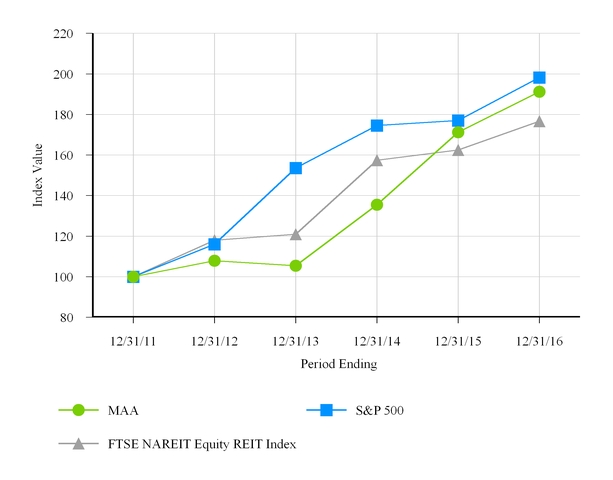
|
|
Dec '11
|
Dec '12
|
Dec '13
|
Dec '14
|
Dec '15
|
Dec '16
|
|||||||||||||||||
|
MAA
|
$
|
100.00
|
|
$
|
107.84
|
|
$
|
105.47
|
|
$
|
135.45
|
|
$
|
171.29
|
|
$
|
191.15
|
|
|||||
|
S&P 500
|
$
|
100.00
|
|
$
|
116.00
|
|
$
|
153.57
|
|
$
|
174.60
|
|
$
|
177.01
|
|
$
|
198.18
|
|
|||||
|
FTSE NAREIT Equity REIT Index
|
$
|
100.00
|
|
$
|
118.06
|
|
$
|
120.97
|
|
$
|
157.43
|
|
$
|
162.46
|
|
$
|
176.60
|
|
|||||
Purchases of Equity Securities
The following table shows our repurchases of shares for the three-month period ended
December 31, 2016
:
MAA Purchases of Equity Securities
|
Period
|
Total Number
of Shares
Purchased |
Average
Price Paid
per Share
|
Total
Number of
Shares Purchased
as Part of Publicly Announced Plans
or Programs
|
Maximum
Number of
Shares That
May Yet be
Purchased Under
the Plans or
Programs
(1)
|
|||||||
|
October 1, 2016 - October 31, 2016
|
—
|
|
$
|
—
|
|
—
|
|
4,000,000
|
|||
|
November 1, 2016 - November 30, 2016
|
—
|
|
$
|
—
|
|
—
|
|
4,000,000
|
|||
|
December 1, 2016 - December 31, 2016
|
—
|
|
$
|
—
|
|
—
|
|
4,000,000
|
|||
|
Total
|
—
|
|
$
|
—
|
|
—
|
|
4,000,000
|
|||
|
(1)
|
This column reflects the number of shares of MAA's common stock that were available for purchase under the 4.0 million share repurchase program authorized by MAA's Board of Directors on December 8, 2015.
|
40
The following tables set forth selected financial data on a historical basis for MAA and the Operating Partnership. As previously discussed, the consolidated assets, liabilities, and results of operations of Post Properties are included in MAA's selected financial data from the closing date of the parent merger, December 1, 2016, through the end of MAA's fiscal year, December 31,
2016
. Likewise, the consolidated assets, liabilities, and results of operations of Post LP are included in the Operating Partnership's selected financial data from the closing date of the partnership merger, December 1, 2016, through the end of the Operating Partnership's fiscal year, December 31, 2016. This data should be read in conjunction with the consolidated financial statements and notes thereto and “Management's Discussion and Analysis of Financial Condition and Results of Operations” included elsewhere in this Annual Report on Form 10-K.
41
Mid-America Apartment Communities, Inc.
Selected Financial Data
(Dollars in thousands, except per share data)
|
|
Year Ended December 31,
|
||||||||||||||||||
|
|
2016
|
2015
|
2014
|
2013
|
2012
|
||||||||||||||
|
Operating Data:
|
|
|
|
|
|
|
|
|
|
|
|||||||||
|
Total operating revenues
|
$
|
1,125,348
|
|
$
|
1,042,779
|
|
$
|
992,332
|
|
$
|
635,490
|
|
$
|
475,888
|
|
||||
|
Expenses:
|
|
|
|
|
|
|
|
|
|
|
|||||||||
|
Property operating expenses
|
423,356
|
|
400,645
|
|
393,348
|
|
253,633
|
|
194,149
|
|
|||||||||
|
Depreciation and amortization
|
322,958
|
|
294,520
|
|
301,812
|
|
186,979
|
|
121,211
|
|
|||||||||
|
Acquisition expenses
|
2,928
|
|
2,777
|
|
2,388
|
|
1,393
|
|
1,581
|
|
|||||||||
|
Property management and general and administrative expenses
|
63,133
|
|
56,706
|
|
53,004
|
|
38,652
|
|
35,043
|
|
|||||||||
|
Merger related expenses
|
39,033
|
|
—
|
|
3,152
|
|
32,403
|
|
—
|
|
|||||||||
|
Integration related expenses
|
1,790
|
|
—
|
|
8,395
|
|
5,102
|
|
—
|
|
|||||||||
|
Income from continuing operations before non-operating items
|
272,150
|
|
288,131
|
|
230,233
|
|
117,328
|
|
123,904
|
|
|||||||||
|
Interest and other non-property income (expense)
|
724
|
|
(368
|
)
|
770
|
|
466
|
|
430
|
|
|||||||||
|
Interest expense
|
(129,947
|
)
|
(122,344
|
)
|
(123,953
|
)
|
(78,978
|
)
|
(61,489
|
)
|
|||||||||
|
Loss on debt extinguishment
|
(83
|
)
|
(3,602
|
)
|
(2,586
|
)
|
(426
|
)
|
(654
|
)
|
|||||||||
|
Net casualty gain (loss) after insurance and other settlement proceeds
|
448
|
|
473
|
|
(476
|
)
|
(143
|
)
|
(6
|
)
|
|||||||||
|
Gain on sale of depreciable real estate assets
|
80,397
|
|
189,958
|
|
42,649
|
|
—
|
|
—
|
|
|||||||||
|
Gain on sale of non-depreciable real estate assets
|
2,171
|
|
172
|
|
350
|
|
—
|
|
45
|
|
|||||||||
|
Income before income tax expense
|
225,860
|
|
352,420
|
|
146,987
|
|
38,247
|
|
62,230
|
|
|||||||||
|
Income tax expense
|
(1,699
|
)
|
(1,673
|
)
|
(2,050
|
)
|
(893
|
)
|
(803
|
)
|
|||||||||
|
Income from continuing operations before joint venture activity
|
224,161
|
|
350,747
|
|
144,937
|
|
37,354
|
|
61,427
|
|
|||||||||
|
Gain (loss) from real estate joint ventures
|
241
|
|
(2
|
)
|
6,009
|
|
338
|
|
(223
|
)
|
|||||||||
|
Income from continuing operations
|
224,402
|
|
350,745
|
|
150,946
|
|
37,692
|
|
61,204
|
|
|||||||||
|
Discontinued operations:
|
|
|
|
|
|
|
|
|
|
|
|||||||||
|
Income from discontinued operations before (loss) gain on sale
|
—
|
|
—
|
|
(63
|
)
|
4,743
|
|
6,986
|
|
|||||||||
|
Gain on sale of discontinued operations
|
—
|
|
—
|
|
5,394
|
|
76,844
|
|
41,635
|
|
|||||||||
|
Net income
|
224,402
|
|
350,745
|
|
156,277
|
|
119,279
|
|
109,825
|
|
|||||||||
|
Net income attributable to noncontrolling interests
|
12,180
|
|
18,458
|
|
8,297
|
|
3,998
|
|
4,602
|
|
|||||||||
|
Dividends to MAA Series I preferred shareholders
|
307
|
|
—
|
|
—
|
|
—
|
|
—
|
|
|||||||||
|
Net income available for MAA common shareholders
|
$
|
211,915
|
|
$
|
332,287
|
|
$
|
147,980
|
|
$
|
115,281
|
|
$
|
105,223
|
|
||||
|
Per Share Data:
|
|
|
|
|
|
|
|
|
|
|
|||||||||
|
Weighted average shares outstanding (in thousands):
|
|
|
|
|
|
|
|
|
|
|
|||||||||
|
Basic
|
78,502
|
|
|
75,176
|
|
74,982
|
|
50,677
|
|
41,039
|
|
||||||||
|
Effect of dilutive stock options and partnership units (1)
|
298
|
|
—
|
|
—
|
|
2,439
|
|
1,898
|
|
|||||||||
|
Diluted
|
78,800
|
|
75,176
|
|
74,982
|
|
53,116
|
|
42,937
|
|
|||||||||
|
Calculation of Earnings per share - basic:
|
|||||||||||||||||||
|
Income from continuing operations, adjusted
|
$
|
211,343
|
|
|
$
|
331,515
|
|
$
|
142,655
|
|
$
|
36,504
|
|
$
|
58,737
|
|
|||
|
Income from discontinued operations, adjusted
|
—
|
|
—
|
|
5,037
|
|
78,669
|
|
46,392
|
|
|||||||||
|
Net income attributable to common shareholders, adjusted
|
$
|
211,343
|
|
$
|
331,515
|
|
$
|
147,692
|
|
$
|
115,173
|
|
$
|
105,129
|
|
||||
|
Earnings per share - basic:
|
|
|
|
|
|
|
|
|
|
|
|||||||||
|
Income from continuing operations available for common shareholders
|
$
|
2.69
|
|
$
|
4.41
|
|
$
|
1.90
|
|
$
|
0.72
|
|
$
|
1.43
|
|
||||
|
Discontinued property operations
|
—
|
|
—
|
|
0.07
|
|
1.55
|
|
1.13
|
|
|||||||||
|
Net income available for common shareholders
|
$
|
2.69
|
|
$
|
4.41
|
|
$
|
1.97
|
|
$
|
2.27
|
|
$
|
2.56
|
|
||||
|
Calculation of Earnings per share - diluted:
|
|||||||||||||||||||
|
Income from continuing operations, adjusted
|
$
|
211,915
|
|
|
$
|
331,515
|
|
$
|
142,655
|
|
$
|
37,692
|
|
$
|
61,204
|
|
|||
|
Income from discontinued operations, adjusted
|
—
|
|
—
|
|
5,037
|
|
81,587
|
|
48,621
|
|
|||||||||
|
Net income attributable to common shareholders, adjusted
|
$
|
211,915
|
|
$
|
331,515
|
|
$
|
147,692
|
|
$
|
119,279
|
|
$
|
109,825
|
|
||||
|
Earnings per share - diluted:
|
|
|
|
|
|
|
|
|
|
|
|||||||||
|
Income from continuing operations available for common shareholders
|
$
|
2.69
|
|
$
|
4.41
|
|
$
|
1.90
|
|
$
|
0.71
|
|
$
|
1.43
|
|
||||
|
Discontinued property operations
|
—
|
|
—
|
|
0.07
|
|
1.54
|
|
1.13
|
|
|||||||||
|
Net income available for common shareholders
|
$
|
2.69
|
|
$
|
4.41
|
|
$
|
1.97
|
|
$
|
2.25
|
|
$
|
2.56
|
|
||||
|
Dividends declared (2)
|
$
|
3.330
|
|
$
|
3.130
|
|
$
|
2.960
|
|
$
|
2.815
|
|
$
|
2.675
|
|
||||
|
Balance Sheet Data:
|
|
|
|
|
|
|
|
|
|
|
|||||||||
|
Real estate owned, at cost
|
$
|
13,016,663
|
|
$
|
8,217,579
|
|
$
|
8,071,187
|
|
$
|
7,694,618
|
|
$
|
3,734,544
|
|
||||
|
Real estate assets, net
|
$
|
11,341,862
|
|
$
|
6,718,366
|
|
$
|
6,697,508
|
|
$
|
6,556,303
|
|
$
|
2,694,071
|
|
||||
|
Total assets
|
$
|
11,604,491
|
|
$
|
6,847,781
|
|
$
|
6,821,778
|
|
$
|
6,835,012
|
|
$
|
2,745,292
|
|
||||
|
Total debt
|
$
|
4,499,712
|
|
$
|
3,427,568
|
|
$
|
3,512,699
|
|
$
|
3,463,239
|
|
$
|
1,668,072
|
|
||||
|
Noncontrolling interest
|
$
|
238,282
|
|
$
|
165,726
|
|
$
|
161,287
|
|
$
|
166,726
|
|
$
|
31,058
|
|
||||
|
Total MAA shareholders' equity and redeemable stock
|
$
|
6,413,892
|
|
$
|
3,000,347
|
|
$
|
2,896,435
|
|
$
|
2,951,861
|
|
$
|
918,765
|
|
||||
|
Other Data (at end of period):
|
|
|
|
|
|
|
|
|
|
|
|||||||||
|
Market capitalization (shares and units) (3)
|
$
|
11,528,965
|
|
$
|
7,225,894
|
|
$
|
5,933,985
|
|
$
|
4,801,990
|
|
$
|
2,852,113
|
|
||||
|
Ratio of total debt to total capitalization (4)
|
28.1
|
%
|
32.2
|
%
|
37.3
|
%
|
42.0
|
%
|
37.0
|
%
|
|||||||||
|
Number of communities, including joint venture ownership interest (5)
|
303
|
|
254
|
|
268
|
|
275
|
|
166
|
|
|||||||||
|
Number of apartment units, including joint venture ownership interest (5)
|
99,393
|
|
79,496
|
|
82,316
|
|
83,641
|
|
49,591
|
|
|||||||||
(1) See Earnings per common share of MAA note in Item 8. Financial Statements and Supplementary Data - Notes to Consolidated Financial Statements, Note 3 of this Annual Report on Form 10-K.
(2) Beginning in 2006, at their regularly scheduled meetings, our Board of Directors began routinely declaring dividends for payment in the following quarter. This can result in dividends declared during a calendar year being different from dividends paid during a calendar year. As a result of the Merger, our Board of Directors will routinely declare a quarterly dividend with respect to the MAA Series I preferred stock
(3) Market capitalization includes all shares of common stock, regardless of classification on the balance sheet, as well as partnership units (value based on common stock equivalency).
(4) Total capitalization is market capitalization plus total debt.
(5) Property and apartment unit totals have not been adjusted to exclude properties held for sale.
42
Mid-America Apartments, L.P.
Selected Financial Data
(Dollars in thousands, except per unit data)
|
|
Year Ended December 31,
|
||||||||||||||||||
|
|
2016
|
2015
|
2014
|
2013
|
2012
|
||||||||||||||
|
Operating Data:
|
|
|
|
|
|
|
|
|
|
|
|||||||||
|
Total operating revenues
|
$
|
1,125,348
|
|
$
|
1,042,779
|
|
$
|
992,332
|
|
$
|
635,490
|
|
$
|
475,888
|
|
||||
|
Expenses:
|
|
|
|
|
|
|
|
|
|
|
|||||||||
|
Property operating expenses
|
423,356
|
|
400,645
|
|
393,348
|
|
253,633
|
|
194,149
|
|
|||||||||
|
Depreciation and amortization
|
322,958
|
|
294,520
|
|
301,812
|
|
186,979
|
|
121,211
|
|
|||||||||
|
Acquisition expenses
|
2,928
|
|
2,777
|
|
2,388
|
|
1,393
|
|
1,581
|
|
|||||||||
|
Property management and general and administrative expenses
|
63,133
|
|
56,706
|
|
53,004
|
|
38,652
|
|
35,043
|
|
|||||||||
|
Merger related expenses
|
39,033
|
|
—
|
|
3,152
|
|
32,403
|
|
—
|
|
|||||||||
|
Integration related expenses
|
1,790
|
|
—
|
|
8,395
|
|
5,102
|
|
—
|
|
|||||||||
|
Income from continuing operations before non-operating items
|
272,150
|
|
288,131
|
|
230,233
|
|
117,328
|
|
123,904
|
|
|||||||||
|
Interest and other non-property income (expense)
|
724
|
|
(368
|
)
|
770
|
|
466
|
|
430
|
|
|||||||||
|
Interest expense
|
(129,947
|
)
|
(122,344
|
)
|
(123,953
|
)
|
(78,978
|
)
|
(61,489
|
)
|
|||||||||
|
Loss on debt extinguishment
|
(83
|
)
|
(3,602
|
)
|
(2,586
|
)
|
(426
|
)
|
(654
|
)
|
|||||||||
|
Net casualty gain (loss) after insurance and other settlement proceeds
|
448
|
|
473
|
|
(476
|
)
|
(143
|
)
|
(6
|
)
|
|||||||||
|
Gain on sale of depreciable real estate assets
|
80,397
|
|
189,958
|
|
42,649
|
|
—
|
|
—
|
|
|||||||||
|
Gain on sale of non-depreciable real estate assets
|
2,171
|
|
172
|
|
350
|
|
—
|
|
45
|
|
|||||||||
|
Income before income tax expense
|
225,860
|
|
352,420
|
|
146,987
|
|
38,247
|
|
62,230
|
|
|||||||||
|
Income tax expense
|
(1,699
|
)
|
(1,673
|
)
|
(2,050
|
)
|
(893
|
)
|
(803
|
)
|
|||||||||
|
Income from continuing operations before joint venture activity
|
224,161
|
|
350,747
|
|
144,937
|
|
37,354
|
|
61,427
|
|
|||||||||
|
Gain (loss) from real estate joint ventures
|
241
|
|
(2
|
)
|
6,009
|
|
338
|
|
(223
|
)
|
|||||||||
|
Income from continuing operations
|
224,402
|
|
350,745
|
|
150,946
|
|
37,692
|
|
61,204
|
|
|||||||||
|
Discontinued operations:
|
|
|
|
|
|
|
|
|
|
|
|||||||||
|
Income from discontinued operations before (loss) gain on sale
|
—
|
|
—
|
|
(63
|
)
|
4,332
|
|
6,201
|
|
|||||||||
|
Gain on sale of discontinued operations
|
—
|
|
—
|
|
5,394
|
|
65,520
|
|
41,635
|
|
|||||||||
|
Dividends to MAA Series I preferred shareholders
|
307
|
|
—
|
|
—
|
|
—
|
|
—
|
|
|||||||||
|
Net income available for Mid-America Apartments, L.P. common unitholders
|
$
|
224,095
|
|
$
|
350,745
|
|
$
|
156,277
|
|
$
|
107,544
|
|
$
|
109,040
|
|
||||
|
Per Unit Data:
|
|
|
|
|
|
|
|
|
|
|
|||||||||
|
Weighted average units outstanding (in thousands):
|
|
|
|
|
|
|
|
|
|
|
|||||||||
|
Basic
|
82,661
|
|
|
79,361
|
|
79,188
|
|
53,075
|
|
42,911
|
|
||||||||
|
Effect of dilutive stock options and partnership units (1)
|
298
|
|
|
—
|
|
—
|
|
88
|
|
64
|
|
||||||||
|
Diluted
|
82,959
|
|
79,361
|
|
79,188
|
|
53,163
|
|
42,975
|
|
|||||||||
|
Calculation of Earnings per unit - basic:
|
|||||||||||||||||||
|
Income from continuing operations, adjusted
|
$
|
223,521
|
|
$
|
349,973
|
|
$
|
150,668
|
|
$
|
37,659
|
|
$
|
61,151
|
|
||||
|
Income from discontinued operations, adjusted
|
—
|
|
|
—
|
|
5,321
|
|
69,790
|
|
47,795
|
|
||||||||
|
Net income available for common unitholders
|
$
|
223,521
|
|
$
|
349,973
|
|
$
|
155,989
|
|
$
|
107,449
|
|
$
|
108,946
|
|
||||
|
Earnings per unit - basic:
|
|
|
|
|
|
|
|
|
|
|
|||||||||
|
Income from continuing operations available for common unitholders
|
$
|
2.70
|
|
$
|
4.41
|
|
$
|
1.90
|
|
$
|
0.71
|
|
$
|
1.43
|
|
||||
|
Income from discontinued property operations available for common unitholders
|
—
|
|
—
|
|
0.07
|
|
1.31
|
|
1.11
|
|
|||||||||
|
Net income available for common unitholders
|
$
|
2.70
|
|
$
|
4.41
|
|
$
|
1.97
|
|
$
|
2.02
|
|
$
|
2.54
|
|
||||
|
Calculation of Earnings per unit - diluted:
|
|||||||||||||||||||
|
Income from continuing operations, adjusted
|
$
|
224,095
|
|
|
$
|
349,973
|
|
$
|
150,668
|
|
$
|
37,692
|
|
$
|
61,204
|
|
|||
|
Income from discontinued operations, adjusted
|
—
|
|
—
|
|
5,321
|
|
69,852
|
|
47,836
|
|
|||||||||
|
Net income available for common unitholders
|
$
|
224,095
|
|
$
|
349,973
|
|
$
|
155,989
|
|
$
|
107,544
|
|
$
|
109,040
|
|
||||
|
Earnings per unit - diluted:
|
|
|
|
|
|
|
|
|
|
|
|||||||||
|
Income from continuing operations available for common unitholders
|
$
|
2.70
|
|
$
|
4.41
|
|
$
|
1.90
|
|
$
|
0.71
|
|
$
|
1.43
|
|
||||
|
Discontinued property operations
|
—
|
|
—
|
|
0.07
|
|
1.31
|
|
1.11
|
|
|||||||||
|
Net income available for common unitholders
|
$
|
2.70
|
|
$
|
4.41
|
|
$
|
1.97
|
|
$
|
2.02
|
|
$
|
2.54
|
|
||||
|
Distributions declared, per unit (2)
|
$
|
3.3300
|
|
$
|
3.1300
|
|
$
|
2.9600
|
|
$
|
2.8150
|
|
$
|
2.6750
|
|
||||
|
Balance Sheet Data:
|
|
|
|
|
|
|
|
|
|
|
|||||||||
|
Real estate owned, at cost
|
$
|
13,016,663
|
|
$
|
8,217,579
|
|
$
|
8,071,187
|
|
$
|
7,694,618
|
|
$
|
3,721,028
|
|
||||
|
Real estate assets, net
|
$
|
11,341,862
|
|
$
|
6,718,366
|
|
$
|
6,697,508
|
|
$
|
6,556,303
|
|
$
|
2,688,549
|
|
||||
|
Total assets
|
$
|
11,604,491
|
|
$
|
6,847,781
|
|
$
|
6,821,778
|
|
$
|
6,835,012
|
|
$
|
2,739,502
|
|
||||
|
Total debt
|
$
|
4,499,712
|
|
$
|
3,427,568
|
|
$
|
3,512,699
|
|
$
|
3,463,239
|
|
$
|
1,668,072
|
|
||||
|
Total Operating Partnership capital and
|
|
|
|
|
|
|
|
|
|
|
|||||||||
|
redeemable units
|
$
|
6,649,849
|
|
$
|
3,166,054
|
|
$
|
3,057,703
|
|
$
|
3,118,568
|
|
$
|
943,720
|
|
||||
|
Other Data (at end of period):
|
|
|
|
|
|
|
|
|
|
|
|||||||||
|
Number of communities, including joint venture ownership interest (3)
|
303
|
|
254
|
|
268
|
|
275
|
|
165
|
|
|||||||||
|
Number of apartment units, including joint venture ownership interest (3)
|
99,393
|
|
79,496
|
|
82,316
|
|
83,641
|
|
49,335
|
|
|||||||||
(1) See Earnings Per OP Unit of MAALP note in Item 8. Financial Statements and Supplementary Data - Notes to Consolidated Financial Statements, Note 4 of this Annual Report on Form 10-K.
(2) Beginning in 2006, at their regularly scheduled meetings, the Board of Directors began routinely declaring distributions for payment in the following quarter. This can result in distributions declared during a calendar year being different from distributions paid during a calendar year.
(3) Property and apartment unit totals have not been adjusted to exclude properties held for sale.
43
The following discussion analyzes the financial condition and results of operations of both MAA and the Operating Partnership, of which MAA is the sole general partner and in which MAA owned a
96.4%
limited partner interest as of
December 31, 2016
. MAA conducts all of its business through the Operating Partnership and the Operating Partnership’s various subsidiaries. This discussion should be read in conjunction with all of the consolidated financial statements included elsewhere in this Annual Report on Form 10-K.
CRITICAL ACCOUNTING POLICIES AND ESTIMATES
A critical accounting policy is one that is both important to our financial condition and results of operations and that involves some degree of uncertainty. The following discussion and analysis of financial condition and results of operations are based upon our consolidated financial statements and the notes thereto, which have been prepared in accordance with United States generally accepted accounting principles, or GAAP. The preparation of financial statements in conformity with GAAP requires management to make a number of estimates and assumptions that affect the reported amounts and disclosures in the consolidated financial statements. On an ongoing basis, we evaluate our estimates and assumptions based upon historical experience and various other factors and circumstances. We believe that our estimates and assumptions are reasonable under the circumstances; however, actual results may differ from these estimates and assumptions.
We believe that the estimates and assumptions listed below are most important to the portrayal of our financial condition and results of operations because they require the greatest subjective determinations and form the basis of accounting policies deemed to be most critical.
Acquisition of real estate assets
We account for our acquisitions of investments in real estate in accordance with ASC 805-10,
Business Combinations
, which requires the fair value of the real estate acquired to be allocated to the acquired tangible assets, consisting of land, building and furniture, fixtures and equipment, and identified intangible assets, consisting of the value of in-place leases and other contracts. In calculating the fair value of acquired tangible assets, management uses stabilized net operating income (NOI) and market specific capitalization and discount rates. Management analyzed historical stabilized NOI to determine its estimate for forecasted NOI. Management estimates the market capitalization rate by analyzing the market capitalization rates for properties with comparable ages in similar sized markets. Although management's estimates of the fair value of acquired tangible assets have been materially accurate in the past, additional information becoming available could lead to the modification of the initial fair value calculation and purchase price allocation. Subsequent adjustments made to the purchase price allocation, if any, would be made within the allocation period, which typically does not exceed one year.
Impairment of long-lived assets, including goodwill
We account for long-lived assets in accordance with the provisions of accounting standards for the impairment or disposal of long-lived assets and evaluate our goodwill for impairment under accounting standards for goodwill and other intangible assets. We evaluate goodwill for impairment on at least an annual basis, or more frequently if a goodwill impairment indicator is identified. We periodically evaluate long-lived assets, including investments in real estate and goodwill, for indicators that would suggest that the carrying amount of the assets may not be recoverable. The judgments regarding the existence of such indicators are based on factors such as operating performance, market conditions and legal factors. If impairment indicators exist for a long-lived asset, management compares the carrying amount of the asset to an estimate of the undiscounted future cash flows expected to be generated by the asset. Management estimates future cash flows by analyzing historical cash flows generated by the asset. If impairment indicators exist for goodwill, management compares the carrying amount of the asset to an estimate of the implied fair value of the asset. Management calculates the fair value of the asset by dividing historical operating cash flows by a market capitalization rate. Management estimates the market capitalization rate by analyzing the market capitalization rates for properties with comparable ages in similarly sized markets. No impairment losses have been recognized during the years ended
December 31, 2016
,
2015
, and
2014
.
Cost capitalization
Repairs and maintenance costs are expensed as incurred while significant improvements, renovations, and replacements are capitalized. The cost to complete any deferred repairs and maintenance at properties acquired by us in order to elevate the condition of the property to our standards are capitalized as incurred. The carrying costs related to development
44
projects, including interest, property taxes, insurance and allocated direct development salary cost during the construction period, are capitalized. Management uses judgment in determining whether costs should be expensed or capitalized.
Loss contingencies
The outcomes of claims, disputes and legal proceedings are subject to significant uncertainty. We record an accrual for loss contingencies when a loss is probable and the amount of the loss can be reasonably estimated. We review these accruals quarterly and make revisions based on changes in facts and circumstances. When a loss contingency is not both probable and reasonably estimable, then we do not accrue the loss. However, for material loss contingencies, if the unrecorded loss (or an additional loss in excess of the accrual) is at least a reasonable possibility and material, then we disclose a reasonable estimate of the possible loss, or range of loss, if such reasonable estimate can be made. If we cannot make a reasonable estimate of the possible loss, or range of loss, then that is disclosed.
The assessment of whether a loss is probable or a reasonable possibility, and whether the loss or range of loss is reasonably estimable, often involves a series of complex judgments about future events. Among the factors that we consider in this assessment, including with respect to the matters disclosed in this Annual Report on Form 10-K, are the nature of existing legal proceedings and claims, the asserted or possible damages or loss contingency (if reasonably estimable), the progress of the matter, existing law and precedent, the opinions or views of legal counsel and other advisers, our experience in similar matters, the facts available to us at the time of assessment, and how we intend to respond, or have responded, to the proceeding or claim. Our assessment of these factors may change over time as individual proceedings or claims progress. For matters where we are not currently able to reasonably estimate a range of reasonably possible loss, the factors that have contributed to this determination include the following: (i) the damages sought are indeterminate; (ii) the proceedings are in the early stages; (iii) the matters involve novel or unsettled legal theories or a large or uncertain number of actual or potential cases or parties; and/or (iv) discussions with the parties in matters that are expected ultimately to be resolved through negotiation and settlement have not reached the point where we believe a reasonable estimate of loss, or range of loss, can be made. In such instances, we believe that there is considerable uncertainty regarding the timing or ultimate resolution of such matters, including a possible eventual loss or business impact, if any.
For more information regarding our significant accounting policies, see Item 8. Financial Statements and Supplementary Data - Notes to Consolidated Financial Statements, Note 1.
OVERVIEW OF THE YEAR ENDED
DECEMBER 31, 2016
As noted earlier, on December 1, 2016, we consummated the Merger and acquired all of Post Properties' net assets. As a result of the Merger, the results of operations for 2016 include 12 months of results for MAA and one month of results for Post Properties. Our December 31, 2016 balance sheet includes the combined assets and liabilities of MAA and Post Properties. All properties acquired from Post Properties have been placed in our "non-same store and other" operating segment, as the properties are recent acquisitions and have not been owned and stabilized for at least 12 months.
We experienced a decrease in income from continuing operations in
2016
despite increases in revenues outpacing increases in property operating expenses due to lower gain on sale of depreciable real estate assets and increased merger and integration costs. The increases in revenues came from a
4.9%
increase in our large market same store segment, a
3.1%
increase in our secondary market same store segment and a
41.7%
increase in our non-same store and other segment, which was primarily a result of the Merger. The increase in property operating expenses came from a
3.2%
increase in our large market same store segment, a
2.0%
increase in our secondary market same store segment and a
30.7%
increase in our non-same store and other segment, which was primarily the result of the Merger. Our same store portfolio represents those communities that have been held and have been stabilized for at least 12 months. Communities excluded from the same store portfolio include recent acquisitions, communities being developed or in lease-up, communities undergoing extensive renovations, and communities identified for disposition. Additional information regarding the composition of operating segments is included in the notes to the consolidated financial statements, Note 16 - Segment Information. The drivers of these increases are discussed below in the results of operations section.
We have grown externally during the past three years by following our acquisition strategy to invest in large and mid-sized growing markets in the Southeast and Southwest region of the United States. Apart from the Merger, we acquired
four
apartment communities for our portfolio in
2014
,
seven
in
2015
and
five
in
2016
. Offsetting some of this increased revenue stream were
four
apartment community dispositions in
2014
,
twenty-one
in
2015
, and
twelve
in
2016
.
45
The following table shows our apartment real estate assets as of December 31,
2016
,
2015
, and
2014
:
|
2016
|
2015
|
2014
|
|||||||||
|
Properties
|
303
|
|
254
|
|
268
|
|
|||||
|
Units
(1)
|
99,393
|
|
79,496
|
|
82,316
|
|
|||||
|
Development Units
|
2,816
|
|
748
|
|
514
|
|
|||||
|
Average Effective Monthly Rent/Unit, excluding lease-up and development
|
$
|
1,154
|
|
$
|
1,006
|
|
$
|
948
|
|
||
|
Average Physical Occupancy
|
95.9
|
%
|
95.6
|
%
|
94.1
|
%
|
|||||
(1)
includes units owned by nonconsolidated joint venture
Average effective monthly rent per unit is calculated as the average of monthly gross rent amounts for occupied units, after the effect of leasing concessions, plus then-prevailing market rates asked for unoccupied units, divided by the total number of units. Leasing concessions represent discounts to the current market rate. We believe average effective monthly rent is a helpful measurement in evaluating average pricing; however, it does not represent actual rental revenue collected per unit. For additional discussion of same store average rent per unit and occupancy comparisons, see the “Trends” section below.
RESULTS OF OPERATIONS
As a result of the Merger, the results of operations for 2016 include twelve months of results for MAA and one month of results for Post Properties. Our December 31, 2016 balance sheet includes the combined assets and liabilities of MAA and Post Properties.
Comparison of the Year Ended
December 31, 2016
to the Year Ended
December 31, 2015
Property Revenues
The following table shows our property revenues by segment for the years ended
December 31, 2016
and
December 31, 2015
(dollars in thousands):
|
Year ended December 31, 2016
|
Year ended December 31, 2015
|
Increase
|
Percentage Increase
|
|||||||||||
|
Large Market Same Store
|
$
|
642,679
|
|
$
|
612,934
|
|
$
|
29,745
|
|
4.9
|
%
|
|||
|
Secondary Market Same Store
|
337,883
|
|
327,700
|
|
10,183
|
|
3.1
|
%
|
||||||
|
Same Store Portfolio
|
980,562
|
|
940,634
|
|
39,928
|
|
4.2
|
%
|
||||||
|
Non-Same Store and Other
|
144,786
|
|
102,145
|
|
42,641
|
|
41.7
|
%
|
||||||
|
Total
|
$
|
1,125,348
|
|
$
|
1,042,779
|
|
$
|
82,569
|
|
7.9
|
%
|
|||
The increase in property revenues from our same store portfolio is primarily a result of increased effective rental revenue per occupied unit of 4.9% and 2.9% for our large and secondary markets, respectively. The increase in property revenues from our non-same store and other portfolio is primarily the result of the Merger, which we classified as non-same store. See discussion of our segment classification methodology at Note 16 (Segment Information).
46
Property Operating Expenses
Property operating expenses include costs for property personnel, building repairs and maintenance, real estate taxes and insurance, utilities, landscaping, and depreciation and amortization. The following table shows our property operating expenses by segment excluding depreciation and amortization for the years ended
December 31, 2016
and
December 31, 2015
(dollars in thousands):
|
Year ended December 31, 2016
|
Year ended December 31, 2015
|
Increase
|
Percentage Increase
|
|||||||||||
|
Large Market Same Store
|
$
|
243,392
|
|
$
|
235,909
|
|
$
|
7,483
|
|
3.2
|
%
|
|||
|
Secondary Market Same Store
|
125,830
|
|
123,318
|
|
2,512
|
|
2.0
|
%
|
||||||
|
Same Store Portfolio
|
369,222
|
|
359,227
|
|
9,995
|
|
2.8
|
%
|
||||||
|
Non-Same Store and Other
|
54,134
|
|
41,418
|
|
12,716
|
|
30.7
|
%
|
||||||
|
Total
|
$
|
423,356
|
|
$
|
400,645
|
|
$
|
22,711
|
|
5.7
|
%
|
|||
The increase in property operating expenses from our large market same store group is primarily the result of increases in real estate taxes of $5.3 million, personnel expenses of $1.5 million, and utilities expenses of $1.2 million. The increase in our large market same store operating expenses was slightly offset by a decrease in insurance expense of $0.5 million. The increase in property operating expenses from our secondary market same store group is primarily a result of increases in real estate taxes of $1.3 million, personnel expenses of $0.6 million, and utilities expenses of $0.5 million.
The increase in property operating expenses from our non-same store and other portfolio is primarily the result of the Merger, which we classified as non-same store. See discussion of our segment classification methodology at Note 16 (Segment Information).
Depreciation and Amortization
The following table shows our depreciation and amortization expense by segment for the years ended
December 31, 2016
and
December 31, 2015
(dollars in thousands):
|
Year ended December 31, 2016
|
Year ended December 31, 2015
|
Increase
|
Percentage Increase
|
|||||||||||
|
Large Market Same Store
|
$
|
183,131
|
|
$
|
176,253
|
|
$
|
6,878
|
|
3.9
|
%
|
|||
|
Secondary Market Same Store
|
89,031
|
|
85,799
|
|
3,232
|
|
3.8
|
%
|
||||||
|
Same Store Portfolio
|
272,162
|
|
262,052
|
|
10,110
|
|
3.9
|
%
|
||||||
|
Non-Same Store and Other
|
50,796
|
|
32,468
|
|
18,328
|
|
56.4
|
%
|
||||||
|
Total
|
$
|
322,958
|
|
$
|
294,520
|
|
$
|
28,438
|
|
9.7
|
%
|
|||
The increase in depreciation and amortization expense of
$28.4 million
is primarily driven by depreciation expense of $17.4 million related to the Merger. Additionally, the amortization of fair market value of in-place leases began in December of 2016 totaling $4.9 million for the
year ended December 31, 2016
.
Merger and Integration Costs
Merger related expenses for the acquisition of Post Properties were approximately $39.0 million for the
year ended December 31, 2016
. We also incurred integration related expenses of approximately $1.8 million for the
year ended December 31, 2016
. These expenses primarily consisted of legal, management salaries, and professional fees. There were no merger or integration related expenses for the
year ended December 31, 2015
because no merger occurred in that year and the expenses associated with our merger with Colonial Properties Trust, or Colonial, had already been incurred.
Interest Expense
Interest expense for the year ended
December 31, 2016
was approximately
$129.9 million
, an increase of
$7.6 million
from the year ended
December 31, 2015
. The increase was due in part to decreased amortization of fair market value of debt adjustments related to debt acquired and increased interest rates towards the end of 2016. Additionally, we assumed several
47
loans through the acquisition of Post Properties, including a secured loan with a face value of $186.0 million and two unsecured loans with face values of $150.0 million and $250.0 million.
Loss on debt extinguishment was approximately
$83,000
for the
year ended December 31, 2016
. For the
year ended December 31, 2015
, we recorded a loss of
$3.6 million
. The decrease of
$3.5 million
was due primarily to the removal of properties from a secured tax-free debt facility for the
year ended December 31, 2015
. With the exception of an
$83,000
gain on extinguishment, offset by a $166,000 loss for the write-off of deferred financing costs and related fees, there was no activity for the
year ended December 31, 2016
.
Dispositions of Depreciable Real Estate Assets Excluded from Discontinued Operations
We recorded a gain on sale of depreciable assets excluded from discontinued operations of
$80.4 million
for the
year ended December 31, 2016
, a decrease of approximately
$109.6 million
from the
$190.0 million
gain on sale of depreciable assets recorded for the
year ended December 31, 2015
. The decrease was primarily the result of a decline in disposition activity year over year. Dispositions decreased from
twenty-one
multifamily properties for the
year ended December 31, 2015
, to
twelve
multifamily properties for the
year ended December 31, 2016
.
Dispositions of Non-Depreciable Real Estate Assets Excluded from Discontinued Operations
We recorded a gain on sale of non-depreciable assets excluded from discontinued operations of approximately
$2.2 million
for the
year ended December 31, 2016
, an increase of
$2.0 million
from the
year ended December 31, 2015
. The increase in gain on sale can be attributed to the rise in non-depreciable asset distributions year over year. Dispositions increased from one property for the
year ended December 31, 2015
, to four properties for the
year ended December 31, 2016
.
Preferred Dividends Distributed
As a result of the Merger, for the
year ended December 31, 2016
we recorded a dividend distribution to shareholders of preferred stock of
$307,000
. As there were no MAA Series I preferred shares issued and outstanding as of the year ended December 31, 2015, we did not record a dividend distribution.
Comparison of the Year Ended
December 31, 2015
to the Year Ended
December 31, 2014
The comparison of the year ended December 31, 2015 to the year ended December 31, 2014 shows the segment break down based on the
2015
same store portfolios. A comparison using the
2016
same store portfolio would not be comparative due to the nature of the classifications.
Property Revenues
The following table shows our property revenues by segment for the years ended
December 31, 2015
and
December 31, 2014
(dollars in thousands):
|
Year ended December 31, 2015
|
Year ended December 31, 2014
|
Increase
|
Percentage Increase
|
|||||||||||
|
Large Market Same Store
|
$
|
587,896
|
|
$
|
553,038
|
|
$
|
34,858
|
|
6.3
|
%
|
|||
|
Secondary Market Same Store
|
324,771
|
|
310,281
|
|
14,490
|
|
4.7
|
%
|
||||||
|
Same Store Portfolio
|
912,667
|
|
863,319
|
|
49,348
|
|
5.7
|
%
|
||||||
|
Non-Same Store and Other
|
130,112
|
|
128,859
|
|
1,253
|
|
1.0
|
%
|
||||||
|
Total
|
$
|
1,042,779
|
|
$
|
992,178
|
|
$
|
50,601
|
|
5.1
|
%
|
|||
The increase in property revenues from our same store portfolio is primarily a result of increased average rental revenue per occupied unit of 5.5% and 3.8% for our large and secondary markets, respectively, and an increased average physical occupancy of 0.8% and 0.9% for our large and secondary markets, respectively.
48
Property Operating Expenses
Property operating expenses include costs for property personnel, property personnel bonuses, building repairs and maintenance, real estate taxes and insurance, utilities, landscaping, and depreciation and amortization. The following table shows our property operating expenses excluding depreciation and amortization by segment for the years ended
December 31, 2015
and
December 31, 2014
(dollars in thousands):
|
Year ended December 31, 2015
|
Year ended December 31, 2014
|
Increase/(Decrease)
|
Percentage Increase/(Decrease)
|
|||||||||||
|
Large Market Same Store
|
$
|
226,611
|
|
$
|
218,784
|
|
$
|
7,827
|
|
3.6
|
%
|
|||
|
Secondary Market Same Store
|
123,782
|
|
119,934
|
|
3,848
|
|
3.2
|
%
|
||||||
|
Same Store Portfolio
|
350,393
|
|
338,718
|
|
11,675
|
|
3.4
|
%
|
||||||
|
Non-Same Store and Other
|
50,252
|
|
54,630
|
|
(4,378
|
)
|
(8.0
|
)%
|
||||||
|
Total
|
$
|
400,645
|
|
$
|
393,348
|
|
$
|
7,297
|
|
1.9
|
%
|
|||
The increase in property operating expenses from our large market same store group is primarily the result of increases in real estate taxes of $3.2 million, personnel expenses of $1.9 million, water expenses of approximately $1.0 million, cable expenses of $0.5 million, and waste removal expenses of $0.2 million. The increase in property operating expenses from our secondary market same store group is primarily a result of increases in other operating expenses of $1.5 million, real estate taxes of $1.1 million, and personnel expenses of $1.2 million. The decrease in property operating expenses from our non-same store and other group is primarily the result of decreases in personnel expenses of $2.4 million and utility expenses of $1.7 million.
Depreciation and Amortization
The following table shows our depreciation and amortization expense by segment for the years ended
December 31, 2015
and
December 31, 2014
(dollars in thousands):
|
Year ended December 31, 2015
|
Year ended December 31, 2014
|
Decrease
|
Percentage Decrease
|
|||||||||||
|
Large Market Same Store
|
$
|
168,872
|
|
$
|
174,957
|
|
$
|
(6,085
|
)
|
(3.5
|
)%
|
|||
|
Secondary Market Same Store
|
85,008
|
|
86,058
|
|
(1,050
|
)
|
(1.2
|
)%
|
||||||
|
Same Store Portfolio
|
253,880
|
|
261,015
|
|
(7,135
|
)
|
(2.7
|
)%
|
||||||
|
Non-Same Store and Other
|
40,640
|
|
40,797
|
|
(157
|
)
|
(0.4
|
)%
|
||||||
|
Total
|
$
|
294,520
|
|
$
|
301,812
|
|
$
|
(7,292
|
)
|
(2.4
|
)%
|
|||
The decrease in depreciation and amortization expense is primarily due to a decrease of $19.4 million related to the amortization of the fair value of in-place leases and resident relationships acquired as a result of the merger with Colonial from the year ended December 31, 2014 to the year ended December 31, 2015. This decrease was partially offset by an increase in depreciation expense of $11.7 million driven by an increase in gross real estate assets from the year ended December 31, 2014 to the year ended December 31, 2015.
Property Management Expenses
Property management expenses for the
year ended December 31, 2015
were approximately
$31.0 million
, a decrease of
$1.1 million
from the
year ended December 31, 2014
. The majority of the decrease was related to a decrease in state franchise taxes of $2.1 million, partially offset by an increase in insurance expense of $0.6 million, an increase in payroll expense of $0.3 million, and an increase in incentive expense $0.3 million.
General and Administrative Expenses
General and Administrative expenses for the year ended
December 31, 2015
was approximately
$25.7 million
, an increase of
$4.8 million
from the year ended
December 31, 2014
. The majority of the increase was related to increases in legal fees of $2.7 million and stock option expenses of $1.6 million.
49
Merger and Integration Related Expenses
There were no merger or integration related expenses for the
year ended December 31, 2015
. For the
year ended December 31, 2014
, merger and integration related expenses were approximately $3.2 million and $8.4 million, respectively. These expenses related primarily to severance, legal, professional, temporary systems, staffing, and facilities costs incurred for the acquisition and integration of Colonial.
Interest Expense
Interest expense for the year ended
December 31, 2015
was approximately
$122.3 million
, a decrease of
$1.6 million
from the year ended
December 31, 2014
. The decrease was primarily the result of a decrease in amortization of deferred financing cost from the
year ended December 31, 2014
to the
year ended December 31, 2015
of approximately $0.9 million. Also, the overall debt balance decreased from $3.5 billion to $3.4 billion, a decrease of $85.1 million. The average effective interest rate remained at 3.7% and the average years to rate maturity increased from 4.4 years to 4.8 years.
Dispositions of Depreciable Real Estate Assets Excluded from Discontinued Operations
We recorded a gain on sale of depreciable assets excluded from discontinued operations of
$190.0 million
for the
year ended December 31, 2015
, an increase of approximately
$147.3 million
from the
$42.6 million
gain on sale of depreciable assets recorded for the
year ended December 31, 2014
. The increase was primarily the result of increased disposition activity. Dispositions increased from eight multifamily properties for the
year ended December 31, 2014
, to twenty-one multifamily properties for the year ended December 31, 2015.
Gain from Real Estate Joint Ventures
We recorded a gain from real estate joint ventures of
$6.0 million
during the
year ended December 31, 2014
as opposed to no material gain or loss being recorded during the
year ended December 31, 2015
. The decrease was primarily a result of recording a $3.4 million gain for the disposition of Ansley Village by Mid-America Multifamily Fund II, or Fund II, as well as a $2.8 million gain for the promote fee received from our Fund II partner during 2014. The promote fee was received as a result of MAA achieving certain performance metrics in its management of the Fund II properties over the life of the joint venture. There were no such gains recorded during the
year ended December 31, 2015
.
Discontinued Operations
We recorded a gain on sale of discontinued operations of
$5.4 million
for the
year ended December 31, 2014
. We did not record a gain or loss on sale of discontinued operations during the
year ended December 31, 2015
, due the adoption of ASU 2014-08, Reporting Discontinued Operations and Disclosures of Disposals of Components of an Entity, which resulted in dispositions being included in the gain on sale of depreciable real estate assets excluded from discontinued operations and is discussed further below.
Net Income Attributable to Noncontrolling Interests
Net income attributable to noncontrolling interests for the
year ended December 31, 2015
was approximately
$18.5 million
, an increase of
$10.2 million
from the
year ended December 31, 2014
. This increase is consistent with the increase to overall net income and is primarily a result of the items discussed above.
Net Income Attributable to MAA
Primarily as a result of the foregoing, net income attributable to MAA increased by approximately
$184.3 million
in the year ended
December 31, 2015
from the year ended
December 31, 2014
.
Funds from Operations
Funds from operations, or FFO, a non-GAAP financial measure, represents net income (computed in accordance with GAAP) excluding extraordinary items, net income attributable to noncontrolling interest, asset impairment, gains or losses on disposition of real estate assets, plus depreciation and amortization of real estate, and adjustments for joint ventures to reflect FFO on the same basis. Disposition of real estate assets includes, but is not limited to, sales of discontinued operations.
50
FFO should not be considered as an alternative to net income, or any other GAAP measurement of performance, as an indicator of operating performance or as an alternative to cash flow from operating, investing, and financing activities as a measure of liquidity. Management believes that FFO is helpful to investors in understanding our operating performance primarily because its calculation excludes depreciation and amortization expense on real estate assets. We believe that GAAP historical cost depreciation of real estate assets is generally not correlated with changes in the value of those assets, whose value does not diminish predictably over time, as historical cost depreciation implies. Our calculation of FFO may differ from the methodology for calculating FFO utilized by other REITs and, accordingly, may not be comparable to such other REITs.
Core FFO, a non-GAAP financial measure, represents FFO excluding certain non-cash or non-routine items such as acquisition, merger and integration expenses, mark-to-market debt adjustments and loss or gain on debt extinguishment. While our definition of Core FFO is similar to others in our industry, our precise methodology for calculating Core FFO may differ from that utilized by other REITs and, accordingly, may not be comparable to such other REITs. Core FFO should not be considered as an alternative to net income or any other GAAP measurement of performance, as an indicator of operating performance or as an alternative to cash flow from operating, investing and financing activities as a measure of liquidity. Management believes that Core FFO is helpful in understanding our operating performance in that it removes certain items that by their nature are not comparable over periods and therefore tend to obscure actual operating performance.
The following table is a reconciliation of Core FFO and FFO to consolidated net income for the years ended
December 31, 2016
,
2015
, and
2014
(dollars in thousands):
|
|
Years ended December 31,
|
|||||||||||
|
|
2016
|
2015
|
2014
|
|||||||||
|
Net income available for MAA common shareholders
|
$
|
211,915
|
|
$
|
332,287
|
|
$
|
147,980
|
|
|||
|
Depreciation and amortization of real estate assets
|
319,528
|
|
291,572
|
|
299,421
|
|
||||||
|
Depreciation and amortization of real estate assets of discontinued operations
|
—
|
|
—
|
|
42
|
|
||||||
|
Gain on sales of discontinued operations
|
—
|
|
—
|
|
(5,394
|
)
|
||||||
|
Gain on sale of depreciable real estate assets excluded from discontinued operations
|
(80,397
|
)
|
(189,958
|
)
|
(42,649
|
)
|
||||||
|
Loss (gain) on disposition within unconsolidated entities
|
98
|
|
(12
|
)
|
(4,007
|
)
|
(1)
|
|||||
|
Depreciation and amortization of real estate assets of real estate joint ventures
|
61
|
|
25
|
|
397
|
|
||||||
|
Net income attributable to noncontrolling interests
|
12,180
|
|
18,458
|
|
8,297
|
|
||||||
|
Funds from operations attributable to the Company
|
463,385
|
|
452,372
|
|
404,087
|
|
||||||
|
Acquisition expenses
|
2,928
|
|
2,777
|
|
2,388
|
|
||||||
|
Merger related expenses
|
39,033
|
|
—
|
|
3,152
|
|
||||||
|
Integration related expenses
|
1,790
|
|
—
|
|
8,395
|
|
||||||
|
Gain on sale of non-depreciable real estate assets
|
(2,300
|
)
|
(172
|
)
|
(350
|
)
|
||||||
|
Mark-to-market debt adjustment
|
(14,610
|
)
|
(19,955
|
)
|
(25,079
|
)
|
||||||
|
Loss on debt extinguishment
|
83
|
|
3,602
|
|
3,126
|
|
(2)
|
|||||
|
Core funds from operations
|
$
|
490,309
|
|
$
|
438,624
|
|
$
|
395,719
|
|
|||
(1)
Gain on disposition within unconsolidated entities excludes the promote fee recognized with the final liquidation of Mid-America Multifamily Fund II (Fund II).
(2)
The loss on debt extinguishment for the
year ended December 31, 2014
includes MAA's share of debt extinguishment costs incurred by our joint venture, Fund II.
FFO for the year ended
December 31, 2016
increased by approximately
$11.0 million
from the year ended
December 31, 2015
primarily as a result of the increase in property revenues of
$82.6 million
, which was offset by increases in merger and integration related expenses of
$40.8 million
, property operating expenses, excluding depreciation, of
$22.7 million
, property management expenses of
$3.1 million
, and general and administrative expenses of
$3.3 million
.
51
FFO for the year ended
December 31, 2015
increased by approximately
$48.3 million
from the year ended
December 31, 2014
primarily as a result of the increase in property revenues of
$50.6 million
and a decrease in merger and integration related expenses of
$11.5 million
, which were partially offset by increases of
$7.3 million
in property operating expenses and
$4.8 million
in general and administrative expenses.
Core FFO for the year ended
December 31, 2016
increased by approximately
$51.7 million
from the year ended
December 31, 2015
primarily as a result of the increase in total property revenues of
$82.6 million
, which was offset by increases in property operating expenses, excluding depreciation, of
$22.7 million
, property management expenses of
$3.1 million
, and general and administrative expenses of
$3.3 million
.
Core FFO for the year ended
December 31, 2015
increased by approximately
$42.9 million
from the year ended
December 31, 2014
primarily as a result of the increase in total property revenues of
$50.6 million
and the decrease in interest expense, excluding the mark-to-market debt adjustment, of $6.7 million, which was partially offset by the
$7.3 million
increase in property operating expenses and the
$4.8 million
in general and administrative expenses.
TRENDS
During the twelve months ended December 31, 2016, demand for apartments was strong, as it was during the twelve months ended December 31, 2015. This strength was evident on two fronts: occupancy and effective rent per unit. Same store physical occupancy ended December 2016 at a 96.6% and average physical occupancy for the same store portfolio was 96.2% for the twelve months ended December 31, 2016, up 15 basis points from the twelve months ended December 31, 2015. Same store average effective rent per unit continued to grow, up 4.2% in the twelve months ended December 31, 2016 as compared to the twelve months ended December 31, 2015.
An important part of our portfolio strategy is to maintain a diversity of markets, submarkets, product types and price points across the Southeast and Southwest regions of the United States. This diversity tends to mitigate exposure to economic issues in any one geographic market or area. We believe that a well-balanced portfolio, including both large and select secondary markets; inner loop, suburban, and downtown/CBD locations; and various monthly rent price points will perform well in “up” cycles as well as weather “down” cycles better. As of December 31, 2016, including the impact of the Merger, we were invested in approximately 39 defined MSAs, diversified across both large markets and secondary markets, urban and suburban submarkets, and a variety of monthly rent pricing points.
According to U.S. Census Bureau data, as of November 30, 2016, multifamily permitting was down over 7% as compared to November 30, 2015. While we believe a return to historical permitting will ultimately lead to a further increase in supply, we also believe the lack of new apartments in recent years, the current downward trend of multifamily permitting, and the demand from new households will help keep supply and demand essentially in balance in most markets. Also, we believe that more disciplined credit terms for residential mortgages should continue to favor rental demand at existing multifamily properties. Furthermore, rental competition from single family homes has not been a major competitive factor impacting our portfolio. For the twelve months ended December 31, 2016, total move outs attributable to single family home rentals dropped to 7% of total move outs as compared to 8% of total move outs for the twelve months ended December 31, 2015. We have seen significant rental competition from single family homes in only a few of our submarkets. Long term, we expect demographic trends (including the growth of prime age groups for rentals and immigration and population movement to the Southeast and Southwest) will continue to support apartment rental demand for our markets.
Our focus is on maintaining strong physical occupancy while increasing pricing where possible through our revenue management system. As noted above, physical occupancy ended December 2016 strong and the average for the twelve months ended December 2016 was 15 basis points above the level we achieved in the twelve months ended December 31, 2015. As we move through the remainder of the typically slower winter leasing season and into the typically stronger spring leasing season, the current level of physical occupancy puts us in a good position to capture solid pricing in the first half of 2017.
We continue to develop improved products, operating systems and procedures that we believe enable us to capture more revenues. Benefits of improved practices such as monthly and intra-monthly lease expiration management and collections performance enable us to capture increased revenue. We continue to actively work on improving processes and products to reduce expenses. Furthermore, the Merger provides further opportunity to benefit from economies of scale and to combine best practices across the entire portfolio.
52
LIQUIDITY AND CAPITAL RESOURCES
Our cash flows from operating, investing, and financing activities, as well as general economic and market conditions, are the principal factors affecting our liquidity and capital resources. The significant changes in cash from the year ended
December 31, 2015
to the year ended
December 31, 2016
due to operating, investing, and financing activities are as follows:
Operating Activities
Net cash flow provided by operating activities increased to
$484.0 million
for the year ended
December 31, 2016
from
$463.7 million
for the year ended
December 31, 2015
. This change was a result of various items, including higher revenues, as discussed above.
Investing Activities
Net cash used in investing activities increased to
$710.5 million
for the year ended
December 31, 2016
from
$136.2 million
for the year ended
December 31, 2015
. The primary drivers of this change are as follows:
|
Primary drivers of cash (outflow)/inflow during the year ended December 31,
|
Percentage Decrease in Net Cash
|
|||||||||||||
|
2016
|
2015
|
Decrease in Net Cash
|
||||||||||||
|
Acquisition of Post, net of cash acquired
|
$
|
(427,764
|
)
|
$
|
—
|
|
$
|
(427,764
|
)
|
(100.0
|
)%
|
|||
|
Purchases of real estate and other assets
|
$
|
(339,186
|
)
|
$
|
(328,193
|
)
|
$
|
(10,993
|
)
|
(3.3
|
)%
|
|||
|
Proceeds from disposition of real estate assets
|
$
|
296,700
|
|
$
|
358,017
|
|
$
|
(61,317
|
)
|
(17.1
|
)%
|
|||
|
Funding of escrow for future acquisitions
|
$
|
(58,259
|
)
|
$
|
8
|
|
$
|
(58,267
|
)
|
(100.0
|
)%
|
|||
|
Development
|
$
|
(58,931
|
)
|
$
|
(38,730
|
)
|
$
|
(20,201
|
)
|
(52.2
|
)%
|
|||
The increase in cash outflows during the year ended
December 31, 2016
, primarily resulted in cash proceeds, net of cash acquired, of $427.8 million being used to satisfy Post Properties' debt, at the time of the Merger and included as consideration provided for the Merger. The increase in cash outflows from purchases of real estate and other assets primarily resulted from the cost of the acquisition of
five
apartment communities during the year ended
December 31, 2016
compared to the cost of the acquisition of
seven
apartment communities during the year ended
December 31, 2015
. The decrease in proceeds from disposition of real estate assets primarily resulted from the sale of
twelve
apartment communities,
one
commercial property, and three land parcels during the year ended
December 31, 2016
compared to the sale of twenty-one apartment communities, one commercial property, and one land parcel during the year ended
December 31, 2015
. The decrease in cash inflows from the funding of escrow for future acquisitions resulted from the funding of one anticipated future1031(b) transactions into escrow during the year ended
December 31, 2016
compared to the funding of two 1031(b) transactions during and corresponding return to cash from escrow for those transactions during the year ended
December 31, 2015
. The increase in cash outflows for development resulted from the timing of development spending during the year ended
December 31, 2016
.
53
Financing Activities
Net cash provided by financing activities increased to
$222.4 million
for the year ended
December 31, 2016
from
$316.6 million
used in financing activities for the year ended
December 31, 2015
. The primary drivers of this change are as follows:
|
Primary drivers of cash inflow/(outflow) during the year ended December 31,
|
Percentage Increase/(Decrease) in Net Cash
|
|||||||||||||
|
2016
|
2015
|
Increase/(Decrease) in Net Cash
|
||||||||||||
|
Net change in credit lines
|
$
|
335,000
|
|
$
|
(180,900
|
)
|
$
|
515,900
|
|
285.2
|
%
|
|||
|
Proceeds from notes payable
|
$
|
300,000
|
|
$
|
395,960
|
|
$
|
(95,960
|
)
|
(24.2
|
)%
|
|||
|
Principal payments on notes payable
|
$
|
(146,026
|
)
|
$
|
(279,077
|
)
|
$
|
133,051
|
|
47.7
|
%
|
|||
|
Dividends paid on common shares
|
$
|
(247,652
|
)
|
$
|
(232,079
|
)
|
$
|
(15,573
|
)
|
(6.7
|
)%
|
|||
The increase in cash inflows related to the net change in credit lines resulted from the increase in borrowings of $335.0 million on the KeyBank Facility (as defined below) during 2016, which included $140.0 million used
to pay off Post Properties' line of credit facility, compared to the
net decrease of $180.1 million due to net repayments in 2015 of $105.8 million on our Fannie Mae secured credit facility and $91.1 million on our tax free secured property facility, which were partially offset by net increases on our Keybank facility of $16.0 million.
The decrease in cash inflows from proceeds from notes payable is primarily due to the fact that during 2015 we issued $400 million in unsecured bonds compared to proceeds of $300 million related to the issuance of the Wells Fargo Term loan received in 2016. The increase in cash outflows from dividends paid on common shares primarily resulted from the increase in the dividend rate to $0.82 per share during the year ended December 31, 2016 from $0.77 per share during the year ended December 31, 2015.
Equity
As of
December 31, 2016
, MAA owned
113,518,212
OP Units, comprising a
96.4%
limited partnership interest in the Operating Partnership, while the remaining
4,220,403
outstanding OP Units were held by limited partners of the Operating Partnership. Holders of OP Units (other than MAA and its corporate affiliates) may require us to redeem their OP Units from time to time, in which case we may, at our option, pay the redemption price either in cash (in an amount per OP Unit equal, in general, to the average closing price of MAA's common stock on the NYSE over a specified period prior to the redemption date) or by delivering one share of our common stock (subject to adjustment under specified circumstances) for each OP Unit so redeemed. In addition, we have registered under the Securities Act the
4,220,403
shares of our common stock, which as of
December 31, 2016
, were issuable upon redemption of OP Units held by the Operating Partnership's limited partners so that those shares can be sold freely in the public markets. To the extent that additional OP Units are issued to limited partners of the Operating Partnership, we will likely register the additional shares of common stock issuable upon redemption of those OP Units under the Securities Act of 1933, as amended, so that those shares can also be sold in the public markets. If MAA issues shares of common stock upon the redemption of OP Units in the Operating Partnership, sales of substantial amounts of such shares of common stock, or the perception that these sales could occur, may adversely affect prevailing market prices for MAA common stock or may impair MAA's ability to raise capital through the sale of common stock or other equity securities.
In connection with the Merger, we issued to the then-holders of Post Properties capital stock and OP Units approximately 38.0 million shares of MAA common stock, approximately 80,000 OP Units, and approximately 868,000 MAA Series I preferred stock on December 1, 2016.
For more information regarding our equity capital resources, see Note 10 and Note 11 in the audited consolidated financial statements included elsewhere in this Annual Report on Form 10-K.
54
Debt
The following schedule outlines our fixed and variable rate debt, including the impact of interest rate swaps and caps, outstanding as of
December 31, 2016
(dollars in thousands):
|
Principal
Balance
|
Average
Years to
Rate
Maturity
|
Effective
Rate
|
|||||||
|
SECURED DEBT
|
|
|
|
|
|
|
|||
|
Conventional - Fixed Rate or Swapped
|
$
|
1,128,284
|
|
2.6
|
|
3.9
|
%
|
||
|
Conventional - Variable Rate - Capped
(1)
|
50,000
|
|
1.3
|
|
1.1
|
%
|
|||
|
Total Fixed or Hedged Rate Maturity
|
$
|
1,178,284
|
|
2.5
|
|
4.0
|
%
|
||
|
Conventional - Variable Rate
|
110,000
|
|
0.1
|
|
1.1
|
%
|
|||
|
Fair Market Value Adjustments and Debt Issuance Costs
|
30,804
|
|
|
|
|||||
|
Total Secured Rate Maturity
|
$
|
1,319,088
|
|
2.3
|
|
3.5
|
%
|
||
|
UNSECURED DEBT
|
|
|
|||||||
|
Fixed Rate or Swapped
|
$
|
2,710,000
|
|
4.9
|
|
3.7
|
%
|
||
|
Variable Rate
|
490,000
|
|
0.1
|
|
1.6
|
%
|
|||
|
Fair Market Value Adjustments, Debt Issuance Costs and Discounts
|
(19,376
|
)
|
|
|
|||||
|
Total Unsecured Rate Maturity
|
$
|
3,180,624
|
|
4.2
|
|
3.4
|
%
|
||
|
TOTAL DEBT
|
$
|
4,499,712
|
|
3.6
|
|
3.5
|
%
|
||
|
TOTAL FIXED OR HEDGED DEBT
|
$
|
3,899,712
|
|
3.6
|
|
3.8
|
%
|
||
|
(1)
|
The effective rate represents the average rate on the underlying variable debt, unless the cap rates are reached, which average 4.5% of the London Interbank Offered Rate, or LIBOR, for conventional caps.
|
As of
December 31, 2016
, we had entered into interest rate swaps totaling a notional amount of
$850.0 million
. To date, these swaps have proven to be highly effective hedges. We had also entered into interest rate cap agreements totaling a notional amount of approximately
$50.0 million
as of
December 31, 2016
.
The following schedule outlines the contractual maturity dates of our outstanding debt, net of fair market value adjustments, debt issuance costs and discounts, as of
December 31, 2016
(in thousands):
|
Key Bank Unsecured
|
Public Bonds
|
Other
Unsecured
|
Secured
|
Total
|
|||||||||||||||
|
2017
|
$
|
—
|
|
$
|
152,338
|
|
$
|
17,980
|
|
$
|
110,305
|
|
$
|
280,623
|
|
||||
|
2018
|
—
|
|
—
|
|
300,616
|
|
169,021
|
|
469,637
|
|
|||||||||
|
2019
|
—
|
|
—
|
|
19,950
|
|
734,835
|
|
754,785
|
|
|||||||||
|
2020
|
490,000
|
|
—
|
|
149,729
|
|
166,843
|
|
806,572
|
|
|||||||||
|
2021
|
—
|
|
—
|
|
221,888
|
|
126,486
|
|
348,374
|
|
|||||||||
|
Thereafter
|
—
|
|
1,380,479
|
|
447,644
|
|
11,598
|
|
1,839,721
|
|
|||||||||
|
Total
|
$
|
490,000
|
|
$
|
1,532,817
|
|
$
|
1,157,807
|
|
$
|
1,319,088
|
|
$
|
4,499,712
|
|
||||
55
The following schedule outlines the interest rate maturities of our outstanding fixed or hedged debt, net of fair market value adjustments, debt issuance costs and discounts, as of
December 31, 2016
(dollars in thousands):
|
Fixed Rate Debt
|
Interest Rate Swaps
|
Total Fixed Rate Balances
|
Contract Rate
|
Interest Rate Caps
|
Total Fixed or Hedged
|
||||||||||||||||||
|
2017
|
$
|
200,623
|
|
$
|
299,098
|
|
$
|
499,721
|
|
3.1
|
%
|
$
|
25,000
|
|
$
|
524,721
|
|
||||||
|
2018
|
138,945
|
|
250,692
|
|
389,637
|
|
4.0
|
%
|
25,000
|
|
414,637
|
|
|||||||||||
|
2019
|
754,785
|
|
—
|
|
754,785
|
|
5.8
|
%
|
—
|
|
754,785
|
|
|||||||||||
|
2020
|
166,843
|
|
298,944
|
|
465,787
|
|
3.3
|
%
|
—
|
|
465,787
|
|
|||||||||||
|
2021
|
199,004
|
|
—
|
|
199,004
|
|
5.2
|
%
|
—
|
|
199,004
|
|
|||||||||||
|
Thereafter
|
1,540,778
|
|
—
|
|
1,540,778
|
|
4.0
|
%
|
—
|
|
1,540,778
|
|
|||||||||||
|
Total
|
$
|
3,000,978
|
|
$
|
848,734
|
|
$
|
3,849,712
|
|
4.2
|
%
|
$
|
50,000
|
|
$
|
3,899,712
|
|
||||||
Unsecured Revolving Credit Facility
On October 15, 2015, our Operating Partnership entered into a $750.0 million unsecured revolving credit facility agreement with KeyBank National Association, KeyBank, and fourteen other banks, the KeyBank Facility. The KeyBank Facility replaced our Operating Partnership's previous unsecured credit facility with KeyBank. The interest rate is determined using an investment grade pricing grid using LIBOR plus a spread of 0.85% to 1.55%. On December 1, 2016, we amended the KeyBank Facility by increasing the borrowing capacity to
$1.0 billion
. As of
December 31, 2016
, we had
$490.0 million
borrowed under this facility. The KeyBank Facility serves as our primary source of short-term liquidity and has an accordion feature that we may use to expand its capacity to $1.5 billion. The KeyBank Facility matures on April 15, 2020.
Unsecured Term Loans
In addition to our unsecured credit facility, we maintain four unsecured term loans. We had total borrowings of
$850.0 million
outstanding under these term loan agreements at
December 31, 2016
.
The $250.0 million term loan with Wells Fargo, N.A., or Wells Fargo, bears interest at a rate of LIBOR plus a spread of 0.90% to 1.90% based on the credit ratings of our unsecured debt. The loan matures on August 1, 2018. As of
December 31, 2016
, this loan was bearing interest at a rate of LIBOR plus 0.98%.
The $150.0 million term loan with U.S. Bank National Association, or U.S. Bank, bears interest at a rate of LIBOR plus a spread of 0.90% to 1.90% based on the credit ratings of our unsecured debt. The loan matures on March 1, 2020. As of
December 31, 2016
, this loan was bearing interest at a rate of LIBOR plus 0.98%.
The $150.0 million term loan with Key Bank bears interest at a rate of LIBOR plus a spread of 0.90% to 1.75% based on the credit ratings of our unsecured debt. The loan matures on March 1, 2021. As of
December 31, 2016
, this loan was bearing interest at a rate of LIBOR plus 0.95%.
The $300.0 million term loan with Wells Fargo bears interest at a rate of LIBOR plus a spread of 0.90% to 1.75% based on the credit ratings of our unsecured debt. The loan matures on March 1, 2022. As of
December 31, 2016
, this loan was bearing interest at a rate of LIBOR plus 0.95%.
Senior Unsecured Notes
We have also issued public and private unsecured notes. As of
December 31, 2016
, we have approximately $1.6 billion of publicly issued bonds and $310.0 million of unsecured notes issued in two private placements. In October 2013 we issued $350.0 million senior notes due 2023 with a coupon of 4.30%, paid semi-annually on April 15 and October 15. In June 2014 we issued $400.0 million senior notes due 2024 with a coupon of 3.75%, paid semi-annually on June 15 and December 15. In November 2015 we issued $400.0 million senior notes due 2025 with a coupon of 4.00%, paid semi-annually on May 15 and November 15. We also assumed two senior notes totaling $400.0 million as a result of the Post merger. One senior note assumed as a result of the Merger has a face value of $250.0 million, is due 2022, and has a coupon of 3.38% paid semi-annually on June 1 and December 1. The other senior note assumed as a result of the Merger has a face value of $150.0 million, is due 2018, and has a coupon of 4.75% paid semi-annually on April 15 and October 15. As of
December 31, 2016
, all of these amounts remained outstanding.
56
On July 29, 2011, we issued $135.0 million of senior unsecured notes. The notes were offered in a private placement with three maturity tranches: $50.0 million at 4.7% maturing on July 29, 2018, $72.8 million at 5.4% maturing on July 29, 2021; and $12.3 million at 5.6% maturing on July 29, 2023; all of which is outstanding at
December 31, 2016
.
On August 31, 2012, we issued $175.0 million of senior unsecured notes. The notes were offered in a private placement with four tranches: $18.0 million at 3.15% maturing on November 30, 2017; $20.0 million at 3.61% maturing on November 30, 2019; $117.0 million at 4.17% maturing on November 30, 2022; and $20.0 million at 4.33% maturing on November 30, 2024, all of which is outstanding at
December 31, 2016
.
Secured Property Mortgages
We also maintain secured property mortgages with Fannie Mae, Freddie Mac, and various life insurance companies. These mortgages are usually fixed rate and can range from five to ten years in maturity. As of
December 31, 2016
, we have
$1.1 billion
of secured property mortgages.
Secured Credit Facility
Approximately
3.6%
of our outstanding obligations at
December 31, 2016
were borrowed through a credit facility credit enhanced by Fannie Mae, which we also refer to as the Fannie Mae Facility. The Fannie Mae Facility has a line limit of
$160.0 million
, of which
$160.0 million
was collateralized, available to borrow, and borrowed, at
December 31, 2016
. Various Fannie Mae rate tranches of the Fannie Mae Facility mature from 2017 through 2018.
For more information regarding our debt capital resources, see Note 6 to the audited consolidated financial statements included elsewhere in the Annual Report on Form 10-K.
Contractual Obligations
The following table reflects our total contractual cash obligations which consist of our long-term debt, development fees and operating leases as of
December 31, 2016
(dollars in thousands):
|
Contractual
Obligations
(1)
|
2017
|
2018
|
2019
|
2020
|
2021
|
Thereafter
|
Total
|
|||||||||||||||||||||
|
Long-Term Debt Obligations
(2)
|
$
|
289,666
|
|
$
|
476,449
|
|
$
|
726,473
|
|
$
|
798,281
|
|
$
|
342,903
|
|
$
|
1,854,512
|
|
$
|
4,488,284
|
|
|||||||
|
Fixed Rate or Swapped Interest
(3)
|
150,588
|
|
129,516
|
|
91,826
|
|
76,204
|
|
67,854
|
|
140,924
|
|
656,912
|
|
||||||||||||||
|
Purchase Obligations
(4)
|
1,901
|
|
542
|
|
—
|
|
—
|
|
—
|
|
—
|
|
2,443
|
|
||||||||||||||
|
Operating Lease Obligations
(5)
|
836
|
|
703
|
|
687
|
|
707
|
|
719
|
|
63,600
|
|
67,252
|
|
||||||||||||||
|
Total
|
$
|
442,991
|
|
$
|
607,210
|
|
$
|
818,986
|
|
$
|
875,192
|
|
$
|
411,476
|
|
$
|
2,059,036
|
|
$
|
5,214,891
|
|
|||||||
(1)
Fixed rate and swapped interest are shown in this table. The average interest rates of variable rate debt are shown in preceding tables.
(2)
Represents principal payments gross of discounts, debt issuance costs and fair market value adjustments of debt assumed.
(3)
Swapped interest is subject to the ineffective portion of cash flow hedges as described in Note 7 to the audited consolidated financial statements included elsewhere in the Annual Report on Form 10-K.
(4)
Represents development fees.
(5)
Primarily comprised of a ground lease underlying one apartment community owned by the Company.
Off-Balance Sheet Arrangements
At
December 31, 2016
, and
2015
, we did not have any relationships, including those with unconsolidated entities or financial partnerships, for the purpose of facilitating off-balance sheet arrangements or other contractually narrow or limited purposes.
As of
December 31, 2016
, we had a 35% ownership interest in the Post Massachusetts Avenue joint venture, which consists of
269
units. Our investment in this real estate joint ventures is unconsolidated and is recorded using the equity method for the joint ventures in which we do not have a controlling interest.
57
In addition, we do not engage in trading activities involving non-exchange traded contracts. As such, we are not materially exposed to any financing, liquidity, market, or credit risk that could arise if we had engaged in such relationships. We do not have any relationships or transactions with persons or entities that derive benefits from their non-independent relationships with us or our related parties other than those disclosed in Item 8. Financial Statements and Supplementary Data – Notes to Consolidated Financial Statements, Note 14.
INSURANCE
We renegotiated our primary insurance programs effective July 1,
2016
. We believe that the property and casualty insurance program in place provides appropriate insurance coverage for financial protection against insurable risks such that any insurable loss experienced that can be reasonably anticipated would not have a significant impact on our liquidity, financial position or results of operation.
INFLATION
Our resident leases at the apartment communities allow, at the time of renewal, for adjustments in the rent payable thereunder, and thus may enable us to seek rent increases. Almost all leases are for one year or less. The short-term nature of these leases generally serves to reduce our risk to adverse effects of inflation.
IMPACT OF RECENTLY ISSUED ACCOUNTING STANDARDS
The following table provides a brief description of recent accounting pronouncements that could have a material effect on our financial statements:
|
Standard
|
Description
|
Date of Adoption
|
Effect on the Financial Statements or Other Significant Matters
|
|
Accounting Standards Update (ASU) 2015-02 ,
Consolidation (Topic 810)
|
ASU 2015-02, affects reporting entities that are required to evaluate whether they should consolidate certain legal entities. All legal entities are subject to reevaluation under the revised consolidation model. Specifically, the amendments: (i) modify the evaluation of whether limited partnerships and similar legal entities are variable interest entities ("VIEs") or voting interest entities, (ii) eliminate the presumption that a general partner should consolidate a limited partnership, (iii) affect the consolidated analysis of reporting entities that are involved with VIEs, particularly those that have fee arrangements and related party relationships and (iv) provide a scope exception for certain entities.
|
This ASU is effective for annual periods ending after December 15, 2015. We adopted this ASU effective January 1, 2016.
|
We adopted this ASU effective January 1, 2016, and there was no material effect on our consolidated financial position or results of operations taken as a whole. While adoption of the new standard did not result in the consolidation of entities not previously consolidated or the de-consolidation of any entities previously consolidated, the Operating Partnership is now classified as a VIE as the limited partners lack substantive kick-out rights and substantive participating rights. Thus, the Company is the primary beneficiary of, and continues to consolidate MAALP.
|
|
ASU 2015-16 ,
Simplifying the Accounting for Measurement -Period Adjustments
|
This ASU was issued to simplify the accounting for business combinations, specifically as it relates to measurement-period adjustments. Acquiring entities in a business combination must recognize measurement-period adjustments in the reporting period in which the adjustment amounts are determined. Also, ASU 2015-16 requires entities to present separately on the face of the income statement (or disclose in the notes to the financial statements) the portion of the amount recorded in the current period earnings, by line item, that would have been recorded in previous reporting periods if the adjustment to the provisional amounts had been recognized as of the acquisition date.
|
This ASU is effective for annual periods ending after December 15, 2015. We adopted this ASU effective January 1, 2016.
|
Adoption of this ASU did not have a significant impact on our consolidated financial statements; however, as noted in Note 2, Business Combinations, we will continue to monitor these adjustments related to the Post Merger as the measurement period remains open for twelve months following the 12/1/16 Merger date.
|
58
|
ASU 2014-16
- Derivatives and Hedging (Topic 815), Determining Whether the Host Contract in a Hybrid Financial Instrument Issued in the Form of a Share Is More Akin to Debt or to Equity
|
This ASU clarifies how U.S. GAAP should be applied in determining whether the nature of a host contract in a hybrid financial instrument that is issued in the form of a share is more akin to debt or equity and in evaluating whether the economic characteristics and risks of an embedded feature are "clearly and closely related" to its host contract.
|
This ASU is effective for fiscal years, and interim periods within those fiscal years, beginning after 15 December 2015. We adopted this ASU effective January 1, 2016.
|
Upon initial adoption on January 1, 2016, this ASU did not have an impact on our consolidated financial statements and disclosures. However, as a result of the issuance of the MAA Series I preferred stock resulting from the merger on December 1, 2016, we identified a redemption feature embedded in this preferred stock and determined that we were required to bifurcate the value associated with this feature from its host instrument, the preferred shares, and account for it as a freestanding derivative on the balance sheet at fair value as a result of the call option in accordance with this guidance in ASC 815. (See Note 7 and 8 for details and referenced impact to our consolidated financial statements and disclosures).
|
|
ASU 2014-15,
Disclosure of Uncertainties about an Entity's Ability to Continue as a Going Concern
|
This ASU requires an entity's management to evaluate whether there are conditions or events, considered in the aggregate, that raise substantial doubt about the entity's ability to continue as a going concern within one year after the date that the financial statements are issued. If substantial doubt exists, the entity must disclose the principal conditions or events that raised the substantial doubt, management's evaluation of the significance of these conditions, and management's plan for alleviating the substantial doubt about the entity's ability to continue as a going concern.
|
This ASU is effective for annual periods ending after December 15, 2016. We adopted this guidance on December 31, 2016.
|
We adopted this guidance on December 31, 2016, and the adoption of this guidance did not have an impact to the consolidated financial statements or material impact on our disclosures.
|
|
ASU 2014-09,
Revenue from Contracts with Customers
|
This ASU establishes principles for recognizing revenue upon the transfer of promised goods or services to customers, in an amount that reflects the expected consideration received in exchange for those goods or services as outlined in a five-step model whereby revenue is recognized as performance obligations within a contract are satisfied. Income from lease contracts is specifically excluded from this ASU.
|
This ASU is effective for annual reporting periods beginning after December 15, 2017, as a result of a deferral of the effective date arising from the issuance of ASU 2015-14, Revenue from Contracts with Customers - Deferral of the Effective Date. Early adoption is permitted.
|
The amendments may be applied using the full retrospective transition method resulting in adjustments to each prior period presented as of the date of initial application or by using the modified retrospective transition method with a cumulative effect recognized as of the date of initial application. We currently expect to adopt ASU 2014-09 effective January 1, 2018, using the modified retrospective approach. We have identified our revenue streams and are in the process of evaluating the impact on our consolidated financial statements and internal accounting processes; however, the majority of our revenue is derived from real estate lease contracts.
|
|
ASU 2016-02,
Leases
|
This ASU amends existing accounting standards for lease accounting and establishes the principles for lease accounting for both the lessee and lessor. The amendment requires an entity to recognize a right-of-use asset and lease liability for all leases with terms of more than 12 months. Recognition, measurement and presentation of expenses will depend on classification as a finance or operating lease. The amendment also requires certain quantitative and qualitative disclosures about leasing arrangements.
|
This ASU is effective for annual reporting periods beginning after December 15, 2018; however, early adoption is permitted.
|
The standard must be adopted using a modified retrospective transition and provides for certain practical expedients. Transition will require application of the new guidance at the beginning of the earliest comparative period presented. We are currently evaluating the impact this standard may have on our consolidated financial statements and related disclosures upon adoption.
|
|
ASU 2016-09,
Improvements to Employee Share-Based Payment Accounting
|
This ASU amends existing accounting standards for certain aspects of share-based payments to employees. The new guidance will require all income tax effects of awards to be recognized in the income statement when the awards vest or are settled. It also will allow an employer to repurchase more of an employee’s shares than it can today for tax withholding purposes without triggering liability accounting and to make a policy election to account for forfeitures as they occur.
|
This ASU is effective for annual reporting periods beginning after December 15, 2016; however, early adoption is permitted.
|
The standard must be adopted using a modified retrospective transition method, with a cumulative-effect adjustment to retained earnings. We are currently evaluating the impact this standard may have on our consolidated financial statements and related disclosures upon adoption.
|
59
|
ASU 2016-15,
Classification of Certain Cash Receipts and Cash Payments (a consensus of the Emerging Issues Task Force)
|
This ASU clarifies how several specific cash receipts and cash payments are to be presented and classified on the statement of cash flows, including debt prepayment or debt extinguishment costs, settlement of zero-coupon debt instruments, contingent consideration made after a business combination, distributions received from equity method investees, beneficial interests in securitization transactions, and separately identifiable cash flows and application of predominance principle.
|
This ASU is effective for interim and annual periods beginning after December 15, 2017, and early adoption is permitted.
|
Each amendment in this standard must be applied prospectively, retrospectively, or as of the beginning of the earliest comparative period presented in the year of adoption, depending on the type of amendment. We expect to adopt ASU 2016-15 as of January 1, 2018, and we are currently evaluating the impact this standard may have on our consolidated financial statements upon adoption.
|
|
ASU 2016-18,
Statement of Cash Flows (Topic 230):Restricted Cash (A Consensus of the FASB Emerging Issues Task Force)
|
This ASU requires restricted cash to be presented with cash and cash equivalents when reconciling the beginning and ending amounts in the statements of cash flows.
|
This ASU is effective for interim and annual periods beginning after December 15, 2017, and early adoption is permitted.
|
The update should be applied retrospectively to each period presented. We expect to adopt ASU 2016-15 as of January 1, 2018. We currently report the change in restricted cash within the investing activities in our consolidated statement of cash flows. If we were to early adopt in 2017, cash and cash equivalents reported in our consolidated statements of cash flows would increase by approximately $88.3 million and $26.1 million in 2016 and 2015, respectively, to reflect the restricted cash balances. Additionally, net cash used in investing activities would increase by $58.3 million in 2016 and decrease by $8 thousand in 2015.
|
|
ASU 2017-01,
Clarifying the Definition of a Business (Topic 805)
|
This ASU clarifies the definition of a business and provides further guidance for evaluating whether a transaction will be accounted for as an acquisition of an asset or a business.
|
This ASU is effective for interim and annual periods beginning after December 15, 2017, and early adoption is permitted.
|
The update should be applied prospectively. We adopted ASU 2017-01 as of January 1, 2017 and the adoption did not require any additional disclosures. We believe most of our future acquisitions of operating properties will qualify as asset acquisitions and most future transaction costs associated with these acquisitions will be capitalized.
|
Market risk includes risks that arise from changes in interest rates, foreign currency exchange rates, commodity prices, equity prices and other market changes that affect market sensitive instruments. Our primary market risk exposure is to changes in interest rates on our borrowings. At
December 31, 2016
,
28.1%
of our total capitalization consisted of borrowings. Our interest rate risk objective is to limit the impact of interest rate fluctuations on earnings and cash flows and to lower our overall borrowing costs. To achieve this objective, we manage our exposure to fluctuations in market interest rates for borrowings through the use of fixed rate debt instruments and interest rate swaps and caps, which mitigate our interest rate risk on a related financial instrument and effectively fix or cap the interest rate on a portion of our variable debt or on future refinancings. We use our best efforts to have our credit facilities, or tranches thereof, mature across multiple years, which we believe limits our exposure to interest rate changes in any one year. We do not enter into derivative instruments for trading or other speculative purposes. At December 31, 2016, approximately
86.7%
of our outstanding debt was subject to fixed or capped rates after considering related derivative instruments We regularly review interest rate exposure on outstanding borrowings in an effort to minimize the risk of interest rate fluctuations.
60
The table below provides information about our financial instruments that are sensitive to changes in interest rates. For debt obligations, the table presents principal cash flows and related weighted average interest rates by expected maturity dates. For our interest rate swaps and caps, the table presents the notional amount of the swaps and caps and the years in which they expire. Weighted average variable rates are based on rates in effect at the reporting date (dollars in thousands).
|
2017
|
2018
|
2019
|
2020
|
2021
|
Total Thereafter
|
Total
|
Fair
Value
|
||||||||||||||||||||||||
|
Long-term Debt
|
|
|
|
|
|
|
|
|
|
|
|
|
|
|
|
|
|||||||||||||||
|
Fixed Rate
|
$
|
223,625
|
|
$
|
157,129
|
|
$
|
726,378
|
|
$
|
155,600
|
|
$
|
190,171
|
|
$
|
1,548,075
|
|
$
|
3,000,978
|
|
$
|
3,127,719
|
|
|||||||
|
Average interest rate
|
4.41
|
%
|
4.04
|
%
|
4.28
|
%
|
4.41
|
%
|
5.21
|
%
|
3.93
|
%
|
4.16
|
%
|
|
|
|||||||||||||||
|
Variable Rate
(1)
|
$
|
80,010
|
|
$
|
329,825
|
|
$
|
(457
|
)
|
$
|
639,624
|
|
$
|
149,770
|
|
$
|
299,966
|
|
$
|
1,498,738
|
|
$
|
1,511,286
|
|
|||||||
|
Average interest rate
|
1.08
|
%
|
1.47
|
%
|
1.57
|
%
|
1.63
|
%
|
1.57
|
%
|
1.57
|
%
|
1.55
|
%
|
|
|
|||||||||||||||
|
Interest Rate Swaps
|
|
|
|
|
|
|
|
|
|
|
|
|
|
|
|
|
|||||||||||||||
|
Variable to Fixed
|
$
|
300,000
|
|
$
|
250,000
|
|
$
|
—
|
|
$
|
300,000
|
|
$
|
—
|
|
$
|
—
|
|
$
|
850,000
|
|
$
|
(5,198
|
)
|
|||||||
|
Average Pay Rate
|
1.08
|
%
|
2.00
|
%
|
—
|
%
|
—
|
%
|
—
|
%
|
—
|
%
|
1.68
|
%
|
|
|
|||||||||||||||
|
Interest Rate Cap
|
|
|
|
|
|
|
|
|
|
|
|
|
|
|
|
|
|||||||||||||||
|
Variable to Fixed
|
$
|
25,000
|
|
$
|
25,000
|
|
$
|
—
|
|
$
|
—
|
|
$
|
—
|
|
$
|
—
|
|
$
|
50,000
|
|
$
|
—
|
|
|||||||
|
Average Pay Rate
|
4.50
|
%
|
4.50
|
%
|
—
|
%
|
—
|
%
|
—
|
%
|
—
|
%
|
4.50
|
%
|
|
|
|||||||||||||||
(1)
Excluding the effect of interest rate swap and cap agreements.
The Reports of Independent Registered Public Accounting Firm, Consolidated Financial Statements and Selected Quarterly Financial Information are set forth on pages F-1 to F-61 of this Annual Report on Form 10-K.
None.
Mid-America Apartment Communities, Inc.
(a) Evaluation of Disclosure Controls and Procedures:
MAA’s management, with the participation of MAA’s Chief Executive Officer and Chief Financial Officer, carried out an evaluation of the effectiveness of MAA’s disclosure controls and procedures as of December 31, 2016 pursuant to Exchange Act Rule 13a-15. Based on that evaluation, MAA’s Chief Executive Officer and Chief Financial Officer concluded that the disclosure controls and procedures were effective as of December 31, 2016 to ensure that information required to be disclosed by MAA in its Exchange Act filings is accurately recorded, processed, summarized and reported within the time periods specified in the SEC’s rules and forms and is accumulated and communicated to MAA’s management, including the Chief Executive Officer and Chief Financial Officer, as appropriate to allow timely decisions regarding required disclosure.
(b) Management’s Report on Internal Control over Financial Reporting:
Management's report on MAA's internal control over financial reporting is presented on page F-1 of this Annual Report on Form 10-K. Ernst & Young LLP, the independent registered public accounting firm that has audited the consolidated financial statements included in this Annual Report on Form 10-K, has issued an report on MAA’s internal control over financial reporting, which is included herein.
61
(c) Changes in Internal Control over Financial Reporting:
There was no change to MAA’s internal control over financial reporting identified in connection with the evaluation by MAA’s management referred to above that occurred during the quarter ended December 31, 2016 that has materially affected, or is reasonably likely to materially affect, MAA’s internal control over financial reporting.
Mid-America Apartments, L.P.
(a) Evaluation of Disclosure Controls and Procedures:
Management of the Operating Partnership, with the participation of the Chief Executive Officer and Chief Financial Officer of MAA, as the general partner of the Operating Partnership, carried out an evaluation of the effectiveness of the Operating Partnership’s disclosure controls and procedures as of December 31, 2016 pursuant to Exchange Act Rule 15d-15. Based on that evaluation, the Chief Executive Officer and Chief Financial Officer of MAA, as the general partner of the Operating Partnership, concluded that the disclosure controls and procedures were effective as of December 31, 2016 to ensure that information required to be disclosed by the Operating Partnership in its Exchange Act filings is accurately recorded, processed, summarized and reported within the time periods specified in the SEC’s rules and forms and is accumulated and communicated to the Operating Partnership’s management, including the Chief Executive Officer and Chief Financial Officer of MAA, as the general partner of the Operating Partnership, as appropriate to allow timely decisions regarding required disclosure.
(b) Management’s Report on Internal Control over Financial Reporting:
Management of the Operating Partnership is responsible for establishing and maintaining adequate internal control over financial reporting, as such term is defined in Rule 15d-15(f) under the Exchange Act. Management of the Operating Partnership, with the participation the Chief Executive Officer and Chief Financial Officer of MAA, as the general partner of the Operating Partnership, conducted an evaluation of the effectiveness of the Operating Partnership’s internal control over financial reporting as of December 31, 2016 based on the framework in Internal Control - Integrated Framework issued by the Committee of Sponsoring Organizations of the Treadway Commission (2013 framework).
Because of its inherent limitations, internal control over financial reporting may not prevent or detect misstatements. Therefore, even those systems determined to be effective can only provide reasonable assurance with respect to financial statement preparation and presentation.
Based on its evaluation under the framework in Internal Control - Integrated Framework, management of the Operating Partnership concluded that the Operating Partnership’s internal control over financial reporting was effective as of December 31, 2016.
(c) Changes in Internal Control over Financial Reporting:
There was no change to the Operating Partnership’s internal control over financial reporting identified in connection with the evaluation by the Operating Partnership’s management referred to above that occurred during the quarter ended December 31, 2016 that has materially affected, or is reasonably likely to materially affect, the Operating Partnership’s internal control over financial reporting.
None.
62
The information contained in MAA's
2017
Proxy Statement in the sections entitled “Information About The Board of Directors and Its Committees”, “Proposal 1 - Election of Directors”, “Executive Officers” and “Section 16(a) Beneficial Ownership Reporting Compliance,” is incorporated herein by reference in response to this item.
Our Board of Directors has adopted a Code of Conduct applicable to all officers, directors and employees, which can be found on our website at http://www.maac.com, on the For Investors page in the "Governance Documents" section under "Corporate Overview". We will provide a copy of this document to any person, without charge, upon request, by writing to the Legal Department at MAA, 6584 Poplar Avenue, Memphis, TN 38138. We intend to satisfy the disclosure requirement under Item 5.05 of Form 8-K regarding an amendment to, or waiver from, a provision of the Code of Conduct by posting such information on our website at the address and the locations specified above. Reference to our website does not constitute incorporation by reference of the information contained on the site and should not be considered part of this Annual Report on Form 10-K.
The information contained in MAA's
2017
Proxy Statement in the sections entitled “Executive Compensation”, “Compensation Committee Interlocks and Insider Participation” and “Compensation Discussion and Analysis” is incorporated herein by reference in response to this Item 11.
The information contained in MAA's
2017
Proxy Statement in the sections entitled “Security Ownership of Management” and “Security Ownership of Certain Beneficial Owners,” is incorporated herein by reference in response to this Item 12.
The information contained in MAA's
2017
Proxy Statement in the sections entitled “Certain Relationships and Related Transactions” and “Information About The Board of Directors and Its Committees” is incorporated herein by reference in response to this Item 13.
The information contained in MAA's
2017
Proxy Statement in the section entitled “Proposal 4 - Ratification of Appointment of Independent Registered Public Accounting Firm,” is incorporated herein by reference in response to this Item 14.
63
|
(a)
|
The following documents are filed as part of this Annual Report on Form 10-K:
|
|
1.
|
Management’s Report on Internal Control Over Financial Reporting
|
F – 1
|
|
|
Reports of Independent Registered Public Accounting Firm
|
F – 2
|
|
Financial Statements of Mid-America Apartment Communities, Inc.:
|
||
|
|
Consolidated Balance Sheets as of December 31, 2016, and 2015
|
F – 5
|
|
|
Consolidated Statements of Operations for the years ended December 31, 2016, 2015, and 2014
|
F – 6
|
|
|
Consolidated Statements of Comprehensive Income for the years ended December 31, 2016, 2015, and 2014
|
F – 7
|
|
|
Consolidated Statements of Equity for the years ended December 31, 2016, 2015, and 2014
|
F – 8
|
|
|
Consolidated Statements of Cash Flows for the years ended December 31, 2016, 2015, and 2014
|
F – 9
|
|
Financial Statements of Mid-America Apartments, L.P.:
|
||
|
Consolidated Balance Sheets as of December 31, 2016, and 2015
|
F-10
|
|
|
Consolidated Statements of Operations for the years ended December 31, 2016, 2015, and 2014
|
F-11
|
|
|
Consolidated Statements of Comprehensive Income for the years ended December 31, 2016, 2015, and 2014
|
F-12
|
|
|
Consolidated Statements of Changes in Capital for the years ended December 31, 2016, 2015, and 2014
|
F-13
|
|
|
Consolidated Statements of Cash Flows for the years ended December 31, 2016, 2015, and 2014
|
F-14
|
|
|
|
Notes to Consolidated Financial Statements for the years ended December 31, 2016, 2015, and 2014
|
F-15
|
|
|
|
|
|
2.
|
Financial Statement Schedule required to be filed by Item 8 and Paragraph (b) of this Item 15:
|
|
|
|
Schedule III - Real Estate Investments and Accumulated Depreciation as of December 31, 2016
|
F – 53
|
|
|
|
|
|
3.
|
The exhibits required by Item 601 of Regulation S-K, except as otherwise noted, have been filed with previous reports by the registrant and are herein incorporated by reference.
|
|
|
|
|
|
|
Exhibit
Number
|
Exhibit Description
|
|
2.1
|
Agreement and Plan of Merger by and among Mid-America Apartment Communities, Inc., Mid-America Apartments, L.P., Martha Merger Sub, L.P., Colonial Properties Trust, and Colonial Realty Limited Partnership, dated as of June 3, 2013 (Filed as Exhibit 2.1 to the Registrant’s Current Report on Form 8-K filed on June 3, 2013 and incorporated herein by reference).
|
|
2.2
|
Agreement and Plan of Merger by and among Mid-America Apartment Communities, Inc., Mid-America Apartments, L.P., Post Properties, Inc., Post GP Holdings, Inc., and Post Apartment Homes, L.P., dated as of August 15, 2016 (Filed as Exhibit 2.1 to the Registrant’s Current Report on Form 8-K filed on August 15, 2016 and incorporated herein by reference).
|
|
3.1
|
Composite Charter of Mid-America Apartment Communities, Inc.
|
|
3.2
|
Third Amended and Restated Bylaws of Mid-America Apartment Communities, Inc., dated as of December 3, 2013 (Filed as Exhibit 3.1 to the Registrant’s Current Report on Form 8-K filed on December 4, 2013 and incorporated herein by reference).
|
|
3.3
|
Composite Certificate of Limited Partnership of Mid-America Apartments, L.P. (Filed as Exhibit 3.14 to the Registrant’s Annual Report on Form 10-K filed on February 26, 2016 and incorporated herein by reference).
|
|
3.4
|
Third Amended and Restated Agreement of Limited Partnership of Mid-America Apartments, L.P. dated as of October 1, 2013 (Filed as Exhibit 10.1 to the Registrant’s Current Report on Form 8-K filed on October 2, 2013 and incorporated herein by reference).
|
64
|
3.5
|
First Amendment to the Third Amended and Restated Agreement of Limited Partnership of Mid-America Apartments, L.P. (Filed as Exhibit 10.1 to the Registrant’s Current Report on Form 8-K filed on November 10, 2016 and incorporated herein by reference).
|
|
4.1
|
Form of Common Share Certificate (Filed as Exhibit 4.1 to the Registrant’s Annual Report on Form 10-K for the fiscal year ended December 31, 1997 and incorporated herein by reference).
|
|
4.2
|
Form of 8.50% Series I Cumulative Redeemable Preferred Stock Certificate (Filed as Exhibit 4.2 to Pre-Effective Amendment No. 1 to the Registrant’s Registration Statement on Form S-4 (File No. 333-213591) filed on September 28, 2016 and incorporated herein by reference).
|
|
4.3
|
Indenture, dated as of October 16, 2013, among Mid-America Apartments, L.P., Mid-America Apartment Communities, Inc. and U.S. Bank National Association (Filed as Exhibit 4.1 to the Registrant’s Current Report on Form 8-K filed on October 16, 2013 and incorporated herein by reference).
|
|
4.4
|
First Supplemental Indenture, dated as of October 16, 2013, among Mid-America Apartments, L.P., Mid-America Apartment Communities, Inc. and U.S. Bank National Association, including the form of 4.300% Senior Notes due 2023 (Filed as Exhibit 4.2 to the Registrant’s Current Report on Form 8-K filed on October 16, 2013 and incorporated herein by reference).
|
|
4.5
|
Indenture governing 6.05% Senior Notes due 2016, dated December 13, 2013, by and among Mid-America Apartments, L.P., Mid-America Apartment Communities, Inc. and U.S. Bank National Association, including the form of 6.05% Senior Notes due 2016 (Filed as Exhibit 4.3 to the Registrant’s Current Report on Form 8-K filed on December 19, 2013 and incorporated herein by reference).
|
|
4.6
|
Registration Rights Agreement related to the 6.05% Senior Notes due 2016, dated December 13, 2013, between Mid-America Apartments, L.P. and J.P. Morgan Securities LLC (Filed as Exhibit 4.9 to the Registrant’s Current Report on Form 8-K filed on December 19, 2013 and incorporated herein by reference).
|
|
4.7
|
Form of 6.05% Senior Note due 2016 (Included in Exhibit 4.3 to the Registrant’s Current Report on Form 8-K filed on December 19, 2013 and incorporated herein by reference).
|
|
4.8
|
Second Supplemental Indenture, dated as of June 13, 2014, among Mid-America Apartments, L.P., Mid-America Apartment Communities, Inc. and U.S. Bank National Association, including the form of 3.7500% Senior Notes due 2024 (Filed as Exhibit 4.2 to the Registrant's Current Report on Form 8-K filed on June 13, 2014 and incorporated herein by reference).
|
|
4.9
|
Third Supplemental Indenture, dated as of November 9, 2015, among Mid-America Apartments, L.P., Mid-America Apartment Communities, Inc. and U.S. Bank National Association, including the form of 4.000% Senior Notes due 2025 (Filed as Exhibit 4.2 to the Registrant's Current Report on Form 8-K filed on November 9, 2015 and incorporated herein by reference).
|
|
4.10
|
Indenture between Post Properties, Inc. and SunTrust Bank, as Trustee (Filed as Exhibit 4.1 to Post Properties’ Registration Statement on Form S-3 (File No. 333-42884), and incorporated herein by reference).
|
|
4.11
|
First Supplemental Indenture to the Indenture between the Post Apartment Homes, L.P., and SunTrust Bank, as Trustee (Filed as Exhibit 4.2 to Post Properties’ Registration Statement on Form S-3ASR (File No. 333-139581) and incorporated herein by reference).
|
|
4.12
|
Form of Post Apartment Homes, L.P. 4.75% Note due 2017 (Filed as Exhibit 4.1 to Post Properties’ Current Report on Form 8-K filed October 18, 2010 and incorporated herein by reference).
|
|
4.13
|
Form of Post Apartment Homes, L.P. 3.375% Note due 2022 (Filed as Exhibit 4.1 to Post Properties’ Current Report on Form 8-K filed November 7, 2012 and incorporated herein by reference).
|
|
10.1
|
Note Purchase Agreement, dated as of July 29, 2011, among Mid-America Apartments, L.P., Mid-America Apartment Communities, Inc. and the purchasers of the notes party thereto (Filed as Exhibit 10.1 to the Registrant’s Current Report on Form 8-K filed on August 1, 2011 and incorporated herein by reference).
|
|
10.2
|
Note Purchase Agreement, dated as of August 31, 2012, among Mid-America Apartments, L.P., Mid-America Apartment Communities, Inc. and the purchasers of the notes party thereto (Filed as Exhibit 10.1 to the Registrant’s Current Report on Form 8-K filed on September 4, 2012 and incorporated herein by reference).
|
|
10.3
|
Distribution Agreement, dated December 9, 2015, by and among Mid-America Apartment Communities, Inc., Mid-America Apartments, L.P. and J.P. Morgan Securities LLC (Filed as Exhibit 1.1 to the Registrant’s Current Report on Form 8-K filed on December 9, 2015 and incorporated herein by reference).
|
|
10.4
|
Distribution Agreement, dated December 9, 2015, by and among Mid-America Apartment Communities, Inc., Mid-America Apartments, L.P. and BMO Capital Markets Corp. (Filed as Exhibit 1.2 to the Registrant’s Current Report on Form 8-K filed on December 9, 2015 and incorporated herein by reference).
|
|
10.5
|
Distribution Agreement, dated December 9, 2015, by and among Mid-America Apartment Communities, Inc., Mid-America Apartments, L.P. and KeyBanc Capital Markets Inc. (Filed as Exhibit 1.3 to the Registrant’s Current Report on Form 8-K filed on December 9, 2015 and incorporated herein by reference).
|
|
10.6†
|
Employment Agreement between the Registrant and H. Eric Bolton, Jr., dated March 24, 2015 (Filed as Exhibit 10.1 to the Registrant’s Current Report on Form 8-K filed on March 24, 2015 and incorporated herein by reference).
|
65
|
10.7†
|
Non-Qualified Deferred Compensation Plan for Outside Company Directors as Amended Effective November 20, 2010 (Filed as Exhibit 10.7 to the Registrant’s Annual Report on Form 10-K filed on February 26, 2016 and incorporated herein by reference).
|
|
10.8†
|
Amended and Restated Mid-America Apartment Communities, Inc. 2013 Stock Incentive Plan (Filed as Appendix B to the Registrant’s Definitive Proxy Statement filed on April 16, 2014 and incorporated herein by reference).
|
|
10.9†
|
Form of Non-Qualified Stock Option Agreement for Company Employees under the Mid-America Apartment Communities, Inc. 2013 Stock Incentive Plan (Filed as Exhibit 10.20 to the Registrant’s Quarterly Report on Form 10-Q for the quarter ended September 30, 2013 and incorporated herein by reference).
|
|
10.10†
|
Form of Restricted Stock Award Agreement under the Mid-America Apartment Communities, Inc. 2013 Stock Incentive Plan (Filed as Exhibit 10.1 to the Registrant’s Quarterly Report on Form 10-Q filed on May 1, 2015 and incorporated herein by reference).
|
|
10.11†
|
Form of Incentive Stock Option Agreement for Company Employees under the Mid-America Apartment Communities, Inc. 2013 Stock Incentive Plan (Filed as Exhibit 10.22 to the Registrant’s Quarterly Report on Form 10-Q for the quarter ended September 30, 2013 and incorporated herein by reference).
|
|
10.12
|
MAA Non-Qualified Deferred Executive Compensation Retirement Plan Amended and Restated Effective January 1, 2016 (Filed as Exhibit 10.12 to the Registrant’s Annual Report on Form 10-K filed on February 26, 2016 and incorporated herein by reference).
|
|
10.13†
|
Form of Change in Control and Termination Agreement (Filed as Exhibit 10.1 to the Registrant’s Quarterly Report on Form 10-Q for the quarter ended March 31, 2014 and incorporated herein by reference).
|
|
10.14
|
Second Amended and Restated Credit Agreement, dated as of October 15, 2015, by and among Mid-America Apartments, L.P., KeyBank National Association and the other lenders party thereto (Filed as Exhibit 10.1 to the Registrant’s Current Report on Form 8-K filed on October 16, 2015 and incorporated by reference herein).
|
|
10.15
|
First Amendment to Second Amended and Restated Credit Agreement, dated as of December 1, 2016, by and among Mid-America Apartments, L.P., KeyBank National Association and the other lenders party thereto (Filed as Exhibit 10.1 to the Registrant’s Current Report on Form 8-K filed on December 1, 2016 and incorporated by reference herein).
|
|
10.16†
|
Mid-America Apartment Communities, Inc. Indemnification Agreement (Filed as Exhibit 10.2 to the Registrant’s Current Report on Form 8-K filed on December 1, 2016 and incorporated by reference herein).
|
|
10.17
|
Amended and Restated Post Properties Inc. 2003 Incentive Stock Plan (Filed as Exhibit 99.1 to the Registrant’s Registration Statement on Form S-8 filed on December 9, 2016 and incorporated herein by reference).
|
|
11
|
Statement re: computation of per share earnings (included within this Annual Report on Form 10-K).
|
|
12.1[1]
|
Statement re: computation of fixed charge coverage ratio for MAA
|
|
12.2
|
Statement re: computation of fixed charge coverage ratio for MAALP
|
|
21
|
List of Subsidiaries
|
|
23.1
|
Consent of Independent Registered Public Accounting Firm, Ernst & Young LLP for MAA
|
|
23.2
|
Consent of Independent Registered Public Accounting Firm, Ernst & Young LLP for MAALP
|
|
31.1
|
MAA Certification of Chief Executive Officer Pursuant to Section 302 of the Sarbanes-Oxley Act of 2002
|
|
31.2
|
MAA Certification of Chief Financial Officer Pursuant to Section 302 of the Sarbanes-Oxley Act of 2002
|
|
31.3
|
MAA LP Certification of Chief Executive Officer Pursuant to Section 302 of the Sarbanes-Oxley Act of 2002
|
|
31.4
|
MAA LP Certification of Chief Financial Officer Pursuant to Section 302 of the Sarbanes-Oxley Act of 2002
|
|
32.1*
|
MAA Certification of Chief Executive Officer Pursuant to 18 U.S.C. Section 1350, as Adopted Pursuant to Section 906 of the Sarbanes-Oxley Act of 2002
|
|
32.2*
|
MAA Certification of Chief Financial Officer Pursuant to 18 U.S.C. Section 1350, as Adopted Pursuant to Section 906 of the Sarbanes-Oxley Act of 2002
|
|
32.3*
|
MAA LP Certification of Chief Executive Officer Pursuant to 18 U.S.C. Section 1350, as Adopted Pursuant to Section 906 of the Sarbanes-Oxley Act of 2002
|
|
32.4*
|
MAA LP Certification of Chief Financial Officer Pursuant to 18 U.S.C. Section 1350, as Adopted Pursuant to Section 906 of the Sarbanes-Oxley Act of 2002
|
|
101
|
The following financial information from Mid-America Apartment Communities, Inc.’s and MAA LP's Annual Report on Form 10-K for the period ended December 31, 2016, filed with the SEC on February 24, 2017, formatted in Extensible Business Reporting Language (XBRL): (i) the Consolidated Balance Sheets as of December 31, 2016 and December 31, 2015; (ii) the Consolidated Statements of Operations for the years ended December 31, 2016, 2015 and 2014; (iii) the Consolidated Statements of Cash Flows for the years ended December 31, 2016, 2015 and 2014; (iv) the Consolidated Statements of Equity for the years ended December 31, 2016, 2015 and 2014; and (v) Notes to Consolidated Financial Statements (Unaudited).
|
66
† Management contract or compensatory plan or arrangement.
* This certification is being furnished solely to accompany this Annual Report on Form 10-K pursuant to 18 U.S.C. Section 1350, and is not being filed for purposes of Section 18 of the Securities Exchange Act of 1934 and is not to be incorporated by reference into any filing of MAA or MAALP, whether made before or after the date hereof, regardless of any general incorporation language in such filings.
|
(b)
|
Exhibits:
|
See Item 15(a)(3) above.
|
(c)
|
Financial Statement Schedule:
|
See Item 15(a)(2) above.
None
67
SIGNATURES
Pursuant to the requirements of Section 13 or 15(d) of the Securities Exchange Act of 1934, the registrant has duly caused this report to be signed on its behalf by the undersigned, thereunto duly authorized.
|
|
MID-AMERICA APARTMENT COMMUNITIES, INC.
|
|
|
|
|
|
|
Date:
|
February 24, 2017
|
/s/ H. Eric Bolton, Jr.
|
|
|
H. Eric Bolton, Jr.
Chairman of the Board of Directors,
President and Chief Executive Officer
(Principal Executive Officer)
|
|
68
Pursuant to the requirements of the Securities Exchange Act of 1934, this report has been signed below by the following persons on behalf of the registrant and in the capacities and on the dates indicated.
|
Date:
|
February 24, 2017
|
/s/ H. Eric Bolton, Jr.
|
|
|
H. Eric Bolton, Jr.
Chairman of the Board of Directors, President and Chief Executive Officer (Principal Executive Officer) |
|
|
|
|
|
|
Date:
|
February 24, 2017
|
/s/ Albert M. Campbell, III
|
|
|
Albert M. Campbell, III
Executive Vice President and Chief Financial Officer (Principal Financial and Accounting Officer) |
|
|
Date:
|
February 24, 2017
|
/s/ Russell R. French
|
|
|
Russell R. French
Director |
|
|
|
|
|
|
Date:
|
February 24, 2017
|
/s/ Alan B. Graf, Jr.
|
|
|
Alan B. Graf, Jr.
Director |
|
|
Date:
|
February 24, 2017
|
/s/ Toni Jennings
|
|
|
Toni Jennings
Director |
|
|
|
|
|
|
Date:
|
February 24, 2017
|
/s/ James K. Lowder
|
|
James K. Lowder
Director |
||
|
Date:
|
February 24, 2017
|
/s/ Thomas H. Lowder
|
|
Thomas H. Lowder
Director |
||
|
Date:
|
February 27, 2017
|
/s/ Monica McGurk
|
|
Monica McGurk
Director |
||
|
Date:
|
February 24, 2017
|
/s/ Claude B. Nielsen
|
|
Claude B. Nielsen
Director |
||
|
Date:
|
February 24, 2017
|
/s/ Philip W. Norwood
|
|
|
Philip W. Norwood
Director |
|
|
Date:
|
February 24, 2017
|
/s/ W. Reid Sanders
|
|
|
W. Reid Sanders
Director |
|
|
|
|
|
|
Date:
|
February 24, 2017
|
/s/ William B. Sansom
|
|
|
William B. Sansom
Director |
|
|
|
|
|
|
Date:
|
February 24, 2017
|
/s/ Gary Shorb
|
|
|
Gary Shorb
Director |
|
|
Date:
|
February 24, 2017
|
/s/ David P. Stockert
|
|
|
David P. Stockert
Director |
|
69
SIGNATURES
Pursuant to the requirements of Section 13 or 15(d) of the Securities Exchange Act of 1934, the registrant has duly caused this report to be signed on its behalf by the undersigned, thereunto duly authorized.
|
|
MID-AMERICA APARTMENTS, L.P.
|
|
|
a Tennessee Limited Partnership
|
||
|
By: Mid-America Apartment Communities, Inc., its general partner
|
||
|
|
|
|
|
Date:
|
February 24, 2017
|
/s/ H. Eric Bolton, Jr.
|
|
|
H. Eric Bolton, Jr.
Chairman of the Board of Directors,
President and Chief Executive Officer
(Principal Executive Officer)
|
|
70
Pursuant to the requirements of the Securities Exchange Act of 1934, this report has been signed below by the following persons on behalf of the registrant as an officer or director of Mid-America Apartment Communities, Inc., in its capacity as the general partner of the registrant and on the dates indicated.
|
Date:
|
February 24, 2017
|
/s/ H. Eric Bolton, Jr.
|
|
|
H. Eric Bolton, Jr.
Chairman of the Board of Directors,
President and Chief Executive Officer
(Principal Executive Officer)
|
|
|
|
|
|
|
Date:
|
February 24, 2017
|
/s/ Albert M. Campbell, III
|
|
|
Albert M. Campbell, III
Executive Vice President and Chief Financial Officer
(Principal Financial and Accounting Officer)
|
|
|
Date:
|
February 24, 2017
|
/s/ Russell R. French
|
|
|
Russell R. French
Director
|
|
|
|
|
|
|
Date:
|
February 24, 2017
|
/s/ Alan B. Graf, Jr.
|
|
|
Alan B. Graf, Jr.
Director
|
|
|
Date:
|
February 24, 2017
|
/s/ Toni Jennings
|
|
|
Toni Jennings
Director
|
|
|
|
|
|
|
Date:
|
February 24, 2017
|
/s/ James K. Lowder
|
|
James K. Lowder
Director
|
||
|
Date:
|
February 24, 2017
|
/s/ Thomas H. Lowder
|
|
Thomas H. Lowder
Director
|
||
|
Date:
|
February 27, 2017
|
/s/ Monica McGurk
|
|
Monica McGurk
Director
|
||
|
Date:
|
February 24, 2017
|
/s/ Claude B. Nielsen
|
|
Claude B. Nielsen
Director
|
||
|
Date:
|
February 24, 2017
|
/s/ Philip W. Norwood
|
|
|
Philip W. Norwood
Director
|
|
|
Date:
|
February 24, 2017
|
/s/ W. Reid Sanders
|
|
|
W. Reid Sanders
Director
|
|
|
|
|
|
|
Date:
|
February 24, 2017
|
/s/ William B. Sansom
|
|
|
William B. Sansom
Director
|
|
|
|
|
|
|
Date:
|
February 24, 2017
|
/s/ Gary Shorb
|
|
|
Gary Shorb
Director
|
|
|
Date:
|
February 24, 2017
|
/s/ David P. Stockert
|
|
|
David P. Stockert
Director
|
|
71
MANAGEMENT’S REPORT ON INTERNAL CONTROL OVER FINANCIAL REPORTING
Management of MAA is responsible for establishing and maintaining adequate internal control over financial reporting as such term is defined under Rule 13a-15(f) promulgated under the Securities Exchange Act of 1934, as amended.
Internal control over financial reporting is a process designed to provide reasonable assurance regarding the reliability of financial reporting and the preparation of MAA’s consolidated financial statements for external purposes in accordance with generally accepted accounting principles.
Internal control over financial reporting includes those policies and procedures that: (i) pertain to the maintenance of records that, in reasonable detail, accurately and fairly reflect the transactions and dispositions of the assets of MAA; (ii) provide reasonable assurance that transactions are recorded as necessary to permit the preparation of the consolidated financial statements in accordance with generally accepted accounting principles, and that receipts and expenditures of MAA are being made only in accordance with appropriate authorizations of management and directors of MAA; and (iii) provide reasonable assurance regarding prevention or timely detection of unauthorized acquisition, use or disposition of MAA’s assets that could have a material effect on the consolidated financial statements.
Due to its inherent limitations, internal control over financial reporting may not prevent or detect misstatements. Also, projections of any evaluation of effectiveness to future periods are subject to the risk that controls may become inadequate because of changes in conditions, or that the degree of compliance with the policies or procedures may deteriorate.
Management conducted an assessment of MAA’s internal control over financial reporting as of
December 31, 2016
using the framework specified in
Internal Control - Integrated Framework (2013 framework)
, published by the Committee of Sponsoring Organizations of the Treadway Commission. The scope of our efforts included all of our operations other than those that we acquired in the December 1, 2016 merger with Post Properties, Inc. In accordance with the SEC's published guidance, because we acquired these operations during our fiscal year, we excluded these operations from our efforts to comply with Section 404 of the Sarbanes-Oxley Act. Total assets as of December 31, 2016 and total revenues for the year ended December 31, 2016 related to the Post Properties operations were $4.7 billion and $33.5 million respectively. SEC rules require that we complete our assessment of the internal controls over financial reporting of the Post Properties operations within one year after the date of the acquisition. Based on such assessment, management has concluded that MAA’s internal control over financial reporting was effective as of
December 31, 2016
.
The effectiveness of MAA’s internal control over financial reporting as of
December 31, 2016
, has been audited by Ernst & Young LLP, an independent registered public accounting firm, as stated in their report which is presented herein.
F-1
Report of Independent Registered Public Accounting Firm on the Consolidated Financial Statements
The Board of Directors and Shareholders of
Mid-America Apartment Communities, Inc.
We have audited the accompanying consolidated balance sheets of Mid-America Apartment Communities, Inc. as of December 31, 2016 and 2015, and the related consolidated statements of operations, comprehensive income, equity, and cash flows for each of the three years in the period ended December 31, 2016. Our audits also included the financial statement schedule listed in the Index at Item 15(a). These consolidated financial statements and schedule are the responsibility of the Company's management. Our responsibility is to express an opinion on these consolidated financial statements and schedule based on our audits.
We conducted our audits in accordance with the standards of the Public Company Accounting Oversight Board (United States). Those standards require that we plan and perform the audit to obtain reasonable assurance about whether the financial statements are free of material misstatement. An audit includes examining, on a test basis, evidence supporting the amounts and disclosures in the financial statements. An audit also includes assessing the accounting principles used and significant estimates made by management, as well as evaluating the overall financial statement presentation. We believe that our audits provide a reasonable basis for our opinion.
In our opinion, the financial statements referred to above present fairly, in all material respects, the consolidated financial position of Mid-America Apartment Communities, Inc. at December 31, 2016 and 2015, and the consolidated results of its operations and its cash flows for each of the three years in the period ended December 31, 2016, in conformity with U.S. generally accepted accounting principles. Also, in our opinion, the related financial statement schedule, when considered in relation to the basic financial statements taken as a whole, presents fairly in all material respects the information set forth therein.
As discussed in Note 1 to the consolidated financial statements, the Company changed its method for reporting discontinued operations effective January 1, 2014.
We also have audited, in accordance with the standards of the Public Company Accounting Oversight Board (United States), Mid-America Apartment Communities, Inc.’s internal control over financial reporting as of December 31, 2016, based on criteria established in Internal Control-Integrated Framework issued by the Committee of Sponsoring Organizations of the Treadway Commission (2013 framework) and our report dated February 24, 2017 expressed an unqualified opinion thereon.
/s/ Ernst & Young LLP
Memphis, Tennessee
February 24, 2017
F-2
Report of Independent Registered Public Accounting Firm on the Consolidated Financial Statements
The Partners
Mid-America Apartments, L.P.
We have audited the accompanying consolidated balance sheets of Mid-America Apartments, L.P. (the “Partnership”) as of December 31, 2016 and 2015, and the related consolidated statements of operations, comprehensive income, changes in capital, and cash flows for each of the three years in the period ended December 31, 2016. Our audits also included the financial statement schedule listed in the Index at Item 15(a). These consolidated financial statements and schedule are the responsibility of the Partnership’s management. Our responsibility is to express an opinion on these consolidated financial statements and schedule based on our audits.
We conducted our audits in accordance with the standards of the Public Company Accounting Oversight Board (United States). Those standards require that we plan and perform the audit to obtain reasonable assurance about whether the financial statements are free of material misstatement. We were not engaged to perform an audit of the Partnership’s internal control over financial reporting. Our audits included consideration of internal control over financial reporting as a basis for designing audit procedures that are appropriate in the circumstances, but not for the purpose of expressing an opinion on the effectiveness of the Partnership’s internal control over financial reporting. Accordingly, we express no such opinion. An audit also includes examining, on a test basis, evidence supporting the amounts and disclosures in the financial statements, assessing the accounting principles used and significant estimates made by management, and evaluating the overall financial statement presentation. We believe that our audits provide a reasonable basis for our opinion.
In our opinion, the financial statements referred to above present fairly, in all material respects, the consolidated financial position of Mid-America Apartments, L.P. at December 31, 2016 and 2015, and the consolidated results of its operations and its cash flows for each of the three years in the period ended December 31, 2016, in conformity with U.S. generally accepted accounting principles. Also, in our opinion, the related financial statement schedule, when considered in relation to the basic financial statements taken as a whole, presents fairly in all material respects the information set forth therein.
As discussed in Note 1 to the consolidated financial statements, the Partnership changed its method for reporting discontinued operations effective January 1, 2014.
/s/ Ernst & Young LLP
Memphis, Tennessee
February 24, 2017
F-3
Report of Independent Registered Public Accounting Firm on Internal Control Over Financial Reporting
The Board of Directors and Shareholders of
Mid-America Apartment Communities, Inc.
We have audited Mid-America Apartment Communities, Inc.’s internal control over financial reporting as of December 31, 2016, based on criteria established in Internal Control-Integrated Framework issued by the Committee of Sponsoring Organizations of the Treadway Commission (2013 framework) (the COSO criteria). Mid-America Apartment Communities, Inc.’s management is responsible for maintaining effective internal control over financial reporting, and for its assessment of the effectiveness of internal control over financial reporting included in the accompanying Management’s Report on Internal Control Over Financial Reporting. Our responsibility is to express an opinion on the company’s internal control over financial reporting based on our audit.
We conducted our audit in accordance with the standards of the Public Company Accounting Oversight Board (United States). Those standards require that we plan and perform the audit to obtain reasonable assurance about whether effective internal control over financial reporting was maintained in all material respects. Our audit included obtaining an understanding of internal control over financial reporting, assessing the risk that a material weakness exists, testing and evaluating the design and operating effectiveness of internal control based on the assessed risk, and performing such other procedures as we considered necessary in the circumstances. We believe that our audit provides a reasonable basis for our opinion.
A company’s internal control over financial reporting is a process designed to provide reasonable assurance regarding the reliability of financial reporting and the preparation of financial statements for external purposes in accordance with generally accepted accounting principles. A company’s internal control over financial reporting includes those policies and procedures that (1) pertain to the maintenance of records that, in reasonable detail, accurately and fairly reflect the transactions and dispositions of the assets of the company; (2) provide reasonable assurance that transactions are recorded as necessary to permit preparation of financial statements in accordance with generally accepted accounting principles, and that receipts and expenditures of the company are being made only in accordance with authorizations of management and directors of the company; and (3) provide reasonable assurance regarding prevention or timely detection of unauthorized acquisition, use, or disposition of the company’s assets that could have a material effect on the financial statements.
Because of its inherent limitations, internal control over financial reporting may not prevent or detect misstatements. Also, projections of any evaluation of effectiveness to future periods are subject to the risk that controls may become inadequate because of changes in conditions, or that the degree of compliance with the policies or procedures may deteriorate.
As indicated in the accompanying Management’s Report on Internal Control Over Financial Reporting, management’s assessment of and conclusion on the effectiveness of internal control over financial reporting did not include the internal controls of Post Properties, Inc., which is included in the 2016 consolidated financial statements of Mid-America Apartment Communities, Inc. and constituted $4.7 billion of total assets, as of December 31, 2016 and $33.5 million of revenues, for the year then ended. Our audit of internal control over financial reporting of Mid-America Apartment Communities, Inc. also did not include an evaluation of the internal control over financial reporting of Post Properties, Inc.
In our opinion, Mid-America Apartment Communities, Inc. maintained, in all material respects, effective internal control over financial reporting as of December 31, 2016, based on the COSO criteria.
We also have audited, in accordance with the standards of the Public Company Accounting Oversight Board (United States), the consolidated balance sheets of Mid-America Apartment Communities, Inc. as of December 31, 2016 and 2015, and the related consolidated statements of operations, comprehensive income, equity, and cash flows for each of the three years in the period ended December 31, 2016, of Mid-America Apartment Communities, Inc. and our report dated February 24, 2017, expressed an unqualified opinion thereon.
/s/ Ernst & Young LLP
Memphis, Tennessee
February 24, 2017
F-4
Mid-America Apartment Communities, Inc.
December 31, 2016
and
2015
(
Dollars in thousands, except share and per share data)
|
|
December 31, 2016
|
December 31, 2015
|
|||||
|
Assets:
|
|
|
|
|
|||
|
Real estate assets:
|
|
|
|
|
|||
|
Land
|
$
|
1,816,008
|
|
$
|
926,532
|
|
|
|
Buildings and improvements
|
10,523,762
|
|
6,939,288
|
|
|||
|
Furniture, fixtures and equipment
|
298,204
|
|
228,157
|
|
|||
|
Development and capital improvements in progress
|
231,224
|
|
44,355
|
|
|||
|
|
12,869,198
|
|
8,138,332
|
|
|||
|
Less accumulated depreciation
|
(1,656,071
|
)
|
(1,482,368
|
)
|
|||
|
|
11,213,127
|
|
6,655,964
|
|
|||
|
Undeveloped land
|
71,464
|
|
51,779
|
|
|||
|
Corporate properties, net
|
12,778
|
|
8,812
|
|
|||
|
Investments in real estate joint ventures
|
44,493
|
|
1,811
|
|
|||
|
Real estate assets, net
|
11,341,862
|
|
6,718,366
|
|
|||
|
Cash and cash equivalents
|
33,536
|
|
37,559
|
|
|||
|
Restricted cash
|
88,264
|
|
26,082
|
|
|||
|
Deferred financing costs, net
|
5,065
|
|
5,232
|
|
|||
|
Other assets
|
134,525
|
|
58,935
|
|
|||
|
Goodwill
|
1,239
|
|
1,607
|
|
|||
|
Total assets
|
$
|
11,604,491
|
|
$
|
6,847,781
|
|
|
|
Liabilities and equity:
|
|
|
|
|
|||
|
Liabilities:
|
|
|
|
|
|||
|
Unsecured notes payable
|
$
|
3,180,624
|
|
$
|
2,141,332
|
|
|
|
Secured notes payable
|
1,319,088
|
|
1,286,236
|
|
|||
|
Accounts payable
|
11,970
|
|
5,922
|
|
|||
|
Fair market value of interest rate swaps
|
7,562
|
|
10,358
|
|
|||
|
Accrued expenses and other liabilities
|
414,244
|
|
226,237
|
|
|||
|
Security deposits
|
18,829
|
|
11,623
|
|
|||
|
Total liabilities
|
4,952,317
|
|
3,681,708
|
|
|||
|
Redeemable common stock
|
10,073
|
|
8,250
|
|
|||
|
Shareholders' equity:
|
|
|
|
|
|||
|
Preferred stock,
$0.01 par value per share, 20,000,000 shares authorized; 8.50% Series I Cumulative Redeemable Shares, liquidation preference $50 per share, 867,846 and 0 shares issued and outstanding at December 31, 2016 and December 31, 2015, respectively
|
9
|
|
—
|
|
|||
|
Common stock,
$0.01 par value per share, 145,000,000 shares authorized; 113,518,212 and 75,408,571 shares issued and outstanding at December 31, 2016 and December 31, 2015, respectively
(1)
|
1,133
|
|
753
|
|
|||
|
Additional paid-in capital
|
7,109,012
|
|
3,627,074
|
|
|||
|
Accumulated distributions in excess of net income
|
(707,479
|
)
|
(634,141
|
)
|
|||
|
Accumulated other comprehensive income (loss)
|
1,144
|
|
(1,589
|
)
|
|||
|
Total MAA shareholders' equity
|
6,403,819
|
|
2,992,097
|
|
|||
|
Noncontrolling interests - operating partnership units
|
235,976
|
|
165,726
|
|
|||
|
Total Company's shareholders' equity
|
6,639,795
|
|
3,157,823
|
|
|||
|
Noncontrolling interests - consolidated real estate entity
|
2,306
|
|
—
|
|
|||
|
Total equity
|
6,642,101
|
|
3,157,823
|
|
|||
|
Total liabilities and equity
|
$
|
11,604,491
|
|
$
|
6,847,781
|
|
|
|
(1)
|
Number of shares issued and outstanding represent total shares of common stock regardless of classification on the consolidated balance sheet. The number of shares classified as redeemable common stock on the consolidated balance sheet for December 31, 2016 and December 31, 2015 are
103,578
and
90,844
, respectively.
|
See accompanying notes to consolidated financial statements.
F-5
Mid-America Apartment Communities, Inc.
Years ended
December 31, 2016
,
2015
and
2014
(
Dollars in thousands, except per share data)
|
|
2016
|
2015
|
2014
|
||||||||
|
Operating revenues:
|
|
|
|
|
|
|
|||||
|
Rental revenues
|
$
|
1,033,609
|
|
$
|
952,196
|
|
$
|
902,177
|
|
||
|
Other property revenues
|
91,739
|
|
90,583
|
|
90,001
|
|
|||||
|
Total property revenues
|
1,125,348
|
|
1,042,779
|
|
992,178
|
|
|||||
|
Management fee income
|
—
|
|
—
|
|
154
|
|
|||||
|
Total operating revenues
|
1,125,348
|
|
1,042,779
|
|
992,332
|
|
|||||
|
Property operating expenses:
|
|
|
|
|
|
|
|||||
|
Personnel
|
106,745
|
|
103,000
|
|
101,591
|
|
|||||
|
Building repairs and maintenance
|
31,296
|
|
30,524
|
|
30,715
|
|
|||||
|
Real estate taxes and insurance
|
142,784
|
|
129,618
|
|
123,419
|
|
|||||
|
Utilities
|
93,000
|
|
89,769
|
|
89,150
|
|
|||||
|
Landscaping
|
19,816
|
|
19,458
|
|
20,113
|
|
|||||
|
Other operating
|
29,715
|
|
28,276
|
|
28,360
|
|
|||||
|
Depreciation and amortization
|
322,958
|
|
294,520
|
|
301,812
|
|
|||||
|
Total property operating expenses
|
746,314
|
|
695,165
|
|
695,160
|
|
|||||
|
Acquisition expenses
|
2,928
|
|
2,777
|
|
2,388
|
|
|||||
|
Property management expenses
|
34,093
|
|
30,990
|
|
32,095
|
|
|||||
|
General and administrative expenses
|
29,040
|
|
25,716
|
|
20,909
|
|
|||||
|
Merger related expenses
|
39,033
|
|
—
|
|
3,152
|
|
|||||
|
Integration related expenses
|
1,790
|
|
—
|
|
8,395
|
|
|||||
|
Income from continuing operations before non-operating items
|
272,150
|
|
288,131
|
|
230,233
|
|
|||||
|
Interest and other non-property income (expense)
|
724
|
|
(368
|
)
|
770
|
|
|||||
|
Interest expense
|
(129,947
|
)
|
(122,344
|
)
|
(123,953
|
)
|
|||||
|
Loss on debt extinguishment
|
(83
|
)
|
(3,602
|
)
|
(2,586
|
)
|
|||||
|
Net casualty gain (loss) after insurance and other settlement proceeds
|
448
|
|
473
|
|
(476
|
)
|
|||||
|
Gain on sale of depreciable real estate assets excluded from discontinued operations
|
80,397
|
|
189,958
|
|
42,649
|
|
|||||
|
Gain on sale of non-depreciable real estate assets
|
2,171
|
|
172
|
|
350
|
|
|||||
|
Income before income tax expense
|
225,860
|
|
352,420
|
|
146,987
|
|
|||||
|
Income tax expense
|
(1,699
|
)
|
(1,673
|
)
|
(2,050
|
)
|
|||||
|
Income from continuing operations before joint venture activity
|
224,161
|
|
350,747
|
|
144,937
|
|
|||||
|
Gain (loss) from real estate joint ventures
|
241
|
|
(2
|
)
|
6,009
|
|
|||||
|
Income from continuing operations
|
224,402
|
|
350,745
|
|
150,946
|
|
|||||
|
Discontinued operations:
|
|
|
|
|
|
|
|||||
|
Loss from discontinued operations before gain on sale
|
—
|
|
—
|
|
(63
|
)
|
|||||
|
Gain on sale of discontinued operations
|
—
|
|
—
|
|
5,394
|
|
|||||
|
Net income
|
224,402
|
|
350,745
|
|
156,277
|
|
|||||
|
Net income attributable to noncontrolling interests
|
12,180
|
|
18,458
|
|
8,297
|
|
|||||
|
Net income available for shareholders
|
212,222
|
|
332,287
|
|
147,980
|
|
|||||
|
Dividends to MAA Series I preferred shareholders
|
307
|
|
—
|
|
—
|
|
|||||
|
Net income available for MAA common shareholders
|
$
|
211,915
|
|
$
|
332,287
|
|
$
|
147,980
|
|
||
|
Earnings per common share - basic:
|
|
|
|
|
|
|
|||||
|
Income from continuing operations available for common shareholders
|
$
|
2.69
|
|
$
|
4.41
|
|
$
|
1.90
|
|
||
|
Discontinued property operations
|
—
|
|
—
|
|
0.07
|
|
|||||
|
Net income available for common shareholders
|
$
|
2.69
|
|
$
|
4.41
|
|
$
|
1.97
|
|
||
|
Earnings per common share - diluted:
|
|
|
|
|
|
|
|||||
|
Income from continuing operations available for common shareholders
|
$
|
2.69
|
|
$
|
4.41
|
|
$
|
1.90
|
|
||
|
Discontinued property operations
|
—
|
|
—
|
|
0.07
|
|
|||||
|
Net income available for common shareholders
|
$
|
2.69
|
|
$
|
4.41
|
|
$
|
1.97
|
|
||
See accompanying notes to consolidated financial statements.
F-6
Mid-America Apartment Communities, Inc.
Consolidated Statements of Comprehensive Income
Years ended
December 31, 2016
,
2015
and
2014
(
Dollars in thousands)
|
|
2016
|
2015
|
2014
|
||||||||
|
Consolidated net income
|
$
|
224,402
|
|
$
|
350,745
|
|
$
|
156,277
|
|
||
|
Other Comprehensive Income:
|
|
|
|
|
|
|
|||||
|
Unrealized loss from the effective portion of derivative instruments
|
(1,500
|
)
|
(8,306
|
)
|
(12,335
|
)
|
|||||
|
Reclassification adjustment for losses included in net income for the
effective portion of derivative instruments
|
4,364
|
|
7,064
|
|
11,785
|
|
|||||
|
Total Comprehensive Income
|
227,266
|
|
349,503
|
|
155,727
|
|
|||||
|
Less: comprehensive income attributable to noncontrolling interests
|
(12,311
|
)
|
(18,393
|
)
|
(8,267
|
)
|
|||||
|
Comprehensive income attributable to MAA
|
$
|
214,955
|
|
$
|
331,110
|
|
$
|
147,460
|
|
||
See accompanying notes to consolidated financial statements.
F-7
Mid-America Apartment Communities, Inc.
Consolidated Statements of Equity
Years ended
December 31, 2016
,
2015
and
2014
(
Dollars in thousands, except per share and per unit data)
|
|
Mid-America Apartment Communities, Inc. Shareholders
|
Noncontrolling Interest Operating Partnership
|
Noncontrolling Interest - Consolidated Real Estate Entity
|
|
|
||||||||||||||||||||||||||||||||||||
|
Additional Paid-In Capital
|
Accumulated
Distributions in Excess of Net Income
|
Accumulated
Other Comprehensive Income (Loss)
|
|||||||||||||||||||||||||||||||||||||||
|
|
Preferred Stock
|
Common Stock
|
Total Equity
|
Redeemable Stock
|
|||||||||||||||||||||||||||||||||||||
|
|
Shares
|
Amount
|
Shares
|
Amount
|
|||||||||||||||||||||||||||||||||||||
|
EQUITY BALANCE DECEMBER 31, 2013
|
—
|
|
$
|
—
|
|
74,748
|
|
$
|
747
|
|
$
|
3,599,549
|
|
$
|
(653,593
|
)
|
$
|
108
|
|
$
|
166,726
|
|
$
|
—
|
|
$
|
3,113,537
|
|
$
|
5,050
|
|
||||||||||
|
Comprehensive income:
|
|
|
|
|
|
|
|
|
|
|
|
|
|
|
|
|
|
|
|
|
|||||||||||||||||||||
|
Net income attributable to controlling interest
|
|
|
|
|
|
|
|
|
|
|
147,980
|
|
|
|
8,297
|
|
156,277
|
|
|
|
|||||||||||||||||||||
|
Other comprehensive income - derivative instruments (cash flow hedges)
|
|
|
|
|
|
|
|
|
|
|
|
|
(520
|
)
|
(30
|
)
|
(550
|
)
|
|
|
|||||||||||||||||||||
|
Issuance and registration of common shares
|
|
|
|
|
138
|
|
2
|
|
1,040
|
|
|
|
|
|
—
|
|
1,042
|
|
874
|
|
|||||||||||||||||||||
|
Shares repurchased and retired
|
|
|
|
|
(12
|
)
|
—
|
|
(465
|
)
|
|
|
|
|
|
|
(465
|
)
|
|
|
|||||||||||||||||||||
|
Exercise of stock options
|
|
|
|
|
270
|
|
3
|
|
12,242
|
|
|
|
|
|
|
|
12,245
|
|
|
|
|||||||||||||||||||||
|
Shares issued in exchange for units
|
|
|
|
|
36
|
|
—
|
|
1,419
|
|
|
|
|
|
(1,419
|
)
|
—
|
|
|
|
|||||||||||||||||||||
|
Shares issued in exchange for redeemable stock
|
998
|
|
998
|
|
(998
|
)
|
|||||||||||||||||||||||||||||||||||
|
Redeemable stock fair market value
|
|
|
|
|
|
|
|
|
|
|
(985
|
)
|
|
|
|
|
(985
|
)
|
985
|
|
|||||||||||||||||||||
|
Adjustment for Noncontrolling Interest Ownership in operating partnership
|
|
|
|
|
|
|
|
|
(144
|
)
|
|
|
144
|
|
—
|
|
|
|
|||||||||||||||||||||||
|
Amortization of unearned compensation
|
|
|
|
|
|
|
|
|
4,631
|
|
|
|
|
|
|
|
4,631
|
|
|
|
|||||||||||||||||||||
|
Dividends on common stock ($2.9600 per share)
|
|
|
|
|
|
|
|
|
|
|
(222,488
|
)
|
|
|
(222,488
|
)
|
|
|
|||||||||||||||||||||||
|
Dividends on noncontrolling interest units ($2.9600 per unit)
|
|
|
|
|
|
|
|
|
|
|
|
|
(12,431
|
)
|
(12,431
|
)
|
|
|
|||||||||||||||||||||||
|
EQUITY BALANCE DECEMBER 31, 2014
|
—
|
|
$
|
—
|
|
75,180
|
|
$
|
752
|
|
$
|
3,619,270
|
|
$
|
(729,086
|
)
|
$
|
(412
|
)
|
$
|
161,287
|
|
$
|
—
|
|
$
|
3,051,811
|
|
$
|
5,911
|
|
||||||||||
|
Comprehensive income:
|
|
|
|
|
|
|
|
|
|
|
|
|
|
|
|
|
|
|
|
|
|||||||||||||||||||||
|
Net income attributable to controlling interest
|
|
|
—
|
|
|
|
—
|
|
—
|
|
332,287
|
|
—
|
|
18,458
|
|
350,745
|
|
—
|
|
|||||||||||||||||||||
|
Other comprehensive income - derivative instruments (cash flow hedges)
|
|
|
—
|
|
|
|
—
|
|
—
|
|
—
|
|
(1,177
|
)
|
(65
|
)
|
(1,242
|
)
|
—
|
|
|||||||||||||||||||||
|
Issuance and registration of common shares
|
|
|
—
|
|
116
|
|
1
|
|
621
|
|
—
|
|
—
|
|
—
|
|
622
|
|
924
|
|
|||||||||||||||||||||
|
Shares repurchased and retired
|
|
|
—
|
|
(13
|
)
|
—
|
|
(958
|
)
|
—
|
|
—
|
|
—
|
|
(958
|
)
|
—
|
|
|||||||||||||||||||||
|
Exercise of stock options
|
|
|
—
|
|
7
|
|
—
|
|
420
|
|
|
|
—
|
|
—
|
|
420
|
|
—
|
|
|||||||||||||||||||||
|
Shares issued in exchange for units
|
|
|
—
|
|
28
|
|
—
|
|
1,121
|
|
—
|
|
—
|
|
(1,121
|
)
|
—
|
|
—
|
|
|||||||||||||||||||||
|
Redeemable stock fair market value
|
|
|
—
|
|
|
|
—
|
|
—
|
|
(1,415
|
)
|
—
|
|
—
|
|
(1,415
|
)
|
1,415
|
|
|||||||||||||||||||||
|
Adjustment for Noncontrolling Interest Ownership in operating partnership
|
|
|
—
|
|
|
|
—
|
|
(252
|
)
|
—
|
|
—
|
|
252
|
|
—
|
|
—
|
|
|||||||||||||||||||||
|
Amortization of unearned compensation
|
|
|
—
|
|
|
|
—
|
|
6,852
|
|
—
|
|
—
|
|
—
|
|
6,852
|
|
—
|
|
|||||||||||||||||||||
|
Dividends on common stock ($3.1300 per share)
|
|
|
—
|
|
|
|
—
|
|
—
|
|
(235,927
|
)
|
—
|
|
(235,927
|
)
|
—
|
|
|||||||||||||||||||||||
|
Dividends on noncontrolling interest units ($3.1300 per unit)
|
|
|
—
|
|
|
|
—
|
|
—
|
|
—
|
|
—
|
|
(13,085
|
)
|
(13,085
|
)
|
—
|
|
|||||||||||||||||||||
|
EQUITY BALANCE DECEMBER 31, 2015
|
—
|
|
$
|
—
|
|
75,318
|
|
$
|
753
|
|
$
|
3,627,074
|
|
$
|
(634,141
|
)
|
$
|
(1,589
|
)
|
$
|
165,726
|
|
$
|
—
|
|
$
|
3,157,823
|
|
$
|
8,250
|
|
||||||||||
|
Comprehensive income:
|
|
|
|
|
|
|
|
|
|
|
|
|
|
|
|
|
|
|
|
|
|||||||||||||||||||||
|
Net income attributable to controlling interest
|
|
|
—
|
|
|
|
|
|
|
|
212,222
|
|
|
|
12,180
|
|
224,402
|
|
|
|
|||||||||||||||||||||
|
Other comprehensive income - derivative instruments (cash flow hedges)
|
|
|
—
|
|
|
|
|
|
|
|
|
|
2,733
|
|
131
|
|
2,864
|
|
|
|
|||||||||||||||||||||
|
Issuance and registration of common shares
|
|
|
—
|
|
38,097
|
|
380
|
|
3,406,150
|
|
|
|
|
|
72,759
|
|
3,479,289
|
|
1,240
|
|
|||||||||||||||||||||
|
Issuance and registration of preferred shares
|
868
|
|
9
|
|
64,824
|
|
64,833
|
|
|||||||||||||||||||||||||||||||||
|
Shares repurchased and retired
|
|
|
—
|
|
(23
|
)
|
—
|
|
(2,019
|
)
|
|
|
|
|
|
|
(2,019
|
)
|
|
|
|||||||||||||||||||||
|
Shares issued in exchange for units
|
|
|
—
|
|
23
|
|
—
|
|
902
|
|
|
|
|
|
(902
|
)
|
—
|
|
|
|
|||||||||||||||||||||
|
Shares issued in exchange for redeemable stock
|
122
|
|
122
|
|
(122
|
)
|
|||||||||||||||||||||||||||||||||||
|
Redeemable stock fair market value
|
|
|
—
|
|
|
|
|
|
|
|
(705
|
)
|
|
|
|
|
(705
|
)
|
705
|
|
|||||||||||||||||||||
|
Adjustment for Noncontrolling Interest Ownership in operating partnership
|
|
|
—
|
|
|
|
|
|
(192
|
)
|
|
|
|
|
192
|
|
—
|
|
|
|
|||||||||||||||||||||
|
Amortization of unearned compensation
|
|
|
—
|
|
|
|
12,151
|
|
|
|
|
|
|
|
12,151
|
|
|
|
|||||||||||||||||||||||
|
Noncontrolling interest distribution
|
(226
|
)
|
(226
|
)
|
|||||||||||||||||||||||||||||||||||||
|
Dividends on preferred stock
|
(307
|
)
|
(307
|
)
|
|||||||||||||||||||||||||||||||||||||
|
Dividends on common stock ($3.3300 per share)
|
|
|
—
|
|
|
|
|
|
|
|
(284,548
|
)
|
|
|
(284,548
|
)
|
|
|
|||||||||||||||||||||||
|
Dividends on noncontrolling interest units ($3.3300 per unit)
|
|
|
—
|
|
|
|
|
|
|
|
|
|
|
|
(13,884
|
)
|
(13,884
|
)
|
|
|
|||||||||||||||||||||
|
Acquired Capital from noncontrolling interests - consolidated real estate entity
|
$
|
2,306
|
|
2,306
|
|
||||||||||||||||||||||||||||||||||||
|
EQUITY BALANCE DECEMBER 31, 2016
|
868
|
|
$
|
9
|
|
113,415
|
|
$
|
1,133
|
|
$
|
7,109,012
|
|
$
|
(707,479
|
)
|
$
|
1,144
|
|
$
|
235,976
|
|
$
|
2,306
|
|
$
|
6,642,101
|
|
$
|
10,073
|
|
||||||||||
F-8
Mid-America Apartment Communities, Inc.
Years ended
December 31, 2016
,
2015
and
2014
(
Dollars in thousands)
|
|
2016
|
2015
|
2014
|
||||||||
|
Cash flows from operating activities:
|
|
|
|
|
|
|
|||||
|
Consolidated net income
|
$
|
224,402
|
|
$
|
350,745
|
|
$
|
156,277
|
|
||
|
Adjustments to reconcile net income to net cash provided by operating activities:
|
|
|
|
|
|
|
|||||
|
Retail revenue accretion
|
(150
|
)
|
(1,083
|
)
|
(27
|
)
|
|||||
|
Depreciation and amortization
|
323,283
|
|
294,897
|
|
301,744
|
|
|||||
|
Stock compensation expense
|
11,486
|
|
6,147
|
|
4,226
|
|
|||||
|
Redeemable stock expense
|
557
|
|
924
|
|
874
|
|
|||||
|
Amortization of debt premium and debt issuance costs
|
(9,820
|
)
|
(15,515
|
)
|
(21,282
|
)
|
|||||
|
(Gain) loss from investments in real estate joint ventures
|
(241
|
)
|
6
|
|
(3,142
|
)
|
|||||
|
(Gain) loss on debt extinguishment
|
(56
|
)
|
2,855
|
|
2,586
|
|
|||||
|
Derivative interest credit
|
(2,806
|
)
|
(2,274
|
)
|
(3,084
|
)
|
|||||
|
Settlement of forward swaps
|
—
|
|
(1,908
|
)
|
(3,625
|
)
|
|||||
|
Gain on sale of non-depreciable real estate assets
|
(2,171
|
)
|
(172
|
)
|
(350
|
)
|
|||||
|
Gain on sale of depreciable real estate assets
|
(80,397
|
)
|
(189,958
|
)
|
(42,649
|
)
|
|||||
|
Gain on sale of discontinued operations
|
—
|
|
—
|
|
(5,394
|
)
|
|||||
|
Net casualty (gain) loss and other settlement proceeds
|
(448
|
)
|
(473
|
)
|
476
|
|
|||||
|
Changes in assets and liabilities:
|
|||||||||||
|
Restricted cash
|
(315
|
)
|
2,091
|
|
(8,704
|
)
|
|||||
|
Other assets
|
9,822
|
|
12,475
|
|
2,013
|
|
|||||
|
Accounts payable
|
(24,232
|
)
|
(2,578
|
)
|
(3,348
|
)
|
|||||
|
Accrued expenses and other
|
34,458
|
|
6,307
|
|
7,543
|
|
|||||
|
Security deposits
|
667
|
|
1,235
|
|
1,244
|
|
|||||
|
Net cash provided by operating activities
|
484,039
|
|
463,721
|
|
385,378
|
|
|||||
|
Cash flows from investing activities:
|
|
|
|
|
|
|
|||||
|
Purchases of real estate and other assets
|
(339,186
|
)
|
(328,193
|
)
|
(309,174
|
)
|
|||||
|
Normal capital improvements
|
(80,392
|
)
|
(88,486
|
)
|
(90,201
|
)
|
|||||
|
Construction capital and other improvements
|
(7,338
|
)
|
(7,848
|
)
|
(7,998
|
)
|
|||||
|
Renovations to existing real estate assets
|
(37,316
|
)
|
(30,957
|
)
|
(21,089
|
)
|
|||||
|
Development
|
(58,931
|
)
|
(38,730
|
)
|
(70,788
|
)
|
|||||
|
Distributions from real estate joint ventures
|
1,999
|
|
6
|
|
15,964
|
|
|||||
|
Contributions to real estate joint ventures
|
—
|
|
(32
|
)
|
—
|
|
|||||
|
Proceeds from disposition of real estate assets
|
296,700
|
|
358,017
|
|
254,638
|
|
|||||
|
Funding of escrow for future acquisitions
|
(58,259
|
)
|
8
|
|
24,884
|
|
|||||
|
Acquisition of Post, net of cash acquired
|
(427,764
|
)
|
—
|
|
—
|
|
|||||
|
Net cash used in investing activities
|
(710,487
|
)
|
(136,215
|
)
|
(203,764
|
)
|
|||||
|
Cash flows from financing activities:
|
|
|
|
|
|
|
|||||
|
Net change in credit lines
|
335,000
|
|
(180,900
|
)
|
(157,184
|
)
|
|||||
|
Proceeds from notes payable
|
300,000
|
|
395,960
|
|
396,855
|
|
|||||
|
Principal payments on notes payable
|
(146,026
|
)
|
(279,077
|
)
|
(260,347
|
)
|
|||||
|
Payment of deferred financing costs
|
(2,395
|
)
|
(7,690
|
)
|
(4,992
|
)
|
|||||
|
Repurchase of common stock
|
(2,019
|
)
|
(958
|
)
|
(465
|
)
|
|||||
|
Proceeds from issuances of common shares
|
291
|
|
622
|
|
1,042
|
|
|||||
|
Exercise of stock options
|
—
|
|
420
|
|
12,245
|
|
|||||
|
Dividends paid on preferred shares
|
(924
|
)
|
—
|
|
—
|
|
|||||
|
Distributions to noncontrolling interests
|
(13,850
|
)
|
(12,898
|
)
|
(12,290
|
)
|
|||||
|
Dividends paid on common shares
|
(247,652
|
)
|
(232,079
|
)
|
(219,158
|
)
|
|||||
|
Net cash provided by (used in) financing activities
|
222,425
|
|
(316,600
|
)
|
(244,294
|
)
|
|||||
|
Net (decrease) increase in cash and cash equivalents
|
(4,023
|
)
|
10,906
|
|
(62,680
|
)
|
|||||
|
Cash and cash equivalents, beginning of period
|
37,559
|
|
26,653
|
|
89,333
|
|
|||||
|
Cash and cash equivalents, end of period
|
$
|
33,536
|
|
$
|
37,559
|
|
$
|
26,653
|
|
||
|
Supplemental disclosure of cash flow information:
|
|
|
|
|
|
|
|||||
|
Interest paid
|
$
|
144,843
|
|
$
|
140,811
|
|
$
|
146,202
|
|
||
|
Income taxes paid
|
$
|
1,582
|
|
$
|
2,103
|
|
$
|
1,596
|
|
||
|
Supplemental disclosure of noncash investing and financing activities:
|
|||||||||||
|
Conversion of OP Units to shares of common stock
|
$
|
902
|
|
$
|
1,121
|
|
$
|
1,419
|
|
||
|
Accrued construction in progress
|
$
|
31,491
|
|
$
|
5,873
|
|
$
|
6,626
|
|
||
|
Interest capitalized
|
$
|
2,073
|
|
$
|
1,655
|
|
$
|
1,722
|
|
||
|
Mark-to-market adjustment on derivative instruments
|
$
|
5,670
|
|
$
|
2,963
|
|
$
|
6,159
|
|
||
|
Fair value adjustment on debt assumed
|
$
|
8,864
|
|
$
|
—
|
|
$
|
5,284
|
|
||
|
Loan assumption
|
$
|
586,744
|
|
$
|
—
|
|
$
|
93,049
|
|
||
|
Purchase price for Post merger
|
$
|
4,006,586
|
|
$
|
—
|
|
$
|
—
|
|
||
See accompanying notes to consolidated financial statements.
F-9
Mid-America Apartments, L.P.
Consolidated Balance Sheets
December 31, 2016
and
2015
(Dollars in thousands, except unit data)
|
|
December 31, 2016
|
December 31, 2015
|
|||||
|
Assets:
|
|
|
|||||
|
Real estate assets:
|
|
|
|||||
|
Land
|
$
|
1,816,008
|
|
$
|
926,532
|
|
|
|
Buildings and improvements
|
10,523,762
|
|
6,939,288
|
|
|||
|
Furniture, fixtures and equipment
|
298,204
|
|
228,157
|
|
|||
|
Development and capital improvements in progress
|
231,224
|
|
44,355
|
|
|||
|
|
12,869,198
|
|
8,138,332
|
|
|||
|
Less accumulated depreciation
|
(1,656,071
|
)
|
(1,482,368
|
)
|
|||
|
|
11,213,127
|
|
6,655,964
|
|
|||
|
Undeveloped land
|
71,464
|
|
51,779
|
|
|||
|
Corporate properties, net
|
12,778
|
|
8,812
|
|
|||
|
Investments in real estate joint ventures
|
44,493
|
|
1,811
|
|
|||
|
Real estate assets, net
|
11,341,862
|
|
6,718,366
|
|
|||
|
Cash and cash equivalents
|
33,536
|
|
37,559
|
|
|||
|
Restricted cash
|
88,264
|
|
26,082
|
|
|||
|
Deferred financing costs, net
|
5,065
|
|
5,232
|
|
|||
|
Other assets
|
134,525
|
|
58,935
|
|
|||
|
Goodwill
|
1,239
|
|
1,607
|
|
|||
|
Total assets
|
$
|
11,604,491
|
|
$
|
6,847,781
|
|
|
|
Liabilities and Capital:
|
|
|
|
|
|||
|
Liabilities:
|
|
|
|
|
|||
|
Unsecured notes payable
|
$
|
3,180,624
|
|
$
|
2,141,332
|
|
|
|
Secured notes payable
|
1,319,088
|
|
1,286,236
|
|
|||
|
Accounts payable
|
11,970
|
|
5,922
|
|
|||
|
Fair market value of interest rate swaps
|
7,562
|
|
10,358
|
|
|||
|
Accrued expenses and other liabilities
|
414,244
|
|
226,237
|
|
|||
|
Security deposits
|
18,829
|
|
11,623
|
|
|||
|
Due to general partner
|
19
|
|
19
|
|
|||
|
Total liabilities
|
4,952,336
|
|
3,681,727
|
|
|||
|
Redeemable common units
|
10,073
|
|
8,250
|
|
|||
|
Operating Partnership Capital:
|
|
|
|
|
|||
|
Preferred Units: 867,846 Preferred Units outstanding at December 31, 2016 and 0 Preferred Units outstanding at December 31, 2015.
|
64,833
|
|
—
|
|
|||
|
Common Units:
|
|||||||
|
General partner: 113,518,212 OP Units outstanding at December 31, 2016 and 75,408,571 OP Units outstanding at December 31, 2015
(1)
|
6,337,721
|
|
2,993,696
|
|
|||
|
Limited partners: 4,220,403 OP Units outstanding at December 31, 2016 and 4,162,996 OP Units outstanding at December 31, 2015
(1)
|
235,976
|
|
165,726
|
|
|||
|
Accumulated other comprehensive income (loss)
|
1,246
|
|
(1,618
|
)
|
|||
|
Total operating partners' capital
|
6,639,776
|
|
3,157,804
|
|
|||
|
Noncontrolling interests - consolidated real estate entity
|
2,306
|
|
—
|
|
|||
|
Total capital
|
6,642,082
|
|
3,157,804
|
|
|||
|
Total liabilities and capital
|
$
|
11,604,491
|
|
$
|
6,847,781
|
|
|
|
(1)
|
Number of units outstanding represent total OP Units regardless of classification on the consolidated balance sheet. The number of units classified as redeemable common units on the consolidated balance sheet at
December 31, 2016
and
December 31, 2015
are
103,578
and
90,844
, respectively.
|
See accompanying notes to consolidated financial statements.
F-10
Mid-America Apartments, L.P.
Consolidated Statements of Operations
Years ended
December 31, 2016
,
2015
, and
2014
(Dollars in thousands, except per unit data)
|
|
2016
|
2015
|
2014
|
||||||||
|
Operating revenues:
|
|
|
|
||||||||
|
Rental revenues
|
$
|
1,033,609
|
|
$
|
952,196
|
|
$
|
902,177
|
|
||
|
Other property revenues
|
91,739
|
|
90,583
|
|
90,001
|
|
|||||
|
Total property revenues
|
1,125,348
|
|
1,042,779
|
|
992,178
|
|
|||||
|
Management fee income
|
—
|
|
—
|
|
154
|
|
|||||
|
Total operating revenues
|
1,125,348
|
|
1,042,779
|
|
992,332
|
|
|||||
|
Property operating expenses:
|
|
|
|
|
|
|
|||||
|
Personnel
|
106,745
|
|
103,000
|
|
101,591
|
|
|||||
|
Building repairs and maintenance
|
31,296
|
|
30,524
|
|
30,715
|
|
|||||
|
Real estate taxes and insurance
|
142,784
|
|
129,618
|
|
123,419
|
|
|||||
|
Utilities
|
93,000
|
|
89,769
|
|
89,150
|
|
|||||
|
Landscaping
|
19,816
|
|
19,458
|
|
20,113
|
|
|||||
|
Other operating
|
29,715
|
|
28,276
|
|
28,360
|
|
|||||
|
Depreciation and amortization
|
322,958
|
|
294,520
|
|
301,812
|
|
|||||
|
Total property operating expenses
|
746,314
|
|
695,165
|
|
695,160
|
|
|||||
|
Acquisition expenses
|
2,928
|
|
2,777
|
|
2,388
|
|
|||||
|
Property management expenses
|
34,093
|
|
30,990
|
|
32,095
|
|
|||||
|
General and administrative expenses
|
29,040
|
|
25,716
|
|
20,909
|
|
|||||
|
Merger related expenses
|
39,033
|
|
—
|
|
3,152
|
|
|||||
|
Integration related expenses
|
1,790
|
|
—
|
|
8,395
|
|
|||||
|
Income from continuing operations before non-operating items
|
272,150
|
|
288,131
|
|
230,233
|
|
|||||
|
Interest and other non-property income (expense)
|
724
|
|
(368
|
)
|
770
|
|
|||||
|
Interest expense
|
(129,947
|
)
|
(122,344
|
)
|
(123,953
|
)
|
|||||
|
Loss on debt extinguishment
|
(83
|
)
|
(3,602
|
)
|
(2,586
|
)
|
|||||
|
Net casualty gain (loss) after insurance and other settlement proceeds
|
448
|
|
473
|
|
(476
|
)
|
|||||
|
Gain on sale of depreciable real estate assets excluded from discontinued operations
|
80,397
|
|
189,958
|
|
42,649
|
|
|||||
|
Gain on sale of non-depreciable real estate assets
|
2,171
|
|
172
|
|
350
|
|
|||||
|
Income before income tax expense
|
225,860
|
|
352,420
|
|
146,987
|
|
|||||
|
Income tax expense
|
(1,699
|
)
|
(1,673
|
)
|
(2,050
|
)
|
|||||
|
Income from continuing operations before joint venture activity
|
224,161
|
|
350,747
|
|
144,937
|
|
|||||
|
Gain (loss) from real estate joint ventures
|
241
|
|
(2
|
)
|
6,009
|
|
|||||
|
Income from continuing operations
|
224,402
|
|
350,745
|
|
150,946
|
|
|||||
|
Discontinued operations:
|
|
|
|
|
|
|
|||||
|
Loss from discontinued operations before gain on sale
|
—
|
|
—
|
|
(63
|
)
|
|||||
|
Gain on sale of discontinued operations
|
—
|
|
—
|
|
5,394
|
|
|||||
|
Net income
|
224,402
|
|
350,745
|
|
156,277
|
|
|||||
|
Dividends to preferred unitholders
|
307
|
|
—
|
|
—
|
|
|||||
|
Net income available for Mid-America Apartments, L.P. common unitholders
|
$
|
224,095
|
|
$
|
350,745
|
|
$
|
156,277
|
|
||
|
Earnings per common unit - basic:
|
|
|
|
|
|
|
|||||
|
Income from continuing operations available for common unitholders
|
$
|
2.70
|
|
$
|
4.41
|
|
$
|
1.90
|
|
||
|
Income from discontinued operations available for common unitholders
|
—
|
|
—
|
|
0.07
|
|
|||||
|
Net income available for common unitholders
|
$
|
2.70
|
|
$
|
4.41
|
|
$
|
1.97
|
|
||
|
Earnings per common unit - diluted:
|
|
|
|
|
|
|
|||||
|
Income from continuing operations available for common unitholders
|
$
|
2.70
|
|
$
|
4.41
|
|
$
|
1.90
|
|
||
|
Income from discontinued operations available for common unitholders
|
—
|
|
—
|
|
0.07
|
|
|||||
|
Net income available for common unitholders
|
$
|
2.70
|
|
$
|
4.41
|
|
$
|
1.97
|
|
||
See accompanying notes to consolidated financial statements.
F-11
Mid-America Apartments, L.P.
Consolidated Statements of Comprehensive Income
Years ended
December 31, 2016
,
2015
, and
2014
(Dollars in thousands)
|
2016
|
2015
|
2014
|
|||||||||
|
Consolidated net income
|
$
|
224,402
|
|
$
|
350,745
|
|
$
|
156,277
|
|
||
|
Other comprehensive income:
|
|||||||||||
|
Unrealized loss from the effective portion of derivative instruments
|
(1,500
|
)
|
(8,306
|
)
|
(12,335
|
)
|
|||||
|
Reclassification adjustment for losses included in net income for the effective portion of derivative instruments
|
4,364
|
|
7,064
|
|
11,785
|
|
|||||
|
Comprehensive income attributable to Mid-America Apartments, L.P.
|
$
|
227,266
|
|
$
|
349,503
|
|
$
|
155,727
|
|
||
|
See accompanying notes to consolidated financial statements.
|
|||||||||||
F-12
Mid-America Apartments, L.P.
Consolidated Statements of Changes in Capital
Years ended
December 31, 2016
,
2015
and
2014
(
Dollars in thousands, except per unit data)
|
|
Mid-America Apartments, L.P. Unitholders
|
Noncontrolling Interest - Consolidated Real Estate Entity
|
Total Partnership Capital
|
Redeemable Units
|
||||||||||||||||||||||
|
Limited Partner
|
General Partner
|
Preferred Units
|
Accumulated
Other
Comprehensive
Income (Loss)
|
|||||||||||||||||||||||
|
CAPITAL BALANCE DECEMBER 31, 2013
|
$
|
166,746
|
|
$
|
2,946,598
|
|
$
|
—
|
|
$
|
174
|
|
$
|
—
|
|
$
|
3,113,518
|
|
$
|
5,050
|
|
|||||
|
Net income
|
8,297
|
|
147,980
|
|
—
|
|
—
|
|
—
|
|
156,277
|
|
—
|
|
||||||||||||
|
Other comprehensive income - derivative instruments (cash flow hedges)
|
—
|
|
—
|
|
—
|
|
(550
|
)
|
—
|
|
(550
|
)
|
—
|
|
||||||||||||
|
Issuance of units
|
—
|
|
1,042
|
|
—
|
|
—
|
|
—
|
|
1,042
|
|
874
|
|
||||||||||||
|
Units repurchased and retired
|
—
|
|
(465
|
)
|
—
|
|
—
|
|
—
|
|
(465
|
)
|
—
|
|
||||||||||||
|
Exercise of unit options
|
—
|
|
12,245
|
|
—
|
|
—
|
|
—
|
|
12,245
|
|
—
|
|
||||||||||||
|
General partner units issued in exchange for limited partner units
|
(1,419
|
)
|
1,419
|
|
—
|
|
—
|
|
—
|
|
—
|
|
—
|
|
||||||||||||
|
Units issued in exchange for redeemable units
|
998
|
|
—
|
|
—
|
|
—
|
|
998
|
|
(998
|
)
|
||||||||||||||
|
Redeemable units fair market value adjustment
|
—
|
|
(985
|
)
|
—
|
|
—
|
|
(985
|
)
|
985
|
|
||||||||||||||
|
Adjustment for limited partners' capital at redemption value
|
117
|
|
(117
|
)
|
—
|
|
—
|
|
—
|
|
—
|
|
—
|
|
||||||||||||
|
Amortization of unearned compensation
|
—
|
|
4,631
|
|
—
|
|
—
|
|
—
|
|
4,631
|
|
—
|
|
||||||||||||
|
Distributions ($2.9600 per unit)
|
(12,431
|
)
|
(222,488
|
)
|
—
|
|
—
|
|
—
|
|
(234,919
|
)
|
—
|
|
||||||||||||
|
CAPITAL BALANCE DECEMBER 31, 2014
|
$
|
161,310
|
|
$
|
2,890,858
|
|
$
|
—
|
|
$
|
(376
|
)
|
$
|
—
|
|
$
|
3,051,792
|
|
$
|
5,911
|
|
|||||
|
Net income
|
18,458
|
|
332,287
|
|
—
|
|
—
|
|
—
|
|
350,745
|
|
—
|
|
||||||||||||
|
Other comprehensive income - derivative instruments (cash flow hedges)
|
—
|
|
—
|
|
—
|
|
(1,242
|
)
|
—
|
|
(1,242
|
)
|
—
|
|
||||||||||||
|
Issuance of units
|
—
|
|
622
|
|
—
|
|
—
|
|
—
|
|
622
|
|
924
|
|
||||||||||||
|
Units repurchased and retired
|
—
|
|
(958
|
)
|
—
|
|
—
|
|
—
|
|
(958
|
)
|
—
|
|
||||||||||||
|
Exercise of unit options
|
—
|
|
420
|
|
—
|
|
—
|
|
—
|
|
420
|
|
—
|
|
||||||||||||
|
General partner units issued in exchange for limited partner units
|
(1,121
|
)
|
1,121
|
|
—
|
|
—
|
|
—
|
|
—
|
|
—
|
|
||||||||||||
|
Units issued in exchange for redeemable units
|
—
|
|
—
|
|
—
|
|
—
|
|
—
|
|
—
|
|
—
|
|
||||||||||||
|
Redeemable units fair market value adjustment
|
—
|
|
(1,415
|
)
|
—
|
|
—
|
|
—
|
|
(1,415
|
)
|
1,415
|
|
||||||||||||
|
Adjustment for limited partners' capital at redemption value
|
164
|
|
(164
|
)
|
—
|
|
—
|
|
—
|
|
—
|
|
—
|
|
||||||||||||
|
Amortization of unearned compensation
|
—
|
|
6,852
|
|
—
|
|
—
|
|
—
|
|
6,852
|
|
—
|
|
||||||||||||
|
Distributions ($3.1300 per unit)
|
(13,085
|
)
|
(235,927
|
)
|
—
|
|
—
|
|
—
|
|
(249,012
|
)
|
—
|
|
||||||||||||
|
CAPITAL BALANCE DECEMBER 31, 2015
|
$
|
165,726
|
|
$
|
2,993,696
|
|
$
|
—
|
|
$
|
(1,618
|
)
|
$
|
—
|
|
$
|
3,157,804
|
|
$
|
8,250
|
|
|||||
|
Net income
|
12,180
|
|
211,915
|
|
307
|
|
—
|
|
—
|
|
224,402
|
|
—
|
|
||||||||||||
|
Other comprehensive income - derivative instruments (cash flow hedges)
|
—
|
|
—
|
|
—
|
|
2,864
|
|
—
|
|
2,864
|
|
—
|
|
||||||||||||
|
Issuance of units
|
72,759
|
|
3,406,530
|
|
64,833
|
|
—
|
|
—
|
|
3,544,122
|
|
1,240
|
|
||||||||||||
|
Units repurchased and retired
|
—
|
|
(2,019
|
)
|
—
|
|
—
|
|
—
|
|
(2,019
|
)
|
—
|
|
||||||||||||
|
Exercise of unit options
|
—
|
|
—
|
|
—
|
|
—
|
|
—
|
|
—
|
|
—
|
|
||||||||||||
|
General partner units issued in exchange for limited partner units
|
(902
|
)
|
902
|
|
—
|
|
—
|
|
—
|
|
—
|
|
—
|
|
||||||||||||
|
Units issued in exchange for redeemable units
|
—
|
|
122
|
|
—
|
|
—
|
|
—
|
|
122
|
|
(122
|
)
|
||||||||||||
|
Redeemable units fair market value adjustment
|
—
|
|
(705
|
)
|
—
|
|
—
|
|
—
|
|
(705
|
)
|
705
|
|
||||||||||||
|
Adjustment for limited partners' capital at redemption value
|
323
|
|
(323
|
)
|
—
|
|
—
|
|
—
|
|
—
|
|
—
|
|
||||||||||||
|
Amortization of unearned compensation
|
—
|
|
12,151
|
|
—
|
|
—
|
|
—
|
|
12,151
|
|
—
|
|
||||||||||||
|
Noncontrolling Interest Distribution
|
(226
|
)
|
(226
|
)
|
||||||||||||||||||||||
|
Distributions to preferred unitholders
|
—
|
|
—
|
|
(307
|
)
|
—
|
|
—
|
|
(307
|
)
|
—
|
|
||||||||||||
|
Distributions ($3.3300 per unit)
|
(13,884
|
)
|
(284,548
|
)
|
—
|
|
—
|
|
—
|
|
(298,432
|
)
|
—
|
|
||||||||||||
|
Acquired Capital from noncontrolling interests - consolidated real estate entity
|
—
|
|
—
|
|
—
|
|
—
|
|
2,306
|
|
2,306
|
|
—
|
|
||||||||||||
|
CAPITAL BALANCE December 31, 2016
|
$
|
235,976
|
|
$
|
6,337,721
|
|
$
|
64,833
|
|
$
|
1,246
|
|
$
|
2,306
|
|
$
|
6,642,082
|
|
$
|
10,073
|
|
|||||
F-13
Mid-America Apartments, L.P.
Consolidated Statements of Cash Flows
Years ended
December 31, 2016
,
2015
, and
2014
(Dollars in thousands)
|
|
2016
|
2015
|
2014
|
||||||||
|
Cash flows from operating activities:
|
|
|
|||||||||
|
Consolidated net income
|
$
|
224,402
|
|
$
|
350,745
|
|
$
|
156,277
|
|
||
|
Adjustments to reconcile net income to net cash provided by operating activities:
|
|
|
|
|
|
|
|||||
|
Retail revenue accretion
|
(150
|
)
|
(1,083
|
)
|
(27
|
)
|
|||||
|
Depreciation and amortization
|
323,283
|
|
294,897
|
|
301,744
|
|
|||||
|
Stock compensation expense
|
11,486
|
|
6,147
|
|
4,226
|
|
|||||
|
Redeemable units expense
|
557
|
|
924
|
|
874
|
|
|||||
|
Amortization of debt premium and debt issuance costs
|
(9,820
|
)
|
(15,515
|
)
|
(21,282
|
)
|
|||||
|
(Gain) loss from investments in real estate joint ventures
|
(241
|
)
|
6
|
|
(3,142
|
)
|
|||||
|
(Gain) loss on debt extinguishment
|
(56
|
)
|
2,855
|
|
2,586
|
|
|||||
|
Derivative interest credit
|
(2,806
|
)
|
(2,274
|
)
|
(3,084
|
)
|
|||||
|
Settlement of forward swaps
|
—
|
|
(1,908
|
)
|
(3,625
|
)
|
|||||
|
Gain on sale of non-depreciable real estate assets
|
(2,171
|
)
|
(172
|
)
|
(350
|
)
|
|||||
|
Gain on sale of depreciable real estate assets
|
(80,397
|
)
|
(189,958
|
)
|
(42,649
|
)
|
|||||
|
Gain on sale of discontinued operations
|
—
|
|
—
|
|
(5,394
|
)
|
|||||
|
Net casualty (gain) loss and other settlement proceeds
|
(448
|
)
|
(473
|
)
|
476
|
|
|||||
|
Changes in assets and liabilities:
|
|||||||||||
|
Restricted cash
|
(315
|
)
|
2,091
|
|
(8,704
|
)
|
|||||
|
Other assets
|
9,822
|
|
12,475
|
|
2,013
|
|
|||||
|
Accounts payable
|
(24,232
|
)
|
(2,578
|
)
|
(3,348
|
)
|
|||||
|
Accrued expenses and other
|
34,458
|
|
6,307
|
|
7,543
|
|
|||||
|
Security deposits
|
667
|
|
1,235
|
|
1,244
|
|
|||||
|
Net cash provided by operating activities
|
484,039
|
|
463,721
|
|
385,378
|
|
|||||
|
Cash flows from investing activities:
|
|
|
|
|
|
|
|||||
|
Purchases of real estate and other assets
|
(339,186
|
)
|
(328,193
|
)
|
(309,174
|
)
|
|||||
|
Normal capital improvements
|
(80,392
|
)
|
(88,486
|
)
|
(90,201
|
)
|
|||||
|
Construction capital and other improvements
|
(7,338
|
)
|
(7,848
|
)
|
(7,998
|
)
|
|||||
|
Renovations to existing real estate assets
|
(37,316
|
)
|
(30,957
|
)
|
(21,089
|
)
|
|||||
|
Development
|
(58,931
|
)
|
(38,730
|
)
|
(70,788
|
)
|
|||||
|
Distributions from real estate joint ventures
|
1,999
|
|
6
|
|
15,964
|
|
|||||
|
Contributions to real estate joint ventures
|
—
|
|
(32
|
)
|
—
|
|
|||||
|
Proceeds from disposition of real estate assets
|
296,700
|
|
358,017
|
|
254,638
|
|
|||||
|
Funding of escrow for future acquisitions
|
(58,259
|
)
|
8
|
|
24,884
|
|
|||||
|
Acquisition of Post, net of cash acquired
|
(427,764
|
)
|
—
|
|
—
|
|
|||||
|
Net cash used in investing activities
|
(710,487
|
)
|
(136,215
|
)
|
(203,764
|
)
|
|||||
|
Cash flows from financing activities:
|
|
|
|
|
|
|
|||||
|
Net change in credit lines
|
335,000
|
|
(180,900
|
)
|
(157,184
|
)
|
|||||
|
Proceeds from notes payable
|
300,000
|
|
395,960
|
|
396,855
|
|
|||||
|
Principal payments on notes payable
|
(146,026
|
)
|
(279,077
|
)
|
(260,347
|
)
|
|||||
|
Payment of deferred financing costs
|
(2,395
|
)
|
(7,690
|
)
|
(4,992
|
)
|
|||||
|
Repurchase of common units
|
(2,019
|
)
|
(958
|
)
|
(465
|
)
|
|||||
|
Distributions paid on preferred units
|
(924
|
)
|
—
|
|
—
|
|
|||||
|
Proceeds from issuances of common units
|
291
|
|
622
|
|
1,042
|
|
|||||
|
Exercise of unit options
|
—
|
|
420
|
|
12,245
|
|
|||||
|
Distributions paid on common units
|
(261,502
|
)
|
(244,977
|
)
|
(231,448
|
)
|
|||||
|
Net cash provided by (used in) financing activities
|
222,425
|
|
(316,600
|
)
|
(244,294
|
)
|
|||||
|
Net (decrease) increase in cash and cash equivalents
|
(4,023
|
)
|
10,906
|
|
(62,680
|
)
|
|||||
|
Cash and cash equivalents, beginning of period
|
37,559
|
|
26,653
|
|
89,333
|
|
|||||
|
Cash and cash equivalents, end of period
|
$
|
33,536
|
|
$
|
37,559
|
|
$
|
26,653
|
|
||
|
Supplemental disclosure of cash flow information:
|
|
|
|
|
|
|
|||||
|
Interest paid
|
$
|
144,843
|
|
$
|
140,811
|
|
$
|
146,202
|
|
||
|
Income taxes paid
|
$
|
1,582
|
|
$
|
2,103
|
|
$
|
1,596
|
|
||
|
Supplemental disclosure of noncash investing and financing activities:
|
|||||||||||
|
Accrued construction in progress
|
$
|
31,491
|
|
$
|
5,873
|
|
$
|
6,626
|
|
||
|
Interest capitalized
|
$
|
2,073
|
|
$
|
1,655
|
|
$
|
1,722
|
|
||
|
Mark-to-market adjustment on derivative instruments
|
$
|
5,670
|
|
$
|
2,963
|
|
$
|
6,159
|
|
||
|
Fair value adjustment on debt assumed
|
$
|
8,864
|
|
$
|
—
|
|
$
|
5,284
|
|
||
|
Loan assumption
|
$
|
586,744
|
|
$
|
—
|
|
$
|
93,049
|
|
||
|
Purchase price for Post merger
|
$
|
4,006,586
|
|
$
|
—
|
|
$
|
—
|
|
||
See accompanying notes to consolidated financial statements.
F-14
Mid-America Apartment Communities, Inc. and Mid-America Apartments, L.P.
Notes to Consolidated Financial Statements
Years ended
December 31, 2016
,
2015
, and
2014
|
1.
|
ORGANIZATION AND SUMMARY OF SIGNIFICANT ACCOUNTING POLICIES
|
Unless the context otherwise requires, all references to "we," "us," "our," or the "Company" refer collectively to Mid-America Apartment Communities, Inc., together with its consolidated subsidiaries, including Mid-America Apartments, L.P. Unless the context otherwise requires, all references to “MAA” refers only to Mid-America Apartment Communities, Inc., and not any of its consolidated subsidiaries. Unless the context otherwise requires, the references to the “Operating Partnership” or “MAALP” refer to Mid-America Apartments, L.P. together with its consolidated subsidiaries. “Common stock” refers to the common stock of MAA and “shareholders” means the holders of shares of MAA’s common stock. The limited partnership interests of the Operating Partnership are referred to as “OP Units” or "common units" and the holders of the OP Units are referred to as “unitholders”.
As of
December 31, 2016
, MAA owned
113,518,212
OP Units (or approximately
96.4%
) of the limited partnership interests of the Operating Partnership. MAA conducts substantially all of its business and holds substantially all of its assets through the Operating Partnership, and by virtue of its ownership of the OP Units and being the Operating Partnership's sole general partner, MAA has the ability to control all of the day-to-day operations of the Operating Partnership.
We believe combining the notes to the consolidated financial statements of MAA and MAALP results in the following benefits:
|
•
|
enhances a readers' understanding of MAA and the Operating Partnership by enabling the reader to view the business as a whole in the same manner that management views and operates the business;
|
|
•
|
eliminates duplicative disclosure and provides a more streamlined and readable presentation since a substantial portion of the disclosure applies to both MAA and the Operating Partnership.
|
Management operates MAA and the Operating Partnership as one business. The management of the Company is comprised of individuals who are officers of MAA and employees of the Operating Partnership. We believe it is important to understand the few differences between MAA and the Operating Partnership in the context of how MAA and the Operating Partnership operate as a consolidated company. MAA and the Operating Partnership are structured as an "umbrella partnership REIT," or UPREIT. MAA's interest in the Operating Partnership entitles MAA to share in cash distributions from, and in the profits and losses of, the Operating Partnership in proportion to MAA's percentage interest therein and entitles MAA to vote on substantially all matters requiring a vote of the partners. MAA's only material asset is its ownership of limited partner interests in the Operating Partnership; therefore, MAA does not conduct business itself, other than acting as the sole general partner of the Operating Partnership, issuing public equity from time to time and guaranteeing certain debt of the Operating Partnership. The Operating Partnership holds, directly or indirectly, all of our real estate assets. Except for net proceeds from public equity issuances by MAA, which are contributed to the Operating Partnership in exchange for OP Units, the Operating Partnership generates the capital required by our business through the Operating Partnership's operations, direct or indirect incurrence of indebtedness and issuance of OP units.
The presentation of MAA's shareholders' equity and the Operating Partnership's capital are the principal areas of difference between the consolidated financial statements of MAA and those of the Operating Partnership. MAA's shareholders' equity may include shares of preferred stock, shares of common stock, additional paid-in capital, cumulative earnings, cumulative distributions, noncontrolling interest, preferred units, treasury shares, accumulated other comprehensive income and redeemable common units. The Operating Partnership's capital may include common capital and preferred capital of the general partner (MAA), limited partners' preferred capital, limited partners' noncontrolling interest, accumulated other comprehensive income and redeemable common units. Redeemable common units represent the number of outstanding OP Units as of the date of the applicable balance sheet, valued at the greater of the closing market price of MAA's common stock or the aggregate value of the individual partners' capital balances. Holders of OP Units (other than MAA and its corporate affiliates) may require us to redeem their OP Units from time to time, in which case we may, at our option, pay the redemption price either in cash (in an amount per OP Unit equal, in general, to the average closing price of MAA's common stock on the New York Stock Exchange over a specified period prior to the redemption date) or by delivering one share of our common stock (subject to adjustment under specified circumstances) for each OP Unit so redeemed.
Organization of Mid-America Apartment Communities, Inc.
On December 1, 2016, MAA completed its previously announced merger with Post Properties. Pursuant to the Agreement and Plan of Merger (the "Merger Agreement"), Post Properties merged with and into MAA, with MAA continuing as the surviving
F-15
corporation (the "Parent Merger"), and Post LP merged with and into MAALP, with MAALP continuing as the surviving entity (the "Partnership Merger"). We refer to the Parent Merger, together with the Partnership Merger, as the Merger in this Annual Report on Form 10-K. Under the terms of the Merger Agreement, each share of Post Properties common stock was converted into the right to receive
0.71
of a newly issued share of MAA common stock including the right, if any, to receive cash in lieu of fractional shares of MAA common stock. In addition, each limited partner interest in Post LP designated as a "Class A Unit" automatically converted into the right to receive
0.71
of a newly issued partnership unit of MAALP. Also, each share of Post Properties Series A Preferred Stock was automatically converted into the right to receive one newly issued share of MAA's 8.50% Series I Cumulative Redeemable Preferred Stock, $0.01 par value per share, which we refer to as MAA Series I preferred stock. Each newly issued share of MAA Series I preferred stock has the same rights, preferences, privileges, and voting powers as those of the Post Properties Series A preferred stock.
The net assets and results of operations of Post Properties are included in our consolidated financial statements from the closing date, December 1, 2016, through December 31, 2016, the end of our fiscal year. See further discussion surrounding the Merger in Note 2 (Business Combinations) below.
As of December 31, 2016, we owned and operated
302
apartment communities through the Operating Partnership. As of
December 31, 2016
, MAA also owned a
35.0%
interest in an unconsolidated real estate joint venture.
As of
December 31, 2016
, we had
nine
development communities under construction totaling
2,816
units, with
700
units completed. Total expected costs for the development projects are
$561.8 million
, of which
$366.5 million
had been incurred to date. We expect to complete construction on four projects by the second quarter of 2017, two projects by the fourth quarter of 2017, two projects by the first quarter of 2018, and one project by the third quarter of 2018.
Twenty-nine
of our multifamily properties include retail components with approximately
601,000
square feet of gross leasable area. We also have
four
wholly owned commercial properties, which we acquired through the Merger, with approximately
269,000
square feet of gross leasable area.
Basis of Presentation and Principles of Consolidation
The accompanying consolidated financial statements have been prepared by our management in accordance with United States generally accepted accounting principles, or GAAP, and applicable rules and regulations of the Securities and Exchange Commission, or the SEC. The consolidated financial statements of MAA presented herein include the accounts of MAA, the Operating Partnership, and all other subsidiaries in which MAA has a controlling financial interest. MAA owns approximately
92.5%
to
100%
of all consolidated subsidiaries. The consolidated financial statements of MAALP presented herein include the accounts of MAALP and all other subsidiaries in which MAALP has a controlling financial interest. MAALP owns, directly or indirectly,
100%
of all consolidated subsidiaries. In our opinion, all adjustments necessary for a fair presentation of the consolidated financial statements have been included, and all such adjustments were of a normal recurring nature. All significant intercompany accounts and transactions have been eliminated in consolidation.
We invest in entities which may qualify as variable interest entities, or VIE. A VIE is a legal entity in which the equity investors lack sufficient equity at risk for the entity to finance its activities without additional subordinated financial support or, as a group, the holders of the equity investment at risk lack the power to direct the activities of a legal entity as well as the obligation to absorb its expected losses or the right to receive its expected residual returns. We consolidate all VIEs for which we are the primary beneficiary and use the equity method to account for investments that qualify as VIEs but for which we are not the primary beneficiary. In determining whether we are the primary beneficiary of a VIE, we consider qualitative and quantitative factors, including but not limited to, those activities that most significantly impact the VIE's economic performance and which party controls such activities.
Effective January 1, 2016, we adopted ASU 2015-02, Consolidation: Topic 810, which resulted in the Operating Partnership now being classified as a VIE, since the limited partners of both entities lack substantive kick-out rights and substantive participating rights. The adoption of the new standard did not result in the consolidation of entities not previously consolidated or the de-consolidation of any entities previously consolidated. We are the primary beneficiary of, and continue to consolidate, both entities, and there was no material effect on our financial position or results of operations as a result of this adoption. See , "Recent Accounting Pronouncements", below, for further details on the adoption of this standard.
We use the equity method of accounting for our investments in entities for which we exercise significant influence, but do not have the ability to exercise control. The factors considered in determining that we do not have the ability to exercise control include ownership of voting interests and participatory rights of investors. (see "Investment in Unconsolidated Real Estate Joint Ventures", below)
F-16
Noncontrolling interests
At December 31, 2016, the Company had two types of noncontrolling interests, (1) noncontrolling interests related to the common unitholders of its Operating Partnership (see note 11) and (2) noncontrolling interests related to its consolidated real estate entities (see "Investment in Consolidated Real Estate Joint Ventures", below).
Use of Estimates
Management has made a number of estimates and assumptions relating to the reporting of assets and liabilities, the disclosure of contingent assets and liabilities, and the reported amounts of revenues and expenses to prepare these financial statements and notes in conformity with GAAP. Actual results could differ from those estimates.
Revenue Recognition and Real Estate Sales
We primarily lease multifamily residential apartments under operating leases generally with terms of one year or less. Rental revenues are recognized using a method that represents a straight-line basis over the term of the lease and other revenues are recorded when earned. Rental income represents gross market rent less adjustments for concessions, vacancy loss and bad debt.
We record gains and losses on real estate sales in accordance with accounting standards governing the sale of real estate. For sale transactions meeting the requirements for the full accrual method, we remove the assets and liabilities from our Consolidated Balance Sheets and record the gain or loss in the period the transaction closes.
Rental Costs
Costs associated with rental activities, including advertising costs, are expensed as incurred. Advertising expenses were approximately
$13.0 million
,
$13.5 million
, and
$12.4 million
for the years ended
December 31, 2016
,
2015
, and
2014
, respectively.
Discontinued Operations
Prior to our January 2014 adoption of ASU No. 2014-08,
Reporting Discontinued Operations and Disclosures of Disposals of Components of an Entity,
properties sold during the year or those classified as held-for-sale at the end of a reporting period were classified as discontinued operations in accordance with accounting standards governing financial statement presentation. Subsequent to our adoption of this ASU on January 1, 2014, only dispositions representing significant changes in operating strategy are classified as discontinued operations. Once a property is classified as held-for-sale, depreciation is no longer recognized.
Real Estate Assets and Depreciation and Amortization
Real estate assets are carried at depreciated cost. Repairs and maintenance costs are expensed as incurred while significant improvements, renovations, and recurring capital replacements are capitalized. Recurring capital replacements typically include scheduled carpet replacement, new roofs, HVAC units, plumbing, concrete, masonry and other paving, pools and various exterior building improvements. In addition to these costs, we also capitalize salary costs directly identifiable with renovation work. These expenditures extend the useful life of the property and increase the property’s fair market value. The cost of interior painting, vinyl flooring and blinds are expensed as incurred.
Depreciation is computed on a straight-line basis over the estimated useful lives of the related assets which range from
8
to
40
years for land improvements and buildings,
5
years for furniture, fixtures and equipment, and
3
to
5
years for computers and software.
Development Costs
Development projects and the related carrying costs, including interest, property taxes, insurance and allocated direct development salary cost during the construction period, are capitalized and reported in the accompanying Consolidated Balance Sheets as “Development and capital improvements in progress” during the construction period. Interest is capitalized in accordance with accounting standards governing the capitalization of interest. Upon completion and certification for occupancy of individual buildings within a development, amounts representing the completed building's portion of total estimated development costs for the project are transferred to "Land", "Buildings", and "Furniture, fixtures and equipment" as real estate
F-17
held for investment. Capitalization of interest, property taxes, insurance and allocated direct development salary costs cease upon the transfer. The assets are depreciated over their estimated useful lives. Total interest capitalized during the years ended
December 31,
2016
,
2015
and
2014
was approximately
$2.1 million
,
$1.7 million
, and
$1.7 million
, respectively. Indirect costs other than interest that we capitalized included capitalized salaries of
$0.3 million
,
$0.4 million
, and
$1.7 million
during the years ended
December 31,
2016
,
2015
and
2014
, respectively, and real estate taxes of
$0.3 million
,
$0.2 million
, and
$0.2 million
during the years ended
December 31,
2016
,
2015
and
2014
, respectively.
Certain costs associated with the lease-up of development projects, including cost of model units, their furnishings, signs, and “grand openings,” are capitalized and amortized over their respective estimated useful lives. All other costs relating to renting development projects are expensed as incurred.
Acquisition of Real Estate Assets
In accordance with accounting standards for business combinations, the fair value of the real estate acquired is allocated to the acquired tangible assets, consisting of land, building, furniture, fixtures and equipment, and identified intangible assets, consisting of the value of in-place leases and other contracts.
We allocate the purchase price to the fair value of the tangible assets of an acquired property determined by valuing the building as if it were vacant, based on management’s determination of the relative fair values of these assets. Management determines the as-if-vacant fair value of a building using methods similar to those used by independent appraisers. These methods include using stabilized net operating income, or NOI, and market specific capitalization and discount rates.
In allocating the fair value of identified intangible assets of an acquired property, the in-place leases are valued based on current rent rates and time and cost to lease a unit. Management concluded that the residential leases acquired in connection with each of its property acquisitions are approximately at market rates since the residential lease terms generally do not extend beyond one year.
For larger, portfolio style acquisitions, like the Merger, management engages a third party valuation specialist to perform the fair value assessment, which includes an allocation of the purchase price. Similar to management's methods, the third party uses cash flow analysis as well as an income approach and a market approach to determine the fair value of assets. The third party uses stabilized NOI and market specific capitalization and discount rates. Management reviews the inputs used by the third party specialist as well as the allocation of the purchase price provided by the third party to ensure reasonableness and that the procedures are performed in accordance with management's policy. The initial allocation of the purchase price is based on management’s preliminary assessment, which may differ when final information becomes available. Subsequent adjustments made to the initial purchase price allocation, if any, are made within the allocation period, which typically does not exceed one year.
For residential leases, the fair value of the in-place leases and resident relationships is then amortized over
6
months, the estimated remaining term of the resident leases. For commercial leases, the fair value of in-place leases and resident relationships is amortized over the remaining term of the commercial leases. The amount of these lease intangibles included in Other assets totaled
$42.4 million
,
$6.1 million
, and
$8.3 million
as of
December 31, 2016
,
2015
, and
2014
, respectively. Accumulated amortization for these leases totaled
$7.3 million
,
$2.3 million
, and
$1.8 million
as of
December 31, 2016
,
2015
and
2014
, respectively. The amortization recorded as depreciation and amortization expense was
$8.7 million
,
$5.0 million
, and
$24.5 million
for the years ended
December 31, 2016
,
2015
, and
2014
, respectively. The estimated aggregate future amortization expense of in-place leases is approximately
$28.7 million
,
$2.0 million
,
$1.6 million
,
$0.8 million
, and
$0.5 million
for the years ended December 31, 2017, 2018, 2019, 2020, and 2021, respectively.
Our policy is to expense the costs incurred to acquire properties in the period these costs are incurred. Acquisition costs include appraisal fees, title fees, broker fees, and other legal costs to acquire the property. These costs are recorded in our Consolidated Statement of Operations under the line "Acquisition expenses".
Impairment of Long-lived Assets, including Goodwill
We account for long-lived assets in accordance with the provisions of accounting standards for the impairment or disposal of long-lived assets and evaluate our goodwill for impairment under accounting standards for goodwill and other intangible assets. We evaluate goodwill for impairment on at least an annual basis, or more frequently if a goodwill impairment indicator is identified. We periodically evaluate long-lived assets, including investments in real estate and goodwill, for indicators that would suggest that the carrying amount of the assets may not be recoverable. The judgments regarding the existence of such indicators are based on factors such as operating performance, market conditions and legal factors.
F-18
Long-lived assets, such as real estate assets, equipment and purchased intangibles subject to amortization, are reviewed for impairment whenever events or changes in circumstances indicate that the carrying amount of an asset may not be recoverable. Recoverability of assets to be held and used is measured by a comparison of the carrying amount of an asset to estimated undiscounted future cash flows expected to be generated by the asset. If the carrying amount of an asset exceeds its estimated future cash flows, an impairment charge is recognized for the amount by which the carrying amount of the asset exceeds the fair value of the asset. Assets to be disposed of are separately presented on the Consolidated Balance Sheet and reported at the lower of the carrying amount or fair value less costs to sell, and are no longer depreciated. The assets and liabilities of a disposed group or a property classified as held for sale are presented separately in the appropriate asset and liability sections of the balance sheet.
Goodwill is tested annually for impairment and is tested for impairment more frequently if events and circumstances indicate that the asset might be impaired. An impairment loss for goodwill is recognized to the extent that the carrying amount exceeds the implied fair value of goodwill. This determination is made at the reporting unit level and consists of two steps. First, we determine the fair value of a reporting unit and compare it to its carrying amount. In the apartment industry, the primary method used for determining fair value is to divide annual operating cash flows by an appropriate capitalization rate. We determine the appropriate capitalization rate by reviewing the prevailing rates in a property’s market or submarket. Second, if the carrying amount of a reporting unit exceeds its fair value, an impairment loss is recognized for any excess of the carrying amount of the reporting unit’s goodwill over the implied fair value of that goodwill. The implied fair value of goodwill is determined by allocating the fair value of the reporting unit in a manner similar to a purchase price allocation in accordance with accounting standards for business combinations. The residual fair value after this allocation is the implied fair value of the reporting unit goodwill. There has been no impairment of goodwill in the three year period ended
December 31, 2016
.
Goodwill decreased from
$1.6 million
at
December 31, 2015
to
$1.2 million
at
December 31, 2016
as a result of the disposition of the Corners at Crystal Lake apartment community on August 18, 2016. Goodwill decreased from
$2.3 million
at
December 31, 2014
to
$1.6 million
at
December 31, 2015
as a result of the disposition of the Post House Jackson, Post House North, and Oaks apartment communities on April 29, 2015.
Loss Contingencies
The outcomes of claims, disputes and legal proceedings are subject to significant uncertainty. We record an accrual for loss contingencies when a loss is probable and the amount of the loss can be reasonably estimated. We review these accruals quarterly and make revisions based on changes in facts and circumstances. When a loss contingency is not both probable and reasonably estimable, we do not accrue the loss. However, if the loss (or an additional loss in excess of the accrual) is at least a reasonable possibility and material, then we disclose a reasonable estimate of the possible loss, or range of loss, if such reasonable estimate can be made. If we cannot make a reasonable estimate of the possible loss, or range of loss, then a statement to that effect is disclosed.
The assessment of whether a loss is probable or a reasonable possibility, and whether the loss or range of loss is reasonably estimable, often involves a series of complex judgments about future events. Among the factors that we consider in this assessment, are the nature of existing legal proceedings and claims, the asserted or possible damages or loss contingency (if reasonably estimable), the progress of the matter, existing law and precedent, the opinions or views of legal counsel and other advisers, our experience in similar matters, the facts available to us at the time of assessment, and how we intend to respond, or have responded, to the proceeding or claim. Our assessment of these factors may change over time as individual proceedings or claims progress. For matters where we are not currently able to reasonably estimate a range of reasonably possible loss, the factors that have contributed to this determination include the following: (i) the damages sought are indeterminate; (ii) the proceedings are in the early stages; (iii) the matters involve novel or unsettled legal theories or a large or uncertain number of actual or potential cases or parties; and/or (iv) discussions with the parties in matters that are expected ultimately to be resolved through negotiation and settlement have not reached the point where we believe a reasonable estimate of loss, or range of loss, can be made. In such instances, we believe that there is considerable uncertainty regarding the timing or ultimate resolution of such matters, including a possible eventual loss or business impact, if any.
Undeveloped Land
Undeveloped land includes sites intended for future multifamily developments, sites for future commercial development and sites intended for residential use, which are carried at the lower of cost or fair value in accordance with GAAP and any costs incurred prior to commencement of pre-development activities are expensed as incurred.
F-19
Investment in Unconsolidated Real Estate Joint Ventures
Immediately prior to the effective date of the Merger, Post Properties was an investor in a limited liability company, together with institutional investors that owned one apartment community located in Washington, D.C, or the Apartment LLC. Post Properties had a
35.0%
equity interest in this unconsolidated joint venture, which MAA retained immediately following the effectiveness of the Merger and as of December 31, 2016. MAA provides property and asset management services to the Apartment LLC for which it earns fees.
This joint venture was determined to be a variable interest entity, but we are not designated as a primary beneficiary. As a result, we account for our investment in the Apartment LLC using the equity method of accounting as we are able to exert significant influence, but do not have a controlling interest in this joint venture. At
December 31, 2016
, our investment in the
35.0%
owned Apartment LLC totaled
$44.5 million
.
Investment in Consolidated Real Estate Joint Ventures
In 2015, Post Properties entered into a joint venture arrangement with a private real estate company to develop, construct and operate a
358
-unit apartment community in Denver, Colorado. At
December 31, 2016
, we owned a
92.5%
equity interest in the consolidated joint venture. In 2015, this joint venture acquired the land site and initiated the development of the community. The venture partner will generally be responsible for the development and construction of the community and MAA will continue to manage the community upon its completion. This joint venture was determined to be a variable interest entity with us designated as the primary beneficiary. As a result, the accounts of the joint venture are consolidated by us. At
December 31, 2016
, our consolidated assets, liabilities and equity included construction in progress of $30.0 million, land of $13.4 million, cash and cash equivalents of $0.6 million, and accounts payable and accrued expenses of $6.7 million.
Cash and Cash Equivalents
We consider investments in money market accounts and certificates of deposit with original maturities of three months or less to be cash equivalents.
Restricted Cash
Restricted cash consists of security deposits required to be held separately, escrow deposits held by lenders for property taxes, insurance, debt service, and replacement reserves, and exchanges under Section 1031(b) of the Internal Revenue Code of 1986, as amended, or the Code. Section 1031(b) exchanges are treated as investing activities in the Consolidated Statement of Cash Flows.
Deferred Financing Costs
Deferred financing costs are amortized over the terms of the related debt using a method which approximates the effective interest method. If the terms of renewed or modified debt instruments are deemed to be substantially different, all unamortized financing costs associated with the modified debt are charged to earnings in the current period. If the terms are not substantially different, the costs associated with the renewal are capitalized and amortized over the remaining term of the debt instrument. For modifications affecting a line of credit, fees paid to a creditor and any third party costs will be capitalized and amortized over the remaining term of the new arrangement. Any unamortized deferred financing costs associated with the old arrangement are either deferred and amortized over the life of the new arrangement or written off, depending upon the nature of the modification and cost. The balance of any unamortized financing costs on extinguished debt is expensed upon extinguishment.
Other Assets
Other assets consist primarily of deferred rental concessions which are recognized on a straight line basis over the life of the leases, receivables and deposits from residents, the value of derivative contracts and other prepaid expenses including prepaid insurance and prepaid interest. Also included in other assets are the fair market value of in place leases and resident relationships, net of accumulated amortization, which totaled
$35.0 million
and
$3.8 million
as of
December 31, 2016
and
2015
, respectively.
F-20
Accrued Expenses and Other Liabilities
Accrued expenses consist of accrued dividends payable, accrued real estate taxes, accrued interest payable, accrued loss contingencies, other accrued expenses payable, and unearned income. Significant accruals include accrued dividends payable of
$102.4 million
and
$65.2 million
at
December 31, 2016
and
2015
, respectively, accrued real estate taxes of
$97.6 million
and
$63.3 million
at
December 31, 2016
and
2015
, respectively, unearned income of
$39.4 million
and
$25.4 million
at
December 31, 2016
and
2015
, respectively, accrued legal contingency loss of
$42.1 million
and
$13.5 million
at
December 31, 2016
and
2015
, respectively, and accrued interest payable of
$15.2 million
and
$17.2 million
at
December 31, 2016
and
2015
, respectively.
Self-Insurance
We are self-insured for workers' compensation claims up to
$500,000
and for general liability claims up to
$100,000
for historical MAA properties and up to
$200,000
for Post properties. We accrue for expected liabilities less than these amounts based on third party actuarial estimates of ultimate losses. Claims exceeding these amounts are insured by a third party.
Income Taxes
MAA has elected to be taxed as a REIT under the Code, beginning with the taxable year ended December 31, 1994, and intends to continue to operate in such a manner. The current and continuing qualification as a REIT depends on MAA's ability to meet the various requirements imposed by the Code, which are related to organizational structure, distribution levels, diversity of stock ownership and certain requirements with respect to the nature and diversity of MAA’s assets and sources of MAA’s gross income. As long as MAA qualifies for taxation as a REIT, it will generally not be subject to United States federal corporate income tax on its taxable income that is currently distributed to shareholders. This treatment substantially eliminates the “double taxation” (i.e., income taxation at both the corporate and shareholder levels) that generally results from an investment in a corporation.
Even if MAA qualifies as a REIT, MAA may be subject to United States federal income and excise taxes in certain situations, such as if MAA fails to distribute timely all of its taxable income with respect to a taxable year. MAA also will be required to pay a 100% tax on any net income on non- arm’s length transactions between MAA and its TRSs. In addition, MAA also could be subject to the alternative minimum tax. Furthermore, MAA and its shareholders may be subject to state or local taxation in various state or local jurisdictions, including those in which MAA transacts business or its shareholders reside, and the applicable state and local tax laws may not conform to the United States federal income tax treatment. Any taxes imposed on MAA would reduce its operating cash flow and net income.
Certain of our operations and activities, including asset management and risk management, are conducted through TRSs, which are subject to United States federal corporate income tax without the benefit of the dividends paid deduction applicable to REITs.
MAA accounts for deferred taxes of a TRS by recognition of deferred tax assets and liabilities for the expected future tax consequences of events that have been included in the financial statements or tax returns. Under this method, deferred tax assets and liabilities are determined based on the difference between the financial statement and tax basis of assets and liabilities using enacted tax rates in effect for the year in which the differences are expected to reverse. A valuation allowance is provided when it is more likely than not that all or some portion of the deferred tax assets will not be realized. Based on this evaluation, at December 31, 2016, net of the valuation allowance, the net deferred tax assets were reduced to zero.
MAA recognizes liabilities for uncertain income tax positions based on a two-step process. The first step is to evaluate the tax position for recognition by determining if the weight of available evidence indicates that it is more likely than not that the position will be sustained on audit, including resolution of related appeals or litigation processes, if any. The second step requires MAA to estimate and measure the tax benefit as the largest amount that is more than 50% likely to be realized upon ultimate settlement. MAA classifies interest related to income tax liabilities, and if applicable, penalties, as a component of income tax expense. As of December 31, 2016, MAA did not have any unrecognized tax benefits, and MAA does not believe that there will be any material changes in our unrecognized tax positions over the next 12 months. The income tax expense line item shown in the Statement of Operations represents the Texas-based margin tax for all Texas properties.
F-21
Fair value of derivative financial instruments
We utilize certain derivative financial instruments, primarily interest rate swaps and interest rate caps, during the normal course of business to manage, or hedge, the interest rate risk associated with our variable rate debt or as hedges in anticipation of future debt transactions to manage well-defined interest rate risk associated with the transaction.
In order for a derivative contract to be designated as a hedging instrument, changes in the hedging instrument must be highly effective at offsetting changes in the hedged item. The historical correlation of the hedging instruments and the underlying hedged items are assessed before entering into the hedging relationship and on a quarterly basis thereafter, and have been found to be highly effective.
We measure ineffectiveness using the change in the variable cash flows method or the hypothetical derivative method for interest rate swaps and the hypothetical derivative method for interest rate caps for each reporting period through the term of the hedging instruments. Any amounts determined to be ineffective are recorded in earnings if in an overhedged position. The change in fair value of the interest rate swaps and the intrinsic value or fair value of interest rate caps designated as cash flow hedges are recorded to accumulated other comprehensive income in the Statement of Equity.
Additionally, the
867,846
shares of Series I Preferred shares issued as consideration in the Merger are redeemable, at the Company's option, on October 1, 2026, and the redemption price per share,
$50
, is the price at which the preferred stock is redeemable (see Note 10). This redemption feature embedded in the preferred stock was evaluated in accordance with ASC 815, Derivatives and Hedging, and the Company determined that it was required to bifurcate the value associated with this feature from its host instrument, the perpetual preferred shares, and account for it as a freestanding derivative on the balance sheet at fair value as a result of the call option. Thus, the redemption feature embedded in the Series I Preferred shares is reported as a derivative asset in Other assets on the accompanying consolidated balance sheet and will be adjusted to its fair value at each reporting date, with a corresponding adjustment to Other non-property expense.
The valuation of our derivative interest rate swaps and caps are determined using widely accepted valuation techniques, including discounted cash flow analysis on the expected cash flows of each derivative. The fair values of interest rate swaps are determined using the market standard methodology of netting the discounted future fixed cash payments and the discounted expected variable cash receipts. The variable cash receipts are based on an expectation of future interest rates (forward curves) derived from observable market interest rate curves. The fair values of interest rate caps are determined using the market standard methodology of discounting the future expected cash receipts that would occur if variable interest rates rise above the strike rate of the interest rate caps. The variable interest rates used in the calculation of projected receipts on the interest rate cap are based on an expectation of future interest rates derived from observable market interest rate curves and volatilities.
Additionally, we incorporate credit valuation adjustments to appropriately reflect both our own nonperformance risk and the respective counterparty’s nonperformance risk in the fair value measurements. Changes in the fair values of our in our interest rate and cap derivatives are primarily the result of fluctuations in interest rates.
The derivative asset related to the redemption feature embedded in the Series I Preferred shares issued in connection with the Merger are valued using widely accepted valuation techniques, included discounted cash flow analysis in which the perpetual value of the preferred shares are compared to the value with the call option giving the value of the bifurcated call option as the difference between the two values. This analysis reflects the contractual terms of the redeemable preferred shares, redeemable at the Company's option, on October 1, 2026, reflecting the redemption price per share,
$50
, as the price at which the preferred stock is redeemable. The analysis uses observable market-based inputs, including discount rates based on the REIT preferred stock indices and adjusted based treasury rates to determine the present value of cash flows for the called value and the perpetual value in addition to trading data available on the preferred shares to interpolate an as called value and discount rate and again adjusted from there to determine the perpetual discount rate using the applicable treasury rates.
See Note 7 (Derivative and Hedging Activities) and Note 8 (Fair Value Disclosure of Financial Information) for further discussion.
F-22
Recent Accounting Pronouncements
The following table provides a brief description of recent accounting pronouncements that could have a material effect on our financial statements:
|
Standard
|
Description
|
Date of Adoption
|
Effect on the Financial Statements or Other Significant Matters
|
|
Accounting Standards Update (ASU) 2015-02 ,
Consolidation (Topic 810)
|
ASU 2015-02, affects reporting entities that are required to evaluate whether they should consolidate certain legal entities. All legal entities are subject to reevaluation under the revised consolidation model. Specifically, the amendments: (i) modify the evaluation of whether limited partnerships and similar legal entities are variable interest entities ("VIEs") or voting interest entities, (ii) eliminate the presumption that a general partner should consolidate a limited partnership, (iii) affect the consolidated analysis of reporting entities that are involved with VIEs, particularly those that have fee arrangements and related party relationships and (iv) provide a scope exception for certain entities.
|
This ASU is effective for annual periods ending after December 15, 2015. We adopted this ASU effective January 1, 2016.
|
We adopted this ASU effective January 1, 2016, and there was no material effect on our consolidated financial position or results of operations taken as a whole. While adoption of the new standard did not result in the consolidation of entities not previously consolidated or the de-consolidation of any entities previously consolidated, the Operating Partnership is now classified as a VIE as the limited partners lack substantive kick-out rights and substantive participating rights. Thus, the Company is the primary beneficiary of, and continues to consolidate MAALP.
|
|
ASU 2015-16 ,
Simplifying the Accounting for Measurement -Period Adjustments
|
This ASU was issued to simplify the accounting for business combinations, specifically as it relates to measurement-period adjustments. Acquiring entities in a business combination must recognize measurement-period adjustments in the reporting period in which the adjustment amounts are determined. Also, ASU 2015-16 requires entities to present separately on the face of the income statement (or disclose in the notes to the financial statements) the portion of the amount recorded in the current period earnings, by line item, that would have been recorded in previous reporting periods if the adjustment to the provisional amounts had been recognized as of the acquisition date.
|
This ASU is effective for annual periods ending after December 15, 2015. We adopted this ASU effective January 1, 2016.
|
Adoption of this ASU did not have a significant impact on our consolidated financial statements; however, as noted in Note 2, Business Combinations, we will continue to monitor these adjustments related to the Post Merger as the measurement period remains open for twelve months following the 12/1/16 Merger date.
|
|
ASU 2014-16
- Derivatives and Hedging (Topic 815), Determining Whether the Host Contract in a Hybrid Financial Instrument Issued in the Form of a Share Is More Akin to Debt or to Equity
|
This ASU clarifies how U.S. GAAP should be applied in determining whether the nature of a host contract in a hybrid financial instrument that is issued in the form of a share is more akin to debt or equity and in evaluating whether the economic characteristics and risks of an embedded feature are "clearly and closely related" to its host contract.
|
This ASU is effective for fiscal years, and interim periods within those fiscal years, beginning after 15 December 2015. We adopted this ASU effective January 1, 2016.
|
Upon initial adoption on January 1, 2016, this ASU did not have an impact on our consolidated financial statements and disclosures. However, as a result of the issuance of the MAA Series I preferred stock resulting from the merger on December 1, 2016, we identified a redemption feature embedded in this preferred stock and determined that we were required to bifurcate the value associated with this feature from its host instrument, the preferred shares, and account for it as a freestanding derivative on the balance sheet at fair value as a result of the call option in accordance with this guidance in ASC 815. (See Note 7 and 8 for details and referenced impact to our consolidated financial statements and disclosures).
|
F-23
|
ASU 2014-15,
Disclosure of Uncertainties about an Entity's Ability to Continue as a Going Concern
|
This ASU requires an entity's management to evaluate whether there are conditions or events, considered in the aggregate, that raise substantial doubt about the entity's ability to continue as a going concern within one year after the date that the financial statements are issued. If substantial doubt exists, the entity must disclose the principal conditions or events that raised the substantial doubt, management's evaluation of the significance of these conditions, and management's plan for alleviating the substantial doubt about the entity's ability to continue as a going concern.
|
This ASU is effective for annual periods ending after December 15, 2016. We adopted this guidance on December 31, 2016.
|
We adopted this guidance on December 31, 2016, and the adoption of this guidance did not have an impact to the consolidated financial statements or material impact on our disclosures.
|
|
ASU 2014-09,
Revenue from Contracts with Customers
|
This ASU establishes principles for recognizing revenue upon the transfer of promised goods or services to customers, in an amount that reflects the expected consideration received in exchange for those goods or services as outlined in a five-step model whereby revenue is recognized as performance obligations within a contract are satisfied. Income from lease contracts is specifically excluded from this ASU.
|
This ASU is effective for annual reporting periods beginning after December 15, 2017, as a result of a deferral of the effective date arising from the issuance of ASU 2015-14, Revenue from Contracts with Customers - Deferral of the Effective Date. Early adoption is permitted.
|
The amendments may be applied using the full retrospective transition method resulting in adjustments to each prior period presented as of the date of initial application or by using the modified retrospective transition method with a cumulative effect recognized as of the date of initial application. We currently expect to adopt ASU 2014-09 effective January 1, 2018, using the modified retrospective approach. We have identified our revenue streams and are in the process of evaluating the impact on our consolidated financial statements and internal accounting processes; however, the majority of our revenue is derived from real estate lease contracts.
|
|
ASU 2016-02,
Leases
|
This ASU amends existing accounting standards for lease accounting and establishes the principles for lease accounting for both the lessee and lessor. The amendment requires an entity to recognize a right-of-use asset and lease liability for all leases with terms of more than 12 months. Recognition, measurement and presentation of expenses will depend on classification as a finance or operating lease. The amendment also requires certain quantitative and qualitative disclosures about leasing arrangements.
|
This ASU is effective for annual reporting periods beginning after December 15, 2018; however, early adoption is permitted.
|
The standard must be adopted using a modified retrospective transition and provides for certain practical expedients. Transition will require application of the new guidance at the beginning of the earliest comparative period presented. We are currently evaluating the impact this standard may have on our consolidated financial statements and related disclosures upon adoption.
|
|
ASU 2016-09,
Improvements to Employee Share-Based Payment Accounting
|
This ASU amends existing accounting standards for certain aspects of share-based payments to employees. The new guidance will require all income tax effects of awards to be recognized in the income statement when the awards vest or are settled. It also will allow an employer to repurchase more of an employee’s shares than it can today for tax withholding purposes without triggering liability accounting and to make a policy election to account for forfeitures as they occur.
|
This ASU is effective for annual reporting periods beginning after December 15, 2016; however, early adoption is permitted.
|
The standard must be adopted using a modified retrospective transition method, with a cumulative-effect adjustment to retained earnings. We are currently evaluating the impact this standard may have on our consolidated financial statements and related disclosures upon adoption.
|
|
ASU 2016-15,
Classification of Certain Cash Receipts and Cash Payments (a consensus of the Emerging Issues Task Force)
|
This ASU clarifies how several specific cash receipts and cash payments are to be presented and classified on the statement of cash flows, including debt prepayment or debt extinguishment costs, settlement of zero-coupon debt instruments, contingent consideration made after a business combination, distributions received from equity method investees, beneficial interests in securitization transactions, and separately identifiable cash flows and application of predominance principle.
|
This ASU is effective for interim and annual periods beginning after December 15, 2017, and early adoption is permitted.
|
Each amendment in this standard must be applied prospectively, retrospectively, or as of the beginning of the earliest comparative period presented in the year of adoption, depending on the type of amendment. We expect to adopt ASU 2016-15 as of January 1, 2018, and we are currently evaluating the impact this standard may have on our consolidated financial statements upon adoption.
|
F-24
|
ASU 2016-18,
Statement of Cash Flows (Topic 230):Restricted Cash (A Consensus of the FASB Emerging Issues Task Force)
|
This ASU requires restricted cash to be presented with cash and cash equivalents when reconciling the beginning and ending amounts in the statements of cash flows.
|
This ASU is effective for interim and annual periods beginning after December 15, 2017, and early adoption is permitted.
|
The update should be applied retrospectively to each period presented. We expect to adopt ASU 2016-15 as of January 1, 2018. We currently report the change in restricted cash within the investing activities in our consolidated statement of cash flows. If we were to early adopt in 2017, cash and cash equivalents reported in our consolidated statements of cash flows would increase by approximately $88.3 million and $26.1 million in 2016 and 2015, respectively, to reflect the restricted cash balances. Additionally, net cash used in investing activities would increase by $58.3 million in 2016 and decrease by $8 thousand in 2015.
|
|
ASU 2017-01,
Clarifying the Definition of a Business (Topic 805)
|
This ASU clarifies the definition of a business and provides further guidance for evaluating whether a transaction will be accounted for as an acquisition of an asset or a business.
|
This ASU is effective for interim and annual periods beginning after December 15, 2017, and early adoption is permitted.
|
The update should be applied prospectively. We adopted ASU 2017-01 as of January 1, 2017 and the adoption did not require any additional disclosures. We believe most of our future acquisitions of operating properties will qualify as asset acquisitions and most future transaction costs associated with these acquisitions will be capitalized.
|
2. BUSINESS COMBINATIONS
Merger of MAA and POST
On December 1, 2016, we completed the Merger with Post Properties and Post LP , resulting in 100% of the outstanding common shares and voting interest of Post being converted into MAA ownership shares and units. Under the terms of the Merger Agreement, each Post Properties common share and Post Apartment Homes, L.P., or Post LP, unit was converted automatically into the right to receive 0.71 of a newly issued share of MAA common stock, including the right , if any, to receive cash in lieu of fractional shares of MAA common stock, or MAA LP OP unit, respectively, and each of Post Properties’ 8.50% Series A Cumulative Redeemable Preferred Shares, which we refer to as Post Properties preferred stock, converted automatically into the right to receive one newly issued share of 8.50% Series I Cumulative Redeemable Preferred Stock of MAA, which has the same rights, preferences, privileges and voting powers as the Post Properties preferred stock. Following the parent merger, continuing MAA common shareholders held approximately 68 percent of the issued and outstanding shares of common stock of the Combined Corporation and former Post Properties common shareholders held approximately 32 percent.
As part of the Merger, we acquired
61
wholly owned apartment communities encompassing
24,138
units, including
261
apartment units in one community held in an unconsolidated entity, and
2,266
apartment units in six communities currently under development. Post Properties had operations in ten markets across the United States. In addition to the apartment communities, we also acquired
four
commercial properties totaling approximately
269,000
square feet. The consolidated net assets and results of operations of Post Properties are included in our consolidated financial statements from the closing date, December 1, 2016, going forward.
The total purchase price of approximately
$4.0 billion
was determined based on the number of Post Properties common shares, Post Properties’ 8.50% Series A Cumulative Redeemable Preferred shares, and Post LP partnership interests outstanding as of December 1, 2016, in addition to cash consideration provided by MAA immediately prior to the Merger to pay off a Post Properties $300 million Post unsecured term loan and a $162 million Post Properties line of credit, both outstanding from Wells Fargo. In all cases in which MAA’s common stock price was a determining factor in arriving at final consideration for the Merger, the stock price used to determine the purchase price was the opening price of MAA’s common stock on December 1, 2016 (
$91.41
per share). The preferred shares consideration was valued at $74.69 per share, which excludes a $12.42 per share bifurcated call option (See Notes 7 & 8).
The total purchase price also includes
$2.0 million
of other consideration, a majority of which relates to assumed stock compensation plans. As a result of the Merger, we issued approximately
38.0 million
shares of MAA common stock, approximately
80,000
OP units, and approximately
868,000
newly issued shares of MAA’s 8.50% Series I Cumulative Redeemable Preferred Stock.
F-25
The Merger has been accounted for using the acquisition method of accounting in accordance with ASC 805,
Business Combinations
, which requires, among other things, that the assets acquired and liabilities assumed be recognized at their acquisition date fair values. For larger, portfolio style acquisitions, like the Merger, management engages a third party valuation specialist to assist with the fair value assessment, which includes an allocation of the purchase price. Similar to management's methods, the third party generally uses cash flow analysis as well as an income approach and a market approach to determine the fair value of assets acquired. The third party uses stabilized NOI and market specific capitalization and discount rates. Management reviews the inputs used by the third party specialist as well as the allocation of the purchase price provided by the third party to ensure reasonableness and that the procedures are performed in accordance with management's policy. The allocation of the purchase price is based on management’s assessment, which may differ as more information becomes available. Subsequent adjustments made to the purchase price allocation, if any, are made within the allocation period, which typically does not exceed one year.
The allocation of the purchase price described above requires a significant amount of judgment and represents management's best estimate of the fair value as of the acquisition date
.
The following preliminary purchase price allocation was based on our valuation as well as estimates and assumptions of the acquisition date fair value of the tangible and intangible assets acquired and liabilities assumed.
The following table summarizes the preliminary purchase price allocation (in thousands):
|
Land
|
$
|
875,737
|
|
|
Buildings and improvements
|
3,401,983
|
|
|
|
Furniture, fixtures and equipment
|
81,389
|
|
|
|
Development and capital improvements in progress
|
184,044
|
|
|
|
Undeveloped land
|
24,200
|
|
|
|
Commercial properties, net
|
3,610
|
|
|
|
Investment in real estate joint venture
|
44,435
|
|
|
|
Lease intangible assets
|
53,192
|
|
|
|
Cash and cash equivalents
|
34,292
|
|
|
|
Restricted cash
|
3,608
|
|
|
|
Deferred costs and other assets, excluding lease intangible assets
|
40,473
|
|
|
|
Total assets acquired
|
4,746,963
|
|
|
|
Notes payable
|
(595,609)
|
|
|
|
Fair market value of interest rate swaps
|
(2,118)
|
|
|
|
Lease intangible liabilities
|
(1,661)
|
|
|
|
Accounts payable, accrued expenses, and other liabilities
|
(138,683)
|
|
|
|
Total liabilities assumed, including debt
|
(738,071
|
)
|
|
|
Noncontrolling interests - consolidated real estate entity
|
(2,306
|
)
|
|
|
Total purchase price
|
$
|
4,006,586
|
|
The purchase price accounting reflected in the accompanying financial statements is based upon estimates and assumptions that are subject to change within the measurement period, pursuant to ASC 805. See Note 13, for commitments and contingencies identified, measured, and included in "Accounts payable, accrued expenses, and other liabilities" in the allocation above. We have preliminarily completed our valuation procedures. Adjustments may still occur as the valuation and revised preliminary purchase allocation is finalized in areas such as, real estate related assets and liabilities, equity investments, litigation reserves, debt and debt related instruments, and certain other acquired assets and liabilities assumed.
The Merger accounts for
$33.5 million
of consolidated revenue as reported and a
$1.0 million
consolidated net income as reported for 2016.
We incurred total merger and integration related expenses of
$40.8 million
and
$0.0 million
for the years ended
December 31, 2016
and
2015, respectively. These amounts were expensed as incurred and are included in the Consolidated Statement of
F-26
Operations in the items titled "Merger related expenses", primarily consisting of severance, legal, and professional costs, and "Integration related expenses", primarily consisting of temporary systems, staffing, and facilities costs. We also recognized
$1.1 million
costs associated with issuing and registering the shares issued as consideration in the business combination. Those costs were deducted from the recognized proceeds of issuance within stockholders' equity.
Pro forma information
The unaudited pro forma information set forth below is based on MAA’s historical Consolidated Statements of Operations for the years ended December 31, 2016 and 2015, adjusted to give effect to the Merger in 2016 as though it occurred on January 1, 2015, the beginning of the comparable prior annual period. The pro forma adjustments primarily relate to the depreciation expense on stepped up fixed assets, amortization of acquired intangibles, Merger and Integration related expenses and estimated interest expense related to new financings. The pro forma information is provided for illustrative purposes only and does not necessarily reflect the actual results of operations had the transactions been consummated at the beginning of the earliest year presented nor is it necessarily indicative of future operating results. The pro forma information does not give effect to any cost synergies or other operating efficiencies that could result or have resulted from the Merger.
|
Pro forma (Unaudited)
|
|||||||
|
Period Ended December 31,
(in thousands, except per share data)
|
|||||||
|
2016
|
2015
|
||||||
|
Total revenue
|
$
|
1,494,298
|
|
$
|
1,426,785
|
|
|
|
Net income available to common shareholders
|
$
|
296,084
|
|
$
|
330,886
|
|
|
|
Earnings per share, diluted
|
$
|
2.61
|
|
$
|
2.90
|
|
|
The pro forma results are based on estimates and assumptions, which we believe are reasonable. During 2016, we acquired five properties, other than through the Merger, totaling
1,626
units for a total purchase price of $
339.2 million
, paid in cash. The financial results of these acquired properties are included in the Non-Same Store and Other segment from their respective date of acquisition. Further, the financial results of these acquired properties were not material, individually or in the aggregate, to our results of operations and therefore, pro forma financial information has not been presented. See Note 17 for a discussion of acquisitions and dispositions not related to the Merger.
3. EARNINGS PER COMMON SHARE OF MAA
Basic earnings per share is computed by dividing net income available to MAA common shareholders by the weighted average number of shares outstanding during the period. All outstanding unvested restricted share awards contain rights to non-forfeitable dividends and participate in undistributed earnings with common shareholders and, accordingly, are considered participating securities that are included in the two-class method of computing basic earnings per share. Both the unvested restricted shares and other potentially dilutive common shares, and the related impact to earnings, are considered when calculating earnings per share on a diluted basis with our diluted earnings per share being the more dilutive of the treasury stock or two-class methods. Operating partnership units are included in dilutive earnings per share calculations when they are dilutive to earnings per share. For the years ended
December 31, 2016
,
2015
, and
2014
, MAA's basic earnings per share is computed using the two-class method, and our diluted earnings per share is computed using the more dilutive of the treasury stock method or two-class method:
F-27
|
(dollars and shares in thousands, except per share amounts)
|
Years ended December 31,
|
|||||||||||
|
|
2016
|
|
2015
|
|
2014
|
|||||||
|
Shares Outstanding
|
|
|
|
|
|
|||||||
|
Weighted average common shares - basic
|
78,502
|
|
|
75,176
|
|
74,982
|
|
|||||
|
Weighted average partnership units outstanding
|
—
|
|
(1)
|
—
|
|
(1)
|
—
|
|
(1)
|
|||
|
Effect of dilutive securities
|
298
|
|
—
|
|
(2)
|
—
|
|
(2)
|
||||
|
Weighted average common shares - diluted
|
78,800
|
|
|
75,176
|
|
74,982
|
|
|||||
|
Calculation of Earnings per Share - basic
|
|
|
|
|
|
|
|
|||||
|
Income from continuing operations
|
$
|
224,402
|
|
$
|
350,745
|
|
$
|
150,946
|
|
|||
|
Income from continuing operations attributable to noncontrolling interests
|
(12,180
|
)
|
(18,458
|
)
|
(8,013
|
)
|
||||||
|
Income from continuing operations allocated to unvested restricted shares
|
(572
|
)
|
(772
|
)
|
(278
|
)
|
||||||
|
Preferred dividends
|
(307
|
)
|
—
|
|
—
|
|
||||||
|
Income from continuing operations available for common shareholders, adjusted
|
$
|
211,343
|
|
|
$
|
331,515
|
|
$
|
142,655
|
|
||
|
Income from discontinued operations
|
$
|
—
|
|
$
|
—
|
|
$
|
5,331
|
|
|||
|
Income from discontinued operations attributable to noncontrolling interest
|
—
|
|
—
|
|
(284
|
)
|
||||||
|
Income from discontinued operations allocated to unvested restricted shares
|
—
|
|
—
|
|
(10
|
)
|
||||||
|
Income from discontinued operations available for common shareholders, adjusted
|
$
|
—
|
|
$
|
—
|
|
$
|
5,037
|
|
|||
|
Weighted average common shares - basic
|
78,502
|
|
|
75,176
|
|
74,982
|
|
|||||
|
Earnings per share - basic
|
$
|
2.69
|
|
|
$
|
4.41
|
|
$
|
1.97
|
|
||
|
Calculation of Earnings per Share - diluted
|
|
|
|
|
|
|
|
|
||||
|
Income from continuing operations
|
$
|
224,402
|
|
|
$
|
350,745
|
|
$
|
150,946
|
|
||
|
Income from continuing operations attributable to noncontrolling interests
|
(12,180
|
)
|
(1)
|
(18,458
|
)
|
(1)
|
(8,013
|
)
|
(1)
|
|||
|
Income from continuing operations allocated to unvested restricted shares
|
—
|
|
(772
|
)
|
(2)
|
(278
|
)
|
(2)
|
||||
|
Preferred dividends
|
(307
|
)
|
—
|
|
—
|
|
||||||
|
Income from continuing operations available for common shareholders, adjusted
|
$
|
211,915
|
|
|
$
|
331,515
|
|
$
|
142,655
|
|
||
|
Income from discontinued operations
|
$
|
—
|
|
$
|
—
|
|
$
|
5,331
|
|
|||
|
Income from discontinued operations attributable to noncontrolling interest
|
—
|
|
—
|
|
(284
|
)
|
(1)
|
|||||
|
Income from discontinued operations allocated to unvested restricted shares
|
—
|
|
—
|
|
(10
|
)
|
(2)
|
|||||
|
Income from discontinued operations available for common shareholders, adjusted
|
$
|
—
|
|
$
|
—
|
|
$
|
5,037
|
|
|||
|
Weighted average common shares - diluted
|
78,800
|
|
|
75,176
|
|
74,982
|
|
|||||
|
Earnings per share - diluted
|
$
|
2.69
|
|
|
$
|
4.41
|
|
$
|
1.97
|
|
||
(1)
For the years ended December 31, 2016, 2015, and 2014,
4.2 million
OP units and their related income are not included in the diluted earnings per share calculations as they are not dilutive.
(2)
For both the years ended December 31, 2015 and 2014,
0.1 million
potentially dilutive securities and their related income are not included in the diluted earnings per share calculation as they are not dilutive.
4. EARNINGS PER OP UNIT OF MAALP
Basic earnings per OP Unit is computed by dividing net income available for common unitholders by the weighted average number of units outstanding during the period. All outstanding unvested restricted unit awards contain rights to non-forfeitable distributions and participate in undistributed earnings with common unitholders and, accordingly, are considered participating securities that are included in the two-class method of computing basic earnings per OP unit. Diluted earnings per OP Unit reflects the potential dilution that could occur if securities or other contracts to issue OP Units were exercised or converted into OP Units.
F-28
A reconciliation of the numerators and denominators of the basic and diluted earnings per OP unit computations for the years ended
December 31, 2016
,
2015
, and
2014
is presented below:
|
(dollars and units in thousands, except per unit amounts)
|
Years ended December 31,
|
|||||||||||
|
|
2016
|
|
2015
|
|
2014
|
|||||||
|
Units Outstanding
|
|
|
|
|
|
|||||||
|
Weighted average common units - basic
|
82,661
|
|
79,361
|
|
79,188
|
|
||||||
|
Effect of dilutive securities
|
298
|
|
—
|
|
(1)
|
—
|
|
(1)
|
||||
|
Weighted average common units - diluted
|
82,959
|
|
|
79,361
|
|
|
79,188
|
|
||||
|
Calculation of Earnings per Unit - basic
|
|
|
|
|
|
|
|
|
||||
|
Income from continuing operations
|
$
|
224,402
|
|
$
|
350,745
|
|
$
|
150,946
|
|
|||
|
Income from continuing operations allocated to unvested restricted shares
|
(574
|
)
|
(772
|
)
|
(278
|
)
|
||||||
|
Preferred unit distributions
|
(307
|
)
|
—
|
|
—
|
|
||||||
|
Income from continuing operations available for common unitholders, adjusted
|
$
|
223,521
|
|
$
|
349,973
|
|
$
|
150,668
|
|
|||
|
Income from discontinued operations
|
$
|
—
|
|
$
|
—
|
|
$
|
5,331
|
|
|||
|
Income from discontinued operations allocated to unvested restricted shares
|
—
|
|
—
|
|
(10
|
)
|
||||||
|
Income from discontinued operations available for common unitholders, adjusted
|
$
|
—
|
|
$
|
—
|
|
$
|
5,321
|
|
|||
|
Weighted average common units - basic
|
82,661
|
|
|
79,361
|
|
|
79,188
|
|
||||
|
Earnings per unit - basic:
|
$
|
2.70
|
|
|
$
|
4.41
|
|
|
$
|
1.97
|
|
|
|
Calculation of Earnings per Unit - diluted
|
|
|
|
|
|
|
|
|
||||
|
Income from continuing operations
|
$
|
224,402
|
|
$
|
350,745
|
|
$
|
150,946
|
|
|||
|
Income from continuing operations allocated to unvested restricted shares
|
—
|
|
(772
|
)
|
(1)
|
(278
|
)
|
(1)
|
||||
|
Preferred unit distributions
|
(307
|
)
|
—
|
|
—
|
|
||||||
|
Income from continuing operations available for common unitholders, adjusted
|
$
|
224,095
|
|
$
|
349,973
|
|
$
|
150,668
|
|
|||
|
Income from discontinued operations
|
$
|
—
|
|
$
|
—
|
|
$
|
5,331
|
|
|||
|
Income from discontinued operations allocated to unvested restricted shares
|
—
|
|
—
|
|
(10
|
)
|
(1)
|
|||||
|
Income from discontinued operations available for common unitholders, adjusted
|
$
|
—
|
|
$
|
—
|
|
$
|
5,321
|
|
|||
|
|
|
|||||||||||
|
Weighted average common units - diluted
|
82,959
|
|
79,361
|
|
79,188
|
|
||||||
|
Earnings per unit - diluted:
|
$
|
2.70
|
|
|
$
|
4.41
|
|
|
$
|
1.97
|
|
|
(1)
For both the years ended December 31, 2015 and 2014,
0.1 million
potentially dilutive securities and their related income are not included in the diluted earnings per unit calculations as they are not dilutive.
5.
STOCK BASED COMPENSATION
Overview
MAA accounts for its stock based employee compensation plans in accordance with accounting standards governing stock based compensation. These standards require an entity to measure the cost of employee services received in exchange for an award of an equity instrument based on the award's fair value on the grant date and recognize the cost over the period during which the employee is required to provide service in exchange for the award, which is generally the vesting period. Any liability awards issued are remeasured at each reporting period.
F-29
MAA’s stock compensation plans consist of an employee stock purchase plan and a number of incentives provided to attract and retain independent directors, executive officers and key employees. Incentives are currently granted under the 2013 Stock Incentive Plan, as amended, which was originally approved at the September 27, 2013 annual meeting of MAA shareholders. The 2013 Stock Incentive Plan replaced the 2004 Stock Plan (collectively, the “Plans”) under which no further awards may be granted as of October 31, 2013. The 2004 Stock Plan allowed for the grant of restricted stock and stock options up to a total of
500,000
shares. The 2013 Stock Incentive Plan allows for the grant of restricted stock and stock options up to
625,000
shares. MAA believes that such awards better align the interests of its employees with those of its shareholders.
Compensation expense is generally recognized for service based restricted stock awards using the straight-line method over the vesting period of the shares regardless of cliff or ratable vesting distinctions. Compensation expense for market and performance based restricted stock awards is generally recognized using the accelerated amortization method with each vesting tranche valued as a separate award, with a separate vesting date, consistent with the estimated value of the award at each period end. Additionally, we adjust compensation expense for estimated and actual forfeitures for all awards. Compensation expense for stock options is generally recognized on a straight-line basis over the requisite service period. MAA presents stock compensation expense in the Consolidated Statements of Operations on the line labeled “General and administrative expenses”.
Total compensation costs under the Plans were approximately
$12.2 million
,
$6.9 million
and
$5.2 million
for the years ended
December 31, 2016
,
2015
, and
2014
, respectively. Of these amounts, total compensation costs capitalized under the Plans were approximately
$697,000
,
$735,000
, and
$431,000
for the years ended
December 31, 2016
,
2015
, and
2014
, respectively. As of
December 31, 2016
, the total unrecognized compensation cost related to the Plans was approximately
$8.1 million
. This cost is expected to be recognized over the remaining weighted average period of
1.1 years
. Total cash paid for the settlement of plan shares totaled
$2.0 million
,
$1.0 million
, and
$0.6 million
for the years ended
December 31, 2016
,
2015
, and
2014
, respectively. Information concerning grants under the Plans is listed below.
Restricted Stock
In general, restricted stock is earned based on either a service condition, performance condition, or market condition, or a combination thereof, and vests ratably over a period from
1 year
to
5 years
. Service based awards are earned when the employee remains employed over the requisite service period and are valued on the grant date based upon the market price of MAA common stock on the date of grant. Market based awards are earned when MAA reaches a specified stock price or specified return on the stock price (price appreciation plus dividends) and are valued on the grant date using a Monte Carlo simulation. Performance based awards are earned when MAA reaches certain operational goals such as FFO targets and are valued based upon the market price of MAA common stock on the date of grant as well as the probability of reaching the stated targets. MAA remeasures the fair value of the performance based awards each balance sheet date with adjustments made on a cumulative basis until the award is settled and the final compensation is known. The weighted average grant date fair value per share of restricted stock awards granted during the years ended
December 31, 2016
,
2015
, and
2014
, was
$73.20
,
$68.35
, and
$62.40
, respectively.
The following is a summary of the key assumptions used in the valuation calculations for market based awards granted during the years ended
December 31, 2016
,
2015
, and
2014
:
|
2016
|
2015
|
2014
|
|
|
Risk free rate - minimum
|
0.49%
|
0.10%
|
0.02%
|
|
Risk free rate - maximum
|
1.27%
|
1.05%
|
0.80%
|
|
Dividend yield
|
3.634%
|
3.932%
|
4.755%
|
|
Volatility - minimum
|
18.41%
|
15.41%
|
18.31%
|
|
Volatility - maximum
|
19.45%
|
16.04%
|
20.48%
|
|
Service period
|
3 years
|
3 years
|
3 years
|
The risk free rate was based on a zero coupon risk-free rate. The minimum risk free rate was based on a period of
0.25 years
for the years ended
December 31, 2016
,
2015
, and
2014
. The maximum risk free rate was based on a period of
3 years
for the years ended
December 31, 2016
,
2015
, and
2014
. The dividend yield was based on the closing stock price of MAA stock on the date of grant. Volatility for MAA was obtained by using a blend of both historical and implied volatility calculations. Historical volatility was based on the standard deviation of daily total continuous returns, and implied volatility was based on the trailing month average of daily implied volatilities interpolating between the volatilities implied by stock call option contracts that were closest to the terms shown and closest to the money. The minimum volatility was based on a period of
2
F-30
years
,
1 year
, and
1 year
for the years ended
December 31, 2016
,
2015
, and
2014
, respectively. The maximum volatility was based on a period of
1 year
,
2 years
, and
3 years
for the years ended
December 31, 2016
,
2015
, and
2014
, respectively. The requisite service period is based on the criteria for the separate programs according to the vesting schedule. Turnover is based on the historical experience for the key managers and executive officers, and is used in estimating forfeitures.
A summary of the status of the nonvested restricted shares as of
December 31, 2016
, and the changes for the year ended
December 31, 2016
, is presented below:
|
Nonvested Shares
|
Shares
|
Weighted
Average
Grant-Date
Fair Value
|
|||||
|
Nonvested at January 1, 2016
|
187,941
|
|
$
|
63.36
|
|
||
|
Issued
|
119,039
|
|
79.51
|
|
|||
|
Vested
|
(80,342
|
)
|
64.00
|
|
|||
|
Forfeited
|
(1,014
|
)
|
71.84
|
|
|||
|
Nonvested at December 31, 2016
|
225,624
|
|
$
|
71.61
|
|
||
The total fair value of shares vested during the years ended
December 31, 2016
,
2015
, and
2014
was approximately
$5.1 million
,
$2.9 million
, and
$2.7 million
, respectively.
Stock Options
In general, stock options are earned when the employee remains employed over the requisite service period and vest ratably over a period from
0.3 years
to
2.3 years
. Stock options exercised result in new common shares being issued on the open market by the Company. The fair value of stock option awards is determined using the Black-Scholes or Monte Carlo valuation models. The weighted average grant date fair value of stock option awards granted during the year ended
December 31, 2016
was
$18.08
per option. All options issued during the year ended
December 31, 2016
related to options exchanged during the Post Merger. All options were fully vested at merger.
No
stock options were granted during the years ended
December 31, 2015
and
2014
.
The following is a summary of the key assumptions used in the Monte Carlo valuation calculations for stock options granted during the year ended
December 31, 2016
:
|
2016
|
||
|
Term - minimum
|
1.11 years
|
|
|
Term - maximum
|
2.11 years
|
|
|
Risk free rate - minimum
|
0.64%
|
|
|
Risk free rate - maximum
|
2.63%
|
|
|
Dividend yield
|
3.81%
|
|
|
Volatility - minimum
|
21.02%
|
|
|
Volatility - maximum
|
21.57%
|
|
The term represents an estimate of the period of time options are expected to remain outstanding. The U.S. Treasury bill rate, which approximated the expected life of the option, was used to represent the risk-free rate. The current dividend yield at the time of grant was used to estimate the dividend yield over the life of the option. Volatility is based on the actual changes in the market value of MAA’s stock and is calculated using daily market value changes from the date of grant over a past period equal to the expected life of the stock options. Turnover is based on the historical rate at which options are exercised, and is used in estimating forfeitures.
F-31
A summary of the status of the stock options as of
December 31, 2016
and the changes for the year ended
December 31, 2016
is presented below:
|
Stock Options
|
Options
|
Weighted
Average
Exercise Price
|
|||||
|
Outstanding at January 1, 2016
|
58,112
|
|
$
|
86.21
|
|
||
|
Granted
|
108,198
|
|
75.58
|
|
|||
|
Exercised
|
—
|
|
—
|
|
|||
|
Expired
|
(19,028
|
)
|
103.56
|
|
|||
|
Outstanding at December 31, 2016
|
147,282
|
|
$
|
76.16
|
|
||
All
147,282
options outstanding at
December 31, 2016
were exercisable with a weighted average exercise price of
$76.16
, an intrinsic value of
$3,400,000
, and a weighted average remaining term of
6.1 years
.
No
options were exercised during the year ended
December 31, 2016
. There was
no
cash received from the exercise of stock options for the year ended
December 31, 2016
. Cash received from the exercise of stock options for the years ended
December 31, 2015
and
2014
was
$0.4 million
and
$12.2 million
, respectively.
6. BORROWINGS
The weighted average interest rate at
December 31, 2016
for the
$4.50 billion
of debt outstanding was
3.5%
, compared to the weighted average interest rate of
3.7%
on
$3.43 billion
of debt outstanding at
December 31, 2015
. Our debt consists of an unsecured credit facility, unsecured term loans, senior unsecured notes, a secured credit facility with Fannie Mae, and secured property mortgages. We utilize fixed rate borrowings, interest rate swaps, and interest rate caps to manage our current and future interest rate risk. More details on our borrowings can be found in the schedules presented later in this section.
At
December 31, 2016
, we had
$2.7 billion
of senior unsecured notes and term loans fixed at an average interest rate of
3.7%
and a
$1.0 billion
variable rate credit facility with an average interest rate of
1.6%
with
$490.0 million
borrowed at December 31, 2016. Additionally, we had
$110.0 million
of secured variable rate debt outstanding at an average interest rate of
1.1%
,
$50.0 million
of capped secured variable rate debt at an average interest rate of
1.1%
. The interest rate on all other secured debt, totaling
$1.1 billion
, was hedged or fixed at an average interest rate of
3.9%
.
Unsecured Revolving Credit Facility
We maintain a
$1.0 billion
unsecured credit facility with sixteen banks led by KeyBank National Association, or the KeyBank Facility. The KeyBank Facility includes an expansion option up to
$1.5 billion
. The KeyBank Facility bears an interest rate of LIBOR plus a spread of
0.85%
to
1.55%
based on an investment grade pricing grid and is currently bearing interest at
1.64%
. The KeyBank Facility expires in April 2020 with an option to extend for an additional six months. At
December 31, 2016
, we had
$490.0 million
actually borrowed under this facility, and another approximately
$3.3 million
of the facility used to support letters of credit.
Unsecured Term Loans
We also maintain four term loans with a syndicate of banks, one led by KeyBank, two by Wells Fargo, and one by US Bank, respectively. The KeyBank term loan has a balance of
$150.0 million
, matures in 2021, and has a variable interest rate of LIBOR plus a spread of
0.90%
to
1.75%
based on our credit ratings. The Wells Fargo term loans have balances of
$250.0 million
and
$300.0 million
, mature in 2018 and 2022, and have variable interest rates of LIBOR plus a spread of
0.90%
to
1.90%
and
0.90%
to
1.75%
, respectively. The US Bank term loan has a balance of
$150.0 million
, matures in 2020, and has a variable interest rate of LIBOR plus a spread of
0.90%
to
1.90%
.
Senior Unsecured Notes
As of
December 31, 2016
, we had approximately
$1.6 billion
of publicly issued bonds and
$310.0
million of private placement notes. These senior unsecured notes are longer term in nature and usually mature within five to twelve years, averaging 6.4 years remaining until maturity as of December 31, 2016.
F-32
As part of the Merger on December 1, 2016, we assumed two publicly issued bonds, one of
$250.0 million
and one of
$150.0 million
, or
$250.0 million
Post Bond and
$150.0 million
Post Bond, respectively. The
$250.0 million
Post Bond matures December 1, 2022 and has an interest rate of
3.375%
per annum with interest due on June 1 and December 1 of each year. The
$150.0 million
Post Bond matures on October 15, 2017 and has an interest rate of
4.75%
per annum with interest due on April 15 and October 15 of each year. Both bonds are general unsecured senior obligations of the Operating Partnership and rank equally in right of payment with all other senior unsecured indebtedness of the Operating Partnership. The carrying values of the
$250.0 million
Post Bond and the
$150.0 million
Post Bond were adjusted down
$2.3 million
and up
$2.6 million
, respectively, to reflect fair market values at the date of assumption. There were no additional costs capitalized to assume these bonds.
Secured Property Mortgages
At
December 31, 2016
, we had
$1.1 billion
of fixed rate conventional property mortgages with an average interest rate of
3.9%
and an average maturity in 2019.
On February 1, 2016, we paid off a
$13.4 million
mortgage associated the Colonial Village at Matthews apartment community. The loan was scheduled for maturity in March 2016.
On March 1, 2016, we paid off a
$20.2 million
mortgage associated with the Verandas at Southwood apartment community. The payoff was a scheduled maturity of the loan.
On October 31, 2016, we paid off a
$28.9 million
mortgage associated with the Legacy at Western Oaks apartment community. We recorded a $0.1M gain on debt extinguishment due to paying off the mortgage prior to its scheduled maturity in February 2017 .
As part of the Merger on December 1, 2016, we assumed
$186.7 million
of mortgages associated with five properties, or the Post Mortgages. The carrying value of the Post Mortgages was adjusted up by
$8.6 million
to reflect fair market values. These mortgages mature February 1, 2019 and have an interest rate of
5.99%
. There were no additional costs incurred to transfer ownership.
In addition to these payoffs, we have paid
$8.4 million
associated with property mortgage principal amortizations during the year ended December 31, 2016.
Secured Credit Facility
We maintain a
$160.0 million
secured credit facility with Prudential Mortgage Capital, which is credit enhanced by Fannie Mae, or Fannie Mae Facility. The Fannie Mae Facility has maturities from 2017 through 2018. Borrowings under the Fannie Mae Facility totaled
$160.0 million
at
December 31, 2016
, all of which was variable rate at an average rate of
1.1%
. The available borrowing capacity at
December 31, 2016
was
$160.0 million
.
Guarantees
MAA fully and unconditionally guarantees the following debt incurred by the Operating Partnership:
|
•
|
$160.0 million
of the Fannie Mae Facility, all of which has been borrowed as of
December 31, 2016
; and
|
|
•
|
$310.0 million
of the privately placed senior unsecured notes, all of which has been borrowed as of
December 31, 2016
.
|
F-33
Total Outstanding Debt
The following table summarizes our indebtedness at
December 31, 2016
, (dollars in thousands):
|
Borrowed
Balance
|
Effective
Rate
|
Contract
Maturity
|
||||||
|
Fixed Rate Secured Debt
|
|
|
|
|
|
|||
|
Individual property mortgages
|
$
|
1,128,284
|
|
3.9
|
%
|
8/11/2019
|
||
|
Total fixed rate secured debt
|
1,128,284
|
|
3.9
|
%
|
8/11/2019
|
|||
|
Variable Rate Secured Debt
(1)
|
||||||||
|
Fannie Mae conventional credit facilities
|
160,000
|
|
1.1
|
%
|
6/1/2018
|
|||
|
Total variable rate secured debt
|
160,000
|
|
1.1
|
%
|
6/1/2018
|
|||
|
Fair market value adjustments and debt issuance costs
|
30,804
|
|
|
|
|
|||
|
Total Secured Debt
|
$
|
1,319,088
|
|
3.5
|
%
|
6/16/2019
|
||
|
Unsecured Debt
|
||||||||
|
Variable rate credit facility
|
490,000
|
|
1.6
|
%
|
4/15/2020
|
|||
|
Term loan fixed with swaps
|
850,000
|
|
3.1
|
%
|
11/10/2017
|
|||
|
Fixed rate bonds
|
1,860,000
|
|
4.1
|
%
|
5/29/2023
|
|||
|
Fair market value adjustments, debt issuance costs and discounts
|
(19,376
|
)
|
|
|
|
|||
|
Total Unsecured Debt
|
$
|
3,180,624
|
|
3.4
|
%
|
6/7/2021
|
||
|
Total Outstanding Debt
|
$
|
4,499,712
|
|
3.5
|
%
|
11/8/2020
|
||
(1)
Includes capped balances
The following table summarizes interest rate ranges, maturity and balance of our indebtedness, net of fair market value adjustments, debt issuance costs and discounts, at
December 31, 2016
and the balance of our indebtedness, net of fair market value adjustments, debt issuance costs and discounts, at
December 31, 2015
(dollars in millions):
|
|
At December 31, 2016
|
|
||||||||||||
|
Actual
Interest
Rates
|
Current Average
Interest
Rate
|
Maturity
|
Balance
|
Balance at
December 31, 2015 |
||||||||||
|
Fixed Rate:
|
|
|
|
|
|
|
|
|||||||
|
Secured
|
3.00 - 5.49%
|
3.92%
|
2017-2025
|
$
|
1,128.3
|
|
$
|
1,062.9
|
|
|||||
|
Unsecured
|
3.15 - 5.57%
|
4.06%
|
2017-2025
|
1,860.0
|
|
1,535.2
|
|
|||||||
|
Interest rate swaps
|
2.63 - 6.63%
|
2.80%
|
2017-2018
|
850.0
|
|
550.0
|
|
|||||||
|
|
|
|
|
$
|
3,838.3
|
|
$
|
3,148.1
|
|
|||||
|
Variable Rate:
(1)
|
|
|
|
|
|
|
|
|||||||
|
Secured
|
1.08%
|
1.08%
|
2017
|
110.0
|
|
65.0
|
|
|||||||
|
Secured interest rate caps
|
1.08%
|
1.08%
|
2017
|
50.0
|
|
125.0
|
|
|||||||
|
Unsecured
|
1.65%
|
1.65%
|
2020
|
490.0
|
|
75.0
|
|
|||||||
|
|
|
|
|
$
|
650.0
|
|
$
|
265.0
|
|
|||||
|
Fair market value adjustments, debt issuance costs and discounts
|
$
|
11.4
|
|
$
|
14.5
|
|
||||||||
|
|
|
|
|
$
|
4,499.7
|
|
$
|
3,427.6
|
|
|||||
(1)
Amounts are adjusted to reflect interest rate swap and cap agreements in effect at
December 31, 2016
, and
2015
, respectively, which results in us paying fixed interest payments over the terms of the interest rate swaps and on changes in
F-34
interest rates above the strike rate of the cap. Rates and maturities for capped balances are for the underlying debt, unless the strike rate has been reached.
The following table includes scheduled principal repayments on the borrowings at
December 31, 2016
, as well as the amortization of the fair market value of debt assumed along with debt discounts and issuance costs (dollars in thousands):
|
Year
|
Amortization
|
Maturities
|
Total
|
||||||||
|
2017
|
$
|
26,110
|
|
$
|
277,525
|
|
$
|
303,635
|
|
||
|
2018
|
21,525
|
|
465,429
|
|
486,954
|
|
|||||
|
2019
|
6,778
|
|
719,142
|
|
725,920
|
|
|||||
|
2020
|
2,768
|
|
792,456
|
|
795,224
|
|
|||||
|
2021
|
(677
|
)
|
340,618
|
|
339,941
|
|
|||||
|
Thereafter
|
(1,350
|
)
|
1,849,388
|
|
1,848,038
|
|
|||||
|
|
$
|
55,154
|
|
$
|
4,444,558
|
|
$
|
4,499,712
|
|
||
7. DERIVATIVES AND HEDGING ACTIVITIES
Risk Management Objective of Using Derivatives
We are exposed to certain risks arising from both business operations and economic conditions. We principally manage our exposures to a wide variety of business and operational risks through management of our core business activities. We manage economic risks, including interest rate, liquidity and credit risk, primarily by managing the amount, sources and duration of our debt funding and the use of derivative financial instruments. Specifically, we enter into derivative financial instruments to manage exposures that arise from business activities that result in the payment of future contractual and forecasted cash amounts, principally related to the our borrowings, the value of which are determined by changing interest rates, related cash flows and other factors.
Cash Flow Hedges of Interest Rate Risk
Our objectives in using interest rate derivatives are to add stability to interest expense and to manage our exposure to interest rate movements. To accomplish this objective, we use interest rate swaps and interest rate caps as part of our interest rate risk management strategy. Interest rate swaps designated as cash flow hedges involve the receipt of variable amounts from a counterparty in exchange for us making fixed-rate payments over the life of the agreements without exchange of the underlying notional amount. Interest rate caps designated as cash flow hedges involve the receipt of variable amounts from a counterparty if interest rates rise above the strike rate on the contract in exchange for an up-front premium.
The effective portion of changes in the fair value of derivatives designated and that qualify as cash flow hedges is recorded in Accumulated other comprehensive income and is subsequently reclassified into earnings in the period that the hedged forecasted transaction affects earnings. During the years ended
December 31, 2016
,
2015
and
2014
, such derivatives were used to hedge the variable cash flows associated with existing variable-rate debt and forecasted issuances of fixed-rate debt. The ineffective portion of the change in fair value of the derivatives is recognized directly in earnings.
During the years ended
December 31, 2016
,
2015
and
2014
, we recorded ineffectiveness of
$54,000
(increase to interest expense),
$100,000
(increase to interest expense) and
$157,000
(increase to interest expense), respectively, mainly attributable to a mismatch in the underlying indices of the derivatives and the hedged interest payments made on our variable-rate debt and due to the designation of acquired interest rate swaps with a non-zero fair value at inception.
Amounts reported in "Accumulated other comprehensive income/loss" related to derivatives designated as qualifying cash flow hedges will be reclassified to Interest expense as interest payments are made on our variable-rate or fixed-rate debt. During the next twelve months, we estimate that an additional
$1.2 million
will be reclassified to earnings as an increase to Interest expense, which primarily represents the difference between our fixed interest rate swap payments and the projected variable interest rate swap payments.
F-35
As of
December 31, 2016
, we had the following outstanding interest rate derivatives that were designated as cash flow hedges of interest rate risk:
|
Interest Rate Derivative
|
Number of Instruments
|
Notional
|
|
Interest Rate Caps
|
2
|
$50,000,000
|
|
Interest Rate Swaps
|
15
|
$850,000,000
|
The fair value of our interest rate derivatives designated as hedging instruments at December 31, 2016 included
$2,364,000
of asset derivatives reported in Other assets and
$7,562,000
of liability derivatives reported in the Fair market value of interest rate swaps in the Consolidated Balance Sheet. The fair value of our interest rate derivatives designated as hedging instruments at December 31, 2015 included
$6,000
of asset derivatives reported in Other Assets and
$10,358,000
of liability derivatives reported in Fair market value of interest rate swaps in the Consolidated Balance Sheet.
Bifurcated Embedded Derivatives
Additionally, as a result of the Merger (see Note 2), on December 1, 2016, we issued
867,846
shares of 8.50% Series I Cumulative Redeemable Preferred shares as consideration. These shares are redeemable, at the Company's option, on October 1, 2026, and the redemption price per share,
$50
, is the price at which the preferred stock is redeemable (see Note 10).
This redemption feature embedded in the preferred stock was evaluated in accordance with ASC 815, Derivatives and Hedging, and the Company determined that it was required to bifurcate the value associated with this feature from its host instrument, the perpetual preferred shares, and account for it as a freestanding derivative on the balance sheet at fair value as a result of the call option.
Thus, the redemption feature embedded in the 8.50% Series I Cumulative Redeemable Preferred shares is reported as a derivative asset in Other assets on the accompanying consolidated balance sheet and will be adjusted to its fair value at each reporting date, with a corresponding adjustment to Other non-property expense. The embedded derivative for these preferred shares was initially recorded at a fair value of
$10.8 million
at the date of the Merger and represents the fair value at December 31, 2016.
Tabular Disclosure of the Effect of Derivative Instruments on the Statement of Operations
The tables below present the effect of our derivative financial instruments on the Consolidated Statement of Operations for the years ended
December 31, 2016
,
2015
and
2014
, respectively (dollars in thousands):
|
Derivatives in Cash Flow Hedging Relationships
|
Amount of Loss Recognized in OCI on Derivative (Effective Portion)
|
Location of Loss Reclassified from Accumulated OCI into Income (Effective Portion)
|
Amount of Loss
Reclassified from Accumulated
OCI into Income (Effective Portion)
|
Location of Loss Recognized in Income on Derivative (Ineffective Portion and Amount Excluded from Effectiveness Testing)
|
Amount of Gain or (Loss) Recognized in Income on Derivative (Ineffective Portion and Amount Excluded from Effectiveness
Testing)
|
|||||||||||||||||||||||||||||||||||
|
Years ended December 31,
|
2016
|
2015
|
2014
|
|
2016
|
2015
|
2014
|
|
2016
|
2015
|
2014
|
|||||||||||||||||||||||||||||
|
Interest rate contracts
|
$
|
(1,500
|
)
|
$
|
(8,306
|
)
|
$
|
(12,335
|
)
|
Interest expense
|
$
|
(4,364
|
)
|
$
|
(7,064
|
)
|
$
|
(11,785
|
)
|
Interest expense
|
$
|
(54
|
)
|
$
|
(100
|
)
|
$
|
(157
|
)
|
|||||||||||
|
Total derivatives in cash flow hedging relationships
|
$
|
(1,500
|
)
|
$
|
(8,306
|
)
|
$
|
(12,335
|
)
|
|
$
|
(4,364
|
)
|
$
|
(7,064
|
)
|
$
|
(11,785
|
)
|
|
$
|
(54
|
)
|
$
|
(100
|
)
|
$
|
(157
|
)
|
|||||||||||
|
Derivatives Not Designated as
Hedging Instruments
|
Location of Loss Recognized
in Income on Derivative
|
Amount of Loss
Recognized in Income on Derivative
|
||||||||||||
|
For the year ended December 31,
|
|
2016
|
2015
|
2014
|
||||||||||
|
Interest rate products
|
Interest expense
|
$
|
—
|
|
$
|
(3
|
)
|
$
|
(146
|
)
|
||||
|
Total
|
|
$
|
—
|
|
$
|
(3
|
)
|
$
|
(146
|
)
|
||||
F-36
Credit-risk-related Contingent Features
As of
December 31, 2016
, derivatives that were in a net liability position and subject to credit-risk-related contingent features had a termination value of
$7.5 million
, which includes accrued interest but excludes any adjustment for nonperformance risk. These derivatives had a fair value, gross of asset positions, of
$7.6 million
at
December 31, 2016
.
Certain of our derivative contracts contain a provision where we could be declared in default on our derivative obligations if repayment of the underlying indebtedness is accelerated by the lender due to our default on the indebtedness. As of
December 31, 2016
, we had not breached the provisions of these agreements. If we had breached these provisions, we could have been required to settle our obligations under the agreements at the termination value of
$7.5 million
.
Although our derivative contracts are subject to master netting arrangements, which serve as credit mitigants to both us and our counterparties under certain situations, we do not net our derivative fair values or any existing rights or obligations to cash collateral on the Consolidated Balance Sheet.
We did not have any asset or liability derivative balances that were offsetting that would have resulted in reported net derivative balances differing from the recorded gross amount of derivative assets of
$2,364,000
and
$6,000
as of December 31, 2016 and 2015, respectively, in addition to gross recorded derivative liabilities of
$7,562,000
and
$10,358,000
as of December 31, 2016 and 2015, respectively.
Other Comprehensive Income
MAA's other comprehensive income consists entirely of gains and losses attributable to the effective portion of our cash flow hedges. The chart below shows the change in the balance for the years ended
December 31, 2016
,
2015
, and
2014
:
|
Changes in Accumulated Other Comprehensive Income (Loss) by Component
|
Affected Line Item in the Consolidated Statements Of Operations
|
Gains and Losses on Cash Flow Hedges
|
||||||||||||
|
For the year ended December 31,
|
2016
|
2015
|
2014
|
|||||||||||
|
Beginning balance
|
$
|
(1,589
|
)
|
$
|
(412
|
)
|
$
|
108
|
|
|||||
|
Other comprehensive loss before reclassifications
|
(1,500
|
)
|
(8,306
|
)
|
(12,335
|
)
|
||||||||
|
Amounts reclassified from accumulated other comprehensive income (interest rate contracts)
|
Interest expense
|
4,364
|
|
7,064
|
|
11,785
|
|
|||||||
|
Net current-period other comprehensive (income) loss attributable to noncontrolling interest
|
(131
|
)
|
65
|
|
30
|
|
||||||||
|
Net current-period other comprehensive income (loss) attributable to MAA
|
2,733
|
|
(1,177
|
)
|
(520
|
)
|
||||||||
|
Ending balance
|
$
|
1,144
|
|
$
|
(1,589
|
)
|
$
|
(412
|
)
|
|||||
See also discussions in Note 8 (Fair Value Disclosure of Financial Instruments) below.
8. FAIR VALUE DISCLOSURE OF FINANCIAL INSTRUMENTS
Cash and cash equivalents, restricted cash, accounts payable, accrued expenses and other liabilities and security deposits are carried at amounts that reasonably approximate their fair value due to their short term nature.
We apply FASB ASC, 820
Fair Value Measurements and Disclosures,
or ASC 820. ASC 820 defines fair value, establishes a framework for measuring fair value, and expands disclosures about fair value measurements. ASC 820 applies to reported balances that are required or permitted to be measured at fair value under existing accounting pronouncements; accordingly, the standard does not require any new fair value measurements of reported balances.
ASC 820 emphasizes that fair value is a market-based measurement, not an entity-specific measurement. Therefore, a fair value measurement should be determined based on the assumptions that market participants would use in pricing the asset or liability. As a basis for considering market participant assumptions in fair value measurements, ASC 820 establishes a fair value
F-37
hierarchy that distinguishes between market participant assumptions based on market data obtained from sources independent of the reporting entity (observable inputs that are classified within Levels 1 and 2 of the hierarchy) and the reporting entity’s own assumptions about market participant assumptions (unobservable inputs classified within Level 3 of the hierarchy).
Level 1 inputs utilize quoted prices (unadjusted) in active markets for identical assets or liabilities that we have the ability to access. Level 2 inputs are inputs other than quoted prices included in Level 1 that are observable for the asset or liability, either directly or indirectly. Level 2 inputs may include quoted prices for similar assets and liabilities in active markets, as well as inputs that are observable for the asset or liability (other than quoted prices), such as interest rates, foreign exchange rates, and yield curves that are observable at commonly quoted intervals. Level 3 inputs are unobservable inputs for the asset or liability, which are typically based on an entity’s own assumptions, as there is little, if any, related market activity. In instances where the determination of the fair value measurement is based on inputs from different levels of the fair value hierarchy, the level in the fair value hierarchy within which the entire fair value measurement falls is based on the lowest level input that is significant to the fair value measurement in its entirety. Our assessment of the significance of a particular input to the fair value measurement in its entirety requires judgment, and considers factors specific to the asset or liability.
Fixed rate notes payable at
December 31, 2016
and
December 31, 2015
, totaled
$3.00 billion
and
$2.61 billion
, respectively, and had estimated fair values of
$3.13 billion
and
$2.71 billion
(excluding prepayment penalties), respectively, as of
December 31, 2016
and
December 31, 2015
. The carrying value of variable rate notes payable (excluding the effect of interest rate swap and cap agreements) at
December 31, 2016
and
December 31, 2015
, totaled
$1.50 billion
and
$0.82 billion
, respectively, and had estimated fair values of
$1.51 billion
and
$0.82 billion
(excluding prepayment penalties), respectively, based upon observable interest rates available for the issuance of debt with similar terms and remaining maturities as of
December 31, 2016
and
December 31, 2015
. The valuation of our debt is determined using widely accepted valuation techniques, including discounted cash flow analysis on the expected cash flows of each debt instrument. This analysis reflects the contractual terms of the debt, and uses observable market-based inputs, including interest rate curves and credit spreads. The fair values of fixed debt are determined by using the present value of future cash outflows discounted with the applicable current market rate plus a credit spread. The fair values of variable debt are determined using the stated variable rate plus the current market credit spread. Our variable rates reset every 30 to 90 days and we conclude that these rates reasonably estimate current market rates. We have determined that inputs used to value our debt fall within Level 2 of the fair value hierarchy and therefore our fair market valuation of debt is considered Level 2 in the fair value hierarchy.
Currently, we use interest rate swaps and interest rate caps (options) to manage our interest rate risk. The valuation of these instruments is determined using widely accepted valuation techniques, including discounted cash flow analysis on the expected cash flows of each derivative. This analysis reflects the contractual terms of the derivatives, including the period to maturity, and uses observable market-based inputs, including interest rate curves and implied volatilities. The fair values of interest rate swaps are determined using the market standard methodology of netting the discounted future fixed cash receipts (or payments) and the discounted expected variable cash payments (or receipts). The variable cash payments (or receipts) are based on an expectation of future interest rates (forward curves) derived from observable market interest rate curves.
The fair values of interest rate options are determined using the market standard methodology of discounting the future expected cash receipts that would occur if variable interest rates rise above the strike rate of the caps. The variable interest rates used in the calculation of projected receipts on the cap are based on an expectation of future interest rates derived from observable market interest rate curves and volatilities.
To comply with the provisions of ASC 820, we incorporate credit valuation adjustments to appropriately reflect both our own nonperformance risk and the respective counterparty’s nonperformance risk in the fair value measurements. In adjusting the fair value of our derivative contracts for the effect of nonperformance risk, we have considered the impact of netting and any applicable credit enhancements, such as collateral postings, thresholds, mutual puts and guarantees. In conjunction with the FASB's fair value measurement guidance, we made an accounting policy election to measure the credit risk of our derivative financial instruments that are subject to master netting agreements on a net basis by counterparty portfolio.
The derivative asset related to the redemption feature embedded in the 8.50% Series I Cumulative Redeemable Preferred shares issued in connection with Merger are valued using widely accepted valuation techniques, included discounted cash flow analysis in which the perpetual value of the preferred shares are compared to the value with the call option giving the value of the bifurcated call option as the difference between the two values. This analysis reflects the contractual terms of the redeemable preferred shares, redeemable at the Company's option, on
October 1, 2026
, reflecting the redemption price per share,
$50
, as the price at which the preferred stock is redeemable. The analysis uses observable market-based inputs, including discount rates based on the REIT preferred stock indices and adjusted based treasury rates to determine the present value of cash flows for the called value and the perpetual value in addition to trading data available on the preferred shares to
F-38
interpolate an as called value and discount rate and again adjusted from there to determine the perpetual discount rate using the applicable treasury rates.
We have determined that the majority of the inputs used to value our derivatives fall within Level 2 of the fair value hierarchy, and as a result, all of our derivatives held as of
December 31, 2016
and
December 31, 2015
were classified as Level 2 of the fair value hierarchy.
The table below presents our assets and liabilities measured at fair value on a recurring basis as of
December 31, 2016
and
December 31, 2015
, aggregated by the level in the fair value hierarchy within which those measurements fall.
Assets and Liabilities Measured at Fair Value on a Recurring Basis at
December 31, 2016
(dollars in thousands)
|
|
Quoted Prices in
Active Markets
for Identical
Assets and Liabilities
(Level 1)
|
Significant
Other
Observable
Inputs
(Level 2)
|
Significant
Unobservable
Inputs
(Level 3)
|
Balance at
December 31, 2016
|
|||||||||||
|
Assets
|
|
|
|
|
|
|
|
|
|||||||
|
Interest rate derivative contracts
|
$
|
—
|
|
$
|
2,364
|
|
$
|
—
|
|
$
|
2,364
|
|
|||
|
Preferred Stock embedded derivative
|
—
|
|
10,783
|
|
—
|
|
10,783
|
|
|||||||
|
Total
|
$
|
—
|
|
$
|
13,147
|
|
$
|
—
|
|
$
|
13,147
|
|
|||
|
Liabilities
|
|
|
|
|
|
|
|
|
|||||||
|
Interest rate derivative contracts
|
$
|
—
|
|
$
|
7,562
|
|
$
|
—
|
|
$
|
7,562
|
|
|||
Assets and Liabilities Measured at Fair Value on a Recurring Basis at
December 31, 2015
(dollars in thousands)
|
|
Quoted Prices in
Active Markets
for Identical
Assets and Liabilities
(Level 1)
|
Significant
Other
Observable
Inputs
(Level 2)
|
Significant
Unobservable
Inputs
(Level 3)
|
Balance at
December 31, 2015
|
|||||||||||
|
Assets
|
|
|
|
|
|
|
|
|
|||||||
|
Interest rate derivative contracts
|
$
|
—
|
|
$
|
6
|
|
$
|
—
|
|
$
|
6
|
|
|||
|
Liabilities
|
|
|
|
|
|
|
|
|
|||||||
|
Interest rate derivative contracts
|
$
|
—
|
|
$
|
10,358
|
|
$
|
—
|
|
$
|
10,358
|
|
|||
The fair value estimates presented herein are based on information available to management as of
December 31, 2016
and
December 31, 2015
. These estimates are not necessarily indicative of the amounts we could ultimately realize. See also Note 7 (Derivatives and Hedging Activities).
F-39
9. INCOME TAXES
For income tax purposes, dividends paid to holders of common stock primarily consist of ordinary income, return of capital, capital gains, qualified dividends and un-recaptured Section 1250 gains, or a combination thereof. For the years ended December 31, 2016, 2015 and 2014, dividends per share held for the entire year were estimated to be taxable as follows:
|
2016
|
2015
|
2014
|
|||||||||||||||
|
Amount
|
Percentage
|
Amount
|
Percentage
|
Amount
|
Percentage
|
||||||||||||
|
Ordinary income
|
$
|
3.28
|
|
100
|
%
|
$
|
3.07
|
|
99.7
|
%
|
$
|
2.76
|
|
94.41
|
%
|
||
|
Return of capital
|
—
|
|
—
|
%
|
—
|
|
—
|
%
|
0.16
|
|
5.59
|
%
|
|||||
|
Un-recaptured Section 1250 gain
|
—
|
|
—
|
%
|
0.01
|
|
0.3
|
%
|
—
|
|
—
|
%
|
|||||
|
$
|
3.28
|
|
100.00
|
%
|
$
|
3.08
|
|
100.00
|
%
|
$
|
2.92
|
|
100.00
|
%
|
|||
We designated the per share amounts above as capital gain dividends in accordance with the requirements of the Code. The difference between net income available to common shareholders for financial reporting purposes and taxable income before dividend deductions relates primarily to temporary differences such as depreciation and amortization, and deferral of gains on sold properties utilizing like kind exchanges under Internal Revenue Code, or IRC, section 1031.
Merger
As discussed in Note 2 (Business Combinations), on December 1, 2016, we completed the Merger pursuant to the Merger Agreement, Post Properties merged with and into MAA completing the Parent Merger, and Post LP merged with and into MAALP completing the Partnership Merger. We believe that the Partnership Merger constituted a tax free merger under Code section 708. Additionally, we believe that the Parent Merger constituted a tax free merger under Code section 368(a). As a result of the tax free merger treatment, the merger transactions did not result in the recognition of a gain to any security holder of MAA, Post Properties, MAALP, or Post LP.
On December 1, 2016, MAA re-identified hedging transactions for federal income tax purposes according to Reg. §1.1221-2(f) and all relevant state income tax purposes that were previously held by Post Properties. This re-identification was made because the tax identity of Post Properties changed by virtue of the merger into MAA. These hedging transactions are included in the derivative disclosures in Note 7 (Derivatives and Hedging Activities).
Taxable REIT subsidiaries
We acquired the operations of a taxable REIT subidiary, or TRS, Colonial Properties Services, Inc., or CPSI, through the Colonial Merger in 2013. As a result, CPSI’s tax attributes are now included in the MAA consolidated financial statements. Formerly, CPSI provided property development, construction, leasing and management services for joint venture and third-party owned properties and administrative services to MAA and engaged in for-sale development activity. CPSI also owned and operated two multifamily apartment communities during 2016, however, during 2016, CPSI distributed these communities to MAALP. The distribution resulted in a reduction of the deferred tax asset for real estate asset basis differences and the valuation allowance. CPSI currently holds undeveloped land held for sale.
We acquired the operations of a TRS, Post Asset Management, Inc., or PAM, through the Post Merger in 2016. As a result, PAM’s tax attributes are now included in the MAA consolidated financial statements. PAM provides third-party to MAA services as well as to MAA owned properties. PAM also currently holds a tract of undeveloped land held for sale.
We also hold certain undeveloped land through another TRS, MAA Copper Ridge, Inc.
We generally reimburse our TRSs for payroll and other costs incurred in providing services to us. All inter-company transactions are eliminated in the accompanying consolidated financial statements. A TRS is an entity that is subject to Federal, state and any applicable local corporate income tax without the benefit of the dividends paid deduction applicable to REITs. Our TRSs recognized no income tax expense for the years ended December 31, 2016, 2015 or 2014.
The TRSs uses the liability method of accounting for income taxes. Deferred income tax assets and liabilities result from temporary differences. Temporary differences are differences between tax bases of assets and liabilities and their reported amounts in the financial statements that will result in taxable or deductible amounts in future periods. The net deferred tax
F-40
assets of the Company related to net deferred tax assets of CPSI and the net-loss deferred tax asset acquired by MAA from Colonial in 2013, have been fully offset by a valuation allowance. The net deferred tax assets of PAM were immaterial at December 31, 2016. We record a valuation allowance against our net deferred tax assets when we determine that based on the weight of available evidence, it is more likely than not that our net deferred tax assets will not be realized. We considered the four sources of taxable income that should be considered when determining whether a valuation allowance is required (from least to most subjective):
|
•
|
taxable income in prior carryback years, if carryback is permitted under the tax law;
|
|
•
|
future reversals of existing taxable temporary differences (i.e., offset gross deferred tax assets against gross deferred tax liabilities);
|
|
•
|
tax planning strategies; and
|
|
•
|
future taxable income exclusive of reversing temporary differences and carryforwards.
|
For the years ended December 31, 2016 and 2015, the components of MAA's deferred income tax assets and liabilities were as follows (dollars in thousands):
|
December 31, 2016
|
December 31, 2015
|
||||||
|
Deferred tax assets:
|
|||||||
|
Real estate asset basis differences
|
$
|
13,387
|
|
$
|
25,627
|
|
|
|
Deferred revenue
|
—
|
|
22
|
|
|||
|
Deferred expenses
|
12,481
|
|
14,106
|
|
|||
|
Net operating loss carryforward
|
32,585
|
|
28,493
|
|
|||
|
Accrued liabilities
|
102
|
|
3,951
|
|
|||
|
$
|
58,555
|
|
$
|
72,199
|
|
||
|
Deferred tax liabilities:
|
|||||||
|
Real estate asset basis differences
|
$
|
(311
|
)
|
$
|
(145
|
)
|
|
|
$
|
(311
|
)
|
$
|
(145
|
)
|
||
|
Net deferred tax assets, before valuation allowance
|
$
|
58,244
|
|
$
|
72,054
|
|
|
|
Valuation allowance
|
(58,244
|
)
|
(72,054
|
)
|
|||
|
Net deferred tax assets, included in other assets
|
$
|
—
|
|
$
|
—
|
|
|
For the years ended December 31, 2016, 2015 and 2014, the reconciliation of income tax attributable to continuing operations for the TRSs computed at the U.S. statutory rate to the income tax provision was as follows (dollars in thousands):
|
2016
|
2015
|
2014
|
|||||||||
|
Tax expense at U.S. statutory rates on TRS income subject to tax
|
$
|
3,185
|
|
$
|
2,506
|
|
$
|
1,802
|
|
||
|
Effect of permanent differences and other
|
—
|
|
(730
|
)
|
(1,110
|
)
|
|||||
|
Decrease in valuation allowance
|
(3,185
|
)
|
(1,776
|
)
|
(692
|
)
|
|||||
|
TRS income tax provision
|
$
|
—
|
|
$
|
—
|
|
$
|
—
|
|
||
At December 31, 2016 and 2015, CPSI had federal net operating loss, or NOL, carryforwards of approximately
$76.6 million
and
$66.0 million
, respectively, for income tax purposes that expire in years
2030
to
2036
. Utilization of these NOL carryforwards is subject to an annual limitation due to ownership change limitations provided by Section 382 of the Code and similar state provisions. The annual limitations may result in the expiration of NOL carryforwards before utilization. CPSI generated approximately
$9.4 million
of taxable loss before NOL carryforwards for the period ended December 31, 2016.
We had no reserve for uncertain tax positions for the years ended December 31, 2016, 2015 and 2014. If necessary, we accrue interest and penalties on unrecognized tax benefits as a component of income tax expense.
For the years ended December 31, 2016, 2015, and 2014, other expenses include estimated state franchise and other taxes, including franchise taxes in North Carolina and Tennessee. The income tax expense line item shown in the Consolidated Statement of Operations represents the Texas-based margin tax for all Texas properties and federal and state taxes for PAM.
F-41
As of December 31, 2016 and 2015, MAA held federal NOL carryforwards of approximately
$71.5 million
and $46.3 million, respectively, for income tax purposes that expire in years 2019 to 2033. MAA's NOL increased by $25.2 million through its acquisition of Post Properties’ NOL. Utilization of our NOL carryforwards is subject to an annual limitation due to ownership change limitations provided by Section 382 of the Code and similar state provisions. The annual limitations may result in the expiration of NOL carryforwards before utilization. We may use these NOLs to offset all or a portion of the taxable income generated at the REIT level.
Tax years 2013 through 2016 are subject to examination by the Internal Revenue Service.
No
tax examination is currently in process.
10. SHAREHOLDERS' EQUITY OF MAA
On
December 31, 2016
,
113,518,212
shares of common stock of MAA and
4,220,403
partnership units in the Operating Partnership (excluding the units held by the Operating Partnership) were issued and outstanding, representing a total of
117,738,615
shares and units. At
December 31, 2015
,
75,408,571
shares of common stock of MAA and
4,162,996
partnership units in the Operating Partnership were outstanding, representing a total of
79,571,567
shares and units. There were
147,282
outstanding options as of
December 31, 2016
compared to
58,112
outstanding options as of
December 31, 2015
.
During the year ended
December 31, 2016
,
22,067
shares of our common stock were acquired from employees to satisfy minimum tax withholding obligations that arose upon vesting of restricted stock granted pursuant to approved plans. During the year ended
December 31, 2015
,
11,914
shares were acquired for these purposes.
Preferred Stock
As of
December 31, 2016
, we had one outstanding series of cumulative redeemable preferred stock which was issued pursuant to the Merger and has the following characteristics:
|
Description
|
Outstanding Shares
|
Liquidation Preference
(2)
|
Optional Redemption Date
|
Redemption Price
(1)
|
Stated Dividend Yield
|
Approximate Dividend Rate
|
||||||
|
(per share)
|
||||||||||||
|
Series I
|
867,846
|
$50.00
|
10/1/2026
|
$50.00
|
8.50%
|
$4.25
|
||||||
(1)
The redemption price is the price at which the preferred stock is redeemable, at our option, for cash.
(2)
The total liquidation preference for outstanding preferred stock is
$43.4 million
.
As discussed in Note 2, these shares of preferred stock were issued in connection with the Merger.
Noncontrolling Interest
Noncontrolling interest in the accompanying Consolidated Financial Statements relates to the limited partnership interest in the Operating Partnership owned by the holders of the Class A limited partner units of the Operating Partnership, or Class A Units. MAA is the sole general partner of the Operating Partnership and holds all of the outstanding Class B general partner units of the Operating Partnership, or Class B Units. Net income (after allocations to preferred ownership interests) is allocated to MAA and the noncontrolling interest based on their respective ownership percentages of the Operating Partnership. Issuance of additional Class A Units or Class B Units changes the ownership percentage of both the noncontrolling interest and MAA. The issuance of Class B Units generally occurs when MAA issues common stock and the issuance proceeds are contributed to the Operating Partnership in exchange for Class B Units equal to the number of shares of common stock issued. At each reporting period, the allocation between total MAA shareholders’ equity and Noncontrolling interest is adjusted to account for the change in the respective percentage ownership of the underlying equity of the Operating Partnership.
MAA’s Board of Directors established economic rights in respect to each Class A Unit that were equivalent to the economic rights in respect to each share of MAA common stock. The holders of Class A Units may redeem each of their units in exchange for one share of common stock in MAA or cash, at the option of MAA. At
December 31, 2016
, a total of
4,220,403
Class A Units were outstanding and redeemable to MAA by the holders of the units for
4,220,403
shares of MAA common stock or approximately
$413.3 million
, based on the closing price of MAA’s common stock on
December 31, 2016
of
$97.92
per share, at MAA’s option. At
December 31, 2015
, a total of
4,162,996
Class A Units were outstanding and redeemable to MAA by the holders of the units for
4,162,996
shares of MAA common stock or approximately
$378.0 million
, based on the closing price of MAA’s common stock on
December 31, 2015
of
$90.81
per share, at MAA’s option.
F-42
The Operating Partnership pays the same per unit distribution in respect to the Class A Units as the per share distribution MAA pays in respect to the common stock. Operating Partnership net income for
2016
,
2015
and
2014
was allocated approximately
5.0%
,
5.2%
and
5.3%
, respectively, to holders of Class A Units and
95.0%
,
94.8%
and
94.7%
, respectively, to MAA as the holder of all Class B Units.
MAA further determined that the noncontrolling interests in its consolidated real estate entity totaling
$2.3 million
(see Note 1 - Organization and Summary of Significant Accounting Policies) met the criterion to be classified and accounted for as a component of permanent equity.
Direct Stock Purchase and Distribution Reinvestment Plan
MAA has a Dividend and Distribution Reinvestment and Share Purchase Plan, or DRSPP, pursuant to which MAA’s shareholders have the ability to reinvest all or part of their distributions from MAA’s stock and holders of Class A Units have the ability to reinvest all or part of their distributions from MAALP into MAA’s common stock. The DRSPP also provides the opportunity to make optional cash investments in MAA's common stock of at least
$250
, but not more than
$5,000
in any given month, free of brokerage commissions and charges. MAA, in its absolute discretion, may grant waivers to allow for optional cash payments in excess of
$5,000
. To fulfill its obligations under the DRSPP, MAA may either issue additional shares of common stock or repurchase common stock in the open market. MAA has registered with the SEC the offer and sale of up to
9,600,000
shares of common stock pursuant to the DRSPP. MAA may elect to sell shares under the DRSPP at up to a
5%
discount.
Shares of common stock totaling
7,906
in
2016
,
8,562
in
2015
, and
9,055
in
2014
were acquired by shareholders under the DRSPP. MAA did not offer a discount for optional cash purchases in
2016
,
2015
or
2014
.
At the Market Offering
On December 9, 2015, we entered into distribution agreements with J.P. Morgan Securities, LLC, BMO Capital Markets Corp. and KeyBanc Capital Markets Inc. to sell up to an aggregate of 4.0 million shares of common stock, from time-to-time in at-the-market offerings or negotiated transactions through controlled equity offering programs, or ATMs. As of
December 31, 2016
, there were 4.0 million shares remaining under the ATM program.
During the years ended
December 31, 2016
and
2015
, MAA did not sell any shares of common stock under its ATMs. As of December 31, 2016, there were 4.0 million shares available for issuance under MAA's ATMs.
Stock Repurchase Plan
In 1999, MAA’s Board of Directors approved a stock repurchase plan to acquire up to a total of
4.0 million
shares of MAA’s common stock. As of December 8, 2015, MAA had repurchased and retired approximately
1.9 million
shares of common stock for a cost of approximately
$42.0 million
at an average price per common share of
$22.54
. No shares were repurchased in 2002 through
2016
under the plan. On December 8, 2015, MAA's Board of Directors authorized us to repurchase up to
4.0 million
shares of MAA common stock, which represented approximately
5.3%
of MAA's common stock outstanding at the time of such authorization. This December 2015 authorization replaced and superseded the 1999 plan, under which approximately
2.1 million
shares remained at the time of the December 2015 authorization. No shares were repurchased from December 8, 2015 through December 31, 2016 under the current authorization.
Exercise of Stock Options
During the years ended
December 31, 2015
and
2014
, we issued
7,342
shares and
270,459
shares, respectively, related to the exercise of stock options. These exercises resulted in proceeds of
$0.4 million
and
$12.2 million
, respectively. There were no stock options exercised in 2016.
11. PARTNERS' CAPITAL OF MAALP
Operating Partnership Units
Interests in MAALP are represented by Operating Partnership Units, or OP Units. As of
December 31, 2016
, there were
117,738,615
OP Units outstanding,
113,518,212
or
96.4%
of which were owned by MAA, MAALP's general partner. The remaining
4,220,403
OP Units were owned by non-affiliated limited partners, or Class A Limited Partners. As of
December 31,
F-43
2015
, there were
79,571,567
OP Units outstanding,
75,408,571
or
94.8%
of which were owned by MAA and
4,162,996
of which were owned by the Class A Limited Partners.
MAA, as the sole general partner of MAALP, has full, complete and exclusive discretion to manage and control the business of the Operating Partnership subject to the restrictions specifically contained within the Partnership Agreement. Unless otherwise stated in the Partnership Agreement of MAALP, this power includes, but is not limited to, acquiring, leasing, or disposing of any real property; constructing buildings and making other improvements to properties owned; borrowing money, modifying or extinguishing current borrowings, issuing evidence of indebtedness, and securing such indebtedness by mortgage, deed of trust, pledge or other lien on the Operating Partnership's assets; and distribution of Operating Partnership cash or other assets in accordance with the Partnership Agreement. MAA can generally, at its sole discretion, issue and redeem OP Units and determine the consideration to be received or the redemption price to be paid, as applicable. The general partner may delegate these and other powers granted if the general partner remains in supervision of the designee.
Under the Partnership Agreement, the Operating Partnership may issue Class A Units and Class B Units. Class A Units may only be held by limited partners who are not affiliated with MAA, in its capacity as general partner of the Operating Partnership, while Class B Units may only be held by MAA, in its capacity as general partner of the Operating Partnership, and as of
December 31, 2016
, a total of
4,220,403
Class A Units in the Operating Partnership were held by limited partners unaffiliated with MAA, while a total of
113,518,212
Class B Units were held by MAA. In general, the limited partners do not have the power to participate in the management or control of the Operating Partnership's business except in limited circumstances including changes in the general partner and protective rights if the general partner acts outside of the provisions provided in the Partnership Agreement. The transferability of Class A Units is also limited by the Partnership Agreement.
Net income (after allocations to preferred ownership interests) is allocated to the general partner and limited partners based on their respective ownership percentages of the Operating Partnership. Issuance or redemption of additional Class A Units or Class B Units changes the relative ownership percentage of the partners. The issuance of Class B Units generally occurs when MAA issues common stock and the proceeds from that issuance are contributed to the Operating Partnership in exchange for the issuance to MAA of a number of OP Units equal to the number of shares of common stock issued. Likewise, if MAA repurchases or redeems outstanding shares of common stock, the Operating Partnership generally redeems an equal number of Class B Units with similar terms held by MAA for a redemption price equal to the purchase price of those shares of common stock. At each reporting period, the allocation between general partner capital and limited partner capital is adjusted to account for the change in the respective percentage ownership of the underlying capital of the Operating Partnership. Holders of the Class A Units may require MAA to redeem their Class A Units, in which case MAA may, at its option, pay the redemption price either in cash (in an amount per Class A Unit equal, in general, to the average closing price of MAA's common stock on the New York Stock Exchange over a specified period prior to the redemption date) or by delivering one share of MAA common stock (subject to adjustment under specified circumstances) for each Class A Unit so redeemed.
At
December 31, 2016
, a total of
4,220,403
Class A Units were outstanding and redeemable for
4,220,403
shares of MAA common stock, with an approximate value of
$413.3 million
, based on the closing price of MAA’s common stock on
December 31, 2016
of
$97.92
per share. At
December 31, 2015
, a total of
4,162,996
Class A Units were outstanding and redeemable for
4,162,996
shares of MAA common stock, with an approximate value of
$378.0 million
, based on the closing price of MAA’s common stock on
December 31, 2015
of
$90.81
per share.
The Operating Partnership pays the same per unit distribution in respect to the OP Units as the per share dividend MAA pays in respect to its common and preferred stock.
12. EMPLOYEE BENEFIT PLANS
Following are details of employee benefit plans not previously discussed in Note 5 (Stock Based Compensation).
401(k) Savings Plans
MAA's 401(k) Savings Plan, or 401(k) Plan, is a defined contribution plan that satisfies the requirements of Section 401(a) and 401(k) of the Code. Subsequent to the Merger, eligible employees of Post Properties continued to actively participate in the Post Properties 401(k) Plan, which also is a defined contribution plan that satisfies the requirements of Section 401(a) and 401(k) of the Code. MAA's Board of Directors has the discretion to approve matching contributions to these plans. MAA's contributions to these plans were approximately
$2.0 million
,
$1.0 million
and
$0.9 million
for the years ended
December 31, 2016
,
2015
and
2014
, respectively.
F-44
Non-Qualified Deferred Compensation Retirement Plan
MAA has adopted a non-qualified deferred compensation retirement plan for certain selected executive employees. Under the terms of the plan, employees may elect to defer a percentage of the compensation and bonus, and MAA may, but is not obligated to, match a portion of their salary deferral. MAA’s match to this plan for the years ended
December 31, 2016
,
2015
and
2014
was approximately
$96,000
,
$106,000
and
$82,000
, respectively.
Non-Qualified Deferred Compensation Plan for Outside Company Directors
In 1998, MAA established the Non-Qualified Deferred Compensation Plan for Outside Company Directors, or the Directors Deferred Compensation Plan, which allows non-employee directors to defer their director fees by having the fees held by MAA as shares of MAA's common stock. Directors can also choose to have their annual restricted stock grants issued into the Directors Deferred Compensation Plan. Amounts deferred through the Directors Deferred Compensation Plan are distributed to the directors in
two
annual installments beginning in the first
90
days of the year following the director’s departure from the board. Participating directors may choose to have the amount issued to them in shares of MAA's common stock or paid to them as cash at the market value of MAA's common stock as of the end of the year the director ceases to serve on the board.
For the years ended
December 31, 2016
,
2015
and
2014
, directors deferred
10,166
shares,
8,466
shares and
9,415
shares of common stock, respectively, with weighted-average grant date fair values of
$97.99
,
$78.62
and
$70.63
, respectively, into the Directors Deferred Compensation Plan.
The shares of common stock held in the Directors Deferred Compensation Plan are classified outside of permanent equity in redeemable stock with changes in redemption amount recorded immediately to retained earnings because the directors have redemption rights not solely within the control of MAA. Additionally, any shares that become mandatorily redeemable because a departed director has elected to receive a cash payout are recorded as a liability. MAA did not record a liability related to mandatorily redeemable shares for the years ended
December 31, 2016
,
2015
and
2014
.
Employee Stock Ownership Plan
MAA’s Employee Stock Ownership Plan, or ESOP, is a non-contributory stock bonus plan that satisfies the requirements of Section 401 (a) of the Code. On December 31, 2010, the ESOP was frozen by amendment, whereby effective January 1, 2011, no additional employees became eligible for the plan, no additional contributions were made to the ESOP, and all Participants with an account balance under the ESOP became 100% vested. The Company did not contribute to the ESOP during
2016
,
2015
or
2014
. As of
December 31, 2016
, there were
149,051
shares outstanding with a fair value of
$14.6 million
.
13. COMMITMENTS AND CONTINGENCIES
Land and equipment leases
We have a ground lease expiring in 2074 related to one of its operating communities acquired in the Merger. This lease contains stated rent increases that generally compensate for the impact of inflation. We also have office, equipment and other operating leases. Future minimum lease payments for non-cancelable land, equipment and other operating leases at December 31, 2016, were as follows (dollars in thousands):
|
2017
|
$
|
836
|
|
|
2018
|
703
|
|
|
|
2019
|
687
|
|
|
|
2020
|
707
|
|
|
|
2021
|
719
|
|
|
|
2022 and thereafter
|
63,600
|
|
|
Legal proceedings
In September 2010, the United States Department of Justice, or DOJ, filed suit against Post Properties (and by virtue of the Merger, MAA) in the United States District Court for the District of Columbia alleging that certain of Post Properties’
F-45
apartments violated accessibility requirements of the Fair Housing Act, or FHA. and the Americans with Disabilities Act of 1990, or ADA. The DOJ is seeking, among other things, an injunction against MAA, requiring MAA to retrofit the properties and comply with FHA and ADA standards in future design and construction, as well as monetary damages and civil penalties. No trial date has been set and no significant settlement negotiations with the DOJ have occurred.
In addition, we are subject to various other legal proceedings and claims that arise in the ordinary course of its business operations. Matters which arise out of allegations of bodily injury, property damage and employment practices are generally covered by insurance. While the resolution of these other matters cannot be predicted with certainty, management currently believes the final outcome of such matters will not have any additional material adverse effect on our financial position, results of operations or cash flows.
Loss Contingencies
See discussion of our accounting for loss contingencies in Note 1 (Organization and Summary of Significant Accounting Polices). As of
December 31, 2016
and
December 31, 2015
, the Company's accrual for loss contingencies was
$42.1 million
and
$13.5 million
in the aggregate, respectively.
14. RELATED PARTY TRANSACTIONS
In 2016, 2015 and 2014, we held investments in unconsolidated joint ventures accounted for under the equity method of accounting (see note 1). Our portion of all significant intercompany transactions was eliminated in the accompanying consolidated financial statements.
All cash management of the Company is managed by the Operating Partnership. In general, cash receipts are remitted to the Operating Partnership and all cash disbursements are funded by the Operating Partnership. As a result of these transactions, the Operating Partnership had a payable to its General Partner (MAA) of
$19,000
at each of the years ended
December 31, 2016
, and
2015
. The Partnership Agreement does not require that this due to/due from be settled in cash until liquidation of the Operating Partnership and therefore there is no regular settlement schedule for these amounts.
15. EARNINGS FROM DISCONTINUED OPERATIONS
In April 2014, the FASB issued ASU No. 2014-08,
Reporting Discontinued Operations and Disclosures of Disposals of Components of an Entity
. We adopted ASU 2014-08 during the period ending March 31, 2014. Due to the early adoption of ASU 2014-08, none of the wholly owned multifamily real estate dispositions for the years ended
December 31, 2016
and
December 31, 2015
were classified as discontinued operations, and the majority of the wholly owned multifamily real estate dispositions for the
year ended December 31, 2014
were not classified as discontinued operations.
One of the ten properties that we sold during
2014
, Willow Creek, was classified as discontinued operations in the accompanying Consolidated Statements of Operations. Willow Creek was included in discontinued operations because it had been designated as held for sale and was shown in discontinued operations as of December 31, 2013, and thus was not subject to ASU 2014-08.
F-46
As a result of the adoption of ASU No. 2014-08, the Company did not report any discontinued operations for the
year ended December 31, 2016
or the
year ended December 31, 2015
. The following is a summary of income from continuing and discontinued operations attributable to MAA and noncontrolling interest for the years ended
December 31, 2016
,
2015
and
2014
(dollars in thousands):
|
|
2016
|
2015
|
2014
|
||||||||
|
Income from continuing operations:
|
|
|
|||||||||
|
Net Income available for shareholders
|
$
|
212,222
|
|
$
|
332,287
|
|
$
|
142,933
|
|
||
|
Attributable to noncontrolling interest
|
12,180
|
|
18,458
|
|
8,013
|
|
|||||
|
Income from continuing operations
|
$
|
224,402
|
|
$
|
350,745
|
|
$
|
150,946
|
|
||
|
Income from discontinued operations:
|
|
|
|
|
|||||||
|
Attributable to MAA
|
$
|
—
|
|
$
|
—
|
|
$
|
5,047
|
|
||
|
Attributable to noncontrolling interest
|
—
|
|
—
|
|
284
|
|
|||||
|
Income from discontinued operations
|
$
|
—
|
|
$
|
—
|
|
$
|
5,331
|
|
||
The following is a summary of earnings from discontinued operations for MAA and MAALP for the
year ended December 31, 2014
(dollars in thousands):
|
2014
|
|||
|
Revenues:
|
|
|
|
|
Rental revenues
|
$
|
75
|
|
|
Other revenues
|
10
|
|
|
|
Total revenues
|
85
|
|
|
|
Expenses:
|
|
|
|
|
Property operating expenses
|
74
|
|
|
|
Depreciation and amortization
|
42
|
|
|
|
Interest expense
|
32
|
|
|
|
Total expenses
|
148
|
|
|
|
Income from discontinued operations before gain on sale
|
(63
|
)
|
|
|
Gain on sale of discontinued operations
|
5,394
|
|
|
|
Income from discontinued operations
|
$
|
5,331
|
|
16. SEGMENT INFORMATION
As of
December 31, 2016
, we owned or had an ownership interest in
303
multifamily apartment communities in
16
different states and the District of Columbia from which we derived all significant sources of earnings and operating cash flows. Senior management evaluates performance and determines resource allocations of each of our apartment communities on a Large Market Same Store, Secondary Market Same Store, and Non-Same Store and Other basis, as well as an individual apartment community basis. This is consistent with the aggregation criteria under GAAP as each of our apartment communities generally has similar economic characteristics, facilities, services, and tenants. The following are the three reportable operating segments for MAA and the Operating Partnership:
|
•
|
Large market same store communities are generally communities in markets with a population of at least
1 million
and at least
1%
of the total public multifamily REIT units that we have owned and have been stabilized for at least a full
12
months.
|
F-47
|
•
|
Secondary market same store communities are generally communities in markets with populations of more than
1 million
but less than
1%
of the total public multifamily REIT units or markets with populations of less than
1 million
that we have owned and have been stabilized for at least a full
12
months.
|
|
•
|
Non same store communities and other includes recent acquisitions, communities in development or lease-up, communities that have been identified for disposition, and communities that have undergone a significant casualty loss. Also included in non same store communities are non multifamily activities which represent less than
1%
of our portfolio's net operating income, or NOI.
|
On the first day of each calendar year, we determine the composition of our same store operating segments for that year as well as adjusting the previous year, which allows us to evaluate full period-over-period operating comparisons. Properties in development or lease-up will be added to the same store portfolio on the first day of the calendar year after they have been owned and stabilized for at least a full
12
months. Communities are considered stabilized after achieving
90%
occupancy for
90 days
. Communities that have been identified for disposition are excluded from our same store portfolio.
We utilize NOI in evaluating the performance of the segments. Total NOI represents total property revenues less total property operating expenses, excluding depreciation and amortization, for all properties held during the period regardless of their status as held for sale. We believe NOI is a helpful tool in evaluating the operating performance of our segments because it measures the core operations of property performance by excluding corporate level expenses and other items not related to property operating performance.
A redevelopment community is a community with a specific plan in place to upgrade at least half of the community's units over a period of time with new finishes, fixtures, and appliances, among other upgrades. These plans include spending a pre-defined amount of capital per unit to achieve a rent increase as a result of the upgrades. We separately identify redevelopment communities that would cause a material distortion of normal same store operating results. Routine renovations occur at a property as items need to be replaced as a normal part of operations and is done with an expectation to maintain the current level of quality at the property. There is no specified plan in place for routine renovations.
F-48
Revenues and NOI for each reportable segment for the years ended
December 31, 2016
,
2015
and
2014
were as follows (dollars in thousands):
|
|
2016
|
2015
|
2014
(1)
|
||||||||
|
Revenues:
|
|
|
|
|
|
|
|||||
|
Large Market Same Store
|
$
|
642,679
|
|
$
|
612,934
|
|
$
|
553,038
|
|
||
|
Secondary Market Same Store
|
337,883
|
|
327,700
|
|
310,281
|
|
|||||
|
Non-Same Store and Other
|
144,786
|
|
102,145
|
|
128,859
|
|
|||||
|
Total property revenues
|
1,125,348
|
|
1,042,779
|
|
992,178
|
|
|||||
|
Management fee income
|
—
|
|
—
|
|
154
|
|
|||||
|
Total operating revenues
|
$
|
1,125,348
|
|
$
|
1,042,779
|
|
$
|
992,332
|
|
||
|
NOI:
|
|
|
|
|
|
|
|||||
|
Large Market Same Store
|
$
|
399,287
|
|
$
|
377,025
|
|
$
|
334,255
|
|
||
|
Secondary Market Same Store
|
212,053
|
|
204,382
|
|
190,348
|
|
|||||
|
Non-Same Store and Other
|
90,652
|
|
60,727
|
|
74,211
|
|
|||||
|
Total NOI
|
701,992
|
|
642,134
|
|
598,814
|
|
|||||
|
Discontinued operations NOI included above
|
—
|
|
—
|
|
16
|
|
|||||
|
Management fee income
|
—
|
|
—
|
|
154
|
|
|||||
|
Depreciation and amortization
|
(322,958
|
)
|
(294,520
|
)
|
(301,812
|
)
|
|||||
|
Acquisition expenses
|
(2,928
|
)
|
(2,777
|
)
|
(2,388
|
)
|
|||||
|
Property management expenses
|
(34,093
|
)
|
(30,990
|
)
|
(32,095
|
)
|
|||||
|
General and administrative expenses
|
(29,040
|
)
|
(25,716
|
)
|
(20,909
|
)
|
|||||
|
Merger related expenses
|
(39,033
|
)
|
—
|
|
(3,152
|
)
|
|||||
|
Integration related costs
|
(1,790
|
)
|
—
|
|
(8,395
|
)
|
|||||
|
Interest and other non-property income (expense)
|
724
|
|
(368
|
)
|
770
|
|
|||||
|
Interest expense
|
(129,947
|
)
|
(122,344
|
)
|
(123,953
|
)
|
|||||
|
Loss on debt extinguishment/modification
|
(83
|
)
|
(3,602
|
)
|
(2,586
|
)
|
|||||
|
Net casualty gain (loss) after insurance and other settlement proceeds
|
448
|
|
473
|
|
(476
|
)
|
|||||
|
Gain on sale of depreciable real estate assets
|
80,397
|
|
189,958
|
|
42,649
|
|
|||||
|
Income tax expense
|
(1,699
|
)
|
(1,673
|
)
|
(2,050
|
)
|
|||||
|
Gain on sale of non-depreciable real estate assets
|
2,171
|
|
172
|
|
350
|
|
|||||
|
Gain (loss) from real estate joint ventures
|
241
|
|
(2
|
)
|
6,009
|
|
|||||
|
Discontinued operations
|
—
|
|
—
|
|
5,331
|
|
|||||
|
Net income attributable to noncontrolling interests
|
(12,180
|
)
|
(18,458
|
)
|
(8,297
|
)
|
|||||
|
Preferred dividends
|
(307
|
)
|
—
|
|
—
|
|
|||||
|
Net income available for MAA common shareholders
|
$
|
211,915
|
|
$
|
332,287
|
|
$
|
147,980
|
|
||
(1)
The
2014
column shows the segment break down based on the
2015
same store portfolios. A comparison using the
2016
same store portfolio would not be comparative due to the nature of the segment classifications.
Assets for each reportable segment as of
December 31, 2016
and
2015
were as follows (dollars in thousands):
|
December 31, 2016
|
December 31, 2015
|
||||||
|
Assets
|
|
|
|
|
|||
|
Large Market Same Store
|
$
|
3,945,122
|
|
$
|
4,062,595
|
|
|
|
Secondary Market Same Store
|
1,707,495
|
|
1,756,313
|
|
|||
|
Non-Same Store and Other
|
5,722,231
|
|
956,336
|
|
|||
|
Corporate assets
|
229,643
|
|
72,537
|
|
|||
|
Total assets
|
$
|
11,604,491
|
|
$
|
6,847,781
|
|
|
F-49
17. REAL ESTATE ACQUISITIONS AND DISPOSITIONS
The following chart shows our acquisition activity, excluding properties acquired through the Merger, for the year ended
December 31, 2016
:
|
Community
|
Market
|
Units/Acres
|
Date Acquired
|
|||
|
The Apartments at Cobblestone Square
|
Fredericksburg, Virginia
|
314
|
March 1, 2016
|
|||
|
Residences at Fountainhead
|
Phoenix, Arizona
|
322
|
June 30, 2016
|
|||
|
Yale at 6th
|
Houston, Texas
|
352
|
September 8, 2016
|
|||
|
Innovation Apartment Homes
|
Greenville, South Carolina
|
336
|
September 22, 2016
|
|||
|
1201 Midtown
|
Charleston, South Carolina
|
302
|
December 15, 2016
|
|||
The following chart shows our disposition activity for the year ended
December 31, 2016
:
|
Community
|
Market
|
Units/Sq. Ft./Acres
|
Date Sold
|
|||
|
McKinney
(1)
|
Dallas, Texas
|
30 acres
|
February 5, 2016
|
|||
|
Colonial Promenade Nord du Lac
|
Covington, Louisiana
|
295,447 sq. ft.
|
March 28, 2016
|
|||
|
Colonial Promenade Nord du Lac - Outparcels
|
Covington, Louisiana
|
25 acres
|
March 28, 2016
|
|||
|
Colonial Grand at Heathrow - Adjacent Land Parcels
|
Orlando, Florida
|
11 acres
|
April 7, 2016
|
|||
|
Land Title Building
(2)
|
Birmingham, Alabama
|
29,971 sq. ft.
|
May 23, 2016
|
|||
|
Colonial Promenade Huntsville - Outparcel
|
Huntsville, Alabama
|
1 acre
|
June 29, 2016
|
|||
|
CG at Autumn Park
|
Greensboro, North Carolina
|
402
|
August 18, 2016
|
|||
|
Corners at Crystal Lake
|
Winston-Salem, North Carolina
|
240
|
August 18, 2016
|
|||
|
CV at Glen Eagles
|
Winston-Salem, North Carolina
|
310
|
August 18, 2016
|
|||
|
CV at Mill Creek
|
Winston-Salem, North Carolina
|
220
|
August 18, 2016
|
|||
|
Abbington Place
|
Huntsville, Alabama
|
152
|
September 13, 2016
|
|||
|
CV at Stone Point
|
Charlotte, North Carolina
|
192
|
September 13, 2016
|
|||
|
CV at Greystone
|
Charlotte, North Carolina
|
408
|
September 13, 2016
|
|||
|
CV at Woodlake
|
Raleigh/Durham, North Carolina
|
266
|
November 17, 2016
|
|||
|
CV at Tradewinds
|
Norfolk/Hampton/Virginia Beach, Virginia
|
284
|
November 17, 2016
|
|||
|
CV Harbour Club
|
Norfolk/Hampton/Virginia Beach, Virginia
|
213
|
November 17, 2016
|
|||
|
CV Main Park
|
Dallas, Texas
|
192
|
November 17, 2016
|
|||
|
Lane at Towne Crossing
|
Dallas, Texas
|
384
|
November 17, 2016
|
|||
18. SUBSEQUENT EVENTS
On February 7, 2017, we paid off the
$15.8 million
remaining principal balance of the mortgage on the Grand Cypress apartment community.
F-50
19. SELECTED QUARTERLY FINANCIAL INFORMATION OF MID-AMERICA APARTMENT COMMUNITIES, INC. (UNAUDITED)
(Dollars in thousands except per share data)
|
|
Year Ended December 31, 2016
|
|||||||||||||||
|
|
First
|
Second
|
Third
|
Fourth
|
||||||||||||
|
Total operating revenues
|
$
|
269,016
|
|
$
|
272,236
|
|
$
|
276,898
|
|
$
|
307,198
|
|
||||
|
Income from continuing operations before non-operating items
|
$
|
76,709
|
|
$
|
77,794
|
|
$
|
73,790
|
|
$
|
43,857
|
|
||||
|
Interest expense
|
$
|
(32,211
|
)
|
$
|
(32,039
|
)
|
$
|
(32,168
|
)
|
$
|
(33,529
|
)
|
||||
|
Gain (loss) from real estate joint ventures
|
$
|
128
|
|
$
|
(101
|
)
|
$
|
—
|
|
$
|
214
|
|
||||
|
Net income
|
$
|
45,808
|
|
$
|
47,630
|
|
$
|
88,906
|
|
$
|
42,058
|
|
||||
|
Net income attributable to noncontrolling interest
|
$
|
2,395
|
|
$
|
2,486
|
|
$
|
4,627
|
|
$
|
2,672
|
|
||||
|
Dividends to preferred shareholders
|
$
|
—
|
|
$
|
—
|
|
$
|
—
|
|
$
|
307
|
|
||||
|
Net income available for MAA common shareholders
|
$
|
43,413
|
|
$
|
45,144
|
|
$
|
84,279
|
|
$
|
39,079
|
|
||||
|
Per share:
|
|
|
|
|
|
|
|
|
||||||||
|
Net income available per common share - basic
|
$
|
0.58
|
|
$
|
0.60
|
|
$
|
1.12
|
|
$
|
0.44
|
|
||||
|
Net income available per common share - diluted
|
$
|
0.58
|
|
$
|
0.60
|
|
$
|
1.12
|
|
$
|
0.44
|
|
||||
|
Dividend paid
|
$
|
0.82
|
|
$
|
0.82
|
|
$
|
0.82
|
|
$
|
0.82
|
|
||||
|
|
Year Ended December 31, 2015
|
|||||||||||||||
|
|
First
|
Second
|
Third
|
Fourth
|
||||||||||||
|
Total operating revenues
|
$
|
258,552
|
|
$
|
258,891
|
|
$
|
261,998
|
|
$
|
263,337
|
|
||||
|
Income from continuing operations before non-operating items
|
$
|
69,393
|
|
$
|
68,837
|
|
$
|
73,138
|
|
$
|
76,763
|
|
||||
|
Interest expense
|
$
|
(30,848
|
)
|
$
|
(30,433
|
)
|
$
|
(30,229
|
)
|
$
|
(30,834
|
)
|
||||
|
Gain (loss) from real estate joint ventures
|
$
|
19
|
|
$
|
(23
|
)
|
$
|
(1
|
)
|
$
|
3
|
|
||||
|
Net income
|
$
|
64,677
|
|
$
|
143,873
|
|
$
|
96,828
|
|
$
|
45,367
|
|
||||
|
Net income attributable to noncontrolling interest
|
$
|
3,410
|
|
$
|
7,574
|
|
$
|
5,094
|
|
$
|
2,380
|
|
||||
|
Dividends to preferred shareholders
|
$
|
—
|
|
$
|
—
|
|
$
|
—
|
|
$
|
—
|
|
||||
|
Net income available for MAA common shareholders
|
$
|
61,267
|
|
$
|
136,299
|
|
$
|
91,734
|
|
$
|
42,987
|
|
||||
|
Per share:
|
|
|
|
|
|
|
|
|
||||||||
|
Net income available per common share - basic
|
$
|
0.81
|
|
$
|
1.81
|
|
$
|
1.22
|
|
$
|
0.57
|
|
||||
|
Net income available per common share - diluted
|
$
|
0.81
|
|
$
|
1.81
|
|
$
|
1.22
|
|
$
|
0.57
|
|
||||
|
Dividend paid
|
$
|
0.77
|
|
$
|
0.77
|
|
$
|
0.77
|
|
$
|
0.77
|
|
||||
F-51
20. SELECTED QUARTERLY FINANCIAL INFORMATION OF MID-AMERICA APARTMENTS, L.P. (UNAUDITED)
(Dollars in thousands except per unit data)
|
|
Year Ended December 31, 2016
|
|||||||||||||||
|
|
First
|
Second
|
Third
|
Fourth
|
||||||||||||
|
Total operating revenues
|
$
|
269,016
|
|
$
|
272,236
|
|
$
|
276,898
|
|
$
|
307,198
|
|
||||
|
Income from continuing operations before non-operating items
|
$
|
76,709
|
|
$
|
77,794
|
|
$
|
73,790
|
|
$
|
43,857
|
|
||||
|
Interest expense
|
$
|
(32,211
|
)
|
$
|
(32,039
|
)
|
$
|
(32,168
|
)
|
$
|
(33,529
|
)
|
||||
|
Gain (loss) from real estate joint ventures
|
$
|
128
|
|
$
|
(101
|
)
|
$
|
—
|
|
$
|
214
|
|
||||
|
Net Income
|
$
|
45,808
|
|
$
|
47,630
|
|
$
|
88,906
|
|
$
|
42,058
|
|
||||
|
Dividends to preferred unitholders
|
$
|
—
|
|
$
|
—
|
|
$
|
—
|
|
$
|
307
|
|
||||
|
Net income available for common unitholders
|
$
|
45,808
|
|
$
|
47,630
|
|
$
|
88,906
|
|
$
|
41,751
|
|
||||
|
Per unit:
|
|
|
|
|
||||||||||||
|
Net income available per common unit - basic
|
$
|
0.61
|
|
$
|
0.60
|
|
$
|
1.12
|
|
$
|
0.45
|
|
||||
|
Net income available per common unit - diluted
|
$
|
0.61
|
|
$
|
0.60
|
|
$
|
1.12
|
|
$
|
0.45
|
|
||||
|
Distribution paid
|
$
|
0.82
|
|
$
|
0.82
|
|
$
|
0.82
|
|
$
|
0.82
|
|
||||
|
|
Year Ended December 31, 2015
|
|||||||||||||||
|
|
First
|
Second
|
Third
|
Fourth
|
||||||||||||
|
Total operating revenues
|
$
|
258,552
|
|
$
|
258,891
|
|
$
|
261,998
|
|
$
|
263,337
|
|
||||
|
Income from continuing operations before non-operating items
|
$
|
69,393
|
|
$
|
68,837
|
|
$
|
73,138
|
|
$
|
76,763
|
|
||||
|
Interest expense
|
$
|
(30,848
|
)
|
$
|
(30,433
|
)
|
$
|
(30,229
|
)
|
$
|
(30,834
|
)
|
||||
|
Gain (loss) from real estate joint ventures
|
$
|
19
|
|
$
|
(23
|
)
|
$
|
(1
|
)
|
$
|
3
|
|
||||
|
Net income
|
$
|
64,677
|
|
$
|
143,873
|
|
$
|
96,828
|
|
$
|
45,367
|
|
||||
|
Dividends to preferred unitholders
|
$
|
—
|
|
$
|
—
|
|
$
|
—
|
|
$
|
—
|
|
||||
|
Net income available for common unitholders
|
$
|
64,677
|
|
$
|
143,873
|
|
$
|
96,828
|
|
$
|
45,367
|
|
||||
|
Per unit:
|
|
|
|
|
||||||||||||
|
Net income available per common unit - basic
|
$
|
0.81
|
|
$
|
1.81
|
|
$
|
1.22
|
|
$
|
0.57
|
|
||||
|
Net income available per common unit - diluted
|
$
|
0.81
|
|
$
|
1.81
|
|
$
|
1.22
|
|
$
|
0.57
|
|
||||
|
Distribution paid
|
$
|
0.77
|
|
$
|
0.77
|
|
$
|
0.77
|
|
$
|
0.77
|
|
||||
F-52
Mid-America Apartment Communities, Inc.
Mid-America Apartments, L.P.
Schedule III
Real Estate and Accumulated Depreciation
December 31, 2016
(Dollars in thousands)
|
|
|
|
|
|
|
|
|
Life used to compute depreciation in latest income statement (4)
|
|||||||||||||||||||||||||||||||||||||||
|
Initial Cost
|
Costs Capitalized subsequent to Acquisition
|
Gross Amount carried at December 31, 2016 (3)
|
|||||||||||||||||||||||||||||||||||||||||||||
|
Property
|
Location
|
Encumbrances
|
|
Land
|
Buildings and Fixtures
|
Land
|
Buildings and Fixtures
|
Land
|
Buildings and Fixtures
|
Total
|
Accumulated Depreciation
|
Net
|
Date of Construction
|
||||||||||||||||||||||||||||||||||
|
Birchall at Ross Bridge
|
Birmingham, AL
|
—
|
|
$
|
2,640
|
|
$
|
28,842
|
|
$
|
—
|
|
$
|
1,072
|
|
$
|
2,640
|
|
$
|
29,914
|
|
$
|
32,554
|
|
$
|
(5,587
|
)
|
$
|
26,967
|
|
2009
|
1 - 40
|
|||||||||||||||
|
Colonial Grand at Riverchase Trails
|
Birmingham, AL
|
—
|
|
3,761
|
|
22,079
|
|
—
|
|
2,259
|
|
3,761
|
|
24,338
|
|
28,099
|
|
(3,881
|
)
|
24,218
|
|
2010
|
1 - 40
|
||||||||||||||||||||||||
|
Colonial Village at Trussville
|
Birmingham, AL
|
—
|
|
3,402
|
|
31,813
|
|
—
|
|
1,694
|
|
3,402
|
|
33,507
|
|
36,909
|
|
(4,868
|
)
|
32,041
|
|
1996/97
|
1 - 40
|
||||||||||||||||||||||||
|
Eagle Ridge
|
Birmingham, AL
|
—
|
|
(1)
|
851
|
|
7,667
|
|
—
|
|
3,593
|
|
851
|
|
11,260
|
|
12,111
|
|
(6,842
|
)
|
5,269
|
|
1986
|
1 - 40
|
|||||||||||||||||||||||
|
Colonial Grand at Traditions
|
Gulf Shores,AL
|
—
|
|
3,211
|
|
25,162
|
|
—
|
|
1,558
|
|
3,211
|
|
26,720
|
|
29,931
|
|
(4,202
|
)
|
25,729
|
|
2007
|
1 - 40
|
||||||||||||||||||||||||
|
Colonial Grand at Edgewater
|
Huntsville, AL
|
20,472
|
|
4,943
|
|
38,673
|
|
—
|
|
3,904
|
|
4,943
|
|
42,577
|
|
47,520
|
|
(5,669
|
)
|
41,851
|
|
1990
|
1 - 40
|
||||||||||||||||||||||||
|
Paddock Club at Providence
|
Huntsville, AL
|
—
|
|
909
|
|
10,152
|
|
830
|
|
13,272
|
|
1,739
|
|
23,424
|
|
25,163
|
|
(12,467
|
)
|
12,696
|
|
1993
|
1 - 40
|
||||||||||||||||||||||||
|
Colonial Grand at Madison
|
Madison, AL
|
17,028
|
|
3,601
|
|
28,934
|
|
—
|
|
1,119
|
|
3,601
|
|
30,053
|
|
33,654
|
|
(4,488
|
)
|
29,166
|
|
2000
|
1 - 40
|
||||||||||||||||||||||||
|
Paddock Club Montgomery
|
Montgomery, AL
|
—
|
|
965
|
|
13,190
|
|
—
|
|
1,769
|
|
965
|
|
14,959
|
|
15,924
|
|
(7,299
|
)
|
8,625
|
|
1999
|
1 - 40
|
||||||||||||||||||||||||
|
Cypress Village
|
Orange Beach, AL
|
—
|
|
1,290
|
|
12,238
|
|
—
|
|
583
|
|
1,290
|
|
12,821
|
|
14,111
|
|
(1,861
|
)
|
12,250
|
|
2008
|
1 - 40
|
||||||||||||||||||||||||
|
Colonial Grand at Liberty Park
|
Vestavia Hills, AL
|
16,404
|
|
3,922
|
|
30,977
|
|
—
|
|
3,249
|
|
3,922
|
|
34,226
|
|
38,148
|
|
(4,992
|
)
|
33,156
|
|
2000
|
1 - 40
|
||||||||||||||||||||||||
|
Edge at Lyon's Gate
|
Phoenix, AZ
|
—
|
|
7,901
|
|
27,182
|
|
—
|
|
1,891
|
|
7,901
|
|
29,073
|
|
36,974
|
|
(8,483
|
)
|
28,491
|
|
2007
|
1 - 40
|
||||||||||||||||||||||||
|
Residences at Fountainhead
|
Phoenix, AZ
|
—
|
|
12,212
|
|
56,705
|
|
—
|
|
566
|
|
12,212
|
|
57,271
|
|
69,483
|
|
(875
|
)
|
68,608
|
|
2015
|
1 - 40
|
||||||||||||||||||||||||
|
Sky View Ranch
|
Gilbert, AZ
|
—
|
|
2,668
|
|
14,577
|
|
—
|
|
1,832
|
|
2,668
|
|
16,409
|
|
19,077
|
|
(4,413
|
)
|
14,664
|
|
2007
|
1 - 40
|
||||||||||||||||||||||||
|
Talus Ranch
|
Phoenix, AZ
|
—
|
|
12,741
|
|
47,701
|
|
—
|
|
2,153
|
|
12,741
|
|
49,854
|
|
62,595
|
|
(17,449
|
)
|
45,146
|
|
2005
|
1 - 40
|
||||||||||||||||||||||||
|
Colonial Grand at Inverness Commons
|
Mesa, AZ
|
—
|
|
4,219
|
|
26,255
|
|
—
|
|
1,211
|
|
4,219
|
|
27,466
|
|
31,685
|
|
(3,931
|
)
|
27,754
|
|
2002
|
1 - 40
|
||||||||||||||||||||||||
|
Colonial Grand at Scottsdale
|
Scottsdale, AZ
|
—
|
|
3,612
|
|
20,273
|
|
—
|
|
1,660
|
|
3,612
|
|
21,933
|
|
25,545
|
|
(3,137
|
)
|
22,408
|
|
1999
|
1 - 40
|
||||||||||||||||||||||||
|
Colonial Grand at OldTown Scottsdale
|
Scottsdale, AZ
|
—
|
|
7,820
|
|
51,627
|
|
—
|
|
3,589
|
|
7,820
|
|
55,216
|
|
63,036
|
|
(7,643
|
)
|
55,393
|
|
1994/95
|
1 - 40
|
||||||||||||||||||||||||
|
SkySong
|
Scottsdale, AZ
|
—
|
|
—
|
|
55,748
|
|
—
|
|
609
|
|
—
|
|
56,357
|
|
56,357
|
|
(2,310
|
)
|
54,047
|
|
2014
|
1 - 40
|
||||||||||||||||||||||||
|
Calais Forest
|
Little Rock, AR
|
—
|
|
1,026
|
|
9,244
|
|
—
|
|
7,442
|
|
1,026
|
|
16,686
|
|
17,712
|
|
(10,657
|
)
|
7,055
|
|
1987
|
1 - 40
|
||||||||||||||||||||||||
|
Napa Valley
|
Little Rock, AR
|
—
|
|
960
|
|
8,642
|
|
—
|
|
4,833
|
|
960
|
|
13,475
|
|
14,435
|
|
(8,507
|
)
|
5,928
|
|
1984
|
1 - 40
|
||||||||||||||||||||||||
|
Palisades at Chenal Valley
|
Little Rock, AR
|
—
|
|
2,560
|
|
25,234
|
|
—
|
|
2,941
|
|
2,560
|
|
28,175
|
|
30,735
|
|
(5,145
|
)
|
25,590
|
|
2006
|
1 - 40
|
||||||||||||||||||||||||
|
Ridge at Chenal Valley
|
Little Rock, AR
|
—
|
|
2,626
|
|
—
|
|
—
|
|
27,222
|
|
2,626
|
|
27,222
|
|
29,848
|
|
(3,130
|
)
|
26,718
|
|
2012
|
1 - 40
|
||||||||||||||||||||||||
|
Westside Creek
|
Little Rock, AR
|
—
|
|
1,271
|
|
11,463
|
|
—
|
|
7,554
|
|
1,271
|
|
19,017
|
|
20,288
|
|
(11,244
|
)
|
9,044
|
|
1984/86
|
1 - 40
|
||||||||||||||||||||||||
|
Tiffany Oaks
|
Altamonte Springs, FL
|
—
|
|
(1)
|
1,024
|
|
9,219
|
|
—
|
|
4,671
|
|
1,024
|
|
13,890
|
|
14,914
|
|
(9,016
|
)
|
5,898
|
|
1985
|
1 - 40
|
|||||||||||||||||||||||
|
Indigo Point
|
Brandon, FL
|
—
|
|
(1)
|
1,167
|
|
10,500
|
|
—
|
|
3,219
|
|
1,167
|
|
13,719
|
|
14,886
|
|
(7,929
|
)
|
6,957
|
|
1989
|
1 - 40
|
|||||||||||||||||||||||
F-53
|
|
|
|
|
|
|
|
|
Life used to compute depreciation in latest income statement (4)
|
|||||||||||||||||||||||||||||||||||||||
|
Initial Cost
|
Costs Capitalized subsequent to Acquisition
|
Gross Amount carried at December 31, 2016 (3)
|
|||||||||||||||||||||||||||||||||||||||||||||
|
Property
|
Location
|
Encumbrances
|
|
Land
|
Buildings and Fixtures
|
Land
|
Buildings and Fixtures
|
Land
|
Buildings and Fixtures
|
Total
|
Accumulated Depreciation
|
Net
|
Date of Construction
|
||||||||||||||||||||||||||||||||||
|
Paddock Club Brandon
|
Brandon, FL
|
—
|
|
2,896
|
|
26,111
|
|
—
|
|
5,223
|
|
2,896
|
|
31,334
|
|
34,230
|
|
(17,961
|
)
|
16,269
|
|
1998
|
1 - 40
|
||||||||||||||||||||||||
|
Colonial Grand at Lakewood Ranch
|
Bradenton, FL
|
—
|
|
2,980
|
|
40,230
|
|
—
|
|
2,515
|
|
2,980
|
|
42,745
|
|
45,725
|
|
(5,885
|
)
|
39,840
|
|
1999
|
1 - 40
|
||||||||||||||||||||||||
|
The Preserve at Coral Square
|
Coral Springs, FL
|
—
|
|
9,600
|
|
40,004
|
|
—
|
|
8,573
|
|
9,600
|
|
48,577
|
|
58,177
|
|
(20,516
|
)
|
37,661
|
|
1996
|
1 - 40
|
||||||||||||||||||||||||
|
Paddock Club Gainesville
|
Gainesville, FL
|
—
|
|
1,800
|
|
15,879
|
|
—
|
|
4,295
|
|
1,800
|
|
20,174
|
|
21,974
|
|
(8,645
|
)
|
13,329
|
|
1999
|
1 - 40
|
||||||||||||||||||||||||
|
The Retreat at Magnolia Park
|
Gainesville, FL
|
—
|
|
2,040
|
|
16,338
|
|
—
|
|
504
|
|
2,040
|
|
16,842
|
|
18,882
|
|
(3,299
|
)
|
15,583
|
|
2009
|
1 - 40
|
||||||||||||||||||||||||
|
Colonial Grand at Heathrow
|
Heathrow, FL
|
20,310
|
|
4,101
|
|
35,684
|
|
—
|
|
2,072
|
|
4,101
|
|
37,756
|
|
41,857
|
|
(5,448
|
)
|
36,409
|
|
1997
|
1 - 40
|
||||||||||||||||||||||||
|
220 Riverside
|
Jacksonville, FL
|
—
|
|
2,500
|
|
38,416
|
|
—
|
|
2,180
|
|
2,500
|
|
40,596
|
|
43,096
|
|
(1,362
|
)
|
41,734
|
|
2015
|
1 - 40
|
||||||||||||||||||||||||
|
Atlantic Crossing
|
Jacksonville, FL
|
—
|
|
4,000
|
|
19,495
|
|
—
|
|
1,393
|
|
4,000
|
|
20,888
|
|
24,888
|
|
(4,246
|
)
|
20,642
|
|
2008
|
1 - 40
|
||||||||||||||||||||||||
|
Cooper's Hawk
|
Jacksonville, FL
|
—
|
|
854
|
|
7,500
|
|
—
|
|
3,250
|
|
854
|
|
10,750
|
|
11,604
|
|
(7,460
|
)
|
4,144
|
|
1987
|
1 - 40
|
||||||||||||||||||||||||
|
Hunter's Ridge at Deerwood
|
Jacksonville, FL
|
—
|
|
1,533
|
|
13,835
|
|
—
|
|
5,121
|
|
1,533
|
|
18,956
|
|
20,489
|
|
(11,640
|
)
|
8,849
|
|
1987
|
1 - 40
|
||||||||||||||||||||||||
|
Lakeside
|
Jacksonville, FL
|
—
|
|
1,430
|
|
12,883
|
|
—
|
|
7,341
|
|
1,430
|
|
20,224
|
|
21,654
|
|
(14,045
|
)
|
7,609
|
|
1985
|
1 - 40
|
||||||||||||||||||||||||
|
Lighthouse at Fleming Island
|
Jacksonville, FL
|
—
|
|
(1)
|
4,047
|
|
35,052
|
|
—
|
|
4,769
|
|
4,047
|
|
39,821
|
|
43,868
|
|
(17,929
|
)
|
25,939
|
|
2003
|
1 - 40
|
|||||||||||||||||||||||
|
Paddock Club Mandarin
|
Jacksonville, FL
|
—
|
|
1,411
|
|
14,967
|
|
—
|
|
2,382
|
|
1,411
|
|
17,349
|
|
18,760
|
|
(8,381
|
)
|
10,379
|
|
1998
|
1 - 40
|
||||||||||||||||||||||||
|
St. Augustine
|
Jacksonville, FL
|
—
|
|
2,857
|
|
6,475
|
|
—
|
|
19,440
|
|
2,857
|
|
25,915
|
|
28,772
|
|
(11,487
|
)
|
17,285
|
|
1987
|
1 - 40
|
||||||||||||||||||||||||
|
St. Augustine II
|
Jacksonville, FL
|
—
|
|
—
|
|
—
|
|
—
|
|
—
|
|
—
|
|
—
|
|
—
|
|
—
|
|
—
|
|
2008
|
1 - 40
|
||||||||||||||||||||||||
|
Tattersall at Tapestry Park
|
Jacksonville, FL
|
—
|
|
6,417
|
|
36,069
|
|
—
|
|
859
|
|
6,417
|
|
36,928
|
|
43,345
|
|
(7,033
|
)
|
36,312
|
|
2009
|
1 - 40
|
||||||||||||||||||||||||
|
Woodhollow
|
Jacksonville, FL
|
—
|
|
(1)
|
1,686
|
|
15,179
|
|
(8
|
)
|
8,356
|
|
1,678
|
|
23,535
|
|
25,213
|
|
(15,203
|
)
|
10,010
|
|
1986
|
1 - 40
|
|||||||||||||||||||||||
|
Paddock Club Lakeland
|
Lakeland, FL
|
—
|
|
1,221
|
|
20,452
|
|
—
|
|
7,447
|
|
1,221
|
|
27,899
|
|
29,120
|
|
(17,072
|
)
|
12,048
|
|
1988/90
|
1 - 40
|
||||||||||||||||||||||||
|
Colonial Grand at Town Park
|
Lake Mary, FL
|
36,208
|
|
5,742
|
|
56,562
|
|
—
|
|
2,341
|
|
5,742
|
|
58,903
|
|
64,645
|
|
(8,810
|
)
|
55,835
|
|
2005
|
1 - 40
|
||||||||||||||||||||||||
|
Colonial Grand at Town Park Reserve
|
Lake Mary, FL
|
—
|
|
3,481
|
|
10,311
|
|
—
|
|
274
|
|
3,481
|
|
10,585
|
|
14,066
|
|
(1,610
|
)
|
12,456
|
|
2004
|
1 - 40
|
||||||||||||||||||||||||
|
Colonial Grand at Lake Mary
|
Lake Mary, FL
|
—
|
|
6,346
|
|
41,539
|
|
—
|
|
22,933
|
|
6,346
|
|
64,472
|
|
70,818
|
|
(7,171
|
)
|
63,647
|
|
2012
|
1 - 40
|
||||||||||||||||||||||||
|
Retreat at Lake Nona
|
Orlando, FL
|
—
|
|
7,880
|
|
41,175
|
|
—
|
|
2,484
|
|
7,880
|
|
43,659
|
|
51,539
|
|
(6,803
|
)
|
44,736
|
|
2006
|
1 - 40
|
||||||||||||||||||||||||
|
Colonial Grand at Heather Glen
|
Orlando, FL
|
—
|
|
4,662
|
|
56,988
|
|
—
|
|
3,473
|
|
4,662
|
|
60,461
|
|
65,123
|
|
(8,260
|
)
|
56,863
|
|
2000
|
1 - 40
|
||||||||||||||||||||||||
|
Colonial Grand at Randal Lakes
|
Orlando, FL
|
—
|
|
5,659
|
|
50,553
|
|
—
|
|
10,544
|
|
5,659
|
|
61,097
|
|
66,756
|
|
(4,479
|
)
|
62,277
|
|
2013
|
1 - 40
|
||||||||||||||||||||||||
|
Post Lake at Baldwin Park
|
Orlando, FL
|
—
|
|
18,137
|
|
144,474
|
|
—
|
|
129
|
|
18,137
|
|
144,603
|
|
162,740
|
|
(479
|
)
|
162,261
|
|
2011
|
1 - 40
|
||||||||||||||||||||||||
|
Post Lakeside
|
Orlando, FL
|
—
|
|
7,060
|
|
52,688
|
|
—
|
|
39
|
|
7,060
|
|
52,727
|
|
59,787
|
|
(157
|
)
|
59,630
|
|
2013
|
1 - 40
|
||||||||||||||||||||||||
|
Post Parkside
|
Orlando, FL
|
—
|
|
5,680
|
|
49,849
|
|
—
|
|
47
|
|
5,680
|
|
49,896
|
|
55,576
|
|
(167
|
)
|
55,409
|
|
1999
|
1 - 40
|
||||||||||||||||||||||||
|
Park Crest at Innisbrook
|
Palm Harbor, FL
|
27,805
|
|
6,900
|
|
26,613
|
|
—
|
|
1,575
|
|
6,900
|
|
28,188
|
|
35,088
|
|
(7,835
|
)
|
27,253
|
|
2000
|
1 - 40
|
||||||||||||||||||||||||
|
The Club at Panama Beach
|
Panama City, FL
|
—
|
|
898
|
|
14,276
|
|
(5
|
)
|
3,476
|
|
893
|
|
17,752
|
|
18,645
|
|
(9,179
|
)
|
9,466
|
|
2000
|
1 - 40
|
||||||||||||||||||||||||
|
Colonial Village at Twin Lakes
|
Sanford, FL
|
23,691
|
|
3,091
|
|
47,793
|
|
—
|
|
1,325
|
|
3,091
|
|
49,118
|
|
52,209
|
|
(7,053
|
)
|
45,156
|
|
2005
|
1 - 40
|
||||||||||||||||||||||||
|
Paddock Club Tallahassee
|
Tallahassee, FL
|
—
|
|
530
|
|
4,805
|
|
950
|
|
14,079
|
|
1,480
|
|
18,884
|
|
20,364
|
|
(11,387
|
)
|
8,977
|
|
1992
|
1 - 40
|
||||||||||||||||||||||||
F-54
|
|
|
|
|
|
|
|
|
Life used to compute depreciation in latest income statement (4)
|
|||||||||||||||||||||||||||||||||||||||
|
Initial Cost
|
Costs Capitalized subsequent to Acquisition
|
Gross Amount carried at December 31, 2016 (3)
|
|||||||||||||||||||||||||||||||||||||||||||||
|
Property
|
Location
|
Encumbrances
|
|
Land
|
Buildings and Fixtures
|
Land
|
Buildings and Fixtures
|
Land
|
Buildings and Fixtures
|
Total
|
Accumulated Depreciation
|
Net
|
Date of Construction
|
||||||||||||||||||||||||||||||||||
|
Verandas at Southwood
|
Tallahassee, FL
|
—
|
|
3,600
|
|
25,914
|
|
—
|
|
476
|
|
3,600
|
|
26,390
|
|
29,990
|
|
(2,217
|
)
|
27,773
|
|
2003
|
1 - 40
|
||||||||||||||||||||||||
|
Belmere
|
Tampa, FL
|
—
|
|
(1)
|
852
|
|
7,667
|
|
—
|
|
5,654
|
|
852
|
|
13,321
|
|
14,173
|
|
(9,259
|
)
|
4,914
|
|
1984
|
1 - 40
|
|||||||||||||||||||||||
|
Links at Carrollwood
|
Tampa, FL
|
—
|
|
817
|
|
7,355
|
|
110
|
|
4,887
|
|
927
|
|
12,242
|
|
13,169
|
|
(7,431
|
)
|
5,738
|
|
1980
|
1 - 40
|
||||||||||||||||||||||||
|
Post Bay at Rocky Point
|
Tampa, FL
|
—
|
|
4,550
|
|
28,437
|
|
—
|
|
24
|
|
4,550
|
|
28,461
|
|
33,011
|
|
(90
|
)
|
32,921
|
|
1997
|
1 - 40
|
||||||||||||||||||||||||
|
Post Harbour Place
|
Tampa, FL
|
—
|
|
16,329
|
|
116,412
|
|
—
|
|
87
|
|
16,329
|
|
116,499
|
|
132,828
|
|
(401
|
)
|
132,427
|
|
1997
|
1 - 40
|
||||||||||||||||||||||||
|
Post Hyde Park
|
Tampa, FL
|
42,807
|
|
16,925
|
|
95,441
|
|
—
|
|
84
|
|
16,925
|
|
95,525
|
|
112,450
|
|
(330
|
)
|
112,120
|
|
1994
|
1 - 40
|
||||||||||||||||||||||||
|
Post Rocky Point
|
Tampa, FL
|
—
|
|
35,331
|
|
153,397
|
|
—
|
|
137
|
|
35,331
|
|
153,534
|
|
188,865
|
|
(502
|
)
|
188,363
|
|
1994-1996
|
1 - 40
|
||||||||||||||||||||||||
|
Post Soho Square
|
Tampa, FL
|
—
|
|
5,201
|
|
56,397
|
|
—
|
|
38
|
|
5,201
|
|
56,435
|
|
61,636
|
|
(215
|
)
|
61,421
|
|
2012
|
1 - 40
|
||||||||||||||||||||||||
|
Village Oaks
|
Tampa, FL
|
—
|
|
2,738
|
|
19,055
|
|
153
|
|
2,185
|
|
2,891
|
|
21,240
|
|
24,131
|
|
(6,126
|
)
|
18,005
|
|
2005
|
1 - 40
|
||||||||||||||||||||||||
|
Colonial Grand at Hampton Preserve
|
Tampa, FL
|
—
|
|
6,233
|
|
69,535
|
|
—
|
|
981
|
|
6,233
|
|
70,516
|
|
76,749
|
|
(9,408
|
)
|
67,341
|
|
2012
|
1 - 40
|
||||||||||||||||||||||||
|
Colonial Grand at Seven Oaks
|
Wesley Chapel, FL
|
25,015
|
|
3,051
|
|
42,768
|
|
—
|
|
1,306
|
|
3,051
|
|
44,074
|
|
47,125
|
|
(5,931
|
)
|
41,194
|
|
2004
|
1 - 40
|
||||||||||||||||||||||||
|
Colonial Grand at Windermere
|
Windermere, FL
|
—
|
|
2,711
|
|
36,710
|
|
—
|
|
844
|
|
2,711
|
|
37,554
|
|
40,265
|
|
(4,930
|
)
|
35,335
|
|
2009
|
1 - 40
|
||||||||||||||||||||||||
|
Allure at Brookwood
|
Atlanta, GA
|
—
|
|
11,168
|
|
52,758
|
|
—
|
|
3,662
|
|
11,168
|
|
56,420
|
|
67,588
|
|
(8,811
|
)
|
58,777
|
|
2008
|
1 - 40
|
||||||||||||||||||||||||
|
Allure in Buckhead Village Residential
|
Atlanta, GA
|
—
|
|
8,633
|
|
19,844
|
|
—
|
|
5,625
|
|
8,633
|
|
25,469
|
|
34,102
|
|
(4,603
|
)
|
29,499
|
|
2002
|
1 - 40
|
||||||||||||||||||||||||
|
The High Rise at Post Alexander
|
Atlanta, GA
|
—
|
|
8,452
|
|
92,440
|
|
—
|
|
122
|
|
8,452
|
|
92,562
|
|
101,014
|
|
(450
|
)
|
100,564
|
|
2015
|
1 - 40
|
||||||||||||||||||||||||
|
Post Alexander
|
Atlanta, GA
|
—
|
|
15,471
|
|
73,418
|
|
—
|
|
64
|
|
15,471
|
|
73,482
|
|
88,953
|
|
(237
|
)
|
88,716
|
|
2006
|
1 - 40
|
||||||||||||||||||||||||
|
Post Briarcliff
|
Atlanta, GA
|
55,365
|
|
24,694
|
|
115,145
|
|
—
|
|
103
|
|
24,694
|
|
115,248
|
|
139,942
|
|
(359
|
)
|
139,583
|
|
1996
|
1 - 40
|
||||||||||||||||||||||||
|
Post Brookhaven
|
Atlanta, GA
|
—
|
|
29,106
|
|
106,666
|
|
—
|
|
107
|
|
29,106
|
|
106,773
|
|
135,879
|
|
(361
|
)
|
135,518
|
|
1989-1992
|
1 - 40
|
||||||||||||||||||||||||
|
Post Chastain
|
Atlanta, GA
|
—
|
|
30,284
|
|
83,125
|
|
—
|
|
83
|
|
30,284
|
|
83,208
|
|
113,492
|
|
(258
|
)
|
113,234
|
|
1990
|
1 - 40
|
||||||||||||||||||||||||
|
Post Crossing
|
Atlanta, GA
|
24,858
|
|
15,831
|
|
48,147
|
|
—
|
|
56
|
|
15,831
|
|
48,203
|
|
64,034
|
|
(157
|
)
|
63,877
|
|
1995
|
1 - 40
|
||||||||||||||||||||||||
|
Post Gardens
|
Atlanta, GA
|
—
|
|
17,943
|
|
56,198
|
|
—
|
|
102
|
|
17,943
|
|
56,300
|
|
74,243
|
|
(194
|
)
|
74,049
|
|
1996
|
1 - 40
|
||||||||||||||||||||||||
|
Post Glen
|
Atlanta, GA
|
25,825
|
|
13,906
|
|
51,178
|
|
—
|
|
62
|
|
13,906
|
|
51,240
|
|
65,146
|
|
(162
|
)
|
64,984
|
|
1996
|
1 - 40
|
||||||||||||||||||||||||
|
Post Parkside
|
Atlanta, GA
|
—
|
|
11,047
|
|
34,345
|
|
—
|
|
27
|
|
11,047
|
|
34,372
|
|
45,419
|
|
(102
|
)
|
45,317
|
|
1999
|
1 - 40
|
||||||||||||||||||||||||
|
Post Peachtree Hills
|
Atlanta, GA
|
—
|
|
11,998
|
|
55,372
|
|
—
|
|
50
|
|
11,998
|
|
55,422
|
|
67,420
|
|
(171
|
)
|
67,249
|
|
1992-1994/2009
|
1 - 40
|
||||||||||||||||||||||||
|
Post Riverside
|
Atlanta, GA
|
—
|
|
23,813
|
|
89,532
|
|
—
|
|
117
|
|
23,813
|
|
89,649
|
|
113,462
|
|
(332
|
)
|
113,130
|
|
1996
|
1 - 40
|
||||||||||||||||||||||||
|
Post Spring
|
Atlanta, GA
|
—
|
|
18,634
|
|
57,927
|
|
—
|
|
65
|
|
18,634
|
|
57,992
|
|
76,626
|
|
(204
|
)
|
76,422
|
|
1999
|
1 - 40
|
||||||||||||||||||||||||
|
Post Stratford
|
Atlanta, GA
|
—
|
|
—
|
|
30,107
|
|
—
|
|
23
|
|
—
|
|
30,130
|
|
30,130
|
|
(104
|
)
|
30,026
|
|
1999
|
1 - 40
|
||||||||||||||||||||||||
|
Sanctuary at Oglethorpe
|
Atlanta, GA
|
—
|
|
6,875
|
|
31,441
|
|
—
|
|
3,945
|
|
6,875
|
|
35,386
|
|
42,261
|
|
(10,954
|
)
|
31,307
|
|
1994
|
1 - 40
|
||||||||||||||||||||||||
|
Terraces at Fieldstone
|
Conyers, GA
|
—
|
|
1,284
|
|
15,819
|
|
—
|
|
2,464
|
|
1,284
|
|
18,283
|
|
19,567
|
|
(8,518
|
)
|
11,049
|
|
1999
|
1 - 40
|
||||||||||||||||||||||||
|
Prescott
|
Duluth, GA
|
—
|
|
(2)
|
3,840
|
|
24,011
|
|
—
|
|
3,216
|
|
3,840
|
|
27,227
|
|
31,067
|
|
(11,318
|
)
|
19,749
|
|
2001
|
1 - 40
|
|||||||||||||||||||||||
|
Colonial Grand at Berkeley Lake
|
Duluth, GA
|
—
|
|
1,960
|
|
15,707
|
|
—
|
|
1,381
|
|
1,960
|
|
17,088
|
|
19,048
|
|
(2,839
|
)
|
16,209
|
|
1998
|
1 - 40
|
||||||||||||||||||||||||
F-55
|
|
|
|
|
|
|
|
|
Life used to compute depreciation in latest income statement (4)
|
|||||||||||||||||||||||||||||||||||||||
|
Initial Cost
|
Costs Capitalized subsequent to Acquisition
|
Gross Amount carried at December 31, 2016 (3)
|
|||||||||||||||||||||||||||||||||||||||||||||
|
Property
|
Location
|
Encumbrances
|
|
Land
|
Buildings and Fixtures
|
Land
|
Buildings and Fixtures
|
Land
|
Buildings and Fixtures
|
Total
|
Accumulated Depreciation
|
Net
|
Date of Construction
|
||||||||||||||||||||||||||||||||||
|
Colonial Grand at River Oaks
|
Duluth, GA
|
15,114
|
|
4,360
|
|
13,579
|
|
—
|
|
1,375
|
|
4,360
|
|
14,954
|
|
19,314
|
|
(3,126
|
)
|
16,188
|
|
1992
|
1 - 40
|
||||||||||||||||||||||||
|
Colonial Grand at River Plantation
|
Duluth, GA
|
—
|
|
2,059
|
|
19,158
|
|
—
|
|
1,525
|
|
2,059
|
|
20,683
|
|
22,742
|
|
(3,427
|
)
|
19,315
|
|
1994
|
1 - 40
|
||||||||||||||||||||||||
|
Colonial Grand at McDaniel Farm
|
Duluth, GA
|
—
|
|
3,985
|
|
32,206
|
|
—
|
|
2,710
|
|
3,985
|
|
34,916
|
|
38,901
|
|
(5,734
|
)
|
33,167
|
|
1997
|
1 - 40
|
||||||||||||||||||||||||
|
Colonial Grand at Pleasant Hill
|
Duluth, GA
|
—
|
|
6,753
|
|
32,202
|
|
—
|
|
2,677
|
|
6,753
|
|
34,879
|
|
41,632
|
|
(5,553
|
)
|
36,079
|
|
1996
|
1 - 40
|
||||||||||||||||||||||||
|
Colonial Grand at Mount Vernon
|
Dunwoody, GA
|
15,430
|
|
6,861
|
|
23,748
|
|
—
|
|
2,122
|
|
6,861
|
|
25,870
|
|
32,731
|
|
(3,498
|
)
|
29,233
|
|
1997
|
1 - 40
|
||||||||||||||||||||||||
|
Lake Lanier Club I
|
Gainesville, GA
|
—
|
|
3,560
|
|
22,611
|
|
—
|
|
4,445
|
|
3,560
|
|
27,056
|
|
30,616
|
|
(10,877
|
)
|
19,739
|
|
1998
|
1 - 40
|
||||||||||||||||||||||||
|
Lake Lanier Club II
|
Gainesville, GA
|
—
|
|
(2)
|
3,150
|
|
18,383
|
|
—
|
|
2,151
|
|
3,150
|
|
20,534
|
|
23,684
|
|
(8,116
|
)
|
15,568
|
|
2001
|
1 - 40
|
|||||||||||||||||||||||
|
Colonial Grand at Shiloh
|
Kennesaw, GA
|
29,518
|
|
4,864
|
|
45,893
|
|
—
|
|
2,454
|
|
4,864
|
|
48,347
|
|
53,211
|
|
(7,224
|
)
|
45,987
|
|
2002
|
1 - 40
|
||||||||||||||||||||||||
|
Millstead Village
|
LaGrange, GA
|
—
|
|
3,100
|
|
29,240
|
|
—
|
|
458
|
|
3,100
|
|
29,698
|
|
32,798
|
|
(4,135
|
)
|
28,663
|
|
1998
|
1 - 40
|
||||||||||||||||||||||||
|
Colonial Grand at Barrett Creek
|
Marietta, GA
|
22,146
|
|
5,661
|
|
26,186
|
|
—
|
|
1,863
|
|
5,661
|
|
28,049
|
|
33,710
|
|
(4,713
|
)
|
28,997
|
|
1999
|
1 - 40
|
||||||||||||||||||||||||
|
Colonial Grand at Godley Station
|
Pooler, GA
|
11,213
|
|
1,800
|
|
35,454
|
|
—
|
|
1,784
|
|
1,800
|
|
37,238
|
|
39,038
|
|
(5,079
|
)
|
33,959
|
|
2001
|
1 - 40
|
||||||||||||||||||||||||
|
Colonial Grand at Godley Lake
|
Pooler, GA
|
—
|
|
1,750
|
|
30,893
|
|
—
|
|
853
|
|
1,750
|
|
31,746
|
|
33,496
|
|
(4,563
|
)
|
28,933
|
|
2008
|
1 - 40
|
||||||||||||||||||||||||
|
Avala at Savannah Quarters
|
Savannah, GA
|
—
|
|
1,500
|
|
24,862
|
|
—
|
|
1,750
|
|
1,500
|
|
26,612
|
|
28,112
|
|
(4,947
|
)
|
23,165
|
|
2009
|
1 - 40
|
||||||||||||||||||||||||
|
Georgetown Grove
|
Savannah, GA
|
—
|
|
1,288
|
|
11,579
|
|
—
|
|
2,976
|
|
1,288
|
|
14,555
|
|
15,843
|
|
(8,724
|
)
|
7,119
|
|
1997
|
1 - 40
|
||||||||||||||||||||||||
|
Colonial Grand at Hammocks
|
Savannah, GA
|
—
|
|
2,441
|
|
36,863
|
|
—
|
|
2,164
|
|
2,441
|
|
39,027
|
|
41,468
|
|
(5,343
|
)
|
36,125
|
|
1997
|
1 - 40
|
||||||||||||||||||||||||
|
Colonial Village at Greentree
|
Savannah, GA
|
—
|
|
1,710
|
|
10,494
|
|
—
|
|
832
|
|
1,710
|
|
11,326
|
|
13,036
|
|
(2,038
|
)
|
10,998
|
|
1984
|
1 - 40
|
||||||||||||||||||||||||
|
Colonial Village at Huntington
|
Savannah, GA
|
—
|
|
2,521
|
|
8,223
|
|
—
|
|
573
|
|
2,521
|
|
8,796
|
|
11,317
|
|
(1,382
|
)
|
9,935
|
|
1986
|
1 - 40
|
||||||||||||||||||||||||
|
Colonial Village at Marsh Cove
|
Savannah, GA
|
—
|
|
5,231
|
|
8,555
|
|
—
|
|
672
|
|
5,231
|
|
9,227
|
|
14,458
|
|
(1,715
|
)
|
12,743
|
|
1983
|
1 - 40
|
||||||||||||||||||||||||
|
Oaks at Wilmington Island
|
Savannah, GA
|
—
|
|
2,910
|
|
25,315
|
|
(46
|
)
|
3,429
|
|
2,864
|
|
28,744
|
|
31,608
|
|
(10,188
|
)
|
21,420
|
|
1999
|
1 - 40
|
||||||||||||||||||||||||
|
Highlands of West Village I
|
Smyrna, GA
|
38,672
|
|
9,052
|
|
43,395
|
|
—
|
|
5,221
|
|
9,052
|
|
48,616
|
|
57,668
|
|
(3,765
|
)
|
53,903
|
|
2006
|
1 - 40
|
||||||||||||||||||||||||
|
Highlands of West Village II
|
Smyrna, GA
|
—
|
|
5,358
|
|
30,338
|
|
—
|
|
78
|
|
5,358
|
|
30,416
|
|
35,774
|
|
(2,229
|
)
|
33,545
|
|
2012
|
1 - 40
|
||||||||||||||||||||||||
|
Terraces at Townelake
|
Woodstock, GA
|
—
|
|
1,331
|
|
11,918
|
|
1,688
|
|
21,692
|
|
3,019
|
|
33,610
|
|
36,629
|
|
(18,017
|
)
|
18,612
|
|
1999
|
1 - 40
|
||||||||||||||||||||||||
|
Haven at Praire Trace
|
Overland Park, KS
|
—
|
|
3,500
|
|
40,614
|
|
—
|
|
787
|
|
3,500
|
|
41,401
|
|
44,901
|
|
(1,527
|
)
|
43,374
|
|
2015
|
1 - 40
|
||||||||||||||||||||||||
|
Grand Reserve at Pinnacle
|
Lexington, KY
|
—
|
|
(1)
|
2,024
|
|
31,525
|
|
—
|
|
4,378
|
|
2,024
|
|
35,903
|
|
37,927
|
|
(15,607
|
)
|
22,320
|
|
2000
|
1 - 40
|
|||||||||||||||||||||||
|
Lakepointe
|
Lexington, KY
|
—
|
|
411
|
|
3,699
|
|
—
|
|
2,328
|
|
411
|
|
6,027
|
|
6,438
|
|
(4,183
|
)
|
2,255
|
|
1986
|
1 - 40
|
||||||||||||||||||||||||
|
Mansion, The
|
Lexington, KY
|
—
|
|
(1)
|
694
|
|
6,242
|
|
—
|
|
3,225
|
|
694
|
|
9,467
|
|
10,161
|
|
(6,669
|
)
|
3,492
|
|
1989
|
1 - 40
|
|||||||||||||||||||||||
|
Village, The
|
Lexington, KY
|
—
|
|
(1)
|
900
|
|
8,097
|
|
—
|
|
4,283
|
|
900
|
|
12,380
|
|
13,280
|
|
(8,662
|
)
|
4,618
|
|
1989
|
1 - 40
|
|||||||||||||||||||||||
|
Stonemill Village
|
Louisville, KY
|
—
|
|
1,169
|
|
10,518
|
|
—
|
|
8,923
|
|
1,169
|
|
19,441
|
|
20,610
|
|
(12,906
|
)
|
7,704
|
|
1985
|
1 - 40
|
||||||||||||||||||||||||
|
Crosswinds
|
Jackson, MS
|
—
|
|
1,535
|
|
13,826
|
|
—
|
|
4,544
|
|
1,535
|
|
18,370
|
|
19,905
|
|
(12,072
|
)
|
7,833
|
|
1989
|
1 - 40
|
||||||||||||||||||||||||
|
Pear Orchard
|
Jackson, MS
|
—
|
|
1,351
|
|
12,168
|
|
—
|
|
8,061
|
|
1,351
|
|
20,229
|
|
21,580
|
|
(13,723
|
)
|
7,857
|
|
1985
|
1 - 40
|
||||||||||||||||||||||||
|
Reflection Pointe
|
Jackson, MS
|
—
|
|
710
|
|
8,770
|
|
138
|
|
8,275
|
|
848
|
|
17,045
|
|
17,893
|
|
(11,088
|
)
|
6,805
|
|
1986
|
1 - 40
|
||||||||||||||||||||||||
F-56
|
|
|
|
|
|
|
|
|
Life used to compute depreciation in latest income statement (4)
|
|||||||||||||||||||||||||||||||||||||||
|
Initial Cost
|
Costs Capitalized subsequent to Acquisition
|
Gross Amount carried at December 31, 2016 (3)
|
|||||||||||||||||||||||||||||||||||||||||||||
|
Property
|
Location
|
Encumbrances
|
|
Land
|
Buildings and Fixtures
|
Land
|
Buildings and Fixtures
|
Land
|
Buildings and Fixtures
|
Total
|
Accumulated Depreciation
|
Net
|
Date of Construction
|
||||||||||||||||||||||||||||||||||
|
Lakeshore Landing
|
Ridgeland, MS
|
—
|
|
676
|
|
6,284
|
|
—
|
|
2,811
|
|
676
|
|
9,095
|
|
9,771
|
|
(4,145
|
)
|
5,626
|
|
1974
|
1 - 40
|
||||||||||||||||||||||||
|
Market Station
|
Kansas City, MO
|
—
|
|
5,814
|
|
46,241
|
|
—
|
|
1,322
|
|
5,814
|
|
47,563
|
|
53,377
|
|
(6,925
|
)
|
46,452
|
|
2010
|
1 - 40
|
||||||||||||||||||||||||
|
Residences at Burlington Creek
|
Kansas City, MO
|
—
|
|
4,000
|
|
42,144
|
|
—
|
|
514
|
|
4,000
|
|
42,658
|
|
46,658
|
|
(2,203
|
)
|
44,455
|
|
2013/14
|
1 - 40
|
||||||||||||||||||||||||
|
The Denton
|
Kansas City, MO
|
—
|
|
750
|
|
8,795
|
|
—
|
|
48
|
|
750
|
|
8,843
|
|
9,593
|
|
(225
|
)
|
9,368
|
|
2014
|
1 - 40
|
||||||||||||||||||||||||
|
Colonial Grand at Desert Vista
|
North Las Vegas, NV
|
—
|
|
4,091
|
|
29,826
|
|
—
|
|
949
|
|
4,091
|
|
30,775
|
|
34,866
|
|
(4,535
|
)
|
30,331
|
|
2009
|
1 - 40
|
||||||||||||||||||||||||
|
Colonial Grand at Palm Vista
|
North Las Vegas, NV
|
—
|
|
4,909
|
|
25,643
|
|
—
|
|
1,537
|
|
4,909
|
|
27,180
|
|
32,089
|
|
(4,175
|
)
|
27,914
|
|
2007
|
1 - 40
|
||||||||||||||||||||||||
|
Colonial Village at Beaver Creek
|
Apex, NC
|
—
|
|
7,491
|
|
34,863
|
|
—
|
|
1,275
|
|
7,491
|
|
36,138
|
|
43,629
|
|
(4,968
|
)
|
38,661
|
|
2007
|
1 - 40
|
||||||||||||||||||||||||
|
Hermitage at Beechtree
|
Cary, NC
|
—
|
|
(1)
|
900
|
|
8,099
|
|
—
|
|
4,377
|
|
900
|
|
12,476
|
|
13,376
|
|
(7,483
|
)
|
5,893
|
|
1988
|
1 - 40
|
|||||||||||||||||||||||
|
Waterford Forest
|
Cary, NC
|
—
|
|
(2)
|
4,000
|
|
20,250
|
|
—
|
|
3,221
|
|
4,000
|
|
23,471
|
|
27,471
|
|
(9,431
|
)
|
18,040
|
|
1996
|
1 - 40
|
|||||||||||||||||||||||
|
1225 South Church I
|
Charlotte, NC
|
—
|
|
9,612
|
|
22,342
|
|
—
|
|
24,977
|
|
9,612
|
|
47,319
|
|
56,931
|
|
(6,178
|
)
|
50,753
|
|
2010
|
1 - 40
|
||||||||||||||||||||||||
|
Colonial Grand at Ayrsley
|
Charlotte, NC
|
—
|
|
2,481
|
|
52,119
|
|
—
|
|
12,797
|
|
2,481
|
|
64,916
|
|
67,397
|
|
(8,282
|
)
|
59,115
|
|
2008
|
1 - 40
|
||||||||||||||||||||||||
|
Colonial Grand at Beverly Crest
|
Charlotte, NC
|
16,462
|
|
3,161
|
|
24,004
|
|
—
|
|
2,129
|
|
3,161
|
|
26,133
|
|
29,294
|
|
(3,617
|
)
|
25,677
|
|
1996
|
1 - 40
|
||||||||||||||||||||||||
|
Colonial Grand at Legacy Park
|
Charlotte, NC
|
—
|
|
2,891
|
|
28,272
|
|
—
|
|
1,646
|
|
2,891
|
|
29,918
|
|
32,809
|
|
(4,282
|
)
|
28,527
|
|
2001
|
1 - 40
|
||||||||||||||||||||||||
|
Colonial Grand at Mallard Creek
|
Charlotte, NC
|
14,520
|
|
4,591
|
|
27,713
|
|
—
|
|
959
|
|
4,591
|
|
28,672
|
|
33,263
|
|
(4,170
|
)
|
29,093
|
|
2005
|
1 - 40
|
||||||||||||||||||||||||
|
Colonial Grand at Mallard Lake
|
Charlotte, NC
|
19,942
|
|
3,250
|
|
31,389
|
|
—
|
|
2,327
|
|
3,250
|
|
33,716
|
|
36,966
|
|
(4,907
|
)
|
32,059
|
|
1998
|
1 - 40
|
||||||||||||||||||||||||
|
Colonial Grand at University Center
|
Charlotte, NC
|
—
|
|
1,620
|
|
17,499
|
|
—
|
|
511
|
|
1,620
|
|
18,010
|
|
19,630
|
|
(2,437
|
)
|
17,193
|
|
2005
|
1 - 40
|
||||||||||||||||||||||||
|
Colonial Reserve at South End
|
Charlotte, NC
|
—
|
|
4,628
|
|
44,282
|
|
—
|
|
11,006
|
|
4,628
|
|
55,288
|
|
59,916
|
|
(3,868
|
)
|
56,048
|
|
2013
|
1 - 40
|
||||||||||||||||||||||||
|
Colonial Village at Chancellor Park
|
Charlotte, NC
|
—
|
|
5,311
|
|
28,016
|
|
—
|
|
2,632
|
|
5,311
|
|
30,648
|
|
35,959
|
|
(4,161
|
)
|
31,798
|
|
1999
|
1 - 40
|
||||||||||||||||||||||||
|
Colonial Village at South Tryon
|
Charlotte, NC
|
—
|
|
2,260
|
|
19,489
|
|
—
|
|
1,121
|
|
2,260
|
|
20,610
|
|
22,870
|
|
(2,951
|
)
|
19,919
|
|
2002
|
1 - 40
|
||||||||||||||||||||||||
|
Colonial Village at Timber Crest
|
Charlotte, NC
|
—
|
|
2,901
|
|
17,192
|
|
—
|
|
1,435
|
|
2,901
|
|
18,627
|
|
21,528
|
|
(2,454
|
)
|
19,074
|
|
2000
|
1 - 40
|
||||||||||||||||||||||||
|
Enclave
|
Charlotte, NC
|
—
|
|
1,461
|
|
18,984
|
|
—
|
|
675
|
|
1,461
|
|
19,659
|
|
21,120
|
|
(2,366
|
)
|
18,754
|
|
2008
|
1 - 40
|
||||||||||||||||||||||||
|
Post Ballantyne
|
Charlotte, NC
|
—
|
|
16,249
|
|
44,904
|
|
—
|
|
46
|
|
16,249
|
|
44,950
|
|
61,199
|
|
(138
|
)
|
61,061
|
|
2004
|
1 - 40
|
||||||||||||||||||||||||
|
Post Gateway Place
|
Charlotte, NC
|
—
|
|
17,563
|
|
57,552
|
|
—
|
|
56
|
|
17,563
|
|
57,608
|
|
75,171
|
|
(199
|
)
|
74,972
|
|
2000
|
1 - 40
|
||||||||||||||||||||||||
|
Post Park at Phillips Place
|
Charlotte, NC
|
—
|
|
20,911
|
|
65,642
|
|
—
|
|
116
|
|
20,911
|
|
65,758
|
|
86,669
|
|
(215
|
)
|
86,454
|
|
1996
|
1 - 40
|
||||||||||||||||||||||||
|
Post South End
|
Charlotte, NC
|
—
|
|
18,873
|
|
58,912
|
|
—
|
|
48
|
|
18,873
|
|
58,960
|
|
77,833
|
|
(169
|
)
|
77,664
|
|
2009
|
1 - 40
|
||||||||||||||||||||||||
|
Post Uptown Place
|
Charlotte, NC
|
—
|
|
10,910
|
|
30,136
|
|
—
|
|
28
|
|
10,910
|
|
30,164
|
|
41,074
|
|
(99
|
)
|
40,975
|
|
2000
|
1 - 40
|
||||||||||||||||||||||||
|
Colonial Grand at Cornelius
|
Cornelius, NC
|
—
|
|
4,571
|
|
29,151
|
|
—
|
|
848
|
|
4,571
|
|
29,999
|
|
34,570
|
|
(4,455
|
)
|
30,115
|
|
2009
|
1 - 40
|
||||||||||||||||||||||||
|
Colonial Grand at Patterson Place
|
Durham, NC
|
13,343
|
|
2,590
|
|
27,126
|
|
—
|
|
1,744
|
|
2,590
|
|
28,870
|
|
31,460
|
|
(4,023
|
)
|
27,437
|
|
1997
|
1 - 40
|
||||||||||||||||||||||||
|
Colonial Village at Deerfield
|
Durham, NC
|
—
|
|
3,271
|
|
15,609
|
|
—
|
|
1,016
|
|
3,271
|
|
16,625
|
|
19,896
|
|
(2,827
|
)
|
17,069
|
|
1985
|
1 - 40
|
||||||||||||||||||||||||
|
Colonial Grand at Research Park
|
Durham, NC
|
—
|
|
4,201
|
|
37,682
|
|
—
|
|
1,395
|
|
4,201
|
|
39,077
|
|
43,278
|
|
(5,671
|
)
|
37,607
|
|
2002
|
1 - 40
|
||||||||||||||||||||||||
|
Colonial Grand at Huntersville
|
Huntersville, NC
|
20,376
|
|
4,251
|
|
31,948
|
|
—
|
|
1,300
|
|
4,251
|
|
33,248
|
|
37,499
|
|
(4,786
|
)
|
32,713
|
|
2008
|
1 - 40
|
||||||||||||||||||||||||
F-57
|
|
|
|
|
|
|
|
|
Life used to compute depreciation in latest income statement (4)
|
|||||||||||||||||||||||||||||||||||||||
|
Initial Cost
|
Costs Capitalized subsequent to Acquisition
|
Gross Amount carried at December 31, 2016 (3)
|
|||||||||||||||||||||||||||||||||||||||||||||
|
Property
|
Location
|
Encumbrances
|
|
Land
|
Buildings and Fixtures
|
Land
|
Buildings and Fixtures
|
Land
|
Buildings and Fixtures
|
Total
|
Accumulated Depreciation
|
Net
|
Date of Construction
|
||||||||||||||||||||||||||||||||||
|
Colonial Village at Matthews
|
Matthews, NC
|
—
|
|
3,071
|
|
21,830
|
|
—
|
|
3,339
|
|
3,071
|
|
25,169
|
|
28,240
|
|
(3,993
|
)
|
24,247
|
|
2008
|
1 - 40
|
||||||||||||||||||||||||
|
Colonial Grand at Matthews Commons
|
Matthews, NC
|
—
|
|
3,690
|
|
28,536
|
|
—
|
|
1,481
|
|
3,690
|
|
30,017
|
|
33,707
|
|
(4,193
|
)
|
29,514
|
|
2008
|
1 - 40
|
||||||||||||||||||||||||
|
Colonial Grand at Arringdon
|
Morrisville, NC
|
22,153
|
|
6,401
|
|
31,134
|
|
—
|
|
1,663
|
|
6,401
|
|
32,797
|
|
39,198
|
|
(4,680
|
)
|
34,518
|
|
2003
|
1 - 40
|
||||||||||||||||||||||||
|
Colonial Grand at Brier Creek
|
Raleigh, NC
|
28,856
|
|
7,372
|
|
50,202
|
|
—
|
|
1,257
|
|
7,372
|
|
51,459
|
|
58,831
|
|
(7,029
|
)
|
51,802
|
|
2010
|
1 - 40
|
||||||||||||||||||||||||
|
Colonial Grand at Brier Falls
|
Raleigh, NC
|
—
|
|
6,572
|
|
48,910
|
|
—
|
|
1,075
|
|
6,572
|
|
49,985
|
|
56,557
|
|
(6,730
|
)
|
49,827
|
|
2008
|
1 - 40
|
||||||||||||||||||||||||
|
Colonial Grand at Crabtree Valley
|
Raleigh, NC
|
12,219
|
|
2,241
|
|
18,434
|
|
—
|
|
1,208
|
|
2,241
|
|
19,642
|
|
21,883
|
|
(2,581
|
)
|
19,302
|
|
1997
|
1 - 40
|
||||||||||||||||||||||||
|
Hue
|
Raleigh, NC
|
—
|
|
3,690
|
|
29,910
|
|
—
|
|
2,161
|
|
3,690
|
|
32,071
|
|
35,761
|
|
(5,783
|
)
|
29,978
|
|
2009
|
1 - 40
|
||||||||||||||||||||||||
|
Colonial Grand at Trinity Commons
|
Raleigh, NC
|
27,974
|
|
5,232
|
|
45,138
|
|
—
|
|
2,084
|
|
5,232
|
|
47,222
|
|
52,454
|
|
(6,973
|
)
|
45,481
|
|
2000/02
|
1 - 40
|
||||||||||||||||||||||||
|
Post Parkside at Wade
|
Raleigh, NC
|
—
|
|
7,211
|
|
52,064
|
|
—
|
|
37
|
|
7,211
|
|
52,101
|
|
59,312
|
|
(204
|
)
|
59,108
|
|
2011
|
1 - 40
|
||||||||||||||||||||||||
|
Preserve at Brier Creek
|
Raleigh, NC
|
—
|
|
5,850
|
|
21,980
|
|
(19
|
)
|
24,242
|
|
5,831
|
|
46,222
|
|
52,053
|
|
(14,514
|
)
|
37,539
|
|
2004
|
1 - 40
|
||||||||||||||||||||||||
|
Providence at Brier Creek
|
Raleigh, NC
|
—
|
|
4,695
|
|
29,007
|
|
—
|
|
1,561
|
|
4,695
|
|
30,568
|
|
35,263
|
|
(8,939
|
)
|
26,324
|
|
2007
|
1 - 40
|
||||||||||||||||||||||||
|
Tanglewood
|
Anderson, SC
|
—
|
|
427
|
|
3,853
|
|
—
|
|
2,911
|
|
427
|
|
6,764
|
|
7,191
|
|
(4,810
|
)
|
2,381
|
|
1980
|
1 - 40
|
||||||||||||||||||||||||
|
Colonial Grand at Cypress Cove
|
Charleston, SC
|
—
|
|
3,610
|
|
28,645
|
|
—
|
|
1,464
|
|
3,610
|
|
30,109
|
|
33,719
|
|
(4,347
|
)
|
29,372
|
|
2001
|
1 - 40
|
||||||||||||||||||||||||
|
Colonial Village at Hampton Pointe
|
Charleston, SC
|
—
|
|
3,971
|
|
22,790
|
|
—
|
|
3,112
|
|
3,971
|
|
25,902
|
|
29,873
|
|
(3,680
|
)
|
26,193
|
|
1986
|
1 - 40
|
||||||||||||||||||||||||
|
Colonial Grand at Quarterdeck
|
Charleston, SC
|
—
|
|
920
|
|
24,097
|
|
—
|
|
4,897
|
|
920
|
|
28,994
|
|
29,914
|
|
(3,783
|
)
|
26,131
|
|
1987
|
1 - 40
|
||||||||||||||||||||||||
|
Colonial Village at Westchase
|
Charleston, SC
|
—
|
|
4,571
|
|
20,091
|
|
—
|
|
1,932
|
|
4,571
|
|
22,023
|
|
26,594
|
|
(3,634
|
)
|
22,960
|
|
1985
|
1 - 40
|
||||||||||||||||||||||||
|
River's Walk
|
Charleston, SC
|
—
|
|
5,200
|
|
28,682
|
|
—
|
|
283
|
|
5,200
|
|
28,965
|
|
34,165
|
|
(2,314
|
)
|
31,851
|
|
2013
|
1 - 40
|
||||||||||||||||||||||||
|
River's Walk II
|
Charleston, SC
|
—
|
|
3,631
|
|
10,748
|
|
—
|
|
8
|
|
3,631
|
|
10,756
|
|
14,387
|
|
(130
|
)
|
14,257
|
|
2016
|
1 - 40
|
||||||||||||||||||||||||
|
1201 Midtown
|
Charleston, SC
|
—
|
|
11,929
|
|
57,885
|
|
—
|
|
50
|
|
11,929
|
|
57,935
|
|
69,864
|
|
(140
|
)
|
69,724
|
|
2015
|
1 - 40
|
||||||||||||||||||||||||
|
Fairways, The
|
Columbia, SC
|
—
|
|
910
|
|
8,207
|
|
—
|
|
3,230
|
|
910
|
|
11,437
|
|
12,347
|
|
(7,850
|
)
|
4,497
|
|
1992
|
1 - 40
|
||||||||||||||||||||||||
|
Paddock Club Columbia
|
Columbia, SC
|
—
|
|
1,840
|
|
16,560
|
|
—
|
|
4,123
|
|
1,840
|
|
20,683
|
|
22,523
|
|
(12,692
|
)
|
9,831
|
|
1991
|
1 - 40
|
||||||||||||||||||||||||
|
|
|
|
|
|
|
|
|
Life used to compute depreciation in latest income statement (4)
|
||||||||||||||||||||||||||||||||||||||||
|
Initial Cost
|
Costs Capitalized subsequent to Acquisition
|
Gross Amount carried at December 31, 2016 (3)
|
||||||||||||||||||||||||||||||||||||||||||||||
|
Property
|
Location
|
Encumbrances
|
|
Land
|
Buildings and Fixtures
|
Land
|
Buildings and Fixtures
|
Land
|
Buildings and Fixtures
|
Total
|
Accumulated Depreciation
|
Net
|
Date of Construction
|
|||||||||||||||||||||||||||||||||||
|
Colonial Village at Windsor Place
|
Goose Creek, SC
|
—
|
|
1,321
|
|
14,163
|
|
—
|
|
1,919
|
|
1,321
|
|
16,082
|
|
17,403
|
|
(2,593
|
)
|
14,810
|
|
1985
|
1 - 40
|
|||||||||||||||||||||||||
|
Highland Ridge
|
Greenville, SC
|
—
|
|
482
|
|
4,337
|
|
—
|
|
2,406
|
|
482
|
|
6,743
|
|
7,225
|
|
(4,298
|
)
|
2,927
|
|
1984
|
1 - 40
|
|||||||||||||||||||||||||
|
Howell Commons
|
Greenville, SC
|
—
|
|
(1)
|
1,304
|
|
11,740
|
|
—
|
|
3,263
|
|
1,304
|
|
15,003
|
|
16,307
|
|
(9,725
|
)
|
6,582
|
|
1987
|
1 - 40
|
||||||||||||||||||||||||
|
Paddock Club Greenville
|
Greenville, SC
|
—
|
|
(1)
|
1,200
|
|
10,800
|
|
—
|
|
1,783
|
|
1,200
|
|
12,583
|
|
13,783
|
|
(7,885
|
)
|
5,898
|
|
1996
|
1 - 40
|
||||||||||||||||||||||||
|
Park Haywood
|
Greenville, SC
|
—
|
|
(1)
|
325
|
|
2,925
|
|
35
|
|
4,230
|
|
360
|
|
7,155
|
|
7,515
|
|
(5,087
|
)
|
2,428
|
|
1983
|
1 - 40
|
||||||||||||||||||||||||
F-58
|
|
|
|
|
|
|
|
|
Life used to compute depreciation in latest income statement (4)
|
||||||||||||||||||||||||||||||||||||||||
|
Initial Cost
|
Costs Capitalized subsequent to Acquisition
|
Gross Amount carried at December 31, 2016 (3)
|
||||||||||||||||||||||||||||||||||||||||||||||
|
Property
|
Location
|
Encumbrances
|
|
Land
|
Buildings and Fixtures
|
Land
|
Buildings and Fixtures
|
Land
|
Buildings and Fixtures
|
Total
|
Accumulated Depreciation
|
Net
|
Date of Construction
|
|||||||||||||||||||||||||||||||||||
|
Spring Creek
|
Greenville, SC
|
—
|
|
597
|
|
5,374
|
|
(14
|
)
|
2,879
|
|
583
|
|
8,253
|
|
8,836
|
|
(5,483
|
)
|
3,353
|
|
1985
|
1 - 40
|
|||||||||||||||||||||||||
|
Innovation Apartment Homes
|
Greenville, SC
|
—
|
|
4,437
|
|
52,026
|
|
—
|
|
171
|
|
4,437
|
|
52,197
|
|
56,634
|
|
(444
|
)
|
56,190
|
|
2015
|
1 - 40
|
|||||||||||||||||||||||||
|
Runaway Bay
|
Mt. Pleasant, SC
|
—
|
|
1,085
|
|
7,269
|
|
12
|
|
5,913
|
|
1,097
|
|
13,182
|
|
14,279
|
|
(8,096
|
)
|
6,183
|
|
1988
|
1 - 40
|
|||||||||||||||||||||||||
|
Colonial Grand at Commerce Park
|
North Charleston, SC
|
—
|
|
2,780
|
|
33,966
|
|
—
|
|
1,238
|
|
2,780
|
|
35,204
|
|
37,984
|
|
(4,877
|
)
|
33,107
|
|
2008
|
1 - 40
|
|||||||||||||||||||||||||
|
535 Brookwood
|
Simpsonville, SC
|
12,610
|
|
1,216
|
|
18,666
|
|
—
|
|
1,057
|
|
1,216
|
|
19,723
|
|
20,939
|
|
(4,490
|
)
|
16,449
|
|
2008
|
1 - 40
|
|||||||||||||||||||||||||
|
Park Place
|
Spartanburg, SC
|
—
|
|
723
|
|
6,504
|
|
—
|
|
2,973
|
|
723
|
|
9,477
|
|
10,200
|
|
(5,972
|
)
|
4,228
|
|
1987
|
1 - 40
|
|||||||||||||||||||||||||
|
Farmington Village
|
Summerville, SC
|
—
|
|
2,800
|
|
26,295
|
|
—
|
|
1,543
|
|
2,800
|
|
27,838
|
|
30,638
|
|
(8,718
|
)
|
21,920
|
|
2007
|
1 - 40
|
|||||||||||||||||||||||||
|
Colonial Village at Waters Edge
|
Summerville, SC
|
—
|
|
2,103
|
|
9,187
|
|
—
|
|
2,949
|
|
2,103
|
|
12,136
|
|
14,239
|
|
(2,148
|
)
|
12,091
|
|
1985
|
1 - 40
|
|||||||||||||||||||||||||
|
Hamilton Pointe
|
Chattanooga, TN
|
—
|
|
1,131
|
|
10,632
|
|
—
|
|
4,215
|
|
1,131
|
|
14,847
|
|
15,978
|
|
(6,593
|
)
|
9,385
|
|
1989
|
1 - 40
|
|||||||||||||||||||||||||
|
Hidden Creek
|
Chattanooga, TN
|
—
|
|
(1)
|
972
|
|
8,954
|
|
—
|
|
4,622
|
|
972
|
|
13,576
|
|
14,548
|
|
(5,183
|
)
|
9,365
|
|
1987
|
1 - 40
|
||||||||||||||||||||||||
|
Steeplechase
|
Chattanooga, TN
|
—
|
|
217
|
|
1,957
|
|
—
|
|
3,055
|
|
217
|
|
5,012
|
|
5,229
|
|
(3,343
|
)
|
1,886
|
|
1986
|
1 - 40
|
|||||||||||||||||||||||||
|
Windridge
|
Chattanooga, TN
|
—
|
|
817
|
|
7,416
|
|
—
|
|
3,854
|
|
817
|
|
11,270
|
|
12,087
|
|
(7,018
|
)
|
5,069
|
|
1984
|
1 - 40
|
|||||||||||||||||||||||||
|
Kirby Station
|
Memphis, TN
|
—
|
|
1,148
|
|
10,337
|
|
—
|
|
9,713
|
|
1,148
|
|
20,050
|
|
21,198
|
|
(12,593
|
)
|
8,605
|
|
1978
|
1 - 40
|
|||||||||||||||||||||||||
|
Lincoln on the Green
|
Memphis, TN
|
—
|
|
(1)
|
1,498
|
|
20,483
|
|
—
|
|
14,800
|
|
1,498
|
|
35,283
|
|
36,781
|
|
(23,470
|
)
|
13,311
|
|
1992
|
1 - 40
|
||||||||||||||||||||||||
|
Park Estate
|
Memphis, TN
|
—
|
|
178
|
|
1,141
|
|
—
|
|
4,690
|
|
178
|
|
5,831
|
|
6,009
|
|
(4,515
|
)
|
1,494
|
|
1974
|
1 - 40
|
|||||||||||||||||||||||||
|
Reserve at Dexter Lake
|
Memphis, TN
|
—
|
|
1,260
|
|
16,043
|
|
2,147
|
|
38,978
|
|
3,407
|
|
55,021
|
|
58,428
|
|
(23,640
|
)
|
34,788
|
|
2000
|
1 - 40
|
|||||||||||||||||||||||||
|
Paddock Club Murfreesboro
|
Murfreesboro, TN
|
—
|
|
915
|
|
14,774
|
|
—
|
|
2,950
|
|
915
|
|
17,724
|
|
18,639
|
|
(8,414
|
)
|
10,225
|
|
1999
|
1 - 40
|
|||||||||||||||||||||||||
|
Aventura at Indian Lake Village
|
Nashville, TN
|
—
|
|
4,950
|
|
28,053
|
|
—
|
|
1,217
|
|
4,950
|
|
29,270
|
|
34,220
|
|
(5,466
|
)
|
28,754
|
|
2010
|
1 - 40
|
|||||||||||||||||||||||||
|
Avondale at Kennesaw
|
Nashville, TN
|
17,378
|
|
3,456
|
|
22,443
|
|
—
|
|
1,705
|
|
3,456
|
|
24,148
|
|
27,604
|
|
(5,550
|
)
|
22,054
|
|
2008
|
1 - 40
|
|||||||||||||||||||||||||
|
Brentwood Downs
|
Nashville, TN
|
—
|
|
1,193
|
|
10,739
|
|
(2
|
)
|
6,091
|
|
1,191
|
|
16,830
|
|
18,021
|
|
(10,992
|
)
|
7,029
|
|
1986
|
1 - 40
|
|||||||||||||||||||||||||
|
Colonial Grand at Bellevue
|
Nashville, TN
|
20,893
|
|
8,622
|
|
34,229
|
|
—
|
|
1,763
|
|
8,622
|
|
35,992
|
|
44,614
|
|
(5,451
|
)
|
39,163
|
|
1996
|
1 - 40
|
|||||||||||||||||||||||||
|
Colonial Grand at Bellevue (Phase II)
|
Nashville, TN
|
—
|
|
8,656
|
|
29,967
|
|
—
|
|
64
|
|
8,656
|
|
30,031
|
|
38,687
|
|
(1,294
|
)
|
37,393
|
|
2015
|
1 - 40
|
|||||||||||||||||||||||||
|
Grand View Nashville
|
Nashville, TN
|
—
|
|
2,963
|
|
33,673
|
|
—
|
|
6,414
|
|
2,963
|
|
40,087
|
|
43,050
|
|
(17,055
|
)
|
25,995
|
|
2001
|
1 - 40
|
|||||||||||||||||||||||||
|
Monthaven Park
|
Nashville, TN
|
—
|
|
2,736
|
|
28,902
|
|
—
|
|
4,821
|
|
2,736
|
|
33,723
|
|
36,459
|
|
(14,774
|
)
|
21,685
|
|
2000
|
1 - 40
|
|||||||||||||||||||||||||
|
Park at Hermitage
|
Nashville, TN
|
—
|
|
1,524
|
|
14,800
|
|
—
|
|
8,308
|
|
1,524
|
|
23,108
|
|
24,632
|
|
(15,306
|
)
|
9,326
|
|
1987
|
1 - 40
|
|||||||||||||||||||||||||
|
Venue at Cool Springs
|
Nashville, TN
|
—
|
|
6,670
|
|
—
|
|
—
|
|
50,973
|
|
6,670
|
|
50,973
|
|
57,643
|
|
(5,770
|
)
|
51,873
|
|
2012
|
1 - 40
|
|||||||||||||||||||||||||
|
Verandas at Sam Ridley
|
Nashville, TN
|
21,388
|
|
3,350
|
|
28,308
|
|
—
|
|
1,541
|
|
3,350
|
|
29,849
|
|
33,199
|
|
(6,687
|
)
|
26,512
|
|
2009
|
1 - 40
|
|||||||||||||||||||||||||
|
Northwood
|
Arlington, TX
|
—
|
|
886
|
|
8,051
|
|
—
|
|
2,826
|
|
886
|
|
10,877
|
|
11,763
|
|
(4,828
|
)
|
6,935
|
|
1980
|
1 - 40
|
|||||||||||||||||||||||||
|
Balcones Woods
|
Austin, TX
|
—
|
|
1,598
|
|
14,398
|
|
—
|
|
8,516
|
|
1,598
|
|
22,914
|
|
24,512
|
|
(14,395
|
)
|
10,117
|
|
1983
|
1 - 40
|
|||||||||||||||||||||||||
|
Colonial Grand at Canyon Creek
|
Austin, TX
|
13,951
|
|
3,621
|
|
32,137
|
|
—
|
|
1,305
|
|
3,621
|
|
33,442
|
|
37,063
|
|
(4,854
|
)
|
32,209
|
|
2008
|
1 - 40
|
|||||||||||||||||||||||||
|
Colonial Grand at Canyon Ranch
|
Austin, TX
|
—
|
|
3,778
|
|
20,201
|
|
—
|
|
1,489
|
|
3,778
|
|
21,690
|
|
25,468
|
|
(3,477
|
)
|
21,991
|
|
2003
|
1 - 40
|
|||||||||||||||||||||||||
F-59
|
|
|
|
|
|
|
|
|
Life used to compute depreciation in latest income statement (4)
|
||||||||||||||||||||||||||||||||||||||||
|
Initial Cost
|
Costs Capitalized subsequent to Acquisition
|
Gross Amount carried at December 31, 2016 (3)
|
||||||||||||||||||||||||||||||||||||||||||||||
|
Property
|
Location
|
Encumbrances
|
|
Land
|
Buildings and Fixtures
|
Land
|
Buildings and Fixtures
|
Land
|
Buildings and Fixtures
|
Total
|
Accumulated Depreciation
|
Net
|
Date of Construction
|
|||||||||||||||||||||||||||||||||||
|
Colonial Grand at Double Creek
|
Austin, TX
|
—
|
|
3,131
|
|
29,375
|
|
—
|
|
443
|
|
3,131
|
|
29,818
|
|
32,949
|
|
(4,408
|
)
|
28,541
|
|
2013
|
1 - 40
|
|||||||||||||||||||||||||
|
Colonial Grand at Onion Creek
|
Austin, TX
|
—
|
|
4,902
|
|
33,010
|
|
—
|
|
1,080
|
|
4,902
|
|
34,090
|
|
38,992
|
|
(5,034
|
)
|
33,958
|
|
2009
|
1 - 40
|
|||||||||||||||||||||||||
|
Grand Reserve at Sunset Valley
|
Austin, TX
|
—
|
|
3,150
|
|
11,393
|
|
—
|
|
3,126
|
|
3,150
|
|
14,519
|
|
17,669
|
|
(6,067
|
)
|
11,602
|
|
1996
|
1 - 40
|
|||||||||||||||||||||||||
|
Colonial Village at Quarry Oaks
|
Austin, TX
|
30,417
|
|
4,621
|
|
34,461
|
|
—
|
|
4,799
|
|
4,621
|
|
39,260
|
|
43,881
|
|
(6,005
|
)
|
37,876
|
|
1996
|
1 - 40
|
|||||||||||||||||||||||||
|
Colonial Grand at Wells Branch
|
Austin, TX
|
—
|
|
3,094
|
|
32,283
|
|
294
|
|
1,084
|
|
3,388
|
|
33,367
|
|
36,755
|
|
(4,581
|
)
|
32,174
|
|
2008
|
1 - 40
|
|||||||||||||||||||||||||
|
Legacy at Western Oaks
|
Austin, TX
|
—
|
|
9,100
|
|
49,339
|
|
—
|
|
(1,358
|
)
|
9,100
|
|
47,981
|
|
57,081
|
|
(7,921
|
)
|
49,160
|
|
2001
|
1 - 40
|
|||||||||||||||||||||||||
|
Post Barton Creek
|
Austin, TX
|
—
|
|
8,700
|
|
21,538
|
|
—
|
|
28
|
|
8,700
|
|
21,566
|
|
30,266
|
|
(80
|
)
|
30,186
|
|
1998
|
1 - 40
|
|||||||||||||||||||||||||
|
Post Park Mesa
|
Austin, TX
|
—
|
|
4,662
|
|
19,867
|
|
—
|
|
15
|
|
4,662
|
|
19,882
|
|
24,544
|
|
(64
|
)
|
24,480
|
|
1992
|
1 - 40
|
|||||||||||||||||||||||||
|
Post South Lamar
|
Austin, TX
|
—
|
|
11,565
|
|
41,361
|
|
—
|
|
33
|
|
11,565
|
|
41,394
|
|
52,959
|
|
(176
|
)
|
52,783
|
|
2011
|
1 - 40
|
|||||||||||||||||||||||||
|
Post West Austin
|
Austin, TX
|
—
|
|
7,821
|
|
48,925
|
|
—
|
|
37
|
|
7,821
|
|
48,962
|
|
56,783
|
|
(203
|
)
|
56,580
|
|
2009
|
1 - 40
|
|||||||||||||||||||||||||
|
Silverado
|
Austin, TX
|
—
|
|
2,900
|
|
24,009
|
|
—
|
|
3,060
|
|
2,900
|
|
27,069
|
|
29,969
|
|
(9,956
|
)
|
20,013
|
|
2003
|
1 - 40
|
|||||||||||||||||||||||||
|
Stassney Woods
|
Austin, TX
|
—
|
|
1,621
|
|
7,501
|
|
—
|
|
7,850
|
|
1,621
|
|
15,351
|
|
16,972
|
|
(8,978
|
)
|
7,994
|
|
1985
|
1 - 40
|
|||||||||||||||||||||||||
|
Travis Station
|
Austin, TX
|
—
|
|
2,281
|
|
6,169
|
|
—
|
|
7,100
|
|
2,281
|
|
13,269
|
|
15,550
|
|
(8,010
|
)
|
7,540
|
|
1987
|
1 - 40
|
|||||||||||||||||||||||||
|
Woods, The
|
Austin, TX
|
—
|
|
1,405
|
|
12,769
|
|
—
|
|
7,173
|
|
1,405
|
|
19,942
|
|
21,347
|
|
(8,465
|
)
|
12,882
|
|
1977
|
1 - 40
|
|||||||||||||||||||||||||
|
Colonial Village at Shoal Creek
|
Bedford, TX
|
18,662
|
|
4,982
|
|
27,377
|
|
—
|
|
2,402
|
|
4,982
|
|
29,779
|
|
34,761
|
|
(4,597
|
)
|
30,164
|
|
1996
|
1 - 40
|
|||||||||||||||||||||||||
|
Colonial Village at Willow Creek
|
Bedford, TX
|
22,425
|
|
3,109
|
|
33,488
|
|
—
|
|
4,927
|
|
3,109
|
|
38,415
|
|
41,524
|
|
(5,661
|
)
|
35,863
|
|
1996
|
1 - 40
|
|||||||||||||||||||||||||
|
Colonial Grand at Hebron
|
Carrollton, TX
|
—
|
|
4,231
|
|
42,237
|
|
—
|
|
742
|
|
4,231
|
|
42,979
|
|
47,210
|
|
(5,655
|
)
|
41,555
|
|
2011
|
1 - 40
|
|||||||||||||||||||||||||
|
Colonial Grand at Silverado
|
Cedar Park, TX
|
—
|
|
3,282
|
|
24,935
|
|
—
|
|
930
|
|
3,282
|
|
25,865
|
|
29,147
|
|
(3,709
|
)
|
25,438
|
|
2005
|
1 - 40
|
|||||||||||||||||||||||||
|
Colonial Grand at Silverado Reserve
|
Cedar Park, TX
|
—
|
|
3,951
|
|
31,705
|
|
—
|
|
1,263
|
|
3,951
|
|
32,968
|
|
36,919
|
|
(4,624
|
)
|
32,295
|
|
2005
|
1 - 40
|
|||||||||||||||||||||||||
|
Grand Cypress
|
Cypress, TX
|
15,824
|
|
3,881
|
|
24,267
|
|
—
|
|
927
|
|
3,881
|
|
25,194
|
|
29,075
|
|
(2,642
|
)
|
26,433
|
|
2008
|
1 - 40
|
|||||||||||||||||||||||||
|
Courtyards at Campbell
|
Dallas, TX
|
—
|
|
988
|
|
8,893
|
|
—
|
|
3,476
|
|
988
|
|
12,369
|
|
13,357
|
|
(7,562
|
)
|
5,795
|
|
1986
|
1 - 40
|
|||||||||||||||||||||||||
|
Deer Run
|
Dallas, TX
|
—
|
|
1,252
|
|
11,271
|
|
—
|
|
4,383
|
|
1,252
|
|
15,654
|
|
16,906
|
|
(9,517
|
)
|
7,389
|
|
1985
|
1 - 40
|
|||||||||||||||||||||||||
|
Grand Courtyard
|
Dallas, TX
|
—
|
|
2,730
|
|
22,240
|
|
—
|
|
2,628
|
|
2,730
|
|
24,868
|
|
27,598
|
|
(9,366
|
)
|
18,232
|
|
2000
|
1 - 40
|
|||||||||||||||||||||||||
|
Legends at Lowe's Farm
|
Dallas, TX
|
—
|
|
5,016
|
|
41,091
|
|
—
|
|
1,881
|
|
5,016
|
|
42,972
|
|
47,988
|
|
(8,011
|
)
|
39,977
|
|
2008
|
1 - 40
|
|||||||||||||||||||||||||
|
Colonial Reserve at Medical District
|
Dallas, TX
|
—
|
|
4,050
|
|
33,779
|
|
—
|
|
1,331
|
|
4,050
|
|
35,110
|
|
39,160
|
|
(4,402
|
)
|
34,758
|
|
2007
|
1 - 40
|
|||||||||||||||||||||||||
|
Post Abbey
|
Dallas, TX
|
—
|
|
2,716
|
|
4,377
|
|
—
|
|
5
|
|
2,716
|
|
4,382
|
|
7,098
|
|
(15
|
)
|
7,083
|
|
1996
|
1 - 40
|
|||||||||||||||||||||||||
|
Post Addison Circle
|
Dallas, TX
|
—
|
|
12,333
|
|
189,783
|
|
—
|
|
157
|
|
12,333
|
|
189,940
|
|
202,273
|
|
(617
|
)
|
201,656
|
|
1998-2000
|
1 - 40
|
|||||||||||||||||||||||||
|
Post Cole's Corner
|
Dallas, TX
|
—
|
|
13,056
|
|
14,409
|
|
—
|
|
21
|
|
13,056
|
|
14,430
|
|
27,486
|
|
(55
|
)
|
27,431
|
|
1998
|
1 - 40
|
|||||||||||||||||||||||||
|
Post Eastside
|
Dallas, TX
|
—
|
|
7,148
|
|
58,200
|
|
—
|
|
46
|
|
7,148
|
|
58,246
|
|
65,394
|
|
(179
|
)
|
65,215
|
|
2008
|
1 - 40
|
|||||||||||||||||||||||||
|
Post Gallery
|
Dallas, TX
|
—
|
|
4,399
|
|
7,924
|
|
—
|
|
9
|
|
4,399
|
|
7,933
|
|
12,332
|
|
(34
|
)
|
12,298
|
|
1999
|
1 - 40
|
|||||||||||||||||||||||||
|
Post Heights
|
Dallas, TX
|
—
|
|
26,297
|
|
37,993
|
|
—
|
|
42
|
|
26,297
|
|
38,035
|
|
64,332
|
|
(137
|
)
|
64,195
|
|
1998-1999/2009
|
1 - 40
|
|||||||||||||||||||||||||
F-60
|
|
|
|
|
|
|
|
|
Life used to compute depreciation in latest income statement (4)
|
||||||||||||||||||||||||||||||||||||||||
|
Initial Cost
|
Costs Capitalized subsequent to Acquisition
|
Gross Amount carried at December 31, 2016 (3)
|
||||||||||||||||||||||||||||||||||||||||||||||
|
Property
|
Location
|
Encumbrances
|
|
Land
|
Buildings and Fixtures
|
Land
|
Buildings and Fixtures
|
Land
|
Buildings and Fixtures
|
Total
|
Accumulated Depreciation
|
Net
|
Date of Construction
|
|||||||||||||||||||||||||||||||||||
|
Post Katy Trail
|
Dallas, TX
|
—
|
|
10,353
|
|
32,521
|
|
—
|
|
33
|
|
10,353
|
|
32,554
|
|
42,907
|
|
(94
|
)
|
42,813
|
|
2010
|
1 - 40
|
|||||||||||||||||||||||||
|
Post Legacy
|
Dallas, TX
|
—
|
|
6,588
|
|
55,385
|
|
—
|
|
38
|
|
6,588
|
|
55,423
|
|
62,011
|
|
(179
|
)
|
61,832
|
|
2000
|
1 - 40
|
|||||||||||||||||||||||||
|
Post Meridian
|
Dallas, TX
|
—
|
|
8,798
|
|
13,680
|
|
—
|
|
20
|
|
8,798
|
|
13,700
|
|
22,498
|
|
(51
|
)
|
22,447
|
|
1991
|
1 - 40
|
|||||||||||||||||||||||||
|
Post Sierra at Frisco Bridges
|
Dallas, TX
|
—
|
|
6,790
|
|
32,607
|
|
—
|
|
26
|
|
6,790
|
|
32,633
|
|
39,423
|
|
(138
|
)
|
39,285
|
|
2009
|
1 - 40
|
|||||||||||||||||||||||||
|
Post Square
|
Dallas, TX
|
—
|
|
13,204
|
|
24,095
|
|
—
|
|
27
|
|
13,204
|
|
24,122
|
|
37,326
|
|
(74
|
)
|
37,252
|
|
1996
|
1 - 40
|
|||||||||||||||||||||||||
|
Post Uptown Village
|
Dallas, TX
|
—
|
|
35,044
|
|
33,276
|
|
—
|
|
48
|
|
35,044
|
|
33,324
|
|
68,368
|
|
(115
|
)
|
68,253
|
|
1995-2000
|
1 - 40
|
|||||||||||||||||||||||||
|
Post Vineyard
|
Dallas, TX
|
—
|
|
7,982
|
|
7,486
|
|
—
|
|
14
|
|
7,982
|
|
7,500
|
|
15,482
|
|
(24
|
)
|
15,458
|
|
1996
|
1 - 40
|
|||||||||||||||||||||||||
|
Post Vintage
|
Dallas, TX
|
—
|
|
13,648
|
|
8,624
|
|
—
|
|
14
|
|
13,648
|
|
8,638
|
|
22,286
|
|
(31
|
)
|
22,255
|
|
1993
|
1 - 40
|
|||||||||||||||||||||||||
|
Post Worthington
|
Dallas, TX
|
—
|
|
13,740
|
|
43,352
|
|
—
|
|
48
|
|
13,740
|
|
43,400
|
|
57,140
|
|
(139
|
)
|
57,001
|
|
1993/2008
|
1 - 40
|
|||||||||||||||||||||||||
|
Watermark
|
Dallas, TX
|
—
|
|
(2)
|
960
|
|
14,438
|
|
—
|
|
2,253
|
|
960
|
|
16,691
|
|
17,651
|
|
(7,161
|
)
|
10,490
|
|
2002
|
1 - 40
|
||||||||||||||||||||||||
|
Colonial Grand at Bear Creek
|
Euless, TX
|
22,568
|
|
6,453
|
|
30,048
|
|
—
|
|
2,155
|
|
6,453
|
|
32,203
|
|
38,656
|
|
(5,161
|
)
|
33,495
|
|
1998
|
1 - 40
|
|||||||||||||||||||||||||
|
Colonial Grand at Fairview
|
Fairview, TX
|
—
|
|
2,171
|
|
35,077
|
|
—
|
|
581
|
|
2,171
|
|
35,658
|
|
37,829
|
|
(4,648
|
)
|
33,181
|
|
2012
|
1 - 40
|
|||||||||||||||||||||||||
|
La Valencia at Starwood
|
Frisco, TX
|
20,510
|
|
3,240
|
|
26,069
|
|
—
|
|
1,214
|
|
3,240
|
|
27,283
|
|
30,523
|
|
(6,049
|
)
|
24,474
|
|
2009
|
1 - 40
|
|||||||||||||||||||||||||
|
Colonial Reserve at Frisco Bridges
|
Frisco, TX
|
—
|
|
1,968
|
|
34,018
|
|
—
|
|
1,005
|
|
1,968
|
|
35,023
|
|
36,991
|
|
(4,489
|
)
|
32,502
|
|
2013
|
1 - 40
|
|||||||||||||||||||||||||
|
Colonial Village at Grapevine
|
Grapevine, TX
|
—
|
|
2,351
|
|
29,757
|
|
—
|
|
3,989
|
|
2,351
|
|
33,746
|
|
36,097
|
|
(4,811
|
)
|
31,286
|
|
1985/1986
|
1 - 40
|
|||||||||||||||||||||||||
|
Greenwood Forest
|
Houston, TX
|
—
|
|
3,465
|
|
23,482
|
|
—
|
|
72
|
|
3,465
|
|
23,554
|
|
27,019
|
|
(3,071
|
)
|
23,948
|
|
1994
|
1 - 40
|
|||||||||||||||||||||||||
|
Legacy Pines
|
Houston, TX
|
—
|
|
(2)
|
2,157
|
|
19,066
|
|
(15
|
)
|
3,109
|
|
2,142
|
|
22,175
|
|
24,317
|
|
(10,323
|
)
|
13,994
|
|
1999
|
1 - 40
|
||||||||||||||||||||||||
|
Park Place (Houston)
|
Houston, TX
|
—
|
|
2,061
|
|
15,830
|
|
—
|
|
2,924
|
|
2,061
|
|
18,754
|
|
20,815
|
|
(6,667
|
)
|
14,148
|
|
1996
|
1 - 40
|
|||||||||||||||||||||||||
|
Post Midtown Square
|
Houston, TX
|
—
|
|
19,076
|
|
89,736
|
|
—
|
|
92
|
|
19,076
|
|
89,828
|
|
108,904
|
|
(319
|
)
|
108,585
|
|
1999/2013
|
1 - 40
|
|||||||||||||||||||||||||
|
Post 510
|
Houston, TX
|
—
|
|
7,241
|
|
33,421
|
|
—
|
|
24
|
|
7,241
|
|
33,445
|
|
40,686
|
|
(157
|
)
|
40,529
|
|
2014
|
1 - 40
|
|||||||||||||||||||||||||
|
Ranchstone
|
Houston, TX
|
—
|
|
1,480
|
|
14,807
|
|
—
|
|
2,206
|
|
1,480
|
|
17,013
|
|
18,493
|
|
(5,864
|
)
|
12,629
|
|
1996
|
1 - 40
|
|||||||||||||||||||||||||
|
Reserve at Woodwind Lakes
|
Houston, TX
|
—
|
|
1,968
|
|
19,928
|
|
—
|
|
3,029
|
|
1,968
|
|
22,957
|
|
24,925
|
|
(8,399
|
)
|
16,526
|
|
1999
|
1 - 40
|
|||||||||||||||||||||||||
|
Retreat at Vintage Park
|
Houston, TX
|
—
|
|
8,211
|
|
40,352
|
|
—
|
|
507
|
|
8,211
|
|
40,859
|
|
49,070
|
|
(2,197
|
)
|
46,873
|
|
2014
|
1 - 40
|
|||||||||||||||||||||||||
|
Yale at 6th
|
Houston, TX
|
—
|
|
13,107
|
|
62,764
|
|
—
|
|
169
|
|
13,107
|
|
62,933
|
|
76,040
|
|
(599
|
)
|
75,441
|
|
2015
|
1 - 40
|
|||||||||||||||||||||||||
|
Cascade at Fall Creek
|
Humble, TX
|
—
|
|
5,985
|
|
40,011
|
|
—
|
|
1,933
|
|
5,985
|
|
41,944
|
|
47,929
|
|
(13,492
|
)
|
34,437
|
|
2007
|
1 - 40
|
|||||||||||||||||||||||||
|
Bella Casita
|
Irving, TX
|
—
|
|
(2)
|
2,521
|
|
26,432
|
|
—
|
|
1,726
|
|
2,521
|
|
28,158
|
|
30,679
|
|
(5,978
|
)
|
24,701
|
|
2007
|
1 - 40
|
||||||||||||||||||||||||
|
Remington Hills
|
Irving, TX
|
—
|
|
4,390
|
|
21,822
|
|
—
|
|
7,408
|
|
4,390
|
|
29,230
|
|
33,620
|
|
(4,049
|
)
|
29,571
|
|
1984
|
1 - 40
|
|||||||||||||||||||||||||
|
Colonial Reserve at Las Colinas
|
Irving, TX
|
—
|
|
3,902
|
|
40,691
|
|
—
|
|
1,225
|
|
3,902
|
|
41,916
|
|
45,818
|
|
(5,332
|
)
|
40,486
|
|
2006
|
1 - 40
|
|||||||||||||||||||||||||
|
Colonial Grand at Valley Ranch
|
Irving, TX
|
23,690
|
|
5,072
|
|
37,397
|
|
—
|
|
7,594
|
|
5,072
|
|
44,991
|
|
50,063
|
|
(6,544
|
)
|
43,519
|
|
1997
|
1 - 40
|
|||||||||||||||||||||||||
|
Colonial Village at Oakbend
|
Lewisville, TX
|
—
|
|
5,598
|
|
28,616
|
|
—
|
|
2,845
|
|
5,598
|
|
31,461
|
|
37,059
|
|
(4,673
|
)
|
32,386
|
|
1997
|
1 - 40
|
|||||||||||||||||||||||||
|
Times Square at Craig Ranch
|
McKinney, TX
|
—
|
|
1,130
|
|
28,058
|
|
—
|
|
3,382
|
|
1,130
|
|
31,440
|
|
32,570
|
|
(7,329
|
)
|
25,241
|
|
2009
|
1 - 40
|
|||||||||||||||||||||||||
F-61
|
|
|
|
|
|
|
|
|
Life used to compute depreciation in latest income statement (4)
|
||||||||||||||||||||||||||||||||||||||||
|
Initial Cost
|
Costs Capitalized subsequent to Acquisition
|
Gross Amount carried at December 31, 2016 (3)
|
||||||||||||||||||||||||||||||||||||||||||||||
|
Property
|
Location
|
Encumbrances
|
|
Land
|
Buildings and Fixtures
|
Land
|
Buildings and Fixtures
|
Land
|
Buildings and Fixtures
|
Total
|
Accumulated Depreciation
|
Net
|
Date of Construction
|
|||||||||||||||||||||||||||||||||||
|
Venue at Stonebridge Ranch
|
McKinney, TX
|
14,152
|
|
4,034
|
|
19,528
|
|
—
|
|
503
|
|
4,034
|
|
20,031
|
|
24,065
|
|
(2,113
|
)
|
21,952
|
|
2000
|
1 - 40
|
|||||||||||||||||||||||||
|
Cityscape at Market Center
|
Plano, TX
|
—
|
|
8,626
|
|
60,407
|
|
—
|
|
646
|
|
8,626
|
|
61,053
|
|
69,679
|
|
(4,101
|
)
|
65,578
|
|
2013
|
1 - 40
|
|||||||||||||||||||||||||
|
Cityscape at Market Center II
|
Plano, TX
|
—
|
|
8,268
|
|
50,298
|
|
—
|
|
507
|
|
8,268
|
|
50,805
|
|
59,073
|
|
(1,412
|
)
|
57,661
|
|
2015
|
1 - 40
|
|||||||||||||||||||||||||
|
Highwood
|
Plano, TX
|
—
|
|
864
|
|
7,783
|
|
—
|
|
3,035
|
|
864
|
|
10,818
|
|
11,682
|
|
(6,667
|
)
|
5,015
|
|
1983
|
1 - 40
|
|||||||||||||||||||||||||
|
Los Rios Park
|
Plano, TX
|
—
|
|
3,273
|
|
28,823
|
|
—
|
|
5,082
|
|
3,273
|
|
33,905
|
|
37,178
|
|
(15,229
|
)
|
21,949
|
|
2000
|
1 - 40
|
|||||||||||||||||||||||||
|
Boulder Ridge
|
Roanoke, TX
|
—
|
|
3,382
|
|
26,930
|
|
—
|
|
5,547
|
|
3,382
|
|
32,477
|
|
35,859
|
|
(12,766
|
)
|
23,093
|
|
1999
|
1 - 40
|
|||||||||||||||||||||||||
|
Copper Ridge
|
Roanoke, TX
|
—
|
|
4,166
|
|
—
|
|
—
|
|
21,471
|
|
4,166
|
|
21,471
|
|
25,637
|
|
(4,581
|
)
|
21,056
|
|
2009
|
1 - 40
|
|||||||||||||||||||||||||
|
Colonial Grand at Ashton Oaks
|
Round Rock, TX
|
—
|
|
5,511
|
|
36,241
|
|
—
|
|
1,339
|
|
5,511
|
|
37,580
|
|
43,091
|
|
(5,364
|
)
|
37,727
|
|
2009
|
1 - 40
|
|||||||||||||||||||||||||
|
Colonial Grand at Round Rock
|
Round Rock, TX
|
23,752
|
|
4,691
|
|
45,379
|
|
—
|
|
1,661
|
|
4,691
|
|
47,040
|
|
51,731
|
|
(6,525
|
)
|
45,206
|
|
1997
|
1 - 40
|
|||||||||||||||||||||||||
|
Colonial Village at Sierra Vista
|
Round Rock, TX
|
11,594
|
|
2,561
|
|
16,488
|
|
—
|
|
2,652
|
|
2,561
|
|
19,140
|
|
21,701
|
|
(2,857
|
)
|
18,844
|
|
1999
|
1 - 40
|
|||||||||||||||||||||||||
|
Alamo Ranch
|
San Antonio, TX
|
—
|
|
2,380
|
|
26,982
|
|
—
|
|
2,213
|
|
2,380
|
|
29,195
|
|
31,575
|
|
(6,200
|
)
|
25,375
|
|
2009
|
1 - 40
|
|||||||||||||||||||||||||
|
Bulverde Oaks
|
San Antonio, TX
|
—
|
|
4,257
|
|
36,759
|
|
—
|
|
788
|
|
4,257
|
|
37,547
|
|
41,804
|
|
(2,134
|
)
|
39,670
|
|
2014
|
1 - 40
|
|||||||||||||||||||||||||
|
Haven at Blanco
|
San Antonio, TX
|
—
|
|
5,450
|
|
45,958
|
|
—
|
|
2,227
|
|
5,450
|
|
48,185
|
|
53,635
|
|
(7,409
|
)
|
46,226
|
|
2010
|
1 - 40
|
|||||||||||||||||||||||||
|
Stone Ranch at Westover Hills
|
San Antonio, TX
|
18,197
|
|
4,000
|
|
24,992
|
|
—
|
|
2,219
|
|
4,000
|
|
27,211
|
|
31,211
|
|
(6,727
|
)
|
24,484
|
|
2009
|
1 - 40
|
|||||||||||||||||||||||||
|
Cypresswood Court
|
Spring, TX
|
—
|
|
(2)
|
576
|
|
5,190
|
|
—
|
|
3,103
|
|
576
|
|
8,293
|
|
8,869
|
|
(5,725
|
)
|
3,144
|
|
1984
|
1 - 40
|
||||||||||||||||||||||||
|
Villages at Kirkwood
|
Stafford, TX
|
—
|
|
1,918
|
|
15,846
|
|
—
|
|
2,500
|
|
1,918
|
|
18,346
|
|
20,264
|
|
(7,725
|
)
|
12,539
|
|
1996
|
1 - 40
|
|||||||||||||||||||||||||
|
Green Tree Place
|
Woodlands, TX
|
—
|
|
(2)
|
539
|
|
4,850
|
|
—
|
|
3,185
|
|
539
|
|
8,035
|
|
8,574
|
|
(5,406
|
)
|
3,168
|
|
1984
|
1 - 40
|
||||||||||||||||||||||||
|
Stonefield Commons
|
Charlottesville, VA
|
—
|
|
11,044
|
|
36,689
|
|
—
|
|
426
|
|
11,044
|
|
37,115
|
|
48,159
|
|
(2,484
|
)
|
45,675
|
|
2013
|
1 - 40
|
|||||||||||||||||||||||||
|
Adalay Bay
|
Chesapeake, VA
|
—
|
|
5,280
|
|
31,341
|
|
—
|
|
2,193
|
|
5,280
|
|
33,534
|
|
38,814
|
|
(5,695
|
)
|
33,119
|
|
2002
|
1 - 40
|
|||||||||||||||||||||||||
|
Colonial Village at Greenbrier
|
Fredericksburg, VA
|
—
|
|
4,842
|
|
21,677
|
|
—
|
|
1,048
|
|
4,842
|
|
22,725
|
|
27,567
|
|
(3,036
|
)
|
24,531
|
|
1980
|
1 - 40
|
|||||||||||||||||||||||||
|
Seasons at Celebrate Virginia I
|
Fredericksburg, VA
|
—
|
|
14,490
|
|
32,083
|
|
—
|
|
38,736
|
|
14,490
|
|
70,819
|
|
85,309
|
|
(8,852
|
)
|
76,457
|
|
2011
|
1 - 40
|
|||||||||||||||||||||||||
|
Station Square at Cosner's Corner
|
Fredericksburg, VA
|
—
|
|
8,580
|
|
35,700
|
|
—
|
|
520
|
|
8,580
|
|
36,220
|
|
44,800
|
|
(3,379
|
)
|
41,421
|
|
2013
|
1 - 40
|
|||||||||||||||||||||||||
|
Station Square at Cosner's Corner II
|
Fredericksburg, VA
|
—
|
|
4,245
|
|
15,378
|
|
—
|
|
187
|
|
4,245
|
|
15,565
|
|
19,810
|
|
(322
|
)
|
19,488
|
|
2016
|
1 - 40
|
|||||||||||||||||||||||||
|
Apartments at Cobblestone Square
|
Fredericksburg, VA
|
—
|
|
10,990
|
|
48,696
|
|
—
|
|
1,808
|
|
10,990
|
|
50,504
|
|
61,494
|
|
(1,540
|
)
|
59,954
|
|
2012
|
1 - 40
|
|||||||||||||||||||||||||
|
Colonial Village at Hampton Glen
|
Glen Allen, VA
|
—
|
|
4,851
|
|
21,678
|
|
—
|
|
1,507
|
|
4,851
|
|
23,185
|
|
28,036
|
|
(3,308
|
)
|
24,728
|
|
1986
|
1 - 40
|
|||||||||||||||||||||||||
|
Colonial Village at West End
|
Glen Allen, VA
|
11,425
|
|
4,661
|
|
18,908
|
|
—
|
|
1,888
|
|
4,661
|
|
20,796
|
|
25,457
|
|
(2,845
|
)
|
22,612
|
|
1987
|
1 - 40
|
|||||||||||||||||||||||||
|
Township
|
Hampton, VA
|
—
|
|
1,509
|
|
8,189
|
|
—
|
|
7,653
|
|
1,509
|
|
15,842
|
|
17,351
|
|
(9,291
|
)
|
8,060
|
|
1987
|
1 - 40
|
|||||||||||||||||||||||||
|
Colonial Village at Waterford
|
Midlothian, VA
|
—
|
|
6,733
|
|
29,221
|
|
—
|
|
2,424
|
|
6,733
|
|
31,645
|
|
38,378
|
|
(4,709
|
)
|
33,669
|
|
1989
|
1 - 40
|
|||||||||||||||||||||||||
|
Ashley Park
|
Richmond, VA
|
—
|
|
4,761
|
|
13,365
|
|
—
|
|
1,314
|
|
4,761
|
|
14,679
|
|
19,440
|
|
(2,432
|
)
|
17,008
|
|
1988
|
1 - 40
|
|||||||||||||||||||||||||
|
Colonial Village at Chase Gayton
|
Richmond, VA
|
—
|
|
6,021
|
|
29,004
|
|
—
|
|
1,491
|
|
6,021
|
|
30,495
|
|
36,516
|
|
(4,533
|
)
|
31,983
|
|
1984
|
1 - 40
|
|||||||||||||||||||||||||
|
Hamptons at Hunton Park
|
Richmond, VA
|
—
|
|
4,930
|
|
35,598
|
|
—
|
|
2,963
|
|
4,930
|
|
38,561
|
|
43,491
|
|
(7,722
|
)
|
35,769
|
|
2003
|
1 - 40
|
|||||||||||||||||||||||||
F-62
|
|
|
|
|
|
|
|
|
Life used to compute depreciation in latest income statement (4)
|
||||||||||||||||||||||||||||||||||||||||
|
Initial Cost
|
Costs Capitalized subsequent to Acquisition
|
Gross Amount carried at December 31, 2016 (3)
|
||||||||||||||||||||||||||||||||||||||||||||||
|
Property
|
Location
|
Encumbrances
|
|
Land
|
Buildings and Fixtures
|
Land
|
Buildings and Fixtures
|
Land
|
Buildings and Fixtures
|
Total
|
Accumulated Depreciation
|
Net
|
Date of Construction
|
|||||||||||||||||||||||||||||||||||
|
Retreat at West Creek
|
Richmond, VA
|
—
|
|
7,112
|
|
36,136
|
|
—
|
|
663
|
|
7,112
|
|
36,799
|
|
43,911
|
|
(1,509
|
)
|
42,402
|
|
2015
|
1 - 40
|
|||||||||||||||||||||||||
|
Radius
|
Newport News, VA
|
—
|
|
5,040
|
|
36,481
|
|
—
|
|
851
|
|
5,040
|
|
37,332
|
|
42,372
|
|
(1,378
|
)
|
40,994
|
|
2012
|
1 - 40
|
|||||||||||||||||||||||||
|
Post Carlyle Square
|
Washington D.C.
|
—
|
|
29,788
|
|
154,607
|
|
—
|
|
114
|
|
29,788
|
|
154,721
|
|
184,509
|
|
(480
|
)
|
184,029
|
|
2006/2013
|
1 - 40
|
|||||||||||||||||||||||||
|
Post Corners at Trinity Centre
|
Washington D.C.
|
37,611
|
|
7,679
|
|
70,149
|
|
—
|
|
54
|
|
7,679
|
|
70,203
|
|
77,882
|
|
(216
|
)
|
77,666
|
|
1996
|
1 - 40
|
|||||||||||||||||||||||||
|
Post Fallsgrove
|
Washington D.C.
|
—
|
|
17,559
|
|
59,010
|
|
—
|
|
57
|
|
17,559
|
|
59,067
|
|
76,626
|
|
(192
|
)
|
76,434
|
|
2003
|
1 - 40
|
|||||||||||||||||||||||||
|
Post Park
|
Washington D.C.
|
—
|
|
5,365
|
|
79,970
|
|
—
|
|
66
|
|
5,365
|
|
80,036
|
|
85,401
|
|
(356
|
)
|
85,045
|
|
2010
|
1 - 40
|
|||||||||||||||||||||||||
|
Post Pentagon Row
|
Washington D.C.
|
—
|
|
30,513
|
|
125,332
|
|
—
|
|
95
|
|
30,513
|
|
125,427
|
|
155,940
|
|
(409
|
)
|
155,531
|
|
2001
|
1 - 40
|
|||||||||||||||||||||||||
|
Post Tysons Corner
|
Washington D.C.
|
—
|
|
30,838
|
|
82,180
|
|
—
|
|
73
|
|
30,838
|
|
82,253
|
|
113,091
|
|
(260
|
)
|
112,831
|
|
1990
|
1 - 40
|
|||||||||||||||||||||||||
|
Total Residential Properties
|
|
1,000,773
|
|
|
1,705,646
|
|
9,579,476
|
|
6,248
|
|
997,866
|
|
1,711,894
|
|
10,577,342
|
|
12,289,236
|
|
(1,653,436
|
)
|
10,635,800
|
|
|
|
||||||||||||||||||||||||
|
Allure at Buckhead
|
Atlanta, GA
|
—
|
|
867
|
|
3,465
|
|
—
|
|
22
|
|
867
|
|
3,487
|
|
4,354
|
|
(542
|
)
|
3,812
|
|
2012
|
1 - 40
|
|||||||||||||||||||||||||
|
Highlands of West Village
|
Smyrna, GA
|
431
|
|
2,500
|
|
8,446
|
|
—
|
|
948
|
|
2,500
|
|
9,394
|
|
11,894
|
|
(702
|
)
|
11,192
|
|
2012
|
1 - 40
|
|||||||||||||||||||||||||
|
The Denton
|
Kansas City, MO
|
—
|
|
700
|
|
4,439
|
|
—
|
|
—
|
|
700
|
|
4,439
|
|
5,139
|
|
(133
|
)
|
5,006
|
|
2014
|
1 - 40
|
|||||||||||||||||||||||||
|
1225 South Church
|
Charlotte, NC
|
—
|
|
43
|
|
199
|
|
9
|
|
242
|
|
52
|
|
441
|
|
493
|
|
(86
|
)
|
407
|
|
2010
|
1 - 40
|
|||||||||||||||||||||||||
|
Bella Casita at Las Colinas
|
Irving, TX
|
—
|
|
(2)
|
46
|
|
186
|
|
—
|
|
126
|
|
46
|
|
312
|
|
358
|
|
(66
|
)
|
292
|
|
2007
|
1 - 40
|
||||||||||||||||||||||||
|
Times Square at Craig Ranch
|
McKinney, TX
|
—
|
|
253
|
|
1,310
|
|
—
|
|
1,387
|
|
253
|
|
2,697
|
|
2,950
|
|
(372
|
)
|
2,578
|
|
2009
|
1 - 40
|
|||||||||||||||||||||||||
|
Post Rocky Point
|
Tampa, FL
|
—
|
|
34
|
|
51
|
|
—
|
|
—
|
|
34
|
|
51
|
|
85
|
|
—
|
|
85
|
|
1994-1996
|
1 - 40
|
|||||||||||||||||||||||||
|
Post Training Facility
|
Atlanta, GA
|
—
|
|
1,094
|
|
969
|
|
—
|
|
—
|
|
1,094
|
|
969
|
|
2,063
|
|
(4
|
)
|
2,059
|
|
1999
|
1 - 40
|
|||||||||||||||||||||||||
|
Post Riverside Office
|
Atlanta, GA
|
—
|
|
9,699
|
|
22,145
|
|
—
|
|
18
|
|
9,699
|
|
22,163
|
|
31,862
|
|
(61
|
)
|
31,801
|
|
1996
|
1 - 40
|
|||||||||||||||||||||||||
|
Post Riverside Retail
|
Atlanta, GA
|
—
|
|
890
|
|
2,344
|
|
—
|
|
1
|
|
890
|
|
2,345
|
|
3,235
|
|
(5
|
)
|
3,230
|
|
1996
|
1 - 40
|
|||||||||||||||||||||||||
|
Post Harbour Place
|
Tampa, FL
|
—
|
|
387
|
|
4,324
|
|
—
|
|
—
|
|
387
|
|
4,324
|
|
4,711
|
|
(9
|
)
|
4,702
|
|
1997
|
1 - 40
|
|||||||||||||||||||||||||
|
Post Soho Square Retail
|
Tampa, FL
|
—
|
|
268
|
|
4,039
|
|
—
|
|
—
|
|
268
|
|
4,039
|
|
4,307
|
|
(14
|
)
|
4,293
|
|
2012
|
1 - 40
|
|||||||||||||||||||||||||
|
Post Parkside Atlanta Retail
|
Atlanta, GA
|
—
|
|
427
|
|
1,091
|
|
—
|
|
—
|
|
427
|
|
1,091
|
|
1,518
|
|
(2
|
)
|
1,516
|
|
1999
|
1 - 40
|
|||||||||||||||||||||||||
|
Post Uptown Place Retail
|
Charlotte, NC
|
—
|
|
320
|
|
1,146
|
|
—
|
|
—
|
|
320
|
|
1,146
|
|
1,466
|
|
(3
|
)
|
1,463
|
|
1998
|
1 - 40
|
|||||||||||||||||||||||||
|
Post Uptown Leasing Center
|
Charlotte, NC
|
—
|
|
1,293
|
|
1,491
|
|
—
|
|
—
|
|
1,293
|
|
1,491
|
|
2,784
|
|
(3
|
)
|
2,781
|
|
1998
|
1 - 40
|
|||||||||||||||||||||||||
|
Post Park Maryland Retail
|
Washington DC, MD
|
—
|
|
25
|
|
137
|
|
—
|
|
—
|
|
25
|
|
137
|
|
162
|
|
—
|
|
162
|
|
2007
|
1 - 40
|
|||||||||||||||||||||||||
|
Post South End Retail
|
Charlotte, NC
|
—
|
|
471
|
|
1,291
|
|
—
|
|
—
|
|
471
|
|
1,291
|
|
1,762
|
|
(3
|
)
|
1,759
|
|
2009
|
1 - 40
|
|||||||||||||||||||||||||
|
Post Gateway Place Retail
|
Charlotte, NC
|
—
|
|
319
|
|
1,433
|
|
—
|
|
—
|
|
319
|
|
1,433
|
|
1,752
|
|
(3
|
)
|
1,749
|
|
2000
|
1 - 40
|
|||||||||||||||||||||||||
|
Post Parkside at Wade Retail
|
Raleigh, NC
|
—
|
|
317
|
|
4,559
|
|
—
|
|
—
|
|
317
|
|
4,559
|
|
4,876
|
|
(15
|
)
|
4,861
|
|
2011
|
1 - 40
|
|||||||||||||||||||||||||
|
Post Parkside Orlando Retail
|
Orlando, FL
|
—
|
|
743
|
|
11,947
|
|
—
|
|
1
|
|
743
|
|
11,948
|
|
12,691
|
|
(28
|
)
|
12,663
|
|
1999
|
1 - 40
|
|||||||||||||||||||||||||
|
Post Carlyle Square Retail
|
Washington DC, VA
|
—
|
|
1,050
|
|
7,945
|
|
—
|
|
—
|
|
1,050
|
|
7,945
|
|
8,995
|
|
(18
|
)
|
8,977
|
|
2006/2016
|
1 - 40
|
|||||||||||||||||||||||||
F-63
|
|
|
|
|
|
|
|
|
Life used to compute depreciation in latest income statement (4)
|
||||||||||||||||||||||||||||||||||||||||
|
Initial Cost
|
Costs Capitalized subsequent to Acquisition
|
Gross Amount carried at December 31, 2016 (3)
|
||||||||||||||||||||||||||||||||||||||||||||||
|
Property
|
Location
|
Encumbrances
|
|
Land
|
Buildings and Fixtures
|
Land
|
Buildings and Fixtures
|
Land
|
Buildings and Fixtures
|
Total
|
Accumulated Depreciation
|
Net
|
Date of Construction
|
|||||||||||||||||||||||||||||||||||
|
Post Coles Corner Retail
|
Dallas, TX
|
—
|
|
348
|
|
717
|
|
—
|
|
—
|
|
348
|
|
717
|
|
1,065
|
|
(2
|
)
|
1,063
|
|
1998
|
1 - 40
|
|||||||||||||||||||||||||
|
Post Square Retail
|
Dallas, TX
|
—
|
|
1,584
|
|
5,994
|
|
—
|
|
1
|
|
1,584
|
|
5,995
|
|
7,579
|
|
(14
|
)
|
7,565
|
|
1996
|
1 - 40
|
|||||||||||||||||||||||||
|
Post Worthington Retail
|
Dallas, TX
|
—
|
|
108
|
|
496
|
|
—
|
|
1
|
|
108
|
|
497
|
|
605
|
|
(1
|
)
|
604
|
|
1993/2008
|
1 - 40
|
|||||||||||||||||||||||||
|
Post Heights Retail
|
Dallas, TX
|
—
|
|
1,068
|
|
3,319
|
|
—
|
|
—
|
|
1,068
|
|
3,319
|
|
4,387
|
|
(8
|
)
|
4,379
|
|
1997
|
1 - 40
|
|||||||||||||||||||||||||
|
Post Eastside Retail
|
Dallas, TX
|
—
|
|
684
|
|
10,665
|
|
—
|
|
—
|
|
684
|
|
10,665
|
|
11,349
|
|
(21
|
)
|
11,328
|
|
2008
|
1 - 40
|
|||||||||||||||||||||||||
|
Post Addison Circle Retail
|
Dallas, TX
|
—
|
|
449
|
|
21,426
|
|
—
|
|
111
|
|
449
|
|
21,537
|
|
21,986
|
|
(50
|
)
|
21,936
|
|
1998-2000
|
1 - 40
|
|||||||||||||||||||||||||
|
Post Addison Circle Office
|
Dallas, TX
|
—
|
|
1,397
|
|
4,288
|
|
—
|
|
5
|
|
1,397
|
|
4,293
|
|
5,690
|
|
(13
|
)
|
5,677
|
|
1998-2000
|
1 - 40
|
|||||||||||||||||||||||||
|
Post Sierra Frisco Br Retail
|
Dallas, TX
|
—
|
|
780
|
|
6,605
|
|
—
|
|
1
|
|
780
|
|
6,606
|
|
7,386
|
|
(16
|
)
|
7,370
|
|
2009
|
1 - 40
|
|||||||||||||||||||||||||
|
Post Katy Trail Retail
|
Dallas, TX
|
—
|
|
466
|
|
4,893
|
|
—
|
|
—
|
|
466
|
|
4,893
|
|
5,359
|
|
(11
|
)
|
5,348
|
|
2010
|
1 - 40
|
|||||||||||||||||||||||||
|
Post Midtown Square Retail
|
Houston, TX
|
—
|
|
1,325
|
|
16,036
|
|
5
|
|
17
|
|
1,330
|
|
16,053
|
|
17,383
|
|
(36
|
)
|
17,347
|
|
1999/2013
|
1 - 40
|
|||||||||||||||||||||||||
|
Rise Condo Devel LP Retail
|
Houston, TX
|
—
|
|
—
|
|
2,284
|
|
—
|
|
—
|
|
—
|
|
2,284
|
|
2,284
|
|
(5
|
)
|
2,279
|
|
1999/2013
|
1 - 40
|
|||||||||||||||||||||||||
|
Post Legacy Retail
|
Dallas, TX
|
—
|
|
150
|
|
3,341
|
|
—
|
|
—
|
|
150
|
|
3,341
|
|
3,491
|
|
(7
|
)
|
3,484
|
|
2000
|
1 - 40
|
|||||||||||||||||||||||||
|
Post South Lamar Retail
|
Austin, TX
|
—
|
|
422
|
|
3,078
|
|
—
|
|
1
|
|
422
|
|
3,079
|
|
3,501
|
|
(7
|
)
|
3,494
|
|
2011
|
1 - 40
|
|||||||||||||||||||||||||
|
Total Commercial Properties
|
|
431
|
|
|
30,527
|
|
166,099
|
|
14
|
|
2,882
|
|
30,541
|
|
168,981
|
|
199,522
|
|
(2,260
|
)
|
197,262
|
|
|
|||||||||||||||||||||||||
|
Colonial Promenade Huntsville
|
Huntsville, AL
|
—
|
|
2,000
|
|
—
|
|
—
|
|
—
|
|
2,000
|
|
—
|
|
2,000
|
|
—
|
|
2,000
|
|
N/A
|
N/A
|
|||||||||||||||||||||||||
|
Colonial Grand at Randall Lakes (Phase II)
|
Jacksonville, FL
|
—
|
|
3,200
|
|
—
|
|
—
|
|
33,725
|
|
3,200
|
|
33,725
|
|
36,925
|
|
(123
|
)
|
36,802
|
|
N/A
|
N/A
|
|||||||||||||||||||||||||
|
Post Parkside at Wade II
|
Raleigh, NC
|
—
|
|
9,450
|
|
46,350
|
|
—
|
|
1,848
|
|
9,450
|
|
48,198
|
|
57,648
|
|
(143
|
)
|
57,505
|
|
N/A
|
N/A
|
|||||||||||||||||||||||||
|
Post Afton Oaks
|
Houston, TX
|
—
|
|
12,090
|
|
68,810
|
|
—
|
|
1,445
|
|
12,090
|
|
70,255
|
|
82,345
|
|
(109
|
)
|
82,236
|
|
N/A
|
N/A
|
|||||||||||||||||||||||||
|
Post South Lamar II
|
Austin, TX
|
—
|
|
9,000
|
|
32,800
|
|
—
|
|
3,307
|
|
9,000
|
|
36,107
|
|
45,107
|
|
—
|
|
45,107
|
|
N/A
|
N/A
|
|||||||||||||||||||||||||
|
Post Millennium Midtown
|
Atlanta, GA
|
—
|
|
7,000
|
|
44,000
|
|
—
|
|
8,312
|
|
7,000
|
|
52,312
|
|
59,312
|
|
—
|
|
59,312
|
|
N/A
|
N/A
|
|||||||||||||||||||||||||
|
Post River North
|
Denver, CO
|
—
|
|
13,413
|
|
26,732
|
|
—
|
|
3,287
|
|
13,413
|
|
30,019
|
|
43,432
|
|
—
|
|
43,432
|
|
N/A
|
N/A
|
|||||||||||||||||||||||||
|
Post Centennial Park
|
Atlanta, GA
|
—
|
|
13,650
|
|
10,950
|
|
—
|
|
2,321
|
|
13,650
|
|
13,271
|
|
26,921
|
|
—
|
|
26,921
|
|
N/A
|
N/A
|
|||||||||||||||||||||||||
|
The Denton (Phase II)
|
Kansas City, MO
|
—
|
|
770
|
|
—
|
|
—
|
|
12,806
|
|
770
|
|
12,806
|
|
13,576
|
|
—
|
|
13,576
|
|
N/A
|
N/A
|
|||||||||||||||||||||||||
|
Retreat at West Creek (Phase II)
|
Richmond, VA
|
—
|
|
3,000
|
|
—
|
|
—
|
|
10,174
|
|
3,000
|
|
10,174
|
|
13,174
|
|
—
|
|
13,174
|
|
N/A
|
N/A
|
|||||||||||||||||||||||||
|
Total Active Development Properties
|
|
—
|
|
|
73,573
|
|
229,642
|
|
—
|
|
77,225
|
|
73,573
|
|
306,867
|
|
380,440
|
|
(375
|
)
|
380,065
|
|
|
|
||||||||||||||||||||||||
|
Total Properties
|
|
1,001,204
|
|
|
1,809,746
|
|
9,975,217
|
|
6,262
|
|
1,077,973
|
|
1,816,008
|
|
11,053,190
|
|
12,869,198
|
|
(1,656,071
|
)
|
11,213,127
|
|
|
|
||||||||||||||||||||||||
|
Total Land Held for Future Developments
|
—
|
|
|
71,464
|
|
—
|
|
—
|
|
—
|
|
71,464
|
|
—
|
|
71,464
|
|
—
|
|
71,464
|
|
N/A
|
N/A
|
|||||||||||||||||||||||||
|
Corporate Properties
|
—
|
|
—
|
|
—
|
|
—
|
|
31,508
|
|
—
|
|
31,508
|
|
31,508
|
|
(18,730
|
)
|
12,778
|
|
Various
|
1-40
|
||||||||||||||||||||||||||
|
Total Other
|
|
|
71,464
|
|
—
|
|
—
|
|
31,508
|
|
71,464
|
|
31,508
|
|
102,972
|
|
(18,730
|
)
|
84,242
|
|
||||||||||||||||||||||||||||
|
Total Real Estate Assets, net of Joint Ventures
|
$
|
1,001,204
|
|
|
$
|
1,881,210
|
|
$
|
9,975,217
|
|
$
|
6,262
|
|
$
|
1,109,481
|
|
$
|
1,887,472
|
|
$
|
11,084,698
|
|
$
|
12,972,170
|
|
$
|
(1,674,801
|
)
|
$
|
11,297,369
|
|
|
|
|||||||||||||||
F-64
|
(1)
|
Encumbered by a $160.0 million Fannie Mae facility, with $160.0 million available and outstanding with a variable interest rate of 1.1% on which there exists two interest rate caps totaling $50 million at an average rate of 4.50% at December 31, 2016.
|
|
(2)
|
Encumbered by a $127 million loan with a fixed interest rate of 5.08% which matures on June 10, 2021.
|
|
(3)
|
The aggregate cost for Federal income tax purposes was approximately $10.45 billion at December 31, 2016. The aggregate cost for book purposes exceeds the total gross amount of real estate assets for Federal income tax purposes, principally due to purchase accounting adjustments recorded under accounting principles generally accepted in the United States of America.
|
|
(4)
|
Depreciation is on a straight line basis over the estimated useful asset life which ranges from 8 to 40 years for land improvements and buildings, 5 years for furniture, fixtures and equipment, and 6 months for fair market value of residential leases.
|
F-65
|
Mid-America Apartment Communities, Inc.
|
||||||||||
|
Mid-America Apartments, L.P.
|
||||||||||
|
Schedule III
|
||||||||||
|
Real Estate Investments and Accumulated Depreciation
|
||||||||||
|
A summary of activity for real estate investments and accumulated depreciation is as follows (dollars in thousands):
|
||||||||||
|
|
Year Ended December 31,
|
||||||||||
|
|
2016
|
2015
|
2014
|
||||||||
|
Real estate investments:
|
|
|
|
|
|
|
|||||
|
Balance at beginning of year
|
$
|
8,215,768
|
|
$
|
8,069,395
|
|
$
|
7,722,181
|
|
||
|
Acquisitions (1)
|
4,961,140
|
|
316,151
|
|
407,889
|
|
|||||
|
Less: FMV of Leases included in Acquisitions
|
(51,588
|
)
|
(4,438
|
)
|
(4,968
|
)
|
|||||
|
Improvement and development
|
202,614
|
|
165,000
|
|
186,043
|
|
|||||
|
Assets held for sale
|
—
|
|
—
|
|
—
|
|
|||||
|
Disposition of real estate assets (2)
|
(355,764
|
)
|
(330,340
|
)
|
(241,750
|
)
|
|||||
|
Balance at end of year
|
$
|
12,972,170
|
|
$
|
8,215,768
|
|
$
|
8,069,395
|
|
||
|
Accumulated depreciation:
|
|
|
|
|
|
|
|||||
|
Balance at beginning of year
|
$
|
1,499,213
|
|
$
|
1,373,678
|
|
$
|
1,138,315
|
|
||
|
Depreciation
|
314,076
|
|
289,177
|
|
276,991
|
|
|||||
|
Assets held for sale
|
—
|
|
—
|
|
—
|
|
|||||
|
Disposition of real estate assets (2)
|
(138,488
|
)
|
(163,642
|
)
|
(41,628
|
)
|
|||||
|
Balance at end of year
|
$
|
1,674,801
|
|
$
|
1,499,213
|
|
$
|
1,373,678
|
|
||
MAA's consolidated balance sheet at
December 31, 2016
,
2015
, and
2014
, includes accumulated depreciation of
$18,730,000
,
$16,845,000
, and
$15,279,000
, respectively, in the caption "Corporate properties, net".
(1) Includes non-cash activity related to acquisitions.
(2) Includes assets sold, casualty losses, and removal of certain fully depreciated assets.
See accompanying reports of independent registered public accounting firm
F-66
TABLE OF CONTENTS
Part IItem 1. BusinessItem 1A. Risk FactorsItem 1B. Unresolved Staff CommentsItem 2. PropertiesItem 3. Legal ProceedingsItem 4. Mine Safety DisclosuresPart IIItem 5. Market For Registrant S Common Equity, Related Stockholder Matters and Issuer Purchases Of Equity SecuritiesItem 6. Selected Financial DataItem 7. Management's Discussion and Analysis Of Financial Condition and Results Of OperationsItem 7A. Quantitative and Qualitative Disclosures About Market RiskItem 8. Financial Statements and Supplementary DataItem 9. Changes in and Disagreements with Accountants on Accounting and Financial DisclosureItem 9A. Controls and ProceduresItem 9B. Other InformationPart IIIItem 10. Directors, Executive Officers and Corporate GovernanceItem 11. Executive CompensationItem 12. Security Ownership Of Certain Beneficial Owners and Management and Related Stockholder MattersItem 13. Certain Relationships and Related Transactions, and Director IndependenceItem 14. Principal Accountant Fees and ServicesPart IVItem 15. Exhibits and Financial Statement SchedulesItem 16. Summary