|
|
|
|
|
|
|
|
|
|
|
|
|
|
|
|
|
|
|
|
|
|
|
|
|
|
|
|
|
|
|
|
|
|
|
|
|
|
|
|
|
|
|
|
|
|
|
|
|
|
|
|
|
|
|
|
UNITED STATES
SECURITIES AND EXCHANGE COMMISSION
WASHINGTON, D.C. 20549
FORM 10-Q
|
☒ |
Quarterly Report pursuant to Section 13 or 15(d) of the Securities Exchange Act of 1934 |
For the quarterly period ended March 31, 2019
or
|
☐ |
Transition Report Pursuant to Section 13 or 15(d) of the Securities Exchange Act of 1934 |
For the transition period from to

96 South George Street, Suite 520
York, Pennsylvania 17401
(Address of principal executive offices)
(717) 225-4711
(Registrant's telephone number, including area code)
|
|
Commission file number |
|
Exact name of registrant as specified in its charter |
|
IRS Employer Identification No. |
|
State or other jurisdiction of incorporation or organization |
|
|
|
1-03560 |
|
P. H. Glatfelter Company |
|
23-0628360 |
|
Pennsylvania |
|
N/A
(Former name or former address, if changed since last report)
Indicate by check mark whether the registrant (1) has filed all reports required to be filed by Section 13 or 15(d) of the Securities Exchange Act of 1934 during the preceding 12 months (or for such shorter period that the registrant was required to file such reports), and (2) has been subject to such filing requirements for at the past 90 days. Yes ☒ No ☐ .
Indicate by check mark whether the registrant has submitted electronically every Interactive Data File required to be submitted pursuant to Rule 405 of Regulation S-T (§232.405 of this chapter) during the preceding 12 months (or for such shorter period that the registrant was required to submit such files). Yes ☒ No ☐ .
Indicate by check mark whether the registrant is a large accelerated filer, an accelerated filer, a non-accelerated filer, a small reporting company or emerging growth company. See the definitions of “large accelerated filer”, “accelerated filer”, “smaller reporting company” and “emerging growth company” in Rule 12b-2 of the Exchange Act.
|
Large accelerated filer |
☒ |
|
Accelerated filer |
☐ |
||
|
Non-accelerated filer |
☐ |
|
Smaller reporting company |
☐ |
||
|
|
|
Emerging growth company |
☐ |
|
|
|
|
If an emerging growth company, indicate by check mark if the registrant has elected not to use the extended transition period for complying with any new or revised financial accounting standards provided pursuant to Section 13(a) of the Exchange Act. |
☐ |
|||||
Indicate by check mark whether the registrant is a shell company (as defined in Rule 12b-2 of the Exchange Act) Yes ☐ No ☒ .
Common Stock outstanding on April 25, 2019 totaled 44,058,227 shares.
P. H. GLATFELTER COMPANY AND SUBSIDIARIES
REPORT ON FORM 10-Q
For the QUARTERLY PERIOD ENDED
March 31, 2019
Table of Contents
|
|
Page |
|
Page |
|
|
|
|||||||||
|
|
|
|
|
|||||||
|
Item 1 |
|
|
||||||||
|
|
|
2 |
||||||||
|
|
|
3 |
||||||||
|
|
Condensed Consolidated Balance Sheets as of March 31, 2019 and December 31, 2018 (unaudited) |
|
4 |
|||||||
|
|
|
5 |
||||||||
|
|
|
6 |
||||||||
|
|
Notes to Condensed Consolidated Financial Statements (unaudited) |
|
7 |
|||||||
|
|
1. |
|
7 |
|||||||
|
|
2. |
|
7 |
|||||||
|
|
3. |
|
8 |
|||||||
|
|
4. |
|
9 |
|||||||
|
|
5. |
|
10 |
|||||||
|
|
6. |
|
11 |
|||||||
|
|
7. |
|
11 |
|||||||
|
|
8. |
|
12 |
|||||||
|
9. |
|
13 |
||||||||
|
|
10. |
|
14 |
|||||||
|
|
11. |
|
15 |
|||||||
|
|
12. |
|
15 |
|||||||
|
|
13. |
|
15 |
|||||||
|
|
14. |
|
15 |
|||||||
|
|
15. |
|
16 |
|||||||
|
|
16. |
|
17 |
|||||||
|
|
17. |
|
17 |
|||||||
|
|
18. |
|
18 |
|||||||
|
|
19. |
|
20 |
|||||||
|
|
|
|
|
|||||||
|
Item 2 |
Management’s Discussion and Analysis of Financial Condition and Results of Operations |
|
21 |
|||||||
|
Item 3 |
|
27 |
||||||||
|
Item 4 |
|
27 |
||||||||
|
|
|
|
|
|||||||
|
|
28 |
|||||||||
|
|
|
|
|
|||||||
|
Item 6 |
|
28 |
||||||||
|
|
|
|
|
|||||||
|
|
|
28 |
||||||||
P. H. GLATFELTER COMPANY AND SUBSIDIARIES
CONDENSED CONSOLIDATED STATEMENTS OF INCOME
(unaudited)
|
|
|
Three months ended March 31 |
|
|||||
|
In thousands, except per share |
|
2019 |
|
|
2018 |
|
||
|
Net sales |
|
$ |
229,133 |
|
|
$ |
211,207 |
|
|
Costs of products sold |
|
|
193,516 |
|
|
|
174,647 |
|
|
Gross profit |
|
|
35,617 |
|
|
|
36,560 |
|
|
Selling, general and administrative expenses |
|
|
24,622 |
|
|
|
29,931 |
|
|
Gains on dispositions of plant, equipment and timberlands, net |
|
|
(669 |
) |
|
|
(1,116 |
) |
|
Operating income |
|
|
11,664 |
|
|
|
7,745 |
|
|
Non-operating income (expense) |
|
|
|
|
|
|
|
|
|
Interest expense |
|
|
(4,746 |
) |
|
|
(3,450 |
) |
|
Interest income |
|
|
505 |
|
|
|
54 |
|
|
Other, net |
|
|
(962 |
) |
|
|
(323 |
) |
|
Total non-operating expense |
|
|
(5,203 |
) |
|
|
(3,719 |
) |
|
Income from continuing operations before income taxes |
|
|
6,461 |
|
|
|
4,026 |
|
|
Income tax provision |
|
|
1,858 |
|
|
|
1,762 |
|
|
Income from continuing operations |
|
|
4,603 |
|
|
|
2,264 |
|
|
|
|
|
|
|
|
|
|
|
|
Discontinued operations: |
|
|
|
|
|
|
|
|
|
Income before income taxes |
|
|
714 |
|
|
|
4,459 |
|
|
Income tax provision |
|
|
31 |
|
|
|
1,007 |
|
|
Income from discontinued operations |
|
|
683 |
|
|
|
3,452 |
|
|
Net income |
|
$ |
5,286 |
|
|
$ |
5,716 |
|
|
|
|
|
|
|
|
|
|
|
|
Basic earnings per share |
|
|
|
|
|
|
|
|
|
Income from continuing operations |
|
$ |
0.10 |
|
|
$ |
0.05 |
|
|
Income from discontinued operations |
|
|
0.02 |
|
|
|
0.08 |
|
|
Basic earnings per share |
|
$ |
0.12 |
|
|
$ |
0.13 |
|
|
|
|
|
|
|
|
|
|
|
|
Diluted earnings per share |
|
|
|
|
|
|
|
|
|
Income from continuing operations |
|
$ |
0.10 |
|
|
$ |
0.05 |
|
|
Income from discontinued operations |
|
|
0.02 |
|
|
$ |
0.08 |
|
|
Diluted earnings per share |
|
$ |
0.12 |
|
|
$ |
0.13 |
|
|
|
|
|
|
|
|
|
|
|
|
Cash dividends declared per common share |
|
$ |
0.13 |
|
|
$ |
0.13 |
|
|
|
|
|
|
|
|
|
|
|
|
Weighted average shares outstanding |
|
|
|
|
|
|
|
|
|
Basic |
|
|
44,027 |
|
|
|
43,700 |
|
|
Diluted |
|
|
44,279 |
|
|
|
44,567 |
|
The accompanying notes are an integral part of these condensed consolidated financial statements.
- 2 -
GLATFELTER
03.31.19 Form 10-Q
P. H. GLATFELTER COMPANY AND SUBSIDIARIES
CONDENSED CONSOLIDATED STATEMENTS OF COMPREHENSIVE INCOME
(unaudited)
|
|
|
Three months ended March 31 |
|
|
|||||
|
In thousands |
|
2019 |
|
|
2018 |
|
|
||
|
Net income |
|
$ |
5,286 |
|
|
$ |
5,716 |
|
|
|
Foreign currency translation adjustments |
|
|
(5,163 |
) |
|
|
12,747 |
|
|
|
Net change in: |
|
|
|
|
|
|
|
|
|
|
Deferred gains (losses) on cash flow hedges, net of taxes |
|
|
|
|
|
|
|
|
|
|
of $(834) and $583, respectively |
|
|
2,222 |
|
|
|
(1,802 |
) |
|
|
Unrecognized retirement obligations, net of taxes |
|
|
|
|
|
|
|
|
|
|
of $(145) and $(977), respectively |
|
|
846 |
|
|
|
3,075 |
|
|
|
Other comprehensive income (loss) |
|
|
(2,095 |
) |
|
|
14,020 |
|
|
|
Comprehensive income |
|
$ |
3,191 |
|
|
$ |
19,736 |
|
|
The accompanying notes are an integral part of these condensed consolidated financial statements.
- 3 -
GLATFELTER
03.31.19 Form 10-Q
P. H. GLATFELTER COMPANY AND SUBSIDIARIES
CONDENSED CONSOLIDATED BALANCE SHEETS
(unaudited)
|
|
March 31 |
|
|
December 31 |
|
||
|
In thousands |
2019 |
|
|
2018 |
|
||
|
Assets |
|
|
|
|
|
|
|
|
Cash and cash equivalents |
$ |
76,666 |
|
|
$ |
142,685 |
|
|
Accounts receivable, net |
|
129,200 |
|
|
|
119,772 |
|
|
Inventories |
|
184,870 |
|
|
|
173,411 |
|
|
Prepaid expenses and other current assets |
|
40,189 |
|
|
|
33,418 |
|
|
Total current assets |
|
430,925 |
|
|
|
469,286 |
|
|
|
|
|
|
|
|
|
|
|
Plant, equipment and timberlands, net |
|
544,758 |
|
|
|
556,044 |
|
|
Goodwill |
|
151,918 |
|
|
|
153,463 |
|
|
Intangible assets, net |
|
89,886 |
|
|
|
93,614 |
|
|
Other assets |
|
80,378 |
|
|
|
67,347 |
|
|
Total assets |
$ |
1,297,865 |
|
|
$ |
1,339,754 |
|
|
|
|
|
|
|
|
|
|
|
Liabilities and Shareholders' Equity |
|
|
|
|
|
|
|
|
Current portion of long-term debt |
$ |
19,852 |
|
|
$ |
10,785 |
|
|
Accounts payable |
|
120,033 |
|
|
|
120,701 |
|
|
Dividends payable |
|
5,732 |
|
|
|
5,719 |
|
|
Environmental liabilities |
|
5,047 |
|
|
|
23,000 |
|
|
Other current liabilities |
|
70,985 |
|
|
|
72,597 |
|
|
Total current liabilities |
|
221,649 |
|
|
|
232,802 |
|
|
|
|
|
|
|
|
|
|
|
Long-term debt |
|
370,574 |
|
|
|
400,962 |
|
|
Deferred income taxes |
|
77,291 |
|
|
|
78,651 |
|
|
Other long-term liabilities |
|
92,163 |
|
|
|
88,441 |
|
|
Total liabilities |
|
761,677 |
|
|
|
800,856 |
|
|
|
|
|
|
|
|
|
|
|
Commitments and contingencies |
|
— |
|
|
|
— |
|
|
|
|
|
|
|
|
|
|
|
Shareholders’ equity |
|
|
|
|
|
|
|
|
Common stock |
|
544 |
|
|
|
544 |
|
|
Capital in excess of par value |
|
60,565 |
|
|
|
62,239 |
|
|
Retained earnings |
|
769,857 |
|
|
|
770,305 |
|
|
Accumulated other comprehensive loss |
|
(139,535 |
) |
|
|
(137,440 |
) |
|
|
|
691,431 |
|
|
|
695,648 |
|
|
Less cost of common stock in treasury |
|
(155,243 |
) |
|
|
(156,750 |
) |
|
Total shareholders’ equity |
|
536,188 |
|
|
|
538,898 |
|
|
Total liabilities and shareholders’ equity |
$ |
1,297,865 |
|
|
$ |
1,339,754 |
|
The accompanying notes are an integral part of these condensed consolidated financial statements.
- 4 -
GLATFELTER
03.31.19 Form 10-Q
P. H. GLATFELTER COMPANY AND SUBSIDIARIES
CONDENSED CONSOLIDATED STATEMENTS OF CASH FLOWS
(unaudited)
|
|
Three months ended March 31 |
|
|||||
|
In thousands |
2019 |
|
|
2018 |
|
||
|
Operating activities |
|
|
|
|
|
|
|
|
Net income |
$ |
5,286 |
|
|
$ |
5,716 |
|
|
Income from discontinued operations, net of taxes |
|
(683 |
) |
|
|
(3,452 |
) |
|
|
|
|
|
|
|
|
|
|
Adjustments to reconcile to net cash used by continuing operations: |
|
|
|
|
|
|
|
|
Depreciation, depletion and amortization |
|
12,788 |
|
|
|
11,336 |
|
|
Amortization of debt issue costs and original issue discount |
|
1,236 |
|
|
|
290 |
|
|
Deferred income tax benefit |
|
(1,240 |
) |
|
|
(3,251 |
) |
|
Gains on dispositions of plant, equipment and timberlands, net |
|
(669 |
) |
|
|
(1,116 |
) |
|
Share-based compensation |
|
477 |
|
|
|
1,841 |
|
|
Change in operating assets and liabilities |
|
|
|
|
|
|
|
|
Accounts receivable |
|
(10,364 |
) |
|
|
(5,714 |
) |
|
Inventories |
|
(13,233 |
) |
|
|
(15,060 |
) |
|
Prepaid and other current assets |
|
(4,149 |
) |
|
|
(3,263 |
) |
|
Accounts payable |
|
2,066 |
|
|
|
3,261 |
|
|
Accruals and other current liabilities |
|
(15,956 |
) |
|
|
1,658 |
|
|
Other |
|
296 |
|
|
|
605 |
|
|
Net cash used by operating activities from continuing operations |
|
(24,145 |
) |
|
|
(7,149 |
) |
|
|
|
|
|
|
|
|
|
|
Investing activities |
|
|
|
|
|
|
|
|
Expenditures for purchases of plant, equipment and timberlands |
|
(5,865 |
) |
|
|
(20,068 |
) |
|
Proceeds from disposals of plant, equipment and timberlands, net |
|
689 |
|
|
|
1,157 |
|
|
Acquisition, net of cash acquired |
|
(1,974 |
) |
|
|
— |
|
|
Other |
|
(90 |
) |
|
|
(28 |
) |
|
Net cash used by investing activities from continuing operations |
|
(7,240 |
) |
|
|
(18,939 |
) |
|
|
|
|
|
|
|
|
|
|
Financing activities |
|
|
|
|
|
|
|
|
Net (repayments) borrowings under revolving credit facility |
|
(11,488 |
) |
|
|
25,388 |
|
|
Repayment of 5.375% Notes |
|
(250,000 |
) |
|
|
— |
|
|
Proceeds from term loans |
|
248,644 |
|
|
|
— |
|
|
Payments of borrowing costs |
|
(1,757 |
) |
|
|
— |
|
|
Repayment of term loans |
|
(2,646 |
) |
|
|
(2,902 |
) |
|
Payments of dividends |
|
(5,720 |
) |
|
|
(5,679 |
) |
|
Payments related to share-based compensation awards and other |
|
(644 |
) |
|
|
(965 |
) |
|
Net cash provided (used) by financing activities from continuing operations |
|
(23,611 |
) |
|
|
15,842 |
|
|
Effect of exchange rate changes on cash |
|
(658 |
) |
|
|
2,458 |
|
|
Net decrease in cash and cash equivalents |
|
(55,654 |
) |
|
|
(7,788 |
) |
|
Change in cash and cash equivalents from discontinued operations |
|
(10,365 |
) |
|
|
8,846 |
|
|
Cash and cash equivalents at the beginning of period |
|
142,685 |
|
|
|
116,219 |
|
|
Cash and cash equivalents at the end of period |
$ |
76,666 |
|
|
$ |
117,277 |
|
|
|
|
|
|
|
|
|
|
|
Supplemental cash flow information |
|
|
|
|
|
|
|
|
Cash paid for: |
|
|
|
|
|
|
|
|
Interest, net of amounts capitalized |
$ |
5,989 |
|
|
$ |
— |
|
|
Income taxes, net |
|
2,956 |
|
|
|
2,956 |
|
The accompanying notes are an integral part of these condensed consolidated financial statements.
- 5 -
GLATFELTER
03.31.19 Form 10-Q
P. H. GLATFELTER COMPANY AND SUBSIDIARIES
STATEMENTS O F SHAREHOLDERS’ EQUITY
(unaudited)
|
|
|
|
|
|
|
|
|
|
|
|
|
|
|
|
|
|
|
|
|
|
|
|
|
|
Common Stock |
|
|
Capital in Excess of Par Value |
|
|
Retained Earnings |
|
|
Accumulated Other Comprehensive Loss |
|
|
Treasury Stock |
|
|
Total Shareholders’ Equity |
|
|||||||
|
Balance at January 1, 2018 |
$ |
544 |
|
|
$ |
62,594 |
|
|
$ |
948,411 |
|
|
$ |
(140,675 |
) |
|
$ |
(161,946 |
) |
|
$ |
708,928 |
|
|
Reclassisfication pursuant to ASU No. 2018-02 |
|
|
|
|
|
|
|
|
|
22,298 |
|
|
|
(22,298 |
) |
|
|
|
|
|
|
— |
|
|
Net income |
|
|
|
|
|
|
|
|
|
5,716 |
|
|
|
|
|
|
|
|
|
|
|
5,716 |
|
|
Other comprehensive income |
|
|
|
|
|
|
|
|
|
|
|
|
|
14,020 |
|
|
|
|
|
|
|
14,020 |
|
|
Comprehensive income |
|
|
|
|
|
|
|
|
|
|
|
|
|
|
|
|
|
|
|
|
|
19,736 |
|
|
Cash dividends declared ($0.13 per share) |
|
|
|
|
|
|
|
|
|
(5,689 |
) |
|
|
|
|
|
|
|
|
|
|
(5,689 |
) |
|
Share-based compensation expense |
|
|
|
|
|
1,982 |
|
|
|
|
|
|
|
|
|
|
|
|
|
|
|
1,982 |
|
|
Delivery of treasury shares |
|
|
|
|
|
|
|
|
|
|
|
|
|
|
|
|
|
|
|
|
|
|
|
|
RSUs and PSAs |
|
|
|
|
|
(1,160 |
) |
|
|
|
|
|
|
|
|
|
|
685 |
|
|
|
(475 |
) |
|
Employee stock options exercised — net |
|
|
|
|
|
(1,057 |
) |
|
|
|
|
|
|
|
|
|
|
567 |
|
|
|
(490 |
) |
|
Balance at March 31, 2018 |
$ |
544 |
|
|
$ |
62,359 |
|
|
$ |
970,736 |
|
|
$ |
(148,953 |
) |
|
$ |
(160,694 |
) |
|
$ |
723,992 |
|
|
|
|
|
|
|
|
|
|
|
|
|
|
|
|
|
|
|
|
|
|
|
|
|
|
|
Balance at January 1, 2019 |
$ |
544 |
|
|
$ |
62,239 |
|
|
$ |
770,305 |
|
|
$ |
(137,440 |
) |
|
$ |
(156,750 |
) |
|
$ |
538,898 |
|
|
Net income |
|
|
|
|
|
|
|
|
|
5,286 |
|
|
|
|
|
|
|
|
|
|
|
5,286 |
|
|
Other comprehensive loss |
|
|
|
|
|
|
|
|
|
|
|
|
|
(2,095 |
) |
|
|
|
|
|
|
(2,095 |
) |
|
Comprehensive income |
|
|
|
|
|
|
|
|
|
|
|
|
|
|
|
|
|
|
|
|
|
3,191 |
|
|
Cash dividends declared ($0.13 per share) |
|
|
|
|
|
|
|
|
|
(5,734 |
) |
|
|
|
|
|
|
|
|
|
|
(5,734 |
) |
|
Share-based compensation expense |
|
|
|
|
|
477 |
|
|
|
|
|
|
|
|
|
|
|
|
|
|
|
477 |
|
|
Delivery of treasury shares |
|
|
|
|
|
|
|
|
|
|
|
|
|
|
|
|
|
|
|
|
|
|
|
|
RSUs and PSAs |
|
|
|
|
|
(992 |
) |
|
|
|
|
|
|
|
|
|
|
670 |
|
|
|
(322 |
) |
|
Employee stock options exercised — net |
|
|
|
|
|
(1,159 |
) |
|
|
|
|
|
|
|
|
|
|
837 |
|
|
|
(322 |
) |
|
Balance at March 31, 2019 |
$ |
544 |
|
|
$ |
60,565 |
|
|
$ |
769,857 |
|
|
$ |
(139,535 |
) |
|
$ |
(155,243 |
) |
|
$ |
536,188 |
|
|
|
|
|
|
|
|
|
|
|
|
|
|
|
|
|
|
|
|
|
|
|
|
|
|
The accompanying notes are an integral part of these condensed consolidated financial statements.
- 6 -
GLATFELTER
03.31.19 Form 10-Q
P. H. GLATFELTER COMPANY AND SUBSIDIARIES
NOTES TO CONDENSED CONSOLIDATED FINANCIAL STATEMENTS
(unaudited)
|
1. |
P. H. Glatfelter Company and subsidiaries is a leading global supplier of high-quality, innovative and customizable solutions found in tea and single-serve coffee filtration, personal hygiene and packaging products, as well as home improvement and industrial applications. We are headquartered in York, Pennsylvania, and operate facilities in the United States, Canada, Germany, France, the United Kingdom and the Philippines. We have sales and distribution offices in the U.S., Europe, Russia and China and our products are marketed worldwide, either directly to customers or through brokers and agents. The terms “we,” “us,” “our,” “the Company,” or “Glatfelter,” refer to P. H. Glatfelter Company and subsidiaries unless the context indicates otherwise.
|
2. |
Basis of Presentation The unaudited condensed consolidated financial statements (“financial statements”) include the accounts of Glatfelter and its wholly-owned subsidiaries. All intercompany balances and transactions have been eliminated.
We prepared these financial statements in accordance with accounting principles generally accepted in the United States of America (“generally accepted accounting principles” or “GAAP”) and pursuant to the rules and regulations of the Securities and Exchange Commission pertaining to interim financial statements. In our opinion, the financial statements reflect all normal, recurring adjustments needed to present fairly our results for the interim periods. When preparing these financial statements, we have assumed you have read the audited consolidated financial statements included in our 2018 Annual Report on Form 10-K.
Discontinued Operations The results of operations for our Specialty Papers Business Unit have been classified as discontinued operations for all periods presented in the condensed consolidated statements of income.
Accounting Estimates The preparation of financial statements in conformity with GAAP requires management to make estimates and assumptions that affect the reported amounts of assets and liabilities and disclosures of contingencies as of the balance sheet date and the reported amounts of revenues and expenses during the reporting period. Management believes the estimates and assumptions used in the preparation of these financial statements are reasonable, based upon currently available facts and known circumstances, but recognizes actual results may differ from those estimates and assumptions.
Recently Issued Accounting Pronouncements In February 2016, the FASB issued ASU No. 2016-02, Leases (Topic 842) (“ASU 842”). This ASU requires organizations to recognize on its balance sheet the assets and liabilities for the rights and obligations created by leases. We adopted ASU 842 as of January 1, 2019 and elected to follow a modified retrospective method which permitted us to adopt the standard without restating previously reported periods. As a result of adopting ASU 842, we recorded a right of use asset and corresponding lease obligation of approximately $14.1 million. Refer to Note 14 “Leases” for additional information.
In August 2017, the FASB issued ASU No. 2017-12, "Derivatives and Hedging (Topic 815), Targeted Improvements to Accounting for Hedging Activities" (“ASU No. 2017-12”), which simplifies the application of hedge accounting and more closely aligns hedge accounting with an entity’s risk management strategies. ASU No. 2017-12 also amends the manner in which hedge effectiveness may be performed and changes the presentation of hedge ineffectiveness in the financial statements. We adopted ASU No. 2017-12 effective January 1, 2019 but it had an insignificant effect on our results of operations and financial position.
In June 2016, the FASB issued ASU No. 2016-13 “ Financial Instruments—Credit Losses (Topic 326): Measurement of Credit Losses on Financial Instruments” that changes the impairment model for most financial instruments, including trade receivables from an incurred loss method to a new forward-looking approach, based on expected losses. Under the new guidance, an allowance is recognized based on an estimate of expected credit losses. This standard is effective for us in the first quarter of 2020 and must be adopted using a modified retrospective approach. We are currently assessing the impact this standard may have on our results of operations and financial position.
- 7 -
GLATFELTER
03.31.19 Form 10-Q
|
3. |
On October 1, 2018, we completed our acquisition of Georgia-Pacific’s European nonwovens business (the “GP Business”) for $186 million including a working capital adjustment and post-closing purchase price adjustments of $2.0 million.
The acquisition consisted of Georgia-Pacific’s operations located in Steinfurt, Germany, along with sales offices located in France and Italy. The Steinfurt facility produces high-quality airlaid products for the table-top, wipes, hygiene, food pad, and other nonwoven materials markets, competing in the marketplace with nonwoven technologies and substrates, as well as other materials focused primarily on consumer based end-use applications. The facility is a state-of-the-art, 32,000-metric-ton-capacity manufacturing facility that employs approximately 220 people. Steinfurt’s results were reported prospectively from the acquisition date as part of our Advanced Airlaid Materials business unit.
We financed the transaction through a combination of cash on hand and borrowings under our revolving credit facility.
The preliminary allocation set forth in the following table is based on all information available to us at the present time and is subject to change. In the event new information, primarily related to the finalization of the values of certain intangible assets, becomes available, the measurement of the amounts of goodwill reflected may be affected. The preliminary allocation of the purchase price to assets acquired and liabilities assumed is as follows:
|
In thousands |
|
|
Preliminary Allocation |
|
|
|
Assets |
|
|
|
|
|
|
Cash and cash equivalents |
|
|
$ |
7,540 |
|
|
Accounts receivable |
|
|
|
13,277 |
|
|
Inventory |
|
|
|
11,133 |
|
|
Prepaid and other current assets |
|
|
|
290 |
|
|
Plant, equipment and timberlands |
|
|
|
66,167 |
|
|
Intangible assets |
|
|
|
43,573 |
|
|
Goodwill |
|
|
|
75,349 |
|
|
Total assets |
|
|
|
217,329 |
|
|
Liabilities |
|
|
|
|
|
|
Accounts payable |
|
|
|
8,577 |
|
|
Deferred tax liabilities |
|
|
|
19,119 |
|
|
Other long term liabilities |
|
|
|
1,162 |
|
|
Total liabilities |
|
|
|
28,858 |
|
|
Total |
|
|
|
188,471 |
|
|
less cash acquired |
|
|
|
(7,540 |
) |
|
Total purchase price |
|
|
$ |
180,931 |
|
For purposes of allocating the total purchase price, assets acquired and liabilities assumed are recorded at their estimated fair market value. The allocation set forth above is based on management’s estimate of the fair value using valuation techniques such as discounted cash flow models, appraisals and similar methodologies. The amount allocated to intangible assets represents the estimated value of customer relationships, technological know-how and trade name.
In connection with the Steinfurt acquisition we recorded $75.3 million of goodwill and $43.6 million of intangible assets. The goodwill arising from the acquisition largely relates to strategic benefits, product and market diversification, assembled workforce, and similar factors. For tax purposes, none of the goodwill is deductible. Intangible assets consist of technology, customer relationships and tradename.
The following table summarizes unaudited pro forma financial information as if the acquisition occurred as of January 1, 2018:
|
|
|
|
Three months ended March 31, 2018 |
|
|
|
|
In thousands, except per share |
|
|
(unaudited) |
|
|
|
|
Pro forma |
|
|
|
|
|
|
|
Net sales |
|
|
$ |
237,286 |
|
|
|
Income from continuing operations |
|
|
|
3,901 |
|
|
|
Income per share from continuing operations |
|
|
|
0.09 |
|
|
- 8 -
GLATFELTER
03.31.19 Form 10-Q
|
4. |
The following tables set forth disaggregated information pertaining to our net sales:
|
|
|
Three months ended March 31 |
|
|
|||||
|
In thousands |
|
2019 |
|
|
2018 |
|
|
||
|
Composite Fibers |
|
|
|
|
|
|
|
|
|
|
Food & beverage |
|
$ |
71,453 |
|
|
$ |
70,397 |
|
|
|
Wallcovering |
|
|
18,550 |
|
|
|
28,132 |
|
|
|
Technical specialties |
|
|
19,288 |
|
|
|
20,958 |
|
|
|
Composite laminates |
|
|
8,475 |
|
|
|
9,398 |
|
|
|
Metallized |
|
|
10,951 |
|
|
|
12,713 |
|
|
|
|
|
|
128,717 |
|
|
|
141,598 |
|
|
|
Advanced Airlaid Materials |
|
|
|
|
|
|
|
|
|
|
Feminine hygiene |
|
|
54,988 |
|
|
|
48,473 |
|
|
|
Specialty wipes |
|
|
17,332 |
|
|
|
7,767 |
|
|
|
Table top |
|
|
13,331 |
|
|
|
2,065 |
|
|
|
Adult incontinence |
|
|
5,488 |
|
|
|
4,432 |
|
|
|
Home care |
|
|
3,964 |
|
|
|
4,027 |
|
|
|
Other |
|
|
5,313 |
|
|
|
2,845 |
|
|
|
|
|
|
100,416 |
|
|
|
69,609 |
|
|
|
|
|
|
|
|
|
|
|
|
|
|
TOTAL |
|
$ |
229,133 |
|
|
$ |
211,207 |
|
|
|
|
|
Three months ended March 31 |
|
|
|||||
|
In thousands |
|
2019 |
|
|
2018 |
|
|
||
|
Composite Fibers |
|
|
|
|
|
|
|
|
|
|
Europe, Middle East and Africa |
|
$ |
77,914 |
|
|
$ |
94,782 |
|
|
|
Americas |
|
|
31,640 |
|
|
|
24,048 |
|
|
|
Asia Pacific |
|
|
19,163 |
|
|
|
22,768 |
|
|
|
|
|
|
128,717 |
|
|
|
141,598 |
|
|
|
|
|
|
|
|
|
|
|
|
|
|
Advanced Airlaid Materials |
|
|
|
|
|
|
|
|
|
|
Europe, Middle East and Africa |
|
|
54,439 |
|
|
|
36,228 |
|
|
|
Americas |
|
|
44,334 |
|
|
|
32,815 |
|
|
|
Asia Pacific |
|
|
1,643 |
|
|
|
566 |
|
|
|
|
|
|
100,416 |
|
|
|
69,609 |
|
|
|
|
|
|
|
|
|
|
|
|
|
|
TOTAL |
|
$ |
229,133 |
|
|
$ |
211,207 |
|
|
- 9 -
GLATFELTER
03.31.19 Form 10-Q
On October 31, 2018, we completed the previously announced sale of our Specialty Papers Business Unit on a cash free and debt free basis to Pixelle Specialty Solutions LLC, an affiliate of Lindsay Goldberg (the “Purchaser”) for $360 million. Cash proceeds from the sale were approximately $323 million in cash reflecting estimated purchase price adjustments as of the closing date and the assumption by the Purchaser of approximately $38 million in retiree healthcare liabilities. In addition, the Purchaser assumed approximately $210 million of pension liabilities relating to Specialty Papers’ employees and will receive approximately $280 million of related assets from the Company’s existing pension plan.
In connection with the sale of Specialty Papers, we entered into a Transition Services Agreement with Purchaser pursuant to which we agreed to provide various back-office and information technology support until the business is fully separated from us.
The following table sets forth a summary of discontinued operations included in the condensed consolidated statements of income:
|
|
|
Three months ended March 31 |
|
|||||
|
In thousands |
|
2019 |
|
|
2018 |
|
||
|
Net sales |
|
$ |
— |
|
|
$ |
199,438 |
|
|
Energy and related sales, net |
|
|
— |
|
|
|
1,429 |
|
|
Total revenues |
|
|
— |
|
|
|
200,867 |
|
|
Costs of products sold |
|
|
— |
|
|
|
188,521 |
|
|
Gross profit |
|
|
— |
|
|
|
12,346 |
|
|
Selling, general and administrative expenses |
|
|
(714 |
) |
|
|
7,132 |
|
|
Gains on dispositions of plant, equipment and timberlands, net |
|
|
— |
|
|
|
(438 |
) |
|
Operating income |
|
|
714 |
|
|
|
5,652 |
|
|
Non-operating income (expense) |
|
|
|
|
|
|
|
|
|
Interest expense |
|
|
— |
|
|
|
(1,745 |
) |
|
Other, net |
|
|
— |
|
|
|
552 |
|
|
Income before income taxes |
|
|
714 |
|
|
|
4,459 |
|
|
Income tax provision (benefit) |
|
|
(31 |
) |
|
|
1,007 |
|
|
Income from discontinued operations |
|
$ |
683 |
|
|
$ |
3,452 |
|
The amounts presented above are derived from the segment reporting for Specialty Papers adjusted to include certain retirement benefit costs and to exclude corporate shared services costs which are required to remain in continuing operations. Interest expense was allocated to discontinued operations based on borrowings under the revolving credit facility required to be repaid with proceeds from the sale of Specialty Papers.
The following table sets forth a summary of cash flows from discontinued operations which is included in the condensed consolidated statements of cash flows:
|
|
|
Three months ended March 31 |
|
|||||
|
In thousands |
|
2019 |
|
|
2018 |
|
||
|
Net cash provided (used) by operating activities |
|
$ |
(8,931 |
) |
|
$ |
14,808 |
|
|
Net cash provided (used) by investing activities |
|
|
(1,434 |
) |
|
|
(5,962 |
) |
|
Net cash provided by financing activities |
|
|
- |
|
|
|
- |
|
|
Change in cash and cash equivalents from discontinued operations |
|
$ |
(10,365 |
) |
|
$ |
8,846 |
|
- 10 -
GLATFELTER
03.31.19 Form 10-Q
|
6. |
During the first three months of 2019 and 2018 we completed the following sales of timberlands and other assets:
|
Dollars in thousands |
|
Acres |
|
|
Proceeds |
|
|
Gain (loss) |
|
|
|||
|
2019 |
|
|
|
|
|
|
|
|
|
|
|
|
|
|
Timberlands |
|
|
218 |
|
|
$ |
475 |
|
|
$ |
458 |
|
|
|
Other |
|
n/a |
|
|
|
214 |
|
|
|
211 |
|
|
|
|
Total |
|
|
|
|
|
$ |
689 |
|
|
$ |
669 |
|
|
|
2018 |
|
|
|
|
|
|
|
|
|
|
|
|
|
|
Timberlands |
|
|
426 |
|
|
$ |
1,156 |
|
|
$ |
1,115 |
|
|
|
Other |
|
n/a |
|
|
|
1 |
|
|
|
1 |
|
|
|
|
Total |
|
|
|
|
|
$ |
1,157 |
|
|
$ |
1,116 |
|
|
|
7. |
The following table sets forth the details of basic and diluted earnings per share (“EPS”) from continuing operations:
|
|
Three months ended March 31 |
|
||||||
|
In thousands, except per share |
2019 |
|
|
|
2018 |
|
||
|
Income from continuing operations |
$ |
4,603 |
|
|
|
$ |
2,264 |
|
|
Weighted average common shares |
|
|
|
|
|
|
|
|
|
outstanding used in basic EPS |
|
44,027 |
|
|
|
|
43,700 |
|
|
Effect of dilutive SOSARs, |
|
|
|
|
|
|
|
|
|
PSAs and RSUs |
|
252 |
|
|
|
|
867 |
|
|
Weighted average common shares |
|
|
|
|
|
|
|
|
|
outstanding and common share |
|
|
|
|
|
|
|
|
|
equivalents used in diluted EPS |
|
44,279 |
|
|
|
|
44,567 |
|
|
|
|
|
|
|
|
|
|
|
|
Earnings per share from continuing operations |
|
|
|
|
|
|
|
|
|
Basic |
$ |
0.10 |
|
|
|
$ |
0.05 |
|
|
Diluted |
|
0.10 |
|
|
|
|
0.05 |
|
The numerator used to compute income per share from discontinued operations was $0.683 million and $3.452 million for the first three months of 2019 and 2018, respectively. The denominator used to compute per share amounts of loss from discontinued operations is the same as the denominator used for per share amounts of income from continuing operations.
The following table sets forth potential common shares outstanding that were not included in the computation of diluted EPS for the periods indicated, because their effect would be anti-dilutive:
|
|
March 31 |
|
||||||
|
In thousands |
2019 |
|
|
|
2018 |
|
||
|
Three months ended |
|
1,582 |
|
|
|
|
587 |
|
- 11 -
GLATFELTER
03.31.19 Form 10-Q
The following table sets forth details of the changes in accumulated other comprehensive income (losses) for the three months ended March 31, 2019 and 2018.
|
In thousands |
Currency translation adjustments |
|
|
Unrealized gain (loss) on cash flow hedges |
|
|
Change in pensions |
|
|
Change in other postretirement defined benefit plans |
|
|
Total |
|
|||||
|
|
|
|
|
|
|
|
|
|
|
|
|
|
|
|
|
|
|
|
|
|
Balance at January 1, 2019 |
$ |
(69,622 |
) |
|
$ |
2,199 |
|
|
$ |
(71,431 |
) |
|
$ |
1,414 |
|
|
$ |
(137,440 |
) |
|
Other comprehensive income (loss) before reclassifications (net of tax) |
|
(4,805 |
) |
|
|
2,641 |
|
|
|
— |
|
|
|
— |
|
|
|
(2,164 |
) |
|
Amounts reclassified from accumulated other comprehensive income (net of tax) |
|
— |
|
|
|
(419 |
) |
|
|
621 |
|
|
|
(133 |
) |
|
|
69 |
|
|
Net current period other comprehensive income (loss) |
|
(4,805 |
) |
|
|
2,222 |
|
|
|
621 |
|
|
|
(133 |
) |
|
|
(2,095 |
) |
|
Balance at March 31, 2019 |
$ |
(74,427 |
) |
|
$ |
4,421 |
|
|
$ |
(70,810 |
) |
|
$ |
1,281 |
|
|
$ |
(139,535 |
) |
|
|
|
|
|
|
|
|
|
|
|
|
|
|
|
|
|
|
|
|
|
|
Balance at January 1, 2018 |
$ |
(41,839 |
) |
|
$ |
(4,092 |
) |
|
$ |
(98,295 |
) |
|
$ |
3,551 |
|
|
$ |
(140,675 |
) |
|
Amount reclassified for adoption of ASU No. 2018-02 |
|
|
|
|
|
|
|
|
|
(23,297 |
) |
|
|
999 |
|
|
$ |
(22,298 |
) |
|
Balance as adjusted at January 1, 2018 |
$ |
(41,839 |
) |
|
$ |
(4,092 |
) |
|
$ |
(121,592 |
) |
|
$ |
4,550 |
|
|
$ |
(162,973 |
) |
|
Other comprehensive income (loss) before reclassifications (net of tax) |
$ |
12,747 |
|
|
|
(3,217 |
) |
|
|
— |
|
|
|
— |
|
|
|
9,530 |
|
|
Amounts reclassified from accumulated other comprehensive income (net of tax) |
|
— |
|
|
|
1,415 |
|
|
|
3,164 |
|
|
|
(89 |
) |
|
|
4,490 |
|
|
Net current period other comprehensive income (loss) |
|
12,747 |
|
|
|
(1,802 |
) |
|
|
3,164 |
|
|
|
(89 |
) |
|
|
14,020 |
|
|
Balance at March 31, 2018 |
$ |
(29,092 |
) |
|
$ |
(5,894 |
) |
|
$ |
(118,428 |
) |
|
$ |
4,461 |
|
|
$ |
(148,953 |
) |
Reclassifications out of accumulated other comprehensive income and into the condensed consolidated statements of income were as follows:
|
|
|
Three months ended March 31 |
|
|
|
|||||
|
In thousands |
|
2019 |
|
|
2018 |
|
|
|
||
|
Description |
|
|
|
|
|
|
|
|
|
Line Item in Statements of Income |
|
Cash flow hedges (Note 17) |
|
|
|
|
|
|
|
|
|
|
|
(Gains) losses on cash flow hedges |
|
$ |
(585 |
) |
|
$ |
1,959 |
|
|
Costs of products sold |
|
Tax expense (benefit) |
|
|
166 |
|
|
|
(544 |
) |
|
Income tax provision |
|
Net of tax |
|
|
(419 |
) |
|
|
1,415 |
|
|
|
|
Retirement plan obligations (Note 11) |
|
|
|
|
|
|
|
|
|
|
|
Amortization of deferred benefit pension plans |
|
|
|
|
|
|
|
|
|
|
|
Prior service costs |
|
|
34 |
|
|
|
5 |
|
|
Other, net |
|
Actuarial losses |
|
|
775 |
|
|
|
2,060 |
|
|
Other, net |
|
Discontinued operations amortization of defined benefit pension plans |
|
|
— |
|
|
|
2,104 |
|
|
Discontinued operations |
|
|
|
|
809 |
|
|
|
4,169 |
|
|
|
|
Tax benefit |
|
|
(188 |
) |
|
|
(1,005 |
) |
|
Income tax provision |
|
Net of tax |
|
|
621 |
|
|
|
3,164 |
|
|
|
|
Amortization of deferred benefit other plans |
|
|
|
|
|
|
|
|
|
|
|
Prior service costs |
|
|
(2 |
) |
|
|
— |
|
|
Other, net |
|
Actuarial gains |
|
|
(173 |
) |
|
|
(16 |
) |
|
Other, net |
|
Discontinued operations amortization of defined benefit other plans |
|
|
— |
|
|
|
(102 |
) |
|
Discontinued operations |
|
|
|
|
(175 |
) |
|
|
(118 |
) |
|
|
|
Tax expense |
|
|
42 |
|
|
|
29 |
|
|
Income tax provision |
|
Net of tax |
|
|
(133 |
) |
|
|
(89 |
) |
|
|
|
Total reclassifications, net of tax |
|
$ |
69 |
|
|
$ |
4,490 |
|
|
|
- 12 -
GLATFELTER
03.31.19 Form 10-Q
|
9. |
Income taxes are recognized for the amount of taxes payable or refundable for the current year and deferred tax liabilities and assets for the future tax consequences of events that have been recognized in our consolidated financial statements or tax returns. The effects of income taxes are measured based on enacted tax laws and rates.
We elect to account for the tax associated with the Global Intangible Low-Taxed Income (GILTI) provision of the 2017 Tax Cuts and Jobs Act in the period in which it is incurred. The GILTI provisions require entities to include in its U.S. income tax return foreign subsidiary earnings in excess of an allowable return on the foreign subsidiary’s tangible assets.
For the three months ended March 31, 2019, our effective tax rate increased by approximately 8% as a result of the GILTI provisions due to our U.S. federal tax loss carryforward position, which restricts our ability to recognize the associated foreign tax credits and a deduction of up to 50% of the GILTI income. Due to our U.S. federal tax loss carryforward position, there is no impact to cash taxes related to the GILTI provisions.
In the first quarter of 2019, we recorded an additional valuation allowance with a tax impact of $0.2 million against our net deferred tax assets primarily due to uncertainty regarding the ability to utilize federal net operating losses and credit carryforwards. In assessing the need for a valuation allowance, management considers all available positive and negative evidence in its analysis. Based on this analysis, we recorded a valuation allowance for the portion of deferred tax assets where the weight of the evidence indicated it is more likely than not that the deferred tax assets will not be realized.
As of March 31, 2019 and December 31, 2018, we had $29.9 million and $29.6 million, respectively, of gross unrecognized tax benefits. As of March 31, 2019, if such benefits were to be recognized, approximately $19.9 million would be recorded as a component of income tax expense, thereby affecting our effective tax rate.
We, or one of our subsidiaries, file income tax returns with the United States Internal Revenue Service, as well as various state and foreign authorities.
The following table summarizes, by major jurisdiction, tax years that remain subject to examination:
|
|
Open Tax Years |
|
|||
|
Jurisdiction |
Examinations not yet initiated |
|
|
Examination in progress |
|
|
United States |
|
|
|
|
|
|
Federal |
2015 - 2018 |
|
|
N/A |
|
|
State |
2014 - 2018 |
|
|
N/A |
|
|
Canada (1) |
2011-2013; 2018 |
|
|
2014 - 2017 |
|
|
Germany (1) |
2016 - 2018 |
|
|
2012 - 2015 |
|
|
France |
2018 |
|
|
2015 - 2017 |
|
|
United Kingdom |
2017 - 2018 |
|
|
N/A |
|
|
Philippines |
2015, 2018 |
|
|
2016, 2017 |
|
|
(1) |
includes provincial or similar local jurisdictions, as applicable |
The amount of income taxes we pay is subject to ongoing audits by federal, state and foreign tax authorities, which often result in proposed assessments. Management performs a comprehensive review of its global tax positions on a quarterly basis and accrues amounts for uncertain tax positions. Based on these reviews and the result of discussions and resolutions of matters with certain tax authorities and the closure of tax years subject to tax audit, reserves are adjusted as necessary. However, future results may include favorable or unfavorable adjustments to our estimated tax liabilities in the period the assessments are determined or resolved or as such statutes are closed. Due to potential for resolution of federal, state and foreign examinations, and the lapse of various statutes of limitation, it is reasonably possible our gross unrecognized tax benefits balance may decrease within the next twelve months by a range of zero to $6.3 million. Substantially all this range relates to tax positions taken in Germany and the U.S.
We recognize interest and penalties related to uncertain tax positions as income tax expense. The following table summarizes information related to interest and penalties on uncertain tax positions:
|
|
Three months ended March 31 |
|
||||||
|
In millions |
2019 |
|
|
|
2018 |
|
||
|
Interest expense (income) |
$ |
0.1 |
|
|
|
$ |
0.1 |
|
|
Penalties |
|
— |
|
|
|
|
— |
|
|
|
March 31 |
|
|
|
December 31 |
|
||
|
|
2019 |
|
|
|
2018 |
|
||
|
Accrued interest payable |
$ |
1.2 |
|
|
|
$ |
1.1 |
|
- 13 -
GLATFELTER
03.31.19 Form 10-Q
The P. H. Glatfelter Amended and Restated Long Term Incentive Plan (the “LTIP”) provides for the issuance of Glatfelter common stock to eligible participants in the form of restricted stock units, restricted stock awards, non-qualified stock options, performance shares, incentive stock options and performance units.
Pursuant to terms of the LTIP, we have issued to eligible participants restricted stock units, performance share awards and stock only stock appreciation rights.
Restricted Stock Units (“RSU”) and Performance Share Awards (“PSAs”) Awards of RSUs and PSAs are made under our LTIP. The RSUs vest on the passage of time, generally on a graded scale over a three, four, and five-year period, or in certain instances the RSUs were issued with five-year cliff vesting. PSAs are issued to participants and vesting is based on achievement of cumulative financial performance targets covering a two-year period followed by an additional one-year service period. In addition, beginning in 2018, PSA awards include a modifier based on our three-year total shareholder return (“TSR”) relative to the TSR of the S&P SmallCap 600 Index. The performance measures include a minimum, target and maximum performance level providing the grantees an opportunity to receive more or less shares than targeted depending on actual financial performance. In addition, the number of shares earned may be further increased or decreased based on our TSR relative to the S&P SmallCap 600 Index.
For RSUs, the grant date fair value of the awards, which is equal to the closing price per common share on the date of the award, is used to determine the amount of expense to be recognized over the applicable service period. For PSAs, the grant date fair value is estimated using a lattice model. The significant inputs include the stock price, volatility, dividend yield, and risk-free rate of return. Settlement of RSUs and PSAs will be made in shares of our common stock currently held in treasury.
The following table summarizes RSU and PSA activity during periods indicated:
|
Units |
2019 |
|
|
|
2018 |
|
||
|
Balance at January 1, |
|
756,786 |
|
|
|
|
929,386 |
|
|
Granted |
|
384,766 |
|
|
|
|
312,555 |
|
|
Forfeited |
|
(122,444 |
) |
|
|
|
(70,719 |
) |
|
Shares delivered |
|
(67,646 |
) |
|
|
|
(69,372 |
) |
|
Balance at March 31, |
|
951,462 |
|
|
|
|
1,101,850 |
|
The amount granted in 2019 and 2018 includes 214,899 and 181,653, respectively, of PSAs exclusive of reinvested dividends.
The following table sets forth aggregate RSU and PSA compensation expense included in continuing operations for the periods indicated:
|
|
March 31 |
|
||||||
|
In thousands |
2019 |
|
|
|
2018 |
|
||
|
Three months ended |
$ |
434 |
|
|
|
$ |
1,665 |
|
Stock Only Stock Appreciation Rights (“SOSARs”) Under terms of the SOSAR, a recipient receives the right to a payment in the form of shares of common stock equal to the difference, if any, in the fair market value of one share of common stock at the time of exercising the SOSAR and the exercise price. The SOSARs vest ratably over a three year period and have a term of ten years. No SOSARs were awarded since 2016.
The following table sets forth information related to outstanding SOSARS:
|
|
2019 |
|
|
2018 |
|
|||||||||||
|
SOSARS |
Shares |
|
|
|
Wtd Avg Exercise Price |
|
|
Shares |
|
|
Wtd Avg Exercise Price |
|
||||
|
Outstanding at January 1, |
|
2,334,742 |
|
|
|
$ |
18.08 |
|
|
|
2,561,846 |
|
|
$ |
17.87 |
|
|
Granted |
|
— |
|
|
|
|
— |
|
|
|
— |
|
|
|
— |
|
|
Exercised |
|
(283,060 |
) |
|
|
|
13.95 |
|
|
|
(138,423 |
) |
|
|
12.98 |
|
|
Canceled / forfeited |
|
(258,439 |
) |
|
|
|
20.82 |
|
|
|
(20,994 |
) |
|
|
18.76 |
|
|
Outstanding at March 31, |
|
1,793,243 |
|
|
|
$ |
18.96 |
|
|
|
2,402,429 |
|
|
$ |
18.14 |
|
|
|
|
|
|
|
|
|
|
|
|
|
|
|
|
|
|
|
The following table sets forth SOSAR compensation expense included in continuing operations for the periods indicated:
|
|
March 31 |
|
||||||
|
In thousands |
2019 |
|
|
|
2018 |
|
||
|
Three months ended |
$ |
43 |
|
|
|
$ |
176 |
|
- 14 -
GLATFELTER
03.31.19 Form 10-Q
|
11. |
The following tables provide information with respect to the net periodic costs of our pension and post-retirement medical benefit plans included in continuing operations.
|
|
|
Three months ended March 31 |
|
||||||
|
In thousands |
|
2019 |
|
|
|
2018 |
|
||
|
Pension Benefits |
|
|
|
|
|
|
|
|
|
|
Service cost |
|
$ |
484 |
|
|
|
$ |
594 |
|
|
Interest cost |
|
|
3,450 |
|
|
|
|
3,241 |
|
|
Expected return on plan assets |
|
|
(3,696 |
) |
|
|
|
(5,531 |
) |
|
Amortization of prior service cost |
|
|
34 |
|
|
|
|
5 |
|
|
Amortization of unrecognized loss |
|
|
775 |
|
|
|
|
2,060 |
|
|
Total net periodic benefit cost |
|
$ |
1,047 |
|
|
|
$ |
369 |
|
|
|
|
|
|
|
|
|
|
|
|
|
Other Benefits |
|
|
|
|
|
|
|
|
|
|
Service cost |
|
$ |
9 |
|
|
|
$ |
15 |
|
|
Interest cost |
|
|
84 |
|
|
|
|
80 |
|
|
Amortization of prior service credit |
|
|
(2 |
) |
|
|
|
— |
|
|
Amortization of actuarial gain |
|
|
(173 |
) |
|
|
|
(16 |
) |
|
Total net periodic benefit cost |
|
$ |
(82 |
) |
|
|
$ |
79 |
|
In April 2019, we informed participants our qualified pension plan benefits would be frozen as of May 31, 2019 and the plan would be terminated June 30, 2019. We intend to replace this benefit for active employees with an enhanced defined contribution plan.
|
12. |
Inventories, net of reserves, were as follows:
|
|
March 31 |
|
|
|
December 31 |
|
||
|
In thousands |
2019 |
|
|
|
2018 |
|
||
|
Raw materials |
$ |
53,590 |
|
|
|
$ |
50,205 |
|
|
In-process and finished |
|
93,125 |
|
|
|
|
84,894 |
|
|
Supplies |
|
38,155 |
|
|
|
|
38,312 |
|
|
Total |
$ |
184,870 |
|
|
|
$ |
173,411 |
|
|
13. |
The following table sets forth details of interest incurred, capitalized and expensed included in continuing operations:
|
|
|
Three months ended March 31 |
|
|||||
|
In thousands |
|
2019 |
|
|
2018 |
|
||
|
Interest cost incurred |
|
$ |
4,746 |
|
|
$ |
3,846 |
|
|
Interest capitalized |
|
|
- |
|
|
|
396 |
|
|
Interest expense |
|
$ |
4,746 |
|
|
$ |
3,450 |
|
Capitalized interest relates to spending for the Airlaid capacity expansion project.
|
14. |
We enter into a variety of arrangements in which we are the lessee for the use of automobiles, forklifts and other production equipment, production facilities, warehouses and office space. We determine if an arrangement contains a lease at inception. All our lease arrangements are operating leases and are recorded in the condensed consolidated balance sheet under the caption “Other assets” and “Other long-term liabilities.” We currently do not have any finance leases.
Operating lease right of use (“ROU”) assets and operating lease liabilities are recognized based on the present value of the future minimum lease payments over the lease term at commencement date. ROU assets also include any initial direct costs incurred and any lease payments made at or before the lease commencement date, less lease incentives received. We use our incremental borrowing rate based on information available at the commencement date in determining the lease liabilities as our leases generally do not provide an implicit rate. Lease terms may include options to extend or terminate when we are reasonably certain that the option will be exercised. Lease expense is recognized on a straight-line basis over the lease term.
We also have arrangements with both lease and non-lease components. The Company elected the practical expedient not to separate non-lease components from lease components for the Company’s real estate and automobile leases. We elected to apply the short-term lease measurement and recognition exemption in which ROU assets and lease liabilities are not recognized for arrangements less than twelve months in duration.
At March 31, 2019, the ROU assets and corresponding lease obligation included in our condensed consolidated balance sheet totaled $13.1 million and had a weighted average remaining maturity of 3.3 years. The weighted average discount rate used to value the leases at inception was 3.09%. We recognized $1.6 million of operating lease expense during the quarter ended March 31, 2019.
The following table sets forth required minimum lease payments for the periods indicated:
|
|
|
March 31 |
|
|
December 31 |
|
|
||
|
In thousands |
|
|
2019 |
|
|
|
2018 |
|
|
|
2019 |
|
$ |
3,978 |
|
|
$ |
5,020 |
|
|
|
2020 |
|
|
4,336 |
|
|
|
3,861 |
|
|
|
2021 |
|
|
2,942 |
|
|
|
2,515 |
|
|
|
2022 |
|
|
1,559 |
|
|
|
1,426 |
|
|
|
2023 |
|
|
531 |
|
|
|
584 |
|
|
|
Thereafter |
|
|
347 |
|
|
|
383 |
|
|
- 15 -
GLATFELTER
03.31.19 Form 10-Q
|
15. |
Long-term debt is summarized as follows:
|
|
March 31 |
|
|
|
December 31 |
|
||
|
In thousands |
2019 |
|
|
|
2018 |
|
||
|
Revolving credit facility, due Mar. 2020 |
$ |
— |
|
|
|
$ |
114,495 |
|
|
Revolving credit facility, due Feb. 2024 |
|
101,115 |
|
|
|
|
|
|
|
5.375% Notes, due Oct. 2020 |
|
— |
|
|
|
|
250,000 |
|
|
Term loan, due Feb. 2024 |
|
247,170 |
|
|
|
|
— |
|
|
2.40% Term Loan, due Jun. 2022 |
|
5,216 |
|
|
|
|
5,725 |
|
|
2.05% Term Loan, due Mar. 2023 |
|
23,987 |
|
|
|
|
25,972 |
|
|
1.30% Term Loan, due Jun. 2023 |
|
6,821 |
|
|
|
|
7,361 |
|
|
1.55% Term Loan, due Sep. 2025 |
|
8,947 |
|
|
|
|
9,470 |
|
|
Total long-term debt |
|
393,256 |
|
|
|
|
413,023 |
|
|
Less current portion |
|
(19,852 |
) |
|
|
|
(10,785 |
) |
|
Unamortized deferred issuance costs |
|
(2,830 |
) |
|
|
|
(1,276 |
) |
|
Long-term debt, net of current portion |
$ |
370,574 |
|
|
|
$ |
400,962 |
|
On February 8, 2019, we entered into an amended and restated $400 million Revolving Credit Facility and a €220 million Term Loan with a consortium of banks (together, the “Credit Agreement”). The proceeds of the Term Loan due Feb. 2024 were used to redeem in its entirety the 5.375% Notes. The principal amount of the Term Loan amortizes in consecutive quarterly installments of principal, with each such quarterly installment to be in an amount equal to 1.25% of the Term Loan funded, commencing on July 1, 2019 and continuing quarterly thereafter. The €220 million Term Loan is designated as a net investment hedge of our Euro functional currency foreign subsidiaries. During the first quarter of 2019, we recognized a pre-tax gain of $1.5 million from changes in currency exchange rates through Other Comprehensive Income (Loss).
For all US dollar denominated borrowings under the Revolving Credit Facility, the borrowing rate is, at our option, either, (a) the bank’s base rate which is equal to the greater of i) the prime rate; ii) the federal funds rate plus 50 basis points; or iii) the daily Euro-rate plus 100 basis points plus an applicable spread over either i), ii) or iii) ranging from 12.5 basis points to 100 basis points based on the Company’s leverage ratio and its corporate credit ratings determined by Standard & Poor’s Rating Services and Moody’s Investor Service, Inc. (the “Corporate Credit Rating”); or (b) the daily Euro-rate plus an applicable margin ranging from 112.5 basis points to 200 basis points based on the Company’s leverage ratio and the Corporate Credit Rating. For non-US dollar denominated borrowings, interest is based on (b) above.
The Credit Agreement contains a number of customary covenants for financings of this type that, among other things, restrict our ability to dispose of or create liens on assets, incur additional indebtedness, repay other indebtedness, limits certain intercompany financing arrangements, make acquisitions and engage in mergers or consolidations. We are also required to comply with specified financial tests and ratios including: i) maximum net debt to EBITDA ratio (the “leverage ratio”); and ii) a consolidated EBITDA to interest
expense ratio. The most restrictive of our covenants is a maximum leverage ratio of 4.0x provided that such ratio increases to 4.5x during the period of four fiscal quarters immediately following a material acquisition such as Steinfurt. As of March 31, 2019, the leverage ratio, as calculated in accordance with the definition in our Credit Agreement, was 3.5x. A breach of these requirements would give rise to certain remedies under the Revolving Credit Facility, among which are the termination of the agreement and accelerated repayment of the outstanding borrowings plus accrued and unpaid interest under the Credit Agreement.
All remaining principal outstanding and accrued interest under the Credit Agreement will be due and payable on February 8, 2024.
Glatfelter Gernsbach GmbH & Co. KG (“Gernsbach”), a wholly-owned subsidiary of ours, entered into a series of borrowing agreements with IKB Deutsche Industriebank AG, Düsseldorf (“IKB”) as summarized below:
|
Amounts in thousands |
Original Principal |
|
|
|
Interest Rate |
|
|
|
Maturity |
||
|
Borrowing date |
|
|
|
|
|
|
|
|
|
|
|
|
Apr. 11, 2013 |
€ |
42,700 |
|
|
|
|
2.05 |
% |
|
|
Mar. 2023 |
|
Sep. 4, 2014 |
|
10,000 |
|
|
|
|
2.40 |
% |
|
|
Jun. 2022 |
|
Oct. 10, 2015 |
|
2,608 |
|
|
|
|
1.55 |
% |
|
|
Sep. 2025 |
|
Apr. 26, 2016 |
|
10,000 |
|
|
|
|
1.30 |
% |
|
|
Jun. 2023 |
|
May 4, 2016 |
|
7,195 |
|
|
|
|
1.55 |
% |
|
|
Sep. 2025 |
Each of the borrowings require quarterly repayments of principal and interest and provide for representations, warranties and covenants customary for financings of these types. The financial covenants contained in each of the IKB loans, which relate to the minimum ratio of consolidated EBITDA to consolidated interest expense and the maximum ratio of consolidated total net debt to consolidated adjusted EBITDA, are calculated by reference to our Credit Agreement.
P. H. Glatfelter Company guarantees all debt obligations of its subsidiaries. All such obligations are recorded in these condensed consolidated financial statements.
Letters of credit issued to us by certain financial institutions totaled $5.2 million as of March 31, 2019 and December 31, 2018. The letters of credit, which reduce amounts available under our Revolving Credit Facility, primarily provide financial assurances for the benefit of certain state workers compensation insurance agencies in conjunction with our self-insurance program. We bear the credit risk on this amount to the extent that we do not comply with the provisions of certain agreements. No amounts are outstanding under the letters of credit.
- 16 -
GLATFELTER
03.31.19 Form 10-Q
|
16. |
The amounts reported on the condensed consolidated balance sheets for cash and cash equivalents, accounts receivable and accounts payable approximate fair value. The following table sets forth carrying value and fair value of long-term debt:
|
|
March 31, 2019 |
|
|
|
December 31, 2018 |
|
||||||||||
|
In thousands |
Carrying Value |
|
|
Fair Value |
|
|
|
Carrying Value |
|
|
Fair Value |
|
||||
|
Variable rate debt |
$ |
101,115 |
|
|
$ |
101,115 |
|
|
|
$ |
114,495 |
|
|
$ |
114,495 |
|
|
Fixed-rate bonds |
|
— |
|
|
|
— |
|
|
|
|
250,000 |
|
|
|
249,010 |
|
|
Term loan, due Feb. 2024 |
|
247,170 |
|
|
|
247,170 |
|
|
|
|
— |
|
|
|
— |
|
|
2.40% Term loan |
|
5,216 |
|
|
|
5,310 |
|
|
|
|
5,725 |
|
|
|
5,836 |
|
|
2.05% Term loan |
|
23,987 |
|
|
|
24,325 |
|
|
|
|
25,972 |
|
|
|
26,346 |
|
|
1.30% Term Loan |
|
6,821 |
|
|
|
6,810 |
|
|
|
|
7,361 |
|
|
|
7,341 |
|
|
1.55% Term loan |
|
8,947 |
|
|
|
8,974 |
|
|
|
|
9,470 |
|
|
|
9,453 |
|
|
Total |
$ |
393,256 |
|
|
$ |
393,704 |
|
|
|
$ |
413,023 |
|
|
$ |
412,481 |
|
The values set forth above are based on observable inputs and other relevant market data (Level 2). The fair value of financial derivatives is set forth below in Note 17.
|
17. |
As part of our overall risk management practices, we enter into financial derivatives primarily designed to either i) hedge foreign currency risks associated with forecasted transactions (“cash flow hedges”); or ii) mitigate the impact that changes in currency exchange rates have on intercompany financing transactions and foreign currency denominated receivables and payables (“foreign currency hedges”).
Derivatives Designated as Hedging Instruments - Cash Flow Hedges We use currency forward contracts as cash flow hedges to manage our exposure to fluctuations in the currency exchange rates on certain forecasted production costs or capital expenditures expected to be incurred. Currency forward contracts involve fixing the exchange for delivery of a specified amount of foreign currency on a specified date. As of March 31, 2019, the maturity of currency forward contracts ranged from one month to 18 months.
We designate certain currency forward contracts as cash flow hedges of forecasted raw material purchases, certain production costs or capital expenditures with exposure to changes in foreign currency exchange rates. The effective portion of changes in the fair value of derivatives designated and that qualify as cash flow hedges of foreign exchange risk is deferred as a component of accumulated other comprehensive income in the accompanying condensed consolidated balance sheets. With respect to hedges of forecasted raw material purchases or production costs, the amount deferred is subsequently reclassified into costs of products sold in the period that inventory produced using the
hedged transaction affects earnings. For hedged capital expenditures, deferred gains or losses are reclassified and included in the historical cost of the capital asset and subsequently affect earnings as depreciation is recognized.
We had the following outstanding derivatives that were used to hedge foreign exchange risks associated with forecasted transactions and designated as hedging instruments:
|
In thousands |
March 31 2019 |
|
|
December 31 2018 |
|
||
|
Derivative |
|
|
|
|
|
|
|
|
Sell/Buy - sell notional |
|
|
|
|
|
|
|
|
Philippine Peso / British Pound |
|
— |
|
|
|
13,140 |
|
|
Philippine Peso / Euro |
|
14,625 |
|
|
|
16,446 |
|
|
Euro / British Pound |
|
15,103 |
|
|
|
15,250 |
|
|
U.S. Dollar / Euro |
|
1,328 |
|
|
|
88 |
|
|
|
|
|
|
|
|
|
|
|
Sell/Buy - buy notional |
|
|
|
|
|
|
|
|
Euro / Philippine Peso |
|
1,037,683 |
|
|
|
1,069,006 |
|
|
British Pound / Philippine Peso |
|
964,867 |
|
|
|
980,137 |
|
|
Euro / U.S. Dollar |
|
94,646 |
|
|
|
76,417 |
|
|
U.S. Dollar / Canadian Dollar |
|
34,304 |
|
|
|
35,154 |
|
|
British Pound / Euro |
|
— |
|
|
|
216 |
|
Derivatives Not Designated as Hedging Instruments - Foreign Currency Hedges We also entered into forward foreign exchange contracts to mitigate the impact changes in currency exchange rates have on balance sheet monetary assets and liabilities. None of these contracts are designated as hedges for financial accounting purposes and, accordingly, changes in value of the foreign exchange forward contracts and in the offsetting underlying on-balance-sheet transactions are reflected in the accompanying condensed consolidated statements of income under the caption “Other, net.”
The following sets forth derivatives used to mitigate the impact changes in currency exchange rates have on balance sheet monetary assets and liabilities:
|
In thousands |
March 31 2019 |
|
|
December 31 2018 |
|
||
|
Derivative |
|
|
|
|
|
|
|
|
Sell/Buy - sell notional |
|
|
|
|
|
|
|
|
U.S. Dollar / British Pound |
|
18,000 |
|
|
|
25,500 |
|
|
British Pound / Euro |
|
3,000 |
|
|
|
2,000 |
|
|
|
|
|
|
|
|
|
|
|
Sell/Buy - buy notional |
|
|
|
|
|
|
|
|
Euro / U.S. Dollar |
|
15,000 |
|
|
|
11,000 |
|
|
British Pound / Euro |
|
4,000 |
|
|
|
8,000 |
|
These contracts have maturities of one month from the date originally entered into.
- 17 -
GLATFELTER
03.31.19 Form 10-Q
Fair Value Measurements The following table summarizes the fair values of derivative instruments for the period indicated and the line items in the accompanying condensed consolidated balance sheets where the instruments are recorded:
|
In thousands |
March 31 2019 |
|
|
December 31 2018 |
|
|
March 31 2019 |
|
|
December 31 2018 |
|
||||
|
|
Prepaid Expenses and Other |
|
|
Other |
|
||||||||||
|
Balance sheet caption |
Current Assets |
|
|
Current Liabilities |
|
||||||||||
|
Designated as hedging: |
|
|
|
|
|
|
|
|
|
|
|
|
|
|
|
|
Forward foreign currency |
|
|
|
|
|
|
|
|
|
|
|
|
|
|
|
|
exchange contracts |
$ |
6,002 |
|
|
$ |
4,381 |
|
|
$ |
722 |
|
|
$ |
1,548 |
|
|
Not designated as hedging: |
|
|
|
|
|
|
|
|
|
|
|
|
|
|
|
|
Forward foreign currency |
|
|
|
|
|
|
|
|
|
|
|
|
|
|
|
|
exchange contracts |
$ |
289 |
|
|
$ |
103 |
|
|
$ |
380 |
|
|
$ |
122 |
|
The amounts set forth in the table above represent the net asset or liability giving effect to rights of offset with each counterparty. The effect of netting the amounts presented above did not have a material effect on our consolidated financial position.
The following table summarizes the amount of income or (loss) from derivative instruments recognized in our results of operations for the periods indicated and the line items in the accompanying condensed consolidated statements of income where the results are recorded:
|
|
|
|
Three months ended March 31 |
|
|
|||||
|
In thousands |
|
|
2019 |
|
|
2018 |
|
|
||
|
Designated as hedging: |
|
|
|
|
|
|
|
|
|
|
|
Forward foreign currency exchange contracts: |
|
|
|
|
|
|
|
|
|
|
|
Effective portion – cost of products sold |
|
|
$ |
585 |
|
|
$ |
(1,959 |
) |
|
|
|
|
|
|
|
|
|
|
|
|
|
|
Ineffective portion – other – net |
|
|
|
— |
|
|
|
(322 |
) |
|
|
Not designated as hedging: |
|
|
|
|
|
|
|
|
|
|
|
Forward foreign currency |
|
|
|
|
|
|
|
|
|
|
|
exchange contracts: |
|
|
|
|
|
|
|
|
|
|
|
Other – net |
|
|
$ |
292 |
|
|
$ |
297 |
|
|
The impact of activity not designated as hedging was substantially all offset by the remeasurement of the underlying on-balance-sheet item.
The fair value hierarchy consists of three broad levels, which gives the highest priority to unadjusted quoted prices in active markets for identical assets or liabilities (Level 1) and the lowest priority to unobservable inputs (Level 3).
The fair values of the foreign exchange forward contracts are considered to be Level 2. Foreign currency forward contracts are valued using foreign currency forward and interest rate curves. The fair value of each contract is determined by comparing the contract rate to the forward rate
and discounting to present value. Contracts in a gain position are recorded in the condensed consolidated balance sheets under the caption “Prepaid expenses and other current assets” and the value of contracts in a loss position is recorded under the caption “Other current liabilities.”
A rollforward of fair value amounts recorded as a component of accumulated other comprehensive income (loss), before taxes, is as follows:
|
In thousands |
2019 |
|
|
2018 |
|
||
|
Balance at January 1, |
$ |
3,004 |
|
|
$ |
(5,640 |
) |
|
Deferred (losses) gains |
|
|
|
|
|
|
|
|
on cash flow hedges |
|
3,641 |
|
|
|
(4,344 |
) |
|
Reclassified to earnings |
|
(585 |
) |
|
|
1,959 |
|
|
Balance at March 31, |
$ |
6,060 |
|
|
$ |
(8,025 |
) |
We expect substantially all of the amounts recorded as a component of accumulated other comprehensive income will be recorded as a component of the capital asset or realized in results of operations within the next 12 to 18 months and the amount ultimately recognized will vary depending on actual market rates.
Credit risk related to derivative activity arises in the event the counterparty fails to meet its obligations to us. This exposure is generally limited to the amounts, if any, by which the counterparty’s obligations exceed our obligation to them. Our policy is to enter into contracts only with financial institutions which meet certain minimum credit ratings.
|
18. |
Fox River - Neenah, Wisconsin
Background. We previously reported we faced significant uncertainties associated with environmental claims arising out of the presence of polychlorinated biphenyls (“PCBs”) in sediments in the lower Fox River, on which our former Neenah facility was located, and in the Bay of Green Bay Wisconsin (collectively, the “Site”). We have resolved these uncertainties as described below.
Since the early 1990s, the United States, the State of Wisconsin (collectively, the “Governments”) and two Indian tribes have pursued the cleanup of a 39-mile stretch of river from Little Lake Butte des Morts into Green Bay and natural resource damages (“NRDs”).
The United States Environmental Protection Agency (“EPA”) has divided the Site into five “operable units”, including the most upstream portion of the Site on which our facility was located (“OU1”) and four downstream reaches of the river and bay (“OU2-5”).
The United States originally notified several entities that they were potentially responsible parties (“PRPs”). We, with
- 18 -
GLATFELTER
03.31.19 Form 10-Q
contributions of certain other PRPs, implemented the remedial action in OU1 under a consent decree with the Governments. That work is complete, other than on-going monitoring and maintenance.
For OU2-5, after giving effect to settlements reached with the Governments, the remaining PRPs exposed to continuing obligations to implement the remainder of the cleanup consisted of us, Georgia Pacific Consumer Products, L.P. (“Georgia Pacific”) and NCR Corporation (“NCR”). The majority of the work in OU 2-5 has been funded or conducted by parties other than us. The cleanup is expected to continue at least through 2019, followed by decommissioning and post-remediation long-term monitoring and maintenance.
In 2017, the United States entered into a consent decree with the State of Wisconsin, NCR, and Appvion under which NCR agreed to complete the remaining cleanup and both NCR and Appvion agreed not to seek to recover from us or anyone else any amounts they have spent or would spend, and we and others would be barred from seeking claims against NCR or Appvion. Under the consent decree, the Governments agreed to seek long term monitoring and maintenance in OU2-5 from us and Georgia Pacific; as the result of earlier settlements, Georgia Pacific was only responsible for that work in the most downstream three miles of the river (“OU4b”) and the bay of Green Bay (“OU5”). The Governments agreed to seek their past and future oversight costs only from us.
We and Georgia Pacific had claims against each other to reallocate the costs that we had each incurred or would incur. In 2017, we entered into a settlement agreement with Georgia Pacific to settle these claims. Georgia Pacific agreed to implement the monitoring and maintenance in OU4b and OU5 and we agreed to monitoring and maintenance of all other upstream operable units. We paid Georgia Pacific $9.5 million in August 2017 in connection with this settlement.
After years of extensive and complex litigation, in January 2019, we reached an agreement with the United States, the State of Wisconsin, and Georgia-Pacific to resolve all remaining claims among those parties. A consent decree (“Glatfelter consent decree”) documenting that agreement was entered in the federal district court on March 14, 2019. Under the Glatfelter consent decree, we paid $20.5 million to settle the United States’ and Wisconsin’s claims for response costs incurred by them prior to October 2018 and for NRDs. We also agreed to reimburse the governments for future oversight costs incurred over the next 30 years. We anticipate that a significant portion of the oversight costs will be incurred in the next few years while the remediation is being completed. Once finished , costs will be an order of magnitude lower in
most years during the period of long-term monitoring and maintenance. In addition to our previous agreement to be responsible for long-term monitoring and maintenance of OU-1, under this consent decree, we agreed to be primarily responsible for long-term monitoring and maintenance in OU2-OU4a.
Long term monitoring and maintenance will continue over a period of at least 30 years. The monitoring activities consist of, among others, testing fish tissue, sampling water quality and sediment, and inspections of the engineered caps. In the first quarter of 2018, we entered into a fixed-price, 30-year agreement with a third party for the performance of all of our monitoring and maintenance obligations in OU1 through OU4a with limited exceptions, such as, for extraordinary amounts of cap maintenance or replacement. Our obligation under this agreement is included in our total reserve for the Site. We are permitted to pay for this contract using the remaining balance of an escrow account established by us and WTM I Company under the OU1 consent decree during any period that the balance in that account exceeds the amount due under our fixed-price contract. The difference at present is approximately $2 million. We are also required to secure the payment of that difference with a renewal letter of credit or another instrument in the interim.
Reserves for the Site. Our reserve for past and future government oversight costs and long-term monitoring and maintenance is set forth below:
|
|
|
Three months ended March 31 |
|
||||||
|
In thousands |
|
|
2019 |
|
|
|
|
2018 |
|
|
Balance at January 1, |
|
$ |
45,001 |
|
|
|
$ |
43,144 |
|
|
Payments |
|
|
(20,535 |
) |
|
|
|
(2,536 |
) |
|
Reserve adjustment |
|
|
(2,509 |
) |
|
|
|
— |
|
|
Accretion |
|
|
56 |
|
|
|
|
— |
|
|
Balance at March 31, |
|
$ |
22,013 |
|
|
|
$ |
40,608 |
|
Of our total reserve for the Fox River, $5.0 million is recorded in the accompanying March 31, 2019 condensed consolidated balance sheet under the caption “Environmental liabilities” and the remaining $17.0 million is recorded under the caption “Other long term liabilities.” In connection with the court approval of our January 2019 consent decree, we reduced our reserve by $2.5 million and recorded the adjustment as a reduction in “Selling, general and administrative” expenses in the condensed consolidated statements of income.
- 19 -
GLATFELTER
03.31.19 Form 10-Q
The following tables set forth financial and other information by business unit for the period indicated:
|
Three months ended March 31 |
|
|
|
Advanced Airlaid |
|
|
Other and |
|
|
|
|
||||||||||||||||||||
|
Dollars in millions |
Composite Fibers |
|
|
Materials |
|
|
Unallocated |
|
|
Total |
|
||||||||||||||||||||
|
|
2019 |
|
|
2018 |
|
|
2019 |
|
|
2018 |
|
|
2019 |
|
|
2018 |
|
|
2019 |
|
|
2018 |
|
||||||||
|
Net sales |
$ |
128.7 |
|
|
$ |
141.6 |
|
|
$ |
100.4 |
|
|
$ |
69.6 |
|
|
$ |
— |
|
|
$ |
— |
|
|
$ |
229.1 |
|
|
$ |
211.2 |
|
|
Cost of products sold |
|
106.6 |
|
|
|
114.7 |
|
|
|
86.0 |
|
|
|
59.7 |
|
|
|
0.9 |
|
|
|
0.2 |
|
|
|
193.5 |
|
|
|
174.6 |
|
|
Gross profit (loss) |
|
22.1 |
|
|
|
26.9 |
|
|
|
14.4 |
|
|
|
9.9 |
|
|
|
(0.9 |
) |
|
|
(0.2 |
) |
|
|
35.6 |
|
|
|
36.6 |
|
|
SG&A |
|
10.8 |
|
|
|
11.6 |
|
|
|
4.4 |
|
|
|
2.7 |
|
|
|
9.4 |
|
|
|
15.6 |
|
|
|
24.6 |
|
|
|
29.9 |
|
|
(Gains) losses on dispositions of plant, equipment and timberlands, net |
|
— |
|
|
|
— |
|
|
|
— |
|
|
|
— |
|
|
|
(0.7 |
) |
|
|
(1.1 |
) |
|
|
(0.7 |
) |
|
|
(1.1 |
) |
|
Total operating income (loss) |
|
11.3 |
|
|
|
15.3 |
|
|
|
10.0 |
|
|
|
7.2 |
|
|
|
(9.6 |
) |
|
|
(14.8 |
) |
|
|
11.7 |
|
|
|
7.7 |
|
|
Non-operating expense |
|
— |
|
|
|
— |
|
|
|
— |
|
|
|
— |
|
|
|
(5.2 |
) |
|
|
(3.7 |
) |
|
|
(5.2 |
) |
|
|
(3.7 |
) |
|
Income (loss) before income taxes |
$ |
11.3 |
|
|
$ |
15.3 |
|
|
$ |
10.0 |
|
|
$ |
7.2 |
|
|
$ |
(14.8 |
) |
|
$ |
(18.5 |
) |
|
$ |
6.5 |
|
|
$ |
4.0 |
|
|
Supplementary Data |
|
|
|
|
|
|
|
|
|
|
|
|
|
|
|
|
|
|
|
|
|
|
|
|
|
|
|
|
|
|
|
|
Net tons sold (thousands) |
|
31.5 |
|
|
|
36.3 |
|
|
|
33.2 |
|
|
|
23.8 |
|
|
|
— |
|
|
|
— |
|
|
|
64.7 |
|
|
|
60.1 |
|
|
Depreciation, depletion and amortization |
$ |
6.7 |
|
|
$ |
7.4 |
|
|
$ |
5.3 |
|
|
$ |
2.8 |
|
|
$ |
0.8 |
|
|
$ |
1.1 |
|
|
$ |
12.8 |
|
|
$ |
11.3 |
|
|
Capital expenditures |
|
3.2 |
|
|
|
5.1 |
|
|
|
2.2 |
|
|
|
13.2 |
|
|
|
0.5 |
|
|
|
1.8 |
|
|
|
5.9 |
|
|
|
20.1 |
|
The sum of individual amounts set forth above may not agree to the condensed consolidated financial statements included herein due to rounding.
Business Units Results of individual business units are presented based on our management accounting practices and management structure. There is no comprehensive, authoritative body of guidance for management accounting equivalent to accounting principles generally accepted in the United States of America; therefore, the financial results of individual business units are not necessarily comparable with similar information for any other company. The management accounting process uses assumptions and allocations to measure performance of the business units. Methodologies are refined from time to time as management accounting practices are enhanced and businesses change. The costs incurred by support areas not directly aligned with the business unit are allocated primarily based on an estimated utilization of support area services or are included in “Other and Unallocated” in the table set forth above.
Management evaluates results of operations of the business units before certain corporate level costs and the effects of certain gains or losses not considered to be related to the core
business operations. Management believes that this is a more meaningful representation of the operating performance of its core businesses, the profitability of business units and the extent of cash flow generated from these core operations. Such amounts are presented under the caption “Other and Unallocated.” In the evaluation of business unit results, management does not use any measures of total assets. This presentation is aligned with the management and operating structure of our company. It is also on this basis that the Company’s performance is evaluated internally and by the Company’s Board of Directors.
Specialty Papers’ results of operations are reported as discontinued operations. In addition, corporate shared services costs previously included in Specialty Papers’ results are required to be included in income from continuing operations and are reported as “other and unallocated”.
- 20 -
GLATFELTER
03.31.19 Form 10-Q
ITEM 2. MANAGEMENT'S DISCUSSION AND ANALYSIS OF FINANCIAL CONDITION AND RESULTS OF OPERATIONS
The following discussion should be read in conjunction with the information in the unaudited condensed consolidated financial statements and notes thereto included herein and Glatfelter’s Financial Statements and Management’s Discussion and Analysis of Financial Condition and Results of Operations included in our 2018 Annual Report on Form 10-K.
Forward-Looking Statements This Quarterly Report on Form 10-Q includes forward-looking statements within the meaning of the Private Securities Litigation Reform Act of 1995. All statements other than statements of historical fact, including statements regarding industry prospects and future consolidated financial position or results of operations, made in this Report on Form 10-Q are forward looking. We use words such as “anticipates”, “believes”, “expects”, “future”, “intends” and similar expressions to identify forward-looking statements. Forward-looking statements reflect management’s current expectations and are inherently uncertain. Our actual results may differ significantly from such expectations. The following discussion includes forward-looking statements all of which are inherently difficult to predict. Although we make such statements based on assumptions that we believe to be reasonable, there can be no assurance that actual results will not differ materially from our expectations. Accordingly, we identify the following important factors, among others, which could cause our results to differ from any results that might be projected, forecasted or estimated in any such forward-looking statements:
|
i. |
variations in demand for our products including the impact of unplanned market-related downtime, variations in product pricing, or product substitution; |
|
ii. |
the impact of competition, changes in industry production capacity, including the construction of new mills or new machines, the closing of mills and incremental changes due to capital expenditures or productivity increases; |
|
iii. |
risks associated with our international operations, including local economic and political environments and fluctuations in currency exchange rates; |
|
iv. |
geopolitical matters, including any impact to our operations from events in Russia, Ukraine and Philippines; |
|
v. |
our ability to develop new, high value-added products; |
|
vi. |
changes in the price or availability of raw materials we use, particularly woodpulp, pulp substitutes, synthetic pulp, and abaca fiber; |
|
vii. |
changes in energy-related prices and commodity raw materials with an energy component; |
|
viii. |
the impact of unplanned production interruption at our facilities or at any of our key suppliers; |
|
ix. |
disruptions in production and/or increased costs due to labor disputes; |
|
x. |
the gain or loss of significant customers and/or on-going viability of such customers; |
|
xi. |
the impact of war and terrorism; |
|
xii. |
the impact of unfavorable outcomes of audits by various state, federal or international tax authorities or changes in pre-tax income and its impact on the valuation of deferred taxes; |
|
xiii. |
enactment of adverse state, federal or foreign tax or other legislation or changes in government legislation, policy or regulation; and |
|
xiv. |
our ability to finance, consummate and integrate acquisitions. |
Introduction We manufacture a wide array of engineered materials. We manage our company along two business units:
|
|
• |
Composite Fibers with revenue from the sale of single-serve tea and coffee filtration papers, nonwoven wallcovering base materials, metallized products, composite laminate papers, and many technically special papers including substrates for electrical applications; and |
|
|
• |
Advanced Airlaid Materials with revenue from the sale of airlaid nonwoven fabric-like materials used in feminine hygiene and adult incontinence products, specialty wipes, home care products and other airlaid applications. |
Specialty Papers’ results of operations and financial condition are reported as discontinued operations. Following is a discussion and analysis primarily of the financial results of operations and financial condition of our continuing operations.
- 21 -
GLATFELTER
03.31.19 Form 10-Q
Three months ended March 31, 2019 versus the three months ended March 31, 2018
Overview For the first three months of 2019, we reported a net income of $5.3 million, or $0.12 per share compared with net income of $5.7 million and $0.13 per diluted share in the year earlier period.
On October 1, 2018, we acquired Georgia-Pacific’s European nonwovens business based in Steinfurt, Germany (“Steinfurt”). The results of Steinfurt, whose annual revenue approximates $99 million, are included prospectively from the date of acquisition. The former Specialty Papers business unit, which was sold on October 31, 2018, is classified as discontinued operations for all periods presented.
The following table sets forth summarized consolidated results of operations:
|
|
Three months ended March 31 |
|
|
||||||
|
In thousands, except per share |
2019 |
|
|
|
2018 |
|
|
||
|
Net sales |
$ |
229,133 |
|
|
|
$ |
211,207 |
|
|
|
Gross profit |
|
35,617 |
|
|
|
|
36,560 |
|
|
|
Operating income |
|
11,664 |
|
|
|
|
7,745 |
|
|
|
Continuing operations |
|
|
|
|
|
|
|
|
|
|
Income |
|
4,603 |
|
|
|
|
2,264 |
|
|
|
Earnings per share |
|
0.10 |
|
|
|
|
0.05 |
|
|
|
Discontinued operations |
|
|
|
|
|
|
|
|
|
|
Income from discontinued operations |
|
683 |
|
|
|
|
3,452 |
|
|
|
Earnings per share |
|
0.02 |
|
|
|
|
0.08 |
|
|
|
Net income |
|
5,286 |
|
|
|
|
5,716 |
|
|
|
Earnings per share |
$ |
0.12 |
|
|
|
$ |
0.13 |
|
|
In addition to the results reported in accordance with GAAP, we evaluate our performance using adjusted earnings and adjusted earnings per diluted share. We disclose this information to allow investors to evaluate our performance exclusive of certain items that impact the comparability of results from period to period and we believe it is helpful in understanding underlying operating trends and cash flow generation.
Adjusted earnings from continuing operations for the first three months of 2019 were $7.3 million, or $0.16 per diluted share compared with $3.9 million, or $0.09 per diluted share, for the same period a year ago. The improved results reflect i) growth in Advanced Airlaid Materials, as revenue and operating income each improved nearly 40%; ii) lower corporate costs in connection with cost reduction initiatives; and iii) a lower income tax rate. Adjusted earnings consists of
net income determined in accordance with GAAP adjusted to exclude the impact of the following:
Strategic initiatives . These adjustments primarily reflect one-time professional and legal fees incurred directly related to evaluating and executing certain strategic initiatives substantially related to acquisitions.
Airlaid capacity expansion costs. These adjustments reflect non-capitalized, one-time costs incurred related to the start-up of a new airlaid production facility in Fort Smith, Arkansas and implementation of a new business system.
Cost optimization actions. These adjustments reflect charges incurred in connection with initiatives to optimize the cost structure of Composite Fibers in response to changes in business conditions and costs related to the organizational change to a functional operating model. The costs are primarily related to executive separation, other headcount reduction efforts, professional fees, asset write-offs and certain contract termination costs.
Debt refinancing costs. Represents a charge to write-off unamortized debt issuance costs in connection with the redemption of the Company’s $250 million, 5.375% Notes.
Fox River environmental matter. This adjustment reflects a decrease in the Company’s overall reserve included in income for the Fox River matter primarily due to the resolution of the litigation in the first quarter of 2019.
Timberland sales and related costs. These adjustments exclude gains from the sales of timberlands as these items are not considered to be part of our core business, ongoing results of operations or cash flows. These adjustments are irregular in timing and amount and may significantly impact our operating performance.
U.S. Tax Reform. These adjustments reflect amounts estimating the impact of the Tax Cuts and Jobs Act (“TCJA”) which was signed into law on December 22, 2017.
Adjusted earnings and adjusted earnings per share are considered measures not calculated in accordance with GAAP, and therefore are non-GAAP measures. The non-GAAP financial information should not be considered in isolation from, or as a substitute for, measures of financial performance prepared in accordance with GAAP. The following table sets forth the reconciliation of net income to adjusted earnings for the three months ended March 31, 2019 and 2018:
- 22 -
GLATFELTER
03.31.19 Form 10-Q
|
|
Three months ended March 31 |
|
||||||||||||||
|
|
|
2019 |
|
|
2018 |
|
||||||||||
|
In thousands, except per share |
|
Amount |
|
|
EPS |
|
|
Amount |
|
|
EPS |
|
||||
|
Net income |
|
$ |
5,286 |
|
|
$ |
0.12 |
|
|
|
5,716 |
|
|
$ |
0.13 |
|
|
Exclude: Net income from discontinued operations |
|
|
(683 |
) |
|
|
(0.02 |
) |
|
|
(3,452 |
) |
|
|
(0.08 |
) |
|
Income from continuing operations |
|
|
4,603 |
|
|
|
0.10 |
|
|
|
2,264 |
|
|
|
(0.05 |
) |
|
Adjustments (pre-tax) |
|
|
|
|
|
|
|
|
|
|
|
|
|
|
|
|
|
Strategic initiatives |
|
|
107 |
|
|
|
|
|
|
|
468 |
|
|
|
|
|
|
Airlaid capacity expansion costs |
|
|
1,014 |
|
|
|
|
|
|
|
3,033 |
|
|
|
|
|
|
Cost optimization actions |
|
|
3,923 |
|
|
|
|
|
|
|
- |
|
|
|
|
|
|
Debt refinancing |
|
|
992 |
|
|
|
|
|
|
|
- |
|
|
|
|
|
|
Fox River environmental matter |
|
|
(2,509 |
) |
|
|
|
|
|
|
- |
|
|
|
|
|
|
Timberland sales and related costs |
|
|
(458 |
) |
|
|
|
|
|
|
(1,115 |
) |
|
|
|
|
|
Total adjustments (pre-tax) |
|
|
3,069 |
|
|
|
|
|
|
|
2,386 |
|
|
|
|
|
|
Income taxes (1) |
|
|
(389 |
) |
|
|
|
|
|
|
(566 |
) |
|
|
|
|
|
U.S. Tax Reform |
|
|
- |
|
|
|
|
|
|
|
(180 |
) |
|
|
|
|
|
Total after-tax adjustments |
|
|
2,680 |
|
|
|
0.06 |
|
|
|
1,640 |
|
|
|
0.04 |
|
|
Adjusted earnings |
|
$ |
7,283 |
|
|
$ |
0.16 |
|
|
$ |
3,904 |
|
|
$ |
0.09 |
|
|
(1) |
Tax effect on adjustments calculated based on the incremental effective tax rate of the jurisdiction in which each adjustment originated and the related impact of valuation allowances. |
The sum of individual per share amounts set forth above may not agree to adjusted earnings per share due to rounding.
|
Three months ended March 31 |
|
|
|
Advanced Airlaid |
|
|
Other and |
|
|
|
|
||||||||||||||||||||
|
Dollars in millions |
Composite Fibers |
|
|
Materials |
|
|
Unallocated |
|
|
Total |
|
||||||||||||||||||||
|
|
2019 |
|
|
2018 |
|
|
2019 |
|
|
2018 |
|
|
2019 |
|
|
2018 |
|
|
2019 |
|
|
2018 |
|
||||||||
|
Net sales |
$ |
128.7 |
|
|
$ |
141.6 |
|
|
$ |
100.4 |
|
|
$ |
69.6 |
|
|
$ |
— |
|
|
$ |
— |
|
|
$ |
229.1 |
|
|
$ |
211.2 |
|
|
Cost of products sold |
|
106.6 |
|
|
|
114.7 |
|
|
|
86.0 |
|
|
|
59.7 |
|
|
|
0.9 |
|
|
|
0.2 |
|
|
|
193.5 |
|
|
|
174.6 |
|
|
Gross profit (loss) |
|
22.1 |
|
|
|
26.9 |
|
|
|
14.4 |
|
|
|
9.9 |
|
|
|
(0.9 |
) |
|
|
(0.2 |
) |
|
|
35.6 |
|
|
|
36.6 |
|
|
SG&A |
|
10.8 |
|
|
|
11.6 |
|
|
|
4.4 |
|
|
|
2.7 |
|
|
|
9.4 |
|
|
|
15.6 |
|
|
|
24.6 |
|
|
|
29.9 |
|
|
(Gains) losses on dispositions of plant, |
|
|
|
|
|
|
|
|
|
|
|
|
|
|
|
|
|
|
|
|
|
|
|
|
|
|
|
|
|
|
|
|
equipment and timberlands, net |
|
— |
|
|
|
— |
|
|
|
— |
|
|
|
— |
|
|
|
(0.7 |
) |
|
|
(1.1 |
) |
|
|
(0.7 |
) |
|
|
(1.1 |
) |
|
Total operating income (loss) |
|
11.3 |
|
|
|
15.3 |
|
|
|
10.0 |
|
|
|
7.2 |
|
|
|
(9.6 |
) |
|
|
(14.8 |
) |
|
|
11.7 |
|
|
|
7.7 |
|
|
Non-operating expense |
|
— |
|
|
|
— |
|
|
|
— |
|
|
|
— |
|
|
|
(5.2 |
) |
|
|
(3.7 |
) |
|
|
(5.2 |
) |
|
|
(3.7 |
) |
|
Income (loss) before income taxes |
$ |
11.3 |
|
|
$ |
15.3 |
|
|
$ |
10.0 |
|
|
$ |
7.2 |
|
|
$ |
(14.8 |
) |
|
$ |
(18.5 |
) |
|
$ |
6.5 |
|
|
$ |
4.0 |
|
|
Supplementary Data |
|
|
|
|
|
|
|
|
|
|
|
|
|
|
|
|
|
|
|
|
|
|
|
|
|
|
|
|
|
|
|
|
Net tons sold (thousands) |
|
31.5 |
|
|
|
36.3 |
|
|
|
33.2 |
|
|
|
23.8 |
|
|
|
— |
|
|
|
— |
|
|
|
64.7 |
|
|
|
60.2 |
|
|
Depreciation, depletion and amortization |
$ |
6.7 |
|
|
$ |
7.4 |
|
|
$ |
5.3 |
|
|
$ |
2.8 |
|
|
$ |
0.8 |
|
|
$ |
1.1 |
|
|
$ |
12.8 |
|
|
$ |
11.3 |
|
|
Capital expenditures |
|
3.2 |
|
|
|
5.1 |
|
|
|
2.2 |
|
|
|
13.2 |
|
|
|
0.5 |
|
|
|
1.8 |
|
|
|
5.9 |
|
|
|
20.1 |
|
The sum of individual amounts set forth above may not agree to the condensed consolidated financial statements included herein due to rounding.
Business Units Results of individual business units are presented based on our management accounting practices and management structure. There is no comprehensive, authoritative body of guidance for management accounting equivalent to accounting principles generally accepted in the United States of America; therefore, the financial results of individual business units are not necessarily comparable with similar information for any other company. The management accounting process uses assumptions and allocations to measure performance of the business units. Methodologies are refined from time to time as management accounting practices are enhanced and businesses change. The costs incurred by support areas not directly aligned with the business unit are allocated primarily based on an estimated utilization of support area services or are included in “Other and Unallocated” in the Business Unit Performance table.
Management evaluates results of operations of the business units before certain corporate level costs, and the effects of certain gains or losses not considered to be related to the core business operations. Management believes that this is a more meaningful representation of the operating performance of its core businesses, the profitability of business units and the extent of cash flow generated from these core operations. Such amounts are presented under the caption “Other and Unallocated.” In the evaluation of business unit results, management does not use any measures of total assets. This presentation is aligned with the management and operating structure of our company. It is also on this basis that the Company’s performance is evaluated internally and by the Company’s Board of Directors.
- 23 -
GLATFELTER
03.31.19 Form 10-Q
Sales and Costs of Products Sold
|
|
Three months ended March 31 |
|
|
|
|
|
||||||
|
In thousands |
2019 |
|
|
|
2018 |
|
|
Change |
|
|||
|
Net sales |
$ |
229,133 |
|
|
|
$ |
211,207 |
|
|
$ |
17,926 |
|
|
Costs of products sold |
|
193,516 |
|
|
|
|
174,647 |
|
|
|
18,869 |
|
|
Gross profit |
$ |
35,617 |
|
|
|
$ |
36,560 |
|
|
$ |
(943 |
) |
|
Gross profit as a percent of Net sales |
|
15.5 |
% |
|
|
|
17.3 |
% |
|
|
|
|
The following table sets forth the contribution to consolidated net sales by each business unit:
|
|
Three months ended March 31 |
|
|
||||||
|
Percent of Total |
2019 |
|
|
|
2018 |
|
|
||
|
Business Unit |
|
|
|
|
|
|
|
|
|
|
Composite Fibers |
|
56.2 |
% |
|
|
|
67.0 |
% |
|
|
Advanced Airlaid Material |
|
43.8 |
|
|
|
|
33.0 |
|
|
|
Total |
|
100.0 |
% |
|
|
|
100.0 |
% |
|
Net sales totaled $229.1 million and $211.2 million in the first three months of 2019 and 2018, respectively. The increase was primarily due to the Steinfurt acquisition and higher selling prices partially offset by unfavorable currency translation. On a constant currency basis and excluding the Steinfurt acquisition, Advanced Airlaid Material’s net sales increased 19.2% and Composite Fibers’ decreased by 3.3%.
Composite Fibers’ net sales decreased $12.9 million, or 9.1% primarily due to a 13.2% decline in shipping volumes partially offset by higher average selling prices totaling $0.9 million. Food and beverage shipping volumes were up 4.5% but were more than offset by declines in wallcover and metallized products which were lower by 27% and 22%, respectively. Currency translation was unfavorable by $8.2 million.
Composite Fibers’ operating income for the first three months of 2019 totaled $11.3 million, a decrease of $3.9 million compared to the year-earlier quarter. Lower shipping volumes and machine downtime to manage inventory levels impacted results by $2.9 million. Higher raw material and energy prices of $5.3 million and costs related to the disruption in the supply of a key raw material were partially mitigated by $3.0 million in benefit from our cost reduction actions and lower depreciation. Currency was $1.0 million favorable compared to the year-ago quarter reflecting hedging instruments that matured, more than offsetting the impact of a lower Euro translation rate. The primary drivers are
summarized in the following chart:
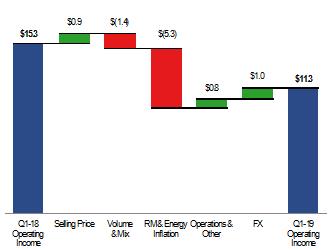
Advanced Airlaid Materials’ net sales increased $30.8 million, or 44.3%, primarily due to the Steinfurt acquisition and a 13.4% organic increase in shipping volumes reflecting growth in wipes, hygiene and table top products. Higher average selling prices contributed $1.8 million and currency translation was unfavorable by $3.1 million.
Advanced Airlaid Materials’ operating income for the first three months of 2019 totaled $10.0 million, or 38.9% higher than the comparable period a year ago. The increase was primarily due to higher shipping volumes which contributed $4.1 million. Higher selling prices were offset by $2.1 million of higher raw material and energy costs. Higher depreciation from the new capacity at Fort Smith negatively impacted income by $0.9 million. The primary drivers are summarized in the following chart:

- 24 -
GLATFELTER
03.31.19 Form 10-Q
Other and Unallocated The amount of “Other and Unallocated” expense in our table of Business Unit Performance totaled $9.6 million in the first three months of 2019 compared with $14.8 million in the first three months of 2018. The decrease in Other and Unallocated expenses, excluding the impact of gains from timberland sales, primarily reflects reduced corporate costs, lower start-up costs related to the Advanced Airlaid Materials capacity expansion program and the reduction in our reserve for the Fox River matter. Other and Unallocated expenses during the first quarter of 2019, include $3.9 million costs related to cost optimization including changes in our business model and the associated executive separation.
Income taxes In the first quarters of 2019 and 2018, we recorded an income tax provision of $1.9 million and $1.8 million, respectively, on income from continuing operations of $6.5 million and $4.0 million, respectively. The lower effective tax rate in the first quarter of 2019 was primarily due to the closure of certain tax audits.
Foreign Currency We own and operate facilities in Canada, Germany, France, the United Kingdom and the Philippines. The functional currency of our Canadian operations is the U.S. dollar. However, in Germany and France it is the Euro, in the UK, it is the British Pound Sterling, and in the Philippines the functional currency is the Peso. On an annual basis, our euro denominated revenue exceeds euro expenses by an estimated €160 million. For the first three months of 2019, the average currency exchange rate was 1.14 dollar/euro compared with 1.23 in the same period of 2018. With respect to the British Pound Sterling, Canadian Dollar, and Philippine Peso, we have differing amounts of inflows and outflows of these currencies, although to a lesser degree than the euro. As a result, we are exposed to changes in currency exchange rates and such changes could be significant. The translation of the results from international operations into U.S. dollars is subject to changes in foreign currency exchange rates.
The table below summarizes the translation impact on reported results that changes in currency exchange rates had on our non-U.S. based operations from the conversion of these operation’s results for the first three months of 2019.
|
In thousands |
Three months ended March 31, 2019 |
|
|
||||
|
|
Favorable (unfavorable) |
|
|
||||
|
Net sales |
|
|
|
$ |
(11,286 |
) |
|
|
Costs of products sold |
|
|
|
|
11,310 |
|
|
|
SG&A expenses |
|
|
|
|
908 |
|
|
|
Income taxes and other |
|
|
|
|
(107 |
) |
|
|
Net income |
|
|
|
$ |
825 |
|
|
The above table only presents the financial reporting impact of foreign currency translations assuming currency exchange rates in 2019 were the same as 2018. It does not
present the impact of certain competitive advantages or disadvantages of operating or competing in multi-currency markets.
Discontinued Operations We completed the sale of our Specialty Papers business unit on October 31, 2018. Its results of operations are reported as discontinued operations for all periods presented. For the three months ended March 31, 2019, we reported income from discontinued operations of $0.7 million compared with $3.4 million in the same quarter of 2018. The results for the first quarter of 2019 reflect a $1.3 million insurance settlement related to an equipment failure partially offset by professional fees.
LIQUIDITY AND CAPITAL RESOURCES
Our business requires significant expenditures for new or enhanced equipment, to support our research and development efforts, and to support our business strategy. In addition, we have mandatory debt service requirements of both principal and interest. The following table summarizes cash flow information for each of the periods presented:
|
|
Three months ended March 31 |
|
||||||
|
In thousands |
2019 |
|
|
|
2018 |
|
||
|
Cash and cash equivalents at |
|
|
|
|
|
|
|
|
|
beginning of period |
$ |
142,685 |
|
|
|
$ |
116,219 |
|
|
Cash provided (used) by |
|
|
|
|
|
|
|
|
|
Operating activities |
|
(24,145 |
) |
|
|
|
(7,149 |
) |
|
Investing activities |
|
(7,240 |
) |
|
|
|
(18,939 |
) |
|
Financing activities |
|
(23,611 |
) |
|
|
|
15,842 |
|
|
Effect of exchange rate |
|
|
|
|
|
|
|
|
|
changes on cash |
|
(658 |
) |
|
|
|
2,458 |
|
|
Change in cash and cash equivalents from discontinued operations |
|
(10,365 |
) |
|
|
|
8,847 |
|
|
Net cash provided (used) |
|
(66,019 |
) |
|
|
|
1,059 |
|
|
Cash and cash equivalents at |
|
|
|
|
|
|
|
|
|
end of period |
$ |
76,666 |
|
|
|
$ |
117,278 |
|
At March 31, 2019, we had $76.7 million in cash and cash equivalents held by both domestic and foreign subsidiaries. Unremitted earnings of our foreign subsidiaries as of January 1, 2018 and forward are deemed to be indefinitely reinvested and therefore no U.S. tax liability is reflected in the accompanying condensed consolidated financial statements. Approximately 60% of our cash and cash equivalents is held by our foreign subsidiaries but could be repatriated without incurring a significant amount of additional taxes.
Cash used by operating activities in the first three months of 2019 totaled $24.1 million compared with $7.1 million in the same period a year ago. The decrease was primarily due to a $20.5 million payment made in the first quarter of 2019 in connection with the resolution of the Fox River environmental matter.
- 25 -
GLATFELTER
03.31.19 Form 10-Q
Net cash used by investing activities decreased by $11.7 million in the year-over-year comparison due to lower capital expenditures driven by the completion of the airlaid capacity expansion in early 2018.
Net cash used by financing activities totaled $23.6 million in the first three months of 2019 compared with $15.8 million provided by financing activities in the same period of 2018. The increase in cash used by financing activities primarily reflects net additional borrowings under our revolving credit facility.
The following table sets forth our outstanding long-term indebtedness:
|
|
March 31 |
|
|
|
December 31 |
|
||
|
In thousands |
2019 |
|
|
|
2018 |
|
||
|
Revolving credit facility, due Mar. 2020 |
$ |
— |
|
|
|
$ |
114,495 |
|
|
Revolving credit facility, due Feb. 2024 |
$ |
101,115 |
|
|
|
|
|
|
|
5.375% Notes, due Oct. 2020 |
|
— |
|
|
|
|
250,000 |
|
|
Term loan, due Feb. 2024 |
|
247,170 |
|
|
|
|
— |
|
|
2.40% Term Loan, due Jun. 2022 |
|
5,216 |
|
|
|
|
5,725 |
|
|
2.05% Term Loan, due Mar. 2023 |
|
23,987 |
|
|
|
|
25,972 |
|
|
1.30% Term Loan, due Jun. 2023 |
|
6,821 |
|
|
|
|
7,361 |
|
|
1.55% Term Loan, due Sep. 2025 |
|
8,947 |
|
|
|
|
9,470 |
|
|
Total long-term debt |
|
393,256 |
|
|
|
|
413,023 |
|
|
Less current portion |
|
(19,852 |
) |
|
|
|
(10,785 |
) |
|
Unamortized deferred issuance costs |
|
(2,830 |
) |
|
|
|
(1,276 |
) |
|
Long-term debt, net of current portion |
$ |
370,574 |
|
|
|
$ |
400,962 |
|
In the first quarter of 2019, we significantly changed our debt capital structure. On February 8, 2019, we entered into a new credit facility with a consortium of financial institutions. The new five-year facility (the “2019 Facility”) replaces our then existing revolving credit facility and consists of a $400 million variable rate revolver and a €220 million, amortizing term loan. The other terms of the 2019 Facility are substantially similar to our previous revolving credit facility. On February 28, 2019, we redeemed all outstanding 5.375% Notes with proceeds from the new term loan.
The 2019 Facility contains a number of customary compliance covenants, the most restrictive of which is a maximum leverage ratio of 4.0x provided that such ratio
increases to 4.5x during the period of four fiscal quarters immediately following a material acquisition such as Steinfurt. As of March 31, 2019, the leverage ratio, as calculated in accordance with the definition in our amended credit agreement, was 3.5x, within the limits set forth in our credit agreement. Based on our expectations of future results of operations and capital needs, we do not believe the debt covenants will impact our operations or limit our ability to undertake financings that may be necessary to meet our capital needs.
Financing activities include cash used for common stock dividends. In both the first three months of 2019 and 2018, we used $5.7 million of cash for dividends on our common stock. Our Board of Directors determines what, if any, dividends will be paid to our shareholders. Dividend payment decisions are based upon then-existing factors and conditions and, therefore, historical trends of dividend payments are not necessarily indicative of future payments.
We are subject to various federal, state and local laws and regulations intended to protect the environment as well as human health and safety. At various times, we have incurred significant costs to comply with these regulations and we could incur additional costs as new regulations are developed or regulatory priorities change.
We expect to meet all of our near and long-term cash needs from a combination of operating cash flow, cash and cash equivalents, our existing credit facility and other long-term debt.
Off-Balance-Sheet Arrangements As of March 31, 2019 and December 31, 2018, we had not entered into any off-balance-sheet arrangements. Financial derivative instruments, to which we are a party, and guarantees of indebtedness, which solely consist of obligations of subsidiaries, are reflected in the condensed consolidated balance sheets included herein in Item 1 – Financial Statements.
- 26 -
GLATFELTER
03.31.19 Form 10-Q
ITEM 3. QUANTITATIVE AND QUALITATI VE DISCLOSURES ABOUT MARKET RISK S
|
|
|
Year Ended December 31 |
|
|
March 31, 2019 |
|
||||||||||||||||||||||
|
Dollars in thousands |
|
2019 |
|
|
2020 |
|
|
2021 |
|
|
2022 |
|
|
2023 |
|
|
Carrying Value |
|
|
Fair Value |
|
|||||||
|
Long-term debt |
|
|
|
|
|
|
|
|
|
|
|
|
|
|
|
|
|
|
|
|
|
|
|
|
|
|
|
|
|
Average principal outstanding |
|
|
|
|
|
|
|
|
|
|
|
|
|
|
|
|
|
|
|
|
|
|
|
|
|
|
|
|
|
At fixed interest rates – Term Loans |
|
|
52,463 |
|
|
|
43,076 |
|
|
|
32,493 |
|
|
|
21,910 |
|
|
|
11,928 |
|
|
|
44,971 |
|
|
|
45,419 |
|
|
At variable interest rates |
|
|
343,651 |
|
|
|
332,837 |
|
|
|
320,478 |
|
|
|
308,120 |
|
|
|
295,761 |
|
|
|
348,285 |
|
|
|
348,285 |
|
|
|
|
|
|
|
|
|
|
|
|
|
|
|
|
|
|
|
|
|
|
|
|
$ |
393,256 |
|
|
$ |
393,704 |
|
|
Weighted-average interest rate |
|
|
|
|
|
|
|
|
|
|
|
|
|
|
|
|
|
|
|
|
|
|
|
|
|
|
|
|
|
On fixed rate debt – Term Loans |
|
|
1.88 |
% |
|
|
1.88 |
% |
|
|
1.86 |
% |
|
|
1.83 |
% |
|
|
1.77 |
% |
|
|
|
|
|
|
|
|
|
On variable rate debt |
|
|
1.50 |
% |
|
|
1.50 |
% |
|
|
1.50 |
% |
|
|
1.50 |
% |
|
|
1.50 |
% |
|
|
|
|
|
|
|
|
The table above presents the average principal outstanding and related interest rates for the next five years for debt outstanding as of March 31, 2019. Fair values included herein have been determined based upon rates currently available to us for debt with similar terms and remaining maturities.
Our market risk exposure primarily results from changes in interest rates and currency exchange rates. At March 31, 2019, we had $390.4 million of long-term debt, net of unamortized debt issuance costs, of which 89.2% was at variable interest rates. Variable-rate debt outstanding represents borrowings under the 2019 Facility including both revolving credit borrowings and the amortizing term loan. Interest accrues based on LIBOR plus a margin. At March 31, 2019, the interest rate paid was approximately 1.50%. A hypothetical 100 basis point increase or decrease in the interest rate on variable rate debt would increase or decrease annual interest expense by $3.5 million.
As part of our overall risk management practices, we enter into financial derivatives primarily designed to either i) hedge foreign currency risks associated with forecasted transactions – “cash flow hedges”; or ii) mitigate the impact that changes in currency exchange rates have on intercompany financing transactions and foreign currency denominated receivables and payables – “foreign currency hedges.” For a more complete discussion of this activity, refer to Item 1 – Financial Statements – Note 16.
We are subject to certain risks associated with changes in foreign currency exchange rates to the extent our operations are conducted in currencies other than the U.S. Dollar. On an annual basis, our euro denominated revenue exceeds euro expenses by an estimated €160 million. With respect to the British Pound Sterling, Canadian Dollar, and Philippine Peso, we have differing amounts of inflows and outflows of these currencies, although to a lesser degree than the euro. As a result, particularly with respect to the euro, we are exposed to changes in currency exchange rates and such changes could be significant.
ITEM 4. CONTROLS AND PROCEDURES
Evaluation of Disclosure Controls and Procedures Our chief executive officer and our principal financial officer, after evaluating the effectiveness of our disclosure controls and procedures (as defined in Exchange Act Rules 13a-15(e) and 15d-15(e)) as of March 31, 2019, have concluded that, as of the evaluation date, our disclosure controls and procedures are effective.
Changes in Internal Controls There were no changes in our internal control over financial reporting during the three months ended March 31, 2019, that have materially affected or are reasonably likely to materially affect our internal control over financial reporting.
- 27 -
GLATFELTER
03.31.19 Form 10-Q
The following exhibits are filed herewith or incorporated by reference as indicated.
|
|
|
|
|
10.1 |
||
|
|
|
|
|
10.2 |
||
|
|
|
|
|
31.1 |
||
|
|
|
|
|
31.2 |
||
|
|
|
|
|
32.1 |
||
|
|
|
|
|
32.2 |
||
|
|
|
|
|
101.INS |
XBRL Instance Document, filed herewith. |
|
|
|
|
|
|
101.SCH |
XBRL Taxonomy Extension Schema, filed herewith. |
|
|
|
|
|
|
101.CAL |
XBRL Extension Calculation Linkbase, filed herewith. |
|
|
|
|
|
|
101.DEF |
XBRL Extension Definition Linkbase, filed herewith. |
|
|
|
|
|
|
101.LAB |
XBRL Extension Label Linkbase, filed herewith. |
|
|
|
|
|
|
101.PRE |
XBRL Extension Presentation Linkbase, filed herewith. |
|
|
|
|
|
|
|
|
|
Pursuant to the requirements of Section 13 or 15(d) of the Securities Exchange Act of 1934, the Registrant has duly caused this report to be signed on its behalf by the undersigned, thereunto duly authorized.
|
|
P. H. GLATFELTER COMPANY (Registrant) |
||
|
|
|
|
|
|
April 30, 2019 |
|
|
|
|
|
|
|
|
|
|
By |
|
/s/ David C. Elder |
|
|
|
|
David C. Elder |
|
|
|
|
Vice President, Finance |
- 28 -
GLATFELTER
03.31.19 Form 10-Q