MACROGENICS INC
10-Ks and 10-Qs
|
|
|
|
|
|
|
|
|
|
|
|
|
|
|
|
|
|
|
|
|
|
|
|
|
|
|
|
|
|
|
|
|
|
|
|
|
|
|
|
|
|
|
|
|
|
|
UNITED STATES SECURITIES AND EXCHANGE COMMISSION
Washington, D.C. 20549
FORM 10-K
(Mark One)
|
☒
|
ANNUAL REPORT PURSUANT TO SECTION 13 OR 15(d) OF THE SECURITIES EXCHANGE ACT OF 1934
|
For the fiscal year ended
December 31, 2016
OR
|
☐
|
TRANSITION REPORT PURSUANT TO SECTION 13 OR 15(d) OF THE SECURITIES EXCHANGE ACT OF 1934
|
For the transition period from to
Commission File Number 001-36112
MACROGENICS, INC.
(Exact name of registrant)
|
Delaware
|
|
06-1591613
|
|
(State of organization)
|
|
(I.R.S. Employer Identification Number)
|
9704 Medical Center Drive, Rockville, Maryland 20850
(Address of principal executive offices and zip code)
(301) 251-5172
(Registrant's telephone number)
Securities registered pursuant to Section 12(b) of the Act:
|
Title of Each Class
|
|
Name of Each Exchange on Which Registered
|
|
Common stock, par value $0.01 per share
|
|
The NASDAQ Stock Market LLC
|
Securities registered pursuant to Section 12(g) of the Act: None
Indicate by check mark if the registrant is a well-known seasoned issuer, as defined in Rule 405 of the Securities Act.
Yes
☑
No ☐
Indicate by check mark if the registrant is not required to file reports pursuant to Section 13 or 15(d) of the Exchange Act.
Yes
☐
No
☑
Indicate by check mark whether the registrant (1) has filed all reports required to be filed by Section 13 or 15(d) of the Securities Exchange Act of 1934 during the preceding 12 months (or for such shorter period that the registrant was required to file such reports) and (2) has been subject to such filing requirements for the past 90 days.
Yes
☑
No
☐
Indicate by check mark whether the registrant has submitted electronically and posted on its corporate Web site, if any, every Interactive Data File required to be submitted and posted pursuant to Rule 405 of Regulation S-T during the preceding 12 months (or for such shorter period that the registrant was required to submit and post such files).
Yes
☑
No
☐
Indicate by check mark if disclosure of delinquent filers pursuant to Item 405 of Regulation S-K is not contained herein and will not be contained, to the best of the registrant's knowledge, in definitive proxy or information statements incorporated by reference in Part III of this Form 10-K or any amendment to this Form 10-K.
£
Indicate by check mark whether the registrant is a large accelerated filer, an accelerated filer, a non-accelerated filer or a smaller reporting company. See the definitions of "large accelerated filer," "accelerated filer" and "smaller reporting company" in Rule 12b-2 of the Exchange Act.
|
Large accelerated filer
☑
|
Accelerated filer ☐
|
Non-accelerated filer
☐
|
Smaller reporting company
☐
|
Indicate by check mark whether the registrant is a shell company (as defined in Rule 12b-2 of the Exchange Act).
Yes
☐
No
☑
The aggregate market value of the registrant's common stock, par value $0.01 per share, held by non-affiliates of the registrant on June 30, 2016, the last business day of the registrant's most recently completed second fiscal quarter, was approximately $936 million based on the closing price of the registrant's common stock on the NASDAQ Global Select Market on that date. Exclusion of shares held by any person should not be construed to indicate that such person possesses the power, direct or indirect, to direct or cause the direction of management or policies of the registrant, or that such person is controlled by or under common control with the registrant.
The number of shares of the registrant's common stock outstanding on
February 24, 2017
was
34,974,985
.
DOCUMENTS INCORPORATED BY REFERENCE
Portions of MacroGenics, Inc.'s definitive proxy statement for the
2017
annual meeting of stockholders are incorporated by reference into Part III of this Annual Report.
MACROGENICS, INC.
ANNUAL REPORT ON FORM 10-K
TABLE OF CONTENTS
|
PART I
|
|
|
Item 1
|
|
|
Item 1A
|
|
|
Item 1B
|
|
|
Item 2
|
|
|
Item 3
|
|
|
Item 4
|
|
|
|
|
|
PART II
|
|
|
Item 5
|
|
|
Item 6
|
|
|
Item 7
|
|
|
Item 7A
|
|
|
Item 8
|
|
|
Item 9
|
|
|
Item 9A
|
|
|
Item 9B
|
|
|
|
|
|
PART III
|
|
|
Item 10
|
|
|
Item 11
|
|
|
Item 12
|
|
|
Item 13
|
|
|
Item 14
|
|
|
|
|
|
PART IV
|
|
|
Item 15
|
|
|
Item 16
|
|
|
|
|
FORWARD-LOOKING STATEMENTS
This report includes forward-looking statements within the meaning of Section 27A of the Securities Act of 1933 and Section 21E of the Securities Exchange Act of 1934. Forward-looking statements include statements that may relate to our plans, objectives, goals, strategies, future events, future revenues or performance, capital expenditures, financing needs and other information that is not historical information. Many of these statements appear, in particular, under the headings "Risk Factors" and "Management's Discussion and Analysis of Financial Condition and Results of Operations". Forward-looking statements can often be identified by the use of terminology such as "subject to", "believe", "anticipate", "plan", "expect", "intend", "estimate", "project", "may", "will", "should", "would", "could", "can", the negatives thereof, variations thereon and similar expressions, or by discussions of strategy.
All forward-looking statements, including, without limitation, our examination of historical operating trends, are based upon our current expectations and various assumptions. We believe there is a reasonable basis for our expectations and beliefs, but they are inherently uncertain. We may not realize our expectations, and our beliefs may not prove correct. Actual results could differ materially from those described or implied by such forward-looking statements. The following uncertainties and factors, among others (including those set forth under "Risk Factors"), could affect future performance and cause actual results to differ materially from those matters expressed in or implied by forward-looking statements:
|
•
|
our plans to develop and commercialize our product candidates;
|
|
•
|
the outcomes of our ongoing and planned clinical trials and the timing of those outcomes;
|
|
•
|
the timing of and our ability to obtain and maintain regulatory approvals for our product candidates;
|
|
•
|
our estimates regarding expenses, future revenue, capital requirements and needs for additional financing;
|
|
•
|
our ability to enter into new collaborations or to identify additional products or product candidates with significant commercial potential that are consistent with our commercial objectives;
|
|
•
|
our ability to recover the investment in our manufacturing capabilities;
|
|
•
|
the rate and degree of market acceptance and clinical utility of our products;
|
|
•
|
our commercialization, marketing and manufacturing capabilities and strategy;
|
|
•
|
significant competition in our industry;
|
|
•
|
costs of litigation and the failure to successfully defend lawsuits and other claims against us;
|
|
•
|
economic, political and other risks associated with our international operations;
|
|
•
|
our ability to receive research funding and achieve anticipated milestones under our collaborations;
|
|
•
|
our ability to protect and enforce patents and other intellectual property;
|
|
•
|
costs of compliance and our failure to comply with new and existing governmental regulations including, but not limited to, tax regulations;
|
|
•
|
loss or retirement of key members of management;
|
|
•
|
failure to successfully execute our growth strategy, including any delays in our planned future growth; and
|
|
•
|
our failure to maintain effective internal controls.
|
Consequently, forward-looking statements speak only as of the date that they are made and should be regarded solely as our current plans, estimates and beliefs. You should not place undue reliance on forward-looking statements. We cannot guarantee future results, events, levels of activity, performance or achievements. Except as required by law, we do not undertake and specifically decline any obligation to update, republish or revise forward-looking statements to reflect future events or circumstances or to reflect the occurrences of unanticipated events.
ITEM 1.
BUSINESS
Except as otherwise indicated herein or as the context otherwise requires, references in this annual report on Form 10-K to "MacroGenics," the "company," "we," "us" and "our" refer to MacroGenics, Inc. and its consolidated subsidiaries.
MacroGenics, the MacroGenics logo, DART, TRIDENT and the phrase "Breakthrough Biologics, Life-Changing Medicines" are our trademarks or registered trademarks. The other trademarks, trade names and service marks appearing in this report are the property of their respective owners.
Overview
We are a biopharmaceutical company focused on discovering and developing innovative antibody-based therapeutics designed to modulate the human immune response for the treatment of cancer as well as various autoimmune disorders and infectious diseases. We currently have a pipeline of product candidates in human clinical testing that have been created primarily using our proprietary technology platforms. We believe our programs have the potential to have a meaningful effect on treating patients' unmet medical needs as monotherapy or, in some cases, in combination with other therapeutic agents.
Our most advanced clinical product candidate is margetuximab, a monoclonal antibody directed against human epidermal growth factor receptor 2, or HER2, that has been enhanced using our proprietary "Fc Optimization" platform described in greater detail below. The HER2 protein is expressed by certain breast, gastroesophageal and other cancers. We have an ongoing Phase 3 clinical trial, which we call SOPHIA, to study margetuximab in patients with HER2 positive metastatic breast cancer that has progressed despite treatment with other HER2-directed therapeutic agents. We anticipate that a successful outcome from the SOPHIA study will allow us to seek approval of the product from the U.S. Food and Drug Administration, or FDA. We are also conducting a Phase 1b/2 clinical trial by treating patients with HER2-positive gastric or gastroesophageal junction cancer with margetuximab in combination with an anti-PD-1 monoclonal antibody, an immune checkpoint inhibitor molecule that plays a critical role in modulation of the immune system's response to cancer.
We are also developing several product candidates targeting B7-H3, a protein in the B7 family of immune regulator proteins. B7-H3 is widely expressed by a number of different tumor types and may play a key role in regulating the immune response to various types of cancer. There are no currently approved therapeutic agents directed against B7-H3. We have two clinical product candidates directed against B7-H3, enoblituzumab and MGD009, and we also have ongoing research efforts underway to advance MGC018, an antibody-drug conjugate, or ADC, directed against B7-H3. Our most advanced candidate in this franchise, enoblituzumab, is a monoclonal antibody that has also been enhanced using our Fc Optimization platform. Enoblituzumab is being evaluated clinically in multiple studies – as monotherapy, in combination with an anti-PD-1 antibody and in combination with an anti-CTLA-4 antibody, another immune checkpoint inhibitor – in each case, across multiple tumor types.
MGD009 is one of six clinical-stage molecules developed using our proprietary platform technology for making DART
®
molecules, which is described in greater detail below. Unlike standard monoclonal antibodies, DART molecules are bispecific, which means they can be directed against two different biological targets, and therefore lend themselves to a variety of different applications. MGD009, for example, is directed to both B7-H3 expressed on tumor cells as well as CD3, a protein expressed by normal T cells, which are specialized white blood cells in the human immune system. In preclinical models, MGD009 has re-directed T cells to reduce or eliminate B7-H3 expressing tumors. We are currently conducting a Phase 1 clinical trial with MGD009 in patients with B7-H3 positive tumors.
Four additional DART molecules, MGD006 (or flotetuzumab), MGD007, MGD011 (or duvortuxizumab) and PF-06671008, are also currently in Phase 1 clinical testing and each uses the same approach of targeting CD3 and a specific tumor antigen known to be expressed on certain cancers. Flotetuzumab is being tested in patients with relapsed and refractory acute myeloid leukemia (AML) and myelodysplastic syndrome (MDS) and MGD007 is being tested in patients with colorectal cancer. Our collaborator, Les Laboratoires Servier and Institut de Recherches Servier, or, collectively, Servier, has development and commercialization rights outside North America, Japan, Korea and India for flotetuzumab and has an option to gain similar rights with regards to MGD007. The clinical program for duvortuxizumab is being advanced by our collaborator, Janssen Biotech, Inc., or Janssen, and is being studied in a variety of B-cell hematological malignancies. PF-06671008 is being advanced by our collaborator Pfizer, Inc. and is being studied in certain undisclosed solid tumors. These five DART molecules that redirect T cells against cancer targets are manufactured using a conventional antibody platform without the complexity of having to genetically modify T cells from individual patients, as would be required by approaches such as chimeric antigen receptor (CAR) T cells.
Our sixth clinical-stage DART molecule, MGD010, has a different mechanism of action than the other DART molecules currently in development. MGD010 targets two proteins expressed by B cells, which are specialized white blood
1
cells that play a role in modulating the human immune system's inflammatory response. We believe that MGD010 may be able to reduce the harmful inflammatory effects seen in a variety of autoimmune and inflammatory disorders by modulating the function of human B cells while avoiding their depletion. We have completed a Phase 1a clinical study in healthy volunteers and observed acceptable safety and pharmacodynamic activity consistent with the expected mechanism of action of MGD010.
In 2016, we also initiated Phase 1 clinical testing of MGA012, a monoclonal antibody directed against an immune system protein known as PD-1. Antibodies targeting PD-1, a checkpoint molecule, have shown efficacy against various tumors by releasing the "brakes" on the immune system which is often seen when tumors evade detection by the immune system. We anticipate that a successful anti-PD-1 monoclonal antibody in our pipeline would allow us to conduct combination studies with our other potential cancer therapeutics. In addition to MGA012, we use the anti-PD-1 specificity as we continue to design additional bispecific and trispecific molecules that engage this target together with other immune regulatory molecules.
We continue to invest in our clinical-stage programs, advance additional preclinical product candidates, primarily using our proprietary technology platforms, and expand the potential of our platforms using our antibody and protein engineering expertise. We develop new therapeutic product candidates internally using our proprietary platforms and also in collaboration with other biopharmaceutical companies, when such relationships are advantageous for strategic or financial reasons. These arrangements have allowed us to expand and accelerate the breadth of our product candidates and also have generated a significant portion of the funding we have received to date. We also have our own manufacturing facility, primarily for generation of earlier-stage clinical trial material, and have been investing in expanding our manufacturing capacity to meet later-stage clinical and future potential commercial requirements.
We estimate that in 2016, 2015 and 2014, we spent approximately
$122.1 million
,
$98.3 million
and
$70.2 million
on research and development activities, respectively.
Our Strategy
Primary Objectives
Our goal is to be a fully integrated biotechnology company leading in the discovery, development and commercialization of breakthrough biologics for the treatment of patients with cancer, as well as various autoimmune disorders and infectious diseases.
Key elements of our strategy are as follows:
|
•
|
Therapeutic focus, science driven.
We create therapeutic biological products primarily to treat various types of cancers, including both solid tumors and hematological malignancies. Our proprietary DART and Fc Optimization technology platforms are particularly useful for targeting and harnessing specific elements of the human immune system, allowing us to design molecules that (1) directly target cancer cells and enhance the ability of the immune system to destroy those cells, (2) re-direct effector cells to attack tumors or (3) affect mechanisms that regulate the immune response to cancer, either by stimulating pathways that enhance this response or by blocking pathways that inhibit this response, including checkpoint molecules. This field of scientific discovery, broadly known as immuno-oncology, has been developing rapidly in the last few years, and most therapeutic products to date are largely focused on affecting individual biological pathways. We believe that cancers are sufficiently complex that effective treatments must simultaneously affect more than one pathway. We believe that we are well-positioned, particularly through the adaptability of our DART platform, to be able to create and develop therapeutic molecules designed to simultaneously target more than one pathway.
|
This same flexibility in our platforms allows us to create therapeutic molecules that may be useful for other unmet medical needs beyond cancer, such as for autoimmune disorders and infectious diseases. Our core strategic focus is on development of cancer therapeutics, but we may also opportunistically pursue such possibilities when they arise.
|
•
|
Fully integrated with a deep pipeline.
Our objective is to be a fully-integrated biotechnology company, and we intend to continue to grow and establish all necessary functions from early-stage research through commercialization in at least the United States. At our current stage of development as a company, we have established early-stage discovery, process development, clinical development and clinical-stage manufacturing functions, and we intend to build commercial manufacturing as well as U.S.-based sales and marketing infrastructure as our development pipeline matures.
|
We have a broad portfolio of product candidates and we are not dependent upon the success of any one of them for the overall success of the company. We continue to augment our pipeline through the discovery and
2
development of new product candidates, primarily through utilization of our internal scientific expertise and strategically seeking external collaborations that can augment our own skills. From 2014 to 2016, we advanced six programs into clinical development. Our goal is to continue to advance one or more programs into clinical development per year to ensure a robust pipeline and to replace product candidates that fail to progress.
|
•
|
Leveraging collaborations.
Throughout our company's history, we have entered into collaborations with other biopharmaceutical companies and intend to continue to do so. We enter into collaborations when there is a strategic advantage to us to do so and when we believe the financial terms of the collaboration are favorable for meeting our short-term and long-term strategic objectives. We are not dependent upon any one of these collaborations, but in many cases we have rights to receive sales royalties and other significant financial payments if the partnered product candidates achieve certain development and sales milestones. Some of the collaborations also preserve our right to participate in future commercialization, for example by securing co-promotion or profit-sharing rights under certain circumstances.
|
|
•
|
Investments in talent and culture.
One of our most valuable assets is the quality of our employee base. We invest significant effort in selecting and retaining high caliber, talented individuals who reflect our values. As we continue to grow, we continue to seek and develop employees who are strongly committed to delivering life-changing medicines for unmet medical needs through a collaborative work environment.
|
Core Therapeutic Areas We Target
Cancer
Cancer is a broad group of diseases in which cells divide and grow in an uncontrolled fashion, forming malignancies that can invade other parts of the body. In normal tissues, the rates of new cell growth and cell death are tightly regulated and kept in balance. In cancerous tissues, this balance is disrupted as a result of mutations, causing unregulated cell growth that leads to tumor formation and growth. While tumors can grow slowly or rapidly, the dividing cells will nevertheless accumulate and the normal organization of the tissue will become disrupted. Cancers subsequently can spread throughout the body by processes known as invasion and metastasis. Once cancer spreads to sites beyond the primary tumor, it generally becomes more difficult to treat and may be incurable. Cancer cells that arise in the lymphatic system and bone marrow are referred to as hematological malignancies. Cancer cells that arise in other tissues or organs are referred to as solid tumors. Cancer can arise in virtually any part of the body, with the most common types arising in the prostate gland, breast, lung, colon and skin. We believe that our platforms position us very well strategically to actively develop approaches for the treatment of both solid tumors and hematologic malignancies.
Cancer is the second leading cause of death in the United States, exceeded only by heart disease. An increasing number of people are also living longer with cancer. The American Cancer Society has estimated that by January 2026, the population of cancer survivors in the United States will increase to almost 20.3 million people.
Autoimmune Disorders
Autoimmune disorders, including rheumatoid arthritis, Crohn's disease, systemic lupus erythematosus and multiple sclerosis, collectively affect more than 20 million people in the United States. Autoimmune disorders involve self-reactivity and destruction by T cells, B cells and antibodies due to a lack of self-tolerance. Anti-inflammatory therapies, such as tumor necrosis factor inhibitors, have been able to improve diseases like rheumatoid arthritis. However, in addition to T cells, more evidence indicates that B cells play an important role in many common autoimmune and allergic disorders by initiating and amplifying the pathological disease processes. Current B cell targeted therapies either cause depletion of B cells, thus limiting their applicability due to the potential for infections (e.g., rituximab), or exhibit a delayed onset of action and limited efficacy across patient populations (e.g., belimumab).
Infectious Diseases
There are a wide variety of infectious diseases, and the epidemiology for each varies significantly with the type of pathogen and patients who are affected. However, in order to avoid being recognized as foreign by the human immune system, many infectious agents have found ways to evade detection. In this way, they may behave similarly, at a biological level, to certain types of cancer. Accordingly, our expertise in designing protein-based therapeutics that are designed to activate the human immune system to eliminate foreign substances may have applicability to various types of infectious diseases, and we explore those possibilities opportunistically.
Our Product Candidates
3
The table below depicts the current status of product candidates that are in or near human clinical development and for which we retain all or some commercial rights:

Oncology
|
•
|
Margetuximab
is a monoclonal antibody that targets HER2-expressing tumors, including certain types of breast and gastroesophageal cancers. HER2 is critical for the growth of many types of tumors. Using our Fc Optimization platform, we have engineered the constant region, or Fc region, of margetuximab to increase its ability to kill tumor cells through an Fc-dependent mechanism, including antibody dependent cell-mediated cytotoxicity, or ADCC.
|
Our Phase 1 data for margetuximab, in addition to demonstrating margeutximab was well-tolerated at the dose levels studied, demonstrated that anti-tumor activity had been observed at a range of doses tested, including the lowest dose level of margetuximab, even in patients who were heavily pre-treated (frequently with other anti-HER2 agents). We are currently studying margetuximab in a Phase 3 clinical trial, which we call SOPHIA, in patients with metastatic breast cancer expressing HER2 at the 3+ level by immunohistochemistry (IHC) or 2+ level by IHC with gene amplification whose tumors have progressed despite therapy with other HER2-directed therapeutic agents. We are also conducting an exploratory Phase 1b/2 clinical trial combining margetuximab with an anti-PD-1 antibody in patients with HER2-positive gastric or gastroesophageal junction cancer. Finally, we have completed an exploratory Phase 2a clinical trial in patients with lower levels of HER2 expression (1+ or 2+ level by IHC with no gene amplification), a distinct patient population that is not traditionally treated with anti-HER2 antibodies. We did not observe sufficient clinical activity to justify further study in this patient population.
|
•
|
Enoblituzumab
is a monoclonal antibody that targets B7-H3. We engineered enoblituzumab to utilize the same Fc Optimization enhancements that we incorporated in margetuximab to target B7-H3 that is over-expressed on differentiated tumor cells, cancer stem cells and supporting tumor vasculature and underlying tissues. We are currently evaluating enoblituzumab in an ongoing Phase 1 clinical trial as monotherapy in multiple solid tumor types as well as in combination therapy with either an anti-PD-1 antibody or an anti-CTLA-4 antibody.
|
|
•
|
Flotetuzumab (previously known as MGD006)
is a DART molecule that targets both CD123 and CD3. CD123, the Interleukin-3 receptor alpha chain, is expressed on leukemia and leukemic stem cells, but only at very low levels or not at all on normal hematopoietic stem cells. T cells, which express CD3, can destroy tumor cells. In preclinical studies, we have demonstrated the ability of flotetuzumab to recruit, activate, and expand T cell populations to eliminate leukemia cells. We are currently enrolling patients in the United States and Europe in a Phase 1 clinical trial of flotetuzumab in patients with AML or MDS. Under the terms of our collaboration with
|
4
Servier, Servier has the exclusive right to develop and commercialize flotetuzumab in all countries outside North America, Japan, Korea and India, and MacroGenics retains exclusive rights in those countries.
|
•
|
MGD007
is a DART molecule that targets both the glycoprotein A33 (gpA33) and CD3, and has an Fc domain, which is designed to provide extended pharmacokinetic properties and convenient intermittent dosing. gpA33 is expressed on gastrointestinal tumors, including more than 95% of human colon cancers. We have demonstrated that this molecule is able to mediate T cell killing of gpA33-expressing cancer cells and cancer stem cells in preclinical experiments. We are currently enrolling patients with colorectal cancer in a Phase 1 clinical trial of MGD007. Under the terms of our collaboration with Servier, Servier has an option to obtain exclusive rights to develop and commercialize MGD007 in all countries outside North America, Japan, Korea and India. If the option is exercised, MacroGenics would still retain exclusive rights in those countries.
|
|
•
|
Duvortuxizumab
is a DART molecule that targets both CD19 and CD3 and is being developed for the treatment of B-cell hematological malignancies. CD19, a lymphocyte-specific marker expressed from early B-lymphocyte development through mature memory B cells, is highly represented in B cell malignancies. This makes it attractive for targeted interventions. Duvortuxizumab is designed to redirect T cells, via their CD3 component, to eliminate CD19-expressing cells found in many hematological malignancies. Duvortuxizumab has been engineered to address half-life challenges posed by other programs targeting CD19 and CD3. Like MGD007, this product candidate has an Fc domain, which allows for extended pharmacokinetic properties and convenient dosing at a once-a-week or longer interval. Under our collaboration and license agreement, Janssen is leading the development of this product candidate, subject to our options to co-promote the product in the United States and Canada and to invest in later-stage development in exchange for a United States and Canada profit-share. Janssen has an ongoing Phase 1 study of duvortuxizumab in a variety of B-cell hematological malignancies.
|
|
•
|
MGD009
is the second molecule in our B7-H3 franchise. This DART molecule recognizes B7-H3 and CD3, and has an Fc domain, which is designed to provide extended pharmacokinetic properties. We have demonstrated that this molecule is able to mediate T cell killing of cancer cells in preclinical experiments. We are currently enrolling patients in a Phase 1 clinical trial of MGD009 in patients across a variety of different solid tumors.
|
|
•
|
MGA012
is a monoclonal antibody targeting PD-1. Antibodies targeting PD-1 have shown efficacy against various tumors by releasing the "brakes" on the immune system that are often seen when tumors evade detection by the immune system. We anticipate that MGA012 may be used in combination studies with our other therapeutics. We are currently enrolling patients in a Phase 1 clinical trial of MGA012 in patients across a variety of different solid tumors.
|
|
•
|
MGD013
is a DART molecule that is intended to enable the co-blockade with a single recombinant agent of two immune checkpoint molecules, PD-1 and LAG-3, which may be co-expressed on T cells. We anticipate that MGD013 could be used for the treatment of a wide range of cancers, including both solid tumors and hematological malignancies.
|
|
•
|
MGC018
is a B7-H3 antibody-drug conjugate (ADC) for which we are conducting Investigational New Drug Application (IND)-enabling activities.
MGC018 is based on a MacroGenics proprietary B7-H3 antibody and a duocarmycin-based, linker-drug technology licensed from Synthon Biopharmaceuticals B.V.
|
Autoimmune Disorders
|
•
|
MGD010
is a DART molecule designed to address limitations of existing B cell-targeted therapies by binding to the CD32B and CD79B proteins found on human B cells. In preclinical studies, this DART molecule modulated the function of human B cells without B cell depletion. In normal conditions, B cells utilize CD32B as one of the key checkpoints or negative regulators to ensure that tolerance to self is maintained and autoimmune disease does not occur. MGD010 is designed to further exploit this mechanism by triggering this inhibitory "immune checkpoint" loop. We believe this molecule preferentially blocks those B cells that are activated to produce the pathogenic antibodies that promote the autoimmune process. We have completed a Phase 1a clinical study in healthy volunteers and observed acceptable safety and pharmacodynamic activity consistent with the expected mechanism of action of MGD010.
|
|
•
|
Teplizumab
is an anti-CD3 monoclonal antibody being developed for the treatment of type 1 diabetes. Teplizumab has been engineered to alter the function of the T cells that mediate the destruction of the insulin-producing beta cells of the islets of the pancreas. Teplizumab potentially represents an advance in the treatment of type 1 diabetes by addressing the underlying disorder, rather than treating the symptoms through insulin replacement therapy. Teplizumab is being evaluated in a Phase 2 clinical trial for potential application to patients
|
5
at risk of developing Type 1 diabetes. We have elected to collaborate with NIDDK/TrialNet to execute this clinical trial. In addition, we continue to seek strategic collaborations for the advancement of this program that could include joint funding, spinning the program out into a new company, divesting the program or pursuing other transaction structures that we feel would be aligned with our strategic objectives and provide financial consideration commensurate with our expectations of value for the program.
Infectious Diseases
|
•
|
MGD014
is a DART molecule that targets the envelope protein of human immunodeficiency virus, or HIV-infected cells (Env) and CD3-expressing T cells. We are developing MGD014 under contract number HHSN272201500032C awarded to us in September 2015 by the National Institute of Allergy and Infectious Diseases, or NIAID, part of the National Institutes of Health. MGD014 is our first DART molecule targeting an infectious agent that is planned for clinical testing. The work under this contract will build on preclinical studies demonstrating that DART molecules targeting the Env and T cells, via their CD3 component, are able to redirect the immune system's T cells to kill HIV-infected cells. DART molecules could be used independently or become a key part of a "shock-and-kill" strategy in conjunction with HIV latency-reversing agents currently under development.
|
Our Platforms and Technology Expertise
We apply our understanding of disease biology, immune-mediated mechanisms and next generation antibody technologies to design specifically targeted antibody-based product candidates based on our DART and Fc Optimization platforms. Through these platforms and utilization of our proprietary cancer stem-like cell, or CSLC, technology, we have designed antibody-based product candidates that have the potential to improve on standard treatments by having one or more of the following attributes: (1) multiple specificities; (2) increased abilities to interact with the body's immune system to fight tumors; (3) capacity to bind more avidly to antigen targets: (4) increased potency; (5) reduced immunogenicity or (6) the ability to target cancer cells that are resistant to standard treatments. Moreover, these technology platforms are complementary and can be combined.
DART and TRIDENT
TM
Platforms: Our Proprietary Approach to Engineer Multi-Specific Antibodies
We use our DART platform to create derivatives of antibodies with the ability to bind to two distinct targets instead of a single one found in traditional monoclonal antibodies. DART product candidates are therefore bispecific. An example of a bispecific molecule is illustrated below:
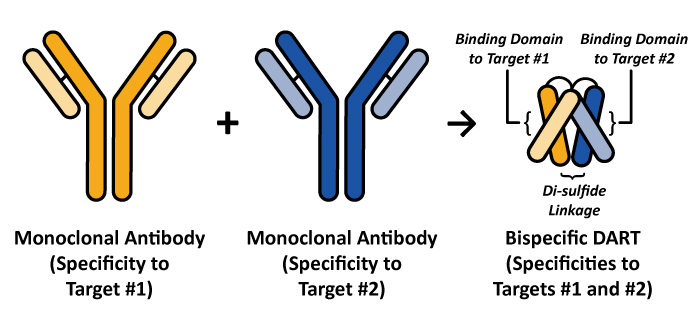
Because cancer cells have developed ways to escape the immune system, we have created DART molecules, which are alternative antibody-like structures with more potent immune properties than the parent antibody molecules from which they are derived. The two variable regions of an antibody are mono-specific and are able to target only a single type structural component of an antigen. For many years, researchers have sought to create recombinant molecules that are capable of targeting two antigens or epitopes (i.e., specific part of an antigen bound by the antibody) within the same molecule. The challenges in creating such molecules have been the instability of the resulting bispecific molecules and their inherently short half-lives, as well as the inefficiencies in manufacturing these compounds. We believe our DART platform has overcome these engineering challenges by incorporating proprietary covalent di-sulfide linkages and particular amino acid sequences that efficiently pair the chains of the DART molecule. This is designed to provide a structure with enhanced manufacturability, long-
6
term structural stability and the ability to tailor the half-lives of the DART molecules to their clinical needs. This engineered antibody-like protein has a compact and stable structure and enables the targeting of two different antigens with a single recombinant molecule.
The DART platform has been specifically engineered to accommodate virtually any variable region sequence with predictable expression, folding and antigen recognition. We believe our multi-specific platforms may provide a significant advantage over current biological interventions in cancer, autoimmune disorders and infectious disease by enabling a range of modalities, including those described below.
We have also advanced beyond our DART platform to establish a TRIDENT platform, which reflects the continuing evolution of our multi-specific antibody-based targeting expertise. Built on the DART module, the trivalent TRIDENT platform incorporates in an Ig-like format an additional domain capable of engaging an independent antigen. With the inclusion of a third targeting arm, TRIDENT molecules enable a broader range of mechanisms of action than bispecific targeting, allowing, for instance, the engagement of multiple antigens on a single or on different cells or enabling enhanced target selectivity by modulating the avidity of one of two antigens.
7
|
•
Redirected T cell activation and killing
. In this version of the DART molecule, we are enabling the cancer-fighting properties of the immune effector cells, such as T lymphocytes to: (1) recognize and bind to structures expressed on a cancer cell (e.g., B7-H3, the first specificity in the example on the right), (2) enable the recruitment of all types of cytotoxic, or cell killing, T cells, irrespective of their ability to recognize cancer cells (e.g., CD3, a common component of the T cell antigen receptor, is the second specificity in the example on the right) and (3) trigger T cell activation, expansion, and cell killing mechanisms to destroy a cancer cell. The outcome is that any of the body's T cells, in theory, could be recruited to destroy a cancer cell and thus, are not limited to the small numbers of specific T cells that might have been generated in response to cancer to kill tumor cells. Furthermore, since any T cell could be recruited for this killing process, only small amounts of a DART molecule are required to trigger this potent immune response. Additionally, the compact structure of the DART protein makes it well suited for maintaining cell-to-cell contact, which we believe contributes to the high level of target cell killing. Similarly, DART molecules targeting CD3 and a viral antigen can be used to recruit T cells to eliminate cells infected by a virus, such as HIV-infected cells.
|

|
|
•
Modulation of receptor signaling
. In another configuration of the DART molecule, we have taken advantage of the two different specificities engineered in a DART structure to bind to particular cells involved in autoimmune processes, such as autoimmune B cells, and to usurp the immune checkpoint signaling pathways programmed within the cells to impede the pathogenic autoimmune responses. Our MGD010 product candidate targets both CD32B, a co-inhibitory molecule, and CD79B, part of the B cell antigen receptor complex, two proteins expressed on the immune system's B cells. Using a single DART molecule, we attempt to promote the interaction of these two receptors, a step required to interrupt the B cell activation and immune response that single antibodies directed against CD32B, CD79B or both cannot accomplish independently.
|

|
|
•
Simultaneous targeting of multiple co-inhibitory receptors or checkpoints, such as those involved in inhibiting T cell responses and B cell responses.
The immune system generally prevents the development of autoimmune phenomena by regulating activated immune cells that have responded to non-self or foreign antigens. This negative feedback loop is triggered by the interactions of co-inhibitory receptors, or checkpoint molecules, expressed on the immune cells with ligands expressed by other cells, such as antigen-presenting cells. This phenomenon is exploited by cancer, whereby tumor cells express checkpoint ligands that block the development of an immune response against the tumor. Antibodies that block the interaction of checkpoint molecules with their ligands have been shown to significantly improve the clinical outcomes of patients with certain advanced cancers. Because of the diversity of immune checkpoint pathways, blockade of a single axis, while clinically significant, as shown in the case of the blockade of the PD-1/PD-L1 axis with pembrolizumab or nivolumab, will not benefit all patients. In fact, combinations of checkpoint inhibitors, such as nivolumab and ipilimumab, a CTLA-4 blocker, have resulted in significantly enhanced benefit compared to ipilimumab or nivolumab alone. We believe that DART molecules targeting two immunoregulatory pathways, such as two checkpoints in a single molecule, could afford the clinical benefit of the combination together with the potential for synergistic activity, as well as significant advantages in manufacturing, simplified clinical development, and enhanced patient convenience.
|

|
|
•
Enhanced effector cell selectivity.
T lymphocytes with lytic effector function belong preferentially to the CD8 lineage, while CD4-positive T cells preferentially provide immune regulatory function, such as the secretion of cytokines or the differentiation into regulatory T cells. Greater selectivity in the recruitment of effector T cells is an example of the range of applications of our TRIDENT technology. By encoding a CD8 recognition arm in addition to the CD3- and tumor antigen-specific arms, our TRIDENT technology allow the preferential engagement of CD8-positive T lymphocytes and redirects them against tumor cells. This strategy allows for retention of lytic effector function, while limiting the CD4 cell engagement and associated effects, such as inflammatory cytokine release.
|

|
8
In addition to the ability to tailor a DART molecule's valency, we have the capacity to modify the strength by which the binding sites attach to their targets and the molecule's half-life in the blood circulation after delivery to a patient. Furthermore, when an Fc domain is coupled with a DART molecule, additional changes can be included that can modulate the DART molecule's engagement with different immune cells.
We have developed proof-of-concept preclinical data and are developing specific product candidates using this technology, including flotetuzumab, MGD007, MGD009, MGD010 and duvortuxizumab, among others.
Fc Optimization Platform: Our Proprietary Approach to Enhance Immune-Mediated Cancer Cell Killing
To enhance the body's immune ability, we developed our Fc Optimization platform which introduces certain mutations into the Fc region of an antibody and is able to modulate antibody interaction with immune effector cells. Such interaction enhances the body's immune ability to mediate the killing of cancer cells through ADCC.
ADCC
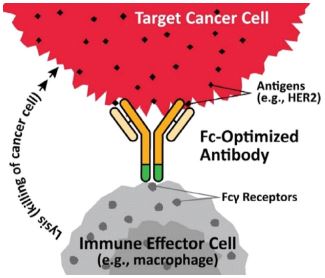
The Fc region mediates the function of IgG antibodies by binding to different activating and inhibitory receptors, referred to as FcγRs, on immune effector cells found within the innate immune system. By engineering Fc regions to bind with an increased affinity to the activating FcγRs and with a reduced affinity to the inhibitory FcγRs, we have been able to impart a more effective immune response and improve effector functions, such as ADCC. This is another example in which small changes in antibody structure can confer improvements on normal immune processes.
We have established a proprietary platform to engineer, screen, identify and test antibodies' Fc regions with customizable activity. In particular, we have licenses to use transgenic mice that express human FcγRs. These mice can be used for in vivo testing of antibodies that incorporate Fc domain variants, including those antibodies intended for cancer therapy.
To date, we have successfully incorporated our Fc variants in two of our clinical-stage antibody product candidates, margetuximab and enoblituzumab. We have preclinical data demonstrating that these Fc variants have substantially improved the activity of these antibodies.
Cancer Stem-like Cell Technology: Our Proprietary Approach to Discover Cancer Targets
Our CSLC technology provides new approaches to discover and identify cancer targets that are not susceptible to current cancer therapies. We have generated over 2,700 monoclonal antibodies that we have screened by IHC for lower-binding to normal, non-malignant tissues. Cancer stem cells represent important potential targets in oncology drug development because they are theorized to be the basis for tumor re-growth, metastasis and resistance to much standard chemotherapy.
Our Collaborations
We pursue a balanced approach between product candidates that we develop ourselves and those that we develop with our collaborators. Under our current strategic collaborations, we have received significant non-dilutive funding to date and continue to have rights to additional funding upon completion of certain research, achievement of key product development milestones and royalties and other payments upon the commercial sale of products. Each of our collaborations has a unique set of terms and conditions, but in general, they fall into two categories:
|
•
|
MacroGenics-Created Programs
. We have a number of collaborations relating to product candidates that we have created from our internal research efforts. These include Janssen for duvortuxizumab and MGD015; Servier for flotetuzumab and MGD007; and Green Cross Corp., or Green Cross, for margetuximab. In the case of these product candidates, we entered into collaborations because we believed that our collaborator could further enable
|
9
development of the program or provide additional capabilities and funding to supplement MacroGenics' investment, or both. We obtained financial terms that we believed were beneficial to us and retained commercial rights for multiple major markets or options to other commercial rights. For example, under the Janssen agreements, we have the option to co-promote products in the United States as well as an option to share in profits in the United States and Canada if we invest in late-stage development. Under the Servier agreement, we retain full commercialization and development rights in the United States, Canada, Mexico, Japan, South Korea and India, and regain worldwide rights if Servier opts not to continue co-developing MGD007. Under the Green Cross agreement, we retain full commercialization rights worldwide except for South Korea.
|
•
|
Joint Research Programs.
We have several programs under which collaborators have sought to utilize some aspect of our protein engineering platforms with new product concepts that are jointly directed, sometimes employing a collaborator's own proprietary technology. These collaborations give us the ability to expand the breadth of our potential products, develop greater scientific expertise and obtain additional funding for research. Pfizer, Inc. and Boehringer Ingelheim GmbH, or Boehringer, are currently advancing projects in their own pipelines based on these types of programs. With these collaborators, we have more limited development or commercial rights related to the product candidates that may emerge from joint research programs, although we will receive royalties from these programs as well as other consideration upon the occurrence of specified development and sales milestones.
|
Intellectual Property
We strive to protect the proprietary technologies that we believe are important to our business, including seeking and maintaining patents intended to protect, for example, the composition of matter of our product candidates, their methods of use, the technology platforms used to generate them, related technologies and/or other aspects of the inventions that are important to our business. We also rely on trade secrets, confidentiality and invention assignment agreements and careful monitoring of our proprietary information to protect aspects of our business that are not amenable to, or that we do not consider appropriate for, patent protection.
Our success will depend significantly on our ability to obtain and maintain patent and other proprietary protection for commercially important technology, inventions and know-how related to our business. In addition, there is cost and risk to our business in defending and enforcing our patents, maintaining our licenses to use intellectual property owned by third parties and preserving the confidentiality of our trade secrets and operating without infringing the valid and enforceable patents and other proprietary rights of third parties. We also rely on know-how, continuing technological innovation and in-licensing opportunities to develop, strengthen and maintain our proprietary positions. We currently use multiple industry-standard patent monitoring systems to monitor new United States Patent and Trademark Office, or USPTO, filings for any applications by third parties that may infringe on our patents.
The patent positions of biopharmaceutical companies like us are generally uncertain and involve complex legal, scientific and factual questions. In addition, the coverage claimed in a patent application can be significantly reduced before the patent is issued, and its scope can be reinterpreted by the courts after issuance. Consequently, we do not know whether any of our product candidates will be protectable or remain protected by enforceable patents. We cannot predict whether the patent applications we are currently pursuing will issue as patents in any particular jurisdiction or whether the claims of any issued patents will provide sufficient proprietary protection from competitors. Any patents that we hold may be challenged, narrowed, circumvented or invalidated by third parties.
A third party may hold patents or other intellectual property rights that are important to or necessary for the development of our product candidates or use of our technology platforms. It may be necessary for us to use the patented or proprietary technology of third parties to commercialize our product candidates, in which case we would be required to obtain a license from these third parties on commercially reasonable terms, or our business could be harmed, possibly materially. For example, certain patents held by third parties cover Fc engineering methods and mutations in Fc regions to enhance the binding of Fc regions to Fc receptors on immune cells. Although we believe that these patents are not infringed and invalid, should a court find that they cover margetuximab or enoblituzumab and we are unable to invalidate them, or if licenses for them are not available on commercially reasonable terms, our business could be harmed, perhaps materially.
Because patent applications in the United States and certain other jurisdictions can be maintained in secrecy for 18 months or potentially even longer, and because publication of discoveries in the scientific or patent literature often lags behind actual discoveries, we cannot be certain of the priority of inventions covered by pending patent applications. Moreover, we may have to participate in interference proceedings declared by the USPTO to determine priority of invention. In the ordinary course of business we participate in post-grant challenge proceedings, such as oppositions, that challenge the patentability of third party patents. Such proceedings could result in substantial cost, even if the eventual outcome is favorable to us.
Pipeline Patent Protection
10
As of
December 31, 2016
, we held 82 patents in the United States with 51 patent applications pending and 281 patents in other countries of the world with 262 patent applications pending. In addition to patents and patent applications generally providing protection for various aspects of our Fc Optimization, DART, TRIDENT and Cancer Stem-Like Cell platforms, we have patent and patent applications for the composition of matter of each of our clinical pipeline product candidates and, in some cases, we also have other patents and patent application related to various aspects of the technology underlying these product candidates or their methods of use.
Patent terms may be adjusted or extended, as described in greater detail below, in certain circumstances. However, assuming no adjustments or extensions, the primary composition of matter patent for each of our clinical pipeline product candidates is expected to expire in the following timeframes:
|
Product Candidate
|
Expiration Date
|
|
margetuximab
|
2029
|
|
enoblituzumab
|
2031
|
|
flotetuzumab
|
2034*
|
|
MGD007
|
2034*
|
|
MGD009
|
2036*
|
|
MGD010
|
2034*
|
|
duvortuxizumab
|
2035*
|
|
MGA012
|
2036*
|
* pending
Patent Term Extension and Reference Product Exclusivity
The Hatch-Waxman Act permits a patent term extension for FDA-approved drugs, including biological products, of up to five years beyond the expiration of the patent. The length of the patent term extension is related to the length of time the drug is under regulatory review. Patent extension cannot extend the remaining term of a patent beyond a total of 14 years from the date of product approval and only one patent applicable to an approved drug may be extended. Similar provisions are available in Europe and other jurisdictions to extend the term of a patent that covers an approved drug. In the future, if and when our pharmaceutical product candidates receive FDA approval, we expect to apply for patent term extensions on patents covering those products. We intend to seek patent term extensions to any of our issued patents in any jurisdiction where these are available, however there is no guarantee that the applicable authorities, including the FDA in the United States, will agree with our assessment of whether such extensions should be granted, and even if granted, the length of such extensions.
The Patient Protection and Affordable Care Act, as amended by the Healthcare and Education Affordability Reconciliation Act, collectively the ACA, created a regulatory scheme authorizing the FDA to approve biosimilars via an abbreviated licensure pathway. In many cases, this allows biosimilars to be brought to market without conducting the full suite of clinical trials typically required of originators. Under the ACA, a manufacturer may submit an application for licensure of a biologic product that is "biosimilar to" or "interchangeable with" a previously approved biological product or "reference product." The "biosimilar" application must include specific information demonstrating biosimilarity based on data derived from: (1) analytical studies, (2) animal studies, and (3) a clinical study or studies that are sufficient to demonstrate safety, purity, and potency in one or more appropriate conditions of use for which the reference product is licensed, except that FDA may waive some of these requirements for a given application. Under this new statutory scheme, an application for a biosimilar product may not be submitted to the FDA until four years after the date of first licensure. The FDA may not approve a biosimilar product until 12 years from the date on which the reference product was first licensed. The law does not change the duration of patents granted on biological products. Even if a product is considered to be a reference product eligible for exclusivity, another company could market a competing version of that product if the FDA approves a full Biologics License Application, or BLA, for such product containing the sponsor's own preclinical data and data from adequate and well-controlled clinical trials to demonstrate the safety, purity and potency of their product. There have been recent proposals to repeal or modify the ACA and it is uncertain how any of those proposals, if approved, would affect these provisions.
Trade Secrets
We also rely on trade secret protection for our confidential and proprietary information. Although we take steps to protect our proprietary information and trade secrets, including through contractual means with our employees and consultants, third parties may independently develop substantially equivalent proprietary information and techniques or otherwise gain access to our trade secrets or disclose our technology. Thus, we may not be able to meaningfully protect our trade secrets. It is
11
our policy to require our employees, consultants, outside scientific collaborators, sponsored researchers and other advisors to execute confidentiality agreements upon the commencement of employment or consulting relationships with us. These agreements provide that all confidential information concerning our business or financial affairs developed or made known to the individual during the course of the individual's relationship with us is to be kept confidential and not disclosed to third parties except in specific circumstances. In the case of employees, the agreements provide that all inventions conceived by the individual, and which are related to our current or planned business or research and development or made during normal working hours, on our premises or using our equipment or proprietary information, are our exclusive property. In many cases our confidentiality and other agreements with consultants, outside scientific collaborators, sponsored researchers and other advisors require them to assign or grant us licenses to inventions they invent as a result the work or services they render under such agreements or grant us an option to negotiate a license to use such inventions.
In-Licensed Intellectual Property
We have entered into patent and know-how license agreements that grant us the rights to use certain technologies related to biological manufacturing for our clinical product candidates. We anticipate using these technologies for future product candidates. These licensors have businesses dedicated to licensing this type of technology and we anticipate that licenses to use these technologies for our future products will be available. The licenses typically include yearly maintenance payments and sales royalties, and may also include upfront payments or milestone payments.
Manufacturing
We currently manufacture our drug substance for our clinical trials at our manufacturing facility located in Rockville, Maryland. For our antibody product candidates, we have supplemented our drug substance manufacturing capacity through an arrangement with CMC Biologics, Inc., or CMC, a contract manufacturing organization, and plan to commercially produce margetuximab at CMC assuming the success of the Phase 3 SOPHIA clinical trial on the expected timeline. We have also initiated the build-out of a manufacturing suite at our headquarters building in Rockville, Maryland, which has been designed to increase our internal capacity to manufacture more drug substance lots, at larger scale and in full compliance with current Good Manufacturing Practices (cGMP) to be able to sell commercial product. In addition, we currently rely on and will continue to rely on contract fill-finish service providers, primarily Ajinomoto Althea, Inc. and Baxter Healthcare Corporation, to fulfill our fill-finish needs for our current and future product candidates.
Most of the principal materials we use in our manufacturing operations are available from more than one source. However, we obtain certain raw materials principally from only one source. In the event one of these suppliers was unable to provide the materials or product, we generally seek to maintain sufficient inventory to supply the market until an alternative source of supply can be implemented. However, in the event of an extended failure of a supplier, it is possible that we could experience an interruption in supply until we established new sources or, in some cases, implemented alternative processes.
Production processes for biological therapeutic products are complex, highly regulated, and vary widely from product to product. Shifting or adding manufacturing capacity can be a very lengthy process requiring significant capital expenditures, process modifications, and regulatory approvals. Accordingly, if we were to experience extended plant shutdowns at one of our own facilities, extended failure of a contract supplier or contract manufacturing organization, or extraordinary unplanned increases in demand, we could experience an interruption in supply of certain products or product shortages until production could be resumed or expanded.
Commercialization
We cannot market or promote a new product until a marketing application has been approved by the FDA. We currently have no approved products in the United States. We have not yet established a sales, marketing or product distribution infrastructure. We believe that it will be possible for us to access the United States oncology market through a specialty sales force. Subject to receiving marketing authorization in the United States, we expect to commence commercialization via our then-in-place sales and marketing organizations. We believe that these organizations will be able to serve the oncology community in treating the patient populations for which our oncology product candidates are being developed. Outside the United States, we expect to enter into arrangements with third-party commercial partners for any of our product candidates that obtain marketing approval.
Competition
There are a large number of companies developing or marketing treatments for cancer and autoimmune disorders, including many major pharmaceutical and biotechnology companies. These treatments consist both of small molecule drug products, as well as biologic therapeutics that work by using next-generation antibody technology platforms to address specific cancer targets. In particular, margetuximab is directed against HER2 and several companies have cancer therapeutics directed
12
against HER2 marketed or in development, such as F. Hoffmann-La Roche Ltd., or Roche, particularly through its affiliate, Genentech, Inc., as well as Puma Biotechnology, Inc. and Cascadian Therapeutics. Market competition may limit the utilization of margetuximab as a therapeutic, even if market approval and adequate reimbursement is obtained, and competition among development-stage programs for patients enrolling in clinical trials for HER2-directed therapies may delay expected timelines for our clinical trials.
In addition, the immuno-oncology field is competitive, with treatments currently approved and on the market or in development for various tumor types and patient populations from a variety of different companies such as Merck & Co., Inc., or Merck, The Bristol Myers Squibb Company, or BMS, and Roche, all of which have significantly greater resources than we do. Many of our pipeline programs, if successful, will likely face significant competition both by therapeutics that are already being marketed as well as those that will be approved for marketing before our programs. Of particular note, we are developing MGA012, a monoclonal antibody against PD-1, as well as other therapeutics that could potentially be used in combination with an anti-PD-1 antibody or utilize a portion of MGA012 as part of a multi-specific molecule. Merck, BMS and Roche all have approved products that target either the PD-1 receptor or its ligand, PD-L1, and there are several other companies that have anti-PD-1 or anti-PD-L1 antibodies in clinical development, all of which would compete with ours.
Finally, several companies are also developing therapeutics that work by targeting multiple specificities using a single recombinant molecule. Amgen Inc. has obtained marketing approval for one product that works by targeting antigens both on immune effector cell populations and those expressed on certain cancer cells, and has other product candidates in development that use this mechanism. In addition, other companies are developing new treatments for cancer and autoimmune diseases that utilize multi-specific approaches, including Roche, Genmab A/S, Merus B.V., Abbvie Inc., Affimed Therapeutics AG Corporation, Eli Lilly and Company and Xencor, Inc.
Many of our competitors have significantly greater financial, manufacturing, marketing, drug development, technical and human resources than we do. Mergers and acquisitions in the pharmaceutical, biotechnology and diagnostic industries may result in even more resources being concentrated among a smaller number of our competitors. Smaller or early stage companies may also prove to be significant competitors, particularly through collaborative arrangements with large and established companies. These competitors also compete with us in recruiting and retaining top qualified scientific and management personnel and establishing clinical trial sites and patient registration for clinical trials, as well as in acquiring technologies complementary to, or necessary for, our programs.
The key competitive factors affecting the success of all of our therapeutic product candidates, if approved, are likely to be their efficacy, safety, dosing convenience, price, the effectiveness of companion diagnostics in guiding the use of related therapeutics, the level of generic or biosimilar competition and the availability of reimbursement from government and other third-party payors. In addition, the standard of medical care provided to cancer patients continues to evolve as more scientific and medical information becomes available. These changes in medical care relate to pharmaceutical products, but are also affected by other factors, and such changes can positively or negatively affect the prospects of our product candidates as well as those of our competitors.
Our commercial opportunity could be reduced or eliminated if our competitors develop and commercialize products that are more effective, have fewer or less severe effects, are more convenient or are less expensive than any products that we may develop, or the standards of care for cancer patients change while our clinical trials are ongoing. Our competitors also may obtain FDA or other regulatory approval for their products more rapidly than we may obtain approval for ours, which could result in our competitors establishing a strong market position before we are able to enter the market. In addition, our ability to compete may be affected in many cases by insurers or other third party payors seeking to encourage the use of biosimilar products. Biosimilar products are expected to become available over the coming years. For example, certain products that are trastuzumab biosimilars may be approved in the U.S. prior to margetuximab, if approved.
The most common methods of treating patients with cancer are surgery, radiation and drug therapy. There are a variety of available drug therapies marketed for cancer. Many of these approved drugs are well established therapies and are widely accepted by physicians, patients and third party payors. In many cases, these drugs are administered in combination to enhance efficacy. While our product candidates may compete with many existing drug and other therapies, to the extent an approved drug is ultimately used in combination with or as an adjunct to these therapies, our product candidates will not be competitive with the approved drug.
Government Regulation and Product Approval
Government authorities in the United States, at the federal, state and local level, and in other countries extensively regulate, among other things, the research, development, testing, manufacture, packaging, storage, recordkeeping, labeling, advertising, promotion, distribution, marketing, import and export of pharmaceutical products such as those we are developing.
13
The processes for obtaining regulatory approvals in the United States and in foreign countries, along with subsequent compliance with applicable statutes and regulations, require the expenditure of substantial time and financial resources.
FDA Regulation
All of our current product candidates are subject to regulation in the United States by the FDA as biological products, or biologics. The FDA subjects biologics to extensive pre- and post-market regulation. The Public Health Service Act, the Federal Food, Drug, and Cosmetic Act and other federal and state statutes and regulations, govern, among other things, the research, development, testing, manufacture, storage, recordkeeping, approval, labeling, promotion and marketing, distribution, post-approval monitoring and reporting, sampling, and import and export of biologics. Failure to comply with applicable U.S. requirements may subject a company to a variety of administrative or judicial sanctions, such as FDA refusal to approve pending BLAs, withdrawal of approvals, clinical holds, warning letters, product recalls, product seizures, total or partial suspension of production or distribution, injunctions, fines, civil penalties, or criminal penalties.
Preclinical Studies
. Drug development in our industry is complex, challenging and risky; failure rates are high. Product development cycles are long - approximately 10 to 15 years from discovery to market. A potential new biological product must undergo many years of preclinical and clinical testing to establish it is pure, potent and safe.
Preclinical studies include laboratory evaluation of product chemistry, formulation and toxicity, pharmacology, as well as animal trials to assess the characteristics and potential safety and efficacy of the product. The conduct of the preclinical tests must comply with federal regulations and requirements including FDA's good laboratory practice, or GLP, regulations and the U.S. Department of Agriculture's regulations implementing the Animal Welfare Act. After laboratory analysis and preclinical testing in animals, we file an IND with FDA to begin human testing. An IND sponsor must submit the results of the preclinical tests, together with manufacturing information, analytical data, any available clinical data or literature, and a proposed clinical trial protocol, among other things, to the FDA as part of an IND application. Certain preclinical tests, such as animal tests of reproductive toxicity and carcinogenicity, may continue even after the IND is submitted. An IND automatically becomes effective 30 days after receipt by the FDA, unless before that time the FDA raises concerns or questions related to one or more proposed clinical trials and places the clinical trial on a clinical hold or agrees on an alternate approach with us. In such a case, the IND sponsor and the FDA must resolve any outstanding concerns before the clinical trial can begin. As a result, submission of an IND may not result in the FDA allowing clinical trials to commence.
Clinical Development
. Clinical trials involve the administration of the investigational new drug to human subjects (healthy volunteers or patients) under the supervision of a qualified investigator. Clinical trials must be conducted: (i) in compliance with all applicable federal regulations and guidance, including those pertaining to good clinical practice, or GCP, standards that are meant to protect the rights, safety, and welfare of human subjects and to define the roles of clinical trial sponsors, investigators, and monitors; as well as (ii) under protocols detailing, among other things, the objectives of the trial, the parameters to be used in monitoring safety, and the effectiveness criteria to be evaluated. Each protocol involving testing of a new drug in the United States (whether in patients or healthy volunteers) must be included in the IND submission, and FDA must be notified of subsequent protocol amendments. In addition, the protocol must be reviewed and approved by an institutional review board, or IRB, and all study subjects must provide informed consent prior to participating in the study. Typically, each institution participating in the clinical trial will require review of the protocol before any clinical trial commences at that institution. Information about certain clinical trials must be submitted within specific timeframes to the National Institutes of Health, or NIH, for public dissemination on their ClinicalTrials.gov website. Progress reports detailing the results of the clinical trials must be submitted at least annually to the FDA and there are additional, more frequent reporting requirements for suspected unexpected serious adverse events.
A study sponsor might choose to discontinue a clinical trial or a clinical development program for a variety of reasons. The FDA may impose a temporary or permanent clinical hold, or other sanctions, if it believes that the clinical trial either is not being conducted in accordance with FDA requirements or presents an unacceptable risk to the clinical trial subjects. An IRB may also require the clinical trial at the site to be halted, either temporarily or permanently, for failure to comply with the IRB's requirements, or may impose other conditions.
Clinical trials to support BLAs for marketing approval are typically conducted in three pre-approval phases, but the phases may overlap or be combined, particularly in testing for oncology indications. In Phase 1, testing is conducted in a small group of subjects who may be patients with the target disease or condition or healthy volunteers, to evaluate its safety, determine a safe dosage range, and identify side effects. In Phase 2, the drug is given to a larger group of subjects with the target condition to further evaluate its safety and gather preliminary evidence of efficacy. Phase 3 studies typically last multiple years for oncology indications. In Phase 3, the drug is given to a large group of subjects with the target disease or condition (several hundred to several thousand), often at multiple geographical sites, to confirm its effectiveness, monitor side effects, and collect data to support drug approval. In some cases, FDA may require post-market studies, known as Phase 4 studies, to be
14
conducted as a condition of approval in order to gather additional information on the drug's effect in various populations and any side effects associated with long-term use. Depending on the risks posed by the drugs, other post-market requirements may be imposed. Only a small percentage of investigational drugs complete all three phases and obtain marketing approval.
Product Approval
. After completion of the required clinical testing, a BLA can be prepared and submitted to the FDA. FDA approval of the BLA is required before marketing of the product may begin in the United States. The BLA must include the results of preclinical, clinical and other testing and a compilation of data relating to the product's chemistry, manufacture and controls. The cost of preparing and submitting a BLA is substantial. Under federal law, the submission of most BLAs is additionally subject to a substantial application user fee, and annual product and establishment user fees also apply. These fees are typically increased annually.
The FDA has 60 days from its receipt of a BLA to determine whether the application will be accepted for filing based on the FDA's threshold determination that it is sufficiently complete to permit substantive review. Once the submission is accepted for filing, the FDA begins a substantive review, and the review period under the Prescription Drug User Fee Act begins. The standard for reviewing a BLA is whether the product is safe, pure and potent, which has been interpreted to include that the product is safe and effective and has a favorable benefit-risk profile. FDA's current performance goals call for FDA to complete review of 90 percent of standard (non-priority) BLAs within 10 months of receipt and within six months for priority BLAs, which is 12 months and eight months, respectively, if the 60-day review of the initial application is included in the timeline. In addition, the FDA has developed approaches intended to make certain qualifying products available to patients rapidly - Priority Review, Breakthrough Therapy, Accelerated Approval, and Fast Track. While the timelines for approval under these pathways may be shorter, there are requirements and conditions associated with each pathway, and there can be no assurance that any of our investigational products will be able to meet the conditions or requirements necessary to receive any such designation or be able to receive the review or approval benefits associated with such designations.
The FDA may refer applications for novel products or products that present difficult questions of safety or efficacy to an advisory committee, typically a panel that includes outside clinicians and other experts, for review, evaluation and a recommendation as to whether sufficient data exist in the application to support product approval. The FDA is not bound by the recommendation of an advisory committee, but it generally follows such recommendations.
Before approving a BLA, the FDA will typically inspect one or more clinical sites to assure compliance with GCP. Additionally, the FDA will typically inspect the facility or the facilities at which the drug is manufactured. FDA will not approve the product unless compliance with cGMPs is satisfactory. FDA also reviews the proposed labeling submitted with the BLA and typically requires changes in the labeling text.
After the FDA evaluates the BLA and the manufacturing and testing facilities, it issues either an approval letter or a complete response letter. Complete response letters generally outline the deficiencies in the submission and delineate the additional testing or information needed in order for the FDA to reconsider the application. If and when those deficiencies have been addressed to the FDA's satisfaction in a resubmission of the BLA, the FDA will issue an approval letter. The FDA has committed to reviewing 90 percent of resubmissions within two or six months from receipt depending on the type of information included.
An approval letter authorizes commercial marketing of the drug for the approved indication or indications and the other conditions of use set out in the approved prescribing information. Once granted, product approvals may be withdrawn if compliance with regulatory standards is not maintained or problems are identified following initial marketing.
As a condition of BLA approval, the FDA may require substantial post-approval testing and surveillance to monitor the drug's safety or efficacy and may impose other conditions, including labeling restrictions that can materially affect the potential market and profitability of the product. As a condition of approval, or after approval, the FDA also may require submission of a risk evaluation and mitigation strategy, or REMS, to mitigate any identified or suspected serious risks. The REMS may include medication guides, physician communication plans, assessment plans, and elements to assure safe use, such as restricted distribution methods, patient registries, or other risk minimization tools.
Other U.S. Post-Marketing Regulatory Requirements
. Once a BLA is approved, a product will be subject to certain post-approval requirements, including those relating to advertising, promotion, adverse event reporting, recordkeeping, and cGMPs, as well as registration, listing, and inspection. There also are continuing, annual user fee requirements for any marketed products and the establishments at which such products are manufactured, as well as new application fees for supplemental applications with clinical data.
FDA regulates the content and format of prescription drug labeling, advertising, and promotion, including direct-to-consumer advertising and promotional Internet communications. FDA also establishes parameters for permissible non-promotional communications between industry and the medical community, including industry-supported scientific and
15
educational activities. The FDA and other agencies actively enforce the laws and regulations prohibiting the promotion for uses not consistent with the approved labeling, and a company that is found to have improperly promoted off-label uses or otherwise not to have met applicable promotion rules may be subject to significant liability under both the FDCA and other statutes, including the False Claims Act. See "Other Healthcare Laws and Compliance Requirements" below for more information.
All aspects of pharmaceutical manufacture must conform to cGMPs after approval. Drug manufacturers and certain of their subcontractors are required to register their establishments with FDA and certain state agencies, and are subject to periodic unannounced inspections by the FDA during which the FDA inspects manufacturing facilities to assess compliance with cGMPs. Changes to the manufacturing process are strictly regulated and often require prior FDA approval before being implemented. FDA regulations also require investigation and correction of any deviations from cGMPs and impose reporting and documentation requirements upon the sponsor and any third-party manufacturers that the sponsor may decide to use. Accordingly, manufacturers must continue to expend time, money and effort in the areas of production and quality control to maintain compliance with cGMPs.
Products may be marketed only for the approved indications and in accordance with the provisions of the approved labeling. Changes to some of the conditions established in an approved application, including changes in indications, labeling, product formulation or manufacturing processes or facilities, require submission and FDA approval of a new BLA or BLA supplement, in some cases before the change may be implemented. A BLA supplement for a new indication typically requires clinical data similar to that in the original application, and the FDA uses the same procedures and actions in reviewing BLA supplements as it does in reviewing BLAs.
Manufacturers are subject to requirements for adverse event reporting and submission of periodic reports following FDA approval of a BLA. Later discovery of previously unknown problems with a product, including adverse events of unanticipated severity or frequency, or with manufacturing processes, or failure to comply with regulatory requirements, or failure of Phase 4 studies to meet their specified endpoints, may result in revisions to the approved labeling to add new safety information, the need to conduct additional post-market studies or clinical trials to assess new safety risks, imposition of distribution or other restrictions under a REMS program, or recall of the product and withdrawal of the BLA.
Noncompliance with postmarket requirements can result in one or more of the following consequences:
•
Restrictions on the marketing or manufacturing of the product, complete withdrawal of the product from the market or product recalls;
•
Warning letters;
•
Holds on post-approval clinical trials;
•
Refusal of the FDA to approve pending BLAs or supplements to approved BLAs, or suspension or revocation of product license approvals;
•
Product seizure or detention, or refusal to permit the import or export of products; or
•
Injunctions or the imposition of civil or criminal penalties.
In addition, the distribution of prescription pharmaceutical products is subject to the Prescription Drug Marketing Act, or PDMA, which regulates the distribution of drugs and drug samples at the federal level, and sets minimum standards for the registration and regulation of drug distributors by the states. Both the PDMA and state laws limit the distribution of prescription pharmaceutical product samples and impose requirements to ensure accountability in distribution.
Approval of Biosimilars
. The ACA authorized the FDA to approve biosimilars via a separate, abbreviated pathway. In many cases, this allows biosimilars to be brought to market without conducting the full suite of clinical trials typically required of originators. The law establishes a period of 12 years of data exclusivity for reference products in order to preserve incentives for future innovation and outlines statutory criteria for science-based biosimilar approval standards that take into account patient safety considerations. Under this framework, data exclusivity protects the data in the innovator's regulatory application by prohibiting others, for a period of 12 years, from granting FDA approval based in part on reliance on or reference to the innovator's data in their application to the FDA. The law does not change the duration of patents granted on biological products. There have been recent proposals to repeal or modify the ACA and it is uncertain how any of those proposals, if approved, would affect the provisions governing biosimilars.
Other Healthcare Laws and Compliance Requirements
16
In the United States, our activities are potentially subject to regulation by federal, state, and local authorities in addition to the FDA, including the Centers for Medicare and Medicaid Services, other divisions of the U.S. Department of Health and Human Services (e.g., the Office of Inspector General), the U.S. Department of Justice and individual U.S. Attorney offices within the Department of Justice, and state and local governments.
For example, certain financial interactions with healthcare professionals may be subject to the anti-kickback and fraud and abuse provisions of the Social Security Act and the False Claims Act, and in addition our activities may be affected by the privacy regulations issued under the Health Insurance Portability and Accountability Act, as amended, and similar state laws.
International Regulation
In addition to regulations in the United States, a variety of foreign regulations govern clinical trials, commercial sales, distribution of product candidates and other areas outlined above. These regulations can vary between jurisdictions and can be more onerous than regulations in the United States. Penalties for violating such regulations also exist in these jurisdictions. The approval process varies from country to country and the time to approval may be longer or shorter than that required for FDA approval.
Pharmaceutical Coverage, Pricing, and Reimbursement
In the United States and other countries, sales of any future products for which we receive regulatory approval for commercial sale will depend in part on the availability of adequate reimbursement from third-party payors, including government health administrative authorities, managed care providers, private health insurers, and other organizations. Third-party payors are increasingly examining the medical necessity and cost effectiveness of medical products and services in addition to safety and efficacy and, accordingly, significant uncertainty exists as to the reimbursement status of newly approved therapeutics. Third-party reimbursement adequate to enable us to realize an appropriate return on our investment in research and product development may not be available for our products.
Drug prices have become a subject of increased focus in recent years. Although there are currently no direct government price controls over private sector purchases in the U.S., federal law requires pharmaceutical manufacturers to pay prescribed rebates on certain Medicaid-reimbursed drugs to enable them to be eligible for reimbursement under certain public healthcare programs such as Medicaid and Medicare Part B. Various states have adopted further mechanisms that seek to control drug prices, including by disfavoring certain higher priced drugs or by seeking supplemental rebates from manufacturers. Managed care has also become a potent force in the market place that increases downward pressure on the prices of pharmaceutical products.
Public and private healthcare payers control costs and influence drug pricing through a variety of mechanisms, including through negotiating discounts with the manufacturers and through the use of tiered formularies and other mechanisms that provide preferential access to certain drugs over others within a therapeutic class. Payers also set other criteria to govern the uses of a drug that will be deemed medically appropriate and therefore reimbursed or otherwise covered.
Facilities
Our headquarters building, located in Rockville, Maryland, currently houses laboratory and office space and we are also building a suite for manufacturing at commercial quantities and scale. This space is occupied under a lease that expires in 2022 and may be extended for up to two additional seven-year terms. We also have a smaller-scale manufacturing facility, also in Rockville. The lease for a portion of that facility expires on March 31, 2018 and may be extended for a five-year term, and the lease for the remainder of that facility expires on December 31, 2019 and may be extended for up to two additional five-year terms. Finally, we have additional laboratory and office space in Rockville under two leases that each expire on January 31, 2020, and each of those leases may be extended for a five-year term.
We also lease office and laboratory space in South San Francisco under a lease that expires on February 28, 2018.
Employees
As of February 24, 2017, we had 318 full-time employees, 268 of whom were primarily engaged in research and development activities and 63 of whom had an M.D. or Ph.D. degree.
Legal Proceedings
From time to time we may be involved in various disputes and litigation matters that arise in the ordinary course of business. We are not currently a party to any material legal proceedings.
17
Available Information
Our website address is www.macrogenics.com. We post links to our website to the following filings as soon as reasonably practicable after they are electronically filed with or furnished to the Securities and Exchange Commission, or the SEC: Annual Reports on Form 10-K, quarterly reports on Form 10-Q, current reports on Form 8-K, proxy statements, and any amendments to those reports filed or furnished pursuant to Section 13 or 15(d) of the Securities Exchange Act of 1934, as amended. All such filings are available through our website free of charge. Our filings may also be read and copied at the SEC's Public Reference Room at 100 F Street, NE, Washington, DC 20549. Information on the operation of the Public Reference Room may be obtained by calling the SEC at 1-800-SEC-0330. The SEC also maintains an internet site at www.sec.gov that contains reports, proxy and information statements, and other information regarding issuers that file electronically with the SEC.
18
ITEM 1A.
RISK FACTORS
Our business and results of operations are subject to numerous risks, uncertainties and other factors that you should be aware of, some of which are described below.
Any of the risks, uncertainties and other factors described below could have a materially adverse effect on our business, financial condition or results of operations and could cause the trading price of our common stock to decline substantially.
Risks Related to Our Business and the Development and Commercialization of Our Product Candidates.
All of our product candidates are in preclinical or clinical development. Clinical drug development is expensive, time consuming and uncertain and we may ultimately not be able to obtain regulatory approvals for the commercialization of some or all of our product candidates.
The research, testing, manufacturing, labeling, approval, selling, marketing and distribution of drug products are subject to extensive regulation by the U.S. Food and Drug Administration, or FDA, and non-U.S. regulatory authorities, which regulations differ from country to country. We are not permitted to market our product candidates in the United States or in other countries until we receive approval of a Biologics License Application, or BLA, from the FDA or marketing approval from applicable regulatory authorities outside the United States. Our product candidates are in various stages of development and are subject to the risks of failure inherent in drug development. We have not submitted an application for or received marketing approval for any of our product candidates. We have limited experience in conducting and managing the clinical trials necessary to obtain regulatory approvals, including approval by the FDA. Obtaining approval of a BLA can be a lengthy, expensive and uncertain process. In addition, failure to comply with FDA and non-U.S. regulatory requirements may, either before or after product approval, if any, subject our company to administrative or judicially imposed sanctions, including:
|
•
|
restrictions on our ability to conduct clinical trials, including full or partial clinical holds on ongoing or planned trials;
|
|
•
|
restrictions on the products, manufacturers, manufacturing facilities or manufacturing process;
|
|
•
|
warning letters;
|
|
•
|
civil and criminal penalties;
|
|
•
|
injunctions;
|
|
•
|
suspension or withdrawal of regulatory approvals;
|
|
•
|
product seizures, detentions or import bans;
|
|
•
|
voluntary or mandatory product recalls and publicity requirements;
|
|
•
|
total or partial suspension of production;
|
|
•
|
imposition of restrictions on operations, including costly new manufacturing requirements; and
|
|
•
|
refusal to approve pending BLAs or supplements to approved BLAs or analogous marketing approvals outside the United States.
|
The FDA and foreign regulatory authorities also have substantial discretion in the drug approval process. The number of preclinical studies and clinical trials that will be required for regulatory approval varies depending on the product candidate, the disease or condition that the product candidate is designed to address, and the regulations applicable to any particular drug candidate. Regulatory agencies can delay, limit or deny approval of a product candidate for many reasons, including:
|
•
|
a product candidate may not be deemed safe or effective;
|
|
•
|
the results may not confirm the positive results from earlier preclinical studies or clinical trials;
|
|
•
|
regulatory agencies may not find the data from preclinical studies and clinical trials sufficient;
|
|
•
|
regulatory agencies might not approve or might require changes to our manufacturing processes or facilities; or
|
|
•
|
regulatory agencies may change their approval policies or adopt new regulations.
|
Any delay in obtaining or failure to obtain required approvals could materially adversely affect our ability to generate revenue from the particular product candidate, which likely would result in significant harm to our financial position and adversely impact our stock price. Furthermore, any regulatory approval to market a product may be subject to limitations on the indicated uses for which we may market the product. These limitations may limit the size of the market for the product.
19
If clinical trials for our product candidates are prolonged, delayed or stopped, we may be unable to obtain regulatory approval and commercialize our product candidates on a timely basis, which would require us to incur additional costs and delay our receipt of any product revenue.
We are currently enrolling patients in clinical trials for margetuximab, enoblituzumab, MGD006 (or flotetuzumab), MGD007, MGD009 and MGA012 and anticipate initiating or continuing clinical trials for these product candidates and others in 2017. In addition, our collaborators are currently enrolling patients in clinical trials for MGD011 (or duvortuxizumab), PF-06671008 and teplizumab. The commencement of new clinical trials could be substantially delayed or prevented by several factors, including:
|
•
|
further discussions with the FDA or other regulatory agencies regarding the scope or design of our clinical trials;
|
|
•
|
the limited number of, and competition for, suitable sites to conduct our clinical trials, many of which may already be engaged in other clinical trial programs, including some that may be for the same indication as our product candidates;
|
|
•
|
any delay or failure to obtain regulatory approval or agreement to commence a clinical trial in any of the countries where enrollment is planned;
|
|
•
|
inability to obtain sufficient funds required for a clinical trial;
|
|
•
|
clinical holds on, or other regulatory objections to, a new or ongoing clinical trial;
|
|
•
|
delay or failure to manufacture sufficient supplies of the product candidate for our clinical trials;
|
|
•
|
delay or failure to reach agreement on acceptable clinical trial agreement terms or clinical trial protocols with prospective sites or clinical research organizations, CROs, the terms of which can be subject to extensive negotiation and may vary significantly among different sites or CROs; and
|
|
•
|
delay or failure to obtain institutional review board, or IRB, approval to conduct a clinical trial at a prospective site.
|
The completion of our clinical trials could also be substantially delayed or prevented by several factors, including:
|
•
|
slower than expected rates of patient recruitment and enrollment;
|
|
•
|
failure of patients to complete the clinical trial;
|
|
•
|
unforeseen safety issues, including severe or unexpected drug-related adverse effects experienced by patients, including possible deaths;
|
|
•
|
lack of efficacy during clinical trials;
|
|
•
|
termination of our clinical trials by one or more clinical trial sites;
|
|
•
|
inability or unwillingness of patients or clinical investigators to follow our clinical trial protocols;
|
|
•
|
inability to monitor patients adequately during or after treatment by us and/or our CROs; and
|
|
•
|
the need to repeat or terminate clinical trials as a result of inconclusive or negative results or unforeseen complications in testing.
|
Changes in regulatory requirements and guidance may also occur and we may need to significantly amend clinical trial protocols to reflect these changes with appropriate regulatory authorities. Amendments may require us to renegotiate terms with CROs or resubmit clinical trial protocols to IRBs for re-examination, which may impact the costs, timing or successful completion of a clinical trial. Our clinical trials may be suspended or terminated at any time by the FDA, other regulatory authorities, the IRB overseeing the clinical trial at issue, any of our clinical trial sites with respect to that site, or us, due to a number of factors, including:
|
•
|
failure to conduct the clinical trial in accordance with regulatory requirements or our clinical protocols;
|
|
•
|
unforeseen safety issues or any determination that a clinical trial presents unacceptable health risks;
|
|
•
|
lack of adequate funding to continue the clinical trial due to unforeseen costs or other business decisions; and
|
|
•
|
upon a breach or pursuant to the terms of any agreement with, or for any other reason by, current or future collaborators that have responsibility for the clinical development of any of our product candidates.
|
Any failure or significant delay in completing clinical trials for our product candidates would adversely affect our ability to obtain regulatory approval and our commercial prospects and ability to generate product revenue will be diminished.
The results of previous clinical trials may not be predictive of future results, and the results of our current and planned clinical trials may not satisfy the requirements of the FDA or non-U.S. regulatory authorities.
20
Clinical failure can occur at any stage of clinical development. Clinical trials may produce negative or inconclusive results, and we or any of our current and future collaborators may decide, or regulators may require us, to conduct additional clinical or preclinical testing. Success in early clinical trials does not mean that future larger registration clinical trials will be successful because product candidates in later-stage clinical trials may fail to demonstrate sufficient safety and efficacy to the satisfaction of the FDA and non-U.S. regulatory authorities despite having progressed through initial clinical trials. A number of companies in the pharmaceutical industry, including those with greater resources and experience than us, have suffered significant setbacks in advanced clinical trials, even after obtaining promising results in earlier clinical trials.
Further, our product candidates may not be approved even if they achieve their primary endpoints in Phase 3 clinical trials or registration trials. The FDA or other non-U.S. regulatory authorities may disagree with our trial design and our interpretation of data from preclinical studies and clinical trials. In addition, any of these regulatory authorities may change requirements for the approval of a product candidate even after reviewing and providing comments or advice on a protocol for a pivotal Phase 3 clinical trial. In addition, any of these regulatory authorities may also approve a product candidate for fewer or more limited indications than we request or may grant approval contingent on the performance of costly post-marketing clinical trials. The FDA or other non-U.S. regulatory authorities may not approve the labeling claims that we believe would be necessary or desirable for the successful commercialization of our product candidates.
We use new technologies in the development of our product candidates and the FDA and other regulatory authorities have not approved products that utilize these technologies.
Our products in development are based on new technologies, such as Fc Optimization, DART molecules and TRIDENT molecules. Given the novelty of our technologies, we intend to work closely with FDA and other regulatory authorities to perform the requisite scientific analyses and evaluation of our methods to obtain regulatory approval for our product candidates. The validation process takes time and resources, may require independent third-party analyses, and may not be accepted by the FDA and other regulatory authorities. For some of our product candidates that are based on these technology platforms, the regulatory approval path and requirements may not be clear or evolve as more data becomes available for this product candidates, which could add significant delay and expense. Delays or failure to obtain regulatory approval of any of the product candidates that we develop would adversely affect our business.
We may not be successful in our efforts to use and expand our technology platforms to build a pipeline of product candidates. We may expend our limited resources to pursue a particular product candidate or indication and fail to capitalize on product candidates or indications that may be more profitable or for which there is a greater likelihood of success.
A key element of our strategy is to use and expand our technology platforms to build a pipeline of product candidates and progress these product candidates through clinical development for the treatment of a variety of different types of diseases. Although our research and development efforts to date have resulted in a pipeline of product candidates directed at various cancers, as well as autoimmune disorders and infectious diseases, we may not be able to develop product candidates that are safe and effective. Even if we are successful in continuing to build our pipeline, the potential product candidates that we identify may not be suitable for clinical development, including as a result of being shown to have harmful side effects or other characteristics that indicate that they are unlikely to be products that will receive marketing approval and achieve market acceptance. If we do not continue to successfully develop and begin to commercialize product candidates, we will face difficulty in obtaining product revenues in future periods, which could result in significant harm to our financial position and adversely affect our stock price.
Because we have limited financial and managerial resources, we focus on research programs and product candidates that we identify for specific indications. As a result, we may forego or delay pursuit of opportunities with other product candidates or for other indications that later prove to have greater commercial potential. Our resource allocation decisions may cause us to fail to capitalize on viable commercial products or profitable market opportunities. Our spending on current and future research and development programs and product candidates for specific indications may not yield any commercially viable products. If we do not accurately evaluate the commercial potential or target market for a particular product candidate, we may relinquish valuable rights to that product candidate through collaboration, licensing or other royalty arrangements in cases in which it would have been more advantageous for us to retain sole development and commercialization rights.
Even if we obtain FDA approval of any of our product candidates, we may never obtain approval or commercialize our products outside of the United States, which would limit our ability to realize their full market potential.
In order to market any products outside of the United States, we must establish and comply with numerous and varying regulatory requirements of other countries regarding safety and efficacy. Clinical trials conducted in one country may not be accepted by regulatory authorities in other countries, and regulatory approval in one country does not mean that regulatory approval will be obtained in any other country. Approval procedures vary among countries and may require additional preclinical studies or clinical trials or additional administrative review periods, which could result in significant
21
delays, difficulties and costs for us. In addition, our failure to obtain regulatory approval in any country may delay or have negative effects on the process for regulatory approval in other countries. We do not have any product candidates approved for sale in any jurisdiction, including international markets, and we do not have experience in obtaining regulatory approval in international markets. If we fail to comply with regulatory requirements in international markets or to obtain and maintain required approvals, our target market will be reduced and our ability to realize the full market potential of our products will be harmed.
Our product candidates may have undesirable side effects which may delay or prevent marketing approval, or, if approval is received, require them to be taken off the market, require them to include safety warnings or otherwise limit their sales.
Although all of our product candidates have undergone or will undergo safety testing, not all adverse effects of drugs can be predicted or anticipated. Unforeseen side effects from any of our product candidates could arise either during clinical development or, if approved by regulatory authorities, after the approved product has been marketed. All of our product candidates are still in clinical or preclinical development. While our clinical trials for our initial product candidates to date have demonstrated a favorable safety profile, the results from future trials may not support this conclusion. The results of future clinical or preclinical trials may show that our product candidates cause undesirable or unacceptable side effects, which could interrupt, delay or halt clinical trials, and result in delay of, or failure to obtain, marketing approval from the FDA and other regulatory authorities, or result in marketing approval from the FDA and other regulatory authorities with restrictive label warnings or potential product liability claims.
If any of our product candidates receives marketing approval and we or others later identify undesirable or unacceptable side effects caused by such products:
|
•
|
regulatory authorities may require us to take our approved product off the market;
|
|
•
|
regulatory authorities may require the addition of labeling statements, specific warnings, a contraindication or field alerts to physicians and pharmacies;
|
|
•
|
we may be required to change the way the product is administered, impose other risk-management measures, conduct additional clinical trials or change the labeling of the product;
|
|
•
|
we may be subject to limitations on how we may promote the product;
|
|
•
|
sales of the product may decrease significantly;
|
|
•
|
we may be subject to litigation or product liability claims; and
|
|
•
|
our reputation may suffer.
|
Any of these events could prevent us, our collaborators or our potential future partners from achieving or maintaining market acceptance of the affected product or could substantially increase commercialization costs and expenses, which in turn could delay or prevent us from generating significant revenue from the sale of our products.
Even if approved, if any of our product candidates do not achieve broad market acceptance among physicians, patients, the medical community, and third-party payors our revenue generated from their sales will be limited.
The commercial success of our product candidates will depend upon their acceptance among physicians, patients and the medical community. The degree of market acceptance of our product candidates will depend on a number of factors, including:
|
•
|
limitations or warnings contained in the approved labeling for a product candidate;
|
|
•
|
changes in the standard of care for the targeted indications for any of our product candidates;
|
|
•
|
limitations in the approved clinical indications for our product candidates;
|
|
•
|
demonstrated clinical safety and efficacy compared to other products;
|
|
•
|
lack of significant adverse side effects;
|
|
•
|
sales, marketing and distribution support;
|
|
•
|
availability and extent of reimbursement from managed care plans and other third-party payors;
|
|
•
|
timing of market introduction and perceived effectiveness of competitive products;
|
|
•
|
the degree of cost-effectiveness of our product candidates;
|
|
•
|
availability of alternative therapies at similar or lower cost, including generic and over-the-counter products;
|
|
•
|
the extent to which the product candidate is approved for inclusion on formularies of hospitals and managed care organizations;
|
|
•
|
whether the product is designated under physician treatment guidelines as a first-line therapy or as a second- or third-line therapy for particular diseases;
|
|
•
|
adverse publicity about our product candidates or favorable publicity about competitive products;
|
22
|
•
|
convenience and ease of administration of our products; and
|
|
•
|
potential product liability claims.
|
If any of our product candidates are approved, but do not achieve an adequate level of acceptance by physicians, patients and the medical community, we may not generate sufficient revenue from these products, and we may not become or remain profitable. In addition, efforts to educate the medical community and third-party payors on the benefits of our product candidates may require significant resources and may never be successful.
The manufacture of our product candidates is complex, and we may encounter difficulties in production. If we encounter any such difficulties, our ability to supply our product candidates for clinical trials or, if approved, for commercial sale could be delayed or halted entirely.
The process of manufacturing our product candidates is extremely susceptible to product loss due to contamination, equipment failure or improper installation or operation of equipment, vendor or operator error, contamination and inconsistency in yields, variability in product characteristics, and difficulties in scaling the production process. Even minor deviations from normal manufacturing processes could result in reduced production yields, product defects and other supply disruptions. If microbial, viral or other contaminations are discovered in our product candidates or in the manufacturing facilities in which our product candidates are made, such manufacturing facilities may need to be closed for an extended period of time to investigate and remedy the contamination. Any adverse developments affecting manufacturing operations for our product candidates, if any are approved, may result in shipment delays, inventory shortages, lot failures, product withdrawals or recalls, or other interruptions in the supply of our products. We may also have to take inventory write-offs and incur other charges and expenses for products that fail to meet specifications, undertake costly remediation efforts or seek more costly manufacturing alternatives.
Our manufacturing facilities are subject to significant government regulations and approvals, which are often costly and could result in adverse consequences to our business if we fail to comply with the regulations or maintain the approvals.
We must comply with the FDA's current Good Manufacturing Practice, or cGMP, requirements, as set out in statute, regulations and guidance. We may encounter difficulties in achieving quality control and quality assurance and may experience shortages in qualified personnel. We are subject to inspections by the FDA and comparable agencies in other jurisdictions to confirm compliance with applicable regulatory requirements. See "Other U.S. Post-Marketing Regulatory Requirements" above for additional information. Any failure to follow cGMP or other regulatory requirements or delay, interruption or other issues that arise in the manufacture, fill-finish, packaging, or storage of our product candidates as a result of a failure of our facilities or the facilities or operations of third parties to comply with regulatory requirements or pass any regulatory authority inspection could significantly impair our ability to develop and commercialize our product candidates, including leading to significant delays in the availability of drug product for our clinical trials or the termination or hold on a clinical trial, or the delay or prevention of a filing or approval of marketing applications for our product candidates. Significant noncompliance could also result in the imposition of sanctions, including fines, injunctions, civil penalties, failure of regulatory authorities to grant marketing approvals for our product candidates, delays, suspension or withdrawal of approvals, license revocation, seizures or recalls of products, operating restrictions and criminal prosecutions, any of which could damage our reputation. If we are not able to maintain regulatory compliance, we may not be permitted to market our product candidates and/or may be subject to product recalls, seizures, injunctions, or criminal prosecution.
We currently have no marketing, sales or distribution infrastructure. If we are unable to develop sales, marketing and distribution capabilities on our own or through collaborations, we will not be successful in commercializing our product candidates.
We currently have no marketing, sales and distribution infrastructure and we have limited sales and marketing experience within our organization. If any of our product candidates are approved, we intend to establish a sales and marketing organization with technical expertise and supporting distribution capabilities to commercialize our product candidates in the United States and, potentially, to outsource this function to a third party outside of the United States. Both of these options would be expensive and time consuming. These costs may be incurred in advance of any approval of our product candidates. In addition, we may not be able to engage a sales force in the United States that is sufficient in size or has adequate expertise in the medical markets that we intend to target. Any failure or delay in the development of our internal sales, marketing and distribution capabilities would adversely impact the commercialization of our products.
With respect to certain of our existing and future product candidates, we have entered into collaboration or other licensing arrangements with third party collaborators that have direct sales forces and established distribution systems. To the extent that we enter into additional collaboration agreements, our product revenue may be lower than if we directly marketed or sold any approved products. In addition, any revenue we receive will depend in whole or in part upon the efforts of these third party collaborators, which may not be successful and are generally not within our control. If we are unable to enter into additional arrangements on acceptable terms or at all, we may not be able to successfully commercialize certain approved
23
products. If we are not successful in commercializing approved products, either on our own or through collaborations with one or more third parties, our future product revenue will suffer and we may incur significant additional losses.
We face significant competition and if our competitors develop and market products that are more effective, safer or less expensive than our product candidates, our commercial opportunities will be negatively impacted.
The life sciences industry is highly competitive and subject to rapid and significant technological change. We are currently developing therapeutics that will compete with other drugs and therapies that currently exist or are being developed. Products we may develop in the future are also likely to face competition from other drugs and therapies, some of which we may not currently be aware. We have competitors both in the United States and internationally, including major multinational pharmaceutical companies, established biotechnology companies, specialty pharmaceutical companies, universities and other research institutions. Many of our competitors have significantly greater financial, manufacturing, marketing, drug development, technical and human resources than we do. Large pharmaceutical companies, in particular, have extensive experience in clinical testing, obtaining regulatory approvals, recruiting patients and manufacturing pharmaceutical products. These companies also have significantly greater research and marketing capabilities than we do and may also have products that have been approved or are in late stages of development, and collaborative arrangements in our target markets with leading companies and research institutions. Established pharmaceutical companies may also invest heavily to accelerate discovery and development of novel compounds or to in-license novel compounds that could make the product candidates that we develop obsolete. As a result of all of these factors, our competitors may succeed in obtaining patent protection and/or FDA approval or discovering, developing and commercializing products in our field before we do.
Specifically, there are a large number of companies developing or marketing treatments for cancer and autoimmune disorders, including many major pharmaceutical and biotechnology companies. These treatments consist both of small molecule drug products, as well as biologic therapeutics that work by using next-generation antibody technology platforms to address specific cancer targets. In addition, several companies are developing therapeutics that work by targeting multiple specificities using a single recombinant molecule. See "Competition" above for additional information.
Our commercial opportunity could be reduced or eliminated if our competitors develop and commercialize products that are safer, more effective, have fewer or less severe effects, are more convenient or are less expensive than any products that we may develop. Our competitors also may obtain FDA or other regulatory approval for their products more rapidly than we may obtain approval for ours, which could result in our competitors establishing a strong market position before we are able to enter the market. In addition, our ability to compete may be affected in many cases by insurers or other third party payors seeking to encourage the use of biosimilar products. Biosimilar products are expected to become available over the coming years. For example, certain HER2 biosimilar products are approved in certain countries and others may be approved prior to margetuximab. Even if our product candidates achieve marketing approval, they may be priced at a significant premium over competitive biosimilar products if any have been approved by then.
Smaller and other early stage companies may also prove to be significant competitors, particularly through collaborative arrangements with large and established companies. These third parties compete with us in recruiting and retaining qualified scientific and management personnel, establishing clinical trial sites and patient registration for clinical trials, as well as in acquiring technologies complementary to, or necessary for, our programs. In addition, the biopharmaceutical industry is characterized by rapid technological change. If we fail to stay at the forefront of technological change, we may be unable to compete effectively. Technological advances or products developed by our competitors may render our technologies or product candidates obsolete, less competitive or not economical.
Reimbursement decisions by third-party payors may have an adverse effect on pricing and market acceptance. If there is not sufficient reimbursement for our products, it is less likely that our products will be widely used.
Even if our product candidates are approved for sale by the appropriate regulatory authorities, market acceptance and sales of these products will depend on reimbursement policies and may be affected by future healthcare reform measures. Government authorities and third-party payors, such as private health insurers and health maintenance organizations, decide which drugs they will reimburse and establish payment levels and, in some cases, utilization management strategies, such as tiered formularies and prior authorization. We cannot be certain that reimbursement will be available for any products that we develop or that the reimbursement level will be adequate to allow us to operate profitably. Also, we cannot be certain that reimbursement policies will not reduce the demand for, or the price paid for, our products. If reimbursement is not available or is available on a limited basis, or if the reimbursement amount is inadequate, we may not be able to successfully commercialize any of our approved products.
Actual or anticipated changes to the laws and regulations governing the health care system may have a negative impact on cost and access to health insurance coverage and reimbursement of healthcare items and services.
24
The United States and several foreign jurisdictions are considering, or have already enacted, a number of legislative and regulatory proposals to change the healthcare system in ways that could affect our ability to sell any of our future approved products profitably. Among policy makers and payors in the United States and elsewhere, there is significant interest in promoting changes in healthcare systems with the stated goals of containing healthcare costs, improving quality and/or expanding access to healthcare. In the United States, the pharmaceutical industry has been a particular focus of these efforts and has been significantly affected by major legislative initiatives, including the Patient Protection and Affordable Care Act, as amended by the Healthcare and Education Affordability Reconciliation Act, collectively the ACA, which became law in 2010. While it is difficult to assess the impact of the ACA in isolation, either in general or on our business specifically, it is widely thought that the ACA increases downward pressure on pharmaceutical reimbursement, which could negatively affect market acceptance of, and the price we may charge for, any products we develop that receive regulatory approval.
It is further difficult to assess the impact the new presidential administration in the United States will have on pricing and market acceptance of our products in the future. The change in presidential administration has injected significant uncertainty into the status of the systems and policies implemented by the ACA and the health insurance marketplace. Further, it is uncertain whether some or all of the ACA may undergo significant legislative or executive branch reform, up to and including total repeal without replacement or reformation. During the campaign, the President and Congressional leaders expressed a desire, in addition to repeal of the ACA, to exert downward pressure on pharmaceutical reimbursement via changes in government reimbursement policies or other mechanisms. Government and other regulatory oversight and future regulatory and government interference with the health care system may adversely impact our business and results of operations.
We expect to experience pricing pressures in connection with the sale of any products that we develop, due to the trend toward managed healthcare, the increasing influence of health maintenance organizations and additional legislative proposals.
If any product liability lawsuits are successfully brought against us or any of our collaborators, we may incur substantial liabilities and may be required to limit commercialization of our product candidates.
We face an inherent risk of product liability lawsuits related to the testing of our product candidates in seriously ill patients, and will face an even greater risk if product candidates are approved by regulatory authorities and introduced commercially. Product liability claims may be brought against us or our collaborators by participants enrolled in our clinical trials, patients, health care providers or others using, administering or selling any of our future approved products. If we cannot successfully defend ourselves against any such claims, we may incur substantial liabilities. Regardless of their merit or eventual outcome, liability claims may result in:
|
•
|
decreased demand for our future approved products;
|
|
•
|
injury to our reputation;
|
|
•
|
withdrawal of clinical trial participants;
|
|
•
|
termination of clinical trial sites or entire trial programs;
|
|
•
|
increased regulatory scrutiny;
|
|
•
|
significant litigation costs;
|
|
•
|
substantial monetary awards to or costly settlement with patients or other claimants;
|
|
•
|
product recalls or a change in the indications for which they may be used;
|
|
•
|
loss of revenue;
|
|
•
|
diversion of management and scientific resources from our business operations; and
|
|
•
|
the inability to commercialize our product candidates.
|
If any of our product candidates are approved for commercial sale, we will be highly dependent upon consumer perceptions of us and the safety and quality of our products. We could be adversely affected if we are subject to negative publicity. We could also be adversely affected if any of our products or any similar products distributed by other companies prove to be, or are asserted to be, harmful to patients. Because of our dependence upon consumer perceptions, any adverse publicity associated with illness or other adverse effects resulting from patients' use or misuse of our products or any similar products distributed by other companies could have a material adverse impact on our financial condition or results of operations.
25
We currently hold $20 million in product liability insurance coverage in the aggregate, with a per incident limit of $20 million, which may not be adequate to cover all liabilities that we may incur. We may need to increase our insurance coverage when we begin the commercialization of our product candidates. Insurance coverage is becoming increasingly expensive. As a result, we may be unable to maintain or obtain sufficient insurance at a reasonable cost to protect us against losses that could have a material adverse effect on our business. A successful product liability claim or series of claims brought against us, particularly if judgments exceed any insurance coverage we may have, could decrease our cash resources and adversely affect our business, financial condition and results of operation.
The contract with the National Institute of Allergy and Infectious Diseases (NIAID) makes us a government contractor. Laws and regulations affecting government contracts may make it more costly and difficult for us to successfully conduct our business.
We must comply with numerous laws and regulations relating to the procurement, formation, administration and performance of government contracts. Failure to comply with these laws could result in significant civil and criminal penalties. Among the most significant government contracting regulations that may affect our business are: the Federal Acquisition Regulation, or FAR, and NIH-NIAID-specific regulations supplemental to the FAR, which comprehensively regulate the procurement, formation, administration and performance of government contracts; business ethics and public integrity obligations, which govern conflicts of interest and the hiring of former government employees, restrict the granting of gratuities and funding of lobbying activities and incorporate other requirements such as the Anti-Kickback Act, the Procurement Integrity Act, and the False Claims Act; export and import control laws and regulations; and laws, regulations and executive orders restricting the use and dissemination of sensitive information we may receive pursuant to our performance of the government contract. U.S. government agencies routinely audit and investigate government contractors for compliance with applicable laws and standards. If we are audited, such audit could result in disallowance of expected cost reimbursement, or if such audit were to uncover improper or illegal activities, we could be subject to civil and criminal penalties, administrative sanctions, including suspension or debarment from government contracting and significant reputational harm.
Risks Related to Our Financial Position and Need for Additional Capital
We have incurred significant losses since inception and anticipate that we will continue to incur losses for the foreseeable future. We have no products approved for commercial sale, and to date we have not generated any revenue or profit from product sales. We may never achieve or sustain profitability.
We are a clinical-stage biopharmaceutical company. We have incurred significant losses since our inception. As of
December 31, 2016
, our accumulated deficit was approximately
$292.7 million
. We expect to continue to incur losses for the foreseeable future, and we expect these losses to increase as we continue our research and development of, and seek regulatory approvals for, our product candidates, prepare for and begin to commercialize any approved products, and add infrastructure and personnel to support our product development efforts and operations as a public company. The net losses and negative cash flows incurred to date, together with expected future losses, have had, and likely will continue to have, an adverse effect on our stockholders' deficit and working capital. The amount of future net losses will depend, in part, on the rate of future growth of our expenses and our ability to generate revenue.
Because of the numerous risks and uncertainties associated with pharmaceutical product development, we are unable to accurately predict the timing or amount of increased expenses or when, or if, we will be able to achieve profitability. For example, our expenses could increase if we are required by the FDA to perform trials in addition to those that we currently expect to perform, or if there are any delays in completing our currently planned clinical trials or in the development of any of our product candidates.
To become and remain profitable, we must succeed in developing and commercializing products with significant market potential. This will require us to be successful in a range of challenging activities for which we are only in the preliminary stages, including developing product candidates, obtaining regulatory approval for them, and manufacturing, marketing and selling those products for which we may obtain regulatory approval. We may never succeed in these activities and may never generate revenue from product sales that is significant enough to achieve profitability. Even if we achieve profitability in the future, we may not be able to sustain profitability in subsequent periods. Our failure to become or remain profitable would depress our market value and could impair our ability to raise capital, expand our business, develop other product candidates, or continue our operations. A decline in the value of our company could also cause you to lose all or part of your investment.
We will require substantial additional funding, which may not be available to us on acceptable terms, or at all, and, if not available, may require us to delay, scale back, or cease our product development programs or operations.
26
We are advancing our product candidates through clinical development. Developing pharmaceutical products, including conducting preclinical studies and clinical trials, is expensive. In order to obtain such regulatory approval, we will be required to conduct clinical trials for each indication for each of our product candidates. We will continue to require additional funding beyond what was raised in our public offerings and through our collaborations and license agreements to complete the development and commercialization of our product candidates and to continue to advance the development of our other product candidates, and such funding may not be available on acceptable terms or at all. Although it is difficult to predict our funding requirements, based upon our current operating plan, we anticipate that our cash, cash equivalents and marketable securities as of
December 31, 2016
, combined with the proceeds from collaboration payments we anticipate receiving, will enable us to fund our operations through late 2018, assuming all of our programs and collaborations advance as currently contemplated. Because successful development of our product candidates is uncertain, we are unable to estimate the actual funds we will require to complete research and development and to commercialize our product candidates.
Our future funding requirements will depend on many factors, including but not limited to:
|
•
|
the number and characteristics of other product candidates and indications that we pursue;
|
|
•
|
the scope, progress, timing, cost and results of research, preclinical development, and clinical trials;
|
|
•
|
the costs, timing and outcome of seeking and obtaining FDA and non-U.S. regulatory approvals;
|
|
•
|
the costs associated with manufacturing our product candidates and establishing sales, marketing, and distribution capabilities;
|
|
•
|
our ability to maintain, expand, and defend the scope of our intellectual property portfolio, including the amount and timing of any payments we may be required to make in connection with the licensing, filing, defense and enforcement of any patents or other intellectual property rights;
|
|
•
|
our need and ability to hire additional management, scientific, and medical personnel;
|
|
•
|
the effect of competing products that may limit market penetration of our product candidates;
|
|
•
|
our need to implement additional internal systems and infrastructure, including financial and reporting systems; and
|
|
•
|
the economic and other terms, timing of and success of our existing collaborations, and any collaboration, licensing, or other arrangements into which we may enter in the future, including the timing of receipt of any milestone or royalty payments under these agreements.
|
Until we can generate a sufficient amount of product revenue to finance our cash requirements, which we may never do, we expect to finance future cash needs primarily through a combination of public or private equity offerings, debt financings, strategic collaborations, and grant funding. If sufficient funds on acceptable terms are not available when needed, or at all, we could be forced to significantly reduce operating expenses and delay, scale back or eliminate one or more of our development programs or our business operations.
Raising additional capital may cause dilution to our stockholders, restrict our operations or require us to relinquish substantial rights.
To the extent that we raise additional capital through the sale of equity or convertible debt securities, your ownership interest will be diluted, and the terms of these new securities may include liquidation or other preferences that adversely affect your rights as a common stockholder. Debt financing, if available at all, may involve agreements that include covenants limiting or restricting our ability to take specific actions such as incurring additional debt, making capital expenditures, or declaring dividends. If we raise additional funds through collaborations, strategic alliances, or licensing arrangements with third parties, we may have to relinquish valuable rights to our technologies, product candidates, or future revenue streams, or grant licenses on terms that are not favorable to us. We cannot assure you that we will be able to obtain additional funding if and when necessary. If we are unable to obtain adequate financing on a timely basis, we could be required to delay, scale back or eliminate one or more of our development programs or grant rights to develop and market product candidates that we would otherwise prefer to develop and market ourselves.
Our ability to use our net operating loss carryforwards and other tax attributes may be limited.
Our ability to utilize our federal net operating losses, or NOLs, and federal tax credits is currently limited, and may be limited further, under Sections 382 and 383 of the Internal Revenue Code of 1986, as amended. The limitations apply if an ownership change, as defined by Section 382, occurs. Generally, an ownership change occurs when certain shareholders increase their aggregate ownership by more than 50 percentage points over their lowest ownership percentage in a testing period, which is typically three years or since the last ownership change. We are already subject to Section 382 limitations due
27
to acquisitions we made in 2002 and 2008. As of
December 31, 2016
, we had federal and state NOL carryforwards of
$215.4 million
and research and development tax credit carryforwards of
$32.5 million
available. Future changes in stock ownership may also trigger an ownership change and, consequently, another Section 382 limitation. Any limitation may result in expiration of a portion of the net operating loss or tax credit carryforwards before utilization which would reduce our gross deferred income tax assets and corresponding valuation allowance. As a result, if we earn net taxable income, our ability to use our pre-change net operating loss carryforwards and tax credit carryforwards to reduce United States federal income tax may be subject to limitations, which could potentially result in increased future cash tax liability to us.
Risks Related to Our Dependence on Third Parties
Our existing therapeutic collaborations are important to our business, and future collaborations may also be important to us. If we are unable to maintain any of these collaborations, or if these collaborations are not successful, our business could be adversely affected.
We have limited capabilities for drug development and do not yet have any capability for sales, marketing or distribution. We have entered into collaborations with other companies that we believe can provide such capabilities, including our collaboration and license agreements with Janssen Biotech, Inc., or Janssen, Les Laboratoires Servier and Institut de Recherches Servier, or collectively Servier, Boehringer Ingelheim GmbH, or Boehringer, Pfizer, Inc., or Pfizer, and Green Cross Corp., or Green Cross. These collaborations also have provided us with important funding for our development programs and technology platforms and we expect to receive additional funding under these collaborations in the future. Our existing therapeutic collaborations, and any future collaborations we enter into, may pose a number of risks, including the following:
|
•
|
collaborators have significant discretion in determining the efforts and resources that they will apply to these collaborations;
|
|
•
|
collaborators may not perform their obligations as expected;
|
|
•
|
collaborators may not pursue development and commercialization of any product candidates that achieve regulatory approval or may elect not to continue or renew development or commercialization programs based on clinical trial results, changes in the collaborators' strategic focus or available funding, or external factors, such as an acquisition, that divert resources or create competing priorities;
|
|
•
|
collaborators may delay clinical trials, provide insufficient funding for a clinical trial program, stop a clinical trial or abandon a product candidate, repeat or conduct new clinical trials or require a new formulation of a product candidate for clinical testing;
|
|
•
|
collaborators could independently develop, or develop with third parties, products that compete directly or indirectly with our products or product candidates if the collaborators believe that competitive products are more likely to be successfully developed or can be commercialized under terms that are more economically attractive than ours;
|
|
•
|
product candidates discovered in collaboration with us may be viewed by our collaborators as competitive with their own product candidates or products, which may cause collaborators to cease to devote resources to the commercialization of our product candidates;
|
|
•
|
a collaborator with marketing and distribution rights to one or more of our product candidates that achieve regulatory approval may not commit sufficient resources to the marketing and distribution of such product or products;
|
|
•
|
disagreements with collaborators, including disagreements over proprietary rights, contract interpretation or the preferred course of development, might cause delays or termination of the research, development or commercialization of product candidates, might lead to additional responsibilities for us with respect to product candidates, or might result in litigation or arbitration, any of which would be time-consuming and expensive;
|
|
•
|
collaborators may not properly maintain or defend our intellectual property rights or may use our proprietary information in such a way as to invite litigation that could jeopardize or invalidate our intellectual property or proprietary information or expose us to potential litigation;
|
|
•
|
collaborators may infringe the intellectual property rights of third parties, which may expose us to litigation and potential liability; and
|
|
•
|
collaborations may be terminated for the convenience of the collaborator and, if terminated, we could be required to raise additional capital to pursue further development or commercialization of the applicable product candidates. For example, each of our collaboration and license agreements may be terminated for convenience upon the completion of a specified notice period.
|
28
If our therapeutic collaborations do not result in the successful development and commercialization of products or if one of our collaborators terminates its agreement with us, we may not receive any future research funding or milestone or royalty payments under the collaboration. If we do not receive the funding we expect under these agreements, our development of our technology platforms and product candidates could be delayed and we may need additional resources to develop product candidates and our technology platforms. All of the risks relating to product development, regulatory approval and commercialization described in this report also apply to the activities of our program collaborators.
Additionally, subject to its contractual obligations to us, if one of our collaborators is involved in a business combination, the collaborator might deemphasize or terminate the development or commercialization of any product candidate licensed to it by us. If one of our collaborators terminates its agreement with us, we may find it more difficult to attract new collaborators.
For some of our product candidates, we may in the future determine to collaborate with additional pharmaceutical and biotechnology companies for development and potential commercialization of therapeutic products. We face significant competition in seeking appropriate collaborators. Our ability to reach a definitive agreement for a collaboration will depend, among other things, upon our assessment of the collaborator's resources and expertise, the terms and conditions of the proposed collaboration and the proposed collaborator's evaluation of a number of factors. These factors may include the design or results of clinical trials, the likelihood of approval by the FDA or similar regulatory authorities outside the United States, the potential market for the subject product candidate, the costs and complexities of manufacturing and delivering such product candidate to patients, the potential of competing products, the existence of uncertainty with respect to our ownership of technology, which can exist if there is a challenge to such ownership without regard to the merits of the challenge and industry and market conditions generally. The collaborator may also consider alternative product candidates or technologies for similar indications that may be available to collaborate on and whether such a collaboration could be more attractive than the one with us for our product candidate.
Collaborations are complex and time-consuming to negotiate and document. In addition, there have been a significant number of recent business combinations among large pharmaceutical companies that have resulted in a reduced number of potential future collaborators. If we are unable to reach agreements with suitable collaborators on a timely basis, on acceptable terms, or at all, we may have to curtail the development of a product candidate, reduce or delay one or more of our other development programs, delay its potential commercialization or reduce the scope of any sales or marketing activities, or increase our expenditures and undertake development or commercialization activities at our own expense. If we elect to fund and undertake development or commercialization activities on our own, we may need to obtain additional expertise and additional capital, which may not be available to us on acceptable terms or at all. If we fail to enter into collaborations and do not have sufficient funds or expertise to undertake the necessary development and commercialization activities, we may not be able to further develop our product candidates or bring them to market or continue to develop our technology platforms and our business may be materially and adversely affected.
We may also be restricted under existing collaboration agreements from entering into future agreements on certain terms with potential collaborators. Aside from our agreement with Green Cross, subject to certain specified exceptions, each of our existing therapeutic collaborations contains a restriction on our engaging in activities that are the subject of the collaboration with third parties for specified periods of time.
Independent clinical investigators and CROs that we engage to conduct our clinical trials may not devote sufficient time or attention to our clinical trials or be able to repeat their past success.
We expect to continue to depend on independent clinical investigators and CROs to conduct our clinical trials. CROs may also assist us in the collection and analysis of data. There is a limited number of third-party service providers that specialize or have the expertise required to achieve our business objectives. Identifying, qualifying and managing performance of third-party service providers can be difficult, time consuming and cause delays in our development programs. These investigators and CROs will not be our employees and we will not be able to control, other than by contract, the amount of resources, including time, which they devote to our product candidates and clinical trials. If independent investigators or CROs fail to devote sufficient resources to the development of our product candidates, or if their performance is substandard, it may delay or compromise the prospects for approval and commercialization of any product candidates that we develop. In addition, the use of third-party service providers requires us to disclose our proprietary information to these parties, which could increase the risk that this information will be misappropriated. Further, the FDA requires that we comply with standards, commonly referred to as current Good Clinical Practice, or GCP, for conducting, recording and reporting clinical trials to assure that data and reported results are credible and accurate and that the rights, integrity and confidentiality of trial subjects are protected. Failure of clinical investigators or CROs to meet their obligations to us or comply with GCP procedures could adversely affect the clinical development of our product candidates and harm our business.
29
Failure of our third-party contractors to successfully develop and commercialize companion diagnostics for use with our product candidates could harm our ability to commercialize our product candidates.
We plan to develop companion diagnostics for our product candidates where appropriate. We expect that, at least in some cases, the FDA and similar regulatory authorities outside the United States may require the development and regulatory approval of a companion diagnostic as a condition to approving our product candidates. We do not have experience or capabilities in developing or commercializing diagnostics and plan to rely in large part on third parties to perform these functions.
In most cases, we will likely outsource the development, production and commercialization of companion diagnostics to third parties. By outsourcing these companion diagnostics to third parties, we become dependent on the efforts of our third party contractors to successfully develop and commercialize these companion diagnostics. Our contractors:
|
•
|
may not perform their obligations as expected;
|
|
•
|
may encounter production difficulties that could constrain the supply of the companion diagnostic;
|
|
•
|
may have difficulties gaining acceptance of the use of the companion diagnostic in the clinical community;
|
|
•
|
may not commit sufficient resources to the marketing and distribution of such product; and
|
|
•
|
may terminate their relationship with us.
|
If any companion diagnostic for use with one of our product candidates fails to gain market acceptance, our ability to derive revenues from sales of such product candidate could be harmed. If our third party contractors fail to commercialize such companion diagnostic, we may not be able to enter into arrangements with another diagnostic company to obtain supplies of an alternative diagnostic test for use in connection with such product candidate or do so on commercially reasonable terms, which could adversely affect and delay the development or commercialization of such product candidate.
We expect to contract with third parties for the manufacture of our product candidates for clinical testing in the future and expect to continue to do so for commercialization. This reliance on third parties increases the risk that we will not have sufficient quantities of our product candidates or products or such quantities at an acceptable cost, which could delay, prevent or impair our development or commercialization efforts.
We currently have a manufacturing facility located in Rockville, Maryland. We manufacture drug substance at this facility that we use for research and development purposes and for clinical trials of our product candidates. We believe we currently have capacity to produce some but not all of the material required for our clinical trials. Our current facility will be insufficient to support our needs for our Phase 3 clinical trials for our antibody product candidates and for commercial quantities of such candidates. We do not have experience in manufacturing products at commercial scale. We are in the process of expanding our manufacturing capacity, but that expansion will be time-consuming, costly and will not be ready in time for the anticipated commercial launch of margetuximab, assuming the success of the Phase 3 SOPHIA clinical trial.
We have entered into agreements with contract manufacturing organizations to supplement our clinical supply and internal capacity as we advance our product candidate pipeline. We expect to use third parties for the manufacture of certain of our product candidates for clinical testing, as well as for commercial manufacture of some of our product candidates that receive marketing approval and that are not manufactured by one of our third party collaborators. We plan eventually to enter into long-term supply agreements with several manufacturers for commercial supplies. We may be unable to reach agreement with any of these contract manufacturers, or to identify and reach arrangements on satisfactory terms with other contract manufacturers, to manufacture any of our product candidates. Additionally, the facilities used by any contract manufacturer to manufacture any of our product candidates must be the subject of a satisfactory inspection before the FDA and other regulatory authorities approve a BLA or marketing authorization for the product candidate manufactured at that facility. We will depend on these third-party manufacturing partners for compliance with the FDA's requirements for the manufacture of our finished products. If our manufacturers cannot successfully manufacture material that conforms to our specifications and the FDA and other regulatory authorities' cGMP requirements, our product candidates will not be approved or, if already approved, may be subject to recalls.
Reliance on third-party manufacturers entails risks to which we would not be subject if we manufactured the product candidates ourselves, including:
|
•
|
the possibility of a breach of the manufacturing agreements by the third parties because of factors beyond our control;
|
30
|
•
|
the possibility of termination or nonrenewal of the agreements by the third parties before we are able to arrange for a qualified replacement third-party manufacturer; and
|
|
•
|
the possibility that we may not be able to secure a manufacturer or manufacturing capacity in a timely manner and on satisfactory terms in order to meet our manufacturing needs.
|
Any of these factors could cause the delay of approval or commercialization of our product candidates, cause us to incur higher costs or prevent us from commercializing our product candidates successfully. Furthermore, if any of our product candidates are approved and contract manufacturers fail to deliver the required commercial quantities of finished product on a timely basis and at commercially reasonable prices, and we are unable to find one or more replacement manufacturers capable of production at a substantially equivalent cost, in substantially equivalent volumes and quality and on a timely basis, we would likely be unable to meet demand for our products and could lose potential revenue. It may take several years to establish an alternative source of supply for our product candidates and to have any such new source approved by the FDA or any other relevant regulatory authorities.
We are in the process of building a manufacturing suite that could support future commercial production of our product candidates, if and when any are commercialized. We have no experience in large-scale or commercial manufacturing, and there can be no assurance that we will be able to build our manufacturing facility or, if built, we will be able to manufacture commercial products.
We are in the process of expanding our manufacturing capacity to support future commercial production and have entered into a contract to build a suite with additional capacity at our current headquarters for this purpose.
Although some of our employees have experience in the manufacturing of pharmaceutical products from prior employment at other companies, we as a company have no prior experience in large-scale or commercial manufacturing. Designing and building a manufacturing facility will be time-consuming and expensive, and we may experience delays or cost overruns. In addition, government approvals would be required for us to operate a commercial manufacturing facility and can be time-consuming to obtain. As a manufacturer of pharmaceutical products, we also would be required to demonstrate and maintain compliance with cGMPs which include requirements related to production processes, quality control and assurance and recordkeeping. Furthermore, establishing commercial manufacturing operations may require a reallocation of other resources, particularly the time and attention of our senior management. Any failure or delay in the development of our commercial manufacturing capabilities could adversely impact the commercialization of our product candidates.
Risks Related to Our Intellectual Property
Our commercial success depends significantly on our ability to operate without infringing the valid patents and other proprietary rights of third parties.
Our success will depend in part on our ability to operate without infringing the proprietary rights of third parties. Other entities may have or obtain patents or proprietary rights that could limit our ability to make, use, sell, offer for sale or import our future approved products or impair our competitive position. For example, certain patents held by third parties cover Fc engineering methods and mutations in Fc regions to enhance the binding of Fc regions to Fc receptors on immune cells. Although we believe that these patents are not infringed and invalid, if a court should find that they cover margetuximab or enoblituzumab and we are unable to invalidate their patents, or if licenses for them are not available on commercially reasonable terms, our business could be harmed, perhaps materially.
Patents that we may ultimately be found to infringe could be issued to third parties. Third parties may have or obtain valid and enforceable patents or proprietary rights that could block us from developing product candidates using our technology. Our failure to obtain a license to any technology that we require may materially harm our business, financial condition and results of operations. Moreover, our failure to maintain a license to any technology that we require may also materially harm our business, financial condition, and results of operations. Furthermore, we would be exposed to a threat of litigation.
In the pharmaceutical industry, significant litigation and other proceedings regarding patents, patent applications, trademarks and other intellectual property rights have become commonplace. The types of situations in which we may become a party to such litigation or proceedings include:
|
•
|
we or our collaborators may initiate litigation or other proceedings against third parties seeking to invalidate the patents held by those third parties or to obtain a judgment that our products or processes do not infringe those third parties' patents;
|
31
|
•
|
if our competitors file patent applications that claim technology also claimed by us or our licensors, we or our licensors may be required to participate in interference or opposition proceedings to determine the priority of invention, which could jeopardize our patent rights and potentially provide a third party with a dominant patent position;
|
|
•
|
if third parties initiate litigation claiming that our processes or products infringe their patent or other intellectual property rights, we and our collaborators will need to defend against such proceedings; and
|
|
•
|
if a license to necessary technology is terminated, the licensor may initiate litigation claiming that our processes or products infringe or misappropriate their patent or other intellectual property rights and/or that we breached our obligations under the license agreement, and we and our collaborators would need to defend against such proceedings.
|
These lawsuits would be costly and could affect our results of operations and divert the attention of our management and scientific personnel. There is a risk that a court would decide that we or our collaborators are infringing the third party's patents and would order us or our collaborators to stop the activities covered by the patents. In that event, we or our collaborators may not have a viable alternative to the technology protected by the patent and may need to halt work on the affected product candidate or cease commercialization of an approved product. In addition, there is a risk that a court will order us or our collaborators to pay the other party damages. An adverse outcome in any litigation or other proceeding could subject us to significant liabilities to third parties and require us to cease using the technology that is at issue or to license the technology from third parties. We may not be able to obtain any required licenses on commercially acceptable terms or at all. Any of these outcomes could have a material adverse effect on our business.
The pharmaceutical and biotechnology industries have produced a significant number of patents, and it may not always be clear to industry participants, including us, which patents cover various types of products or methods of use. The coverage of patents is subject to interpretation by the courts, and the interpretation is not always uniform or predictable. If we are sued for patent infringement, we would need to demonstrate that our products or methods either do not infringe the patent claims of the relevant patent or that the patent claims are invalid, and we may not be able to do this. Proving invalidity is difficult. For example, in the United States, proving invalidity requires a showing of clear and convincing evidence to overcome the presumption of validity enjoyed by issued patents. Even if we are successful in these proceedings, we may incur substantial costs and divert management's time and attention in pursuing these proceedings, which could have a material adverse effect on us. If we are unable to avoid infringing the patent rights of others, we may be required to seek a license, defend an infringement action or challenge the validity of the patents in court. Patent litigation is costly and time consuming. We may not have sufficient resources to bring these actions to a successful conclusion. In addition, if we do not obtain a license, develop or obtain non-infringing technology, fail to defend an infringement action successfully or have infringed patents declared invalid, we may incur substantial monetary damages, encounter significant delays in bringing our product candidates to market and be precluded from manufacturing or selling our product candidates.
The cost of any patent litigation or other proceeding, even if resolved in our favor, could be substantial. Some of our competitors may be able to sustain the cost of such litigation and proceedings more effectively than we can because of their substantially greater resources. Uncertainties resulting from the initiation and continuation of patent litigation or other proceedings could have a material adverse effect on our ability to compete in the marketplace. Patent litigation and other proceedings may also absorb significant management time.
If we are unable to obtain and enforce patent protection for our product candidates and related technology, our business could be materially harmed.
Issued patents may be challenged, narrowed, invalidated or circumvented. In addition, court decisions may introduce uncertainty in the enforceability or scope of patents owned by biotechnology companies. The legal systems of certain countries do not favor the aggressive enforcement of patents, and the laws of foreign countries may not allow us to protect our inventions with patents to the same extent as the laws of the United States. Because patent applications in the United States and many foreign jurisdictions are typically not published until 18 months after filing, or in some cases not at all, and because publications of discoveries in scientific literature lag behind actual discoveries, we cannot be certain that we were the first to make the inventions claimed in our issued patents or pending patent applications, or that we were the first to file for protection of the inventions set forth in our patents or patent applications. As a result, we may not be able to obtain or maintain protection for certain inventions. Therefore, the enforceability and scope of our patents in the United States and in foreign countries cannot be predicted with certainty and, as a result, any patents that we own or license may not provide sufficient protection against competitors. We may not be able to obtain or maintain patent protection from our pending patent applications, from those we may file in the future, or from those we may license from third parties. Moreover, even if we are able to obtain patent protection, such patent protection may be of insufficient scope to achieve our business objectives.
32
Our strategy depends on our ability to identify and seek patent protection for our discoveries. This process is expensive and time consuming, and we may not be able to file and prosecute all necessary or desirable patent applications at a reasonable cost or in a timely manner or in all jurisdictions where protection may be commercially advantageous. Despite our efforts to protect our proprietary rights, unauthorized parties may be able to obtain and use information that we regard as proprietary. The issuance of a patent does not ensure that it is valid or enforceable, so even if we obtain patents, they may not be valid or enforceable against third parties. In addition, the issuance of a patent does not give us the right to practice the patented invention. Third parties may have blocking patents that could prevent us from marketing our own patented product and practicing our own patented technology. Third parties may also seek to market biosimilar versions of any approved products. Alternatively, third parties may seek approval to market their own products similar to or otherwise competitive with our products. In these circumstances, we may need to defend and/or assert our patents, including by filing lawsuits alleging patent infringement. In any of these types of proceedings, a court or agency with jurisdiction may find our patents invalid and/or unenforceable. Even if we have valid and enforceable patents, these patents still may not provide protection against competing products or processes sufficient to achieve our business objectives.
The patent position of pharmaceutical or biotechnology companies, including ours, is generally uncertain and involves complex legal and factual considerations. The standards which the United States Patent and Trademark Office, or USPTO, and its foreign counterparts use to grant patents are not always applied predictably or uniformly and can change. There is also no uniform, worldwide policy regarding the subject matter and scope of claims granted or allowable in pharmaceutical or biotechnology patents. The laws of some foreign countries do not protect proprietary information to the same extent as the laws of the United States, and many companies have encountered significant problems and costs in protecting their proprietary information in these foreign countries. Outside the United States, patent protection must be sought in individual jurisdictions, further adding to the cost and uncertainty of obtaining adequate patent protection outside of the United States. Accordingly, we cannot predict whether additional patents protecting our technology will issue in the United States or in foreign jurisdictions, or whether any patents that do issue will have claims of adequate scope to provide competitive advantage. Moreover, we cannot predict whether third parties will be able to successfully obtain claims or the breadth of such claims. The allowance of broader claims may increase the incidence and cost of patent interference proceedings, opposition proceedings, and/or reexamination proceedings, the risk of infringement litigation, and the vulnerability of the claims to challenge. On the other hand, the allowance of narrower claims does not eliminate the potential for adversarial proceedings, and may fail to provide a competitive advantage. Our issued patents may not contain claims sufficiently broad to protect us against third parties with similar technologies or products, or provide us with any competitive advantage.
We may become involved in lawsuits to protect or enforce our patents, which could be expensive, time consuming and unsuccessful.
Even after they have been issued, our patents and any patents which we license may be challenged, narrowed, invalidated or circumvented. If our patents are invalidated or otherwise limited or will expire prior to the commercialization of our product candidates, other companies may be better able to develop products that compete with ours, which could adversely affect our competitive business position, business prospects and financial condition.
The following are examples of litigation and other adversarial proceedings or disputes that we could become a party to involving our patents or patents licensed to us:
|
•
|
we or our collaborators may initiate litigation or other proceedings against third parties to enforce our patent rights;
|
|
•
|
third parties may initiate litigation or other proceedings seeking to invalidate patents owned by or licensed to us or to obtain a declaratory judgment that their product or technology does not infringe our patents or patents licensed to us;
|
|
•
|
third parties may initiate opposition, reexamination or inter partes review proceedings challenging the validity or scope of our patent rights, requiring us or our collaborators and/or licensors to participate in such proceedings to defend the validity and scope of our patents;
|
|
•
|
there may be a challenge or dispute regarding inventorship or ownership of patents currently identified as being owned by or licensed to us;
|
|
•
|
the U.S. Patent and Trademark Office may initiate an interference between patents or patent applications owned by or licensed to us and those of our competitors, requiring us or our collaborators and/or licensors to participate in an interference proceeding to determine the priority of invention, which could jeopardize our patent rights; or
|
33
|
•
|
third parties may seek approval to market biosimilar versions of our future approved products prior to expiration of relevant patents owned by or licensed to us, requiring us to defend our patents, including by filing lawsuits alleging patent infringement.
|
These lawsuits and proceedings would be costly and could affect our results of operations and divert the attention of our managerial and scientific personnel. There is a risk that a court or administrative body would decide that our patents are invalid or not infringed by a third party's activities, or that the scope of certain issued claims must be further limited. An adverse outcome in a litigation or proceeding involving our own patents could limit our ability to assert our patents against these or other competitors, affect our ability to receive royalties or other licensing consideration from our licensees, and may curtail or preclude our ability to exclude third parties from making, using and selling similar or competitive products. Any of these occurrences could adversely affect our competitive business position, business prospects and financial condition.
The degree of future protection for our proprietary rights is uncertain because legal means afford only limited protection and may not adequately protect our rights or permit us to gain or keep our competitive advantage. For example:
|
•
|
others may be able to develop a platform that is similar to, or better than, ours in a way that is not covered by the claims of our patents;
|
|
•
|
others may be able to make compounds that are similar to our product candidates but that are not covered by the claims of our patents;
|
|
•
|
we might not have been the first to make the inventions covered by patents or pending patent applications;
|
|
•
|
we might not have been the first to file patent applications for these inventions;
|
|
•
|
any patents that we obtain may not provide us with any competitive advantages or may ultimately be found invalid or unenforceable; or
|
|
•
|
we may not develop additional proprietary technologies that are patentable.
|
If we fail to comply with our obligations under our intellectual property licenses with third parties, we could lose license rights that are important to our business.
We are currently party to various intellectual property license agreements. These license agreements impose, and we expect that future license agreements may impose, various diligence, milestone payment, royalty, insurance and other obligations on us. For example, we have entered into patent and know-how license agreements that grant us the right to use certain technologies related to biological manufacturing to manufacture our clinical product candidates. These licenses typically include an obligation to pay yearly maintenance payments and royalties on sales, and may also include upfront and milestone payments. If we fail to comply with our obligations under the licenses, the licensors may have the right to terminate their respective license agreements, in which event we might not be able to market any product that is covered by the agreements. Termination of the license agreements or reduction or elimination of our licensed rights may result in our having to negotiate new or reinstated licenses with less favorable terms, which could adversely affect our competitive business position and harm our business.
If we are unable to protect the confidentiality of our proprietary information, the value of our technology and products could be adversely affected.
In addition to patent protection, we also rely on other proprietary rights, including protection of trade secrets, and other proprietary information. To maintain the confidentiality of trade secrets and proprietary information, we enter into confidentiality agreements with our employees, consultants, collaborators and others upon the commencement of their relationships with us. These agreements require that all confidential information developed by the individual or made known to the individual by us during the course of the individual's relationship with us be kept confidential and not disclosed to third parties. Our agreements with employees and our personnel policies also provide that any inventions conceived by the individual in the course of rendering services to us shall be our exclusive property. However, we may not obtain these agreements in all circumstances, and individuals with whom we have these agreements may not comply with their terms. Thus, despite such agreement, such inventions may become assigned to third parties. In the event of unauthorized use or disclosure of our trade secrets or proprietary information, these agreements, even if obtained, may not provide meaningful protection, particularly for our trade secrets or other confidential information. To the extent that our employees, consultants or contractors use technology or know-how owned by third parties in their work for us, disputes may arise between us and those third parties as to the rights in related inventions. To the extent that an individual who is not obligated to assign rights in intellectual property to us is rightfully an inventor of intellectual property, we may need to obtain an assignment or a license to that intellectual property from that individual, or a third party or from that individual's assignee. Such assignment or license may not be available on commercially reasonable terms or at all.
34
Adequate remedies may not exist in the event of unauthorized use or disclosure of our proprietary information. The disclosure of our trade secrets would impair our competitive position and may materially harm our business, financial condition and results of operations. Costly and time consuming litigation could be necessary to enforce and determine the scope of our proprietary rights, and failure to maintain trade secret protection could adversely affect our competitive business position. In addition, others may independently discover or develop our trade secrets and proprietary information, and the existence of our own trade secrets affords no protection against such independent discovery.
As is common in the biotechnology and pharmaceutical industries, we employ individuals who were previously or concurrently employed at research institutions and/or other biotechnology or pharmaceutical companies, including our competitors or potential competitors. We may be subject to claims that these employees, or we, have inadvertently or otherwise used or disclosed trade secrets or other proprietary information of their former employers, or that patents and applications we have filed to protect inventions of these employees, even those related to one or more of our product candidates, are rightfully owned by their former or concurrent employer. Litigation may be necessary to defend against these claims. Even if we are successful in defending against these claims, litigation could result in substantial costs and be a distraction to management.
Obtaining and maintaining our patent protection depends on compliance with various procedural, documentary, fee payment and other requirements imposed by governmental patent agencies, and our patent protection could be reduced or eliminated for non-compliance with these requirements.
Periodic maintenance fees, renewal fees, annuity fees and various other governmental fees on patents and/or applications will be due to the USPTO and various foreign patent offices at various points over the lifetime of our patents and/or applications. We have systems in place to remind us to pay these fees, and we rely on our outside counsel to pay these fees when due. Additionally, the USPTO and various foreign patent offices require compliance with a number of procedural, documentary, fee payment and other similar provisions during the patent application process. We employ reputable law firms and other professionals to help us comply, and in many cases, an inadvertent lapse can be cured by payment of a late fee or by other means in accordance with rules applicable to the particular jurisdiction. However, there are situations in which noncompliance can result in abandonment or lapse of the patent or patent application, resulting in partial or complete loss of patent rights in the relevant jurisdiction. If such an event were to occur, it could have a material adverse effect on our business. In addition, we are responsible for the payment of patent fees for patent rights that we have licensed from other parties. If any licensor of these patents does not itself elect to make these payments, and we fail to do so, we may be liable to the licensor for any costs and consequences of any resulting loss of patent rights.
If we do not obtain protection under the Hatch-Waxman Amendments and similar foreign legislation for extending the term of patents covering each of our product candidates, our business may be materially harmed.
Depending upon the timing, duration and conditions of FDA marketing approval of our product candidates, one or more of our U.S. patents may be eligible for limited patent term extension under the Drug Price Competition and Patent Term Restoration Act of 1984, referred to as the Hatch-Waxman Amendments. The Hatch-Waxman Amendments permit a patent term extension of up to five years for a patent covering an approved product as compensation for effective patent term lost during product development and the FDA regulatory review process. However, we may not receive an extension if we fail to apply within applicable deadlines, fail to apply prior to expiration of relevant patents or otherwise fail to satisfy applicable requirements. Moreover, the length of the extension could be less than we request. If we are unable to obtain patent term extension or the term of any such extension is less than we request, the period during which we can enforce our patent rights for that product will be shortened and our competitors may obtain approval to market competing products sooner. As a result, our revenue from applicable products could be reduced, possibly materially.
Risks Related to Legal Compliance Matters
If we do not comply with laws regulating the protection of the environment and health and human safety, our business could be adversely affected.
Our research and development involves, and may in the future involve, the use of potentially hazardous materials and chemicals. Our operations may produce hazardous waste products. Although we believe that our safety procedures for handling and disposing of these materials comply with the standards mandated by local, state and federal laws and regulations, the risk of accidental contamination or injury from these materials cannot be eliminated. If an accident occurs, we could be held liable for resulting damages, which could be substantial. We are also subject to numerous environmental, health and workplace safety laws and regulations and fire and building codes, including those governing laboratory procedures, exposure to blood-borne pathogens, use and storage of flammable agents and the handling of biohazardous materials. Although we maintain workers' compensation insurance as prescribed by the States of Maryland and California to cover us for costs and expenses we may incur due to injuries to our employees resulting from the use of these materials, this insurance may not provide adequate coverage against potential liabilities. We do not maintain insurance for environmental liability or toxic tort claims that may be asserted against us. Additional federal, state and local laws and regulations affecting our operations may be adopted in the
35
future. We may incur substantial costs to comply with, and substantial fines or penalties if we violate, any of these laws or regulations.
If we market products in a manner that violates healthcare fraud and abuse laws, or if we violate government price reporting laws, we may be subject to civil or criminal penalties.
In addition to FDA restrictions on marketing of pharmaceutical products, several other types of state and federal healthcare laws commonly referred to as "fraud and abuse" laws have been applied in recent years to restrict certain marketing practices in the pharmaceutical industry. These laws include false claims and anti-kickback statutes.
Federal false claims laws prohibit any person from knowingly presenting, or causing to be presented, a false claim for payment to the federal government or knowingly making, or causing to be made, a false statement to get a claim paid. The federal healthcare program anti-kickback statute prohibits, among other things, knowingly and willfully offering, paying, soliciting or receiving remuneration to induce, or in return for, purchasing, leasing, ordering or arranging for the purchase, lease or order of any healthcare item or service reimbursable under Medicare, Medicaid or other federally financed healthcare programs. This statute has been interpreted to apply to arrangements between pharmaceutical manufacturers on the one hand and prescribers, purchasers and formulary managers on the other. Although there are several statutory exemptions and regulatory safe harbors protecting certain common activities from prosecution, the exemptions and safe harbors are drawn narrowly, and practices that involve remuneration intended to induce prescribing, purchasing or recommending may be subject to scrutiny if they do not qualify for an exemption or safe harbor. In addition, under the Sunshine Act provisions of the ACA, pharmaceutical manufacturers are subject to federal reporting and disclosure requirements with regard to payments or other transfers of value made to physicians and teaching hospitals. Most states also have statutes or regulations similar to the federal anti-kickback law and federal false claims laws, which may apply to items such as pharmaceutical products and services reimbursed by private insurers. Some state laws also prohibit certain gifts to healthcare providers, require pharmaceutical companies to report payments to healthcare professionals, and/or require companies to adopt compliance programs or codes of conduct. Administrative, civil and criminal sanctions may be imposed under these federal and state laws.
Over the past few years, a number of pharmaceutical and other healthcare companies have been prosecuted under these laws for a variety of promotional and marketing activities, such as: providing free trips, free goods, sham consulting fees and grants and other monetary benefits to prescribers; reporting to pricing services inflated average wholesale prices that were then used by federal programs to set reimbursement rates; engaging in off-label promotion; and submitting inflated best price information to the Medicaid Rebate Program to reduce liability for Medicaid rebates. At such time, if ever, as we market any of our future approved products and these products are paid for by governmental programs, it is possible that some of our business activities could also be subject to challenge under one or more of these "fraud and abuse" laws.
We are subject to the U.S. Foreign Corrupt Practices Act and other anti-corruption laws. If we fail to comply with these laws, we could be subject to civil or criminal penalties, other remedial measures, and legal expenses, which could adversely affect our business, results of operations and financial condition.
Our operations are subject to anti-corruption laws, including the U.S. Foreign Corrupt Practices Act, or FCPA, and other anti-corruption laws that apply in countries where we do business. The FCPA and these other laws generally prohibit us and our employees and intermediaries from bribing, being bribed or making other prohibited payments to government officials or other persons to obtain or retain business or gain some other business advantage. We and our commercial partners operate in a number of jurisdictions that pose a risk of potential FCPA violations, and we participate in collaborations and relationships with third parties whose actions could potentially subject us to liability under the FCPA or other anti-corruption laws. There is no assurance that we will be completely effective in ensuring our compliance with all applicable anti-corruption laws. If we violate provisions of the FCPA or other anti-corruption laws or are subject to an investigation or audit pursuant to these laws, we may be subject to criminal and civil penalties, disgorgement and other sanctions and remedial measures and legal expenses, which could have an adverse impact on our business, financial condition and results of operations.
Our employees may engage in misconduct or other improper activities, including noncompliance with regulatory standards and requirements and insider trading.
We are exposed to the risk of employee fraud or other misconduct. Misconduct by employees could include intentional failures to comply with FDA regulations, to provide accurate information to the FDA or other agencies, to comply with federal and state health care fraud and abuse laws and regulations, to report financial information or data accurately or to disclose unauthorized activities to us. In particular, sales, marketing and business arrangements in the health care industry are subject to extensive laws and regulations intended to prevent fraud, misconduct, kickbacks, self-dealing and other abusive practices. Employee misconduct could also involve the improper use of information obtained in the course of clinical trials, which could result in regulatory sanctions and serious harm to our reputation. We have adopted a code of conduct, but it is not always possible to identify and deter employee misconduct, and the precautions we take to detect and prevent this activity may not be
36
effective in controlling unknown or unmanaged risks or losses or in protecting us from governmental investigations or other actions or lawsuits stemming from a failure to comply with these laws or regulations. If any such actions are instituted against us, and we are not successful in defending ourselves or asserting our rights, those actions could have a significant impact on our business, including the imposition of significant fines or other sanctions.
Risks Relating to Employee Matters and Managing Growth
Our future success depends on our ability to retain key executives and to attract, retain and motivate qualified personnel.
We are highly dependent on the research and development, clinical and business development expertise of Scott Koenig, M.D., Ph.D., our President and Chief Executive Officer, as well as the other members of our senior management, scientific and clinical team. Although we have entered into employment agreements with certain of our executive officers, each of them may terminate their employment with us at any time. The loss of the services of our executive officers or other key employees could impede the achievement of our research, development and commercialization objectives and seriously harm our ability to successfully implement our business strategy.
Recruiting and retaining qualified scientific, clinical, manufacturing and sales and marketing personnel will also be critical to our success. In addition, we will need to expand and effectively manage our managerial, operational, financial, development and other resources in order to successfully pursue our research, development and commercialization efforts for our existing and future product candidates. Furthermore, replacing executive officers and key employees may be difficult and may take an extended period of time because of the limited number of individuals in our industry with the breadth of skills and experience required to successfully develop, gain regulatory approval of and commercialize products. Competition to hire from this limited pool is intense, and we may be unable to hire, train, retain or motivate these key personnel on acceptable terms given the competition among numerous pharmaceutical and biotechnology companies for similar personnel. We also experience competition for the hiring of scientific and clinical personnel from universities and research institutions. In addition, we rely on consultants and advisors, including scientific and clinical advisors, to assist us in formulating our research and development and commercialization strategy. Our consultants and advisors may be employed by employers other than us and may have commitments under consulting or advisory contracts with other entities that may limit their availability to us. If we are unable to continue to attract and retain high quality personnel, our ability to pursue our growth strategy will be limited.
We will need to grow our organization, and we may experience difficulties in managing this growth, which could disrupt our operations.
As of February 24, 2017, we had 318 full-time employees. As our development and commercialization plans and strategies develop, we expect to expand our employee base for managerial, operational, sales, marketing, financial and other resources. Future growth would impose significant added responsibilities on members of management, including the need to identify, recruit, maintain, motivate and integrate additional employees. Also, our management may need to divert a disproportionate amount of their attention away from our day-to-day activities and devote a substantial amount of time to managing these growth activities. We may not be able to effectively manage the expansion of our operations which may result in weaknesses in our infrastructure, give rise to operational errors, loss of business opportunities, loss of employees and reduced productivity among remaining employees. Our expected growth could require significant capital expenditures and may divert financial resources from other projects, such as the development of existing and additional product candidates. If our management is unable to effectively manage our expected growth, our expenses may increase more than expected, our ability to generate and/or grow revenue could be reduced and we may not be able to implement our business strategy. Our future financial performance and our ability to commercialize our product candidates and compete effectively with others in our industry will depend, in part, on our ability to effectively manage any future growth.
Risks Relating to Our Common Stock
Our stock price may be volatile and fluctuate substantially, which may subject us to securities class action litigation.
Our stock price is likely to be volatile. The stock market has experienced significant volatility, particularly with respect to pharmaceutical, biotechnology, and other life sciences company stocks. The volatility of pharmaceutical, biotechnology, and other life sciences company stocks often does not relate to the operating performance of the companies represented by the stock.
In the past, when the market price of a stock has been volatile, holders of that stock have instituted securities class action litigation against the company that issued the stock. If any of our stockholders brought a lawsuit against us, we could incur substantial costs defending the lawsuit and divert the time and attention of our management, which could seriously harm our business.
37
Provisions of our charter, bylaws, third-party agreements and Delaware law may make an acquisition of us or a change in our management more difficult.
Certain provisions of our restated certificate of incorporation and amended and restated bylaws that became effective upon the completion of our IPO could discourage, delay, or prevent a merger, acquisition, or other change in control that stockholders may consider favorable, including transactions in which you might otherwise receive a premium for your shares. These provisions also could limit the price that investors might be willing to pay in the future for shares of our common stock, thereby depressing the market price of our common stock. Stockholders who wish to participate in these transactions may not have the opportunity to do so. Furthermore, since our board of directors is responsible for appointing the members of our management team, these provisions could prevent or frustrate attempts by our stockholders to replace or remove our management by making it more difficult for stockholders to replace members of our board of directors. These provisions:
|
•
|
allow the authorized number of directors to be changed only by resolution of our board of directors;
|
|
•
|
establish a classified board of directors, providing that not all members of the board of directors be elected at one time;
|
|
•
|
authorize our board of directors to issue without stockholder approval blank check preferred stock that, if issued, could operate as a "poison pill" to dilute the stock ownership of a potential hostile acquirer to prevent an acquisition that is not approved by our board of directors;
|
|
•
|
require that stockholder actions must be effected at a duly called stockholder meeting and prohibit stockholder action by written consent;
|
|
•
|
establish advance notice requirements for stockholder nominations to our board of directors or for stockholder proposals that can be acted on at stockholder meetings;
|
|
•
|
limit who may call stockholder meetings; and
|
|
•
|
require the approval of the holders of 75% of the outstanding shares of our capital stock entitled to vote in order to amend certain provisions of our restated certificate of incorporation and restated bylaws.
|
Furthermore, in the ordinary course of our business, from time to time we discuss and enter into collaborations, licenses and other transactions with various third parties, including other pharmaceutical companies and biotechnology companies. When we deem it appropriate, our agreements with such third parties may include standstill provisions. These standstill provisions, several of which may be in force from time-to-time, typically prohibit such parties from acquiring our securities for a period of time, which may discourage such parties from acquiring MacroGenics even if doing so would be beneficial to our stockholders.
In addition, because we are incorporated in Delaware, we are governed by the provisions of Section 203 of the Delaware General Corporation Law, which may, unless certain criteria are met, prohibit large stockholders, in particular those owning 15% or more of our outstanding voting stock, from merging or combining with us for a prescribed period of time. This provision could have the effect of delaying or preventing a change of control, whether or not it is desired by or beneficial to our stockholders.
Future issuances of our common stock or rights to purchase common stock pursuant to our equity incentive plans could result in additional dilution of the percentage ownership of our stockholders and could cause our share price to fall.
As of
December 31, 2016
, we had options to purchase
3,838,060
shares outstanding under our equity compensation plans. We are also authorized to grant equity awards, including stock options, to our employees, directors and consultants, covering up to 2,644,706 shares of our common stock, pursuant to our equity compensation plans.
|
ITEM 1B.
|
UNRESOLVED STAFF COMMENTS
|
Not applicable.
|
ITEM 2.
|
PROPERTIES
|
We lease approximately 200,000 square feet of manufacturing, office and laboratory space in Rockville, Maryland under five leases that have terms that expire between 2018 and 2022 unless renewed. We also lease office and laboratory space in South San Francisco, California under a lease that expires in 2018. We believe that our properties are generally in good condition, well maintained, suitable and adequate to carry on our business. We believe our capital resources are sufficient to lease any additional facilities required to meet our expected growth needs.
38
|
ITEM 3.
|
LEGAL PROCEEDINGS
|
In the ordinary course of business, we are involved in various legal proceedings, including, among others, patent oppositions, patent revocations, patent infringement litigation and other matters incidental to our business. We are not currently a party to any material legal proceedings.
|
ITEM 4.
|
MINE SAFETY DISCLOSURES
|
Not applicable.
39
|
ITEM 5.
|
MARKET FOR REGISTRANT'S COMMON EQUITY, RELATED STOCKHOLDER MATTERS AND ISSUER PURCHASES OF EQUITY SECURITIES
|
Market Information
Our common stock has been listed on the NASDAQ Global Select Market under the symbol "MGNX" since October 10, 2013. Prior to that date, there was no public trading market for our common stock. Shares sold in our initial public offering, or IPO, on October 9, 2013 were priced at $16.00 per share.
On
February 24, 2017
, the closing price for our common stock as reported on the NASDAQ Global Select Market was $19.60. The following table sets forth the high and low intra-day sale prices per share of our common stock as reported on the NASDAQ Global Select Market for the periods indicated.
|
|
High
|
Low
|
|||||
|
2016
|
|||||||
|
First Quarter
|
$
|
30.66
|
|
$
|
14.84
|
|
|
|
Second Quarter
|
$
|
28.37
|
|
$
|
16.28
|
|
|
|
Third Quarter
|
$
|
33.30
|
|
$
|
25.25
|
|
|
|
Fourth Quarter
|
$
|
31.85
|
|
$
|
18.22
|
|
|
|
2015
|
|
|
|
|
|||
|
First Quarter
|
$
|
39.90
|
|
$
|
29.50
|
|
|
|
Second Quarter
|
$
|
38.37
|
|
$
|
26.68
|
|
|
|
Third Quarter
|
$
|
39.90
|
|
$
|
20.29
|
|
|
|
Fourth Quarter
|
$
|
36.11
|
|
$
|
19.67
|
|
|
Shareholders
As of
February 24, 2017
, we had
34,974,985
shares of common stock outstanding held by approximately 89 holders of record, which include shares held by a broker, bank or other nominee. We have never declared or paid any cash dividends. We do not anticipate declaring or paying cash dividends for the foreseeable future. Instead, we will retain our earnings, if any, for the future operation and expansion of our business.
Performance Graph
The following graph compares the performance of our common stock to the performance of the NASDAQ Composite Index (U.S.) and the NASDAQ Biotechnology Index since October 10, 2013 (the first date that shares of our common stock were publicly traded). The comparison assumes a $100 investment on October 10, 2013 in our common stock, the stocks comprising the NASDAQ Composite Index, and the stocks comprising the NASDAQ Biotechnology Index, and assumes reinvestment of the full amount of all dividends, if any. Historical stockholder return is not necessarily indicative of the performance to be expected for any future periods.
40

The performance graph shall not be deemed to be incorporated by reference by means of any general statement incorporating by reference this Form 10-K into any filing under the Securities Act of 1933, as amended or the Exchange Act, except to the extent that we specifically incorporate such information by reference, and shall not otherwise be deemed filed under such acts.
|
ITEM 6.
|
SELECTED FINANCIAL DATA
|
The consolidated statement of operations and comprehensive income (loss) data for the years ended
December 31, 2016
,
2015
and
2014
and the consolidated balance sheet data as of
December 31, 2016
and
2015
presented below have been derived from our audited consolidated financial statements and footnotes included elsewhere in this Annual Report on Form 10-K. The consolidated statement of operations and comprehensive income (loss) data for the years ended
December 31, 2013
and
2012
and the consolidated balance sheet data as of
December 31, 2014
,
2013
and
2012
have been derived from our audited consolidated financial statements which are not included herein. Historical results are not necessarily indicative of future results. The following data should be read in conjunction with Item 7, "Management's Discussion and Analysis of Financial Condition and Results of Operations" and the consolidated financial statements and related notes included elsewhere in this Annual Report on Form 10-K.
41
|
|
Year Ended December 31,
|
||||||||||||||||||
|
|
2016
|
2015
|
2014
|
2013
|
2012
|
||||||||||||||
|
|
(in thousands, except share and per share data)
|
||||||||||||||||||
|
Consolidated Statement of Operations and Comprehensive Income (Loss):
|
|||||||||||||||||||
|
Total revenues
|
$
|
91,880
|
|
$
|
100,854
|
|
$
|
47,797
|
|
$
|
58,035
|
|
$
|
63,826
|
|
||||
|
Cost and expenses:
|
|
|
|
|
|
|
|
|
|
|
|||||||||
|
Research and development
|
122,091
|
|
98,271
|
|
70,186
|
|
46,582
|
|
45,433
|
|
|||||||||
|
General and administrative
|
29,831
|
|
22,765
|
|
15,926
|
|
11,087
|
|
10,188
|
|
|||||||||
|
Total costs and expenses
|
151,922
|
|
121,036
|
|
86,112
|
|
57,669
|
|
55,621
|
|
|||||||||
|
Income (loss) from operations
|
(60,042
|
)
|
(20,182
|
)
|
(38,315
|
)
|
366
|
|
8,205
|
|
|||||||||
|
Other income (expense)
|
1,514
|
|
42
|
|
2
|
|
(627
|
)
|
157
|
|
|||||||||
|
Net income (loss)
|
(58,528
|
)
|
(20,140
|
)
|
(38,313
|
)
|
(261
|
)
|
8,362
|
|
|||||||||
|
Other comprehensive income (loss):
|
|
|
|
|
|
|
|
|
|
|
|||||||||
|
Unrealized loss on investments
|
(77
|
)
|
(5
|
)
|
—
|
|
—
|
|
—
|
|
|||||||||
|
Comprehensive income (loss)
|
$
|
(58,605
|
)
|
$
|
(20,145
|
)
|
$
|
(38,313
|
)
|
$
|
(261
|
)
|
$
|
8,362
|
|
||||
|
Basic and diluted net income (loss) per common share
|
$
|
(1.69
|
)
|
$
|
(0.63
|
)
|
$
|
(1.40
|
)
|
$
|
(0.04
|
)
|
$
|
0.00
|
|
||||
|
Basic and diluted weighted average number of common shares
|
34,685,274
|
|
31,801,645
|
|
27,384,990
|
|
6,847,697
|
|
1,083,276
|
|
|||||||||
|
|
As of December 31,
|
||||||||||||||||||
|
|
2016
|
2015
|
2014
|
2013
|
2012
|
||||||||||||||
|
|
(in thousands)
|
||||||||||||||||||
|
Consolidated Balance Sheet Data:
|
|||||||||||||||||||
|
Cash, cash equivalents and marketable securities
|
$
|
284,982
|
|
$
|
339,049
|
|
$
|
157,591
|
|
$
|
116,481
|
|
$
|
47,743
|
|
||||
|
Total assets
|
311,263
|
|
359,269
|
|
173,886
|
|
125,782
|
|
53,747
|
|
|||||||||
|
Deferred revenue
|
14,306
|
|
18,497
|
|
30,720
|
|
27,403
|
|
44,080
|
|
|||||||||
|
Total stockholders' equity (deficit)
|
268,751
|
|
313,337
|
|
121,286
|
|
78,914
|
|
(8,237
|
)
|
|||||||||
42
|
ITEM 7.
|
MANAGEMENT'S DISCUSSION AND ANALYSIS OF FINANCIAL CONDITION AND RESULTS OF OPERATIONS
|
The following discussion of our financial condition and results of operations should be read together with our selected consolidated financial data and the consolidated financial statements and related notes included elsewhere herein. This discussion contains forward-looking statements that involve risks and uncertainties. As a result of many factors, such as those set forth under the section entitled "Risk Factors", "Forward-Looking Statements" and elsewhere herein, our actual results may differ materially from those anticipated in these forward-looking statements.
Overview
We are a biopharmaceutical company focused on discovering and developing innovative antibody-based therapeutics for the treatment of cancer as well as various autoimmune disorders and infectious diseases. We currently have a pipeline of product candidates in human clinical testing, primarily against different types of cancers, which have been created using our proprietary technology platforms. We believe our programs have the potential to have a meaningful effect on treating patients' unmet medical needs as monotherapy or, in some cases, in combination with other therapeutic agents.
We commenced active operations in 2000, and have since devoted substantially all of our resources to staffing our company, developing our technology platforms, identifying potential product candidates, undertaking preclinical studies, conducting clinical trials, developing collaborations, business planning and raising capital. We have not generated any revenues from the sale of any products to date. We have financed our operations primarily through the public and private offerings of our securities, collaborations with other biopharmaceutical companies, and government grants and contracts. Although it is difficult to predict our funding requirements, based upon our current operating plan, we anticipate that our cash, cash equivalents and marketable securities as of
December 31, 2016
, combined with collaboration payments we anticipate receiving, will enable us to fund our operations through late 2018 based on our current business plan.
Through
December 31, 2016
, we had an accumulated deficit of
$292.7 million
. We expect that over the next several years this deficit will increase as we increase our expenditures in research and development in connection with our ongoing activities with several clinical trials.
Strategic Collaborations
We pursue a balanced approach between product candidates that we develop ourselves and those that we develop with our collaborators. Under our strategic collaborations to date, we have received significant non-dilutive funding and continue to have rights to additional funding upon completion of certain research, achievement of key product development milestones, or royalties and other payments upon the commercial sale of products. Currently, our most significant strategic collaborations include the following:
|
•
|
Janssen
. In December 2014, we entered into a collaboration and license agreement with Janssen for the development and commercialization of duvortuxizumab, a product candidate that incorporates our proprietary DART technology to simultaneously target CD19 and CD3 for the potential treatment of B-cell hematological malignancies. We contemporaneously entered into an agreement with JJDC, an affiliate of Janssen, under which JJDC agreed to purchase 1,923,077 new shares of our common stock for proceeds of $75.0 million. Upon closing, we received a $50.0 million upfront payment from Janssen as well as the $75.0 million investment in our common stock. Janssen is leading the development of this product candidate, subject to our options to co-promote the product in the United States and Canada and to invest in later-stage development in exchange for a United States and Canada profit-share. Janssen initiated a human clinical trial in 2015 for a variety of B-cell hematological malignancies, including diffuse-large B cell lymphoma, follicular lymphoma, mantle-cell lymphoma, chronic lymphocytic leukemia and acute lymphoblastic leukemia. The initiation of this trial triggered a $10.0 million milestone payment to us. Assuming successful development and commercialization, we could receive up to an additional $565.0 million in clinical, regulatory and commercialization milestone payments. If commercialized, we would be eligible to receive low double-digit royalties on any global net sales.
|
In May 2016, we entered into a separate collaboration and license agreement with Janssen for the development and commercialization of MGD015, a product candidate that incorporates our proprietary DART technology to simultaneously target CD3 and an undisclosed tumor target for the potential treatment of various hematological malignancies and solid tumors. The transaction closed in June 2016, and we received the $75.0 million upfront payment from Janssen in July 2016. Under the collaboration and license agreement, we granted an exclusive license to Janssen to develop and commercialize MGD015. Janssen will complete the IND-enabling activities and will be fully responsible for the future clinical development and commercialization of MGD015. Assuming successful development and commercialization, the agreement entitles us to receive up to $665.0 million in
43
development, regulatory and sales milestone payments. If commercialized, we would be eligible to receive low double-digit royalties on any global net sales and have the option to co-promote the molecule with Janssen in the United States.
|
•
|
Servier.
In September 2012, we entered into an agreement with Servier to develop and commercialize three DART molecules in all countries other than the United States, Canada, Mexico, Japan, South Korea and India. We received a $20.0 million upfront option fee. In addition, we became eligible to receive up to approximately $1.0 billion in additional license fees and clinical, development, regulatory and sales milestone payments for each product Servier successfully develops, obtains regulatory approval for, and commercializes. Additionally, assuming exercise of its options, Servier may share Phase 2 and Phase 3 development costs and would be obligated to pay us low double-digit to mid-teen royalties on product sales in its territories.
|
In February 2014, Servier exercised its option to develop and commercialize flotetuzumab, for which we received a $15.0 million license option fee. We also received two $5.0 million milestone payments from Servier in 2014 in connection with the IND applications for flotetuzumab and MGD007 clearing the 30-day review period by the U.S. Food and Drug Administration (FDA). As of
December 31, 2016
, Servier still retains an option to obtain a license for MGD007, but has notified us that they have terminated their rights to license the third DART molecule.
|
•
|
Boehringer:
In October 2010, we entered into an agreement with Boehringer to discover, develop, and commercialize multiple DART molecules for which we granted an exclusive, worldwide, royalty-bearing license. These DART molecules were evaluated during a five year period that ended in October 2015. We continue to have the potential to earn additional development, regulatory and sales milestone payments that can reach up to approximately $205.0 million for each of the two ongoing programs under development. Boehringer would be required to pay us mid-single digit royalties on product sales.
|
|
•
|
Pfizer
: In October 2010, we entered into an agreement with Pfizer to discover, develop and commercialize multiple DART molecules for which we granted an exclusive, worldwide, royalty-bearing license. We continue to be eligible to receive development and sales milestone payments that can reach up to approximately $200.0 million for the ongoing program under development, PF-06671008, which is being evaluated by Pfizer in a Phase 1 trial. Pfizer would also be required to pay us mid-single digit to low-teen royalties on product sales.
|
For additional programs outside of our core oncology focus, we have sought to complement our internal expertise and capabilities with strategic collaborators that may help us advance those programs. For example, we created MGD014, a DART molecule targeting CD3 and the HIV envelope protein, to potentially eliminate latent reservoirs of HIV in patients who are taking anti-retroviral therapy. We receive funding under this program from the National Institute of Allergy and Infectious Diseases (NIAID), one of the National Institutes of Health, and collaborate in the execution of this program with the University of North Carolina, Chapel Hill and Duke University, among others.
Finally, teplizumab is an immunomodulatory anti-CD3 monoclonal antibody that is being evaluated in a Phase 2 study for potential application to patients at risk of developing Type 1 diabetes. We have elected to collaborate with NIDDK/TrialNet to execute this clinical trial. In addition, we continue to seek strategic collaborations for the advancement of this program that could include joint funding, spinning the program out into a new company, divesting the program or pursuing other transaction structures that we feel would be aligned with our strategic objectives and provide financial consideration commensurate with our expectations of value for the program.
Financial Operations Overview
Revenues
Our revenue consists primarily of collaboration revenue, including amounts recognized relating to upfront nonrefundable payments for licenses or options to obtain future licenses, research and development funding and milestone payments earned under our collaboration and license agreement with our strategic collaborators. In addition, we have earned revenues through several grants and/or contracts with the U.S. government and other research institutions on behalf of the U.S. government, primarily with respect to research and development activities related to infectious disease product candidates.
Research and Development Expense
Research and development expenses consist of expenses incurred in performing research and development activities. These expenses include conducting preclinical experiments and studies, clinical trials, manufacturing efforts and regulatory
44
filings for all product candidates, and other indirect expenses in support of our research and development activities. We capture research and development expense on a program-by-program basis for our product candidates that are in clinical development and recognize these expenses as they are incurred. The following are items we include in research and development expenses:
|
•
|
Employee-related expenses such as salaries and benefits;
|
|
•
|
Employee-related overhead expenses such as facilities and other allocated items;
|
|
•
|
Stock-based compensation expense to employees and consultants engaged in research and development activities;
|
|
•
|
Depreciation of laboratory equipment, computers and leasehold improvements;
|
|
•
|
Fees paid to consultants, subcontractors, clinical research organizations (CROs) and other third party vendors for work performed under our preclinical and clinical trials including but not limited to investigator grants, laboratory work and analysis, database management, statistical analysis, and other items;
|
|
•
|
Amounts paid to vendors and suppliers for laboratory supplies;
|
|
•
|
Costs related to manufacturing clinical trial materials, including vialing, packaging and testing;
|
|
•
|
License fees and other third party vendor payments related to in-licensed product candidates and technology; and
|
|
•
|
Costs related to compliance with regulatory requirements.
|
It is difficult to determine with certainty the duration and completion costs of our current or future preclinical programs and clinical trials of our product candidates, or if, when or to what extent we will generate revenues from the commercialization and sale of any of our product candidates that obtain regulatory approval. We may never succeed in achieving regulatory approval for any of our product candidates. The duration, costs and timing of clinical trials and development of our product candidates will depend on a variety of factors, including the uncertainties of future clinical trials and preclinical studies, uncertainties in clinical trial enrollment rate and significant and changing government regulation. In addition, the probability of success for each product candidate will depend on numerous factors, including competition, manufacturing capability and commercial viability. We will determine which programs to pursue and how much to fund each program in response to the scientific and clinical success of each product candidate, as well as an assessment of each product candidate's commercial potential.
General and Administrative Expense
General and administrative expenses consist of salaries and related benefit costs for employees in our executive, finance, legal and intellectual property, business development, human resources and other support functions, travel expenses and other legal and professional fees.
Other Income (Expense)
Other income (expense) consists of interest income earned on our cash, cash equivalents and marketable securities, offset by other expenses.
Critical Accounting Policies and Significant Judgments and Estimates
Our management's discussion and analysis of financial conditions and results of operations is based on our consolidated financial statements, which have been prepared in accordance with accounting principles generally accepted in the United States of America. The preparation of these consolidated financial statements requires us to make estimates, judgments and assumptions that affect the reported amounts of assets and liabilities and disclosure of contingent assets and liabilities as of the date of the balance sheets and the reported amount of the revenue and expenses recorded during the reporting period. We base our estimates on historical experience and on various other assumptions that we believe to be reasonable. We review and evaluate these estimates on an on-going basis. These assumptions and estimates form the basis for making judgments about the carrying values of assets and liabilities and amounts that have been recorded as revenues and expenses. Actual results and experiences may differ from these estimates. The results of any material revisions would be reflected in the consolidated financial statements prospectively from the date of the change in estimate.
While a summary of significant accounting policies is described fully in Note 2 in our consolidated financial statements, we believe that the following accounting policies are the most critical to assist you in fully understanding and evaluating our financial results and any affect the estimates and judgments we used in preparing our consolidated financial statements.
45
Revenue Recognition
We enter into collaboration and license agreements with collaborators for the development of monoclonal antibody-based therapeutics to treat cancer and other complex diseases. The terms of these agreements contain multiple deliverables which may include (i) licenses, or options to obtain licenses, to our technological platforms, such as our Fc engineering and DART technologies, (ii) rights to future technological improvements, (iii) research and development activities to be performed on behalf of the collaborator or as part of the collaboration, and (iv) the manufacture of preclinical or clinical materials for the collaborator. Payments to us under these agreements may include nonrefundable license fees, option fees, exercise fees, payments for research and development activities, payments for the manufacture of preclinical or clinical materials, license maintenance payments, payments based upon the achievement of certain milestones and royalties on product sales. Other benefits to us from these agreements include the right to sell products resulting from the collaborative efforts of the parties in specific geographic territories. We follow the provisions of the Financial Accounting Standards Board (FASB) Accounting Standards Codification (ASC) Topic 605-25,
Revenue Recognition–Multiple-Element Arrangements,
and ASC Topic 605-28,
Revenue Recognition–Milestone Method
, in accounting for these agreements. In order to account for these agreements, we must identify the deliverables included within the agreement and evaluate which deliverables represent separate units of accounting based on the achievement of certain criteria, including whether the delivered element has stand-alone value to the collaborator. The consideration received is allocated among the separate units of accounting, and the applicable revenue recognition criteria are applied to each of the separate units.
As of
December 31, 2016
, we had two types of agreements: 1) exclusive development and commercialization licenses to use our technology and/or certain other intellectual property to develop compounds against specified targets, which we refer to as exclusive licenses; and 2) option/research agreements to secure on established terms development and commercialization licenses to therapeutic product candidates to collaborator-selected targets developed by us during an option period, which we refer to as right-to-develop agreements.
Exclusive Licenses
The deliverables under an exclusive license agreement generally include the exclusive license to our technology with respect to a specified antigen target, and may also include deliverables related to rights to future technological improvements, research and preclinical development activities to be performed on behalf of the collaborator. In some cases we may have an option to participate in the co-development of product candidates that result from such agreements.
Generally, exclusive license agreements contain nonrefundable terms for payments and, depending on the terms of the agreement, provide that we will (i) at the collaborator's request, provide research and preclinical development services at negotiated prices which are generally consistent with what other third parties would charge, (ii) earn payments upon the achievement of certain milestones, (iii) earn royalty payments, and (iv) in some cases grant us an option to participate in the development and commercialization of products that result from such agreements. Royalty rates may vary over the royalty term depending on our intellectual property rights and whether we exercise any co-development and co-commercialization rights. We do not directly control when any collaborator will achieve milestones or become liable for royalty payments.
In determining the separate units of accounting, management evaluates whether the exclusive license has stand-alone value from the undelivered elements to the collaborator based on the consideration of the relevant facts and circumstances for each arrangement. Factors considered in this determination include the research and development capabilities of the collaborator and the availability of technology platform and product research expertise in the general marketplace. In addition, we consider whether or not (i) the collaborator could use the license for its intended purpose without the receipt of the remaining deliverables, (ii) the value of the license was dependent on the undelivered items and (iii) the collaborator or other vendors could provide the undelivered items. If we conclude that the license has stand-alone value and therefore will be accounted for as a separate unit of accounting, we then determine the estimated selling prices of the license and all other units of accounting based on market conditions, similar arrangements entered into by third parties, and entity-specific factors such as the terms of our previous collaboration agreements, recent preclinical and clinical testing results of therapeutic product candidates that use our technology platforms, our pricing practices and pricing objectives, the likelihood that technological improvements will be made, the likelihood that technological improvements made will be used by our collaborators and the nature of the research services to be performed on behalf of our collaborators and market rates for similar services. The upfront payment is recognized upon delivery of the license if facts and circumstances dictate that the license has stand-alone value from the undelivered elements.
Upfront payments on exclusive licenses are deferred if facts and circumstances dictate that the license does not have stand-alone value, and revenue is then recognized throughout the period of performance. We reassess the period of performance over which we recognize deferred upfront license fees and make adjustments as appropriate. In the event a collaborator elects to discontinue development of a specific product candidate under a single target license, but retains its right to use our
46
technology to develop an alternative product candidate to the same target or a target substitute, we would cease amortization of any remaining portion of the upfront fee until there is substantial preclinical activity on another product candidate and its remaining period of substantial involvement can be estimated. In the event that a single target license were to be terminated, we would recognize as revenue any portion of the upfront fee that had not previously been recorded as revenue, but was classified as deferred revenue, at the date of such termination or through the remaining substantial involvement in the wind down of the agreement.
We recognize revenue related to research and preclinical development services that represent separate units of accounting as they are performed, as long as there is persuasive evidence of an arrangement, the fee is fixed or determinable, and collection is reasonably assured. We recognize revenue related to the rights to future technological improvements over the estimated term of the applicable license.
We typically perform research activities and preclinical development services, including generating and engineering product candidates, on behalf of our licensees during the early evaluation and preclinical testing stages of drug development under our exclusive licenses. We record amounts received for research materials produced or services performed as revenue from collaborative agreements.
Our license agreements have milestone payments which for reporting purposes are aggregated into three categories: (i) development milestones, (ii) regulatory milestones, and (iii) sales milestones. Development milestones are typically payable when a product candidate initiates or advances into different clinical trial phases. Regulatory milestones are typically payable upon submission for marketing approval with the FDA or other countries' regulatory authorities or on receipt of actual marketing approvals for the compound or for additional indications. Sales milestones are typically payable when annual sales reach certain levels.
At the inception of each agreement that includes milestone payments, we evaluate whether each milestone is substantive and at risk to both parties on the basis of the contingent nature of the milestone. This evaluation includes an assessment of whether (a) the consideration is commensurate with either (1) our performance to achieve the milestone, or (2) the enhancement of the value of the delivered item(s) as a result of a specific outcome resulting from our performance to achieve the milestone, (b) the consideration relates solely to past performance and (c) the consideration is reasonable relative to all of the deliverables and payment terms within the arrangement. We evaluate factors such as the scientific, regulatory, commercial and other risks that must be overcome to achieve the respective milestone, the level of effort and investment required to achieve the respective milestone and whether the milestone consideration is reasonable relative to all deliverables and payment terms in the arrangement in making this assessment.
Non-refundable development and regulatory milestones that are expected to be achieved as a result of our efforts during the period of substantial involvement are considered substantive and are recognized as revenue upon the achievement of the milestone, assuming all other revenue recognition criteria are met. Milestones that are not considered substantive because we did not contribute effort to their achievement are generally recognized as revenue upon achievement of the milestone, as there are no undelivered elements remaining and no continuing performance obligations, assuming all other revenue recognition criteria are met.
Right-to-Develop Agreements
Our right-to-develop agreements provide collaborators with an exclusive option to obtain licenses to develop and commercialize in specified geographic territories product candidates developed by us under agreed upon research and preclinical development programs. The product candidates resulting from each program are all directed to a specific target selected by the collaborator. Under these agreements, fees may be due to us (i) at the inception of the arrangement (referred to as "upfront" fees or payments), (ii) upon the selection of a target for a program, (iii) upon the exercise of an option to acquire a development and commercialization license, referred to as exercise fee, for a program, or (iv) some combination of all of these fees.
The accounting for right-to-develop agreements is dependent on the nature of the options granted to the collaborator. Options are considered substantive if, at the inception of a right-to-develop agreement, we are at risk as to whether the collaborator will choose to exercise the options to secure development and commercialization licenses. Factors that are considered in evaluating whether options are substantive include the overall objective of the arrangement, the benefit the collaborator might obtain from the agreement without exercising the options, the cost to exercise the options relative to the total upfront consideration, and the additional financial commitments imposed on the collaborator as a result of exercising the options.
For right-to-develop agreements where the options to secure development and commercialization licenses to a product program are considered substantive, we do not consider the development and commercialization licenses to be a deliverable at
47
the inception of the agreement, and therefore defer any upfront payments received and recognize this revenue over the period during which the collaborator could elect to exercise options for development and commercialization licenses. These periods are specific to each collaboration agreement. If a collaborator selects a target for a product program, any substantive option fee is deferred and recognized over the life of the option. If a collaborator exercises an option and acquires a development and commercialization license to a product program, we attribute the exercise fee to the development and commercialization license.
Upon exercise of an option to acquire a development and commercialization license, we would also attribute any remaining deferred option fee, in addition to the consideration received for the license upon exercise of the option, to the development and commercialization license. We then apply the multiple-element revenue recognition criteria to the development and commercialization license and other deliverables, if any, to determine the appropriate revenue recognition method. This method is consistent with our accounting policy for upfront payments on exclusive licenses (discussed above). In the event a right-to-develop agreement were to be terminated, we would recognize as revenue any portion of the upfront fee that had not previously been recorded as revenue, but was classified as deferred revenue, at the date of such termination.
For right-to-develop agreements where the options to secure development and commercialization licenses to product programs are not considered substantive, we consider the development and commercialization licenses to be a deliverable at the inception of the agreement and apply the multiple-element revenue recognition criteria to determine the appropriate revenue recognition. All of our right-to-develop agreements have been determined to contain substantive options. We do not directly control when any collaborator will exercise its options for development and commercialization licenses.
Research and Development Expense and related Accrued Expenses
As part of the process of preparing our consolidated financial statements, we may be required to estimate accrued expenses. In order to obtain reasonable estimates, we review open contracts and purchase orders. In addition, we communicate with applicable personnel in order to identify services that have been performed, but for which we have not yet been invoiced. In most cases, our vendors provide us with monthly invoices in arrears for services performed. We confirm our estimates with these vendors and make adjustments as needed. The following are examples of our accrued expenses:
|
•
|
Fees paid to CROs for services performed on clinical trials;
|
|
•
|
Fees paid to investigator sites for performance on clinical trials;
|
|
•
|
Fees paid for professional services; and
|
|
•
|
Development expenses incurred by our collaborators which we share.
|
The majority of expenses related to clinical trials performed by our CROs are dependent on the successful enrollment of patients. These expenses can vary from site to site and contract to contract. We base our estimated accruals on the time period over which the services are to be performed and the level of effort to be expended in each period based on the estimated enrollment of patients in each trial. We also receive estimates from our collaborators when we are sharing development expenses. We use these estimates to record an increase or decrease in research and development expense, depending on how much we have each spent during the period. We will adjust accordingly should the estimates vary from the actual expenses. However, we do not anticipate that our actual expenses will differ materially from our estimates.
Income Taxes
Deferred tax assets and liabilities are determined based on differences between the financial reporting and tax basis of assets and liabilities and are measured using the enacted tax rates and laws that are expected to be in effect when the differences are expected to reverse. The effect on deferred tax assets and liabilities of a change in tax rates is recognized as income in the period that such tax rate changes are enacted. The measurement of a deferred tax asset is reduced, if necessary, by a valuation allowance if it is more likely than not that some portion or all of the deferred tax asset will not be realized. Financial statement recognition of a tax position taken or expected to be taken in a tax return is determined based on a more-likely-than-not threshold of that position being sustained. If the tax position meets this threshold, the benefit to be recognized is measured as the largest amount that is more than 50% likely to be realized upon ultimate settlement. Our policy is to record interest and penalties related to uncertain tax positions as a component of income tax expense.
We recorded net deferred tax assets of
$1.4 million
as of
December 31, 2016
, which have been fully offset by a valuation allowance due to uncertainties surrounding our ability to realize these tax benefits. The deferred tax assets are primarily comprised of federal and state tax net operating loss (NOL) carryforwards and research and development tax credit carryforwards. As of
December 31, 2016
, we had federal and state NOL carryforwards of
$215.4 million
and research and development tax credit carryforwards of
$32.5 million
available. The federal NOL carryforwards will begin to expire at various
48
dates starting in
2020
. We are already subject to Section 382 limitations due to acquisitions we made in 2002 and 2008. Future changes in stock ownership may also trigger an ownership change and, consequently, another Section 382 limitation. Any limitation may result in expiration of a portion of the net operating loss or tax credit carryforwards before utilization which would reduce our gross deferred income tax assets and corresponding valuation allowance. As a result, if we earn net taxable income, our ability to use our pre-change net operating loss carryforwards and tax credit carryforwards to reduce United States federal income tax may be subject to limitations, which could potentially result in increased future cash tax liability to us.
Stock-Based Compensation
We recognize stock-based compensation expense in accordance with the provisions of ASC Topic 718,
Compensation—Stock Compensation
. The fair value of stock-based payments is estimated, on the date of grant, using a Black-Scholes model. The resulting fair value is recognized on a straight-line basis over the requisite service period, which is generally the vesting period of the option. The use of a Black-Scholes model requires us to apply judgment and make assumptions and estimates that include the following:
|
•
|
Fair Value of Common Stock
–
Before our entry into the public market on October 10, 2013, our Board of Directors determined the fair value of the common stock. The Board of Directors made determinations of fair value based, in part, upon contemporaneous valuations to determine fair value. The contemporaneous valuations were performed in accordance with applicable methodologies, approaches and assumptions of the technical practice-aid issued by the American Institute of Certified Public Accountants Practice Aid entitled
Valuation of Privately-Held Company Equity Securities Issued as Compensation
.
|
|
•
|
Expected Volatility
– Volatility is a measure of the amount by which a financial variable such as a share price has fluctuated (historical volatility) or is expected to fluctuate (expected volatility) during a period. As we do not yet have sufficient history of our own volatility, we have identified several public entities of similar size, complexity and stage of development and estimate volatility based on the volatility of these companies.
|
|
•
|
Expected Dividend Yield
– We have never declared or paid dividends and have no plans to do so in the foreseeable future.
|
|
•
|
Risk-Free Interest Rate
– This is the U.S. Treasury rate for the week of each option grant during the year, having a term that most closely resembles the expected life of the option.
|
|
•
|
Expected Term
– This is the period of time that the options granted are expected to remain unexercised. Options granted have a maximum term of ten years and we have estimated the expected life of the option term to be 6.25 years. We use a simplified method to calculate the average expected term.
|
|
•
|
Expected Forfeiture Rate
– The forfeiture rate is the estimated percentage of options granted that is expected to be forfeited or canceled on an annual basis before becoming fully vested. We estimate the forfeiture rate based on turnover data with further consideration given to the class of the employees to whom the options were granted.
|
Recent Accounting Pronouncements
See Note 2, Summary of Significant Accounting Policies, to the consolidated financial statements for information under the caption "Recently Issued Accounting Standards."
Results of Operations for the Years Ended
December 31, 2016
and
2015
Revenue
The following represents a comparison of our research and development revenue for the years ended
December 31, 2016
and
2015
:
|
Year Ended December 31,
|
Increase/(Decrease)
|
|||||||||||||
|
2016
|
2015
|
|||||||||||||
|
(dollars in millions)
|
||||||||||||||
|
Revenue from collaborative agreements
|
$
|
86.6
|
|
$
|
99.4
|
|
$
|
(12.8
|
)
|
(13
|
)%
|
|||
|
Revenue from government agreements
|
5.3
|
|
1.5
|
|
3.8
|
|
253
|
%
|
||||||
|
Total revenue
|
$
|
91.9
|
|
$
|
100.9
|
|
$
|
(9.0
|
)
|
(9
|
)%
|
|||
49
The decrease in collaboration revenue of $12.8 million for the year ended
December 31, 2016
compared to
2015
is primarily due to the decrease in revenue recognition related to the Boehringer and Takeda Pharmaceutical Company Limited (Takeda) agreements. Revenue under the Boehringer agreement decreased because the development period, and therefore the related revenue recognition period, was completed in September 2015. Revenue under the Takeda MGD010 agreement decreased primarily due to a $3.0 million milestone being recognized during the year ended
December 31, 2015
. These decreases were partially offset by the $75.0 million in revenue recognized during the year ended
December 31, 2016
under the Janssen MGD015 agreement compared to $72.3 million recognized during the year ended
December 31, 2015
under the Janssen duvortuxizumab agreement.
Revenue from government agreements increased for the year ended
December 31, 2016
compared to
2015
due to revenue from the NIAID contract which began in September 2015.
Research and Development Expense
The following represents a comparison of our research and development expense for the years ended
December 31, 2016
and
2015
:
|
Year Ended December 31,
|
Increase/(Decrease)
|
|||||||||||||
|
2016
|
2015
|
|||||||||||||
|
(dollars in millions)
|
||||||||||||||
|
Margetuximab
|
$
|
35.4
|
|
$
|
41.2
|
|
$
|
(5.8
|
)
|
(14
|
)%
|
|||
|
Enoblituzumab
|
18.0
|
|
11.9
|
|
6.1
|
|
51
|
%
|
||||||
|
Flotetuzumab (a)
|
3.8
|
|
3.0
|
|
0.8
|
|
27
|
%
|
||||||
|
MGD007
|
3.6
|
|
3.9
|
|
(0.3
|
)
|
(8
|
)%
|
||||||
|
MGD009
|
3.3
|
|
4.0
|
|
(0.7
|
)
|
(18
|
)%
|
||||||
|
MGD010
|
7.8
|
|
7.6
|
|
0.2
|
|
3
|
%
|
||||||
|
MGA012
|
9.3
|
|
3.6
|
|
5.7
|
|
158
|
%
|
||||||
|
MGD013
|
8.7
|
|
5.4
|
|
3.3
|
|
61
|
%
|
||||||
|
Immune checkpoint programs
|
6.3
|
|
—
|
|
6.3
|
|
NA
|
|
||||||
|
Other preclinical and clinical programs, collectively
|
25.9
|
|
17.7
|
|
8.2
|
|
46
|
%
|
||||||
|
Total research and development expense
|
$
|
122.1
|
|
$
|
98.3
|
|
$
|
23.8
|
|
24
|
%
|
|||
(a) - Expenses are shown net of reimbursements from collaborator.
During the year ended
December 31, 2016
our research and development expense increased by $23.8 million compared to
2015
. This increase was primarily due to increased activity in our preclinical immune checkpoint programs, including MGD013, the initiation of two Phase 1 clinical trials combining enoblituzumab with other compounds, the initiation of a Phase 1 clinical trial of MGA012 and the addition of the NIAID MGD014 contract (which is included in Other preclinical and clinical studies, collectively above). These increases were partially offset by decreased manufacturing costs for margetuximab.
General and Administrative Expense
The following represents a comparison of our general and administrative expense for the years ended
December 31, 2016
and
2015
:
|
Year Ended December 31,
|
Increase/(Decrease)
|
|||||||||||||
|
2016
|
2015
|
|||||||||||||
|
(dollars in millions)
|
||||||||||||||
|
General and administrative expense
|
$
|
29.8
|
|
$
|
22.8
|
|
$
|
7.0
|
|
31
|
%
|
|||
General and administrative expense increased for the year ended
December 31, 2016
by $7.0 million compared to
2015
primarily due to increased staff, recruiting costs, stock-based compensation expense and patent expense.
Other Income
50
The increase in other income for the year ended
December 31, 2016
compared to
2015
is primarily due to an increase in interest income earned on marketable securities.
Results of Operations for the Years Ended December 31, 2015 and 2014
Revenue
The following represents a comparison of our revenue for the years ended December 31, 2015 and 2014:
|
|
Year Ended December 31,
|
Increase/(Decrease)
|
||||||||||||
|
|
2015
|
2014
|
||||||||||||
|
|
(dollars in millions)
|
|||||||||||||
|
Revenue from collaborative agreements
|
$
|
99.4
|
|
$
|
47.3
|
|
$
|
52.1
|
|
110
|
%
|
|||
|
Revenue from government agreements
|
1.5
|
|
0.5
|
|
1.0
|
|
200
|
%
|
||||||
|
Total revenue
|
$
|
100.9
|
|
$
|
47.8
|
|
$
|
53.1
|
|
111
|
%
|
|||
The increase in collaboration revenue of $52.1 million for the year ended December 31, 2015 compared to 2014 is primarily due to the $72.3 million in revenue recognized under the Janssen agreement, partially offset by decreases in revenue recognition related to the Servier DART, Gilead, Boehringer, and Green Cross agreements. Revenue under the Servier DART agreement included two milestones payments totaling $10.0 million in 2014, whereas no such milestones were recognized in 2015. We received reimbursement under the Gilead agreement during part of 2014, but not in 2015 as the research and development period ended in 2014. Revenue under the Boehringer agreement decreased in 2015 because the development period, and therefore the related revenue recognition period, was completed in September 2015, and revenue from the Green Cross agreement decreased from 2014 to 2015 due to additional revenue recorded in 2014 related to a material modification to the agreement.
Revenue from government agreements increased for the year ended December 31, 2015 compared to 2014 primarily due to revenue from the NIAID contract and increased activity on the Dengue virus grant.
Research and Development Expense
The following represents a comparison of our research and development expense for the years ended December 31, 2015 and 2014:
|
Year Ended December 31,
|
Increase/(Decrease)
|
|||||||||||||
|
2015
|
2014
|
|||||||||||||
|
(dollars in millions)
|
||||||||||||||
|
Margetuximab
|
$
|
41.2
|
|
$
|
19.3
|
|
$
|
21.9
|
|
113
|
%
|
|||
|
Enoblituzumab
|
11.9
|
|
13.6
|
|
(1.7
|
)
|
(13
|
)%
|
||||||
|
Flotetuzumab
|
3.0
|
|
3.5
|
|
(0.5
|
)
|
(14
|
)%
|
||||||
|
MGD007
|
3.9
|
|
4.0
|
|
(0.1
|
)
|
(3
|
)%
|
||||||
|
MGD009
|
4.0
|
|
4.2
|
|
(0.2
|
)
|
(5
|
)%
|
||||||
|
MGD010
|
7.6
|
|
3.9
|
|
3.7
|
|
95
|
%
|
||||||
|
Duvortuxizumab
|
1.7
|
|
5.1
|
|
(3.4
|
)
|
(67
|
)%
|
||||||
|
Preclinical immune checkpoint programs
|
9.0
|
|
1.3
|
|
7.7
|
|
592
|
%
|
||||||
|
Other preclinical and clinical programs, collectively
|
16.0
|
|
15.3
|
|
0.7
|
|
5
|
%
|
||||||
|
Total research and development expense
|
$
|
98.3
|
|
$
|
70.2
|
|
$
|
28.1
|
|
40
|
%
|
|||
During the year ended December 31, 2015 our research and development expense increased by $28.1 million compared to 2014. This increase was primarily due to the initiation of SOPHIA, a margetuximab Phase 3 study, and a Phase 1b/2 study of margetuximab in combination with pembrolizumab, increased activity in our preclinical immune checkpoint programs, including MGD013, and the initiation of a Phase 1a study of MGD010.
General and Administrative Expense
51
The following represents a comparison of our general and administrative expense for the years ended December 31, 2015 and 2014:
|
Year Ended December 31,
|
Increase/(Decrease)
|
|||||||||||||
|
2015
|
2014
|
|||||||||||||
|
(dollars in millions)
|
||||||||||||||
|
General and administrative expense
|
$
|
22.8
|
|
$
|
15.9
|
|
$
|
6.9
|
|
44
|
%
|
|||
General and administrative expense increased for the year ended December 31, 2015 by $6.9 million compared to 2014 primarily due to an increase in labor-related costs, including stock-based compensation expense and information technology-related expenses.
Other Income
The increase in other income for the year ended December 31, 2015 compared to 2014 is primarily due to interest income earned on investments.
Liquidity and Capital Resources
We have historically financed our operations primarily through public and private offerings of equity, upfront fees, milestone payments and license option fees from collaborators and reimbursement through government grants and contracts. As of
December 31, 2016
, we had
$285.0 million
in cash, cash equivalents and marketable securities. In addition to our existing cash, cash equivalents and marketable securities, we are eligible to receive additional reimbursement from our collaborators, including under various government grants or contracts, for certain research and development services rendered, additional milestone and opt-in payments and grant revenue. However, our ability to receive these milestone payments is dependent upon our ability to successfully complete specified research and development activities and is therefore uncertain at this time.
Funding Requirements
We have not generated any revenue from product sales to date and do not expect to do so until such time as we obtain regulatory approval of and commercialize one or more of our product candidates. As we are currently in the clinical trial stage of development, it will be some time before we expect to achieve this and it is uncertain that we ever will. We expect that we will continue to increase our operating expenses in connection with ongoing as well as additional clinical trials and preclinical development of product candidates in our pipeline. We expect to continue our collaboration arrangements and will look for additional collaboration opportunities. We also expect to continue our efforts to pursue additional grants and contracts from the U.S. government in order to further our research and development. Although it is difficult to predict our funding requirements, based upon our current operating plan, we anticipate that our existing cash, cash equivalents and marketable securities as of
December 31, 2016
, as well as other collaboration payments we anticipate receiving, will enable us to fund our operations through late 2018, assuming all of our programs and collaborations advance as currently contemplated.
Cash Flows
The following table represents a summary of our cash flows for the years ended
December 31, 2016
,
2015
and
2014
:
|
Year Ended December 31,
|
|||||||||||
|
2016
|
2015
|
2014
|
|||||||||
|
(dollars in millions)
|
|||||||||||
|
Net cash provided by (used in):
|
|||||||||||
|
Operating activities
|
$
|
(43.7
|
)
|
$
|
(13.7
|
)
|
$
|
(32.8
|
)
|
||
|
Investing activities
|
(70.2
|
)
|
(152.1
|
)
|
(3.6
|
)
|
|||||
|
Financing activities
|
1.9
|
|
204.3
|
|
77.4
|
|
|||||
|
Net increase (decrease) in cash and cash equivalents
|
$
|
(112.1
|
)
|
$
|
38.6
|
|
$
|
41.1
|
|
||
Operating Activities
52
Net cash used in operating activities reflects, among other things, the amounts used to run our clinical trials and preclinical activities. The difference between net cash used in operating activities during the years ended
December 31, 2016
and
2015
was primarily due an increase in the number of ongoing clinical trials, increased enrollment in clinical trials and an increase in the number of employees. The difference between net cash used in operating activities during the years ended
December 31, 2015
and
2014
was primarily due to revenue under the Janssen agreement in 2015 partially offset by more spending on margetuximab and MGD010 clinical trials and our preclinical immune checkpoint programs.
Investing Activities
Net cash used in investing activities during the years ended
December 31, 2016
and
2015
is primarily due to investing our cash in marketable securities and making leasehold improvements to our facilities. Net cash used in investing activities during the year ended
December 31, 2014
is primarily due to the acquisition of additional lab equipment needed to further our research and development activities.
Financing Activities
Net cash provided by financing activities for the year ended
December 31, 2016
includes cash from stock option exercises. Net cash provided by financing activities for the year ended
December 31, 2015
includes net proceeds from the JJDC investment, the follow-on equity offering, and cash from stock option exercises. Net cash provided by financing activities for the year ended
December 31, 2014
includes net proceeds from the follow-on equity offering and cash from stock option exercises.
Contractual Obligations and Contingent Liabilities
The following table represents future minimum operating lease payments under non-cancelable operating leases as of
December 31, 2016
:
|
Total
|
Less than 1 year
|
1 to 3 years
|
3 to 5 years
|
More than 5 years
|
|||||||||||||||
|
(in millions)
|
|||||||||||||||||||
|
Operating Leases
|
$
|
21.7
|
|
$
|
6.3
|
|
$
|
8.0
|
|
$
|
4.7
|
|
$
|
2.7
|
|
||||
Our current obligations and contingent liabilities are limited to the operating leases at our facilities in Rockville, Maryland and South San Francisco, California.
In July 2008, we acquired Raven Biotechnologies (Raven). The Raven purchase agreement provides for certain contingent payments that are based on the achievement of development and commercialization activities for product candidates derived from the acquired Raven technology. We are required to make a onetime payment of $5.0 million to the former Raven stockholders upon the initiation of patient dosing in the first Phase 2 clinical trial of any product derived from the Raven cancer stem cell program. No payment shall be made if the Phase 2 trial start date has not occurred on or before July 15, 2018. Other consideration includes a percentage of revenue (excluding consideration for research and development, equity and certain cost reimbursements) we may recognize for each license of a product candidate derived from the Raven cancer stem cell program. The revenue percentage in each case is based upon the execution date of the subject license. No consideration is owed for licenses executed after July 16, 2018. There is additional contingent consideration of one time payments of $8.0 million and $12.0 million, which depend upon the achievement of a specified level of sales of a product derived from the Raven cancer stem cell program. At our sole discretion, each payment can be made in cash, common stock or a combination thereof. No additional amounts related to the Raven purchase agreement were recorded during the three years ended
December 31, 2016
.
The contractual obligations table does not include any potential future payments we may be required to make under the purchase agreement with Raven. Due to the uncertainty of the achievement and timing of the events requiring payment under that agreement, the amounts to be paid by us are not fixed or determinable at this time.
Off-Balance Sheet Arrangements
We do not have any off-balance sheet arrangements, as defined under the rules and regulations of the Securities and Exchange Commission.
|
ITEM 7A.
|
QUANTITATIVE AND QUALITATIVE DISCLOSURES ABOUT MARKET RISK
|
Our primary objective when considering our investment activities is to preserve capital in order to fund our operations. We also seek to maximize income from our investments without assuming significant risk. Our current investment
53
policy is to invest principally in deposits and securities issued by the U.S. government and its agencies, Government Sponsored Enterprise agency debt obligations, corporate debt obligations and money market instruments. As of
December 31, 2016
, we had cash, cash equivalents and marketable securities of
$285.0 million
. Our primary exposure to market risk is related to changes in interest rates.
Due to the short-term maturities of our cash equivalents and marketable securities and the low risk profile of our marketable securities, an immediate 100 basis point change in interest rates would not have a material effect on the fair market value of our cash equivalents and marketable securities. We have the ability to hold our marketable securities until maturity, and we therefore do not expect a change in market interest rates to affect our operating results or cash flows to any significant degree.
|
ITEM 8.
|
FINANCIAL STATEMENTS AND SUPPLEMENTARY DATA
|
The information required by this item is set forth on pages F-1 - F-28.
|
ITEM 9.
|
CHANGES AND DISAGREEMENTS WITH ACCOUNTANTS ON ACCOUNTING AND
FINANCIAL DISCLOSURE
|
None.
|
ITEM 9A.
|
CONTROLS AND PROCEDURES
|
Disclosure Controls and Procedures
Our management, including our principal executive and principal financial officers, has evaluated the effectiveness of our disclosure controls and procedures as of
December 31, 2016
. Our disclosure controls and procedures are designed to provide reasonable assurance that the information required to be disclosed in this annual report on Form 10-K has been appropriately recorded, processed, summarized and reported within the time periods specified in the Securities and Exchange Commission's rules and forms, and that such information is accumulated and communicated to our management, including our principal executive and principal financial officers, to allow timely decisions regarding required disclosure. Based on that evaluation, our principal executive and principal financial officers have concluded that our disclosure controls and procedures are effective at the reasonable assurance level.
Changes in Internal Control
Our management, including our principal executive and principal financial officers, has evaluated any changes in our internal control over financial reporting that occurred during the quarterly period ended
December 31, 2016
, and has concluded that there was no change that occurred during the quarterly period ended
December 31, 2016
that has materially affected, or is reasonably likely to materially affect, our internal control over financial reporting.
Management Report on Internal Control over Financial Reporting
The management of the Company is responsible for establishing and maintaining adequate internal control over financial reporting. Internal control over financial reporting is defined in Rule 13a-15(f) or 15d-15(f) promulgated under the Securities Exchange Act of 1934, as amended, as a process designed by, or under the supervision of, the Company's principal executive and principal financial officers and effected by the Company's board of directors, management and other personnel, to provide reasonable assurance regarding the reliability of financial reporting and the preparation of financial statements for external purposes in accordance with generally accepted accounting principles and includes those policies and procedures that:
|
•
|
pertain to the management of records that in reasonable detail accurately and fairly reflect the transactions and dispositions of the assets of the Company;
|
|
•
|
provide reasonable assurance that transactions are recorded as necessary to permit preparation of financial statements in accordance with generally accepted accounting principles, and that receipts and expenditures of the Company are being made only in accordance with authorizations of management and directors of the Company; and
|
|
•
|
provide reasonable assurance regarding prevention or timely detection of unauthorized acquisition, use or disposition of the Company's assets that could have a material effect on the financial statements.
|
Because of its inherent limitations, internal control over financial reporting may not prevent or detect misstatements. Projections of any evaluation of effectiveness to future periods are subject to the risk that controls may become inadequate because of changes in conditions, or that the degree of compliance with the policies or procedures may deteriorate. All internal control systems, no matter how well designed, have inherent limitations. Therefore, even those
54
systems determined to be effective can provide only reasonable assurance with respect to financial statement preparation and presentation.
The Company's management assessed the effectiveness of the Company's internal control over financial reporting as of
December 31, 2016
. In making this assessment, the Company's management used the criteria set forth by the Committee of Sponsoring Organizations of the Treadway Commission (2013 framework) (COSO) in Internal Control-Integrated Framework. Based on our assessment, management believes that, as of
December 31, 2016
, the Company's internal control over financial reporting is effective based on those criteria.
The effectiveness of our internal control over financial reporting as of
December 31, 2016
has been audited by Ernst & Young, LLP, an independent registered public accounting firm, as stated in their report which is included herein.
|
ITEM 9B.
|
OTHER INFORMATION
|
None.
55
Report of Ernst & Young LLP,
Independent Registered Public Accounting Firm,
Regarding Internal Control Over Financial Reporting
The Board of Directors and Shareholders
MacroGenics, Inc.
We have audited MacroGenics, Inc.'s internal control over financial reporting as of
December 31, 2016
, based on criteria established in Internal Control—Integrated Framework issued by the Committee of Sponsoring Organizations of the Treadway Commission (2013 framework) (the COSO criteria). MacroGenics, Inc.'s management is responsible for maintaining effective internal control over financial reporting, and for its assessment of the effectiveness of internal control over financial reporting included in Item 9A, Management Report on Internal Control over Financial Reporting. Our responsibility is to express an opinion on the company's internal control over financial reporting based on our audit.
We conducted our audit in accordance with the standards of the Public Company Accounting Oversight Board (United States). Those standards require that we plan and perform the audit to obtain reasonable assurance about whether effective internal control over financial reporting was maintained in all material respects. Our audit included obtaining an understanding of internal control over financial reporting, assessing the risk that a material weakness exists, testing and evaluating the design and operating effectiveness of internal control based on the assessed risk, and performing such other procedures as we considered necessary in the circumstances. We believe that our audit provides a reasonable basis for our opinion.
A company's internal control over financial reporting is a process designed to provide reasonable assurance regarding the reliability of financial reporting and the preparation of financial statements for external purposes in accordance with generally accepted accounting principles. A company's internal control over financial reporting includes those policies and procedures that (1) pertain to the maintenance of records that, in reasonable detail, accurately and fairly reflect the transactions and dispositions of the assets of the company; (2) provide reasonable assurance that transactions are recorded as necessary to permit preparation of financial statements in accordance with generally accepted accounting principles, and that receipts and expenditures of the company are being made only in accordance with authorizations of management and directors of the company; and (3) provide reasonable assurance regarding prevention or timely detection of unauthorized acquisition, use, or disposition of the company's assets that could have a material effect on the financial statements.
Because of its inherent limitations, internal control over financial reporting may not prevent or detect misstatements. Also, projections of any evaluation of effectiveness to future periods are subject to the risk that controls may become inadequate because of changes in conditions, or that the degree of compliance with the policies or procedures may deteriorate.
In our opinion, MacroGenics, Inc. maintained, in all material respects, effective internal control over financial reporting as of
December 31, 2016
, based on the COSO criteria.
We also have audited, in accordance with the standards of the Public Company Accounting Oversight Board (United States), the consolidated balance sheets of MacroGenics, Inc. as of
December 31, 2016
and
2015
, and the related consolidated statements of operations and comprehensive loss, stockholders' equity and cash flows for each of the three years in the period ended
December 31, 2016
of MacroGenics, Inc. and our report dated
February 28, 2017
expressed an unqualified opinion thereon.
/s/ Ernst & Young LLP
Baltimore, Maryland
February 28, 2017
56
|
ITEM 10.
|
DIRECTORS, EXECUTIVE OFFICERS AND CORPORATE GOVERNANCE
|
We incorporate herein by reference the relevant information concerning directors, executive officers and corporate governance to be included in our definitive proxy statement for the
2017
annual meeting of stockholders (the "
2017
Proxy Statement").
|
ITEM 11.
|
EXECUTIVE COMPENSATION
|
We incorporate herein by reference the relevant information concerning executive compensation to be included in the
2017
Proxy Statement.
|
ITEM 12.
|
SECURITY OWNERSHIP OF CERTAIN BENEFICIAL OWNERS AND MANAGEMENT AND RELATED STOCKHOLDER MATTERS
|
We incorporate herein by reference the relevant information concerning security ownership of certain beneficial owners and management to be included in the
2017
Proxy Statement.
|
ITEM 13.
|
CERTAIN RELATIONSHIPS AND RELATED TRANSACTIONS, AND DIRECTOR INDEPENDENCE
|
We incorporate herein by reference the relevant information concerning certain other relationships and related transactions to be included in the
2017
Proxy Statement.
|
ITEM 14.
|
PRINCIPAL ACCOUNTANT FEES AND SERVICES
|
We incorporate herein by reference the relevant information concerning principal accountant fees and services to be included in the
2017
Proxy Statement.
57
|
ITEM 15.
|
EXHIBITS AND FINANCIAL STATEMENT SCHEDULES
|
(a) The following documents are filed as part of this Annual Report on Form 10-K:
|
(1)
|
Consolidated Financial Statements:
|
|
Report of Ernst & Young LLP, Independent Registered Public Accounting Firm on the Audited Consolidated Financial Statements
|
F-2
|
|
Consolidated Balance Sheets
|
F-3
|
|
Consolidated Statements of Operations and Comprehensive Loss
|
F-4
|
|
Consolidated Statements of Stockholders' Equity
|
F-5
|
|
Consolidated Statements of Cash Flows
|
F-6
|
|
Notes to Consolidated Financial Statements
|
F-7
|
|
(2)
|
Financial Statement Schedules:
|
All financial statement schedules have been omitted because they are not applicable, not required or the information required is shown in the financial statements or the notes thereto.
|
(3)
|
Exhibits
|
The exhibits filed as part of this Annual Report on Form 10-K are set forth on the Exhibit Index immediately following our consolidated financial statements. The Exhibit Index is incorporated herein by reference.
Not applicable.
58
SIGNATURES
Pursuant to the requirements of Section 13 or 15(d) of the Securities Act of 1934, the registrant has duly caused this report to be signed on its behalf by the undersigned, thereunto duly authorized:
|
|
MacroGenics, Inc.
|
|
|
|
|
|
|
|
By:
|
/s/ Scott Koenig
|
|
|
|
Scott Koenig, M.D., Ph.D.
|
|
|
|
President and CEO and Director
|
Pursuant to the requirements of the Securities Act of 1934, as amended, this Report has been signed by the following persons on behalf of the registrant and in the capacities and on the dates indicated:
|
Signature
|
|
Title
|
|
Date
|
|
|
|
|
|
|
|
/s/ Scott Koenig
|
|
President and CEO and Director
|
|
February 28, 2017
|
|
Scott Koenig, M.D., Ph.D.
|
|
(Principal Executive Officer)
|
|
|
|
|
|
|
|
|
|
/s/ James Karrels
|
|
Senior Vice President, Chief Financial
|
|
February 28, 2017
|
|
James Karrels
|
|
Officer and Secretary (Principal Financial Officer)
|
|
|
|
|
|
|
|
|
|
/s/ Lynn Cilinski
|
|
Vice President, Controller and Treasurer
|
|
February 28, 2017
|
|
Lynn Cilinski
|
|
(Principal Accounting Officer)
|
|
|
|
|
|
|
|
|
|
/s/ Paulo Costa
|
|
Director
|
|
February 28, 2017
|
|
Paulo Costa
|
|
|
|
|
|
/s/ Karen Ferrante, M.D.
|
Director
|
February 28, 2017
|
||
|
Karen Ferrante, M.D.
|
||||
|
|
|
|
|
|
|
/s/ Matthew Fust
|
|
Director
|
|
February 28, 2017
|
|
Matthew Fust
|
|
|
|
|
|
|
|
|
|
|
|
/s/ Kenneth Galbraith
|
|
Director
|
|
February 28, 2017
|
|
Kenneth Galbraith
|
|
|
|
|
|
|
|
|
|
|
|
/s/ Edward Hurwitz
|
|
Director
|
|
February 28, 2017
|
|
Edward Hurwitz
|
|
|
|
|
|
/s/ Scott Jackson
|
Director
|
|
February 28, 2017
|
|
|
Scott Jackson
|
||||
|
|
|
|
|
|
|
/s/ David Stump, M.D.
|
|
Director
|
|
February 28, 2017
|
|
David Stump, M.D.
|
|
|
|
|
59
INDEX TO CONSOLIDATED FINANCIAL STATEMENTS
|
Page
Number
|
|
F - 1
Report of Ernst & Young LLP,
Independent Registered Public Accounting Firm,
on the Audited Consolidated Financial Statements
The Board of Directors and Shareholders
MacroGenics, Inc.
We have audited the accompanying consolidated balance sheets of MacroGenics, Inc. as of
December 31, 2016
and
2015
, and the related consolidated statements of operations and comprehensive loss, stockholders' equity and cash flows for each of the three years in the period ended
December 31, 2016
. These financial statements are the responsibility of the Company's management. Our responsibility is to express an opinion on these financial statements based on our audits.
We conducted our audits in accordance with the standards of the Public Company Accounting Oversight Board (United States). Those standards require that we plan and perform the audit to obtain reasonable assurance about whether the financial statements are free of material misstatement. An audit includes examining, on a test basis, evidence supporting the amounts and disclosures in the financial statements. An audit also includes assessing the accounting principles used and significant estimates made by management, as well as evaluating the overall financial statement presentation. We believe that our audits provide a reasonable basis for our opinion.
In our opinion, the financial statements referred to above present fairly, in all material respects, the consolidated financial position of MacroGenics, Inc. at
December 31, 2016
and
2015
, and the consolidated results of its operations and its cash flows for each of the three years in the period ended
December 31, 2016
, in conformity with U.S. generally accepted accounting principles.
We also have audited, in accordance with the standards of the Public Company Accounting Oversight Board (United States), MacroGenics Inc.'s internal control over financial reporting as of
December 31, 2016
, based on criteria established in Internal Control—Integrated Framework issued by the Committee of Sponsoring Organizations of the Treadway Commission (2013 framework) and our report dated
February 28, 2017
expressed an unqualified opinion thereon.
|
/s/ Ernst & Young LLP
|
|
|
Baltimore, Maryland
|
|
|
February 28, 2017
|
|
F - 2
MACROGENICS, INC.
(In thousands, except share and per share data)
|
December 31,
|
|||||||
|
2016
|
2015
|
||||||
|
Assets
|
|||||||
|
Current assets:
|
|||||||
|
Cash and cash equivalents
|
$
|
84,098
|
|
$
|
196,172
|
|
|
|
Marketable securities
|
192,898
|
|
142,877
|
|
|||
|
Accounts receivable
|
2,764
|
|
1,224
|
|
|||
|
Prepaid expenses
|
3,483
|
|
1,806
|
|
|||
|
Other current assets
|
704
|
|
305
|
|
|||
|
Total current assets
|
283,947
|
|
342,384
|
|
|||
|
Property and equipment, net
|
17,961
|
|
14,841
|
|
|||
|
Marketable securities, non-current
|
7,986
|
|
—
|
|
|||
|
Other assets
|
1,369
|
|
2,044
|
|
|||
|
Total assets
|
$
|
311,263
|
|
$
|
359,269
|
|
|
|
Liabilities and stockholders' equity
|
|||||||
|
Current liabilities:
|
|||||||
|
Accounts payable
|
$
|
3,995
|
|
$
|
2,967
|
|
|
|
Accrued expenses
|
16,134
|
|
11,708
|
|
|||
|
Deferred revenue
|
4,261
|
|
5,866
|
|
|||
|
Deferred rent
|
1,319
|
|
914
|
|
|||
|
Lease exit liability
|
1,593
|
|
2,020
|
|
|||
|
Other current liabilities
|
—
|
|
727
|
|
|||
|
Total current liabilities
|
27,302
|
|
24,202
|
|
|||
|
Deferred revenue, net of current portion
|
10,045
|
|
12,631
|
|
|||
|
Deferred rent, net of current portion
|
4,867
|
|
6,406
|
|
|||
|
Lease exit liability, net of current portion
|
298
|
|
2,693
|
|
|||
|
Total liabilities
|
42,512
|
|
45,932
|
|
|||
|
Stockholders' equity:
|
|||||||
|
Common stock, $0.01 par value – 125,000,000 shares authorized, 34,870,607 and 34,345,754 shares outstanding at December 31, 2016 and 2015, respectively
|
349
|
|
343
|
|
|||
|
Additional paid-in capital
|
561,198
|
|
547,185
|
|
|||
|
Accumulated other comprehensive loss
|
(82
|
)
|
(5
|
)
|
|||
|
Accumulated deficit
|
(292,714
|
)
|
(234,186
|
)
|
|||
|
Total stockholders' equity
|
268,751
|
|
313,337
|
|
|||
|
Total liabilities and stockholders' equity
|
$
|
311,263
|
|
$
|
359,269
|
|
|
See accompanying notes.
F - 3
MACROGENICS, INC.
(In thousands, except share and per share data)
|
|
Year Ended December 31,
|
||||||||||
|
|
2016
|
2015
|
2014
|
||||||||
|
Revenues:
|
|||||||||||
|
Revenue from collaborative agreements
|
$
|
86,582
|
|
$
|
99,368
|
|
$
|
47,264
|
|
||
|
Revenue from government agreements
|
5,298
|
|
1,486
|
|
533
|
|
|||||
|
Total revenues
|
91,880
|
|
100,854
|
|
47,797
|
|
|||||
|
Costs and expenses:
|
|
|
|
|
|
|
|||||
|
Research and development
|
122,091
|
|
98,271
|
|
70,186
|
|
|||||
|
General and administrative
|
29,831
|
|
22,765
|
|
15,926
|
|
|||||
|
Total costs and expenses
|
151,922
|
|
121,036
|
|
86,112
|
|
|||||
|
Loss from operations
|
(60,042
|
)
|
(20,182
|
)
|
(38,315
|
)
|
|||||
|
Other income
|
1,514
|
|
42
|
|
2
|
|
|||||
|
Net loss
|
(58,528
|
)
|
(20,140
|
)
|
(38,313
|
)
|
|||||
|
Other comprehensive loss:
|
|
|
|
|
|
|
|||||
|
Unrealized loss on investments
|
(77
|
)
|
(5
|
)
|
—
|
|
|||||
|
Comprehensive loss
|
$
|
(58,605
|
)
|
$
|
(20,145
|
)
|
$
|
(38,313
|
)
|
||
|
Basic and diluted net loss per common share
|
$
|
(1.69
|
)
|
$
|
(0.63
|
)
|
$
|
(1.40
|
)
|
||
|
Basic and diluted weighted average number of common shares
|
34,685,274
|
|
31,801,645
|
|
27,384,990
|
|
|||||
See accompanying notes.
F - 4
MACROGENICS, INC.
CONSOLIDATED STATEMENTS OF STOCKHOLDERS' EQUITY
(In thousands, except share amounts)
|
Common Stock
|
Treasury Stock
|
Additional
Paid-In
Capital
|
Accumulated
Deficit
|
Accumulated
Other
Comprehensive Income
|
Total
Stockholders'
Equity
|
||||||||||||||||||||||||
|
|
Shares
|
Amount
|
Shares
|
Amount
|
|||||||||||||||||||||||||
|
Balance, December 31, 2013
|
25,177,597
|
|
$
|
252
|
|
14,381
|
|
$
|
(58
|
)
|
$
|
254,453
|
|
$
|
(175,733
|
)
|
$
|
—
|
|
$
|
78,914
|
|
|||||||
|
Share-based compensation
|
—
|
|
—
|
|
—
|
|
—
|
|
3,244
|
|
—
|
|
—
|
|
3,244
|
|
|||||||||||||
|
Issuance of common stock, net of offering costs
|
2,250,000
|
|
22
|
|
—
|
|
—
|
|
76,694
|
|
—
|
|
—
|
|
76,716
|
|
|||||||||||||
|
Stock plan related activity
|
568,041
|
|
6
|
|
865
|
|
(19
|
)
|
738
|
|
—
|
|
—
|
|
725
|
|
|||||||||||||
|
Retirement of treasury stock
|
—
|
|
—
|
|
(14,381
|
)
|
58
|
|
(58
|
)
|
—
|
|
—
|
|
—
|
|
|||||||||||||
|
Net loss
|
—
|
|
—
|
|
—
|
|
—
|
|
—
|
|
(38,313
|
)
|
—
|
|
(38,313
|
)
|
|||||||||||||
|
Balance, December 31, 2014
|
27,995,638
|
|
280
|
|
865
|
|
(19
|
)
|
335,071
|
|
(214,046
|
)
|
—
|
|
121,286
|
|
|||||||||||||
|
Share-based compensation
|
—
|
|
—
|
|
—
|
|
—
|
|
7,847
|
|
—
|
|
—
|
|
7,847
|
|
|||||||||||||
|
Issuance of common stock, net of offering costs
|
5,976,827
|
|
60
|
|
—
|
|
—
|
|
203,407
|
|
—
|
|
—
|
|
203,467
|
|
|||||||||||||
|
Stock plan related activity
|
373,289
|
|
3
|
|
925
|
|
(29
|
)
|
908
|
|
—
|
|
—
|
|
882
|
|
|||||||||||||
|
Retirement of treasury stock
|
—
|
|
—
|
|
(1,790
|
)
|
48
|
|
(48
|
)
|
—
|
|
—
|
|
—
|
|
|||||||||||||
|
Unrealized loss on investments
|
—
|
|
—
|
|
—
|
|
—
|
|
—
|
|
—
|
|
(5
|
)
|
(5
|
)
|
|||||||||||||
|
Net loss
|
—
|
|
—
|
|
—
|
|
—
|
|
—
|
|
(20,140
|
)
|
—
|
|
(20,140
|
)
|
|||||||||||||
|
Balance, December 31, 2015
|
34,345,754
|
|
343
|
|
—
|
|
—
|
|
547,185
|
|
(234,186
|
)
|
(5
|
)
|
313,337
|
|
|||||||||||||
|
Share-based compensation
|
|
|
|
|
|
|
|
|
12,165
|
|
|
|
|
|
12,165
|
|
|||||||||||||
|
Stock plan related activity
|
524,853
|
|
6
|
|
1,862
|
|
(39
|
)
|
1,887
|
|
|
|
|
|
1,854
|
|
|||||||||||||
|
Retirement of treasury stock
|
|
|
|
|
(1,862
|
)
|
39
|
|
(39
|
)
|
|
|
|
|
—
|
|
|||||||||||||
|
Unrealized loss on investments
|
|
|
|
|
|
|
|
|
|
|
|
|
(77
|
)
|
(77
|
)
|
|||||||||||||
|
Net loss
|
|
|
|
|
|
|
|
|
|
|
(58,528
|
)
|
|
|
(58,528
|
)
|
|||||||||||||
|
Balance, December 31, 2016
|
34,870,607
|
|
$
|
349
|
|
—
|
|
$
|
—
|
|
$
|
561,198
|
|
$
|
(292,714
|
)
|
$
|
(82
|
)
|
$
|
268,751
|
|
|||||||
See accompanying notes.
F - 5
MACROGENICS, INC.
(In thousands)
|
|
Year Ended December 31,
|
||||||||||
|
|
2016
|
2015
|
2014
|
||||||||
|
Operating activities
|
|||||||||||
|
Net loss
|
$
|
(58,528
|
)
|
$
|
(20,140
|
)
|
$
|
(38,313
|
)
|
||
|
Adjustments to reconcile net loss to net cash used in operating activities:
|
|
|
|
|
|
|
|||||
|
Depreciation and amortization expense
|
7,608
|
|
2,863
|
|
1,822
|
|
|||||
|
Share-based compensation
|
12,165
|
|
7,847
|
|
3,244
|
|
|||||
|
Changes in operating assets and liabilities:
|
|
|
|
|
|
|
|||||
|
Accounts receivable
|
(1,540
|
)
|
1,711
|
|
(931
|
)
|
|||||
|
Prepaid expenses
|
(1,677
|
)
|
2,405
|
|
(3,239
|
)
|
|||||
|
Restricted cash
|
—
|
|
300
|
|
105
|
|
|||||
|
Other assets
|
276
|
|
(285
|
)
|
(1,179
|
)
|
|||||
|
Accounts payable
|
2,232
|
|
(163
|
)
|
(1,500
|
)
|
|||||
|
Accrued expenses
|
4,659
|
|
3,545
|
|
4,346
|
|
|||||
|
Lease exit liability
|
(2,822
|
)
|
(3,293
|
)
|
(1,439
|
)
|
|||||
|
Deferred revenue
|
(4,191
|
)
|
(12,223
|
)
|
3,317
|
|
|||||
|
Deferred rent
|
(1,134
|
)
|
4,650
|
|
(234
|
)
|
|||||
|
Other liabilities
|
(727
|
)
|
(878
|
)
|
1,242
|
|
|||||
|
Net cash used in operating activities
|
(43,679
|
)
|
(13,661
|
)
|
(32,759
|
)
|
|||||
|
Cash flows from investing activities
|
|
|
|
|
|
|
|||||
|
Purchases of marketable securities
|
(347,762
|
)
|
(142,910
|
)
|
—
|
|
|||||
|
Proceeds from sales and maturities of marketable securities
|
288,894
|
|
—
|
|
—
|
|
|||||
|
Purchases of property and equipment
|
(11,381
|
)
|
(9,197
|
)
|
(3,572
|
)
|
|||||
|
Net cash used in investing activities
|
(70,249
|
)
|
(152,107
|
)
|
(3,572
|
)
|
|||||
|
Cash flows from financing activities
|
|
|
|
|
|
|
|||||
|
Proceeds from issuance of common stock, net of offering costs
|
—
|
|
203,467
|
|
76,716
|
|
|||||
|
Proceeds from stock option exercises
|
1,893
|
|
911
|
|
744
|
|
|||||
|
Purchase of treasury stock
|
(39
|
)
|
(29
|
)
|
(19
|
)
|
|||||
|
Net cash provided by financing activities
|
1,854
|
|
204,349
|
|
77,441
|
|
|||||
|
Net change in cash and cash equivalents
|
(112,074
|
)
|
38,581
|
|
41,110
|
|
|||||
|
Cash and cash equivalents at beginning of period
|
196,172
|
|
157,591
|
|
116,481
|
|
|||||
|
Cash and cash equivalents at end of period
|
$
|
84,098
|
|
$
|
196,172
|
|
$
|
157,591
|
|
||
See accompanying notes.
F - 6
MACROGENICS, INC.
NOTES TO CONSOLIDATED FINANCIAL STATEMENTS
1. Organization and Nature of Operations
MacroGenics, Inc. (the Company) was incorporated in Delaware on August 14, 2000. The Company is a clinical-stage biopharmaceutical company focused on discovering and developing innovative monoclonal antibody-based therapeutics for the treatment of cancer, as well as various autoimmune disorders and infectious diseases. The Company generates its pipeline of product candidates from its proprietary suite of next-generation antibody technology platforms which it believes improve the performance of monoclonal antibodies and antibody-derived molecules. These product candidates, which the Company has identified through its understanding of disease biology and immune-mediated mechanisms, may address disease-specific challenges which are not currently being met by existing therapies.
2. Summary of Significant Accounting Policies
Basis of Presentation and Principles of Consolidation
The consolidated financial statements include the accounts of MacroGenics, Inc. and its wholly owned subsidiary, MacroGenics UK Limited. All intercompany accounts and transactions have been eliminated in consolidation. The Company currently operates in
one
operating segment. Operating segments are defined as components of an enterprise about which separate discrete information is available for the chief operating decision maker, or decision making group, in deciding how to allocate resources and assessing performance. The Company views its operations and manages its business in
one
segment, which is developing monoclonal antibody-based therapeutics for cancer, autoimmune and infectious diseases.
Use of Estimates
The preparation of the financial statements in accordance with generally accepted accounting principles (GAAP) requires the Company to make estimates and judgments in certain circumstances that affect the reported amounts of assets, liabilities, revenues and expenses, and related disclosure of contingent assets and liabilities. In preparing these consolidated financial statements, management has made its best estimates and judgments of certain amounts included in the financial statements, giving due consideration to materiality. On an ongoing basis, the Company evaluates its estimates, including those related to revenue recognition, fair values of assets, stock-based compensation, income taxes, preclinical study and clinical trial accruals and other contingencies. Management bases its estimates on historical experience or on various other assumptions that it believes to be reasonable under the circumstances. Actual results could differ from these estimates.
Cash, Cash Equivalents and Marketable Securities
The Company considers all investments in highly liquid financial instruments with a maturity of 90 days or less at the date of purchase to be cash equivalents. Cash and cash equivalents includes investments in money market funds with commercial banks and financial institutions, securities issued by the U.S. government and its agencies, Government Sponsored Enterprise agency debt obligations and corporate debt obligations. Cash equivalents are stated at amortized cost, plus accrued interest, which approximates fair value.
The Company carries marketable securities classified as available-for-sale at fair value as determined by prices for identical or similar securities at the balance sheet date. Marketable securities consist of Level 2 financial instruments in the fair-value hierarchy. The Company records unrealized gains and losses as a component of other comprehensive loss within the statements of operations and comprehensive loss and as a separate component of stockholders' equity. Realized gains or losses on available-for-sale securities are determined using the specific identification method and the Company includes net realized gains and losses in other income (expense).
At each balance sheet date, the Company assesses available-for-sale securities in an unrealized loss position to determine whether the unrealized loss is other-than-temporary. The Company considers factors including: the significance of the decline in value compared to the cost basis, underlying factors contributing to a decline in the prices of securities in a single asset class, the length of time the market value of the security has been less than its cost basis, the security's relative performance versus its peers, sector or asset class, expected market volatility and the market and economy in general. The Company also evaluates whether it is more likely than not that it will be required to sell a security prior to recovery of its fair value. An impairment loss is recognized at the time the Company determines that a decline in the fair value below its cost basis is other-than-temporary. There were
no
unrealized losses at
December 31, 2016
or
2015
that the Company determined to be other-than-temporary.
Accounts Receivable
F - 7
Accounts receivable that management has the intent and ability to collect are reported in the consolidated balance sheets at outstanding amounts, less an allowance for doubtful accounts. The Company writes off uncollectible receivables when the likelihood of collection is remote.
The Company evaluates the collectability of accounts receivable on a regular basis. The allowance, if any, is based upon various factors including the financial condition and payment history of customers, an overall review of collections experience on other accounts and economic factors or events expected to affect future collections experience.
No
allowance was recorded as of
December 31, 2016
or
2015
, as the Company has a history of collecting on all outstanding accounts.
Fair Value of Financial Instruments
The Company's financial instruments consist of cash and cash equivalents, marketable securities, accounts receivable, accounts payable and accrued expenses.
The carrying amount of accounts receivable, accounts payable and accrued expenses are generally considered to be representative of their respective fair values because of their short-term nature.
The Company accounts for recurring and non-recurring fair value measurements in accordance with the Financial Accounting Standards Board (FASB) Accounting Standards Codification (ASC) 820,
Fair Value Measurements and Disclosures
(ASC 820). ASC 820 defines fair value, establishes a fair value hierarchy for assets and liabilities measured at fair value, and requires expanded disclosures about fair value measurements. The ASC 820 hierarchy ranks the quality of reliability of inputs, or assumptions, used in the determination of fair value and requires assets and liabilities carried at fair value to be classified and disclosed in one of the following three categories:
|
•
|
Level 1 – Fair value is determined by using unadjusted quoted prices that are available in active markets for identical assets and liabilities.
|
|
•
|
Level 2 – Fair value is determined by using inputs other than Level 1 quoted prices that are directly or indirectly observable. Inputs can include quoted prices for similar assets and liabilities in active markets or quoted prices for identical assets and liabilities in inactive markets. Related inputs can also include those used in valuation or other pricing models, such as interest rates and yield curves that can be corroborated by observable market data.
|
|
•
|
Level 3 – Fair value is determined by inputs that are unobservable and not corroborated by market data. Use of these inputs involves significant and subjective judgments to be made by a reporting entity – e.g., determining an appropriate adjustment to a discount factor for illiquidity associated with a given security.
|
The Company evaluates financial assets and liabilities subject to fair value measurements on a recurring basis to determine the appropriate level at which to classify them each reporting period. This determination requires the Company to make subjective judgments as to the significance of inputs used in determining fair value and where such inputs lie within the ASC 820 hierarchy.
Financial assets measured at fair value on a recurring basis were as follows (in thousands):
|
Fair Value Measurement at December 31, 2016
|
|||||||||||||||
|
Quoted Prices in
Active Markets for
Identical Assets
|
Significant Other
Observable Inputs
|
Significant
Unobservable
Inputs
|
|||||||||||||
|
Total
|
Level 1
|
Level 2
|
Level 3
|
||||||||||||
|
Assets:
|
|||||||||||||||
|
Money market funds
|
$
|
46,781
|
|
$
|
46,781
|
|
$
|
—
|
|
$
|
—
|
|
|||
|
U.S Treasury securities
|
8,826
|
|
—
|
|
8,826
|
|
—
|
|
|||||||
|
Government-sponsored enterprises
|
29,759
|
|
—
|
|
29,759
|
|
—
|
|
|||||||
|
Corporate debt securities
|
166,300
|
|
—
|
|
166,300
|
|
—
|
|
|||||||
|
Total assets measured at fair value
(a)
|
$
|
251,666
|
|
$
|
46,781
|
|
$
|
204,885
|
|
$
|
—
|
|
|||
(a) Total assets measured at fair value at
December 31, 2016
includes approximately
$50.8 million
reported in cash and cash equivalents on the balance sheet.
F - 8
|
Fair Value Measurement at December 31, 2015
|
|||||||||||||||
|
Quoted Prices in
Active Markets for
Identical Assets
|
Significant Other
Observable Inputs
|
Significant
Unobservable
Inputs
|
|||||||||||||
|
Total
|
Level 1
|
Level 2
|
Level 3
|
||||||||||||
|
Assets:
|
|||||||||||||||
|
Money market funds
|
$
|
62,353
|
|
$
|
62,353
|
|
$
|
—
|
|
$
|
—
|
|
|||
|
U.S Treasury securities
|
9,348
|
|
—
|
|
9,348
|
|
—
|
|
|||||||
|
Government-sponsored enterprises
|
41,202
|
|
—
|
|
41,202
|
|
—
|
|
|||||||
|
Corporate debt securities
|
137,928
|
|
—
|
|
137,928
|
|
—
|
|
|||||||
|
Total assets measured at fair value
(a)
|
$
|
250,831
|
|
$
|
62,353
|
|
$
|
188,478
|
|
$
|
—
|
|
|||
(a) Total assets measured at fair value at
December 31, 2015
includes approximately
$108.0 million
reported in cash and cash equivalents on the balance sheet.
The fair value of Level 2 securities is determined from
market pricing and other observable market inputs for similar securities obtained from various third-party data providers. These inputs either represent quoted prices for similar assets in active markets or have been derived from observable market data. There were no transfers between Level 1 and Level 2 investments during the periods presented.
Concentration of Credit Risk
Financial instruments that potentially subject the Company to concentrations of credit risk consist principally of cash, cash equivalents, marketable securities and accounts receivable.
We maintain our cash and money market funds with financial institutions that are federally insured. While balances deposited in these institutions often exceed Federal Deposit Insurance Corporation limits, we have not experienced any losses on related accounts to date.
Our investment policy limits investments to certain types of debt securities issued by the U.S. government, its agencies and institutions with investment-grade credit ratings and places restrictions on maturities and concentration by type and issuer.
The counterparties are various corporations, financial institutions and government agencies of high credit standing.
The Company's revenue relates to agreements with various collaborators and contracts and research grants received from U.S. government agencies. The following table includes those collaborators that represent more than 10% of total revenue earned in the periods indicated:
|
Year Ended December 31,
|
||||||||
|
2016
|
2015
|
2014
|
||||||
|
Janssen Biotech, Inc. (Janssen)
|
85
|
%
|
72
|
%
|
*
|
|
||
|
Les Laboratoires Servier and Institut de Reserches Servier (collectively, Servier)
|
*
|
|
*
|
|
36
|
%
|
||
|
Boehringer Ingelheim GmbH (Boehringer)
|
*
|
|
12
|
%
|
29
|
%
|
||
|
Takeda Pharmaceutical Company Limited (Takeda)
|
*
|
|
*
|
|
17
|
%
|
||
|
Gilead Sciences, Inc. (Gilead)
|
*
|
|
*
|
|
11
|
%
|
||
The following table includes those collaborators that represent more than 10% of accounts receivable at the date indicated:
|
December 31,
|
|||||
|
2016
|
2015
|
||||
|
Janssen
|
40
|
%
|
39
|
%
|
|
|
U.S. government
|
19
|
%
|
20
|
%
|
|
|
Servier
|
31
|
%
|
14
|
%
|
|
|
Takeda
|
*
|
|
14
|
%
|
|
|
Eli Lilly
|
*
|
|
13
|
%
|
|
F - 9
* Balance is less than 10%
Property and Equipment
Property and equipment are stated at cost. Upon retirement or sale, the cost of assets disposed of and the related accumulated depreciation are removed from the accounts and any resulting gain or loss is credited or charged to operations. Repairs and maintenance costs are expensed as incurred. Depreciation is computed using the straight-line method over the following estimated useful lives:
|
Computer equipment
|
3 years
|
|
Software
|
3 years
|
|
Furniture
|
10 years
|
|
Laboratory and office equipment
|
5 years
|
|
Leasehold improvements
|
Shorter of lease term or useful life
|
Impairment of Long-Lived Assets
The Company assesses the recoverability of its long-lived assets in accordance with the provisions of ASC 360,
Property, Plant and Equipment
. ASC 360 requires that long-lived assets be reviewed for impairment whenever events or changes in circumstances indicate that the carrying amount of an asset may not be recoverable. Recoverability of the long-lived asset is measured by a comparison of the carrying amount of the asset to future undiscounted net cash flows expected to be generated by the asset or asset group. If carrying value exceeds the sum of undiscounted cash flows, the Company then determines the fair value of the underlying asset group. Any impairment to be recognized is measured by the amount by which the carrying amount of the asset group exceeds the estimated fair value of the asset group. Assets to be disposed of are reported at the lower of the carrying amount or fair value, less costs to sell. As of
December 31, 2016
and
2015
, the Company determined that there were
no
impaired assets and had
no
assets held-for-sale.
Income Taxes
Deferred tax assets and liabilities are determined based on differences between the financial reporting and tax basis of assets and liabilities and are measured using the enacted tax rates and laws that are expected to be in effect when the differences are expected to reverse. The effect on deferred tax assets and liabilities of a change in tax rates is recognized as income in the period that such tax rate changes are enacted. The measurement of a deferred tax asset is reduced, if necessary, by a valuation allowance if it is more likely than not that some portion or all of the deferred tax asset will not be realized. Financial statement recognition of a tax position taken or expected to be taken in a tax return is determined based on a more-likely-than-not threshold of that position being sustained. If the tax position meets this threshold, the benefit to be recognized is measured as the largest amount that is more likely than not to be realized upon ultimate settlement. The Company's policy is to record interest and penalties related to uncertain tax positions as a component of income tax expense.
Revenues
Revenue Recognition
The Company enters into collaboration and license agreements with collaborators for the development of monoclonal antibody-based therapeutics to treat cancer and other complex diseases. The terms of these agreements contain multiple deliverables which may include (i) licenses, or options to obtain licenses, to the Company's technological platforms, such as its Fc Optimization and Dual-Affinity Re-Targeting (DART) technologies, (ii) rights to future technological improvements, (iii) research and development activities to be performed on behalf of the collaborator or as part of the collaboration, and (iv) the manufacture of preclinical or clinical materials for the collaborator. Payments to the Company under these agreements may include nonrefundable license fees, option fees, exercise fees, payments for research and development activities, payments for the manufacture of preclinical or clinical materials, license maintenance payments, payments based upon the achievement of certain milestones and royalties on product sales. Other benefits to the Company of these agreements include the right to sell products resulting from the collaborative efforts of the parties in specific geographic territories. The Company follows the provisions of FASB ASC Topic 605-25,
Revenue Recognition – Multiple-Element Arrangements
, and FASB ASC Topic 605-28,
Revenue Recognition–Milestone Method
, in accounting for these agreements. In order to account for these agreements, the Company must identify the deliverables included within the agreement and evaluate which deliverables represent separate units of accounting based on the achievement of certain criteria, including whether the delivered element has stand-alone value to the collaborator. The consideration received is allocated among the separate units of accounting, and the applicable revenue recognition criteria are applied to each of the separate units.
F - 10
For the periods presented, the Company had the following two types of agreements: 1) exclusive development and commercialization licenses to use the Company's technology and/or certain other intellectual property to develop compounds against specified targets (referred to herein as exclusive licenses); and 2) option/research agreements to secure on established terms, development and commercialization licenses to therapeutic product candidates to collaborator-selected targets developed by the Company during an option period (referred to herein as right-to-develop agreements).
There are no performance, cancellation, termination or refund provisions in any of the arrangements that contain material financial consequences to the Company.
Exclusive Licenses
The deliverables under an exclusive license agreement generally include the exclusive license to the Company's DART technology with respect to a specified antigen target, and may also include deliverables related to rights to future technological improvements, research and preclinical development activities to be performed on behalf of the collaborator. In some cases the Company may have an option to participate in the co-development of product candidates that result from such agreements.
Generally, exclusive license agreements contain nonrefundable terms for payments and, depending on the terms of the agreement, provide that the Company will (i) at the collaborator's request, provide research and preclinical development services at negotiated prices which are generally consistent with what other third parties would charge, (ii) earn payments upon the achievement of certain milestones, (iii) earn royalty payments, and (iv) in some cases grant the Company an option to participate in the development and commercialization of products that result from such agreements. Royalty rates may vary over the royalty term depending on the Company's intellectual property rights and whether the Company exercises any co-development and co-commercialization rights.The Company does not directly control when any collaborator will achieve milestones or become liable for royalty payments.
When entering into a new collaboration arrangement or materially modifying an existing arrangement, the Company must identify the deliverables included within the agreement and evaluate which deliverables represent separate units of accounting based on the achievement of certain criteria, including whether the delivered element has stand-alone value to the collaborator. The selling prices of deliverables under an arrangement may be derived using third-party evidence (TPE), or a best estimate of selling price (BESP), if vendor specific objective evidence (VSOE) is not available. The objective of BESP is to determine the price at which the Company would transact a sale if the element within the license agreement was sold on a standalone basis. Establishing BESP involves management's judgment and considers multiple factors, including market conditions, company-specific factors, and factors contemplated in negotiating the agreements, as well as internally developed models that include assumptions related to market opportunity, discounted cash flows, estimated development costs, probability of success and the time needed to commercialize a product candidate pursuant to the license. In validating the BESP, management considers whether changes in key assumptions used to determine the BESP will have a significant effect on the allocation of the arrangement consideration between the multiple deliverables. Deliverables under the arrangement are separate units of accounting if (i) the delivered item has value to the customer on a standalone basis and (ii) if the arrangement includes a general right of return relative to the delivered item, delivery or performance of the undelivered item is considered probable and substantially within the Company's control. The arrangement consideration that is fixed or determinable at the inception of the arrangement is allocated to the separate units of accounting based on their relative selling prices. The appropriate revenue recognition model is applied to each element and revenue is accordingly recognized as each element is delivered. Management exercises significant judgment in determining whether a deliverable is a separate unit of accounting.
In determining the separate units of accounting, the Company evaluates whether the exclusive license has standalone value to the collaborator based on consideration of the relevant facts and circumstances for each arrangement. Factors considered in this determination include the research and development capabilities of the collaborator and the availability of relevant research expertise in the marketplace. In addition, the Company considers whether or not (i) the collaborator could use the license for its intended purpose without the receipt of the remaining deliverables, (ii) the value of the license was dependent on the undelivered items and (iii) the collaborator or other vendors could provide the undelivered items. If the Company concludes that the license has stand-alone value and therefore will be accounted for as a separate unit of accounting, the Company then determines the estimated selling prices of the license and all other units of accounting based on market conditions, similar arrangements entered into by third parties, and entity-specific factors such as the terms of the Company's previous collaboration agreements, recent preclinical and clinical testing results of therapeutic product candidates that use the Company's technology platforms, the Company's pricing practices and pricing objectives, the likelihood that technological improvements will be made, the likelihood that technological improvements made will be used by the Company's collaborators and the nature of the research services to be performed on behalf of its collaborators and market rates for similar services. Total arrangement consideration is then allocated to each of the units of accounting using the relative-selling-price method. If facts and circumstances dictate that the exclusive license does not have stand-alone value, then the related payments are deferred and revenue is recognized throughout the period of performance.
F - 11
Management reassesses the period of performance over which the Company recognizes deferred upfront license fees and makes adjustments as appropriate in the period in which a change in the estimated period of performance is identified. In the event a collaborator elects to discontinue development of a specific product candidate under a single target license, but retains its right to use the Company's technology to develop an alternative product candidate to the same target or a target substitute, the Company would cease amortization of any remaining portion of the upfront fee until there is substantial preclinical activity on another product candidate and its remaining period of substantial involvement can be estimated. In the event that a single target license were to be terminated, the Company would recognize as revenue any portion of the upfront fee that had not previously been recorded as revenue, but was classified as deferred revenue, at the date of such termination or through the remaining substantial involvement in the wind down of the agreement.
Upfront payments on exclusive licenses may be recognized upon delivery of the license if facts and circumstances dictate that the license has stand-alone value from the undelivered elements, which generally include rights to future technological improvements, research services and the manufacture of preclinical and clinical materials.
The Company recognizes revenue related to research and preclinical development services that represent separate units of accounting as they are performed, as long as there is persuasive evidence of an arrangement, the fee is fixed or determinable, and collection is reasonably assured. The Company recognizes revenue related to the rights to future technological improvements over the estimated term of the applicable license.
The Company typically performs research activities and preclinical development services, including generating and engineering product candidates, on behalf of its licensees during the early evaluation and preclinical testing stages of drug development under its exclusive licenses. The Company records amounts received for research materials produced or services performed as revenue from collaborative agreements.
The Company's license agreements have milestone payments which for reporting purposes are aggregated into three categories: (i) development milestones, (ii) regulatory milestones, and (iii) sales milestones. Development milestones are typically payable when a product candidate initiates or advances into different clinical trial phases. Regulatory milestones are typically payable upon submission for marketing approval with the U.S. Food and Drug Administration (FDA) or other countries' regulatory authorities or on receipt of actual marketing approvals for the compound or for additional indications. Sales milestones are typically payable when annual sales reach certain levels.
At the inception of each agreement that includes milestone payments, the Company evaluates whether each milestone is substantive and at risk to both parties on the basis of the contingent nature of the milestone. This evaluation includes an assessment of whether (i) the consideration is commensurate with either (a) the entity's performance to achieve the milestone, or (b) the enhancement of the value of the delivered item(s) as a result of a specific outcome resulting from the entity's performance to achieve the milestone, (ii) the consideration relates solely to past performance and (iii) the consideration is reasonable relative to all of the deliverables and payment terms within the arrangement. The Company evaluates factors such as the scientific, regulatory, commercial and other risks that must be overcome to achieve the respective milestone, the level of effort and investment required to achieve the respective milestone and whether the milestone consideration is reasonable relative to all deliverables and payment terms in the arrangement in making this assessment.
Non-refundable development and regulatory milestones that are expected to be achieved as a result of the Company's efforts during the period of substantial involvement are considered substantive and are recognized as revenue upon the achievement of the milestone, assuming all other revenue recognition criteria are met. Milestones that are not considered substantive because the Company does not contribute effort to their achievement are generally recognized as revenue upon achievement of the milestone, as there are no undelivered elements remaining and no continuing performance obligations, assuming all other revenue recognition criteria are met.
Right-to-Develop Agreements
The Company's right-to-develop agreements provide collaborators with an exclusive option to obtain licenses to develop and commercialize in specified geographic territories product candidates developed by the Company under agreed upon research and preclinical development product programs. The product candidates resulting from each program are all directed to a specific target selected by the collaborator. Under these agreements, fees may be due to the Company (i) at the inception of the arrangement (referred to as "upfront" fees or payments), (ii) the selection of a target for a program, (iii) upon the exercise of an option to acquire a development and commercialization license (referred to as exercise fees or payments earned) for a program, or (iv) some combination of all of these fees.
The accounting for right-to-develop agreements is dependent on the nature of the options granted to the collaborator. Options are considered substantive if, at the inception of a right-to-develop agreement, the Company is at risk as to whether the collaborator will choose to exercise the options to secure development and commercialization licenses. Factors that are
F - 12
considered in evaluating whether options are substantive include the overall objective of the arrangement, the benefit the collaborator might obtain from the agreement without exercising the options, the cost to exercise the options relative to the total upfront consideration, and the additional financial commitments imposed on the collaborator as a result of exercising the options.
For right-to-develop agreements where the options to secure development and commercialization licenses to a product program are considered substantive, the Company does not consider the development and commercialization licenses to be a deliverable at the inception of the agreement, and therefore defers any upfront payments received and recognizes this revenue over the period during which the collaborator could elect to exercise options for development and commercialization licenses. These periods are specific to each collaboration agreement. If a collaborator selects a target for a product program, any substantive option fee is deferred and recognized over the life of the option. For right-to-develop agreements that include multiple deliverables, the Company determines the selling prices of deliverables under the arrangement using TPE or a BESP, if VSOE is not available. The objective of BESP is to determine the price at which the Company would transact a sale if the element within the right-to-develop agreement was sold on a standalone basis. Establishing BESP involves management's judgment and considers multiple factors, including market conditions and company-specific factors, including those factors contemplated in negotiating the agreements, as well as internally developed models that include assumptions related to market opportunity, discounted cash flows, estimated development costs, probability of success and the time needed to commercialize a product candidate pursuant to the right-to-develop agreement. In validating the BESP, management considers whether changes in key assumptions used to determine the BESP will have a significant effect on the allocation of the arrangement consideration between the multiple deliverables. Deliverables under the arrangement are separate units of accounting if (i) the delivered item has value to the customer on a standalone basis and (ii) if the arrangement includes a general right of return relative to the delivered item, delivery or performance of the undelivered item is considered probable and substantially within the Company's control. The arrangement consideration that is fixed or determinable at the inception of the arrangement is allocated to the separate units of accounting based on their relative selling prices. The appropriate revenue recognition model is applied to each element and revenue is accordingly recognized as each element is delivered. Management exercises significant judgment in determining whether a deliverable is a separate unit of accounting.
If a collaborator exercises an option and acquires a development and commercialization license to a product program, the Company attributes the exercise fee to the development and commercialization license. The Company determines the selling price of the option license, upon exercise, through management's best estimate using the process for an exclusive license as described above.
Upon exercise of an option to acquire a development and commercialization license, the Company would also attribute any remaining deferred option fee, in addition to the consideration received for the license upon exercise of the option, to the development and commercialization license. The Company then applies the multiple-element revenue recognition criteria to the development and commercialization license and other deliverables, if any, to determine the appropriate revenue recognition method. This model is consistent with the Company's accounting policy for upfront payments on exclusive licenses (discussed above). In the event a right-to-develop agreement were to be terminated, the Company would recognize as revenue any portion of the upfront fee that had not previously been recorded as revenue, but was classified as deferred revenue, at the date of such termination. The Company's right-to-develop agreements have been determined to contain substantive options.
For right-to-develop agreements where the options to secure development and commercialization licenses to product programs are not considered substantive, the Company considers the development and commercialization licenses to be a deliverable at the inception of the agreement and applies the multiple-element revenue recognition criteria to determine the appropriate revenue recognition. The Company does not directly control when any collaborator will exercise its options for development and commercialization licenses.
Research and Development Costs
Research and development expenditures are expensed as incurred. Research and development costs primarily consist of employee related expenses, including salaries and benefits, expenses incurred under agreements with contract research organizations, investigative sites and consultants that conduct the Company's clinical trials, the cost of acquiring and manufacturing clinical trial materials and other allocated expenses, license fees for and milestone payments related to in-licensed products and technologies, stock-based compensation expense, and costs associated with non-clinical activities and regulatory approvals.
Right-to-develop agreements may contain cost-sharing provisions whereby the Company and the collaborator share the cost of research and development activities. Reimbursement of research and development expenses received in connection with these agreements is recorded as a reduction of such expenses.
Comprehensive Loss
F - 13
Comprehensive loss represents net loss adjusted for the change during the periods attributed to unrealized gains and losses on available-for-sale securities.
Comprehensive loss equals net loss for the year ended
December 31, 2014
as there were
no
unrealized gains or losses in that period.
Stock-based Compensation
Stock-based payments are accounted for in accordance with the provisions of ASC 718,
Compensation – Stock Compensation
. The fair value of stock-based payments is estimated, on the date of grant, using the Black-Scholes model. The resulting fair value is recognized ratably over the requisite service period, which is generally the vesting period of the option.
For all time-vesting awards granted, expense is amortized using the straight-line attribution method. For awards that contain a performance condition, expense is amortized using the accelerated attribution method. Recognition of stock-based compensation expense is based on the value of the portion of stock-based awards that is ultimately expected to vest during the period.
The Company utilizes the Black-Scholes model for estimating fair value of its stock options granted. Option valuation models, including the Black-Scholes model, require the input of highly subjective assumptions, and changes in the assumptions used can materially affect the grant-date fair value of an award. These assumptions include the risk-free rate of interest, expected dividend yield, expected volatility and the expected life of the award.
Net Loss Per Share
Basic loss per common share is determined by dividing loss attributable to common stockholders by the weighted-average number of common shares outstanding during the period, without consideration of common stock equivalents. Diluted loss per share is computed by dividing the loss attributable to common stockholders by the weighted-average number of common share equivalents outstanding for the period. The treasury stock method is used to determine the dilutive effect of the Company's stock option grants.
Basic and diluted loss per common share is computed as follows (in thousands except share and per share data):
|
Year Ended December 31,
|
|||||||||||
|
2016
|
2015
|
2014
|
|||||||||
|
Numerator:
|
|||||||||||
|
Net loss used for calculation of basic and diluted EPS
|
$
|
(58,528
|
)
|
$
|
(20,140
|
)
|
$
|
(38,313
|
)
|
||
|
Denominator:
|
|||||||||||
|
Weighted average shares outstanding, basic
|
34,685,274
|
|
31,801,645
|
|
27,384,990
|
|
|||||
|
Effect of dilutive securities:
|
|||||||||||
|
Stock options and restricted stock units
|
—
|
|
—
|
|
—
|
|
|||||
|
Weighted average shares outstanding, diluted
|
34,685,274
|
|
31,801,645
|
|
27,384,990
|
|
|||||
|
Net loss per share, basic and diluted
|
$
|
(1.69
|
)
|
$
|
(0.63
|
)
|
$
|
(1.40
|
)
|
||
The following common stock equivalents were excluded from the calculation of diluted net loss per share because their effect would have been anti-dilutive:
|
Year Ended December 31,
|
||||||||
|
2016
|
2015
|
2014
|
||||||
|
Stock options
|
1,394,608
|
|
1,955,398
|
|
2,094,904
|
|
||
F - 14
Recently Issued Accounting Standards
In May 2014, the FASB issued ASU No. 2014-09,
Revenue from Contracts with Customers
(Topic 606)
(ASU 2014-09). ASU 2014-09 will eliminate transaction- and industry-specific revenue recognition guidance under current GAAP and replace it with a principle-based approach for determining revenue recognition. ASU 2014-09 will require that companies recognize revenue based on the value of transferred goods or services as they occur in the contract. The ASU also will require additional disclosure about the nature, amount, timing and uncertainty of revenue and cash flows arising from customer contracts, including significant judgments and changes in judgments and assets recognized from costs incurred to obtain or fulfill a contract. ASU 2014-09 is effective for annual reporting periods beginning after December 15, 2017 and interim periods therein, with early adoption permitted for interim and annual reporting periods beginning after December 15, 2016. ASU 2014-09 may be adopted either retrospectively or on a modified retrospective basis whereby ASU 2014-09 would be applied to new contracts and existing contracts with remaining performance obligations as of the effective date, with a cumulative catch-up adjustment recorded to beginning retained earnings at the effective date for existing contracts with remaining performance obligations.
In 2016, the FASB issued ASU 2016-08,
Revenue from Contracts with Customers: Principal versus Agent Considerations
, ASU 2016-10,
Revenue from Contracts with Customers: Identifying Performance Obligations and Licensing
, and ASU 2016-12,
Revenue from Contracts with Customers: Narrow-Scope Improvements and Practical Expedients
to provide supplemental adoption guidance and clarification to ASU 2014-09. The effective date for these new standards is the same as the effective date and transition requirements for ASU 2014-09.
Management has begun an initial review of each of the Company's collaboration and license agreements and is performing an assessment of the potential effects of the standard on the Company's consolidated financial statements, accounting policies, and internal controls over financial reporting. The Company anticipates that the adoption of the new revenue recognition standard will have primarily two impacts on its contract revenues generated by its collaborative research and license agreements:
(i) Changes in the model for distinct licenses of functional intellectual property which may result in a timing difference of revenue recognition. Whereas revenue from these arrangements was previously recognized over a period of time pursuant to revenue recognition guidance that was in place for the arrangements at the time such arrangements commenced, revenue from these arrangements may now be recognized at point in time under the new guidance.
(ii) Assessments of milestone payments, which are linked to events that are in the Company’s control, will result in variable consideration that may be recognized at an earlier point in time under the new guidance, when it is probable that the milestone will be achieved without a significant future reversal of cumulative revenue expected.
The Company has not yet completed its final review of the impact of this guidance. The Company has also not concluded on the implementation approach to be used. Management plans to adopt the new standard effective January 1, 2018. The Company continues to monitor additional changes, modifications, clarifications or interpretations being undertaken by the FASB, which may impact the implementation approach management decides to use.
In August 2014, the FASB issued ASU 2014-15,
Presentation of Financial Statements - Going Concern,
which requires management of an entity to evaluate whether there are conditions or events, considered in the aggregate, that raise substantial doubt about the entity’s ability to continue as a going concern within one year after the date that the financial statements are issued or available to be issued. ASU 2014-15 is effective for annual periods ending after December 15, 2016, and interim periods within
annual periods beginning after December 15, 2016
. The Company’s adoption of this new standard for the year ended December 31, 2016 had no impact on the Company’s
consolidated financial statements and related disclosures.
In November 2015, the FASB issued ASU No. 2015-17,
Income Taxes, Balance Sheet Classification of Deferred Taxes
(ASU 2015-17). ASU 2015-17 requires entities to present deferred tax assets and deferred tax liabilities as noncurrent on a classified balance sheet. ASU 2015-17 is effective for annual and interim reporting periods after December 15, 2016 and companies are permitted to apply ASU 2015-17 either prospectively or retrospectively. Early adoption of ASU 2015-17 is permitted. The Company adopted ASU 2015-17 on a prospective basis in the first quarter of 2016. The prior reporting period was not retrospectively adjusted. The adoption of this guidance had no impact on the Company's results of operations or cash flows.
In February 2016, the FASB issued ASU No. 2016-02,
Leases
(ASU 2016-02) that provides principles for the recognition, measurement, presentation and disclosure of leases for both lessees and lessors. ASU 2016-02 requires a lessee to recognize assets and liabilities on the balance sheet for operating leases and changes many key definitions, including the definition of a lease. ASU 2016-02 includes a short-term lease exception for leases with a term of 12 months or less, in which a lessee can make an accounting policy election not to recognize lease assets and lease liabilities. Lessees will continue to differentiate between finance leases (previously referred to as capital leases) and operating leases, using classification criteria that are substantially similar to the previous guidance. ASU 2016-02 is effective for fiscal years beginning after December 15,
F - 15
2018, and interim periods within those fiscal years, with earlier application permitted. The Company is currently evaluating the effect of the standard on its consolidated financial statements and related disclosures.
In March 2016, the FASB issued ASU 2016-09,
Improvements
to Employee Share-Based Payment Accounting
(ASU 2016-09). This amendment addresses several aspects of the accounting for share-based payment transactions, including the income tax consequences, classification of awards as either equity or liabilities and classification on the statement of cash flows. ASU 2016-09 is effective for fiscal years beginning after December 15, 2016, including interim periods within that year. Early adoption is permitted. The Company is evaluating the impact of the standard on its consolidated financial statements and related disclosures.
The Company has evaluated all other ASUs issued through the date the consolidated financials were issued and believes that the adoption of these will not have a material impact on the Company's consolidated financial statements.
3. Marketable Securities
Available-for-sale marketable securities as of
December 31, 2016
and
2015
were as follows (in thousands):
|
December 31, 2016
|
|||||||||||||||
|
Amortized
Cost
|
Gross
Unrealized
Gains
|
Gross
Unrealized
Losses
|
Fair
Value
|
||||||||||||
|
U.S. Treasury securities
|
$
|
4,826
|
|
$
|
—
|
|
$
|
(1
|
)
|
$
|
4,825
|
|
|||
|
Government-sponsored enterprises
|
29,764
|
|
5
|
|
(10
|
)
|
29,759
|
|
|||||||
|
Corporate debt securities
|
166,376
|
|
51
|
|
(127
|
)
|
166,300
|
|
|||||||
|
Total
|
$
|
200,966
|
|
$
|
56
|
|
$
|
(138
|
)
|
$
|
200,884
|
|
|||
|
December 31, 2015
|
|||||||||||||||
|
Amortized
Cost
|
Gross
Unrealized
Gains
|
Gross
Unrealized
Losses
|
Fair
Value
|
||||||||||||
|
U.S. Treasury securities
|
$
|
9,354
|
|
$
|
1
|
|
$
|
(6
|
)
|
$
|
9,349
|
|
|||
|
Government-sponsored enterprises
|
22,055
|
|
1
|
|
(9
|
)
|
22,047
|
|
|||||||
|
Corporate debt securities
|
111,473
|
|
42
|
|
(34
|
)
|
111,481
|
|
|||||||
|
Total
|
$
|
142,882
|
|
$
|
44
|
|
$
|
(49
|
)
|
$
|
142,877
|
|
|||
The contractual maturities of the available-for-sale marketable securities as of
December 31, 2016
were as follows (in thousands):
|
Amortized Cost
|
Fair Value
|
||||||
|
Mature in one year or less
|
$
|
192,985
|
|
$
|
192,898
|
|
|
|
Mature between one and five years
|
7,981
|
|
7,986
|
|
|||
|
Total
|
200,966
|
|
200,884
|
|
|||
All of the Company's available-for-sale securities held at December 31, 2015 had maturity dates of less than one year. All available-for-sale securities in an unrealized loss position as of
December 31, 2016
and
2015
were in a loss position for less than twelve months. There were
no
unrealized losses at
December 31, 2016
or
2015
that the Company determined to be other-than-temporary.
4. Property and Equipment
F - 16
Property and equipment consists of the following (in thousands):
|
December 31,
|
|||||||
|
2016
|
2015
|
||||||
|
Computer equipment
|
$
|
2,520
|
|
$
|
3,069
|
|
|
|
Software
|
2,352
|
|
1,801
|
|
|||
|
Furniture and office equipment
|
897
|
|
919
|
|
|||
|
Lab equipment
|
20,208
|
|
17,306
|
|
|||
|
Leasehold improvements
|
17,807
|
|
11,936
|
|
|||
|
Property and equipment
|
43,784
|
|
35,031
|
|
|||
|
Less accumulated depreciation
|
(25,823
|
)
|
(20,190
|
)
|
|||
|
Property and equipment, net
|
$
|
17,961
|
|
$
|
14,841
|
|
|
Property and equipment balance at
December 31, 2016
includes approximately
$0.3 million
in assets that were purchased in
2016
but were not paid for by year end. Depreciation expense for the years ended
December 31, 2016
,
2015
and
2014
was
$6.8 million
,
$3.2 million
and
$1.8 million
, respectively.
5. Stockholders' Equity
The Company's amended and restated certificate of incorporation authorizes
125,000,000
shares of common stock, and
5,000,000
shares of undesignated preferred stock, both with a par value of
$0.01
per share. There were
no
shares of undesignated preferred stock issued or outstanding as of
December 31, 2016
or
2015
.
In February 2014, the Company completed an equity offering, in which the Company sold
1,800,000
shares of its common stock at a price of
$36.50
per share. Additionally, the underwriters of the offering exercised the full amount of their over-allotment option resulting in the sale of an additional
450,000
shares of the Company's common stock at a price of
$36.50
per share. The Company received proceeds of
$76.7 million
from this offering, net of underwriting discounts and commissions and other offering expenses.
In January 2015, the Company's stock purchase agreement and investor agreement, each with Johnson & Johnson Innovation – JJDC, Inc. (JJDC) became effective (See Note 9 for additional information). Under these agreements, JJDC purchased
1,923,077
new shares of the Company's common stock at a price of
$39.00
per share, representing proceeds of
$75.0 million
.
In July 2015, the Company completed an equity offering, in which the Company sold
3,525,000
shares of its common stock at a price of
$37.00
per share. Additionally, the underwriters of the offering exercised the full amount of their over-allotment option resulting in the sale of an additional
528,750
shares of the Company's common stock at a price of
$37.00
per share. The Company received net proceeds of
$141.0 million
from this offering, net of underwriting discounts and commissions and other estimated offering expenses.
6. Stock-based Compensation
Effective February 2003, the Company implemented the 2003 Equity Incentive Plan (2003 Plan), and it was amended and approved by the Company's stockholders in 2005. The 2003 Plan originally allowed for the grant of awards in respect of an aggregate of
2,051,644
shares of the Company's common stock. Between 2006 and 2012, the maximum number of shares of common stock authorized to be issued by the Company under the 2003 Plan was increased to
4,336,730
. Stock options granted under the 2003 Plan may be either incentive stock options as defined by the Internal Revenue Code (IRC), or non-qualified stock options.
In 2013, the 2003 Plan was terminated, and no further awards may be issued under the plan. Any shares of common stock subject to awards under the 2003 Plan that expire, terminate, or are otherwise surrendered, canceled, forfeited or repurchased without having been fully exercised, or resulting in any common stock being issued, will become available for issuance under the 2013 Plan, up to a specified number of shares. As of
December 31, 2016
, under the 2003 Plan, there were options to purchase an aggregate of
1,193,941
shares of common stock outstanding at a weighted average exercise price of
$1.81
per share.
In October 2013, the Company implemented the 2013 Stock Incentive Plan (2013 Plan). The 2013 Plan provides for the grant of stock options and other stock-based awards, as well as cash-based performance awards. The aggregate number of shares of common stock initially available for issuance pursuant to awards under the 2013 Plan was
1,960,168
shares. The
F - 17
number of shares of common stock reserved for issuance will automatically increase on January 1 of each year from January 1, 2014 through and including January 1, 2023, by the lesser of (a)
1,960,168
shares, (b)
4.0%
of the total number of shares of common stock outstanding on December 31 of the preceding calendar year, or (c) the number of shares of common stock determined by the Board of Directors. During the year ended
December 31, 2016
, the maximum number of shares of common stock authorized to be issued by the Company under the 2013 Plan was increased to
5,375,064
. If an option expires or terminates for any reason without having been fully exercised, if any shares of restricted stock are forfeited, or if any award terminates, expires or is settled without all or a portion of the shares of common stock covered by the award being issued, such shares are available for the grant of additional awards. However, any shares that are withheld (or delivered) to pay withholding taxes or to pay the exercise price of an option are not available for the grant of additional awards. As of
December 31, 2016
, under the 2013 Plan, there were options to purchase an aggregate of
2,644,119
shares of common stock outstanding at a weighted average exercise price of
$26.66
per share.
The following stock-based compensation amounts were recognized for the periods indicated (in thousands):
|
Year Ended December 31,
|
|||||||||||
|
2016
|
2015
|
2014
|
|||||||||
|
Research and development
|
$
|
5,778
|
|
$
|
3,623
|
|
$
|
1,562
|
|
||
|
General and administrative
|
6,387
|
|
4,224
|
|
1,682
|
|
|||||
|
Total stock-based compensation expense
|
$
|
12,165
|
|
$
|
7,847
|
|
$
|
3,244
|
|
||
Employee Stock Options
The fair value of each option award is estimated on the date of grant using the Black-Scholes option-pricing model using the assumptions in the following table:
|
Year Ended December 31,
|
|||||
|
2016
|
2015
|
2014
|
|||
|
Expected dividend yield
|
0%
|
0%
|
0%
|
||
|
Expected volatility
|
64% - 69%
|
73% - 75%
|
67%
|
||
|
Risk-free interest rate
|
1.2% - 2.4%
|
1.6% - 2.1%
|
1.8% - 2.3%
|
||
|
Expected term
|
6.25 years
|
6.25 years
|
6.25 years
|
||
Expected Dividend Yield
– The Company has never declared or paid dividends and has no plans to do so in the foreseeable future.
Expected Volatility
– Volatility is a measure of the amount by which a financial variable such as a share price has fluctuated (historical volatility) or is expected to fluctuate (expected volatility) during a period. As the Company does not yet have sufficient history of its own volatility, the Company has identified several public entities of similar size, complexity and stage of development and estimates volatility based on the volatility of these companies.
Risk-Free Interest Rate
– This is the U.S. Treasury rate for the week of each option grant during the year, having a term that most closely resembles the expected life of the option.
Expected Term
– This is the period of time that the options granted are expected to remain unexercised. Options granted have a maximum term of
ten years
. The Company uses a simplified method to calculate the average expected term.
In addition to the assumptions above, the Company estimates the forfeiture rate based on turnover data with further consideration given to the class of the employees to whom the options were granted. The forfeiture rate is the estimated percentage of options granted that is expected to be forfeited or canceled on an annual basis before becoming fully vested.
F - 18
The following table summarizes stock option and restricted stock unit (RSU) activity for
2016
:
|
Shares
|
Weighted-Average
Exercise Price
|
Weighted-Average
Remaining
Contractual Term
(Years)
|
Aggregate Intrinsic Value
(in thousands)
|
|||||||||
|
Outstanding, December 31, 2015
|
4,146,064
|
|
$
|
16.90
|
|
7.4
|
||||||
|
Granted
|
399,949
|
|
23.20
|
|
|
|||||||
|
Options exercised or RSUs vested
|
(526,715
|
)
|
3.59
|
|
|
|||||||
|
Forfeited or expired
|
(181,238
|
)
|
26.53
|
|
|
|||||||
|
Outstanding, December 31, 2016
|
3,838,060
|
|
18.93
|
|
7.0
|
$
|
24,862
|
|
||||
|
December 31, 2016:
|
|
|
|
|
|
|
|
|||||
|
Exercisable
|
2,292,923
|
|
13.71
|
|
6.1
|
22,458
|
|
|||||
|
Vested and expected to vest
|
3,651,523
|
|
18.57
|
|
7.0
|
24,496
|
|
|||||
During
2016
,
2015
and
2014
the Company issued
526,715
,
374,214
and
568,906
net shares of common stock, respectively, in conjunction with stock option exercises and RSU lapses. The Company received cash proceeds from the exercise of stock options of approximately
$1.9 million
,
$0.9 million
and
$0.7 million
during
2016
,
2015
and
2014
, respectively.
The weighted-average grant-date fair value of options granted during
2016
,
2015
and
2014
was
$15.17
,
$20.90
and
$17.41
per share, respectively. The total intrinsic value of options exercised during
2016
,
2015
and
2014
was approximately
$10.8 million
,
$10.9 million
and
$14.5 million
, respectively. The total fair value of stock options which vested during
2016
,
2015
and
2014
was
$11.6 million
,
$7.3 million
and
$3.0 million
, respectively. As of
December 31, 2016
, the total unrecognized compensation expense related to non-vested stock options and RSUs, net of related forfeiture estimates, was
$22.2 million
, which the Company expects to recognize over a weighted-average period of approximately
2.5 years
.
7. Income Taxes
For the years ended
December 31, 2016
,
2015
and
2014
there was
no
provision for income taxes due to taxable losses generated, fully offset by a valuation allowance.
F - 19
The significant components of the Company's deferred income tax assets (liabilities) were as follows (in thousands):
|
December 31,
|
|||||||
|
2016
|
2015
|
||||||
|
Deferred income tax assets:
|
|||||||
|
Federal U.S. net operating loss carryforward
|
$
|
75,377
|
|
$
|
57,949
|
|
|
|
State net operating loss carryforward
|
6,583
|
|
3,907
|
|
|||
|
Research and development credit, net
|
12,829
|
|
10,278
|
|
|||
|
Orphan drug credit, net
|
19,855
|
|
19,284
|
|
|||
|
Deferred rent
|
2,497
|
|
2,947
|
|
|||
|
Deferred revenue
|
5,098
|
|
6,632
|
|
|||
|
Depreciation
|
2,926
|
|
1,597
|
|
|||
|
Other
|
5,085
|
|
2,532
|
|
|||
|
Gross deferred income tax assets
|
130,250
|
|
105,126
|
|
|||
|
Valuation allowance
|
(128,844
|
)
|
(104,399
|
)
|
|||
|
Net deferred income tax assets
|
1,406
|
|
727
|
|
|||
|
Deferred income tax liabilities:
|
|
|
|
|
|||
|
Prepaid expenditures
|
(1,406
|
)
|
(727
|
)
|
|||
|
Gross deferred income tax liabilities
|
(1,406
|
)
|
(727
|
)
|
|||
|
Net deferred income tax asset/(liability)
|
$
|
—
|
|
$
|
—
|
|
|
The Company recognizes valuation allowances to reduce deferred tax assets to the amount that is more likely than not to be realized. In assessing the likelihood of realization, management considers (i) future reversals of existing taxable temporary differences; (ii) future taxable income exclusive of reversing temporary difference and carryforwards; (iii) taxable income in prior carryback years if carryback is permitted under applicable tax law; and (iv) tax planning strategies. The Company's net deferred income tax asset is not more likely than not to be utilized due to the lack of sufficient sources of future taxable income and cumulative book losses which have resulted over the years. The net increase in the valuation allowance in
2016
is due to the fact the Company generated research and development and orphan drug credits and NOL carryforwards which increased the net deferred tax asset.
As of
December 31, 2016
, the Company has U.S. federal and state NOL carryforwards of approximately
$215.4 million
that will expire in various years beginning in
2020
through
2036
. In addition, the Company has U.S. federal tax credits of
$32.5 million
which will expire in various years beginning in
2020
through
2036
.
The use of the Company's U.S. federal NOL and tax credit carryforwards in future years are restricted due to changes in the Company's ownership and tax attributes acquired through the Company's acquisitions. As of
December 31, 2016
,
$13.5 million
of the Company's US Federal NOLs are limited for use over the years
2017
–
2029
in which a range of such amounts could be utilized on an annual basis of
$0.2 million
to
$1.4 million
. The remaining
$201.9 million
of NOLs is not limited and can be offset against future taxable income. Additionally, approximately
$18.6 million
of NOLs will be recognized as a benefit through additional-paid-in-capital when realized. Further, despite the NOL and credit carryforwards, the Company may have a future tax liability due to an alternative minimum tax or state tax requirements in which net operating losses do not exist.
F - 20
The reconciliation of the reported estimated income tax benefit to the amount that would result by applying the U.S. federal statutory tax rate to the net income is as follows (in thousands):
|
Year Ended December 31,
|
|||||||||||
|
2016
|
2015
|
2014
|
|||||||||
|
United States federal tax at statutory rate
|
$
|
(20,489
|
)
|
$
|
(7,049
|
)
|
$
|
(13,410
|
)
|
||
|
State taxes (net of federal benefit)
|
(3,116
|
)
|
(897
|
)
|
(1,608
|
)
|
|||||
|
Deferred income tax adjustments
|
173
|
|
661
|
|
—
|
|
|||||
|
Deferred state blended rate adjustments
|
(32
|
)
|
(493
|
)
|
3,034
|
|
|||||
|
Research credit, net
|
(2,551
|
)
|
(3,296
|
)
|
(2,228
|
)
|
|||||
|
Transaction cost deduction
|
—
|
|
—
|
|
(379
|
)
|
|||||
|
Transaction cost deduction - prior year adjustment
|
—
|
|
—
|
|
(564
|
)
|
|||||
|
Orphan drug credit, net
|
(571
|
)
|
(106
|
)
|
(139
|
)
|
|||||
|
Other permanent items
|
145
|
|
(25
|
)
|
(382
|
)
|
|||||
|
Equity-based compensation
|
1,997
|
|
1,102
|
|
756
|
|
|||||
|
Change in valuation allowance
|
24,444
|
|
10,103
|
|
14,920
|
|
|||||
|
Income tax expense/(benefit)
|
$
|
—
|
|
$
|
—
|
|
$
|
—
|
|
||
A reconciliation of the beginning and ending amount of gross unrecognized tax benefits is as follows (in thousands):
|
Year Ended December 31,
|
|||||||||||
|
2016
|
2015
|
2014
|
|||||||||
|
Beginning balance
|
$
|
2,425
|
|
$
|
2,047
|
|
$
|
1,708
|
|
||
|
Increases/(decreases) for current year tax positions
|
308
|
|
357
|
|
242
|
|
|||||
|
Increases/(decreases) for prior year tax positions
|
(268
|
)
|
21
|
|
97
|
|
|||||
|
Ending balance
|
$
|
2,465
|
|
$
|
2,425
|
|
$
|
2,047
|
|
||
As of
December 31, 2016
and
2015
, of the total gross unrecognized tax benefits, approximately
$2.5 million
and
$2.4 million
would favorably impact the Company's effective income tax rate, respectively. Although, due to the Company's determination that the deferred income tax asset would not more likely than not be realized, a valuation allowance would be recorded, therefore, zero net impact would result within the Company's effective income tax rate. The Company's uncertain income tax position liability has been recorded to deferred income taxes to offset the tax attribute carryforward amounts.
For the years ended
December 31, 2016
,
2015
and
2014
, the Company has
not
recognized any interest or penalties related to the uncertain income tax positions due to the fact such position is related to tax attribute carryforwards which have not yet been utilized. The Company does not expect its unrecognized income tax position to significantly decrease within the next twelve months.
The Company's U.S. Federal and state income tax returns from
2001
forward remain open to examination due to the carryover of unused net operating losses and tax credits.
8. Lease Exit Liability
In 2008, the Company acquired Raven Biotechnologies, Inc. (Raven), a private South San Francisco-based company focused on the development of monoclonal antibody therapeutics for treating cancer. The Company undertook restructuring activities related to the acquisition of Raven. In connection with these restructuring activities, as part of the cost of acquisition, the Company established a restructuring liability attributed to an existing operating lease. During the year ended
December 31, 2016
, the Company entered into an agreement to sublease a portion of the space subject to this operating lease. The Company will receive approximately
$1.3 million
in sublease payments over its term, which ends at the same time as the original lease in February 2018. No sublease income was contemplated when the restructuring liability was recorded in 2008; therefore, the Company adjusted the liability to reflect the future sublease income during the year ended
December 31, 2016
and recorded an offset to research and development expenses of approximately
$1.3 million
in the same period.
F - 21
Changes in the lease exit liability are as follows (in thousands):
|
Accrual balance at December 31, 2014
|
$
|
8,006
|
|
|
Principal payments and other adjustments
|
(3,293
|
)
|
|
|
Accrual balance at December 31, 2015
|
4,713
|
|
|
|
Principal payments and other adjustments (net of sublease receipts)
|
(2,822
|
)
|
|
|
Accrual balance at December 31, 2016
|
$
|
1,891
|
|
During 2015, the Company corrected an immaterial error attributed to the estimated lease term that resulted in a reduction of research and development expense of
$1.9 million
.
Future principal payments to be made under the lease agreement as of
December 31, 2016
, net of the sublease amounts, are as follows (in thousands):
|
2017
|
$
|
1,593
|
|
|
2018
|
298
|
|
|
|
Total
|
$
|
1,891
|
|
9. Collaboration and Other Agreements
Janssen
In
December 2014
, the Company entered into a collaboration and license agreement with Janssen for the development and commercialization of MGD011 (also known as JNJ-64052781 or duvortuxizumab), a product candidate that incorporates the Company's proprietary DART technology to simultaneously target CD19 and CD3 for the potential treatment of B-cell hematological malignancies (MGD011 Agreement). The Company contemporaneously entered into an agreement with JJDC under which JJDC agreed to purchase
1,923,077
new shares of the Company's common stock for proceeds of
$75.0 million
. Upon closing the transaction in January 2015, the Company received a
$50.0 million
upfront payment from Janssen as well as the
$75.0 million
investment in the Company's common stock.
Under the MGD011 Agreement, the Company granted an exclusive license to Janssen to develop and commercialize duvortuxizumab. Following the Company's submission of the Investigational New Drug (IND) application, Janssen became fully responsible for the development and commercialization of duvortuxizumab. Assuming successful development and commercialization, the agreement entitles the Company to receive up to
$205.0 million
in development milestone payments,
$220.0 million
in regulatory milestone payments and
$150.0 million
in sales milestone payments. The Company determined that each potential future clinical and regulatory milestone is substantive. Although the sales milestones are not considered substantive, they will be recognized upon achievement of the milestone (assuming all other revenue recognition criteria have been met) because there are no undelivered elements that would preclude revenue recognition at that time. The Company may elect to fund a portion of late-stage clinical development in exchange for a profit share with Janssen in the U.S. and Canada. If commercialized, the Company would be eligible to receive low double-digit royalties on any global net sales and has the option to co-promote the molecule with Janssen in the United States.
The Company evaluated the MGD011 Agreement with Janssen and determined that it is a revenue arrangement with multiple deliverables, or performance obligations. The Company's substantive performance obligations under the collaboration and license agreement include the delivery of an exclusive license and research and development services during the preclinical research period (through the filing of the IND for duvortuxizumab). The Company evaluated the MGD011 Agreement and determined that the license and preclinical research and development activities each represented separate deliverables and were accounted for as separate units of accounting. The Company concluded that the license had standalone value to Janssen and was separable from the research and development services because the license was sublicensable, there were no restrictions as to Janssen's use of the license and Janssen or other third parties have significant research capabilities in this field. Thus, the total arrangement consideration for these two deliverables was allocated using the relative best estimate of selling price method to each deliverable. The best estimate of selling price for the exclusive license was determined using a discounted cash flow model that includes Level 3 fair value measurements. The best estimate of selling price for the research and development services was determined using third party evidence of other similar research and development arrangements, which are Level 2 fair value measurements.
The Company evaluated the stock purchase agreement and the collaboration and license agreement as one arrangement and determined that the stock purchase price of
$39.00
per share exceeded the fair value of the common stock by
F - 22
$12.3 million
. This excess was recognized in the same manner as the upfront payment allocated to the license and preclinical research and development activities. Of the total arrangement consideration of
$125.0 million
, the Company allocated
$62.7 million
to equity (representing the fair value of common stock purchased),
$62.3 million
to the license and preclinical research and development activities, and a de minimis amount to the ongoing research and development activities. The Company submitted the IND application and therefore met its performance obligation during the year ended December 31, 2015.
In July 2015, Janssen dosed the first patient in an open-label Phase 1 study of duvortuxizumab which triggered a
$10.0 million
milestone to the Company. During the years ended December 31, 2016 and 2015, the Company recognized revenue of approximately
$2.0 million
and
$72.3 million
, respectively, under the MGD011 agreement.
In May 2016, the Company entered into a separate collaboration and license agreement with Janssen, a related party through ownership of the Company's common stock, for the development and commercialization of MGD015, a product candidate that incorporates the Company's proprietary DART technology to simultaneously target CD3 and an undisclosed tumor target for the potential treatment of various hematological malignancies and solid tumors (MGD015 Agreement). The transaction closed in June 2016, and the Company received the
$75.0 million
upfront payment from Janssen in July 2016.
Under the MGD015 Agreement, the Company granted an exclusive license to Janssen to develop and commercialize MGD015. Janssen will complete the IND-enabling activities and will be fully responsible for the future clinical development and commercialization of MGD015. Assuming successful development and commercialization, the agreement entitles the Company to receive up to
$100.0 million
in development milestone payments,
$265.0 million
in regulatory milestone payments and
$300.0 million
in sales milestone payments. The Company determined that each potential future clinical and regulatory milestone is substantive. Although the sales milestones are not considered substantive, they will be recognized upon achievement of the milestone (assuming all other revenue recognition criteria have been met) because there are no undelivered elements that would preclude revenue recognition at that time. The Company may elect to fund a portion of late-stage clinical development in exchange for a profit share with Janssen in the U.S. and Canada. If commercialized, the Company would be eligible to receive low double-digit royalties on any global net sales and has the option to co-promote the molecule with Janssen in the United States.
The Company evaluated the MGD015 Agreement with Janssen and determined that it is a revenue arrangement with multiple deliverables, or performance obligations. The Company's substantive performance obligations under the MGD015 Agreement include the delivery of an exclusive license and research and development services during the preclinical research period. The Company evaluated the MGD015 Agreement with Janssen and determined that the license and preclinical research and development activities each represented separate deliverables and were accounted for as two separate units of accounting. The Company concluded that the license had standalone value to Janssen and was separable from the research and development services because the license was sublicensable, there were no restrictions as to Janssen's use of the license and Janssen or other third parties have significant research capabilities in this field. Thus, the total arrangement consideration for these two deliverables was allocated using the best estimate of relative selling price method to each deliverable. The best estimate of selling price for the exclusive license was determined using information from the previous collaboration and license agreement with Janssen as well as other third party collaboration and license agreements, which are Level 2 fair value measurements. The best estimate of selling price for the research and development services was determined using other similar research and development arrangements, which are also Level 2 fair value measurements.
During the year ended
December 31, 2016
, the Company recognized revenue of
$75.8 million
, including the
$75.0 million
upfront fee for the exclusive license under the MGD015 Agreement.
Takeda
In
May 2014
, the Company entered into a license and option agreement with Takeda for the development and commercialization of MGD010, a product candidate that incorporates the Company's proprietary DART technology to simultaneously engage CD32B and CD79B, which are two B-cell surface proteins. MGD010 is being developed for the treatment of autoimmune disorders. Upon execution of the agreement, Takeda made a non-refundable payment of
$15.0 million
to the Company. Takeda had an option to obtain an exclusive worldwide license for MGD010 following the completion of a pre-defined Phase 1a study. Following the announcement of its therapeutic area re-prioritization, Takeda gave formal notification in September 2016 that it did not intend to exercise this option. As a result of Takeda not exercising the option, the Company regained worldwide development and commercialization rights to MGD010.
At the inception of the license and option agreement with Takeda, the Company evaluated it and determined that it was a revenue arrangement with multiple deliverables, or performance obligations. The Company's substantive performance obligations under the license and option agreement included exclusivity, research and development services through the Phase 1a study and delivery of a future license for an initial research compound. The Company concluded that the MGD010 option
F - 23
was substantive and that the license fee payable upon exercise of the option was not a deliverable at the inception of the arrangement as there was considerable uncertainty that the option would be exercised. The Company determined that each potential future clinical and regulatory milestone was substantive. Although sales milestones are not considered substantive, they are still recognized upon achievement of the milestone (assuming all other revenue recognition criteria have been met) because there are no undelivered elements that would preclude revenue recognition at that time. The Company determined that these performance obligations represent a single unit of accounting, because the exclusivity clause does not have stand-alone value to Takeda without the Company's technical expertise and development through the pre-defined Phase 1a study.
After identifying the deliverables included within the arrangement, the Company determined its best estimate of selling price. The Company allocated
$10.0 million
to the exclusivity clause to its technology and the research and development services and
$5.0 million
to the exclusive license for the initial research compound. The Company's determination of best estimate of selling price for the research and development services relied upon other similar transactions. The Company relied upon the income approach (e.g., discounted future cash flows) to determine the value of the license of the to-be-delivered compound along with other similar license transactions with differing indications but similar stage of development. The portion of the up-front fee allocated to the MGD010 option was being recognized over an initial
24
-month period, which represented the expected period of development through the completion of a pre-defined Phase 1a study. During the first quarter of 2016, the Company determined that the development period would be extended by eight months, and prospectively adjusted the MGD010 option fee recognition period. The portion of the up-front fee allocated to the license for the initial research compound was deferred until the research collaboration and license option agreement was executed and the license delivered in September 2014. Upon the notification that Takeda would not exercise the option to obtain an exclusive worldwide license for MGD010 during the three months ended September 30, 2016, the Company's performance obligation to Takeda ceased, and the remaining deferred revenue under the MGD010 agreement was recognized in full.
The Company recognized revenue of approximately
$2.1 million
,
$8.0 million
and
$3.0 million
under the MGD010 agreement during the years ended
December 31, 2016
,
2015
and
2014
, respectively. Revenue recognized during the year ended
December 31, 2015
included a
$3.0 million
milestone payment received upon initiation of a Phase 1a trial of MGD010. At
December 31, 2016
,
no
revenue was deferred under this agreement. At
December 31, 2015
,
$2.1 million
of revenue was deferred under this agreement, all of which was current.
In
September 2014
, the Company and Takeda executed a research collaboration and license option agreement, which formalized the license for the initial research compound contemplated in the May 2014 arrangement. Under the terms of the agreement, Takeda may nominate up to three additional compounds on or before September 25, 2017, which will be subject to separate research and development plans. The Company determined that it could recognize the entire license fee allocated to this agreement as (1) the executed contract constituted persuasive evidence of an arrangement, (2) the delivery of the license occurred and the Company had no current or future performance obligations, (3) the total consideration for the license was fixed and known at the time of its execution and there were not any extended payment terms or rights of return, and (4) the cash was received. The Company is also entitled to receive reimbursements for research and development services provided to Takeda with respect to the initial research compound under a separate research plan. The Company recognized revenue of approximately
$1.3 million
and
$5.0 million
under this agreement during the years ended
December 31, 2015
and
2014
, respectively. Revenue during the year ended
December 31, 2014
includes the
$5.0 million
license fee.
Takeda terminated its option to license the first program under this research collaboration agreement in 2015 and retains an option for three others.
Servier
In
September 2012
, the Company entered into a right-to-develop collaboration agreement with Servier and granted it options to obtain three separate exclusive licenses to develop and commercialize DART molecules, consisting of those designated by the Company as MGD006 (or flotetuzumab) (also known as S80880) and MGD007, as well as a third DART molecule, in all countries other than the United States, Canada, Mexico, Japan, South Korea and India. During 2014, Servier exercised its exclusive option to develop and commercialize flotetuzumab, and during 2016 Servier notified the Company that it did not intend to exercise the option for the third DART molecule. Servier retains the option to obtain a license for MGD007.
Upon execution of the agreement, Servier made a nonrefundable payment of
$20.0 million
to the Company. In addition, the Company will be eligible to receive up to
$40.0 million
in license fees,
$63.0 million
in clinical milestone payments,
$188.0 million
in regulatory milestone payments and
$420.0 million
in sales milestone payments if Servier exercises the remaining available options and successfully develops, obtains regulatory approval for, and commercializes a product under each license. In addition to these milestones, the Company and Servier will share Phase 2 and Phase 3 development costs. The Company has determined that each potential future clinical and regulatory milestone is substantive. Although sales milestones
F - 24
are not considered substantive, they are still recognized upon achievement of the milestone (assuming all other revenue recognition criteria have been met) because there are no undelivered elements that would preclude revenue recognition at that time. Under this agreement, Servier would be obligated to pay the Company from low double-digit to mid-teen royalties on net product sales in its territories.
The Company evaluated the research collaboration agreement with Servier and determined that it is a revenue arrangement with multiple deliverables, or performance obligations. The Company concluded that each option is substantive and that the license fees for each option are not deliverables at the inception of the arrangement and were not issued with a substantial discount. The Company's substantive performance obligations under this research collaboration include an exclusivity clause to its technology, technical, scientific and intellectual property support to the research plan and participation on an executive committee and a research and development committee. The Company determined that the performance obligations with respect to the preclinical development represent a single unit of accounting, since the license does not have stand-alone value to Servier without the Company's technical expertise and committee participation. As such, the initial upfront license payment was deferred and initially recognized ratably over a
29
-month period, which represented the expected development period. During 2014, the Company and Servier further refined the research plan related to the three DART molecules and as such, the development period was extended. Based on this revised development period, the Company prospectively adjusted its period of recognition of the upfront payment to a
75
-month period. The impact of this change in accounting estimate reduced revenue that would have been recognized in 2014 by
$3.7 million
.
As a result of Servier exercising its option in 2014, the Company received a
$15.0 million
payment from Servier for its license to develop and commercialize flotetuzumab in its territories. Upon exercise of the option, the Company evaluated its performance obligations with respect to the license for flotetuzumab. The Company's substantive performance obligations under this research collaboration include an exclusive license to its technology, technical, scientific and intellectual property support to the research plan and participation on an executive committee and a research and development committee. The Company determined that the performance obligations with respect to the clinical development represent a single unit of accounting, since the license does not have stand-alone value to Servier without the Company's technical expertise and committee participation. As such, the
$15.0 million
license fee was deferred and is being recognized ratably over a period of
82 months
, which represents the expected development period for flotetuzumab. In accordance with the agreement, the Company and Servier will share costs incurred to develop flotetuzumab. Reimbursement of research and development expenses received in connection with this collaborative cost-sharing agreement is recorded as a reduction to research and development expense. During the years ended
December 31, 2016
,
2015
and
2014
the Company recorded approximately
$2.6 million
,
$0.5 million
and
$1.0 million
as an offset to research and development costs under this collaboration arrangement, respectively.
During the years ended
December 31, 2016
,
2015
and
2014
the Company recognized revenue of
$3.3 million
,
$3.5 million
, and
$16.7 million
, respectively, under this agreement. Revenue during the year ended
December 31, 2014
includes
two
$5.0 million
milestone payments from Servier upon the achievement of clinical milestones related to the IND applications for flotetuzumab and MGD007 clearing the
30
-day review period by the U.S. FDA.
No
milestones were recognized under this agreement during the years ended
December 31, 2016
or
2015
.
At
December 31, 2016
,
$11.1 million
of revenue was deferred under this agreement,
$3.3 million
of which was current and
$7.8 million
of which was non-current. At
December 31, 2015
,
$14.4 million
of revenue was deferred under this agreement,
$3.3 million
of which was current and
$11.1 million
of which was non-current.
Boehringer
In
October 2010
the Company entered into a collaboration and license agreement with Boehringer to discover, develop and commercialize multiple DART molecules that were to be evaluated during a five-year period that ended in
October 2015
. Under the terms of the agreement, the Company granted Boehringer an exclusive, worldwide, royalty-bearing, license under its intellectual property to research, develop, and market DART molecules generated under the agreement.
Upon execution of the agreement, the Company received an upfront payment of
$15.0 million
. The Company subsequently received
three
annual maintenance payments. These maintenance payments were being recognized over the estimated period of development. The Company has the potential to earn additional milestone payments of approximately
$34.0 million
related to preclinical and clinical development,
$88.5 million
related to regulatory milestones and
$82.5 million
related to sales milestones for each of the two ongoing programs under this agreement. The Company determined that each potential future preclinical, clinical and regulatory milestone is substantive. Although sales milestones are not considered substantive, they are still recognized upon achievement of the milestone (assuming all other revenue recognition criteria have been met) because there are no undelivered elements that would preclude revenue recognition at that time. Boehringer would be required to pay the Company mid-single digit royalties on product sales.
F - 25
The Company determined that the deliverables under the Boehringer agreement include the license, the research and development services to be performed by the Company, and the co-promotion/manufacturing services. The Company concluded that the co-promotional activities were optional and were subject to further negotiation upon reaching regulatory approval. As such, the co-promotional period is not included in the expected obligation period to perform services.
The Company concluded that the undelivered element of research and development services had fair value. The Company concluded that the license did not have value on a standalone basis (e.g. absent the provision of the research and development services) and therefore did not represent a separate unit of accounting. The Company concluded that because the drug candidate had not yet been developed, the license was of no value to Boehringer without the ensuing research and development activities using the DART technology, which is proprietary to the Company. Likewise, Boehringer could not sell the license to another party (without the Company agreeing to provide the research and development activities for the other party). Therefore, the upfront license fee and research and development services were treated as a combined unit of accounting and recognized over the expected obligation period associated with the research and development services through October 2015, which represented the estimated period of development.
The Company and Boehringer also agreed to establish a joint research committee to facilitate the governance and oversight of the parties' activities under the agreements. Management considered whether participation on the joint committee may be a deliverable and determined that it was not a deliverable. However, had management considered participation on the joint committee as a deliverable, it would not have had a material impact on the accounting for the arrangement as the period of participation in this committee matched the obligation period for the research and development services.
The Company recognized
no
revenue under this agreement during the year ended
December 31, 2016
. The Company recognized revenue of approximately
$12.5 million
and
$13.7 million
during the years ended
December 31, 2015
and
2014
, respectively, under this agreement. Revenue recognized during the years ended
December 31, 2015
and
2014
included milestone payments of
$5.0 million
and
$2.0 million
, respectively, for the achievement of clinical milestones.
No
revenue was deferred under this agreement at
December 31, 2016
or
2015
.
Green Cross
In
June 2010
, the Company entered into a collaboration agreement with Green Cross Corp. (Green Cross) for the development of the Company's anti-HER2 antibody margetuximab. This arrangement grants Green Cross an exclusive license to conduct specified Phase 1 and Phase 2 clinical trials and commercialize margetuximab in South Korea. In March 2014, the Company and Green Cross entered into an amendment to the original agreement, causing the terms of the original agreement to be materially modified.
Upon execution of the amendment, the Company became eligible to receive reimbursement for costs incurred for Phase 2 and Phase 3 clinical trials up to
$5.5 million
as well as clinical development and commercial milestone payments of up to
$2.5 million
. The Company determined that each potential clinical development and commercial milestone is substantive. The Company is also entitled to receive royalties on net sales of margetuximab in South Korea. The Company and Green Cross have formed a joint steering committee to coordinate and oversee activities on which the companies collaborate under the agreement.
The Company evaluated the collaboration agreement with Green Cross and determined that it is a revenue arrangement with multiple deliverables or performance obligations. As a result of the material modification to the arrangement in March 2014, the Company reassessed the entire arrangement in accordance with the guidance provided by ASC 605-25,
Multiple Element Arrangements (Revenue Recognition)
as the original agreement was accounted for prior to adopting ASU 2009-13
.
The Company's substantive performance obligations under this agreement include an exclusive license to its technologies, research and development services, and participation in a joint steering committee. The Company concluded that the license and the reimbursements for research and development services do not have value on a standalone basis and therefore do not represent separate units of accounting.
The initial
$1.0 million
upfront payment received by the Company upon execution of the original agreement is non-refundable; as such, there is no right of return for the license. Therefore, the upfront license fee and participation on the joint steering committee were treated as a combined unit of accounting and will be recognized over the term of the agreement through
June 2020
. Further, due to the fact the research and development services are not deemed to have stand-alone value, revenue for those services will be recognized over the entire term of the agreement (through June 2020). As a result of reassessing the arrangement in accordance with ASC 605-25, the Company was required to record an adjustment on the date of the material modification to reflect the revenue that would have resulted had the entity applied the requirements of ASC 605-25 from the inception of the agreement. As a result, the Company recorded an additional
$1.3 million
of revenue during 2014. The Company has received a total of
$5.5 million
through
December 31, 2016
for reimbursement of research and development services, which is also being recognized over the remaining term of the agreement.
F - 26
The Company recognized revenues of approximately
$0.8 million
,
$0.5 million
and
$1.7 million
under this agreement during the years ended
December 31, 2016
,
2015
and
2014
, respectively.
No
milestones were achieved under this agreement during the years ended
December 31, 2016
,
2015
and
2014
.
At
December 31, 2016
,
$3.2 million
of revenue was deferred under this agreement,
$0.9 million
of which was current and
$2.3 million
of which was non-current. At
December 31, 2015
,
$2.0 million
of revenue was deferred under this agreement,
$0.4 million
of which was current and
$1.6 million
of which was non-current.
NIAID Contract
The Company entered into a contract with the National Institute of Allergy and Infectious Diseases (NIAID), effective as of
September 15, 2015
, to perform product development and to advance up to
two
DART molecules, including MGD014. Under this contract, the Company will develop these product candidates for Phase 1/2 clinical trials as therapeutic agents, in combination with latency reversing treatments, to deplete cells infected with human immunodeficiency virus (HIV) infection. This contract includes a base period of
$7.5 million
to support development of MGD014 through IND application submission with the FDA, as well as up to
$17.0 million
in additional development funding via NIAID options. Should NIAID fully exercise such options, the Company could receive total payments of up to
$24.5 million
. The total potential period of performance under the award is from September 15, 2015 through
September 14, 2022
. The Company recognized
$5.1 million
and
$0.2 million
in revenue under this contract during the years ended
December 31, 2016
and
2015
, respectively.
10. Commitments and Contingencies
Operating Leases
The Company leases manufacturing, office and laboratory space in Rockville, Maryland under
five
leases that have terms that expire between
2018
and
2022
unless renewed. This includes a
seven
-year lease executed in
July 2015
for additional space that the Company intends to use as mixed-use office, laboratory and manufacturing space. Under the terms of the lease, which commenced on
January 1, 2016
, the Company received an assignment fee from the former tenant and a tenant improvement allowance from the landlord totaling
$5.1 million
, which has been recorded as deferred rent and will be recognized over the lease term. The Company also leases office and laboratory space in South San Francisco under a lease that expires on
February 28, 2018
. During the year ended
December 31, 2016
, the Company entered into a sublease agreement for a portion of the South San Francisco space (see Note 8). Future payments to be received by the Company under this sublease total approximately
$0.9 million
.
All of the leases contain rent escalation clauses and certain leases contain rent abatements. For financial reporting purposes, rent expense is charged to operations on a straight-line basis over the term of the lease. As of
December 31, 2016
and
2015
, the Company had recorded a deferred rent liability of
$6.2 million
and
$7.3 million
, respectively. Rent expense for the years ended
December 31, 2016
,
2015
and
2014
was
$3.0 million
,
$0.9 million
and
$2.0 million
, respectively.
Future minimum lease payments under noncancelable operating leases as of
December 31, 2016
are as follows (in thousands):
|
2017
|
$
|
6,314
|
|
|
2018
|
4,210
|
|
|
|
2019
|
3,803
|
|
|
|
2020
|
2,142
|
|
|
|
2021
|
2,574
|
|
|
|
Thereafter
|
2,636
|
|
|
|
$
|
21,679
|
|
|
Contingencies
From time to time, the Company may be subject to various litigation and related matters arising in the ordinary course of business. The Company does not believe it is currently subject to any material matters where there is at least a reasonable possibility that a material loss may be incurred.
11. Employee Benefit Plan
F - 27
In 2002, the Company established the MacroGenics 401(k) Plan (the Plan) for its employees under Section 401(k) of the IRC. Under this Plan, all employees at least
21
years of age are eligible to participate in the Plan, starting on the first day of each month. Employees may contribute up to
100%
of their salary, subject to government maximums.
Employees are
100%
vested in their contributions to the Plan. The Company's contribution to the Plan, as determined by the Board of Directors, is discretionary. The Company's contributions to the Plan totaled
$1.0 million
,
$0.4 million
and
$0.3 million
for the years ended
December 31, 2016
,
2015
and
2014
, respectively.
12. Quarterly Financial Information (unaudited)
|
1st Quarter
|
2nd Quarter
|
3rd Quarter
|
4th Quarter
|
||||||||||||
|
(in thousands, except per share data)
|
|||||||||||||||
|
2016
|
|||||||||||||||
|
Revenue
|
$
|
2,846
|
|
$
|
80,673
|
|
$
|
3,255
|
|
$
|
5,106
|
|
|||
|
Net income (loss)
|
(30,363
|
)
|
40,464
|
|
(33,846
|
)
|
(34,783
|
)
|
|||||||
|
Net income (loss) per share, basic
|
$
|
(0.88
|
)
|
$
|
1.17
|
|
$
|
(0.97
|
)
|
$
|
(1.00
|
)
|
|||
|
Net income (loss) per share, diluted
|
$
|
(0.88
|
)
|
$
|
1.12
|
|
$
|
(0.97
|
)
|
$
|
(1.00
|
)
|
|||
|
2015
|
|
|
|
|
|
|
|
|
|||||||
|
Revenue
|
$
|
71,279
|
|
$
|
6,716
|
|
$
|
14,681
|
|
$
|
8,178
|
|
|||
|
Net income (loss)
|
45,129
|
|
(21,376
|
)
|
(15,442
|
)
|
(28,451
|
)
|
|||||||
|
Net income (loss) per share, basic
|
$
|
1.53
|
|
$
|
(0.71
|
)
|
$
|
(0.46
|
)
|
$
|
(0.83
|
)
|
|||
|
Net income (loss) per share, diluted
|
$
|
1.42
|
|
$
|
(0.71
|
)
|
$
|
(0.46
|
)
|
$
|
(0.83
|
)
|
|||
F - 28
EXHIBIT INDEX
|
Exhibit
No.
|
Description
|
|
|
3.1
|
Restated Certificate of Incorporation of the Company and Certificate of Correction to the Restated Certificate of Incorporation of the Company (incorporated by reference to Exhibits 3.1 and 3.3, respectively, to the Company's Current Report on Form 8-K filed on October 18, 2013)
|
|
|
3.2
|
Amended and Restated By-Laws of the Company (incorporated by reference to Exhibit 3.4 to the Registration Statement on Form S-1 (File No. 333-190994) filed by the Company on October 1, 2013)
|
|
|
4.1
|
Specimen Stock Certificate (incorporated by reference to Exhibit 4.2 to the Registration Statement on Form S-1 (File No. 333-190994) filed by the Company on October 9, 2013)
|
|
|
4.2†
|
Investor Agreement by and between Johnson and Johnson Innovation-JJDC, Inc. and the Company, dated December 19, 2014 (incorporated by reference to Exhibit 4.3 to the Company's Annual Report on Form 10-K filed on March 3, 2015)
|
|
|
10.1
|
Form of Indemnification Agreement (incorporated by reference to Exhibit 10.14 to the Registration Statement on Form S-1 (File No. 333-190994) filed by the Company on October 1, 2013)
|
|
|
10.2†
|
Option for a License Agreement by and between the Company and Les Laboratoires Servier and Institut de Recherches Servier, dated September 19, 2012 (incorporated by reference to Exhibit 10.20 to the Registration Statement on Form S-1 (File No. 333-190994) filed by the Company on October 4, 2013)
|
|
|
10.3†
|
Collaboration and License Agreement by and between Janssen Biotech, Inc. and the Company, dated December 19, 2014 (incorporated by reference to Exhibit 10.25 to the Company's Annual Report on Form 10-K filed on March 3, 2015)
|
|
|
10.4+
|
Company 2003 Equity Incentive Plan (incorporated by reference to Exhibit 10.3 to the Registration Statement on Form S-1 (File No. 333-190994) filed by the Company on September 4, 2013)
|
|
|
10.5+
|
Form of Incentive Stock Option Agreement under 2003 Equity Incentive Plan (incorporated by reference to Exhibit 10.4 to the Registration Statement on Form S-1 (File No. 333-190994) filed by the Company on September 4, 2013)
|
|
|
10.6+
|
Company 2013 Equity Incentive Plan (incorporated by reference to Exhibit 10.5 to the Registration Statement on Form S-1 (File No. 333-190994) filed by the Company on October 1, 2013)
|
|
|
10.7+
|
Form of Incentive Stock Option Agreement under 2013 Equity Incentive Plan (incorporated by reference to Exhibit 10.6 to the Registration Statement on Form S-1 (File No. 333-190994) filed by the Company on October 1, 2013)
|
|
|
10.8+
|
Form of Nonstatutory Stock Option Agreement under 2013 Equity Incentive Plan (incorporated by reference to Exhibit 10.7 to the Registration Statement on Form S-1 (File No. 333-190994) filed by the Company on October 1, 2013)
|
|
|
10.9+
|
Form of Restricted Stock Units Grant Notice under 2013 Equity Incentive Plan (incorporated by reference to Exhibit 10.2 to the Company's Quarterly Report on Form 10-Q filed on May 6, 2015)
|
|
|
10.10+
|
2016 Employee Stock Purchase Plan (incorporated by reference to Exhibit 4.1 to the Registration Statement on Form S-8 (File No. 333-214386) filed by the Company on November 2, 2016)
|
|
|
10.11+
|
Employment Agreement between the Company and Scott Koenig, M.D., Ph.D. (incorporated by reference to Exhibit 10.14 to the Company's Annual Report on Form 10-K filed by the Company on February 29, 2016)
|
|
|
10.12+
|
Employment Agreement between the Company and James Karrels (incorporated by reference to Exhibit 10.15 to the Company's Annual Report on Form 10-K filed by the Company on February 29, 2016)
|
|
|
10.13+
|
Employment Agreement between the Company and Jon Wigginton, M.D. (incorporated by reference to Exhibit 10.1 to the Company's Quarterly Report on Form 10-Q filed on May 4, 2016)
|
|
|
10.14+
|
Restricted Stock Units Grant Notice and Agreement between the Company and Jon Wigginton, M.D. (incorporated by reference to Exhibit 10.2 to the Company's Quarterly Report on Form 10-Q filed on May 4, 2016)
|
|
|
10.15+
|
Employment Agreement between the Company and Ezio Bonvini, M.D. (incorporated by reference to Exhibit 10.3 to the Company's Quarterly Report on Form 10-Q filed on May 4, 2016)
|
|
|
10.16+
|
Employment Agreement between the Company and Eric Risser
|
|
|
23.1
|
Consent of Ernst & Young, LLP, Independent Registered Public Accounting Firm
|
|
|
31.1
|
Rule 13a-14(a) Certification of Principal Executive Officer
|
|
|
31.2
|
Rule 13a-14(a) Certification of Principal Financial Officer
|
|
|
32.1
|
Section 1350 Certification of Principal Executive Officer
|
|
|
32.2
|
Section 1350 Certification of Principal Financial Officer
|
|
|
101.INS
|
XBRL Instance Document
|
|
|
101.SCH
|
XBRL Schema Document
|
|
|
101.CAL
|
XBRL Calculation Linkbase Document
|
|
|
101.DEF
|
XBRL Definition Linkbase Document
|
|
|
101.LAB
|
XBRL Labels Linkbase Document
|
|
|
101.PRE
|
XBRL Presentation Linkbase Document
|
|
|
†
|
Portions of this exhibit (indicated by asterisks) have been omitted pursuant to a request for confidential treatment granted by the SEC.
|
|
+
|
Indicates management contract or compensatory plan.
|
TABLE OF CONTENTS
Part IItem 1. BusinessItem 1A. Risk FactorsItem 1B. Unresolved Staff CommentsItem 2. PropertiesItem 3. Legal ProceedingsItem 4. Mine Safety DisclosuresPart IIItem 5. Market For Registrant's Common Equity, Related Stockholder Matters and Issuer Purchases Of Equity SecuritiesItem 6. Selected Financial DataItem 7. Management's Discussion and Analysis Of Financial Condition and Results Of OperationsItem 7A. Quantitative and Qualitative Disclosures About Market RiskItem 8. Financial Statements and Supplementary DataItem 9. Changes and Disagreements with Accountants on Accounting and Financial DisclosureItem 9A. Controls and ProceduresItem 9B. Other InformationPart IIIItem 10. Directors, Executive Officers and Corporate GovernanceItem 11. Executive CompensationItem 12. Security Ownership Of Certain Beneficial Owners and Management and Related Stockholder MattersItem 13. Certain Relationships and Related Transactions, and Director IndependenceItem 14. Principal Accountant Fees and ServicesPart IVItem 15. Exhibits and Financial Statement SchedulesItem 16. Form 10-k Summary