UNITED STATES
SECURITIES AND EXCHANGE COMMISSION
Washington, DC 20549
|
FORM 10-K
|
(Mark One)
x
ANNUAL REPORT PURSUANT TO SECTION 13 OR 15(d) OF THE SECURITIES EXCHANGE ACT OF 1934
For the fiscal year ended December 31, 2018
OR
o
TRANSITION REPORT PURSUANT TO SECTION 13 OR 15(d) OF THE SECURITIES EXCHANGE ACT OF 1934
For the transition period from _ to _
Commission File Number: 001-38753

Moderna, Inc.
(Exact Name of Registrant as Specified in Its Charter)
|
Delaware
|
81-3467528
|
|
|
(State or Other Jurisdiction of Incorporation or Organization)
|
(IRS Employer Identification No.)
|
|
|
200 Technology Square
Cambridge, Massachusetts
|
02139
|
|
|
(Address of Principal Executive Offices)
|
(Zip Code)
|
|
(617) 714-6500
(Registrant’s Telephone Number, Including Area Code)
Securities registered pursuant to Section 12(b) of the Act:
|
Title of each class
|
Name of each exchange on which registered
|
|
|
Common stock, par value $0.0001 per share
|
The Nasdaq Stock Market LLC
|
|
Securities registered pursuant to Section 12(g) of the Act:
None
Indicate by check mark if the registrant is a well-known seasoned issuer, as defined in Rule 405 of the Securities Act.
Yes
o
No
x
Indicate by check mark if the registrant is not required to file reports pursuant to Section 13 or Section 15(d) of the Act.
Yes
o
No
x
Indicate by check mark whether the registrant (1) has filed all reports required to be filed by Section 13 or 15(d) of the Securities Exchange Act of 1934 during the preceding 12 months (or for such shorter period that the registrant was required to file such reports), and (2) has been subject to such filing requirements for the past 90 days.
Yes
x
No
o
Indicate by check mark whether the registrant has submitted electronically every Interactive Data File required to be submitted pursuant to Rule 405 of Regulation S-T (§ 232.405 of this chapter) during the preceding 12 months (or for such shorter period that the registrant was required to submit such files).
Yes
x
No
o
Indicate by check mark if disclosure of delinquent filers pursuant to Item 405 of Regulation S-K (§ 229.405 of this chapter) is not contained herein, and will not be contained, to the best of registrant’s knowledge, in definitive proxy or information statements incorporated by reference in Part III of this Form 10-K or any amendment to this Form 10-K.
x
Indicate by check mark whether the registrant is a large accelerated filer, an accelerated filer, a non-accelerated filer, a smaller reporting company, or an emerging growth company. See the definitions of “large accelerated filer”, “accelerated filer”, “smaller reporting company”, and “emerging growth company” in Rule 12b-2 of the Exchange Act.
|
Large accelerated filer
o
|
Accelerated filer
o
|
Non-accelerated filer
x
|
Smaller reporting company
o
|
|||
|
Emerging growth company
x
|
||||||
If an emerging growth company, indicate by check mark if the registrant has elected not to use the extended transition period for complying with any new or revised financial accounting standards provided pursuant to Section 13(a) of the Exchange Act.
o
Indicate by check mark whether the registrant is a shell company (as defined in Rule 12b-2 of the Act).
Yes ☐ No
x
The aggregate market value of the common stock held by non-affiliates of the registrant, based on the closing price of a share of common stock on December 7, 2018 as reported by the Nasdaq Global Select Market on such date was approximately $4.3 billion. The registrant has elected to use December 7, 2018, which was the initial trading date on the Nasdaq Global Select Market, as the calculation date because on June 30, 2018 (the last business day of the registrant’s most recently completed second fiscal quarter) the registrant was a privately held company. This calculation does not reflect a determination that certain persons are affiliates of the registrant for any other purpose.
As of March 6, 2019, there were 329,000,469 shares of the registrant’s common stock, par value $0.0001 per share, outstanding.
DOCUMENTS INCORPORATED BY REFERENCE
Portions of the registrant’s Definitive Proxy Statement relating to its 2019 Annual Meeting of Stockholders to be filed hereafter are incorporated by reference into Part III of this Annual Report on Form 10-K where indicated.
Table of Contents
|
PART I
.
|
Page
|
|
|
Item 1.
|
Business
|
|
|
Item 1A.
|
Risk Factors
|
|
|
Item 1B.
|
Unresolved Staff Comments
|
|
|
Item 2.
|
Properties
|
|
|
Item 3.
|
Legal Proceedings
|
|
|
Item 4.
|
Mine Safety Disclosures
|
|
|
PART II
.
|
||
|
Item 5.
|
Market for Registrant’s Common Equity, Related Stockholder Matters and Issuer Purchases of Equity Securities
|
|
|
Item 6.
|
Selected Consolidated Financial Data
|
|
|
Item 7.
|
Management’s Discussion and Analysis of Financial Condition and Results of Operations
|
|
|
Item 7A.
|
Quantitative and Qualitative Disclosures about Market Risk
|
|
|
Item 8.
|
Financial Statements and Supplementary Data
|
|
|
Item 9.
|
Changes in and Disagreements with Accountants on Accounting and Financial Disclosure
|
|
|
Item 9A.
|
Controls and Procedures
|
|
|
Item 9B.
|
Other Information
|
|
|
PART III
.
|
||
|
Item 10.
|
Directors, Executive Officers and Corporate Governance
|
|
|
Item 11.
|
Executive Compensation
|
|
|
Item 12.
|
Security Ownership of Certain Beneficial Owners and Management and Related Stockholder Matters
|
|
|
Item 13.
|
Certain Relationships and Related Transactions, and Director Independence
|
|
|
Item 14.
|
Principal Accountant Fees and Services
|
|
|
PART IV
.
|
||
|
Item 15.
|
Exhibits, Financial Statement Schedules
|
|
|
Item 16.
|
Form 10-K Summary
|
|
|
Signatures
|
||
SPECIAL NOTE REGARDING FORWARD-LOOKING STATEMENTS
This Annual Report on Form 10-K, including the sections entitled “Business,” “Risk Factors,” and “Management’s Discussion and Analysis of Financial Condition and Results of Operations,” contains express or implied forward-looking statements that are based on our management’s belief and assumptions and on information currently available to our management. Although we believe that the expectations reflected in these forward-looking statements are reasonable, these statements relate to future events or our future operational or financial performance, and involve known and unknown risks, uncertainties, and other factors that may cause our actual results, performance, or achievements to be materially different from any future results, performance, or achievements expressed or implied by these forward-looking statements. Forward-looking statements in this Annual Report on Form 10-K include, but are not limited to, statements about:
|
•
|
the initiation, timing, progress, results, and cost of our research and development programs and our current and future preclinical studies and clinical trials, including statements regarding the timing of initiation and completion of studies or trials and related preparatory work, the period during which the results of the trials will become available, and our research and development programs;
|
|
•
|
our ability to identify research priorities and apply a risk-mitigated strategy to efficiently discover and develop development candidates and investigational medicines, including by applying learnings from one program to our other programs and from one modality to our other modalities;
|
|
•
|
our ability and the potential to successfully manufacture our drug substances, delivery vehicles, development candidates, and investigational medicines for preclinical use, for clinical trials and on a larger scale for commercial use, if approved;
|
|
•
|
the ability and willingness of our third-party strategic collaborators to continue research and development activities relating to our development candidates and investigational medicines;
|
|
•
|
our ability to obtain funding for our operations necessary to complete further development and commercialization of our investigational medicines;
|
|
•
|
our ability to obtain and maintain regulatory approval of our investigational medicines;
|
|
•
|
our ability to commercialize our products, if approved;
|
|
•
|
the pricing and reimbursement of our investigational medicines, if approved;
|
|
•
|
the implementation of our business model, and strategic plans for our business, investigational medicines, and technology;
|
|
•
|
the scope of protection we are able to establish and maintain for intellectual property rights covering our investigational medicines and technology;
|
|
•
|
estimates of our future expenses, revenues, capital requirements, and our needs for additional financing;
|
|
•
|
the potential benefits of strategic collaboration agreements, our ability to enter into strategic collaborations or arrangements, and our ability to attract collaborators with development, regulatory, and commercialization expertise;
|
|
•
|
future agreements with third parties in connection with the commercialization of our investigational medicines, if approved;
|
|
•
|
the size and growth potential of the markets for our investigational medicines, and our ability to serve those markets;
|
|
•
|
our financial performance;
|
|
•
|
the rate and degree of market acceptance of our investigational medicines;
|
|
•
|
regulatory developments in the United States and foreign countries;
|
|
•
|
our ability to contract with third-party suppliers and manufacturers and their ability to perform adequately;
|
|
•
|
our ability to produce our products or investigational medicines with advantages in turnaround times or manufacturing cost;
|
|
•
|
the success of competing therapies that are or may become available;
|
|
•
|
our ability to attract and retain key scientific or management personnel;
|
|
•
|
the impact of laws and regulations;
|
|
•
|
developments relating to our competitors and our industry; and
|
|
•
|
other risks and uncertainties, including those listed under the caption “Risk Factors.”
|
In some cases, forward-looking statements can be identified by terminology such as “may,” “should,” “expects,” “intends,” “plans,” “anticipates,” “believes,” “estimates,” “predicts,” “potential,” “continue,” or the negative of these terms or other comparable terminology. These statements are only predictions. You should not place undue reliance on forward-looking statements because they involve known and unknown risks, uncertainties, and other factors, which are, in some cases, beyond our control and which could materially affect results. Factors that may cause actual results to differ materially from current expectations include, among other things, those listed under the section entitled “Risk Factors” and elsewhere in this Annual Report on Form 10-K. If one or more of these risks or uncertainties occur, or if our underlying assumptions prove to be incorrect, actual events or results may vary significantly from those expressed or implied by the forward-looking statements. No forward-looking statement is a guarantee of future performance.
The forward-looking statements in this Annual Report on Form 10-K represent our views as of the date of this Annual Report on Form 10-K. We anticipate that subsequent events and developments will cause our views to change. However, while we may elect to update these forward-looking statements at some point in the future, we have no current intention of doing so except to the extent required by applicable law. You should therefore not rely on these forward-looking statements as representing our views as of any date subsequent to the date of this Annual Report on Form 10-K.
This Annual Report on Form 10-K includes statistical and other industry and market data that we obtained from industry publications and research, surveys, and studies conducted by third parties. Industry publications and third-party research, surveys, and studies generally indicate that their information has been obtained from sources believed to be reliable, although they do not guarantee the accuracy or completeness of such information. We have not independently verified the information contained in such sources.
NOTE REGARDING COMPANY REFERENCES
Unless the context otherwise requires, the terms “Moderna,” “the Company,” “we,” “us,” and “our” in this Annual Report on Form 10-K refer to Moderna, Inc. and its consolidated subsidiaries.
Table of Contents
PART I
Item 1. Business
THE mRNA OPPORTUNITY
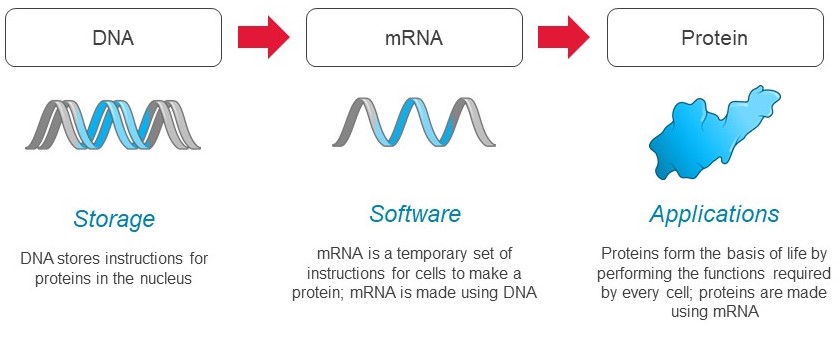
mRNA, the software of life
Messenger RNA, or mRNA, transfers the information stored in our genes to the cellular machinery that makes all the proteins required for life. Our genes are stored as sequences of DNA which contain the instructions to make specific proteins. DNA serves as a hard drive, safely storing these instructions in the nucleus until they are needed by the cell.
When a cell needs to produce a protein, the instructions to make that protein are copied from the DNA to mRNA, which serves as the template for protein production. Each mRNA molecule contains the instructions to produce a specific protein with a distinct function in the body. mRNA transmits those instructions to cellular machinery, called ribosomes, that make copies of the required protein.
We see mRNA functioning as the “software of life.” Every cell uses mRNA to provide real time instructions to make the proteins necessary to drive all aspects of biology, including in human health and disease. This was codified as the central dogma of molecular biology over 50 years ago, and is exemplified in the schematic below.
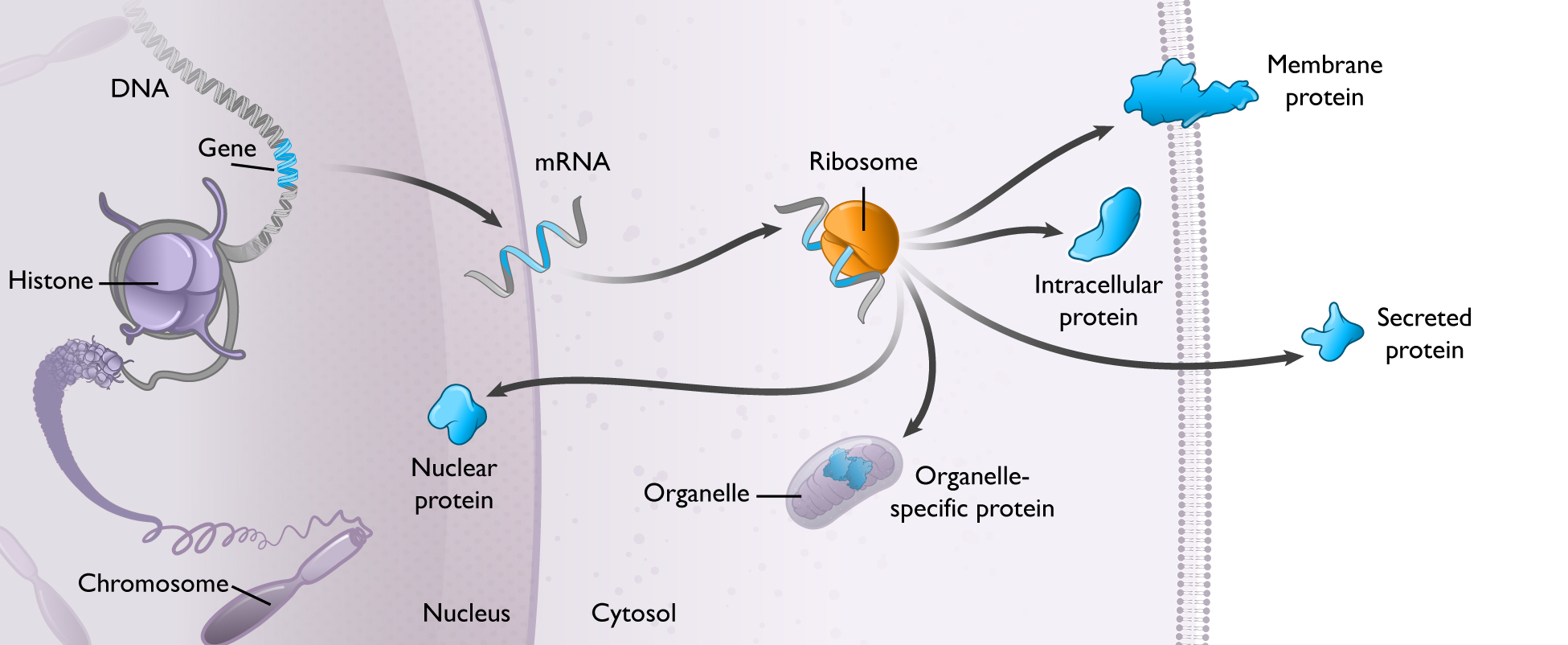
mRNA is used to make every type of protein, including secreted, membrane, and intracellular proteins, in varying quantities over time, in different locations, and in various combinations. This is shown in the figure below.
5
Table of Contents
Given its essential role, we believe mRNA could be used to create a new class of medicines with significant potential to improve the lives of patients. Over the last 40 years, the biotechnology industry has created a new category of drugs based on recombinant protein technology. These drugs rely on secreted proteins, including antibodies and protein replacements, to treat a wide range of diseases. This category of drugs accounts for over $200 billion in annual worldwide sales. However, intracellular and membrane proteins represent as much as two-thirds of the proteins in humans, and are largely beyond the reach of recombinant protein technology. Based on the ability of mRNA to produce these proteins directly in cells, we believe that mRNA-based medicines have the potential to help patients in ways that could equal or exceed the impact of recombinant protein-based drugs.
The structure of mRNA
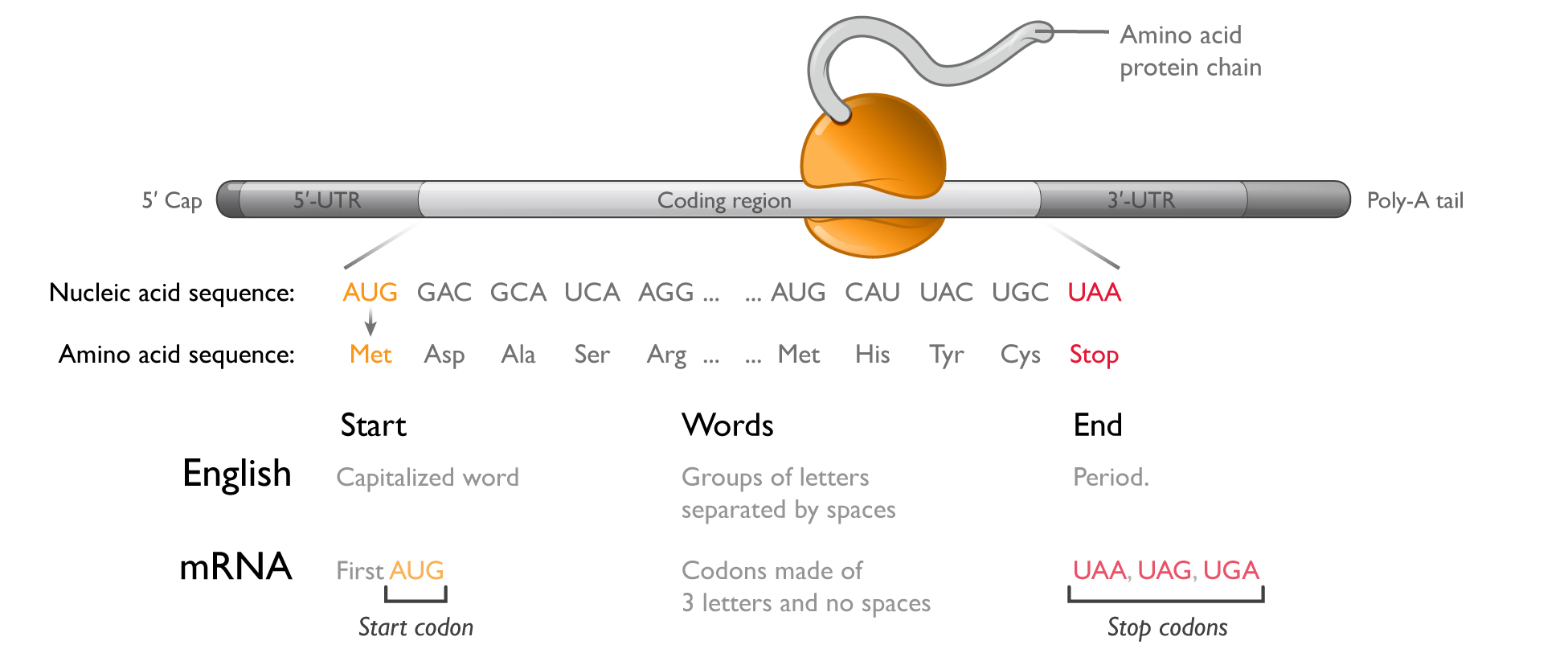
Messenger RNA is a linear polymer comprising four monomers called nucleotides: adenosine (A), guanosine (G), cytosine (C), and uridine (U). Within the region of the molecule that codes for a protein, or the coding region, the sequence of these four nucleotides forms a language made up of three-letter words called codons. The first codon, or start codon (AUG), signals where the ribosome should start protein synthesis. To know what protein to make, the ribosome then progresses along the mRNA one codon at a time, appending the appropriate amino acid to the growing protein. To end protein synthesis, three different codons (UAA, UAG, and UGA) serve as stop signals, telling the ribosome where to terminate protein synthesis. In total, there are 64 potential codons, but only 20 amino acids that are used to build proteins; therefore multiple codons can encode for the same amino acid.
The process of protein production is called translation because the ribosome is reading in one language (a sequence of codons) and outputting in another language (a sequence of amino acids). As shown in the figure below, the coding region is analogous to a sentence in English. Much like a start codon, a capitalized word can indicate the start of a sentence. Codons within the coding region resemble groups of letters representing words. The end of the sentence is signaled by a period in English, or a stop codon for mRNA.
6
Table of Contents
The intrinsic advantages of using mRNA as a medicine
We believe mRNA possesses inherent characteristics that could serve as the foundation for a new class of medicines. These characteristics include:
|
1.
|
mRNA is used by every cell to produce all proteins:
Cells in the human body use mRNA to make all types of proteins, including secreted, membrane, and intracellular proteins. mRNA is used by cells to vary the quantities of protein produced over time, in different locations, and in various combinations. Given the universal role of mRNA in protein production, we believe that mRNA medicines could have broad applicability across human disease.
|
|
2.
|
Making proteins inside one’s own cells mimics human biology:
Using a person’s own cells to produce protein therapeutics or vaccine antigens could create advantages over existing technologies such as recombinant proteins, which are manufactured using processes that are foreign to the human body. These advantages include the ability to:
|
|
•
|
use multiple mRNAs to produce multiple proteins;
|
|
•
|
reduce or eliminate immunogenicity;
|
|
•
|
create multi-protein complexes;
|
|
•
|
produce therapeutic or vaccine proteins locally;
|
|
•
|
harness native protein folding and glycosylation; and
|
|
•
|
make proteins that are unstable outside the body.
|
|
3.
|
mRNA has a simple and flexible chemical structure:
Each mRNA molecule comprises four chemically similar nucleotides to encode proteins made from up to 20 chemically different amino acids. To make the full diversity of possible proteins, only simple sequence changes are required in mRNA. A vast number of potential mRNA medicines can be developed, therefore, with only minor changes to the underlying chemical structure of the molecule or manufacturing processes, a significant advantage over small molecule or protein therapeutics.
|
|
4.
|
mRNA has the potential for classic pharmacologic features:
The intrinsic properties of mRNA translate into attractive pharmacologic features, including:
|
|
•
|
each mRNA encodes for a specific protein and no other protein;
|
|
•
|
each mRNA molecule can produce many copies of a protein in the cell before being degraded;
|
|
•
|
increasing mRNA levels in a cell generally leads to increasing protein levels; and
|
|
•
|
the effects of mRNA in a cell can be transient and limits risk of irreversible changes to the cell’s DNA.
|
As a result, mRNA could have many of the attractive pharmacologic features of most modern medicines, including reproducible activity, predictable potency, and well-behaved dose dependency; and the ability to adjust dosing based on an individual patient’s needs, including stopping or lowering the dose, to seek to ensure safety and tolerability.
mRNA as a new class of medicines
Based on these and other features, we have developed four core beliefs about the value drivers of mRNA as a new class of medicines:
|
1.
|
mRNA has the potential to create an unprecedented abundance and diversity of medicines.
mRNA medicines could be used to provide patients or healthy individuals with any therapeutic protein or vaccine, including those targeting intracellular and membrane proteins. This breadth of applicability has the potential to create an extraordinary number of new mRNA-based medicines that are currently beyond the reach of recombinant protein technology.
|
|
2.
|
Advances in the development of our mRNA medicines can reduce risks across our portfolio.
mRNA medicines share fundamental features that can be used to learn quickly across a portfolio. We believe that once safety and proof of protein production has been established in one program, the technology and biology risks of related programs that use similar mRNA technologies, delivery technologies, and manufacturing processes will decrease significantly.
|
|
3.
|
mRNA technology can accelerate discovery and development.
The software-like features of mRNA enable rapid
in silico
design and the use of automated high-throughput synthesis processes that permit discovery to proceed in parallel rather than sequentially. We believe these mRNA features can also accelerate drug development by allowing the use of shared manufacturing processes and infrastructure.
|
7
Table of Contents
|
4.
|
The ability to leverage shared processes and infrastructure can drive significant capital efficiency over time.
We believe the manufacturing requirements of different mRNA medicines are dramatically more similar than traditional recombinant protein-based drugs across a similarly diverse pipeline. When manufacturing at commercial scale, we believe mRNA medicines will benefit from shared capital expenditures, resulting in lower program-specific capital needs and an advantageous variable cost profile.
|
Recombinant protein-based drugs significantly advanced patient care and transformed the biopharmaceutical industry. We believe that the development of mRNA as a new class of medicines could represent another breakthrough for patients and our industry.
8
Table of Contents
OUR STRATEGIC PRINCIPLES AND APPROACH TO MANAGING RISK
Our strategy is designed to deliver on the full scope of the mRNA opportunity over the long-term. Reaching patients with mRNA medicines requires us to make complex choices, including: how much capital we devote to technology creation, drug discovery, drug development, and infrastructure; which programs we advance and how; whether we advance programs alone or with strategic collaborators; and which capabilities we build internally versus outsource.
To navigate these choices, we established five strategic principles that guide our approach to creating long-term value for patients and investors. No single strategic principle dominates our choices. Embedded in every decision we make is also our assessment of the most important risks inherent in our business. We believe these risks fall into four categories: technology, biology, execution, and financing.
To increase our chances of success, we often find it necessary to balance our near-to-mid-term risks against the strategic principles that guide our approach to long-term value creation.
Our strategic principles
|
1.
|
We seek to discover and develop a large pipeline in parallel.
Our goal is to address or prevent as many human diseases as our technology, talent, capital, and other resources permit. We do so as rapidly as we can, understanding both the urgency for patients and the need to be disciplined in our approach. We have a diverse pipeline of
20
development candidates,
11
of which are currently in clinical trials, and many of which have the potential to be first-in-class or best-in-class medicines.
|
|
2.
|
We undertake sustained, long-term investment in technology creation.
We aim to improve the performance of mRNA medicines in our current modalities, and to unlock new modalities, through investments within basic and applied science. We are committed to remaining at the forefront of mRNA science, which we believe will take many more years to fully mature.
|
|
3.
|
We focus on the pace and scale of our learning.
We believe that time is a critical resource. We seek to accelerate our progress by solving numerous technical problems in parallel rather than in sequence. Our scientists pursue experiments based on how much we can learn from the results, not just the probability of a positive outcome. We believe negative information is valuable and we can learn from our setbacks. We make significant investments in digital assets and research infrastructure to accelerate the pace and scale of our learning.
|
|
4.
|
We integrate across the most critical parts of our value chain.
mRNA is a complex multicomponent system and we believe it demands integration. We believe that we must be directly engaged in research, drug discovery, drug development, process and analytical development, and manufacturing to accelerate our learning, reduce our risk, and protect our critical know-how. Where appropriate, we seek out strategic collaborators that can augment our capabilities or expand our capacity in specific therapeutic areas, while being careful to resist the fragmentation of our core technology.
|
|
5.
|
We forward invest in core enabling capabilities and infrastructure.
To execute across a broad pipeline, we need to invest at risk before we have all the answers. Our forward investments focus on areas where lead times are long and where early investments can reduce execution risk and accelerate future progress. We proactively decided to invest in a dedicated manufacturing facility in Norwood, MA, to support the anticipated growth of our pipeline.
|
Our approach to managing risk
In conjunction with the strategic principles that guide our approach to long-term value creation, we actively manage the risks inherent in our business. At present, these categories of risk include: technology, biology, execution, and financing. We summarize our approach to managing these risks below:
|
1.
|
Technology risk
encompasses the challenges of developing the product features of mRNA medicines, including delivery, controlling interactions with the immune system, optimizing therapeutic index, and manufacturing. We believe the best way to mitigate technology risk is to sustain long-term investments in our platform. In addition, we diversify our technology risk by compartmentalizing our pipeline into groups of programs with shared product features, which we call modalities. Lastly, we stage program development within a modality, leveraging the first program, whether successful or not, to generate insights that accelerate and reduce the risk of subsequent programs within the modality.
|
|
2.
|
Biology risk
entails the risk unique to each program based on its mechanism of action and of clinical development in the target patient population. We believe the best way to manage biology risk is to diversify it by pursuing multiple programs in parallel. In addition, within a modality we seek to initially pursue programs with well-understood biology. Lastly, we may seek strategic collaborators to share risk and upside in disease areas with high inherent biology risk, such as cancer and heart disease.
|
|
3.
|
Execution risk
refers to the challenge of executing against the scale of our mission. We solve for this risk by seeking to hire the right people, the best talent in the industry. We seek to foster a culture of execution with a focus on quick review cycles and high
|
9
Table of Contents
velocity decision-making. We make forward investments in infrastructure, including manufacturing. Lastly, we have created a digital backbone to track all aspects of our programs and anticipate challenges before they arise.
|
4.
|
Financing risk
refers to our ability to access the capital required to fund the current breadth of our endeavor, as well as new opportunities. We manage this risk by attempting to maintain a strong balance sheet with several years of cash runway. As of
December 31, 2018
, we had cash, cash equivalents, and investments of
$1.7 billion
. Cash used in operations and for purchases of property and equipment was
$330.9 million
and
$105.8 million
in
2018
, respectively. Lastly, we may continue to pursue strategic alliances, which provide resources and another source of funding.
|
There is no single strategic principle nor single category of risk that dominates our decision-making, and universal rules do not exist across our portfolio. Our trade-offs generally involve balancing near-term risks and long-term value creation. Because development cycles are long, our choices are complex. We expect the weighting and types of risk we face will evolve as our business matures. We believe that disciplined capital allocation across near- and long-term choices must be a core competency if we are to maximize the opportunity for patient impact and shareholder value creation.
Our progress
We are encouraged by our results to date. Across the six modalities that we have established, we have
20
programs in development, and manufactured dozens of drug substance lots for use in IND-enabling Good Laboratory Practice, or GLP, toxicology studies. “IND-enabling” refers to studies required for Investigational New Drug Application, or IND, or equivalent non-U.S. regulatory filings, such as a Clinical Trial Application, or CTA. We and our strategic collaborators have completed IND-enabling GLP toxicology programs to support our 15 open INDs and/or CTAs for our development candidates, manufactured dozens of current good manufacturing practice, or cGMP, batches of clinical trial materials, and have
11
programs in clinical trials and another 3 with open INDs. Over
1,000
subjects have been enrolled in our clinical trials. To fund these activities, we have raised over
$3.2 billion
as of
December 31, 2018
, including
$2.4 billion
from equity issuances and
$0.8 billion
in upfront payments, milestone payments, and option exercise fees from strategic collaborators.
10
Table of Contents
OUR PLATFORM
Overview of our platform
Our “platform” refers to our accumulated knowledge and capabilities in basic and applied sciences across mRNA, the delivery of mRNA to target tissues, and the manufacturing processes for making potential mRNA medicines. We invest in basic science to discover foundational mechanistic insights, and we invest in applied sciences to invent technology that harnesses those insights. We use our platform to identify and develop new mRNA medicines. When we identify a combination of platform technologies or programs across mRNA technologies, delivery technologies, and manufacturing processes that can enable shared product features across multiple potential mRNA medicines, we group those programs as a modality. The primary goal of our platform is to identify new modalities and to expand the utility of our existing modalities. We are committed to advancing the technological frontier of mRNA medicines over the long term.
We define success in our platform as achieving the following pharmacologic properties:
|
•
|
predictable dose response;
|
|
•
|
reproducible pharmacology, including upon repeat dosing;
|
|
•
|
therapeutic potency, through achieving the intended pharmacologic activity in the target tissue;
|
|
•
|
safety and tolerability; and
|
|
•
|
scalability for development.
|
Achieving any of these pharmacologic properties requires many, often interdependent, technological solutions. We organize our efforts into three core scientific areas: mRNA, delivery, and manufacturing process as shown in the figure below.

We pursue mRNA science both to minimize undesirable activation of the immune system by mRNA and to maximize the mRNA potency of mRNA once inside target cells. We pursue delivery science to protect mRNA from extracellular enzymes that would degrade it, to avoid counterproductive interactions of our delivery vehicles with the immune system, deliver mRNA to desired tissues, and facilitate mRNA transport across cell membranes to the translational machinery within cells. Finally, we have learned that the methods for producing mRNA and lipid nanoparticle, or LNP, delivery systems can have profound positive and negative effects on pharmacology. We pursue process science to optimize these features for our future medicines and to develop technical capabilities to scale our potential mRNA medicines for clinical development.
We have incurred over $500 million of expense to advance our platform technology and our intellectual property. This investment has underpinned the creation of all six of our existing modalities and helped us to establish fundamental intellectual property. We intend to sustain our investment in our platform in the future because we believe we can establish new modalities and continue to make meaningful improvements in the performance of our current modalities.
The success of our current platform and the current pipeline of
20
programs that it underpins depends on hundreds of small advances in our three core scientific areas. Examples of many critical advances that we have made are described below. These advances demonstrate our significant progress to date, and exemplify our approach to tackling hundreds of smaller scientific problems and organizing them into technological solutions.
Our platform: mRNA science
An overview of mRNA biology
Messenger RNA is a linear polymer comprised of four monomers called nucleotides: adenosine (A), guanosine (G), cytosine (C), and uridine (U). Within the region of the mRNA molecule that serves as instructions for protein synthesis, the coding region, the exact sequence of these four nucleotides forms a language made up of three-letter words called codons. One codon, the start codon (AUG), serves to signal where the ribosome should start protein synthesis. To know what protein to make, the ribosome then progresses along the mRNA one codon at a time, appending the appropriate amino acid to the growing protein chain. Because the ribosome is reading in one language (a sequence of codons) and outputting in another language (a sequence of amino acids), this process is called translation. Finally, three different codons (UAA, UAG, and UGA) can serve as stop signals, telling the ribosome where to terminate
11
Table of Contents
protein synthesis. The production of proteins from mRNA sequences is called translation and is used to make all human proteins. The production of mRNA from DNA is called transcription.
As shown in the figure below, the coding region in an mRNA molecule is analogous to a sentence in English. The start codon indicates the start of the protein, much like a capitalized word can indicate the start of a sentence. Codons within the coding region resemble groups of letters representing words. The end of the sentence is signaled by a period in English, or a stop codon for mRNA.
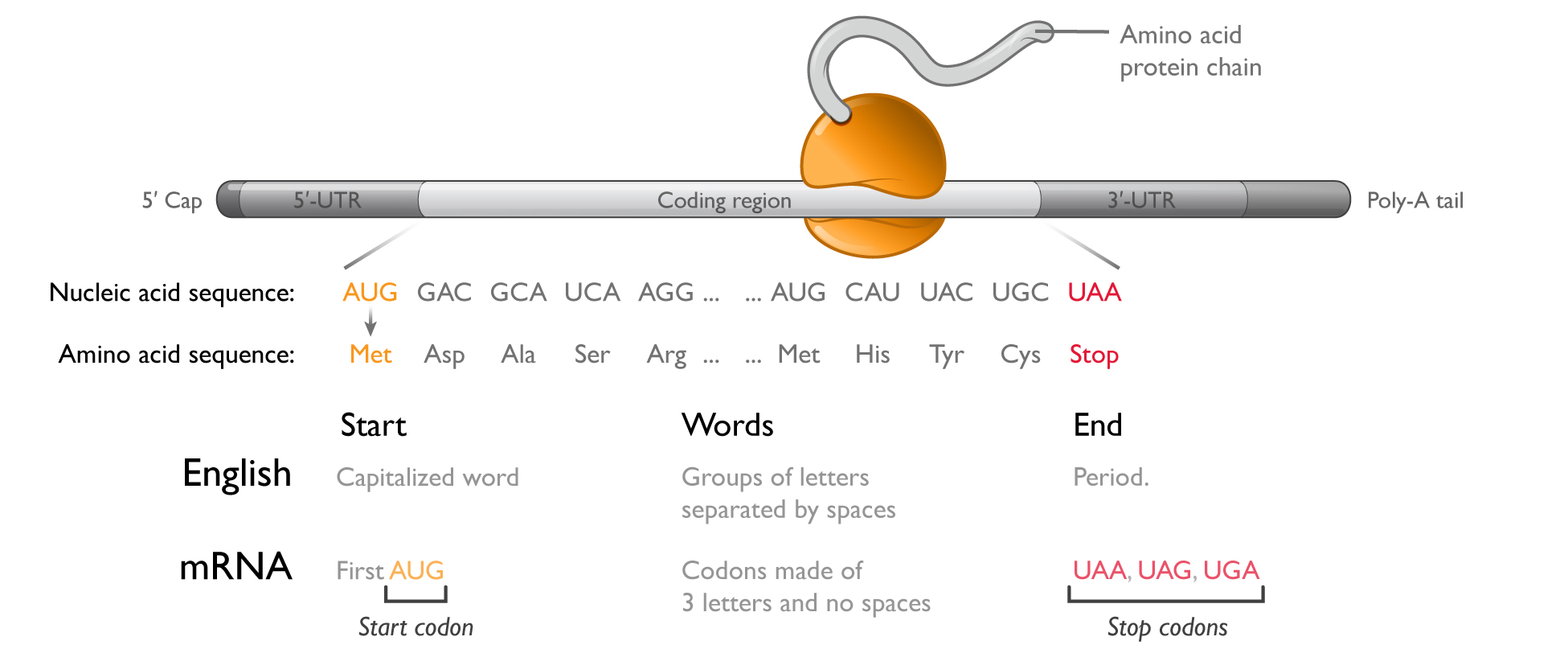
In every cell, hundreds of thousands of mRNAs make hundreds of millions of proteins every day. A typical protein contains 200-600 amino acids; therefore a typical mRNA coding region ranges from 600-1,800 nucleotides.
In addition to the coding region, mRNAs contain four other key features: (1) the 5’ untranslated region or 5’-UTR; (2) the 3’ untranslated region or 3’-UTR; (3) the 5’ cap; and (4) a 3’ polyadenosine, or poly-A, tail. The sequence of nucleotides in the 5’-UTR influences how efficiently the ribosome initiates protein synthesis, whereas the sequence of nucleotides in the 3’-UTR contains information about which cell types should translate that mRNA and how long the mRNA should last. The 5’ cap and 3’ poly-A tail enhance ribosome engagement and protect the mRNA from attack by intracellular enzymes that digest mRNA from its ends.
As a result of this biology, mRNA has several key features. First, mRNA is exquisitely specific. There is a one-to-one correspondence between an mRNA molecule and the protein dictated by the coding sequence. Second, the biological effects of mRNA are amplified. Because each mRNA copy can be translated thousands of times, we believe that in some cases, a small number of mRNA copies per cell may be sufficient to induce a pharmacologic effect. Finally, mRNA is impermanent. mRNAs produce proteins for a defined and biologically-regulated period of time without risk of changing genes or cell DNA. If dosing of mRNA stops, protein production will stop and the biological effects generally can be reversed.
Decades of academic investigation have uncovered the basic mechanisms of mRNA translation. Parallel efforts have uncovered how the innate immune system determines self-mRNA versus foreign RNA from RNA-based viruses. We are grateful for the deep scientific foundation established by these pioneers. Yet as we seek to develop mRNA into medicines we often find ourselves at the frontiers of current understanding. Therefore, we invest in both applied and basic research, seeking to advance both the state of our technology and the state of the scientific community’s understanding of mRNA. Examples of advances in mRNA science that combine nucleotide chemistry, sequence engineering, and targeting elements are described below.
mRNA chemistry: Modified nucleotides to mitigate immune system activation
The innate immune system has evolved to protect cells from foreign RNA, such as viral RNA, by inducing inflammation and suppressing mRNA translation once detected. Many cells surveil their environment through sensors called toll-like-receptors, or TLRs. These include types that are activated by the presence of double-stranded RNA (TLR3) or uridine containing RNA fragments (TLR7, TLR8). Additionally, all cells have cytosolic double-stranded RNA, or dsRNA, sensors, including retinoic acid inducible gene-I, or RIG-I that are sensitive to foreign RNA inside the cell.
The immune and cellular response to mRNA is complex, context specific, and often linked to the sensing of uridine. To minimize undesired immune responses to our potential mRNA medicines, our platform employs chemically-modified uridine nucleotides to minimize recognition by both immune cell sensors such as TLR3/7/8, and broadly-distributed cytosolic receptors such as RIG-I. mRNA produced using our synthesis technologies and containing unmodified uridine results in significant upregulation of secreted
12
Table of Contents
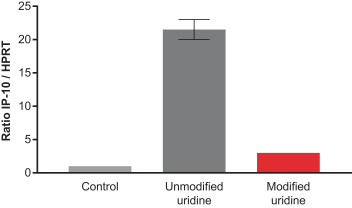
cytokines such as IP-10, as shown in the figure below. Administration of monocyte-derived macrophages, or MDMs, with unmodified mRNA formulated in LNPs results in an increased ratio of IP-10 transcripts relative to a housekeeping gene, HPRT. By substituting unmodified uridine with a modified uridine, we can substantially reduce immune cell activation in this assay. The control contains only transfection agent and no mRNA. In multiple preclinical experiments we have demonstrated reduced immune cell activation, including of B cells, lower immunoglobulin secretion, and lower cytokine expression when administering mRNA made with modified uridine versus unmodified uridine. To date, when deploying these technologies we have yet to observe dose-limiting toxicity attributable to the mRNA encoding proteins from our drug substance even at the exaggerated doses in IND-enabling GLP toxicology programs. Importantly, in preclinical testing, our chemically-modified uridine has not significantly affected the ribosome’s ability to read and translate the mRNA sequence.
Nucleotide chemistry of mRNA reduces immune activation
in vitro
(in MDMs)
mRNA sequence engineering: Maximizing protein expression
mRNA exists transiently in the cytoplasm, during which time it can be translated into thousands of proteins before eventually being degraded. Our platform applies bioinformatic, biochemical, and biological screening capabilities, most of which have been invented internally that aim to optimize the amount of protein produced per mRNA. We have identified proprietary sequences for the 5’-UTR that have been observed to increase the likelihood that a ribosome bound to the 5’-end of the mRNA transcript will find the desired start codon and reliably initiate translation of the coding region.
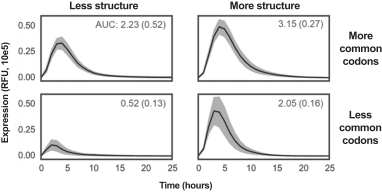
We additionally design the nucleotide sequence of the coding region to maximize its successful translation into protein. As previously described, there are often multiple codons that encode for a specific amino acid. The amount of protein produced by an mRNA sequence is known to be partly determined by the codons it uses, with certain codons being more or less common in endogenous mRNAs. We have found that the amount of protein produced is also determined by the secondary structure of mRNA, or the propensity of mRNA to fold on itself, with more structured mRNAs producing more protein. We designed a set of sequences which independently varied codon usage and structure of the mRNA. As shown in the figure below, protein expression in the Alpha mouse liver 12, or AML12, cell line is highest for sequences containing more commonly occurring codons and also more structured mRNA. Both codon usage and structure have an independent and additive effect on protein expression, shown as mean expression (solid line), as measured by fluorescence of the expressed protein, with 95% confidence interval in gray. The total expression area under the curve, or AUC, and standard error of the mean for AUC are shown for each quadrant, in relative fluorescence units per hour, or RFU/h. By optimizing translation initiation and efficiency, we have further increased the average number of full-length desired proteins expressed per molecule mRNA. This permits us to reduce the mRNA doses required to achieve the same therapeutic benefit.
Sequences with more structure and more common codons in mRNA maximize protein expression
in vitro
13
Table of Contents
Targeting elements: Enabling tissue-targeted translation
All nucleated cells in the body are capable of translating mRNA, resulting in pharmacologic activity in any cell in which mRNA is delivered and translated. To minimize or prevent potential off-target effects, our platform employs technologies that regulate mRNA translation in select cell types. Cells often contain short RNA sequences, called microRNAs or miRNAs, that bind to mRNA to regulate protein translation at the mRNA level. Different cell types have different concentrations of specific microRNAs, in effect giving cells a microRNA signature. microRNA binding directly to mRNA effectively silences or reduces mRNA translation and promotes mRNA degradation. We design microRNA binding sites into the 3’-UTR of our potential mRNA medicines so that if our mRNA is delivered to cells with such microRNAs, it will be minimally translated and rapidly degraded.
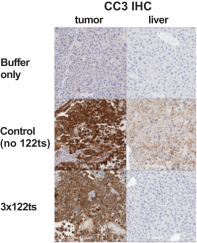
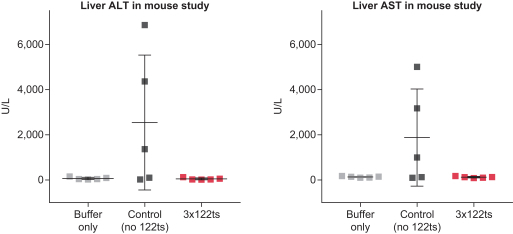
As an example, we have demonstrated by intratumoral administration in an animal model that an mRNA encoding a cytotoxic protein and containing a microRNA binding site can be used to selectively kill cancer cells, while protecting systemic tissues such as liver cells. In a mouse model of cancer (Hep3b subcutaneous xenograft mouse), liver enzyme levels and immunohistochemistry, or IHC, of cleaved caspase-3, or CC3, indicate production of an apoptosis-inducing protein encoded by mRNA in tumor cells but not healthy liver cells when the mRNA has multiple miR-122 target sites. This is denoted as 3x122ts in the figure below; miR-122 is more prevalent in non-cancerous liver cells, but absent in the cancerous liver cells. We published this work in
Nucleic Acid Therapeutics
in 2018.
Tissue-targeted translation of mRNA encoding a pro-apoptotic protein
and microRNA binding sites in mouse study
Our platform: Delivery science
We focus on the delivery of our mRNA molecules to specific tissues. Our mRNA can, in specific instances, such as our VEGF therapeutic, be delivered by direct injection to a tissue in a simple saline formulation without lipid nanoparticles, or LNPs, to locally produce small amounts of pharmacologically active protein. However, the blood and interstitial fluids in humans contain significant RNA degrading enzymes that rapidly degrade any extracellular mRNA and prevent broader distribution without LNPs. Additionally, cell membranes tend to act as a significant barrier to entry of large, negatively-charged molecules such as mRNA. We have therefore
14
Table of Contents
invested heavily in delivery science and have developed LNP technologies, as well as alternative nanoparticle approaches to enable delivery of larger quantities of mRNA to target tissues.
LNPs are generally composed of four components: an amino lipid, a phospholipid, cholesterol, and a pegylated-lipid, or PEG-lipid. Each component, as well as the overall composition, or mix of components, contributes to the properties of each LNP system. LNPs containing mRNA injected into the body rapidly bind proteins that can drive uptake of LNPs into cells. Once internalized in endosomes within cells, the LNPs are designed to escape the endosome and release their mRNA cargo into the cell cytoplasm, where the mRNA can be translated to make a protein and have the desired therapeutic effect. Any mRNA and LNP components that do not escape the endosome are typically delivered to lysosomes where they are degraded by the natural process of cellular digestion.
Examples of tools we developed by using our platform include proprietary LNP formulations that address the steps of mRNA delivery, including cell uptake, endosomal escape, and subsequent lipid metabolism, and for avoidance of counterproductive interactions with the immune system. Examples of delivery tools we have developed are described below.
Chemistry: Novel lipid chemistry to potentially improve safety and tolerability
We initially used LNP formulations that were based on known lipid systems, which we refer to as “legacy LNPs.” A recognized limitation of these legacy LNPs is the potential for inflammatory reactions upon single and repeat administration that can impact tolerability and therapeutic index. Our later-developed, proprietary LNP systems are therefore designed to be highly tolerated and minimize any LNP vehicle-related toxicities with repeat administration
in vivo
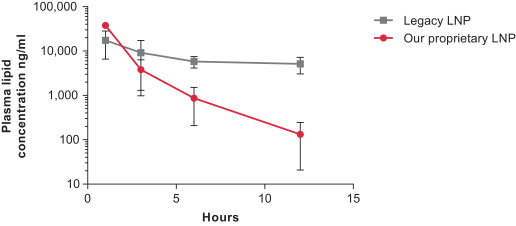
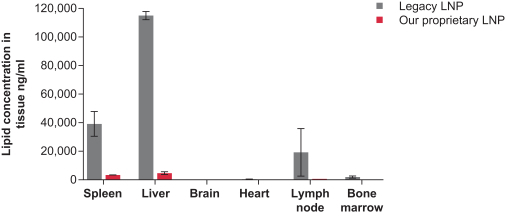
. The changes we made have included engineering amino lipids to avoid the immune system and to be rapidly biodegradable relative to prior lipids as shown in the figure below. Administered intravenously in non-human primates, at 0.2 mg/kg, our proprietary LNPs demonstrate rapid clearance of the lipid from panel A (plasma) and B (various organs 12 hours post administration).
Rapid clearance of lipid components of LNPs from plasma in non-human primate study
(y-axis in log-scale)
Panel (A)
15
Table of Contents
Rapid clearance of LNP lipid from tissue 12 hours post administration in non-human primate study
Panel (B)
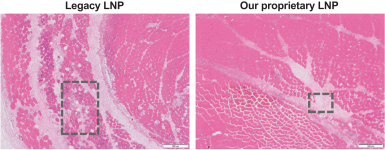
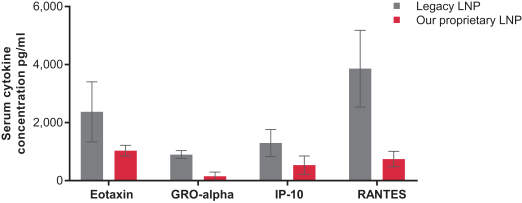
Even in the case of vaccines, where one might hypothesize that LNP-induced immune stimulation could potentially increase the effectiveness of the vaccine, we have demonstrated in preclinical studies that we can maintain the desired immune response to the vaccine while reducing undesired local immune reaction, or reactogenicity, to the LNP as shown in the figure below. Representative histology sections in the muscle stained with hematoxalin and eosin two days after a single intramuscular administration in rats demonstrated less inflammation and muscle cell necrosis with our proprietary LNPs vs. legacy LNPs containing 0.1 mg of our mRNA. As exemplified in the box with the legacy LNP in panel A, necrosis and degeneration of muscle cells and inflammation were observed (dotted box). With our proprietary LNPs, inflammation (dotted box) and muscle cell necrosis were less extensive. Serum cytokine levels shown in panel B, are lower with our proprietary LNPs vs. legacy LNPs.
Vaccines with our proprietary LNPs demonstrate less inflammation and muscle cell necrosis compared to legacy LNPs in rat study
Panel (A)
Lower serum cytokines with our proprietary LNP in rat study
Panel (B)
16
Table of Contents
Composition: Proprietary LNPs enhance delivery efficiency
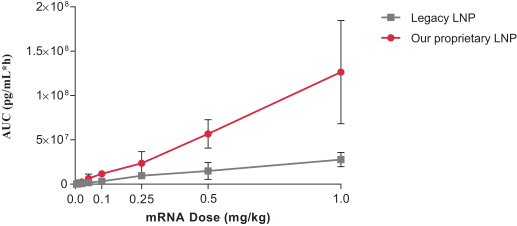
Our platform includes extensive in-house expertise in medicinal chemistry, which we have applied to design large libraries of novel lipids. Using these libraries in combination with our discovery biology capabilities, we have conducted high throughput screens for desired LNP properties and believe that we have made fundamental discoveries in preclinical studies about the relationships between structural motifs of lipids and LNP performance for protein expression. By screening for components and compositions that enhance the amount of mRNA delivered per cell and protein expression, we have demonstrated with intravenous administration up to a six-fold improvement in protein production over the prior state of the art for LNPs as shown in the figure below (n=3 rats, 95% CI shown).
Enhanced protein production with our proprietary LNP in rat study
Surface properties: Novel LNP design to avoid immune recognition
We have designed our proprietary LNP systems for sustained pharmacology upon repeat dosing by eliminating or altering features that activate the immune system. These are based on insights into the surface properties of LNPs. Upon repeated dosing, surface features on traditional LNPs such as amino lipids, phospholipids, and PEG-lipids, can be recognized by the immune system, leading to rapid clearance from the bloodstream, a decrease in potency upon repeat dosing, and an increase in inflammation.
Based on our insights into these mechanisms, we have engineered our LNP systems to reduce or eliminate undesirable surface features. In preclinical studies in non-human primates for our systemic therapeutic development candidates that use our novel LNP systems, we have been able to repeat dose with negligible or undetectable loss in potency, liver damage, and immune system activation.
Our platform: Manufacturing process science
We invest significantly in manufacturing process science to impart more potent features to our mRNA and LNPs, and to invent the technological capabilities necessary to manufacture our potential mRNA medicines at scales ranging from micrograms to kilograms, as well as achieve pharmaceutical properties such as solubility and shelf life. We view developing these goals of manufacturing and pharmaceutical properties as stage appropriate for each program. In some cases, this includes inventing novel analytical technologies that make it possible to connect analytical characterization of mRNA and LNPs to biological performance.
mRNA manufacturing process: Improving pharmacology
Our platform creates mRNA using a cell-free approach called
in vitro
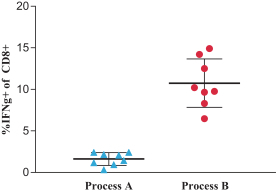
transcription in which an RNA polymerase enzyme binds to and transcribes a DNA template, adding the nucleotides encoded by the DNA to the growing RNA strand. Following transcription, we employ proprietary purification techniques to ensure that our mRNA is free from undesired synthesis components and impurities that could activate the immune system in an indiscriminate manner. Applying our understanding of the basic science underlying each step in the manufacturing process, we have designed proprietary manufacturing processes to impart desirable pharmacologic features, for example increasing potency in a vaccine. Using a model antigen injected intramuscularly in mice at a 3 µg mRNA dose, the figure below shows the significant improvement in CD8 T cell response we have achieved through mRNA manufacturing process science and engineering as evidenced by Process B.
17
Table of Contents
Manufacturing process changes to tune immune response in mouse study
LNP manufacturing process: Improving pharmacology
Our platform technology includes synthetic processes to produce LNPs. Traditionally LNPs are assembled by dissolving the four molecular components, amino lipid, phospholipid, cholesterol, and PEG-lipid, in ethanol and then mixing this with mRNA in an aqueous buffer. The resulting mixture is then purified to isolate LNPs from impurities. Such impurities include molecular components that have not been incorporated into particles, un-encapsulated mRNA that could activate the immune system, and particles outside of the desired size range.
Going beyond optimization of traditional manufacturing processes, we have invested in understanding and measuring the various biochemical and physical interactions during LNP assembly and purification. We have additionally developed state-of-the-art analytical techniques necessary to characterize our LNPs and biological systems to analyze their
in vitro
and
in vivo
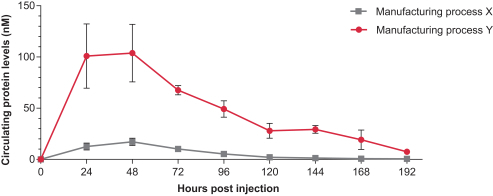
performance. With these insights, we have identified manufacturing process parameters that drive LNP performance, for example, the potency in a secreted therapeutic setting. These insights have allowed us to make significant improvements in the potency of our LNPs, as exemplified in the figure below. For example, expression of a secreted protein in our Relaxin program (AZD7970) demonstrates an approximate eight-fold increase in area under the curve, or AUC, and approximate six-fold increase in maximum concentration for manufacturing process Y versus manufacturing process X in rats dosed intravenously with 0.5 mg/kg mRNA.
Manufacturing process changes to enhance relaxin protein production by mRNA in rat study
Our platform progress to date
Over the last eight years, we have solved numerous interdependent problems related to the pharmacologic features of our potential mRNA medicines. These features are detailed and exemplified below. Please also see the section of this Annual Report on Form 10-K titled “Business—Program Descriptions” for recent clinical results for our investigational medicines hMPV+PIV3 vaccine (mRNA-1653) and PCV (mRNA-4157 and NCI-4650) utilizing Moderna proprietary technology.
Dose-dependent protein expression at clinically relevant levels
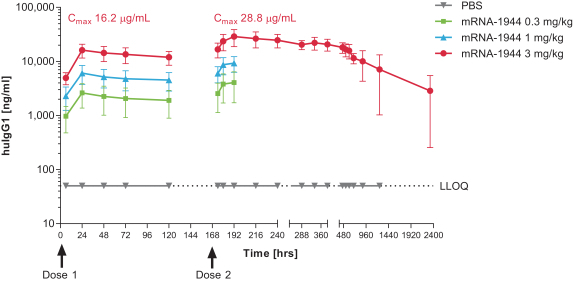
We have demonstrated in preclinical studies the ability to generate consistent dose-dependent levels of protein, which is particularly important for therapeutics. A recent example is from our IND-enabling non-human primate study for our antibody against Chikungunya virus program (mRNA-1944). We demonstrated linear dose-dependence, meaning three- and ten-fold increases in the dose of mRNA led to three- and ten-fold increases in antibody as shown in the figure below. At the top dose, antibody levels reached 16.2 ± 4.6 µg/mL (SD) following first dose (0 hours), and effectively doubled to 28.8 ± 10.0 µg/mL upon second dose (168 hours).
18
Table of Contents
This dose regimen also maintained antibody trough levels above 2 µg/mL for 100 days in non-human primates, a level consistent with clinically efficacious levels of many approved antibodies. All doses (0.3, 1, and 3 mg/kg) tested in non-human primates showed no dose-limiting toxicities related to mRNA-1944, and all other observations were generally reversible.
Expression of antibody against Chikungunya virus with repeat dosing of mRNA-1944 in non-human primate study
Reproducible pharmacology, including upon repeated dosing
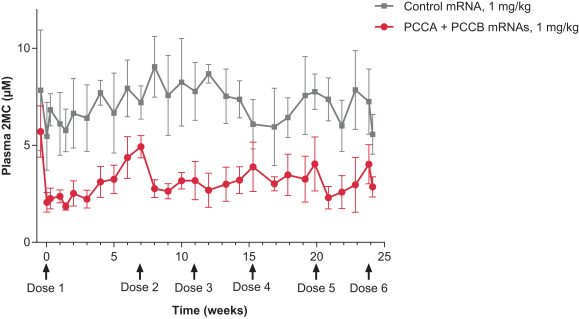
By combining advances in mRNA, delivery, and manufacturing process science, we have demonstrated in preclinical studies sustained and reproducible pharmacology. The figure below shows a recent example in a mouse model that recapitulates metabolic defects in propionic acidemia, or PA. In this rare disease, a defect in one or both of two different subunits (PCCA and PCCB) of the mitochondrial enzyme propionyl-CoA carboxylase results in accumulation of toxic metabolites such as 2-methylcitrate, or 2MC. In mice hypomorphic for the PCCA subunit, monthly intravenous, or IV, administration of mRNAs encoding PCCA and PCCB formulated in our proprietary LNP (mRNA-3927) resulted in a significant and sustained lowering of 2MC throughout the duration of the 6-month study compared to control (luciferase) mRNA (1 mg/kg, n=6/group).
Plasma 2-methylcitrate levels with repeat dosing of PCCA+PCCB mRNA in PA mouse study
19
Table of Contents
Decreased immune activation upon repeat dosing in non-human primates
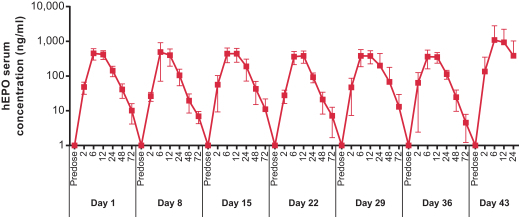
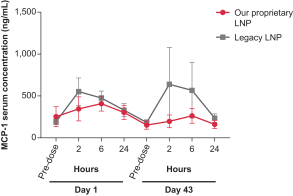
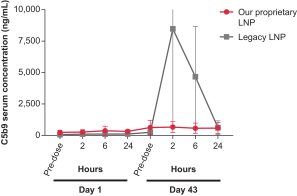
We have observed decreased immune activation with repeat dosing in non-human primates, as shown in the figure below. Panel A indicates serum concentration of human erythropoietin, or hEPO, with repeat dosing of mRNA encoding hEPO in our proprietary LNPs with weekly IV administration at 0.2 mg/kg in non-human primates. Panels B and C demonstrate comparable serum concentrations of MCP-1 (promoting immune cell recruitment to sites of inflammation) and C5b9 (indicative of innate immune activation via the complement system) with our proprietary LNP at 0.2 mg/kg weekly IV infusion in non-human primates vs. legacy LNP.
Repeat dosing with mRNA encoding for hEPO in our proprietary LNP in non-human primate study
Panel (A)
Decreased immune activation with mRNA encoding for hEPO in proprietary LNP in non-human primate study
|
|
|
|
Panel (B)
|
Panel (C)
|
|
In addition to this example we have completed multiple IND-enabling toxicology studies under GLP for our two systemic therapeutics modalities. For many such programs the no adverse event level was the top dose tested, generally 2 mg/kg or higher. We believe that by combining proprietary mRNA technologies, delivery technologies, and manufacturing process technologies we have significantly advanced the potential therapeutic index of our potential mRNA-based therapeutics.
Pharmacologic activity in the target tissue and cell
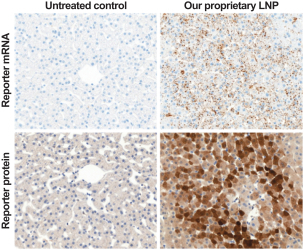
While some of our modalities, such as systemic secreted therapeutics, can leverage many different cell types to make therapeutic proteins, others such as systemic intracellular therapeutics, may require delivery of our mRNA into specific tissues, for instance hepatocytes in certain liver metabolic diseases. Combining our proprietary mRNA, delivery, and manufacturing process technologies we have observed on-target pharmacologic activity in hepatocytes in non-human primates. The on-target potency of this approach
20
Table of Contents
contrasts with traditional delivery technologies. In the figure below, our proprietary LNP and process result in mRNA delivery to and protein expression in liver hepatocytes in non-human primates as demonstrated with a reporter mRNA detected by
in situ
hybridization and a reporter protein detected by immunohistochemistry at 12 hours after IV infusion at 0.5 mg/kg.
mRNA delivery to and protein expression in hepatocytes with our proprietary LNPs in non-human primate study
Our platform’s future: Improving and expanding our modalities
We are committed to sustaining investment in our platform, both in basic science to elucidate new mechanistic insights, and in applied science to discover new technologies that harness these insights. Our platform investments have enabled six modalities to date, most of which have already led to multiple development candidates and investigational medicines in our pipeline. We believe that sustaining our investment in platform research and development will enable further improvements in the current modalities and will lead to the creation of new modalities, both of which will benefit our clinical pipeline in the years ahead.
21
Table of Contents
CREATING MODALITIES WITH SHARED PRODUCT FEATURES
Our approach to developing modalities
Within our platform, we develop technologies that enable the development of mRNA medicines for diverse applications. When we identify technologies that we believe could enable a new group of potential mRNA medicines with shared product features, we call that group a “
modality
.” While the programs within a modality may target diverse diseases, they share similar mRNA technologies, delivery technologies, and manufacturing processes to achieve shared product features. The programs within a modality will also generally share similar pharmacology profiles, including the desired dose response, the expected dosing regimen, the target tissue for protein expression, safety and tolerability goals, as well as pharmaceutical properties. Programs within a modality often have correlated technology risk, but because they pursue diverse diseases they often have uncorrelated biology risk. We have created six modalities to date:
|
•
|
prophylactic vaccines;
|
|
•
|
cancer vaccines;
|
|
•
|
intratumoral immuno-oncology;
|
|
•
|
localized regenerative therapeutics;
|
|
•
|
systemic secreted therapeutics; and
|
|
•
|
systemic intracellular therapeutics.
|
When entering into a new modality, our approach is consistent with our strategic principles and perspectives on risk management discussed previously. The tenets of our approach are summarized below.
|
•
|
We identify a
first program
(or programs) through which we seek to discover and develop solutions for any modality-specific technological challenges. We then leverage the learnings from this first program to the benefit of all subsequent programs in the modality.
|
|
•
|
We seek to
diversify biology risks
within the modality by advancing multiple programs in parallel, against multiple diseases, following the first program.
|
|
•
|
When we believe a strategic collaborator could significantly de-risk our early efforts in a new modality, we seek a
strategic collaborator to share the risks and benefits
on a specific set of early programs.
|
|
•
|
After experience with the first program (or programs) in a modality, we seek to
rapidly expand our pipeline
within that modality to take full advantage of the opportunity.
|
Illustrating our approach: From our first modality to today
We started with prophylactic vaccines as our first modality because we believed this modality faced lower technical hurdles, relative to other areas. Our early formulations of mRNA tended to stimulate the immune system, which would present a challenge to therapeutics but was a desired feature for vaccines. In addition, many potential prophylactic vaccine antigens are well-characterized, allowing us to reduce biology risk. Lastly, the dosing regimens for vaccines require as few as one or two administrations, and generally involve relatively low doses.
For our first programs in this modality we chose our H10N8 and H7N9 pandemic influenza vaccines, each requiring expression of a single membrane protein. We chose to pursue two programs in two separate, but parallel, clinical trials to establish the flexibility of our platform.
When both programs met our goals for safety, tolerability, and pharmacology, we accelerated and expanded our vaccine pipeline to include multiple commercially meaningful and increasingly complex vaccines. These included a combination vaccine, designed to protect against two unrelated respiratory viruses, human metapneumovirus, or hMPV, and human parainfluenza 3, or PIV3, and a vaccine that combines six different mRNAs, our cytomegalovirus, or CMV, vaccine, to express a complex pentameric antigen. We also sought strategic alliances with Defense Advanced Research Projects, or DARPA, Biomedical Advanced Research Development Authority, or BARDA, and Merck & Co., or Merck, to allow us to rapidly expand our pipeline and complement our capabilities with their expertise.
Over time, we have taken on more challenging applications and technological hurdles with each successive modality, but we have also tried to build upon our prior experiences to manage risk. For example, in our cancer vaccines modality, we are now applying our technology to elicit T cell responses to potentially recognize and eradicate cancer as a logical extension of our prophylactic vaccines
22
Table of Contents
modality. Having demonstrated local expression of protein in our vaccines, we expanded into local therapeutic applications. For example, in our intra-tumoral immuno-oncology modality, we are seeking to use local expression to drive anti-cancer T cell responses by transforming tumor microenvironments. We can also use local expression to drive regenerative processes as in our VEGF-A program. Most recently, we have expanded into two new modalities that use systemic delivery of mRNA to encode secreted or intracellular proteins. We have moved multiple programs in these areas into development for the treatment of diseases as varied as rare genetic disorders, preventing viral infections, or treating heart failure.
How modalities build our pipeline
We believe our portfolio of modalities—each with distinct technological and biological risk profiles—allows us to maximize long-term value for patients and investors. We see our six current modalities as six distinct multi-product pipelines that represent different risk profiles and benefit from common infrastructure and a shared platform technology. We believe the high technology correlation within a modality allows us to rapidly accelerate the expansion of the pipeline in that modality based on learnings from the initial programs. We believe the lower technology correlation between modalities allows us to compartmentalize the technology risks.
We believe our ongoing investments in our platform will lead to the identification of additional new modalities in the future, and will expand the diversity of our pipeline.
23
Table of Contents
EXECUTING ON OUR BROAD PIPELINE
In order to capitalize on the breadth of the mRNA opportunity, we built a set of capabilities across the drug development value chain to enable us to efficiently execute on many pipeline programs in parallel.
mRNAs encode proteins across diverse biology using the same chemical building blocks arranged into different sequences. This lends itself to common rules when designing a new mRNA medicine and common processes for manufacturing. We have invested in scalable infrastructure, built on a digital backbone and enabled by automation to advance a large pipeline of mRNA programs in parallel.
Our capabilities and infrastructure are grouped into three basic units, or engines, that are applied at different stages of the drug development value chain, as shown in the following figure:
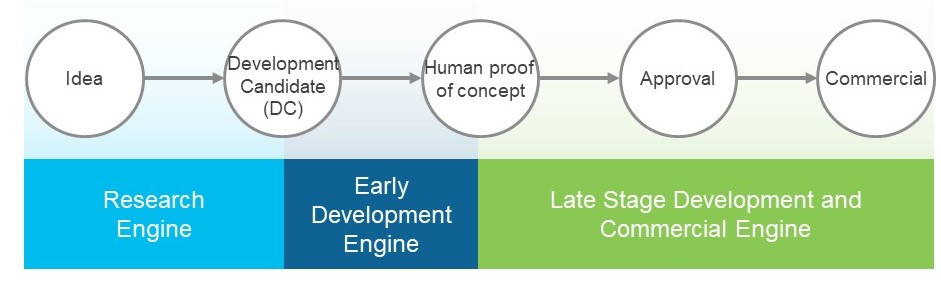
Our current pipeline programs utilize our Research Engine and Early Development Engine. We are starting to build the Late Stage Development and Commercial Engine to handle the further advancement of our programs. Each of these engines integrates critical internal capabilities with outsourced, flexible capacity.
Our
Research Engine
enables us to advance new product ideas into development candidates via our drug discovery efforts, and includes infrastructure to enable rapid supply of thousands of preclinical mRNAs for research involving
in vitro
and
in vivo
experiments in order to accelerate programs from idea to development candidate designation.
Our
Early Development Engine
enables progression of preclinical development candidates to investigational medicines upon IND filing or its equivalent, through early clinical trials that seek to demonstrate human proof of concept, or hPOC. This includes internal and outsourced infrastructure for IND-enabling GLP toxicology studies, the scale up and cGMP manufacture of the investigational medicine, initial regulatory submissions, and the execution of clinical trials.
Our
Late Stage Development and Commercial Engine
is envisioned to enable progress of our investigational medicines from hPOC through late-stage development to approval and eventual commercialization. This is expected to include internal and outsourced infrastructure for cGMP manufacture for late stage development and commercial supply of products, regulatory submissions, and capabilities to execute later stage clinical trials.
All of these engines are supported and enabled by our integrated digital investments, our focus on highly talented and motivated team members, and our deep capital base.
Our
digital infrastructure
facilitates efficient integration and control of virtually every aspect of what we do. We design and implement digital operations to control or support complex workflows, accelerate learnings across our enterprise real-time, and provide deeper insights through analytical tools, artificial intelligence, and custom automation.
Our
talented employees
drive our mission across this value chain for patients and investors. Our culture also plays an invaluable role in our execution at all levels in our organization. An example of our commitment to the development of our employees is our investment in Moderna University, our extensive program of internal and external course offerings curated to meet the learning and development needs of our people.
Our
capital
from our investors and strategic collaborators enables the scale required to execute on our pipeline. We sought, and continue to seek, diverse funding sources. Of approximately
$3.2 billion
in cash we have received through
December 31, 2018
,
$0.8 billion
has been in the form of upfront payments, milestone payments, and option exercise payments from strategic collaborators, such
24
Table of Contents
as AstraZeneca and Merck, and
$2.4 billion
has been from equity issuances in both private and public markets to a diverse set of global investors. As of
December 31, 2018
, we had cash, cash equivalents, and investments of
$1.7 billion
.
Examples of our proprietary infrastructure
Our Drug Design Studio enables rapid design of multiple mRNAs
As our scientists create new mRNA concepts, they can design mRNAs for research and testing, within days, using our proprietary systems. We utilize the software-like property of mRNA in our proprietary, web-based Drug Design Studio. Our scientists request mRNAs for a specific protein, and the protein target is automatically converted to an initial optimized mRNA sequence. Using our Sequence Designer module, they can tailor entire mRNAs from the 5’-UTR to the coding region to the 3’-UTR based on our ever-improving proprietary learnings. The mRNA sequence is then further optimized using our proprietary bioinformatics algorithms. Our digital ordering then ensures rapid and accurate transmission of sequences to our modular synthesis robotics.
Our high throughput systems facilitate rapid synthesis of research grade mRNA
Once our scientists design mRNAs, we make them at a small scale to test them in cells or in animal models to see if our ideas will work. We integrated the Drug Design Studio mRNA sequence into a modular synthesis system comprised of custom high-throughput automation for making up to 1,000 orders of unique mRNA sequences and formulations per month with a turnaround time of a few weeks at 1-10 mg per lot, the amounts required for testing in cells or animal models. This has accelerated our learnings by allowing us to test many different mRNAs in parallel.
Our Norwood manufacturing site provides modular and automated capacity that can scale with our pipeline
Manufacturing is strategically important to us, and we believe we need to control a significant portion of our manufacturing supply chain. We initially used an outsourced global supply chain to make our multi-component mRNA products. However, we believe that managing quality, supply, and timing in such a supply chain for cGMP material could increase our overall business risk. Accordingly, we elected in 2016 to build our own manufacturing facility. We opened our newly constructed 200,000 square foot Norwood manufacturing facility in July 2018, and brought multiple cGMP suites online, thereby providing integration of our supply chain from raw materials to filled vials at a single site. We can make mRNA, lipids, and LNPs at this site to control quality and supply, while also potentially creating new manufacturing intellectual property. We can readily flex the capacity at our Norwood facility via its modular systems to produce up to 100 cGMP lots per year. This capacity will support our current pipeline, will enable significant future pipeline expansion, and, under certain scenarios, could serve some commercial supply needs.
25
Table of Contents
OVERVIEW OF OUR MODALITIES
At Moderna, we define a modality as a group of potential mRNA medicines that share similar mRNA technologies, delivery technologies, and manufacturing processes to achieve shared product features. Typically, programs within a modality will also share similar pharmacology profiles, including the desired dose response, the expected dosing regimen, the target tissue for protein expression, safety and tolerability goals, and their pharmaceutical properties. We have created six modalities to date:
|
•
|
Prophylactic vaccines;
|
|
•
|
Cancer vaccines;
|
|
•
|
Intratumoral immuno-oncology;
|
|
•
|
Localized regenerative therapeutics;
|
|
•
|
Systemic secreted therapeutics; and
|
|
•
|
Systemic intracellular therapeutics.
|
We believe our portfolio of modalities, each with distinct technological and biological risk profiles, allows us to maximize long-term value for patients and investors. We see our six current modalities as six distinct multi-product pipelines that represent different risk profiles and benefit from common infrastructure and a shared technology platform. We believe the risk correlation within a modality allows us to rapidly accelerate the expansion of the pipeline in that modality based on learnings from the initial programs. We believe the lower risk correlation between modalities allows us to mitigate the risks of expanding into new areas. The cell map illustration of our pipeline in the section of this Annual Report on Form 10-K titled “Business—Our Pipeline” depicts the diversity of the biology of our pipeline across our six modalities.
26
Table of Contents
I. PROPHYLACTIC VACCINES MODALITY OVERVIEW
We designed our prophylactic vaccines modality to prevent or control infectious diseases. This modality currently includes eight programs, all of which are vaccines against viruses. The goal of any vaccine is to safely pre-expose the immune system to a small quantity of a protein from a pathogen, called an antigen, so that the immune system is prepared to fight the pathogen if exposed in the future, and prevent infection or disease.
Within this modality, our portfolio includes programs for both commercial and global health uses. We have strategic alliances with Merck on select commercial vaccines, and BARDA and DARPA on global health vaccine programs.
Our pipeline is shown in two formats, with a cell map illustrating the diversity of biology addressed by our mRNA pipeline programs, and a traditional format that shows the current stages of development of our pipeline programs, in the section of this Annual Report on Form 10-K titled “Business—Our Pipeline.”
Prophylactic vaccines: Opportunity
Vaccines to prevent infectious diseases are one of the great innovations of modern medicine. In the United States alone, the Centers for Disease Control and Prevention estimates that childhood vaccinations given in the past two decades will in total prevent 322 million Americans from falling ill, 21 million hospitalizations, 732,000 deaths, $295 billion of direct costs, and $1.3 trillion in social costs. The commercial opportunity for vaccines is significant, with more than $35 billion in annual worldwide sales of vaccines, and with 16 different vaccine franchises each generating more than $500 million in annual worldwide sales in 2017. More innovative vaccines have been able to achieve pricing per regimen generally ranging from 5 to 20 times that of seasonal flu vaccines.
Prophylactic vaccines: Product features
We believe mRNA-based vaccines offer several advantages, including:
|
•
|
Ability to mimic many aspects of natural viral infections.
mRNA enters cells and is used to produce viral antigen proteins from within the cell that include natural, post-translational modifications. This mimics the process by which natural viral infections occur, where information from viral genomes is used to produce viral proteins from within a cell. This can potentially enhance the immune response, including improved B and T cell responses.
|
|
•
|
Multiplexing of mRNA for more compelling product profiles
. Multiple mRNAs encoding for multiple viral proteins can be included in a single vaccine, permitting production of complex multimeric antigens that are much more difficult to achieve with traditional technologies. As an example, our CMV vaccine (mRNA-1647) contains six mRNAs, five of which encode five different proteins that combine to form a pentameric protein complex that is a potentially critical antigen for immune protection against CMV.
|
|
•
|
Rapid discovery and advancement of mRNA programs into the clinic
. Many viral antigens are known. However, with traditional vaccines, the target pathogens or antigens have to be produced in dedicated cell-cultures and/or fermentation-based manufacturing production processes in order to initiate testing of potential vaccine constructs. Our ability to design our antigens
in silico
allows us to rapidly produce and test antigens in preclinical models, which can dramatically accelerate our vaccine selection.
|
|
•
|
Capital efficiency and speed from shared manufacturing processes and infrastructure.
Traditional vaccines require product-dedicated production processes, facilities, and operators. Our mRNA vaccines are produced in a manufacturing process that is sufficiently consistent across our pipeline to allow us to use a single facility to produce all of our mRNA vaccines.
|
Prophylactic vaccines: Status and next steps
Our prophylactic vaccines modality currently includes eight programs, six of which have entered into clinical trials. Of those six, five of our programs, based on the data observed, have demonstrated desired pharmacology, in the form of immunogenicity, in their Phase 1 clinical trials: H10N8 vaccine (mRNA-1440), H7N9 vaccine (mRNA-1851), RSV vaccine (mRNA-1777), Chikungunya vaccine (mRNA-1388), and hMPV+PIV3 vaccine (mRNA-1653). For the Zika vaccine (mRNA-1325), although the Phase 1 safety and tolerability data generated would permit additional dose escalation of mRNA-1325, our current development efforts are focused on our next-generation vaccine, mRNA-1893, which has been shown to be 20 times more potent in non-human primate Zika challenge studies. We will not further develop mRNA-1325. The remaining clinical stage program, CMV vaccine (mRNA-1647), is in an ongoing Phase 1 trial. The next program in this modality, a VZV vaccine (mRNA-1278), is in preclinical development with an IND-enabling GLP toxicology study in progress. On the basis of the Phase 1 results for the RSV vaccine (mRNA-1777), Merck has initiated planning for a Phase 2a clinical trial. We are working with Merck to identify and advance improvements to the RSV vaccine.
27
Table of Contents
|
Prophylactic Vaccines Clinical Data Summary
|
||
|
Safety information
|
Immunogenicity information
|
|
|
Approximately 950 subjects dosed in Phase 1 trials at levels up to 300 µg.
|
Interim Phase 1 data for our hMPV+PIV3 vaccine (mRNA-1653) showed boosted serum neutralization titers against hMPV and PIV3 at all dose levels tested; Merck has initiated plans for a Phase 2a clinical trial of our RSV vaccine (mRNA-1777); 100% seroresponse was observed for subjects at the 100 µg dose level for our Chikungunya vaccine (mRNA-1388); 96% of subjects at 25 µg achieved hemagglutination inhibition, or HAI, titer
>
1:40 for our H7 influenza vaccine (mRNA-1851); and 100% of subjects at 100 µg achieved HAI titer
>
1:40 for our H10 influenza vaccine (mRNA-1440).
|
|
For our commercial vaccine programs, we expect the next series of milestones will involve the reporting of Phase 1 safety and immunogenicity data from our CMV vaccine (mRNA-1647). Based on the data for the hMPV+PIV3 vaccine (mRNA-1653), we are planning a Phase 1b trial in pediatric subjects as we look to develop this vaccine to address hMPV and PIV3 childhood infections. For the programs being conducted by our strategic collaborator Merck, the next milestones will be the potential start of the Phase 2a trial for the RSV vaccine (mRNA-1777) and the continued development of the VZV vaccine (mRNA-1278), including completion of an IND-enabling GLP toxicology program. For our global health programs, we do not intend to advance our H10N8 vaccine (mRNA-1440), our H7N9 vaccine (mRNA-1851), or our Chikungunya vaccine (mRNA-1388) through further clinical development without government or other third-party funding. We are preparing an IND for submission to the FDA for our Zika vaccine (mRNA-1893).
Each of these programs is more fully described in the section of this Annual Report on Form 10-K titled “Business—Program Descriptions.”
28
Table of Contents
II. CANCER VACCINES MODALITY OVERVIEW
We designed our cancer vaccines modality to treat or cure cancer by enhancing immune responses to tumor neoantigens, defined below. This modality has two programs currently for neoantigen vaccines, a personalized cancer vaccine, or PCV, program and a vaccine against neoantigens related to a common oncogene called KRAS, both conducted in collaboration with Merck. The goal of a cancer vaccine is to safely expose the patient’s immune system to tumor related antigens, known as neoantigens, to enable the immune system to elicit a more effective antitumor response. Our cancer vaccines modality is focused on the use of mRNA to express neoantigens found in a particular tumor in order to elicit an immune response via T cells that recognize those neoantigens, and therefore the tumor. These neoantigens can either be unique to a patient, as in the case of our personalized cancer vaccine program, or can be related to a driver oncogene found across subsets of patients, as in the case of our KRAS vaccine program.
Our pipeline is shown in two formats, with a cell map illustrating the diversity of biology addressed by our mRNA pipeline programs, and a traditional format that shows the current stages of development of our pipeline programs, in the section of this Annual Report on Form 10-K titled “Business—Our Pipeline.”
Cancer vaccines: Opportunity
More than 1.6 million new cancer cases and approximately 600,000 deaths due to cancer were predicted in the United States for 2017. Despite the recent success of checkpoint inhibitors, the majority of patients with the most common types of epithelial cancer still do not benefit from checkpoint inhibitors, as many patients still have incomplete or no response to currently available therapies. In addition, treatment resistance is thought to arise from a number of mechanisms, principally the local immunosuppressive effects of cancer cells, which prevent either access to or recognition by T cells.
Recent breakthroughs in cancer immunotherapy, such as checkpoint inhibitors and chimeric antigen receptor T cell therapies, have demonstrated that powerful antitumor responses can be achieved by activating antigen specific T cells. We believe one approach to improve the efficacy of checkpoint inhibitors is to develop vaccines that increase both the number and antitumor activity of a patient’s T cells that recognize tumor neoantigens.
Cancer vaccines: Product features
We believe that mRNA technology is an attractive approach for cancer vaccines for many reasons, including:
|
•
|
mRNA vaccines can deliver multiple neoantigens concatenated in a single mRNA molecule
. We currently encode up to 34 neoantigens in one of our personalized cancer vaccines (mRNA-4157), and four KRAS mutations in our KRAS vaccine (mRNA-5671). Given that a T cell response against a single antigen has the potential to eradicate cancer cells, we believe that delivering multiple neoantigens could increase the probability of a successful treatment outcome for a patient.
|
|
•
|
mRNA encoding for neoantigens is translated and processed by patients’ endogenous cellular mechanisms for presentation to the immune system
. Neoantigen peptides are then potentially processed in multiple ways to give rise to different size peptides for presentation by the immune system. We believe this endogenous antigen production and presentation has the potential to drive a more effective immune response.
|
|
•
|
mRNA vaccines can be efficiently personalized.
The shared features of mRNA, combined with our investments in automated manufacturing technology, enable us to manufacture individual cGMP batches of personalized cancer vaccines rapidly, in parallel.
|
|
•
|
mRNA vaccines can be delivered simultaneously with customized immuno-stimulators.
In our KRAS vaccine mRNA-5671, mRNA encoding for KRAS neoantigens can be delivered in conjunction with mRNA encoding for an activated innate immuno-stimulator. The use of such innate immune stimulants has been shown to improve the T cell response against antigens of interest.
|
Cancer vaccines: Status and next steps
We are currently developing two programs within our cancer vaccines modality. Our personalized cancer vaccine program includes two vaccines, mRNA-4157 and NCI-4650. mRNA-4157 is being developed in collaboration with Merck and is in a multiple-arm Phase 1 trial. NCI-4650 is being developed in collaboration with the National Cancer Institute, or NCI, and is in an investigator-initiated single-arm Phase 1 trial. The two vaccines differ in the neoantigen selection protocols used, but are otherwise substantially the same.
Our second program within this modality, mRNA-5671, is a KRAS vaccine. Following successful preclinical development, the Investigational New Drug Application, or IND, for this program was transferred to Merck, who will sponsor the Phase 1 trial.
29
Table of Contents
|
PCV (mRNA-4157) Clinical Data Summary
|
||
|
Safety information
|
Activity information
|
|
|
As of February 15, 2019, 33 patients have been dosed with mRNA-4157, including up to the 1 mg dose level. There have been no dose-limiting toxicities or significant related toxicities observed in these patients to date.
|
We have detected antigen-specific T cell responses for one patient at the 0.13 mg dose level in Part A of the Phase 1 clinical trial for PCV (mRNA-4157).
|
|
We expect the next steps for the PCV programs (mRNA-4157 and NCI-4650) to involve the continuing reporting of immunogenicity data from the Phase 1 clinical trials in cancer patients and the commencement of a randomized Phase 2 trial to assess whether post-operative adjuvant therapy with mRNA-4157, in combination with pembrolizumab, improves relapse-free survival compared to pembrolizumab alone. The next steps for the KRAS vaccine (mRNA-5671) include the completion of cGMP manufacturing and initiating a Phase 1 trial in patients with certain KRAS mutations. Merck may choose to measure T cell responses in this Phase 1 trial for KRAS vaccine (mRNA-5671).
Each of these programs is more fully described in the section of this Annual Report on Form 10-K titled “Business—Program Descriptions.”
30
Table of Contents
III. INTRATUMORAL IMMUNO-ONCOLOGY MODALITY OVERVIEW
We designed our intratumoral immuno-oncology modality to treat or cure cancer by transforming the tumor microenvironment to drive anti-cancer T cell responses against tumors. This modality currently has three programs. Our mRNA technology within this modality allows for the combination of multiple therapeutics that can be directly injected into a tumor with the goal of activating the tumor microenvironment to kill cancer cells in the injected tumor as well as in distal tumors, known as the abscopal effect. Intratumoral administration allows for localized effect of these therapeutics that could be toxic if administered systemically.
Our pipeline is shown in two formats, with a cell map illustrating the diversity of biology addressed by our mRNA pipeline programs, and a traditional format that shows the current stages of development of our pipeline programs, in the section of this Annual Report on Form 10-K titled “Business—Our Pipeline.”
Intratumoral immuno-oncology: Opportunity
More than 1.6 million new cancer cases and approximately 600,000 deaths due to cancer were predicted in the United States for 2017. There have been several advances in the treatment of cancer through immune-mediated therapies in recent years. However, the outlook for many patients with advanced cancer remains poor, especially in tumors that have little immune system engagement and are sometimes termed immunologically “cold.” We aim to activate the tumor microenvironment with our mRNA therapeutics, in conjunction with a checkpoint inhibitor, to activate the immune system against these otherwise immunologically cold tumors.
Intratumoral immuno-oncology: Product features
We believe our approach to immuno-oncology using our mRNA medicines could complement checkpoint inhibitors and has several advantages over recombinant protein-based drugs, including:
|
•
|
mRNA focuses and limits exposure of immune stimulatory proteins.
One of the intrinsic properties of mRNA is its transient nature. This allows for short exposure of the proteins encoded by the mRNA in the target tissue thereby enhancing tolerability.
|
|
•
|
mRNA can produce membrane associated immune stimulatory proteins.
In contrast to recombinant proteins, mRNA administered to a tumor site can lead to the production of either secreted or membrane proteins, depending on the mRNA sequence.
|
|
•
|
Multiplexing of mRNA allows access to multiple immune stimulatory pathways
. The ability to combine multiple mRNAs to express multiple proteins allows for activation of several immune pathways simultaneously. For example, OX40L+ IL23+IL36γ (Triplet) (mRNA-2752) encodes for two secreted cytokines (IL23 and IL36γ) and one membrane protein (OX40L).
|
|
•
|
mRNA sequences can be engineered to reduce off-target effects.
Our mRNA can be designed to minimize translation in off-target tissues. For immune-stimulatory proteins this can potentially prevent toxicities.
|
|
•
|
Local administration of mRNA can create a concentration gradient for encoded proteins
. mRNA administered intratumorally allows for the local production of encoded immune-stimulatory proteins, such as cytokines. The mRNA and encoded protein are expected to form a concentration gradient that decreases as a function of the distance from the tumor, thereby potentially lowering undesirable systemic effects and increasing immune-stimulatory effects close to the tumor.
|
Intratumoral immuno-oncology: Status and next steps
We have three programs in this modality. The first program in this modality, OX40L (mRNA-2416), was designed to overcome technological challenges in advancing this modality, including engineering the mRNA sequence to minimize off-target effects, utilizing our proprietary LNPs to enhance safety and tolerability, and to demonstrate expression of a membrane protein in patients. OX40L (mRNA-2416) is currently being evaluated in an ongoing Phase 1/2 trial in the United States, and protein expression has been demonstrated in a number of patients. Our second program, OX40L+IL23+IL36γ (Triplet) (mRNA-2752), has dosed patients in a Phase 1 study for the treatment of advanced or metastatic solid tumor malignancies or lymphoma. Our third program, IL12 (MEDI1191), is being developed in collaboration with AstraZeneca.
31
Table of Contents
|
Intratumoral Immuno-oncology Clinical Data Summary
|
||
|
Safety information
|
Activity information
|
|
|
For OX40L, no safety findings observed that met study pause criteria; rapid onset of multiple grade 2 and one grade 3 transient reversible injection-related reactions were observed, all of which were resolved with standard interventions; three suspected unexpected serious adverse reactions, or SUSARs, were reported.
|
As of February 28, 2019, three patients in this Phase 1 study have been dosed and cleared with the first dose level of 0.25 mg of Triplet (mRNA-2752), and we are enrolling patients for the second 0.5 mg dose level.
As of February 15, 2019, we have dosed a total of 33 patients with mRNA-2416, and we have not seen any dose limiting toxicities. The Phase 1/2 study is currently in its dose-confirmation phase at doses up to 8mg. As of October 22, 2018, two patients with ovarian cancer have demonstrated clinical observations of regression in certain injected lesions and in an adjacent uninjected lesion. These clinical observations from these two ovarian cancer patients do not meet partial response criteria as per the response evaluation criteria in solid tumors, or RECIST, guidelines version 1.1.
|
|
Based on the OX40L (mRNA-2416) clinical observations, we have opted to expand the trial to a Phase 2 expansion cohort in patients with advanced ovarian carcinoma. We plan to continue to collect Phase 1 clinical trial data, including biopsy data, and commence dosing of the Phase 2 cohort for OX40L (mRNA-2416) in patients with advanced ovarian carcinoma. We plan to collect Phase 1 clinical trial data including potential clinical responses for OX40L+IL23+IL36γ (Triplet) (mRNA-2752). We expect AstraZeneca to initiate an open-label, international multicenter Phase 1 clinical trial of intratumoral injections of IL12 (MEDI1191) alone or in combination with a checkpoint inhibitor, and the IND for IL12 (MEDI1191) is open.
Each of these programs is more fully described in the section of this Annual Report on Form 10-K titled “Business—Program Descriptions.”
32
Table of Contents
IV. LOCALIZED REGENERATIVE THERAPEUTICS MODALITY OVERVIEW
We designed our localized regenerative therapeutics modality to develop mRNA medicines to address injured or diseased tissues. Our mRNA technology in this modality allows for the local production of proteins that provide a therapeutic benefit in the targeted tissue. The development of our program in this modality, AZD8601, for the local production of VEGF-A, is being led by our strategic collaborator AstraZeneca. This program recently completed a Phase 1a/b clinical trial in which we observed both a dose-dependent protein production and a pharmacologic effect, as measured by changes in local blood flow in patients. We believe this data provides clinical proof of mechanism for our mRNA technology outside of the vaccine setting.
Our pipeline is shown in two formats, with a cell map illustrating the diversity of biology addressed by our mRNA pipeline programs, and a traditional format that shows the current stages of development of our pipeline programs, in the section of this Annual Report on Form 10-K titled “Business—Our Pipeline.”
Localized regenerative therapeutics: Opportunity
There are multiple applications for tissue regeneration. With AstraZeneca, we have focused on ischemic heart failure for the first program. Coronary artery disease, the primary cause of ischemic heart failure, affects the arteries providing blood supply to the cardiac muscle. In 2015, coronary artery disease resulted in 366,000 deaths in the United States, and 8.9 million deaths globally.
Localized regenerative therapeutics: Product features
We believe our approach to localized regenerative therapeutics using mRNA has several advantages over alternative approaches, including:
|
•
|
mRNA can be administered locally to produce the desired protein for an extended, but still limited, duration
. Local exposure to the therapeutic protein encoded by our mRNA is sustained by the ongoing translation of the mRNA into protein, often from hours to days. This pharmacokinetic profile closely mimics the optimal tissue exposure profile for regenerative applications and cannot be achieved by injections of recombinant proteins that rapidly diffuse out of the tissue after injection.
|
|
•
|
Local administration of mRNA allows for focused activity
. mRNA administered to a specific tissue or organ should allow for local production of the encoded protein, which could lead to lower levels of encoded protein in distant or systemic locations. This could help to prevent potential toxicity from production of the encoded protein outside of the targeted tissue.
|
|
•
|
mRNA allows for transient production of the encoded protein
. mRNA therapies should also allow for dose titration and repeat dosing. This provides several advantages over gene therapy. Gene therapy typically results in a permanent change to cellular DNA that may result in uncontrolled or constant production of the desired protein in local tissue or in distant sites, which could cause local or systemic side effects. Further, some gene therapy delivery vehicles are associated with immune responses that limit the ability to repeat dose, preventing dose titration.
|
Localized regenerative therapeutics: status and next steps
Our localized VEGF-A program, AZD8601, which is being developed by AstraZeneca, has completed a Phase 1a/b trial to describe its safety, tolerability, protein production, and activity in diabetic patients. The study has met its primary objectives of describing safety and tolerability and secondary objectives of demonstrating protein production and changes in blood flow post AZD8601 administration. In this trial, AZD8601 was administered by intradermal injection in the forearm skin of patients for single ascending doses. These data are consistent with studies previously conducted in preclinical models. We believe these data provide clinical proof of mechanism for our mRNA technology outside of the vaccine setting
.
|
Localized Regenerative Therapeutics Clinical Data Summary
|
||
|
Safety information
|
Activity information
|
|
|
Demonstrated sufficient tolerability in the Phase 1a/b trial at all dose levels (33 patients received AZD8601 for the Phase 1 trial) to warrant advancement to a Phase 2a study.
|
Increase in VEGF-A and bioactivity of VEGF-A protein was observed by increase in blood flow at injection sites up to seven days following a single dose of AZD8601.
|
|
AstraZeneca has initiated a Phase 2a trial for AZD8601 in ischemic heart disease. The Phase 2a study is designed to provide initial safety and tolerability data in approximately 24 coronary artery bypass patients.
This program is more fully described in the section of this Annual Report on Form 10-K titled “Business—Program Descriptions.”
33
Table of Contents
V. SYSTEMIC SECRETED THERAPEUTICS MODALITY OVERVIEW
We designed our systemic secreted therapeutics modality to increase levels of desired secreted proteins in circulation or in contact with the extracellular environment, in order to achieve a therapeutic effect in one or more tissues or cell types. The goal of this modality is to provide secreted proteins, such as antibodies or enzyme replacement therapies across a wide range of diseases, such as heart failure, infectious diseases, and rare genetic diseases. This modality has benefitted from our strategic alliances with AstraZeneca, DARPA, and the Bill & Melinda Gates Foundation. This modality currently has three programs.
Our pipeline is shown in two formats, with a cell map illustrating the diversity of biology addressed by our mRNA pipeline programs, and a traditional format that shows the current stages of development of our pipeline programs, in the section of this Annual Report on Form 10-K titled “Business—Our Pipeline.”
Systemic secreted therapeutics: Opportunity
The ability to systemically deliver mRNA for a therapeutic effect would allow us to address a number of diseases of high unmet medical need. Systemically delivered, secreted therapeutics address conditions often treated with recombinant proteins that are typically administered to the blood stream. These current therapies include, for example:
|
•
|
Enzyme replacement therapies, or ERTs, for rare diseases;
|
|
•
|
Antibodies for membrane and extracellular soluble targets; and
|
|
•
|
Circulating modulation factors for common and rare diseases such as growth factors and insulin.
|
Systemic secreted therapeutics: Product features
Systemically delivered, secreted therapeutics, we believe, would allow us to target areas of biology that cannot be addressed using recombinant proteins. Our potential advantages in these areas include:
|
•
|
mRNA can produce hard-to-make or complex secreted proteins
. Some proteins, due to their folding requirements or complexity, are challenging to make using recombinant technologies, but can potentially be produced by human cells using administered mRNA.
|
|
•
|
Native post-translational modifications are possible through intracellular protein production using mRNA.
mRNA administered to a human cell uses natural secretory pathways inside the cell to make and process the encoded protein. The resulting post-translational modifications, such as glycosylation, are human. With recombinant proteins, these post-translational modifications are native to the non-human cells used for manufacture. These non-human post-translational modifications in recombinant proteins may lead to sub-optimal therapeutic outcomes, side effects, and increased immunogenicity.
|
|
•
|
mRNA can sustain production of proteins, which can increase exposure to proteins with short half-lives.
mRNA can lead to protein production by cells that can last from hours to days depending on design. This feature could increase the levels of short half-life proteins for therapeutic benefit.
|
|
•
|
mRNA allows for desirable pharmacology in rare genetic diseases currently addressed by enzyme replacement therapies.
Our mRNA technology potentially permits several differentiated pharmacologic features for treating rare genetic diseases currently addressed by enzyme replacement therapies, including the ability to repeat dose as needed, lower immunogenicity of the replacement protein, the ability to adjust dose levels in real-time based on individual patient needs, and the ability to stop dosing. Gene therapies may also prove to be useful for treating rare genetic diseases; however, mRNA is not limited by pre-existing immunity that may exist for certain gene therapies using viral vectors, and does not localize to the nucleus or require persistent changes to cellular DNA to have the desired effect.
|
Systemic secreted therapeutics: Status and next steps
We have three systemic secreted therapeutics development candidates in our pipeline. Our secreted programs include our antibody against Chikungunya virus (mRNA-1944), Relaxin (AZD7970) for the treatment of heart failure, and Fabry disease (mRNA-3630). Our antibody against Chikungunya virus (mRNA-1944) is currently being evaluated in an ongoing Phase 1 single ascending dose study in healthy adults that is randomized and placebo-controlled. Our second and third programs for Relaxin (AZD7970) and Fabry disease (mRNA-3630) are currently in preclinical development.
34
Table of Contents
|
Systemic Secreted Therapeutics Clinical Data Summary
|
||
|
Safety information
|
Activity information
|
|
|
To date, we have not observed any dose-limiting toxicities in the Phase 1 trial of mRNA-1944.
|
As of February 20, 2019, dosing of the first dose level cohort has been completed (0.1 mg/kg, 8 subjects) in the Phase 1 trial of mRNA-1944.
|
|
We expect the next steps for the antibody against Chikungunya virus (mRNA-1944) program will be Phase 1 clinical trial safety and serum antibody level data. We plan to file INDs and take our programs for Relaxin (AZD7970) and Fabry disease (mRNA-3630) into the clinic for Phase 1 testing.
Each of these programs is more fully described in the section of this Annual Report on Form 10-K titled “Business—Program Descriptions.”
35
Table of Contents
VI. SYSTEMIC INTRACELLULAR THERAPEUTICS MODALITY OVERVIEW
We designed our systemic intracellular therapeutics modality to increase levels of intracellular proteins, using cells in the human body to produce proteins located in the cytosol or specific organelles of the cell to achieve a therapeutic effect in one or more tissues or cell types. The goal of this modality is to provide intracellular proteins, such as intracellular enzymes and organelle-specific proteins, as safe, tolerable, and efficacious therapies. Our initial focus within this modality is on rare genetic diseases. This modality currently has three programs.
Our pipeline is shown in two formats, with a cell map illustrating the diversity of biology addressed by our mRNA pipeline programs, and a traditional format that shows the current stages of development of our pipeline programs, in the section of this Annual Report on Form 10-K titled “Business—Our Pipeline.”
Systemic intracellular therapeutics: Opportunity
Systemically delivered, intracellular therapeutics focus on areas currently not addressable with recombinant proteins, which are typically administered systemically and cannot reach the inside of the cell. Objectives for potential new therapies in this area include, for example, increasing the levels of:
|
•
|
intracellular pathway proteins;
|
|
•
|
soluble organelle-specific proteins; and
|
|
•
|
organelle-specific membrane proteins.
|
Systemic intracellular therapeutics: Product features
Systemically delivered, intracellular therapeutics, we believe, would allow us to target areas of biology that cannot be addressed using recombinant proteins. Our potential advantages in these areas include:
|
•
|
Using mRNA to encode for intracellular and organelle-specific proteins.
Our modality permits the expression of intracellular proteins, including those that must be directly translated and moved into organelles such as mitochondria. The ability of mRNA to produce protein inside of the cell enables production of these protein types that we believe are beyond the reach of recombinant proteins.
|
|
•
|
mRNA can produce hard-to-make or complex proteins.
For example, some proteins, due to their folding requirements or complexity, are challenging to make using recombinant technologies, but can potentially be produced by human cells using administered mRNA.
|
|
•
|
Native post-translational modifications are possible through intracellular protein production using mRNA.
mRNA administered to a human cell uses natural secretory pathways inside the cell to make and process the encoded protein. The resulting post-translational modifications, such as glycosylation, are human as opposed to recombinant proteins where these post-translational modifications are native to the non-human cells used for manufacture. These non-human post-translational modifications in recombinant proteins may lead to sub-optimal therapeutic outcomes, side effects and increased immunogenicity.
|
|
•
|
mRNA can sustain production of proteins, which can increase exposure to proteins with short half-lives
. mRNA can lead to protein production by cells that can last from hours to days depending on design. This feature could increase the levels of short half-life proteins for therapeutic benefit.
|
|
•
|
mRNA allows for desirable pharmacology in complex metabolic diseases.
Our mRNA technology potentially permits several differentiated pharmacologic features for treating complex metabolic diseases, including the ability to repeat dose as needed, a rapid onset of action, the ability to adjust dose levels real-time based on individual patient needs, and the ability to stop dosing. Gene therapies may also prove to be useful for treating rare genetic diseases; however, mRNA is not limited by pre-existing immunity that may exist for certain gene therapies using viral vectors, and does not localize to the nucleus or require persistent changes to cellular DNA to have the desired effect.
|
Systemic intracellular therapeutics: Status and next steps
We have three systemic intracellular therapeutics development candidates in our pipeline. Our intracellular programs address methylmalonic acidemia, or MMA (mRNA-3704), propionic acidemia, or PA (mRNA-3927), and phenylketonuria, or PKU (mRNA-3283).
36
Table of Contents
|
Systemic Intracellular Therapeutics Data Summary
|
||||
|
Safety information
|
Activity information
|
|||
|
Preclinical
|
Successfully completed GLP toxicology program for MMA (mRNA-3704) that was included in the open IND to support advancement into the clinic; IND-enabling GLP toxicology programs for PKU (mRNA-3283) and PA (mRNA-3927) are ongoing.
|
Activity measured in animal models for MMA (mRNA-3704), PA (mRNA-3927), and PKU (mRNA-3283); data published for MMA (mRNA-3704).
|
||
|
Clinical
|
—
|
—
|
||
We have an open IND for mRNA-3704 for a planned Phase 1/2 trial, and the FDA has also designated the investigation of mRNA-3704 for the treatment of isolated MMA due to MUT deficiency as a Fast Track development program. We expect the next steps for mRNA-3704 will be Phase 1/2 clinical trial safety, proof of concept, and biomarker data. As of February 27, 2019, 20 MMA patients and 12 PA patients had enrolled in our MMA and PA global natural history study.
PA (mRNA-3927) and PKU (mRNA-3283) are currently in preclinical development. We plan to file INDs and take our programs for PA (mRNA-3927) and PKU (mRNA-3283) into the clinic for Phase 1 testing.
Each of these programs is more fully described in the section of this Annual Report on Form 10-K titled “Business—Program Descriptions.”
37
Table of Contents
OUR PIPELINE
This section describes the pipeline that has emerged thus far from the combination of our strategy, our platform, our infrastructure, and the resources we have amassed. Complete descriptions of our programs are found in the section of this Annual Report on Form 10-K titled “Business—Program Descriptions.”
In late 2014, we nominated our first development candidate and today have
20
development candidates in our pipeline, with
11
currently in clinical trials on three different continents. Over
1,000
subjects have been enrolled in our clinical trials since December 2015. Our diverse pipeline comprises programs across six modalities and a broad range of therapeutic areas. A modality is a group of potential mRNA medicines with shared product features, and the associated combination of mRNA technologies, delivery technologies, and manufacturing processes. Aspects of our pipeline have been supported through strategic alliances, including with AstraZeneca, Merck, and Vertex Pharmaceuticals, or Vertex, and government-sponsored organizations and private foundations focused on global health initiatives, including BARDA, DARPA, and the Bill & Melinda Gates Foundation.
Our selection process for advancing new development candidates reflects both program-specific considerations as well as portfolio-wide considerations. Program-specific criteria include, among other relevant factors, the severity of the unmet medical need, the biology risk of our chosen target or disease, the feasibility of clinical development, the costs of development, and the commercial opportunity. Portfolio-wide considerations include the ability to demonstrate technical success for our platform components within a modality, thereby increasing the probability of success and learnings for subsequent programs in the modality and in some cases in other modalities.
Our pipeline is shown below in two formats, with a cell map illustrating the diversity of biology addressed by our mRNA pipeline programs, and a traditional format that shows the current stages of development of our pipeline programs. We believe the
20
programs in our pipeline represent only an initial wave of potential development candidates, and that our platform over time may yield both multiple new programs within our existing modalities and the potential for multiple programs in new modalities.
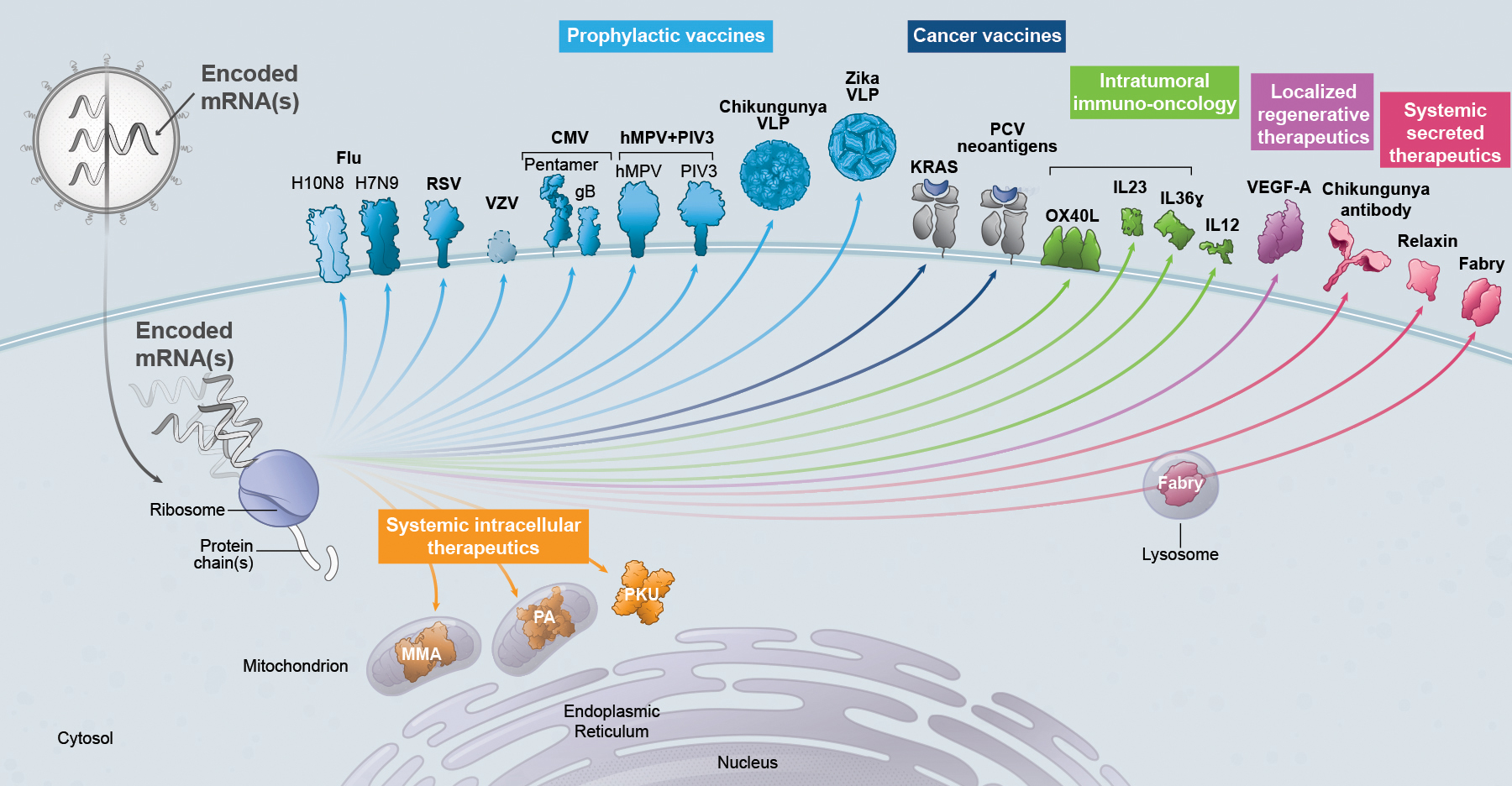
38
Table of Contents

39
Table of Contents
Portfolio-wide evidence in support of our platform and approach
We have generated significant learnings across our portfolio that we believe provide compelling support for our approach and pipeline across a broad array of human diseases.
We and our strategic collaborators AstraZeneca and Merck have completed IND-enabling GLP toxicology programs to support 15 opened INDs
With any new class of medicine, safety and tolerability is an important consideration for patients and healthy individuals, and helps to define the scope of application. As part of establishing our modalities and initial development pipeline, we conducted a large number of
in vivo
toxicology studies across a wide range of projects. We have sponsored dozens of third-party or internally-conducted
in vivo
toxicology studies since our inception. This includes more than 40 IND-enabling GLP toxicology studies required for regulatory filings.
We currently have
20
development candidates in our pipeline. Fifteen IND-enabling GLP toxicology programs have been completed and supported the opening of INDs by regulators for 15 development candidates to date.
Describing safety and tolerability — early stage clinical data from hundreds of subjects
The translation of preclinical safety and tolerability into the clinic is a key step for each of our programs and in totality supports the creation of a new class of medicines. We continue to generate safety and tolerability data across
11
investigational medicines. Over
1,000
subjects have been enrolled in our clinical trials.
Diverse production of many types of proteins
Our scientists, in conjunction with scientists from Merck and AstraZeneca and other strategic collaborators, have tested over 12,000 unique mRNA sequences in
in vitro
and
in vivo
preclinical studies. This includes over 500
in
vivo
preclinical studies that were designed to show evidence of pharmacologic effect or the production of the desired protein. These studies included the following types of proteins:
|
•
|
Extracellular soluble ligands (e.g., VEGF, IL12, Relaxin, and erythropoietin);
|
|
•
|
Antibodies (e.g., immunoglobulins, which are composed of two light chain and two heavy chain proteins);
|
|
•
|
Extracellular protein complexes (e.g., Chikungunya virus-like particles);
|
|
•
|
Membrane proteins, in some cases as multimers (e.g., F protein, glycoprotein B, CMV pentamer, and OX40L);
|
|
•
|
Intracellular soluble protein complexes (e.g., methylmalonic-CoA mutase homodimer and propionyl-CoA carboxylase heterododecamer);
|
|
•
|
Intracellular membrane proteins with activating mutations (e.g., STING); and
|
|
•
|
Neoantigens presented to the immune system as short peptides.
|
Direct and indirect clinical demonstration of protein production in humans across multiple modalities
Over our eight year history we have had 12 investigational medicines in clinical trials, including our Zika vaccine (mRNA-1325), which we will not further develop. After generating early stage safety and tolerability data, we aim to demonstrate that the mRNA administered makes the desired protein and creates the desired pharmacological effect. We have observed protein production or a resulting pharmacological effect across a number of programs, which is more fully described in the section of this Annual Report on Form 10-K titled “Business—Program Descriptions.”
Pharmacologic effect—immunological responses
In clinical data, we have observed an ability to elicit neutralizing antibodies to viral antigens from our five most advanced prophylactic vaccine programs. For our two influenza vaccines, the RSV vaccine being developed in collaboration with Merck, the Chikungunya vaccine being developed in collaboration with DARPA, and our hMPV+PIV3 vaccine, both the preclinical models and immune responses in humans showed increased antibody levels to pathogenic viral antigens. For PCV (mRNA-4157), which is the most advanced program in clinical development within the cancer vaccines modality, we have observed antigen specific T cell responses in some patients. In the ongoing clinical trial for OX40L (mRNA-2416) in the intratumoral immuno-oncology modality, we have observed early indications of the ability to impact the tumor microenvironment from tumor regression in injected lesions and an adjacent uninjected lesion.
40
Table of Contents
We have demonstrated the ability of our intratumoral immuno-oncology programs to transform immunologically cold tumor microenvironments in preclinical studies for our OX40L, OX40L+IL23+IL36γ, and IL12 programs. These responses include long-term T cell responses that eliminate tumors in animal models and makes them able to combat a second tumor challenge, indicating immunological memory. We also have preclinical evidence of immunological responses for programs in our cancer vaccines modality, including personalized cancer vaccines and KRAS vaccine.
Pharmacologic effect—enzyme-driven changes in metabolic phenotypes
We have tested our ability to impact metabolic phenotypes via the expression of over 24 different types of proteins. We have also progressed four development candidates, methylmalonic acidemia, or MMA, propionic acidemia, or PA, and phenylketonuria, or PKU, and Fabry disease, through early preclinical development efforts. We have demonstrated the ability of our mRNA development candidates to drive metabolic change in animal models for MMA, PA, PKU, and Fabry disease.
Pharmacologic effect—via binding activity and/or signaling activity
We have demonstrated the ability of cells preclinically to make and secrete antibodies and soluble modulating factors that exert their pharmacologic activity by binding to targets and in some cases, having a signaling effect. For example, for our antibody against Chikungunya virus, we have demonstrated an ability to make an antibody against Chikungunya virus and its ability to drive passive immunity in animal models. For our Relaxin program, we have demonstrated an ability to make relaxin as a secreted and engineered protein, which can impact heart failure in preclinical models.
Pharmacologic effect from proteins encoded by mRNA—next wave of potential clinical data
We have several programs currently in or taking steps to enter Phase 1 clinical trials where we will measure the pharmacology of our expressed proteins, as well as direct or indirect evidence of protein production. These programs include:
|
•
|
CMV vaccine (mRNA-1647) in the prophylactic vaccines modality to show the ability to make complex proteins;
|
|
•
|
KRAS vaccine (mRNA-5671) in the cancer vaccines modality to show KRAS neoantigen specific T cells;
|
|
•
|
OX40L+IL23+IL36γ (mRNA-2752) and IL12 (MEDI1191) in the intratumoral immuno-oncology modality to show protein levels, although systemic levels may be limited due to the intratumoral nature of the injection;
|
|
•
|
Antibody against Chikungunya virus (mRNA-1944), Relaxin (AZD7970), and Fabry disease (mRNA-3630) in the systemic secreted protein modality to show serum protein levels; and
|
|
•
|
MMA (mRNA-3704), PA (mRNA-3927), and PKU (mRNA-3283) in the systemic intracellular protein modality to show serum changes in metabolites resulting from active protein in these metabolic pathways.
|
Twelve first-in-human trials since December 2015 and clinical material supply
We invest in capabilities and infrastructure that enable us to execute at scale. We first dosed a subject in a clinical trial occurred in December 2015. We or our strategic collaborators have achieved first-in-human for 12 different mRNA investigational medicines. Eleven of those programs were run and sponsored by us.
Each first-in-human, or FIH, trial involved successful completion of one or more IND-enabling GLP toxicology studies, successful technical development, scale-up and cGMP manufacture of adequate quantities of mRNA drug product, IND or CTA regulatory filings and interactions with health authorities, and successful clinical operations start-up activities. We or our strategic collaborators have run clinical trials in the United States, Europe, and Australia.
Conclusion
We believe that this body of preclinical and clinical data is indicative of our significant progress, and provides a strong foundation for our ongoing mission to create a new class of medicines for patients.
41
Table of Contents
PROGRAM DESCRIPTIONS
Using our platform, we have found solutions to many scientific and technical challenges in order to develop the desirable features of our potential mRNA medicines for different applications. A “modality” refers to a group of potential mRNA medicines with shared product features, and the associated combination of enabling mRNA technologies, delivery technologies, and manufacturing processes.
Each of our modalities is designed to overcome the challenges of delivering the right amount of mRNA to the right tissue at the right times across a variety of applications. In advancing our platform technologies and identifying new product features for novel mRNA medicines, we may designate additional modalities.
We started with prophylactic vaccines as our first modality as we believed there would be lower technical hurdles for vaccines compared to therapeutics. Early formulations of mRNA tended to stimulate the immune system, which is a desired feature for a vaccine, but not therapeutics. In addition, antigens for many viruses tend to be well-characterized and of lower biology risk. Also, dosing regimens for vaccines can require as few as one or two administrations.
I. PROGRAM DESCRIPTIONS IN OUR PROPHYLACTIC VACCINES MODALITY
We designed our prophylactic vaccines modality to prevent or control infectious diseases. Since we nominated our first program in late 2014, this modality has grown to currently include eight programs, all of which are vaccines against viruses. The goal of any vaccine is to safely pre-expose the immune system to a small quantity of a protein from a pathogen, called an antigen, so that the immune system is prepared to fight the pathogen if exposed in the future, and prevent infection or disease.
Within this modality, our portfolio includes programs for both commercial and global health uses. We have strategic alliances with Merck on select commercial vaccines, and with the Biomedical Advanced Research and Development Authority, or BARDA, and the Defense Advanced Research Projects Agency, or DARPA, on global health vaccine programs.
Our pipeline is shown in two formats, with a cell map illustrating the diversity of biology addressed by our mRNA pipeline programs, and a traditional format that shows the current stages of development of our pipeline programs, in the section of this Annual Report on Form 10-K titled “Business—Our Pipeline.”
Opportunity
Vaccines to prevent infectious diseases are one of the great innovations of modern medicine. In the United States alone, the Centers for Disease Control and Prevention estimates that childhood vaccinations given in the past two decades will in total prevent 322 million Americans from falling ill, 21 million hospitalizations, 732,000 deaths, $295 billion of direct costs, and $1.3 trillion in social costs. The commercial opportunity for vaccines is significant, with more than $35 billion in annual worldwide sales, including 16 different vaccine products each generating more than $500 million in annual worldwide sales in 2017.
Our approach
Our vaccine research approach starts by identifying the antigens most likely to induce a protective immune response against a specific infectious disease. We test one or more antigens
in vivo
in multiple animal species. The immune response can be measured in multiple ways including:
|
•
|
Generation of binding antibodies, where the antibodies generated by the vaccine bind to the pathogen antigens being targeted;
|
|
•
|
Generation of neutralizing antibodies, where the antibodies generated by the vaccine are able to prevent the pathogen from infecting cells;
|
|
•
|
Ability of the vaccine to protect vaccinated animals against a pathogen, as measured by reductions in detectable pathogen or by the survival of the challenged animal if the pathogen is lethal; and
|
|
•
|
Generation of an antigen specific T cell response.
|
Clinical correlates of protection are levels of immune response that when achieved in response to vaccination are associated with protection against infection or disease. Influenza, for instance, has an established correlate of protection based on the serum hemagglutination inhibition, or HAI, assay. HAI titers of 40 or above are associated with 50% to 70% protection against influenza. However, such correlates are generally only available for approved vaccines. As a result, new vaccines generally, but not always, have to demonstrate efficacy against clinical disease before being approved. Our first two programs in this modality are H10N8 and H7N9 vaccines for an established antigen with HAI clinical correlates.
Typically, subjects require only a limited number of administrations of a vaccine to confer long-lasting protection. Many of our mRNA vaccines are developed to be administered in two doses, one to prime the immune response and the second to boost it. In cases where
42
Table of Contents
populations have been exposed to the virus previously, such as with many respiratory viruses, a subject might be administered a single dose of an mRNA vaccine.
We believe that our potential mRNA vaccines will have a more standardized manufacturing process compared to traditional vaccines that would provide considerable advantages. Current approaches include attenuation and replication of live viruses and cell-culture methods to produce recombinant antigens. These approaches require considerable customization compared to the standardized process of producing mRNA vaccines.
We believe the inherent characteristics of mRNA, coupled with our strategy to execute at scale, will allow us to bring potential mRNA vaccines to the clinic in a relatively short period of time. We have chosen to be methodical for our early programs to understand the technology risks within the modality. If needed, as in the case of a pandemic, we could potentially exploit the scalability of mRNA medicines and our infrastructure to rapidly advance a potential mRNA vaccine to the clinic.
PROPHYLACTIC VACCINES MODALITY: COMMERCIAL PROGRAMS
RSV vaccine (mRNA-1777): Summary
Our RSV vaccine program completed dosing in a Phase 1 clinical trial and based on the interim data and other considerations, our strategic collaborator Merck has initiated Phase 2a planning
Respiratory syncytial virus, or RSV, is one of the most common causes of respiratory disease in infants and the elderly. More than 86,000 children and about 177,000 older adults are hospitalized due to RSV associated respiratory infections each year in the United States. To date, no effective vaccine to prevent RSV has been approved, and the only approved prophylaxis treatment is limited to the monoclonal antibody palivizumab, marketed as Synagis in the United States for pediatric patients at high risk for RSV infection. In collaboration with Merck, we designed mRNA-1777 to encode a membrane-anchored version of stabilized prefusion F protein, the main target of potently neutralizing and protective antibodies. This vaccine is administered as a single dose with no boost. The Phase 1 trial is currently ongoing in Australia, for which we are the sponsor. Merck has initiated plans for a Phase 2a trial, for which Merck will be the sponsor. In addition, we are working with Merck to identify and advance improvements to the RSV vaccine.
RSV vaccine (mRNA-1777): Disease overview
RSV impacts young children and older adults, and no approved vaccine exists today
RSV causes upper and lower respiratory tract illness worldwide and is transmitted primarily via aerosolized droplets from an infected person, or via contamination of environmental surfaces with infectious secretions. Following introduction of RSV into the nose or upper respiratory tract, the virus replicates primarily in the ciliated cells of the respiratory epithelium. Upper respiratory symptoms typically begin within several days of exposure. In healthy adults, the infection may remain confined to the upper respiratory tract. However, in those with compromised immune systems, such as premature infants, the elderly, or individuals with underlying respiratory disease, lower respiratory tract infections commonly occur and may manifest as wheezing, bronchiolitis, pneumonia, hospitalization or even death. Infections with RSV follow a seasonal pattern, occurring primarily in the Northern hemisphere between the months of November and April, and in the Southern hemisphere primarily between March and October.
More than 86,000 children are hospitalized due to RSV infection each year in the United States. About 177,000 older adults are hospitalized each year in the United States due to RSV-associated respiratory infections, with approximately 14,000 deaths as a result. RSV infection is common in adults over the age of 60 years, occurring in an average of 5.5% of older adults every season and resulting in physician’s visits for 17% of infected older adults. The cost of RSV disease to society can be considerable.
43
Table of Contents
RSV vaccine (mRNA-1777): Our product concept
Prevent RSV infections with an improved RSV antigen using a single vaccine dose
Our RSV investigational medicine, mRNA-1777, includes an mRNA encoding an engineered form of the RSV fusion (F) glycoprotein stabilized in the prefusion conformation in an LNP. The F protein is present as a homotrimer on the surface of RSV. The prefusion conformation of the F protein interacts with a host cell membrane, and the conformational change from prefusion to postfusion drives virus fusion with a host cell. The majority of RSV-specific neutralizing antibodies in convalescent people are directed to epitopes present only on the prefusion conformation of the F protein. The prefusion state of the F protein elicits a superior neutralizing antibody response compared to the postfusion state in animal studies conducted by others. A schematic of the prefusion F protein on the surface of a host cell, with sites recognized by neutralizing antibodies, is depicted in the figure below; the inset on the left of the figure shows the intended design of the mRNA formulated in LNP, and the inset on the right shows the intended prefusion F protein on the surface of the cell. We believe that neutralizing antibodies elicited by mRNA-1777 may lead to an efficacious RSV vaccine.

RSV vaccine (mRNA-1777): Preclinical information
mRNA vaccines encoding different versions of the prefusion F protein have been evaluated in mice, cotton rats, and African green monkeys, or AGM. These studies demonstrate that mRNA vaccines encoding the prefusion F protein induce robust neutralizing antibody titers in preclinical species tested, do not lead to vaccine-enhanced respiratory disease (evaluated in cotton rats), and are protective against RSV challenge (evaluated in cotton rats and AGM). The data for a study in AGM are shown in the figure below. In this study, one group of AGM (4 per group) was vaccinated intramuscularly with vaccine, a second group was infected with 5.5 log
10
plaque forming units, or pfu, of RSV strain A2 intranasally as a positive control, and a third group received no vaccine as a negative control, each on weeks 0, 4, and 8. Serum neutralizing antibody titers, or SN titers, were measured on the indicated weeks and are shown in panel A. All animals were challenged intranasally and intratracheally on study week 10. On multiple time points after the challenge, virus present in bronchoalveolar lavage, or BAL, fluid was quantified by plaque assay as shown in panel B. In this study, we observed an increase in serum neutralizing titers with each vaccine dose. The animals that received mRNA-1777 showed complete protection (no virus detected) in lungs, similar to the control group immunized with RSV A2. These results are shown in the figures below.
44
Table of Contents
Serum neutralizing titers for mRNA-1777 in non-human primate study
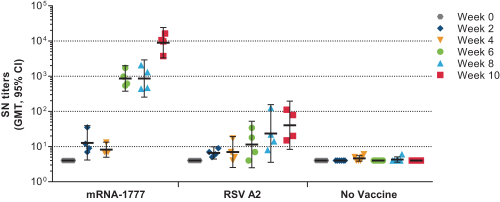
Panel (A)
Lung viremia detected post challenge in non-human primate study with mRNA-1777
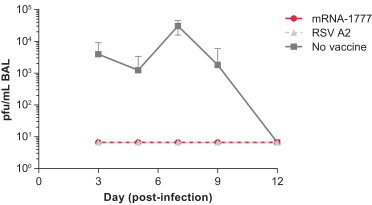
Panel (B)
RSV vaccine (mRNA-1777): Clinical data
The Phase 1 trial in Australia has generated safety and tolerability data and demonstrated immunogenicity through day 90; based on the interim data and other such considerations, Merck has initiated planning for a Phase 2a trial
The Phase 1 trial for RSV vaccine has met its objectives of assessing the safety and tolerability profile of mRNA-1777 versus placebo including capturing solicited and unsolicited local and systemic adverse events. The Phase 1 trial for RSV vaccine has also demonstrated immunogenicity and we have observed a humoral immune response as measured by neutralizing antibody titers against RSV A for dose levels one, two, and three of mRNA-1777. Based on the interim data and other considerations, Merck has initiated planning for a Phase 2a trial.
The mRNA-1777 Phase 1 study is a randomized, partially double-blind, placebo-controlled, dose-escalation first-in-human study to describe the safety, tolerability, and immunogenicity in healthy adult subjects in Australia. We are the sponsor for this trial. The study evaluated three dose levels in healthy younger adults, and 4 dose levels in healthy older adults. All subjects were given a single intramuscular injection. The key objectives of the study included:
|
•
|
assess the safety and tolerability of mRNA-1777 versus placebo; and
|
|
•
|
determine the immunogenicity of mRNA-1777 by measuring serum neutralizing antibody titers against RSV.
|
The key endpoints for the study included safety and tolerability of mRNA-1777.
The study is being conducted in two parts. Part A evaluates healthy younger subjects (ages
>
18 and
<
49 years) and Part B evaluates healthy older subjects (ages
>
60 and
<
79 years). There are four dose levels, where the highest dose, or dose four, is twelve times the lowest dose, or dose one, and dose three, the second highest dose, is eight times the lowest dose. In Part A, dose levels one, two, and three are being evaluated. The safety data from the sentinel safety group for each dose level was reviewed before permitting enrollment of the expansion group within that dose level cohort. The safety data of each expansion group was reviewed before
45
Table of Contents
permitting dose escalation/enrollment of the sentinel safety group at the next dose level. In Part B, all four dose levels are being evaluated. The first sentinel dose cohort was triggered after review of the first sentinel dose level cohort in Part A. The safety data from the sentinel safety group for each dose level cohort was reviewed before permitting enrollment of the expansion group within that dose level cohort. The safety data of each expansion group was reviewed before permitting dose escalation/enrollment of the sentinel safety group at the next dose level. Part B includes the highest dose level, dose four, which was enrolled after review of the available safety and immunogenicity data of the preceding Part B dose level cohorts. Expansion groups in Part A and B were both randomized 3:1 mRNA-1777: placebo.
This 200-subject study is fully enrolled and all subjects have been dosed. As of April 9, 2018, we have the majority of data through three months (90 days) post-vaccination for younger subjects in dose levels one and two, and for older subjects in doses one, two, and three. Based on the interim data as of April 2018, dose levels one, two, and three of mRNA-1777 were observed to elicit a humoral immune response as measured by neutralizing antibody titers against RSV A, neutralizing antibody titers against RSV B (dose level three only, dose levels one and two have yet to be assayed), absolute serum antibody titers to RSV prefusion F protein and RSV postfusion F protein, and competing antibody titers to RSV prefusion F protein in a dose-dependent manner up to dose level two in both younger and older subjects. The immune response measured by neutralizing antibody titers against RSV A in older adults that received dose level three of mRNA-1777 was not higher than that of the subjects that received dose level two. We have observed an increase in neutralizing antibody titers relative to placebo in younger adult subjects in panel A and older adult subjects in panel B who received our RSV vaccine, as shown in the figure below. In the figure, geometric mean titer and 95% confidence interval are depicted by time for neutralizing antibody titers against RSV A for older and younger subjects. At day ninety, between 10 and 19 healthy younger subjects and between 11 and 27 healthy older subjects were tested at each dose level. Based on the interim data and other considerations, Merck has initiated planning for a Phase 2a trial.
Neutralizing antibody titers in healthy younger subjects
[Ages
>
18 and
<
49 years] in Phase 1 trial for mRNA-1777 per protocol set
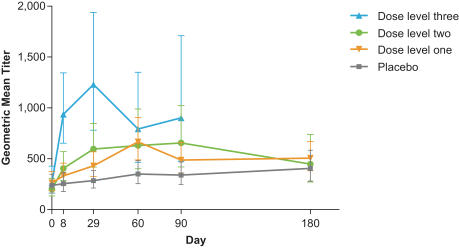
Panel (A)
46
Table of Contents
Neutralizing antibody titers in healthy older subjects
[Ages
>
60 and
<
79 years] in Phase 1 trial for mRNA-1777 per protocol set
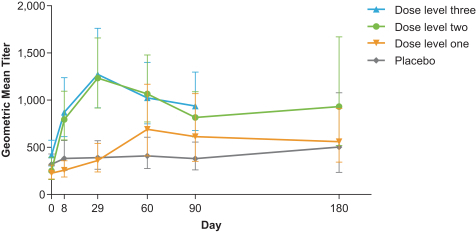
Panel (B)
In addition, based on interim data as of April 2018, we observed an increase in T cell response relative to baseline at day 15 and day 60 in both healthy younger and healthy older adult subjects vaccinated with doses two and three of mRNA-1777.
Based on interim safety data as of April 9, 2018, mRNA-1777 was well tolerated with no dose limiting toxicities at dose levels one, two, and three in both the younger and older adults. As of September 2018, the highest dose level, which was evaluated in older subjects only, dose level four, was not as well tolerated as the lower dose levels. However, across all treatment arms, there were no treatment-related serious adverse events, or SAEs, treatment emergent adverse events, or TEAEs, leading to withdrawals, adverse events, or AEs of special interest, or new onset of chronic illnesses or autoimmune disorders in either of the age cohorts. There were no patterns in clinically significant laboratory abnormalities.
As of September 19, 2018, we have observed 15 SAEs in nine subjects, all of which were deemed unrelated to study product. These SAEs occurred approximately one to ten months from receipt of study product and included aortic aneurysm repair, paralytic ileus, spinal decompression, death from pre-existing cardiomyopathy, hernia, transient ischemic attack, peripheral vascular disorder, vasovagal syncope, diagnosis of non-small cell lung cancer, anterior cruciate ligament tear, left knee tendon tear, right knee tendon tear, left patella dislocation, right patella dislocation, and bilateral patella tendon repair.
The trial is ongoing and, consistent with the study protocol, we remain blinded to treatment at the individual subject level and continue to collect safety, tolerability, and immunogenicity data through day 365 of the study. Based on the interim safety, tolerability, and immunogenicity data, Merck has initiated plans for a Phase 2a trial for mRNA-1777.
47
Table of Contents
CMV vaccine (mRNA-1647): Summary
Our CMV program targets congenital CMV infections to reduce or prevent birth defects
Congenital cytomegalovirus, or CMV, infection is the leading cause of birth defects in the United States. Despite several attempts, to date, there is no vaccine approved to prevent congenital transmission of CMV. We believe that in addition to the glycoprotein B, or gB, protein antigen, a successful CMV vaccine would need to include the Pentamer, a 5-protein membrane-bound antigen complex required for epithelial, endothelial, and myeloid cell infection by the virus. A CMV vaccine containing the Pentamer as a recombinant protein or a replication defective virus is complex to make and scale. We used our platform to generate an mRNA vaccine designed to make the Pentamer in its natural membrane-bound conformation. This investigational medicine is designed to prevent or control CMV infection and includes five mRNAs encoding for the Pentamer, as well as one mRNA encoding for CMV gB that has previously demonstrated partial clinical efficacy. Our program is currently being tested in a Phase 1 clinical trial in the United States.
CMV (mRNA-1647): Disease overview
CMV is a major cause of birth defects with no approved vaccine
Human CMV is a common human pathogen and member of the herpes virus family. Seropositivity, demonstrating prior exposure to virus, increases with age and is approximately 40-60% in women of child-bearing potential in the United States. However, general awareness of CMV is not high. Less than 10-20% of adults are aware of CMV and most healthy adults after initial (primary) CMV infection do not have symptoms. However, approximately 0.6-0.7% of newborns are congenitally infected by CMV annually in industrialized countries. Congenital CMV results from infected mothers transmitting the virus to their unborn child and it is the leading cause of birth defects, with approximately 25,000 newborns per year in the United States infected. Birth defects occur in approximately 20% of infected babies and include permanent neurodevelopmental disabilities, which can include hearing loss (often permanent), vision impairment, varying degrees of learning disability, decreased muscle strength and coordination, and even death. Some studies report approximately one-third of infants with severe congenital disease will die within the first year of life, and the survivors, their caregivers, and health systems bear significant long-term burdens.
There is currently no available vaccine for CMV, and many previous attempts at developing a vaccine to reduce or prevent congenital transmission have been missing a key antigen, the Pentamer. We believe the Pentamer is critical for the infection of epithelial, endothelial, and myeloid cells by the virus. We believe the Pentamer was not included in certain prior recombinant protein vaccine attempts due to the complexity of producing it as a multi-unit antigen complex. Prior vaccine studies demonstrated insufficient efficacy against CMV infection and limited durability of immune response. A vaccine that leads to durable immunity in women of child-bearing age would address a critical unmet need in the prevention of congenital CMV infection.
CMV vaccine (mRNA-1647): Our product concept
We are developing a single vaccine with complex antigens to prevent or control infection
Our ability to generate a multi-antigen vaccine enables us to combine a traditional target antigen (gB) with the Pentamer in order to specifically focus the immune system on these important antigens. We believe this gives us greater potential to produce neutralizing antibodies that can block CMV transmission from the mother to the fetus. Our approach to block transmission could either be:
|
•
|
direct, by vaccinating adolescents or adults of child-bearing potential (female and male); or
|
|
•
|
indirect, by vaccinating toddlers who could spread CMV to each other, their mothers, and their childcare workers.
|
Unlike a protein-based or live-attenuated vaccine, our mRNA instructs cells to specifically make predetermined antigens with a structure that mimics the one presented to the immune system by the virus, thus focusing the immune system on these important antigens.
mRNA-1647 comprises six mRNAs that encode for these known hard-to-make CMV antigens in a proprietary LNP:
|
•
|
In CMV seropositive individuals, the majority of neutralizing antibodies target the Pentamer. The CMV Pentamer is made by five CMV glycoproteins that form a membrane-bound complex. The Pentamer is required for CMV entry into epithelial, endothelial, and myeloid cells. The mRNA-expressed Pentamer is displayed on the surface of the cell and stimulates the production of neutralizing antibodies that prevent the virus from entering the cells.
|
|
•
|
gB is a trimeric CMV membrane glycoprotein that abundantly resides on the surface of the viral particles. Fusion between virus and host cells, and hence infection, requires gB. Antibodies to gB can prevent CMV infection. gB has been utilized in some earlier attempts at a CMV vaccine as the sole antigen which had resulted in partial efficacy but not at levels sufficient for approval.
|
48
Table of Contents
An illustration of our proposed approach for CMV is shown in the figure below.
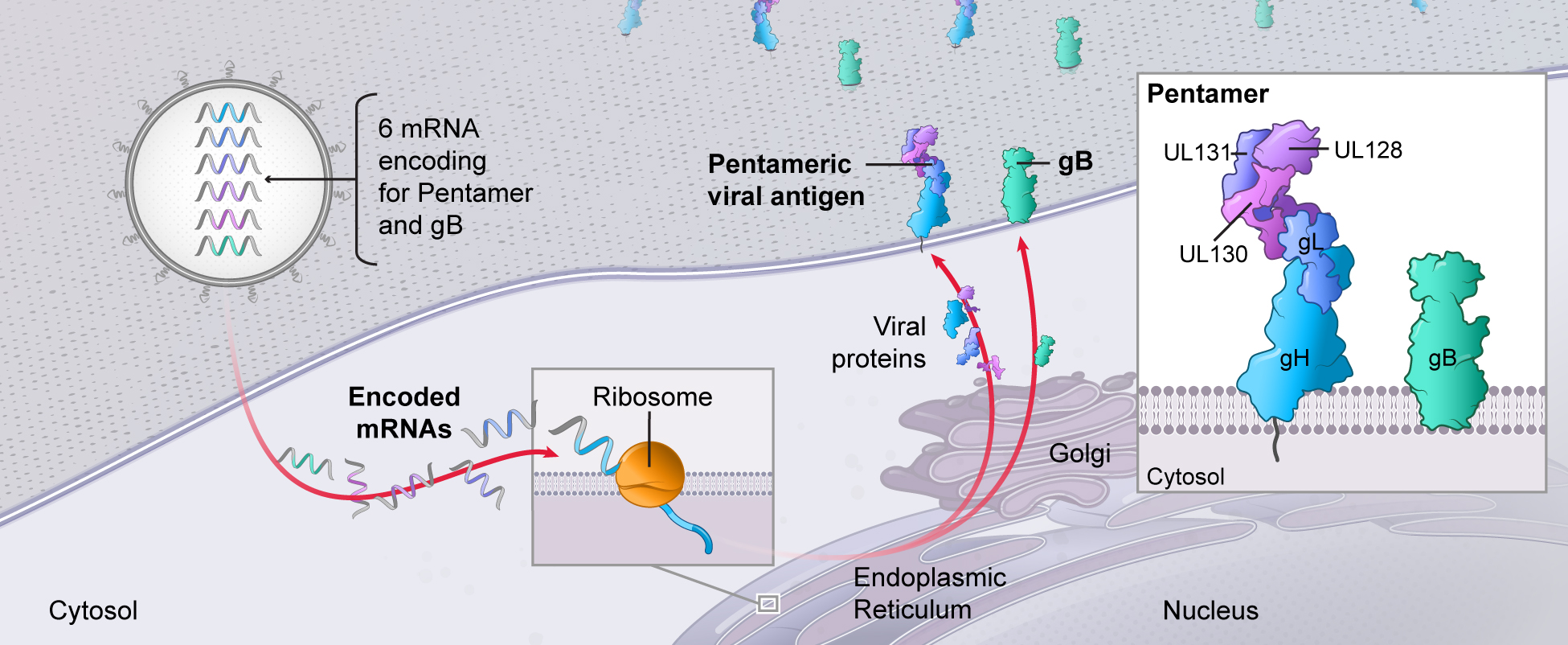
CMV vaccine (mRNA-1647): Preclinical information
We have published preclinical data for our CMV vaccine
We have demonstrated that the Pentamer and gB mRNAs can elicit potent and durable antibody titers against the antigens in mice and non-human primates, and have published these results in
Vaccine
in 2018. In one study, mice were immunized with the Pentamer and gB mRNAs encapsulated in our proprietary LNP. Serum samples were taken from the mice at specific timepoints post vaccination. Post-vaccination neutralizing titers were measured by admixing serial dilutions of each sample with CMV virus, incubating the mixture in a human primary epithelial cell culture, and counting the number of infected cells. We used CytoGam, an approved product for prevention of CMV in transplant patients, as a control in our experiment. CytoGam is cytomegalovirus immune globulin from pooled plasma of CMV seropositive donors. The table below shows the neutralization antibody titers in epithelial cells for escalating vaccine doses in mice, demonstrating our ability to generate neutralizing antibodies. We also observed that at the highest dose, our mRNA vaccine generated a response more than 75-fold higher than CytoGam at estimated clinical levels. In addition, we have also observed that the Pentamer and gB mRNAs can elicit strong T cell responses.
Neutralizing titers in human primary epithelial cells for escalating CMV mRNA vaccine doses in mouse study
|
Dose for vaccine including the Pentamer and gB in our proprietary LNP
|
At 41 days
|
|
|
Neutralization titers in
epithelial cell |
||
|
1.2 µg
|
58,336
|
|
|
3.5 µg
|
682,989
|
|
|
10.5 µg
|
457,913
|
|
|
CytoGam comparator (used at maximum concentration of 2 mg/ml observed in human serum)
|
5,905
|
|
CMV vaccine (mRNA-1647): Clinical plan
We are currently conducting a Phase 1 trial in the United States
This Phase 1 trial is a randomized, observer-blinded, placebo-controlled, dose-ranging study to evaluate the safety and immunogenicity of mRNA-1647 in healthy adults in the United States. The study is designed to administer the vaccine as a 3-dose vaccination schedule (0, 2, and 6 months) at dose levels of 30, 90, 180, and 300 µg and a dose level to be determined, depending on safety review of arm 1 in both CMV-seronegative and CMV-seropositive subjects. Key objectives of the study include the evaluation of:
|
•
|
safety and reactogenicity of different dose levels of mRNA-1647; and
|
|
•
|
neutralizing anti-CMV antibody responses against epithelial cell and fibroblast cell infection following vaccination.
|
49
Table of Contents
Key endpoints for the study include safety, tolerability, and reactogenicity.
Subsequent to the initiation of our Phase 1 study for mRNA-1647, we developed a modified manufacturing process that demonstrated improved pharmaceutical properties in preclinical testing. We elected to introduce this modified process into mRNA-1647 under the same IND. Consequently, prior to our receipt of any immunogenicity data, we modified our trial design to test the original and modified manufacturing process for mRNA-1647.
The trial schematic is shown in the figure below. Our Phase 1 trial comprises dose-escalation phase A, dose-escalation and dose-selection phases B, and sentinel-expansion phase C. Only CMV-seronegative subjects are enrolled into dose-escalation phases A and B and the sentinel cohorts of Phase C, and both CMV-seronegative and -seropositive subjects are enrolled at a 1:1 ratio into dose-selection phases A and B and the expansion cohorts of phase C. Dose-escalation phase A evaluated mRNA-1647 manufactured with the process originally filed in the IND, and phases B and C are evaluating mRNA-1647 manufactured with a modified process. For dose-escalation phases A and B, there is sequential enrollment of subjects into the 30, 90, or 180 µg dose levels of study vaccine or placebo, starting at the 30 µg dose level. Internal safety review of all subjects at each dose level permit enrollment of subjects into the next dose level. For dose-escalation phases A and B, the safety monitoring committee, or SMC, will review the safety data from all subjects after the second vaccination to permit enrollment into the corresponding dose-selection phase. Since dose-escalation phase A included the mRNA-1647 manufactured using the process originally filed in the IND, and we prefer the modified manufacturing process included in phases B and C, the drug product manufactured using the original manufacturing process is not being progressed to dose-selection. Phase C is split into arm 1 and arm 2, with arm 1 enrolling subjects into the 300 µg dose level, and arm 2 enrolling subjects into a dose level to be determined, depending on safety review of arm 1.
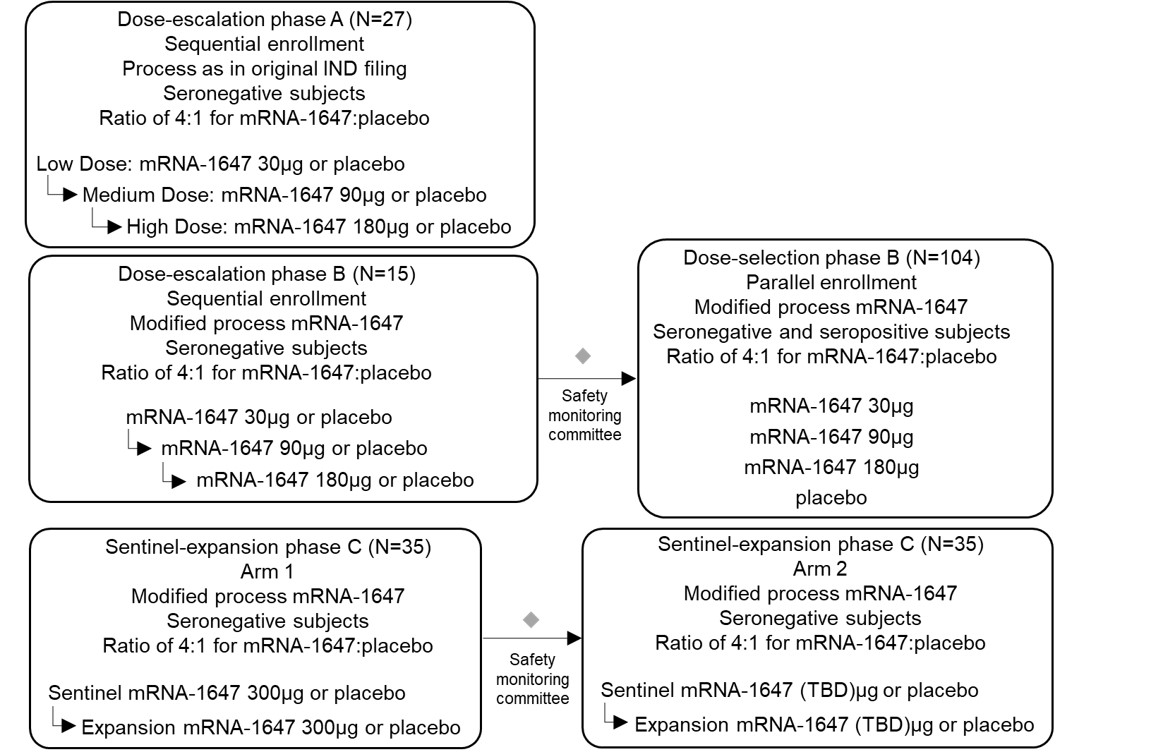
Dose-escalation phases A and B have completed all vaccinations. Based on unblinded SMC reviews of safety data after the second vaccination at the 180 µg dose level in phases A and B, the SMC approved continuation of the trial. As of March 6, 2019, 103 subjects have received the first vaccination in the dose-selection phase B of mRNA-1647, and 33 of those subjects have received the second vaccination. Given the blinded safety and tolerability profile observed, we plan to test two higher dose levels in sentinel-expansion phase C. Results from this Phase 1 trial will inform the dose levels of mRNA-1647 that we plan to test in a Phase 2 trial.
50
Table of Contents
hMPV+PIV3 vaccine (mRNA-1653): Summary
We are developing a vaccine to address two viruses that are leading causes of respiratory infection
Human metapneumovirus, or hMPV, and human parainfluenza virus 3, or PIV3, are important causes of respiratory tract infections in children. Despite the substantial impact hMPV and PIV3 have on human health, attention and research on these viruses have lagged relative to RSV. To date, no vaccine to prevent hMPV or PIV3 infections has been approved. Our platform allows us to combine mRNAs encoding antigens for the two pathogens in one combination vaccine, enabling a single vaccine that could protect against both respiratory infections. In our approach, we utilize mRNA sequences encoding for the membrane F proteins for each of the viruses. We have developed experience with the related F protein from our RSV program with Merck. mRNA-1653 is currently being tested in a Phase 1 trial in the United States.
hMPV+PIV3 vaccine (mRNA-1653): Disease overview
hMPV and PIV3 have a substantial impact on human health yet have lagged in research and attention relative to RSV
There is no approved vaccine for hMPV although this RNA virus has been determined to be one of the more frequent causes of upper and lower respiratory tract infections. hMPV has been detected in 4% to 15% of patients with acute respiratory infections. hMPV causes disease primarily in young children but can also infect adults, the elderly, and immunocompromised individuals. Clinical signs of infection range from a mild upper respiratory tract infection to life-threatening severe bronchiolitis and pneumonia. hMPV was discovered in 2001 and identified as a leading cause of respiratory infection.
There is no approved vaccine for PIV3 although this RNA virus is recognized as an important cause of respiratory tract infections in children. Infections from parainfluenza virus, or PIV, account for up to 7% of acute respiratory infections among children younger than 5 years. Of the four PIV types identified, PIV3 most frequently results in infections and leads to the more serious lower respiratory tract infections compared to the other three PIV types. Though PIV3 related infections were identified in the past, awareness of their burden to patients and hospitals has risen over the past several years.
The majority of hMPV or PIV3-associated hospitalizations in children occur under the age of 2 years. Despite the substantial impact hMPV and PIV3 have on human health, attention and research on these viruses have lagged relative to RSV. Awareness of hospitalizations due to hMPV or PIV3 infections have risen, and we believe that a single vaccine intended for active immunization of infants and toddler against both hMPV and PIV3 would be valuable. Previous attempts at developing a vaccine have focused on only hMPV or PIV alone with no known attempts at a combination vaccine.
hMPV+PIV3 vaccine (mRNA-1653): Our product concept
Our approach is to develop a combination vaccine for all infants and toddlers
mRNA-1653 is a single investigational vaccine consisting of two distinct mRNA sequences that encode the membrane F proteins of hMPV and PIV3, co-formulated in our proprietary LNP as shown in the figure below.
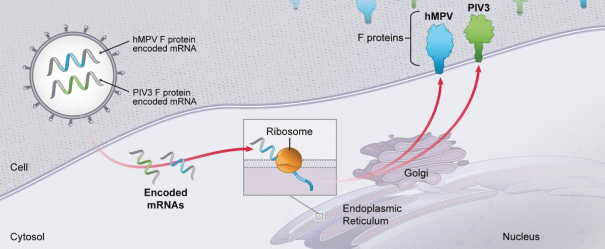
51
Table of Contents
hMPV+PIV3 vaccine (mRNA-1653): Preclinical information
Our mRNA vaccine is immunogenic in multiple species
We have evaluated multiple combinations for hMPV+PIV3 mRNA vaccines encoding full-length F proteins for hMPV and PIV3 viruses in mice, Sprague Dawley rats, cotton rats, and African green monkeys, or AGM, each following intramuscular, or IM, injection. These studies demonstrate that mRNA encoding for F proteins from these viruses induce robust neutralizing antibody titers in all species tested. For example, neutralizing antibody titers for mRNA encoding for F proteins of hMPV and PIV3 encapsulated in LNP in mice are shown in the figure below. C57Bl/6 mice were immunized with 0.33, 2, or 12 µg of formulated material intramuscularly on study days 1 and 29. Neutralizing antibody titers were measured in serum collected on day 43. Results are represented as geometric mean titers, or GMT, of seven mice per group. In the figure below, neutralizing antibody titers in mice after immunization with mRNA for hMPV and PIV3 in our proprietary LNP by hMPV (left panel) and PIV3 (right panel) are depicted along with the lower limit of quantification, or LLOQ, of the assay.
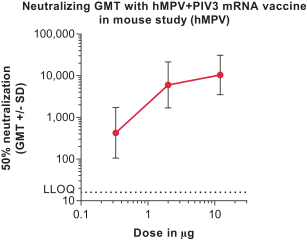
|

|
|
52
Table of Contents
Neutralizing antibodies are thought to be important for protection against hMPV and PIV3. The titer of neutralizing antibodies induced by natural infection from hMPV or PIV3 can be used to benchmark the titers induced by our hMPV+PIV3 vaccine in preclinical models and in our clinical trial. We determined the geometric mean neutralizing antibody titer for 15 seropositive adult donors to be 3,807 (range 499 to 20,751) for hMPV, and 263 (range 47 to
>
1024) for PIV3. Our hMPV+PIV3 mRNA vaccine induces a similar neutralizing antibody titer in mice after 2 vaccinations of the dose levels evaluated as shown in the figure above, and we believe it has the potential to confer protection in humans.
We have demonstrated that our hMPV and PIV3 mRNA combination vaccine does not lead to vaccine-enhanced respiratory disease (evaluated in cotton rats) and is protective against hMPV or PIV3 viral challenge (evaluated in cotton rats and AGM).
hMPV+PIV3 vaccine (mRNA-1653): Clinical plan
We are currently conducting a Phase 1 trial in the United States
The mRNA-1653 Phase 1 study is a blinded, randomized, observer-blind, placebo-controlled, dose ranging first-in-human study to evaluate the safety and tolerability, reactogenicity, and immunogenicity of mRNA-1653 in healthy adult subjects in the United States. The study evaluates four dose levels of mRNA-1653 (25, 75, 150, and 300 µg) administered intramuscularly at day one and month one, with the one-month immunization randomized to be mRNA-1653 or placebo in the dose selection phase of the study.
The key objectives of the study include evaluating:
|
•
|
safety and reactogenicity of mRNA-1653 through 28 days after the last vaccination;
|
|
•
|
humoral immunogenicity of mRNA-1653 through 28 days after the last vaccination;
|
|
•
|
optimal dose and vaccination schedule of mRNA-1653 for further clinical development; and
|
|
•
|
safety of mRNA-1653 through 12 months after the second vaccination.
|
The key endpoints for the study include safety and tolerability of mRNA-1653.
The schematic of the trial is shown in the figure below. In the dose-escalation phase, there is sequential enrollment into one of the four dose levels of mRNA-1653 or placebo. Advancement to the next dose level is permitted after an internal safety review. In the dose-escalation phase, five subjects will be randomly assigned in a 4:1 ratio to receive mRNA-1653 or placebo. The safety monitoring committee, or SMC, reviews safety data after dose-escalation enrollment is completed to permit enrollment into the dose-selection phase at the three highest dose levels with acceptable safety profiles. In addition, the SMC periodically reviews safety data during the dose-selection phase.
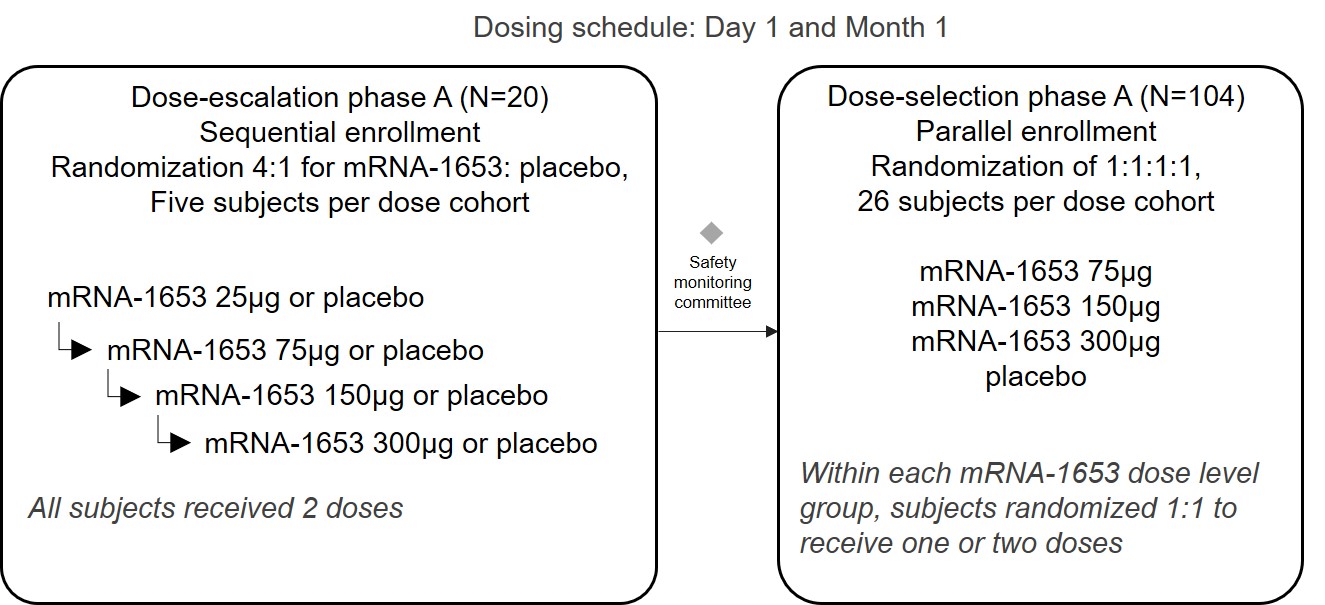
The study is fully enrolled with 124 subjects and subjects have received both doses. Based on an unblinded evaluation of safety data from the dose-escalation phase by the SMC, the three highest dose levels (75, 150, and 300 µg) are being evaluated in the dose-selection phase. The study is currently in the follow-up phase.
Interim data from the Phase 1 trial showed that a single vaccination with mRNA-1653 boosted serum neutralization titers against hMPV and PIV3, and that the magnitude of the boost was similar at all dose levels tested. Consistent with prior exposure to hMPV and PIV3, all study participants had neutralizing antibodies against both viruses at baseline. One month after a single mRNA-1653 vaccination, the hMPV neutralization titers were approximately six-fold greater than baseline and PIV3 neutralization titers were approximately three-fold greater than baseline (based on geometric mean ratios). A second mRNA-1653 vaccination one month after
53
Table of Contents
the first vaccination did not further boost antibody titers. mRNA-1653 was found to be generally well tolerated. No SAEs, adverse events of special interest, or adverse events leading to withdrawal were reported. Injection site pain was the most commonly reported AE and the most common grade 3 AE. We plan to further evaluate mRNA-1653 in the clinic, including in a Phase 1b trial in pediatric subjects.
54
Table of Contents
VZV vaccine (mRNA-1278): Summary
In collaboration with Merck, we aim to develop a varicella zoster virus vaccine with efficacy comparable to Shingrix
Shingles is caused by reactivation of the virus that causes Chicken Pox, varicella zoster virus, or VZV. This painful infection causes a rash and can cause postherpetic neuralgia, a debilitating ongoing nerve pain. In addition, it is highly contagious. The most effective vaccine on the market is Shingrix by GlaxoSmithKline, for which two dose-series of the adjuvanted subunit vaccine is more than 90% effective at preventing shingles in adults 50 years and older. In collaboration with Merck, our goal is to develop a VZV vaccine with efficacy comparable to Shingrix.
VZV vaccine (mRNA-1278): Our product concept
We are developing an mRNA vaccine formulated in lipid nanoparticle
mRNA-1278 is an mRNA vaccine encoding a VZV antigen formulated in a proprietary LNP.
VZV vaccine (mRNA-1278): Preclinical information
In collaboration with Merck, we have observed an antibody response comparable to Shingrix and a T cell response
mRNA-1278 has been evaluated in mice and non-human primates, or NHPs, following intramuscular injection and induces robust antigen-specific antibody and T cell responses. An IND-enabling GLP toxicology program for mRNA-1278 is ongoing.
VZV vaccine (mRNA-1278): Clinical plan
Merck may sponsor and conduct a Phase 1 trial.
55
Table of Contents
PROPHYLACTIC VACCINES: GLOBAL HEALTH PROGRAMS
Our global health portfolio for prophylactic vaccines seeks to leverage our mRNA technology to address epidemic and pandemic diseases. We are currently working with strategic collaborators such as BARDA and DARPA to fund and support our programs within this area. The first programs in this portfolio, H10N8 vaccine and H7N9 vaccine, helped identify and overcome the technical challenges with mRNA vaccines and could eventually address pandemics for these viruses. We have also gone from mRNA sequence to a first-in-human trial for Zika vaccine in twelve months. We have leveraged our learnings to rapidly advance a potential mRNA vaccine for a Zika pandemic. As we continue to build infrastructure and capabilities in the Research Engine and Early Development Engine, we believe we can help address future pandemics rapidly.
H10N8 vaccine (mRNA-1440) and H7N9 vaccine (mRNA-1851): Summary
Our H10N8 and H7N9 investigational vaccines demonstrate the potential of our platform to respond to an influenza pandemic
Influenza is one of the most variable and deadly infectious diseases, ranging from 12,000-56,000 deaths per year in the United States alone. The antigens in circulating seasonal influenza strains change slightly, which is called antigenic drift, from one year to the next, necessitating a change in the vaccine to match the new strains. Potential pandemic influenza strains can arise very quickly from substantial changes in antigens, which is called antigenic shift, and because pre-existing immunity is nonexistent in some populations, they can be pathogenic. Addressing a potential pandemic requires the ability to produce an effective vaccine rapidly. We believe that our platform enables the rapid development of safe and effective vaccines. As a proof of concept, we developed vaccines for H10N8 and H7N9 avian influenza strains, where there is a quantitative correlate for protection in humans (hemagglutinin inhibition, or HAI, titer of
>
1:40). We have observed tolerability and immunogenicity in Phase 1 clinical trials for both mRNA vaccines for H10N8 and H7N9 and have published the interim data for H10N8 in
Molecular Therapy
in 2017. We do not intend to progress these programs through clinical development on our own. We may advance these programs with government or other grant funding.
H10N8 vaccine (mRNA-1440) and H7N9 vaccine (mRNA-1851): Disease overview
Traditional vaccines cannot respond easily to a new influenza pandemic
Influenza A is an RNA virus, with a genome packed into eight individual gene segments that code for at least eleven functional proteins needed for infection, replication, and evasion of host antiviral responses. The two major glycoproteins expressed on the surface of the virion are hemagglutinin, or HA, and neuraminidase, or NA, both of which are crucial for infection. HA mediates viral entry into host cells by binding to sialic acid containing receptors on the host cell surface and causing fusion of viral and host endosomal membranes. NA mediates enzymatic cleavage of the viral receptor at late stages of infection, allowing for the release of progeny virions.
Influenza A viruses infect a variety of species, including birds, pigs, sea mammals, and humans. Wild aquatic birds serve as the reservoir of influenza A viruses infecting avian and mammalian species. Although many of these viruses are non-pathogenic in birds and most do not infect humans, in recent decades, some avian influenza viruses such as H10N8 and H7N9 have crossed the species barrier to cause human disease.
There have been five epidemics of human infection due to H7N9, totaling over 1,500 cases, with mortality rates of 34-47%. To date, there have been three reported cases of H10N8, of which two have been fatal. For both H10N8 and H7N9, severe or fatal infections are characterized by rapid progression to respiratory failure within days of initial symptoms.
There are efforts ongoing to develop a H7N9 vaccine and a universal flu vaccine that covers H10N8. However, we believe the use of traditional methods to produce these vaccines can lead to several shortcomings in the vaccine. These include:
|
•
|
production of vaccines in eggs requires selection of vaccine-virus strains that can be grown in eggs and this strain may not always match the pandemic strain; and
|
|
•
|
growth of the virus in eggs has also been shown to induce structurally relevant mutations that can negatively impact vaccine potency.
|
H10N8 vaccine (mRNA-1440) and H7N9 vaccine (mRNA-1851): Our product concept
Our platform can bring mRNA encoding for influenza HA antigen to clinical testing rapidly
Our H10N8 and H7N9 influenza vaccine programs are each based on the mRNA sequence for the cell viral HA membrane protein in a legacy LNP. mRNA-1440 encodes for the HA protein of the H10N8 strain and mRNA-1851 encodes for the HA protein of the H7N9 strain.
56
Table of Contents
We believe that mRNA technology offers several advantages to traditional approaches of producing these vaccines, including:
|
•
|
short time period between strain selection and when the vaccine can be made available; this is enabled by intrinsic features of mRNA and the infrastructure we have built, allowing for shorter research and development and time to manufacture;
|
|
•
|
potential improved vaccine efficacy by avoidance of egg-based manufacture; this prevents the antigenic mismatch due to egg-adapted strains;
|
|
•
|
potential for improved efficacy by way of improved antigen presentation; an mRNA vaccine, upon administration to a cell, produces the antigen in its natural conformation; and
|
|
•
|
combination of multiple antigens into a single vaccine, allowing one to target multiple strains if needed; one of the intrinsic features of mRNA is the ability to utilize multiple mRNA sequences so that the cell produces multiple antigens at the same time.
|
H10N8 vaccine (mRNA-1440) and H7N9 vaccine (mRNA-1851): Preclinical information
We have observed immunogenicity of our mRNA H10N8 vaccine in multiple species
The level of a vaccine’s protection against influenza infection is traditionally measured using the HAI assay. The European Medicines Agency, or EMA, and U.S. Food and Drug Administration, or FDA, have endorsed HAI titers of
>
1:40 to indicate an antibody level considered to be 50% protective against infection. This benchmark was based on data from inactivated vaccines and varies with age group and setting.
Proof-of-concept for the use of mRNA vaccines encoding the HA protein from H10N8 has been demonstrated in murine studies. After a single dose of H10N8 vaccine, mice exhibited antibody production sufficient to achieve HAI titers of
>
1:40, which is regarded as a quantitative correlate for protection from influenza. Supporting immunogenicity data in ferrets and cynomolgus monkeys for the H10N8 vaccine have also been published by us in
Molecular Therapy
in 2017.
We have also observed immunogenicity of our mRNA H7N9 vaccine in multiple species
Proof-of-concept for the use of mRNA vaccines encoding the HA protein from H7N9 influenza A virus has been demonstrated in murine studies. After vaccination with mRNA vaccines, mice exhibited antibody production sufficient to achieve HA inhibition titers of
>
1:40. Additionally, a single dose of H7N9 vaccine protected 100% of mice from a lethal challenge with H7N9 virus even 84 days after completion of immunization. In a ferret study where H7N9 vaccine was administered intradermally, a reduction in lung viral titers was observed when ferrets were challenged 7 days post immunization. Supporting immunogenicity data in cynomolgus monkeys have also been reported by us in
Molecular Therapy
in 2017.
H10N8 vaccine (mRNA-1440) and H7N9 vaccine (mRNA-1851): Clinical data
The Phase 1 clinical trial for H10N8 in Germany has ended and we have generated safety and tolerability data and demonstrated immunogenicity
The Phase 1 trial for H10N8 vaccine has met its objectives of describing the safety and tolerability profile of mRNA-1440 vs. placebo including capturing solicited and unsolicited local and systemic adverse events. The Phase 1 trial for H10N8 vaccine has also demonstrated immunogenicity and we have observed 100% of the subjects demonstrating hemagglutinin inhibition, or HAI, titer
>
1:40 at day 43 for the 100 µg dose where HAI
>
1:40 is regarded as a quantitative correlate for protection from influenza. We believe the data provides support to advance the program in clinical development if we choose to with additional government or other funding. In this randomized, double-blind, placebo-controlled, dose-ranging study, we evaluated safety and immunogenicity of IM dose levels of 25, 50, 75, 100, and 400 µg on a two-dose vaccination schedule on Day 1 and Day 21. We also evaluated intradermal, or ID, dose levels of 25 and 50 µg on a two-dose vaccination schedule on Day 1 and Day 21. The study objectives were safety, tolerability, and immunogenicity by HAI, and microneutralization, or MN, assays. 201 subjects were enrolled in this study, of which 145 received IM vaccination and 56 received ID vaccination. Of the 145 subjects in the IM vaccination group, there were 30, 30, 24, 23, and 3 subjects in the 25, 50, 75, 100, and 400 µg dose level groups, respectively. 35 subjects received the placebo. The Phase 1 trial was conducted with the name of the intervention listed as VAL-506440, in accordance with our legacy naming convention. We have since changed our naming convention and have adopted mRNA-1440 in place of VAL-506440.
Doses up to 100 µg administered IM demonstrated immunogenicity in the Phase 1 trial. The 75 µg cohort was started later and we chose not to proceed with its completion because the safety, tolerability, and immunogenicity data generated supported further development of the 100 µg dose. Intradermal vaccination was associated with high rates of solicited adverse events, or AEs (mainly injection site reactions), and we elected to discontinue enrollment of the ID cohorts.
57
Table of Contents
Geometric mean titers, or GMTs, in the participants who received a two-dose IM series of the H10N8 vaccine at doses of 25, 50, and 100 µg at day 43 are shown in panel A of the figure below. Also, for those doses, 34.5%, 55.2%, and 100% of the participants, respectively, reached HAI titers
>
1:40 at day 43 as shown in panel B of the figure below.
HAI GMT for H10N8 vaccine (mRNA-1440) in Phase 1 clinical trial
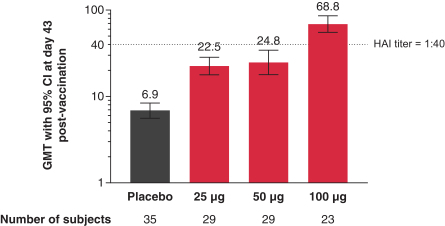
Panel (A)
Percent of subjects with HAI
>
1:40 at day 43 with H10N8 vaccine (mRNA-1440) in Phase 1 clinical trial
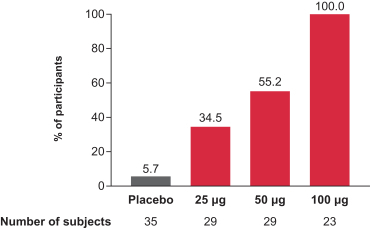
Panel (B)
58
Table of Contents
The 100 µg dose showed 100% seroconversion. For this dose, we observed persistence in HAI titer six months after the second dose, with a HAI geometric mean titer of 13.9 and 95.6% of participants remaining seropositive (HAI titer
>
1:10) as shown in the figure below.
HAI antibody persistence at 100 µg dose for H10N8 vaccine (mRNA-1440) in Phase 1 clinical trial
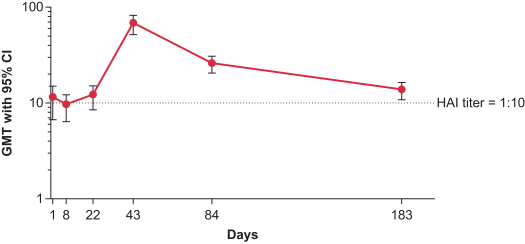
Overall, up to the 100 µg IM dose, mRNA-1440 was well tolerated. A detailed list of the solicited adverse events, or solicited AEs, is provided in the table below. In the 400 µg IM dose group, two out of the three participants developed severe solicited adverse reactions (erythema, headache) within 24 hours of the first vaccination. These events met pre-specified study pause rules, and after safety committee review, further vaccinations at this dose level were stopped. These events resolved spontaneously without the need for medical intervention or medications.
Three severe unsolicited AEs (separately back pain, tonsillitis, and ruptured ovarian cyst) and 2 serious AEs, or SAEs, (separately cholecystitis and ruptured ovarian cyst) were reported and deemed unrelated to mRNA-1440. 124 unsolicited AEs were reported in the IM groups. The most common unsolicited AEs were upper respiratory tract infection, back pain, pharyngitis, and oropharyngeal pain. No adverse event of special interest, or AESIs, or cases of new onset of chronic illness were reported.
Solicited adverse events for H10N8 vaccine at all dose levels within 7 days after each IM vaccination on days 1 and 22
*
|
25 µg
|
50 µg
|
100 µg
|
Placebo
|
||||
|
Dose 1
|
n=30
|
n=30
|
n=23
|
n=35
|
|||
|
Injection site pain
|
23, 76.7 (0)
|
25, 83.3 (0)
|
19, 82.6 (0)
|
2, 5.7 (0)
|
|||
|
Erythema
|
1, 3.3 (0)
|
0
|
3, 13.0 (0)
|
0
|
|||
|
Injection site swelling
|
2, 6.7 (0)
|
5, 16.7 (0)
|
3, 13.0 (0)
|
0
|
|||
|
Headache
|
5, 16.7 (0)
|
12, 40.0 (0)
|
7, 30.4 (0)
|
5, 14.3 (0)
|
|||
|
Fatigue
|
8, 26.7 (0)
|
13, 43.3 (0)
|
8, 34.8 (0)
|
7, 20.0 (0)
|
|||
|
Myalgia
|
16, 53.3 (0)
|
17, 56.7 (0)
|
12, 52.2 (0)
|
1, 2.9 (0)
|
|||
|
Arthralgia
|
0
|
2, 6.7 (0)
|
2, 8.7 (0)
|
1, 2.9 (0)
|
|||
|
Nausea
|
0
|
1, 3.3 (0)
|
1, 4.3 (0)
|
0
|
|||
|
Fever
|
1, 3.3 (0)
|
1, 3.3 (0)
|
2, 8.7 (0)
|
0
|
|||
|
Dose 2
|
n=28
|
n=29
|
n=23
|
n=27
|
|||
|
Injection site pain
|
22, 78.6 (0)
|
27 93.1 (0)
|
20, 87.0 (0)
|
3, 11.1 (0)
|
|||
|
Erythema
|
0
|
0
|
4, 17.4 (8.7)
|
0
|
|||
|
Injection site swelling
|
2, 7.1 (0)
|
4, 13.8 (0)
|
3, 13.0 (4.3)
|
0
|
|||
|
Headache
|
4, 14.3 (0)
|
14, 48.3 (0)
|
16, 69.6 (0)
|
6, 22.2 (3.7)
|
|||
|
Fatigue
|
8, 28.6 (0)
|
13, 44.8 (0)
|
11, 47.8 (0)
|
4, 14.8 (0)
|
|||
|
Myalgia
|
14, 50.0 (0)
|
17, 58.6 (0)
|
11, 47.8 (0)
|
1, 3.7 (0)
|
|||
|
Arthralgia
|
0
|
2, 6.9 (0)
|
7, 30.4 (0)
|
1, 3.7 (0)
|
|||
|
Nausea
|
1, 3.6 (0)
|
1, 3.4 (0)
|
3, 13.0 (0)
|
0
|
|||
|
Fever
|
1, 3.6 (0)
|
2, 6.9 (0)
|
4, 17.4 (0)
|
1, 3.7 (0)
|
|||
59
Table of Contents
|
*
|
Data represent n, % with solicited AEs (% with severe solicited AEs) in the safety population; 75 µg dose group not shown (2 participants had severe solicited AEs of fatigue and injection site swelling following first vaccination, and no participants received dose 2); 400 µg dose group not shown.
|
The Phase 1 clinical trial for H7N9 vaccine in the United States is ongoing
The Phase 1 trial for H7N9 vaccine has met its objectives of assessing the safety and tolerability profile of mRNA-1851 vs. placebo including capturing solicited and unsolicited local and systemic adverse events. The Phase 1 trial for H7N9 vaccine has also demonstrated immunogenicity and we have observed 96% of the subjects demonstrating HAI titer
>
1:40 at day 43 for the 25 µg dose where HAI
>
1:40 is regarded as a quantitative measure for protection from influenza. We believe the data provides support to advance the program in clinical development if we choose to with additional government or other funding. This randomized, double-blind, placebo-controlled, dose-ranging study evaluated intramuscular, or IM, dose levels of 10, 25, and 50 µg using two vaccination schedules (Day 1, Day 22 and Day 1, Month 6). The objectives were safety, tolerability, and immunogenicity by HAI and MN assays. 156 subjects were enrolled in this study. 30 subjects per dose cohort received two doses of 10 µg, 25 µg, and 50 µg at days 1 and 22. 10 subjects per dose cohort received one dose of 10, 25, and 50 µg at day one and a total of 9 of those subjects received a second dose at 6 months (data not shown). 36 subjects received placebo. A total of 10 subjects withdrew from the study. The Phase 1 trial was conducted with the name of the intervention listed as VAL-339851, in accordance with our legacy naming convention. We have since changed our naming convention and have adopted mRNA-1851 in place of VAL-339851.
Doses up to 50 µg administered IM to patients who received vaccinations on Day 1 and Day 22 in this Phase 1 clinical trial demonstrated immunogenicity.
Geometric mean titers in the participants who received a two-dose IM vaccination series on Day 1 and Day 22 at doses of 10, 25, and 50 µg are shown in panel A of the figure below. Also, for those doses, 36.0%, 96.3%, and 89.7% of the participants respectively reached HAI titers
>
1:40 at day 43 as shown in panel B of the figure below.
HAI GMT for H7N9 vaccine (mRNA-1851) in Phase 1 clinical trial
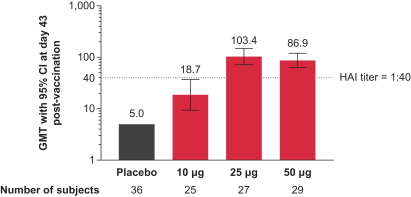
Panel (A)
Percent of subjects with HAI
>
1:40 at day 43 with H7N9 vaccine (mRNA-1851) in Phase 1 clinical trial
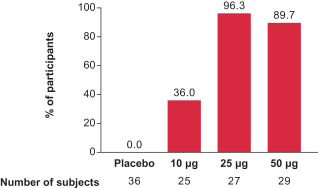
Panel (B)
60
Table of Contents
The 25 µg dose achieved 96% seroconversion. For this dose, we observed persistence in HAI titers six months after the second dose. HAI GMT decreased but remained above HAI titer level of 10 as shown in the figure below. In addition, 52% of participants remained seropositive (HAI titer
>
1:10) at six months.
HAI antibody persistence at 25 µg dose for H7N9 vaccine (mRNA-1851) in Phase 1 clinical trial
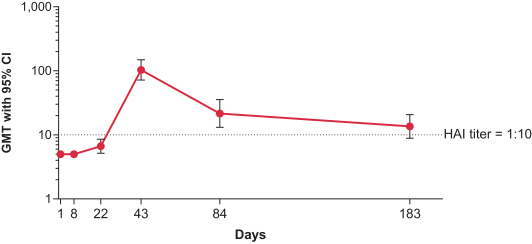
Overall, up to the 50 µg IM dose of mRNA-1851 was well tolerated. A detailed list of the solicited AEs is provided in the table below. The majority of possibly- and probably-related unsolicited AEs were
>
grade 2 laboratory abnormalities and occurred at similar rates in vaccine and placebo groups. Four severe unsolicited AEs were deemed possibly related to vaccination: two cases of increased alanine aminotransferase (one 50 µg, one placebo), one case of increased aspartate aminotransferase (50 µg), and one case of thrombocytopenia (placebo). All cases were asymptomatic and resolved without intervention.
Solicited adverse events for H7N9 at all dose levels within 7 days after each IM vaccination on days 1 and 22
*
|
10 µg
|
25 µg
|
50 µg
|
Placebo
|
||||
|
Dose 1
|
n=30
|
n=30
|
n=30
|
n=36
|
|||
|
Injection site pain
|
22, 73.3 (0)
|
17, 56.7 (0)
|
24, 80.0 (6.7)
|
5, 13.9 (0)
|
|||
|
Erythema
|
0
|
0
|
0
|
0
|
|||
|
Injection site swelling
|
5, 16.7 (0)
|
5, 16.7 (0)
|
9, 30.0 (0)
|
2, 5.6 (0)
|
|||
|
Headache
|
5, 16.7 (0)
|
5, 16.7 (0)
|
7, 23.3 (6.7)
|
6, 16.7 (0)
|
|||
|
Fatigue
|
1, 3.3 (0)
|
4, 13.3 (0)
|
3, 10.0 (0)
|
2, 5.6 (0)
|
|||
|
Myalgia
|
3, 10.0 (0)
|
6, 20.0 (0)
|
8, 26.7 (0)
|
6, 16.7 (0)
|
|||
|
Arthralgia
|
2, 6.7 (0)
|
3, 10.0 (0)
|
3, 10.0 (0)
|
4, 11.1 (0)
|
|||
|
Nausea
|
1, 3.3 (0)
|
1, 3.3 (0)
|
1, 3.3 (0)
|
1, 2.8 (0)
|
|||
|
Fever
|
0
|
1, 3.3 (0)
|
0
|
0
|
|||
|
Dose 2
|
n=30
|
n=30
|
n=30
|
n=36
|
|||
|
Injection site pain
|
14, 46.7 (0)
|
13, 43.3 (0)
|
22,
73.3 (10.0)
|
2, 5.6 (0)
|
|||
|
Erythema
|
0
|
0
|
0
|
0
|
|||
|
Injection site swelling
|
3, 10.0 (0)
|
6, 20.0 (0)
|
6, 20.0 (0)
|
1, 2.8 (0)
|
|||
|
Headache
|
3, 10.0 (0)
|
2, 6.7 (3.3)
|
8, 26.7 (6.7)
|
1, 2.8 (0)
|
|||
|
Fatigue
|
1, 3.3 (0)
|
3, 10.0 (0)
|
4, 13.3 (0)
|
0
|
|||
|
Myalgia
|
3, 10.0 (0)
|
4, 13.3 (0)
|
8, 26.7 (3.3)
|
0
|
|||
|
Arthralgia
|
2, 6.7 (0)
|
1, 3.3 (0)
|
6, 20.0 (3.3)
|
0
|
|||
|
Nausea
|
0
|
0
|
1, 3.3 (0)
|
0
|
|||
|
Fever
|
0
|
0
|
6, 20.0 (6.7)
|
0
|
|||
*Data represent n, % with solicited AEs (% with severe solicited AEs)
61
Table of Contents
Zika vaccine (mRNA-1893): Summary
In collaboration with BARDA, we brought a Zika vaccine from mRNA sequence design to the clinic in twelve months
Zika is an infectious disease caused by the Zika virus, in which infection during pregnancy has been linked to severe brain damage in infants with congenital infection and Guillain-Barré Syndrome in adults. To date, no vaccine to prevent Zika infection has been approved. In September 2016, we were awarded a contract with BARDA to be reimbursed up to approximately $125 million for the development of a Zika mRNA vaccine. In order to rapidly respond to a potential epidemic, we developed a Zika vaccine, mRNA-1325, which went from mRNA sequence design to first-in-human clinical testing in twelve months. In addition, we also developed a second Zika vaccine, mRNA-1893. mRNA-1893, at 1/20 of the dose, demonstrated better protection in non-human primates, as compared to mRNA-1325. We are preparing an IND for submission to the FDA for mRNA-1893, and we will not further develop mRNA-1325.
Zika vaccine (mRNA-1893): Disease overview
We faced a Zika epidemic in 2015 for which there were no vaccines or treatments
The Zika virus is a single stranded RNA virus of the flaviviridae family. It was first isolated in a rhesus macaque in the Zika Forest, Uganda in 1947 and the first human case was documented in 1952. Seroepidemiology data suggest that it is endemic to regions of Africa and Asia where the
Aedes
mosquito vectors are found. Zika virus is predominantly spread by mosquitos from the
Aedes
genus, but it can also be transmitted congenitally, sexually, and through blood donation.
In 2007, a Zika infection outbreak progressed across the Pacific islands. It arrived in Brazil in 2015 and the epidemic spread across the Americas. This led to the World Health Organization, or WHO, declaring it a public health emergency of international concern in 2016. During the period, there were tens of thousands of cases of microcephaly and congenital Zika syndrome reported in infants and of resulting neurological sequelae such as Guillain-Barré syndrome reported in adults.
Zika infection is usually asymptomatic or mild in adults, leading to fever, rash, and conjunctivitis. However, infection of women during pregnancy can result in devastating microcephaly in newborns. Microcephaly is a birth defect characterized by an abnormally small head and brain, associated with lifelong neurodevelopmental delay, seizures, intellectual disability, balance problems, and dwarfism / short stature, resulting in significant disability and requiring lifelong support. To date, over a million cases of Zika have been officially reported in Latin America. Since most of the cases are asymptomatic, we believe the actual number of cases may be far higher. International travel means that Zika infection has the potential to take on global significance. While the number of cases has declined in the past couple of years, there is currently no treatment or vaccine available for the Zika virus to prevent and respond to potential future epidemics.
Currently, there is no approved vaccine for Zika. Designing and synthesizing conformationally correct protein antigen vaccines, attenuated or vectored live viral vaccines, or inactivated vaccines is time consuming and challenging. These traditional vaccine approaches have therefore found it difficult to respond fast enough to the emerging Zika epidemic.
62
Table of Contents
Zika vaccine (mRNA-1893): Our product concept
We advanced a complex antigen to the clinic in twelve months and followed up with a next generation vaccine
We believe our platform allows for rapid development of mRNA vaccines with complex, immunogenic antigens faster than traditional vaccines. In order to rapidly deploy an mRNA vaccine for Zika, we leveraged available sequences and legacy LNPs to develop mRNA-1325. mRNA-1325 contains a sequence encoding for structural proteins in the Zika virus. The intended design is for translation of a polyprotein and processing inside the cell to make a secreted virus-like particle, or VLP. This process mimics the response of the cell after natural infection as shown in the figure below.
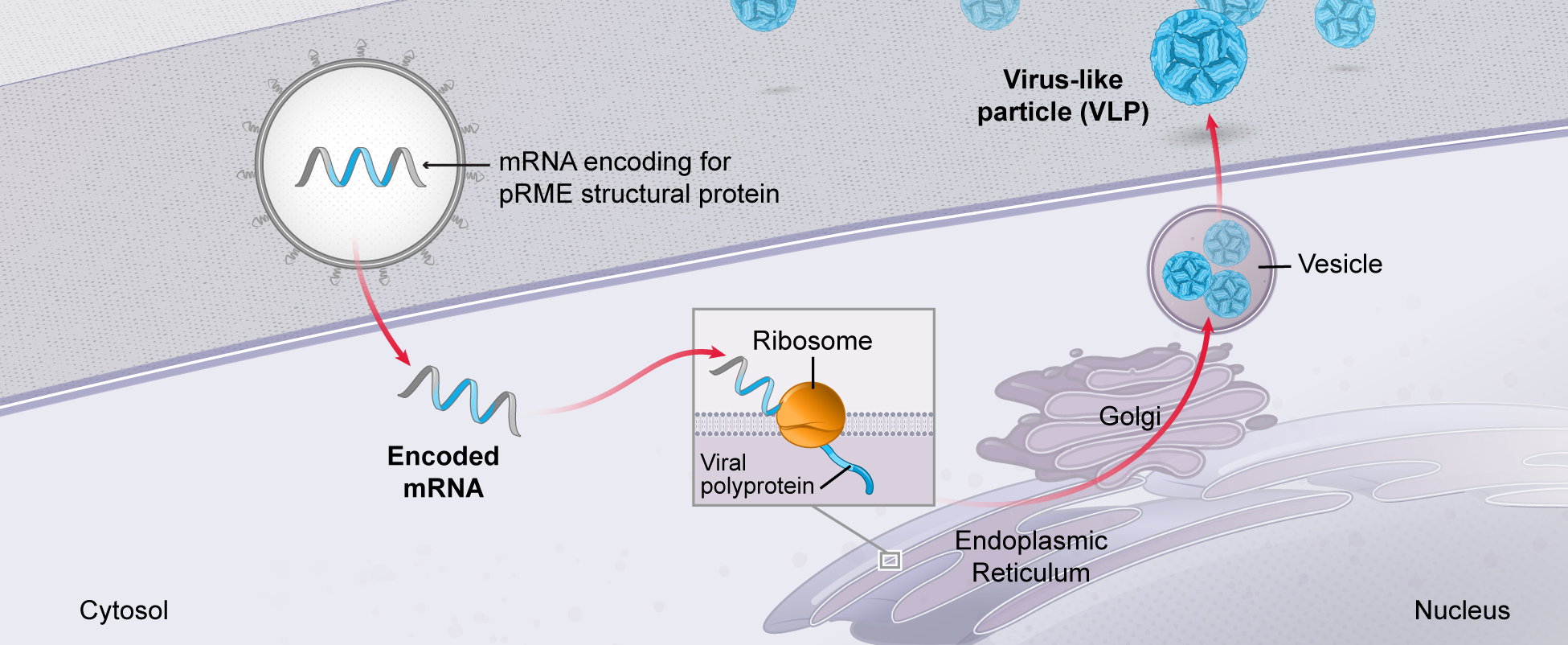
In addition, we continued to develop alternative Zika mRNA vaccine candidates. To this end, we identified mRNA-1706, which contains the same mRNA sequence as mRNA-1325 and now formulated in our proprietary LNP. Continued efforts at identifying different mRNA sequences with improved immunogenicity led to mRNA-1893, a sequence distinct from mRNA-1325 that increases production of Zika VLPs and generates enhanced immunogenicity and protection in preclinical animal models compared to mRNA-1325. mRNA-1893 is also formulated in our proprietary LNP. mRNA-1706 was discontinued in favor of mRNA-1893, which has been shown to have more activity, and we will not further develop mRNA-1325.
Zika vaccine (mRNA-1893): Preclinical information
We have observed and published our immunogenicity data for our Zika vaccine
The mRNA sequences for mRNA-1325 and mRNA-1893 have been tested in mice and non-human primates, or NHPs. We have published a subset of these data in the journal
Cell
in 2017. The mRNA sequence for mRNA-1893 produces equivalent immunogenicity and better protection compared to the sequence used in mRNA-1325 at 1/20 of the dose in NHPs, as shown in the figure below. In this study, mRNA vaccine or placebo was administered intramuscularly in a two-dose vaccination schedule (28 days apart), with five animals included in each group. NHPs were challenged with Zika virus 28 days post-boost, and viral titers were measured post challenge via quantitative PCR. Measurements were quantified in terms of focus forming units. Each line on the chart represents an individual animal.
63
Table of Contents
Sequence for mRNA-1893 provided comparable protection to that of mRNA-1325 in non-human primate challenge study
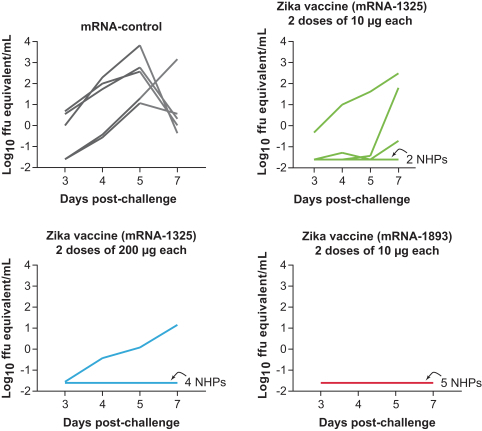
Zika vaccine (mRNA-1893): Clinical data
We are preparing an IND for submission to the FDA for mRNA-1893, and we will not further develop mRNA-1325
We completed a Phase 1 randomized, blinded, placebo-controlled, dose-ranging study to evaluate the safety, tolerability, and immunogenicity of mRNA-1325 in healthy adults (18 to 49 years of age, inclusive) in a non-endemic Zika region. mRNA-1325 was administered intramuscularly in a two-dose vaccination schedule (28 days apart) at 3 dose levels (10 µg, 25 µg, and 100 µg). Key objectives of the study include:
|
•
|
assess the safety of a 2-dose vaccination schedule of mRNA-1325 Zika vaccine, given 28 days apart, across a range of dose levels in flavivirus seronegative and flavivirus seropositive subjects compared with placebo; and
|
|
•
|
assess the immunogenicity of a range of doses of mRNA-1325 Zika vaccine.
|
Subjects were randomly assigned in a blinded fashion in an approximate 4:1 ratio to receive mRNA-1325 or placebo at one of three dose levels (10 µg, 25 µg, or 100 µg), with each subject receiving two vaccinations separated by 28 days. Approximately two-thirds of the enrolled subjects at each dose level were flavivirus seronegative and approximately one-third were flavivirus seropositive.
Part A of this 2-part study includes dose-finding, safety, and immune testing through 28 days following the second vaccination. Once subjects completed the final visit in Part A, they were entered into Part B. Part B was a blinded follow-up period with assessment of safety through 12 months.
64
Table of Contents
For each dose cohort, a sentinel safety group enrolled 3 flavivirus seronegative subjects randomized to mRNA-1325 and followed for 7 days after first vaccination. An internal safety team, or IST, reviewed blinded safety data during Part A through 7 days following first vaccination of the sentinel safety lead-in for each dose cohort and approved randomization of the remainder of that dose cohort. The safety monitoring committee, or SMC, approved the escalation to the next higher dose cohort after review of blinded safety data of the currently dosed cohort through seven days following the second vaccination and cumulative safety data of all cohorts. The trial design is shown in the figure below.
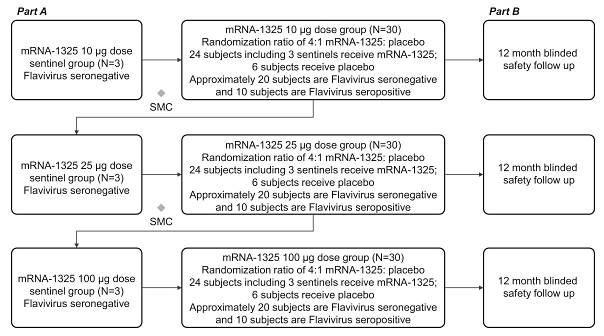
The mRNA-1325 trial has completed enrollment (72 received mRNA-1325, 18 received placebo). mRNA-1325 did not show sufficient immunogenicity at doses up to 100 µg. Although the Phase 1 safety and tolerability data generated would permit additional dose escalation of mRNA-1325, our current development efforts are focused on our next-generation vaccine, mRNA-1893, which has been shown to be 20 times more potent in NHP Zika challenge studies. We are preparing an IND for submission to the FDA for mRNA-1893, and we will not further develop mRNA-1325.
65
Table of Contents
Chikungunya vaccine (mRNA-1388): Summary
Our Chikungunya vaccine has generated safety and tolerability data and demonstrated immunogenicity for the Phase 1 clinical study through approximately six months post dosing; we aim to address a public health need with this vaccine
Chikungunya virus represents a serious public health problem in tropical and sub-tropical regions with over 3 million cases globally. While it is rarely fatal, it can cause long-lasting and debilitating pain in multiple joints from polyarthralgia as well as serious neurological conditions. To date, no vaccine to prevent Chikungunya infection has been approved. Effective mosquito control has proven challenging, even in higher income countries. We believe our platform is well-suited to address this disease, as we can produce and deliver mRNA encoding the entire Chikungunya virus structural polyprotein (capsid and envelope proteins) to cells, which in turn produce and secrete Chikungunya virus-like particles, or Chikungunya VLPs, known to be robust inducers of protective neutralizing antibody responses. This program is supported by DARPA for a Phase 1 trial which is being conducted in the United States. The Phase 1 trial for Chikungunya vaccine in the United States is fully enrolled and has met its objectives of describing the safety and tolerability profile of mRNA-1388 versus placebo through approximately six months post dosing including capturing solicited and unsolicited local and systemic adverse events. The Phase 1 trial for Chikungunya vaccine has also demonstrated immunogenicity for the first part of the trial and we have observed 100% seroresponse for subjects at the 100 µg dose level 28 days post the second dose. We have also observed a durable response for the 100 µg dose, with 13 of 14 subjects at day 196 with neutralizing antibody titers above the seroresponse threshold. The second part of the trial to measure persistence of response at one year post dosing is ongoing. We believe the data provides support to advance the program in clinical development if we choose to with additional government or other funding.
Chikungunya vaccine (mRNA-1388): Disease overview
We aim to address a significant public health need
Chikungunya is a mosquito-borne RNA alphavirus posing a significant public health problem in tropical and subtropical regions. While Chikungunya has been present in Africa for centuries, recent outbreaks and epidemics in new regions have arisen due to the expanding distribution of the
Aedes
mosquito. A Chikungunya epidemic began in 2004 in Kenya, spread to India and was exported to nearly all regions of the world and brought Chikungunya to the attention of the western world. As of April 2016, Chikungunya cases had been reported in over 100 countries and territories around the world, including more than 45 countries and territories throughout the Americas. Chikungunya virus infection causes disease, characterized by an acute onset of fever, rash, myalgia, and sometimes debilitating polyarthralgia, giving the virus its name, which means “that which bends up” when translated from Makonde. It is rarely fatal, but neurological sequelae such as Guillain-Barre syndrome and chronic arthralgia have been associated with infection.
Chikungunya virus is an alphavirus of the Togaviridae family with a positive-strand RNA genome. The viral structural proteins are naturally expressed as a single polyprotein followed by subsequent cleavage by viral and cellular proteases into capsid (C) and envelope (E) glycoproteins E3, E2, 6k, and E1. The E proteins are major targets of protective neutralizing antibody responses.
There are currently no approved vaccines to treat or prevent Chikungunya infection or disease, and effective mosquito control has proven challenging, even in higher income countries. Currently, infected individuals are treated with non-steroidal anti-inflammatory drugs to relieve symptoms. Therefore, there is a need for a safe and effective prophylactic vaccine.
Chikungunya vaccine (mRNA-1388): Our product concept
We are developing a complex polyprotein encoding mRNA encapsulated in a lipid nanoparticle
The mRNA-1388 vaccine consists of a single mRNA encoding the full native structural polyprotein (C-E3-E2-6k-E1) that is naturally processed into C and E proteins, which assemble into VLPs and are released from cells.
66
Table of Contents
The E proteins on these VLPs are the major target of neutralizing and protective antibodies, that, in the context of natural infection, can provide essentially life-long immunity to reinfection. The C protein provides structure to the VLP and contains T cell epitopes that could contribute to protective immune responses. The mRNA is encapsulated in a legacy LNP. An illustration of our approach is shown in the figure below.
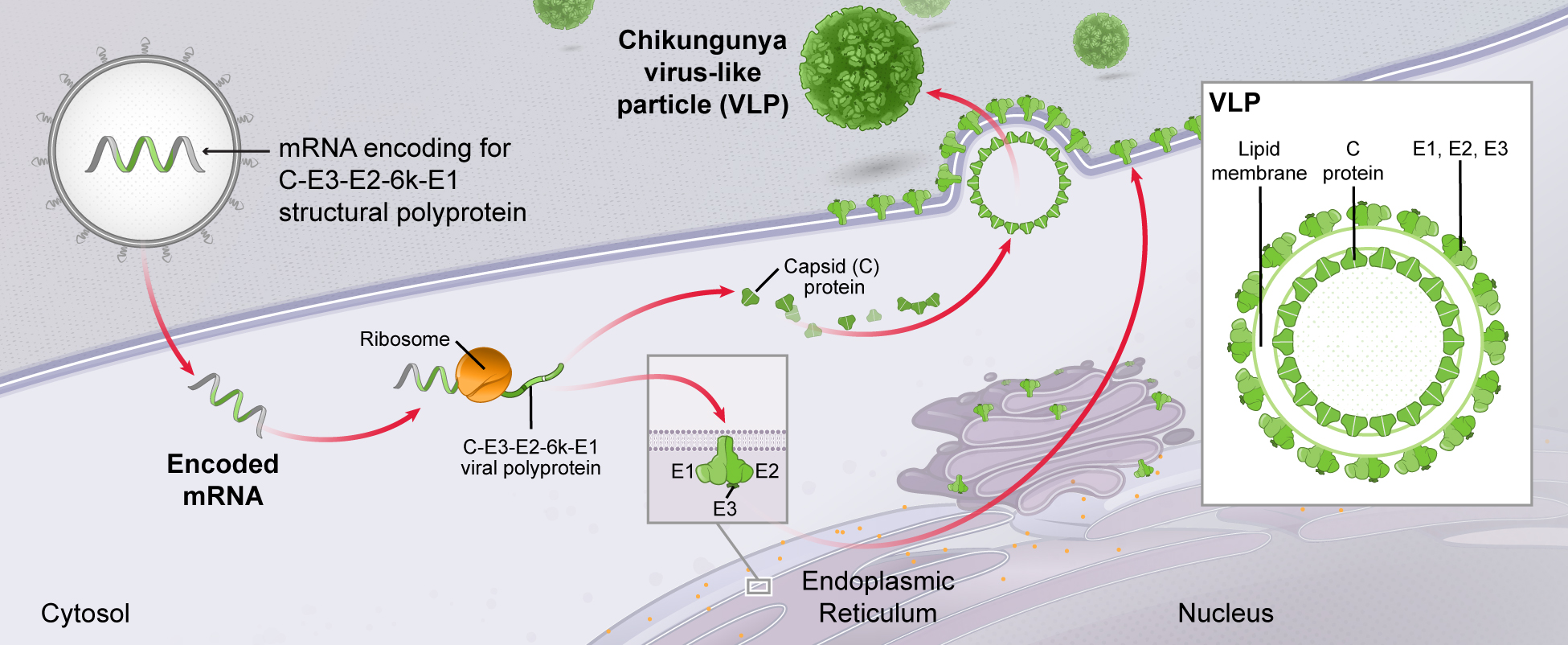
Chikungunya vaccine (mRNA-1388): Preclinical information
We have conducted preclinical studies in mice and non-human primates
Preclinical immunogenicity studies have been performed in mice and non-human primates and suggest that our Chikungunya vaccine induces a robust neutralizing antibody response in a dose- and regimen-dependent manner. Further, a one- or two-dose vaccination series protected AG129 mice from a lethal Chikungunya virus challenge administered 56 days and 112 days later, demonstrating durable immunity, as shown in the figure below. In this study, AG129 mice were immunized with 0.4, 2, or 10 µg of the mRNA Chikungunya vaccine in a legacy LNP administered intramuscularly on day 0 (D0) or days 0 and 28 (D0 and D28). Serum neutralizing antibody titers were measured in five mice per group on day 56 by 50% plaque reduction neutralization test (PRNT50), followed immediately by a lethal Chikungunya virus challenge (panels A and C). Neutralizing antibody titers were measured in another five mice per group on day 112, followed by a lethal challenge (panels B and D).
Day 56 neutralizing antibody titer for Chikungunya mRNA vaccine in mouse study
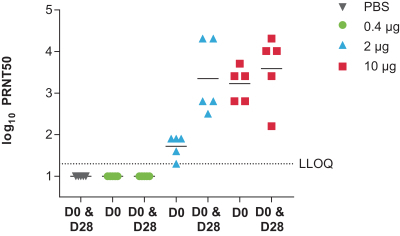
Panel (A)
67
Table of Contents
Day 112 neutralizing antibody titer for Chikungunya mRNA vaccine in mouse study
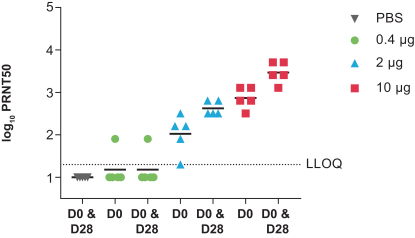
Panel (B)
Survival post Chikungunya viral challenge on day 56 in mouse study
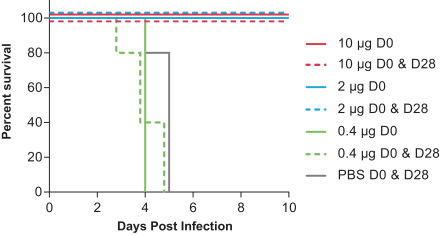
Panel (C)
Survival post Chikungunya viral challenge on day 112 in mouse study
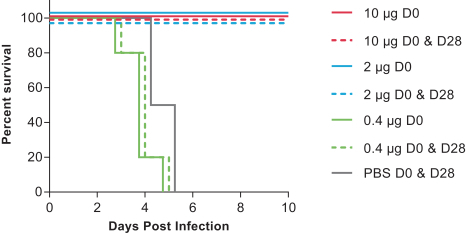
Panel (D)
68
Table of Contents
Chikungunya vaccine (mRNA-1388): Clinical data
The Phase 1 trial for mRNA-1388 in the United States is fully enrolled, has generated safety and tolerability data, and demonstrated immunogenicity through approximately six months post dosing.
The Phase 1 trial for Chikungunya vaccine in the United States is fully enrolled and met its objectives of describing the safety and tolerability profile of mRNA-1388 versus placebo through approximately six months post dosing including capturing solicited and unsolicited local and systemic adverse events. The Phase 1 trial for Chikungunya vaccine has also demonstrated immunogenicity for the first part of the trial and we have observed 100% seroresponse for subjects at the 100 µg dose level 28 days post the second dose. We have observed a durable response for the 100 µg dose, with 13 of 14 subjects at day 196 with neutralizing antibody titers above the seroresponse threshold. The second part of the trial to measure persistence of response at one year post dosing is ongoing. We believe the data provides support to advance the program in clinical development if we choose to with additional government or other funding.
The mRNA-1388 Phase 1 study is a randomized, placebo-controlled, dose-ranging study to evaluate the safety, immunogenicity and tolerability of mRNA-1388 in healthy adults (18 to 49 years of age, inclusive) in a non-endemic region in the United States. The study includes three dose level cohorts (25, 50, and 100 µg), each containing 20 subjects randomized 3:1 (active: placebo). All subjects are given a two-dose intramuscular injection series, spaced four weeks apart (day 0 and 28). The Phase 1 trial was conducted with the investigational medicine named VAL-181388, in accordance with our legacy naming convention. We have since changed our naming convention and have adopted mRNA-1388 in place of VAL-181388. The key objectives of the study include:
|
•
|
describe the safety and tolerability of mRNA-1388 relative to placebo;
|
|
•
|
determine the immunogenicity of three dose levels of mRNA-1388 to inform the choice of dose for further development of this vaccine; and
|
|
•
|
assess immunogenicity changes from baseline using serum neutralizing antibody titers to Chikungunya virus and binding antibody titers to Chikungunya-specific proteins.
|
The schematic of the trial is shown in the figure below. Each dose cohort starts with a sentinel safety group and based on review of the internal safety team, or IST, advances to an expansion of that dose cohort. Advancement to the next dose level is permitted after safety monitoring committee, or SMC, review.
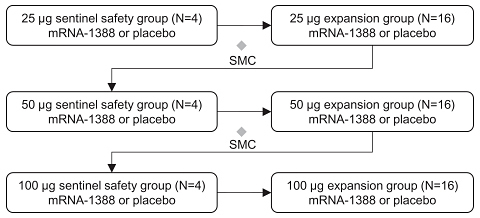
100% seroresponse has been pre-defined as when subjects have post-vaccination titer > lower limit of quantification, or LLOQ where their baseline titer is < LLOQ or when subjects have post-vaccination titer
>
4-fold the baseline titer where their baseline titer is
>
LLOQ.
As of October 24, 2018, based on the data for all three dose cohorts through approximately 6 months post dosing, we have observed neutralizing antibodies 28 days post dose 2 and persistence through day 196. Panel A below indicates geometric mean titer, or GMT, by time for neutralizing antibody, or NAb, against Chikungunya virus as measured by 50% plaque reduction neutralization test, or PRNT50. A dose-dependent increase in GMT of neutralizing antibodies against Chikungunya virus was observed across the 25, 50 and 100 µg dose groups. PRNT50 titers were low or undetected after the first vaccination at all dose levels, but increased substantially in the 50 and 100 µg dose groups after the second vaccination. Panel B below depicts the percentage of subjects by time for seroresponse of neutralizing antibody to Chikungunya virus as measured by PRNT50. A dose-dependent increase in PRNT50 seroresponse was observed across the 25, 50 and 100 µg dose groups, reaching 100% after the second vaccination of 100 µg at day 56. The PRNT50 GMT after the second vaccination (day 28) was elevated at day 56 and day 196 for the two higher dose groups compared to day 0 or 28.
69
Table of Contents
Neutralizing antibody PRNT50 GMT in Chikungunya vaccine (mRNA-1388)
Phase 1 clinical trial for per-protocol subset
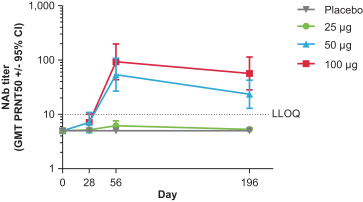
Panel (A)
Neutralizing antibody PRNT50 seroresponse in Chikungunya vaccine (mRNA-1388)
Phase 1 clinical trial for per-protocol subset
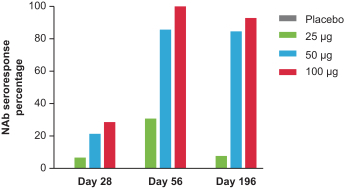
Panel (B)
|
Number of subjects per-protocol subset for clinical data at cut-off date
|
||||||||
|
Cohort
|
Day 0
|
Day 28
|
Day 56
|
Day 196
|
||||
|
25 µg
|
15
|
15
|
13
|
13
|
||||
|
50 µg
|
15
|
14
|
14
|
13
|
||||
|
100 µg
|
14
|
14
|
14
|
14
|
||||
|
Placebo
|
14
|
14
|
13
|
13
|
||||
Based on the interim data as of October 24, 2018, there were two grade 3 solicited adverse events, or AEs, which were in the 100 µg cohort. A potential trend towards increased local and systemic solicited reactogenicity including pain, erythema, induration, headache, fatigue, myalgia, arthralgia and nausea post dose 2 was observed in the 50 µg and 100 µg dose groups. Arthralgia was reported in the 100 µg dose group only (21.4 % of subjects); all events were
<
Grade 2 and all subjects reported full resolution by Day 4 post vaccination, and thereby distinct from the persistent type observed in post Chikungunya virus infection arthralgias. The solicited AEs are provided in the table below.
70
Table of Contents
Solicited AEs after each study vaccination for the safety set in the Phase 1 trial for Chikungunya vaccine (mRNA-1388)
|
25 µg
|
50 µg
|
100 µg
|
Placebo
|
||||
|
% (No. with severe AE)
|
|||||||
|
Dose 1
|
N=15
|
N=15
|
N=15
|
N=15
|
|||
|
Pain
|
60.0 (0)
|
57.1 (0)
|
73.3 (0)
|
33.3 (0)
|
|||
|
Tenderness
|
66.7 (0)
|
78.6 (0)
|
80.0 (0)
|
40.0 (0)
|
|||
|
Erythema
|
0
|
0
|
0
|
0
|
|||
|
Induration
|
0
|
0
|
0
|
0
|
|||
|
Headache
|
13.3 (0)
|
21.4 (0)
|
20.0 (0)
|
0
|
|||
|
Fatigue
|
0
|
7.1 (0)
|
6.7 (0)
|
6.7 (0)
|
|||
|
Myalgia
|
13.3 (0)
|
14.3 (0)
|
20.0 (0)
|
0
|
|||
|
Arthralgia
|
0
|
0
|
0
|
6.7 (0)
|
|||
|
Nausea
|
0
|
14.3 (0)
|
6.7 (0)
|
0
|
|||
|
Fever
|
0
|
0
|
0
|
0
|
|||
|
Dose 2
|
N=15
|
N=14
|
N=14
|
N=15
|
|||
|
Pain
|
46.7 (0)
|
61.5 (0)
|
85.7 (0)
|
6.7 (0)
|
|||
|
Tenderness
|
53.3 (0)
|
76.9 (0)
|
78.6 (1)
|
6.7 (0)
|
|||
|
Erythema
|
0
|
7.7 (0)
|
7.1 (1)
|
0
|
|||
|
Induration
|
0
|
7.7 (0)
|
0
|
0
|
|||
|
Headache
|
20.0 (0)
|
7.7 (0)
|
28.6 (0)
|
13.3 (0)
|
|||
|
Fatigue
|
6.7 (0)
|
15.4 (0)
|
28.6 (0)
|
13.3 (0)
|
|||
|
Myalgia
|
0
|
7.7 (0)
|
28.6 (0)
|
0
|
|||
|
Arthralgia
|
0
|
0
|
21.4 (0)
|
0
|
|||
|
Nausea
|
0
|
0
|
21.4 (0)
|
0
|
|||
|
Fever
|
0
|
0
|
7.1 (0)
|
13.3 (0)
|
|||
71
Table of Contents
There was one unsolicited SAE in the 100 µg group subject, post the second dose, which was assessed as related and reported as a Suspected Unexpected Serious Adverse Reaction, or SUSAR (subject had asymptomatic Grade 4 elevation in serum AST and Grade 3 elevation in ALT), which was resolved rapidly. A potential dose-dependent increase in the rate of unsolicited related adverse reactions across the dose level groups was observed. There were no safety concerns identified by the IST or the SMC. There were no AEs of special interest or medically-attended AEs. The unsolicited AEs are provided in the table below.
Unsolicited AEs reported for the safety set in the Phase 1 trial for Chikungunya vaccine (mRNA-1388)
|
25 µg
|
50 µg
|
100 µg
|
Placebo
|
||||
|
No., % of subjects
|
|||||||
|
Dose 1
|
N=15
|
N=15
|
N=15
|
N=15
|
|||
|
Any AE
|
4 (26.7)
|
6 (40.0)
|
3 (20.0)
|
8 (53.3)
|
|||
|
Any related AEs
|
0
|
1 (6.7)
|
1 (6.7)
|
2 (13.3)
|
|||
|
Any grade 3+
|
0
|
2 (13.3)
|
0
|
1 (6.7)
|
|||
|
Any related grade 3+
|
0
|
0
|
0
|
0
|
|||
|
Any MA-AEs
|
1 (6.7)
|
0
|
0
|
0
|
|||
|
SAEs
|
0
|
0
|
0
|
0
|
|||
|
Any related SAE
|
0
|
0
|
0
|
0
|
|||
|
AESIs
|
0
|
0
|
0
|
0
|
|||
|
Dose 2
|
N=15
|
N=14
|
N=14
|
N=15
|
|||
|
Any AE
|
3 (20.0)
|
3 (21.4)
|
6 (42.9)
|
6 (40.0)
|
|||
|
Any related AEs
|
0
|
0
|
4 (28.6)
|
0
|
|||
|
Any grade 3+
|
1 (6.7)
|
2 (14.3)
|
4 (28.6)
|
0
|
|||
|
Any related grade 3+
|
0
|
0
|
3 (21.4)
|
0
|
|||
|
Any MA-AEs
|
0
|
0
|
0
|
1 (6.7)
|
|||
|
SAEs
|
0
|
0
|
1 (7.1)
|
0
|
|||
|
Any related SAE
|
0
|
0
|
1 (7.1)
|
0
|
|||
|
AESIs
|
0
|
0
|
0
|
0
|
|||
The trial is ongoing to measure antibody persistence and safety approximately one year after the second dose.
72
Table of Contents
II. PROGRAM DESCRIPTIONS IN OUR CANCER VACCINES MODALITY
We designed our cancer vaccines modality to treat or cure cancer by enhancing immune responses to tumor neoantigens, defined below. This modality has two programs currently for neoantigen vaccines, a personalized cancer vaccine, or PCV, program, and a vaccine against neoantigens related to a common oncogene called KRAS, both conducted in collaboration with Merck. The goal of a cancer vaccine is to safely expose the patient’s immune system to tumor related antigens, known as neoantigens, to enable the immune system to elicit a more effective antitumor response. Our cancer vaccines modality is focused on the use of mRNA to express neoantigens found in a particular tumor in order to elicit an immune response via T cells that recognize those neoantigens, and therefore the tumor. These neoantigens can either be unique to a patient, as in the case of our personalized cancer vaccine program, or can be related to a driver oncogene found across subsets of patients, as in the case of our KRAS vaccine program.
Our pipeline is shown in two formats, with a cell map illustrating the diversity of biology addressed by our mRNA pipeline programs, and a traditional format that shows the current stages of development of our pipeline programs, in the section of this Annual Report on Form 10-K titled “Business—Our Pipeline.”
Opportunity
More than 1.6 million new cancer cases and approximately 600,000 deaths due to cancer were predicted in the United States for 2017. Despite the recent success of checkpoint inhibitors, the majority of patients with the most common types of epithelial cancer still do not benefit from checkpoint inhibitors, as many patients still have incomplete or no response to currently available therapies. In addition, treatment resistance is thought to arise from a number of mechanisms, principally the local immunosuppressive effects of cancer cells, which prevent either access to or recognition by T cells.
Recent breakthroughs in cancer immunotherapy, such as checkpoint inhibitors and chimeric antigen receptor T cell therapies, have demonstrated that powerful antitumor responses can be achieved by activating antigen specific T cells. We believe one approach to improve the efficacy of checkpoint inhibitors is to develop vaccines that increase both the number and antitumor activity of a patient’s T cells that recognize tumor neoantigens.
Our approach
We are developing mRNA-based cancer vaccines to utilize the anti-tumor killing capacity of T cells to drive anti-tumor efficacy. Evidence of tumor killing by T cells in treating certain cancers has increased in the last decade with advances in immunotherapies. The immune system’s anti-tumor response relies on T cells recognizing tumor cells as non-self and eradicating these “foreign” cells. Human Leukocyte Antigen, or HLA, complexes are a diverse set of genes, or alleles, that present fragments of proteins from inside (HLA I) or outside (HLA II) cells to the immune system. A person’s HLA type defines what HLA alleles they express and can restrict what antigen may be presented to their immune system. Antigens presented in HLA molecules are recognized by T cell receptors, or TCRs, present on the cell surface of CD4 and CD8 T cells. These two main classes of T cells have distinct mechanisms to potentially attack tumor cells; CD4 cells play an important role in activating other immune cells after recognition of antigens in HLA II molecules, whereas CD8 cells can have direct cytotoxic cell killing capabilities upon recognition of antigens in HLA I molecules. Both cell types have been demonstrated to have important roles in driving an effective anti-tumor immune response.
Over the past three decades there have been many attempts to develop cancer vaccines, few of which have been successful. Key reasons include (1) past attempts were directed against shared “self” non-mutated antigens; (2) nearly all previous attempts utilize peptide fragments to try to mimic peptides displayed by HLA I molecules, this method may not have been able to mimic the natural processing and presentation of antigens by the immune system and therefore may not be recognized; and (3) earlier work was done in the era prior to the benefit of checkpoint inhibitors.
We believe one approach to improve the efficacy of checkpoint inhibitors is to develop vaccines that increase both the number and antitumor activity of a patient’s T cells that recognize tumor neoantigens. Our cancer vaccines modality is focused on the use of mRNA to express neoantigens found in a particular cancer in order to elicit an immune response via T cells that recognize those neoantigens, and therefore the tumor. These neoantigens can either be unique, as in the case of our personalized cancer vaccine program, or can be related to a driver oncogene found across subsets of patients, as in the case of our KRAS vaccine program.
73
Table of Contents
PCV (mRNA-4157 and NCI-4650): Summary
We are collaborating with Merck to use the strength of our platform to develop cancer vaccines with multiple neoantigens unique to each patient, also known as personalized cancer vaccines, or PCVs
Recent breakthroughs in cancer immunotherapy have demonstrated that powerful antitumor responses can be achieved by activating antigen specific T cells in a variety of cancer settings. Despite these advances, many patients still have incomplete or no response to anti-cancer therapies. One approach is to administer a cancer vaccine that encodes for peptides containing mutations found in their cancer, i.e., to create a personalized cancer vaccine composed of neoantigens unique to a patient’s tumor. Previous attempts have demonstrated the ability of mRNA and peptide-based platforms to drive immune responses toward patient-specific neoantigens. Preclinical studies have shown that the combination of cancer vaccines with checkpoint inhibitors provides improved benefit over single-agent therapies. Our platform is positioned for bringing personalized cancer vaccines to patients with our proprietary
in silico
design of each patient’s neoantigen-based mRNA vaccine, to be coupled with our automated cell-free manufacturing processes and infrastructure based in Norwood, MA, as well as our digital infrastructure. We believe these attributes coupled with our proprietary LNPs help differentiate our approach from ongoing efforts at developing mRNA-based cancer vaccines. mRNA-4157 is administered either as monotherapy, or in combination with pembrolizumab, marketed in the United States as KEYTRUDA. This is in collaboration with Merck as governed by a joint steering committee. NCI-4650 is a personalized cancer vaccine being tested by the National Cancer Institute, or NCI, as a monotherapy for patients with advanced, metastatic cancers. NCI-4650 differs from mRNA-4157 in its neoantigen selection process. Both mRNA-4157 and NCI-4650 are in Phase 1 trials in the United States. As of February 15, 2019, 13 patients have been dosed in Part A of the trial (mRNA-4157 monotherapy) and 20 patients have been dosed in Part B of the study (mRNA-4157 in combination with pembrolizumab). In our dose escalation of mRNA-4157 in Part A (monotherapy), we have detected antigen specific T cell responses.
We and our strategic collaborator Merck have submitted the protocol to the FDA for a randomized Phase 2 trial of mRNA-4157 in resected melanoma at high risk of recurrence.
PCV (mRNA-4157 and NCI-4650): Our product concept
Rapid, personalized current good manufacturing practice, or cGMP, manufacturing to bring personalized cancer vaccines to patients
As tumors grow they acquire mutations, some of which create new protein sequences, or neoantigens, that can be presented on HLA molecules in the tumor and recognized as non-self by T cells. These neoantigens can be shared, as in mRNA-5671, or are completely unique to an individual patient’s tumor. In addition to the neoantigens being unique and patient specific, the presentation of those neoantigens is also dependent on a patient’s specific HLA type. Identification of patient-specific HLA type and tumor neoantigens through next generation sequencing paired with our proprietary,
in silico
design of each patient’s mRNA vaccine and rapid manufacturing for a specific patient allows us to rapidly deliver a completely unique and personalized medicine to patients.
We believe that antigen-encoded mRNA is an attractive technology platform for neoantigen vaccination for cancer patients for the following reasons:
|
•
|
mRNA vaccines can deliver multiple unique and personalized neoantigens in a single mRNA molecule;
|
|
•
|
mRNA vaccines unique to each particular patient can be rapidly designed
in silico
and manufactured with automation in personalized, individual cGMP batches; and
|
|
•
|
mRNA encoding for neoantigens is translated and processed by patients’ endogenous cellular processing and presentation to the immune system.
|
74
Table of Contents
Our personalized cancer vaccine program, mRNA-4157, consists of an mRNA that encodes up to 34 neoantigens, predicted to elicit both class I (CD8) and class II (CD4) responses, designed against each individual patient’s tumor mutations and specific to their HLA type. NCI-4650 includes both neoantigens known to be immunogenic as identified through
ex vivo
experimentation on the patient’s immune cells and neoantigens predicted by the NCI bioinformatics algorithm. For both mRNA-4157 and NCI-4650, the neoantigens are encoded in a single mRNA sequence and therefore termed a neoantigen concatemer. Each patient-specific mRNA-4157 and NCI-4650 is formulated in our proprietary LNPs designed for intramuscular injection. An illustration of the intended design of mRNA-4157 and NCI-4650 is shown in the figure below.
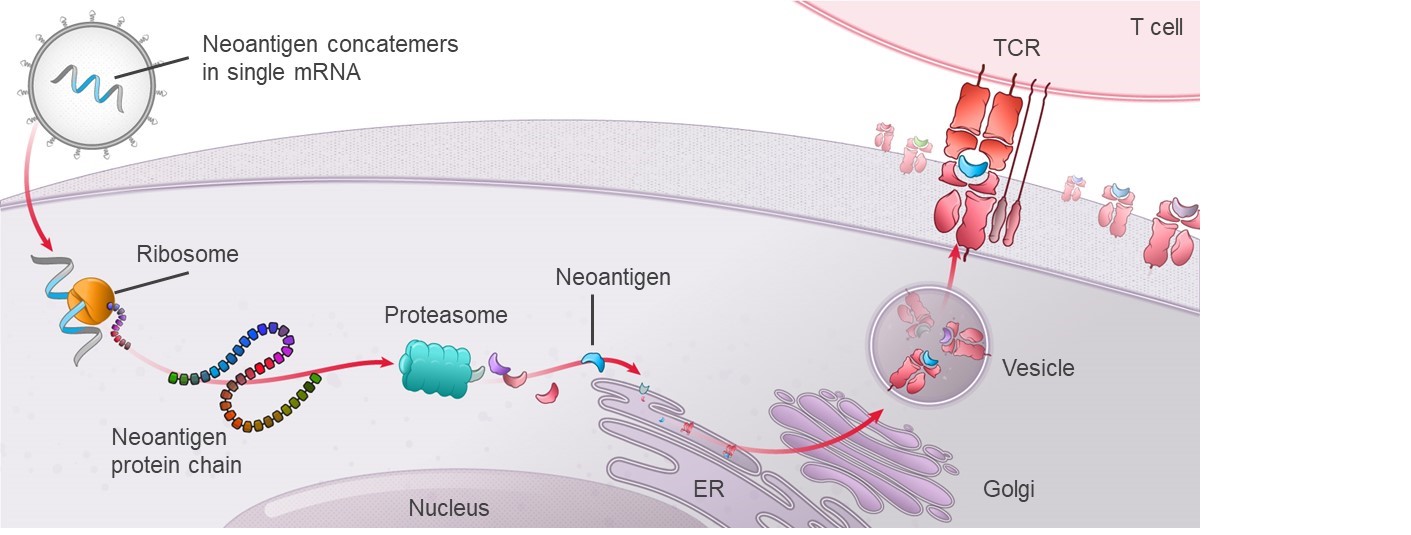
Each mRNA-4157 and NCI-4650 is produced using an integrated batch manufacturing process that is the same regardless of the sequence of the neoantigens to be produced. The overall process involves five major steps that are highly integrated and intended to enable a robust chain of custody and chain of identity. An overview of the system is provided in the figure below.
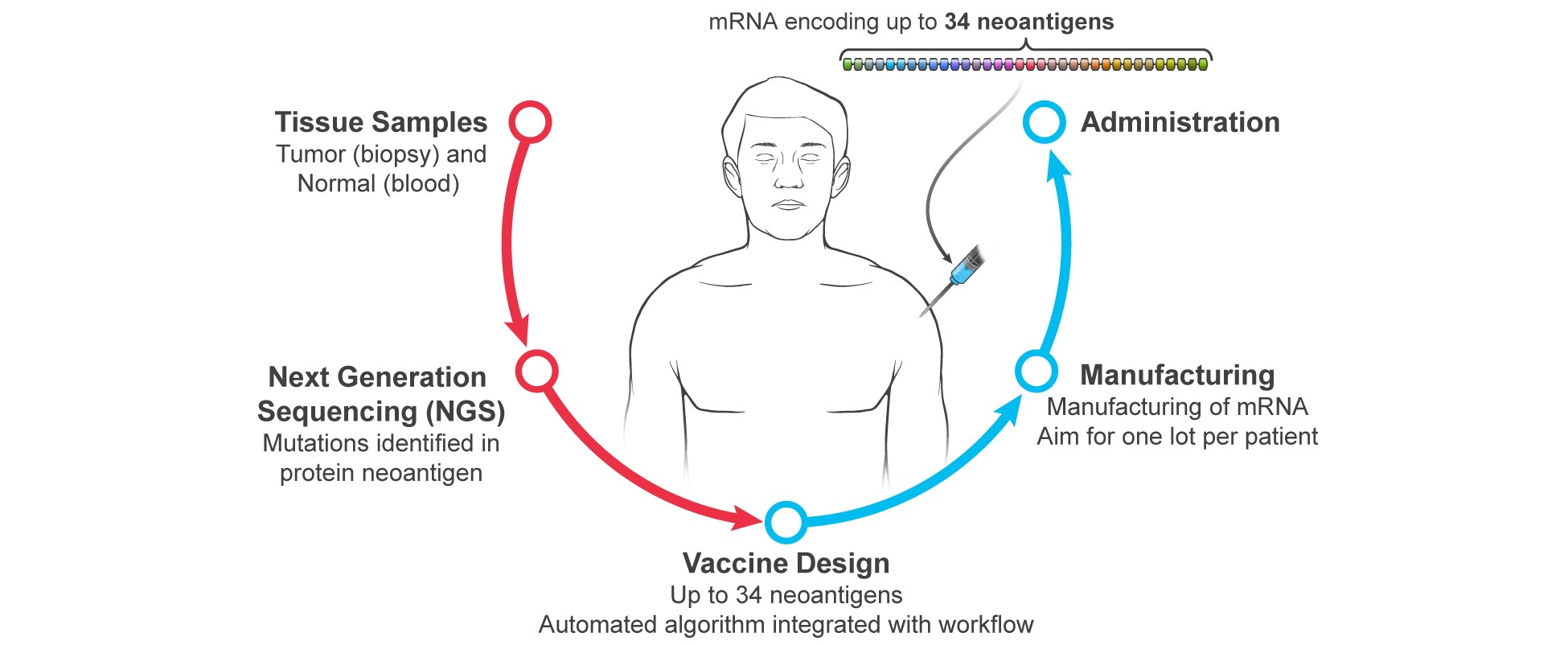
The process includes the following steps:
|
1.
|
Tumor sample;
|
|
2.
|
Next generation sequencing, or NGS, of tumor DNA and RNA;
|
|
3.
|
Vaccine design using our proprietary bioinformatics algorithm for up to 34 patient-specific neoantigens;
|
|
4.
|
Manufacture of the designed mRNA; and
|
|
5.
|
Administration of the mRNA to the same patient that provided the tumor sample.
|
75
Table of Contents
Specifically, for each patient, the tumor sample and peripheral blood samples are collected and immediately sent for NGS analysis. Whole exome sequencing, or WES, data are generated from both the tumor and blood samples, with the blood sample serving as the germline (un-mutated) reference. WES results from the blood sample are also to be used to determine the patient’s HLA-type using an NGS-based approach. The tumor transcriptome is determined by mRNA sequencing, or RNA-Seq. The HLA typing, WES, and RNA-Seq results for each patient are provided as inputs to our proprietary vaccine design algorithm which predicts which neoantigens could be the most immunogenic. The mRNA sequence is then manufactured using an automated workflow to enable a rapid turnaround time. The final drug product is shipped to the clinical site for administration to the same patient that provided the original biopsy.
PCV (mRNA-4157 and NCI-4650): Preclinical information
We have utilized model antigens as surrogates for PCV to demonstrate the ability to elicit a robust T cell response with a single mRNA
We have completed preclinical studies to characterize the ability of an mRNA vaccine to induce a robust and specific T cell response to multiple antigens. Specifically, the ability of our mRNA vaccines to elicit:
|
•
|
Specific and robust T cell responses to murine neoantigens were observed by vaccinating mice with mRNA vaccines that encode previously published immunogenic epitopes from the MC38 mouse tumor cell line and measuring T cell responses to mutant but not wild type antigens. The responses to mRNA vaccination were also significantly higher than responses to the adjuvanted peptide as per a study we conducted. In this study, mice were vaccinated with either empty LNP, adjuvanted peptides corresponding to previously published data or mRNAs encoding the same neoantigen sequences formulated in LNPs. Mice were vaccinated on day 1, 8, and 15 and T cell responses were measured on day 18 using flow cytometry by re-stimulating splenocytes with either control (medium), wild type or mutant (neoantigens) peptides. In an ideal case, one would see a high T cell response when re-stimulated with mutant neoantigen and would not see an equivalent response for re-stimulation with media and wild type peptide. We believe this would indicate a clear specific response for mutant neoantigens with no response to self. As shown in the figure below, the T cell response by mRNA encoding for neoantigens was much higher than that for peptides. The T cell response for mRNA vaccine re-stimulated with wild type was higher than baseline and close to that with control (medium). The T cell responses for mutant peptide were significantly higher than those against wild type peptide.
|
T-cell response for our mRNA PCV in mouse study
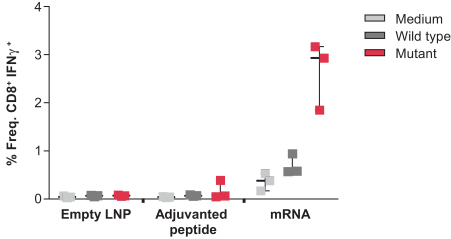
|
•
|
Specific and robust T cell responses to multiple antigens encoded in a single mRNA sequence. The T cell response after vaccinating mice with mRNA vaccine encoding for 16 specific antigens previously reported to be immunogenic in mice as shown in the figure below. mRNA was formulated in a proprietary LNP and delivered intramuscularly to mice on day 1 and day 8. T cell responses were measured on day 15 by re-stimulating splenocytes with either control (medium) or peptides corresponding to each antigen (1, 2, 6, 9, and 12) in the mRNA vaccine and measured by interferon gamma. Measurements are in spot forming units, or SFU, per 1 million cells per well.
|
76
Table of Contents
|
•
|
An mRNA concatemer encoding distinct class I (antigens 6, 9, and 12) and class II antigens (antigen 2) can elicit specific T cell responses to each antigen as shown in the figure below.
|
Unique T cell response to specific antigens encoded by mRNA in mouse study
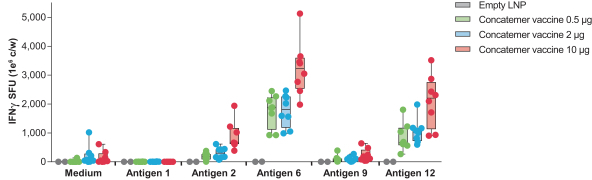
PCV (mRNA-4157 and NCI-4650): Clinical data
Our Phase 1 trial for PCV is currently ongoing in the United States
The Phase 1 trial is an open-label, multicenter study to assess the safety, tolerability, and immunogenicity of mRNA-4157 alone in subjects with resected solid tumors and in combination with the CPI, pembrolizumab (marketed in the United States as KEYTRUDA), in subjects with inoperable solid tumors. The study is sponsored by us. mRNA-4157 is administered by intramuscular injection on the first day of each 21-day cycle and for a maximum of 9 doses. mRNA-4157 is administered as monotherapy (Part A) or in combination with pembrolizumab (Parts, B, C, and D) in the United States. Four mRNA-4157 dose levels of 0.04 mg, 0.13 mg, 0.39 mg, and 1 mg will be explored in Part A and Part B through dose escalation. The following cancers are being investigated: non-small cell lung cancer (subject to certain entry criteria), small cell lung cancer, melanoma, bladder urothelial carcinoma, human papillomavirus-negative head and neck squamous cell carcinoma, and a variety of solid malignancies.
The key objectives of the study include:
|
•
|
for Part A—To determine the safety and tolerability of mRNA-4157 monotherapy in subjects with resected solid tumors and to assess the immunogenicity of mRNA-4157;
|
|
•
|
for Parts B, C and D—To determine the safety, tolerability, and recommended Phase 2 dose of mRNA-4157 administered in combination with pembrolizumab; and
|
|
•
|
for Part D—To assess the immunogenicity of mRNA-4157 with pembrolizumab from apheresis samples in certain subjects.
|
A schematic of the trial is shown in the figure below.
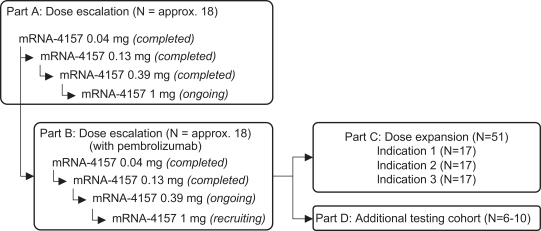
As of February 15, 2019, 33 patients have been dosed with mRNA-4157. Thirteen of the 33 patients have been treated with mRNA-4157 monotherapy in Part A and 20 patients have been treated with mRNA-4157 and pembrolizumab in Part B. In Part A, patients have been dosed up to the 1 mg dose level which is currently ongoing. In Part B, patients have been dosed up to the 1 mg dose
77
Table of Contents
level which is currently ongoing. There have been no dose-limiting toxicities or significant related toxicities observed in these patients to date. Parts C and D of the study are currently recruiting.
In our dose escalation of mRNA-4157 in Part A (monotherapy), we have detected antigen specific T cell responses. This is measured by restimulating unexpanded peripheral blood mononuclear cells with sets of peptides corresponding to neoantigens encoded by the patient-specific mRNA-4157 and is shown in the figure below. Individual data points indicate technical replicates.
Antigen-specific T cell responses for one patient at the 0.13 mg dose level in Part A of the Phase 1 clinical trial for PCV vaccine (mRNA-4157)
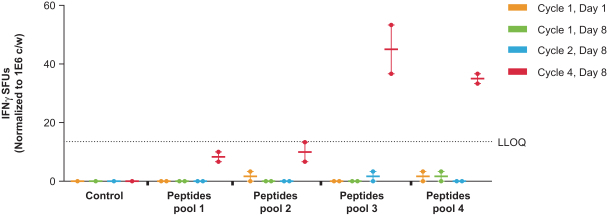
We and our strategic collaborator Merck have submitted a new protocol to the FDA to commence a randomized Phase 2 study to assess whether post-operative adjuvant therapy with mRNA-4157, in combination with pembrolizumab, improves relapse-free survival compared to pembrolizumab alone. The study has a primary endpoint of relapse free survival with a primary analysis at 12 months and will be conducted with patients that have had complete resection of cutaneous melanoma but remain at high risk of recurrence.
A schematic of the Phase 2 trial is shown in the figure below.
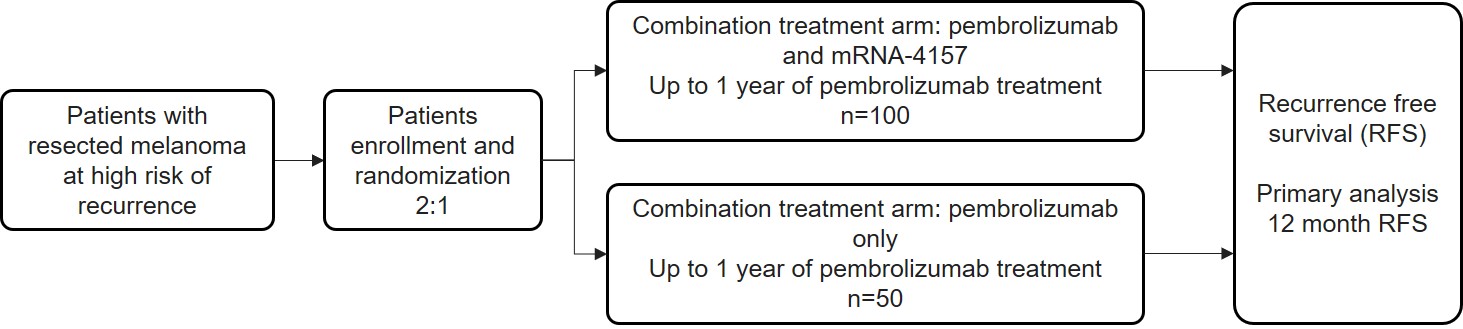
NCI-4650 is in an ongoing investigator-initiated, single-arm, open-label trial involving up to 12-patients with advanced metastatic disease sponsored by National Cancer Institute.
78
Table of Contents
KRAS vaccine (mRNA-5671): Summary
In collaboration with Merck, we are developing a cancer vaccine (mRNA-5671) with mRNAs encoding for a concatemer of mutations in the KRAS oncogene protein
Although monotherapy checkpoint inhibitor treatment can provide significant benefit for some cancer patients, many have incomplete or no response to therapy, presenting a need for alternative therapies to stimulate antitumor immunological responses. Finding oncogenic driver mutations that encode targetable T cell epitopes has considerable therapeutic implications. Point mutations in the KRAS gene occur in about 22% of human cancers, such as colorectal, non-small cell lung and pancreatic cancers. Direct inhibition of KRAS has proven challenging and to date, there are no successful KRAS-targeted cancer therapies. It has been reported that KRAS-mutant neoantigens can be presented on certain human HLAs. Therefore, one approach is to immunize the body to naturally synthesize neoantigen peptides that contain common KRAS mutations for presentation to the immune system by mRNA. We have designed an mRNA to generate and present KRAS neoantigens to the immune system from the four most common
KRAS
mutations. We are advancing this program through clinical trials in collaboration with Merck and we have transferred the IND to Merck, since Merck is the sponsor of the Phase 1 trial. Patients will either be dosed with mRNA-5671 as monotherapy or in combination with the checkpoint inhibitor pembrolizumab.
KRAS vaccine (mRNA-5671): Our product concept
Our approach is to encode multiple mutations of KRAS in our mRNA vaccine administered together with a checkpoint inhibitor.
Oncogenic driver mutations that encode targetable T cell neoantigens have considerable potential therapeutic implications: (1) driver mutations are subject to positive selection, as they confer survival advantages for the tumor, and (2) such neoantigens could be shared between patients, enabling an easier approach to developing and manufacturing such therapeutic or curative interventions.
KRAS is a frequently mutated oncogene in epithelial cancers, primarily lung, colorectal cancer, or CRC, and pancreatic cancers. The four most prevalent KRAS mutations associated with these malignancies are G12D, G12V, G13D, and G12C, which constitute 80% to 90% of KRAS mutations. KRAS has multiple downstream signaling pathways, and although drugs have been developed to target individual effectors, direct inhibition of KRAS could be more efficacious. Direct inhibition of KRAS has proven challenging, as have past efforts at generating a cancer vaccine against KRAS. These attempts have proven to be ineffective, likely due to either the lack of concomitant administration of a checkpoint inhibitor or vaccines which have been only minimally immunogenic. None of the historic attempts at a KRAS vaccine used mRNA.
79
Table of Contents
Immune stimulators are often incorporated in vaccines to improve immune response to the antigens of interest. STimulator of INterferon Gene, or STING, is a cytosolic nucleotide sensor known to trigger type 1 interferon responses and has been reported to promote antigen specific T cell responses. STING has been reported to promote antitumor immunity and vaccines including STING agonists (e.g., cyclic dinucleotides) show overall improvement of immune responses to poorly immunogenic antigens. Merck has opted to advance mRNA-5671 without STING mRNA and may choose to include STING mRNA in further clinical development of this vaccine.
In order to drive T cell mediated antitumor responses, our mRNA vaccine includes an mRNA encoding for a concatemer of sequences encoding the four most common KRAS mutations, encapsulated in our proprietary LNP. Our mRNA vaccine will be dosed either as monotherapy or in combination with a checkpoint inhibitor. An illustration of one approach for mRNA-5671 is shown in the figure below.
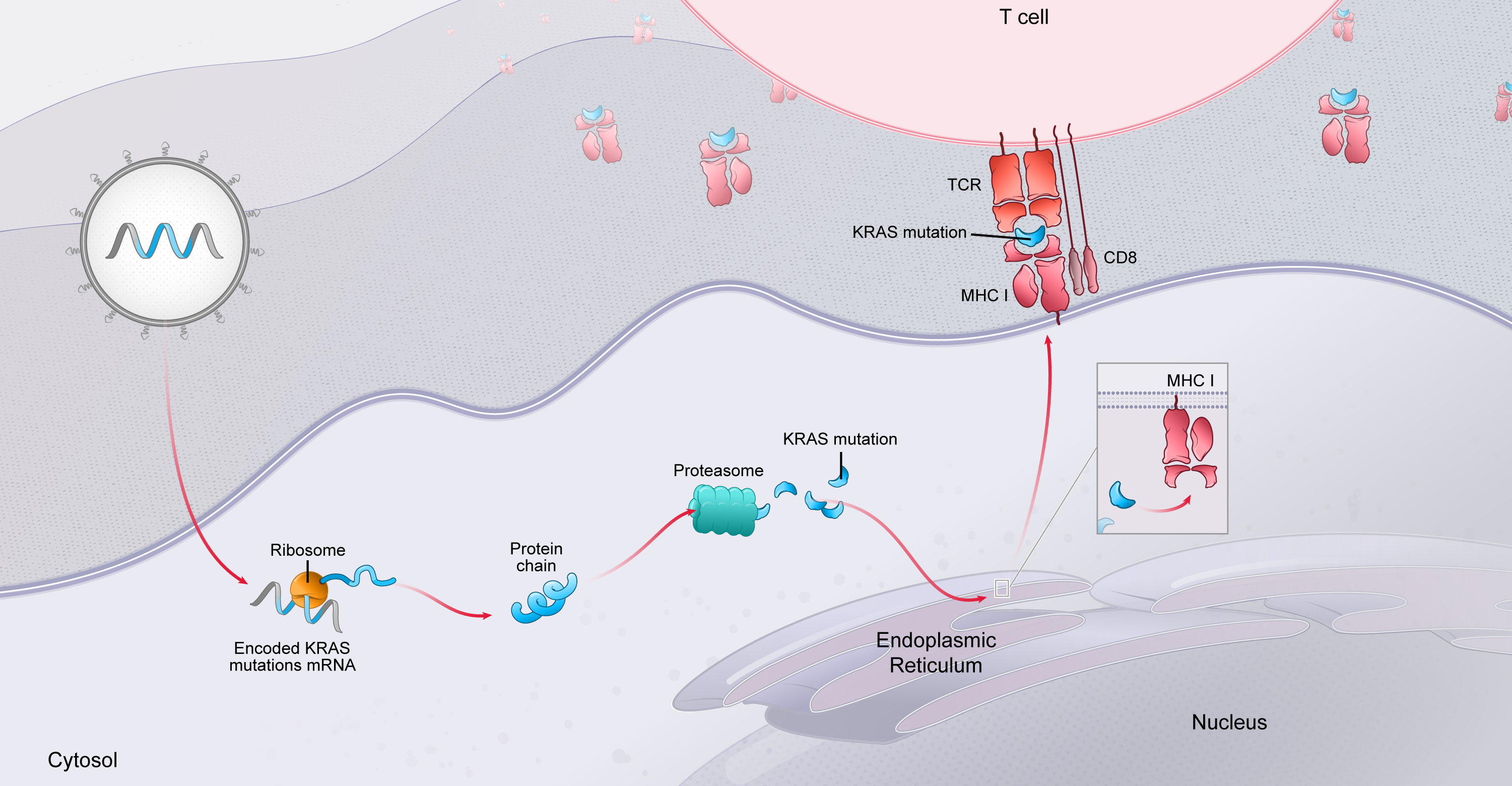
KRAS vaccine (mRNA-5671): Preclinical information
We have observed the utility of KRAS mRNA vaccine in vivo
The immunogenicity of our KRAS vaccine is supported by several preclinical studies in which we observed that our mRNA encoding for KRAS mutations can be made in cells and presented in transgenic mice with specific HLA I alleles.
One of these models was a transgenic mouse model expressing a specific human HLA. This is shown in the figure below. These transgenic mice were vaccinated with either mRNA encoding A11-positive control antigens (control), single mutant KRAS neoantigen or the concatemer of the four most common mutant KRAS neoantigens, plus mRNA encoding STING. mRNA was formulated in our proprietary LNP and delivered intramuscularly on day 1 and day 15, T cell responses were measured on day 22 by re-stimulating splenocytes with either medium, or wild type or mutant KRAS peptides (panel A—KRAS mutation 1 and panel B – KRAS mutation 2). Robust and specific antigen specific CD8+IFN
γ+
T cell responses were detected in splenocytes after re-stimulation with KRAS mutation 1 peptide and KRAS mutation 2 peptide.
80
Table of Contents
T-cell response to restimulation with KRAS mutation 1 peptide in mouse model study with mRNA vaccine encoding for KRAS mutation 1 peptide
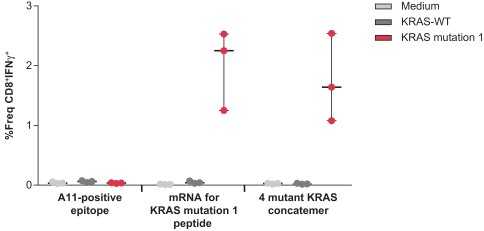
Panel (A)
T-cell response to restimulation with KRAS mutation 2 peptide in mouse model study with mRNA vaccine encoding for KRAS mutation 2 peptide
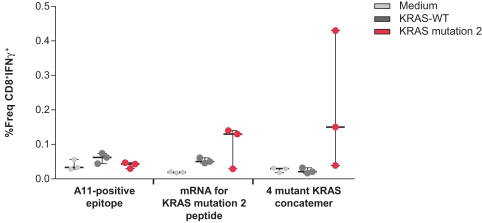
Panel (B)
KRAS vaccine (mRNA-5671): Clinical plan
Merck will lead the clinical development of the KRAS vaccine program
The next step is to conduct an open-label, multi-center, dose-escalation and dose expansion Phase 1 study to evaluate the safety and tolerability of mRNA-5671 administered as an intramuscular injection both as a monotherapy and in combination with pembrolizumab. Merck may choose to measure T cell responses in this trial. The IND was originally filed by us and then transferred to Merck and remains open.
81
Table of Contents
III. PROGRAM DESCRIPTIONS IN OUR INTRATUMORAL IMMUNO-ONCOLOGY MODALITY
We designed our intratumoral immuno-oncology modality to treat or cure cancer by transforming the tumor microenvironment to drive anti-cancer T cell responses against tumors. This modality currently has three programs. Our mRNA technology within this modality allows for the combination of multiple therapeutics that can be directly injected into a tumor with the goal of activating the tumor microenvironment to kill cancer cells in the injected tumor as well as in distal tumors, known as the abscopal effect. Intratumoral administration allows for localized effect of these therapeutics that could be toxic if administered systemically.
Our pipeline is shown in two formats, with a cell map illustrating the diversity of biology addressed by our mRNA pipeline programs, and a traditional format that shows the current stages of development of our pipeline programs, in the section of this Annual Report on Form 10-K titled “Business—Our Pipeline.”
Opportunity
More than 1.6 million new cancer cases and approximately 600,000 deaths due to cancer were predicted in the United States for 2017. There have been several advances in the treatment of cancer through immune-mediated therapies in recent years. However, the outlook for many patients with advanced cancer remains poor, especially in tumors that have little immune system engagement and are therefore termed immunologically “cold.” We aim to activate the tumor microenvironment with our mRNA therapeutics, in conjunction with a checkpoint inhibitor, to activate the immune system against these otherwise immunologically cold tumors.
Our approach
Our intratumoral immuno-oncology modality is focused on driving robust, specific anti-cancer T cell responses, transforming cold tumors with an immunosuppressive microenvironment into one that is immunologically “hot” thereby resulting in a productive anti-cancer immune response. Our goal is to discover and develop locally administered, or intratumoral, immune-mediated therapies to deliver mRNA encoding for potent immune-stimulatory proteins that can act at the site of the injected tumor, reduce systemic toxicities, and potentially create an “abscopal effect” where distal tumor sites are also impacted. These may be combined with checkpoint inhibitors to boost the response. All of the mRNAs utilized in this modality are designed to decrease the amount of protein that could be made in hepatocytes through incorporation of microRNA binding sites, thus potentially reducing off-target effects and resulting in better tolerability.
Earlier efforts by others on the utility of intratumoral immune-mediated therapies have been established in murine models of cancer. In many of our preclinical studies focusing on demonstrating bioactivity and efficacy in mice, we have employed surrogate mRNAs encoding murine homologs, given that human proteins may not be sufficiently cross-reactive in mice, and that the use of human proteins in mice would be expected to elicit anti-foreign protein immune responses.
OX40L (mRNA-2416): Summary
Our immuno-oncology approach to enhance specific T cell responses in the tumor microenvironment via expression of the membrane T cell co-stimulator OX40L by intratumoral injection of OX40L mRNA
There have been several recent advances in the treatment of cancer through activation of the immune system. However, many patients with advanced stages of cancer respond to few therapies and continue to face a poor outlook. Alternative strategies to activate an immunologic anti-tumor response, while at the same time reducing systemic toxicities, are required. To this end, we have developed an investigational mRNA therapeutic coding for wildtype OX40 ligand, or OX40L, protein, a membrane protein normally expressed on antigen presenting cells upon immune stimulation that augments an activated immune response. mRNA-2416 encodes for wild-type OX40L which is a membrane protein, a class of proteins that we believe cannot be manufactured for administration to tumor cells by recombinant technologies. mRNA-2416 is being developed for the treatment of solid tumors following local intratumoral injection. We are currently sponsoring a Phase 1/2 trial that is ongoing in the United States. As of October 22, 2018, 26 patients were dosed with mRNA-2416 of which three patients were unclassified since they were early on in the study prior to the planned first evaluation after starting treatment, six patients were noted to have a best overall response of stable disease, 16 patients clinically progressed prior to the planned first evaluation after starting treatment, and one patient progressed based on the planned first evaluation after starting treatment. As of October 22, 2018, two patients with ovarian cancer have demonstrated clinical observations of regression in certain injected lesions and in an adjacent uninjected lesion. These clinical observations from these two ovarian cancer patients do not meet partial response criteria as per the response evaluation criteria in solid tumors, or RECIST, guidelines version 1.1. Based on these clinical observations, we have opted to expand the trial to a Phase 2 expansion cohort in patients with advanced ovarian carcinoma.
OX40L (mRNA-2416): Mechanistic overview
OX40L is a T cell co-stimulator
The generation of optimal T cell responses requires T cell receptor, or TCR, engagement by presented epitopes (e.g., cancer antigens) and a positive secondary signal achieved through co-stimulatory molecules like OX40. OX40 receptor (also known as TNFRSF4, or
82
Table of Contents
CD134) is a member of the tumor necrosis factor, or TNF, receptor superfamily and is upregulated on activated immune effector cells upon TCR activation. OX40 is endogenously stimulated via OX40L, a homotrimeric membrane protein normally expressed on professional antigen presenting cells. Binding of OX40 by OX40L in the presence of a recognized antigen enhances the expansion of CD4 and CD8 T cells, increases T cell effector function, and enhances survival of experienced T cells for increased memory capacity. Prior clinical attempts of activating OX40 with agonist antibodies may have been hampered via antibody interactions with other cells. We believe that introduction of OX40L in tumor sites via mRNA may serve to boost T cell responses, and we believe intratumoral administration of mRNA encoding for OX40L may be an attractive method of enhancing anti-cancer immunity.
OX40L (mRNA-2416): Our product concept
Our approach is to deliver OX40L mRNA in a lipid nanoparticle intratumorally to produce a membrane T cell co-stimulator
Our product consists of mRNA coding for the human sequence of OX40L formulated in our proprietary LNP. mRNA-2416 was designed to decrease the amount of protein that could be made in hepatocytes through incorporation of a microRNA binding site, thus potentially reducing off-target effects and resulting in better tolerability. Following intratumoral injection, a specific anti-tumor immune response is expected to be induced via proliferation and migration of T cell clones with specificity for the cancer that may also result in systemic anti-tumor responses. An illustration of our approach for this program is shown in the figure below. An earlier concept of this development candidate included a legacy LNP. However, we observed sufficient toxicity findings in an IND-enabling GLP toxicology study to abandon the legacy LNP. Toxicity findings were largely diminished when the development candidate was switched from a legacy LNP to our proprietary LNP.
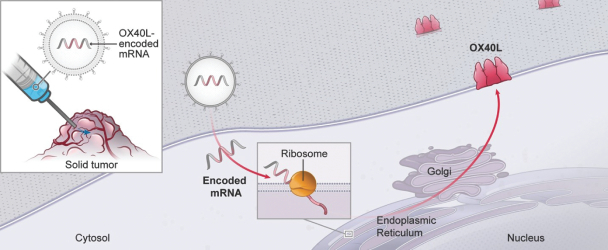
OX40L (mRNA-2416): Preclinical information
We have demonstrated the ability to inhibit tumor growth in mouse models of cancer using our approach
Intratumoral administration of mouse OX40L mRNA in our proprietary LNP resulted in production of OX40L protein in the tumor microenvironment and draining lymph node in mice. The activity of mouse OX40L, or mOX40L, was evaluated in syngeneic models, including an H22 hepatocellular carcinoma model. With this model, H22 cancer cells were subcutaneously implanted on the flank of BALB/c mice. Following tumor growth, mice were randomized into treatment groups and treated with weekly intratumoral injections of formulated mRNA encoding mOX40L or a negative control mRNA. Repeated weekly intratumoral injections of mOX40L mRNA in a syngeneic H22 mouse model resulted in 50% of the mRNA-treated mice with no measurable disease at the end of the study. Survival of mice treated with negative control mRNA and mRNA encoding murine OX40L are depicted in gray and red respectively in the figure below. Mice with subcutaneous H22 tumors were treated intratumorally with 7.5 µg of mRNA formulated in LNPs on Days 8, 16, and 24 post cancer cell implant. 6 of 12 mice treated with mOX40L mRNA were complete responders with no detectable tumor burden at day 100, whereas negative control mRNA formulated in LNPs yielded no complete responders. Survival curves were plotted by considering any reason a mouse was removed from study, including the predetermined tumor burden endpoint of 2,000 mm
3
, as a survival event.
We further demonstrated generation of anti-cancer immunological memory after OX40L mRNA treatment, as no tumor growth was observed in mice in the six initial complete responders that were re-injected with the same H22 cancer cells, as shown below.
83
Table of Contents
50% complete responders (n=12) with mouse OX40L mRNA in H22 syngeneic mouse model study
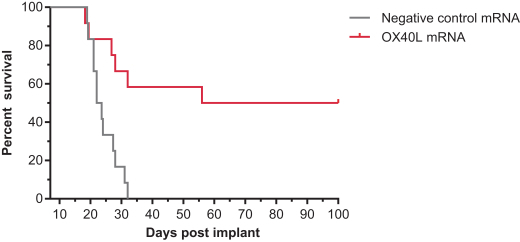
OX40L (mRNA-2416): Clinical data
Our interim data indicate that intratumoral treatment with OX40L mRNA has no dose limiting toxicities, and has led to clinical observations of tumor regression in two patients with ovarian cancer but the tumor regression at the doses studied do not meet RECIST criteria for partial responses in the Phase 1/2 trial in the United States
The Phase 1/2 trial for mRNA-2416 is an open-label, multicenter study of repeated intratumoral injections of mRNA-2416 in patients with advanced relapsed/refractory solid tumor malignancies and lymphomas in the United States. mRNA-2416 will be administered at day 1 and day 15 of a 28-day cycle with a maximum of 6 cycles. The dose levels being tested are 1 mg, 2 mg, 4 mg, and 8 mg. The objectives of this study include evaluating safety and tolerability of mRNA-2416 administered intratumorally, and to define the maximum tolerated dose and recommended dose for expansion. Other endpoints include pharmacokinetic analyses as well as assessment of biomarkers of immunological response in tumor.
The study includes 2 dosing periods: dose escalation period followed by an expansion period at the recommended dose for expansion. Patients are enrolled into one of the following three biopsy cohorts:
|
A.
|
Baseline biopsy in abscopal distal, untreated tumor, second biopsy within cycle 1 at day 22 to 28 at distal tumor
|
|
B.
|
Baseline biopsy in primary tumor to be treated, second biopsy 24 to 48 hours post-dose cycle 1 day 1 in injected tumor
|
|
C.
|
Baseline biopsy in primary tumor to be treated, second biopsy 24 to 48 hours post-dose cycle 2 day 1 in injected tumor
|
A schematic of the trial design is shown in the figure below.
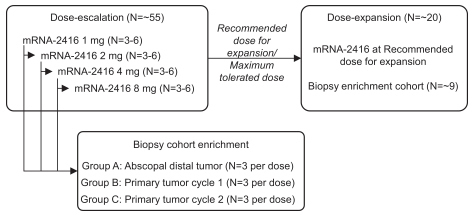
As of November 15, 2018, 28 patients have been dosed with mRNA-2416. A subset of biopsies of treated lesions from those patients detected higher OX40L protein levels after mRNA-2416 administration. In approximately 18% of patients, we have observed rapid onset of multiple grade 2 and a single grade 3 transient reversible injection related reactions, all of which were resolved with antihistamines, corticosteroids, or supplemental oxygen. Three suspected unexpected serious adverse reactions, or SUSARs, have been reported. Of the three, one was the grade 3 serious adverse event, or SAE, described above. A second case was reported for a grade 2
84
Table of Contents
non-infectious systemic inflammatory response syndrome, and the patient was kept overnight at the hospital. In the third case, a patient, diagnosed with Stage IIIC ovarian carcinoma, experienced a skin ulceration during treatment, deemed to be a non-serious adverse event, located within the injected tumor, which had begun to regress following treatment with mRNA-2416. After the last administered dose of mRNA-2416, and after the patient withdrew from the trial for personal reasons, the wound was smaller in size. Subsequently, the patient underwent additional treatment for disease progression with Cytoxan/Avastin, the wound increased significantly in size, and Avastin was discontinued due to patient preference and wound healing concerns. The patient was then hospitalized due to worsening of the skin ulceration, by which time the injected tumor was noted to be absent (though other lesions were present). Although no longer in the study, this hospitalization was deemed by the investigator as a suspected unexpected serious adverse reaction related to study drug, but deemed by us as possibly related to study drug. After discharge from the hospital, the patient died. This death was reported to be due to disease progression, not study drug. After the intratumoral injection of mRNA-2416 in other patients, no other skin ulceration has been observed related to study drug.
As of February 15, 2019, we have dosed five additional patients, for a total of 33 patients dosed with mRNA-2416, and we have not seen any dose limiting toxicities. The study is currently in its dose-confirmation phase at doses up to 8mg.
We have collected and analyzed eight paired biopsies of tumors pre- and post-injection of mRNA-2416 through October 22, 2018. Of these eight, six paired biopsies are from injected lesions and two are from uninjected lesions. In three of the six paired biopsies from injected lesions where tumors showed evidence of the location of the injection site and had viable tissue from the biopsy to analyze, we have observed an increase in OX40L protein after mRNA administration. In one of these cases, we have observed OX40L protein expression in the injected lesion for a biopsy collected at cycle 1 day 2 as shown by quantitative immunofluorescence staining in the figure below. Staining in red denotes OX40L protein and 4’,6-diamidino-2-phenylindole, or DAPI, stains DNA to indicate nuclei in blue. Cytokeratin staining in green indicates keratin filaments often used to mark epithelial cancer cells.
OX40L protein production in tumor cells of a patient with ovarian cancer dosed with mRNA-2416
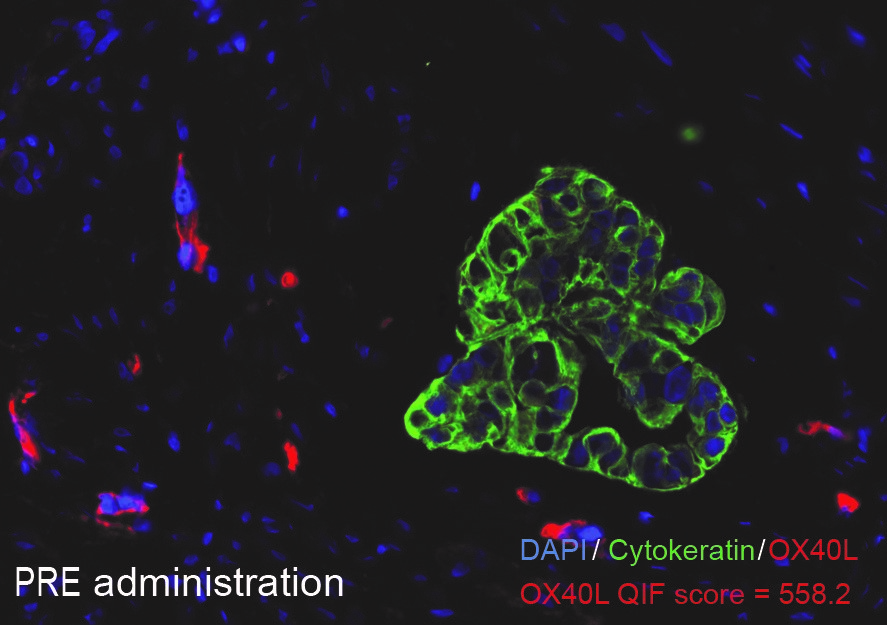
|
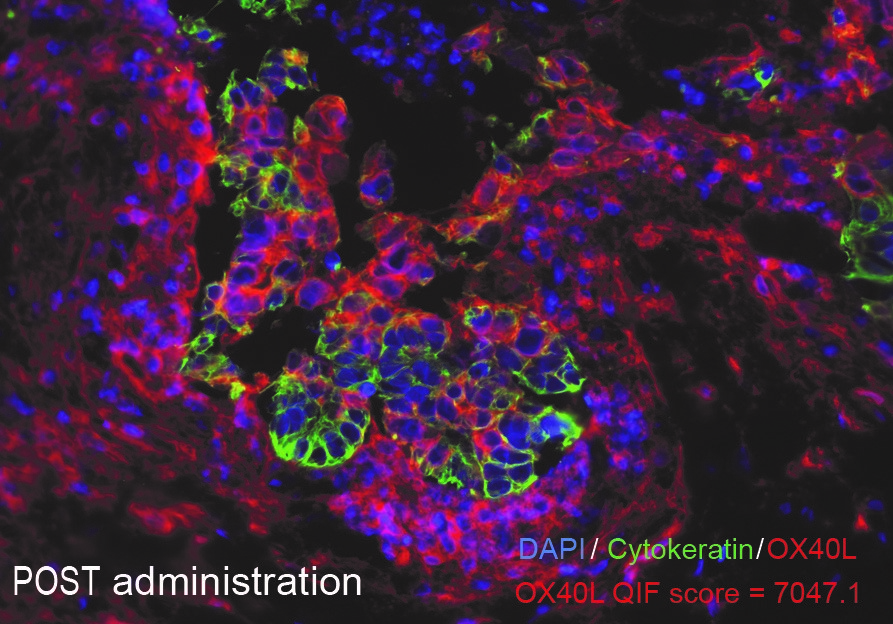
|
|
|
Before treatment with mRNA-2416
|
After treatment with mRNA-2416
|
|
In the remaining three of the six paired biopsies from injected lesions, we did not observe OX40L protein increase, possibly because there was no noted evidence of injection site or there was extensive tissue necrosis.
Of the 26 patients dosed with mRNA-2416 as of October 22, 2018, there are two patients with ovarian cancer. These two patients with ovarian cancer have clinical observations of regression in certain injected lesions and in an adjacent uninjected lesion. These clinical observations do not meet partial response criteria as per RECIST guidelines version 1.1. One of these patients in group 2A has received eight doses of 2 mg and was still on treatment as of October 22, 2018. In this patient, a reduction in an injected lesion was observed after the fourth dose. In addition, for the same patient, a reduction in an adjacent uninjected lesion was observed. We did not observe an increase in OX40L protein production in this uninjected lesion in the post-treatment biopsy at cycle 1 day 27.
The Phase 1/2 trial for OX40L (mRNA-2416) is ongoing. We have filed a protocol amendment to the FDA for a Phase 2 expansion cohort in patients with advanced ovarian carcinoma as part of the current trial.
85
Table of Contents
OX40L+IL23+IL36γ (Triplet) (mRNA-2752): Summary
Our immuno-oncology approach to transform the tumor microenvironment: intratumoral injection of OX40L+IL23+IL36γ
Despite recent advances in immune-mediated therapies for cancer, the outlook for many patients with advanced cancer is poor. We are developing Triplet (mRNA-2752) and other programs to drive anti-cancer T cell responses by transforming cold tumor microenvironments into productive, “hotter” immune landscapes with local intratumoral therapies. Triplet (mRNA-2752) utilizes the intrinsic advantage of mRNA to multiplex and to produce membrane and secreted proteins with mRNA in a single investigational medicine. Triplet (mRNA-2752) includes three mRNAs encoding human OX40L, interleukin 23, or IL23, and interleukin 36 gamma, or IL36γ , that are encapsulated in our proprietary LNP and administered intratumorally. OX40L is a membrane protein, whereas IL23 and IL36γ are secreted cytokines. We believe our approach has the advantage of localized high concentration gradients of IL23 and IL36γ compared to recombinant proteins administered systemically or intratumorally. Additionally, the mRNA for OX40L encodes for the wild type membrane protein, which we believe recombinant protein technologies cannot enable. The combination of OX40L, IL23, and IL36γ has shown robust activity in preclinical cancer models and is synergistic with checkpoint inhibitors. In addition, this combination elicits an anti-tumor response on distal tumors (via the “abscopal effect”), as well as treated tumors in preclinical studies. We have initiated dosing in a Phase 1 study of Triplet (mRNA-2752).
OX40L+IL23+IL36γ (Triplet) (mRNA-2752): Mechanistic overview
Triplet (mRNA-2752) is designed and tailored to activate the immune system in two ways
This potential mRNA medicine is a novel mRNA-based therapeutic agent containing multiple mRNAs that code for the wild type human OX40L, IL23, and IL36γ proteins that have distinct functions yet work synergistically in mediating anti-cancer responses. Triplet (mRNA-2752) brings two approaches into a single multi-mechanism therapy:
|
•
|
T cell co-stimulation that could strengthen specific anti-cancer adaptive immune responses (mediated by OX40L); and
|
|
•
|
pro-inflammatory cytokines/chemokines to ignite or transform an inflammatory response within the tumor microenvironment (IL23 and IL36γ).
|
The generation of optimal T cell responses requires T cell receptor, or TCR, engagement by presented epitopes (e.g., cancer antigens) and a positive secondary signal achieved through co-stimulatory molecules like OX40. OX40 receptor (also known as TNFRSF4 and CD134) is a member of the tumor necrosis factor, or TNF, receptor superfamily and is upregulated on activated immune effector cells upon TCR activation. OX40 is endogenously stimulated via OX40L, a homotrimeric membrane protein normally expressed on professional antigen presenting cells. Binding of OX40 by OX40L in the presence of a recognized antigen enhances the expansion of CD4 and CD8 T cells, increases T cell effector function, and enhances survival of experienced T cells for increased memory capacity. Therefore, introduction of OX40L via mRNA may serve to boost T cell responses. We believe that in addition to boosting T cell responses via OX40L expression, the expression of pro-inflammatory cytokines within a treated tumor may serve to ignite and transform an immunologically cold tumor microenvironment into a productive anti-cancer immune response. The initial focus was on cytokines with well-established roles in initiating inflammation and bridging innate to adaptive immunity in humans; namely the IL1 and IL12 families, respectively. Specifically, anti-cancer effects have been observed by introduction of IL1 family member IL36γ in preclinical mouse models of cancer. IL12 family members, including IL23, are often referred to as central coordinators of immune responses, largely due to their capacity to bridge innate to adaptive immunity.
OX40L+IL23+IL36γ (Triplet) (mRNA-2752): Our product concept
The potential advantage of mRNA to target multiple immuno-stimulatory pathways in tumors
We are developing Triplet (mRNA-2752) for the treatment of advanced or metastatic solid tumor malignancies or lymphoma as a single agent or in combination with checkpoint inhibitors. Triplet (mRNA-2752) includes three mRNAs encoding OX40L, IL23, and IL36γ, encapsulated in our proprietary LNP. Triplet (mRNA-2752) is designed to make these proteins in cells of the local tumor environment or lymph node. Our approach potentially has the advantage of localized gradients of two important cytokines IL23 and IL36γ, rather than a systemic administration or intratumoral injection of cytokine proteins that would lead to quick diffusion away from the tumor. Additionally, the mRNA for OX40L encodes for the wild type membrane protein, which would be challenging to administer to either a tumor or systemically as a recombinant membrane protein capable of co-stimulation of T cells. mRNA for IL23 produces a single-chain fusion protein of the IL12B and IL23A subunits, with a linker between the subunits. mRNA for IL36γ produces a protein with introduced signal peptide to bypass a need for upstream processing for release and activity. In addition, all three mRNA were designed to decrease the amount of protein that could be made in hepatocytes through incorporation of microRNA binding sites, thus potentially reducing off-target effects and resulting in better tolerability. An illustration of our approach for Triplet (mRNA-2752) is shown in the figure below.
86
Table of Contents
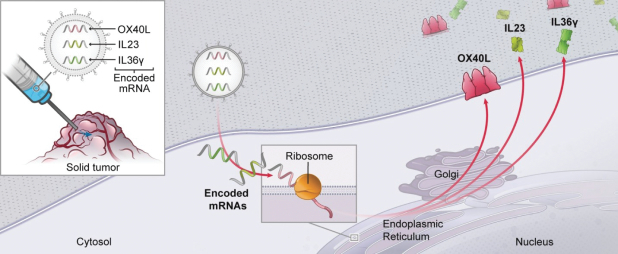
OX40L+IL23+IL36γ (Triplet) (mRNA-2752): Preclinical information
The OX40L+IL23+IL36γ combination promotes tumor killing in mice of injected and non-injected tumors, along with a lasting T cell effect
As described earlier, preclinical work was conducted using mouse homologs. The combination local therapy of OX40L+IL23+IL36γ mRNAs achieved 70-100% complete response rates in two MC38 syngeneic mouse models of cancer, one that is normally relatively responsive and the other completely refractory to systemic checkpoint inhibitor treatment. The triple combination therapy had better results than individual and doublet mRNA combinations. In one study, mice carrying bilateral MC38-S tumors received 5 µg total mRNA injected into the right flank tumor only (2.5 µg each mRNA administered for doublets and 1.67 µg each for triplet combinations). The survival plots are graphed in the figure below. Survival events were triggered when animals surpassed the predetermined tumor burden endpoint of 2,000 mm
3
(for both tumors combined). Animals removed from study for other reasons were censored and indicated below as horizontal lines prior to Day 100. 20 mice were included in each cohort depicted, and there were 10, 11, and 20 complete responders (i.e., no measurable disease at either tumor site) for the IL23+IL36γ, IL23+OX40L and OX40L+IL23+IL36γ treatment groups, respectively, at 100 days post cancer cell implant. We also found that a single dose of OX40L+IL23+IL36γ mRNA was able to induce complete disease control at both treated and distal sites, sometimes known as an abscopal effect. This underscores the potential of our approach to lead to a well tolerated and broadly active therapy for treatment of multilesional and metastatic cancers.
100% (n=20) complete responders with mouse OX40L+IL23+IL36γ mRNA in MC38 dual flank syngeneic mouse model study
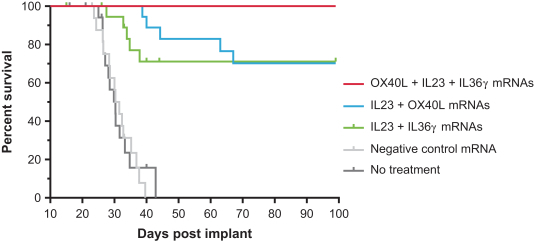
In addition to OX40L+IL23+IL36γ mRNA monotherapy activity, we have further observed that a single suboptimal dose of OX40L+IL23+IL36γ mRNA therapy was synergistically active with systemically administered anti-PD-1/PD-L1 as well as anti-CTLA4 antibodies, again demonstrating complete response rates of
>
70%.
OX40L+IL23+IL36γ (Triplet) (mRNA-2752): Clinical plan
The Phase 1 trial for Triplet (mRNA-2752) has initiated in the United States
87
Table of Contents
We have initiated a Phase 1 study that is designed as an open-label, multicenter study of intratumoral injections of Triplet (mRNA-2752) alone or in combination with checkpoint inhibitors. The objectives of this study include:
|
•
|
safety and tolerability of Triplet (mRNA-2752) administered alone and in combination with checkpoint inhibitors;
|
|
•
|
define the maximum tolerated dose, or MTD, and recommended dose for expansion, or RDE, for intratumoral injections of Triplet (mRNA-2752) alone and in combination with checkpoint inhibitors; and
|
|
•
|
assessment of anti-tumor activity, protein expression in tumors, and pharmacokinetics, and exploratory endpoints that include assessment of immunological responses.
|
A schematic of the clinical trial design is shown in the figure below. There are three treatment arms:
|
•
|
arm A—Triplet (mRNA-2752) alone;
|
|
•
|
arm B—Triplet (mRNA-2752) in combination with durvalumab, a PD-L1 inhibitor; and
|
|
•
|
arm C—Triplet (mRNA-2752) in combination with tremelimumab, a CTLA-4 inhibitor.
|
The study consists of 3 dose escalation and 3 dose confirmation parts followed by a dose expansion for Arms B and C. Once the first two dose levels in Arm A are cleared for safety, dose escalation for Arm B will start. Once the first dose level in Arm B is cleared for safety, dose escalation for Arm C will start. There will be a 28-day stagger between the first and second patient in each study arm. The doses for the study are 0.25, 0.5, 1, 2, and 4 mg of Triplet (mRNA-2752). In Arm A, Triplet (mRNA-2752) is to be administered every 2 weeks for 3 doses. In Arm B, the combination of Triplet (mRNA-2752) with durvalumab is to be administered every 4 weeks for 3 cycles. For Arm C, the combination of Triplet (mRNA-2752) with tremelimumab is to be administered every 4 weeks for 3 cycles. Biopsy and blood samples to be collected pre and post treatment with mRNA in both dose escalation and dose expansion to assess protein expression and changes in tumor immune landscape. As of February 28, 2019, three patients in Arm A have been dosed and cleared with the first dose level of 0.25 mg of Triplet (mRNA-2752), and we are enrolling patients for the second 0.5 mg dose level.
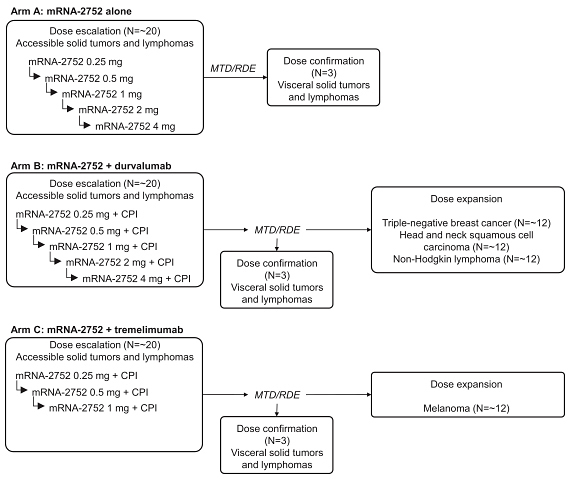
88
Table of Contents
IL12 (MEDI1191): Summary
Our immuno-oncology approach to transform the tumor microenvironment: IL12 as a localized secreted protein in collaboration with AstraZeneca
Another strategy for cancer patients with immunologically cold tumors is to transform the tumor microenvironment by introducing pro-inflammatory cytokines directly into tumors or draining lymph nodes. In collaboration with AstraZeneca, we are developing MEDI1191 that is an mRNA for IL12 encapsulated in our proprietary LNP to be delivered intratumorally. Systemic administration of recombinant IL12 protein was poorly tolerated in early clinical trials and exhibited generally low response rates. MEDI1191 can enhance the immune response by positively impacting both antigen presenting cells and T cells, and local, intratumoral expression of IL12 can potentially improve tolerability compared to systemic protein treatments. AstraZeneca is planning a Phase 1 clinical trial for MEDI1191, which is to be co-administered with a checkpoint inhibitor.
IL12 (MEDI1191): Mechanistic overview
IL12 is a powerful immune-modulator that bridges innate and adaptive responses
The IL12 family members are often referred to as central controllers of immune responses due to their capacity to bridge from innate to adaptive immunity. IL12 is a potent immune-modulator typically associated with a type 1 immune response and production of interferon-gamma
.
While preclinical studies using IL12 have resulted in dramatic antitumor effects in syngeneic cancer models, clinical development of systemically administered recombinant IL12 has been hampered by systemic toxicity.
IL12 (MEDI1191): Our product concept
In collaboration with AstraZeneca, we are developing intratumoral delivery of IL12 in combination with a checkpoint inhibitor
Intratumoral delivery of IL12 has been observed to be a feasible approach to overcome the toxicity associated with systemic IL12 administration. For example, intratumoral delivery of an IL12 containing DNA plasmid by injection followed by electroporation has shown promising activity in combination with pembrolizumab in a Phase 1 study with patients with metastatic melanoma. Such an approach may be limited to accessible lesions amenable to electroporation. In contrast, it may be more feasible to inject our mRNA delivered by our proprietary LNP into both accessible and visceral tumors.
MEDI1191 is being developed for the treatment of advanced or metastatic solid tumors in combination with a checkpoint inhibitor. MEDI1191 consists of our proprietary LNP encapsulating an mRNA for human IL12B (p40) and IL12A (p35) subunits. The mRNA produces a single-chain fusion protein of the IL12B and IL12A subunits, with a linker between the subunits. The mRNA sequence has been engineered to enhance protein production and is designed to decrease the amount of protein that might be made in hepatocytes for better tolerability. An illustration of our approach for IL12 is shown in the figure below.
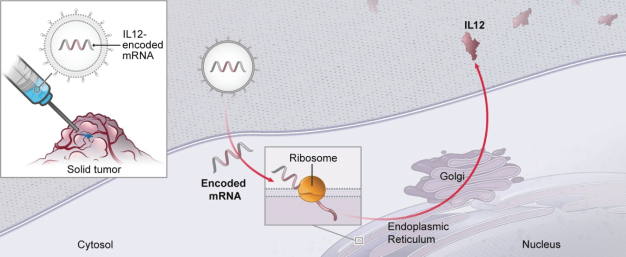
IL12 (MEDI1191): Preclinical information
We have conducted several preclinical studies in which we observed activity with our approach
As described earlier, our preclinical work was conducted with a mouse homolog of IL12. In a tumor model that we have characterized as completely refractory to checkpoint therapy and associated with an immunosuppressive tumor microenvironment, treatment with IL12 transformed the tumor microenvironment, with notable activation of natural killer and dendritic cells, and an increase in cytotoxic lymphocytes. In this checkpoint inhibitor refractory mouse model of cancer, a single dose of IL12 mRNA yielded around
89
Table of Contents
30% complete response rates as an mRNA monotherapy as shown in panel A below and was synergistically active with systemically administered anti-PD-L1 antibody, or α PD-L1, demonstrating complete response rates of
>
70%, as shown in panel B of the figure below. The x-axis represents days after subcutaneous implantation of MC38-R tumor cells. Test articles were administered on Day 11 for mRNA treatments and on Days 11, 14, 18, and 21 for antibody treatments. All antibody treatments were administered at 20 mg/kg. There were 15 mice per group in this study. Survival curves were plotted by considering any reason a mouse was removed from study, including the predetermined tumor burden endpoint of 2,000 mm
3
, as a survival event. NTC is a non-translating control mRNA. Synergy of locally administered IL12 mRNA with systemic α PD-L1 treatment was also observed on distal tumors that were not directly administered mRNA.
Approximately 30% (n=15) complete responders with highest dose
tested for mouse IL12 mRNA in MC38 mouse model study
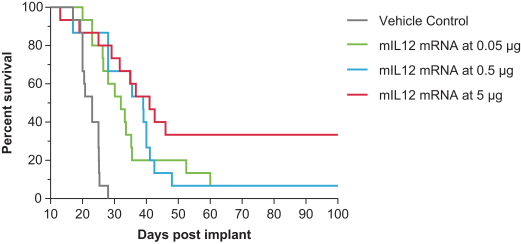
Panel (A)
Approximately 70% (n=15) complete responders at highest dose tested
for mouse IL12 mRNA with
α
PD-L1 antibody in MC38 mouse model study
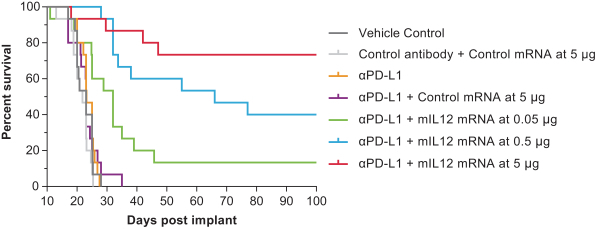
Panel (B)
IL12 (MEDI1191): Clinical plan
AstraZeneca will sponsor and lead the clinical development for MEDI1191
We are responsible for generating a preclinical data package to support IND/CTA filing and clinical supply for early clinical development. AstraZeneca will lead the early clinical development. We expect a lower starting dose for MEDI1191 in the clinical trial compared to our other intratumoral programs.
We expect AstraZeneca to initiate an open-label, international multicenter Phase 1 clinical trial of intratumoral injections of MEDI1191 alone or in combination with a checkpoint inhibitor, and the IND for MEDI1191 is open.
90
Table of Contents
IV. PROGRAM DESCRIPTIONS IN OUR LOCALIZED REGENERATIVE THERAPEUTICS MODALITY
We designed our localized regenerative therapeutics modality to develop mRNA medicines to address injured or diseased tissues. Our mRNA technology in this modality allows for the local production of proteins that provide a therapeutic benefit in the targeted tissue. The development of our program in this modality, AZD8601 for the local production of VEGF-A, is being led by our strategic collaborator AstraZeneca. This program recently completed a Phase 1a/b clinical trial in which we observed both a dose-dependent protein production and a pharmacologic effect, as measured by changes in local blood flow in patients. We believe these data provide clinical proof of mechanism for our mRNA technology outside of the vaccine setting as a potential therapeutic.
Our pipeline is shown in two formats, with a cell map illustrating the diversity of biology addressed by our mRNA pipeline programs, and a traditional format that shows the current stages of development of our pipeline programs, in the section of this Annual Report on Form 10-K titled “Business—Our Pipeline.”
Localized regenerative therapeutics modality: Opportunity
There are multiple applications for tissue regeneration. With AstraZeneca, we have focused on ischemic heart failure for the first program. Coronary artery disease, the primary cause of ischemic heart failure, affects the arteries providing blood supply to the cardiac muscle. In 2015, coronary artery disease resulted in 366,000 deaths in the United States, and 8.9 million deaths globally.
VEGF-A (AZD8601): Program summary
Addressing ischemic heart failure—VEGF-A as a localized therapeutic in collaboration with AstraZeneca
Heart disease is the leading cause of death in the United States, accounting for one in every four deaths, and is often due to the inability of adult humans to regenerate heart tissue. Current approved therapies do not specifically address heart regeneration. Previous attempts at cardiac regeneration have included stem cell grafting and gene therapy, but have faced challenges with safety or efficacy. In collaboration with AstraZeneca, we are pioneering a unique approach to treating ischemic heart failure, a condition where the cardiac muscle does not get enough blood supply to perform its contractile function. Vascular Endothelial Growth Factor A, or VEGF-A, can promote cardiac tissue revascularization. The goal of this program is to promote recovery of cardiac function through partial tissue regeneration. The mRNA in this program is in a saline formulation without LNPs and is expected to act locally. Our strategic collaborator AstraZeneca has conducted a Phase 1a/b clinical study in diabetic patients in Europe. The study has met its primary objectives of describing safety and tolerability and secondary objectives of dose-dependent protein production and changes in blood flow. AstraZeneca has moved this program to a Phase 2a trial that is being conducted in Europe and is designed to test safety and tolerability of epicardial injections for patients undergoing coronary artery bypass grafting surgery.
VEGF-A (AZD8601): Disease overview
VEGF-A can promote blood vessel growth to potentially address ischemic heart failure
Heart disease is the leading cause of death in the United States, accounting for one in every four deaths. Coronary artery disease, or CAD, the primary cause of ischemic heart failure, affects the arteries providing blood supply to the cardiac muscle. CAD resulted in 366,000 deaths in the United States, and 8.9 million deaths globally in 2015.
Several treatments are available for patients with ischemic heart failure. Current treatments include revascularization of the coronary arteries to relieve symptoms and improve cardiac function; and therapies that reduce blood pressure or potentially help eliminate excess fluids in congested tissues, including: beta-blockers, angiotensin-converting enzyme inhibitors, angiotensin II inhibitors, and aldosterone receptor blockers as diuretics. However, adult humans are unable to regenerate myocardium tissue following injury and the treatment options described above cannot compensate for this.
VEGF-A is a potent angiogenic factor that promotes growth of blood vessels. Preclinical data suggests that expression of this growth factor in the ischemic heart could increase blood flow and partially restore cardiac function.
VEGF-A (AZD8601): Our product concept
Local delivery of VEGF-A mRNA to increase local concentration of VEGF-A protein while reducing systemic distribution of therapeutic VEGF-A protein
VEGF-A protein acts as a powerful promoter of blood vessel growth. Systemic injection of VEGF-A protein increases VEGF-A exposure throughout the body, which can lead to side effects, but is very short-lived in circulation. Therefore, any therapy involving VEGF-A needs to be localized to elevate local protein concentration and drive revascularization while minimizing systemic side effects. AstraZeneca has opted to pursue the localized application of VEGF-A mRNA in a simple saline formulation in the heart muscle to elevate local protein concentration for longer periods due to increased local protein production. This potentially allows for an extended pharmacodynamic effect at the specific site of injection compared to systemic or local administration of a recombinant
91
Table of Contents
protein version of VEGF-A. Some of the early animal work for mRNA VEGF-A was published by our academic co-founder Dr. Kenneth Chien in
Nature Biotechnology
in 2013, showing improved cardiac function with increased survival with treatment.
VEGF-A (AZD8601): Preclinical information
AstraZeneca has observed the activity of VEGF-A for ischemic heart failure in several preclinical animal models
Preclinical work has been conducted at AstraZeneca in models of ischemic heart failure. In mouse, rat, and pig models of myocardial infarction, direct injection in the heart muscle (myocardium) of VEGF-A mRNA led to elevated cardiac VEGF-A protein levels and improved cardiac function. The data have been published by AstraZeneca in
Molecular Therapy
in 2018. The table below illustrates the beneficial effects of AZD8601 in the mini pig, two months after the myocardial infarct procedure and injection of the VEGF-A mRNA. In this table, left ventricular ejection fraction, or LVEF, was measured using echocardiography two months after intracardial mRNA administered 7 days after myocardial infarction. The data are means ± standard error of the means.
Significant improvement in LVEF with VEGF mRNA measured 2 months after administration in mini pig study
|
LVEF, %
|
p-value
|
||
|
Control—Citrate saline
|
47.0 ± 0.8
|
||
|
AZD8601 1 mg dose
|
51.0 ± 0.9
|
<0.01
|
|
|
AZD8601 10 mg dose
|
52.0 ± 1.0
|
<0.01
|
|
VEGF-A (AZD8601): Clinical data
AstraZeneca has completed a Phase 1a/b trial in Germany; A Phase 2a trial is currently ongoing in Finland and an additional clinical trial application has been filed in the Netherlands for this study.
The Phase1a/b clinical trial for the AZD8601 program has met its primary objectives of describing safety and tolerability and secondary objectives of protein production and changes in blood flow post AZD8601 administration. AstraZeneca has moved this program to a Phase 2a trial.
The Phase 1a/b study was a randomized, double-blind, placebo-controlled study in men with type 2 diabetes mellitus. VEGF-A mRNA was administered by intradermal injection into the forearm skin in single ascending doses. The study was conducted in Europe. The primary objective was to evaluate the safety and tolerability of the drug product into the forearm skin, with safety follow-up for 6 months.
The study was divided into Part A (single ascending-dose cohorts) and Part B (pharmacodynamic cohort). There were three treatment regimens in Part A. Regimens were either AZD8601 at site 1 and placebo at site 2, placebo at site 1 and AZD8601 at site 2, or placebo at both sites. Each regimen comprised six 50 µL injections at one site and six 50 µL injections at a second site on the forearm. In part B, the regimen comprised one 50 µL intradermal injection of either AZD8601 or placebo at each of four sites on the forearm.
There were 27 patients in Part A with 18 receiving AZD8601 in at least one site of the forearm and 9 patients receiving placebo. There were three dose cohorts in Part A, each with 9 patients. In the first cohort, AZD8601 dose was at 24 µg per patient (4 µg per injection). The AZD8601 dose was increased to 72 µg and 360 µg in the next two dose cohorts. There were 15 patients in Part B receiving AZD8601 in at least two sites on the forearm per patient. In Part B, each patient received 200 µg of AZD8601 or placebo.
VEGF-A protein post injection of mRNA was produced at a high level, above the set expected threshold, as shown in the figure below. Expression was measured by skin microdialysis. At each sampling time, mean VEGF-A protein levels across all mRNA treated sites from patients across all cohorts were higher than that of placebo up to the 24-26 hour time point. Data are means with error bars showing standard error of the mean, or SEM. Asterisk indicates p-value <0.05.
92
Table of Contents
VEGF-A protein levels in patients in Part A of the Phase 1a/b trial
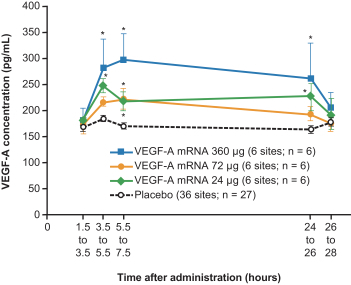
The bioactivity of the VEGF-A protein post injection of mRNA was observed by an increase in blood flow at injection sites up to 7 days following a single injection, as shown in the figure below. Measurements were made using laser doppler imaging 7 and 14 days after administration (study part A, n = 27). Data shown are means with error bars showing SEM. Asterisk indicates p-value <0.05.
VEGF-A led to increase in blood flow at day 7 and day 14 in patients in the Phase 1a/b trial
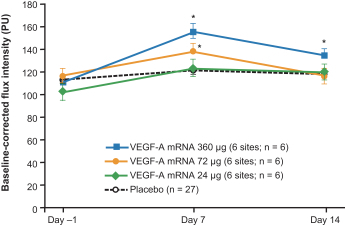
As shown above, administration of AZD8601 demonstrated protein production and changes in local blood flow in diabetic patients. Tolerability of our mRNA injected intradermally was demonstrated for all dose levels. The only causally treatment-related adverse events were mild injection-site reactions, occurring in 32 of 33 participants receiving VEGF-A mRNA across both parts of the study design. All adverse events of injection-site reaction were of mild intensity. No deaths, serious adverse events, or adverse events leading to discontinuation occurred. A list of adverse events is provided in the table below.
93
Table of Contents
Adverse events for the Phase 1a/b trial for AZD8601
|
Part A (n = 27)
|
Part B (n = 15)
|
||||
|
Placebo
only (1) (n = 9) |
VEGF-A mRNA/
placebo (1) (n = 18) |
VEGF-A mRNA/
placebo (2) (n = 15) |
|||
|
Participants with any AE, n (%)
|
5 (55.6)
|
18 (100.0)
|
14 (93.3)
|
||
|
Causally treatment-related, n (%)
|
0
|
18 (100.0)
|
14 (93.3)
|
||
|
Treatment-unrelated, n (%)
|
5 (55.6)
|
0
|
0
|
||
|
Participants with causally treatment-related AEs, n (%)
|
|||||
|
Injection-site reaction [mild]
|
0
|
18 (100.0)
|
14 (93.3)
|
||
|
Participants with treatment-unrelated AEs, n (%)
|
|||||
|
Injection-site reaction [mild]
|
1 (11.1)
|
0
|
0
|
||
|
Injection-site erythema [mild]
|
1 (11.1)
|
2 (11.1)
|
0
|
||
|
Asthenia [mild]
|
0
|
1 (5.6)
|
0
|
||
|
Tinea pedis [mild]
|
0
|
0
|
1 (6.7)
|
||
|
Arthropod bite [mild]
|
0
|
1 (5.6)
|
1 (6.7)
|
||
|
Injury [moderate]
|
0
|
1 (5.6)
|
0
|
||
|
Skin abrasion [mild]
|
0
|
1 (5.6)
|
0
|
||
|
Muscle spasms [mild]
|
0
|
1 (5.6)
|
0
|
||
|
Back pain [mild or moderate]
|
2 (22.2)
|
0
|
0
|
||
|
Myalgia [moderate]
|
0
|
0
|
1 (6.7)
|
||
|
Dizziness [mild]
|
0
|
1 (5.6)
|
0
|
||
|
Headache [mild]
|
1 (11.1)
|
0
|
0
|
||
|
Pruritus [mild]
|
0
|
1 (5.6)
|
0
|
||
|
Tooth extraction [mild]
|
0
|
1 (5.6)
|
0
|
||
|
Nasopharyngitis [moderate]
|
1 (11.1)
|
0
|
0
|
||
|
(1)
|
There are two injection sites and it can be either VEGF-A mRNA/placebo, placebo/VEGF-A mRNA, or placebo/placebo at injection sites 1/2.
|
|
(2)
|
Randomized order of VEGF-A and placebo injections.
|
The program is currently in a Phase 2a clinical trial. It is a randomized, double-blind, placebo-controlled, multi-center, Phase 2a study to evaluate safety and tolerability of epicardial injections of AZD8601 during coronary artery bypass grafting surgery. Some of the outcomes to be monitored in the Phase 2a study include adverse and serious adverse events, electrocardiogram, or ECG, and LVEF. The study is being conducted in Europe. The study is intentionally designed to provide initial safety and tolerability data in about 24 coronary artery bypass patients.
94
Table of Contents
V. PROGRAM DESCRIPTIONS IN OUR SYSTEMIC SECRETED THERAPEUTICS MODALITY
We designed our systemic secreted therapeutics modality to increase levels of desired proteins in circulation or in contact with the extracellular environment. We aim to use cells in the human body to produce proteins encoded by mRNA that are secreted to achieve a therapeutic effect in one or more tissues or cell types. The goal of this modality is to provide secreted proteins, such as antibodies or enzyme replacement therapies across a wide range of diseases, such as heart failure, infectious diseases, and rare genetic diseases. This modality has benefitted from our strategic alliances with AstraZeneca, DARPA, and the Bill & Melinda Gates Foundation.
This modality currently has three programs. Our pipeline is shown in two formats, with a cell map illustrating the diversity of biology addressed by our mRNA pipeline programs, and a traditional format that shows the current stages of development of our pipeline programs, in the section of this Annual Report on Form 10-K titled “Business—Our Pipeline.”
Systemic secreted therapeutics modality: Opportunity
The ability to systemically deliver mRNA for a therapeutic effect would allow us to address a number of diseases of high unmet medical need. Systemically delivered, secreted therapeutics address conditions often treated with recombinant proteins that are typically administered to the blood stream. These current therapies include:
|
•
|
Enzyme replacement therapies, or ERTs, for rare diseases;
|
|
•
|
Antibodies for membrane and extracellular soluble targets; and
|
|
•
|
Circulating modulation factors for common and rare diseases such as growth factors and insulin.
|
Our approach
Our systemic secreted therapeutics modality comprises programs where mRNAs instruct various cells of the human body to secrete proteins for therapeutic effect. For systemic therapeutic programs that utilize cells in the liver, the liver is a highly productive tissue for secreted protein production. The human liver can make tens of grams of proteins per day, well above the amounts necessary for the pharmacologic effect for virtually all protein therapeutics. We have demonstrated that mRNA can make and secrete monoclonal antibodies and soluble modulating factors in non-human primates. These proteins made in non-human primates can exert their pharmacological activity by binding to targets with biological effect.
The antibody against Chikungunya virus is our first systemic secreted therapeutic and patients are currently being dosed in a Phase 1 study. It will help us understand the fundamental relationship between mRNA dose and secreted protein production. The secreted human antibody is also a protein complex, not ordinarily made by the liver, which will be a test case for making human proteins in liver normally made by other cell types.
This modality also includes engineered proteins such as our Relaxin and PKU programs and is not limited to native forms of proteins. Recombinant protein therapeutics, which focus on secreted proteins, generate over $200 billion in annual worldwide sales.
Antibody against Chikungunya virus (mRNA-1944): Summary
Systemic mRNA administration to instruct cells to secrete antibodies, in this case for passive immunization to prevent Chikungunya infection
We are using this program to help understand how mRNA can be used to make complex secreted proteins in the human body and to address the potential health threat of Chikungunya virus, particularly for the military and others exposed to this virus. This program highlights a potentially important advancement of our platform and expansion of our modalities.
Chikungunya is a serious health problem with and is estimated to have caused at least three million cases during the 2005-2015 epidemic. There are no vaccines or prophylactic treatments for this disease. This virus can cause severe arthritic-like conditions in approximately 15% of the infected people. This program offers a passive immunization approach using antibodies to prevent infection, to complement our vaccine approach. In this program, we utilize two mRNAs encoding for light chain and heavy chain of an antibody against the envelope glycoprotein E. We plan to administer these mRNAs encapsulated in our proprietary LNPs intravenously to people to prevent infection by the Chikungunya virus. We are being financially supported for specific activities by DARPA and have an open IND for mRNA-1944.
95
Table of Contents
Antibody against Chikungunya virus (mRNA-1944): Disease overview
Addressing a significant global health need
Chikungunya virus is a mosquito-borne alphavirus posing a significant public health problem in tropical and subtropical regions. While Chikungunya has been present in Africa for centuries, recent outbreaks and epidemics in new regions have arisen due to the expanding distribution of the
Aedes
mosquito in which it resides. A Chikungunya epidemic beginning in 2004 in Kenya spread to India and was exported to nearly all regions of the world and brought Chikungunya to the attention of the western world. As of April 2016, Chikungunya cases had been reported in 103 countries and territories around the world, including 46 countries and territories throughout the Americas. Chikungunya virus infection is characterized by an acute onset of fever, rash, myalgia, and sometimes debilitating polyarthralgia, giving the virus its name, which means “that which bends up” when translated from Makonde. It is rarely fatal, but neurological sequelae such as Guillain-Barre syndrome and chronic arthritis have been recognized.
Chikungunya virus is an alphavirus of the Togaviridae family with a positive-strand RNA genome. The viral structural proteins are naturally expressed as a single polyprotein followed by subsequent cleavage by viral and cellular proteases into capsid (C) and envelope (E) glycoproteins E3, E2, 6k, and E1. The E proteins are major targets of protective neutralizing antibody responses that can be tested for in assays.
There are currently no effective therapies or approved vaccines to treat or prevent Chikungunya infection or disease, and effective mosquito control has proven challenging, even in higher income countries. Currently, infected individuals are treated with non-steroidal anti-inflammatory drugs to relieve some symptoms. Therefore, in addition to an effective prophylactic vaccine, we believe there is a need for systemic secreted antibody for passive immunity to the Chikungunya virus.
Antibody against Chikungunya virus (mRNA-1944): Our product concept
A systemically delivered mRNA instructing cells to secrete an antibody to glycoprotein E to neutralize Chikungunya
The mRNA-1944 development candidate contains two mRNAs that encode the heavy and light chains of the Chikungunya antibody and utilizes our proprietary LNPs. The mRNA-1944 development candidate encodes a fully human IgG antibody isolated from B cells of a patient with a prior history of Chikungunya infection. Thus mRNA-1944 encodes a fully human IgG antibody against the envelope protein E2. The systemic antibody against Chikungunya virus titers can be evaluated in clinical trials by enzyme-linked immunosorbent assay, or ELISA, to quantify the amount of expressed IgG. A neutralization assay can be used to ensure that the mRNA expressed antibody was properly folded and functional.
Antibody against Chikungunya virus (mRNA-1944): Preclinical information
Systemic mRNA administration results in antibody production and protection from Chikungunya infection in animals
In immunodeficient AG129 mice (lacking the IFN-α/ß and -
γ
receptors) Chikungunya causes a lethal disease and mice succumb to infection within 3-4 days with ruffled fur and weight loss. Protection in this model is mediated by antibodies against the Chikungunya viral proteins that must provide complete protection or sterilizing immunity. Therefore, this challenge model was used to establish a correlate of protection using activity and systemic IgG concentration data.
An
in vivo
study in AG129 mice was completed to determine the activity of mRNA encoded antibody against Chikungunya virus. The test article was administered to mice as prophylaxis at 0.02, 0.1, and 0.5 mg/kg by IV tail injection. A subset of animals (n=10) were challenged 24 hours post prophylaxis with Chikungunya virus strain LR006 and monitored for morbidity and mortality. Complete survival of mice was observed after treatment with the highest dose of 0.5 mg/kg of mRNA-1944.
In addition, the pharmacokinetics were evaluated in cynomolgus monkeys through intravenous infusion at 0.3, 1.0, and 3.0 mg/kg. The average serum antibody level was quantified at various time points to demonstrate a half-life of 23 days. The maximum serum concentration of the antibody was found to be 16.2 µg/mL with dose 1 and 28.8 µg/mL with dose 2, as shown in the figure below.
96
Table of Contents
Expression of antibody against Chikungunya virus with repeat dosing of mRNA-1944 or placebo in non-human primate study
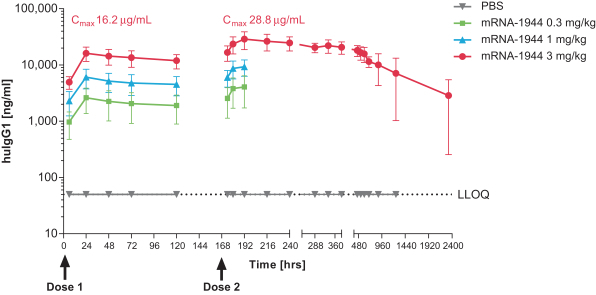
In addition, mRNA-1944 was tested in rats and non-human primates in a repeat-dose study via IV infusion up to 5 and 3 mg/kg, respectively. There were no dose-limiting toxicities related to mRNA-1944 observed and all other observations were generally reversible.
97
Table of Contents
Antibody against Chikungunya virus (mRNA-1944): Clinical plan
We have initiated dosing of a Phase 1 trial of mRNA-1944 in the United States
We are conducting a Phase 1 single ascending dose study in healthy adults that is randomized and placebo-controlled. The objective is to evaluate the safety and tolerability of escalating doses (0.1, 0.3, 0.6, 1 mg/kg cohorts with 8 subjects per cohort) of mRNA-1944 administered via intravenous infusion. Other objectives are to determine the pharmacokinetics of four dose levels of mRNA-1944, to determine if the antibodies produced are sufficiently active to neutralize viral infection in assays and to determine the pharmacodynamics of anti-Chikungunya virus IgG levels. As of February 20, 2019, dosing of the first dose level cohort has been completed (0.1 mg/kg, 8 subjects) in the Phase 1 trial of mRNA-1944.
Each of the four dose level cohorts initially doses three sentinel subjects, with a seven-day interval between each sentinel subject. Safety data on each sentinel subject as well as cumulative safety data are reviewed by the internal safety team, or IST, seven days following infusion of mRNA-1944 prior to the second and third sentinel subjects are dosed, as per the schematic described below. The IST will also review safety data for the three sentinels and recommend expansion to five subjects at that dose level with an overall randomization ratio of 3:2 (mRNA-1944:placebo). The safety monitoring committee, or SMC, reviews the safety data for the dose level and recommend escalation to the next dose level. A schematic of the trial design is shown below.
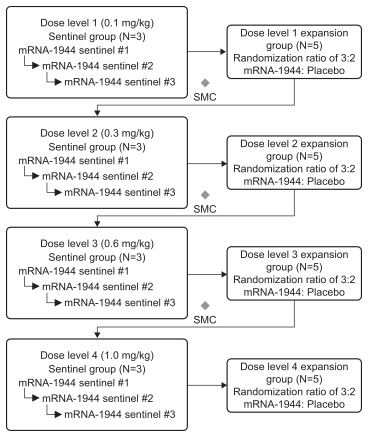
Blood samples will be collected at pre-defined time points post dose to determine mRNA-1944 concentration and concentration of encoded antibody against Chikungunya virus.
98
Table of Contents
Relaxin (AZD7970): Summary
In collaboration with AstraZeneca we are developing a secreted systemic engineered protein for heart failure
Chronic heart failure continues to be a leading cause of death worldwide. While numerous treatments are currently available, the needs of many heart failure patients are not met. Relaxin is a well-studied natural protein hormone that is known to have cardiovascular protective effects. Earlier attempts at developing relaxin as a protein therapeutic have failed. Serelaxin, a recombinant relaxin protein therapeutic with a short 30 minute half-life recently failed to meet its primary endpoints in a Phase 3 trial. We believe that engineering the Relaxin protein for a longer duration and repeat dosing might overcome the shortcomings of earlier attempts. In collaboration with AstraZeneca, we use mRNA encoding for a relaxin protein designed for a long duration of action. It is also designed to be produced by the body with human post-translational modifications.
Relaxin (AZD7970): Disease overview
Heart failure continues to be a major health concern despite multiple treatment options
Heart failure is the inability of the heart to pump blood efficiently and presents itself as either an impairment of ejection of the blood (systolic heart failure) or defective ventricular filling (diastolic heart failure). It is associated with fluid retention in peripheral tissues, including the lungs, leading to tissue congestion, dyspnea, fatigue, and ultimately death. Heart failure is a major unmet medical need as it is the leading cause of hospitalization in the elderly worldwide and accounts for 1.1 million cases annually in the United States. The aging population and the improved survival rates from myocardial infarcts have increased the lifetime risk of developing heart failure to one in five.
Current treatments for heart failure include therapies that reduce blood pressure or potentially help eliminate the excess of fluid in congested tissues (beta-blockers, angiotensin-converting enzyme inhibitors, angiotensin II inhibitors, and aldosterone receptor blockers). Despite long-term combined treatments, the needs for these patients are often unmet, as evidenced by the high mortality rate in this patient population (i.e., 36.5% in a median 3-year follow-up).
Relaxin is a naturally occurring hormone, present in both men and women, that has been shown to promote vasodilation and angiogenesis, regulate extracellular matrix turnover, and suppress arrhythmias post myocardial infarction. Though prior studies have failed to demonstrate long-term benefit in clinical studies, we believe that our novel approach can overcome potential flaws of previous approaches.
Relaxin (AZD7970): Our product concept
We have engineered a long-acting Relaxin to extend its otherwise short half-life
AZD7970 is an mRNA encoding a human relaxin protein designed and engineered to have an extended half-life. We have also utilized our proprietary LNPs to enable repeat dosing. We believe AZD7970 can address the short half-life of serelaxin. AZD7970 is intended for IV-administered repeat dosing.
Relaxin (AZD7970): Preclinical information
We have observed extended exposure with our mRNA encoding for an engineered version of Relaxin
We have observed that relaxin mRNA gives rise to a long-lasting systemic and functional protein following IV dosing with proprietary LNPs. Prolonged duration of relaxin protein production was observed both in rodents and non-human primates. Systemic protein levels of the Relaxin protein in plasma of IV dosed cynomolgus monkeys following a single injection of mRNA were assessed using a commercially available antibody. Exposure to the fusion protein made from our mRNA was considerably extended (up to 10 days), as shown in the figure below. In contrast, earlier published studies described the half-life of relaxin administered as a recombinant protein to be of a few minutes. An IND-enabling GLP toxicology program for Relaxin (AZD7970) is ongoing.
99
Table of Contents
Relaxin protein levels in serum upon administration of mRNA encoding for
relaxin in our proprietary LNP in non-human primate study
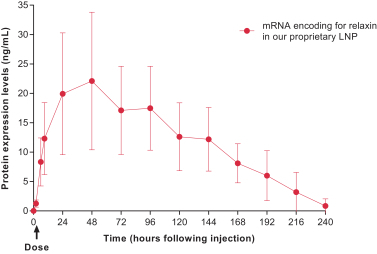
Relaxin (AZD7970): Clinical plan
AstraZeneca may conduct a Phase 1 trial.
100
Table of Contents
Fabry disease (mRNA-3630): Summary
Our approach to Fabry disease with a secreted alpha galactosidase protein
Fabry disease is an X-linked hereditary defect in glycosphingolipid metabolism caused by mutations in the
GLA
gene, which encodes for the lysosomal protein alpha galactosidase, or α-GAL. It is one of a number of lysosomal storage diseases. Decreased activity of α-GAL results in the lysosomal accumulation of substrates (Gb3 and Lyso-Gb3) within cells and tissues, ultimately impairing cell/tissue function. Currently, there are several approved therapies for the treatment of Fabry disease including enzyme replacement therapy, or ERT, and chaperone therapy. However, patients continue to suffer from renal decline with ERTs and limited patient eligibility for chaperone therapy, as well as immunogenic side effects of ERTs. With our platform technology, the cells in the human body can be instructed to produce α-GAL from the liver and other tissues to properly insert α-GAL into lysosomes. Additionally, these tissues can secrete it into circulation for delivery to other tissues. We are developing an intravenously administered mRNA that encodes α-GAL enzyme and we plan to conduct a Phase 1/2 clinical trial to evaluate the safety and efficacy of mRNA-3630 in Fabry patients.
Fabry disease (mRNA-3630): Disease overview
Fabry disease is a lysosomal storage disorder
Fabry disease is a progressive, multiorgan, X-linked lysosomal storage disorder with an annual incidence of approximately 1:80,000. Affected individuals have a deficiency in α-GAL, resulting in a reduced or complete inability to metabolize glycosphingolipids in the lysosomes. Thus, patients accumulate glycosphingolipids such as Gb3 within lysosomes, which ultimately results in cellular and tissue dysfunction. In Fabry patients, multiple organs are impacted including the kidney and heart; and the vasculature gastrointestinal, and neurological systems. The severity of the disease is related to the lack of enzyme activity in patient cells. Classic Fabry patients are the most affected individuals, and generally retain <1% of normal enzyme activity. Diagnosis of Fabry disease occurs generally during childhood, but in some patients it is diagnosed later in life, usually after the patient presents with a stroke or renal complications.
Currently, there are several approved therapies for the treatment of Fabry disease. Agalsidase beta, which is marketed as Fabrazyme by Sanofi Genzyme, and Agalsidase alpha, which is approved and marketed as Replagal outside the United States by Shire, are enzyme replacement therapies, or ERTs, administered to most Fabry patients. Both of those therapies are versions of α-GAL ERTs that are administered intravenously, often require long infusion times and can lead to undesired immune reactions. These enzymes are effective at decreasing substrate accumulation in some tissues and slowing disease progression, however patients that have been on ERTs for 10 years still have renal function decline at a rate greater than normal healthy individuals. In addition to ERTs, Amicus Therapeutics has approval in the United States and European market for migalastat, a small molecule chaperone therapy which treats a subset of patients.
Fabry disease (mRNA-3630): Our product concept
We intend to utilize the cells in the human body to produce and secrete
α
-GAL
The mRNA encoding α-GAL is designed to instruct the cells of the human body to produce complex functional intracellular proteins for utilization in the lysosome and secretion out of the cell for uptake by other tissues. This is intended to replace the enzyme α-GAL insufficient or missing in Fabry patients. Our mRNA-3630 program consists of an mRNA encoding human α-GAL encapsulated in our proprietary LNP. The mRNA sequence is optimized for protein expression. mRNA-3630 will be administered intravenously to encode enzymatically-active α-GAL protein to restore this deficient or defective enzyme.
An illustration of our approach is shown in the figure below. The mRNA encoding for α-GAL, once inside the cell, is translated to α-GAL protein by ribosomes and translocated to the endoplasmic reticulum. The protein sequences traverse the secretory pathway of the cell. The protein is either sent to the lysosome where it reduces the level of Gb3 in target cells or is directed for secretion outside the cells, allowing for broad distribution of the protein.
101
Table of Contents
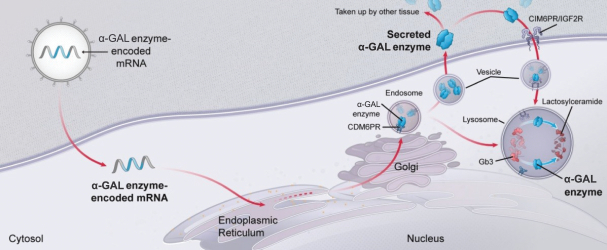
Fabry disease (mRNA-3630): Preclinical information
With a single dose of our mRNA encoding for
α
-GAL, we observed a sustained reduction in lyso-Gb3
We have conducted several
in vivo
pharmacology studies to demonstrate nonclinical proof-of-concept for α-GAL therapy. Administration of proprietary LNP formulated α-GAL mRNA to the Fabry mouse model resulted in a significant and durable reduction of globotriaosylsphingosine, or lyso-Gb3, in tissue and serum for 12 weeks following a single dose, as shown in the figure below. In this study, there were 3 Fabry GLA -/- mice per group. Data was normalized to the control sequence group for the specific time point.
Reduction in lyso-Gb3 in tissue with single administration of
α
-GAL mRNA in mouse model study
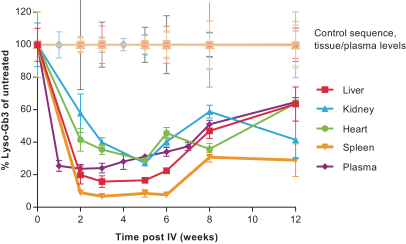
In addition, we have evaluated plasma α-GAL in non-human primates following IV administration of 0.5 mg/kg mRNA-3630 every other week for four doses. There were four animals per group. These data indicate consistent circulation of enzyme in circulation following repeated administrations as shown in the figure below.
102
Table of Contents
Repeat dosing of
α
-GAL mRNA in non-human primate study
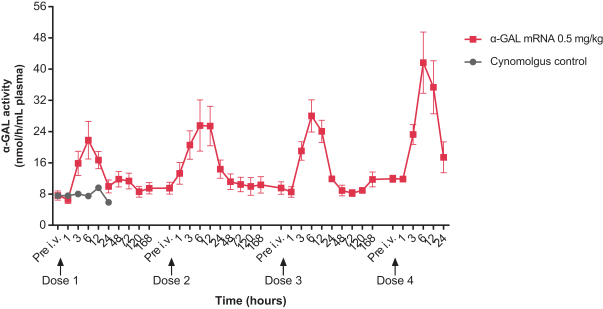
Anti α-GAL antibodies were not detected in these animals. Non-human primate tissues were examined after the last dose and showed greater than wild-type levels of enzyme as determined by activity assessment and shown in the figure below. The IND-enabling GLP toxicology program for mRNA-3630 is ongoing.
Increase in
α
-Galactosidase level in key tissues after repeat dosing of
α
-GAL mRNA in non-human primate study
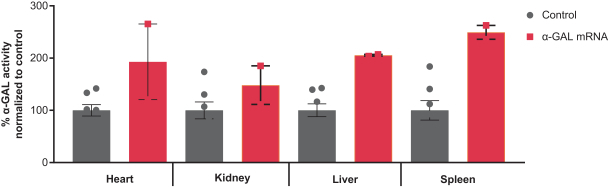
Fabry disease (mRNA-3630): Clinical plan
We plan to conduct a Phase 1/2 open label clinical trial with multiple ascending doses to evaluate the safety, tolerability, and efficacy of our development candidate in patients.
103
Table of Contents
VI. PROGRAM DESCRIPTIONS IN OUR SYSTEMIC INTRACELLULAR THERAPEUTICS MODALITY
We designed our systemic intracellular therapeutics modality to increase levels of intracellular proteins. We aim to use cells in the human body to produce proteins encoded by mRNA that are located in the cytosol or specific organelles of the cell to achieve a therapeutic effect in one or more tissues or cell types. The goal of this modality is to provide intracellular proteins, such as intracellular enzymes and organelle-specific proteins, as safe, tolerable, and efficacious therapies. Our initial focus within this modality is on rare genetic diseases.
This modality currently has three programs. Our pipeline is shown in two formats, with a cell map illustrating the diversity of biology addressed by our mRNA pipeline programs, and a traditional format that shows the current stages of development of our pipeline programs, in the section of this Annual Report on Form 10-K titled “Business—Our Pipeline.”
Systemic intracellular therapeutics modality: Opportunity
Systemically delivered, intracellular therapeutics focus on areas currently not addressable with recombinant proteins, which are typically administered systemically and cannot reach the inside of the cell. Objectives for potential new therapies in this area include increasing the levels of:
|
•
|
intracellular pathway proteins;
|
|
•
|
soluble organelle-specific proteins; and
|
|
•
|
organelle-specific membrane proteins.
|
Methylmalonic acidemia (mRNA-3704): Summary
Program aims to produce an intracellular, mitochondrial enzyme to treat a pediatric, genetic, metabolic disorder
Isolated methylmalonic academia, or MMA, is a rare, life-threatening, inherited metabolic disorder that is primarily caused by a defect in the mitochondrial enzyme methylmalonyl-coenzyme A mutase, or MUT. It primarily affects the pediatric population. There is no approved therapy for the disorder, including no approved enzyme replacement therapy, due to the complexity of the protein and its mitochondrial localization. Liver or combined liver-kidney transplant is one option for severely affected individuals. Our platform may allow the cells in the human body to produce these and other complex mitochondrial enzymes. Therefore, we are developing an intravenously (IV)-administered mRNA encoding MUT in our proprietary LNP, in order to restore this deficient or defective mitochondrial enzyme in the liver and other cells. We have observed preclinical proof-of-concept in two different MMA mouse models, notably with a marked improvement in survival and reduction of biochemical abnormalities in a severe MMA mouse model, and have received Rare Pediatric Disease Designation and Orphan Drug Designation from the FDA and Orphan Drug Designation from the European Commission. The FDA has also designated the investigation of mRNA-3704 for the treatment of isolated MMA due to MUT deficiency as a Fast Track development program. We expect to initiate a Phase 1/2 clinical trial in MMA patients with MUT deficiency, and the IND for this Phase 1/2 clinical trial is open.
Methylmalonic acidemia (mRNA-3704): Disease overview
MMA is a rare, life-threatening pediatric disorder with no approved therapies that address the underlying defect
MMA associated with MUT deficiency is a serious inborn error of metabolism disorder with significant morbidity and mortality. There are approximately 500-2,000 MMA MUT deficiency patients in the United States based on estimated birth prevalence (0.3-1.2:100,000 newborns) and mortality rates. Mortality is significant, with reported mortality rates of 50% for MMA patients with complete MUT deficiency (mut
0
) (median age of death 2 years) and 40% for MMA patients with partial MUT deficiency (mut
-
) (median age of death 4.5 years) in a large European study.
MMA mainly affects the pediatric population and usually presents in the first few days or weeks of life. The occurrence of acute metabolic decompensations is the hallmark of the disorder and decompensations are typically more frequent in the first few years of life. Each decompensation is life-threatening and often requires hospitalization and management at an intensive care unit. Surviving patients often suffer from numerous complications including chronic renal failure and neurologic complications such as movement disorders, developmental delays, and seizures. Consequently, the health-related quality of life for MMA patients and their families is significantly impaired.
The disorder is autosomal recessive and primarily caused by loss-of-function mutations in the gene encoding MUT, a mitochondrial enzyme that metabolizes certain proteins and fats, resulting in complete (mut
0
) or partial (mut
-
) enzyme deficiency. Over 250 mutations have been reported to date for MUT, with many MMA patients carrying private mutations. The most frequent mutations include p.N219Y and p.R369H, occurring with allelic frequencies of 8% in a large European cohort (n=151). Population-specific mutations have been reported, such as the p.R108C and p.G717V mutations identified in Hispanic and African-American patients,
104
Table of Contents
respectively. Due to a deficiency in the MUT enzyme resulting in a blockage in a metabolic pathway, the disorder is biochemically characterized by the accumulation of toxic metabolites such as methylmalonic acid in all body fluids and tissues.
There are currently no approved therapies that address the underlying defect for MMA. Carglumic acid (marketed as Carbaglu) is approved in the EU for the acute treatment of hyperammonemia due to various organic acidemias including MMA. Liver transplant and combined liver-kidney transplant have emerged as effective treatment options for severely affected individuals, resulting in substantial reductions in metabolic decompensations and circulating methylmalonic acid concentrations.
Methylmalonic acidemia (mRNA-3704): Our product concept
We are utilizing our ability to produce a complex intracellular enzyme (MUT) that is localized to the mitochondria
MUT is a complex intracellular enzyme that exists as a homodimer, and requires mitochondrial localization and engagement with its cofactor (a derivative of vitamin B
12
) to be enzymatically active. mRNA has the capability to encode any type of protein, including a functional, intracellular protein that is trafficked to the proper subcellular localization within target cells.
We are developing an mRNA encoding human MUT encapsulated in our proprietary LNPs for intravenous, or IV, administration for the treatment of isolated MMA associated with MUT deficiency. The sequence has been engineered to improve protein translation. To function, the mRNA-encoded MUT protein is translocated to its site of action in the mitochondria as shown in the figure below.
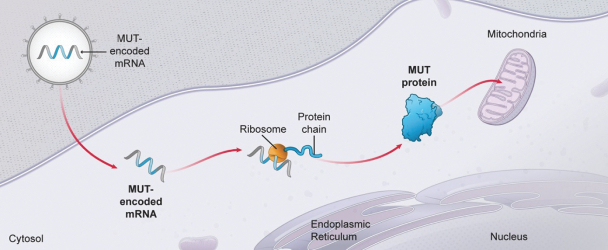
Methylmalonic acidemia (mRNA-3704): Preclinical information
We have observed pronounced improvement in survival due to mRNA treatment in an MMA mouse model
We have conducted a series of
in vitro
and
in vivo
pharmacology studies to demonstrate preclinical proof-of-concept for human MUT mRNA in two different mouse models of MMA representing the spectrum of MUT deficiency (mut
0
and mut
-
) as published by us in
Cell Reports
in 2017. As an example, a 12-week repeat-dose study in MMA mut
0
mice (
Mut
-/-
; Tg
INS-MCK-
Mut
) at 0.5 mg/kg IV every other week has shown a pronounced improvement in survival due to human MUT mRNA treatment, with all treated mice surviving 12 weeks in contrast to control mice which all perished within a few weeks. The figure below shows the Kaplan-Meier curve of PBS-injected (n=6 mice) and human MUT mRNA (n=6 mice) treated MMA mut
0
mice and PBS-injected (n=6 mice) healthy heterozygote mice. The three asterisks indicate p-value < 0.001 for human MUT mRNA vs. PBS-injected MMA mut
0
mice from the log-rank test.
105
Table of Contents
Improved survival in a 12-week study with mRNA encoding for human MUT in mouse disease model study
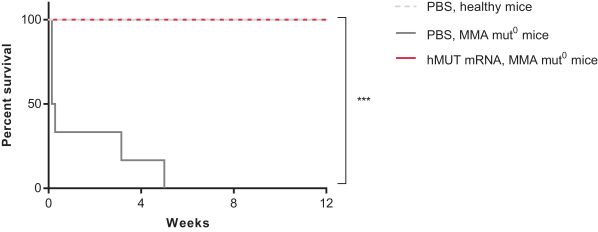
In addition, the data indicated that the treated MMA mut
0
mice doubled their body weights and approached the body weights of PBS-injected healthy mice in this 12-week repeat dose study. In contrast, surviving PBS-injected MMA mut
0
mice did not gain weight.
Increase in body weight in a 12-week study with mRNA encoding human MUT in mouse disease model study
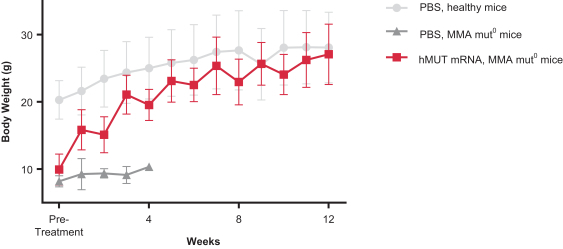
hMUT mRNA treated MMA mut
0
mice showed significant and sustained reductions in the toxic disease metabolites, including plasma methylmalonic acid, compared to pre-treatment levels, in a 6-week repeat dose study in MMA mut
0
mice. This is shown in the figure below. Arrows denote weekly IV administration of human MUT mRNA (0.2 mg/kg). Plasma was collected 4 days prior to treatment and 3 days after each dose administration. Washout levels were for the 10-day washout following 5
th
dose administration of human MUT mRNA. The asterisk indicates a p-value < 0.01 from paired t-tests of post-treatment vs. pre-treatment levels.
106
Table of Contents
Decrease in plasma methylmalonic acid in 6-week repeat dose study with mRNA encoding for human MUT in MMA mut
0
mouse model study
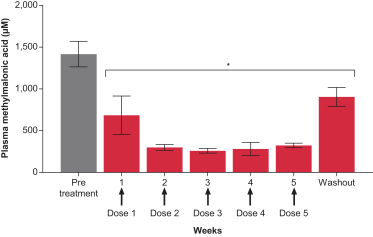
Additionally, a pharmacokinetic study performed in wild type mice demonstrated that human MUT can be elevated above wild type level MUT levels. Specifically, human MUT protein expression in liver peaked at 16 hours after a single IV injection of human MUT mRNA (0.5 mg/kg) with a concentration of 85 ng/mg protein, ~2-3 fold higher than endogenous human and mouse MUT in liver.
There were no dose-limiting toxicities related to mRNA-3704 in juvenile rats and immature non-human primates in a repeat IV dose one-month IND-enabling GLP toxicology study up to the top doses tested. An independent IND-enabling GLP cardiovascular safety study in non-human primates also indicated mRNA-3704 showed no dose-limiting toxicities.
Methylmalonic acidemia (mRNA-3704): Clinical plan
We are conducting a global natural history study and the IND for the Phase 1/2 clinical trial is open
We are conducting a global natural history study in methylmalonic acidemia, or MMA, and propionic acidemia, or PA, that was initiated in 2018. Some of the patients participating in the natural history study may enter our interventional clinical trials.
Our natural history study aims to identify and correlate clinical and biomarker endpoints for both MMA and PA. We also have a PA program (mRNA-3927) that addresses a disease closely related to MMA. There is synergy in combining the natural history study for MMA and PA. The natural history study is a global, multi-center, non-interventional study for patients with confirmed diagnosis of MMA due to MUT deficiency or PA. Up to 60 MMA patients and up to 60 PA patients in the United States and Europe will be followed prospectively for 1-3 years. Retrospective data will be collected as available. As of February 27, 2019, 20 MMA patients and 12 PA patients had enrolled in the natural history study.
We plan to conduct an open-label, multi-center, dose escalation Phase 1/2 study of multiple ascending doses of mRNA-3704 in patients with isolated MMA due to MUT deficiency between 1 to 18 years of age with elevated plasma methylmalonic acid concentrations. The objectives of this study are to evaluate the safety, pharmacodynamics (as assessed by changes in plasma methylmalonic acid), and pharmacokinetic profile of mRNA-3704 in patients affected by MMA.
During the dose-escalation phase, three dose levels of mRNA-3704 are planned to be investigated in this study. The first dose level will enroll adolescents aged 12-18. Once safety and tolerability is determined, we intend to enroll patients who are between the ages of 1 and 18 years old. An additional cohort to evaluate a fourth dose level may be considered. Patients will receive twelve doses of mRNA-3704 administered via IV infusion every 3 weeks.
Three patients will be enrolled sequentially within each dose level cohort. Enrollment of the first three patients within each dose cohort will be staggered by 21 days using a sentinel dosing strategy approach to allow for safety observation after dosing. For the evaluation of safety data prior to escalation to the next dose level, a modified 3+3 design using predefined dose limiting toxicity criteria will be used. Dose escalation recommendations to open the next dose level cohort will be made by an independent SMC and will include review of safety and pharmacodynamic activity through at least 21 days following the first dose administration of mRNA-3704, the dose limiting toxicity window, for all patients.
Upon establishment of a dose with acceptable safety and pharmacodynamic activity in dose escalation, additional patients will be enrolled in a dose-expansion phase to allow for further characterization of the safety and pharmacodynamic activity of mRNA-3704. Patients in both phases of study will participate in a pre-dosing observational period to characterize baseline (pre-treatment) biomarker levels, followed by a treatment period, and then a two-year follow-up period after withdrawal of treatment.
107
Table of Contents
The Phase 1/2 study is expected to be conducted in the United States and Europe. A schematic of the trial is shown in the figure below.
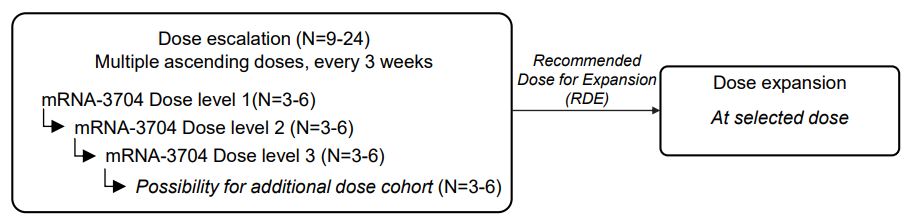
Propionic acidemia (mRNA-3927): Summary
We aim to produce an intracellular, mitochondrial enzyme complex to treat a pediatric metabolic disorder
Propionic acidemia, or PA, is a rare, life-threatening, inherited metabolic disorder due to a defect in the mitochondrial enzyme propionyl-CoA carboxylase, or PCC. It primarily affects the pediatric population. There is no approved therapy for PA, including no approved enzyme replacement therapy, due to the complexity of the enzyme, which comprises six copies each of two different subunits (PCCA and PCCB), and its mitochondrial localization. The only effective treatment for severely affected individuals is liver transplant, aimed at increasing enzyme activity to reduce the occurrence of life-threatening acute metabolic crises. Our platform is uniquely positioned to potentially address this disease by enabling synthesis of this complex enzyme that is localized in the mitochondria of the cell. We are developing an IV-administered mRNA therapeutic comprising two different mRNAs encoding PCCA and PCCB in our proprietary LNP to replace the defective PCC enzyme with functional enzyme in liver and other cells. We expect to initiate a Phase 1/2 clinical trial in PA patients.
Propionic acidemia (mRNA-3927): Disease overview
PA is an inherited metabolism disorder with significant morbidity and mortality and no approved therapy
PA is a serious inborn error of metabolism disorder, closely related to MMA, with significant morbidity and mortality. There are approximately 325-2,000 PA patients in the United States based on estimated birth prevalence (0.2-1.2:100,000 newborns) and mortality rates. The vast majority of patients present with life-threatening metabolic crises during the first days or weeks of life, with mortality rates ranging from 13-53% during the neonatal period. Similar to MMA, the cardinal feature of the disorder is the occurrence of life-threatening acute metabolic decompensations that are more frequent in the first few years of life. Longer term sequelae include cardiac complications (cardiomyopathy, arrhythmias) and severe neurologic complications.
The disorder is caused by a defect or deficiency in PCC, an enzyme that is one step upstream in the same metabolic pathway as the MUT enzyme that is deficient in MMA. PCC is a complex hetero-dodecamer enzyme composed of six alpha subunits (PCCA) and six beta subunits (PCCB). The disorder is autosomal recessive, with PA patients generally having loss-of-function mutations in either PCCA or PCCB (and in rare instances, mutations in both PCCA and PCCB). To date, over 100 mutations have been identified for both PCCA and PCCB genes and, similar to MMA, most of the mutations are private. Also similar to MMA, due to this enzyme deficiency resulting in a metabolic block, the disorder is biochemically characterized by the accumulation of toxic metabolites such as 3-hydroxypropionic acid and 2-methylcitrate, among others, and these metabolites may be used as biomarkers of disease.
There is no approved therapy for PA to treat the underlying defect, including no enzyme replacement therapy, due to the complexity of PCC and mitochondrial localization. Carglumic acid (marketed as Carbaglu) is approved in the EU for the acute treatment of hyperammonemia due to various organic acidemias, including PA. Management of the disorder is otherwise limited to strict dietary restrictions and other supportive measures similar to MMA. Liver transplant is a radical yet effective treatment, with the aim of increasing PCC enzyme activity in liver for severely affected individuals.
108
Table of Contents
Propionic acidemia (mRNA-3927): Our product concept
We are utilizing the strength of our platform to produce a complex enzyme comprising two different proteins that localize to the mitochondria
The ability of our platform to encode for large, multimeric complexes such as PCC and enable production of intracellular, mitochondrial proteins makes mRNA especially suited to potentially address PA. We are developing an IV-administered combination mRNA approach, which contains two mRNAs, one for each of the subunits of PCC (PCCA and PCCB) encapsulated in our proprietary LNP. The intent is to potentially treat the entire PA population, regardless of whether an individual has a defect or deficiency in the PCC alpha or beta subunit. The mRNA sequences have been engineered to improve protein translation and encode enzymatically-active PCC with the proper subcellular localization in the mitochondria. An illustration of our approach is shown in the figure below.
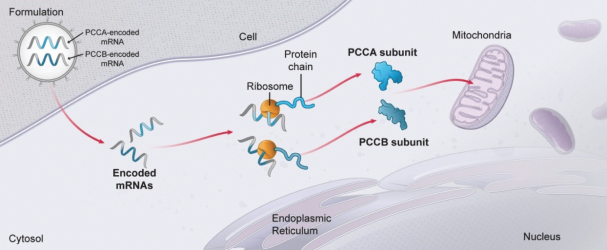
Propionic acidemia (mRNA-3927): Preclinical information
We have demonstrated activity in a PA mouse model in a long-term repeat dose study
A series of
in vitro
and
in vivo
pharmacology studies have been performed to demonstrate preclinical proof-of-concept for the combined PCCA and PCCB mRNA therapy. PCCA and PCCB mRNAs administered in PA patient fibroblasts (both PCCA and PCCB-deficient) showed production of active PCC enzyme with the proper subcellular localization in mitochondria at concentrations above wild-type levels.
In vivo
studies in PA (PCCA
-/-
[A138T]) mice have resulted in a dose-dependent increase in hepatic PCC activity with a concomitant decrease in disease biomarkers. Notably, a reduction in plasma ammonia levels was observed 3-4 weeks after a single IV administration (1 mg/kg) of PCCA and PCCB mRNA encapsulated in our proprietary LNP in PA mice (n=4-5/group). The data is shown in panel A of the figure below. Additionally, a 6-month repeat-dose study in PA mice showed decreased heart weight (normalized to body weight) in mice treated with monthly IV administration of PCCA and PCCB mRNA (1 mg/kg) compared to control mRNA (n=6/group). This is shown in panel B of the figure below. Data in both panels is presented as mean ± standard deviation.
109
Table of Contents
Reduction in plasma ammonia with PCCA+PCCB mRNA in PA mouse model study
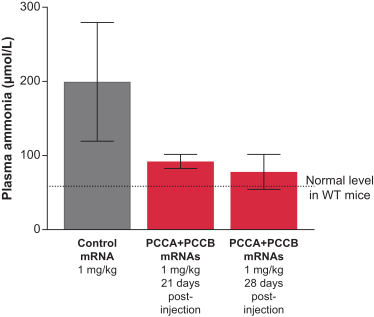
Panel (A)
Decrease in heart weight with PCCA+PCCB mRNA in 6 month repeat dose study in PA mouse model study
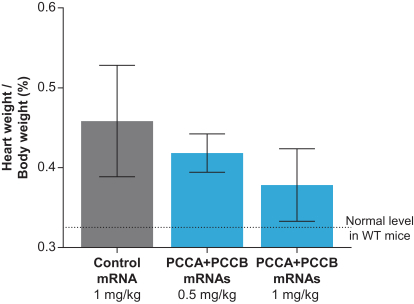
Panel (B)
In the 6-month repeat dose study in PA mice, a significant and sustained lowering of additional disease biomarkers (e.g., 2-methylcitrate, or 2MC) was observed throughout the duration of the 6-month study. A comparison of 2-methylcitrate levels as a result of monthly IV administration of PCCA and PCCB mRNAs (0.5-1 mg/kg) compared to control mice injected with a control (luciferase) mRNA is shown in the figure below (n=6/group). Data is presented as mean ± standard deviation. The IND-enabling GLP toxicology program for PA (mRNA-3927) is ongoing.
110
Table of Contents
Plasma 2-methylcitrate levels with repeat dosing of PCCA+PCCB mRNA in PA mouse model study
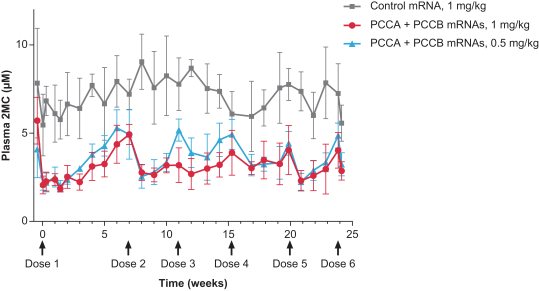
Propionic acidemia (mRNA-3927): Clinical plan
We are conducting a global natural history study and are planning a Phase 1/2 clinical trial
The clinical development plan for mRNA-3927 includes a global, natural history study that was initiated in 2018 and a planned Phase 1/2 study in pediatric patients diagnosed with PA.
We have launched a natural history study aimed at identifying and correlating clinical and biomarker endpoints. This is a global, multi-center, non-interventional study for patients with confirmed diagnosis of PA or MMA due to MUT deficiency. Up to 60 PA and 60 MMA patients in the United States and Europe will be followed prospectively for 1-3 years. Retrospective data will be collected as available. As of February 27, 2019, 20 MMA patients and 12 PA patients had enrolled in the natural history study.
We plan to conduct an open-label, multi-center, dose escalation Phase 1/2 study of multiple ascending doses of mRNA-3927 in pediatric patients with PA in the United States and Europe. The objectives of this study are to evaluate the safety and tolerability of mRNA-3927 administered via IV infusion, to assess the pharmacodynamic response from changes in plasma biomarkers, to characterize the pharmacokinetic profile of mRNA-3927.
Phenylketonuria (mRNA-3283): Summary
Our approach to Phenylketonuria with an mRNA encoding for an intracellular protein
Phenylketonuria, or PKU, is a rare inherited metabolic disease resulting from a deficiency in the metabolism of phenylalanine, or PHE, due to mutations within the enzyme phenylalanine hydroxylase, or PAH. The most effective treatment is a restrictive diet of low protein, which controls PHE intake. Approximately 20-56% of PKU patients respond to sapropterin dihydrochloride (marketed as Kuvan in the United States), a synthetic BH4 cofactor for PAH which improves PHE metabolism, but does not fully cure patients. In addition, Biomarin has received approval for pegylated phenylalanine lyase, or PAL, marketed as Palynziq. Palynziq is a pegylated recombinant bacterial enzyme which metabolizes PHE in the blood. We believe the immune risk is, at least in part, driven by bacterial PAL. With our mRNA technology, cells in the human body can be instructed to produce functional PAH, decreasing PHE levels in the blood and restoring production of tyrosine. We are developing an intravenously administered mRNA which encodes for the PAH enzyme and is encapsulated in our proprietary LNP. We plan to conduct a Phase 1 clinical trial for mRNA-3283.
Phenylketonuria (mRNA-3283): Disease overview
There are options to treat PKU which are not widely applicable, and efforts by other companies are likely to face hurdles
PKU occurs in approximately 1:10,000-15,000 live births in the United States
.
Based on current population estimates that would translate into approximately 21,000-32,000 PKU patients in the United States. Affected individuals have a deficiency in the enzyme PAH, resulting in a reduced or complete inability to metabolize the essential amino acid phenylalanine into tyrosine. Thus, PKU patients suffer from a phenylalanine intoxication and a subsequent deprivation of tyrosine, leading to severe mental disability if left untreated.
111
Table of Contents
PAH is expressed as a monomer, but functions as a tetramer and requires tetrahydrobiopterin (BH4) as a cofactor to complete the conversion of PHE to tyrosine, thereby maintaining adequate PHE:TYR ratios within circulation. To date, greater than 950 gene variants have been identified in the PAH gene, resulting in PKU.
Diagnosis of PKU occurs primarily through newborn screening in available countries, followed by genetic confirmation. Newly diagnosed patients receive medical formulas containing protein with low PHE content to control blood PHE and provide adequate nutrition for growing infants. As patients age they are tested for sensitivity to synthetic BH4 and may transition to Kuvan. Approximately 20% of patients respond favorably to Kuvan, which can aid in PHE control. Nonresponsive patients are treated mainly with restricted diet; however, adherence to the diet is challenging, resulting in poor compliance. When PHE levels are not adequately controlled, patients begin to show multiple signs of disease, including depression, anxiety, poor executive function, and attention deficit hyperactivity disorder, or ADHD. In May 2018, Biomarin received approval to market Palynziq.
One option for PKU patients may be treatment with gene therapy. We believe there are potential advantages for mRNA therapeutics for this disorder over gene therapy as described in the systemic intracellular therapeutics modality section.
Phenylketonuria (mRNA-3283): Our product concept
We intend to utilize the cells in the human body to produce PAH intracellularly
We believe mRNA therapy is a viable therapeutic modality for PKU patients due to its ability to instruct cells in the human body to produce complex functional intracellular proteins such as PAH. Our program mRNA-3283 consists of an mRNA encoding human PAH encapsulated in our proprietary LNPs. The mRNA sequence is optimized for protein synthesis and contains a microRNA binding site to reduce or potentially eliminate synthesis of protein outside of the target tissues. mRNA-3283 is designed to be administered intravenously to encode enzymatically-active PAH protein in liver to restore this deficient or defective enzyme as illustrated in the figure below.
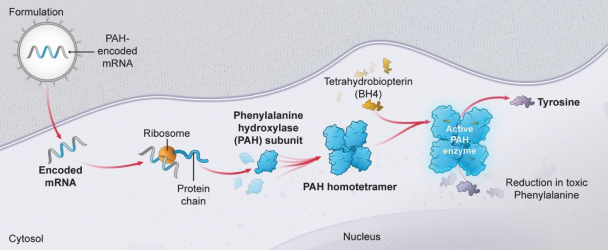
Phenylketonuria (mRNA-3283): Preclinical information
We have demonstrated the ability to impact PHE levels by repeat dosing of our mRNA in preclinical studies
We have conducted several
in vitro
and
in vivo
pharmacology studies to demonstrate preclinical proof-of-concept for PAH therapy. A PKU mouse model demonstrated a significant reduction of blood PHE levels post dose as shown in the figure below. The study included IV administration of PAH mRNA every 7 days at 0.5 mg/kg in a PAH-/- mouse model. Data point with asterisk is marked zero since it was not collected due to a snow storm. PHE level was measured using liquid chromatography with a combination of two mass analyzers (LC-MS/MS). The IND-enabling GLP toxicology program for PKU (mRNA-3283) is ongoing.
112
Table of Contents
PHE reduction with repeat dosing of PAH mRNA in PKU mouse model study
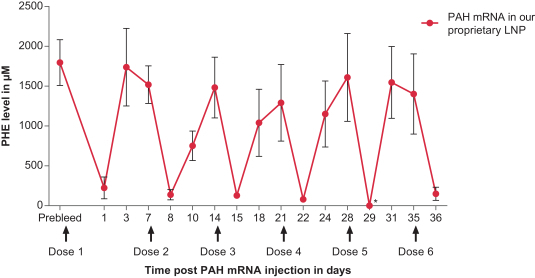
Phenylketonuria (mRNA-3283): Clinical plan
We plan to conduct a Phase 1 open label clinical trial with single ascending dose to evaluate the safety, tolerability, and activity of our development candidate in patients.
113
Table of Contents
MANUFACTURING (PRODUCT SUPPLY AND TECHNICAL DEVELOPMENT)
We believe manufacturing plays a critical role in our value chain and ability to develop a new class of medicines. Our manufacturing capabilities currently support the Research Engine and the Early Development Engine, with future plans to support demand from the Late Stage Development and Commercial Engine. Within the Research Engine, our manufacturing provides mRNA drug substance and formulated drug product for platform research and therapeutic area drug discovery. For the Early Development Engine, we manufacture mRNA and drug product for IND-enabling GLP toxicology studies and initial human clinical studies. Our approach to date has been to proactively build capacity in anticipation of demand from internal research and development, as well as from our strategic collaborators. We have done so by making significant investments in our internal manufacturing capability and in a network of external manufacturing partners.
Overview of our manufacturing operating model
Our manufacturing activities focus on the following:
|
•
|
Manufacturing Technology
. Our manufacturing technology development includes state-of-the-art technologies for mRNA and drug product manufacturing and testing to attain robust, consistent supply that matches target product profiles. Manufacturing technology also needs to support scale-up and industrialization of products for ultimate commercial approval.
|
|
•
|
Supply
. The product supply for the Research Engine enables platform research and drug discovery in our therapeutic areas. Within the Early Development Engine, supply is directed towards IND-enabling GLP toxicology programs or current good manufacturing practice, or cGMP, supplies for early clinical studies of our investigational medicines.
|
We have invested in a dedicated in-house manufacturing facility in Norwood, MA, given our expectations for significant ongoing pipeline expansion and the long lead time required in building manufacturing infrastructure. Through
December 31, 2018
, we had net capitalized costs of approximately $140 million related to our Norwood facility. The facility is approximately 200,000 square feet; can scale up to 100 cGMP lots per year; and can accommodate over 200 of our employees. This facility is expected to support our Research Engine supply, IND-enabling GLP toxicology study supplies, and our Phase 1 and Phase 2 pipeline activities, and potentially later-stage clinical development activities, as well as certain commercial activities.
Norwood includes the following areas:
|
•
|
five cGMP suites for the manufacture of mRNA drug substance and bulk drug product;
|
|
•
|
dedicated cGMP suites for sterile filling;
|
|
•
|
cGMP suites for the manufacture of personalized cancer vaccines, or PCVs;
|
|
•
|
cGMP suites for the manufacture of critical raw materials;
|
|
•
|
space for packaging, labeling, and storage of vialed products;
|
|
•
|
temperature-controlled warehouse for incoming and outgoing products;
|
|
•
|
quality control laboratories;
|
|
•
|
pilot scale manufacturing space for scale-up and manufacture of toxicology supplies;
|
|
•
|
space for the manufacture of research grade mRNA; and
|
|
•
|
clean utilities including purified water and water for injection generation and controlled distribution.
|
The facility has been designed with a high level of automation and digital integration of manufacturing records and data. In addition, we have deployed an automated material and resource management system, a manufacturing execution system, a laboratory execution system, a laboratory information management system, and an asset and document management system, to ensure the digital integration of our manufacturing, product testing and release, and regulatory filings.
Manufacturing technology development
In order to support our broad pipeline of products spanning multiple therapeutic areas and multiple routes of administration, the technology underpinning product manufacturing is critical to our success. Over the last few years, we have invested heavily in this technology to enable the breadth and depth of our pipeline, and to prepare us to meet future needs and requirements as our programs enter later phases of development and commercialization.
114
Table of Contents
Our technology efforts are intended to span the development of robust and consistent manufacturing processes, assays to fully characterize the product, and fit-for-purpose formulations and product presentations. In addition, manufacturing activities include the development of novel hardware platforms that incorporate significant automation and robotics which are applicable broadly across programs but also specifically to personalized cancer vaccines. All of these activities are being developed with a focus on achieving appropriate cost of goods and scalability.
Our advances over the last few years have enabled us to more efficiently scale our mRNA and drug product manufacturing at successfully larger production yields. We have made significant investments in analytical characterization to determine critical product quality attributes and enable manufacturing site and scale changes over the course of development. In addition, pharmaceutical readiness of our drug product has enabled a wide variety of routes of administration (e.g., intramuscular, intratumoral, and intravenous).
We have also invested in the establishment of technology for the manufacture of some of our key raw materials, including DNA plasmid and many small molecules. This vertical integration allows us to exert significant control over the value chain, though we will continue to use a combination of internal and external manufacture of these raw materials.
Supply of mRNA for the Research Engine and Early Development Engine
Supply for the Research Engine
We believe that our internal manufacturing capacity is key to the advancement of our platform technology development and therapeutic area discovery efforts. High throughput automation and custom-engineered equipment enable us to produce multiple high quality mRNA and formulated constructs within a limited timeframe from order to delivery. We currently have infrastructure capable of producing up to 1,000 lots of mRNA sequences and formulations per month with a turnaround time of a few weeks from sequence to final product. The typical scale of mRNA manufactured by this team is 1-10 mg.
Supply for the Early Development Engine
Analogous to the Research Engine, we have proactively established manufacturing capabilities for the Early Development Engine. We started supplying product to enable IND-enabling GLP toxicology studies, and for human clinical studies, meeting required cGMP standards, with a combination of internal manufacturing at our Cambridge headquarters and external manufacturing at well-established contract manufacturing organizations, or CMOs. Norwood has the capability and capacity to produce research and clinical supply for our programs as well as to enable technology development and scale-up for future needs. We will continue to selectively use CMOs to complement our internal capacity to provide supply contingency and expanded capability where needed.
This extensive capacity has helped enable our broad pipeline of
20
development candidates, including the significant output necessary to supply our toxicological and human clinical studies. Though the underpinnings of the technology utilized across these
20
programs are the same, each program typically requires customization driven in part by its target product profile. These custom features range from varying molecular architecture to different routes of administration, and often necessitate multivalent products. For example, our CMV vaccine (mRNA-1647) requires six different mRNA sequences to be manufactured for inclusion in an intramuscular mRNA medicine, whereas OX40L (mRNA-2416) requires a single mRNA sequence for inclusion in an intratumoral mRNA medicine. All programs, with the exception of PCV, require that we scale up supply over time to meet the clinical demand required in the different phases of development and prepare the process for regulatory approval and eventually commercial supply, where bigger batch sizes will be required. In contrast, the PCV program is designed to provide each patient with a cancer vaccine that is designed and manufactured for that specific patient, thus increasing the number of batches to match the number of patients treated. As we scale the manufacturing output for particular programs, we plan to continuously improve yield, purity, and the pharmaceutical properties of our development candidates from IND-enabling GLP toxicology studies through commercial launch, including improvement to shelf life stability and solubility properties of drug product and drug substance. Typically after a change in process, more time may be required for pharmaceutical property testing, such as 6- or 12-month stability testing. This time lag may necessitate resupplying clinical materials, or making additional cGMP batches to meet clinical trial demand, before such pharmaceutical property testing is completed.
Supply of mRNA and formulated product for toxicology studies:
Early on, we established the internal capability to produce mRNA and formulated product for IND-enabling GLP toxicology studies for our development candidates under GLP standards.
Supply of cGMP mRNA and formulated product for human clinical studies:
We have incrementally built the capability to produce and supply mRNA drug product for clinical development. In our early years, we outsourced cGMP supply. We selected specialized CMOs to support a total of five programs by the end of 2015. In 2016, we built and qualified two cGMP suites in our Cambridge facility for the manufacture of mRNA drug substance and formulated drug product. While we had the internal capability to produce drug product, we continued to work with our external CMO network for redundant capacity and to provide sterile filling capability.
cGMP manufacture of PCV:
Due to the specialized nature of personalized medicine, in which a batch is specifically manufactured for a single patient, the PCV program has unique requirements. In this program, we digitally integrate patient-specific data from
115
Table of Contents
sequencing tumor samples and automatically design PCVs for patients. We have developed proprietary bioinformatics design algorithms, and have linked them to an automated manufacturing process for rapid production of formulated mRNA that can be turned around in a matter of weeks. The PCV manufacturing capability is termed Personalized Vaccine Unit, or PVU. PCV manufacturing is conducted using custom automated and engineering solutions utilizing single-use systems with fast “needle-to-needle” turnaround time. We have operationalized PCV manufacture within our external CMO network to meet our Phase 1 supply needs, while in parallel working to internalize manufacturing. Unlike traditional process development, where the product is scaled up in quantity for later phases of development and commercialization, each PCV is manufactured for a single patient and thus scaled-out with extensive use of automation and robotics for the larger numbers of patients involved in later phases of development and commercialization.
Supply for the Late Stage Development and Commercialization Engine
As our pipeline advances to later stage development and potential commercialization, we will need to evolve our manufacturing suites and other capabilities at Norwood. We believe at this time the modular nature of the Norwood suites will permit us to manufacture drug substance and drug product for a number of registrational trials and potentially drug substance and drug product for commercialization for certain rare disease indications. In other instances, we may build additional capabilities to support our Late Stage Development and Commercialization Engine.
Quality unit
Quality is core to the way we operate. We seek to ensure quality at Moderna through a combination of a robust Quality Management System, or QMS, our quality culture, and through our people. In accordance with applicable regulations we have established, documented, and implemented a QMS to assure continued compliance with the requirements therein. The QMS facilitates cGMP compliance by implementing practices that identify the various processes required by the QMS, their application throughout the organization, and the sequence of interaction of these processes.
The primary mode of documenting these key practices is through policies, standard operating procedures, forms, and other quality records, which include an overarching Quality Policy and Quality Manual. We have implemented measurement tools and metrics to monitor, measure, and analyze these practices to support cGMP operations, achieve planned results, and support continuous improvement. We monitor these quality metrics through formal governance processes, including Quality Management Review, or QMR, and our Quality Council to enable continuous improvement. We have also established an independent Quality Unit that fulfills quality assurance and quality control responsibilities.
While the Quality Unit is ultimately accountable and responsible for quality, quality is everyone’s responsibility. All cGMP personnel are empowered to ensure quality systems are appropriately maintained and executed.
We have established a culture that encourages transparency, accountability, and ownership of quality at all levels in the organization. As we scale the quality organization, we have focused on hiring the best talent with the required experience, training, and education.
Supply chain unit
We have established a robust supply chain to enable sufficient supply of the raw materials used to produce our mRNAs and components of our formulations. We have worked with our supply chain vendors to characterize critical raw materials and to understand their impact on the quality of mRNA drug substance and formulated drug product. We have also assessed the quality system and performance of our supply chain vendors and worked with them to comply with regulatory requirements.
116
Table of Contents
DIGITAL INFRASTRUCTURE
We believe that digital technologies, such as robotics, automation, artificial intelligence, and cloud computing, are critical to operationalize our strategy, accelerate our pace of learning and execute at scale. Our approach to bring these digital technologies into our workflows and processes has involved the following:
|
•
|
utilization of a consistent set of digital building blocks;
|
|
•
|
application of digital technologies in multiple business processes; and
|
|
•
|
rapid iterations for maximum optimization.
|
We have seen several benefits from our investments in digitization, most importantly through the depth of our platform technology and breadth of our pipeline. Other benefits include:
|
•
|
Quality: Reduction in human errors by enabling automation, repeatability, and seamless integration;
|
|
•
|
Scalability: Growth in our pipeline to
20
programs;
|
|
•
|
Speed: Rapid manufacture of research-grade mRNA from the Research Engine; and
|
|
•
|
Cost efficiencies: Digital infrastructure utilized across our platform, drug discovery, clinical development, and manufacturing to maximize efficiencies.
|
Our digital building blocks
We utilize six building blocks for our digital infrastructure:
|
•
|
Cloud enablement
is a critical component of our digital infrastructure. We are at the forefront of mRNA technology. We generate complex data sets, and our scientists need computational power and agility to operate without being limited by traditional computing technology. Maintaining digital infrastructure in the cloud provides the benefits of lower costs by simplifying provisioning and administration, flexibility, scalability, ease of maintenance, disaster recovery, and information security.
|
|
•
|
Integration of business processes
enables us to streamline processes and bring data together in a consistent manner, avoiding caches of information and manual intervention. This efficient flow of data between systems enables the automation of our business processes.
|
|
•
|
Internet of things
allows for smart interconnected devices that provide real-time synchronization of operations. The data from equipment provides real-time guidance to our scientists and engineers.
|
|
•
|
Automation
allows us to scale our operations reliably and reproducibly. With the help of custom hardware solutions and state-of-the-art robotics, we can continue to increase our operating efficiency, reduce errors, and improve our quality and compliance.
|
|
•
|
Advanced analytics
enable us to draw insights from our data. We are constantly generating large data sets that can provide important insights if mined appropriately and regularly.
|
|
•
|
Artificial intelligence
, or AI, is enabling key breakthroughs in predictive modeling. It will allow us to improve our mRNA design algorithms based on machine learning, and will provide us with critical insights into research, supply chain, manufacturing, and other processes.
|
Digital technologies to enable our Research Engine
We have deployed multiple digital technologies across our Research Engine to drive a rapid pace of learning, enable efficient workflows and business processes, and draw insights from vast amounts of data. Our aim is to provide our platform and discovery scientists with access to an environment that helps them through each step of their research cycle.
Drug Design Studio:
Our proprietary in-house digital application suite contains a Sequence Designer module to tailor an entire mRNA, with ever-improving rule sets that contain our accumulated learning about mRNA design. Drug Design Studio utilizes cloud-based computational capacity to run various algorithms we have developed to design each mRNA sequence. The utility of cloud-based capacity allows us to provide flexible computational capacity on demand, allowing the Research Engine to power parallel intake and design of multiple mRNA sequences. Once a sequence is designed, it can be ordered digitally using an internal order form application within Drug Design Studio.
117
Table of Contents
Manufacture of research grade mRNA:
Once an order is optimized, the mRNA production process is triggered. We have developed proprietary interfaces that allow the manufacturing team to track production orders at every stage. We have automated several manufacturing steps using both off-the-shelf and custom automation. The equipment used in the manufacture of research-grade mRNA is integrated with the digital interfaces to capture, extract, and interpret the data generated at each step of the manufacturing process, building digital traceability on each mRNA order. We have also embedded real-time algorithms and analytics tools to allow for automated decision-making at some stages, accelerate the quality control workflows, and provide for continuous improvement of manufacturing processes.
Dispatching and shipping mRNA:
Because we produce large quantities of research-grade mRNA, we require digital tools to track their shipment to our scientists and to external contract research organizations, or CROs, conducting
in vivo
studies. Our dispatching and shipping application automatically generates bar-coded labels, allowing for traceability of product.
Inventory and registry:
Material used in research and created in production, including mRNA, cell lines, chemicals, and reagents, is tracked in our Inventory application. This application supports numerous workflow tools such as consumption, aliquoting, material transfer, and stock alerts. Critical material types are assigned unique registry identification by our Registry application.
Study design:
Using our Drug Design Studio, our scientists can design their
in vivo
studies using our proprietary Study Design application. This application captures
in vivo
study protocol design parameters, including dose amount, number of doses, frequency, samples, and assays for each sample. This application serves two purposes. It allows our scientists to maintain and track their
in vivo
study designs and associated research grade mRNA. Our Study Design application also allows our
in vivo
pharmacology teams to track the various ongoing studies and leverage external CROs to manage the
in vivo
demand as needed.
Experiment management:
We have deployed Electronic Lab Notebooks for experiment management, allowing our scientists to streamline documentation of their experiments and track it in a standardized, searchable repository. We have also integrated Electronic Lab Notebooks further with our other research tools to connect inventory,
in vivo
studies, and instrument data.
Advanced analytics and AI to accelerate the pace of learning:
We utilize AI to enable various parts of our platform and drug discovery. Examples include:
|
•
|
Neural networks for protein engineering
: One way to optimize the efficacy of the proteins encoded by our mRNA is to engineer the sequence of the protein itself. We use neural networks to analyze and model protein sequences. We train these models by inputting orthologous sequences from thousands of organisms, from which we can generate potential protein sequences optimized for specific attributes.
|
|
•
|
Neural networks for mRNA engineering
: The redundancy in the genetic code allows for a large number of mRNA sequences that encode the same protein. mRNA sequence may impact translation, thereby impacting the amount of protein produced in circulation. We are developing AI tools to predict mRNA sequences that can enhance protein expression.
|
|
•
|
Bayesian AI for sequencing mRNA
: We analyze the mRNA sequence produced in our Research Engine as part of our quality control requirements. Analysis of sequencing data can be cumbersome and time-consuming. We are developing Bayesian models to accelerate the assessment of sequencing data and more rapidly provide our scientists with high quality mRNA.
|
Digital technologies to enable our Early Development Engine
We have deployed multiple digital technologies across our Early Development Engine to drive the rapid pace of advancement, in parallel, of our development candidates into the clinic.
Digital systems for cGMP manufacture:
We are committed to having integrated systems connected with robotics to drive our manufacturing in a paperless environment, and have designed and deployed automation to drive efficient manufacturing operations. We have also deployed digital tools within manufacturing process development that give us the ability to track, analyze, and rapidly deploy manufacturing process improvements. Additionally, we have implemented several digital systems across manufacturing process development, quality, supply chain, and operations, including:
|
•
|
enterprise Quality Management System, or QMS, to electronically manage deviations, investigation, and correction and preventive actions;
|
|
•
|
Laboratory Information Management System, or LIMS, to manage our analytical development data and automate our manufacturing quality control;
|
|
•
|
computerized maintenance management system to manage equipment maintenance and calibration; and
|
118
Table of Contents
|
•
|
SAP/S4 Hana system for enterprise resource planning, or ERP, manufacturing execution system, and manufacturing control system to manage inventories, track raw material consumption, digitally integrate equipment with manufacturing recipes in batch records, and control automated equipment.
|
Digital systems for clinical development and clinical operations:
In order to track the timelines of various development candidates through the Early Development Engine, we have created a set of integrated applications. Workflows include timelines for regulatory filings, planning for IND-enabling GLP toxicology studies, scheduling for cGMP manufacturing, and clinical operations management. Below is a summary of our applications:
|
•
|
Our portfolio application is a digital interface that maintains and tracks the timelines across multiple workstreams for each of our development candidates.
|
|
•
|
The supply application manages the manufacturing schedule of IND-enabling GLP toxicology supplies and cGMP manufacture of clinical supplies to support our programs. This application helps us see how the manufacturing schedule changes over time, identifies supply/demand mismatches, and enables resource planning with real-time alerts should we have any issues.
|
|
•
|
The GLP toxicology application tracks the planned and ongoing IND-enabling GLP toxicology studies and allows us to manage timelines with our external vendors.
|
|
•
|
The regulatory application tracks timelines related to regulatory affairs including, pre-IND meetings, IND/CTA submission dates, and other planned regulatory interactions.
|
|
•
|
Our clinical operations application allows us to track our ongoing trials by accessing clinical operations information in real-time from our CROs. It also has multiple tools and analytics to draw key insights, including, for example, enrollment by trial and enrollment by site to maintain our program timelines.
|
Digital systems for PCV:
The PCV program aims to design, manufacture, and deliver a drug product that includes an mRNA sequence encoding for each patient’s specific neoantigens. The personalized nature of the PCV program adds additional steps and complexity in the overall patient treatment process. We have addressed those additional steps and complexity by digitizing and automating steps within the process, as described below.
|
•
|
Each patient is provided a unique identifier. We track the entire workflow using a single integrated tracker based on this unique identifier. This is one of many ways we ensure that each patient receives the specific drug product lot manufactured for them.
|
|
•
|
We use neural networks to design the mRNA sequences for the PCV program. Our proprietary vaccine design algorithm selects the top twenty neoantigens to be used and determines their amino acid sequences to trigger the desired immune response.
|
|
•
|
We utilize Monte Carlo simulations of PCV supply/demand to manage our capacity. Since each drug product lot is personalized to a patient, there is a need to manage supply and demand to avoid bottlenecks at any stage of the workflow.
|
Digital technologies to support our business processes
We have deployed several digital systems across finance, manufacturing, and human resources to automate our business processes and drive efficiencies. We have implemented the SAP S4/Hana system for ERP. In December 2016 we implemented the finance, procurement and inventory management modules and further scaled the ERP to support manufacturing, quality and supply chain in September 2017 and added the Norwood site and processes in July 2018. We have implemented various cloud-based solutions to improve business processes and drive efficiencies. For example, we have implemented the Workday system for human resource planning and management and integrated various applications across payroll, 401k services, equity plan management and expense reporting.
119
Table of Contents
THIRD-PARTY STRATEGIC ALLIANCES
Strategic alliances
To accelerate the discovery and advancement of potential mRNA medicines across therapeutic areas, we have entered into, and intend to seek other opportunities to form, alliances with a diverse group of strategic collaborators. We have forged productive strategic alliances with pharmaceutical and biotechnology companies, government agencies, academic laboratories, foundations and research institutes with therapeutic area expertise and resources in an effort to advance our discovery and development programs, while leveraging our platform and our Research and Early Development Engines.
One key principle of our approach to strategic alliances is to share the rewards and risks of developing a new mRNA modality, where we may have early research data and desire a strategic collaborator to join us in advancing early development candidates within such modality into the clinic. Representative relationships and associated programs include the following:
|
•
|
AstraZeneca for the localized regenerative therapeutics modality, such as the VEGF-A (AZD8601) program currently in Phase 2a;
|
|
•
|
AstraZeneca for the intratumoral immuno-oncology modality, such as the IL12 program (MEDI1191);
|
|
•
|
AstraZeneca for the systemic secreted therapeutics modality, such as the Relaxin program (AZD7970);
|
|
•
|
Merck for the prophylactic vaccines modality, such as the RSV vaccine program (mRNA-1777) currently being prepared for a Phase 2;
|
|
•
|
Merck for the cancer vaccines modality, such as the personalized cancer vaccine program (mRNA-4157) currently in Phase 1 using a workflow that enables a rapid turnaround time to bring personalized vaccines to patients, and the KRAS vaccine program (mRNA-5671);
|
|
•
|
DARPA for the systemic secreted therapeutics modality, such as the antibody against Chikungunya virus program (mRNA-1944) currently in Phase 1; and
|
|
•
|
Vertex for the lung delivery modality, such as the CF/CFTR program currently in research.
|
We view strategic alliances as important drivers for accelerating execution of our goal of rapidly developing mRNA medicines to treat patients across a wide range of medical and disease challenges. To maintain the integrity of our platform, the terms of our agreements with our strategic collaborators generally provide that our strategic collaborators receive rights to develop and commercialize potential mRNA medicines that we design and manufacture, as opposed to rights to use our platform to generate new mRNA, and that we generally own mRNA-related intellectual property arising from research activities performed under the strategic alliance.
We plan to continue to identify potential strategic collaborators who can contribute meaningful resources and insights to our programs and allow us to more rapidly expand our impact to broader patient populations.
AstraZeneca (NYSE: AZN)—Strategic Alliances in Cardiovascular and Oncology
We have three alliances with AstraZeneca. Our first strategic alliance established in 2013 and amended and restated in 2018, was to discover, develop, and commercialize potential mRNA medicines for the treatment of cardiovascular and cardiometabolic diseases, as well as selected targets for cancer. The relationship with AstraZeneca was expanded in 2016 by entering into a new immuno-oncology strategic alliance which is now focused on the joint development of a potential mRNA medicine to make the IL12 protein. It was further expanded in 2017 by entering into another strategic alliance which is focused on the joint development of a potential mRNA medicine to make the relaxin protein, following discovery and preclinical development of the relevant development candidate internally. Additionally, AstraZeneca has made several equity investments in Moderna, which total approximately $290.0 million through
December 31, 2018
.
2013 Agreements with AstraZeneca, amended and restated in 2018
In March 2013, we entered into an Option Agreement and a related Services and Collaboration Agreement with AstraZeneca, which were amended and restated in June 2018. We refer to these amended and restated agreements as the 2018 A&R Agreements. Under the 2018 A&R Agreements, we granted AstraZeneca certain exclusive rights and licenses to research, develop and commercialize
120
Table of Contents
potential therapeutic mRNA medicines directed at certain targets for the treatment of cardiovascular and cardiometabolic diseases and cancer, and agreed to provide related services to AstraZeneca. The activities to be performed by the parties under the 2018 A&R Agreements are limited to defined biological targets in the cardiovascular and cardiometabolic fields and one defined target in the cancer field.
Pursuant to the 2018 A&R Agreements, AstraZeneca is responsible for all research, development and commercialization activities and associated costs, while we provide specified research and manufacturing services, at AstraZeneca’s expense, during a research and evaluation period, as described below, to further AstraZeneca’s activities conducted pursuant to an agreed upon services plan. AstraZeneca may request we provide additional services, at AstraZeneca’s expense. Subject to customary “back-up” supply rights granted to AstraZeneca, we exclusively manufacture (or have manufactured) mRNA for all research, development and commercialization purposes under the 2018 A&R Agreements until, on a product-by-product basis, the expiration of the time period for which we are entitled to receive earn-out payments with respect to such product pursuant to the 2018 A&R Agreements.
As of the effective date of the original Option Agreement and Services and Collaboration Agreement in 2013, and as further reflected in the 2018 A&R Agreements, AstraZeneca acquired forty options that it may exercise to obtain exclusive rights to clinically develop and commercialize identified development candidates (and related back-up candidates) directed to specified targets that arise during the research and evaluation period. During the research and evaluation period for research candidates, AstraZeneca may elect to designate a limited number of research candidates as development candidates in order to continue preclinical development on such development candidates (and related back-up candidates). From such pool of development candidates designated by AstraZeneca, during a specified option exercise period, AstraZeneca may then exercise one of its options to obtain exclusive rights to clinically develop and commercialize an identified development candidate (and related back-up candidates) in certain fields. If AstraZeneca does not exercise one of its options to acquire exclusive rights to clinically develop and commercialize a particular development candidate during the defined option exercise period for such development candidate, AstraZeneca’s rights to exercise an option and other rights granted under the 2018 A&R Agreements with respect to such development candidate (and related back-up candidates) will terminate, all rights to exploit such development candidate (and related back-up candidates) will be returned to us and all data and results generated by AstraZeneca with respect to such development candidate (and related back-up candidates) will be either assigned or licensed to us. Upon the earlier of termination of the 2018 A&R Agreements for any reason and a specified anniversary of the effective date of the original Option Agreement and Services and Collaboration Agreement in 2013, all unexercised options, and the right to exercise any and all options if not previously exercised by AstraZeneca, will automatically terminate.
On a target-by-target basis, we and AstraZeneca have agreed to certain defined exclusivity obligations under the 2018 A&R Agreements with respect to the research, development and commercialization of mRNA medicines for such target in certain fields. In addition, we and AstraZeneca have agreed to certain defined exclusivity obligations with respect to the research, development and commercialization of mRNA medicines coding for the same polypeptide as any development candidate being developed under the 2018 A&R Agreements.
As of the effective date of the original Option Agreement and Services and Collaboration Agreement in 2013, AstraZeneca made upfront cash payments to us totaling $240.0 million in exchange for the acquired options and our performance of certain research-related services, each as described above. AstraZeneca will pay us a $10.0 million option exercise payment with respect to each development candidate (and related back-up candidates) for which it exercises an option. We are also eligible to receive, on a product-by-product basis, up to $400.0 million in aggregate contingent option exercise payments upon the achievement of certain development, regulatory and commercial milestone events. Additionally, we are entitled to receive, on a product-by-product basis, earn-out payments on worldwide net sales of products ranging from a high-single digit percentage to 12%, subject to certain reductions, with an aggregate minimum floor. As of
December 31, 2018
, we have received from AstraZeneca an option exercise payment of $10.0 million and a clinical milestone payment of $30.0 million with respect to AstraZeneca’s VEGF-A product (AZD8601) that is currently being developed in a Phase 2a clinical trial in the cardiovascular and cardiometabolic fields. Additionally, as of
December 31, 2018
, we have received $120.0 million from AstraZeneca under the 2018 A&R Agreements for the achievement of specified technical milestones.
Unless earlier terminated, the 2018 A&R Agreements will continue until the expiration of AstraZeneca’s earn-out and contingent option exercise payment obligations for optioned product candidates. Either party may terminate the 2018 A&R Agreements upon the other party’s material breach, either in its entirety or in certain circumstances, with respect to relevant candidates, subject to a defined materiality threshold and specified notice and cure provisions. If AstraZeneca has the right to terminate the 2018 A&R Agreements for our material breach, then AstraZeneca may elect, in lieu of terminating the 2018 A&R Agreements, in their entirety or with respect to such candidates, to have the 2018 A&R Agreements remain in effect, subject to reductions in certain payments we are eligible to receive and certain adjustments to AstraZeneca’s obligations under the 2018 A&R Agreements. AstraZeneca may terminate the 2018 A&R Agreements in full, without cause, upon 90 days’ prior notice to us.
121
Table of Contents
2016 Strategic Alliance with AstraZeneca—IL12
In January 2016, we entered into a new Strategic Drug Development Collaboration and License Agreement, which we refer to as the 2016 AZ Agreement, with AstraZeneca to discover, develop and commercialize potential mRNA medicines for the treatment of a range of cancers.
Under the terms of the 2016 AZ Agreement, we and AstraZeneca have agreed to work together on an immuno-oncology program focused on the intratumoral delivery of a potential mRNA medicine to make the IL12 protein. The 2016 AZ Agreement initially included research activities with respect to a second discovery program. During a limited period of time, each party had an opportunity to propose additional discovery programs to be conducted under the 2016 AZ Agreement. We are responsible for conducting and funding all discovery and preclinical development activities under the 2016 AZ Agreement in accordance with an agreed upon discovery program plan for the IL12 program and any other discovery program the parties agree to conduct under the 2016 AZ Agreement. For the IL12 program and any other discovery program the parties agree to conduct under the 2016 AZ Agreement, during a defined election period that commenced as of the effective date of the 2016 AZ Agreement (for the IL12 program) and otherwise will commence on initiation of any such new discovery program, AstraZeneca may elect to participate in the clinical development of a development candidate arising under the 2016 AZ Agreement from such program. If AstraZeneca so elects (as it has for the IL12 program), AstraZeneca will lead clinical development activities worldwide and we will be responsible for certain activities, including being solely responsible for manufacturing activities, all in accordance with an agreed upon development plan. AstraZeneca will be responsible for funding all Phase 1 clinical development activities (including costs associated with our manufacture of clinical materials in accordance with the development plan), and Phase 2 clinical development activities (including costs associated with our manufacture of clinical materials in accordance with the development plan) up to a defined dollar threshold. We and AstraZeneca will equally share the costs of Phase 2 clinical development activities in excess of such dollar threshold, all Phase 3 clinical development activities and certain other costs of late-stage clinical development activities, unless we elect not to participate in further development and commercialization activities and instead receive tiered royalties, as described below.
We and AstraZeneca will co-commercialize products in the United States in accordance with an agreed upon commercialization plan and budget, and on a product-by-product basis will equally share the U.S. profits or losses arising from such commercialization. Notwithstanding, on a product-by-product basis, prior to a specified stage of development of a given product, we have the right to elect not to participate in the further development and commercialization activities for such product. If we make such election, instead of participating in the U.S. profits and losses share with respect to such product, we are obligated to discuss future financial terms with AstraZeneca. If we are unable to agree on future financial terms within a short defined period of time, we are entitled to receive tiered royalties at default rates set forth in the 2016 AZ Agreement, ranging from percentages in the mid-single digits to 20% on worldwide net sales of products, subject to certain reductions with an aggregate minimum floor. AstraZeneca has sole and exclusive responsibility for all ex-U.S. commercialization efforts. Unless we have elected to not to participate in further development (in which case royalties on ex-U.S. net sales will be at the default rates as described above, unless otherwise agreed by the parties), we are entitled to tiered royalties at rates ranging from 10% to 30% on ex-U.S. net sales of the products, subject to certain reductions with an aggregate minimum floor. Subject to customary “back-up” supply rights granted to AstraZeneca, we exclusively manufacture (or have manufactured) products for all development and commercialization purposes. We and AstraZeneca have agreed to certain defined exclusivity obligations with each other under the 2016 AZ Agreement with respect to the development and commercialization of mRNA medicines for IL12.
Unless earlier terminated, our strategic alliance under the 2016 AZ Agreement will continue on a product-by-product basis (i) until both parties cease developing and commercializing such product without the intention to resume, if we have not elected our right not to participate in further development and commercialization of such product or (ii) on a country-by-country basis, until the end of the applicable royalty term for such product in such country, if we have elected our right not to participate in further development and commercialization of such product.
Either party may terminate the 2016 AZ Agreement upon the other party’s material breach, subject to specified notice and cure provisions. Each party may also terminate the 2016 AZ Agreement in the event the other party challenges such party’s patent rights, subject to certain defined exceptions. AstraZeneca has the right to terminate the 2016 AZ Agreement in full or with respect to any program for scientific, technical, regulatory or commercial reasons at any time upon 90 days’ prior written notice to us. On a product-by-product basis, we have the right to terminate the 2016 AZ Agreement in certain cases if AstraZeneca has suspended or is no longer proceeding with the development or commercialization of such product for a period of twelve consecutive months, subject to specified exceptions, including tolling for events outside of AstraZeneca’s control. On a product-by-product basis, if the 2016 AZ Agreement is terminated with respect to a given product, AstraZeneca’s rights in such product will terminate and, to the extent we terminated for AstraZeneca’s breach, patent challenge or cessation of development or AstraZeneca terminated in its discretion, AstraZeneca will grant us reversion licenses and take certain other actions so as to enable us to continue developing and commercializing such product in the oncology field.
122
Table of Contents
If we continue developing and commercializing a given product following termination of the 2016 AZ Agreement by AstraZeneca in its discretion with respect to such product, AstraZeneca is entitled to receive a mid-single digit royalty on our worldwide net sales of such product and a high-single digit percentage of the amounts received by us from a third party in consideration of a license to such third party to exploit such product, in each case, until AstraZeneca recovers an amount equal to specified development costs incurred by AstraZeneca under the 2016 AZ Agreement with respect to such product prior to such termination. Such percentages increase by a low to mid-single digit amount to the extent such termination occurs after such product achieves a specified stage of development.
2017 Strategic Alliance with AstraZeneca—Relaxin
In October 2017, we entered a new Collaboration and License Agreement, which we refer to as the 2017 AZ Agreement, under which AstraZeneca may clinically develop and commercialize a development candidate, now known as AZD7970, which is comprised of an mRNA construct for the relaxin protein designed by us and encapsulated in one of our proprietary LNPs. We discovered and performed preclinical development activities for AZD7970 prior to the initiation of the strategic alliance with AstraZeneca under the 2017 AZ Agreement.
Under the terms of the 2017 AZ Agreement, we will fund and be responsible for conducting preclinical development activities for AZD7970 through completion of IND-enabling GLP toxicology studies and AstraZeneca will lead pharmacological studies, each in accordance with an agreed upon discovery program plan. During a defined election period that commences as of the effective date of the 2017 AZ Agreement, AstraZeneca may elect to participate in further development and commercialization of AZD7970. Upon such election, AstraZeneca will lead clinical development activities for AZD7970 worldwide and we will be responsible for manufacturing AZD7970, certain regulatory matters and any other development activities that we agree to perform and that are set forth in an agreed upon development plan. AstraZeneca will be responsible for funding Phase 1 clinical development activities (including costs associated with our manufacture of clinical materials in accordance with the development plan, up to a cap above which such costs are shared), and Phase 2 clinical development activities (including costs associated with our manufacture of clinical materials in accordance with the development plan, up to a cap above which such costs are shared) up to a defined dollar threshold. Thereafter, we and AstraZeneca will equally share the costs of Phase 2 clinical development activities in excess of such defined dollar threshold, all Phase 3 clinical development activities and certain other costs of late-stage clinical development activities, unless we elect not to participate in further development and commercialization activities and instead receive tiered royalties as described below. If the development candidate is determined to be IND-ready, and AstraZeneca does not timely elect to participate in the clinical development of AZD7970, AstraZeneca is obligated to reimburse us for certain costs we incurred in the manufacture and development of AZD7970 since execution of the 2017 AZ Agreement.
We and AstraZeneca will co-commercialize AZD7970 in the United States in accordance with an agreed upon commercialization plan and budget, and will equally share U.S. profits or losses arising from such commercialization. Notwithstanding, prior to a specified stage of development of AZD7970, we have the right to elect not to participate in the further development and commercialization activities for AZD7970. If we make such election, instead of participating in the U.S. operating profits and losses share with respect to AZD7970, we are obligated to discuss future financial terms with AstraZeneca. If we are unable to agree on future financial terms within a short, defined period of time, we are entitled to receive tiered royalties at default rates set forth in the 2017 AZ Agreement, ranging from percentages in the mid-single digits to the low 20s on worldwide net sales by AstraZeneca of AZD7970, subject to certain reductions with an aggregate minimum floor. AstraZeneca has sole and exclusive responsibility for all ex-U.S. commercialization efforts. Unless we have elected not to participate in further development (in which case royalties on ex-U.S. net sales will be at the default rates as described above, unless otherwise agreed by the parties), we are entitled to receive tiered royalties at rates ranging from 10% to 30% on annual ex-U.S. net sales of AZD7970, subject to certain reductions, with an aggregate minimum floor. Subject to customary “back-up” supply rights granted to AstraZeneca, we exclusively manufacture (or have manufactured) products for all development and commercialization purposes. Additionally, we and AstraZeneca have agreed to certain defined exclusivity obligations under the 2017 AZ Agreement with respect to the development and commercialization of mRNA medicines for Relaxin.
Unless earlier terminated, our strategic alliance under the 2017 AZ Agreement will continue (i) until the expiration of AstraZeneca’s election period, if it does not elect to participate in the clinical development of AZD7970, (ii) until both parties cease developing and commercializing AZD7970 without the intention to resume, if we have not elected our right not to participate in further development and commercialization of AZD7970, (iii) on a country-by-country basis, until the end of the applicable royalty term for AZD7970 in such country, if we have elected our right not to participate in further development or commercialization of AZD7970 or (iv) following completion of IND-enabling studies with respect to AZD7970, if we provide AstraZeneca with written notice that we do not reasonably believe that the product is IND-ready.
Either party may terminate the 2017 AZ Agreement upon the other party’s material breach, subject to specified notice and cure provisions. Each party may also terminate the 2017 AZ Agreement in the event the other party challenges the validity or enforceability of such party’s patent rights, subject to certain defined exceptions. AstraZeneca has the right to terminate the 2017 AZ Agreement in
123
Table of Contents
full for scientific, technical, regulatory or commercial reasons at any time upon 90 days’ prior written notice to us. We have the right to terminate the 2017 AZ Agreement in certain cases if AstraZeneca has suspended or is no longer proceeding with the development or commercialization of AZD7970 for a period of twelve consecutive months, subject to specified exceptions, including tolling for events outside of AstraZeneca’s control. If AstraZeneca does not timely elect to participate in clinical development of AZD7970, or the Agreement is terminated, AstraZeneca’s rights in AZD7970 will terminate and, to the extent we terminated for AstraZeneca’s breach, patent challenge or cessation of development or AstraZeneca terminated in its discretion, AstraZeneca will grant us reversion licenses and take certain other actions so as to enable us to continue developing and commercializing AZD7970 in the cardiovascular and cardiometabolic fields.
If we continue developing and commercializing AZD7970 following a termination of the 2017 AZ Agreement by AstraZeneca in its discretion, AstraZeneca is entitled to receive a mid-single digit royalty on our worldwide net sales of AZD7970 and a high-single digit percentage of the amounts received by us from a third party in consideration for a license to such third party to exploit AZD7970, in each case until AstraZeneca recovers an amount equal to specified development costs incurred by AstraZeneca under the 2017 AZ Agreement with respect to AZD7970 prior to such termination. Such percentages increase by a low to mid-single digit amount to the extent such termination occurs after such product achieves a specified stage of development.
Merck (NYSE: MRK)—Strategic Alliances in Infectious Diseases and Cancer Vaccines
We have established a multi-faceted relationship with Merck Sharp & Dohme Corp., or Merck, that includes distinct strategic alliances directed to the research, development, and commercialization of mRNA medicines for the prevention and treatment of viral infections and for the treatment of cancer. Merck has also made several equity investments in Moderna totaling approximately $182.0 million.
2015 Strategic Alliance with Merck—Infectious Disease
In January 2015, we entered into a Master Collaboration and License Agreement with Merck, which we refer to as the 2015 Merck Agreement, to research, develop, and commercialize potential mRNA medicines for the prevention and treatment of infections by RSV and three additional undisclosed viruses. Pursuant to the 2015 Merck Agreement, Merck is primarily responsible for research, development and commercialization activities and associated costs. We are responsible for designing and manufacturing all mRNA constructs for preclinical and Phase 1 and Phase 2 clinical development purposes, and Merck pays us for such manufacture. Responsibility for manufacturing mRNA constructs for late stage clinical development and commercialization purposes is to be determined.
The focus of the initial four-year period of the 2015 Merck Agreement, ending in January 2019, was the discovery and development of mRNA vaccines and antibodies directed to the four viruses that were the subject of the 2015 Merck Agreement. The 2015 Merck Agreement also includes an additional three-year period during which Merck may continue to preclinically and clinically develop product candidates that arise from the initial four-year research period. Merck may, prior to the end of the seventh year of the 2015 Merck Agreement, elect to exclusively develop and commercialize up to five product candidates.
During the four-year discovery and development phase of the alliance, we and Merck agreed to work exclusively with each other to develop potential mRNA medicines for the prevention and treatment of infections by the four viruses that were the subject of the 2015 Merck Agreement. Additionally, we and Merck have agreed to certain defined exclusivity obligations following the four-year discovery and development phase of the alliance.
Under the terms of the 2015 Merck Agreement, we received a $50.0 million upfront payment. We are eligible to receive, on a product-by-product basis, up to $300.0 million in aggregate milestone payments upon the achievement of certain development, regulatory and commercial milestone events. To date, we have received from Merck a clinical milestone payment of $5.0 million with respect to the initiation of a Phase 1 clinical trial for a Merck RSV vaccine product candidate. On a product-by-product basis, we are also entitled to receive royalties on Merck’s net sales of products at rates ranging from the mid-single digits to low teens, subject to certain reductions, with an aggregate minimum floor. Additionally, concurrent with entering into the 2015 Merck Agreement, Merck made a $50.0 million equity investment in us.
Unless earlier terminated, the 2015 Merck Agreement will continue on a product-by-product and country-by-country basis for so long as royalties are payable by Merck on a given product in a given country. Either party may terminate the 2015 Merck Agreement upon the other party’s material breach, either in its entirety or with respect to a particular program, product candidate, product or country, subject to specified notice and cure provisions. Merck may terminate the 2015 Merck Agreement in full or with respect to a particular product candidate or product upon certain advance notice to us for any reason, or earlier if Merck determines the alliance or product is no longer commercially practicable. If Merck has the right to terminate the 2015 Merck Agreement, in its entirety or with respect to a program, product candidate or product, for our material breach, then Merck may elect, in lieu of terminating the 2015 Merck Agreement, to have the 2015 Merck Agreement remain in effect, subject to reductions in certain payments we are eligible to receive
124
Table of Contents
with respect to the terminable rights. Upon a termination of the 2015 Merck Agreement with respect to a program, all licenses and other rights granted to Merck with respect to such program will terminate and the continued development and commercialization of product candidates and products will revert to us. If the 2015 Merck Agreement is terminated with respect to a given product candidate or product, all licenses and other rights granted to Merck with respect to such product candidate or product will terminate and, to the extent we terminated for Merck’s breach, Merck will grant us licenses under select Merck technology for our continued development and commercialization of such product candidate or product.
2016 Expansion of the Infectious Disease Strategic Alliance with Merck
In January 2016, we expanded our infectious disease strategic alliance with Merck. Specifically, we and Merck agreed to amend the original 2015 Merck Agreement to include the research, development, and commercialization of mRNA medicines for the prevention and treatment of infection by the varicella zoster virus in place of one of the viruses initially included under the 2015 Merck Agreement. Under the terms of the amended 2015 Merck Agreement, we received an upfront payment of $10.0 million from Merck for the inclusion of the new program and we agreed with Merck to increase the tiered royalty rates ranging from the mid-single digits to low-teens for net sales of products directed to this virus.
2016 Cancer Vaccine Strategic Alliance—Personalized mRNA Cancer Vaccines with Merck
In June 2016, we entered into a personalized mRNA cancer vaccines (PCV) Collaboration and License Agreement with Merck, which we refer to as the PCV Agreement, to develop and commercialize PCVs for individual patients using our mRNA vaccine and formulation technology. Under the strategic alliance, we identify genetic mutations present in a particular patient’s tumor cells, synthesize mRNA for these mutations, encapsulate the mRNA in one of our proprietary LNPs and administer to each patient a unique mRNA cancer vaccine designed to specifically activate the patient’s immune system against her or his own cancer cells.
Pursuant to the PCV Agreement, we are responsible for designing and researching PCVs, providing manufacturing capacity and manufacturing PCVs, and conducting Phase 1 and Phase 2 clinical trials for PCVs, alone and in combination with KEYTRUDA (pembrolizumab), Merck’s anti-PD-1 therapy, all in accordance with an agreed upon development plan and budget. We received an upfront payment of $200.0 million from Merck, which we will use to fund the performance of our activities set forth in the agreed upon development plan and budget. In November 2017, we and Merck announced the achievement of a key milestone for the first-in-human dosing of a PCV (mRNA-4157) as a part of the alliance. The Phase 1 open-label, dose escalation, multicenter clinical trial in the United States (KEYNOTE-603) is designed to assess the safety, tolerability and immunogenicity of mRNA-4157 alone in subjects with resected solid tumors and in combination with KEYTRUDA, in subjects with unresectable solid tumors.
Until the expiration of a defined period of time following our completion of Phase 1 and Phase 2 clinical trials for PCVs under the PCV Agreement and delivery of an associated data package to Merck, Merck has the right to elect to participate in future development and commercialization of PCVs by making a $250.0 million participation payment to us. If Merck exercises its election and pays the participation payment, then the parties will equally co-fund subsequent clinical development of PCVs, with Merck primarily responsible for conducting clinical development activities under a jointly agreed development plan and budget. Each party may also conduct additional clinical trials for PCVs that are not included in the jointly agreed development plan and budget, in which case the non-conducting party will reimburse the conducting party for half of the total costs for such trials, plus interest, from its share of future profits resulting from sales of such PCVs, if any. Merck will lead worldwide commercialization of PCVs, subject to Moderna’s option to co-promote PCVs in the United States, and the parties will equally share the profits or losses arising from worldwide commercialization. Until a PCV becomes profitable, we may elect to defer payment of our share of the commercialization and related manufacturing costs and instead reimburse Merck for such costs, plus interest, from our share of future profits resulting from sales of such PCV, if any. Subject to customary “back-up” supply rights granted to Merck, we will manufacture (or have manufactured) PCVs for preclinical and clinical purposes. Manufacture of PCVs for commercial purposes will be determined by the parties in accordance with the terms of the PCV Agreement.
If Merck does not exercise its right to participate in future development and commercialization of PCVs, then we will retain the exclusive right to develop and commercialize PCVs developed during the strategic alliance, subject to Merck’s rights to receive a percentage in the high teens to the low 20s, subject to reductions, of our net profits on sales of such PCVs. During a limited period following such non-exercise, Merck has the right to perform clinical trials of such PCVs in combination with KEYTRUDA, for which we agree to use reasonable efforts to supply such PCVs. During such limited period, we also have the right to perform clinical studies of PCVs in combination with KEYTRUDA, for which Merck agrees to use reasonable efforts to supply KEYTRUDA. In addition, following its non-exercise, Merck is also entitled to receive a percentage in the high teens to the low 20s, subject to reductions, of our net profits on sales of certain PCVs first developed by us following such non-exercise and reaching a specified development stage within a defined period of time.
125
Table of Contents
We and Merck have agreed to certain defined, limited exclusivity obligations with respect to the development and commercialization of PCVs.
2018 Expansion of the Cancer Vaccine Strategic Alliance with Merck—Shared Neoepitope Cancer Vaccines
In April 2018, we and Merck agreed to expand our cancer vaccine strategic alliance to include the development and commercialization of our KRAS vaccine development candidate, mRNA-5671, and potentially other shared neoantigen mRNA cancer vaccines (SAVs). We preclinically developed mRNA-5671 prior to its inclusion in the cancer vaccine strategic alliance and it is comprised of a novel mRNA construct designed by us and encapsulated in one of our proprietary LNPs. The PCV Agreement was amended and restated to include the new SAV strategic alliance, which we refer to as the PCV/SAV Agreement.
We and Merck have agreed to certain exclusivity obligations with respect to SAVs and particular SAV programs, which obligations are subject to termination or expiration upon certain triggering events.
Under the PCV/SAV Agreement, Merck will be responsible for conducting Phase 1 and Phase 2 clinical trials for mRNA-5671 and for all costs associated with such activities, in accordance with a jointly agreed development plan and budget, and we will be responsible for manufacturing and supplying all mRNA-5671 required to conduct such trials and for all costs and expenses associated with such manufacture and supply. Under the PCV/SAV Agreement, our budgeted commitment for PCVs increased to $243.0 million. Until the expiration of a defined period of time following our completion of Phase 1 and Phase 2 clinical trials for mRNA-5671 under the PCV/SAV Agreement and delivery of an associated data package to Merck, Merck has the right to elect to participate in future development and commercialization of mRNA-5671 by making a participation payment to us. If Merck exercises its participation rights, then the parties will equally co-fund subsequent clinical development of mRNA-5671, with Merck primarily responsible for conducting clinical development activities under a jointly agreed development plan and budget. If Merck declines to participate in future development and commercialization activities following the initial Phase 1 and Phase 2 clinical trials for mRNA-5671, then we will retain the rights to develop and commercialize mRNA-5671. If Merck elects to participate in future development and commercialization of mRNA-5671, Merck may also conduct additional clinical trials for mRNA-5671 that are not included in the jointly agreed development plan and budget, in which case we will reimburse Merck for half of the total development costs for such clinical trials, plus interest, from our share of future profits resulting from sales of mRNA-5671, if any. Merck will lead worldwide commercialization of mRNA-5671, subject to our option to co-promote mRNA-5671 in the United States, and the parties will equally share the profits or losses arising from worldwide commercialization. Until mRNA-5671 becomes profitable, we may elect to defer payment of our share of the commercialization and related manufacturing costs and instead reimburse Merck for such costs, plus interest, from our share of future profits resulting from sales of mRNA-5671, if any. Subject to “back-up” supply rights granted to Merck, we will manufacture (or have manufactured) mRNA-5671 and other SAVs for preclinical and clinical purposes. After Merck exercises its right to participate in future development and commercialization of mRNA-5671 and other SAVs, the parties are obligated to discuss responsibility for future manufacturing, giving consideration to applicable criteria.
Pursuant to the PCV/SAV Agreement, for a defined period of time, either party may propose that the parties conduct additional programs for the research and development of SAVs directed to different shared neoantigens. If the parties agree to conduct any such programs, then we will be responsible for conducting and funding pre-clinical discovery and research activities for such SAVs, and otherwise the programs would be conducted on substantially the same terms as the mRNA-5671 program. If we or Merck propose a new SAV program and the other party does not agree to conduct such program, then the PCV/SAV Agreement includes provisions allowing the proposing party to proceed with such development, at the proposing party’s expense. In such case, the non-proposing party will have the right to opt-in to such SAV program any time before the proposing party commits to performing Good Laboratory Practice (GLP)-toxicity studies. Until the expiration of a defined period of time following our completion of Phase 1 and Phase 2 clinical trials for any SAV program mutually agreed by the parties under the PCV/SAV Agreement and delivery of an associated data package to Merck, Merck has the right to elect to participate in future development and commercialization of such SAV by making a participation payment to us.
Unless earlier terminated, the PCV/SAV Agreement will continue on a program-by-program basis until Merck terminates its participation in such program. Following any such termination, we will retain the exclusive right to develop and commercialize PCVs or SAVs developed as a part of such program, subject to restrictions and certain limited rights retained by Merck.
In connection with the amendment of the PCV Agreement to include the development and commercialization of mRNA-5671 and potentially other SAVs, Merck made a $125.0 million equity investment in us.
Vertex (Nasdaq: VRTX)—2016 Strategic Alliance in Cystic Fibrosis
In July 2016, we entered into a Strategic Collaboration and License Agreement, with Vertex Pharmaceuticals Incorporated, and Vertex Pharmaceuticals (Europe) Limited, together, Vertex, which we refer to as the Vertex Agreement. The Vertex Agreement is aimed at the
126
Table of Contents
discovery and development of potential mRNA medicines for the treatment of cystic fibrosis, or CF, by enabling cells in the lungs of people with CF to produce functional CFTR proteins.
Pursuant to the Vertex Agreement, we lead discovery efforts during a three-year research period, leveraging our Platform technology and mRNA delivery expertise along with Vertex’s scientific experience in CF biology and the functional understanding of CFTR. Vertex is responsible for conducting development and commercialization activities for candidates and products that arise from the strategic alliance, including the costs associated with such activities. Vertex is also obligated to pay us for research services in connection with our performance of activities during the research period in accordance with a jointly agreed research plan. Subject to customary “back-up” supply rights granted to Vertex, we exclusively manufacture (or have manufactured) mRNA for pre-clinical, clinical, and commercialization purposes.
Under the terms of the Vertex Agreement, we received a $20.0 million upfront payment from Vertex. Vertex has the right to extend the initial three-year research period by one additional year by making an additional payment to us. We are eligible to receive up to $275.0 million in aggregate milestone payments upon the achievement of certain development and regulatory milestone events, and Vertex will also pay us tiered royalties at rates ranging from the low- to high-teens on worldwide net sales of products arising from the strategic alliance, subject to certain reductions, with an aggregate minimum floor. In connection with the strategic alliance, Vertex also made a $20.0 million equity investment in us.
During the term of the Vertex Agreement, we and Vertex have agreed to certain defined exclusivity obligations under the Vertex Agreement with respect to the development and commercialization of certain mRNA medicines.
Unless earlier terminated, the Vertex Agreement will continue until the expiration of all royalty terms. Vertex may terminate the Vertex Agreement for convenience upon 90 days’ prior written notice, except if termination relates to a product in a country where Vertex has received marketing approval, which, in such case, Vertex must provide 180 days’ prior written notice. Either party may terminate the Vertex Agreement upon the other party’s material breach, subject to specified notice and cure provisions. Each party may also terminate the Vertex Agreement in the event that the other party challenges the validity or enforceability of such party’s patent rights, subject to certain exceptions, or if the other party becomes insolvent.
Strategic alliances with government organizations and foundations
Defense Advanced Research Projects Agency (DARPA)
In October 2013, DARPA awarded Moderna up to approximately $25 million under Agreement No. W911NF-13-1-0417 to research and develop potential mRNA medicines as a part of DARPA’s Autonomous Diagnostics to Enable Prevention and Therapeutics, or ADEPT, program, which is focused on assisting with the development of technologies to rapidly identify and respond to threats posed by natural and engineered diseases and toxins. As of
December 31, 2018
, $19.7 million of the award amount has been funded. This award followed an initial award from DARPA of approximately $1.4 million given in March 2013 under Agreement No. W31P4Q-13-1-0007. The DARPA awards have been deployed primarily in support of our vaccine and antibody programs to protect against Chikungunya infection.
Biomedical Advanced Research and Development Authority (BARDA)
In September 2016, we received an award of up to approximately $125 million under Agreement No. HHSO100201600029C from BARDA, a component of the Office of the Assistant Secretary for Preparedness and Response, or ASPR, within the U.S. Department of Health and Human Services, or HHS, to help fund our Zika vaccine program. Under the terms of the agreement with BARDA, an initial base award of approximately $8 million supported toxicology studies, a Phase 1 clinical trial, and associated manufacturing activities. Additionally, four contract options were awarded under the agreement with BARDA. Three out of four of these options have been exercised, bringing the total current award to approximately $117 million to support an additional Phase 1 study of an improved Zika vaccine candidate, Phase 2 and Phase 3 clinical studies, as well as large-scale manufacturing for the Zika vaccine.
The Bill & Melinda Gates Foundation
In January 2016, we entered a global health project framework agreement with the Bill & Melinda Gates Foundation to advance mRNA-based development projects for various infectious diseases. The Bill & Melinda Gates Foundation has committed up to $20.0 million in grant funding to support our initial project related to the evaluation of antibody combinations in a preclinical setting as well as the conduct of a first-in-human Phase 1 clinical trial of a potential mRNA medicine to help prevent human immunodeficiency virus, or HIV, infections. Follow-on projects which could bring total potential funding under the framework agreement up to $100.0 million (including the HIV antibody project) to support the development of additional mRNA-based projects for various infectious diseases
127
Table of Contents
can be proposed and approved until the sixth anniversary of the framework agreement, subject to the terms of the framework agreement, including our obligation to grant to the Bill & Melinda Gates Foundation certain non-exclusive licenses.
128
Table of Contents
INTELLECTUAL PROPERTY
Our patent estate and approach, a strategic asset
Since our inception, we have considered the creation and building of our intellectual property, or IP, portfolio as a critical part of our mission. In a relatively short amount of time, we have built a significant patent estate that includes over 650 world-wide pending patent applications and over 140 issued or allowed U.S. and foreign patents covering key components of our proprietary platform technology, investigational medicines, and development candidates. The figure below shows our internally-developed estate and indicates the number of patents approved since 2010.
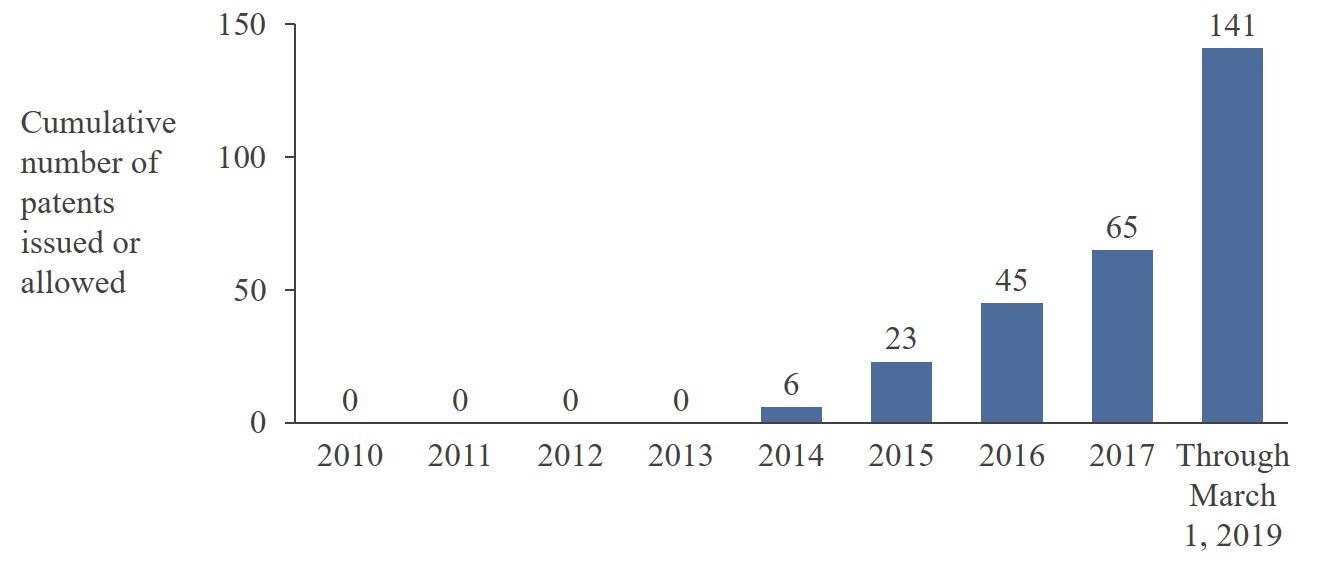
We regularly identify inventions and trade secrets as we surmount various challenges with our platform to create modalities. We seek to protect our proprietary position by, among other means, filing U.S. and certain foreign patent applications related to our platform, modality, and program inventions. Our company trade secrets and know-how are appropriately guarded to maintain our business advantage. We also seek to identify and obtain third party licenses where useful to maintain our advantageous IP position in the mRNA medicines field. We seek to obtain and maintain, and intend to strategically enforce, patents in appropriate jurisdictions for our platform technologies, modalities, and programs, in particular, in instances where insurmountable business competition threatens advancement of future commercial products.
Protecting our platform, modality, and program investments: Building an expansive, multi-layered IP estate
We have built a substantial IP estate that includes numerous patents and patent applications related to the development and commercialization of mRNA vaccine and therapeutic development candidates, including related platform technologies. Our platform IP protects advances in mRNA design and engineering, proprietary LNP components, delivery systems, processes for the manufacture and purification of drug substances and products, and analytical methods. A significant portion of our platform IP estate further provides multi-layered protection for our modalities and programs.
With respect to our platform, our solely-owned patent portfolio consists of more than 80 issued or allowed U.S. patents or patent applications and approximately 60 granted patents in jurisdictions outside of the U.S. covering certain of our proprietary platform technology, inventions, and improvements, and covering key aspects of our clinical and most advanced development candidates. Additional patent applications are also pending that, in many cases, are counterparts to the foregoing U.S. and foreign patents.
Most of the patents and applications (if issued) in our portfolio have or will have expiry dates extending out to 2033 at the earliest and at least 2040 for patents ultimately granting based on our more recently-filed patent applications.
We also rely on trademarks, trade secrets, and know-how relating to our proprietary technology and programs, continuing innovation, and in-licensing opportunities to develop, strengthen, and maintain our proprietary position in the field of mRNA therapeutic and vaccine technologies. We additionally plan to rely on data exclusivity, market exclusivity, and patent term extensions when available, and plan to seek and rely on regulatory protection afforded through orphan drug designations. We also possess substantial proprietary know-how associated with related manufacturing processes and expertise.
IP protecting our platform
We have a broad IP estate covering key aspects of our platform. This estate provides multiple layers of protection covering the making and use of the mRNA drug substance and delivery technologies.
129
Table of Contents
With respect to our platform, we have a portfolio that includes approximately 70 issued or allowed U.S. patents or patent applications, and more than 55 granted foreign patents and pending foreign patent applications covering platform innovations that are directly related to the design, formulation and manufacturing of mRNA medicines.
For example, these patents and patent applications include claims directed to:
|
•
|
mRNA chemistry imparting improved properties for vaccine and therapeutic uses;
|
|
•
|
methods for mRNA sequence optimization to enhance the levels and fidelity of proteins expressed from our mRNA medicines;
|
|
•
|
methods for identifying epitopes having superior suitability in cancer vaccine contexts;
|
|
•
|
engineering elements tailored to enhance stability and the
in vivo
performance of mRNA medicines;
|
|
•
|
proprietary lipid nanoparticle, or LNP, delivery systems, including novel lipid components designed for optimal expression of both therapeutic and vaccine mRNAs, in particular, prophylactic infectious disease and cancer vaccine mRNAs, intratumoral immuno-oncology therapeutics, local regenerative therapeutics, systemic secreted therapeutics, and systemic intracellular therapeutics; and
|
|
•
|
innovative processes for the manufacture and analysis of mRNA drug substance and formulated drug product.
|
IP protection for modalities
Our IP estate provides protection for the multiple programs within our modalities both at the product-specific level and at various broader levels. For example, we have patent coverage for LNP-encapsulated mRNAs having specific chemical modification suited for vaccine and therapeutic mRNA use. Our estate also includes IP covering certain LNP-encapsulated mRNAs coding for infectious disease antigens for use in prophylactic vaccination. Our mRNA chemistry, formulation and manufacturing patent applications and related know-how and trade secrets may also provide us with additional IP protection relating to our development candidates.
Our patent portfolio for our investigational medicines and development candidates features nine issued or scheduled-to-issue patents, with many additional pending applications in the U.S. and foreign jurisdictions directed to our development candidates.
Prophylactic vaccines
For programs within our prophylactic vaccines modality, we typically pursue patent protection featuring composition of matter and method of use claims. Our global patent protection strategy may vary based on the unique geographic prevalence of various infectious diseases.
Our earliest investigational medicines in the infectious disease pipeline, vaccines containing mRNA encoding HA antigens including H10 and H7, for the prevention of human infection with the influenza H10N8 or H7N9 avian influenza A viruses, respectively, are protected by a patent family that includes two issued U.S. patents, three pending U.S. patent applications and pending patent applications in each of Europe, Japan, Canada, Australia, Brazil, China, Hong Kong, India, Japan, Russia, and Singapore. Issued U.S. Patent No. 9,872,900 features claims to H10 and H7 mRNA vaccine compositions. Issued U.S. Patent No. 10,022,435 features claims directed to methods of vaccinating subjects against infection with the lipid nanoparticle-encapsulated mRNAs encoding infectious disease antigens. Also pending is a PCT application covering certain prophylactic vaccination methods relating to our influenza H10N8 or H7N9 mRNA vaccines.
We have two collaborations for infectious disease vaccines, an RSV vaccine and a VZV vaccine, that have extensive patent coverage, each vaccine having pending PCT applications, pending U.S. patent applications, and pending patent applications outside the United States, for example, in several African, Asian, European, Middle Eastern, South American, and other jurisdictions.
Patent coverage for our human CMV vaccine, which includes mRNAs encoding several surface glycoproteins of the CMV virus, can be found in a pending PCT application, pending applications in Australia, Canada, Europe, Japan, and the United States, and in issued U.S. Patent No. 10,064,935.
Patent applications directed to our hMPV+PIV3 vaccine have been filed internationally. The patent family features an issued U.S. patent, a pending U.S. patent application, which is allowed and soon to issue, a pending PCT application, and pending patent applications in at least a half dozen countries throughout Asia, the Middle East, and South America. Issued U.S. Patent No. 10,064,934 has claims covering LNP-encapsulated mRNA vaccines that encode the PIV3 and hMPV fusion proteins.
Our Chikungunya and Zika mRNA vaccines are covered in a patent family directed to various mosquito-borne viruses. This patent family includes issued U.S. Patent No. 10,124,055, and several pending U.S. patent applications, one of which is recently allowed and
130
Table of Contents
soon to be issued as a U.S. patent, a PCT application, and pending European applications, as well as several additional applications filed in various Asian and South American jurisdictions.
Cancer vaccines
Composition of matter and method claims also protect programs within our cancer vaccines modality. Proprietary methods around the making and therapeutic use of our PCVs and resulting vaccine compositions are described and claimed in, pending U.S. provisional patent applications, pending U.S. patent applications, a PCT application, pending European patent applications, and a pending patent application in each of Australia, Canada, China, and Japan. These applications also relate to various vaccine design formats, in particular, polyepitopic vaccine formats, and methods of treating cancer with such personalized cancer vaccines. We also possess substantial know-how and trade secrets relating to the development and commercialization of our cancer vaccine programs, including related manufacturing process and technology.
Likewise, our KRAS antigen cancer vaccine and methods of treating cancer featuring such vaccines are covered in a pending U.S. patent application and pending PCT applications.
Intratumoral immuno-oncology
To protect programs within our intratumoral immuno-oncology modality, we have filed numerous patent applications featuring claims to mRNAs encoding immune-stimulatory proteins and methods of treating cancer using such compositions.
Three of our immuno-oncology programs are designed to be administered intratumorally to alter the tumor microenvironment in favor of mounting an immune response against tumors. Our OX40L mRNA program and our mRNA program that includes mRNAs that encode OX40L, IL23 and IL36γ are covered by issued U.S. Patent Nos. 10,143,723 and 10,172,808, respectively, by several pending U.S. patent applications, and by several pending patent applications in foreign jurisdictions including European, Asian, South American and other jurisdictions. These applications feature claims to the mRNA therapeutics as compositions of matter, formulations that include such mRNAs and methods of reducing tumors and treating cancer featuring these development candidates. Similar claims cover our IL12 development candidate which can be found in a pending patent applications in Australia, Canada, China, Europe, Korea, Japan and the United States.
Localized regenerative therapeutics
Our localized regenerative therapeutics modality is focused on regenerative therapeutics. Our sole program, VEGF-A, is being developed in collaboration with AstraZeneca and is covered by a pending PCT patent application and direct national phase patent applications filed in certain South American, Asian, and Middle Eastern jurisdictions. The VEGF patent applications are solely-owned by Moderna.
Systemic intracellular therapeutics
Within our systemic intracellular therapeutics modality, we have three programs featuring expression of intracellular enzymes for the treatment of rare diseases. For our rare disease programs, we generally pursue patent protection featuring composition of matter and method of use claims, for example, pharmaceutical composition and method of treatment claims. Our most advanced rare disease development candidate, MMA, is covered by a patent family that includes a pending international patent application, and foreign patent applications filed in Australia, Canada, Japan, Europe, and the Middle East. There are also pending U.S. patent applications having focused, product-specific claims for MMA, all of which are undergoing accelerated examination in the United States Patent and Trademark Office, or USPTO.
For our PA development candidate, we have two pending PCT patent applications covering mRNA encoding the alpha and beta subunits of the enzyme propionyl-CoA carboxylase (PCCA and PCCB, respectively), for the treatment of PA.
For our PKU development candidate, we have a pending PCT patent application covering mRNA encoding phenylalanine hydroxylase, or PAH, for the treatment of PKU.
Any U.S. and foreign patents that may issue from these three patent families would be expected to expire in 2036 for the earliest of the MMA patents and 2038 for the remaining MMA, PA, and PKU patents, excluding any patent term adjustments and any patent term extensions.
As further described below, we have filed or intend to file patent applications on these and other aspects of our technology and development candidates, and as we continue the development of our intended products, we plan to identify additional means of obtaining patent protection that would potentially enhance commercial success, including protection for additional methods of use, formulation, or manufacture.
Systemic secreted therapeutics
131
Table of Contents
Our systemic secreted therapeutics modality features programs directed to expression of secreted proteins including antibodies, circulating modulation factors and secreted enzymes. Antibodies are featured in a passive vaccination approach we are developing to protect individuals against infectious disease viruses. In this regard, we are advancing mRNA encoding an antibody against Chikungunya virus in the clinic and are seeking patent protection for this development candidate by way of a pending PCT patent application, in which we share joint ownership rights.
Our Relaxin development candidate is being developed in collaboration with AstraZeneca and is covered by several pending foreign patent applications outside the United States, for example, in several Asian, European, Middle Eastern, South American and other jurisdictions, and by a pending U.S. application undergoing accelerated examination in the USPTO.
For our Fabry development candidate, we have pending U.S. patent applications undergoing accelerated examination and pending patent applications in Australia, Canada, Europe, and Japan covering mRNA encoding alpha-galactosidase A.
Trademarks
Our registered trademark portfolio currently contains approximately 85 registered trademarks, consisting of at least 10 registrations in the United States and approximately 75 registrations in Australia, China, the EU, Japan, Singapore, Sweden, and under the Madrid Protocol. In addition, we have other pending trademark applications, consisting of trademark applications in the United States, Australia, Canada, China, the EU, Italy, Japan, Singapore, and under the Madrid Protocol.
In-licensed intellectual property
While we develop and manufacture our potential mRNA medicines using our internally created mRNA technology platform, we also seek out and evaluate third party technologies and IP that may be complementary to our platform.
Patent sublicense agreements with Cellscript and mRNA RiboTherapeutics
The Trustees of the University of Pennsylvania, or Penn, owns ten issued U.S. patents and three pending U.S. patent applications directed, in part, to nucleoside-modified mRNAs and their uses, or the Penn Modified mRNA Patents. mRNA RiboTherapeutics, Inc., or MRT, obtained an exclusive license to the Penn Modified mRNA Patents and granted its affiliate, Cellscript, LLC, or Cellscript, a sublicense to the Penn Modified mRNA Patents in certain fields of use.
In June 2017, we entered into two sublicense agreements, one with Cellscript, and one with MRT, which agreements we collectively refer to as the Cellscript-MRT Agreements. Together, the Cellscript-MRT Agreements grant us a worldwide, sublicensable sublicense to the Penn Modified mRNA Patents to research, develop, make, and commercialize products covered by the Penn Modified mRNA Patents, or licensed products, for all
in vivo
uses in humans and animals, including therapeutic, prophylactic, and diagnostic applications. The Cellscript-MRT Agreements are non-exclusive, although Cellscript and MRT are subject to certain time restrictions on granting additional sublicenses for
in vivo
uses in humans under the Penn Modified mRNA Patents.
We paid Cellscript and MRT aggregate sublicense grant fees of $28 million upon entering into the Cellscript-MRT Agreements, $25 million in early 2018, and $22 million in early 2019. Cellscript and MRT are collectively eligible to receive, on a licensed product-by-licensed product basis, milestone payments totaling up to $0.5 million upon the achievement of certain regulatory-based events for diagnostic products, and milestone payments totaling up to $1.5 million upon the achievement of certain development and regulatory-based events for either therapeutic or prophylactic products, and up to $24 million upon the achievement of certain commercial-based events for either therapeutic or prophylactic products. The Cellscript-MRT Agreements require us to pay royalties based on annual net sales of licensed products at rates in the low single digits for therapeutic, prophylactic, and diagnostic uses, and royalties based on annual net sales of licensed products sold for research uses at rates in the mid-single digits, subject to certain reductions, with an aggregate minimum floor. Following the first commercial sale of licensed products under a Cellscript-MRT Agreement, we are required to pay Cellscript or MRT, as applicable, minimum annual royalties ranging from $10,000—$400,000 depending on the use of such licensed product, with all such payments creditable against earned royalties on net sales.
The Cellscript-MRT Agreements will expire upon the expiration or abandonment of the last to expire or become abandoned of the Penn Modified mRNA Patents. Cellscript or MRT, as applicable, may terminate its respective Cellscript-MRT Agreement if we fail to make required payments or otherwise materially breach the applicable agreement, subject to specified notice and cure provisions. Cellscript or MRT, as applicable, may also terminate the applicable Cellscript-MRT Agreement upon written notice in the event of our bankruptcy or insolvency or if we challenge the validity or enforceability of the Penn Modified mRNA Patents. We have the right to terminate each Cellscript-MRT Agreement at will upon 60 days’ prior notice to Cellscript or MRT, as applicable, provided that we cease all development and commercialization of licensed products upon such termination. If rights to MRT or Cellscript under the Penn Modified mRNA Patents are terminated (e.g., due to bankruptcy of MRT or Cellscript), the terminated party will assign its interest in the respective Cellscript-MRT Agreement to the licensor from which it received rights under the Penn Modified mRNA Patents and our rights will continue under the new licensor.
Formulation technology in-licenses
132
Table of Contents
Our development candidates use internally developed formulation technology that we own. We do, however, have rights to use and exploit multiple issued and pending patents covering formulation technologies under licenses from other entities. If in the future we elect to use or to grant our strategic collaborators sublicenses to use these in-licensed formulation technologies, we or our strategic collaborators may be liable for milestone and royalty payment obligations arising from such use. We consider the commercial terms of these licenses and their provisions regarding diligence, insurance, indemnification and other similar matters, to be reasonable and customary for our industry.
In addition, we have entered into material transfer agreements that have provided us with opportunities to evaluate third party delivery systems.
133
Table of Contents
EMPLOYEES
We have approximately
760
full-time employees, 51% of whom hold Ph.D., M.D., J.D., or Master’s degrees. Among our employees, 44% identify as female, 55% identify as male, and <1% have chosen not to identify themselves or selected other. None of our employees is represented by a labor union, and none of our employees has entered into a collective bargaining agreement with us. We consider our employee relations to be good.
We believe that our employees are highly engaged, and we have for the last four years been recognized by surveys conducted by external groups.
Science
magazine ranked us as a top 10 employer for the last four years; we were ranked #7 in 2015, #3 in 2016, #6 in 2017, and #4 in 2018. We were also named a top workplace by the
Boston Globe
in 2016 and 2017.
Our approach to attracting and retaining talent within Moderna
We are committed to ensuring that our employees find that their careers at Moderna are filled with purpose, growth and fulfillment. We believe that a career at Moderna provides opportunity for:
|
•
|
Impact
: Our people will have the opportunity to do work that is unparalleled in terms of its innovation and scope of impact on people’s lives.
|
|
•
|
Growth
: For the intellectually curious, we provide incredible opportunities for growth. We invest in the development of our people as scientists and as leaders.
|
|
•
|
Wellness
: We are committed to the health and wellbeing of our employees and their families by providing family friendly benefits and opportunities to be healthy.
|
|
•
|
Inclusive environment
: We believe in the benefits of bringing together a diverse set of perspectives and backgrounds, and creating an environment where differences are celebrated and leveraged.
|
|
•
|
Compelling rewards
: To attract and retain the best talent, we provide competitive rewards that help to drive groundbreaking work and allow employees to share in the value we will create together.
|
Our approach to training our employees
We have established a structured training curriculum for our employees called Moderna University and have a full-time team dedicated to developing the curriculum and conducting activities for Moderna University. The objective of Moderna University is for every employee to be deeply familiar with our core technology and able to learn about technologies that might further enable our science. In addition, Moderna University is also focused on creating strong leaders within the company through management and leadership training. There are four core areas within Moderna University including:
|
•
|
Professional development
: Includes on-site training programs for our employees including for example, leadership, tools to improve interpersonal communication, and project management.
|
|
•
|
Digital learning library
: We have built an online library of videos of a variety of scientific material that our employees can access flexibly. This content includes:
|
|
•
|
Presentations by external speakers to scientific seminars conducted in-house;
|
|
•
|
Scientific courses at external universities; and
|
|
•
|
Peer-to-peer video series in which in-house experts provide an introductory view of complex topics they tackle within their teams.
|
|
•
|
Learning management system
: We have deployed a digital system to track and administer training programs for each of our employees. Training content is developed digitally and offered to our employees.
|
|
•
|
New hire orientation
: This program is designed to onboard all new employees. During this training program, new employees meet with the management team and senior functional leaders to learn about the Company and functional activities.
|
Our systems to support our people
We have implemented the Workday system to provide an integrated platform to support employee benefits, payroll, and performance management. In addition, as described in the previous section, we have deployed a digital learning management system to deploy various training programs.
134
Table of Contents
CORPORATE SOCIAL RESPONSIBILITY
In pursuit of our mission to deliver on the promise of mRNA science to create a new generation of transformative medicines for patients, we have scaled our operations, invested in research, and hired top-tier talent. As we continue to mature, we believe it is important to develop long-term programs that underscore our commitment to corporate social responsibility. Please refer to the "Corporate Responsibility" section of our website, which can be found at www.modernatx.com, for a description of some of the measures we have taken to support our commitment to corporate social responsibility.
COMPETITION
The biotechnology and pharmaceutical industries utilize rapidly advancing technologies and are characterized by intense competition. There is also a strong emphasis on intellectual property and proprietary products.
We believe that mRNA as a medicine coupled with our capabilities across mRNA technology, drug discovery, development, and manufacturing provide us with a competitive advantage. However, we will continue to face competition from different sources including major pharmaceutical companies, biotechnology companies, academic institutions, government agencies, and public and private research institutions. For any products that we eventually commercialize, we will not only compete with existing therapies but also compete with new therapies that may become available in the future.
We compete in the segment of pharmaceutical and biotechnology industries. There are additional companies that are working on potential mRNA medicines. Companies with clinical programs with mRNA include BioNTech, CureVac, eTheRNA Immunotherapies, and Translate Bio and those with preclinical programs include Arcturus Therapeutics, Ethris, Genevant Sciences, and GlaxoSmithKline.
GOVERNMENT REGULATION
Government authorities in the United States at the federal, state and local level and in other countries regulate, among other things, the research, development, testing, manufacture, quality control, approval, labeling, packaging, storage, record-keeping, promotion, advertising, distribution, post-approval monitoring and reporting, marketing and export and import of drug and biological products, such as our investigational medicines and any future investigational medicines. Generally, before a new drug or biologic can be marketed, considerable data demonstrating its quality, safety and efficacy must be obtained, organized into a format specific for each regulatory authority, submitted for review and approved by the regulatory authority.
U.S. drug and biological product development
In the United States, the FDA regulates drugs under the Federal Food, Drug, and Cosmetic Act, or FDCA, and its implementing regulations and biologics under the FDCA, the Public Health Service Act, or PHSA, and their implementing regulations. Both drugs and biologics also are subject to other federal, state and local statutes and regulations. The process of obtaining regulatory approvals and the subsequent compliance with applicable federal, state and local statutes and regulations requires the expenditure of substantial time and financial resources. Failure to comply with the applicable U.S. requirements at any time during the product development process, approval process or following approval may subject an applicant to administrative or judicial sanctions. These sanctions could include, among other actions, the FDA’s refusal to approve pending applications, withdrawal of an approval, license revocation, a clinical hold, untitled or warning letters, voluntary or mandatory product recalls, market withdrawals, product seizures, total or partial suspension of production or distribution, injunctions, fines, refusals of government contracts, restitution, disgorgement and civil or criminal penalties. Any agency or judicial enforcement action could have a material adverse effect on us.
Our investigational medicines and any future investigational medicines must be approved by the FDA through a BLA or NDA process before they may be legally marketed in the United States. The process generally involves the following:
|
•
|
completion of extensive preclinical studies in accordance with applicable regulations, including studies conducted in accordance with GLP requirements;
|
|
•
|
submission to the FDA of an IND application, which must become effective before human clinical trials may begin;
|
|
•
|
approval by an IRB or independent ethics committee at each clinical trial site before each trial may be initiated;
|
|
•
|
performance of adequate and well-controlled human clinical trials in accordance with applicable IND regulations, good clinical practice, or GCP, requirements and other clinical trial-related regulations to establish the safety and efficacy of the investigational product for each proposed indication;
|
|
•
|
submission to the FDA of a BLA or an NDA;
|
|
•
|
a determination by the FDA within 60 days of its receipt of a BLA or an NDA to accept the filing for review;
|
135
Table of Contents
|
•
|
satisfactory completion of one or more FDA pre-approval inspections of the manufacturing facility or facilities where the biologic or drug will be produced to assess compliance with cGMP requirements to assure that the facilities, methods and controls are adequate to preserve the biologic or drug’s identity, strength, quality and purity;
|
|
•
|
potential FDA audit of the clinical trial sites that generated the data in support of the BLA or NDA;
|
|
•
|
payment of user fees for FDA review of the BLA or NDA; and
|
|
•
|
FDA review and approval of the BLA or NDA, including consideration of the views of any FDA advisory committee, prior to any commercial marketing or sale of the biologic or drug in the United States.
|
The preclinical and clinical testing and approval process requires substantial time, effort and financial resources, and we cannot be certain that any approvals for our investigational medicines and any future investigational medicines will be granted on a timely basis, or at all.
Preclinical studies
Before testing any biological or drug candidate, including our product candidates, in humans, the product candidate must undergo rigorous preclinical testing. Preclinical studies include laboratory evaluation of product chemistry and formulation, as well as
in vitro
and animal studies to assess the potential for adverse events and in some cases to establish a rationale for therapeutic use. The conduct of preclinical studies is subject to federal regulations and requirements, including GLP regulations for safety/toxicology studies. An IND sponsor must submit the results of the preclinical tests, together with manufacturing information, analytical data, any available clinical data or literature and plans for clinical studies, among other things, to the FDA as part of an IND. An IND is a request for authorization from the FDA to administer an investigational product to humans and must become effective before human clinical trials may begin. Some long-term preclinical testing may continue after the IND is submitted. An IND automatically becomes effective 30 days after receipt by the FDA, unless before that time the FDA raises concerns or questions related to one or more proposed clinical trials and places the trial on clinical hold. In such a case, the IND sponsor and the FDA must resolve any outstanding concerns before the clinical trial can begin. As a result, submission of an IND may not result in the FDA allowing clinical trials to commence.
Clinical trials
The clinical stage of development involves the administration of the investigational product to healthy volunteers or patients under the supervision of qualified investigators, generally physicians not employed by or under the trial sponsor’s control, in accordance with GCP requirements, which include the requirement that all patients provide their informed consent for their participation in any clinical trial. Clinical trials are conducted under protocols detailing, among other things, the objectives of the clinical trial, dosing procedures, subject selection and exclusion criteria and the parameters to be used to monitor subject safety and assess efficacy. Each protocol, and any subsequent amendments to the protocol, must be submitted to the FDA as part of the IND. Furthermore, each clinical trial must be reviewed and approved by an IRB for each institution at which the clinical trial will be conducted to ensure that the risks to individuals participating in the clinical trials are minimized and are reasonable in relation to anticipated benefits. The IRB also approves the informed consent form that must be provided to each clinical trial subject or his or her legal representative and must monitor the clinical trial until completed. There also are requirements governing the reporting of ongoing clinical trials and completed clinical trial results to public registries. Information about certain clinical trials, including clinical trial results, must be submitted within specific timeframes for publication on the www.clinicaltrials.gov website.
Where a gene therapy study is conducted at, or sponsored by, institutions receiving National Institutes of Health, or NIH, funding for recombinant DNA research, prior to the submission of an IND to the FDA, in the past a protocol and related documentation have been submitted to and the study registered with the NIH Office of Science Policy, or OSP, pursuant to the NIH Guidelines for Research Involving Recombinant or Synthetic Nucleic Acid Molecules, or NIH Guidelines. Compliance with the NIH Guidelines is mandatory for investigators at institutions receiving NIH funds for research involving recombinant DNA; however, many companies and other institutions not otherwise subject to the NIH Guidelines voluntarily follow them. Pursuant to the NIH Guidelines, research involving recombinant or synthetic nucleic acid molecules must be approved by an institutional biosafety committee, or IBC, a local institutional committee that reviews and oversees basic and clinical research conducted at that institution. The IBC assesses the safety of the research and identifies any potential risk to public health or the environment. The NIH also has been responsible for convening the Recombinant DNA Advisory Committee, or RAC, a federal advisory committee that discusses protocols that raise novel or particularly important scientific, safety or ethical considerations, at one of its quarterly public meetings. The OSP notified the FDA of the RAC’s decision regarding the necessity for full public review of a gene therapy protocol. RAC proceedings and reports are posted to the OSP web site and may be accessed by the public. In August 2018, the NIH published a notice in the Federal Register to seek public comment on its proposal to amend the NIH Guidelines to streamline oversight for human gene transfer clinical research protocols and reduce duplicative reporting requirements while focusing the NIH Guidelines more specifically on biosafety issues associated with research involving recombinant or synthetic nucleic acid molecules. The notice included proposed amendments to eliminate RAC review and reporting requirements to NIH for human gene transfer research protocols and to modify the roles and responsibilities of investigators, institutions, IBCs, the RAC, and the NIH to be consistent with these goals. During the comment
136
Table of Contents
period and effective August 2018, the NIH stated it will no longer accept new human gene transfer protocols for the protocol registration process under the NIH Guidelines, or convene the RAC to review individual human gene transfer protocols. The NIH Office of Science Policy also will not accept annual reports, safety reports, amendments or other documentation for any previously registered human gene transfer protocols under the NIH Guidelines. The roles and responsibilities of IBCs at the local level will continue as described in the NIH Guidelines. Such trials remain subject to FDA and other clinical trial regulations, and only after FDA, IBC and other relevant approvals are in place can these protocols proceed. During this time, IBCs and IRBs will not be required to submit documentation to the NIH assessing whether a particular protocol meets the criteria for RAC review.
A sponsor who wishes to conduct a clinical trial outside of the United States may, but need not, obtain FDA authorization to conduct the clinical trial under an IND. If a foreign clinical trial is not conducted under an IND, the sponsor may submit data from the clinical trial to the FDA in support of a BLA or NDA. The FDA will accept a well-designed and well-conducted foreign clinical study not conducted under an IND if the study was conducted in accordance with GCP requirements, and the FDA is able to validate the data through an onsite inspection if deemed necessary.
Clinical trials generally are conducted in three sequential phases, known as Phase 1, Phase 2 and Phase 3, and may overlap.
|
•
|
Phase 1 clinical trials generally involve a small number of healthy volunteers or disease-affected patients who are initially exposed to a single dose and then multiple doses of the product candidate. The primary purpose of these clinical trials is to assess the metabolism, pharmacologic action, side effect tolerability, and safety of the product candidate.
|
|
•
|
Phase 2 clinical trials generally involve studies in disease-affected patients to evaluate proof of concept and/or determine the dosing regimen(s) for subsequent investigations. At the same time, safety and further pharmacokinetic and pharmacodynamic information is collected, possible adverse effects and safety risks are identified, and a preliminary evaluation of efficacy is conducted.
|
|
•
|
Phase 3 clinical trials generally involve a large number of patients at multiple sites and are designed to provide the data necessary to demonstrate the effectiveness of the product for its intended use, its safety in use and to establish the overall benefit/risk relationship of the product, and provide an adequate basis for product labeling.
|
In August 2018, the FDA released a draft guidance entitled “Expansion Cohorts: Use in First-In-Human Clinical Trials to Expedite Development of Oncology Drugs and Biologics,” which outlines how drug developers can utilize an adaptive trial design commonly referred to as a seamless trial design in early stages of oncology drug development, i.e., the first-in-human clinical trial, to compress the traditional three phases of trials into one continuous trial called an expansion cohort trial. Information to support the design of individual expansion cohorts are included in IND applications and assessed by FDA. Expansion cohort trials can potentially bring efficiency to drug development and reduce developmental costs and time.
Post-approval trials, sometimes referred to as Phase 4 clinical trials, may be conducted after initial marketing approval. These trials are used to gain additional experience from the treatment of patients in the intended therapeutic indication and are commonly intended to generate additional safety data regarding use of the product in a clinical setting. In certain instances, the FDA may mandate the performance of Phase 4 clinical trials as a condition of approval of a BLA or NDA.
Progress reports detailing the results of the clinical trials, among other information, must be submitted at least annually to the FDA and written IND safety reports must be submitted to the FDA and the investigators 15 calendar days after the trial sponsor determines the information qualifies for reporting for serious and unexpected suspected adverse events, findings from other studies or animal or
in vitro
testing that suggest a significant risk for human subjects and any clinically important increase in the rate of a serious suspected adverse reaction over that listed in the protocol or investigator brochure. The sponsor also must notify the FDA of any unexpected fatal or life-threatening suspected adverse reaction as soon as possible but in no case later than seven calendar days after the sponsor’s initial receipt of the information.
Phase 1, Phase 2, Phase 3, and other types of clinical trials may not be completed successfully within any specified period, if at all. The FDA or the sponsor may suspend or terminate a clinical trial at any time on various grounds, including a finding that the patients are being exposed to an unacceptable health risk. Similarly, an IRB can suspend or terminate approval of a clinical trial at its institution if the clinical trial is not being conducted in accordance with the IRB’s requirements or if the drug or biologic has been associated with unexpected serious harm to patients. Additionally, some clinical trials are overseen by an independent group of qualified experts organized by the clinical trial sponsor, known as a data safety monitoring board or committee. This group provides authorization for whether a trial may move forward at designated check points based on access to certain data from the trial. Concurrent with clinical trials, companies usually complete additional animal studies and also must develop additional information about the chemistry and physical characteristics of the drug or biologic as well as finalize a process for manufacturing the product in commercial quantities in accordance with cGMP requirements. The manufacturing process must be capable of consistently producing quality batches of the product and, among other things, companies must develop methods for testing the identity, strength, quality, and purity of the final product. Additionally, appropriate packaging must be selected and tested and stability studies must be conducted to demonstrate that the investigational medicines do not undergo unacceptable deterioration over their shelf life.
137
Table of Contents
FDA review process
Following completion of the clinical trials, data are analyzed to assess whether the investigational product is safe and effective for the proposed indicated use or uses. The results of preclinical studies and clinical trials are then submitted to the FDA as part of a BLA or NDA, along with proposed labeling, chemistry, and manufacturing information to ensure product quality and other relevant data. A BLA is a request for approval to market a biologic for one or more specified indications and must contain proof of the biologic’s safety, purity, and potency. An NDA for a new drug must contain proof of the drug’s safety and efficacy. The marketing application may include both negative and ambiguous results of preclinical studies and clinical trials, as well as positive findings. Data may come from company-sponsored clinical trials intended to test the safety and efficacy of a product’s use or from a number of alternative sources, including studies initiated by investigators. To support marketing approval, the data submitted must be sufficient in quality and quantity to establish the safety and efficacy of the investigational product to the satisfaction of the FDA. FDA approval of a BLA or NDA must be obtained before a biologic or drug may be marketed in the United States.
Under the Prescription Drug User Fee Act, or PDUFA, as amended, each BLA or NDA must be accompanied by a user fee. The FDA adjusts the PDUFA user fees on an annual basis. Fee waivers or reductions are available in certain circumstances, including a waiver of the application fee for the first application filed by a small business. Additionally, no user fees are assessed on BLAs or NDAs for products designated as orphan drugs, unless the product also includes a non-orphan indication.
The FDA reviews all submitted BLAs and NDAs before it accepts them for filing and may request additional information rather than accepting the BLA or NDA for filing. The FDA must make a decision on accepting a BLA or NDA for filing within 60 days of receipt, and such decision could include a refusal to file by the FDA. Once the submission is accepted for filing, the FDA begins an in-depth review of the BLA or NDA. Under the goals and policies agreed to by the FDA under PDUFA, the FDA has 10 months, from the filing date, in which to complete its initial review of an original BLA or NDA for a new molecular entity and respond to the applicant, and six months from the filing date of an original BLA or NDA designated for priority review. The FDA does not always meet its PDUFA goal dates for standard and priority BLAs and NDAs, and the review process is often extended by FDA requests for additional information or clarification.
Before approving a BLA or NDA, the FDA will conduct a pre-approval inspection of the manufacturing facilities for the new product to determine whether they comply with cGMP requirements. The FDA will not approve the product unless it determines that the manufacturing processes and facilities are in compliance with cGMP requirements and adequate to assure consistent production of the product within required specifications.
The FDA also may audit data from clinical trials to ensure compliance with GCP requirements. Additionally, the FDA may refer applications for novel products or products which present difficult questions of safety or efficacy to an advisory committee, typically a panel that includes clinicians and other experts, for review, evaluation and a recommendation as to whether the application should be approved and under what conditions, if any. The FDA is not bound by recommendations of an advisory committee, but it considers such recommendations when making decisions on approval. The FDA likely will reanalyze the clinical trial data, which could result in extensive discussions between the FDA and the applicant during the review process. After the FDA evaluates a BLA or NDA, it will issue an approval letter or a Complete Response Letter. An approval letter authorizes commercial marketing of the biologic or drug with specific prescribing information for specific indications. A Complete Response Letter indicates that the review cycle of the application is complete, and the application will not be approved in its present form. A Complete Response Letter usually describes all of the specific deficiencies in the BLA or NDA identified by the FDA. The Complete Response Letter may require additional clinical data, additional pivotal Phase 3 clinical trial(s), and/or other significant and time-consuming requirements related to clinical trials, preclinical studies, or manufacturing. If a Complete Response Letter is issued, the applicant may either resubmit the BLA or NDA, addressing all of the deficiencies identified in the letter, or withdraw the application or request an opportunity for a hearing. Even if such data and information are submitted, the FDA may decide that the BLA or NDA does not satisfy the criteria for approval. Data obtained from clinical trials are not always conclusive and the FDA may interpret data differently than we interpret the same data.
Orphan drug designation
Under the Orphan Drug Act, the FDA may grant orphan designation to a drug or biological product intended to treat a rare disease or condition, which is generally a disease or condition that affects fewer than 200,000 individuals in the United States, or more than 200,000 individuals in the United States and for which there is no reasonable expectation that the cost of developing and making the product available in the United States for this type of disease or condition will be recovered from sales of the product.
Orphan drug designation must be requested before submitting a BLA or NDA. After the FDA grants orphan drug designation, the identity of the therapeutic agent and its potential orphan use are disclosed publicly by the FDA. Orphan drug designation on its own does not convey any advantage in or shorten the duration of the regulatory review and approval process.
If a product that has orphan designation subsequently receives the first FDA approval for the disease or condition for which it has such designation, the product is entitled to orphan drug exclusivity, which means that the FDA may not approve any other applications to market the same drug for the same indication for seven years from the date of such approval, except in limited circumstances, such as
138
Table of Contents
a showing of clinical superiority to the product with orphan exclusivity by means of greater effectiveness, greater safety, or providing a major contribution to patient care, or in instances of drug supply issues. Competitors, however, may receive approval of either a different product for the same indication or the same product for a different indication; in the latter case, because health care professionals are free to prescribe products for off-label uses, the competitor’s product could be used for the orphan indication despite our orphan exclusivity. Orphan drug exclusivity also could block the approval of one of our products for seven years if a competitor obtains approval before we do for the same drug and same indication, as defined by the FDA, for which we are seeking approval, or if our product is determined to be contained within the scope of the competitor’s product for the same indication or disease. If we pursue marketing approval for an indication broader than the orphan drug designation we have received, we may not be entitled to orphan drug exclusivity. Orphan drug status in the European Union, or EU, has similar, but not identical, requirements and benefits.
Expedited development and review programs
The FDA has a fast track program that is intended to expedite or facilitate the process for reviewing new drugs and biologics that meet certain criteria. Specifically, new drugs and biologics are eligible for fast track designation if they are intended to treat a serious or life-threatening condition and preclinical or clinical data demonstrate the potential to address unmet medical needs for the condition. Fast track designation applies to both the product and the specific indication for which it is being studied. The sponsor can request the FDA to designate the product for fast track status any time before receiving BLA or NDA approval, but ideally no later than the pre-BLA or pre-NDA meeting. Any product submitted to the FDA for marketing, including under a fast track program, may be eligible for other types of FDA programs intended to expedite development and review, such as priority review and accelerated approval. Any product is eligible for priority review if it treats a serious or life-threatening condition and, if approved, would provide a significant improvement in safety and effectiveness compared to available therapies. The FDA will attempt to direct additional resources to the evaluation of an application for a new drug or biologic designated for priority review in an effort to facilitate the review.
A product may also be eligible for accelerated approval, if it treats a serious or life-threatening condition and generally provides a meaningful advantage over available therapies. In addition, it must demonstrate an effect on a surrogate endpoint that is reasonably likely to predict clinical benefit or on a clinical endpoint that can be measured earlier than irreversible morbidity or mortality, or IMM, that is reasonably likely to predict an effect on IMM or other clinical benefit. As a condition of approval, the FDA may require that a sponsor of a drug or biologic receiving accelerated approval perform adequate and well-controlled post-marketing clinical trials. If the FDA concludes that a drug or biologic shown to be effective can be safely used only if distribution or use is restricted, it will require such post-marketing restrictions, as it deems necessary to assure safe use of the product. If the FDA determines that the conditions of approval are not being met, the FDA can withdraw its accelerated approval for such drug or biologic.
Additionally, a drug or biologic may be eligible for designation as a breakthrough therapy if the product is intended, alone or in combination with one or more other drugs or biologics, to treat a serious or life-threatening condition and preliminary clinical evidence indicates that the product may demonstrate substantial improvement over currently approved therapies on one or more clinically significant endpoints. The benefits of breakthrough therapy designation include the same benefits as fast track designation, plus intensive guidance from the FDA to ensure an efficient drug development program.
Even if a product qualifies for one or more of these programs, the FDA may later decide that the product no longer meets the conditions for qualification or the time period for FDA review or approval may not be shortened. Furthermore, fast track designation, priority review, accelerated approval, and breakthrough therapy designation do not change the standards for approval, but may expedite the development or approval process.
Pediatric information
Under the Pediatric Research Equity Act, as amended, a BLA or NDA or supplement to a BLA or NDA must contain data to assess the safety and efficacy of the drug for the claimed indications in all relevant pediatric subpopulations and to support dosing and administration for each pediatric subpopulation for which the product is safe and effective. The FDA may grant deferrals for submission of pediatric data or full or partial waivers. A sponsor who is planning to submit a marketing application for a drug that includes a new active ingredient, new indication, new dosage form, new dosing regimen, or new route of administration must submit an initial Pediatric Study Plan, or PSP, within 60 days of an end-of-Phase 2 meeting or, if there is no such meeting, as early as practicable before the initiation of the Phase 3 or Phase 2/3 study. The initial PSP must include an outline of the pediatric study or studies that the sponsor plans to conduct, including study objectives and design, age groups, relevant endpoints, and statistical approach, or a justification for not including such detailed information, and any request for a deferral of pediatric assessments or a full or partial waiver of the requirement to provide data from pediatric studies along with supporting information. The FDA and the sponsor must reach an agreement on the PSP. A sponsor can submit amendments to an agreed-upon initial PSP at any time if changes to the pediatric plan need to be considered based on data collected from preclinical studies, early phase clinical trials, and/or other clinical development programs.
Post-marketing requirements
139
Table of Contents
Following approval of a new product, the manufacturer and the approved product are subject to continuing regulation by the FDA, including, among other things, monitoring and record-keeping activities, reporting of adverse experiences, complying with promotion and advertising requirements, which include restrictions on promoting products for unapproved uses or patient populations (known as ‘‘off-label use’’), and limitations on industry-sponsored scientific and educational activities. Although physicians may prescribe legally available products for off-label uses, manufacturers may not market or promote such uses. Prescription drug and biologic promotional materials must be submitted to the FDA in conjunction with their first use. Further, if there are any modifications to the drug or biologic, including changes in indications, labeling or manufacturing processes or facilities, the applicant may be required to submit and obtain FDA approval of a new BLA or NDA or BLA or NDA supplement, which may require the development of additional data or preclinical studies and clinical trials.
The FDA may also place other conditions on approvals including the requirement for a Risk Evaluation and Mitigation Strategy, or REMS, to assure the safe use of the product. If the FDA concludes a REMS is needed, the sponsor of the BLA or NDA must submit a proposed REMS. The FDA will not approve the BLA or NDA without an approved REMS, if required. A REMS could include medication guides, physician communication plans, or elements to assure safe use, such as restricted distribution methods, patient registries, and other risk minimization tools. Any of these limitations on approval or marketing could restrict the commercial promotion, distribution, prescription or dispensing of products. Newly discovered or developed safety or effectiveness data may require changes to a drug’s approved labeling, including the addition of new warnings and contraindications, and also may require the implementation of other risk management measures, including a REMS or the conduct of post-marketing studies to assess a newly discovered safety issue. Product approvals may be withdrawn for non-compliance with regulatory standards, or if problems occur following initial marketing.
FDA regulations require that products be manufactured in specific approved facilities and in accordance with cGMP regulations. In addition to our own manufacturing facilities, we rely, and expect to continue to rely, on third parties for the production of certain clinical and commercial quantities of our products in accordance with cGMP regulations. We, and these manufacturers must comply with cGMP regulations that require, among other things, quality control and quality assurance, the maintenance of records and documentation, and the obligation to investigate and correct any deviations from cGMP. Manufacturers and other entities involved in the manufacture and distribution of approved drugs or biologics are required to register their establishments with the FDA and certain state agencies, and are subject to periodic unannounced inspections by the FDA and certain state agencies for compliance with cGMP requirements and other laws. Accordingly, manufacturers must continue to expend time, money, and effort in the area of production and quality control to maintain cGMP compliance. The discovery of violative conditions, including failure to conform to cGMP regulations, could result in enforcement actions, and the discovery of problems with a product after approval may result in restrictions on a product, manufacturer, or holder of an approved BLA or NDA, including recall.
U.S. patent term restoration and marketing exclusivity
Depending upon the timing, duration, and specifics of FDA approval of our investigational medicines and any future investigational medicines, some of our U.S. patents may be eligible for limited patent term extension under the Drug Price Competition and Patent Term Restoration Act of 1984, commonly referred to as the Hatch Waxman Amendments. The Hatch Waxman Amendments permit restoration of the patent term of up to five years as compensation for patent term lost during product development and FDA regulatory review process. Patent term restoration, however, cannot extend the remaining term of a patent beyond a total of 14 years from the product’s approval date. The patent term restoration period is generally one half the time between the effective date of an IND and the submission date of a BLA or NDA, plus the time between the submission date of a BLA or NDA and the approval of that application, except that the review period is reduced by any time during which the applicant failed to exercise due diligence. Only one patent applicable to an approved drug is eligible for such an extension and the application for the extension must be submitted prior to the expiration of the patent. The USPTO, in consultation with the FDA, reviews and approves the application for any patent term extension or restoration. In the future, we may apply for restoration of patent term for our currently owned or licensed patents to add patent life beyond the current expiration date, depending on the expected length of the clinical trials and other factors involved in the filing of the relevant BLA or NDA.
Marketing exclusivity provisions under the FDCA can also delay the submission or the approval of certain marketing applications. The FDCA provides three years of marketing exclusivity for an NDA, or supplement to an existing NDA, if new clinical investigations, other than bioavailability studies, that were conducted or sponsored by the applicant are deemed by the FDA to be essential to the approval of the application, for example for new indications, dosages, or strengths of an existing drug. This three-year exclusivity covers only the modification for which the drug received approval on the basis of the new clinical investigations and does not prohibit the FDA from approving abbreviated new drug applications, or ANDAs, for drugs containing the active agent for the original indication or condition of use. The FDCA also provides a five-year period of non-patent marketing exclusivity within the United States to the first applicant to obtain approval of an NDA for a new chemical entity. A drug is a new chemical entity if the FDA has not previously approved any other new drug containing the same active moiety, which is the molecule or ion responsible for the action of the drug substance.
140
Table of Contents
During the exclusivity period, the FDA may not accept for review an ANDA or a 505(b)(2) NDA submitted by another company for another drug based on the same active moiety, regardless of whether the drug is intended for the same indication as the original innovator drug or for another indication, where the applicant does not own or have a legal right of reference to all the data required for approval. However, an application may be submitted after four years if it contains a certification of patent invalidity or non-infringement to one of the patents listed with the FDA by the innovator NDA holder. Three-year and five-year exclusivity will not delay the submission or approval of a full NDA. However, an applicant submitting a full NDA would be required to conduct or obtain a right of reference to all of the nonclinical studies and adequate and well-controlled clinical trials necessary to demonstrate safety and efficacy.
An abbreviated approval pathway for biological products shown to be biosimilar to, or interchangeable with, an FDA-licensed reference biological product was created by the Biologics Price Competition and Innovation Act of 2009, or BPCI Act. This amendment to the PHSA, in part, attempts to minimize duplicative testing. Biosimilarity, which requires that the biological product be highly similar to the reference product notwithstanding minor differences in clinically inactive components and that there be no clinically meaningful differences between the product and the reference product in terms of safety, purity, and potency, can be shown through analytical studies, animal studies, and a clinical trial or trials. Interchangeability requires that a biological product be biosimilar to the reference product and that the product can be expected to produce the same clinical results as the reference product in any given patient and, for products administered multiple times to an individual, that the product and the reference product may be alternated or switched after one has been previously administered without increasing safety risks or risks of diminished efficacy relative to exclusive use of the reference biological product without such alternation or switch.
A reference biological product is granted 12 years of data exclusivity from the time of first licensure of the product and the FDA will not accept an application for a biosimilar or interchangeable product based on the reference biological product until four years after the date of first licensure of the reference product. ‘‘First licensure’’ typically means the initial date the particular product at issue was licensed in the United States. Date of first licensure does not include the date of licensure of (and a new period of exclusivity is not available for) a biological product if the licensure is for a supplement for the biological product or for a subsequent application by the same sponsor or manufacturer of the biological product (or licensor, predecessor in interest, or other related entity) for a change (not including a modification to the structure of the biological product) that results in a new indication, route of administration, dosing schedule, dosage form, delivery system, delivery device or strength, or for a modification to the structure of the biological product that does not result in a change in safety, purity, or potency.
Pediatric exclusivity is another type of regulatory market exclusivity in the United States. Pediatric exclusivity, if granted, adds six months to existing regulatory exclusivity periods. This six month exclusivity may be granted based on the voluntary completion of a pediatric trial in accordance with an FDA issued ‘‘Written Request’’ for such a trial.
European Union drug development
In the EU, our future products also may be subject to extensive regulatory requirements. As in the United States, medicinal products can be marketed only if a marketing authorization from the competent regulatory agencies has been obtained.
Similar to the United States, the various phases of preclinical and clinical research in the European Union are subject to significant regulatory controls. Although the EU Clinical Trials Directive 2001/20/EC has sought to harmonize the EU clinical trials regulatory framework, setting out common rules for the control and authorization of clinical trials in the EU, the EU Member States have transposed and applied the provisions of the Directive differently. This has led to significant variations in the member state regimes. Under the current regime, before a clinical trial can be initiated it must be approved in each of the EU countries where the trial is to be conducted by two distinct bodies: the National Competent Authority, or NCA, and one or more Ethics Committees, or ECs. Under the current regime all suspected unexpected serious adverse reactions to the investigated drug that occur during the clinical trial have to be reported to the NCA and ECs of the Member State where they occurred.
The EU clinical trials legislation currently is undergoing a transition process mainly aimed at harmonizing and streamlining clinical trial authorization, simplifying adverse event reporting procedures, improving the supervision of clinical trials, and increasing their transparency. Recently enacted Clinical Trials Regulation EU No 536/2014 ensures that the rules for conducting clinical trials in the EU will be identical.
Pediatric investigation plan
An application for marketing authorization of a medicinal product for human use which is not yet authorized in the European Union shall be considered valid only if it includes a Pediatric Investigational Plan, or PIP, according to Regulation (EC) No. 1901/2006. The PIP or the application for waiver shall be submitted with a request for agreement, except in duly justified cases, early during the product development phase and not later than upon completion of the human pharmacokinetic studies in healthy subjects. The end of Phase 1 pharmacokinetic studies can coincide with the initial tolerability studies, or the initiation of the adult Phase 2 studies (proof-of-concept studies); in any case, submission of the PIP cannot be after initiation of pivotal trials or confirmatory (Phase 3) trials.
141
Table of Contents
The Pediatric Committee, a scientific committee established at the Community level, shall assess the content of any PIP, waivers, and deferrals for a medicinal product submitted to it in accordance with the regulation on medicinal products for pediatric use and formulate an opinion thereon.
European Union drug review and approval
In the European Economic Area, or EEA, which is comprised of the 28 Member States of the EU and Norway, Iceland and Liechtenstein, medicinal products can only be commercialized after obtaining a Marketing Authorization, or MA. There are two types of marketing authorizations.
The Community MA is issued by the European Commission through the Centralized Procedure, based on the opinion of the Committee for Medicinal Products for Human Use, or CHMP, of the EMA, and is valid throughout the entire territory of the EEA. The Centralized Procedure is mandatory for certain types of products, such as biotechnology medicinal products, orphan medicinal products, advanced therapy medicines such as gene therapy, somatic cell therapy or tissue engineered medicines, and medicinal products containing a new active substance indicated for the treatment of HIV, AIDS, cancer, neurodegenerative disorders, diabetes, autoimmune, and other immune dysfunctions and viral diseases. The Centralized Procedure is optional for products containing a new active substance not yet authorized in the EEA, or for products that constitute a significant therapeutic, scientific, or technical innovation or which are in the interest of public health in the EU.
National MAs, which are issued by the competent authorities of the Member States of the EEA and only cover their respective territory, are available for products not falling within the mandatory scope of the Centralized Procedure. Where a product has already been authorized for marketing in a Member State of the EEA, this National MA can be recognized in another Member State through the Mutual Recognition Procedure. If the product has not received a National MA in any Member State at the time of application, it can be approved simultaneously in various Member States through the Decentralized Procedure. Under the Decentralized Procedure an identical dossier is submitted to the competent authorities of each of the Member States in which the MA is sought, one of which is selected by the applicant as the Reference Member State, or RMS. The competent authority of the RMS prepares a draft assessment report, a draft summary of the product characteristics, or SPC, and a draft of the labeling and package leaflet, which are sent to the other Member States (referred to as the Member States Concerned) for their approval. If the Member States Concerned raise no objections, based on a potential serious risk to public health, to the assessment, SPC, labeling, or packaging proposed by the RMS, the product is subsequently granted a national MA in all the Member States (i.e., in the RMS and the Member States Concerned).
Under the above described procedures, before granting the MA, the EMA or the competent authorities of the Member States of the EEA make an assessment of the risk benefit balance of the product on the basis of scientific criteria concerning its quality, safety, and efficacy.
European Union exclusivity
In the EU, new products authorized for marketing (i.e., reference products) qualify for eight years of data exclusivity and an additional two years of market exclusivity upon marketing authorization. The data exclusivity, if granted, prevents regulatory authorities in the EU from referencing the innovator’s data to assess a generic or biosimilar application for eight years, after which a generic or biosimilar marketing application can be submitted, and the innovator’s data may be referenced, but not approved for two years. The overall 10-year period will be extended to a maximum of 11 years if, during the first eight years of those 10 years, the marketing authorization holder obtains an authorization for one or more new therapeutic indications which, during the scientific evaluation prior to their authorization, are determined to bring a significant clinical benefit in comparison with currently approved therapies.
European Union orphan designation and exclusivity
In the EU, the EMA’s Committee for Orphan Medicinal Products grants orphan drug designation to promote the development of products that are intended for the diagnosis, prevention, or treatment of life threatening or chronically debilitating conditions affecting not more than five in 10,000 persons in the EU community (or where it is unlikely that the development of the medicine would generate sufficient return to justify the investment) and for which no satisfactory method of diagnosis, prevention, or treatment has been authorized (or, if a method exists, the product would be a significant benefit to those affected).
In the EU, orphan drug designation entitles a party to financial incentives such as reduction of fees or fee waivers and 10 years of market exclusivity is granted following medicinal product approval. This period may be reduced to six years if the orphan drug designation criteria are no longer met, including where it is shown that the product is sufficiently profitable not to justify maintenance of market exclusivity. Orphan drug designation must be requested before submitting an application for marketing approval. Orphan drug designation does not convey any advantage in, or shorten the duration of, the regulatory review and approval process.
European data collection
The collection and use of personal health data in the European Union is governed by the provisions of the Data Protection Directive, and as of May 2018 the General Data Protection Regulation, or GDPR. This directive imposes several requirements relating to the
142
Table of Contents
consent of the individuals to whom the personal data relates, the information provided to the individuals, notification of data processing obligations to the competent national data protection authorities, and the security and confidentiality of the personal data. The Data Protection Directive and GDPR also impose strict rules on the transfer of personal data out of the EU to the United States. Failure to comply with the requirements of the Data Protection Directive, the GDPR, and the related national data protection laws of the EU Member States may result in fines and other administrative penalties. The GDPR introduces new data protection requirements in the EU and substantial fines for breaches of the data protection rules. The GDPR regulations may impose additional responsibility and liability in relation to personal data that we process and we may be required to put in place additional mechanisms ensuring compliance with the new data protection rules. This may be onerous and adversely affect our business, financial condition, results of operations, and prospects.
European Union drug marketing
Much like the Anti-Kickback Statute prohibition in the United States, the provision of benefits or advantages to physicians to induce or encourage the prescription, recommendation, endorsement, purchase, supply, order, or use of medicinal products is also prohibited in the EU. The provision of benefits or advantages to physicians is governed by the national anti-bribery laws of European Union Member States, such as the U.K. Bribery Act 2010. Infringement of these laws could result in substantial fines and imprisonment.
Payments made to physicians in certain EU Member States must be publicly disclosed. Moreover, agreements with physicians often must be the subject of prior notification and approval by the physician’s employer, his or her competent professional organization, and/or the regulatory authorities of the individual EU Member States. These requirements are provided in the national laws, industry codes, or professional codes of conduct, applicable in the EU Member States. Failure to comply with these requirements could result in reputational risk, public reprimands, administrative penalties, fines, or imprisonment.
Rest of the world regulation
For other countries outside of the EU and the United States, such as countries in Eastern Europe, Latin America, Middle East, or Asia, the requirements governing the conduct of clinical trials, product licensing, pricing, and reimbursement vary from country to country. Additionally, the clinical trials must be conducted in accordance with GCP requirements and the applicable regulatory requirements and the ethical principles that have their origin in the Declaration of Helsinki.
If we fail to comply with applicable foreign regulatory requirements, we may be subject to, among other things, fines, suspension or withdrawal of regulatory approvals, product recalls, seizure of products, operating restrictions, or criminal prosecution.
Other healthcare laws
Healthcare providers, physicians, and third party payors will play a primary role in the recommendation and prescription of any products for which we obtain marketing approval. Our future arrangements with third party payors, healthcare providers, and physicians may expose us to broadly applicable fraud and abuse and other healthcare laws and regulations that may constrain the business or financial arrangements and relationships through which we market, sell, and distribute any drugs for which we obtain marketing approval. In the United States, these laws include, without limitation, state and federal anti-kickback, false claims, physician transparency, and patient data privacy and security laws and regulations, including but not limited to those described below.
|
•
|
The Anti-Kickback Statute, or AKS, makes it illegal for any person, including a prescription drug manufacturer (or a party acting on its behalf), to knowingly and willfully solicit, receive, offer, or pay any remuneration, directly or indirectly, in cash or in kind, that is intended to induce or reward referrals, including the purchase, recommendation, order or prescription of a particular drug, for which payment may be made under a federal healthcare program, such as Medicare or Medicaid. Violations of this law are punishable by up to five years in prison, criminal fines, administrative civil money penalties, and exclusion from participation in federal healthcare programs. In addition, a person or entity does not need to have actual knowledge of the statute or specific intent to violate it.
|
|
•
|
The federal False Claims Act imposes civil penalties, including through civil whistleblower or qui tam actions, against individuals or entities (including manufacturers) for, among other things, knowingly presenting, or causing to be presented, false or fraudulent claims for payment by a federal healthcare program or making a false statement or record material to payment of a false claim or avoiding, decreasing, or concealing an obligation to pay money to the federal government. The government may deem manufacturers to have “caused” the submission of false or fraudulent claims by, for example, providing inaccurate billing or coding information to customers or promoting a product off-label. Claims which include items or services resulting from a violation of the federal Anti-Kickback Statute are false or fraudulent claims for purposes of the False Claims Act. Our future marketing and activities relating to the reporting of wholesaler or estimated retail prices for our products, the reporting of prices used to calculate Medicaid rebate information, and other information affecting federal, state, and third-party reimbursement for our products, and the sale and marketing of our product and any future investigational medicines, are subject to scrutiny under this law.
|
143
Table of Contents
|
•
|
Health Insurance Portability and Accountability Act of 1996, or HIPAA, imposes criminal and civil liability for knowingly and willfully executing a scheme, or attempting to execute a scheme, to defraud any healthcare benefit program, including private payors, or falsifying, concealing, or covering up a material fact or making any materially false statements in connection with the delivery of or payment for healthcare benefits, items or services.
|
|
•
|
HIPAA, as amended by the Health Information Technology for Economic and Clinical Health Act of 2009, or HITECH, and their respective implementing regulations, impose, among other things, specified requirements on covered entities and their business associates relating to the privacy and security of individually identifiable health information, including mandatory contractual terms and required implementation of technical safeguards of such information. HITECH also created new tiers of civil monetary penalties, amended HIPAA to make civil and criminal penalties directly applicable to business associates, and gave state Attorneys General new authority to file civil actions for damages or injunctions in federal courts to enforce the federal HIPAA laws and seek attorneys’ fees and costs associated with pursuing federal civil actions.
|
|
•
|
The Physician Payments Sunshine Act, enacted as part of Act, the ACA, imposed new annual reporting requirements for certain manufacturers of drugs, devices, biologics, and medical supplies for which payment is available under Medicare, Medicaid, or the Children’s Health Insurance Program, for certain payments and “transfers of value” provided to physicians and teaching hospitals, as well as ownership and investment interests held by physicians and their immediate family members.
|
|
•
|
Analogous state and foreign fraud and abuse laws and regulations, such as state anti-kickback and false claims laws, which may be broader in scope and apply regardless of payor impose a variety of obligations on. Such laws are enforced by various state agencies and through private actions. Some state laws require pharmaceutical companies to comply with the pharmaceutical industry’s voluntary compliance guidelines and the relevant federal government compliance guidance, require drug manufacturers to report information related to payments and other transfers of value to physicians and other healthcare providers, and restrict marketing practices or require disclosure of marketing expenditures. State and foreign laws also govern the privacy and security of health information in some circumstances. Such data privacy and security laws may differ from each other in significant ways and often are not pre-empted by HIPAA, thus complicating compliance efforts.
|
The scope and enforcement of each of these laws is uncertain and subject to rapid change in the current environment of healthcare reform, especially in light of the lack of applicable precedent and regulations. Federal and state enforcement bodies have recently increased their scrutiny of interactions between healthcare companies and healthcare providers, which has led to a number of investigations, prosecutions, convictions, and settlements in the healthcare industry. It is possible that governmental authorities will conclude that our business practices do not comply with current or future statutes, regulations, or case law involving applicable fraud and abuse or other healthcare laws and regulations. If our operations are found to be in violation of any of these laws or any other related governmental regulations that may apply to us, we may be subject to significant civil, criminal, and administrative penalties, damages, fines, imprisonment, disgorgement, exclusion of drugs from government funded healthcare programs, such as Medicare and Medicaid, reputational harm, additional oversight, and reporting obligations if we become subject to a corporate integrity agreement or similar settlement to resolve allegations of non-compliance with these laws and the curtailment or restructuring of our operations. If any of the physicians or other healthcare providers or entities with whom we expect to do business is found to be not in compliance with applicable laws, they may be subject to similar actions, penalties, and sanctions. Ensuring business arrangements comply with applicable healthcare laws, as well as responding to possible investigations by government authorities, can be time- and resource-consuming and can divert a company’s attention from the business.
Current and future healthcare reform legislation
In the United States and foreign jurisdictions, there have been a number of legislative and regulatory changes and proposed changes regarding the healthcare system that could prevent or delay marketing approval of our investigational medicines, restrict or regulate post-approval activities, and affect our ability to profitably sell any investigational medicines for which we obtain marketing approval. We expect that current laws, as well as other healthcare reform measures that may be adopted in the future, may result in more rigorous coverage criteria and in additional downward pressure on the price that we, or any strategic collaborators, may receive for any approved products.
The ACA, for example, contains provisions that subject biological products to potential competition by lower-cost biosimilars and may reduce the profitability of drug products through increased rebates for drugs reimbursed by Medicaid programs, extension of Medicaid rebates to Medicaid managed care plans, mandatory discounts for certain Medicare Part D beneficiaries and, annual fees based on pharmaceutical companies’ share of sales to federal health care programs. With the current presidential administration and Congress, there may be additional administrative or legislative changes, including modification, repeal, or replacement of all, or certain provisions of, the ACA, which may impact reimbursement for drugs and biologics. On January 20, 2017, an Executive Order was signed directing federal agencies with authorities and responsibilities under the ACA to waive, defer, grant exemptions from, or delay the implementation of any provision of the ACA that would impose a fiscal or regulatory burden on states, individuals,
144
Table of Contents
healthcare providers, health insurers, or manufacturers of pharmaceuticals or medical devices. On October 13, 2017, an Executive Order was signed terminating the cost-sharing subsidies that reimburse insurers under the ACA. Several state Attorneys General filed suit to stop the administration from terminating the subsidies, but their request for a restraining order was denied by a federal judge in California on October 25, 2017. The loss of the cost share reduction payments is expected to increase premiums on certain policies issued by qualified health plans under the ACA. Further, on June 14, 2018, the U.S. Court of Appeals for the Federal Circuit ruled that the federal government was not required to pay more than $12 billion in ACA risk corridor payments to third-party payors who argued were owed to them. The effects of this gap in reimbursement on third-party payors, the viability of the ACA marketplace, and providers are not yet known.
In addition, the Centers for Medicare & Medicaid Services, or CMS, has recently proposed regulations that would give states greater flexibility in setting benchmarks for insurers in the individual and small group marketplaces, which may have the effect of relaxing the essential health benefits required under the ACA for plans sold through such marketplaces. Further, each chamber of Congress has put forth multiple bills this year designed to repeal or repeal and replace portions of the ACA. While Congress has not passed repeal legislation, the Tax Reform Act includes a provision repealing, effective January 1, 2019, the tax-based shared responsibility payment imposed by the ACA on certain individuals who fail to maintain qualifying health coverage for all or part of a year that is commonly referred to as the “individual mandate.” Congress may consider other legislation to repeal and replace elements of the ACA. Litigation and legislation over the ACA are likely to continue, with unpredictable and uncertain results.
Additionally, other federal health reform measures have been proposed and adopted in the United States since the ACA was enacted:
|
•
|
The Budget Control Act of 2011, among other things, created measures for spending reductions by Congress. A Joint Select Committee on Deficit Reduction, tasked with recommending a targeted deficit reduction of at least $1.2 trillion for the years 2013 through 2021, was unable to reach required goals, thereby triggering the legislation’s automatic reduction to several government programs. These changes included aggregate reductions to Medicare payments to providers of up to 2% per fiscal year, which went into effect in April 2013 and will remain in effect through 2025 unless additional Congressional action is taken.
|
|
•
|
The American Taxpayer Relief Act of 2012, among other things, reduced Medicare payments to several providers, and increased the statute of limitations period for the government to recover overpayments to providers from three to five years.
|
Further, there has been heightened governmental scrutiny over the manner in which manufacturers set prices for their marketed products, which have resulted in several recent Congressional inquiries and proposed bills designed to, among other things, bring more transparency to product pricing, review the relationship between pricing and manufacturer patient programs, and reform government program reimbursement methodologies for products. In addition, the federal government, state legislatures, and foreign governments have shown significant interest in implementing cost containment programs, including price-controls, restrictions on reimbursement, and requirements for substitution of generic products for branded prescription drugs to limit the growth of government paid health care costs. For example, the federal government has passed legislation requiring pharmaceutical manufacturers to provide rebates and discounts to certain entities and governmental payors to participate in federal healthcare programs. Additionally, the current administration released a “Blueprint” to lower drug prices and reduce out of pocket costs of drugs that contains additional proposals to increase manufacturer competition, increase the negotiating power of certain federal healthcare programs, incentivize manufacturers to lower the list price of their products and reduce the out of pocket costs of drug products paid by consumers. While any proposed measures will require authorization through additional legislation to become effective, Congress and the administration have each indicated that it will continue to seek new legislative and/or administrative measures to control drug costs.
Individual states in the United States have also become increasingly aggressive in passing legislation and implementing regulations designed to control pharmaceutical and biological product pricing, including price or patient reimbursement constraints, discounts, restrictions on certain product access and marketing cost disclosure and transparency measures, and, in some cases, designed to encourage importation, from other countries and bulk purchasing.
Packaging and distribution in the United States
If our products are made available to authorized users of the Federal Supply Schedule of the General Services Administration additional laws and requirements apply. Products must meet applicable child-resistant packaging requirements under the U.S. Poison Prevention Packaging Act. Manufacturing, sales, promotion, and other activities also are potentially subject to federal and state consumer protection and unfair competition laws.
The distribution of pharmaceutical products is subject to additional requirements and regulations, including extensive record-keeping, licensing, storage, and security requirements intended to prevent the unauthorized sale of pharmaceutical products.
The failure to comply with any of these laws or regulatory requirements subjects firms to possible legal or regulatory action. Depending on the circumstances, failure to meet applicable regulatory requirements can result in criminal prosecution, fines or other
145
Table of Contents
penalties, injunctions, exclusion from federal healthcare programs, requests for recall, seizure of products, total or partial suspension of production, denial or withdrawal of product approvals, or refusal to allow a firm to enter into supply contracts, including government contracts. Any action against us for violation of these laws, even if we successfully defend against it, could cause us to incur significant legal expenses and divert our management’s attention from the operation of our business. Prohibitions or restrictions on sales or withdrawal of future products marketed by us could materially affect our business in an adverse way.
Changes in regulations, statutes, or the interpretation of existing regulations could impact our business in the future by requiring, for example: (i) changes to our manufacturing arrangements; (ii) additions or modifications to product labeling; (iii) the recall or discontinuation of our products; or (iv) additional record-keeping requirements. If any such changes were to be imposed, they could adversely affect the operation of our business.
Other U.S. environmental, health, and safety laws and regulations
We may be subject to numerous environmental, health, and safety laws and regulations, including those governing laboratory procedures and the handling, use, storage, treatment, and disposal of hazardous materials and wastes. From time to time and in the future, our operations may involve the use of hazardous and flammable materials, including chemicals and biological materials, and may also produce hazardous waste products. Even if we contract with third parties for the disposal of these materials and waste products, we cannot completely eliminate the risk of contamination or injury resulting from these materials. In the event of contamination or injury resulting from the use or disposal of our hazardous materials, we could be held liable for any resulting damages, and any liability could exceed our resources. We also could incur significant costs associated with civil or criminal fines and penalties for failure to comply with such laws and regulations.
We maintain workers’ compensation insurance to cover us for costs and expenses we may incur due to injuries to our employees, but this insurance may not provide adequate coverage against potential liabilities. However, we do not maintain insurance for environmental liability or toxic tort claims that may be asserted against us.
In addition, we may incur substantial costs in order to comply with current or future environmental, health, and safety laws and regulations. Current or future environmental laws and regulations may impair our research, development or production efforts. In addition, failure to comply with these laws and regulations may result in substantial fines, penalties or other sanctions.
CORPORATE INFORMATION
We were incorporated under the laws of the State of Delaware on July 22, 2016. We are the successor in interest to Moderna LLC, a limited liability company formed under the laws of the State of Delaware in 2013. Moderna LLC was the successor in interest to Moderna Therapeutics, Inc., a Delaware corporation incorporated in 2009 as Newco LS18, Inc. by Flagship Pioneering. In August 2018, we changed our name from Moderna Therapeutics, Inc. to Moderna, Inc. Our principal corporate office is located at 200 Technology Square, Cambridge, MA 02139, and our telephone number is (617) 714-6500. Our website address is www.modernatx.com. The information on our website is not incorporated by reference in this Annual Report on Form 10-K or in any other filings we make with the Securities and Exchange Commission, or SEC.
We make available on or through our website certain reports and amendments to those reports that we file with or furnish to the SEC in accordance with the Securities Exchange Act of 1934, as amended, or the Exchange Act. These include our Annual Reports on Form 10-K, our Quarterly Reports on Form 10-Q, and our Current Reports on Form 8-K, and amendments to those reports filed or furnished pursuant to Section 13(a) or 15(d) of the Exchange Act. We make this information available on or through our website free of charge as soon as reasonably practicable after we electronically file the information with, or furnish it to, the SEC.
The SEC also maintains a website that contains reports, proxy and information statements, and other information regarding us and other issuers that file electronically with the SEC. The SEC’s Internet website address is http://www.sec.gov.
146
Table of Contents
Item 1A. Risk Factors
Investing in our common stock involves a high degree of risk. You should carefully consider the following risks and uncertainties, together with all other information in this Annual Report on Form 10-K, including our consolidated financial statements and related notes and “Management’s Discussion and Analysis of Financial Condition and Results of Operations,” before investing in our common stock. Any of the risk factors we describe below could adversely affect our business, financial condition or results of operations. The market price of our common stock could decline if one or more of these risks or uncertainties actually occur, causing you to lose all or part of the money you paid to buy our common stock. Additional risks that we currently do not know about or that we currently believe to be immaterial may also impair our business. Certain statements in this Annual Report on Form 10-K are forward-looking statements. See the section of this Annual Report on Form 10-K titled “Special Note Regarding Forward-Looking Statements”.
Risks related to our business and creating a new class of medicines
We will need to seek and secure significant funding through financings or from other sources. Clinical data or trial execution that creates delays, setbacks, or failures in one or more of our programs or modalities or the entire pipeline could result in an impaired ability or inability to finance or fund the Company in the future.
We are currently advancing our pipeline of
20
programs in development,
11
of which are in clinical studies. Discovering development candidates and developing investigational medicines is expensive, and we expect to continue to spend substantial amounts to (i) perform basic research, perform preclinical studies, and conduct clinical trials of our current and future programs, (ii) continue to develop and expand our platform and infrastructure and supply preclinical studies and clinical trials with appropriate grade materials (including current good manufacturing practices, or cGMP, materials), (iii) seek regulatory approvals for our investigational medicines, and (iv) launch and commercialize any products for which we receive regulatory approval, including building our own commercial sales, marketing, and distribution organization.
As of
December 31, 2018
, we had approximately
$1.7 billion
in cash, cash equivalents, and investments. We expect that our existing cash, cash equivalents, and investments will be sufficient to fund our current operations through at least the next twelve months. However, our operating plan may change as a result of many factors currently unknown to us, and we may need to seek additional funds sooner than planned, through public or private equity or debt financings, government or other third-party funding, sales of assets, marketing and distribution arrangements, other collaborations and licensing arrangements, or a combination of these approaches. In any event, we will require additional capital to obtain regulatory approval for, and to commercialize, our investigational medicines. Even if we believe we have sufficient funds for our current or future operating plans, we may seek additional capital if market conditions are favorable or if we have specific strategic considerations. Our spending will vary based on new and ongoing development and corporate activities. Because the length of time and activities associated with discovery of development candidates and development of our investigational medicines are highly uncertain, we are unable to estimate the actual funds we will require for development, marketing, and commercialization activities. Our future funding requirements, both near and long term, will depend on many factors, including, but not limited to:
|
•
|
the initiation, progress, timing, costs, and results of preclinical or nonclinical studies and clinical trials for our development candidates and investigational medicines;
|
|
•
|
results of research and our other platform activities;
|
|
•
|
the clinical development plans we establish for our investigational medicines;
|
|
•
|
the terms of any agreements with our current or future strategic collaborators;
|
|
•
|
the number and characteristics of development candidates and investigational medicines that we develop or may in-license;
|
|
•
|
the outcome, timing, and cost of meeting regulatory requirements established by the U.S. Food and Drug Administration, or FDA, the European Medicines Agency, or EMA, and other comparable foreign regulatory authorities;
|
|
•
|
the cost of filing, prosecuting, defending, and enforcing our patent claims and other intellectual property, or IP, rights, including patent infringement actions brought by third parties against us regarding our investigational medicines or actions by us challenging the patent or IP rights of others;
|
|
•
|
the effect of competing technological and market developments, including other products that may compete with one or more of our development candidates or investigational medicines;
|
147
Table of Contents
|
•
|
the cost and timing of completion and further expansion of clinical and commercial scale manufacturing activities sufficient to support all of our current and future programs, whether in-house or outsourced; and
|
|
•
|
the cost of establishing sales, marketing, and distribution capabilities for any investigational medicines for which we may receive marketing approval and reimbursement in regions where we choose to commercialize our medicines on our own.
|
To date, we have financed our operations primarily through the sale of equity securities and revenue from strategic alliances and we cannot be certain that additional funding will be available on favorable terms, or at all. Until we can generate sufficient product or royalty revenue to finance our operations, which we may never do, we expect to finance our future cash needs through a combination of public or private equity offerings, debt financings, collaborations, strategic alliances, sales of assets, licensing arrangements, and other marketing or distribution arrangements. Any fundraising efforts may divert our management from their day-to-day activities, which may adversely affect our ability to develop and commercialize our investigational medicines. In addition, we cannot guarantee that future financing will be available in sufficient amounts, at the right time, on favorable terms, or at all. Negative clinical trial data or setbacks, or perceived setbacks, in our programs or with respect to our technology could impair our ability to raise additional financing on favorable terms, or at all. Moreover, the terms of any financing may adversely affect the holdings or the rights of our stockholders and the issuance of additional securities, whether equity or debt, by us, or the possibility of such issuance, may cause the market price of our shares to decline. If we raise additional funds through public or private equity offerings, the terms of these securities may include liquidation or other preferences that may adversely affect our stockholders’ rights.
Further, to the extent that we raise additional capital through the sale of common stock or securities convertible or exchangeable into common stock, your ownership interest will be diluted. If we raise additional capital through debt financing, we would be subject to fixed payment obligations and may be subject to covenants limiting or restricting our ability to take specific actions, such as incurring additional debt, making capital expenditures or declaring dividends. If we raise additional capital through marketing and distribution arrangements, sales of assets or other collaborations, strategic alliances, or licensing arrangements with third parties, we may have to relinquish certain valuable rights to our development candidates and investigational medicines, technologies, future revenue streams, or research programs. We also could be required to seek strategic collaborators for one or more of our current or future investigational medicines at an earlier stage than otherwise would be desirable or relinquish our rights to development candidates, investigational medicines, or IP that we otherwise would seek to develop or commercialize ourselves. If we are unable to raise additional capital in sufficient amounts, at the right time, on favorable terms, or at all, we may have to significantly delay, scale back, or discontinue the development or commercialization of one or more of our products or investigational medicines, or one or more of our other research and development initiatives. Any of the above events could significantly harm our business, prospects, financial condition, and results of operations, cause the price of our common stock to decline, and negatively impact our ability to fund operations.
We attempt to distribute our technology, biology, execution and financing risks across a wide variety of therapeutic areas, disease states, programs, and technologies. However, our assessment of, and approach to, risk may not be comprehensive or effectively avoid delays or failures in one or more of our programs or modalities. Failures in one or more of our programs or modalities could adversely impact other programs or modalities in our pipeline and have a material adverse impact on our business, results of operations and ability to fund our business.
We are creating a new class of medicines based on mRNA, to improve the lives of patients. From the beginning, we designed our strategy and operations to realize the full potential value and impact of mRNA over a long time horizon across a broad array of human diseases. We have made investments in our platform, infrastructure, and clinical capabilities that have enabled us to establish a pipeline of
20
programs in development,
11
of which are in clinical studies. As our development candidates and investigational medicines progress, we or others may determine: that certain of our risk allocation decisions were incorrect or insufficient; that we made platform level technology mistakes; that individual programs or our mRNA science in general has technology or biology risks that were unknown or underappreciated; that our choices on how to develop our infrastructure to support our scale will result in an inability to manufacture our investigational medicines for clinical trials or otherwise impair our manufacturing; or that we have allocated resources in such a way that large investments are not recovered and capital allocation is not subject to rapid re-direction. All of these risks may relate to our current and future programs sharing similar science (including mRNA science) and infrastructure, and in the event material decisions in any of these areas turn out to have been incorrect or under-optimized, we may experience a material adverse impact on our business and ability to fund our operations and we may never realize what we believe is the potential of mRNA.
No mRNA drug has been approved in this new potential class of medicines, and may never be approved as a result of efforts by others or us. mRNA drug development has substantial clinical development and regulatory risks due to the novel and unprecedented nature of this new class of medicines.
As a potential new class of medicines, no mRNA medicines have been approved to date by the FDA or other regulatory agency. Successful discovery and development of mRNA medicines by either us or our strategic collaborators is highly uncertain and depends on numerous factors, many of which are beyond our or their control. We have made and will continue to make a series of business decisions and take calculated risks to advance our development efforts and pipeline, including those related to mRNA technology, delivery technology, and manufacturing processes, which may be shown to be incorrect based on further work by us, our strategic collaborators, or others. To date, there has never been a Phase 3 trial or a commercialized product in which mRNA is the primary
148
Table of Contents
active ingredient. Our mRNA medicines that appear promising in the early phases of development may fail to advance, experience delays in the clinic, experience clinical holds, or fail to reach the market for many reasons, including:
|
•
|
discovery efforts at identifying potential mRNA medicines may not be successful;
|
|
•
|
nonclinical or preclinical study results may show potential mRNA medicines to be less effective than desired or to have harmful or problematic side effects;
|
|
•
|
clinical trial results may show potential mRNA medicines to be less effective than expected (e.g., a clinical trial could fail to meet one or more endpoint(s)) or to have unacceptable side effects or toxicities;
|
|
•
|
adverse effects in any one of our clinical programs or adverse effects relating to our mRNA, or lipid nanoparticles, or LNPs, may lead to delays in or termination of one or more of our programs;
|
|
•
|
the insufficient ability of our translational models to reduce risk or predict outcomes in humans, particularly given that each component of our investigational medicines and development candidates may have a dependent or independent effect on safety, tolerability, and efficacy, which may, among other things, be species-dependent;
|
|
•
|
manufacturing failures or insufficient supply of cGMP materials for clinical trials, or higher than expected cost could delay or set back clinical trials, or make mRNA based medicines commercially unattractive;
|
|
•
|
our improvements in the manufacturing processes for this new class of potential medicines may not be sufficient to satisfy the clinical or commercial demand of our investigational medicines or regulatory requirements for clinical trials;
|
|
•
|
changes that we make to optimize our manufacturing, testing or formulating of cGMP materials could impact the safety, tolerability, and efficacy of our investigational medicines and development candidates;
|
|
•
|
pricing or reimbursement issues or other factors that delay clinical trials or make any mRNA medicine uneconomical or noncompetitive with other therapies;
|
|
•
|
failure to timely advance our programs or receive the necessary regulatory approvals or a delay in receiving such approvals, due to, among other reasons, slow or failure to complete enrollment in clinical trials, withdrawal by trial participants from trials, failure to achieve trial endpoints, additional time requirements for data analysis, data integrity issues, biologics license application, or BLA, or the equivalent application, discussions with the FDA or EMA, a regulatory request for additional nonclinical or clinical data, or safety formulation or manufacturing issues may lead to our inability to obtain sufficient funding; and
|
|
•
|
the proprietary rights of others and their competing products and technologies that may prevent our mRNA medicines from being commercialized.
|
Currently, mRNA is considered a gene therapy product by the FDA. Unlike certain gene therapies that irreversibly alter cell DNA and could act as a source of side effects, mRNA based medicines are designed to not irreversibly change cell DNA; however, side effects observed in gene therapy could negatively impact the perception of mRNA medicines despite the differences in mechanism. In addition, because no product in which mRNA is the primary active ingredient has been approved, the regulatory pathway for approval is uncertain. The number and design of the clinical and preclinical studies required for the approval of these types of medicines have not been established, may be different from those required for gene therapy products or may require safety testing like gene therapy products. Moreover, the length of time necessary to complete clinical trials and to submit an application for marketing approval for a final decision by a regulatory authority varies significantly from one pharmaceutical product to the next, and may be difficult to predict.
We have incurred significant losses since our inception and anticipate that we will continue to incur significant losses for the foreseeable future.
We have incurred net losses in each year since our inception in 2009, including net losses of
$384.7 million
,
$255.9 million
and
$216.2 million
for the years ended December 31, 2018, 2017 and 2016, respectively. As of
December 31, 2018
, we had an accumulated deficit of
$1.0 billion
.
We have devoted most of our financial resources to research and development, including our clinical and preclinical development activities and the development of our platform. To date, we have financed our operations primarily through the sale of equity securities and proceeds from strategic alliances and, to a lesser extent, through grants from governmental and private organizations. The amount of our future net losses will depend, in part, on the rate of our future expenditures and our ability to obtain funding through equity or debt financings, sales of assets, strategic alliances, or additional grants. We have not commenced or completed pivotal clinical studies for any of our programs in clinical trials, or investigational medicines, and it will be several years, if ever, before we or our strategic collaborators have an investigational medicine ready for commercialization. Even if we obtain regulatory approval to market an
149
Table of Contents
investigational medicine, our future revenues will depend upon the size of any markets in which our investigational medicines have received approval, and our ability to achieve sufficient market acceptance, reimbursement from third-party payors, and adequate market share in those markets. We may never achieve profitability.
We expect to continue to incur significant expenses and increasing operating losses for the foreseeable future. We anticipate that our expenses will increase substantially if and as we:
|
•
|
continue or expand our research or development of our programs in preclinical development;
|
|
•
|
continue or expand the scope of our mRNA clinical studies for our investigational medicines;
|
|
•
|
initiate additional preclinical, clinical, or other studies for our development candidates and investigational medicines, including under our strategic alliance agreements;
|
|
•
|
continue to invest in our platform to conduct research to identify novel mRNA technology improvements, including identifying novel methods of mRNA delivery, such as LNPs that improve distribution and uptake of mRNA to specific tissues;
|
|
•
|
change or add to internal manufacturing capacity or capability;
|
|
•
|
change or add additional manufacturers or suppliers;
|
|
•
|
add additional infrastructure to our quality control and quality assurance groups to support our operations as we progress our investigational medicines toward commercialization;
|
|
•
|
attract and retain skilled personnel, particularly in Cambridge and Norwood, MA;
|
|
•
|
create additional infrastructure to support our operations as a public company and our product development and planned future commercialization efforts, including new sites in the United States and abroad;
|
|
•
|
seek marketing approvals and reimbursement for our investigational medicines;
|
|
•
|
establish a sales, marketing, and distribution infrastructure to commercialize any products for which we may obtain marketing approval;
|
|
•
|
seek to identify and validate additional development candidates and investigational medicines;
|
|
•
|
acquire or in-license other development candidates, investigational medicines, and technologies;
|
|
•
|
make milestone or other payments under any in-license agreements;
|
|
•
|
maintain, protect, and expand our IP portfolio; and
|
|
•
|
experience any delays or encounter issues with any of the above.
|
Our quarterly and annual operating results may fluctuate in the future. As a result, we may fail to meet or exceed the expectations of research analysts or investors, which could cause our stock price to decline and negatively impact our financing or funding ability as well as negatively impact our ability to exist as a standalone company.
Our financial condition and operating results have varied in the past and will continue to fluctuate from quarter-to-quarter and year-to-year in the future due to a variety of factors, many of which are beyond our control. Factors relating to our business that may contribute to these fluctuations include the following, as well as other factors described elsewhere in this Annual Report on Form 10-K:
|
•
|
delays or failures in advancement of existing or future development candidates into the clinic or investigational medicines in clinical trials;
|
|
•
|
the feasibility of developing, manufacturing, and commercializing our programs;
|
|
•
|
our ability to manage our growth;
|
|
•
|
the outcomes of research programs, clinical trials, or other product development or approval processes conducted by us and our strategic collaborators;
|
|
•
|
our ability to develop or successfully commercialize mRNA medicines;
|
150
Table of Contents
|
•
|
the ability of our strategic collaborators to develop and successfully commercialize mRNA medicines or other products developed from our IP;
|
|
•
|
our relationships, and any associated exclusivity terms, with strategic collaborators;
|
|
•
|
our contractual or other obligations to provide resources to fund our development candidates and investigational medicines, and to provide resources to our strategic collaborators or to the strategic alliances themselves;
|
|
•
|
our operation in a net loss position for the foreseeable future;
|
|
•
|
risks associated with the international aspects of our business including the conduct of clinical trials in multiple locations and potential commercialization in such locations;
|
|
•
|
our ability to consistently manufacture our development candidates and investigational medicines;
|
|
•
|
our ability to accurately report our financial results in a timely manner;
|
|
•
|
our dependence on, and the need to attract and retain, key management and other personnel;
|
|
•
|
our ability to obtain, protect, and enforce our IP rights;
|
|
•
|
our ability to prevent the theft or misappropriation of our IP, know-how or technologies;
|
|
•
|
potential advantages that our competitors and potential competitors may have in securing funding, obtaining the rights to critical IP or developing competing technologies or products;
|
|
•
|
our ability to obtain additional capital that may be necessary to expand our business;
|
|
•
|
our strategic collaborators’ ability to obtain additional capital that may be necessary to develop and commercialize products under our strategic alliance agreements;
|
|
•
|
business interruptions such as power outages, strikes, acts of terrorism, or natural disasters; and
|
|
•
|
our ability to use our net operating loss carryforwards to offset future taxable income.
|
Due to the various factors mentioned herein, and others, the results of any of our prior quarterly or annual periods should not be relied upon as indications of our future operating performance.
The net losses we incur may fluctuate significantly from quarter-to-quarter and year-to-year, such that a period-to-period comparison of our results of operations may not be a good indication of our future performance. In any particular quarter or quarters, our operating results could be below the expectations of securities analysts or investors, which could cause our stock price to decline. While as a general matter we intend to periodically report on the status of our development programs, including articulating anticipated next steps in the form of development plans or potential data readouts, we do not currently plan to provide forward-looking guidance on the timing of those next steps. In addition, we do not control the timing of disclosure of any such milestones related to any of our programs that are managed by our strategic collaborators. Any disclosure by our strategic collaborators or competitors of data or other events that are perceived as negative, whether or not such data are related to other data that we or others release, may have a material adverse impact on our stock price or overall valuation. Our stock price may decline as a result of unexpected clinical trial results in one or more of our programs, including adverse safety events reported for any of our programs.
Our business is highly dependent on the clinical advancement of our programs and modalities. Delay or failure to advance programs or modalities could adversely impact our business.
Using our platform, we are developing product features for medicines based on mRNA. Over time, our platform work led to commonalities, where a specific combination of mRNA technologies, delivery technologies, and manufacturing processes generated a set of product features shared by multiple programs. This is what we call a “
modality
.” We have historically utilized, and expect to continue to utilize, earlier programs in a modality to understand the technology risks within the modality, including manufacturing and pharmaceutical properties. Even if our earlier programs in a modality are successful in any phase of development any of such earlier programs may fail at a later phase of development, and other programs within the same modality may still fail at any phase of development including at phases where earlier programs in that modality were successful. This may be a result of technical challenges unique to that program or due to biology risk, which is unique to every program. As we progress our programs through clinical development, there may be new technical challenges that arise that cause an entire modality to fail.
While we aim to segregate risk using modalities, there may be foreseen and unforeseen risks across modalities in whole or in part. These include, but are not limited to, mRNA, chemical modifications, and LNPs and their components. In addition, if any one or more
151
Table of Contents
of our clinical programs encounter safety, tolerability, or efficacy problems, developmental delays, regulatory issues, or other problems, our platform approach and business could be significantly harmed.
In addition, the biology risk across the majority of our pipeline represents targets and pathways not clinically validated by one or more approved drugs. While we believe we have made progress in seeking to reduce biology risk in certain settings, such as for vaccine targets for which we and others have shown the utility of neutralizing antibodies, the risk that the targets or pathways that we have selected may not be effective will continue to apply across the majority of our current and future programs.
While we attempt to diversify our risks by developing one or more programs in each modality, there are risks that are unique to each modality and risks that are applicable across modalities. These risks may impair our ability to advance one or more of our programs in clinical development, obtain regulatory approval or ultimately commercialize our programs, or cause us to experience significant delays in doing so, any of which may materially harm our business.
Certain features in our development candidates and investigational medicines, including those related to mRNA, chemical modifications, surface chemistries, LNPs, and their components, may result in foreseen and unforeseen risks that are active across some or all of our modalities. Any such portfolio spanning risks, whether known or unknown, if realized in any one of our programs would have a material and adverse effect on our other programs and on our business as a whole.
There are specific additional risks to certain of our modalities and our programs as a whole. For example, prophylactic vaccines typically require clinical testing in thousands to tens of thousands of healthy volunteers to define an approvable benefit-risk profile. The need to show a high degree of safety and tolerability when dosing healthy individuals could result in rare and even spurious safety findings, negatively impacting a program prior to or after commercial launch. While we believe that certain safety, tolerability, and levels of immunogenicity we have observed in the early-stage clinical trials in our prophylactic vaccine programs is sufficient to initiate additional trials, there can be no assurance that we will observe acceptable safety or efficacy profiles in later-stage trials required for approval of these programs. For neoantigen cancer vaccines, to date, no molecular (non-cell-based) therapeutic protein vaccine has been shown to be effective against cancer and there are many clinical and manufacturing challenges to personalized medicines, including cell-based therapies and vaccines. These risks include: a rapid production turn-around time that is measured in weeks in order to supply patients in our clinical trials before further progression and mutation of their tumors, the significant costs incurred in making individualized vaccines, and potential lack of immune responses potentially due to the biology of the tumor or immune status of the patient. These and other risks apply to our personalized cancer vaccine, or PCV, and other neoepitope investigational medicine programs. Additionally, there may be challenges in delivering an adequate quantity of active pharmaceutical ingredient, or API, required to drive efficacy due to the limitation in volume of API that can be delivered to a specific location, like a tumor or injured tissue. Our therapies for local injections often require specialized skills for conducting a clinical trial that could delay trials or slow or impair commercialization of an approved investigational medicine due to the poor adoption of injected local therapeutics or intratumoral therapies. In addition, the uncertain translatability of target selection from preclinical animal models, including mouse and non-human primate models, to successful clinical trial results may be impossible, particularly for immuno-oncology and systemic therapies, and cancer vaccines. In general, several biological steps are required for delivery of mRNA to translate into therapeutically active medicines. These processing steps may differ between individuals or tissues, and this could lead to variable levels of therapeutic protein, variable activity, immunogenicity, or variable distribution to tissues for a therapeutic effect. Gene therapies and mRNA based medicines may activate one or more immune responses against any and all components of the drug product (e.g., the mRNA or the delivery vehicle, such as a lipid nanoparticle) as well as against the encoded protein, giving rise to potential immune reaction related adverse events. Eliciting an immune response against the encoded protein may impede our ability to achieve a pharmacologic effect upon repeat administration or a side-effect. These risks apply to all of our programs, including our systemic secreted therapeutics and systemic intracellular therapeutics modalities.
Risks related to the research, development, regulatory review, and approval of our existing and future pipeline
Preclinical development is lengthy and uncertain, especially for a new class of medicines such as mRNA, and therefore our preclinical programs or development candidates may be delayed, terminated, or may never advance to the clinic, any of which may affect our ability to obtain funding and may have a material adverse impact on our platform or our business.
Much of our pipeline is in preclinical development, and these programs could be delayed or not advance into the clinic. Before we can initiate clinical trials for a development candidate, we must complete extensive preclinical studies, including IND-enabling GLP toxicology testing, that support our planned Investigational New Drug applications, or INDs, in the United States, or similar applications in other jurisdictions. We must also complete extensive work on Chemistry, Manufacturing, and Controls, or CMC, activities (including yield, purity and stability data) to be included in the IND filing. CMC activities for a new class of medicines such as mRNA require extensive manufacturing processes and analytical development, which is uncertain and lengthy. For instance, batch failures as we scale up our manufacturing have occurred and may continue to occur. In addition, we have in the past and may in the future have difficulty identifying appropriate buffers and storage conditions to enable sufficient shelf life of batches of our preclinical or clinical development candidates. If we are required to produce new batches of our development candidates due to insufficient shelf life, it may delay the commencement or completion of preclinical studies or clinical trials of such development candidates. For example, we cannot be certain of the timely completion or outcome of our preclinical testing and studies and cannot predict if the FDA
152
Table of Contents
or other regulatory authorities will accept the results of our preclinical testing or our proposed clinical programs or if the outcome of our preclinical testing, studies, and CMC activities will ultimately support the further development of our programs. As a result, we cannot be sure that we will be able to submit INDs or similar applications for our preclinical programs on the timelines we expect, if at all, and we cannot be sure that submission of INDs or similar applications will result in the FDA or other regulatory authorities allowing clinical trials to begin.
Clinical development is lengthy and uncertain, especially with a new class of medicines such as mRNA medicines. Clinical trials of our investigational medicines may be delayed, and certain programs may never advance in the clinic or may be more costly to conduct than we anticipate, any of which can affect our ability to fund the Company and would have a material adverse impact on our platform or our business.
Clinical testing is expensive and complex and can take many years to complete, and its outcome is inherently uncertain. We may not be able to initiate, may experience delays in, or may have to discontinue clinical trials for our investigational medicines. We and our strategic collaborators also may experience numerous unforeseen events during, or as a result of, any clinical trials that we or our strategic collaborators conduct that could delay or prevent us or our strategic collaborators from successfully developing our investigational medicines, including:
|
•
|
the FDA, other regulators, institutional review boards, or IRBs, or ethics committees may not authorize us or our investigators to commence a clinical trial or conduct a clinical trial at a prospective trial site for any number of reasons, including concerns regarding safety and aspects of the clinical trial design;
|
|
•
|
we may experience delays in reaching, or fail to reach, agreement on favorable terms with prospective trial sites and prospective contract research organizations, or CROs, the terms of which can be subject to extensive negotiation and may vary significantly among different CROs and trial sites;
|
|
•
|
we have in the past and will continue to optimize our manufacturing processes, including through changes to the scale and site of manufacturing, which may lead to potentially significant changes in our clinical trial designs, requiring additional cost and time, and, as a consequence, lead to a delay in plans for progressing one or more investigational medicines;
|
|
•
|
the outcome of our preclinical studies and our early clinical trials may not be predictive of the success of later clinical trials, and interim results of a clinical trial do not necessarily predict final results;
|
|
•
|
we may be unable to establish clinical endpoints that applicable regulatory authorities would consider clinically meaningful;
|
|
•
|
in an effort to optimize product features, we have in the past and may continue to make changes to our investigational medicines after we commence clinical trials of an investigational medicine which may require us to repeat earlier stages of clinical testing or delay later stage testing of the investigational medicine;
|
|
•
|
clinical trials of any investigational medicines may fail to show safety or efficacy, or produce negative or inconclusive results, and we may decide, or regulators may require us, to conduct additional nonclinical studies or clinical trials, or we may decide to abandon product development programs;
|
|
•
|
differences in trial design between early stage clinical trials and later-stage clinical trials make it difficult to extrapolate the results of earlier clinical trials to later clinical trials;
|
|
•
|
preclinical and clinical data are often susceptible to varying interpretations and analyses, and many investigational medicines believed to have performed satisfactorily in preclinical studies and clinical trials have nonetheless failed to obtain marketing approval;
|
|
•
|
our investigational medicines may have undesirable side effects, such as the immunogenicity of the LNPs or their components, the immunogenicity of the protein made by the mRNA, or degradation products, any of which could lead to serious adverse events, or SAEs, or other effects. One or more of such effects or events could cause regulators to impose a clinical hold on the applicable trial, or cause us or our investigators, IRBs, or ethics committees to suspend or terminate the trial of that investigational medicine or any other of our investigational medicines for which a clinical trial may be ongoing;
|
|
•
|
the number of trial participants required for clinical trials of any investigational medicines may be larger than we anticipate, identification of trial participants for such trials may be limited, enrollment in these clinical trials may be slower than we anticipate due to perceived adverse effects, competitive trials, or other reasons, or participants may withdraw from clinical trials or fail to return for post-treatment follow-up at a higher rate than we anticipate;
|
153
Table of Contents
|
•
|
our third-party contractors may fail to comply with regulatory requirements or meet their contractual obligations to us in a timely manner, or at all, or may deviate from the clinical trial protocol or withdraw from the trial, which may require that we add new clinical trial sites;
|
|
•
|
regulators may elect to impose a clinical hold, or we or our investigators, IRBs, or ethics committees may elect to suspend or terminate clinical research or trials for various reasons, including noncompliance with regulatory requirements or a finding that the participants are being exposed to unacceptable benefit risk ratio;
|
|
•
|
the cost of preclinical or nonclinical testing and studies and clinical trials of any investigational medicines may be greater than we anticipate;
|
|
•
|
the supply or quality of our investigational medicines or other materials necessary to conduct clinical trials may be insufficient or inadequate;
|
|
•
|
safety or efficacy concerns regarding our investigational medicines may result from any safety or efficacy concerns arising from nonclinical or clinical testing of other therapies targeting a similar disease state or other therapies, such as gene therapy, that are perceived as similar to ours; and
|
|
•
|
the FDA or other regulatory authorities may require us to submit additional data such as long-term toxicology studies, or impose other requirements before permitting us to initiate a clinical trial.
|
We could also encounter delays if a clinical trial is suspended or terminated by us, the FDA or other regulatory authorities, ethics committees, or the IRBs of the institutions in which such trials are being conducted, or if such trial is recommended for suspension or termination by the Data Safety Monitoring Board, or DSMB, for such trial. We have in the past, and may in the future, be delayed in gaining clearance from the FDA or other regulators to initiate clinical trials through the imposition of a clinical hold in order to address comments from such regulators on our clinical trial design or other elements of our clinical trials. The clinical trials of other companies working on mRNA medicines have been put on clinical hold by the FDA. A suspension or termination may be imposed due to a number of factors, including failure to conduct the clinical trial in accordance with regulatory requirements or our clinical protocols, inspection of the clinical trial operations or trial site by the FDA or other regulatory authorities resulting in the imposition of a clinical hold, unforeseen safety issues, or adverse side effects, including those experienced by other investigational medicines in the same class as our investigational medicines, failure to demonstrate a benefit, or adequate benefit risk ratio, from using an investigational medicine, failure to establish or achieve clinically meaningful trial endpoints, changes in governmental regulations or administrative actions, or lack of adequate funding to continue the clinical trial. Many of the factors that cause, or lead to, a delay in the commencement or completion of clinical trials may also ultimately lead to the denial of regulatory approval of our investigational medicines. We must also complete extensive CMC activities that require extensive manufacturing processes and analytical development, which is uncertain and lengthy. For instance, batch failures as we scale up our manufacturing have occurred and may continue to occur. In addition, we have in the past and may in the future have difficulty identifying appropriate buffers and storage conditions to enable sufficient shelf life of batches of our clinical development candidates or investigational medicines. If we are required to produce new batches of our development candidates or investigational medicines due to insufficient shelf life, it may delay the commencement or completion of clinical trials of such development candidates or investigational medicines.
Moreover, the FDA has indicated that prior to commencing later stage clinical trials for our programs we will need to develop assays to measure and predict the potency of a given dose of our investigational medicines. Any delay in developing assays that are acceptable to the FDA or other regulators could delay the start of future clinical trials. Further, the FDA or other regulatory authorities may disagree with our clinical trial design and our interpretation of data for our clinical trials, or may change the requirements for approval even after they have reviewed and commented on the design for our clinical trials.
Significant preclinical or nonclinical testing and studies or clinical trial delays for our investigational medicines also could allow our competitors to bring products to market before we do, potentially impairing our ability to successfully commercialize our investigational medicines and harming our business and results of operations. Any delays in the development of our investigational medicines may harm our business, financial condition, and prospects significantly.
mRNA medicines are a novel approach, and negative perception of the efficacy, safety, or tolerability of any investigational medicines that we develop could adversely affect our ability to conduct our business, advance our investigational medicines, or obtain regulatory approvals.
As a potential new class of medicines, no mRNA medicines have been approved to date by the FDA or other regulators. Adverse events in clinical trials of our investigational medicines or in clinical trials of others developing similar products and the resulting publicity, as well as any other adverse events in the field of mRNA medicine, or other products that are perceived to be similar to mRNA medicines, such as those related to gene therapy or gene editing, could result in a decrease in the perceived benefit of one or more of our programs, increased regulatory scrutiny, decreased confidence by patients and clinical trial collaborators in our investigational medicines, and less demand for any product that we may develop. Our large pipeline of development candidates and
154
Table of Contents
investigational medicines could result in a greater quantity of reportable adverse events, including suspected unexpected serious adverse reactions, or SUSARs, other reportable negative clinical outcomes, manufacturing reportable events or material clinical events that could lead to clinical delay or hold by the FDA or applicable regulatory authority or other clinical delays, any of which could negatively impact the perception of one or more of our programs, as well as our business as a whole. In addition, responses by U.S., state, or foreign governments to negative public perception may result in new legislation or regulations that could limit our ability to develop any investigational medicines or commercialize any approved products, obtain or maintain regulatory approval, or otherwise achieve profitability. More restrictive statutory regimes, government regulations, or negative public opinion would have an adverse effect on our business, financial condition, results of operations, and prospects and may delay or impair the development of our investigational medicines and commercialization of any approved products or demand for any products we may develop.
Because we are developing some of our development candidates or investigational medicines for the treatment of diseases in which there is little clinical experience and, in some cases, using new endpoints or methodologies, the FDA or other regulatory authorities may not consider the endpoints of our clinical trials to provide clinically meaningful results.
There are no pharmacologic therapies approved to treat the underlying causes of many diseases that we currently attempt to address or may address in the future. For instance, for methylmalonic acidemia, or MMA, or propionic acidemia, or PA, few clinical trials have been attempted. In addition, there has been limited clinical trial experience for the development of pharmaceuticals to treat these rare diseases in general, and we are not aware of a registrational trial that led to approval of a drug to treat these diseases. There have been some historical trials with other agents to address organic acidemias which may have utilized clinical endpoints that are less applicable to our efforts with our MMA and PA programs that address the underlying defect. As a result, the design and conduct of clinical trials of investigational medicines for the treatment of these disorders and other disorders may take longer, be more costly, or be less effective as part of the novelty of development in these diseases.
Even if the FDA does find our success criteria to be sufficiently validated and clinically meaningful, we may not achieve the pre-specified endpoint to a degree of statistical significance in any pivotal or other clinical trials we or our strategic collaborators may conduct for our programs. Further, even if we do achieve the pre-specified criteria, our trials may produce results that are unpredictable or inconsistent with the results of the more traditional efficacy endpoints in the trial. The FDA also could give overriding weight to other efficacy endpoints over a primary endpoint, even if we achieve statistically significant results on that endpoint, if we do not do so on our secondary efficacy endpoints. The FDA also weighs the benefits of a product against its risks and the FDA may view the efficacy results in the context of safety as not being supportive of licensure. Other regulatory authorities in Europe and other countries may make similar findings with respect to these endpoints.
Some of our investigational medicines are classified as gene therapies by the FDA and the EMA, and the FDA has indicated that our investigational medicines will be reviewed within its Center for Biologics Evaluation and Research, or CBER. Even though our mRNA investigational medicines are designed to have a different mechanism of action from gene therapies, the association of our investigational medicines with gene therapies could result in increased regulatory burdens, impair the reputation of our investigational medicines, or negatively impact our platform or our business.
There have been few approvals of gene therapy products in the United States or foreign jurisdictions, and there have been well-reported significant adverse events associated with their testing and use. Gene therapy products have the effect of introducing new DNA and potentially irreversibly changing the DNA in a cell. In contrast, mRNA is highly unlikely to localize to the nucleus, integrate into the DNA, or otherwise make any permanent changes to cell DNA. Consequently, we expect that our investigational medicines will have a different potential side effect profile from gene therapies.
Regulatory requirements governing gene and cell therapy products have evolved and may continue to change in the future, and the implications for mRNA-based therapies is unknown. For example, the FDA has established the Office of Tissues and Advanced Therapies within CBER to consolidate the review of gene therapy and related products, and convenes the Cellular, Tissue and Gene Therapies Advisory Committee to advise CBER on its review. In the EU, mRNA has been characterized as a Gene Therapy Medicinal Product. In certain countries, mRNA therapies have not yet been classified or any such classification is not known to us, specifically, in Japan, the PMDA has not taken a position on the regulatory classification. Notwithstanding the differences between our mRNA investigational medicines and gene therapies, the classification of some of our mRNA investigational medicines as gene therapies in the United States, the EU and potentially other counties could adversely impact our ability to develop our investigational medicines, and could negatively impact our platform and our business. For instance, a clinical hold on gene therapy products across the field due to risks associated with altering cell DNA irreversibly may apply to our mRNA investigational medicines irrespective of the mechanistic differences between gene therapies and mRNA.
Adverse events reported with respect to gene therapies or genome editing therapies could adversely impact one or more of our programs. Although our mRNA development candidates and investigational medicines are designed not to make any permanent changes to cell DNA, regulatory agencies or others could believe that adverse effects of gene therapies products caused by introducing new DNA and irreversibly changing the DNA in a cell could also be a risk for our mRNA investigational therapies, and as a result may delay one or more of our trials or impose additional testing for long-term side effects. Any new requirements and guidelines promulgated by regulatory review agencies may have a negative effect on our business by lengthening the regulatory review process,
155
Table of Contents
requiring us to perform additional or larger studies, or increasing our development costs, any of which could lead to changes in regulatory positions and interpretations, delay or prevent advancement or approval and commercialization of our investigational medicines or lead to significant post-approval studies, limitations, or restrictions. As we advance our investigational medicines, we will be required to consult with these regulatory agencies and advisory committees and comply with applicable requirements and guidelines. If we fail to do so, we may be required to delay or discontinue development of some or all of our investigational medicines.
A breakthrough therapy designation or fast track designation by the FDA for a drug may not lead to a faster development or regulatory review or approval process, and it would not increase the likelihood that the drug will receive marketing approval.
We may seek a breakthrough therapy designation for one or more of our investigational medicines. A breakthrough therapy is defined as a drug that is intended, alone or in combination with one or more other drugs, to treat a serious or life-threatening disease or condition, and preliminary clinical evidence indicates that the drug may demonstrate substantial improvement over existing therapies on one or more clinically significant endpoints, such as substantial treatment effects observed early in clinical development. For drugs that have been designated as breakthrough therapies, interaction and communication between the FDA and the sponsor of the trial can help to identify the most efficient path for clinical development while minimizing the number of patients placed in ineffective control regimens. Drugs designated as breakthrough therapies by the FDA are also eligible for priority review if supported by clinical data at the time of the submission of the BLA.
Designation as a breakthrough therapy is at the discretion of the FDA. Accordingly, even if we believe that one of our investigational medicines meets the criteria for designation as a breakthrough therapy, the FDA may disagree and instead determine not to make such designation. In any event, the receipt of a breakthrough therapy designation for a drug may not result in a faster development process, review, or approval compared to drugs considered for approval under conventional FDA procedures and it would not assure ultimate approval by the FDA. In addition, even if one or more of our investigational medicines qualify as breakthrough therapies, the FDA may later decide that the investigational medicine no longer meets the conditions for qualification or it may decide that the time period for FDA review or approval will not be shortened.
We may seek Fast Track Designation for some of our investigational medicines. If a therapy is intended for the treatment of a serious or life-threatening condition and the therapy demonstrates the potential to address significant unmet medical needs for this condition, the drug sponsor may apply for Fast Track Designation. The FDA has broad discretion whether or not to grant this designation, and even if we believe a particular investigational medicine is eligible for this designation, we cannot assure you that the FDA would decide to grant it. Even if we do receive Fast Track Designation, we may not experience a faster development process, review, or approval compared to conventional FDA procedures. The FDA may withdraw Fast Track Designation if it believes that the designation is no longer supported by data from our clinical development program. Fast Track Designation alone does not guarantee qualification for the FDA’s priority review procedures.
We may experience delays in identifying and enrolling participants in our clinical trials which would delay the progress of our investigational medicines and result in increased expenses.
We depend on enrollment of participants in our clinical trials for our investigational medicines. We may find it difficult to enroll trial participants in our clinical studies, which could delay or prevent clinical studies of our investigational medicines. Identifying and qualifying trial participants to participate in clinical studies of our investigational medicines is critical to our success. The timing of our clinical studies depends on the speed at which we can recruit trial participants to participate in testing our investigational medicines. Delays in enrollment may result in increased costs or may affect the timing or outcome of the planned clinical trials, which could prevent completion of these trials and adversely affect our ability to advance the development of our investigational medicines. If trial participants are unwilling to participate in our studies because of negative publicity from adverse events in our trials or other trials of similar products, or those related to specific therapeutic area, or for other reasons, including competitive clinical studies for similar patient populations, the timeline for recruiting trial participants, conducting studies, and obtaining regulatory approval of potential products may be delayed. These delays could result in increased costs, delays in advancing our product development, delays in testing the effectiveness of our product, or termination of the clinical studies altogether.
We may not be able to identify, recruit, and enroll a sufficient number of trial participants, or those with required or desired characteristics to achieve diversity in a study, to complete our clinical studies in a timely manner. Patient and subject enrollment is affected by factors including:
|
•
|
severity of the disease under investigation;
|
|
•
|
complexity and design of the study protocol;
|
|
•
|
size of the patient population;
|
|
•
|
eligibility criteria for the study in question, including age-based eligibility criteria limiting subject enrollment to adolescent or pediatric populations;
|
156
Table of Contents
|
•
|
proximity and availability of clinical study sites for prospective trial participants;
|
|
•
|
availability of competing therapies and clinical studies, including between our own clinical trials;
|
|
•
|
efforts to facilitate timely enrollment in clinical studies;
|
|
•
|
patient referral practices of physicians;
|
|
•
|
ability to monitor trial participants adequately during and after treatment;
|
|
•
|
ability to recruit clinical trial investigators with the appropriate competencies and experience;
|
|
•
|
clinicians’ and trial participants’ perceptions as to the potential advantages and side effects of the investigational medicine being studied in relation to other available therapies, including any new drugs or treatments that may be approved for the indications we are investigating;
|
|
•
|
the need, in the case of our personalized cancer vaccine, to wait for the manufacture of the personalized drug product;
|
|
•
|
our ability to obtain and maintain participant informed consent; and
|
|
•
|
the risk that trial participants enrolled in clinical trials will not complete a clinical trial.
|
In addition, our clinical trials will compete with other clinical trials for investigational medicines that are in the same therapeutic areas as our investigational medicines, and this competition will reduce the number and types of trial participants available to us, because some trial participants who might have opted to enroll in our trials may instead opt to enroll in a trial being conducted by a third party. Since the number of qualified clinical investigators is limited, we expect to conduct some of our clinical trials at the same clinical trial sites that some of our competitors use, which will reduce the number of trial participants who are available for our clinical trials at such clinical trial sites. Moreover, because in some cases our investigational medicines represent a departure from more traditional methods for disease treatment and prevention, potential trial participants and their doctors may be inclined to use conventional therapies or other new therapies rather than enroll trial participants in any future clinical trial involving mRNA investigational medicines. Additionally, if new investigational medicines, such as gene editing therapies, show encouraging results, potential trial participants and their doctors may be inclined to enroll trial participants in clinical trials using those investigational medicines. If such new investigational medicines show discouraging results or other adverse safety indications, potential trial participants and their doctors may be less inclined to enroll trial participants in our clinical trials. We also have entered into strategic alliances under which our strategic collaborators control the development of certain of our investigational medicines, which may provide us limited or no ability to influence the enrollment rate of our clinical trials.
We may fail to obtain and maintain orphan drug designations from the FDA for our future investigational medicines, as applicable.
Our strategy includes filing for orphan drug designation where available for our investigational medicines, and we have received orphan drug designation from the FDA for MMA (mRNA-3704) and PA (mRNA-3927). Under the Orphan Drug Act, the FDA may grant orphan drug designation to a drug or biologic intended to treat a rare disease or condition, which is defined as one occurring in a patient population of fewer than 200,000 in the United States, or a patient population greater than 200,000 in the United States where there is no reasonable expectation that the cost of developing the drug or biologic will be recovered from sales in the United States. In the United States, orphan drug designation entitles a party to financial incentives, such as opportunities for grant funding toward clinical trial costs, tax advantages, and user-fee waivers. However, orphan drug designation neither shortens the development time or regulatory review time of a drug, nor gives the drug any advantage in the regulatory review or approval process. If a product that has orphan drug designation subsequently receives the first FDA approval for the disease for which it has such designation, the product is entitled to orphan drug exclusivity, which means that the FDA may not approve any other applications, including a full new drug application, or NDA, or BLA, to market the same drug or biologic for the same indication for seven years, except in limited circumstances, such as a showing of clinical superiority to the product with orphan drug exclusivity or where the original manufacturer is unable to assure sufficient product quantity.
In addition, exclusive marketing rights in the United States may be limited if we seek approval for an indication broader than the orphan-designated indication or may be lost if the FDA later determines that the request for designation was materially defective. Further, even if we obtain orphan drug exclusivity for a product, that exclusivity may not effectively protect the product from competition because different drugs with different active moieties may receive and be approved for the same condition, and only the first applicant to receive approval will receive the benefits of marketing exclusivity. Even after an orphan-designated product is approved, the FDA can subsequently approve a later drug with the same active moiety for the same condition if the FDA concludes that the later drug is clinically superior if it is shown to be safer, more effective, or makes a major contribution to patient care. In addition, while we may seek additional orphan drug designation for our investigational medicines, we may never receive such further designations.
157
Table of Contents
Our investigational medicines may face competition from biosimilars approved through an abbreviated regulatory pathway.
The Patient Protection and Affordable Care Act, as amended by the Health Care and Education Reconciliation Act of 2010, or collectively the ACA, includes a subtitle called the Biologics Price Competition and Innovation Act of 2009, or BPCIA, which created an abbreviated approval pathway for biological products that are biosimilar to or interchangeable with an FDA-approved reference biological product. Under the BPCIA, an application for a biosimilar product may not be submitted to the FDA until four years following the date that the reference product was first approved by the FDA. In addition, the approval of a biosimilar product may not be made effective by the FDA until 12 years from the date on which the reference product was first approved. During this 12-year period of exclusivity, another company may still market a competing version of the reference product if the FDA approves a BLA for the competing product containing the sponsor’s own preclinical data and data from adequate and well-controlled clinical trials to demonstrate the safety, purity, and potency of the other company’s product. The law is complex and is still being interpreted and implemented by the FDA. As a result, its ultimate impact, implementation, and meaning are subject to uncertainty.
We believe that any of our investigational medicines approved as a biological product under a BLA should qualify for the 12-year period of exclusivity. However, there is a risk that this exclusivity could be shortened due to congressional action or otherwise, or that the FDA will not consider our investigational medicines to be reference products for competing products, potentially creating the opportunity for generic competition sooner than anticipated. Other aspects of the BPCIA, some of which may impact the BPCIA exclusivity provisions, have also been the subject of recent litigation. Moreover, the extent to which a biosimilar, once approved, will be substituted for any one of our reference products in a way that is similar to traditional generic substitution for non-biological products is not yet clear, and will depend on a number of marketplace and regulatory factors that are still developing.
Any clinical trials of our oncology-related products that we conduct with a seamless trial design may not be acceptable to regulatory authorities in the form submitted, or at all, which may delay our clinical development and limit or change the type of information we may gather from our clinical trials.
We may pursue a development program for our oncology-related products that relies upon a seamless trial design, which presents additional risks compared to traditional three-phase development programs. A seamless trial design can be achieved through a first-in-human, or FIH, multiple expansion cohort trial, which has a single protocol with an initial dose-escalation phase and also contains three or more additional patient cohorts with cohort-specific objectives. FIH multiple expansion cohort trials are intended to expedite development by seamlessly proceeding from initial determination of a potential effective dose to individual cohorts that have trial objectives typical of Phase 2 trials. Challenges and risks associated with such seamless trial designs include challenges in the timely dissemination of new safety information to investigators, IRBs, and regulators, exposing a large number of patients across cohorts to potentially suboptimal or toxic doses of an investigational drug, exposing more patients than is needed to achieve the cohort’s objectives, and missed interpretations of preliminary trial results and unplanned analyses which can lead to delays in clinical development. Regulatory authorities may find our seamless trial designs unacceptable based on these and other risks of utilizing such designs.
If we are not able to obtain, or if there are delays in obtaining, required regulatory approvals, we will not be able to commercialize, or will be delayed in commercializing, investigational medicines we may develop, and our ability to generate revenue will be materially impaired.
Even if we complete the necessary preclinical studies and clinical trials, the marketing approval process is expensive, time-consuming, and uncertain, and may prevent us from obtaining approvals for the commercialization of any development candidates and investigational medicines we may develop. Any mRNA medicine we may develop and the activities associated with its development and commercialization, including design, testing, manufacture, recordkeeping, labeling, storage, approval, advertising, promotion, sale, and distribution, are subject to comprehensive regulation by the FDA and by comparable global health authorities. To obtain the requisite regulatory approvals to commercialize any of our investigational medicines, we and our strategic collaborators must demonstrate through extensive preclinical studies and clinical trials that our products are safe, pure, and potent or effective in humans, including the target population. Successful completion of clinical trials is a prerequisite to submitting a BLA to the FDA, a Marketing Authorization Application, or MAA, to the EMA, and similar marketing applications to comparable global regulatory authorities, for each investigational medicine and, consequently, the ultimate approval and commercial marketing of any investigational medicines.
Failure to obtain marketing approval for an investigational medicine will prevent us from commercializing the investigational medicine in a given jurisdiction. We have not received approval to market any investigational medicines from regulatory authorities in any jurisdiction, and it is possible that none of our investigational medicines or any investigational medicines we may seek to develop in the future will ever obtain regulatory approval. We have limited experience in filing and supporting the applications necessary to gain marketing approvals and may need to rely on third-party contract research organizations, or CROs, or regulatory consultants to assist us in this process. To our knowledge, there is no current precedent for an mRNA based medicine such as the types we are developing being approved for sale by the FDA or any other global regulatory agency. Although we expect to submit BLAs for our mRNA based investigational medicines in the United States, other jurisdictions may consider our mRNA based investigational medicines to be new drugs, not biologics, and require different marketing applications. Securing regulatory approval requires the submission of extensive preclinical and clinical data and supporting information to the various regulatory authorities for each
158
Table of Contents
therapeutic indication to establish the investigational medicine’s safety and efficacy. Securing regulatory approval also requires the submission of information about the product manufacturing process to, and inspection of manufacturing facilities by, the relevant regulatory authority. Any investigational medicines we develop may not be effective, may be only moderately effective, or may prove to have undesirable or unintended side effects, toxicities or other characteristics that may preclude our obtaining marketing approval or prevent or limit commercial use.
The process of obtaining marketing approvals, both in the United States and abroad, is expensive, may take many years if additional clinical trials are required, if approval is obtained at all, and can vary substantially based upon a variety of factors, including the type, complexity, and novelty of the investigational medicines involved. Changes in marketing approval policies during the development period, changes in or the enactment of additional statutes or regulations, or changes in regulatory review for each submitted product application, may cause delays in the approval or rejection of an application. The FDA and comparable authorities in other countries have substantial discretion in the approval process and may refuse to accept any application or may decide that our data are insufficient for approval and require additional preclinical, clinical, or other studies. In addition, varying interpretations of the data obtained from preclinical and clinical testing could delay, limit, or prevent marketing approval of an investigational medicine. Any marketing approval we ultimately obtain may be limited or subject to restrictions or post-approval commitments that render the approved product not commercially viable. Additional delays or non-approval may result if an FDA Advisory Committee or other regulatory authority recommends non-approval or restrictions on approval. In addition, we may experience delays or rejections based upon additional government regulation from future legislation or administrative action, or changes in regulatory agency policy during the period of product development, clinical studies, and the review process.
Regulatory agencies also may approve an mRNA medicine for fewer or more limited indications than requested or may grant approval subject to the performance of post-marketing studies. In addition, regulatory agencies may not approve the labeling claims that are necessary or desirable for the successful commercialization of our treatment candidates.
The FDA and other regulatory agencies review the CMC section of regulatory filings. Any aspects found unsatisfactory by regulatory agencies may result in delays in clinical trials and commercialization. In addition, the regulatory agencies conduct pre-approval inspections, or PAIs, at the time of a BLA. Any findings by regulatory agencies and failure to comply with requirements may lead to delay in approval and failure to commercial the potential mRNA investigational medicine.
If we experience delays in obtaining approval or if we fail to obtain approval of any investigational medicines we may develop, the commercial prospects for those investigational medicines will be harmed, and our ability to generate revenues will be materially impaired.
We may never obtain EMA or other foreign regulatory body approval for any of our investigational medicines, and even if we do, we may never be able to commercialize any of our investigational medicines in any other jurisdiction, which would limit our ability to realize their full market potential.
Approval by the FDA in the United States, if obtained, does not ensure approval by regulatory authorities in other countries or jurisdictions. In order to eventually market any of our investigational medicines in any particular foreign jurisdiction, we must establish and comply with numerous and varying regulatory requirements on a jurisdiction-by-jurisdiction basis regarding safety and efficacy. In addition, clinical trials conducted in one country may not be accepted by regulatory authorities in other countries, and regulatory approval in one country does not guarantee regulatory approval in any other country. Approval processes vary among countries and can involve additional product testing and validation and additional administrative review periods.
Seeking foreign regulatory approval could result in difficulties and costs for us and require additional preclinical studies or clinical trials which could be costly and time-consuming. Regulatory requirements can vary widely from country to country and could delay or prevent the introduction of our products in those countries. The foreign regulatory approval process involves all of the risks associated with FDA approval. We do not have any investigational medicines approved for sale in any jurisdiction, including international markets, and we do not have experience in obtaining regulatory approval in international markets. If we fail to comply with regulatory requirements in international markets or to obtain and maintain required approvals, or if regulatory approvals in international markets are delayed, our target market will be reduced and our ability to realize the full market potential of our products will be unrealized.
Our planned clinical trials or those of our strategic collaborators may reveal significant adverse events not seen in our preclinical or nonclinical studies and may result in a safety profile that could delay or terminate clinical trials, or delay or prevent regulatory approval or market acceptance of any of our investigational medicines.
There is typically an extremely high rate of attrition for product candidates across categories of medicines proceeding through clinical trials. These product candidates may fail to show the desired safety and efficacy profile in later stages of clinical trials despite having progressed through nonclinical studies and initial clinical trials. A number of companies in the biopharmaceutical industry have suffered significant setbacks in later-stage clinical trials due to lack of efficacy or unacceptable safety profiles, notwithstanding promising results in earlier trials. Most investigational medicines that commence clinical trials are never approved as products and
159
Table of Contents
there can be no assurance that any of our current or future clinical trials will ultimately be successful or support further clinical development of any of our investigational medicines.
Some of our investigational medicines are developed or intended to be co-administered with other developmental therapies or approved medicines. For example, our PCV investigational medicine (mRNA-4157) and our KRAS investigational medicine in collaboration with Merck & Co., or Merck, (mRNA-5671) may be co-administered with Merck’s anti-PD-1 therapy, pembrolizumab. Our IL12 investigational medicine in collaboration with AstraZeneca (MEDI1191) is being developed to be co-administered with checkpoint inhibitors (e.g., anti-PD-L1, anti-CTLA4). These combinations may have additional side effects. The uncertainty resulting from the use of our investigational medicines in combination with other therapies may make it difficult to accurately predict side effects in future clinical trials.
Some of our development candidates and investigational medicines are developed or intended for adolescent and/or pediatric patients under the age of eighteen. For example, we have an open IND for our MMA development candidate (mRNA-3704) for a first-in-human Phase 1/2 study in patients between one and eighteen years of age. If successfully dosed, this will be the first of our investigational medicines given to subjects eighteen years of age or younger and the first of our investigational medicines from our systemic intracellular therapeutics modality dosed in humans. The uncertainty resulting from the first dosing of young, human subjects with an investigational medicine from our systemic intracellular therapeutics modality makes it difficult to accurately predict if significant adverse events or other side effects will be observed.
Most of our investigational medicines are formulated and administered in an LNP which, when administered, may lead to systemic side effects related to the components of the LNP, some of which may not have been previously tested in humans. While we have continued to optimize our LNPs, there can be no assurance that our LNPs will not have undesired effects. Our LNPs could contribute, in whole or in part, to one or more of the following: immune reactions, infusion reactions, complement reactions, opsonization reactions, antibody reactions, or reactions to PEG. Certain aspects of our investigational medicines may induce immune reactions from either the mRNA or the lipid as well as adverse reactions within liver pathways or degradation of the mRNA or the LNP, any of which could lead to significant adverse events in one or more of our clinical trials. Many of these types of side effects have been seen for previously developed LNPs. There may be resulting uncertainty as to the underlying cause of any such adverse event, which would make it difficult to accurately predict side effects in future clinical trials and would result in significant delays in our programs.
If significant adverse events or other side effects are observed in any of our current or future clinical trials, we may have difficulty recruiting trial participants to any of our clinical trials, trial participants may withdraw from trials, or we may be required to abandon the trials or our development efforts of one or more development candidates or investigational medicines altogether. We, the FDA or other applicable regulatory authorities, or an IRB, may impose a clinical hold, suspend or terminate clinical trials of an investigational medicine at any time for various reasons, including a belief that participants in such trials are being exposed to unacceptable health risks or adverse side effects. Some potential therapeutics developed in the biotechnology industry that initially showed therapeutic promise in early-stage trials have later been found to cause side effects that prevented their further development. Even if the side effects do not preclude the drug from obtaining or maintaining marketing approval, unfavorable benefit risk ratio may inhibit market acceptance of the approved product due to its tolerability versus other therapies. Any of these developments could materially harm our business, financial condition, and prospects.
Even if we obtain regulatory approval for an investigational medicine, our products will remain subject to regulatory scrutiny.
Even if we obtain regulatory approval in a jurisdiction, the applicable regulatory authority may still impose significant restrictions on the indicated uses or marketing of our product, or impose ongoing requirements for potentially costly post-approval studies or post-market surveillance. For example, the holder of an approved BLA is obligated to monitor and report adverse events and any failure of a product to meet the specifications in the BLA. The holder of an approved BLA must also submit new or supplemental applications and obtain FDA approval for certain changes to the approved product, product labeling, or manufacturing process. Advertising and promotional materials must comply with FDA rules and are subject to FDA review, in addition to other potentially applicable federal and state laws.
If we fail to comply with applicable regulatory requirements following approval of any of our investigational medicines, a regulatory agency may:
|
•
|
issue a warning letter asserting that we are in violation of the law;
|
|
•
|
seek an injunction or impose civil or criminal penalties or monetary fines;
|
|
•
|
suspend or withdraw regulatory approval or revoke a license;
|
|
•
|
suspend any ongoing clinical studies;
|
|
•
|
refuse to approve a pending BLA or supplements to a BLA submitted by us;
|
160
Table of Contents
|
•
|
seize product; or
|
|
•
|
refuse to allow us to enter into supply contracts, including government contracts.
|
Any government investigation of alleged violations of law could require us to expend significant time and resources in response and could generate negative publicity. The occurrence of any event or penalty described above may inhibit our ability to commercialize any approved products and generate revenues.
If any of our investigational medicines cause undesirable side effects, it could delay or prevent their regulatory approval, limit the commercial potential, or result in significant negative consequences following any potential marketing approval. Investigational medicines we may develop may be associated with an adverse immune response or other serious adverse events, undesirable side effects, or unexpected characteristics. In addition to serious adverse events or side effects caused by any of our investigational medicines, the administration process or related procedures also can cause undesirable side effects. If any such events occur, the clinical trials of any of our investigational medicines could be suspended or terminated.
If in the future we are unable to demonstrate that such adverse events were caused by factors other than our investigational medicine, the FDA, the EMA, or other regulatory authorities could order us to cease further development of, or deny approval of, any of our investigational medicines for any or all targeted indications. Even if we are able to demonstrate that all future serious adverse events are not product-related, such occurrences could affect patient recruitment or the ability of enrolled trial participants to complete the trial. Moreover, if we elect, or are required, to delay, suspend, or terminate any clinical trial of any of our investigational medicines, the commercial prospects of such investigational medicines may be harmed and our ability to generate product revenues from any of these investigational medicines may be delayed or eliminated. Any of these occurrences may harm our ability to identify and develop investigational medicines, and may harm our business, financial condition, result of operations, and prospects significantly.
Additionally, if we successfully obtain regulatory approval for an investigational medicine, the FDA or other regulatory authority could require us to adopt a Risk Evaluation and Mitigation Strategy, or REMS, to ensure that the benefits of treatment with such investigational medicine outweigh the risks for each potential patient, which may include, among other things, a medication guide outlining the risks of the product for distribution to patients, a communication plan to health care practitioners, extensive patient monitoring, or distribution systems and processes that are highly controlled, restrictive, and more costly than what is typical for the industry. Furthermore, if we or others later identify undesirable side effects caused by any product that we develop, several potentially significant negative consequences could result, including:
|
•
|
regulatory authorities may suspend or withdraw approvals or revoke licenses of such product;
|
|
•
|
regulatory authorities may require additional warnings on the label;
|
|
•
|
we may be required to change the way a product is administered or conduct additional clinical trials;
|
|
•
|
we could be sued and held liable for harm caused to patients and their children; and
|
|
•
|
our reputation may suffer.
|
Any of these events could prevent us from achieving or maintaining market acceptance of any products we may identify and develop and could have a material adverse impact on our business, financial condition, results of operations, and prospects.
If we are successful in gaining approval for any of our investigational medicines we will continue to face significant regulatory oversight of the manufacturing and distribution of our products. Product manufacturers and their facilities are subject to payment of user fees and continual review and periodic inspections by the FDA and other regulatory authorities for compliance with cGMP and adherence to commitments made in the BLA. If we or a regulatory agency discovers previously unknown problems with a product such as adverse events of unanticipated severity or frequency, or problems with the facility where the product is manufactured, a regulatory agency may impose restrictions relative to that product or the manufacturing facility, including requiring recall or withdrawal of the product from the market or suspension of manufacturing.
Our ability to generate product revenue is dependent on the success of one or more of our development candidates or investigational medicines, each of which is at an early-stage of development and will require significant additional development and clinical testing before we can seek marketing approval and begin commercial sales.
Our ability to generate product revenue is highly dependent on our or our strategic collaborators’ ability to develop, obtain regulatory approval of, and successfully commercialize one or more of our development candidates or investigational medicines. Our development candidates or investigational medicines are in the early stages of development and will require additional clinical and nonclinical development, regulatory review and approval in each jurisdiction in which we intend to market the products. In addition, substantial investment, access to sufficient commercial manufacturing capacity, and significant marketing efforts will be required before we can generate any revenue from product sales. To date, our investigational medicines have been tested in fewer than 1,000
161
Table of Contents
subjects in the aggregate. Before obtaining marketing approval from regulatory authorities for the sale of our investigational medicines, we must conduct extensive clinical studies to demonstrate the safety and efficacy of the investigational medicines in humans. We cannot be certain that any of our investigational medicines will be successful in clinical studies and they may not receive regulatory approval even if they are successful in clinical studies. Even if approved, our investigational medicines also need to demonstrate health economic benefit in order to establish pricing and reimbursement. We may also need to conduct additional evaluation of safety and health outcomes in a post-approval setting.
Risks related to the manufacturing of our development candidates, investigational medicines and our future pipeline
Our mRNA development candidates and investigational medicines are based on novel technologies and any development candidates and investigational medicines we develop may be complex and difficult to manufacture. We may encounter difficulties in manufacturing, product release, shelf life, testing, storage, supply chain management or shipping. If we or any of our third-party manufacturers encounter such difficulties, our ability to supply material for clinical trials or any approved product could be delayed or stopped.
The manufacturing processes for our development candidates and investigational medicines are novel and complex. There are no mRNA medicines commercialized to date or manufactured at such scale. Due to the novel nature of this technology and limited experience at larger scale production, we may encounter difficulties in manufacturing, product release, shelf life, testing, storage and supply chain management, or shipping. These difficulties could be due to any number of reasons including, but not limited to, complexities of producing batches at larger scale, equipment failure, choice and quality of raw materials and excipients, analytical testing technology, and product instability. In an effort to optimize product features, we have in the past and may in the future make changes to our development candidates or investigational medicines in their manufacturing and stability formulation and conditions. This has in the past resulted in and may in the future result in our having to resupply batches for preclinical or clinical activities when there is insufficient product stability during storage and insufficient supply. Insufficient stability or shelf life of our development candidates and investigational medicines could materially delay our or our strategic collaborators’ ability to continue the clinical trial for that development candidate or investigational medicine or require us to begin a new clinical trial with a newly formulated drug product, due to the need to manufacture additional preclinical or clinical supply.
Our rate of innovation is high, which has resulted in and will continue to cause a high degree of technology change that can negatively impact product comparability during and after clinical development. Furthermore, technology changes may drive the need for changes in, modification to, or the sourcing of new manufacturing infrastructure or may adversely affect third-party relationships.
The process to generate mRNA investigational medicines encapsulated in LNPs is complex and, if not developed and manufactured under well-controlled conditions, can adversely impact pharmacological activity. Furthermore, we have not manufactured mRNA medicines at commercial scale. We may encounter difficulties in scaling up our manufacturing process, thereby potentially impacting clinical and commercial supply.
We are scaling up our batch size to accommodate the clinical supply requirements of some of our programs. However, in many cases, we may have to utilize multiple batches of drug substance and drug product to meet the clinical supply requirement of a single clinical trial. Failure in our ability to scale up batch size or failure in any batch may lead to a substantial delay in our clinical trials.
As we continue developing new manufacturing processes for our drug substance and drug product, the changes we implement to manufacturing process may in turn impact specification and stability of the drug product. Changes in our manufacturing processes may lead to failure of batches and this could lead to a substantial delay in our clinical trial. Our mRNA investigational medicines may prove to have a stability profile that leads to a lower than desired shelf life of the final approved mRNA medicine. This poses risk in supply requirements, wasted stock, and higher cost of goods.
We are dependent on a number of equipment providers who are also implementing novel technology. Further, we have developed our own custom manufacturing equipment for certain of our investigational medicines. If such equipment malfunctions or we encounter unexpected performance issues, we could encounter delays or interruptions to clinical and commercial supply. Due to the number of different programs, we may have cross contamination of products inside of our factories, CROs, suppliers, or in the clinic that affect the integrity of our products.
As we scale the manufacturing output for particular programs, we plan to continuously improve yield, purity, and the pharmaceutical properties of our development candidates from IND-enabling studies through commercial launch, including shelf life stability, and solubility properties of drug product and drug substance. Because of continuous improvement in manufacturing processes, we may switch processes for a particular program during development. However, after the change in process, more time is required for pharmaceutical property testing, such as 6 or 12 month stability testing. That may require resupplying clinical material, or making additional cGMP batches to keep up with clinical trial demand before such pharmaceutical property testing is completed.
We are utilizing a number of raw materials and excipients that have a single source of supply, are new to the pharmaceutical industry, and are being employed in a novel manner. Some of these raw materials and excipients have not been scaled to a level to support
162
Table of Contents
commercial supply and could experience unexpected manufacturing or testing failures, or supply shortages. Such issues with raw materials and excipients could cause delays or interruptions to clinical and commercial supply of our investigational medicines.
We have established a number of analytical assays, and may have to establish several more, to assess the quality of our mRNA investigational medicines. We may identify gaps in our analytical testing strategy that might prevent release of product or could require product withdrawal or recall. For example, we may discover new impurities that have an impact on product safety, efficacy, or stability. This may lead to an inability to release mRNA investigational medicines until the manufacturing or testing process is rectified.
Our product and product intermediates are extremely temperature sensitive, and we may learn that any or all of our products are less stable than desired. We may also find that transportation conditions negatively impact product quality. This may require changes to the formulation or manufacturing process for one or more of our investigational medicines and result in delays or interruptions to clinical or commercial supply. In addition, the cost associated with such transportation services and the limited pool of vendors may also add additional risks of supply disruptions.
As our drug development pipeline increases and matures, the increased demand for clinical and commercial supplies from our facilities and third parties may impact our ability to operate. We will require increased capacity across our entire supply chain. Furthermore, we rely on many service providers, including those that provide manufacturing or testing services, all of whom have inherent risks in their operations that may adversely impact our operations.
We currently utilize, and expect to continue to utilize, third parties to, among other things, manufacture raw materials, components, parts, and consumables, and to perform quality testing. If the field of mRNA and other nucleic acid medicines continues to expand, we may encounter increasing competition for these materials and services. Demand for third-party manufacturing or testing facilities may grow at a faster rate than their existing capacity, which could disrupt our ability to find and retain third-party manufacturers capable of producing sufficient quantities of such raw materials, components, parts, and consumables required to manufacture our mRNA investigational medicines. The use of service providers and suppliers could expose us to risks including but not limited to:
|
•
|
termination or non-renewal of supply and service agreements with third parties in a manner or at a time that is costly or damaging to us;
|
|
•
|
disruptions to the operations of these suppliers and service providers caused by conditions unrelated to our business or operations, including the bankruptcy of the supplier or service provider; and
|
|
•
|
inspections of third-party facilities by regulatory authorities that could have a negative outcome and result in delays to or termination of their ability to supply our requirements.
|
We are subject to regulatory and operational risks associated with the physical and digital infrastructure at both our internal manufacturing facilities and at those of our external service providers.
In 2018, we completed construction of a new manufacturing facility in Norwood, MA, or Norwood, that, among other things, is intended for cGMP manufacture of drug substance and drug product. While the design of the facility is based on current standards for biotechnology facilities, it has not been reviewed or pre-approved by any regulatory agency, nor has the facility been inspected by any regulatory agency such as the FDA. We have only recently begun producing drug substance and drug product at Norwood for our preclinical and clinical use. We could incur delays in implementing the full operational state of the facility, causing delays to clinical supply or extended use of third-party service providers, resulting in unplanned expenses. In constructing the Norwood facility, we have incurred substantial expenditures, and expect to incur significant additional expenditures in validating and operating the facility in the future.
We have designed Norwood to incorporate a significant level of automation of equipment with integration of several digital systems to improve efficiency of operations. We have attempted to achieve a high level of digitization for a clinical manufacturing facility relative to industry standards. While this is meant to improve operational efficiency, this may pose additional risk of process equipment malfunction and even overall manufacturing system failure or shutdown due to internal or external factors including, but not limited to, design issues, system compatibility, or potential cybersecurity breaches. This may lead to delay in supply or shutdown of our facility. Any disruption in our manufacturing capabilities at Norwood could cause delays in our production capacity for our drug substances or drug products, impose additional costs, or may require us to identify, qualify, and establish an alternative manufacturing site, the occurrence of which could have a material adverse effect on our business, financial condition, results of operations, and prospects.
As we expand our development and commercial capacity, we may establish additional manufacturing capabilities inside the Norwood footprint or expand to other locations or geographies, which may lead to regulatory delays or prove costly. If we fail to select the correct location, complete the construction in an efficient manner, recruit the required personnel, and generally manage our growth effectively, the development and production of our investigational medicines could be delayed or curtailed. Additional investments may be needed if changes in our manufacturing process lead to required changes in Norwood’s infrastructure.
163
Table of Contents
There are risks inherent in pharmaceutical manufacturing operations that could affect our ability and the ability of our third-party manufacturers or contract manufacturing organizations to meet our delivery requirements or provide adequate amounts of material.
The convergence of process and analytical technology, raw materials, consumables, equipment, physical infrastructure, including a clean room environment, and air handling and other utilities, results in complex procedures and systems that have to work effectively to manufacture our investigational medicines. Failure or process defects in any of the interrelated systems at either our manufacturing facilities or those of our third-party providers, could adversely impact our ability to manufacture and supply our investigational medicines.
Our investigational medicines are inherently sensitive to shipping and storage conditions and could be subject to risk of loss or damage.
Our investigational medicines are sensitive to temperature, storage, and handling conditions. Loss in investigational medicines could occur if the product or product intermediates are not stored or handled properly. Shelf life for our investigational medicines may vary by product and is not fully quantified and is expected to be variable, and it is possible that our investigational medicines could be lost due to expiration prior to use. This has in the past and could in the future lead to additional manufacturing costs and delays in our ability to supply required quantities for clinical trials or otherwise.
We are subject to significant regulatory oversight with respect to manufacturing our mRNA investigational medicines. Our manufacturing facilities or the manufacturing facilities of our third-party manufacturers or suppliers may not meet regulatory requirements. Failure to meet cGMP requirements set forth in regulations promulgated by the FDA, EMA, and other global health authorities could result in significant delays in and costs of our products.
The manufacturing of vaccines and therapeutics for clinical trials or commercial sale is subject to extensive regulation. Components of a finished product approved for commercial use or used in clinical trials must be manufactured in accordance with cGMP requirements. These regulations govern manufacturing processes and procedures, including record keeping, and the implementation and operation of quality systems to control and assure the quality of products and materials used in clinical trials. Poor control of the cGMP production processes can lead to product quality failures that can impact our ability to supply product, resulting in cost overruns and delays to clinical timelines, which could be extensive. Such production process issues include but are not limited to:
|
•
|
critical deviations in the manufacturing process;
|
|
•
|
facility and equipment failures;
|
|
•
|
contamination of the product due to an ineffective quality control strategy;
|
|
•
|
facility contamination as assessed by the facility and utility environmental monitoring program;
|
|
•
|
ineffective process, equipment or analytical change management, resulting in failed lot release criteria;
|
|
•
|
raw material failures due to ineffective supplier qualification or regulatory compliance issues at critical suppliers;
|
|
•
|
ineffective product stability;
|
|
•
|
failed lot release or facility and utility quality control testing;
|
|
•
|
ineffective corrective actions or preventative actions taken to correct or avoid critical deviations due to our developing understanding of the manufacturing process as we scale; and
|
|
•
|
failed or defective components or consumables.
|
We must supply all necessary documentation in support of a BLA or other marketing authorization application on a timely basis and must adhere to the FDA’s, EMA’s and other countries’ cGMP requirements which are enforced, in the case of the FDA, in part through its facilities inspection program.
Regulatory authorities typically require representative manufacturing site inspections to assess adequate compliance with cGMPs and manufacturing controls as described in the filing. If either we or one of our third-party manufacturing sites fails to provide sufficient quality assurance or control, the product approval to commercialize may not be granted. Inspections by regulatory authorities may occur at any time during the development or commercialization phase of products. The inspections may be product specific or facility specific for broader cGMP inspections or as a follow up to market or development issues that the regulatory agency may identify. Deficient inspection outcomes may influence the ability of our third-party manufacturers or suppliers to fulfill their supply obligations, impacting or delaying supply or delaying programs.
164
Table of Contents
The manufacturing process for any products that we may develop is subject to the FDA and foreign regulatory authority approval process, and we may need to contract with manufacturers who we believe can meet applicable FDA and foreign regulatory authority requirements on an ongoing basis. If we or our third-party manufacturers are unable to reliably produce investigational medicines to specifications acceptable to the FDA or other regulatory authorities, we or our strategic collaborators may not obtain or maintain the approvals we or they need to commercialize such products. Even if we or our strategic collaborators obtain regulatory approval for any of our mRNA medicines, there is no assurance that either we or our contract manufacturing organizations will be able to manufacture the approved medicine to specifications acceptable to the FDA or other regulatory authorities, to produce it in sufficient quantities to meet the requirements for the potential launch of the product, or to meet potential future demand. Any of these challenges could delay completion of clinical trials, require bridging clinical trials or the repetition of one or more clinical trials, increase clinical trial costs, delay approval of our investigational medicines, impair commercialization efforts, or increase our cost of goods. The occurrence of any of the foregoing could have an adverse effect on our business, financial condition, results of operations, and growth prospects.
In addition, we may not have direct control over the ability of our contract manufacturers to maintain adequate quality control, quality assurance, and qualified personnel. Furthermore, all of our contract manufacturers are engaged with other companies to supply or manufacture materials or products for such companies, which exposes our contract manufacturers to regulatory risks for the production of such materials and products. As a result, failure to meet the regulatory requirements for the production of those materials and products may generally affect the regulatory status of our contract manufacturers’ facility. Our failure, or the failure of our third-party manufacturers, to comply with applicable regulations could result in sanctions being imposed on us, including clinical holds, fines, injunctions, civil penalties, delays, suspension or withdrawal of approvals, license revocation, seizures or recalls of investigational medicines or products, operating restrictions, and criminal prosecutions, any of which could significantly and adversely affect supplies of our products and investigational medicines (including those of our strategic collaborators) and our overall business operations. Our potential future dependence upon others for the manufacture of our investigational medicines and raw materials may adversely affect our future profit margins and our ability to commercialize any products that receive regulatory approval on a timely and competitive basis.
The FDA, the EMA, and other foreign regulatory authorities may require us to submit product samples of any lot of any approved product together with the protocols showing the results of applicable tests at any time. Under some circumstances, the FDA, the EMA, or other foreign regulatory authorities may require that we do not distribute a lot or lots until the relevant agency authorizes such release. Deviations in the manufacturing process, including those affecting quality attributes and stability, may result in unacceptable changes in the product that could result in lot failures or product recalls. Our third-party contract manufacturers have, in the past, experienced lot failures and some may have experienced product recalls. Lot failures have in the past caused, and lot failures or product recalls in the future with respect to product produced by either our own facilities or those of our third-party manufacturers could cause, us and our strategic collaborators to delay clinical trials or product launches, which could be costly to us and otherwise harm our business, financial condition, results of operations, and prospects.
We also may encounter problems hiring and retaining the experienced scientific, quality-control, and manufacturing personnel needed to operate our manufacturing processes and operations, which could result in delays in production or difficulties in maintaining compliance with applicable regulatory requirements. While we will train and qualify all personnel around the appropriate handling of our products and materials, we may not be able to control for or ultimately detect intentional sabotage or negligence by any employee or contractor.
Risks specific to certain investigational medicines
Our PCV investigational medicine is uniquely manufactured for each patient using a novel, complex manufacturing process and we may encounter difficulties in production.
We custom design and manufacture PCVs that are unique and tailored specifically for each patient. Manufacturing unique lots of PCVs is susceptible to product loss or failure due to issues with:
|
•
|
logistics associated with the collection of a patient’s tumor, blood or other tissue sample;
|
|
•
|
shipping such samples to a facility for genetic sequencing;
|
|
•
|
next generation sequencing of the tumor mRNA;
|
|
•
|
identification of appropriate tumor-specific mutations;
|
|
•
|
the use of a software program, including proprietary and open source components, which is hosted in the cloud and a part of our investigational medicine, to assist with the design of the patient-specific mRNA, which software must be maintained and secured;
|
|
•
|
effective design of the patient-specific mRNA that encodes for the required neoantigens;
|
165
Table of Contents
|
•
|
batch specific manufacturing failures or issues that arise due to the uniqueness of each patient-specific batch that may not have been foreseen;
|
|
•
|
quality control testing failures;
|
|
•
|
unexpected failures of batches placed on stability;
|
|
•
|
shortages or quality control issues with single-use assemblies, consumables, or critical parts sourced from third-party vendors that must be changed out for each patient-specific batch;
|
|
•
|
significant costs associated with individualized manufacturing that may adversely affect our ability to continue development;
|
|
•
|
successful and timely manufacture and release of the patient-specific batch;
|
|
•
|
shipment issues encountered during transport of the batch to the patient site of care; and
|
|
•
|
the ability to define a consistent safety profile at a given dose when each participant receives a unique vaccine.
|
We have built and installed custom manufacturing equipment for PCV which has been incorporated into a personalized vaccine unit in Norwood. This unit is currently operational and we are producing batches of PCV from our location and a third-party supplier's. This equipment may not function as designed which may lead to deviations in the drug product being produced. This can lead to increased batch failure and the inability to supply patients enrolled in the clinical trial. If our clinical development plans are expanded, due to the custom nature of the equipment and single-use assemblies, we may not be able to supply this expanded need reliably without significant investments. In addition, there will be considerable time to scale up our facilities or build new facilities before we can begin to meet any commercial demand if our PCV product is approved. This expansion or addition of new facilities could also lead to product comparability issues which can further delay introduction of new capacity.
Because our PCVs are manufactured for each individual patient, we will be required to maintain a chain of identity with respect to each patient’s tissue sample, sequence data derived from such tissue sample, results of analysis of such patient’s genomic analysis, and the custom manufactured product for each patient. Maintaining such a chain of identity is difficult and complex, and failure to do so has in the past and may in the future result in product mix up, adverse patient outcomes, loss of product, or regulatory action including withdrawal of any approved products from the market. Further, as our PCV investigational medicine is developed through early-stage clinical studies to later-stage clinical trials towards approval and commercialization, we expect that multiple aspects of the complicated collection, analysis, manufacture, and delivery process will be modified in an effort to optimize processes and results. These changes may not achieve the intended objectives, and any of these changes could cause our PCVs to perform differently than we expect, potentially affecting the results of clinical trials.
Risks related to our reliance on third parties
We have in the past entered into, and in the future may enter into, strategic alliances with third parties to develop investigational medicines. If these strategic alliances are not successful, our business could be adversely affected.
We have limited resources to conduct clinical operations and have not yet established infrastructure for sales, marketing, or distribution. Accordingly, we have entered into strategic alliances under which our strategic collaborators have provided, and may in the future provide, funding and other resources for developing and potentially commercializing our investigational medicines. We expect to enter into additional strategic alliances to access additional funding, capabilities, and expertise in the future. Our existing strategic alliances, and any future strategic alliances we enter into, may pose a number of risks, including the following:
|
•
|
strategic collaborators may not perform their obligations as expected;
|
|
•
|
the clinical trials conducted as part of such strategic alliance may not be successful;
|
|
•
|
strategic collaborators may not pursue development and commercialization of any investigational medicines that achieve regulatory approval or may elect not to continue or renew development or commercialization of programs based on clinical trial results, changes in the strategic collaborators’ focus or available funding, or external factors, such as an acquisition, that divert resources or create competing priorities;
|
|
•
|
strategic collaborators may delay clinical trials, provide insufficient funding for clinical trials, stop a clinical trial, abandon an investigational medicine, repeat or conduct new clinical trials, or require a new formulation of an investigational medicine for clinical testing;
|
166
Table of Contents
|
•
|
strategic collaborators could independently develop, or develop with third parties, products that compete directly or indirectly with our investigational medicines if the strategic collaborators believe that competitive products are more likely to be successfully developed or can be commercialized under terms that are more economically attractive than ours;
|
|
•
|
investigational medicines developed in strategic alliances with us may be viewed by our strategic collaborators as competitive with their own investigational medicines or products, which may cause strategic collaborators to cease to devote resources to the development or commercialization of our investigational medicines;
|
|
•
|
a strategic collaborator with marketing and distribution rights to one or more of our investigational medicines that achieve regulatory approval may not commit sufficient resources to the marketing and distribution of any such product;
|
|
•
|
disagreements with strategic collaborators, including disagreements over proprietary rights, contract interpretation, or the preferred course of development of any investigational medicines, may cause delays or termination of the research, development, or commercialization of such investigational medicines, may lead to additional responsibilities for us with respect to such investigational medicines, or may result in litigation or arbitration, any of which would be time-consuming and expensive;
|
|
•
|
strategic collaborators may not properly maintain or defend our IP rights or may use our proprietary information in such a way as to invite litigation that could jeopardize or invalidate our IP or proprietary information or expose us to potential litigation;
|
|
•
|
disputes may arise with respect to the ownership of IP developed pursuant to our strategic alliances;
|
|
•
|
strategic collaborators may infringe the IP rights of third parties, which may expose us to litigation and potential liability;
|
|
•
|
strategic alliances may be terminated for the convenience of the strategic collaborator and, if terminated, the development of our investigational medicines may be delayed, and we could be required to raise additional capital to pursue further development or commercialization of the applicable investigational medicines;
|
|
•
|
future relationships may require us to incur non-recurring and other charges, increase our near- and long-term expenditures, issue securities that dilute our existing stockholders, or disrupt our management and business;
|
|
•
|
we could face significant competition in seeking appropriate strategic collaborators and the negotiation process is time-consuming and complex; and
|
|
•
|
our international operations through any future collaborations, acquisitions, or joint ventures may expose us to certain operating, legal, and other risks not encountered in the United States.
|
If our strategic alliances do not result in the successful development and commercialization of programs, or if one of our strategic collaborators terminates its agreement with us, we may not receive any future research funding or milestone, earn-out, royalty, or other contingent payments under the strategic alliances. If we do not receive the funding we expect under these agreements, our development of investigational medicines could be delayed and we may need additional resources to develop our investigational medicines. In addition, in general our strategic collaborators have the right to terminate their agreements with us for convenience. A strategic collaborator has in the past terminated its agreement with us. If one of our strategic collaborators terminates its agreement with us, we may find it more difficult to attract new strategic collaborators and the perception of us in the business and financial communities could be adversely affected. All of the risks relating to product development, regulatory approval, and commercialization described in this Annual Report on Form 10-K apply to the activities of our strategic collaborators.
Our strategic collaborators control aspects of our clinical trials, regulatory activities, and other aspects of our strategic alliances, which could result in delays and other obstacles in the development and commercialization of our proposed products and materially harm our results of operations.
For some programs, we depend on strategic collaborators to design and conduct clinical trials for our investigational medicines. As a result, we may not control the manner or time schedule in which these clinical trials are conducted, which may negatively impact our business operations. In addition, if any of our strategic collaborators withdraws support for one or more of our programs or proposed products or otherwise impairs their development, our business could be negatively affected.
We may seek to establish additional strategic alliances and, if we are not able to establish them on commercially reasonable terms, we may have to alter our development and commercialization plans. Certain of our strategic alliance agreements may restrict our ability to develop certain products.
Our development programs and the potential commercialization of our development candidates and investigational medicines will require substantial additional cash to fund expenses. For some of our investigational medicines, we may decide to collaborate with pharmaceutical and biotechnology companies for the development and potential commercialization of those investigational medicines.
167
Table of Contents
We face significant competition in seeking appropriate strategic collaborators. Whether we reach a definitive agreement for any additional strategic alliances will depend, among other things, upon our assessment of the strategic collaborator’s resources and expertise, the terms and conditions of the proposed strategic alliance and the proposed strategic collaborator’s evaluation of a number of factors. Those factors may include the design or results of clinical trials, the likelihood of approval by the FDA or similar regulatory authorities outside the United States, the potential market for the subject investigational medicine, the costs and complexities of manufacturing and delivering such investigational medicine to trial participants, the potential of competing drugs, the existence of uncertainty with respect to our ownership of technology, which can exist if there is a challenge to such ownership without regard to the merits of the challenge, and industry and market conditions generally. The strategic collaborator may also consider alternative investigational medicines or technologies for similar indications that may be available to collaborate on and whether such a collaboration could be more attractive than the one with us for our investigational medicine. The terms of any additional strategic alliances or other arrangements that we may establish may not be favorable to us.
We are also restricted under our existing strategic alliance agreements from entering into certain future agreements on certain terms with potential strategic collaborators to pursue other targets on our own. These restrictions on working with targets, polypeptides, routes of administration, and fields could limit our ability to enter into strategic collaborations with future strategic collaborators or to pursue certain potentially valuable development candidates or investigational medicines.
We may not be able to negotiate additional strategic alliances on a timely basis, on favorable terms, or at all. Strategic alliances are complex and time-consuming to negotiate and document. If we are unable to negotiate and enter into new strategic alliances, we may have to curtail the development of the investigational medicine for which we are seeking to collaborate, reduce or delay its development program or one or more of our other development programs, delay its potential commercialization or reduce the scope of any sales or marketing activities, or increase our expenditures and undertake development or commercialization activities at our own expense. If we elect to increase our expenditures to fund development or commercialization activities on our own, we may need to obtain additional capital, which may not be available to us on favorable terms or at all. If we do not have sufficient funds, we may not be able to further develop our investigational medicines or bring them to market and generate product revenue.
We are dependent on single-source suppliers for some of the components and materials used in, and the processes required to develop, our development candidates and investigational medicines.
We currently depend on single-source suppliers for some of the components and materials used in, and manufacturing processes required to develop, our development candidates and investigational medicines. We cannot ensure that these suppliers or service providers will remain in business, have sufficient capacity or supply to meet our needs, or that they will not be purchased by one of our competitors or another company that is not interested in continuing to work with us. Our use of single-source suppliers of raw materials, components, key processes, and finished goods exposes us to several risks, including disruptions in supply, price increases, or late deliveries. There are, in general, relatively few alternative sources of supply for substitute components. These vendors may be unable or unwilling to meet our future demands for our clinical trials or commercial sale. Establishing additional or replacement suppliers for these components, materials, and processes could take a substantial amount of time and it may be difficult to establish replacement suppliers who meet regulatory requirements. Any disruption in supply from any single-source supplier or service provider could lead to supply delays or interruptions which would damage our business, financial condition, results of operations, and prospects.
If we have to switch to a replacement supplier, the manufacture and delivery of our development candidates or investigational medicines could be interrupted for an extended period, which could adversely affect our business. Establishing additional or replacement suppliers for any of the components or processes used in our investigational medicines, if required, may not be accomplished quickly. If we are able to find a replacement supplier, the replacement supplier would need to be qualified and may require additional regulatory authority approval, which could result in further delay. While we seek to maintain adequate inventory of the single source components and materials used in our products, any interruption or delay in the supply of components or materials, or our inability to obtain components or materials from alternate sources at acceptable prices in a timely manner, could impair our ability to meet the demand for our investigational medicines.
In addition, as part of the FDA’s approval of our investigational medicines, we will also require FDA review of the individual components of our process, which include the manufacturing processes and facilities of our single-source suppliers.
Our reliance on these suppliers, service providers, and manufacturers subjects us to a number of risks that could harm our reputation, business, and financial condition, including, among other things:
|
•
|
delays to the development timelines for our development candidates or investigational medicines;
|
|
•
|
interruption of supply resulting from modifications to or discontinuation of a supplier’s operations;
|
|
•
|
delays in product shipments resulting from uncorrected defects, reliability issues, or a supplier’s variation in a component;
|
|
•
|
a lack of long-term supply arrangements for key components with our suppliers;
|
168
Table of Contents
|
•
|
inability to obtain adequate supply in a timely manner, or to obtain adequate supply on commercially reasonable terms;
|
|
•
|
difficulty and cost associated with locating and qualifying alternative suppliers for our components in a timely manner;
|
|
•
|
production delays related to the evaluation and testing of components from alternative suppliers, and corresponding regulatory qualifications;
|
|
•
|
delay in delivery due to our suppliers’ prioritizing other customer orders over ours;
|
|
•
|
damage to our reputation caused by defective components produced by our suppliers; and
|
|
•
|
fluctuation in delivery by our suppliers due to changes in demand from us or their other customers.
|
If any of these risks materialize, costs could significantly increase and our ability to meet demand for our products could be impacted.
We rely on and expect to continue to rely on third parties to conduct aspects of our research, preclinical studies, protocol development, and clinical trials for our development candidates or investigational medicines. If these third parties do not perform satisfactorily, comply with regulatory requirements, or meet expected deadlines, we may not be able to obtain regulatory approval for or commercialize our investigational medicines and our business could be substantially harmed.
We currently rely and expect to continue to rely on third parties, such as CROs, clinical data management organizations, medical institutions, and clinical investigators, to conduct our clinical trials. We currently rely and expect to continue to rely on third parties to conduct certain research and preclinical testing activities. In some cases, these third parties may terminate their engagements with us. If we need to enter into alternative arrangements, it would delay our discovery or product development activities.
Our reliance on these third parties for research and development activities will reduce our control over these activities but will not relieve us of our regulatory or contractual responsibilities. We will be responsible for ensuring that each of our preclinical studies and clinical trials is conducted in accordance with the applicable protocol, legal and regulatory requirements, and scientific standards. For example, we will remain responsible for ensuring that each of our clinical trials is conducted in accordance with the general investigational plan and protocols for the trial. Moreover, the FDA requires us to comply with regulations, commonly referred to as Good Clinical Practices, or GCPs, for conducting, recording, and reporting the results of clinical trials to assure that data and reported results are credible and accurate and that the rights, integrity, and confidentiality of trial participants are protected. We also are required to register ongoing clinical trials and post the results of completed clinical trials on a government-sponsored database, ClinicalTrials.gov, within certain timeframes. Failure to do so can result in fines, adverse publicity, and civil and criminal sanctions. For any violations of laws and regulations during the conduct of our preclinical studies and clinical trials, we could be subject to warning letters or enforcement action that may include civil penalties up to and including criminal prosecution.
We and our CROs will be required to comply with regulations, including GCPs, for conducting, monitoring, recording, and reporting the results of preclinical studies and clinical trials to ensure that the data and results are scientifically credible and accurate and that the trial participants are adequately informed, among other things, of the potential risks of participating in clinical trials. We also are responsible for ensuring that the rights of our clinical trial participants are protected. These regulations are enforced by the FDA, the Competent Authorities of the Member States of the European Economic Area, and comparable foreign regulatory authorities for any investigational medicines in clinical development. The FDA enforces GCP regulations through periodic inspections of clinical trial sponsors, principal investigators, and trial sites. If we or our CROs fail to comply with applicable GCPs, the clinical data generated in our clinical trials may be deemed unreliable and the FDA or comparable foreign regulatory authorities may require us to perform additional clinical trials before approving our marketing applications. We cannot assure you that, upon inspection, the FDA will determine that any of our future clinical trials will comply with GCPs. In addition, our clinical trials must be conducted with investigational medicines produced in accordance with the requirements in cGMP regulations. Our failure or the failure of our CROs to comply with these regulations may require us to repeat clinical trials, which would delay the regulatory approval process and could also subject us to enforcement action.
Although we intend to design the clinical trials for certain of our investigational medicines, our strategic collaborators will design the clinical trials that they are managing (in some cases, with our input) and in the case of clinical trials controlled by us, we expect that CROs will conduct all of the clinical trials. As a result, many important aspects of our development programs, including their conduct and timing, will be outside of our direct control. Our reliance on third parties to conduct future preclinical studies and clinical trials will also result in less direct control over the management of data developed through preclinical studies and clinical trials than would be the case if we were relying entirely upon our own staff. Communicating with outside parties can also potentially lead to mistakes as well as difficulties in coordinating activities. Outside parties may:
|
•
|
have staffing difficulties;
|
|
•
|
fail to comply with contractual obligations;
|
169
Table of Contents
|
•
|
experience regulatory compliance issues;
|
|
•
|
undergo changes in priorities or become financially distressed;
|
|
•
|
form relationships with other entities, some of which may be our competitors;
|
|
•
|
have human errors; or
|
|
•
|
be subject to cyber attacks.
|
These factors may materially adversely affect the willingness or ability of third parties to conduct our preclinical studies and clinical trials and may subject us to unexpected cost increases that are beyond our control. If the CROs do not perform preclinical studies and clinical trials in a satisfactory manner, breach their obligations to us or fail to comply with regulatory requirements, the development, regulatory approval, and commercialization of our investigational medicines may be delayed, we may not be able to obtain regulatory approval and commercialize our investigational medicines, or our development programs may be materially and irreversibly harmed. If we are unable to rely on preclinical and clinical data collected by our CROs, we could be required to repeat, extend the duration of, or increase the size of any clinical trials we conduct and this could significantly delay commercialization and require significantly greater expenditures.
We also expect to rely on other third parties to transport, store, and distribute the required materials for our clinical trials. In the past certain of our third-party vendors have mishandled our materials, resulting in loss of full or partial lots of material. Any further performance failure on the part of these third parties could result in damaged products and could delay clinical development or marketing approval of any investigational medicines we may develop or commercialization of our medicines, if approved, producing additional losses and depriving us of potential product revenue, causing us to default on our contractual commitments, result in losses that are not covered by insurance, and damage our reputation and overall perception of our products in the marketplace.
Risks related to our intellectual property
Other companies or organizations may challenge our patent rights or may assert patent rights that prevent us from developing and commercializing our products.
mRNA medicines is a relatively new scientific field, the continued development and potential use of which has resulted in many different patents and patent applications from organizations and individuals seeking to obtain intellectual property protection in the field. We have obtained grants and issuances of patents on mRNA medicines and our delivery technology. The issued patents and pending patent applications in the United States and in key markets around the world that we own, claim many different methods, compositions, and processes relating to the discovery, development, manufacture, and commercialization of mRNA medicines and our delivery technology, including LNPs.
As the field of mRNA therapeutics and vaccines is maturing, patent applications are being processed by national patent offices around the world. There is uncertainty about which patents will issue, and, if they do, as to when, to whom, and with what claims. It is likely that there will be significant litigation and other proceedings, such as interference, reexamination, and opposition proceedings, as well as
inter partes
and post-grant review proceedings introduced by provisions of the America Invents Act, which became available to third-party challengers on September 16, 2012, in various patent offices relating to patent rights in the mRNA field. We expect that oppositions will be filed in the European Patent Office, or EPO, and elsewhere relating to patents and patent applications in our portfolio. In many cases, the possibility of appeal exists for either us or our opponents, and it may be years before final, unappealable rulings are made with respect to these patents in certain jurisdictions. The timing and outcome of these and other proceedings is uncertain and may adversely affect our business if we are not successful in defending the patentability and scope of our pending and issued patent claims. For example, a third party request for reexamination has been granted against of one of our U.S. patents, which relates to our influenza vaccine program. We cannot be certain that such patent will survive or that the claims will remain in the current form. In addition, third parties may attempt to invalidate our intellectual property rights. Even if our rights are not directly challenged, disputes could lead to the weakening of our intellectual property rights. Our defense against any attempt by third parties to circumvent or invalidate our intellectual property rights could be costly to us, could require significant time and attention of our management and could have a material adverse impact on our business and our ability to successfully compete in the field of mRNA therapeutics.
There are many issued and pending patents that claim aspects of oligonucleotide delivery technologies that we may need for our mRNA therapeutic and vaccine candidates. There are also many issued patents that claim targeting genes or portions of genes that may be relevant for mRNA medicines we wish to develop. For example, we are aware of a third-party patent directed to methods of using mRNA to treat Fabry disease. In addition, there may be issued and pending patent applications that may be asserted against us in a court proceeding or otherwise based upon the asserting party’s belief that we may need such patents for our mRNA therapeutic candidates. Thus, it is possible that one or more organizations will hold patent rights to which we may need a license, or hold patent rights which could be asserted against us. If those organizations refuse to grant us a license to such patent rights on reasonable terms
170
Table of Contents
or a court rules that we need such patent rights that have been asserted against us and we are not able to obtain a license on reasonable terms, we may be unable to perform research and development or other activities or market products covered by such patents.
If we become involved in patent litigation or other proceedings related to a determination of rights, we could incur substantial costs and expenses, substantial liability for damages or be required to stop our product development and commercialization efforts.
Our commercial success depends in part on our avoiding infringement of the patents and proprietary rights of third parties. There is a substantial amount of litigation, both within and outside the United States, involving patent and other intellectual property rights in the biotechnology and pharmaceutical industries, including patent infringement lawsuits, interferences, oppositions,
ex parte
reexaminations, post-grant review, and
inter partes
review proceedings before the U.S. Patent and Trademark Office, or USPTO, and corresponding foreign patent offices. Numerous U.S. and foreign issued patents and pending patent applications, which are owned by third parties, exist in the fields in which we are pursuing development candidates. In certain instances, we have instituted and may in the future institute
inter partes
review proceedings against issued U.S. patents and opposition proceedings against European patents owned by third parties in the field of mRNA medicines. We have a number of these proceedings ongoing against third-party patents related to cancer vaccinations and mRNA delivery. As the biotechnology and pharmaceutical industries expand and more patents are issued, the risk increases that our development candidates may be subject to claims of infringement of the patent rights of third parties.
Third parties may assert that we are employing their proprietary technology without authorization. There may be third-party patents or patent applications with claims to materials, formulations, methods of manufacture, or methods for treatment related to the use or manufacture of our investigational medicines. Because patent applications can take many years to issue, there may be currently pending patent applications which may later result in issued patents that our investigational medicines may infringe. In addition, third parties may obtain patents in the future and claim that our technologies infringe upon these patents. If any third-party patents were held by a court of competent jurisdiction to cover the manufacturing process of any of our investigational medicines, any molecules formed during the manufacturing process, or any final product itself, the holders of any such patents may obtain injunctive or other equitable relief, which could effectively block our ability to commercialize such investigational medicine unless we obtained a license under the applicable patents, or until such patents expire. Similarly, if any third-party patents were held by a court of competent jurisdiction to cover aspects of our formulations, processes for manufacture, or methods of use, including combination therapy, the holders of any such patents may be able to block our ability to develop and commercialize the applicable investigational medicine unless we obtained a license or until such patent expires. In either case, such a license may not be available on commercially reasonable terms or at all. For example, if we are unsuccessful in invalidating certain of the third-party patents that we are currently challenging, those third parties may attempt to assert those patents against us should certain of our investigational medicines obtain regulatory approval.
Defense of infringement and other claims, regardless of their merit, would involve substantial litigation expense and would be a substantial diversion of employee resources from our business. In the event of a successful claim of infringement against us, we may have to pay substantial damages, including treble damages and attorneys’ fees for willful infringement, pay royalties, redesign our infringing products, or obtain one or more licenses from third parties, which may not be made available on commercially favorable terms, if at all, or may require substantial time and expense.
In addition, such licenses are likely to be non-exclusive and, therefore, our competitors may have access to the same technology licensed to us. If we fail to obtain a required license and are unable to design around a patent, we may be unable to effectively market some of our technology and products, which could limit our ability to generate revenues or achieve profitability and possibly prevent us from generating revenue sufficient to sustain our operations. Moreover, we expect that a number of our collaborations will provide that royalties payable to us for licenses to our intellectual property may be offset by amounts paid by our collaborators to third parties who have competing or superior intellectual property positions in the relevant fields, which could result in significant reductions in our revenues from products developed through collaborations.
In addition, in connection with certain license and strategic alliance agreements, we have agreed to indemnify certain third parties for certain costs incurred in connection with litigation relating to intellectual property rights or the subject matter of the agreements. The cost to us of any litigation or other proceeding relating to intellectual property rights, even if resolved in our favor, could be substantial, and litigation would divert our management’s efforts. Some of our competitors may be able to sustain the costs of complex patent litigation more effectively than we can because they have substantially greater resources. Uncertainties resulting from the initiation and continuation of any litigation could delay our research and development efforts and limit our ability to continue our operations.
We may not be successful in obtaining or maintaining necessary intellectual property rights to product components and manufacturing processes for our development pipeline.
Presently we have rights to certain IP, through licenses from third parties and under patents that we own, to develop our development candidates or investigational medicines. Because our pipeline may involve additional development candidates that could require the use of proprietary rights held by third parties, the growth of our business could depend in part on our ability to acquire, in-license, or use these proprietary rights. In addition, our development candidates or investigational medicines may require specific formulations to
171
Table of Contents
work effectively and efficiently and these rights may be held by others. We may be unable to acquire or in-license any compositions, methods of use, processes, or other third-party IP rights from third parties that we identify. The licensing and acquisition of third-party IP rights is a competitive area, and a number of more established companies are also pursuing strategies to license or acquire third-party IP rights that we may consider attractive. These established companies may have a competitive advantage over us due to their size, cash resources, and greater clinical development and commercialization capabilities.
For example, we sometimes collaborate with U.S. and foreign academic institutions to accelerate our preclinical research or development under written agreements with these institutions. Typically, these institutions provide us with an option to negotiate a license to any of the institution’s rights in technology resulting from the collaboration. Regardless of such right of first negotiation for intellectual property, we may be unable to negotiate a license within the specified time frame or under terms that are acceptable to us. If we are unable to do so, the institution may offer the IP rights to other parties, potentially blocking our ability to pursue our program.
In addition, companies that perceive us to be a competitor may be unwilling to assign or license rights to us. We also may be unable to license or acquire third-party IP rights on terms that would allow us to make an appropriate return on our investment. If we are unable to successfully obtain rights to required third-party IP rights, our business, financial condition, and prospects for growth could suffer.
If we are not able to obtain and enforce patent protection for our discoveries, our ability to effectively compete using our development candidates will be harmed.
Our success depends, in part, on our ability to protect proprietary methods and technologies that we develop under the patent and other IP laws of the United States and other countries, so that we can prevent others from unlawfully using our inventions and proprietary information. However, we may not hold proprietary rights to some patents required for us to develop, manufacture, and commercialize our proposed products.
Because certain U.S. patent applications are confidential until the patents issue, such as applications filed prior to November 29, 2000, or applications filed after such date which will not be filed in foreign countries, third parties may have filed patent applications for technology covered by our pending patent applications without our being aware of those applications, and our patent applications may not have priority over those applications. For this and other reasons, we may be unable to secure desired patent rights, thereby losing exclusivity. Further, we may be required to obtain licenses under third-party patents to market our proposed products or conduct our research and development or other activities. If licenses are not available to us on favorable terms, we may not be able to market the affected products or conduct the desired activities.
Our strategy depends on our ability to rapidly identify and seek patent protection for our discoveries. In addition, we may rely on third-party strategic collaborators to file patent applications relating to proprietary technology that we develop jointly as a part of certain strategic alliances. The process of obtaining patent protection is expensive and time-consuming. If our present or future strategic collaborators fail to file and prosecute all necessary and desirable patent applications at a reasonable cost and in a timely manner, our business may be adversely affected. Despite our efforts and the efforts of our strategic collaborators to protect our proprietary rights, unauthorized parties may be able to obtain and use information that we regard as proprietary. While issued patents are presumed valid, this does not guarantee that the patent will survive a validity challenge or be held enforceable. Any patents we have obtained, or obtain in the future, may be challenged, invalidated, adjudged unenforceable, or circumvented by parties attempting to design around our intellectual property. Moreover, third parties or the USPTO may commence interference proceedings involving our patents or patent applications. Any challenge to, finding of unenforceability or invalidation, or circumvention of, our patents or patent applications, would be costly, would require significant time and attention of our management, could reduce or eliminate royalty payments to us from third-party licensors, and could have a material adverse impact on our business.
Our pending patent applications may not result in issued patents. The patent position of pharmaceutical or biotechnology companies, including ours, is generally uncertain and involves complex legal and factual considerations. The standards that the USPTO and its foreign counterparts use to grant patents are not always applied predictably or uniformly and can change. Similarly, the ultimate degree of protection that will be afforded to biotechnology inventions, including ours, in the United States and foreign countries, remains uncertain and is dependent upon the scope of the protection decided upon by patent offices, courts, and lawmakers. Moreover, there are periodic discussions in the Congress of the United States and in international jurisdictions about modifying various aspects of patent law. For example, the America Invents Act, which took effect in March 2013, included a number of changes to the patent laws of the United States. If any of the enacted changes prevent us from adequately protecting our discoveries, including our ability to pursue infringers of our patents to obtain injunctive relieve or for substantial damages, our business could be adversely affected. One major provision of the America Invents Act changed U.S. patent practice from a first-to-invent to a first-to-file system. If we fail to file an invention before a competitor files on the same invention, we no longer have the ability to provide proof that we were in possession of the invention prior to the competitor’s filing date, and thus would not be able to obtain patent protection for our invention. There is also no uniform, worldwide policy regarding the subject matter and scope of claims granted or allowable in pharmaceutical or biotechnology patents. In certain countries, for example, methods for the medical treatment of humans are not patentable.
Accordingly, we do not know the degree of future protection for our proprietary rights or the breadth of claims that will be allowed in any patents issued to us or to others. We also rely to a certain extent on trade secrets, know-how, and technology, which are not
172
Table of Contents
protected by patents, to maintain our competitive position. If any trade secret, know-how, or other technology not protected by a patent were to be disclosed to or independently developed by a competitor, our business and financial condition could be materially adversely affected.
We license patent rights from third-party owners. If such owners do not properly or successfully obtain, maintain, or enforce the patents underlying such licenses, our competitive position and business prospects may be harmed.
We are a party to licenses that give us rights to third-party IP that is necessary or useful for our business. In particular, we have obtained licenses from Cellscript, LLC and its affiliates to patent rights covering modified mRNA chemistries and from certain other parties for IP useful in our formulation efforts. We may enter into additional licenses to third-party IP in the future.
Our success will depend in part on the ability of our licensors to obtain, maintain, and enforce patent protection for our licensed IP. Our licensors may not successfully prosecute the patent applications we license. Even if patents issue in respect of these patent applications, our licensors may fail to maintain these patents, may determine not to pursue litigation against other companies that are infringing these patents, or may pursue such litigation less aggressively than we would. Without protection for the IP we license, other companies might be able to offer substantially identical products for sale, which could adversely affect our competitive business position and harm our business prospects. In addition, we sublicense our rights under various third-party licenses to our strategic collaborators. Any impairment of these sublicensed rights could result in reduced revenues under our strategic alliance agreements or result in termination of an agreement by one or more of our strategic collaborators.
Disputes may also arise between us and our licensors regarding IP subject to a license agreement, including:
|
•
|
the scope of rights granted under the license agreement and other interpretation-related issues;
|
|
•
|
whether and the extent to which our technology and processes infringe on IP of the licensor that is not subject to the licensing agreement;
|
|
•
|
our right to sublicense patent and other rights to third parties under collaborative development relationships;
|
|
•
|
our diligence obligations with respect to the use of the licensed technology in relation to our development and commercialization of our investigational medicines, and what activities satisfy those diligence obligations; and
|
|
•
|
the ownership of inventions and know-how resulting from the joint creation or use of IP by our licensors and us and our strategic collaborators.
|
If disputes over IP that we have licensed prevent or impair our ability to maintain our current licensing arrangements on favorable terms, we may be unable to successfully develop and commercialize the affected development candidates.
We are generally also subject to all of the same risks with respect to protection of IP that we license, as we are for IP that we own, which are described below. If we or our licensors fail to adequately protect this IP, our ability to commercialize products could suffer.
If we fail to comply with our obligations in the agreements under which we license IP rights from third parties or otherwise experience disruptions to our business relationships with our licensors, we could lose license rights that are important to our business.
Licensing of IP is important to our business and involves complex legal, business, and scientific issues and is complicated by the rapid pace of scientific discovery in our industry. We are a party to certain IP license agreements that are important to our business and expect to enter into additional license agreements in the future. Our existing license agreements impose, and we expect that future license agreements will impose, various diligence, milestone payment, royalty, and other obligations on us. If we fail to comply with our obligations under these agreements, or we are subject to a bankruptcy, the licensor may have the right to terminate the license, in which event we would not be able to market products covered by the license.
In some cases, patent prosecution of our licensed technology is controlled solely by the licensor. If our licensors fail to obtain and maintain patent or other protection for the proprietary IP we license from them, we could lose our rights to the IP and our competitors could market competing products using the IP. In certain cases, we control the prosecution of patents resulting from licensed technology. In the event we breach any of our obligations related to such prosecution, we may incur significant liability to our strategic collaborators. Disputes may arise regarding IP subject to a licensing agreement, including:
|
•
|
the scope of rights granted under the license agreement and other interpretation-related issues;
|
|
•
|
the extent to which our technology and processes that are not subject to the licensing agreement infringe on IP of the licensor;
|
|
•
|
the sublicensing of patent and other rights under our collaborative development relationships;
|
173
Table of Contents
|
•
|
our diligence obligations under the license agreement and what activities satisfy those diligence obligations;
|
|
•
|
the ownership of inventions and know-how resulting from the joint creation or use of IP by our licensors and us and our strategic collaborators; and
|
|
•
|
the priority of invention of patented technology.
|
If disputes over IP that we have licensed prevent or impair our ability to maintain our current licensing arrangements on favorable terms, we may be unable to successfully develop and commercialize the affected development candidates or investigational medicines.
If we are unable to protect the confidentiality of our trade secrets, our business and competitive position would be harmed.
In addition to patent protection, we rely heavily upon know-how and trade secret protection, as well as non-disclosure agreements and invention assignment agreements with our employees, consultants, and third parties, to protect our confidential and proprietary information, especially where we do not believe patent protection is appropriate or obtainable. In addition to contractual measures, we try to protect the confidential nature of our proprietary information using physical and technological security measures. Such measures may not, for example, in the case of misappropriation of a trade secret by an employee or third party with authorized access, provide adequate protection for our proprietary information. Our security measures may not prevent an employee or consultant from misappropriating our trade secrets and providing them to a competitor, and recourse we take against such misconduct may not provide an adequate remedy to protect our interests fully. Enforcing a claim that a party illegally disclosed or misappropriated a trade secret can be difficult, expensive, and time-consuming, and the outcome is unpredictable. In addition, trade secrets may be independently developed by others in a manner that could prevent legal recourse by us. If any of our confidential or proprietary information, such as our trade secrets, were to be disclosed or misappropriated, or if any such information was independently developed by a competitor, our competitive position could be harmed.
Certain former employees have obtained employment with companies or academic institutions that could be considered competitive with us and are operating their business in areas that are similar to ours, including in their business model, product discovery efforts, mRNA based product development, or formulation technology such as our LNPs. This competition may be limited by contractual provisions which may or may not be enforceable by us in the Commonwealth of Massachusetts or other jurisdictions. In addition, we may not be aware of such competitive employment arrangements until after our trade secrets have been disclosed to potentially competitive companies.
We may be subject to claims that our employees, consultants, or independent contractors have wrongfully used or disclosed confidential information of third parties or that our employees have wrongfully used or disclosed alleged trade secrets of their former employers.
We employ individuals who were previously employed at universities or other biotechnology or pharmaceutical companies, including our competitors or potential competitors. Although we try to ensure that our employees, consultants, and independent contractors do not use the proprietary information or know-how of others in their work for us, we may be subject to claims that we, or our employees, consultants, or independent contractors, have inadvertently or otherwise used or disclosed intellectual property, including trade secrets or other proprietary information, of any of our employees’ former employers or other third parties. Litigation may be necessary to defend against these claims. If we fail in defending any such claims, in addition to paying monetary damages, we may lose valuable IP rights or personnel, which could adversely impact our business. Even if we are successful in defending against such claims, litigation could result in substantial costs and be a distraction to management and other employees.
We may be subject to claims challenging the inventorship or ownership of our patents and other IP.
We may be subject to claims that former employees, collaborators, or other third parties have an ownership interest in our patents or other IP. Ownership disputes may arise, for example, from conflicting obligations of consultants or others who are involved in developing our development candidates. Litigation may be necessary to defend against these and other claims challenging inventorship or ownership. If we fail in defending any such claims, in addition to paying monetary damages, we may lose valuable IP rights, such as exclusive ownership of, or right to use, valuable IP. Such an outcome could have a material adverse impact on our business. Even if we are successful in defending against such claims, litigation could result in substantial costs and be a distraction to management and other employees.
Obtaining and maintaining our patent protection depends on compliance with various procedural, document submission, fee payment, and other requirements imposed by governmental patent agencies, and our patent protection could be reduced or eliminated for non-compliance with these requirements.
Periodic maintenance fees, renewal fees, annuity fees, and various other governmental fees on patents or applications will be due to be paid to the USPTO and various governmental patent agencies outside of the United States in several stages over the lifetime of the patents or applications. We have systems in place to remind us to pay these fees, and we employ an outside firm and rely on our outside counsel to pay these fees due to non-U.S. patent agencies. The USPTO and various non-U.S. governmental patent agencies
174
Table of Contents
require compliance with a number of procedural, documentary, fee payment, and other similar provisions during the patent application process. We employ reputable law firms and other professionals to help us comply, and in many cases, an inadvertent lapse can be cured by payment of a late fee or by other means in accordance with the applicable rules. However, there are situations in which non-compliance can result in abandonment or lapse of the patent or patent application, resulting in partial or complete loss of patent rights in the relevant jurisdiction. In such an event, our competitors might be able to enter the market and this circumstance would have a material adverse impact on our business.
Issued patents covering our development candidates and investigational medicines could be found invalid or unenforceable if challenged in court.
If we or one of our strategic collaborators initiated legal proceedings against a third party to enforce a patent covering one of our development candidates or investigational medicines, the defendant could counterclaim that the patent covering our development candidate or investigational medicine is invalid or unenforceable. In patent litigation in the United States, defendant counterclaims alleging invalidity or unenforceability are commonplace. Grounds for a validity challenge could be an alleged failure to meet any of several statutory requirements, including patent eligible subject matter, lack of novelty, obviousness, or non-enablement. Grounds for an unenforceability assertion could be an allegation that someone connected with prosecution of the patent withheld relevant information from the USPTO, or made a misleading statement, during prosecution. Third parties may also raise similar claims before administrative bodies in the United States or abroad, even outside the context of litigation. Such mechanisms include reexamination, post-grant review, and equivalent proceedings in foreign jurisdictions (e.g., opposition proceedings). Such proceedings could result in revocation of or amendment to our patents in such a way that they no longer cover our development candidates or investigational medicines. The outcome following legal assertions of invalidity and unenforceability is unpredictable. With respect to the validity question, for example, we cannot be certain that there is no invalidating prior art, of which we and the patent examiner were unaware during prosecution. If a defendant were to prevail on a legal assertion of invalidity and/or unenforceability, we would lose at least part, and perhaps all, of the patent protection on our development candidates and investigational medicines. Such a loss of patent protection would have a material adverse impact on our business.
Changes in U.S. patent law could diminish the value of patents in general, thereby impairing our ability to protect our products.
As is the case with other biotechnology companies, our success is heavily dependent on intellectual property, particularly patents. Obtaining and enforcing patents in the biotechnology industry involve both technological and legal complexity, and therefore obtaining and enforcing biotechnology patents is costly, time-consuming and inherently uncertain. In addition, the United States has recently enacted and is currently implementing wide-ranging patent reform legislation. Recent U.S. Supreme Court rulings have narrowed the scope of patent protection available in certain circumstances and weakened the rights of patent owners in certain situations. In addition to increasing uncertainty with regard to our ability to obtain patents in the future, this combination of events has created uncertainty with respect to the value of patents, once obtained. Depending on decisions by the U.S. Congress, the federal courts, and the USPTO, the laws and regulations governing patents could change in unpredictable ways that would weaken our ability to obtain new patents or to enforce our existing patents and patents that we might obtain in the future.
We may not be able to protect our IP rights throughout the world.
Filing, prosecuting, and defending patents on development candidates and investigational medicines in all countries throughout the world would be prohibitively expensive, and our IP rights in some countries outside the United States can be less extensive than those in the United States. In addition, the laws of some foreign countries do not protect IP rights to the same extent as federal and state laws in the United States. Consequently, we may not be able to prevent third parties from practicing our inventions in all countries outside the United States, or from selling or importing products made using our inventions in and into the United States or other jurisdictions. Competitors may use our technologies in jurisdictions where we have not obtained patent protection to develop their own products and further, may export otherwise infringing products to territories where we have patent protection, but enforcement is not as strong as that in the United States. These products may compete with our products and our patents or other IP rights may not be effective or sufficient to prevent them from competing.
Many companies have encountered significant problems in protecting and defending IP rights in foreign jurisdictions. The legal systems of certain countries, particularly certain developing countries, do not favor the enforcement of patents, trade secrets and other IP protection, particularly those relating to biotechnology products, which could make it difficult for us to stop the infringement of our patents or marketing of competing products in violation of our proprietary rights generally. Proceedings to enforce our patent rights in foreign jurisdictions could result in substantial costs and divert our efforts and attention from other aspects of our business, could put our patents at risk of being invalidated or interpreted narrowly and our patent applications at risk of not issuing and could provoke third parties to assert claims against us. We may not prevail in any lawsuits that we initiate and the damages or other remedies awarded, if any, may not be commercially meaningful. Accordingly, our efforts to enforce our IP rights around the world may be inadequate to obtain a significant commercial advantage from the IP that we develop or license.
175
Table of Contents
Our reliance on government funding for certain of our programs adds uncertainty to our research and development efforts with respect to those programs and may impose requirements that increase the costs of commercialization and production of any programs developed under those government-funded programs.
The development of each of our Zika vaccines (mRNA-1325 and mRNA-1893), our antibody against Chikungunya virus (mRNA-1944), and our Chikungunya vaccine (mRNA-1388), are currently being funded through subcontracts with funding from either BARDA or DARPA. Contracts and grants funded by the U.S. government and its agencies, including our agreements funded by BARDA and DARPA, include provisions that reflect the government’s substantial rights and remedies, many of which are not typically found in commercial contracts, including powers of the government to:
|
•
|
terminate agreements, in whole or in part, for any reason or no reason;
|
|
•
|
reduce or modify the government’s obligations under such agreements without the consent of the other party;
|
|
•
|
claim rights, including IP rights, in products and data developed under such agreements;
|
|
•
|
audit contract-related costs and fees, including allocated indirect costs;
|
|
•
|
suspend the contractor or grantee from receiving new contracts pending resolution of alleged violations of procurement laws or regulations;
|
|
•
|
impose U.S. manufacturing requirements for products that embody inventions conceived or first reduced to practice under such agreements;
|
|
•
|
suspend or debar the contractor or grantee from doing future business with the government;
|
|
•
|
control and potentially prohibit the export of products;
|
|
•
|
pursue criminal or civil remedies under the False Claims Act, False Statements Act, and similar remedy provisions specific to government agreements; and
|
|
•
|
limit the government’s financial liability to amounts appropriated by the U.S. Congress on a fiscal-year basis, thereby leaving some uncertainty about the future availability of funding for a program even after it has been funded for an initial period.
|
We may not have the right to prohibit the U.S. government from using certain technologies developed by us, and we may not be able to prohibit third-party companies, including our competitors, from using those technologies in providing products and services to the U.S. government. The U.S. government generally takes the position that it has the right to royalty-free use of technologies that are developed under U.S. government contracts.
In addition, government contracts and grants, and subcontracts and subawards awarded in the performance of those contracts and grants, normally contain additional requirements that may increase our costs of doing business, reduce our profits, and expose us to liability for failure to comply with these terms and conditions. These requirements include, for example:
|
•
|
specialized accounting systems unique to government contracts and grants;
|
|
•
|
mandatory financial audits and potential liability for price adjustments or recoupment of government funds after such funds have been spent;
|
|
•
|
public disclosures of certain contract and grant information, which may enable competitors to gain insights into our research program; and
|
|
•
|
mandatory socioeconomic compliance requirements, including labor standards, non-discrimination, and affirmative action programs, and environmental compliance requirements.
|
As an organization, we are relatively new to government contracting and new to the regulatory compliance obligations that such contracting entails. If we fail to maintain compliance with those obligations, we may be subject to potential liability and to termination of our contracts.
As a U.S. government contractor, we are subject to financial audits and other reviews by the U.S. government of our costs and performance on their contracts, as well as our accounting and general business practices related to these contracts. Based on the results of its audits, the government may adjust our contract-related costs and fees, including allocated indirect costs. Although adjustments arising from government audits and reviews have not had a material adverse impact on our financial condition or results of operations in the past, we cannot assure you that future audits and reviews will not have those effects.
176
Table of Contents
Risks related to commercialization of our pipeline
We have no sales, distribution, or marketing experience, and may invest significant financial and management resources to establish these capabilities. If we are unable to establish such capabilities or enter into agreements with third parties to market and sell our future products, if approved, we may be unable to generate any revenues.
Given our stage of development, we have no sales, distribution, or marketing experience. To successfully commercialize any products that may result from our development programs, we will need to develop sales and marketing capabilities in the United States, Europe, and other regions, either on our own or with others. We may enter into strategic alliances with other entities to utilize their mature marketing and distribution capabilities, but we may be unable to enter into marketing agreements on favorable terms, if at all. If our future strategic collaborators do not commit sufficient resources to commercialize our future products, if any, and we are unable to develop the necessary marketing capabilities on our own, we may be unable to generate sufficient product revenue to sustain our business. We will be competing with many companies that currently have extensive and well-funded marketing and sales operations. Without a significant internal team or the support of a third party to perform marketing and sales functions, we may be unable to compete successfully against these more established companies.
The pharmaceutical market is intensely competitive. If we are unable to compete effectively with existing drugs, new treatment methods and new technologies, we may be unable to commercialize successfully any drugs that we develop.
The pharmaceutical market is intensely competitive and rapidly changing. Many large pharmaceutical and biotechnology companies, academic institutions, governmental agencies, and other public and private research organizations are pursuing the development of novel drugs for the same diseases that we are targeting or expect to target. Many of our competitors have:
|
•
|
greater financial, technical, and human resources than we have at every stage of the discovery, development, manufacture, and commercialization of products;
|
|
•
|
more extensive experience in preclinical testing, conducting clinical trials, obtaining regulatory approvals, and in manufacturing, marketing, and selling drug products;
|
|
•
|
investigational medicines that are based on previously tested or accepted technologies;
|
|
•
|
products that have been approved or are in late stages of development; and
|
|
•
|
collaborative arrangements in our target markets with leading companies and research institutions.
|
We will face intense competition from drugs that have already been approved and accepted by the medical community for the treatment of the conditions for which we may develop drugs. We also expect to face competition from new drugs that enter the market. There are a number of drugs currently under development, which may become commercially available in the future, for the treatment of conditions for which we are trying, or may in the future try, to develop drugs. These drugs may be more effective, safer, less expensive, or marketed and sold more effectively, than any products we develop.
We anticipate competing with the largest pharmaceutical companies in the world, many of which are all currently conducting research in the fields of infectious diseases, immuno-oncology, rare genetic diseases, and cancer vaccines. Some of these companies have greater financial and human resources than we currently have. In addition to these large pharmaceutical companies, we may directly compete with fully-integrated biopharmaceutical companies and other immunotherapy-focused oncology companies, as well as a number of companies focused on mRNA medicines or shared tumor antigen and neoantigen therapeutics, some of which have entered into collaboration and funding agreements with larger pharmaceutical or biotechnology companies.
If we successfully develop investigational medicines, and obtain approval for them, we will face competition based on many different factors, including:
|
•
|
the safety and effectiveness of our products relative to alternative therapies, if any;
|
|
•
|
the ease with which our products can be administered and the extent to which patients accept relatively new routes of administration;
|
|
•
|
the timing and scope of regulatory approvals for these products;
|
|
•
|
the availability and cost of manufacturing, marketing, and sales capabilities;
|
|
•
|
the price of any approved mRNA medicine;
|
|
•
|
reimbursement coverage; and
|
|
•
|
patent position.
|
177
Table of Contents
Our competitors may develop or commercialize products with significant advantages over any products we develop based on any of the factors listed above or on other factors. In addition, our competitors may develop strategic alliances with or receive funding from larger pharmaceutical or biotechnology companies, providing them with an advantage over us. Our competitors may therefore be more successful in commercializing their products than we are, which could adversely affect our competitive position and business. Competitive products may make any products we develop obsolete or noncompetitive before we can recover the expenses of developing and commercializing our products, if approved.
The commercial success of any current or future investigational medicine, if approved, will depend upon the degree of market acceptance by physicians, patients, third-party payors, and others in the medical community.
Ethical, social, and legal concerns about genetic research could result in additional regulations restricting or prohibiting the products and processes we may use. Even with the requisite approvals, the commercial success of our products will depend in part on the medical community, patients, and third-party or governmental payors accepting mRNA medicines in general, and our products in particular, as medically useful, cost-effective, and safe. Any product that we bring to the market may not gain market acceptance by physicians, trial participants, third-party payors, and others in the medical community. If these products do not achieve an adequate level of acceptance, we may not generate significant product revenue and may not become profitable. The degree of market acceptance of our investigational medicines, if approved for commercial sale, will depend on a number of factors, including:
|
•
|
the potential efficacy and potential advantages over alternative treatments;
|
|
•
|
the ability to offer our products, if approved, at competitive prices;
|
|
•
|
the prevalence and severity of any side effects, including any limitations or warnings contained in a product’s approved labeling;
|
|
•
|
the prevalence and severity of any side effects resulting from checkpoint inhibitors or other drugs or therapies with which our products are co-administered;
|
|
•
|
relative convenience and ease of administration;
|
|
•
|
any restrictions on the use of our products, if approved, together with other medications;
|
|
•
|
the willingness of the target patient population to try new therapies and of physicians to prescribe these therapies;
|
|
•
|
the strength of marketing and distribution support and timing of market introduction of competitive products;
|
|
•
|
publicity concerning our products or competing products and treatments; and
|
|
•
|
sufficient third-party insurance coverage or reimbursement, and patients’ willingness to pay out-of-pocket in the absence of third-party coverage or adequate reimbursement.
|
Even if a potential product displays a favorable efficacy and safety profile in preclinical and clinical studies, market acceptance of the product will not be known until after it is launched. Our efforts to educate the medical community and third-party payors on the benefits of the products may require significant resources and may never be successful. Our efforts to educate the marketplace may require more resources than are required by the conventional technologies marketed by our competitors due to the complexity and uniqueness of our programs.
Even if we are successful in getting marketing approval for any product, commercial success of any approved products will also depend in large part on the availability of coverage and adequate reimbursement from third-party payors, including government payors such as the Medicare and Medicaid programs and entry into managed care organizations, which may be affected by existing and future healthcare reform measures designed to reduce the cost of healthcare. Third-party payors could require us to conduct additional studies, including post-marketing studies related to the cost effectiveness of a product, to qualify for reimbursement, which could be costly and divert our resources. If government and other healthcare payors do not provide adequate coverage and reimbursement levels for any of our products once approved, whether due to healthcare reform legislation or otherwise, market acceptance and commercial success would be reduced.
In addition, if any of our products are approved for marketing, we or a strategic collaborator will be subject to significant regulatory obligations regarding the submission of safety and other post-marketing information and reports for such product, and will need to continue to comply (or ensure that our third-party providers comply) with cGMP and current GCPs for any clinical trials that we or a strategic collaborator conduct post-approval. In addition, there is always the risk that we or a strategic collaborator or regulatory authority might identify previously unknown problems with a product post-approval, such as adverse events of unanticipated severity or frequency. Compliance with these requirements is costly, and any such failure to comply or other issues with our investigational medicines identified post-approval could have a material adverse impact on our business, financial condition, and results of operations.
178
Table of Contents
We may market our products outside of the United States, and we will be subject to the risks of doing business outside of the United States.
Because we plan to market our products, if approved, outside of the United States, our business is subject to risks associated with doing business outside of the United States including, an increase in our expenses, diversion of our management’s attention from the acquisition or development of investigational medicines, or forgoing profitable licensing opportunities in these geographies. Accordingly, our business and financial results in the future could be adversely affected due to a variety of factors, including:
|
•
|
efforts to develop an international sales, marketing, and distribution organization;
|
|
•
|
changes in a specific country’s or region’s political and cultural climate or economic condition;
|
|
•
|
unexpected changes in foreign laws and regulatory requirements;
|
|
•
|
difficulty of effective enforcement of contractual provisions in local jurisdictions;
|
|
•
|
inadequate IP protection in foreign countries;
|
|
•
|
trade-protection measures, import or export licensing requirements such as Export Administration Regulations promulgated by the U.S. Department of Commerce and fines, penalties, or suspension or revocation of export privileges;
|
|
•
|
the effects of applicable foreign tax structures and potentially adverse tax consequences; and
|
|
•
|
significant adverse changes in foreign currency exchange rates.
|
In addition to FDA and related regulatory requirements in the United States and abroad, we are subject to extensive additional federal, state and foreign anti-bribery regulations, which include the U.S. Foreign Corrupt Practices Act, the U.K. Bribery Act, and similar laws in other countries outside of the United States. We are developing and implementing a corporate compliance program based on what we believe are current best practices in the pharmaceutical industry for companies similar to ours, but we cannot guarantee that we, our employees, our consultants, or our third-party contractors are or will be in compliance with all federal, state, and foreign regulations regarding bribery and corruption. Moreover, our strategic collaborators and third-party contractors located outside the United States may have inadequate compliance programs or may fail to respect the laws and guidance of the territories in which they operate. Even if we are not determined to have violated these laws, government investigations into these issues typically require the expenditure of significant resources and generate negative publicity, which could also have an adverse effect on our business, financial condition, and results of operations
The insurance coverage and reimbursement status of newly-approved products, in a new category of medicines, is uncertain. Failure to obtain or maintain adequate coverage and reimbursement for new or current products could limit our ability to market those products and decrease our ability to generate revenue.
The availability and extent of reimbursement by governmental and private payors is essential for most patients to be able to afford expensive treatments such as the medicines that we hope to develop and sell. In addition, because our personalized cancer vaccine and intratumoral immuno-oncology investigational medicines represent new approaches to the treatment of cancer, we cannot accurately estimate how these products would be priced, whether reimbursement could be obtained, or any potential revenue. Sales of our investigational medicines will depend substantially, both domestically and abroad, on the extent to which the costs of our investigational medicines will be paid by health maintenance, managed care, pharmacy benefit, and similar healthcare management organizations, or reimbursed by government health administration authorities, private health coverage insurers, and other third-party payors. If reimbursement is not available, or is available only to limited levels, we may not be able to successfully commercialize our investigational medicines. Even if coverage is provided, the approved reimbursement amount may not be high enough to allow us to establish or maintain pricing sufficient to realize a sufficient return on our investment in any of our products.
There is significant uncertainty related to the insurance coverage and reimbursement of newly approved products, including genetic medicines. In the United States, the principal decisions about reimbursement for new medicines are typically made by the Centers for Medicare & Medicaid Services, or CMS, an agency within the U.S. Department of Health and Human Services, or HHS, as CMS decides whether and to what extent a new medicine will be covered and reimbursed under Medicare. Private payors tend to follow CMS to a substantial degree. It is difficult to predict what CMS will decide with respect to reimbursement for novel products such as ours. Reimbursement agencies in Europe may be more conservative than CMS. For example, a number of cancer drugs have been approved for reimbursement in the United States and have not been approved for reimbursement in certain European countries.
Outside the United States, certain countries, including a number of member states of the European Union, set prices and reimbursement for pharmaceutical products, or medicinal products, as they are commonly referred to in the European Union, with limited participation from the marketing authorization holders. We cannot be sure that such prices and reimbursement will be acceptable to us or our strategic collaborators. If the regulatory authorities in these foreign jurisdictions set prices or reimbursement
179
Table of Contents
levels that are not commercially attractive for us or our strategic collaborators, our revenues from sales by us or our strategic collaborators, and the potential profitability of our drug products, in those countries would be negatively affected. An increasing number of countries are taking initiatives to attempt to reduce large budget deficits by focusing cost-cutting efforts on pharmaceuticals for their state-run healthcare systems. These international price control efforts have impacted all regions of the world, but have been most drastic in the European Union. Additionally, some countries require approval of the sale price of a product before it can be marketed. In many countries, the pricing review period begins after marketing or product licensing approval is granted. As a result, we might obtain marketing approval for a product in a particular country, but then may experience delays in the reimbursement approval of our product or be subject to price regulations that would delay our commercial launch of the product, possibly for lengthy time periods, which could negatively impact the revenues we are able to generate from the sale of the product in that particular country.
Moreover, increasing efforts by governmental and third-party payors, in the United States and abroad, to cap or reduce healthcare costs may cause such organizations to limit both coverage and level of reimbursement for new products approved and, as a result, they may not cover or provide adequate payment for our investigational medicines. For example, the U.S. government recently released a “Blueprint”, or plan, to reduce the cost of drugs. This Blueprint contains certain measures that the HHS is already working to implement. For example, on November 30, 2018, CMS announced a proposed rule that would amend the Medicare Advantage and Medicare Part D prescription drug benefit regulations to reduce out of pocket costs for plan enrollees and allow Medicare plans to negotiate lower rates for certain drugs. Among other things, the proposed rule changes would allow Medicare Advantage plans to use pre authorization, or PA, and step therapy, or ST, for six protected classes of drugs and, with certain exceptions, permit plans to implement PA and ST in Medicare Part B drugs; and change the definition of “negotiated prices” as well as add a definition of “price concession” in the regulations. It is unclear whether these proposed changes will be accepted. At the state level, legislatures are increasingly passing legislation and implementing regulations designed to control pharmaceutical and biological product pricing, including price or patient reimbursement constraints, discounts, or restrictions on certain product access, and marketing cost disclosure and transparency measures, which, in some cases, are designed to encourage importation from other countries and bulk purchasing.
We expect to experience pricing pressures in connection with the sale of any of our investigational medicines, due to the trend toward managed healthcare, the increasing influence of health maintenance organizations and additional legislative changes. The downward pressure on healthcare costs in general, particularly prescription drugs and surgical procedures and other treatments, has become very intense. As a result, increasingly high barriers are being erected to the entry of new products.
Healthcare legislative reform discourse and potential or enacted measures may have a material adverse impact on our business and results of operations and legislative or political discussions surrounding the desire for and implementation of pricing reforms may adversely impact our business.
In the United States, there have been and continue to be a number of legislative initiatives to contain healthcare costs. For example, in March 2010, the ACA was passed, which substantially changes the way health care is financed by both governmental and private insurers, and significantly impacts the U.S. pharmaceutical industry. The ACA, among other things, increased the minimum Medicaid rebates owed by manufacturers under the Medicaid Drug Rebate Program and extended the rebate program to individuals enrolled in Medicaid managed care organizations, established annual fees and taxes on manufacturers of certain branded prescription drugs, and promoted a new Medicare Part D coverage gap discount program. Considerable uncertainty remains regarding the implementation and impact of the ACA.
Some of the provisions of the ACA have yet to be fully implemented, while certain provisions have been subject to judicial and Congressional challenges. The Tax Cuts and Jobs Act of 2017, or the TCJA, includes a provision repealing, effective January 1, 2019, the tax-based shared responsibility payment imposed by the ACA on certain individuals who fail to maintain qualifying health coverage for all or part of a year that is commonly referred to as the “individual mandate.” On December 14, 2018, a U.S. District Court judge in the Northern District of Texas ruled that the individual mandate portion of the ACA is an essential and inseverable feature of the ACA, and therefore because the mandate was repealed as part of the Tax Cuts and Jobs Act, the remaining provisions of the ACA are invalid as well. The administration and CMS have both stated that the ruling will have no immediate effect, and on December 30, 2018, the same judge issued an order staying the judgment pending appeal. It is unclear how this decision and any subsequent appeals and other efforts to repeal and replace the ACA will impact the ACA.
CMS has recently proposed regulations that would give states greater flexibility in setting benchmarks for insurers in the individual and small group marketplaces, which may have the effect of relaxing the essential health benefits required under the ACA for plans sold through such marketplaces. Further, on October 13, 2017, an Executive Order was signed terminating the cost-sharing reduction, or CSR, subsidies that reimburse insurers under the ACA. The loss of the CSR payments is expected to increase premiums on certain policies issued by qualified health plans under the ACA. Several state Attorneys General filed suit to stop the administration from terminating the subsidies, but their request for a restraining order was denied by a federal judge in California on October 25, 2017. The loss of the cost share reduction payments is expected to increase premiums on certain policies issued by qualified health plans under the ACA. Further, on June 14, 2018, the U.S. Court of Appeals for the Federal Circuit ruled that the federal government was not required to pay more than $12 billion in ACA risk corridor payments to third-party payors who argued were owed to them. The effects
180
Table of Contents
of this gap in reimbursement on third-party payors, the viability of the ACA marketplace, providers, and potentially our business, are not yet known.
Another Executive Order was signed directing federal agencies with authorities and responsibilities under the ACA to waive, defer, grant exemptions from, or delay the implementation of any provision of the ACA that would impose a fiscal burden on states or a cost, fee, tax, penalty, or regulatory burden on individuals, healthcare providers, health insurers, or manufacturers of pharmaceuticals or medical devices. With the current presidential administration and Congress, there may be additional administrative or legislative changes, including modification, repeal, or replacement of all, or certain provisions of, the ACA. However, it remains to be seen whether new legislation modifying the ACA will be enacted and, if so, precisely what the new legislation will provide, when it will be enacted and what impact it will have on the availability of healthcare and containing or lowering the cost of healthcare. The implications of a potential repeal or replacement of the ACA, for our and our strategic collaborators’ business and financial condition, if any, are not yet clear.
In addition, other legislative changes have been proposed and adopted in the United States since the ACA was enacted. The Budget Control Act of 2011, among other things, created measures for spending reductions by Congress. A Joint Select Committee on Deficit Reduction, tasked with recommending a targeted deficit reduction of at least $1.2 trillion for the years 2013 through 2021, was unable to reach required goals, thereby triggering the legislation’s automatic reduction to several government programs. This includes aggregate reductions of Medicare payments to providers up to 2% per fiscal year. These reductions will remain in effect through 2027 unless additional Congressional action is taken.
Further, legislative and regulatory proposals have been made to expand post approval requirements and restrict sales and promotional activities for pharmaceutical products. We cannot be sure whether additional legislative changes will be enacted, or whether FDA regulations, guidance or interpretations will be changed, or what the impact of such changes on the marketing approvals, if any, of our development candidates, may be. In addition, increased scrutiny by the U.S. Congress of the FDA’s approval process may significantly delay or prevent marketing approval, as well as subject us to more stringent product labeling and post marketing conditions and other requirements.
The delivery of healthcare in the EU, including the establishment and operation of health services and the pricing and reimbursement of medicines, is almost exclusively a matter for national, rather than EU, law and policy. National governments and health service providers have different priorities and approaches to the delivery of health care and the pricing and reimbursement of products in that context. In general, however, the healthcare budgetary constraints in most EU member states have resulted in restrictions on the pricing and reimbursement of medicines by relevant health service providers. Coupled with ever-increasing EU and national regulatory burdens on those wishing to develop and market products, this could prevent or delay marketing approval of our investigational medicines, restrict or regulate post-approval activities, and affect our ability to commercialize any products for which we obtain marketing approval.
We expect that additional foreign, state and federal healthcare reform measures or proposals will be adopted in the future, any of which could limit the amounts that federal and state governments will pay for healthcare products and services, which could result in reduced demand for our investigational medicines or additional pricing pressures. In the event that the pricing structures for healthcare products, such as the investigational medicines we are developing, change materially and limit payments for such investigational medicines, our business will be adversely impacted as our products may no longer be commercially viable based on their expected net present value, we may have invested significant resources in products that cannot be commercially developed, or we may determine that assets that have reached an early phase of development cannot or will not be taken into further development, notwithstanding their clinical viability. In addition, development assets or clinical programs that are part of our strategic alliances may no longer be deemed commercially viable to pursue based on our strategic collaborators’ assessments of the impact of any proposed, announced, or legislated pricing reforms.
We cannot predict what healthcare reform initiatives may be adopted in the future. Further federal, state, and foreign legislative and regulatory developments are likely, and we expect ongoing initiatives to increase pressure on drug pricing. Such reforms could have an adverse effect on anticipated revenues from investigational medicines that we may successfully develop and for which we may obtain regulatory approval, and may affect our overall financial condition and ability to develop investigational medicines.
Due to the novel nature of our technology, we face uncertainty related to pricing and reimbursement for these investigational medicines.
Target patient populations for certain of our investigational medicines, such as those for rare genetic diseases, may be relatively small, and certain of our investigational medicines, like PCV, require customization on an individual scale. As a result, the pricing and reimbursement of our investigational medicines, if approved, must be adequate to support commercial infrastructure. If we are unable to obtain adequate levels of reimbursement, our ability to successfully market and sell our investigational medicines will be adversely affected. The manner and level at which reimbursement is provided for services related to our investigational medicines (e.g., for administration of our product to patients) is also important. Inadequate reimbursement for such services may lead to physician resistance and adversely affect our ability to market or sell our products.
181
Table of Contents
If the market opportunities for our development candidates or investigational medicines are smaller than we believe they are, our revenue may be adversely affected and our business may suffer. Because the target patient populations for some of our programs are small, we must be able to successfully identify clinical trial participants and achieve a significant market share to maintain profitability and growth.
An important area of focus of our research and product development activities is the development of treatments for severe rare genetic diseases. Our projections of both the number of people who have these diseases, as well as the subset of people with these diseases who have the potential to benefit from treatment with our programs, are based on estimates. These estimates may prove to be incorrect and new studies may change the estimated incidence or prevalence of these diseases. The number of clinical trial participants in the United States, Europe and elsewhere may turn out to be lower than expected, may not be otherwise amenable to treatment with our products, or new clinical trial participants may become increasingly difficult to identify or gain access to, all of which would adversely affect our results of operations and our business.
The market opportunities of some of our programs may be limited to those patients who are ineligible for or have failed prior treatments and for which the market opportunities may be small.
The FDA often approves new therapies initially only for use by patients with relapsed or refractory advanced disease. We expect to initially seek approval of our PCV and intratumoral immuno-oncology investigational medicines in this context. Subsequently, for those products that prove to be sufficiently beneficial, if any, we would expect to seek approval in earlier lines of treatment and potentially as a first line therapy but there is no guarantee that our investigational medicines, even if approved, would be approved for earlier lines of therapy, and, prior to any such approvals, we may have to conduct additional clinical trials.
Our projections of both the number of people who have the cancers we may be targeting, as well as the subset of people with these cancers in a position to receive second or third line therapy, and who have the potential to benefit from treatment with our investigational medicines, are based on our beliefs and estimates. These estimates have been derived from a variety of sources, including scientific literature, surveys of clinics, patient foundations, or market research, and may prove to be incorrect. Further, new studies may change the estimated incidence or prevalence of these cancers. The number of trial participants may turn out to be lower than expected. Additionally, the potentially addressable patient population for our investigational medicines may be limited or may not be amenable to treatment with our investigational medicines. Even if we obtain significant market share for our products, if approved, because the potential target populations are small, we may never achieve profitability without obtaining regulatory approval for additional indications.
Risks related to our business and operations
We will need to develop and expand our Company, and we may encounter difficulties in managing this development and expansion, which could disrupt our operations.
We have approximately
760
full-time employees and, in connection with the growth and advancement of our pipeline and becoming a public company, we expect to increase the number of employees and the scope of our operations. To manage our anticipated development and expansion, including potential expansion outside of the United States, we must continue to implement and improve our managerial, operational, and financial systems, expand our facilities, and continue to recruit and train additional qualified personnel. Also, our management may need to divert a disproportionate amount of its attention away from its day-to-day activities and devote a substantial amount of time to managing these development activities.
As a growing biotechnology company, we are actively pursuing development candidates and investigational medicines in many therapeutic areas and across a wide range of diseases. Successfully developing products for and fully understanding the regulatory and manufacturing pathways to all of these therapeutic areas and disease states requires a significant depth of talent, resources, and corporate processes in order to allow simultaneous execution across multiple areas. Due to our limited resources and early stage of growth, we may not be able to effectively manage this simultaneous execution and the expansion of our operations or recruit and train additional qualified personnel. This may result in weaknesses in our infrastructure, give rise to operational mistakes, loss of business opportunities, loss of employees, and reduced productivity among remaining employees. The physical expansion of our operations may lead to significant costs and may divert financial resources from other projects, such as the development of our investigational medicines. If our management is unable to effectively manage our expected development and expansion, our expenses may increase more than expected, our ability to generate or increase our revenue could be reduced, and we may not be able to implement our business strategy. Our future financial performance and our ability to commercialize our investigational medicines, if approved, and compete effectively will depend, in part, on our ability to effectively manage the future development and expansion of our company.
Our future success depends on our ability to retain key employees, consultants, and advisors and to attract, retain, and motivate qualified personnel. We may not be able to retain employees or executives who have vested stock options.
Our ability to compete in the highly competitive biotechnology and pharmaceutical industries depends upon our ability to attract and retain highly qualified managerial, scientific, and medical personnel. We are highly dependent upon members of our management and
182
Table of Contents
scientific teams. Each of our executive officers and all of our employees, including key scientists and clinicians, are employed “at will,” meaning we or each officer or employee may terminate the employment relationship at any time. The loss of any of these persons’ services may adversely impact the achievement of our research, development, financing, and commercialization objectives. We currently do not have “key person” insurance on any of our employees. Many of our key employees, including members of our executive team, have been with us for a long period of time, and have valuable, fully vested stock options or other long-term equity incentives. We may not be able to retain these employees due to the competitive environment in the biotechnology industry, particularly in Cambridge, MA.
In addition, we rely on consultants, contractors, and advisors, including scientific and clinical advisors, to assist us in formulating our research and development, regulatory approval, and commercialization strategy. Our consultants and advisors may be employed by employers other than us and may have commitments under consulting or advisory contracts with other entities that may limit their availability to us. The loss of the services of one or more of our current employees or advisors might impede the achievement of our research, development, regulatory approval, and commercialization objectives. In addition, we have flexibly grown our workforce through the use of contractors and part time workers. We may not be able to retain the services of such personnel which might result in delays in the operation of our business.
Recruiting and retaining other qualified employees, consultants, and advisors for our business, including scientific and technical personnel, also will be critical to our success. Competition for skilled personnel, including in mRNA and LNP research, clinical operations, regulatory affairs, therapeutic area management, and manufacturing, is intense and the turnover rate can be high. We may not be able to attract and retain personnel on favorable terms given the competition among numerous pharmaceutical and biotechnology companies and academic institutions for individuals with similar skill sets. In addition, adverse publicity, failure to succeed in preclinical or clinical trials or applications for marketing approval may make it more challenging to recruit and retain qualified personnel. The inability to recruit, or loss of services of certain executives, key employees, consultants, or advisors, may impede the progress of our research, development and commercialization objectives and have a material adverse impact on our business, financial condition, results of operations, and prospects.
Our employees, principal investigators, and consultants may engage in misconduct or other improper activities, including non-compliance with regulatory standards and requirements and insider trading.
We are exposed to the risk of fraud or other misconduct by our employees, principal investigators, and consultants. Misconduct by these parties could include intentional failures to comply with FDA regulations or the regulations applicable in the EU and other jurisdictions; provide accurate information to the FDA, the EMA, and other regulatory authorities; comply with healthcare fraud and abuse laws and regulations in the United States and abroad; or report financial information or data accurately or disclose unauthorized activities to us. Such misconduct also could involve the improper use of information obtained in the course of clinical trials or interactions with the FDA or other regulatory authorities, which could result in regulatory sanctions and cause serious harm to our reputation. Sales, marketing, and business arrangements in the healthcare industry are subject to extensive laws and regulations intended to prevent fraud, misconduct, kickbacks, self-dealing, and other abusive practices. These laws and regulations restrict or prohibit a wide range of pricing, discounting, marketing and promotion, sales commission, customer incentive programs, and other business arrangements. We have adopted a code of conduct applicable to all of our employees, but it is not always possible to identify and deter employee misconduct, and the precautions we take to detect and prevent this activity may not be effective in controlling unknown or unmanaged risks or losses or in protecting us from government investigations or other actions or lawsuits stemming from a failure to comply with these laws or regulations. If any such actions are instituted against us, and we are not successful in defending ourselves or asserting our rights, those actions could have a significant impact on our business, financial condition, results of operations, and prospects, including the imposition of significant fines or other sanctions.
Employee litigation and unfavorable publicity could negatively affect our future business.
Our employees may, from time to time, bring lawsuits against us regarding injury, creating a hostile work place, discrimination, wage and hour disputes, sexual harassment, or other employment issues. In recent years there has been an increase in the number of discrimination and harassment claims generally. Coupled with the expansion of social media platforms and similar devices that allow individuals access to a broad audience, these claims have had a significant negative impact on some businesses. Certain companies that have faced employment- or harassment-related lawsuits have had to terminate management or other key personnel, and have suffered reputational harm that has negatively impacted their business. If we were to face any employment-related claims, our business could be negatively affected.
We have never generated any revenue from product sales and may never be profitable.
Our ability to generate revenue and achieve profitability depends on our ability, alone or with strategic collaborators, to successfully complete the development of, and obtain the regulatory approvals necessary to commercialize our investigational medicines. We do not anticipate generating revenues from product sales for the foreseeable future, if ever. Our ability to generate future revenues from product sales depends heavily on our success in:
183
Table of Contents
|
•
|
completing research, preclinical, and clinical development of our development candidates and investigational medicines;
|
|
•
|
seeking and obtaining U.S. and foreign marketing approvals for investigational medicines for which we complete clinical studies;
|
|
•
|
developing a sustainable, stable, consistent, and transferable manufacturing process or processes for our development candidates and investigational medicines;
|
|
•
|
developing a sustainable, scalable, consistent, time sensitive, and transferable manufacturing process for our personalized cancer vaccine investigational medicine;
|
|
•
|
furthering the development of our own manufacturing capabilities and manufacturing relationships with third parties in order to provide adequate (in amount and quality) products and services to support clinical development and the market demand for our investigational medicines, if approved;
|
|
•
|
obtaining market acceptance of our investigational medicines as a treatment option;
|
|
•
|
launching and commercializing investigational medicines for which we obtain marketing approval and reimbursement, either by collaborating with a strategic collaborator or, if launched independently, by establishing a sales force, marketing, and distribution infrastructure;
|
|
•
|
addressing any competing technological and market developments;
|
|
•
|
implementing additional internal systems and infrastructure;
|
|
•
|
negotiating favorable terms in any collaboration, licensing, or other arrangements into which we may enter;
|
|
•
|
maintaining, defending, protecting, and expanding our portfolio of IP rights, including patents, trade secrets and know-how; and
|
|
•
|
attracting, hiring, and retaining qualified personnel.
|
Even if one or more of the investigational medicines that we develop is approved for commercial sale, we anticipate incurring significant costs associated with commercializing any approved investigational medicine. Our expenses could increase beyond expectations if we are required by the FDA, the EMA, or other regulatory agencies to perform clinical and other studies or make changes to our manufacturing or quality systems in addition to those that we currently anticipate. Even if we are able to generate revenues from the sale of any approved products, we may not become profitable and may need to obtain additional funding to continue operations.
Our internal computer systems, or those of our strategic collaborators or other contractors or consultants, may fail or suffer security breaches, which could result in a material disruption of our product development programs and our manufacturing operations.
Our internal computer systems and those of our current and any future strategic collaborators, vendors, and other contractors or consultants are vulnerable to damage from computer viruses, unauthorized access, natural disasters, terrorism, cybersecurity threats, war, and telecommunication and electrical failures. While we have not experienced any such material system failure, accident, or security breach to date that we are aware of, if such an event were to occur and cause interruptions in our operations, it could result in a material disruption of our development programs and our business operations, whether due to a loss of our trade secrets or other proprietary information or other similar disruptions. For example, the loss of clinical trial data from one or more ongoing or completed or future clinical trials could result in delays in our regulatory approval efforts and significantly increase our costs to recover or reproduce the data. In addition because of our approach to running multiple clinical trials in parallel, any breach of our computer systems may result in a loss of data or compromised data integrity across many of our programs in many stages of development. Any such breach, loss, or compromise of clinical trial participant personal data may also subject us to civil fines and penalties, either under the General Data Protection Regulation, or GDPR, and relevant member state law in the EU, other foreign laws, and the federal Health Insurance Portability and Accountability Act of 1996, or HIPAA, and other relevant state and federal privacy laws in the United States. To the extent that any disruption or security breach were to result in a loss of, or damage to, our data or applications, or inappropriate disclosure of confidential or proprietary information, we could incur liability, our competitive position could be harmed, and the further development and commercialization of our investigational medicines could be delayed.
We may use our financial and human resources to pursue a particular research program or investigational medicine and fail to capitalize on programs or investigational medicines that may be more profitable or for which there is a greater likelihood of success.
184
Table of Contents
Because we have limited resources, we must choose to pursue and fund the development of selected research programs or investigational medicines and may forego or delay pursuit of opportunities with other programs or investigational medicines that could later prove to have greater commercial potential. Our resource allocation decisions, or our contractual commitments to provide resources to our strategic collaborators under strategic alliance agreements, may cause us to fail to capitalize on viable commercial products or profitable market opportunities. Our spending on current and future research and development programs for investigational medicines may not yield any commercially viable products. If we do not accurately evaluate the commercial potential or target market for a particular investigational medicine, we may relinquish valuable rights to that investigational medicine through a strategic alliance, licensing, or other royalty arrangements in cases in which it would have been more advantageous for us to retain sole development and commercialization rights to such investigational medicine, or we may allocate internal resources to an investigational medicine in a therapeutic area in which it would have been more advantageous to enter into a strategic alliance.
If we are not successful in discovering, developing, and commercializing additional products beyond our current portfolio, our ability to expand our business and achieve our strategic objectives would be impaired.
Although a substantial amount of our efforts will focus on the clinical trials and potential approval of our existing investigational medicines, a key element of our strategy is to discover, develop, and potentially commercialize additional products beyond our current portfolio to treat various conditions and in a variety of therapeutic areas. We intend to do so by investing in our own drug discovery efforts, exploring potential strategic alliances for the development of new products, and in-licensing technologies. Identifying new investigational medicines requires substantial technical, financial, and human resources, whether or not any investigational medicines are ultimately identified. Even if we identify investigational medicines that initially show promise, we may fail to successfully develop and commercialize such products for many reasons, including the following:
|
•
|
the research methodology used may not be successful in identifying potential investigational medicines;
|
|
•
|
competitors may develop alternatives that render our investigational medicines obsolete;
|
|
•
|
investigational medicines we develop may nevertheless be covered by third parties’ patents or other exclusive rights;
|
|
•
|
an investigational medicine may, on further study, be shown to have harmful side effects or other characteristics that indicate it is unlikely to be effective or otherwise does not meet applicable regulatory criteria;
|
|
•
|
an investigational medicine may not be capable of being produced in commercial quantities at an acceptable cost, or at all; and
|
|
•
|
an approved product may not be accepted as safe and effective by trial participants, the medical community or third-party payors.
|
If we are unsuccessful in identifying and developing additional products, our potential for growth may be impaired.
Product liability lawsuits against us could cause us to incur substantial liabilities and could limit commercialization of any investigational medicine that we may develop.
We face an inherent risk of product liability exposure related to the testing of any of our current or future investigational medicines in clinical trials, and we may face an even greater risk if we commercialize any investigational medicine that we may develop. If we cannot successfully defend ourselves against claims that our investigational medicines caused injuries, we could incur substantial liabilities. Regardless of merit or eventual outcome, liability claims may result in:
|
•
|
decreased demand for any investigational medicine that we may develop;
|
|
•
|
loss of revenue;
|
|
•
|
substantial monetary awards to patients, healthy volunteers, or their children;
|
|
•
|
significant time and costs to defend the related litigation;
|
|
•
|
withdrawal of clinical trial participants;
|
|
•
|
the inability to commercialize any investigational medicine(s) that we may develop; and
|
|
•
|
injury to our reputation and significant negative media attention.
|
We carry product liability insurance which we believe to be sufficient in light of our current clinical programs; however, we may not be able to maintain insurance coverage at a reasonable cost or in sufficient amounts to protect us against losses due to liability. If and when we obtain marketing approval for investigational medicines, we intend to expand our insurance coverage to include the sale of commercial products; however, we may be unable to obtain product liability insurance on commercially reasonable terms or in
185
Table of Contents
adequate amounts. On occasion, large judgments have been awarded in class action lawsuits based on drugs or medical treatments that had unanticipated adverse effects. A successful product liability claim or series of claims brought against us could cause our stock price to decline and, if judgments exceed our insurance coverage, could adversely affect our results of operations and business.
We may be subject, directly or indirectly, to federal and state healthcare fraud and abuse laws, false claims laws, and health information privacy and security laws. If we are unable to comply, or have not fully complied, with such laws, we could face substantial penalties.
If we obtain FDA approval for any of our investigational medicines and begin commercializing those products in the United States, our operations will be directly, or indirectly through our prescribers, customers, and purchasers, subject to various federal and state fraud and abuse laws and regulations, including, without limitation, the federal Health Care Program Anti-Kickback Statute, the federal civil and criminal False Claims Act, and Physician Payments Sunshine Act and regulations. These laws will impact, among other things, our proposed sales, marketing, and educational programs. In addition, we may be subject to patient privacy laws enacted by both the federal government and the states in which we conduct our business. The laws that will affect our operations include, but are not limited to the following:
|
•
|
The federal Health Care Program Anti-Kickback Statute, which prohibits, among other things, persons or entities from knowingly and willfully soliciting, receiving, offering or paying any remuneration (including any kickback, bribe, or rebate), directly or indirectly, overtly or covertly, in cash or in kind, in return for the purchase, recommendation, leasing, or furnishing of an item or service reimbursable under a federal healthcare program, such as the Medicare and Medicaid programs. This statute has been interpreted to apply to arrangements between pharmaceutical manufacturers on the one hand, and prescribers, purchasers, and formulary managers on the other. The ACA amends the intent requirement of the federal Anti-Kickback Statute to provide that a person or entity no longer needs to have actual knowledge of this statute or specific intent to violate it.
|
|
•
|
The federal civil and criminal false claims laws and civil monetary penalty laws prohibit, among other things, individuals or entities from knowingly presenting, or causing to be presented, claims for payment or approval from Medicare, Medicaid, or other government payors that are false or fraudulent. The ACA provides, and recent government cases against pharmaceutical and medical device manufacturers support, the view that federal Anti-Kickback Statute violations and certain marketing practices, including off-label promotion, may implicate the False Claims Act.
|
|
•
|
HIPAA, which created new federal criminal statutes that prohibit a person from knowingly and willfully executing a scheme or making false or fraudulent statements to defraud any healthcare benefit program, regardless of the payor (e.g., public or private).
|
|
•
|
HIPAA, as amended by the Health Information Technology for Economic and Clinical Health Act and their implementing regulations, imposes certain requirements relating to the privacy, security, and transmission of individually identifiable health information without appropriate authorization by entities subject to the rule, such as health plans, health care clearinghouses, and health care providers.
|
|
•
|
The U.S. Federal Food, Drug and Cosmetic Act, which prohibits, among other things, the adulteration or misbranding of drugs, biologics, and medical devices.
|
|
•
|
Federal transparency laws, including the federal Physician Payment Sunshine Act, which require disclosure of payments and other transfers of value provided to physicians and teaching hospitals, and ownership and investment interests held by physicians and other healthcare providers and their immediate family members and applicable group purchasing organizations.
|
|
•
|
State law equivalents of each of the above federal laws, state laws that require drug manufacturers to report information related to payments and other transfers of value to physicians and other healthcare providers or marketing expenditures, and state laws governing the privacy and security of health information in certain circumstances are also applicable to us and many of them differ from each other in significant ways and may not have the same effect, thus complicating compliance efforts in certain circumstances.
|
Because of the breadth of these laws and the narrowness of the statutory exceptions and safe harbors available, it is possible that some of our business activities could be subject to challenge under one or more of such laws. If our operations are found to be in violation of any of the laws described above or any other government regulations that apply to us, we may be subject to penalties, including civil and criminal penalties, damages, fines, exclusion from participation in government health care programs, such as Medicare and Medicaid, imprisonment, and the curtailment or restructuring of our operations, any of which could adversely affect our ability to operate our business and our results of operations.
The provision of benefits or advantages to physicians to induce or encourage the prescription, recommendation, endorsement, purchase, supply, order or use of medicinal products is prohibited in the EU. The provision of benefits or advantages to physicians is
186
Table of Contents
also governed by the national anti-bribery laws of EU Member States, such as the UK Bribery Act 2010. Infringement of these laws could result in substantial fines and imprisonment.
Payments made to physicians in certain EU Member States must be publicly disclosed. Moreover, agreements with physicians often must be the subject of prior notification and approval by the physician’s employer, his or her competent professional organization or the regulatory authorities of the individual EU Member States. These requirements are provided in the national laws, industry codes, or professional codes of conduct, applicable in the EU Member States. Failure to comply with these requirements could result in reputational risk, public reprimands, administrative penalties, fines, or imprisonment.
The collection and use of personal health data in the European Union had previously been governed by the provisions of the Data Protection Directive, which has been replaced by the GDPR which became effective on May 25, 2018. While the Data Protection Directive did not apply to organizations based outside the EU, the GDPR has expanded its reach to include any business, regardless of its location, that provides goods or services to residents in the EU. This expansion would incorporate our clinical trial activities in EU member states. The GDPR imposes strict requirements on controllers and processors of personal data, including special protections for “sensitive information” which includes health and genetic information of data subjects residing in the EU. GDPR grants individuals the opportunity to object to the processing of their personal information, allows them to request deletion of personal information in certain circumstances, and provides the individual with an express right to seek legal remedies in the event the individual believes his or her rights have been violated. Further, the GDPR imposes strict rules on the transfer of personal data out of the EU to the United States or other regions that have not been deemed to offer “adequate” privacy protections. Failure to comply with the requirements of the GDPR and the related national data protection laws of the EU Member States, which may deviate slightly from the GDPR, may result in significant fines. As a result of the implementation of the GDPR, we may be required to put in place additional mechanisms ensuring compliance with the new data protection rules.
There is significant uncertainty related to the manner in which data protection authorities will seek to enforce compliance with GDPR. For example, it is not clear if the authorities will conduct random audits of companies doing business in the EU, or if the authorities will wait for complaints to be filed by individuals who claim their rights have been violated. Enforcement uncertainty and the costs associated with ensuring GDPR compliance may be onerous and adversely affect our business, financial condition, results of operations, and prospects.
If we fail to comply with environmental, health, and safety laws and regulations, we could become subject to fines or penalties or incur costs that could harm our business.
We will become subject to numerous environmental, health, and safety laws and regulations, including those governing laboratory procedures and the handling, use, storage, treatment, and disposal of hazardous materials and wastes. Our operations will involve the use of hazardous and flammable materials, including chemicals and biological materials. Our operations also may produce hazardous waste products. We generally anticipate contracting with third parties for the disposal of these materials and wastes. We will not be able to eliminate the risk of contamination or injury from these materials. In the event of contamination or injury resulting from any use by us of hazardous materials, we could be held liable for any resulting damages, and any liability could exceed our resources. We also could incur significant costs associated with civil or criminal fines and penalties for failure to comply with such laws and regulations.
Although we maintain workers’ compensation insurance to cover us for costs and expenses we may incur due to injuries to our employees resulting from the use of hazardous materials, this insurance may not provide adequate coverage against potential liabilities. We do not maintain insurance for environmental liability or toxic tort claims that may be asserted against us in connection with our storage or disposal of biological or hazardous materials.
In addition, we may incur substantial costs in order to comply with current or future environmental, health, and safety laws and regulations. These current or future laws and regulations may impair our research, development, or production efforts. Our failure to comply with these laws and regulations also may result in substantial fines, penalties or other sanctions.
Unfavorable U.S. or global economic conditions could adversely affect our business, financial condition, or results of operations.
Our results of operations could be adversely affected by general conditions in the global economy and financial markets. The most recent global financial crisis caused extreme volatility and disruptions in the capital and credit markets. A severe or prolonged economic downturn, such as the most recent global financial crisis, could result in a variety of risks to our business, including weakened demand for our investigational medicines and our ability to raise additional capital when needed on favorable terms, if at all. A weak or declining economy could strain our suppliers, possibly resulting in supply disruption, or cause delays in payments for our services by third-party payors or our collaborators. Any of the foregoing could harm our business and we cannot anticipate all of the ways in which the current economic climate and financial market conditions could adversely impact our business.
187
Table of Contents
We or the third parties upon whom we depend may be adversely affected by natural disasters or other business interruptions such as cybersecurity attacks and our business continuity and disaster recovery plans may not adequately protect us from a serious disaster.
Natural disasters could severely disrupt our operations, and have a material adverse impact on our business, results of operations, financial condition, and prospects. If a natural disaster, power outage, cybersecurity attack, or other event occurred that prevented us from using all or a significant portion of our headquarters, damaged critical infrastructure, such as our manufacturing facilities or those of our third-party contract manufacturers, limited our ability to access or use our digital information systems or that otherwise disrupted operations, it may be difficult or, in certain cases, impossible for us to continue our business for a substantial period of time. The disaster recovery and business continuity plans we have in place currently are limited and are unlikely to prove adequate in the event of a serious disaster or similar event. Cybersecurity liability insurance is difficult to obtain and may not cover any damages we would sustain based on any breach of our computer security protocols or other cybersecurity attack. We may incur substantial expenses as a result of the limited nature of our disaster recovery and business continuity plans, which could have a material adverse impact on our business.
If our products become subject to a product recall it could harm our reputation, business, and financial results.
The FDA and similar foreign governmental authorities have the authority to require the recall of certain commercialized products. In the case of the FDA, the authority to require a recall of a biologic product must be based on an FDA finding that a batch, lot of other quantity of the biologic product presents an imminent or substantial hazard to the public health. In addition, foreign governmental bodies have the authority to require the recall of any investigational medicine in the event of material deficiencies or defects in design or manufacture. Manufacturers may, under their own initiative, recall a product if any material deficiency in a product is found. A government-mandated or voluntary recall by us could occur as a result of manufacturing errors, design or labeling defects or other deficiencies and issues. Recalls of any of our investigational medicines would divert managerial and financial resources and have an adverse effect on our financial condition and results of operations. A recall announcement could harm our reputation with customers and negatively affect our sales, if any.
The investment of our cash, cash equivalents, and investments is subject to risks which may cause losses and affect the liquidity of these investments.
As of
December 31, 2018
, we had approximately
$1.7 billion
in cash, cash equivalents, and investments. These investments are subject to general credit, liquidity, market, and interest rate risks. We may realize losses in the fair value of these investments, which would have a negative effect on our consolidated financial statements. In addition, should our investments cease paying or reduce the amount of interest paid to us, our interest income would suffer. The market risks associated with our investment portfolio may have an adverse effect on our results of operations, liquidity, and financial condition.
Comprehensive tax reform legislation could adversely affect our business and financial condition.
On December 22, 2017, the TCJA was signed into law, which significantly reforms the Internal Revenue Code of 1986, as amended, or the Code. The TCJA, among other things, contains significant changes to corporate taxation, including reduction of the corporate tax rate from a top marginal tax rate of 35% to a flat rate of 21%, limitation of the tax deduction for net business interest expense to 30% of adjusted taxable income (with certain excepted businesses), limitation of the deduction for net operating losses generated during or after 2018 to 80% of annual taxable income and elimination of net operating loss carrybacks, and modifying or repealing many business deductions and credits (including reducing the business tax credit for certain clinical testing expenses incurred in the testing of certain drugs for rare diseases or conditions generally referred to as “orphan drugs”). We continue to examine the impact this tax reform legislation may have on our business. However, the effect of the TCJA on our business, whether adverse or favorable, is uncertain and may not become evident for some period of time. We urge investors to consult with their legal and tax advisers regarding the implications of the TCJA on an investment in our common stock.
If the estimates we make, or the assumptions on which we rely, in preparing our consolidated financial statements prove inaccurate, our actual results may vary from those reflected in our projections and accruals.
Our consolidated financial statements have been prepared in accordance with U.S. generally accepted accounting principles. The preparation of these consolidated financial statements requires us to make estimates and judgments that affect the reported amounts of our assets, liabilities, revenues, and expenses, the amounts of charges accrued by us and related disclosure of contingent assets and liabilities. We base our estimates on historical experience and on various other assumptions that we believe to be reasonable under the circumstances. We cannot assure you, however, that our estimates, or the assumptions underlying them, will be correct.
The amount of and our ability to use net operating losses and research and development credits to offset future taxable income may be subject to certain limitations and uncertainty.
As of
December 31, 2018
, we had federal and state net operating loss carryforwards of
$426.6 million
and
$402.0 million
, respectively, a portion of which will begin to expire in 2030. As of
December 31, 2018
, we also had federal and state research and
188
Table of Contents
development tax credit carryforwards of
$36.8 million
and
$18.8 million
, respectively, which begin to expire in
2029
. These net operating loss and tax credit carryforwards could expire unused and be unavailable to offset future income tax liabilities. In general, under Sections 382 and 383 of the Code, a corporation that undergoes an “ownership change” is subject to limitations on its ability to utilize its pre-change net operating losses or tax credits, or NOLs or credits, to offset future taxable income or taxes. For these purposes, an ownership change generally occurs where the aggregate stock ownership of one or more stockholders or groups of stockholders who owns at least 5% of a corporation’s stock increases its ownership by more than 50 percentage points over its lowest ownership percentage within a specified testing period. Our existing NOLs or credits may be subject to limitations arising from ownership changes in connection with our initial public offering or after our initial public offering. Our ability to utilize NOLs or credits could be further limited by Sections 382 and 383 of the Code. In addition, future changes in our stock ownership, many of which are outside of our control, could result in an ownership change under Sections 382 and 383 of the Code. Our NOLs or credits may also be impaired under state law. Accordingly, we may not be able to utilize a material portion of our NOLs or credits. In addition, the rules regarding timing of revenue and expense recognition for tax purposes in connection with various transactions we have are complex and uncertain in various respects and could be subject to challenge by taxing authorities. In the event any such challenge is sustained, the net operating losses could be materially reduced and/or we could be determined to be a material cash taxpayer for one or more years. Furthermore, our ability to utilize our NOLs or credits is conditioned upon our attaining profitability and generating U.S. federal and state taxable income. As described above we have incurred significant net losses since our inception and anticipate that we will continue to incur significant losses for the foreseeable future, and therefore, we do not know whether or when we will generate the U.S. federal or state taxable income necessary to utilize our NOL or credit carryforwards. Under the TCJA, NOLs generated after
December 31, 2017
will not be subject to expiration but the deduction for such NOLs in any taxable year will be limited to 80% of our taxable income in such year, where taxable income is determined without regard to the NOL deduction itself. The TCJA also reduced the corporate income tax rate to 21%, from a prior rate of 35%. This may cause a reduction in the potential economic benefit of our NOLs and other available deferred tax assets.
If we engage in future acquisitions, joint ventures, or strategic collaborations, this may increase our capital requirements, dilute our stockholders, cause us to incur debt or assume contingent liabilities, and subject us to other risks.
We may evaluate various acquisitions and collaborations, including licensing or acquiring complementary products, intellectual property rights, technologies, or businesses. Any potential acquisition, joint venture, or collaboration may entail numerous risks, including:
|
•
|
increased operating expenses and cash requirements;
|
|
•
|
the assumption of additional indebtedness or contingent liabilities;
|
|
•
|
assimilation of operations, intellectual property, and products of an acquired company, including difficulties associated with integrating new personnel;
|
|
•
|
the diversion of our management’s attention from our existing product programs and initiatives in pursuing such a strategic merger or acquisition;
|
|
•
|
retention of key employees, the loss of key personnel, and uncertainties in our ability to maintain key business relationships;
|
|
•
|
risks and uncertainties associated with the other party to such a transaction, including the prospects of that party and their existing products or investigational medicines and regulatory approvals; and
|
|
•
|
our inability to generate revenue from acquired technology or products sufficient to meet our objectives in undertaking the acquisition or even to offset the associated acquisition and maintenance costs.
|
In addition, if we undertake acquisitions, we may utilize our cash, issue dilutive securities, assume or incur debt obligations, incur large one-time expenses and acquire intangible assets that could result in significant future amortization expense.
Moreover, we may not be able to locate suitable acquisition or strategic collaboration opportunities and this inability could impair our ability to grow or obtain access to technology or products that may be important to the development of our business.
The increasing use of social media platforms presents new risks and challenges.
Social media is increasingly being used to communicate about our research, development candidates, investigational medicines, and the diseases our development candidates and investigational medicines are being developed to treat. Social media practices in the biopharmaceutical industry continue to evolve and regulations relating to such use are not always clear. This evolution creates uncertainty and risk of noncompliance with regulations applicable to our business, resulting in potential regulatory actions against us. For example, patients may use social media channels to comment on their experience in an ongoing blinded clinical study or to report an alleged adverse event. When such disclosures occur, there is a risk that we fail to monitor and comply with applicable adverse event
189
Table of Contents
reporting obligations or we may not be able to defend our business or the public’s legitimate interests in the face of the political and market pressures generated by social media due to restrictions on what we may say about our development candidates and investigational medicines. There is also a risk of inappropriate disclosure of sensitive information or negative or inaccurate posts or comments about us on any social networking website. If any of these events were to occur or we otherwise fail to comply with applicable regulations, we could incur liability, face regulatory actions, or incur other harm to our business.
Risks related to ownership of our common stock
The price of our common stock has been volatile and fluctuates substantially, which could result in substantial losses for stockholders.
Our stock price has been and in the future may be subject to substantial volatility. For example, our stock traded within a range of a high price of $24.40 and a low price of $13.03 per share for the period of December 7, 2018, our first day of trading on the Nasdaq Global Select Market, through March 6, 2019. As a result of this volatility, our stockholders could incur substantial losses.
The stock market in general, and the market for biopharmaceutical companies in particular, has experienced extreme volatility that has often been unrelated to the operating performance of particular companies. As a result of this volatility, you may not be able to sell your common stock at or above your initial purchase price. The market price for our common stock may be influenced by many factors, including:
|
•
|
results of clinical trials of our investigational medicines or those of our competitors;
|
|
•
|
the success of competitive products or technologies;
|
|
•
|
commencement or termination of strategic alliances;
|
|
•
|
regulatory or legal developments in the United States and other countries;
|
|
•
|
developments or disputes concerning patent applications, issued patents, or other proprietary rights;
|
|
•
|
the recruitment or departure of key personnel;
|
|
•
|
the level of expenses related to any of our investigational medicines or clinical development programs;
|
|
•
|
the results of our efforts to discover, develop, acquire, or in-license additional investigational medicines;
|
|
•
|
actual or anticipated changes in estimates as to financial results, development timelines, or recommendations by securities analysts;
|
|
•
|
variations in our financial results or those of companies that are perceived to be similar to us;
|
|
•
|
changes in the structure of healthcare payment systems;
|
|
•
|
market conditions in the pharmaceutical and biotechnology sectors;
|
|
•
|
general economic, industry, and market conditions;
|
|
•
|
the numerous programs in our pipeline, the development of which could each generate news or significant adverse events that could impact financial results or recommendations by securities analysts; and
|
|
•
|
public announcements by us or our strategic collaborators regarding the progress of our development candidates or investigational medicines or similar public announcements by our competitors.
|
If our quarterly or annual results fall below the expectations of investors or securities analysts, the price of our common stock could decline substantially. Furthermore, any quarterly or annual fluctuations in our results may, in turn, cause the price of our stock to fluctuate substantially. We believe that period-to-period comparisons of our results are not necessarily meaningful and should not be relied upon as an indication of our future performance.
In the past, following periods of volatility in the market price of a company’s securities, securities class-action litigation often has been instituted against that company. Such litigation, if instituted against us, could cause us to incur substantial costs to defend such claims and divert management’s attention and resources, which could seriously harm our business, financial condition, results of operations, and prospects.
190
Table of Contents
We incur increased costs as a result of operating as a public company, and our management is required to devote substantial time to new compliance initiatives. We are subject to financial reporting and other requirements for which our accounting and other management systems and resources may not be adequately prepared.
As a public company, and particularly after we are no longer an “emerging growth company,” we incur significant legal, accounting, and other expenses that we did not incur as a private company. In addition, the federal securities laws, including the Sarbanes-Oxley Act of 2002 and rules subsequently implemented by the Securities and Exchange Commission and Nasdaq have imposed various requirements on public companies, including requirements to file annual, quarterly, and event driven reports with respect to our business and financial condition, and to establish and maintain effective disclosure and financial controls and corporate governance practices. Our management and other personnel devote a substantial amount of time to these compliance initiatives. Moreover, these rules and regulations increase our legal and financial compliance costs and make some activities more time-consuming and costly. For example, we expect that these rules and regulations may make it more difficult and more expensive for us to obtain director and officer liability insurance. We may not be able to produce reliable financial statements or file these financial statements as part of a periodic report in a timely manner with the SEC or comply with the Nasdaq listing requirements. In addition, we could make errors in our financial statements that could require us to restate our financial statements.
Pursuant to Section 404 of the Sarbanes-Oxley Act of 2002, or Section 404, we are required to furnish a report by our management on our internal control over financial reporting, including an attestation report on internal control over financial reporting issued by our independent registered public accounting firm. However, while we remain an emerging growth company, we will not be required to include an attestation report on internal control over financial reporting issued by our independent registered public accounting firm. To achieve compliance with Section 404 within the prescribed period, we will be engaged in a process to document and evaluate our internal control over financial reporting, which is both costly and challenging. In this regard, we will need to continue to dedicate internal resources, potentially engage outside consultants, and adopt a detailed work plan to assess and document the adequacy of internal control over financial reporting, continue steps to improve control processes as appropriate, validate through testing that controls are functioning as documented, and implement a continuous reporting and improvement process for internal control over financial reporting. Despite our efforts, there is a risk that neither we nor our independent registered public accounting firm will be able to conclude within the prescribed timeframe that our internal control over financial reporting is effective as required by Section 404. This could result in an adverse reaction in the financial markets due to a loss of confidence in the reliability of our financial statements.
In July 2010, the Dodd-Frank Wall Street Reform and Consumer Protection Act, or the Dodd-Frank Act, was enacted. There are significant corporate governance and executive compensation related provisions in the Dodd-Frank Act that require the SEC to adopt additional rules and regulations in these areas such as “say on pay” and proxy access. Recent legislation permits smaller “emerging growth companies” to implement many of these requirements over a longer period and up to five years from our initial public offering. We intend to take advantage of this new legislation but cannot guarantee that we will not be required to implement these requirements sooner than budgeted or planned and thereby incur unexpected expenses. Stockholder activism, the current political environment, and the current high level of government intervention and regulatory reform may lead to substantial new regulations and disclosure obligations, which may lead to additional compliance costs and impact the manner in which we operate our business in ways we cannot currently anticipate. Our management and other personnel will need to devote a substantial amount of time to these compliance initiatives.
We are in the early stages of developing our policies and practices regarding pre-approval access and any policy we develop and implement may result in a negative perception of our company and have a material adverse impact on our business.
As we advance our pipeline, patients and their physicians have sought access to our investigational medicines outside of sponsored clinical trials and prior to regulatory approval. While we will continue to review and respond to these early access requests, at this stage in our development of a new class of medicines, we are not providing access to our investigational medicines outside of the clinical trial setting. As our development programs progress further, we will continue our dialogue with patients and their families, advocacy leaders, physicians, and others on this and other topics. We will post our pre-approval access policies in accordance with regulatory guidelines.
As a general matter, we do not currently plan on providing forward-looking guidance regarding the expected timing of milestones in our business. We plan to report on the status of our programs, including the achievement of milestones and related data, on a retrospective basis, or as otherwise required by U.S. federal securities laws applicable to us, which may lead to speculation about our prospects that could have a material adverse effect on our business.
We believe the nature of our portfolio is not suitable to providing forward-looking guidance on the expected timing of individual program milestones, particularly data readout timing. While as a general matter we intend to periodically report on the status of our development programs, including articulating anticipated next steps in the form of development plans or potential data readouts, we do not currently plan to provide forward-looking guidance on the timing of those next steps. In addition, we do not control the timing of disclosure of any such milestones related to any of our programs that are managed by our strategic collaborators. Any disclosure by our strategic collaborators of data that is perceived as negative, whether or not such data is related to other data that we or others
191
Table of Contents
release, may have a material adverse impact on our stock price or overall valuation. Not providing forward-looking guidance on the expected timing of program milestones may lead to speculation by investors, shareholders, analysts, and other market participants and in the media as to the progress of our individual development candidates, investigational medicines, or our programs as a whole, which may have a material adverse impact on our stock price or valuation.
If certain communications distributed by a previously-named proposed underwriter that did not participate in our initial public offering were held to violate the Securities Act, purchasers of securities in our initial public offering may have the right to seek refunds or damages.
Prior to the effectiveness of our Registration Statement on Form S-1 for our initial public offering, a previously-named proposed underwriter and its employees or representatives distributed unauthorized communications regarding our initial public offering. This previously-named proposed underwriter did not participate as an underwriter in the initial public offering. Neither we nor any of the underwriters of our initial public offering were involved in any way in the preparation or distribution of the communications by the previously-named proposed underwriter and its employees or representatives, and neither we nor any of the underwriters of the initial public offering had any knowledge of these communications until after they were distributed. Upon learning of these communications, we directed the previously-named proposed underwriter to cease and to retract such communications. Each of these communications by the previously-named proposed underwriter may have constituted a prospectus that did not meet the requirements of the Securities Act. Any potential investor who viewed or received these communications should not rely upon them in any manner in making a decision whether to purchase our securities. We and the underwriters in our initial public offering disclaim all responsibility for the content of these communications. If the communications by the previously-named proposed underwriter constitute violations of the Securities Act, the purchasers of our securities in our initial public offering may have the ability to pursue recovery of the consideration paid in connection with their purchase or, if they had already sold the securities, damages resulting from their purchase.
We are an “emerging growth company,” and the reduced disclosure requirements applicable to emerging growth companies may make our common stock less attractive to investors.
We are an “emerging growth company,” or EGC, as defined in the JOBS Act. We will remain an EGC until the earlier of:
|
(i)
|
the last day of the fiscal year in which we have total annual gross revenues of $1.07 billion or more;
|
|
(ii)
|
December 31, 2023, being the last day of the fiscal year following the fifth anniversary of the date of the completion of our initial public offering;
|
|
(iii)
|
the date on which we have issued more than $1 billion in nonconvertible debt during the previous three years; or
|
|
(iv)
|
the date on which we are deemed to be a large accelerated filer under the rules of the Securities and Exchange Commission or SEC, which means the first day of the year following the first year in which the market value of our common stock that is held by non-affiliates exceeds $700 million as of the last day of our second fiscal quarter. For so long as we remain an EGC, we are permitted and intend to rely on exemptions from certain disclosure requirements that are applicable to other public companies that are not emerging growth companies. These exemptions include:
|
|
•
|
not being required to comply with the auditor attestation requirements of Section 404 of the Sarbanes-Oxley Act of 2002;
|
|
•
|
not being required to comply with any requirement that may be adopted by the Public Company Accounting Oversight Board regarding mandatory audit firm rotation or a supplement to the auditor’s report providing additional information about the audit and the financial statements;
|
|
•
|
reduced disclosure obligations regarding executive compensation; and
|
|
•
|
exemptions from the requirements of holding a nonbinding advisory vote on executive compensation and shareholder approval of any golden parachute payments not previously approved.
|
We may choose to take advantage of some, but not all, of the available exemptions. We have taken advantage of reduced reporting burdens in this Annual Report on Form 10-K (including the information incorporated herein by reference). We cannot predict whether investors will find our common stock less attractive if we rely on certain or all of these exemptions. If some investors find our common stock less attractive as a result, there may be a less active trading market for our common stock and our stock price may be more volatile.
In addition, the JOBS Act provides that an EGC may take advantage of an extended transition period for complying with new or revised accounting standards. This allows an EGC to delay the adoption of certain accounting standards until those standards would otherwise apply to private companies. We have elected to avail ourselves of this exemption and, therefore, while we are an EGC we will not be subject to new or revised accounting standards at the same time that they become applicable to other public companies that are not EGCs.
192
Table of Contents
Sales of a substantial number of shares of our common stock by our existing stockholders in the public market could cause our stock price to fall.
If our existing stockholders sell, or indicate an intention to sell, substantial amounts of our common stock in the public market after the lock-up and other legal restrictions on resale entered into during our initial public offering lapse, the trading price of our common stock could decline. Only the shares of common stock sold in our initial public offering by us are currently freely tradable without restriction in the public market. The lock-up agreements will expire 180 days from the date of our initial public offering, subject to earlier release of all or a portion of the shares subject to such agreements by the representatives of the underwriters in their sole discretion. After the lock-up agreements expire, up to an additional 302.7 million shares of common stock will be eligible for sale in the public market. Approximately 33% of these additional shares are held by directors, executive officers and other affiliates and will be subject to certain limitations of Rule 144 under the Securities Act of 1933, as amended, or the Securities Act.
In addition, shares of common stock that are either subject to outstanding options or reserved for future issuance under our existing equity compensation plans will become eligible for sale in the public market to the extent permitted by the provisions of various vesting schedules, the lock-up agreements and Rule 144 and Rule 701 under the Securities Act. If these additional shares of common stock are sold, or if it is perceived that they will be sold, in the public market, the trading price of our common stock could decline. Additionally, the number of shares of our common stock reserved for issuance under our 2018 Stock Option and Incentive Plan automatically increased on January 1, 2019 and will automatically increase each January 1 thereafter by 4% of the number of shares of common stock outstanding on the immediately preceding December 31 or such lesser number of shares determined by our compensation committee. Unless our board of directors elects not to increase the number of shares available for future grant each year, our stockholders may experience additional dilution.
In addition, certain of our employees, executive officers, and directors have entered or may enter into Rule 10b5-1 trading plans providing for sales of shares of our common stock from time to time. Under a Rule 10b5-1 trading plan, a broker executes trades pursuant to parameters established by the employee, director, or officer when entering into the plan, without further direction from the employee, officer, or director. A Rule 10b5-1 trading plan may be amended or terminated in some circumstances. Our employees, executive officers, and directors also may buy or sell additional shares outside of a Rule 10b5-1 trading plan when they are not in possession of material, nonpublic information.
The holders of 236.0 million shares of our common stock are entitled to rights with respect to the registration of their shares under the Securities Act, subject to the 180-day lock-up agreements described above. Registration of these shares under the Securities Act would result in the shares becoming freely tradable without restriction under the Securities Act, except for shares held by affiliates, as defined in Rule 144 under the Securities Act. Any sales of securities by these stockholders could have a material adverse effect on the trading price of our common stock.
Raising additional capital may cause dilution to our existing stockholders, restrict our operations, or require us to relinquish rights to our technologies or development candidates or investigational medicines.
We may seek additional capital through a combination of public and private equity offerings, debt financings, strategic alliances, and licensing arrangements. To the extent that we raise additional capital through the sale of equity or debt securities, your ownership interest will be diluted and the terms may include liquidation or other preferences that adversely affect your rights as a stockholder. The incurrence of indebtedness would result in increased fixed payment obligations and could involve restrictive covenants, such as limitations on our ability to incur additional debt, limitations on our ability to acquire or license intellectual property rights and other operating restrictions that could adversely impact our ability to conduct our business. If we raise additional funds through collaborations and alliances and licensing arrangements with third parties or through asset sales, we may have to relinquish valuable rights to our technologies or development candidates or investigational medicines, or grant licenses on terms unfavorable to us.
If securities analysts do not publish research or reports about our business or if they publish negative evaluations of our stock, the price of our stock could decline.
The trading market for our common stock relies, in part, on the research and reports that industry or financial analysts publish about us or our business. If one or more of the analysts who covers us downgrades our stock or publishes inaccurate or unfavorable research about our business, our stock price may decline. If one or more of these analysts ceases coverage of our company or fails to publish reports on us regularly, demand for our stock could decrease, which might cause our stock price and trading volume to decline.
Our principal stockholders and management own a significant percentage of our stock and will be able to exert significant control over matters subject to stockholder approval.
Our executive officers, directors, five percent stockholders, and their affiliates beneficially own approximately 53% of our outstanding common stock. Therefore, these stockholders will have the ability to influence us through their ownership positions. For example, these stockholders, acting together, may be able to exert significant influence over matters such as elections of directors, amendments of our organizational documents, or approval of any merger, sale of assets, or other major corporate transaction. This may prevent or
193
Table of Contents
discourage unsolicited acquisition proposals or offers for our common stock that you may believe are in your best interest as one of our stockholders.
We have broad discretion in the use of our cash, cash equivalents and investments and may not use them effectively.
Our management will have broad discretion in the application of our cash, cash equivalents and investments, and could spend our funds in ways that do not improve our results of operations or enhance the value of our common stock
.
The failure by our management to apply these funds effectively could result in financial losses that could have a material adverse impact on our business, cause the price of our common stock to decline, and delay the development of our investigational medicines
.
Pending their use, we may invest our cash, cash equivalents and investments in a manner that does not produce income or that loses value.
Provisions in our amended and restated certificate of incorporation and by-laws, as well as provisions of Delaware law, could make it more difficult for a third party to acquire us or increase the cost of acquiring us, even if doing so would benefit our stockholders or remove our current management.
Our amended and restated certificate of incorporation, by-laws, and Delaware law contain provisions that may have the effect of delaying or preventing a change in control of us or changes in our management. Our amended and restated certificate of incorporation and amended and restated by-laws include provisions that:
|
•
|
authorize “blank check” preferred stock, which could be issued by our board of directors without stockholder approval and may contain voting, liquidation, dividend, and other rights superior to our common stock;
|
|
•
|
create a classified board of directors whose members serve staggered three-year terms;
|
|
•
|
specify that special meetings of our stockholders can be called only by our board of directors, the chairperson of our board of directors, our chief executive officer, or our president;
|
|
•
|
prohibit stockholder action by written consent;
|
|
•
|
establish an advance notice procedure for stockholder approvals to be brought before an annual meeting of our stockholders, including proposed nominations of persons for election to our board of directors;
|
|
•
|
provide that our directors may be removed only for cause;
|
|
•
|
provide that vacancies on our board of directors may be filled only by a majority of directors then in office, even though less than a quorum;
|
|
•
|
specify that no stockholder is permitted to cumulate votes at any election of directors;
|
|
•
|
expressly authorize our board of directors to modify, alter, or repeal our amended and restated by-laws; and
|
|
•
|
require supermajority votes of the holders of our common stock to amend specified provisions of our amended and restated certificate of incorporation and amended and restated by-laws.
|
These provisions, alone or together, could delay or prevent hostile takeovers and changes in control or changes in our management.
In addition, because we are incorporated in Delaware, we are governed by the provisions of Section 203 of the Delaware General Corporation Law, which limits the ability of stockholders owning in excess of 15% of our outstanding voting stock to merge or combine with us.
Any provision of our amended and restated certificate of incorporation or amended and restated by-laws or Delaware law that has the effect of delaying or deterring a change in control could limit the opportunity for our stockholders to receive a premium for their shares of our common stock, and could also affect the price that some investors are willing to pay for our common stock.
An active trading market for our common stock may not be sustained.
Our shares of common stock began trading on the Nasdaq Global Select Market on December 7, 2018. Given the limited trading history of our common stock, there is a risk that an active trading market for our shares will not be sustained, which could put downward pressure on the market price of our common stock and thereby affect the ability of our stockholders to sell their shares.
Because we do not anticipate paying any cash dividends on our capital stock in the foreseeable future, capital appreciation, if any, will be your sole source of gain.
We do not currently intend to declare or pay cash dividends on our capital stock. We currently intend to retain all of our future earnings, if any, to finance the growth and development of our business. In addition, the terms of any future debt agreements may
194
Table of Contents
preclude us from paying dividends. As a result, capital appreciation, if any, of our common stock will be your sole source of gain for the foreseeable future.
Our amended and restated by-laws designate the Court of Chancery of the State of Delaware or the United States District Court for the District of Massachusetts as the exclusive forum for certain litigation that may be initiated by our stockholders, which could limit our stockholders’ ability to obtain a favorable judicial forum for disputes with us.
Pursuant to our amended and restated by-laws, unless we consent in writing to the selection of an alternative forum, the Court of Chancery of the State of Delaware is the sole and exclusive forum for state law claims for (1) any derivative action or proceeding brought on our behalf, (2) any action asserting a claim of or based on a breach of a fiduciary duty owed by any of our current or former directors, officers, or other employees to us or our stockholders, (3) any action asserting a claim against us or any of our current or former directors, officers, employees, or stockholders arising pursuant to any provision of the Delaware General Corporation Law or our amended and restated by-laws, or (4) any action asserting a claim governed by the internal affairs doctrine. Our amended and restated by-laws further provide that the United States District Court for the District of Massachusetts is the exclusive forum for resolving any complaint asserting a cause of action arising under the Securities Act. In addition, our amended and restated by-laws provide that any person or entity purchasing or otherwise acquiring any interest in shares of our common stock is deemed to have notice of and consented to the foregoing provisions; provided, however, that stockholders will not be deemed to have waived our compliance with the federal securities laws and the rules and regulations thereunder. We have chosen the United States District Court for the District of Massachusetts as the exclusive forum for such causes of action because our principal executive offices are located in Cambridge, MA. On December 19, 2018, the Court of Chancery of the State of Delaware issued a decision declaring that federal forum selection provisions purporting to require claims under the Securities Act be brought in federal court are ineffective and invalid under Delaware law. On January 17, 2019, the decision was appealed to the Delaware Supreme Court. While the Delaware Supreme Court recently dismissed the appeal on jurisdictional grounds, we expect that the appeal will be re-filed after the Court of Chancery issues a final judgment. Unless and until the Court of Chancery’s decision is reversed by the Delaware Supreme Court or otherwise abrogated, we do not intend to enforce our federal forum selection provision designating the District of Massachusetts as the exclusive forum for Securities Act claims. In the event that the Delaware Supreme Court affirms the Court of Chancery’s decision or otherwise determines that federal forum selection provisions are invalid, our board of directors intends to amend promptly our amended and restated by-laws to remove our federal forum selection bylaw provision. As a result of the Court of Chancery’s decision or a decision by the Delaware Supreme Court affirming the Court of Chancery’s decision, or if the federal forum selection provision is otherwise found inapplicable to, or unenforceable in respect of, one or more of the specified actions or proceedings, we may incur additional costs, which could have an adverse effect on our business, financial condition or results of operations. We recognize that the federal forum selection clause may impose additional litigation costs on stockholders who assert the provision is not enforceable and may impose more general additional litigation costs in pursuing any such claims, particularly if the stockholders do not reside in or near the Commonwealth of Massachusetts. Additionally, the forum selection clauses in our amended and restated by-laws may limit our stockholders’ ability to obtain a favorable judicial forum for disputes with us. The Court of Chancery of the State of Delaware and the United States District Court for the District of Massachusetts may also reach different judgments or results than would other courts, including courts where a stockholder considering an action may be located or would otherwise choose to bring the action, and such judgments may be more or less favorable to us than our stockholders.
195
Table of Contents
Item 1B - Unresolved Staff Comments
None.
Item 2. Properties
We have two campuses in Massachusetts. We occupy a multi-building campus in Technology Square near the Kendall Square area in Cambridge, MA in multi-tenanted locations with a mix of offices and research laboratory space totaling approximately 200,000 square feet. Kendall Square is the location of our corporate headquarters, platform, drug discovery, manufacturing process development, and clinical development. Our facilities in Kendall Square are leased and the lease expiry ranges from 2020 to 2027, with the majority of the space being leased through 2027, with the option to extend.
We have a 200,000 square foot manufacturing facility in Norwood, MA where we manufacture our products and perform various services. This facility is leased through 2032 and we have the option to extend it for two ten-year terms. In February 2019, we entered into a lease agreement for office and laboratory space, located in Norwood, MA, totaling 222,163 square feet. This facility is leased into early 2031 and we have the option to extend it for up to four additional five-year terms.
Item 3. Legal Proceedings
We are not currently a party to any material legal proceedings.
Item 4. Mine Safety Disclosures
Not applicable.
196
Table of Contents
PART II
Item 5. Market for Registrant's Common Equity, Related Stockholder Matters and Issuer Purchases of Equity Securities
Market for Our Common Stock
Our common stock began trading on the Nasdaq Global Select Market under the symbol "MRNA" on December 7, 2018. Prior to that time, there was no public market for our common stock.
Stock Performance Graph
The following performance graph shall not be deemed “soliciting material” or to be “filed” with the Securities and Exchange Commission for purposes of Section 18 of the Securities Exchange Act of 1934, as amended, or the Exchange Act, or otherwise subject to the liabilities under that Section, and shall not be deemed to be incorporated by reference into any filing of Moderna, Inc. under the Securities Act or the Exchange Act.
The following graph shows a comparison from December 7, 2018, the date on which our common stock first began trading on the Nasdaq Global Select Market, through
December 31, 2018
of the cumulative total return for our common stock, the Nasdaq Composite Total Return Index and the Nasdaq Biotechnology Index, each of which assumes an initial investment of $100 and reinvestment of all dividends. Such returns are based on historical results and are not intended to suggest future performance.
The comparisons shown in the graph below are based upon historical data. We caution that the stock price performance shown in the graph below is not necessarily indicative of, nor is it intended to forecast, the potential future performance of our common stock.
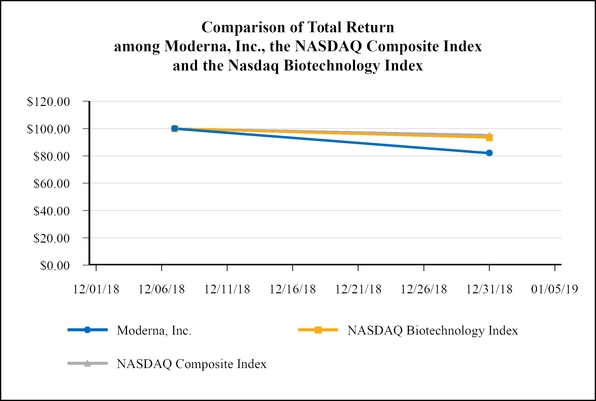
Stockholders
We had approximately 487 stockholders of record as of March 6, 2019; however, because many of our outstanding shares are held in accounts with brokers and other institutions, we believe we have more beneficial owners. This number of holders of record also does not include stockholders whose shares may be held in trust by other entities.
Dividend Policy
We have never declared or paid cash dividends on our common stock and do not expect to pay dividends on our common stock for the foreseeable future. Instead, we anticipate that all of our earnings in the foreseeable future will be used for the operation and growth of
197
Table of Contents
our business. Any future determination to pay dividends will be made at the discretion of our board of directors and will depend on various factors, including applicable laws, our results of operations, financial condition, future prospects, then applicable contractual restrictions and any other factors deemed relevant by our board of directors. Investors should not purchase our common stock with the expectation of receiving cash dividends.
Securities Authorized for Issuance Under Equity Compensation Plans
Information about our equity compensation plans in Item 12 of Part III of this Annual Report on Form 10-K is incorporated herein by reference.
Recent Sales of Unregistered Securities
The following list sets forth information regarding all unregistered securities sold by us in the period covered by this Annual Report on Form 10-K. No underwriters were involved in the sales and the certificates representing the securities sold and issued contain legends restricting transfer of the securities without registration under the Securities Act or an applicable exemption from registration.
|
1.
|
On January 30, 2018 and February 15, 2018, we issued and sold an aggregate of 55,666,004 shares of our Series G preferred stock to 92 accredited investors at a per share purchase price of $10.06 for aggregate gross consideration of $560 million.
|
|
2.
|
On May 7, 2018, we issued and sold an aggregated of 5,000,000 shares of our Series H preferred stock to one accredited investor at a per share purchase price of $25.00 for aggregate gross consideration of $125 million, which includes a $13 million premium associated with the 2018 amended and restated personalized cancer vaccines agreement with Merck & Co. entered into in conjunction with the Series H issuance.
|
|
3.
|
Between January 1, 2018 and December 6, 2018, under our 2016 Stock Option and Grant Plan and our 2018 Stock Option and Incentive Plan, we issued to certain of our employees, consultants and board members options to purchase an aggregate of 19,223,123 shares of our common stock, with a weighted-average exercise price of $17.01, in exchange for their services to us.
|
We deemed the offer, sale and issuance of the securities described in paragraphs (1) and (2) above to be exempt from registration under the Securities Act, in reliance on Section 4(a)(2) of the Securities Act, including Regulation D and Rule 506 promulgated thereunder, regarding transactions by an issuer not involving a public offering. All purchasers of securities in transactions exempt from registration pursuant to Regulation D represented to us that they were accredited investors and were acquiring the shares for investment purposes only and not with a view to, or for sale in connection with, any distribution thereof and that they could bear the risks of the investment and could hold the securities for an indefinite period of time. The purchasers received written disclosures that the securities had not been registered under the Securities Act and that any resale must be made pursuant to a registration statement or an available exemption from such registration.
We deemed the grants and exercises of restricted stock, restricted stock units and stock options described in paragraphs (3) above as exempt pursuant to Section 4(a)(2) of the Securities Act or in reliance on Rule 701 of the Securities Act as offers and sales of securities under compensatory benefit plans and contracts relating to compensation in compliance with Rule 701. Each of the recipients of securities in any transaction exempt from registration either received or had adequate access, through employment, business or other relationships, to information about us.
Issuer Purchases of Equity Securities
Not applicable
Use of Proceeds from Public Offering of Common Stock
On December 11, 2018, we closed our initial public offering, in which we issued and sold 26,275,993 shares of common stock at a public offering price of $23.00 per share (an aggregate offering of $604.3 million), resulting in net proceeds to us of $563.0 million after deducting $33.2 million of underwriting discounts and commissions and offering costs of $8.1 million. All of the shares issued and sold in the offering were registered under the Securities Act pursuant to a Registration Statement on Form S-1 (File No. 333-228300), which was declared effective by the SEC on December 6, 2018. Morgan Stanley & Co. LLC, Goldman Sachs & Co. LLC, and J.P. Morgan Securities LLC acted as joint book-running managers of the offering and as representatives of the underwriters. No offering expenses were paid directly or indirectly to any of our directors or officers, or their associates, or persons owning 10% or more of any class of our equity securities or to any other affiliates.
There has been no material change in the planned use of proceeds from our initial public offering as described in our final prospectus filed with the SEC pursuant to Rule 424(b) of the Securities Act. We are holding the balance of the net proceeds in cash, cash
198
Table of Contents
equivalents and investments. We invested the funds received in short-term, interest-bearing investment-grade securities and government securities.
Item 6. Selected Consolidated Financial Data
The selected consolidated financial data set forth below should be read together with our consolidated financial statements and the related notes to those statements, as well as the section of this Annual Report on Form 10-K titled “Management’s Discussion and Analysis of Financial Condition and Results of Operations.” The statements of operations data for the years ended December 31, 2018, 2017 and 2016 and the balance sheet data as of December 31, 2018 and 2017 have been derived from our audited consolidated financial statements included elsewhere in this Annual Report on Form 10-K. In the opinion of management, the consolidated financial data reflects all adjustments, consisting only of normal recurring adjustments, necessary for a fair presentation of the financial information in those statements. Our historical results are not necessarily indicative of results that may be expected in the future.
|
Years Ended December 31,
|
|||||||||||
|
2018
|
2017
|
2016
|
|||||||||
|
(in thousands, except share and per share data)
|
|||||||||||
|
Statement of Operations Data:
|
|||||||||||
|
Revenue:
|
|||||||||||
|
Collaboration revenue
|
$
|
122,512
|
|
$
|
176,974
|
|
$
|
101,536
|
|
||
|
Grant revenue
|
12,556
|
|
28,851
|
|
6,860
|
|
|||||
|
Total revenue
|
135,068
|
|
205,825
|
|
108,396
|
|
|||||
|
Operating expenses:
|
|||||||||||
|
Research and development
|
454,082
|
|
410,459
|
|
274,717
|
|
|||||
|
General and administrative
|
94,252
|
|
64,722
|
|
57,450
|
|
|||||
|
Total operating expenses
|
548,334
|
|
475,181
|
|
332,167
|
|
|||||
|
Loss from operations
|
(413,266
|
)
|
(269,356
|
)
|
(223,771
|
)
|
|||||
|
Interest income
|
27,023
|
|
15,235
|
|
11,312
|
|
|||||
|
Other income (expense), net
|
1,835
|
|
(1,875
|
)
|
(2,709
|
)
|
|||||
|
Loss before provision for (benefit from) income taxes
|
(384,408
|
)
|
(255,996
|
)
|
(215,168
|
)
|
|||||
|
Provision for (benefit from) income taxes
|
326
|
|
(80
|
)
|
1,043
|
|
|||||
|
Net loss
|
(384,734
|
)
|
(255,916
|
)
|
(216,211
|
)
|
|||||
|
Reconciliation of net loss to net loss attributable to common stockholders:
|
|||||||||||
|
Premium paid on repurchases of preferred stock
|
(4,127
|
)
|
—
|
|
—
|
|
|||||
|
Accretion of redeemable convertible preferred units to redemption value
|
—
|
|
—
|
|
(8,663
|
)
|
|||||
|
Cumulative preferred stock dividends
|
(12,996
|
)
|
(13,925
|
)
|
(5,440
|
)
|
|||||
|
Net loss attributable to common stockholders
|
$
|
(401,857
|
)
|
$
|
(269,841
|
)
|
$
|
(230,314
|
)
|
||
|
Net loss per share attributable to common stockholders, basic and diluted
(1)
|
$
|
(4.95
|
)
|
$
|
(4.18
|
)
|
$
|
(3.79
|
)
|
||
|
Weighted average common shares used in net loss per share attributable to common stockholders, basic and diluted
|
81,114,183
|
|
|
64,497,544
|
|
|
60,747,426
|
|
|||
199
Table of Contents
|
December 31,
|
|||||||||||
|
2018
|
2017
|
2016
|
|||||||||
|
(in thousands)
|
|||||||||||
|
Balance Sheet Data:
|
|||||||||||
|
Cash, cash equivalents, and investments
|
$
|
1,694,417
|
|
$
|
901,880
|
|
$
|
1,294,707
|
|
||
|
Working capital
(2)
|
1,340,203
|
|
591,762
|
|
924,350
|
|
|||||
|
Total assets
|
1,962,149
|
|
1,084,489
|
|
1,417,161
|
|
|||||
|
Total deferred revenue
|
274,408
|
|
339,668
|
|
501,989
|
|
|||||
|
Redeemable convertible preferred stock
|
—
|
|
1,176,661
|
|
1,176,661
|
|
|||||
|
Total stockholders’ equity (deficit)
|
1,530,241
|
|
(551,365
|
)
|
(334,810
|
)
|
|||||
(1)
Basic and diluted net loss per share attributable to common stockholders give effect to the conversion of all redeemable convertible preferred stock to common stock and give effect to the 1-for-2.18 reverse stock split of our common stock completed in connection with the Company’s initial public offering in December 2018.
(2)
We define working capital as current assets less current liabilities. Please refer to our consolidated balance sheets and notes to our financial statements for further details regarding our current assets and current liabilities.
200
Table of Contents
Item 7. MANAGEMENT’S DISCUSSION AND ANALYSIS OF FINANCIAL CONDITION AND RESULTS OF OPERATIONS
You should read the following discussion and analysis of our financial condition and results of operations together with our consolidated financial statements and related notes and other financial information appearing elsewhere in this Annual Report on Form 10-K. Some of the information contained in this discussion and analysis or set forth elsewhere in this Annual Report on Form 10-K, including information with respect to our plans and strategy for our business, includes forward-looking statements that involve risks and uncertainties. As a result of many factors, including those factors set forth in the “Risk Factors” section of this Annual Report on Form 10-K, our actual results could differ materially from the results described in or implied by the forward-looking statements contained in the following discussion and analysis.
Overview
We are a clinical stage biotechnology company pioneering messenger RNA (mRNA) therapeutics and vaccines to create a new generation of potentially transformative medicines to improve the lives of patients. mRNA medicines are designed to direct the body’s cells to produce intracellular, membrane or secreted proteins that have a therapeutic or preventive benefit with the potential to address a broad spectrum of diseases. Our platform builds on continuous advances in basic and applied mRNA science, delivery technology and manufacturing, providing us the capability to pursue in parallel a robust pipeline of new development candidates. We are developing therapeutics and vaccines for infectious diseases, immuno-oncology, rare diseases and cardiovascular diseases, independently and with our strategic collaborators.
We have designed our strategy and operations to realize the full potential value and impact of mRNA over a long time horizon across a broad array of human diseases. We built and continue to invest in a platform to advance the technological frontier of mRNA medicines. We have made forward investments in scalable infrastructure and capabilities to pursue a pipeline of potential medicines that reflect the breadth of the mRNA opportunity. We have a diverse development pipeline of
20
development candidates,
11
of which are in clinical studies. Our therapeutic and vaccine development programs span infectious diseases, oncology, cardiovascular diseases, and rare genetic diseases. We have established strategic alliances with leading biopharmaceutical companies, including AstraZeneca, Merck & Co., or Merck, and Vertex Pharmaceuticals, or Vertex, as well as government-sponsored and private organizations focused on global health initiatives, including Biomedical Advanced Research and Development Authority, or BARDA, Defense Advanced Research Projects Agency, or DARPA, and the Bill & Melinda Gates Foundation. As we unlock the inherent advantages of mRNA, we aim to address as many diseases and impact as many patients as our technology, talent, and capital permit.
The broad potential applications of mRNA medicines have led us to raise significant capital and adopt a long-term approach to capital allocation that balances near-term risks and long-term value creation. As of
December 31, 2018
, we have raised over
$3.2 billion
in total funding from a wide range of strategic sources, including $2.4 billion of financing from private equity financings and our initial public offering, or IPO, and
$0.8 billion
in upfront payments, milestone payments and option exercise payments from AstraZeneca, Merck, Alexion Pharma Holdings, or Alexion, and Vertex. As of
December 31, 2018
, we had cash, cash equivalents and investments of approximately
$1.7 billion
. We use this capital to fund operations and investing activities across research for technology creation, drug discovery and clinical development programs, infrastructure and capabilities to enable the Research Engine and Early Development Engine (which includes our manufacturing facility in Norwood), our digital infrastructure, creation of our portfolio of intellectual property, and administrative support.
On December 11, 2018, we completed our IPO, whereby we sold 26,275,993 shares of common stock at a price of $23.00 per share. The aggregate net proceeds from the IPO were
$563.0 million
, net of underwriting discounts, commissions and offering expenses. Upon the closing of the IPO, all outstanding shares of redeemable convertible preferred stock converted into 236,012,913 shares of common stock. As of December 31, 2018, we had 328,798,904 shares outstanding shares of our common stock.
Since our inception, we have incurred significant operating losses. Our net losses were
$384.7 million
,
$255.9 million
and
$216.2 million
for the years ended
December 31, 2018
,
2017
and
2016
, respectively. As of
December 31, 2018
, our accumulated deficit was
$1.0 billion
. We expect to continue to incur significant expenses and operating losses for the foreseeable future. In addition, we anticipate that our expenses will increase significantly in connection with our ongoing activities, as we:
|
•
|
continue our platform research and drug discovery and development efforts;
|
|
•
|
conduct clinical studies for our investigational medicines;
|
|
•
|
manufacture clinical study materials and develop large-scale manufacturing capabilities;
|
|
•
|
seek regulatory approval for our investigational medicines;
|
|
•
|
maintain, expand, and protect our intellectual property;
|
201
Table of Contents
|
•
|
hire additional personnel to support our program development effort to obtain regulatory approval and secure additional facilities for operations; and
|
|
•
|
operate as a public company.
|
We do not expect to generate revenue from the sale of potential mRNA medicines unless and until we successfully complete clinical development and obtain regulatory approval for one or more of our investigational medicines. If we seek to obtain regulatory approval for and commercialize any of our investigational medicines, we expect to incur significant commercialization expenses.
As a result, we will need substantial additional funding to support our continued operations and pursue our growth strategy. Until we can generate significant revenue from sales of our medicines, if ever, we expect to finance our operations through a combination of public or private equity offerings and debt financings, government funding arrangements, strategic alliances and marketing, distribution, and licensing arrangements. We may be unable to raise additional funds or enter into such other agreements on favorable terms, or at all. If we fail to raise capital or enter into such agreements as, and when, needed, we may have to significantly delay, scale back, or discontinue the development and commercialization of one or more of our programs.
Because of the numerous risks and uncertainties associated with pharmaceutical development, we are unable to predict the timing or amount of increased expenses or when or if we will be able to achieve or maintain profitability. Even if we are able to generate revenues from the sale of our medicines, we may not become profitable. If we fail to become profitable or are unable to sustain profitability on a continuing basis, then we may be unable to continue our operations at planned levels and be forced to reduce our operations.
Financial Operations Overview
Revenue
To date, we have not generated any revenue from the sale of potential mRNA medicines. Our revenue has been primarily derived from strategic alliances with strategic collaborators and government-sponsored and private organizations to discover, develop, and commercialize potential mRNA medicines.
The following is a summary of revenue recognized for the years ended
December 31, 2018
,
2017
and
2016
(in thousands):
|
Years Ended December 31,
|
|||||||||||
|
2018
|
2017
|
2016
|
|||||||||
|
Revenue:
|
|||||||||||
|
Collaboration revenue
(1)
|
$
|
122,512
|
|
$
|
176,974
|
|
$
|
101,536
|
|
||
|
Grant revenue
|
12,556
|
28,851
|
6,860
|
||||||||
|
Total revenue
|
$
|
135,068
|
|
$
|
205,825
|
|
$
|
108,396
|
|
||
_______
|
(1)
|
Includes collaboration revenue from an affiliate.
|
Total revenue for the years ended
December 31, 2018
,
2017
and
2016
was
$135.1 million
,
$205.8 million
and
$108.4 million
, respectively. Cash received from strategic alliances was
$57.6 million
, $43.1 million and $324.2 million for the years ended December 31, 2018, 2017 and 2016, respectively. The timing of revenue recognition is not directly correlated to the timing of cash receipts. Total deferred revenue related to our strategic alliances as of
December 31, 2018
and
2017
was
$274.4 million
and
$339.7 million
, respectively.
202
Table of Contents
The following table summarizes collaboration revenue for the years ended December 31, 2018, 2017 and 2016 (in thousands):
|
Years Ended December 31,
|
|||||||||||
|
2018
|
2017
|
2016
|
|||||||||
|
Collaboration revenue:
|
|||||||||||
|
AstraZeneca
|
$
|
45,993
|
|
$
|
30,021
|
|
$
|
32,427
|
|
||
|
Merck
|
66,082
|
|
62,895
|
|
47,708
|
|
|||||
|
Vertex
|
10,437
|
|
9,138
|
|
3,456
|
|
|||||
|
Alexion
|
—
|
|
74,365
|
|
17,191
|
|
|||||
|
Other
|
—
|
|
555
|
|
754
|
|
|||||
|
Total collaboration revenue
|
$
|
122,512
|
|
$
|
176,974
|
|
$
|
101,536
|
|
||
Collaboration revenue for the years ended
December 31, 2018
,
2017
and
2016
was generated primarily from our strategic alliances with AstraZeneca, Merck, Vertex and Alexion. Our arrangements with Alexion were terminated in October 2017 and all rights to mRNA researched, developed, or supplied as part of the programs with Alexion reverted to us.
Grant revenue is generated primarily from contracts with DARPA, BARDA, and the Bill & Melinda Gates Foundation, to develop mRNA medicines.
For further information on our revenue recognition policies, see the section of this Annual Report on Form 10-K titled “Critical accounting policies and significant judgments and estimates—Revenue recognition.”
Our ability to generate revenue from sales of mRNA medicines and become profitable depends upon our ability to successfully develop and commercialize mRNA medicines. For the foreseeable future, we do not expect to generate revenue from product sales. To the extent that existing or potential future strategic alliances generate revenue, our revenue may vary due to many uncertainties in the development of our mRNA medicines under these strategic alliances and other factors. We expect to incur losses for the foreseeable future, and we expect these losses to increase as we continue our research and development efforts. We expect our programs to mature and advance to later stage clinical development, and we expect expenses to increase as we seek regulatory approvals for our investigational medicines and begin to commercialize any approved mRNA medicines.
Research and development expenses
The nature of our business and primary focus of our activities generate a significant amount of research and development costs. Research and development expenses represent costs incurred by us for the following:
|
•
|
cost to develop our platform;
|
|
•
|
discovery efforts leading to development candidates;
|
|
•
|
preclinical, nonclinical, and clinical development costs for our programs;
|
|
•
|
cost to develop our manufacturing technology and infrastructure; and
|
|
•
|
digital infrastructure costs.
|
The costs above comprise the following categories:
|
•
|
personnel-related expenses, including salaries, benefits, and stock-based compensation expense;
|
|
•
|
expenses incurred under agreements with third parties, such as consultants, investigative sites, contract research organizations, or CROs, that conduct our preclinical and clinical studies, and in-licensing arrangements;
|
|
•
|
costs of acquiring, developing, and manufacturing materials for preclinical and clinical studies, including both internal manufacturing and third-party contract manufacturing organizations, or CMOs;
|
|
•
|
expenses incurred for the procurement of materials, laboratory supplies, and non-capital equipment used in the research and development process; and
|
|
•
|
facilities, depreciation, and amortization, and other direct and allocated expenses incurred as a result of research and development activities.
|
203
Table of Contents
We use our employee and infrastructure resources for the advancement of our platform, and for discovering and developing programs. Due to the number of ongoing programs and our ability to use resources across several projects, indirect or shared operating costs incurred for our research and development programs are not recorded or maintained on a program- or modality-specific basis.
The following table reflects our research and development expenses, including direct program specific expenses summarized by modality and indirect or shared operating costs summarized under other research and development expenses during the years ended
December 31, 2018
,
2017
and
2016
(in thousands):
|
Years Ended December 31,
|
|||||||||||
|
2018
|
2017
|
2016
|
|||||||||
|
Program expenses by modality:
|
|||||||||||
|
Prophylactic vaccines
|
$
|
25,404
|
|
$
|
67,888
|
|
$
|
20,374
|
|
||
|
Cancer vaccines
|
35,891
|
|
31,818
|
|
4,135
|
|
|||||
|
Intratumoral immuno-oncology
|
15,405
|
|
20,340
|
|
8,022
|
|
|||||
|
Localized regenerative therapeutics
|
91
|
|
1,684
|
|
193
|
|
|||||
|
Systemic secreted therapeutics
|
18,207
|
|
7,175
|
|
—
|
|
|||||
|
Systemic intracellular therapeutics
|
45,695
|
|
3,093
|
|
—
|
|
|||||
|
Total program-specific expenses by modality
(1)
|
140,693
|
|
131,998
|
|
32,724
|
|
|||||
|
Other research and development expenses:
|
|||||||||||
|
Discovery programs
|
34,643
|
|
40,190
|
|
52,360
|
|
|||||
|
Platform research
|
91,720
|
|
86,473
|
|
83,414
|
|
|||||
|
Technical development and unallocated manufacturing expenses
|
83,117
|
|
29,606
|
|
36,016
|
|
|||||
|
Shared discovery and development expenses
|
44,250
|
|
47,513
|
|
49,516
|
|
|||||
|
Stock-based compensation
|
37,659
|
|
21,679
|
|
20,687
|
|
|||||
|
Other expenses
(2)
|
22,000
|
|
53,000
|
|
—
|
|
|||||
|
Total research and development expenses
|
$
|
454,082
|
|
$
|
410,459
|
|
$
|
274,717
|
|
||
__________
|
(1)
|
Includes a total of 21, 18 and 12 development candidates at
December 31, 2018
,
2017
and
2016
, respectively. As of February 15, 2019, we have a total of 20 development candidates, as there will be no further development of our first Zika candidate, mRNA-1325. Program-specific expenses include external costs and allocated manufacturing costs of mRNA supply and consumables, and reflect these expenses beginning in the period the program was internally advanced to development.
|
|
(2)
|
Relates to in-licensing agreements entered into in June 2017 with Cellscript, LLC and its affiliate mRNA RiboTherapeutics, Inc. to sublicense certain patent rights.
|
A
“modality”
refers to a group of programs with common product features and the associated combination of enabling mRNA technologies, delivery technologies, and manufacturing processes. The program-specific expenses by modality summarized in the table above include expenses we directly attribute to our programs, which consist primarily of external costs, such as fees paid to outside consultants, central laboratories, investigative sites, and CROs in connection with our preclinical studies and clinical trials, and allocated manufacturing costs of mRNA supply and consumables. Costs to acquire and manufacture mRNA supply for preclinical studies and clinical trials are recognized and included in unallocated manufacturing expenses when incurred, and subsequently allocated to program-specific manufacturing costs after completion of the program-specific production. The timing of allocating manufacturing costs to program-specific costs varies depending on the program development and production schedule. We do not allocate personnel-related costs, including stock-based compensation, costs associated with our general platform research, technical development, and other shared costs on a program-specific basis. These costs were therefore excluded from the summary of program-specific expenses summary by modality.
Discovery program expenses are costs associated with research activities for our programs in the preclinical discovery stage, and primarily consist of external costs for CROs and lab services, and allocated manufacturing cost of preclinical mRNA supply and consumables.
Platform research expenses are mainly costs to develop technical advances in mRNA science, delivery science, and manufacturing process design. These costs include personnel-related costs, computer equipment, facilities, preclinical mRNA supply and consumables, and other administrative costs to support our platform research. Technology development and unallocated manufacturing expenses are primarily related to non-program-specific manufacturing process development and manufacturing costs.
204
Table of Contents
Shared discovery and development expenses are research and development costs such as personnel-related costs and other costs, which are not otherwise included in development programs, discovery programs, platform research, technical development and unallocated manufacturing expenses, stock-based compensation, and other expenses.
We have developed six modalities. As of
February 15, 2019
, we had
11
programs in clinical trials and a total of
20
development candidates, summarized by modality as follows:
|
•
|
Prophylactic vaccines
included eight development candidates: RSV vaccine (mRNA-1777), CMV vaccine (mRNA-1647), hMPV+PIV3 vaccine (mRNA-1653), VZV vaccine (mRNA-1278), H10N8 vaccine (mRNA-1440), H7N9 vaccine (mRNA-1851), Zika vaccine (mRNA-1893), and Chikungunya vaccine (mRNA-1388). We currently have seven programs for which the Phase 1 trial is either ongoing or has been completed;
|
|
•
|
Cancer vaccines
included two development candidates: Personalized cancer vaccine, or PCV, (mRNA-4157) and KRAS vaccine (mRNA-5671). We are collaborating with Merck on both programs. PCV is in a Phase 1 clinical trial and we and Merck have submitted a protocol to the FDA for a randomized Phase 2 clinical trial of mRNA-4157, and the KRAS vaccine has an open IND;
|
|
•
|
Intratumoral immuno-oncology
included three development candidates: OX40L (mRNA-2416), OX40L+IL23+IL36γ (Triplet) (mRNA-2752), and IL12 (MEDI1191). The OX40L and OX40L+IL23+IL36γ programs are currently in Phase 1 clinical trials and the IND for a Phase 1 clinical trial of IL12 is open;
|
|
•
|
Localized regenerative therapeutics
included one development candidate, VEGF-A (AZD8601). The program is being led by AstraZeneca through clinical development and is in a Phase 2a clinical trial;
|
|
•
|
Systemic secreted therapeutics
included three development candidates: antibody against Chikungunya virus (mRNA-1944), Relaxin (AZD7970), and Fabry disease (mRNA-3630). The antibody against Chikungunya virus development candidate is in collaboration with DARPA and the program is in a Phase 1 clinical trial. The Relaxin program in collaboration with AstraZeneca and the Fabry disease program are both in preclinical development; and
|
|
•
|
Systemic intracellular therapeutics
included three development candidates: MMA (mRNA-3704), PA (mRNA-3927), and PKU (mRNA-3283). The MMA program has an open IND, and the PA and PKU programs are in preclinical development.
|
The largest component of our total operating expenses has historically been our investment in research and development activities, including development of our platform, mRNA technologies, and manufacturing technologies. We expense research and development costs as incurred and cannot reasonably estimate the nature, timing, and estimated costs required to complete the development of the development candidates and investigational medicines we are currently developing or may develop in the future. There are numerous risks and uncertainties associated with the research and development of such development candidates and investigational medicines, including, but not limited to:
|
•
|
scope, progress, and expense of developing ongoing and future development candidates and investigational medicines;
|
|
•
|
entry in and completion of related preclinical studies;
|
|
•
|
enrollment in and completion of subsequent clinical trials;
|
|
•
|
safety and efficacy of investigational medicines resulting from these clinical trials;
|
|
•
|
changes in laws or regulations relevant to the investigational medicines in development;
|
|
•
|
receipt of the required regulatory approvals; and
|
|
•
|
commercialization, including establishing manufacturing and marketing capabilities.
|
A change in expectations or outcomes of any of the known or unknown risks and uncertainties may materially impact our expected research and development expenditures. Continued research and development is central to the ongoing activities of our business. Investigational medicines in later stages of clinical development generally have higher development costs than those in earlier stages of clinical development, primarily due to the increased size and duration of later-stage clinical trials. We expect our costs to continue to increase in the future as our investigational medicines progress through the development phases and as we identify and develop additional programs. However, we do not believe that it is possible at this time to accurately project total program-specific expenses through commercialization. There are numerous factors associated with the successful commercialization of any of our investigational medicines, including future trial design and various regulatory requirements, many of which cannot be determined with accuracy at this time due to the early stage of development of our investigational medicines. Additionally, future commercial and regulatory factors beyond our control will impact our clinical development programs and plans.
205
Table of Contents
General and administrative expenses
General and administrative expenses consist primarily of personnel-related costs, including stock-based compensation, for executives, finance, legal, human resources, business development and other administrative and operational functions, professional fees, accounting and legal services, information technology and facility-related costs, and expenses associated with obtaining and maintaining intellectual property, or IP. These costs relate to the operation of the business, unrelated to the research and development function, or any individual program.
We anticipate general and administrative expenses will increase as research and development expands. These increases will likely relate to additional personnel and increased costs related to finance, legal and IP-related matters along with increased expenses related to operating as a publicly traded company, such as fees related to audit, legal, and tax services, regulatory compliance programs, and investor relations. In addition, if we obtain regulatory approval for any of our investigational medicines and do not enter into a third-party commercialization collaboration, we expect to incur significant expenses related to building a sales and marketing team to support medicine sales, marketing, and distribution activities.
We have a broad IP portfolio covering our development and commercialization of mRNA vaccine and therapeutic programs, including those related to mRNA design, formulation, and manufacturing platform technologies. We regularly file patent applications to protect innovations arising from our research and development. We also hold trademarks and trademark applications in the United States and foreign jurisdictions. Costs to secure and defend our IP are expensed as incurred, and are classified as general and administrative expenses.
General and administrative expenses, including IP-related expenses, totaled
$94.3 million
, $64.7 and $57.5 for the years ended
December 31, 2018
,
2017
and
2016
, respectively. IP-related expenses, including our internal personnel-related costs, were $11.9 million, $10.7 million and $10.9 million, for the years ended
December 31, 2018
,
2017
and
2016
, respectively. We did not incur litigation expenses related to our IP during the years ended
December 31, 2018
,
2017
and
2016
.
Other income (expense), net
Interest income
Interest income consists of interest generated from our investments in cash and cash equivalents, money market funds, and high-quality fixed income securities.
Other income (expense)
Other income (expense), net consists of gains (losses) from the sale of investments in marketable securities, interest expense, and other income and expense unrelated to our core operations.
Critical accounting policies and significant judgments and estimates
Our management’s discussion and analysis of our financial condition and results of operations is based on our consolidated financial statements, which have been prepared in accordance with U.S. generally accepted accounting principles. The preparation of these consolidated financial statements requires us to make judgments and estimates that affect the reported amounts of assets, liabilities, revenues, and expenses and the disclosure of contingent assets and liabilities in our consolidated financial statements. We base our estimates on historical experience, known trends and events, and various other factors that we believe to be reasonable under the circumstances, the results of which form the basis for making judgments about the carrying values of assets and liabilities that are not readily apparent from other sources. Actual results may differ from these estimates under different assumptions or conditions. On an ongoing basis, we evaluate our judgments and estimates in light of changes in circumstances, facts, and experience. The effects of material revisions in estimates, if any, are reflected in the consolidated financial statements prospectively from the date of change in estimates.
While our significant accounting policies are described in more detail in the notes to our consolidated financial statements appearing elsewhere in this Annual Report on Form 10-K, we believe the following accounting policies used in the preparation of our consolidated financial statements require the most significant judgments and estimates.
Revenue recognition
We have primarily generated revenue from our strategic alliances. Our strategic alliances with strategic collaborators typically contain multiple elements, including research and other licenses, options to obtain development and commercialization rights, research and development services, obligations to develop and manufacture preclinical and clinical material, and options to obtain additional research and development services and preclinical and clinical material. Such arrangements provide for various types of payments to us, including upfront fees, funding of research and development services and preclinical and clinical material, technical, development, regulatory, and commercial milestone payments, licensing fees, option exercise fees, and royalty and earnout payments on product
206
Table of Contents
sales. Such payments are often not commensurate with the timing of revenue recognition and therefore result in deferral of revenue recognition.
We analyze our strategic alliance arrangements to assess whether they are within the scope of Financial Standards Accounting Board, or FASB, Accounting Standards Codification, or ASC, Topic 808,
Collaborative Arrangements
, or ASC 808 to determine whether such arrangements involve joint operating activities performed by parties that are both active participants in the activities and exposed to significant risks and rewards that are dependent on the commercial success of such activities. This assessment is performed throughout the life of the arrangement based on changes in the responsibilities of all parties in the arrangement. For strategic alliance arrangements that are deemed to be within the scope of ASC 808, we assess which elements of the arrangement are deemed to be within the scope of ASC 808, and we recognize our allocation of shared costs incurred with respect to the jointly conducted activities as a component of the related expense in the period incurred.
We also consider the guidance in FASB ASC Topic 605-45,
Revenue Recognition—Principal Agent Considerations
, or ASC 605-45 in determining the appropriate treatment for the transactions between us and our strategic collaborators, including the accounting treatment for arrangements in which we are reimbursed for research services performed by a third party. Generally, transactions under our strategic alliance arrangements are recorded on either a gross or net basis based on the nature and contractual terms of the arrangement along with an evaluation of the indicators to identify the principal participant of the arrangement which could require significant judgment.
For those elements of the arrangement that are accounted for under ASC 605, revenue is recognized for each unit of accounting when all of the following criteria are met:
|
•
|
persuasive evidence of an arrangement;
|
|
•
|
delivery has occurred or services have been rendered;
|
|
•
|
the seller’s price to the buyer is fixed or determinable; and
|
|
•
|
collectability is reasonably assured.
|
Further, we analyze multiple element arrangements in accordance with FASB ASC Topic 605-25,
Revenue Recognition—Multiple Element Arrangements
, or ASC 605-25. The evaluation involves subjective determinations and requires management to make judgments about individual deliverables and whether such deliverables represent separate units of accounting, or whether they must be accounted for as a single unit of accounting. Deliverables are considered separate units of accounting provided that: (i) the delivered item(s) has value to the customer on a standalone basis, and (ii) if the arrangement includes a general right of return relative to the delivered item(s), delivery or performance of the undelivered item(s) is considered probable and substantially controlled by us. In assessing whether an item has standalone value, we consider factors such as the research, manufacturing, and commercialization capabilities of the strategic collaborator, and the availability of the associated expertise in the general marketplace. In addition, we consider whether the strategic collaborator can use the other deliverable(s) for their intended purpose without the receipt of the remaining element(s), whether the value of the deliverable is dependent on the undelivered item(s), and whether there are other vendors that can provide the undelivered element(s).
Arrangement consideration that is fixed or determinable is allocated among the separate units of accounting based on the relative selling price method and the applicable revenue recognition criteria in ASC 605-25 are applied to determine the appropriate period and pattern of recognition. We determine the selling price of a unit of accounting following the hierarchy of evidence prescribed by ASC 605-25. Accordingly, we determine the estimated selling price for units of accounting within each arrangement using vendor-specific objective evidence, or VSOE, of selling price if available, third-party evidence, or TPE, of selling price if VSOE is not available, or best estimate of selling price, or BESP, if neither VSOE nor TPE is available. We typically use BESP to estimate the selling price, because we generally do not have VSOE nor TPE of selling price for our units of accounting. Determining the BESP for a unit of accounting requires significant judgment. In developing the BESP for a unit of accounting, we consider applicable market conditions and relevant entity-specific factors, including factors that were contemplated in negotiating the agreement with the strategic collaborator and estimated costs. We validate the BESP for units of accounting by evaluating whether changes in the key assumptions used to determine the BESP will have a significant effect on the allocation of arrangement consideration between multiple units of accounting.
We recognize arrangement consideration allocated to each unit of accounting when all of the revenue recognition criteria under ASC 605-25 are satisfied for that particular unit of accounting. We will recognize revenue associated with licenses, options, or the discount related to an option upon (i) delivery of the license or (ii) the earlier of exercise or expiration of the option, if the underlying license has standalone value from the other deliverables to be provided after delivering that license. If the license does not have standalone value, the amounts allocated to the license will be combined with the related undelivered items as a single unit of accounting and recognized over the estimated period of performance or delivery of the combined unit of accounting.
207
Table of Contents
Revenue related to the units of accounting that contain several deliverables is recognized as the last to be delivered element is provided, which is generally over the period that research services are provided. If there is no discernible pattern of performance or objectively measurable performance measures do not exist, we recognize revenue on a straight-line basis over the expected period of performance. Conversely, if the pattern of performance can be determined and objectively measurable performance measures exist, then we recognize revenue under the arrangement using the proportional performance method. Revenue recognized is limited to the lesser of the cumulative amount of payments received or the cumulative revenue earned determined using the straight-line method or proportional performance, as applicable, as of the period end date.
Our third-party arrangements may include options for our strategic collaborators to acquire development and commercialization rights to our mRNA programs or, with respect to specific targets or options, to receive research and development services or pre-clinical or clinical materials from us. Options are considered substantive if, at the inception of the arrangement, we are at risk as to whether the strategic collaborator will choose to exercise the option. The evaluation of whether an option is substantive requires significant judgment. In determining if the option is substantive, we consider the overall objective of the arrangement, the benefit the third party might obtain from the arrangement without exercising the option, the likelihood that the option will be exercised, or if the third party is required or compelled through significant incentive to exercise the option. When an option is considered substantive, we do not consider the option or item underlying the option to be a deliverable at inception of the arrangement and the associated option fee is not included in the allocable arrangement consideration, assuming the option is not priced at a significant and incremental discount. Conversely, if we determine that an option is not substantive, we will consider the item underlying the option to be a deliverable at the inception of the arrangement and the associated option exercise fee is included in the allocable arrangement consideration. In addition, if the price of the option includes a significant and incremental discount, then the option is not considered substantive.
Our arrangements may include additional payments that are subject to achievement of milestone events, including specific technical, development, regulatory, and commercial milestones. At the inception of an arrangement that includes milestone payments, we evaluate whether each milestone is substantive and at risk to both parties on the basis of the contingent nature of the milestone. This evaluation includes an assessment of whether: (i) the consideration is commensurate with either our performance to achieve the milestone or the enhancement of the value of the delivered item(s) as a result of a specific outcome resulting from our performance to achieve the milestone, (ii) the consideration relates solely to past performance, and (iii) the consideration is reasonably relative to all of the deliverables and payment terms within the arrangement. We evaluate factors such as scientific, clinical, regulatory, commercial, and other risks that must be overcome to achieve the respective milestones and the level of effort and investment required to achieve the respective milestones in making this assessment. There is considerable judgment involved in determining whether a milestone satisfies all of the criteria required to conclude that a milestone is substantive. In accordance with FASB ASC Topic 605-28,
Revenue Recognition—Milestone Method
, or ASC 605-28, a technical, development, or regulatory milestone that is considered substantive will be recognized as revenue in its entirety upon successful accomplishment of the milestone. Amounts received from milestones that are not considered substantive would be considered additional arrangement consideration and allocated to the identified units of accounting. Revenue from commercial milestone payments will be accounted for as royalties and recorded as revenue upon achievement of the milestone, assuming all other revenue recognition criteria are met.
We will recognize royalty revenue in the period of sale of the related medicine(s), based on the underlying contract terms, provided that the reported sales are reliably measurable, we have no remaining undelivered elements, and assuming all other revenue recognition criteria are met.
Our contracts with DARPA, BARDA, and the Bill & Melinda Gates Foundation provide for reimbursed costs, which may include overhead and general and administrative costs as well as a related profit margin. We recognize revenue from these contracts as we perform services under the arrangements so long as an agreement has been executed and the fees for the services are fixed or determinable, legally billable, and reasonably assured of collection. Recognized amounts reflect our performance under the agreements. We do not recognize revenue under these agreements for amounts related to contract periods where funding is not yet committed, as fees above committed funding thresholds would not be considered fixed or determinable, or reasonably assured of collection. Revenues and related expenses are presented gross in the consolidated statements of operations as we have determined we are the primary obligor under the arrangements relative to the research and development services we perform as lead technical expert.
Research and development costs
As part of the process of preparing our financial statements, we are required to estimate our accrued research and development expenses, a significant portion of which are clinical study expenses conducted by third-party service providers. This process involves reviewing open contracts and purchase orders, communicating with our personnel to identify services that have been performed on our behalf, and estimating the level of service performed and the associated cost incurred for the service when we have not yet been invoiced or otherwise notified of the actual cost. The majority of our service providers invoice us in arrears for services performed or when contractual milestones are met. Examples of estimated accrued research and development expenses include fees paid to:
|
•
|
CROs to conduct our clinical trials;
|
|
•
|
investigative sites in connection with clinical trials;
|
208
Table of Contents
|
•
|
vendors for laboratory services, supplies, and distribution of materials in connection with clinical trials; and
|
|
•
|
vendors in connection with preclinical development activities.
|
We base our expenses related to clinical trials on our estimates of the services received and efforts expended pursuant to contracts with CROs that conduct and manage clinical trials on our behalf. The financial terms of these contracts are subject to negotiation, vary from contract to contract and may result in uneven payment flows. There may be instances in which payments made to our vendors will exceed the level of services provided and result in a prepayment of the expense. Payments under some of these contracts depend on factors such as the successful enrollment of subjects and the completion of clinical trial milestones. In accruing service fees, we estimate the time period over which services will be performed and the level of effort to be expended in each period and adjust accordingly.
We make estimates of our research and development accrued expenses as of each balance sheet date in our financial statements based on facts and circumstances known to us at that time. We recognize costs for certain development activities based on an evaluation of the progress to completion of specific tasks using information and data provided to us by our vendors and our clinical sites, such as number of sites activated, number of patient enrollments and visits, and patient duration. We determine accrual estimates through financial models that take into account discussions with applicable personnel and service providers as to the progress or state of completion of trials. We periodically confirm the accuracy of these estimates with the service providers and make adjustments, if necessary. Upon settlement, these costs may differ materially from the amounts accrued in our consolidated financial statements. Our historical accrual estimates have not been materially different from our actual costs. However, due to the nature of estimates, we cannot provide assurance that we will not make changes to our estimates in the future as we become aware of additional information about the status or conduct of our research activities and clinical trials.
Stock-based compensation
We issue stock-based awards to employees and non-employees, generally in the form of stock options and restricted stock units. Historically, we also granted unit options and incentive units to our employees and non-employees, which were exchanged into options and restricted stock awards in connection with the series of transactions pursuant to which Moderna LLC became a wholly-owned subsidiary of Moderna Therapeutics, Inc., or the 2016 Reorganization (please refer to Note 1 to our consolidated financial statements). We measure and recognize compensation expense for our stock-based awards granted to our employees and non-employee directors based on the estimated grant date fair value in accordance with FASB ASC Topic 718,
Compensation—Stock Compensation
, or ASC 718. We account for stock-based awards to non-employees in accordance with FASB ASC Topic 505-50,
Equity-Based Payments to Non-Employees
, which requires the fair value of the unvested portion of the equity awards granted to non-employees to be re-measured as of each reporting date.
Our stock-based awards are subject to either service or performance-based vesting conditions. We recognize compensation expense related to awards to employees and non-employee directors with service-based vesting on a straight-line basis based on the grant date fair value over the requisite service period, which is generally the vesting period. Compensation expense related to awards to employees and non-employee directors with performance-based vesting conditions is recognized based on the grant date fair value over the requisite service period using an accelerated attribution method to the extent the achievement of the performance condition is probable. Compensation expense related to awards to non-employees with service-based vesting conditions is recognized on the then-current fair value at each reporting date prior to the measurement date over the requisite service period, which is generally the vesting period. Compensation expense related to awards to non-employees with performance-based vesting conditions is recognized based on the then-current grant date fair value at each reporting date prior to the measurement date over the requisite service period using an accelerated attribution method to the extent the achievement of the performance condition is probable. As of January 1, 2017, we made an accounting policy election to recognize forfeitures of stock-based awards as they occur upon adoption of FASB ASU No. 2016-09,
Compensation—Stock Compensation
.
We classify stock-based compensation expense in our consolidated statements of operations in the same manner in which the award recipient’s salary and related costs are classified or in which the award recipient’s service payments are classified. In future periods, we expect stock-based compensation expense to increase, due in part to our existing unrecognized stock-based compensation expense and as we grant additional stock-based awards to continue to attract and retain our employees.
We determine the fair value of restricted stock and restricted stock units, based on the fair value of our common stock. We estimate the fair value of our stock options and, prior to the 2016 Reorganization, unit options and incentive units using the Black-Scholes option pricing model, which requires inputs of subjective assumptions, including: (i) the expected volatility of our stock (or, prior to the 2016 Reorganization, units); (ii) the expected term of the award; (iii) the risk-free interest rate; (iv) expected dividends; and (v) the fair value of common stock (or, prior to the 2016 Reorganization, units). Due to the lack of company specific historical and implied volatility data, we based our estimate of expected volatility on the estimate and expected volatilities of a guideline group of publicly traded companies. For these analyses, we select companies with comparable characteristics to ours including enterprise value, risk profiles, and with historical share price information sufficient to meet the expected life of the stock-based awards. We compute the historical volatility data using the daily closing prices for the selected companies’ shares during the equivalent period of the calculated
209
Table of Contents
expected term of our stock-based awards. We will continue to apply this process until a sufficient amount of historical information regarding the volatility of our own stock price becomes available. We estimate the expected term of our stock options granted to employees and non-employee directors using the simplified method, whereby, the expected term equals the average of the vesting term and the original contractual term of the option. We utilize this method as we do not have sufficient historical exercise data to provide a reasonable basis upon which to estimate the expected term. For stock options granted to non-employees, we utilize the contractual term of the option as the basis for the expected term assumption. For the determination of the risk-free interest rates we utilize the U.S. Treasury yield curve for instruments in effect at the time of measurement with a term commensurate with the expected term assumption. The expected dividend yield is assumed to be zero as we have never paid dividends and do not have current plans to pay any dividends on our common stock. Historically, for periods prior to our IPO, the fair value of our equity instruments underlying our stock-based awards were determined on each grant date by our board of directors based on valuation estimates from management considering our most recently available independent third-party valuation of our equity instruments. Our board of directors also assessed and considered, with input from management, additional objective and subjective factors that we believed were relevant and which may have changed from the date of the most recent valuation through the grant date.
Income taxes
We account for income taxes based on an asset and liability approach. We recognize deferred tax assets and liabilities for the expected future tax consequences of events that have been included in the financial statements or tax returns. We determine our deferred tax assets and liabilities based on differences between financial reporting and tax bases of assets and liabilities, which are measured using the enacted tax rates and laws that will be in effect when the differences are expected to reverse.
Realization of our deferred tax assets is dependent upon the generation of future taxable income, the amount and timing of which are uncertain. Valuation allowances are provided, if, based upon the weight of available evidence, it is more likely than not that some or all of the deferred tax assets will not be realized. As of December 31, 2018, we continued to maintain a full valuation allowance against all of our deferred tax assets based on management’s evaluation of all available evidence.
We may become subject to income tax audits and adjustments by local tax authorities. The nature of uncertain tax positions is subject to significant judgment by management and subject to change, which may be substantial. We develop our assessment of uncertain tax positions, and the associated cumulative probabilities, using internal expertise and assistance from third-party experts. As additional information becomes available, estimates are revised and refined. Differences between estimates and final settlement may occur resulting in additional tax expense.
We record reserves for potential tax payments to various tax authorities related to uncertain tax positions. These reserves are based on a determination of whether and how much of a tax benefit taken by us in our tax filings or positions is more likely than not to be realized following resolution of any potential contingencies present related to the tax benefit. Potential interest and penalties associated with such uncertain tax positions is recorded as a component of income tax expense. To date, no amount has been recorded for uncertain tax positions.
On December 22, 2017, the Tax Cuts and Jobs Act (the TCJA) was enacted. The TCJA, among other things, contains significant changes to corporate taxation, including reduction of the corporate tax rate from a top marginal rate of 35% to a flat rate of 21%, limitation of the tax deduction for interest expense to 30% of adjusted earnings (except for certain small businesses), limitation of the deduction for net operating losses to 80% of current year taxable income and elimination of net operating loss carrybacks, one time taxation of offshore earnings at reduced rates regardless of whether they are repatriated, elimination of U.S. tax on foreign earnings (subject to certain important exceptions), immediate deductions for certain new investments instead of deductions for depreciation expense over time, and modifying or repealing many business deductions and credits.
Due to the timing of the enactment and the complexity involved in applying the provisions of the TCJA, we made reasonable estimates and recognized the effects of the TCJA in our consolidated financial statements as of December 31, 2017. The TCJA resulted in a $64.1 million reduction to deferred tax assets and a corresponding reduction in our valuation allowance. As we collected and prepared necessary data, and interpreted the additional guidance of the TCJA, we completed our analysis to determine the effects of the TCJA as of December 31, 2018. No material adjustments were made in 2018.
Recently issued accounting pronouncements
We have reviewed all recently issued standards and have determined that, other than as disclosed in Note 2 to our consolidated financial statements, such standards will not have a material impact on our financial statements or do not otherwise apply to our operations.
210
Table of Contents
Results of operations
The following table summarizes our consolidated statements of operations for each period presented (in thousands):
|
Years Ended December 31,
|
|||||||||||
|
2018
|
2017
|
2016
|
|||||||||
|
Revenue:
|
|||||||||||
|
Collaboration revenue
|
$
|
122,512
|
|
$
|
176,974
|
|
$
|
101,536
|
|
||
|
Grant revenue
|
12,556
|
|
28,851
|
|
6,860
|
|
|||||
|
Total revenue
|
135,068
|
|
205,825
|
|
108,396
|
|
|||||
|
Operating Expenses:
|
|||||||||||
|
Research and development
|
454,082
|
|
410,459
|
|
274,717
|
|
|||||
|
General and administrative
|
94,252
|
|
64,722
|
|
57,450
|
|
|||||
|
Total operating expenses
|
548,334
|
|
475,181
|
|
332,167
|
|
|||||
|
Loss from operations
|
(413,266
|
)
|
(269,356
|
)
|
(223,771
|
)
|
|||||
|
Other income, net
|
28,858
|
|
13,360
|
|
8,603
|
|
|||||
|
Loss before provision for (benefit from) income taxes
|
(384,408
|
)
|
(255,996
|
)
|
(215,168
|
)
|
|||||
|
Provision for (benefit from) income taxes
|
326
|
|
(80
|
)
|
1,043
|
|
|||||
|
Net loss
|
$
|
(384,734
|
)
|
$
|
(255,916
|
)
|
$
|
(216,211
|
)
|
||
Revenue
The following table summarizes our revenue by source for each period presented (in thousands):
|
Years Ended December 31,
|
Change 2018 vs. 2017
|
Change 2017 vs. 2016
|
|||||||||||||||||||||||
|
2018
|
2017
|
2016
|
$
|
%
|
$
|
%
|
|||||||||||||||||||
|
Collaboration revenue
|
$
|
122,512
|
|
$
|
176,974
|
|
$
|
101,536
|
|
$
|
(54,462
|
)
|
(31
|
)%
|
$
|
75,438
|
|
74
|
%
|
||||||
|
Grant revenue
|
12,556
|
|
28,851
|
|
6,860
|
|
(16,295
|
)
|
(56
|
)%
|
21,991
|
|
321
|
%
|
|||||||||||
|
Total revenue
|
$
|
135,068
|
|
$
|
205,825
|
|
$
|
108,396
|
|
$
|
(70,757
|
)
|
(34
|
)%
|
$
|
97,429
|
|
90
|
%
|
||||||
Total revenue decreased by
$70.8 million
, or
34%
in 2018, primarily due to decreases in both collaboration revenue and grant revenue. Collaboration revenue decreased by
$54.5 million
, or
31%
in 2018 mainly driven by higher revenue in 2017 due to the accelerated recognition of $70 million of revenue upon the termination of the Alexion strategic alliance arrangement in October 2017, partially offset by increases in collaboration revenue, primarily from AstraZeneca and to a lesser extent from Merck. Grant revenue decreased by
$16.3 million
, or
56%
in 2018 largely attributable to a decrease in revenue of $13.4 million from the BARDA contract, primarily due to revisions to the Zika program and a focus on preclinical studies of mRNA-1893, a follow on to mRNA-1325.
Total revenue increased by $97.4 million, or 90% in
2017
, due to increases in both collaboration revenue and grant revenue recognized in
2017
. Collaboration revenue increased by $75.4 million, or 74% in
2017
, mainly driven by $70.3 million of revenue recognized as a result of the termination of the Alexion strategic alliance arrangements. Grant revenue increased by $22.0 million, or 321% in 2017, largely attributable to the recognition of a full year of revenue from the BARDA contract, which was entered in the second half of 2016 in support of the development of an mRNA vaccine for Zika.
211
Table of Contents
Operating expenses
The following table summarizes our operating expenses for each period presented (in thousands):
|
Years Ended December 31,
|
Change 2018 vs. 2017
|
Change 2017 vs. 2016
|
|||||||||||||||||||||||
|
2018
|
2017
|
2016
|
$
|
%
|
$
|
%
|
|||||||||||||||||||
|
Research and development
|
$
|
454,082
|
|
$
|
410,459
|
|
$
|
274,717
|
|
$
|
43,623
|
|
11
|
%
|
$
|
135,742
|
|
49
|
%
|
||||||
|
General and administrative
|
94,252
|
|
64,722
|
|
57,450
|
|
29,530
|
|
46
|
%
|
7,272
|
|
13
|
%
|
|||||||||||
|
Total operating expenses
|
$
|
548,334
|
|
$
|
475,181
|
|
$
|
332,167
|
|
$
|
73,153
|
|
15
|
%
|
$
|
143,014
|
|
43
|
%
|
||||||
Research and development expenses
Research and development expenses increased by
$43.6 million
, or
11%
in 2018, primarily attributable to an increase in personnel related costs of
$26.6 million
, an increase in stock-based compensation of
$16.0 million
, an increase in consulting and outside services of
$13.1 million
, an increase in facility and equipment related costs of
$12.4 million
, and an increase in depreciation and amortization expense of $4.3 million. The increases in personnel related costs and stock-based compensation were largely driven by an increase in the number of employees supporting our research and development programs. These increases were partially offset by a decrease of $31.0 million in costs related to in-licensing agreements executed in 2017 with Cellscript, LLC and its affiliate mRNA RiboTherapeutics, Inc. to sublicense certain patent rights.
Research and development expenses increased by $135.7 million, or 49% in 2017, primarily attributable to $53.0 million in costs related to in-licensing agreements executed in
2017
with Cellscript, LLC and its affiliate mRNA RiboTherapeutics, Inc. to sublicense certain patent rights, an increase in clinical trial and manufacturing costs of $45.1 million for our preclinical studies and clinical trials, and an increase in personnel related costs of $36.5 million due to an increase in the number of employees supporting our research and development programs.
General and administrative expenses
General and administrative expenses increased by
$29.5 million
, or
46%
in 2018, primarily due to an increase in stock-based compensation of
$16.5 million
, an increase in personnel related costs of
$7.2 million
, and an increase in consulting and outside services of
$3.5 million
. The increase in stock-based compensation was mainly attributable to certain performance-based equity awards with vesting or commencement contingent on our IPO and an increase in the number of employees. The increase in personnel related costs were primarily driven by an increase in the number of employees. These increases and the increase in consulting and outside services were in support of our public company readiness.
General and administrative expenses increased by $7.3 million, or 13% in
2017
, mainly due to an increase in personnel related costs of $6.7 million, driven by an increase in the number of employees.
Other income (expense), net
The following table summarizes other income (expense), net for each period presented (in thousands):
|
Years Ended December 31,
|
Change 2018 vs. 2017
|
Change 2017 vs. 2016
|
|||||||||||||||||||||||
|
2018
|
2017
|
2016
|
$
|
%
|
$
|
%
|
|||||||||||||||||||
|
Interest income
|
$
|
27,023
|
|
$
|
15,235
|
|
$
|
11,312
|
|
$
|
11,788
|
|
77
|
%
|
$
|
3,923
|
|
35
|
%
|
||||||
|
Gain (loss) on investment
|
31
|
|
(1,085
|
)
|
(2,399
|
)
|
1,116
|
|
(103
|
)%
|
1,314
|
|
(55
|
)%
|
|||||||||||
|
Interest expense
|
(3,096
|
)
|
(132
|
)
|
(139
|
)
|
(2,964
|
)
|
2245
|
%
|
7
|
|
(5
|
)%
|
|||||||||||
|
Other income (expense), net
|
4,900
|
|
(658
|
)
|
(171
|
)
|
5,558
|
|
(845
|
)%
|
(487
|
)
|
285
|
%
|
|||||||||||
|
Total other income, net
|
$
|
28,858
|
|
$
|
13,360
|
|
$
|
8,603
|
|
$
|
15,498
|
|
116
|
%
|
$
|
4,757
|
|
55
|
%
|
||||||
Other income, net increased by
$15.5 million
, or
116%
in 2018, primarily due to an increase of
$11.8 million
in interest income from our investments in marketable securities, driven by an overall higher market interest rate and a higher weighted average balance of cash and investments, primarily from net proceeds from the issuance of redeemable convertible preferred stock. Other income (expense), net increased by $5.6 million mainly due to a $7.0 million cash receipt as consideration for the waiver of a third party's previously negotiated commitment. This increase was partially offset by higher interest expense of
$3.0 million
related to our Norwood lease financing obligation. We began recording interest expense upon the completion of our Norwood manufacturing facility in July 2018. Please refer to Note 7 to the consolidated financial statements.
212
Table of Contents
Other income, net increased by $4.8 million, or 55% in
2017
, primarily due to an increase of $3.9 million in interest income from our investment in marketable securities, driven by an overall higher market interest rate and a higher weighted average balance of cash and investments during
2017
compared to 2016, and a decrease of $1.3 million in loss from the sale of our investments in marketable securities in
2017
compared to
2016
.
Liquidity and capital resources
We have historically funded our operations primarily from the sale of equity instruments and from proceeds from certain strategic alliance arrangements and grant agreements. As of
December 31, 2018
, we have raised an aggregate of $2.4 billion of proceeds through private equity financing and from our IPO, and
$0.8 billion
from upfront payments, milestone payments, and option exercise fees related to our strategic alliances. As of
December 31, 2018
, we had cash, cash equivalents and investments of
$1.7 billion
. Cash and cash equivalents and investments are invested in accordance with our investment policy, primarily with a view to liquidity and capital preservation. Investments, consisting primarily of government and corporate debt securities are stated at fair value. As of
December 31, 2018
, we had current and non-current investments of approximately
$863.1 million
and
$173.0 million
, respectively.
We began construction of our Norwood manufacturing facility, or Norwood, in the second half of 2016. Our capital expenditures related to Norwood were $86.5 million, $59.9 million and $18.2 million for the years ended
December 31, 2018
,
2017
, and
2016
, respectively. Cash disbursements related to Norwood were $94.5 million, $41.2 million and $3.1 million for the years ended
December 31, 2018
,
2017
, and
2016
, respectively. Norwood officially opened in July 2018.
On January 30, 2018 and February 15, 2018, we issued Series G preferred stock for total gross proceeds of $560.0 million. On May 7, 2018, we issued Series H preferred stock for gross proceeds of $125.0 million of which $13.0 million is determined to be a premium and recorded to deferred revenue as part of the Merck PCV/SAV agreement executed contemporaneously with our Series H redeemable convertible preferred stock issuance. Please refer to Note 3 to our consolidated financial statements.
On December 11, 2018, we closed our IPO, whereby we sold 26,275,993 shares of common stock at a price of $23.00 per share. The shares began trading on the NASDAQ Global Select Market on December 7, 2018. The aggregate net proceeds received by us from the IPO were
$563.0 million
, net of underwriting discounts, commissions and offering expenses payable by us.
Cash flow
The following table summarizes the primary sources and uses of cash for each period presented (in thousands):
|
Years Ended December 31,
|
|||||||||||
|
2018
|
2017
|
2016
|
|||||||||
|
Net cash provided by (used in):
|
|||||||||||
|
Operating activities
|
$
|
(330,865
|
)
|
$
|
(331,484
|
)
|
$
|
66,734
|
|
||
|
Investing activities
|
(372,472
|
)
|
416,095
|
|
(648,607
|
)
|
|||||
|
Financing activities
|
1,226,842
|
|
168
|
|
472,910
|
|
|||||
|
Net increase (decrease) in cash and cash equivalents
|
$
|
523,505
|
|
$
|
84,779
|
|
$
|
(108,963
|
)
|
||
Operating activities
We derive cash flows from operations primarily from cash collected from certain strategic alliances. Our cash flows from operating activities are significantly influenced by our use of cash for operating expenses and working capital to support the business. We have historically experienced negative cash flows from operating activities as we have invested early in our mRNA technologies, digital infrastructure, manufacturing technology, and infrastructure.
Net cash used in operating activities in 2018 was
$330.9 million
and consisted of net loss of
$384.7 million
less non-cash adjustments of
$96.5 million
, plus a net change in assets and liabilities of
$42.6 million
. Non-cash items primarily included stock-based compensation of
$72.6 million
and depreciation and amortization of
$24.9 million
. The net change in assets and liabilities was primarily due to a
decrease
in deferred revenue of
$65.3 million
, and an increase in prepaid expenses and other assets of
$5.3 million
, partially offset by an
increase
in accounts payable of
$15.0 million
and an
increase
in accrued liabilities of
$8.8 million
.
Net cash used in operating activities in 2017 was $331.5 million and consisted of net loss of $255.9 million less non-cash adjustments of $61.7 million, plus a net change in assets and liabilities of $137.2 million. Non-cash items primarily included stock-based compensation of $40.1 million and depreciation and amortization of $20.5 million. The net change in assets and liabilities in 2017 was primarily due to a decrease in deferred revenue of $162.3 million mainly driven by revenue recognition of $70.3 million resulting from termination of Alexion strategic alliance arrangements, a decrease in accounts payable of $12.8 million, partially offset by an increase in accrued liabilities of $34.4 million including a $25.0 million in-license payment accrual.
213
Table of Contents
Net cash provided by operating activities in 2016 was $66.7 million and consisted of net loss of $216.2 million less non-cash adjustments of $57.0 million, plus a net change in assets and liabilities of $226.0 million. Non-cash items primarily included stock-based compensation of $39.4 million and depreciation and amortization of $15.1 million. The net change in assets and liabilities in 2016 was mainly driven by an increase in deferred revenue of $164.1 million largely attributable to the upfront payments of $200.0 million and $20.0 million received in 2016 under the strategic alliance arrangements with Merck and Vertex, respectively, a decrease in accounts receivable of $52.3 million mainly attributable to the collection of $60.0 million milestone payment in 2016 under the AstraZeneca strategic alliance arrangements, an increase in accounts payable of $5.9 million, and an increase in accrued liabilities of $5.3 million.
Investing activities
Our primary investing activities consist of purchases, sales, and maturities of our investments and capital expenditures for manufacturing, laboratory, computer equipment, and software.
Net cash used in investing activities in 2018 was
$372.5 million
, which included purchases of marketable securities of
$1,227.7 million
and capital expenditures of
$105.8 million
, partially offset by proceeds from maturities of marketable securities of
$783.4 million
and proceeds from sales of marketable securities of
$177.0 million
.
Net cash provided by investing activities in 2017 was $416.1 million, which included proceeds from maturities of marketable securities of $800.4 million, proceeds from sales of marketable securities of $402.5 million, partially offset by purchases of marketable securities of $727.2 million, and capital expenditures of $58.4 million.
Net cash used in investing activities in 2016 was $648.6 million, which included purchases of marketable securities of $1,415.5 million, capital expenditures of $33.1 million, and an increase in restricted cash of $8.9 million, partially offset by proceeds from maturities of marketable securities of $675.2 million, and proceeds from sales of marketable securities of $133.7 million.
Financing activities
We generated cash from financing activities of
$1,226.8 million
in 2018, primarily from net proceeds from the issuance of redeemable convertible preferred stock of
$661.1 million
and net proceeds from the issuance of common stock of
$563.0 million
in connection with our IPO.
We had insignificant financing activities in 2017.
We generated cash from financing activities of $472.9 million in 2016 primarily from net proceeds from the issuance of preferred stock of $473.5 million.
Operation and funding requirements
Since our inception, we have incurred significant losses and negative cash flows from operations due to our significant research and development expenses. We have an accumulated deficit of
$1,006.6 million
and
$621.9 million
as of
December 31, 2018
and
2017
, respectively. We expect to continue to incur significant losses in the foreseeable future and expect our expenses to increase in connection with our ongoing activities, particularly as we continue research and development of our development candidates and clinical activities for our investigational medicines. In addition, we expect to incur additional costs associated with operating as a public company. Our expenses will also increase if, and as, we:
|
•
|
leverage our platform to expand our programs or advance our programs into preclinical and clinical development;
|
|
•
|
further develop our current programs;
|
|
•
|
seek to research and develop additional programs;
|
|
•
|
seek to research and develop additional modalities of mRNA medicines;
|
|
•
|
seek regulatory approvals for any investigational medicines that successfully complete clinical trials;
|
|
•
|
increase manufacturing capacity and production volume;
|
|
•
|
hire additional clinical, manufacturing, quality control, and scientific personnel, expand our operational, financial, and management systems, and increase personnel, including personnel to support our clinical development and manufacturing efforts and our operations as a public company;
|
|
•
|
establish a sales, marketing, medical affairs, and distribution infrastructure to commercialize any investigational medicine for which we may obtain marketing approval and intend to commercialize on our own or jointly;
|
214
Table of Contents
|
•
|
maintain, expand, and protect our intellectual property portfolio; and
|
|
•
|
acquire or in-license other programs and technologies.
|
We are subject to all the risks related to the development and commercialization of novel medicines, and we may encounter unforeseen expenses, difficulties, complications, delays, and other unknown factors that may adversely affect our business. Our forecast of the period of time through which our financial resources will be adequate to support our operations is a forward-looking statement and involves risks and uncertainties, and actual results could vary as a result of a number of factors. We have based this estimate on assumptions that may prove to be wrong, and we could utilize our available capital resources sooner than we currently expect. We believe that our cash, cash equivalents, and investments as of
December 31, 2018
, will be sufficient to enable us to fund our projected operations through at least the next 12 months.
Our future funding requirements will depend on many factors, including, but not limited to:
|
•
|
the rate of progress in the development of our development candidates;
|
|
•
|
the initiation, progress, timing, costs, and results of clinical trials for our investigational medicines and future investigational medicines;
|
|
•
|
the number and characteristics of programs that we develop;
|
|
•
|
the costs of development efforts for our programs that are not subject to reimbursement from our strategic collaborators;
|
|
•
|
the costs of mRNA materials;
|
|
•
|
the costs necessary to obtain regulatory approvals, if any, for our investigational medicines in the United States and other jurisdictions, and the costs of post-marketing studies that could be required by regulatory authorities in jurisdictions where approval is obtained;
|
|
•
|
the continuation of our existing strategic alliances and entry into new collaborations;
|
|
•
|
the cost and timing of completion of additional manufacturing facilities and activities, including potential commercial-scale manufacturing;
|
|
•
|
the costs we incur in maintaining business operations;
|
|
•
|
the costs associated with being a public company;
|
|
•
|
the revenue from any future sales of any approved mRNA medicines for which we are entitled to a profit share, royalties and milestones;
|
|
•
|
the time and unreimbursed costs necessary to commercialize mRNA medicines in territories in which our investigational medicines are approved for sale;
|
|
•
|
the effect of competing technological and market developments; and
|
|
•
|
the costs we incur in the filing, prosecution, maintenance, and defense of our extensive patent portfolio and other intellectual property rights.
|
Until we can generate a sufficient amount of revenue from our programs, we expect to finance future cash needs through public or private equity or debt offerings and potential future strategic alliances from which we receive upfront fees, milestone payments, and other forms of consideration. Additional capital may not be available on reasonable terms, if at all. If we are unable to raise additional capital in sufficient amounts or on terms acceptable to us, we may have to significantly delay, scale back, or discontinue the development or commercialization of one or more of our investigational medicines, or slow down or cease work on one or more of our programs. If we raise additional funds through the issuance of additional equity or debt securities, it could result in dilution to our existing stockholders or increased fixed payment obligations, and any such securities may have rights senior to those of our common stock. If we incur indebtedness, we could become subject to covenants that would restrict our operations and potentially impair our competitiveness, such as limitations on our ability to incur additional debt, limitations on our ability to acquire, sell or license intellectual property rights and other operating restrictions that could adversely impact our ability to conduct our business. If we raise funds through strategic alliances or marketing, distribution, or licensing arrangements with third parties, we may have to relinquish valuable rights to our technologies, future revenue streams, research programs, or investigational medicines or grant licenses on terms that may not be favorable to us. Any of these events could significantly harm our business, financial condition, and prospects.
215
Table of Contents
Off balance sheet arrangements
As of
December 31, 2018
, we did not have any off-balance sheet arrangements, as defined in Item 303(a)(4)(ii) of Regulation S-K.
Contractual obligations and commitments
The following table summarizes our contractual obligations as of
December 31, 2018
and the effects that such obligations are expected to have on our liquidity and cash flows in future periods (in thousands):
|
Payments Due by Period
|
|||||||||||||||||||
|
Total
|
Less than 1
year |
1 - 3 years
|
3 - 5 years
|
More than 5
years |
|||||||||||||||
|
Norwood leases
(1)
|
$
|
103,277
|
|
$
|
6,388
|
|
$
|
13,259
|
|
$
|
13,929
|
|
$
|
69,701
|
|
||||
|
Operating leases, excluding Norwood leases
(2)
|
108,492
|
|
13,639
|
|
28,082
|
|
23,513
|
|
43,258
|
|
|||||||||
|
Purchase obligations
(3)
|
2,478
|
|
937
|
|
1,541
|
|
—
|
|
—
|
|
|||||||||
|
License agreement obligations
(4)
|
22,000
|
|
22,000
|
|
—
|
|
—
|
|
—
|
|
|||||||||
|
Total contractual cash obligations
|
$
|
236,247
|
|
$
|
42,964
|
|
$
|
42,882
|
|
$
|
37,442
|
|
$
|
112,959
|
|
||||
_______
|
(1)
|
We lease land and a building located in Norwood, MA. The Norwood leases for the building facilities, land, and adjacent land, will each expire in September 2032 with options to extend each of the terms for two extension periods of ten years each at then market-based rent. The amounts in the table above represent the fixed contractual lease obligations, and do not include the optional extensions. Please refer to Note 7 to our consolidated financial statements.
|
|
(2)
|
We have various lease agreements for office and laboratory space in Cambridge, MA, expiring at various times through December 2027.
|
|
(3)
|
The amounts represent non-cancellable fixed payment obligations under certain clinical service agreements.
|
|
(4)
|
We have license agreements with a non-cancelable fixed payment obligation with Cellscript, LLC and its affiliate mRNA RiboTherapeutics, Inc. We have not included variable and contingent payments including annual license maintenance fees, potential milestone payments, and royalty payments because each of these amounts are not fixed and estimable. Cellscript, LLC and its affiliate mRNA RiboTherapeutics, Inc. are, however, eligible to receive, on a product-by-product basis, milestone payments upon the achievement of development, regulatory and commercial milestones totaling up to $25.5 million for therapeutic and prophylactic products and $0.5 million for diagnostic products. Additionally, we have other in-license agreements with third parties which require us to make future development, regulatory and commercial milestone payments for specified products associated with the agreements. The achievement of these milestones has not occurred and such milestone payments are immaterial.
|
Under our strategic collaboration agreements, we are committed to perform certain research, development, and manufacturing activities. Please refer to Note 3 to the consolidated financial statements. As part of our personalized mRNA cancer vaccines, or PCV, collaboration and license agreement with Merck, we are committed to perform certain research, development, and manufacturing activities related to PCV products through an initial Phase 2 clinical trial up to a budgeted amount of $200.0 million as of December 31, 2018. In April 2018, we amended the PCV agreement with Merck and the budgeted commitment increased to $243.0 million. Please refer to Note 3 to the consolidated financial statements. The expenses we expect to incur as part of our commitments under the PCV and other collaboration agreements were not included in the above table as we are not able to determine the timing and amounts of such expenses.
We have agreements with certain vendors for various services, including services related to clinical operations and support, which we are not contractually able to terminate for convenience. Certain agreements provide for termination rights subject to termination fees or wind down costs. Under such agreements, we are contractually obligated to make certain payments to vendors, mainly to reimburse them for their unrecoverable outlays incurred prior to cancellation. The exact amounts of such obligations are dependent on the timing of termination, and the exact terms of the relevant agreement and cannot be reasonably estimated. At
December 31, 2018
, we had cancelable open purchase orders of
$64.2 million
in total under such agreements for our clinical operations and support. These amounts represent only our estimate of those items for which we had a contractual commitment to pay at
December 31, 2018
, assuming we would not cancel these agreements. The actual amounts we pay in the future to the vendors under such agreements may differ from the cancelable open purchase order amounts of
$64.2 million
.
In addition to the above obligations, we enter into a variety of agreements and financial commitments in the normal course of business. The terms generally allow us the option to cancel, reschedule, and adjust our requirements based on our business needs, prior to the delivery of goods or performance of services. It is not possible to predict the maximum potential amount of future payments
216
Table of Contents
under these agreements due to the conditional nature of our obligations and the unique facts and circumstances involved in each particular agreement.
In February 2019, we entered into a lease agreement for office and laboratory space located in Norwood, MA, or the new Norwood lease. The rent payment obligation for the new Norwood lease will commence fourteen months after the date the premises are delivered to us and expire in 2031. Contemporaneously, we entered into a sublease agreement to sublease a portion of the new Norwood lease space to a third party.
The following table summarizes our contractual obligations in connection the new Norwood lease and the effects that such obligations are expected to have on our liquidity and cash flows in future periods from December 31, 2018 (in thousands):
|
Payments Due by Period
|
|||||||||||||||||||
|
Total
|
Less than 1
year |
1 - 3 years
|
3 - 5 years
|
More than 5
years |
|||||||||||||||
|
New Norwood lease, net of sublease income
|
$
|
39,336
|
|
$
|
—
|
|
$
|
5,401
|
|
$
|
6,510
|
|
$
|
27,425
|
|
||||
JOBS Act and emerging growth company status
In April 2012, the JOBS Act was enacted. As an "emerging growth company," or EGC under the JOBS Act, we may delay the adoption of certain accounting standards until such time as those standards apply to private companies. Other exemptions and reduced reporting requirements under the JOBS Act for EGCs include an exemption from the requirement to provide an auditor’s report on internal controls over financial reporting pursuant to Section 404(b) of the Sarbanes-Oxley Act of 2002, an exemption from any requirement that may be adopted by the Public Company Accounting Oversight Board regarding mandatory audit firm rotation, and less extensive disclosure about our executive compensation arrangements. Additionally, the JOBS Act provides that an EGC can take advantage of an extended transition period for complying with new or revised accounting standards. This allows an EGC to delay the adoption of certain accounting standards until those standards would otherwise apply to private companies. We have elected to avail ourselves of this exemption and, therefore, while we are an EGC we will not be subject to new or revised accounting standards at the same time that they become applicable to other public companies that are not EGCs.
We will remain classified as an EGC until the earlier of (i) the last day of our first fiscal year in which we have total annual gross revenues of $1.07 billion or more, (ii) December 31, 2023, being the last day of the fiscal year following the fifth anniversary of the completion of our IPO, (iii) the date on which we have issued more than $1.0 billion of non-convertible debt instruments during the previous three fiscal years, or (iv) the date on which we are deemed a “large accelerated filer” under the rules of the SEC .
Item 7A. Quantitative and Qualitative Disclosures about Market Risk
Our primary exposure to market risk relates to changes in interest rates. As of
December 31, 2018
and
2017
, we had cash, cash equivalents, restricted cash, and investments in marketable securities of
$1.7 billion
and
$0.9 billion
, respectively. Our investment portfolio is comprised of money market funds and marketable debt securities (including U.S. Treasury securities, debt securities of U.S. government agencies and corporate entities, and commercial paper). Our primary investment objectives are the preservation of capital and the maintenance of liquidity and our investment policy defines allowable investments based on quality of the institutions and financial instruments designed to minimize risk exposure. Our exposure to interest rate sensitivity is affected by changes in the general level of U.S. interest rates. Our available for sale securities are subject to interest rate risk and will fall in value if market interest rates increase.
We generally hold investments in marketable debt securities to maturity to limit our exposure to interest rate risk. Due to the short-term maturities and low risk profiles of our investments, we do not anticipate a significant exposure to interest rate risk. If market interest rates were to increase immediately and uniformly by 100 basis points, or one percentage point, from levels at
December 31, 2018
and 2017, the net fair value of our interest sensitive marketable securities would not experience a material change in fair market value.
We currently do not have significant exposure to foreign currencies as we hold no foreign exchange contracts, option contracts, or other foreign hedging arrangements. Further, our operations and revenue generating activities are denominated in U.S. dollars. Our operations may be subject to fluctuations in foreign currency exchange rates in the future.
Inflation generally affects us by increasing our cost of labor. We do not believe that inflation had a material effect on our business, financial condition, or results of operations during the years ended
December 31, 2018
,
2017
and 2016.
217
Table of Contents
Item 8. Financial Statements and Supplementary Data
MODERNA, INC.
INDEX TO CONSOLIDATED FINANCIAL STATEMENTS
218
Table of Contents
Report of Independent Registered Public Accounting Firm
To the Stockholders and the Board of Directors of Moderna, Inc.
Opinion on the Financial Statements
We have audited the accompanying consolidated balance sheets of Moderna, Inc. (the Company) as of December 31, 2017 and 2018, the related consolidated statements of operations, comprehensive loss
,
redeemable convertible preferred stock and stockholders' (deficit) equity and cash flows for each of the three years in the period ended December 31, 2018, and the related notes
(collectively referred to as the “consolidated financial statements”). In our opinion, the consolidated financial statements present fairly, in all material respects, the financial position of the Company at December 31, 2017 and 2018, and the results of its operations and its cash flows for each of the three years in the period ended December 31, 2018, in conformity with U.S. generally accepted accounting principles.
Basis for Opinion
These financial statements are the responsibility of the Company's management. Our responsibility is to express an opinion on the Company’s financial statements based on our audits. We are a public accounting firm registered with the Public Company Accounting Oversight Board (United States) (PCAOB) and are required to be independent with respect to the Company in accordance with the U.S. federal securities laws and the applicable rules and regulations of the Securities and Exchange Commission and the PCAOB.
We conducted our audits in accordance with the standards of the PCAOB. Those standards require that we plan and perform the audit to obtain reasonable assurance about whether the financial statements are free of material misstatement, whether due to error or fraud. The Company is not required to have, nor were we engaged to perform, an audit of its internal control over financial reporting. As part of our audits we are required to obtain an understanding of internal control over financial reporting but not for the purpose of expressing an opinion on the effectiveness of the Company's internal control over financial reporting. Accordingly, we express no such opinion.
Our audits included performing procedures to assess the risks of material misstatement of the financial statements, whether due to error or fraud, and performing procedures that respond to those risks. Such procedures included examining, on a test basis, evidence regarding the amounts and disclosures in the financial statements. Our audits also included evaluating the accounting principles used and significant estimates made by management, as well as evaluating the overall presentation of the financial statements. We believe that our audits provide a reasonable basis for our opinion.
/s/ Ernst & Young LLP
We have served as the Company’s auditor since 2014.
Boston, MA
March 13, 2019
219
Table of Contents
MODERNA, INC.
CONSOLIDATED BALANCE SHEETS
(In thousands, except share and per share data)
|
December 31,
|
|||||||
|
2018
|
2017
|
||||||
|
Assets
|
|||||||
|
Current assets:
|
|||||||
|
Cash and cash equivalents
|
$
|
658,364
|
|
$
|
134,859
|
|
|
|
Investments
|
863,063
|
|
621,170
|
|
|||
|
Accounts receivable
|
11,686
|
|
11,881
|
|
|||
|
Accounts receivable from affiliate (Note 14)
|
899
|
|
1,536
|
|
|||
|
Prepaid expenses and other current assets
|
28,399
|
|
12,826
|
|
|||
|
Restricted cash
|
595
|
|
951
|
|
|||
|
Total current assets
|
1,563,006
|
|
783,223
|
|
|||
|
Investments, non-current
|
172,990
|
|
145,851
|
|
|||
|
Property and equipment, net
|
211,977
|
|
139,031
|
|
|||
|
Restricted cash, non-current
|
11,532
|
|
11,798
|
|
|||
|
Other non-current assets
|
2,644
|
|
4,586
|
|
|||
|
Total assets
|
$
|
1,962,149
|
|
$
|
1,084,489
|
|
|
|
Liabilities, Redeemable Convertible Preferred Stock and Stockholders’ Equity (Deficit)
|
|||||||
|
Current liabilities:
|
|||||||
|
Accounts payable
|
$
|
31,210
|
|
$
|
20,725
|
|
|
|
Accrued liabilities
|
79,073
|
|
72,715
|
|
|||
|
Deferred revenue
|
109,056
|
|
96,739
|
|
|||
|
Other current liabilities
|
3,464
|
|
1,282
|
|
|||
|
Total current liabilities
|
222,803
|
|
191,461
|
|
|||
|
Deferred revenue, non-current
|
165,352
|
|
242,929
|
|
|||
|
Deferred lease obligation, non-current
|
10,006
|
|
7,586
|
|
|||
|
Lease financing obligation
|
33,489
|
|
15,687
|
|
|||
|
Other non-current liabilities
|
258
|
|
1,530
|
|
|||
|
Total liabilities
|
431,908
|
|
459,193
|
|
|||
|
Commitments and contingencies (Note 7)
|
|
|
|||||
|
Redeemable convertible preferred stock, par value $0.0001; 0 and 448,686,791 shares authorized as of December 31, 2018 and 2017, respectively; 0 and 448,686,791 shares issued and outstanding as of December 31, 2018 and 2017, respectively; aggregate liquidation preference of $0 and $1,209,940 as of December 31, 2018 and 2017, respectively
|
—
|
|
1,176,661
|
|
|||
|
Stockholders’ equity (deficit):
|
|||||||
|
Preferred stock, $0.0001 par value; 162,000,000 and 0 shares authorized at December 31, 2018
and 2017, respectively; 0 shares issued or outstanding at December 31, 2018 and 2017
|
—
|
|
—
|
|
|||
|
Common stock, par value $0.0001; 1,600,000,000 and 696,581,112 shares authorized as of December 31, 2018 and 2017, respectively; 328,798,904 and 65,206,999 shares issued and outstanding as of December 31, 2018 and 2017, respectively
|
33
|
|
6
|
|
|||
|
Additional paid-in capital
|
2,538,155
|
|
71,679
|
|
|||
|
Accumulated other comprehensive loss
|
(1,320
|
)
|
(1,157
|
)
|
|||
|
Accumulated deficit
|
(1,006,627
|
)
|
(621,893
|
)
|
|||
|
Total stockholders’ equity (deficit)
|
1,530,241
|
|
(551,365
|
)
|
|||
|
Total liabilities, redeemable convertible preferred stock and stockholders’ equity
|
$
|
1,962,149
|
|
$
|
1,084,489
|
|
|
The accompanying notes are an integral part of these consolidated financial statements.
220
Table of Contents
MODERNA, INC.
CONSOLIDATED STATEMENTS OF OPERATIONS
(In thousands, except share and per share data)
|
Years Ended December 31,
|
|||||||||||
|
2018
|
2017
|
2016
|
|||||||||
|
Revenue:
|
|||||||||||
|
Collaboration revenue
|
$
|
76,519
|
|
$
|
146,953
|
|
$
|
69,109
|
|
||
|
Collaboration revenue from affiliate (Note 14)
|
45,993
|
|
30,021
|
|
32,427
|
|
|||||
|
Grant revenue
|
12,556
|
|
28,851
|
|
6,860
|
|
|||||
|
Total revenue
|
135,068
|
|
205,825
|
|
108,396
|
|
|||||
|
Operating expenses:
|
|||||||||||
|
Research and development
|
454,082
|
|
410,459
|
|
274,717
|
|
|||||
|
General and administrative
|
94,252
|
|
64,722
|
|
57,450
|
|
|||||
|
Total operating expenses
|
548,334
|
|
475,181
|
|
332,167
|
|
|||||
|
Loss from operations
|
(413,266
|
)
|
(269,356
|
)
|
(223,771
|
)
|
|||||
|
Interest income
|
27,023
|
|
15,235
|
|
11,312
|
|
|||||
|
Other income (expense), net
|
1,835
|
|
(1,875
|
)
|
(2,709
|
)
|
|||||
|
Loss before provision for (benefit from) income taxes
|
(384,408
|
)
|
(255,996
|
)
|
(215,168
|
)
|
|||||
|
Provision for (benefit from) income taxes
|
326
|
|
(80
|
)
|
1,043
|
|
|||||
|
Net loss
|
(384,734
|
)
|
(255,916
|
)
|
(216,211
|
)
|
|||||
|
Reconciliation of net loss to net loss attributable to common stockholders:
|
|||||||||||
|
Premium paid on repurchase of preferred stock
|
(4,127
|
)
|
—
|
|
—
|
|
|||||
|
Accretion of redeemable convertible preferred units to redemption value
|
—
|
|
—
|
|
(8,663
|
)
|
|||||
|
Cumulative preferred stock dividends
|
(12,996
|
)
|
(13,925
|
)
|
(5,440
|
)
|
|||||
|
Net loss attributable to common stockholders
|
$
|
(401,857
|
)
|
$
|
(269,841
|
)
|
$
|
(230,314
|
)
|
||
|
Net loss per share attributable to common stockholders, basic and diluted
|
$
|
(4.95
|
)
|
$
|
(4.18
|
)
|
$
|
(3.79
|
)
|
||
|
Weighted average common shares used in net loss per share attributable to common stockholders, basic and diluted
|
81,114,183
|
|
64,497,544
|
|
60,747,426
|
|
|||||
The accompanying notes are an integral part of these consolidated financial statements.
221
Table of Contents
MODERNA, INC.
CONSOLIDATED STATEMENTS OF COMPREHENSIVE LOSS
(In thousands)
|
Years Ended December 31,
|
|||||||||||
|
2018
|
2017
|
2016
|
|||||||||
|
Net loss
|
$
|
(384,734
|
)
|
$
|
(255,916
|
)
|
$
|
(216,211
|
)
|
||
|
Other comprehensive (loss) income:
|
|||||||||||
|
Unrealized (loss) gain on available-for-sale debt securities
|
(132
|
)
|
(342
|
)
|
223
|
|
|||||
|
Less: Amounts recognized for net realized (gain) included in net loss
|
(31
|
)
|
(412
|
)
|
(60
|
)
|
|||||
|
Total other comprehensive (loss) income
|
(163
|
)
|
(754
|
)
|
163
|
|
|||||
|
Comprehensive loss
|
$
|
(384,897
|
)
|
$
|
(256,670
|
)
|
$
|
(216,048
|
)
|
||
The accompanying notes are an integral part of these consolidated financial statements.
222
Table of Contents
MODERNA, INC.
CONSOLIDATED STATEMENTS OF REDEEMABLE CONVERTIBLE PREFERRED STOCK AND STOCKHOLDERS’ EQUITY (DEFICIT)
(In thousands, except unit and share data)
|
Redeemable
Convertible
Preferred Units
|
Redeemable Convertible
Preferred Stock
|
Common Units
|
Common Stock
|
Additional
Paid-In
Capital
|
Accumulated
Other
Comprehensive
Loss
|
Accumulated
(Deficit) Equity
|
Total
Stockholders’
Equity
(Deficit)
|
|||||||||||||||||||||||||||||||||||||
|
Units
|
Amount
|
Shares
|
Amount
|
Units
|
Amount
|
Shares
|
Amount
|
|||||||||||||||||||||||||||||||||||||
|
Balance at December 31, 2015
|
394,685,560
|
|
$
|
695,574
|
|
—
|
|
$
|
—
|
|
59,121,793
|
|
$
|
6
|
|
—
|
|
$
|
—
|
|
$
|
7
|
|
$
|
(566
|
)
|
$
|
(149,207
|
)
|
$
|
(149,760
|
)
|
||||||||||||
|
Vesting of restricted common
stock
|
—
|
|
—
|
|
—
|
|
—
|
|
143,348
|
|
—
|
|
—
|
|
—
|
|
—
|
|
—
|
|
—
|
|
—
|
|
||||||||||||||||||||
|
Exercise of options to
purchase common stock
|
—
|
|
—
|
|
—
|
|
—
|
|
18,348
|
|
—
|
|
—
|
|
—
|
|
6
|
|
—
|
|
—
|
|
6
|
|
||||||||||||||||||||
|
Accretion of redeemable
convertible preferred
units
|
—
|
|
8,663
|
|
—
|
|
—
|
|
—
|
|
—
|
|
—
|
|
—
|
|
(8,663
|
)
|
—
|
|
—
|
|
(8,663
|
)
|
||||||||||||||||||||
|
Distribution to unit holders
|
—
|
|
(1,108
|
)
|
—
|
|
—
|
|
—
|
|
—
|
|
—
|
|
—
|
|
(363
|
)
|
—
|
|
—
|
|
(363
|
)
|
||||||||||||||||||||
|
Exchange of redeemable
convertible preferred
units and common units
for redeemable
convertible preferred
stock and common
stock, respectively, in
connection with
reorganization
|
(394,685,560
|
)
|
(703,129
|
)
|
394,685,550
|
|
703,129
|
|
(59,283,489
|
)
|
(6
|
)
|
59,244,956
|
|
6
|
|
—
|
|
—
|
|
—
|
|
—
|
|
||||||||||||||||||||
|
Issuance of Series F
redeemable convertible preferred stock, net of issuance costs of $599 |
—
|
|
—
|
|
54,001,241
|
|
473,532
|
|
—
|
|
—
|
|
—
|
|
—
|
|
—
|
|
—
|
|
—
|
|
—
|
|
||||||||||||||||||||
|
Vesting of restricted
common stock
|
—
|
|
—
|
|
—
|
|
—
|
|
—
|
|
—
|
|
4,291,916
|
|
—
|
|
300
|
|
—
|
|
(300
|
)
|
—
|
|
||||||||||||||||||||
|
Exercise of options to
purchase common stock
|
—
|
|
—
|
|
—
|
|
—
|
|
—
|
|
—
|
|
4,816
|
|
—
|
|
5
|
|
—
|
|
—
|
|
5
|
|
||||||||||||||||||||
|
Stock-based compensation
|
—
|
|
—
|
|
—
|
|
—
|
|
—
|
|
—
|
|
—
|
|
—
|
|
40,013
|
|
—
|
|
—
|
|
40,013
|
|
||||||||||||||||||||
|
Unrealized gain on
marketable securities
|
—
|
|
—
|
|
—
|
|
—
|
|
—
|
|
—
|
|
—
|
|
—
|
|
—
|
|
163
|
|
—
|
|
163
|
|
||||||||||||||||||||
|
Net loss
|
—
|
|
—
|
|
—
|
|
—
|
|
—
|
|
—
|
|
—
|
|
—
|
|
—
|
|
—
|
|
(216,211
|
)
|
(216,211
|
)
|
||||||||||||||||||||
|
Balance at December 31, 2016
|
—
|
|
—
|
|
448,686,791
|
|
1,176,661
|
|
—
|
|
—
|
|
63,541,688
|
|
6
|
|
31,305
|
|
(403
|
)
|
(365,718
|
)
|
(334,810
|
)
|
||||||||||||||||||||
|
Vesting of restricted common stock
|
—
|
|
—
|
|
—
|
|
—
|
|
—
|
|
—
|
|
1,644,769
|
|
—
|
|
—
|
|
—
|
|
—
|
|
—
|
|
||||||||||||||||||||
|
Exercise of options to purchase common stock
|
—
|
|
—
|
|
—
|
|
—
|
|
—
|
|
—
|
|
20,542
|
|
—
|
|
212
|
|
—
|
|
—
|
|
212
|
|
||||||||||||||||||||
|
Redeemable convertible preferred stock issuance costs
|
—
|
|
—
|
|
—
|
|
—
|
|
—
|
|
—
|
|
—
|
|
—
|
|
(152
|
)
|
—
|
|
—
|
|
(152
|
)
|
||||||||||||||||||||
|
Stock-based compensation
|
—
|
|
—
|
|
—
|
|
—
|
|
—
|
|
—
|
|
—
|
|
—
|
|
40,314
|
|
—
|
|
(259
|
)
|
40,055
|
|
||||||||||||||||||||
|
Unrealized loss on marketable securities
|
—
|
|
—
|
|
—
|
|
—
|
|
—
|
|
—
|
|
—
|
|
—
|
|
—
|
|
(754
|
)
|
—
|
|
(754
|
)
|
||||||||||||||||||||
|
Net loss
|
—
|
|
—
|
|
—
|
|
—
|
|
—
|
|
—
|
|
—
|
|
—
|
|
—
|
|
—
|
|
(255,916
|
)
|
(255,916
|
)
|
||||||||||||||||||||
|
Balance at December 31, 2017
|
—
|
|
—
|
|
448,686,791
|
|
1,176,661
|
|
—
|
|
—
|
|
65,206,999
|
|
6
|
|
71,679
|
|
(1,157
|
)
|
(621,893
|
)
|
(551,365
|
)
|
||||||||||||||||||||
223
Table of Contents
|
Redeemable
Convertible
Preferred Units
|
Redeemable Convertible
Preferred Stock
|
Common Units
|
Common Stock
|
Additional
Paid-In
Capital
|
Accumulated
Other
Comprehensive
Loss
|
Accumulated
(Deficit) Equity
|
Total
Stockholders’
Equity
(Deficit)
|
||||||||||||||||||||||||||||||||||||
|
Units
|
Amount
|
Shares
|
Amount
|
Units
|
Amount
|
Shares
|
Amount
|
||||||||||||||||||||||||||||||||||||
|
Balance at December 31, 2017
|
—
|
|
—
|
|
448,686,791
|
|
$
|
1,176,661
|
|
—
|
|
$
|
—
|
|
65,206,999
|
|
$
|
6
|
|
$
|
71,679
|
|
$
|
(1,157
|
)
|
$
|
(621,893
|
)
|
$
|
(551,365
|
)
|
||||||||||||
|
Vesting of restricted common stock
|
—
|
|
—
|
|
—
|
|
—
|
|
—
|
|
—
|
|
856,135
|
|
—
|
|
—
|
|
—
|
|
—
|
|
—
|
|
|||||||||||||||||||
|
Issuance of Series G redeemable convertible preferred stock, net of issuance costs of $10,517
|
—
|
|
—
|
|
55,666,004
|
|
549,413
|
|
—
|
|
—
|
|
—
|
|
—
|
|
51
|
|
—
|
|
—
|
|
51
|
|
|||||||||||||||||||
|
Issuance of Series H redeemable convertible preferred stock, net of issuance costs of $474
|
—
|
|
—
|
|
5,000,000
|
|
111,546
|
|
—
|
|
—
|
|
—
|
|
—
|
|
—
|
|
—
|
|
—
|
|
—
|
|
|||||||||||||||||||
|
Repurchase of Series D redeemable convertible preferred stock
|
—
|
|
—
|
|
(269,180
|
)
|
(704
|
)
|
—
|
|
—
|
|
—
|
|
—
|
|
(2,009
|
)
|
—
|
|
—
|
|
(2,009
|
)
|
|||||||||||||||||||
|
Repurchase of Series E redeemable convertible preferred stock
|
—
|
|
—
|
|
(544,100
|
)
|
(3,355
|
)
|
—
|
|
—
|
|
—
|
|
—
|
|
(2,118
|
)
|
—
|
|
—
|
|
(2,118
|
)
|
|||||||||||||||||||
|
Exercise of options to purchase common stock, net
|
—
|
|
—
|
|
—
|
|
—
|
|
—
|
|
—
|
|
446,864
|
|
—
|
|
1,427
|
|
—
|
|
—
|
|
1,427
|
|
|||||||||||||||||||
|
Conversion of redeemable convertible
preferred stock into common stock
|
—
|
|
—
|
|
(508,539,515
|
)
|
(1,833,561
|
)
|
—
|
|
—
|
|
236,012,913
|
|
24
|
|
1,833,537
|
|
—
|
|
—
|
|
1,833,561
|
|
|||||||||||||||||||
|
Proceeds of initial public offering, net of
issuance costs of $41,322
|
—
|
|
—
|
|
—
|
|
—
|
|
—
|
|
—
|
|
26,275,993
|
|
3
|
|
563,023
|
|
—
|
|
—
|
|
563,026
|
|
|||||||||||||||||||
|
Stock-based compensation
|
—
|
|
—
|
|
—
|
|
—
|
|
—
|
|
—
|
|
—
|
|
—
|
|
72,565
|
|
—
|
|
—
|
|
72,565
|
|
|||||||||||||||||||
|
Unrealized loss on marketable securities
|
—
|
|
—
|
|
—
|
|
—
|
|
—
|
|
—
|
|
—
|
|
—
|
|
—
|
|
(163
|
)
|
—
|
|
(163
|
)
|
|||||||||||||||||||
|
Net loss
|
—
|
|
—
|
|
—
|
|
—
|
|
—
|
|
—
|
|
—
|
|
—
|
|
—
|
|
—
|
|
(384,734
|
)
|
(384,734
|
)
|
|||||||||||||||||||
|
Balance at December 31, 2018
|
—
|
|
—
|
|
—
|
|
$
|
—
|
|
—
|
|
$
|
—
|
|
328,798,904
|
|
$
|
33
|
|
$
|
2,538,155
|
|
$
|
(1,320
|
)
|
$
|
(1,006,627
|
)
|
$
|
1,530,241
|
|
||||||||||||
The accompanying notes are an integral part of these consolidated financial statements.
224
Table of Contents
MODERNA, INC.
CONSOLIDATED STATEMENTS OF CASH FLOWS
(In thousands)
|
Years Ended December 31,
|
|||||||||||
|
2018
|
2017
|
2016
|
|||||||||
|
Operating activities
|
|||||||||||
|
Net loss
|
$
|
(384,734
|
)
|
$
|
(255,916
|
)
|
$
|
(216,211
|
)
|
||
|
Adjustments to reconcile net loss to net cash (used in) provided by operating activities:
|
|||||||||||
|
Stock-based compensation
|
72,565
|
|
40,055
|
|
39,360
|
|
|||||
|
Depreciation and amortization
|
24,862
|
|
20,537
|
|
15,114
|
|
|||||
|
Amortization of investment premiums and discounts
|
(1,866
|
)
|
1,086
|
|
2,478
|
|
|||||
|
Loss on disposal of property and equipment
|
891
|
|
—
|
|
—
|
|
|||||
|
Changes in assets and liabilities:
|
|||||||||||
|
Accounts receivable
|
195
|
|
1,476
|
|
(8,642
|
)
|
|||||
|
Accounts receivable from affiliate (Note 14)
|
637
|
|
(1,370
|
)
|
60,979
|
|
|||||
|
Prepaid expenses and other assets
|
(5,289
|
)
|
579
|
|
(7,887
|
)
|
|||||
|
Accounts payable
|
15,017
|
|
(12,766
|
)
|
5,993
|
|
|||||
|
Accrued liabilities
|
8,787
|
|
34,369
|
|
5,328
|
|
|||||
|
Deferred revenue
|
(65,260
|
)
|
(162,321
|
)
|
164,129
|
|
|||||
|
Deferred lease obligation
|
2,420
|
|
2,932
|
|
3,828
|
|
|||||
|
Other liabilities
|
910
|
|
(145
|
)
|
1,977
|
|
|||||
|
Deferred income taxes
|
—
|
|
—
|
|
288
|
|
|||||
|
Net cash (used in) provided by operating activities
|
(330,865
|
)
|
(331,484
|
)
|
66,734
|
|
|||||
|
Investing activities
|
|||||||||||
|
Purchases of marketable securities
|
(1,227,709
|
)
|
(727,203
|
)
|
(1,415,461
|
)
|
|||||
|
Proceeds from maturities of marketable securities
|
783,373
|
|
800,438
|
|
675,200
|
|
|||||
|
Proceeds from sales of marketable securities
|
177,008
|
|
402,530
|
|
133,700
|
|
|||||
|
Purchases of property and equipment
|
(105,766
|
)
|
(58,401
|
)
|
(33,144
|
)
|
|||||
|
Decrease (increase) in restricted cash
|
622
|
|
(1,269
|
)
|
(8,902
|
)
|
|||||
|
Net cash (used in) provided by investing activities
|
(372,472
|
)
|
416,095
|
|
(648,607
|
)
|
|||||
|
Financing activities
|
|||||||||||
|
Proceeds from issuance of redeemable convertible preferred stock, net of issuance costs
|
661,111
|
|
—
|
|
473,532
|
|
|||||
|
Proceeds from initial public offering of common stock, net of issuance costs
|
563,026
|
|
—
|
|
—
|
|
|||||
|
Repurchases of redeemable convertible preferred stock
|
(8,182
|
)
|
—
|
|
—
|
|
|||||
|
Distributions to preferred and common unit holders
|
—
|
|
(1,483
|
)
|
(633
|
)
|
|||||
|
Proceeds from issuance of common stock through equity plans
|
1,427
|
|
212
|
|
11
|
|
|||||
|
Reimbursement of assets under financing lease obligation
|
11,635
|
|
2,724
|
|
—
|
|
|||||
|
Payments on financing lease obligation
|
(2,175
|
)
|
(1,285
|
)
|
—
|
|
|||||
|
Net cash provided by financing activities
|
1,226,842
|
|
168
|
|
472,910
|
|
|||||
|
Net increase (decrease) in cash and cash equivalents
|
523,505
|
|
84,779
|
|
(108,963
|
)
|
|||||
|
Cash and cash equivalents, beginning of year
|
134,859
|
|
50,080
|
|
159,043
|
|
|||||
|
Cash and cash equivalents, end of year
|
$
|
658,364
|
|
$
|
134,859
|
|
$
|
50,080
|
|
||
|
Supplemental cash flow information
|
|||||||||||
|
Income taxes paid
|
$
|
294
|
|
$
|
398
|
|
$
|
905
|
|
||
|
Interest in connection with financing lease obligation
|
$
|
2,998
|
|
$
|
—
|
|
$
|
—
|
|
||
|
Non-cash investing and financing activities
|
|||||||||||
|
Issuance costs included in accounts payable and accrued liabilities
|
$
|
2,638
|
|
$
|
152
|
|
$
|
89
|
|
||
|
Purchases of property and equipment included in accounts payable and accrued liabilities
|
$
|
12,892
|
|
$
|
19,959
|
|
$
|
10,014
|
|
||
|
Leasehold improvements included in prepaid and other current assets
|
$
|
10,089
|
|
$
|
1,748
|
|
$
|
—
|
|
||
|
Lease financing obligation (Note 7)
|
$
|
10,089
|
|
$
|
1,748
|
|
$
|
12,500
|
|
||
|
Dividends and accretion of redeemable convertible preferred units
|
$
|
—
|
|
$
|
—
|
|
$
|
8,663
|
|
||
|
Tax distributions to members included in accounts payable and accrued liabilities
|
$
|
—
|
|
$
|
—
|
|
$
|
1,464
|
|
||
The accompanying notes are an integral part of these consolidated financial statements.
225
Table of Contents
MODERNA, INC.
NOTES TO CONSOLIDATED FINANCIAL STATEMENTS
1. Organization and Description of Business
Moderna, Inc. is a Delaware Corporation, incorporated under the laws of the State of Delaware on July 22, 2016 (collectively, with its consolidated subsidiaries, any of Moderna, Company, we, us or our). In August 2018, we changed our name from Moderna Therapeutics, Inc. to Moderna, Inc. We are the successor in interest to Moderna LLC, a limited liability company formed under the laws of the State of Delaware in 2013. Our principal executive office is located at 200 Technology Square, Cambridge, MA.
We are creating a new generation of potentially transformative medicines based on messenger RNA (mRNA), to improve the lives of patients. Since inception, we have incurred significant net losses, which were
$384.7 million
,
$255.9 million
, and
$216.2 million
for the years ended
December 31, 2018
,
2017
and
2016
, respectively. As of
December 31, 2018
, we had an accumulated deficit of
$1.0 billion
. We expect to continue to incur significant expenses and operating losses for the foreseeable future. In addition, we anticipate that our expenses will increase significantly in connection with our ongoing activities to support our platform research, drug discovery and clinical development, infrastructure and Research Engine and Early Development engine, digital infrastructure, creation of a portfolio of intellectual property, and administrative support.
We do not expect to generate significant revenue from sales of potential mRNA medicines unless and until we successfully complete clinical development and obtain regulatory approval for one or more of our investigational medicines. If we seek to obtain regulatory approval for any of our investigational medicines, we expect to incur significant commercialization expenses.
As a result, we will need substantial additional funding to support our continued operations and pursue our growth strategy. Until we can generate significant revenue from potential mRNA medicines, if ever, we expect to finance our operations through a combination of public or private equity offerings and debt financings, government funding arrangements, strategic alliances and marketing, distribution and licensing arrangements. We may be unable to raise additional funds or enter into such other agreements on favorable terms, or at all. If we fail to raise capital or enter into such agreements as, and when, needed, we may have to significantly delay, scale back or discontinue the development and commercialization of one or more of our programs. We believe that our cash, cash equivalents, and investments as of
December 31, 2018
will be sufficient to enable us to fund our projected operations through at least the next 12 months.
Because of the numerous risks and uncertainties associated with pharmaceutical development, we are unable to predict the timing or amount of increased expenses or when or if we will be able to achieve or maintain profitability. Even if we are able to generate revenues from the sale of our medicines, we may not become profitable. If we fail to become profitable or are unable to sustain profitability on a continuing basis, then we may be unable to continue our operations at planned levels and be forced to reduce our operations.
Initial public offering
On December 11, 2018, we completed our initial public offering (IPO), whereby we sold
26,275,993
shares of common stock at a price of
$23.00
per share. The aggregate net proceeds received by us from the IPO were
$563.0 million
, net of underwriting discounts and commissions of
$33.2 million
and offering expenses of
$8.1 million
payable by us. Upon the closing of the IPO, all of the outstanding shares of our redeemable convertible preferred stock were converted into
236,012,913
shares of the common stock. As of
December 31, 2018
, we did
not
have any convertible preferred stock issued or outstanding.
Reverse Stock Split
On November 27, 2018, we effected a 1-for-2.18 reverse stock split of our common stock. Stockholders entitled to fractional shares as a result of the reverse stock split received a cash payment in lieu of receiving fractional shares. All share and per share data in the consolidated financial statements and notes to the consolidated financial statements have been retrospectively revised to reflect the reverse stock split. Shares of common stock underlying outstanding stock options and other equity instruments were proportionately reduced and the respective exercise prices, if applicable, were proportionately increased in accordance with the terms of the appropriate securities agreements. Shares of common stock reserved for issuance upon the conversion of our redeemable convertible preferred stock were proportionately reduced and the respective conversion prices were proportionately increased.
Reorganization
On August 10, 2016, we completed a series of reorganizational transactions (the 2016 Reorganization). As part of the transactions: (i) each issued and outstanding redeemable convertible preferred unit and common unit of Moderna LLC as of the date of the 2016 Reorganization was exchanged for shares of redeemable convertible preferred stock and common stock, respectively, of Moderna
226
Table of Contents
Therapeutics, Inc.; (ii) previously outstanding incentive units of Moderna LLC were exchanged for shares of restricted common stock of Moderna Therapeutics, Inc.; (iii) previously outstanding options to purchase common units of Moderna LLC were exchanged for options to purchase common stock of Moderna Therapeutics, Inc.; and (iv) for the effects of a
ten
-for-one forward stock split (Stock Split). If such outstanding units or options were subject to vesting at the time of the 2016 Reorganization, then such shares or options issued by Moderna Therapeutics, Inc. were subject to continued vesting pursuant to the same terms.
The consolidated financial statements for the year ended December 31, 2016, reflect the exchange of common units to common stock, redeemable convertible preferred units to redeemable convertible preferred stock and the incremental compensation expense associated with the modification of certain of our stock-based compensation awards. All unit and per unit data and all share and per share data in the consolidated financial statements have been adjusted for the Stock Split (Note 8).
Common Control Transactions
Effected by the Reorganization, our ownership and control remained substantially the same both before and immediately after the exchange of Moderna LLC membership interests for Moderna Therapeutics, Inc. stock.
Prior to December 28, 2017, we had incorporated several wholly owned subsidiaries, which were limited liability companies that made a “check the box” election to be taxed as a C corporation. On December 28, 2017, ModernaTX, Inc., our wholly owned subsidiary, executed an Agreement and Plan of Merger with these subsidiaries whereby each subsidiary merged into ModernaTX, Inc. with ModernaTX, Inc. being the surviving corporation. As all entities in the merger were wholly owned subsidiaries of Moderna LLC, which was a wholly owned subsidiary of Moderna Inc., the reporting entity, we concluded the merger is outside of the scope of Financial Accounting Standards Board (FASB), Accounting Standards Codification (ASC) Topic 805,
Business Combinations
and was accounted for at the carrying value of the net assets or equity interests transferred.
2. Summary of Significant Accounting Policies
Basis of Presentation and Principles of Consolidation
Our consolidated financial statements are prepared in accordance with U.S. generally accepted accounting principles (GAAP). Any reference in these notes to applicable guidance is meant to refer to the authoritative accounting principles generally accepted in the United States as found in the ASC and Accounting Standards Update (ASU) of the FASB.
All intercompany transactions and balances have been eliminated in consolidation.
Use of Estimates
Conformity with GAAP requires us to make estimates and judgments that affect the reported amounts and related disclosures in the consolidated financial statements and accompanying notes. We base our estimates and judgments on historical information and other market-specific or various relevant assumptions, including in certain circumstances, future projections, that we believe to be reasonable under the circumstances. Our actual results could differ materially from estimates. Significant estimates relied upon in preparing these financial statements include, among others, those related to fair value of equity awards, revenue recognition, research and development expenses, leases, fair value of financial instruments, useful lives of property and equipment, income taxes, and our valuation allowance on our deferred tax assets.
Segment Information
We have determined that our chief executive officer is the chief operating decision maker (CODM). The CODM reviews financial information presented on a consolidated basis. Resource allocation decisions are made by the CODM based on consolidated results. There are no segment managers who are held accountable by the CODM for operations, operating results, and planning for levels or components below the consolidated unit level. As such, we have concluded that we operate as
one
segment. All our long-lived assets are located in the United States.
Revenue Recognition
Our revenue is primarily generated through collaboration arrangements and grants from government-sponsored and private organizations. Our collaboration arrangements typically contain multiple elements, or deliverables, including licenses, options to obtain development and commercialization rights, research and development services, and obligations to develop and manufacture preclinical and clinical material. Such arrangements provide for various types of payments to us, including upfront payments, funding of research and development activities, funding for the purchase of preclinical and clinical material, technical, development,
227
Table of Contents
regulatory and commercial milestone payments, licensing fees, option exercise payments, and royalties based on product sales. We have received grants from various government-sponsored and private organizations for research and related activities. Grant revenue is recognized in the period grant-related activities are performed.
We analyze our collaboration arrangements to assess whether they are within the scope of FASB ASC Topic 808,
Collaborative Arrangements
(ASC 808) to determine whether such arrangements involve joint operating activities performed by parties that are both active participants in the activities and exposed to significant risks and rewards that are dependent on the commercial success of such activities. For arrangements under the scope of ASC 808, we recognize our allocation of the shared costs incurred with respect to the jointly conducted activities as a component of the related expense in the period incurred. We also consider the guidance in FASB ASC Topic 605-45,
Revenue Recognition—Principal Agent Considerations
in determining the appropriate treatment for the transactions between us and the strategic collaborator and the transactions between us and other third parties. The classification of transactions under the collaboration arrangements is determined based on the nature and contractual terms of the arrangement along with the nature of the operations of the participants. Any consideration related to activities in which we are considered the principal, which includes being the primary obligor and having the risks and rewards of ownership, are accounted for as gross revenue. We recognize revenue in accordance with FASB ASC Topic 605,
Revenue Recognition
(ASC 605). Accordingly, revenue is recognized for each unit of accounting when all of the following criteria are met: (i) persuasive evidence of an arrangement exists, (ii) delivery has occurred or services have been rendered, (iii) the seller’s price to the buyer is fixed or determinable, and (iv) collectability is reasonably assured. We are often entitled to bill according to contractual terms of our collaboration arrangements and receive payment in advance of satisfying the revenue recognition criteria. Amounts expected to be recognized as revenue within the twelve months following the balance sheet date are classified as deferred revenue in current liabilities. Amounts not expected to be recognized as revenue within the twelve months following the balance sheet date are classified as deferred revenue, non-current.
Collaboration Revenue
We analyze multiple-element arrangements based on the guidance in FASB ASC Topic 605-25,
Revenue Recognition—Multiple-Element Arrangements
(ASC 605-25). Accordingly, we evaluate multiple-element arrangements to determine: (i) the deliverables included in the arrangement; and (ii) whether each deliverable in the arrangement meets the criteria to be considered a separate unit of accounting, or should be combined with other deliverables and accounted for as a single unit of accounting. This evaluation involves subjective determinations and requires us to make judgments about the individual deliverables and whether such deliverables are separable from the other aspects of the arrangement. Deliverables are considered separate units of accounting provided that: (i) the delivered item(s) has value to the customer on a standalone basis; and (ii) if the arrangement includes a general right of return relative to the delivered item(s), the delivery or performance of the undelivered item(s) is considered probable and substantially in our control. In assessing whether an item has standalone value, we consider factors such as the research, manufacturing, and commercialization capabilities of the strategic collaborator and the availability of the associated expertise in the general marketplace. In addition, we consider whether the strategic collaborator can use the other deliverable(s) for their intended purpose without the receipt of the remaining element(s), whether the value of the deliverable is dependent on the undelivered item(s) and whether there are other vendors that can provide the undelivered element(s).
We allocate total consideration that is fixed or determinable to each unit of accounting based on the relative selling price of each deliverable. We determine the selling price of a unit of accounting following the hierarchy of evidence prescribed by ASC 605-25. Accordingly, we determine the estimated selling price for units of accounting within each arrangement using vendor-specific objective evidence (VSOE) of selling price, if available, third-party evidence (TPE) of selling price if VSOE is not available, or best estimate of selling price (BESP) if neither VSOE nor TPE is available. We typically use BESP to estimate the selling price, since we generally do not have VSOE or TPE of selling price for our units of accounting. Determining the BESP for a unit of accounting requires significant judgment. In developing the BESP for a unit of accounting, we consider applicable market conditions and relevant entity-specific factors, including factors that were contemplated in negotiating the agreement with the customer and estimated costs.
We recognize arrangement consideration allocated to each unit of accounting when all of the revenue recognition criteria in ASC 605 are satisfied for that particular unit of accounting. In the event that a deliverable does not represent a separate unit of accounting, we recognize revenue from the combined unit of accounting when the last element to be delivered is provided to the customer. If the last element to be delivered is provided over a period of time, revenue is recognized over our contractual or estimated performance period for the undelivered elements, which is typically the term of our research and development obligations or manufacturing obligations. If there is no discernible pattern of performance or objectively measurable performance measures do not exist, then we recognize revenue under the arrangement ratably over the estimated period of performance. Conversely, if the pattern of performance in which the service is provided to the strategic collaborator can be determined and objectively measurable performance measures exist, then we recognize revenue under the arrangement using the proportional performance method.
228
Table of Contents
Our third-party arrangements may include options for our strategic collaborators to acquire development and commercialization rights to mRNA programs or with respect to specific targets or options to receive research and development services or preclinical or clinical materials from us. Options are considered substantive if, at the inception of the arrangement, we are at risk as to whether the strategic collaborator will choose to exercise the option. The evaluation of whether an option is substantive requires significant judgment. In determining if the option is substantive, we consider the overall objective of the arrangement, the benefit the third-party might obtain from the arrangement without exercising the option, the likelihood that the option will be exercised, or if the customer is required or compelled through significant incentive to exercise the option. When an option is considered substantive, we do not consider the option or item underlying the option to be a deliverable at inception of the arrangement and the associated option fee is not included in the allocable arrangement consideration, assuming the option is not priced at a significant and incremental discount. Conversely, if we determine that an option is not substantive, we will consider the item underlying the option to be a deliverable at the inception of the arrangement and the associated option exercise fee is included in the allocable arrangement consideration. In addition, if the price of the option includes a significant and incremental discount, then the option is not considered substantive.
At the inception of an arrangement that includes milestone payments, we evaluate whether each milestone is substantive and at risk to both parties on the basis of the contingent nature of the milestone. This evaluation includes an assessment of whether: (i) the consideration is commensurate with either our performance to achieve the milestone or the enhancement of the value of the delivered item(s) as a result of a specific outcome resulting from our performance to achieve the milestone; (ii) the consideration relates solely to past performance; and (iii) the consideration is reasonable relative to all of the deliverables and payment terms within the arrangement. We evaluate factors such as the scientific, clinical, regulatory, commercial, and other risks that must be overcome to achieve the respective milestone and the level of effort and investment required to achieve the respective milestone in making this assessment. There is considerable judgment involved in determining whether a milestone satisfies all of the criteria required to conclude that a milestone is substantive. If milestones are considered substantive, in accordance with FASB ASC Topic 605-28,
Revenue Recognition—Milestone Method
, revenue from milestone payments is recognized in its entirety upon successful accomplishment of the milestone. Conversely, upon achievement of a milestone that is not considered substantive, the corresponding amount earned is considered additional arrangement consideration and allocated to the identified units of accounting. Amounts allocated to any units of accounting for which performance has been partially completed are recognized, with a cumulative catch-up for the recognized portion of the unit of accounting when the payment is earned. Revenue from commercial milestone payments will be accounted for as royalties and recorded as revenue upon achievement of the milestone, assuming all other revenue recognition criteria are met.
We will recognize royalty revenue in the period of sale of the related product(s), based on the underlying contract terms, provided that the reported sales are reliably measurable and we have no remaining undelivered elements.
Grant Revenue
Our contracts with the U.S. government’s Defense Advanced Research Projects Agency (DARPA), Biomedical Advanced Research (BARDA), and the Bill & Melinda Gates Foundation (Gates Foundation) are contracts, providing for reimbursed costs, which may include overhead and general and administrative costs as well as a related profit margin. We recognize revenue from these contracts as we perform services under the arrangements so long as an agreement has been executed and the fees for the services are fixed or determinable, legally billable, and reasonably assured of collection. Recognized amounts reflect our performance under the agreements. We do not recognize revenue under these agreements for amounts related to contract periods where funding is not yet committed, as fees above committed funding thresholds would not be considered fixed or determinable, or reasonably assured of collection. Revenues and related expenses are presented gross in the consolidated statements of operations as we have determined we are the primary obligor under the arrangements relative to the research and development services we perform as lead technical expert.
We recognize revenue on other grants and awards when all of our obligations under the grant are fulfilled, and present such revenues and related expenses gross in the consolidated financial statements.
Cash and Cash Equivalents
We consider all highly liquid investments with an original maturity of 90 days or less from the date of purchase to be cash equivalents.
Restricted Cash
Restricted cash is composed of amounts held on deposit related to our lease arrangements. The funds are maintained in money market accounts and are recorded at fair value. We classify our restricted cash as either current or non-current based on the terms of the underlying lease arrangement.
229
Table of Contents
Investments
We invest our excess cash balances in marketable debt securities. We classify our investments in marketable debt securities as available-for-sale. We report available-for-sale investments at fair value at each balance sheet date, and include any unrealized holding gains and losses (the adjustment to fair value) in accumulated other comprehensive loss, a component of stockholders’ (deficit) equity. Realized gains and losses are determined using the specific-identification method, and are included in other expense, net in our consolidated statements of operations. Should any adjustment to fair value reflect a decline in the value of the investment, we consider all available evidence to evaluate the extent to which the decline is “other than temporary” and, if so, we recognize the associated unrealized loss through a charge to our consolidated statement of operations. We did
no
t record any impairment charges related to our marketable securities during the years ended
December 31, 2018
,
2017
and
2016
. We classify our available-for-sale marketable securities as current or non-current based on each instrument’s underlying effective maturity date and for which we have the intent and ability to hold the investment for a period of greater than 12 months. Marketable securities with maturities of less than 12 months are classified as current and are included in investments in the consolidated balance sheets. Marketable securities with maturities greater than 12 months for which we have the intent and ability to hold the investment for greater than 12 months are classified as non-current and are included in investments, non-current in the consolidated balance sheets.
Accounts Receivable and Allowance for Doubtful Accounts
Accounts receivable are amounts due from strategic collaborators as a result of manufacturing and research and development services provided under collaboration arrangements, or milestones achieved, but not yet paid. We also have accounts receivable amounts due from our grant agreements. To estimate the allowance for doubtful accounts, we make judgments about the creditworthiness of our customers based on ongoing credit evaluation and historical experience. There was
no
allowance for doubtful accounts at
December 31, 2018
, and
2017
. There was
no
bad debt expense for the years ended
December 31, 2018
,
2017
or
2016
.
Concentrations of Credit Risk
Financial instruments that subject us to significant concentrations of credit risk consist primarily of cash, cash equivalents, restricted cash, marketable securities, and accounts receivable. Our investment portfolio is comprised of money market funds, marketable debt securities, including U.S. Treasury securities, debt securities of U.S. government agencies and corporate entities and commercial paper. Our cash management and investment policy limits investment instruments to investment-grade securities with the objective to preserve capital and to maintain liquidity until the funds can be used in business operations. Bank accounts in the United States are insured by the Federal Deposit Insurance Corporation (FDIC) up to $250,000. Our primary operating accounts significantly exceed the FDIC limits.
Significant Customers
Our accounts receivable are generally unsecured and are from customers in different countries. We generated
91%
,
86%
and
94%
of our revenue for the years ended
December 31, 2018
,
2017
and
2016
, respectively, from strategic collaborators. The remaining
9%
,
14%
,
6%
of our revenue for the years ended
December 31, 2018
,
2017
and
2016
, respectively, were generated from grants made by government-sponsored and private organizations.
230
Table of Contents
A significant portion of our revenue to date has been generated from the following entities that accounted for more than 10% of total revenue and accounts receivable for the periods presented:
|
Percentage of Revenue
Years Ended December 31,
|
Percentage of
Accounts Receivable
December 31,
|
|||||||||||||
|
2018
|
2017
|
2016
|
2018
|
2017
|
||||||||||
|
Merck
|
49
|
%
|
31
|
%
|
44
|
%
|
30
|
%
|
13
|
%
|
||||
|
AstraZeneca
|
34
|
%
|
15
|
%
|
30
|
%
|
*
|
|
11
|
%
|
||||
|
Alexion
|
*
|
|
36
|
%
|
16
|
%
|
*
|
|
*
|
|
||||
|
Vertex
|
*
|
|
*
|
|
*
|
|
22
|
%
|
*
|
|
||||
|
BARDA
|
*
|
|
10
|
%
|
*
|
|
13
|
%
|
31
|
%
|
||||
|
DARPA
|
*
|
|
*
|
|
*
|
|
16
|
%
|
18
|
%
|
||||
|
Massachusetts Life Sciences Center
|
*
|
|
*
|
|
*
|
|
12
|
%
|
*
|
|
||||
* - Represents an amount of less than 10%
Fair Value Measurements
Fair value is defined as the price that would be received from selling an asset or paid to transfer a liability in an orderly transaction between market participants at the measurement date. When determining the fair value measurements for assets and liabilities, which are required to be recorded at fair value, we consider the principal or most advantageous market in which we would transact and the market-based risk measurements or assumptions that market participants would use in pricing the asset or liability, such as risks inherent in valuation techniques, transfer restrictions and credit risk. FASB ASC Topic 820,
Fair Value Measurement
(ASC 820), establishes a fair value hierarchy for instruments measured at fair value that distinguishes between assumptions based on market data (observable inputs) and our assumptions (unobservable inputs). Observable inputs are inputs that market participants would use in pricing the asset or liability based on market data obtained from our independent sources. Unobservable inputs are inputs that reflect our assumptions about the inputs that market participants would use in pricing the asset or liability, and are developed based on the best information available in the circumstances. The following fair value hierarchy is used to classify assets and liabilities based on the observable inputs and unobservable inputs used to value the assets and liabilities:
|
•
|
Level 1: Unadjusted quoted prices in active markets that are accessible at the measurement date for identical, unrestricted assets or liabilities;
|
|
•
|
Level 2: Quoted prices for similar assets and liabilities in active markets, quoted prices in markets that are not active, or inputs which are observable, either directly or indirectly, for substantially the full term of the asset or liability; or
|
|
•
|
Level 3: Prices or valuation techniques that require inputs that are both significant to the fair value measurement and unobservable (i.e., supported by little or no market activity).
|
To the extent that the valuation is based on models or inputs that are less observable or unobservable in the market, the determination of fair value requires more judgment. A financial instrument’s level within the fair value hierarchy is based on the lowest level of any input that is significant to the fair value measurement.
Our cash equivalents and marketable securities are reported at fair value determined using Level 1 and Level 2 inputs (Note 5). We do not have any non-financial assets or liabilities that should be recognized or disclosed at fair value on a recurring basis at
December 31, 2018
,
2017
and
2016
.
As of
December 31, 2018
,
2017
and
2016
, we maintain letters of credit of
$12.1 million
,
$12.7 million
, and
$11.5 million
, respectively, related to our lease arrangements, which are secured by money market accounts in accordance with certain of our lease agreements. The amounts are recorded at fair value using Level 1 inputs and included as restricted cash in our consolidated balance sheets.
231
Table of Contents
Construction in Progress
Construction in progress includes certain build-to-suit lease costs incurred and other direct expenses for our manufacturing facility in Norwood, MA (Norwood), stated at original cost. Construction in progress includes costs incurred under construction contracts including project management services, engineering services, design services and development, construction services and other construction-related fees and services. Once unfinished sections of our Norwood manufacturing facility become operational, these capitalized costs will be allocated to certain property and equipment categories and will be depreciated over the estimated useful life of the underlying assets. Construction in progress also includes direct costs related to the construction of various property and equipment, including leasehold improvements. Such costs are not depreciated until the asset is completed and placed into service.
Property and Equipment
Property and equipment are stated at cost, net of accumulated depreciation. Depreciation is calculated using the straight-line method over the estimated useful lives of the assets. The estimated useful lives of property and equipment are described below:
|
Estimated Useful Life
|
||
|
Building
|
34 years
|
|
|
Laboratory equipment
|
5 years
|
|
|
Leasehold improvements
|
Lesser of estimated useful life of improvement
or remaining life of related lease
|
|
|
Computer equipment and software
|
3 years
|
|
|
Other assets including automobiles, furniture and fixtures
|
5 years
|
|
Expenditures for maintenance and repairs are charged to expense as incurred. Upon retirement or sale, the cost of the assets disposed of, and the related accumulated depreciation, are removed from the accounts, and any resulting gain or loss is recorded to other income (expense), net.
Software Capitalization
We capitalize certain software development costs incurred in connection with obtaining or developing internal-use software including external direct costs of services, and payroll costs for employees directly involved with the software development. Capitalized software costs are included in property and equipment and we begin amortization of those costs when the software will be used to perform the function intended. Capitalized software costs associated with projects are amortized over
three years
. Costs incurred during the preliminary project stage and post-implementation stage, as well as maintenance and training costs, are expensed as incurred. There were
no
amounts recorded for internally developed software net of amortization as of
December 31, 2018
or
2017
.
Impairment of Long-Lived Assets
We evaluate our long-lived assets, which consist of property and equipment, to determine if facts and circumstances indicate that the carrying amount of assets may not be recoverable. If such facts and circumstances exist, we assess the recoverability of the long-lived assets by comparing the projected future undiscounted net cash flows associated with the related asset or group of assets over their remaining lives against their respective carrying amounts. If such review indicates that such cash flows are not expected to be sufficient to recover the recorded value of the assets, the assets are written down to their estimated fair values based on the expected discounted future cash flows attributable to the assets or based on appraisals. For the years ended
December 31, 2018
,
2017
and
2016
, we did
no
t record any impairment expenses.
Leases
Leases are classified at their inception as either operating or capital leases based on the economic substance of the agreement. We recognize rent expense for our operating leases, inclusive of rent escalation provisions and rent holidays, on a straight-line basis over the respective lease term. Additionally, we recognize tenant improvement allowances for our operating leases as a deferred lease obligation and amortize the tenant improvement allowances as a reduction to rent expense on a straight-line basis over the respective lease term. At
December 31, 2018
,
2017
and
2016
,
no
capital leases were recorded in the consolidated balance sheets.
In accordance with the requirements of ASC 840,
Leases
, if we are deemed to be the owner of a property, we are required to account for the property as a depreciable asset and the related lease agreement must be accounted for as an imputed financing obligation. Significant judgments are required to make this determination, which relate to actions, guarantees, and investments that we make as a lessee that may be actions that only an owner would take. Our Norwood manufacturing facility lease executed in August 2016 was
232
Table of Contents
subject to this lease accounting guidance. As we are involved in the construction of our manufacturing facility, including being responsible for costs that did not qualify as normal tenant improvements, we are deemed to be the owner of the building during the construction period. During the Norwood construction period, we capitalized the fair value of the building as of lease commencement as construction in progress along with a corresponding lease financing obligation in the consolidated balance sheets. Construction costs incurred were capitalized in construction in progress including project management services, engineering services, design services and development, construction services and other construction-related fees and services. Once our Norwood manufacturing facility becomes operational, these capitalized costs will be allocated to certain property and equipment categories and will be depreciated over the estimated useful life of the underlying assets. The fair value of the building at lease commencement was determined to be
$12.5 million
by a third-party valuation specialist primarily using an income capitalization approach. The income capitalization approach was based on rents charged for competitive properties as adjusted for applicable expenses incurred through ownership of the building and is considered a Level 3 fair value measurement (Note 7).
Research and Development Costs
Research and development costs are expensed as incurred. Research and development expenses consist of costs incurred in performing research and development activities, including salaries and benefits, facilities costs, overhead costs, contract services, and other outside costs. The value of goods and services received from contract research organizations and contract manufacturing organizations in the reporting period are estimated based on the level of services performed, and progress in the period in cases when we have not received an invoice from the supplier.
Patent Costs
Costs to secure, defend and maintain patents are expensed as incurred, and are classified as general and administrative expenses due to the uncertainty of future benefits.
Stock-Based Compensation
We issue stock-based awards to employees and non-employees, generally in the form of stock options and restricted stock units (RSUs). Historically, we had also issued incentive units and unit options to our employees and non-employees. We account for our stock-based compensation awards in accordance with ASC Topic 718,
Compensation—Stock Compensation
(ASC 718). Most of our stock-based awards have generally been made to employees. The fair value of the non-employees’ awards are subject to re-measurement at each reporting date until the vesting date in accordance with ASC 505-50,
Equity-Based Payments to Non-Employees
. We measure compensation cost for all equity awards for employees at their grant-date fair value and recognize compensation expense over the requisite service period, which is generally the vesting period, on a straight-line basis. The grant date fair value of stock options is estimated using the Black-Scholes option pricing model, which requires management to make assumptions with respect to the fair value of our common stock on the grant date, including the expected term of the award, the expected volatility of our stock, calculated based on a period of time generally commensurate with the expected term of the award, risk-free interest rates and expected dividend yields of our stock. Historically, for periods prior to our IPO, the fair value of the shares of common stock and common units underlying our stock-based awards were determined on each grant date by our board of directors based on valuation estimates from management considering our most recently available independent third-party valuation of our common stock. Our board of directors also assessed and considered, with input from management, additional objective and subjective factors that we believed were relevant and which may have changed from the date of the most recent valuation through the grant date. The grant date fair value of RSUs is estimated based on the fair value of our underlying common stock. For performance-based stock awards, we recognize stock-based compensation expense over the requisite service period using the accelerated attribution method when achievement is probable. We classify stock-based compensation expense in our consolidated statement of operations in the same manner in which the award recipient’s salary and related costs are classified or in which the award recipient’s service payments are classified.
Redeemable Convertible Preferred Units and Redeemable Convertible Preferred Stock
We record all redeemable convertible preferred units and redeemable convertible preferred stock at their respective transaction prices on the dates of issuance less issuance costs. Our redeemable convertible preferred units and redeemable convertible preferred stock are classified as temporary equity and excluded from stockholders’ (deficit) equity as the potential redemption of such units or stock is outside our control. We adjusted the carrying value of the redeemable convertible preferred units to the redemption value as the units became redeemable upon the passage of time. Upon the 2016 Reorganization, the redemption rights upon the passage of time were removed and the redeemable convertible preferred stock became redeemable only upon the occurrence of certain contingent events. We do not adjust the carrying value of the redeemable convertible preferred stock to the redemption value until the contingent events are considered to be probable of occurring. Upon the closing of the IPO, all outstanding shares of our redeemable convertible preferred stock were converted into
236,012,913
shares of the common stock. As of
December 31, 2018
, we did
not
have any convertible preferred stock issued or outstanding.
233
Table of Contents
Income Taxes
We use an asset and liability approach to account for income taxes. We recognize deferred tax assets and liabilities for the expected future tax consequences of temporary differences between the financial reporting and tax bases of assets and liabilities. These differences are measured using the enacted statutory tax rates that are expected to be in effect for the years in which differences are expected to reverse. Valuation allowances are provided when the expected realization of deferred tax assets does not meet a “more likely than not” criterion. We make estimates and judgments about our future taxable income that are based on assumptions that are consistent with our plans and estimates. Should the actual amounts differ from our estimates, the amount of our valuation allowance could be materially impacted. Changes in these estimates may result in significant increases or decreases to our tax provision in a period in which such estimates are changed, which in turn would affect net income or loss.
We recognize tax benefits from uncertain tax positions if we believe the position is more likely than not to be sustained on examination by the taxing authorities based on the technical merits of the position. We make adjustments to these reserves when facts and circumstances change, such as the closing of a tax audit or the refinement of an estimate. The provision for income taxes includes the effects of any reserves for tax positions that are not more likely than not to be sustained, as well as the related net interest and penalties.
Prior to the 2016 Reorganization, in accordance with the operating agreement of Moderna LLC, to the extent possible without impairing our ability to continue to conduct our business and activities, and in order to permit our members to pay taxes on our taxable income, we were required to make distributions to the members in the amount equal to the estimated tax liability of each member computed as if the member paid U.S. income tax at the highest marginal federal and state rate applicable to an individual, in the event that taxable income is generated for the member. We distributed
$1.5 million
during 2017 for taxable income generated for 2016.
Net Loss per Share Attributable to Common Stockholders
We apply the two-class method to compute basic and diluted net loss per share attributable to common stockholders when we have issued units or shares that meet the definition of participating securities. The two-class method determines net income (loss) per share for each class of common and participating securities according to dividends declared or accumulated and participation rights in undistributed earnings. The two-class method requires income (loss) available to common stockholders for the period to be allocated between common and participating securities based upon their respective rights to share in the earnings as if all income (loss) for the period had been distributed. During periods of loss, there is no allocation required under the two-class method since the potentially participating securities do not have a contractual obligation to fund our losses.
We calculate basic net loss per share attributable to common stockholders by dividing net loss attributable to common stockholders by the weighted average number of common shares outstanding for the period, without consideration for common stock equivalents. The weighted average number of common shares outstanding were retroactively adjusted to reflect the impact of the Stock Split and the Reverse Stock Split. Additionally, for the year ended December 31, 2016, upon the 2016 Reorganization, the weighted average number of common shares outstanding reflects the impact of the exchange of common units and vested incentive units to common stock based on the associated conversion ratio. For the year ended December 31, 2018, upon the IPO, the weighted average number of common shares outstanding reflects the impact of the exchange of redeemable convertible preferred into common stock (Note 8).
We calculate diluted net loss per share attributable to common stockholders by dividing net loss attributable to common stockholders by the weighted average number of common shares outstanding after giving consideration to the dilutive effect of redeemable convertible preferred stock, restricted common stock, restricted stock units and stock options that are outstanding during the period. We have generated a net loss in all periods presented, therefore the basic and diluted net loss per share attributable to common stockholders are the same as the inclusion of the potentially dilutive securities would be anti-dilutive.
Deferred Issuance Costs
We capitalize certain legal, professional accounting and other third-party fees that are directly associated with in-process equity financings, including the IPO, as deferred issuance costs until such financings are consummated. After consummation of our equity financing, these costs are recorded as a reduction of the proceeds generated as a result of the offering. Should the planned equity financing be abandoned, the deferred issuance costs will be expensed immediately as a charge to operating expenses in the consolidated statements of operations.
234
Table of Contents
Comprehensive Loss
Comprehensive loss includes net loss and other comprehensive income (loss) for the period. Other comprehensive income (loss) consists of unrealized gains and losses on our investments. Total comprehensive loss for all periods presented has been disclosed in the consolidated statements of comprehensive loss.
The components of accumulated other comprehensive loss for the years ended
December 31, 2018
and
2017
are as follows (in thousands):
|
Unrealized Gain (Loss) on Available-for-Sale Debt
Securities
|
|||
|
Accumulated other comprehensive loss, balance at December 31, 2016
|
$
|
(403
|
)
|
|
Other comprehensive loss
|
(754
|
)
|
|
|
Accumulated other comprehensive loss, balance at December 31, 2017
|
(1,157
|
)
|
|
|
Other comprehensive loss
|
(163
|
)
|
|
|
Accumulated other comprehensive loss, balance at December 31, 2018
|
$
|
(1,320
|
)
|
Emerging Growth Company Status
We are an “emerging growth company,” (EGC) as defined in the Jumpstart Our Business Startups Act, (JOBS Act), and may take advantage of certain exemptions from various reporting requirements that are applicable to other public companies that are not EGCs. We may take advantage of these exemptions until we are no longer an EGC under Section 107 of the JOBS Act, which provides that an EGC can take advantage of the extended transition period afforded by the JOBS Act for the implementation of new or revised accounting standards. We have elected to use the extended transition period for complying with new or revised accounting standards, and as a result of this election, our consolidated financial statements may not be comparable to companies that comply with public company FASB standards’ effective dates. We may take advantage of these exemptions up until the last day of the fiscal year following the fifth anniversary of our IPO or such earlier time that we are no longer an EGC.
Recently Adopted Accounting Standards
In March 2016, the FASB issued ASU No. 2016-09,
Improvements to Employee Share Based Payment Accounting
. The new standard simplified several aspects of the accounting for share-based payments, including allowing an entity-wide accounting policy election to either estimate the number of awards that are expected to vest or account for forfeitures as they occur. We adopted this standard as of January 1, 2017 and elected to account for forfeitures as they occur. We recorded the cumulative impact of applying this standard, and recognized a cumulative increase to additional paid-in capital and an increase to accumulated deficit of
$0.3 million
included in stock-based compensation in the consolidated statements of redeemable convertible preferred stock and stockholders’ (deficit) equity.
Recently Issued Accounting Standards
From time to time, new accounting pronouncements are issued by the FASB or other standard setting bodies and adopted by us as of the specified effective date. Unless otherwise discussed, we believe that the impact of recently issued standards that are not yet effective will not have a material impact on our consolidated financial statements and disclosures.
In May 2014, the FASB issued ASU No. 2014-09,
Revenue from Contracts with Customers (Topic 606)
, which supersedes all existing revenue recognition requirements, including most industry specific guidance. The new revenue standard provides a single comprehensive model for use in accounting for revenue arising from contracts with customers. Under Topic 606, an entity recognizes revenue when its customer obtains control of promised goods or services, in an amount that reflects the consideration which the entity expects to receive in exchange for those goods or services. To determine revenue recognition for arrangements that an entity determines are within the scope of Topic 606, the entity performs the following five steps: (i) identify the contract(s) with a customer; (ii) identify the performance obligations in the contract; (iii) determine the transaction price; (iv) allocate the transaction price to the performance obligations in the contract; and (v) recognize revenue when (or as) the entity satisfies a performance obligation. Topic 606 also impacts certain other areas, such as the accounting for costs to obtain or fulfill a contract. The new revenue standard also requires disclosure of the nature, amount, timing, and uncertainty of revenue and cash flows arising from contracts with
235
Table of Contents
customers. We will adopt the new revenue standard in the first quarter of 2019 and apply the modified retrospective method with the cumulative effect of initially applying this new revenue standard recognized at the date of initial application.
We expect changes in our revenue recognition policy as a result of the new revenue standard, the most significant of which is expected to be the method of revenue recognition for certain elements over time. Under the legacy revenue standard, revenue is recognized ratably over the estimated period of performance while revenue will be recognized based on a proportional performance model under the new revenue standard. In addition, we expect that certain of our accounting conclusions will require significant judgment and estimates, including, but not limited to, (1) the evaluation of variable consideration, including milestone payments, (2) allocation of variable consideration to one or more performance obligations, (3) evaluation of whether a significant financing component is present, and (4) determination of the revenue recognition method for services performed under the arrangement. We expect changes in the accounting for contingent milestone payments due from our strategic collaborators as the inclusion of milestone payments in the transaction price could accelerate revenue recognized under the new revenue standard compared to the legacy revenue standard, based on an assessment of the probability of achievement of the milestones and the likelihood of a significant reversal of such revenue at each reporting date.
We expect the adoption of the new revenue standard could have a material impact on our consolidated financial statements and disclosure. The cumulative effect of the initial adoption of the new revenue standard will be primarily associated with our AZ 2013 Agreements, AZ 2018 A&R Agreements, Merck PCV/SAV Agreement and Vertex Agreement (Note 3). We are still in the process of finalizing our evaluation of the effect of the new revenue standard on our historical financial statements and disclosures. As we are completing our evaluation of the new revenue standard, new information may arise that could change our current understanding of the impact to revenue recognized and our views on the expected impact to the periods prior to adoption.
In February 2016, the FASB issued ASU No. 2016-02,
Leases
(Topic 842), which supersedes all existing lease guidance. This guidance offers specific accounting guidance for a lessee, a lessor and sale and leaseback transactions. The new standard requires lessees to recognize an operating lease with a term greater than one year on their balance sheets as a right-of-use asset and corresponding lease liability, measured at the present value of the lease payments. Lessees are required to classify leases as either finance or operating leases. If the lease is effectively a financed-purchase by the lessee, it is classified as a financing lease, otherwise it is classified as an operating lease. This classification will determine whether lease expense is recognized based on an effective interest method or on a straight-line basis over the term of the lease. ASC 842 provides accounting guidance for transactions that meet specific criteria for a leaseback transaction. If the criteria are not met, the transaction is considered a “failed sale” and the transaction must be accounted for as a financing arrangement. The new standard will be effective for us on January 1, 2020. Upon adoption, lessees must apply a modified retrospective transition approach for leases existing at, or entered after, the beginning of the earliest comparative period presented in the financial statements. We are currently evaluating the potential impact ASU 2016-02 may have on our financial position and results of operations. Our assessment will include, but is not limited to, evaluating the impact this standard has on the lease of our corporate headquarters at 200 Technology Square in Cambridge, MA, the lease of our office and laboratory space at 500 Technology Square, Cambridge, MA and our manufacturing and additional facilities in Norwood, MA, (Note 7), and the identification of any embedded leases.
In November 2016, the FASB issued ASU No. 2016-18,
Statement of Cash Flows (Topic 230):
Restricted Cash
, which requires the statement of cash flows to explain the change during the period in the total of cash, cash equivalents, and amounts generally described as restricted cash or restricted cash equivalents. When cash, cash equivalents, restricted cash and restricted cash equivalents are presented in more than one line item on the balance sheet, the new guidance requires a reconciliation of the totals in the statement of cash flows to the related captions in the balance sheet. This reconciliation can be presented either on the face of the statement of cash flows or in the notes to the financial statements. The new standard will be effective for us on January 1, 2019. The adoption of this standard is expected to change our statement of cash flow presentation and disclosure.
In June 2018, the FASB issued ASU 2018-07,
Compensation—Stock Compensation (Topic 718), Improvements to Nonemployee Share-Based Payment Accounting,
which is intended to simplify aspects of share-based compensation issued to non-employees by making the guidance generally consistent with the accounting for employee share-based compensation. The new standard will be effective for us on January 1, 2020. The adoption of this standard is not expected to have a material impact on our consolidated financial statements and disclosure.
In August 2018, the FASB issued ASU 2018-15,
Intangibles—Goodwill and Other—Internal-Use Software (Topic 350): Customer’s Accounting for Implementation Costs Incurred in a Cloud Computing Arrangement That Is a Service Contract.
This standard requires capitalizing implementation costs incurred to develop or obtain internal-use software (and hosting arrangements that include an internal-use software license). This standard should be applied either retrospectively or prospectively, and will be effective for us on January 2021, with early adoption permitted. We are currently evaluating the potential impact this standard may have on our consolidated financial statements and results of operations upon adoption.
236
Table of Contents
In November 2018, the FASB issued ASU 2018-18,
Collaborative Arrangements (Topic 808)
:
Clarifying the Interaction between Topic 808 and Topic 606,
which clarifies the interaction between Topic 808 and Topic 606,
Revenue from Contracts with Customers
. Currently, Topic 808 does not provide comprehensive recognition or measurement guidance for collaborative arrangements, and the accounting for those arrangements is often based on an analogy to other accounting literature or an accounting policy election. Similarly, aspects of Topic 606 have resulted in diversity in practice on the effect of the revenue standard on the accounting for collaborative arrangements. The standard will become effective for us beginning on January 1, 2021, with early adoption permitted. We are currently evaluating the potential impact this standard may have on our consolidated financial statements and disclosure.
3. Collaboration Agreements
AstraZeneca – Strategic Alliances in Cardiovascular and Oncology
2013 Option Agreement and Services and Collaboration Agreement
In March 2013, we entered into an Option Agreement, the AZ Option Agreement, and a related Services and Collaboration Agreement, the AZ Services Agreement, with AstraZeneca, which were amended and restated in June 2018. We refer to these agreements in the forms that existed prior to the 2018 amendment and restatement as the 2013 AZ Agreements. Under the 2013 AZ Agreements, we granted AstraZeneca certain exclusive rights and licenses, and options to obtain exclusive rights to develop and commercialize potential therapeutic mRNA medicines directed at certain targets for the treatment of cardiovascular and cardiometabolic diseases and cancer, and agreed to provide related services to AstraZeneca. Pursuant to the 2013 AZ Agreements, AstraZeneca was responsible for all research, development and commercialization activities, while we provided specified research and manufacturing services during a research and evaluation period, as described below, to further AstraZeneca’s activities pursuant to an agreed upon services plan. Under the 2013 AZ Agreements, AstraZeneca could have requested we provide additional services, at AstraZeneca’s expense. Subject to customary “back-up” supply rights granted to AstraZeneca, we exclusively manufactured (or had manufactured) mRNA for all research, development and commercialization purposes under the 2013 AZ Agreements until, on a product-by-product basis, the expiration of the time period for which we are entitled to receive earn-out payments with respect to such product pursuant to the 2013 AZ Agreements.
As of the effective date of the 2013 AZ Agreements, AstraZeneca acquired
forty
options that it may exercise to obtain exclusive rights to clinically develop and commercialize identified development candidates (and related back-up candidates) directed to specified targets that arise during the research and evaluation period. During the research and evaluation period for research candidates under the 2013 AZ Agreements, AstraZeneca could have elected to designate a limited number of research candidates as development candidates in order to continue preclinical development on such development candidates (and related back-up candidates). From such pool of development candidates designated by AstraZeneca, during a specified option exercise period, AstraZeneca could have then exercised one of its options to obtain exclusive rights to clinically develop and commercialize an identified development candidate (and related back-up candidates). If AstraZeneca did not exercise one of its options to acquire exclusive rights to clinically develop and commercialize a particular development candidate during the defined option exercise period for such development candidate, AstraZeneca’s rights to exercise an option and other rights granted under the 2013 AZ Agreements with respect to such development candidate (and related back-up candidates) would terminate, all rights to exploit such development candidate (and related back-up candidates) would be returned to us and all data and results generated by AstraZeneca with respect to such development candidate (and related back-up candidates) would be either assigned or licensed to us. Upon the earlier of termination of the 2013 AZ Agreements for any reason and a specified anniversary of the effective date of the 2013 AZ Agreements, all unexercised options, and the right to exercise any and all options if not previously exercised by AstraZeneca, would automatically terminate. On a target-by-target basis, we and AstraZeneca agreed to certain defined exclusivity obligations under the 2013 AZ Agreements with respect to the research, development and commercialization of mRNA medicines for such target.
As of the effective date of the 2013 AZ Agreements, AstraZeneca made upfront cash payments to us totaling
$240.0 million
. Under the 2013 AZ Agreements, we were entitled to receive payments that are not related to any specific program of up to
$180.0 million
in the aggregate for the achievement of
three
technical milestones relating to toxicity, delivery, and competition criteria. We achieved the toxicity and competition milestones in the year ended
December 31, 2015
. The delivery milestone has expired. Under the 2013 AZ Agreements, AstraZeneca was obligated to pay us a
$10.0 million
option exercise fee with respect to each development candidate (and related back-up candidates) for which it exercised an option. In addition, upon AstraZeneca’s exercise of each option, we were eligible to receive certain payments contingent upon the achievement of specified clinical, regulatory, and commercial events. For any product candidate optioned by AstraZeneca, we were eligible to receive, per product candidate, up to
$100.0 million
in payments for achievement of development milestones, up to
$100.0 million
payments for achievement of regulatory milestones, and up to
$200.0 million
payments for achievement of commercial milestones. Additionally, under the 2013 AZ Agreements, we were entitled to
237
Table of Contents
receive, on a product-by-product basis, earn-out payments on worldwide net sales of products ranging from a high-single digit percentage to
12%
, subject to certain reductions, with an aggregate minimum floor.
We received from AstraZeneca under the 2013 AZ Agreements an option exercise payment of
$10.0 million
in the year ended
December 31, 2016
, and a clinical milestone payment of
$30.0 million
with respect to AstraZeneca’s VEGF-A product (AZD8601) during the year ended
December 31, 2018
, that is currently being developed in a Phase 2 clinical trial in certain fields.
Unless earlier terminated, the 2013 AZ Agreements would have continued until the expiration of AstraZeneca’s earn-out and contingent option exercise payment obligations for optioned product candidates. Either party had the right to terminate the 2013 AZ Agreements upon the other party’s material breach, either in its entirety or in certain circumstances, with respect to relevant candidates, subject to a defined materiality threshold and specified notice and cure provisions. If AstraZeneca had the right to terminate the 2013 AZ Agreements for our material breach, then AstraZeneca could have elected, in lieu of terminating the 2013 AZ Agreements, in their entirety or with respect to such candidates, to have the 2013 AZ Agreements remain in effect, subject to reductions in certain payments we were eligible to receive and certain adjustments to AstraZeneca’s obligations under the 2013 AZ Agreements. AstraZeneca had the right to terminate the 2013 AZ Agreements in full, without cause, upon
90
-days’ prior notice to us.
2016 Strategic Alliance with AstraZeneca
–
IL12
In January 2016, we entered into a new Strategic Drug Development Collaboration and License Agreement, which we refer to as the 2016 AZ Agreement, with AstraZeneca to discover, develop and commercialize potential mRNA medicines for the treatment of a range of cancers.
Under the terms of the 2016 AZ Agreement, we and AstraZeneca have agreed to work together on an immuno-oncology program focused on the intratumoral delivery of a potential mRNA medicine to make the IL12 protein.
The 2016 AZ Agreement initially included research activities with respect to a second discovery program. During a limited period of time, each party had an opportunity to propose additional discovery programs to be conducted under the 2016 AZ Agreement. We are responsible for conducting and funding all discovery and preclinical development activities under the 2016 AZ Agreement in accordance with an agreed upon discovery program plan for the IL12 program and any other discovery program the parties agree to conduct under the 2016 AZ Agreement. For the IL12 program and any other discovery program the parties agree to conduct under the 2016 AZ Agreement, during a defined election period that commenced as of the effective date of the 2016 AZ Agreement (for the IL12 program) and otherwise will commence on initiation of any such new discovery program, AstraZeneca may elect to participate in the clinical development of a development candidate arising under the 2016 AZ Agreement from such program. If AstraZeneca so elects (as it has for the IL12 program), AstraZeneca will lead clinical development activities worldwide and we will be responsible for certain activities, including being solely responsible for manufacturing activities, all in accordance with an agreed upon development plan. AstraZeneca will be responsible for funding all Phase 1 clinical development activities (including costs associated with our manufacture of clinical materials in accordance with the development plan), and Phase 2 clinical development activities (including costs associated with our manufacture of clinical materials in accordance with the development plan) up to a defined dollar threshold. We and AstraZeneca will equally share the costs of Phase 2 clinical development activities in excess of such dollar threshold, all Phase 3 clinical development activities and certain other costs of late-stage clinical development activities, unless we elect not to participate in further development and commercialization activities and instead receive tiered royalties, as described below.
We and AstraZeneca will co-commercialize products in the U.S. in accordance with an agreed upon commercialization plan and budget, and on a product-by-product basis will equally share the U.S. profits or losses arising from such commercialization. Notwithstanding, on a product-by-product basis, prior to a specified stage of development of a given product, we have the right to elect not to participate in the further development and commercialization activities for such product. If we make such election, instead of participating in the U.S. profits and losses share with respect to such product, we are obligated to discuss future financial terms with AstraZeneca. If we are unable to agree on future financial terms within a short, defined period of time, we are entitled to receive tiered royalties at default rates set forth in the 2016 AZ Agreement, ranging from percentages in the mid-single digits to
20%
on worldwide net sales of products, subject to certain reductions with an aggregate minimum floor. AstraZeneca has sole and exclusive responsibility for all ex-U.S. commercialization efforts. Unless we have elected to not to participate in further development (in which case royalties on ex-U.S. net sales will be at the default rates as described above, unless otherwise agreed by the parties), we are entitled to tiered royalties at rates ranging from
10%
to
30%
on ex-U.S. net sales of the products, subject to certain reductions with an aggregate minimum floor. Subject to customary “back-up” supply rights granted to AstraZeneca, we exclusively manufacture (or have manufactured) products for all development and commercialization purposes. We and AstraZeneca have agreed to certain defined exclusivity obligations with each other under the 2016 AZ Agreement with respect to the development and commercialization of mRNA medicines for IL12.
Unless earlier terminated, our strategic alliance under the 2016 AZ Agreement will continue on a product-by-product basis (i) until both parties cease developing and commercializing such product without the intention to resume, if we have not elected our right not
238
Table of Contents
to participate in further development and commercialization of such product or (ii) on a country-by-country basis, until the end of the applicable royalty term for such product in such country, if we have elected our right not to participate in further development and commercialization of such product.
Either party may terminate the 2016 AZ Agreement upon the other party’s material breach, subject to specified notice and cure provisions. Each party may also terminate the 2016 AZ Agreement in the event the other party challenges such party’s patent rights, subject to certain defined exceptions. AstraZeneca has the right to terminate the 2016 AZ Agreement in full or with respect to any program for scientific, technical, regulatory or commercial reasons at any time upon
90
days’ prior written notice to us. On a product-by-product basis, we have the right to terminate the 2016 AZ Agreement in certain cases if AstraZeneca has suspended or is no longer proceeding with the development or commercialization of such product for a period of
twelve
consecutive months, subject to specified exceptions, including tolling for events outside of AstraZeneca’s control. On a product-by-product basis, if the 2016 AZ Agreement is terminated with respect to a given product, AstraZeneca’s rights in such product will terminate and, to the extent we terminated for AstraZeneca’s breach, patent challenge or cessation of development or AstraZeneca terminated in its discretion, AstraZeneca will grant us reversion licenses and take certain other actions so as to enable us to continue developing and commercializing such product in the oncology field.
If we continue developing and commercializing a given product following termination of the 2016 AZ Agreement by AstraZeneca in its discretion with respect to such product, AstraZeneca is entitled to receive a mid-single digit royalty on our worldwide net sales of such product and a high-single digit percentage of the amounts received by us from a third party in consideration of a license to such third party to exploit such product, in each case, until AstraZeneca recovers an amount equal to specified development costs incurred by AstraZeneca under the 2016 AZ Agreement with respect to such product prior to such termination. Such percentages increase by a low to mid-single digit amount to the extent such termination occurs after such product achieves a specified stage of development.
2017 Strategic Alliance with AstraZeneca – Relaxin
In October 2017, we entered a new Collaboration and License Agreement, which we refer to as the 2017 AZ Agreement, under which AstraZeneca may clinically develop and commercialize a development candidate, now known as AZD7970, which is comprised of an mRNA construct for the relaxin protein designed by us and encapsulated in one of our proprietary LNPs. We discovered and performed preclinical development activities for AZD7970 prior to the initiation of the strategic alliance with AstraZeneca under the 2017 AZ Agreement.
Under the terms of the 2017 AZ Agreement, we will fund and be responsible for conducting preclinical development activities for AZD7970 through completion of IND-enabling GLP toxicology studies and AstraZeneca will lead pharmacological studies, each in accordance with an agreed upon discovery program plan. During a defined election period that commences as of the effective date of the 2017 AZ Agreement, AstraZeneca may elect to participate in further development and commercialization of AZD7970. Upon such election, AstraZeneca will lead clinical development activities for AZD7970 worldwide and we will be responsible for manufacturing AZD7970, certain regulatory matters and any other development activities that we agree to perform and that are set forth in an agreed upon development plan. AstraZeneca will be responsible for funding Phase 1 clinical development activities (including costs associated with our manufacture of clinical materials in accordance with the development plan, up to a cap above which such costs are shared), and Phase 2 clinical development activities (including costs associated with our manufacture of clinical materials in accordance with the development plan, up to a cap above which such costs are shared) up to a defined dollar threshold. Thereafter, we and AstraZeneca will equally share the costs of Phase 2 clinical development activities in excess of such defined dollar threshold, all Phase 3 clinical development activities and certain other costs of late-stage clinical development activities, unless we elect not to participate in further development and co-commercialization activities and instead receive tiered royalties as described below. If the development candidate is determined to be IND-ready, and AstraZeneca does not timely elect to participate in the clinical development of AZD7970, AstraZeneca is obligated to reimburse us for certain costs we incurred in the manufacture and development of AZD7970, since execution of the 2017 AZ Agreement.
We and AstraZeneca will co-commercialize AZD7970 in the United States in accordance with an agreed upon commercialization plan and budget, and will equally share U.S. profits or losses arising from such commercialization. Notwithstanding, prior to a specified stage of development of AZD7970, we have the right to elect not to participate in the further development and commercialization activities for AZD7970. If we make such election, instead of participating in the U.S. profits and losses share with respect to AZD7970, we are obligated to discuss future financial terms with AstraZeneca. If we are unable to agree on future financial terms within a short, defined period of time, we are entitled to receive tiered royalties at default rates set forth in the 2017 AZ Agreement, ranging from percentages in the mid-single digits to the low 20s on worldwide net sales by AstraZeneca of AZD7970, subject to certain reductions, with an aggregate minimum floor. AstraZeneca has sole and exclusive responsibility for all ex-U.S. commercialization efforts. Unless we have elected not to participate in further development (in which case royalties on ex-U.S. net sales will be at the default rates as described above, unless otherwise agreed by the parties), we are entitled to receive tiered royalties
239
Table of Contents
at rates ranging from
10%
to
30%
on annual ex-U.S. net sales of AZD7970, subject to certain reductions with an aggregate minimum floor. Subject to customary “back-up” supply rights granted to AstraZeneca, we exclusively manufacture (or have manufactured) products for all development and commercialization purposes. Additionally, we and AstraZeneca have agreed to certain defined exclusivity obligations under the 2017 AZ Agreement with respect to the development and commercialization of mRNA medicines for Relaxin.
Unless earlier terminated, our strategic alliance under the 2017 AZ Agreement will continue (i) until the expiration of AstraZeneca’s election period, if it does not elect to participate in the clinical development of AZD7970, (ii) until both parties cease developing and commercializing AZD7970 without the intention to resume, if we have not elected our right not to participate in further development and commercialization of AZD7970, (iii) on a country-by-country basis, until the end of the applicable royalty term for AZD7970 in such country, if we have elected our right not to participate in further development and commercialization of AZD7970 or (iv) following completion of IND-enabling studies with respect to AZD7970, if we provide AstraZeneca with written notice that we do not reasonably believe that the product is IND-ready.
Either party may terminate the 2017 AZ Agreement upon the other party’s material breach, subject to specified notice and cure provisions. Each party may also terminate the 2017 AZ Agreement in the event the other party challenges the validity or enforceability of such party’s patent rights, subject to certain defined exceptions. AstraZeneca has the right to terminate the 2017 AZ Agreement in full for scientific, technical, regulatory or commercial reasons at any time upon
90
days’ prior written notice to us. We have the right to terminate the 2017 AZ Agreement in certain cases if AstraZeneca has suspended or is no longer proceeding with the development or commercialization of AZD7970 for a period of
twelve
consecutive months, subject to specified exceptions, including tolling for events outside of AstraZeneca’s control. If AstraZeneca does not timely elect to participate in clinical development of AZD7970, or the Agreement is terminated, AstraZeneca’s rights in AZD7970 will terminate and, to the extent we terminated for AstraZeneca’s breach, patent challenge or cessation of development or AstraZeneca terminated in its discretion, AstraZeneca will grant us reversion licenses and take certain other actions so as to enable us to continue developing and commercializing AZD7970 in the cardiovascular and cardiometabolic fields.
If we continue developing and commercializing AZD7970 following a termination of the 2017 AZ Agreement by AstraZeneca in its discretion, AstraZeneca is entitled to receive a mid-single digit royalty on our worldwide net sales of AZD7970 and a high-single digit percentage of the amounts received by us from a third party in consideration for a license to such third party to exploit AZD7970, in each case until AstraZeneca recovers an amount equal to specified development costs incurred by AstraZeneca under the 2017 AZ Agreement with respect to AZD7970 prior to such termination. Such percentages increase by a low to mid-single digit amount to the extent such termination occurs after such product achieves a specified stage of development.
2013 Agreements with AstraZeneca, amended and restated in 2018
In June 2018, we entered into an Amended and Restated Option Agreement and a related Amended and Restated Services and Collaboration Agreement with AstraZeneca, or the 2018 A&R Agreements, which amended and restated the 2013 AZ Agreements. Under the 2018 A&R Agreements, we granted AstraZeneca certain exclusive rights and licenses to research, develop and commercialize potential therapeutic mRNA medicines directed at certain targets for the treatment of cardiovascular and cardiometabolic diseases and cancer, and agreed to provide related services to AstraZeneca. The activities to be performed by the parties under the 2018 A&R Agreements are limited to defined biological targets in the cardiovascular and cardiometabolic fields and one defined target in the cancer field.
Pursuant to the 2018 A&R Agreements, AstraZeneca is responsible for all research, development and commercialization activities and associated costs, while we provide specified research and manufacturing services during a research and evaluation period, as described below, to further AstraZeneca’s activities conducted pursuant to an agreed upon services plan. During this research and evaluation period, these research services, and manufacturing services in excess of a specified threshold, are provided at AstraZeneca’s expense, and manufacturing services below the specified threshold are provided at no additional expense to AstraZeneca. AstraZeneca may request we provide additional research and manufacturing services, at AstraZeneca’s expense, following the end of the research and evaluation period. Subject to customary “back-up” supply rights granted to AstraZeneca, we exclusively manufacture (or have manufactured) mRNA for all research, development and commercialization purposes under the 2018 A&R Agreements until, on a product-by-product basis, the expiration of the time period for which we are entitled to receive earn-out payments with respect to such product pursuant to the 2018 A&R Agreements.
As of the effective date of the 2013 AZ Agreements, and as further reflected in the 2018 A&R Agreements, AstraZeneca acquired
forty
options that it may exercise to obtain exclusive rights to clinically develop and commercialize identified development candidates (and related back-up candidates) directed to specified targets that arise during the research and evaluation period. During the research and evaluation period for research candidates, AstraZeneca may elect to designate a limited number of research candidates as development candidates in order to continue preclinical development on such development candidates (and related back-up candidates). From such
240
Table of Contents
pool of development candidates designated by AstraZeneca, during a specified option exercise period, AstraZeneca may then exercise one of its options to obtain exclusive rights to clinically develop and commercialize an identified development candidate (and related back-up candidates) in certain fields. If AstraZeneca does not exercise one of its options to acquire exclusive rights to clinically develop and commercialize a particular development candidate during the defined option exercise period for such development candidate, AstraZeneca’s rights to exercise an option and other rights granted under the 2018 A&R Agreements with respect to such development candidate (and related back-up candidates) will terminate, all rights to exploit such development candidate (and related back-up candidates) will be returned to us and all data and results generated by AstraZeneca with respect to such development candidate (and related back-up candidates) will be either assigned or licensed to us. Upon the earlier of termination of the 2018 A&R Agreements for any reason and a specified anniversary of the effective date of the 2013 AZ Agreements, all unexercised options, and the right to exercise any and all options if not previously exercised by AstraZeneca, will automatically terminate.
On a target-by-target basis, we and AstraZeneca have agreed to certain defined exclusivity obligations under the 2018 A&R Agreements with respect to the research, development and commercialization of mRNA medicines for such target in certain fields. In addition, we and AstraZeneca have agreed to certain defined exclusivity obligations with respect to the research, development and commercialization of mRNA medicines coding for the same polypeptide as any development candidate being developed under the 2018 A&R Agreements.
Unless earlier terminated, the 2018 A&R Agreements will continue until the expiration of AstraZeneca’s earn-out and contingent option exercise payment obligations for optioned product candidates. Either party may terminate the 2018 A&R Agreements upon the other party’s material breach, either in its entirety or in certain circumstances, with respect to relevant candidates, subject to a defined materiality threshold and specified notice and cure provisions. If AstraZeneca has the right to terminate the 2018 A&R Agreements for our material breach, then AstraZeneca may elect, in lieu of terminating the 2018 A&R Agreements, in their entirety or with respect to such candidates, to have the 2018 A&R Agreements remain in effect, subject to reductions in certain payments we are eligible to receive and certain adjustments to AstraZeneca’s obligations under the 2018 A&R Agreements. AstraZeneca may terminate the 2018 A&R Agreements in full, without cause, upon
90
days’ prior notice to us.
Accounting Treatment
2013 Option Agreement and Services and Collaboration Agreement
We determined that the AZ 2013 Agreements should be evaluated as a single contract for accounting purposes as the AZ Services Agreement and the AZ Option Agreement were negotiated in contemplation of one another and executed contemporaneously. We concluded the 2013 AZ Agreements are under the scope of ASC 808 as AstraZeneca and Moderna are both active participants and are exposed to significant risks and rewards that are dependent on commercial success of the activities of the arrangement. Additionally, we evaluated the 2013 AZ Agreements for recognition and measurement in accordance with ASC 605-25 and ASC 605-28. Prior to the 2016 AZ Agreement, we determined there were multiple deliverables in the 2013 AZ Agreements, including the licenses to exploit mRNA constructs coding for specific targets, research services, development pool services, supply of mRNA for research activities, and supply of mRNA for development pool activities.
We concluded that the licenses to exploit mRNA constructs coding for specific targets does not qualify for separation from any of other deliverables as AstraZeneca cannot fully exploit the value of the licenses without receipt of such services and supply. Our services and supply involve specialized expertise, particularly as it relates to mRNA technology that is not available in the marketplace. Accordingly, AstraZeneca has to obtain the research services, development pool services, supply of mRNA for research activities, and supply of mRNA for development pool activities from us, which significantly limits the ability for AstraZeneca to fully exploit the licenses for their intended purpose on a standalone basis. Accordingly, we concluded the delivered licenses do not have standalone value from the undelivered elements and we accounted for all of the deliverables as one unit of accounting.
We concluded that the options to obtain exclusive rights to clinically develop and commercialize up to
forty
development candidates (and related backup candidates) for identified cardiovascular/cardiometabolic or oncology targets were substantive and therefore not considered a deliverable at the inception of the 2013 AZ Agreements, as AstraZeneca is not contractually obligated to exercise the options, and we are at risk with regard to whether AstraZeneca will exercise the options as a result of the uncertain outcome of the research and development activities. Additionally, research and development services and certain mRNA supply outside of the specified deliverables, including clinical development supply, were determined to be substantive and therefore not considered a deliverable at the inception of the 2013 AZ Agreements. Further, we concluded that the options and the additional mRNA supply were not priced at a significant or incremental discount. Accordingly, AstraZeneca’s options and additional mRNA supply were not considered deliverables and the associated fees were not included in the allocable arrangement consideration.
The total arrangement consideration allocated to the single unit of accounting was the
$240.0 million
upfront pursuant to the 2013 AZ Agreements. We determined the period of performance for the research services, development pool services, supply of mRNA for
241
Table of Contents
research activities, and supply of mRNA for development pool activities is
ten years
. As such, the
$240.0 million
arrangement consideration was being recognized ratably over the such
ten years
is no other discernible pattern of recognition.
We evaluated the contingent payments that we were eligible to receive under the 2013 AZ Agreements upon the achievement of certain technical, development, regulatory, and commercial milestone events. More specifically, we could have received additional payments of up to
$180.0 million
contingent on the achievement of
three
technical milestones for certain toxicity, delivery, and competition criteria that were not related to a specific product candidate. Such payments were payable only once, regardless of the number of options exercised. In addition, upon AstraZeneca’s exercise of each option, we were eligible to receive certain payments contingent upon the achievement of specified clinical, regulatory, and commercial events.
We concluded at the outset of the arrangement that
two
of the
three
technical milestones that are not related to a specific product candidate, specifically, the toxicity milestone and the delivery milestone, were substantive as the efforts to achieve the milestone are our responsibility and therefore achieved based on our past performances. Further, we concluded that these milestones were substantive on the basis of the contingent nature of the milestone, in consideration of factors such as the scientific, clinical, regulatory and other risks that must be overcome to achieve the milestone as well as the level of effort and investment required. Accordingly, payments upon the achievement of each of these substantive milestone events will be recognized as revenue in full in the period in which the associated milestone is achieved. We determined that the competition milestone did not qualify as substantive, as it was based, in part, on the performance of our competitors and therefore not achieved solely based on our past performances. Similarly, we concluded at the outset of the arrangement that none of the development and regulatory milestones qualified as substantive milestones, as the efforts to achieve the milestones are AstraZeneca’s responsibility and therefore the milestone is not achieved based on our past performances. Accordingly, upon achievement of a non-substantive milestone, the contingent payment earned will be recognized as additional arrangement consideration over the remaining estimated period of performance, if any, with a cumulative catch up for the elapsed portion of the performance period being recognized when the payment is earned. The contingent payments upon the achievement of all commercial milestones will be accounted for in the same manner as royalties, and recorded as revenue upon achievement of the milestone, assuming all other revenue recognition criteria are met. We will recognize royalty revenue in the period of sale of the related product(s), based on the underlying agreement terms, provided that the reported sales are reliably measurable, assuming all other revenue recognition criteria are met.
During the year ended
December 31, 2015
, we achieved
two
contingent technical milestones that were not related to a specific product candidate, the toxicity milestone and the competition milestone, pursuant to the 2013 AZ Agreements. As the toxicity milestone was determined to be substantive, the payment of
$60.0 million
was recognized as revenue in 2015. As the competition milestone was determined to be non-substantive, the payment of
$60.0 million
is being recognized as additional arrangement consideration over the remaining estimated period of performance, with a cumulative catch up for the elapsed portion of the performance period being recognized when the payment was earned. For the year ended
December 31, 2015
, we recognized
$16.2 million
in revenue for the achievement of the competition milestone event, including a cumulative catch up of
$15.7 million
from the effective date of the agreement to the achievement date of the respective milestone.
We recognized
$0.6 million
for each of the years ended December 31, 2017 and 2016, related to the performance of certain manufacturing services which we concluded were considered substantive options in the arrangement. These services are recognized as services are performed.
2016 Strategic Alliance with AstraZeneca – IL12
Given that the IL12 target was removed from the 2013 AZ Agreements for the purposes of the 2016 AZ Agreement, we determined the 2016 AZ Agreement is considered a material modification to the 2013 AZ Agreements and therefore should be evaluated with the 2013 AZ Agreements as a single contract. For the purposes of this accounting treatment discussion, we refer to the 2013 AZ Agreements and the 2016 AZ Agreement collectively as the 2013/2016 AZ Agreements.
We evaluated the 2013/2016 AZ Agreements in accordance with ASC 605-25. We determined there were multiple deliverables in the 2013/2016 AZ Agreements including: (i) licenses to exploit mRNA constructs coding for specific targets from the 2013 Agreements, (ii) research services from the 2013 Agreements, (iii) development pool services from the 2013 Agreements, (iv) supply of mRNA for research activities from the 2013 Agreements, (v) supply of mRNA for development pool activities from the 2013 Agreements, (vi) preclinical development obligations for the IL12 program under the 2016 AZ Agreement, (vii) preclinical development obligations for the other program under the 2016 AZ Agreement, (viii) development and commercialization rights for IL12 under the 2016 AZ Agreement, (ix) development and commercialization rights for the other program under the 2016 AZ Agreement, (x) manufacturing and supply services for IL12 under the 2016 AZ Agreement, and (xi) manufacturing and supply services for the other program under the 2016 AZ Agreement. We concluded AstraZeneca’s options to obtain development and commercialization rights for IL12 and the other program under the 2016 AZ Agreement during the election period were non-substantive. While AstraZeneca was not obligated to exercise its options to obtain the respective development and commercialization rights, they could exercise the option for no additional
242
Table of Contents
consideration. As such, we concluded there was no significant risk as to whether AstraZeneca would exercise its options. Therefore, the development and commercialization rights were included as deliverables at the inception of the 2016 AZ Agreement. Additionally, as it relates to the option to obtain exclusive rights to clinically develop and commercialize development candidates for identified cardiovascular, cardiometabolic or oncology targets pursuant to the 2013 AZ Agreements and the right to receive additional manufacturing and research services, consistent with the initial assessment of the 2013 AZ Agreements, we concluded that such options are substantive as there was still significant uncertainty as to whether AstraZeneca would exercise the options and therefore such options were not considered a deliverable at the date of the modification.
Consistent with the initial assessment of the 2013 AZ Agreements, we concluded as of the modification date that the licenses to exploit mRNA constructs coding for specific targets does not qualify for separation from the research services, development pool services, and supply of mRNA for research activities and development pool activities as AstraZeneca cannot fully exploit the value of the licenses without receipt of such services and supply. Accordingly, the licenses do not have standalone value from the research services, development pool services, and supply of mRNA for research activities and development pool activities and we accounted for these deliverables as one unit of accounting. As it relates to the additional deliverables pursuant to the 2016 AZ Agreement, we concluded the preclinical development obligations for each research program qualify for separation from each other and from the other deliverables as AstraZeneca will benefit from the results of the respective toxicology studies and product development to determine whether to nominate the respective product candidate for further development. Therefore, we concluded the preclinical development obligations for each research program have standalone value from the undelivered elements and represent a separate unit of accounting for each program. Additionally, we concluded that each of the development and commercialization rights do not qualify for separation from the related manufacturing and supply services for the respective program. This is primarily because AstraZeneca has to rely on us to provide the related manufacturing and supply services to fully exploit the value of the respective development and commercialize rights. Accordingly, we accounted for the development and commercialization rights and the related manufacturing and supply services as a combined unit of accounting for each program. As a result, we determined there were five units of accounting under the 2016 AZ Agreement: (i) combined unit of accounting from the 2013 AZ Agreements, (ii) preclinical development obligations for IL12 (iii) preclinical development obligations for the other immuno-oncology program, (iv) combined development and commercialization rights and manufacturing and supply services for IL12, and (v) combined development and commercialization rights and manufacturing and supply services for the other immuno-oncology program.
We determined that neither VSOE nor TPE of selling price is available for any of the units of accounting identified at inception of the 2016 AZ Agreement. Accordingly, the selling price of each unit of accounting was determined based on our BESP. We developed the BESP for all units of accounting with the objective of determining the price at which it would sell such item if it were to be sold regularly on a standalone basis. We determined the BESP for each unit of accounting based the individual components comprising the unit of accounting, as applicable. For units of accounting that included or were solely comprised of a service component, we considered the nature of the services to be performed and estimates of the associated effort and cost of the services, adjusted for a reasonable profit margin that would be expected to be realized under other similar arrangements. For units of accounting that included a manufacturing and supply component, we considered the nature and duration of our obligation and estimates of the associated effort and cost of the manufacturing, adjusted for a reasonable profit margin that would be expected to be realized under similar arrangements. For units of accounting that included a license component, we considered the probability weighted present value of expected future cash flows associated with each license related to the specific or general research area, as applicable. In developing such estimate, we also considered applicable market conditions and relevant entity-specific factors, including those factors contemplated in negotiating the agreement, probability of success and the time needed to commercialize a product candidate pursuant to the associated license.
243
Table of Contents
Total estimated arrangement consideration under the 2016 AZ Agreement was determined to be
$240.4 million
comprised of: (i)
$218.2 million
remaining deferred revenue under the 2013 AZ Agreements as of the 2016 AZ Agreement effective date and (ii)
$22.2 million
of estimated consideration for the anticipated manufacturing and supply services related to IL12 and the other immuno-oncology program. The aggregate allocable arrangement consideration of
$240.4 million
was allocated amongst the separate units of accounting using the relative selling price method as follows: (i) combined unit of accounting from the 2013 Agreements:
$209.6 million
, (ii) preclinical development obligations for IL12:
$4.1 million
(iii) preclinical development obligations for the other immuno-oncology program:
$4.7 million
, (iv) combined development and commercialization rights and manufacturing and supply services for IL12:
$10.4 million
, and (v) combined development and commercialization rights and manufacturing and supply services for the other immuno-oncology program:
$11.6 million
. We recognize revenue related to amounts allocated to the combined accounting unit pertaining to the 2013 Agreements ratably over the remaining period of performance of the research services, development pool services, mRNA supply for research services and development pool services as there is no other discernible pattern of recognition. We recognize revenue related to amounts allocated to the preclinical development obligations for IL12 unit of accounting and the preclinical development obligations for the other immuno-oncology program unit of accounting as the respective services are performed. We recognize revenue related to amounts allocated to the combined development and commercialization rights and manufacturing and supply services for IL12 unit of accounting and the combined development and commercialization rights and manufacturing and supply services for the other immuno-oncology program as the respective supply is delivered, assuming AstraZeneca exercises its option to obtain the respective development and commercialization rights, or upon expiration of such option. The contingent option exercise payments upon the achievement of certain milestones events and option exercise earn-out payments will continue to be recognized consistent with the initial assessment.
In August 2016, AstraZeneca exercised its option to obtain development and commercialization rights for an identified development candidate (AZD8601) (and related back-up candidates) under the 2013 AZ Agreements. We concluded such option was substantive and was not considered a deliverable in the 2013 AZ Agreements, under the 2013/2016 AZ Agreements or under the 2018 A&R Agreements. In conjunction with the option exercise, we received
$10.0 million
upon the option exercise and are entitled to reimbursement of the manufacturing cost of the clinical supply. In May 2018, we received a
$30.0 million
payment upon the achievement of a clinical event related to AZD8601. We determined the deliverables pertaining to option exercise are: (i) the right to develop and commercialize the product candidate (and related back-up candidates) and (ii) the related clinical supply of mRNA. We concluded that the right to develop and commercialize the identified development candidate (and related back-up candidates) does not qualify for separation from the related clinical supply of mRNA. This is primarily due to the fact that AstraZeneca must rely upon us to provide the related clinical supply of mRNA to fully exploit the value of the respective development and commercialize rights. Accordingly, we concluded the delivered item does not have standalone value from the undelivered element and we accounted for the deliverables as a combined unit of accounting. Arrangement consideration consists of: (i) the product option fee of
$10.0 million
; (ii) the
$30.0 million
clinical event payment; and (iii) the estimated reimbursement for the clinical supply of mRNA. However, we could not reasonably estimate the consideration pertaining to the clinical supply of mRNA as the supply requirements are uncertain until the Phase 3 study design is complete. Therefore, total arrangement consideration could not be reasonably estimated as of
December 31, 2018
,
2017
or
2016
. As a result, the
$10.0 million
product option fee and the
$30.0 million
clinical event payment have been deferred and will continue to be, along with future consideration received, until the consideration pertaining to the clinical supply of mRNA can be reasonably estimated. Once the total arrangement consideration can be estimated, the arrangement consideration was be recognized as the clinical supply is provided to AstraZeneca for use in the clinical trial.
2017 Strategic Alliance with AstraZeneca – Relaxin
We determined the 2017 AZ Agreement should be accounted for separately from the 2013/2016 AZ Agreements, as the Relaxin program was not subject to the 2013/2016 AZ Agreements at the time when we entered into the 2017 AZ Agreement and the agreements are not otherwise interrelated or interdependent on each other.
We concluded the 2017 AZ Agreement is under the scope of ASC 808 as AstraZeneca and Moderna are both active participants in the development, manufacturing and commercialization activities and are exposed to significant risks and rewards that are dependent on commercial success of the activities of the arrangement. Additionally, we determined the development, manufacturing and commercialization activities are not deliverables under ASC 605-25. As a result, the activities conducted pursuant to the development, manufacturing and commercialization activities will be accounted for as a component of the related expense in the period incurred. We considered ASC 605-45 in determining the appropriate treatment for the transactions between AstraZeneca and Moderna and concluded that reimbursement for transactions in which we are considered to be the principal, which includes being the primary obligor and having the risks and rewards of ownership, are accounted for as gross revenue. We recognized
$0.6 million
from our 2017 AZ Agreement in 2018.
No
revenue was recognized from the 2017 AZ Agreement in 2017.
2013 Agreements with AstraZeneca, amended and restated in 2018
244
Table of Contents
As the 2018 A&R Agreements amended and restated the 2013 AZ Agreements, we determined the 2018 A&R Agreements are considered a material modification to the 2013/2016 AZ Agreements. For purpose of this accounting treatment discussion, we refer to the 2013/2016 AZ Agreements and the 2018 A&R Agreements collectively as the Combined 2018 AZ Agreements.
We evaluated the Combined 2018 AZ Agreements in accordance with ASC 605-25. We determined there were multiple deliverables in the Combined 2018 AZ Agreements including: (i) licenses to exploit mRNA constructs coding for specific targets from the 2018 A&R Agreements, (ii) supply of mRNA for research activities and for development pool activities from the 2018 A&R Agreements, (iii) preclinical development obligations for the IL12 program under the 2016 AZ Agreement, (iv) preclinical development obligations for the other program under the 2016 AZ Agreement, (v) development and commercialization rights for IL12 under the 2016 AZ Agreement, (vi) development and commercialization rights for the other program under the 2016 AZ Agreement, (vii) manufacturing and supply services for IL12 under the 2016 AZ Agreement, and (viii) manufacturing and supply services for the other program under the 2016 AZ Agreement. We concluded AstraZeneca’s options to obtain development and commercialization rights for IL12 and the other program under the 2016 AZ Agreement during the election period were non-substantive. While AstraZeneca was not obligated to exercise its options to obtain the respective development and commercialization rights, they could exercise the option for no additional consideration. As such, we concluded there was no significant risk as to whether AstraZeneca would exercise its options. Therefore, the development and commercialization rights were included as deliverables under the Combined 2018 AZ Agreements. Additionally, pursuant to the 2018 A&R AZ Agreements, as it relates to the option to obtain (i) exclusive rights to clinically develop and commercialize development candidates for the identified cardiovascular and cardiometabolic targets and the oncology target (ii) research and development pool services and (iii) certain additional manufacturing services, we concluded that such options are substantive as there was still significant uncertainty as to whether AstraZeneca would exercise the options and therefore such options were not considered a deliverable at the date of the modification.
Consistent with the assessment of the 2013/2016 AZ Agreements, we concluded the licenses to exploit mRNA constructs coding for specific targets does not qualify for separation from the supply of mRNA for research activities and development pool activities as AstraZeneca cannot fully exploit the value of the licenses without receipt of such supply. Accordingly, the licenses do not have standalone value from the supply of mRNA for research activities and development pool activities and we accounted for these deliverables as one unit of accounting (the combined unit of accounting from the 2018 A&R Agreements). Further, we concluded the preclinical development obligations for each research program qualify for separation from each other and from the other deliverables as AstraZeneca will benefit from the results of the respective toxicology studies and product development to determine whether to nominate the respective product candidate for further development. Therefore, we concluded the preclinical development obligations for each research program have standalone value from the undelivered elements and represent a separate unit of accounting for each program. Additionally, we concluded that each of the development and commercialization rights do not qualify for separation from the related manufacturing and supply services for the respective program. This is primarily because AstraZeneca has to rely on us to provide the related manufacturing and supply services to fully exploit the value of the respective development and commercialize rights. Accordingly, we accounted for the development and commercialization rights and the related manufacturing and supply services as a combined unit of accounting for each program. As a result, we determined there were five units of accounting under the Combined 2018 AZ Agreements: (i) combined unit of accounting from the 2018 A&R AZ Agreements, (ii) preclinical development obligations for IL12 (iii) preclinical development obligations for the other immuno-oncology program, (iv) combined development and commercialization rights and manufacturing and supply services for IL12, and (v) combined development and commercialization rights and manufacturing and supply services for the other immuno-oncology program.
We determined that neither VSOE nor TPE of selling price is available for any of the units of accounting identified at the modification date. Accordingly, the selling price of each unit of accounting was determined based on our BESP. We developed the BESP for each unit of accounting with the objective of determining the price at which it would sell such item if it were to be sold regularly on a standalone basis. We determined the BESP for each unit of accounting based on the individual components comprising the unit of accounting, as applicable. For units of accounting that included or were solely comprised of a service component, we considered the nature of the services to be performed and estimates of the associated effort and cost of the services. For units of accounting that included a manufacturing and supply component, we considered the nature and duration of our obligation and estimates of the associated effort and cost of the manufacturing under similar arrangements. For units of accounting that included a license component, we considered the probability weighted present value of expected future cash flows associated with each license related to the specific or general research area, as applicable. In developing such estimate, we also considered applicable market conditions and relevant entity-specific factors, including those factors contemplated in negotiating the agreement, probability of success and the time needed to commercialize a product candidate pursuant to the associated license.
Total estimated arrangement consideration under the Combined 2018 AZ Agreements was determined to be
$217.1 million
comprised of: (i)
$145.9 million
remaining deferred revenue under the 2013/2016 AZ Agreements as of the modification date and (ii)
$71.2 million
of estimated consideration for the anticipated manufacturing and supply services related to IL12 and the other immuno-oncology program. The aggregate allocable arrangement consideration of
$217.1 million
was allocated amongst the separate units of
245
Table of Contents
accounting using the relative selling price method as follows: (i) combined unit of accounting from the 2018 A&R AZ Agreements of
$144.3 million
; (ii) preclinical development obligations for IL12 of
$0.5 million
; (iii) preclinical development obligations for the other immuno-oncology program of
$5.4 million
; (iv) combined development and commercialization rights and manufacturing and supply services for IL12 of
$33.1 million
; and (v) combined development and commercialization rights and manufacturing and supply services for the other immuno-oncology program of
$33.8 million
. We recognize revenue related to amounts allocated to the accounting units pertaining to the 2018 A&R AZ Agreements as the mRNA supply for research services and development pool services are delivered. We recognize revenue related to amounts allocated to the preclinical development obligations for IL12 unit of accounting and the preclinical development obligations for the other immuno-oncology program unit of accounting as the respective services are performed. We recognize revenue related to amounts allocated to the combined development and commercialization rights and manufacturing and supply services for IL12 unit of accounting and the combined development and commercialization rights and manufacturing and supply services for the other immuno-oncology program as the respective supply is delivered, assuming AstraZeneca exercises its option to obtain the respective development and commercialization rights, or upon expiration of such option. The contingent option exercise payments upon the achievement of certain milestones events and option exercise earn-out payments will continue to be recognized consistent with the initial assessment.
For the years ended
December 31, 2018
,
2017
and
2016
we recognized collaboration revenue of
$46.0 million
,
$30.0 million
and
$32.4 million
respectively, from AstraZeneca. We had deferred revenue of
$157.0 million
and
$169.6 million
, as of
December 31, 2018
and
2017
, respectively, from AstraZeneca.
Merck – Strategic Alliances in Infectious Diseases and Cancer Vaccines
2015 Strategic Alliance with Merck – Infectious Disease
In January 2015, we entered into a Master Collaboration and License Agreement with Merck, which we refer to as the 2015 Merck Agreement, to research, develop, and commercialize potential mRNA medicines for the prevention and treatment of infections by RSV and
three
additional undisclosed viruses. Pursuant to the 2015
Merck Agreement, Merck is primarily responsible for research, development and commercialization activities and associated costs. We are responsible for designing and manufacturing all mRNA constructs for preclinical and Phase 1 and Phase 2 clinical development purposes. In addition, we are responsible for performing collaboration and design activities set forth in a platform work plan, a proof of biology work plan and Moderna development program work plans. Responsibility for manufacturing mRNA constructs for late stage clinical development and commercialization purposes is to be determined. A Joint Steering Committee comprised of representatives of each party oversees the performance of collaboration activities.
The focus of the initial
four
-year period of the 2015 Merck Agreement, ending in January 2019, was the discovery and development of mRNA vaccines and antibodies directed to the
four
viruses that were the subject of the 2015 Merck Agreement. The 2015 Merck Agreement also includes an additional
three
-year period during which Merck may continue to preclinically and clinically develop product candidates that arise from the initial
four
-year research period. Merck may, prior to the end of the seventh year of the 2015 Merck Agreement, elect to exclusively develop and commercialize up to
five
product candidates.
During the
four
-year discovery and development phase of the alliance, we and Merck agreed to work exclusively with each other to develop potential mRNA medicines for the prevention and treatment of infections by the
four
viruses that were the subject of the 2015 Merck Agreement. Additionally, we and Merck have agreed to certain defined exclusivity obligations following the
four
-year discovery and development phase of the alliance. Under the 2015 Merck Agreement, we grant certain licenses to Merck to enable Merck to perform its collaboration activities.
Under the terms of the 2015 Merck Agreement, we received a
$50.0 million
upfront payment. We are eligible to receive, on a product-by-product basis, up to
$65.0 million
in payments for achievement of development milestones, up to
$60.0 million
in payments for achievement of regulatory milestones and up to
$175.0 million
in payments for achievement of commercial milestones. As of
December 31, 2017
, we have received from Merck a clinical milestone payment of
$5.0 million
with respect to the initiation of a Phase 1 clinical trial for a Merck RSV vaccine product candidate. On a product-by-product basis, we are also entitled to receive royalties on Merck’s net sales of products at rates ranging from the mid-single digits to low teens, subject to certain reductions, with an aggregate minimum floor. Additionally, concurrent with entering into the 2015 Merck Agreement, Merck made a
$50.0 million
equity investment in Moderna.
Unless earlier terminated, the 2015 Merck Agreement will continue on a product-by-product and country-by-country basis for so long as royalties are payable by Merck on a given product in a given country. Either party may terminate the 2015 Merck Agreement upon the other party’s material breach, either in its entirety or with respect to a particular program, product candidate, product or country, subject to specified notice and cure provisions. Merck may terminate the 2015 Merck Agreement, in full or with respect to a particular
246
Table of Contents
product candidate or product upon certain advance notice to us for any reason, or earlier if Merck determines the alliance or product is no longer commercially practicable. If Merck has the right to terminate the 2015 Merck Agreement, in its entirety or with respect to a program, product candidate or product, for our material breach, then Merck may elect, in lieu of terminating the 2015 Merck Agreement to have the 2015 Merck Agreement remain in effect, subject to reductions in certain payments we are eligible to receive with respect to the terminable rights. Upon a termination of the 2015 Merck Agreement with respect to a program, all licenses and other rights granted to Merck with respect to such program will terminate and the continued development and commercialization of product candidates and products will revert to us. If the 2015 Merck Agreement is terminated with respect to a given product candidate or product, all licenses and other rights granted to Merck with respect to such product candidate or product will terminate and, to the extent we terminated for Merck’s breach, Merck will grant us licenses under select Merck technology for our continued development and commercialization of such product candidate or product.
2016 Expansion of the Infectious Disease Strategic Alliance
In January 2016, we expanded our infectious disease strategic alliance with Merck. Specifically, we and Merck agreed to amend the original 2015 Merck Agreement to include the research, development, and commercialization of mRNA medicines for the prevention and treatment of infection by the varicella zoster virus in place of one of the viruses initially included under the 2015 Merck Agreement. Under the terms of the amended 2015 Merck Agreement, we received an upfront payment of
$10.0 million
from Merck for the inclusion of the new program and we agreed with Merck to increase the royalty rates ranging from the mid-single digits to low-teens for net sales of products directed to this virus.
Accounting Treatment
We concluded the 2015 Merck Agreement should be accounted for separately from Merck’s investment in our Series E redeemable convertible preferred stock, as the agreements are not interrelated or interdependent on each other. Further, the investment in the Series E redeemable convertible preferred stock was negotiated with terms representative of fair value at the same purchase price paid by other investors. As such, the proceeds related to the equity investment were excluded from the consideration related to the 2015 Merck Agreement.
We concluded the 2015 Merck Agreement is under the scope of ASC 808 as Merck and Moderna are both active participants and are exposed to significant risks and rewards that are dependent on commercial success of the activities of the arrangement. Additionally, we evaluated the 2015 Merck Agreement for recognition and measurement in accordance with ASC 605-25 and ASC 605-28. The agreement contains multiple deliverables, including the licenses for collaboration activities, our performance of certain collaboration activities, mRNA design activities, our performance of platform work plan activities, our performance of proof of biology program activities, our performance of activities for the Moderna development programs, manufacturing of non-cGMP mRNA, exclusivity and participation in joint steering committee services. In addition, clinical mRNA supply for Phase 1 and Phase 2 was concluded to be substantive and therefore not considered a deliverable at the inception of the 2015 Merck Agreement. Further, we concluded that the clinical mRNA supply was not priced at a significant or incremental discount. Accordingly, the clinical mRNA supply was not considered a deliverable and the associated fees were not included in the allocable arrangement consideration.
We concluded the licenses for performing collaboration activities do not qualify for separation from any of the other deliverables in the agreement as Merck cannot fully exploit the value of such licenses without receipt of mRNA design services and non-cGMP mRNA supply from us. The products and services to be provided by us, which involve specialized expertise, particularly as it relates to mRNA technology, are not available in the marketplace. Accordingly, Merck has to obtain such services and supply pursuant to the collaboration activities, design activities, platform work plan, proof of biology program, development programs, manufacturing of non-cGMP mRNA, exclusivity and joint steering committee services from us which significantly limits the ability for Merck to utilize such licenses for its intended purpose on a standalone basis. Accordingly, the delivered licenses do not have standalone value from the undelivered elements and we accounted for all of the deliverables as one unit of accounting.
The total arrangement consideration to be allocated to the single unit of accounting at inception of the arrangement consists of the
$50.0 million
upfront payment and estimated amounts related to research and development services and manufacturing that are included in the unit of accounting. We determined the period of performance of the undelivered elements is commensurate with the
four
-year discovery and development phase of the collaboration. As such, the
$50.0 million
arrangement consideration was recognized ratably over the
four
-year period, as there is no other discernible pattern of recognition.
We have evaluated all the milestones that may be received under the arrangement. We concluded at the outset of the arrangement that none of the future development and regulatory milestones qualified as substantive milestones, as the efforts to achieve the milestones are Merck’s responsibility and therefore the milestone is not achieved based on our past performance. Accordingly, upon achievement of a development or regulatory milestone event, the corresponding amount earned will be recognized as additional arrangement consideration over the remaining estimated period of performance, if any, with a cumulative catch up for the elapsed portion of the
247
Table of Contents
performance period being recognized when the payment is earned. All commercial milestones will be accounted for in the same manner as royalties, and recorded as revenue upon achievement of the milestone, assuming all other revenue recognition criteria are met. We will recognize royalty revenue in the period of sale of the related product(s), based on the underlying agreement terms, assuming all other revenue recognition criteria are met.
We recognized
$3.2 million
,
$1.0 million
and
$2.1 million
for the years ended
December 31, 2018
,
2017
and
2016
, respectively, related to the performance of certain manufacturing services which were considered substantive options in the arrangement. These services are recognized as they are performed.
We determined the 2016 amendment of the 2015 Merck Agreement, to replace one of Merck’s exclusive viruses, should be combined with the original 2015 Merck Agreement and the comparable deliverables associated with the new virus should be combined with the deliverables from the original 2015 Merck Agreements into a single unit of accounting. As such, the
$10.0 million
of consideration pertaining to the amendment was added to the remaining deferred revenue at the time of modification and recognized ratably over the remaining period of performance which is commensurate with the remaining discovery and development phase.
For the years ended
December 31, 2018
,
2017
and
2016
, we recognized collaboration revenue of
$24.6 million
,
$22.9 million
and
$27.5 million
, respectively, from the Merck 2015 Agreement and the 2016 Amendment. We had deferred revenue of
$16.3 million
and
$32.1 million
as of December 31,
2017
and
2016
, respectively, from the Merck 2015 Agreement and the 2016 Amendment. As we substantially completed the deliverables during the
four
-year discovery and development phase, all deferred revenue was recognized as of December 31, 2018.
2016 Cancer Vaccine Strategic Alliance—Personalized mRNA Cancer Vaccines
In June 2016, we entered into a personalized mRNA cancer vaccines (PCV) Collaboration and License Agreement with Merck Sharp & Dohme Corp., or Merck, which we refer to as the PCV Agreement, to develop and commercialize PCVs for individual patients using our mRNA vaccine and formulation technology. Under the strategic alliance, we identify genetic mutations present in a particular patient’s tumor cells, synthesize mRNA for these mutations, encapsulate the mRNA in one of our proprietary LNPs and administer to each patient a unique mRNA cancer vaccine designed to specifically activate the patient’s immune system against her or his own cancer cells.
Pursuant to the PCV Agreement, we are responsible for designing and researching PCVs, providing manufacturing capacity and manufacturing PCVs, and conducting Phase 1 and Phase 2 clinical trials for PCVs, alone and in combination with KEYTRUDA (pembrolizumab), Merck’s anti-PD-1 therapy, all in accordance with an agreed upon development plan and budget and under the oversight of a committee comprised of equal representatives of each party. The parties have entered into a clinical quality agreement with respect to Moderna’s manufacture and supply activities. We received an upfront payment of
$200.0 million
from Merck. In November 2017, we and Merck announced the achievement of a key milestone for the first-in-human dosing of a PCV (mRNA-4157) as a part of the alliance. The Phase 1 open-label, dose escalation, multicenter clinical trial in the United States (KEYNOTE-603) is designed to assess the safety, tolerability and immunogenicity of mRNA-4157 alone in subjects with resected solid tumors and in combination with KEYTRUDA, in subjects with unresectable solid tumors.
Until the expiration of a defined period of time following our completion of Phase 1 and Phase 2 clinical trials for PCVs under the PCV Agreement and delivery of an associated data package to Merck, Merck has the right to elect to participate in future development and commercialization of PCVs by making a
$250.0 million
participation payment to us. If Merck exercises its election and pays the participation payment, then the parties will equally co-fund subsequent clinical development of PCVs, with Merck primarily responsible for conducting clinical development activities under a jointly agreed development plan and budget. Each party may also conduct additional clinical trials for PCVs that are not included in the jointly agreed development plan and budget, in which case the non-conducting party will reimburse the conducting party for half of the total costs for such trials, plus interest, from its share of future profits resulting from sales of such PCVs, if any. Merck will lead worldwide commercialization of PCVs, subject to Moderna’s option to co-promote PCVs in the United States, and the parties will equally share the profits or losses arising from worldwide commercialization. Until a PCV becomes profitable, we may elect to defer payment of our share of the commercialization and related manufacturing costs and instead reimburse Merck for such costs, plus interest, from our share of future profits resulting from sales of such PCV, if any. Subject to customary “back-up” supply rights granted to Merck, we will manufacture (or have manufactured) PCVs for preclinical and clinical purposes. Manufacture of PCVs for commercial purposes will be determined by the parties in accordance with the terms of the PCV Agreement. Under the PCV Agreement, we grant certain licenses to Merck to perform its collaboration activities.
If Merck does not exercise its right to participate in future development and commercialization of PCVs, then Moderna will retain the exclusive right to develop and commercialize PCVs developed during the strategic alliance, subject to Merck’s rights to receive a percentage in the high teens to the low 20s, subject to reductions of our net profits on sales of such PCVs. During a limited period
248
Table of Contents
following such non-exercise, Merck has the right to perform clinical studies of such PCVs in combination with KEYTRUDA, for which we agree to use reasonable efforts to supply such PCVs. During such limited period, we also have the right to perform clinical studies of PCVs in combination with KEYTRUDA, for which Merck agrees to use reasonable efforts to supply KEYTRUDA. In addition, following its non-exercise, Merck is also entitled to receive a percentage in the high teens to the low 20s, subject to reductions, of our net profits on sales of certain PCVs first developed by us following such non-exercise and reaching a specified development stage within a defined period of time.
We and Merck have agreed to certain defined, limited exclusivity obligations with respect to the development and commercialization of PCVs.
2018 Expansion of the Cancer Vaccine Strategic Alliance—Shared Neoepitope Cancer Vaccines
In April 2018, we and Merck agreed to expand our cancer vaccine strategic alliance to include the development and commercialization of our KRAS vaccine development candidate, mRNA-5671, and potentially other shared neoantigen mRNA cancer vaccines (SAVs). We preclinically developed mRNA-5671 prior to its inclusion in the cancer vaccine strategic alliance and it is comprised of a novel mRNA construct designed by us and encapsulated in one of our proprietary LNPs. The PCV Agreement was amended and restated to include the new SAV strategic alliance (PCV/SAV Agreement).
We have granted Merck certain licenses and we and Merck have agreed to certain exclusivity obligations with respect to SAVs and particular SAV programs, which obligations are subject to termination or expiration upon certain triggering events.
Under the PCV/SAV Agreement, Merck will be responsible for conducting Phase 1 and Phase 2 clinical trials for mRNA-5671 and for all costs associated with such activities, in accordance with a jointly agreed development plan and budget, and we will be responsible for manufacturing and supplying all mRNA-5671 required to conduct such trials and for all costs and expenses associated with such manufacture and supply. Under the PCV/SAV Agreement, our budgeted commitment for PCVs increased to
$243.0 million
. Until the expiration of a defined period of time following the completion of Phase 1 and Phase 2 clinical trials for mRNA-5671 under the PCV/SAV Agreement and our delivery of an associated data package to Merck, Merck has the right to elect to participate in future development and commercialization of mRNA-5671 by making a participation payment to us. If Merck exercises its participation rights, then the parties will equally co-fund subsequent clinical development of mRNA-5671, with Merck primarily responsible for conducting clinical development activities under a jointly agreed development plan and budget. If Merck declines to participate in future development and commercialization activities following the initial Phase 1 and Phase 2 clinical trials for mRNA-5671, then we will retain the rights to develop and commercialize mRNA-5671. If Merck elects to participate in future development and commercialization of mRNA-5671, Merck may also conduct additional clinical trials for mRNA-5671 that are not included in the jointly agreed development plan and budget, in which case we will reimburse Merck for half of the total development costs for such clinical trials, plus interest, from our share of future profits resulting from sales of mRNA-5671, if any. If Merck does conduct additional clinical trials for mRNA-5671, we will be responsible for manufacturing and supplying all mRNA-5671 required to conduct such trials. Merck will lead worldwide commercialization of mRNA-5671, subject to our option to co-promote mRNA-5671 in the United States, and the parties will equally share the operating profits or losses arising from worldwide commercialization. Until mRNA-5671 becomes profitable, we may elect to defer payment of our share of the commercialization and related manufacturing costs and instead reimburse Merck for such costs, plus interest, from our share of future profits resulting from sales of mRNA-5671, if any. Subject to “back-up” supply rights granted to Merck, we will manufacture (or have manufactured) mRNA-5671 and other SAVs for preclinical and clinical purposes. After Merck exercises its right to participate in future development and commercialization of mRNA-5671 and other SAVs, we will grant the applicable development and commercialization licenses and the parties are obligated to discuss responsibility for future manufacturing, giving consideration to applicable criteria.
Pursuant to the PCV/SAV Agreement, for a defined period of time, either party may propose that the parties conduct additional programs for the research and development of SAVs directed to different shared neoantigens. If the parties agree to conduct any such programs, then we will be responsible for conducting and funding preclinical discovery and research activities for such SAVs, and otherwise the programs would be conducted on substantially the same terms as mRNA-5671 program. If we or Merck propose a new SAV program and the other party does not agree to conduct such program, then the PCV/SAV Agreement includes provisions allowing the proposing party to proceed with such development, at the proposing party’s expense. If Merck is the proposing party, we will be responsible for manufacturing and supplying material for such program at Merck’s expense. In such case, the non-proposing party will have the right to opt-in to such SAV program any time before the proposing party commits to performing Good Laboratory Practice (GLP)-toxicity studies. Until the expiration of a defined period of time following our completion of Phase 1 and Phase 2 clinical trials for any SAV program mutually agreed by the parties under the PCV/SAV Agreement and our delivery of an associated data package to Merck, Merck has the right to elect to participate in future development and commercialization of such SAV by making a participation payment to us.
249
Table of Contents
Unless earlier terminated, the PCV/SAV Agreement will continue on a program-by-program basis until Merck terminates its participation in such program. Following any such termination, we will retain the exclusive right to develop and commercialize PCVs or SAVs developed as a part of such program, subject to restrictions and certain limited rights retained by Merck.
In connection with the amendment of the PCV Agreement to include the development and commercialization of mRNA-5671 and potentially other SAVs, Merck made a contemporaneous equity investment in our Series H redeemable convertible preferred stock resulting in gross proceeds of
$125.0 million
, of which
$13.0 million
is determined to be a premium and recorded to deferred revenue.
Accounting Treatment
2016 Cancer Vaccine Strategic Alliance—Personalized mRNA Cancer Vaccines
We determined that the PCV Agreement should be accounted for separately from a prior collaboration agreement with Merck, as the agreements were not negotiated in contemplation of one another and the elements within each of the agreements are not closely interrelated or interdependent on each other. We concluded the PCV Agreement is under the scope of ASC 808 as Merck and Moderna are both active participants and are exposed to significant risks and rewards that are dependent on commercial success of the activities of the arrangement. Additionally, we evaluated the PCV Agreement for recognition and measurement in accordance with the provisions of ASC 605-25 and ASC 605-28. The arrangement contains multiple deliverables, including licenses to perform collaboration activities under the proof of concept (POC) plan, collaboration research and development activities, potentially an additional POC term study, POC committee services, exclusivity, regulatory matters, manufacturing and supply of PCVs during the POC period, manufacturing capabilities and a clinical quality agreement.
We concluded that Merck’s right to elect to participate in future development and commercialization of PCVs is substantive and therefore is not considered a deliverable at the inception of the PCV Agreement. Merck is not contractually obligated to exercise the right. Additionally, because of the uncertain outcome of the research and development activities, we are at risk as to whether Merck will exercise its right to elect to participate in future development and commercialization of PCVs. Further, we determined that Merck’s right was not priced at a significant or incremental discount. Accordingly, Merck’s right was not considered a deliverable and the associated participation payment was not included in the allocable arrangement consideration.
We concluded that the licenses to perform the collaboration activities do not qualify for separation from any of the other deliverables in the arrangement as Merck cannot fully exploit the value of such licenses without receipt of such services and supply. Our products and services involve specialized expertise, particularly as they relate to mRNA technology that is not available in the marketplace. Accordingly, Merck must obtain the services and supply under the collaboration research and development activities, additional POC term study, POC committee services, exclusivity, regulatory matters, manufacturing and supply of PCVs during the POC period, manufacturing capabilities and clinical quality agreement from us, which significantly limits the ability for Merck to utilize such licenses for its intended purpose on a standalone basis. As the delivered licenses do not have standalone value from the undelivered elements, we accounted for all of the deliverables as one unit of accounting.
The total arrangement consideration to be allocated to the single unit of accounting consists of the
$200.0 million
upfront payment. We determined the period of performance of the undelivered elements is through the expected date of delivery of the data and information generated and collected under the plan, which is commensurate with the initial
five
-year arrangement term. As such, the
$200.0 million
arrangement consideration is being recognized ratably over the initial
five
-year period, as there is no other discernible pattern of recognition.
2018 Expansion of the Cancer Vaccine Strategic Alliance—Shared Neoepitope Cancer Vaccines
Consistent with the PCV Agreement, the PCV/SAV Agreement was accounted for separately from the 2015 Merck Agreement, as amended, as the agreements were not negotiated in contemplation of one another and the elements within each of the agreements are not closely interrelated or interdependent on each other. Conversely, the PCV/SAV Agreement was accounted for as a modification to the PCV Agreement because the amendment expanded the existing scope of the arrangement. Accordingly, the newly negotiated obligations under the PCV/SAV Agreement are accounted for together with the remaining unfulfilled obligations under the PCV Agreement. Similarly, the equity investment in our Series H redeemable convertible preferred stock was considered together with the PCV/SAV Agreement as the transactions were executed contemporaneously in contemplation of one another. Further, the purchase price paid by Merck with respect to the investment in the Series H redeemable convertible preferred stock was not representative of fair value on the date of such purchase. As such, the incremental proceeds received in excess of the fair value of the underlying stock related to the equity investment were included in the consideration related to the PCV/SAV Agreement.
We evaluated the PCV/SAV Agreement for recognition and measurement in accordance with the provisions of ASC 605-25. The arrangement contains multiple deliverables. As it relates to the PCV program, there were no substantive changes to the deliverables
250
Table of Contents
pursuant to the PCV/SAV Agreement other than an expansion of certain collaboration research and development activities and related manufacturing and supply obligations effected through the revisions made to the POC plan that resulted in an increase to the associated budget. Accordingly, the deliverables for the PCV program include licenses to perform collaboration activities under the POC plan, collaboration research and development activities, potentially an additional POC term study, POC committee services, exclusivity, regulatory matters, manufacturing and supply of PCVs during the POC period, manufacturing capabilities and a clinical quality agreement. As it relates to the KRAS program, the deliverables include licenses to perform collaboration activities under a POC plan and manufacturing and supply of mRNA-5671 during the POC period.
As of the date of inception of the PCV/SAV Agreement, we concluded that Merck’s rights to elect to participate in future development and commercialization of PCVs and mRNA-5671 are substantive and therefore are not considered deliverables at the inception of the PCV/SAV Agreement. Merck is not contractually obligated to exercise either of the rights. Additionally, because of the uncertain outcome of the research and development activities, we are at risk as to whether Merck will exercise its rights to elect to participate in future development and commercialization of PCVs and/or mRNA-5671. Further, we determined that Merck’s rights were not priced at a significant or incremental discount. Accordingly, neither of Merck’s such rights were considered deliverables and the associated participation payments were not included in the allocable arrangement consideration. Similarly, we concluded that Merck’s rights to obtain additional license(s) covering the PCV program and/or other SAV programs, research and development services associated with certain programs and manufacturing and supply in support of certain programs, are substantive and therefore are not considered deliverables at the inception of the PCV/SAV Agreement. Merck is not contractually obligated to exercise any of the rights. Additionally, because of the uncertain outcome of the research and development activities, we are at risk as to whether Merck will exercise its rights to obtain any of such goods and/or services. Further, we determined that Merck’s rights were not priced at a significant or incremental discount. Accordingly, none of Merck’s such rights were considered deliverables and the associated payments were not included in the allocable arrangement consideration.
Consistent with the assessment under the PCV Agreement, we concluded that the licenses to perform the collaboration activities for the PCV program do not qualify for separation from any of the other deliverables in the arrangement under the terms of the PCV/SAV Agreement as Merck cannot fully exploit the value of such licenses without receipt of such services and supply. Our products and services involve specialized expertise, particularly as they relate to mRNA technology that is not available in the marketplace. Accordingly, Merck must obtain the services and supply under the collaboration research and development activities, additional POC term study, POC committee services, exclusivity, regulatory matters, manufacturing and supply of PCVs during the POC period, manufacturing capabilities and clinical quality agreement from us, which significantly limits the ability for Merck to utilize such licenses for their intended purpose on a standalone basis. As the delivered licenses do not have standalone value from the undelivered elements, we accounted for all of the deliverables associated with the PCV program as one unit of accounting (the PCV Unit of Accounting). Similarly, we concluded that the licenses to perform the collaboration activities for the KRAS program do not qualify for separation from the associated manufacturing and supply of mRNA-5671 as Merck cannot fully exploit the value of such licenses without receipt of such supply. This is due to the contractual limitations inherent in the licenses conveyed wherein Merck does not have the contractual right to manufacture during the POC period. Accordingly, Merck must obtain the manufacturing and supply of mRNA-5671 during the POC period from us, which significantly limits the ability for Merck to utilize such licenses for their intended purpose on a standalone basis. As the delivered licenses do not have standalone value from the undelivered elements, we accounted for all of the deliverables associated with the KRAS program as one unit of accounting (the KRAS Unit of Accounting). Conversely, we concluded that the PCV Unit of Accounting and the KRAS Unit of Accounting qualify for separation from each other because Merck can fully exploit the value of each program for its intended purpose without the deliverables associated with the other program. Additionally, the arrangement does not include a general right of return.
We determined that neither VSOE nor TPE of selling price is available for either of the units of accounting identified at inception of the modified arrangement with Merck. Accordingly, the selling price of each unit of accounting was determined based on our BESP as of the date of the modification. We developed the BESP for each of the units of accounting included in the PCV/SAV Agreement with the objective of determining the price at which we would sell such an item if it were to be sold regularly on a standalone basis. We developed the BESP for the licenses included in each of the PCV Unit of Accounting and the KRAS Unit of Accounting primarily based on the probability-weighted present value of expected future cash flows associated with each license related to each specific program. In developing such estimate, we also considered applicable market conditions and relevant entity-specific factors, including those factors contemplated in negotiating the agreement, probability of success and the time needed to commercialize a product candidate pursuant to the associated license. We developed the BESP for the services and manufacturing and supply included in each of the PCV Unit of Accounting and the KRAS Unit of Accounting primarily based on the nature of the services to be performed and goods to be produced and estimates of the associated effort and cost associated with the services to be performed and products to be manufactured, that would be expected to be realized under similar contracts.
Allocable arrangement consideration at inception of the modified arrangement is comprised of: (i) the remaining unrecognized portion of the
$200.0 million
upfront payment of
$125.7 million
and (ii) the premium associated with the contemporaneous sale of Series H
251
Table of Contents
redeemable convertible preferred stock of
$13.0 million
. The aggregate allocable arrangement consideration of
$138.7 million
was allocated among the separate units of accounting using the relative selling price method as follows: (i) PCV Unit of Accounting:
$132.9 million
and (ii) KRAS Unit of Accounting:
$5.8 million
. The shares of Series H redeemable convertible preferred stock purchased by Merck were recorded at their respective fair value on the date of issuance.
As of the date of the PCV/SAV Agreement, we determined the period of performance for the PCV Unit of Accounting remains through the expected date of delivery of the data and information generated and collected under the associated plan, which continues to be commensurate with the initial
five
-year arrangement term. Accordingly, as of the date of the modification, the amount allocated to the PCV Unit of Accounting is being recognized ratably on a prospective basis over the remaining period of performance, which is estimated to be
3.1 years
, as there is no other discernible pattern of recognition. We determined the period of performance for the KRAS Unit of Accounting is based on the period over which the underlying manufacturing and supply will be provided pursuant to the associated plan. As such, the amount allocated to the KRAS Unit of Accounting is being recognized over such period based on a proportionate amount of arrangement consideration as the related products are delivered.
We recognized collaboration revenue for the years ended
December 31, 2018
,
2017
and
2016
of
$41.5 million
,
$40.0 million
and
$20.2 million
, respectively, from the Merck PCV Agreement and the Merck PCV/SAV Agreement. We had deferred revenue as of
December 31, 2018
and
2017
of
$111.3 million
and
$139.8 million
, respectively, from the Merck PCV Agreement and the Merck PCV/SAV Agreement.
Vertex – 2016 Strategic Alliance in Cystic Fibrosis
In July 2016, we entered into a Strategic Collaboration and License Agreement, with Vertex Pharmaceuticals Incorporated, and Vertex Pharmaceuticals (Europe) Limited, together, Vertex, which we refer to as the Vertex Agreement. The Vertex Agreement is aimed at the discovery and development of potential mRNA medicines for the treatment of cystic fibrosis (CF) by enabling cells in the lungs of people with CF to produce functional CFTR proteins.
Pursuant to the Vertex Agreement, we lead discovery efforts during a
three
-year research period, leveraging our Platform technology and mRNA delivery expertise along with Vertex’s scientific experience in CF biology and the functional understanding of CFTR. Vertex is responsible for conducting development and commercialization activities for candidates and products that arise from the strategic alliance, including the costs associated with such activities. Subject to customary “back-up” supply rights granted to Vertex, we exclusively manufacture (or have manufactured) mRNA for preclinical, clinical and commercialization purposes. The parties established a joint steering committee to oversee and coordinate activities under the Vertex Agreement. We and Vertex have granted each other certain licenses under the Vertex Agreement.
Under the terms of the Vertex Agreement, we received a
$20.0 million
upfront payment from Vertex. Vertex has the right to extend the initial
three
-year research period by
one
additional year by making an additional payment to us. We are eligible to receive up to
$55.0 million
in payments for achievement of development milestones, up to
$220.0 million
in payments for achievement of regulatory milestones and potentially could receive an additional
$3.0 million
milestone payment for achievement of a regulatory milestone for second and each subsequent product under the Vertex Agreement. Vertex will also pay us tiered royalties at rates ranging from the low- to high-teens on worldwide net sales of products arising from the strategic alliance, subject to certain reductions, with an aggregate minimum floor. In connection with the strategic alliance, Vertex also made a
$20.0 million
equity investment in us.
During the term of the Vertex Agreement, we and Vertex have agreed to certain defined exclusivity obligations under the Vertex Agreement with respect to the development and commercialization of certain mRNA medicines.
Unless earlier terminated, the Vertex Agreement will continue until the expiration of all royalty terms. Vertex may terminate the Vertex Agreement for convenience upon
90
days’ prior written notice, except if termination relates to a product in a country where Vertex has received marketing approval, which, in such case, Vertex must provide
180
days’ prior written notice. Either party may terminate the Vertex Agreement upon the other party’s material breach, subject to specified notice and cure provisions. Each party may also terminate the Vertex Agreement in the event that the other party challenges the validity or enforceability of such party’s patent rights, subject to certain exceptions, or if the other party becomes insolvent.
Accounting Treatment
We concluded the Vertex Agreement should be accounted for separately from the Vertex investment in our Series F redeemable convertible preferred stock, as the transactions are not interrelated or interdependent on each other. Further, the investment in the Series F redeemable convertible preferred stock was negotiated with terms representative of fair value at the same purchase price paid by other investors. As such, the proceeds related to the equity investment were excluded from the consideration related to the Vertex Agreement.
252
Table of Contents
We concluded the Vertex Agreement is under the scope of ASC 808 as Vertex and Moderna are both active participants and are exposed to significant risks and rewards that are dependent on commercial success of the activities of the arrangement. Additionally, we evaluated the Vertex Agreement for recognition and measurement in accordance with ASC 605-25 and ASC 605-28. The agreement contains multiple deliverables, including a research, development and commercialization license, a manufacturing license, a formulation and delivery technology license, collaboration activities, regulatory matters, manufacturing and supply of non-cGMP mRNA, exclusivity and joint steering committee services. Additionally, we concluded that Vertex’s right to extend the research period for an additional year is substantive as Vertex is not contractually obligated to exercise the right. Therefore, the right is not considered a deliverable at the inception of the Vertex Agreement. Because of the uncertain outcome of the research activities, we are at risk as to whether Vertex will exercise the extension right. In addition, clinical mRNA supply was concluded to be substantive and therefore not considered a deliverable at the inception of the Vertex Agreement. Further, we concluded that the extension right and the clinical mRNA supply were not priced at a significant or incremental discount. Accordingly, the extension right and clinical mRNA supply were not considered deliverables and the associated fees were not included in the allocable arrangement consideration.
We concluded that the licenses do not qualify for separation from any of the other deliverables in the agreement as Vertex cannot fully exploit the value of the licenses without receipt of such services and supply until a product candidate has been identified. Our services and supply involve specialized expertise, particularly as it relates to mRNA technology that is not available in the marketplace. Accordingly, Vertex has to obtain the collaboration activities, regulatory matters, manufacturing and supply, exclusivity and joint steering committee services from us which significantly limits Vertex’s ability to utilize the licenses for their intended purpose on a standalone basis. Therefore, the delivered items do not have standalone value from the undelivered elements and we accounted for all the deliverables as one unit of accounting.
The total arrangement consideration to be allocated to the single unit of accounting at inception of the arrangement consists of the
$20.0 million
upfront payment and estimated amounts related to research and development services and manufacturing that are included in the unit of accounting. We determined the period of performance of the undelivered elements is commensurate with the initial
three
-year research period. As such, the
$20.0 million
arrangement consideration is recognized ratably over the initial
three
-year period, as there is no other discernible pattern of recognition.
We evaluated all the milestones that may be received under the arrangement. We concluded at the outset of the arrangement that none of the future development and regulatory milestones qualified as substantive milestones as the efforts to achieve the milestones are Vertex’s responsibility and therefore the milestones are not achieved based on our past performances. Accordingly, upon achievement of a development or regulatory milestone event, the corresponding amount earned will be recognized as additional arrangement consideration over the remaining estimated period of performance, if any, with a cumulative catch up for the elapsed portion of the performance period being recognized when the payment is earned. All commercial milestones will be accounted for in the same manner as royalties, and recorded as revenue upon achievement of the milestone, assuming all other revenue recognition criteria are met. We will recognize royalty revenue in the period of sale of the related product(s), based on the underlying agreement terms, assuming all other revenue recognition criteria are met.
For the years ended
December 31, 2018
,
2017
and
2016
, we recognized collaboration revenue of
$10.4 million
,
$9.1 million
, and
$3.5 million
, respectively, from Vertex. We had deferred revenue
$3.3 million
and
$10.0 million
as of
December 31, 2018
and
2017
, respectively, from Vertex.
253
Table of Contents
Alexion – 2014 Strategic Alliance in Rare Diseases
In January 2014, we entered into an Option Agreement and a related Services and Collaboration Agreement, which we refer to as the 2014 Alexion Agreements, with Alexion Pharma Holding Unlimited Company (Alexion) to research, develop and commercialize potential therapeutic mRNA medicines for the treatment of certain rare diseases. Pursuant to the 2014 Alexion Agreements, we granted certain licenses to Alexion and we provided specified research and manufacturing services pursuant to an agreed upon services plan. Under the 2014 Alexion Agreements, Alexion could have requested we provide additional services, at Alexion’s expense, following the end of the research and evaluation period. Under the terms of the 2014 Alexion Agreements, we received an upfront payment of
$100.0 million
from Alexion. On July 27, 2017, Alexion exercised its right to terminate the 2014 Alexion Agreements without cause effective as of October 25, 2017. At the time of termination, Alexion had not exercised any options to acquire rights to develop and commercialize any products. Upon the termination of the 2014 Alexion Agreements, all rights to mRNA researched, developed or supplied as a part of the programs under the 2014 Alexion Agreements reverted back to us. During the term of the 2014 Alexion Agreements, the parties were subject to certain exclusivity obligations. In connection with entering into the 2014 Alexion Agreements, Alexion also made a
$25.0 million
equity investment in us.
Accounting Treatment
We determined that the 2014 Alexion Agreements should be evaluated as a single contract for accounting purposes as the Option Agreement and the Services and Collaboration Agreement were negotiated in contemplation of one another. Additionally, we concluded the 2014 Alexion Agreements should be accounted for separately from Alexion’s
$25.0 million
investment in our Series D redeemable convertible preferred stock, as the agreements are not interrelated or interdependent on each other. Further, the investment in the Series D redeemable convertible preferred stock was negotiated with terms representative of fair value at the same purchase price paid by other investors. As such, the proceeds related to the equity investment were excluded from the consideration related to the 2014 Alexion Agreements.
We concluded the 2014 Alexion Agreements are under the scope of ASC 808 as Alexion and Moderna are both active participants and are exposed to significant risks and rewards that are dependent on commercial success of the activities of the arrangements. Additionally, we evaluated the 2014 Alexion Agreements for recognition and measurement in accordance with ASC 605-25 and ASC 605-28. The deliverables in the arrangement contain multiple deliverables, including evaluation licenses for certain mRNA constructs coding for specific targets, research services, development pool services, mRNA coding for research polypeptides, research phase API, and exclusivity. In addition, we concluded that Alexion’s options to acquire rights to develop and commercialize up to
ten
development candidates were substantive options and therefore not considered a deliverable at the inception of the 2014 Alexion Agreements. Alexion was not contractually obligated to exercise such options. As a result of the uncertain outcome of the research and development activities, we were at risk as to whether Alexion would exercise the options. Additionally, clinical mRNA supply was determined to be substantive and therefore not considered a deliverable at the inception of the 2014 Alexion Agreements. Further, we concluded that Alexion’s options and the clinical mRNA supply were not priced at a significant or incremental discount. Accordingly, Alexion’s options and the clinical mRNA supply were not considered a deliverable and the associated fees were not included in the allocable arrangement consideration.
We concluded that the evaluation licenses for certain mRNA constructs coding for specific targets did not qualify for separation from any of the other deliverables in the arrangement as Alexion could not fully exploit the value of these licenses without receipt of such services and supply. Our services and supply involve specialized expertise, particularly as it relates to mRNA technology that is not available in the marketplace. Accordingly, Alexion had to obtain the research services, development pool services, mRNA coding for research polypeptides, research phase API, and exclusivity from us, which significantly limited Alexion’s ability to utilize the licenses for their intended purposes on a standalone basis. Accordingly, the delivered licenses did not have standalone value from the undelivered elements and we accounted for all of the deliverables as one unit of accounting.
The total arrangement consideration allocated to the single unit of accounting at inception consisted of the
$100.0 million
upfront payment and estimated amounts related to research and development services and manufacturing that are included in the unit of accounting. We determined the period of performance of the undelivered elements was commensurate with the
ten
-year services term. As such, the
$100.0 million
arrangement consideration was being recognized ratably over the
ten
-year period, as there was no other discernible pattern of recognition.
Upon exercise of each option, we were eligible to receive, per product candidate, certain payments contingent upon achievement of development, regulatory, and commercial milestones. At the time of termination, no milestones had been achieved. We evaluated all of the milestones that may have been received under the arrangement. We concluded at the outset of the arrangement that none of the future development and regulatory milestones qualified as substantive milestones, as the efforts to achieve the milestones were Alexion’s responsibility and therefore the milestone would not be achieved based on our past performance. Accordingly, upon achievement of a development or regulatory milestone event, the corresponding amount earned would have been recognized as
254
Table of Contents
additional arrangement consideration over the remaining estimated performance period, if any, with a cumulative catch-up for the elapsed portion of the performance period being recognized in full when the payment was earned. All commercial milestones would have been accounted for in the same manner as royalties, and recorded as revenue upon achievement of the milestone, assuming all other revenue recognition criteria were met. We would have recognized royalty revenue in the period of sale of the related product(s), based on the underlying agreement terms, provided that the reported sales were reliably measurable and we had no remaining undelivered elements, assuming all other revenue recognition criteria were met.
No
options were exercised and therefore
no
milestones or royalties were earned under the 2014 Alexion Agreements prior to termination.
In conjunction with the termination of the 2014 Alexion Agreements in 2017, we determined there were no remaining deliverables pursuant to the 2014 Alexion Agreements as the agreements and all unexercised options were terminated. Therefore,
$70.3 million
of deferred revenue was recognized in full upon the termination in 2017. There were no other amounts for which we were entitled pursuant to the termination.
For the years ended Deecember 31,
2017
and
2016
, we recognized collaboration revenue of
$74.4 million
and
$17.2 million
, respectively, from Alexion. We had
no
collaboration revenue for the year ended
December 31, 2018
, from Alexion. We had
no
deferred revenue as of
December 31, 2018
and
2017
, respectively, from Alexion.
4. Grants
Biomedical Advanced Research and Development Authority (BARDA)
In September 2016, we received an award of up to
$125.8 million
under Agreement No. HHSO100201600029C from BARDA, a component of the Office of the Assistant Secretary for Preparedness and Response, or ASPR within the U.S. Department of Health and Human Services, or HHS, to help fund our Zika vaccine program. Under the terms of the agreement with BARDA, an initial base award of
$8.2 million
supported toxicology studies, a Phase 1 clinical trial, and associated manufacturing activities. Contract options were available, for
$117.6 million
to support an additional Phase 1 study of an improved Zika vaccine candidate, Phase 2 and Phase 3 clinical studies, as well as large-scale manufacturing for the Zika vaccine.
As of
December 31, 2018
,
three
of the
four
contract options had been exercised resulting in
$117.3 million
of available funding with an additional
$8.5 million
available if the final contract option is exercised. For the years ended
December 31, 2018
,
2017
and
2016
, we recognized revenue of
$6.8 million
,
$20.1 million
and
$0.9 million
, respectively, relating to the BARDA Agreement.
The Bill & Melinda Gates Foundation
In January 2016, we entered a global health project framework agreement with the Gates Foundation to advance mRNA-based development projects for various infectious diseases. The Gates Foundation has committed up to
$20.0 million
in grant funding to support our initial project related to the evaluation of antibody combinations in a preclinical setting as well as the conduct of a first-in-human Phase 1 clinical trial of a potential mRNA medicine to help prevent human immunodeficiency virus, or HIV, infections. Follow-on projects which could bring total potential funding under the framework agreement up to
$100.0 million
(including the HIV antibody project) to support the development of additional mRNA-based projects for various infectious diseases can be proposed and approved until the sixth anniversary of the framework agreement, subject to the terms of the framework agreement, including our obligation to grant to the Gates Foundation certain non-exclusive licenses.
As of
December 31, 2018
, up to
$20.0 million
has been committed for funding with up to an additional
$80 million
available, if additional follow-on projects are approved. For the years ended
December 31, 2018
,
2017
and
2016
, we recognized
$1.4 million
,
$1.1 million
, and
$1.6 million
, respectively, related to the Gates Foundation agreement. Deferred revenue of
$0.8 million
and
$2.2 million
was recorded as of
December 31, 2018
, and
2017
, respectively, related to the Gates Foundation agreement.
Defense Advanced Research Projects Agency (DARPA)
In October 2013, DARPA awarded us up to
$24.6 million
under Agreement No. W911NF-13-1-0417, which was subsequently adjusted to
$20.5 million
in 2016, to research and develop potential mRNA medicines as a part of DARPA’s Autonomous Diagnostics to Enable Prevention and Therapeutics, or ADEPT, program, which is focused on assisting with the development of technologies to rapidly identify and respond to threats posed by natural and engineered diseases and toxins. The DARPA awards have been deployed primarily in support of our vaccine and antibody programs to protect against chikungunya infection.
255
Table of Contents
As of
December 31, 2018
and
2017
,
$19.7 million
has been committed, and an additional
$3.2 million
is available at the election of DARPA. We recognized
$3.5 million
,
$7.7 million
,
$3.8 million
, for the years ended
December 31, 2018
,
2017
and
2016
, respectively, related to the DARPA agreement.
5. Financial Instruments
Cash and Cash Equivalents and Investments
The following tables summarize our cash and available-for-sale securities by significant investment category at
December 31, 2018
and
2017
(in thousands):
|
December 31, 2018
|
||||||||||||||||||||||||||||
|
Amortized
Cost
|
Unrealized
Gains
|
Unrealized
Losses
|
Fair Value
|
Cash and
Cash
Equivalents
|
Current
Marketable
Securities
|
Non-
Current
Marketable
Securities
|
||||||||||||||||||||||
|
Cash and cash equivalents
|
$
|
658,365
|
|
$
|
20
|
|
$
|
(21
|
)
|
$
|
658,364
|
|
$
|
658,364
|
|
$
|
—
|
|
$
|
—
|
|
|||||||
|
Available-for-sale:
|
||||||||||||||||||||||||||||
|
Level 2:
|
||||||||||||||||||||||||||||
|
Certificates of deposit
|
173,102
|
|
42
|
|
(36
|
)
|
173,108
|
|
—
|
|
157,920
|
|
15,188
|
|
||||||||||||||
|
U.S. treasury securities
|
152,205
|
|
18
|
|
(48
|
)
|
152,175
|
|
—
|
|
152,175
|
|
—
|
|
||||||||||||||
|
Debt securities of U.S. government agencies and corporate entities
|
712,065
|
|
40
|
|
(1,335
|
)
|
710,770
|
|
—
|
|
552,968
|
|
157,802
|
|
||||||||||||||
|
$
|
1,695,737
|
|
$
|
120
|
|
$
|
(1,440
|
)
|
$
|
1,694,417
|
|
$
|
658,364
|
|
$
|
863,063
|
|
$
|
172,990
|
|
||||||||
|
December 31, 2017
|
||||||||||||||||||||||||||||
|
Amortized
Cost
|
Unrealized
Gains
|
Unrealized
Losses
|
Fair Value
|
Cash and
Cash
Equivalents
|
Current
Marketable
Securities
|
Non-
Current
Marketable
Securities
|
||||||||||||||||||||||
|
Cash and cash equivalents
|
$
|
134,859
|
|
$
|
—
|
|
$
|
—
|
|
$
|
134,859
|
|
$
|
134,859
|
|
$
|
—
|
|
$
|
—
|
|
|||||||
|
Available-for-sale:
|
||||||||||||||||||||||||||||
|
Level 2:
|
||||||||||||||||||||||||||||
|
Certificates of deposit
|
245,884
|
|
35
|
|
(218
|
)
|
245,701
|
|
—
|
|
198,398
|
|
47,303
|
|
||||||||||||||
|
U.S. treasury securities
|
118,278
|
|
—
|
|
(354
|
)
|
117,924
|
|
—
|
|
117,924
|
|
—
|
|
||||||||||||||
|
Debt securities of U.S. government agencies and corporate entities
|
404,016
|
|
61
|
|
(681
|
)
|
403,396
|
|
—
|
|
304,848
|
|
98,548
|
|
||||||||||||||
|
$
|
903,037
|
|
$
|
96
|
|
$
|
(1,253
|
)
|
$
|
901,880
|
|
$
|
134,859
|
|
$
|
621,170
|
|
$
|
145,851
|
|
||||||||
256
Table of Contents
The amortized cost and estimated fair value of marketable securities, by contractual maturity at
December 31, 2018
and
2017
are as follows (in thousands):
|
December 31, 2018
|
||||||||
|
Amortized
Cost
|
Estimated
Fair Value
|
|||||||
|
Due in one year or less
|
$
|
864,003
|
|
$
|
863,063
|
|
||
|
Due after one year through five years
|
173,369
|
|
172,990
|
|
||||
|
Total
|
$
|
1,037,372
|
|
$
|
1,036,053
|
|
||
|
December 31, 2017
|
||||||||
|
Amortized
Cost
|
Estimated
Fair Value
|
|||||||
|
Due in one year or less
|
$
|
622,020
|
|
$
|
621,170
|
|
||
|
Due after one year through five years
|
146,158
|
|
145,851
|
|
||||
|
Total
|
$
|
768,178
|
|
$
|
767,021
|
|
||
At
December 31, 2018
, we held
25
available-for-sale securities, or an estimated fair value of
$82.8 million
, out of our total investment portfolio that were in a continuous unrealized loss position for more than 12 months with a gross unrealized loss of
$0.4 million
. At December 31, 2017, we held
173
available-for-sale securities, or an estimated fair value of
$602.0 million
, out of our total investment portfolio that were in a continuous unrealized loss position for more than 12 months with a gross unrealized loss of
$0.3 million
. We concluded that the net declines in market value of our available-for-sale securities investment portfolio were temporary in nature and did not consider any of our investments to be other-than-temporarily impaired. In accordance with our investment policy, we place investments in investment grade securities with high credit quality issuers, and generally limit the amount of credit exposure to any one issuer. We evaluate securities for other-than-temporary impairment at the end of each reporting period. Impairment is evaluated considering numerous factors, and their relative significance varies depending on the situation. Factors considered include the length of time and extent to which fair value has been less than the cost basis, the financial condition and near-term prospects of the issuer, and our intent and ability to hold the investment to allow for an anticipated recovery in fair value. Furthermore, the aggregate of individual unrealized losses that had been outstanding for 12 months or less was not significant as of
December 31, 2018
,
2017
and
2016
. We neither intend to sell these investments nor conclude that we are more-likely-than-not that we will have to sell them before recovery of their carrying values. We also believe that we will be able to collect both principal and interest amounts due to us at maturity.
6. Balance Sheet Components
Prepaid Expenses and Other Current Assets
Prepaid expenses and other current assets, as of
December 31, 2018
and
2017
consists of the following (in thousands):
|
December 31,
|
||||||||
|
2018
|
2017
|
|||||||
|
Prepaid expenses
|
$
|
10,401
|
|
$
|
7,839
|
|
||
|
Tenant incentives receivables
|
10,089
|
|
1,748
|
|
||||
|
Interest receivable on marketable securities
|
7,909
|
|
3,239
|
|
||||
|
Prepaid expenses and other current assets
|
$
|
28,399
|
|
$
|
12,826
|
|
||
257
Table of Contents
Property and Equipment, Net
Property and equipment, net as of
December 31, 2018
and
2017
consists of the following (in thousands):
|
December 31,
|
||||||||
|
2018
|
2017
|
|||||||
|
Building
|
$
|
140,442
|
|
$
|
—
|
|
||
|
Laboratory equipment
|
96,907
|
|
77,351
|
|
||||
|
Leasehold improvements
|
13,741
|
|
12,222
|
|
||||
|
Furniture, fixtures and other
|
2,122
|
|
290
|
|
||||
|
Computer equipment and software
|
11,513
|
|
9,420
|
|
||||
|
Internally developed software
|
7,020
|
|
7,020
|
|
||||
|
Construction in progress
|
4,688
|
|
80,759
|
|
||||
|
276,433
|
|
187,062
|
|
|||||
|
Less: Accumulated depreciation
|
(64,456
|
)
|
(48,031
|
)
|
||||
|
Property and equipment, net
|
$
|
211,977
|
|
$
|
139,031
|
|
||
Depreciation and amortization expense for the years ended
December 31, 2018
,
2017
and
2016
was
$24.9 million
,
$20.5 million
,
$15.1 million
, respectively.
Accrued Liabilities
Accrued liabilities, as of
December 31, 2018
and
2017
consists of the following (in thousands):
|
December 31,
|
||||||||
|
2018
|
2017
|
|||||||
|
In-licenses
|
$
|
22,000
|
|
$
|
25,000
|
|
||
|
Property and equipment
|
12,089
|
|
14,624
|
|
||||
|
Compensation-related
|
23,406
|
|
18,221
|
|
||||
|
External goods and services
|
21,578
|
|
14,870
|
|
||||
|
Accrued liabilities
|
$
|
79,073
|
|
$
|
72,715
|
|
||
7. Commitments and Contingencies
Lease Obligations
We have entered into various long-term non-cancelable operating lease arrangements for our facilities and equipment expiring at various times through 2032. Certain of these arrangements have free rent periods or escalating rent payment provisions, which we recognize rent expense under such arrangements on a straight-line basis. We have
two
campuses in Massachusetts. We occupy a multi-building campus in Technology Square in Cambridge, MA with a mix of offices and research laboratory space totaling approximately
200,000
square feet. Our Cambridge facility leases have expiry ranges from 2020 to 2027. We have approximately
200,000
square feet of a manufacturing facility in Norwood, MA. This facility is leased through 2032.
Cambridge Leases
In May 2016, we entered into a lease agreement for
124,760
square feet of office and laboratory space at 200 Technology Square in Cambridge, Massachusetts. The lease commenced on September 1, 2016, with the base rent subject to increases over an
11
-year term. We will occupy the premises in six phases which started in September 2016, with the last phase estimated to begin in December 2020. We have the option to extend the lease term for
two
extension periods of
five years
each, at market-based rates. In addition to rent
258
Table of Contents
payments, the lease also provides that we pay our proportionate share of operating expenses and taxes during the term of the lease. As the amount of square footage to be leased increases over the term of the lease, we will recognize each phase’s total rent payments on a straight-line basis over the respective lease term. The lease provides us with an initial tenant allowance of
$10.00
per square foot against which costs incurred will be capitalized as leasehold improvements. We have provided a security deposit of
$1.3 million
, that is classified as non-current restricted cash on the consolidated balance sheet. As we occupy additional space through the six phases of occupancy, the security deposit will increase up to
$2.2 million
. In December 2018, in relation to the expansion of space from the agreement entered into May 2016, we entered into sublease agreements for
34,268
square feet to expand our of office and laboratory space at 200 Technology Square in Cambridge, Massachusetts. The leases commence on January 1, 2019 and expire at various times through October 31, 2020.
In August 2015, we entered into a facility lease agreement for
61,618
square feet of office and laboratory space at 500 Technology Square in Cambridge, MA. The lease commenced in April 2016, with rental fees beginning at a rate of
$3.9 million
per annum and escalating over the
six
-year term of the lease. The lease provides a
$3.1 million
tenant improvement allowance against which costs incurred will be capitalized as leasehold improvements. The lease also provides that we pay our proportionate share of operating expenses and taxes during the term of the lease. We record rent expense on a straight-line basis through the end of the lease term, inclusive of the period in which there are no scheduled rent payments, and record deferred rent on the consolidated balance sheet, accordingly. We have provided a security deposit of
$1.0 million
, that is classified as non-current restricted cash on the consolidated balance sheet.
Norwood Leases
In August 2016, we entered into a lease agreement for approximately
200,000
square feet of office, laboratory, and light manufacturing space in Norwood, MA. The lease commencement date for accounting purposes was October 1, 2016. In connection with this lease, the landlord provided a tenant improvement allowance of approximately
$24.2 million
for costs associated with the design, engineering, and construction of tenant improvements for the building. For accounting purposes, we were deemed to be the owner of the building during the construction period as we were involved in the construction project, including having responsibilities for cost overruns for planned tenant improvements that did not qualify as normal tenant improvements under the lease accounting guidance. During the construction period, we capitalized the fair value of the building as of lease commencement along with a corresponding lease financing obligation. We also capitalized project construction costs incurred by us as an asset. Property and equipment, net included
$86.4 million
,
$75.0 million
and
$18.2 million
as of
December 31, 2018
,
2017
and
2016
, respectively, related to construction in process costs for the building. We completed construction of the building and started our Norwood operation in July 2018. During the third and fourth quarters of 2018, we transferred
$161.6 million
of construction in process to property and equipment, including the building of
$140.4 million
. Certain manufacturing equipment and processes are still in progress which are expected to be completed in 2019. The carrying value of the lease financing obligation related to the building, was
$33.5 million
and
$15.7 million
, as of
December 31, 2018
and
2017
, respectively. We recorded
$10.5 million
and
$14.5 million
in accrued liabilities on the consolidated balance sheets related to Norwood property and equipment as of
December 31, 2018
and
2017
, respectively.
During the construction period, we bifurcated our future lease payments pursuant to the lease into: (i) a portion that is allocated to the building; and (ii) a portion that is allocated to the land on which the building is located, which is recorded as rental expense. The fair value of the building and the land were estimated by us with the assistance of a third-party valuation expert and giving consideration to comparable properties. Although we did not begin making lease payments pursuant to the lease until October 2017, the portion of the lease obligation allocated to the land is treated for accounting purposes as an operating lease commencing on October 1, 2016. Rent expense, comprised solely of land rent, was approximately
$1.2 million
,
$1.3 million
and
$0.2 million
during the years ended
December 31, 2018
,
2017
and
2016
, respectively, related to the lease. We incurred
$3.0 million
in interest expense and
$1.8 million
in depreciation expense relating to the building for the year ended
December 31, 2018
. There was
no
expense recorded for the years ended
December 31, 2017
or
2016
as the building had not been placed in service.
Upon completion of the construction of the building, we evaluated the lease and determined that it did not meet the criteria for “sale-leaseback” treatment. Accordingly, we depreciate the building and incur interest expense related to the lease financing obligation recorded on our balance sheet. We bifurcate our lease payments pursuant to the lease into: (i) a portion that is allocated to the building; and (ii) a portion that is allocated to the land on which the building was constructed. The portion of the lease obligation allocated to land is treated as an operating lease
.
The lease will terminate in September 2032. We have the option to extend the term for
two
extension periods of
ten years
each at market-based rents. The base rent is subject to increases over the term of the lease. We have provided a security deposit of
$8.9 million
that is classified as non-current restricted cash on the consolidated balance sheets as of
December 31, 2018
and
2017
.
In April 2017, we entered into a lease agreement for land adjacent to Norwood. We determined, for accounting purposes, this land lease should be accounted for separately from the lease entered in August 2016. The lease commenced in April 2017, with rental fees
259
Table of Contents
beginning at a rate of
$0.3 million
per annum and escalating over the
thirty-five
year term of the lease. We record rent expense on a straight-line basis through the end of the lease term, inclusive of the period in which there are no scheduled rent payments, and record deferred rent on the consolidated balance sheet, accordingly.
Total rent expense, for the years ended
December 31, 2018
,
2017
and
2016
was
$19.1 million
,
$18.6 million
,
$13.7 million
, respectively. Future minimum lease payments under non-cancelable operating lease agreements as of
December 31, 2018
, are as follows (in thousands):
|
Years ending December 31
(1)
:
|
||||
|
2019
|
$
|
20,027
|
|
|
|
2020
|
20,404
|
|
||
|
2021
|
20,937
|
|
||
|
2022
|
20,208
|
|
||
|
2023
|
17,235
|
|
||
|
Thereafter
|
112,958
|
|
||
|
Total
|
$
|
211,769
|
|
|
_________
(1)
The amounts in the table above do not include the optional extensions in the Norwood lease terms, or the Norwood obligations entered into after December 31, 2018.
Strategic Collaborations
Under our strategic collaboration agreements, we are committed to perform certain research, development, and manufacturing activities. As part of our PCV Agreement and PCV/SAV Agreement with Merck, we are committed to perform certain research, development and manufacturing activities related to PCV products through an initial Phase 2 clinical trial up to a budgeted amount of
$243.0 million
and
$200.0 million
as of
December 31, 2018
and
2017
, respectively (Note 3).
Legal Proceedings
We are not currently a party to any material legal proceedings.
Indemnification Obligations
As permitted under Delaware law, we indemnify our officers, directors, and employees for certain events, occurrences while the officer, or director is, or was, serving at our request in such capacity. The term of the indemnification is for the officer’s or director’s lifetime.
We have standard indemnification arrangements in its leases for laboratory and office space that require it to indemnify the landlord against any liability for injury, loss, accident, or damage from any claims, actions, proceedings, or costs resulting from certain acts, breaches, violations, or non-performance under our leases.
Through
December 31, 2018
and
2017
, we had
no
t experienced any losses related to these indemnification obligations, and
no
material claims were outstanding. We do not expect significant claims related to these indemnification obligations and, consequently, concluded that the fair value of these obligations is negligible, and
no
related reserves were established.
Purchase Commitments and Purchase Orders
As of
December 31, 2018
, we had
$2.5 million
non-cancelable purchase commitments for clinical services which will be expected to be paid during 2019 and 2020.
In addition to manufacturing commitments, we have agreements with third parties for various services, including services related to clinical operations and support, for which we are not contractually able to terminate for convenience and avoid any and all future obligations to the vendors. Certain agreements provide for termination rights subject to termination fees or wind down costs. Under such agreements, we are contractually obligated to make certain payments to vendors, mainly, to reimburse them for their unrecoverable outlays incurred prior to cancellation. At
December 31, 2018
, we had cancelable open purchase orders of
$64.2 million
260
Table of Contents
in total under such agreements for our significant clinical operations and support. These amounts represent only our estimate of those items for which we had a contractual commitment to pay at
December 31, 2018
, assuming we would not cancel these agreements. The actual amounts we pay in the future to the vendors under such agreements may differ from the purchase order amounts.
Licenses to Patented Technology
On June 26, 2017, we entered into sublicense agreements with Cellscript, LLC and its affiliate, mRNA RiboTherapeutics, Inc. to sublicense certain patent rights. Pursuant to each agreement, we are required to pay certain license fees, annual maintenance fees, minimum royalties on future net sales and milestone payments contingent on achievement of certain development, regulatory and commercial milestones for specified products, on a product-by-product basis. We concluded the assets acquired in connection with the sublicense agreements should be accounted for as an asset acquisition of in-process research and development. Accordingly, all payments to be made that meet the characteristics of research and development expenses with no alternative future use will be expensed in the period in which they are incurred. As such, the initial sublicense payments totaling
$28.0 million
were expensed at inception and future sublicense payments will be recorded when it becomes certain we will be obliged to make the future payments. Additionally, the development and regulatory milestone payments, up to
$1.5 million
for therapeutic and prophylactic products and up to
$0.5 million
for diagnostic products will be recognized as a cost of the asset acquired upon resolution of the associated contingency and will be capitalized or expensed depending on the nature of the associated asset as of the date of recognition. Conversely, commercial milestone payments, up to
$24.0 million
for therapeutic and prophylactic products will be accounted for as additional expense of the related product sales in the period in which the corresponding sales occur. In conjunction with the agreements entered in
2017
, we recognized expense of
$53.3 million
, and paid consideration of
$28.3 million
in
2017
. We recorded
$25.0 million
of accrued liabilities in the consolidated balance sheet as of December 31, 2017. For the year ended December 31, 2018, we recognized expense of
$22.0 million
and paid consideration of
$25.0 million
, which was previously accrued as of December 31, 2017.
8. Redeemable Convertible Preferred Units and Common Units
As of
December 31, 2018
and
2017
, we had
no
outstanding, redeemable convertible preferred units, common units or incentive units as a result of the 2016 Reorganization.
Redeemable Convertible Preferred Units
Prior to the 2016 Reorganization on August 10, 2016, we had two classes of units: (i) capital units, comprising preferred units and common units; and (ii) incentive units, comprising non-voting and voting incentive units. As of January 1, 2016, we had
59,121,793
common units,
394,685,560
preferred units outstanding (Series A, B, C, D and E), and
2,791,240
incentive units outstanding.
2016 Reorganization
On August 10, 2016, we completed a series of reorganizational transactions, which included the Stock Split. Moderna Therapeutics, Inc. continued to exist as the parent corporation with Moderna LLC surviving as the wholly owned subsidiary of Moderna Therapeutics, Inc. As part of the transactions: (i) each issued and outstanding redeemable convertible preferred unit and common unit of Moderna LLC outstanding as of the 2016 Reorganization was exchanged for shares of redeemable convertible preferred stock and common stock, respectively, of Moderna Therapeutics, Inc.; (ii) previously outstanding incentive units of Moderna LLC were exchanged for shares of restricted common stock of Moderna Therapeutics, Inc.; (iii) previously outstanding options to purchase common units of Moderna LLC were exchanged for options to purchase common stock of Moderna Therapeutics, Inc; and (iv) for the effect of the Stock Split. If such outstanding units or options were subject to vesting at the time of the 2016 Reorganization, then such shares or options issued by Moderna Therapeutics, Inc. were subject to continued vesting pursuant to the same terms.
The following is a summary of the impact of the 2016 Reorganization.
|
•
|
Each outstanding redeemable convertible preferred unit of Series A, B, C, D and E of Moderna LLC was exchanged for shares of Series A, B, C, D and E redeemable convertible preferred stock, respectively, of Moderna.
|
|
•
|
Each outstanding common unit of Moderna LLC was exchanged for shares of common stock of Moderna, and if such outstanding unit was subject to vesting at the time of such exchange, then such common stock was issued by Moderna subject to continued vesting to the same extent as such outstanding common unit.
|
|
•
|
Each outstanding incentive unit issued pursuant to Moderna LLC’s 2013 Equity Incentive Plan was exchanged for shares of restricted common stock of Moderna Therapeutics, Inc. under Moderna Therapeutics, Inc.’s 2016 Stock Option and Grant Plan. Additionally, incentive unit holders were granted options to purchase common stock of Moderna
|
261
Table of Contents
Therapeutics, Inc. If such outstanding incentive unit was subject to vesting at the time of such exchange, then such restricted common stock and stock options were issued by Moderna Therapeutics, Inc. subject to continued vesting to the same extent as such outstanding incentive unit.
|
•
|
Each outstanding option to purchase common units issued pursuant to Moderna LLC’s 2013 Unit Option and Grant Plan was exchanged for an option to purchase common stock of Moderna Therapeutics, Inc. under Moderna Therapeutics, Inc. 2016 Stock Option and Grant Plan, and if such outstanding unit option was subject to vesting at the time of such exchange, then such stock option was issued by Moderna Therapeutics, Inc. subject to continued vesting to the same extent as such outstanding unit option.
|
9. Redeemable Convertible Preferred Stock and Common Stock
On February 28, 2018 and May 7, 2018, the Board of Directors approved an amendment to our Certificate of Incorporation resulting in a total of
775,000,000
shares of common stock and a total of
509,352,795
shares of redeemable convertible preferred stock being authorized, respectively. Upon completion of our IPO, our authorized capital stock consists of
1,600,000,000
shares of common stock, par value
$0.0001
per share, and
162,000,000
shares of preferred stock, par value
$0.0001
per share, all of which shares of preferred stock are undesignated.
On December 11, 2018, we completed our IPO, whereby we sold
26,275,993
shares of common stock at a price of
$23.00
per share. The aggregate net proceeds received by us from the IPO were
$563.0 million
, net of underwriting discounts and commissions of
$33.2 million
and offering expenses of
$8.1 million
payable by us. Upon the closing of the IPO, all of the outstanding shares of our redeemable convertible preferred stock were converted into
236,012,913
shares of the common stock. As of
December 31, 2018
, we did
not
have any convertible preferred stock issued or outstanding.
Each share of Common Stock is entitled to one vote. The holders of Common Stock are also entitled to receive dividends whenever funds are legally available and when declared by the board of directors, subject to all the rights, powers and preferences of the undesignated preferred stock.
Our redeemable convertible preferred stock on the day immediately prior to the closing of our IPO, or December 11, 2018, and December 31, 2017 consisted of the following (in thousands, except share amounts):
|
Redeemable
Convertible
Preferred
Shares
Authorized
|
Redeemable
Convertible Preferred Shares Issued and Outstanding |
Carrying
Value
|
Liquidation Preference
As of December 11,
2018
|
|||||||||||
|
Series A redeemable convertible preferred stock
|
42,000,000
|
|
42,000,000
|
|
$
|
182
|
|
$
|
2,859
|
|
||||
|
Series B redeemable convertible preferred stock
|
122,296,280
|
|
122,296,280
|
|
770
|
|
12,493
|
|
||||||
|
Series C redeemable convertible preferred stock
|
85,669,774
|
|
85,669,774
|
|
36,238
|
|
41,750
|
|
||||||
|
Series D redeemable convertible preferred stock
|
63,291,156
|
|
63,021,976
|
|
163,355
|
|
188,840
|
|
||||||
|
Series E redeemable convertible preferred stock
|
81,428,340
|
|
80,884,240
|
|
498,525
|
|
498,814
|
|
||||||
|
Series F redeemable convertible preferred stock
|
54,001,241
|
|
54,001,241
|
|
473,532
|
|
474,131
|
|
||||||
|
Series G redeemable convertible preferred stock
|
55,666,004
|
|
55,666,004
|
|
549,413
|
|
560,000
|
|
||||||
|
Series H redeemable convertible preferred stock
|
5,000,000
|
|
5,000,000
|
|
111,546
|
|
125,000
|
|
||||||
|
Balance at December 11, 2018
|
509,352,795
|
|
508,539,515
|
|
$
|
1,833,561
|
|
$
|
1,903,887
|
|
||||
262
Table of Contents
|
Redeemable
Convertible
Preferred
Shares
Authorized
|
Redeemable
Convertible Preferred Shares Issued and Outstanding |
Liquidation Preference
As of December 31,
2017
|
||||||||||||
|
Carrying
Value
|
||||||||||||||
|
Series A redeemable convertible preferred stock
|
42,000,000
|
|
42,000,000
|
|
$
|
182
|
|
$
|
2,701
|
|
||||
|
Series B redeemable convertible preferred stock
|
122,296,280
|
|
122,296,280
|
|
770
|
|
11,801
|
|
||||||
|
Series C redeemable convertible preferred stock
|
85,669,774
|
|
85,669,774
|
|
36,238
|
|
39,676
|
|
||||||
|
Series D redeemable convertible preferred stock
|
63,291,156
|
|
63,291,156
|
|
164,059
|
|
179,462
|
|
||||||
|
Series E redeemable convertible preferred stock
|
81,428,340
|
|
81,428,340
|
|
501,880
|
|
502,169
|
|
||||||
|
Series F redeemable convertible preferred stock
|
54,001,241
|
|
54,001,241
|
|
473,532
|
|
474,131
|
|
||||||
|
Balance at December 31, 2017
|
448,686,791
|
|
448,686,791
|
|
$
|
1,176,661
|
|
$
|
1,209,940
|
|
||||
Redeemable Convertible Preferred Stock
We determined the exchange of common units, Series A, B, C, D and E redeemable convertible preferred units, incentive units, restricted stock units, and unit options upon the 2016 Reorganization was a modification of such units. Accordingly, the Series A, B, C, D and E redeemable convertible preferred stock were recorded at their historical carrying values, including previously accrued cumulative dividends, on the effective date of the 2016 Reorganization.
Contemporaneous with the 2016 Reorganization, we entered into a preferred stock purchase agreement which authorized the sale and issuance of up to
68,337,129
shares of our Series F redeemable convertible preferred stock at a purchase price of
$8.78
per share. We completed a financing in August 2016 which resulted in the issuance of an aggregate of
54,001,241
shares of Series F redeemable convertible preferred stock at an issuance price of
$8.78
per share for gross proceeds of
$474.1 million
, less issuance costs of approximately
$0.6 million
.
In February 2018 and May 2018, we completed additional preferred stock financings which resulted in the issuance of
55,666,004
shares of Series G redeemable convertible preferred stock and
5,000,000
shares of Series H redeemable convertible preferred stock , respectively. Series G redeemable convertible preferred stock was issued at a purchase price of
$10.06
per share for gross proceeds of
$560.0 million
, less issuance costs of
$10.5 million
. Series H redeemable convertible preferred stock was issued at a purchase price of
$25.00
per share for gross proceeds of
$112.0 million
, less issuance costs of
$0.4 million
. The Series H preferred stock is not convertible at the option of the holder until after February 7, 2020, after which, it will be convertible into common stock on a one-for-
1.14
basis because the applicable original issuance price for such series is
$25.00
and the initial applicable conversion price is
$21.93
(adjusted for the reverse stock split). The initial carrying amount of the Series H redeemable convertible preferred stock was recorded at its fair value of
$22.39
per share, which we determined based in part on an independent third-party valuation contemporaneously performed. The difference between the purchase price and the fair value of Series H redeemable convertible preferred stock was determined to be the premium associated with the Merck PCV/SAV Agreement entered in conjunction with the Series H issuance and recorded to deferred revenue of
$13.0 million
(Note 3).
In September 2018, we repurchased
269,180
shares of our Series D redeemable convertible preferred stock and
544,100
shares of our Series E redeemable convertible preferred stock for an aggregate purchase price of
$8.2 million
. The repurchase was recorded as a decrease of carrying value of preferred stock and the excess of the purchase price paid to an existing shareholder over the carrying amount of redeemable convertible preferred stock surrendered was recorded to additional paid-in capital.
263
Table of Contents
The following table summarizes the activity for each series of our outstanding redeemable convertible preferred stock for the years ended
December 31, 2018
and 2017 (in thousands, except share data):
|
Series A
Redeemable
Convertible
Preferred
Stock
|
Series B
Redeemable
Convertible
Preferred
Stock
|
Series C
Redeemable
Convertible
Preferred
Stock
|
Series D
Redeemable
Convertible
Preferred
Stock
|
Series E
Redeemable
Convertible
Preferred
Stock
|
Series F
Redeemable
Convertible
Preferred
Stock
|
Series G
Redeemable
Convertible
Preferred
Stock
|
Series H
Redeemable
Convertible
Preferred
Stock
|
Total
Redeemable
Convertible
Preferred
Stock
|
||||||||||||||||||||||||||||||||||||||||||||||||||||||
|
Shares
|
Amount
|
Shares
|
Amount
|
Shares
|
Amount
|
Shares
|
Amount
|
Shares
|
Amount
|
Shares
|
Amount
|
Shares
|
Amount
|
Shares
|
Amount
|
Shares
|
Amount
|
|||||||||||||||||||||||||||||||||||||||||||||
|
December 31, 2015
|
—
|
|
—
|
|
—
|
|
—
|
|
—
|
|
—
|
|
—
|
|
—
|
|
—
|
|
—
|
|
—
|
|
—
|
|
—
|
|
—
|
|
—
|
|
—
|
|
—
|
|
—
|
|
||||||||||||||||||||||||||
|
Exchange of units for stock on 2016 Reorganization (split adjusted)
|
42,000,000
|
|
182
|
|
122,296,280
|
|
770
|
|
85,669,774
|
|
36,238
|
|
63,291,156
|
|
164,059
|
|
81,428,340
|
|
501,880
|
|
—
|
|
—
|
|
—
|
|
—
|
|
—
|
|
—
|
|
394,685,550
|
|
703,129
|
|
||||||||||||||||||||||||||
|
Issuance of Series F redeemable convertible preferred stock, net of issuance costs of $599
|
—
|
|
—
|
|
—
|
|
—
|
|
—
|
|
—
|
|
—
|
|
—
|
|
—
|
|
—
|
|
54,001,241
|
|
473,532
|
|
—
|
|
—
|
|
—
|
|
—
|
|
54,001,241
|
|
473,532
|
|
||||||||||||||||||||||||||
|
Balance at December 31, 2017
|
42,000,000
|
|
$
|
182
|
|
122,296,280
|
|
$
|
770
|
|
85,669,774
|
|
$
|
36,238
|
|
63,291,156
|
|
$
|
164,059
|
|
81,428,340
|
|
$
|
501,880
|
|
54,001,241
|
|
$
|
473,532
|
|
—
|
|
$
|
—
|
|
—
|
|
$
|
—
|
|
448,686,791
|
|
$
|
1,176,661
|
|
|||||||||||||||||
|
Issuance of Series G redeemable convertible preferred stock, net of issuance costs of $10,517
|
—
|
|
—
|
|
—
|
|
—
|
|
—
|
|
—
|
|
—
|
|
—
|
|
—
|
|
—
|
|
—
|
|
—
|
|
55,666,004
|
|
549,413
|
|
—
|
|
—
|
|
55,666,004
|
|
549,413
|
|
||||||||||||||||||||||||||
|
Issuance of Series H redeemable convertible preferred stock, net of issuance costs of $474
|
—
|
|
—
|
|
—
|
|
—
|
|
—
|
|
—
|
|
—
|
|
—
|
|
—
|
|
—
|
|
—
|
|
—
|
|
—
|
|
—
|
|
5,000,000
|
|
111,546
|
|
5,000,000
|
|
111,546
|
|
||||||||||||||||||||||||||
|
Repurchase of Series D redeemable convertible preferred stock
|
—
|
|
—
|
|
—
|
|
—
|
|
—
|
|
—
|
|
(269,180
|
)
|
(704
|
)
|
—
|
|
—
|
|
—
|
|
—
|
|
—
|
|
—
|
|
—
|
|
—
|
|
(269,180
|
)
|
(704
|
)
|
||||||||||||||||||||||||||
|
Repurchase of Series E redeemable convertible preferred stock
|
—
|
|
—
|
|
—
|
|
—
|
|
—
|
|
—
|
|
—
|
|
—
|
|
(544,100
|
)
|
(3,355
|
)
|
—
|
|
—
|
|
—
|
|
—
|
|
—
|
|
—
|
|
(544,100
|
)
|
(3,355
|
)
|
||||||||||||||||||||||||||
|
Conversion of redeemable convertible preferred stock
|
(42,000,000
|
)
|
(182
|
)
|
(122,296,280
|
)
|
(770
|
)
|
(85,669,774
|
)
|
(36,238
|
)
|
(63,021,976
|
)
|
(163,355
|
)
|
(80,884,240
|
)
|
(498,525
|
)
|
(54,001,241
|
)
|
(473,532
|
)
|
(55,666,004
|
)
|
(549,413
|
)
|
(5,000,000
|
)
|
(111,546
|
)
|
(508,539,515
|
)
|
(1,833,561
|
)
|
||||||||||||||||||||||||||
|
Balance at December 31, 2018
|
—
|
|
$
|
—
|
|
—
|
|
$
|
—
|
|
—
|
|
$
|
—
|
|
—
|
|
$
|
—
|
|
—
|
|
$
|
—
|
|
—
|
|
$
|
—
|
|
—
|
|
$
|
—
|
|
—
|
|
$
|
—
|
|
—
|
|
$
|
—
|
|
|||||||||||||||||
Prior to the conversion of the redeemable convertible preferred stock into the common stock upon the closing of the IPO in December 2018, the holders of the redeemable convertible preferred stock had the following rights:
Voting Rights
The holders of redeemable convertible preferred stock were entitled to vote on all matters and had the number of votes equal to the number of shares of common stock into which the shares of redeemable convertible preferred stock were convertible. Certain directors comprising the Board of Directors were elected by majority vote of holders of redeemable convertible preferred stock. A majority vote of the holders of redeemable convertible preferred stock was required to liquidate or dissolve the Company, amend the Certificate of Incorporation or Bylaws, reclassify common stock or establish another class of capital stock, create shares that would rank senior to or authorize additional shares of redeemable convertible preferred stock, declare a dividend or make a distribution, change the authorized number of directors constituting the Board of Directors, or establish a new employee stock option plan.
Dividends
Dividends were cumulative and accrued annually, whether or not declared, and whether or not there were net profits available to pay dividends. The holders of Series A redeemable convertible preferred stock, Series B redeemable convertible preferred stock, Series C redeemable convertible preferred stock and Series D redeemable convertible preferred stock were entitled to dividends, at a rate per share, per annum, of
$0.004
,
$0.006
,
$0.02568
, and
$0.171
, respectively. The holders of the Series E redeemable convertible preferred stock, Series F redeemable convertible preferred stock, Series G redeemable convertible preferred stock and Series H redeemable convertible preferred stock were not entitled to dividends with respect to such shares. All accrued dividends on the redeemable convertible preferred stock were forfeited, as a result of the conversion to common stock, in connection with the closing of our IPO on December 11, 2018.
Liquidation Preference
The holders of the redeemable convertible preferred stock had preferences in the event of any voluntary or involuntary liquidation, dissolution or winding-up of the Company, as defined in the Third Amended and Restated Certificate of Incorporation. The preferences are set forth below:
264
Table of Contents
|
i.
|
first, to the holders of Series H redeemable convertible preferred stock and Series G redeemable convertible preferred stock, on a pari passu basis, an amount equal to the greater of (a) each respective original issue price plus dividends declared but unpaid or (b) such amount that would be payable had all respective shares been converted to common stock;
|
|
ii.
|
next, to the holders of the Series F redeemable convertible preferred stock an amount equal to the greater of (a) the original issue price plus dividends declared but unpaid or (b) such amount that would be payable had all respective shares been converted to common stock;
|
|
iii.
|
next, to the holders of the Series E redeemable convertible preferred stock an amount equal to the greater of (a) the original issue price plus dividends declared but unpaid or (b) such amount that would be payable had all respective shares been converted to common stock;
|
|
iv.
|
next, to the holders of the Series C redeemable convertible preferred stock an amount equal to the greater of (a) the original issue price plus the Series C redeemable convertible preferred stock dividends accrued but unpaid or (b) such amount that would be payable had all respective shares been converted to common stock;
|
|
v.
|
next,
pari passu
, in relation to the holders of the Series A redeemable convertible preferred stock an amount equal to the greater of (a) the original issue price plus the Series A redeemable convertible preferred stock dividends accrued but unpaid or (b) such amount that would be payable had all respective shares been converted to common stock and in relation to the holders of the Series B redeemable convertible preferred stock an amount equal to the greater of (a) the original issue price plus the Series B redeemable convertible preferred stock dividends accrued but unpaid or (b) such amount that would be payable had all respective shares been converted to common stock;
|
|
vi.
|
next, to the holders of the Series D redeemable convertible preferred stock an amount equal to the Series D redeemable convertible preferred stock dividends accrued but unpaid; and
|
|
vii.
|
finally, to all holders of common stock, pro rata based on the number of shares held by each such holder.
|
Redemption
Pursuant to the Third Amended and Restated Certificate of Incorporation as of May 7, 2018 the redeemable convertible preferred stock did not have any redemption rights that were at the election of the holder. However, the redeemable convertible preferred stock was entitled to payment upon the occurrence of certain contingent events.
As it relates to the payment upon the occurrence of a contingent event, we evaluated the redeemable convertible preferred stock in accordance with the guidance in FASB ASC Topic 480,
Distinguishing Liabilities from Equity
(ASC 480), and determined that the payment of liquidation amounts due upon the occurrence of a contingent event was not solely within our control and accordingly the redeemable convertible preferred stock was classified in temporary equity in the consolidated balance sheet. As it relates to the accretion to redemption value, the redeemable convertible preferred stock was not then redeemable, nor was it probable that the instrument would become redeemable, as it was only redeemable upon the occurrence of a contingent event. Accordingly,
no
accretion was recognized for the redeemable convertible preferred stock and it would not have been accreted until it was probable that the shares would become redeemable. At
December 31, 2017
, the occurrence of the contingent events was not considered probable.
Conversion
Each share of Series A redeemable convertible preferred stock, Series B redeemable convertible preferred stock, Series C redeemable convertible preferred stock, Series D redeemable convertible preferred stock, Series E redeemable convertible preferred stock, Series F redeemable convertible preferred stock, and Series G redeemable convertible preferred stock was convertible at the option of the holder, at any time, into the number of shares of fully paid and non-assessable shares of common stock determined by dividing the applicable original issue price for such series of redeemable convertible preferred stock by the applicable conversion price then in effect for such series. The applicable conversion price was initially
$0.11
,
$0.17
,
$0.70
,
$4.65
,
$13.45
,
$19.14
, and
$21.93
per share (as adjusted for the reverse stock split), for the Series A redeemable convertible preferred stock, Series B redeemable convertible preferred stock, Series C redeemable convertible preferred stock, Series D redeemable convertible preferred stock, Series E redeemable convertible preferred stock, Series F redeemable convertible preferred stock, and Series G redeemable convertible preferred stock, respectively. In the case of Series H redeemable convertible preferred stock, shares were not convertible at the option of the holder until the date that was
twenty-one months
following the date of filing of the Third Amended and Restated Certificate of Incorporation, February 7, 2020, after which, shares were convertible at the option of the holder with an applicable conversion price of
$21.93
per share, consistent with the mechanics of conversion for the other series of redeemable convertible preferred stock (as adjusted for the reverse stock split). Each applicable conversion ratio would have been adjusted, if applicable, at the time of conversion of a share of redeemable convertible preferred stock into common stock. The adjustment contemplated cash distributions
265
Table of Contents
made to holders of the redeemable convertible preferred stock through the date of conversion by decreasing the number of shares of common stock into which the redeemable convertible preferred stock converted by an amount equal to the distributions divided by the fair value of the common stock at the time of conversion. All outstanding shares of redeemable convertible preferred stock were automatically converted into fully paid and non-assessable shares of common stock at the applicable conversion ratio then in effect upon: (i) the date and time, or the occurrence of an event, specified by vote or written consent of the requisite vote; (ii) the closing of a public offering pursuant to an effective registration statement under the Securities Act of 1933, as amended, as approved by the Board of Directors; or (iii) the date and time, or occurrence of an event, specified by vote or written consent of the holders of a majority or two-thirds (as applicable) of the then outstanding shares of the associated series of redeemable convertible preferred stock (applicable on a series-by-series basis).
In the case of Series H redeemable convertible preferred stock, in the event of an automatic conversion prior to the twenty-one-month anniversary, shares converted at (a) in the case of an IPO, a
10%
discount to the price per share of common stock sold pursuant to this Annual Report on Form 10-K; provided that such discounted price was no lower than
$21.93
or (b) in the case of a liquidation, dissolution, winding up or deemed liquidation event, a
10%
discount to the price per share payable to the holders of common stock; provided that such discounted price was no lower than
$21.93
.
Common stock
Holders of common stock are entitled to one vote per share and are entitled to receive dividends, if and when declared by our Board of Directors. In the event of liquidation, holders of common stock share ratably in our assets legally available for distribution to our shareholders. Holders of common stock have no preemptive, subscription, redemption or conversion rights.
10. Stock-Based Compensation
Equity Plans
In October 2013, we adopted the 2013 Equity Incentive Plan (the 2013 Incentive Plan) and the 2013 Unit Option and Grant Plan (the 2013 Option Plan), which provided for the grant of incentive units, non-qualified unit options, and restricted and unrestricted unit awards to our employees, officers, directors, advisors, and outside consultants. Historically, we also granted restricted stock to founders, officers, directors, and advisors outside any of the Plans.
In August 2016, we adopted the 2016 Stock Option and Grant Plan (the 2016 Equity Plan), which replaced the 2013 Option Plan and the 2013 Incentive Plan. The 2016 Equity Plan and provided for the grant of incentive stock options, non-qualified stock options, restricted stock, unrestricted stock, and restricted stock units to our employees, officers, directors, consultants, and other key persons.
In connection with the IPO, we adopted the 2018 Stock Option and Incentive Plan (the 2018 Equity Plan) in November 2018. The 2018 Equity Plan became effective on the date immediately prior to the effective date of the IPO and replaced our 2016 Plan. The 2018 Equity Plan provides flexibility to our compensation committee to use various equity-based incentive awards as compensation tools to motivate our workforce. We have initially reserved
13,000,000
shares of our common stock for the issuance of awards under the 2018 Equity Plan. The 2018 Equity Plan provides that the number of shares reserved and available for issuance under the plan will automatically increase each January 1, beginning on January 1, 2019, by
4%
of the outstanding number of shares of our common stock on the immediately preceding December 31, or such lesser number of shares as determined by our compensation committee. The shares of common stock underlying any awards that are forfeited, canceled, held back upon exercise or settlement of an award to satisfy the exercise price or tax withholding, reacquired by us prior to vesting, satisfied without any issuance of stock, expire or are otherwise terminated (other than by exercise) under the 2018 Equity Plan and the 2016 Plan will be added back to the shares of common stock available for issuance under the 2018 Equity Plan.
The terms and conditions of stock-based awards are defined at the sole discretion of our Board of Directors. We issue service-based awards, vesting over a defined period of service, and performance-based awards, vesting upon achievement of defined conditions. Service based awards generally vest over a
four
-year period, with the first
25%
of such awards vesting following
twelve months
of continued employment or service. The remaining awards vests in
twelve
quarterly installments over the following twelve quarters. Stock options granted under the 2016 Equity Plan expire
ten years
from the date of grant and the exercise price must be at least equal to the fair market value of common stock on the grant date.
The number of shares initially reserved for issuance under the 2016 Equity Plan was
37,280,385
. On March 3, 2017 and February 28, 2018, our Board of Directors approved
11,009,178
and
11,467,886
additional shares, respectively, of common stock be authorized for issuance under the 2016 Equity Plan, resulting in an aggregate of
59,757,449
shares authorized for issuance under the 2016 Equity Plan. Upon adoption of the 2016 Equity Plan and consummation of the 2016 Reorganization, there were
no
shares outstanding or available for future grant under any of the preceding equity plans.
266
Table of Contents
As of
December 31, 2018
, we had a total of
58.6 million
shares reserved for future issuance under our Equity Plans, of which
50.8 million
shares were reserved for options previously granted, and
7.8 million
shares were available for future grants under the 2018 Equity Plan. No additional awards will be granted under the 2016 Equity Plan as it was replaced by the 2018 Equity Plan.
2018 Employee Stock Purchase Plan
In November 2018, we adopted the 2018 Employee Stock Purchase Plan (the ESPP), which became effective on December 5, 2018. The ESPP initially reserves and authorizes the issuance of up to a total of
810,000
shares of common stock to participating employees. We will make one or more offerings, consisting of one or more purchase periods, each year to our employees to purchase shares under the ESPP. Offerings will usually begin every
six months
and will continue for
six
-month periods, referred to as offering periods. The purchase price at which shares are sold under the ESPP will be equal to
85%
of the lower of the fair market value of the shares on the first business day of the offering period or the last business day of the purchase period. Employees are generally eligible to participate through payroll deductions of between
1%
to
50%
of their compensation and may not purchase more than
3,000
shares of common stock during each purchase period or
$25,000
worth of shares of common stock in any calendar year. We had not made any offerings during the year ended
December 31, 2018
.
2016 Reorganization
Pursuant to the 2016 Reorganization, we cancelled all outstanding incentive units of Moderna LLC and exchanged such incentive units into
7,241,077
shares of restricted stock of Moderna Therapeutics, Inc., based on an applicable conversion ratio, which are subject to the same vesting conditions as the originally issued incentive units. In addition, we issued to the incentive unit holders
5,489,308
options to purchase common stock of Moderna Therapeutics, Inc., based on the original number of incentive units granted, as split adjusted, less the number of shares of restricted stock issued in conjunction with the 2016 Reorganization. The weighted average grant date fair value of such restricted stock was
$12.15
per share, based on the fair value of the common stock as of the 2016 Reorganization. The options to purchase common stock issued in relation to the incentive units were granted with a strike price of
$19.15
and an expiration date of
ten years
from the 2016 Reorganization, but otherwise subject to the same vesting conditions as the original incentive units. The weighted average grant date fair value of such options issued was
$3.34
per option, based on the Black-Scholes option pricing model.
We accounted for the exchange of incentive units in Moderna LLC for restricted stock and for the additional options granted to purchase common stock of Moderna Therapeutics, Inc., as a modification in accordance with the requirements of ASC 718. Accordingly, we determined there was excess fair value of the replacement awards over the fair value of the cancelled awards at the cancellation date, which resulted in incremental compensation expense of
$30.9 million
related to
234
employees and former employees, and
$1.5 million
related to
13
non-employees. The incremental fair value related to vested awards was recognized immediately as compensation expense in the year ended
December 31, 2016
. The incremental fair value of unvested awards and any remaining unrecognized compensation of the original awards are recognized as compensation expense over the remaining vesting period. Additionally, the non-employee incentive units which were exchanged into restricted stock and the additional options to purchase common stock are re-measured based on the fair value of the respective modified award at each reporting date.
267
Table of Contents
Options
We have granted options generally through the 2018 Equity Plan and 2016 Equity Plan. The following table summarizes our option activity as of December 31, 2018 and 2017:
|
Number of
Options
|
Weighted-
Average
Exercise
Price per
Share
|
Weighted-
Average
Grant
Date Fair
Value per
Share
|
Weighted-
Average
Remaining
Contractual
Term
|
Aggregate
Intrinsic
Value
(1)
(in thousands)
|
||||||||||
|
Outstanding at December 31, 2017
|
33,684,134
|
|
9.31
|
|
4.91
|
|
7.8 years
|
130,587
|
|
|||||
|
Granted
|
19,223,123
|
|
17.01
|
|
9.33
|
|
||||||||
|
Exercised
|
(446,864
|
)
|
4.05
|
|
2.36
|
|
||||||||
|
Canceled/forfeited
|
(1,639,261
|
)
|
12.70
|
|
7.58
|
|
||||||||
|
Outstanding at December 31, 2018
|
50,821,132
|
|
12.16
|
|
6.59
|
|
7.1 years
|
220,434
|
|
|||||
|
Exercisable at December 31, 2018
|
22,118,203
|
|
7.86
|
|
3.53
|
|
5.8 years
|
179,459
|
|
|||||
|
Vested and expected to vest at December 31, 2018
|
28,705,512
|
|
15.48
|
|
8.95
|
|
8.2 years
|
40,983
|
|
|||||
_______
(1)
Aggregate intrinsic value is calculated as the difference between the exercise price of the underlying options and the fair value of common stock for those options in the money as of
December 31, 2018
.
The total intrinsic value of options exercised was
$5.3 million
, less than
$0.1 million
and
$0.2 million
for the years ended
December 31, 2018
,
2017
and 2016, respectively.
Stock-based compensation for options granted is determined using the Black-Scholes option pricing model. The weighted-average assumptions used to estimate the fair value of the options granted for the years ended
December 31, 2018
,
2017
and
2016
are as follows:
|
Weighted Average
|
||||||||||||
|
Years Ended December 31,
|
||||||||||||
|
2018
|
2017
|
2016
|
||||||||||
|
Risk-free interest rate
|
2.76
|
%
|
2.02
|
%
|
1.65
|
%
|
||||||
|
Expected term
|
6.27 years
|
|
6.21 years
|
|
5.98 years
|
|
||||||
|
Expected volatility
|
63
|
%
|
63
|
%
|
68
|
%
|
||||||
|
Expected dividends
|
—
|
%
|
—
|
%
|
—
|
%
|
||||||
|
Weighted average fair value per share
|
$
|
9.33
|
|
$
|
7.96
|
|
$
|
3.82
|
|
|||
The risk-free interest rate assumption for options is based on the U.S. Treasury yield curve rate at the date of grant with a maturity approximating the expected term of the grant. The expected term assumption for options granted to employees is determined using the simplified method that represents the average of the contractual term of the option and the weighted average vesting period of the option. We use the simplified method because we do not have sufficient historical option exercise data to provide a reasonable basis upon which to estimate expected term. For non-employee options, the contractual term of the option issued is used as the expected term. Assumption as to expected volatility for our common stock is based on an average of the historical volatility of a peer group of public companies that we believe are similar in nature to us. The historical volatility is generally calculated based on a period of time commensurate with the expected term assumption. The assumed dividend yield is based upon our expectation of not paying dividends in the foreseeable future. Prior to the IPO, the fair values per share was determined by our board of directors as of the date of each grant based on the independent third-party valuations, taking into consideration various objective and subjective factors.
268
Table of Contents
Restricted Common Stock
We have granted restricted stock awards generally through the 2016 Equity Plan. The following table summarizes our restricted stock activity during the year ended
December 31, 2018
:
|
Number of
Shares |
Weighted
Average
Grant Date
per Share
|
|||||
|
Outstanding, non-vested at December 31, 2017
|
1,081,205
|
|
$
|
12.15
|
|
|
|
Issued
|
—
|
|
—
|
|
||
|
Vested
|
(856,135
|
)
|
12.15
|
|
||
|
Canceled/forfeited
|
(26,473
|
)
|
12.15
|
|
||
|
Outstanding, non-vested at December 31, 2018
|
198,597
|
|
12.15
|
|
||
The aggregate fair value of restricted stock awards vested during the years ended
December 31, 2018
,
2017
and
2016
, were
$11.9 million
,
$21.1 million
,
$51.1 million
, respectively.
Restricted Common Stock Units
We have granted restricted stock awards generally through the 2016 Equity Plan. The following table summarizes our restricted stock unit activity during the year ended
December 31, 2018
:
|
Units
|
Weighted-Average
Grant Date
per Unit
|
|||||
|
Outstanding, non-vested at December 31, 2017
|
458,715
|
|
$
|
11.93
|
|
|
|
Issued
|
—
|
|
—
|
|
||
|
Vested
(1)
|
(401,371
|
)
|
11.93
|
|
||
|
Canceled/forfeited
|
—
|
|
—
|
|
||
|
Pending settlement
(1)
|
401,371
|
|
11.93
|
|
||
|
Outstanding, non-vested at December 31, 2018
|
458,715
|
|
—
|
|
||
_________
(1)
The vested restricted stock units will be settled for common stock on the date which is
360 days
after the consummation of the IPO.
269
Table of Contents
Stock-Based Compensation Expense
The following table presents the components and classification of stock-based compensation expense for the years ended
December 31, 2018
,
2017
and
2016
as follows (in thousands):
|
Years Ended
December 31, |
|||||||||||
|
2018
|
2017
|
2016
|
|||||||||
|
Options
|
$
|
63,288
|
|
$
|
31,724
|
|
$
|
23,607
|
|
||
|
Restricted common stock and units
|
9,277
|
|
8,331
|
|
11,370
|
|
|||||
|
Common
|
—
|
|
—
|
|
4,383
|
|
|||||
|
Total
|
$
|
72,565
|
|
$
|
40,055
|
|
$
|
39,360
|
|
||
|
Research and development
|
$
|
37,659
|
|
$
|
21,679
|
|
$
|
20,687
|
|
||
|
General and administrative
|
34,906
|
|
18,376
|
|
18,673
|
|
|||||
|
Total
|
$
|
72,565
|
|
$
|
40,055
|
|
$
|
39,360
|
|
||
For the years ended
December 31, 2018
,
2017
and
2016
, we recognized stock-based compensation expense of
$10.6 million
,
$0.8 million
and
$1.2 million
, respectively, related to performance-based awards, including awards with vesting or commencement contingent upon the IPO, for which achievement of such performance-based condition was deemed probable. For the years ended
December 31, 2018
,
2017
and
2016
,
$0.7 million
,
$1 million
and
$2.4 million
, respectively, of stock-based compensation expense related to non-employee awards.
As of
December 31, 2018
, there were
$217.6 million
of total unrecognized compensation cost related to non-vested stock-based compensation with respect to options and restricted stock granted. That cost is expected to be recognized over a weighted-average period of
3.7 years
at
December 31, 2018
.
11. Employee Benefit Plan
We provide a retirement savings option to our eligible U.S. employees through the Moderna, Inc. 401(k) Plan (the 401(k) Plan), subject to certain limitations. As allowed under Section 401(k) of the Internal Revenue Code, the 401(k) Plan allows tax deferred salary deductions for eligible employees. We match
50%
up to the first
6%
contributed by a participant. All matching contributions are immediately vested. Total matching contributions to the 401(k) Plan were
$2.1 million
,
$2.1 million
,
$1.2 million
for the years ended
December 31, 2018
,
2017
and
2016
, respectively.
12. Income Taxes
Loss before provision for (benefit from) income taxes for the years ended
December 31, 2018
,
2017
and
2016
consist of the following (in thousands):
|
Years Ended
December 31, |
|||||||||||
|
2018
|
2017
|
2016
|
|||||||||
|
United States
|
$
|
(380,473
|
)
|
$
|
(247,784
|
)
|
$
|
(211,786
|
)
|
||
|
Foreign
|
(3,935
|
)
|
(8,212
|
)
|
(3,382
|
)
|
|||||
|
Loss before provision for (benefit from) income taxes
|
$
|
(384,408
|
)
|
$
|
(255,996
|
)
|
$
|
(215,168
|
)
|
||
270
Table of Contents
The provision for (benefit from) income taxes for the years ended
December 31, 2018
,
2017
and
2016
consist of the following components (in thousands):
|
Years Ended
December 31, |
|||||||||||
|
2018
|
2017
|
2016
|
|||||||||
|
Current:
|
|||||||||||
|
Federal
|
$
|
(26
|
)
|
$
|
(252
|
)
|
$
|
704
|
|
||
|
State
|
352
|
|
172
|
|
51
|
|
|||||
|
Total current
|
326
|
|
(80
|
)
|
755
|
|
|||||
|
Deferred:
|
|
||||||||||
|
Federal
|
—
|
|
—
|
|
288
|
|
|||||
|
Total deferred
|
—
|
|
—
|
|
288
|
|
|||||
|
Total income tax provision for (benefit from) income taxes
|
$
|
326
|
|
$
|
(80
|
)
|
$
|
1,043
|
|
||
The reconciliation of the U.S. statutory income tax rate to our effective tax rate for the years ended
December 31, 2018
,
2017
and
2016
are as follows:
|
Years Ended
December 31, |
||||||||
|
2018
|
2017
|
2016
|
||||||
|
Tax effected at statutory rate
|
21.0
|
%
|
34.0
|
%
|
34.0
|
%
|
||
|
State taxes, net of federal benefit
|
6.3
|
%
|
8.5
|
%
|
5.1
|
%
|
||
|
Non-deductible items
|
0.0
|
%
|
(1.3
|
)%
|
(3.0
|
)%
|
||
|
Change in valuation allowance
|
(28.5
|
)%
|
(20.4
|
)%
|
(40.2
|
)%
|
||
|
Federal research and development credits
|
1.5
|
%
|
4.8
|
%
|
4.3
|
%
|
||
|
Foreign tax rate differential
|
(0.2
|
)%
|
(1.1
|
)%
|
(0.5
|
)%
|
||
|
Impact of federal rate change on net deferred taxes
|
0.0
|
%
|
(25.0
|
)%
|
0.0
|
%
|
||
|
Other
|
(0.2
|
)%
|
0.5
|
%
|
(0.2
|
)%
|
||
|
Effective tax rate
|
(0.1
|
)%
|
0.0
|
%
|
(0.5
|
)%
|
||
271
Table of Contents
The significant components of our deferred tax assets and tax liabilities as of
December 31, 2018
and
2017
are as follows (in thousands):
|
December 31,
|
|||||||
|
2018
|
2017
|
||||||
|
Deferred tax assets:
|
|||||||
|
Net operating loss carry-forwards
|
$
|
114,932
|
|
$
|
100,372
|
|
|
|
Stock-based compensation
|
33,138
|
|
15,637
|
|
|||
|
Capitalized licenses, R&D and start-up costs
|
22,143
|
|
18,732
|
|
|||
|
Tax credit carry-forwards
|
53,617
|
|
47,804
|
|
|||
|
Accrued expenses
|
16,443
|
|
16,490
|
|
|||
|
Deferred revenue
|
71,209
|
|
7,103
|
|
|||
|
Lease financing obligation
|
9,149
|
|
—
|
|
|||
|
Other
|
2,870
|
|
1,997
|
|
|||
|
Total gross deferred tax assets
|
323,501
|
|
208,135
|
|
|||
|
Less: valuation allowance
|
(308,273
|
)
|
(198,650
|
)
|
|||
|
Total deferred tax assets, net of valuation allowance
|
15,228
|
|
9,485
|
|
|||
|
Deferred tax liabilities:
|
|||||||
|
Fixed assets
|
(15,228
|
)
|
(9,485
|
)
|
|||
|
Total deferred tax liabilities
|
(15,228
|
)
|
(9,485
|
)
|
|||
|
Net deferred tax assets
|
$
|
—
|
|
$
|
—
|
|
|
We have evaluated the positive and negative evidence bearing upon the realization of our deferred tax assets, including our history of losses and in accordance with the applicable accounting standards, has fully reserved the net deferred tax asset. We concluded that realization of our net deferred tax assets is not more-likely-than-not to be realized. The valuation allowance increased by
$109.6 million
in the year ended December 31, 2018, primarily due to the increase in net operating loss carry-forwards, stock-based compensation, and research and development tax credits..
On December 22, 2017, the Tax Cuts and Jobs Act (the TCJA) was enacted. The TCJA, among other things, contains significant changes to corporate taxation, including reduction of the corporate tax rate from a top marginal rate of
35%
to a flat rate of
21%
, limitation of the tax deduction for interest expense to
30%
of adjusted earnings (except for certain small businesses), limitation of the deduction for net operating losses to
80%
of current year taxable income and elimination of net operating loss carrybacks, one time taxation of offshore earnings at reduced rates regardless of whether they are repatriated, elimination of U.S. tax on foreign earnings (subject to certain important exceptions), immediate deductions for certain new investments instead of deductions for depreciation expense over time, and modifying or repealing many business deductions and credits.
Concurrent with the passing of the TCJA, the U.S. Securities and Exchange Commission (SEC) issued guidance under Staff Accounting Bulletin No. 118, Income Tax Accounting Implications of the Tax Cuts and Jobs Act directing taxpayers to consider the impact of the U.S. legislation as “provisional” when it does not have the necessary information available, prepared or analyzed (including computations) in reasonable detail to complete its accounting for the change in tax law.
We recognize changes in tax law, including the TCJA, in the period in which the law is enacted. Accordingly, the effects of the TCJA were recognized in the financial statements for the year ended
December 31, 2017
, resulting in a provisional estimate of
$64.1 million
reduction to deferred tax assets and a corresponding reduction in our valuation allowance. Our preliminary estimate of the effects of the TCJA in 2017, including the re-measurement of deferred tax assets and liabilities, was subject to the finalization of our analysis related to certain matters, such as developing interpretations of the provisions of the TCJA and the filing of our tax returns. U.S. Treasury regulations, administrative interpretations or court decisions interpreting the Act may require further adjustments and changes in estimates. As we collected and prepared necessary data, and interpreted the additional guidance of the TCJA, we completed our analysis to determine the effects of the TCJA as of December 31, 2018. No material adjustments were made in 2018.
At
December 31, 2018
, we had approximately
$426.6 million
and
$402.0 million
of federal and state net operating loss carry-forwards, respectively, of which
$380.5 million
of federal and
$402.0 million
of state loss carry-forwards begin to expire in 2030.
272
Table of Contents
Additionally,
$36.8 million
of federal net operating loss carry-forward will carry forward indefinitely. At
December 31, 2018
we also had federal and state research and development credit carry-forwards of approximately
$36.8 million
and
$18.8 million
, respectively, which begin to expire in 2029. At
December 31, 2018
, we also had state investment tax credit carry-forwards of approximately
$2.5 million
which begin to expire in 2019.
Utilization of the net operating loss (NOL) and tax credit carry-forwards may be subject to a substantial annual limitation due to ownership change limitations that have occurred previously, or that could occur in the future, as provided by Section 382 of the Internal Revenue Code of 1986, as amended, or Section 382, as well as similar state provisions and other provisions of the Internal Revenue Code. Ownership changes may limit the amount of NOLs and tax credit carry-forwards that can be utilized annually to offset future taxable income and tax, respectively. In general, an ownership change, as defined by Section 382, results from transactions that increase the ownership of
5%
shareholders in the stock of a corporation by more than
50%
in the aggregate over a three-year period. We may experience ownership changes in the future as a result of subsequent shifts in our stock ownership, some of which may be outside our control.
We file income tax returns in the United States and the Commonwealth of Massachusetts. All tax years since the date of our incorporation remain open to examination by the major taxing jurisdictions (state and federal) to which we are subject, as carry-forward attributes generated in years past may still be adjusted upon examination by the Internal Revenue Service (IRS) or other authorities if they have or will be used in a future period. We are not currently under examination by the IRS, or any other jurisdictions, for any tax year.
We recognize, in our financial statements, the effect of a tax position when it is more likely than not, based on the technical merits, that the position will be sustained upon examination. A reconciliation of the beginning and ending amounts of unrecognized tax benefits during the years ended
December 31, 2018
and
2017
are as follows (in thousands):
|
Balance as of December 31, 2016
|
$
|
906
|
|
|
Decrease due to prior positions
|
(15
|
)
|
|
|
Increase due to current year tax position
|
49
|
|
|
|
Balance as of December 31, 2017
|
940
|
|
|
|
Decrease due to prior positions
|
(799
|
)
|
|
|
Increase due to current year tax positions
|
—
|
|
|
|
Balance as of December 31, 2018
|
$
|
141
|
|
Unrecognized tax benefits may change during the next twelve months for items that arise in the ordinary course of business. We do not anticipate a material change to our unrecognized tax benefits over the next twelve months that would have an adverse effect on our consolidated operating results. We recognize interest and penalties, if applicable, related to uncertain tax positions as a component of income tax expense; however, there have been none to date.
273
Table of Contents
13. Net Loss per Share
Net Loss per Share Attributable to Common Stockholders
Basic and diluted net loss per share attributable to common stockholders for the years ended
December 31, 2018
,
2017
and
2016
are calculated as follows (in thousands, except share and per share data):
|
Years Ended
December 31, |
|||||||||||
|
2018
|
2017
|
2016
|
|||||||||
|
Numerator:
|
|||||||||||
|
Net loss
|
$
|
(384,734
|
)
|
$
|
(255,916
|
)
|
$
|
(216,211
|
)
|
||
|
Premium paid on repurchase of redeemable convertible preferred stock
|
(4,127
|
)
|
—
|
|
—
|
|
|||||
|
Accretion of redeemable convertible preferred units
|
—
|
|
—
|
|
(8,663
|
)
|
|||||
|
Cumulative dividends on redeemable convertible preferred stock
|
(12,996
|
)
|
(13,925
|
)
|
(5,440
|
)
|
|||||
|
Net loss attributable to common stockholders
|
$
|
(401,857
|
)
|
$
|
(269,841
|
)
|
$
|
(230,314
|
)
|
||
|
Denominator:
|
|||||||||||
|
Weighted average common shares used in net loss per share attributable to common stockholders, basic and diluted
|
81,114,183
|
|
64,497,544
|
|
60,747,426
|
|
|||||
|
Net loss per share attributable to common stockholders, basic and diluted
|
$
|
(4.95
|
)
|
$
|
(4.18
|
)
|
$
|
(3.79
|
)
|
||
The following common stock equivalents, presented based on amounts outstanding as of
December 31, 2018
,
2017
and
2016
were excluded from the calculation of diluted net loss per share attributable to common stockholders for the periods indicated because their inclusion would have been anti-dilutive:
|
December 31,
|
||||||||
|
2018
|
2017
|
2016
|
||||||
|
Redeemable convertible preferred stock
|
—
|
|
205,151,299
|
|
205,151,299
|
|
||
|
Stock options
|
50,821,132
|
|
33,684,134
|
|
25,691,663
|
|
||
|
Restricted common stock
|
198,597
|
|
1,081,205
|
|
2,998,141
|
|
||
|
Restricted common stock units
|
458,715
|
|
458,715
|
|
—
|
|
||
|
51,478,444
|
|
240,375,353
|
|
233,841,103
|
|
|||
274
Table of Contents
14. Related Party Transactions
Series G Redeemable Convertible Preferred Stock Financing
On January 30, 2018 and on February 15, 2018, respectively, we entered into Series G Preferred Stock Purchase Agreements, pursuant to which we issued and sold an aggregate of
55,666,004
shares of our Series G redeemable convertible preferred stock at a price per share of
$10.06
, for an aggregate purchase price of
$560.0 million
. The following table sets forth the number of shares of our Series G redeemable convertible preferred stock that we issued to our related parties in this transaction (in thousands, except share data):
|
Name
|
Shares of
Series G Redeemable Convertible Preferred Stock |
Total
Purchase Price |
||||
|
OCHA LLC
(1)
|
50,000
|
$
|
503
|
|
||
|
Viking Global Investors LP and affiliated entities
(2)
|
745,526
|
$
|
7,500
|
|
||
______
|
(1)
|
OCHA LLC is an entity controlled by an officer.
|
|
(2)
|
Consists of (1)
279,160
shares of Series G redeemable convertible preferred stock held by VGE III Portfolio Ltd.; (2)
148,974
shares of Series G preferred stock held by Viking Global Equities LP; (3)
8,737
shares of Series G redeemable convertible preferred stock held by Viking Global Equities II LP; (4)
129,537
shares of Series G preferred stock held by Viking Global Opportunities Illiquid Investments Sub-Master LP; and (5)
179,118
shares of Series G redeemable convertible preferred stock held by Viking Long Fund Master Ltd.
|
Series F Redeemable Convertible Preferred Stock Financing
On August 10, 2016, we entered into a Series F redeemable convertible preferred stock Purchase Agreement pursuant to which we issued and sold an aggregate of
54,001,241
shares of our Series F redeemable convertible preferred stock at a price per share of
$8.78
, for an aggregate purchase price of
$474.1 million
. The following table sets forth the number of shares of our Series F redeemable convertible preferred stock that we issued to our related parties in this transaction (in thousands, except share data):
|
Name
|
Shares of
Series F Redeemable Convertible Preferred Stock |
Total
Purchase Price |
||||
|
AstraZeneca and affiliated entities
|
15,945,330
|
$
|
140,000
|
|
||
|
Boston Biotech Ventures LLC
(1)
|
10,000
|
$
|
88
|
|
||
|
Viking Global Investors LP and affiliated entities
(2)
|
5,694,760
|
$
|
50,000
|
|
||
_______
|
(1)
|
Boston Biotech Ventures LLC is an entity controlled by an officer.
|
|
(2)
|
Consists of
5,694,760
shares of Series F preferred stock held by Viking Global Opportunities Illiquid Investments Sub-Master LP.
|
Other Transactions
The following is a description of additional transactions we have engaged in for the years ended
December 31, 2018
,
2017
and 2016, with our related parties.
One of our board members currently serves as Senior Counsel at Covington & Burling LLP (Covington). We paid Covington approximately
$0.2 million
and
$0.2 million
for legal services for the year ended
December 31, 2018
and
2017
, respectively. We had
no
outstanding accounts payable balances to Covington at
December 31, 2018
,
2017
and 2016.
AstraZeneca is considered to be a related party due to its equity ownership in us. We have also entered into strategic alliances with AstraZeneca. For the years ended
December 31, 2018
,
2017
and 2016, we received payments of
$34.0 million
,
$1.1 million
and
$72.0
275
Table of Contents
million
, respectively. At December 31, 2018 and 2017, our outstanding accounts receivable balances from AstraZeneca were
$0.9 million
and
$1.5 million
, respectively. Refer to Note 3 for a discussion of the strategic alliances and related transaction.
15. Selected Quarterly Financial Data (Unaudited)
The following tables provide the unaudited selected quarterly financial data for the years ended December 31, 2018 and 2017 (in thousands, except per share data). We believe that the following information reflects all normal recurring adjustments necessary for a fair statement of the information for the periods presented. The operating results for any quarter are not necessarily indicative of results of any future period.
|
2018
|
||||||||||||||||
|
First
Quarter
|
Second Quarter
|
Third
Quarter
|
Fourth
Quarter
|
|||||||||||||
|
Total revenue
|
$
|
29,039
|
|
$
|
28,851
|
|
$
|
41,757
|
|
$
|
35,421
|
|
||||
|
Total operating expenses
|
106,441
|
|
125,866
|
|
127,575
|
|
188,452
|
|
||||||||
|
Loss from operations
|
(77,402
|
)
|
(97,015
|
)
|
(85,818
|
)
|
(153,031
|
)
|
||||||||
|
Net loss per share attributable to common stockholders - basic and diluted
|
$
|
(1.16
|
)
|
$
|
(1.43
|
)
|
$
|
(1.32
|
)
|
$
|
(1.14
|
)
|
||||
|
2017
|
||||||||||||||||
|
First
Quarter
|
Second Quarter
|
Third
Quarter
|
Fourth
Quarter
|
|||||||||||||
|
Total revenue
|
$
|
30,328
|
|
$
|
41,121
|
|
$
|
42,472
|
|
$
|
91,904
|
|
||||
|
Total operating expenses
|
95,791
|
|
135,315
|
|
110,343
|
|
133,732
|
|
||||||||
|
Loss from operations
|
(65,463
|
)
|
(94,194
|
)
|
(67,871
|
)
|
(41,828
|
)
|
||||||||
|
Net loss per share attributable to common stockholders - basic and diluted
|
$
|
(1.03
|
)
|
$
|
(1.47
|
)
|
$
|
(1.05
|
)
|
$
|
(0.64
|
)
|
||||
16. Subsequent Event
In February 2019, we entered into a lease agreement for office and laboratory space located in Norwood, MA, (the new Norwood lease). The rent payment obligation for the new Norwood lease will commence
fourteen months
after the date the premises are delivered to us. The lease expires in 2031. Contemporaneously, we entered into a sublease agreement to sublease a portion of the new Norwood lease space to a third party. The minimum lease payment, net of sub lease income, is approximately
$39.3 million
in total through 2031.
Item 9. Changes in and Disagreements with Accountants on Accounting and Financial Disclosure
None.
Item 9A. Controls and Procedures
Disclosure Controls and Procedures
We maintain disclosure controls and procedures designed to ensure that information required to be disclosed in the reports that the Company files or submits under the Exchange Act is recorded, processed, summarized and reported within the time periods specified in the SEC’s rules and forms and is accumulated and communicated to management, including the principal executive officer (our Chief Executive Officer) and principal financial officer (our Chief Financial Officer), to allow timely decisions regarding required disclosure.
276
Table of Contents
Our management, under the supervision and with the participation of our Chief Executive Officer and Chief Financial Officer, has evaluated the effectiveness of our disclosure controls and procedures (as defined in Rules 13a-15(e) and 15d-15(e) under the Exchange Act) as of the end of the period covered by this Annual Report on Form 10-K. Management recognizes that any disclosure controls and procedures, no matter how well designed and operated, can provide only reasonable assurance of achieving their objectives. Our disclosure controls and procedures have been designed to provide reasonable assurance of achieving their objectives. Based on such evaluation, our Chief Executive Officer and Chief Financial Officer concluded that our disclosure controls and procedures were effective at the reasonable assurance level as of December 31, 2018.
Management’s Annual Report on Internal Control over Financial Reporting
This Annual Report on Form 10-K does not include a report of management’s assessment regarding internal control over financial reporting or an attestation report of our independent registered public accounting firm due to a transition period established by rules of the SEC for newly public companies.
Changes in Internal Controls over Financial Reporting
No change in the Company’s internal control over financial reporting (as defined in Rules 13a-15(f) and 15d-15(f) under the Exchange Act) occurred during the three months ended December 31, 2018 that has materially affected, or is reasonably likely to materially affect, the Company’s internal control over financial reporting.
Item 9B. Other Information
None.
277
Table of Contents
PART III
Item 10. Directors, Executive Officers and Corporate Governance
The information required by this Item is incorporated herein by reference to the information that will be contained in our proxy statement related to the 2019 Annual Meeting of Stockholders, which we intend to file with the Securities and Exchange Commission within 120 days of the end of our fiscal year pursuant to General Instruction G(3) of Form 10-K.
Item 11. Executive Compensation
The information required by this Item is incorporated herein by reference to the information that will be contained in our proxy statement related to the 2019 Annual Meeting of Stockholders, which we intend to file with the Securities and Exchange Commission within 120 days of the end of our fiscal year pursuant to General Instruction G(3) of Form 10-K.
Item 12. Security Ownership of Certain Beneficial Owners and Management and Related Stockholder Matters
The information required by this Item is incorporated herein by reference to the information that will be contained in our proxy statement related to the 2019 Annual Meeting of Stockholders, which we intend to file with the Securities and Exchange Commission within 120 days of the end of our fiscal year pursuant to General Instruction G(3) of Form 10-K.
Item 13. Certain Relationships and Related Transactions, and Director Independence
The information required by this Item is incorporated herein by reference to the information that will be contained in our proxy statement related to the 2019 Annual Meeting of Stockholders, which we intend to file with the Securities and Exchange Commission within 120 days of the end of our fiscal year pursuant to General Instruction G(3) of Form 10-K.
Item 14. Principal Accounting Fees and Services
The information required by this Item is incorporated herein by reference to the information that will be contained in our proxy statement related to the 2019 Annual Meeting of Stockholders, which we intend to file with the Securities and Exchange Commission within 120 days of the end of our fiscal year pursuant to General Instruction G(3) of Form 10-K.
278
Table of Contents
PART IV
Item 15. Exhibits, Financial Statement Schedules
|
Exhibit No.
|
Exhibit Index
|
|
|
3.1
|
||
|
3.2
|
||
|
4.1
|
||
|
4.2
|
||
|
10.1#
|
||
|
10.2#
|
||
|
10.3#
|
||
|
10.4†
|
||
|
10.5†
|
||
|
10.6†
|
||
|
10.7†
|
||
|
10.8†
|
||
|
10.9
|
||
|
10.10
|
||
|
10.11#
|
||
|
10.12#
|
||
|
10.13#
|
||
|
10.14#
|
||
|
10.15#
|
||
|
10.16#
|
||
|
10.17#
|
||
|
10.18#
|
||
|
10.19#
|
||
|
10.20#
|
||
|
10.21#
|
||
|
10.22#
|
||
|
10.23#
|
||
|
21.1
|
||
|
23.1
|
||
|
31.1
|
||
279
Table of Contents
|
31.2
|
||
|
32.1+
|
||
|
32.2+
|
|
|
|
101.INS
|
XBRL Instance Document
|
|
|
101.SCH
|
XBRL Taxonomy Extension Schema Document
|
|
|
101.CAL
|
XBRL Taxonomy Extension Calculation Document
|
|
|
101.DEF
|
XBRL Taxonomy Extension Definition Linkbase Document
|
|
|
101.LAB
|
XBRL Taxonomy Extension Labels Linkbase Document
|
|
|
101.PRE
|
XBRL Taxonomy Extension Presentation Link Document
|
|
|
†
|
Confidential treatment has been granted by the Securities and Exchange Commission as to certain portions.
|
|
#
|
Indicates a management contract or any compensatory plan, contract or arrangement.
|
|
+
|
The certifications furnished in Exhibit 32.1 and 32.2 hereto are deemed to accompany this Annual Report on Form 10-K and will not be deemed “filed” for purposes of Section 18 of the Securities Exchange Act of 1934, as amended. Such certifications will not be deemed to be incorporated by reference into any filings under the Securities Act of 1933, as amended, or the Securities Exchange Act of 1934, as amended, except to the extent that the Registrant specifically incorporates it by reference.
|
|
(1)
|
Incorporated by reference to the Registration Statement on Form S-1 (File No. 333-228300) filed with the Securities and Exchange Commission on November 9, 2018.
|
|
(2)
|
Incorporated by reference to the Registration Statement on Form S-1 (File No. 333-228300) filed with the Securities and Exchange Commission on November 28, 2018.
|
|
(3)
|
Incorporated by reference to the Current Report on Form 8-K (File No. 001-38753) filed with the Securities and Exchange Commission on December 14, 2018.
|
280
Table of Contents
Item 16. Form 10-K Summary
Not applicable.
281
Table of Contents
SIGNATURES
Pursuant to the requirements of the Section 13 or 15(d) of the Securities Exchange Act of 1934, the Registrant has duly caused this report to be signed on its behalf by the undersigned, thereunto duly authorized.
|
MODERNA, INC.
|
|||
|
Date:
|
By:
|
/s/ Stéphane Bancel
|
|
|
March 13, 2019
|
|||
|
Stéphane Bancel
|
|||
|
Chief Executive Officer and Director
|
|||
282
Table of Contents
POWER OF ATTORNEY AND SIGNATURES
Each individual whose signature appears below hereby constitutes and appoints each of Stéphane Bancel and Lorence Kim and as such person’s true and lawful attorney-in-fact and agent with full power of substitution and resubstitution, for such person in such person’s name, place and stead, in any and all capacities, to sign any and all amendments to this Annual Report on Form 10-K, and to file the same, with all exhibits thereto, and all documents in connection therewith, with the Securities and Exchange Commission granting unto each said attorney-in-fact and agent full power and authority to do and perform each and every act and thing requisite and necessary to be done in and about the premises, as fully to all intents and purposes as such person might or could do in person, hereby ratifying and confirming all that any said attorney-in-fact and agent, or any substitute or substitutes of any of them, may lawfully do or cause to be done by virtue hereof.
Pursuant to the requirements of the Securities Exchange Act of 1934, this report has been signed by the following persons on behalf of the Registrant and in the capacities and on the dates indicated.
|
Signature
|
Title
|
Date
|
||
|
/s/ Stéphane Bancel
|
Chief Executive Officer and Director
(Principal Executive Officer)
|
March 13, 2019
|
||
|
Stéphane Bancel
|
||||
|
/s/ Lorence Kim, M.D.
|
Chief Financial Officer
(Principal Financial Officer)
|
March 13, 2019
|
||
|
Lorence Kim, M.D.
|
||||
|
/s/ Jennifer Lee
|
Chief Accounting Officer
(Principal Accounting Officer)
|
March 13, 2019
|
||
|
Jennifer Lee
|
||||
|
/s/ Noubar B. Afeyan, Ph.D.
|
Chairman and Director
|
March 13, 2019
|
||
|
Noubar B. Afeyan, Ph.D.
|
||||
|
/s/ Stephen Berenson
|
Director
|
March 13, 2019
|
||
|
Stephen Berenson
|
||||
|
/s/ Peter Barton Hutt, LL.M.
|
Director
|
March 13, 2019
|
||
|
Peter Barton Hutt, LL.M.
|
||||
|
/s/ Robert Langer, Sc.D.
|
Director
|
March 13, 2019
|
||
|
Robert Langer, Sc.D.
|
||||
|
/s/ Elizabeth Nabel, M.D.
|
Director
|
March 13, 2019
|
||
|
Elizabeth Nabel, M.D.
|
||||
|
/s/ Israel Ruiz
|
Director
|
March 13, 2019
|
||
|
Israel Ruiz
|
||||
|
/s/ Paul Sagan
|
Director
|
March 13, 2019
|
||
|
Paul Sagan
|
||||
|
/s/ Moncef Slaoui, Ph.D.
|
Director
|
March 13, 2019
|
||
|
Moncef Slaoui, Ph.D.
|
||||
283
TABLE OF CONTENTS
Part IItem 1. BusinessPart A (n = 27) Part B (n = 15)Part A (n = 27)Part B (n = 15)Item 1A. Risk FactorsItem 1B - Unresolved Staff CommentsItem 2. PropertiesItem 3. Legal ProceedingsItem 4. Mine Safety DisclosuresPart IIItem 5. Market For Registrant's Common Equity, Related Stockholder Matters and Issuer Purchases Of Equity SecuritiesItem 6. Selected Consolidated Financial DataItem 7. Management S Discussion and Analysis Of Financial Condition and Results Of OperationsItem 7A. Quantitative and Qualitative Disclosures About Market RiskItem 8. Financial Statements and Supplementary DataItem 9. Changes in and Disagreements with Accountants on Accounting and Financial DisclosureItem 9A. Controls and ProceduresItem 9B. Other InformationPart IIIItem 10. Directors, Executive Officers and Corporate GovernanceItem 11. Executive CompensationItem 12. Security Ownership Of Certain Beneficial Owners and Management and Related Stockholder MattersItem 13. Certain Relationships and Related Transactions, and Director IndependenceItem 14. Principal Accounting Fees and ServicesPart IVItem 15. Exhibits, Financial Statement SchedulesItem 16. Form 10-k Summary