MORGAN STANLEY
10-Ks and 10-Qs
|
|
|
|
|
|
|
|
|
|
|
|
|
|
|
|
|
|
|
|
|
|
|
|
|
|
|
|
|
|
|
|
|
|
|
|
|
|
|
|
|
|
|
|
|
|
|
|
|
|
|
|
|
UNITED STATES SECURITIES AND EXCHANGE COMMISSION
Washington, D.C. 20549
FORM 10-Q
QUARTERLY REPORT PURSUANT TO SECTION 13 OR 15(d) OF THE SECURITIES EXCHANGE ACT OF 1934
For the quarterly period ended September 30, 2019
Commission File Number 1-11758

(Exact Name of Registrant as specified in its charter)
(State or other jurisdiction of incorporation or organization) | (I.R.S. Employer Identification No.) | (Registrant’s telephone number, including area code) | |||||
(Address of principal executive offices, including zip code) | |||||||
Securities registered pursuant to Section 12(b) of the Act: | ||
Title of each class | Trading Symbol(s) | Name of exchange on which registered |
Depositary Shares, each representing 1/1,000th interest in a share of Floating Rate | ||
Depositary Shares, each representing 1/1,000th interest in a share of Fixed-to-Floating Rate | ||
Depositary Shares, each representing 1/1,000th interest in a share of Fixed-to-Floating Rate | ||
Depositary Shares, each representing 1/1,000th interest in a share of 6.625% | ||
Depositary Shares, each representing 1/1,000th interest in a share of Fixed-to-Floating Rate | ||
Depositary Shares, each representing 1/1,000th interest in a share of Fixed-to-Floating Rate | ||
of Morgan Stanley Finance LLC (and Registrant’s guarantee with respect thereto) | ||
Indicate by check mark whether the Registrant (1) has filed all reports required to be filed by Section 13 or 15(d) of the Securities Exchange Act of 1934 during the preceding 12 months (or for such shorter period that the Registrant was required to file such reports), and (2) has been subject to such filing requirements for the past 90 days. Yes ☒ No ☐
Indicate by check mark whether the Registrant has submitted electronically every Interactive Data File required to be submitted pursuant to Rule 405 of Regulation S-T (§ 232.405 of this chapter) during the preceding 12 months (or for such shorter period that the Registrant was required to submit such files). Yes ☒ No ☐
Indicate by check mark whether the Registrant is a large accelerated filer, an accelerated filer, a non-accelerated filer, smaller reporting company, or an emerging growth company. See the definitions of “large accelerated filer,” “accelerated filer,” “smaller reporting company,” and “emerging growth company” in Rule 12b-2 of the Exchange Act. (Check one):
☒ | Accelerated filer | ☐ | Non-accelerated filer | ☐ | Smaller reporting company | Emerging growth company | |||
If an emerging growth company, indicate by check mark if the Registrant has elected not to use the extended transition period for complying with any new or revised financial accounting standards provided pursuant to Section 13(a) of the Exchange Act. ☐
Indicate by check mark whether the Registrant is a shell company (as defined in Rule 12b-2 of the Exchange Act). Yes ☐ No ☒
As of October 31, 2019, there were 1,618,597,895 shares of the Registrant’s Common Stock, par value $0.01 per share, outstanding.
QUARTERLY REPORT ON FORM 10-Q
For the quarter ended September 30, 2019
i
Available Information
We file annual, quarterly and current reports, proxy statements and other information with the SEC. The SEC maintains a website, www.sec.gov, that contains annual, quarterly and current reports, proxy and information statements and other information that issuers file electronically with the SEC. Our electronic SEC filings are available to the public at the SEC’s website.
Our website is www.morganstanley.com. You can access our Investor Relations webpage at www.morganstanley.com/about-us-ir. We make available free of charge, on or through our Investor Relations webpage, our Proxy Statements, Annual Reports on Form 10-K, Quarterly Reports on Form 10-Q, Current Reports on Form 8-K and any amendments to those reports filed or furnished pursuant to the Securities Exchange Act of 1934, as amended (“Exchange Act”), as soon as reasonably practicable after such material is electronically filed with, or furnished to, the SEC. We also make available, through our Investor Relations webpage, via a link to the SEC’s website, statements of beneficial ownership of our equity securities filed by our directors, officers, 10% or greater shareholders and others under Section 16 of the Exchange Act.
You can access information about our corporate governance at www.morganstanley.com/about-us-governance. Our Corporate Governance webpage includes:
• | Amended and Restated Certificate of Incorporation; |
• | Amended and Restated Bylaws; |
• | Charters for our Audit Committee, Compensation, Management Development and Succession Committee, Nominating and Governance Committee, Operations and Technology Committee, and Risk Committee; |
• | Corporate Governance Policies; |
• | Policy Regarding Corporate Political Activities; |
• | Policy Regarding Shareholder Rights Plan; |
• | Equity Ownership Commitment; |
• | Code of Ethics and Business Conduct; |
• | Code of Conduct; |
• | Integrity Hotline Information; and |
• | Environmental and Social Policies. |
Our Code of Ethics and Business Conduct applies to all directors, officers and employees, including our Chief Executive Officer, Chief Financial Officer and Deputy Chief Financial Officer. We will post any amendments to the Code of Ethics and Business Conduct and any waivers that are required to be disclosed by the rules of either the SEC or the New York Stock Exchange LLC (“NYSE”) on our website. You can request a copy of these documents, excluding exhibits, at no cost, by contacting Investor Relations, 1585 Broadway, New York, NY 10036 (212-761-4000). The information on our website is not incorporated by reference into this report.
ii
Management’s Discussion and Analysis of Financial Condition and Results of Operations
Introduction
Morgan Stanley is a global financial services firm that maintains significant market positions in each of its business segments—Institutional Securities, Wealth Management and Investment Management. Morgan Stanley, through its subsidiaries and affiliates, provides a wide variety of products and services to a large and diversified group of clients and customers, including corporations, governments, financial institutions and individuals. Unless the context otherwise requires, the terms “Morgan Stanley,” “Firm,” “us,” “we” or “our” mean Morgan Stanley (the “Parent Company”) together with its consolidated subsidiaries. We define the following as part of our consolidated financial statements (“financial statements”): consolidated income statements (“income statements”), consolidated balance sheets (“balance sheets”) and consolidated cash flow statements (“cash flow statements”). See the “Glossary of Common Acronyms” for the definition of certain acronyms used throughout this Form 10-Q.
A description of the clients and principal products and services of each of our business segments is as follows:
Institutional Securities provides investment banking, sales and trading, lending and other services to corporations, governments, financial institutions, and high to ultra-high net worth clients. Investment banking services consist of capital raising and financial advisory services, including services relating to the underwriting of debt, equity and other securities, as well as advice on mergers and acquisitions, restructurings, real estate and project finance. Sales and trading services include sales, financing, prime brokerage and market-making activities in equity and fixed income products, including foreign exchange and commodities. Lending activities include originating corporate loans, commercial mortgage lending, providing secured lending facilities and extending financing to sales and trading customers. Other activities include investments and research.
Wealth Management provides a comprehensive array of financial services and solutions to individual investors and small to medium-sized businesses and institutions covering brokerage and investment advisory services; financial and wealth planning services; annuity and insurance products; securities-based lending, residential real estate loans and other lending products; banking and retirement plan services.
Investment Management provides a broad range of investment strategies and products that span geographies, asset classes, and public and private markets to a diverse group of clients across institutional and intermediary channels. Strategies and products include equity, fixed income, liquidity and alternative/other products. Institutional clients include defined benefit/defined contribution plans, foundations, endowments, government entities, sovereign wealth funds, insurance companies, third-party fund sponsors and corporations. Individual clients are served through intermediaries, including affiliated and non-affiliated distributors.
The results of operations in the past have been, and in the future may continue to be, materially affected by competition; risk factors; and legislative, legal and regulatory developments; as well as other factors. These factors also may have an adverse impact on our ability to achieve our strategic objectives. Additionally, the discussion of our results of operations herein may contain forward-looking statements. These statements, which reflect management’s beliefs and expectations, are subject to risks and uncertainties that may cause actual results to differ materially. For a discussion of the risks and uncertainties that may affect our future results, see “Forward-Looking Statements,” “Business—Competition,” “Business—Supervision and Regulation,” and “Risk Factors” in the 2018 Form 10-K, and “Liquidity and Capital Resources—Regulatory Requirements” herein.
1 | September 2019 Form 10-Q | |
Management’s Discussion and Analysis | |
Executive Summary
Overview of Financial Results
Consolidated Results
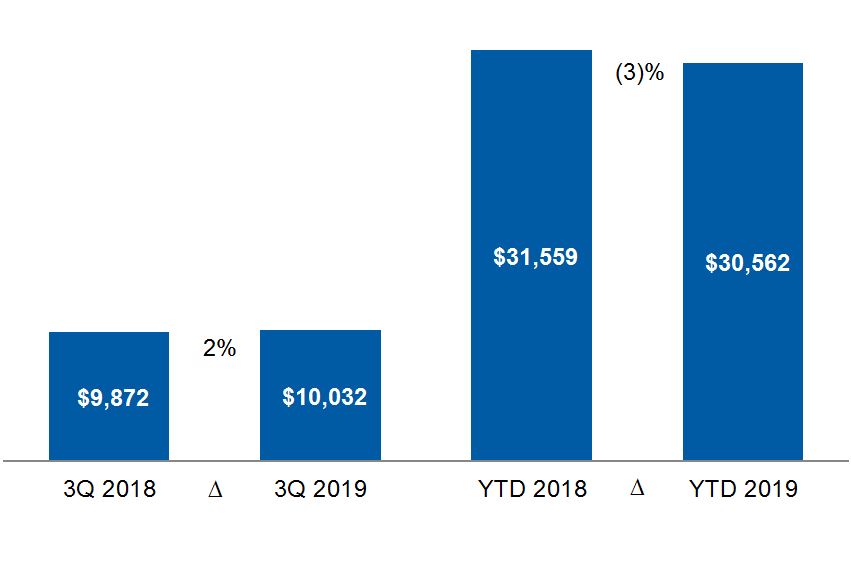
Net Revenues
($ in millions)
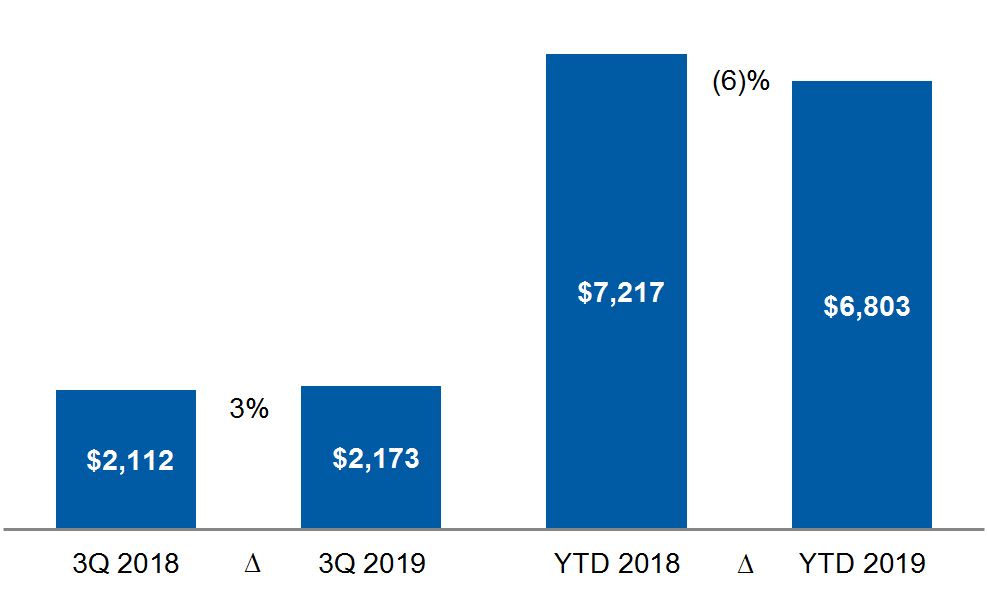
Net Income Applicable to Morgan Stanley
($ in millions)
Earnings per Common Share1
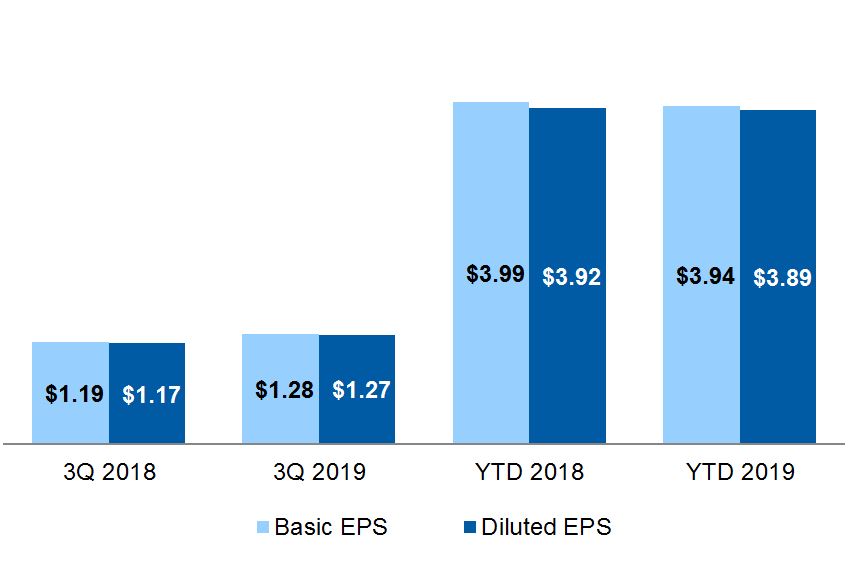
1. | For the calculation of basic and diluted EPS, see Note 15 to the financial statements. |
• | We reported net revenues of $10,032 million in the quarter ended September 30, 2019 (“current quarter,” or “3Q 2019”), compared with $9,872 million in the quarter ended September 30, 2018 (“prior year quarter,” or “3Q 2018”). For the current quarter, net income applicable to Morgan Stanley was $2,173 million, or $1.27 per diluted common share, compared with $2,112 million or $1.17 per diluted common share, in the prior year quarter. |
• | We reported net revenues of $30,562 million in the nine months ended September 30, 2019 (“current year period,” or “YTD 2019”), compared with $31,559 million in the period ended September 30, 2018 (“prior year period,” or “YTD 2018”). For the current year period, net income applicable to Morgan Stanley was $6,803 million, or $3.89 per diluted common share, compared with $7,217 million or $3.92 per diluted common share, in the prior year period. |
September 2019 Form 10-Q | 2 | |
Management’s Discussion and Analysis | |
Non-interest Expenses1
($ in millions)

1. | The percentages on the bars in the chart represent the contribution of compensation and benefits expenses and non-compensation expenses to total non-interest expenses. |
• | Compensation and benefits expenses of $4,427 million in the current quarter and $13,609 million in the current year period increased 3% from $4,310 million in the prior year quarter and decreased 2% from $13,845 million in the prior year period. In the current quarter, the increase was primarily attributed to higher discretionary incentive compensation and salaries, partially offset by decreases in the fair value of investments to which certain deferred compensation plans are referenced. In the current year period, the decrease was primarily attributed to lower discretionary incentive compensation and the roll-off of certain acquisition-related employee retention loans, partially offset by higher salaries, increases in the fair value of investments to which certain deferred compensation plans are referenced, and higher deferred compensation associated with carried interest. |
• | Non-compensation expenses of $2,895 million in the current quarter and $8,385 million in the current year period increased 7% from $2,711 million in the prior year quarter and increased 1% from $8,334 million in the prior year period. The current quarter increase was primarily due to higher litigation costs, volume-related expenses and investments in technology, partially offset by decreases in professional services expenses. In the current year period, investments in technology were partially offset by a decrease in professional services expenses. |
Income Taxes
The current quarter included intermittent net discrete tax benefits of $89 million primarily associated with the filing of the 2018 federal tax return and the remeasurement of reserves and related interest due to new information with regard to multi-jurisdiction tax examinations. The current year period and prior year period included intermittent net discrete tax benefits of $190 million and $92 million, respectively, primarily associated with the remeasurement of reserves and related interest due to new information with regard to multi-jurisdiction tax examinations and other matters. For further information, see “Supplemental Financial Information and Disclosures—Income Tax Matters” herein.
3 | September 2019 Form 10-Q | |
Management’s Discussion and Analysis | |
Selected Financial Information and Other Statistical Data
Three Months Ended September 30, | Nine Months Ended September 30, | |||||||||||
$ in millions | 2019 | 2018 | 2019 | 2018 | ||||||||
Net income applicable to Morgan Stanley | $ | 2,173 | $ | 2,112 | $ | 6,803 | $ | 7,217 | ||||
Preferred stock dividends and other | 113 | 93 | 376 | 356 | ||||||||
Earnings applicable to Morgan Stanley common shareholders | $ | 2,060 | $ | 2,019 | $ | 6,427 | $ | 6,861 | ||||
Expense efficiency ratio1 | 73.0 | % | 71.1 | % | 72.0 | % | 70.3 | % | ||||
ROE2 | 11.2 | % | 11.5 | % | 11.8 | % | 13.1 | % | ||||
ROTCE2 | 12.9 | % | 13.2 | % | 13.5 | % | 15.1 | % | ||||
in millions, except per share and employee data | At September 30, 2019 | At December 31, 2018 | ||||
GLR3 | $ | 226,923 | $ | 249,735 | ||
Loans4 | $ | 125,522 | $ | 115,579 | ||
Total assets | $ | 902,604 | $ | 853,531 | ||
Deposits | $ | 180,738 | $ | 187,820 | ||
Borrowings | $ | 193,659 | $ | 189,662 | ||
Common shares outstanding | 1,624 | 1,700 | ||||
Common shareholders' equity | $ | 73,862 | $ | 71,726 | ||
Tangible common shareholders’ equity2 | $ | 64,512 | $ | 62,879 | ||
Book value per common share5 | $ | 45.49 | $ | 42.20 | ||
Tangible book value per common share2, 5 | $ | 39.73 | $ | 36.99 | ||
Worldwide employees | 60,532 | 60,348 | ||||
At September 30, 2019 | At December 31, 2018 | |||
Capital ratios6 | ||||
Common Equity Tier 1 capital | 16.3 | % | 16.9 | % |
Tier 1 capital | 18.5 | % | 19.2 | % |
Total capital | 20.9 | % | 21.8 | % |
Tier 1 leverage | 8.2 | % | 8.4 | % |
SLR | 6.3 | % | 6.5 | % |
1. | The expense efficiency ratio represents total non-interest expenses as a percentage of net revenues. |
2. | Represents a non-GAAP measure. See “Selected Non-GAAP Financial Information” herein. |
3. | For a discussion of the GLR, see “Liquidity and Capital Resources—Liquidity Risk Management Framework—Global Liquidity Reserve” herein. |
4. | Amounts include loans held for investment (net of allowance) and loans held for sale but exclude loans at fair value, which are included in Trading assets in the balance sheets (see Note 7 to the financial statements). |
5. | Book value per common share and tangible book value per common share equal common shareholders’ equity and tangible common shareholders’ equity, respectively, divided by common shares outstanding. |
6. | At September 30, 2019 and December 31, 2018, our risk-based capital ratios are based on the Standardized Approach rules. For a discussion of our capital ratios, see “Liquidity and Capital Resources—Regulatory Requirements” herein. |
Business Segment Results
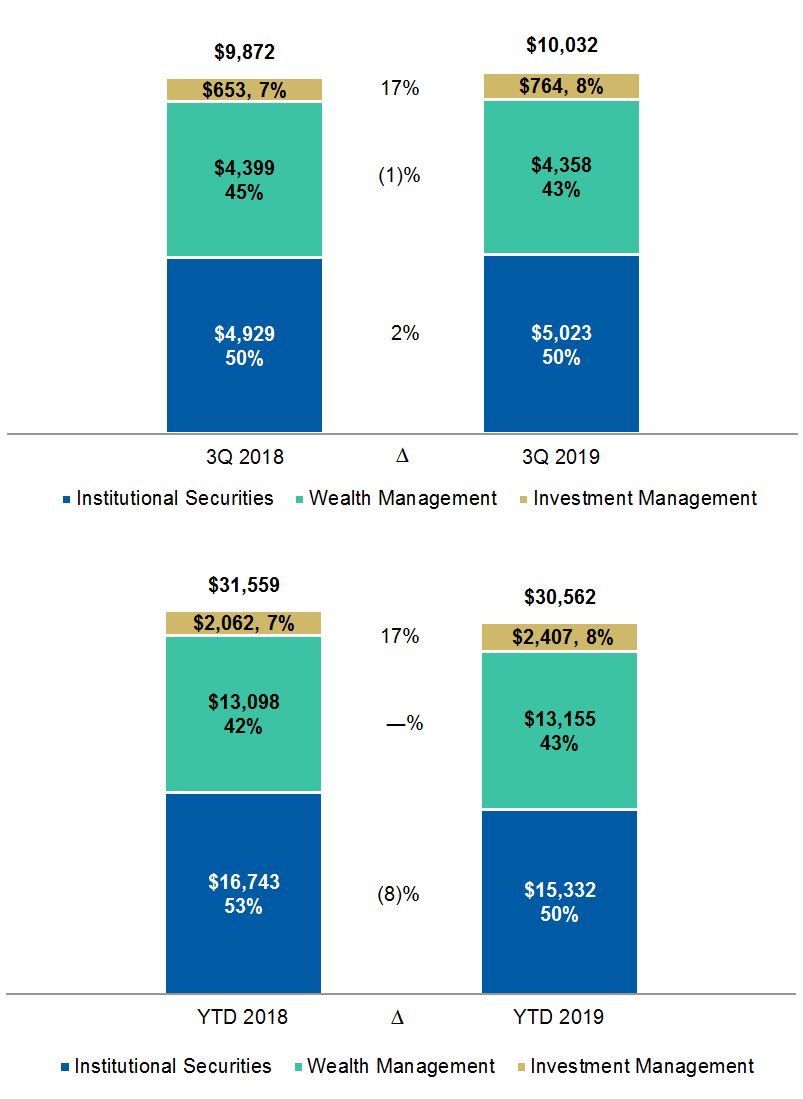
Net Revenues by Segment1
($ in millions)
September 2019 Form 10-Q | 4 | |
Management’s Discussion and Analysis | |
Net Income Applicable to Morgan Stanley by Segment1
($ in millions)
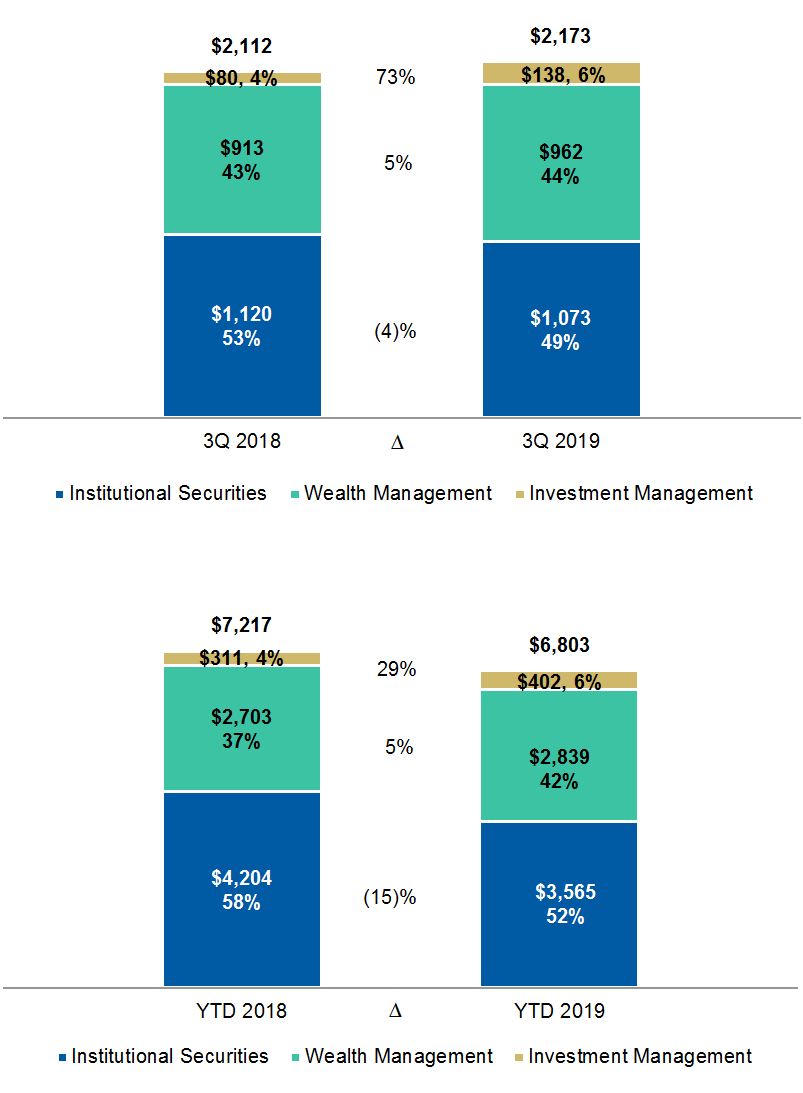
1. | The percentages on the bars in the charts represent the contribution of each business segment to the total of the applicable financial category and may not total to 100% due to intersegment eliminations. See Note 18 to the financial statements for details of intersegment eliminations. |
• | Institutional Securities net revenues of $5,023 million in the current quarter increased 2% from the prior year quarter primarily reflecting higher revenues in Fixed income sales and trading, partially offset by a decrease in Other revenues. Net revenues of $15,332 million in the current year period decreased 8% from the prior year period, primarily reflecting lower revenues from Equity sales and trading and Investment banking. |
• | Wealth Management net revenues of $4,358 million in the current quarter and $13,155 million in the current year period were relatively unchanged compared with the prior year periods. |
• | Investment Management net revenues of $764 million in the current quarter and $2,407 million in the current year period each increased 17% from the prior year periods. The current quarter results primarily reflected higher Investments and Asset Management revenues. The current year period results increased primarily due to higher Investments revenues. |
Net Revenues by Region1, 2
($ in millions)
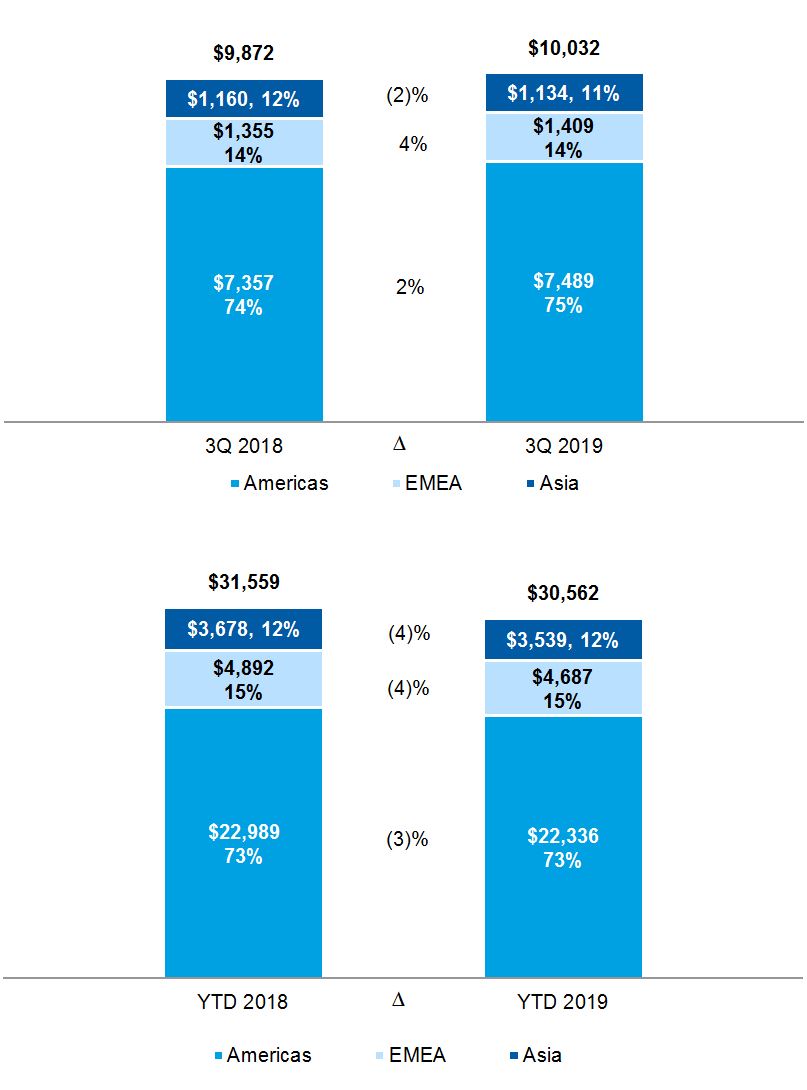
1. | For a discussion of how the geographic breakdown of net revenues is determined, see Note 18 to the financial statements. |
2. | The percentages on the bars in the charts represent the contribution of each region to the total. |
5 | September 2019 Form 10-Q | |
Management’s Discussion and Analysis | |
Selected Non-GAAP Financial Information
We prepare our financial statements using U.S. GAAP. From time to time, we may disclose certain “non-GAAP financial measures” in this document or in the course of our earnings releases, earnings and other conference calls, financial presentations, Definitive Proxy Statement and otherwise. A “non-GAAP financial measure” excludes, or includes, amounts from the most directly comparable measure calculated and presented in accordance with U.S. GAAP. We consider the non-GAAP financial measures we disclose to be useful to us, analysts, investors and other stakeholders by providing further transparency about, or an alternate means of assessing, our financial condition, operating results or capital adequacy.
These measures are not in accordance with, or a substitute for, U.S. GAAP and may be different from or inconsistent with non-GAAP financial measures used by other companies. Whenever we refer to a non-GAAP financial measure, we will also generally define it or present the most directly comparable financial measure calculated and presented in accordance with U.S. GAAP, along with a reconciliation of the differences between the U.S. GAAP financial measure and the non-GAAP financial measure.
The principal non-GAAP financial measures presented in this document are set forth in the following tables.
Reconciliations from U.S. GAAP to Non-GAAP Consolidated Financial Measures
Three Months Ended September 30, | Nine Months Ended September 30, | |||||||||||
$ in millions, except per share data | 2019 | 2018 | 2019 | 2018 | ||||||||
Net income applicable to Morgan Stanley | $ | 2,173 | $ | 2,112 | $ | 6,803 | $ | 7,217 | ||||
Impact of adjustments | (89 | ) | (4 | ) | (190 | ) | (92 | ) | ||||
Adjusted net income applicable to Morgan Stanley—non-GAAP1 | $ | 2,084 | $ | 2,108 | $ | 6,613 | $ | 7,125 | ||||
Earnings per diluted common share | $ | 1.27 | $ | 1.17 | $ | 3.89 | $ | 3.92 | ||||
Impact of adjustments | (0.06 | ) | — | (0.12 | ) | (0.05 | ) | |||||
Adjusted earnings per diluted common share—non-GAAP1 | $ | 1.21 | $ | 1.17 | $ | 3.77 | $ | 3.87 | ||||
Effective income tax rate | 18.2 | % | 24.4 | % | 19.1 | % | 21.9 | % | ||||
Impact of adjustments | 3.2 | % | 0.2 | % | 2.2 | % | 0.9 | % | ||||
Adjusted effective income tax rate—non-GAAP1 | 21.4 | % | 24.6 | % | 21.3 | % | 22.8 | % | ||||
$ in millions | At September 30, 2019 | At December 31, 2018 | ||||
Tangible equity U.S. GAAP | ||||||
Morgan Stanley shareholders' equity | $ | 82,382 | $ | 80,246 | ||
Less: Goodwill and net intangible assets | (9,350 | ) | (8,847 | ) | ||
Tangible Morgan Stanley shareholders' equity—non-GAAP | $ | 73,032 | $ | 71,399 | ||
U.S. GAAP | ||||||
Common shareholders' equity | $ | 73,862 | $ | 71,726 | ||
Less: Goodwill and net intangible assets | (9,350 | ) | (8,847 | ) | ||
Tangible common shareholders' equity—non-GAAP | $ | 64,512 | $ | 62,879 | ||
Consolidated Non-GAAP Financial Measures
Average Monthly Balance | ||||||||||||
Three Months Ended September 30, | Nine Months Ended September 30, | |||||||||||
$ in millions | 2019 | 2018 | 2019 | 2018 | ||||||||
Tangible equity | ||||||||||||
Morgan Stanley shareholders' equity | $ | 81,912 | $ | 78,760 | $ | 81,028 | $ | 78,165 | ||||
Less: Goodwill and net intangible assets | (9,389 | ) | (8,970 | ) | (9,097 | ) | (9,020 | ) | ||||
Tangible Morgan Stanley shareholders' equity | $ | 72,523 | $ | 69,790 | $ | 71,931 | $ | 69,145 | ||||
Common shareholders' equity | $ | 73,392 | $ | 70,240 | $ | 72,508 | $ | 69,645 | ||||
Less: Goodwill and net intangible assets | (9,389 | ) | (8,970 | ) | (9,097 | ) | (9,020 | ) | ||||
Tangible common shareholders' equity | $ | 64,003 | $ | 61,270 | $ | 63,411 | $ | 60,625 | ||||
Three Months Ended September 30, | Nine Months Ended September 30, | |||||||||||
$ in billions | 2019 | 2018 | 2019 | 2018 | ||||||||
Average common equity | ||||||||||||
Unadjusted | $ | 73.4 | $ | 70.2 | $ | 72.5 | $ | 69.6 | ||||
Adjusted1 | 73.4 | 70.2 | 72.4 | 69.6 | ||||||||
ROE2 | ||||||||||||
Unadjusted | 11.2 | % | 11.5 | % | 11.8 | % | 13.1 | % | ||||
Adjusted1, 3 | 10.7 | % | 11.5 | % | 11.5 | % | 13.0 | % | ||||
Average tangible common equity | ||||||||||||
Unadjusted | $ | 64.0 | $ | 61.3 | $ | 63.4 | $ | 60.6 | ||||
Adjusted1 | 64.0 | 61.3 | 63.3 | 60.6 | ||||||||
ROTCE2 | ||||||||||||
Unadjusted | 12.9 | % | 13.2 | % | 13.5 | % | 15.1 | % | ||||
Adjusted1, 3 | 12.3 | % | 13.2 | % | 13.1 | % | 14.9 | % | ||||
September 2019 Form 10-Q | 6 | |
Management’s Discussion and Analysis | |
Non-GAAP Financial Measures by Business Segment
Three Months Ended September 30, | Nine Months Ended September 30, | |||||||||||
$ in billions | 2019 | 2018 | 2019 | 2018 | ||||||||
Pre-tax margin4 | ||||||||||||
Institutional Securities | 26 | % | 32 | % | 28 | % | 33 | % | ||||
Wealth Management | 28 | % | 27 | % | 28 | % | 27 | % | ||||
Investment Management | 22 | % | 16 | % | 22 | % | 19 | % | ||||
Consolidated | 27 | % | 29 | % | 28 | % | 30 | % | ||||
Average common equity5 | ||||||||||||
Institutional Securities | $ | 40.4 | $ | 40.8 | $ | 40.4 | $ | 40.8 | ||||
Wealth Management | 18.2 | 16.8 | 18.2 | 16.8 | ||||||||
Investment Management | 2.5 | 2.6 | 2.5 | 2.6 | ||||||||
Parent Company | 12.3 | 10.0 | 11.4 | 9.4 | ||||||||
Consolidated average common equity | $ | 73.4 | $ | 70.2 | $ | 72.5 | $ | 69.6 | ||||
Average tangible common equity5 | ||||||||||||
Institutional Securities | $ | 39.9 | $ | 40.1 | $ | 39.9 | $ | 40.1 | ||||
Wealth Management | 10.2 | 9.2 | 10.2 | 9.2 | ||||||||
Investment Management | 1.5 | 1.7 | 1.5 | 1.7 | ||||||||
Parent Company | 12.4 | 10.3 | 11.8 | 9.6 | ||||||||
Consolidated average tangible common equity | $ | 64.0 | $ | 61.3 | $ | 63.4 | $ | 60.6 | ||||
ROE2, 6 | ||||||||||||
Institutional Securities | 9.8 | % | 10.3 | % | 10.8 | % | 12.8 | % | ||||
Wealth Management | 20.6 | % | 21.3 | % | 20.2 | % | 20.9 | % | ||||
Investment Management | 22.1 | % | 12.0 | % | 21.5 | % | 15.7 | % | ||||
Consolidated | 11.2 | % | 11.5 | % | 11.8 | % | 13.1 | % | ||||
ROTCE2, 6 | ||||||||||||
Institutional Securities | 9.9 | % | 10.4 | % | 10.9 | % | 13.0 | % | ||||
Wealth Management | 36.9 | % | 38.9 | % | 36.2 | % | 38.1 | % | ||||
Investment Management | 35.6 | % | 18.8 | % | 34.7 | % | 24.5 | % | ||||
Consolidated | 12.9 | % | 13.2 | % | 13.5 | % | 15.1 | % | ||||
1. | Adjusted amounts exclude net discrete tax provisions (benefits) that are intermittent and include those that are recurring. Provisions or (benefits) related to conversion of employee share-based awards are expected to occur every year and are considered recurring discrete tax items. For further information on the net discrete tax provisions (benefits), see “Supplemental Financial Information and Disclosures—Income Tax Matters” herein. |
2. | ROE and ROTCE represent annualized net income applicable to Morgan Stanley less preferred dividends as a percentage of average common equity and average tangible common equity, respectively. When excluding intermittent net discrete tax provisions (benefits), both the numerator and average denominator are adjusted. |
3. | The calculations used in determining our “ROE and ROTCE Targets” referred to in the following section are the Adjusted ROE and Adjusted ROTCE amounts shown in this table. |
4. | Pre-tax margin represents income from continuing operations before income taxes as a percentage of net revenues. |
5. | Average common equity and average tangible common equity for each business segment are determined using our Required Capital framework (see “Liquidity and Capital Resources—Regulatory Requirements—Attribution of Average Common Equity According to the Required Capital Framework” herein). |
6. | The calculation of ROE and ROTCE by segment uses net income applicable to Morgan Stanley by segment less preferred dividends allocated to each segment as a percentage of average common equity and average tangible common equity, respectively, allocated to each segment. |
Return on Equity and Tangible Common Equity Targets
We have an ROE Target of 10% to 13% and an ROTCE Target of 11.5% to 14.5%.
Our ROE and ROTCE Targets are forward-looking statements that may be materially affected by many factors, including, among other things: macroeconomic and market conditions; legislative and regulatory developments; industry trading and investment banking volumes; equity market levels; interest rate environment; outsized legal expenses or penalties and the ability to maintain a reduced level of expenses; and capital levels. For further information on our ROE and ROTCE Targets and related assumptions, see “Management’s Discussion and Analysis of Financial Condition and Results of Operations—Executive Summary—Return on Equity and Tangible Common Equity Targets” in the 2018 Form 10-K.
Business Segments
Substantially all of our operating revenues and operating expenses are directly attributable to our business segments. Certain revenues and expenses have been allocated to each business segment, generally in proportion to its respective net revenues, non-interest expenses or other relevant measures.
For an overview of the components of our business segments, net revenues, compensation expense and income taxes, see “Management’s Discussion and Analysis of Financial Condition and Results of Operations—Business Segments” in the 2018 Form 10-K.
With respect to Institutional Securities sales and trading activities, Commodities products and Other also includes Trading revenues from managing derivative counterparty credit risk on behalf of clients, in addition to results from the centralized management of our fixed income derivative counterparty exposures.
7 | September 2019 Form 10-Q | |
Management’s Discussion and Analysis | |
Institutional Securities
Income Statement Information
Three Months Ended September 30, | ||||||||
$ in millions | 2019 | 2018 | % Change | |||||
Revenues | ||||||||
Investment banking | $ | 1,535 | $ | 1,459 | 5 | % | ||
Trading | 2,533 | 2,573 | (2 | )% | ||||
Investments | (18 | ) | 96 | (119 | )% | |||
Commissions and fees | 643 | 589 | 9 | % | ||||
Asset management | 100 | 112 | (11 | )% | ||||
Other | 51 | 244 | (79 | )% | ||||
Total non-interest revenues | 4,844 | 5,073 | (5 | )% | ||||
Interest income | 3,112 | 2,425 | 28 | % | ||||
Interest expense | 2,933 | 2,569 | 14 | % | ||||
Net interest | 179 | (144 | ) | N/M | ||||
Net revenues | 5,023 | 4,929 | 2 | % | ||||
Compensation and benefits | 1,768 | 1,626 | 9 | % | ||||
Non-compensation expenses | 1,948 | 1,747 | 12 | % | ||||
Total non-interest expenses | 3,716 | 3,373 | 10 | % | ||||
Income from continuing operations before income taxes | 1,307 | 1,556 | (16 | )% | ||||
Provision for income taxes | 189 | 397 | (52 | )% | ||||
Income from continuing operations | 1,118 | 1,159 | (4 | )% | ||||
Income (loss) from discontinued operations, net of income taxes | — | (3 | ) | 100 | % | |||
Net income | 1,118 | 1,156 | (3 | )% | ||||
Net income applicable to noncontrolling interests | 45 | 36 | 25 | % | ||||
Net income applicable to Morgan Stanley | $ | 1,073 | $ | 1,120 | (4 | )% | ||
Nine Months Ended September 30, | ||||||||
$ in millions | 2019 | 2018 | % Change | |||||
Revenues | ||||||||
Investment banking | $ | 4,158 | $ | 4,671 | (11 | )% | ||
Trading | 8,221 | 9,344 | (12 | )% | ||||
Investments | 257 | 234 | 10 | % | ||||
Commissions and fees | 1,889 | 2,007 | (6 | )% | ||||
Asset management | 310 | 324 | (4 | )% | ||||
Other | 416 | 548 | (24 | )% | ||||
Total non-interest revenues | 15,251 | 17,128 | (11 | )% | ||||
Interest income | 9,457 | 6,424 | 47 | % | ||||
Interest expense | 9,376 | 6,809 | 38 | % | ||||
Net interest | 81 | (385 | ) | 121 | % | |||
Net revenues | 15,332 | 16,743 | (8 | )% | ||||
Compensation and benefits | 5,376 | 5,779 | (7 | )% | ||||
Non-compensation expenses | 5,591 | 5,484 | 2 | % | ||||
Total non-interest expenses | 10,967 | 11,263 | (3 | )% | ||||
Income from continuing operations before income taxes | 4,365 | 5,480 | (20 | )% | ||||
Provision for income taxes | 703 | 1,169 | (40 | )% | ||||
Income from continuing operations | 3,662 | 4,311 | (15 | )% | ||||
Income (loss) from discontinued operations, net of income taxes | — | (7 | ) | 100 | % | |||
Net income | 3,662 | 4,304 | (15 | )% | ||||
Net income applicable to noncontrolling interests | 97 | 100 | (3 | )% | ||||
Net income applicable to Morgan Stanley | $ | 3,565 | $ | 4,204 | (15 | )% | ||
September 2019 Form 10-Q | 8 | |
Management’s Discussion and Analysis | |
Investment Banking
Investment Banking Revenues
Three Months Ended September 30, | ||||||||
$ in millions | 2019 | 2018 | % Change | |||||
Advisory | $ | 550 | $ | 510 | 8 | % | ||
Underwriting: | ||||||||
Equity | 401 | 441 | (9 | )% | ||||
Fixed income | 584 | 508 | 15 | % | ||||
Total Underwriting | 985 | 949 | 4 | % | ||||
Total Investment banking | $ | 1,535 | $ | 1,459 | 5 | % | ||
Nine Months Ended September 30, | ||||||||
$ in millions | 2019 | 2018 | % Change | |||||
Advisory | $ | 1,462 | $ | 1,702 | (14 | )% | ||
Underwriting: | ||||||||
Equity | 1,286 | 1,403 | (8 | )% | ||||
Fixed income | 1,410 | 1,566 | (10 | )% | ||||
Total Underwriting | 2,696 | 2,969 | (9 | )% | ||||
Total Investment banking | $ | 4,158 | $ | 4,671 | (11 | )% | ||
Investment Banking Volumes
Three Months Ended September 30, | Nine Months Ended September 30, | |||||||||||
$ in billions | 2019 | 2018 | 2019 | 2018 | ||||||||
Completed mergers and acquisitions1 | $ | 214 | $ | 170 | $ | 580 | $ | 674 | ||||
Equity and equity-related offerings2, 3 | 17 | 15 | 47 | 52 | ||||||||
Fixed income offerings2, 4 | 78 | 68 | 196 | 193 | ||||||||
Source: Refinitiv (formerly Thomson Reuters Financial & Risk), data as of October 1, 2019. Transaction volumes may not be indicative of net revenues in a given period. In addition, transaction volumes for prior periods may vary from amounts previously reported due to the subsequent withdrawal, change in value, or change in timing of certain transactions.
1. | Includes transactions of $100 million or more. Based on full credit to each of the advisors in a transaction. |
2. | Based on full credit for single book managers and equal credit for joint book managers. |
3. | Includes Rule 144A issuances and registered public offerings of common stock, convertible securities and rights offerings. |
4. | Includes Rule 144A and publicly registered issuances, non-convertible preferred stock, mortgage-backed and asset-backed securities, and taxable municipal debt. Excludes leveraged loans and self-led issuances. |
Investment banking revenues of $1,535 million in the current quarter increased 5% from the prior year quarter, reflecting higher results in both our underwriting and advisory businesses. Investment banking revenues of $4,158 million in the current year period decreased 11% from the prior year period, reflecting lower results in both our underwriting and advisory businesses.
• | Advisory revenues increased in the current quarter primarily reflecting higher volumes of completed M&A activity, partially offset by the effect of lower fee realizations. In the current year period revenues decreased primarily as a result of lower volumes of completed M&A activity. |
• | Equity underwriting revenues decreased in the current quarter primarily reflecting lower revenues in initial public offerings and follow-on offerings, partially offset by an increase in convertible issuances. In the current year period, overall volumes were lower, with revenues decreasing primarily in initial public offerings and convertible issuances, partially offset by an increase in secondary block share trades. |
• | Fixed income underwriting revenues increased in the current quarter primarily due to higher overall volumes, with higher revenues in non-investment grade bond and investment grade loan issuance fees. In the current year period, fixed income underwriting revenues decreased, primarily in non-investment grade loan issuance fees, reflecting lower loan market volumes. |
See “Investment Banking Volumes” herein.
Sales and Trading Net Revenues
By Income Statement Line Item
Three Months Ended September 30, | ||||||||
$ in millions | 2019 | 2018 | % Change | |||||
Trading | $ | 2,533 | $ | 2,573 | (2 | )% | ||
Commissions and fees | 643 | 589 | 9 | % | ||||
Asset management | 100 | 112 | (11 | )% | ||||
Net interest | 179 | (144 | ) | N/M | ||||
Total | $ | 3,455 | $ | 3,130 | 10 | % | ||
Nine Months Ended September 30, | ||||||||
$ in millions | 2019 | 2018 | % Change | |||||
Trading | $ | 8,221 | $ | 9,344 | (12 | )% | ||
Commissions and fees | 1,889 | 2,007 | (6 | )% | ||||
Asset Management | 310 | 324 | (4 | )% | ||||
Net interest | 81 | (385 | ) | 121 | % | |||
Total | $ | 10,501 | $ | 11,290 | (7 | )% | ||
9 | September 2019 Form 10-Q | |
Management’s Discussion and Analysis | |
By Business
Three Months Ended September 30, | ||||||||
$ in millions | 2019 | 2018 | % Change | |||||
Equity | $ | 1,991 | $ | 2,019 | (1 | )% | ||
Fixed income | 1,430 | 1,179 | 21 | % | ||||
Other | 34 | (68 | ) | 150 | % | |||
Total | $ | 3,455 | $ | 3,130 | 10 | % | ||
Nine Months Ended September 30, | ||||||||
$ in millions | 2019 | 2018 | % Change | |||||
Equity | $ | 6,136 | $ | 7,047 | (13 | )% | ||
Fixed income | 4,273 | 4,441 | (4 | )% | ||||
Other | 92 | (198 | ) | 146 | % | |||
Total | $ | 10,501 | $ | 11,290 | (7 | )% | ||
Sales and Trading Revenues—Equity and Fixed Income
Three Months Ended September 30, 2019 | ||||||||||||
Net | ||||||||||||
$ in millions | Trading | Fees1 | Interest2 | Total | ||||||||
Financing | $ | 1,049 | $ | 88 | $ | (90 | ) | $ | 1,047 | |||
Execution services | 446 | 564 | (66 | ) | 944 | |||||||
Total Equity | $ | 1,495 | $ | 652 | $ | (156 | ) | $ | 1,991 | |||
Total Fixed income | $ | 1,329 | $ | 90 | $ | 11 | $ | 1,430 | ||||
Three Months Ended September 30, 2018 | ||||||||||||
Net | ||||||||||||
$ in millions | Trading | Fees1 | Interest2 | Total | ||||||||
Financing | $ | 1,097 | $ | 99 | $ | (141 | ) | $ | 1,055 | |||
Execution services | 554 | 524 | (114 | ) | 964 | |||||||
Total Equity | $ | 1,651 | $ | 623 | $ | (255 | ) | $ | 2,019 | |||
Total Fixed income | $ | 1,189 | $ | 78 | $ | (88 | ) | $ | 1,179 | |||
Nine Months Ended September 30, 2019 | ||||||||||||
Net | ||||||||||||
$ in millions | Trading | Fees1 | Interest2 | Total | ||||||||
Financing | $ | 3,249 | $ | 280 | $ | (500 | ) | $ | 3,029 | |||
Execution services | 1,597 | 1,671 | (161 | ) | 3,107 | |||||||
Total Equity | $ | 4,846 | $ | 1,951 | $ | (661 | ) | $ | 6,136 | |||
Total Fixed income | $ | 4,200 | $ | 249 | $ | (176 | ) | $ | 4,273 | |||
Nine Months Ended September 30, 2018 | ||||||||||||
Net | ||||||||||||
$ in millions | Trading | Fees1 | Interest2 | Total | ||||||||
Financing | $ | 3,704 | $ | 295 | $ | (479 | ) | $ | 3,520 | |||
Execution services | 2,006 | 1,793 | (272 | ) | 3,527 | |||||||
Total Equity | $ | 5,710 | $ | 2,088 | $ | (751 | ) | $ | 7,047 | |||
Total Fixed income | $ | 4,203 | $ | 244 | $ | (6 | ) | $ | 4,441 | |||
1. | Includes Commissions and fees and Asset management revenues. |
2. | Includes funding costs, which are allocated to the businesses based on funding usage. |
As discussed in “Management’s Discussion and Analysis of Financial Condition and Results of Operations—Business Segments—Net Revenues by Segment” in the 2018 Form 10-K, we manage each of the sales and trading businesses based on its aggregate net revenues. We provide qualitative commentary in the discussion of results that follow on the key drivers of period over period variances, as the quantitative impact of the various market dynamics typically cannot be disaggregated.
For additional information on total Trading revenues, see the table “Trading Revenues by Product Type” in Note 18 to the financial statements.
Sales and Trading Net Revenues during the Current Quarter
Equity
Equity sales and trading net revenues of $1,991 million in the current quarter were essentially unchanged compared to the prior year quarter.
• | Financing remained consistent with the prior year quarter as lower Trading revenues were offset by higher Net interest revenues. |
• | Execution services was relatively unchanged from the prior year quarter, reflecting lower Trading revenues in derivatives products as a result of less favorable inventory management, partially offset by increased client activity. Higher Commissions and fees were driven by higher client activity in cash equities products. |
Fixed Income
Fixed income net revenues of $1,430 million in the current quarter were 21% higher than the prior year quarter, primarily driven by higher results in credit products and commodities products and other, partially offset by lower results in global macro products.
• | Global macro products revenues decreased in foreign exchange products, partially offset by an increase in rates products. Trading revenues were lower overall, reflecting unfavorable inventory management as a result of a decline in interest rates and movements in foreign exchange volatility, partially offset by higher levels of client activity, including structured transactions. |
• | Credit products Trading revenues increased primarily in securitized and corporate credit products due to improved inventory management and higher client activity. |
• | Commodities products and Other Trading revenues increased primarily due to gains from counterparty risk management. |
September 2019 Form 10-Q | 10 | |
Management’s Discussion and Analysis | |
Fixed income Net interest increased compared to the prior year quarter primarily reflecting changes in funding mix.
Other
• | Other sales and trading revenues of $34 million in the current quarter increased from the prior year quarter reflecting changes in funding mix, higher gains on economic hedges related to certain of the Firm’s Borrowings and lower losses on hedges associated with corporate loans. Partially offsetting these increases was a decrease in the fair value of investments to which certain deferred compensation plans are referenced. |
Sales and Trading Net Revenues during the Current Year Period
Equity
Equity sales and trading net revenues of $6,136 million in the current year period decreased 13% from the prior year period, reflecting lower results in both our financing and execution services businesses.
• | Financing decreased from the prior year period, mainly due to lower average client balances and lower realized spreads, primarily reflected in lower Trading revenues. |
• | Execution services decreased from the prior year period, reflecting lower Trading revenues as a result of less favorable inventory management in derivatives products. In addition, Commission and fees decreased due to lower client activity in cash equities products. |
Fixed Income
Fixed income net revenues of $4,273 million in the current year period were 4% lower than the prior year period, primarily driven by lower results in global macro products, offset by higher results in credit products.
• | Global macro products Trading revenues decreased in both foreign exchange and rates products as a result of unfavorable inventory management as a result of a decline in interest rates and movements in foreign exchange volatility, partially offset by higher levels of client activity. |
• | Credit products Trading revenues increased primarily in corporate credit and securitized products due to improved inventory management and higher client activity. |
• | Commodities products and Other Trading revenues remained relatively unchanged as gains from counterparty risk management were offset by lower client activity in structured transactions within commodities products. |
Fixed income Net interest decreased compared to the prior year period primarily reflecting changes in funding mix and lower net spreads in securitized products.
Other
• | Other sales and trading revenues of $92 million in the current year period increased from the prior year period reflecting lower costs due to changes in funding mix and balance sheet composition and an increase in the in the fair value of investments to which certain deferred compensation plans are referenced, partially offset by higher losses on hedges associated with corporate loans. |
Investments, Other Revenues, Non-interest Expenses, and Income Tax Items
Investments
• | Net investment losses of $18 million in the current quarter were driven by mark-to-market losses on remaining holdings subsequent to certain investments' initial public offerings, compared with net investment gains of $96 million in the prior year quarter. In the current year period net investment gains of $257 million were higher compared to the prior year period, primarily as a result of realized gains associated with an investment's public offering in the current year period. |
Other Revenues
• | Other revenues of $51 million in the current quarter decreased from the prior year quarter, primarily as a result of mark-to-market losses on held for sale loans and an increase in the provision for loan losses. Other revenues of $416 million in the current year period decreased from the prior year period, primarily as a result of an increase in the provision for loan losses compared to the prior year period, which included the recovery of a previously charged off loan. Additionally, lower results from certain equity method investments were partially offset by higher mark-to-market gains on held-for-sale loans in the current year period. |
Non-interest Expenses
Non-interest expenses of $3,716 million in the current quarter increased from the prior year quarter, reflecting a 9% increase in Compensation and benefits expenses and a 12% increase in Non-compensation expenses. Non-interest expenses of $10,967 million in the current year period decreased from the prior year period, reflecting a 7% decrease in Compensation and benefits expenses and a 2% increase in Non-compensation expenses.
• | Compensation and benefits expenses increased in the current quarter primarily due to increases in discretionary incentive compensation driven by higher revenues as well as higher salaries, partially offset by a decrease in the fair value of |
11 | September 2019 Form 10-Q | |
Management’s Discussion and Analysis | |
investments to which certain deferred compensation plans are referenced. Compensation and benefits expense decreased in the current year period, primarily due to decreases in discretionary incentive compensation driven by lower revenues, partially offset by higher salaries and an increase in the fair value of investments to which certain deferred compensation plans are referenced.
• | Non-compensation expenses increased in the current quarter primarily due to higher litigation costs, volume-related expenses and investments in technology. In the current year period, Non-compensation expenses increased primarily due to investments in technology. |
Income Tax Items
The current quarter and current year period included intermittent net discrete tax benefits of $67 million and $168 million, respectively. The prior year period included intermittent net discrete tax benefits of $88 million. For further information, see “Supplemental Financial Information and Disclosures—Income Tax Matters” herein.
September 2019 Form 10-Q | 12 | |
Management’s Discussion and Analysis | |
Wealth Management
Income Statement Information
Three Months Ended September 30, | ||||||||
$ in millions | 2019 | 2018 | % Change | |||||
Revenues | ||||||||
Investment banking | $ | 118 | $ | 129 | (9 | )% | ||
Trading | 61 | 160 | (62 | )% | ||||
Commissions and fees | 416 | 409 | 2 | % | ||||
Asset management | 2,639 | 2,573 | 3 | % | ||||
Other | 81 | 58 | 40 | % | ||||
Total non-interest revenues | 3,315 | 3,329 | ―% | |||||
Interest income | 1,378 | 1,412 | (2 | )% | ||||
Interest expense | 335 | 342 | (2 | )% | ||||
Net interest | 1,043 | 1,070 | (3 | )% | ||||
Net revenues | 4,358 | 4,399 | (1 | )% | ||||
Compensation and benefits | 2,340 | 2,415 | (3 | )% | ||||
Non-compensation expenses | 780 | 790 | (1 | )% | ||||
Total non-interest expenses | 3,120 | 3,205 | (3 | )% | ||||
Income from continuing operations before income taxes | $ | 1,238 | $ | 1,194 | 4 | % | ||
Provision for income taxes | 276 | 281 | (2 | )% | ||||
Net income applicable to Morgan Stanley | $ | 962 | $ | 913 | 5 | % | ||
Nine Months Ended September 30, | ||||||||
$ in millions | 2019 | 2018 | % Change | |||||
Revenues | ||||||||
Investment banking | $ | 365 | $ | 383 | (5 | )% | ||
Trading | 525 | 404 | 30 | % | ||||
Investments | 1 | 3 | (67 | )% | ||||
Commissions and fees | 1,250 | 1,349 | (7 | )% | ||||
Asset management | 7,544 | 7,582 | (1 | )% | ||||
Other | 281 | 195 | 44 | % | ||||
Total non-interest revenues | 9,966 | 9,916 | 1 | % | ||||
Interest income | 4,139 | 4,012 | 3 | % | ||||
Interest expense | 950 | 830 | 14 | % | ||||
Net interest | 3,189 | 3,182 | ―% | |||||
Net revenues | 13,155 | 13,098 | ―% | |||||
Compensation and benefits | 7,184 | 7,221 | (1 | )% | ||||
Non-compensation expenses | 2,302 | 2,366 | (3 | )% | ||||
Total non-interest expenses | 9,486 | 9,587 | (1 | )% | ||||
Income from continuing operations before income taxes | $ | 3,669 | $ | 3,511 | 5 | % | ||
Provision for income taxes | 830 | 808 | 3 | % | ||||
Net income applicable to Morgan Stanley | $ | 2,839 | $ | 2,703 | 5 | % | ||
Financial Information and Statistical Data
At September 30, 2019 | At December 31, 2018 | |||||
$ in billions, except employee data | ||||||
Client assets | $ | 2,565 | $ | 2,303 | ||
Fee-based client assets1 | $ | 1,186 | $ | 1,046 | ||
Fee-based client assets as a percentage of total client assets | 46 | % | 45 | % | ||
Client liabilities2 | $ | 86 | $ | 83 | ||
Investment securities portfolio | $ | 69.8 | $ | 68.6 | ||
Loans and lending commitments | $ | 88.3 | $ | 82.9 | ||
Wealth Management representatives | 15,553 | 15,694 | ||||
Three Months Ended September 30, | ||||||
2019 | 2018 | |||||
Per representative: | ||||||
Annualized revenues ($ in thousands)3 | $ | 1,118 | $ | 1,125 | ||
Client assets ($ in millions)4 | $ | 165 | $ | 159 | ||
Fee-based asset flows ($ in billions)5 | $ | 15.5 | $ | 16.2 | ||
Nine Months Ended September 30, | ||||||
2019 | 2018 | |||||
Per representative: | ||||||
Annualized revenues ($ in thousands)3 | $ | 1,121 | $ | 1,114 | ||
Client assets ($ in millions)4 | $ | 165 | $ | 159 | ||
Fee-based asset flows ($ in billions)5 | $ | 40.1 | $ | 49.7 | ||
1. | Fee-based client assets represent the amount of assets in client accounts where the fee for services is calculated based on those assets. |
2. | Client liabilities include securities-based and tailored lending, residential real estate loans and margin lending. |
3. | Revenues per representative equal Wealth Management’s annualized net revenues divided by the average number of representatives. |
4. | Client assets per representative equal total period-end client assets divided by period-end number of representatives. |
5. | For a description of the Inflows and Outflows included within Fee-based asset flows, see “Management’s Discussion and Analysis of Financial Condition and Results of Operations—Business Segments—Wealth Management—Fee-Based Client Assets” in the 2018 Form 10-K. Excludes institutional cash management-related activity. |
13 | September 2019 Form 10-Q | |
Management’s Discussion and Analysis | |
Transactional Revenues
Three Months Ended September 30, | ||||||||
$ in millions | 2019 | 2018 | % Change | |||||
Investment banking | $ | 118 | $ | 129 | (9 | )% | ||
Trading | 61 | 160 | (62 | )% | ||||
Commissions and fees | 416 | 409 | 2 | % | ||||
Total | $ | 595 | $ | 698 | (15 | )% | ||
Transactional revenues as a % of Net revenues | 14 | % | 16 | % | ||||
Nine Months Ended September 30, | ||||||||
$ in millions | 2019 | 2018 | % Change | |||||
Investment banking | $ | 365 | $ | 383 | (5 | )% | ||
Trading | 525 | 404 | 30 | % | ||||
Commissions and fees | 1,250 | 1,349 | (7 | )% | ||||
Total | $ | 2,140 | $ | 2,136 | N/M | |||
Transactional revenues as a % of Net revenues | 16 | % | 16 | % | ||||
Net Revenues
Transactional Revenues
Transactional revenues of $595 million in the current quarter decreased 15% from the prior year quarter primarily as a result of lower Trading revenues. Transactional revenues of $2,140 million in the current year period were relatively unchanged from the prior year period as a result of higher Trading revenues, offset by lower Commissions and fees.
• | Investment banking revenues decreased in the current year periods, with lower revenues from structured product issuances, partially offset by higher revenues from closed-end fund issuances. |
• | Trading revenues decreased in the current quarter primarily due to losses related to investments associated with certain employee deferred compensation plans. In the current year period, Trading revenues increased primarily due to higher gains in these investments. |
• | Commissions and fees in the current quarter remained relatively unchanged. In the current year period, Commissions and fees decreased primarily due to changes in the mix of client activity in equities. |
Asset Management
Asset management revenues of $2,639 million in the current quarter increased 3% from the prior year quarter primarily due to higher fee-based assets levels at the beginning of the current quarter due to market appreciation and positive net flows, partially offset by lower average fee rates predominantly driven by shifts in the mix of fee-based client assets and lower mutual fund distribution fees.
Asset management revenues of $7,544 million in the current year period decreased 1% from the prior year period primarily due to lower average fee rates predominantly driven by shifts in the mix of fee-based client assets and lower mutual fund distribution fees, partially offset by the effect of positive net flows.
See “Fee-Based Client Assets—Rollforwards” herein.
Other
Other revenues of $81 million in the current quarter and $281 million in the current year period increased 40% and 44%, respectively, from the prior year periods, primarily due to higher realized gains from the AFS securities portfolio.
Net Interest
Net interest of $1,043 million in the current quarter decreased due to changes in our funding mix, partially offset by higher balances of and higher interest rates on Investment securities and Loans.
Net interest of $3,189 million in the current year period was marginally higher than prior year period. The impact of higher interest rates on and higher balances of Investment securities and Loans was partially offset by changes in our funding mix and higher prepayment amortization expense related to mortgage-backed securities.
In addition, we centralized certain internal treasury activities as of January 1, 2019, which partially offset Interest income and Interest expense compared with the prior year periods. This impact is expected to continue in future periods. The effect on Net interest income was not significant in the current quarter or the current year period, nor is it expected to be for the full year 2019.
Non-interest Expenses
Non-interest expenses of $3,120 million in the current quarter decreased from the prior year quarter primarily as a result of Compensation and benefits expenses. Non-interest expenses of $9,486 million in the current year period decreased from the prior year period primarily as a result of Non-compensation expenses.
• | Compensation and benefits expenses decreased in the current quarter reflecting decreases in the fair value of investments to which certain deferred compensation plans are referenced and the roll-off of certain acquisition-related employee retention loans, partially offset by higher salaries and the formulaic payout to Wealth Management representatives driven by the mix of revenues. Compensation and benefits expenses decreased in the current year period reflecting the roll-off of certain acquisition-related employee retention loans and a lower formulaic payout to Wealth |
September 2019 Form 10-Q | 14 | |
Management’s Discussion and Analysis | |
Management representatives driven by the mix of revenues, partially offset by higher salaries and increases in the fair value of investments to which certain deferred compensation plans are referenced.
• | Non-compensation expenses decreased in the current quarter and current year period primarily as a result of lower professional services expenses. In addition, in the current year period, Non-compensation expenses decreased as a result of lower deposit insurance expense. |
Fee-Based Client Assets
Rollforwards
$ in billions | At June 30, 2019 | Inflows | Outflows | Market Impact | At September 30, 2019 | ||||||||||
Separately managed1 | $ | 296 | $ | 15 | $ | (5 | ) | $ | 6 | $ | 312 | ||||
Unified managed2 | 292 | 12 | (10 | ) | 1 | 295 | |||||||||
Advisor | 149 | 7 | (8 | ) | — | 148 | |||||||||
Portfolio manager | 400 | 19 | (14 | ) | 2 | 407 | |||||||||
Subtotal | $ | 1,137 | $ | 53 | $ | (37 | ) | $ | 9 | $ | 1,162 | ||||
Cash management | 22 | 4 | (3 | ) | 1 | 24 | |||||||||
Total fee-based client assets | $ | 1,159 | $ | 57 | $ | (40 | ) | $ | 10 | $ | 1,186 | ||||
$ in billions | At June 30, 2018 | Inflows | Outflows | Market Impact | At September 30, 2018 | ||||||||||
Separately managed1 | $ | 267 | $ | 14 | $ | (6 | ) | $ | (3 | ) | $ | 272 | |||
Unified managed2 | 279 | 12 | (9 | ) | 5 | 287 | |||||||||
Advisor | 149 | 7 | (8 | ) | 5 | 153 | |||||||||
Portfolio manager | 367 | 18 | (12 | ) | 13 | 386 | |||||||||
Subtotal | $ | 1,062 | $ | 51 | $ | (35 | ) | $ | 20 | $ | 1,098 | ||||
Cash management | 22 | 4 | (4 | ) | — | 22 | |||||||||
Total fee-based client assets | $ | 1,084 | $ | 55 | $ | (39 | ) | $ | 20 | $ | 1,120 | ||||
$ in billions | At December 31, 2018 | Inflows | Outflows | Market Impact | At September 30, 2019 | ||||||||||
Separately managed1 | $ | 279 | $ | 38 | $ | (15 | ) | $ | 10 | $ | 312 | ||||
Unified managed2 | 257 | 35 | (30 | ) | 33 | 295 | |||||||||
Advisor | 137 | 20 | (24 | ) | 15 | 148 | |||||||||
Portfolio manager | 353 | 54 | (38 | ) | 38 | 407 | |||||||||
Subtotal | $ | 1,026 | $ | 147 | $ | (107 | ) | $ | 96 | $ | 1,162 | ||||
Cash management | 20 | 12 | (12 | ) | 4 | 24 | |||||||||
Total fee-based client assets | $ | 1,046 | $ | 159 | $ | (119 | ) | $ | 100 | $ | 1,186 | ||||
$ in billions | At December 31, 2017 | Inflows | Outflows | Market Impact | At September 30, 2018 | ||||||||||
Separately managed1 | $ | 252 | $ | 30 | $ | (15 | ) | $ | 5 | $ | 272 | ||||
Unified managed2 | 271 | 36 | (25 | ) | 5 | 287 | |||||||||
Advisor | 149 | 22 | (22 | ) | 4 | 153 | |||||||||
Portfolio manager | 353 | 55 | (31 | ) | 9 | 386 | |||||||||
Subtotal | $ | 1,025 | $ | 143 | $ | (93 | ) | $ | 23 | $ | 1,098 | ||||
Cash management | 20 | 14 | (12 | ) | — | 22 | |||||||||
Total fee-based client assets | $ | 1,045 | $ | 157 | $ | (105 | ) | $ | 23 | $ | 1,120 | ||||
Average Fee Rates3
Three Months Ended September 30, | Nine Months Ended September 30, | |||||||
Fee rate in bps | 2019 | 2018 | 2019 | 2018 | ||||
Separately managed | 15 | 15 | 15 | 16 | ||||
Unified managed2 | 99 | 98 | 100 | 99 | ||||
Advisor | 86 | 84 | 87 | 84 | ||||
Portfolio manager | 96 | 95 | 95 | 95 | ||||
Subtotal | 74 | 75 | 74 | 76 | ||||
Cash management | 6 | 6 | 6 | 6 | ||||
Total fee-based client assets | 73 | 74 | 73 | 74 | ||||
1. | Includes non-custody account values reflecting prior quarter-end balances due to a lag in the reporting of asset values by third-party custodians. |
2. | Includes Mutual fund advisory accounts. Prior periods have been recast to conform to the current presentation. |
3. | The calculation of average fee rates was changed in the current year period to more closely align with the recognition of the related fee revenue. Prior period rates were not changed due to immateriality. |
For a description of fee-based client assets and rollforward items in the previous tables, see “Management’s Discussion and Analysis of Financial Condition and Results of Operations—Business Segments—Wealth Management—Fee-Based Client Assets” in the 2018 Form 10-K.
15 | September 2019 Form 10-Q | |
Management’s Discussion and Analysis | |
Investment Management
Income Statement Information
Three Months Ended September 30, | ||||||||
$ in millions | 2019 | 2018 | % Change | |||||
Revenues | ||||||||
Investment banking | $ | — | $ | — | ―% | |||
Trading | 2 | 2 | ―% | |||||
Investments | 105 | 40 | 163 | % | ||||
Commissions and fees | 1 | — | N/M | |||||
Asset management | 664 | 604 | 10 | % | ||||
Other | — | (3 | ) | 100 | % | |||
Total non-interest revenues | 772 | 643 | 20 | % | ||||
Interest income | 4 | 19 | (79 | )% | ||||
Interest expense | 12 | 9 | 33 | % | ||||
Net interest | (8 | ) | 10 | (180 | )% | |||
Net revenues | 764 | 653 | 17 | % | ||||
Compensation and benefits | 319 | 269 | 19 | % | ||||
Non-compensation expenses | 280 | 282 | (1 | )% | ||||
Total non-interest expenses | 599 | 551 | 9 | % | ||||
Income from continuing operations before income taxes | $ | 165 | $ | 102 | 62 | % | ||
Provision for income taxes | 27 | 18 | 50 | % | ||||
Income from continuing operations | 138 | 84 | 64 | % | ||||
Income (loss) from discontinued operations, net of income taxes | — | 2 | (100 | )% | ||||
Net income | 138 | 86 | 60 | % | ||||
Net income applicable to noncontrolling interests | — | 6 | (100 | )% | ||||
Net income applicable to Morgan Stanley | $ | 138 | $ | 80 | 73 | % | ||
Nine Months Ended September 30, | ||||||||
$ in millions | 2019 | 2018 | % Change | |||||
Revenues | ||||||||
Investment banking | $ | (1 | ) | $ | — | N/M | ||
Trading | (2 | ) | 23 | (109 | )% | |||
Investments | 543 | 172 | N/M | |||||
Commissions and fees | 1 | — | N/M | |||||
Asset management | 1,893 | 1,840 | 3 | % | ||||
Other | (6 | ) | 10 | (160 | )% | |||
Total non-interest revenues | 2,428 | 2,045 | 19 | % | ||||
Interest income | 14 | 37 | (62 | )% | ||||
Interest expense | 35 | 20 | 75 | % | ||||
Net interest | (21 | ) | 17 | N/M | ||||
Net revenues | 2,407 | 2,062 | 17 | % | ||||
Compensation and benefits | 1,049 | 845 | 24 | % | ||||
Non-compensation expenses | 820 | 827 | (1 | )% | ||||
Total non-interest expenses | 1,869 | 1,672 | 12 | % | ||||
Income from continuing operations before income taxes | $ | 538 | $ | 390 | 38 | % | ||
Provision for income taxes | 104 | 73 | 42 | % | ||||
Income from continuing operations | 434 | 317 | 37 | % | ||||
Income (loss) from discontinued operations, net of income taxes | — | 2 | (100 | )% | ||||
Net income | 434 | 319 | 36 | % | ||||
Net income applicable to noncontrolling interests | 32 | 8 | N/M | |||||
Net income applicable to Morgan Stanley | $ | 402 | $ | 311 | 29 | % | ||
Net Revenues
Investments
Investments gains of $105 million in the current quarter and $543 million in the current year period compared with $40 million and $172 million, respectively, in the prior year periods. The increase in the current quarter reflects higher carried interest from Asia private equity and multi-manager private equity funds. The increase in the current year period reflects higher carried interest and investment gains from Asia private equity, infrastructure and real estate funds.
Asset Management
Asset management revenues of $664 million in the current quarter and $1,893 million in the current year period increased 10% and 3%, respectively, from the prior year periods primarily as a result of higher average AUM and the recognition of performance fees in the current quarter related to the monetization of a client asset.
See “Assets Under Management or Supervision” herein.
September 2019 Form 10-Q | 16 | |
Management’s Discussion and Analysis | |
Non-interest Expenses
Non-interest expenses of $599 million in the current quarter and $1,869 million in the current year period increased 9% and 12%, respectively, from the prior year periods primarily as a result of increased Compensation and benefits expenses.
• | Compensation and benefits expenses increased in the current quarter and current year period primarily due to higher deferred compensation associated with carried interest. |
• | Non-compensation expenses in the current quarter and current year period were relatively unchanged from the prior year periods. |
Assets Under Management or Supervision
Rollforwards
$ in billions | At June 30, 2019 | Inflows | Outflows | Market Impact | Other | At September 30, 2019 | ||||||||||||
Equity | $ | 128 | $ | 10 | $ | (8 | ) | $ | (4 | ) | $ | — | $ | 126 | ||||
Fixed income | 71 | 6 | (4 | ) | 2 | (1 | ) | 74 | ||||||||||
Alternative/Other | 135 | 5 | (4 | ) | 2 | (3 | ) | 135 | ||||||||||
Long-term AUM subtotal | 334 | 21 | (16 | ) | — | (4 | ) | 335 | ||||||||||
Liquidity | 163 | 311 | (301 | ) | (1 | ) | — | 172 | ||||||||||
Total AUM | $ | 497 | $ | 332 | $ | (317 | ) | $ | (1 | ) | $ | (4 | ) | $ | 507 | |||
Shares of minority stake assets | 6 | 6 | ||||||||||||||||
$ in billions | At June 30, 2018 | Inflows | Outflows | Market Impact | Other | At September 30, 2018 | ||||||||||||
Equity | $ | 114 | $ | 10 | $ | (9 | ) | $ | 3 | $ | (1 | ) | $ | 117 | ||||
Fixed income | 69 | 6 | (4 | ) | — | — | 71 | |||||||||||
Alternative/Other | 132 | 5 | (4 | ) | 1 | (1 | ) | 133 | ||||||||||
Long-term AUM subtotal | 315 | 21 | (17 | ) | 4 | (2 | ) | 321 | ||||||||||
Liquidity | 159 | 313 | (322 | ) | 1 | (1 | ) | 150 | ||||||||||
Total AUM | $ | 474 | $ | 334 | $ | (339 | ) | $ | 5 | $ | (3 | ) | $ | 471 | ||||
Shares of minority stake assets | 7 | 7 | ||||||||||||||||
$ in billions | At December 31, 2018 | Inflows | Outflows | Market Impact | Other | At September 30, 2019 | ||||||||||||
Equity | $ | 103 | $ | 28 | $ | (23 | ) | $ | 18 | $ | — | $ | 126 | |||||
Fixed income | 68 | 17 | (15 | ) | 5 | (1 | ) | 74 | ||||||||||
Alternative/Other | 128 | 17 | (14 | ) | 8 | (4 | ) | 135 | ||||||||||
Long-term AUM subtotal | 299 | 62 | (52 | ) | 31 | (5 | ) | 335 | ||||||||||
Liquidity | 164 | 965 | (956 | ) | 1 | (2 | ) | 172 | ||||||||||
Total AUM | $ | 463 | $ | 1,027 | $ | (1,008 | ) | $ | 32 | $ | (7 | ) | $ | 507 | ||||
Shares of minority stake assets | 7 | 6 | ||||||||||||||||
$ in billions | At December 31, 2017 | Inflows | Outflows | Market Impact | Other1 | At September 30, 2018 | ||||||||||||
Equity | $ | 105 | $ | 30 | $ | (23 | ) | $ | 6 | $ | (1 | ) | $ | 117 | ||||
Fixed income | 73 | 20 | (20 | ) | (1 | ) | (1 | ) | 71 | |||||||||
Alternative/Other | 128 | 16 | (13 | ) | 2 | — | 133 | |||||||||||
Long-term AUM subtotal | 306 | 66 | (56 | ) | 7 | (2 | ) | 321 | ||||||||||
Liquidity | 176 | 1,013 | (1,039 | ) | 2 | (2 | ) | 150 | ||||||||||
Total AUM | $ | 482 | $ | 1,079 | $ | (1,095 | ) | $ | 9 | $ | (4 | ) | $ | 471 | ||||
Shares of minority stake assets | 7 | 7 | ||||||||||||||||
1. | Includes the impact of the Mesa West Capital, LLC acquisition. |
Average AUM
Three Months Ended September 30, | Nine Months Ended September 30, | |||||||||||
$ in billions | 2019 | 2018 | 2019 | 2018 | ||||||||
Equity | $ | 127 | $ | 116 | $ | 120 | $ | 112 | ||||
Fixed income | 73 | 70 | 70 | 72 | ||||||||
Alternative/Other | 135 | 133 | 133 | 131 | ||||||||
Long-term AUM subtotal | 335 | 319 | 323 | 315 | ||||||||
Liquidity | 169 | 153 | 166 | 159 | ||||||||
Total AUM | $ | 504 | 472 | $ | 489 | 474 | ||||||
Shares of minority stake assets | 6 | 7 | 6 | 7 | ||||||||
Average Fee Rates
Three Months Ended September 30, | Nine Months Ended September 30, | |||||
Fee rate in bps | 2019 | 2018 | 2019 | 2018 | ||
Equity | 76 | 76 | 76 | 76 | ||
Fixed income | 32 | 33 | 32 | 34 | ||
Alternative/Other | 62 | 65 | 65 | 67 | ||
Long-term AUM | 61 | 62 | 62 | 62 | ||
Liquidity | 17 | 17 | 17 | 18 | ||
Total AUM | 46 | 47 | 47 | 47 | ||
For a description of the asset classes and rollforward items in the previous tables, see “Management’s Discussion and Analysis of Financial Condition and Results of Operations—Business Segments—Investment Management—Assets Under Management or Supervision” in the 2018 Form 10-K.
17 | September 2019 Form 10-Q | |
Management’s Discussion and Analysis | |
Supplemental Financial Information and
Disclosures
Income Tax Matters
Effective Tax Rate from Continuing Operations
Three Months Ended September 30, | Nine Months Ended September 30, | |||||||||||
$ in millions | 2019 | 2018 | 2019 | 2018 | ||||||||
U.S. GAAP | 18.2 | % | 24.4 | % | 19.1 | % | 21.9 | % | ||||
Adjusted effective income tax rate—non-GAAP1 | 21.4 | % | 24.6 | % | 21.3 | % | 22.8 | % | ||||
Net discrete tax provisions/(benefits) | ||||||||||||
Recurring2 | $ | — | $ | — | $ | (127 | ) | $ | (164 | ) | ||
Intermittent3 | $ | (89 | ) | $ | (4 | ) | $ | (190 | ) | $ | (92 | ) |
1. | The adjusted effective income tax rate is a non-GAAP measure that excludes net discrete tax provisions (benefits) that are intermittent and includes those that are recurring ("Recurring"). For further information on non-GAAP measures, see “Selected Non-GAAP Financial Information” herein. |
2. | Provisions or (benefits) related to conversion of employee share-based awards are expected to occur every year and are considered Recurring discrete tax items. |
3. | Includes all tax provisions (benefits) that have been determined to be discrete, other than Recurring items as defined above. |
The current quarter included intermittent net discrete tax benefits primarily associated with the filing of the 2018 federal tax return and the remeasurement of reserves and related interest due to new information with regard to multi-jurisdiction tax examinations. The current year period and prior year period included intermittent net discrete tax benefits primarily associated with the remeasurement of reserves and related interest due to new information with regard to multi-jurisdiction tax examinations and other matters. See Note 17 to the financial statements for further information.
U.S. Bank Subsidiaries
Our U.S. bank subsidiaries, Morgan Stanley Bank N.A. (“MSBNA”) and Morgan Stanley Private Bank, National Association (“MSPBNA”) (collectively, “U.S. Bank Subsidiaries”) accept deposit accounts, provide loans to a variety of customers, from large corporate and institutional clients to high net worth individuals, and invest in securities. The lending activities in the Institutional Securities business segment primarily include loans and lending commitments to corporate clients. The lending activities in the Wealth Management business segment primarily include securities-based lending, which allows clients to borrow money against the value of qualifying securities, and residential real estate loans.
We expect our lending activities to continue to grow through further market penetration of our client base. For a further discussion of our credit risks, see “Quantitative and Qualitative Disclosures about Risk—Credit Risk.” For a further discussion
about loans and lending commitments, see Notes 7 and 11 to the financial statements.
U.S. Bank Subsidiaries’ Supplemental Financial Information1
$ in billions | At September 30, 2019 | At December 31, 2018 | ||||
Assets | $ | 211.0 | $ | 216.9 | ||
Investment securities portfolio: | ||||||
Investment securities—AFS | 44.0 | 45.5 | ||||
Investment securities—HTM | 26.7 | 23.7 | ||||
Total investment securities | $ | 70.7 | $ | 69.2 | ||
Deposits2 | $ | 179.6 | $ | 187.1 | ||
Wealth Management Loans | ||||||
Securities-based lending and other3 | $ | 47.4 | $ | 44.7 | ||
Residential real estate | 29.2 | 27.5 | ||||
Total | $ | 76.6 | $ | 72.2 | ||
Institutional Securities Loans4 | ||||||
Corporate5: | ||||||
Corporate relationship and event-driven lending | $ | 6.9 | $ | 7.4 | ||
Secured lending facilities | 25.0 | 17.5 | ||||
Securities-based lending and other | 5.7 | 6.0 | ||||
Commercial and residential real estate | 9.8 | 10.5 | ||||
Total | $ | 47.4 | $ | 41.4 | ||
1. | Amounts exclude transactions between the bank subsidiaries, as well as deposits from the Parent Company and affiliates. |
2. | For further information on deposits, see “Liquidity and Capital Resources—Funding Management—Unsecured Financing” herein. |
3. | Other loans primarily include tailored lending. |
4. | Prior periods have been conformed to the current presentation. |
5. | For a further discussion of corporate loans in the Institutional Securities business segment, see “Credit Risk—Institutional Securities Corporate Loans” herein. |
Accounting Development Updates
The Financial Accounting Standards Board has issued certain accounting updates that apply to us. Accounting updates not listed below were assessed and either determined to be not applicable or are not expected to have a significant impact on our financial statements.
The following accounting update is currently being evaluated to determine the ultimate impact of adoption:
• | Financial Instruments–Credit Losses. This accounting update impacts the impairment model for certain financial assets measured at amortized cost by requiring a CECL methodology to estimate expected credit losses over the entire life of the financial asset, recorded at inception or purchase. CECL will replace the loss model currently applicable to loans held for investment, HTM securities and |
September 2019 Form 10-Q | 18 | |
Management’s Discussion and Analysis | |
other receivables carried at amortized cost, such as employee loans.
The update also eliminates the concept of other-than-temporary impairment for AFS securities. Impairments on AFS securities will be required to be recognized in earnings through an allowance when the fair value is less than amortized cost and a credit loss exists or the securities are expected to be sold before recovery of amortized cost.
For certain portfolios, we have determined that there are no expected credit losses, for example based on collateral arrangements for lending and financing transactions such as Securities borrowed, Securities purchased under agreements to resell and certain other portfolios. Also, we have a zero loss expectation for certain financial assets based on the credit quality of the borrower or issuer such as U.S. government and agency securities.
We expect the following portfolios to be primarily impacted: employee loans, commercial real estate, corporate and residential real estate. The models we expect to use for these portfolios upon adoption have been validated and approved for use, and during 2019 we are performing the CECL process quarterly in preparation for adoption on January 1, 2020. Based on preliminary analyses and estimates, we do not expect that the increase in the allowance for credit losses, resulting from the adoption of this standard, will be significant to our financial statements. The ultimate impact will depend upon a number of factors, including macroeconomic conditions, forecasts, and our portfolios at the adoption date.
Critical Accounting Policies
Our financial statements are prepared in accordance with U.S. GAAP, which requires us to make estimates and assumptions (see Note 1 to the financial statements). We believe that of our significant accounting policies (see Note 2 to the financial statements in the 2018 Form 10-K and Note 2 to the financial statements), the fair value, goodwill and intangible assets, legal and regulatory contingencies and income taxes policies involve a higher degree of judgment and complexity. For a further discussion about our critical accounting policies, see “Management’s Discussion and Analysis of Financial Condition and Results of Operations—Critical Accounting Policies” in the 2018 Form 10-K.
Liquidity and Capital Resources
Senior management, with oversight by the Asset/Liability Management Committee and the Board of Directors (“Board”), establishes and maintains our liquidity and capital policies. Through various risk and control committees, senior management reviews business performance relative to these policies, monitors the availability of alternative sources of financing, and oversees the liquidity, interest rate and currency sensitivity of our asset and liability position. Our Treasury department, Firm Risk Committee, Asset/Liability Management Committee, and other committees and control groups assist in evaluating, monitoring and controlling the impact that our business activities have on our balance sheet, liquidity and capital structure. Liquidity and capital matters are reported regularly to the Board and the Risk Committee of the Board.
Balance Sheet
We monitor and evaluate the composition and size of our balance sheet on a regular basis. Our balance sheet management process includes quarterly planning, business-specific thresholds, monitoring of business-specific usage versus key performance metrics and new business impact assessments.
We establish balance sheet thresholds at the consolidated and business segment levels. We monitor balance sheet utilization and review variances resulting from business activity and market fluctuations. On a regular basis, we review current performance versus established thresholds and assess the need to re-allocate our balance sheet based on business unit needs. We also monitor key metrics, including asset and liability size and capital usage.
Total Assets by Business Segment
At September 30, 2019 | ||||||||||||
$ in millions | IS | WM | IM | Total | ||||||||
Assets | ||||||||||||
Cash and cash equivalents1 | $ | 68,089 | $ | 11,453 | $ | 114 | $ | 79,656 | ||||
Trading assets at fair value | 274,602 | 54 | 2,767 | 277,423 | ||||||||
Investment securities | 36,020 | 69,770 | — | 105,790 | ||||||||
Securities purchased under agreements to resell | 86,177 | 7,190 | — | 93,367 | ||||||||
Securities borrowed | 132,123 | 278 | — | 132,401 | ||||||||
Customer and other receivables | 44,036 | 14,830 | 648 | 59,514 | ||||||||
Loans, net of allowance2 | 48,952 | 76,565 | 5 | 125,522 | ||||||||
Other assets3 | 13,869 | 13,073 | 1,989 | 28,931 | ||||||||
Total assets | $ | 703,868 | $ | 193,213 | $ | 5,523 | $ | 902,604 | ||||
19 | September 2019 Form 10-Q | |
Management’s Discussion and Analysis | |
At December 31, 2018 | ||||||||||||
$ in millions | IS | WM | IM | Total | ||||||||
Assets | ||||||||||||
Cash and cash equivalents1 | $ | 69,526 | $ | 17,621 | $ | 49 | $ | 87,196 | ||||
Trading assets at fair value | 263,870 | 60 | 2,369 | 266,299 | ||||||||
Investment securities | 23,273 | 68,559 | — | 91,832 | ||||||||
Securities purchased under agreements to resell | 80,660 | 17,862 | — | 98,522 | ||||||||
Securities borrowed | 116,207 | 106 | — | 116,313 | ||||||||
Customer and other receivables | 35,777 | 16,865 | 656 | 53,298 | ||||||||
Loans, net of allowance2 | 43,380 | 72,194 | 5 | 115,579 | ||||||||
Other assets3 | 13,734 | 9,125 | 1,633 | 24,492 | ||||||||
Total assets | $ | 646,427 | $ | 202,392 | $ | 4,712 | $ | 853,531 | ||||
IS—Institutional Securities
WM—Wealth Management
IM—Investment Management
1. | Cash and cash equivalents includes Cash and due from banks, Interest bearing deposits with banks and Restricted cash. |
2. | Amounts include loans held for investment (net of allowance) and loans held for sale but exclude loans at fair value, which are included in Trading assets in the balance sheets (see Note 7 to the financial statements). |
3. | Other assets primarily includes Goodwill and Intangible assets, premises, equipment and software, ROU assets related to leases, other investments, and deferred tax assets. |
A substantial portion of total assets consists of liquid marketable securities and short-term receivables arising principally from sales and trading activities in the Institutional Securities business segment. Total assets increased to $903 billion at September 30, 2019 from $854 billion at December 31, 2018, driven by the Institutional Securities business segment. Within Institutional Securities, the primary increases were: Securities borrowed, due to higher period-end client balances within Equity Financing; Investment securities, primarily U.S. Treasuries; Trading assets, primarily other sovereign government obligations and derivatives; and Loan balances. Wealth Management assets were lower primarily due to decreased Securities purchased under agreements to resell as a result of lower Deposits, partially offset by increased Loan balances.
Liquidity Risk Management Framework
The core components of our Liquidity Risk Management Framework are the Required Liquidity Framework, Liquidity Stress Tests and the GLR, which support our target liquidity profile. For a further discussion about the Firm’s Required Liquidity Framework and Liquidity Stress Tests, see “Management’s Discussion and Analysis of Financial Condition and Results of Operations—Liquidity and Capital Resources—Liquidity Risk Management Framework” in the 2018 Form 10-K.
At September 30, 2019 and December 31, 2018, we maintained sufficient liquidity to meet current and contingent funding obligations as modeled in our Liquidity Stress Tests.
Global Liquidity Reserve
We maintain sufficient liquidity reserves to cover daily funding needs and to meet strategic liquidity targets sized by the Required Liquidity Framework and Liquidity Stress Tests. For a further discussion of our GLR, see “Management’s Discussion and Analysis of Financial Condition and Results of Operations—Liquidity and Capital Resources—Liquidity Risk Management Framework—Global Liquidity Reserve” in the 2018 Form 10-K. For further information on regulatory developments that may impact our GLR, see "Liquidity and Capital Resources—Regulatory Requirements—Regulatory Developments" herein.
GLR by Type of Investment
$ in millions | At September 30, 2019 | At December 31, 2018 | ||||
Cash deposits with banks1 | $ | 12,026 | $ | 10,441 | ||
Cash deposits with central banks1 | 32,177 | 36,109 | ||||
Unencumbered highly liquid securities: | ||||||
U.S. government obligations | 102,083 | 119,138 | ||||
U.S. agency and agency mortgage-backed securities | 47,568 | 41,473 | ||||
Non-U.S. sovereign obligations2 | 30,317 | 39,869 | ||||
Other investment grade securities | 2,752 | 2,705 | ||||
Total | $ | 226,923 | $ | 249,735 | ||
1. | Included in Cash and due from banks and Interest bearing deposits with banks in the balance sheets. |
2. | Primarily composed of unencumbered Japanese, U.K., French, German and Brazilian government obligations. |
GLR Managed by Bank and Non-Bank Legal Entities
$ in millions | At September 30, 2019 | At December 31, 2018 | Average Daily Balance Three Months Ended September 30, 2019 | ||||||
Bank legal entities | |||||||||
Domestic | $ | 74,227 | $ | 88,809 | $ | 75,436 | |||
Foreign | 5,412 | 4,896 | 5,163 | ||||||
Total Bank legal entities | 79,639 | 93,705 | 80,599 | ||||||
Non-Bank legal entities | |||||||||
Domestic: | |||||||||
Parent Company | 57,882 | 64,262 | 58,023 | ||||||
Non-Parent Company | 32,121 | 40,936 | 34,210 | ||||||
Total Domestic | 90,003 | 105,198 | 92,233 | ||||||
Foreign | 57,281 | 50,832 | 54,202 | ||||||
Total Non-Bank legal entities | 147,284 | 156,030 | 146,435 | ||||||
Total | $ | 226,923 | $ | 249,735 | $ | 227,034 | |||
GLR may fluctuate from period to period based on the overall size and composition of our balance sheet, the maturity profile of our unsecured debt and estimates of funding needs in a stressed environment, among other factors.
September 2019 Form 10-Q | 20 | |
Management’s Discussion and Analysis | |
Regulatory Liquidity Framework
Liquidity Coverage Ratio
We and our U.S. Bank Subsidiaries are subject to LCR requirements, including a requirement to calculate each entity’s LCR on each business day. The requirements are designed to ensure that banking organizations have sufficient HQLA to cover net cash outflows arising from significant stress over 30 calendar days, thus promoting the short-term resilience of the liquidity risk profile of banking organizations.
The regulatory definition of HQLA is substantially the same as our GLR, with the primary difference being the treatment of certain cash balances and unencumbered securities.
As of September 30, 2019, we and our U.S. Bank Subsidiaries are compliant with the minimum required LCR of 100%. For further information on regulatory developments that may impact our LCR, see "Liquidity and Capital Resources—Regulatory Requirements—Regulatory Developments" herein.
HQLA by Type of Asset and LCR
Average Daily Balance Three Months Ended | ||||||
$ in millions | September 30, 2019 | June 30, 2019 | ||||
HQLA | ||||||
Cash deposits with central banks | $ | 33,053 | $ | 32,552 | ||
Securities1 | 141,806 | 141,613 | ||||
Total | $ | 174,859 | $ | 174,165 | ||
LCR | 140 | % | 154 | % | ||
1. | Primarily includes U.S. Treasuries, U.S. agency mortgage-backed securities, sovereign bonds and investment grade corporate bonds. |
The decrease in the LCR in the current quarter is primarily due to higher net outflows related to derivatives and lending commitments.
Net Stable Funding Ratio
The Basel Committee on Banking Supervision (“Basel Committee”) has previously finalized the NSFR framework. In 2016, the U.S. banking agencies issued a proposal to implement the NSFR in the U.S.; however, a final rule has not yet been issued. For an additional discussion of the NSFR, see “Management’s Discussion and Analysis of Financial Condition and Results of Operations—Liquidity and Capital Resources—Regulatory Liquidity Framework—Net Stable Funding Ratio” in the 2018 Form 10-K.
Funding Management
We manage our funding in a manner that reduces the risk of disruption to our operations. We pursue a strategy of diversification of secured and unsecured funding sources (by product, investor and region) and attempt to ensure that the
tenor of our liabilities equals or exceeds the expected holding period of the assets being financed.
We fund our balance sheet on a global basis through diverse sources. These sources include our equity capital, borrowings, securities sold under agreements to repurchase, securities lending, deposits, letters of credit and lines of credit. We have active financing programs for both standard and structured products targeting global investors and currencies.
Secured Financing
For a discussion of our secured financing activities, see “Management’s Discussion and Analysis of Financial Condition and Results of Operations—Liquidity and Capital Resources—Funding Management—Secured Financing” in the 2018 Form 10-K.
Collateralized Financing Transactions
$ in millions | At September 30, 2019 | At December 31, 2018 | ||||
Securities purchased under agreements to resell and Securities borrowed | $ | 225,768 | $ | 214,835 | ||
Securities sold under agreements to repurchase and Securities loaned | $ | 69,153 | $ | 61,667 | ||
Securities received as collateral1 | $ | 7,785 | $ | 7,668 | ||
Average Daily Balance Three Months Ended | ||||||
$ in millions | September 30, 2019 | December 31, 2018 | ||||
Securities purchased under agreements to resell and Securities borrowed | $ | 223,449 | $ | 213,974 | ||
Securities sold under agreements to repurchase and Securities loaned | $ | 66,446 | $ | 57,677 | ||
1. | Securities received as collateral are included in Trading assets in the balance sheets. |
See Note 2 to the financial statements in the 2018 Form 10-K and Note 6 to the financial statements for more details on collateralized financing transactions.
In addition to the collateralized financing transactions shown in the previous table, we engage in financing transactions collateralized by customer-owned securities, which are segregated in accordance with regulatory requirements. Receivables under these financing transactions, primarily margin loans, are included in Customer and other receivables in the balance sheets, and payables under these financing transactions, primarily to prime brokerage customers, are included in Customer and other payables in the balance sheets. Our risk exposure on these transactions is mitigated by collateral maintenance policies, which limit our credit exposure to customers and liquidity reserves held against this risk exposure.
21 | September 2019 Form 10-Q | |
Management’s Discussion and Analysis | |
Unsecured Financing
For a discussion of our unsecured financing activities, see “Management’s Discussion and Analysis of Financial Condition and Results of Operations—Liquidity and Capital Resources—Funding Management—Unsecured Financing” in the 2018 Form 10-K.
Deposits
$ in millions | At September 30, 2019 | At December 31, 2018 | ||||
Savings and demand deposits: | ||||||
Brokerage sweep deposits1 | $ | 116,649 | $ | 141,255 | ||
Savings and other | 24,695 | 13,642 | ||||
Total Savings and demand deposits | 141,344 | 154,897 | ||||
Time deposits | 39,394 | 32,923 | ||||
Total | $ | 180,738 | $ | 187,820 | ||
1. | Amounts represent balances swept from client brokerage accounts. |
Deposits are primarily sourced from our Wealth Management clients and are considered to have stable, low-cost funding characteristics. Total deposits at September 30, 2019 decreased compared with December 31, 2018, primarily driven by a reduction in Brokerage sweep deposits due to client redeployment of cash into investments and client tax payments, partially offset by higher savings and time deposits.
Borrowings by Remaining Maturity at September 30, 20191
$ in millions | Parent Company | Subsidiaries | Total | ||||||
Original maturities of one year or less | $ | — | $ | 1,297 | $ | 1,297 | |||
Original maturities greater than one year | |||||||||
2019 | $ | 3,224 | $ | 1,724 | $ | 4,948 | |||
2020 | 15,942 | 4,853 | 20,795 | ||||||
2021 | 21,310 | 4,261 | 25,571 | ||||||
2022 | 15,983 | 3,173 | 19,156 | ||||||
2023 | 11,766 | 2,779 | 14,545 | ||||||
Thereafter | 83,535 | 23,812 | 107,347 | ||||||
Total | $ | 151,760 | $ | 40,602 | $ | 192,362 | |||
Total Borrowings | $ | 151,760 | $ | 41,899 | $ | 193,659 | |||
Maturities over next 12 months2 | $ | 23,498 | |||||||
1. | Original maturity in the table is generally based on contractual final maturity. For borrowings with put options, remaining maturity represents the earliest put date. |
2. | Includes only borrowings with original maturities greater than one year. |
Borrowings of $193,659 million as of September 30, 2019 increased modestly when compared with $189,662 million at December 31, 2018.
We believe that accessing debt investors through multiple distribution channels helps provide consistent access to the unsecured markets. In addition, the issuance of borrowings with original maturities greater than one year allows us to reduce reliance on short-term credit sensitive instruments.
Borrowings with original maturities greater than one year are generally managed to achieve staggered maturities, thereby mitigating refinancing risk, and to maximize investor diversification through sales to global institutional and retail clients across regions, currencies and product types.
The availability and cost of financing to us can vary depending on market conditions, the volume of certain trading and lending activities, our credit ratings and the overall availability of credit. We also engage in, and may continue to engage in, repurchases of our borrowings in the ordinary course of business.
For further information on Borrowings, see Note 10 to the financial statements.
Credit Ratings
We rely on external sources to finance a significant portion of our daily operations. The cost and availability of financing generally are impacted by our credit ratings, among other things. In addition, our credit ratings can have an impact on certain trading revenues, particularly in those businesses where longer-term counterparty performance is a key consideration, such as OTC derivative transactions, including credit derivatives and interest rate swaps. When determining credit ratings, rating agencies consider company-specific factors, other industry factors such as regulatory or legislative changes and the macroeconomic environment, among other things.
Our credit ratings do not include any uplift from perceived government support from any rating agency given the significant progress of U.S. financial reform legislation and regulations. Some rating agencies have stated that they currently incorporate various degrees of credit rating uplift from non-governmental third-party sources of potential support.
Parent Company and U.S. Bank Subsidiaries' Senior Unsecured Ratings at October 31, 2019
Parent Company | |||
Short-Term Debt | Long-Term Debt | Rating Outlook | |
DBRS, Inc. | R-1 (middle) | A (high) | Stable |
Fitch Ratings, Inc. | F1 | A | Stable |
Moody’s Investors Service, Inc. | P-2 | A3 | Stable |
Rating and Investment Information, Inc. | a-1 | A- | Positive |
S&P Global Ratings | A-2 | BBB+ | Stable |
MSBNA | |||
Short-Term Debt | Long-Term Debt | Rating Outlook | |
Fitch Ratings, Inc. | F1 | A+ | Stable |
Moody’s Investors Service, Inc. | P-1 | A1 | Stable |
S&P Global Ratings | A-1 | A+ | Stable |
September 2019 Form 10-Q | 22 | |
Management’s Discussion and Analysis | |
MSPBNA | |||
Short-Term Debt | Long-Term Debt | Rating Outlook | |
Moody’s Investors Service, Inc. | P-1 | A1 | Stable |
S&P Global Ratings | A-1 | A+ | Stable |
Incremental Collateral or Terminating Payments
In connection with certain OTC derivatives and certain other agreements where we are a liquidity provider to certain financing vehicles associated with the Institutional Securities business segment, we may be required to provide additional collateral, immediately settle any outstanding liability balances with certain counterparties or pledge additional collateral to certain clearing organizations in the event of a future credit rating downgrade irrespective of whether we are in a net asset or net liability position. See Note 4 to the financial statements for additional information on OTC derivatives that contain such contingent features.
While certain aspects of a credit rating downgrade are quantifiable pursuant to contractual provisions, the impact it would have on our business and results of operations in future periods is inherently uncertain and would depend on a number of interrelated factors, including, among other things, the magnitude of the downgrade, the rating relative to peers, the rating assigned by the relevant agency pre-downgrade, individual client behavior and future mitigating actions we might take. The liquidity impact of additional collateral requirements is included in our Liquidity Stress Tests.
Capital Management
We view capital as an important source of financial strength and actively manage our consolidated capital position based upon, among other things, business opportunities, risks, capital availability and rates of return together with internal capital policies, regulatory requirements and rating agency guidelines. In the future, we may expand or contract our capital base to address the changing needs of our businesses.
Common Stock Repurchases
Three Months Ended September 30, | Nine Months Ended September 30, | |||||||||||
in millions, except for per share data | 2019 | 2018 | 2019 | 2018 | ||||||||
Number of shares | 36 | 24 | 90 | 70 | ||||||||
Average price per share | $ | 41.92 | $ | 49.33 | $ | 42.77 | $ | 52.51 | ||||
Total | $ | 1,500 | $ | 1,180 | $ | 3,860 | $ | 3,680 | ||||
For further information on our common stock repurchases, see Note 14 to the financial statements.
For a description of our capital plan, see “Liquidity and Capital Resources—Regulatory Requirements—Capital Plans and Stress Tests.”
Common Stock Dividend Announcement
Announcement date | October 17, 2019 | ||
Amount per share | $0.35 | ||
Date to be paid | November 15, 2019 | ||
Shareholders of record as of | October 31, 2019 | ||
Preferred Stock Dividend Announcement
Announcement date | September 16, 2019 |
Date paid | October 15, 2019 |
Shareholders of record as of | September 30, 2019 |
For additional information on common and preferred stock, see Note 14 to the financial statements.
Off-Balance Sheet Arrangements and Contractual Obligations
Off-Balance Sheet Arrangements
We enter into various off-balance sheet arrangements, including through unconsolidated SPEs and lending-related financial instruments (e.g., guarantees and commitments), primarily in connection with the Institutional Securities and Investment Management business segments.
We utilize SPEs primarily in connection with securitization activities. For information on our securitization activities, see Note 12 to the financial statements.
For information on our commitments, obligations under certain guarantee arrangements and indemnities, see Note 11 to the financial statements. For a further discussion of our lending commitments, see “Quantitative and Qualitative Disclosures about Risk—Credit Risk—Loans and Lending Commitments.”
Contractual Obligations
For a discussion about our contractual obligations, see “Management’s Discussion and Analysis of Financial Condition and Results of Operations—Liquidity and Capital Resources—Contractual Obligations” in the 2018 Form 10-K.
23 | September 2019 Form 10-Q | |
Management’s Discussion and Analysis | |
Regulatory Requirements
Regulatory Capital Framework
We are an FHC under the Bank Holding Company Act of 1956, as amended (“BHC Act”), and are subject to the regulation and oversight of the Federal Reserve. The Federal Reserve establishes capital requirements for us, including “well-capitalized” standards, and evaluates our compliance with such capital requirements. The OCC establishes similar capital requirements and standards for our U.S. Bank Subsidiaries. For us to remain an FHC, we must remain well-capitalized in accordance with standards established by the Federal Reserve and our U.S. Bank Subsidiaries must remain well-capitalized in accordance with standards established by the OCC. For additional information on regulatory capital requirements for our U.S. Bank Subsidiaries, see Note 13 to the financial statements.
Regulatory capital requirements established by the Federal Reserve are largely based on the Basel III capital standards established by the Basel Committee and also implement certain provisions of the Dodd-Frank Wall Street Reform and Consumer Protection Act (“Dodd-Frank Act”).
Regulatory Capital Requirements
We are required to maintain minimum risk-based capital, leverage-based capital and TLAC ratios. For more information, see “Management’s Discussion and Analysis of Financial Condition and Results of Operations—Liquidity and Capital Resources—Regulatory Capital Requirements” in the 2018 Form 10-K. For additional information on TLAC, see Total Loss-Absorbing Capacity herein.
Risk-Based Regulatory Capital. Minimum risk-based capital ratio requirements apply to Common Equity Tier 1 capital, Tier 1 capital and Total capital (which includes Tier 2 capital). Capital standards require certain adjustments to, and deductions from, capital for purposes of determining these ratios.
In addition to the minimum risk-based capital ratio requirements, we are subject to the following buffers in 2019:
• | A greater than 2.5% Common Equity Tier 1 capital conservation buffer; |
• | The Common Equity Tier 1 G-SIB capital surcharge, currently at 3%; and |
• | Up to a 2.5% Common Equity Tier 1 CCyB, currently set by U.S. banking agencies at zero. |
In 2018, each of these buffers was 75% of the fully phased-in 2019 requirement noted above. Failure to maintain the buffers would result in restrictions on our ability to make capital distributions, including the payment of dividends and the repurchase of stock, and to pay discretionary bonuses to executive officers. For a further discussion of the G-SIB capital surcharge, see “Management’s Discussion and Analysis of Financial Condition and Results of Operations—Liquidity and Capital Resources—Regulatory Requirements—G-SIB Capital Surcharge” in the 2018 Form 10-K.
Our risk-based capital ratios for purposes of determining regulatory compliance are the lower of the capital ratios computed under (i) the standardized approaches for calculating credit risk and market risk RWA (“Standardized Approach”) and (ii) the applicable advanced approaches for calculating credit risk, market risk and operational risk RWA (“Advanced Approach”). The credit risk RWA calculations between the two approaches differ in that the Standardized Approach requires calculation of RWA using prescribed risk weights, whereas the Advanced Approach utilizes models to calculate exposure amounts and risk weights. At September 30, 2019 and December 31, 2018, our ratios for determining regulatory compliance are based on the Standardized Approach rules.
Leverage-Based Regulatory Capital. Minimum leverage-based capital requirements include a Tier 1 leverage ratio and an SLR. We are required to maintain a Tier 1 SLR of 5%, inclusive of an enhanced SLR capital buffer of at least 2% in order to avoid potential limitations on capital distributions, including dividends and stock repurchases, and discretionary bonus payments to executive officers.
September 2019 Form 10-Q | 24 | |
Management’s Discussion and Analysis | |
Regulatory Capital Ratios
At September 30, 2019 | ||||||||
$ in millions | Required Ratio1 | Standardized | Advanced | |||||
Risk-based capital | ||||||||
Common Equity Tier 1 capital | $ | 64,348 | $ | 64,348 | ||||
Tier 1 capital | 72,937 | 72,937 | ||||||
Total capital | 82,661 | 82,397 | ||||||
Total RWA | 394,875 | 387,424 | ||||||
Common Equity Tier 1 capital ratio | 10.0 | % | 16.3 | % | 16.6 | % | ||
Tier 1 capital ratio | 11.5 | % | 18.5 | % | 18.8 | % | ||
Total capital ratio | 13.5 | % | 20.9 | % | 21.3 | % | ||
$ in millions | Required Ratio1 | At September 30, 2019 | ||||||
Leverage-based capital | ||||||||
Adjusted average assets2 | $ | 892,912 | ||||||
Tier 1 leverage ratio | 4.0 | % | 8.2 | % | ||||
Supplementary leverage exposure3 | $ | 1,155,497 | ||||||
SLR | 5.0 | % | 6.3 | % | ||||
At December 31, 2018 | ||||||||
$ in millions | Required Ratio1 | Standardized | Advanced | |||||
Risk-based capital | ||||||||
Common Equity Tier 1 capital | $ | 62,086 | $ | 62,086 | ||||
Tier 1 capital | 70,619 | 70,619 | ||||||
Total capital | 80,052 | 79,814 | ||||||
Total RWA | 367,309 | 363,054 | ||||||
Common Equity Tier 1 capital ratio | 8.6 | % | 16.9 | % | 17.1 | % | ||
Tier 1 capital ratio | 10.1 | % | 19.2 | % | 19.5 | % | ||
Total capital ratio | 12.1 | % | 21.8 | % | 22.0 | % | ||
$ in millions | Required Ratio1 | At December 31, 2018 | ||||||
Leverage-based capital | ||||||||
Adjusted average assets2 | $ | 843,074 | ||||||
Tier 1 leverage ratio | 4.0 | % | 8.4 | % | ||||
Supplementary leverage exposure3 | $ | 1,092,672 | ||||||
SLR | 5.0 | % | 6.5 | % | ||||
1. | Required ratios are inclusive of any buffers applicable as of the date presented. For 2018, the minimum required regulatory capital ratios for risk-based capital are under the transitional rules. |
2. | Adjusted average assets represents the denominator of the Tier 1 leverage ratio and is composed of the average daily balance of consolidated on-balance sheet assets during the quarters ended September 30, 2019 and December 31, 2018, reduced by disallowed goodwill, intangible assets, investments in covered funds, defined benefit pension plan assets, after-tax gain on sale from assets sold into securitizations, investments in our own capital instruments, certain deferred tax assets and other capital deductions. |
3. | Supplementary leverage exposure is the sum of Adjusted average assets used in the Tier 1 leverage ratio and other adjustments, primarily (i) for derivatives: potential future exposure and the effective notional principal amount of sold credit protection offset by qualifying purchased credit protection; (ii) the counterparty credit risk for repo-style transactions; and (iii) the credit equivalent amount for off-balance sheet exposures. |
Regulatory Capital
$ in millions | At September 30, 2019 | At December 31, 2018 | Change | ||||||
Common Equity Tier 1 capital | |||||||||
Common stock and surplus | $ | 6,389 | $ | 9,843 | $ | (3,454 | ) | ||
Retained earnings | 69,071 | 64,175 | 4,896 | ||||||
AOCI | (1,598 | ) | (2,292 | ) | 694 | ||||
Regulatory adjustments and deductions: | |||||||||
Net goodwill | (7,090 | ) | (6,661 | ) | (429 | ) | |||
Net intangible assets (other than goodwill and mortgage servicing assets) | (2,104 | ) | (2,158 | ) | 54 | ||||
Other adjustments and deductions1 | (320 | ) | (821 | ) | 501 | ||||
Total Common Equity Tier 1 capital | $ | 64,348 | $ | 62,086 | $ | 2,262 | |||
Additional Tier 1 capital | |||||||||
Preferred stock | $ | 8,520 | $ | 8,520 | $ | — | |||
Noncontrolling interests | 483 | 454 | 29 | ||||||
Additional Tier 1 capital | $ | 9,003 | $ | 8,974 | $ | 29 | |||
Deduction for investments in covered funds | (414 | ) | (441 | ) | 27 | ||||
Total Tier 1 capital | $ | 72,937 | $ | 70,619 | $ | 2,318 | |||
Standardized Tier 2 capital | |||||||||
Subordinated debt | $ | 9,080 | $ | 8,923 | $ | 157 | |||
Noncontrolling interests | 114 | 107 | 7 | ||||||
Eligible allowance for credit losses | 531 | 440 | 91 | ||||||
Other adjustments and deductions | (1 | ) | (37 | ) | 36 | ||||
Total Standardized Tier 2 capital | $ | 9,724 | $ | 9,433 | $ | 291 | |||
Total Standardized capital | $ | 82,661 | $ | 80,052 | $ | 2,609 | |||
Advanced Tier 2 capital | |||||||||
Subordinated debt | $ | 9,080 | $ | 8,923 | $ | 157 | |||
Noncontrolling interests | 114 | 107 | 7 | ||||||
Eligible credit reserves | 267 | 202 | 65 | ||||||
Other adjustments and deductions | (1 | ) | (37 | ) | 36 | ||||
Total Advanced Tier 2 capital | $ | 9,460 | $ | 9,195 | $ | 265 | |||
Total Advanced capital | $ | 82,397 | $ | 79,814 | $ | 2,583 | |||
1. | Other adjustments and deductions used in the calculation of Common Equity Tier 1 capital primarily includes net after-tax DVA, the credit spread premium over risk-free rate for derivative liabilities, defined benefit pension plan assets, after-tax gain on sale from assets sold into securitizations, investments in our own capital instruments and certain deferred tax assets. |
25 | September 2019 Form 10-Q | |
Management’s Discussion and Analysis | |
RWA Rollforward1
Nine Months Ended September 30, 2019 | ||||||
$ in millions | Standardized | Advanced | ||||
Credit risk RWA | ||||||
Beginning balance | $ | 305,531 | $ | 190,595 | ||
Change related to the following items: | ||||||
Derivatives | 9,202 | 20,346 | ||||
Securities financing transactions | 11,788 | 1,093 | ||||
Securitizations | 2,210 | 2,831 | ||||
Investment securities | 2,103 | 4,749 | ||||
Commitments, guarantees and loans | 5,896 | 9,564 | ||||
Cash | (364 | ) | (28 | ) | ||
Equity investments | 818 | 852 | ||||
Other credit risk2 | 3,785 | 3,195 | ||||
Total change in credit risk RWA | $ | 35,438 | $ | 42,602 | ||
Ending balance | $ | 340,969 | $ | 233,197 | ||
Market risk RWA | ||||||
Beginning balance | $ | 61,778 | $ | 61,857 | ||
Change related to the following items: | ||||||
Regulatory VaR | (137 | ) | (137 | ) | ||
Regulatory stressed VaR | (5,417 | ) | (5,417 | ) | ||
Incremental risk charge | (5,227 | ) | (5,227 | ) | ||
Comprehensive risk measure | (115 | ) | (129 | ) | ||
Specific risk: | ||||||
Non-securitizations | 3,003 | 3,003 | ||||
Securitizations | 21 | 21 | ||||
Total change in market risk RWA | $ | (7,872 | ) | $ | (7,886 | ) |
Ending balance | $ | 53,906 | $ | 53,971 | ||
Operational risk RWA | ||||||
Beginning balance | N/A | $ | 110,602 | |||
Change in operational risk RWA | N/A | (10,346 | ) | |||
Ending balance | N/A | $ | 100,256 | |||
Total RWA at September 30, 2019 | $ | 394,875 | $ | 387,424 | ||
Regulatory VaR—VaR for regulatory capital requirements
1. | The RWA for each category reflects both on- and off-balance sheet exposures, where appropriate. |
2. | Amount reflects assets not in a defined category, non-material portfolios of exposures and unsettled transactions, as applicable. |
Credit risk RWA increased in the current year period under the Standardized and Advanced Approaches primarily due to increased exposures in Derivatives and lending commitments, as well as an increase in Other credit risk driven by the Firm’s adoption of the Leases accounting update on January 1, 2019. RWA under the Standardized Approach also increased due to higher exposures for Securities financing transactions, while under the Advanced Approach, in Derivatives, increased exposure also led to increased RWA related to CVA.
Market risk RWA decreased in the current year period under the Standardized and Advanced Approaches primarily due to a decrease in Stressed VaR driven by reduced equity and interest rate risk, and also a decrease in Incremental risk charge mainly as a result of the improved alignment of hedges in credit products.
The decrease in operational risk RWA under the Advanced Approach in the current year period reflects a continued reduction in the magnitude and frequency of internal losses utilized in the operational risk capital model related to litigation.
Total Loss-Absorbing Capacity. The Federal Reserve has established external TLAC, long-term debt (“LTD”) and clean holding company requirements for top-tier BHCs of U.S. G-SIBs (“covered BHCs”), including the Parent Company. These requirements include various restrictions, such as requiring eligible LTD to be issued by the covered BHC and be unsecured, have a maturity of one year or more from the date of issuance and not have certain derivative-linked features typically associated with certain types of structured notes. A covered BHC is required to maintain minimum levels of external TLAC and eligible LTD, as well as certain TLAC buffer requirements. Failure to maintain the TLAC buffers would result in restrictions on capital distributions and discretionary bonus payments to executive officers.
Required and Actual TLAC and Eligible LTD Ratios
At September 30, 2019 | |||||
$ in millions | Required Ratio1 | Actual Amount/Ratio | |||
Total Loss-Absorbing Capacity | |||||
External TLAC2 | $ | 196,659 | |||
External TLAC as a % of RWA | 21.5 | % | 49.8 | % | |
External TLAC as a % of leverage exposure | 9.5 | % | 17.0 | % | |
Eligible LTD3 | $ | 116,116 | |||
Eligible LTD as a % of RWA | 9.0 | % | 29.4 | % | |
Eligible LTD as a % of leverage exposure | 4.5 | % | 10.0 | % | |
1. | Required ratios are inclusive of applicable buffers. |
2. | External TLAC consists of Common Equity Tier 1 capital and Additional Tier 1 capital (each excluding any noncontrolling minority interests), as well as eligible LTD. |
3. | Consists of TLAC-eligible LTD reduced by 50% for amounts of unpaid principal due to be paid in more than one year but less than two years from September 30, 2019. |
For a further discussion of TLAC and related requirements, see “Management’s Discussion and Analysis of Financial Condition and Results of Operations—Liquidity and Capital Resources—Regulatory Requirements—Regulatory Capital Requirements” in the 2018 Form 10-K.
Capital Plans and Stress Tests
Pursuant to the Dodd-Frank Act, the Federal Reserve has adopted capital planning and stress test requirements for large BHCs, including us, which form part of the Federal Reserve’s annual CCAR framework.
We submitted our 2019 Capital Plan (“Capital Plan”) and company-run stress test results to the Federal Reserve on April 5, 2019. On June 21, 2019, the Federal Reserve published summary results of the Dodd-Frank Act supervisory stress tests of each large BHC, including us. On June 27, 2019, the Federal
September 2019 Form 10-Q | 26 | |
Management’s Discussion and Analysis | |
Reserve published summary results of CCAR and announced it did not object to our 2019 Capital Plan. Our 2019 Capital Plan includes the repurchase of up to $6.0 billion of outstanding common stock for the period beginning July 1, 2019 through June 30, 2020, and an increase in our quarterly common stock dividend to $0.35 per share from $0.30 per share, beginning with the common stock dividend announced on July 18, 2019. We disclosed a summary of the results of our company-run stress tests on June 21, 2019 on our Investor Relations webpage. In addition, we submitted the results of our mid-cycle company-run stress test to the Federal Reserve and on October 28, 2019 disclosed a summary of the results on our Investor Relations webpage.
For a further discussion of our capital plans and stress tests, see “Management’s Discussion and Analysis of Financial Condition and Results of Operations—Liquidity and Capital Resources—Regulatory Requirements—Capital Plans and Stress Tests” in the 2018 Form 10-K.
Attribution of Average Common Equity According to the Required Capital Framework
Our required capital (“Required Capital”) estimation is based on the Required Capital framework, an internal capital adequacy measure. Common equity attribution to the business segments is based on capital usage calculated under the Required Capital framework, as well as each business segment’s relative contribution to our total Required Capital.
The Required Capital framework is a risk-based and leverage use-of-capital measure, which is compared with our regulatory capital to ensure that we maintain an amount of going concern capital after absorbing potential losses from stress events, where applicable, at a point in time. The amount of capital allocated to the business segments is generally set at the beginning of each year and remains fixed throughout the year until the next annual reset unless a significant business change occurs (e.g., acquisition or disposition). We define the difference between our total average common equity and the sum of the average common equity amounts allocated to our business segments as Parent common equity. We generally hold Parent common equity for prospective regulatory requirements, organic growth, acquisitions and other capital needs.
The Required Capital framework is expected to evolve over time in response to changes in the business and regulatory environment, for example, to incorporate changes in stress testing or enhancements to modeling techniques. We will continue to evaluate the framework with respect to the impact of future regulatory requirements, as appropriate.
Average Common Equity Attribution1
Three Months Ended September 30, | Nine Months Ended September 30, | |||||||||||
$ in billions | 2019 | 2018 | 2019 | 2018 | ||||||||
Institutional Securities | $ | 40.4 | $ | 40.8 | $ | 40.4 | $ | 40.8 | ||||
Wealth Management | 18.2 | 16.8 | 18.2 | 16.8 | ||||||||
Investment Management | 2.5 | 2.6 | 2.5 | 2.6 | ||||||||
Parent | 12.3 | 10.0 | 11.4 | 9.4 | ||||||||
Total | $ | 73.4 | $ | 70.2 | $ | 72.5 | $ | 69.6 | ||||
1. | The attribution of average common equity is a non-GAAP financial measure. See “Selected Non-GAAP Financial Information” herein. |
Resolution and Recovery Planning
Pursuant to the Dodd-Frank Act, we are required to periodically submit to the Federal Reserve and the FDIC a resolution plan that describes our strategy for a rapid and orderly resolution under the U.S. Bankruptcy Code in the event of our material financial distress or failure. We submitted our 2019 resolution plan on June 28, 2019.
Our preferred resolution strategy is an SPOE strategy. In line with our SPOE strategy, the Parent Company has transferred, and has agreed to transfer on an ongoing basis, certain assets to its wholly owned, direct subsidiary MS Holdings LLC (the “Funding IHC”). In addition, the Parent Company has entered into an amended and restated support agreement with its material entities (including the Funding IHC) and certain other subsidiaries. In the event of a resolution scenario, the Parent Company would be obligated to contribute all of its contributable material assets, other than shares in subsidiaries of the Parent Company and certain other assets, to the Funding IHC. The Funding IHC would then be obligated to provide capital and liquidity, as applicable, to our material entities.
The obligations of the Parent Company and the Funding IHC under the amended and restated support agreement are in most cases secured on a senior basis by the assets of the Parent Company (other than shares in subsidiaries of the Parent Company), and the assets of the Funding IHC. As a result, claims of our material entities, including the Funding IHC, against the assets of the Parent Company (other than shares in subsidiaries of the Parent Company) are effectively senior to unsecured obligations of the Parent Company.
For more information about resolution and recovery planning requirements and our activities in these areas, including the implications of such activities in a resolution scenario, see “Business—Supervision and Regulation—Financial Holding Company—Resolution and Recovery Planning” and “Risk Factors—Legal, Regulatory and Compliance Risk” in the 2018 Form 10-K.
27 | September 2019 Form 10-Q | |
Management’s Discussion and Analysis | |
Regulatory Developments
Final Rules Amending Liquidity Standards
The Federal Reserve has adopted a final rule to amend the liquidity buffer standards applicable to internal liquidity stress-testing to more closely align those standards with certain requirements under the LCR rule. Additionally, in connection with the adoption of a related final rule, the U.S. banking agencies described HQLA standards under the LCR rule as including a “continuously available” operational requirement. We are currently evaluating these developments, which may result in future changes to our GLR and HQLA calculations.
Final Rule on Revisions to Stress Testing Requirements
The Federal Reserve has adopted a final rule to reduce the number of scenarios in its supervisory stress test from three to two and to modify our existing obligation to perform company-run stress-tests from semiannually to annually. The final rule implements a change required by the Economic Growth, Regulatory Relief and Consumer Protection Act and takes effect for the 2020 stress test cycle.
Final Rule on Revisions to Resolution Planning Requirements
The Federal Reserve and the FDIC have issued a final rule that changes our resolution planning obligations under the Dodd-Frank Act. The rule requires us to file resolution plans once every two years, with interim updates required in certain limited circumstances. The rule also allows us to alternate between submitting a full, detailed resolution plan and a streamlined, targeted resolution plan; our next resolution plan submission is expected to be a targeted resolution plan in 2021. The rule also clarifies the information required to be included in our resolution plan.
Final Rule on Revisions to Volcker Rule Implementing Regulations
The federal financial regulatory agencies responsible for the Volcker Rule’s implementing regulations have finalized revisions to certain elements of those regulations. The changes simplify the application of the Volcker Rule, and focus on proprietary trading and certain requirements imposed in connection with permitted market-making, underwriting and risk-mitigating hedging activities. These revisions become effective on January 1, 2020, with compliance required by January 1, 2021. While simplifying elements of our compliance obligations, we do not expect these revisions to have a material impact on the way we conduct business under the current rule.
Final Rule on Security-Based Swap Capital, Margin and Segregation Requirements
The SEC has adopted capital, margin and segregation requirements for security-based swap dealers and amendments to capital and segregation requirements for certain broker-dealers. We expect to register one or more subsidiaries in the future as security-based swap dealers. The compliance date for these security-based swap dealer requirements and broker-dealer amendments is expected to be no earlier than 2021.
Final Rules on Retail Investor Protections
The SEC has released a package of final rules and interpretations relating to the provision of advice by broker-dealers and investment advisers. The package includes new rules on the standards of conduct and required disclosures for broker-dealers when making securities-related recommendations to retail investors, and a new formal interpretation of the fiduciary duty owed by investment advisers. One of the final rules, entitled “Regulation Best Interest,” requires broker-dealers to act in the “best interest” of retail customers at the time a recommendation is made without placing the financial or other interests of the broker-dealer ahead of the interest of the retail customer. Another new rule requires that both broker-dealers and investment advisers provide to retail investors a brief summary document containing information about the relationship between the parties (“Form CRS”). The compliance date for Regulation Best Interest and Form CRS is June 30, 2020.
Proposed Revisions to the Regulatory Capital Treatment for Investments in Certain Unsecured Debt Instruments Issued by G-SIBs
The Federal Reserve, the OCC and the FDIC have issued a proposed rule that would, among other things, modify the regulatory capital framework for Advanced Approach banking organizations, including us. Such firms would be required to make certain deductions from regulatory capital for their investments in certain unsecured debt instruments (including eligible LTD in the TLAC framework) issued by the Parent Company and other G-SIBs.
For a discussion of other regulatory developments, see “Management’s Discussion and Analysis of Financial Condition and Results of Operations—Liquidity and Capital Resources—Regulatory Requirements—Regulatory Developments” in the 2018 Form 10-K.
Other Matters
U.K. Withdrawal from the E.U.
Following the U.K. electorate vote to leave the E.U., the U.K. invoked Article 50 of the Lisbon Treaty on March 29, 2017, and is currently scheduled to leave the E.U., with or
September 2019 Form 10-Q | 28 | |
Management’s Discussion and Analysis | |
without a withdrawal agreement in place, on or before January 31, 2020.We have prepared the structure of our European operations for a range of potential outcomes, including for the possibility that the U.K. leaves the E.U. without ratifying a withdrawal agreement, and we expect to be able to continue to serve our clients and customers under each of these potential outcomes.
For more information on the U.K.’s withdrawal from the E.U., our related preparations and the potential impact on our operations, see “Quantitative and Qualitative Disclosures about Risk—Country Risk” herein, and see “Management’s Discussion and Analysis of Financial Condition and Results of Operations—Liquidity and Capital Resources—Regulatory Requirements—Other Matters” and “Risk Factors— International Risk” in the 2018 Form 10-K.
Planned Replacement of London Interbank Offered Rate and Replacement or Reform of Other Interest Rates
Central banks around the world, including the Federal Reserve, have commissioned committees and working groups of market participants and official sector representatives with the goal of finding suitable replacements for LIBOR and replacements or reforms of other interest rate benchmarks (collectively, the “IBORs”).
Our transition plan includes a number of key steps, including continued engagement with central bank and industry working groups and regulators (including participation and leadership on key committees), active client engagement, internal operational readiness, and risk management, among other things, to promote the transition to alternative reference rates. As part of our firm-wide initiative, we are identifying, assessing and monitoring risks associated with the expected discontinuation or unavailability of IBORs and/or reform of interest rate benchmarks. This also includes taking steps to update operational processes (including to support alternative reference rates) and models, as well as evaluating legacy contracts for any changes that may be required, including the determination of applicable fallbacks. In addition, as part of the transition to alternative reference rates, in 2019 we began issuing debt linked to the Secured Overnight Financing Rate, or SOFR, the alternative rate to U.S. dollar LIBOR selected by the Alternative Reference Rates Committee convened by the Federal Reserve Board and the Federal Reserve Bank of New York.
For a further discussion of the expected replacement of the IBORs and/or reform of interest rate benchmarks, and the related risks and our transition plan, see “Management’s Discussion and Analysis of Financial Condition and Results of Operations—Liquidity and Capital Resources—Regulatory Requirements—Regulatory Developments” and “Risk Factors—Risk Management,” respectively, in the 2018 Form 10-K.
29 | September 2019 Form 10-Q | |
Quantitative and Qualitative Disclosures about Risk
Management believes effective risk management is vital to the success of our business activities. For a discussion of our risk management functions, see “Quantitative and Qualitative Disclosures about Risk—Risk Management” in the 2018 Form 10-K.
Market Risk
Market risk refers to the risk that a change in the level of one or more market prices, rates, indices, volatilities, correlations or other market factors, such as market liquidity, will result in losses for a position or portfolio. Generally, we incur market risk as a result of trading, investing and client facilitation activities, principally within the Institutional Securities business segment where the substantial majority of our VaR for market risk exposures is generated. In addition, we incur market risk within the Wealth Management and Investment Management business segments. The Wealth Management business segment primarily incurs non-trading market risk from lending and deposit-taking activities. The Investment Management business segment primarily incurs non-trading market risk from capital investments in alternative and other funds. For a further discussion of market risk, see “Quantitative and Qualitative Disclosures about Risk—Market Risk” in the 2018 Form 10-K.
Trading Risks
Value-at-Risk. The statistical technique known as VaR is one of the tools we use to measure, monitor and review the market risk exposures of our trading portfolios. The Market Risk Department calculates and distributes daily VaR-based risk measures to various levels of management.
For information regarding our VaR methodology, assumptions and limitations, see “Quantitative and Qualitative Disclosures about Risk—Market Risk—Trading Risks— Value-at-Risk” in the 2018 Form 10-K. On July 1, 2019, we began using a new VaR model. Whereas the previous model used four years of historical data with a volatility adjustment to reflect current market conditions, we now use one year of unadjusted historical data. The difference between the old and new model was not significant. The following tables show VaR under the new model for the current and prior quarter.
We utilize the same VaR model for risk management purposes and for regulatory capital calculations. Our regulators have approved our VaR model for use in regulatory calculations. The portfolio of positions used for our VaR for risk management purposes (“Management VaR”) differs from that used for regulatory capital requirements (“Regulatory VaR”). Management VaR contains certain positions that are excluded from Regulatory VaR. Examples include counterparty CVA and related hedges, as well as loans that are carried at fair value and associated hedges.
The following table presents the Management VaR for the Trading portfolio. To further enhance the transparency of traded market risk, the Credit Portfolio VaR has been disclosed as a separate category from the Primary Risk Categories. The Credit Portfolio includes counterparty CVA and related hedges, as well as loans that are carried at fair value and associated hedges.
95%/One-Day Management VaR
Three Months Ended | ||||||||||||
September 30, 2019 | ||||||||||||
$ in millions | Period End | Average | High2 | Low2 | ||||||||
Interest rate and credit spread | $ | 28 | $ | 27 | $ | 29 | $ | 25 | ||||
Equity price | 15 | 16 | 22 | 12 | ||||||||
Foreign exchange rate | 8 | 13 | 19 | 8 | ||||||||
Commodity price | 18 | 15 | 20 | 12 | ||||||||
Less: Diversification benefit1 | (29 | ) | (34 | ) | N/A | N/A | ||||||
Primary Risk Categories3 | $ | 40 | $ | 37 | $ | 42 | $ | 33 | ||||
Credit Portfolio | 16 | 16 | 19 | 15 | ||||||||
Less: Diversification benefit1 | (14 | ) | (11 | ) | N/A | N/A | ||||||
Total Management VaR3 | $ | 42 | $ | 42 | $ | 46 | $ | 37 | ||||
Three Months Ended | ||||||||||||
June 30, 20194 | ||||||||||||
$ in millions | Period End | Average | High2 | Low2 | ||||||||
Interest rate and credit spread | $ | 28 | $ | 29 | $ | 34 | $ | 26 | ||||
Equity price | 15 | 15 | 19 | 12 | ||||||||
Foreign exchange rate | 17 | 17 | 20 | 13 | ||||||||
Commodity price | 12 | 12 | 13 | 10 | ||||||||
Less: Diversification benefit1 | (35 | ) | (36 | ) | N/A | N/A | ||||||
Primary Risk Categories | $ | 37 | $ | 37 | $ | 41 | $ | 33 | ||||
Credit Portfolio | 16 | 17 | 19 | 15 | ||||||||
Less: Diversification benefit1 | (8 | ) | (12 | ) | N/A | N/A | ||||||
Total Management VaR | $ | 45 | $ | 42 | $ | 47 | $ | 39 | ||||
1. | Diversification benefit equals the difference between the total Management VaR and the sum of the component VaRs. This benefit arises because the simulated one-day losses for each of the components occur on different days; similar diversification benefits also are taken into account within each component. |
2. | The high and low VaR values for the total Management VaR and each of the component VaRs might have occurred on different days during the quarter, and therefore, the diversification benefit is not an applicable measure. |
3. | For the current quarter, under the VaR model in place prior to July 1, 2019, Average total Management VaR was $43 million and average Management VaR for the Primary Risk Categories was $40 million. |
4. | Prior period amounts have been revised to conform to the current presentation. |
Average total Management VaR and average Management VaR for the Primary Risk Categories were unchanged from the three-months ended June 30, 2019.
Distribution of VaR Statistics and Net Revenues
One method of evaluating the reasonableness of our VaR model as a measure of our potential volatility of net revenues is to
September 2019 Form 10-Q | 30 | |
Risk Disclosures | |
compare VaR with corresponding actual trading revenues. Assuming no intraday trading, for a 95%/one-day VaR, the expected number of times that trading losses should exceed VaR during the year is 13, and, in general, if trading losses were to exceed VaR more than 21 times in a year, the adequacy of the VaR model would be questioned.
We evaluate the reasonableness of our VaR model by comparing the potential declines in portfolio values generated by the model with corresponding actual trading results for the Firm, as well as individual business units. For days where losses exceed the VaR statistic, we examine the drivers of trading losses to evaluate the VaR model’s accuracy relative to realized trading results. There were three days with trading losses in the current quarter, none of which exceeded VaR.
Daily 95%/One-Day Total Management VaR for the Current Quarter
($ in millions)
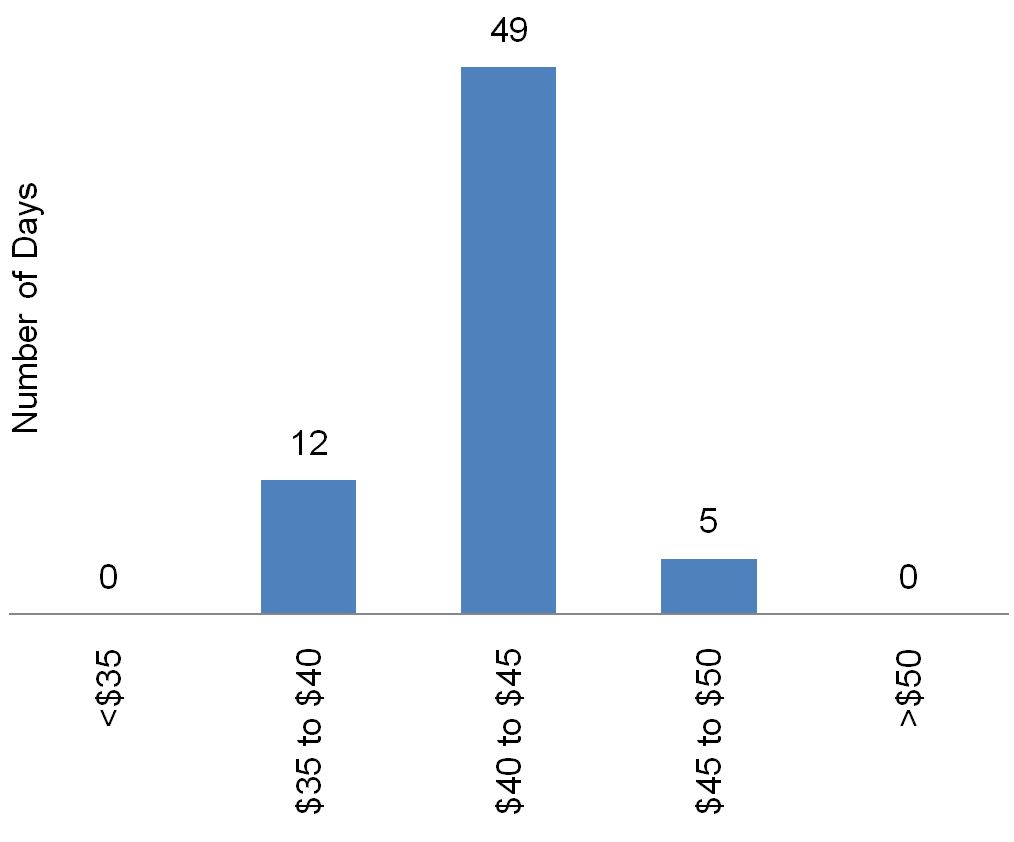
Daily Net Trading Revenues for the Current Quarter
($ in millions)

The previous histogram shows the distribution for the current quarter of daily net trading revenues. Daily net trading revenues include profits and losses from Interest rate and credit spread, Equity price, Foreign exchange rate, Commodity price, and Credit Portfolio positions and intraday trading activities for our trading businesses. Certain items such as fees, commissions and net interest income are excluded from daily net trading revenues and the VaR model. Revenues required for Regulatory VaR backtesting further exclude intraday trading.
Non-Trading Risks
We believe that sensitivity analysis is an appropriate representation of our non-trading risks. The following sensitivity analyses cover substantially all of the non-trading risk in our portfolio.
Credit Spread Risk Sensitivity1
$ in millions | At September 30, 2019 | At June 30, 2019 | ||||
Derivatives | $ | 6 | $ | 6 | ||
Funding liabilities2 | 40 | 40 | ||||
1. | Amounts represent the potential gain for each 1 bps widening of our credit spread. |
2. | Relates to Borrowings carried at fair value. |
U.S. Bank Subsidiaries’ Net Interest Income Sensitivity Analysis
$ in millions | At September 30, 2019 | At June 30, 2019 | ||||
Basis point change | ||||||
+100 | $ | 256 | $ | 273 | ||
-100 | (751 | ) | (722 | ) | ||
The previous table presents an analysis of selected instantaneous upward and downward parallel interest rate shocks on net interest income over the next 12 months for our U.S. Bank Subsidiaries. These shocks are applied to our 12-month forecast for our U.S. Bank Subsidiaries, which incorporates market expectations of interest rates and our forecasted business activity.
We do not manage to any single rate scenario but rather manage net interest income in our U.S. Bank Subsidiaries to optimize across a range of possible outcomes, including non-parallel rate change scenarios. The sensitivity analysis assumes that we take no action in response to these scenarios, assumes there are no changes in other macroeconomic variables normally correlated with changes in interest rates, and includes subjective assumptions regarding customer and market re-pricing behavior and other factors. The change in sensitivity to interest rates between September 30, 2019 and June 30, 2019 is primarily driven by lower market interest rates.
31 | September 2019 Form 10-Q | |
Risk Disclosures | |
Investments Sensitivity, Including Related Carried Interest
Loss from 10% Decline | ||||||
$ in millions | At September 30, 2019 | At June 30, 2019 | ||||
Investments related to Investment Management activities | $ | 341 | $ | 333 | ||
Other investments: | ||||||
MUMSS | 168 | 169 | ||||
Other Firm investments | 186 | 194 | ||||
MUMSS—Mitsubishi UFJ Morgan Stanley Securities Co., Ltd.
We have exposure to public and private companies through direct investments, as well as through funds that invest in these assets. These investments are predominantly equity positions with long investment horizons, a portion of which is for business facilitation purposes. The market risk related to these investments is measured by estimating the potential reduction in net income associated with a 10% decline in investment values and the related impact on carried interest.
Equity Market Sensitivity
In the Wealth Management and Investment Management business segments, certain fee-based revenue streams are driven by the value of clients’ equity holdings. The overall level of revenues for these streams also depends on multiple additional factors that include, but are not limited to, the level and duration of the equity market increase or decline, price volatility, the geographic and industry mix of client assets, the rate and magnitude of client investments and redemptions, and the impact of such market increase or decline and price volatility on client behavior. Therefore, overall revenues do not correlate completely with changes in the equity markets.
Credit Risk
Credit risk refers to the risk of loss arising when a borrower, counterparty or issuer does not meet its financial obligations to us. We primarily incur credit risk exposure to institutions and individuals through our Institutional Securities and Wealth Management business segments. For a further discussion of our credit risks, see “Quantitative and Qualitative Disclosures about Risk—Credit Risk” in the 2018 Form 10-K.
Loans and Lending Commitments
At September 30, 2019 | ||||||||||||
$ in millions | IS | WM | IM1 | Total | ||||||||
Corporate | $ | 27,709 | $ | 17,403 | $ | 5 | $ | 45,117 | ||||
Consumer | — | 30,010 | — | 30,010 | ||||||||
Residential real estate | — | 29,184 | — | 29,184 | ||||||||
Commercial real estate | 6,801 | — | — | 6,801 | ||||||||
Loans held for investment, gross of allowance | 34,510 | 76,597 | 5 | 111,112 | ||||||||
Allowance for loan losses | (248 | ) | (49 | ) | — | (297 | ) | |||||
Loans held for investment, net of allowance | 34,262 | 76,548 | 5 | 110,815 | ||||||||
Corporate | 13,525 | — | — | 13,525 | ||||||||
Residential real estate | — | 17 | — | 17 | ||||||||
Commercial real estate | 1,165 | — | — | 1,165 | ||||||||
Loans held for sale | 14,690 | 17 | — | 14,707 | ||||||||
Corporate | 7,349 | — | 38 | 7,387 | ||||||||
Residential real estate | 1,206 | — | — | 1,206 | ||||||||
Commercial real estate | 1,431 | — | — | 1,431 | ||||||||
Loans held at fair value | 9,986 | — | 38 | 10,024 | ||||||||
Total loans | 58,938 | 76,565 | 43 | 135,546 | ||||||||
Lending commitments2 | 108,536 | 11,771 | — | 120,307 | ||||||||
Total loans and lending commitments2 | $ | 167,474 | $ | 88,336 | $ | 43 | $ | 255,853 | ||||
At December 31, 2018 | ||||||||||||
$ in millions | IS | WM | IM1 | Total | ||||||||
Corporate | $ | 20,020 | $ | 16,884 | $ | 5 | $ | 36,909 | ||||
Consumer | — | 27,868 | — | 27,868 | ||||||||
Residential real estate | — | 27,466 | — | 27,466 | ||||||||
Commercial real estate3 | 7,810 | — | — | 7,810 | ||||||||
Loans held for investment, gross of allowance | 27,830 | 72,218 | 5 | 100,053 | ||||||||
Allowance for loan losses | (193 | ) | (45 | ) | — | (238 | ) | |||||
Loans held for investment, net of allowance | 27,637 | 72,173 | 5 | 99,815 | ||||||||
Corporate | 13,886 | — | — | 13,886 | ||||||||
Residential real estate | 1 | 21 | — | 22 | ||||||||
Commercial real estate3 | 1,856 | — | — | 1,856 | ||||||||
Loans held for sale | 15,743 | 21 | — | 15,764 | ||||||||
Corporate | 9,150 | — | 21 | 9,171 | ||||||||
Residential real estate | 1,153 | — | — | 1,153 | ||||||||
Commercial real estate3 | 601 | — | — | 601 | ||||||||
Loans held at fair value | 10,904 | — | 21 | 10,925 | ||||||||
Total loans | 54,284 | 72,194 | 26 | 126,504 | ||||||||
Lending commitments2 | 95,065 | 10,663 | — | 105,728 | ||||||||
Total loans and lending commitments2 | $ | 149,349 | $ | 82,857 | $ | 26 | $ | 232,232 | ||||
1. | Investment Management business segment loans are related to certain of our activities as an investment advisor and manager. At September 30, 2019, loans held at fair value are the result of the consolidation of an investment vehicle related to these activities. |
2. | Due to the nature of our obligations under the commitments, these amounts include certain commitments participated to third parties. |
3. | Beginning in 2019, loans previously referred to as Wholesale real estate are referred to as Commercial real estate. |
We provide loans and lending commitments to a variety of customers, from large corporate and institutional clients to high net worth individuals. In addition, we purchase loans in the
September 2019 Form 10-Q | 32 | |
Risk Disclosures | |
secondary market. In the balance sheets, these loans and lending commitments are carried as held for investment, which are recorded at amortized cost; as held for sale, which are recorded at the lower of cost or fair value; or at fair value with changes in fair value recorded in earnings. Loans held for investment and loans held for sale are classified in Loans, and loans held at fair value are classified in Trading assets in the balance sheets. Total loans and lending commitments increased by approximately $24 billion since December 31, 2018 primarily in Corporate within the Institutional Securities business segment due to increases in event-driven lending commitments and growth in secured lending facilities. Also contributing to the increase was growth in Consumer securities-based lending and Residential real estate loans within the Wealth Management business segment.
Credit exposure arising from our loans and lending commitments is measured in accordance with our internal risk management standards. Risk factors considered in determining the aggregate allowance for loan and commitment losses include the borrower’s financial strength, industry, facility structure, loan-to-value ratio, debt service ratio, collateral and covenants. Qualitative and environmental factors such as economic and business conditions, nature and volume of the portfolio and lending terms, and volume and severity of past due loans may also be considered.
See Notes 3, 7 and 11 to the financial statements for further information.
Allowance for Loans and Lending Commitments Held for Investment
$ in millions | At September 30, 2019 | At December 31, 2018 | ||||
Loans | $ | 297 | $ | 238 | ||
Lending commitments | 234 | 203 | ||||
Total allowance for loans and lending commitments | $ | 531 | $ | 441 | ||
The aggregate allowance for loans and lending commitments increased in the current year period primarily within the Institutional Securities business segment due to loan and lending commitment growth, deterioration of select credits, and certain environmental factors. See Notes 7 and 11 to the financial statements for further information.
Status of Loans Held for Investment
At September 30, 2019 | At December 31, 2018 | |||||||
IS | WM | IS | WM | |||||
Current | 99.2 | % | 99.9 | % | 99.8 | % | 99.9 | % |
Nonaccrual1 | 0.8 | % | 0.1 | % | 0.2 | % | 0.1 | % |
1. | These loans are on nonaccrual status because the loans were past due for a period of 90 days or more or payment of principal or interest was in doubt. |
Institutional Securities Loans and Lending Commitments1
At September 30, 2019 | |||||||||||||||
Years to Maturity | |||||||||||||||
$ in millions | Less than 1 | 1-3 | 3-5 | Over 5 | Total | ||||||||||
Loans | |||||||||||||||
AA | $ | 308 | $ | 41 | $ | — | $ | 5 | $ | 354 | |||||
A | 814 | 733 | 748 | 363 | 2,658 | ||||||||||
BBB | 3,095 | 4,886 | 3,106 | 569 | 11,656 | ||||||||||
NIG | 9,453 | 16,223 | 11,709 | 5,143 | 42,528 | ||||||||||
Unrated2 | 66 | 76 | 119 | 1,481 | 1,742 | ||||||||||
Total loans | 13,736 | 21,959 | 15,682 | 7,561 | 58,938 | ||||||||||
Lending commitments | |||||||||||||||
AAA | 90 | 50 | — | — | 140 | ||||||||||
AA | 2,405 | 1,362 | 2,121 | — | 5,888 | ||||||||||
A | 4,334 | 6,506 | 9,600 | 715 | 21,155 | ||||||||||
BBB | 10,843 | 13,710 | 20,949 | 546 | 46,048 | ||||||||||
NIG | 4,261 | 10,914 | 15,933 | 4,140 | 35,248 | ||||||||||
Unrated2 | 2 | 26 | 22 | 7 | 57 | ||||||||||
Total lending commitments | 21,935 | 32,568 | 48,625 | 5,408 | 108,536 | ||||||||||
Total exposure | $ | 35,671 | $ | 54,527 | $ | 64,307 | $ | 12,969 | $ | 167,474 | |||||
At December 31, 2018 | |||||||||||||||
Years to Maturity | |||||||||||||||
$ in millions | Less than 1 | 1-3 | 3-5 | Over 5 | Total | ||||||||||
Loans | |||||||||||||||
AA | $ | 7 | $ | 430 | $ | — | $ | 19 | $ | 456 | |||||
A | 565 | 1,580 | 858 | 267 | 3,270 | ||||||||||
BBB | 3,775 | 4,697 | 4,251 | 495 | 13,218 | ||||||||||
NIG | 7,151 | 12,882 | 9,313 | 5,889 | 35,235 | ||||||||||
Unrated2 | 88 | 95 | 160 | 1,762 | 2,105 | ||||||||||
Total loans | 11,586 | 19,684 | 14,582 | 8,432 | 54,284 | ||||||||||
Lending commitments | |||||||||||||||
AAA | 90 | 75 | — | — | 165 | ||||||||||
AA | 2,491 | 1,177 | 2,863 | — | 6,531 | ||||||||||
A | 2,892 | 6,006 | 9,895 | 502 | 19,295 | ||||||||||
BBB | 2,993 | 11,825 | 19,461 | 638 | 34,917 | ||||||||||
NIG | 1,681 | 10,604 | 16,075 | 5,751 | 34,111 | ||||||||||
Unrated2 | 8 | — | 38 | — | 46 | ||||||||||
Total lending commitments | 10,155 | 29,687 | 48,332 | 6,891 | 95,065 | ||||||||||
Total exposure | $ | 21,741 | $ | 49,371 | $ | 62,914 | $ | 15,323 | $ | 149,349 | |||||
NIG–Non-investment grade
1. | Obligor credit ratings are internally determined by the Credit Risk Management Department ("CRM"). |
2. | Unrated loans and lending commitments are primarily trading positions that are measured at fair value and risk managed as a component of market risk. For a further discussion of our market risk, see “Market Risk” herein. |
33 | September 2019 Form 10-Q | |
Risk Disclosures | |
Institutional Securities Loans and Lending Commitments by Industry
$ in millions | At September 30, 2019 | At December 31, 2018 | ||||
Industry | ||||||
Financials | $ | 38,935 | $ | 32,655 | ||
Real estate | 26,299 | 24,133 | ||||
Healthcare | 20,219 | 10,158 | ||||
Industrials | 13,079 | 13,701 | ||||
Communications Services | 12,563 | 11,244 | ||||
Consumer discretionary | 9,814 | 8,314 | ||||
Energy | 9,704 | 9,847 | ||||
Utilities | 9,675 | 9,856 | ||||
Information technology | 8,920 | 9,896 | ||||
Consumer staples | 7,257 | 7,921 | ||||
Materials | 5,108 | 5,969 | ||||
Insurance | 3,714 | 3,744 | ||||
Other | 2,187 | 1,911 | ||||
Total | $ | 167,474 | $ | 149,349 | ||
In connection with certain Institutional Securities business segment activities, we provide loans and lending commitments to a diverse group of corporate and other institutional clients. We also purchase a variety of loans in the secondary market. Our loans and lending commitments may have varying terms; may be senior or subordinated; may be secured or unsecured; are generally contingent upon representations, warranties and contractual conditions applicable to the borrower; and may be syndicated, traded or hedged by us.
We also participate in securitization activities, whereby we extend short- or long-term collateralized lines of credit and term loans with various types of collateral, including residential real estate, commercial real estate, corporate and financial assets. These collateralized loans and lending commitments generally provide for overcollateralization. Credit risk with respect to these loans and lending commitments arises from the failure of a borrower to perform according to the terms of the loan agreement or a decline in the underlying collateral value. The Firm monitors collateral levels against the requirements of lending agreements. See Note 12 to the financial statements for information about our securitization activities.
Institutional Securities Corporate Loans1
$ in millions | At September 30, 2019 | At December 31, 2018 | ||||
Corporate relationship and event-driven lending2 | $ | 13,432 | $ | 13,317 | ||
Secured lending facilities3 | 27,834 | 21,408 | ||||
Securities-based lending and other4 | 7,317 | 8,331 | ||||
Total Corporate | $ | 48,583 | $ | 43,056 | ||
1. | Amounts include loans held for investment, loans held for sale and loans measured at fair value. Loans at fair value are included in Trading assets in the balance sheets. |
2. | Relationship and event-driven loans typically consist of revolving lines of credit, term loans and bridge loans. For additional information on event-driven loans, see “Institutional Securities Event-Driven Loans and Lending Commitments” herein. |
3. | Secured lending facilities includes loans provided to clients to warehouse loans secured by underlying real estate and other assets. |
4. | Securities-based lending and other includes financing extended to sales and trading customers and corporate loans purchased in the secondary market. |
Institutional Securities Event-Driven Loans and Lending Commitments
At September 30, 2019 | |||||||||||||||
Years to Maturity | |||||||||||||||
$ in millions | Less than 1 | 1-3 | 3-5 | Over 5 | Total | ||||||||||
Loans | $ | 1,198 | $ | 516 | $ | 797 | $ | 2,543 | $ | 5,054 | |||||
Lending commitments | 10,022 | 3,278 | 3,086 | 3,453 | 19,839 | ||||||||||
Total loans and lending commitments | $ | 11,220 | $ | 3,794 | $ | 3,883 | $ | 5,996 | $ | 24,893 | |||||
At December 31, 2018 | |||||||||||||||
Years to Maturity | |||||||||||||||
$ in millions | Less than 1 | 1-3 | 3-5 | Over 5 | Total | ||||||||||
Loans | $ | 2,582 | $ | 287 | $ | 656 | $ | 1,618 | $ | 5,143 | |||||
Lending commitments | 1,506 | 2,456 | 2,877 | 3,658 | 10,497 | ||||||||||
Total loans and lending commitments | $ | 4,088 | $ | 2,743 | $ | 3,533 | $ | 5,276 | $ | 15,640 | |||||
Event-driven loans and lending commitments, which comprise a portion of corporate loans and lending commitments within the Institutional Securities business segment, are associated with a particular event or transaction, such as to support client merger, acquisition, recapitalization or project finance activities. Event-driven loans and lending commitments typically consist of revolving lines of credit, term loans and bridge loans. Balances may fluctuate as such lending is related to transactions that vary in timing and size from period to period. In the current year period, the increase in Lending commitments is primarily attributable to client transactions in the healthcare industry.
September 2019 Form 10-Q | 34 | |
Risk Disclosures | |
Wealth Management Loans and Lending Commitments
At September 30, 2019 | |||||||||||||||
Contractual Years to Maturity | |||||||||||||||
$ in millions | Less than 1 | 1-3 | 3-5 | Over 5 | Total | ||||||||||
Securities-based lending and other loans | $ | 40,174 | $ | 3,342 | $ | 2,625 | $ | 1,247 | $ | 47,388 | |||||
Residential real estate loans | 9 | 18 | — | 29,150 | 29,177 | ||||||||||
Total loans | $ | 40,183 | $ | 3,360 | $ | 2,625 | $ | 30,397 | $ | 76,565 | |||||
Lending commitments | 9,467 | 1,792 | 195 | 317 | 11,771 | ||||||||||
Total loans and lending commitments | $ | 49,650 | $ | 5,152 | $ | 2,820 | $ | 30,714 | $ | 88,336 | |||||
Securities-based lending—LAL platform loans | $ | 35,549 | |||||||||||||
At December 31, 2018 | |||||||||||||||
Contractual Years to Maturity | |||||||||||||||
$ in millions | Less than 1 | 1-3 | 3-5 | Over 5 | Total | ||||||||||
Securities-based lending and other loans | $ | 38,144 | $ | 3,573 | $ | 2,004 | $ | 1,006 | $ | 44,727 | |||||
Residential real estate loans | — | 30 | 1 | 27,436 | 27,467 | ||||||||||
Total loans | $ | 38,144 | $ | 3,603 | $ | 2,005 | $ | 28,442 | $ | 72,194 | |||||
Lending commitments | 9,197 | 1,151 | 42 | 273 | 10,663 | ||||||||||
Total loans and lending commitments | $ | 47,341 | $ | 4,754 | $ | 2,047 | $ | 28,715 | $ | 82,857 | |||||
Securities-based lending—LAL platform loans | $ | 33,247 | |||||||||||||
The principal Wealth Management lending activities include securities-based lending and residential real estate loans.
Securities-based lending provided to our clients is primarily conducted through our Liquidity Access Line (“LAL”) platform. For more information about our securities-based lending and residential real estate loans, see “Quantitative and Qualitative Disclosures about Risk—Credit Risk—Wealth Management” in the 2018 Form 10-K.
For the current year period, Loans and Lending commitments associated with the Wealth Management business segment increased due to growth in Securities-based lending and Residential real estate loans.
Customer and Other Receivables
Margin Loans
At September 30, 2019 | |||||||||
$ in millions | IS | WM | Total | ||||||
Customer receivables representing margin loans | $ | 18,321 | $ | 9,747 | $ | 28,068 | |||
At December 31, 2018 | |||||||||
$ in millions | IS | WM | Total | ||||||
Customer receivables representing margin loans | $ | 14,842 | $ | 11,383 | $ | 26,225 | |||
The Institutional Securities and Wealth Management business segments provide margin lending arrangements, which allow customers to borrow against the value of qualifying securities. Margin lending activities generally have minimal credit risk due to the value of collateral held and their short-term nature. Amounts may fluctuate from period to period as overall client balances change as a result of market levels, client positioning and leverage.
Employee Loans
$ in millions | At September 30, 2019 | At December 31, 2018 | ||||
Balance | $ | 2,990 | $ | 3,415 | ||
Allowance for loan losses | (61 | ) | (63 | ) | ||
Balance, net | $ | 2,929 | $ | 3,352 | ||
Remaining repayment term, weighted average in years | 4.7 | 4.3 | ||||
Employee loans are granted in conjunction with a program established primarily to recruit certain Wealth Management representatives, are full recourse and generally require periodic repayments. We establish an allowance for loan amounts we do not consider recoverable, and the related provision is recorded in Compensation and benefits expense.
35 | September 2019 Form 10-Q | |
Risk Disclosures | |
Derivatives
Fair Value of OTC Derivative Assets
Counterparty Credit Rating1 | ||||||||||||||||||
$ in millions | AAA | AA | A | BBB | NIG | Total | ||||||||||||
At September 30, 2019 | ||||||||||||||||||
<1 year | $ | 537 | $ | 4,735 | $ | 36,673 | $ | 21,372 | $ | 6,481 | $ | 69,798 | ||||||
1-3 years | 346 | 2,454 | 24,447 | 15,364 | 8,278 | 50,889 | ||||||||||||
3-5 years | 456 | 2,629 | 13,795 | 8,774 | 2,900 | 28,554 | ||||||||||||
Over 5 years | 3,749 | 17,709 | 94,707 | 47,846 | 17,387 | 181,398 | ||||||||||||
Total, gross | $ | 5,088 | $ | 27,527 | $ | 169,622 | $ | 93,356 | $ | 35,046 | $ | 330,639 | ||||||
Counterparty netting | (2,025 | ) | (17,592 | ) | (138,116 | ) | (71,427 | ) | (21,422 | ) | (250,582 | ) | ||||||
Cash and securities collateral | (2,735 | ) | (8,114 | ) | (26,764 | ) | (16,578 | ) | (9,377 | ) | (63,568 | ) | ||||||
Total, net | $ | 328 | $ | 1,821 | $ | 4,742 | $ | 5,351 | $ | 4,247 | $ | 16,489 | ||||||
Counterparty Credit Rating1 | ||||||||||||||||||
$ in millions | AAA | AA | A | BBB | NIG | Total | ||||||||||||
At December 31, 2018 | ||||||||||||||||||
<1 year | $ | 878 | $ | 7,430 | $ | 38,718 | $ | 15,009 | $ | 7,183 | $ | 69,218 | ||||||
1-3 years | 664 | 2,362 | 22,239 | 10,255 | 7,097 | 42,617 | ||||||||||||
3-5 years | 621 | 2,096 | 11,673 | 6,014 | 2,751 | 23,155 | ||||||||||||
Over 5 years | 3,535 | 9,725 | 67,166 | 36,087 | 11,112 | 127,625 | ||||||||||||
Total, gross | $ | 5,698 | $ | 21,613 | $ | 139,796 | $ | 67,365 | $ | 28,143 | $ | 262,615 | ||||||
Counterparty netting | (2,325 | ) | (13,771 | ) | (113,045 | ) | (49,658 | ) | (16,681 | ) | (195,480 | ) | ||||||
Cash and securities collateral | (3,214 | ) | (5,766 | ) | (21,931 | ) | (12,702 | ) | (8,269 | ) | (51,882 | ) | ||||||
Total, net | $ | 159 | $ | 2,076 | $ | 4,820 | $ | 5,005 | $ | 3,193 | $ | 15,253 | ||||||
$ in millions | At September 30, 2019 | At December 31, 2018 | ||||
Industry | ||||||
Utilities | $ | 4,550 | $ | 4,324 | ||
Financials | 3,903 | 4,480 | ||||
Industrials | 1,313 | 1,335 | ||||
Healthcare | 1,298 | 787 | ||||
Regional governments | 864 | 779 | ||||
Not-for-profit organizations | 742 | 583 | ||||
Energy | 616 | 199 | ||||
Sovereign governments | 587 | 385 | ||||
Information technology | 569 | 695 | ||||
Consumer discretionary | 494 | 188 | ||||
Materials | 453 | 275 | ||||
Communications services | 314 | 373 | ||||
Real estate | 275 | 283 | ||||
Insurance | 243 | 235 | ||||
Consumer staples | 173 | 216 | ||||
Other | 95 | 116 | ||||
Total | $ | 16,489 | $ | 15,253 | ||
1. | Obligor credit ratings are determined internally by CRM. |
We incur credit risk as a dealer in OTC derivatives. Credit risk with respect to derivative instruments arises from the possibility that a counterparty may fail to perform according to the terms of the contract. For more information on derivatives, see “Quantitative and Qualitative Disclosures about Risk—Credit Risk—Derivatives” in the 2018 Form 10-K and Note 4 to the financial statements.
Country Risk
Country risk exposure is the risk that events in, or that affect, a foreign country (any country other than the U.S.) might adversely affect us. We actively manage country risk exposure through a comprehensive risk management framework that combines credit and market fundamentals and allows us to effectively identify, monitor and limit country risk. For a further discussion of our country risk exposure see, “Quantitative and Qualitative Disclosures about Risk—Country Risk” in the 2018 Form 10-K.
Our sovereign exposures consist of financial contracts and obligations entered into with sovereign and local governments. Our non-sovereign exposures consist of financial contracts and obligations entered into primarily with corporations and financial institutions. Index credit derivatives are included in the following country risk exposure table. Each reference entity within an index is allocated to that reference entity’s country of risk. Index exposures are allocated to the underlying reference entities in proportion to the notional weighting of each reference entity in the index, adjusted for any fair value receivable or payable for that reference entity. Where credit risk crosses multiple jurisdictions, for example, a CDS purchased from an issuer in a specific country that references bonds issued by an entity in a different country, the fair value of the CDS is reflected in the Net Counterparty Exposure row based on the country of the CDS issuer. Further, the notional amount of the CDS adjusted for the fair value of the receivable or payable is reflected in the Net Inventory row based on the country of the underlying reference entity.
Top 10 Non-U.S. Country Exposures at September 30, 2019
United Kingdom | |||||||||
$ in millions | Sovereigns | Non-sovereigns | Total | ||||||
Net inventory1 | $ | (879 | ) | $ | 718 | $ | (161 | ) | |
Net counterparty exposure2 | 4 | 10,262 | 10,266 | ||||||
Loans | — | 2,583 | 2,583 | ||||||
Lending commitments | — | 5,608 | 5,608 | ||||||
Exposure before hedges | (875 | ) | 19,171 | 18,296 | |||||
Hedges3 | (311 | ) | (1,211 | ) | (1,522 | ) | |||
Net exposure | $ | (1,186 | ) | $ | 17,960 | $ | 16,774 | ||
Japan | |||||||||
$ in millions | Sovereigns | Non-sovereigns | Total | ||||||
Net inventory1 | $ | 5,621 | $ | 662 | $ | 6,283 | |||
Net counterparty exposure2 | 47 | 3,560 | 3,607 | ||||||
Loans | — | 324 | 324 | ||||||
Exposure before hedges | 5,668 | 4,546 | 10,214 | ||||||
Hedges3 | (77 | ) | (116 | ) | (193 | ) | |||
Net exposure | $ | 5,591 | $ | 4,430 | $ | 10,021 | |||
September 2019 Form 10-Q | 36 | |
Risk Disclosures | |
Spain | |||||||||
$ in millions | Sovereigns | Non-sovereigns | Total | ||||||
Net inventory1 | $ | 15 | $ | (124 | ) | $ | (109 | ) | |
Net counterparty exposure2 | — | 218 | 218 | ||||||
Loans | — | 3,671 | 3,671 | ||||||
Lending commitments | — | 617 | 617 | ||||||
Exposure before hedges | 15 | 4,382 | 4,397 | ||||||
Hedges3 | — | (125 | ) | (125 | ) | ||||
Net exposure | $ | 15 | $ | 4,257 | $ | 4,272 | |||
Germany | |||||||||
$ in millions | Sovereigns | Non-sovereigns | Total | ||||||
Net inventory1 | $ | (2,378 | ) | $ | 1 | $ | (2,377 | ) | |
Net counterparty exposure2 | 96 | 2,643 | 2,739 | ||||||
Loans | — | 1,097 | 1,097 | ||||||
Lending commitments | — | 3,792 | 3,792 | ||||||
Exposure before hedges | (2,282 | ) | 7,533 | 5,251 | |||||
Hedges3 | (231 | ) | (811 | ) | (1,042 | ) | |||
Net exposure | $ | (2,513 | ) | $ | 6,722 | $ | 4,209 | ||
Brazil | |||||||||
$ in millions | Sovereigns | Non-sovereigns | Total | ||||||
Net inventory1 | $ | 3,730 | $ | 49 | $ | 3,779 | |||
Net counterparty exposure2 | — | 178 | 178 | ||||||
Loans | — | 37 | 37 | ||||||
Lending commitments | — | 235 | 235 | ||||||
Exposure before hedges | 3,730 | 499 | 4,229 | ||||||
Hedges3 | (12 | ) | (32 | ) | (44 | ) | |||
Net exposure | $ | 3,718 | $ | 467 | $ | 4,185 | |||
China | |||||||||
$ in millions | Sovereigns | Non-sovereigns | Total | ||||||
Net inventory1 | $ | (284 | ) | $ | 964 | $ | 680 | ||
Net counterparty exposure2 | 126 | 237 | 363 | ||||||
Loans | — | 1,866 | 1,866 | ||||||
Lending commitments | — | 865 | 865 | ||||||
Exposure before hedges | (158 | ) | 3,932 | 3,774 | |||||
Hedges3 | (82 | ) | (80 | ) | (162 | ) | |||
Net exposure | $ | (240 | ) | $ | 3,852 | $ | 3,612 | ||
Canada | |||||||||
$ in millions | Sovereigns | Non-sovereigns | Total | ||||||
Net inventory1 | $ | (168 | ) | $ | 101 | $ | (67 | ) | |
Net counterparty exposure2 | 107 | 1,944 | 2,051 | ||||||
Loans | — | 218 | 218 | ||||||
Lending commitments | — | 1,473 | 1,473 | ||||||
Exposure before hedges | (61 | ) | 3,736 | 3,675 | |||||
Hedges3 | — | (140 | ) | (140 | ) | ||||
Net exposure | $ | (61 | ) | $ | 3,596 | $ | 3,535 | ||
France | |||||||||
$ in millions | Sovereigns | Non-sovereigns | Total | ||||||
Net inventory1 | $ | (1,367 | ) | $ | (784 | ) | $ | (2,151 | ) |
Net counterparty exposure2 | — | 2,585 | 2,585 | ||||||
Loans | — | 595 | 595 | ||||||
Lending commitments | — | 2,851 | 2,851 | ||||||
Exposure before hedges | (1,367 | ) | 5,247 | 3,880 | |||||
Hedges3 | (6 | ) | (553 | ) | (559 | ) | |||
Net exposure | $ | (1,373 | ) | $ | 4,694 | $ | 3,321 | ||
India | |||||||||
$ in millions | Sovereigns | Non-sovereigns | Total | ||||||
Net inventory1 | $ | 1,624 | $ | 592 | $ | 2,216 | |||
Net counterparty exposure2 | — | 655 | 655 | ||||||
Loans | — | 242 | 242 | ||||||
Exposure before hedges | 1,624 | 1,489 | 3,113 | ||||||
Net exposure | $ | 1,624 | $ | 1,489 | $ | 3,113 | |||
Ireland | |||||||||
$ in millions | Sovereigns | Non-sovereigns | Total | ||||||
Net inventory1 | $ | (23 | ) | $ | 223 | $ | 200 | ||
Net counterparty exposure2 | 3 | 220 | 223 | ||||||
Loans | — | 2,177 | 2,177 | ||||||
Lending commitments | — | 361 | 361 | ||||||
Exposure before hedges | (20 | ) | 2,981 | 2,961 | |||||
Hedges3 | (30 | ) | — | (30 | ) | ||||
Net exposure | $ | (50 | ) | $ | 2,981 | $ | 2,931 | ||
1. | Net inventory represents exposure to both long and short single-name and index positions (i.e., bonds and equities at fair value and CDS based on a notional amount assuming zero recovery adjusted for the fair value of any receivable or payable). |
2. | Net counterparty exposure (e.g., repurchase transactions, securities lending and OTC derivatives) takes into consideration legally enforceable master netting agreements and collateral. Net counterparty exposure is net of the benefit of collateral received. For more information, see “Additional Information—Top 10 Non-U.S. Country Exposures” herein. |
3. | Amounts represent CDS hedges (purchased and sold) on net counterparty exposure and lending executed by trading desks responsible for hedging counterparty and lending credit risk exposures. Amounts are based on the CDS notional amount assuming zero recovery adjusted for any fair value receivable or payable. For further description of the contractual terms for purchased credit protection and whether they may limit the effectiveness of our hedges, see “Quantitative and Qualitative Disclosures about Risk—Credit Risk—Derivatives” in the 2018 Form 10-K. |
Additional Information—Top 10 Non-U.S. Country Exposures
Benefit of Collateral Received against Net Counterparty Exposure
$ in millions | At September 30, 2019 | |||
Counterparty credit exposure | Collateral1 | |||
Germany | Germany and Austria | $ | 12,964 | |
United Kingdom | U.K., U.S. and Japan | 10,416 | ||
Other | Japan, France and U.S. | 19,298 | ||
1. | Collateral primarily consists of cash and government obligations. |
37 | September 2019 Form 10-Q | |
Risk Disclosures | |
Country Risk Exposures Related to the U.K.
At September 30, 2019, our country risk exposure in the U.K. included net exposures of $16,774 million (as shown in the Top 10 Country Exposures table) and overnight deposits of $6,013 million. The $17,960 million of exposures to non-sovereigns were diversified across both names and sectors and include $6,445 million to U.K.-focused counterparties that generate more than one-third of their revenues in the U.K., $4,864 million to geographically diversified counterparties, and $5,970 million to exchanges and clearinghouses.
Operational Risk
Operational risk refers to the risk of loss, or of damage to our reputation, resulting from inadequate or failed processes or systems, from human factors or from external events (e.g., fraud, theft, legal and compliance risks, cyber attacks or damage to physical assets). We may incur operational risk across the full scope of our business activities, including revenue-generating activities (e.g., sales and trading) and support and control groups (e.g., information technology and trade processing). For a further discussion about our operational risk, see “Quantitative and Qualitative Disclosures about Risk—Operational Risk” in the 2018 Form 10-K.
Model Risk
Model risk refers to the potential for adverse consequences from decisions based on incorrect or misused model outputs. Model risk can lead to financial loss, poor business and strategic decision making, or damage to a firm’s reputation. The risk inherent in a model is a function of the materiality, complexity and uncertainty around inputs and assumptions. Model risk is generated from the use of models impacting financial statements, regulatory filings, capital adequacy assessments and the formulation of strategy. For a further discussion about our model risk, see “Quantitative and Qualitative Disclosures about Risk—Model Risk” in the 2018 Form 10-K.
Liquidity Risk
Liquidity risk refers to the risk that we will be unable to finance our operations due to a loss of access to the capital markets or difficulty in liquidating our assets. Liquidity risk also encompasses our ability (or perceived ability) to meet our financial obligations without experiencing significant business disruption or reputational damage that may threaten our viability as a going concern. For a further discussion about our liquidity risk, see “Quantitative and Qualitative Disclosures about Risk—Liquidity Risk” in the 2018 Form 10-K and “Management’s Discussion and Analysis of Financial Condition and Results of Operations—Liquidity and Capital Resources” herein.
Legal and Compliance Risk
Legal and compliance risk includes the risk of legal or regulatory sanctions, material financial loss, including fines, penalties, judgments, damages and/or settlements, or loss to reputation that we may suffer as a result of failure to comply with laws, regulations, rules, related self-regulatory organization standards and codes of conduct applicable to our business activities. This risk also includes contractual and commercial risk, such as the risk that a counterparty’s performance obligations will be unenforceable. It also includes compliance with AML, terrorist financing, and anti-corruption rules and regulations. For a further discussion about our legal and compliance risk, see “Quantitative and Qualitative Disclosures about Risk—Legal and Compliance Risk” in the 2018 Form 10-K.
September 2019 Form 10-Q | 38 | |
Report of Independent Registered Public Accounting Firm
To the Board of Directors and Shareholders of Morgan Stanley:
Results of Review of Interim Financial Information
We have reviewed the accompanying condensed consolidated balance sheet of Morgan Stanley and subsidiaries (the “Firm”) as of September 30, 2019, and the related condensed consolidated income statements, comprehensive income statements and statements of changes in total equity for the three-month and nine-month periods ended September 30, 2019 and 2018, and the cash flow statements for the nine-month periods ended September 30, 2019 and 2018, and the related notes (collectively referred to as the “interim financial information”). Based on our reviews, we are not aware of any material modifications that should be made to the accompanying interim financial information for it to be in conformity with accounting principles generally accepted in the United States of America.
We have previously audited, in accordance with the standards of the Public Company Accounting Oversight Board (United States) (PCAOB), the consolidated balance sheet of the Firm as of December 31, 2018, and the related consolidated income statement, comprehensive income statement, cash flow statement and statement of changes in total equity for the year then ended (not presented herein) included in the Firm’s Annual Report on Form 10-K; and in our report dated February 26, 2019, we expressed an unqualified opinion on those consolidated financial statements. In our opinion, the information set forth in the accompanying condensed consolidated balance sheet as of December 31, 2018 is fairly stated, in all material respects, in relation to the consolidated balance sheet from which it has been derived.
Basis for Review Results
This interim financial information is the responsibility of the Firm’s management. We are a public accounting firm registered with the PCAOB and are required to be independent with respect to the Firm in accordance with the U.S. federal securities laws and the applicable rules and regulations of the Securities and Exchange Commission and the PCAOB.
We conducted our reviews in accordance with the standards of the PCAOB. A review of interim financial information consists principally of applying analytical procedures and making inquiries of persons responsible for financial and accounting matters. It is substantially less in scope than an audit conducted in accordance with the standards of the PCAOB, the objective of which is the expression of an opinion regarding the financial statements taken as a whole. Accordingly, we do not express such an opinion.
/s/ Deloitte & Touche LLP |
New York, New York |
November 5, 2019 |
39 | September 2019 Form 10-Q | |
Consolidated Income Statements (Unaudited) | |
Three Months Ended September 30, | Nine Months Ended September 30, | |||||||||||
in millions, except per share data | 2019 | 2018 | 2019 | 2018 | ||||||||
Revenues | ||||||||||||
Investment banking | $ | $ | $ | $ | ||||||||
Trading | ||||||||||||
Investments | ||||||||||||
Commissions and fees | ||||||||||||
Asset management | ||||||||||||
Other | ||||||||||||
Total non-interest revenues | ||||||||||||
Interest income | ||||||||||||
Interest expense | ||||||||||||
Net interest | ||||||||||||
Net revenues | ||||||||||||
Non-interest expenses | ||||||||||||
Compensation and benefits | ||||||||||||
Occupancy and equipment | ||||||||||||
Brokerage, clearing and exchange fees | ||||||||||||
Information processing and communications | ||||||||||||
Marketing and business development | ||||||||||||
Professional services | ||||||||||||
Other | ||||||||||||
Total non-interest expenses | ||||||||||||
Income from continuing operations before income taxes | ||||||||||||
Provision for income taxes | ||||||||||||
Income from continuing operations | ||||||||||||
Income (loss) from discontinued operations, net of income taxes | ( | ) | ( | ) | ||||||||
Net income | $ | $ | $ | $ | ||||||||
Net income applicable to noncontrolling interests | ||||||||||||
Net income applicable to Morgan Stanley | $ | $ | $ | $ | ||||||||
Preferred stock dividends | ||||||||||||
Earnings applicable to Morgan Stanley common shareholders | $ | $ | $ | $ | ||||||||
Earnings per common share | ||||||||||||
Basic | $ | $ | $ | $ | ||||||||
Diluted | $ | $ | $ | $ | ||||||||
Average common shares outstanding | ||||||||||||
Basic | ||||||||||||
Diluted | ||||||||||||
September 2019 Form 10-Q | 40 | See Notes to Consolidated Financial Statements |
Consolidated Comprehensive Income Statements (Unaudited) | |
Three Months Ended September 30, | Nine Months Ended September 30, | |||||||||||
$ in millions | 2019 | 2018 | 2019 | 2018 | ||||||||
Net income | $ | $ | $ | $ | ||||||||
Other comprehensive income (loss), net of tax: | ||||||||||||
Foreign currency translation adjustments | $ | ( | ) | $ | ( | ) | $ | ( | ) | $ | ( | ) |
Change in net unrealized gains (losses) on available-for-sale securities | ( | ) | ( | ) | ||||||||
Pension, postretirement and other | ||||||||||||
Change in net debt valuation adjustment | ( | ) | ( | ) | ||||||||
Total other comprehensive income (loss) | $ | $ | ( | ) | $ | $ | ( | ) | ||||
Comprehensive income | $ | $ | $ | $ | ||||||||
Net income applicable to noncontrolling interests | ||||||||||||
Other comprehensive income (loss) applicable to noncontrolling interests | ( | ) | ( | ) | ||||||||
Comprehensive income applicable to Morgan Stanley | $ | $ | $ | $ | ||||||||
See Notes to Consolidated Financial Statements | 41 | September 2019 Form 10-Q |
Consolidated Balance Sheets | |
$ in millions, except share data | (Unaudited) At September 30, 2019 | At December 31, 2018 | ||||
Assets | ||||||
Cash and cash equivalents: | ||||||
Cash and due from banks | $ | $ | ||||
Interest bearing deposits with banks | ||||||
Restricted cash | ||||||
Trading assets at fair value ($116,506 and $120,437 were pledged to various parties) | ||||||
Investment securities (includes $64,714 and $61,061 at fair value) | ||||||
Securities purchased under agreements to resell (includes $4 and $— at fair value) | ||||||
Securities borrowed | ||||||
Customer and other receivables | ||||||
Loans: | ||||||
Held for investment (net of allowance of $297 and $238) | ||||||
Held for sale | ||||||
Goodwill | ||||||
Intangible assets (net of accumulated amortization of $3,124 and $2,877) | ||||||
Other assets | ||||||
Total assets | $ | $ | ||||
Liabilities | ||||||
Deposits (includes $1,622 and $442 at fair value) | $ | $ | ||||
Trading liabilities at fair value | ||||||
Securities sold under agreements to repurchase (includes $732 and $812 at fair value) | ||||||
Securities loaned | ||||||
Other secured financings (includes $6,352 and $5,245 at fair value) | ||||||
Customer and other payables | ||||||
Other liabilities and accrued expenses | ||||||
Borrowings (includes $61,654 and $51,184 at fair value) | ||||||
Total liabilities | ||||||
Commitments and contingent liabilities (see Note 11) | ||||||
Equity | ||||||
Morgan Stanley shareholders’ equity: | ||||||
Preferred stock | ||||||
Common stock, $0.01 par value: | ||||||
Shares authorized: 3,500,000,000; Shares issued: 2,038,893,979; Shares outstanding: 1,623,587,078 and 1,699,828,943 | ||||||
Additional paid-in capital | ||||||
Retained earnings | ||||||
Employee stock trusts | ||||||
Accumulated other comprehensive income (loss) | ( | ) | ( | ) | ||
Common stock held in treasury at cost, $0.01 par value (415,306,901 and 339,065,036 shares) | ( | ) | ( | ) | ||
Common stock issued to employee stock trusts | ( | ) | ( | ) | ||
Total Morgan Stanley shareholders’ equity | ||||||
Noncontrolling interests | ||||||
Total equity | ||||||
Total liabilities and equity | $ | $ | ||||
September 2019 Form 10-Q | 42 | See Notes to Consolidated Financial Statements |
Consolidated Statements of Changes in Total Equity (Unaudited) | |
Three Months Ended September 30, | Nine Months Ended September 30, | |||||||||||
$ in millions | 2019 | 2018 | 2019 | 2018 | ||||||||
Preferred Stock | ||||||||||||
Beginning and ending balance | $ | $ | $ | $ | ||||||||
Common Stock | ||||||||||||
Beginning and ending balance | ||||||||||||
Additional Paid-in Capital | ||||||||||||
Beginning balance | ||||||||||||
Share-based award activity | ( | ) | ||||||||||
Other net increases | ||||||||||||
Ending balance | ||||||||||||
Retained Earnings | ||||||||||||
Beginning balance | ||||||||||||
Cumulative adjustments for accounting changes1 | ||||||||||||
Net income applicable to Morgan Stanley | ||||||||||||
Preferred stock dividends2 | ( | ) | ( | ) | ( | ) | ( | ) | ||||
Common stock dividends2 | ( | ) | ( | ) | ( | ) | ( | ) | ||||
Ending balance | ||||||||||||
Employee Stock Trusts | ||||||||||||
Beginning balance | ||||||||||||
Share-based award activity | ( | ) | ( | ) | ( | ) | ||||||
Ending balance | ||||||||||||
Accumulated Other Comprehensive Income (Loss) | ||||||||||||
Beginning balance | ( | ) | ( | ) | ( | ) | ( | ) | ||||
Cumulative adjustments for accounting changes1 | ( | ) | ||||||||||
Net change in Accumulated other comprehensive income (loss) | ( | ) | ( | ) | ||||||||
Ending balance | ( | ) | ( | ) | ( | ) | ( | ) | ||||
Common Stock Held In Treasury at Cost | ||||||||||||
Beginning balance | ( | ) | ( | ) | ( | ) | ( | ) | ||||
Share-based award activity | ||||||||||||
Repurchases of common stock and employee tax withholdings | ( | ) | ( | ) | ( | ) | ( | ) | ||||
Ending balance | ( | ) | ( | ) | ( | ) | ( | ) | ||||
Common Stock Issued to Employee Stock Trusts | ||||||||||||
Beginning balance | ( | ) | ( | ) | ( | ) | ( | ) | ||||
Share-based award activity | ( | ) | ||||||||||
Ending balance | ( | ) | ( | ) | ( | ) | ( | ) | ||||
Non-Controlling Interests | ||||||||||||
Beginning balance | ||||||||||||
Net income applicable to non-controlling interests | ||||||||||||
Net change in Accumulated other comprehensive income (loss) | ( | ) | ( | ) | ||||||||
Other net increases (decreases) | ( | ) | ( | ) | ||||||||
Ending balance | ||||||||||||
Total Equity | $ | $ | $ | $ | ||||||||
1. | Cumulative adjustments for accounting changes relate to the adoption of certain accounting updates during the current and prior year periods. See Notes 2 and 14 for further information. |
2. | See Note 14 for information regarding dividends per share for common stock and each class of preferred stock. |
See Notes to Consolidated Financial Statements | 43 | September 2019 Form 10-Q |
Consolidated Cash Flow Statements (Unaudited) | |
Nine Months Ended September 30, | ||||||
$ in millions | 2019 | 2018 | ||||
Cash flows from operating activities | ||||||
Net income | $ | $ | ||||
Adjustments to reconcile net income to net cash provided by (used for) operating activities: | ||||||
Stock-based compensation expense | ||||||
Depreciation and amortization | ||||||
(Release of) Provision for credit losses on lending activities | ( | ) | ||||
Other operating adjustments | ( | ) | ( | ) | ||
Changes in assets and liabilities: | ||||||
Trading assets, net of Trading liabilities | ||||||
Securities borrowed | ( | ) | ( | ) | ||
Securities loaned | ( | ) | ( | ) | ||
Customer and other receivables and other assets | ( | ) | ( | ) | ||
Customer and other payables and other liabilities | ||||||
Securities purchased under agreements to resell | ||||||
Securities sold under agreements to repurchase | ||||||
Net cash provided by (used for) operating activities | ||||||
Cash flows from investing activities | ||||||
Proceeds from (payments for): | ||||||
Other assets—Premises, equipment and software, net | ( | ) | ( | ) | ||
Changes in loans, net | ( | ) | ( | ) | ||
Investment securities: | ||||||
Purchases | ( | ) | ( | ) | ||
Proceeds from sales | ||||||
Proceeds from paydowns and maturities | ||||||
Other investing activities | ( | ) | ( | ) | ||
Net cash provided by (used for) investing activities | ( | ) | ( | ) | ||
Cash flows from financing activities | ||||||
Net proceeds from (payments for): | ||||||
Other secured financings | ( | ) | ( | ) | ||
Deposits | ( | ) | ||||
Proceeds from issuance of Borrowings | ||||||
Payments for: | ||||||
Borrowings | ( | ) | ( | ) | ||
Repurchases of common stock and employee tax withholdings | ( | ) | ( | ) | ||
Cash dividends | ( | ) | ( | ) | ||
Other financing activities | ( | ) | ( | ) | ||
Net cash provided by (used for) financing activities | ( | ) | ||||
Effect of exchange rate changes on cash and cash equivalents | ( | ) | ( | ) | ||
Net increase (decrease) in cash and cash equivalents | ( | ) | ||||
Cash and cash equivalents, at beginning of period | ||||||
Cash and cash equivalents, at end of period | $ | $ | ||||
Cash and cash equivalents: | ||||||
Cash and due from banks | $ | $ | ||||
Interest bearing deposits with banks | ||||||
Restricted cash | ||||||
Cash and cash equivalents, at end of period | $ | $ | ||||
Supplemental Disclosure of Cash Flow Information | ||||||
Cash payments for: | ||||||
Interest | $ | $ | ||||
Income taxes, net of refunds | ||||||
September 2019 Form 10-Q | 44 | See Notes to Consolidated Financial Statements |
Notes to Consolidated Financial Statements (Unaudited) | |
1. Introduction and Basis of Presentation
The Firm
Morgan Stanley is a global financial services firm that maintains significant market positions in each of its business segments—Institutional Securities, Wealth Management and Investment Management. Morgan Stanley, through its subsidiaries and affiliates, provides a wide variety of products and services to a large and diversified group of clients and customers, including corporations, governments, financial institutions and individuals. Unless the context otherwise requires, the terms “Morgan Stanley” or the “Firm” mean Morgan Stanley (the “Parent Company”) together with its consolidated subsidiaries. See the “Glossary of Common Acronyms” for definitions of certain acronyms used throughout this Form 10-Q.
A description of the clients and principal products and services of each of the Firm’s business segments is as follows:
Institutional Securities provides investment banking, sales and trading, lending and other services to corporations, governments, financial institutions, and high to ultra-high net worth clients. Investment banking services consist of capital raising and financial advisory services, including services relating to the underwriting of debt, equity and other securities, as well as advice on mergers and acquisitions, restructurings, real estate and project finance. Sales and trading services include sales, financing, prime brokerage and market-making activities in equity and fixed income products, including foreign exchange and commodities. Lending activities include originating corporate loans, commercial mortgage lending, providing secured lending facilities and extending financing to sales and trading customers. Other activities include investments and research.
Wealth Management provides a comprehensive array of financial services and solutions to individual investors and small to medium-sized businesses and institutions covering brokerage and investment advisory services; financial and wealth planning services; annuity and insurance products; securities-based lending, residential real estate loans and other lending products; banking and retirement plan services.
Investment Management provides a broad range of investment strategies and products that span geographies, asset classes, and public and private markets to a diverse group of clients across institutional and intermediary channels. Strategies and products include equity, fixed income, liquidity and alternative/other products. Institutional clients include defined benefit/defined contribution plans, foundations, endowments, government entities, sovereign wealth funds, insurance companies, third-party fund sponsors and corporations. Individual clients are served through intermediaries, including affiliated and non-affiliated distributors.
Basis of Financial Information
The unaudited consolidated financial statements (“financial statements”) are prepared in accordance with U.S. GAAP, which requires the Firm to make estimates and assumptions regarding the valuations of certain financial instruments, the valuation of goodwill and intangible assets, compensation, deferred tax assets, the outcome of legal and tax matters, allowance for credit losses and other matters that affect its financial statements and related disclosures. The Firm believes that the estimates utilized in the preparation of its financial statements are prudent and reasonable. Actual results could differ materially from these estimates. Intercompany balances and transactions have been eliminated. Certain reclassifications have been made to prior periods to conform to the current presentation.
The Firm has evaluated subsequent events for adjustment to or disclosure in the financial statements through the date of this report and has not identified any recordable or disclosable events not otherwise reported in these financial statements or the notes thereto.
The accompanying financial statements should be read in conjunction with the Firm’s financial statements and notes thereto included in the 2018 Form 10-K. Certain footnote disclosures included in the 2018 Form 10-K have been condensed or omitted from these financial statements as they are not required for interim reporting under U.S. GAAP. The financial statements reflect all adjustments of a normal, recurring nature that are, in the opinion of management, necessary for the fair presentation of the results for the interim period. The results of operations for interim periods are not necessarily indicative of results for the entire year.
Consolidation
The financial statements include the accounts of the Firm, its wholly owned subsidiaries and other entities in which the Firm has a controlling financial interest, including certain VIEs (see Note 12). For consolidated subsidiaries that are not wholly owned, the third-party holdings of equity interests are referred to as noncontrolling interests. The net income attributable to noncontrolling interests for such subsidiaries is presented as Net income applicable to noncontrolling interests in the consolidated income statements (“income statements”). The portion of shareholders’ equity that is attributable to noncontrolling interests for such subsidiaries is presented as noncontrolling interests, a component of total equity, in the consolidated balance sheets (“balance sheets”).
For a discussion of the Firm’s significant regulated U.S. and international subsidiaries and its involvement with VIEs, see Note 1 to the financial statements in the 2018 Form 10-K.
45 | September 2019 Form 10-Q | |
Notes to Consolidated Financial Statements (Unaudited) | |
2. Significant Accounting Policies
For a detailed discussion about the Firm’s significant accounting policies and for further information on accounting updates adopted in the prior year, see Note 2 to the financial statements in the 2018 Form 10-K.
During the nine months ended September 30, 2019 (“current year period”), there were no significant revisions to the Firm’s significant accounting policies, other than for the accounting updates adopted.
Accounting Updates Adopted
The Firm adopted the following accounting updates on January 1, 2019. Prior periods are presented under previous policies.
Leases
Upon the adoption of Leases, the Firm began recognizing in the balance sheet leases with terms exceeding one year as right-of-use (“ROU”) assets and corresponding liabilities. The adoption resulted in an increase to Retained earnings of approximately $63 million, net of tax, related to deferred revenue from previously recorded sale-leaseback transactions. At transition on January 1, 2019, the adoption also resulted in a balance sheet gross-up of approximately $4 billion reflected in Other assets and Other liabilities and accrued expenses. See Note 11 for lease disclosures, including amounts reflected in the September 30, 2019 balance sheet. Prior period amounts were not restated.
As allowed by the guidance, the Firm elected not to reassess the following at transition: whether existing contracts are or contain leases, and for existing leases, lease classification and initial direct costs. In addition, the Firm continues to account for existing land easements as service contracts.
Both at transition and for new leases thereafter, ROU assets and lease liabilities are initially recognized based on the present value of the future minimum lease payments over the lease term, including non-lease components such as fixed common area maintenance costs and other fixed costs such as real estate taxes and insurance.
The discount rates used in determining the present value of leases are the Firm’s incremental borrowing rates, developed based upon each lease’s term and currency of payment. The lease term includes options to extend or terminate the lease when it is reasonably certain that the Firm will exercise that option. For operating leases, the ROU assets also include any prepaid lease payments and initial direct costs incurred and are reduced by lease incentives. For these leases, lease expense is recognized on a straight-line basis over the lease term if the ROU asset has not been impaired or abandoned.
Derivatives and Hedging (ASU 2018-16)
The amendments in this update permit use of the OIS rate based on the Secured Overnight Financing Rate as a U.S. benchmark interest rate for hedge accounting purposes. The Firm adopted this update on a prospective basis for qualifying new or redesignated hedging relationships. This update did not impact the Firm’s pre-existing hedges.
Goodwill
3. Fair Values
Recurring Fair Value Measurements
Assets and Liabilities Measured at Fair Value on a Recurring Basis
At September 30, 2019 | |||||||||||||||
$ in millions | Level 1 | Level 2 | Level 3 | Netting1 | Total | ||||||||||
Assets at fair value | |||||||||||||||
Trading assets: | |||||||||||||||
U.S. Treasury and agency securities | $ | $ | $ | $ | — | $ | |||||||||
Other sovereign government obligations | — | ||||||||||||||
State and municipal securities | — | ||||||||||||||
MABS | — | ||||||||||||||
Loans and lending commitments2 | — | ||||||||||||||
Corporate and other debt | — | ||||||||||||||
Corporate equities3 | — | ||||||||||||||
Derivative and other contracts: | |||||||||||||||
Interest rate | — | ||||||||||||||
Credit | — | ||||||||||||||
Foreign exchange | — | ||||||||||||||
Equity | — | ||||||||||||||
Commodity and other | — | ||||||||||||||
Netting1 | ( | ) | ( | ) | ( | ) | ( | ) | ( | ) | |||||
Total derivative and other contracts | ( | ) | |||||||||||||
Investments4 | — | ||||||||||||||
Physical commodities | — | ||||||||||||||
Total trading assets | ( | ) | |||||||||||||
Investment securities—AFS | — | ||||||||||||||
Securities purchased under agreements to resell | — | ||||||||||||||
Total assets at fair value | $ | $ | $ | $ | ( | ) | $ | ||||||||
September 2019 Form 10-Q | 46 | |
Notes to Consolidated Financial Statements (Unaudited) | |
At September 30, 2019 | |||||||||||||||
$ in millions | Level 1 | Level 2 | Level 3 | Netting1 | Total | ||||||||||
Liabilities at fair value | |||||||||||||||
Deposits | $ | $ | $ | $ | — | $ | |||||||||
Trading liabilities: | |||||||||||||||
U.S. Treasury and agency securities | — | ||||||||||||||
Other sovereign government obligations | — | ||||||||||||||
Corporate and other debt | — | ||||||||||||||
Corporate equities3 | — | ||||||||||||||
Derivative and other contracts: | |||||||||||||||
Interest rate | — | ||||||||||||||
Credit | — | ||||||||||||||
Foreign exchange | — | ||||||||||||||
Equity | — | ||||||||||||||
Commodity and other | — | ||||||||||||||
Netting1 | ( | ) | ( | ) | ( | ) | ( | ) | ( | ) | |||||
Total derivative and other contracts | ( | ) | |||||||||||||
Total trading liabilities | ( | ) | |||||||||||||
Securities sold under agreements to repurchase | — | ||||||||||||||
Other secured financings | — | ||||||||||||||
Borrowings | — | ||||||||||||||
Total liabilities at fair value | $ | $ | $ | $ | ( | ) | $ | ||||||||
At December 31, 2018 | |||||||||||||||
$ in millions | Level 1 | Level 2 | Level 3 | Netting1 | Total | ||||||||||
Assets at fair value | |||||||||||||||
Trading assets: | |||||||||||||||
U.S. Treasury and agency securities | $ | $ | $ | $ | — | $ | |||||||||
Other sovereign government obligations | — | ||||||||||||||
State and municipal securities | — | ||||||||||||||
MABS | — | ||||||||||||||
Loans and lending commitments2 | — | ||||||||||||||
Corporate and other debt | — | ||||||||||||||
Corporate equities3 | — | ||||||||||||||
Derivative and other contracts: | |||||||||||||||
Interest rate | — | ||||||||||||||
Credit | — | ||||||||||||||
Foreign exchange | — | ||||||||||||||
Equity | — | ||||||||||||||
Commodity and other | — | ||||||||||||||
Netting1 | ( | ) | ( | ) | ( | ) | ( | ) | ( | ) | |||||
Total derivative and other contracts | ( | ) | |||||||||||||
Investments4 | — | ||||||||||||||
Physical commodities | — | ||||||||||||||
Total trading assets | ( | ) | |||||||||||||
Investment securities—AFS | — | ||||||||||||||
Intangible assets | — | ||||||||||||||
Total assets at fair value | $ | $ | $ | $ | ( | ) | $ | ||||||||
47 | September 2019 Form 10-Q | |
Notes to Consolidated Financial Statements (Unaudited) | |
At December 31, 2018 | |||||||||||||||
$ in millions | Level 1 | Level 2 | Level 3 | Netting1 | Total | ||||||||||
Liabilities at fair value | |||||||||||||||
Deposits | $ | $ | $ | $ | — | $ | |||||||||
Trading liabilities: | |||||||||||||||
U.S. Treasury and agency securities | — | ||||||||||||||
Other sovereign government obligations | — | ||||||||||||||
Corporate and other debt | — | ||||||||||||||
Corporate equities3 | — | ||||||||||||||
Derivative and other contracts: | |||||||||||||||
Interest rate | — | ||||||||||||||
Credit | — | ||||||||||||||
Foreign exchange | — | ||||||||||||||
Equity | — | ||||||||||||||
Commodity and other | — | ||||||||||||||
Netting1 | ( | ) | ( | ) | ( | ) | ( | ) | ( | ) | |||||
Total derivative and other contracts | ( | ) | |||||||||||||
Total trading liabilities | ( | ) | |||||||||||||
Securities sold under agreements to repurchase | — | ||||||||||||||
Other secured financings | — | ||||||||||||||
Borrowings | — | ||||||||||||||
Total liabilities at fair value | $ | $ | $ | $ | ( | ) | $ | ||||||||
MABS—Mortgage- and asset-backed securities
1. | For positions with the same counterparty classified in different levels of the fair value hierarchy, both counterparty netting and cash collateral netting are included in the column titled “Netting.” Positions classified within the same level that are with the same counterparty are netted within the column for that level. For further information on derivative instruments and hedging activities, see Note 4. |
2. | For a further breakdown by type, see the following Breakdown of Loans and Lending Commitments at Fair Value table. |
3. | For trading purposes, the Firm holds or sells short equity securities issued by entities in diverse industries and of varying sizes. |
4. | Amounts exclude certain investments that are measured based on NAV per share, which are not classified in the fair value hierarchy. For additional disclosure about such investments, see “Net Asset Value Measurements—Fund Interests” herein. |
Breakdown of Loans and Lending Commitments at Fair Value
$ in millions | At September 30, 2019 | At December 31, 2018 | ||||
Corporate | $ | $ | ||||
Residential real estate | ||||||
Commercial real estate | ||||||
Total | $ | $ | ||||
Unsettled Fair Value of Futures Contracts1
$ in millions | At September 30, 2019 | At December 31, 2018 | ||||
Customer and other receivables, net | $ | $ | ||||
1. | These contracts are primarily Level 1, actively traded, valued based on quoted prices from the exchange and are excluded from the previous recurring fair value tables. |
For a description of the valuation techniques applied to the Firm’s major categories of assets and liabilities measured at
fair value on a recurring basis, see Note 3 to the financial statements in the 2018 Form 10-K. During the current year period, there were no significant revisions made to the Firm’s valuation techniques.
Rollforward of Level 3 Assets and Liabilities Measured at Fair Value on a Recurring Basis
Three Months Ended September 30, | Nine Months Ended September 30, | |||||||||||
$ in millions | 2019 | 2018 | 2019 | 2018 | ||||||||
Assets at Fair value | ||||||||||||
U.S. Treasury and agency securities | ||||||||||||
Beginning balance | $ | $ | $ | $ | ||||||||
Purchases | ||||||||||||
Sales | ( | ) | ||||||||||
Net transfers | ||||||||||||
Ending balance | $ | $ | $ | $ | ||||||||
Unrealized gains (losses) | $ | $ | $ | $ | ||||||||
Other sovereign government obligations | ||||||||||||
Beginning balance | $ | $ | $ | $ | ||||||||
Realized and unrealized gains (losses) | ( | ) | ( | ) | ||||||||
Purchases | ||||||||||||
Sales | ( | ) | ( | ) | ( | ) | ||||||
Settlements | ||||||||||||
Net transfers | ( | ) | ||||||||||
Ending balance | $ | $ | $ | $ | ||||||||
Unrealized gains (losses) | $ | ( | ) | $ | $ | ( | ) | $ | ||||
State and municipal securities | ||||||||||||
Beginning balance | $ | $ | $ | $ | ||||||||
Realized and unrealized gains (losses) | ||||||||||||
Purchases | ||||||||||||
Sales | ( | ) | ( | ) | ( | ) | ||||||
Net transfers | ( | ) | ( | ) | ||||||||
Ending balance | $ | $ | $ | $ | ||||||||
Unrealized gains (losses) | $ | $ | $ | $ | ||||||||
MABS | ||||||||||||
Beginning balance | $ | $ | $ | $ | ||||||||
Realized and unrealized gains (losses) | ( | ) | ( | ) | ( | ) | ||||||
Purchases | ||||||||||||
Sales | ( | ) | ( | ) | ( | ) | ( | ) | ||||
Settlements | ( | ) | ( | ) | ( | ) | ||||||
Net transfers | ( | ) | ||||||||||
Ending balance | $ | $ | $ | $ | ||||||||
Unrealized gains (losses) | $ | ( | ) | $ | ( | ) | $ | ( | ) | $ | ( | ) |
Loans and lending commitments | ||||||||||||
Beginning balance | $ | $ | $ | $ | ||||||||
Realized and unrealized gains (losses) | ( | ) | ||||||||||
Purchases and originations | ||||||||||||
Sales | ( | ) | ( | ) | ( | ) | ( | ) | ||||
Settlements | ( | ) | ( | ) | ( | ) | ( | ) | ||||
Net transfers | ( | ) | ( | ) | ( | ) | ( | ) | ||||
Ending balance | $ | $ | $ | $ | ||||||||
Unrealized gains (losses) | $ | ( | ) | $ | $ | $ | ( | ) | ||||
September 2019 Form 10-Q | 48 | |
Notes to Consolidated Financial Statements (Unaudited) | |
Three Months Ended September 30, | Nine Months Ended September 30, | |||||||||||
$ in millions | 2019 | 2018 | 2019 | 2018 | ||||||||
Corporate and other debt | ||||||||||||
Beginning balance | $ | $ | $ | $ | ||||||||
Realized and unrealized gains (losses) | ( | ) | ||||||||||
Purchases | ||||||||||||
Sales | ( | ) | ( | ) | ( | ) | ( | ) | ||||
Settlements | ( | ) | ( | ) | ( | ) | ||||||
Net transfers | ( | ) | ||||||||||
Ending balance | $ | $ | $ | $ | ||||||||
Unrealized gains (losses) | $ | $ | $ | $ | ||||||||
Corporate equities | ||||||||||||
Beginning balance | $ | $ | $ | $ | ||||||||
Realized and unrealized gains (losses) | ( | ) | ( | ) | ||||||||
Purchases | ||||||||||||
Sales | ( | ) | ( | ) | ( | ) | ( | ) | ||||
Net transfers | ( | ) | ( | ) | ||||||||
Ending balance | $ | $ | $ | $ | ||||||||
Unrealized gains (losses) | $ | $ | $ | ( | ) | $ | ||||||
Investments | ||||||||||||
Beginning balance | $ | $ | $ | $ | ||||||||
Realized and unrealized gains (losses) | ( | ) | ||||||||||
Purchases | ||||||||||||
Sales | ( | ) | ( | ) | ( | ) | ( | ) | ||||
Net transfers | ( | ) | ( | ) | ||||||||
Ending balance | $ | $ | $ | $ | ||||||||
Unrealized gains (losses) | $ | ( | ) | $ | $ | $ | ||||||
Net derivative and other contracts: | ||||||||||||
Interest rate | ||||||||||||
Beginning balance | $ | $ | $ | $ | ||||||||
Realized and unrealized gains (losses) | ( | ) | ( | ) | ( | ) | ||||||
Purchases | ||||||||||||
Issuances | ( | ) | ( | ) | ( | ) | ( | ) | ||||
Settlements | ( | ) | ( | ) | ||||||||
Net transfers | ( | ) | ( | ) | ( | ) | ||||||
Ending balance | $ | $ | $ | $ | ||||||||
Unrealized gains (losses) | $ | $ | $ | $ | ( | ) | ||||||
Credit | ||||||||||||
Beginning balance | $ | ( | ) | $ | ( | ) | $ | $ | ||||
Realized and unrealized gains (losses) | ( | ) | ( | ) | ( | ) | ||||||
Purchases | ||||||||||||
Issuances | ( | ) | ( | ) | ( | ) | ||||||
Settlements | ||||||||||||
Net transfers | ( | ) | ( | ) | ||||||||
Ending balance | $ | $ | $ | $ | ||||||||
Unrealized gains (losses) | $ | $ | ( | ) | $ | $ | ( | ) | ||||
Three Months Ended September 30, | Nine Months Ended September 30, | |||||||||||
$ in millions | 2019 | 2018 | 2019 | 2018 | ||||||||
Foreign exchange | ||||||||||||
Beginning balance | $ | ( | ) | $ | ( | ) | $ | $ | ( | ) | ||
Realized and unrealized gains (losses) | ( | ) | ( | ) | ||||||||
Purchases | ||||||||||||
Issuances | ( | ) | ||||||||||
Settlements | ||||||||||||
Net transfers | ||||||||||||
Ending balance | $ | $ | ( | ) | $ | $ | ( | ) | ||||
Unrealized gains (losses) | $ | $ | ( | ) | $ | $ | ||||||
Equity | ||||||||||||
Beginning balance | $ | ( | ) | $ | ( | ) | $ | ( | ) | $ | ||
Realized and unrealized gains (losses) | ( | ) | ( | ) | ||||||||
Purchases | ||||||||||||
Issuances | ( | ) | ( | ) | ( | ) | ( | ) | ||||
Settlements | ( | ) | ( | ) | ||||||||
Net transfers | ( | ) | ||||||||||
Ending balance | $ | ( | ) | $ | ( | ) | $ | ( | ) | $ | ( | ) |
Unrealized gains (losses) | $ | ( | ) | $ | ( | ) | $ | $ | ||||
Commodity and other | ||||||||||||
Beginning balance | $ | $ | $ | $ | ||||||||
Realized and unrealized gains (losses) | ( | ) | ||||||||||
Purchases | ||||||||||||
Issuances | ( | ) | ( | ) | ( | ) | ( | ) | ||||
Settlements | ( | ) | ( | ) | ( | ) | ||||||
Net transfers | ||||||||||||
Ending balance | $ | $ | $ | $ | ||||||||
Unrealized gains (losses) | $ | $ | ( | ) | $ | ( | ) | $ | ||||
Liabilities at Fair Value | ||||||||||||
Deposits | ||||||||||||
Beginning balance | $ | $ | $ | $ | ||||||||
Realized and unrealized losses (gains) | ( | ) | ||||||||||
Issuances | ||||||||||||
Settlements | ( | ) | ( | ) | ( | ) | ||||||
Net transfers | ( | ) | ||||||||||
Ending balance | $ | $ | $ | $ | ||||||||
Unrealized losses (gains) | $ | $ | $ | $ | ( | ) | ||||||
Nonderivative trading liabilities | ||||||||||||
Beginning balance | $ | $ | $ | $ | ||||||||
Realized and unrealized losses (gains) | ( | ) | ( | ) | ( | ) | ||||||
Purchases | ( | ) | ( | ) | ( | ) | ( | ) | ||||
Sales | ||||||||||||
Net transfers | ( | ) | ( | ) | ||||||||
Ending balance | $ | $ | $ | $ | ||||||||
Unrealized losses (gains) | $ | ( | ) | $ | $ | ( | ) | $ | ( | ) | ||
49 | September 2019 Form 10-Q | |
Notes to Consolidated Financial Statements (Unaudited) | |
Three Months Ended September 30, | Nine Months Ended September 30, | |||||||||||
$ in millions | 2019 | 2018 | 2019 | 2018 | ||||||||
Securities sold under agreements to repurchase | ||||||||||||
Beginning balance | $ | $ | $ | $ | ||||||||
Net transfers | ( | ) | ||||||||||
Ending balance | $ | $ | $ | $ | ||||||||
Unrealized losses (gains) | $ | $ | $ | $ | ||||||||
Other secured financings | ||||||||||||
Beginning balance | $ | $ | $ | $ | ||||||||
Realized and unrealized losses (gains) | ( | ) | ( | ) | ||||||||
Issuances | ||||||||||||
Settlements | ( | ) | ( | ) | ||||||||
Net transfers | ( | ) | ( | ) | ( | ) | ||||||
Ending balance | $ | $ | $ | $ | ||||||||
Unrealized losses (gains) | $ | ( | ) | $ | $ | $ | ( | ) | ||||
Borrowings | ||||||||||||
Beginning balance | $ | $ | $ | $ | ||||||||
Realized and unrealized losses (gains) | ( | ) | ||||||||||
Issuances | ||||||||||||
Settlements | ( | ) | ( | ) | ( | ) | ( | ) | ||||
Net transfers | ( | ) | ( | ) | ( | ) | ||||||
Ending balance | $ | $ | $ | $ | ||||||||
Unrealized losses (gains) | $ | $ | $ | $ | ( | ) | ||||||
Portion of Unrealized losses (gains) recorded in OCI—Change in net DVA | ( | ) | ( | ) | ||||||||
Level 3 instruments may be hedged with instruments classified in Level 1 and/or Level 2. The realized and unrealized gains (losses) for assets and liabilities within the Level 3 category presented in the previous tables do not reflect the related realized and unrealized gains (losses) on hedging instruments that have been classified by the Firm within the Level 1 and/or Level 2 categories.
The unrealized gains (losses) during the period for assets and liabilities within the Level 3 category may include changes in fair value during the period that were attributable to both observable and unobservable inputs. Total realized and unrealized gains (losses) are primarily included in Trading revenues in the income statements.
Additionally, in the previous tables, consolidations of VIEs are included in Purchases and deconsolidations of VIEs are included in Settlements.
Significant Unobservable Inputs Used in Recurring and Nonrecurring Level 3 Fair Value Measurements
Valuation Techniques and Unobservable Inputs
Balance / Range (Average)1 | ||||||
$ in millions, except inputs | At September 30, 2019 | At December 31, 2018 | ||||
Assets Measured at Fair Value on a Recurring Basis | ||||||
MABS | $ | $ | ||||
Comparable pricing: | ||||||
Bond price | 0 to 97 points (47 points) | 0 to 97 points (38 points) | ||||
Loans and lending commitments | $ | $ | ||||
Margin loan model: | ||||||
Discount rate | 1% to 7% (2%) | 1% to 7% (2%) | ||||
Volatility skew | 17% to 73% (27%) | 19% to 56% (28%) | ||||
Credit Spread | 9 to 41 bps (26 bps) | 14 to 90 bps (36 bps) | ||||
Comparable pricing: | ||||||
Loan price | 70 to 100 points (93 points) | 60 to 101 points (95 points) | ||||
Corporate and other debt | $ | $ | ||||
Comparable pricing: | ||||||
Bond price | 12 to 105 points (82 points) | 12 to 100 points (72 points) | ||||
Discounted cash flow: | ||||||
Recovery rate | % | % | ||||
Discount rate | N/M | 15% to 21% (16%) | ||||
Option model: | ||||||
At the money volatility | 21 | % | 24% to 78% (50%) | |||
Corporate equities | $ | $ | ||||
Comparable pricing: | ||||||
Equity price | % | % | ||||
Investments | $ | $ | ||||
Discounted cash flow: | ||||||
WACC | 15% to 16% (15%) | 9% to 15% (10%) | ||||
Exit multiple | 7 to 16 times (11 times) | 7 to 10 times (10 times) | ||||
Market approach: | ||||||
EBITDA multiple | 7 to 25 times (11 times) | 6 to 24 times (12 times) | ||||
Comparable pricing: | ||||||
Equity price | 75% to 100% (99%) | 75% to 100% (96%) | ||||
Net derivative and other contracts: | ||||||
Interest rate | $ | $ | ||||
Option model: | ||||||
IR volatility skew | 34% to 163% (71% / 71%) | 22% to 95% (48% / 51%) | ||||
Contingency probability | 95% | N/M | ||||
IR curve correlation | 37% to 89% (66% / 67%) | N/M | ||||
Bond volatility | 4% to 19% (14% / 14%) | N/M | ||||
Inflation volatility | 23% to 62% (43% / 40%) | 23% to 65% (44% / 40%) | ||||
IR curve | % | % | ||||
September 2019 Form 10-Q | 50 | |
Notes to Consolidated Financial Statements (Unaudited) | |
Balance / Range (Average)1 | ||||||
$ in millions, except inputs | At September 30, 2019 | At December 31, 2018 | ||||
Credit | $ | $ | ||||
Comparable pricing: | ||||||
Cash-synthetic basis | 6 points | 8 to 9 points (9 points) | ||||
Bond price | 0 to 103 points (55 points) | 0 to 75 points (26 points) | ||||
Credit spread | 9 to 507 bps (91 bps) | 246 to 499 bps (380 bps) | ||||
Funding spread | 69 to 131 bps (100 bps) | 47 to 98 bps (93 bps) | ||||
Correlation model: | ||||||
Credit correlation | 32% to 62% (36%) | 36% to 69% (44%) | ||||
Foreign exchange2 | $ | $ | ||||
Option model: | ||||||
IR - FX correlation | 29% to 56% (47% / 47%) | 53% to 56% (55% / 55%) | ||||
IR volatility skew | 34% to 163% (71% / 71%) | 22% to 95% (48% / 51%) | ||||
IR curve | 10% to 11% (10% / 10%) | N/M | ||||
Contingency probability | 85% to 95% (92% / 95%) | 90% to 95% (93% / 95%) | ||||
Equity2 | $ | ( | ) | $ | ( | ) |
Option model: | ||||||
At the money volatility | 13% to 81% (35%) | 17% to 63% (38%) | ||||
Volatility skew | -2% to 0% (-1%) | -2% to 0% (-1%) | ||||
Equity correlation | 5% to 96% (68%) | 5% to 96% (71%) | ||||
FX correlation | -60% to 55% (-25%) | -60% to 55% (-26%) | ||||
IR correlation | -8% to 44% (17% / 15%) | -7% to 45% (15% / 12%) | ||||
Commodity and other | $ | $ | ||||
Option model: | ||||||
Forward power price | $5 to $178 ($28) per MWh | 3 to $185 ($31) per MWh | ||||
Commodity volatility | 1% to 96% (19%) | 7% to 187% (17%) | ||||
Cross-commodity correlation | 43% to 99% (93%) | 5% to 99% (93%) | ||||
Liabilities Measured at Fair Value on a Recurring Basis | ||||||
Deposits | $ | $ | ||||
Option Model: | ||||||
At the money volatility | 20% to 39% (21%) | N/M | ||||
Other secured financings | $ | $ | ||||
Discounted cash flow: | ||||||
Funding spread | 107 to 122 bps (115 bps) | 103 to 193 bps (148 bps) | ||||
Option model: | ||||||
Volatility skew | N/M | - | % | |||
At the money volatility | 25% to 28% (28%) | 10% to 40% (25%) | ||||
Borrowings | $ | $ | ||||
Option model: | ||||||
At the money volatility | 6% to 45% (22%) | 5% to 35% (22%) | ||||
Volatility skew | -2% to 0% (0%) | -2% to 0% (0%) | ||||
Equity correlation | 39% to 94% (80%) | 45% to 98% (85%) | ||||
Equity - FX correlation | -70% to 30% (-22%) | -75% to 50% (-27%) | ||||
IR Correlation | N/M | 58% to 97% (85% / 91%) | ||||
IR - FX Correlation | -33% to 7% (-8% / -8%) | 28% to 58% (44% / 44%) | ||||
Balance / Range (Average)1 | ||||||
$ in millions, except inputs | At September 30, 2019 | At December 31, 2018 | ||||
Nonrecurring Fair Value Measurement | ||||||
Loans | $ | $ | ||||
Corporate loan model: | ||||||
Credit spread | 54 to 435 bps (220 bps) | 97 to 434 bps (181 bps) | ||||
Warehouse model: | ||||||
Credit spread | 183 to 317 bps (220 bps) | 223 to 313 bps (247 bps) | ||||
Points—Percentage of par
IR—Interest rate
FX—Foreign exchange
1. | A single amount is disclosed for range and average when there is no significant difference between the minimum, maximum and average. Amounts represent weighted averages except where simple averages and the median of the inputs are more relevant. |
2. | Includes derivative contracts with multiple risks (i.e., hybrid products). |
The previous tables provide information for each major category of assets and liabilities measured at fair value on a recurring and nonrecurring basis with a significant Level 3 balance. The level of aggregation and breadth of products cause the range of inputs to be wide and not evenly distributed across the inventory. Further, the range of unobservable inputs may differ across firms in the financial services industry because of diversity in the types of products included in each firm’s inventory. In general, there are no predictable relationships between multiple significant unobservable inputs attributable to a given valuation technique.
For a description of the Firm’s significant unobservable inputs and qualitative information about the effect of hypothetical changes in the values of those inputs, see Note 3 to the financial statements in the 2018 Form 10-K. During the current year period, there were no significant revisions made to the descriptions of the Firm’s significant unobservable inputs.
Net Asset Value Measurements
Fund Interests
At September 30, 2019 | At December 31, 2018 | |||||||||||
$ in millions | Carrying Value | Commitment | Carrying Value | Commitment | ||||||||
Private equity | $ | $ | $ | $ | ||||||||
Real estate | ||||||||||||
Hedge1 | ||||||||||||
Total | $ | $ | $ | $ | ||||||||
1. | Investments in hedge funds may be subject to initial period lock-up or gate provisions, which restrict an investor from withdrawing from the fund during a certain initial period or restrict the redemption amount on any redemption date, respectively. |
For a description of the Firm’s investments in private equity funds, real estate funds and hedge funds, which are measured based on NAV, see Note 3 to the financial statements in the 2018 Form 10-K.
Amounts in the previous table represent the Firm’s carrying value of general and limited partnership interests in fund investments, as well as any carried interest. The carrying
51 | September 2019 Form 10-Q | |
Notes to Consolidated Financial Statements (Unaudited) | |
amounts are measured based on the NAV of the fund taking into account the distribution terms applicable to the interest held. This same measurement applies whether the fund investments are accounted for under the equity method or fair value.
See Note 11 for information regarding general partner guarantees, which include potential obligations to return performance-based fees in the form of carried interest previously received. See Note 18 for information regarding carried interest at risk of reversal.
Nonredeemable Funds by Contractual Maturity
Carrying Value at September 30, 2019 | ||||||
$ in millions | Private Equity | Real Estate | ||||
Less than 5 years | $ | $ | ||||
5-10 years | ||||||
Over 10 years | ||||||
Total | $ | $ | ||||
Fair Value Option
The Firm has elected the fair value option for certain eligible instruments that are risk managed on a fair value basis to mitigate income statement volatility caused by measurement basis differences between the elected instruments and their associated risk management transactions or to eliminate the complexities of applying certain accounting models.
Borrowings Measured at Fair Value on a Recurring Basis
$ in millions | At September 30, 2019 | At December 31, 2018 | ||||
Business Unit Responsible for Risk Management | ||||||
Equity | $ | $ | ||||
Interest rates | ||||||
Commodities | ||||||
Credit | ||||||
Foreign exchange | ||||||
Total | $ | $ | ||||
Net Revenues from Borrowings under the Fair Value Option
Three Months Ended September 30, | Nine Months Ended September 30, | |||||||||||
$ in millions | 2019 | 2018 | 2019 | 2018 | ||||||||
Trading revenues | $ | ( | ) | $ | $ | ( | ) | $ | ||||
Interest expense | ||||||||||||
Net revenues1 | $ | ( | ) | $ | $ | ( | ) | $ | ||||
1. |
Gains (losses) from changes in fair value are recorded in Trading revenues and are mainly attributable to movements in the reference price or index, interest rates or foreign exchange rates.
Gains (Losses) Due to Changes in Instrument-Specific Credit Risk
Three Months Ended September 30, | ||||||||||||
2019 | 2018 | |||||||||||
$ in millions | Trading Revenues | OCI | Trading Revenues | OCI | ||||||||
Borrowings | $ | ( | ) | $ | $ | ( | ) | $ | ( | ) | ||
Loans and other debt1 | ( | ) | ||||||||||
Lending commitments | ( | ) | ||||||||||
Other | ( | ) | ||||||||||
Nine Months Ended September 30, | ||||||||||||
2019 | 2018 | |||||||||||
$ in millions | Trading Revenues | OCI | Trading Revenues | OCI | ||||||||
Borrowings | $ | ( | ) | $ | ( | ) | $ | ( | ) | $ | ||
Loans and other debt1 | ||||||||||||
Lending commitments | ( | ) | ( | ) | ||||||||
Other | ( | ) | ( | ) | ||||||||
$ in millions | At September 30, 2019 | At December 31, 2018 | ||||
Cumulative pre-tax DVA gain (loss) recognized in AOCI | $ | ( | ) | $ | ||
1. | Loans and other debt instrument-specific credit gains (losses) were determined by excluding the non-credit components of gains and losses. |
Difference Between Contractual Principal and Fair Value1
$ in millions | At September 30, 2019 | At December 31, 2018 | ||||
Loans and other debt2 | $ | $ | ||||
Nonaccrual loans2 | ||||||
Borrowings3 | ( | ) | ||||
1. | Amounts indicate contractual principal greater than or (less than) fair value. |
2. | The majority of the difference between principal and fair value amounts for loans and other debt relates to distressed debt positions purchased at amounts well below par. |
3. | Borrowings in this table do not include structured notes where the repayment of the initial principal amount fluctuates based on changes in a reference price or index. |
The previous tables exclude non-recourse debt from consolidated VIEs, liabilities related to failed sales of financial assets, pledged commodities and other liabilities that have specified assets attributable to them.
Fair Value Loans on Nonaccrual Status
$ in millions | At September 30, 2019 | At December 31, 2018 | ||||
Nonaccrual loans | $ | $ | ||||
Nonaccrual loans 90 or more days past due | $ | $ | ||||
September 2019 Form 10-Q | 52 | |
Notes to Consolidated Financial Statements (Unaudited) | |
Nonrecurring Fair Value Measurements
Carrying and Fair Values
At September 30, 2019 | |||||||||
Fair Value | |||||||||
$ in millions | Level 2 | Level 31 | Total | ||||||
Assets | |||||||||
Loans | $ | $ | $ | ||||||
Other assets—Other investments | |||||||||
Other assets—Premises, equipment and software | |||||||||
Total | $ | $ | $ | ||||||
Liabilities | |||||||||
Other liabilities and accrued expenses—Lending commitments | $ | ( | ) | $ | ( | ) | $ | ( | ) |
Total | $ | ( | ) | $ | ( | ) | $ | ( | ) |
At December 31, 2018 | |||||||||
Fair Value | |||||||||
$ in millions | Level 2 | Level 31 | Total | ||||||
Assets | |||||||||
Loans | $ | $ | $ | ||||||
Other assets—Other investments | |||||||||
Other assets—Premises, equipment and software | |||||||||
Total | $ | $ | $ | ||||||
Liabilities | |||||||||
Other liabilities and accrued expenses—Lending commitments | $ | $ | $ | ||||||
Total | $ | $ | $ | ||||||
1. | For significant Level 3 balances, refer to “Significant Unobservable Inputs Used in Recurring and Nonrecurring Level 3 Fair Value Measurements” section herein for details of the significant unobservable inputs used for nonrecurring fair value measurement. |
Gains (Losses) from Fair Value Remeasurements1
Three Months Ended September 30, | Nine Months Ended September 30, | |||||||||||
$ in millions | 2019 | 2018 | 2019 | 2018 | ||||||||
Assets | ||||||||||||
Loans2 | $ | ( | ) | $ | ( | ) | $ | ( | ) | $ | ||
Other assets—Other investments | ( | ) | ( | ) | ( | ) | ( | ) | ||||
Other assets—Premises, equipment and software | ( | ) | ( | ) | ( | ) | ( | ) | ||||
Total | $ | ( | ) | $ | ( | ) | $ | ( | ) | $ | ( | ) |
Liabilities | ||||||||||||
Other liabilities and accrued expenses—Lending commitments2 | $ | ( | ) | $ | $ | $ | ||||||
Total | $ | ( | ) | $ | $ | $ | ||||||
1. | Gains and losses for Loans and Other assets—Other investments are classified in Other revenues. For other items, gains and losses are recorded in Other revenues if the item is held for sale; otherwise they are recorded in Other expenses. |
2. | Nonrecurring changes in the fair value of loans and lending commitments were calculated as follows: for the held-for-investment category, based on the value of the underlying collateral; and for the held-for-sale category, based on recently executed transactions, market price quotations, valuation models that incorporate market observable inputs where possible, such as comparable loan or debt prices and CDS spread levels adjusted for any basis difference between cash and derivative instruments, or default recovery analysis where such transactions and quotations are unobservable. |
53 | September 2019 Form 10-Q | |
Notes to Consolidated Financial Statements (Unaudited) | |
Financial Instruments Not Measured at Fair Value
Carrying and Fair Values
At September 30, 2019 | |||||||||||||||
Carrying Value | Fair Value | ||||||||||||||
$ in millions | Level 1 | Level 2 | Level 3 | Total | |||||||||||
Financial assets | |||||||||||||||
Cash and cash equivalents: | |||||||||||||||
Cash and due from banks | $ | $ | $ | $ | $ | ||||||||||
Interest bearing deposits with banks | |||||||||||||||
Restricted cash | |||||||||||||||
Investment securities—HTM | |||||||||||||||
Securities purchased under agreements to resell | |||||||||||||||
Securities borrowed | |||||||||||||||
Customer and other receivables1 | |||||||||||||||
Loans2 | |||||||||||||||
Other assets | |||||||||||||||
Financial liabilities | |||||||||||||||
Deposits | $ | $ | $ | $ | $ | ||||||||||
Securities sold under agreements to repurchase | |||||||||||||||
Securities loaned | |||||||||||||||
Other secured financings | |||||||||||||||
Customer and other payables1 | |||||||||||||||
Borrowings | |||||||||||||||
Commitment Amount | |||||||||||||||
Lending commitments3 | $ | $ | $ | $ | $ | ||||||||||
At December 31, 2018 | |||||||||||||||
Carrying Value | Fair Value | ||||||||||||||
$ in millions | Level 1 | Level 2 | Level 3 | Total | |||||||||||
Financial assets | |||||||||||||||
Cash and cash equivalents: | |||||||||||||||
Cash and due from banks | $ | $ | $ | $ | $ | ||||||||||
Interest bearing deposits with banks | |||||||||||||||
Restricted cash | |||||||||||||||
Investment securities—HTM | |||||||||||||||
Securities purchased under agreements to resell | |||||||||||||||
Securities borrowed | |||||||||||||||
Customer and other receivables1 | |||||||||||||||
Loans2 | |||||||||||||||
Other assets | |||||||||||||||
Financial liabilities | |||||||||||||||
Deposits | $ | $ | $ | $ | $ | ||||||||||
Securities sold under agreements to repurchase | |||||||||||||||
Securities loaned | |||||||||||||||
Other secured financings | |||||||||||||||
Customer and other payables1 | |||||||||||||||
Borrowings | |||||||||||||||
Commitment Amount | |||||||||||||||
Lending commitments3 | $ | $ | $ | $ | $ | ||||||||||
1. | Accrued interest and dividend receivables and payables, where carrying value approximates fair value, have been excluded as these are not financial instruments. |
2. | Amounts include loans measured at fair value on a nonrecurring basis. |
3. | Represents Lending Commitments accounted for as Held for investment and Held for sale. For a further discussion on lending commitments, see Note 11. |
The previous tables exclude certain financial instruments such as equity method investments and all non-financial assets and liabilities such as the value of the long-term relationships with the Firm’s deposit customers.
September 2019 Form 10-Q | 54 | |
Notes to Consolidated Financial Statements (Unaudited) | |
4. Derivative Instruments and Hedging Activities
Fair Values of Derivative Contracts
At September 30, 2019
Assets | ||||||||||||
$ in millions | Bilateral OTC | Cleared OTC | Exchange- Traded | Total | ||||||||
Designated as accounting hedges | ||||||||||||
Interest rate | $ | $ | $ | $ | ||||||||
Foreign exchange | ||||||||||||
Total | ||||||||||||
Not designated as accounting hedges | ||||||||||||
Interest rate | ||||||||||||
Credit | ||||||||||||
Foreign exchange | ||||||||||||
Equity | ||||||||||||
Commodity and other | ||||||||||||
Total | ||||||||||||
Total gross derivatives | $ | $ | $ | $ | ||||||||
Amounts offset | ||||||||||||
Counterparty netting | ( | ) | ( | ) | ( | ) | ( | ) | ||||
Cash collateral netting | ( | ) | ( | ) | ( | ) | ||||||
Total in Trading assets | $ | $ | $ | $ | ||||||||
Amounts not offset1 | ||||||||||||
Financial instruments collateral | ( | ) | ( | ) | ||||||||
Other cash collateral | ( | ) | ( | ) | ||||||||
Net amounts | $ | $ | $ | $ | ||||||||
Net amounts for which master netting or collateral agreements are not in place or may not be legally enforceable | $ | |||||||||||
Liabilities | ||||||||||||
$ in millions | Bilateral OTC | Cleared OTC | Exchange- Traded | Total | ||||||||
Designated as accounting hedges | ||||||||||||
Interest rate | $ | $ | $ | $ | ||||||||
Foreign exchange | ||||||||||||
Total | ||||||||||||
Not designated as accounting hedges | ||||||||||||
Interest rate | ||||||||||||
Credit | ||||||||||||
Foreign exchange | ||||||||||||
Equity | ||||||||||||
Commodity and other | ||||||||||||
Total | ||||||||||||
Total gross derivatives | $ | $ | $ | $ | ||||||||
Amounts offset | ||||||||||||
Counterparty netting | ( | ) | ( | ) | ( | ) | ( | ) | ||||
Cash collateral netting | ( | ) | ( | ) | ( | ) | ||||||
Total in Trading liabilities | $ | $ | $ | $ | ||||||||
Amounts not offset1 | ||||||||||||
Financial instruments collateral | ( | ) | ( | ) | ( | ) | ||||||
Other cash collateral | ( | ) | ( | ) | ( | ) | ||||||
Net amounts | $ | $ | $ | $ | ||||||||
Net amounts for which master netting or collateral agreements are not in place or may not be legally enforceable | $ | |||||||||||
At December 31, 2018
Assets | ||||||||||||
$ in millions | Bilateral OTC | Cleared OTC | Exchange- Traded | Total | ||||||||
Designated as accounting hedges | ||||||||||||
Interest rate | $ | $ | $ | $ | ||||||||
Foreign exchange | ||||||||||||
Total | ||||||||||||
Not designated as accounting hedges | ||||||||||||
Interest rate | ||||||||||||
Credit | ||||||||||||
Foreign exchange | ||||||||||||
Equity | ||||||||||||
Commodity and other | ||||||||||||
Total | ||||||||||||
Total gross derivatives | $ | $ | $ | $ | ||||||||
Amounts offset | ||||||||||||
Counterparty netting | ( | ) | ( | ) | ( | ) | ( | ) | ||||
Cash collateral netting | ( | ) | ( | ) | ( | ) | ||||||
Total in Trading assets | $ | $ | $ | $ | ||||||||
Amounts not offset1 | ||||||||||||
Financial instruments collateral | ( | ) | ( | ) | ||||||||
Other cash collateral | ( | ) | ( | ) | ||||||||
Net amounts | $ | $ | $ | $ | ||||||||
Net amounts for which master netting or collateral agreements are not in place or may not be legally enforceable | $ | |||||||||||
Liabilities | ||||||||||||
$ in millions | Bilateral OTC | Cleared OTC | Exchange- Traded | Total | ||||||||
Designated as accounting hedges | ||||||||||||
Interest rate | $ | $ | $ | $ | ||||||||
Foreign exchange | ||||||||||||
Total | ||||||||||||
Not designated as accounting hedges | ||||||||||||
Interest rate | ||||||||||||
Credit | ||||||||||||
Foreign exchange | ||||||||||||
Equity | ||||||||||||
Commodity and other | ||||||||||||
Total | ||||||||||||
Total gross derivatives | $ | $ | $ | $ | ||||||||
Amounts offset | ||||||||||||
Counterparty netting | ( | ) | ( | ) | ( | ) | ( | ) | ||||
Cash collateral netting | ( | ) | ( | ) | ( | ) | ||||||
Total in Trading liabilities | $ | $ | $ | $ | ||||||||
Amounts not offset1 | ||||||||||||
Financial instruments collateral | ( | ) | ( | ) | ( | ) | ||||||
Other cash collateral | ( | ) | ( | ) | ( | ) | ||||||
Net amounts | $ | $ | $ | $ | ||||||||
Net amounts for which master netting or collateral agreements are not in place or may not be legally enforceable | $ | |||||||||||
1. | Amounts relate to master netting agreements and collateral agreements that have been determined by the Firm to be legally enforceable in the event of default but where certain other criteria are not met in accordance with applicable offsetting accounting guidance. |
See Note 3 for information related to the unsettled fair value of futures contracts not designated as accounting hedges, which are excluded from the previous tables.
55 | September 2019 Form 10-Q | |
Notes to Consolidated Financial Statements (Unaudited) | |
Notionals of Derivative Contracts
At September 30, 2019
Assets | ||||||||||||
$ in billions | Bilateral OTC | Cleared OTC | Exchange- Traded | Total | ||||||||
Designated as accounting hedges | ||||||||||||
Interest rate | $ | $ | $ | $ | ||||||||
Foreign exchange | ||||||||||||
Total | ||||||||||||
Not designated as accounting hedges | ||||||||||||
Interest rate | ||||||||||||
Credit | ||||||||||||
Foreign exchange | ||||||||||||
Equity | ||||||||||||
Commodity and other | ||||||||||||
Total | ||||||||||||
Total gross derivatives | $ | $ | $ | $ | ||||||||
Liabilities | ||||||||||||
$ in billions | Bilateral OTC | Cleared OTC | Exchange- Traded | Total | ||||||||
Designated as accounting hedges | ||||||||||||
Interest rate | $ | $ | $ | $ | ||||||||
Foreign exchange | ||||||||||||
Total | ||||||||||||
Not designated as accounting hedges | ||||||||||||
Interest rate | ||||||||||||
Credit | ||||||||||||
Foreign exchange | ||||||||||||
Equity | ||||||||||||
Commodity and other | ||||||||||||
Total | ||||||||||||
Total gross derivatives | $ | $ | $ | $ | ||||||||
At December 31, 2018
Assets | ||||||||||||
$ in billions | Bilateral OTC | Cleared OTC | Exchange- Traded | Total | ||||||||
Designated as accounting hedges | ||||||||||||
Interest rate | $ | $ | $ | $ | ||||||||
Foreign exchange | ||||||||||||
Total | ||||||||||||
Not designated as accounting hedges | ||||||||||||
Interest rate | ||||||||||||
Credit | ||||||||||||
Foreign exchange | ||||||||||||
Equity | ||||||||||||
Commodity and other | ||||||||||||
Total | ||||||||||||
Total gross derivatives | $ | $ | $ | $ | ||||||||
Liabilities | ||||||||||||
$ in billions | Bilateral OTC | Cleared OTC | Exchange- Traded | Total | ||||||||
Designated as accounting hedges | ||||||||||||
Interest rate | $ | $ | $ | $ | ||||||||
Foreign exchange | ||||||||||||
Total | ||||||||||||
Not designated as accounting hedges | ||||||||||||
Interest rate | ||||||||||||
Credit | ||||||||||||
Foreign exchange | ||||||||||||
Equity | ||||||||||||
Commodity and other | ||||||||||||
Total | ||||||||||||
Total gross derivatives | $ | $ | $ | $ | ||||||||
The Firm believes that the notional amounts of derivative contracts generally overstate its exposure. In most circumstances notional amounts are only used as a reference point from which to calculate amounts owed between the parties to the contract. Furthermore, notional amounts do not reflect the benefit of legally enforceable netting arrangements or risk mitigating transactions.
For a discussion of the Firm’s derivative instruments and hedging activities, see Note 4 to the financial statements in the 2018 Form 10-K.
September 2019 Form 10-Q | 56 | |
Notes to Consolidated Financial Statements (Unaudited) | |
Gains (Losses) on Accounting Hedges
Three Months Ended September 30, | Nine Months Ended September 30, | |||||||||||
$ in millions | 2019 | 2018 | 2019 | 2018 | ||||||||
Fair Value Hedges—Recognized in Interest Income1 | ||||||||||||
Interest rate contracts | $ | ( | ) | $ | $ | ( | ) | $ | ||||
Investment Securities—AFS | ||||||||||||
Fair Value Hedges—Recognized in Interest Expense | ||||||||||||
Interest rate contracts | $ | $ | ( | ) | $ | $ | ( | ) | ||||
Borrowings | ( | ) | ( | ) | ||||||||
Net Investment Hedges—Foreign exchange contracts | ||||||||||||
Recognized in OCI, net of tax | $ | $ | $ | $ | ||||||||
Forward points excluded from hedge effectiveness testing—Recognized in Interest income | ||||||||||||
Fair Value Hedges—Hedged Items
$ in millions | At September 30, 2019 | At December 31, 2018 | ||||
Investment Securities—AFS | ||||||
Carrying amount2 currently or previously hedged | $ | $ | ||||
Basis adjustments included in carrying amount3 | $ | $ | ||||
Borrowings | ||||||
Carrying amount2 currently or previously hedged | $ | $ | ||||
Basis adjustments included in carrying amount3 | $ | $ | ( | ) | ||
1. | The Firm began designating interest rate swaps as fair value hedges of certain AFS securities in the third quarter of 2018. |
2. | Carrying amount represents amortized cost basis. |
3. | Hedge accounting basis adjustments for AFS securities and Borrowings are primarily related to outstanding hedges. |
Net Derivative Liabilities and Collateral Posted
$ in millions | At September 30, 2019 | At December 31, 2018 | ||||
Net derivative liabilities with credit risk-related contingent features | $ | $ | ||||
Collateral posted | ||||||
The previous table presents the aggregate fair value of certain derivative contracts that contain credit risk-related contingent features that are in a net liability position for which the Firm has posted collateral in the normal course of business.
Incremental Collateral and Termination Payments upon Potential Future Ratings Downgrade
$ in millions | At September 30, 2019 | ||
One-notch downgrade | $ | ||
Two-notch downgrade | |||
Bilateral downgrade agreements included in the amounts above1 | $ | ||
1. | Amount represents arrangements between the Firm and other parties where upon the downgrade of one party, the downgraded party must deliver collateral to the other party. These bilateral downgrade arrangements are used by the Firm to manage the risk of counterparty downgrades. |
The additional collateral or termination payments that may be called in the event of a future credit rating downgrade vary by contract and can be based on ratings by either or both of Moody’s Investors Service, Inc. (“Moody’s”) and S&P Global Ratings. The previous table shows the future potential collateral amounts and termination payments that could be called or required by counterparties or exchange and clearing organizations in the event of one-notch or two-notch downgrade scenarios based on the relevant contractual downgrade triggers.
Maximum Potential Payout/Notional of Credit Protection Sold1
Years to Maturity at September 30, 2019 | |||||||||||||||
$ in billions | < 1 | 1-3 | 3-5 | Over 5 | Total | ||||||||||
Single-name CDS | |||||||||||||||
Investment grade | $ | $ | $ | $ | $ | ||||||||||
Non-investment grade | |||||||||||||||
Total | $ | $ | $ | $ | $ | ||||||||||
Index and basket CDS | |||||||||||||||
Investment grade | $ | $ | $ | $ | $ | ||||||||||
Non-investment grade | |||||||||||||||
Total | $ | $ | $ | $ | $ | ||||||||||
Total CDS sold | $ | $ | $ | $ | $ | ||||||||||
Other credit contracts | |||||||||||||||
Total credit protection sold | $ | $ | $ | $ | $ | ||||||||||
CDS protection sold with identical protection purchased | $ | ||||||||||||||
Years to Maturity at December 31, 2018 | |||||||||||||||
$ in billions | < 1 | 1-3 | 3-5 | Over 5 | Total | ||||||||||
Single-name CDS | |||||||||||||||
Investment grade | $ | $ | $ | $ | $ | ||||||||||
Non-investment grade | |||||||||||||||
Total | $ | $ | $ | $ | $ | ||||||||||
Index and basket CDS | |||||||||||||||
Investment grade | $ | $ | $ | $ | $ | ||||||||||
Non-investment grade | |||||||||||||||
Total | $ | $ | $ | $ | $ | ||||||||||
Total CDS sold | $ | $ | $ | $ | $ | ||||||||||
Other credit contracts | |||||||||||||||
Total credit protection sold | $ | $ | $ | $ | $ | ||||||||||
CDS protection sold with identical protection purchased | $ | ||||||||||||||
57 | September 2019 Form 10-Q | |
Notes to Consolidated Financial Statements (Unaudited) | |
Fair Value Asset (Liability) of Credit Protection Sold1
$ in millions | At September 30, 2019 | At December 31, 2018 | ||||
Single-name CDS | ||||||
Investment grade | $ | $ | ||||
Non-investment grade | ( | ) | ( | ) | ||
Total | $ | ( | ) | $ | ( | ) |
Index and basket CDS | ||||||
Investment grade | $ | $ | ||||
Non-investment grade | ( | ) | ||||
Total | $ | $ | ( | ) | ||
Total CDS sold | $ | $ | ( | ) | ||
Other credit contracts | ( | ) | ( | ) | ||
Total credit protection sold | $ | $ | ( | ) | ||
1. | Investment grade/non-investment grade determination is based on the internal credit rating of the reference obligation. Internal credit ratings serve as the Credit Risk Management Department’s assessment of credit risk and the basis for a comprehensive credit limits framework used to control credit risk. The Firm uses quantitative models and judgment to estimate the various risk parameters related to each obligor. |
Protection Purchased with CDS
Fair Value Asset (Liability) | ||||||
$ in millions | At September 30, 2019 | At December 31, 2018 | ||||
Single name | $ | $ | ||||
Index and basket | ( | ) | ||||
Tranched index and basket | ( | ) | ( | ) | ||
Total | $ | ( | ) | $ | ||
Notional | ||||||
$ in billions | At September 30, 2019 | At December 31, 2018 | ||||
Single name | $ | $ | ||||
Index and basket | ||||||
Tranched index and basket | ||||||
Total | $ | $ | ||||
The Firm enters into credit derivatives, principally CDS, under which it receives or provides protection against the risk of default on a set of debt obligations issued by a specified reference entity or entities. A majority of the Firm’s counterparties for these derivatives are banks, broker-dealers, and insurance and other financial institutions.
The fair value amounts as shown in the previous tables are prior to cash collateral or counterparty netting. For further information on credit derivatives and other contracts, see Note 4 to the financial statements in the 2018 Form 10-K.
September 2019 Form 10-Q | 58 | |
Notes to Consolidated Financial Statements (Unaudited) | |
5. Investment Securities
AFS and HTM Securities
At September 30, 2019 | ||||||||||||
$ in millions | Amortized Cost | Gross Unrealized Gains | Gross Unrealized Losses | Fair Value | ||||||||
AFS securities | ||||||||||||
U.S. government and agency securities: | ||||||||||||
U.S. Treasury securities | $ | $ | $ | $ | ||||||||
U.S. agency securities1 | ||||||||||||
Total U.S. government and agency securities | ||||||||||||
Corporate and other debt: | ||||||||||||
Agency CMBS | ||||||||||||
Corporate bonds | ||||||||||||
State and municipal securities | ||||||||||||
FFELP student loan ABS2 | ||||||||||||
Total corporate and other debt | ||||||||||||
Total AFS securities | ||||||||||||
HTM securities | ||||||||||||
U.S. government and agency securities: | ||||||||||||
U.S. Treasury securities | ||||||||||||
U.S. agency securities1 | ||||||||||||
Total U.S. government and agency securities | ||||||||||||
Corporate and other debt: | ||||||||||||
Non-agency CMBS | ||||||||||||
Total HTM securities | ||||||||||||
Total investment securities | $ | $ | $ | $ | ||||||||
At December 31, 2018 | ||||||||||||
$ in millions | Amortized Cost | Gross Unrealized Gains | Gross Unrealized Losses | Fair Value | ||||||||
AFS securities | ||||||||||||
U.S. government and agency securities: | ||||||||||||
U.S. Treasury securities | $ | $ | $ | $ | ||||||||
U.S. agency securities1 | ||||||||||||
Total U.S. government and agency securities | ||||||||||||
Corporate and other debt: | ||||||||||||
Agency CMBS | ||||||||||||
Non-agency CMBS | ||||||||||||
Corporate bonds | ||||||||||||
State and municipal securities | ||||||||||||
FFELP student loan ABS2 | ||||||||||||
Total corporate and other debt | ||||||||||||
Total AFS securities | ||||||||||||
HTM securities | ||||||||||||
U.S. government and agency securities: | ||||||||||||
U.S. Treasury securities | ||||||||||||
U.S. agency securities1 | ||||||||||||
Total U.S. government and agency securities | ||||||||||||
Corporate and other debt: | ||||||||||||
Non-agency CMBS | ||||||||||||
Total HTM securities | ||||||||||||
Total investment securities | $ | $ | $ | $ | ||||||||
1. | U.S. agency securities consist mainly of agency-issued debt, agency mortgage pass-through pool securities and CMOs. |
2. |
59 | September 2019 Form 10-Q | |
Notes to Consolidated Financial Statements (Unaudited) | |
Investment Securities in an Unrealized Loss Position
At September 30, 2019 | ||||||||||||||||||
Less than 12 Months | 12 Months or Longer | Total | ||||||||||||||||
$ in millions | Fair Value | Gross Unrealized Losses | Fair Value | Gross Unrealized Losses | Fair Value | Gross Unrealized Losses | ||||||||||||
AFS securities | ||||||||||||||||||
U.S. government and agency securities: | ||||||||||||||||||
U.S. Treasury securities | $ | $ | $ | $ | $ | $ | ||||||||||||
U.S. agency securities | ||||||||||||||||||
Total U.S. government and agency securities | ||||||||||||||||||
Corporate and other debt: | ||||||||||||||||||
Agency CMBS | ||||||||||||||||||
Corporate bonds | ||||||||||||||||||
FFELP student loan ABS | ||||||||||||||||||
Total corporate and other debt | ||||||||||||||||||
Total AFS securities | ||||||||||||||||||
HTM securities | ||||||||||||||||||
U.S. government and agency securities: | ||||||||||||||||||
U.S. Treasury securities | ||||||||||||||||||
U.S. agency securities | ||||||||||||||||||
Total U.S. government and agency securities | ||||||||||||||||||
Total HTM securities | ||||||||||||||||||
Total investment securities | $ | $ | $ | $ | $ | $ | ||||||||||||
At December 31, 2018 | ||||||||||||||||||
Less than 12 Months | 12 Months or Longer | Total | ||||||||||||||||
$ in millions | Fair Value | Gross Unrealized Losses | Fair Value | Gross Unrealized Losses | Fair Value | Gross Unrealized Losses | ||||||||||||
AFS securities | ||||||||||||||||||
U.S. government and agency securities: | ||||||||||||||||||
U.S. Treasury securities | $ | $ | $ | $ | $ | $ | ||||||||||||
U.S. agency securities | ||||||||||||||||||
Total U.S. government and agency securities | ||||||||||||||||||
Corporate and other debt: | ||||||||||||||||||
Agency CMBS | ||||||||||||||||||
Non-agency CMBS | ||||||||||||||||||
Corporate bonds | ||||||||||||||||||
FFELP student loan ABS | ||||||||||||||||||
Total corporate and other debt | ||||||||||||||||||
Total AFS securities | ||||||||||||||||||
HTM securities | ||||||||||||||||||
U.S. government and agency securities: | ||||||||||||||||||
U.S. Treasury securities | ||||||||||||||||||
U.S. agency securities | ||||||||||||||||||
Total U.S. government and agency securities | ||||||||||||||||||
Corporate and other debt: | ||||||||||||||||||
Non-agency CMBS | ||||||||||||||||||
Total HTM securities | ||||||||||||||||||
Total investment securities | $ | $ | $ | $ | $ | $ | ||||||||||||
September 2019 Form 10-Q | 60 | |
Notes to Consolidated Financial Statements (Unaudited) | |
The Firm believes there are no securities in an unrealized loss position that are other-than-temporarily impaired after performing the analysis described in Note 2 to the financial statements in the 2018 Form 10-K. For AFS securities, the Firm does not intend to sell the securities and is not likely to be required to sell the securities prior to recovery of the amortized cost basis. Furthermore, for both AFS and HTM securities, the securities have not experienced credit losses as the unrealized losses reported in the previous table are primarily due to higher interest rates since those securities were purchased.
See Note 12 for additional information on securities issued by VIEs, including U.S. agency mortgage-backed securities, non-agency CMBS and FFELP student loan ABS.
Investment Securities by Contractual Maturity
At September 30, 2019 | ||||||||
$ in millions | Amortized Cost | Fair Value | Annualized Average Yield | |||||
AFS securities | ||||||||
U.S. government and agency securities: | ||||||||
U.S. Treasury securities: | ||||||||
Due within 1 year | $ | $ | % | |||||
After 1 year through 5 years | % | |||||||
After 5 years through 10 years | % | |||||||
Total | ||||||||
U.S. agency securities: | ||||||||
Due within 1 year | % | |||||||
After 1 year through 5 years | % | |||||||
After 5 years through 10 years | % | |||||||
After 10 years | % | |||||||
Total | ||||||||
Total U.S. government and agency securities | % | |||||||
Corporate and other debt: | ||||||||
Agency CMBS: | ||||||||
After 1 year through 5 years | % | |||||||
After 5 years through 10 years | % | |||||||
After 10 years | % | |||||||
Total | ||||||||
Corporate bonds: | ||||||||
Due within 1 year | % | |||||||
After 1 year through 5 years | % | |||||||
After 5 years through 10 years | % | |||||||
Total | ||||||||
At September 30, 2019 | ||||||||
$ in millions | Amortized Cost | Fair Value | Annualized Average Yield | |||||
State and municipal securities: | ||||||||
After 1 year through 5 years | $ | $ | % | |||||
After 5 years through 10 years | % | |||||||
After 10 Years | % | |||||||
Total | ||||||||
FFELP student loan ABS: | ||||||||
After 1 year through 5 years | % | |||||||
After 5 years through 10 years | % | |||||||
After 10 years | % | |||||||
Total | ||||||||
Total corporate and other debt | % | |||||||
Total AFS securities | % | |||||||
HTM securities | ||||||||
U.S. government and agency securities: | ||||||||
U.S. Treasury securities: | ||||||||
Due within 1 year | % | |||||||
After 1 year through 5 years | % | |||||||
After 5 years through 10 years | % | |||||||
After 10 years | % | |||||||
Total | ||||||||
U.S. agency securities: | ||||||||
After 5 years through 10 years | % | |||||||
After 10 years | % | |||||||
Total | ||||||||
Total U.S. government and agency securities | % | |||||||
Corporate and other debt: | ||||||||
Non-agency CMBS: | ||||||||
Due within 1 year | % | |||||||
After 1 year through 5 years | % | |||||||
After 5 years through 10 years | % | |||||||
After 10 years | % | |||||||
Total corporate and other debt | % | |||||||
Total HTM securities | % | |||||||
Total investment securities | $ | $ | % | |||||
Gross Realized Gains (Losses) on Sales of AFS Securities
Three Months Ended September 30, | Nine Months Ended September 30, | |||||||||||
$ in millions | 2019 | 2018 | 2019 | 2018 | ||||||||
Gross realized gains | $ | $ | $ | $ | ||||||||
Gross realized (losses) | ( | ) | ( | ) | ( | ) | ||||||
Total1 | $ | $ | $ | $ | ||||||||
1. | Realized gains and losses are recognized in Other revenues in the income statements. |
61 | September 2019 Form 10-Q | |
Notes to Consolidated Financial Statements (Unaudited) | |
6. Collateralized Transactions
Offsetting of Certain Collateralized Transactions
At September 30, 2019 | |||||||||||||||
$ in millions | Gross Amounts | Amounts Offset | Net Amounts Presented | Amounts Not Offset1 | Net Amounts | ||||||||||
Assets | |||||||||||||||
Securities purchased under agreements to resell | $ | $ | ( | ) | $ | $ | ( | ) | $ | ||||||
Securities borrowed | ( | ) | ( | ) | |||||||||||
Liabilities | |||||||||||||||
Securities sold under agreements to repurchase | $ | $ | ( | ) | $ | $ | ( | ) | $ | ||||||
Securities loaned | ( | ) | ( | ) | |||||||||||
Net amounts for which master netting agreements are not in place or may not be legally enforceable | |||||||||||||||
Securities purchased under agreements to resell | $ | ||||||||||||||
Securities borrowed | |||||||||||||||
Securities sold under agreements to repurchase | |||||||||||||||
Securities loaned | |||||||||||||||
At December 31, 2018 | |||||||||||||||
$ in millions | Gross Amounts | Amounts Offset | Net Amounts Presented | Amounts Not Offset1 | Net Amounts | ||||||||||
Assets | |||||||||||||||
Securities purchased under agreements to resell | $ | $ | ( | ) | $ | $ | ( | ) | $ | ||||||
Securities borrowed | ( | ) | ( | ) | |||||||||||
Liabilities | |||||||||||||||
Securities sold under agreements to repurchase | $ | $ | ( | ) | $ | $ | ( | ) | $ | ||||||
Securities loaned | ( | ) | ( | ) | |||||||||||
Net amounts for which master netting agreements are not in place or may not be legally enforceable | |||||||||||||||
Securities purchased under agreements to resell | $ | ||||||||||||||
Securities borrowed | |||||||||||||||
Securities sold under agreements to repurchase | |||||||||||||||
Securities loaned | |||||||||||||||
1. | Amounts relate to master netting agreements that have been determined by the Firm to be legally enforceable in the event of default but where certain other criteria are not met in accordance with applicable offsetting accounting guidance. |
For further discussion of the Firm’s collateralized transactions, see Note 6 to the financial statements in the 2018 Form 10-K. For information related to offsetting of derivatives, see Note 4.
Gross Secured Financing Balances by Remaining Contractual Maturity
At September 30, 2019 | |||||||||||||||
$ in millions | Overnight and Open | Less than 30 Days | 30-90 Days | Over 90 Days | Total | ||||||||||
Securities sold under agreements to repurchase | $ | $ | $ | $ | $ | ||||||||||
Securities loaned | |||||||||||||||
Total included in the offsetting disclosure | $ | $ | $ | $ | $ | ||||||||||
Trading liabilities— Obligation to return securities received as collateral | |||||||||||||||
Total | $ | $ | $ | $ | $ | ||||||||||
At December 31, 2018 | |||||||||||||||
$ in millions | Overnight and Open | Less than 30 Days | 30-90 Days | Over 90 Days | Total | ||||||||||
Securities sold under agreements to repurchase | $ | $ | $ | $ | $ | ||||||||||
Securities loaned | |||||||||||||||
Total included in the offsetting disclosure | $ | $ | $ | $ | $ | ||||||||||
Trading liabilities— Obligation to return securities received as collateral | |||||||||||||||
Total | $ | $ | $ | $ | $ | ||||||||||
Gross Secured Financing Balances by Class of Collateral Pledged
$ in millions | At September 30, 2019 | At December 31, 2018 | ||||
Securities sold under agreements to repurchase | ||||||
U.S. Treasury and agency securities | $ | $ | ||||
State and municipal securities | ||||||
Other sovereign government obligations | ||||||
ABS | ||||||
Corporate and other debt | ||||||
Corporate equities | ||||||
Other | ||||||
Total | $ | $ | ||||
Securities loaned | ||||||
Other sovereign government obligations | $ | $ | ||||
Corporate equities | ||||||
Other | ||||||
Total | $ | $ | ||||
Total included in the offsetting disclosure | $ | $ | ||||
Trading liabilities—Obligation to return securities received as collateral | ||||||
Corporate equities | $ | $ | ||||
Other | ||||||
Total | $ | $ | ||||
Total | $ | $ | ||||
September 2019 Form 10-Q | 62 | |
Notes to Consolidated Financial Statements (Unaudited) | |
Carrying Value of Assets Loaned or Pledged without Counterparty Right to Sell or Repledge
$ in millions | At September 30, 2019 | At December 31, 2018 | ||||
Trading assets | $ | $ | ||||
Loans (gross of allowance for loan losses) | ||||||
Total | $ | $ | ||||
The Firm pledges its trading assets and loans to collateralize securities sold under agreements to repurchase, securities loaned, other secured financings and derivatives and to cover customer short sales. Counterparties may or may not have the right to sell or repledge the collateral.
Pledged financial instruments that can be sold or repledged by the secured party are identified as Trading assets (pledged to various parties) in the balance sheets.
Fair Value of Collateral Received with Right to Sell or Repledge
$ in millions | At September 30, 2019 | At December 31, 2018 | ||||
Collateral received with right to sell or repledge | $ | $ | ||||
Collateral that was sold or repledged1 | ||||||
1. | Does not include securities used to meet federal regulations for the Firm’s U.S. broker-dealers. |
Restricted Cash and Segregated Securities
$ in millions | At September 30, 2019 | At December 31, 2018 | ||||
Restricted cash | $ | $ | ||||
Segregated securities1 | ||||||
Total | $ | $ | ||||
1. | Securities segregated under federal regulations for the Firm’s U.S. broker-dealers are sourced from Securities purchased under agreements to resell and Trading assets in the balance sheets. |
The Firm receives collateral in the form of securities in connection with securities purchased under agreements to resell, securities borrowed, securities-for-securities transactions, derivative transactions, customer margin loans and securities-based lending. In many cases, the Firm is permitted to sell or repledge these securities held as collateral and use the securities to secure securities sold under agreements to repurchase, to enter into securities lending and derivative transactions or for delivery to counterparties to cover short positions.
Customer Margin Lending
$ in millions | At September 30, 2019 | At December 31, 2018 | ||||
Customer receivables representing margin loans | $ | $ | ||||
The Firm provides margin lending arrangements which allow customers to borrow against the value of qualifying securities. Receivables under margin lending arrangements are included within Customer and other receivables in the balance sheets. Under these agreements and transactions, the Firm receives collateral, including U.S. government and agency securities, other sovereign government obligations, corporate and other debt, and corporate equities. Customer receivables generated from margin lending activities are collateralized by customer-owned securities held by the Firm. The Firm monitors required margin levels and established credit terms daily and, pursuant to such guidelines, requires customers to deposit additional collateral, or reduce positions, when necessary.
For a further discussion of the Firm’s margin lending activities, see Note 6 to the financial statements in the 2018 Form 10-K.
The Firm has additional secured liabilities. For a further discussion of other secured financings, see Notes 10 and 12.
7. Loans, Lending Commitments and Allowance for Credit Losses
Loans by Type
At September 30, 2019 | |||||||||
$ in millions | Loans Held for Investment | Loans Held for Sale | Total Loans | ||||||
Corporate | $ | $ | $ | ||||||
Consumer | |||||||||
Residential real estate | |||||||||
Commercial real estate | |||||||||
Total loans, gross | |||||||||
Allowance for loan losses | ( | ) | ( | ) | |||||
Total loans, net | $ | $ | $ | ||||||
Fixed rate loans, net | $ | ||||||||
Floating or adjustable rate loans, net | |||||||||
Loans to non-U.S. borrowers, net | |||||||||
At December 31, 2018 | |||||||||
$ in millions | Loans Held for Investment | Loans Held for Sale | Total Loans | ||||||
Corporate | $ | $ | $ | ||||||
Consumer | |||||||||
Residential real estate | |||||||||
Commercial real estate1 | |||||||||
Total loans, gross | |||||||||
Allowance for loan losses | ( | ) | ( | ) | |||||
Total loans, net | $ | $ | $ | ||||||
Fixed rate loans, net | $ | ||||||||
Floating or adjustable rate loans, net | |||||||||
Loans to non-U.S. borrowers, net | |||||||||
1. | Beginning in 2019, loans previously referred to as Wholesale real estate are referred to as Commercial real estate. |
63 | September 2019 Form 10-Q | |
Notes to Consolidated Financial Statements (Unaudited) | |
Loans Held for Investment before Allowance by Credit Quality
At September 30, 2019 | |||||||||||||||
$ in millions | Corporate | Consumer | Residential Real Estate | Commercial Real Estate | Total | ||||||||||
Pass | $ | $ | $ | $ | $ | ||||||||||
Special mention | |||||||||||||||
Substandard | |||||||||||||||
Doubtful | |||||||||||||||
Loss | |||||||||||||||
Total | $ | $ | $ | $ | $ | ||||||||||
At December 31, 2018 | |||||||||||||||
$ in millions | Corporate | Consumer | Residential Real Estate | Commercial Real Estate | Total | ||||||||||
Pass | $ | $ | $ | $ | $ | ||||||||||
Special mention | |||||||||||||||
Substandard | |||||||||||||||
Doubtful | |||||||||||||||
Loss | |||||||||||||||
Total | $ | $ | $ | $ | $ | ||||||||||
Impaired Loans and Lending Commitments before Allowance
At September 30, 2019 | ||||||||||||
$ in millions | Corporate | Consumer | Residential Real Estate | Total | ||||||||
Loans | ||||||||||||
With allowance | $ | $ | $ | $ | ||||||||
Without allowance1 | ||||||||||||
Total impaired loans | $ | $ | $ | $ | ||||||||
UPB | ||||||||||||
Lending commitments | ||||||||||||
With allowance | $ | $ | $ | $ | ||||||||
Without allowance1 | ||||||||||||
Total impaired lending commitments | $ | $ | $ | $ | ||||||||
At December 31, 2018 | ||||||||||||
$ in millions | Corporate | Consumer | Residential Real Estate | Total | ||||||||
Loans | ||||||||||||
With allowance | $ | $ | $ | $ | ||||||||
Without allowance1 | ||||||||||||
Total impaired loans | $ | $ | $ | $ | ||||||||
UPB | ||||||||||||
Lending commitments | ||||||||||||
With allowance | $ | $ | $ | $ | ||||||||
Without allowance1 | ||||||||||||
Total impaired lending commitments | $ | $ | $ | $ | ||||||||
1. | No allowance was recorded for these loans and lending commitments as the present value of the expected future cash flows or value of the collateral equaled or exceeded the carrying value. |
Loans and lending commitments in the previous table have been evaluated for a specific allowance. All remaining loans and lending commitments are assessed under the inherent allowance methodology.
Impaired Loans and Total Allowance by Region
At September 30, 2019 | ||||||||||||
$ in millions | Americas | EMEA | Asia | Total | ||||||||
Impaired loans | $ | $ | $ | $ | ||||||||
Total Allowance for loan losses | ||||||||||||
At December 31, 2018 | ||||||||||||
$ in millions | Americas | EMEA | Asia | Total | ||||||||
Impaired loans | $ | $ | $ | $ | ||||||||
Total Allowance for loan losses | ||||||||||||
Troubled Debt Restructurings
$ in millions | At September 30, 2019 | At December 31, 2018 | ||||
Loans | $ | $ | ||||
Lending commitments | ||||||
Allowance for loan losses and lending commitments | ||||||
Impaired loans and lending commitments classified as held for investment within corporate loans include TDRs. These restructurings typically include modifications of interest rates, collateral requirements, other loan covenants and payment extensions.
Allowance for Loan Losses Rollforward
$ in millions | Corporate | Consumer | Residential Real Estate | Commercial Real Estate | Total | ||||||||||
December 31, 2018 | $ | $ | $ | $ | $ | ||||||||||
Gross charge-offs | ( | ) | ( | ) | |||||||||||
Provision (release)1 | ( | ) | |||||||||||||
Other | ( | ) | ( | ) | ( | ) | |||||||||
September 30, 2019 | $ | $ | $ | $ | $ | ||||||||||
Inherent | $ | $ | $ | $ | $ | ||||||||||
Specific | |||||||||||||||
September 2019 Form 10-Q | 64 | |
Notes to Consolidated Financial Statements (Unaudited) | |
$ in millions | Corporate | Consumer | Residential Real Estate | Commercial Real Estate | Total | ||||||||||
December 31, 2017 | $ | $ | $ | $ | $ | ||||||||||
Gross charge-offs | ( | ) | ( | ) | |||||||||||
Recoveries2 | |||||||||||||||
Net recoveries (charge-offs) | |||||||||||||||
Provision (release)1,2 | ( | ) | ( | ) | ( | ) | |||||||||
Other | ( | ) | ( | ) | ( | ) | |||||||||
September 30, 2018 | $ | $ | $ | $ | $ | ||||||||||
Inherent | $ | $ | $ | $ | $ | ||||||||||
Specific | |||||||||||||||
1. | The Firm recorded a provision for loan losses of $ |
2. | The prior year period release was primarily due to the recovery of a previously charged off energy industry related loan. |
Allowance for Lending Commitments Rollforward
$ in millions | Corporate | Consumer | Residential Real Estate | Commercial Real Estate | Total | ||||||||||
December 31, 2018 | $ | $ | $ | $ | $ | ||||||||||
Provision (release)1 | |||||||||||||||
Other | ( | ) | ( | ) | ( | ) | |||||||||
September 30, 2019 | $ | $ | $ | $ | $ | ||||||||||
Inherent | $ | $ | $ | $ | $ | ||||||||||
Specific | |||||||||||||||
$ in millions | Corporate | Consumer | Residential Real Estate | Commercial Real Estate | Total | ||||||||||
December 31, 2017 | $ | $ | $ | $ | $ | ||||||||||
Provision (release)1 | |||||||||||||||
Other | ( | ) | ( | ) | ( | ) | |||||||||
September 30, 2018 | $ | $ | $ | $ | $ | ||||||||||
Inherent | $ | $ | $ | $ | $ | ||||||||||
Specific | |||||||||||||||
1. | The Firm recorded a provision for lending commitments of $ |
For a further discussion of the Firm’s loans, including loan types and categories, as well as the Firm’s allowance methodology, refer to Notes 2 and 7 to the financial statements in the 2018 Form 10-K. See Note 3 for further information regarding Loans and lending commitments held at fair value. See Note 11 for details of current commitments to lend in the future.
Employee Loans
$ in millions | At September 30, 2019 | At December 31, 2018 | ||||
Balance | $ | $ | ||||
Allowance for loan losses | ( | ) | ( | ) | ||
Balance, net | $ | $ | ||||
Remaining repayment term, weighted average in years | ||||||
Employee loans are granted in conjunction with a program established primarily to recruit certain Wealth Management representatives, are full recourse and generally require periodic repayments. These loans are recorded in Customer and other receivables in the balance sheets. The Firm establishes an allowance for loan amounts it does not consider recoverable, and the related provision is recorded in Compensation and benefits expense.
8. Equity Method Investments
Equity Method Investment Balances
$ in millions | At September 30, 2019 | At December 31, 2018 | ||||
Investments | $ | $ | ||||
Three Months Ended September 30, | Nine Months Ended September 30, | |||||||||||
$ in millions | 2019 | 2018 | 2019 | 2018 | ||||||||
Income (loss) | $ | ( | ) | $ | $ | ( | ) | $ | ||||
Equity method investments, other than investments in certain fund interests, are summarized above and are included in Other assets in the balance sheets with related income or loss included in Other revenues in the income statements. See “Net Asset Value Measurements—Fund Interests” in Note 3 for the carrying value of the Firm’s fund interests, which are comprised of general and limited partnership interests, as well as any related carried interest.
Japanese Securities Joint Venture
Three Months Ended September 30, | Nine Months Ended September 30, | |||||||||||
$ in millions | 2019 | 2018 | 2019 | 2018 | ||||||||
Income (loss) from investment in MUMSS | $ | ( | ) | $ | $ | $ | ||||||
The Firm and Mitsubishi UFJ Financial Group, Inc. (“MUFG”) formed a joint venture in Japan comprising their respective investment banking and securities businesses by forming two joint venture companies, Mitsubishi UFJ Morgan Stanley Securities Co., Ltd. (“MUMSS”) and Morgan Stanley MUFG Securities Co., Ltd. (“MSMS”) (the “Joint Venture”). The Firm
65 | September 2019 Form 10-Q | |
Notes to Consolidated Financial Statements (Unaudited) | |
owns a 40 % economic interest in the Joint Venture and MUFG owns the other 60 %.
The Firm’s 40 % voting interest in MUMSS is accounted for under the equity method within the Institutional Securities business segment, and is included in the equity method investment balances above. The Firm consolidates MSMS into the Institutional Securities business segment, based on its 51 % voting interest.
The Firm engages in transactions in the ordinary course of business with MUFG and its affiliates, for example investment banking, financial advisory, sales and trading, derivatives, investment management, lending, securitization and other financial services transactions. Such transactions are on substantially the same terms as those that would be available to unrelated third parties for comparable transactions.
9. Deposits
Deposits
$ in millions | At September 30, 2019 | At December 31, 2018 | ||||
Savings and demand deposits | $ | $ | ||||
Time deposits | ||||||
Total | $ | $ | ||||
Deposits subject to FDIC insurance | $ | $ | ||||
Time deposits that equal or exceed the FDIC insurance limit | $ | $ | ||||
Time Deposit Maturities
$ in millions | At September 30, 2019 | ||
2019 | $ | ||
2020 | |||
2021 | |||
2022 | |||
2023 | |||
Thereafter | |||
Total | $ | ||
10. Borrowings and Other Secured Financings
Borrowings
$ in millions | At September 30, 2019 | At December 31, 2018 | ||||
Original maturities of one year or less | $ | $ | ||||
Original maturities greater than one year | ||||||
Senior | $ | $ | ||||
Subordinated | ||||||
Total | $ | $ | ||||
Total borrowings | $ | $ | ||||
Weighted average stated maturity, in years1 | ||||||
1. | Only includes borrowings with original maturities greater than one year. |
Other Secured Financings
$ in millions | At September 30, 2019 | At December 31, 2018 | ||||
Original maturities: | ||||||
Greater than one year | $ | $ | ||||
One year or less | ||||||
Failed sales | ||||||
Total | $ | $ | ||||
Other secured financings include the liabilities related to certain ELNs, transfers of financial assets that are accounted for as financings rather than sales, pledged commodities, consolidated VIEs where the Firm is deemed to be the primary beneficiary and other secured borrowings. These liabilities are generally payable from the cash flows of the related assets accounted for as Trading assets. See Note 12 for further information on other secured financings related to VIEs and securitization activities.
For transfers that fail to meet the accounting criteria for a sale, the Firm continues to recognize the assets in Trading assets at fair value, and the Firm recognizes the associated liabilities in Other secured financings at fair value in the balance sheets.
September 2019 Form 10-Q | 66 | |
Notes to Consolidated Financial Statements (Unaudited) | |
11. Commitments, Leases, Guarantees and Contingencies
Commitments
Years to Maturity at September 30, 2019 | |||||||||||||||
$ in millions | Less than 1 | 1-3 | 3-5 | Over 5 | Total | ||||||||||
Lending: | |||||||||||||||
Corporate | $ | $ | $ | $ | $ | ||||||||||
Consumer | |||||||||||||||
Residential and commercial real estate | |||||||||||||||
Forward-starting secured financing receivables | |||||||||||||||
Underwriting | |||||||||||||||
Investment activities | |||||||||||||||
Letters of credit and other financial guarantees | |||||||||||||||
Total | $ | $ | $ | $ | $ | ||||||||||
Corporate lending commitments participated to third parties | $ | ||||||||||||||
Forward-starting secured financing receivables settled within three business days | $ | ||||||||||||||
Since commitments associated with these instruments may expire unused, the amounts shown do not necessarily reflect the actual future cash funding requirements.
For a further description of these commitments, refer to Note 12 to the financial statements in the 2018 Form 10-K.
Leases
Balance Sheet Amounts Related to Leases
$ in millions | At September 30, 2019 | ||
Other assets—ROU assets | $ | ||
Other liabilities and accrued expenses— | |||
Lease liabilities | |||
Weighted average: | |||
Remaining lease term, in years | |||
Discount rate | % | ||
Lease Liabilities
$ in millions | At September 30, 2019 | ||
Remainder of 2019 | $ | ||
2020 | |||
2021 | |||
2022 | |||
2023 | |||
Thereafter | |||
Total undiscounted cash flows | $ | ||
Imputed interest | ( | ) | |
Amount on balance sheet | $ | ||
Lease Costs
$ in millions | Three Months Ended September 30, 2019 | Nine Months Ended September 30, 2019 | ||||
Fixed costs | $ | $ | ||||
Variable costs1 | ||||||
Less: Sublease income | ( | ) | ( | ) | ||
Total lease cost, net | $ | $ | ||||
1. | Includes common area maintenance charges and other variable costs not included in the measurement of ROU assets and lease liabilities. |
Cash Flows Statement Supplemental Information
$ in millions | Three Months Ended September 30, 2019 | Nine Months Ended September 30, 2019 | ||||
Cash outflows—Lease liabilities | $ | $ | ||||
Non-cash—ROU assets recorded for new and modified leases | ||||||
Minimum Future Lease Commitments (under Previous GAAP)
$ in millions | At December 31, 2018 | ||
2019 | $ | ||
2020 | |||
2021 | |||
2022 | |||
2023 | |||
Thereafter | |||
Total undiscounted cash flows | $ | ||
Minimum rental income to be received in the future under non-cancelable operating subleases | $ | ||
The Firm’s leases are principally non-cancelable operating real estate leases.
67 | September 2019 Form 10-Q | |
Notes to Consolidated Financial Statements (Unaudited) | |
Guarantees
Obligations under Guarantee Arrangements at September 30, 2019
Maximum Potential Payout/Notional | |||||||||||||||
Years to Maturity | |||||||||||||||
$ in millions | Less than 1 | 1-3 | 3-5 | Over 5 | Total | ||||||||||
Credit derivatives | $ | $ | $ | $ | $ | ||||||||||
Other credit contracts | |||||||||||||||
Non-credit derivatives | |||||||||||||||
Standby letters of credit and other financial guarantees issued1 | |||||||||||||||
Market value guarantees | |||||||||||||||
Liquidity facilities | |||||||||||||||
Whole loan sales guarantees | |||||||||||||||
Securitization representations and warranties | |||||||||||||||
General partner guarantees | |||||||||||||||
Client clearing guarantees | |||||||||||||||
$ in millions | Carrying Amount Asset (Liability) | Collateral/ Recourse | ||||
Credit derivatives2 | $ | $ | ||||
Other credit contracts | ( | ) | ||||
Non-credit derivatives2 | ( | ) | ||||
Standby letters of credit and other financial guarantees issued1 | ||||||
Market value guarantees | ||||||
Liquidity facilities | ||||||
Whole loan sales guarantees | ||||||
Securitization representations and warranties3 | ( | ) | ||||
General partner guarantees | ( | ) | ||||
Client clearing guarantees | ||||||
1. | These amounts include certain issued standby letters of credit participated to third parties, totaling $ |
2. | The carrying amounts of derivative contracts that meet the accounting definition of a guarantee are shown on a gross basis. Therefore the collateral or recourse available to the firm in the form of cash collateral and counterparty netting is not reflected in the Collateral/Recourse amounts above. For further information on derivative contracts, including the effects of cash collateral and counterparty netting, see Note 4. |
3. | Primarily related to residential mortgage securitizations. |
The Firm has obligations under certain guarantee arrangements, including contracts and indemnification agreements, that contingently require the Firm to make payments to the guaranteed party based on changes in an underlying measure (such as an interest or foreign exchange rate, security or commodity price, an index, or the occurrence or non-occurrence of a specified event) related to an asset, liability or equity security of a guaranteed party. Also included as guarantees are contracts that contingently require the Firm to make payments to the guaranteed party based on another entity’s failure to perform under an agreement, as well as indirect guarantees of the indebtedness of others.
In certain situations, collateral may be held by the Firm for those contracts that meet the definition of a guarantee. Generally, the Firm sets collateral requirements by counterparty so that the collateral covers various transactions and products and is not allocated specifically to individual contracts. Also, the Firm may recover amounts related to the underlying asset delivered to the Firm under a derivative contract.
For more information on the nature of the obligation and related business activity for market value guarantees, liquidity facilities, whole loan sales guarantees and general partner guarantees related to certain investment management funds, as well as the other products in the previous table, see Note 12 to the financial statements in the 2018 Form 10-K, except for Clearing member guarantees, which are described below.
Client Clearing Guarantees. In the second quarter of 2019, the Firm became a sponsoring member of the Government Securities Division of the FICC's Sponsored Clearing Model. Clients of the Firm, as sponsored members, can transact in overnight securities repurchase and resale agreements, which are cleared through FICC. As sponsoring member, the Firm guarantees to FICC the prompt and full payment and performance of its clients’ obligations. The amount included in the previous table represents the maximum potential payout the Firm could be responsible for through the guarantee it provides. The Firm minimizes credit exposure under this guarantee by obtaining a security interest in its sponsored member clients’ collateral and their contractual rights under sponsored member transactions. Therefore, the Firm's exposure is estimated to be an amount substantially lower than the maximum potential payout amount.
Other Guarantees and Indemnities
In the normal course of business, the Firm provides guarantees and indemnifications in a variety of transactions. These provisions generally are standard contractual terms. Certain of these guarantees and indemnifications related to indemnities, exchange and clearinghouse member guarantees and merger and acquisition guarantees are described in Note 12 to the financial statements in the 2018 Form 10-K.
In addition, in the ordinary course of business, the Firm guarantees the debt and/or certain trading obligations (including obligations associated with derivatives, foreign exchange contracts and the settlement of physical commodities) of certain subsidiaries. These guarantees generally are entity or product specific and are required by investors or trading counterparties. The activities of the Firm’s subsidiaries covered by these guarantees (including any related debt or trading obligations) are included in the financial statements.
September 2019 Form 10-Q | 68 | |
Notes to Consolidated Financial Statements (Unaudited) | |
Finance Subsidiary
The Parent Company fully and unconditionally guarantees the securities issued by Morgan Stanley Finance LLC, a 100%-owned finance subsidiary.
Contingencies
Legal. In addition to the matters described below, in the normal course of business, the Firm has been named, from time to time, as a defendant in various legal actions, including arbitrations, class actions and other litigation, arising in connection with its activities as a global diversified financial services institution. Certain of the actual or threatened legal actions include claims for substantial compensatory and/or punitive damages or claims for indeterminate amounts of damages. In some cases, the entities that would otherwise be the primary defendants in such cases are bankrupt or are in financial distress. These actions have included, but are not limited to, residential mortgage and credit crisis-related matters.
While the Firm has identified below any individual proceedings where the Firm believes a material loss to be reasonably possible and reasonably estimable, there can be no assurance that material losses will not be incurred from claims that have not yet been asserted or are not yet determined to be probable or possible and reasonably estimable losses.
The Firm contests liability and/or the amount of damages as appropriate in each pending matter. Where available information indicates that it is probable a liability had been incurred at the date of the financial statements and the Firm can reasonably estimate the amount of that loss, the Firm accrues the estimated loss by a charge to income.
In many proceedings and investigations, however, it is inherently difficult to determine whether any loss is probable or even possible or to estimate the amount of any loss. In addition, even where a loss is possible or an exposure to loss exists in excess of the liability already accrued with respect to a previously recognized loss contingency, it is not always possible to reasonably estimate the size of the possible loss or range of loss.
For certain legal proceedings and investigations, the Firm cannot reasonably estimate such losses, particularly for proceedings and investigations where the factual record is being developed or contested or where plaintiffs or government entities seek substantial or indeterminate damages, restitution, disgorgement or penalties. Numerous issues may need to be resolved, including through potentially lengthy discovery and determination of important factual matters, determination of issues related to class certification and the calculation of damages or other relief, and by addressing novel or unsettled legal questions relevant to the proceedings or investigations in question, before a loss or additional loss or range of loss or
additional range of loss can be reasonably estimated for a proceeding or investigation.
For certain other legal proceedings and investigations, the Firm can estimate reasonably possible losses, additional losses, ranges of loss or ranges of additional loss in excess of amounts accrued but does not believe, based on current knowledge and after consultation with counsel, that such losses will have a material adverse effect on the Firm’s financial statements as a whole, other than the matters referred to in the following paragraphs.
On July 15, 2010 , China Development Industrial Bank (“CDIB”) filed a complaint against the Firm, styled China Development Industrial Bank v. Morgan Stanley & Co. Incorporated et al., which is pending in the Supreme Court of the State of New York, New York County (“Supreme Court of NY”). The complaint relates to a $275 million CDS referencing the super senior portion of the STACK 2006-1 CDO. The complaint asserts claims for common law fraud, fraudulent inducement and fraudulent concealment and alleges that the Firm misrepresented the risks of the STACK 2006-1 CDO to CDIB, and that the Firm knew that the assets backing the CDO were of poor quality when it entered into the CDS with CDIB. The complaint seeks compensatory damages related to the approximately $228 million that CDIB alleges it has already lost under the CDS, rescission of CDIB’s obligation to pay an additional $12 million, punitive damages, equitable relief, fees and costs. On February 28, 2011, the court denied the Firm’s motion to dismiss the complaint. On December 21, 2018, the court denied the Firm’s motion for summary judgment and granted in part the Firm’s motion for sanctions relating to spoliation of evidence. On January 24, 2019, CDIB filed a notice of appeal from the court’s December 21, 2018 order, and on January 25, 2019, the Firm filed a notice of appeal from the same order. On March 7, 2019, the court denied the relief that CDIB sought in a motion to clarify and resettle the portion of the court’s December 21, 2018 order granting spoliation sanctions. Based on currently available information, the Firm believes it could incur a loss in this action of up to approximately $240 million plus pre- and post-judgment interest, fees and costs.
On July 8, 2013 , U.S. Bank National Association, in its capacity as trustee, filed a complaint against the Firm styled U.S. Bank National Association, solely in its capacity as Trustee of the Morgan Stanley Mortgage Loan Trust 2007-2AX (MSM 2007-2AX) v. Morgan Stanley Mortgage Capital Holdings LLC, Successor-by-Merger to Morgan Stanley Mortgage Capital Inc. and GreenPoint Mortgage Funding, Inc., pending in the Supreme Court of NY. The complaint asserts claims for breach of contract and alleges, among other things, that the loans in the trust, which had an original principal balance of approximately $650 million, breached various representations and warranties. The complaint seeks, among other relief, specific performance of the loan breach remedy
69 | September 2019 Form 10-Q | |
Notes to Consolidated Financial Statements (Unaudited) | |
procedures in the transaction documents, unspecified damages and interest. On November 24, 2014, the court granted in part and denied in part the Firm’s motion to dismiss the complaint. On April 4, 2019, the court denied the Firm’s motion to renew its motion to dismiss. Based on currently available information, the Firm believes that it could incur a loss in this action of up to approximately $240 million, the total original unpaid balance of the mortgage loans for which the Firm received repurchase demands that it did not repurchase, plus pre- and post-judgment interest, fees and costs, but plaintiff is seeking to expand the number of loans at issue and the possible range of loss could increase.
On September 19, 2014 , Financial Guaranty Insurance Company (“FGIC”) filed a complaint against the Firm in the Supreme Court of NY, styled Financial Guaranty Insurance Company v. Morgan Stanley ABS Capital I Inc. et al. relating to a securitization issued by Basket of Aggregated Residential NIMS 2007-1 Ltd. The complaint asserts claims for breach of contract and alleges, among other things, that the net interest margin securities (“NIMS”) in the trust breached various representations and warranties. FGIC issued a financial guaranty policy with respect to certain notes that had an original balance of approximately $475 million. The complaint seeks, among other relief, specific performance of the NIMS breach remedy procedures in the transaction documents, unspecified damages, reimbursement of certain payments made pursuant to the transaction documents, attorneys’ fees and interest. On November 24, 2014, the Firm filed a motion to dismiss the complaint, which the court denied on January 19, 2017. On September 13, 2018, the Appellate Division, First Department, affirmed the lower court’s order denying the Firm’s motion to dismiss. Based on currently available information, the Firm believes that it could incur a loss in this action of up to approximately $126 million, the unpaid balance of these notes, plus pre- and post-judgment interest, fees and costs, as well as claim payments that FGIC has made and will make in the future.
On September 23, 2014 , FGIC filed a complaint against the Firm in the Supreme Court of NY styled Financial Guaranty Insurance Company v. Morgan Stanley ABS Capital I Inc. et al. relating to the Morgan Stanley ABS Capital I Inc. Trust 2007-NC4. The complaint asserts claims for breach of contract and fraudulent inducement and alleges, among other things, that the loans in the trust breached various representations and warranties and defendants made untrue statements and material omissions to induce FGIC to issue a financial guaranty policy on certain classes of certificates that had an original balance of approximately $876 million. The complaint seeks, among other relief, specific performance of the loan breach remedy procedures in the transaction documents, compensatory, consequential and punitive damages, attorneys’ fees and interest. On January 23, 2017, the court denied the Firm’s motion to dismiss the complaint. On September 13, 2018, the Appellate Division, First Department, affirmed in part and reversed in part the lower court’s order denying the Firm’s
motion to dismiss. On December 20, 2018, the Appellate Division denied plaintiff’s motion for leave to appeal the decision of the Appellate Division, First Department, to the New York Court of Appeals ("Court of Appeals") or, in the alternative, for re-argument. Based on currently available information, the Firm believes that it could incur a loss in this action of up to approximately $277 million, the total original unpaid balance of the mortgage loans for which the Firm received repurchase demands from a certificate holder and FGIC that the Firm did not repurchase, plus pre- and post-judgment interest, fees and costs, as well as claim payments that FGIC has made and will make in the future. In addition, plaintiff is seeking to expand the number of loans at issue and the possible range of loss could increase.
On January 23, 2015 , Deutsche Bank National Trust Company, in its capacity as trustee, filed a complaint against the Firm styled Deutsche Bank National Trust Company solely in its capacity as Trustee of the Morgan Stanley ABS Capital I Inc. Trust 2007-NC4 v. Morgan Stanley Mortgage Capital Holdings LLC as Successor-by-Merger to Morgan Stanley Mortgage Capital Inc., and Morgan Stanley ABS Capital I Inc., pending in the Supreme Court of NY. The complaint asserts claims for breach of contract and alleges, among other things, that the loans in the trust, which had an original principal balance of approximately $1.05 billion, breached various representations and warranties. The complaint seeks, among other relief, specific performance of the loan breach remedy procedures in the transaction documents, compensatory, consequential, rescissory, equitable and punitive damages, attorneys’ fees, costs and other related expenses, and interest. On December 11, 2015, the court granted in part and denied in part the Firm’s motion to dismiss the complaint. On October 19, 2018, the court granted the Firm’s motion for leave to amend its answer and to stay the case pending resolution of Deutsche Bank National Trust Company’s appeal to the Court of Appeals in another case. On January 17, 2019, the First Department reversed the trial court’s order to the extent that it had granted in part the Firm’s motion to dismiss the complaint. On June 4, 2019, the Appellate Division, First Department, granted Morgan Stanley’s motion for leave to appeal to the Court of Appeals. Based on currently available information, the Firm believes that it could incur a loss in this action of up to approximately $277 million, the total original unpaid balance of the mortgage loans for which the Firm received repurchase demands from a certificate holder and a monoline insurer that the Firm did not repurchase, plus pre- and post-judgment interest, fees and costs, but plaintiff is seeking to expand the number of loans at issue and the possible range of loss could increase.
In matters styled Case number 15/3637 and Case number 15/4353, the Dutch Tax Authority (“Dutch Authority”) has challenged, in the District Court in Amsterdam, the prior set-off by the Firm of approximately €124 million (approximately $135 million) plus accrued interest of withholding tax credits
September 2019 Form 10-Q | 70 | |
Notes to Consolidated Financial Statements (Unaudited) | |
against the Firm’s corporation tax liabilities for the tax years 2007 to 2013. The Dutch Authority alleges that the Firm was not entitled to receive the withholding tax credits on the basis, inter alia, that a Firm subsidiary did not hold legal title to certain securities subject to withholding tax on the relevant dates. The Dutch Authority has also alleged that the Firm failed to provide certain information to the Dutch Authority and keep adequate books and records. A hearing took place in this matter on September 19, 2017. On April 26, 2018, the District Court in Amsterdam issued a decision dismissing the Dutch Authority’s claims. On June 4, 2018, the Dutch Authority filed an appeal before the Court of Appeal in Amsterdam in matters re-styled Case number 18/00318 and Case number 18/00319. On June 26 and July 2, 2019, a hearing of the Dutch Authority’s appeal was held in the matters styled Case number 15/3637 and Case number 15/4353. Based on currently available information, the Firm believes that it could incur a loss in this action of up to approximately €124 million (approximately $135 million) plus accrued interest.
12. Variable Interest Entities and Securitization Activities
Consolidated VIEs
Assets and Liabilities by Type of Activity
At September 30, 2019 | At December 31, 2018 | |||||||||||
$ in millions | VIE Assets | VIE Liabilities | VIE Assets | VIE Liabilities | ||||||||
OSF | $ | $ | $ | $ | ||||||||
MABS1 | ||||||||||||
Other2 | ||||||||||||
Total | $ | $ | $ | $ | ||||||||
OSF—Other structured financings
1. | Amounts include transactions backed by residential mortgage loans, commercial mortgage loans and other types of assets, including consumer or commercial assets. The value of assets is determined based on the fair value of the liabilities and the interests owned by the Firm in such VIEs as the fair values for the liabilities and interests owned are more observable. |
2. | Other primarily includes certain operating entities, investment funds and structured transactions. |
Assets and Liabilities by Balance Sheet Caption
$ in millions | At September 30, 2019 | At December 31, 2018 | ||||
Assets | ||||||
Cash and cash equivalents: | ||||||
Cash and due from banks | $ | $ | ||||
Restricted cash | ||||||
Trading assets at fair value | ||||||
Customer and other receivables | ||||||
Goodwill | ||||||
Intangible assets | ||||||
Other assets | ||||||
Total | $ | $ | ||||
Liabilities | ||||||
Other secured financings | $ | $ | ||||
Other liabilities and accrued expenses | ||||||
Total | $ | $ | ||||
Noncontrolling interests | $ | $ | ||||
Consolidated VIE assets and liabilities are presented in the previous tables after intercompany eliminations. Most assets owned by consolidated VIEs cannot be removed unilaterally by the Firm and are not generally available to the Firm. Most related liabilities issued by consolidated VIEs are non-recourse to the Firm. In certain other consolidated VIEs, the Firm either has the unilateral right to remove assets or provides additional recourse through derivatives such as total return swaps, guarantees or other forms of involvement.
In general, the Firm’s exposure to loss in consolidated VIEs is limited to losses that would be absorbed on the VIE net assets
recognized in its financial statements, net of amounts absorbed by third-party variable interest holders.
71 | September 2019 Form 10-Q | |
Notes to Consolidated Financial Statements (Unaudited) | |
Non-consolidated VIEs
At September 30, 2019 | |||||||||||||||
$ in millions | MABS1 | CDO | MTOB | OSF | Other2 | ||||||||||
VIE assets (UPB) | $ | $ | $ | $ | $ | ||||||||||
Maximum exposure to loss3 | |||||||||||||||
Debt and equity interests | $ | $ | $ | $ | $ | ||||||||||
Derivative and other contracts | |||||||||||||||
Commitments, guarantees and other | |||||||||||||||
Total | $ | $ | $ | $ | $ | ||||||||||
Carrying value of variable interests—Assets | |||||||||||||||
Debt and equity interests | $ | $ | $ | $ | $ | ||||||||||
Derivative and other contracts | |||||||||||||||
Total | $ | $ | $ | $ | $ | ||||||||||
Additional VIE assets owned4 | $ | ||||||||||||||
Carrying value of variable interests—Liabilities | |||||||||||||||
Derivative and other contracts | $ | $ | $ | $ | $ | ||||||||||
At December 31, 20185 | |||||||||||||||
$ in millions | MABS1 | CDO | MTOB | OSF | Other2 | ||||||||||
VIE assets (UPB) | $ | $ | $ | $ | $ | ||||||||||
Maximum exposure to loss3 | |||||||||||||||
Debt and equity interests | $ | $ | $ | $ | $ | ||||||||||
Derivative and other contracts | |||||||||||||||
Commitments, guarantees and other | |||||||||||||||
Total | $ | $ | $ | $ | $ | ||||||||||
Carrying value of variable interests–Assets | |||||||||||||||
Debt and equity interests | $ | $ | $ | $ | $ | ||||||||||
Derivative and other contracts | |||||||||||||||
Total | $ | $ | $ | $ | $ | ||||||||||
Additional VIE assets owned4 | $ | ||||||||||||||
Carrying value of variable interests—Liabilities | |||||||||||||||
Derivative and other contracts | $ | $ | $ | $ | $ | ||||||||||
MTOB—Municipal tender option bonds
1. | MABS includes loan– and security–form interests collateralized by pools of residential and commercial mortgages. |
2. | Other primarily includes exposures to commercial real estate property and investment funds. |
3. | Where notional amounts are utilized in quantifying the maximum exposure related to derivatives, such amounts do not reflect changes in fair value recorded by the Firm. |
4. | Additional VIE assets owned represents the carrying value of total exposure to non-consolidated VIEs for which the maximum exposure to loss is less than specific thresholds, primarily interests issued by securitization SPEs. The Firm’s primary risk exposure is to the most subordinate class of beneficial interest and maximum exposure to loss generally equals the fair value of the assets owned. These assets are primarily included in Trading assets and Investment securities and are measured at fair value (see Note 3). The Firm does not provide additional support in these transactions through contractual facilities, guarantees or similar derivatives. |
5. | The carrying value and maximum exposure to loss of variable interests related to MABS and Other have been revised to reflect the addition of approximately $ |
The majority of the VIEs included in the previous tables are sponsored by unrelated parties; examples of the Firm’s involvement with these VIEs include its secondary market-making activities and the securities held in its Investment securities portfolio (see Note 5).
The Firm’s maximum exposure to loss is dependent on the nature of the Firm’s variable interest in the VIE and is limited to the notional amounts of certain liquidity facilities and other credit support, total return swaps and written put options, as well as the fair value of certain other derivatives and investments the Firm has made in the VIE.
The Firm’s maximum exposure to loss in the previous tables does not include the offsetting benefit of hedges or any reductions associated with the amount of collateral held as part of a transaction with the VIE or any party to the VIE directly against a specific exposure to loss.
Liabilities issued by VIEs generally are non-recourse to the Firm.
Mortgage- and Asset-Backed Securitization Assets
At September 30, 2019 | At December 31, 20181 | |||||||||||
$ in millions | UPB | Debt and Equity Interests | UPB | Debt and Equity Interests | ||||||||
Residential mortgages | $ | $ | $ | $ | ||||||||
Commercial mortgages | ||||||||||||
U.S. agency collateralized mortgage obligations | ||||||||||||
Other consumer or commercial loans | ||||||||||||
Total | $ | $ | $ | $ | ||||||||
1. | The balances as of December 31, 2018 were revised as noted in the Non-consolidated VIEs table herein. |
Transfers of Assets with Continuing Involvement
At September 30, 20191 | ||||||||||||
$ in millions | RML | CML | U.S. Agency CMO | CLN and Other2 | ||||||||
SPE assets (UPB)3 | $ | $ | $ | $ | ||||||||
Retained interests | ||||||||||||
Investment grade | $ | $ | $ | $ | ||||||||
Non-investment grade | ||||||||||||
Total | $ | $ | $ | $ | ||||||||
Interests purchased in the secondary market (fair value) | ||||||||||||
Investment grade | $ | $ | $ | $ | ||||||||
Non-investment grade | ||||||||||||
Total | $ | $ | $ | $ | ||||||||
Derivative assets (fair value) | $ | $ | $ | $ | ||||||||
Derivative liabilities (fair value) | ||||||||||||
September 2019 Form 10-Q | 72 | |
Notes to Consolidated Financial Statements (Unaudited) | |
At December 31, 2018 | ||||||||||||
$ in millions | RML | CML | U.S. Agency CMO | CLN and Other2 | ||||||||
SPE assets (UPB)3 | $ | $ | $ | $ | ||||||||
Retained interests | ||||||||||||
Investment grade | $ | $ | $ | $ | ||||||||
Non-investment grade (fair value) | ||||||||||||
Total | $ | $ | $ | $ | ||||||||
Interests purchased in the secondary market (fair value) | ||||||||||||
Investment grade | $ | $ | $ | $ | ||||||||
Non-investment grade | ||||||||||||
Total | $ | $ | $ | $ | ||||||||
Derivative assets (fair value) | $ | $ | $ | $ | ||||||||
Derivative liabilities (fair value) | ||||||||||||
Fair Value At September 30, 2019 | |||||||||
$ in millions | Level 2 | Level 3 | Total | ||||||
Retained interests | |||||||||
Investment grade | $ | $ | $ | ||||||
Non-investment grade | |||||||||
Total | $ | $ | $ | ||||||
Interests purchased in the secondary market | |||||||||
Investment grade | $ | $ | $ | ||||||
Non-investment grade | |||||||||
Total | $ | $ | $ | ||||||
Derivative assets | $ | $ | $ | ||||||
Derivative liabilities | |||||||||
Fair Value At December 31, 2018 | |||||||||
$ in millions | Level 2 | Level 3 | Total | ||||||
Retained interests | |||||||||
Investment grade | $ | $ | $ | ||||||
Non-investment grade | |||||||||
Total | $ | $ | $ | ||||||
Interests purchased in the secondary market | |||||||||
Investment grade | $ | $ | $ | ||||||
Non-investment grade | |||||||||
Total | $ | $ | $ | ||||||
Derivative assets | $ | $ | $ | ||||||
Derivative liabilities | |||||||||
RML—Residential mortgage loans
CML—Commercial mortgage loans
1. | As permitted by applicable guidance, certain transfers of assets where the Firm’s only continuing involvement is a derivative are only reported in the following Assets Sold with Retained Exposure table, and are no longer also included in this table. At December 31, 2018 these transactions were included in CLN and Other and comprised approximately $ |
2. | Amounts include CLO transactions managed by unrelated third parties. |
3. | Amounts include assets transferred by unrelated transferors. |
The transfers of assets with continuing involvement tables include transactions with SPEs in which the Firm, acting as principal, transferred financial assets with continuing involvement and received sales treatment.
Transferred assets are carried at fair value prior to securitization, and any changes in fair value are recognized in
the income statements. The Firm may act as underwriter of the beneficial interests issued by these securitization vehicles, for which Investment banking revenues are recognized. The Firm may retain interests in the securitized financial assets as one or more tranches of the securitization. These retained interests are generally carried at fair value in the balance sheets with changes in fair value recognized in the income statements.
Proceeds from New Securitization Transactions and Sales of Loans
Three Months Ended September 30, | Nine Months Ended September 30, | |||||||||||
$ in millions | 2019 | 2018 | 2019 | 2018 | ||||||||
New transactions1 | $ | $ | $ | $ | ||||||||
Retained interests | ||||||||||||
Sales of corporate loans to CLO SPEs1, 2 | ||||||||||||
1. | Net gains on new transactions and sales of corporate loans to CLO entities at the time of the sale were not material for all periods presented. |
2. | Sponsored by non-affiliates. |
The Firm has provided, or otherwise agreed to be responsible for, representations and warranties regarding certain assets transferred in securitization transactions sponsored by the Firm (see Note 11).
Assets Sold with Retained Exposure
$ in millions | At September 30, 2019 | At December 31, 2018 | ||||
Gross cash proceeds from sale of assets1 | $ | $ | ||||
Fair value | ||||||
Assets sold | $ | $ | ||||
Derivative assets recognized in the balance sheets | ||||||
Derivative liabilities recognized in the balance sheets | ||||||
1. | The carrying value of assets derecognized at the time of sale approximates gross cash proceeds. |
The Firm enters into transactions in which it sells securities, primarily equities and contemporaneously enters into bilateral OTC derivatives with the purchasers of the securities, through which it retains exposure to the sold securities.
For a discussion of the Firm’s VIEs, the determination and structure of VIEs and securitization activities, see Note 13 to the financial statements in the 2018 Form 10-K.
73 | September 2019 Form 10-Q | |
Notes to Consolidated Financial Statements (Unaudited) | |
13. Regulatory Requirements
Regulatory Capital Framework and Requirements
For a discussion of the Firm’s regulatory capital framework, see Note 14 to the financial statements in the 2018 Form 10-K.
The Firm is required to maintain minimum risk-based and leverage-based capital ratios under regulatory capital requirements. A summary of the calculations of regulatory capital, RWA and transition provisions follows.
Minimum risk-based capital ratio requirements apply to Common Equity Tier 1 capital, Tier 1 capital and Total capital (which includes Tier 2 capital). Capital standards require certain adjustments to, and deductions from, capital for purposes of determining these ratios.
In addition to the minimum risk-based capital ratio requirements, the Firm is subject to the following buffers in 2019:
• | A greater than |
• | The Common Equity Tier 1 G-SIB capital surcharge, currently at |
• | Up to a |
In 2018, each of these buffers was 75 % of the fully phased-in 2019 requirement noted above. Failure to maintain the buffers would result in restrictions on the Firm’s ability to make capital distributions, including the payment of dividends and the repurchase of stock, and to pay discretionary bonuses to executive officers.
The Firm’s Regulatory Capital and Capital Ratios
At September 30, 2019 | |||||||
$ in millions | Required Ratio1 | Amount | Ratio | ||||
Risk-based capital | |||||||
Common Equity Tier 1 capital | % | $ | % | ||||
Tier 1 capital | % | % | |||||
Total capital | % | % | |||||
Total RWA | |||||||
Leverage-based capital | |||||||
Tier 1 leverage | % | $ | % | ||||
Adjusted average assets2 | |||||||
SLR | % | % | |||||
Supplementary leverage exposure3 | |||||||
At December 31, 2018 | |||||||
$ in millions | Required Ratio1 | Amount | Ratio | ||||
Risk-based capital | |||||||
Common Equity Tier 1 capital | % | $ | % | ||||
Tier 1 capital | % | % | |||||
Total capital | % | % | |||||
Total RWA | |||||||
Leverage-based capital | |||||||
Tier 1 leverage | % | $ | % | ||||
Adjusted average assets2 | |||||||
SLR | % | % | |||||
Supplementary leverage exposure3 | |||||||
1. | Required ratios are inclusive of any buffers applicable as of the date presented. For 2018, the minimum required regulatory capital ratios for risk-based capital are under the transitional rules. |
2. | Adjusted average assets represents the denominator of the Tier 1 leverage ratio and is composed of the average daily balance of consolidated on-balance sheet assets during the quarters ended September 30, 2019 and December 31, 2018, reduced by disallowed goodwill, intangible assets, investments in covered funds, defined benefit pension plan assets, after-tax gain on sale from assets sold into securitizations, investments in the Firm's own capital instruments, certain deferred tax assets and other capital deductions. |
3. | Supplementary leverage exposure is the sum of Adjusted average assets used in the Tier 1 leverage ratio and other adjustments, primarily (i) for derivatives: potential future exposure and the effective notional principal amount of sold credit protection offset by qualifying purchased credit protection; (ii) the counterparty credit risk for repo-style transactions; and (iii) the credit equivalent amount for off-balance sheet exposures. |
At September 30, 2019 and December 31, 2018, the Firm’s risk-based capital ratios are based on the Standardized Approach rules.
U.S. Bank Subsidiaries’ Regulatory Capital and Capital Ratios
The OCC establishes capital requirements for the Firm’s U.S. Bank Subsidiaries and evaluates their compliance with such capital requirements. Regulatory capital requirements for the U.S. Bank Subsidiaries are calculated in a similar manner to the Firm’s regulatory capital requirements, although G-SIB capital surcharge requirements do not apply to the U.S. Bank Subsidiaries.
The OCC’s regulatory capital framework includes Prompt Corrective Action (“PCA”) standards, including “well-capitalized” PCA standards that are based on specified regulatory capital ratio minimums. For the Firm to remain an FHC, the U.S. Bank Subsidiaries must remain well-capitalized in accordance with the OCC’s PCA standards. In addition, failure by the U.S. Bank Subsidiaries to meet minimum capital requirements may result in certain mandatory and discretionary actions by regulators that, if undertaken, could have a direct material effect on the U.S. Bank Subsidiaries’ and the Firm’s financial statements.
September 2019 Form 10-Q | 74 | |
Notes to Consolidated Financial Statements (Unaudited) | |
At September 30, 2019 and December 31, 2018, the U.S. Bank Subsidiaries’ risk-based capital ratios are based on the Standardized Approach rules, and in each period, the ratios exceeded well-capitalized requirements.
MSBNA’s Regulatory Capital
At September 30, 2019 | |||||||
$ in millions | Required Ratio1 | Amount | Ratio | ||||
Risk-based capital | |||||||
Common Equity Tier 1 capital | % | $ | % | ||||
Tier 1 capital | % | % | |||||
Total capital | % | % | |||||
Leverage-based capital | |||||||
Tier 1 leverage | % | $ | % | ||||
SLR | % | % | |||||
At December 31, 2018 | |||||||
$ in millions | Required Ratio1 | Amount | Ratio | ||||
Risk-based capital | |||||||
Common Equity Tier 1 capital | % | $ | % | ||||
Tier 1 capital | % | % | |||||
Total capital | % | % | |||||
Leverage-based capital | |||||||
Tier 1 leverage | % | $ | % | ||||
SLR | % | % | |||||
MSPBNA’s Regulatory Capital
At September 30, 2019 | |||||||
$ in millions | Required Ratio1 | Amount | Ratio | ||||
Risk-based capital | |||||||
Common Equity Tier 1 capital | % | $ | % | ||||
Tier 1 capital | % | % | |||||
Total capital | % | % | |||||
Leverage-based capital | |||||||
Tier 1 leverage | % | $ | % | ||||
SLR | % | % | |||||
At December 31, 2018 | |||||||
$ in millions | Required Ratio1 | Amount | Ratio | ||||
Risk-based capital | |||||||
Common Equity Tier 1 capital | % | $ | % | ||||
Tier 1 capital | % | % | |||||
Total capital | % | % | |||||
Leverage-based capital | |||||||
Tier 1 leverage | % | $ | % | ||||
SLR | % | % | |||||
1. | Ratios that are required in order to be considered well-capitalized for U.S. regulatory purposes. |
U.S. Broker-Dealer Regulatory Capital Requirements
MS&Co. Regulatory Capital
$ in millions | At September 30, 2019 | At December 31, 2018 | ||||
Net capital | $ | $ | ||||
Excess net capital | ||||||
MS&Co. is a registered U.S. broker-dealer and registered futures commission merchant and, accordingly, is subject to the minimum net capital requirements of the SEC and the CFTC. MS&Co. has consistently operated with capital in excess of its regulatory capital requirements.
As an Alternative Net Capital broker-dealer, and in accordance with the market and credit risk standards of Appendix E of SEC Rule 15c3-1, MS&Co. is subject to minimum net capital and tentative net capital requirements. In addition, MS&Co. must notify the SEC if its tentative net capital falls below certain levels. At September 30, 2019 and December 31, 2018, MS&Co. has exceeded its net capital requirement and has tentative net capital in excess of the minimum and notification requirements.
MSSB LLC Regulatory Capital
$ in millions | At September 30, 2019 | At December 31, 2018 | ||||
Net capital | $ | $ | ||||
Excess net capital | ||||||
MSSB LLC is a registered U.S. broker-dealer and introducing broker for the futures business and, accordingly, is subject to the minimum net capital requirements of the SEC. MSSB LLC has consistently operated with capital in excess of its regulatory capital requirements.
Other Regulated Subsidiaries
MSIP, a London-based broker-dealer subsidiary, is subject to the capital requirements of the PRA, and MSMS, a Tokyo-based broker-dealer subsidiary, is subject to the capital requirements of the Financial Services Agency. MSIP and MSMS have consistently operated with capital in excess of their respective regulatory capital requirements.
75 | September 2019 Form 10-Q | |
Notes to Consolidated Financial Statements (Unaudited) | |
14. Total Equity
Share Repurchases
Three Months Ended September 30, | Nine Months Ended September 30, | |||||||||||
$ in millions | 2019 | 2018 | 2019 | 2018 | ||||||||
Repurchases of common stock under our Share Repurchase Program | $ | $ | $ | $ | ||||||||
The Firm’s 2019 Capital Plan (“Capital Plan”) includes the share repurchase of up to $6.0 billion of outstanding common stock for the period beginning July 1, 2019 through June 30, 2020 . Additionally, the Capital Plan includes quarterly common stock dividends of up to $0.35 per share, beginning with the common stock dividend announced on July 18, 2019. For information about the Firm's 2018 Capital Plan, see Note 15 to the financial statements in the 2018 Form 10-K.
A portion of common stock repurchases was conducted under a sales plan with MUFG, whereby MUFG sold shares of the Firm’s common stock to the Firm, as part of the Firm’s Share Repurchase Program. The sales plan is only intended to maintain MUFG’s ownership percentage below 24.9 % in order to comply with MUFG’s passivity commitments to the Board of Governors of the Federal Reserve System and has no impact on the strategic alliance between MUFG and the Firm, including the joint ventures in Japan.
Common Stock Dividends Per Share
Three Months Ended September 30, | Nine Months Ended September 30, | |||||||||||
2019 | 2018 | 2019 | 2018 | |||||||||
Dividends declared per common share | $ | $ | $ | $ | ||||||||
Preferred Stock
Shares Outstanding | Carrying Value | ||||||||||
$ in millions, except per share data | At September 30, 2019 | Liquidation Preference per Share | At September 30, 2019 | At December 31, 2018 | |||||||
Series | |||||||||||
A | $ | $ | $ | ||||||||
C1 | |||||||||||
E | |||||||||||
F | |||||||||||
G | |||||||||||
H | |||||||||||
I | |||||||||||
J | |||||||||||
K | |||||||||||
Total | $ | $ | |||||||||
Shares authorized | |||||||||||
1. | Series C is composed of the issuance of |
For a description of Series A through Series K preferred stock issuances, see Note 15 to the financial statements in the 2018 Form 10-K. Preferred stock has a preference over common stock upon liquidation. The Firm’s preferred stock qualifies as Tier 1 capital in accordance with regulatory capital requirements (see Note 13).
Preferred Stock Dividends
$ in millions, except per share data | Three Months Ended September 30, 2019 | Three Months Ended September 30, 2018 | ||||||||||
Per Share1 | Total | Per Share1 | Total | |||||||||
Series | ||||||||||||
A | $ | $ | $ | $ | ||||||||
C | ||||||||||||
E | ||||||||||||
F | ||||||||||||
G | ||||||||||||
H | ||||||||||||
I | ||||||||||||
J | ||||||||||||
K | ||||||||||||
Total | $ | $ | ||||||||||
September 2019 Form 10-Q | 76 | |
Notes to Consolidated Financial Statements (Unaudited) | |
$ in millions, except per share data | Nine Months Ended September 30, 2019 | Nine Months Ended September 30, 2018 | ||||||||||
Per Share1 | Total | Per Share1 | Total | |||||||||
Series | ||||||||||||
A | $ | $ | $ | $ | ||||||||
C | ||||||||||||
E | ||||||||||||
F | ||||||||||||
G | ||||||||||||
H | ||||||||||||
I | ||||||||||||
J | ||||||||||||
K | ||||||||||||
Total | $ | $ | ||||||||||
1. | Dividends on preferred stock are payable quarterly, except for Series H, which was payable semiannually until July 15, 2019 and is now payable quarterly, and Series J, which is payable semiannually until July 15, 2020, and quarterly thereafter. |
Accumulated Other Comprehensive Income (Loss)1
$ in millions | Foreign Currency Translation Adjustments | AFS Securities | Pension, Postretirement and Other | DVA | Total | ||||||||||
June 30, 2019 | $ | ( | ) | $ | $ | ( | ) | $ | ( | ) | $ | ( | ) | ||
OCI during the period | ( | ) | |||||||||||||
September 30, 2019 | $ | ( | ) | $ | $ | ( | ) | $ | ( | ) | $ | ( | ) | ||
June 30, 2018 | $ | ( | ) | $ | ( | ) | $ | ( | ) | $ | ( | ) | $ | ( | ) |
OCI during the period | ( | ) | ( | ) | ( | ) | ( | ) | |||||||
September 30, 2018 | $ | ( | ) | $ | ( | ) | $ | ( | ) | $ | ( | ) | $ | ( | ) |
December 31, 2018 | $ | ( | ) | $ | ( | ) | $ | ( | ) | $ | $ | ( | ) | ||
OCI during the period | ( | ) | ( | ) | |||||||||||
September 30, 2019 | $ | ( | ) | $ | $ | ( | ) | $ | ( | ) | $ | ( | ) | ||
December 31, 2017 | $ | ( | ) | $ | ( | ) | $ | ( | ) | $ | ( | ) | $ | ( | ) |
Cumulative adjustment for accounting changes2 | ( | ) | ( | ) | ( | ) | ( | ) | ( | ) | |||||
OCI during the period | ( | ) | ( | ) | ( | ) | |||||||||
September 30, 2018 | $ | ( | ) | $ | ( | ) | $ | ( | ) | $ | ( | ) | $ | ( | ) |
1. | Amounts are net of tax and exclude noncontrolling interests. |
2. | The cumulative adjustment for accounting changes is primarily the effect of the adoption of the accounting update Reclassification of Certain Tax Effects from Accumulated Other Comprehensive Income. This adjustment was recorded as of January 1, 2018 to reclassify certain income tax effects related to enactment of the Tax Act from AOCI to Retained earnings, primarily related to the remeasurement of deferred tax assets and liabilities resulting from the reduction in the corporate income tax rate to 21%. See Note 2 for further information. |
Components of Period Changes in OCI
Three Months Ended September 30, 2019 | |||||||||||||||
$ in millions | Pre-tax Gain (Loss) | Income Tax Benefit (Provision) | After-tax Gain (Loss) | Non- controlling Interests | Net | ||||||||||
Foreign currency translation adjustments | |||||||||||||||
OCI activity | $ | ( | ) | $ | ( | ) | $ | ( | ) | $ | ( | ) | $ | ( | ) |
Reclassified to earnings | |||||||||||||||
Net OCI | $ | ( | ) | $ | ( | ) | $ | ( | ) | $ | ( | ) | $ | ( | ) |
Change in net unrealized gains (losses) on AFS securities | |||||||||||||||
OCI activity | $ | $ | ( | ) | $ | $ | $ | ||||||||
Reclassified to earnings | ( | ) | ( | ) | ( | ) | |||||||||
Net OCI | $ | $ | ( | ) | $ | $ | $ | ||||||||
Pension, postretirement and other | |||||||||||||||
OCI activity | $ | $ | $ | $ | $ | ||||||||||
Reclassified to earnings | ( | ) | |||||||||||||
Net OCI | $ | $ | ( | ) | $ | $ | $ | ||||||||
Change in net DVA | |||||||||||||||
OCI activity | $ | $ | ( | ) | $ | $ | $ | ||||||||
Reclassified to earnings | |||||||||||||||
Net OCI | $ | $ | ( | ) | $ | $ | $ | ||||||||
Three Months Ended September 30, 2018 | |||||||||||||||
$ in millions | Pre-tax Gain (Loss) | Income Tax Benefit (Provision) | After-tax Gain (Loss) | Non- controlling Interests | Net | ||||||||||
Foreign currency translation adjustments | |||||||||||||||
OCI activity | $ | ( | ) | $ | ( | ) | $ | ( | ) | $ | ( | ) | $ | ( | ) |
Reclassified to earnings | |||||||||||||||
Net OCI | $ | ( | ) | $ | ( | ) | $ | ( | ) | $ | ( | ) | $ | ( | ) |
Change in net unrealized gains (losses) on AFS securities | |||||||||||||||
OCI activity | $ | ( | ) | $ | $ | ( | ) | $ | $ | ( | ) | ||||
Reclassified to earnings | ( | ) | ( | ) | ( | ) | |||||||||
Net OCI | $ | ( | ) | $ | $ | ( | ) | $ | $ | ( | ) | ||||
Pension, postretirement and other | |||||||||||||||
OCI activity | $ | $ | $ | $ | $ | ||||||||||
Reclassified to earnings | ( | ) | |||||||||||||
Net OCI | $ | $ | ( | ) | $ | $ | $ | ||||||||
Change in net DVA | |||||||||||||||
OCI activity | $ | ( | ) | $ | $ | ( | ) | $ | ( | ) | $ | ( | ) | ||
Reclassified to earnings | ( | ) | |||||||||||||
Net OCI | $ | ( | ) | $ | $ | ( | ) | $ | ( | ) | $ | ( | ) | ||
77 | September 2019 Form 10-Q | |
Notes to Consolidated Financial Statements (Unaudited) | |
Nine Months Ended September 30, 20191 | |||||||||||||||
$ in millions | Pre-tax Gain (Loss) | Income Tax Benefit (Provision) | After-tax Gain (Loss) | Non- controlling Interests | Net | ||||||||||
Foreign currency translation adjustments | |||||||||||||||
OCI activity | $ | $ | ( | ) | $ | ( | ) | $ | $ | ( | ) | ||||
Reclassified to earnings | |||||||||||||||
Net OCI | $ | $ | ( | ) | $ | ( | ) | $ | $ | ( | ) | ||||
Change in net unrealized gains (losses) on AFS securities | |||||||||||||||
OCI activity | $ | $ | ( | ) | $ | $ | $ | ||||||||
Reclassified to earnings | ( | ) | ( | ) | ( | ) | |||||||||
Net OCI | $ | $ | ( | ) | $ | $ | $ | ||||||||
Pension, postretirement and other | |||||||||||||||
OCI activity | $ | $ | ( | ) | $ | ( | ) | $ | $ | ( | ) | ||||
Reclassified to earnings | ( | ) | |||||||||||||
Net OCI | $ | $ | ( | ) | $ | $ | $ | ||||||||
Change in net DVA | |||||||||||||||
OCI activity | $ | ( | ) | $ | $ | ( | ) | $ | ( | ) | $ | ( | ) | ||
Reclassified to earnings | ( | ) | |||||||||||||
Net OCI | $ | ( | ) | $ | $ | ( | ) | $ | ( | ) | $ | ( | ) | ||
Nine Months Ended September 30, 20181 | |||||||||||||||
$ in millions | Pre-tax Gain (Loss) | Income Tax Benefit (Provision) | After-tax Gain (Loss) | Non- controlling Interests | Net | ||||||||||
Foreign currency translation adjustments | |||||||||||||||
OCI activity | $ | ( | ) | $ | ( | ) | $ | ( | ) | $ | ( | ) | $ | ( | ) |
Reclassified to earnings | |||||||||||||||
Net OCI | $ | ( | ) | $ | ( | ) | $ | ( | ) | $ | ( | ) | $ | ( | ) |
Change in net unrealized gains (losses) on AFS securities | |||||||||||||||
OCI activity | $ | ( | ) | $ | $ | ( | ) | $ | $ | ( | ) | ||||
Reclassified to earnings | ( | ) | ( | ) | ( | ) | |||||||||
Net OCI | $ | ( | ) | $ | $ | ( | ) | $ | $ | ( | ) | ||||
Pension, postretirement and other | |||||||||||||||
OCI activity | $ | $ | $ | $ | $ | ||||||||||
Reclassified to earnings | ( | ) | |||||||||||||
Net OCI | $ | $ | ( | ) | $ | $ | $ | ||||||||
Change in net DVA | |||||||||||||||
OCI activity | $ | $ | ( | ) | $ | $ | $ | ||||||||
Reclassified to earnings | ( | ) | |||||||||||||
Net OCI | $ | $ | ( | ) | $ | $ | $ | ||||||||
1. | Exclusive of cumulative adjustments related to the adoption of certain accounting updates. Refer to the following table and Note 2 for further information. |
Cumulative Adjustments to Retained Earnings Related to the Adoption of Accounting Updates1
Nine Months Ended | |||
$ in millions | September 30, 2019 | ||
Leases | $ | ||
Nine Months Ended | |||
$ in millions | September 30, 2018 | ||
Revenues from contracts with customers2 | $ | ( | ) |
Derivatives and hedging—targeted improvements to accounting for hedging activities2 | ( | ) | |
Reclassification of certain tax effects from AOCI2 | |||
Other3 | ( | ) | |
Total | $ | ||
1. | There were no cumulative adjustments to retained earnings related to the adoption of accounting updates for the three months ended September 30, 2019 and 2018. |
2. | See Note 2 to the financial statements in the 2018 Form 10-K for further information. |
3. | Other includes the adoption of accounting updates related to Recognition and Measurement of Financial Assets and Financial Liabilities (other than the provision around presenting unrealized DVA in OCI, which the Firm early adopted in 2016) and Derecognition of Nonfinancial Assets. The impact of these adoptions on Retained earnings was not significant. |
15. Earnings per Common Share
Three Months Ended September 30, | Nine Months Ended September 30, | |||||||||||
in millions, except for per share data | 2019 | 2018 | 2019 | 2018 | ||||||||
Earnings applicable to Morgan Stanley common shareholders | $ | $ | $ | $ | ||||||||
Basic EPS | ||||||||||||
Weighted average common shares outstanding | ||||||||||||
Earnings per basic common share | $ | $ | $ | $ | ||||||||
Diluted EPS | ||||||||||||
Weighted average common shares outstanding | ||||||||||||
Effect of dilutive RSUs and PSUs | ||||||||||||
Weighted average common shares outstanding and common stock equivalents | ||||||||||||
Earnings per diluted common share | $ | $ | $ | $ | ||||||||
Weighted average antidilutive RSUs (excluded from the computation of diluted EPS) | ||||||||||||
September 2019 Form 10-Q | 78 | |
Notes to Consolidated Financial Statements (Unaudited) | |
16. Interest Income and Interest Expense
Three Months Ended September 30, | Nine Months Ended September 30, | |||||||||||
$ in millions | 2019 | 2018 | 2019 | 2018 | ||||||||
Interest income | ||||||||||||
Investment securities | $ | $ | $ | $ | ||||||||
Loans | ||||||||||||
Securities purchased under agreements to resell and Securities borrowed1 | ||||||||||||
Trading assets, net of Trading liabilities | ||||||||||||
Customer receivables and Other2 | ||||||||||||
Total interest income | $ | $ | $ | $ | ||||||||
Interest expense | ||||||||||||
Deposits | $ | $ | $ | $ | ||||||||
Borrowings | ||||||||||||
Securities sold under agreements to repurchase and Securities loaned3 | ||||||||||||
Customer payables and Other4 | ||||||||||||
Total interest expense | $ | $ | $ | $ | ||||||||
Net interest | $ | $ | $ | $ | ||||||||
1. | Includes fees paid on Securities borrowed. |
2. | Includes interest from Customer receivables and Cash and cash equivalents. |
3. | Includes fees received on Securities loaned. |
4. | Includes fees received from prime brokerage customers for stock loan transactions entered into to cover customers’ short positions. |
Interest income and Interest expense are classified in the income statements based on the nature of the instrument and related market conventions. When included as a component of the instrument’s fair value, interest is included within Trading revenues or Investments revenues. Otherwise, it is included within Interest income or Interest expense.
k
17. Income Taxes
The Firm is under continuous examination by the IRS and other tax authorities in certain countries, such as Japan and the U.K., and in states and localities in which it has significant business operations, such as New York. The Firm has established a liability for unrecognized tax benefits, and associated interest, if applicable (“tax liabilities”), that it believes is adequate in relation to the potential for additional assessments. Once established, the Firm adjusts such tax liabilities only when new information is available or when an event occurs necessitating a change.
Net Discrete Tax Provisions/(Benefits)
Three Months Ended September 30, | Nine Months Ended September 30, | |||||||||||
$ in millions | 2019 | 2018 | 2019 | 2018 | ||||||||
Recurring1 | $ | $ | $ | ( | ) | $ | ( | ) | ||||
Intermittent | ( | ) | ( | ) | ( | ) | ( | ) | ||||
1. Recurring discrete tax items are related to conversion of employee share-based awards.
The Firm's effective tax rate for the current quarter included intermittent net discrete tax benefits primarily associated with the filing of the 2018 federal tax return and the remeasurement of reserves and related interest due to new information with regard to multi-jurisdiction tax examinations. The Firm’s effective tax rates for the current year period and prior year period included intermittent net discrete tax benefits primarily associated with the remeasurement of reserves and related interest due to new information with regard to multi-jurisdiction tax examinations and other matters.
See Note 11 regarding the Dutch Tax Authority’s challenge, in the District Court in Amsterdam (matters styled Case number 15/3637 and Case number 15/4353), of the Firm’s entitlement to certain withholding tax credits which may impact the balance of unrecognized tax benefits.
It is reasonably possible that significant changes in the balance of unrecognized tax benefits occur within the next 12 months. At this time, however, it is not possible to reasonably estimate the expected change to the total amount of unrecognized tax benefits and the impact on the Firm’s effective tax rate over the next 12 months.
The Firm believes that the resolution of the previous tax examinations will not have a material effect on the annual financial statements, although a resolution could have a material impact in the income statements and on the effective tax rate for any period in which such resolution occurs.
79 | September 2019 Form 10-Q | |
Notes to Consolidated Financial Statements (Unaudited) | |
18. Segment, Geographic and Revenue Information
Selected Financial Information by Business Segment
Three Months Ended September 30, 2019 | |||||||||||||||
$ in millions | IS | WM | IM | I/E | Total | ||||||||||
Investment banking1 | $ | $ | $ | $ | ( | ) | $ | ||||||||
Trading | |||||||||||||||
Investments | ( | ) | |||||||||||||
Commissions and fees1 | ( | ) | |||||||||||||
Asset management1 | ( | ) | |||||||||||||
Other | ( | ) | |||||||||||||
Total non-interest revenues | ( | ) | |||||||||||||
Interest income | ( | ) | |||||||||||||
Interest expense | ( | ) | |||||||||||||
Net interest | ( | ) | |||||||||||||
Net revenues | $ | $ | $ | $ | ( | ) | $ | ||||||||
Income from continuing operations before income taxes | $ | $ | $ | $ | $ | ||||||||||
Provision for income taxes | |||||||||||||||
Income from continuing operations | |||||||||||||||
Net income | |||||||||||||||
Net income applicable to noncontrolling interests | |||||||||||||||
Net income applicable to Morgan Stanley | $ | $ | $ | $ | $ | ||||||||||
Three Months Ended September 30, 2018 | |||||||||||||||
$ in millions | IS | WM | IM | I/E | Total | ||||||||||
Investment banking1 | $ | $ | $ | $ | ( | ) | $ | ||||||||
Trading | |||||||||||||||
Investments | |||||||||||||||
Commissions and fees1 | ( | ) | |||||||||||||
Asset management1 | ( | ) | |||||||||||||
Other | ( | ) | ( | ) | |||||||||||
Total non-interest revenues | ( | ) | |||||||||||||
Interest income | ( | ) | |||||||||||||
Interest expense | ( | ) | |||||||||||||
Net interest | ( | ) | |||||||||||||
Net revenues | $ | $ | $ | $ | ( | ) | $ | ||||||||
Income from continuing operations before income taxes | $ | $ | $ | $ | ( | ) | $ | ||||||||
Provision for income taxes | |||||||||||||||
Income from continuing operations | ( | ) | |||||||||||||
Income (loss) from discontinued operations, net of income taxes | ( | ) | ( | ) | |||||||||||
Net income | ( | ) | |||||||||||||
Net income applicable to noncontrolling interests | |||||||||||||||
Net income applicable to Morgan Stanley | $ | $ | $ | $ | ( | ) | $ | ||||||||
September 2019 Form 10-Q | 80 | |
Notes to Consolidated Financial Statements (Unaudited) | |
Nine Months Ended September 30, 2019 | |||||||||||||||
$ in millions | IS | WM | IM | I/E | Total | ||||||||||
Investment banking1 | $ | $ | $ | ( | ) | $ | ( | ) | $ | ||||||
Trading | ( | ) | |||||||||||||
Investments | |||||||||||||||
Commissions and fees1 | ( | ) | |||||||||||||
Asset management1 | ( | ) | |||||||||||||
Other | ( | ) | ( | ) | |||||||||||
Total non-interest revenues | ( | ) | |||||||||||||
Interest income | ( | ) | |||||||||||||
Interest expense | ( | ) | |||||||||||||
Net interest | ( | ) | |||||||||||||
Net revenues | $ | $ | $ | $ | ( | ) | $ | ||||||||
Income from continuing operations before income taxes | $ | $ | $ | $ | ( | ) | $ | ||||||||
Provision for income taxes | ( | ) | |||||||||||||
Income from continuing operations | ( | ) | |||||||||||||
Net income | ( | ) | |||||||||||||
Net income applicable to noncontrolling interests | |||||||||||||||
Net income applicable to Morgan Stanley | $ | $ | $ | $ | ( | ) | $ | ||||||||
Nine Months Ended September 30, 2018 | |||||||||||||||
$ in millions | IS | WM | IM | I/E | Total | ||||||||||
Investment banking1 | $ | $ | $ | $ | ( | ) | $ | ||||||||
Trading | |||||||||||||||
Investments | |||||||||||||||
Commissions and fees1 | ( | ) | |||||||||||||
Asset management1 | ( | ) | |||||||||||||
Other | ( | ) | |||||||||||||
Total non-interest revenues | ( | ) | |||||||||||||
Interest income | ( | ) | |||||||||||||
Interest expense | ( | ) | |||||||||||||
Net interest | ( | ) | |||||||||||||
Net revenues | $ | $ | $ | $ | ( | ) | $ | ||||||||
Income from continuing operations before income taxes | $ | $ | $ | $ | ( | ) | $ | ||||||||
Provision for income taxes | |||||||||||||||
Income from continuing operations | ( | ) | |||||||||||||
Income (loss) from discontinued operations, net of income taxes | ( | ) | ( | ) | |||||||||||
Net income | ( | ) | |||||||||||||
Net income applicable to noncontrolling interests | |||||||||||||||
Net income applicable to Morgan Stanley | $ | $ | $ | $ | ( | ) | $ | ||||||||
I/E–Intersegment Eliminations
1. | Approximately |
For a discussion about the Firm’s business segments, see Note 21 to the financial statements in the 2018 Form 10-K.
Institutional Securities—Investment Banking Revenues
Three Months Ended September 30, | Nine Months Ended September 30, | |||||||||||
$ in millions | 2019 | 2018 | 2019 | 2018 | ||||||||
Advisory | $ | $ | $ | $ | ||||||||
Underwriting | ||||||||||||
Trading Revenues by Product Type
Three Months Ended September 30, | Nine Months Ended September 30, | |||||||||||
$ in millions | 2019 | 2018 | 2019 | 2018 | ||||||||
Interest rate | $ | $ | $ | $ | ||||||||
Foreign exchange | ||||||||||||
Equity security and index1 | ||||||||||||
Commodity and other | ||||||||||||
Credit | ||||||||||||
Total | $ | $ | $ | $ | ||||||||
1. | Dividend income is included within equity security and index contracts. |
81 | September 2019 Form 10-Q | |
Notes to Consolidated Financial Statements (Unaudited) | |
The previous table summarizes gains and losses included in Trading revenues in the income statements. These activities include revenues related to derivative and non-derivative financial instruments. The Firm generally utilizes financial instruments across a variety of product types in connection with its market-making and related risk management strategies. The trading revenues presented in the table are not representative of the manner in which the Firm manages its business activities and are prepared in a manner similar to the presentation of trading revenues for regulatory reporting purposes.
Investment Management Investments Revenues—Net Unrealized Carried Interest
$ in millions | At September 30, 2019 | At December 31, 2018 | ||||
Net cumulative unrealized carried interest at risk of reversing | $ | $ | ||||
The Firm’s portion of net cumulative unrealized carried interest (for which the Firm is not obligated to pay compensation) are at risk of reversing if the fund performance falls below the stated investment management agreement benchmarks. See Note 11 for information regarding general partner guarantees, which include potential obligations to return performance-based fees in the form of carried interest previously received.
Investment Management Asset Management Revenues—Reduction of Fees due to Fee Waivers
Three Months Ended September 30, | Nine Months Ended September 30, | |||||||||||
$ in millions | 2019 | 2018 | 2019 | 2018 | ||||||||
Fee waivers | $ | $ | $ | $ | ||||||||
The Firm waives a portion of its fees in the Investment Management business segment from certain registered money market funds that comply with the requirements of Rule 2a-7 of the Investment Company Act of 1940.
Separately, the Firm’s employees, including its senior officers, may participate on the same terms and conditions as other investors in certain funds that the Firm sponsors primarily for client investment, and the Firm may waive or lower applicable fees and charges for its employees.
Net Revenues by Region
Three Months Ended September 30, | Nine Months Ended September 30, | |||||||||||
$ in millions | 2019 | 2018 | 2019 | 2018 | ||||||||
Americas | $ | $ | $ | $ | ||||||||
EMEA | ||||||||||||
Asia | ||||||||||||
Total | $ | $ | $ | $ | ||||||||
For a discussion about the Firm’s geographic net revenues, see Note 21 to the financial statements in the 2018 Form 10-K.
Revenue Recognized From Prior Services
Three Months Ended September 30, | Nine Months Ended September 30, | |||||||||||
$ in millions | 2019 | 2018 | 2019 | 2018 | ||||||||
Non-interest revenues | $ | $ | $ | $ | ||||||||
The previous table includes revenue from contracts with customers recognized where some or all services were performed in prior periods and is primarily composed of investment banking advisory fees and distribution fees.
Certain Future Expected Revenues
At September 30, 2019 | ||||||||||
$ in millions | 2019 | 2020 | 2021 - 2025 | thereafter | ||||||
Non-interest revenues | $ | $ | $ 63 - $ 89 | $ | ||||||
The previous table reflects contracts with customers that are longer than one year in duration and the amounts invoiced do not necessarily correspond directly to the value transferred to the customer. These contracts are primarily for the future sale and transport of commodity related products.
Receivables related to Revenues from Contracts with Customers
$ in millions | At September 30, 2019 | At December 31, 2018 | ||||
Customer and other receivables | $ | $ | ||||
Receivables from contracts with customers, which are included within Customer and other receivables in the balance sheets, arise when the Firm has both recorded revenues and has the right per the contract to bill the customer.
Assets by Business Segment
$ in millions | At September 30, 2019 | At December 31, 2018 | ||||
Institutional Securities | $ | $ | ||||
Wealth Management1 | ||||||
Investment Management | ||||||
Total2 | $ | $ | ||||
1. | The Firm acquired Solium Capital Inc. in the second quarter of 2019 and as a result recorded Goodwill of approximately $ |
2. | Parent assets have been fully allocated to the business segments. |
September 2019 Form 10-Q | 82 | |
Average Balances and Interest Rates and Net Interest Income
Three Months Ended September 30, | |||||||||||||||||||||
2019 | 2018 | ||||||||||||||||||||
$ in millions | Average Daily Balance | Interest | Annualized Average Rate | Average Daily Balance | Interest | Annualized Average Rate | |||||||||||||||
Interest earning assets | |||||||||||||||||||||
Investment securities1 | $ | 104,700 | $ | 579 | 2.2 | % | $ | 82,594 | $ | 440 | 2.1 | % | |||||||||
Loans1 | 122,320 | 1,208 | 3.9 | 110,592 | 1,085 | 3.9 | |||||||||||||||
Securities purchased under agreements to resell and Securities borrowed2: | |||||||||||||||||||||
U.S. | 146,578 | 835 | 2.3 | 139,418 | 637 | 1.8 | |||||||||||||||
Non-U.S. | 76,871 | 36 | 0.2 | 89,825 | (62 | ) | (0.3 | ) | |||||||||||||
Trading assets, net of Trading liabilities3: | |||||||||||||||||||||
U.S. | 78,169 | 630 | 3.2 | 55,399 | 508 | 3.6 | |||||||||||||||
Non-U.S. | 17,104 | 98 | 2.3 | 8,637 | 63 | 2.9 | |||||||||||||||
Customer receivables and Other4: | |||||||||||||||||||||
U.S. | 62,113 | 703 | 4.5 | 78,025 | 716 | 3.6 | |||||||||||||||
Non-U.S. | 60,073 | 261 | 1.7 | 56,770 | 240 | 1.7 | |||||||||||||||
Total | $ | 667,928 | $ | 4,350 | 2.6 | % | $ | 621,260 | $ | 3,627 | 2.3 | % | |||||||||
Interest bearing liabilities | |||||||||||||||||||||
Deposits1 | $ | 179,715 | $ | 505 | 1.1 | % | $ | 173,921 | $ | 377 | 0.9 | % | |||||||||
Borrowings1, 5 | 196,777 | 1,219 | 2.5 | 191,606 | 1,287 | 2.7 | |||||||||||||||
Securities sold under agreements to repurchase and Securities loaned6: | |||||||||||||||||||||
U.S. | 36,335 | 505 | 5.5 | 24,386 | 346 | 5.6 | |||||||||||||||
Non-U.S. | 30,111 | 176 | 2.3 | 34,960 | 132 | 1.5 | |||||||||||||||
Customer payables and Other7: | |||||||||||||||||||||
U.S. | 121,800 | 448 | 1.5 | 120,958 | 321 | 1.1 | |||||||||||||||
Non-U.S. | 65,036 | 279 | 1.7 | 71,998 | 228 | 1.3 | |||||||||||||||
Total | $ | 629,774 | $ | 3,132 | 2.0 | % | $ | 617,829 | $ | 2,691 | 1.7 | % | |||||||||
Net interest income and net interest rate spread | $ | 1,218 | 0.6 | % | $ | 936 | 0.6 | % | |||||||||||||
83 | September 2019 Form 10-Q | |
Average Balances and Interest Rates and Net Interest Income
Nine Months Ended September 30, | |||||||||||||||||||||
2019 | 2018 | ||||||||||||||||||||
$ in millions | Average Daily Balance | Interest | Annualized Average Rate | Average Daily Balance | Interest | Annualized Average Rate | |||||||||||||||
Interest earning assets | |||||||||||||||||||||
Investment securities1 | $ | 99,782 | $ | 1,563 | 2.1 | % | $ | 80,886 | $ | 1,281 | 2.1 | % | |||||||||
Loans1 | 118,926 | 3,599 | 4.0 | 109,001 | 3,097 | 3.8 | |||||||||||||||
Securities purchased under agreements to resell and Securities borrowed2: | |||||||||||||||||||||
U.S. | 144,686 | 2,774 | 2.6 | 133,208 | 1,410 | 1.4 | |||||||||||||||
Non-U.S. | 76,814 | 91 | 0.2 | 89,699 | (254 | ) | (0.4 | ) | |||||||||||||
Trading assets, net of Trading liabilities3: | |||||||||||||||||||||
U.S. | 77,434 | 1,922 | 3.3 | 55,162 | 1,520 | 3.7 | |||||||||||||||
Non-U.S. | 14,362 | 266 | 2.5 | 7,045 | 167 | 3.2 | |||||||||||||||
Customer receivables and Other4: | |||||||||||||||||||||
U.S. | 61,479 | 2,110 | 4.6 | 73,792 | 1,880 | 3.4 | |||||||||||||||
Non-U.S. | 59,033 | 821 | 1.9 | 56,891 | 680 | 1.6 | |||||||||||||||
Total | $ | 652,516 | $ | 13,146 | 2.7 | % | $ | 605,684 | $ | 9,781 | 2.2 | % | |||||||||
Interest bearing liabilities | |||||||||||||||||||||
Deposits1 | $ | 178,894 | $ | 1,460 | 1.1 | % | $ | 166,384 | $ | 809 | 0.7 | % | |||||||||
Borrowings1, 5 | 192,854 | 3,941 | 2.7 | 192,746 | 3,683 | 2.6 | |||||||||||||||
Securities sold under agreements to repurchase and Securities loaned6: | |||||||||||||||||||||
U.S. | 32,479 | 1,489 | 6.1 | 24,871 | 952 | 5.1 | |||||||||||||||
Non-U.S. | 31,555 | 527 | 2.2 | 38,248 | 374 | 1.3 | |||||||||||||||
Customer payables and Other7: | |||||||||||||||||||||
U.S. | 116,383 | 1,587 | 1.8 | 121,556 | 577 | 0.6 | |||||||||||||||
Non-U.S. | 65,331 | 881 | 1.8 | 71,382 | 569 | 1.1 | |||||||||||||||
Total | $ | 617,496 | $ | 9,885 | 2.1 | % | $ | 615,187 | $ | 6,964 | 1.5 | % | |||||||||
Net interest income and net interest rate spread | $ | 3,261 | 0.6 | % | $ | 2,817 | 0.7 | % | |||||||||||||
1. | Amounts include primarily U.S. balances. |
2. | Includes fees paid on Securities borrowed. |
3. | Excludes non-interest earning assets and non-interest bearing liabilities, such as equity securities. |
4. | Includes Cash and cash equivalents. Prior period amounts have been revised to conform to the current presentation. |
5. | Includes structured notes, whose interest expense is considered part of its value and therefore is recorded within Trading revenues. |
6. | Includes fees received on Securities loaned. The annualized average rate was calculated using (a) interest expense incurred on all securities sold under agreements to repurchase and securities loaned transactions, whether or not such transactions were reported in the balance sheets and (b) net average on-balance sheet balances, which exclude certain securities-for-securities transactions. |
7. | Includes fees received from prime brokerage customers for stock loan transactions entered into to cover customers’ short positions. |
September 2019 Form 10-Q | 84 | |
Glossary of Common Acronyms | |
2018 Form 10-K | Annual Report on Form 10-K for year ended December 31, 2018 filed with the SEC |
ABS | Asset-backed securities |
AFS | Available-for-sale |
AML | Anti-money laundering |
AOCI | Accumulated other comprehensive income (loss) |
AUM | Assets under management or supervision |
BEAT | Base erosion and anti-abuse tax |
BHC | Bank holding company |
bps | Basis points; one basis point equals 1/100th of 1% |
CCAR | Comprehensive Capital Analysis and Review |
CCyB | Countercyclical capital buffer |
CDO | Collateralized debt obligation(s), including Collateralized loan obligation(s) |
CDS | Credit default swaps |
CECL | Current expected credit loss |
CFTC | U.S. Commodity Futures Trading Commission |
CLN | Credit-linked note(s) |
CLO | Collateralized loan obligation(s) |
CMBS | Commercial mortgage-backed securities |
CMO | Collateralized mortgage obligation(s) |
CVA | Credit valuation adjustment |
DVA | Debt valuation adjustment |
EBITDA | Earnings before interest, taxes, depreciation and amortization |
ELN | Equity-linked note(s) |
EMEA | Europe, Middle East and Africa |
EPS | Earnings per common share |
E.U. | European Union |
FDIC | Federal Deposit Insurance Corporation |
FFELP | Federal Family Education Loan Program |
FFIEC | Federal Financial Institutions Examination Council |
FHC | Financial Holding Company |
FICC | Fixed Income Clearing Corporation |
FICO | Fair Isaac Corporation |
FVA | Funding valuation adjustment |
GILTI | Global Intangible Low-Taxed Income |
GLR | Global liquidity reserve |
G-SIB | Global systemically important banks |
HELOC | Home Equity Line of Credit |
HQLA | High-quality liquid assets |
HTM | Held-to-maturity |
I/E | Intersegment eliminations |
IHC | Intermediate holding company |
IM | Investment Management |
IRS | Internal Revenue Service |
IS | Institutional Securities |
LCR | Liquidity coverage ratio, as adopted by the U.S. banking agencies |
LIBOR | London Interbank Offered Rate |
M&A | Merger, acquisition and restructuring transaction |
MSBNA | Morgan Stanley Bank, N.A. |
MS&Co. | Morgan Stanley & Co. LLC |
MSIP | Morgan Stanley & Co. International plc |
MSMS | Morgan Stanley MUFG Securities Co., Ltd. |
MSPBNA | Morgan Stanley Private Bank, National Association |
MSSB LLC | Morgan Stanley Smith Barney LLC |
MUFG | Mitsubishi UFJ Financial Group, Inc. |
85 | September 2019 Form 10-Q | |
Glossary of Common Acronyms | |
MUMSS | Mitsubishi UFJ Morgan Stanley Securities Co., Ltd. |
MWh | Megawatt hour |
N/A | Not Applicable |
NAV | Net asset value |
N/M | Not Meaningful |
Non-GAAP | Non-generally accepted accounting principles |
NSFR | Net stable funding ratio, as proposed by the U.S. banking agencies |
OCC | Office of the Comptroller of the Currency |
OCI | Other comprehensive income (loss) |
OIS | Overnight index swap |
OTC | Over-the-counter |
PRA | Prudential Regulation Authority |
PSU | Performance-based stock unit |
RMBS | Residential mortgage-backed securities |
ROE | Return on average common equity |
ROTCE | Return on average tangible common equity |
ROU | Right-of-use |
RSU | Restricted stock unit |
RWA | Risk-weighted assets |
SEC | U.S. Securities and Exchange Commission |
SLR | Supplementary leverage ratio |
S&P | Standard & Poor’s |
SPE | Special purpose entity |
SPOE | Single point of entry |
TDR | Troubled debt restructuring |
TLAC | Total loss-absorbing capacity |
U.K. | United Kingdom |
UPB | Unpaid principal balance |
U.S. | United States of America |
U.S. DOL | U.S. Department of Labor |
U.S. GAAP | Accounting principles generally accepted in the United States of America |
VaR | Value-at-Risk |
VAT | Value-added tax |
VIE | Variable interest entity |
WACC | Implied weighted average cost of capital |
WM | Wealth Management |
September 2019 Form 10-Q | 86 | |
Other Information
Legal Proceedings
The following development has occurred since previously reporting certain matters in the Firm’s 2018 Form 10-K and the Firm's Quarterly Reports on Form 10-Q for the quarterly period ended March 31, 2019 (the "First Quarter Form 10-Q") and the quarterly period ended June 30, 2019 (the "Second Quarter Form 10-Q"). See also the disclosures set forth under “Legal Proceedings” in the 2018 Form 10-K, First Quarter Form 10-Q and Second Quarter Form 10-Q.
Antitrust Related Matter
On August 29, 2019, the court in In re GSE Bonds Antitrust Litigation denied the Firm's motion to dismiss. The case is set for trial in May 2020.
Unregistered Sales of Equity Securities and Use of Proceeds
Issuer Purchases of Equity Securities
Three Months Ended September 30, 2019
$ in millions, except per share data | Total Number of Shares Purchased1 | Average Price Paid Per Share | Total Shares Purchased as Part of Share Repurchase Program2,3 | Dollar Value of Remaining Authorized Repurchase | ||||||
July | 6,671,014 | $ | 44.95 | 5,885,400 | $ | 5,735 | ||||
August | 15,912,294 | $ | 40.75 | 15,892,000 | $ | 5,087 | ||||
September | 14,026,315 | $ | 41.95 | 14,003,465 | $ | 4,500 | ||||
Total | 36,609,623 | $ | 41.98 | 35,780,865 | ||||||
1. | Includes 828,758 shares acquired by the Firm in satisfaction of the tax withholding obligations on stock-based awards granted under the Firm’s stock-based compensation plans during the three months ended September 30, 2019. |
2. | Share purchases under publicly announced programs are made pursuant to open-market purchases, Rule 10b5-1 plans or privately negotiated transactions (including with employee benefit plans) as market conditions warrant and at prices the Firm deems appropriate and may be suspended at any time. On April 18, 2018, the Firm entered into a sales plan with Mitsubishi UFJ Financial Group, Inc. (“MUFG”). See Note 14 to the financial statements for further information on the sales plan. |
3. | The Firm’s Board of Directors has authorized the repurchase of the Firm’s outstanding stock under a share repurchase program (the “Share Repurchase Program”). The Share Repurchase Program is a program for capital management purposes that considers, among other things, business segment capital needs, as well as equity-based compensation and benefit plan requirements. The Share Repurchase Program has no set expiration or termination date. |
Share repurchases by the Firm are subject to regulatory approval. On June 27, 2019, the Federal Reserve published summary results of CCAR and and the Firm received a non-objection to its 2019 Capital Plan. The Firm’s 2019 Capital Plan includes a share repurchase of up to $6.0 billion of its outstanding common stock during the period beginning July 1, 2019 through June 30, 2020. For further information, see “Liquidity and Capital Resources—Capital Plans and Stress Tests.”
Controls and Procedures
Under the supervision and with the participation of the Firm’s management, including the Chief Executive Officer and Chief Financial Officer, the Firm conducted an evaluation of the effectiveness of the Firm’s disclosure controls and procedures (as defined in Rule 13a-15(e) of the Securities Exchange Act of 1934, as amended (the “Exchange Act”)). Based on this evaluation, the Chief Executive Officer and Chief Financial Officer concluded that the Firm's disclosure controls and procedures were effective as of the end of the period covered by this report.
No change in the Firm’s internal control over financial reporting (as defined in Rule 13a-15(f) of the Exchange Act) occurred during the period covered by this report that materially affected, or is reasonably likely to materially affect, the Firm’s internal control over financial reporting.
Exhibits
An exhibit index has been filed as part of this Report on page E-1.
87 | September 2019 Form 10-Q | |
Exhibit Index
Morgan Stanley
Quarter Ended September 30, 2019
Exhibit No. | Description | |
15 | ||
31.1 | ||
31.2 | ||
32.1 | ||
32.2 | ||
101 | Interactive Data Files pursuant to Rule 405 of Regulation S-T formatted in Inline eXtensible Business Reporting Language (“Inline XBRL”). | |
104 | Cover Page Interactive Data File (formatted in Inline XBRL and contained in Exhibit 101). | |
E- 1
SIGNATURES
Pursuant to the requirements of the Securities Exchange Act of 1934, the Registrant has duly caused this report to be signed on its behalf by the undersigned thereunto duly authorized.
MORGAN STANLEY (Registrant) | |
By: | /s/ JONATHAN PRUZAN |
Jonathan Pruzan Executive Vice President and Chief Financial Officer | |
By: | /s/ PAUL C. WIRTH |
Paul C. Wirth Deputy Chief Financial Officer | |
Date: November 5, 2019
S-1
TABLE OF CONTENTS