|
|
|
|
|
|
|
|
|
|
|
|
|
|
|
|
|
|
|
|
|
|
|
|
|
|
|
|
|
|
|
|
|
|
|
|
|
|
|
|
|
|
|
|
|
|
|
|
|
|
|
|
|
|
|
|
Table of Contents
UNITED STATES
SECURITIES AND EXCHANGE COMMISSION
Washington, D.C. 20549
FORM 10-Q
| ☒ |
Quarterly Report pursuant to Section 13 or 15(d) of the Securities Exchange Act of 1934 |
For the quarterly period ended September 30, 2018
OR
| ☐ |
Transition Report pursuant to Section 13 or 15(d) of the Securities Exchange Act of 1934 |
Commission File Number: 1-11859
PEGASYSTEMS INC.
(Exact name of registrant as specified in its charter)
| Massachusetts | 04-2787865 | |
| (State or other jurisdiction of incorporation or organization) | (IRS Employer Identification No.) | |
| One Rogers Street, Cambridge, MA | 02142-1209 | |
| (Address of principal executive offices) | (Zip Code) | |
(617) 374-9600
(Registrant’s telephone number, including area code)
Indicate by check mark whether the Registrant (1) has filed all reports required to be filed by Section 13 or 15(d) of the Securities Exchange Act of 1934 during the preceding 12 months (or for such shorter period that the Registrant was required to file such reports), and (2) has been subject to such filing requirements for the past 90 days. Yes ☒ No ☐
Indicate by check mark whether the Registrant has submitted electronically every Interactive Data File required to be submitted pursuant to Rule 405 of Regulation S-T during the preceding 12 months (or for such shorter period that the Registrant was required to submit such files). Yes ☒ No ☐
Indicate by check mark whether the Registrant is a large accelerated filer, an accelerated filer, a non-accelerated filer, a smaller reporting company, or an emerging growth company. See the definitions of “large accelerated filer,” “accelerated filer,” “smaller reporting company,” and “emerging growth company” in Rule 12b-2 of the Exchange Act.
| Large accelerated filer ☒ | Accelerated filer ☐ | Non-accelerated filer ☐ | Smaller reporting company ☐ | Emerging growth company ☐ |
If an emerging growth company, indicate by check mark if the Registrant has elected not to use the extended transition period for complying with any new or revised financial accounting standards provided pursuant to Section 13(a) of the Exchange Act. ☐
Indicate by check mark whether the Registrant is a shell company (as defined in Rule 12b-2 of the Exchange Act). Yes ☐ No ☒
There were 78,700,651 shares of the Registrant’s common stock, $0.01 par value per share, outstanding on November 1, 2018.
Table of Contents
PEGASYSTEMS INC.
QUARTERLY REPORT ON FORM 10-Q
2
Table of Contents
| ITEM 1. |
UNAUDITED CONDENSED CONSOLIDATED FINANCIAL STATEMENTS |
PEGASYSTEMS INC.
(in thousands)
|
September 30,
2018 |
December 31,
2017 |
|||||||
|
Assets |
||||||||
|
Current assets: |
||||||||
|
Cash and cash equivalents |
$ | 106,195 | $ | 162,279 | ||||
|
Marketable securities |
99,782 | 61,469 | ||||||
|
|
|
|
|
|||||
|
Total cash, cash equivalents, and marketable securities |
205,977 | 223,748 | ||||||
|
Accounts receivable |
150,733 | 222,735 | ||||||
|
Unbilled receivables |
155,964 | 158,898 | ||||||
|
Other current assets |
73,464 | 41,135 | ||||||
|
|
|
|
|
|||||
|
Total current assets |
586,138 | 646,516 | ||||||
|
Long-term unbilled receivables |
168,929 | 160,708 | ||||||
|
Goodwill |
72,897 | 72,952 | ||||||
|
Other long-term assets |
134,679 | 131,391 | ||||||
|
|
|
|
|
|||||
|
Total assets |
$ | 962,643 | $ | 1,011,567 | ||||
|
|
|
|
|
|||||
|
Liabilities and stockholders’ equity |
||||||||
|
Current liabilities: |
||||||||
|
Accounts payable |
$ | 12,926 | $ | 17,370 | ||||
|
Accrued expenses |
39,829 | 45,508 | ||||||
|
Accrued compensation and related expenses |
71,318 | 66,040 | ||||||
|
Deferred revenue |
158,178 | 166,297 | ||||||
|
|
|
|
|
|||||
|
Total current liabilities |
282,251 | 295,215 | ||||||
|
Deferred income tax liabilities |
36,166 | 38,463 | ||||||
|
Other long-term liabilities |
23,371 | 23,652 | ||||||
|
|
|
|
|
|||||
|
Total liabilities |
341,788 | 357,330 | ||||||
|
Stockholders’ equity: |
||||||||
|
Preferred stock, 1,000 shares authorized; no shares issued and outstanding |
— | — | ||||||
|
Common stock, 200,000 shares authorized; 78,816 and 78,081 shares issued and outstanding at September 30, 2018 and December 31, 2017, respectively |
788 | 781 | ||||||
|
Additional paid-in capital |
135,132 | 152,097 | ||||||
|
Retained earnings |
496,815 | 508,051 | ||||||
|
Accumulated other comprehensive loss |
(11,880) | (6,692) | ||||||
|
|
|
|
|
|||||
|
Total stockholders’ equity |
620,855 | 654,237 | ||||||
|
|
|
|
|
|||||
|
Total liabilities and stockholders’ equity |
$ | 962,643 | $ | 1,011,567 | ||||
|
|
|
|
|
|||||
| (1) |
On January 1, 2018, the Company adopted the ASC 606 revenue recognition standard and has adjusted prior periods to conform. See Note 2. “New Accounting Pronouncements” for additional information. |
See notes to unaudited condensed consolidated financial statements.
3
Table of Contents
PEGASYSTEMS INC.
(in thousands, except per share amounts)
|
Three Months Ended
September 30, |
Nine Months Ended
September 30, |
|||||||||||||||
| 2018 | 2017 | 2018 | 2017 | |||||||||||||
|
Revenue |
||||||||||||||||
|
Software license |
$ | 52,342 | $ | 53,234 | $ | 184,899 | $ | 231,392 | ||||||||
|
Maintenance |
66,017 | 61,812 | 196,448 | 179,949 | ||||||||||||
|
Services |
84,904 | 75,911 | 253,877 | 222,521 | ||||||||||||
|
|
|
|
|
|
|
|
|
|||||||||
|
Total revenue |
203,263 | 190,957 | 635,224 | 633,862 | ||||||||||||
|
|
|
|
|
|
|
|
|
|||||||||
|
Cost of revenue |
||||||||||||||||
|
Software license |
1,255 | 1,276 | 3,772 | 3,826 | ||||||||||||
|
Maintenance |
6,079 | 6,716 | 18,035 | 20,945 | ||||||||||||
|
Services |
67,089 | 61,739 | 202,047 | 180,925 | ||||||||||||
|
|
|
|
|
|
|
|
|
|||||||||
|
Total cost of revenue |
74,423 | 69,731 | 223,854 | 205,696 | ||||||||||||
|
|
|
|
|
|
|
|
|
|||||||||
|
Gross profit |
128,840 | 121,226 | 411,370 | 428,166 | ||||||||||||
|
|
|
|
|
|
|
|
|
|||||||||
|
Operating expenses |
||||||||||||||||
|
Selling and marketing |
87,490 | 69,363 | 269,845 | 214,244 | ||||||||||||
|
Research and development |
46,504 | 41,031 | 135,261 | 121,089 | ||||||||||||
|
General and administrative |
12,104 | 13,133 | 38,749 | 38,174 | ||||||||||||
|
|
|
|
|
|
|
|
|
|||||||||
|
Total operating expenses |
146,098 | 123,527 | 443,855 | 373,507 | ||||||||||||
|
|
|
|
|
|
|
|
|
|||||||||
|
(Loss) income from operations |
(17,258) | (2,301) | (32,485) | 54,659 | ||||||||||||
|
Foreign currency transaction gain (loss) |
399 | (5,052) | 558 | (6,549) | ||||||||||||
|
Interest income, net |
683 | 140 | 2,076 | 547 | ||||||||||||
|
Other income, net |
— | — | 363 | 287 | ||||||||||||
|
|
|
|
|
|
|
|
|
|||||||||
|
(Loss) income before benefit from income taxes |
(16,176) | (7,213) | (29,488) | 48,944 | ||||||||||||
|
Benefit from income taxes |
(8,589) | (8,501) | (23,692) | (9,009) | ||||||||||||
|
|
|
|
|
|
|
|
|
|||||||||
|
Net (loss) income |
$ | (7,587) | $ | 1,288 | $ | (5,796) | $ | 57,953 | ||||||||
|
|
|
|
|
|
|
|
|
|||||||||
|
(Loss) earnings per share |
||||||||||||||||
|
Basic |
$ | (0.10) | $ | 0.01 | $ | (0.07) | $ | 0.75 | ||||||||
|
Diluted |
$ | (0.10) | $ | 0.01 | $ | (0.07) | $ | 0.70 | ||||||||
|
Weighted-average number of common shares outstanding |
||||||||||||||||
|
Basic |
78,700 | 77,691 | 78,525 | 77,258 | ||||||||||||
|
Diluted |
78,700 | 83,323 | 78,525 | 82,717 | ||||||||||||
|
Cash dividends declared per share |
$ | 0.03 | $ | 0.03 | $ | 0.09 | $ | 0.09 | ||||||||
| (1) |
On January 1, 2018, the Company adopted the ASC 606 revenue recognition standard and has adjusted prior periods to conform. See Note 2. “New Accounting Pronouncements” for additional information. |
See notes to unaudited condensed consolidated financial statements.
4
Table of Contents
PEGASYSTEMS INC.
UNAUDITED CONDENSED CONSOLIDATED STATEMENTS OF COMPREHENSIVE (LOSS) INCOME (1)
(in thousands)
|
Three Months Ended
September 30, |
Nine Months Ended
September 30, |
|||||||||||||||
| 2018 | 2017 | 2018 | 2017 | |||||||||||||
|
Net (loss) income |
$ | (7,587) | $ | 1,288 | $ | (5,796) | $ | 57,953 | ||||||||
|
Other comprehensive (loss) income, net of tax |
||||||||||||||||
|
Unrealized (loss) gain on available-for-sale marketable securities, net of tax |
(162) | 22 | (277) | 148 | ||||||||||||
|
Foreign currency translation adjustments |
(1,934) | 2,576 | (4,911) | 8,848 | ||||||||||||
|
|
|
|
|
|
|
|
|
|||||||||
|
Total other comprehensive (loss) income, net of tax |
(2,096) | 2,598 | (5,188) | 8,996 | ||||||||||||
|
|
|
|
|
|
|
|
|
|||||||||
|
Comprehensive (loss) income |
$ | (9,683) | $ | 3,886 | $ | (10,984) | $ | 66,949 | ||||||||
|
|
|
|
|
|
|
|
|
|||||||||
| (1) |
On January 1, 2018, the Company adopted the ASC 606 revenue recognition standard and has adjusted prior periods to conform. See Note 2. “New Accounting Pronouncements” for additional information. |
See notes to unaudited condensed consolidated financial statements.
5
Table of Contents
PEGASYSTEMS INC.
(in thousands)
|
Nine Months Ended
September 30, |
||||||||
| 2018 | 2017 | |||||||
|
Operating activities: |
||||||||
|
Net (loss) income |
$ | (5,796) | $ | 57,953 | ||||
|
Adjustment to reconcile net (loss) income to cash provided by operating activities: |
||||||||
|
Change in operating assets and liabilities, net |
8,698 | (15,455) | ||||||
|
Stock-based compensation expense |
47,573 | 39,929 | ||||||
|
Amortization of intangible assets and depreciation |
18,692 | 18,703 | ||||||
|
Other non-cash |
(2,079) | 12,796 | ||||||
|
|
|
|
|
|||||
|
Cash provided by operating activities |
67,088 | 113,926 | ||||||
|
Investing activities: |
||||||||
|
Purchases of investments |
(68,177) | (25,687) | ||||||
|
Proceeds from maturities and called investments |
26,456 | 23,124 | ||||||
|
Other |
(7,874) | (9,403) | ||||||
|
|
|
|
|
|||||
|
Cash used in investing activities |
(49,595) | (11,966) | ||||||
|
Financing activities: |
||||||||
|
Dividend payments to shareholders |
(7,067) | (6,941) | ||||||
|
Common stock repurchases |
(64,597) | (37,099) | ||||||
|
|
|
|
|
|||||
|
Cash used in financing activities |
(71,664) | (44,040) | ||||||
|
Effect of exchange rates on cash and cash equivalents |
(1,913) | 2,054 | ||||||
|
|
|
|
|
|||||
|
Net (decrease) increase in cash and cash equivalents |
(56,084) | 59,974 | ||||||
|
Cash and cash equivalents, beginning of period |
162,279 | 70,594 | ||||||
|
|
|
|
|
|||||
|
Cash and cash equivalents, end of period |
$ | 106,195 | $ | 130,568 | ||||
|
|
|
|
|
|||||
| (1) |
On January 1, 2018, the Company adopted the ASC 606 revenue recognition standard and has adjusted prior periods to conform. See Note 2. “New Accounting Pronouncements” for additional information. |
See notes to unaudited condensed consolidated financial statements.
6
Table of Contents
PEGASYSTEMS INC.
NOTES TO UNAUDITED CONDENSED CONSOLIDATED FINANCIAL STATEMENTS
1. BASIS OF PRESENTATION
Pegasystems Inc. (together with its subsidiaries, “the Company”) has prepared the accompanying unaudited condensed consolidated financial statements pursuant to the rules and regulations of the U.S. Securities and Exchange Commission (“SEC”) regarding interim financial reporting. Accordingly, they do not include all of the information and footnotes required by accounting principles generally accepted in the United States of America (“U.S.”) for complete financial statements and should be read in conjunction with the Company’s audited financial statements included in the Annual Report on Form 10-K for the year ended December 31, 2017.
In the opinion of management, the Company has prepared the accompanying unaudited condensed consolidated financial statements on the same basis as its audited financial statements, and these financial statements include all adjustments, consisting only of normal recurring adjustments, necessary for a fair presentation of the results of the interim periods presented.
The operating results for the interim periods presented are not necessarily indicative of the results expected for the full year 2018.
On January 1, 2018, the Company adopted Accounting Standards Update (“ASU”) No. 2014-09, “Revenue from Contracts with Customers (Topic 606)” using the full retrospective method which required that each prior reporting period presented be adjusted to reflect the application of this ASU. See Note 2. “New Accounting Pronouncements” for additional information.
2. NEW ACCOUNTING PRONOUNCEMENTS
Financial instruments
In June 2016, the Financial Accounting Standards Board (“FASB”) issued ASU No. 2016-13, “Financial Instruments—Credit Losses (Topic 326): Measurement of Credit Losses on Financial Instruments,” which requires measurement and recognition of expected credit losses for financial assets measured at amortized cost, including accounts receivable, upon initial recognition of that financial asset using a forward-looking expected loss model, rather than an incurred loss model. Credit losses relating to available-for-sale debt securities should be recorded through an allowance for credit losses when the fair value is below the amortized cost of the asset, removing the concept of “other-than-temporary” impairments. The effective date for the Company will be January 1, 2020, with early adoption permitted. The Company is currently evaluating the effect this ASU will have on its consolidated financial statements and related disclosures.
Leases
In February 2016, the FASB issued ASU No. 2016-02, “Leases (Topic 842),” which requires lessees to record most leases on their balance sheets, recognizing a lease liability for the obligation to make lease payments and a right-of-use asset for the right to use the underlying asset for the lease term. The effective date for the Company will be January 1, 2019, with early adoption permitted. The Company expects that most of its operating lease commitments will be subject to this ASU and recognized as operating lease liabilities and right-of-use assets upon adoption with a material impact to the Company’s balance sheet but an immaterial impact to its results of operations and cash flows. The Company expects to elect the optional transition method to apply the new lease standard prospectively at the adoption date, as opposed to recasting prior reporting periods. As a result, the Company expects to recognize a cumulative-effect adjustment to the opening balance of retained earnings in the period of adoption.
ASC 606 and ASC 340-40
On January 1, 2018, the Company adopted the ASC 606 revenue recognition standard and has adjusted prior periods to conform.
The most significant adoption impacts were as follows:
| • |
Perpetual licenses with extended payment terms and term licenses - Revenue from perpetual licenses with extended payment terms and term licenses is now recognized when control is transferred to the client, which is defined as the point in time when the client can use and benefit from the license. Previously, the Company recognized revenue over the term of the agreements as payments became due or earlier if prepaid. Any unrecognized license revenue from these arrangements is recognized in the period that control transfers or as a cumulative adjustment to retained earnings as of December 31, 2015. Unbilled receivables in the Company’s unaudited condensed consolidated balance sheets increased significantly upon adoption due to the revenue from term licenses being recognized prior to amounts being due, or prepaid, by clients and perpetual licenses with extended payment terms. |
| • |
Allocation of future credits and significant discounts - Perpetual or term licenses delivered are a separate performance obligation which now requires the Company to allocate any future credits and discounts to the performance obligations in the arrangement based upon their relative stand-alone selling prices. |
7
Table of Contents
PEGASYSTEMS INC.
NOTES TO UNAUDITED CONDENSED CONSOLIDATED FINANCIAL STATEMENTS (continued)
| • |
Deferred contract costs - Sales incentive programs and other incremental costs to obtain a contract were previously expensed when incurred. ASC 340-40 requires these costs be recognized as an asset when incurred and expensed over the period of expected benefit, which is on average five years. This change primarily impacts the Company’s contracts related to multi-year cloud offerings, maintenance on term and perpetual licenses, and long-term term and perpetual licenses with client usage rights that increase over time. |
| • |
Taxes - The corresponding effect on tax balances of the above impacts has also been recognized. |
For additional information on the Company’s accounting policies as a result of the adoption of ASC 606 and ASC 340-40 see Note 4. “Receivables, Contract Assets, and Deferred Revenue”, Note 5. “Deferred Contract Costs”, and Note 9. “Revenue”.
The impact of the adoption of ASC 606 and ASC 340-40 on the Company’s unaudited condensed consolidated balance sheet and unaudited condensed consolidated statement of operations is:
| December 31, 2017 | ||||||||||||
| (in thousands) | Previously reported | Adjustments | As adjusted | |||||||||
|
Assets |
||||||||||||
|
Accounts receivable, unbilled receivables, and contract assets |
$ | 248,331 | $ | 134,216 | $ | 382,547 | ||||||
|
Long-term unbilled receivables |
— | 160,708 | 160,708 | |||||||||
|
Deferred income taxes |
57,127 | (42,887) | 14,240 | |||||||||
|
Deferred contract costs |
— | 37,924 | 37,924 | |||||||||
|
Other assets (1) |
416,148 | — | 416,148 | |||||||||
|
|
|
|
|
|
|
|||||||
|
Total assets |
$ | 721,606 | $ | 289,961 | $ | 1,011,567 | ||||||
|
|
|
|
|
|
|
|||||||
|
Liabilities and stockholders’ equity |
||||||||||||
|
Deferred revenue |
$ | 195,073 | $ | (28,776) | $ | 166,297 | ||||||
|
Long-term deferred revenue |
6,591 | (2,885) | 3,706 | |||||||||
|
Deferred income tax liabilities |
— | 38,463 | 38,463 | |||||||||
|
Other liabilities (2) |
148,864 | — | 148,864 | |||||||||
|
|
|
|
|
|
|
|||||||
|
Total liabilities |
350,528 | 6,802 | 357,330 | |||||||||
|
Foreign currency translation adjustments |
(3,494) | (2,966) | (6,460) | |||||||||
|
Retained earnings |
221,926 | 286,125 | 508,051 | |||||||||
|
Other equity (3) |
152,646 | — | 152,646 | |||||||||
|
|
|
|
|
|
|
|||||||
|
Total stockholders’ equity |
371,078 | 283,159 | 654,237 | |||||||||
|
|
|
|
|
|
|
|||||||
|
Total liabilities and stockholders’ equity |
$ | 721,606 | $ | 289,961 | $ | 1,011,567 | ||||||
|
|
|
|
|
|
|
|||||||
| (1) |
Includes cash, cash equivalents, marketable securities, income taxes receivable, other current assets, property and equipment, intangible assets, goodwill, and other long-term assets (as reflected in the consolidated balance sheets in the Annual Report on Form 10-K for the year ended December 31, 2017). |
| (2) |
Includes accounts payable, accrued expenses, accrued compensation and related expenses, income taxes payable, and other long-term liabilities (as reflected in the consolidated balance sheets in the Annual Report on Form 10-K for the year ended December 31, 2017). |
| (3) |
Includes common stock, additional paid-in capital, and net unrealized loss on available-for-sale marketable securities (as reflected in the consolidated balance sheets in the Annual Report on Form 10-K for the year ended December 31, 2017). |
8
Table of Contents
PEGASYSTEMS INC.
NOTES TO UNAUDITED CONDENSED CONSOLIDATED FINANCIAL STATEMENTS (continued)
| September 30, 2017 | ||||||||||||||||||||||||
| Three Months Ended | Nine Months Ended | |||||||||||||||||||||||
| (in thousands, except per share amounts) |
Previously
Reported |
Adjustments | As Adjusted |
Previously
Reported |
Adjustments | As Adjusted | ||||||||||||||||||
|
Revenue: |
||||||||||||||||||||||||
|
Software license |
$ | 41,793 | $ | 11,441 | $ | 53,234 | $ | 195,220 | $ | 36,172 | $ | 231,392 | ||||||||||||
|
Maintenance |
62,204 | (392) | 61,812 | 180,759 | (810) | 179,949 | ||||||||||||||||||
|
Services |
75,818 | 93 | 75,911 | 225,063 | (2,542) | 222,521 | ||||||||||||||||||
|
|
|
|
|
|
|
|
|
|
|
|
|
|||||||||||||
|
Total revenue |
179,815 | 11,142 | 190,957 | 601,042 | 32,820 | 633,862 | ||||||||||||||||||
|
|
|
|
|
|
|
|
|
|
|
|
|
|||||||||||||
|
Cost of revenue: |
||||||||||||||||||||||||
|
Software license |
1,276 | — | 1,276 | 3,826 | — | 3,826 | ||||||||||||||||||
|
Maintenance |
6,716 | — | 6,716 | 20,945 | — | 20,945 | ||||||||||||||||||
|
Services |
61,739 | — | 61,739 | 180,925 | — | 180,925 | ||||||||||||||||||
|
|
|
|
|
|
|
|
|
|
|
|
|
|||||||||||||
|
Total cost of revenue |
69,731 | — | 69,731 | 205,696 | — | 205,696 | ||||||||||||||||||
|
|
|
|
|
|
|
|
|
|
|
|
|
|||||||||||||
|
Gross profit |
110,084 | 11,142 | 121,226 | 395,346 | 32,820 | 428,166 | ||||||||||||||||||
|
|
|
|
|
|
|
|
|
|
|
|
|
|||||||||||||
|
Operating expenses: |
||||||||||||||||||||||||
|
Selling and marketing |
70,209 | (846) | 69,363 | 217,384 | (3,140) | 214,244 | ||||||||||||||||||
|
Research and development |
41,031 | — | 41,031 | 121,089 | — | 121,089 | ||||||||||||||||||
|
General and administrative |
13,133 | — | 13,133 | 38,174 | — | 38,174 | ||||||||||||||||||
|
|
|
|
|
|
|
|
|
|
|
|
|
|||||||||||||
|
Total operating expenses |
124,373 | (846) | 123,527 | 376,647 | (3,140) | 373,507 | ||||||||||||||||||
|
|
|
|
|
|
|
|
|
|
|
|
|
|||||||||||||
|
(Loss) income from operations |
(14,289) | 11,988 | (2,301) | 18,699 | 35,960 | 54,659 | ||||||||||||||||||
|
Foreign currency transaction loss |
(552) | (4,500) | (5,052) | (793) | (5,756) | (6,549) | ||||||||||||||||||
|
Interest income, net |
144 | (4) | 140 | 470 | 77 | 547 | ||||||||||||||||||
|
Other income, net |
— | — | — | 287 | — | 287 | ||||||||||||||||||
|
|
|
|
|
|
|
|
|
|
|
|
|
|||||||||||||
|
(Loss) income before benefit from income taxes |
(14,697) | 7,484 | (7,213) | 18,663 | 30,281 | 48,944 | ||||||||||||||||||
|
Benefit from income taxes |
(12,885) | 4,384 | (8,501) | (17,952) | 8,943 | (9,009) | ||||||||||||||||||
|
|
|
|
|
|
|
|
|
|
|
|
|
|||||||||||||
|
Net (loss) income |
$ | (1,812) | $ | 3,100 | $ | 1,288 | $ | 36,615 | $ | 21,338 | $ | 57,953 | ||||||||||||
|
|
|
|
|
|
|
|
|
|
|
|
|
|||||||||||||
|
(Loss) earnings per share: |
||||||||||||||||||||||||
|
Basic |
$ | (0.03) | $ | 0.01 | $ | 0.47 | $ | 0.75 | ||||||||||||||||
|
|
|
|
|
|
|
|
|
|||||||||||||||||
|
Diluted |
$ | (0.03) | $ | 0.01 | $ | 0.44 | $ | 0.70 | ||||||||||||||||
|
|
|
|
|
|
|
|
|
|||||||||||||||||
|
Weighted-average number of common shares outstanding: |
||||||||||||||||||||||||
|
Basic |
77,691 | 77,691 | 77,258 | 77,258 | ||||||||||||||||||||
|
Diluted |
77,691 | 83,323 | 82,717 | 82,717 | ||||||||||||||||||||
Adoption of ASC 606 and ASC 340-40 did not change the Company’s total cash provided by or used in operating, financing, or investing activities in the Company’s unaudited condensed consolidated statements of cash flows for the nine months ended September 30, 2017.
3. MARKETABLE SECURITIES
| September 30, 2018 | ||||||||||||||||
| (in thousands) | Amortized Cost | Unrealized Gains | Unrealized Losses | Fair Value | ||||||||||||
|
Municipal bonds |
$ | 46,633 | $ | — | $ | (267) | $ | 46,366 | ||||||||
|
Corporate bonds |
53,738 | 1 | (323) | 53,416 | ||||||||||||
|
|
|
|
|
|
|
|
|
|||||||||
| $ | 100,371 | $ | 1 | $ | (590) | $ | 99,782 | |||||||||
|
|
|
|
|
|
|
|
|
|||||||||
| December 31, 2017 | ||||||||||||||||
| (in thousands) | Amortized Cost | Unrealized Gains | Unrealized Losses | Fair Value | ||||||||||||
|
Municipal bonds |
$ | 32,996 | $ | — | $ | (148) | $ | 32,848 | ||||||||
|
Corporate bonds |
28,757 | 1 | (137) | 28,621 | ||||||||||||
|
|
|
|
|
|
|
|
|
|||||||||
| $ | 61,753 | $ | 1 | $ | (285) | $ | 61,469 | |||||||||
|
|
|
|
|
|
|
|
|
|||||||||
As of September 30, 2018, the Company did not hold any investments with unrealized losses that are considered to be other-than-temporary.
9
Table of Contents
PEGASYSTEMS INC.
NOTES TO UNAUDITED CONDENSED CONSOLIDATED FINANCIAL STATEMENTS (continued)
As of September 30, 2018, remaining maturities of marketable securities ranged from October 2018 to August 2021, with a weighted-average remaining maturity of approximately 1.5 years.
4. RECEIVABLES, CONTRACT ASSETS, AND DEFERRED REVENUE
Receivables
| (in thousands) |
September 30,
2018 |
December 31,
2017 |
||||||
|
Accounts receivable |
$ | 150,733 | $ | 222,735 | ||||
|
Unbilled receivables |
155,964 | 158,898 | ||||||
|
Long-term unbilled receivables |
168,929 | 160,708 | ||||||
|
|
|
|
|
|||||
| $ | 475,626 | $ | 542,341 | |||||
|
|
|
|
|
|||||
Unbilled receivables are the amounts due from clients where the only condition to the right of payment is the passage of time. As of September 30, 2018 and December 31, 2017, the allowance for doubtful accounts was not material.
Unbilled receivables are expected to be billed in the future as follows:
| (Dollars in thousands) |
September 30,
2018 |
|||||||
|
1 Year or Less |
$ | 155,964 | 48% | |||||
|
1-2 Years |
89,177 | 27% | ||||||
|
2-5 Years |
79,752 | 25% | ||||||
|
|
|
|
|
|||||
| $ | 324,893 | 100% | ||||||
|
|
|
|
|
|||||
Contract assets and deferred revenue
| (in thousands) |
September 30,
2018 |
December 31,
2017 |
||||||
|
Contract assets (1) |
$ | 2,888 | $ | 914 | ||||
|
Long-term contract assets (2) |
1,581 | — | ||||||
|
|
|
|
|
|||||
| $ | 4,469 | $ | 914 | |||||
|
|
|
|
|
|||||
|
Deferred revenue |
$ | 158,178 | $ | 166,297 | ||||
|
Long-term deferred revenue (3) |
5,840 | 3,706 | ||||||
|
|
|
|
|
|||||
| $ | 164,018 | $ | 170,003 | |||||
|
|
|
|
|
|||||
(1) Included in other current assets.
(2) Included in other long-term assets.
(3) Included in other long-term liabilities.
Contract assets are amounts under client contracts where revenue recognized exceeds the amount billed to the client and the right to payment is subject to conditions other than the passage of time, such as the completion of a related performance obligation. Deferred revenue consists of billings and payments received in advance of revenue recognition. Contract assets and deferred revenue are netted at the contract level for each reporting period.
The change in deferred revenue in the nine months ended September 30, 2018 was primarily due to $225.1 million of revenue recognized, excluding the impact of netting contract assets and deferred revenue at the contract level, during the period that was included in deferred revenue at December 31, 2017, partially offset by new billings in advance of revenue recognition.
Major clients
No client represented 10% or more of the Company’s total receivables as of September 30, 2018 or December 31, 2017.
5. DEFERRED CONTRACT COSTS
The Company recognizes an asset for the incremental costs of obtaining a contract with a client if the Company expects the benefit of those costs to be longer than one year. Deferred costs are amortized on a straight-line basis over the benefit period, which is on average five years.
| (in thousands) |
September 30,
2018 |
December 31,
2017 |
||||||
|
Deferred contract costs (1) |
$ | 50,799 | $ | 37,924 | ||||
(1) Included in other long-term assets.
10
Table of Contents
PEGASYSTEMS INC.
NOTES TO UNAUDITED CONDENSED CONSOLIDATED FINANCIAL STATEMENTS (continued)
Amortization of deferred contract costs was as follows:
|
Three Months Ended
September 30, |
Nine Months Ended
September 30, |
|||||||||||||||
| (in thousands) | 2018 | 2017 | 2018 | 2017 | ||||||||||||
|
Amortization of deferred contract costs (1) |
$ | 4,208 | $ | 3,034 | $ | 11,806 | $ | 8,529 | ||||||||
(1) Included in selling and marketing expenses.
6. GOODWILL AND OTHER INTANGIBLE ASSETS
Goodwill
The change in the carrying amount of goodwill was as follows:
| (in thousands) |
Nine Months Ended
September 30, |
|||
| 2018 | ||||
|
Balance as of January 1, |
$ | 72,952 | ||
|
Currency translation adjustments |
(55) | |||
|
|
|
|||
|
Balance as of September 30, |
$ | 72,897 | ||
|
|
|
|||
Intangibles
Intangible assets are recorded at cost and amortized using the straight-line method over their estimated useful lives as follows:
| September 30, 2018 | ||||||||||||||||
| (in thousands) | Useful Lives | Cost |
Accumulated
Amortization |
Net Book Value (1) | ||||||||||||
|
Client-related intangibles |
4-10 years | $ | 63,136 | $ | (49,633) | $ | 13,503 | |||||||||
|
Technology |
3-10 years | 58,942 | (49,067) | 9,875 | ||||||||||||
|
Other |
1-5 years | 5,361 | (5,361) | — | ||||||||||||
|
|
|
|
|
|
|
|||||||||||
| $ | 127,439 | $ | (104,061) | $ | 23,378 | |||||||||||
|
|
|
|
|
|
|
|||||||||||
(1) Included in other long-term assets.
| December 31, 2017 | ||||||||||||||||
| (in thousands) | Useful Lives | Cost |
Accumulated
Amortization |
Net Book Value (1) | ||||||||||||
|
Client-related intangibles |
4-10 years | $ | 63,164 | $ | (44,835) | $ | 18,329 | |||||||||
|
Technology |
3-10 years | 58,942 | (45,372) | 13,570 | ||||||||||||
|
Other |
1-5 years | 5,361 | (5,361) | — | ||||||||||||
|
|
|
|
|
|
|
|||||||||||
| $ | 127,467 | $ | (95,568) | $ | 31,899 | |||||||||||
|
|
|
|
|
|
|
|||||||||||
(1) Included in other long-term assets.
Amortization of intangible assets was as follows:
|
Three Months Ended
September 30, |
Nine Months Ended
September 30, |
|||||||||||||||
| (in thousands) | 2018 | 2017 | 2018 | 2017 | ||||||||||||
|
Cost of revenue |
$ | 1,232 | $ | 1,232 | $ | 3,695 | $ | 3,871 | ||||||||
|
Selling and marketing |
1,603 | 1,873 | 4,813 | 5,608 | ||||||||||||
|
|
|
|
|
|
|
|
|
|||||||||
| $ | 2,835 | $ | 3,105 | $ | 8,508 | $ | 9,479 | |||||||||
|
|
|
|
|
|
|
|
|
|||||||||
11
Table of Contents
PEGASYSTEMS INC.
NOTES TO UNAUDITED CONDENSED CONSOLIDATED FINANCIAL STATEMENTS (continued)
7. ACCRUED EXPENSES
| (in thousands) |
September 30,
2018 |
December 31,
2017 |
||||||
|
Outside professional services |
$ | 11,638 | $ | 14,468 | ||||
|
Income and other taxes |
3,971 | 7,420 | ||||||
|
Marketing and sales program expenses |
4,623 | 6,444 | ||||||
|
Dividends payable |
2,365 | 2,344 | ||||||
|
Employee-related expenses |
5,212 | 4,065 | ||||||
|
Other |
12,020 | 10,767 | ||||||
|
|
|
|
|
|||||
| $ | 39,829 | $ | 45,508 | |||||
|
|
|
|
|
|||||
8. FAIR VALUE MEASUREMENTS
Assets and liabilities measured at fair value on a recurring basis
The Company records its cash equivalents, marketable securities, and investments in privately-held companies at fair value on a recurring basis. Fair value is an exit price, representing the amount that would be received from the sale of an asset or paid to transfer a liability in an orderly transaction between market participants based on assumptions that market participants would use in pricing an asset or liability.
As a basis for classifying the fair value measurements, a three-tier fair value hierarchy, which classifies the fair value measurements based on the inputs used in measuring fair value, was established as follows:
| • |
Level 1 - observable inputs such as quoted prices in active markets for identical assets or liabilities; |
| • |
Level 2 - significant other inputs that are observable either directly or indirectly; and |
| • |
Level 3 - significant unobservable inputs on which there is little or no market data, which require the Company to develop its own assumptions. This hierarchy requires the Company to use observable market data, when available, and to minimize the use of unobservable inputs when determining fair value. |
The Company’s cash equivalents are composed of money market funds and time deposits, which are classified within Level 1 and Level 2, respectively, in the fair value hierarchy. The Company’s marketable securities, which are classified within Level 2 of the fair value hierarchy are valued based on a market approach using quoted prices, when available, or matrix pricing compiled by third party pricing vendors, using observable market inputs such as interest rates, yield curves, and credit risk. The Company’s investments in privately-held companies are classified within Level 3 of the fair value hierarchy and are valued using model-based techniques, including option pricing models and discounted cash flow models.
If applicable, the Company will recognize transfers into and out of levels within the fair value hierarchy at the end of the reporting period in which the actual event or change in circumstance occurs. There were no transfers between levels during the nine months ended September 30, 2018.
The Company’s assets and liabilities measured at fair value on a recurring basis were as follows:
| September 30, 2018 | ||||||||||||||||
| (in thousands) | Level 1 | Level 2 | Level 3 | Total | ||||||||||||
|
Cash equivalents |
$ | 10,212 | $ | 15,212 | $ | — | $ | 25,424 | ||||||||
|
Marketable securities: |
||||||||||||||||
|
Municipal bonds |
$ | — | $ | 46,366 | $ | — | $ | 46,366 | ||||||||
|
Corporate bonds |
— | 53,416 | — | 53,416 | ||||||||||||
|
|
|
|
|
|
|
|
|
|||||||||
|
Total marketable securities |
$ | — | $ | 99,782 | $ | — | $ | 99,782 | ||||||||
|
Investments in privately-held companies (1) |
$ | — | $ | — | $ | 2,890 | $ | 2,890 | ||||||||
(1) Included in other long-term assets.
12
Table of Contents
PEGASYSTEMS INC.
NOTES TO UNAUDITED CONDENSED CONSOLIDATED FINANCIAL STATEMENTS (continued)
| December 31, 2017 | ||||||||||||||||
| (in thousands) | Level 1 | Level 2 | Level 3 | Total | ||||||||||||
|
Cash equivalents |
$ | 2,720 | $ | 40,051 | $ | — | $ | 42,771 | ||||||||
|
Marketable securities: |
||||||||||||||||
|
Municipal bonds |
$ | — | $ | 32,848 | $ | — | $ | 32,848 | ||||||||
|
Corporate bonds |
— | 28,621 | — | 28,621 | ||||||||||||
|
|
|
|
|
|
|
|
|
|||||||||
|
Total marketable securities |
$ | — | $ | 61,469 | $ | — | $ | 61,469 | ||||||||
|
Investments in privately-held companies (1) |
$ | — | $ | — | $ | 1,030 | $ | 1,030 | ||||||||
(1) Included in other long-term assets.
For certain other financial instruments, including accounts receivable and accounts payable, the carrying value approximates fair value due to the relatively short maturity of these items.
Assets measured at fair value on a nonrecurring basis
Assets recorded at fair value on a nonrecurring basis, including property and equipment and intangible assets, are recognized at fair value when they are impaired. During the nine months ended September 30, 2018 and 2017, the Company did not recognize any impairments of its assets recorded at fair value on a nonrecurring basis.
9. REVENUE
Revenue policy
The Company’s revenue is primarily derived from:
| • |
Software license revenue is primarily derived from sales of the Company’s Pega Platform and software applications. |
| • |
Maintenance revenue includes revenue from client support including software upgrades on a when and-if available basis, telephone support, and bug fixes or patches. |
| • |
Services revenue is primarily derived from cloud revenue, which is sales of the Company’s hosted Pega Platform and software applications, and consulting revenue, which is primarily related to new license implementations. |
Contracts with multiple performance obligations
The Company’s license and cloud arrangements often contain multiple performance obligations. For contracts with multiple performance obligations, the Company accounts for individual performance obligations separately if they are distinct. The transaction price is allocated to the separate performance obligations on a relative stand-alone selling price basis. If the transaction price contains discounts or the Company expects to provide a future price concession, these elements are considered when determining the transaction price prior to allocation. Variable fees within the transaction price are estimated and recognized in revenue as the Company satisfies each performance obligation to the extent it is probable that a significant reversal of cumulative revenue recognized will not occur when the uncertainty associated with the variable fee is resolved. If the contract grants the client the option to acquire additional products or services, the Company assesses whether any discount on the included products and services is in excess of levels normally available to similar clients and, if so, accounts for that discount as an additional performance obligation.
Software licenses
The Company has concluded that its software licenses are distinct performance obligations, as the client can benefit from the software on its own. Software license revenue is typically recognized at a point in time when control is transferred to the client, which is defined as the point in time when the client can use and benefit from the license. The software license is delivered before related services are provided and is functional without services, updates, and technical support.
Stand-alone selling price for software licenses is determined using the residual approach. The Company utilizes the residual approach as license performance obligations are sold for a broad range of amounts (the selling price is highly variable) and a stand-alone selling price is not discernible from past transactions or other observable evidence. Periodically, the Company reevaluates whether the residual approach is appropriate for its license performance obligations when sold with other performance obligations. If the standalone selling price analysis illustrates that software license performance obligations are no longer highly variable, the Company will utilize the relative allocation method for such arrangements.
13
Table of Contents
PEGASYSTEMS INC.
NOTES TO UNAUDITED CONDENSED CONSOLIDATED FINANCIAL STATEMENTS (continued)
Term license fees are usually payable in advance on a monthly, quarterly, or annual basis over the term of the license agreement, which is typically three to five years and may be renewed for additional terms at the client’s option. Perpetual license fees are usually payable when the contract is executed.
Maintenance
Maintenance contracts entitle clients to receive technical support and software updates, on a when and if available basis, during the term of the maintenance contract. Technical support and software updates are considered distinct services but accounted for as a single performance obligation, as they each constitute a series of distinct services that are substantially the same and have the same pattern of transfer to the client. Maintenance revenue is recognized over time on a straight-line basis over the contract period.
The maintenance performance obligation is priced as a percentage of the selling price of the related software license, which is highly variable. The Company determined the standalone selling price based on this pricing relationship, which has remained constant within a narrow range, and observable data from standalone sales of maintenance, along with all other observable data.
Maintenance fees are usually payable in advance on a monthly, quarterly, or annual basis over the term of the agreement.
Services
Services revenue is comprised of consulting, including software license implementations, training, reimbursable expenses, and cloud, which is derived from sales of the Company’s hosted Pega Platform and software application environments. The Company has concluded that most services are distinct performance obligations. Consulting may be provided on a stand-alone basis or bundled with other performance obligations.
| • |
The stand-alone selling price for time and materials consulting is determined by observable prices in similar transactions without multiple performance obligations and recognized as revenue as the services are performed. Fees for time and materials consulting contracts are usually payable shortly after the service is provided. |
| • |
The stand-alone selling price for fixed price consulting is based on the estimated hours versus actual hours in similar geographies and for similar contract sizes. Revenue for fixed price consulting is recognized over time as the services are provided. Fees for fixed price consulting are usually payable as contract milestones are achieved. |
| • |
The stand-alone selling price of cloud sales of production environments is determined based on the residual approach when sold with other performance obligations and is recognized over the term of the service. The Company utilizes the residual approach as cloud performance obligations are sold for a broad range of amounts (the selling price is highly variable) and a stand-alone selling price is not discernible from past transactions or other observable evidence. Cloud fees for production environments are usually payable in advance on a monthly, quarterly, or annual basis over the term of the service. |
| • |
The stand-alone selling price for cloud sales of development and testing environments is developed using observable prices in similar transactions without multiple performance obligations and is recognized over the term of the service. Cloud fees for development and testing environments are usually payable in advance on a monthly, quarterly, or annual basis over the term of the service. |
Contract modifications
The Company enters into amendments to previously executed contracts which constitute contract modifications. The Company assesses each of these contract modifications to determine:
| 1. |
if the additional products and services are distinct from the products and services in the original arrangement, and |
| 2. |
if the amount of consideration expected for the added products and services reflects the stand-alone selling price of those products and services. |
A contract modification meeting both criteria is accounted for as a separate contract. A contract modification not meeting both criteria is considered a change to the original contract and is accounted for on either:
| 1. |
a prospective basis as a termination of the existing contract and the creation of a new contract; or |
| 2. |
a cumulative catch-up basis. |
14
Table of Contents
PEGASYSTEMS INC.
NOTES TO UNAUDITED CONDENSED CONSOLIDATED FINANCIAL STATEMENTS (continued)
Geographic revenue
|
Three Months Ended
September 30, |
Nine Months Ended
September 30, |
|||||||||||||||||||||||||||||||
| (Dollars in thousands) | 2018 | 2017 | 2018 | 2017 | ||||||||||||||||||||||||||||
|
U.S. |
$ | 103,075 | 51% | $ | 105,059 | 55% | $ | 327,409 | 51% | $ | 376,819 | 59% | ||||||||||||||||||||
|
Other Americas |
10,424 | 5% | 9,307 | 5% | 37,766 | 6% | 32,890 | 5% | ||||||||||||||||||||||||
|
United Kingdom (“U.K.”) |
19,277 | 9% | 18,537 | 10% | 68,450 | 11% | 67,403 | 11% | ||||||||||||||||||||||||
|
Europe (excluding U.K.), Middle East, and Africa |
42,254 | 21% | 31,109 | 16% | 101,150 | 16% | 81,557 | 13% | ||||||||||||||||||||||||
|
Asia-Pacific |
28,233 | 14% | 26,945 | 14% | 100,449 | 16% | 75,193 | 12% | ||||||||||||||||||||||||
|
|
|
|
|
|
|
|
|
|||||||||||||||||||||||||
|
Total revenue |
$ | 203,263 | 100% | $ | 190,957 | 100% | $ | 635,224 | 100% | $ | 633,862 | 100% | ||||||||||||||||||||
|
|
|
|
|
|
|
|
|
|||||||||||||||||||||||||
Revenue streams
|
Three Months Ended
September 30, |
Nine Months Ended
September 30, |
|||||||||||||||
| (in thousands) | 2018 | 2017 | 2018 | 2017 | ||||||||||||
|
Perpetual license |
$ | 20,276 | $ | 12,623 | $ | 56,829 | $ | 81,819 | ||||||||
|
Term license |
32,066 | 40,611 | 128,070 | 149,573 | ||||||||||||
|
|
|
|
|
|
|
|
|
|||||||||
|
Revenue recognized at a point in time |
52,342 | 53,234 | 184,899 | 231,392 | ||||||||||||
|
Maintenance |
66,017 | 61,812 | 196,448 | 179,949 | ||||||||||||
|
Cloud |
22,184 | 13,280 | 57,967 | 36,207 | ||||||||||||
|
Consulting |
62,720 | 62,631 | 195,910 | 186,314 | ||||||||||||
|
|
|
|
|
|
|
|
|
|||||||||
|
Revenue recognized over time |
150,921 | 137,723 | 450,325 | 402,470 | ||||||||||||
|
|
|
|
|
|
|
|
|
|||||||||
|
Total revenue |
$ | 203,263 | $ | 190,957 | $ | 635,224 | $ | 633,862 | ||||||||
|
|
|
|
|
|
|
|
|
|||||||||
|
Three Months Ended
September 30, |
Nine Months Ended
September 30, |
|||||||||||||||
| (in thousands) | 2018 | 2017 | 2018 | 2017 | ||||||||||||
|
Term license |
$ | 32,066 | $ | 40,611 | $ | 128,070 | $ | 149,573 | ||||||||
|
Cloud |
22,184 | 13,280 | 57,967 | 36,207 | ||||||||||||
|
Maintenance |
66,017 | 61,812 | 196,448 | 179,949 | ||||||||||||
|
|
|
|
|
|
|
|
|
|||||||||
|
Subscription (1) |
120,267 | 115,703 | 382,485 | 365,729 | ||||||||||||
|
Perpetual license |
20,276 | 12,623 | 56,829 | 81,819 | ||||||||||||
|
Consulting |
62,720 | 62,631 | 195,910 | 186,314 | ||||||||||||
|
|
|
|
|
|
|
|
|
|||||||||
|
Total revenue |
$ | 203,263 | $ | 190,957 | $ | 635,224 | $ | 633,862 | ||||||||
|
|
|
|
|
|
|
|
|
|||||||||
(1) Subscription revenue reflects client arrangements (term license, cloud, and maintenance) which may be subject to a renewal.
During the nine months ended September 30, 2018 and 2017, there were no material changes in the Company’s estimate of variable fees.
Remaining performance obligations (formerly reported as “committed not yet recognized revenue”)
Revenue for the remaining performance obligations on existing contracts is expected to be recognized in the future as follows:
| September 30, 2018 | ||||||||||||||||||||||||||||
| (Dollars in thousands) | Perpetual license | Term license | Maintenance | Cloud | Consulting | Total | ||||||||||||||||||||||
|
1 year or less |
$ | 25,343 | $ | 44,283 | $ | 140,591 | $ | 88,529 | $ | 14,107 | $ | 312,853 | 60% | |||||||||||||||
|
1-2 years |
6,490 | 10,063 | 8,877 | 70,815 | 1,830 | 98,075 | 19% | |||||||||||||||||||||
|
2-3 years |
360 | 1,598 | 2,586 | 54,646 | 449 | 59,639 | 11% | |||||||||||||||||||||
|
Greater than 3 years |
1,306 | 218 | 1,079 | 49,110 | 50 | 51,763 | 10% | |||||||||||||||||||||
|
|
|
|
|
|
|
|
|
|
|
|
|
|
|
|||||||||||||||
| $ | 33,499 | $ | 56,162 | $ | 153,133 | $ | 263,100 | $ | 16,436 | $ | 522,330 | 100% | ||||||||||||||||
|
|
|
|
|
|
|
|
|
|
|
|
|
|
|
|||||||||||||||
15
Table of Contents
PEGASYSTEMS INC.
NOTES TO UNAUDITED CONDENSED CONSOLIDATED FINANCIAL STATEMENTS (continued)
Major clients
Clients accounting for 10% or more of the Company’s total revenue were as follows:
|
Three Months Ended
September 30, |
Nine Months Ended
September 30, |
|||||||||||||||
| (in thousands) | 2018 | 2017 | 2018 | 2017 | ||||||||||||
|
Total revenue |
$ | 203,263 | $ | 190,957 | $ | 635,224 | $ | 633,862 | ||||||||
|
Client A |
10% | 10% | * | * | ||||||||||||
*Client accounted for less than 10% of total revenue.
10. STOCK-BASED COMPENSATION
Expense
|
Three Months Ended
September 30, |
Nine Months Ended
September 30, |
|||||||||||||||
| (in thousands) | 2018 | 2017 | 2018 | 2017 | ||||||||||||
|
Cost of revenues |
$ | 4,319 | $ | 3,613 | $ | 12,277 | $ | 10,913 | ||||||||
|
Selling and marketing |
6,198 | 3,976 | 16,895 | 11,482 | ||||||||||||
|
Research and development |
3,917 | 3,420 | 11,356 | 10,306 | ||||||||||||
|
General and administrative |
1,974 | 2,480 | 7,045 | 7,228 | ||||||||||||
|
|
|
|
|
|
|
|
|
|||||||||
| $ | 16,408 | $ | 13,489 | $ | 47,573 | $ | 39,929 | |||||||||
|
|
|
|
|
|
|
|
|
|||||||||
|
Income tax benefit |
$ | (3,555) | $ | (4,129) | $ | (10,037) | $ | (12,231) | ||||||||
The Company recognizes stock-based compensation using the accelerated recognition method, treating each vesting tranche as if it were an individual grant. As of September 30, 2018, the Company had, net of estimated forfeitures, $74.2 million of unrecognized stock-based compensation expense, related to all unvested restricted stock units (“RSUs”) and stock options, which was expected to be recognized over a weighted-average period of 2.2 years.
Grants
The Company granted the following stock-based compensation awards:
|
Nine Months Ended
September 30, |
||||||||
| (in thousands) | Shares | Total Fair Value | ||||||
|
RSUs (1) |
1,117 | $ | 65,569 | |||||
|
Non-qualified stock options |
1,623 | $ | 29,372 | |||||
| (1) |
Includes approximately 0.1 million RSUs which were granted in connection with the election by certain employees to receive 50% of their 2018 target incentive compensation under the Company’s Corporate Incentive Compensation Plan in the form of RSUs instead of cash. Stock-based compensation of approximately $8.2 million associated with this RSU grant is expected to be recognized over a one-year period beginning on the grant date. |
RSU vestings and stock option exercises
During the nine months ended September 30, 2018, 1.2 million shares of common stock were issued due to stock option exercises and RSU vestings under the Company’s stock-based compensation plans.
11. INCOME TAXES
Effective income tax rate
|
Nine Months Ended
September 30, |
||||||||
| (Dollars in thousands) | 2018 | 2017 | ||||||
|
Benefit from income taxes |
$ | (23,692 | ) | $ | (9,009 | ) | ||
|
Effective income tax rate |
80 | % | (18 | )% | ||||
16
Table of Contents
PEGASYSTEMS INC.
NOTES TO UNAUDITED CONDENSED CONSOLIDATED FINANCIAL STATEMENTS (continued)
During the nine months ended September 30, 2018, the Company’s effective income tax rate changed primarily due to the following factors:
| • |
excess tax benefits from stock-based compensation were disproportionately greater than the (loss) income before benefit from income taxes; |
| • |
a decrease in the estimated annual effective income tax rate primarily due to the reduction of the U.S. statutory federal tax rate from 35% to 21% pursuant to the Tax Reform Act; |
| • |
an increase in utilization of U.S. research and development tax credits; and |
| • |
a decrease in uncertain tax provisions as a result of the settlement of a foreign tax audit for 2012 through 2015. |
Tax reform act
On December 22, 2017, the Tax Cuts and Jobs Act of 2017 (“Tax Reform Act”) was enacted into law, which significantly changed U.S. tax law and included many provisions, such as a reduction of the U.S. federal statutory tax rate, a one-time transition tax on deemed repatriation of deferred foreign earnings, and a provision to tax global intangible low-taxed income (“GILTI”) of foreign subsidiaries, a special tax deduction for foreign derived intangible income, and a base erosion anti-abuse tax measure (“BEAT”) that may tax payments between a U.S. corporation and its foreign subsidiaries, among other tax changes.
In the three months ended December 31, 2017, the Company recognized, under SEC Staff Accounting Bulletin No. 118 (“SAB 118”), provisional income taxes, including $20.4 million of income tax expense to re-measure its net deferred tax assets to the 21% enacted rate. Also, during the same period, the Company reduced its provisional income taxes by a $12.6 million income tax benefit as a result of the remeasurement of its net deferred tax liabilities under the retrospective adoption of ASC 606.
The final income tax amounts may differ from those provisional amounts, possibly materially, due to, among other things, additional analysis, changes in interpretations and assumptions by the Company, additional regulatory guidance that may be issued, and actions the Company may take as a result of the Tax Reform Act.
The Tax Reform Act also provided for a one-time deemed mandatory repatriation of post-1986 undistributed foreign subsidiary earnings and profits through December 31, 2017. However, based on the Company’s provisional analysis performed as of that date, the Company does not expect to be subject to the one-time transition tax due to the Company’s foreign subsidiaries being in a net accumulated deficit position. During the nine months ended September 30, 2018, the Company recognized no material adjustments to these estimates.
The Tax Reform Act provides the following new anti-abuse provisions beginning in 2018:
| • |
The GILTI provisions require the Company to include in its U.S. income tax base foreign subsidiary earnings in excess of an allowable return on the foreign subsidiary’s tangible assets. The Company expects that it will be subject to incremental U.S. tax resulting from GILTI inclusions beginning in 2018. As of September 30, 2018, the Company has included an estimate of the effect of its GILTI provisions in its estimated annual effective tax rate. The Company continues to monitor IRS guidance and will update its estimates as guidance is issued. |
| • |
The BEAT provisions in the Tax Reform Act impose an alternative minimum tax on taxpayers with substantial base-erosion payments. The Company’s preliminary assessment is that the Company will not be subject to the BEAT in 2018. The Company continues to monitor IRS guidance and will update its estimates as guidance is issued. |
12. EARNINGS PER SHARE
Basic earnings per share is computed using the weighted-average number of common shares outstanding during the applicable period. Diluted earnings per share is computed using the weighted-average number of common shares outstanding during the applicable period, plus the dilutive effect of outstanding stock options and RSUs, using the treasury stock method. In periods of loss, all stock options and RSUs are excluded, as their inclusion would be anti-dilutive.
17
Table of Contents
PEGASYSTEMS INC.
NOTES TO UNAUDITED CONDENSED CONSOLIDATED FINANCIAL STATEMENTS (continued)
The calculation of the basic and diluted earnings per share is as follows:
|
Three Months Ended
September 30, |
Nine Months Ended
September 30, |
|||||||||||||||
| (in thousands, except per share amounts) | 2018 | 2017 | 2018 | 2017 | ||||||||||||
|
Basic |
||||||||||||||||
|
Net (loss) income |
$ | (7,587) | $ | 1,288 | $ | (5,796) | $ | 57,953 | ||||||||
|
Weighted-average common shares outstanding |
78,700 | 77,691 | 78,525 | 77,258 | ||||||||||||
|
|
|
|
|
|
|
|
|
|||||||||
|
(Loss) earnings per share, basic |
$ | (0.10) | $ | 0.01 | $ | (0.07) | $ | 0.75 | ||||||||
|
|
|
|
|
|
|
|
|
|||||||||
|
Diluted |
||||||||||||||||
|
Net (loss) income |
$ | (7,587) | $ | 1,288 | $ | (5,796) | $ | 57,953 | ||||||||
|
Weighted-average effect of dilutive securities: |
||||||||||||||||
|
Stock options |
— | 3,681 | — | 3,519 | ||||||||||||
|
RSUs |
— | 1,951 | — | 1,940 | ||||||||||||
|
|
|
|
|
|
|
|
|
|||||||||
|
Effect of dilutive securities |
— | 5,632 | — | 5,459 | ||||||||||||
|
|
|
|
|
|
|
|
|
|||||||||
|
Weighted-average common shares outstanding, assuming dilution |
78,700 | 83,323 | 78,525 | 82,717 | ||||||||||||
|
|
|
|
|
|
|
|
|
|||||||||
|
(Loss) earnings per share, diluted |
$ | (0.10) | $ | 0.01 | $ | (0.07) | $ | 0.70 | ||||||||
|
|
|
|
|
|
|
|
|
|||||||||
|
Outstanding anti-dilutive stock options and RSUs (1) |
6,119 | 105 | 6,380 | 219 | ||||||||||||
| (1) |
Certain outstanding stock options and RSUs were excluded from the computation of diluted earnings per share because they were anti-dilutive in the period presented. These awards may be dilutive in the future. |
18
Table of Contents
FORWARD-LOOKING STATEMENTS
This Quarterly Report on Form 10-Q contains or incorporates forward-looking statements within the meaning of the Private Securities Litigation Reform Act of 1995. These statements include, but are not limited to, statements about our future financial performance and business plans, the adequacy of our liquidity and capital resources, the continued payment of quarterly dividends, and the timing of revenue recognition are described more completely in Part I of our Annual Report on Form 10-K for the year ended December 31, 2017.
These forward-looking statements are based on current expectations, estimates, forecasts, and projections about the industry and markets in which we operate, and management’s beliefs and assumptions. In addition, other written or oral statements that constitute forward-looking statements may be made by us or on our behalf. Words such as “expect,” “anticipate,” “intend,” “plan,” “believe,” “could,” “estimate,” “may,” “target,” “strategy,” “is intended to,” “project,” “guidance,” “likely,” “usually,” or variations of such words and similar expressions are intended to identify such forward-looking statements.
These statements are not guarantees of future performance and involve certain risks, uncertainties, and assumptions that are difficult to predict. Important factors that could cause actual future activities and results to differ materially from those expressed in such forward-looking statements include, among others, variation in demand for our products and services; reliance on third party relationships; our beliefs and the timing of the completion of our analysis regarding the impact of the Tax Cuts and Jobs Act of 2017, including its impact on income tax expense and deferred tax assets; the inherent risks associated with international operations and the continued uncertainties in the global economy; our continued effort to market and sell both domestically and internationally; foreign currency exchange rates; the financial impact of any future acquisitions; the potential legal and financial liabilities and reputation damage due to cyber-attacks and security breaches; and management of our growth. These risks and other factors that could cause actual results to differ materially from those expressed in such forward-looking statements are described more completely in Part I of our Annual Report on Form 10-K for the year ended December 31, 2017 as well as other filings we make with the U.S. Securities and Exchange Commission (“SEC”).
Investors are cautioned not to place undue reliance on such forward-looking statements and there are no assurances that the results contained in such statements will be achieved. Although subsequent events may cause our view to change, except as required by applicable law, we do not undertake and specifically disclaim any obligation to publicly update or revise these forward-looking statements whether as the result of new information, future events, or otherwise.
BUSINESS OVERVIEW
We develop, market, license, and support software applications for customer engagement and digital process automation, in addition to licensing our Pega Platform application development product for clients that wish to build and extend their own applications. The Pega Platform and applications help connect enterprises to their customers in real-time across channels, streamline business operations, and adapt to meet changing requirements.
Our clients include Global 3000 companies and government agencies that seek to manage complex enterprise systems and customer service issues with greater agility and cost-effectiveness. Our strategy is to sell a client a series of licenses, each focused on a specific purpose or area of operations in support of longer term enterprise-wide digital transformation initiatives.
Performance metrics
| (Dollars in thousands, except per share amounts) |
Three Months Ended
September 30, |
Nine Months Ended
September 30, |
||||||||||||||||||||||||||||||
| 2018 | 2017 | Change | 2018 | 2017 | Change | |||||||||||||||||||||||||||
|
Total revenue |
$ | 203,263 | $ | 190,957 | $ | 12,306 | 6% | $ | 635,224 | $ | 633,862 | $ | 1,362 | —% | ||||||||||||||||||
|
Subscription (1) |
$ | 120,267 | $ | 115,703 | $ | 4,564 | 4% | $ | 382,485 | $ | 365,729 | $ | 16,756 | 5% | ||||||||||||||||||
|
Net (loss) income |
$ | (7,587) | $ | 1,288 | $ | (8,875) | * | $ | (5,796) | $ | 57,953 | $ | (63,749) | * | ||||||||||||||||||
|
Diluted (loss) earnings per share |
$ | (0.10) | $ | 0.01 | $ | (0.11) | * | $ | (0.07) | $ | 0.70 | $ | (0.77) | * | ||||||||||||||||||
* not meaningful
| (1) |
Subscription revenue reflects client arrangements (term license, cloud, and maintenance) which may be subject to a renewal. |
19
Table of Contents
Annual Contract Value (“ACV”) (1)
The change in ACV measures the growth and predictability of future cash flows from committed term, cloud, and maintenance arrangements as of the end of the particular reporting period.
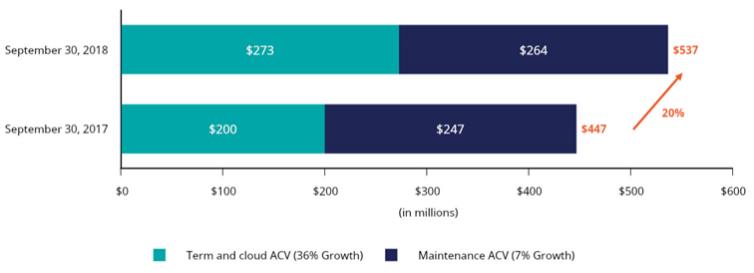
| September 30, | ||||||||||||||||
| (Dollars in thousands) | 2018 | 2017 | Change | |||||||||||||
|
Term and cloud ACV |
$ | 272,693 | $ | 200,180 | $ | 72,513 | 36% | |||||||||
|
Maintenance ACV |
264,068 | 247,248 | 16,820 | 7% | ||||||||||||
|
|
|
|
|
|||||||||||||
|
Total ACV |
$ | 536,761 | $ | 447,428 | $ | 89,333 | 20% | |||||||||
|
|
|
|
|
|||||||||||||
| (1) |
ACV, as of a given date, is the sum of the following two components: |
| • |
the sum of the annual value of each term and cloud contract in effect on such date, with the annual value of a term or cloud contract being equal to the total value of the contract divided by the total number of years of the contract. |
| • |
maintenance revenue reported for the quarter ended on such date, multiplied by four. |
Remaining performance obligations (formerly reported as “committed not yet recognized revenue”)
Revenue for the remaining performance obligations on existing contracts is expected to be recognized as follows:
| September 30, 2018 | ||||||||||||||||||||||||||||
| (Dollars in thousands) | Perpetual license | Term license | Maintenance | Cloud | Consulting | Total | ||||||||||||||||||||||
|
1 year or less |
$ | 25,343 | $ | 44,283 | $ | 140,591 | $ | 88,529 | $ | 14,107 | $ | 312,853 | 60% | |||||||||||||||
|
1-2 years |
6,490 | 10,063 | 8,877 | 70,815 | 1,830 | 98,075 | 19% | |||||||||||||||||||||
|
2-3 years |
360 | 1,598 | 2,586 | 54,646 | 449 | 59,639 | 11% | |||||||||||||||||||||
|
Greater than 3 years |
1,306 | 218 | 1,079 | 49,110 | 50 | 51,763 | 10% | |||||||||||||||||||||
|
|
|
|
|
|
|
|
|
|
|
|
|
|
|
|||||||||||||||
| $ | 33,499 | $ | 56,162 | $ | 153,133 | $ | 263,100 | $ | 16,436 | $ | 522,330 | 100% | ||||||||||||||||
|
|
|
|
|
|
|
|
|
|
|
|
|
|
|
|||||||||||||||
CRITICAL ACCOUNTING POLICES
Management’s Discussion and Analysis of Financial Condition and Results of Operations is based upon our unaudited condensed consolidated financial statements, which have been prepared in accordance with accounting principles generally accepted in the United States and the rules and regulations of the SEC for interim financial reporting. The preparation of these financial statements requires us to make estimates and judgments that affect the reported amounts of assets, liabilities, revenues, and expenses, and the related disclosure of contingent assets and liabilities. We base our estimates and judgments on historical experience, knowledge of current conditions, and expectations of what could occur in the future given available information.
20
Table of Contents
For more information regarding our critical accounting policies, we encourage you to read the discussion contained in the following locations:
| • |
“Critical Accounting Estimates and Significant Judgments” in Item 7. “Management’s Discussion and Analysis of Financial Condition and Results of Operations” and Note 2. “Significant Accounting Policies” in Item 8. “Financial Statements and Supplementary Data” both of which are contained in our Annual Report on Form 10-K for the year ended December 31, 2017. |
| • |
Note 2. “New Accounting Pronouncements”, Note 4. “Receivables, Contract Assets, and Deferred Revenue”, and Note 9. “Revenue” contained in Item 1. “Unaudited Condensed Consolidated Financial Statements” of this Quarterly Report on Form 10-Q for the quarterly period ended September 30, 2018. |
Except as described below, there have been no significant changes to our critical accounting policies as disclosed in our Annual Report on Form 10-K for the year ended December 31, 2017.
Revenue
We account for revenue in accordance with ASC 606. Our revenue recognition policies require us to make significant judgments and estimates.
Our clients’ contracts with us typically contain promises by us to provide multiple products and services. Judgment is required to determine whether each product and service is considered to be a distinct performance obligation that should be accounted for separately under the contract. We allocate the transaction price to the distinct performance obligations based on relative stand-alone selling price. We estimate stand-alone selling price based on the prices charged to clients, or by using information such as market conditions and other observable inputs. However, the selling price of our software licenses and cloud performance obligations are highly variable. Thus, we estimate stand-alone selling price for software licenses and cloud performance obligations using the residual approach, determined based on total transaction price minus the stand-alone selling price of other performance obligations promised in the contract.
In applying our revenue recognition policy, we must determine which portions of our revenue are recognized in the current period and which portions must be deferred and recognized in future periods. We analyze various factors including, but not limited to, the selling price of undelivered services when sold on a stand-alone basis, our pricing policies, and contractual terms and conditions to help us make such judgments about revenue recognition. Changes in judgment on any of these factors could materially impact the timing and amount of revenue recognized in a given period.
RESULTS OF OPERATIONS
|
Three Months Ended
September 30, |
Nine Months Ended
September 30, |
|||||||||||||||||||||||||||||||
| (Dollars in thousands) | 2018 | 2017 | Change | 2018 | 2017 | Change | ||||||||||||||||||||||||||
|
Total revenue |
$ | 203,263 | $ | 190,957 | $ | 12,306 | 6 % | $ | 635,224 | $ | 633,862 | $ | 1,362 | — % | ||||||||||||||||||
|
Gross profit |
$ | 128,840 | $ | 121,226 | $ | 7,614 | 6 % | $ | 411,370 | $ | 428,166 | $ | (16,796) | (4)% | ||||||||||||||||||
|
(Loss) income from operations |
$ | (17,258) | $ | (2,301) | $ | (14,957) | 650 % | $ | (32,485) | $ | 54,659 | $ | (87,144) | * | ||||||||||||||||||
|
Net (loss) income |
$ | (7,587) | $ | 1,288 | $ | (8,875) | * | $ | (5,796) | $ | 57,953 | $ | (63,749) | * | ||||||||||||||||||
* not meaningful
Revenue
|
Three Months Ended
September 30, |
Nine Months Ended
September 30, |
|||||||||||||||||||||||||||||||||||||||||||||||
| (Dollars in thousands) | 2018 | 2017 | Change | 2018 | 2017 | Change | ||||||||||||||||||||||||||||||||||||||||||
|
Term license |
$ | 32,066 | 16% | $ | 40,611 | 21% | $ | (8,545) | (21)% | $ | 128,070 | 20% | $ | 149,573 | 24% | $ | (21,503) | (14)% | ||||||||||||||||||||||||||||||
|
Cloud |
22,184 | 11% | 13,280 | 7% | 8,904 | 67 % | 57,967 | 9% | 36,207 | 6% | 21,760 | 60 % | ||||||||||||||||||||||||||||||||||||
|
Maintenance |
66,017 | 32% | 61,812 | 33% | 4,205 | 7 % | 196,448 | 31% | 179,949 | 28% | 16,499 | 9 % | ||||||||||||||||||||||||||||||||||||
|
|
|
|
|
|
|
|
|
|||||||||||||||||||||||||||||||||||||||||
|
Subscription (1) |
120,267 | 59% | 115,703 | 61% | 4,564 | 4 % | 382,485 | 60% | 365,729 | 58% | 16,756 | 5 % | ||||||||||||||||||||||||||||||||||||
|
Perpetual license |
20,276 | 10% | 12,623 | 7% | 7,653 | 61 % | 56,829 | 9% | 81,819 | 13% | (24,990) | (31)% | ||||||||||||||||||||||||||||||||||||
|
Consulting |
62,720 | 31% | 62,631 | 32% | 89 | — % | 195,910 | 31% | 186,314 | 29% | 9,596 | 5 % | ||||||||||||||||||||||||||||||||||||
|
|
|
|
|
|
|
|
|
|||||||||||||||||||||||||||||||||||||||||
|
Total revenue |
$ | 203,263 | 100% | $ | 190,957 | 100% | $ | 12,306 | 6 % | $ | 635,224 | 100% | $ | 633,862 | 100% | $ | 1,362 | — % | ||||||||||||||||||||||||||||||
|
|
|
|
|
|
|
|
|
|||||||||||||||||||||||||||||||||||||||||
| (1) |
Subscription revenue reflects client arrangements (term license, cloud, and maintenance) which may be subject to a renewal. |
Our license revenue is primarily derived from sales of our applications and Pega Platform. Our cloud revenue is derived from our hosted Pega Platform and software applications. Our consulting revenue is primarily related to new license implementations.
21
Table of Contents
We expect our revenue mix to continue to shift in favor of our subscription offerings, particularly cloud arrangements, which could result in slower total revenue growth in the near term. Revenue from cloud arrangements is generally recognized over time throughout the service period, while revenue from license arrangements is generally recognized upfront when the license rights become effective.
Subscription revenue
The decrease in term license revenue in the three months ended September 30, 2018 was primarily due to $17 million of revenue recognized in the three months ended September 30, 2017 from a large term license renewal. The decrease in term license revenue in the nine months ended September 30, 2018 was primarily due to $35.3 million of revenue recognized in the three months ended March 31, 2017 from a large term license renewal.
The increases in cloud revenue in the three and nine months ended September 30, 2018 reflect the shift in client preferences to cloud arrangements from other types of arrangements.
The increases in maintenance revenue were primarily due to the continued growth in the aggregate value of the installed base of our software and strong renewal rates in excess of 90%.
Perpetual license
The increase in perpetual license revenue in the three months ended September 30, 2018 was primarily due to revenue recognized from license rights which became effective in the current period from perpetual arrangements executed in prior periods, primarily the three months ended June 30, 2018. The decrease in perpetual license revenue in the nine months ended September 30, 2018 reflects the shift in client preferences away from perpetual license arrangements.
Consulting
Our consulting revenue fluctuates depending upon the mix of new implementation projects we perform as compared to those performed by our enabled clients or led by our partners.
The increase in consulting revenue in the nine months ended September 30, 2018 was primarily due to higher billable hours driven by an increase in the number of projects performed.
Gross profit
|
Three Months Ended
September 30, |
Nine Months Ended
September 30, |
|||||||||||||||||||||||||||||||||||||||||||||||
| (Dollars in thousands) | 2018 | 2017 | Change | 2018 | 2017 | Change | ||||||||||||||||||||||||||||||||||||||||||
|
Software license |
$ | 51,087 | 98% | $ | 51,958 | 98% | $ | (871 | ) | (2)% | $ | 181,127 | 98% | $ | 227,566 | 98% | $ | (46,439) | (20)% | |||||||||||||||||||||||||||||
|
Maintenance |
59,938 | 91% | 55,096 | 89% | 4,842 | 9 % | 178,413 | 91% | 159,004 | 88% | 19,409 | 12 % | ||||||||||||||||||||||||||||||||||||
|
Cloud |
12,569 | 57% | 7,269 | 55% | 5,300 | 73 % | 31,853 | 55% | 18,938 | 52% | 12,915 | 68 % | ||||||||||||||||||||||||||||||||||||
|
Consulting |
5,246 | 8% | 6,903 | 11% | (1,657 | ) | (24)% | 19,977 | 10% | 22,658 | 12% | (2,681) | (12)% | |||||||||||||||||||||||||||||||||||
|
|
|
|
|
|
|
|
|
|||||||||||||||||||||||||||||||||||||||||
|
Total gross profit |
$ | 128,840 | 63% | $ | 121,226 | 63% | $ | 7,614 | 6 % | $ | 411,370 | 65% | $ | 428,166 | 68% | $ | (16,796) | (4)% | ||||||||||||||||||||||||||||||
|
|
|
|
|
|
|
|
|
|||||||||||||||||||||||||||||||||||||||||
The increase in total gross profit in the three months ended September 30, 2018 was primarily due to an increase in maintenance revenue, due to growth in the aggregate value of the installed base of our software, and an increase in cloud revenue, due to a shift in client preferences to cloud arrangements from other types of arrangements.
The decrease in total gross profit in the nine months ended September 30, 2018 was primarily due to $35.3 million of revenue recognized in the three months ended March 31, 2017 from a large term license renewal and the decrease in perpetual license revenue reflecting the shift in client preferences toward our cloud offerings, partially offset by the margin growth in our maintenance and cloud revenue streams. The current shift in our revenue mix toward cloud arrangements may result in slower total gross profit growth in the near term as our cloud business continues to grow and scale.
Maintenance and cloud gross profit percent
The increases in maintenance gross profit percent in the three and nine months ended September 30, 2018 were driven by decreases of $0.3 million and $1.5 million in compensation and benefits due to decreased headcount and a decrease in client support expenses as we transferred resources to provide dedicated support to our growing cloud business.
The increases in cloud gross profit percent in the three and nine months ended September 30, 2018 were primarily due to continued growth and scale in our cloud business, partially offset by an increase in client support expenses as we expanded our cloud client support function to sustain our growing cloud business.
22
Table of Contents
Consulting gross profit percent
The decreases in consulting gross profit percent in the three and nine months ended September 30, 2018 were driven primarily by increases in compensation and benefits, lower utilization rates, and the impact of our policy introduced late in the three months ended June 30, 2017 to offer our web-based training free of charge to users which reduced training revenue for the three and nine months ended September 30, 2018.
Operating expenses
Selling and marketing
|
Three Months Ended
September 30, |
Nine Months Ended
September 30, |
|||||||||||||||||||||||||||||||
| (Dollars in thousands) | 2018 | 2017 | Change | 2018 | 2017 | Change | ||||||||||||||||||||||||||
|
Selling and marketing |
$ | 87,490 | $ | 69,363 | $ | 18,127 | 26% | $ | 269,845 | $ | 214,244 | $ | 55,601 | 26% | ||||||||||||||||||
|
As a percent of total revenue |
43% | 36% | 42% | 34% | ||||||||||||||||||||||||||||
|
Selling and marketing headcount, end of period |
1,194 | 934 | 260 | 28% | ||||||||||||||||||||||||||||
Includes compensation, benefits, and other headcount-related expenses associated with our selling and marketing personnel as well as advertising, promotions, trade shows, seminars, and the amortization of client-related intangibles.
The increases in the three and nine months ended September 30, 2018 were primarily due to increases in compensation and benefits of $15.2 million and $40.6 million, as a result of increased headcount, increased deferred contract commission costs amortization of $1.2 million and $3.3 million, and an increase in marketing programs in the nine months ended September 30, 2018 of $3.1 million. The increase in headcount reflects our efforts to increase our sales capacity to deepen relationships with existing clients and target new accounts .
Research and development
|
Three Months Ended
September 30, |
Nine Months Ended
September 30, |
|||||||||||||||||||||||||||||||
| (Dollars in thousands) | 2018 | 2017 | Change | 2018 | 2017 | Change | ||||||||||||||||||||||||||
|
Research and development |
$ | 46,504 | $ | 41,031 | $ | 5,473 | 13% | $ | 135,261 | $ | 121,089 | $ | 14,172 | 12% | ||||||||||||||||||
|
As a percent of total revenue |
23% | 21% | 21% | 19% | ||||||||||||||||||||||||||||
|
Research and development headcount, end of period |
1,595 | 1,474 | 121 | 8% | ||||||||||||||||||||||||||||
Includes compensation, benefits, contracted services, and other headcount-related expenses associated with the creation and development of our products, as well as enhancements and design changes to existing products and the integration of acquired technologies.
The increases in the three and nine months ended September 30, 2018 were primarily due to increases in compensation and benefits of $4 million and $9.5 million, attributable to increased headcount and the expansion of our application development team to support the continued development of our expanding suite of software.
General and administrative
|
Three Months Ended
September 30, |
Nine Months Ended
September 30, |
|||||||||||||||||||||||||||||||
| (Dollars in thousands) | 2018 | 2017 | Change | 2018 | 2017 | Change | ||||||||||||||||||||||||||
|
General and administrative |
$ | 12,104 | $ | 13,133 | $ | (1,029) | (8)% | $ | 38,749 | $ | 38,174 | $ | 575 | 2 % | ||||||||||||||||||
|
As a percent of total revenue |
6% | 7% | 6% | 6% | ||||||||||||||||||||||||||||
|
General and administrative headcount, end of period |
326 | 407 | (81) | (20)% | ||||||||||||||||||||||||||||
Includes compensation, benefits, and other headcount-related expenses associated with finance, legal, corporate governance, and other administrative headcount. They also include accounting, legal, and other professional consulting and administrative fees. The general and administrative headcount includes employees in information technology and corporate services departments, whose costs are partially allocated to other operating expense areas.
The decrease in the three months ended September 30, 2018 was primarily due to a decrease in compensation and benefits of $1.2 million due to decreased headcount, reflecting the realignment of contract negotiation and product development resources to augment our selling and marketing and research and development functions.
23
Table of Contents
The increase in the nine months ended September 30, 2018 was primarily due to an increase of $2.1 million in legal and tax fees partially offset by a decrease of $1.7 million in compensation and benefits, due to decreased headcount reflecting the realignment of contract negotiation and product development resources to augment our selling and marketing and research and development functions.
Stock-based compensation
|
Three Months Ended
September 30, |
Nine Months Ended
September 30, |
|||||||||||||||||||||||||||||||
| (Dollars in thousands) | 2018 | 2017 | Change | 2018 | 2017 | Change | ||||||||||||||||||||||||||
|
Cost of revenues |
$ | 4,319 | $ | 3,613 | $ | 706 | 20 % | $ | 12,277 | $ | 10,913 | $ | 1,364 | 12 % | ||||||||||||||||||
|
Selling and marketing |
6,198 | 3,976 | 2,222 | 56 % | 16,895 | 11,482 | 5,413 | 47 % | ||||||||||||||||||||||||
|
Research and development |
3,917 | 3,420 | 497 | 15 % | 11,356 | 10,306 | 1,050 | 10 % | ||||||||||||||||||||||||
|
General and administrative |
1,974 | 2,480 | (506) | (20)% | 7,045 | 7,228 | (183) | (3)% | ||||||||||||||||||||||||
|
|
|
|
|
|
|
|
|
|||||||||||||||||||||||||
| $ | 16,408 | $ | 13,489 | $ | 2,919 | 22 % | $ | 47,573 | $ | 39,929 | $ | 7,644 | 19 % | |||||||||||||||||||
|
|
|
|
|
|
|
|
|
|||||||||||||||||||||||||
|
Income tax benefit |
$ | (3,555) | $ | (4,129) | $ | 574 | (14)% | $ | (10,037) | $ | (12,231) | $ | 2,194 | (18)% | ||||||||||||||||||
The increase in the three and nine months ended September 30, 2018 was primarily due to the increased value of our annual periodic equity awards granted in March 2018 and 2017. These awards generally have a five-year vesting schedule.
Non-operating income (expense), net
|
Three Months Ended
September 30, |
Nine Months Ended
September 30, |
|||||||||||||||||||||||||||||||
| (Dollars in thousands) | 2018 | 2017 | Change | 2018 | 2017 | Change | ||||||||||||||||||||||||||
|
Foreign currency transaction gain (loss) |
$ | 399 | $ | (5,052) | $ | 5,451 | * | $ | 558 | $ | (6,549) | $ | 7,107 | * | ||||||||||||||||||
|
Interest income, net |
683 | 140 | 543 | 388 % | 2,076 | 547 | 1,529 | 280 % | ||||||||||||||||||||||||
|
Other income, net |
— | — | — | — % | 363 | 287 | 76 | 26 % | ||||||||||||||||||||||||
|
|
|
|
|
|
|
|
|
|||||||||||||||||||||||||
| $ | 1,082 | $ | (4,912) | $ | 5,994 | * | $ | 2,997 | $ | (5,715) | $ | 8,712 | * | |||||||||||||||||||
|
|
|
|
|
|
|
|
|
|||||||||||||||||||||||||
* not meaningful
The change in foreign currency transaction gain (loss) was primarily due to unrealized gains on foreign currency denominated cash and receivables.
The change in interest income, net was primarily due to an increase in prevailing interest rates and an increase in the size of our holdings in marketable securities.
Benefit from income taxes
|
Three Months Ended
September 30, |
Nine Months Ended
September 30, |
|||||||||||||||||||||||||||||||
| (Dollars in thousands) | 2018 | 2017 | Change | 2018 | 2017 | Change | ||||||||||||||||||||||||||
|
Benefit from income taxes |
$ | (8,589) | $ | (8,501) | $ | (88) | 1% | $ | (23,692) | $ | (9,009) | $ | (14,683) | 163% | ||||||||||||||||||
|
Effective income tax rate |
80% | (18)% | ||||||||||||||||||||||||||||||
During the nine months ended September 30, 2018, our effective income tax rate changed primarily due to the following factors:
| • |
excess tax benefits from stock-based compensation for the nine months ended September 30, 2018 and 2017 of $15.1 million and $22.4 million were disproportionately greater than (loss) income before benefit from income taxes; |
| • |
a decrease in the estimated annual effective income tax rate primarily due to the reduction of the U.S. statutory federal tax rate from 35% to 21% pursuant to the Tax Reform Act; |
| • |
an increase in utilization of U.S. research and development tax credits; and |
| • |
a decrease in uncertain tax provisions as a result of the settlement of a foreign tax audit for 2012 through 2015. |
The inclusion of excess tax benefits from stock-based compensation in the provision for income taxes has increased the variability of the effective tax rates in recent periods. This fluctuation may continue in future periods, as the amount of excess tax benefits from stock-based compensation awards varies depending on our future stock price in relation to the fair value of awards, the timing of RSU vestings, exercise behavior of our stock option holders, and the total value of future grants of stock-based compensation awards.
24
Table of Contents
LIQUIDITY AND CAPITAL RESOURCES
|
Nine Months Ended
September 30, |
||||||||
| (in thousands) | 2018 | 2017 | ||||||
|
Cash provided by (used in): |
||||||||
|
Operating activities |
$ | 67,088 | $ | 113,926 | ||||
|
Investing activities |
(49,595) | (11,966) | ||||||
|
Financing activities |
(71,664) | (44,040) | ||||||
|
Effect of exchange rates on cash and cash equivalents |
(1,913) | 2,054 | ||||||
|
|
|
|
|
|||||
|
Net (decrease) increase in cash and cash equivalents |
$ | (56,084) | $ | 59,974 | ||||
|
|
|
|
|
|||||
| (in thousands) |
September 30,
2018 |
December 31,
2017 |
||||||
|
Held by U.S. entities |
$ | 134,634 | $ | 136,444 | ||||
|
Held by foreign entities |
71,343 | 87,304 | ||||||
|
|
|
|
|
|||||
|
Total cash, cash equivalents, and marketable securities |
$ | 205,977 | $ | 223,748 | ||||
|
|
|
|
|
|||||
We believe that our current cash, cash equivalents, marketable securities, and cash flow from operations will be sufficient to fund our operations, quarterly cash dividends, and stock repurchases for at least the next 12 months.
If it became necessary to repatriate foreign funds, we may be required to pay U.S. state and local taxes, as well as foreign taxes, upon repatriation. Due to the complexity of income tax laws and regulations, and the effects of the Tax Reform Act, it is impracticable to estimate the amount of taxes we would have to pay.
Cash provided by operating activities
As client preferences continue to shift in favor of cloud arrangements, we could experience slower operating cash flow growth in the near term. Cash from cloud arrangements is generally collected throughout the service period, while cash from perpetual license arrangements is generally collected upfront, shortly after the license rights become effective.
The primary driver during the nine months ended September 30, 2018 was $57.6 million in cash generated from receivables and contract assets, largely due to cash collections and the timing of billings.
The primary driver during the nine months ended September 30, 2017 was net income of $58 million and $36.8 million in cash generated from receivables and contract assets, largely due to cash collections and the timing of billings.
Cash used in investing activities
Cash used in investing activities is primarily driven by the timing of investment maturities and purchases of new investments.
Cash used in financing activities
We used cash primarily for repurchases of our common stock under our publicly announced stock repurchase programs, stock repurchases for tax withholdings for the net settlement of our equity awards, and the payment of our quarterly dividend.
Stock repurchase program (1)
Remaining authority under existing programs is as follows:
|
Nine Months Ended
September 30, |
||||
| (in thousands) | 2018 | |||
|
January 1 |
$ | 34,892 | ||
|
Authorizations |
27,003 | |||
|
Repurchases |
(30,149 | ) | ||
|
|
|
|||
|
September 30, |
$ | 31,746 | ||
|
|
|
|||
| (1) |
Purchases under these programs have been made on the open market. |
25
Table of Contents
Common stock repurchases
|
Nine Months Ended
September 30, |
||||||||||||||||
| 2018 | 2017 | |||||||||||||||
| (in thousands) | Shares | Amount | Shares | Amount | ||||||||||||
|
Tax withholdings for net settlement of equity awards |
591 | $ | 35,530 | 682 | $ | 34,791 | ||||||||||
|
Stock repurchase program (1) |
||||||||||||||||
|
Repurchases paid |
512 | 29,949 | 68 | 2,986 | ||||||||||||
|
Repurchases unsettled at period end |
3 | 200 | — | — | ||||||||||||
|
|
|
|
|
|
|
|
|
|||||||||
|
Activity in period (2) |
1,106 | $ | 65,679 | 750 | $ | 37,777 | ||||||||||
|
|
|
|
|
|
|
|
|
|||||||||
| (1) |
Represents activity under our publicly announced stock repurchase programs. |
| (2) |
During the nine months ended September 30, 2018 and 2017, instead of receiving cash from the equity holders, we withheld shares with a value of $28.2 million and $23.7 million for the exercise price of options. These amounts have been excluded from the table above. |
Dividends
|
Nine Months
Ended
|
||||
| (in thousands) |
2018 |
2017 |
||
|
Dividend payments to shareholders |
$ 7,067 | $ 6,941 | ||
It is our current intention to pay a quarterly cash dividend of $0.03 per share, however, the Board of Directors may terminate or modify the dividend program at any time without prior notice.
| ITEM 3. |
QUANTITATIVE AND QUALITATIVE DISCLOSURES ABOUT MARKET RISK |
Market risk represents the risk of loss from adverse changes in financial market prices and rates. Our market risk exposure is primarily related to fluctuations in foreign exchange rates.
See Item 7A. “Quantitative and Qualitative Disclosures about Market Risk” and Item 1A. “Risk Factors—We are exposed to fluctuations in currency exchange rates that could negatively impact our financial results and cash flows” included in our Annual Report on Form 10-K for the year ended December 31, 2017 for a more complete discussion of our market risk exposure.
Foreign currency exposure
Translation risk
Our international sales are usually denominated in foreign currencies. However, the operating expenses of our foreign operations are also primarily denominated in foreign currencies, which partially offset our foreign currency exposure.
A hypothetical 10% strengthening in the U.S. dollar against other currencies would result in the following impact:
|
Nine Months
Ended
|
||||
| Increase (decrease) |
2018 |
2017 |
||
|
Total revenue |
(4)% | (4)% | ||
|
Net (loss) income |
12% | (1)% | ||
Remeasurement risk
We have experienced and expect to continue to experience fluctuations in our results of operations as a result of transaction gains or losses related to remeasuring monetary assets and liabilities that are denominated in currencies other than the functional currency of the entities in which they are recorded.
We are primarily exposed to changes in foreign currency exchange rates associated with Australian dollar, Euro, and U.S. dollar denominated cash and cash equivalents, accounts receivable, unbilled receivables, and intercompany receivables and payables held by our U.K. subsidiary, a British pound functional entity.
26
Table of Contents
A hypothetical 10% strengthening in the British pound exchange rate in comparison to the Australian dollar, Euro, and U.S. dollar would result in an incremental foreign currency transaction loss of $8 million and $6 million, at September 30, 2018 and December 31, 2017.
| ITEM 4. |
CONTROLS AND PROCEDURES |
(a) Evaluation of Disclosure Controls and Procedures
Our management, with the participation of our Chief Executive Officer (“CEO”) and Chief Financial Officer (“CFO”) evaluated the effectiveness of our disclosure controls and procedures (as defined in Rules 13a-15(e) and 15d-15(e) under the Securities Exchange Act of 1934, as amended (“Exchange Act”)) as of September 30, 2018. In designing and evaluating our disclosure controls and procedures, our management recognized that any controls and procedures, no matter how well designed and operated, can provide only reasonable assurance of achieving their objectives, and our management necessarily applied its judgment in evaluating the cost-benefit relationship of possible controls and procedures. Based on this evaluation, our CEO and CFO concluded that our disclosure controls and procedures were effective as of September 30, 2018.
(b) Changes in Internal Control over Financial Reporting
There have been no changes in our internal control over financial reporting (as defined in Rules 13a-15(f) and 15d-15(f) under the Exchange Act) during the quarter ended September 30, 2018 that have materially affected, or are reasonably likely to materially affect, our internal control over financial reporting.
27
Table of Contents
| ITEM 1A. |
RISK FACTORS |
We encourage you to carefully consider the risk factors identified in Item 1A. “Risk Factors” of our Annual Report on Form 10-K for the year ended December 31, 2017. These risk factors could materially affect our business, financial condition, and future results and could cause our actual business and financial results to differ materially from those contained in forward-looking statements made in this Quarterly Report on Form 10-Q or elsewhere by management from time to time. There have been no material changes during the nine months ended September 30, 2018 to the risk factors disclosed in our Annual Report on Form 10-K for the year ended December 31, 2017.
| ITEM 2. |
UNREGISTERED SALES OF EQUITY SECURITIES AND USE OF PROCEEDS |
The following table sets forth information regarding our repurchases of our common stock during the three months ended September 30, 2018.
|
(in thousands, except per share
amounts)
|
Total Number
|
Average
Price Paid
|
Total Number
|
Approximate Dollar
Value of Shares That May Yet Be Purchased at Period End Under Publicly Announced Share Repurchase Programs (2) |
||||||||
|
July 1, 2018 - July 31, 2018 |
138 | $ 57.34 | 119 | $ | 39,189 | |||||||
|
August 1, 2018 - August 31, 2018 |
172 | $ 59.89 | 93 | $ | 33,645 | |||||||
|
September 1, 2018 - September 30, 2018 |
182 | $ 63.96 | 30 | $ | 31,746 | |||||||
|
|
||||||||||||
|
Total |
492 | $ 60.68 | ||||||||||
|
|
||||||||||||
| (1) |
Shares withheld to cover the option exercise price and tax withholding obligations under the net settlement provisions of our stock compensation awards have been included in these amounts. |
| (2) |
Since 2004, our Board of Directors has approved stock repurchase programs that have authorized the repurchase, in the aggregate, of up to $221.8 million of our common stock. On June 21, 2018, we announced that our Board of Directors extended the expiration date of the current stock repurchase program to June 30, 2019 and increased the amount of common stock we are authorized to repurchase to $50 million between June 15, 2018 and June 30, 2019 (the “Current Program”). Under the Current Program, purchases may be made from time to time on the open market or in privately negotiated transactions. Shares may be repurchased in such amounts as market conditions warrant, subject to regulatory and other considerations. We have established a pre-arranged stock repurchase plan, intended to comply with the requirements of Rule 10b5-1 under the Exchange Act, and Rule 10b-18 under the Exchange Act (the “10b5-1 Plan”). All stock repurchases under the Current Program during closed trading window periods will be made pursuant to the 10b5-1 Plan. |
| ITEM 6. |
EXHIBITS |
|
Exhibit No. |
Description |
|
|
31.1 |
Certification pursuant to Exchange Act Rules 13a-14 and 15d-14 of the Chief Executive Officer. | |
|
31.2 |
Certification pursuant to Exchange Act Rules 13a-14 and 15d-14 of the Chief Financial Officer. | |
|
32+ |
Certification pursuant to 18 U.S.C. Section 1350 of the Chief Executive Officer and the Chief Financial Officer. | |
|
101.INS |
XBRL Instance document. | |
|
101.SCH |
XBRL Taxonomy Extension Schema Document. | |
|
101.CAL |
XBRL Taxonomy Calculation Linkbase Document. | |
|
101.DEF |
XBRL Taxonomy Extension Definition Linkbase Document. | |
|
101.LAB |
XBRL Taxonomy Label Linkbase Document. | |
|
101.PRE |
XBRL Taxonomy Presentation Linkbase Document. | |
+ Indicates that the exhibit is being furnished with this report and is not filed as a part of it.
++ Management contracts and compensatory plan or arrangements
28
Table of Contents
Pursuant to the requirements of the Securities Exchange Act of 1934, the Registrant has duly caused this report to be signed on its behalf by the undersigned thereunto duly authorized.
| Pegasystems Inc. | ||||||
| Dated: November 7, 2018 | By: | /s/ KENNETH STILLWELL | ||||
| Kenneth Stillwell | ||||||
| Chief Financial Officer and Chief Administrative Officer | ||||||
| (Principal Financial Officer) | ||||||
29