|
|
|
|
|
|
|
|
|
|
|
|
|
|
|
|
|
|
|
|
|
|
|
|
|
|
|
|
|
|
|
|
|
|
|
|
|
|
|
|
|
|
|
|
|
|
|
|
|
|
|
|
|
|
|
|
UNITED STATES
SECURITIES AND EXCHANGE COMMISSION
Washington, D.C. 20549
FORM 10-Q
|
☒ |
QUARTERLY REPORT PURSUANT TO SECTION 13 OR 15(d) OF THE SECURITIES EXCHANGE ACT OF 1934 |
For the quarterly period ended March 31, 2018
|
☐ |
TRANSITION REPORT PURSUANT TO SECTION 13 OR 15(d) OF THE SECURITIES EXCHANGE ACT OF 1934 |
For the transition period from ______________ to ______________
Commission File Number: 001-13545 (Prologis, Inc.) 001-14245 (Prologis, L.P.)

Prologis, Inc.
Prologis, L.P.
(Exact name of registrant as specified in its charter)
|
Maryland (Prologis, Inc.) Delaware (Prologis, L.P.) |
|
94-3281941 (Prologis, Inc.) 94-3285362 (Prologis, L.P.) |
|
(State or other jurisdiction of incorporation or organization) |
|
(I.R.S. Employer Identification No.) |
|
|
|
|
|
Pier 1, Bay 1, San Francisco, California |
|
94111 |
|
(Address or principal executive offices) |
|
(Zip Code) |
(415) 394-9000
(Registrants’ telephone number, including area code)
(Former name, former address and former fiscal year, if changed since last report)
Indicate by check mark whether the registrant (1) has filed all reports required to be filed by Section 13 or 15(d) of the Securities Exchange Act of 1934 during the preceding 12 months (or for such shorter period that the registrant was required to file such reports), and (2) has been subject to such filing for the past 90 days.
|
Prologis, Inc. |
Yes |
☒ |
No |
☐ |
|
Prologis, L.P. |
Yes |
☒ |
No |
☐ |
Indicate by check mark whether the registrant has submitted electronically and posted on its corporate website; if any, every Interactive Data File required to be submitted and posted pursuant to Rule 405 of Regulation S-T (§232.405 of this chapter) during the preceding 12 months (or for such shorter periods that the registrant was required to submit and post such files).
|
Prologis, Inc. |
Yes |
☒ |
No |
☐ |
|
Prologis, L.P. |
Yes |
☒ |
No |
☐ |
Indicate by check mark whether the registrant is a large accelerated filer, an accelerated filer, a non-accelerated filer, smaller reporting company, or an emerging growth company. See definitions of “large accelerated filer”, “accelerated filer,” “smaller reporting company,” and “emerging growth company” in Rule 12b-2 of the Exchange Act (check one):
|
Prologis, Inc.: |
|
|
|
|
|
|
Large accelerated filer ☒ |
|
Accelerated filer ☐ |
Non-accelerated filer ☐ |
Smaller reporting company ☐ |
Emerging growth company ☐ |
|
|
|
(Do not check if a smaller reporting company) |
|
|
|
|
Prologis, L.P.: |
|
|
|
|
|
|
Large accelerated filer ☐ |
|
Accelerated filer ☐ |
Non-accelerated filer ☒ |
Smaller reporting company ☐ |
Emerging growth company ☐ |
|
|
|
(Do not check if a smaller reporting company) |
|
|
|
If an emerging growth company, indicate by check mark if the registrant has elected not to use the extended transition period for complying with any new or revised financial accounting standards provided pursuant to Section 13(a) of the Exchange Act. ☐
Indicate by check mark whether the registrant is a shell company (as defined in Rule 12b-2 of the Securities Exchange Act of 1934).
|
Prologis, Inc. |
Yes |
☐ |
No |
☒ |
|
Prologis, L.P. |
Yes |
☐ |
No |
☒ |
The number of shares of Prologis, Inc.’s common stock outstanding at April 19, 2018, was approximately 533,237,000.
This report combines the quarterly reports on Form 10-Q for the period ended March 31, 2018, of Prologis, Inc. and Prologis, L.P. Unless stated otherwise or the context otherwise requires, references to “Prologis, Inc.” or the “Parent” mean Prologis, Inc. and its consolidated subsidiaries; and references to “Prologis, L.P.” or the “Operating Partnership” or the “OP” mean Prologis, L.P., and its consolidated subsidiaries. The terms “the Company,” “Prologis,” “we,” “our” or “us” means the Parent and the OP collectively.
The Parent is a real estate investment trust (a “REIT”) and the general partner of the OP. At March 31, 2018, the Parent owned 97.11% common general partnership interest in the OP and 100% of the preferred units in the OP. The remaining 2.89% common limited partnership interests are owned by un affiliated investors and certain current and former directors and officers of the Parent.
We operate the Parent and the OP as one enterprise. The management of the Parent consists of the same members as the management of the OP. These members are officers of the Parent and employees of the OP or one of its subsidiaries. As sole general partner, the Parent has control of the OP through complete responsibility and discretion in the day-to-day management and therefore, consolidates the OP for financial reporting purposes. Because the only significant asset of the Parent is its investment in the OP, the assets and liabilities of the Parent and the OP are the same on their respective financial statements.
We believe combining the quarterly reports on Form 10-Q of the Parent and the OP into this single report results in the following benefits:
|
• |
enhances investors’ understanding of the Parent and the OP by enabling investors to view the business as a whole in the same manner as management views and operates the business; |
|
• |
eliminates duplicative disclosure and provides a more streamlined and readable presentation as a substantial portion of the Company’s disclosure applies to both the Parent and the OP; and |
|
• |
creates time and cost efficiencies through the preparation of one combined report instead of two separate reports. |
It is important to understand the few differences between the Parent and the OP in the context of how we operate the Company. The Parent does not conduct business itself, other than acting as the sole general partner of the OP and issuing public equity from time to time. The Parent itself does not incur any indebtedness, but it guarantees the unsecured debt of the OP. The OP holds substantially all the assets of the business, directly or indirectly. The OP conducts the operations of the business and is structured as a partnership with no publicly traded equity. Except for net proceeds from equity issuances by the Parent, which are contributed to the OP in exchange for partnership units, the OP generates capital required by the business through the OP’s operations, incurrence of indebtedness and issuance of partnership units to third parties.
The presentation of noncontrolling interests, stockholders’ equity and partners’ capital are the main areas of difference between the consolidated financial statements of the Parent and those of the OP. The differences in the presentations between stockholders’ equity and partners’ capital result from the differences in the equity and capital issuances in the Parent and in the OP.
The preferred stock, common stock, additional paid-in capital, accumulated other comprehensive income (loss) and distributions in excess of net earnings of the Parent are presented as stockholders’ equity in the Parent’s consolidated financial statements. These items represent the common and preferred general partnership interests held by the Parent in the OP and are presented as general partner’s capital within partners’ capital in the OP’s consolidated financial statements. The common limited partnership interests held by the limited partners in the OP are presented as noncontrolling interest within equity in the Parent’s consolidated financial statements and as limited partners’ capital within partners’ capital in the OP’s consolidated financial statements.
To highlight the differences between the Parent and the OP, separate sections in this report, as applicable, individually discuss the Parent and the OP, including separate financial statements and separate Exhibit 31 and 32 certifications. In the sections that combine disclosure of the Parent and the OP, this report refers to actions or holdings as being actions or holdings of Prologis.
INDEX
PROLOGIS, INC.
(In thousands, except per share data)
|
|
|
|
|
|
|
|
|
|
|
March 31, 2018 |
|
|
December 31, |
|
||
|
|
(Unaudited) |
|
|
2017 |
|
||
|
ASSETS |
|
|
|
|
|
|
|
|
Investments in real estate properties |
$ |
25,876,002 |
|
|
$ |
25,838,644 |
|
|
Less accumulated depreciation |
|
4,199,159 |
|
|
|
4,059,348 |
|
|
Net investments in real estate properties |
|
21,676,843 |
|
|
|
21,779,296 |
|
|
Investments in and advances to unconsolidated entities |
|
5,675,999 |
|
|
|
5,496,450 |
|
|
Assets held for sale or contribution |
|
473,154 |
|
|
|
342,060 |
|
|
Notes receivable backed by real estate |
|
- |
|
|
|
34,260 |
|
|
Net investments in real estate |
|
27,825,996 |
|
|
|
27,652,066 |
|
|
|
|
|
|
|
|
|
|
|
Cash and cash equivalents |
|
458,099 |
|
|
|
447,046 |
|
|
Other assets |
|
1,387,390 |
|
|
|
1,381,963 |
|
|
Total assets |
$ |
29,671,485 |
|
|
$ |
29,481,075 |
|
|
|
|
|
|
|
|
|
|
|
LIABILITIES AND EQUITY |
|
|
|
|
|
|
|
|
Liabilities: |
|
|
|
|
|
|
|
|
Debt |
$ |
9,460,177 |
|
|
$ |
9,412,631 |
|
|
Accounts payable and accrued expenses |
|
692,853 |
|
|
|
702,804 |
|
|
Other liabilities |
|
730,335 |
|
|
|
659,899 |
|
|
Total liabilities |
|
10,883,365 |
|
|
|
10,775,334 |
|
|
|
|
|
|
|
|
|
|
|
Equity: |
|
|
|
|
|
|
|
|
Prologis, Inc. stockholders’ equity: |
|
|
|
|
|
|
|
|
Series Q preferred stock at stated liquidation preference of $50 per share; $0.01 par value; 1,379 shares issued and outstanding and 100,000 preferred shares authorized at March 31, 2018 and December 31, 2017 |
|
68,948 |
|
|
|
68,948 |
|
|
Common stock; $0.01 par value; 533,107 shares and 532,186 shares issued and outstanding at March 31, 2018 and December 31, 2017, respectively |
|
5,331 |
|
|
|
5,322 |
|
|
Additional paid-in capital |
|
19,303,909 |
|
|
|
19,363,007 |
|
|
Accumulated other comprehensive loss |
|
(903,343 |
) |
|
|
(901,658 |
) |
|
Distributions in excess of net earnings |
|
(2,794,770 |
) |
|
|
(2,904,461 |
) |
|
Total Prologis, Inc. stockholders’ equity |
|
15,680,075 |
|
|
|
15,631,158 |
|
|
Noncontrolling interests |
|
3,108,045 |
|
|
|
3,074,583 |
|
|
Total equity |
|
18,788,120 |
|
|
|
18,705,741 |
|
|
Total liabilities and equity |
$ |
29,671,485 |
|
|
$ |
29,481,075 |
|
The accompanying notes are an integral part of these Consolidated Financial Statements.
1
CONSOLIDATED STATEMENTS OF INCOME
(Unaudited)
(In thousands, except per share amounts)
|
|
|
Three Months Ended |
|
|||||
|
|
|
March 31, |
|
|||||
|
|
|
2018 |
|
|
2017 |
|
||
|
Revenues: |
|
|
|
|
|
|
|
|
|
Rental |
|
$ |
427,901 |
|
|
$ |
439,884 |
|
|
Rental recoveries |
|
|
128,042 |
|
|
|
127,049 |
|
|
Strategic capital |
|
|
132,961 |
|
|
|
57,045 |
|
|
Development management and other |
|
|
4,752 |
|
|
|
5,177 |
|
|
Total revenues |
|
|
693,656 |
|
|
|
629,155 |
|
|
Expenses: |
|
|
|
|
|
|
|
|
|
Rental |
|
|
142,941 |
|
|
|
152,656 |
|
|
Strategic capital |
|
|
43,860 |
|
|
|
31,799 |
|
|
General and administrative |
|
|
62,428 |
|
|
|
53,617 |
|
|
Depreciation and amortization |
|
|
204,081 |
|
|
|
226,591 |
|
|
Other |
|
|
3,239 |
|
|
|
2,606 |
|
|
Total expenses |
|
|
456,549 |
|
|
|
467,269 |
|
|
|
|
|
|
|
|
|
|
|
|
Operating income |
|
|
237,107 |
|
|
|
161,886 |
|
|
|
|
|
|
|
|
|
|
|
|
Other income (expense): |
|
|
|
|
|
|
|
|
|
Earnings from unconsolidated entities, net |
|
|
62,656 |
|
|
|
48,605 |
|
|
Interest expense |
|
|
(47,245 |
) |
|
|
(72,912 |
) |
|
Interest and other income, net |
|
|
1,976 |
|
|
|
2,785 |
|
|
Gains on dispositions of investments in real estate, net |
|
|
195,111 |
|
|
|
97,325 |
|
|
Foreign currency and derivative losses, net |
|
|
(41,094 |
) |
|
|
(7,400 |
) |
|
Total other income |
|
|
171,404 |
|
|
|
68,403 |
|
|
Earnings before income taxes |
|
|
408,511 |
|
|
|
230,289 |
|
|
Total income tax expense |
|
|
16,552 |
|
|
|
9,600 |
|
|
Consolidated net earnings |
|
|
391,959 |
|
|
|
220,689 |
|
|
Less net earnings attributable to noncontrolling interests |
|
|
24,581 |
|
|
|
15,760 |
|
|
Net earnings attributable to controlling interests |
|
|
367,378 |
|
|
|
204,929 |
|
|
Less preferred stock dividends |
|
|
1,476 |
|
|
|
1,674 |
|
|
Net earnings attributable to common stockholders |
|
$ |
365,902 |
|
|
$ |
203,255 |
|
|
|
|
|
|
|
|
|
|
|
|
Weighted average common shares outstanding – Basic |
|
|
532,185 |
|
|
|
528,721 |
|
|
Weighted average common shares outstanding – Diluted |
|
|
554,123 |
|
|
|
550,010 |
|
|
|
|
|
|
|
|
|
|
|
|
Net earnings per share attributable to common stockholders – Basic |
|
$ |
0.69 |
|
|
$ |
0.38 |
|
|
|
|
|
|
|
|
|
|
|
|
Net earnings per share attributable to common stockholders – Diluted |
|
$ |
0.68 |
|
|
$ |
0.38 |
|
|
|
|
|
|
|
|
|
|
|
|
Dividends per common share |
|
$ |
0.48 |
|
|
$ |
0.44 |
|
The accompanying notes are an integral part of these Consolidated Financial Statements.
2
CONSOLIDATED STATEMENTS OF COMPREHENSIVE INCOME
(Unaudited)
(In thousands)
|
|
|
Three Months Ended |
|
|||||
|
|
|
March 31, |
|
|||||
|
|
|
2018 |
|
|
2017 |
|
||
|
Consolidated net earnings |
|
$ |
391,959 |
|
|
$ |
220,689 |
|
|
Other comprehensive income (loss): |
|
|
|
|
|
|
|
|
|
Foreign currency translation gains, net |
|
|
4,770 |
|
|
|
39,667 |
|
|
Unrealized gains (losses) on derivative contracts, net |
|
|
(6,287 |
) |
|
|
2,631 |
|
|
Comprehensive income |
|
|
390,442 |
|
|
|
262,987 |
|
|
Net earnings attributable to noncontrolling interests |
|
|
(24,581 |
) |
|
|
(15,760 |
) |
|
Other comprehensive income attributable to noncontrolling interests |
|
|
(168 |
) |
|
|
(48,107 |
) |
|
Comprehensive income attributable to common stockholders |
|
$ |
365,693 |
|
|
$ |
199,120 |
|
|
|
|
|
|
|
|
|
|
|
The accompanying notes are an integral part of these Consolidated Financial Statements.
CONSOLIDATED STATEMENT OF EQUITY
Three Months Ended March 31, 2018
(Unaudited)
(In thousands)
|
|
|
|
|
|
Common Stock |
|
|
|
|
|
|
Accumulated |
|
|
Distributions |
|
|
|
|
|
|
|
|
|
|||||||
|
|
|
|
|
|
Number |
|
|
|
|
|
|
Additional |
|
|
Other |
|
|
in Excess of |
|
|
Non- |
|
|
|
|
|
|||||
|
|
Preferred |
|
|
of |
|
|
Par |
|
|
Paid-in |
|
|
Comprehensive |
|
|
Net |
|
|
controlling |
|
|
Total |
|
||||||||
|
|
Stock |
|
|
Shares |
|
|
Value |
|
|
Capital |
|
|
Income (Loss) |
|
|
Earnings |
|
|
Interests |
|
|
Equity |
|
||||||||
|
Balance at January 1, 2018 |
$ |
68,948 |
|
|
|
532,186 |
|
|
$ |
5,322 |
|
|
$ |
19,363,007 |
|
|
$ |
(901,658 |
) |
|
$ |
(2,904,461 |
) |
|
$ |
3,074,583 |
|
|
$ |
18,705,741 |
|
|
Consolidated net earnings |
|
- |
|
|
|
- |
|
|
|
- |
|
|
|
- |
|
|
|
- |
|
|
|
367,378 |
|
|
|
24,581 |
|
|
|
391,959 |
|
|
Effect of equity compensation plans |
|
- |
|
|
|
921 |
|
|
|
9 |
|
|
|
(5,357 |
) |
|
|
- |
|
|
|
- |
|
|
|
11,405 |
|
|
|
6,057 |
|
|
Capital contributions |
|
- |
|
|
|
- |
|
|
|
- |
|
|
|
- |
|
|
|
- |
|
|
|
- |
|
|
|
850 |
|
|
|
850 |
|
|
Redemption of noncontrolling interests |
|
- |
|
|
|
- |
|
|
|
- |
|
|
|
(1,131 |
) |
|
|
- |
|
|
|
- |
|
|
|
(14,645 |
) |
|
|
(15,776 |
) |
|
Foreign currency translation gains, net |
|
- |
|
|
|
- |
|
|
|
- |
|
|
|
- |
|
|
|
4,420 |
|
|
|
- |
|
|
|
350 |
|
|
|
4,770 |
|
|
Unrealized losses on derivative contracts, net |
|
- |
|
|
|
- |
|
|
|
- |
|
|
|
- |
|
|
|
(6,105 |
) |
|
|
- |
|
|
|
(182 |
) |
|
|
(6,287 |
) |
|
Reallocation of equity |
|
- |
|
|
|
- |
|
|
|
- |
|
|
|
(52,505 |
) |
|
|
- |
|
|
|
- |
|
|
|
52,505 |
|
|
|
- |
|
|
Distributions and other |
|
- |
|
|
|
- |
|
|
|
- |
|
|
|
(105 |
) |
|
|
- |
|
|
|
(257,687 |
) |
|
|
(41,402 |
) |
|
|
(299,194 |
) |
|
Balance at March 31, 2018 |
$ |
68,948 |
|
|
|
533,107 |
|
|
$ |
5,331 |
|
|
$ |
19,303,909 |
|
|
$ |
(903,343 |
) |
|
$ |
(2,794,770 |
) |
|
$ |
3,108,045 |
|
|
$ |
18,788,120 |
|
The accompanying notes are an integral part of these Consolidated Financial Statements.
3
CONSOLIDATED STA TEMENTS OF CASH FLOWS
(Unaudited)
(In thousands)
|
|
|
Three Months Ended |
|
|||||
|
|
|
March 31, |
|
|||||
|
|
|
2018 |
|
|
2017 |
|
||
|
Operating activities: |
|
|
|
|
|
|
|
|
|
Consolidated net earnings |
|
$ |
391,959 |
|
|
$ |
220,689 |
|
|
Adjustments to reconcile net earnings to net cash provided by operating activities: |
|
|
|
|
|
|
|
|
|
Straight-lined rents and amortization of above and below market leases |
|
|
(15,060 |
) |
|
|
(25,497 |
) |
|
Equity-based compensation awards |
|
|
19,996 |
|
|
|
18,380 |
|
|
Depreciation and amortization |
|
|
204,081 |
|
|
|
226,591 |
|
|
Earnings from unconsolidated entities, net |
|
|
(62,656 |
) |
|
|
(48,605 |
) |
|
Operating distributions from unconsolidated entities |
|
|
85,229 |
|
|
|
77,347 |
|
|
Decrease (increase) in operating receivables from unconsolidated entities |
|
|
(67,223 |
) |
|
|
3,880 |
|
|
Amortization of debt discounts (premiums), net of debt issuance costs |
|
|
3,014 |
|
|
|
(2,905 |
) |
|
Gains on dispositions of investments in real estate, net |
|
|
(195,111 |
) |
|
|
(97,325 |
) |
|
Unrealized foreign currency and derivative losses, net |
|
|
34,145 |
|
|
|
12,078 |
|
|
Deferred income tax expense (benefit) |
|
|
(2,064 |
) |
|
|
2,439 |
|
|
Decrease (increase) in accounts receivable and other assets |
|
|
(2,705 |
) |
|
|
33,470 |
|
|
Decrease in accounts payable and accrued expenses and other liabilities |
|
|
(44,364 |
) |
|
|
(67,748 |
) |
|
Net cash provided by operating activities |
|
|
349,241 |
|
|
|
352,794 |
|
|
Investing activities: |
|
|
|
|
|
|
|
|
|
Real estate development |
|
|
(365,837 |
) |
|
|
(320,986 |
) |
|
Real estate acquisitions |
|
|
(112,621 |
) |
|
|
(132,358 |
) |
|
Tenant improvements and lease commissions on previously leased space |
|
|
(28,027 |
) |
|
|
(40,278 |
) |
|
Property improvements |
|
|
(10,456 |
) |
|
|
(10,851 |
) |
|
Proceeds from dispositions and contributions of real estate properties |
|
|
579,429 |
|
|
|
542,192 |
|
|
Investments in and advances to unconsolidated entities |
|
|
(52,131 |
) |
|
|
(106,658 |
) |
|
Return of investment from unconsolidated entities |
|
|
111,211 |
|
|
|
108,543 |
|
|
Proceeds from repayment of notes receivable backed by real estate |
|
|
34,260 |
|
|
|
15,094 |
|
|
Proceeds from the settlement of net investment hedges |
|
|
- |
|
|
|
1,789 |
|
|
Payments on the settlement of net investment hedges |
|
|
(3,966 |
) |
|
|
- |
|
|
Net cash provided by investing activities |
|
|
151,862 |
|
|
|
56,487 |
|
|
Financing activities: |
|
|
|
|
|
|
|
|
|
Proceeds from issuance of common stock |
|
|
1,233 |
|
|
|
1,899 |
|
|
Dividends paid on common and preferred stock |
|
|
(257,687 |
) |
|
|
(235,072 |
) |
|
Noncontrolling interests contributions |
|
|
850 |
|
|
|
- |
|
|
Noncontrolling interests distributions |
|
|
(41,402 |
) |
|
|
(35,989 |
) |
|
Settlement of noncontrolling interests |
|
|
(15,776 |
) |
|
|
(789,803 |
) |
|
Tax paid for shares withheld |
|
|
(26,479 |
) |
|
|
(19,179 |
) |
|
Debt and equity issuance costs paid |
|
|
(1,002 |
) |
|
|
(735 |
) |
|
Net proceeds from (payments on) credit facilities |
|
|
12,138 |
|
|
|
(33,745 |
) |
|
Repurchase and payments of debt |
|
|
(696,011 |
) |
|
|
(201,800 |
) |
|
Proceeds from issuance of debt |
|
|
528,167 |
|
|
|
485,496 |
|
|
Net cash used in financing activities |
|
|
(495,969 |
) |
|
|
(828,928 |
) |
|
|
|
|
|
|
|
|
|
|
|
Effect of foreign currency exchange rate changes on cash |
|
|
5,919 |
|
|
|
8,160 |
|
|
Net increase (decrease) in cash and cash equivalents |
|
|
11,053 |
|
|
|
(411,487 |
) |
|
Cash and cash equivalents, beginning of period |
|
|
447,046 |
|
|
|
807,316 |
|
|
Cash and cash equivalents, end of period |
|
$ |
458,099 |
|
|
$ |
395,829 |
|
See Note 11 for information on noncash investing and financing activities and other information.
The accompanying notes are an integral part of these Consolidated Financial Statements.
4
(In thousands)
|
|
|
|
|
|
|
|
|
|
|
March 31, 2018 |
|
|
December 31, |
|
||
|
|
(Unaudited) |
|
|
2017 |
|
||
|
ASSETS |
|
|
|
|
|
|
|
|
Investments in real estate properties |
$ |
25,876,002 |
|
|
$ |
25,838,644 |
|
|
Less accumulated depreciation |
|
4,199,159 |
|
|
|
4,059,348 |
|
|
Net investments in real estate properties |
|
21,676,843 |
|
|
|
21,779,296 |
|
|
Investments in and advances to unconsolidated entities |
|
5,675,999 |
|
|
|
5,496,450 |
|
|
Assets held for sale or contribution |
|
473,154 |
|
|
|
342,060 |
|
|
Notes receivable backed by real estate |
|
- |
|
|
|
34,260 |
|
|
Net investments in real estate |
|
27,825,996 |
|
|
|
27,652,066 |
|
|
|
|
|
|
|
|
|
|
|
Cash and cash equivalents |
|
458,099 |
|
|
|
447,046 |
|
|
Other assets |
|
1,387,390 |
|
|
|
1,381,963 |
|
|
Total assets |
$ |
29,671,485 |
|
|
$ |
29,481,075 |
|
|
|
|
|
|
|
|
|
|
|
LIABILITIES AND CAPITAL |
|
|
|
|
|
|
|
|
Liabilities: |
|
|
|
|
|
|
|
|
Debt |
$ |
9,460,177 |
|
|
$ |
9,412,631 |
|
|
Accounts payable and accrued expenses |
|
692,853 |
|
|
|
702,804 |
|
|
Other liabilities |
|
730,335 |
|
|
|
659,899 |
|
|
Total liabilities |
|
10,883,365 |
|
|
|
10,775,334 |
|
|
|
|
|
|
|
|
|
|
|
Capital: |
|
|
|
|
|
|
|
|
Partners’ capital: |
|
|
|
|
|
|
|
|
General partner – preferred |
|
68,948 |
|
|
|
68,948 |
|
|
General partner – common |
|
15,611,127 |
|
|
|
15,562,210 |
|
|
Limited partners – common |
|
216,575 |
|
|
|
165,401 |
|
|
Limited partners – Class A common |
|
248,436 |
|
|
|
248,940 |
|
|
Total partners’ capital |
|
16,145,086 |
|
|
|
16,045,499 |
|
|
Noncontrolling interests |
|
2,643,034 |
|
|
|
2,660,242 |
|
|
Total capital |
|
18,788,120 |
|
|
|
18,705,741 |
|
|
Total liabilities and capital |
$ |
29,671,485 |
|
|
$ |
29,481,075 |
|
The accompanying notes are an integral part of these Consolidated Financial Statements .
5
CONSOLIDATED STATEMENTS OF INCOME
(Unaudited)
(In thousands, except per unit amounts)
|
|
|
Three Months Ended |
|
|||||
|
|
|
March 31, |
|
|||||
|
|
|
2018 |
|
|
2017 |
|
||
|
Revenues: |
|
|
|
|
|
|
|
|
|
Rental |
|
$ |
427,901 |
|
|
$ |
439,884 |
|
|
Rental recoveries |
|
|
128,042 |
|
|
|
127,049 |
|
|
Strategic capital |
|
|
132,961 |
|
|
|
57,045 |
|
|
Development management and other |
|
|
4,752 |
|
|
|
5,177 |
|
|
Total revenues |
|
|
693,656 |
|
|
|
629,155 |
|
|
Expenses: |
|
|
|
|
|
|
|
|
|
Rental |
|
|
142,941 |
|
|
|
152,656 |
|
|
Strategic capital |
|
|
43,860 |
|
|
|
31,799 |
|
|
General and administrative |
|
|
62,428 |
|
|
|
53,617 |
|
|
Depreciation and amortization |
|
|
204,081 |
|
|
|
226,591 |
|
|
Other |
|
|
3,239 |
|
|
|
2,606 |
|
|
Total expenses |
|
|
456,549 |
|
|
|
467,269 |
|
|
|
|
|
|
|
|
|
|
|
|
Operating income |
|
|
237,107 |
|
|
|
161,886 |
|
|
|
|
|
|
|
|
|
|
|
|
Other income (expense): |
|
|
|
|
|
|
|
|
|
Earnings from unconsolidated entities, net |
|
|
62,656 |
|
|
|
48,605 |
|
|
Interest expense |
|
|
(47,245 |
) |
|
|
(72,912 |
) |
|
Interest and other income, net |
|
|
1,976 |
|
|
|
2,785 |
|
|
Gains on dispositions of investments in real estate, net |
|
|
195,111 |
|
|
|
97,325 |
|
|
Foreign currency and derivative losses, net |
|
|
(41,094 |
) |
|
|
(7,400 |
) |
|
Total other income |
|
|
171,404 |
|
|
|
68,403 |
|
|
Earnings before income taxes |
|
|
408,511 |
|
|
|
230,289 |
|
|
Total income tax expense |
|
|
16,552 |
|
|
|
9,600 |
|
|
Consolidated net earnings |
|
|
391,959 |
|
|
|
220,689 |
|
|
Less net earnings attributable to noncontrolling interests |
|
|
14,058 |
|
|
|
10,137 |
|
|
Net earnings attributable to controlling interests |
|
|
377,901 |
|
|
|
210,552 |
|
|
Less preferred unit distributions |
|
|
1,476 |
|
|
|
1,674 |
|
|
Net earnings attributable to common unitholders |
|
$ |
376,425 |
|
|
$ |
208,878 |
|
|
|
|
|
|
|
|
|
|
|
|
Weighted average common units outstanding – Basic |
|
|
538,977 |
|
|
|
534,685 |
|
|
Weighted average common units outstanding – Diluted |
|
|
554,123 |
|
|
|
550,010 |
|
|
|
|
|
|
|
|
|
|
|
|
Net earnings per unit attributable to common unitholders – Basic |
|
$ |
0.69 |
|
|
$ |
0.38 |
|
|
|
|
|
|
|
|
|
|
|
|
Net earnings per unit attributable to common unitholders – Diluted |
|
$ |
0.68 |
|
|
$ |
0.38 |
|
|
|
|
|
|
|
|
|
|
|
|
Distributions per common unit |
|
$ |
0.48 |
|
|
$ |
0.44 |
|
The accompanying notes are an integral part of these Consolidated Financial Statements.
6
CONSOLIDATED STATEMENTS OF COMPREHENSIVE INCOME
(Unaudited)
(In thousands)
|
|
|
Three Months Ended |
|
|||||
|
|
|
March 31, |
|
|||||
|
|
|
2018 |
|
|
2017 |
|
||
|
Consolidated net earnings |
|
$ |
391,959 |
|
|
$ |
220,689 |
|
|
Other comprehensive income (loss): |
|
|
|
|
|
|
|
|
|
Foreign currency translation gains, net |
|
|
4,770 |
|
|
|
39,667 |
|
|
Unrealized gains (losses) on derivative contracts, net |
|
|
(6,287 |
) |
|
|
2,631 |
|
|
Comprehensive income |
|
|
390,442 |
|
|
|
262,987 |
|
|
Net earnings attributable to noncontrolling interests |
|
|
(14,058 |
) |
|
|
(10,137 |
) |
|
Other comprehensive income attributable to noncontrolling interests |
|
|
(219 |
) |
|
|
(48,267 |
) |
|
Comprehensive income attributable to common unitholders |
|
$ |
376,165 |
|
|
$ |
204,583 |
|
|
|
|
|
|
|
|
|
|
|
The accompanying notes are an integral part of these Consolidated Financial Statements.
CONSOLIDATED STATEMENT OF CAPITAL
Three Months Ended March 31, 2018
(Unaudited)
(In thousands)
|
|
General Partner |
|
|
Limited Partners |
|
|
Non- |
|
|
|
|
|
|||||||||||||||||||||||||||
|
|
Preferred |
|
|
Common |
|
|
Common |
|
|
Class A Common |
|
|
controlling |
|
|
|
|
|
|||||||||||||||||||||
|
|
Units |
|
|
Amount |
|
|
Units |
|
|
Amount |
|
|
Units |
|
|
Amount |
|
|
Units |
|
|
Amount |
|
|
Interests |
|
|
Total |
|
||||||||||
|
Balance at January 1, 2018 |
|
1,379 |
|
|
$ |
68,948 |
|
|
|
532,186 |
|
|
$ |
15,562,210 |
|
|
|
5,656 |
|
|
$ |
165,401 |
|
|
|
8,894 |
|
|
$ |
248,940 |
|
|
$ |
2,660,242 |
|
|
$ |
18,705,741 |
|
|
Consolidated net earnings |
|
- |
|
|
|
- |
|
|
|
- |
|
|
|
367,378 |
|
|
|
- |
|
|
|
4,670 |
|
|
|
- |
|
|
|
5,853 |
|
|
|
14,058 |
|
|
|
391,959 |
|
|
Effect of equity compensation plans |
|
- |
|
|
|
- |
|
|
|
921 |
|
|
|
(5,348 |
) |
|
|
1,953 |
|
|
|
11,405 |
|
|
|
- |
|
|
|
- |
|
|
|
- |
|
|
|
6,057 |
|
|
Capital contributions |
|
- |
|
|
|
- |
|
|
|
- |
|
|
|
- |
|
|
|
- |
|
|
|
- |
|
|
|
- |
|
|
|
- |
|
|
|
850 |
|
|
|
850 |
|
|
Redemption of noncontrolling interests |
|
- |
|
|
|
- |
|
|
|
- |
|
|
|
(1,131 |
) |
|
|
- |
|
|
|
- |
|
|
|
- |
|
|
|
- |
|
|
|
(1,389 |
) |
|
|
(2,520 |
) |
|
Redemption of limited partners units |
|
- |
|
|
|
- |
|
|
|
- |
|
|
|
- |
|
|
|
(213 |
) |
|
|
(13,256 |
) |
|
|
- |
|
|
|
- |
|
|
|
- |
|
|
|
(13,256 |
) |
|
Foreign currency translation gains, net |
|
- |
|
|
|
- |
|
|
|
- |
|
|
|
4,420 |
|
|
|
- |
|
|
|
61 |
|
|
|
- |
|
|
|
70 |
|
|
|
219 |
|
|
|
4,770 |
|
|
Unrealized losses on derivative contracts, net |
|
- |
|
|
|
- |
|
|
|
- |
|
|
|
(6,105 |
) |
|
|
- |
|
|
|
(85 |
) |
|
|
- |
|
|
|
(97 |
) |
|
|
- |
|
|
|
(6,287 |
) |
|
Reallocation of capital |
|
- |
|
|
|
- |
|
|
|
- |
|
|
|
(52,505 |
) |
|
|
- |
|
|
|
53,084 |
|
|
|
- |
|
|
|
(579 |
) |
|
|
- |
|
|
|
- |
|
|
Distributions and other |
|
- |
|
|
|
- |
|
|
|
- |
|
|
|
(257,792 |
) |
|
|
- |
|
|
|
(4,705 |
) |
|
|
- |
|
|
|
(5,751 |
) |
|
|
(30,946 |
) |
|
|
(299,194 |
) |
|
Balance at March 31, 2018 |
|
1,379 |
|
|
$ |
68,948 |
|
|
|
533,107 |
|
|
$ |
15,611,127 |
|
|
|
7,396 |
|
|
$ |
216,575 |
|
|
|
8,894 |
|
|
$ |
248,436 |
|
|
$ |
2,643,034 |
|
|
$ |
18,788,120 |
|
The accompanying notes are an integral part of these Consolidated Financial Statements.
7
CONSOLIDATED STATEMENTS OF CASH FLOWS
(Unaudited)
(In thousands)
|
|
|
Three Months Ended |
|
|||||
|
|
|
March 31, |
|
|||||
|
|
|
2018 |
|
|
2017 |
|
||
|
Operating activities: |
|
|
|
|
|
|
|
|
|
Consolidated net earnings |
|
$ |
391,959 |
|
|
$ |
220,689 |
|
|
Adjustments to reconcile net earnings to net cash provided by operating activities: |
|
|
|
|
|
|
|
|
|
Straight-lined rents and amortization of above and below market leases |
|
|
(15,060 |
) |
|
|
(25,497 |
) |
|
Equity-based compensation awards |
|
|
19,996 |
|
|
|
18,380 |
|
|
Depreciation and amortization |
|
|
204,081 |
|
|
|
226,591 |
|
|
Earnings from unconsolidated entities, net |
|
|
(62,656 |
) |
|
|
(48,605 |
) |
|
Operating distributions from unconsolidated entities |
|
|
85,229 |
|
|
|
77,347 |
|
|
Decrease (increase) in operating receivables from unconsolidated entities |
|
|
(67,223 |
) |
|
|
3,880 |
|
|
Amortization of debt discounts (premiums), net of debt issuance costs |
|
|
3,014 |
|
|
|
(2,905 |
) |
|
Gains on dispositions of investments in real estate, net |
|
|
(195,111 |
) |
|
|
(97,325 |
) |
|
Unrealized foreign currency and derivative losses, net |
|
|
34,145 |
|
|
|
12,078 |
|
|
Deferred income tax expense (benefit) |
|
|
(2,064 |
) |
|
|
2,439 |
|
|
Decrease (increase) in accounts receivable and other assets |
|
|
(2,705 |
) |
|
|
33,470 |
|
|
Decrease in accounts payable and accrued expenses and other liabilities |
|
|
(44,364 |
) |
|
|
(67,748 |
) |
|
Net cash provided by operating activities |
|
|
349,241 |
|
|
|
352,794 |
|
|
Investing activities: |
|
|
|
|
|
|
|
|
|
Real estate development |
|
|
(365,837 |
) |
|
|
(320,986 |
) |
|
Real estate acquisitions |
|
|
(112,621 |
) |
|
|
(132,358 |
) |
|
Tenant improvements and lease commissions on previously leased space |
|
|
(28,027 |
) |
|
|
(40,278 |
) |
|
Property improvements |
|
|
(10,456 |
) |
|
|
(10,851 |
) |
|
Proceeds from dispositions and contributions of real estate properties |
|
|
579,429 |
|
|
|
542,192 |
|
|
Investments in and advances to unconsolidated entities |
|
|
(52,131 |
) |
|
|
(106,658 |
) |
|
Return of investment from unconsolidated entities |
|
|
111,211 |
|
|
|
108,543 |
|
|
Proceeds from repayment of notes receivable backed by real estate |
|
|
34,260 |
|
|
|
15,094 |
|
|
Proceeds from the settlement of net investment hedges |
|
|
- |
|
|
|
1,789 |
|
|
Payments on the settlement of net investment hedges |
|
|
(3,966 |
) |
|
|
- |
|
|
Net cash provided by investing activities |
|
|
151,862 |
|
|
|
56,487 |
|
|
Financing activities: |
|
|
|
|
|
|
|
|
|
Proceeds from issuance of common partnership units in exchange for contributions from Prologis, Inc. |
|
|
1,233 |
|
|
|
1,899 |
|
|
Distributions paid on common and preferred units |
|
|
(268,143 |
) |
|
|
(244,497 |
) |
|
Noncontrolling interests contributions |
|
|
850 |
|
|
|
- |
|
|
Noncontrolling interests distributions |
|
|
(30,946 |
) |
|
|
(26,564 |
) |
|
Settlement of noncontrolling interests |
|
|
(2,520 |
) |
|
|
(789,803 |
) |
|
Redemption of common limited partnership units |
|
|
(13,256 |
) |
|
|
- |
|
|
Tax paid for shares withheld |
|
|
(26,479 |
) |
|
|
(19,179 |
) |
|
Debt and capital issuance costs paid |
|
|
(1,002 |
) |
|
|
(735 |
) |
|
Net proceeds from (payments on) credit facilities |
|
|
12,138 |
|
|
|
(33,745 |
) |
|
Repurchase and payments of debt |
|
|
(696,011 |
) |
|
|
(201,800 |
) |
|
Proceeds from issuance of debt |
|
|
528,167 |
|
|
|
485,496 |
|
|
Net cash used in financing activities |
|
|
(495,969 |
) |
|
|
(828,928 |
) |
|
|
|
|
|
|
|
|
|
|
|
Effect of foreign currency exchange rate changes on cash |
|
|
5,919 |
|
|
|
8,160 |
|
|
Net increase (decrease) in cash and cash equivalents |
|
|
11,053 |
|
|
|
(411,487 |
) |
|
Cash and cash equivalents, beginning of period |
|
|
447,046 |
|
|
|
807,316 |
|
|
Cash and cash equivalents, end of period |
|
$ |
458,099 |
|
|
$ |
395,829 |
|
See Note 11 for information on noncash investing and financing activities and other information.
The accompanying notes are an integral part of these Consolidated Financial Statements.
8
PROLOGIS, INC. AND PROLOGIS, L.P.
NOTES TO THE CONSOLIDATED FINANCIAL STATEMENTS
(Unaudited)
Business . Prologis, Inc. (or the “Parent”) commenced operations as a fully integrated real estate company in 1997, elected to be taxed as a real estate investment trust (“REIT”) under the Internal Revenue Code of 1986, as amended (the “Internal Revenue Code”), and believes the current organization and method of operation will enable it to maintain its status as a REIT. The Parent is the general partner of Prologis, L.P. (or the “Operating Partnership” or “OP”). Through the OP, we are engaged in the ownership, acquisition, development and management of logistics facilities with a focus on high-barrier, high-growth markets in 19 countries. We invest in real estate through wholly owned subsidiaries and other entities through which we co-invest with partners and investors. We maintain a significant level of ownership in these co-investment ventures, which may be consolidated or unconsolidated based on our level of control of the entity. Our current business strategy consists of two operating business segments: Real Estate Operations and Strategic Capital. Our Real Estate Operations segment represents the ownership and development of logistics properties. Our Strategic Capital segment represents the management of unconsolidated co-investment ventures. See Note 10 for further discussion of our business segments. Unless otherwise indicated, the Notes to the Consolidated Financial Statements apply to both the Parent and the OP. The terms “the Company,” “Prologis,” “we,” “our” or “us” means the Parent and OP collectively.
For each share of preferred or common stock the Parent issues, the OP issues a corresponding preferred or common partnership unit, as applicable, to the Parent in exchange for the contribution of the proceeds from the stock issuance. At March 31, 2018, the Parent owned 97.11% common general partnership interest in the OP and 100% of the preferred units in the OP. The remaining 2.89% common limited partnership interests, which include 8.9 million Class A common limited partnership units (“Class A Units”) in the OP, are owned by unaffiliated investors and certain current and former directors and officers of the Parent. Each partner’s percentage interest in the OP is determined based on the number of OP units held, including the number of OP units into which Class A Units are convertible, compared to total OP units outstanding at each period end and is used as the basis for the allocation of net income or loss to each partner. At the end of each reporting period, a capital adjustment is made in the OP to reflect the appropriate ownership interest for each of the common unitholders. These adjustments are reflected in the line items Reallocation of Equity in the Consolidated Statement of Equity of the Parent and Reallocation of Capital in the Consolidated Statement of Capital of the OP.
As the sole general partner of the OP, the Parent has complete responsibility and discretion in the day-to-day management and control of the OP and we operate the Parent and the OP as one enterprise. The management of the Parent consists of the same members as the management of the OP. These members are officers of the Parent and employees of the OP or one of its subsidiaries. As general partner with control of the OP, the Parent is the primary beneficiary and therefore consolidates the OP. Because the Parent’s only significant asset is its investment in the OP, the assets and liabilities of the Parent and the OP are the same on their respective financial statements.
Basis of Presentation. The accompanying Consolidated Financial Statements are prepared in accordance with United States (“U.S.”) generally accepted accounting principles (“GAAP”) and are presented in our reporting currency, the U.S. dollar. All material intercompany transactions with consolidated entities have been eliminated.
The accompanying unaudited interim financial information has been prepared according to the rules and regulations of the U.S. Securities and Exchange Commission (“SEC”). Certain information and note disclosures normally included in our annual financial statements prepared in accordance with GAAP have been condensed or omitted in accordance with such rules and regulations. Our management believes that the disclosures presented in these financial statements are adequate to make the information presented not misleading. In our opinion, all adjustments and eliminations, consisting only of normal recurring adjustments, necessary to present fairly the financial position and results of operations for both the Parent and the OP for the reported periods have been included. The results of operations for such interim periods are not necessarily indicative of the results for the full year. The accompanying unaudited interim financial information should be read in conjunction with our Annual Report on Form 10-K for the year ended December 31, 2017, as filed with the SEC, and other public information.
New Accounting Pronouncements.
New Accounting Standards Adopted
Revenue Recognition . In May 2014, the Financial Accounting Standards Board (“FASB”) issued an accounting standard update (“ASU”) that requires companies to use a five-step model to determine when to recognize revenue from customer contracts in an effort to increase consistency and comparability throughout global capital markets and across industries. In February 2017, the FASB issued an additional ASU that provides the accounting treatment for gains and losses from the derecognition of non-financial assets, including the accounting for partial sales of real estate properties.
We adopted the revenue recognition and derecognition of non-financial assets standards (collectively “the new revenue recognition standard”) on January 1, 2018, on a modified retrospective basis.
Rental revenues and recoveries earned from leasing our operating properties are excluded from this standard and will be assessed with the adoption of the lease ASU discussed below. Our evaluation under the new revenue recognition standard included recurring and
9
transactional fees and incentive fees (“promotes” or “promote revenues”) earned from our co-investment ventures as well as dispositions and contributions of real estate properties. There is no change in our recognition of recurring and transactional fees as we will continue to recognize these fees as we provide the services. Promote revenues are earned based on a venture’s cumulative returns over a certain time-period and the returns are determined by both the operating performance and real estate val uation of the venture, including highly variable inputs such as capit alization rates, interest rates and foreign currency exchange rates. As these key inputs are highly volatile and out of our control, and such volatility can materially impact our promotes period over period, we expect promote revenues will continue to be recognized at or near the end of the performance period. Accordingly, we do not expect significant changes in promote revenue recognition as a result of this ASU.
For dispositions of real estate properties to third parties, the standard will not impact the recognition of the sale. Beginning January 1, 2018, we recognized the entire gain attributed to contributions of real estate properties to unconsolidated entities. We previously recognized a gain on contribution only to the extent of the third-party ownership in the unconsolidated entity acquiring the property and deferred the portion of the gain related to our ownership. For discussion of net gains on contributions to unconsolidated entities recognized during the three months ended March 31, 2018 and 2017, see Note 2. For deferred gains from partial sales recorded prior to the adoption, we will continue to recognize these gains over the lives of the underlying real estate properties or at the time of disposition to a third party, as discussed in Note 3.
We adopted the practical expedient to only assess the recognition of revenue for open contracts during the transition period and there was no adjustment to the opening balance of retained earnings at January 1, 2018. The comparative information has not been restated and continues to be reported under the accounting standards in effect for that period.
New Accounting Standards Issued but not yet Adopted
Leases. In February 2016, the FASB issued an ASU that provides the principles for the recognition, measurement, presentation and disclosure of leases.
|
• |
As a lessor. The accounting for lessors will remain largely unchanged from current GAAP; however, the standard requires that lessors expense, on an as-incurred basis, certain initial direct costs that are not incremental in negotiating a lease. Under existing standards, these costs are capitalizable and therefore this new standard will result in certain of these costs being expensed as incurred after adoption. During the three months ended March 31, 2018 and 2017, we capitalized $5.4 million and $6.5 million, respectively, of internal costs related to our leasing activities. This standard may also impact the timing, recognition, presentation and disclosures related to our rental recoveries from tenants earned from leasing our operating properties, although we do not expect a significant impact. |
|
• |
As a lessee. Under the standard, lessees apply a dual approach, classifying leases as either finance or operating leases. A lessee is required to record a right-of-use (“ROU”) asset and a lease liability for all leases with a term of greater than 12 months, regardless of their lease classification. We are a lessee of ground leases and office space leases. At December 31, 2017, we had approximately 90 ground and office space leases that will require us to measure and record a ROU asset and a lease liability upon adoption of the standard. There have been no significant changes to our ground and office space leases since December 31, 2017. Details of our future minimum rental payments under these ground and office space leases are disclosed in Note 4 to the Annual Report on Form 10-K for the year ended December 31, 2017. |
The standard is effective for us on January 1, 2019. We expect to adopt the practical expedients available for implementation under the standard. By adopting these practical expedients, we will not be required to reassess (i) whether an expired or existing contract meets the definition of a lease; (ii) the lease classification at the adoption date for existing leases; and (iii) whether costs previously capitalized as initial direct costs would continue to be amortized. This allows us to continue to account for our ground and office space leases as operating leases, however, any new or renewed ground leases may be classified as financing leases unless they meet certain conditions to be considered a lease involving facilities owned by a government unit or authority. The standard will also require new disclosures within the accompanying notes to the Consolidated Financial Statements. While we are well into our analysis of the adoption, we will continue to evaluate the key drivers in the measurement of the ROU asset and lease liability and assess the impact the adoption will have on the Consolidated Financial Statements based on industry practice and potential updates to the ASU.
Derivatives and Hedging . In August 2017, the FASB issued an ASU that simplifies the application of hedge accounting guidance in current GAAP and improves the reporting of hedging relationships to better portray the economic results of an entity’s risk management activities in its consolidated financial statements. Among the simplification updates, the standard eliminates the requirement in current GAAP to separately recognize periodic hedge ineffectiveness. Mismatches between the changes in value of the hedged item and hedging instrument may still occur but they will no longer be separately reported. The standard requires the presentation of the earnings effect of the hedging instrument in the same income statement line item in which the earnings effect of the hedged item is reported. The standard is effective for us on January 1, 2019, but early adoption is permitted. We do not expect the adoption of this standard to have a material impact on the Consolidated Financial Statements.
10
Investments in real estate properties consisted of the following (dollars and square feet in thousands):
|
|
Square Feet |
|
|
Number of Buildings |
|
|
|
|
|||||||||||||||
|
|
March 31, |
|
|
December 31, |
|
|
March 31, |
|
|
December 31, |
|
|
March 31, |
|
|
December 31, |
|
||||||
|
|
2018 |
|
|
2017 |
|
|
2018 |
|
|
2017 |
|
|
2018 |
|
|
2017 |
|
||||||
|
Operating properties: |
|
|
|
|
|
|
|
|
|
|
|
|
|
|
|
|
|
|
|
|
|
|
|
|
Buildings and improvements |
|
290,474 |
|
|
|
294,811 |
|
|
|
1,511 |
|
|
|
1,525 |
|
|
$ |
16,720,688 |
|
|
$ |
16,849,349 |
|
|
Improved land |
|
|
|
|
|
|
|
|
|
|
|
|
|
|
|
|
|
5,700,945 |
|
|
|
5,735,978 |
|
|
Development portfolio, including land costs: |
|
|
|
|
|
|
|
|
|
|
|
|
|
|
|
|
|
|
|
|
|
|
|
|
Prestabilized |
|
6,512 |
|
|
|
7,345 |
|
|
|
22 |
|
|
|
22 |
|
|
|
501,772 |
|
|
|
546,173 |
|
|
Properties under development |
|
23,116 |
|
|
|
22,216 |
|
|
|
62 |
|
|
|
63 |
|
|
|
1,195,715 |
|
|
|
1,047,316 |
|
|
Land (1) |
|
|
|
|
|
|
|
|
|
|
|
|
|
|
|
|
|
1,231,759 |
|
|
|
1,154,383 |
|
|
Other real estate investments (2) |
|
|
|
|
|
|
|
|
|
|
|
|
|
|
|
|
|
525,123 |
|
|
|
505,445 |
|
|
Total investments in real estate properties |
|
|
|
|
|
|
|
|
|
|
|
|
|
|
|
|
|
25,876,002 |
|
|
|
25,838,644 |
|
|
Less accumulated depreciation |
|
|
|
|
|
|
|
|
|
|
|
|
|
|
|
|
|
4,199,159 |
|
|
|
4,059,348 |
|
|
Net investments in real estate properties |
|
|
|
|
|
|
|
|
|
|
|
|
|
|
|
|
$ |
21,676,843 |
|
|
$ |
21,779,296 |
|
|
(1) |
Included in our investments in real estate at March 31, 2018 and December 31, 2017, were 5,224 and 5,191 acres of land, respectively. During the three months ended March 31, 2018, we acquired 379 acres of land for $134.9 million. |
|
(2) |
Included in other real estate investments were: (i) non-logistics real estate; (ii) land parcels that are ground leased to third parties; (iii) our corporate office buildings; (iv) costs related to future development projects, including purchase options on land; (v) infrastructure costs related to projects we are developing on behalf of others; and (vi) earnest money deposits associated with potential acquisitions. |
Dispositions
The following table summarizes our real estate disposition activity (dollars and square feet in thousands):
|
|
|
Three Months Ended March 31, |
|
|||||
|
|
|
2018 |
|
|
2017 |
|
||
|
Contributions to unconsolidated co-investment ventures |
|
|
|
|
|
|
|
|
|
Number of properties |
|
|
8 |
|
|
|
5 |
|
|
Square feet |
|
|
3,078 |
|
|
|
2,769 |
|
|
Net proceeds (1) |
|
$ |
539,822 |
|
|
$ |
397,489 |
|
|
Gains on contributions, net (1) (2) |
|
$ |
167,726 |
|
|
$ |
88,366 |
|
|
Dispositions to third parties |
|
|
|
|
|
|
|
|
|
Number of properties |
|
|
11 |
|
|
|
18 |
|
|
Square feet |
|
|
1,303 |
|
|
|
2,318 |
|
|
Net proceeds (1) (3) |
|
$ |
87,981 |
|
|
$ |
243,389 |
|
|
Gains on dispositions, net (1) (3) |
|
$ |
27,385 |
|
|
$ |
8,959 |
|
|
|
|
|
|
|
|
|
|
|
|
Total gains on dispositions of investments in real estate, net |
|
$ |
195,111 |
|
|
$ |
97,325 |
|
|
(1) |
Includes the contribution and disposition of land parcels. |
|
(2) |
The three months ended March 31, 2018 reflects the adoption of the new revenue recognition standard under which we recognized the entire gain attributed to contributions of real estate properties to unconsolidated entities. The three months ended March 31, 2017 reflects our prior recognition of the gain to the extent of the third-party ownership in the unconsolidated entity acquiring the property with the deferral of a portion of the gain related to our ownership. |
|
(3) |
Includes the sale of our investment in Europe Logistics Venture 1 in January 2017. |
11
NOTE 3 . UNCONSOLIDATED ENTITIES
Summary of Investments
We have investments in entities through a variety of ventures. We co-invest in entities that own multiple properties with partners and investors and we provide asset and property management services to these entities, which we refer to as co-investment ventures. These entities may be consolidated or unconsolidated, depending on the structure, our partner’s participation and other rights and our level of control of the entity. This note details our investments in unconsolidated co-investment ventures, which are accounted for using the equity method of accounting. See Note 6 for more detail regarding our consolidated investments that are not wholly owned.
We also have other ventures, generally with one partner and that we do not manage, which we account for using the equity method. We refer to our investments in all entities accounted for using the equity method, both unconsolidated co-investment ventures and other ventures, collectively, as unconsolidated entities.
The following table summarizes our investments in and advances to our unconsolidated entities (in thousands):
|
|
|
March 31, |
|
|
December 31, |
|
||
|
|
2018 |
|
|
2017 |
|
|||
|
Unconsolidated co-investment ventures |
|
$ |
5,468,405 |
|
|
$ |
5,274,702 |
|
|
Other ventures |
|
|
207,594 |
|
|
|
221,748 |
|
|
Total |
|
$ |
5,675,999 |
|
|
$ |
5,496,450 |
|
|
|
|
|
|
|
|
|
|
|
Unconsolidated Co-Investment Ventures
The following table summarizes the Strategic Capital Revenues we recognized in the Consolidated Statements of Income related to our unconsolidated co-investment ventures (in thousands):
|
|
|
Three Months Ended March 31, |
|
|||||
|
|
|
2018 |
|
|
2017 |
|
||
|
Recurring fees |
|
$ |
54,644 |
|
|
$ |
44,195 |
|
|
Transactional fees |
|
|
15,624 |
|
|
|
8,593 |
|
|
Promote revenues |
|
|
62,544 |
|
|
|
3,146 |
|
|
Total strategic capital revenues from unconsolidated co-investment ventures, net |
|
$ |
132,812 |
|
|
$ |
55,934 |
|
|
|
|
|
|
|
|
|
|
|
12
The following table summarizes the key property information, financial position and operating information of our unconsolidated co-investment ventures (not our proportionate share) and the amounts we recognized in the Consolidated Financial Statements related to our unconsolidated co-i nvestment ventures (dollars and square feet in millions):
|
|
U.S. |
|
|
Other Americas |
|
|
Europe |
|
|
Asia |
|
|
Total |
|
|||||||||||||||||||||||||
|
As of: |
Mar 31, 2018 |
|
|
Dec 31, 2017 |
|
|
Mar 31, 2018 |
|
|
Dec 31, 2017 |
|
|
Mar 31, 2018 |
|
|
Dec 31, 2017 |
|
|
Mar 31, 2018 |
|
|
Dec 31, 2017 |
|
|
Mar 31, 2018 |
|
|
Dec 31, 2017 |
|
||||||||||
|
Key Property Information |
|
|
|
|
|
|
|
|
|
|
|
|
|
|
|
|
|
|
|
|
|
|
|
|
|
|
|
|
|
|
|
|
|
|
|
|
|
|
|
|
Ventures |
|
1 |
|
|
|
1 |
|
|
|
2 |
|
|
|
2 |
|
|
|
3 |
|
|
|
3 |
|
|
|
2 |
|
|
|
2 |
|
|
|
8 |
|
|
|
8 |
|
|
Operating properties |
|
552 |
|
|
|
552 |
|
|
|
205 |
|
|
|
205 |
|
|
|
691 |
|
|
|
707 |
|
|
|
100 |
|
|
|
95 |
|
|
|
1,548 |
|
|
|
1,559 |
|
|
Square feet |
|
88 |
|
|
|
88 |
|
|
|
37 |
|
|
|
37 |
|
|
|
163 |
|
|
|
166 |
|
|
|
43 |
|
|
|
41 |
|
|
|
331 |
|
|
|
332 |
|
|
|
|
|
|
|
|
|
|
|
|
|
|
|
|
|
|
|
|
|
|
|
|
|
|
|
|
|
|
|
|
|
|
|
|
|
|
|
|
|
|
|
Financial Position |
|
|
|
|
|
|
|
|
|
|
|
|
|
|
|
|
|
|
|
|
|
|
|
|
|
|
|
|
|
|
|
|
|
|
|
|
|
|
|
|
Unconsolidated Co-Investment Ventures: |
|
||||||||||||||||||||||||||||||||||||||
|
Total assets ($) |
|
7,009 |
|
|
|
7,062 |
|
|
|
2,102 |
|
|
|
2,118 |
|
|
|
13,941 |
|
|
|
13,586 |
|
|
|
6,749 |
|
|
|
6,133 |
|
|
|
29,801 |
|
|
|
28,899 |
|
|
Third-party debt ($) |
|
2,278 |
|
|
|
2,313 |
|
|
|
744 |
|
|
|
756 |
|
|
|
2,746 |
|
|
|
2,682 |
|
|
|
2,607 |
|
|
|
2,328 |
|
|
|
8,375 |
|
|
|
8,079 |
|
|
Total liabilities ($) |
|
2,479 |
|
|
|
2,520 |
|
|
|
773 |
|
|
|
782 |
|
|
|
3,884 |
|
|
|
3,655 |
|
|
|
2,989 |
|
|
|
2,685 |
|
|
|
10,125 |
|
|
|
9,642 |
|
|
|
|
|
|
|
|
|
|
|
|
|
|
|
|
|
|
|
|
|
|
|
|
|
|
|
|
|
|
|
|
|
|
|
|
|
|
|
|
|
|
|
Our investment balance ($) (1) |
|
1,372 |
|
|
|
1,383 |
|
|
|
555 |
|
|
|
555 |
|
|
|
2,898 |
|
|
|
2,813 |
|
|
|
643 |
|
|
|
524 |
|
|
|
5,468 |
|
|
|
5,275 |
|
|
Our weighted average ownership (2) |
|
28.1 |
% |
|
|
28.2 |
% |
|
|
43.4 |
% |
|
|
43.4 |
% |
|
|
32.8 |
% |
|
|
32.8 |
% |
|
|
15.1 |
% |
|
|
15.1 |
% |
|
|
28.6 |
% |
|
|
28.8 |
% |
|
|
|
|
|
|
|
|
|
|
|
|
|
|
|
|
|
|
|
|
|
|
|
|
|
|
|
|
|
|
|
|
|
|
|
|
|
|
|
|
|
|
|
U.S. |
|
|
Other Americas |
|
|
Europe |
|
|
Asia |
|
|
Total |
|
|||||||||||||||||||||||||
|
For the three months ended: |
Mar 31, 2018 |
|
|
Mar 31, 2017 |
|
|
Mar 31, 2018 |
|
|
Mar 31, 2017 |
|
|
Mar 31, 2018 |
|
|
Mar 31, 2017 |
|
|
Mar 31, 2018 |
|
|
Mar 31, 2017 |
|
|
Mar 31, 2018 |
|
|
Mar 31, 2017 |
|
||||||||||
|
Operating Information |
|
|
|
|
|
|
|
|
|
|
|
|
|
|
|
|
|
|
|
|
|
|
|
|
|
|
|
|
|
|
|
|
|
|
|
|
|
|
|
|
Unconsolidated Co-Investment Ventures: |
|
||||||||||||||||||||||||||||||||||||||
|
Total revenues ($) |
|
168 |
|
|
|
104 |
|
|
|
53 |
|
|
|
64 |
|
|
|
288 |
|
|
|
244 |
|
|
|
108 |
|
|
|
88 |
|
|
|
617 |
|
|
|
500 |
|
|
Net earnings ($) |
|
13 |
|
|
|
36 |
|
|
|
14 |
|
|
|
17 |
|
|
|
93 |
|
|
|
73 |
|
|
|
42 |
|
|
|
24 |
|
|
|
162 |
|
|
|
150 |
|
|
|
|
|
|
|
|
|
|
|
|
|
|
|
|
|
|
|
|
|
|
|
|
|
|
|
|
|
|
|
|
|
|
|
|
|
|
|
|
|
|
|
Our earnings from unconsolidated co-investment ventures, net ($) |
|
5 |
|
|
|
5 |
|
|
|
6 |
|
|
|
6 |
|
|
|
37 |
|
|
|
30 |
|
|
|
7 |
|
|
|
4 |
|
|
|
55 |
|
|
|
45 |
|
|
(1) |
Prologis’ investment balance is presented at our adjusted basis derived from the ventures’ U.S. GAAP information. The difference between our ownership interest of a venture’s equity and our investment balance at March 31, 2018 and December 31, 2017, results principally from three types of transactions: (i) deferred gains from the contribution of property to a venture prior to January 1, 2018 ($656.9 million and $667.3 million, respectively); (ii) recording additional costs associated with our investment in the venture ($98.0 million and $94.2 million, respectively); and (iii) advances to a venture ($304.0 million and $210.0 million, respectively). For deferred gains from partial sales recorded prior to the adoption the new revenue recognition standard, we will continue to recognize these gains over the lives of the underlying real estate properties or at the time of disposition to a third party. |
|
(2) |
Represents our weighted average ownership interest in all co-investment ventures based on each entity’s contribution of total assets, before depreciation, net of other liabilities. |
Equity Commitments Related to Certain Unconsolidated Co-Investment Ventures
The following table summarizes the remaining equity commitments at March 31, 2018 (in millions):
|
|
|
Equity Commitments |
|
|
Expiration Date |
|||||||||
|
|
|
Prologis |
|
|
Venture Partners |
|
|
Total |
|
|
|
|||
|
Prologis Targeted U.S. Logistics Fund |
|
$ |
- |
|
|
$ |
563 |
|
|
$ |
563 |
|
|
2019 |
|
Prologis European Logistics Fund (1) |
|
|
- |
|
|
|
1,245 |
|
|
|
1,245 |
|
|
2018 – 2019 |
|
Prologis UK Logistics Venture (2) |
|
|
23 |
|
|
|
132 |
|
|
|
155 |
|
|
2021 |
|
Prologis China Logistics Venture |
|
|
294 |
|
|
|
1,665 |
|
|
|
1,959 |
|
|
2020 – 2024 |
|
Total |
|
$ |
317 |
|
|
$ |
3,605 |
|
|
$ |
3,922 |
|
|
|
|
(1) |
Equity commitments are denominated in euro and reported in U.S. dollars based on an exchange rate of $1.23 U.S. dollars to the euro. |
|
(2) |
Equity commitments are denominated in British pounds sterling and reported in U.S. dollars based on an exchange rate of $1.41 U.S. dollars to the British pound sterling. |
13
NOTE 4. A SSETS HELD FOR SALE OR CONTRIBUTION
We have investments in certain real estate properties that met the criteria to be classified as held for sale or contribution at March 31, 2018 and December 31, 2017. At the time of classification, these properties were expected to be sold to third parties or were recently developed and expected to be contributed to unconsolidated co-investment ventures within twelve months. The amounts included in Assets Held for Sale or Contribution represented real estate investment balances and the related assets and liabilities for each property.
Assets held for sale or contribution consisted of the following (dollars and square feet in thousands):
|
|
|
March 31, |
|
|
December 31, |
|
||
|
|
|
2018 |
|
|
2017 |
|
||
|
Number of operating properties |
|
|
23 |
|
|
|
22 |
|
|
Square feet |
|
|
7,369 |
|
|
|
5,384 |
|
|
Total assets held for sale or contribution |
|
$ |
473,154 |
|
|
$ |
342,060 |
|
|
Total liabilities associated with assets held for sale or contribution – included in Other Liabilities |
|
$ |
5,335 |
|
|
$ |
9,341 |
|
All debt is incurred by the OP. The Parent does not have any indebtedness, but guarantees the unsecured debt of the OP.
The following table summarizes our debt (dollars in thousands):
|
|
|
March 31, 2018 |
|
|
December 31, 2017 |
|
||||||||||
|
|
|
Weighted Average Interest Rate (1) |
|
|
Amount Outstanding (2) |
|
|
Weighted Average Interest Rate (1) |
|
|
Amount Outstanding |
|
||||
|
Credit facilities |
|
|
2.4 |
% |
|
$ |
336,848 |
|
|
|
1.8 |
% |
|
$ |
317,392 |
|
|
Senior notes |
|
|
2.7 |
% |
|
|
6,695,747 |
|
|
|
3.0 |
% |
|
|
6,067,277 |
|
|
Term loans |
|
|
1.2 |
% |
|
|
1,456,308 |
|
|
|
1.7 |
% |
|
|
2,046,945 |
|
|
Unsecured other |
|
|
6.1 |
% |
|
|
13,541 |
|
|
|
6.1 |
% |
|
|
13,546 |
|
|
Secured mortgages |
|
|
5.3 |
% |
|
|
957,733 |
|
|
|
5.3 |
% |
|
|
967,471 |
|
|
Total |
|
|
2.8 |
% |
|
$ |
9,460,177 |
|
|
|
2.9 |
% |
|
$ |
9,412,631 |
|
|
(1) |
The interest rates presented represent the effective interest rates (including amortization of debt issuance costs and the noncash premiums or discounts) at the end of the period for the debt outstanding. |
|
(2) |
Included in the outstanding balances were borrowings denominated in non-U.S. dollars, principally: euro ($4.4 billion), Japanese yen ($1.3 billion), British pound sterling ($0.7 billion) and Canadian dollars ($0.4 billion). |
Credit Facilities
We have a global senior credit facility (the “Global Facility”), under which we may draw in British pounds sterling, Canadian dollars, euro, Japanese yen and U.S. dollars on a revolving basis up to $3.0 billion (subject to currency fluctuations). We have the ability to increase the Global Facility to $3.8 billion, subject to currency fluctuations and obtaining additional lender commitments. Pricing under the Global Facility, including the spread over LIBOR, facility fees and letter of credit fees, varies based on the public debt ratings of the OP. The Global Facility is scheduled to mature in April 2020; however, we may extend the maturity date for six months on two occasions, subject to the satisfaction of certain conditions and payment of extension fees.
We also have a Japanese yen revolver (the “Revolver”) with availability of ¥50.0 billion ($469.7 million at March 31, 2018). We have the ability to increase the Revolver to ¥65.0 billion ($610.6 million at March 31, 2018), subject to obtaining additional lender commitments. Pricing under the Revolver, including the spread over LIBOR, facility fees and letter of credit fees, varies based on the public debt ratings of the OP. The Revolver is scheduled to mature in February 2021; however, we may extend the maturity date for one year, subject to the satisfaction of certain conditions and payment of extension fees.
We refer to the Global Facility and the Revolver, collectively, as our “Credit Facilities.”
The following table summarizes information about our Credit Facilities at March 31, 2018 (in millions):
|
Aggregate lender commitments |
|
$ |
3,563 |
|
|
Less: |
|
|
|
|
|
Borrowings outstanding |
|
|
337 |
|
|
Outstanding letters of credit |
|
|
34 |
|
|
Current availability |
|
$ |
3,192 |
|
14
Senior Notes
In January 2018, we issued €400.0 million ($494.2 million) senior notes bearing a floating rate of Euribor plus 0.25%, maturing in January 2020. The exchange rate used to calculate into U.S. dollars was the spot rate at the date of the transaction. The effective interest rate was -0.11% at March 31, 2018, due to the amortization of the net premium on the debt. In association with the issuance, we entered into cash flow hedges to effectively fix the interest rate, as discussed in Note 9. Following the issuance, we used the proceeds to pay down our multi-currency term loan (“2017 Term Loan”).
Term Loans
In February 2018, we borrowed on our Credit Facilities and paid down CAD $201.4 million ($158.9 million) on the Canadian term loan (the “2015 Canadian Term Loan”), leaving CAD $170.5 million ($132.2 million at March 31, 2018) outstanding. In association with the pay down of the 2015 Canadian Term Loan, we terminated our Canadian denominated cash flow hedges. See Note 9 for more information.
We paid down $500.0 million and $197.7 million during the three months ended March 31, 2018 and 2017, respectively on our 2017 Term Loan. We did not reborrow during the three months ended March 31, 2018 and reborrowed $377.5 million during the three months ended March 31, 2017.
Long-Term Debt Maturities
Principal payments due on our debt for the remainder of 2018 and for each year through the period ended December 31, 2022, and thereafter were as follows at March 31, 2018 (in thousands):
|
|
|
Unsecured |
|
|
|
|
|
|
|
|||||||||||
|
|
|
Credit |
|
|
Senior |
|
|
Term Loans |
|
|
Secured |
|
|
|
|
|
||||
|
Maturity |
|
Facilities |
|
|
Notes |
|
|
and Other |
|
|
Mortgages |
|
|
Total |
|
|||||
|
2018 (1) |
|
$ |
- |
|
|
$ |
- |
|
|
$ |
935 |
|
|
$ |
163,553 |
|
|
$ |
164,488 |
|
|
2019 |
|
|
- |
|
|
|
- |
|
|
|
1,013 |
|
|
|
446,323 |
|
|
|
447,336 |
|
|
2020 (2) |
|
|
336,848 |
|
|
|
1,232,100 |
|
|
|
1,077 |
|
|
|
12,402 |
|
|
|
1,582,427 |
|
|
2021 |
|
|
- |
|
|
|
862,470 |
|
|
|
910 |
|
|
|
14,695 |
|
|
|
878,075 |
|
|
2022 |
|
|
- |
|
|
|
862,470 |
|
|
|
470,464 |
|
|
|
10,705 |
|
|
|
1,343,639 |
|
|
Thereafter |
|
|
- |
|
|
|
3,782,658 |
|
|
|
1,005,341 |
|
|
|
310,122 |
|
|
|
5,098,121 |
|
|
Subtotal |
|
|
336,848 |
|
|
|
6,739,698 |
|
|
|
1,479,740 |
|
|
|
957,800 |
|
|
|
9,514,086 |
|
|
Premiums (discounts), net |
|
|
- |
|
|
|
(19,082 |
) |
|
|
- |
|
|
|
3,439 |
|
|
|
(15,643 |
) |
|
Debt issuance costs, net |
|
|
- |
|
|
|
(24,869 |
) |
|
|
(9,891 |
) |
|
|
(3,506 |
) |
|
|
(38,266 |
) |
|
Total |
|
$ |
336,848 |
|
|
$ |
6,695,747 |
|
|
$ |
1,469,849 |
|
|
$ |
957,733 |
|
|
$ |
9,460,177 |
|
|
|
|
|
|
|
|
|
|
|
|
|
|
|
|
|
|
|
|
|
|
|
|
(1) |
We expect to repay the amounts maturing in 2018 with cash generated from operations, proceeds from dispositions of real estate properties, or as necessary, with borrowings on our Credit Facilities. |
|
( 2 ) |
Included in the 2020 maturities was the Global Facility that can be extended until 2021, as discussed above. |
Financial Debt Covenants
We have $6.7 billion of senior notes and $1.5 billion of term loans outstanding at March 31, 2018 under two separate indentures, as supplemented, that were subject to certain financial covenants. We are also subject to financial covenants under our Credit Facilities and certain secured mortgages. At March 31, 2018, we were in compliance with all of our financial debt covenants.
NOTE 6. NONCONTROLLING INTERESTS
Prologis, L.P.
We report noncontrolling interests related to several entities we consolidate but of which we do not own 100% of the equity. These entities include two real estate partnerships that have issued limited partnership units to third parties. Depending on the specific partnership agreements, these limited partnership units are redeemable for cash or, at our option into shares of the Parent’s common stock, generally at a rate of one share of common stock to one unit. We also consolidate certain entities in which we do not own 100% of the equity but the equity of these entities is not exchangeable into our common stock.
15
The noncontrolling interests of the Parent include the noncontrolling interests for the OP, as well as the limited partnership units in the OP that are not owned by the Parent.
The following table summarizes our ownership percentages and noncontrolling interests and the consolidated entities’ total assets and liabilities (dollars in thousands):
|
|
Our Ownership Percentage |
|
|
Noncontrolling Interests |
|
|
Total Assets |
|
|
Total Liabilities |
|
||||||||||||||||||||
|
|
Mar 31, 2018 |
|
|
Dec 31, 2017 |
|
|
Mar 31, 2018 |
|
|
Dec 31, 2017 |
|
|
Mar 31, 2018 |
|
|
Dec 31, 2017 |
|
|
Mar 31, 2018 |
|
|
Dec 31, 2017 |
|
||||||||
|
Prologis U.S. Logistics Venture |
|
55.0 |
% |
|
|
55.0 |
% |
|
$ |
2,565,165 |
|
|
$ |
2,581,629 |
|
|
$ |
5,999,624 |
|
|
$ |
6,030,819 |
|
|
$ |
292,833 |
|
|
$ |
284,162 |
|
|
Other consolidated entities (1) |
various |
|
|
various |
|
|
|
77,869 |
|
|
|
78,613 |
|
|
|
815,427 |
|
|
|
806,138 |
|
|
|
30,412 |
|
|
|
30,330 |
|
||
|
Prologis, L.P. |
|
|
|
|
|
|
|
|
|
2,643,034 |
|
|
|
2,660,242 |
|
|
|
6,815,051 |
|
|
|
6,836,957 |
|
|
|
323,245 |
|
|
|
314,492 |
|
|
Limited partners in Prologis, L.P. (2) (3) |
|
|
|
465,011 |
|
|
|
414,341 |
|
|
|
- |
|
|
|
- |
|
|
|
- |
|
|
|
- |
|
||||||
|
Prologis, Inc. |
|
|
|
|
|
|
|
|
$ |
3,108,045 |
|
|
$ |
3,074,583 |
|
|
$ |
6,815,051 |
|
|
$ |
6,836,957 |
|
|
$ |
323,245 |
|
|
$ |
314,492 |
|
|
(1) |
This line item includes our two partnerships that have issued limited partnership units to third parties, as discussed above, along with various other consolidated entities. The limited partnership units outstanding at March 31, 2018 and December 31, 2017 were exchangeable into cash or, at our option, 1.0 million shares of the Parent’s common stock. |
|
(2) |
We had 8.9 million Class A Units that were convertible into 8.5 million limited partnership units of the OP at March 31, 2018 and December 31, 2017, respectively. |
|
(3) |
At March 31, 2018 and December 31, 2017, excluding the Class A Units, there were limited partnership units in the OP that were exchangeable into cash or, at our option, 3.9 million shares and 4.1 million shares of the Parent’s common stock. Also included are the vested OP Long-Term Incentive Plan Units (“LTIP Units”) associated with our long-term compensation plan, see further discussion of LTIP Units in Note 7. |
NOTE 7. LONG-TERM COMPENSATION
Equity-Based Compensation Plans and Programs
Prologis Outperformance Plan (“POP”)
We allocate participation points to participants under our POP corresponding to three-year performance periods beginning January 1. The fair value of the awards is measured at the grant date and amortized over the period from the grant date to the date at which the awards vest, which range from three to ten years. POP awards are earned to the extent our three-year compound annualized total stockholder return (“TSR”) for the performance period is positive and exceeds the three-year compound annualized TSR for the Morgan Stanley Capital International (“MSCI”) US REIT Index for the same period plus 100 basis points.
We granted participation points for the 2018 – 2020 performance period in January 2018, with a fair value of $23.3 million using a Monte Carlo valuation model that assumed a risk-free interest rate of 2.1% and an expected volatility of 16.5%. The 2018 – 2020 performance period has an absolute maximum cap of $100 million. If the award is earned then 20% of the POP award is paid at the end of the performance period and the remaining 80% is subject to additional seven-year cliff vesting. The 20% that is paid at the end of the three-year performance period is subject to an additional three-year holding requirement.
The performance criteria were met for the 2015 – 2017 performance period, which resulted in awards being earned at December 31, 2017. An aggregate performance pool of $110.2 million was awarded in January 2018 in the form of 0.6 million shares of common stock and 1.2 million vested LTIP Units.
Other Equity-Based Compensation Plans and Programs
Our other equity-based compensation plans and programs include (i) the Prologis Promote Plan (“PPP”); (ii) the annual long-term incentive (“LTI”) equity award program (“Annual LTI Award”); and (iii) the annual bonus exchange program. Awards under these plans and programs may be issued in the form of restricted stock units (“RSUs”) or LTIP Units at the participant’s election. RSUs and LTIP Units are valued based on the market price of the Parent’s common stock on the date the award is granted and is charged to compensation expense over the service period. Beginning in February 2018 with awards for PPP and Annual LTI Awards, the service period is four years.
16
Summary of Award Activity
RSUs
The following table summarizes the activity for RSUs for the three months ended March 31, 2018 (units in thousands):
|
|
|
|
|
|
|
Weighted Average |
|
|
|
|
|
Unvested RSUs |
|
|
Grant Date Fair Value |
|
||
|
Balance at January 1, 2018 |
|
|
1,374 |
|
|
$ |
45.57 |
|
|
Granted |
|
|
676 |
|
|
|
60.74 |
|
|
Vested and distributed |
|
|
(709 |
) |
|
|
44.65 |
|
|
Forfeited |
|
|
(7 |
) |
|
|
49.47 |
|
|
Balance at March 31, 2018 |
|
|
1,334 |
|
|
$ |
53.74 |
|
|
|
|
|
|
|
|
|
|
|
LTIP Units
The following table summarizes the activity for LTIP Units for the three months ended March 31, 2018 (units in thousands):
|
|
|
Vested |
|
|
Unvested |
|
|
Unvested Weighted Average |
|
|||
|
|
|
LTIP Units (1) |
|
|
LTIP Units (1) |
|
|
Grant Date Fair Value |
|
|||
|
Balance at January 1, 2018 |
|
|
1,532 |
|
|
|
1,829 |
|
|
$ |
46.48 |
|
|
Granted |
|
|
- |
|
|
|
1,244 |
|
|
|
60.94 |
|
|
Forfeited |
|
|
- |
|
|
|
(53 |
) |
|
|
45.70 |
|
|
Vested LTIP Units |
|
|
783 |
|
|
|
(783 |
) |
|
|
44.58 |
|
|
Vested LTIP Units – POP (2) |
|
|
1,170 |
|
|
|
- |
|
|
N/A |
|
|
|
Conversion to common limited partnership units |
|
|
(25 |
) |
|
|
- |
|
|
N/A |
|
|
|
Balance at March 31, 2018 |
|
|
3,460 |
|
|
|
2,237 |
|
|
$ |
55.20 |
|
|
|
|
|
|
|
|
|
|
|
|
|
|
|
|
(1) |
The outstanding LTIP Units are exchangeable into limited partnership units of the OP and redeemable for the Parent’s common stock after they vest and other applicable conditions have been met. |
|
(2 ) |
Vested units were based on the POP performance criteria being met for the 2015 – 2017 performance period and represented the earned award amount, as discussed above. |
NOTE 8. EARNINGS PER COMMON SHARE OR UNIT
We determine basic earnings per share or unit based on the weighted average number of shares of common stock or units outstanding during the period. We compute diluted earnings per share or unit based on the weighted average number of shares or units outstanding combined with the incremental weighted average effect from all outstanding potentially dilutive instruments.
The computation of our basic and diluted earnings per share and unit (in thousands, except per share and unit amounts) was as follows:
|
|
|
Three Months Ended |
|
|||||
|
|
|
March 31, |
|
|||||
|
Prologis, Inc. |
|
2018 |
|
|
2017 |
|
||
|
Net earnings attributable to common stockholders – Basic |
|
$ |
365,902 |
|
|
$ |
203,255 |
|
|
Net earnings attributable to exchangeable limited partnership units (1) |
|
|
10,693 |
|
|
|
5,967 |
|
|
Adjusted net earnings attributable to common stockholders – Diluted |
|
$ |
376,595 |
|
|
$ |
209,222 |
|
|
|
|
|
|
|
|
|
|
|
|
Weighted average common shares outstanding – Basic |
|
|
532,185 |
|
|
|
528,721 |
|
|
Incremental weighted average effect on exchange of limited partnership units (1) |
|
|
16,270 |
|
|
|
16,455 |
|
|
Incremental weighted average effect of equity awards |
|
|
5,668 |
|
|
|
4,834 |
|
|
Weighted average common shares outstanding – Diluted (2) |
|
|
554,123 |
|
|
|
550,010 |
|
|
|
|
|
|
|
|
|
|
|
|
Net earnings per share attributable to common stockholders: |
|
|
|
|
|
|
|
|
|
Basic |
|
$ |
0.69 |
|
|
$ |
0.38 |
|
|
Diluted |
|
$ |
0.68 |
|
|
$ |
0.38 |
|
17
|
|
Three Months Ended |
|
||||||
|
|
|
March 31, |
|
|||||
|
Prologis, L.P. |
|
2018 |
|
|
2017 |
|
||
|
Net earnings attributable to common unitholders |
|
$ |
376,425 |
|
|
$ |
208,878 |
|
|
Net earnings attributable to Class A convertible common unitholders |
|
|
(5,853 |
) |
|
|
(3,331 |
) |
|
Net earnings attributable to common unitholders – Basic |
|
|
370,572 |
|
|
|
205,547 |
|
|
Net earnings attributable to Class A convertible common unitholders |
|
|
5,853 |
|
|
|
3,331 |
|
|
Net earnings attributable to exchangeable limited partnership units |
|
|
170 |
|
|
|
344 |
|
|
Adjusted net earnings attributable to common unitholders – Diluted |
|
$ |
376,595 |
|
|
$ |
209,222 |
|
|
|
|
|
|
|
|
|
|
|
|
Weighted average common partnership units outstanding – Basic |
|
|
538,977 |
|
|
|
534,685 |
|
|
Incremental weighted average effect on exchange of Class A units |
|
|
8,512 |
|
|
|
8,664 |
|
|
Incremental weighted average effect on exchange of limited partnership units |
|
|
966 |
|
|
|
1,827 |
|
|
Incremental weighted average effect of equity awards of Prologis, Inc. |
|
|
5,668 |
|
|
|
4,834 |
|
|
Weighted average common units outstanding – Diluted (2) |
|
|
554,123 |
|
|
|
550,010 |
|
|
|
|
|
|
|
|
|
|
|
|
Net earnings per unit attributable to common unitholders: |
|
|
|
|
|
|
|
|
|
Basic |
|
$ |
0.69 |
|
|
$ |
0.38 |
|
|
Diluted |
|
$ |
0.68 |
|
|
$ |
0.38 |
|
|
(1) |
Earnings allocated to the exchangeable OP units not held by the Parent have been included in the numerator and exchangeable common units have been included in the denominator for the purpose of computing diluted earnings per share for all periods as the per share and unit amount is the same. |
|
(2) |
Our total weighted average potentially dilutive shares and units outstanding consisted of the following: |
|
|
|
|
Three Months Ended |
|
|||||
|
|
|
|
March 31, |
|
|||||
|
|
|
|
2018 |
|
|
2017 |
|
||
|
|
Total limited partnership units |
|
|
9,478 |
|
|
|
10,491 |
|
|
|
Total stock awards |
|
|
8,380 |
|
|
|
8,278 |
|
|
|
Prologis, L.P. |
|
|
17,858 |
|
|
|
18,769 |
|
|
|
Limited partners in Prologis, L.P. |
|
|
6,792 |
|
|
|
5,964 |
|
|
|
Prologis, Inc. |
|
|
24,650 |
|
|
|
24,733 |
|
NOTE 9. FINANCIAL INSTRUMENTS AND FAIR VALUE MEASUREMENTS
Derivative Financial Instruments
In the normal course of business, our operations are exposed to market risks, including the effect of changes in foreign currency exchange rates and interest rates. We primarily hedge our foreign currency risk by borrowing in the currencies in which we invest. Generally, we borrow in the functional currency of our consolidated subsidiaries but we also borrow in currencies other than the U.S. dollar in the OP. We may use derivative financial instruments, such as foreign currency forward and option contracts to manage foreign currency exchange rate risk related to our foreign investments and earnings. In addition, we occasionally use interest rate swap and forward contracts to manage interest rate risk and limit the impact of future interest rate changes on earnings and cash flows, primarily with variable-rate debt. We recognize derivatives at fair value within the line items Other Assets and Other Liabilities. We do not use derivative financial instruments for trading or speculative purposes. Each derivative transaction is customized and not exchange-traded. Management reviews our derivative positions, overall risk management strategy and hedging program, on a regular basis. We only enter into transactions that we believe will be highly effective at offsetting the underlying risk. There have been no significant changes in our policy or strategy from what was disclosed in our Annual Report on Form 10-K for the year ended December 31, 2017.
18
The following table presents the fair value and classification of our derivative financial instruments (in thousands):
|
|
|
March 31, 2018 |
|
|
December 31, 2017 |
|
||||||||||
|
|
|
Asset |
|
|
Liability |
|
|
Asset |
|
|
Liability |
|
||||
|
Foreign currency contracts |
|
|
|
|
|
|
|
|
|
|
|
|
|
|
|
|
|
Net investment hedges |
|
|
|
|
|
|
|
|
|
|
|
|
|
|
|
|
|
Canadian dollar |
|
$ |
- |
|
|
$ |
123 |
|
|
$ |
- |
|
|
$ |
7,263 |
|
|
|
|
|
|
|
|
|
|
|
|
|
|
|
|
|
|
|
|
Forwards and options (1) |
|
|
|
|
|
|
|
|
|
|
|
|
|
|
|
|
|
Canadian dollar |
|
|
436 |
|
|
|
592 |
|
|
|
- |
|
|
|
1,698 |
|
|
British pound sterling |
|
|
- |
|
|
|
12,090 |
|
|
|
2,440 |
|
|
|
8,103 |
|
|
Euro |
|
|
28 |
|
|
|
19,365 |
|
|
|
2 |
|
|
|
14,234 |
|
|
Japanese yen |
|
|
1,663 |
|
|
|
5,009 |
|
|
|
6,474 |
|
|
|
931 |
|
|
|
|
|
|
|
|
|
|
|
|
|
|
|
|
|
|
|
|
Interest rate swaps |
|
|
|
|
|
|
|
|
|
|
|
|
|
|
|
|
|
Cash flow hedges |
|
|
- |
|
|
|
485 |
|
|
|
10,223 |
|
|
|
- |
|
|
|
|
|
|
|
|
|
|
|
|
|
|
|
|
|
|
|
|
Total fair value of derivatives |
|
$ |
2,127 |
|
|
$ |
37,664 |
|
|
$ |
19,139 |
|
|
$ |
32,229 |
|
|
|
|
|
|
|
|
|
|
|
|
|
|
|
|
|
|
|
|
(1) |
As discussed below, these foreign currency contracts are not designated as hedges. |
Foreign Currency Contracts
The following tables summarize the activity in our foreign currency contracts for the three months ended March 31 (in millions, except for weighted average forward rates and number of active contracts):
|
|
|
Foreign Currency Contracts |
|
|||||||||||||||||||||
|
2018 |
|
Net Investment Hedges |
|
|
Forwards and Options |
|
||||||||||||||||||
|
Local Currency |
|
CAD |
|
|
CAD |
|
|
CNY |
|
|
EUR |
|
|
GBP |
|
|
JPY |
|
||||||
|
Notional amounts at January 1 |
|
$ |
133 |
|
|
$ |
72 |
|
|
¥ |
- |
|
|
€ |
199 |
|
|
£ |
102 |
|
|
¥ |
16,200 |
|
|
New contracts |
|
|
128 |
|
|
|
6 |
|
|
|
519 |
|
|
|
23 |
|
|
|
- |
|
|
|
- |
|
|
Matured, expired or settled contracts |
|
|
(133 |
) |
|
|
(8 |
) |
|
|
(519 |
) |
|
|
(22 |
) |
|
|
(18 |
) |
|
|
(2,000 |
) |
|
Notional amounts at March 31 |
|
$ |
128 |
|
|
$ |
70 |
|
|
¥ |
- |
|
|
€ |
200 |
|
|
£ |
84 |
|
|
¥ |
14,200 |
|
|
|
|
|
|
|
|
|
|
|
|
|
|
|
|
|
|
|
|
|
|
|
|
|
|
|
|
|
|
Foreign Currency Contracts |
|
|||||||||||||||||||||
|
U.S. Dollar |
|
Net Investment Hedges (1) |
|
|
Forwards and Options (2) |
|
||||||||||||||||||
|
Notional amounts at January 1 |
|
$ |
99 |
|
|
$ |
56 |
|
|
$ |
- |
|
|
$ |
233 |
|
|
$ |
132 |
|
|
$ |
153 |
|
|
New contracts |
|
|
100 |
|
|
|
5 |
|
|
|
80 |
|
|
|
28 |
|
|
|
- |
|
|
|
- |
|
|
Matured, expired or settled contracts |
|
|
(99 |
) |
|
|
(6 |
) |
|
|
(80 |
) |
|
|
(25 |
) |
|
|
(24 |
) |
|
|
(19 |
) |
|
Notional amounts at March 31 |
|
$ |
100 |
|
|
$ |
55 |
|
|
$ |
- |
|
|
$ |
236 |
|
|
$ |
108 |
|
|
$ |
134 |
|
|
|
|
|
|
|
|
|
|
|
|
|
|
|
|
|
|
|
|
|
|
|
|
|
|
|
|
Weighted average forward rate at March 31 |
|
|
1.28 |
|
|
|
1.28 |
|
|
|
- |
|
|
|
1.18 |
|
|
|
1.30 |
|
|
|
106.20 |
|
|
Active contracts at March 31 |
|
|
2 |
|
|
|
24 |
|
|
|
- |
|
|
|
29 |
|
|
|
18 |
|
|
|
30 |
|
19
|
|
Foreign Currency Contracts |
|
||||||||||||||||||||||
|
2017 |
|
Net Investment Hedges |
|
|
Forwards and Options |
|
||||||||||||||||||
|
Local Currency |
|
CAD |
|
|
GBP |
|
|
CAD |
|
|
EUR |
|
|
GBP |
|
|
JPY |
|
||||||
|
Notional amounts at January 1 |
|
$ |
133 |
|
|
£ |
31 |
|
|
$ |
50 |
|
|
€ |
174 |
|
|
£ |
48 |
|
|
¥ |
15,500 |
|
|
New contracts |
|
|
133 |
|
|
|
100 |
|
|
|
- |
|
|
|
32 |
|
|
|
63 |
|
|
|
2,000 |
|
|
Matured, expired or settled contracts |
|
|
(133 |
) |
|
|
- |
|
|
|
(7 |
) |
|
|
(26 |
) |
|
|
(15 |
) |
|
|
(1,750 |
) |
|
Notional amounts at March 31 |
|
$ |
133 |
|
|
£ |
131 |
|
|
$ |
43 |
|
|
€ |
180 |
|
|
£ |
96 |
|
|
¥ |
15,750 |
|
|
|
|
|
|
|
|
|
|
|
|
|
|
|
|
|
|
|
|
|
|
|
|
|
|
|
|
|
|
Foreign Currency Contracts |
|
|||||||||||||||||||||
|
U.S. Dollar |
|
Net Investment Hedges |
|
|
Forwards and Options (2) |
|
||||||||||||||||||
|
Notional amounts at January 1 |
|
$ |
100 |
|
|
$ |
46 |
|
|
$ |
38 |
|
|
$ |
197 |
|
|
$ |
78 |
|
|
$ |
144 |
|
|
New contracts |
|
|
99 |
|
|
|
127 |
|
|
|
- |
|
|
|
36 |
|
|
|
80 |
|
|
|
19 |
|
|
Matured, expired or settled contracts |
|
|
(100 |
) |
|
|
- |
|
|
|
(6 |
) |
|
|
(30 |
) |
|
|
(22 |
) |
|
|
(16 |
) |
|
Notional amounts at March 31 |
|
$ |
99 |
|
|
$ |
173 |
|
|
$ |
32 |
|
|
$ |
203 |
|
|
$ |
136 |
|
|
$ |
147 |
|
|
(1) |
During the three months ended March 31, 2018, we settled two Canadian net investment hedges. See Other Comprehensive Income (Loss) discussed below for the impact of these hedges on our Consolidated Statements of Comprehensive Income during the periods presented. |
|
(2) |
During the three months ended March 31, 2018 and 2017, we exercised 15 and 11 forward and option contracts, respectively. We realized losses of $6.8 million and gains of $5.3 million for the three months ended March 31, 2018 and 2017, respectively, from the contracts that matured, expired or settled in Foreign Currency and Derivative Losses, Net in the Consolidated Statements of Income . |
We recognized unrealized losses of $12.9 million and $13.7 million for the three months ended March 31, 2018 and 2017, respectively, from the change in value of our outstanding foreign currency contracts within Foreign Currency and Derivative Losses, Net .
Interest Rate Swaps
The following table summarizes the activity of our interest rates swaps designated as cash flow hedges (in millions):
|
|
|
Three Months Ended March 31, |
|
|||||
|
|
|
2018 |
|
|
2017 |
|
||
|
Notional amounts at January 1 |
|
$ |
271 |
|
|
$ |
271 |
|
|
New contracts (1) |
|
|
500 |
|
|
|
- |
|
|
Matured, expired or settled contracts (2) |
|
|
(271 |
) |
|
|
- |
|
|
Notional amounts at March 31 |
|
$ |
500 |
|
|
$ |
271 |
|
|
|
|
|
|
|
|
|
|
|
|
(1) |
During the three months ended March 31, 2018, we entered into two contracts with an aggregated notional amount of €400.0 million ( $499.7 million) to effectively fix the interest rate on our senior notes bearing a floating rate of Euribor plus 0.25% issued in January 2018. |
|
(2) |
During 2018, we repaid CAD $201.4 million ($158.9 million) on our 2015 Canadian Term Loan, leaving CAD $170.5 million ($132.2 million at March 31, 2018) outstanding. At that time, we settled the interest rate swap contracts related to the 2015 Canadian Term Loan and we determined it was no longer probable that we would continue to have the future cash flows as originally hedged. As a result, the $12.5 million gain in Accumulated Other Comprehensive Income (Loss) “AOCI/L” at the time of settlement was reclassified to Interest Expense during the three months ended March 31, 2018. |
During the three months ended March 31, 2018 and 2017, we had no losses due to hedge ineffectiveness.
Other Comprehensive Income (Loss)
The change in Other Comprehensive Income (Loss) in the Consolidated Statements of Comprehensive Income during the periods presented is due to the translation into U.S. dollars on consolidation of the financial statements of our consolidated subsidiaries whose functional currency is not the U.S. dollar. The change in fair value of the effective portion of our derivative and nonderivative instruments that have been designated as hedges and the translation of our nonderivative net investment hedges discussed below are also included in Other Comprehensive Income (Loss).
20
The following table presents these changes in Other Comprehensive Income (Loss) (in thousands):
|
|
|
Three Months Ended March 31, |
|
|||||
|
|
|
2018 |
|
|
2017 |
|
||
|
Derivative net investment hedges (1) |
|
$ |
3,093 |
|
|
$ |
2,294 |
|
|
Cash flow hedges (2) |
|
|
(9,285 |
) |
|
|
429 |
|
|
Our share of derivatives from unconsolidated co-investment ventures |
|
|
2,998 |
|
|
|
2,202 |
|
|
Total derivative hedging instruments |
|
|
(3,194 |
) |
|
|
4,925 |
|
|
Nonderivative net investment hedges (3) (4) |
|
|
(109,877 |
) |
|
|
(44,526 |
) |
|
Total derivative and nonderivative hedging instruments – gains (losses) |
|
$ |
(113,071 |
) |
|
$ |
(39,601 |
) |
|
Cumulative translation adjustment |
|
|
111,554 |
|
|
|
81,899 |
|
|
Total change in other comprehensive income (loss) |
|
$ |
(1,517 |
) |
|
$ |
42,298 |
|
|
|
|
|
|
|
|
|
|
|
|
(1) |
We paid $4.0 million and received $1.8 million for the three months ended March 31, 2018 and 2017, respectively, on the settlement of net investment hedges. |
|
(2) |
The amounts reclassified to interest expense due to the amortization of previously settled cash flow hedges for the three months ended March 31, 2018 and 2017, were $1.1 million and $1.4 million, respectively. Additionally, during the three months ended March 31, 2018 we reclassified the settlement of the interest rate swap contracts on the 2015 Canadian Term Loan, as discussed above. For the next 12 months from March 31, 2018, we estimate an additional expense of $4.3 million will be reclassified to Interest Expense . |
|
(3) |
At March 31, 2018 and December 31, 2017, we had €3.0 billion ($3.6 billion) and €3.1 billion ($3.6 billion) of debt, net of accrued interest, respectively, designated as nonderivative financial instrument hedges of our net investment in international subsidiaries. We recognized unrealized losses of $9.2 million and $4.1 million in Foreign Currency and Derivative Losses, Net on the unhedged portion of our debt, net of accrued interest, for the three months ended March 31, 2018 and 2017, respectively. |
|
(4) |
At March 31, 2018 and December 31, 2017, we had £213.7 million ($295.3 million) and £323.7 million ($436.0 million) of debt, net of accrued interest, respectively, designated as a nonderivative financial instrument hedge of our net investment in international subsidiaries. We recognized unrealized losses of $15.1 million in Foreign Currency and Derivative Losses, Net on the unhedged portion of our debt, net of accrued interest, for the three months ended March 31, 2018. We did not recognize any gains or losses for the three months ended March 31, 2017. |
Fair Value Measurements
There have been no significant changes in our policy from what was disclosed in our Annual Report on Form 10-K for the year ended December 31, 2017.
Fair Value Measurements on a Recurring Basis
At March 31, 2018 and December 31, 2017, other than the derivatives discussed previously, we did not have any significant financial assets or financial liabilities that were measured at fair value on a recurring basis in the Consolidated Financial Statements. All of our derivatives held at March 31, 2018 and December 31, 2017, were classified as Level 2 of the fair value hierarchy.
Fair Value Measurements on Nonrecurring Basis
Acquired properties and assets we expect to sell or contribute met the criteria to be measured on a nonrecurring basis at fair value and the lower of their carrying amount or their estimated fair value less the costs to sell, respectively, at March 31, 2018 and December 31, 2017. At March 31, 2018 and December 31, 2017, we estimate the fair value of our properties using Level 2 or Level 3 inputs from the fair value hierarchy. See more information on our acquired properties and assets held for sale or contribution in Notes 2 and 4, respectively.
Fair Value of Financial Instruments
At March 31, 2018 and December 31, 2017, the carrying amounts of certain financial instruments, including cash and cash equivalents, accounts and notes receivable, accounts payable and accrued expenses were representative of their fair values.
The differences in the fair value of our debt from the carrying value in the table below were the result of differences in interest rates or borrowing spreads that were available to us at March 31, 2018 and December 31, 2017, as compared with those in effect when the debt was issued or assumed, including reduced borrowing spreads due to our improved credit ratings. The senior notes and many of the issuances of secured mortgages contain pre-payment penalties or yield maintenance provisions that could make the cost of refinancing the debt at lower rates exceed the benefit that would be derived from doing so.
21
The following table reflects the carrying amounts and estimated fair values of our debt (in thousands):
|
|
|
March 31, 2018 |
|
|
December 31, 2017 |
|
||||||||||
|
|
|
Carrying Value |
|
|
Fair Value |
|
|
Carrying Value |
|
|
Fair Value |
|
||||
|
Credit Facilities |
|
$ |
336,848 |
|
|
$ |
336,909 |
|
|
$ |
317,392 |
|
|
$ |
317,496 |
|
|
Senior notes |
|
|
6,695,747 |
|
|
|
7,079,764 |
|
|
|
6,067,277 |
|
|
|
6,537,100 |
|
|
Term loans and unsecured other |
|
|
1,469,849 |
|
|
|
1,483,207 |
|
|
|
2,060,491 |
|
|
|
2,075,002 |
|
|
Secured mortgages |
|
|
957,733 |
|
|
|
1,004,500 |
|
|
|
967,471 |
|
|
|
1,026,197 |
|
|
Total |
|
$ |
9,460,177 |
|
|
$ |
9,904,380 |
|
|
$ |
9,412,631 |
|
|
$ |
9,955,795 |
|
Our current business strategy consists of two operating segments: Real Estate Operations and Strategic Capital. We generate revenues, net operating income, earnings and cash flows through our segments, as follows:
|
• |
Real Estate Operations. This operating segment represents the ownership and development of operating properties and is the largest component of our revenues and earnings. We collect rent from our customers through operating leases, including reimbursements for the majority of our property operating costs. Each operating property is considered to be an individual operating segment with similar economic characteristics; these properties are combined within the reportable business segment based on geographic location. Our Real Estate Operations segment also includes development activities that lead to rental operations, including land held for development and properties currently under development. Within this line of business, we utilize the following: (i) our land bank; (ii) the development expertise of our local teams; and (iii) our customer relationships. Land we own and lease to customers under ground leases is also included in this segment. |
|
• |
Strategic Capital. This operating segment represents the management of unconsolidated co-investment ventures. We generate strategic capital revenues primarily from our unconsolidated co-investment ventures through asset and property management services and we earn additional revenues by providing leasing, acquisition, construction, development, financing, legal and disposition services. Depending on the structure of the venture and the returns provided to our partners, we also earn revenues through promotes periodically during the life of a venture or upon liquidation. Each unconsolidated co-investment venture we manage is considered to be an individual operating segment with similar economic characteristics; these ventures are combined within the reportable business segment based on geographic location. |
Reconciliations are presented below for: (i) each reportable business segment’s revenues from external customers to Total Revenues ; (ii) each reportable business segment’s net operating income from external customers to Operating Income and Earnings Before Income Taxes ; and (iii) each reportable business segment’s assets to Total Assets . Our chief operating decision makers rely primarily on net operating income and similar measures to make decisions about allocating resources and assessing segment performance. The applicable components of Total Revenues, Operating Income, Earnings Before Income Taxes and Total Assets are allocated to each reportable business segment’s revenues, net operating income and assets. Items that are not directly assignable to a segment, such as certain corporate income and expenses, are not allocated but reflected as reconciling items. The following reconciliations are presented in thousands:
22
|
|
|
Three Months Ended March 31, |
|
|||||
|
|
|
|
2018 |
|
|
|
2017 |
|
|
Segment revenues: |
|
|
|
|
|
|
|
|
|
Real estate operations segment: |
|
|
|
|
|
|
|
|
|
U.S. |
|
$ |
499,257 |
|
|
$ |
524,147 |
|
|
Other Americas |
|
|
30,431 |
|
|
|
15,089 |
|
|
Europe |
|
|
17,202 |
|
|
|
18,231 |
|
|
Asia |
|
|
13,805 |
|
|
|
14,643 |
|
|
Total real estate operations segment |
|
|
560,695 |
|
|
|
572,110 |
|
|
Strategic capital segment: |
|
|
|
|
|
|
|
|
|
U.S. |
|
|
16,069 |
|
|
|
11,908 |
|
|
Other Americas |
|
|
6,153 |
|
|
|
6,051 |
|
|
Europe |
|
|
38,817 |
|
|
|
26,262 |
|
|
Asia |
|
|
71,922 |
|
|
|
12,824 |
|
|
Total strategic capital segment |
|
|
132,961 |
|
|
|
57,045 |
|
|
|
|
|
|
|
|
|
|
|
|
Total segment revenues |
|
|
693,656 |
|
|
|
629,155 |
|
|
|
|
|
|
|
|
|
|
|
|
Segment net operating income: |
|
|
|
|
|
|
|
|
|
Real estate operations segment: |
|
|
|
|
|
|
|
|
|
U.S. (1) |
|
|
369,364 |
|
|
|
384,100 |
|
|
Other Americas |
|
|
22,923 |
|
|
|
9,982 |
|
|
Europe |
|
|
12,459 |
|
|
|
12,858 |
|
|
Asia |
|
|
9,769 |
|
|
|
9,908 |
|
|
Total real estate operations segment |
|
|
414,515 |
|
|
|
416,848 |
|
|
Strategic capital segment: |
|
|
|
|
|
|
|
|
|
U.S. (1) |
|
|
(4,236 |
) |
|
|
1,939 |
|
|
Other Americas |
|
|
2,907 |
|
|
|
3,145 |
|
|
Europe |
|
|
27,663 |
|
|
|
16,390 |
|
|
Asia |
|
|
62,767 |
|
|
|
3,772 |
|
|
Total strategic capital segment |
|
|
89,101 |
|
|
|
25,246 |
|
|
|
|
|
|
|
|
|
|
|
|
Total segment net operating income |
|
|
503,616 |
|
|
|
442,094 |
|
|
|
|
|
|
|
|
|
|
|
|
Reconciling items: |
|
|
|
|
|
|
|
|
|
General and administrative expenses |
|
|
62,428 |
|
|
|
53,617 |
|
|
Depreciation and amortization expenses |
|
|
204,081 |
|
|
|
226,591 |
|
|
Operating income |
|
|
237,107 |
|
|
|
161,886 |
|
|
Earnings from unconsolidated entities, net |
|
|
62,656 |
|
|
|
48,605 |
|
|
Interest expense |
|
|
(47,245 |
) |
|
|
(72,912 |
) |
|
Interest and other income, net |
|
|
1,976 |
|
|
|
2,785 |
|
|
Gains on dispositions of investments in real estate, net |
|
|
195,111 |
|
|
|
97,325 |
|
|
Foreign currency and derivative losses, net |
|
|
(41,094 |
) |
|
|
(7,400 |
) |
|
Earnings before income taxes |
|
$ |
408,511 |
|
|
$ |
230,289 |
|
23
|
|
March 31, |
|
|
December 31, |
|
|||
|
|
|
|
2018 |
|
|
|
2017 |
|
|
Segment assets: |
|
|
|
|
|
|
|
|
|
Real estate operations segment: |
|
|
|
|
|
|
|
|
|
U.S. |
|
$ |
19,054,745 |
|
|
$ |
19,058,610 |
|
|
Other Americas |
|
|
1,787,608 |
|
|
|
1,767,385 |
|
|
Europe |
|
|
1,037,712 |
|
|
|
1,008,340 |
|
|
Asia |
|
|
953,788 |
|
|
|
1,083,764 |
|
|
Total real estate operations segment |
|
|
22,833,853 |
|
|
|
22,918,099 |
|
|
Strategic capital segment: |
|
|
|
|
|
|
|
|
|
U.S. |
|
|
16,756 |
|
|
|
16,818 |
|
|
Europe |
|
|
25,280 |
|
|
|
25,280 |
|
|
Asia |
|
|
360 |
|
|
|
544 |
|
|
Total strategic capital segment |
|
|
42,396 |
|
|
|
42,642 |
|
|
Total segment assets |
|
|
22,876,249 |
|
|
|
22,960,741 |
|
|
|
|
|
|
|
|
|
|
|
|
Reconciling items: |
|
|
|
|
|
|
|
|
|
Investments in and advances to unconsolidated entities |
|
|
5,675,999 |
|
|
|
5,496,450 |
|
|
Assets held for sale or contribution |
|
|
473,154 |
|
|
|
342,060 |
|
|
Notes receivable backed by real estate |
|
|
- |
|
|
|
34,260 |
|
|
Cash and cash equivalents |
|
|
458,099 |
|
|
|
447,046 |
|
|
Other assets |
|
|
187,984 |
|
|
|
200,518 |
|
|
Total reconciling items |
|
|
6,795,236 |
|
|
|
6,520,334 |
|
|
Total assets |
|
$ |
29,671,485 |
|
|
$ |
29,481,075 |
|
|
(1) |
This includes compensation and personnel costs for employees who were located in the U.S. but also support other regions. |
NOTE 11. SUPPLEMENTAL CASH FLOW INFORMATION
Our significant noncash investing and financing activities for the three months ended March 31, 2018 and 2017 included the following:
|
• |
We capitalized $7.5 million and $7.0 million in 2018 and 2017, respectively, of equity-based compensation expense resulting from our development and leasing activities. |
|
• |
We issued 0.2 million and 0.6 million shares in 2018 and in 2017, respectively, of the Parent’s common stock upon redemption of an equal number of common limited partnership units in the OP. In 2018, the 0.2 million shares were subsequently redeemed for cash. |
|
• |
We received $50.6 million and $10.2 million in 2018 and 2017, respectively, of ownership interests in certain unconsolidated co-investment ventures as a portion of our proceeds from the contribution of properties to these entities, as disclosed in Note 2. |
We paid $82.9 million and $111.5 million for interest, net of amounts capitalized, for the three months ended March 31, 2018 and 2017, respectively.
We paid $24.8 million and $15.2 million for income taxes, net of refunds, for the three months ended March 31, 2018 and 2017, respectively.
24
REPORT OF INDEP ENDENT REGISTERED PUBLIC ACCOUNTING FIRM
To the Stockholders and Board of Directors
Prologis, Inc.:
Results of Review of Interim Financial Information
We have reviewed the consolidated balance sheet of Prologis, Inc. and subsidiaries (the Company) as of March 31, 2018, the related consolidated statements of income, and consolidated statements of comprehensive income for the three-month periods ended March 31, 2018 and 2017, the related consolidated statement of equity for the three-month period ended March 31, 2018, and the related consolidated statements of cash flows for the three-month periods ended March 31, 2018 and 2017, and the related notes (collectively, the consolidated interim financial information). Based on our reviews, we are not aware of any material modifications that should be made to the consolidated interim financial information for it to be in conformity with U.S. generally accepted accounting principles.
We have previously audited, in accordance with the standards of the Public Company Accounting Oversight Board (United States) (PCAOB), the consolidated balance sheet of the Company as of December 31, 2017, and the related consolidated statements of income, comprehensive income, equity, and cash flows for the year then ended (not presented herein); and in our report dated February 15, 2018, we expressed an unqualified opinion on those consolidated financial statements. In our opinion, the information set forth in the accompanying consolidated balance sheet as of December 31, 2017, is fairly stated, in all material respects, in relation to the consolidated balance sheet from which it has been derived.
Basis for Review Results
This consolidated interim financial information is the responsibility of the Company’s management. We are a public accounting firm registered with the PCAOB and are required to be independent with respect to the Company in accordance with the U.S. federal securities laws and the applicable rules and regulations of the Securities and Exchange Commission and the PCAOB.
We conducted our reviews in accordance with the standards of the PCAOB. A review of consolidated interim financial information consists principally of applying analytical procedures and making inquiries of persons responsible for financial and accounting matters. It is substantially less in scope than an audit conducted in accordance with the standards of the PCAOB, the objective of which is the expression of an opinion regarding the financial statements taken as a whole. Accordingly, we do not express such an opinion.
/s/ KPMG LLP
Denver, Colorado
April 23, 2018
25
REPORT OF INDEPENDENT REGISTERED PUBLIC ACCOUNTING FIRM
To the Partners
Prologis, L.P.:
Results of Review of Interim Financial Information
We have reviewed the consolidated balance sheet of Prologis, L.P. and subsidiaries (the Operating Partnership) as of March 31, 2018, the related consolidated statements of income, and consolidated statements of comprehensive income for the three-month periods ended March 31, 2018 and 2017, the related consolidated statement of capital for the three-month period ended March 31, 2018, and the related consolidated statements of cash flows for the three-month periods ended March 31, 2018 and 2017, and the related notes (collectively, the consolidated interim financial information). Based on our reviews, we are not aware of any material modifications that should be made to the consolidated interim financial information for it to be in conformity with U.S. generally accepted accounting principles.
We have previously audited, in accordance with the standards of the Public Company Accounting Oversight Board (United States) (PCAOB), the consolidated balance sheet of Prologis, L.P. as of December 31, 2017, and the related consolidated statements of income, comprehensive income, capital, and cash flows for the year then ended (not presented herein); and in our report dated February 15, 2018, we expressed an unqualified opinion on those consolidated financial statements. In our opinion, the information set forth in the accompanying consolidated balance sheet as of December 31, 2017, is fairly stated, in all material respects, in relation to the consolidated balance sheet from which it has been derived.
Basis for Review Results
This consolidated interim financial information is the responsibility of the Prologis L.P.’s management. We are a public accounting firm registered with the PCAOB and are required to be independent with respect to Prologis, L.P. in accordance with the U.S. federal securities laws and the applicable rules and regulations of the Securities and Exchange Commission and the PCAOB.
We conducted our reviews in accordance with the standards of the PCAOB. A review of consolidated interim financial information consists principally of applying analytical procedures and making inquiries of persons responsible for financial and accounting matters. It is substantially less in scope than an audit conducted in accordance with the standards of the PCAOB, the objective of which is the expression of an opinion regarding the financial statements taken as a whole. Accordingly, we do not express such an opinion.
/s/ KPMG LLP
Denver, Colorado
April 23, 2018
26
The following should be read in conjunction with the Consolidated Financial Statements and related Notes included in Item 1 of this report and our Annual Report on Form 10-K for the year ended December 31, 2017, as filed with the Securities and Exchange Commission (“SEC”).
The statements in this report that are not historical facts are forward-looking statements within the meaning of Section 27A of the Securities Act of 1933, as amended, and Section 21E of the Securities Exchange Act of 1934, as amended. These forward-looking statements are based on current expectations, estimates and projections about the industry and markets in which we operate as well as management’s beliefs and assumptions. Such statements involve uncertainties that could significantly impact our financial results. Words such as “expects,” “anticipates,” “intends,” “plans,” “believes,” “seeks,” and “estimates” including variations of such words and similar expressions are intended to identify such forward-looking statements, which generally are not historical in nature. All statements that address operating performance, events or developments that we expect or anticipate will occur in the future — including statements relating to rent and occupancy growth, development activity, contribution and disposition activity, general conditions in the geographic areas where we operate, our debt, capital structure and financial position, our ability to form new co-investment ventures and the availability of capital in existing or new co-investment ventures — are forward-looking statements. These statements are not guarantees of future performance and involve certain risks, uncertainties and assumptions that are difficult to predict. Although we believe the expectations reflected in any forward-looking statements are based on reasonable assumptions, we can give no assurance that our expectations will be attained, and therefore actual outcomes and results may differ materially from what is expressed or forecasted in such forward-looking statements. Some of the factors that may affect outcomes and results include, but are not limited to: (i) national, international, regional and local economic and political climates; (ii) changes in global financial markets, interest rates and foreign currency exchange rates; (iii) increased or unanticipated competition for our properties; (iv) risks associated with acquisitions, dispositions and development of properties; (v) maintenance of real estate investment trust (“REIT”) status, tax structuring and changes in income tax laws and rates; (vi) availability of financing and capital, the levels of debt that we maintain and our credit ratings; (vii) risks related to our investments in our co-investment ventures, including our ability to establish new co-investment ventures; (viii) risks of doing business internationally, including currency risks; (ix) environmental uncertainties, including risks of natural disasters; and (x) those additional factors discussed under Part I, Item 1A. Risk Factors in our Annual Report on Form 10-K for the year ended December 31, 2017. We undertake no duty to update any forward-looking statements appearing in this report except as may be required by law.
Prologis, Inc. is a self-administered and self-managed REIT and is the sole general partner of Prologis, L.P. We operate Prologis, Inc. and Prologis, L.P. as one enterprise and, therefore, our discussion and analysis refers to Prologis, Inc. and its consolidated subsidiaries, including Prologis, L.P., collectively. We invest in real estate through wholly owned subsidiaries and other entities through which we co-invest with partners and investors. We maintain a significant level of ownership in these co-investment ventures, which may be consolidated or unconsolidated based on our level of control of the entity.
MANAGEMENT’S OVERVIEW
Prologis is the global leader in logistics real estate with a focus on high-barrier, high-growth markets in 19 countries. We own, manage and develop well-located, high-quality logistics facilities in the world’s busiest consumption markets. Our local teams actively manage our portfolio, which encompasses leasing and property management, capital deployment and opportunistic dispositions allowing us to recycle capital to self-fund our development and acquisition activities. The majority of our properties in the United States (“U.S.”) are wholly owned, while our properties outside the U.S. are generally held in co-investment ventures, reducing our exposure to foreign currency movements.
Our portfolio benefits from key drivers of economic activity, including consumption, supply chain modernization, e-commerce and urbanization. In the developed markets of the U.S., Europe and Japan, key factors are the reconfiguration of supply chains (strongly influenced by e-commerce trends), and the operational efficiencies that can be realized from our modern logistics facilities. In emerging markets, such as Brazil, China and Mexico, new affluence and the rise of a new consumer class have increased the need for modern distribution networks. Our strategy is to own the highest-quality logistics property portfolio in each of our target markets. These markets are characterized by large population densities and consumption. They typically offer proximity to large labor pools and are supported by extensive transportation infrastructure (major airports, seaports and rail and highway networks). Customers turn to us because they know an efficient supply chain will make their businesses run better, and that a strategic relationship with Prologis will create a competitive advantage.
We operate our business on an owned and managed basis, including properties that we wholly own and properties that are owned by one of our co-investment ventures. We make decisions based on the property operations, regardless of our ownership interest, therefore we generally evaluate operating metrics on an owned and managed basis.
At March 31, 2018, we owned or had investments in, on a wholly-owned basis or through co-investment ventures, properties and development projects (based on gross book value and total expected investment (“TEI”)) totaling $58.5 billion across 683 million square feet (63 million square meters) across four continents. Our investment totaled $33.1 billion and consisted of our wholly-owned properties and our pro rata (or ownership) share of the properties owned by our co-investment ventures. We leased modern logistics facilities to a diverse base of approximately 5,000 customers.
27
Our business comprises two operating segments: Real Estate Operations and Strategic Capital.
|
REAL ESTATE OPERATIONS |
STRATEGIC CAPITAL |
|
|
RENTAL
Generate revenues, net operating income and cash flows by increasing rents and maintaining high occupancy rates
|
DEVELOPMENT
Provide significant earnings growth as projects lease up and generate income |
Access third-party capital to grow our business and earn fees, including incentive fees, through long-term co-investment ventures
|
Real Estate Operations
Rental. Rental operations comprise the largest component of our operating segments and generally contribute 90% of our consolidated revenues, earnings and funds from operations (“FFO”) (see below for more information on FFO, a non-GAAP measure). We collect rent from our customers through operating leases, including reimbursements for the majority of our property operating costs. We expect to generate long-term internal growth by increasing rents, maintaining high occupancy rates and controlling expenses. The primary driver of our rent growth will be rolling in-place leases to current market rents. We believe our active portfolio management, coupled with the skills of our property, leasing, maintenance, capital, energy and risk management teams, will allow us to maximize rental revenues across our portfolio. A significant amount of our rental revenues and net operating income (“NOI”) are generated in the U.S.
Development. We develop properties to meet our customers’ needs, deepen our market presence and refresh our portfolio quality. We believe we have a competitive advantage due to (i) the strategic locations of our land bank; (ii) the development expertise of our local teams; and (iii) the depth of our customer relationships. Successful development and redevelopment efforts increase both the rental revenues and the net asset value of our Real Estate Operations segment. We measure the development value we create based on the increase in estimated fair value of a stabilized development property, as compared to the costs incurred. We develop properties in the U.S. for long-term hold or contribution to our unconsolidated co-investment venture and outside the U.S. we develop primarily for contribution to our co-investment ventures. Occasionally, we develop for sale to third parties.
NOI from this segment is calculated directly from our financial statements as Rental Revenues , Rental Recoveries and Development Management and Other Revenues less Rental Expenses and Other Expenses.
Strategic Capital
Real estate is a capital-intensive business that requires new capital to grow. Our strategic capital business gives us access to third-party capital, both private and public, allowing us to diversify our sources of capital and providing us with a broad range of options to fund our growth, while reducing our exposure to foreign currency movements for investments outside of the U.S. We partner with some of the world’s largest institutional investors to grow our business and provide incremental revenues, with a focus on long-term and open-ended ventures. We also access alternative sources of equity through two publicly traded vehicles: Nippon Prologis REIT, Inc. in Japan and FIBRA Prologis in Mexico. We align interests with those of our partners by holding significant ownership interests in all of our unconsolidated co-investment ventures (ranging from 15% to 50%).
This segment produces stable, long-term cash flows and generally contributes 10% of our consolidated revenues, earnings and FFO. We generate strategic capital revenues from our unconsolidated co-investment ventures, principally through asset and property management services, of which 90% are generally earned from long-term and open-ended ventures. We earn additional revenues by providing leasing, acquisition, construction, development, financing, legal and disposition services. In certain ventures, we also have the ability to earn revenues through incentive fees (“promotes” or “promote revenues”) periodically during the life of a venture or upon liquidation. We plan to profitably grow this business by increasing our assets under management in existing or new ventures. Generally, the majority of the strategic capital revenues are generated outside the U.S. NOI in this segment is calculated directly from our financial statements as Strategic Capital Revenues less Strategic Capital Expenses and does not include property-related NOI.
FUTURE GROWTH
We believe the quality and scale of our global portfolio, the expertise of our team, the depth of our customer relationships and the strength of our balance sheet give us unique competitive advantages. Our plan to grow revenues, NOI, earnings, FFO, and cash flows is based on the following:
28
|
space) in our owned and managed operatin g portfolio. We have experienced positive rent change on rollover for every quarter since 2013 and we expect this to cont inue for several more years. During the first quarter of 2018, our net effective rents increased 16.0% on lease rollover that represented approxi mately 5 % of our owned and managed operating portfolio. |
|
• |
Value Creation from Development. A successful development and redevelopment program involves maintaining control of well-located and entitled land. Based on our current estimates, our consolidated land bank, excluding land we have under an option contract, has the potential to support the development of $8.1 billion of TEI of new logistics space. TEI is the total estimated cost of development or expansion, including land, development and leasing costs without depreciation. We believe the carrying value of our land bank is below its current fair value, and we expect to realize this value going forward—primarily through development. During the first quarter of 2018, we stabilized consolidated development projects with a TEI of $424 million, and we estimate the value of these buildings to be 29.0% above our cost to develop (defined as estimated margin and calculated using estimated yield and capitalization rates from our underwriting models), while increasing NOI of our operating portfolio. We expect our properties under development at March 31, 2018, to be completed before October 2019. |
SUMMARY OF 2018
During the three months ended March 31, 2018, operating fundamentals remained strong for our owned and managed operating portfolio and we ended the period with occupancy of 96.8%. See below for the results of our two business segments and details of the operating activity of our owned and managed portfolio.
In 2018, we completed the following significant activities as previously described in the Notes to the Consolidated Financial Statements:
|
• |
We generated net proceeds of $628 million and realized net gains of $195 million from the contribution of properties to our unconsolidated co-investment ventures in Europe and Japan and the disposition of non-strategic operating properties in the U.S. Beginning January 1, 2018, we recognized the entire gain attributed to contributions of real estate assets to our unconsolidated entities under the new revenue recognition standard, as discussed in Note 2 to the Consolidated Financial Statements. We previously recognized gains on contributions to the extent of the third-party ownership in the unconsolidated entity acquiring the property. |
|
• |
We recognized promotes aggregating $63 million in Strategic Capital Revenues ($50 million net of expenses in the period), primarily from the Prologis China Logistics Venture, an unconsolidated co-investment venture. |
Throughout this discussion, we reflect amounts in U.S. dollars, our reporting currency. Included in these amounts are consolidated and unconsolidated investments denominated in foreign currencies, principally the British pound sterling, euro and Japanese yen that are impacted by fluctuations in exchange rates when translated to U.S. dollars. We mitigate our exposure to foreign currency fluctuations by investing outside the U.S. through co-investment ventures, borrowing in the functional currency of our consolidated subsidiaries, borrowing in currencies other than the U.S. dollar in the OP (designated as a nonderivative financial instrument) and utilizing derivative financial instruments.
RESULTS OF OPERATIONS – THREE MONTHS ENDED MARCH 31, 2018 AND 2017
We evaluate our business operations based on the NOI of our two operating segments: Real Estate Operations and Strategic Capital. NOI by segment is a non-GAAP financial measure that is calculated using revenues and expenses directly from our financial statements. We consider NOI by segment to be an appropriate supplemental measure of our performance because it helps management and investors understand the core operations of our real estate assets.
Below is a reconciliation of our NOI by segment to Operating Income per the Consolidated Financial Statements for the three months ended March 31 (in millions). Each segment’s NOI is reconciled to a line item in the Consolidated Financial Statements in the respective segment discussion below.
|
|
|
2018 |
|
|
2017 |
|
||
|
Real Estate Operations – NOI |
|
$ |
415 |
|
|
$ |
417 |
|
|
Strategic Capital – NOI |
|
|
89 |
|
|
|
25 |
|
|
General and administrative expenses |
|
|
(63 |
) |
|
|
(54 |
) |
|
Depreciation and amortization expenses |
|
|
(204 |
) |
|
|
(226 |
) |
|
Operating income |
|
$ |
237 |
|
|
$ |
162 |
|
|
|
|
|
|
|
|
|
|
|
See Note 10 to the Consolidated Financial Statements for more information on our segments and a reconciliation of each business segment’s NOI to Operating Income and Earnings Before Income Taxes.
29
This operating segment principally includes rental revenues, rental recoveries and rental expenses recognized from our consolidated properties. We allocate the costs of our property management functions to the Real Estate Operations segment through Rental Expenses and the Strategic Capital segment through Strategic Capital Expenses based on the square footage of the relative portfolios as compared to our total owned and managed portfolio. The operating fundamentals in the markets in which we operate continue to be strong, which has driven rents higher, kept occupancies high and has fueled development activity. This segment is impacted by our development, acquisition and disposition activities.
Below are the components of Real Estate Operations revenues, expenses and NOI for the three months ended March 31, derived directly from line items in the Consolidated Financial Statements (in millions):
|
|
|
2018 |
|
|
2017 |
|
||
|
Rental revenues |
|
$ |
428 |
|
|
$ |
440 |
|
|
Rental recoveries |
|
|
128 |
|
|
|
127 |
|
|
Development management and other revenues |
|
|
5 |
|
|
|
5 |
|
|
Rental expenses |
|
|
(143 |
) |
|
|
(153 |
) |
|
Other expenses |
|
|
(3 |
) |
|
|
(2 |
) |
|
Real Estate Operations – NOI |
|
$ |
415 |
|
|
$ |
417 |
|
|
|
|
|
|
|
|
|
|
|
The change in Real Estate Operations NOI for the three months ended March 31, 2018 from the same period in 2017, was impacted by the following items (in millions):

|
(1) |
We experienced increased occupancy and positive rent rate growth in 2018 compared to 2017. Rent rate growth (or rent change) is a combination of the rollover of existing leases and increases in certain rental rates from contractual rent increases on existing leases. If a lease has a contractual rent increase that is not known at the time the lease commences, such as the consumer price index or a similar metric, the rent increase is not included in rent leveling and therefore, would impact the rental revenues we recognize. See below for key metrics on occupancy and rent change on rollover for the consolidated operating portfolio. |
|
(2) |
Contribution and disposition activity decreased NOI from this segment in 2018, compared to 2017, primarily due to the contribution of the Prologis North American Industrial Fund (“NAIF”) operating properties to Prologis Targeted U.S. Logistics Fund (“USLF”) in July 2017. |
|
(3) |
Other items include recoveries, noncash adjustments for the amortization of above or below market leases, non-recoverable expenses, termination fees and changes in foreign currency rates. |
30
Belo w are key operating metrics of our consolidated operating portfolio for the last five quarters . Beginning January 1, 2018, we modified certain definitions of our operating metrics to align on consistent methodologies with members of the industrial REIT group. These changes were retroactively applied for all prior periods presented.


|
(1) |
Consolidated square feet leased and weighted average rent change were calculated using the total square feet of leases commenced during each quarter in 2017 and 2018 for leases greater than one year. |
Development Start Activity
The following table summarizes consolidated development starts for the three months ended March 31 (dollars and square feet in millions):
|
|
|
2018 |
|
|
2017 |
|
||
|
Number of new development projects during the period |
|
|
11 |
|
|
|
12 |
|
|
Square feet |
|
|
4 |
|
|
|
4 |
|
|
TEI |
|
$ |
406 |
|
|
$ |
312 |
|
|
Percentage of build-to-suits based on TEI |
|
|
63.1 |
% |
|
|
77.0 |
% |
Development Stabilization Activity
A developed property moves into the operating portfolio when it meets our definition of stabilization. A property is considered stabilized when a development project has been completed for one year or is 90% occupied, whichever occurs first. The following table summarizes consolidated development stabilization activity for the three months ended March 31 (dollars and square feet in millions):
|
|
|
2018 |
|
|
2017 |
|
||
|
Number of development projects stabilized during the period |
|
|
12 |
|
|
|
19 |
|
|
Square feet |
|
|
4 |
|
|
|
5 |
|
|
TEI |
|
$ |
424 |
|
|
$ |
379 |
|
|
Weighted average expected yield on TEI (1) |
|
|
5.9 |
% |
|
|
6.4 |
% |
|
Estimated value at completion |
|
$ |
548 |
|
|
$ |
456 |
|
|
Estimated weighted average margin |
|
|
29.0 |
% |
|
|
20.5 |
% |
|
(1) |
We calculate the weighted average expected yield on TEI as estimated NOI assuming stabilized occupancy divided by TEI. |
31
Capital Expenditures
We capitalize costs incurred in renovating, rehabilitating and improving our operating properties as part of the investment basis. The following graph summarizes our capital expenditures on operating properties within our consolidated operating portfolio for the last five quarters:

Strategic Capital
This operating segment includes revenues from asset and property management and other fees for services performed, as well as promotes earned, from the unconsolidated co-investment ventures. Revenues associated with the Strategic Capital segment fluctuate because of the size of co-investment ventures under management, the transactional activity in the ventures and the timing of promotes. These revenues are reduced generally by the direct costs associated with the asset management and property-level management expenses for the properties owned by these ventures. We allocate the costs of our property management functions to the Strategic Capital segment through Strategic Capital Expenses and to the Real Estate Operations segment through Rental Expenses based on the square footage of the relative portfolios as compared to our total owned and managed portfolio.
Below are the components of Strategic Capital revenues, expenses and NOI for the three months ended March 31, derived directly from the line items in the Consolidated Financial Statements (in millions):
|
|
|
2018 |
|
|
2017 |
|
||
|
Strategic capital revenues |
|
$ |
133 |
|
|
$ |
57 |
|
|
Strategic capital expenses |
|
|
(44 |
) |
|
|
(32 |
) |
|
Strategic Capital – NOI |
|
$ |
89 |
|
|
$ |
25 |
|
Below is additional detail of our Strategic Capital revenues, expenses and NOI for the three months ended March 31 (in millions):
|
|
|
U.S. (1) |
|
|
Other Americas |
|
|
Europe |
|
|
Asia |
|
|
Total |
|
|||||||||||||||||||||||||
|
|
|
2018 |
|
|
2017 |
|
|
2018 |
|
|
2017 |
|
|
2018 |
|
|
2017 |
|
|
2018 |
|
|
2017 |
|
|
2018 |
|
|
2017 |
|
||||||||||
|
Strategic capital revenues ($) |
|
|
|
|
|
|
|
|
|
|
|
|
|
|
|
|
|
|
|
|
|
|
|
|
|
|
|
|
|
|
|
|
|
|
|
|
|
|
|
|
|
Recurring fees (2) |
|
|
14 |
|
|
|
9 |
|
|
|
5 |
|
|
|
5 |
|
|
|
24 |
|
|
|
21 |
|
|
|
11 |
|
|
|
10 |
|
|
|
54 |
|
|
|
45 |
|
|
Transactional fees (3) |
|
|
2 |
|
|
|
3 |
|
|
|
1 |
|
|
|
1 |
|
|
|
6 |
|
|
|
2 |
|
|
|
7 |
|
|
|
3 |
|
|
|
16 |
|
|
|
9 |
|
|
Promote revenues (4) |
|
|
- |
|
|
|
- |
|
|
|
- |
|
|
|
- |
|
|
|
9 |
|
|
|
3 |
|
|
|
54 |
|
|
|
- |
|
|
|
63 |
|
|
|
3 |
|
|
Total strategic capital revenues ($) |
|
|
16 |
|
|
|
12 |
|
|
|
6 |
|
|
|
6 |
|
|
|
39 |
|
|
|
26 |
|
|
|
72 |
|
|
|
13 |
|
|
|
133 |
|
|
|
57 |
|
|
Strategic capital expenses ($) |
|
|
(20 |
) |
|
|
(10 |
) |
|
|
(3 |
) |
|
|
(3 |
) |
|
|
(11 |
) |
|
|
(10 |
) |
|
|
(10 |
) |
|
|
(9 |
) |
|
|
(44 |
) |
|
|
(32 |
) |
|
Strategic Capital – NOI ($) |
|
|
(4 |
) |
|
|
2 |
|
|
|
3 |
|
|
|
3 |
|
|
|
28 |
|
|
|
16 |
|
|
|
62 |
|
|
|
4 |
|
|
|
89 |
|
|
|
25 |
|
|
|
|
|
|
|
|
|
|
|
|
|
|
|
|
|
|
|
|
|
|
|
|
|
|
|
|
|
|
|
|
|
|
|
|
|
|
|
|
|
|
|
|
(1) |
This includes compensation and personnel costs for employees who were located in the U.S. but also support other regions. |
|
(2) |
Recurring fees include asset and property management fees. |
|
(3) |
Transactional fees include leasing commission, acquisition and other fees. |
|
(4) |
The promote revenues represent the third-party partners’ share based on the venture’s cumulative returns to investors over a certain time-period, generally three years. Approximately 40% of promote revenues are paid to our employees as a combination of cash and stock awards pursuant to the terms of the Prologis Promote Plan and expensed through Strategic Capital Expenses , as vested. |
32
The following real estate investments were held through our unconsolida ted co-investment ventures (dollars and square feet in millions):
|
|
U.S. |
|
|
Other Americas |
|
|
Europe |
|
|
Asia |
|
|
Total |
|
|||||||||||||||||||||||||
|
|
Mar 31, 2018 |
|
|
Dec 31, 2017 |
|
|
Mar 31, 2018 |
|
|
Dec 31, 2017 |
|
|
Mar 31, 2018 |
|
|
Dec 31, 2017 |
|
|
Mar 31, 2018 |
|
|
Dec 31, 2017 |
|
|
Mar 31, 2018 |
|
|
Dec 31, 2017 |
|
||||||||||
|
Ventures |
|
1 |
|
|
|
1 |
|
|
|
2 |
|
|
|
2 |
|
|
|
3 |
|
|
|
3 |
|
|
|
2 |
|
|
|
2 |
|
|
|
8 |
|
|
|
8 |
|
|
Operating properties |
|
552 |
|
|
|
552 |
|
|
|
205 |
|
|
|
205 |
|
|
|
691 |
|
|
|
707 |
|
|
|
100 |
|
|
|
95 |
|
|
|
1,548 |
|
|
|
1,559 |
|
|
Square feet |
|
88 |
|
|
|
88 |
|
|
|
37 |
|
|
|
37 |
|
|
|
163 |
|
|
|
166 |
|
|
|
43 |
|
|
|
41 |
|
|
|
331 |
|
|
|
332 |
|
|
Total assets ($) |
|
7,009 |
|
|
|
7,062 |
|
|
|
2,102 |
|
|
|
2,118 |
|
|
|
13,941 |
|
|
|
13,586 |
|
|
|
6,749 |
|
|
|
6,133 |
|
|
|
29,801 |
|
|
|
28,899 |
|
See Note 3 to the Consolidated Financial Statements for additional information on our unconsolidated co-investment ventures.
G&A Expenses
G&A expenses increased for the three months ended March 31, 2018, from the same period in 2017, primarily due to inflationary increases, higher compensation expenses based on the company’s performance and foreign currency exchange rates.
We capitalize certain costs directly related to our development and leasing activities. Capitalized G&A expenses included salaries and related costs, as well as other G&A costs. The following table summarizes capitalized G&A amounts for the three months ended March 31 (dollars in millions):
|
|
|
2018 |
|
|
2017 |
|
||
|
Building and land development activities |
|
$ |
16 |
|
|
$ |
15 |
|
|
Leasing activities (1) |
|
|
5 |
|
|
|
7 |
|
|
Operating building improvements and other |
|
|
5 |
|
|
|
4 |
|
|
Total capitalized G&A expenses |
|
$ |
26 |
|
|
$ |
26 |
|
|
Capitalized salaries and related costs as a percent of total salaries and related costs |
|
|
21.3 |
% |
|
|
26.1 |
% |
|
(1) |
Due to a new accounting standard effective January 1, 2019, we expect a change in capitalized leasing activities. See Note 1 to the Consolidated Financial Statements for additional information. |
Depreciation and Amortization Expenses
The change in depreciation and amortization expenses for the three months ended March 31, 2018 from the same period in 2017, was impacted by the following items (in millions):

|
(1) |
The decrease in depreciation and amortization expense in 2018 from 2017 was primarily due to the contribution of the NAIF operating properties to USLF in July 2017. |
Our Owned and Managed Operating Portfolio
We manage our business and review our operating fundamentals on an owned and managed basis, which includes properties wholly owned by us or owned by one of our co-investment ventures. We believe reviewing these fundamentals this way allows management to understand the entire impact to the financial statements, as it will affect both the Real Estate Operations and Strategic Capital segments, as well as the net earnings we recognize from our unconsolidated co-investment ventures based on our ownership share. We do not control the unconsolidated co-investment ventures for purposes of GAAP and the presentation of the ventures’ operating information does not represent a legal claim to such items.
33
Our owned and managed operating por tfolio does not include our development portfolio, value-added properties or properties held for sale to third parties . Value-added properties are d efined as properties that are expected to be repurposed or redeveloped to a higher and better use and recently acquired properties that present opportu nities to create greater value.
See below for information on our owned and managed operating portfolio (square feet in millions):
|
|
March 31, 2018 |
|
|
December 31, 2017 |
|
||||||||||||||||||
|
|
Number of Properties |
|
|
Square Feet |
|
|
Percentage Occupied |
|
|
Number of Properties |
|
|
Square Feet |
|
|
Percentage Occupied |
|
||||||
|
Consolidated |
|
1,522 |
|
|
|
293 |
|
|
|
96.8 |
% |
|
|
1,532 |
|
|
|
297 |
|
|
|
97.3 |
% |
|
Unconsolidated |
|
1,546 |
|
|
|
331 |
|
|
|
96.7 |
% |
|
|
1,557 |
|
|
|
331 |
|
|
|
97.1 |
% |
|
Total |
|
3,068 |
|
|
|
624 |
|
|
|
96.8 |
% |
|
|
3,089 |
|
|
|
628 |
|
|
|
97.2 |
% |
Below are the key operating metrics summarizing the leasing activity of our owned and managed operating portfolio for the last five quarters. Beginning January 1, 2018, we modified certain definitions of our operating metrics to align on consistent methodologies with members of the industrial REIT group. These changes were retroactively applied for all prior periods presented.
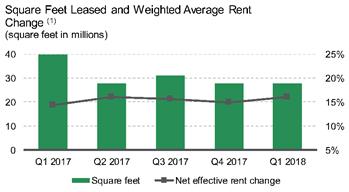

|
(1) |
Square feet leased and weighted average rent change were calculated using the total square feet of leases commenced during each quarter in 2017 and 2018 for leases greater than one year. We retained more than 70% of our customers, based on the total square feet of leases commenced during these periods. |
|
(2) |
Turnover costs are defined as leasing commissions and tenant improvements and represent the obligations incurred in connection with the lease commencement for leases greater than one year. |
Same Store Analysis
Our same store metrics are non-GAAP financial measures, which are commonly used in the real estate industry and expected from the financial community, on both a net-effective and cash basis. We evaluate the performance of the operating properties we own and manage using a “same store” analysis because the population of properties in this analysis is consistent from period to period, which allows us to analyze our ongoing business operations.
We define our same store population for the three months ended March 31, 2018 as our owned and managed properties that were in the operating portfolio at January 1, 2017 and owned throughout the end of the same three-month period in both 2018 and 2017. The same store population excludes development properties that were not stabilized at the beginning of the period (January 1, 2017) and properties acquired or disposed of to third parties during the period. Beginning January 1, 2018, we modified our definition of same store to align on consistent methodologies with members of the industrial REIT group. This did not materially change our historical amounts reported. To derive an appropriate measure of period-to-period operating performance, we remove the effects of foreign currency exchange rate movements by using the reported period end exchange rate to translate from local currency into the U.S. dollar, for both periods. We believe the factors that affect rental revenues, rental recoveries, rental expenses and NOI in the same store portfolio are generally the same as for our consolidated portfolio.
As our same store measures are non-GAAP financial measures, they have certain limitations as analytical tools and may vary among real estate companies. As a result, we provide a reconciliation of rental revenues, rental recoveries and rental expenses from our Consolidated Financial Statements prepared in accordance with GAAP to same store property NOI with explanations of how these metrics are calculated. In addition, we further remove certain noncash items (straight-line rent adjustments and amortization of lease intangibles) included in the financial statements prepared in accordance with GAAP to reflect a cash same store number. To clearly label these metrics, they are categorized as same store portfolio NOI – net effective and same store portfolio NOI – cash.
34
The following is a reconciliation of our consolidated rental revenues, rental recoveries, rental expense s and property NOI, as included in the Consolidated Statements of Income, to the respective amounts in our same store portfolio analysis for the three months ended March 31 (dollars in millions) :
|
|
|
|
|
|
|
|
|
|
|
Percentage |
|
|
|
|
|
2018 |
|
|
2017 |
|
|
Change |
|
|||
|
Rental revenues (1) (2) |
|
|
|
|
|
|
|
|
|
|
|
|
|
Consolidated: |
|
|
|
|
|
|
|
|
|
|
|
|
|
Rental revenues per the Consolidated Statements of Income |
|
$ |
428 |
|
|
$ |
440 |
|
|
|
|
|
|
Rental recoveries per the Consolidated Statements of Income |
|
|
128 |
|
|
|
127 |
|
|
|
|
|
|
Consolidated adjustments to derive same store results: |
|
|
|
|
|
|
|
|
|
|
|
|
|
Rental revenues and recoveries of properties not in the same store portfolio – properties developed, acquired and sold to third parties during the period and other real estate assets |
|
|
(46 |
) |
|
|
(49 |
) |
|
|
|
|
|
Effect of changes in foreign currency exchange rates and other |
|
|
(3 |
) |
|
|
1 |
|
|
|
|
|
|
Unconsolidated co-investment ventures – rental revenues |
|
|
567 |
|
|
|
508 |
|
|
|
|
|
|
Same store portfolio – rental revenues – net effective (2) |
|
$ |
1,074 |
|
|
$ |
1,027 |
|
|
|
4.6 |
% |
|
Straight-line rent adjustment |
|
|
(17 |
) |
|
|
(30 |
) |
|
|
|
|
|
Fair value lease adjustment |
|
|
- |
|
|
|
(1 |
) |
|
|
|
|
|
Same store portfolio – rental revenues – cash |
|
$ |
1,057 |
|
|
$ |
996 |
|
|
|
6.1 |
% |
|
|
|
|
|
|
|
|
|
|
|
|
|
|
|
Rental expenses (1) (3) |
|
|
|
|
|
|
|
|
|
|
|
|
|
Consolidated: |
|
|
|
|
|
|
|
|
|
|
|
|
|
Rental expenses per the Consolidated Statements of Income |
|
|
143 |
|
|
|
153 |
|
|
|
|
|
|
Consolidated adjustments to derive same store results: |
|
|
|
|
|
|
|
|
|
|
|
|
|
Rental expenses of properties not in the same store portfolio – properties developed, acquired and sold to third parties during the period and other real estate assets |
|
|
(16 |
) |
|
|
(16 |
) |
|
|
|
|
|
Effect of changes in foreign currency exchange rates and other |
|
|
13 |
|
|
|
11 |
|
|
|
|
|
|
Unconsolidated co-investment ventures – rental expenses |
|
|
129 |
|
|
|
108 |
|
|
|
|
|
|
Same store portfolio – rental expenses – net effective and cash (3) |
|
$ |
269 |
|
|
$ |
256 |
|
|
|
5.1 |
% |
|
|
|
|
|
|
|
|
|
|
|
|
|
|
|
NOI (1) |
|
|
|
|
|
|
|
|
|
|
|
|
|
Consolidated: |
|
|
|
|
|
|
|
|
|
|
|
|
|
Property NOI (calculated as rental revenues and rental recoveries less rental expenses per the Consolidated Statements of Income) |
|
$ |
413 |
|
|
$ |
414 |
|
|
|
|
|
|
Consolidated adjustments to derive same store results: |
|
|
|
|
|
|
|
|
|
|
|
|
|
Property NOI of properties not in the same store portfolio – properties developed, acquired and sold to third parties during the period and other real estate assets |
|
|
(30 |
) |
|
|
(33 |
) |
|
|
|
|
|
Effect of changes in foreign currency exchange rates and other |
|
|
(16 |
) |
|
|
(10 |
) |
|
|
|
|
|
Unconsolidated co-investment ventures – property NOI |
|
|
438 |
|
|
|
400 |
|
|
|
|
|
|
Same store portfolio – NOI – net effective |
|
$ |
805 |
|
|
$ |
771 |
|
|
|
4.4 |
% |
|
Same store portfolio – NOI – cash |
|
$ |
788 |
|
|
$ |
740 |
|
|
|
6.5 |
% |
|
(1) |
We include 100% of the same store NOI from the properties in our same store portfolio. During the periods presented, certain properties owned by us were contributed to a co-investment venture and are included in the same store portfolio. Neither our consolidated results nor those of the co-investment ventures, when viewed individually, would be comparable on a same store basis because of the changes in composition of the respective portfolios from period to period (e.g. the results of a contributed property are included in our consolidated results through the contribution date and in the results of the unconsolidated entities subsequent to the contribution date). |
|
(2) |
We exclude the net termination and renegotiation fees from our same store rental revenues to allow us to evaluate the growth or decline in each property’s rental revenues without regard to one-time items that are not indicative of the property’s recurring operating performance. Net termination and renegotiation fees represent the gross fee negotiated to allow a customer to terminate or renegotiate their lease, offset by the write-off of the asset recorded due to the adjustment to straight-line rents over the lease term. The adjustments to remove these items are included in “effect of changes in foreign currency exchange rates and other” in this table. |
35
|
consolidated rental expenses. T hese expenses fluctuate based on the level of properties included in the same store portfolio and any adjustment is included as “effect of changes in foreign currency exchange rates and other” in this table. |
Other Components of Income (Expense)
Earnings from Unconsolidated Entities, Net
We recognized net earnings from unconsolidated entities, which are accounted for using the equity method, of $63 million and $49 million for the three months ended March 31, 2018 and 2017, respectively. The earnings we recognize can be impacted by: (i) variances in revenues and expenses of each venture; (ii) the size and occupancy rate of the portfolio of properties owned by each venture; (iii) gains or losses from the dispositions of properties and extinguishment of debt; (iv) our ownership interest in each venture; and (v) fluctuations in foreign currency exchange rates used to translate our share of net earnings to U.S. dollars.
See the discussion of our co-investment ventures above in the Strategic Capital segment discussion and in Note 3 to the Consolidated Financial Statements for further breakdown of our share of net earnings recognized.
Interest Expense
The following table details our net interest expense for the three months ended March 31 (dollars in millions):
|
|
|
2018 |
|
|
2017 |
|
||
|
Gross interest expense |
|
$ |
55 |
|
|
$ |
90 |
|
|
Amortization of discounts (premiums), net of debt issuance costs |
|
|
3 |
|
|
|
(2 |
) |
|
Capitalized amounts |
|
|
(11 |
) |
|
|
(15 |
) |
|
Net interest expense |
|
$ |
47 |
|
|
$ |
73 |
|
|
Weighted average effective interest rate during the period |
|
|
2.9 |
% |
|
|
3.2 |
% |
Our overall debt decreased by $1.5 billion from March 31, 2017 to March 31, 2018, primarily from USLF assuming secured debt in conjunction with our contribution of real estate properties in July 2017. Gross interest expense decreased for the three months ended 2018, from the same period in 2017, principally due to decreased secured debt as a result of the USLF contribution, lower interest rates due to the change in the composition of our senior notes and term loans and the settlement of the interest rate swaps on the Canadian term loan (“2015 Canadian Term Loan”).
See Note 5 to the Consolidated Financial Statements and the Liquidity and Capital Resources section below, for further discussion of our debt and borrowing costs.
Gains on Dispositions of Investments in Real Estate, Net
During the three months ended March 31, 2018 and 2017, we recognized net gains on dispositions of investments in real estate of $195 million and $97 million, respectively. We contributed properties, generally that we developed, to our unconsolidated co-investment ventures in Europe in 2018 and 2017 and in Japan in 2018. We also sold properties to third parties, primarily from our operating portfolio in the U.S. In the first quarter of 2017, we sold our investment in Europe Logistics Venture 1 (“ELV”) to our venture partner and contributed properties to our newly formed co-investment venture Prologis UK Logistics Venture. We utilized the proceeds from both contributions and dispositions to fund our capital investments in both periods.
Beginning January 1, 2018, we recognized the entire gain attributed to contributions of real estate properties to unconsolidated entities under the new revenue recognition standard, as discussed in Note 1 to the Consolidated Financial Statements. We previously recognized a gain in connection with contributions to the extent of the third-party ownership in the unconsolidated entity acquiring the property . For deferred gains from partial sales recorded prior to the adoption, we will continue to recognize these gains over the lives of the underlying real estate properties or at the time of disposition to a third party.
See Notes 2 and 3 to the Consolidated Financial Statements for further information on the gains we recognized.
36
Foreign Currency and Derivative Losses, Net
The following table details our foreign currency and derivative losses, net for the three months ended March 31 (in millions):
|
|
|
2018 |
|
|
2017 |
|
||
|
Realized foreign currency and derivative gains (losses): |
|
|
|
|
|
|
|
|
|
Gains (losses) on the settlement of unhedged derivative transactions |
|
$ |
(7 |
) |
|
$ |
5 |
|
|
Total realized foreign currency and derivative gains (losses) |
|
|
(7 |
) |
|
|
5 |
|
|
|
|
|
|
|
|
|
|
|
|
Unrealized foreign currency and derivative gains (losses): |
|
|
|
|
|
|
|
|
|
Losses on the change in fair value of unhedged derivative and nonderivative transactions |
|
|
(37 |
) |
|
|
(18 |
) |
|
Gains on remeasurement of certain assets and liabilities (1) |
|
|
3 |
|
|
|
6 |
|
|
Total unrealized foreign currency and derivative losses |
|
|
(34 |
) |
|
|
(12 |
) |
|
Total foreign currency and derivative losses, net |
|
$ |
(41 |
) |
|
$ |
(7 |
) |
|
|
|
|
|
|
|
|
|
|
|
(1) |
These gains or losses were primarily related to the remeasurement of assets and liabilities that are denominated in currencies other than the functional currency of the entity, such as short-term intercompany loans between the U.S. parent and certain foreign consolidated subsidiaries, debt and tax receivables and payables. |
See Note 9 to the Consolidated Financial Statements for more information about our derivative transactions.
Income Tax Expense
We recognize income tax expense related to our taxable REIT subsidiaries and the local, state and foreign jurisdictions in which we operate. Our current income tax expense fluctuates from period to period based primarily on the timing of our taxable income. Deferred income tax expense (benefit) is generally a function of the period’s temporary differences and the utilization of net operating losses generated in prior years that had been previously recognized as deferred income tax assets in taxable subsidiaries operating in the U.S. or in foreign jurisdictions.
The following table summarizes our income tax expense for the three months ended March 31 (in millions):
|
|
|
2018 |
|
|
2017 |
|
||
|
Current income tax expense (benefit): |
|
|
|
|
|
|
|
|
|
Income tax expense |
|
$ |
11 |
|
|
$ |
9 |
|
|
Income tax expense (benefit) on dispositions |
|
|
7 |
|
|
|
(1 |
) |
|
Income tax expense (benefit) related to acquired tax assets |
|
|
1 |
|
|
|
(1 |
) |
|
Total current income tax expense |
|
|
19 |
|
|
|
7 |
|
|
|
|
|
|
|
|
|
|
|
|
Deferred income tax expense (benefit): |
|
|
|
|
|
|
|
|
|
Income tax expense (benefit) |
|
|
(1 |
) |
|
|
2 |
|
|
Income tax expense (benefit) related to acquired tax assets |
|
|
(1 |
) |
|
|
1 |
|
|
Total deferred income tax expense (benefit) |
|
|
(2 |
) |
|
|
3 |
|
|
Total income tax expense |
|
$ |
17 |
|
|
$ |
10 |
|
|
|
|
|
|
|
|
|
|
|
The Tax Cuts and Jobs Act, enacted on December 22, 2017, reduced the corporate federal tax rate in the U.S. to 21.0%, effective upon enactment. As such deferred tax assets and liabilities were remeasured using the lower corporate federal tax rate at December 31, 2017. While we do not expect other material impacts, the new rules are complex and lack developed administrative guidance; thus, the impact of certain aspects of these provisions on us is currently unclear.
Net Earnings Attributable to Noncontrolling Interests
This amount represents the third-party investors’ share of the earnings generated in consolidated entities in which we do not own 100% of the equity, reduced by the third-party share of fees or promotes payable to us and earned during the period. We had net earnings attributable to noncontrolling interests of $25 million and $16 million for the three months ended March 31, 2018 and 2017, respectively. Included in these amounts were $11 million and $6 million for the three months ended March 31, 2018 and 2017, respectively, of net earnings attributable to the common limited partnership unitholders of Prologis, L.P.
See Note 6 to the Consolidated Financial Statements for further information on our noncontrolling interests.
37
Other Comprehensive Income (Loss)
See Note 9 to the Consolidated Financial Statements for more information about our derivative transactions and other comprehensive income (loss).
LIQUIDITY AND CAPITAL RESOURCES
Overview
We consider our ability to generate cash from operating activities, distributions from our co-investment ventures, contributions and dispositions of properties and available financing sources to be adequate to meet our anticipated future development, acquisition, operating, debt service, dividend and distribution requirements.
Near-Term Principal Cash Sources and Uses
In addition to dividends and distributions, we expect our primary cash needs will consist of the following:
|
• |
completion of the development and leasing of the properties in our consolidated development portfolio (at March 31, 2018, 84 properties in our development portfolio were 60.5% leased with a current investment of $1.7 billion and a TEI of $2.8 billion when completed and leased, leaving $1.1 billion of estimated additional required investment); |
|
• |
development of new properties for long-term investment or contributions to unconsolidated co-investment ventures, including the acquisition of land in certain markets; |
|
• |
capital expenditures and leasing costs on properties in our operating portfolio; |
|
• |
repayment of debt and scheduled principal payments of $164 million in 2018; |
|
• |
additional investments in current unconsolidated entities or new investments in future unconsolidated entities; |
|
• |
acquisition of operating properties or portfolios of operating properties (depending on market and other conditions) for direct, long-term investment in our consolidated portfolio (this might include acquisitions from our co-investment ventures); and |
|
• |
repurchase of our outstanding debt or equity securities (depending on prevailing market conditions, our liquidity, contractual restrictions and other factors) through cash purchases, open-market purchases, privately negotiated transactions, tender offers or otherwise. |
We expect to fund our cash needs principally from the following sources (subject to market conditions):
|
• |
available unrestricted cash balances ($458 million at March 31, 2018); |
|
• |
net cash flow from property operations; |
|
• |
fees earned for services performed on behalf of the co-investment ventures, including promotes; |
|
• |
distributions received from the co-investment ventures; |
|
• |
proceeds from the disposition of properties, land parcels or other investments to third parties; |
|
• |
proceeds from the contributions of properties to current or future co-investment ventures; |
|
• |
proceeds from the sale of a portion of our investments in co-investment ventures to achieve long-term ownership targets; |
|
• |
borrowing capacity under our current credit facility arrangements, other facilities or borrowing arrangements ($3.2 billion available at March 31, 2018); and |
|
• |
proceeds from the issuance of debt. |
We may also generate proceeds from the issuance of equity securities, subject to market conditions.
38
The following table summarizes information about our debt (dollars in millions):
|
|
|
March 31, 2018 |
|
|
December 31, 2017 |
|
||
|
Debt outstanding |
|
$ |
9,460 |
|
|
$ |
9,413 |
|
|
Weighted average interest rate |
|
|
2.8 |
% |
|
|
2.9 |
% |
|
Weighted average maturity in months |
|
62 |
|
|
67 |
|
||
During the first quarter of 2018, we had the following significant debt activity, which resulted in lowering our average borrowing rate (dollars in millions):
|
|
|
|
Principal |
|
|
|
|
|
|
|
||||
|
|
Borrowing Currency |
|
Borrowing Currency |
|
USD |
|
|
Stated Interest Rate |
|
Fixed/ Variable |
|
Maturity |
||
|
Repurchase and payments of debt |
|
|
|
|
|
|
|
|
|
|
|
|
|
|
|
2015 Canadian Term Loan (1) |
CAD |
|
$ |
201 |
|
$ |
159 |
|
|
CDOR + 1.50% |
|
Variable |
|
February 2023 |
|
2017 Term Loan |
USD |
|
$ |
500 |
|
$ |
500 |
|
|
LIBOR plus 0.90% |
|
Variable |
|
May 2020 |
|
|
|
|
|
|
|
|
|
|
|
|
|
|
|
|
|
Issuance of debt |
|
|
|
|
|
|
|
|
|
|
|
|
|
|
|
Senior notes |
EUR |
|
€ |
400 |
|
$ |
494 |
|
|
Euribor + 0.25% |
|
Variable |
|
January 2020 |
(1) This activity included a partial pay down on the debt outstanding.
At March 31, 2018, we had credit facilities with an aggregate borrowing capacity of $3.6 billion, of which $3.2 billion was available for borrowing.
Our credit ratings at March 31, 2018, were A3 from Moody’s and A- from S&P, both with stable outlook. These ratings allow us to borrow at an advantageous rate. Adverse changes in our credit ratings could negatively impact our business and, in particular, our refinancing and other capital market activities, our ability to manage debt maturities, our future growth and our development and acquisition activity. A securities rating is not a recommendation to buy, sell or hold securities and is subject to revision or withdrawal at any time by the rating organization.
At March 31, 2018, we were in compliance with all of our financial debt covenants. These covenants include customary financial covenants for total debt, encumbered debt and fixed charge coverage ratios.
See Note 5 to the Consolidated Financial Statements for further discussion on our debt.
Equity Commitments Related to Certain Co-Investment Ventures
Certain co-investment ventures have equity commitments from us and our venture partners. Our venture partners fulfill their equity commitment with cash. We may fulfill our equity commitment through contributions of properties or cash. See the Cash Flow Summary below for more information about our investment activity in our co-investment ventures. For more information on equity commitments for our unconsolidated co-investment ventures, see Note 3 to the Consolidated Financial Statements.
Cash Flow Summary
The following table summarizes our cash flow activity for the three months ended March 31 (in millions):
|
|
|
2018 |
|
|
2017 |
|
||
|
Net cash provided by operating activities |
|
$ |
349 |
|
|
$ |
353 |
|
|
Net cash provided by investing activities |
|
$ |
152 |
|
|
$ |
56 |
|
|
Net cash used in financing activities |
|
$ |
(496 |
) |
|
$ |
(829 |
) |
Operating Activities
Cash provided by operating activities, exclusive of changes in receivables and payables, is impacted by the following significant activity during the three months ended March 31, 2018 and 2017:
|
• |
Real estate operations. We receive the majority of our operating cash through the net revenues of our Real Estate Operations segment. See the Results of Operations section above for further explanation of our Real Estate Operations segment. The revenues from this segment include noncash adjustments for straight-lined rents and amortization of above and below market leases of $15 million and $25 million for 2018 and 2017, respectively. |
39
|
• |
Strategic capital. We also generate operating cash through our Strategic Capital segment by providing management services to our unconsolidated co-investment ventures. See the Strategic Capital Results of Operations section above for the key drivers of our strategic capital revenues and expenses. Included in Strategic Capital Revenues is the third-party investors’ share of the total promote revenue, which is recognized in operating activities in the period it is received. |
|
• |
G&A expenses. We incurred $63 million and $54 million of G&A costs in 2018 and 2017, respectively. |
|
• |
Equity-based compensation awards. We record equity-based compensation expenses in Rental Expenses in the Real Estate Operations segment, Strategic Capital Expenses in the Strategic Capital segment and G&A expenses. The total amounts expensed were $20 million and $18 million in 2018 and 2017, respectively. |
|
• |
Operating distributions from unconsolidated entities. We received $85 million and $77 million of distributions from our unconsolidated entities in 2018 and 2017, respectively. Certain co-investment ventures distribute the total promote (third-party investors’ and our share) and our share is recorded to Investment In and Advances to Unconsolidated Entities , and is recognized in operating activities in the period it is received. |
|
• |
Cash paid for interest and income taxes. As disclosed in Note 11 to the Consolidated Financial Statements, we paid combined amounts for interest and income taxes of $108 million and $127 million in 2018 and 2017, respectively. |
Investing Activities
Cash provided by investing activities is primarily driven by proceeds from contributions and dispositions of real estate properties. Cash used in investing activities is principally driven by our investments in real estate development, acquisitions and capital expenditures. See Note 2 to the Consolidated Financial Statements for further information on these real estate activities. The following significant transactions impacted our cash provided by investing activities during the three months ended March 31, 2018 and 2017:
|
• |
Real estate development. We invested $366 million and $321 million in 2018 and 2017, respectively, in real estate development and leasing costs for first generation space. We had 62 properties under development and 22 properties that were completed but not stabilized at March 31, 2018, and we expect to continue to develop new properties as the opportunities arise. |
|
• |
Real estate acquisitions. We acquired total real estate of $113 million, which included 379 acres of land in 2018. We acquired total real estate of $132 million, which included 192 acres of land and one operating property in 2017. |
|
• |
Investments in and advances to. We invested cash in our unconsolidated co-investment ventures and other ventures, which represents our proportionate share of $52 million and $107 million in 2018 and 2017, respectively. The ventures use the funds for the acquisition of operating properties, development and repayment of debt. See Note 3 to the Consolidated Financial Statements for more detail on our unconsolidated co-investment ventures. |
|
• |
Return of investment. We received distributions from unconsolidated co-investment ventures and other ventures as a return of investment of $111 million and $109 million in 2018 and 2017, respectively. Included in these amounts for 2018 and 2017 was $97 million and $17 million, respectively, from property dispositions within our unconsolidated co-investment ventures. In 2017, we also included $84 million from the disposition of our investment in ELV. |
|
• |
Proceeds from repayment of notes receivable backed by real estate. We received $34 million and $15 million in 2018 and 2017, respectively, for the payment of notes receivable received in connection with dispositions of real estate to third parties. |
Financing Activities
Cash provided by financing activities is primarily driven by proceeds from the issuance of debt. Cash used in financing activities is principally driven by dividends paid on common and preferred units, noncontrolling interest distributions and payments of debt and credit facilities. The following significant transactions impacted our cash used in financing activities during the three months ended March 31, 2018 and 2017:
|
• |
Settlement of noncontrolling interests. We paid net cash of $710 million to acquire our partner’s interest in NAIF and $80 million to acquire our partner’s interest in the Prologis Brazil Logistics Partners Fund I in 2017. |
40
|
• |
Other debt activity. Our repurchase and payments of debt and proceeds from issuance of debt consisted of the following activity for the three months ended March 31 (in millions): |
|
|
|
|
2018 |
|
|
2017 |
|
||
|
|
Repurchase and payments of debt (including extinguishment costs) |
|
|
|
|
|
|
|
|
|
|
Regularly scheduled debt principal payments and payments at maturity |
|
$ |
2 |
|
|
$ |
4 |
|
|
|
Term loans |
|
|
659 |
|
|
|
198 |
|
|
|
Secured mortgages |
|
|
35 |
|
|
|
- |
|
|
|
Total |
|
$ |
696 |
|
|
$ |
202 |
|
|
|
|
|
|
|
|
|
|
|
|
|
|
Proceeds from issuance of debt |
|
|
|
|
|
|
|
|
|
|
Senior notes |
|
$ |
496 |
|
|
$ |
- |
|
|
|
Term loans |
|
|
- |
|
|
|
485 |
|
|
|
Secured mortgages |
|
|
32 |
|
|
|
- |
|
|
|
Total |
|
$ |
528 |
|
|
$ |
485 |
|
Off-Balance Sheet Arrangements
Unconsolidated Co-Investment Venture Debt
We had investments in and advances to unconsolidated co-investment ventures, at March 31, 2018, of $5.5 billion. These ventures had total third-party debt of $8.4 billion at March 31, 2018.
At March 31, 2018, we did not guarantee any third-party debt of the unconsolidated co-investment ventures. In our role as the manager or sponsor, we work with the co-investment ventures to maintain sufficient liquidity and refinance their maturing debt. There can be no assurance that the co-investment ventures will be able to refinance any maturing indebtedness on terms as favorable as the maturing debt, or at all. If the ventures are unable to refinance the maturing indebtedness with newly issued debt, they may be able to obtain funds by voluntary capital contributions from us and our partners or by selling assets. Certain of our ventures also have credit facilities, or unencumbered properties, both of which may be used to obtain funds.
Contractual Obligations
Dividend and Distribution Requirements
Our dividend policy on our common stock is to distribute a percentage of our cash flow to ensure that we will meet the dividend requirements of the Internal Revenue Code, relative to maintaining our REIT status, while still allowing us to retain cash to fund capital improvements and other investment activities.
Under the Internal Revenue Code, REITs may be subject to certain federal income and excise taxes on our undistributed taxable income. We do not expect the Tax Cuts and Jobs Act, enacted on December 22, 2017, to modify our current distribution policy.
We paid a cash dividend of $0.48 per common share in the first quarter of 2018. Our future common stock dividends, if and as declared, may vary and will be determined by the board of directors (“Board”) upon the circumstances prevailing at the time, including our financial condition, operating results and REIT distribution requirements, and may be adjusted at the discretion of the Board during the year.
We make distributions on the common limited partnership units outstanding at the same per unit amount as our common stock dividend. The Class A Units in the OP are entitled to a quarterly distribution equal to $0.64665 per unit so long as the common units receive a quarterly distribution of at least $0.40 per unit. We paid a quarterly distribution of $0.64665 per Class A Unit in the first quarter of 2018.
At March 31, 2018, we had one series of preferred stock outstanding, the series Q. The annual dividend rate is 8.54% per share and dividends are payable quarterly in arrears.
Pursuant to the terms of our preferred stock, we are restricted from declaring or paying any dividend with respect to our common stock unless and until all cumulative dividends with respect to the preferred stock have been paid and sufficient funds have been set aside for dividends that have been declared for the relevant dividend period with respect to the preferred stock.
Other Commitments
On a continuing basis, we are engaged in various stages of negotiations for the acquisition or disposition of individual properties or portfolios of properties.
41
See Note 1 to the Consolidated Financial Statements.
FUNDS FROM OPERATIONS ATTRIBUTABLE TO COMMON STOCKHOLDERS/UNITHOLDERS (“FFO”)
FFO is a non-GAAP financial measure that is commonly used in the real estate industry. The most directly comparable GAAP measure to FFO is net earnings.
The National Association of Real Estate Investment Trusts (“NAREIT”) defines FFO as earnings computed under GAAP to exclude historical cost depreciation and gains and losses from the sales, along with impairment charges, of previously depreciated properties. We also exclude the gains on revaluation of equity investments upon acquisition of a controlling interest and the gain recognized from a partial sale of our investment, as these are similar to gains from the sales of previously depreciated properties. We exclude similar adjustments from our unconsolidated entities and the third parties’ share of our consolidated co-investment ventures.
Our FFO Measures
Our FFO measures begin with NAREIT’s definition and we make certain adjustments to reflect our business and the way that management plans and executes our business strategy. While not infrequent or unusual, the additional items we adjust for in calculating FFO, as modified by Prologis, and Core FFO , both as defined below, are subject to significant fluctuations from period to period. Although these items may have a material impact on our operations and are reflected in our financial statements, the removal of the effects of these items allows us to better understand the core operating performance of our properties over the long term. These items have both positive and negative short-term effects on our results of operations in inconsistent and unpredictable directions that are not relevant to our long-term outlook.
We calculate our FFO measures, as defined below, based on our proportionate ownership share of both our unconsolidated and consolidated ventures. We reflect our share of our FFO measures for unconsolidated ventures by applying our average ownership percentage for the period to the applicable reconciling items on an entity by entity basis. We reflect our share for consolidated ventures in which we do not own 100% of the equity by adjusting our FFO measures to remove the noncontrolling interests share of the applicable reconciling items based on our average ownership percentage for the applicable periods.
These FFO measures are used by management as supplemental financial measures of operating performance and we believe that it is important that stockholders, potential investors and financial analysts understand the measures management uses. We do not use our FFO measures as, nor should they be considered to be, alternatives to net earnings computed under GAAP, as indicators of our operating performance, as alternatives to cash from operating activities computed under GAAP or as indicators of our ability to fund our cash needs.
We analyze our operating performance principally by the rental revenues of our real estate and the revenues from our strategic capital business, net of operating, administrative and financing expenses. This income stream is not directly impacted by fluctuations in the market value of our investments in real estate or debt securities.
FFO, as modified by Prologis attributable to common stockholders/unitholders (“FFO, as modified by Prologis”)
To arrive at FFO, as modified by Prologis , we adjust the NAREIT defined FFO measure to exclude the impact of foreign currency related items and deferred tax, specifically:
|
• |
deferred income tax benefits and deferred income tax expenses recognized by our subsidiaries; |
|
• |
current income tax expense related to acquired tax liabilities that were recorded as deferred tax liabilities in an acquisition, to the extent the expense is offset with a deferred income tax benefit in earnings that is excluded from our defined FFO measure; |
|
• |
unhedged foreign currency exchange gains and losses resulting from debt transactions between us and our foreign consolidated subsidiaries and our foreign unconsolidated entities; |
|
• |
foreign currency exchange gains and losses from the remeasurement (based on current foreign currency exchange rates) of certain third-party debt of our foreign consolidated and unconsolidated entities; and |
|
• |
mark-to-market adjustments associated with derivative financial instruments. |
We use FFO, as modified by Prologis , so that management, analysts and investors are able to evaluate our performance against other REITs that do not have similar operations or operations in jurisdictions outside the U.S.
42
Core FFO attributable to common stockholders / unitholders (“Core FFO”)
In addition to FFO, as modified by Prologis , we also use Core FFO. To arrive at Core FFO, we adjust FFO, as modified by Prologis , to exclude the following recurring and nonrecurring items that we recognized directly in FFO, as modified by Prologis :
|
• |
gains or losses from the disposition of land and development properties that were developed with the intent to contribute or sell; |
|
• |
income tax expense related to the sale of investments in real estate; |
|
• |
impairment charges recognized related to our investments in real estate generally as a result of our change in intent to contribute or sell these properties; |
|
• |
gains or losses from the early extinguishment of debt and redemption and repurchase of preferred stock; and |
|
• |
expenses related to natural disasters. |
We use Core FFO , including by segment and region, to: (i) assess our operating performance as compared to other real estate companies; (ii) evaluate our performance and the performance of our properties in comparison with expected results and results of previous periods; (iii) evaluate the performance of our management; (iv) budget and forecast future results to assist in the allocation of resources; (v) provide guidance to the financial markets to understand our expected operating performance; and (vi) evaluate how a specific potential investment will impact our future results.
Limitations on the use of our FFO measures
While we believe our modified FFO measures are important supplemental measures, neither NAREIT’s nor our measures of FFO should be used alone because they exclude significant economic components of net earnings computed under GAAP and are, therefore, limited as an analytical tool. Accordingly, these are only a few of the many measures we use when analyzing our business. Some of the limitations are:
|
• |
The current income tax expenses that are excluded from our modified FFO measures represent the taxes and transaction costs that are payable. |
|
• |
Depreciation and amortization of real estate assets are economic costs that are excluded from FFO. FFO is limited, as it does not reflect the cash requirements that may be necessary for future replacements of the real estate assets. Furthermore, the amortization of capital expenditures and leasing costs necessary to maintain the operating performance of logistics facilities are not reflected in FFO. |
|
• |
Gains or losses from non-development property dispositions and impairment charges related to expected dispositions represent changes in value of the properties. By excluding these gains and losses, FFO does not capture realized changes in the value of disposed properties arising from changes in market conditions. |
|
• |
The deferred income tax benefits and expenses that are excluded from our modified FFO measures result from the creation of a deferred income tax asset or liability that may have to be settled at some future point. Our modified FFO measures do not currently reflect any income or expense that may result from such settlement. |
|
• |
The foreign currency exchange gains and losses that are excluded from our modified FFO measures are generally recognized based on movements in foreign currency exchange rates through a specific point in time. The ultimate settlement of our foreign currency-denominated net assets is indefinite as to timing and amount. Our FFO measures are limited in that they do not reflect the current period changes in these net assets that result from periodic foreign currency exchange rate movements. |
|
• |
The gains and losses on extinguishment of debt or preferred stock that we exclude from our Core FFO, may provide a benefit or cost to us as we may be settling our obligation at less or more than our future obligation. |
|
• |
The natural disaster expenses that we exclude from Core FFO are costs that we have incurred. |
43
We compensate for these limitations by using our FFO measures only in conjunction with net earnings computed under GAAP when making our decisions. This information should be read with our complete Consolidated Financial Statements prepared under GAAP. To assist investors in compensating for these limitations, we reconcile our modified FFO measures to our net earnings computed under GAAP for three months ended March 31 as follows (in millions):
|
|
|
2018 |
|
|
2017 |
|
||
|
FFO |
|
|
|
|
|
|
|
|
|
Reconciliation of net earnings to FFO measures: |
|
|
|
|
|
|
|
|
|
Net earnings attributable to common stockholders |
|
$ |
366 |
|
|
$ |
203 |
|
|
|
|
|
|
|
|
|
|
|
|
Add (deduct) NAREIT defined adjustments: |
|
|
|
|
|
|
|
|
|
Real estate related depreciation and amortization |
|
|
196 |
|
|
|
219 |
|
|
Gains on dispositions of investments in real estate properties, net |
|
|
(37 |
) |
|
|
(67 |
) |
|
Reconciling items related to noncontrolling interests |
|
|
(10 |
) |
|
|
(25 |
) |
|
Our share of reconciling items included in earnings from unconsolidated entities |
|
|
52 |
|
|
|
33 |
|
|
NAREIT defined FFO |
|
|
567 |
|
|
|
363 |
|
|
|
|
|
|
|
|
|
|
|
|
Add (deduct) our modified adjustments: |
|
|
|
|
|
|
|
|
|
Unrealized foreign currency and derivative losses, net |
|
|
34 |
|
|
|
12 |
|
|
Deferred income tax expense (benefit) |
|
|
(2 |
) |
|
|
2 |
|
|
Current income tax expense (benefit) on dispositions related to acquired tax assets |
|
|
1 |
|
|
|
(1 |
) |
|
Our share of reconciling items included in earnings from unconsolidated entities |
|
|
(2 |
) |
|
|
2 |
|
|
FFO, as modified by Prologis |
|
|
598 |
|
|
|
378 |
|
|
|
|
|
|
|
|
|
|
|
|
Adjustments to arrive at Core FFO: |
|
|
|
|
|
|
|
|
|
Gains on dispositions of development properties and land, net |
|
|
(158 |
) |
|
|
(30 |
) |
|
Current income tax expense (benefit) on dispositions |
|
|
7 |
|
|
|
(1 |
) |
|
Losses on early extinguishment of debt, net |
|
|
1 |
|
|
|
- |
|
|
Reconciling items related to noncontrolling interests |
|
|
(1 |
) |
|
|
(1 |
) |
|
Our share of reconciling items included in earnings from unconsolidated entities |
|
|
(4 |
) |
|
|
1 |
|
|
Core FFO |
|
$ |
443 |
|
|
$ |
347 |
|
ITEM 3. Quantitative and Qualitative Disclosures About Market Risk
We are exposed to the impact of foreign exchange-related variability and earnings volatility on our foreign investments and interest rate changes. See our risk factors in Item 1A. Risk Factors, in our Annual Report on Form 10-K for the year ended December 31, 2017. See also Note 9 to the Consolidated Financial Statements in Item 1 for more information about our derivative financial instruments.
We monitor our market risk exposures using a sensitivity analysis. Our sensitivity analysis estimates the exposure to market risk sensitive instruments assuming a hypothetical 10% adverse change in foreign currency exchange rates or interest rates at March 31, 2018. The results of the sensitivity analysis are summarized in the following sections. The sensitivity analysis is of limited predictive value. As a result, revenues and expenses, as well as our ultimate realized gains or losses with respect to foreign currency exchange rate and interest rate fluctuations will depend on the exposures that arise during a future period, hedging strategies at the time and the prevailing foreign currency exchange rates and interest rates.
Foreign Currency Risk
We are exposed to foreign currency exchange variability related to investments in and earnings from our foreign investments. Foreign currency market risk is the possibility that our results of operations or financial position could be better or worse than planned because of changes in foreign currency exchange rates. We primarily hedge our foreign currency risk by borrowing in the currencies in which we invest. Generally, we borrow in the functional currency of the consolidated subsidiaries but we also borrow in currencies other than the U.S. dollar in the OP and may designate this borrowing as a nonderivative financial instrument. We may also hedge our foreign currency risk by designating derivative financial instruments as net investment hedges, as these amounts offset the translation adjustments on the underlying net assets of our foreign investments. Other foreign currency contracts, such as forwards and options, not designated as hedges reduce fluctuations in foreign currency associated with the translation of our projected net operating income of our international subsidiaries.
At March 31, 2018, after consideration of our nonderivative and derivative financial instruments, we had net equity of approximately $752 million denominated in a currency other than the U.S. dollar representing 4.0% of total net equity. Based on our sensitivity analysis, a 10% strengthening of the U.S. dollar against other currencies would cause a reduction of $75 million to our net equity.
44
At March 31, 2018, we had foreign currency forward contracts, which were designated and qualify as net investment hedges, with an aggregate notional amount of $ 100 million to hedge a portion of our investments in Canada. On the basis of our sensitivity analysis, a weakening of the U.S. dollar against the Canadian dollar by 10% would result in a $10 million negative change in our cash flows on settlement. In addit ion, we also have British pound sterling, Canadian dollar, euro and Japanese yen forward and option contracts, which were not designated as hedges, and have an aggregate notional amount of $533 million to mitigate risk associated with the translation of th e projected earnings of our subsidiaries in Canada, Europe and Japan. A weakening of the U.S. dollar against these currencies by 10% would result in a $53 million negative change in our net income and cash flows on settlement of these contracts.
Interest Rate Risk
We also are exposed to the impact of interest rate changes on future earnings and cash flows. At March 31, 2018, we had $2.1 billion of variable rate debt outstanding, of which $1.2 billion was term loans, $493 million was senior notes, $337 million was credit facilities and $50 million was secured mortgages. At March 31, 2018, we had interest rate swap agreements to fix €400 million ($500 million) of our floating rate senior notes. On the basis of our sensitivity analysis, a 10% adverse change in interest rates based on our average outstanding variable rate debt balances not subject to interest rate swap agreements during the period would result in additional annual interest expense of $2 million, which equates to a change in interest rates of 12 basis points.
ITEM 4. Controls and Procedures
Controls and Procedures (The Parent)
The Parent carried out an evaluation under the supervision and with the participation of management, including the Chief Executive Officer and Chief Financial Officer, of the effectiveness of the disclosure controls and procedures (as defined in Rule 13a-14(c)) under the Securities and Exchange Act of 1934 (the “Exchange Act”) at March 31, 2018. On the basis of this evaluation, the Chief Executive Officer and the Chief Financial Officer have concluded that the disclosure controls and procedures are effective to ensure that the information required to be disclosed in reports that are filed or submitted under the Exchange Act are recorded, processed, summarized and reported within the time periods specified in the Securities and Exchange Commission (“SEC”) rules and forms.
Controls and Procedures (The OP)
The OP carried out an evaluation under the supervision and with the participation of management, including the Chief Executive Officer and Chief Financial Officer, of the effectiveness of the disclosure controls and procedures (as defined in Rule 13a-14(c)) under the Exchange Act at March 31, 2018. On the basis of this evaluation, the Chief Executive Officer and the Chief Financial Officer have concluded that the disclosure controls and procedures are effective to ensure that the information required to be disclosed in reports that are filed or submitted under the Exchange Act are recorded, processed, summarized and reported within the time periods specified in the SEC rules and forms.
Prologis and our unconsolidated investees are party to a variety of legal proceedings arising in the ordinary course of business. With respect to any such matters to which we are currently a party, the ultimate disposition of any such matters will not result in a material adverse effect on our business, financial position or results of operations.
At March 31, 2018, no material changes had occurred in our risk factors as discussed in Item 1A in our Annual Report on Form 10-K for the year ended December 31, 2017.
ITEM 2. Unregistered Sales of Equity Securities and Use of Proceeds
During the three months ended March 31, 2018, we issued an aggregate of 0.2 million shares of common stock of the Parent in connection with the redemption of common units of the OP and subsequently redeemed the shares for cash. The shares of common stock were issued in reliance on the exemption from registration requirements of the Securities Act of 1933, as amended, afforded by Section 4(a)(2) thereof.
ITEM 3. Defaults Upon Senior Securities
None.
45
ITEM 4. M ine Safety Disclosures
Not Applicable.
None.
The exhibits required by this item are set forth on the Exhibit Index attached hereto.
46
Certain of the following documents are filed herewith. Certain other of the following documents that have been previously filed with the Securities and Exchange Commission and, pursuant to Rule 12-b-32, are incorporated herein by reference.
|
|
|
|
4.1 |
|
|
|
|
|
4.2 |
|
|
|
|
|
10.1 |
|
|
|
|
|
10.2 |
|
|
|
|
|
10.3 |
|
|
|
|
|
12.1† |
Computation of Ratio of Earnings to Fixed Charges of Prologis, Inc. and Prologis, L.P. |
|
|
|
|
12.2† |
|
|
|
|
|
15.1† |
|
|
|
|
|
15.2† |
|
|
|
|
|
31.1† |
|
|
|
|
|
31.2† |
|
|
|
|
|
31.3† |
|
|
|
|
|
31.4† |
|
|
|
|
|
32.1† |
|
|
|
|
|
32.2† |
|
|
|
|
|
101.INS† |
XBRL Instance Document |
|
|
|
|
101.SCH† |
XBRL Taxonomy Extension Schema |
|
|
|
|
101.CAL† |
XBRL Taxonomy Extension Calculation Linkbase |
|
|
|
|
101.DEF† |
XBRL Taxonomy Extension Definition Linkbase |
|
|
|
|
101.LAB† |
XBRL Taxonomy Extension Label Linkbase |
|
|
|
|
101.PRE† |
XBRL Taxonomy Extension Presentation Linkbase |
|
|
|
|
† |
Filed herewith |
47
Pursuant to the requirements of Section 13 or 15(d) of the Exchange Act, the registrants have duly caused this report to be signed on their behalf by the undersigned, thereunto duly authorized.
|
PROLOGIS, INC. |
|
|
|
|
|
By: |
/s/ Thomas S. Olinger |
|
|
Thomas S. Olinger |
|
|
Chief Financial Officer |
|
|
|
|
By: |
/s/ Lori A. Palazzolo |
|
|
Lori A. Palazzolo |
|
|
Managing Director and Chief Accounting Officer |
|
|
|
|
PROLOGIS, L.P. |
|
|
By: |
Prologis, Inc., its general partner |
|
|
|
|
By: |
/s/ Thomas S. Olinger |
|
|
Thomas S. Olinger |
|
|
Chief Financial Officer |
|
|
|
|
By: |
/s/ Lori A. Palazzolo |
|
|
Lori A. Palazzolo |
|
|
Managing Director and Chief Accounting Officer |
|
|
|
Date: April 23, 2018
48