PRA GROUP INC
10-Ks and 10-Qs
|
|
|
|
|
|
|
|
|
|
|
|
|
|
|
|
|
|
|
|
|
|
|
|
|
|
|
|
|
|
|
|
|
|
|
|
|
|
|
|
|
|
|
|
|
|
|
|
|
|
|
|
|
|
|
|
UNITED STATES SECURITIES AND EXCHANGE COMMISSION
Washington, D.C. 20549
FORM 10-Q
For the quarterly period ended September 30, 2019
For the transition period from ________ to ________
Commission File Number: 000-50058
(Exact name of registrant as specified in its charter)
(State or other jurisdiction of incorporation or organization) | (I.R.S. Employer Identification No.) | |||
(Address of principal executive offices)
(888 ) 772-7326
(Registrant's Telephone No., including area code)
Not Applicable
(Former name, former address and former fiscal year, if changed since last report)
Securities registered pursuant to Section 12(b) of the Act:
Title of each class | Trading Symbol(s) | Name of each exchange on which registered |
Indicate by check mark whether the registrant (1) has filed all reports required to be filed by Section 13 or 15(d) of the Securities Exchange Act of 1934 during the preceding 12 months (or for such shorter period that the registrant was required to file such reports), and (2) has been subject to such filing requirements for the past 90 days. Yes þ No ¨
Indicate by check mark whether the registrant has submitted electronically every Interactive Data File required to be submitted pursuant to Rule 405 of Regulation S-T during the preceding 12 months (or for such shorter period that the registrant was required to submit such files). Yes þ No ¨
Indicate by check mark whether the registrant is a large accelerated filer, an accelerated filer, a non-accelerated filer, a smaller reporting company, or an emerging growth company. See the definitions of "large accelerated filer," "accelerated filer," "smaller reporting company," and "emerging growth company" in Rule 12b-2 of the Exchange Act. (Check one):
If an emerging growth company, indicate by check mark if the registrant has elected not to use the extended transition period for complying with any new or revised financial accounting standards provided pursuant to Section 13(a) of the Exchange Act. ¨
Indicate by check mark whether the registrant is a shell company (as defined in Rule 12b-2 of the Exchange Act). Yes ☐ No þ
The number of shares of the registrant's common stock outstanding as of November 5, 2019 was 45,410,939 .
Table of Contents
Item 1. | ||
Item 2. | ||
Item 3. | ||
Item 4. | ||
Item 1. | ||
Item 1A. | ||
Item 2. | ||
Item 3. | ||
Item 4. | ||
Item 5. | ||
Item 6. | ||
Signatures | ||
2
Part I. Financial Information
Item 1. Financial Statements (Unaudited)
PRA Group, Inc.
Consolidated Balance Sheets
September 30, 2019 and December 31, 2018
(Amounts in thousands)
(unaudited) | |||||||
September 30, 2019 | December 31, 2018 | ||||||
Assets | |||||||
Cash and cash equivalents | $ | $ | |||||
Investments | |||||||
Finance receivables, net | |||||||
Other receivables, net | |||||||
Income taxes receivable | |||||||
Deferred tax asset, net | |||||||
Property and equipment, net | |||||||
Right-of-use assets | — | ||||||
Goodwill | |||||||
Intangible assets, net | |||||||
Other assets | |||||||
Total assets | $ | $ | |||||
Liabilities and Equity | |||||||
Liabilities: | |||||||
Accounts payable | $ | $ | |||||
Accrued expenses | |||||||
Income taxes payable | |||||||
Deferred tax liability, net | |||||||
Interest-bearing deposits | |||||||
Borrowings | |||||||
Lease liabilities | — | ||||||
Other liabilities | |||||||
Total liabilities | |||||||
Redeemable noncontrolling interest | |||||||
Equity: | |||||||
Preferred stock, $0.01 par value, 2,000 shares authorized, no shares issued and outstanding | |||||||
Common stock, $0.01 par value, 100,000 shares authorized, 45,411 shares issued and outstanding at September 30, 2019; 100,000 shares authorized, 45,304 shares issued and outstanding at December 31, 2018 | |||||||
Additional paid-in capital | |||||||
Retained earnings | |||||||
Accumulated other comprehensive loss | ( | ) | ( | ) | |||
Total stockholders' equity - PRA Group, Inc. | |||||||
Noncontrolling interest | |||||||
Total equity | |||||||
Total liabilities and equity | $ | $ | |||||
The accompanying notes are an integral part of these consolidated financial statements.
3
PRA Group, Inc.
Consolidated Income Statements
For the three and nine months ended September 30, 2019 and 2018
(unaudited)
(Amounts in thousands, except per share amounts)
Three Months Ended September 30, | Nine Months Ended September 30, | ||||||||||||||
2019 | 2018 | 2019 | 2018 | ||||||||||||
Revenues: | |||||||||||||||
Income recognized on finance receivables | $ | $ | $ | $ | |||||||||||
Fee income | |||||||||||||||
Other revenue | |||||||||||||||
Total revenues | |||||||||||||||
Net allowance charges | ( | ) | ( | ) | ( | ) | ( | ) | |||||||
Operating expenses: | |||||||||||||||
Compensation and employee services | |||||||||||||||
Legal collection fees | |||||||||||||||
Legal collection costs | |||||||||||||||
Agency fees | |||||||||||||||
Outside fees and services | |||||||||||||||
Communication | |||||||||||||||
Rent and occupancy | |||||||||||||||
Depreciation and amortization | |||||||||||||||
Other operating expenses | |||||||||||||||
Total operating expenses | |||||||||||||||
Income from operations | |||||||||||||||
Other income and (expense): | |||||||||||||||
Interest expense, net | ( | ) | ( | ) | ( | ) | ( | ) | |||||||
Foreign exchange | |||||||||||||||
Other | ( | ) | ( | ) | |||||||||||
Income before income taxes | |||||||||||||||
Income tax expense | |||||||||||||||
Net income | |||||||||||||||
Adjustment for net income attributable to noncontrolling interests | |||||||||||||||
Net income attributable to PRA Group, Inc. | $ | $ | $ | $ | |||||||||||
Net income per common share attributable to PRA Group, Inc.: | |||||||||||||||
Basic | $ | $ | $ | $ | |||||||||||
Diluted | $ | $ | $ | $ | |||||||||||
Weighted average number of shares outstanding: | |||||||||||||||
Basic | |||||||||||||||
Diluted | |||||||||||||||
The accompanying notes are an integral part of these consolidated financial statements.
4
PRA Group, Inc.
Consolidated Statements of Comprehensive Income/(Loss)
For the three and nine months ended September 30, 2019 and 2018
(unaudited)
(Amounts in thousands)
Three Months Ended September 30, | Nine Months Ended September 30, | ||||||||||||||
2019 | 2018 | 2019 | 2018 | ||||||||||||
Net income | $ | $ | $ | $ | |||||||||||
Less net income attributable to noncontrolling interests | |||||||||||||||
Net income attributable to PRA Group, Inc. | |||||||||||||||
Other comprehensive income/(loss), net of tax: | |||||||||||||||
Currency translation adjustments | ( | ) | ( | ) | ( | ) | ( | ) | |||||||
Cash flow hedges | ( | ) | ( | ) | |||||||||||
Debt securities available-for-sale | ( | ) | |||||||||||||
Other comprehensive loss | ( | ) | ( | ) | ( | ) | ( | ) | |||||||
Less other comprehensive loss attributable to noncontrolling interests | ( | ) | ( | ) | ( | ) | ( | ) | |||||||
Other comprehensive loss attributable to PRA Group, Inc. | ( | ) | ( | ) | ( | ) | ( | ) | |||||||
Comprehensive income/(loss) attributable to PRA Group, Inc. | $ | ( | ) | $ | $ | ( | ) | $ | |||||||
The accompanying notes are an integral part of these consolidated financial statements.
5
PRA Group, Inc.
Consolidated Statements of Changes in Equity
For the nine months ended September 30, 2019
(unaudited)
(Amounts in thousands)
Common Stock | Additional Paid-in Capital | Retained Earnings | Accumulated Other Comprehensive (Loss) | Noncontrolling Interest | Total Equity | |||||||||||||||||||||
Shares | Amount | |||||||||||||||||||||||||
Balance at December 31, 2018 | $ | $ | $ | $ | ( | ) | $ | $ | ||||||||||||||||||
Components of comprehensive income, net of tax: | ||||||||||||||||||||||||||
Net income | — | — | — | — | ||||||||||||||||||||||
Currency translation adjustments | — | — | — | — | ( | ) | ( | ) | ( | ) | ||||||||||||||||
Cash flow hedges | — | — | — | — | ( | ) | — | ( | ) | |||||||||||||||||
Debt securities available-for-sale | — | — | — | — | — | |||||||||||||||||||||
Distributions to noncontrolling interest | — | — | — | — | — | ( | ) | ( | ) | |||||||||||||||||
Contributions from noncontrolling interest | — | — | — | — | — | |||||||||||||||||||||
Vesting of restricted stock | ( | ) | — | — | — | |||||||||||||||||||||
Share-based compensation expense | — | — | — | — | — | |||||||||||||||||||||
Employee stock relinquished for payment of taxes | — | — | ( | ) | — | — | — | ( | ) | |||||||||||||||||
Other | — | — | ( | ) | — | — | — | ( | ) | |||||||||||||||||
Balance at March 31, 2019 | $ | $ | $ | $ | ( | ) | $ | $ | ||||||||||||||||||
Components of comprehensive income, net of tax: | ||||||||||||||||||||||||||
Net income | — | — | — | — | ||||||||||||||||||||||
Currency translation adjustments | — | — | — | — | ||||||||||||||||||||||
Cash flow hedges | — | — | — | — | ( | ) | — | ( | ) | |||||||||||||||||
Debt securities available-for-sale | — | — | — | — | — | |||||||||||||||||||||
Contributions from noncontrolling interest | — | — | — | — | — | |||||||||||||||||||||
Vesting of restricted stock | — | — | — | |||||||||||||||||||||||
Share-based compensation expense | — | — | — | — | — | |||||||||||||||||||||
Employee stock relinquished for payment of taxes | — | — | ( | ) | — | — | — | ( | ) | |||||||||||||||||
Balance at June 30, 2019 | $ | $ | $ | $ | ( | ) | $ | $ | ||||||||||||||||||
Components of comprehensive income, net of tax: | ||||||||||||||||||||||||||
Net income | — | — | — | — | ||||||||||||||||||||||
Currency translation adjustments | — | — | — | — | ( | ) | ( | ) | ( | ) | ||||||||||||||||
Cash flow hedges | — | — | — | — | ( | ) | — | ( | ) | |||||||||||||||||
Debt securities available-for-sale | — | — | — | — | ( | ) | — | ( | ) | |||||||||||||||||
Distributions to noncontrolling interest | — | — | — | — | — | — | — | |||||||||||||||||||
Contributions from noncontrolling interest | — | — | — | — | — | |||||||||||||||||||||
Vesting of restricted stock | — | — | — | |||||||||||||||||||||||
Share-based compensation expense | — | — | — | — | — | |||||||||||||||||||||
Employee stock relinquished for payment of taxes | — | — | ( | ) | — | — | — | ( | ) | |||||||||||||||||
Balance at September 30, 2019 | $ | $ | $ | $ | ( | ) | $ | $ | ||||||||||||||||||
The accompanying notes are an integral part of these consolidated financial statements.
6
PRA Group, Inc.
Consolidated Statements of Changes in Equity
For the nine months ended September 30, 2018
(unaudited)
(Amounts in thousands)
Common Stock | Additional Paid-in Capital | Retained Earnings | Accumulated Other Comprehensive (Loss) | Noncontrolling Interest | Total Equity | |||||||||||||||||||||
Shares | Amount | |||||||||||||||||||||||||
Balance at December 31, 2017 | $ | $ | $ | $ | ( | ) | $ | $ | ||||||||||||||||||
Cumulative effect of change in accounting principle - equity securities (1) | — | — | — | ( | ) | — | — | ( | ) | |||||||||||||||||
Balance at January 1, 2018 | ( | ) | ||||||||||||||||||||||||
Components of comprehensive income, net of tax: | ||||||||||||||||||||||||||
Net income | — | — | — | — | ||||||||||||||||||||||
Currency translation adjustments | — | — | — | — | ||||||||||||||||||||||
Distributions to noncontrolling interest | — | — | — | — | — | ( | ) | ( | ) | |||||||||||||||||
Vesting of restricted stock | ( | ) | — | — | — | |||||||||||||||||||||
Share-based compensation expense | — | — | — | — | — | |||||||||||||||||||||
Employee stock relinquished for payment of taxes | — | — | ( | ) | — | — | — | ( | ) | |||||||||||||||||
Balance at March 31, 2018 | $ | $ | $ | $ | ( | ) | $ | $ | ||||||||||||||||||
Components of comprehensive income, net of tax: | ||||||||||||||||||||||||||
Net income | — | — | — | — | ||||||||||||||||||||||
Currency translation adjustments | — | — | — | — | ( | ) | ( | ) | ( | ) | ||||||||||||||||
Distributions to noncontrolling interest | — | — | — | — | — | ( | ) | ( | ) | |||||||||||||||||
Vesting of restricted stock | — | — | — | — | — | |||||||||||||||||||||
Share-based compensation expense | — | — | — | — | — | |||||||||||||||||||||
Employee stock relinquished for payment of taxes | — | — | ( | ) | — | — | — | ( | ) | |||||||||||||||||
Balance at June 30, 2018 | $ | $ | $ | $ | ( | ) | $ | $ | ||||||||||||||||||
Components of comprehensive income, net of tax: | ||||||||||||||||||||||||||
Net income | — | — | — | — | ||||||||||||||||||||||
Currency translation adjustments | — | — | — | — | ( | ) | ( | ) | ( | ) | ||||||||||||||||
Distributions to noncontrolling interest | — | — | — | — | — | ( | ) | ( | ) | |||||||||||||||||
Purchase of noncontrolling interest | — | — | — | — | — | |||||||||||||||||||||
Vesting of restricted stock | — | — | — | — | — | |||||||||||||||||||||
Share-based compensation expense | — | — | — | — | — | |||||||||||||||||||||
Employee stock relinquished for payment of taxes | — | — | ( | ) | — | — | — | ( | ) | |||||||||||||||||
Balance at September 30, 2018 | $ | $ | $ | $ | ( | ) | $ | $ | ||||||||||||||||||
(1) Relates to the adoption of FASB ASU 2016-01, "Financial Instruments - Overall: Recognition and Measurement of Financial Assets and Financial Liabilities" ("ASU 2016-01"). Refer to Note 3 for further detail.
The accompanying notes are an integral part of these consolidated financial statements.
7
PRA Group, Inc.
Consolidated Statements of Cash Flows
For the nine months ended September 30, 2019 and 2018
(unaudited)
(Amounts in thousands)
Nine Months Ended September 30, | |||||||
2019 | 2018 | ||||||
Cash flows from operating activities: | |||||||
Net income | $ | $ | |||||
Adjustments to reconcile net income to net cash provided by operating activities: | |||||||
Share-based compensation expense | |||||||
Depreciation and amortization | |||||||
Amortization of debt discount and issuance costs | |||||||
Deferred income taxes | ( | ) | ( | ) | |||
Net unrealized foreign currency transactions | ( | ) | ( | ) | |||
Fair value in earnings for equity securities | ( | ) | ( | ) | |||
Net allowance charges | |||||||
Changes in operating assets and liabilities: | |||||||
Other assets | |||||||
Other receivables, net | |||||||
Accounts payable | ( | ) | ( | ) | |||
Income taxes payable, net | ( | ) | |||||
Accrued expenses | ( | ) | |||||
Other liabilities | ( | ) | |||||
Other, net | |||||||
Net cash provided by operating activities | |||||||
Cash flows from investing activities: | |||||||
Purchases of property and equipment | ( | ) | ( | ) | |||
Acquisition of finance receivables | ( | ) | ( | ) | |||
Collections applied to principal on finance receivables | |||||||
Business acquisition, net of cash acquired | ( | ) | |||||
Cash received upon consolidation of Polish investment fund | |||||||
Proceeds from sale of subsidiaries, net | |||||||
Purchase of investments | ( | ) | ( | ) | |||
Proceeds from sales and maturities of investments | |||||||
Net cash used in investing activities | ( | ) | ( | ) | |||
Cash flows from financing activities: | |||||||
Proceeds from lines of credit | |||||||
Principal payments on lines of credit | ( | ) | ( | ) | |||
Principal payments on notes payable and long-term debt | ( | ) | ( | ) | |||
Tax withholdings related to share-based payments | ( | ) | ( | ) | |||
Distributions paid to noncontrolling interest | ( | ) | ( | ) | |||
Contributions from noncontrolling interest | |||||||
Purchase of noncontrolling interest | ( | ) | ( | ) | |||
Payments of origination costs and fees | ( | ) | |||||
Net increase/(decrease) in interest-bearing deposits | ( | ) | |||||
Other | ( | ) | |||||
Net cash provided by financing activities | |||||||
Effect of exchange rate on cash | ( | ) | ( | ) | |||
Net decrease in cash and cash equivalents | ( | ) | ( | ) | |||
Cash and cash equivalents, beginning of period | |||||||
Cash and cash equivalents, end of period | $ | $ | |||||
Supplemental disclosure of cash flow information: | |||||||
Cash paid for interest | $ | $ | |||||
Cash paid for income taxes | |||||||
Cash, cash equivalents and restricted cash reconciliation: | |||||||
Cash and cash equivalents per Consolidated Balance Sheets | $ | $ | |||||
Restricted cash included in Other assets per Consolidated Balance Sheets | |||||||
Total cash, cash equivalents and restricted cash | $ | $ | |||||
The accompanying notes are an integral part of these consolidated financial statements.
8
PRA Group, Inc.
Notes to Consolidated Financial Statements
1. Organization and Business:
As used herein, the terms "PRA Group," "the Company," or similar terms refer to PRA Group, Inc. and its subsidiaries.
PRA Group, Inc., a Delaware corporation, is a global financial and business services company with operations in the Americas and Europe. The Company's primary business is the purchase, collection and management of portfolios of nonperforming loans. The Company also provides fee-based services on class action claims recoveries and by servicing consumer bankruptcy accounts in the United States ("U.S.").
The consolidated financial statements of the Company are prepared in accordance with U.S. generally accepted accounting principles ("GAAP") and include the accounts of all of its subsidiaries. All significant intercompany accounts and transactions have been eliminated.
Under the guidance of the Financial Accounting Standards Board ("FASB") Accounting Standards Codification ("ASC") Topic 280 "Segment Reporting" ("ASC 280"), the Company has determined that it has several operating segments that meet the aggregation criteria of ASC 280, and, therefore, it has one reportable segment, accounts receivable management. This conclusion is based on similarities among the operating units, including economic characteristics, the nature of the products and services, the nature of the production processes, the types or class of customer for their products and services, the methods used to distribute their products and services and the nature of the regulatory environment.
The following table shows the amount of revenue generated for the three and nine months ended September 30, 2019 and 2018, respectively, and long-lived assets held at September 30, 2019 and 2018, respectively, both for the U.S., the Company's country of domicile, and outside of the U.S. (amounts in thousands):
As of and for the | As of and for the | ||||||||||||||
Three Months Ended September 30, 2019 | Three Months Ended September 30, 2018 | ||||||||||||||
Revenues | Long-Lived Assets (2) | Revenues | Long-Lived Assets | ||||||||||||
United States | $ | $ | $ | $ | |||||||||||
United Kingdom | |||||||||||||||
Other (1) | |||||||||||||||
Total | $ | $ | $ | $ | |||||||||||
As of and for the | As of and for the | ||||||||||||||
Nine Months Ended September 30, 2019 | Nine Months Ended September 30, 2018 | ||||||||||||||
Revenues | Long-Lived Assets (2) | Revenues | Long-Lived Assets | ||||||||||||
United States | $ | $ | $ | $ | |||||||||||
United Kingdom | |||||||||||||||
Other (1) | |||||||||||||||
Total | $ | $ | $ | $ | |||||||||||
(2) Includes right-of-use assets from the adoption of ASU 2016-02 on January 1, 2019. Refer to Note 5.
Revenues are attributed to countries based on the location of the related operations. Long-lived assets consist of net property and equipment and right-of-use assets. The Company reports revenues earned from nonperforming loan purchasing and collection activities, fee-based services and investments. For additional information on the Company's investments, see Note 3. It is impracticable for the Company to report further breakdowns of revenues from external customers by product or service.
The accompanying interim financial statements have been prepared in accordance with the instructions for Quarterly Reports on Form 10-Q and, therefore, do not include all information and notes to the consolidated financial statements necessary for a complete presentation of financial position, results of operations, comprehensive income/(loss) and cash flows in conformity with GAAP. In the opinion of management, all adjustments, consisting of normal and recurring items, necessary for the fair presentation of the Company's consolidated balance sheet as of September 30, 2019, its consolidated income statements, and statements of comprehensive income/(loss) for the three and nine months ended September 30, 2019 and 2018, and its statements of changes in equity and consolidated statements of cash flows for the nine months ended September 30, 2019 and 2018, have been included. The consolidated income statements of the Company for the three and nine months ended September 30, 2019 may not be indicative of future results. Certain prior period amounts have been reclassified for consistency with the current period presentation.
9
PRA Group, Inc.
Notes to Consolidated Financial Statements
These unaudited consolidated financial statements should be read in conjunction with the audited consolidated financial statements and notes thereto included in the Company's Annual Report on Form 10-K for the year ended December 31, 2018 (the "2018 Form 10-K").
2. Finance Receivables, net:
Changes in finance receivables, net for the three and nine months ended September 30, 2019 and 2018 were as follows (amounts in thousands):
Three Months Ended September 30, | Nine Months Ended September 30, | ||||||||||||||
2019 | 2018 | 2019 | 2018 | ||||||||||||
Balance at beginning of period | $ | $ | $ | $ | |||||||||||
Acquisitions of finance receivables (1) | |||||||||||||||
Foreign currency translation adjustment | ( | ) | ( | ) | ( | ) | ( | ) | |||||||
Cash collections | ( | ) | ( | ) | ( | ) | ( | ) | |||||||
Income recognized on finance receivables | |||||||||||||||
Net allowance charges | ( | ) | ( | ) | ( | ) | ( | ) | |||||||
Balance at end of period | $ | $ | $ | $ | |||||||||||
(1) | Includes portfolio purchases adjusted for buybacks and acquisition related costs, portfolios from the acquisition of a business in Canada made during the first quarter of 2019 and a $34.9 million addition in the third quarter of 2018 relating to the consolidation of a Polish investment fund. |
During the three months ended September 30, 2019, the Company acquired finance receivables portfolios with a face value of $2.4 billion for $279.0 million as compared to the same period last year with a face value of $2.2 billion for $273.1 million. During the nine months ended September 30, 2019, the Company acquired finance receivables portfolios with a face value of $8.9 billion for $887.0 million as compared to the same period last year with a face value of $6.0 billion for $662.8 million. At September 30, 2019, the estimated remaining collections ("ERC") on the receivables acquired during the three months ended September 30, 2019 and 2018 were $494.8 million and $365.3 million, respectively. At September 30, 2019, the ERC on the receivables acquired during the nine months ended September 30, 2019 and 2018 were $1.4 billion and $0.8 billion, respectively.
At the time of acquisition and each quarter thereafter, the life of each quarterly accounting pool is estimated based on projected amounts and timing of future cash collections using the proprietary models of the Company. Based upon current projections, cash collections expected to be applied to principal are estimated to be as follows for the twelve-month periods ending September 30, (amounts in thousands):
2020 | $ | ||
2021 | |||
2022 | |||
2023 | |||
2024 | |||
2025 | |||
2026 | |||
2027 | |||
2028 | |||
2029 | |||
Thereafter | |||
Total ERC expected to be applied to principal | $ | ||
At September 30, 2019, the Company had aggregate net finance receivables balances in pools accounted for under the cost recovery method of $36.2 million; at December 31, 2018, the amount was $48.0 million.
Accretable yield represents the amount of income on finance receivables the Company can expect to recognize over the remaining life of its existing portfolios based on estimated future cash flows as of the balance sheet date. Additions represent the original expected accretable yield on portfolios purchased during the period. Net reclassifications from nonaccretable difference
10
PRA Group, Inc.
Notes to Consolidated Financial Statements
to accretable yield primarily result from the increase in the Company's estimate of future cash flows. When applicable, net reclassifications to nonaccretable difference from accretable yield result from the decrease in the Company's estimates of future cash flows and allowance charges that together exceed the increase in the Company's estimate of future cash flows.
Changes in accretable yield for the three and nine months ended September 30, 2019 and 2018 were as follows (amounts in thousands):
Three Months Ended September 30, | Nine Months Ended September 30, | ||||||||||||||
2019 | 2018 | 2019 | 2018 | ||||||||||||
Balance at beginning of period | $ | $ | $ | $ | |||||||||||
Income recognized on finance receivables | ( | ) | ( | ) | ( | ) | ( | ) | |||||||
Net allowance charges | |||||||||||||||
Additions from portfolio purchases (1) | |||||||||||||||
Reclassifications from nonaccretable difference | |||||||||||||||
Foreign currency translation adjustment | ( | ) | ( | ) | ( | ) | ( | ) | |||||||
Balance at end of period | $ | $ | $ | $ | |||||||||||
(1) Also includes accretable yield additions resulting from certain business acquisitions.
The following is a summary of activity within the Company's valuation allowance account, all of which relates to acquired finance receivables, for the three and nine months ended September 30, 2019 and 2018 (amounts in thousands):
Three Months Ended September 30, | Nine Months Ended September 30, | ||||||||||||||
2019 | 2018 | 2019 | 2018 | ||||||||||||
Beginning balance | $ | $ | $ | $ | |||||||||||
Allowance charges | |||||||||||||||
Reversal of previously recorded allowance charges | ( | ) | ( | ) | ( | ) | ( | ) | |||||||
Net allowance charges | |||||||||||||||
Foreign currency translation adjustment | ( | ) | ( | ) | ( | ) | ( | ) | |||||||
Ending balance | $ | $ | $ | $ | |||||||||||
3. Investments:
Investments consisted of the following at September 30, 2019 and December 31, 2018 (amounts in thousands):
September 30, 2019 | December 31, 2018 | ||||||
Debt securities | |||||||
Available-for-sale | $ | $ | |||||
Equity securities | |||||||
Private equity funds | |||||||
Mutual funds | |||||||
Equity method investments | |||||||
Total investments | $ | $ | |||||
Debt Securities
Available-for-sale
Government bonds: The Company's investments in government bonds are classified as available-for-sale and are stated at fair value. Fair value is determined using quoted market prices. Unrealized gains and losses are included in comprehensive income and reported in equity.
11
PRA Group, Inc.
Notes to Consolidated Financial Statements
The amortized cost and estimated fair value of investments in debt securities at September 30, 2019 and December 31, 2018 were as follows (amounts in thousands):
September 30, 2019 | |||||||||||||||
Amortized Cost | Gross Unrealized Gains | Gross Unrealized Losses | Aggregate Fair Value | ||||||||||||
Available-for-sale | |||||||||||||||
Government bonds | $ | $ | $ | $ | |||||||||||
December 31, 2018 | |||||||||||||||
Amortized Cost | Gross Unrealized Gains | Gross Unrealized Losses | Aggregate Fair Value | ||||||||||||
Available-for-sale | |||||||||||||||
Government bonds | $ | $ | $ | $ | |||||||||||
Equity Securities
Investments in private equity funds: Investments in private equity funds represent limited partnerships in which the Company has less than a 3 % interest. In the first quarter of 2018, the Company adopted ASU 2016-01, "Financial Instruments - Overall: Recognition and Measurement of Financial Assets and Financial Liabilities" ("ASU 2016-01"), which requires that investments in equity securities be measured at fair value with changes in unrealized gains and losses reported in earnings. Upon adoption of ASU 2016-01, the investments are carried at the fair value reported by the Fund manager. The Company recorded a cumulative effect adjustment of $3.9 million, net of tax, to beginning retained earnings for the unrealized loss on the investments. Prior to 2018, the investments were carried at cost with income recognized in Other Revenue in the consolidated income statements when distributions, up to reported income, were received from the partnerships.
Mutual funds: The Company invests certain excess funds held in Brazil in a Brazilian real denominated mutual fund benchmarked to the U.S. dollar that invests principally in Brazilian fixed income securities. The investments are carried at fair value based on quoted market prices. Gains and losses from this investment are included as a foreign exchange component of other income and (expense) in the Company's consolidated income statements.
Unrealized gains and losses: Net unrealized gains were $5.5 million and $6.9 million for the three and nine months ended September 30, 2019, respectively, on the Company's equity securities. Net unrealized gains were $0.6 million and $3.4 million for the three and nine months ended September 30, 2018, respectively, on the Company's equity securities.
Equity Method Investments
Effective December 20, 2018, the Company has an 11.7 % interest in RCB Investimentos S.A. ("RCB"), a servicing platform for nonperforming loans in Brazil. This investment is accounted for on the equity method because the Company exercises significant influence over RCB’s operating and financial activities. Accordingly, the Company’s investment in RCB is adjusted for the Company’s proportionate share of RCB’s earnings or losses.
4. Goodwill and Intangible Assets, net:
In connection with the Company's business acquisitions, the Company acquired certain tangible and intangible assets. Intangible assets resulting from these acquisitions include client and customer relationships, non-compete agreements, trademarks and technology. The Company performs a review of goodwill as of October 1 of each year or more frequently if indicators of impairment exist.
12
PRA Group, Inc.
Notes to Consolidated Financial Statements
The following table represents the changes in goodwill for the three and nine months ended September 30, 2019 and 2018 (amounts in thousands):
Three Months Ended September 30, | Nine Months Ended September 30, | ||||||||||||||
2019 | 2018 | 2019 | 2018 | ||||||||||||
Balance at beginning of period: | |||||||||||||||
Goodwill | $ | $ | $ | $ | |||||||||||
Accumulated impairment loss | |||||||||||||||
Changes: | |||||||||||||||
Acquisition (1) | |||||||||||||||
Foreign currency translation adjustment | ( | ) | ( | ) | ( | ) | ( | ) | |||||||
Net change in goodwill | ( | ) | ( | ) | ( | ) | |||||||||
Goodwill | |||||||||||||||
Accumulated impairment loss | |||||||||||||||
Balance at end of period | $ | $ | $ | $ | |||||||||||
(1) For the three and nine months ended September 30, 2019, additions to goodwill are related to the acquisition of a business in Canada during the first quarter.
5. Leases:
In February 2016, FASB issued ASU 2016-02, "Leases (Topic 842) Section A - Leases: Amendments to the FASB Account Standards Codification" ("ASU 2016-02"). ASU 2016-02 requires that a lessee should recognize a liability to make lease payments and a right-of-use asset representing its right to use the underlying asset for the lease term on the balance sheet. The Company adopted ASU 2016-02 on January 1, 2019 using the alternative method which resulted in the recording of operating lease right-of-use ("ROU") assets and lease liabilities of $72.1 million and $75.8 million, respectively. The Company's balance sheets for reporting periods beginning on or after January 1, 2019 are presented under the new guidance, while prior periods amounts are not adjusted and continue to be reported in accordance with previous guidance.
The Company elected to apply the package of practical expedients permitted within the new standard, which among other things, allows it to carryforward the historical lease classification. In addition, the Company elected the practical expedient to exclude short-term leases (lease terms of less than one year) from its ROU assets and lease liabilities.
The Company's operating lease portfolio primarily includes corporate offices and call centers. The majority of its leases have remaining lease terms of 1 year to 20 years, some of which include options to extend the leases for 5 years, and others include options to terminate the leases within 1 year. Exercises of lease renewal options are typically at the Company's sole discretion and are included in its ROU assets and lease liabilities based upon whether the Company is reasonably certain of exercising the renewal options. The Company has lease agreements with lease and non-lease components, which are generally accounted for separately. The Company's lease agreements do not contain any material residual value guarantees or material restrictive covenants.
As most of the Company's leases do not provide an implicit rate, the Company uses its incremental borrowing rate based on the information available at the lease commencement date in determining the present value of the lease payments. The Company used its incremental borrowing rate as of January 1, 2019 to calculate the present value of the lease payments of its existing leases at adoption.
The components of lease expense for the three and nine months ended September 30, 2019 were as follows (amounts in thousands):
Three Months Ended September 30, 2019 | Nine Months Ended September 30, 2019 | ||||||
Operating lease cost | $ | $ | |||||
Short-term lease cost | |||||||
Total lease cost | $ | $ | |||||
13
PRA Group, Inc.
Notes to Consolidated Financial Statements
Supplemental cash flow information and non-cash activity related to leases for the nine months ended September 30, 2019 were as follows (amounts in thousands):
Nine Months Ended September 30, 2019 | |||
Cash paid for amounts included in the measurement of operating lease liabilities | $ | ||
Right-of-use assets obtained in exchange for operating lease obligations | |||
Lease term and discount rate information related to operating leases were as follows as of the dates indicated:
September 30, 2019 | ||
Weighted-average remaining lease term (years) | ||
Weighted-average discount rate | % | |
Maturities of lease liabilities as of September 30, 2019 were as follows for the following periods (amounts in thousands):
Operating Leases | |||
For the three months ending December 31, 2019 | $ | ||
For the year ending December 31, 2020 | |||
For the year ending December 31, 2021 | |||
For the year ending December 31, 2022 | |||
For the year ending December 31, 2023 | |||
Thereafter | |||
Total lease payments | |||
Less imputed interest | ( | ) | |
Total | $ | ||
As previously disclosed in the 2018 Form 10-K and under the previous lease accounting standard (which excludes the impact of the Company's intent to exercise renewal options as required by ASU 2016-02), future minimum lease payments for operating leases at December 31, 2018, were as follows for the years ending December 31, (amounts in thousands):
2019 | $ | ||
2020 | |||
2021 | |||
2022 | |||
2023 | |||
Thereafter | |||
Total future minimum lease payments | $ | ||
14
PRA Group, Inc.
Notes to Consolidated Financial Statements
6. Borrowings:
The Company's borrowings consisted of the following as of the dates indicated (amounts in thousands):
September 30, 2019 | December 31, 2018 | ||||||
Americas revolving credit | $ | $ | |||||
Europe revolving credit | |||||||
Term loans | |||||||
Convertible senior notes | |||||||
Less: Debt discount and issuance costs | ( | ) | ( | ) | |||
Total | $ | $ | |||||
The following principal payments are due on the Company's borrowings as of September 30, 2019 for the 12-month periods ending September 30, (amounts in thousands):
2020 | $ | ||
2021 | |||
2022 | |||
2023 | |||
2024 and thereafter | |||
Total | $ | ||
The Company believes it was in compliance with the covenants of its financing arrangements as of September 30, 2019.
North American Revolving Credit and Term Loan
On May 5, 2017, the Company amended and restated its existing credit agreement (as amended, and modified from time to time, the “North American Credit Agreement”) with Bank of America, N.A., as administrative agent, Bank of America, National Association, acting through its Canada branch, as the Canadian administrative agent, and a syndicate of lenders named therein. The total credit facility under the North American Credit Agreement includes an aggregate principal amount of $1.6 billion (subject to compliance with a borrowing base and applicable debt covenants), which consists of (i) a fully-funded $427.5 million term loan, (ii) a $1,068.0 million domestic revolving credit facility, and (iii) a $50.0 million Canadian revolving credit facility. The facility includes an accordion feature for up to $500.0 million in additional commitments (at the option of the lender) and also provides for up to $25.0 million of letters of credit and a $25.0 million swingline loan sublimit that would reduce amounts available for borrowing. The term and revolving loans accrue interest, at the option of the Company, at either the base rate or the Eurodollar rate (as defined in the North American Credit Agreement) for the applicable term plus 2.50 % per annum in the case of the Eurodollar rate loans and 1.50 % in the case of the base rate loans. The base rate is the highest of (a) the Federal Funds Rate (as defined in the North American Credit Agreement) plus 0.50 %, (b) Bank of America's prime rate, or (c) the one-month Eurodollar rate plus 1.00 %. Canadian Prime Rate Loans will bear interest at a rate per annum equal to the Canadian Prime Rate plus 1.50 %. The revolving credit facilities also bear an unused line fee of 0.375 % per annum, payable quarterly in arrears. The loans under the North American Credit Agreement mature May 5, 2022. As of September 30, 2019, the outstanding balance under the North American Credit Agreement was $1,077.0 million and the unused portion was $468.5 million. Considering borrowing base restrictions, as of September 30, 2019, the amount available to be drawn was $275.0 million.
The North American Credit Agreement is secured by a first priority lien on substantially all of the Company's North American assets. The North American Credit Agreement contains restrictive covenants and events of default including the following:
• | borrowings under each of the domestic revolving loan facility and the Canadian revolving loan facility are subject to separate borrowing base calculations and may not exceed |
• | the consolidated total leverage ratio cannot exceed |
• | the consolidated senior secured leverage ratio cannot exceed |
• | subject to no default or event of default, cash dividends and distributions during any fiscal year cannot exceed $ |
15
PRA Group, Inc.
Notes to Consolidated Financial Statements
• | subject to no default or event of default, stock repurchases during any fiscal year cannot exceed $ |
• | permitted acquisitions during any fiscal year cannot exceed $ |
• | indebtedness in the form of senior, unsecured convertible notes or other unsecured financings cannot exceed $ |
• | the Company must maintain positive consolidated income from operations during any fiscal quarter; and |
• | restrictions on changes in control. |
European Revolving Credit Facility and Term Loan
On October 23, 2014, European subsidiaries of the Company ("PRA Europe") entered into a credit agreement with DNB Bank ASA for a Multicurrency Revolving Credit Facility (such agreement as later amended or modified, the "European Credit Agreement"). In the first quarter of 2019, the Company entered into the Fifth Amendment and Restatement Agreement to its European Credit Agreement which, among other things, merged the term loan facility with the revolving credit facility and increased all applicable margins for the interest payable under the multicurrency revolving credit facility by 5 basis points.
Under the terms of the European Credit Agreement, the credit facility includes an aggregate amount of approximately $1.1 billion (subject to the borrowing base), accrues interest at the Interbank Offered Rate ("IBOR") plus 2.70 % - 3.80 % (as determined by the loan-to-value ratio ("LTV Ratio") as defined in the European Credit Agreement), bears an unused line fee, currently 1.23 % per annum, of 35 % of the margin, is payable monthly in arrears, and matures February 19, 2021. The European Credit Agreement also includes an overdraft facility in the aggregate amount of $40.0 million (subject to the borrowing base), which accrues interest (per currency) at the daily rates as published by the facility agent, bears a facility line fee of 0.125 % per quarter, payable quarterly in arrears, and matures February 19, 2021. As of September 30, 2019, the outstanding balance under the European Credit Agreement was $899.3 million and the unused portion (including the overdraft facility) was $240.7 million. Considering borrowing base restrictions and other covenants, as of September 30, 2019, the amount available to be drawn under the European Credit Agreement (including the overdraft facility) was $145.0 million.
The European Credit Agreement is secured by the shares of most of the Company's European subsidiaries and all intercompany loan receivables in Europe. The European Credit Agreement also contains restrictive covenants and events of default including the following:
• | the LTV Ratio cannot exceed |
• | the gross interest-bearing debt ratio in Europe cannot exceed |
• | interest bearing deposits in AK Nordic AB cannot exceed SEK |
• | PRA Europe's cash collections must meet certain thresholds, measured on a quarterly basis. |
Colombian Revolving Credit Facility
On September 17, 2019, PRA Group Colombia Holding SAS ("PRA Colombia") entered into a credit agreement with Bancolombia in an aggregate amount of approximately $5.7 million. As of September 30, 2019, the outstanding balance under the credit agreement was approximately $0.8 million, which accrues interest at the Indicador Bancario de Referencia rate ("IBR") plus 2.80 %, is payable quarterly in arrears, amortizes quarterly, and matures on September 17, 2022. This credit facility is fully collateralized using time deposits with Bancolombia which are subject to certain limitations regarding withdrawal and usage and are included within other assets on the consolidated balance sheet.
Convertible Senior Notes due 2020
On August 13, 2013, the Company completed the private offering of $287.5 million in aggregate principal amount of its 3.00 % Convertible Senior Notes due 2020 (the "2020 Notes"). The 2020 Notes were issued pursuant to an Indenture, dated August 13, 2013 (the "2013 Indenture"), between the Company and Regions Bank, as successor trustee. The 2013 Indenture contains customary terms and covenants, including certain events of default after which the 2020 Notes may be due and payable immediately. The 2020 Notes are senior unsecured obligations of the Company. Interest on the 2020 Notes is payable semi-annually, in arrears, on February 1 and August 1 of each year, beginning on February 1, 2014. Prior to February 1, 2020, the 2020 Notes will be convertible only upon the occurrence of specified events. On or after February 1, 2020, the 2020 Notes will be convertible at any time. The Company does not have the right to redeem the 2020 Notes prior to maturity. As of September 30, 2019, the Company does not believe that any of the conditions allowing holders of the 2020 Notes to convert their notes have occurred.
The conversion rate for the 2020 Notes is initially 15.2172 shares per $1,000 principal amount of 2020 Notes, which is equivalent to an initial conversion price of approximately $65.72 per share of the Company's common stock, and is subject to
16
PRA Group, Inc.
Notes to Consolidated Financial Statements
adjustment in certain circumstances pursuant to the 2013 Indenture. Upon conversion, holders of the 2020 Notes will receive cash, shares of the Company's common stock or a combination of cash and shares of the Company's common stock, at the Company's election. The Company's intent is to settle conversions through combination settlement (i.e., the 2020 Notes would be converted into cash up to the aggregate principal amount, and shares of the Company's common stock or a combination of cash and shares of the Company's common stock, at the Company's election, for the remainder). As a result and in accordance with authoritative guidance related to derivatives and hedging and earnings per share, only the conversion spread is included in the diluted earnings per share calculation, if dilutive. Under such method, the settlement of the conversion spread has a dilutive effect when the average share price of the Company's common stock during any quarter exceeds $65.72 .
The Company determined that the fair value of the 2020 Notes at the date of issuance was approximately $255.3 million, and designated the residual value of approximately $32.2 million as the equity component. Additionally, the Company allocated approximately $7.3 million of the $8.2 million 2020 Notes issuance cost as debt issuance cost and the remaining $0.9 million as equity issuance cost.
Convertible Senior Notes due 2023
On May 26, 2017, the Company completed the private offering of $345.0 million in aggregate principal amount of its 3.50 % Convertible Senior Notes due 2023 (the "2023 Notes" and, together with the 2020 Notes, the "Notes"). The 2023 Notes were issued pursuant to an Indenture, dated May 26, 2017 (the "2017 Indenture"), between the Company and Regions Bank, as trustee. The 2017 Indenture contains customary terms and covenants, including certain events of default after which the 2023 Notes may be due and payable immediately. The 2023 Notes are senior unsecured obligations of the Company. Interest on the 2023 Notes is payable semi-annually, in arrears, on June 1 and December 1 of each year, beginning on December 1, 2017. Prior to March 1, 2023, the 2023 Notes will be convertible only upon the occurrence of specified events. On or after March 1, 2023, the 2023 Notes will be convertible at any time. The Company has the right, at its election, to redeem all or any part of the outstanding 2023 Notes at any time on or after June 1, 2021 for cash, but only if the last reported sale price (as defined in the 2017 Indenture) exceeds 130 % of the conversion price on each of at least 20 trading days during the 30 consecutive trading days ending on and including the trading day immediately before the date the Company sends the related redemption notice. As of September 30, 2019, the Company does not believe that any of the conditions allowing holders of the 2023 Notes to convert their notes have occurred.
The conversion rate for the 2023 Notes is initially 21.6275 shares per $1,000 principal amount of 2023 Notes, which is equivalent to an initial conversion price of approximately $46.24 per share of the Company's common stock, and is subject to adjustment in certain circumstances pursuant to the 2017 Indenture. Upon conversion, holders of the 2023 Notes will receive cash, shares of the Company's common stock or a combination of cash and shares of the Company's common stock, at the Company's election. The Company's intent is to settle conversions through combination settlement (i.e., the 2023 Notes would be converted into cash up to the aggregate principal amount, and shares of the Company's common stock or a combination of cash and shares of the Company's common stock, at the Company's election, for the remainder). As a result and in accordance with authoritative guidance related to derivatives and hedging and earnings per share, only the conversion spread is included in the diluted earnings per share calculation, if dilutive. Under such method, the settlement of the conversion spread has a dilutive effect when the average share price of the Company's common stock during any quarter exceeds $46.24 .
The Company determined that the fair value of the 2023 Notes at the date of issuance was approximately $298.8 million, and designated the residual value of approximately $46.2 million as the equity component. Additionally, the Company allocated approximately $8.3 million of the $9.6 million 2023 Notes issuance cost as debt issuance cost and the remaining $1.3 million as equity issuance cost.
The balances of the liability and equity components of the Notes outstanding were as follows as of the dates indicated (amounts in thousands):
September 30, 2019 | December 31, 2018 | ||||||
Liability component - principal amount | $ | $ | |||||
Unamortized debt discount | ( | ) | ( | ) | |||
Liability component - net carrying amount | $ | $ | |||||
Equity component | $ | $ | |||||
The debt discount is being amortized into interest expense over the remaining life of the 2020 Notes and the 2023 Notes using the effective interest rate, which is 4.92 % and 6.20 %, respectively.
17
PRA Group, Inc.
Notes to Consolidated Financial Statements
Interest expense related to the Notes was as follows for the periods indicated (amounts in thousands):
Three Months Ended September 30, | Nine Months Ended September 30, | ||||||||||||||
2019 | 2018 | 2019 | 2018 | ||||||||||||
Interest expense - stated coupon rate | $ | $ | $ | $ | |||||||||||
Interest expense - amortization of debt discount | |||||||||||||||
Total interest expense - convertible senior notes | $ | $ | $ | $ | |||||||||||
7. Derivatives:
The Company periodically enters into derivative financial instruments, typically interest rate swap agreements, interest rate caps, and foreign currency contracts to reduce its exposure to fluctuations in interest rates on variable-rate debt and foreign currency exchange rates. The Company does not utilize derivative financial instruments with a level of complexity or with a risk greater than the exposure to be managed nor does it enter into or hold derivatives for trading or speculative purposes. The Company periodically reviews the creditworthiness of the swap counterparty to assess the counterparty’s ability to honor its obligation. Counterparty default would expose the Company to fluctuations in interest and currency rates. Derivative financial instruments are recognized at fair value in the consolidated balance sheets, in accordance with the guidance of ASC Topic 815 “Derivatives and Hedging” (“ASC 815”).
The following table summarizes the fair value of derivative instruments in the consolidated balance sheets (amounts in thousands):
September 30, 2019 | December 31, 2018 | |||||||||||
Balance Sheet Location | Fair Value | Balance Sheet Location | Fair Value | |||||||||
Derivatives designated as hedging instruments: | ||||||||||||
Interest rate contracts | Other assets | $ | Other assets | $ | ||||||||
Interest rate contracts | Other liabilities | Other liabilities | ||||||||||
Derivatives not designated as hedging instruments: | ||||||||||||
Foreign currency contracts | Other assets | Other assets | ||||||||||
Foreign currency contracts | Other liabilities | Other liabilities | ||||||||||
Interest rate contracts | Other assets | Other assets | ||||||||||
Derivatives designated as hedging instruments:
Changes in fair value of derivative contracts designated as cash flow hedging instruments are recognized in other comprehensive income ("OCI"). As of September 30, 2019 and December 31, 2018, the notional amount of interest rate contracts designated as cash flow hedging instruments was $866.9 million and $260.8 million, respectively. Derivatives designated as cash flow hedging instruments were evaluated and remain highly effective at September 30, 2019. The Company estimates that approximately $3.9 million of net derivative gain (loss) included in OCI will be reclassified into earnings within the next 12 months.
The following table summarizes the effects of derivatives designated as cash flow hedging instruments on the consolidated financial statements for the three and nine months ended September 30, 2019 and 2018 (amounts in thousands):
18
PRA Group, Inc.
Notes to Consolidated Financial Statements
Gain or (loss) recognized in OCI, net of tax | ||||||||||||||||
Three Months Ended September 30, | Nine Months Ended September 30, | |||||||||||||||
Derivatives designated as cash flow hedging instruments | 2019 | 2018 | 2019 | 2018 | ||||||||||||
Interest rate contracts | $ | ( | ) | $ | $ | ( | ) | $ | ||||||||
Gain or (loss) reclassified from OCI into income | ||||||||||||||||
Three Months Ended September 30, | Nine Months Ended September 30, | |||||||||||||||
Location of gain or (loss) reclassified from OCI into income | 2019 | 2018 | 2019 | 2018 | ||||||||||||
Interest expense, net | $ | ( | ) | $ | $ | ( | ) | $ | ||||||||
Derivatives not designated as hedging instruments:
Changes in fair value of derivative contracts not designated as hedging instruments are recognized in earnings. As of September 30, 2019, the Company no longer had interest rate swap contracts not designated as hedging instruments. As of December 31, 2018, the notional amount of interest rate contracts not designated as hedging instruments was $169.7 million. The Company also enters into foreign currency contracts to economically hedge the foreign currency re-measurement exposure related to certain balances that are denominated in currencies other than the functional currency of the entity. As of September 30, 2019 and December 31, 2018, the notional amount of foreign currency contracts that are not designated as hedging instruments was $173.0 million and $144.7 million, respectively.
The following table summarizes the effects of derivatives not designated as hedging instruments on the Company’s consolidated income statements for the three and nine months ended September 30, 2019 and 2018 (amounts in thousands):
Amount of gain or (loss) recognized in income | ||||||||||
Three Months Ended September 30, | ||||||||||
Derivatives not designated as hedging instruments | Location of gain or (loss) recognized in income | 2019 | 2018 | |||||||
Foreign currency contracts | Foreign exchange gain/(loss) | $ | $ | |||||||
Foreign currency contracts | Interest expense, net | ( | ) | |||||||
Interest rate contracts | Interest expense, net | ( | ) | |||||||
Amount of gain or (loss) recognized in income | ||||||||||
Nine Months Ended September 30, | ||||||||||
Derivatives not designated as hedging instruments | Location of gain or (loss) recognized in income | 2019 | 2018 | |||||||
Foreign currency contracts | Foreign exchange gain/(loss) | $ | ( | ) | $ | |||||
Foreign currency contracts | Interest expense, net | ( | ) | |||||||
Interest rate contracts | Interest expense, net | ( | ) | ( | ) | |||||
8. Fair Value:
As defined by ASC Topic 820, "Fair Value Measurements and Disclosures" ("ASC 820"), fair value is the price that would be received to sell an asset or paid to transfer a liability in an orderly transaction between market participants at the measurement date. ASC 820 requires the consideration of differing levels of inputs in the determination of fair values.
Those levels of input are summarized as follows:
• | Level 1: Quoted prices in active markets for identical assets and liabilities. |
• | Level 2: Observable inputs other than Level 1 quoted prices, such as quoted prices for similar instruments in active markets, quoted prices for identical or similar instruments in markets that are not active, and model-based valuation techniques for which all significant assumptions are observable in the market. |
• | Level 3: Unobservable inputs that are supported by little or no market activity. Level 3 assets and liabilities include financial instruments whose value is determined using pricing models, discounted cash flow methodologies, or similar |
19
PRA Group, Inc.
Notes to Consolidated Financial Statements
techniques as well as instruments for which the determination of fair value requires significant management judgment or estimation.
The level in the fair value hierarchy within which a fair value measurement in its entirety falls is based on the lowest level input that is significant to the fair value measurement in its entirety.
Financial Instruments Not Required to be Carried at Fair Value
In accordance with the disclosure requirements of ASC Topic 825, "Financial Instruments" ("ASC 825"), the table below summarizes fair value estimates for the Company's financial instruments that are not required to be carried at fair value. The total of the fair value calculations presented does not represent, and should not be construed to represent, the underlying value of the Company.
The carrying amounts of the financial instruments in the following table are recorded in the consolidated balance sheets at September 30, 2019 and December 31, 2018 (amounts in thousands):
September 30, 2019 | December 31, 2018 | ||||||||||||||
Carrying Amount | Estimated Fair Value | Carrying Amount | Estimated Fair Value | ||||||||||||
Financial assets: | |||||||||||||||
Cash and cash equivalents | $ | $ | $ | $ | |||||||||||
Finance receivables, net | |||||||||||||||
Financial liabilities: | |||||||||||||||
Interest-bearing deposits | |||||||||||||||
Revolving lines of credit | |||||||||||||||
Term loans | |||||||||||||||
Convertible senior notes | |||||||||||||||
Disclosure of the estimated fair values of financial instruments often requires the use of estimates. The carrying amount and estimates of the fair value of the Company's debt obligations outlined above do not include any related debt issuance costs associated with the debt obligations. The Company uses the following methods and assumptions to estimate the fair value of financial instruments:
Cash and cash equivalents: The carrying amount approximates fair value and quoted prices for identical assets can be found in active markets. Accordingly, the Company estimates the fair value of cash and cash equivalents using Level 1 inputs.
Finance receivables, net: The Company computed the estimated fair value of these receivables using proprietary pricing models that the Company utilizes to make portfolio purchase decisions. Accordingly, the Company's fair value estimates use Level 3 inputs as there is limited observable market data available and management is required to use significant judgment in its estimates.
Interest-bearing deposits: The carrying amount approximates fair value due to the short-term nature of the deposits and the observable quoted prices for similar instruments in active markets. Accordingly, the Company uses Level 2 inputs for its fair value estimates.
Revolving lines of credit: The carrying amount approximates fair value due to the short-term nature of the interest rate periods and the observable quoted prices for similar instruments in active markets. Accordingly, the Company uses Level 2 inputs for its fair value estimates.
Term loans: The carrying amount approximates fair value due to the short-term nature of the interest rate periods and the observable quoted prices for similar instruments in active markets. Accordingly, the Company uses Level 2 inputs for its fair value estimates.
Convertible senior notes: The fair value estimates for the Notes incorporate quoted market prices which were obtained from secondary market broker quotes and were derived from a variety of inputs including client orders, information from their pricing vendors, modeling software, and actual trading prices when they occur. Accordingly, the Company uses Level 2 inputs for its fair value estimates. Furthermore, in the table above, carrying amount represents the portion of the Notes classified as debt, while estimated fair value pertains to the face amount of the Notes.
20
PRA Group, Inc.
Notes to Consolidated Financial Statements
Financial Instruments Required to be Carried at Fair Value
The carrying amounts in the following table are measured at fair value on a recurring basis in the accompanying consolidated balance sheets at September 30, 2019 and December 31, 2018 (amounts in thousands):
Fair Value Measurements as of September 30, 2019 | |||||||||||||||
Level 1 | Level 2 | Level 3 | Total | ||||||||||||
Assets: | |||||||||||||||
Available-for-sale investments | |||||||||||||||
Government bonds | $ | $ | $ | $ | |||||||||||
Fair value through net income | |||||||||||||||
Mutual funds | |||||||||||||||
Derivative contracts (recorded in other assets) | |||||||||||||||
Liabilities: | |||||||||||||||
Derivative contracts (recorded in other liabilities) | |||||||||||||||
Fair Value Measurements as of December 31, 2018 | |||||||||||||||
Level 1 | Level 2 | Level 3 | Total | ||||||||||||
Assets: | |||||||||||||||
Available-for-sale investments | |||||||||||||||
Government bonds | $ | $ | $ | $ | |||||||||||
Fair value through net income | |||||||||||||||
Mutual funds | |||||||||||||||
Derivative contracts (recorded in other assets) | |||||||||||||||
Available-for-sale
Government bonds: Fair value of the Company's investment in government bonds is estimated using quoted market prices. Accordingly, the Company uses Level 1 inputs.
Fair value through net income
Mutual funds: Fair value of the Company's investment in mutual funds is estimated using quoted market prices. Accordingly, the Company uses Level 1 inputs.
Derivative contracts: The estimated fair value of the derivative contracts is determined using industry standard valuation models. These models project future cash flows and discount the future amounts to a present value using market-based observable inputs, including interest rate curves and other factors. Accordingly, the Company uses Level 2 inputs for its fair value estimates. Effective in the second quarter of 2018, the Company began to apply hedge accounting to certain of its derivative contracts. By applying hedge accounting, changes in market value are reflected as adjustments in Other Comprehensive Income. The hedges were evaluated and remain highly effective at September 30, 2019 and have initial terms of two to seven years .
Investments measured using net asset value
Private equity funds: This class of investments consists of private equity funds that invest primarily in loans and securities including single-family residential debt; corporate debt products; and financially-oriented, real-estate-rich and other operating companies in the Americas, Western Europe, and Japan. These investments are subject to certain restrictions regarding transfers and withdrawals. The investments cannot be redeemed with the funds. Instead, the nature of the investments in this class is that distributions are received through the liquidation of the underlying assets of the fund. The investments are expected to be returned through distributions as a result of liquidations of the funds' underlying assets over one to six years . The fair value of these private equity funds following the Net Asset Value ("NAV") practical expedient was $7.5 million and $8.0 million as of September 30, 2019 and December 31, 2018, respectively.
21
PRA Group, Inc.
Notes to Consolidated Financial Statements
9. Accumulated Other Comprehensive Loss:
The following table represents the changes in accumulated other comprehensive loss by component, net of tax, for the three and nine months ended September 30, 2019 (amounts in thousands):
Three Months Ended September 30, 2019 | ||||||||||||||||
Debt Securities | Currency Translation | Accumulated Other | ||||||||||||||
Available-for-sale | Cash Flow Hedges | Adjustments | Comprehensive Loss (1) | |||||||||||||
Balance at beginning of period | $ | ( | ) | $ | ( | ) | $ | ( | ) | $ | ( | ) | ||||
Other comprehensive loss before reclassifications, net (1) | ( | ) | ( | ) | ( | ) | ( | ) | ||||||||
Reclassifications | ||||||||||||||||
Net current period other comprehensive loss | ( | ) | ( | ) | ( | ) | ( | ) | ||||||||
Balance at end of period | $ | ( | ) | $ | ( | ) | $ | ( | ) | $ | ( | ) | ||||
Nine Months Ended September 30, 2019 | ||||||||||||||||
Debt Securities | Currency Translation | Accumulated Other | ||||||||||||||
Available-for-sale | Cash Flow Hedges | Adjustments | Comprehensive Loss (1) | |||||||||||||
Balance at beginning of period | $ | ( | ) | $ | $ | ( | ) | $ | ( | ) | ||||||
Other comprehensive income/(loss) before reclassifications, net (1) | ( | ) | ( | ) | ( | ) | ||||||||||
Reclassifications | ||||||||||||||||
Net current period other comprehensive income/(loss) | ( | ) | ( | ) | ( | ) | ||||||||||
Balance at end of period | $ | ( | ) | $ | ( | ) | $ | ( | ) | $ | ( | ) | ||||
(1) Net of deferred taxes for unrealized losses from cash flow hedges of $2.0 million and $6.4 million for the three and nine months ended September 30, 2019, respectively.
10. Earnings per Share:
Basic earnings per share ("EPS") are computed by dividing net income available to common stockholders of PRA Group, Inc. by weighted average common shares outstanding. Diluted EPS are computed using the same components as basic EPS with the denominator adjusted for the dilutive effect of the Notes and nonvested share awards, if dilutive. For the Notes, only the conversion spread is included in the diluted EPS calculation, if dilutive. Under such method, the settlement of the conversion spread has a dilutive effect when the average share price of the Company's common stock during any quarter exceeds $65.72 for the 2020 Notes or $46.24 for the 2023 Notes, neither of which occurred during the respective periods from which the Notes were issued through September 30, 2019. Share-based awards that are contingent upon the attainment of performance goals are included in the computation of diluted EPS if the effect is dilutive. The dilutive effect of nonvested shares is computed using the treasury stock method, which assumes any proceeds that could be obtained upon the vesting of nonvested shares would be used to purchase common shares at the average market price for the period.
22
PRA Group, Inc.
Notes to Consolidated Financial Statements
The following table provides a reconciliation between the computation of basic EPS and diluted EPS for the three and nine months ended September 30, 2019 and 2018 (amounts in thousands, except per share amounts):
For the Three Months Ended September 30, | |||||||||||||||||||||
2019 | 2018 | ||||||||||||||||||||
Net income attributable to PRA Group, Inc. | Weighted Average Common Shares | EPS | Net income attributable to PRA Group, Inc. | Weighted Average Common Shares | EPS | ||||||||||||||||
Basic EPS | $ | $ | $ | $ | |||||||||||||||||
Dilutive effect of nonvested share awards | |||||||||||||||||||||
Diluted EPS | $ | $ | $ | $ | |||||||||||||||||
For the Nine Months Ended September 30, | |||||||||||||||||||||
2019 | 2018 | ||||||||||||||||||||
Net income attributable to PRA Group, Inc. | Weighted Average Common Shares | EPS | Net income attributable to PRA Group, Inc. | Weighted Average Common Shares | EPS | ||||||||||||||||
Basic EPS | $ | $ | $ | $ | |||||||||||||||||
Dilutive effect of nonvested share awards | ( | ) | ( | ) | |||||||||||||||||
Diluted EPS | $ | $ | $ | $ | |||||||||||||||||
11. Income Taxes:
The Company follows the guidance of FASB ASC Topic 740 "Income Taxes" ("ASC 740") as it relates to the provision for income taxes and uncertainty in income taxes. The guidance prescribes a recognition threshold and measurement attribute for the financial statement recognition and measurement of a tax position taken or expected to be taken in a tax return.
On May 10, 2017, the Company reached a settlement with the Internal Revenue Service in regards to its assertion that tax revenue recognition using the cost recovery method did not clearly reflect taxable income. In accordance with the settlement, the Company changed its tax accounting method to recognize finance receivables revenue effective with tax year 2017. Under the new method, a portion of the annual collections amortizes principal and the remaining portion is taxable income. The deferred tax liability related to the difference in timing between the new method and the cost recovery method has been incorporated evenly into the Company’s tax filings over four years beginning with tax year 2017. The Company was not required to pay any interest or penalties in connection with the settlement.
At September 30, 2019, the 2014 and subsequent tax years remain subject to examination by the major federal, state and international taxing jurisdictions.
The Company intends for predominantly all foreign earnings to be indefinitely reinvested in its foreign operations. If foreign earnings were repatriated, the Company may need to accrue and pay taxes, although foreign tax credits may be available to partially reduce U.S. income taxes. The amount of cash on hand related to foreign operations with indefinitely reinvested earnings was $73.0 million and $78.6 million as of September 30, 2019 and December 31, 2018, respectively.
12. Commitments and Contingencies:
Employment agreements:
The Company has entered into employment agreements, most of which expire on December 31, 2020, with all of its U.S. executive officers and with several members of its U.S. senior management group. Such agreements provide for base salary payments as well as potential discretionary bonuses that take into consideration the Company’s overall performance against its short and long-term financial and strategic objectives. At September 30, 2019, estimated future compensation under these agreements was approximately $9.9 million. The agreements also contain confidentiality and non-compete provisions. Outside the U.S., employment agreements are in place with employees pursuant to local country regulations. Generally, these agreements do not have expiration dates and therefore it is impractical to estimate the amount of future compensation under these agreements. Accordingly, the future compensation under these agreements is not included in the $9.9 million total above.
23
PRA Group, Inc.
Notes to Consolidated Financial Statements
Forward flow agreements:
The Company is party to forward flow agreements that allow for the purchase of nonperforming loans at pre-established prices. The maximum remaining amount to be purchased under forward flow agreements at September 30, 2019, was approximately $725.1 million.
Finance receivables:
Certain agreements for the purchase of finance receivables portfolios contain provisions that may, in limited circumstances, require the Company to refund a portion or all of the collections subsequently received by the Company on particular accounts. The potential refunds as of the balance sheet date are not considered to be significant.
Litigation and regulatory matters:
The Company is from time to time subject to routine legal claims, proceedings and regulatory matters, most of which are incidental to the ordinary course of its business. The Company initiates lawsuits against customers and is occasionally countersued by them in such actions. Also, customers, either individually, as members of a class action, or through a governmental entity on behalf of customers, may initiate litigation against the Company in which they allege that the Company has violated a state or federal law in the process of collecting on an account. From time to time, other types of lawsuits are brought against the Company. Additionally, the Company receives subpoenas and other requests or demands for information from regulators or governmental authorities who are investigating the Company's debt collection activities.
The Company accrues for potential liability arising from legal proceedings and regulatory matters when it is probable that such liability has been incurred and the amount of the loss can be reasonably estimated. This determination is based upon currently available information for those proceedings in which the Company is involved, taking into account the Company's best estimate of such losses for those cases for which such estimates can be made. The Company's estimate involves significant judgment, given the varying stages of the proceedings (including the fact that many of them are currently in preliminary stages), the number of unresolved issues in many of the proceedings (including issues regarding class certification and the scope of many of the claims), and the related uncertainty of the potential outcomes of these proceedings. In making determinations of the likely outcome of pending litigation, the Company considers many factors, including, but not limited to, the nature of the claims, the Company's experience with similar types of claims, the jurisdiction in which the matter is filed, input from outside legal counsel, the likelihood of resolving the matter through alternative mechanisms, the matter's current status and the damages sought or demands made. Accordingly, the Company's estimate will change from time to time, and actual losses could be more than the current estimate.
The Company believes that the estimate of the aggregate range of reasonably possible losses in excess of the amount accrued for its legal proceedings outstanding at September 30, 2019, where the range of loss can be estimated, was not material.
In certain legal proceedings, the Company may have recourse to insurance or third-party contractual indemnities to cover all or portions of its litigation expenses, judgments, or settlements. Loss estimates and accruals for potential liability related to legal proceedings are typically exclusive of potential recoveries, if any, under the Company's insurance policies or third-party indemnities.
The matters described below fall outside of the normal parameters of the Company's routine legal proceedings.
Multi-State Investigation
On November 17, 2015, the Company received civil investigative demands from multiple state Attorney General offices ("AGOs") broadly relating to its U.S. debt collection practices. The Company believes that it has fully cooperated with the investigations and discussed potential resolution of the investigations with the AGOs. In these discussions, the AGOs have taken positions with which the Company disagrees, including positions related to penalties, restitution and/or the adoption of new practices and controls in the conduct of the Company's business.
If the Company is unable to resolve its differences with the AGOs, it is possible that one or more individual state AGOs may file claims against the Company. On November 6, 2019, the Company reached a settlement with the Massachusetts Office of the Attorney General resolving certain claims that Massachusetts asserted it would have otherwise pursued separate and apart from the AGOs’ investigations. While the Company denies that it violated Massachusetts or federal law, it has agreed to the settlement in order to resolve the matter, avoiding both further cost and delay associated with legal action. The settlement, for which the Company had fully accrued as of September 30, 2019, did not have a material adverse effect on the Company’s business, results of operations or financial condition.
The range of loss with respect to the remaining investigations, if any, cannot be estimated at this time.
24
PRA Group, Inc.
Notes to Consolidated Financial Statements
Iris Pounds v. Portfolio Recovery Associates, LLC
On November 21, 2016, Iris Pounds filed suit against the Company in Durham County, North Carolina alleging violations of the North Carolina Prohibited Practices by Collection Agencies Act. The purported class consists of all individuals against whom the Company had obtained a judgment by default in North Carolina on or after October 1, 2009. On December 9, 2016, the Company removed the matter to the United States District Court for the Middle District of North Carolina (the "District Court"). On March 28, 2018, the District Court entered an order remanding the matter to the North Carolina state court which the Fourth Circuit Court of Appeals affirmed on May 17, 2018. On January 11, 2019, the Company filed a motion to compel arbitration with the North Carolina state court. The North Carolina state court denied the Company's motion to compel arbitration and the Company is seeking review of that decision. The range of loss, if any, cannot be estimated at this time due to the uncertainty surrounding liability, class certification and the interpretation of statutory damages.
Telephone Consumer Protection Act Litigation
On January 25, 2017, the Company resolved the matter of In Re Portfolio Recovery Associates, LLC Telephone Consumer Protection Act Litigation, which consisted of a number of class actions and single plaintiff claims consolidated by order of the Panel for Multi-District Litigation (“MDL”). While the settlement disposed of a large number of claims, several hundred class members opted out ("Opt-Out Plaintiffs") of that settlement. Many of these Opt-Out Plaintiffs have been consolidated before the MDL appointed court, the United States District Court for the Southern District of California, and are pending a determination on cross-motions for summary judgment. The range of loss, if any, cannot be estimated at this time due to the uncertainty surrounding liability.
13. Recently Issued Accounting Standards:
Recently issued accounting standards adopted:
In February 2016, the Financial Accounting Standards Board ("FASB") issued ASU 2016-02, "Leases (Topic 842) Section A - Leases: Amendments to the FASB Accounting Standards Codification" ("ASU 2016-02"). ASU 2016-02 requires that a lessee should recognize a liability to make lease payments and a right-of-use asset representing its right to use the underlying asset for the lease term on the balance sheet. In July 2018, FASB issued ASU 2018-10, "Codification Improvements to Topic 842, Leases" and ASU 2018-11, "Leases (Topic 842) Targeted Improvements" which among other things, allowed for an alternative transition method which eliminated the requirement to restate the earliest prior period presented in an entity's financial statements. Entities that elected this transition option, including the Company, were required to adopt the new lease standard using the modified retrospective transition method required by the standard, but recognized a cumulative effect adjustment to the opening balance of retained earnings in the period of adoption rather than in the earliest period presented. The Company adopted the new leasing standard on January 1, 2019 and as a result recorded operating lease ROU assets and lease liabilities of $72.1 million and $75.8 million, respectively. The adoption of the standard did not have any other material impact on the Company's consolidated financial statements.
In August 2016, FASB issued ASU 2016-15, "Statement of Cash Flows - Classification of Certain Cash Receipts and Cash Payments (Topic 230)" ("ASU 2016-15"). ASU 2016-15 reduces diversity in practice of how certain transactions are classified in the statement of cash flows. The new guidance clarifies the classification of cash activity related to debt prepayment or debt extinguishment costs, settlement of zero-coupon debt instruments, contingent consideration payments made after a business combination, proceeds from the settlement of insurance claims, proceeds from the settlement of corporate and bank-owned life insurance policies, distributions received from equity-method investments, and beneficial interests in securitization transactions. The guidance also describes a predominance principle in which cash flows with aspects of more than one class that cannot be separated should be classified based on the activity that is likely to be the predominant source or use of cash flow. ASU 2016-15 is effective for the Company for fiscal years beginning after December 15, 2018. The new standard must be adopted using a retrospective transition method. The Company adopted ASU 2016-15 in the first quarter of 2019 which had no material impact on its consolidated financial statements.
In February 2018, the FASB issued ASU 2018-02, "Reclassification of Certain Tax Effects from Accumulated Other Comprehensive Income" ("ASU 2018-02"). Under existing U.S. GAAP, the effects of changes in tax rates and laws on deferred tax balances are recorded as a component of income tax expense in the period in which the law was enacted. When deferred tax balances related to items originally recorded in accumulated other comprehensive income are adjusted, certain tax effects become stranded in accumulated other comprehensive income. The amendments in ASU 2018-02 allow a reclassification from accumulated other comprehensive income to retained earnings for stranded income tax effects resulting from the 2017 Tax Cuts and Jobs Act. The amendments in this ASU also require certain disclosures about stranded income tax effects. The guidance is effective for fiscal
25
PRA Group, Inc.
Notes to Consolidated Financial Statements
years beginning after December 15, 2018, and interim periods within those fiscal years. The Company’s provisional adjustments recorded during the year ended December 31, 2017 to account for the impact of the Tax Act did not result in stranded tax effects. The Company adopted ASU 2018-02 in the first quarter of 2019 which had no material impact on its consolidated financial statements.
Recently issued accounting standards not yet adopted:
In June 2016, FASB issued ASU 2016-13, "Financial Instruments - Credit Losses (Topic 326)" ("ASU 2016-13"), which introduces a new methodology requiring the measurement of expected credit losses for financial instruments held at the reporting date based on historical experience, current conditions and reasonable and supportable forecasts. ASU 2016-13 utilizes a lifetime “expected credit loss” measurement objective for the recognition of credit losses for loans, held-to-maturity debt securities and other receivables measured at amortized cost at the time the financial asset is originated or acquired. This methodology replaces the multiple impairment methods under existing U.S. GAAP, including accounting for purchased credit impaired ("PCI") assets, and introduces the concept of purchased credit deteriorated (“PCD”) financial assets. The Company's PCI assets currently accounted for under existing U.S. GAAP will be accounted for as PCD financial assets upon adoption of ASU 2016-13. For PCD financial assets, the new methodology requires an entity to present on the balance sheet the net amount expected to be collected. The Company will estimate that amount under the new methodology by reflecting on the balance sheet the present value of expected recoveries using a discounted approach and will recognize income over the life of the portfolio at an effective interest rate. Subsequent changes (favorable and unfavorable) in expected cash flows are recognized in earnings by adjusting the present value of the expected recoveries. ASU 2016-13, including the effect of ongoing developments and amendments to the guidance, represents a significant change from existing U.S. GAAP and is expected to result in material changes to the Company’s accounting for its finance receivables. The guidance in ASU 2016-13 will be effective prospectively for the Company as of January 1, 2020. Implementation efforts are underway, including model development, fulfillment of additional data needs for new disclosures and reporting requirements, and drafting of accounting policies.
In January 2017, FASB issued ASU 2017-04, "Intangibles - Goodwill and Other (Topic 350): Simplifying the Test for Goodwill Impairment" ("ASU 2017-04"). ASU 2017-04 eliminates Step 2 of the goodwill impairment test. Instead, an entity should perform its annual or interim goodwill impairment test by comparing the fair value of a reporting unit with its carrying amount. An entity should recognize an impairment charge for the amount by which the carrying amount exceeds the reporting unit’s fair value; however, the loss recognized should not exceed the total amount of goodwill allocated to that reporting unit. An entity still has the option to perform the qualitative assessment for a reporting unit to determine if the quantitative impairment test is necessary. ASU 2017-04 is effective for annual and interim periods beginning after December 15, 2019, and early adoption is permitted for interim or annual goodwill impairment tests performed after January 1, 2017. Based on the Company's most recent goodwill impairment assessment, there were no reporting units for which it was more-likely-than-not that the carrying amount of a reporting unit exceeded its respective fair value; therefore, the Company believes that ASU 2017-04 would not have an impact on its consolidated financial statements or related disclosures. If subsequent to adoption, the carrying amount of a reporting unit exceeds its respective fair value, the Company would be required to recognize an impairment charge.
In August 2018, the FASB issued ASU 2018-13, “Fair Value Measurement (Topic 820): Disclosure Framework - Changes to the Disclosure Requirements for Fair Value Measurement” ("ASU 2018-13"). ASU 2018-13 eliminates, adds and modifies certain disclosure requirements for fair value measurements as part of its disclosure framework project. The standard is effective for all entities for financial statements issued for fiscal years beginning after December 15, 2019, and interim periods within those fiscal years. Early adoption is permitted. The Company expects the adoption of ASU 2018-13 will result in additional and modified disclosures in its consolidated financial statements.
The Company does not expect that any other recently issued accounting pronouncements will have a material effect on its consolidated financial statements.
26
Item 2. Management's Discussion and Analysis of Financial Condition and Results of Operations
Forward-Looking Statements:
This Quarterly Report on Form 10-Q (this "Quarterly Report") contains forward-looking statements within the meaning of the federal securities laws. These forward-looking statements involve risks, uncertainties and assumptions that could cause our results to differ materially from those expressed or implied by such forward-looking statements. All statements, other than statements of historical fact, are forward-looking statements, including statements regarding overall cash collection trends, gross margin trends, operating cost trends, liquidity and capital needs and other statements of expectations, beliefs, future plans and strategies, anticipated events or trends, and similar expressions concerning matters that are not historical facts. The risks, uncertainties and assumptions referred to above may include the following:
• | a prolonged economic recovery or a deterioration in the economic or inflationary environment in the Americas or Europe, including the interest rate environment; |
• | changes in the credit or capital markets, which affect our ability to borrow money or raise capital; |
• | our ability to replace our portfolios of nonperforming loans with additional portfolios; |
• | our ability to purchase nonperforming loans at appropriate prices; |
• | changes in, or interpretations of, federal, state, local, or foreign laws or the administrative practices of various bankruptcy courts, which may impact our ability to collect on our nonperforming loans; |
• | our ability to collect sufficient amounts on our nonperforming loans; |
• | the possibility that we could incur significant allowance charges on our finance receivables; |
• | changes in, or interpretations of, bankruptcy or collection laws that could negatively affect our business, including by causing an increase in certain types of bankruptcy filings involving liquidations, which may cause our collections to decrease; |
• | our ability to manage risks associated with our international operations; |
• | changes in tax laws and interpretations regarding earnings of our domestic and foreign operations; |
• | the impact of the Tax Cuts and Jobs Act ("Tax Act"), including interpretations and determinations by tax authorities; |
• | the possibility that we could experience goodwill or other intangible asset impairment charges; |
• | adverse effects from the vote by the United Kingdom ("UK") to leave the European Union; |
• | adverse outcomes in pending litigation or administrative proceedings; |
• | our loss contingency accruals may not be adequate to cover actual losses; |
• | the possibility that class action suits and other litigation could divert management's attention and increase our expenses; |
• | the possibility that we could incur business or technology disruptions or cyber incidents; |
• | our ability to collect and enforce our nonperforming loans may be limited under federal, state, local and foreign laws; |
• | our ability to comply with existing and new regulations of the collection industry, the failure of which could result in penalties, fines, litigation, damage to our reputation, or the suspension or termination of or required modification to our ability to conduct our business; |
• | investigations or enforcement actions by governmental authorities, including the Consumer Financial Protection Bureau ("CFPB"), which could result in changes to our business practices, negatively impact our portfolio purchasing volume, make collection of account balances more difficult or expose us to the risk of fines, penalties, restitution payments, and litigation; |
• | the ability of our European operations to comply with the provisions of the General Data Protection Regulation; |
• | the possibility that compliance with foreign and United States ("U.S.") laws and regulations that apply to our international operations could increase our cost of doing business in international jurisdictions; |
• | our ability to raise the funds necessary to repurchase the convertible senior notes or to settle conversions in cash; |
• | our ability to refinance our indebtedness, including our outstanding Convertible Senior Notes due 2020; |
• | our ability to expand, renegotiate or replace our credit facilities and our ability to comply with the covenants under our financing arrangements; |
• | changes in interest or exchange rates, which could reduce our net income, and the possibility that future hedging strategies may not be successful, which could adversely affect our results of operations and financial condition; |
• | the possibility that the adoption of, or delays in implementing, accounting standards could negatively impact our results of operations and financial condition; and |
• | the risk factors discussed in our filings with the Securities and Exchange Commission ("SEC"). |
You should assume that the information appearing in this Quarterly Report is accurate only as of the date it was issued. Our business, financial condition, results of operations and prospects may have changed since that date.
You should carefully consider the factors listed above and review the following "Management's Discussion and Analysis of Financial Condition and Results of Operations," as well as the "Risk Factors" section and "Business" section of our Annual Report on Form 10-K for the year ended December 31, 2018 ("2018 Form 10-K").
27
Our forward-looking statements could be wrong in light of these and other risks, uncertainties and assumptions. The future events, developments or results described in, or implied by, this Quarterly Report could turn out to be materially different. Except as required by law, we assume no obligation to publicly update or revise our forward-looking statements after the date of this Quarterly Report and you should not expect us to do so.
Investors should also be aware that while we do, from time to time, communicate with securities analysts and others, we do not, by policy, selectively disclose to them any material nonpublic information or other confidential commercial information. Accordingly, investors should not assume that we agree with any statement or report issued by any analyst regardless of the content of the statement or report. We do not, by policy, confirm forecasts or projections issued by others. Thus, to the extent that reports issued by securities analysts contain any projections, forecasts or opinions, such reports are not our responsibility.
Frequently Used Terms
We use the following terminology throughout this Quarterly Report:
• | "Amortization rate" refers to cash collections applied to principal on finance receivables as a percentage of total cash collections. |
• | "Buybacks" refers to purchase price refunded by the seller due to the return of ineligible accounts. |
• | "Cash collections" refers to collections on our owned finance receivables portfolios. |
• | "Cash receipts" refers to collections on our owned finance receivables portfolios plus fee income. |
• | "Core" accounts or portfolios refer to accounts or portfolios that are nonperforming loans and are not in an insolvent status upon purchase. These accounts are aggregated separately from insolvency accounts. |
• | "Estimated remaining collections" or "ERC" refers to the sum of all future projected cash collections on our owned finance receivables portfolios. |
• | "Insolvency" accounts or portfolios refer to accounts or portfolios of receivables that are in an insolvent status when we purchase them and as such are purchased as a pool of insolvent accounts. These include Individual Voluntary Arrangements ("IVAs"), Trust Deeds in the UK, Consumer Proposals in Canada and bankruptcy accounts in the U.S., Canada, Germany and the UK. |
• | "Principal amortization" refers to cash collections applied to principal on finance receivables. |
• | "Purchase price" refers to the cash paid to a seller to acquire nonperforming loans, plus certain capitalized costs, less buybacks. |
• | "Purchase price multiple" refers to the total estimated collections (as defined below) on owned finance receivables portfolios divided by purchase price. |
• | "Total estimated collections" or "TEC" refers to cumulative actual cash collections, including cash sales, plus estimated remaining collections on our finance receivables portfolios. |
All references in this Quarterly Report to "PRA Group," "our," "we," "us," "the Company" or similar terms are to PRA Group, Inc. and its subsidiaries.
28
Overview
We are a global financial and business services company with operations in the Americas and Europe. Our primary business is the purchase, collection and management of portfolios of nonperforming loans.
We are headquartered in Norfolk, Virginia, and as of September 30, 2019, employed 4,525 full time equivalents. Our shares of common stock are traded on the NASDAQ Global Select Market under the symbol "PRAA."
Results of Operations
The results of operations include the financial results of the Company and all of its subsidiaries. The following table sets forth consolidated income statement amounts as a percentage of total revenues for the periods indicated (dollars in thousands):
For the Three Months Ended September 30, | For the Nine Months Ended September 30, | ||||||||||||||||||||||||||
2019 | 2018 | 2019 | 2018 | ||||||||||||||||||||||||
Revenues: | |||||||||||||||||||||||||||
Income recognized on finance receivables | $ | 247,471 | 99.0 | % | $ | 223,228 | 98.8 | % | $ | 735,526 | 98.4 | % | $ | 660,870 | 98.4 | % | |||||||||||
Fee income | 2,391 | 1.0 | 2,561 | 1.1 | 11,472 | 1.5 | 10,230 | 1.5 | |||||||||||||||||||
Other revenue | 152 | — | 99 | 0.1 | 950 | 0.1 | 414 | 0.1 | |||||||||||||||||||
Total revenues | 250,014 | 100.0 | 225,888 | 100.0 | 747,948 | 100.0 | 671,514 | 100.0 | |||||||||||||||||||
Net allowance charges | (4,136 | ) | (1.7 | ) | (8,285 | ) | (3.7 | ) | (11,427 | ) | (1.5 | ) | (12,044 | ) | (1.8 | ) | |||||||||||
Operating expenses: | |||||||||||||||||||||||||||
Compensation and employee services | 75,317 | 30.1 | 78,350 | 34.7 | 234,770 | 31.4 | 240,277 | 35.8 | |||||||||||||||||||
Legal collection fees | 14,083 | 5.6 | 10,428 | 4.6 | 41,439 | 5.5 | 31,440 | 4.7 | |||||||||||||||||||
Legal collection costs | 31,395 | 12.6 | 30,769 | 13.6 | 99,745 | 13.3 | 71,707 | 10.7 | |||||||||||||||||||
Agency fees | 12,788 | 5.1 | 8,350 | 3.7 | 39,833 | 5.3 | 24,766 | 3.7 | |||||||||||||||||||
Outside fees and services | 16,733 | 6.7 | 15,701 | 7.0 | 48,274 | 6.5 | 44,424 | 6.6 | |||||||||||||||||||
Communication | 10,310 | 4.1 | 10,240 | 4.5 | 34,335 | 4.6 | 32,579 | 4.9 | |||||||||||||||||||
Rent and occupancy | 4,414 | 1.8 | 4,270 | 1.9 | 13,268 | 1.8 | 12,587 | 1.9 | |||||||||||||||||||
Depreciation and amortization | 4,046 | 1.6 | 4,776 | 2.1 | 13,341 | 1.8 | 14,230 | 2.1 | |||||||||||||||||||
Other operating expenses | 12,102 | 4.8 | 10,602 | 4.7 | 34,613 | 4.6 | 34,414 | 5.0 | |||||||||||||||||||
Total operating expenses | 181,188 | 72.4 | 173,486 | 76.8 | 559,618 | 74.8 | 506,424 | 75.4 | |||||||||||||||||||
Income from operations | 64,690 | 25.9 | 44,117 | 19.5 | 176,903 | 23.7 | 153,046 | 22.8 | |||||||||||||||||||
Other income and (expense): | |||||||||||||||||||||||||||
Interest expense, net | (35,864 | ) | (14.4 | ) | (30,624 | ) | (13.6 | ) | (105,872 | ) | (14.2 | ) | (87,529 | ) | (13.0 | ) | |||||||||||
Foreign exchange | 5,406 | 2.2 | 626 | 0.3 | 11,359 | 1.5 | 3,609 | 0.5 | |||||||||||||||||||
Other | (19 | ) | — | 222 | 0.1 | (123 | ) | — | 65 | — | |||||||||||||||||
Income before income taxes | 34,213 | 13.7 | 14,341 | 6.3 | 82,267 | 11.0 | 69,191 | 10.3 | |||||||||||||||||||
Income tax expense | 6,665 | 2.7 | 1,789 | 0.7 | 15,607 | 2.1 | 11,783 | 1.8 | |||||||||||||||||||
Net income | 27,548 | 11.0 | 12,552 | 5.6 | 66,660 | 8.9 | 57,408 | 8.5 | |||||||||||||||||||
Adjustment for net income attributable to noncontrolling interests | 2,577 | 1.0 | 2,625 | 1.2 | 7,843 | 1.0 | 6,787 | 1.0 | |||||||||||||||||||
Net income attributable to PRA Group, Inc. | $ | 24,971 | 10.0 | % | $ | 9,927 | 4.4 | % | $ | 58,817 | 7.9 | % | $ | 50,621 | 7.5 | % | |||||||||||
29
Three Months Ended September 30, 2019 Compared To Three Months Ended September 30, 2018
Cash Collections
Cash collections were as follows for the periods indicated:
For the Three Months Ended September 30, | Change | ||||||||||
(Amounts in thousands) | 2019 | 2018 | 2019 vs. 2018 | ||||||||
Americas-Core | $ | 279,902 | $ | 231,253 | $ | 48,649 | |||||
Americas-Insolvency | 45,759 | 48,518 | (2,759 | ) | |||||||
Europe-Core | 118,917 | 102,780 | 16,137 | ||||||||
Europe-Insolvency | 8,639 | 6,731 | 1,908 | ||||||||
Total cash collections | $ | 453,217 | $ | 389,282 | $ | 63,935 | |||||
Cash collections adjusted (1) | $ | 453,217 | $ | 383,333 | $ | 69,884 | |||||
Cash collections on fully amortized pools | 11,267 | 11,774 | (507 | ) | |||||||
Cash collections on cost recovery pools | 2,845 | 6,489 | (3,644 | ) | |||||||
Net finance receivables on cost recovery at period-end | 36,168 | 73,114 | (36,946 | ) | |||||||
(1) Cash collections adjusted refers to 2018 cash collections remeasured using 2019 exchange rates.
Cash collections were $453.2 million for the three months ended September 30, 2019, an increase of $63.9 million or 16.4%, compared to $389.3 million for the three months ended September 30, 2018. The increase was largely due to Americas Core cash collections which increased $48.6 million or 21.0%, mainly driven by U.S. legal collections, which increased $26.0 million or 35.1%, due primarily to a higher number of accounts placed in the legal channel and our U.S. call center and other collections which increased $12.5 million, or 9.1%, due primarily to record Americas Core portfolio purchasing in 2018. Additionally, Americas Core increased $10.2 million or 51.2%, from Other Americas as a result of increased portfolio purchasing in South America in 2018 and the acquisition of a business in Canada in the first quarter of 2019. Furthermore, Europe Core cash collections increased $16.1 million or 15.7%, due primarily to elevated portfolio purchasing over the last four quarters and operational improvements.
Revenues
Total revenues were $250.0 million for the three months ended September 30, 2019, an increase of $24.1 million, or 10.7%, compared to $225.9 million for the three months ended September 30, 2018.
A summary of our revenue generation during the three months ended September 30, 2019 and 2018 is as follows (amounts in thousands):
For the Three Months Ended September 30, | |||||||
2019 | 2018 | ||||||
Cash collections | $ | 453,217 | $ | 389,282 | |||
Principal amortization | (205,746 | ) | (166,054 | ) | |||
Income recognized on finance receivables | 247,471 | 223,228 | |||||
Fee income | 2,391 | 2,561 | |||||
Other revenue | 152 | 99 | |||||
Total revenues | $ | 250,014 | $ | 225,888 | |||
Income recognized on finance receivables
Income recognized on finance receivables was $247.5 million for the three months ended September 30, 2019, an increase of $24.3 million or 10.9% compared to $223.2 million for the three months ended September 30, 2018. The increase was primarily the result of the impact of record Americas Core purchasing in 2018, sustained over-performance and related yield increases on select Americas and Europe Core pools, recent increased portfolio purchasing in Europe and South America, and the acquisition of a business in Canada in the first quarter of 2019.
30
Net Allowance Charges
Net allowance charges are recorded for significant decreases in expected cash flows or a change in timing of cash flows which would otherwise require a reduction in the stated yield on a pool of accounts. For the three months ended September 30, 2019, we recorded net allowance charges of $4.1 million, consisting of $5.5 million on our Americas Core portfolios, partially offset by net allowance reversals of $0.8 million on our European portfolios and $0.6 million on our Americas Insolvency portfolios. For the three months ended September 30, 2018, we recorded net allowance charges of $8.3 million, consisting of net allowance charges of $7.0 million and $1.3 million on our Americas Core and European Core portfolios, respectively.
Operating Expenses
Total operating expenses were $181.2 million for the three months ended September 30, 2019, an increase of $7.7 million or 4.4%, compared to $173.5 million for the three months ended September 30, 2018.
Compensation and employee services
Compensation and employee services expenses were $75.3 million for the three months ended September 30, 2019, a decrease of $3.1 million, or 4.0%, compared to $78.4 million for the three months ended September 30, 2018. The decrease in compensation expense was primarily attributable to a reduction in U.S. call centers workforce, as we balance the volume between the legal collection channel and call centers, and the result of the sale of RCB Investimentos S.A. (“RCB”) in December 2018. These decreases were partially offset by higher benefit costs. Total full-time equivalents decreased to 4,525 as of September 30, 2019, from 5,405 as of September 30, 2018.
Legal collection fees
Legal collection fees represent contingent fees incurred for the cash collections generated by our independent third-party attorney network. Legal collection fees were $14.1 million for the three months ended September 30, 2019, an increase of $3.7 million or 35.6%, compared to $10.4 million for the three months ended September 30, 2018. The difference was primarily due to an increase in external legal cash collections in the U.S.
Legal collection costs
Legal collection costs primarily consist of costs paid to courts where a lawsuit is filed. Legal collection costs were $31.4 million for the three months ended September 30, 2019, which compared to $30.8 million for the three months ended September 30, 2018.
Agency fees
Agency fees consist primarily of third-party collection fees incurred outside the U.S. Agency fees were $12.8 million for the three months ended September 30, 2019, an increase of $4.4 million or 52.4%, compared to $8.4 million for the three months ended September 30, 2018. The increase was primarily due to the sale of the RCB operating platform which shifted certain expenses from fixed to variable and are now recorded as agency fees. Additionally, the acquisition of a business in Canada in the first quarter of 2019 resulted in increased outsourced collections.
Outside fees and services
Outside fees and services expenses were $16.7 million for the three months ended September 30, 2019, an increase of $1.0 million or 6.4%, compared to $15.7 million for the three months ended September 30, 2018. The increase was primarily the result of higher consulting fees and higher fees related to an increased number of debit card transactions partially offset by a decrease in litigation expenses.
Interest Expense, Net
Interest expense, net was $35.9 million during the three months ended September 30, 2019, an increase of $5.3 million or 17.3%, compared to $30.6 million for the three months ended September 30, 2018. The increase was primarily due to higher levels of average borrowings to fund increased portfolio investments paired with higher average interest rates and the impact of changes in the fair value of our derivatives.
31
Interest expense, net consisted of the following for the three months ended September 30, 2019 and 2018 (amounts in thousands):
For the Three Months Ended September 30, | |||||||||||
2019 | 2018 | Change | |||||||||
Stated interest on debt obligations and unused line fees | $ | 23,884 | $ | 21,058 | $ | 2,826 | |||||
Coupon interest on convertible debt | 5,175 | 5,175 | — | ||||||||
Amortization of convertible debt discount | 3,128 | 2,958 | 170 | ||||||||
Amortization of loan fees and other loan costs | 2,649 | 2,524 | 125 | ||||||||
Change in fair value of derivatives | 1,563 | (504 | ) | 2,067 | |||||||
Interest income | (536 | ) | (587 | ) | 51 | ||||||
Interest expense, net | $ | 35,864 | $ | 30,624 | $ | 5,240 | |||||
Foreign Exchange
Foreign exchange transaction gains were $5.4 million for the three months ended September 30, 2019, compared to $0.6 million for the three months ended September 30, 2018. In any given period, we may incur foreign currency transactions gains or losses from transactions in currencies other than the functional currency and from changes in foreign exchange derivative contracts that were outstanding or settled during the period. The increase was primarily related to gains from our mutual funds held in Brazil.
Income Tax Expense
Income tax expense was $6.7 million for the three months ended September 30, 2019, an increase of $4.9 million, or 272.2%, compared to $1.8 million for the three months ended September 30, 2018. The increase was primarily due to increases in income before income taxes and our effective tax rate. During the three months ended September 30, 2019, our income before income taxes was $34.2 million, compared to $14.3 million for the three months ended September 30, 2018. During the three months ended September 30, 2019, our effective tax rate was 19.5%, compared to 12.5% for the three months ended September 30, 2018. The increase was due to U.S. tax reform and changes in the mix of projected taxable income between tax jurisdictions partially offset by a decrease in the estimated blended rate for U.S. state taxes due to state apportionment and a decrease in withholding tax accruals.
32
Nine Months Ended September 30, 2019 Compared To Nine Months Ended September 30, 2018
Cash Collections
Cash collections were as follows for the periods indicated:
For the Nine Months Ended September 30, | Change | ||||||||||
(Amounts in thousands) | 2019 | 2018 | 2019 vs. 2018 | ||||||||
Americas-Core | $ | 864,868 | $ | 711,242 | $ | 153,626 | |||||
Americas-Insolvency | 140,142 | 159,861 | (19,719 | ) | |||||||
Europe-Core | 353,410 | 330,248 | 23,162 | ||||||||
Europe-Insolvency | 26,242 | 21,145 | 5,097 | ||||||||
Total cash collections | $ | 1,384,662 | $ | 1,222,496 | $ | 162,166 | |||||
Cash collections adjusted (1) | $ | 1,384,662 | $ | 1,196,537 | $ | 188,125 | |||||
Cash collections on fully amortized pools | 36,628 | 42,020 | (5,392 | ) | |||||||
Cash collections on cost recovery pools | 10,268 | 31,704 | (21,436 | ) | |||||||
Net finance receivables on cost recovery at period-end | 36,168 | 73,114 | (36,946 | ) | |||||||
(1) Cash collections adjusted refers to 2018 cash collections remeasured using 2019 exchange rates.
Cash collections were $1,384.7 million for the nine months ended September 30, 2019, an increase of $162.2 million or 13.3%, compared to $1,222.5 million for the nine months ended September 30, 2018. The increase was largely due to our U.S. legal collections increasing $76.5 million, or 34.9%, due primarily to the increase in the number of accounts placed in the legal channel, and our U.S. call center and other collections increasing $43.7 million, or 10.0%, due primarily to record Americas Core portfolio purchasing in 2018. Additionally, as a result of increased portfolio purchasing in South America and the acquisition of a business in Canada in the first quarter of 2019, Other Americas Core cash collections increased $33.4 million or 60.2%. Furthermore, our Europe Core cash collections increased $23.2 million or 7.0%, due primarily to elevated portfolio purchasing over the last four quarters and operational improvements. These increases were partially offset by a decline of $19.7 million, or 12.3%, in Americas Insolvency cash collections caused mainly by investment volumes in the U.S. not offsetting the runoff of our older portfolios.
Revenues
Total revenues were $747.9 million for the nine months ended September 30, 2019, an increase of $76.4 million, or 11.4%, compared to $671.5 million for the nine months ended September 30, 2018.
A summary of our revenue generation during the nine months ended September 30, 2019 and 2018 is as follows (amounts in thousands):
For the Nine Months Ended September 30, | |||||||
2019 | 2018 | ||||||
Cash collections | $ | 1,384,662 | $ | 1,222,496 | |||
Principal amortization | (649,136 | ) | (561,626 | ) | |||
Income recognized on finance receivables | 735,526 | 660,870 | |||||
Fee income | 11,472 | 10,230 | |||||
Other revenue | 950 | 414 | |||||
Total revenues | $ | 747,948 | $ | 671,514 | |||
Income recognized on finance receivables
Income recognized on finance receivables was $735.5 million for the nine months ended September 30, 2019, an increase of $74.6 million, or 11.3%, compared to $660.9 million for the nine months ended September 30, 2018. The increase was primarily the result of the impact of recent Americas and Europe Core purchasing, sustained over-performance and related yield increases on select Americas and Europe Core pools, recent increased portfolio purchasing in South America, and the acquisition of a business in Canada in the first quarter of 2019.
33
Fee income
Fee income was $11.5 million in the nine months ended September 30, 2019, an increase of $1.3 million or 12.7%, compared to $10.2 million in the nine months ended September 30, 2018. The increase was primarily attributable to settlement timing at Claims Compensation Bureau.
Net Allowance Charges
For the nine months ended September 30, 2019, we recorded net allowance charges of $11.4 million, consisting of $10.7 million on our Americas Core portfolios and $1.4 million on our European portfolios. We also recorded net allowance reversals of $0.7 million on our Americas Insolvency portfolios. For the nine months ended September 30, 2018, we recorded net allowance charges of $12.0 million. On our Americas Core and Insolvency portfolios, we recorded net allowance charges of $9.7 million and $0.4 million, respectively. We also recorded net allowance charges of $1.9 million on our European Core portfolios.
Operating Expenses
Operating expenses were $559.6 million for the nine months ended September 30, 2019, an increase of $53.2 million or 10.5%, compared to $506.4 million for the nine months ended September 30, 2018.
Compensation and employee services
Compensation and employee services expenses were $234.8 million for the nine months ended September 30, 2019, a decrease of $5.5 million, or 2.3% compared to $240.3 million for the nine months ended September 30, 2018. The decrease in compensation expense was primarily attributable to a reduction in U.S. call centers workforce, as we balance the volume between the legal collection channel and call centers, and the result of the sale of RCB in December 2018. Total full-time equivalents decreased to 4,525 as of September 30, 2019, compared to 5,405 as of September 30, 2018.
Legal collection fees
Legal collection fees were $41.4 million for the nine months ended September 30, 2019, an increase of $10.0 million, or 31.8%, compared to $31.4 million for the nine months ended September 30, 2018. The increase was primarily due to an increase in external legal cash collections in the U.S.
Legal collection costs
Legal collection costs were $99.7 million for the nine months ended September 30, 2019, an increase of $28.0 million, or 39.1%, compared to $71.7 million for the nine months ended September 30, 2018. The increase was primarily due to additional court costs related to the expansion of the number of accounts placed in the legal channel in the U.S. This expansion was the result of a change in the nature of the accounts purchased, the regulatory environment and consumer behavior.
Agency fees
Agency fees were $39.8 million for the nine months ended September 30, 2019, an increase of $15.0 million or 60.5%, compared to $24.8 million for the nine months ended September 30, 2018. The increase was primarily due to the sale of the RCB operating platform which shifted certain expenses from fixed to variable and are now recorded as agency fees, the acquisition of a business in Canada in the first quarter of 2019, and higher volumes of servicing activity in areas where we utilize third-party collection agencies.
Outside fees and services
Outside fees and services expenses were $48.3 million for the nine months ended September 30, 2019, an increase of $3.9 million, or 8.8%, compared to $44.4 million for the nine months ended September 30, 2018. The increase was primarily the result of higher consulting fees and higher fees related to an increased number of debit card transactions partially offset by a decrease in litigation expenses.
Interest Expense, Net
Interest expense, net was $105.9 million for the nine months ended September 30, 2019, an increase of $18.4 million or 21.0%, compared to $87.5 million for the nine months ended September 30, 2018. The increase was primarily due to higher levels of average borrowings to fund increased portfolio investments paired with higher interest rates and the impact of changes in the fair value of our derivatives.
34
Interest expense, net consisted of the following for the nine months ended September 30, 2019 and 2018 (amounts in thousands):
For the Nine Months Ended September 30, | |||||||||||
2019 | 2018 | Change | |||||||||
Stated interest on debt obligations and unused line fees | $ | 71,281 | $ | 61,314 | $ | 9,967 | |||||
Coupon interest on convertible debt | 15,525 | 15,525 | — | ||||||||
Amortization of convertible debt discount | 9,241 | 8,739 | 502 | ||||||||
Amortization of loan fees and other loan costs | 7,940 | 7,609 | 331 | ||||||||
Change in fair value of derivatives | 3,557 | (3,205 | ) | 6,762 | |||||||
Interest income | (1,673 | ) | (2,453 | ) | 780 | ||||||
Interest expense, net | $ | 105,872 | $ | 87,529 | $ | 18,343 | |||||
Foreign Exchange
Foreign exchange transaction gains were $11.4 million for the nine months ended September 30, 2019, compared to $3.6 million for the nine months ended September 30, 2018. The increase was primarily related to gains from our mutual funds held in Brazil.
Income Tax Expense
Income tax expense was $15.6 million for the nine months ended September 30, 2019, an increase of $3.8 million, or 32.2%, compared to $11.8 million for the nine months ended September 30, 2018. The increase was primarily due to increases in income before income taxes and our effective tax rate. During the nine months ended September 30, 2019, our income before income taxes increased $13.1 million or 18.9%, compared to the nine months ended September 30, 2018. During the nine months ended September 30, 2019, our effective tax rate was 19.0%, compared to 17.0% for the nine months ended September 30, 2018. The increase was due to U.S. tax reform and changes in the mix of projected taxable income between tax jurisdictions partially offset by a decrease in the estimated blended rate for U.S. state taxes due to state apportionment and a decrease in withholding tax accruals.
35
Supplemental Performance Data
Finance receivables portfolio performance
The following tables show certain data related to our finance receivables portfolios. Certain adjustments, as noted in the footnotes to these tables, have been made to reduce the impact of foreign currency fluctuations on ERC and purchase price multiples.
The accounts represented in the insolvency tables are those portfolios of accounts that were in an insolvency status at the time of purchase. This contrasts with accounts in our Core portfolios that file for bankruptcy/insolvency protection after we purchase them, which continue to be tracked in their corresponding Core portfolio. Core customers sometimes file for bankruptcy/insolvency protection subsequent to our purchase of the related Core portfolio. When this occurs, we adjust our collection practices to comply with bankruptcy/insolvency rules and procedures; however, for accounting purposes, these accounts remain in the original Core pool. Insolvency accounts may be dismissed voluntarily or involuntarily subsequent to our purchase of the Insolvency portfolio. Dismissal occurs when the terms of the bankruptcy are not met by the petitioner. When this occurs, we are typically free to pursue collection outside of bankruptcy procedures; however, for accounting purposes, these accounts remain in the original Insolvency pool.
Purchase price multiples can vary over time due to a variety of factors, including pricing competition, supply levels, age of the receivables purchased, and changes in our operational efficiency. For example, increased pricing competition during the 2005 to 2008 period negatively impacted purchase price multiples of our Core portfolio compared to prior years. Conversely, during the 2009 to 2011 period, additional supply occurred as a result of the economic downturn. This created unique and advantageous purchasing opportunities, particularly within the Insolvency market, relative to the prior four years. Purchase price multiples can also vary among types of finance receivables. For example, we generally incur lower collection costs on our Insolvency portfolio compared with our Core portfolio. This allows us, in general, to pay more for an Insolvency portfolio and experience lower purchase price multiples, while generating similar net income margins when compared with a Core portfolio.
When competition increases and/or supply decreases, pricing often becomes negatively impacted relative to expected collections, and yields tend to trend lower. The opposite tends to occur when competition decreases and/or supply increases.
Within a given portfolio type, to the extent that lower purchase price multiples are the result of more competitive pricing and lower net yields, this will generally lead to higher amortization rates and lower profitability. As portfolio pricing becomes more favorable on a relative basis, our profitability will tend to increase. Profitability within given Core portfolio types may also be impacted by the age and quality of the receivables, which impact the cost to collect those accounts. Fresher accounts, for example, typically carry lower associated collection expenses, while older accounts and lower balance accounts typically carry higher costs and, as a result, require higher purchase price multiples to achieve the same net profitability as fresher accounts.
Revenue recognition under ASC Topic 310-30, "Loans and Debt Securities Acquired with Deteriorated Credit Quality" ("ASC 310-30") is driven by estimates of the amount and timing of collections as well as the timing of those collections. We record new portfolio purchases based on our best estimate of the cash flows expected at acquisition, which reflects the uncertainties inherent in the purchase of nonperforming loans and the results of our underwriting process. Subsequent to the initial booking, as we gain collection experience and confidence with a pool of accounts, we regularly update ERC. As a result, our estimate of total collections has often increased as pools have aged. These processes have tended to cause the ratio of ERC to purchase price for any given year of buying to gradually increase over time. Thus, all factors being equal in terms of pricing, one would typically tend to see a higher collection to purchase price ratio from a pool of accounts that was six years from purchase than a pool that was just two years from purchase.
We hold a beneficial interest in certain pools of finance receivables in Europe. Revenue is recognized under ASC Topic 310-20, "Receivables - Nonrefundable Fees and Other Costs" where we compute a life-to-date yield on a retrospective basis and apply it to the ERC of the portfolio. Revenue on these pools is included in income recognized on finance receivables. In addition, these pools are included in the following tables as they perform economically similar to finance receivables accounted for under ASC 310-30.
We hold a majority interest in a Polish investment fund that was previously classified in our Consolidated Balance Sheets as "Investments" and previously excluded from the following tables. Effective July 1, 2018, we assumed servicing responsibilities for approximately 50% of the portfolios held by the Polish investment fund which led to an accounting reconsideration event and the consolidation of this investment. The finance receivables recorded at the consolidation date and the related portfolio performance information are included in the Supplemental Performance Data section in the Europe-Core 2018 line unless otherwise indicated. On March 29, 2019, we signed an agreement making PRA Group the servicer of effectively 100% of the portfolios held by the Polish investment fund effective April 1, 2019.
The numbers presented in the following tables represent gross cash collections and do not reflect any costs to collect; therefore, they may not represent relative profitability. Due to all the factors described above, readers should be cautious when making comparisons of purchase price multiples among periods and between types of receivables.
36
Purchase Price Multiples as of September 30, 2019 Amounts in thousands | |||||||||||||||||||
Purchase Period | Purchase Price (1)(2) | Net Finance Receivables (3) | ERC-Historical Period Exchange Rates (4) | Total Estimated Collections (5) | ERC-Current Period Exchange Rates (6) | Current Estimated Purchase Price Multiple | Original Estimated Purchase Price Multiple (7) | ||||||||||||
Americas-Core | |||||||||||||||||||
1996-2008 | $ | 804,877 | $ | 8,490 | $ | 27,419 | $ | 2,425,165 | $ | 27,419 | 301 | % | 236 | % | |||||
2009 | 125,151 | 639 | 18,247 | 460,461 | 18,247 | 368 | % | 252 | % | ||||||||||
2010 | 148,195 | 3,515 | 30,027 | 535,033 | 30,027 | 361 | % | 247 | % | ||||||||||
2011 | 209,603 | 7,961 | 50,087 | 737,214 | 50,087 | 352 | % | 245 | % | ||||||||||
2012 | 254,086 | 16,535 | 65,329 | 681,452 | 65,329 | 268 | % | 226 | % | ||||||||||
2013 | 390,869 | 38,399 | 109,324 | 938,672 | 109,324 | 240 | % | 211 | % | ||||||||||
2014 | 405,248 | 61,924 | 163,385 | 929,440 | 160,369 | 229 | % | 204 | % | ||||||||||
2015 | 443,848 | 102,848 | 243,713 | 966,657 | 243,407 | 218 | % | 205 | % | ||||||||||
2016 | 453,301 | 149,129 | 379,442 | 1,078,277 | 373,127 | 238 | % | 201 | % | ||||||||||
2017 | 533,807 | 265,095 | 567,649 | 1,161,384 | 564,334 | 218 | % | 193 | % | ||||||||||
2018 | 656,703 | 499,814 | 932,625 | 1,334,933 | 926,144 | 203 | % | 202 | % | ||||||||||
2019 | 459,598 | 435,407 | 860,881 | 937,092 | 860,064 | 204 | % | 204 | % | ||||||||||
Subtotal | 4,885,286 | 1,589,756 | 3,448,128 | 12,185,780 | 3,427,878 | ||||||||||||||
Americas-Insolvency | |||||||||||||||||||
2004-2008 | 241,465 | — | 448 | 365,605 | 448 | 151 | % | 155 | % | ||||||||||
2009 | 155,988 | — | 840 | 470,598 | 840 | 302 | % | 214 | % | ||||||||||
2010 | 208,942 | — | 1,454 | 547,009 | 1,454 | 262 | % | 184 | % | ||||||||||
2011 | 180,433 | — | 88 | 369,083 | 88 | 205 | % | 155 | % | ||||||||||
2012 | 251,396 | — | 17 | 391,089 | 17 | 156 | % | 136 | % | ||||||||||
2013 | 227,835 | — | 2,551 | 354,851 | 2,551 | 156 | % | 133 | % | ||||||||||
2014 | 148,691 | 1,406 | 5,964 | 218,549 | 5,940 | 147 | % | 124 | % | ||||||||||
2015 | 63,181 | 7,258 | 12,780 | 86,964 | 12,780 | 138 | % | 125 | % | ||||||||||
2016 | 92,279 | 19,671 | 27,305 | 117,446 | 27,285 | 127 | % | 123 | % | ||||||||||
2017 | 275,264 | 107,680 | 143,688 | 353,244 | 143,688 | 128 | % | 125 | % | ||||||||||
2018 | 97,931 | 79,038 | 99,611 | 126,652 | 99,611 | 129 | % | 127 | % | ||||||||||
2019 | 100,386 | 94,840 | 119,928 | 128,445 | 119,928 | 128 | % | 128 | % | ||||||||||
Subtotal | 2,043,791 | 309,893 | 414,674 | 3,529,535 | 414,630 | ||||||||||||||
Total Americas | 6,929,077 | 1,899,649 | 3,862,802 | 15,715,315 | 3,842,508 | ||||||||||||||
Europe-Core | |||||||||||||||||||
2012 | 20,412 | — | 327 | 39,513 | 248 | 194 | % | 187 | % | ||||||||||
2013 | 20,335 | — | 195 | 24,498 | 145 | 120 | % | 119 | % | ||||||||||
2014 | 796,811 | 192,008 | 854,639 | 2,259,859 | 701,472 | 284 | % | 208 | % | ||||||||||
2015 | 419,914 | 159,131 | 360,300 | 745,775 | 310,369 | 178 | % | 160 | % | ||||||||||
2016 | 348,302 | 189,438 | 359,369 | 589,991 | 342,151 | 169 | % | 167 | % | ||||||||||
2017 | 246,788 | 155,676 | 242,515 | 349,804 | 225,806 | 142 | % | 144 | % | ||||||||||
2018 (8) | 345,303 | 264,945 | 426,316 | 520,260 | 405,173 | 151 | % | 148 | % | ||||||||||
2019 | 291,383 | 266,870 | 437,734 | 462,958 | 423,899 | 159 | % | 159 | % | ||||||||||
Subtotal | 2,489,248 | 1,228,068 | 2,681,395 | 4,992,658 | 2,409,263 | ||||||||||||||
Europe-Insolvency | |||||||||||||||||||
2014 | 10,876 | 372 | 1,194 | 17,943 | 1,024 | 165 | % | 129 | % | ||||||||||
2015 | 19,236 | 3,213 | 6,809 | 29,121 | 5,607 | 151 | % | 139 | % | ||||||||||
2016 | 41,873 | 13,111 | 20,782 | 60,799 | 19,700 | 145 | % | 130 | % | ||||||||||
2017 | 38,424 | 25,256 | 32,504 | 48,592 | 30,255 | 126 | % | 128 | % | ||||||||||
2018 | 45,590 | 38,687 | 49,601 | 56,421 | 47,047 | 124 | % | 123 | % | ||||||||||
2019 | 31,569 | 30,457 | 40,980 | 41,961 | 40,300 | 133 | % | 133 | % | ||||||||||
Subtotal | 187,568 | 111,096 | 151,870 | 254,837 | 143,933 | ||||||||||||||
Total Europe | 2,676,816 | 1,339,164 | 2,833,265 | 5,247,495 | 2,553,196 | ||||||||||||||
Total PRA Group | $ | 9,605,893 | $ | 3,238,813 | $ | 6,696,067 | $ | 20,962,810 | $ | 6,395,704 | |||||||||
(1) | The amount reflected in Purchase Price also includes the acquisition date finance receivables portfolios that were acquired through our various business acquisitions. |
(2) | For our non-U.S. amounts, Purchase Price is presented at the exchange rate at the end of the quarter in which the pool was purchased. In addition, any purchase price adjustments that occur throughout the life of the pool are presented at the period-end exchange rate for the respective quarter of purchase. |
(3) | For our non-U.S. amounts, Net Finance Receivables are presented at the September 30, 2019 exchange rate. |
(4) | For our non-U.S. amounts, ERC-Historical Period Exchange Rates is presented at the period-end exchange rate for the respective quarter of purchase. |
(5) | For our non-U.S. amounts, TEC is presented at the period-end exchange rate for the respective quarter of purchase. |
(6) | For our non-U.S. amounts, ERC-Current Period Exchange Rates is presented at the September 30, 2019 exchange rate. |
(7) | The Original Purchase Price Multiple represents the purchase price multiple at the end of the year of acquisition. |
(8) | Includes a $34.9 million finance receivables portfolio addition in the third quarter of 2018 relating to the consolidation of a Polish investment fund. |
37
Portfolio Financial Information Year-to-date as of September 30, 2019 Amounts in thousands | |||||||||||||||||||||
Purchase Period | Purchase Price (1)(2) | Cash Collections (3) | Gross Revenue (3) | Amortization (3) | Net Allowance Charges/(Reversals) (3) | Net Revenue (3)(4) | Net Finance Receivables as of September 30, 2019 (5) | ||||||||||||||
Americas-Core | |||||||||||||||||||||
1996-2008 | $ | 804,877 | $ | 9,920 | $ | 6,713 | $ | 3,207 | $ | (2,595 | ) | $ | 9,308 | $ | 8,490 | ||||||
2009 | 125,151 | 5,414 | 5,076 | 338 | (325 | ) | 5,401 | 639 | |||||||||||||
2010 | 148,195 | 7,193 | 6,193 | 1,000 | 125 | 6,068 | 3,515 | ||||||||||||||
2011 | 209,603 | 13,158 | 11,388 | 1,770 | 700 | 10,688 | 7,961 | ||||||||||||||
2012 | 254,086 | 14,348 | 10,740 | 3,608 | (555 | ) | 11,295 | 16,535 | |||||||||||||
2013 | 390,869 | 29,742 | 20,902 | 8,840 | 3,155 | 17,747 | 38,399 | ||||||||||||||
2014 | 405,248 | 45,039 | 29,808 | 15,231 | 3,838 | 25,970 | 61,924 | ||||||||||||||
2015 | 443,848 | 67,765 | 41,259 | 26,506 | 4,445 | 36,814 | 102,848 | ||||||||||||||
2016 | 453,301 | 113,199 | 68,750 | 44,449 | 1,625 | 67,125 | 149,129 | ||||||||||||||
2017 | 533,807 | 204,557 | 99,359 | 105,198 | 309 | 99,050 | 265,095 | ||||||||||||||
2018 | 656,703 | 278,330 | 151,021 | 127,309 | — | 151,021 | 499,814 | ||||||||||||||
2019 | 459,598 | 76,203 | 52,441 | 23,762 | — | 52,441 | 435,407 | ||||||||||||||
Subtotal | 4,885,286 | 864,868 | 503,650 | 361,218 | 10,722 | 492,928 | 1,589,756 | ||||||||||||||
Americas-Insolvency | |||||||||||||||||||||
2004-2008 | 241,465 | 161 | 161 | — | — | 161 | — | ||||||||||||||
2009 | 155,988 | 364 | 364 | — | — | 364 | — | ||||||||||||||
2010 | 208,942 | 526 | 526 | — | — | 526 | — | ||||||||||||||
2011 | 180,433 | 609 | 609 | — | — | 609 | — | ||||||||||||||
2012 | 251,396 | 1,518 | 1,518 | — | — | 1,518 | — | ||||||||||||||
2013 | 227,835 | 2,382 | 2,382 | — | — | 2,382 | — | ||||||||||||||
2014 | 148,691 | 13,929 | 8,151 | 5,778 | 195 | 7,956 | 1,406 | ||||||||||||||
2015 | 63,181 | 12,985 | 4,013 | 8,972 | — | 4,013 | 7,258 | ||||||||||||||
2016 | 92,279 | 15,660 | 3,790 | 11,870 | (935 | ) | 4,725 | 19,671 | |||||||||||||
2017 | 275,264 | 63,150 | 15,250 | 47,900 | — | 15,250 | 107,680 | ||||||||||||||
2018 | 97,931 | 20,342 | 5,641 | 14,701 | — | 5,641 | 79,038 | ||||||||||||||
2019 | 100,386 | 8,516 | 2,972 | 5,544 | — | 2,972 | 94,840 | ||||||||||||||
Subtotal | 2,043,791 | 140,142 | 45,377 | 94,765 | (740 | ) | 46,117 | 309,893 | |||||||||||||
Total Americas | 6,929,077 | 1,005,010 | 549,027 | 455,983 | 9,982 | 539,045 | 1,899,649 | ||||||||||||||
Europe-Core | |||||||||||||||||||||
2012 | 20,412 | 1,068 | 1,068 | — | — | 1,068 | — | ||||||||||||||
2013 | 20,335 | 699 | 615 | 84 | — | 615 | — | ||||||||||||||
2014 | 796,811 | 130,935 | 91,212 | 39,723 | (1,370 | ) | 92,582 | 192,008 | |||||||||||||
2015 | 419,914 | 50,217 | 24,535 | 25,682 | (2,448 | ) | 26,983 | 159,131 | |||||||||||||
2016 | 348,302 | 43,859 | 21,328 | 22,531 | 3,116 | 18,212 | 189,438 | ||||||||||||||
2017 | 246,788 | 33,446 | 10,838 | 22,608 | 2,066 | 8,772 | 155,676 | ||||||||||||||
2018 (6) | 345,303 | 68,399 | 19,988 | 48,411 | 215 | 19,773 | 264,945 | ||||||||||||||
2019 | 291,383 | 24,787 | 8,002 | 16,785 | — | 8,002 | 266,870 | ||||||||||||||
Subtotal | 2,489,248 | 353,410 | 177,586 | 175,824 | 1,579 | 176,007 | 1,228,068 | ||||||||||||||
Europe-Insolvency | |||||||||||||||||||||
2014 | 10,876 | 1,243 | 651 | 592 | — | 651 | 372 | ||||||||||||||
2015 | 19,236 | 3,026 | 1,355 | 1,671 | (72 | ) | 1,427 | 3,213 | |||||||||||||
2016 | 41,873 | 8,233 | 3,103 | 5,130 | (62 | ) | 3,165 | 13,111 | |||||||||||||
2017 | 38,424 | 6,739 | 1,688 | 5,051 | — | 1,688 | 25,256 | ||||||||||||||
2018 | 45,590 | 6,046 | 1,730 | 4,316 | — | 1,730 | 38,687 | ||||||||||||||
2019 | 31,569 | 955 | 386 | 569 | — | 386 | 30,457 | ||||||||||||||
Subtotal | 187,568 | 26,242 | 8,913 | 17,329 | (134 | ) | 9,047 | 111,096 | |||||||||||||
Total Europe | 2,676,816 | 379,652 | 186,499 | 193,153 | 1,445 | 185,054 | 1,339,164 | ||||||||||||||
Total PRA Group | $ | 9,605,893 | $ | 1,384,662 | $ | 735,526 | $ | 649,136 | $ | 11,427 | $ | 724,099 | $ | 3,238,813 | |||||||
(1) | The amount reflected in Purchase Price also includes the acquisition date finance receivables portfolios that were acquired through our various business acquisitions. |
(2) | For our non-U.S. amounts, Purchase Price is presented at the exchange rate at the end of the quarter in which the pool was purchased. In addition, any purchase price adjustments that occur throughout the life of the pool are presented at the period-end exchange rate for the respective quarter of purchase. |
(3) | For our non-U.S. amounts, amounts are presented using the average exchange rates during the current reporting period. |
(4) | Net Revenue refers to income recognized on finance receivables, net of allowance charges/(reversals). |
(5) | For our non-U.S. amounts, net finance receivables are presented at the September 30, 2019 exchange rate. |
(6) | Includes a $34.9 million finance receivables portfolio addition in the third quarter of 2018 relating to the consolidation of a Polish investment fund. |
38
The following table, which excludes any proceeds from cash sales of finance receivables, illustrates historical cash collections, by year, on our portfolios.
Cash Collections by Year, By Year of Purchase (1) as of September 30, 2019 Amounts in thousands | ||||||||||||||||||||||||||||||||||||||||||
Cash Collections | ||||||||||||||||||||||||||||||||||||||||||
Purchase Period | Purchase Price (2)(3) | 1996- 2008 | 2009 | 2010 | 2011 | 2012 | 2013 | 2014 | 2015 | 2016 | 2017 | 2018 | 2019 | Total | ||||||||||||||||||||||||||||
Americas-Core | ||||||||||||||||||||||||||||||||||||||||||
1996-2008 | $ | 804,877 | $ | 1,366,034 | $ | 240,929 | $ | 200,052 | $ | 169,205 | $ | 132,255 | $ | 95,262 | $ | 66,274 | $ | 46,277 | $ | 29,734 | $ | 19,458 | $ | 15,092 | $ | 9,920 | $ | 2,390,492 | ||||||||||||||
2009 | 125,151 | — | 40,703 | 95,627 | 84,339 | 69,385 | 51,121 | 35,555 | 24,896 | 16,000 | 10,994 | 8,180 | 5,414 | 442,214 | ||||||||||||||||||||||||||||
2010 | 148,195 | — | — | 47,076 | 113,554 | 109,873 | 82,014 | 55,946 | 38,110 | 24,515 | 15,587 | 11,140 | 7,193 | 505,008 | ||||||||||||||||||||||||||||
2011 | 209,603 | — | — | — | 61,971 | 174,461 | 152,908 | 108,513 | 73,793 | 48,711 | 31,991 | 21,622 | 13,158 | 687,128 | ||||||||||||||||||||||||||||
2012 | 254,086 | — | — | — | — | 56,901 | 173,589 | 146,198 | 97,267 | 59,981 | 40,042 | 27,797 | 14,348 | 616,123 | ||||||||||||||||||||||||||||
2013 | 390,869 | — | — | — | — | — | 101,614 | 247,849 | 194,026 | 120,789 | 78,880 | 56,449 | 29,742 | 829,349 | ||||||||||||||||||||||||||||
2014 | 405,248 | — | — | — | — | — | — | 92,660 | 253,448 | 170,311 | 114,219 | 82,244 | 45,039 | 757,921 | ||||||||||||||||||||||||||||
2015 | 443,848 | — | — | — | — | — | — | — | 116,951 | 228,432 | 185,898 | 126,605 | 67,765 | 725,651 | ||||||||||||||||||||||||||||
2016 | 453,301 | — | — | — | — | — | — | — | — | 138,723 | 256,531 | 194,605 | 113,199 | 703,058 | ||||||||||||||||||||||||||||
2017 | 533,807 | — | — | — | — | — | — | — | — | — | 107,327 | 278,733 | 204,557 | 590,617 | ||||||||||||||||||||||||||||
2018 | 656,703 | — | — | — | — | — | — | — | — | — | — | 122,712 | 278,330 | 401,042 | ||||||||||||||||||||||||||||
2019 | 459,598 | — | — | — | — | — | — | — | — | — | — | — | 76,203 | 76,203 | ||||||||||||||||||||||||||||
Subtotal | 4,885,286 | 1,366,034 | 281,632 | 342,755 | 429,069 | 542,875 | 656,508 | 752,995 | 844,768 | 837,196 | 860,927 | 945,179 | 864,868 | 8,724,806 | ||||||||||||||||||||||||||||
Americas-Insolvency | ||||||||||||||||||||||||||||||||||||||||||
2004-2008 | 241,465 | 117,972 | 69,736 | 65,321 | 53,924 | 37,530 | 13,534 | 3,035 | 1,836 | 1,098 | 653 | 356 | 161 | 365,156 | ||||||||||||||||||||||||||||
2009 | 155,988 | — | 16,635 | 81,780 | 102,780 | 107,888 | 95,725 | 53,945 | 5,781 | 2,531 | 1,581 | 747 | 364 | 469,757 | ||||||||||||||||||||||||||||
2010 | 208,942 | — | — | 39,486 | 104,499 | 125,020 | 121,717 | 101,873 | 43,649 | 5,008 | 2,425 | 1,352 | 526 | 545,555 | ||||||||||||||||||||||||||||
2011 | 180,433 | — | — | — | 15,218 | 66,379 | 82,752 | 85,816 | 76,915 | 35,996 | 3,726 | 1,584 | 609 | 368,995 | ||||||||||||||||||||||||||||
2012 | 251,396 | — | — | — | — | 17,388 | 103,610 | 94,141 | 80,079 | 60,715 | 29,337 | 4,284 | 1,518 | 391,072 | ||||||||||||||||||||||||||||
2013 | 227,835 | — | — | — | — | — | 52,528 | 82,596 | 81,679 | 63,386 | 47,781 | 21,948 | 2,382 | 352,300 | ||||||||||||||||||||||||||||
2014 | 148,691 | — | — | — | — | — | — | 37,045 | 50,880 | 44,313 | 37,350 | 28,759 | 13,929 | 212,276 | ||||||||||||||||||||||||||||
2015 | 63,181 | — | — | — | — | — | — | — | 3,395 | 17,892 | 20,143 | 19,769 | 12,985 | 74,184 | ||||||||||||||||||||||||||||
2016 | 92,279 | — | — | — | — | — | — | — | — | 18,869 | 30,426 | 25,047 | 15,660 | 90,002 | ||||||||||||||||||||||||||||
2017 | 275,264 | — | — | — | — | — | — | — | — | — | 49,093 | 97,315 | 63,150 | 209,558 | ||||||||||||||||||||||||||||
2018 | 97,931 | — | — | — | — | — | — | — | — | — | — | 6,700 | 20,342 | 27,042 | ||||||||||||||||||||||||||||
2019 | 100,386 | — | — | — | — | — | — | — | — | — | — | — | 8,516 | 8,516 | ||||||||||||||||||||||||||||
Subtotal | 2,043,791 | 117,972 | 86,371 | 186,587 | 276,421 | 354,205 | 469,866 | 458,451 | 344,214 | 249,808 | 222,515 | 207,861 | 140,142 | 3,114,413 | ||||||||||||||||||||||||||||
Total Americas | 6,929,077 | 1,484,006 | 368,003 | 529,342 | 705,490 | 897,080 | 1,126,374 | 1,211,446 | 1,188,982 | 1,087,004 | 1,083,442 | 1,153,040 | 1,005,010 | 11,839,219 | ||||||||||||||||||||||||||||
Europe-Core | ||||||||||||||||||||||||||||||||||||||||||
2012 | 20,412 | — | — | — | — | 11,604 | 8,995 | 5,641 | 3,175 | 2,198 | 2,038 | 1,996 | 1,068 | 36,715 | ||||||||||||||||||||||||||||
2013 | 20,335 | — | — | — | — | — | 7,068 | 8,540 | 2,347 | 1,326 | 1,239 | 1,331 | 699 | 22,550 | ||||||||||||||||||||||||||||
2014 | 796,811 | — | — | — | — | — | — | 153,180 | 291,980 | 246,365 | 220,765 | 206,255 | 130,935 | 1,249,480 | ||||||||||||||||||||||||||||
2015 | 419,914 | — | — | — | — | — | — | — | 45,760 | 100,263 | 86,156 | 80,858 | 50,217 | 363,254 | ||||||||||||||||||||||||||||
2016 | 348,302 | — | — | — | — | — | — | — | — | 40,368 | 78,915 | 72,603 | 43,859 | 235,745 | ||||||||||||||||||||||||||||
2017 | 246,788 | — | — | — | — | — | — | — | — | — | 17,894 | 56,033 | 33,446 | 107,373 | ||||||||||||||||||||||||||||
2018 (4) | 345,303 | — | — | — | — | — | — | — | — | — | — | 24,326 | 68,399 | 92,725 | ||||||||||||||||||||||||||||
2019 | 291,383 | — | — | — | — | — | — | — | — | — | — | — | 24,787 | 24,787 | ||||||||||||||||||||||||||||
Subtotal | 2,489,248 | — | — | — | — | 11,604 | 16,063 | 167,361 | 343,262 | 390,520 | 407,007 | 443,402 | 353,410 | 2,132,629 | ||||||||||||||||||||||||||||
Europe-Insolvency | ||||||||||||||||||||||||||||||||||||||||||
2014 | 10,876 | — | — | — | — | — | — | 5 | 4,297 | 3,921 | 3,207 | 2,620 | 1,243 | 15,293 | ||||||||||||||||||||||||||||
2015 | 19,236 | — | — | — | — | — | — | — | 2,954 | 4,366 | 5,013 | 4,783 | 3,026 | 20,142 | ||||||||||||||||||||||||||||
2016 | 41,873 | — | — | — | — | — | — | — | — | 6,175 | 12,703 | 12,856 | 8,233 | 39,967 | ||||||||||||||||||||||||||||
2017 | 38,424 | — | — | — | — | — | — | — | — | — | 1,233 | 7,862 | 6,739 | 15,834 | ||||||||||||||||||||||||||||
2018 | 45,590 | — | — | — | — | — | — | — | — | — | — | 642 | 6,046 | 6,688 | ||||||||||||||||||||||||||||
2019 | 31,569 | — | — | — | — | — | — | — | — | — | — | — | 955 | 955 | ||||||||||||||||||||||||||||
Subtotal | 187,568 | — | — | — | — | — | — | 5 | 7,251 | 14,462 | 22,156 | 28,763 | 26,242 | 98,879 | ||||||||||||||||||||||||||||
Total Europe | 2,676,816 | — | — | — | — | 11,604 | 16,063 | 167,366 | 350,513 | 404,982 | 429,163 | 472,165 | 379,652 | 2,231,508 | ||||||||||||||||||||||||||||
Total PRA Group | $ | 9,605,893 | $ | 1,484,006 | $ | 368,003 | $ | 529,342 | $ | 705,490 | $ | 908,684 | $ | 1,142,437 | $ | 1,378,812 | $ | 1,539,495 | $ | 1,491,986 | $ | 1,512,605 | $ | 1,625,205 | $ | 1,384,662 | $ | 14,070,727 | ||||||||||||||
(1) | For our non-U.S. amounts, cash collections are presented using the average exchange rates during the cash collection period. |
(2) | The amount reflected in Purchase Price also includes the acquisition date finance receivables portfolios that were acquired through our various business acquisitions. |
(3) | For our non-U.S. amounts, Purchase Price is presented at the exchange rate at the end of the quarter in which the portfolio was purchased. In addition, any purchase price adjustments that occur throughout the life of the pool are presented at the period end exchange rate for the respective quarter of purchase. |
(4) | Includes a $34.9 million finance receivables portfolio addition in the third quarter of 2018 relating to the consolidation of a Polish investment fund. |
39
Estimated remaining collections
The following chart shows our total ERC of $6,395.7 million at September 30, 2019 by geographical region (amounts in millions).
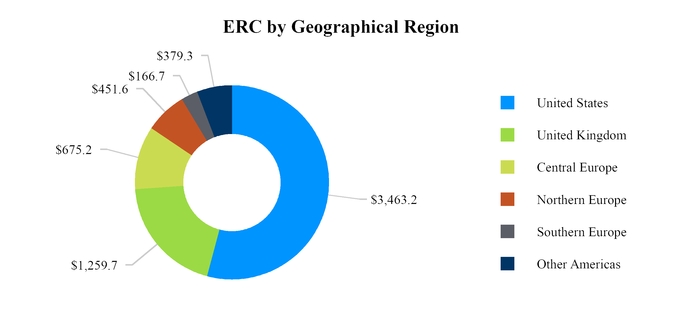
Seasonality
Cash collections in the Americas tend to be higher in the first quarter of the year due to income tax refunds received by individuals in the U.S., and trend lower as the year progresses. Customer payment patterns in all of the countries in which we operate can be affected by seasonal employment trends, income tax refunds, holiday spending habits, and other factors.
Cash collections
The following table displays our quarterly cash collections by geography and portfolio type, for the periods indicated.
Cash Collections by Geography and Type Amounts in thousands | |||||||||||||||||||||||||||||||
2019 | 2018 | 2017 | |||||||||||||||||||||||||||||
Q3 | Q2 | Q1 | Q4 | Q3 | Q2 | Q1 | Q4 | ||||||||||||||||||||||||
Americas-Core | $ | 279,902 | $ | 294,243 | $ | 290,723 | $ | 233,937 | $ | 231,253 | $ | 233,752 | $ | 246,237 | $ | 204,245 | |||||||||||||||
Americas-Insolvency | 45,759 | 49,770 | 44,613 | 48,000 | 48,518 | 56,063 | 55,280 | 59,103 | |||||||||||||||||||||||
Europe-Core | 118,917 | 117,635 | 116,858 | 113,154 | 102,780 | 109,359 | 118,109 | 107,124 | |||||||||||||||||||||||
Europe-Insolvency | 8,639 | 8,626 | 8,977 | 7,618 | 6,731 | 7,460 | 6,954 | 5,794 | |||||||||||||||||||||||
Total Cash Collections | $ | 453,217 | $ | 470,274 | $ | 461,171 | $ | 402,709 | $ | 389,282 | $ | 406,634 | $ | 426,580 | $ | 376,266 | |||||||||||||||
40
The following table provides additional details on the composition of our U.S. Core cash collections for the periods indicated.
U.S. Core Portfolio Cash Collections by Source Amounts in thousands | |||||||||||||||||||||||||||||||
2019 | 2018 | 2017 | |||||||||||||||||||||||||||||
Q3 | Q2 | Q1 | Q4 | Q3 | Q2 | Q1 | Q4 | ||||||||||||||||||||||||
Call Center and Other Collections | $ | 149,782 | $ | 160,479 | $ | 169,753 | $ | 134,543 | $ | 137,325 | $ | 143,527 | $ | 155,448 | $ | 120,349 | |||||||||||||||
External Legal Collections | 64,301 | 63,490 | 57,419 | 47,410 | 41,935 | 40,631 | 38,891 | 31,960 | |||||||||||||||||||||||
Internal Legal Collections | 35,679 | 38,065 | 37,018 | 30,724 | 32,064 | 32,532 | 33,423 | 31,154 | |||||||||||||||||||||||
Total US-Core Cash Collections | $ | 249,762 | $ | 262,034 | $ | 264,190 | $ | 212,677 | $ | 211,324 | $ | 216,690 | $ | 227,762 | $ | 183,463 | |||||||||||||||
Collections productivity (U.S. portfolio)
The following tables display certain collections productivity measures.
Cash Collections per Collector Hour Paid U.S. Portfolio | |||||||||||||||||||
Total U.S. core cash collections (1) | |||||||||||||||||||
2019 | 2018 | 2017 | 2016 | 2015 | |||||||||||||||
First Quarter | $ | 215 | $ | 176 | $ | 254 | $ | 274 | $ | 247 | |||||||||
Second Quarter | 226 | 152 | 202 | 269 | 245 | ||||||||||||||
Third Quarter | 205 | 163 | 191 | 281 | 250 | ||||||||||||||
Fourth Quarter | — | 163 | 170 | 248 | 239 | ||||||||||||||
Call center and other cash collections (2) | |||||||||||||||||||
2019 | 2018 | 2017 | 2016 | 2015 | |||||||||||||||
First Quarter | $ | 139 | $ | 121 | $ | 161 | $ | 168 | $ | 143 | |||||||||
Second Quarter | 139 | 101 | 129 | 167 | 141 | ||||||||||||||
Third Quarter | 124 | 107 | 125 | 177 | 145 | ||||||||||||||
Fourth Quarter | — | 104 | 112 | 153 | 139 | ||||||||||||||
(1) | Represents total cash collections less Insolvency cash collections from trustee-administered accounts. This metric includes cash collections from Insolvency accounts administered by the Core call centers as well as cash collections generated by our internal staff of legal collectors. This calculation does not include hours worked by our internal staff of legal collectors or employees processing the required notifications to trustees on Insolvency accounts. |
(2) | Represents total cash collections less internal legal cash collections, external legal cash collections, and Insolvency cash collections from trustee-administered accounts. |
41
Portfolio purchasing
The following graph shows the purchase price of our portfolios by year since 2009. It includes the acquisition date finance receivable portfolios that were acquired through our various business acquisitions. The 2019 totals represent portfolio purchases through the nine months ended September 30, 2019 while the prior years totals are for the full year.

The following table displays our quarterly portfolio purchases for the periods indicated.
Portfolio Purchases by Geography and Type Amounts in thousands | |||||||||||||||||||||||||||||||
2019 | 2018 | 2017 | |||||||||||||||||||||||||||||
Q3 | Q2 | Q1 | Q4 | Q3 | Q2 | Q1 | Q4 | ||||||||||||||||||||||||
Americas-Core | $ | 168,185 | $ | 121,996 | $ | 169,189 | $ | 172,511 | $ | 170,426 | $ | 182,768 | $ | 131,427 | $ | 160,278 | |||||||||||||||
Americas-Insolvency | 26,311 | 26,092 | 48,243 | 52,871 | 17,151 | 16,651 | 13,436 | 44,195 | |||||||||||||||||||||||
Europe-Core (1) | 64,728 | 136,344 | 94,283 | 231,810 | 45,754 | 19,403 | 18,000 | 152,417 | |||||||||||||||||||||||
Europe-Insolvency | 19,772 | 4,715 | 7,134 | 33,661 | 4,159 | 2,577 | 5,392 | 17,698 | |||||||||||||||||||||||
Total Portfolio Purchasing | $ | 278,996 | $ | 289,147 | $ | 318,849 | $ | 490,853 | $ | 237,490 | $ | 221,399 | $ | 168,255 | $ | 374,588 | |||||||||||||||
(1) | The Europe-Core purchases in the above table and graph exclude a $34.9 million finance receivables portfolio addition in the third quarter of 2018 relating to the consolidation of a Polish investment fund. |
Portfolio purchases by stratifications (U.S. only)
The following table categorizes our quarterly U.S. portfolio purchases for the periods indicated into major asset type and delinquency category. Since our inception in 1996, we have acquired more than 53 million customer accounts in the U.S.
U.S. Portfolio Purchases by Major Asset Type Amounts in thousands | |||||||||||||||||||||||||||||||
2019 | 2018 | 2017 | |||||||||||||||||||||||||||||
Q3 | Q2 | Q1 | Q4 | Q3 | Q2 | Q1 | Q4 | ||||||||||||||||||||||||
Major Credit Cards | $ | 50,500 | $ | 39,468 | $ | 43,440 | $ | 65,025 | $ | 78,864 | $ | 100,160 | $ | 84,858 | $ | 87,895 | |||||||||||||||
Private Label Credit Cards | 72,714 | 70,536 | 84,515 | 100,633 | 100,517 | 82,406 | 47,962 | 90,332 | |||||||||||||||||||||||
Consumer Finance | 2,090 | 28,649 | 2,424 | 2,619 | 2,248 | 4,098 | 3,558 | 2,360 | |||||||||||||||||||||||
Auto Related | 638 | 1,407 | 30,358 | 31,892 | 330 | 427 | 613 | 21,219 | |||||||||||||||||||||||
Total | $ | 125,942 | $ | 140,060 | $ | 160,737 | $ | 200,169 | $ | 181,959 | $ | 187,091 | $ | 136,991 | $ | 201,806 | |||||||||||||||
42
U.S. Portfolio Purchases by Delinquency Category Amounts in thousands | |||||||||||||||||||||||||||||||
2019 | 2018 | 2017 | |||||||||||||||||||||||||||||
Q3 | Q2 | Q1 | Q4 | Q3 | Q2 | Q1 | Q4 | ||||||||||||||||||||||||
Fresh (1) | $ | 27,600 | $ | 33,288 | $ | 51,212 | $ | 61,730 | $ | 61,882 | $ | 80,976 | $ | 71,067 | $ | 76,910 | |||||||||||||||
Primary (2) | 17,658 | 40,027 | 19,725 | 39,690 | 37,670 | 34,166 | 3,290 | 23,100 | |||||||||||||||||||||||
Secondary (3) | 50,082 | 34,920 | 35,857 | 45,878 | 63,525 | 55,299 | 49,198 | 48,865 | |||||||||||||||||||||||
Tertiary (3) | 6,483 | 5,733 | 4,435 | — | — | — | — | 8,736 | |||||||||||||||||||||||
Insolvency | 24,119 | 26,092 | 48,243 | 52,871 | 17,151 | 16,650 | 13,436 | 44,195 | |||||||||||||||||||||||
Other (4) | — | — | 1,265 | — | 1,731 | — | — | — | |||||||||||||||||||||||
Total | $ | 125,942 | $ | 140,060 | $ | 160,737 | $ | 200,169 | $ | 181,959 | $ | 187,091 | $ | 136,991 | $ | 201,806 | |||||||||||||||
(1) | Fresh accounts are typically past due 120 to 270 days, charged-off by the credit originator and are either being sold prior to any post-charge-off collection activity or placement with a third-party for the first time. |
(2) | Primary accounts are typically 360 to 450 days past due and charged-off and have been previously placed with one contingent fee servicer. |
(3) | Secondary and tertiary accounts are typically more than 660 days past due and charged-off and have been placed with two or three contingent fee servicers. |
(4) | Other accounts are typically two to three years or more past due and charged-off and have previously been worked by four or more contingent fee servicers. |
Liquidity and Capital Resources
We manage our liquidity to help provide access to sufficient funding to meet our business needs and financial obligations. As of September 30, 2019, cash and cash equivalents totaled $90.0 million, of which $73.0 million consisted of cash on hand related to foreign operations with indefinitely reinvested earnings. See the "Undistributed Earnings of Foreign Subsidiaries" section below for more information.
At September 30, 2019, we had approximately $2.6 billion in borrowings outstanding with $714.1 million of availability under all our credit facilities (subject to the borrowing base and applicable debt covenants). Considering borrowing base restrictions, as of September 30, 2019, the amount available to be drawn was $424.9 million. Of the $714.1 million of borrowing availability, $240.7 million was available under our European credit facility, $468.5 million was available under our North American credit facility, and $4.9 million was under our Colombian credit facility. Of the $424.9 million available considering borrowing base restrictions, $145.0 million was available under our European credit facility, $275.0 million was available under our North American credit facility and $4.9 million was under our Colombian credit facility. For more information, see Note 6 to our Consolidated Financial Statements included in Part I, Item 1 of this Quarterly Report.
An additional funding source for our Europe operations is interest-bearing deposits. Per the terms of our European credit facility, we are permitted to obtain interest-bearing deposit funding of up to SEK 1.2 billion (approximately $122.2 million as of September 30, 2019). Interest-bearing deposits as of September 30, 2019 were $112.0 million.
We believe we were in compliance with the covenants of our financing arrangements as of September 30, 2019.
We have the ability to slow the purchasing of finance receivables if necessary, with low impact to current year cash collections. For example, we invested $1.1 billion in portfolio purchases in 2018. The portfolios purchased in 2018 generated $154.4 million of cash collections, representing only 9.5% of 2018 cash collections.
Contractual obligations over the next year are primarily related to debt maturities and purchase commitments. Our North American credit facility expires in May 2022. Our European credit facility expires in February 2021. Of our $427.5 million in term loans outstanding at September 30, 2019, $10.0 million is due within one year. Additionally, the $287.5 million principal amount of the 2020 Notes is due August 1, 2020. Based upon our current availability considering borrowing base restrictions in North America ($275.0 million) our cash on hand, our current ability to negotiate extensions or renew our lines of credit and to secure additional financing or equity capital in the open market, and our strong operating cash flows, we believe that we have the ability to settle this instrument in cash at maturity.
We have in place forward flow commitments for the purchase of nonperforming loans with a maximum purchase price of $725.1 million as of September 30, 2019. We may also enter into new or renewed flow commitments and close on spot transactions in addition to the aforementioned flow agreements.
43
On May 10, 2017, we reached a settlement with the Internal Revenue Service in regards to its assertion that tax revenue recognition using the cost recovery method did not clearly reflect taxable income. In accordance with the settlement, our tax accounting method to recognize finance receivables revenue changed effective with tax year 2017. Under the new method, a portion of the annual collections amortizes principal and the remaining portion is taxable income. The deferred tax liability related to the difference in timing between the new method and the cost recovery method is being incorporated evenly into our tax filings over four years effective with tax year 2017. We estimate the related tax payments for future years to be approximately $9.3 million per quarter.
We believe that funds generated from operations and from cash collections on finance receivables, together with existing cash and available borrowings under our revolving credit facilities will be sufficient to finance our operations, planned capital expenditures, forward flow purchase commitments, and additional portfolio purchasing during the next 12 months. Business acquisitions, adverse outcomes in pending litigation or higher than expected levels of portfolio purchasing could require additional financing from other sources.
Cash Flows Analysis
Our operating activities provided cash of $70.7 million for the nine months ended September 30, 2019, compared to $68.1 million for the nine months ended September 30, 2018. The change was primarily due to cash collections recognized as revenue mostly offset by increases in cash paid for operating expenses, interest, and income taxes. Key drivers of operating activities were adjusted for (i) non-cash items included in net income such as provisions for unrealized gains and losses, depreciation and amortization, deferred taxes and stock-based compensation and (ii) changes in the balances of operating assets and liabilities, which can vary significantly in the normal course of business due to the amount and timing of payments.
Our investing activities used cash of $233.1 million and $62.6 million for the nine months ended September 30, 2019 and 2018, respectively. Cash used in investing activities is mainly driven by acquisitions of nonperforming loans and business acquisitions. Cash provided by investing activities is mainly driven by cash collections applied to principal on finance receivables and proceeds from sale of investments and subsidiaries. The change in net cash used in investing activities is primarily due to an increase in the amounts of acquisitions of finance receivables, which totaled $833.0 million during the nine months ended September 30, 2019, compared to $621.5 million during the nine months ended September 30, 2018. In addition, net cash used was impacted by $57.6 million in business acquisitions during the nine months ended September 30, 2019 as well as $31.2 million cash proceeds received in January 2019 associated with the sale of RCB in the fourth quarter of 2018. Furthermore, for the nine months ended September 30, 2018, we received cash of $17.5 million upon consolidation of a Polish investment fund previously recorded as an investment whereas we did not have any similar transaction occur in the current year period. These were partially offset by an increase in collections applied to principal on finance receivables which totaled $649.1 million during the nine months ended September 30, 2019, compared to $561.6 million during the nine months ended September 30, 2018.
Our financing activities provided cash of $167.6 million and $3.6 million for the nine months ended September 30, 2019 and 2018, respectively. Cash for financing activities is normally provided by draws on our lines of credit and proceeds from debt offerings. Cash used in financing activities is primarily driven by principal payments on our lines of credit and long-term debt. The change in cash provided by financing activities for the nine months ended September 30, 2019 compared to the nine months ended September 30, 2018 was primarily due to an increase in net draws on our lines of credit and long-term debt and net contribution from noncontrolling interests. Net draws on our borrowing activities totaled $116.1 million nine months ended September 30, 2019 compared to net repayments of $34.0 million during the nine months ended September 30, 2018. Additionally, net contributions from noncontrolling interests totaled $17.8 million during the nine months ended September 30, 2019 as compared to net distributions to noncontrolling interests of $14.0 million during the nine months ended September 30, 2018. During the nine months ended September 30, 2019 we had an increase in interest bearing deposits of $38.6 million, compared to a decrease of $12.2 million during the nine months ended September 30, 2018.
Undistributed Earnings of Foreign Subsidiaries
We intend to use predominantly all of our accumulated and future undistributed earnings of foreign subsidiaries to expand operations outside the U.S.; therefore, such undistributed earnings of foreign subsidiaries are considered to be indefinitely reinvested outside the U.S. Accordingly, no provision for income tax and withholding tax has been provided thereon. If management's intentions change and eligible undistributed earnings of foreign subsidiaries are repatriated, we could be subject to additional income taxes and withholding taxes. This could result in a higher effective tax rate in the period in which such a decision is made to repatriate accumulated or future undistributed foreign earnings. The amount of cash on hand related to foreign operations with indefinitely reinvested earnings was $73.0 million and $78.6 million as of September 30, 2019 and December 31, 2018, respectively. Refer to Note11 to our Consolidated Financial Statements included in Part I, Item 1 of this Quarterly Report for further information related to our income taxes and undistributed foreign earnings.
44
Off-Balance Sheet Arrangements
We do not have any off-balance sheet arrangements as defined by Item 303(a)(4) of Regulation S-K promulgated under the Securities Exchange Act of 1934, as amended (the "Exchange Act").
Recent Accounting Pronouncements
For a summary of recent accounting pronouncements and the anticipated effects on our consolidated financial statements see Note 13 to our Consolidated Financial Statements included in Part I, Item 1 of this Quarterly Report.
Critical Accounting Policies and Estimates
Our consolidated financial statements have been prepared in accordance with U.S. generally accepted accounting principles. Our significant accounting policies are discussed in Note 1 to our Consolidated Financial Statements included in Part II, Item 8 of our 2018 Form 10-K. Our significant accounting policies are fundamental to understanding our results of operations and financial condition because they require that we use estimates, assumptions and judgments that affect the reported amounts of revenues, expenses, assets, and liabilities.
Three of these policies are considered to be critical because they are important to the portrayal of our financial condition and results, and because they require management to make judgments and estimates that are difficult, subjective, and complex regarding matters that are inherently uncertain.
We base our estimates on historical experience, current trends and various other assumptions that we believe are reasonable under the circumstances, the results of which form the basis for making judgments about the carrying values of assets and liabilities that are not readily apparent from other sources. If these estimates differ significantly from actual results, the impact on our consolidated financial statements may be material.
Management has reviewed these critical accounting policies with the Audit Committee of our board of directors.
Revenue recognition - finance receivables
We account for the vast majority of our investment in finance receivables under the guidance of ASC 310-30. Revenue recognition for finance receivables accounted for under ASC 310-30 involves the use of estimates and the exercise of judgment on the part of management. These estimates include projections of the quantity and timing of future cash flows and economic lives of our pools of finance receivables. Significant changes in such estimates could result in increased revenue via yield increases which are recognized prospectively or increased allowance charges resulting from decreased cash flow estimates which are recognized immediately.
We implement the accounting for income recognized on finance receivables under ASC 310-30 as follows:
We create each accounting pool using our projections of estimated cash flows and expected economic life. We then compute the effective yield that fully amortizes the pool over a reasonable expectation of its economic life based on the current projections of estimated cash flows. As actual cash flow results are recorded, we review each pool watching for trends, actual performance versus projections and curve shape (a graphical depiction of the timing of cash flows). We then re-forecast future cash flows utilizing our proprietary analytical models.
Significant judgment is used in evaluating whether variances in actual performance are due to changes in the total amount or changes in the timing of expected cash flows. Significant changes in either may result in yield increases or allowance charges if necessary for the pool's amortization period to fall within a reasonable expectation of its economic life.
Valuation of acquired intangibles and goodwill
In accordance with FASB ASC Topic 350, "Intangibles-Goodwill and Other" ("ASC 350"), we amortize intangible assets over their estimated useful lives. Goodwill, pursuant to ASC 350, is not amortized but rather evaluated for impairment annually and more frequently if indicators of potential impairment exist. Goodwill is reviewed for potential impairment at the reporting unit level. A reporting unit is an operating segment or one level below an operating segment.
Goodwill is evaluated for impairment either under the qualitative assessment option or the two-step test approach depending on facts and circumstances of a reporting unit, including the excess of fair value over carrying amount in the last valuation or changes in business environment. If we qualitatively determine it is more likely than not that the fair value of a reporting unit is greater than its carrying amount, the two-step impairment test is unnecessary. Otherwise, goodwill is evaluated for impairment using the two-step test, where the carrying amount of a reporting unit is compared to its fair value in Step 1; if the fair value exceeds the carrying amount, Step 2 is unnecessary. If the carrying amount exceeds the reporting unit’s fair value, this could
45
indicate potential impairment and Step 2 of the goodwill evaluation process is required to determine if goodwill is impaired and to measure the amount of impairment loss to recognize, if any. When Step 2 is necessary, the fair value of individual assets and liabilities is determined using valuations (which in some cases may be based in part on third-party valuation reports), or other observable sources of fair value, as appropriate. If the carrying amount of goodwill exceeds its implied fair value, the excess is recognized as an impairment loss.
We determine the fair value of a reporting unit by applying the approaches prescribed under the fair value measurement accounting framework: the income approach and the market approach. Depending on the availability of public data and suitable comparables, we may or may not use the market approach or we may emphasize the results from the approach differently. Under the income approach, we estimate the fair value of a reporting unit based on the present value of estimated future cash flows and a residual terminal value. Cash flow projections are based on management's estimates of revenue growth rates, operating margins, necessary working capital, and capital expenditure requirements, taking into consideration industry and market conditions. The discount rate used is based on the weighted-average cost of capital adjusted for the relevant risk associated with business-specific characteristics and the uncertainty related to the reporting unit's ability to execute on the projected cash flows. Under the market approach, we estimate fair value based on prices and other relevant market transactions involving comparable publicly-traded companies with operating and investment characteristics similar to the reporting unit.
Income taxes
We are subject to the income tax laws of the various jurisdictions in which we operate, including U.S. federal, state, local, and international jurisdictions. These tax laws are complex and are subject to different interpretations by the taxpayer and the relevant government taxing authorities. When determining our domestic and foreign income tax expense, we must make judgments about the application of these inherently complex laws.
We follow the guidance of FASB ASC Topic 740 "Income Taxes" ("ASC 740") as it relates to the provision for income taxes and uncertainty in income taxes. Accordingly, we record a tax provision for the anticipated tax consequences of the reported results of operations. In accordance with ASC 740, the provision for income taxes is computed using the asset and liability method, under which deferred tax assets and liabilities are recognized for the expected future tax consequences of temporary differences between the financial reporting and tax basis of assets and liabilities, and for operating losses and tax credit carry-forwards. Deferred tax assets and liabilities are measured using the currently enacted tax rates that apply to taxable income in effect for the years in which those tax assets and liabilities are expected to be realized or settled. The evaluation of a tax position in accordance with the guidance is a two-step process. The first step is recognition: the Company determines whether it is more-likely-than-not that a tax position will be sustained upon examination, including resolution of any related appeals or litigation processes, based on the technical merits of the position. In evaluating whether a tax position has met the more-likely-than-not recognition threshold, the Company should presume that the position will be examined by the appropriate taxing authority that would have full knowledge of all relevant information. The second step is measurement: a tax position that meets the more-likely-than-not recognition threshold is measured to determine the amount of benefit to recognize in the financial statements. The tax position is measured as the largest amount of benefit that is greater than fifty percent likely of being realized upon ultimate settlement. Tax positions that previously failed to meet the more-likely-than-not recognition threshold should be recognized in the first subsequent financial reporting period in which that threshold is met. Previously recognized tax positions that no longer meet the more-likely-than-not recognition threshold should be derecognized in the first subsequent financial reporting period in which that threshold is no longer met. We record interest and penalties related to unrecognized tax benefits as a component of income tax expense.
In the event that all or part of the deferred tax assets are determined not to be realizable in the future, a valuation allowance would be established and charged to earnings in the period such determination is made. If we subsequently realize deferred tax assets that were previously determined to be unrealizable, the respective valuation allowance would be reversed, resulting in a positive adjustment to earnings in the period such determination is made. The establishment or release of a valuation allowance does not have an impact on cash, nor does such an allowance preclude the use of loss carry-forwards or other deferred tax assets in future periods. The calculation of tax liabilities involves significant judgment in estimating the impact of uncertainties in the application of complex tax laws. Resolution of these uncertainties in a manner inconsistent with our expectations could have a material impact on our results of operations and financial position.
46
Item 3. Quantitative and Qualitative Disclosures about Market Risk
Our activities are subject to various financial risks including market risk, currency and interest rate risk, credit risk, liquidity risk and cash flow risk. Our financial risk management program focuses on the unpredictability of financial markets and seeks to minimize potential adverse effects on our financial performance. We may periodically enter into derivative financial instruments, typically interest rate and currency derivatives, to reduce our exposure to fluctuations in interest rates on variable-rate debt, fluctuations in currency rates and their impact on earnings and cash flows. We do not utilize derivative financial instruments with a level of complexity or with a risk greater than the exposure to be managed nor do we enter into or hold derivatives for trading or speculative purposes. Derivative instruments involve, to varying degrees, elements of non-performance, or credit risk. We do not believe that we currently face a significant risk of loss in the event of non-performance by the counterparties associated with these instruments, as these transactions were executed with a diversified group of major financial institutions with an investment-grade credit rating. Our credit risk exposure is managed through the periodic monitoring of our exposures to such counterparties.
Interest Rate Risk
We are subject to interest rate risk from outstanding borrowings on our variable rate credit facilities. As such, our consolidated financial results are subject to fluctuations due to changes in the market rate of interest. We assess this interest rate risk by estimating the increase or decrease in interest expense that would occur due to a change in short-term interest rates. The borrowings on our variable rate credit facilities were approximately $2.0 billion as of September 30, 2019. Based on our debt structure at September 30, 2019, assuming a 50 basis point decrease in interest rates, for example, interest expense over the following 12 months would decrease by an estimated $4.9 million. Assuming a 50 basis point increase in interest rates, interest expense over the following 12 months would increase by an estimated $5.5 million.
To reduce the exposure to changes in the market rate of interest and to be in compliance with the terms of our European credit facility, we have entered into interest rate derivative contracts for a portion of our borrowings under our floating rate financing arrangements. Further, effective in the second quarter of 2018, we began to apply hedge accounting to certain of our interest rate derivative contracts. By applying hedge accounting, changes in market value are reflected as adjustments in Other Comprehensive Income. All derivatives to which we have applied hedge accounting were evaluated and remain highly effective at September 30, 2019. Terms of the interest rate derivative contracts require us to receive a variable interest rate and pay a fixed interest rate. The sensitivity calculations above consider the impact of our interest rate derivative contracts.
Currency Exchange Risk
We operate internationally and enter into transactions denominated in various foreign currencies. During the three months ended September 30, 2019, we generated $83.7 million of revenues from operations outside the U.S. and used 11 functional currencies. Weakness in one particular currency might be offset by strength in other currencies over time.
As a result of our international operations, fluctuations in foreign currencies could cause us to incur foreign currency exchange gains and losses, and could adversely affect our comprehensive income and stockholders' equity. Additionally, our reported financial results could change from period to period due solely to fluctuations between currencies.
Foreign currency gains and losses are primarily the result of the re-measurement of transactions in certain other currencies into an entity's functional currency. Foreign currency gains and losses are included as a component of other income and (expense) in our consolidated income statements. From time to time we may elect to enter into foreign exchange derivative contracts to reduce these variations in our consolidated income statements.
When an entity's functional currency is different than the reporting currency of its parent, foreign currency translation adjustments may occur. Foreign currency translation adjustments are included as a component of other comprehensive income/(loss) in our consolidated statements of comprehensive income and as a component of equity in our consolidated balance sheets.
We have taken measures to mitigate the impact of foreign currency fluctuations. We have organized our European operations so that portfolio ownership and collections generally occur within the same entity. Our European credit facility is a multi-currency facility, allowing us to better match funding and portfolio investments by currency. We actively monitor the value of our finance receivables by currency. In the event adjustments are required to our liability composition by currency we may, from time to time, execute re-balancing foreign exchange contracts to more closely align funding and portfolio investments by currency.
47
Item 4. Controls and Procedures
Evaluation of Disclosure Controls and Procedures. We maintain disclosure controls and procedures (as defined in Exchange Act Rules 13a-15(e) and 15d-15(e)) that are designed to ensure that information required to be disclosed in our Exchange Act reports is recorded, processed, summarized and reported within the time periods specified in the SEC’s rules and forms, and that such information is accumulated and communicated to our management, including our Chief Executive Officer and Chief Financial Officer, as appropriate, to allow timely decisions regarding required disclosure. In designing and evaluating the disclosure controls and procedures, management recognized that any controls and procedures, no matter how well designed and operated, can provide only reasonable assurance of achieving the desired control objectives, and management necessarily was required to apply its judgment in evaluating the cost-benefit relationship of possible controls and procedures. Also, projections of any evaluation of effectiveness to future periods are subject to the risk that controls may become inadequate because of changes in conditions or that the degree of compliance with the policies or procedures may deteriorate. We conducted an evaluation, under the supervision and with the participation of our principal executive officer and principal financial officer, of the effectiveness of our disclosure controls and procedures as of the end of the period covered by this Quarterly Report. Based on this evaluation, the principal executive officer and principal financial officer have concluded that, as of September 30, 2019, our disclosure controls and procedures were effective.
Changes in Internal Control over Financial Reporting. There was no change in our internal control over financial reporting that occurred during the quarter ended September 30, 2019 that has materially affected, or is reasonably likely to materially affect, our internal control over financial reporting.
48
Part II. Other Information
Item 1. Legal Proceedings
For information regarding legal proceedings as of September 30, 2019, refer to Note 12 to our Consolidated Financial Statements included in Part I, Item 1 of this Quarterly Report.
Item 1A. Risk Factors
There have been no material changes to the risk factors disclosed in our 2018 Form 10-K.
Item 2. Unregistered Sales of Equity Securities and Use of Proceeds
None.
Item 3. Defaults Upon Senior Securities
None.
Item 4. Mine Safety Disclosures
Not applicable.
Item 5. Other Information
None.
Item 6. Exhibits
101.INS | XBRL Instance Document - the instance document does not appear in the Interactive Data File because its XBRL tags are embedded within the Inline XBRL document |
101.SCH | XBRL Taxonomy Extension Schema Document |
101.CAL | XBRL Taxonomy Extension Calculation Linkable Document |
101.LAB | XBRL Taxonomy Extension Label Linkable Document |
101.PRE | XBRL Taxonomy Extension Presentation Linkable Document |
101.DEF | XBRL Taxonomy Extension Definition Linkbase Document |
104 | Cover Page Interactive Data File (formatted as Inline XBRL and contained in Exhibit 101) |
49
SIGNATURES
Pursuant to the requirements of the Securities Exchange Act of 1934, the registrant has duly caused this report to be signed on its behalf by the undersigned, thereunto duly authorized.
PRA Group, Inc. | |||
(Registrant) | |||
November 7, 2019 | By: | /s/ Kevin P. Stevenson | |
Kevin P. Stevenson | |||
President and Chief Executive Officer | |||
(Principal Executive Officer) | |||
November 7, 2019 | By: | /s/ Peter M. Graham | |
Peter M. Graham | |||
Executive Vice President and Chief Financial Officer | |||
(Principal Financial and Accounting Officer) | |||
50
TABLE OF CONTENTS
Part I. Financial InformationItem 1. Financial Statements (unaudited)Item 2. Management's Discussion and Analysis Of Financial Condition and Results Of OperationsItem 3. Quantitative and Qualitative Disclosures About Market RiskItem 4. Controls and ProceduresPart II. Other InformationItem 1. Legal ProceedingsItem 1A. Risk FactorsItem 2. Unregistered Sales Of Equity Securities and Use Of ProceedsItem 3. Defaults Upon Senior SecuritiesItem 4. Mine Safety DisclosuresItem 5. Other InformationItem 6. Exhibits