|
|
|
|
|
|
|
|
|
|
|
|
|
|
|
|
|
|
|
|
|
|
|
|
|
|
|
|
|
|
|
|
|
|
|
|
|
|
|
|
|
|
|
|
|
|
|
|
|
|
|
|
|
Table of Contents
UNITED STATES SECURITIES AND EXCHANGE COMMISSION
Washington, D.C. 20549
FORM 10-K
| ☒ | ANNUAL REPORT PURSUANT TO SECTION 13 OR 15(d) OF THE SECURITIES EXCHANGE ACT OF 1934 |
For the fiscal year ended December 31, 2017
| ☐ | TRANSITION REPORT PURSUANT TO SECTION 13 OR 15(d) OF THE SECURITIES EXCHANGE ACT OF 1934 |
For the Transition Period from to
Commission File Number: 814-00235
Rand Capital Corporation
(Exact name of registrant as specified in its charter)
| New York | 16-0961359 | |
|
(State or Other Jurisdiction of Incorporation or organization) |
(IRS Employer Identification No.) | |
| 2200 Rand Building, Buffalo, NY | 14203 | |
| (Address of Principal executive offices) | (Zip Code) | |
Registrant’s telephone number, including area code: (716) 853-0802
Securities registered pursuant to Section 12(b) of the Act:
|
Title of Each Class |
Name of Exchange on Which Registered |
|
| Common Stock, $0.10 par value | NASDAQ Capital Market |
Securities registered pursuant to Section 12(g) of the Act: None
Indicate by check mark if the registrant is a well-known seasoned issuer, as defined in Rule 405 under the Securities Act. Yes ☐ No ☑
Indicate by check mark if the registrant is not required to file reports pursuant to Section 13 or Section 15(d) of the Act. Yes ☐ No ☑
Indicate by check mark whether the registrant (1) has filed all reports required to be filed by Section 13 or 15(d) of the Securities Exchange Act of 1934 during the preceding 12 months (or for such shorter period that the registrant was required to file such
reports), and (2) has been subject to such filing requirements for the past 90 days. Yes ☑ No ☐
Indicate by check mark whether the registrant has submitted electronically and posted on its corporate Web site, if any, every Interactive Data File required to be submitted and posted pursuant to Rule 405 of Regulation S-T during the preceding 12 months (or for such shorter period that the registrant was required to submit and post such files). Yes ☐ No ☐
Indicate by check mark if disclosure of delinquent filers pursuant to Item 405 of Regulation S-K is not contained herein, and will not be contained, to the best of registrant’s knowledge, in definitive proxy or information statements incorporated by reference in Part III of this Form 10-K or any amendment to this Form 10-K. ☑
Indicate by check mark whether the registrant is a large accelerated filer, an accelerated filer, a non-accelerated filer, a smaller reporting company or an emerging growth company.
| Large accelerated filer ☐ | Accelerated filer ☐ | Non-accelerated filer ☑ | Smaller reporting company ☐ | |||
| (Do not check if a smaller reporting company) | ||||||
| Emerging growth company ☐ | ||||||
If an emerging growth company, indicated by check mark if the registrant has elected not to use extended transition period for complying with any new or revised financial accounting standards provided pursuant to Section 13(a) of the Exchange Act ☐
Indicate by check mark whether the registrant is a shell company (as defined in Rule 12b-2 of the Act). Yes ☐ No ☑
The aggregate market value of the registrant’s outstanding common stock held by non-affiliates of the registrant as of June 30, 2017 was approximately $15,306,838 based upon the closing price as reported on the NASDAQ Capital Market on such date.
As of March 1, 2018, there were 6,321,988 shares of the registrant’s common stock outstanding.
DOCUMENTS INCORPORATED BY REFERENCE
Portions of the Corporation’s definitive proxy statement for the 2018 Annual Meeting of Shareholders are incorporated by reference into Part III of this report.
Table of Contents
RAND CAPITAL CORPORATION
TABLE OF CONTENTS FOR FORM 10-K
Table of Contents
Overview of Our Business
Rand Capital Corporation (“Rand”, “we”, “us” and “our”) was incorporated under the laws of New York in February 1969. Throughout our history, our principal business has been to make venture capital investments in early or expansion stage companies, often in upstate New York and regions in close proximity. In accordance with our strategic growth plan, we look for companies with strong leadership that are bringing to market new or unique products, technologies or services and have a high potential for growth. We invest in a mixture of debt and equity instruments. The debt securities typically have an equity component in the form of warrants or options to acquire stock or the right to convert the debt securities into stock. We established our first small business investment company (“SBIC”) in 2002, Rand Capital SBIC, Inc.(“Rand SBIC”), whereby we utilized funds borrowed from the Small Business Administration (“SBA”) combined with our capital to invest in our portfolio companies. During 2017, we established a second SBIC subsidiary, Rand Capital SBIC II, L.P. (Rand SBIC II) and began making investments from this SBIC subsidiary. We continue to work with the SBA in determining an optimal structure within its regulatory parameters which, once completed, may result in new SBA leverage commitments in 2018.
Our Investment Objectives and Strategy
Our principal investment objective is to achieve long-term capital appreciation on our equity investments while maintaining a current cash flow from our debenture and pass-through equity instruments to fund expenses. Therefore, we invest in a variety of financial instruments to provide a current return on a portion of the investment portfolio. The equity features contained in our investment portfolio are structured to realize capital appreciation over the long-term and typically do not generate current income in the form of dividends or interest.
Our investment strategy is to partner with other investors to invest in small companies that either have a new product, service or technology they are trying to commercialize or are working to accelerate their rate of growth. We define small companies as businesses that may not yet be generating revenue up to companies with $20 million in revenue.
We have historically made an initial investment of $500,000 to $1,000,000 directly in a company through equity or in debt or loan instruments and frequently provide follow-on investments during our investment tenure. The debt instruments we acquire generally have a maturity of not more than five years and usually are convertible or have detachable equity warrants. Interest is either paid currently or deferred. We fund new investments and operating expenses through existing cash balances, proceeds from investment exits, and interest and principal payments from our portfolio companies.
Our Investment Process
Our primary business is making debt and equity investments in small companies that meet some or all of the following criteria:
1) a qualified and experienced management team;
2) a new or unique product or service; and
3) high potential for growth in revenue and cash flow.
Our management team identifies investment opportunities through a network of investment referral relationships. Investment proposals may come to us from other sources, including unsolicited proposals from companies and referrals from accountants, bankers, lawyers and other members of the financial community. We believe that our reputation in the investment community and our experience provide a competitive advantage in originating quality investments.
In a typical private financing, our management team will review, analyze, and confirm, through due diligence, the business plan and operations of the potential portfolio company. Additionally, we familiarize
1
Table of Contents
ourselves with the portfolio company’s industry and competition and may conduct reference checks with its customers and suppliers.
Following our initial investment, we may make follow-on investments in the portfolio company, if needed. Follow-on investments may be made to take advantage of warrants or other preferential rights granted to us to increase or maintain our position in a promising portfolio company, or provide additional funds to allow a portfolio company to fully implement its business plans, develop a new line of business or recover from unexpected business problems. Follow-on investments in a portfolio company are evaluated individually and may be subject to SBA restrictions.
Disposition of Investments
We may exit investments through the maturation of a debt security or when a liquidity event takes place, such as the sale, recapitalization, or initial public offering of a portfolio company. The method and timing of the disposition of our portfolio investments can be critical to the realization of maximum total return. We generally expect to dispose of our equity securities through private sales of securities to other investors or through the sale or merger of the portfolio company. We anticipate our debt investments will be repaid with interest and expect to realize further appreciation from the warrants or other equity type instruments received in connection with the investment.
Current Portfolio Companies
For a description of our current portfolio company investments, see “Item 7. Management’s Discussion and Analysis of Financial Conditions and Results of Operations — Composition of the Investment Portfolio.”
Competition
We compete for quality investments with other venture capital firms, individual investors, business development companies, and investment funds (including private equity funds and mezzanine funds), as well as traditional financial services companies such as commercial banks. We believe we are able to compete with these entities primarily on the basis of our referral network, our investing reputation and experience, our responsive, quick and efficient investment analysis and decision-making process, the investment terms we offer, and our willingness to make smaller investments.
For information concerning the competitive risks we face, see “Item 1A. Risk Factors.”
Employees
As of December 31, 2017, we had four employees, unchanged from 2016.
Organization and History
We completed our initial public offering in 1971 as an internally managed, closed-end, diversified, management investment company. We have elected to be treated as a business development company (“BDC”) under the Investment Company Act of 1940, as amended (the “1940 Act”). As a BDC we are required to comply with certain regulatory requirements as provided for in the 1940 Act and the rules and regulations promulgated thereunder. For instance, we generally have to invest at least 70% of our total assets in “qualifying assets” and provide managerial assistance to the portfolio companies in which we invest. See “Item 1. Business — Regulations, Business Development Company Regulations.”
We historically made the majority of our investments through Rand SBIC, an SBIC that has been licensed by the SBA since 2002. Rand SBIC’s predecessor was organized as a Delaware limited partnership and was converted into a New York corporation in 2008, at which time our operations as a licensed SBIC were continued. Although Rand SBIC had operated as if it were a BDC, it was registered as an investment company under the 1940 Act. In 2012, the Securities and Exchange Commission (“SEC”) granted an Order of Exemption for Rand with respect to the operations of Rand SBIC and Rand SBIC then filed an election to be regulated as a BDC under the 1940 Act. Rand SBIC’s board of directors is comprised of the directors of Rand, a majority of whom are not “interested persons” of Rand or Rand SBIC.
2
Table of Contents
We operate as an internally managed investment company whereby our officers and employees conduct our business under the general supervision of our Board of Directors. We have not elected to qualify to be taxed as a regulated investment company as defined under Subchapter M of the Internal Revenue Code.
In this Annual Report on Form 10-K, (“Annual Report”), unless the context otherwise requires, “we”, the “Corporation”, “us”, and “our” refer to Rand Corporation, Rand SBIC and Rand SBIC II.
Our corporate office is located in Buffalo, NY and our website address is www.randcapital.com . We make available on our website, free of charge, our annual and periodic reports, proxy statements and other information as soon as reasonably practicable after such material is filed with the SEC. Our shares are traded on the NASDAQ Capital Market under the ticker symbol “RAND.”
Regulations
The following discussion is a general summary of the material prohibitions and descriptions governing BDCs and SBA-licensed SBICs. It does not purport to be a complete description of all of the laws and regulations affecting BDCs and SBICs.
Business Development Company Regulations
We have elected to be regulated as a BDC under the 1940 Act. Although the 1940 Act exempts a BDC from registration under that Act, it contains significant limitations on the operations of BDCs. Among other things, the 1940 Act contains prohibitions and restrictions relating to transactions between a BDC and its affiliates, principal underwriters and affiliates of its affiliates or underwriters. The 1940 Act also prohibits a BDC from changing the nature of its business so as to cease to be, or to withdraw its election as, a BDC unless so authorized by a vote of the holders of a majority of its outstanding voting securities. BDCs are not required to maintain fundamental investment policies relating to diversification and concentration of investments within a single industry. More specifically, in order to qualify as a BDC, a company must:
(1) be a domestic company;
(2) have registered a class of its equity securities or have filed a registration statement with the SEC pursuant to Section 12 of the Securities Exchange Act of 1934 (the “Exchange Act”);
(3) operate for the purpose of investing in the securities of certain types of companies, namely immature or emerging companies and businesses suffering or just recovering from financial distress. Generally, a BDC must be primarily engaged in the business of furnishing capital and providing managerial expertise to companies that do not have ready access to capital through conventional financial channels. Such companies are termed “eligible portfolio companies;”
(4) extend significant managerial assistance to such portfolio companies; and
(5) have a majority of “disinterested” directors (as defined in the 1940 Act).
Qualifying Assets
Under the 1940 Act, a BDC may not acquire any asset other than assets of the type listed in Section 55(a) of the 1940 Act, which are referred to as qualifying assets, unless, at the time the acquisition is made, qualifying assets represent at least 70% of the company’s total assets. The 1940 Act prohibits BDCs from investing in certain types of companies, such as brokerage firms, insurance companies, investment banking firms and investment companies.
An eligible portfolio company is, generally, a private domestic operating company, or a public domestic operating company whose securities are not listed on a national securities exchange. In addition, any small business investment company that is licensed by the SBA and is a wholly owned subsidiary of a BDC is an eligible portfolio company.
3
Table of Contents
Qualifying assets include:
(1) securities of companies that were eligible portfolio companies at the time the BDC acquired their securities;
(2) securities of bankrupt or insolvent companies that were eligible at the time of the BDC’s initial acquisition of their securities but are no longer eligible, provided that the BDC has maintained a substantial portion of its initial investment in those companies;
(3) securities received in exchange for or distributed on or with respect to any of the foregoing; and
(4) cash items, government securities and high-quality short-term debt.
The 1940 Act also places restrictions on the nature of the transactions in which, and the persons from whom, securities can be purchased in order for the securities to be considered qualifying assets.
A BDC is permitted to invest in the securities of public companies and other investments that are not qualifying assets, but those kinds of investments may not exceed 30% of the BDC’s total asset value at the time of the investment. At December 31, 2017, we were in compliance with this rule.
Managerial Assistance to Portfolio Companies
In order to count portfolio securities as qualifying assets for the purpose of the 70% test discussed above, a BDC must either control the issuer of the securities or must offer to make available significant managerial assistance; except that, where the BDC purchases the securities in conjunction with one or more other persons acting together, one of the other persons in the group may make available such managerial assistance. Making available significant managerial assistance means, among other things, any arrangement whereby the BDC, through its directors, officers or employees, offers to provide and, if accepted, does so provide, significant guidance and counsel concerning the management, operations or business objectives and policies of a portfolio company through monitoring of portfolio company operations, selective participation in board and management meetings, consulting with and advising a portfolio company’s officers or other organizational or financial guidance.
Small Business Investment Company Regulations
SBA Lending Restrictions
SBICs are designed to stimulate the flow of private debt and/or equity capital to small businesses. The types and dollar amounts of the loans and other investments we may make are limited by the 1940 Act, the Small Business Act (the “SBA Act”) and SBA regulations. Rand SBIC uses funds borrowed from the SBA that can be combined with our own capital to provide loans to, and make equity investments in, businesses that meet the following criteria:
(a) have a tangible net worth not in excess of $19.5 million and average net income after U.S. federal income taxes for the preceding two completed fiscal years not in excess of $6.5 million, or
(b) meet size standards set by the SBA that are measured by either annual receipts or number of employees, depending on the industry in which the businesses are primarily engaged.
In addition, at the end of each fiscal year, an SBIC must have at least 20% (in total dollars) invested in “smaller enterprises.” The SBA defines “smaller enterprises” as businesses that:
(a) do not have a net worth in excess of $6 million and have average net income after U.S. federal income taxes for the preceding two years no greater than $2 million, or
(b) meet size standards set by the SBA that are measured by either annual receipts or number of employees, depending on the industry in which the concerns are primarily engaged.
We have complied with these requirements since the inception of Rand SBIC.
4
Table of Contents
The SBA also forbids an SBIC from providing funds to small businesses with specific characteristics, such as businesses with the majority of their employees located outside the United States, or from investing in passive or non-operating businesses, real estate, project financing, farmland, or financial lenders. Without prior SBA approval, an SBIC may not invest an amount equal to more than approximately 30% of the SBIC’s regulatory capital in any one company and its affiliates.
The SBA places limitations on the financing terms of investments by SBICs in portfolio companies such as limiting the prepayment options, the financing fees that can be charged to a portfolio company, the allowable interest rate on loan and debt securities that an SBIC can charge a portfolio company, and the maximum term of such financing. An SBIC may exercise control over a small business for a period of up to seven years from the date on which the SBIC initially acquires its control position.
The SBA restricts the ability of an SBIC to lend money to any of its officers, directors and employees or to invest in associates. The SBA also prohibits, without prior SBA approval, a “change of control” of an SBIC or transfers that would result in any person, or a group of persons acting together, owning 10% or more of a class of capital stock of a licensed SBIC. A “change of control” is any event which would result in the transfer of the power, direct or indirect, to direct the management and policies of an SBIC, whether through ownership, contractual arrangements or otherwise.
Rand SBIC may invest directly in the equity of portfolio companies, but may not become a general partner of a non-incorporated entity or otherwise become jointly or severally liable for the general obligations of a non-incorporated entity. Rand SBIC may acquire options or warrants in portfolio companies, and the options or warrants may have redemption provisions, subject to certain restrictions. Pursuant to SBA regulations, the maximum cash which may be invested in any one portfolio company by Rand SBIC is currently $3.0 million.
In addition the SBA regulations require an examination of a licensed SBIC by an SBA examiner to determine the SBIC’s compliance with the relevant SBA regulations. Our annual report, submitted to the SBA, must be audited by an independent public accounting firm.
SBA Leverage
The SBA raises capital to enable it to provide funds to SBICs by guaranteeing certificates or bonds that are pooled and sold to purchasers of the government guaranteed securities. The amount of funds that the SBA may lend to SBICs is determined by annual Congressional appropriations.
SBA debentures are issued with ten year maturities. Interest only is payable semi-annually until maturity. All of our outstanding SBA debentures may be prepaid without penalty. To reserve the approved SBA debenture leverage, we paid an upfront 1% commitment fee to the SBA as a partial prepayment of the SBA’s nonrefundable 3% leverage fee. These fees are expensed over the life of the corresponding SBA debenture instruments. The SBA, as a creditor, will have a superior claim to Rand SBIC’s assets over our shareholders in the event we liquidate Rand SBIC or the SBA exercises its remedies under the SBA-guaranteed debentures issued by Rand SBIC upon an event of default.
At December 31, 2017, we had $8,000,000 in outstanding SBA debenture instruments.
Risks related to our business and structure
Our financial results will depend on our skill to manage and deploy capital effectively
Our ability to achieve long-term capital appreciation on our equity investments while maintaining a current cash flow from our debenture and pass-through equity instruments depends on our capability to effectively identify, invest and manage our capital.
Accomplishing this investment objective effectively will be based on our management team’s handling of the investment process, starting with its ability to find investments that offer favorable terms and meet our investment objective. They will also have to monitor the portfolio company’s performance and may be called
5
Table of Contents
upon to provide managerial assistance. These demands on their time may distract them or may slow the rate of investment.
Even if we are able to grow and build on our investment, any failure to manage our growth effectively could have a material adverse effect on our business, financial condition, results of operations and prospects. If we cannot successfully operate our business or implement our investment objective, it could negatively impact our stock price.
We are subject to risks created by our regulated environment
We are regulated by the SBA and the SEC. Changes in the laws or regulations that govern SBICs and BDCs could significantly affect our business. Regulations and laws may be changed periodically, and the interpretations of the relevant regulations and laws are also subject to change. Any change in the regulations and laws governing our business could have a material impact on our financial condition and our results of operations. Moreover, the laws and regulations that govern BDCs and SBICs may place conflicting demands on the manner in which we operate, and the resolution of those conflicts may restrict or otherwise adversely affect our operations.
We are subject to risks created by borrowing funds from the SBA
Our liabilities include large amounts of debt instruments issued through the SBA which have fixed interest rates. Until and unless we are able to invest substantially all of the proceeds from debentures at annualized interest or other rates of return that substantially exceed annualized interest rates that Rand SBIC must pay the SBA, our operating results may be adversely affected which may, in turn, depress the market price of our common stock.
In addition, our outstanding $8.0 million in principal amount of SBA debentures will reach maturity and become payable between 2022 and 2025. In order to repay our outstanding SBA debentures, we will need to identify sources of additional funding if the proceeds received upon the exits of our investments are insufficient to fund our operations and repay our SBA obligations. We cannot be assured that the proceeds to be received upon the exits from our investments will be sufficient to meet our funding needs or that, if such proceeds are insufficient, that we will be able to obtain access to the necessary funding on terms that are acceptable to us.
We are subject to risks created by the valuation of our portfolio investments
At December 31, 2017, 100% of our investments are in private securities that are not publicly traded. There is typically no public market for securities of the small privately held companies in which we invest. Investments are valued in accordance with our established valuation policy and are stated at fair value as determined in good faith by management and approved by our Board of Directors. In the absence of a readily ascertainable market value, the estimated value of our portfolio of securities may differ significantly, favorably or unfavorably, from the values that would be placed on the portfolio if a ready market for the securities existed. Any changes in estimated value are recorded in the consolidated statement of operations as “Net increase (decrease) in unrealized depreciation or appreciation on investments.”
We are dependent upon key management personnel for future success
We are dependent on the skill, diligence, and the network of business contacts of our executive officers for the sourcing and selection, structuring, closing, monitoring and valuation of our investments. Our future success depends, to a significant extent, on the continued employment of these officers and their departure could materially adversely affect our ability to implement our business strategy. We do not maintain key man life insurance or employment agreements on the officers.
We operate in a competitive market for investment opportunities
We operate in a competitive market for investment opportunities. We face competition in our investing activities from many entities including other SBICs, private venture capital funds, investment affiliates of large companies, wealthy individuals and other domestic or foreign investors. The competition is not limited to entities that operate in the same geographical area as we do. As a regulated BDC, we are required to disclose quarterly
6
Table of Contents
and annually the name and business description of our portfolio companies and the value of their portfolio securities. Most of our competitors are not subject to this disclosure requirement. This obligation to disclose this information could hinder our ability to invest in some portfolio companies. Additionally, other regulations, current and future, may make us less attractive as a potential investor to a given portfolio company than a private venture capital fund.
We are subject to cybersecurity risks and incidents that may adversely affect the operations of our company or the companies in which we invest. A failure in our cyber security systems could impair our ability to conduct business and damage our business relationships, compromise or corrupt our confidential information and ultimately negatively impact business, financial condition and operating results.
Our operations are dependent on secure information technology systems for data processing, storage and reporting. Increased cybersecurity vulnerabilities, threats and more sophisticated and targeted cyber-attacks pose a risk to the security of our information and the information of our portfolio companies. These cyber-attacks could affect our computer network, our website or our service providers (such as, but not limited to, accountants, lawyers, and transfer agents) and could result in operation disruptions or information misappropriation, which could have a material adverse effect on our business operations and the integrity and availability of our financial information. We have attempted to mitigate these cybersecurity risks by employing a number of processes, procedures and internal controls within our company but we remain potentially vulnerable to additional known and unknown threats.
We may experience fluctuations in our quarterly results
Our quarterly operating results could fluctuate significantly as a result of a number of factors. These factors include, among others, variations in and the timing of the recognition of realized and unrealized gains or losses, the degree to which portfolio companies encounter competition in their markets, their ability to raise additional capital, if needed, and general economic conditions. As a result of these factors, results for any quarter cannot be relied upon as being indicative of performance in future quarters or for a full year.
Risks related to our investments
We have a limited number of companies in our portfolio of investments, and may be subjected to greater risk if any of these companies default
Our portfolio investment values are concentrated in a small number of companies and as such, we may experience a significant loss in our net asset value if one or more of these companies perform poorly or go out of business. The unrealized or realized depreciation in the value of the securities of any one of these companies would negatively impact our net asset value.
The lack of liquidity in our investments may adversely affect our business
We invest, and will continue to invest, in portfolio companies whose securities are not publicly traded and may be subject to restrictions on resale, and as a result will be less liquid than publicly traded securities. Most of our investments are or will be either equity securities or subordinated debt securities acquired directly from small, private companies. The illiquidity of most of our portfolio may adversely affect our ability to dispose of the securities at times when it may be advantageous for us to liquidate investments. In addition, we may not realize the full value of these private investments if we have to liquidate all or a part of our portfolio investment quickly, given the lack of available markets for their sale.
Economic downturns or recessions may adversely affect our portfolio companies’ financial performance and therefore harm our operating results
The United States economy has periodically experienced periods of instability and recessions and the financial results of the small companies in which we invest could be more acutely affected negatively by this instability and suffer deterioration in operational or financial results. This deterioration may have a negative effect on our financial performance.
7
Table of Contents
Investing in private companies involves a high degree of risk
We typically invest a substantial portion of our assets in small private companies. These private businesses may be thinly capitalized, unproven companies with risky technologies, products or services, may lack management depth, and may not have attained profitability. Because of the speculative nature and the lack of a public market for these investments, there is significantly greater risk of loss than is the case with securities traded on a public exchange. We expect that some of our investments will become worthless and that some will appear likely to become successful but will never realize their potential. We have been risk seeking rather than risk averse in our approach to our investments.
Even if our portfolio companies are able to develop commercially viable technologies, products or services, the market for those new technologies, products and services is likely to be highly competitive and rapidly changing. Commercial success is difficult to predict and the marketing efforts of the portfolio companies may not be successful.
We typically are minority shareholders in companies
We typically invest as a minority shareholder in our portfolio companies. As a minority shareholder we are unable to require the company to seek or entertain liquidity events as a way to exit our investments. This may cause us to hold investments longer than planned or to seek a sale that may not reflect the full value of our investment.
We may not have the funds or ability to make follow-on investments in our portfolio companies
We may not have the funds or ability to make additional investments in our portfolio companies. After our initial investment in a company, we may be asked to participate in another round of financing to the company. There is no assurance that we will make, or have sufficient funds to make, these follow-on investments. Any decision to not make an additional investment in our portfolio company may have a negative impact on the portfolio company in need of the capital, and have a negative impact on our ownership in the company.
Risks related to our common stock
Investing in our shares may be inappropriate for an investor’s risk tolerance
Our venture capital investments, in accordance with our investment objective and principal strategies, result in a greater than average amount of risk and volatility and may result in loss of principal. Our investments in portfolio companies are highly speculative and aggressive and, therefore, an investment in our shares may not be suitable for investors for whom such risk is inappropriate. Neither our investments nor an investment in our shares constitutes a balanced investment program.
Sales of substantial amounts of our securities may have an adverse effect on the market price of our securities.
Sales of substantial amounts of our securities, or the availability of such securities for sale, could adversely affect the prevailing market prices for our securities.
Our shares often trade at a discount to our net asset value
Shares of business development companies may trade at a market price that is less than the net asset value that is attributable to those shares and our shares have often traded at such a discount. This characteristic of closed-end investment companies is separate and distinct from the risk that our net asset value per share may decline. It is not possible to predict if, and when, our shares will trade at, above, or below net asset value.
Not applicable.
8
Table of Contents
We currently lease office space in Buffalo, New York for our corporate headquarters. We believe that these leased facilities are adequate to support our current staff and expected future needs.
|
|
Proceedings |
None.
Not applicable.
| Item 5. | Market for Registrant’s Common Equity, Related Stockholder Matters and Issuer Purchases of Equity Securities |
Our common stock (“Common Stock”) is traded on the NASDAQ Capital Market (“NASDAQ”) under the symbol “RAND.” The following table sets forth, for the periods indicated, the range of high and low closing sales prices per share of Common Stock as reported by NASDAQ:
|
2017 Quarter ended: |
High | Low | ||||||
|
March 31 |
$ | 3.28 | $ | 2.93 | ||||
|
June 30 |
$ | 3.10 | $ | 2.76 | ||||
|
September 30 |
$ | 2.99 | $ | 2.75 | ||||
|
December 31 |
$ | 3.30 | $ | 2.77 | ||||
|
2016 Quarter ended: |
High | Low | ||||||
|
March 31 |
$ | 4.69 | $ | 3.48 | ||||
|
June 30 |
$ | 4.50 | $ | 3.65 | ||||
|
September 30 |
$ | 3.78 | $ | 3.21 | ||||
|
December 31 |
$ | 3.61 | $ | 3.12 | ||||
We have not paid any cash dividends in the two most recent fiscal years.
Issuer Purchases of Equity Securities
|
Period |
Total number
of shares purchased(1) |
Average price paid
per share(2) |
Total number of shares
purchased as part of publicly announced plan(3) |
Maximum number of
shares that may yet be purchased under the share repurchase plan(3) |
||||||||||||
|
10/1 – 10/31/2017 |
— | — | — | 458,954 | ||||||||||||
|
11/1 – 11/30/2017 |
— | — | — | 458,954 | ||||||||||||
|
12/1 – 12/31/2017 |
— | — | — | 458,954 | ||||||||||||
| (1) | There were no shares repurchased during the fourth quarter of 2017. |
| (2) | The average price paid per share is calculated on a settlement basis and includes commission. |
| (3) | On October 26, 2017, the Board of Directors extended the repurchase authorization of up to 1,000,000 shares of the Common Stock on the open market at prices no greater than the then current net asset value through October 26, 2018. |
9
Table of Contents
Shareholders of Record
On March 1, 2018, we had a total of approximately 766 shareholders, which included 78 record holders of our Common Stock, and an estimated 688 holders with shares beneficially owned in nominee name or under clearinghouse positions of brokerage firms or banks.
Corporation Performance Graph
The following graph shows a five-year comparison of cumulative total shareholder returns for our Common Stock, the NASDAQ Market Index, and our Peer Group, assuming a base index of $100 at the end of 2011. The cumulative total return for each annual period within the five years presented is measured by dividing (1) the sum of (A) the cumulative amount of dividends for the measurement period, assuming dividend reinvestment, and (B) the difference between share prices at the end and at the beginning of the measurement period by (2) the share price at the beginning of the measurement period.
Comparison of 5 Year Cumulative Total Return
Assumes Initial Investment of $100
December 2017
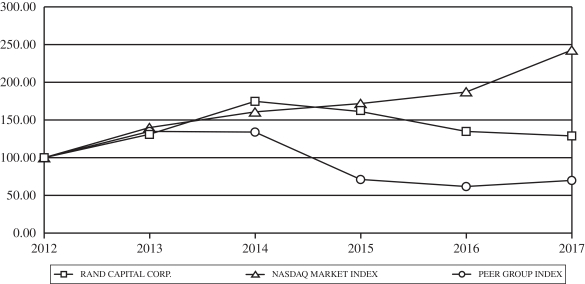
Comparison of cumulative total return of one or more companies, peer groups, industry indexes and/or broad markets
FISCAL YEAR ENDED DECEMBER 31,
| Company/Index/Market | 2012 | 2013 | 2014 | 2015 | 2016 | 2017 | ||||||||||||||||||
|
Rand Capital Corporation |
$ | 100.00 | $ | 131.20 | $ | 174.79 | $ | 161.11 | $ | 135.04 | $ | 129.06 | ||||||||||||
|
NASDAQ Market Index |
$ | 100.00 | $ | 140.12 | $ | 160.78 | $ | 171.97 | $ | 187.22 | $ | 242.71 | ||||||||||||
|
Peer Group Index |
$ | 100.00 | $ | 134.94 | $ | 134.07 | $ | 71.29 | $ | 61.78 | $ | 70.00 | ||||||||||||
The Peer Group was comprised of the following companies:
Capital Southwest Corporation (NasdaqGS: CSWC)
Firsthand Technology Value Fund, Inc. (NasdaqGS: SVVC)
GSV Capital Corp. (NasdaqCM: GSVC)
180 Degree Capital Corp. (NasdaqGM: TURN)
10
Table of Contents
We selected the Peer Group because it is our belief that the four issuers in the group have investment objectives that are similar to ours, and among the publicly traded companies, they are relatively similar in size to us. During 2017, Harris and Harris Group announced it would change its corporate name to 180 Degree Capital Corp. and its ticker symbol on the NASDAQ stock market to “TURN”. The peer group is unchanged from 2016.
The performance graph information provided above will not be deemed to be “soliciting material” or “filed” with the SEC or subject to Regulations 14A or 14C, or to the liabilities of section 18 of the Securities Exchange Act, unless in the future we specifically request that the information be treated as soliciting material or specifically incorporate it by reference into any filing under the Securities Act or the Exchange Act.
The following table provides selected consolidated financial data for the periods indicated. You should read the selected financial data set forth below in conjunction with Item 7, “Management’s Discussion and Analysis of Financial Condition and Results of Operations,” and with the consolidated financial statements and related notes appearing within Item 8 of this Annual Report.
| 2017 | 2016 | 2015 | 2014 | 2013 | ||||||||||||||||
|
Total assets |
$ | 40,133,913 | $ | 42,418,530 | $ | 44,562,060 | $ | 45,525,987 | $ | 39,750,370 | ||||||||||
|
Total liabilities |
$ | 8,215,228 | $ | 9,789,167 | $ | 10,708,400 | $ | 13,172,546 | $ | 11,681,038 | ||||||||||
|
Net assets |
$ | 31,918,685 | $ | 32,629,363 | $ | 33,853,660 | $ | 32,353,441 | $ | 28,069,332 | ||||||||||
|
Net asset value per outstanding share |
$ | 5.05 | $ | 5.16 | $ | 5.35 | $ | 5.11 | $ | 4.38 | ||||||||||
|
Shares of common stock outstanding |
6,321,988 | 6,321,988 | 6,328,538 | 6,328,538 | 6,411,918 | |||||||||||||||
Operating Data for the years ended December 31:
| 2017 | 2016 | 2015 | 2014 | 2013 | ||||||||||||||||
|
Investment income |
$ | 1,454,782 | $ | 1,031,858 | $ | 2,824,337 | $ | 2,584,475 | $ | 2,451,036 | ||||||||||
|
Total expenses |
$ | 2,010,977 | $ | 3,401,037 | $ | 1,817,279 | $ | 2,499,297 | $ | 2,359,252 | ||||||||||
|
Net investment (loss) gain, net of tax |
($ | 19,298 | ) | ($ | 1,553,268 | ) | $ | 842,902 | $ | 21,835 | $ | 154,478 | ||||||||
|
Net realized gain (loss) on sales and dispositions of investments, net of tax |
$ | 88,684 | $ | 8,864,653 | ($ | 27,973 | ) | $ | 4,767,484 | $ | 4,374,354 | |||||||||
|
Net (decrease) increase in unrealized depreciation or appreciation on investments, net of tax |
($ | 780,064 | ) | ($ | 8,514,068 | ) | $ | 685,290 | ($ | 247,838 | ) | ($ | 1,655,475 | ) | ||||||
|
Net (decrease) increase in net assets from operations |
($ | 710,678 | ) | ($ | 1,202,683 | ) | $ | 1,500,219 | $ | 4,541,481 | $ | 2,873,357 | ||||||||
You should read the following discussion and analysis of our financial condition and results of operations in conjunction with the consolidated financial statements and related notes included within Item 8 of this Annual Report.
FORWARD LOOKING STATEMENTS
Statements included in this Management’s Discussion and Analysis of Financial Condition and Results of Operations and elsewhere in this Report that do not relate to present or historical conditions are “forward-looking
11
Table of Contents
statements” within the meaning of that term in Section 27A of the Securities Act of 1933, as amended, and in Section 21E of the Securities Exchange Act of 1934, as amended. Additional oral or written forward-looking statements may be made by us from time to time, and forward-looking statements may be included in documents that are filed with the SEC. Forward-looking statements involve risks and uncertainties that could cause our results or outcomes to differ materially from those expressed in the forward-looking statements. Forward-looking statements may include, without limitation, statements relating to our plans, strategies, objectives, expectations and intentions and are intended to be made pursuant to the safe harbor provisions of the Private Securities Litigation Reform Act of 1995. Words such as “believes,” “forecasts,” “intends,” “possible,” “expects,” “estimates,” “anticipates,” or “plans” and similar expressions are intended to identify forward-looking statements. Among the important factors on which such statements are based are assumptions concerning the state of the United States economy and the local markets in which our portfolio companies operate, the state of the securities markets in which the securities of our portfolio companies could be traded, liquidity within the United States financial markets, and inflation. Forward-looking statements are also subject to the risks and uncertainties described under the caption “Risk Factors” contained in Part I, Item 1A. of this Annual Report.
There may be other factors not identified that affect the accuracy of our forward-looking statements. Further, any forward-looking statement speaks only as of the date when it is made and, except as required by law, we undertake no obligation to update any forward-looking statement to reflect events or circumstances after the date on which it is made or to reflect the occurrence of anticipated or unanticipated events or circumstances. New factors emerge from time to time that may cause our business not to develop as we expect, and we cannot predict all of them.
Overview
We are an internally managed investment company that lends to and invests in small companies often concurrently with other investors. We have elected to be treated as a business development company (“BDC”) under the Investment Company Act of 1940, as amended (the “1940 Act”). As a BDC, we are required to comply with certain regulatory requirements. We have historically made the majority of our investments through our wholly-owned subsidiary, Rand Capital SBIC, Inc. (“Rand SBIC”), which operates as a small business investment company (“SBIC”) and has been licensed by the U.S. Small Business Administration (“SBA”) since 2002. During 2017, we established a second SBIC subsidiary, Rand Capital SBIC II, L.P. (Rand SBIC II) and began making investments from this SBIC subsidiary. We continue to work with the SBA in determining an optimal structure within its regulatory parameters which, once completed, may result in new SBA leverage commitments in 2018.
Our principal investment objective is to achieve long-term capital appreciation on our equity investments while maintaining a current cash flow from our debenture and pass-through equity instruments to fund our operating expenses. Therefore, we invest in a variety of financial instruments to provide a current return on a portion of the investment portfolio. The equity features contained in our investment portfolio are structured to realize capital appreciation over the long-term and typically do not generate current income in the form of dividends or interest.
We have historically made initial investments of $500,000 to $1,000,000 directly in companies through equity or in debt or loan instruments and frequently provided follow-on investments during our investment tenure. The debt instruments generally have a maturity of not more than five years and usually have detachable equity warrants. Interest may be paid currently or deferred, based on the investment structure negotiated.
We may exit investments through the maturation of a debt security or when a liquidity event takes place, such as the sale, recapitalization, or initial public offering of a portfolio company. The method and timing of the disposition of our portfolio investments can be critical to the realization of maximum total return. We generally expect to dispose of our equity securities through private sales of securities to other investors or through an outright sale of the portfolio company or a merger. We anticipate our debt investments will be repaid with interest and hope to realize further appreciation from the warrants or other equity type instruments we receive in connection with the investment. We fund new investments and operating expenses through existing cash balances, investment returns, and interest and principal payments from our portfolio companies
12
Table of Contents
2017 Portfolio and Investment Activity
We believe the change in net asset value over time is the leading valuation metric of our performance. Exits from our portfolio holdings are the key driver of growth in net asset value over time.
| • |
Net asset value of our portfolio decreased to $5.05 per share, or $31.9 million, at December 31, 2017, down ($0.11) per share, or (2.1%), compared with net asset value of $5.16 per share, or $32.6 million, at the end of the prior year. |
| • |
At year end, the estimated value of our portfolio, which included securities from 30 active companies, was $32.3 million. This value included $4.4 million in net pre-tax unrealized depreciation. |
| • |
Approximately 58% of the portfolio was equity investments with the remainder being debt and loan investments. |
| • |
The portfolio generated approximately $1.5 million in interest, fee, dividend and other income. |
| • |
During 2017, we made $5.4 million of new investments in 8 companies, of which one was a new portfolio company. |
Outlook
At the end of 2017, we had $6.3 million in cash available for future investments and expenses, a decrease from $12.3 million at the end of 2016. The decrease was primarily due to $5.4 million of investments originated during 2017 as well as funding of ongoing operating expenses.
We continue to work with the SBA in determining an optimal structure within its regulatory parameters which, once completed, may result in new SBA leverage commitments in 2018.
We believe the combination of cash on hand, proceeds from portfolio exits, potential additional SBA leverage, and prospective investment income provide sufficient capital for us to continue to add new investments to our portfolio while reinvesting in existing portfolio companies that demonstrate continued growth potential. The following short and long-term trends provide us confidence in our ability to grow Rand:
| • |
We expect that well run businesses will require capital to grow and should be able to compete effectively given the strong macroeconomic environment and eager reception of new technologies and service concepts. |
| • |
We continue to manage risk by investing with other investors, when possible. |
| • |
We are actively involved with the governance and management of our portfolio companies, which enables us to support their operating and marketing efforts and facilitate their growth. |
| • |
As our portfolio expands, we are able to better leverage our infrastructure. |
| • |
We have sufficient cash to invest in new opportunities and to repurchase shares. At year end, we had authorization to repurchase an additional 458,954 shares of our Common Stock. However, our prioritized use of cash continues to be growing our portfolio. |
Critical Accounting Policies
We prepare our consolidated financial statements in accordance with United States generally accepted accounting principles, or GAAP, which require the use of estimates and assumptions that affect the reported amounts of assets and liabilities. For a summary of all significant accounting policies, including critical accounting policies, see Note 1 to the consolidated financial statements in Item 8 of this Annual Report.
The increasing complexity of the business environment and applicable authoritative accounting guidance require us to closely monitor our accounting policies and procedures. We have two critical accounting policies that require the use of significant judgment. The following summary of critical accounting policies is intended to enhance a reader’s ability to assess our financial condition and results of operations and the potential volatility due to changes in estimates.
13
Table of Contents
Valuation of Investments
Investments are valued at fair value as determined in good faith by management and approved by our Board of Directors. We invest in loan, debt, and equity instruments and there is no single standard for determining fair value of these investments. As a result, determining fair value requires that judgment be applied to the specific facts and circumstances of each portfolio investment while employing a consistent valuation process. We analyze and value each investment quarterly, and record unrealized depreciation for an investment that we believe has become impaired, including where collection of a loan or realization of the recorded value of an equity security is doubtful. Conversely, we will record unrealized appreciation if we believe that an underlying portfolio company has appreciated in value and, therefore, its equity security has also appreciated in value. These estimated fair values may differ from the values that would have been used had a ready market for the investments existed and these differences could be material if our assumptions and judgments differ from results of actual liquidation events.
Our investments are carried at fair value in accordance with Accounting Standards Codification (ASC) 820, “Fair Value Measurements and Disclosures”, which defines fair value, establishes a framework for measuring fair value in accordance with GAAP, and expands disclosures about fair value measurements.
Loan investments are defined as traditional loan financings with no equity features. Debt investments are defined as debt financings that include one or more equity features such as conversion rights, stock purchase warrants, and/or stock purchase options. A financing may also be categorized as a debt financing if it is accompanied by the direct purchase of an equity interest in the company.
We utilize several approaches to determine the fair value of an investment. The main approaches are:
| • |
Loan and debt securities are valued at cost when it is representative of the fair value of the investment or sufficient assets or liquidation proceeds are expected to exist from a sale of a portfolio company at its estimated fair value. However, they may be valued at an amount other than cost given the carrying interest rate versus the related inherent portfolio risk of the investment. A loan or debt instrument may be reduced in value if it is judged to be of poor quality, collection is in doubt or insufficient liquidation proceeds exist. |
| • |
Equity securities may be valued using the “asset approach”, “market approach” or “income approach.” The asset approach involves estimating the liquidation value of the portfolio company’s assets. To the extent the value exceeds the remaining principal amount of the debt or loan securities of the portfolio company, the fair value of such securities is generally estimated to be their cost. However, where value is less than the remaining principal amount of the loan and debt securities, the Corporation may discount the value of an equity security. The market approach uses observable prices and other relevant information generated by similar market transactions. It may include the use of market multiples derived from a set of comparables to assist in pricing the investment. Additionally, the Corporation adjusts valuations if a subsequent significant equity financing has occurred that includes a meaningful portion of the financing by a sophisticated, unrelated new investor. The income approach employs a cash flow and discounting methodology to value an investment. |
ASC 820 classifies the inputs used to measure fair value into the following hierarchy:
Level 1: Quoted prices in active markets for identical assets or liabilities, used in our valuation at the measurement date.
Level 2: Quoted prices for similar assets or liabilities in active markets, or quoted prices for identical or similar assets or liabilities in markets that are not active, or other observable inputs other than quoted prices.
Level 3: Unobservable and significant inputs to determining the fair value.
Financial assets are categorized based upon the level of judgment associated with the inputs used to measure their fair value.
Any changes in estimated fair value are recorded in the statement of operations as “Net (decrease) increase in unrealized depreciation or appreciation on investments.”
14
Table of Contents
Under the valuation policy, we value unrestricted publicly traded companies, categorized as Level 1 investments, at the average closing bid price for the last three trading days of the reporting period. There were no Level 1 or Level 2 investments as of December 31, 2017.
In the valuation process, we value restricted securities, categorized as Level 3 investments, using information from these portfolio companies, which may include:
| • |
Audited and unaudited statements of operations, balance sheets and operating budgets; |
| • |
Current and projected financial, operational and technological developments of the portfolio company; |
| • |
Current and projected ability of the portfolio company to service its debt obligations; |
| • |
The current capital structure of the business and the seniority of the various classes of equity if a deemed liquidation event were to occur; |
| • |
Pending debt or capital restructuring of the portfolio company; |
| • |
Current information regarding any offers to purchase the investment, or recent fundraising transactions; |
| • |
Current ability of the portfolio company to raise additional financing if needed; |
| • |
Changes in the economic environment which may have a material impact on the operating results of the portfolio company; |
| • |
Internal circumstances and events that may have an impact (both positive and negative) on the operating performance of the portfolio company; |
| • |
Qualitative assessment of key management; |
| • |
Contractual rights, obligations or restrictions associated with the investment; and |
| • |
Other factors deemed relevant by our management to assess valuation. |
The valuation may be reduced if a portfolio company’s performance and potential have deteriorated significantly. If the factors that led to a reduction in valuation are overcome, the valuation may be readjusted.
Equity Securities
Equity Securities may include preferred stock, common stock, warrants and limited liability company membership interests.
The significant unobservable inputs used in the fair value measurement of our equity investments are earnings before interest, taxes and depreciation and amortization (EBITDA) and revenue multiples, where applicable, the financial and operational performance of the business, and the senior equity preferences that may exist in a deemed liquidation event. Standard industry multiples may be used when available; however, our portfolio companies are typically small and in early stages of development and these industry standards may be adjusted to more closely match the specific financial and operational performance of the portfolio company. Due to the nature of certain investments, fair value measurements may be based on other criteria, which may include third party appraisals. Significant changes to the unobservable inputs, such as variances in financial performance from expectations, may result in a significantly higher or lower fair value measurement. Significant changes in any of these unobservable inputs may result in a significantly higher or lower fair value estimate.
Another key factor used in valuing equity investments is a significant recent arms-length equity transaction with a sophisticated non-strategic unrelated new investor entered into by the portfolio company. The terms of these equity transactions may not be identical to the equity transactions between the portfolio company and us, and the impact of the difference in transaction terms on the market value of the portfolio company may be difficult or impossible to quantify.
When appropriate the Black-Scholes pricing model is used to estimate the fair value of warrants for accounting purposes. This model requires the use of highly subjective inputs including expected volatility and expected life, in addition to variables for the valuation of minority equity positions in small private and early stage companies. Significant changes in any of these unobservable inputs may result in a significantly higher or lower fair value estimate.
15
Table of Contents
For recent investments, we generally rely on the cost basis, which is deemed to represent fair value, unless other fair market value inputs are identified causing us to depart from this basis.
The significant unobservable inputs used in the fair value measurement of our loan and debt securities are the financial and operational performance of the portfolio company, similar debt with similar terms with other portfolio companies, current market rates for underlying risks associated with the particular company, as well as the market acceptance of the portfolio company’s products or services and its future performance. These inputs will likely provide an indicator as to the probability of principal recovery of the investment. Our debt investments are often junior secured or unsecured debt securities. Fair value may also be determined based on other criteria where appropriate. Significant changes to the unobservable inputs may result in a change in fair value. For recent investments, we generally rely on the cost basis, which is deemed to represent the fair value, unless other fair market value inputs are identified causing us to depart from this basis.
Revenue Recognition
Interest income generally is recognized on the accrual basis except where the investment is in default or otherwise presumed to be in doubt. In such cases, interest income is recognized at the time of receipt. A reserve for possible losses on interest receivable is maintained when appropriate.
Our SBIC’s interest accrual is also regulated by the SBA’s “Accounting Standards and Financial Reporting Requirements for Small Business Investment Companies.” Under these rules, interest income cannot be recognized if collection is doubtful, and a 100% reserve must be established. The collection of interest is presumed to be in doubt when there is substantial doubt about a portfolio company’s ability to continue as a going concern or the loan is in default more than 120 days. Management also uses other qualitative and quantitative measures to determine the value of a portfolio investment and the collectability of any accrued interest.
We hold debt securities in our investment portfolio that contain payment-in-kind (“PIK”) interest provisions. PIK interest, computed at the contractual rate specified in each debt agreement, is periodically added to the principal balance of the debt and is recorded as interest income. Thus, the actual collection of this interest may be deferred until the time of debt principal repayment.
We may receive distributions from portfolio companies that are limited liability companies or corporations. These distributions are classified as dividend income on the consolidated statement of operations. Dividend income is recognized on an accrual basis when it can be reasonably estimated.
We hold preferred equity securities that may contain cumulative dividend provisions. Cumulative dividends are recorded as dividend income when they are declared and deemed a contractual obligation. Any dividends in arrears are added to the balance of the preferred equity investment. The actual collection of these dividends in arrears may be deferred until such time as the preferred equity is redeemed.
Financial Condition
Overview:
| 12/31/17 | 12/31/16 | Decrease | % Decrease | |||||||||||||
|
Total assets |
$ | 40,133,913 | $ | 42,418,530 | ($ | 2,284,617 | ) | (5.4 | %) | |||||||
|
Total liabilities |
8,215,228 | 9,789,167 | (1,573,939 | ) | (16.1 | %) | ||||||||||
|
|
|
|
|
|
|
|||||||||||
|
Net assets |
$ | 31,918,685 | $ | 32,629,363 | ($ | 710,678 | ) | (2.2 | %) | |||||||
|
|
|
|
|
|
|
|||||||||||
Net asset value was $5.05 per share at December 31, 2017 versus $5.16 per share at December 31, 2016.
The outstanding SBA debentures at December 31, 2017 are $8,000,000, which will mature from 2022 through 2025.
16
Table of Contents
Cash approximated 20% of net assets at December 31, 2017 compared to 38% at December 31, 2016.
Composition of the Investment Portfolio
Our financial condition is dependent on the success of our portfolio holdings, which are investments in small companies. The following summarizes our investment portfolio at the yearends indicated.
| 12/31/17 | 12/31/16 |
Increase
(Decrease) |
% Increase
(Decrease) |
|||||||||||||
|
Investments, at cost |
$ | 36,689,319 | $ | 31,631,030 | $ | 5,058,289 | 16.0 | % | ||||||||
|
Unrealized depreciation, net |
(4,405,257 | ) | (4,130,549 | ) | (274,708 | ) | (6.7 | %) | ||||||||
|
|
|
|
|
|
|
|||||||||||
|
Investments, at fair value |
$ | 32,284,062 | $ | 27,500,481 | $ | 4,783,581 | 17.4 | % | ||||||||
|
|
|
|
|
|
|
|||||||||||
|
Number of Active Portfolio Companies |
30 | 33 | ||||||||||||||
Our total investments at fair value, as estimated by management and approved by the Board of Directors, approximated 101% of net assets at December 31, 2017 and 84% of net assets at December 31, 2016.
The change in investments, at cost, during the year ended December 31, 2017, is comprised of the following:
|
Cost
Increase
(Decrease) |
||||
|
New investments: |
||||
|
eHealth Global Technologies, Inc. (eHealth) |
$ | 2,000,000 | ||
|
Tilson Technology Management, Inc. (Tilson) |
1,500,000 | |||
|
Genicon, Inc. (Genicon) |
1,300,000 | |||
|
SciAps, Inc. (Sciaps) |
250,000 | |||
|
BeetNPath, LLC (Beetnpath) |
100,000 | |||
|
Centivo Corporation (Centivo) |
100,000 | |||
|
Mercantile Adjustment Bureau, LLC (Mercantile) |
100,000 | |||
|
KnowledgeVision Systems, Inc. (Knowledge Vision) |
50,000 | |||
|
|
|
|||
|
Total of new investments |
5,400,000 | |||
|
|
|
|||
|
Other changes to investments: |
||||
|
Empire Genomics, LLC (Empire Genomics) interest conversion |
201,489 | |||
|
Sciaps interest conversion |
24,274 | |||
|
Genicon OID amortization |
23,779 | |||
|
Microcision LLC (Microcision) interest conversion |
22,176 | |||
|
Beetnpath interest conversion |
11,277 | |||
|
GoNoodle, Inc. (GoNoodle) interest conversion |
10,229 | |||
|
Mercantile OID amortization |
8,350 | |||
|
|
|
|||
|
Total of other changes to investments |
301,574 | |||
|
|
|
|||
|
Investments repaid, sold or liquidated: |
||||
|
Athenex Inc. (Athenex) sold shares |
(143,285 | ) | ||
|
City Dining Cards, Inc. (Loupe) realized loss |
(500,000 | ) | ||
|
|
|
|||
|
Total investments repaid, sold or liquidated |
(643,285 | ) | ||
|
|
|
|||
|
Net change in investments, at cost |
$ | 5,058,289 | ||
|
|
|
|||
17
Table of Contents
Our top five portfolio companies represented 37% of total assets at December 31, 2017:
|
Company |
Industry |
Fair Value at
December 31, 2017 |
% of Total Assets
at December 31, 2017 |
|||||||
|
Genicon, Inc. |
Health Care — Testing Device | $ | 4,023,779 | 10 | % | |||||
|
eHealth Global Technologies, Inc. |
Health Care | $ | 3,500,000 | 9 | % | |||||
|
Rheonix, Inc. |
Health Care — Testing Device | $ | 2,938,731 | 7 | % | |||||
|
Tilson Technology Management, Inc. |
Professional Services | $ | 2,500,000 | 6 | % | |||||
|
Outmatch Holdings, LLC |
Software | $ | 2,145,496 | 5 | % | |||||
Our top five portfolio companies represented 28% of total assets at December 31, 2016:
|
Company |
Industry |
Fair Value at
December 31, 2016 |
% of Total Assets
at December 31, 2016 |
|||||||
|
Rheonix, Inc. |
Health Care — Testing Device | $ | 2,938,731 | 7 | % | |||||
|
Genicon, Inc. |
Health Care — Testing Device | $ | 2,700,000 | 6 | % | |||||
|
Outmatch Holdings, LLC |
Software | $ | 2,145,496 | 5 | % | |||||
|
Social Flow, Inc. |
Software | $ | 2,071,300 | 5 | % | |||||
|
SciAps, Inc. |
Manufacturing | $ | 2,054,710 | 5 | % | |||||
Below is the geographic breakdown of our investments at fair value as of December 31, 2017 and 2016:
|
Geographic Region |
% of Net Asset Value
at December 31, 2017 |
% of Net Asset Value
at December 31, 2016 |
||||||
|
USA – East |
86 | % | 78 | % | ||||
|
USA – South |
15 | % | 6 | % | ||||
|
|
|
|
|
|||||
|
Total investments as a % of net asset value |
101 | % | 84 | % | ||||
|
|
|
|
|
|||||
18
Table of Contents
As of December 31, 2017 and 2016, the investment portfolio consisted of the following types of investments:
| Cost |
Percentage of
Total Portfolio |
Fair Value |
Percentage of
Total Portfolio |
|||||||||||||
|
December 31, 2017 : |
||||||||||||||||
|
Subordinated Debt and Promissory Notes |
$ | 12,924,321 | 35 | % | $ | 11,796,289 | 37 | % | ||||||||
|
Convertible Debt |
1,849,955 | 5 | 1,849,955 | 6 | ||||||||||||
|
Equity and Membership Interests |
21,640,393 | 59 | 18,482,793 | 57 | ||||||||||||
|
Equity Warrants |
274,650 | 1 | 155,025 | 0 | ||||||||||||
|
|
|
|
|
|
|
|
|
|||||||||
|
Total |
$ | 36,689,319 | 100 | % | $ | 32,284,062 | 100 | % | ||||||||
|
|
|
|
|
|
|
|
|
|||||||||
|
December 31, 2016 : |
||||||||||||||||
|
Subordinated Debt and Promissory Notes |
$ | 8,779,787 | 28 | % | $ | 7,901,755 | 29 | % | ||||||||
|
Convertible Debt |
1,998,466 | 6 | 1,998,466 | 7 | ||||||||||||
|
Equity and Membership Interests |
20,698,127 | 65 | 17,565,235 | 64 | ||||||||||||
|
Equity Warrants |
154,650 | 1 | 35,025 | 0 | ||||||||||||
|
|
|
|
|
|
|
|
|
|||||||||
|
Total |
$ | 31,631,030 | 100 | % | $ | 27,500,481 | 100 | % | ||||||||
|
|
|
|
|
|
|
|
|
|||||||||
Results of Operations
Investment Income
Our principal investment objective is to achieve long-term capital appreciation on our equity investments while maintaining a current cash flow from our debenture and pass-through equity instruments to fund expenses. Therefore, we invest in a variety of financial instruments to provide a current return on a portion of the investment portfolio.
Comparison of the years ended December 31, 2017 and 2016
|
December 31,
2017 |
December 31,
2016 |
Increase
(Decrease) |
% Increase
(Decrease) |
|||||||||||||
|
Interest from portfolio companies |
$ | 1,155,316 | $ | 767,153 | $ | 388,163 | 51 | % | ||||||||
|
Interest from other investments |
30,761 | 45,139 | (14,378 | ) | (32 | %) | ||||||||||
|
Dividend and other investment income |
243,614 | 192,932 | 50,682 | 26 | % | |||||||||||
|
Fee income |
25,091 | 26,634 | (1,543 | ) | (6 | %) | ||||||||||
|
|
|
|
|
|
|
|||||||||||
|
Total investment income |
$ | 1,454,782 | $ | 1,031,858 | $ | 422,924 | 41 | % | ||||||||
|
|
|
|
|
|
|
|||||||||||
Investment income increased 41%, or $422,924, from $1,031,858 for the year ended December 31, 2016 to $1,454,782 for the year ended December 31, 2017.
Interest from portfolio companies — Interest from portfolio companies was 51% higher during the year ended December 31, 2017 versus the same period in 2016 due to the fact that we have originated more income-producing debt investments in the last year. These new debt instruments were originated from Genicon Inc. (Genicon), eHealth Global Technologies, Inc. (eHealth), Empire Genomics, LLC (Empire Genomics) and several other portfolio companies.
The following investments remain on non-accrual status: G-TEC Natural Gas Systems (G-Tec), First Wave Products Group, LLC (First Wave) and a portion of the Mercantile Adjustment Bureau, LLC (Mercantile) outstanding loan balance.
19
Table of Contents
Interest from other investments — The decrease in interest from other investments was primarily due to lower average cash balances during the year ended December 31, 2017 versus the year ended December 31, 2016.
Dividend and other investment income — Dividend income is comprised of cash distributions from limited liability companies (LLCs) and corporations in which we have invested. Our investment agreements with certain LLCs require those LLCs to distribute funds to us for payment of income taxes on our allocable share of the LLC’s profits. These portfolio companies may also elect to make additional discretionary distributions. Dividend income will fluctuate based upon the profitability of these LLCs and corporations and the timing of the distributions or the impact of new investments or divestitures. The dividend distributions for the respective periods were:
|
December 31,
2017 |
December 31,
2016 |
|||||||
|
Carolina Skiff LLC (Carolina Skiff) |
$ | 178,532 | $ | 131,785 | ||||
|
New Monarch Machine Tool, LLC (Monarch) |
27,409 | 27,409 | ||||||
|
Tilson Technology Management, Inc. (Tilson) |
21,579 | 16,250 | ||||||
|
Empire Genomics, LLC (Empire Genomics) |
10,070 | 4,024 | ||||||
|
SOMS Technologies, LLC (SOMS) |
6,024 | 13,464 | ||||||
|
|
|
|
|
|||||
|
Total dividend and other investment income |
$ | 243,614 | $ | 192,932 | ||||
|
|
|
|
|
|||||
Fee income — Fee income consists of the revenue associated with the amortization of financing fees charged to the portfolio companies upon successful closing of SBIC financings and income from portfolio company board attendance fees. The financing fees are amortized ratably over the life of the instrument associated with the fees. The unamortized fees are carried on the balance sheet under the line item “Deferred revenue.”
The income associated with the amortization of financing fees was $24,091 and $22,634 for the years ended December 31, 2017 and 2016, respectively. The financing fee income based on the existing portfolio is expected to be approximately $21,000 in 2018, $15,000 in 2019 and $2,000 in 2020.
Fees paid for board service at the portfolio companies were $1,000 and $4,000 for the years ended December 31, 2017 and 2016, respectively.
Comparison of the years ended December 31, 2016 and 2015
|
December 31,
2016 |
December 31,
2015 |
Increase
(Decrease) |
% Increase
(Decrease) |
|||||||||||||
|
Interest from portfolio companies |
$ | 767,153 | $ | 691,109 | $ | 76,044 | 11 | % | ||||||||
|
Interest from other investments |
45,139 | 22,048 | 23,091 | 105 | % | |||||||||||
|
Dividend and other investment income |
192,932 | 2,081,847 | (1,888,915 | ) | (91 | %) | ||||||||||
|
Fee income |
26,634 | 29,333 | (2,699 | ) | (9 | %) | ||||||||||
|
|
|
|
|
|
|
|||||||||||
|
Total investment income |
$ | 1,031,858 | $ | 2,824,337 | ($ | 1,792,479 | ) | (64 | %) | |||||||
|
|
|
|
|
|
|
|||||||||||
Investment income decreased 64%, or $1,792,479, from $2,824,337 for the year ended December 31, 2015 to $1,031,858 for the year ended December 31, 2016. The net decrease was primarily attributable to a decrease in dividend income caused by the sale of a large dividend producing investment, Gemcor, II, LLC (Gemcor) during 2016.
Interest from portfolio companies — Our portfolio interest income increased during 2016 due to the addition of several large debt instruments in late 2015 and throughout 2016. The new debt instruments were originated from Genicon Inc. (Genicon), eHealth Global Technologies, Inc. (eHealth), Empire Genomics, LLC (Empire Genomics), SciAps, Inc. (Sciaps) and several other portfolio companies.
20
Table of Contents
The following investments remain on non-accrual status: G-TEC Natural Gas Systems (G-Tec), First Wave Products Group, LLC (First Wave) and a portion of the Mercantile Adjustment Bureau, LLC (Mercantile) outstanding loan balance.
Interest from other investments — The increase in interest from other investments was primarily due to higher average cash balances during the year ended December 31, 2016 versus the year ended December 31, 2015.
Dividend and other investment income — Dividend and other investment income decreased in 2016 due to the asset sale of Gemcor II, LLC in March 2016. The dividend distributions for the respective years were:
|
December 31,
2016 |
December 31,
2015 |
|||||||
|
Carolina Skiff LLC (Carolina Skiff) |
$ | 131,785 | $ | 116,052 | ||||
|
New Monarch Machine Tool, LLC (Monarch) |
27,409 | 27,409 | ||||||
|
Tilson Technology Management, Inc. (Tilson) |
16,250 | 14,417 | ||||||
|
SOMS Technologies, LLC (SOMS) |
13,464 | 4,355 | ||||||
|
Empire Genomics, LLC (Empire Genomics) |
4,024 | — | ||||||
|
Gemcor, II, LLC (Gemcor) |
— | $ | 1,735,934 | |||||
|
Teleservices Solutions Holdings, LLC (Teleservices) |
— | 183,680 | ||||||
|
|
|
|
|
|||||
|
Total dividend and other investment income |
$ | 192,932 | $ | 2,081,847 | ||||
|
|
|
|
|
|||||
Fee income — The income associated with the amortization of financing fees was $22,634 and $18,333 for the years ended December 31, 2016 and 2015, respectively. The financing fee income based on the existing portfolio is expected to be approximately $20,000 in 2017, $15,000 in 2018, $11,000 in 2019 and $300 in 2020.
Fees paid for board service at the portfolio companies were $4,000 and $11,000 for the years ended December 31, 2016 and 2015, respectively.
Expenses
Comparison of the years ended December 31, 2017 and 2016
|
December 31,
2017 |
December 31,
2016 |
Decrease | % Decrease | |||||||||||||
|
Total expenses |
$ | 2,010,977 | $ | 3,401,037 | ($ | 1,390,060 | ) | (41 | %) | |||||||
Operating expenses consist predominately of compensation expense, including profit sharing, and related benefits, interest expense on outstanding SBA borrowings, and general and administrative expenses including shareholder and office expenses and professional fees.
The decrease in expenses during the year ended December 31, 2017 versus the same period in 2016 was primarily caused by a decrease of $1,373,052 in bonus and profit sharing expense related to the Gemcor II, LLC (Gemcor) exit in early 2016. Gemcor sold its assets in March 2016 and based on our ownership percentage, we received gross cash proceeds of approximately $13.8 million, excluding an escrow receivable, and realized a gain, before income taxes, of approximately $13.2 million from the sale. As a result of this sale, we recognized $1,385,052 under our Profit Sharing Plan during the year ended December 31, 2016. There were no amounts earned pursuant to the Profit Sharing Plan for the year ended December 31, 2017.
Comparison of the years ended December 31, 2016 and 2015
|
December 31,
2016 |
December 31,
2015 |
Increase | % Increase | |||||||||||||
|
Total expenses |
$ | 3,401,037 | $ | 1,817,279 | $ | 1,583,758 | 87 | % | ||||||||
21
Table of Contents
The increase in operating expenses during 2016 was comprised primarily of a $1,262,552 increase in bonus and profit sharing expense, due to the Gemcor sale in 2016, and a $137,629 increase in professional fees.
Our largest portfolio company, in terms of fair value, Gemcor II, LLC (Gemcor) sold its assets during March 2016 and, based on our ownership percentage, we received gross cash proceeds of approximately $14.1 million. The realized gain from the sale, before income taxes, was $14,620,063 and included $1,100,000 that continued to be held in escrow at December 31, 2016. The escrow holdback is recorded in “Other Assets” on the accompanying consolidated statement of financial position. The escrow was released during 2017. Related to this asset sale, we accrued $1,270,052 under our Profit Sharing Plan for the year ended December 31, 2016, that is payable to our executive officers. Recording of the profit sharing expense is primarily based on net realized gains, which may be in years subsequent to when the unrealized appreciation is recognized on the underlying investments in the financial statements. This may cause a recognition of profit sharing expense in a period later than when the appreciation is recognized, as was the case in 2016. There were no amounts earned pursuant to the Profit Sharing Plan for the year ended December 31, 2015.
Professional fees were also higher during the year ended December 31, 2016 versus 2015 because we incurred additional expenses in connection with developing and implementing our long-term growth strategy. These expenses included external legal, tax consulting and other advisory expenses to support refinement of our strategy, which involved assessing options relative to the complex regulatory environment in which we operate.
Net Realized Gains and Losses on Investments
|
December 31,
2017 |
December 31,
2016 |
December 31,
2015 |
||||||||||
|
Net realized gain (loss) on sales and dispositions, before income tax expense (benefit) |
$ | 138,240 | $ | 14,138,203 | ($ | 42,469 | ) | |||||
During the year ended December 31, 2017, one of our portfolio companies, Athenex Inc. (Athenex) completed an initial public offering and its common stock became publicly traded on the NASDAQ Global Select Market under the symbol “ATNX”. We sold our shares in Athenex and recognized a net realized gain, before income taxes, of $638,240 on the sale of the 46,296 Athenex shares.
In addition, during 2017, we realized a loss of $500,000 on our investment in City Dining Cards (Loupe) when the company ceased operations.
During the first quarter of 2016 our portfolio company, Gemcor II, LLC, sold its assets, and accordingly, we received gross cash proceeds of approximately $14.1 million, excluding amounts held in escrow, and recognized a realized gain, before income taxes, of $14,620,063. The escrow holdback at December 31, 2016 was $1,100,000 and is recorded in “Other Assets” on the accompanying consolidated statement of financial position. The escrow was released during 2017.
In addition, we recorded a realized gain of $168,140 during the year ended December 31, 2016 from the earn out provision in connection with the 2014 sale of QuaDPharma, LLC to Athenex Inc.
We realized a loss of $650,000 on our investment in Statisfy, Inc. (Statisfy) during the year ended December 31, 2016 when the company ceased operations.
During the year ended December 31, 2015, we recognized a net realized gain, before income taxes, of $262,925 on the sale of 301,582 shares of Synacor, Inc. (Synacor). Synacor trades on the NASDAQ Global Market under the symbol “SYNC”. As of December 31, 2015, we did not own any shares of Synacor.
We recognized a realized loss of $5,394 on an adjustment to the BinOptics Corporation (Binoptics) escrow receivable. At December 31, 2015, the Binoptics escrow receivable was $1,504,854 and was received during 2016.
We realized a loss of $300,000 on our investment in CrowdBouncer, Inc. during the year ended December 31, 2015 when the company ceased operations.
22
Table of Contents
Net (Decrease) Increase in Unrealized Depreciation or Appreciation of Investments
The change in net unrealized depreciation of investments, before income taxes, for the year ended December 31, 2017 was comprised of the following:
|
December 31,
2017 |
||||
|
SciAps, Inc. (Sciaps) |
($ | 554,710 | ) | |
|
Teleservices Solutions Holdings, LLC (Teleservices) |
(395,398 | ) | ||
|
Intrinsiq Materials, Inc. (Intrinsiq) |
(380,000 | ) | ||
|
Athenex, Inc. (Athenex) reclass to a realized gain |
(273,379 | ) | ||
|
Mercantile Adjustment Bureau, LLC (Mercantile) |
(250,000 | ) | ||
|
BeetNPath, LLC (Beetnpath) |
29,723 | |||
|
ACV Auctions, Inc. (ACV) |
119,356 | |||
|
Carolina Skiff LLC (Carolina Skiff) |
650,000 | |||
|
Knoa Software, Inc. (Knoa) |
779,700 | |||
|
|
|
|||
| ($ | 274,708 | ) | ||
|
|
|
|||
The valuations of our investments in Intrinsiq, Mercantile and Teleservices were decreased after we reviewed each portfolio company and its current and projected financial condition and determined that a valuation adjustment was necessary.
In accordance with our valuation policy, we adjusted the value of our investments in ACV, Beetnpath and Sciaps based on a significant equity financing by a new non-strategic outside entity, and consideration of the related affect on the liquidation preferences of our existing investment instrument in each of the companies. In addition, our investments in Carolina Skiff and Knoa were increased based on a financial analysis of each portfolio company indicating improved performance.
The change in net unrealized depreciation of investments, before income taxes, for the year ended December 31, 2016 was comprised of the following:
|
December 31,
2016 |
||||
|
Reclassify Gemcor II, LLC (Gemcor) to a realized gain |
($ | 12,775,000 | ) | |
|
Teleservices Solutions Holdings, LLC (Teleservices) |
(990,680 | ) | ||
|
Knoa Software, Inc. (Knoa) |
(422,800 | ) | ||
|
OnCore Golf Technology, Inc. (Oncore) |
(187,500 | ) | ||
|
Athenex, Inc. (Athenex) |
69,444 | |||
|
Intrinsiq Materials, Inc. (Intrinsiq) |
254,329 | |||
|
Carolina Skiff LLC (Carolina Skiff) |
500,000 | |||
|
|
|
|||
| ($ | 13,552,207 | ) | ||
|
|
|
|||
During the first quarter of 2016 Gemcor II, LLC sold its assets and we received gross cash proceeds of approximately $14.1 million. The realized gain from the sale, before income taxes, was $14,620,063 and included $1,100,000 that was held in escrow at December 31, 2016 and recorded on the accompanying consolidated statement of financial position in “Other Assets.”
Our investment in Teleservices was revalued after we reviewed their operations and their current and past financial performance. This review indicated that a further deterioration of their business had occurred. If the factors that led to this reduction in valuation are overcome, the value may be restored. The portfolio company remains in operation and is developing new business strategies.
The valuation of our investment in Knoa was decreased during 2016 to value our equity at liquidation value.
23
Table of Contents
The valuation of our investment in Oncore was decreased after we reviewed the portfolio company and its financial condition and determined that a valuation adjustment was necessary.
In accordance with our valuation policy, we increased the value of our investment in Athenex based on a significant equity financing by a new non-strategic outside entity. This new financing used a higher valuation for Athenex than had been used for its prior financing rounds.
Intrinsiq’s value was increased based on a the completion of an equity refinancing in the third quarter of 2016.
Carolina Skiff’s value was increased based on a financial analysis of the portfolio company indicating continued improved performance.
The change in net unrealized appreciation of investments, before income taxes, for the year ended December 31, 2015 was comprised of the following:
|
December 31,
2015 |
||||
|
Gemcor II, LLC (Gemcor) |
$ | 4,100,000 | ||
|
SocialFlow, Inc. (SocialFlow) |
321,300 | |||
|
CrowdBouncer, Inc.(Crowdbouncer) reclass to a realized loss |
300,000 | |||
|
Athenex, Inc. (Athenex) (formerly Kinex Pharmaceuticals, Inc .) |
92,592 | |||
|
OnCore Golf Technology, Inc. (Oncore) |
(187,500 | ) | ||
|
GiveGab, Inc. (Givegab) |
(191,907 | ) | ||
|
Synacor, Inc. (Synacor) reclass to a realized gain |
(220,320 | ) | ||
|
Mercantile Adjustment Bureau, LLC (Mercantile) |
(247,625 | ) | ||
|
KnowledgeVision Systems, Inc. (Knowledge Vision) |
(250,000 | ) | ||
|
Teleservices Solutions Holdings, LLC (Teleservices) |
(250,000 | ) | ||
|
Somerset Gas Transmission Company, LLC (Somerset) |
(286,748 | ) | ||
|
SciAps, Inc. (Sciaps) |
(500,000 | ) | ||
|
Intrinsiq Materials, Inc. (Intrinsiq) |
(600,002 | ) | ||
|
First Wave Products Group, LLC (First Wave) |
(750,031 | ) | ||
|
|
|
|||
| $ | 1,329,759 | |||
|
|
|
|||
In December 2015 we entered into an asset purchase agreement under which we agreed to sell Gemcor. The required percentage of Gemcor shareholders ratified and approved the sale in January 2016. The transaction closed in the first quarter of 2016. Based on our ownership of Gemcor, we received gross cash proceeds of approximately $14.1 million at closing, before considering the $1.1 million held in escrow. Additionally, we incurred the related profit sharing expense in the first quarter of 2016. We valued our investment in Gemcor at December 31, 2015 based on an EBITDA multiple which approximated our sales proceeds.
In accordance with our valuation policy, we increased the value of our holdings in Athenex and Social Flow based on significant equity financings for each during 2015 with sophisticated new non-strategic outside investors at a higher valuation for each than their prior financing round valuation.
The Crowdbouncer investment was written off after the company ceased doing business during 2015.
We sold our remaining shares of Synacor during the year ended December 31, 2015.
The Oncore, Givegab, Mercantile and Knowledge Vision investment values were decreased after we reviewed each of the portfolio company’s commercial progress against their business plans and their past financial performance. These reviews indicated that deterioration of their respective businesses had occurred. If the factors which led to these reductions in valuations are overcome, the valuations may be restored.
The Somerset investment value was decreased during 2015 after a review of the company’s financial performance and the overall weakness in the oil and gas sector.
24
Table of Contents
The First Wave, Intrinsiq, and Teleservices investment values were decreased during 2015 after we reviewed each of the portfolio company’s progress toward commercialization and broad based acceptance of their respective business technologies and services in their respective markets. We also considered in our review the past financial performance of the companies, their forecasted cash needs, and their fundraising plans for 2016 in determining that reductions in values were appropriate. If the factors which led to the reductions in valuations are overcome, the valuations may be restored.
The valuation of Sciaps was decreased during the year ended December 31, 2015 to revalue our equity holdings based upon liquidation preferences of our securities and on the most recent equity round of financing.
All of these value adjustments resulted from a review by management using the guidance set forth by ASC 820 and our established valuation policy.
Net (Decrease) Increase in Net Assets from Operations
We account for our operations under GAAP for investment companies. The principal measure of our financial performance is “net (decrease) increase in net assets from operations” on our consolidated statements of operations. During the year ended December 31, 2017, the net decrease in net assets from operations was ($710,678) as compared with net decrease of ($1,202,683) in 2016 and a net increase of $1,500,219 in 2015.
Liquidity and Capital Resources
Our principal objective is to achieve capital appreciation. Therefore, a significant portion of the investment portfolio is structured to maximize the potential for capital appreciation and may provide little or no current yield in the form of dividends or interest payments.
As of December 31, 2017, our total liquidity consisted of $6,262,039 in cash.
Net cash used by operating activities has averaged approximately $2,314,000 over the last three years. The average cash used for investments in portfolio companies has averaged approximately $6,084,000 over the last three years. Our cash flow may fluctuate based on the timing of the receipt of dividend income, realized exits and the associated income taxes paid. We will generally use cash to fund our operating expenses and to invest in companies as we build our portfolio. We anticipate that we will continue to exit investments. However, the timing of liquidation events within the portfolio is difficult to project. As of December 31, 2017, we did not have any outstanding commitments to borrow funds from the SBA. Starting in 2022 (See Footnote 5 in the Notes to the Consolidated Financial Statements) our outstanding SBA debt begins to reach maturity and this will require us to identify sources of future funding if liquidation of investments is not sufficient to fund operations and repay the SBA debt obligation.
During 2017, we established a second SBIC subsidiary, Rand Capital SBIC II, L.P. (Rand SBIC II) and began making investments from this SBIC subsidiary. We continue to work with the SBA in determining an optimal structure within the SBA’s regulatory parameters which, once completed, may result in new SBA leverage commitments in 2018.
The following table summarizes the SBA leverage at December 31, 2017 and December 31, 2016:
| 12/31/17 | 12/31/16 | |||||||
|
Outstanding SBA leverage |
$ | 8,000,000 | $ | 8,000,000 | ||||
|
Outstanding SBA commitment |
— | — | ||||||
25
Table of Contents
The following table summarizes the cash estimated to be received over the next five years from existing portfolio companies based on contractual obligations as of December 31, 2017. This table does not include any escrow receivable amounts. These payments represent scheduled principal and interest payments that are due under the terms of the investment securities we own in each portfolio company and are subject to change based on factors such as conversions and restructurings. It does not include any equity investments, which may provide additional proceeds upon exit of the investment.
| Cash Receipts due by year | ||||||||||||||||||||
| 2018 | 2019 | 2020 | 2021 |
2022 and
beyond |
||||||||||||||||
|
Scheduled cash receipts from portfolio companies |
$ | 5,430,000 | $ | 4,123,000 | $ | 4,671,000 | $ | 1,370,000 | $ | 2,719,000 | ||||||||||
We believe that the cash on hand at December 31, 2017 and the scheduled interest payments on our portfolio investments will be sufficient to meet our cash needs throughout 2018. We continue to pursue potential exits from portfolio companies to increase the amount of liquidity available for new investments, operating activities and future SBA debenture obligations.
Contractual Obligations
The following table shows our specified contractual obligations at December 31, 2017. We do not have any capital lease obligations or other long-term liabilities reflected on our statement of financial position.
| Payments due by period | ||||||||||||||||||||
| Total |
Less than
1 year |
1-3 years | 3-5 years |
More than
5 yrs |
||||||||||||||||
|
SBA debentures |
$ | 8,000,000 | $ | 0 | $ | 0 | $ | 3,000,000 | $ | 5,000,000 | ||||||||||
|
SBA interest expense |
$ | 1,670,000 | $ | 283,000 | $ | 849,000 | $ | 458,000 | $ | 80,000 | ||||||||||
|
Operating lease obligations (Rent of office space) |
$ | 58,320 | $ | 19,140 | $ | 39,180 | $ | 0 | $ | 0 | ||||||||||
|
|
|
|
|
|
|
|
|
|
|
|||||||||||
|
Total |
$ | 9,728,320 | $ | 302,140 | $ | 888,180 | $ | 3,458,000 | $ | 5,080,000 | ||||||||||
|
|
|
|
|
|
|
|
|
|
|
|||||||||||
Our investment activities contain elements of risk. The portion of our investment portfolio consisting of equity and debt securities in private companies is subject to valuation risk. Because there is typically no public market for the equity and debt securities in which we invest, the valuations of the equity interests in the portfolio are stated at “fair value” as determined in good faith by our management and approved by our Board of Directors. This is in accordance with our investment valuation policy. (The discussion of valuation policy contained in “Note 1- Summary of Significant Accounting Policies—Investments” in the consolidated financial statements contained in Item 8 of this report is incorporated herein by reference.) In the absence of readily ascertainable market values, the estimated value of the portfolio may differ significantly from the values that would be placed on the portfolio if a ready market for the investments existed. Any changes in valuation are recorded on the consolidated statement of operations as “Net increase (decrease) in unrealized depreciation or appreciation on investments.”
At times, a portion of our portfolio may include marketable securities traded in the over-the-counter market or on stock exchange. In addition, there may be a portion of the portfolio for which no regular trading market exists. In order to realize the full value of a security, the market must trade in an orderly fashion or a willing purchaser must be available when a sale is to be made. Should an economic or other event occur that would not allow markets to trade in an orderly fashion, we may not be able to realize the fair value of our marketable investments or other investments in a timely manner.
As of December 31, 2017, we did not have any off-balance sheet arrangements or hedging or similar derivative financial instrument investments.
26
Table of Contents
The following consolidated financial statements and consolidated supplemental schedule of the Corporation and report of Independent Registered Public Accounting Firm thereon are set forth below:
27
Table of Contents
RAND CAPITAL CORPORATION AND SUBSIDIARIES
CONSOLIDATED STATEMENTS OF FINANCIAL POSITION
December 31,
| 2017 | 2016 | |||||||
|
ASSETS |
||||||||
|
Investments at fair value: |
||||||||
|
Control investments (cost of $ 99,500) |
$ | 99,500 | $ | 99,500 | ||||
|
Affiliate investments (cost of $20,871,129 and $17,589,623, respectively) |
17,016,795 | 13,605,974 | ||||||
|
Non-affiliate investments (cost of $15,718,690 and $13,941,907, respectively) |
15,167,767 | 13,795,007 | ||||||
|
|
|
|
|
|||||
|
Total investments, at fair value (cost of $36,689,319 and $31,631,030, respectively) |
32,284,062 | 27,500,481 | ||||||
|
Cash |
6,262,039 | 12,280,140 | ||||||
|
Interest receivable (net of allowance: $161,000) |
231,048 | 324,237 | ||||||
|
Deferred tax asset |
551,863 | 1,165,164 | ||||||
|
Prepaid income taxes |
762,047 | — | ||||||
|
Other assets |
42,854 | 1,148,508 | ||||||
|
|
|
|
|
|||||
|
Total assets |
$ | 40,133,913 | $ | 42,418,530 | ||||
|
|
|
|
|
|||||
|
LIABILITIES AND STOCKHOLDERS’ EQUITY (NET ASSETS) |
||||||||
|
Liabilities: |
|
|||||||
|
Debentures guaranteed by the SBA (net of debt issuance costs) |
$ | 7,855,173 | $ | 7,827,773 | ||||
|
Profit sharing and bonus payable |
144,000 | 1,270,052 | ||||||
|
Income tax payable |
— | 320,008 | ||||||
|
Accounts payable and accrued expenses |
178,348 | 324,537 | ||||||
|
Deferred revenue |
37,707 | 46,797 | ||||||
|
|
|
|
|
|||||
|
Total liabilities |
8,215,228 | 9,789,167 | ||||||
|
Commitments and contingencies (See Note 9) |
||||||||
|
Stockholders’ equity (net assets): |
||||||||
|
Common stock, $.10 par; shares authorized 10,000,000; shares issued 6,863,034; shares outstanding of 6,321,988 at 12/31/17 and 12/31/16 |
686,304 | 686,304 | ||||||
|
Capital in excess of par value |
10,581,789 | 10,581,789 | ||||||
|
Accumulated net investment loss |
(1,597,146 | ) | (1,577,848 | ) | ||||
|
Undistributed net realized gain on investments |
27,215,738 | 27,127,054 | ||||||
|
Net unrealized depreciation on investments |
(3,498,895 | ) | (2,718,831 | ) | ||||
|
Treasury stock, at cost: 541,046 shares |
(1,469,105 | ) | (1,469,105 | ) | ||||
|
|
|
|
|
|||||
|
Total stockholders’ equity (net assets) (per share 2017: $5.05, 2016: $5.16) |
31,918,685 | 32,629,363 | ||||||
|
|
|
|
|
|||||
|
Total liabilities and stockholders’ equity (net assets) |
$ | 40,133,913 | $ | 42,418,530 | ||||
|
|
|
|
|
|||||
See accompanying notes
28
Table of Contents
RAND CAPITAL CORPORATION AND SUBSIDIARIES
For The Years Ended December 31, 2017, 2016 and 2015
| 2017 | 2016 | 2015 | ||||||||||
|
Investment income: |
||||||||||||
|
Interest from portfolio companies: |
||||||||||||
|
Control investments |
$ | — | $ | 11,828 | $ | 77,077 | ||||||
|
Affiliate investments |
563,708 | 403,850 | 388,135 | |||||||||
|
Non-Control/Non-Affiliate investments |
591,608 | 351,475 | 225,897 | |||||||||
|
|
|
|
|
|
|
|||||||
|
Total interest from portfolio companies |
1,155,316 | 767,153 | 691,109 | |||||||||
|
Interest from other investments: |
||||||||||||
|
Non-Control/Non-Affiliate investments |
30,761 | 45,139 | 22,048 | |||||||||
|
|
|
|
|
|
|
|||||||
|
Total interest from other investments |
30,761 | 45,139 | 22,048 | |||||||||
|
Dividend and other investment income: |
||||||||||||
|
Control investments |
— | — | 1,735,934 | |||||||||
|
Affiliate investments |
233,544 | 188,908 | 345,913 | |||||||||
|
Non-Control/Non-Affiliate investments |
10,070 | 4,024 | — | |||||||||
|
|
|
|
|
|
|
|||||||
|
Total dividend and other investment income |
243,614 | 192,932 | 2,081,847 | |||||||||
|
|
|
|
|
|
|
|||||||
|
Fee income: |
||||||||||||
|
Control investments |
— | 2,000 | 8,000 | |||||||||
|
Affiliate investments |
8,416 | 5,862 | 4,666 | |||||||||
|
Non-Control/Non-Affiliate investments |
16,675 | 18,772 | 16,667 | |||||||||
|
|
|
|
|
|
|
|||||||
|
Total fee income |
25,091 | 26,634 | 29,333 | |||||||||
|
|
|
|
|
|
|
|||||||
|
Total investment income |
1,454,782 | 1,031,858 | 2,824,337 | |||||||||
|
|
|
|
|
|
|
|||||||
|
Operating expenses: |
||||||||||||
|
Salaries |
661,650 | 621,749 | 598,220 | |||||||||
|
Bonus and profit sharing |
12,000 | 1,385,052 | 122,500 | |||||||||
|
Employee benefits |
160,779 | 174,796 | 117,937 | |||||||||
|
Directors’ fees |
142,499 | 184,750 | 129,000 | |||||||||
|
Professional fees |
356,936 | 339,823 | 202,194 | |||||||||
|
Shareholders and office operating |
249,085 | 227,631 | 222,431 | |||||||||
|
Insurance |
31,876 | 32,134 | 32,086 | |||||||||
|
Corporate development |
65,202 | 64,412 | 62,553 | |||||||||
|
Other operating |
20,675 | 21,414 | 23,330 | |||||||||
|
|
|
|
|
|
|
|||||||
| 1,700,702 | 3,051,761 | 1,510,251 | ||||||||||
|
Interest on SBA obligations |
310,275 | 310,276 | 307,028 | |||||||||
|
Bad debt expense |
— | 39,000 | — | |||||||||
|
|
|
|
|
|
|
|||||||
|
Total expenses |
2,010,977 | 3,401,037 | 1,817,279 | |||||||||
|
|
|
|
|
|
|
|||||||
|
Investment (loss) gain before income taxes |
(556,195 | ) | (2,369,179 | ) | 1,007,058 | |||||||
|
Income tax (benefit) expense |
(536,897 | ) | (815,911 | ) | 164,156 | |||||||
|
|
|
|
|
|
|
|||||||
|
Net investment (loss) gain |
(19,298 | ) | (1,553,268 | ) | 842,902 | |||||||
|
|
|
|
|
|
|
|||||||
|
Net realized gain (loss) on sales and dispositions of investments: |
||||||||||||
|
Control investments |
— | 14,620,063 | — | |||||||||
|
Affiliate investments |
— | (650,000 | ) | (300,000 | ) | |||||||
|
Non-Control/Non-Affiliate investments |
138,240 | 168,140 | 257,531 | |||||||||
|
|
|
|
|
|
|
|||||||
|
Net realized gain (loss) on sales and dispositions, before income tax expense (benefit) |
138,240 | 14,138,203 | (42,469 | ) | ||||||||
|
Income tax expense (benefit) |
49,556 | 5,273,550 | (14,496 | ) | ||||||||
|
|
|
|
|
|
|
|||||||
|
Net realized gain (loss) on sales and dispositions of investments |
88,684 | 8,864,653 | (27,973 | ) | ||||||||
|
Net (decrease) increase in unrealized depreciation or appreciation on investments: |
||||||||||||
|
Control investments |
— | (12,775,000 | ) | 4,100,000 | ||||||||
|
Affiliate investments |
129,315 | (846,651 | ) | (2,429,440 | ) | |||||||
|
Non-Control/Non-Affiliate investments |
(404,023 | ) | 69,444 | (340,801 | ) | |||||||
|
|
|
|
|
|
|
|||||||
|
Change in unrealized depreciation or appreciation before income tax expense (benefit) |
(274,708 | ) | (13,552,207 | ) | 1,329,759 | |||||||
|
Deferred income tax expense (benefit) |
505,356 | (5,038,139 | ) | 644,469 | ||||||||
|
|
|
|
|
|
|
|||||||
|
Net (decrease) increase in unrealized depreciation or appreciation on investments |
(780,064 | ) | (8,514,068 | ) | 685,290 | |||||||
|
|
|
|
|
|
|
|||||||
|
Net realized and unrealized (loss) gain on investments |
(691,380 | ) | 350,585 | 657,317 | ||||||||
|
|
|
|
|
|
|
|||||||
|
Net (decrease) increase in net assets from operations |
($ | 710,678 | ) | ($ | 1,202,683 | ) | $ | 1,500,219 | ||||
|
|
|
|
|
|
|
|||||||
|
Weighted average shares outstanding |
6,321,988 | 6,325,792 | 6,328,538 | |||||||||
|
Basic and diluted net (decrease) increase in net assets from operations per share |
(0.11 | ) | (0.19 | ) | $ | 0.24 | ||||||
See accompanying notes
29
Table of Contents
RAND CAPITAL CORPORATION AND SUBSIDIARIES
CONSOLIDATED STATEMENTS OF CHANGES IN NET ASSETS
For The Years Ended December 31, 2017, 2016 and 2015
| 2017 | 2016 | 2015 | ||||||||||
|
Net assets at beginning of year |
$ | 32,629,363 | $ | 33,853,660 | $ | 32,353,441 | ||||||
|
Net investment (loss) gain |
(19,298 | ) | (1,553,268 | ) | 842,902 | |||||||
|
Net realized gain (loss) on sales and dispositions of investments |
88,684 | 8,864,653 | (27,973 | ) | ||||||||
|
Net (decrease) increase in unrealized depreciation or appreciation on investments |
(780,064 | ) | (8,514,068 | ) | 685,290 | |||||||
|
|
|
|
|
|
|
|||||||
|
Net (decrease) increase in net assets from operations |
(710,678 | ) | (1,202,683 | ) | 1,500,219 | |||||||
|
Purchase of treasury stock |
— | (21,614 | ) | — | ||||||||
|
|
|
|
|
|
|
|||||||
|
Total (decrease) increase in net assets |
(710,678 | ) | (1,224,297 | ) | 1,500,219 | |||||||
|
|
|
|
|
|
|
|||||||
|
Net assets at end of year |
$ | 31,918,685 | $ | 32,629,363 | $ | 33,853,660 | ||||||
|
|
|
|
|
|
|
|||||||
|
Accumulated net investment loss |
($ | 1,597,146 | ) | ($ | 1,577,848 | ) | ($ | 24,580 | ) | |||
|
|
|
|
|
|
|
|||||||
See accompanying notes.
30
Table of Contents
RAND CAPITAL CORPORATION AND SUBSIDIARIES
For The Years Ended December 31, 2017, 2016 and 2015
| 2017 | 2016 | 2015 | ||||||||||
|
Cash flows from operating activities: |
||||||||||||
|
Net (decrease) increase in net assets from operations |
($ | 710,678 | ) | ($ | 1,202,683 | ) | $ | 1,500,219 | ||||
|
Adjustments to reconcile net (decrease) increase in net assets to net cash (used in) provided by operating activities: |
||||||||||||
|
Investments originated |
(5,400,000 | ) | (5,883,012 | ) | (6,969,008 | ) | ||||||
|
Proceeds from sale of portfolio investments |
781,525 | 15,413,203 | 648,605 | |||||||||
|
Proceeds from loan repayments |
— | 416,972 | 1,315,829 | |||||||||
|
Depreciation and amortization |
31,433 | 33,390 | 33,051 | |||||||||
|
Original issue discount accretion |
(32,129 | ) | (9,996 | ) | (17,339 | ) | ||||||
|
Change in interest receivable allowance |
— | 39,000 | (6,311 | ) | ||||||||
|
Decrease (increase) in unrealized appreciation on investments |
274,708 | 13,552,207 | (1,329,759 | ) | ||||||||
|
Deferred tax expense (benefit) |
613,301 | (3,526,350 | ) | 522,835 | ||||||||
|
Net realized (gain) loss on portfolio investments |
(138,240 | ) | (14,138,203 | ) | 42,469 | |||||||
|
Non-cash conversion of debenture interest |
(269,445 | ) | (19,252 | ) | (212,426 | ) | ||||||
|
Changes in operating assets and liabilities: |
||||||||||||
|
Decrease (increase) in interest receivable |
93,189 | (148,013 | ) | (43,819 | ) | |||||||
|
Decrease (increase) in other assets |
1,101,621 | 450,752 | (14,917 | ) | ||||||||
|
(Increase) decrease in prepaid income taxes |
(762,047 | ) | 65,228 | (65,228 | ) | |||||||
|
(Decrease) increase in income taxes payable |
(320,008 | ) | 320,008 | (2,065,795 | ) | |||||||
|
(Decrease) increase in profit sharing and bonus payable |
(1,126,052 | ) | 988,052 | (671,490 | ) | |||||||
|
(Decrease) increase in accounts payable and accrued liabilities |
(146,189 | ) | 85,626 | (51,735 | ) | |||||||
|
(Decrease) increase in deferred revenue |
(9,090 | ) | 20,867 | 1,666 | ||||||||
|
|
|
|
|
|
|
|||||||
|
Total adjustments |
(5,307,423 | ) | 7,660,479 | (8,883,372 | ) | |||||||
|
|
|
|
|
|
|
|||||||
|
Net cash (used in) provided by operating activities |
(6,018,101 | ) | 6,457,796 | (7,383,153 | ) | |||||||
|
Cash flows from investing activities: |
||||||||||||
|
Capital expenditures |
— | (837 | ) | (2,769 | ) | |||||||
|
|
|
|
|
|
|
|||||||
|
Net cash used in investing activities |
— | (837 | ) | (2,769 | ) | |||||||
|
Cash flows from financing activities: |
||||||||||||
|
Purchase of treasury shares |
— | (21,614 | ) | — | ||||||||
|
|
|
|
|
|
|
|||||||
|
Net cash used in financing activities |
— | (21,614 | ) | — | ||||||||
|
|
|
|
|
|
|
|||||||
|
Net (decrease) increase in cash |
(6,018,101 | ) | 6,435,345 | (7,385,922 | ) | |||||||
|
|
|
|
|
|
|
|||||||
|
Cash: |
||||||||||||
|
Beginning of year |
12,280,140 | 5,844,795 | 13,230,717 | |||||||||
|
|
|
|
|
|
|
|||||||
|
End of year |
$ | 6,262,039 | $ | 12,280,140 | $ | 5,844,795 | ||||||
|
|
|
|
|
|
|
|||||||
See accompanying notes
31
Table of Contents
RAND CAPITAL CORPORATION AND SUBSIDIARIES
CONSOLIDATED SCHEDULE OF PORTFOLIO INVESTMENTS
December 31, 2017
|
Company, Geographic Location, Business
and Website |
(a) Type of Investment |
(b)
Date Acquired |
(c)
Equity |
Cost |
(d)(f)
Fair Value |
Percent
of Net Assets |
||||||||||||||||
|
Non-Control/Non-Affiliate Investments — 47.5% of net assets: (j) |
||||||||||||||||||||||
|
ACV Auctions, Inc.(e)(g) Buffalo, NY. Live mobile wholesale auctions for new and used car dealers. (Software) www.acvauctions.com |
1,181,160 Series A preferred shares. | 8/12/16 | <1 | % | $ | 163,000 | $ | 282,356 | 0.9 | % | ||||||||||||
|
Centivo Corporation(e)(n) New York, NY. Tech-enabled health solutions company that helps self-insured employers and their employees save money and have a better experience. (Health Care) |
$100,000 convertible unsecured note at 2% due February 1, 2019. | 7/5/17 | 0 | % | 100,000 | 100,000 | 0.3 | % | ||||||||||||||
|
eHealth Global Technologies, Inc. Henrietta, NY. eHealth Connect ® improves health care delivery through intelligently aggregated clinical record and images for patient referrals. (Health Care) www.ehealthtechnologies.com |
(g) $1,500,000 term note at 10% due September 2, 2019. (n) $2,000,000 term note at 10% due September 2, 2019. |
6/28/16 | 0 | % |
|
1,500,000
2,000,000 |
|
|
1,500,000
2,000,000 |
|
11.0 | % | ||||||||||
|
|
|
|
|
|||||||||||||||||||
| Total eHealth | 3,500,000 | 3,500,000 | ||||||||||||||||||||
|
|
|
|
|
|||||||||||||||||||
|
Empire Genomics, LLC(g) Buffalo, NY. Molecular diagnostics company that offers a comprehensive menu of assay services for diagnosing and guiding patient therapeutic treatments. (Health Care) www.empiregenomics.com |
$1,101,489 senior secured convertible term notes at 10% due April 30, 2018. $250,000 promissory note at 12% due December 31, 2019. (i) Interest receivable $65,906. |
6/13/14 | 0 | % |
|
1,101,489
250,000 |
|
|
1,101,489
250,000 |
|
4.2 | % | ||||||||||
|
|
|
|
|
|||||||||||||||||||
| Total Empire | 1,351,489 | 1,351,489 | ||||||||||||||||||||
|
|
|
|
|
|||||||||||||||||||
|
GoNoodle, Inc.(g)(m) (Formerly HealthTeacher, Inc.) Nashville, TN. Student engagement education software providing core aligned physical activity breaks. (Software) www.gonoodle.com |
$1,000,000 secured note at 12% due January 31, 2020, (1% Payment in Kind (PIK)). Warrant for 47,324 Series C Preferred shares. |
2/6/15 | <1 | % |
|
1,029,330
25 |
|
|
1,029,330
25 |
|
3.2 | % | ||||||||||
|
|
|
|
|
|||||||||||||||||||
| Total GoNoodle | 1,029,355 | 1,029,355 | ||||||||||||||||||||
|
|
|
|
|
|||||||||||||||||||
|
Mercantile Adjustment Bureau, LLC(g) Williamsville, NY. Full service accounts receivable management and collections company. (Contact Center) www.mercantilesolutions.com |
$1,199,039 subordinated secured note at 13% (3% for the calendar year 2017) due January 31, 2018. (e) $150,000 subordinated debenture at 8% due June 30, 2018. Warrant for 3.29% membership interests. Option for 1.5% membership interests. (i) Interest receivable $55,983. |
10/22/12 | 4 | % |
|
1,199,040
150,000
97,625 |
|
|
949,040
—
— |
|
3.0 | % | ||||||||||
|
|
|
|
|
|||||||||||||||||||
| Total Mercantile | 1,446,665 | 949,040 | ||||||||||||||||||||
|
|
|
|
|
|||||||||||||||||||
|
Outmatch Holdings, LLC(e)(g) (Chequed Holdings, LLC) Dallas, TX. Web based predictive employee selection and reference checking. (Software) www.outmatch.com |
2,641,899 Class P1 Units. 109,788 Class C1 Units. |
11/18/10 | 4 | % |
|
2,140,007
5,489 |
|
|
2,140,007
5,489 |
|
6.7 | % | ||||||||||
|
|
|
|
|
|||||||||||||||||||
| Total Outmatch | 2,145,496 | 2,145,496 | ||||||||||||||||||||
|
|
|
|
|
|||||||||||||||||||
|
PostProcess Technologies LLC(e)(g) Buffalo, NY. Provides innovative solutions for the post-processing of additive manufactured 3D parts. (Manufacturing) www.postprocess.com |
$300,000 convertible promissory note at 5% due July 28, 2018. | 7/25/16 | 0 | % | 300,000 | 300,000 | 0.9 | % | ||||||||||||||
32
Table of Contents
RAND CAPITAL CORPORATION AND SUBSIDIARIES
CONSOLIDATED SCHEDULE OF PORTFOLIO INVESTMENTS
December 31, 2017 (Continued)
|
Company, Geographic Location, Business
and Website |
(a) Type of Investment |
(b)
Date Acquired |
(c)
Equity |
Cost |
(d)(f)
Fair Value |
Percent
of Net Assets |
||||||||||||||
|
Rheonix, Inc.(e) Ithaca, NY. Developer of fully automated microfluidic based molecular assay and diagnostic testing devices. (Health Care) www.rheonix.com |
9,676 common shares. (g) 1,839,422 Series A preferred shares. (g) 50,593 common shares. (g) 589,420 Series B preferred shares. |
10/29/09 | 4% |
$
|
—
2,099,999 — 702,732 |
|
$
|
11,000
2,165,999 59,000 702,732 |
|
9.2% | ||||||||||
|
|
|
|
|
|||||||||||||||||
| Total Rheonix | 2,802,731 | 2,938,731 | ||||||||||||||||||
|
|
|
|
|
|||||||||||||||||
|
SocialFlow, Inc.(e)(g) New York, NY. Provides instant analysis of social networks using a proprietary, predictive analytic algorithm to optimize advertising and publishing. (Software) www.socialflow.com |
1,049,538 Series B preferred shares. 1,204,819 Series B-1 preferred shares. 717,772 Series C preferred shares. |
4/5/13 | 4% |
|
500,000
750,000 500,000 |
|
|
731,431
839,648 500,221 |
|
6.5 | % | |||||||||
|
|
|
|
|
|||||||||||||||||
| Total Social Flow | 1,750,000 | 2,071,300 | ||||||||||||||||||
|
|
|
|
|
|||||||||||||||||
|
Somerset Gas Transmission Company, LLC(e) Columbus, OH. Natural gas transportation. (Oil and Gas) www.somersetgas.com |
26.5337 units. | 7/10/02 | 3% | 719,097 | 500,000 | 1.6 | % | |||||||||||||
| Other Non-Control/Non-Affiliate Investments: | ||||||||||||||||||||
| DataView, LLC (Software)(e) | Membership Interest. | — | — | 310,357 | — | 0.0 | % | |||||||||||||
| UStec/Wi3 (Manufacturing)(e) | Common Stock. | — | — | 100,500 | — | 0.0 | % | |||||||||||||
|
|
|
|
|
|||||||||||||||||
| Subtotal Non-Control/Non-Affiliate Investments | $ | 15,718,690 | $ | 15,167,767 | ||||||||||||||||
|
|
|
|
|
|||||||||||||||||
| Affiliate Investments – 53.3% of net assets(k) | ||||||||||||||||||||
|
BeetNPath, LLC (Grainful)(e)(g) Ithaca, NY. Frozen entrées and packaged dry side dishes made from 100% whole grain steel cut oats under Grainful brand name. (Consumer Product) www.grainful.com |
1,119,024 Series A-2 Preferred Membership Units. 1,032,918 Series B Preferred Membership Units. |
10/20/14 | 9% |
$
|
359,000
261,277 |
|
$
|
359,000
291,000 |
|
2.0 | % | |||||||||
|
|
|
|
|
|||||||||||||||||
| Total BeetNPath | 620,277 | 650,000 | ||||||||||||||||||
|
|
|
|
|
|||||||||||||||||
|
Carolina Skiff LLC(g) Waycross, GA. Manufacturer of fresh water, ocean fishing and pleasure boats. (Manufacturing) www.carolinaskiff.com |
6.0825% Class A common membership interest. | 1/30/04 | 7% | 15,000 | 1,750,000 | 5.5 | % | |||||||||||||
|
ClearView Social, Inc.(e)(g) Buffalo, NY. Social media publishing tool for law, CPA and professional firms. (Software) www.clearviewsocial.com |
312,500 Series seed plus preferred shares. | 1/4/16 | 6% | 200,000 | 200,000 | 0.6 | % | |||||||||||||
|
First Wave Products Group, LLC(e)(g) Batavia, NY. Sells First Crush automated pill crusher that crushes and grinds medical pills for nursing homes and medical institutions. (Health Care) www.firstwaveproducts.com |
$500,000 senior term notes at 10% due July 31, 2017. $280,000 junior term notes at 10% due July 31, 2017. Warrant for 41,619 capital securities. |
4/19/12 | 7% |
|
661,563
316,469
22,000 |
|
|
250,000
—
— |
|
0.8 | % | |||||||||
|
|
|
|
|
|||||||||||||||||
| Total First Wave | 1,000,032 | 250,000 | ||||||||||||||||||
|
|
|
|
|
|||||||||||||||||
|
Genicon, Inc. Winter Park, FL. Designs, produces and distributes patented surgical instrumentation. (Health Care) www.geniconendo.com |
(g) 1,586,902 Series B preferred shares. (g) $2,000,000 promissory note at 8% due May 1, 2020. (g) Warrant for 250,000 common shares. (n) $1,000,000 promissory note at 8% due May 1, 2020. (n) Warrant for 125,000 common shares. |
4/10/15 | 6% |
|
1,000,000
1,936,002 80,000
967,777 40,000 |
|
|
1,000,000
1,936,002 80,000
967,777 40,000 |
|
12.6% | ||||||||||
|
|
|
|
|
|||||||||||||||||
| Total Genicon | 4,023,779 | 4,023,779 | ||||||||||||||||||
|
|
|
|
|
|||||||||||||||||
33
Table of Contents
RAND CAPITAL CORPORATION AND SUBSIDIARIES
CONSOLIDATED SCHEDULE OF PORTFOLIO INVESTMENTS
December 31, 2017 (Continued)
|
Company, Geographic Location, Business
and Website |
(a) Type of Investment |
(b)
Date Acquired |
(c)
Equity |
Cost |
(d)(f)
Fair Value |
Percent
of Net Assets |
||||||||||||||||
|
GiveGab, Inc.(e)(g) Ithaca, NY. Online fundraising, day of giving supporter engagement software for non-profit organizations. (Software) www.givegab.com |
5,084,329 Series Seed preferred shares. | 3/13/13 | 6% | $ | 616,221 | $ | 424,314 | 1.3 | % | |||||||||||||
|
G-TEC Natural Gas Systems(e) Buffalo, NY. Manufactures and distributes systems that allow natural gas to be used as an alternative fuel to gases. (Manufacturing) www.gas-tec.com |
16.639% Class A membership interest. 8% cumulative dividend. | 8/31/99 | 17% | 400,000 | 100,000 | 0.3 | % | |||||||||||||||
|
Intrinsiq Materials, Inc.(e)(g) Rochester, NY. Produces printable electronics utilizing a unique process of nanomaterial based ink in a room-temperature environment. (Manufacturing) www.intrinsiqmaterials.com |
4,161,747 Series A preferred shares. | 9/19/13 | 12% | 1,125,673 | 400,000 | 1.3 | % | |||||||||||||||
|
Knoa Software, Inc.(g) New York, NY. End user experience management and performance (EMP) solutions utilizing enterprise applications. (Software) www.knoa.com |
973,533 Series A-1 convertible preferred shares. 1,876,922 Series B preferred shares. $48,466 convertible promissory note at 8% due May 9, 2018. |
11/20/12 | 7% |
|
750,000
479,155
48,466 |
|
|
750,000
479,155
48,466 |
|
4.0 | % | |||||||||||
|
|
|
|
|
|||||||||||||||||||
| Total Knoa | 1,277,621 | 1,277,621 | ||||||||||||||||||||
|
|
|
|
|
|||||||||||||||||||
|
KnowledgeVision Systems, Inc.(e)(g) Lincoln, MA. Online presentation and training software. (Software) www.knowledgevision.com |
200,000 Series A-1 preferred shares. 214,285 Series A-2 preferred shares. 129,033 Series A-3 preferred shares. Warrant for 46,743 Series A-3 shares. $50,000 subordinated promissory note at 8% payable on demand of majority of noteholders after August 31, 2017. |
11/13/13 | 7% |
|
250,000
300,000 165,001 35,000
50,000 |
|
|
—
300,000 165,001 35,000
50,000 |
|
1.7 | % | |||||||||||
|
|
|
|
|
|||||||||||||||||||
| Total KnowledgeVision | 800,001 | 550,001 | ||||||||||||||||||||
|
|
|
|
|
|||||||||||||||||||
|
Mezmeriz, Inc.(e)(g) Ithaca, NY. Micro-electronic mechanical systems (MEMS) developer of carbon fiber MEMS mirror modules for gesture recognition and 3D scanning. (Electronics Developer) www.mezmeriz.com |
1,554,565 Series Seed preferred shares. | 1/9/08 | 14% | 742,850 | 351,477 | 1.1 | % | |||||||||||||||
|
Microcision LLC(g)(m) Pennsauken Township, NJ. Manufacturer of precision machined medical implants, components and assemblies. (Manufacturing) www.microcision.com |
$1,500,000 subordinated promissory note at 12% (1% PIK) due December 31, 2024. 15% Class A common membership interest. |
9/24/09 | 15% |
|
1,914,140 — |
|
|
1,914,140 — |
|
6.0 | % | |||||||||||
|
|
|
|
|
|||||||||||||||||||
| Total Microcision | 1,914,140 | 1,914,140 | ||||||||||||||||||||
|
|
|
|
|
|||||||||||||||||||
|
New Monarch Machine Tool, Inc.(g) Cortland, NY. Manufactures and services vertical/horizontal machining centers. (Manufacturing) www.monarchmt.com |
22.84 common shares. | 9/24/03 | 15% | 22,841 | 22,841 | 0.1 | % | |||||||||||||||
|
OnCore Golf Technology, Inc.(e)(g) Buffalo, NY. Maker of patented golf balls. (Consumer Product) www.oncoregolf.com |
150,000 Series AA preferred shares. $300,000 subordinated convertible promissory notes at 6% (10% for calendar year 2017) due January 24, 2018. (i) Interest receivable $50,342. |
12/31/14 | 9 | % |
|
375,000
300,000 |
|
|
—
300,000 |
|
0.9 | % | ||||||||||
|
|
|
|
|
|||||||||||||||||||
| Total OnCore | 675,000 | 300,000 | ||||||||||||||||||||
|
|
|
|
|
|||||||||||||||||||
|
SciAps, Inc.(e)(g) Woburn, MA. Instrumentation company producing portable analytical devices using XRF, LIBS and RAMAN spectroscopy to identify compounds, minerals, and elements. (Manufacturing) www.sciaps.com |
187,500 Series A convertible preferred shares. 274,299 Series A-1 convertible preferred shares. 117,371 Series B convertible preferred shares. 113,636 Series C preferred shares. 369,698 Series C-1 preferred shares. |
7/12/13 | 8 | % |
|
1,500,000
504,710
250,000 175,000 399,274 |
|
|
700,000
250,000
250,000 175,000 399,274 |
|
5.6 | % | ||||||||||
|
|
|
|
|
|||||||||||||||||||
| Total SciAps | 2,828,984 | 1,774,274 | ||||||||||||||||||||
|
|
|
|
|
|||||||||||||||||||
34
Table of Contents
RAND CAPITAL CORPORATION AND SUBSIDIARIES
CONSOLIDATED SCHEDULE OF PORTFOLIO INVESTMENTS
December 31, 2017 (Continued)
|
Company, Geographic Location, Business
and Website |
(a) Type of Investment |
(b)
Date Acquired |
(c)
Equity |
Cost |
(d)(f)
Fair Value |
Percent
of Net Assets |
||||||||||||||||
|
SOMS Technologies, LLC(e)(g) Valhalla, NY. Produces and markets the microGreen Extended Performance Oil Filter. (Consumer Products) www.microgreenfilter.com |
5,959,490 Series B membership interests. | 12/2/08 | 9 | % | $ | 472,632 | $ | 528,348 | 1.7 | % | ||||||||||||
|
Teleservices Solutions Holdings, LLC(e)(g)(m) Montvale, NJ. Customer contact center specializing in customer acquisition and retention for selected industries. (Contact Center) www.ipacesetters.com |
250,000 Class B preferred units. 1,000,000 Class C preferred units. 80,000 Class D preferred units. 104,198 Class E preferred units. PIK dividend for Series C and D at 12% and 14%, respectively. |
5/30/14 | 6 | % |
|
250,000
1,190,680 91,200
104,198 |
|
|
—
— —
— |
|
0.0 | % | ||||||||||
|
|
|
|
|
|||||||||||||||||||
| Total Teleservices | 1,636,078 | — | ||||||||||||||||||||
|
|
|
|
|
|||||||||||||||||||
|
Tilson Technology Management, Inc Portland, ME. Cellular, fiber optic and wireless information systems, construction, and management. (Professional Services) www.tilsontech.com |
(g) 120,000 Series B preferred shares. 21,391 Series C convertible preferred shares. (g) $200,000 subordinated promissory note at 8% due September 28, 2021. (n) 65,790 Series D preferred shares. (n) $750,000 subordinated promissory note at 8% due December 1, 2022. |
1/20/15 | 11 | % |
|
600,000
200,000
200,000 750,000
750,000 |
|
|
600,000
200,000
200,000 750,000
750,000 |
|
7.8 | % | ||||||||||
|
|
|
|
|
|||||||||||||||||||
| Total Tilson | 2,500,000 | 2,500,000 | ||||||||||||||||||||
|
|
|
|
|
|||||||||||||||||||
|
Subtotal Affiliate Investments |
$ | 20,871,129 | $ | 17,016,795 | ||||||||||||||||||
|
|
|
|
|
|||||||||||||||||||
|
Control Investments — 0.3% of net assets(l) |
||||||||||||||||||||||
|
Advantage 24/7 LLC(e)(g) Williamsville, NY. Marketing program for wine and spirits dealers. (Marketing Company) www.advantage24-7.com |
53% Membership interest. | 12/30/10 | 53 | % | $ | 99,500 | $ | 99,500 | 0.3 | % | ||||||||||||
|
|
|
|
|
|||||||||||||||||||
|
Subtotal Control Investments |
$ | 99,500 | $ | 99,500 | ||||||||||||||||||
|
|
|
|
|
|||||||||||||||||||
|
TOTAL INVESTMENTS — 101.1% |
$ | 36,689,319 | $ | 32,284,062 | ||||||||||||||||||
|
OTHER ASSETS IN EXCESS OF LIABILITIES — (1.1%) |
(365,377 | ) | ||||||||||||||||||||
|
|
|
|||||||||||||||||||||
|
NET ASSETS — 100% |
$ | 31,918,685 | ||||||||||||||||||||
|
|
|
|||||||||||||||||||||
35
Table of Contents
RAND CAPITAL CORPORATION AND SUBSIDIARIES
CONSOLIDATED SCHEDULE OF PORTFOLIO INVESTMENTS
December 31, 2017 (Continued)
Notes to the Consolidated Schedule of Portfolio Investments
| (a) | At December 31, 2017, restricted securities represented 100% of the fair value of the investment portfolio. Restricted securities are subject to one or more restrictions on resale and are not freely marketable. |
| (b) | The Date Acquired column indicates the year in which the Corporation first acquired an investment in the company or a predecessor company. |
| (c) | Each equity percentage estimates the Corporation’s ownership interest in the applicable portfolio investment. The estimated ownership is calculated based on the percent of outstanding voting securities held by the Corporation or the potential percentage of voting securities held by the Corporation upon exercise of warrants or conversion of debentures, or other available data. If applicable, the symbol “<1%” indicates that the Corporation holds an equity interest of less than one percent. |
| (d) | The Corporation’s investments are carried at fair value in accordance with Accounting Standards Codification (ASC) 820 “Fair Value Measurements and Disclosures,” which defines fair value and establishes guidelines for measuring fair value. At December 31, 2017, ASC 820 designates 100% of the Corporation’s investments as “Level 3” assets. Under the valuation policy of the Corporation, unrestricted publicly held securities are valued at the average closing bid price for these securities for the last three trading days of the reporting period. Restricted securities are subject to restrictions on resale, and are valued at fair value as determined by the management of the Corporation and submitted to the Board of Directors for approval. Fair value is considered to be the amount that the Corporation may reasonably expect to receive for portfolio securities when sold on the valuation date. Valuations as of any particular date, however, are not necessarily indicative of amounts which may ultimately be realized as a result of future sales or other dispositions of securities and these favorable or unfavorable differences could be material. Among the factors considered in determining the fair value of restricted securities are the financial condition and operating results, projected operations, and other analytical data relating to the investment. Also considered are the market prices for unrestricted securities of the same class (if applicable) and other matters which may have an impact on the value of the portfolio company (see Note 2 “Investments” to the Consolidated Financial Statements). |
| (e) | These investments are non-income producing. All other investments are income producing. Non-income producing investments have not generated cash payments of interest or dividends including LLC tax-related distributions within the last twelve months, or are not expected to do so going forward. |
| (f) | As of December 31, 2017, the total cost of investment securities was approximately $36.7 million. Net unrealized depreciation was approximately ($4.4) million, which was comprised of $2.4 million of unrealized appreciation of investment securities and ($6.8) million of unrealized depreciation of investment securities. At December 31, 2017, the aggregate gross unrealized gain for federal income tax purposes was $2.8 million and the aggregate gross unrealized loss for federal income tax purposes was ($4.4) million. The net unrealized loss for federal income tax purposes was ($1.6) million based on a tax cost of $33.9 million. |
| (g) | Rand Capital SBIC, Inc. investment. |
| (h) | Reduction in cost and value from previously reported balances reflects current principal repayment. There were no principal repayments during the year ended December 31, 2017. |
| (i) | Represents interest due (amounts over $50,000) from investments included as interest receivable on the Corporation’s Statement of Financial Position. |
| (j) | Non-Control/Non-Affiliate Investments are investments that are neither Control Investments nor Affiliate Investments. |
| (k) | Affiliate Investments are defined by the Investment Company Act of 1940, as amended (“1940 Act”), as those Non-Control investments in companies in which between 5% and 25% of the voting securities are owned by the Corporation. |
| (l) | Control Investments are defined by the 1940 Act as investments in companies in which more than 25% of the voting securities are owned by the Corporation or where greater than 50% of the board representation is maintained. |
| (m) | Payment in kind (PIK) represents earned interest that is added to the cost basis of the investment. |
| (n) | Rand Capital SBIC II, L.P. investment. |
36
Table of Contents
RAND CAPITAL CORPORATION AND SUBSIDIARIES
CONSOLIDATED SCHEDULE OF PORTFOLIO INVESTMENTS
December 31, 2017 (Continued)
Investments in and Advances to Affiliates
|
Company |
Type of Investment |
December 31,
2016 Fair Value |
Gross
Additions (1) |
Gross
Reductions (2) |
December 31,
2017 Fair Value |
Net
Realized Gains (Losses) |
Amount
of
Interest/ Dividend/ Fee Income (3) |
|||||||||||||||||||
|
Control Investments: |
||||||||||||||||||||||||||
|
Advantage 24/7 LLC |
53% Membership interest. | $ | 99,500 | $ | — | $ | — | $ | 99,500 | $ | — | $ | — | |||||||||||||
|
|
|
|
|
|
|
|
|
|
|
|
|
|||||||||||||||
| Total Control Investments | $ | 99,500 | $ | 0 | $ | 0 | $ | 99,500 | — | $ | 0 | |||||||||||||||
|
|
|
|
|
|
|
|
|
|
|
|
|
|||||||||||||||
|
Affiliate Investments: |
||||||||||||||||||||||||||
|
BeetNPath, LLC |
1,119,024 Series A-2 Preferred Membership Units. 1,032,918 Series B Preferred Membership Units $150,000 convertible promissory note at 8%. |
$
|
359,000
—
150,000 |
|
$
|
291,000
—
— |
|
$
|
—
—
(150,000 |
) |
$
|
359,000
291,000
0 |
|
|
—
—
— |
|
$
|
—
—
4,800 |
|
|||||||
|
|
|
|
|
|
|
|
|
|
|
|
|
|||||||||||||||
| Total BeetNPath | 509,000 | 291,000 | (150,000 | ) | 650,000 | — | 4,800 | |||||||||||||||||||
|
|
|
|
|
|
|
|
|
|
|
|
|
|||||||||||||||
|
Carolina Skiff LLC |
6.0825% Class A common membership interest. | 1,100,000 | 650,000 | — | 1,750,000 | — | 178,532 | |||||||||||||||||||
|
ClearView Social, Inc. |
312,500 Series seed plus preferred shares. | 200,000 | — | — | 200,000 | — | — | |||||||||||||||||||
|
First Wave Products Group, LLC |
$500,000 senior term notes at 10%. $280,000 junior term notes at 10%. Warrant for 41,619 capital securities. |
|
250,000
— — |
|
|
—
— — |
|
|
—
— — |
|
|
250,000
— — |
|
|
—
— — |
|
|
—
— — |
|
|||||||
|
|
|
|
|
|
|
|
|
|
|
|
|
|||||||||||||||
| Total First Wave | 250,000 | — | — | 250,000 | — | — | ||||||||||||||||||||
|
|
|
|
|
|
|
|
|
|
|
|
|
|||||||||||||||
|
Genicon, Inc. |
1,586,902 Series B preferred shares. $1,100,000 senior term loans at 12%. $600,000 term loan at 14%. $2,000,000 promissory note at 8% $1,000,000 promissory note at 8% Warrant for 250,000 common shares Warrant for 125,000 common shares |
|
1,000,000
1,100,000 600,000 — — — — |
|
|
—
— — 2,016,002 1,007,777 80,000 40,000 |
|
|
—
(1,100,000 (600,000 (80,000 (40,000 — — |
) ) ) )
|
|
1,000,000
— — 1,936,002 967,777 80,000 40,000 |
|
|
—
— — — — — — |
|
|
—
50,234 32,200 129,752 60,860 — |
|
|||||||
|
|
|
|
|
|
|
|
|
|
|
|
|
|||||||||||||||
| Total Genicon | 2,700,000 | 3,143,779 | (1,820,000 | ) | 4,023,779 | — | 273,046 | |||||||||||||||||||
|
|
|
|
|
|
|
|
|
|
|
|
|
|||||||||||||||
|
GiveGab, Inc. |
5,084,329 Series Seed preferred shares. | 424,314 | — | — | 424,314 | — | — | |||||||||||||||||||
|
G-TEC Natural Gas Systems |
16.639% Class A membership interest. 8% cumulative dividend | 100,000 | — | — | 100,000 | — | — | |||||||||||||||||||
|
Intrinsiq Materials, Inc. |
4,161,747 Series A preferred shares. | 780,000 | — | (380,000 | ) | 400,000 | — | — | ||||||||||||||||||
|
Knoa Software, Inc. |
973,533 Series A-1 convertible preferred shares. 1,876,922 Series B preferred shares. $48,466 convertible promissory note at 8%. |
|
— 449,455
48,466 |
|
|
750,000 29,700
— |
|
|
— —
— |
|
|
750,000 479,155
48,466 |
|
|
— —
— |
|
|
— —
3,877 |
|
|||||||
|
|
|
|
|
|
|
|
|
|
|
|
|
|||||||||||||||
| Total Knoa | 497,921 | 779,700 | — | 1,277,621 | — | 3,877 | ||||||||||||||||||||
|
|
|
|
|
|
|
|
|
|
|
|
|
|||||||||||||||
|
KnowledgeVision Systems, Inc. |
200,000 Series A-1 preferred shares. 214,285 Series A-2 preferred shares. 129,033 Series A-3 preferred shares. $50,000 subordinated promissory note at 8% Warrant for 46,743 Series A-3 shares. |
|
—
300,000 165,001
— 35,000 |
|
|
—
— —
50,000 — |
|
|
—
— —
— — |
|
|
—
300,000 165,001
50,000 35,000 |
|
|
—
— —
— — |
|
|
—
— —
3,748 — |
|
|||||||
|
|
|
|
|
|
|
|
|
|
|
|
|
|||||||||||||||
| Total Knowledge Vision | 500,001 | 50,000 | — | 550,001 | — | 3,748 | ||||||||||||||||||||
|
|
|
|
|
|
|
|
|
|
|
|
|
|||||||||||||||
37
Table of Contents
RAND CAPITAL CORPORATION AND SUBSIDIARIES
CONSOLIDATED SCHEDULE OF PORTFOLIO INVESTMENTS
December 31, 2017 (Continued)
|
Company |
Type of Investment |
December 31,
2016 Fair Value |
Gross
Additions (1) |
Gross
Reductions (2) |
December 31,
2017 Fair Value |
Net
Realized Gains (Losses) |
Amount
of
Interest/ Dividend/ Fee Income (3) |
|||||||||||||||||||
| Mezmeriz, Inc. | 1,554,565 Series seed preferred shares. | 351,477 | — | — | 351,477 | — | — | |||||||||||||||||||
| Microcision LLC | $1,500,000 subordinated promissory note at 11%. | 1,891,964 | 22,176 | — | 1,914,140 | — | 228,239 | |||||||||||||||||||
|
New Monarch Machine Tool, Inc. |
22.84 common shares. | 22,841 | — | — | 22,841 | — | 28,409 | |||||||||||||||||||
|
OnCore Golf Technology, Inc. |
150,000 Series AA preferred shares. $300,000 subordinated convertible promissory notes at 6%. |
|
—
300,000 |
|
|
—
— |
|
|
—
— |
|
|
—
300,000 |
|
|
—
— |
|
|
—
29,211 |
|
|||||||
|
|
|
|
|
|
|
|
|
|
|
|
|
|||||||||||||||
| Total OnCore | 300,000 | — | — | 300,000 | — | 29,211 | ||||||||||||||||||||
|
|
|
|
|
|
|
|
|
|
|
|
|
|||||||||||||||
| SciAps, Inc. |
187,500 Series A convertible preferred shares. 274,299 Series A-1 convertible preferred shares. 117,371 Series B convertible preferred shares. 113,636 Series C preferred shares. 369,698 Series C-1 preferred shares. $200,000 subordinated promissory note at 10%. $100,000 secured subordinated convertible note at 10%. |
|
1,000,000
504,710 250,000 — —
200,000
100,000 |
|
|
—
— — 175,000 399,274
—
— |
|
|
(300,000
(254,710 — — —
(200,000
(100,000 |
)
)
)
) |
|
700,000
250,000 250,000 175,000 399,274
—
— |
|
|
—
— — — —
—
— |
|
|
—
— — — —
4,731
2,376 |
|
|||||||
|
|
|
|
|
|
|
|
|
|
|
|
|
|||||||||||||||
| Total SciAps | 2,054,710 | 574,274 | (854,710 | ) | 1,774,274 | — | 7,107 | |||||||||||||||||||
|
|
|
|
|
|
|
|
|
|
|
|
|
|||||||||||||||
| SOMS Technologies, LLC | 5,959,490 Series B membership interests. | 528,348 | — | — | 528,348 | — | 6,024 | |||||||||||||||||||
|
Teleservices Solutions Holdings, LLC |
250,000 Class B shares. 1,000,000 Class C shares. 80,000 Class D preferred units. 104,198 Class E preferred units. |
|
—
200,000 91,200 104,198 |
|
|
—
— — — |
|
|
—
(200,000 ( 91,200 (104,198 |
) ) ) |
|
—
— — — |
|
|
—
— — — |
|
|
—
— — — |
|
|||||||
|
|
|
|
|
|
|
|
|
|
|
|
|
|||||||||||||||
| Total Teleservices | 395,398 | — | (395,398 | ) | — | — | — | |||||||||||||||||||
|
|
|
|
|
|
|
|
|
|
|
|
|
|||||||||||||||
|
Tilson Technology Management, Inc. |
120,000 Series B preferred shares. 21,391 Series C convertible preferred shares. $200,000 subordinated promissory note at 8%. 65,790 Series D preferred shares. $750,000 subordinated promissory note at 8%. |
|
600,000
200,000 200,000 — — |
|
|
—
— — 750,000 750,000 |
|
|
—
— — |
|
|
600,000
200,000 200,000 750,000 750,000 |
|
|
—
— — — |
|
|
20,000
— 16,000 1,579 5,096 |
|
|||||||
|
|
|
|
|
|
|
|
|
|
|
|
|
|||||||||||||||
| Total Tilson | 1,000,000 | 1,500,000 | — | 2,500,000 | — | 42,675 | ||||||||||||||||||||
|
|
|
|
|
|
|
|
|
|
|
|
|
|||||||||||||||
| Total Affiliate Investments | $ | 13,605,974 | $ | 7,010,929 | ($ | 3,600,108 | ) | $ | 17,016,795 | — | $ | 805,668 | ||||||||||||||
|
|
|
|
|
|
|
|
|
|
|
|
|
|||||||||||||||
| Total Control and Affiliate Investments | $ | 13,705,474 | $ | 7,010,929 | ($ | 3,600,108 | ) | $ | 17,116,295 | — | $ | 805,668 | ||||||||||||||
|
|
|
|
|
|
|
|
|
|
|
|
|
|||||||||||||||
This schedule should be read in conjunction with the Corporation’s Consolidated Financial Statements, including the Consolidated Schedule of Portfolio Investments and Notes to the Consolidated Financial Statements.
| (1) | Gross additions include increases in the cost basis of investments resulting from new portfolio investments, follow on investments, capitalized interest and the accretion of discounts. Gross additions also include net increases in unrealized appreciation or net decreases in unrealized depreciation, and the movement of an existing portfolio company into this category and out of another category. |
38
Table of Contents
RAND CAPITAL CORPORATION AND SUBSIDIARIES
CONSOLIDATED SCHEDULE OF PORTFOLIO INVESTMENTS
December 31, 2017 (Continued)
| (2) | Gross reductions include decreases in the cost basis of investments resulting from principal repayments, sales, note conversions, net increases in unrealized depreciation, net decreases in unrealized appreciation, the exchange of existing securities for new securities and the movement of an existing portfolio company out of this category and into another category. |
| (3) | Represents the total amount of interest, fees or dividends credited to income for the portion of the period an investment was included in Control or Affiliate categories, respectively. |
39
Table of Contents
RAND CAPITAL CORPORATION AND SUBSIDIARIES
CONSOLIDATED SCHEDULE OF PORTFOLIO INVESTMENTS
December 31, 2017 (Continued)
|
Industry Classification |
Percentage of Total
Investments (at fair value) as of December 31, 2017 |
|||
|
Healthcare |
37.7 | % | ||
|
Software |
24.7 | |||
|
Manufacturing |
19.4 | |||
|
Professional Services |
7.7 | |||
|
Consumer Product |
4.6 | |||
|
Contact Center |
2.9 | |||
|
Oil and Gas |
1.6 | |||
|
Electronics |
1.1 | |||
|
Marketing |
0.3 | |||
|
|
|
|||
|
Total Investments |
100 | % | ||
|
|
|
|||
40
Table of Contents
RAND CAPITAL CORPORATION AND SUBSIDIARY
CONSOLIDATED SCHEDULE OF PORTFOLIO INVESTMENTS
December 31, 2016
|
(a) Company, Geographic Location, Business Description, (Industry) and Website |
Type of Investment |
(b)
Date Acquired |
(c)
Equity |
Cost |
(d)(f)
Fair Value |
Percent
of Net Assets |
||||||||||||||||
|
Non-Control/Non-Affiliate Investments —42.3% of net assets:(j) |
||||||||||||||||||||||
|
ACV Auctions, Inc.(e)(g) Buffalo, NY. Live mobile auctions for new and used cars. (Software) www.acvauctions.com |
118,116 Series A preferred shares. | 8/12/16 | 1 | % | $ | 163,000 | $ | 163,000 | 0.5 | % | ||||||||||||
|
Athenex, Inc.(e)(g) (Formerly Kinex Pharmaceuticals, Inc.) Buffalo, NY. Specialty pharmaceutical and drug development. (Health Care) www.athenex.com |
46,296 common shares. | 9/8/14 | <1 | % | 143,285 | 416,664 | 1.3 | % | ||||||||||||||
|
City Dining Cards, Inc. (Loupe)(e)(g) Buffalo, NY. Customer loyalty technology company that helps businesses attract and retain customers. (Software) www.loupeapp.io |
9,525.25 Series B preferred shares. | 9/1/15 | 4 | % | 500,000 | 500,000 | 1.5 | % | ||||||||||||||
|
eHealth Global Technologies, Inc.(g) Henrietta, NY. eHealth Connect ® improves health care delivery through intelligently aggregated clinical record and images for patient referrals. (Health Care) www.ehealthtechnologies.com |
$1,500,000 term note at 9% due September 2, 2019. | 6/28/16 | 0 | % | 1,500,000 | 1,500,000 | 4.6 | % | ||||||||||||||
|
Empire Genomics, LLC(e)(g) Buffalo, NY. Molecular diagnostics company that offers a comprehensive menu of assay services for diagnosing and guiding patient therapeutic treatments. (Health Care) www.empiregenomics.com |
$900,000 senior secured convertible term notes at 10% due April 1, 2017. $250,000 promissory note at 12% due December 31, 2019. (i) Interest receivable $200,339. |
6/13/14 | 0 | % |
|
900,000
250,000 |
|
|
900,000
250,000 |
|
3.5 | % | ||||||||||
|
|
|
|
|
|||||||||||||||||||
| Total Empire | 1,150,000 | 1,150,000 | ||||||||||||||||||||
|
|
|
|
|
|||||||||||||||||||
|
GoNoodle, Inc.(g) (Formerly HealthTeacher, Inc.) Nashville, TN. Student engagement education software providing core aligned physical activity breaks. (Software) www.gonoodle.com |
$1,000,000 secured note at 12% due January 31, 2020, (1% Payment in Kind (PIK)). Warrant for 47,324 Series C Preferred shares. |
2/6/15 | <1 | % |
|
1,019,101
25 |
|
|
1,019,101
25 |
|
3.1 | % | ||||||||||
|
|
|
|
|
|||||||||||||||||||
| Total GoNoodle | 1,019,126 | 1,019,126 | ||||||||||||||||||||
|
|
|
|
|
|||||||||||||||||||
|
Mercantile Adjustment Bureau, LLC(g) Williamsville, NY. Full service accounts receivable management and collections company. (Contact Center) www.mercantilesolutions.com |
$1,099,039 subordinated secured note at 13% (3% for the calendar year 2016) due October 30, 2017. (e) $150,000 subordinated debenture at 8% due June 30, 2018. Warrant for 3.29% membership interests. Option for 1.5% membership interests. |
10/22/12 | 4 | % |
|
1,090,690
150,000
97,625 |
|
|
1,090,690
0
0 |
|
3.3 | % | ||||||||||
|
|
|
|
|
|||||||||||||||||||
| Total Mercantile | 1,338,315 | 1,090,690 | ||||||||||||||||||||
|
|
|
|
|
|||||||||||||||||||
|
Outmatch Holdings, LLC(e)(g) (Chequed Holdings, LLC) Dallas, TX. Web based predictive employee selection and reference checking. (Software) www.outmatch.com |
2,446,199 Class P1 Units. 109,788 Class C1 Units. |
11/18/10 | 4 | % |
|
2,140,007
5,489 |
|
|
2,140,007
5,489 |
|
6.6 | % | ||||||||||
|
|
|
|
|
|||||||||||||||||||
| Total Outmatch | 2,145,496 | 2,145,496 | ||||||||||||||||||||
|
|
|
|
|
|||||||||||||||||||
|
PostProcess Technologies LLC(e)(g) Buffalo, NY. Provides innovative solutions for the post-processing of additive manufactured 3D parts. (Manufacturing) www.postprocess.com |
$300,000 convertible promissory note at 5% due July 28, 2018. | 7/25/16 | 0 | % | 300,000 | 300,000 | 0.9 | % | ||||||||||||||
41
Table of Contents
RAND CAPITAL CORPORATION AND SUBSIDIARY
CONSOLIDATED SCHEDULE OF PORTFOLIO INVESTMENTS
December 31, 2016 (Continued)
|
(a) Company, Geographic Location, Business Description, (Industry) and Website |
Type of Investment |
(b)
Date Acquired |
(c)
Equity |
Cost |
(d)(f)
Fair Value |
Percent
of Net Assets |
||||||||||||||||
|
Rheonix, Inc.(e) Ithaca, NY. Developer of fully automated microfluidic based molecular assay and diagnostic testing devices. (Health Care) www.rheonix.com |
9,676 common shares. (g) 1,839,422 Series A preferred shares. (g) 50,593 common shares. (g) 589,420 Series B preferred shares. |
10/29/09 | 4 | % |
$
|
—
2,099,999 — 702,732 |
|
$
|
11,000
2,165,999 59,000 702,732 |
|
9.0 | % | ||||||||||
|
|
|
|
|
|||||||||||||||||||
| Total Rheonix | 2,802,731 | 2,938,731 | ||||||||||||||||||||
|
|
|
|
|
|||||||||||||||||||
|
SocialFlow, Inc.(e)(g) New York, NY. Provides instant analysis of social networks using a proprietary, predictive analytic algorithm to optimize advertising and publishing. (Software) www.socialflow.com |
1,049,538 Series B preferred shares. 1,204,819 Series B-1 preferred shares. 717,772 Series C preferred shares. |
4/5/13 | 4 | % |
|
500,000
750,000 500,000 |
|
|
731,431
839,648 500,221 |
|
6.3 | % | ||||||||||
|
|
|
|
|
|||||||||||||||||||
| Total Social Flow | 1,750,000 | 2,071,300 | ||||||||||||||||||||
|
|
|
|
|
|||||||||||||||||||
|
Somerset Gas Transmission Company, LLC(e) Columbus, OH. Natural gas transportation. (Oil and Gas) www.somersetgas.com |
26.5337 units. | 7/10/02 | 3 | % | 719,097 | 500,000 | 1.5 | % | ||||||||||||||
|
Other Non-Control/Non-Affiliate Investments: |
||||||||||||||||||||||
|
DataView, LLC (Software)(e) |
Membership Interest. | — | — | 310,357 | — | 0.0 | % | |||||||||||||||
|
UStec/Wi3 (Manufacturing)(e) |
Common Stock. | — | — | 100,500 | — | 0.0 | % | |||||||||||||||
|
|
|
|
|
|||||||||||||||||||
|
Subtotal Non-Control/Non-Affiliate Investments |
$ | 13,941,907 | $ | 13,795,007 | ||||||||||||||||||
|
|
|
|
|
|||||||||||||||||||
|
Affiliate Investments — 41.7% of net assets(k) |
||||||||||||||||||||||
|
BeetNPath, LLC (Grainful)(e)(g) Ithaca, NY. Frozen entrées and packaged dry side dishes made from 100% whole grain steel cut oats under Grainful brand name. (Consumer Product) www.grainful.com |
1,119,024 Series A-2 Preferred Membership Units. $150,000 convertible promissory note at 8% due September 1, 2017. |
10/20/14 | 9 | % |
|
359,000
150,000 |
|
|
359,000
150,000 |
|
1.6 | % | ||||||||||
|
|
|
|
|
|||||||||||||||||||
| Total BeetNPath | 509,000 | 509,000 | ||||||||||||||||||||
|
|
|
|
|
|||||||||||||||||||
|
Carolina Skiff LLC(g) Waycross, GA. Manufacturer of fresh water, ocean fishing and pleasure boats. (Manufacturing) www.carolinaskiff.com |
6.0825% Class A common membership interest. | 1/30/04 | 7 | % |
|
15,000 |
|
|
1,100,000 |
|
3.4 | % | ||||||||||
|
ClearView Social, Inc.(e)(g) Buffalo, NY. Social media publishing tool for law, CPA and professional firms. (Software) www.clearviewsocial.com |
312,500 Series seed plus preferred shares. | 1/4/16 | 6 | % | 200,000 | 200,000 | 0.6 | % | ||||||||||||||
|
First Wave Products Group, LLC(e)(g) Batavia, NY. Sells First Crush automated pill crusher that crushes and grinds medical pills for nursing homes and medical institutions. (Health Care) www.firstwaveproducts.com |
$500,000 senior term notes at 10% due January 31, 2017. $280,000 junior term notes at 10% due January 31, 2017. Warrant for 41,619 capital securities. |
4/19/12 | 7 | % |
|
661,563
316,469 22,000 |
|
|
250,000
0 0 |
|
0.8 | % | ||||||||||
|
|
|
|
|
|||||||||||||||||||
| Total First Wave | 1,000,032 | 250,000 | ||||||||||||||||||||
|
|
|
|
|
|||||||||||||||||||
42
Table of Contents
RAND CAPITAL CORPORATION AND SUBSIDIARY
CONSOLIDATED SCHEDULE OF PORTFOLIO INVESTMENTS
December 31, 2016 (Continued)
|
(a) Company, Geographic Location, Business Description, (Industry) and Website |
Type of Investment |
(b)
Date Acquired |
(c)
Equity |
Cost |
(d)(f)
Fair Value |
Percent
of Net Assets |
||||||||||||||||
|
Genicon, Inc.(g) Winter Park, FL. Designs, produces and distributes patented surgical instrumentation. (Health Care) www.geniconendo.com |
1,586,902 Series B preferred shares. $1,100,000 promissory note at 12% due April 1, 2019. $600,000 promissory note at 14% due March 31, 2018. |
4/10/15 | 6 | % |
$
|
1,000,000
1,100,000
600,000 |
|
$
|
1,000,000
1,100,000
600,000 |
|
8.3 | % | ||||||||||
|
|
|
|
|
|||||||||||||||||||
| Total Genicon | 2,700,000 | 2,700,000 | ||||||||||||||||||||
|
|
|
|
|
|||||||||||||||||||
|
GiveGab, Inc.(e)(g) Ithaca, NY. Online fundraising, day of giving supporter engagement software for non-profit organizations. (Software) www.givegab.com |
5,084,329 Series Seed preferred shares. | 3/13/13 | 7 | % | 616,221 | 424,314 | 1.3 | % | ||||||||||||||
|
G-TEC Natural Gas Systems(e) Buffalo, NY. Manufactures and distributes systems that allow natural gas to be used as an alternative fuel to gases. (Manufacturing) www.gas-tec.com |
16.930% Class A membership interest. 8% cumulative dividend. |
8/31/99 | 18 | % | 400,000 | 100,000 | 0.3 | % | ||||||||||||||
|
Intrinsiq Materials, Inc.(e)(g) Rochester, NY. Produces printable electronics utilizing a unique process of nanomaterial based ink in a room-temperature environment. (Manufacturing) www.intrinsiqmaterials.com |
4,161,747 Series A preferred shares. | 9/19/13 | 12 | % | 1,125,673 | 780,000 | 2.4 | % | ||||||||||||||
|
Knoa Software, Inc.(e)(g) New York, NY. End user experience management and performance (EMP) solutions utilizing enterprise applications. (Software) www.knoa.com |
973,533 Series A-1 convertible preferred shares. 1,876,922 Series B preferred shares. $48,466 convertible promissory note at 8% due May 9, 2018. |
11/20/12 | 7 | % |
|
750,000 479,155
48,466 |
|
|
0 449,455
48,466 |
|
1.5 | % | ||||||||||
|
|
|
|
|
|||||||||||||||||||
| Total Knoa | 1,277,621 | 497,921 | ||||||||||||||||||||
|
|
|
|
|
|||||||||||||||||||
|
KnowledgeVision Systems, Inc.(e)(g) Lincoln, MA. Online presentation and training software. (Software) www.knowledgevision.com |
200,000 Series A-1 preferred shares. 214,285 Series A-2 preferred shares. 129,033 Series A-3 preferred shares. Warrant for 46,743 Series A-3 shares. |
11/13/13 | 7 | % |
|
250,000
300,000 165,001 35,000 |
|
|
0
300,000 165,001 35,000 |
|
1.5 | % | ||||||||||
|
|
|
|
|
|||||||||||||||||||
| Total KnowledgeVision | 750,001 | 500,001 | ||||||||||||||||||||
|
|
|
|
|
|||||||||||||||||||
|
Mezmeriz, Inc.(e)(g) Ithaca, NY. Micro-electronic mechanical systems (MEMS) developer of carbon fiber MEMS mirror modules for gesture recognition and 3D scanning. (Electronics Developer) www.mezmeriz.com |
1,554,565 Series Seed preferred shares. | 1/9/08 | 14 | % | 742,850 | 351,477 | 1.1 | % | ||||||||||||||
|
Microcision LLC(g) Pennsauken Township, NJ. Manufacturer of precision machined medical implants, components and assemblies. (Manufacturing) www.microcision.com |
$1,500,000 subordinated promissory note at 12% (1% PIK) due December 31, 2024. 15% Class A common membership interest. |
9/24/09 | 15 | % |
|
1,891,964 — |
|
|
1,891,964 — |
|
5.8 | % | ||||||||||
|
|
|
|
|
|||||||||||||||||||
| Total Microcision | 1,891,964 | 1,891,964 | ||||||||||||||||||||
|
|
|
|
|
|||||||||||||||||||
43
Table of Contents
RAND CAPITAL CORPORATION AND SUBSIDIARY
CONSOLIDATED SCHEDULE OF PORTFOLIO INVESTMENTS
December 31, 2016 (Continued)
|
(a) Company, Geographic Location, Business Description, (Industry) and Website |
Type of Investment |
(b)
Date Acquired |
(c)
Equity |
Cost |
(d)(f)
Fair Value |
Percent
of Net Assets |
||||||||||||||||
|
New Monarch Machine Tool, Inc.(g) Cortland, NY. Manufactures and services vertical/horizontal machining centers. (Manufacturing) www.monarchmt.com |
22.84 common shares. | 9/24/03 | 15 | % | $ | 22,841 | $ | 22,841 | 0.1 | % | ||||||||||||
|
OnCore Golf Technology, Inc.(e)(g) Buffalo, NY. Maker of patented hollow-metal core golf balls. (Consumer Product) www.oncoregolf.com |
150,000 Series AA preferred shares. $300,000 subordinated convertible promissory notes at 6% due January 24, 2017. |
12/31/14 | 7 | % |
|
375,000
300,000 |
|
|
0
300,000 |
|
0.9 | % | ||||||||||
|
|
|
|
|
|||||||||||||||||||
| Total OnCore | 675,000 | 300,000 | ||||||||||||||||||||
|
|
|
|
|
|||||||||||||||||||
|
SciAps, Inc.(e)(g) Woburn, MA. Instrumentation company producing portable analytical devices using XRF, LIBS and RAMAN spectroscopy to identify compounds, minerals, and elements. (Manufacturing) www.sciaps.com |
187,500 Series A convertible preferred shares. 274,299 Series A-1 convertible preferred shares. 117,371 Series B convertible preferred shares. $200,000 subordinated convertible note at 10% due April 8, 2017. $100,000 secured subordinated convertible note at 10% due December 31, 2017. |
7/12/13 | 9 | % |
|
1,500,000
504,710
250,000
200,000
100,000 |
|
|
1,000,000
504,710
250,000
200,000
100,000 |
|
6.3 | % | ||||||||||
|
|
|
|
|
|||||||||||||||||||
| Total SciAps | 2,554,710 | 2,054,710 | ||||||||||||||||||||
|
|
|
|
|
|||||||||||||||||||
|
SOMS Technologies, LLC(g) Valhalla, NY. Produces and markets the microGreen Extended Performance Oil Filter. (Consumer Products) www.microgreenfilter.com |
5,959,490 Series B membership interests. | 12/2/08 | 9 | % | 472,632 | 528,348 | 1.6 | % | ||||||||||||||
|
Teleservices Solutions Holdings, LLC(e)(g)(m) Montvale, NJ. Customer contact center specializing in customer acquisition and retention for selected industries. (Contact Center) www.ipacesetters.com |
250,000 Class B preferred units. 1,000,000 Class C preferred units. 80,000 Class D preferred units. 104,198 Class E preferred units. PIK dividend for Series C and D at 12% and 14%, respectively. |
5/30/14 | 6 | % |
|
250,000
1,190,680 91,200 104,198 |
|
|
0
200,000 91,200 104,198 |
|
1.2 | % | ||||||||||
|
|
|
|
|
|||||||||||||||||||
| Total Teleservices | 1,636,078 | 395,398 | ||||||||||||||||||||
|
|
|
|
|
|||||||||||||||||||
|
Tilson Technology Management, Inc.(g) Portland, ME. Cellular, fiber optic and wireless information systems, construction, and management. (Professional Services) www.tilsontech.com |
120,000 Series B preferred shares. 21,391 Series C convertible preferred shares. $200,000 subordinated promissory note at 8% due September 28, 2021. |
1/20/15 | 8 | % |
|
600,000
200,000
200,000 |
|
|
600,000
200,000
200,000 |
|
3.1 | % | ||||||||||
|
|
|
|
|
|||||||||||||||||||
| Total Tilson | 1,000,000 | 1,000,000 | ||||||||||||||||||||
|
|
|
|
|
|||||||||||||||||||
|
Subtotal Affiliate Investments |
$ | 17,589,623 | $ | 13,605,974 | ||||||||||||||||||
|
|
|
|
|
|||||||||||||||||||
44
Table of Contents
RAND CAPITAL CORPORATION AND SUBSIDIARY
CONSOLIDATED SCHEDULE OF PORTFOLIO INVESTMENTS
December 31, 2016 (Continued)
|
(a) Company, Geographic Location, Business Description, (Industry) and Website |
Type of Investment |
(b)
Date Acquired |
(c)
Equity |
Cost |
(d)(f)
Fair Value |
Percent
of Net Assets |
||||||||||||||||
| Control Investments — 0.3% of net assets(l) | ||||||||||||||||||||||
|
Advantage 24/7 LLC(e)(g) Williamsville, NY. Marketing program for wine and spirits dealers. (Marketing Company) www.advantage24-7.com |
53% Membership interest. | 12/30/10 | 53 | % | $ | 99,500 | $ | 99,500 | 0.3 | % | ||||||||||||
|
|
|
|
|
|||||||||||||||||||
| Subtotal Control Investments | $ | 99,500 | $ | 99,500 | ||||||||||||||||||
|
|
|
|
|
|||||||||||||||||||
|
TOTAL INVESTMENTS — 84.3% |
$ | 31,631,030 | $ | 27,500,481 | ||||||||||||||||||
|
OTHER ASSETS IN EXCESS OF LIABILITIES — 15.7% |
|
5,128,882 |
|
|||||||||||||||||||
|
|
|
|||||||||||||||||||||
|
NET ASSETS — 100% |
$ | 32,629,363 | ||||||||||||||||||||
|
|
|
|||||||||||||||||||||
45
Table of Contents
RAND CAPITAL CORPORATION AND SUBSIDIARY
CONSOLIDATED SCHEDULE OF PORTFOLIO INVESTMENTS
December 31, 2016 (Continued)
Notes to the Consolidated Schedule of Portfolio Investments
| (a) | At December 31, 2016, restricted securities represented 100% of the fair value of the investment portfolio. Restricted securities are subject to one or more restrictions on resale and are not freely marketable. |
| (b) | The Date Acquired column indicates the year in which the Corporation first acquired an investment in the company or a predecessor company. |
| (c) | Each equity percentage estimates the Corporation’s ownership interest in the applicable portfolio investment. The estimated ownership is calculated based on the percent of outstanding voting securities held by the Corporation or the potential percentage of voting securities held by the Corporation upon exercise of warrants or conversion of debentures, or other available data. If applicable, the symbol “<1%” indicates that the Corporation holds an equity interest of less than one percent. |
| (d) | The Corporation’s investments are carried at fair value in accordance with Accounting Standards Codification (ASC) 820 “Fair Value Measurements and Disclosures,” which defines fair value and establishes guidelines for measuring fair value. At December 31, 2016, ASC 820 designates 100% of the Corporation’s investments as “Level 3” assets. Under the valuation policy of the Corporation, unrestricted publicly held securities are valued at the average closing bid price for these securities for the last three trading days of the month. Restricted securities are subject to restrictions on resale, and are valued at fair value as determined by the management of the Corporation and submitted to the Board of Directors for approval. Fair value is considered to be the amount that the Corporation may reasonably expect to receive for portfolio securities when sold on the valuation date. Valuations as of any particular date, however, are not necessarily indicative of amounts which may ultimately be realized as a result of future sales or other dispositions of securities and these favorable or unfavorable differences could be material. Among the factors considered in determining the fair value of restricted securities are the financial condition and operating results, projected operations, and other analytical data relating to the investment. Also considered are the market prices for unrestricted securities of the same class (if applicable) and other matters which may have an impact on the value of the portfolio company (see Note 2 “Investments” to the Consolidated Financial Statements). |
| (e) | These investments are non-income producing. All other investments are income producing. Non-income producing investments have not generated cash payments of interest or dividends including LLC tax-related distributions within the last twelve months, or are not expected to do so going forward. |
| (f) | As of December 31, 2016, the total cost of investment securities was approximately $31.6 million. Net unrealized depreciation was approximately ($4.1) million, which was comprised of $1.9 million of unrealized appreciation of investment securities and ($6.0) million of unrealized depreciation of investment securities. At December 31, 2016, the aggregate gross unrealized gain for federal income tax purposes was $2.2 million and the aggregate gross unrealized loss for federal income tax purposes was ($5.4) million. The net unrealized loss for federal income tax purposes was ($3.3) million based on a tax cost of $30.8 million. |
| (g) | Rand Capital SBIC, Inc. investment. |
| (h) | Reduction in cost and value from previously reported balances reflects current principal repayment. There were no principal repayments during the three months ended December 31, 2016. |
| (i) | Represents interest due (amounts over $50,000 net of reserves) from investment included as interest receivable on the Corporation’s Statement of Financial Position. |
| (j) | Non-Control/Non-Affiliate Investments are investments that are neither Control Investments nor Affiliate Investments. |
| (k) | Affiliate Investments are defined by the Investment Company Act of 1940, as amended (“1940 Act”), as those Non-Control investments in companies in which between 5% and 25% of the voting securities are owned by the Corporation. |
| (l) | Control Investments are defined by the 1940 Act as investments in companies in which more than 25% of the voting securities are owned by the Corporation or where greater than 50% of the board representation is maintained. |
| (m) | Payment in kind (PIK) represents earned interest that is added to the cost basis of the investment. |
46
Table of Contents
RAND CAPITAL CORPORATION AND SUBSIDIARY
CONSOLIDATED SCHEDULE OF PORTFOLIO INVESTMENTS
December 31, 2016 (Continued)
Investments in and Advances to Affiliates
|
Company |
Type of Investment |
December 31,
2015 Fair Value |
Gross
Additions (1) |
Gross
Reductions (2) |
December 31,
2016 Fair Value |
Amount
of
Interest/ Dividend/ Fee Income (3) |
||||||||||||||||
|
Control Investments: |
||||||||||||||||||||||
|
Advantage 24/7 LLC |
53% Membership interest. | $ | 99,500 | $ | — | $ | — | $ | 99,500 | $ | — | |||||||||||
|
Gemcor II, LLC |
$1,000,000 subordinated promissory note at 15%. 31.25 membership units. Escrow receivable due from sale of business. |
|
416,972
13,400,000 — |
|
|
—
— — |
|
|
(416,972
(13,400,000 — |
)
)
|
|
—
— — |
|
|
11,828
2,000 — |
|
||||||
|
|
|
|
|
|
|
|
|
|
|
|||||||||||||
| Total Gemcor | 13,816,972 | — | (13,816,972 | ) | — | 13,828 | ||||||||||||||||
|
|
|
|
|
|
|
|
|
|
|
|||||||||||||
| Total Control Investments | $ | 13,916,472 | $ | 0 | ($ | 13,816,972 | ) | $ | 99,500 | $ | 13,828 | |||||||||||
|
|
|
|
|
|
|
|
|
|
|
|||||||||||||
| Affiliate Investments: | ||||||||||||||||||||||
|
BeetNPath, LLC |
1,119,024 Series A-2 Preferred Membership Units. $150,000 convertible promissory note at 8%. |
$
|
359,000
— |
|
$
|
—
150,000 |
|
$
|
—
— |
|
$
|
359,000
150,000 |
|
$
|
—
6,477 |
|
||||||
|
|
|
|
|
|
|
|
|
|
|
|||||||||||||
| Total BeetNPath | 359,000 | 150,000 | — | 509,000 | 6,477 | |||||||||||||||||
|
|
|
|
|
|
|
|
|
|
|
|||||||||||||
|
Carolina Skiff LLC |
6.0825% Class A common membership interest. | 600,000 | 500,000 | — | 1,100,000 | 131,785 | ||||||||||||||||
|
ClearView Social, Inc. |
312,500 Series seed plus preferred shares. | — | 200,000 | — | 200,000 | — | ||||||||||||||||
| First Wave Products Group, LLC |
$500,000 senior term notes at 10%. $280,000 junior term notes at 10%. Warrant for 41,619 capital securities. |
|
250,000
— — |
|
|
—
— — |
|
|
—
— — |
|
|
250,000
— — |
|
|
834
— — |
|
||||||
|
|
|
|
|
|
|
|
|
|
|
|||||||||||||
| Total First Wave | 250,000 | — | — | 250,000 | 834 | |||||||||||||||||
|
|
|
|
|
|
|
|
|
|
|
|||||||||||||
|
Genicon, Inc. |
1,586,902 Series B preferred shares. $1,100,000 senior term loans at 12%. $600,000 term loan at 14%. |
|
1,000,000
— — |
|
|
—
1,100,000 600,000 |
|
|
—
— — |
|
|
1,000,000
1,100,000 600,000 |
|
|
3,028
109,700 28,700 |
|
||||||
|
|
|
|
|
|
|
|
|
|
|
|||||||||||||
| Total Genicon | 1,000,000 | 1,700,000 | — | 2,700,000 | 141,428 | |||||||||||||||||
|
|
|
|
|
|
|
|
|
|
|
|||||||||||||
|
GiveGab, Inc. |
5,084,329 Series Seed preferred shares. | 424,314 | — | — | 424,314 | — | ||||||||||||||||
|
G-TEC Natural Gas Systems |
17.845% Class A membership interest. 8% cumulative dividend. | 100,000 | — | — | 100,000 | — | ||||||||||||||||
|
Intrinsiq Materials, Inc. |
4,161,747 Series A preferred shares. $95,000 convertible promissory note at 8%. |
|
—
95,000 |
|
|
780,000
— |
|
|
—
(95,000 |
) |
|
780,000
— |
|
|
—
6,689 |
|
||||||
|
|
|
|
|
|
|
|
|
|
|
|||||||||||||
| Total Intrinsiq | 95,000 | 780,000 | (95,000 | ) | 780,000 | 6,689 | ||||||||||||||||
|
|
|
|
|
|
|
|
|
|
|
|||||||||||||
|
Knoa Software, Inc. |
973,533 Series A-1 convertible preferred shares. 1,876,922 Series B preferred shares. $48,466 convertible promissory note at 8%. |
|
381,503
490,752 — |
|
|
—
— 48,466 |
|
|
(381,503
( 41,297 — |
)
)
|
|
—
449,455 48,466 |
|
|
—
— 2,499 |
|
||||||
|
|
|
|
|
|
|
|
|
|
|
|||||||||||||
| Total Knoa | 872,255 | 48,466 | (422,800 | ) | 497,921 | 2,499 | ||||||||||||||||
|
|
|
|
|
|
|
|
|
|
|
|||||||||||||
47
Table of Contents
RAND CAPITAL CORPORATION AND SUBSIDIARY
CONSOLIDATED SCHEDULE OF PORTFOLIO INVESTMENTS
December 31, 2016 (Continued)
|
Company |
Type of Investment |
December 31,
2015 Fair Value |
Gross
Additions (1) |
Gross
Reductions (2) |
December 31,
2016 Fair Value |
Amount
of
Interest/ Dividend/ Fee Income (3) |
||||||||||||||||
| Affiliate Investments: | ||||||||||||||||||||||
| KnowledgeVision Systems, Inc. |
200,000 Series A-1 preferred shares. 214,285 Series A-2 preferred shares. 129,033 Series A-3 preferred shares. Warrant for 46,743 Series A-3 shares. |
|
—
300,000 165,001 35,000 |
|
|
—
— — — |
|
|
—
— — — |
|
|
—
300,000 165,001 35,000 |
|
|
—
— — — |
|
||||||
|
|
|
|
|
|
|
|
|
|
|
|||||||||||||
| Total Knowledge Vision | 500,001 | — | — | 500,001 | — | |||||||||||||||||
|
|
|
|
|
|
|
|
|
|
|
|||||||||||||
| Mezmeriz, Inc. | 1,554,565 Series seed preferred shares. | 351,477 | — | — | 351,477 | — | ||||||||||||||||
| Microcision LLC |
$1,500,000 subordinated promissory note at 11%. 15% Class A common membership interest. |
|
1,891,964
— |
|
|
—
— |
|
|
—
— |
|
|
1,891,964
— |
|
|
211,269
— |
|
||||||
|
|
|
|
|
|
|
|
|
|
|
|||||||||||||
| Total Microcision | 1,891,964 | — | — | 1,891,964 | 211,269 | |||||||||||||||||
|
|
|
|
|
|
|
|
|
|
|
|||||||||||||
|
New Monarch
Machine Tool, Inc. |
22.84 common shares. | 22,841 | — | — | 22,841 | 29,409 | ||||||||||||||||
|
OnCore Golf
Technology, Inc. |
150,000 Series AA preferred shares. $300,000 subordinated convertible promissory notes at 6%. |
|
187,500
150,000 |
|
|
—
150,000 |
|
|
(187,500
— |
)
|
|
—
300,000 |
|
|
—
17,186 |
|
||||||
|
|
|
|
|
|
|
|
|
|
|
|||||||||||||
| Total OnCore | 337,500 | 150,000 | (187,500 | ) | 300,000 | 17,186 | ||||||||||||||||
|
|
|
|
|
|
|
|
|
|
|
|||||||||||||
| Rheonix, Inc. |
9,676 common shares. 1,839,422 Series A preferred shares. 50,593 common shares. 589,420 Series B preferred shares. |
|
11,000
2,165,999 59,000 702,732 |
|
|
—
— — — |
|
|
(11,000
(2,165,999 (59,000 (702,732 |
)
) ) ) |
|
—
— — — |
|
|
—
— — — |
|
||||||
|
|
|
|
|
|
|
|
|
|
|
|||||||||||||
| Total Rheonix | 2,938,731 | — | (2,938,731 | ) | — | — | ||||||||||||||||
|
|
|
|
|
|
|
|
|
|
|
|||||||||||||
| SciAps, Inc. |
187,500 Series A convertible preferred shares. 274,299 Series A-1 convertible preferred shares. 117,371 Series B preferred shares. $200,000 subordinated promissory note at 10%. $100,000 secured subordinated convertible note at 10%. |
|
1,000,000
504,710 250,000 — — |
|
|
—
— — 200,000 100,000 |
|
|
—
— — — — |
|
|
1,000,000
504,710 250,000 200,000 100,000 |
|
|
—
— — 14,611 2,555 |
|
||||||
|
|
|
|
|
|
|
|
|
|
|
|||||||||||||
| Total SciAps | 1,754,710 | 300,000 | — | 2,054,710 | 17,166 | |||||||||||||||||
|
|
|
|
|
|
|
|
|
|
|
|||||||||||||
| SOMS Technologies, LLC | 5,959,490 Series B membership interests. | 528,348 | — | — | 528,348 | 13,464 | ||||||||||||||||
| Statisfy, Inc. |
65,000 Series seed preferred shares. Warrant for 1,950,000 Series seed preferred shares. |
|
20,968
629,032 |
|
|
—
— |
|
|
(20,968
(629,032 |
)
) |
|
—
— |
|
|
—
— |
|
||||||
|
|
|
|
|
|
|
|
|
|
|
|||||||||||||
| Total Statisfy | 650,000 | — | (650,000 | ) | — | — | ||||||||||||||||
|
|
|
|
|
|
|
|
|
|
|
|||||||||||||
| Teleservices Solutions Holdings, LLC |
250,000 Class B shares. 1,000,000 Class C shares. 80,000 Class D preferred units. 104,198 Class E preferred units. |
|
—
1,190,680 91,200 104,198 |
|
|
—
— — — |
|
|
—
(990,680 — — |
)
|
|
—
200,000 91,200 104,198 |
|
|
—
— — |
|
||||||
|
|
|
|
|
|
|
|
|
|
|
|||||||||||||
| Total Teleservices | 1,386,078 | — | (990,680 | ) | 395,398 | — | ||||||||||||||||
|
|
|
|
|
|
|
|
|
|
|
|||||||||||||
48
Table of Contents
RAND CAPITAL CORPORATION AND SUBSIDIARY
CONSOLIDATED SCHEDULE OF PORTFOLIO INVESTMENTS
December 31, 2016 (Continued)
|
Company |
Type of Investment |
December 31,
2015 Fair Value |
Gross
Additions (1) |
Gross
Reductions (2) |
December 31,
2016 Fair Value |
Amount
of
Interest/ Dividend/ Fee Income (3) |
||||||||||||||||
|
Tilson Technology
Management, Inc. |
12 Series B preferred shares. 21,390 Series C convertible preferred shares. $200,000 subordinated promissory note at 8%. |
|
600,000
— — |
|
|
—
200,000 200,000 |
|
|
—
— — |
|
|
600,000
200,000 200,000 |
|
|
16,250
— 4,164 |
|
||||||
|
|
|
|
|
|
|
|
|
|
|
|||||||||||||
| Total Tilson | 600,000 | 400,000 | — | 1,000,000 | 20,414 | |||||||||||||||||
|
|
|
|
|
|
|
|
|
|
|
|||||||||||||
| Total Affiliate Investments | $ | 14,662,219 | $ | 4,228,466 | ($ | 5,284,711 | ) | $ | 13,605,974 | $ | 598,620 | |||||||||||
|
|
|
|
|
|
|
|
|
|
|
|||||||||||||
| Total Control and Affiliate Investments | $ | 28,578,691 | $ | 4,228,466 | ($ | 19,101,683 | ) | $ | 13,705,474 | $ | 612,448 | |||||||||||
|
|
|
|
|
|
|
|
|
|
|
|||||||||||||
This schedule should be read in conjunction with the Corporation’s Consolidated Financial Statements, including the Consolidated Schedule of Portfolio Investments and Notes to the Consolidated Financial Statements.
| (1) | Gross additions include increases in the cost basis of investments resulting from new portfolio investment, follow on investments, capitalized interest and the accretion of discounts. Gross additions also include net increases in unrealized appreciation or net decreases in unrealized depreciation, and the movement of an existing portfolio company into this category and out of another category. |
| (2) | Gross reductions include decreases in the cost basis of investments resulting from principal repayments, sales, note conversions, net increases in unrealized depreciation, net decreases in unrealized appreciation, the exchange of existing securities for new securities and the movement of an existing portfolio company out of this category and into another category. |
| (3) | Represents the total amount of interest, fees or dividends credited to income for the portion of the period an investment was included in Control or Affiliate categories, respectively. |
49
Table of Contents
RAND CAPITAL CORPORATION AND SUBSIDIARY
CONSOLIDATED SCHEDULE OF PORTFOLIO INVESTMENTS
December 31, 2016 (Continued)
|
Industry Classification |
Percentage of Total
Investments (at fair value) as of December 31, 2016 |
|||
|
Healthcare |
32.6 | % | ||
|
Software |
27.3 | |||
|
Manufacturing |
22.7 | |||
|
Contact Center |
5.4 | |||
|
Consumer Product |
4.9 | |||
|
Professional Services |
3.6 | |||
|
Oil and Gas |
1.8 | |||
|
Electronics |
1.3 | |||
|
Marketing |
0.4 | |||
|
|
|
|||
|
Total Investments |
100 | % | ||
|
|
|
|||
50
Table of Contents
RAND CAPITAL CORPORATION AND SUBSIDIARIES
FINANCIAL HIGHLIGHTS SCHEDULE
For the Five Years Ended December 31, 2017, 2016, 2015, 2014 and 2013
The following is a schedule of financial highlights for the years ended December 31, 2017, 2016, 2015, 2014 and 2013:
| 2017 | 2016 | 2015 | 2014 | 2013 | ||||||||||||||||
|
Per Share Data: |
||||||||||||||||||||
|
Income from investment operations(1): |
||||||||||||||||||||
|
Investment income |
$ | 0.23 | $ | 0.16 | $ | 0.45 | $ | 0.40 | $ | 0.38 | ||||||||||
|
Expenses |
0.32 | 0.54 | 0.29 | 0.39 | 0.37 | |||||||||||||||
|
|
|
|
|
|
|
|
|
|
|
|||||||||||
|
Investment (loss) gain before income taxes |
(0.09 | ) | (0.38 | ) | 0.16 | 0.01 | 0.01 | |||||||||||||
|
Income tax (benefit) expense |
(0.09 | ) | (0.13 | ) | 0.02 | 0.01 | (0.01 | ) | ||||||||||||
|
|
|
|
|
|
|
|
|
|
|
|||||||||||
|
Net investment (loss) gain |
(0.00 | ) | (0.25 | ) | 0.14 | 0.00 | 0.02 | |||||||||||||
|
Purchase of treasury stock(2) |
0.00 | 0.00 | 0.00 | 0.02 | 0.04 | |||||||||||||||
|
Net realized and unrealized (loss) gain on investments |
(0.11 | ) | 0.06 | 0.10 | 0.71 | 0.42 | ||||||||||||||
|
|
|
|
|
|
|
|
|
|
|
|||||||||||
|
(Decrease) increase in net asset value |
(0.11 | ) | (0.19 | ) | 0.24 | 0.73 | 0.48 | |||||||||||||
|
Net asset value, beginning of year, based on weighted average shares |
5.16 | 5.35 | 5.11 | 4.38 | 3.90 | |||||||||||||||
|
|
|
|
|
|
|
|
|
|
|
|||||||||||
|
Net asset value, end of year, based on weighted average shares |
$ | 5.05 | $ | 5.16 | $ | 5.35 | $ | 5.11 | $ | 4.38 | ||||||||||
|
|
|
|
|
|
|
|
|
|
|
|||||||||||
|
Per share market value, end of year |
$ | 3.02 | $ | 3.16 | $ | 3.77 | $ | 4.09 | $ | 3.07 | ||||||||||
|
|
|
|
|
|
|
|
|
|
|
|||||||||||
|
Total return based on market value |
(4.43 | %) | (16.1 | %) | (7.8 | %) | 33.2 | % | 31.2 | % | ||||||||||
|
Total return based on net asset value |
(2.18 | %) | (3.62 | %) | 4.64 | % | 15.26 | % | 8.87 | % | ||||||||||
|
Supplemental Data: |
||||||||||||||||||||
|
Ratio of expenses before income taxes to average net assets |
6.23 | % | 10.23 | % | 5.49 | % | 8.27 | % | 8.76 | % | ||||||||||
|
Ratio of expenses including taxes to average net assets |
6.29 | % | 8.48 | % | 7.89 | % | 16.28 | % | 14.03 | % | ||||||||||
|
Ratio of net investment (loss) gain to average net assets |
(0.06 | %) | (3.62 | %) | 2.55 | % | 0.07 | % | 0.57 | % | ||||||||||
|
Portfolio turnover |
18.1 | % | 18.4 | % | 21.4 | % | 21.5 | % | 17.9 | % | ||||||||||
|
Net assets end of year |
$ | 31,918,685 | $ | 32,629,363 | $ | 33,853,660 | $ | 32,353,441 | $ | 28,069,332 | ||||||||||
|
Weighted average shares outstanding, end of year |
6,321,988 | 6,325,792 | 6,328,538 | 6,391,175 | 6,513,385 | |||||||||||||||
| (1) | Per share data are based on shares outstanding and results are rounded. |
| (2) | Net increase is due to purchase of common stock at prices less than beginning of period net asset value per share. |
51
Table of Contents
RAND CAPITAL CORPORATION AND SUBSIDIARY
NOTES TO THE CONSOLIDATED FINANCIAL STATEMENTS
Nature of Business – Rand Capital Corporation (“Rand”) was incorporated under the laws of New York in 1969. Beginning in 1971, Rand operated as a publicly traded, closed-end, diversified management company that was registered under Section 8 of the Investment Company Act of 1940 (the “1940 Act”). In 2001, Rand elected to be treated as a business development company (“BDC”) under the 1940 Act. In 2002, Rand formed a wholly-owned subsidiary for the purpose of operating it as a small business investment company (“SBIC”) licensed by the U.S. Small Business Administration (“SBA”). The subsidiary received an SBA license to operate as an SBIC in 2002. The subsidiary, which had been organized as a Delaware limited partnership, was converted into a New York corporation on December 31, 2008, at which time its operations as a licensed SBIC were continued by the newly formed corporation under the name of Rand Capital SBIC, Inc. (“Rand SBIC”). In 2012, the SEC granted an Order of Exemption for Rand with respect to the operations of Rand SBIC. At that time, although Rand SBIC was operated as if it were a BDC, it was registered as an investment company under the 1940 Act. Upon Rand’s receipt of the order granting the exemptions, Rand SBIC filed an election to be regulated as a BDC under the 1940 Act. During 2017, we established a second SBIC subsidiary, Rand Capital SBIC II, L.P. (Rand SBIC II) and began making investments from this SBIC subsidiary. The following discussion describes the operations of Rand and its wholly-owned subsidiaries Rand SBIC and Rand SBIC II (collectively, the “Corporation”).
Principles of Consolidation – The consolidated financial statements include the accounts of Rand and its wholly-owned subsidiaries. All intercompany accounts and transactions have been eliminated in consolidation.
Fair Value of Financial Instruments – The carrying amounts reported in the consolidated statement of financial position of cash, interest receivable, accounts payable and accrued expenses approximate fair value because of the immediate or short-term maturity of these financial instruments.
Fair Value of SBA Debentures – In September 2017, the SBIC Funding Corporation completed a pooling of SBA debentures that have a coupon rate of 2.518%, excluding a mandatory SBA annual charge estimated to be 0.804%, resulting in a total estimated fixed rate for ten years of 3.322%. The carrying value of Rand’s SBA debentures is a reasonable estimate of fair value because their stated interest rates approximate current interest rates that are available for debt with similar terms
Investment Classification – In accordance with the provisions of the 1940 Act, the Corporation classifies its investments by level of control. Under the 1940 Act “Control Investments” are investments in companies that the Corporation is deemed to “Control” if it owns more than 25% of the voting securities of the company or has greater than 50% representation on the company’s board. “Affiliate Investments” are companies in which the Corporation owns between 5% and 25% of the voting securities. “Non-Control/Non-Affiliate Investments” are those companies that are neither Control Investments nor Affiliate Investments.
Investments – Investments are valued at fair value as determined in good faith by the management of the Corporation and approved by the Board of Directors. The Corporation invests in loan instruments, debt instruments, and equity instruments. There is no single standard for determining fair value in good faith. As a result, determining fair value requires that judgment be applied to the specific facts and circumstances of each portfolio investment while employing a consistent valuation process. The Corporation analyzes and values each investment quarterly, and records unrealized depreciation for an investment that it believes has become impaired, including where collection of a loan or debt security or realization of the recorded value of an equity security is doubtful. Conversely, the Corporation will record unrealized appreciation if it believes that an underlying portfolio company has appreciated in value and, therefore, its equity securities have also appreciated in value. These estimated fair values may differ from the values that would have been used had a ready market for the investments existed and these differences could be material if the Corporation’s assumptions and judgments differ from results of actual liquidation events. See Note 2 “Investments.”
52
Table of Contents
RAND CAPITAL CORPORATION AND SUBSIDIARY
NOTES TO THE CONSOLIDATED FINANCIAL STATEMENTS (Continued)
Qualifying Assets – All of the Corporation’s investments have been made in privately held small business enterprises, that were not investment companies, were principally based in the United States, and represent qualifying assets as defined by Section 55(a) of the 1940 Act.
Revenue Recognition – Interest Income – Interest income is recognized on the accrual basis except where the investment is in default or otherwise presumed to be in doubt. In such cases, interest is recognized at the time of receipt. A reserve for possible losses on interest receivable is maintained when appropriate.
Rand SBIC’s interest accrual is also regulated by the SBA’s “Accounting Standards and Financial Reporting Requirements for Small Business Investment Companies.” Under these rules, interest income cannot be recognized if collection is doubtful, and a 100% reserve must be established. The collection of interest is presumed to be in doubt when there is substantial doubt about a portfolio company’s ability to continue as a going concern or a loan is in default for more than 120 days. Management also uses other qualitative and quantitative measures to determine the value of a portfolio investment and the collectability of any accrued interest.
The following investments remain on non-accrual status: G-TEC Natural Gas Systems (G-Tec), First Wave Products Group, LLC (First Wave) and a portion of the Mercantile Adjustment Bureau, LLC (Mercantile) outstanding loan balance.
The Corporation holds debt securities in its investment portfolio that contain payment-in-kind (“PIK”) interest provisions. PIK interest, computed at the contractual rate specified in each debt agreement, is periodically added to the principal balance of the debt and is recorded as interest income. Thus, the actual collection of this interest may be deferred until the time of debt principal repayment.
Revenue Recognition – Dividend Income – The Corporation may receive distributions from portfolio companies that are limited liability companies or corporations and these distributions are classified as dividend income on the consolidated statement of operations. Dividend income is recognized on an accrual basis when it can be reasonably estimated.
The Corporation holds preferred equity securities that contain cumulative dividend provisions. Cumulative dividends are recorded as dividend income, and any dividends in arrears are added to the balance of the preferred equity investment. The actual collection of these dividends in arrears may be deferred until such time as the preferred equity is redeemed.
Revenue Recognition – Fee Income – Consists of the revenue associated with the amortization of financing fees charged to the portfolio companies upon successful closing of SBIC financings and income associated with portfolio company board attendance fees. The income associated with the amortization of financing fees was $24,091, $22,634 and $18,333 for the years ended December 31, 2017, 2016 and 2015, respectively and is estimated to be approximately $21,000 in 2018, $15,000 in 2019 and $2,000 in 2020. The board fees were $1,000, $4,000 and $11,000 for the years ended December 31, 2017, 2016 and 2015, respectively.
Realized Gain or Loss and Unrealized Appreciation or Depreciation of Investments – Amounts reported as realized gains and losses are measured by the difference between the proceeds from the sale or exchange and the cost basis of the investment without regard to unrealized gains or losses recorded in prior periods. Proceeds held in escrow are reported in other assets. The cost of securities that have, in management’s judgment, become worthless are written off and reported as realized losses when appropriate. Unrealized appreciation or depreciation reflects the difference between the valuation of the investments and the cost basis of the investments.
Original Issue Discount – Investments may include “original issue discount”, or OID, income. This occurs, for example, when the Corporation purchases a warrant and a note from a portfolio company simultaneously, which requires an allocation of a portion of the purchase price to the warrant and reduces the purchase price allocated to the note by an equal amount in the form of a note discount or OID. The note is reported net of the
53
Table of Contents
RAND CAPITAL CORPORATION AND SUBSIDIARY
NOTES TO THE CONSOLIDATED FINANCIAL STATEMENTS (Continued)
OID and the OID is accreted into interest income over the life of the loan. The Corporation recognized $32,129, $9,996 and $17,339 in OID income for the years ended December 31, 2017, 2016 and 2015, respectively. OID income is estimated to be approximately $41,000 for 2018.
Deferred Debenture Costs – SBA debenture origination and commitment costs, which are netted against the debenture obligation (See Note 5 “SBA Debenture Obligations”), will be amortized ratably over the terms of the SBA debentures. Amortization expense was $27,400 for each of the years ended December 31, 2017, 2016 and 2015, respectively. Amortization expense on currently outstanding debentures for the next five years is estimated to average $26,000 per year.
Net Assets Per Share – Net assets per share are based on the number of shares of common stock outstanding. There are no common stock equivalents outstanding.
Supplemental Cash Flow Information – Income taxes paid during the years ended December 31, 2017, 2016 and 2015 amounted to $486,769, $2,560,614 and $2,402,317, respectively. Interest paid during the years ended December 31, 2017, 2016 and 2015 was $282,875, $283,650 and $269,066, respectively. During 2017, 2016 and 2015, the Corporation converted $269,445, $19,252 and $212,426, respectively, of interest receivable and payment-in-kind (PIK) interest into debt investments. During the year ended December 31, 2016, the Corporation recorded one escrow receivable for $1,100,000 from the sale of Gemcor II LLC, which was collected during 2017. During the year ended December 31, 2016, the Corporation collected $1,510,248 in escrow receivable from BinOptics Corporation. During 2015, the Corporation collected $32,962 in escrow receivable from Ultra-Scan Corporation.
Concentration of Credit and Market Risk – The Corporation’s financial instruments potentially subject it to concentrations of credit risk. Cash is invested with banks in amounts which, at times, exceed insured limits. Management does not anticipate non-performance by the banks.
As of December 31, 2017, 47% of the Corporation’s total investment value was held in debt and equity securities of five portfolio companies. As of December 31, 2016, 43% of the Corporation’s total investment value was held in debt and equity securities in five portfolio companies.
Income Taxes – The Corporation reviews the tax positions it has taken to determine if they meet the “more likely than not threshold” for the benefit of the tax position to be recognized in the financial statements. A tax position that fails to meet the more likely than not recognition threshold will result in either a reduction of a current or deferred tax asset or receivable, or the recording of a current or deferred tax liability. See Note 4 “Income Taxes.”
Accounting Estimates – The preparation of financial statements in conformity with accounting principles generally accepted in the United States of America (GAAP) requires management to make estimates and assumptions that affect the reported amounts of assets and liabilities and disclosure of contingent assets and liabilities at the date of the financial statements and the reported amounts of revenues and expenses during the reporting period. Actual results could differ from those estimates.
SBA Debenture – The Corporation had $8,000,000 in outstanding SBA debentures at December 31, 2017 and December 31, 2016 with a weighted average interest rate of 3.54% as of December 31, 2017. The $8,000,000 in outstanding SBA debentures matures from 2022 through 2025.
54
Table of Contents
RAND CAPITAL CORPORATION AND SUBSIDIARY
NOTES TO THE CONSOLIDATED FINANCIAL STATEMENTS (Continued)
As a requirement of being licensed the SBA, Rand SBIC has accepted the SBA’s standard default language which states that Rand SBIC has consented to the exercise by the SBA of all rights of the SBA under 13 C.F.R. 107.1810(i) “SBA remedies for automatic events of default” and has agreed to take all actions that the SBA may so require, which may include automatic consent to the appointment of the SBA or its designee as receiver under Section 311(c) of the Small Business Investment Act of 1958.
The Corporation’s investments are carried at fair value in accordance with Accounting Standards Codification (ASC) 820, “Fair Value Measurements and Disclosures”, which defines fair value, establishes a framework for measuring fair value in GAAP, and expands disclosures about fair value measurements.
Loan investments are defined as traditional loan financings with no equity features. Debt investments are defined as debt financings that include one or more equity features such as conversion rights, stock purchase warrants, and/or stock purchase options. A financing may also be categorized as a debt financing if it is accompanied by the direct purchase of an equity interest in the company.
The Corporation uses several approaches to determine the fair value of an investment. The main approaches are:
| • |
Loan and debt securities are valued at cost when it is representative of the fair value of the investment or sufficient assets or liquidation proceeds are expected to exist from a sale of a portfolio company at its estimated fair value. However, they may be valued at an amount other than cost given the carrying interest rate versus the related inherent portfolio risk of the investment. A loan or debt instrument may be reduced in value if it is judged to be of poor quality, collection is in doubt or insufficient liquidation proceeds exist. |
| • |
Equity securities may be valued using the “asset approach”, “market approach” or “income approach.” The asset approach involves estimating the liquidation value of the portfolio company’s assets. To the extent the value exceeds the remaining principal amount of the debt or loan securities of the portfolio company, the fair value of such securities is generally estimated to be their cost. However, where value is less than the remaining principal amount of the loan and debt securities, the Corporation may discount the value of an equity security. The market approach uses observable prices and other relevant information generated by similar market transactions. It may include the use of market multiples derived from a set of comparables to assist in pricing the investment. Additionally, the Corporation adjusts valuations if a subsequent significant equity financing has occurred that includes a meaningful portion of the financing by a sophisticated, unrelated new investor. The income approach employs a cash flow and discounting methodology to value an investment. |
ASC 820 classifies the inputs used to measure fair value into the following hierarchy:
Level 1: Quoted prices in active markets for identical assets or liabilities, used in the Corporation’s valuation at the measurement date.
Level 2: Quoted prices for similar assets or liabilities in active markets, or quoted prices for identical or similar assets or liabilities in markets that are not active, or other observable inputs other than quoted prices.
Level 3: Unobservable and significant inputs to determining the fair value.
Financial assets are categorized based upon the level of judgment associated with the inputs used to measure their fair value.
Any changes in estimated fair value are recorded in the statement of operations as “Net (decrease) increase in unrealized depreciation or appreciation on investments.”
55
Table of Contents
RAND CAPITAL CORPORATION AND SUBSIDIARY
NOTES TO THE CONSOLIDATED FINANCIAL STATEMENTS (Continued)
Under the valuation policy, the Corporation values unrestricted publicly traded companies, categorized as Level 1 investments, at the average closing bid price for the last three trading days of the reporting period. There were no Level 1 investments as of December 31, 2017.
In the valuation process, the Corporation values restricted securities, categorized as Level 3 investments, using information from these portfolio companies, which may include:
| • |
Audited and unaudited statements of operations, balance sheets and operating budgets; |
| • |
Current and projected financial, operational and technological developments of the portfolio company; |
| • |
Current and projected ability of the portfolio company to service its debt obligations; |
| • |
The current capital structure of the business and the seniority of the various classes of equity if a deemed liquidation event were to occur; |
| • |
Pending debt or capital restructuring of the portfolio company; |
| • |
Current information regarding any offers to purchase the investment, or recent fundraising transactions; |
| • |
Current ability of the portfolio company to raise additional financing if needed; |
| • |
Changes in the economic environment which may have a material impact on the operating results of the portfolio company; |
| • |
Internal circumstances and events that may have an impact (both positive and negative) on the operating performance of the portfolio company; |
| • |
Qualitative assessment of key management; |
| • |
Contractual rights, obligations or restrictions associated with the investment; and |
| • |
Other factors deemed relevant by the Corporation’s management to assess valuation. |
The valuation may be reduced if a portfolio company’s performance and potential have deteriorated significantly. If the factors that led to a reduction in valuation are overcome, the valuation may be readjusted.
Equity Securities
Equity Securities may include preferred stock, common stock, warrants and limited liability company membership interests.
The significant unobservable inputs used in the fair value measurement of the Corporation’s equity investments are earnings before interest, tax and depreciation and amortization (EBITDA) and revenue multiples, where applicable, the financial and operational performance of the business, and the debt and senior equity preferences that may exist in a deemed liquidation event. Standard industry multiples may be used when available; however, the Corporation’s portfolio companies are typically small and in early stages of development and these industry standards may be adjusted to more closely match the specific financial and operational performance of the portfolio company. Due to the nature of certain investments, fair value measurements may be based on other criteria, which may include third party appraisals. Significant changes in any of these unobservable inputs may result in a significantly higher or lower fair value estimate.
Another key factor used in valuing equity investments is a significant recent arms-length equity transaction entered into by the portfolio company with a sophisticated, non-strategic, unrelated, new investor. The terms of these equity transactions may not be identical to the equity transactions between the portfolio company and the Corporation, and the impact of the difference in transaction terms on the market value of the portfolio company may be difficult or impossible to quantify.
56
Table of Contents
RAND CAPITAL CORPORATION AND SUBSIDIARY
NOTES TO THE CONSOLIDATED FINANCIAL STATEMENTS (Continued)
When appropriate the Black-Scholes pricing model is used to estimate the fair value of warrants for accounting purposes. This model requires the use of highly subjective inputs including expected volatility and expected life, in addition to variables for the valuation of minority equity positions in small private and early stage companies. Significant changes in any of these unobservable inputs may result in a significantly higher or lower fair value estimate.
For recent investments of less than one year old, the Corporation generally relies on the cost basis, which is deemed to represent the fair value, unless other fair market value inputs are identified causing the Corporation to depart from this basis.
Loan and Debt Securities
The significant unobservable inputs used in the fair value measurement of the Corporation’s loan and debt securities are the financial and operational performance of the portfolio company, similar debt with similar terms with other portfolio companies, as well as the market acceptance for the portfolio company’s products or services. These inputs will likely provide an indicator as to the probability of principal recovery of the investment. The Corporation’s loan and debt investments are often junior secured or unsecured debt securities. Fair value may also be determined based on other criteria where appropriate. Significant changes to the unobservable inputs may result in a change in fair value. For recent investments, the Corporation generally relies on the cost basis, which is deemed to represent the fair value, unless other fair market value inputs are identified causing the Corporation to depart from this basis.
The following table provides a summary of the significant unobservable inputs used to determine the fair value of the Corporation’s Level 3 portfolio investments as of December 31, 2017:
|
Investment Type |
Market
Approach EBITDA Multiple |
Market
Approach Liquidation Seniority |
Market
Approach Revenue Multiple |
Market
Approach Transaction Pricing |
Totals | |||||||||||||||
|
Non-Control/Non-Affiliate Equity |
$ | — | $ | 25 | $ | 2,145,496 | $ | 5,792,387 | $ | 7,937,908 | ||||||||||
|
|
|
|
|
|
|
|
|
|
|
|||||||||||
|
Non-Control/Non-Affiliate Debt |
$ | 949,040 | 2,380,819 | 3,500,000 | 400,000 | 7,229,859 | ||||||||||||||
|
|
|
|
|
|
|
|
|
|
|
|||||||||||
|
Total
Non-Control/
|
$ | 949,040 | $ | 2,380,844 | $ | 5,645,496 | $ | 6,192,387 | $ | 15,167,767 | ||||||||||
|
|
|
|
|
|
|
|
|
|
|
|||||||||||
|
Affiliate Equity |
$ | 4,420,000 | $ | 22,841 | $ | 5,156,092 | $ | 1,001,477 | $ | 10,600,410 | ||||||||||
|
|
|
|
|
|
|
|
|
|
|
|||||||||||
|
Affiliate Debt |
5,767,919 | — | 98,466 | 550,000 | 6,416,385 | |||||||||||||||
|
|
|
|
|
|
|
|
|
|
|
|||||||||||
|
Total Affiliate |
$ | 10,187,919 | $ | 22,841 | $ | 5,254,558 | $ | 1,551,477 | $ | 17,016,795 | ||||||||||
|
|
|
|
|
|
|
|
|
|
|
|||||||||||
|
Control Equity |
$ | — | $ | — | $ | 99,500 | $ | — | $ | 99,500 | ||||||||||
|
|
|
|
|
|
|
|
|
|
|
|||||||||||
|
Control Debt |
— | — | — | — | — | |||||||||||||||
|
|
|
|
|
|
|
|
|
|
|
|||||||||||
|
Total Control |
$ | — | $ | — | $ | 99,500 | $ | — | $ | 99,500 | ||||||||||
|
|
|
|
|
|
|
|
|
|
|
|||||||||||
|
Total Level 3 Investments |
$ | 11,136,959 | $ | 2,403,685 | $ | 10,999,554 | $ | 7,743,864 | $ | 32,284,062 | ||||||||||
|
|
|
|
|
|
|
|
|
|
|
|||||||||||
|
Range |
4X-9X | 1X | 0.5X-6.2X | Not Applicable | ||||||||||||||||
|
Unobservable Input |
|
EBITDA
Multiple |
|
|
Asset
Value |
|
|
Revenue
Multiple |
|
|
Transaction
Price |
|
||||||||
|
Weighted Average |
5.8X | 1X | 2.3X | Not Applicable | ||||||||||||||||
57
Table of Contents
RAND CAPITAL CORPORATION AND SUBSIDIARY
NOTES TO THE CONSOLIDATED FINANCIAL STATEMENTS (Continued)
The following table provides a summary of the components of Level 1, 2 and 3 Assets Measured at Fair Value on a Recurring Basis at December 31, 2017:
| Fair Value Measurements at Reported Date Using | ||||||||||||||||
|
Description |
December 31,
2017 |
Quoted Prices in
Active Markets for Identical Assets (Level 1) |
Significant
Observable Inputs (Level 2) |
Other
Significant
Unobservable Inputs (Level 3) |
||||||||||||
|
Loan investments |
$ | 3,550,000 | $ | — | $ | — | $ | 3,550,000 | ||||||||
|
Debt investments |
10,096,244 | — | — | 10,096,244 | ||||||||||||
|
Equity investments |
18,637,818 | — | — | 18,637,818 | ||||||||||||
|
|
|
|
|
|
|
|
|
|||||||||
|
Total |
$ | 32,284,062 | $ | — | $ | — | $ | 32,284,062 | ||||||||
|
|
|
|
|
|
|
|
|
|||||||||
The following table provides a summary of changes in Assets Measured at Fair Value on a Recurring Basis Using Significant Unobservable Inputs (Level 3) for the year ended December 31, 2017:
|
Fair Value Measurements Using
Significant
Unobservable Inputs (Level 3) Venture Capital Investments |
||||||||||||||||
|
Description |
Loan
Investments |
Debt
Investments |
Equity
Investments |
Total | ||||||||||||
|
Ending Balance, December 31, 2016, of Level 3 Assets |
$ | 3,200,000 | $ | 6,700,221 | $ | 17,600,260 | $ | 27,500,481 | ||||||||
|
Realized Loss included in net change in net assets from operations: |
||||||||||||||||
|
City Dining Cards, Inc. (Loupe) |
— | — | (500,000 | ) | (500,000 | ) | ||||||||||
|
|
|
|
|
|
|
|
|
|||||||||
|
Total Realized Loss |
— | — | (500,000 | ) | (500,000 | ) | ||||||||||
|
Unrealized Gains and Losses included in net change in net assets from operations: |
||||||||||||||||
|
ACV Auctions, Inc. (ACV Auctions) |
— | — | 119,356 | 119,356 | ||||||||||||
|
BeetNPath, LLC (Beetnpath) |
— | — | 29,723 | 29,723 | ||||||||||||
|
Carolina Skiff LLC (Carolina Skiff) |
— | — | 650,000 | 650,000 | ||||||||||||
|
Intrinsiq Material, Inc. (Intrinsiq) |
— | — | (380,000 | ) | (380,000 | ) | ||||||||||
|
Knoa Software, Inc. (Knoa) |
— | — | 779,700 | 779,700 | ||||||||||||
|
Mercantile Adjustment Bureau, LLC (Mercantile) |
— | (250,000 | ) | — | (250,000 | ) | ||||||||||
|
SciAps, Inc. (Sciaps) |
— | — | (554,710 | ) | (554,710 | ) | ||||||||||
|
Teleservices Solutions Holdings, LLC (Teleservices) |
— | — | (395,398 | ) | (395,398 | ) | ||||||||||
|
|
|
|
|
|
|
|
|
|||||||||
|
Total Unrealized Gains and Losses |
— | (250,000 | ) | 248,671 | (1,329 | ) | ||||||||||
|
Purchases of Securities/Changes to Securities/Non-cash conversions: |
||||||||||||||||
|
Beetnpath |
— | 100,000 | 11,277 | 111,277 | ||||||||||||
|
Centivo Corporation (Centivo) |
— | 100,000 | — | 100,000 | ||||||||||||
|
eHealth Global Technologies, Inc. (eHealth) |
2,000,000 | — | — | 2,000,000 | ||||||||||||
|
Empire Genomics, LLC (Empire Genomics) |
— | 201,489 | — | 201,489 | ||||||||||||
|
Genicon, Inc. (Genicon) |
300,000 | 903,779 | 120,000 | 1,323,779 | ||||||||||||
|
GoNoodle, Inc. (GoNoodle) |
— | 10,229 | — | 10,229 | ||||||||||||
|
KnowledgeVision Systems, Inc. (Knowledge Vision) |
50,000 | — | — | 50,000 | ||||||||||||
|
Mercantile |
— | 108,350 | — | 108,350 | ||||||||||||
|
Microcision LLC (Microcision) |
— | 22,176 | — | 22,176 | ||||||||||||
|
Sciaps |
— | — | 274,274 | 274,274 | ||||||||||||
|
Tilson Technology Management, Inc. (Tilson) |
— | 750,000 | 750,000 | 1,500,000 | ||||||||||||
|
|
|
|
|
|
|
|
|
|||||||||
|
Total Purchases of Securities/Changes to Securities/Non-cash conversions |
2,350,000 | 2,196,023 | 1,155,551 | 5,701,574 | ||||||||||||
|
|
|
|
|
|
|
|
|
|||||||||
|
Transfers within Level 3 |
(2,000,000 | ) | 1,450,000 | 550,000 | — | |||||||||||
|
Transfers out of Level 3 |
— | — | (416,664 | ) | (416,664 | ) | ||||||||||
|
|
|
|
|
|
|
|
|
|||||||||
|
Ending Balance, December 31, 2017, of Level 3 Assets |
$ | 3,550,000 | $ | 10,096,244 | $ | 18,637,818 | $ | 32,284,062 | ||||||||
|
|
|
|
|
|
|
|
|
|||||||||
|
Decrease in unrealized depreciation on investments for the period included in changes in net assets |
|
($ | 274,708 | ) | ||||||||||||
|
Net realized gain on investments for the period included in changes in net assets |
|
$ | 138,240 | |||||||||||||
58
Table of Contents
RAND CAPITAL CORPORATION AND SUBSIDIARY
NOTES TO THE CONSOLIDATED FINANCIAL STATEMENTS (Continued)
The following table provides a summary of the significant unobservable inputs used to determine the fair value of the Corporation’s Level 3 portfolio investments as of December 31, 2016:
|
Investment Type |
Market
Approach EBITDA Multiple |
Market
Approach Liquidation Seniority |
Market
Approach Revenue Multiple |
Market
Approach Transaction Pricing |
Asset
Approach
Liquidation Method |
Totals | ||||||||||||||||||
|
Non-Control/Non-Affiliate Equity |
$ | — | $ | — | $ | 2,571,325 | $ | 6,163,891 | $ | — | 8,735,216 | |||||||||||||
|
|
|
|
|
|
|
|
|
|
|
|
|
|||||||||||||
|
Non-Control/Non-Affiliate Debt |
$ | 1,090,690 | — | 3,669,101 | — | 300,000 | 5,059,791 | |||||||||||||||||
|
|
|
|
|
|
|
|
|
|
|
|
|
|||||||||||||
|
Total Non-Control/Non-Affiliate |
$ | 1,090,690 | $ | — | $ | 6,240,426 | $ | 6,163,891 | $ | 300,000 | $ | 13,795,007 | ||||||||||||
|
|
|
|
|
|
|
|
|
|
|
|
|
|||||||||||||
|
Affiliate Equity |
$ | 2,023,746 | $ | 22,841 | $ | 3,163,166 | $ | 2,755,791 | $ | 800,000 | $ | 8,765,544 | ||||||||||||
|
|
|
|
|
|
|
|
|
|
|
|
|
|||||||||||||
|
Affiliate Debt |
1,891,964 | — | 1,048,466 | 1,700,000 | 200,000 | 4,840,430 | ||||||||||||||||||
|
|
|
|
|
|
|
|
|
|
|
|
|
|||||||||||||
|
Total Affiliate |
$ | 3,915,710 | $ | 22,841 | $ | 4,211,632 | $ | 4,455,791 | $ | 1,000,000 | $ | 13,605,974 | ||||||||||||
|
|
|
|
|
|
|
|
|
|
|
|
|
|||||||||||||
|
Control Equity |
$ | — | $ | — | $ | 99,500 | $ | — | $ | — | $ | 99,500 | ||||||||||||
|
|
|
|
|
|
|
|
|
|
|
|
|
|||||||||||||
|
Control Debt |
— | — | — | — | — | — | ||||||||||||||||||
|
|
|
|
|
|
|
|
|
|
|
|
|
|||||||||||||
|
Total Control |
$ | — | $ | — | $ | 99,500 | $ | — | $ | — | $ | 99,500 | ||||||||||||
|
|
|
|
|
|
|
|
|
|
|
|
|
|||||||||||||
|
Total Level 3 Investments |
$ | 5,006,400 | $ | 22,841 | $ | 10,551,558 | $ | 10,619,682 | $ | 1,300,000 | $ | 27,500,481 | ||||||||||||
|
|
|
|
|
|
|
|
|
|
|
|
|
|||||||||||||
|
Range |
4.8X-6.7X | 1X | 0.5X-10.3X |
|
Not
Applicable |
|
Not Applicable | |||||||||||||||||
|
Unobservable Input |
|
EBITDA
Multiple |
|
|
Asset
Value |
|
|
Revenue
Multiple |
|
|
Transaction
Price |
|
|
Asset
Value |
|
|||||||||
|
Weighted Average |
5.9X | 1X | 3.5X |
|
Not
Applicable |
|
Not Applicable | |||||||||||||||||
The following table provides a summary of the components of Level 1, 2 and 3 Assets Measured at Fair Value on a Recurring Basis at December 31, 2016:
| Fair Value Measurements at Reported Date Using | ||||||||||||||||
|
Description |
December 31,
2016 |
Quoted Prices in
Active Markets for Identical Assets (Level 1) |
Significant
Observable Inputs (Level 2) |
Other
Significant
Unobservable Inputs (Level 3) |
||||||||||||
|
Loan investments |
$ | 3,200,000 | $ | — | $ | — | $ | 3,200,000 | ||||||||
|
Debt investments |
6,700,221 | — | — | 6,700,221 | ||||||||||||
|
Equity investments |
17,600,260 | — | — | 17,600,260 | ||||||||||||
|
|
|
|
|
|
|
|
|
|||||||||
|
Total |
$ | 27,500,481 | $ | — | $ | — | $ | 27,500,481 | ||||||||
|
|
|
|
|
|
|
|
|
|||||||||
59
Table of Contents
RAND CAPITAL CORPORATION AND SUBSIDIARY
NOTES TO THE CONSOLIDATED FINANCIAL STATEMENTS (Continued)
The following table provides a summary of changes in Assets Measured at Fair Value on a Recurring Basis Using Significant Unobservable Inputs (Level 3) for the year ended December 31, 2016:
|
Fair Value Measurements Using
Significant
Unobservable Inputs (Level 3) Venture Capital Investments |
||||||||||||||||
|
Description |
Loan
Investments |
Debt
Investments |
Equity
Investments |
Total | ||||||||||||
|
Ending Balance, December 31, 2015, of Level 3 Assets |
$ | 416,972 | $ | 5,076,632 | $ | 31,338,796 | $ | 36,832,400 | ||||||||
|
Realized Gains included in net change in net assets from operations: |
||||||||||||||||
|
Gemcor II, LLC (Gemcor) |
— | — | 14,620,063 | 14,620,063 | ||||||||||||
|
Statisfy, Inc. (Statisfy) |
— | — | (650,000 | ) | (650,000 | ) | ||||||||||
|
|
|
|
|
|
|
|
|
|||||||||
|
Total Realized Gains |
— | — | 13,970,063 | 13,970,063 | ||||||||||||
|
Unrealized Gains and Losses included in net change in net assets from operations: |
||||||||||||||||
|
Athenex, Inc. (Athenex) |
— | — | 69,444 | 69,444 | ||||||||||||
|
Carolina Skiff LLC (Carolina Skiff) |
— | — | 500,000 | 500,000 | ||||||||||||
|
Gemcor II, LLC (Gemcor) |
— | — | (12,775,000 | ) | (12,775,000 | ) | ||||||||||
|
Intrinsiq Material, Inc. (Intrinsiq) |
— | — | 254,329 | 254,329 | ||||||||||||
|
Knoa Software, Inc. (Knoa) |
— | — | (422,800 | ) | (422,800 | ) | ||||||||||
|
OnCore Golf Technology, Inc. (Oncore Golf) |
— | — | (187,500 | ) | (187,500 | ) | ||||||||||
|
Teleservices Solutions Holdings, LLC (Teleservices) |
— | — | (990,680 | ) | (990,680 | ) | ||||||||||
|
|
|
|
|
|
|
|
|
|||||||||
|
Total Unrealized Gains and Losses |
— | — | (13,552,207 | ) | (13,552,207 | ) | ||||||||||
|
Purchases of Securities/Changes to Securities/Non-cash conversions: |
||||||||||||||||
|
ACV Auctions, Inc. (ACV Auctions) |
— | — | 163,000 | 163,000 | ||||||||||||
|
BeetNPath, LLC (Beetnpath) |
— | 150,000 | — | 150,000 | ||||||||||||
|
ClearView Social, Inc. (Clearview Social) |
— | — | 200,000 | 200,000 | ||||||||||||
|
eHealth Global Technologies, Inc. (eHealth) |
1,500,000 | — | — | 1,500,000 | ||||||||||||
|
Empire Genomics, LLC (Empire Genomics) |
— | 550,000 | — | 550,000 | ||||||||||||
|
Genicon, Inc. (Genicon) |
1,700,000 | — | — | 1,700,000 | ||||||||||||
|
GoNoodle, Inc. (GoNoodle) |
— | 10,127 | — | 10,127 | ||||||||||||
|
Intrinsiq |
— | — | 430,671 | 430,671 | ||||||||||||
|
Knoa Software, Inc. (Knoa) |
— | 48,466 | — | 48,466 | ||||||||||||
|
Mercantile Adjustment Bureau, LLC (Mercantile) |
— | 9,996 | — | 9,996 | ||||||||||||
|
Oncore Golf |
— | 150,000 | — | 150,000 | ||||||||||||
|
PostProcess Technologies, Inc. (Post Process) |
— | 300,000 | — | 300,000 | ||||||||||||
|
SciAps, Inc. (Sciaps) |
— | 300,000 | — | 300,000 | ||||||||||||
|
Tilson Technology Management, Inc. (Tilson) |
— | 200,000 | 200,000 | 400,000 | ||||||||||||
|
|
|
|
|
|
|
|
|
|||||||||
|
Total Purchases of Securities/Changes to Securities/Non-cash conversions |
3,200,000 | 1,718,589 | 993,671 | 5,912,260 | ||||||||||||
|
Repayments and Sale of Securities: |
||||||||||||||||
|
Gemcor |
(416,972 | ) | — | (15,245,063 | ) | (15,662,035 | ) | |||||||||
|
|
|
|
|
|
|
|
|
|||||||||
|
Total Repayments and Sale of Securities |
(416,972 | ) | — | (15,245,063 | ) | (15,662,035 | ) | |||||||||
|
|
|
|
|
|
|
|
|
|||||||||
|
Transfers within Level 3 |
— | (95,000 | ) | 95,000 | — | |||||||||||
|
|
|
|
|
|
|
|
|
|||||||||
|
Ending Balance, December 31, 2016, of Level 3 Assets |
$ | 3,200,000 | $ | 6,700,221 | $ | 17,600,260 | $ | 27,500,481 | ||||||||
|
|
|
|
|
|
|
|
|
|||||||||
|
Decrease in unrealized appreciation on investments for the period included in changes in net assets |
|
($ | 13,552,207 | ) | ||||||||||||
|
Net realized gain on investments for the period included in changes in net assets |
|
$ | 14,138,203 | |||||||||||||
60
Table of Contents
RAND CAPITAL CORPORATION AND SUBSIDIARY
NOTES TO THE CONSOLIDATED FINANCIAL STATEMENTS (Continued)
Other assets was comprised of the following at December 31:
| 2017 | 2016 | |||||||
|
Dividend receivable |
$ | 37,160 | $ | 34,101 | ||||
|
Operating receivables |
3,204 | 1,126 | ||||||
|
Equipment (net) |
2,490 | 6,523 | ||||||
|
Escrow receivable from Gemcor II LLC (Gemcor) |
— | 1,100,000 | ||||||
|
Prepaid expenses |
— | 6,758 | ||||||
|
|
|
|
|
|||||
|
Total other assets |
$ | 42,854 | $ | 1,148,508 | ||||
|
|
|
|
|
|||||
During 2016, Gemcor II, LLC sold its assets, and a portion of the proceeds were held in escrow at December 31, 2016 and collected during 2017.
Deferred tax assets and liabilities are recorded for temporary differences between the financial statement and tax bases of assets and liabilities using the tax rate expected to be in effect when the taxes are actually paid or recovered.
The tax effect of the major temporary differences and carryforwards that give rise to the Corporation’s net deferred tax asset at December 31, 2017 and 2016 are approximately as follows:
| 2017 | 2016 | |||||||
|
Operations |
($ | 134,000 | ) | $ | 328,000 | |||
|
Investments |
638,000 | 830,000 | ||||||
|
NOL & tax credit carryforwards |
91,000 | 51,000 | ||||||
|
Valuation allowance |
(43,000 | ) | (44,000 | ) | ||||
|
|
|
|
|
|||||
|
Deferred tax asset, net |
$ | 552,000 | $ | 1,165,000 | ||||
|
|
|
|
|
|||||
The major temporary differences cited above include differences in the book and tax bases of the Corporation’s portfolio company investments, as well as unrealized gains and losses on corporate investments that will be taxed when realized in future years. The Corporation assesses the recoverability of its deferred tax assets annually to determine if a valuation allowance is necessary. In performing this assessment, it considers estimated future taxable income and ongoing tax planning strategies. Based on this assessment, it was determined that a valuation allowance was necessary against the deferred tax asset relating to certain state net operating loss carryforwards (NOL).
On December 22, 2017, President Trump signed the Tax Cuts and Jobs Act (the “Act”) into law. The Act decreases the U.S. corporate federal income tax rate from a maximum of 35% to a flat 21% effective January 1, 2018. The impact of the re-measurement on the Corporation’s net deferred tax asset, as of December 31, 2017, was approximately $346,000 in additional income tax expense. The Act also includes a number of other provisions including, among others, the elimination of net operating loss carrybacks and limitations on the use of future losses, the repeal of the Alternative Minimum Tax regime and the repeal of the domestic production activities deduction. These provisions are not expected to have a material effect on the Corporation.
Given the significant complexity of the Act and anticipated additional implementation guidance from the Internal Revenue Service, further implications of the Act may be identified in future periods.
61
Table of Contents
RAND CAPITAL CORPORATION AND SUBSIDIARY
NOTES TO THE CONSOLIDATED FINANCIAL STATEMENTS (Continued)
The components of income tax expense (benefit) reported in the statements of operations are as follows for the years ended December 31:
| 2017 | 2016 | 2015 | ||||||||||
|
Current: |
||||||||||||
|
Federal |
($ | 490,730 | ) | $ | 2,571,560 | $ | 257,279 | |||||
|
State |
(104,556 | ) | 374,290 | 14,015 | ||||||||
|
|
|
|
|
|
|
|||||||
| (595,286 | ) | 2,945,850 | 271,294 | |||||||||
|
|
|
|
|
|
|
|||||||
|
Deferred: |
||||||||||||
|
Federal |
601,777 | (3,151,558 | ) | 320,546 | ||||||||
|
State |
11,524 | (374,792 | ) | 202,289 | ||||||||
|
|
|
|
|
|
|
|||||||
| 613,301 | (3,526,350 | ) | 522,835 | |||||||||
|
|
|
|
|
|
|
|||||||
|
Total |
$ | 18,015 | ($ | 580,500 | ) | $ | 794,129 | |||||
|
|
|
|
|
|
|
|||||||
A reconciliation of the (benefit) expense for income taxes at the federal statutory rate to the expense reported is as follows:
| 2017 | 2016 | 2015 | ||||||||||
|
Net investment (loss) gain, realized gain and unrealized (loss) gain before income tax expense |
($ | 692,663 | ) | ($ | 1,783,183 | ) | $ | 2,294,348 | ||||
|
|
|
|
|
|
|
|||||||
|
Expected tax (benefit) expense at statutory rate |
($ | 235,505 | ) | ($ | 606,282 | ) | $ | 780,078 | ||||
|
State - net of federal effect |
(59,906 | ) | (2,586 | ) | 142,459 | |||||||
|
Pass-through expense (benefit) from portfolio investment |
(3,536 | ) | 31,213 | (135,262 | ) | |||||||
|
Dividend received deduction |
(11,659 | ) | (15,368 | ) | (4,977 | ) | ||||||
|
Federal Act Rate Change |
346,292 | 0 | 0 | |||||||||
|
Other |
(17,671 | ) | 12,523 | 11,831 | ||||||||
|
|
|
|
|
|
|
|||||||
|
Total |
$ | 18,015 | ($ | 580,500 | ) | $ | 794,129 | |||||
|
|
|
|
|
|
|
|||||||
At December 31, 2017 and 2016, the Corporation had no federal net operating loss carryforwards or capital loss carryforwards. For state tax purposes, there were various state net operating loss carryforwards totaling $837,526 and $671,184 at December 31, 2017 and 2016, respectively. The related deferred tax asset has a valuation allowance of $43,000 and $44,000 at December 31, 2017 and 2016 on the Pennsylvania net operating loss, which is not expected to be utilized. For state tax purposes the Corporation has a Georgia Employer’s Jobs Tax Credit carryforward of $41,165 and $30,568 at December 31, 2017 and 2016 and this credit expires in the next five to ten years.
The Corporation is currently open to audit under the statute of limitations by the Internal Revenue Service for the years ended December 31, 2014 through 2017. In general, the Corporation’s state income tax returns are open to audit under the statute of limitations for the years ended December 31, 2014 through 2017.
It is the Corporation’s policy to include interest and penalties related to income tax liabilities in income tax expense on the Statement of Operations. In addition, the Corporation records uncertain tax positions in accordance with ASC 740, “Income Taxes”, (“ASC 740”). ASC 740 provides guidance for how uncertain tax positions should be recognized, measured, presented, and disclosed in the financial statements. The uncertain tax benefits for the years ended December 31, 2017, 2016 and 2015 were de minimus and no amounts were recorded for interest and penalties related to unrecognized tax positions for the years ended December 31, 2017, 2016, and 2015.
62
Table of Contents
RAND CAPITAL CORPORATION AND SUBSIDIARY
NOTES TO THE CONSOLIDATED FINANCIAL STATEMENTS (Continued)
At December 31, 2017 and 2016, Rand SBIC had debentures payable to and guaranteed by the SBA totaling $8,000,000. The weighted average interest rate at December 31, 2017 was 3.54%.
The debenture terms require semiannual payments of interest at annual interest rates ranging from 2.245% to 3.644%, plus an annual charge of 0.804%. The debentures have fixed interest rates and a 10 year maturity date. As of December 31, 2017, no additional leverage is available from the SBA.
The debentures outstanding at December 31, 2017 will mature as follows:
|
Maturity Date |
Leverage | |||
|
2022 |
$ | 3,000,000 | ||
|
2023 |
2,500,000 | |||
|
2024 |
1,500,000 | |||
|
2025 |
1,000,000 | |||
|
|
|
|||
|
Total Outstanding |
$ | 8,000,000 | ||
|
|
|
|||
The Corporation was required to pre-pay the SBA a commitment fee equal to 1% of the face amount of the SBA leverage reserved as a partial prepayment of the SBA’s nonrefundable 3% leverage draw fees. There were no commitment and leverage draw fees paid during the years ended December 31, 2017, 2016 or 2015.
Rand SBIC has consented to the exercise by the SBA of all rights of the SBA under 13 C.F.R. 107.1810(i) “SBA remedies for automatic events of default” and has agreed to take all actions that the SBA may so require, which may include an automatic consent to the appointment of SBA or its designee as receiver under section 311(c) of the Act.
Pursuant to Accounting Standard Update (ASU) 2015-03, the debt origination costs directly associated with the SBA debt obligations are presented as a direct deduction from the related debt liability.
|
December 31,
2017 |
December 31,
2016 |
|||||||
|
Debentures guaranteed by the SBA |
$ | 8,000,000 | $ | 8,000,000 | ||||
|
Less unamortized issue costs |
(144,827 | ) | (172,227 | ) | ||||
|
|
|
|
|
|||||
|
Debentures guaranteed by the SBA, net |
$ | 7,855,173 | $ | 7,827,773 | ||||
|
|
|
|
|
|||||
At December 31, 2017 and 2016, there were 500,000 shares of $10.00 par value preferred stock authorized and unissued.
On October 26, 2017, the Board of Directors extended the repurchase authorization for up to 1,000,000 shares of the Corporation’s outstanding common stock on the open market through October 26, 2018 at prices that are no greater than the then current net asset value. No shares were repurchased during the year ended December 31, 2017. During 2016, the Corporation repurchased 6,550 shares for $21,615 and paid an average of $3.30 per share. At December 31, 2017, the total treasury shares held was 541,046 shares with a total cost of $1,469,105.
63
Table of Contents
RAND CAPITAL CORPORATION AND SUBSIDIARY
NOTES TO THE CONSOLIDATED FINANCIAL STATEMENTS (Continued)
Summary of change in equity accounts:
|
Accumulated
Net Investment Loss |
Undistributed
Net Realized Gain on Investments |
Net Unrealized
Depreciation or Appreciation on Investments |
||||||||||
|
Balance, December 31, 2015 |
($ | 24,580 | ) | $ | 18,262,401 | $ | 5,795,237 | |||||
|
|
|
|
|
|
|
|||||||
|
Net (decrease) increase in net assets from operations |
(1,553,268 | ) | 8,864,653 | (8,514,068 | ) | |||||||
|
|
|
|
|
|
|
|||||||
|
Balance, December 31, 2016 |
($ | 1,577,848 | ) | $ | 27,127,054 | ($ | 2,718,831 | ) | ||||
|
|
|
|
|
|
|
|||||||
|
Net (decrease) increase in net assets from operations |
(19,298 | ) | 88,684 | (780,064 | ) | |||||||
|
|
|
|
|
|
|
|||||||
|
Balance, December 31, 2017 |
($ | 1,597,146 | ) | $ | 27,215,738 | ($ | 3,498,895 | ) | ||||
|
|
|
|
|
|
|
|||||||
In 2001, the stockholders of the Corporation authorized the establishment of an Employee Stock Option Plan (the “Option Plan”) that provides for the award of options to purchase up to 200,000 common shares to eligible employees. In 2002, the Corporation placed the Option Plan on inactive status as it developed a new profit sharing plan for the Corporation’s employees in connection with the formation of its SBIC subsidiary. As of December 31, 2017, 2016 and 2015, no stock options had been awarded under the Option Plan. Because Section 57(n) of the 1940 Act prohibits maintenance of a profit sharing plan for the officers and employees of a BDC where any option, warrant or right is outstanding under an executive compensation plan, no options will be granted under the Option Plan while any profit sharing plan is in effect with respect to the Corporation (See Note 8).
The Corporation has a defined contribution 401(k) Plan (the “401K Plan”). The 401K Plan provides a base contribution of 1% for eligible employees and also provides up to 5% matching contributions. The employer contributions to the 401K Plan amounted to $29,199, $39,673 and $44,793 for the years ended December 31, 2017, 2016 and 2015, respectively.
In 2002, the Corporation established a Profit Sharing Plan (the “Plan”) for its executive officers in accordance with Section 57(n) of the 1940 Act. Under the Plan, the Corporation will pay its executive officers aggregate profit sharing payments equal to 12% of the net realized gains on investments of its SBIC subsidiary, net of all realized losses and unrealized depreciation on the investments of the SBIC subsidiary, for the fiscal year, computed in accordance with the Plan and the Corporation’s interpretation of the Plan. Any profit sharing paid or accrued cannot exceed 20% of the Corporation’s net income, as defined in the Plan. For purposes of the 20% profit sharing test, the Corporation interprets net income to be the total of the Corporation’s net investment (loss) gain and its net realized gain (loss) on sales and dispositions of investments, prior to inclusion of the estimated profit sharing obligation. The profit sharing payments are split equally between the Corporation’s two executive officers, each of whom is fully vested in the Plan.
The Corporation recorded expenses of $0, $1,270,052 and $0 under the Plan for the years ended December 31, 2017, 2016 and 2015, respectively. Included in the profit sharing and bonus payable line on the accompanying statement of financial position at December 31, 2017 is $132,000 to be paid to the executive officers for the escrow receivable collected in 2017. This amount will be paid in 2018. Estimated payroll taxes and benefits on the profit sharing have been accrued. The amounts approved do not exceed the defined limits.
64
Table of Contents
RAND CAPITAL CORPORATION AND SUBSIDIARY
NOTES TO THE CONSOLIDATED FINANCIAL STATEMENTS (Continued)
The Corporation has a lease for office space which expires in December 2020. Rent expense under this operating lease for the years ended December 31, 2017, 2016 and 2015 was $19,800, $19,500 and $19,200, respectively. The operating lease obligations are approximately as follows:
|
Year |
Amount | |||
|
2018 |
19,100 | |||
|
2019 |
19,400 | |||
|
2020 |
19,700 | |||
|
|
|
|||
|
Total |
$ | 58,200 | ||
|
|
|
|||
On March 2, 2017, the Corporation filed with the Securities and Exchange Commission (SEC) certain Change in Control Agreements, which have been executed with each of its named executive officers, (“NEOs”), which provide each NEO with certain financial benefits in the event that (i) such NEO’s employment is terminated without cause (as defined in the Change in Control Agreement) in connection with, or within eighteen months after, a Change in Control (as defined in the Change in Control Agreement) of the Corporation or (ii) such NEO terminates his employment in connection with, or within eighteen months after, a Change in Control for good reason (as defined in the Change in Control Agreement). Upon the occurrence of such events, each Change in Control Agreement provides for a lump sum payment to the NEO in an amount equal to (i) one (1.0) times such NEO’s annual base salary then in effect plus (ii) the average of the annual incentive bonuses and profit sharing payments earned by such NEO for the last five fiscal years ended prior to such NEO’s employment termination date. However, the amount of the payment to any NEO cannot exceed (and will be reduced in order not to exceed) 1.5% of the total equity capitalization of the Corporation implied by the Change in Control event.
|
4
th
Quarter |
3
rd
Quarter |
2
nd
Quarter |
1
st
Quarter |
|||||||||||||
|
2017 |
||||||||||||||||
|
Investment income |
$ | 379,987 | $ | 397,019 | $ | 349,139 | $ | 328,637 | ||||||||
|
Net increase (decrease) in net assets from operations |
$ | 226,209 | $ | 57,931 | ($ | 635,337 | ) | ($ | 359,481 | ) | ||||||
|
Basic and diluted net increase (decrease) in net assets per share from operations |
$ | 0.04 | $ | 0.01 | ($ | 0.10 | ) | ($ | 0.06 | ) | ||||||
|
2016 |
||||||||||||||||
|
Investment income |
$ | 301,335 | $ | 315,886 | $ | 220,506 | $ | 194,131 | ||||||||
|
Net decrease in net assets from operations |
($ | 215,771 | ) | ($ | 571,300 | ) | ($ | 198,092 | ) | ($ | 217,520 | ) | ||||
|
Basic and diluted net decrease in net assets per share from operations |
($ | 0.03 | ) | ($ | 0.09 | ) | ($ | 0.03 | ) | ($ | 0.04 | ) | ||||
65
Table of Contents
RAND CAPITAL CORPORATION AND SUBSIDIARY
NOTES TO THE CONSOLIDATED FINANCIAL STATEMENTS (Continued)
The Corporation maintains an allowance for doubtful accounts for estimated uncollectible interest payments due from portfolio investments. The allowance for doubtful accounts is based on a review of the overall condition of the receivable balances and a review of past due amounts. Changes in the allowance for doubtful accounts consist of the following:
| 2017 | 2016 | 2015 | ||||||||||
|
Balance at beginning of year |
($ | 161,000 | ) | ($ | 122,000 | ) | ($ | 128,311 | ) | |||
|
Provision for losses |
— | (39,000 | ) | — | ||||||||
|
Write offs/Recoveries |
— | — | 6,311 | |||||||||
|
|
|
|
|
|
|
|||||||
|
Balance at end of year |
($ | 161,000 | ) | ($ | 161,000 | ) | ($ | 122,000 | ) | |||
|
|
|
|
|
|
|
|||||||
66
Table of Contents
RAND CAPITAL CORPORATION AND SUBSIDIARY
SCHEDULE OF CONSOLIDATED CHANGES IN INVESTMENTS AT
COST AND REALIZED GAIN
For the Year Ended December 31, 2017
|
Cost
Increase (Decrease) |
Realized
Gain (Loss) |
|||||||
|
New investments: |
||||||||
|
eHealth Global Technologies, Inc. (eHealth) |
$ | 2,000,000 | — | |||||
|
Tilson Technology Management, Inc. (Tilson) |
1,500,000 | — | ||||||
|
Genicon, Inc. (Genicon) |
1,300,000 | — | ||||||
|
SciAps, Inc. (Sciaps) |
250,000 | — | ||||||
|
BeetNPath, LLC (Beetnpath) |
100,000 | — | ||||||
|
Centivo Corporation (Centivo) |
100,000 | — | ||||||
|
Mercantile Adjustment Bureau, LLC (Mercantile) |
100,000 | — | ||||||
|
KnowledgeVision Systems, Inc. (Knowledge Vision) |
50,000 | — | ||||||
|
|
|
|
|
|||||
|
Total of new investments |
5,400,000 | — | ||||||
|
Other changes to investments: |
||||||||
|
Empire Genomics, LLC (Empire Genomics) interest conversion |
201,489 | — | ||||||
|
Sciaps interest conversion |
24,274 | — | ||||||
|
Genicon OID amortization |
23,779 | — | ||||||
|
Microcision LLC (Microcision) interest conversion |
22,176 | — | ||||||
|
Beetnpath interest conversion |
11,277 | — | ||||||
|
GoNoodle, Inc. (GoNoodle) interest conversion |
10,229 | — | ||||||
|
Mercantile OID amortization |
8,350 | — | ||||||
|
|
|
|
|
|||||
|
Total of other changes to investments |
301,574 | — | ||||||
|
Investments repaid, sold or liquidated: |
||||||||
|
Athenex Inc. (Athenex) sold shares |
(143,285 | ) | 638,240 | |||||
|
City Dining Cards, Inc. (Loupe) realized loss |
(500,000 | ) | (500,000 | ) | ||||
|
|
|
|
|
|||||
|
Total investments repaid, sold or liquidated |
(643,285 | ) | 138,240 | |||||
|
|
|
|
|
|||||
|
Net change in investments, at cost |
$ | 5,058,289 | $ | 138,240 | ||||
|
|
|
|
|
|||||
67
Table of Contents
Report of Independent Registered Public Accounting Firm
To the Stockholders and the Board of Directors of
Rand Capital Corporation and Subsidiaries
Opinion on the Financial Statements
We have audited the accompanying consolidated statements of financial position, including the consolidated schedules of portfolio investments, of Rand Capital Corporation and Subsidiaries (the Corporation) as of December 31, 2017 and 2016, and the related consolidated statements of operations, changes in net assets and cash flows for each of the three years in the period ended December 31, 2017, and the related notes to the consolidated financial statements, and the financial highlights schedule for each of the five years in the period ended December 31, 2017 (collectively, the financial statements). In our opinion, the financial statements and financial highlights schedule present fairly, in all material respects, the financial position of Rand Capital Corporation and Subsidiaries as of December 31, 2017 and 2016, and the results of its operations and its cash flows for each of the three years in the period ended December 31, 2017, and the financial highlights for each of the five years in the period ended December 31, 2017 in conformity with accounting principles generally accepted in the United States of America.
Basis for Opinion
These financial statements and the financial highlights schedule are the responsibility of the Corporation’s management. Our responsibility is to express an opinion on the Corporation’s financial statements and financial highlights schedule based on our audits. We are a public accounting firm registered with the Public Company Accounting Oversight Board (United States) (PCAOB) and are required to be independent with respect to the Corporation in accordance with U.S. federal securities laws and the applicable rules and regulations of the Securities and Exchange Commission and the PCAOB.
We conducted our audits in accordance with the standards of the PCAOB. Those standards require that we plan and perform the audit to obtain reasonable assurance about whether the financial statements and financial highlights schedule are free of material misstatement, whether due to error or fraud. The Company is not required to have, nor were we engaged to perform, an audit of its internal control over financial reporting. As part of our audits we are required to obtain an understanding of internal control over financial reporting but not for the purpose of expressing an opinion on the effectiveness of the Corporation’s internal control over financial reporting. Accordingly, we express no such opinion.
Our audits included performing procedures to assess the risks of material misstatement of the financial statements and financial highlights schedule, whether due to error or fraud, and performing procedures that respond to those risks. Such procedures included examining, on a test basis, evidence regarding the amounts and disclosures in the financial statements and financial highlights schedule. Our audits also included evaluating the accounting principles used and significant estimates made by management, as well as evaluating the overall presentation of the financial statements and financial highlights schedule. Our procedures included confirmation of investments as of December 31, 2017 and 2016, by correspondence with portfolio companies and custodian(s); when replies were not received, we performed other auditing procedures. We believe that our audits provide a reasonable basis for our opinion.
As discussed in Note 2, the investment securities included in the consolidated financial statements valued at $32,284,062 (101% of net assets) and $27,500,481 (84% of net assets) as of December 31, 2017 and 2016, respectively, include securities valued at $32,284,062 and $27,500,481, respectively, whose fair values have been estimated by management in the absence of readily ascertainable fair value. The fair value estimates are then approved by the Board of Directors. We have reviewed the procedures used by management in preparing the valuations of investment securities and have inspected the underlying documentation, and in the circumstances we believe the procedures are reasonable and the documentation appropriate. Those estimated values may differ from the values that would have been used had a ready market for the investments existed.
The supplemental schedule of consolidated changes in investments at cost and realized gain for the year ended December 31, 2017 has been subjected to audit procedures performed in conjunction with the audit of the Corporation’s financial statements. The supplemental schedule is the responsibility of the Corporation’s management. Our audit procedures included determining whether the supplemental schedule reconciles to the financial statements or the underlying accounting and other records, as applicable and performing procedures to test the completeness and accuracy of the information presented in the supplemental schedule. In forming our opinion on the supplemental schedule, we evaluated whether the supplemental schedule, including its form and content, is presented in conformity with accounting principles generally accepted in the United States of America. In our opinion, the supplemental schedule of consolidated changes in investments at cost and realized gain for the year ended December 31, 2017 is fairly stated, in all material respects, in relation to the financial statements as a whole.
/s/ FREED MAXICK CPAs, P.C.
We have served as the Corporation’s auditor since 2003.
Buffalo, New York
March 8, 2018
68
Table of Contents
None
Disclosure Controls and Procedures. The Corporation maintains disclosure controls and procedures that are designed to ensure that information required to be disclosed in reports that it files or submits under the Securities Exchange Act of 1934, as amended, is recorded, processed, summarized, and reported within the time periods specified in the SEC’s rules and forms, and that this information is accumulated and communicated to management, including the Chief Executive Officer and the Chief Financial Officer, as appropriate, to allow timely decisions regarding required disclosure. The Chief Executive Officer and the Chief Financial Officer carried out an evaluation of the effectiveness of the design and operation of the Corporation’s disclosure controls and procedures as of December 31, 2017. Based on the evaluation of these disclosure controls and procedures, the Chief Executive Officer and Chief Financial Officer concluded that the Corporation’s controls and procedures were effective as of December 31, 2017.
Management Report on Internal Control Over Financial Reporting. The management of the Corporation is responsible for establishing and maintaining adequate internal control over financial reporting. The Corporation’s internal control system is a process designed to provide reasonable assurance to the Corporation’s management and board of directors regarding the preparation and fair presentation of published financial statements.
Management assessed the effectiveness of the Corporation’s internal control over financial reporting as of December 31, 2017. In making this assessment, management used the criteria set forth by the Committee of Sponsoring Organizations of the Treadway Commission in Internal Control-Integrated Framework (2013). Based on its assessment, management believes that, as of December 31, 2017, the Corporation’s internal control over financial reporting is effective.
This annual report does not include an attestation report of the Corporation’s independent registered public accounting firm regarding internal control over financial reporting. Management’s report was not subject to attestation by the Corporation’s independent registered public accounting firm pursuant to rules of the SEC that permit the Corporation to provide only management’s report in this Annual Report.
Changes in Internal Control over Financial Reporting. There have been no changes in our internal control over financial reporting during the Corporation’s most recent fiscal quarter that have materially affected, or are reasonably likely to materially affect, the Corporation’s internal control over financial reporting.
None
|
|
Executive Officers, and Corporate Governance |
Information in response to this Item is incorporated herein by reference to the information under the headings “ PROPOSAL 1--ELECTION OF DIRECTORS”, “COMMITTEES AND MEETING DATA,” and “Section 16(a) Beneficial Ownership Compliance” provided in the Corporation’s definitive Proxy Statement for its 2018 Annual Meeting of Shareholders, to be filed under Regulation 14A (the “2018 Proxy Statement”).
| Item 11. | Executive Compensation |
Information in response to this Item is incorporated herein by reference to the information provided in the Corporation’s 2018 Proxy Statement under the headings “COMPENSATION DISCUSSION AND ANALYSIS” and “DIRECTOR COMPENSATION.”
69
Table of Contents
| Item 12. | Security Ownership of Certain Beneficial Owners and Management and Related Stockholder Matters |
Information in response to this Item is incorporated herein by reference to the information provided in the Corporation’s 2018 Proxy Statement under the heading “BENEFICIAL OWNERSHIP OF SHARES.”
| Item 13. | Certain Relationships and Related Transactions and Director Independence |
Information in response to this Item is incorporated herein by reference to the information in the Corporation’s 2018 Proxy Statement under the heading “DIRECTOR INDEPENDENCE” and “RELATED PERSON TRANSACTIONS”.
Information concerning the Corporation’s independent auditors, the audit committee’s pre-approval policy for audit services and our principal accountant fees and services is contained in the Corporation’s 2018 Proxy Statement under the heading “INDEPENDENT REGISTERED PUBLIC ACCOUNTANT (“INDEPENDENT ACCOUNTANT”) FEES”.
| (a) | The following documents are filed as part of this report and included in Item 8: |
| (1) | CONSOLIDATED FINANCIAL STATEMENTS |
Statements of Financial Position as of December 31, 2017 and 2016
Statements of Operations for the three years in the period ended December 31, 2017
Statements of Changes in Net Assets for the three years in the period ended December 31, 2017
Statements of Cash Flows for the three years in the period ended December 31, 2017
Schedule of Portfolio Investments as of December 31, 2017
Schedule of Portfolio Investments as of December 31, 2016
Financial Highlights Schedule for the five years in the period ended December 31, 2017
Notes to the Consolidated Financial Statements
Supplemental Schedule of Consolidated Changes in Investments at Cost and Realized Gain for the year ended December 31, 2017
Report of Independent Registered Public Accounting Firm
| (2) | FINANCIAL STATEMENT SCHEDULES |
The required financial statement Schedule II – Valuation and Qualifying Accounts has been omitted because the information required is included in the Note 11 to the consolidated financial statements.
| (b) | The following exhibits are filed with this report or are incorporated herein by reference to a prior filing, in accordance with Rule 12b-32 under the Securities Exchange Act of 1934, as amended. |
70
Table of Contents
| (4) | Specimen certificate of common stock certificate, incorporated by reference to Exhibit (b) of Form N-2 filed with the Securities Exchange Commission on April 22, 1997. (File No. 333-25617). |
| (31.1) | Certification of Principal Executive Officer Pursuant to Rules 13a-14(a)/15d-14(a) under the Securities Exchange Act of 1934, as amended – filed herewith. |
| (31.2) | Certification of Principal Financial Officer Pursuant to Rules 13a-14(a)/15d-14(a) under the Securities Exchange Act of 1934, as amended – filed herewith. |
| (32.1) | Certification Pursuant to Section 906 of the Sarbanes-Oxley Act of 2002 – Rand Capital Corporation – filed herewith. |
| * Management | contract or compensatory plan. |
None
71
Table of Contents
Signatures
Pursuant to the requirements of Section 13 or 15(d) of Securities Exchange Act of 1934, the registrant has duly caused this Report on Form 10-K to be signed on its behalf by the undersigned thereunto duly authorized.
| Date: March 8, 2018 | RAND CAPITAL CORPORATION | |||
| By: | /s/ Allen F. Grum | |||
| Allen F. Grum, President | ||||
Pursuant to the requirements of the Securities Exchange Act of 1934, this Annual Report on Form 10-K has been signed below by the following persons on behalf of the Corporation in the capacities and on the dates indicated.
|
Signature/Title |
||||
|
(i) Principal Executive Officer: |
||||
|
/s/ Allen F. Grum Allen F. Grum / President |
March 8, 2018 | |||
|
(ii) Principal Accounting & Financial Officer: |
||||
|
/s/ Daniel P. Penberthy Daniel P. Penberthy / Treasurer |
March 8, 2018 | |||
|
(iii) Directors: |
||||
|
/s/ Allen F. Grum Allen F. Grum / Director |
March 8, 2018 | |||
|
/s/ Erland E. Kailbourne Erland E. Kailbourne / Director |
March 8, 2018 | |||
|
/s/ Ross B. Kenzie Ross B. Kenzie / Director |
March 8, 2018 | |||
|
/s/ Reginald B. Newman II Reginald B. Newman II / Director |
March 8, 2018 | |||
|
/s/ Jayne K. Rand Jayne K. Rand / Director |
March 8, 2018 | |||
|
/s/ Robert M. Zak Robert M. Zak / Director |
March 8, 2018 | |||
72