|
|
|
|
|
|
|
|
|
|
|
|
|
|
|
|
|
|
|
|
|
|
|
|
|
|
|
|
|
|
|
|
|
|
|
|
|
|
|
|
|
|
|
|
|
|
|
|
|
|
|
|
|
|
|
|
|
|
|
|
|
|
|
|
|
|
|
|
|
|
|
|
|
|
|
|
|
|
|
|
|
|
|
|
|
|
|
|
|
|
|
|
|
|
|
|
|
|
|
|
|
|
|
|
|
|
|
|
|
|
|
|
|
|
|
|
|
|
|
|
|
|
|
|
|
|
|
|
|
|
|
|
|
|
|
|
|
|
|
|
|
|
|
|
|
|
|
|
|
|
|
|
|
|
|
|
|
UNITED STATES
SECURITIES AND EXCHANGE COMMISSION
Washington, D.C. 20549
FORM 10-Q
| x | QUARTERLY REPORT PURSUANT TO SECTION 13 OR 15(d) OF THE SECURITIES EXCHANGE ACT OF 1934 | |
| For the quarterly period ended June 30, 2017 | ||
| OR | ||
| ¨ | TRANSITION REPORT PURSUANT TO SECTION 13 OR 15(d) OF THE SECURITIES EXCHANGE ACT OF 1934 | |
| For the transition period from ______ to ______ | ||
Commission file number: 001-13425

Ritchie Bros. Auctioneers Incorporated
(Exact Name of Registrant as Specified in its Charter)
| Canada | N/A | |
| (State or other jurisdiction of incorporation or organization) | (I.R.S. Employer Identification No.) | |
| 9500 Glenlyon Parkway | ||
| Burnaby, British Columbia, Canada | V5J 0C6 | |
| (Address of Principal Executive Offices) | (Zip Code) |
(778) 331-5500
(Registrant’s Telephone Number, including Area Code)
Indicate by checkmark whether the registrant (1) filed all reports required to be filed by Section 13 or 15(d) of the Securities Exchange Act of 1934 during the preceding 12 months (or for such shorter period that the registrant was required to file such reports), and (2) has been subject to such filing requirements for the past 90 days. Yes x No ¨
Indicate by check mark whether the Registrant has submitted electronically and posted on its corporate Web site, if any, every Interactive Data File required to be submitted and posted pursuant to Rule 405 of Regulation S-T (§ 229.405 of this chapter) during the preceding 12 months (or for such shorter period that the registrant was required to submit and post such files). Yes x No ¨
Indicate by check mark whether the registrant is a large accelerated filer, an accelerated filer, a non-accelerated filer, smaller reporting company, or an emerging growth company. See the definitions of “large accelerated filer,” “accelerated filer,” “smaller reporting company,” and “emerging growth company” in Rule 12b-2 of the Exchange Act.
Large accelerated filer x
Accelerated filer ¨
Non-accelerated filer ¨ (Do not check if a smaller reporting company)
Smaller reporting company ¨
Emerging growth company ¨
If an emerging growth company, indicate by check mark if the registrant has elected not to use the extended transition period for complying with any new or revised financial accounting standards provided pursuant to Section 13(a) of the Exchange Act. ¨
Indicate by check mark whether the registrant is a shell company (as defined in Rule 12b-2 of the Exchange Act):
Yes ¨ No x
Indicate the number of shares outstanding of each of the issuer’s classes of common stock, as of the latest practical date: 107,101,433 common shares, without par value, outstanding as of August 4, 2017.
RITCHIE BROS. AUCTIONEERS INCORPORATED
FORM 10-Q
For the quarter ended June 30, 2017
INDEX
Cautionary Note Regarding Forward-Looking Statements
The information discussed in this Quarterly Report on Form 10-Q of Ritchie Bros. Auctioneers Incorporated (“Ritchie Bros.”, the “Company”, “we” or “us”) includes “forward-looking statements” within the meaning of Section 27A of the Securities Act of 1933 (the “Securities Act”) and Section 21E of the Securities Exchange Act of 1934 (the “Exchange Act”) and Canadian securities laws. These statements are based on our current expectations and estimates about our business and markets, and include, among others, statements relating to:
| · | our future strategy, objectives, targets, projections, performance, and key enablers; |
| · | our ability to drive shareholder value; |
| · | market opportunities; |
| · | our internet initiatives and the level of participation in our auctions by internet bidders, and the success of IronPlanet, EquipmentOne, and our other online marketplaces; |
| · | our ability to grow our businesses, acquire new customers, enhance our sector reach, drive geographic depth, and scale our operations; |
| · | the impact of our initiatives, services, investments, and acquisitions on us and our customers; |
| · | the acquisition or disposition of properties; |
| · | our ability to integrate our acquisitions; |
| · | our ability to add new business and information solutions, including, among others, our ability to maximize and integrate technology to enhance our existing services and support additional value-added service offerings; |
| · | the supply trend of equipment in the market and the anticipated price environment for late model equipment, as well as the resulting effect on our business and Gross Auction Proceeds (“GAP”) (defined under “Part I, Item 2: Management’s Discussion and Analysis of Financial Condition and Results of Operations” of this Quarterly Report on Form 10-Q); |
| · | fluctuations in our quarterly revenues and operating performance resulting from the seasonality of our business; |
| · | our compliance with all laws, rules regulations and requirements that affect our business; |
| · | effects of various economic, financial, industry, and market conditions or policies, including the supply and demand for property, equipment, or natural resources; |
| · | the behavior of oil and gas equipment pricing; |
| · | the relative percentage of GAP represented by straight commission or underwritten (guarantee and inventory) contracts, and its impact on revenues and profitability; |
| · | our Revenue Rates (described under “Part I, Item 2: Management’s Discussion and Analysis of Financial Condition and Results of Operations” of this Quarterly Report on Form 10-Q), the sustainability of those rates, the impact of our commission rate and fee changes, and the seasonality of GAP and revenues; |
| · | our future capital expenditures and returns on those expenditures; |
| · | the proportion of our revenues, operating expenses, and operating income denominated in currencies other than the United States (“U.S.”) dollar or the effect of any currency exchange and interest rate fluctuations on our results of operations; |
| · | the grant and satisfaction of equity awards pursuant to our compensation plans; |
| · | any future declaration and payment of dividends, including the tax treatment of any such dividends; |
| · | financing available to us, our ability to refinance borrowings, and the sufficiency of our working capital to meet our financial needs; and |
| · | our ability to satisfy our present operating requirements and fund future growth through existing working capital and credit facilities. |
| Ritchie Bros. | 1 |
Forward-looking statements are typically identified by such words as “aim”, “anticipate”, “believe”, “could”, “continue”, “estimate”, “expect”, “intend”, “may”, “ongoing”, “plan”, “potential”, “predict”, “will”, “should”, “would”, “could”, “likely”, “generally”, “future”, “period to period”, “long-term”, or the negative of these terms, and similar expressions intended to identify forward-looking statements. Our forward-looking statements are not guarantees of future performance and involve risks, uncertainties and assumptions that are difficult to predict.
While we have not described all potential risks related to our business and owning our common shares, the important factors discussed in “Part II, Item 1A: Risk Factors” of this Quarterly Report on Form 10-Q and in “Part I, Item 1A: Risk Factors” of our Annual Report on Form 10-K for the year ended December 31, 2016, which is available on our website at www.rbauction.com , on EDGAR at www.sec.gov , or on SEDAR at www.sedar.com , are among those that we consider may affect our performance materially or could cause our actual financial and operational results to differ significantly from our expectations. Except as required by applicable securities law and regulations of relevant securities exchanges, we do not intend to update publicly any forward-looking statements, even if our expectations have been affected by new information, future events or other developments. You should consider our forward-looking statements in light of the factors listed or referenced under “Risk Factors” herein and other relevant factors.
| Ritchie Bros. | 2 |
| ITEM 1: | CONSOLIDATED FINANCIAL STATEMENTS |
|
|
| (Expressed in thousands of United States dollars, except share and per share data) |
| (Unaudited) |
| Three months ended | Six months ended | |||||||||||||||
| June 30, | June 30, | |||||||||||||||
| 2017 | 2016 | 2017 | 2016 | |||||||||||||
| Revenues (note 6) | $ | 166,186 | $ | 158,805 | $ | 290,685 | $ | 290,750 | ||||||||
| Costs of services, excluding depreciation and amortization (note 7) | 21,591 | 19,758 | 34,404 | 35,071 | ||||||||||||
| 144,595 | 139,047 | 256,281 | 255,679 | |||||||||||||
| Selling, general and administrative expenses (note 7) | 74,377 | 73,992 | 144,952 | 141,102 | ||||||||||||
| Acquisition-related costs (note 7) | 22,948 | 603 | 31,575 | 1,800 | ||||||||||||
| Depreciation and amortization expenses (note 7) | 11,872 | 10,284 | 22,210 | 20,364 | ||||||||||||
| Gain on disposition of property, plant and equipment | (308 | ) | (201 | ) | (1,029 | ) | (447 | ) | ||||||||
| Impairment loss (note 7) | 8,911 | - | 8,911 | - | ||||||||||||
| Foreign exchange loss (gain) | (93 | ) | 734 | (823 | ) | 51 | ||||||||||
| Operating income | 26,888 | 53,635 | 50,485 | 92,809 | ||||||||||||
| Other income (expense): | ||||||||||||||||
| Interest income | 987 | 487 | 1,942 | 985 | ||||||||||||
| Interest expense | (8,620 | ) | (1,060 | ) | (16,753 | ) | (2,423 | ) | ||||||||
| Equity income (loss) (note 17) | 4 | 477 | (49 | ) | 996 | |||||||||||
| Other, net | 2,479 | 269 | 3,861 | 967 | ||||||||||||
| (5,150 | ) | 173 | (10,999 | ) | 525 | |||||||||||
| Income before income taxes | 21,738 | 53,808 | 39,486 | 93,334 | ||||||||||||
| Income tax expense (recovery) (note 8): | ||||||||||||||||
| Current | 8,675 | 16,106 | 16,163 | 26,115 | ||||||||||||
| Deferred | (4,650 | ) | (2,889 | ) | (4,823 | ) | (3,366 | ) | ||||||||
| 4,025 | 13,217 | 11,340 | 22,749 | |||||||||||||
| Net income | $ | 17,713 | $ | 40,591 | $ | 28,146 | $ | 70,585 | ||||||||
| Net income attributable to: | ||||||||||||||||
| Stockholders | $ | 17,635 | $ | 39,710 | $ | 28,012 | $ | 69,116 | ||||||||
| Non-controlling interests | 78 | 881 | 134 | 1,469 | ||||||||||||
| $ | 17,713 | $ | 40,591 | $ | 28,146 | $ | 70,585 | |||||||||
| Earnings per share attributable to stockholders (note 9): | ||||||||||||||||
| Basic | $ | 0.16 | $ | 0.37 | $ | 0.26 | $ | 0.65 | ||||||||
| Diluted | $ | 0.16 | $ | 0.37 | $ | 0.26 | $ | 0.65 | ||||||||
| Weighted average number of shares outstanding (note 9): | ||||||||||||||||
| Basic | 107,004,902 | 106,245,307 | 106,928,672 | 106,581,294 | ||||||||||||
| Diluted | 108,238,660 | 106,979,810 | 108,014,228 | 107,069,410 | ||||||||||||
See accompanying notes to the condensed consolidated financial statements.
| Ritchie Bros. | 3 |
| Condensed Consolidated Statements of Comprehensive Income |
| (Expressed in thousands of United States dollars) |
| (Unaudited) |
| Three months ended | Six months ended | |||||||||||||||
| June 30, | June 30, | |||||||||||||||
| 2017 | 2016 | 2017 | 2016 | |||||||||||||
| Net income | $ | 17,713 | $ | 40,591 | $ | 28,146 | $ | 70,585 | ||||||||
| Other comprehensive income (loss), net of income tax: | ||||||||||||||||
| Foreign currency translation adjustment | 9,373 | (4,795 | ) | 16,813 | 7,400 | |||||||||||
| Total comprehensive income | $ | 27,086 | $ | 35,796 | $ | 44,959 | $ | 77,985 | ||||||||
| Total comprehensive income attributable to: | ||||||||||||||||
| Stockholders | 26,976 | 34,914 | 44,789 | 76,348 | ||||||||||||
| Non-controlling interests | 110 | 882 | 170 | 1,637 | ||||||||||||
| $ | 27,086 | $ | 35,796 | $ | 44,959 | $ | 77,985 | |||||||||
See accompanying notes to the condensed consolidated financial statements.
| Ritchie Bros. | 4 |
|
|
| (Expressed in thousands of United States dollars, except share data) |
| (Unaudited) |
| June 30, | December 31, | |||||||
| 2017 | 2016 | |||||||
| Assets | ||||||||
| Current assets: | ||||||||
| Cash and cash equivalents | $ | 254,103 | $ | 207,867 | ||||
| Restricted cash | 113,391 | 50,222 | ||||||
| Trade and other receivables | 135,395 | 52,979 | ||||||
| Inventory (note 12) | 28,297 | 28,491 | ||||||
| Advances against auction contracts | 11,534 | 5,621 | ||||||
| Prepaid expenses and deposits | 14,971 | 19,005 | ||||||
| Assets held for sale (note 13) | 245 | 632 | ||||||
| Income taxes receivable | 16,576 | 13,181 | ||||||
| 574,512 | 377,998 | |||||||
| Property, plant and equipment (note 14) | 524,212 | 515,030 | ||||||
| Equity-accounted investments (note 17) | 7,289 | 7,326 | ||||||
| Restricted cash (note 10) | - | 500,000 | ||||||
| Deferred debt issue costs (note 18) | 4,168 | 6,182 | ||||||
| Other non-current assets | 7,054 | 4,027 | ||||||
| Intangible assets (note 15) | 255,500 | 72,304 | ||||||
| Goodwill (note 16) | 667,573 | 97,537 | ||||||
| Deferred tax assets | 27,824 | 19,129 | ||||||
| $ | 2,068,132 | $ | 1,599,533 | |||||
| Liabilities and Equity | ||||||||
| Current liabilities: | ||||||||
| Auction proceeds payable | $ | 303,712 | $ | 98,873 | ||||
| Trade and other payables | 127,738 | 124,694 | ||||||
| Income taxes payable | 876 | 5,355 | ||||||
| Short-term debt (note 18) | 14,110 | 23,912 | ||||||
| Current portion of long-term debt (note 18) | 16,618 | - | ||||||
| 463,054 | 252,834 | |||||||
| Long-term debt (note 18) | 797,695 | 595,706 | ||||||
| Share unit liabilities | 1,867 | 4,243 | ||||||
| Other non-current liabilities | 16,091 | 14,583 | ||||||
| Deferred tax liabilities | 65,170 | 36,387 | ||||||
| 1,343,877 | 903,753 | |||||||
| Contingencies (note 21) | ||||||||
| Contingently redeemable performance share units (note 20) | 7,706 | 3,950 | ||||||
| Stockholders' equity (note 19): | ||||||||
| Share capital: | ||||||||
| Common stock; no par value, unlimited shares authorized, issued and outstanding shares: 107,078,512 (December 31, 2016: 106,822,001) | 132,864 | 125,474 | ||||||
| Additional paid-in capital | 36,963 | 27,638 | ||||||
| Retained earnings | 592,169 | 601,071 | ||||||
| Accumulated other comprehensive loss | (50,349 | ) | (67,126 | ) | ||||
| Stockholders' equity | 711,647 | 687,057 | ||||||
| Non-controlling interest | 4,902 | 4,773 | ||||||
| 716,549 | 691,830 | |||||||
| $ | 2,068,132 | $ | 1,599,533 | |||||
See accompanying notes to the condensed consolidated financial statements.
| Ritchie Bros. | 5 |
| Condensed Consolidated Statements of Changes in Equity |
| (Expressed in thousands of United States dollars, except where noted) |
| (Unaudited) |
| Attributable to stockholders | Contingently | |||||||||||||||||||||||||||||||
| Additional | Accumulated | Non- | redeemable | |||||||||||||||||||||||||||||
| Common stock | paid-In | other | controlling | performance | ||||||||||||||||||||||||||||
| Number of | capital | Retained | comprehensive | interest | Total | share units | ||||||||||||||||||||||||||
| shares | Amount | ("APIC") | earnings | income (loss) | ("NCI") | equity | ("PSUs") | |||||||||||||||||||||||||
| Balance, December 31, 2016 | 106,822,001 | $ | 125,474 | $ | 27,638 | $ | 601,071 | $ | (67,126 | ) | $ | 4,773 | $ | 691,830 | $ | 3,950 | ||||||||||||||||
| Net income | - | - | - | 28,012 | - | 134 | 28,146 | - | ||||||||||||||||||||||||
| Other comprehensive income | - | - | - | - | 16,777 | 36 | 16,813 | - | ||||||||||||||||||||||||
| - | - | - | 28,012 | 16,777 | 170 | 44,959 | - | |||||||||||||||||||||||||
| Stock option exercises | 256,511 | 7,390 | (1,357 | ) | - | - | - | 6,033 | - | |||||||||||||||||||||||
| Stock option compensation | ||||||||||||||||||||||||||||||||
| expense (note 20) | - | - | 8,076 | - | - | - | 8,076 | - | ||||||||||||||||||||||||
| Assumption of stock options on | ||||||||||||||||||||||||||||||||
| acquisition of IronPlanet (note 22) | - | - | 2,330 | - | - | - | 2,330 | - | ||||||||||||||||||||||||
| Modification of PSUs (note 20) | - | - | - | (382 | ) | - | - | (382 | ) | 1,803 | ||||||||||||||||||||||
| Equity-classified PSU | ||||||||||||||||||||||||||||||||
| expense (note 20) | - | - | 260 | - | - | - | 260 | 1,785 | ||||||||||||||||||||||||
| Equity-classified PSU dividend | ||||||||||||||||||||||||||||||||
| equivalents | - | - | 16 | (108 | ) | - | - | (92 | ) | 92 | ||||||||||||||||||||||
| Change in value of contingently | ||||||||||||||||||||||||||||||||
| redeemable equity-classified PSUs | - | - | - | (76 | ) | - | - | (76 | ) | 76 | ||||||||||||||||||||||
| Cash dividends paid (note 19) | - | - | - | (36,348 | ) | - | (41 | ) | (36,389 | ) | - | |||||||||||||||||||||
| Balance, June 30, 2017 | 107,078,512 | $ | 132,864 | $ | 36,963 | $ | 592,169 | $ | (50,349 | ) | $ | 4,902 | $ | 716,549 | $ | 7,706 | ||||||||||||||||
See accompanying notes to the condensed consolidated financial statements.
| Ritchie Bros. | 6 |
|
|
| (Expressed in thousands of United States dollars) |
| (Unaudited) |
| Six months ended June 30, | 2017 | 2016 | ||||||
| Cash provided by (used in): | ||||||||
| Operating activities: | ||||||||
| Net income | $ | 28,146 | $ | 70,585 | ||||
| Adjustments for items not affecting cash: | ||||||||
| Depreciation and amortization expenses (note 7) | 22,210 | 20,364 | ||||||
| Inventory write down (note 12) | 656 | 1,402 | ||||||
| Impairment loss (note 7) | 8,911 | - | ||||||
| Stock option compensation expense (note 20) | 8,076 | 2,470 | ||||||
| Equity-classified PSU expense (note 20) | 2,045 | 486 | ||||||
| Deferred income tax recovery | (4,823 | ) | (3,366 | ) | ||||
| Equity loss (income) less dividends received | 49 | (996 | ) | |||||
| Unrealized foreign exchange gain | (1,487 | ) | (12 | ) | ||||
| Change in fair value of contingent consideration | (1,624 | ) | - | |||||
| Gain on disposition of property, plant and equipment | (1,029 | ) | (447 | ) | ||||
| Debt issue cost amortization | 1,057 | - | ||||||
| Other, net | 128 | - | ||||||
| Net changes in operating assets and liabilities (note 10) | 52,390 | 57,626 | ||||||
| Net cash provided by operating activities | 114,705 | 148,112 | ||||||
| Investing activities: | ||||||||
| Acquisition of IronPlanet, net of cash acquired (note 22) | (674,080 | ) | - | |||||
| Acquisition of Mascus (note 22) | - | (28,123 | ) | |||||
| Acquisition of NCI (note 22) | - | (226 | ) | |||||
| Property, plant and equipment additions | (4,274 | ) | (4,997 | ) | ||||
| Intangible asset additions | (10,124 | ) | (6,693 | ) | ||||
| Proceeds on disposition of property, plant and equipment | 2,451 | 1,428 | ||||||
| Net cash used in investing activities | (686,027 | ) | (38,611 | ) | ||||
| Financing activities: | ||||||||
| Issuances of share capital | 6,033 | 18,057 | ||||||
| Share repurchase (note 19) | - | (36,726 | ) | |||||
| Dividends paid to stockholders (note 19) | (36,348 | ) | (34,176 | ) | ||||
| Dividends paid to NCI | (41 | ) | (2,368 | ) | ||||
| Proceeds from short-term debt | 6,850 | 31,336 | ||||||
| Repayment of short-term debt | (17,208 | ) | (24,156 | ) | ||||
| Proceeds from long-term debt | 325,000 | 46,572 | ||||||
| Repayment of long-term debt | (100,575 | ) | (46,568 | ) | ||||
| Debt issue costs | (12,388 | ) | - | |||||
| Repayment of finance lease obligations | (858 | ) | (907 | ) | ||||
| Other, net | (48 | ) | 268 | |||||
| Net cash provided by (used in) financing activities | 170,417 | (48,668 | ) | |||||
| Effect of changes in foreign currency rates on cash and cash equivalents | 10,310 | 8,593 | ||||||
| Cash, cash equivalents, and restricted cash: | ||||||||
| Increase (decrease) | (390,595 | ) | 69,426 | |||||
| Beginning of period | 758,089 | 293,246 | ||||||
| Cash, cash equivalents, and restricted cash, end of period (note 10) | $ | 367,494 | 362,672 | |||||
See accompanying notes to the condensed consolidated financial statements.
| Ritchie Bros. | 7 |
| Notes to the Condensed Consolidated Financial Statements |
| (Tabular amounts expressed in thousands of United States dollars, except where noted) |
| (Unaudited) |
1. General information
Ritchie Bros. Auctioneers Incorporated and its subsidiaries (collectively referred to as the “Company”) provide global asset management and disposition services, offering customers end-to-end solutions for buying and selling used industrial equipment and other durable assets through its unreserved auctions, online marketplaces, listing services, and private brokerage services. Ritchie Bros. Auctioneers Incorporated is a company incorporated in Canada under the Canada Business Corporations Act, whose shares are publicly traded on the Toronto Stock Exchange (“TSX”) and the New York Stock Exchange (“NYSE”).
2. Significant accounting policies
(a) Basis of preparation
These unaudited condensed consolidated interim financial statements have been prepared in accordance with United States generally accepted accounting principles (“US GAAP”). They include the accounts of Ritchie Bros. Auctioneers Incorporated and its subsidiaries from their respective dates of formation or acquisition. All significant intercompany balances and transactions have been eliminated.
Certain information and footnote disclosure required by US GAAP for complete annual financial statements have been omitted and, therefore, these unaudited condensed consolidated interim financial statements should be read in conjunction with the Company’s audited consolidated financial statements for the year ended December 31, 2016, included in the Company’s Annual Report on Form 10-K, filed with the Securities Exchange Commission (“SEC”). In the opinion of management, these unaudited condensed consolidated interim financial statements reflect all adjustments, consisting of normal recurring adjustments, which are necessary to present fairly, in all material respects, the Company’s consolidated financial position, results of operations, cash flows and changes in equity for the interim periods presented. The preparation of financial statements in conformity with US GAAP requires management to make estimates and assumptions that affect the amounts reported in the financial statements and accompanying notes. Actual results could differ from those estimates.
(b) Revenue recognition
Revenues are comprised of:
| · | commissions earned at the Company’s auctions through the Company acting as an agent for consignors of equipment and other assets, as well as commissions on online marketplace sales, and |
| · | fees earned in the process of conducting auctions, including online marketplace listing and inspection fees, fees from value-added services and make-ready activities, as well as fees paid by buyers on online marketplace sales. |
The Company recognizes revenue when persuasive evidence of an arrangement exists, delivery has occurred or services have been rendered, the price is fixed or determinable, and collectability is reasonably assured. For auction or online marketplace sales, revenue is recognized when the auction or online marketplace sale is complete and the Company has determined that the sale proceeds are collectible. Revenue is measured at the fair value of the consideration received or receivable and is shown net of value-added tax and duties.
Commissions from sales at the Company’s auctions represent the percentage earned by the Company on the gross auction proceeds from equipment and other assets sold at auction. The majority of the Company’s commissions are earned as a pre-negotiated fixed rate of the gross selling price. Other commissions from sales at the Company’s auctions are earned from underwritten commission contracts, when the Company guarantees a certain level of proceeds to a consignor or purchases inventory to be sold at auction. Commissions also include those earned on online marketplace sales.
| Ritchie Bros. | 8 |
| Notes to the Condensed Consolidated Financial Statements |
| (Tabular amounts expressed in thousands of United States dollars, except where noted) |
| (Unaudited) |
2. Significant accounting policies (continued)
(b) Revenue recognition (continued)
Commission and fee revenues from sales at auction
The Company accepts equipment and other assets on consignment or takes title for a short period of time prior to auction, stimulates buyer interest through professional marketing techniques, and matches sellers (also known as consignors) to buyers through the auction or private sale process.
In its role as auctioneer, the Company matches buyers to sellers of equipment on consignment, as well as to inventory held by the Company, through the auction process. Following the auction, the Company invoices the buyer for the purchase price of the property, collects payment from the buyer, and where applicable, remits to the consignor the net sale proceeds after deducting its commissions, expenses, and applicable taxes. Commissions are calculated as a percentage of the hammer price of the property sold at auction. Fees earned in the process of conducting the Company’s auctions include administrative, documentation, and advertising fees.
On the fall of the auctioneer’s hammer, the highest bidder becomes legally obligated to pay the full purchase price, which is the hammer price of the property purchased and the seller is legally obligated to relinquish the property in exchange for the hammer price less any seller’s commissions. Commission and fee revenue is recognized on the date of the auction sale upon the fall of the auctioneer’s hammer, which is the point in time when the Company has substantially accomplished what it must do to be entitled to the benefits represented by the revenues. Subsequent to the date of the auction sale, the Company’s remaining obligations for its auction services relate only to the collection of the purchase price from the buyer and the remittance of the net sale proceeds to the seller. These remaining service obligations are not an essential part of the auction services provided by the Company.
Under the standard terms and conditions of its auction sales, the Company is not obligated to pay a consignor for property that has not been paid for by the buyer, provided the property has not been released to the buyer. In the rare event where a buyer refuses to take title of the property, the sale is cancelled in the period in which the determination is made, and the property is returned to the consignor or placed in a later auction. Historically, cancelled sales have not been material in relation to the aggregate hammer price of property sold at auction.
Commission revenues are recorded net of commissions owed to third parties, which are principally the result of situations when the commission is shared with a consignor or with the counterparty in an auction guarantee risk and reward sharing arrangement. Additionally, in certain situations, commissions are shared with third parties who introduce the Company to consignors who sell property at auction.
Underwritten commission contracts can take the form of guarantee or inventory contracts. Guarantee contracts typically include a pre-negotiated percentage of the guaranteed gross proceeds plus a percentage of proceeds in excess of the guaranteed amount. If actual auction proceeds are less than the guaranteed amount, commission is reduced; if proceeds are sufficiently lower, the Company can incur a loss on the sale. Losses, if any, resulting from guarantee contracts are recorded in the period in which the relevant auction is completed. If a loss relating to a guarantee contract held at the period end to be sold after the period end is known or is probable and estimable at the financial statement reporting date, the loss is accrued in the financial statements for that period. The Company’s exposure from these guarantee contracts fluctuates over time (note 21).
Revenues related to inventory contracts are recognized in the period in which the sale is completed, title to the property passes to the purchaser and the Company has fulfilled any other obligations that may be relevant to the transaction, including, but not limited to, delivery of the property. Revenue from inventory sales is presented net of costs within revenues on the consolidated income statement, as the Company takes title only for a short period of time and the risks and rewards of ownership are not substantially different than the Company’s other underwritten commission contracts.
| Ritchie Bros. | 9 |
| Notes to the Condensed Consolidated Financial Statements |
| (Tabular amounts expressed in thousands of United States dollars, except where noted) |
| (Unaudited) |
2. Significant accounting policies (continued)
(b) Revenue recognition (continued)
Commissions and fees on online marketplace sales
Through its online marketplaces, the Company typically sells equipment or other assets on consignment from sellers and stimulates buyer interest through sales and marketing techniques in order to match online marketplace sellers with buyers. Prior to offering an item for sale on its online marketplaces, the Company performs required inspections, title and lien searches, and make-ready activities to prepare the item for sale.
Online marketplace revenues are primarily driven by seller commissions, fees charged to sellers for listing and inspecting equipment, and amounts paid by buyers, including buyer transaction fees and buyer’s premiums. The Company also generates revenue from related online marketplace services including make-ready activities, logistics coordination, storage, private auction hosting, and asset appraisals. Online marketplace sale commission and fee revenues are recognized when the sale is complete, which is generally at the conclusion of the marketplace transaction between the seller and buyer. This occurs when a buyer has become legally obligated to pay the purchase price and buyer transaction fee for an asset that the seller is obligated to relinquish in exchange for the sales price less seller commissions and listing fees. At that time, the Company has substantially performed what it must do to be entitled to receive the benefits represented by its commissions and fees.
Following the sale of the item, the Company invoices the buyer for the purchase price of the asset, taxes, and the buyer transaction fee or buyer’s premium, collects payment from the buyer, and remits the proceeds – net of the seller commissions, listing fees, and applicable taxes – to the seller. The Company notifies the seller when the buyer payment has been received in order to clear release of the equipment or other asset to the seller. These remaining service obligations are not viewed to be an essential part of the services provided by the Company.
Under the Company’s standard terms and conditions, it is not obligated to pay the seller for items in an online marketplace sale in which the buyer has not paid for the purchased item. If the buyer defaults on its payment obligation, the equipment or other assets may be returned to the seller or moved into a subsequent online marketplace event.
Online marketplace commission revenue is reduced by a provision for disputes, which is an estimate of disputed items that are expected to be settled at a cost to the Company, related to settlements of discrepancies under the Company’s equipment condition certification program. The equipment condition certification refers to a written inspection report provided to potential buyers that reflects the condition of a specific piece of equipment offered for sale, and includes ratings, comments, and photographs of the equipment following inspection by one of the Company’s equipment inspectors. The equipment condition certification provides that a buyer may file a written dispute claim during an eligible dispute period for consideration and resolution at the sole determination of the Company if the purchased equipment is not substantially in the condition represented in the inspection report. Typically disputes under the equipment condition certification program are settled with minor repairs or additional services, such as washing or detailing the item; the estimated costs of such items or services are included in the provision for disputes.
For guarantee contracts, if actual online marketplace sale proceeds are less than the guaranteed amount, the commission earned is reduced; if proceeds are sufficiently lower, the Company may incur a loss on the sale. If such consigned equipment sells above the minimum price, the Company may be entitled to a share of the excess proceeds as negotiated with the seller. The Company’s share of the excess, if any, is recorded in revenue together with the related online marketplace sale commission. Losses, if any, resulting from guarantee contracts are recorded in revenue in the period in which the relevant online marketplace sale was completed. If a loss relating to a guarantee contract held at the period end to be sold after the period end is known or is probable and estimable at the financial statement reporting date, the loss is accrued in the financial statements for that period. The Company’s exposure from these guarantee contracts fluctuates over time (note 21).
| Ritchie Bros. | 10 |
| Notes to the Condensed Consolidated Financial Statements |
| (Tabular amounts expressed in thousands of United States dollars, except where noted) |
| (Unaudited) |
2. Significant accounting policies (continued)
(b) Revenue recognition (continued)
Commissions and fees on online marketplace sales (continued)
For inventory contracts related to online marketplace sales, revenue from the sale of inventory through the Company’s online marketplaces are recorded net of acquisition costs because the acquisition of equipment in advance of an online marketplace sale is an ancillary component of the Company’s business and, in general, the risks and rewards of ownership are not substantially different than the Company’s other guarantee contracts. Since the online marketplace sale business is a net business, gross sales proceeds are not reported as revenue in the consolidated income statement. Rather, the net commission earned from online marketplace sales is reported as revenue, which reflects the Company’s agency relationship between buyers and sellers of equipment.
Other fees
Fees from value-added services include financing and technology service fees. Fees are recognized in the period in which the service is provided to the customer.
(c) Costs of services, excluding depreciation and amortization expenses
Costs of services are comprised of expenses incurred in direct relation to conducting auctions (“direct expenses”), earning online marketplace revenues, and earning other fee revenues. Direct expenses include direct labour, buildings and facilities charges, and travel, advertising and promotion costs.
Costs of services incurred to earn online marketplace revenues include inspection costs, facilities costs, inventory management, referral, sampling, and appraisal fees. Inspections are generally performed at the seller’s physical location. The cost of inspections include payroll costs and related benefits for the Company’s employees that perform and manage field inspection services, the related inspection report preparation and quality assurance costs, fees paid to contractors who perform field inspections, related travel and incidental costs for the Company’s inspection service organization, and office and occupancy costs for its inspection services personnel. Costs of earning online marketplace revenues also include costs for the Company’s customer support, online marketplace operations, logistics, title and lien investigation functions, and lease and operations costs related to the Company’s third-party data centers at which its websites are hosted.
Costs of services incurred in earning other fee revenues include direct labour (including commissions on sales), software maintenance fees, and materials. Costs of services exclude depreciation and amortization expenses.
(d) Share-based payments
The Company classifies a share-based payment award as an equity or liability payment based on the substantive terms of the award and any related arrangement.
Equity-classified share-based payments
The Company has three stock option compensation plans that provide for the award of stock options to selected employees, directors and officers of the Company. The cost of options granted is measured at the fair value of the underlying option at the grant date using the Black-Scholes option pricing model. The Company also has a senior executive performance share unit (“PSU”) plan that provides for the award of PSUs to selected senior executives of the Company. The Company has the option to settle executive PSU awards in cash or shares and expects to settle them in shares. The cost of PSUs granted is measured at the fair value of the underlying PSUs at the grant date using a binomial model.
| Ritchie Bros. | 11 |
| Notes to the Condensed Consolidated Financial Statements |
| (Tabular amounts expressed in thousands of United States dollars, except where noted) |
| (Unaudited) |
| 2. | Significant accounting policies (continued) |
(d) Share-based payments (continued)
Equity-classified share-based payments (continued)
This fair value of awards expected to vest under these plans is expensed over the respective remaining service period of the individual awards, on an accelerated recognition basis, with the corresponding increase to APIC recorded in equity. At the end of each reporting period, the Company revises its estimate of the number of equity instruments expected to vest. The impact of the revision of the original estimates, if any, is recognized in earnings, such that the consolidated expense reflects the revised estimate, with a corresponding adjustment to equity.
Any consideration paid on exercise of the stock options is credited to the common shares. Dividend equivalents on the senior executive plan PSUs are recognized as a reduction to retained earnings over the service period.
PSUs awarded under the senior executive and employee PSU plans (described in note 20) are contingently redeemable in cash in the event of death of the participant. The contingently redeemable portion of the senior executive PSU awards, which represents the amount that would be redeemable based on the conditions at the date of grant, to the extent attributable to prior service, is recognized as temporary equity. The balance reported in temporary equity increases on the same basis as the related compensation expense over the service period of the award, with any excess of the temporary equity value over the amount recognized in compensation expense charged against retained earnings. In the event it becomes probable an award is going to become eligible for redemption by the holder, the award would be reclassified to a liability award.
Liability-classified share-based payments
The Company maintains other share unit compensation plans that vest over a period of up to five years after grant. Under those plans, the Company is either required or expects to settle vested awards on a cash basis or by providing cash to acquire shares on the open market on the employee’s behalf, where the settlement amount is determined using the volume weighted average price of the Company’s common shares for the twenty days prior to the vesting date or, in the case of deferred share unit (“DSU”) recipients, following cessation of service on the Board of Directors.
These awards are classified as liability awards, measured at fair value at the date of grant and re-measured at fair value at each reporting date up to and including the settlement date. The determination of the fair value of the share units under these plans is described in note 20. The fair value of the awards is expensed over the respective vesting period of the individual awards with recognition of a corresponding liability. Changes in fair value after vesting are recognized through compensation expense. Compensation expense reflects estimates of the number of instruments expected to vest.
The impact of forfeitures and fair value revisions, if any, are recognized in earnings such that the cumulative expense reflects the revisions, with a corresponding adjustment to the settlement liability. Liability-classified share unit liabilities due within 12 months of the reporting date are presented in trade and other payables while settlements due beyond 12 months of the reporting date are presented in non-current liabilities.
(e) Restricted cash
In certain jurisdictions, local laws require the Company to hold cash in segregated bank accounts, which are used to settle auction proceeds payable resulting from auctions and online marketplace sales conducted in those regions. In addition, the Company also holds cash generated from its EquipmentOne online marketplace sales in separate escrow accounts, for settlement of the respective online marketplace transactions as a part of its secured escrow service. Restricted cash balances also include funds held in accounts owned by the Company in support of short-term stand-by letters of credit to provide seller security.
| Ritchie Bros. | 12 |
| Notes to the Condensed Consolidated Financial Statements |
| (Tabular amounts expressed in thousands of United States dollars, except where noted) |
| (Unaudited) |
| 2. | Significant accounting policies (continued) |
(e) Restricted cash (continued)
During the period from December 21, 2016 through May 31, 2017, non-current restricted cash consisted of funds held in escrow pursuant to the offering of senior unsecured notes (note 18), which were only available when the Company received approval to acquire IronPlanet Holdings, Inc. (“IronPlanet”) and whose use was restricted to the funding of the IronPlanet acquisition (note 22).
(f) Inventories
Inventory consists of equipment and other assets purchased for resale in an upcoming Company auction or online marketplace event. Inventory is valued at the lower of cost and net realizable value where net realizable value represents the expected sale price upon disposition less make-ready costs and the costs of disposal and transportation. The significant elements of cost include the acquisition price of the inventory and make-ready costs to prepare the inventory for sale that are not selling expenses. The specific identification method is used to determine amounts removed from inventory. Write-downs to the carrying value of inventory are recorded in revenue in the consolidated income statement.
(g) Intangible assets
Intangible assets are measured at cost less accumulated amortization and accumulated impairment losses. Cost includes all expenditures that are directly attributable to the acquisition or development of the asset, net of any amounts received in relation to those assets, including scientific research and experimental development tax credits. Costs of internally developed software are amortized on a straight-line basis over the remaining estimated economic life of the software product. Costs related to software incurred prior to establishing technological feasibility or the beginning of the application development stage of software are charged to operations as such costs are incurred. Once technological feasibility is established or the application development stage has begun, directly attributable costs are capitalized until the software is available for use.
Amortization is recognized in net earnings on a straight-line basis over the estimated useful lives of intangible assets from the date that they are available for use. The estimated useful lives are:
| Asset | Basis | Rate / term | |||
| Trade names and trademarks | Straight-line | 3 - 15 years or indefinite-lived | |||
| Customer relationships | Straight-line | 6 - 20 years | |||
| Software assets | Straight-line | 3 - 7 years |
Customer relationships includes relationships with buyers and sellers.
(h) Goodwill
Goodwill represents the excess of the purchase price of an acquired enterprise over the fair value assigned to the assets acquired and liabilities assumed in a business combination. Goodwill is allocated to the Core Auction, IronPlanet, EquipmentOne, or Mascus reporting unit.
Goodwill is not amortized, but it is tested annually for impairment at the reporting unit level as of December 31 and between annual tests if indicators of potential impairment exist. The Company has the option of performing a qualitative assessment of a reporting unit to first determine whether the quantitative impairment test is necessary. This involves an assessment of qualitative factors to determine the existence of events or circumstances that would indicate whether it is more likely than not that the carrying amount of the reporting unit to which goodwill belongs is less than its fair value. If the qualitative assessment indicates it is not more likely than not that the reporting unit’s carrying amount is less than its fair value, a quantitative impairment test is not required.
| Ritchie Bros. | 13 |
| Notes to the Condensed Consolidated Financial Statements |
| (Tabular amounts expressed in thousands of United States dollars, except where noted) |
| (Unaudited) |
| 2. | Significant accounting policies (continued) |
(h) Goodwill (continued)
Where a quantitative impairment test is required, the procedure is to identify potential impairment by comparing the reporting unit’s fair value with its carrying amount, including goodwill. The reporting unit’s fair value is determined using various valuation approaches and techniques that involve assumptions based on what the Company believes a hypothetical marketplace participant would use in estimating fair value on the measurement date. An impairment loss is recognized as the difference between the reporting unit’s carrying amount and its fair value. If the difference between the reporting unit’s carrying amount and fair value is greater than the amount of goodwill allocated to the reporting unit, the impairment loss is restricted by the amount of the goodwill allocated to the reporting unit.
| (i) | Early adoption of new accounting pronouncements |
| (i) | In January 2017, the Financial Accounting Standards Board (“FASB”) issued Accounting Standards Update (“ASU”) 2017-04, Intangibles – Goodwill and Other (Topic 350): Simplifying the Test for Goodwill Impairment, which eliminates Step 2 from the goodwill impairment test. Entities still have the option of performing a qualitative assessment of a reporting unit to first determine whether the quantitative impairment test is necessary. Where an annual or interim quantitative impairment test is necessary, there is only one step, which is to compare the fair value of a reporting unit with its carrying value. An impairment loss is recognized as the difference between the reporting unit’s carrying amount and its fair value to the extent the difference does not exceed the total amount of goodwill allocated to the reporting unit. |
ASU 2017-04 is effective for fiscal years, and interim periods within those fiscal years, beginning after December 15, 2019. Early adoption is permitted for interim and annual goodwill impairment tests performed on testing dates after January 1, 2017. The amendments are applied on a prospective basis. Because the amendments reduce the cost and complexity of goodwill impairment testing, the Company has early adopted ASU 2017-04 in the first quarter of 2017.
| (ii) | Effective this quarter, the Company adopted ASU 2017-09, Compensation – Stock Compensation (Topic 718): Scope of Modification Accounting. ASU 2017-09 clarifies that the effects of a modification should be accounted for unless all the following criteria are met: |
| 1. | The fair value (or calculated or intrinsic value, as appropriate) of the modified award is the same as the fair value (or calculated or intrinsic value, as appropriate) of the original award immediately before the modification. The value immediately before and after the modification does not have to be estimated if the modification does affect any of the inputs to the valuation technique used to value the award. |
| 2. | The modified award’s vesting conditions are the same as those of the original award immediately before the modification. |
| 3. | The classification of the modified award as an equity or liability instrument is the same as the original award’s classification immediately before the modification. |
Adoption of this standard did not have a significant impact on the Company’s consolidated financial statements.
| Ritchie Bros. | 14 |
| Notes to the Condensed Consolidated Financial Statements |
| (Tabular amounts expressed in thousands of United States dollars, except where noted) |
| (Unaudited) |
| 2. | Significant accounting policies (continued) |
| (j) | New and amended accounting standards |
|
(i) |
Effective January 1, 2017, the Company adopted ASU 2016-06, Derivatives and Hedging (Topic 815): Contingent Put and Call Options in Debt Instruments , which impacts entities that are issuers of or investors in debt instruments – or hybrid financial instruments determined to have a debt host – with embedded call (put) options. One of the criteria for bifurcating an embedded derivative is assessing whether the economic characteristics and risks of call (put) options are clearly and closely related to those of their debt hosts. The amendments of ASU 2016-06 clarify the steps required in making this assessment for contingent call (put) options that can accelerate the payment of principal on debt instruments. Specifically, ASU 2016-06 requires the call (or put) options to be assessed solely in accordance with a four-step decision sequence. Consequently, when a call (put) option is contingently exercisable, an entity does not have to assess whether the triggering event is related to interest rates or credit risks. The standard was applied on a modified retrospective basis to existing debt instruments as of January 1, 2017. Adoption of this standard did not have a significant impact on the Company’s consolidated financial statements. |
| (ii) | Effective January 1, 2017, the Company adopted ASU 2016-09, Compensation – Stock Compensation (Topic 718): Improvements to Employee Share-Based Payment Accounting , which requires an entity to recognize share-based payment (“SBP”) award income tax effects in the consolidated income statement when the awards vest or are settled. Consequently, the requirement for entities to track additional paid-in capital (“APIC”) pools is eliminated. Other amendments include: |
| · | All excess tax benefits and tax deficiencies (including tax benefits of dividends on share-based payment awards) are recognized as income tax expense or benefit in the consolidated income statement. The tax effects of exercised or vested awards are treated as discrete items in the reporting period in which they occur. Excess tax benefits are recognized regardless of whether the benefit reduces taxes payable in the current period. These amendments were applied prospectively. |
| · | Because excess taxes no longer flow through APIC, when applying the treasury stock method in calculating diluted earnings per share (“EPS”), the assumed proceeds will no longer include any estimated excess taxes. Excess tax benefits increase assumed proceeds, which results in more hypothetical shares being reacquired. The incremental number of dilutive shares for diluted EPS is calculated as the number of shares from the assumed exercise of the stock less the hypothetical shares reacquired. Therefore, removing excess tax benefits from the equation results in fewer hypothetical shares being reacquired, increasing the incremental number of dilutive shares. |
| · | Excess tax benefits are classified along with other income tax cash flows as an operating activity in the statement of cash flows. The Company elected to apply this amendment prospectively. |
| · | An entity can make an entity-wide accounting policy election to either estimate the number of awards that are expected to vest or account for forfeitures as they occur. Since forfeiture rates of the Company’s stock awards have historically been nominal and represent an insignificant assumption used in management’s estimate of the fair value of those awards, the Company has elected to account for forfeitures as they occur. This accounting policy change was applied on a modified retrospective basis and did not have an impact on the Company’s consolidated financial statements. |
| · | The threshold to qualify for equity classification permits withholding up to the maximum statutory tax rates in the applicable jurisdictions. This amendment was applied on a modified retrospective basis. |
| · | Cash paid by an employer when directly withholding shares for tax-withholding purposes is classified as a financing activity in the statement of cash flows. This amendment was applied prospectively. |
Adoption of this standard did not have a significant impact on the Company’s consolidated financial statements.
| Ritchie Bros. | 15 |
| Notes to the Condensed Consolidated Financial Statements |
| (Tabular amounts expressed in thousands of United States dollars, except where noted) |
| (Unaudited) |
2. Significant accounting policies (continued)
| (k) | Recent accounting standards not yet adopted |
| (i) | In May 2014, the FASB issued ASU 2014-09, Revenue from Contracts with Customers (Topic 606) , which requires an entity to recognize revenue when it transfers promised goods or services to customers in an amount that reflects the consideration to which the entity expects to be entitled in exchange for those goods or services. In particular, it moves away from the current industry and transaction specific requirements. ASU 2014-09 creates a five-step model that requires entities to exercise judgment when considering the terms of the contract(s) which include: |
| 1. | Identifying the contract(s) with the customer, |
| 2. | Identifying the separate performance obligations in the contract, |
| 3. | Determining the transaction price, |
| 4. | Allocating the transaction price to the separate performance obligations, and |
| 5. | Recognizing revenue as each performance obligation is satisfied. |
The amendments also contain extensive disclosure requirements designed to enable users of the financial statements to understand the nature, amount, timing and uncertainty of revenue and cash flows arising from contracts with customers. In July 2015, the FASB delayed the effective date of ASU 2014-09 by one year so that ASU 2014-09 is effective for fiscal years, and interim periods within those fiscal years, beginning after December 15, 2017. ASU 2014-09 permits the use of either the retrospective or modified retrospective (cumulative effect) transition method.
In 2015, the Company established a global new revenue accounting standard adoption team, consisting of financial reporting and accounting advisory representatives from across all geographical regions and business operations (the “Team”). The Team developed an adoption framework that continues to be used as guidance in identifying the Company’s significant contracts with customers. In 2016, the Team commenced its analysis, with the initial focus being on the impact of the amendments on accounting for the Company’s straight commission contracts, underwritten (inventory and guarantee) commission contracts, and ancillary service contracts. The Team is currently in the process of identifying the appropriate changes to our business processes, systems, and controls required to adopt the amendments based on preliminary findings.
Since its inception, the Team has regularly reported the findings and progress of the adoption project to management and the Audit Committee. Based on these findings and analysis, management has determined that the Company will not early adopt ASU 2014-09. The Company will adopt ASU 2014-09 on its effective date of January 1, 2018 using a modified retrospective (cumulative-effect) method of adoption. The primary reason for not early adopting and for electing to use a modified retrospective method is that the Company completed its significant acquisition in IronPlanet Holdings, Inc. (note 22) on May 31, 2017. The Team will require the remaining time before ASU 2014-09 takes effect to assess the impact of the new standard on IronPlanet’s significant contracts with customers. The IronPlanet acquisition adds complexity to applying the amendments retrospectively, and as such, the modified retrospective method of adoption was chosen. The Company also continues to evaluate recently issued guidance on practical expedients as part of the adoption method decision.
| Ritchie Bros. | 16 |
| Notes to the Condensed Consolidated Financial Statements |
| (Tabular amounts expressed in thousands of United States dollars, except where noted) |
| (Unaudited) |
2. Significant accounting policies (continued)
| (k) | Recent accounting standards not yet adopted (continued) |
During the current quarter, the Team concluded that one of the most significant impacts of the adoption of ASU 2014-09 on pre-acquisition contracts (that is, excluding similar IronPlanet contracts, which are still in the discovery phase) will be a change in the presentation of revenue from inventory and ancillary service contracts as gross as a principal versus net as an agent. The Team’s analysis of these significant pre-acquisition contracts with customers was aided by the FASB issuing ASU 2016-08, Revenue from Contracts with Customers (Topic 606), Principal versus Agent Considerations (Reporting Revenue Gross versus Net) , which clarifies the implementation guidance on principal versus agent considerations, focusing on whether an entity controls a specified good or service before that good or service is transferred to a customer.
SEC Regulation S-X Rule 5-03.1 requires revenue from the sale of tangible products to be presented as a separate line item of the face of the consolidated income statement from revenues from services where income from one or both of those classes is more than 10 percent the sum of total revenues. Similarly, SEC Regulation Rule 5-03.2 requires the costs related to those revenue classes to be presented in the same manner. Based on historical information, the Team expects revenue from inventory contracts that are recognized gross as a principal selling tangible products to exceed 10 percent of total revenues. Presenting inventory contract revenues gross as a principal selling a tangible product versus net as an agent providing a service will significantly change the face of the Company’s consolidated income statement. The difference between the current and expected presentation that, under the modified retrospective method of adopting ASU 2014-09, would have a prospective impact on the Company’s consolidated income statement from January 1, 2018, is illustrated in the following table:
| Current presentation | Expected presentation after adoption of ASU 2014-09 | |
| Revenues | Revenue from inventory sales | |
| Costs of services, excluding depreciation and amortization | Service revenues | |
| Total revenues | ||
| Cost of inventory sold | ||
| Costs of services, excluding depreciation and amortization | ||
| Selling, general and administrative expenses | Selling, general and administrative expenses | |
| Acquisition-related costs | Acquisition-related costs | |
| Depreciation and amortization expenses | Depreciation and amortization expenses | |
| Gain (loss) on disposition of property, plant and equipment | Gain (loss) on disposition of property, plant and equipment | |
| Foreign exchange loss (gain) | Foreign exchange loss (gain) | |
| Operating income | Operating income |
Under the expected presentation after adoption, service revenues will exclude the revenue from inventory sales and the cost of inventory sold for inventory contracts recorded on a gross basis. Those amounts would instead be presented gross on separate line items on the face of the consolidated income statement in accordance with SEC Regulation S-X Rules 5-03.1 and 5-03.2. Ancillary service revenues would be captured within service revenues, but on a gross basis, with ancillary service costs presented separately within costs of services. The Team is currently working with management to determine the impact of the change in presentation on the key performance metrics used by the Company to evaluate operational performance of the Company.
| Ritchie Bros. | 17 |
| Notes to the Condensed Consolidated Financial Statements |
| (Tabular amounts expressed in thousands of United States dollars, except where noted) |
| (Unaudited) |
2. Significant accounting policies (continued)
| (k) | Recent accounting standards not yet adopted (continued) |
The Team together with oversight from the Audit Committee will continue to closely monitor FASB activity related to ASU 2014-09 to conclude on specific interpretative issues. Over the remaining term until ASU 2014-09 takes effect, the Team will also focus on evaluating the impact of adoption on IronPlanet’s significant contracts with customers, and in particular, the impact of adoption on the accounting for contract fulfillment costs as it pertains to IronPlanet’s inspection services provided under the equipment condition certification program.
| (ii) | In February 2016, the FASB issued ASU 2016-02, Leases (Topic 842) , which requires lessees to recognize almost all leases, including operating leases, on the balance sheet through a right-of-use asset and a corresponding lease liability. For short-term leases, defined as those with a term of 12 months or less, the lessee is permitted to make an accounting policy election not to recognize the lease assets and liabilities, and instead recognize the lease expense generally on a straight-line basis over the lease term. The accounting treatment under this election is consistent with current operating lease accounting. No extensive amendments were made to lessor accounting, but amendments of note include changes to the definition of initial direct costs and accounting for collectability uncertainties in a lease. |
ASU 2016-02 is effective for fiscal years, and interim periods within those fiscal years, beginning after December 15, 2018, with early adoption permitted. Both lessees and lessors must apply ASU 2016-02 using a “modified retrospective transition”, which reflects the new guidance from the beginning of the earliest period presented in the financial statements. However, lessees and lessors can elect to apply certain practical expedients on transition.
Management continues to perform a detailed inventory and analysis of all the Company’s leases, of which there are approximately 360 operating and 65 finance leases for which the Company is a lessee at the reporting date. The most significant operating leases in terms of the amount of rental charges and duration of the contract are for various auction sites and offices located in North America, Europe, the Middle East, and Asia. However, in terms of the number of leases, the majority consist of leases for computer, automotive, and yard equipment. The Company continues to evaluate the new guidance to determine the impact it will have on its consolidated financial statements. Under the expectation that the majority, if not all, of the operating leases will be brought onto the Company’s balance sheet on adoption of ASU 2016-02, management is also investigating the functionality within the Company’s systems to automate the lease accounting process.
The adoption of ASU 2016-02 is expected to add complexity to the accounting for leases, as well as require extensive system and process changes to manage the large number of operating leases that the Company anticipates will be brought onto its balance sheet. As a result, management has determined that the Company will not early adopt ASU 2016-02, and will continue to evaluate the elections available to the Company involving the application of practical expedients on transition.
| (iii) | In March 2016, the FASB issued ASU 2016-08, Revenue from Contracts with Customers (Topic 606), Principal versus Agent Considerations (Reporting Revenue Gross versus Net) . The amendments in ASU 2016-08 clarify the implementation guidance on principal versus agent considerations, focusing on whether an entity controls a specified good or service before that good or service is transferred to a customer. Where such control exists – i.e. where the entity is required to provide the specified good or service itself – the entity is a ‘principal’. Where the entity is required to arrange for another party to provide the good or service, it is an agent. |
| Ritchie Bros. | 18 |
| Notes to the Condensed Consolidated Financial Statements |
| (Tabular amounts expressed in thousands of United States dollars, except where noted) |
| (Unaudited) |
2. Significant accounting policies (continued)
| (k) | Recent accounting standards not yet adopted (continued) |
The effective date and transition requirements of ASU 2016-08 are the same as for ASU 2014-09, which is for fiscal years, and interim periods within those fiscal years, beginning after December 15, 2017. The impact of adoption of ASU 2016-08 on the Company’s consolidated financial statements has been considered as part of the ASU 2014-09 adoption project discussed above.
| (iv) | In June 2016, the FASB issued ASU 2016-13, Financial Instruments – Credit Losses (Topic 326), Measurement of Credit Losses on Financial Instruments , which replaces the ‘incurred loss methodology’ credit impairment model with a new forward-looking “methodology that reflects expected credit losses and requires consideration of a broader range of reasonable and supportable information to inform credit loss estimates.” ASU 2016-13 is effective for fiscal years, and interim periods within those fiscal years, beginning after December 15, 2019. Early adoption is only permitted for fiscal years beginning after December 15, 2018, including interim periods within those years. The Company is evaluating the new guidance to determine the impact it will have on its consolidated financial statements. |
| (v) | In January 2017, the FASB issued ASU 2017-01, Business Combinations (Topic 805): Clarifying the Definition of a Business , whose amendments provide a screen to determine when an integrated set of assets and activities does not constitute a business as defined by Topic 805. Specifically, the amendments require that a set is not a business when substantially all the fair value of gross assets acquired (or disposed of) is concentrated in a single identifiable asset or group of similar identifiable assets. This screen reduces the number of transactions that need to be further evaluated and as such, it is anticipated that more acquisitions will be accounted for as asset acquisitions rather than business combinations. If the screen is not met, the amendments: |
| 1) | Require that the set must, at a minimum, include an input and a substantive process that together significantly contribute to the ability to create an output in order to be considered a business; and |
| 2) | Remove the evaluation of whether a market participant could replace missing elements. |
The amendments also provide a framework to assist in evaluating whether both an input and a substantive process are present, and this framework includes two sets of criteria to consider that depend on whether a set has outputs. Finally, the amendments narrow the definition of the term “output” so the term is consistent with how outputs are described in Topic 606 Revenue from Contracts with Customers .
ASU 2017-01 is effective for fiscal years, and interim periods within those fiscal years, beginning after December 15, 2017. The amendments are applied prospectively on or after the effective date. No disclosures are required at transition. The Company is evaluating the new guidance to determine the impact it will have on its consolidated financial statements.
| (vi) | In February 2017, the FASB issued ASU 2017-05, Other Income – Gains and Losses from the Derecognition of Nonfinancial Assets (Subtopic 610-20): Clarifying the Scope of Asset Derecognition Guidance and Accounting for Partial Sales of Nonfinancial Assets, which clarifies the scope of Subtopic 610-20 and adds clarity around accounting for partial sales of nonfinancial assets and the identification of, allocation of consideration to, and derecognition of distinct nonfinancial assets. The amendments also define ‘in substance nonfinancial assets’, which are within the scope of Subtopic 610-20, and clarify that nonfinancial assets within the scope of Subtopic 610-20 may include nonfinancial assets transferred within a legal entity to a counterparty. |
| Ritchie Bros. | 19 |
| Notes to the Condensed Consolidated Financial Statements |
| (Tabular amounts expressed in thousands of United States dollars, except where noted) |
| (Unaudited) |
2. Significant accounting policies (continued)
| (k) | Recent accounting standards not yet adopted (continued) |
ASU 2017-05 is effective at the same time as ASU 2014-09, which is for fiscal years, and interim periods within those fiscal years, beginning after December 15, 2017. Early adoption is permitted, including adoption in an interim period. The amendments in ASU 2017-05 must be applied at the same time as the amendments in ASU 2014-09. Entities may elect to apply these amendments retrospectively to each period presented in the financial statements or using a modified retrospective basis as of the beginning of the fiscal year of adoption. The Company is evaluating the new guidance to determine the impact it will have on its consolidated financial statements.
3. Significant judgments, estimates and assumptions
The preparation of financial statements in conformity with US GAAP requires management to make judgments, estimates and assumptions that affect the reported amounts of assets and liabilities and the disclosure of contingent liabilities at the date of the financial statements, and the reported amounts of revenues and expenses during the reporting period.
Future differences arising between actual results and the judgments, estimates and assumptions made by the Company at the reporting date, or future changes to estimates and assumptions, could necessitate adjustments to the underlying reported amounts of assets, liabilities, revenues and expenses in future reporting periods.
Judgments, estimates and underlying assumptions are evaluated on an ongoing basis by management, and are based on historical experience and other factors including expectations of future events that are believed to be reasonable under the circumstances. Existing circumstances and assumptions about future developments, however, may change due to market changes or circumstance and such changes are reflected in the assumptions when they occur. Significant estimates include the estimated useful lives of long-lived assets, as well as valuation of deferred tax assets, intangible assets, goodwill, underwritten commission contracts, and share-based compensation.
4. Seasonality of operations
The Company's operations are both seasonal and event driven. Revenues tend to be highest during the second and fourth calendar quarters. The Company generally conducts more auctions during these quarters than during the first and third calendar quarters. Late December through mid-February and mid-July through August are traditionally less active periods.
5. Segmented information
The Company’s principal business activity is the sale of industrial equipment and other assets at auctions. The Company’s operations are comprised of one reportable segment and other business activities that are not reportable as follows:
| · | Core Auction segment, a network of auction locations that conduct live, unreserved auctions with both on-site and online bidding; and |
| · | Other includes the results of the Company’s IronPlanet, EquipmentOne, and Mascus online services. On May 31, 2017, the Company acquired IronPlanet (note 22) and updated its segment reporting such that the results of IronPlanet, EquipmentOne and Mascus are reported as “Other”. The Company is currently considering changes to the structure of its organization that may cause future changes to its reportable segments. |
| Ritchie Bros. | 20 |
| Notes to the Condensed Consolidated Financial Statements |
| (Tabular amounts expressed in thousands of United States dollars, except where noted) |
| (Unaudited) |
5. Segmented information (continued)
| Three months ended | Six months ended | |||||||||||||||||||||||
| June 30, 2017 | June 30, 2017 | |||||||||||||||||||||||
| Core | Core | |||||||||||||||||||||||
| Auction | Other | Consolidated | Auction | Other | Consolidated | |||||||||||||||||||
| Revenues | $ | 148,028 | $ | 18,158 | $ | 166,186 | $ | 265,800 | $ | 24,885 | $ | 290,685 | ||||||||||||
| Costs of services, excluding depreciation and amortization | (17,981 | ) | (3,610 | ) | (21,591 | ) | (30,019 | ) | (4,385 | ) | (34,404 | ) | ||||||||||||
| Selling, general, and administrative ("SG&A") expenses | (64,763 | ) | (9,614 | ) | (74,377 | ) | (130,333 | ) | (14,619 | ) | (144,952 | ) | ||||||||||||
| Depreciation and amortization expenses | (9,440 | ) | (2,432 | ) | (11,872 | ) | (18,894 | ) | (3,316 | ) | (22,210 | ) | ||||||||||||
| Impairment loss | (3,444 | ) | (5,467 | ) | (8,911 | ) | (3,444 | ) | (5,467 | ) | (8,911 | ) | ||||||||||||
| $ | 52,400 | $ | (2,965 | ) | $ | 49,435 | $ | 83,110 | $ | (2,902 | ) | $ | 80,208 | |||||||||||
| Acquisition-related costs | (22,948 | ) | (31,575 | ) | ||||||||||||||||||||
| Gain on disposition of property, plant and equipment | 308 | 1,029 | ||||||||||||||||||||||
| Foreign exchange gain | 93 | 823 | ||||||||||||||||||||||
| Operating income | $ | 26,888 | $ | 50,485 | ||||||||||||||||||||
| Equity income (loss) | 4 | (49 | ) | |||||||||||||||||||||
| Other and income tax expenses | (9,179 | ) | (22,290 | ) | ||||||||||||||||||||
| Net income | $ | 17,713 | $ | 28,146 | ||||||||||||||||||||
| Three months ended | Six months ended | |||||||||||||||||||||||
| June 30, 2016 | June 30, 2016 | |||||||||||||||||||||||
| Core | Core | |||||||||||||||||||||||
| Auction | Other | Consolidated | Auction | Other | Consolidated | |||||||||||||||||||
| Revenues | $ | 152,542 | $ | 6,263 | $ | 158,805 | $ | 279,882 | $ | 10,868 | $ | 290,750 | ||||||||||||
| Costs of services, excluding depreciation and amortization | (19,438 | ) | (320 | ) | (19,758 | ) | (34,223 | ) | (848 | ) | (35,071 | ) | ||||||||||||
| SG&A expenses | (68,848 | ) | (5,144 | ) | (73,992 | ) | (133,362 | ) | (7,740 | ) | (141,102 | ) | ||||||||||||
| Depreciation and amortization expenses | (9,397 | ) | (887 | ) | (10,284 | ) | (18,701 | ) | (1,663 | ) | (20,364 | ) | ||||||||||||
| $ | 54,859 | $ | (88 | ) | $ | 54,771 | $ | 93,596 | $ | 617 | $ | 94,213 | ||||||||||||
| Acquisition-related costs | (603 | ) | (1,800 | ) | ||||||||||||||||||||
| Gain on disposition of property, plant and equipment | 201 | 447 | ||||||||||||||||||||||
| Foreign exchange loss | (734 | ) | (51 | ) | ||||||||||||||||||||
| Operating income | $ | 53,635 | $ | 92,809 | ||||||||||||||||||||
| Equity income | 477 | 996 | ||||||||||||||||||||||
| Other and income tax expenses | (13,521 | ) | (23,220 | ) | ||||||||||||||||||||
| Net income | $ | 40,591 | $ | 70,585 | ||||||||||||||||||||
| Ritchie Bros. | 21 |
| Notes to the Condensed Consolidated Financial Statements |
| (Tabular amounts expressed in thousands of United States dollars, except where noted) |
| (Unaudited) |
6. Revenues
The Company’s revenue from the rendering of services is as follows:
| Three months ended | Six months ended | |||||||||||||||
| June 30, | June 30, | |||||||||||||||
| 2017 | 2016 | 2017 | 2016 | |||||||||||||
| Commissions | $ | 120,380 | $ | 118,180 | $ | 212,324 | $ | 217,973 | ||||||||
| Fees | 45,806 | 40,625 | 78,361 | 72,777 | ||||||||||||
| $ | 166,186 | $ | 158,805 | $ | 290,685 | $ | 290,750 | |||||||||
Net profits on inventory sales included in commissions are:
| Three months ended | Six months ended | |||||||||||||||
| June 30, | June 30, | |||||||||||||||
| 2017 | 2016 | 2017 | 2016 | |||||||||||||
| Revenue from inventory sales | $ | 85,833 | $ | 111,032 | $ | 161,881 | $ | 235,589 | ||||||||
| Cost of inventory sold | (76,822 | ) | (104,978 | ) | (140,223 | ) | (216,514 | ) | ||||||||
| $ | 9,011 | $ | 6,054 | $ | 21,658 | $ | 19,075 | |||||||||
7. Operating expenses
Certain prior period operating expenses have been reclassified to conform with current year presentation.
Costs of services, excluding depreciation and amortization
| Three months ended | Six months ended | |||||||||||||||
| June 30, | June 30, | |||||||||||||||
| 2017 | 2016 | 2017 | 2016 | |||||||||||||
| Employee compensation expenses | $ | 8,813 | $ | 8,880 | $ | 14,289 | $ | 15,138 | ||||||||
| Buildings, facilities and technology expenses | 2,401 | 2,011 | 3,947 | 4,306 | ||||||||||||
| Travel, advertising and promotion expenses | 7,426 | 7,359 | 12,082 | 13,296 | ||||||||||||
| Other costs of services | 2,951 | 1,508 | 4,086 | 2,331 | ||||||||||||
| $ | 21,591 | $ | 19,758 | $ | 34,404 | $ | 35,071 | |||||||||
SG&A expenses
| Three months ended | Six months ended | |||||||||||||||
| June 30, | June 30, | |||||||||||||||
| 2017 | 2016 | 2017 | 2016 | |||||||||||||
| Employee compensation expenses | $ | 47,405 | 46,989 | $ | 91,860 | $ | 91,000 | |||||||||
| Buildings, facilities and technology expenses | 13,319 | 12,969 | 25,594 | 24,205 | ||||||||||||
| Travel, advertising and promotion expenses | 6,201 | 6,792 | 12,781 | 12,322 | ||||||||||||
| Professional fees | 3,224 | 3,083 | 6,324 | 5,849 | ||||||||||||
| Other SG&A expenses | 4,228 | 4,159 | 8,393 | 7,726 | ||||||||||||
| $ | 74,377 | $ | 73,992 | $ | 144,952 | $ | 141,102 | |||||||||
| Ritchie Bros. | 22 |
| Notes to the Condensed Consolidated Financial Statements |
| (Tabular amounts expressed in thousands of United States dollars, except where noted) |
| (Unaudited) |
7. Operating expenses (continued)
Acquisition-related costs
| Three months ended | Six months ended | |||||||||||||||
| June 30, | June 30, | |||||||||||||||
| 2017 | 2016 | 2017 | 2016 | |||||||||||||
| IronPlanet: (note 22) | ||||||||||||||||
| Stock option compensation expense (note 20) | $ | 4,752 | $ | - | $ | 4,752 | $ | - | ||||||||
| Legal costs | 3,480 | - | 8,596 | - | ||||||||||||
| Other acquisition-related costs | 13,955 | - | 16,530 | - | ||||||||||||
| Mascus: (note 22) | ||||||||||||||||
| Continuing employment costs | 121 | 266 | 277 | 439 | ||||||||||||
| Other acquisition-related costs | 23 | 32 | 23 | 750 | ||||||||||||
| Xcira: | ||||||||||||||||
| Continuing employment costs | 284 | 305 | 666 | 611 | ||||||||||||
| Petrowsky: (note 22) | ||||||||||||||||
| Continuing employment costs | 208 | - | 420 | - | ||||||||||||
| Other acquisition-related costs | 4 | - | 4 | - | ||||||||||||
| Kramer: (note 22) | ||||||||||||||||
| Continuing employment costs | 114 | - | 228 | - | ||||||||||||
| Other acquisition-related costs | 7 | - | 79 | - | ||||||||||||
| $ | 22,948 | $ | 603 | $ | 31,575 | $ | 1,800 | |||||||||
Depreciation and amortization expenses
| Three months ended | Six months ended | |||||||||||||||
| June 30, | June 30, | |||||||||||||||
| 2017 | 2016 | 2017 | 2016 | |||||||||||||
| Depreciation expense | $ | 6,793 | $ | 7,932 | $ | 13,585 | $ | 15,715 | ||||||||
| Amortization expense | 5,079 | 2,352 | 8,625 | 4,649 | ||||||||||||
| $ | 11,872 | $ | 10,284 | $ | 22,210 | $ | 20,364 | |||||||||
Impairment loss
During the three months ended June 30, 2017, management identified indicators of impairment on certain software and software under development intangible assets (the “technology assets”). The indicators consisted of decisions made after the acquisition of IronPlanet that adversely impacted the extent or manner in which certain technology assets would be utilized. As part of its integration activities the Company determined that it was more likely than not that certain technology assets would not be utilized or developed as originally intended and no longer had value. As a result, management performed an impairment test that resulted in the recognition of an impairment loss of $8,911,000 on the technology assets.
| Ritchie Bros. | 23 |
| Notes to the Condensed Consolidated Financial Statements |
| (Tabular amounts expressed in thousands of United States dollars, except where noted) |
| (Unaudited) |
8. Income taxes
At the end of each interim period, the Company estimates the effective tax rate expected to be applicable for the full fiscal year. The estimate reflects, among other items, management’s best estimate of operating results. It does not include the estimated impact of foreign exchange rates or unusual and/or infrequent items, which may cause significant variations in the customary relationship between income tax expense and income before income taxes.
The Company’s consolidated effective tax rate in respect of operations for the three and six months ended June 30, 2017 was 18.5% and 28.7%, respectively (2016: 24.6% and 24.4%).
9. Earnings per share attributable to stockholders
Basic earnings per share (“EPS”) attributable to stockholders was calculated by dividing the net income attributable to stockholders by the weighted average (“WA”) number of common shares outstanding. Diluted EPS attributable to stockholders was calculated by dividing the net income attributable to stockholders after giving effect to outstanding dilutive stock options and PSUs by the WA number of shares outstanding adjusted for all dilutive securities.
| Three months ended | Six months ended | |||||||||||||||||||||||
| June 30, 2017 | June 30, 2017 | |||||||||||||||||||||||
| Net income | WA | Net income | WA | |||||||||||||||||||||
| attributable | number | Per | attributable | number | Per | |||||||||||||||||||
| stockholders | of shares | amount | stockholders | of shares | amount | |||||||||||||||||||
| Basic | $ | 17,635 | 107,004,902 | $ | 0.16 | $ | 28,012 | 106,928,672 | $ | 0.26 | ||||||||||||||
| Effect of dilutive securities: | ||||||||||||||||||||||||
| PSUs | (545 | ) | 534,849 | - | (176 | ) | 399,203 | - | ||||||||||||||||
| Stock options | - | 698,909 | - | - | 686,353 | - | ||||||||||||||||||
| Diluted | $ | 17,090 | 108,238,660 | $ | 0.16 | $ | 27,836 | 108,014,228 | $ | 0.26 | ||||||||||||||
| Three months ended | Six months ended | |||||||||||||||||||||||
| June 30, 2016 | June 30, 2016 | |||||||||||||||||||||||
| Net income | WA | Net income | WA | |||||||||||||||||||||
| attributable | number | Per | attributable | number | Per | |||||||||||||||||||
| stockholders | of shares | amount | stockholders | of shares | amount | |||||||||||||||||||
| Basic | $ | 39,710 | 106,245,307 | $ | 0.37 | $ | 69,116 | 106,581,294 | $ | 0.65 | ||||||||||||||
| Effect of dilutive securities: | ||||||||||||||||||||||||
| Stock options | - | 734,503 | - | - | 488,116 | - | ||||||||||||||||||
| Diluted | $ | 39,710 | 106,979,810 | $ | 0.37 | $ | 69,116 | 107,069,410 | $ | 0.65 | ||||||||||||||
In respect of PSUs awarded under the sign-on grant PSUs, and the senior executive and employee PSU plans (described in note 20), performance and market conditions, depending on their outcome at the end of the contingency period, can reduce the number of vested awards to nil or to a maximum of 200% of the number of outstanding PSUs. For the three and six months ended June 30, 2017, PSUs to purchase nil common shares were outstanding but excluded from the calculation of diluted EPS attributable to stockholders as they were anti-dilutive (2016: 441,368 and 441,368). For the three and six months ended June 30, 2017, stock options to purchase 853,803 and 426,902 common shares, respectively, were outstanding but excluded from the calculation of diluted EPS attributable to stockholders as they were anti-dilutive (2016: 28,318 and 1,504,394).
| Ritchie Bros. | 24 |
| Notes to the Condensed Consolidated Financial Statements |
| (Tabular amounts expressed in thousands of United States dollars, except where noted) |
| (Unaudited) |
10. Supplemental cash flow information
| Six months ended June 30, | 2017 | 2016 | ||||||
| Trade and other receivables | (65,529 | ) | (68,680 | ) | ||||
| Inventory | 1,429 | (15,871 | ) | |||||
| Advances against auction contracts | (1,107 | ) | 2,897 | |||||
| Prepaid expenses and deposits | 5,668 | (2,534 | ) | |||||
| Income taxes receivable | (3,225 | ) | (4,845 | ) | ||||
| Auction proceeds payable | 135,432 | 171,660 | ||||||
| Trade and other payables | (11,734 | ) | (13,152 | ) | ||||
| Income taxes payable | (4,118 | ) | (9,385 | ) | ||||
| Share unit liabilities | (6,664 | ) | 2,606 | |||||
| Other | 2,238 | (5,070 | ) | |||||
| Net changes in operating assets and liabilities | $ | 52,390 | $ | 57,626 | ||||
| Six months ended June 30, | 2017 | 2016 | ||||||
| Interest paid, net of interest capitalized | $ | 2,250 | $ | 2,922 | ||||
| Interest received | 1,943 | 984 | ||||||
| Net income taxes paid | 23,458 | 36,870 | ||||||
| Non-cash transactions: | ||||||||
| Non-cash purchase of property, plant and equipment under capital lease | 3,483 | 756 | ||||||
On December 21, 2016, the Company prepaid interest of $7,540,000 in to escrow. In the three months ended June 30, 2017 the Company prepaid interest of $6,719,000 in to escrow. On May 31, 2017, prepaid interest of $14,259,000 was released from escrow and returned to the Company. Interest for the period from December 21, 2016 to July 14, 2017 of $15,229,000 is payable on July 15, 2017.
| June 30, | December 31, | |||||||
| 2017 | 2016 | |||||||
| Cash and cash equivalents | $ | 254,103 | $ | 207,867 | ||||
| Restricted cash: | ||||||||
| Current | 113,391 | 50,222 | ||||||
| Non-current | - | 500,000 | ||||||
| Cash, cash equivalents, and restricted cash | $ | 367,494 | $ | 758,089 | ||||
On December 21, 2016, the Company completed the offering of $500,000,000 aggregate principal amount of 5.375% senior unsecured notes due January 15, 2025 (note 18). Upon the closing of the offering, the gross proceeds from the offering were deposited in to an escrow account. The funds were released from escrow upon the closing of the acquisition of IronPlanet (note 22).
| Ritchie Bros. | 25 |
| Notes to the Condensed Consolidated Financial Statements |
| (Tabular amounts expressed in thousands of United States dollars, except where noted) |
| (Unaudited) |
10. Supplemental cash flow information (continued)
In the fourth quarter of 2016, Company early adopted ASU 2016-18, Statement of Cash Flows (Topic 230), Restricted Cash , which requires that the change in the total of cash, cash equivalents, and restricted cash during a reporting period be explained in the Statement of Cash Flows (“SCF”). Therefore, the Company has included its restricted cash balances when reconciling the total beginning and end of period amounts shown on the face of the SCF. The effect of this change is detailed below.
| Six months ended June 30, | 2016 | |||
| Net changes in operating assets and liabilities: | ||||
| As reported | $ | (52,931 | ) | |
| Current presentation | 57,626 | |||
| Net cash provided by operating activities: | ||||
| As reported | 37,555 | |||
| Current presentation | 148,112 | |||
| Effect of changes in foreign currency rates on cash: | ||||
| As reported | 6,077 | |||
| Current presentation | 8,593 | |||
| Increase (decrease) in cash: | ||||
| As reported | (43,647 | ) | ||
| Current presentation | 69,426 | |||
| Cash and cash equivalents | 166,501 | |||
| Total cash, cash equivalents and restricted cash | $ | 362,672 | ||
11. Fair value measurement
All assets and liabilities for which fair value is measured or disclosed in the condensed consolidated financial statements are categorized within the fair value hierarchy, described as follows, based on the lowest level input that is significant to the fair value measurement or disclosure:
● Level 1: Unadjusted quoted prices in active markets for identical assets or liabilities that the entity can access at measurement date;
● Level 2: Inputs other than quoted prices included in Level 1 that are observable for the asset or liability, either directly or indirectly; and
● Level 3: Unobservable inputs for the asset or liability.
| Ritchie Bros. | 26 |
| Notes to the Condensed Consolidated Financial Statements |
| (Tabular amounts expressed in thousands of United States dollars, except where noted) |
| (Unaudited) |
11. Fair value measurement (continued)
| June 30, 2017 | December 31, 2016 | |||||||||||||||||
| Category |
Carrying
amount |
Fair value |
Carrying
amount |
Fair value | ||||||||||||||
| Fair values disclosed, recurring: | ||||||||||||||||||
| Cash and cash equivalents | Level 1 | $ | 254,103 | $ | 254,103 | $ | 207,867 | $ | 207,867 | |||||||||
| Restricted cash | Level 1 | 113,391 | 113,391 | 550,222 | 550,222 | |||||||||||||
| Short-term debt (note 18) | Level 2 | 14,110 | 14,110 | 23,912 | 23,912 | |||||||||||||
| Long-term debt (note 18) | ||||||||||||||||||
| Senior unsecured notes | Level 1 | 486,495 | 522,500 | 495,780 | 509,500 | |||||||||||||
| Revolving loans | Level 2 | - | - | 99,926 | 99,926 | |||||||||||||
| Delayed draw term loans | Level 2 | 327,818 | 332,363 | - | - | |||||||||||||
The carrying value of the Company‘s cash and cash equivalents, restricted cash, trade and other receivables, advances against auction contracts, auction proceeds payable, trade and other payables, and revolving loans approximate their fair values due to their short terms to maturity. The carrying value of the delayed draw term loan, before deduction of deferred debt issue costs approximates its fair value as the interest rates on the loans were short-term in nature. The fair value of the senior unsecured notes is determined by reference to a quoted market price.
12. Inventory
At each period end, inventory is reviewed to ensure that it is recorded at the lower of cost and net realizable value. During the three and six months ended June 30, 2017, the Company recorded an inventory write-down of $301,000 and $656,000, respectively (2016: $1,402,000 and $1,402,000).
Of inventory held at June 30, 2017, 97% is expected to be sold prior to the end of September 2017 with the remainder sold by the end of December 2017 (December 31, 2016: 93% sold by the end of March 2017 with the remainder sold by the end of June 2017).
13. Assets held for sale
| Balance, December 31, 2016 | $ | 632 | ||
| Disposal | (390 | ) | ||
| Site preparation costs | 3 | |||
| Balance, June 30, 2017 | $ | 245 |
During the six months ended June 30, 2017, the Company sold excess auction site acreage in Orlando, United States, for net proceeds of $953,000 resulting in a gain of $564,000.
As at June 30, 2017, the Company’s assets held for sale consisted of excess auction site acreage located in Denver, United States. Management made the strategic decision to sell this excess acreage to maximize the Company’s return on invested capital. This land asset belongs to the Core Auction reportable segment.
| Ritchie Bros. | 27 |
| Notes to the Condensed Consolidated Financial Statements |
| (Tabular amounts expressed in thousands of United States dollars, except where noted) |
| (Unaudited) |
13. Assets held for sale (continued)
The property continues to be actively marketed for sale through an independent real estate broker, and management expects the sales to be completed within 12 months of June 30, 2017.
14. Property, plant and equipment
| As at June 30, 2017 | Cost |
Accumulated
depreciation |
Net book value | |||||||||
| Land and improvements | $ | 372,966 | $ | (64,957 | ) | $ | 308,009 | |||||
| Buildings | 262,153 | (97,815 | ) | 164,338 | ||||||||
| Yard and automotive equipment | 58,343 | (39,349 | ) | 18,994 | ||||||||
| Computer software and equipment | 64,951 | (56,647 | ) | 8,304 | ||||||||
| Office equipment | 24,427 | (17,843 | ) | 6,584 | ||||||||
| Leasehold improvements | 21,017 | (13,837 | ) | 7,180 | ||||||||
| Assets under development | 10,803 | - | 10,803 | |||||||||
| $ | 814,660 | $ | (290,448 | ) | $ | 524,212 | ||||||
| As at December 31, 2016 | Cost |
Accumulated
depreciation |
Net book value | |||||||||
| Land and improvements | $ | 362,283 | $ | (60,576 | ) | $ | 301,707 | |||||
| Buildings | 256,168 | (91,323 | ) | 164,845 | ||||||||
| Yard and automotive equipment | 55,352 | (38,560 | ) | 16,792 | ||||||||
| Computer software and equipment | 66,265 | (57,624 | ) | 8,641 | ||||||||
| Office equipment | 22,963 | (16,706 | ) | 6,257 | ||||||||
| Leasehold improvements | 20,199 | (12,541 | ) | 7,658 | ||||||||
| Assets under development | 9,130 | - | 9,130 | |||||||||
| $ | 792,360 | $ | (277,330 | ) | $ | 515,030 | ||||||
During the three and six months ended June 30, 2017, interest of $22,000 and $39,000, respectively was capitalized to the cost of assets under development (2016: $11,000 and $23,000). These interest costs relating to qualifying assets are capitalized at a weighted average rate of 2.40% (2016: 5.46%).
| Ritchie Bros. | 28 |
| Notes to the Condensed Consolidated Financial Statements |
| (Tabular amounts expressed in thousands of United States dollars, except where noted) |
| (Unaudited) |
15. Intangible assets
| As at June 30, 2017 | Cost |
Accumulated
amortization |
Net book value | |||||||||
| Trade names and trademarks | $ | 51,953 | $ | (246 | ) | $ | 51,707 | |||||
| Customer relationships | 120,564 | (3,213 | ) | 117,351 | ||||||||
| Software | 92,649 | (17,080 | ) | 75,569 | ||||||||
| Software under development | 10,873 | - | 10,873 | |||||||||
| $ | 276,039 | $ | (20,539 | ) | $ | 255,500 | ||||||
| As at December 31, 2016 | Cost |
Accumulated
amortization |
Net book value | |||||||||
| Trade names and trademarks | $ | 5,585 | $ | (50 | ) | $ | 5,535 | |||||
| Customer relationships | 25,618 | (1,072 | ) | 24,546 | ||||||||
| Software | 36,566 | (13,116 | ) | 23,450 | ||||||||
| Software under development | 18,773 | - | 18,773 | |||||||||
| $ | 86,542 | $ | (14,238 | ) | $ | 72,304 | ||||||
During the three months ended June 30, 2017, the Company recognized an impairment loss of $8,911,000 due to the impairment of certain software and software under development (note 7).
During the three and six months ended June 30, 2017, interest of $30,000 and $66,000, respectively was capitalized to the cost of software under development (2016: $97,000 and $177,000). These interest costs relating to qualifying assets are capitalized at a weighted average rate of 2.40% (2016: 6.01%).
16. Goodwill
| Balance, December 31, 2016 | $ | 97,537 | ||
| Additions (note 22) | 567,410 | |||
| Foreign exchange movement | 2,626 | |||
| Balance, June 30, 2017 | $ | 667,573 |
The carrying value of goodwill has been allocated to reporting units for impairment testing purposes as follows:
| June 30, | December 31, | |||||||
| 2017 | 2016 | |||||||
| Core Auction | $ | 65,324 | $ | 64,577 | ||||
| IronPlanet (note 22) | 567,731 | - | ||||||
| EquipmentOne | 14,357 | 14,357 | ||||||
| Mascus | 20,161 | 18,603 | ||||||
| $ | 667,573 | $ | 97,537 | |||||
| Ritchie Bros. | 29 |
| Notes to the Condensed Consolidated Financial Statements |
| (Tabular amounts expressed in thousands of United States dollars, except where noted) |
| (Unaudited) |
17. Equity-accounted investments
The Company holds a 48% share interest in a group of companies detailed below (together, the Cura Classis entities), which have common ownership. The Cura Classis entities provide dedicated fleet management services in three jurisdictions to a common customer unrelated to the Company. The Company has determined the Cura Classis entities are variable interest entities and the Company is not the primary beneficiary, as it does not have the power to make any decisions that significantly affect the economic results of the Cura Classis entities. Accordingly, the Company accounts for its investments in the Cura Classis entities following the equity method.
A condensed summary of the Company's investments in and advances to equity-accounted investees are as follows (in thousands of U.S. dollars, except percentages):
| Ownership | June 30, | December 31, | ||||||||||
| percentage | 2017 | 2016 | ||||||||||
| Cura Classis entities | 48 | % | $ | 4,662 | $ | 4,594 | ||||||
| Other equity investments | 32 | % | 2,627 | 2,732 | ||||||||
| 7,289 | 7,326 | |||||||||||
As a result of the Company’s investments, the Company is exposed to risks associated with the results of operations of the Cura Classis entities. The Company has no other business relationships with the Cura Classis entities. The Company’s maximum risk of loss associated with these entities is the investment carrying amount.
| Ritchie Bros. | 30 |
| Notes to the Condensed Consolidated Financial Statements |
| (Tabular amounts expressed in thousands of United States dollars, except where noted) |
| (Unaudited) |
18. Debt
| Carrying amount | ||||||||
| June 30, | December 31, | |||||||
| 2017 | 2016 | |||||||
| Short-term debt | $ | 14,110 | $ | 23,912 | ||||
| Long-term debt: | ||||||||
| Revolving loans: | ||||||||
| Denominated in Canadian dollars, unsecured, bearing interest at a weighted average rate of 2.380%, due in monthly installments of interest only, with the committed, revolving credit facility available until October 2021 | - | 69,926 | ||||||
| Denominated in United States dollars, unsecured, bearing interest at a weighted average rate of 2.075%, due in monthly installments of interest only, with the committed, revolving credit facility available until October 2021 | - | 30,000 | ||||||
| Delayed draw term loan: | ||||||||
| Denominated in Canadian dollars, secured, bearing interest at a weighted average rate of 2.350%, due in monthly installments of interest only and quarterly installments of principal, with the committed credit facility, available until October 2021 | 184,113 | - | ||||||
| Denominated in United States dollars, secured, bearing interest at a weighted average rate of 2.551%, due in monthly installments of interest only and quarterly installments of principal, with the committed credit facility, available until October 2021 | 148,250 | |||||||
| Less: unamortized debt issue costs | (4,545 | ) | ||||||
| Senior unsecured notes: | ||||||||
| Bearing interest at 5.375% due in semi-annual installments, with the full amount of principal due in January 2025 | 500,000 | 500,000 | ||||||
| Less: unamortized debt issue costs | (13,505 | ) | (4,220 | ) | ||||
| 814,313 | 595,706 | |||||||
| Total debt | $ | 828,423 | $ | 619,618 | ||||
| Long-term debt: | ||||||||
| Current portion | $ | 16,618 | $ | - | ||||
| Non-current portion | 797,695 | 595,706 | ||||||
| $ | 814,313 | $ | 595,706 | |||||
On October 27, 2016, the Company entered into a credit agreement (the “Credit Agreement”) with a syndicate of lenders, and Bank of America, N.A. (“BofA”), as administrative agent which provides the Company with:
| · | Multicurrency revolving facilities of up to $675,000,000 (the “Multicurrency Facilities”); |
| · | A delayed draw term loan facility of up to $325,000,000 (the “Delayed-Draw Facility); and together with the Multicurrency Facilities, the (“Syndicated Facilities”) and |
| · | At the Company’s election and subject to certain conditions, including receipt of related commitments, incremental term loan facilities and/or increases to the Multicurrency Facilities in an aggregate amount of up to $50,000,000. |
| Ritchie Bros. | 31 |
| Notes to the Condensed Consolidated Financial Statements |
| (Tabular amounts expressed in thousands of United States dollars, except where noted) |
| (Unaudited) |
18. Debt (continued)
The Company may use the proceeds from the Multicurrency Facilities for general corporate purposes. The amount available pursuant to the Delayed-Draw Facility is only available to finance the acquisition of IronPlanet and will not be available for other corporate purposes upon repayment of amounts borrowed under that facility. On May 31, 2017, the Company borrowed $325,000,000 under the Delayed-Draw Facility to finance the acquisition of IronPlanet. The Delayed-Draw Facility amortizes in equal quarterly installments in an annual amount of 5% for the first two years and 10% in the third through fifth years, with the balance payable at maturity. Upon the closing of the acquisition the Syndicated Facilities became secured by the assets of the Company and certain of its subsidiaries in Canada and the United States. The Syndicated Facilities may become unsecured again, subject to the Company meeting specified credit rating or leverage ratio conditions.
The Company has incurred debt issue costs of $9,529,000 in connection with the Syndicated Facilities, of which $4,691,000 was allocated to the Multicurrency Facilities and $4,838,000 was allocated to the Delayed-Draw Facility. As the former allocation is not related to specific draws, the costs have been capitalized as other non-current assets and are being amortized over the term of the Syndicated Facilities. For the later allocation, the costs have been capitalized and reduce the carrying value of the delayed draw term loans to which they relate. At June 30, 2017, the Company had unamortized deferred debt issue costs relating to the Multicurrency Facilities of $4,168,000 (December 31, 2016: $6,182,000 relating to the Syndicated Facilities) and unamortized deferred debt issue costs of $4,545,000 relating to the delayed draw term loans.
On December 21, 2016, the Company completed the offering of $500,000,000 aggregate principal amount of 5.375% senior unsecured notes due January 15, 2025 (the “Notes”). Interest on the Notes is payable semi-annually. The proceeds from the offering were held in escrow until completion of the acquisition of IronPlanet. On May 31, 2017, the funds were released from escrow to finance the acquisition of IronPlanet. The Notes are jointly and severally guaranteed on an unsecured basis, subject to certain exceptions, by each of the Company’s subsidiaries that is a borrower or guarantees indebtedness under the Credit Agreement. IronPlanet and certain of its subsidiaries were added as additional guarantors in connection with the acquisition of IronPlanet.
The Company has incurred debt issue costs of $13,883,000 in connection with the offering of the Notes. At June 30, 2017, the Company had unamortized deferred debt issue costs relating to the Notes of $13,505,000 (December 31, 2016: $4,220,000)
Short-term debt at June 30, 2017 is comprised of drawings in different currencies on the Company’s committed revolving credit facilities and have a weighted average interest rate of 2.4% (December 31, 2016: 2.2%).
As at June 30, 2017, the Company had available committed revolving credit facilities aggregating $658,122,000 of which $646,926,000 is available until October 27, 2021.
19. Equity and dividends
Share capital
Preferred stock
Unlimited number of senior preferred shares, without par value, issuable in series.
Unlimited number of junior preferred shares, without par value, issuable in series.
All issued shares are fully paid. No preferred shares have been issued.
Share repurchase
There were no common shares repurchased during the three and six months ended June 30, 2017 (March 2016: 1,460,000 repurchased common shares, which were cancelled on March 15, 2016).
| Ritchie Bros. | 32 |
| Notes to the Condensed Consolidated Financial Statements |
| (Tabular amounts expressed in thousands of United States dollars, except where noted) |
| (Unaudited) |
19. Equity and dividends (continued)
Dividends
Declared and paid
The Company declared and paid the following dividends during the three and six months ended June 30, 2017 and 2016:
| Declaration date |
Dividend per
share |
Record date |
Total
dividends |
Payment date | ||||||||||
| Six months ended June 30, 2017: | ||||||||||||||
| Fourth quarter 2016 | January 23, 2017 | $ | 0.1700 | February 10, 2017 | $ | 18,160 | March 3, 2017 | |||||||
| First quarter 2017 | May 4, 2017 | 0.1700 | May 23, 2017 | 18,188 | June 13, 2017 | |||||||||
| Six months ended June 30, 2016: | ||||||||||||||
| Fourth quarter 2015 | January 15, 2016 | $ | 0.1600 | February 12, 2016 | $ | 17,154 | March 4, 2016 | |||||||
| First quarter 2016 | May 9, 2016 | 0.1600 | May 24, 2016 | 17,022 | June 14, 2016 | |||||||||
Declared and undistributed
Subsequent to June 30, 2017, the Company’s Board of Directors declared a quarterly dividend of $0.17 cents per common share, payable on September 15, 2017 to stockholders of record on August 25, 2017. This dividend payable has not been recognized as a liability in the financial statements. The payment of this dividend will not have any tax consequence for the Company.
Foreign currency translation reserve
Foreign currency translation adjustments include intra-entity foreign currency transactions that are of a long-term investment nature, which generated net gains of $7,817,000 and $11,484,000 for the three and six months ended June 30, 2017, respectively (2016: net losses of $271,000 and net gains of $8,611,000).
20. Share-based payments
Share-based payments consist of the following compensation costs:
| Three months ended | Six months ended | |||||||||||||||
| June 30, | June 30, | |||||||||||||||
| 2017 | 2016 | 2017 | 2016 | |||||||||||||
| Stock option compensation expense: | ||||||||||||||||
| SG&A expenses | $ | 2,012 | 1,400 | $ | 3,324 | $ | 2,470 | |||||||||
| Acquisition-related costs | 4,752 | - | 4,752 | - | ||||||||||||
| Share unit expense (recovery): | ||||||||||||||||
| Equity-classified PSUs | 1,033 | 486 | 2,045 | 486 | ||||||||||||
| Liability-classified share units | (165 | ) | 5,508 | (572 | ) | 6,780 | ||||||||||
| Employee share purchase plan - employer contributions | 447 | 396 | 883 | 749 | ||||||||||||
| $ | 8,079 | $ | 7,790 | $ | 10,432 | $ | 10,485 | |||||||||
Share unit expense (recovery) and employer contributions to the employee share purchase plan are recognized in SG&A expenses.
| Ritchie Bros. | 33 |
| Notes to the Condensed Consolidated Financial Statements |
| (Tabular amounts expressed in thousands of United States dollars, except where noted) |
| (Unaudited) |
20. Share-based payments (continued)
Stock option plan
The Company has three stock option plans that provide for the award of stock options to selected employees, directors and officers of the Company: the a) 1999 Employee Stock Purchase Plan, as amended February 17, 2017, b) IronPlanet 1999 Stock Plan, and c) IronPlanet 2015 Stock Plan. The IronPlanet 1999 Stock Plan and IronPlanet 2015 Stock Plan were assumed by the Company as part of the acquisition of IronPlanet (note 22).
Stock option activity for the six months ended June 30, 2017 is presented below:
| WA | ||||||||||||||||
| Common | WA | remaining | Aggregate | |||||||||||||
| shares under | exercise | contractual | intrinsic | |||||||||||||
| option | price | life (in years) | value | |||||||||||||
| Outstanding, December 31, 2016 | 3,366,714 | $ | 24.02 | 7.5 | $ | 33,601 | ||||||||||
| Granted | 768,136 | 32.15 | ||||||||||||||
| Assumed in acquisition (note 22) | 737,358 | 14.26 | ||||||||||||||
| Exercised | (256,511 | ) | 23.52 | $ | 2,234 | |||||||||||
| Forfeited | (76,522 | ) | 18.78 | |||||||||||||
| Outstanding, June 30, 2017 | 4,539,175 | $ | 23.93 | 7.7 | $ | 24,741 | ||||||||||
| Exercisable, June 30, 2017 | 1,839,149 | $ | 23.33 | 6.3 | $ | 10,048 | ||||||||||
The fair value of the stock option grants is estimated on the date of the grant using the Black-Scholes option pricing model. The weighted average grant date fair value of options granted during the six months ended June 30, 2017 was $7.61. The significant assumptions used to estimate the fair value of stock options granted during the six months ended June 30, 2017 and 2016 are presented in the following table on a weighted average basis:
| Six months ended June 30, | 2017 | 2016 | ||||||
| Risk free interest rate | 2.1 | % | 1.2 | % | ||||
| Expected dividend yield | 2.05 | % | 2.66 | % | ||||
| Expected lives of the stock options | 5 years | 5 years | ||||||
| Expected volatility | 27.9 | % | 26.5 | % | ||||
The fair value of the assumed stock options is estimated on the IronPlanet acquisition date using the Black-Scholes option pricing model. The weighted average fair value of the assumed options was $16.93. The significant assumptions used to estimate the fair value of these assumed stock options are presented in the following table on a weighted average basis:
| Six months ended June 30, | 2017 | |||
| Risk free interest rate | 0.8 | % | ||
| Expected dividend yield | 2.19 | % | ||
| Expected lives of the stock options | 0.4 years | |||
| Expected volatility | 32.1 | % | ||
As at June 30, 2017, the unrecognized stock-based compensation cost related to the non-vested stock options was $10,928,000, which is expected to be recognized over a weighted average period of 2.4 years.
| Ritchie Bros. | 34 |
| Notes to the Condensed Consolidated Financial Statements |
| (Tabular amounts expressed in thousands of United States dollars, except where noted) |
| (Unaudited) |
20. Share-based payments (continued)
Share unit plans
Share unit activity for the six months ended June 30, 2017 is presented below:
| Equity-classified awards | Liability-classified awards | |||||||||||||||||||||||||||||||
| PSUs | PSUs (1) | Restricted share units ("RSUs") | DSUs | |||||||||||||||||||||||||||||
| WA grant | WA grant | WA grant | WA grant | |||||||||||||||||||||||||||||
| date | date | date fair | date | |||||||||||||||||||||||||||||
| Number | value | Number | value | Number | value | Number | value | |||||||||||||||||||||||||
| Outstanding, December 31, 2016 | 243,968 | $ | 27.48 | 311,329 | $ | 23.96 | 160,009 | $ | 23.37 | 73,520 | $ | 25.41 | ||||||||||||||||||||
| Granted | 95,212 | 31.67 | 89,643 | 31.67 | 801 | 32.66 | 8,624 | 32.19 | ||||||||||||||||||||||||
| Reclassification on modification | 81,533 | 24.47 | (81,533 | ) | 24.66 | - | - | - | - | |||||||||||||||||||||||
| Vested and settled | - | - | (49,873 | ) | 23.64 | (151,591 | ) | 23.24 | - | - | ||||||||||||||||||||||
| Forfeited | (5,106 | ) | 27.48 | (14,845 | ) | 26.09 | - | - | - | - | ||||||||||||||||||||||
| Outstanding, June 30, 2017 | 415,607 | $ | 27.85 | 254,721 | $ | 26.39 | 9,219 | $ | 26.40 | 82,144 | $ | 26.12 | ||||||||||||||||||||
| (1) | Liability-classified PSUs include PSUs awarded under the employee PSU plan and the previous 2013 PSU plan, in place prior to 2015 that are cash-settled and not subject to market vesting conditions. |
As at June 30, 2017, the unrecognized share unit expense related to equity-classified PSUs was $6,456,000, which is expected to be recognized over a weighted average period of 1.9 years. The unrecognized share unit expense related to liability-classified PSUs was $4,667,000, which is expected to be recognized over a weighted average period of 2.0 years. The unrecognized share unit expense related to liability-classified RSUs was $83,000, which is expected to be recognized over a weighted average period of 1.1 years. There is no unrecognized share unit expense related to liability-classified DSUs as they vest immediately upon grant.
Senior executive and employee PSU plans
The Company grants PSUs under a senior executive PSU plan and an employee PSU plan (the “new plans”). Under the new plans, the number of PSUs that vest is conditional upon specified market, service, and performance vesting conditions being met.
PSUs awarded under the new plans are subject to market vesting conditions. The fair value of the liability-classified PSUs awarded under the employee PSU plan is estimated on the date of grant and at each reporting date using a binomial model. The significant assumptions used to estimate the fair value of the liability-classified PSUs awarded under the employee PSU plan during the six months ended June 30, 2017 and 2016 are presented in the following table on a weighted average basis:
| Six months ended June 30, | 2017 | 2016 | ||||||
| Risk free interest rate | 1.4 | % | 1.2 | % | ||||
| Expected dividend yield | 1.92 | % | 2.49 | % | ||||
| Expected lives of the PSUs | 3 years | 3 years | ||||||
| Expected volatility | 28.2 | % | 29.9 | % | ||||
| Average expected volatility of comparable companies | 37.0 | % | 37.0 | % | ||||
| Ritchie Bros. | 35 |
| Notes to the Condensed Consolidated Financial Statements |
| (Tabular amounts expressed in thousands of United States dollars, except where noted) |
| (Unaudited) |
20. Share-based payments (continued)
Share unit plans (continued)
Sign-on grant PSUs
On August 11, 2014, the Company awarded 102,375 one-time sign-on grant PSUs (the “SOG PSUs”). The SOG PSUs were cash-settled and subject to market vesting conditions related to the Company’s share performance over rolling two, three, four, and five-year periods.
Prior to May 1, 2017, the Company was only able to settle the SOG PSU award in cash, and as such, the plan was classified as a liability award. On May 1, 2017 (the “modification date”), the shareholders approved amendments to the SOG PSU grant, allowing the Company to choose whether to settle the award in cash or in shares. With respect to settling in shares, the new settlement options allow the Company to issue a number of shares equal to the number of units that vest. The shareholders authorized 150,000 shares to be issued for settlement of the PSUs.
On the modification date, the SOG PSU award was reclassified to equity award, based on the Company’s settlement intentions. The weighted average fair value of the SOG PSU award outstanding on the modification date was $24.47. The share unit liability, representing the portion of the fair value attributable to past service, was $1,421,000, which was reclassified to equity on that date. No incremental compensation was recognized as a result of the modification. Unrecognized compensation expense based on the fair value of the SOG PSU award on the modification date will be amortized over the remaining service period.
Because the PSUs awarded under the new plans are contingently redeemable in cash in the event of death of the participant, on the modification date, the Company reclassified $1,803,000 to temporary equity, representing the portion of the contingent redemption amount of the SOG PSUs as if redeemable on May 1, 2017, to the extent attributable to prior service.
The fair value of the equity-classified SOG PSUs is estimated on modification date and on the date of grant using a binomial model. The significant assumptions used to estimate the fair value of the equity-classified PSUs for the six months ended June 30, 2017 are presented in the following table on a weighted average basis:
| Six months ended June 30, | 2017 | |||
| Risk free interest rate | 1.6 | % | ||
| Expected dividend yield | 2.54 | % | ||
| Expected lives of the PSU | 4 years | |||
| Expected volatility | 28.6 | % | ||
21. Contingencies
Legal and other claims
The Company is subject to legal and other claims that arise in the ordinary course of its business. Management does not believe that the results of these claims will have a material effect on the Company’s consolidated balance sheet or consolidated income statement.
| Ritchie Bros. | 36 |
| Notes to the Condensed Consolidated Financial Statements |
| (Tabular amounts expressed in thousands of United States dollars, except where noted) |
| (Unaudited) |
21. Contingencies (continued)
Guarantee contracts
In the normal course of business, the Company will in certain situations guarantee to a consignor a minimum level of proceeds in connection with the sale at auction of that consignor’s equipment.
At June 30,2017 there was $40,024,000 of industrial assets guaranteed under contract, of which 87% is expected to be sold prior to the end of September 2017, with the remainder relating to guarantees issued by IronPlanet to be sold by September 2018 (December 31, 2016: $3,813,000 of which 100% was expected to be sold prior to the end of March 2017).
At June 30, 2017 there was $23,292,000 of agricultural assets guaranteed under contract, of which 90% is expected to be sold prior to the end of September 2017, with the remainder to be sold by the end of November 2017 (December 31, 2016: $11,415,000 of which 100% was expected to be sold prior to the end of July 2017).
The outstanding guarantee amounts are undiscounted and before estimated proceeds from sale at auction.
22. Business combinations
| (a) | IronPlanet acquisition |
On May 31, 2017 (the “IronPlanet Acquisition Date”), the Company acquired 100% of the issued and outstanding shares of IronPlanet for a total fair value consideration of $776,562,000. As at the acquisition date, cash consideration of $772,706,000 has been paid to the former shareholders, vested option holders and warrant holders of IronPlanet. In addition to the cash consideration, non-cash consideration of $2,330,000 was issued attributable to the assumption of outstanding IronPlanet options, $1,859,000 is payable in cash related to customary adjustments after 90 days of closing, and $333,000 was related to settlement of intercompany payable transactions.
A summary of the net cash flows and purchase price are detailed below:
| May 31, 2017 | ||||
| Cash consideration paid to former equity holders | $ | 723,810 | ||
| Settlement of IronPlanet's debt | 36,313 | |||
| Settlement of IronPlanet's transaction costs | 12,583 | |||
| Cash consideration paid on closing | 772,706 | |||
| Less: cash and cash equivalents acquired | (95,626 | ) | ||
| Less: restricted cash acquired | (3,000 | ) | ||
| Acquisition of IronPlanet, net of cash acquired | $ | 674,080 | ||
| Cash consideration paid on closing | $ | 772,706 | ||
| Replacement stock option awards attributable to pre-combination services | 4,926 | |||
| Stock option compensation expense from accelerated vesting of awards attributable to post-combination services | (2,596 | ) | ||
| Cash consideration payable within 90 days of acquisition date | 1,859 | |||
| Settlement of pre-existing intercompany balances | (333 | ) | ||
| Purchase price | $ | 776,562 | ||
| Ritchie Bros. | 37 |
| Notes to the Condensed Consolidated Financial Statements |
| (Tabular amounts expressed in thousands of United States dollars, except where noted) |
| (Unaudited) |
22. Business combinations (continued)
| (a) | IronPlanet acquisition (continued) |
As part of the acquisition of IronPlanet, the Company assumed IronPlanet’s existing 1999 and 2015 Stock Option Plans under the same terms and conditions. The fair value of IronPlanet’s stock options at the date of acquisition was determined using the Black-Scholes pricing model. Of the total fair value, $51,678,000 has been attributed as pre-combination service and included as part of the total acquisition consideration. The post-combination attribution of $10,154,000 is made up of two components, 1) $4,752,000 related to acceleration of options upon closing of the transaction which was immediately recognized in acquisition-related costs, and 2) $5,402,000 related to the remaining unvested options which will be recognized as compensation expense over the vesting period.
IronPlanet is a leading online marketplace for selling and buying used equipment and other durable assets and an innovative participant in the multi–billion dollar used equipment market. The acquisition expands the breadth and depth of equipment disposition and management solutions the Company can offer its customers.
The acquisition was accounted for in accordance with ASC 805, Business Combinations . The assets acquired and liabilities assumed were recorded at their estimated fair values at the IronPlanet Acquisition Date. Goodwill of $567,410,000 was calculated as the fair value of consideration over the estimated fair value of the net assets acquired.
IronPlanet provisional purchase price allocation
| May 31, 2017 | ||||
| Purchase price | $ | 776,562 | ||
| Assets acquired: | ||||
| Cash and cash equivalents | $ | 95,626 | ||
| Restricted cash | 3,000 | |||
| Trade and other receivables | 13,021 | |||
| Inventory | 1,012 | |||
| Advances against auction contracts | 4,623 | |||
| Prepaid expenses and deposits | 1,233 | |||
| Income taxes receivable | 170 | |||
| Property, plant and equipment | 2,381 | |||
| Other non-current assets | 2,551 | |||
| Deferred tax assets | 1,497 | |||
| Intangible assets ~ | 188,000 | |||
| Liabilities assumed: | ||||
| Auction proceeds payable | 63,616 | |||
| Trade and other payables | 14,423 | |||
| Income taxes payable | 55 | |||
| Deferred tax liabilities | 25,868 | |||
| Fair value of identifiable net assets acquired | 209,152 | |||
| Goodwill acquired on acquisition | $ | 567,410 | ||
| ~ | Intangible assets consist of indefinite-lived trade names and trademarks, customer relationships with estimated useful lives of ranging from six to 13 years, and a technology platform with an estimated useful life of 7 years. |
| Ritchie Bros. | 38 |
| Notes to the Condensed Consolidated Financial Statements |
| (Tabular amounts expressed in thousands of United States dollars, except where noted) |
| (Unaudited) |
22. Business combinations (continued)
| (a) | IronPlanet acquisition (continued) |
The amounts included in the IronPlanet provisional purchase price allocation are preliminary in nature and are subject to adjustment as additional information is obtained about the facts and circumstances that existed as of the IronPlanet Acquisition Date. The final determination of the fair values of certain assets and liabilities will be completed within the measurement period of up to one year from the IronPlanet Acquisition Date, and will be finalized upon the determination of closing working capital and deferred tax impact together with the finalization of the valuation report. Adjustments to the preliminary values during the measurement period will be recorded in the operating results of the period in which the adjustments are determined. Changes to the amounts recorded as assets and liabilities will result in a corresponding adjustment to goodwill.
Goodwill
Goodwill has been allocated entirely to “Other” for segmented information purposes and is based on an analysis of the fair value of net assets acquired. The main drivers generating goodwill are the anticipated synergies from (1) the Company's auction expertise and transactional capabilities to IronPlanet's existing customer base, (2) IronPlanet providing existing technology to the Company's current customer base, and (3) future growth from international expansion and new Caterpillar dealers. Other factors generating goodwill include the acquisition of IronPlanet's assembled work force and their associated technical expertise.
Contributed revenue and net income
The results of IronPlanet’s operations are included in these consolidated financial statements from IronPlanet Acquisition Date. IronPlanet’s contribution to the Company’s revenues and net income, excluding intercompany transactions for the period from May 31, 2017 to June 30, 2017 was $10,880,000 and $292,000, respectively.
The following table includes the unaudited condensed pro forma financial information that presents the combined results of operations as if the transactions relating to the IronPlanet acquisition and the financing required to fund the acquisition had occurred on January 1, 2016. These transactions include adjustments in each applicable period presented for recurring charges related to amortization of intangible assets acquired, interest expense related to the acquisition financing, changes in fair value of convertible preferred stock warrant liability, certain stock option compensation expenses, and taxes, as well as adjustments to the diluted weighted average number of shares outstanding. In addition, these transactions also include pre-tax adjustments related to non-recurring charges totalling $54,360,000 incurred between the third quarter of 2016 and the second quarter of 2017 that were presented as if the transactions occurred on January 1, 2016. The non-recurring transactions include certain acquisition-related costs, stock option compensation expenses, and severance costs, together with the related income tax recovery. The unaudited pro forma condensed combined financial information does not purport to represent what the Company’s results of operations or financial condition would have been had the IronPlanet acquisition and related transactions occurred on the dates indicated, and it does not purport to project the Company’s results of operations or financial condition for any future period or as of any future date.
| Three months ended | Six months ended | |||||||||||||||
| June 30, | June 30, | |||||||||||||||
| 2017 | 2016 | 2017 | 2016 | |||||||||||||
| Revenue | $ | 185,485 | $ | 187,089 | $ | 340,029 | $ | 349,893 | ||||||||
| Net income | 25,775 | 28,403 | 43,825 | 28,373 | ||||||||||||
| Basic earnings per share | 0.24 | 0.26 | 0.41 | 0.25 | ||||||||||||
| Diluted earnings per share | 0.23 | 0.26 | 0.40 | 0.25 | ||||||||||||
| Ritchie Bros. | 39 |
| Notes to the Condensed Consolidated Financial Statements |
| (Tabular amounts expressed in thousands of United States dollars, except where noted) |
| (Unaudited) |
22. Business combinations (continued)
Transactions recognized separately from the acquisition of assets and assumptions of liabilities
Acquisition-related costs
Expenses totalling $29,878,000 for legal fees, continuing employment costs, and other acquisition-related costs are included in the consolidated income statement for the period ended June 30, 2017.
| (b) | Kramer acquisition |
On November 15, 2016 (the “Kramer Acquisition Date”), the Company purchased the assets of Kramer Auctions Ltd. for cash consideration of Canadian dollar 15,300,000 ($11,361,000) comprised of Canadian dollar 15,000,000 ($11,138,000) paid at acquisition date and Canadian dollar 300,000 ($223,000) deferred payments over three years. In addition to cash consideration, consideration of up to Canadian dollar 2,500,000 ($1,856,000) is contingent on Kramer achieving certain operating performance targets over the three-year period following acquisition.
Kramer is a leading Canadian agricultural auction company with exceptionally strong customer relationships in central Canada. This acquisition is expected to significantly strengthen Ritchie Bros.’ penetration of Canada’s agricultural sector and add key talent to our Canadian Agricultural sales and operations team.
The acquisition was accounted for in accordance with ASC 805 Business Combinations . The assets acquired were recorded at their estimated fair values at the Kramer Acquisition Date. Goodwill of $6,822,000 was calculated as the fair value of consideration over the estimated fair value of the net assets acquired.
Kramer provisional purchase price allocation
| November 15, 2016 | ||||
| Purchase price | $ | 11,138 | ||
| Deferred purchase note consideration | 223 | |||
| Fair value of contingent consideration | 538 | |||
| Total fair value at Petrowsky Acquisition Date | 11,899 | |||
| Assets acquired: | ||||
| Property, plant and equipment | $ | 399 | ||
| Intangible assets ~ | 4,678 | |||
| Fair value of identifiable net assets acquired | 5,077 | |||
| Goodwill acquired on acquisition | $ | 6,822 | ||
| ~ | Consists of customer relationships and trade names with estimated useful lives of 10 and three years, respectively. |
The amounts included in the Kramer provisional purchase price allocation are preliminary in nature and are subject to adjustment as additional information is obtained about the facts and circumstances that existed as of the Kramer Acquisition Date. The final determination of the fair values of certain assets and liabilities will be completed within the measurement period of up to one year from the Kramer Acquisition Date. Adjustments to the preliminary values during the measurement period will be recorded in the operating results of the period in which the adjustments are determined. Changes to the amounts recorded as assets and liabilities will result in a corresponding adjustment to goodwill.
Assets acquired
At the date of acquisition, the Company determined the fair value of the assets acquired using appropriate valuation techniques.
| Ritchie Bros. | 40 |
| Notes to the Condensed Consolidated Financial Statements |
| (Tabular amounts expressed in thousands of United States dollars, except where noted) |
| (Unaudited) |
22. Business combinations (continued)
| (b) | Kramer acquisition (continued) |
Goodwill
Goodwill has been allocated entirely to the Company’s Core Auction segment and is based on an analysis of the fair value of net assets acquired. Kramer is a highly complementary business that will broaden the Company’s base in the agriculture sector in Canada, one of the main drivers generating goodwill.
Contingent consideration
As part of the acquisition, contingent consideration of up to Canadian dollar 2,500,000 ($1,856,000) is payable to Kramer Auctioneers if certain revenue growth targets are achieved. The contingent consideration is based on the cumulative revenue growth during a three-year period ending November 15, 2019. The Company recognized a liability equal to the estimated fair value of the contingent consideration of Canadian dollar 769,000 ($593,000) on June 30, 2017 (December 31, 2016: Canadian dollar 725,000 ($538,000)). The liability is remeasured on each reporting date at its estimated fair value, which is determined using actual results up to the reporting date and forecasted results over the remainder of the performance period. Changes in the fair value are recognized in other income or expense in the consolidated income statement, as applicable.
Transactions recognized separately from the acquisition of assets and assumptions of liabilities
Acquisition-related costs
Expenses totalling $307,000 for legal fees, continuing employment costs, and other acquisition-related costs are included in the consolidated income statements for the period ended June 30, 2017.
Employee compensation in exchange for continued services
The Company may pay an additional amount not exceeding Canadian dollar 1,000,000 ($743,000) over a three-year period based on the continuing employment of four key leaders of Kramer Auctions with the Company.
| (c) | Petrowsky acquisition |
On August 1, 2016 (the “Petrowsky Acquisition Date”), the Company acquired the assets of Petrowsky for cash consideration of $6,250,000. An additional $750,000 was paid for the retention of certain key employees. In addition to cash consideration, consideration of up to $3,000,000 is contingent on Petrowsky achieving certain revenue growth targets over the three-year period following acquisition.
Based in North Franklin, Connecticut, Petrowsky caters largely to equipment sellers in the construction and transportation industries. Petrowsky also serves customers selling assets in the underground utility, waste recycling, marine, and commercial real estate industries. The business operates one permanent auction site, in North Franklin, which will continue to hold auctions, and also specializes in off-site auctions held on the land of the consignor.
The acquisition was accounted for in accordance with ASC 805 Business Combinations . The assets acquired were recorded at their estimated fair values at the Petrowsky Acquisition Date. Full goodwill of $4,308,000 was calculated as the fair value of consideration over the estimated fair value of the net assets acquired.
| Ritchie Bros. | 41 |
| Notes to the Condensed Consolidated Financial Statements |
| (Tabular amounts expressed in thousands of United States dollars, except where noted) |
| (Unaudited) |
22. Business combinations (continued)
| (c) | Petrowsky acquisition (continued) |
Petrowsky provisional purchase price allocation
| August 1, 2016 | ||||
| Purchase price | $ | 6,250 | ||
| Fair value of contingent consideration | 1,433 | |||
| Total fair value at Petrowsky Acquisition Date | 7,683 | |||
| Assets acquired: | ||||
| Property, plant and equipment | $ | 441 | ||
| Intangible assets ~ | 2,934 | |||
| Fair value of identifiable net assets acquired | 3,375 | |||
| Goodwill acquired on acquisition | $ | 4,308 | ||
~Consists of customer relationships with estimated useful lives of 10 years.
The amounts included in the Petrowsky provisional purchase price allocation are preliminary in nature and are subject to adjustment as additional information is obtained about the facts and circumstances that existed as of the Petrowsky
Acquisition Date. The final determination of the fair values of certain assets and liabilities will be completed within the measurement period of up to one year from the Petrowsky Acquisition Date.
Adjustments to the preliminary values during the measurement period will be recorded in the operating results of the period in which the adjustments are determined. Changes to the amounts recorded as assets and liabilities will result in a corresponding adjustment to goodwill.
Assets acquired and liabilities assumed
At the date of the acquisition, the carrying amounts of the assets and liabilities acquired approximated their fair values, except customer relationships, whose fair value was determined using appropriate valuation techniques.
Goodwill
Goodwill has been allocated entirely to the Company’s Core Auction segment and based on an analysis of the fair value of assets acquired. Petrowsky is a highly complementary business that will broaden the Company’s base of equipment sellers, one of the main drivers generating goodwill. Petrowsky’s sellers are primarily in the construction and transportation industries, which are also well aligned with the Company’s sector focus.
Contingent consideration
As part of the acquisition, contingent consideration of up to $3,000,000 is payable to Petrowsky if certain revenue growth targets are achieved. The contingent consideration is based on the cumulative revenue growth during a three-year period ending July 31, 2019. The liability is remeasured on each reporting date at its estimated fair value, which is determined using actual results up to the reporting date and forecasted results over the remainder of the performance period. Changes in the fair value are recognized in other income or expense in the consolidated income statement, as applicable. In the three and six months ending June 30, 2017 the Company recognized other income of $1,050,000 and $1,457,000, respectively, associated with the change in fair value. At June 30, 2017, the Company did not recognize a liability as the estimated fair value of the contingent consideration was nil (December 31, 2016: $1,433,000).
| Ritchie Bros. | 42 |
| Notes to the Condensed Consolidated Financial Statements |
| (Tabular amounts expressed in thousands of United States dollars, except where noted) |
| (Unaudited) |
22. Business combinations (continued)
| (c) | Petrowsky acquisition (continued) |
Transactions recognized separately from the acquisition of assets and assumptions of liabilities
Acquisition-related costs
Expenses totalling $424,000 for continuing employment, and other acquisition-related costs are included in the condensed consolidated income statement for the period ended June 30, 2017.
Employee compensation in exchange for continued services
As noted above, $750,000 was paid on the Petrowsky Acquisition Date in exchange for the continuing services of certain key employees. In addition, the Company may pay an amount not exceeding $1,000,000 over a three-year period based on the founder of Petrowsky’s continuing employment with the Company.
| (d) | Mascus acquisition |
On February 19, 2016 (the “Mascus Acquisition Date”), the Company acquired 100% of the issued and outstanding shares of Mascus for cash consideration of €26,553,000 ($29,580,000). In addition to cash consideration, consideration of up to €3,198,000 ($3,563,000) is contingent on Mascus achieving certain operating performance targets over the three-year period following acquisition. Mascus is based in Amsterdam and provides an online equipment listing service for used heavy machines and trucks. The acquisition expands the breadth and depth of equipment disposition and management solutions the Company can offer its customers.
The acquisition was accounted for in accordance with ASC 805, Business Combinations . The assets acquired and liabilities assumed were recorded at their estimated fair values at the Mascus Acquisition Date. Goodwill of $19,664,000 was calculated as the fair value of consideration over the estimated fair value of the net assets acquired.
| Ritchie Bros. | 43 |
| Notes to the Condensed Consolidated Financial Statements |
| (Tabular amounts expressed in thousands of United States dollars, except where noted) |
| (Unaudited) |
22. Business combinations (continued)
| (d) | Mascus acquisition (continued) |
Mascus purchase price allocation
| February 19, 2016 | ||||
| Purchase price | $ | 29,580 | ||
| Fair value of contingent consideration | 3,431 | |||
| Non-controlling interests (1) | 596 | |||
| Total fair value at Mascus Acquisition Date | 33,607 | |||
| Fair value of assets acquired: | ||||
| Cash and cash equivalents | $ | 1,457 | ||
| Trade and other receivables | 1,290 | |||
| Prepaid expenses | 528 | |||
| Property, plant and equipment | 104 | |||
| Intangible assets (2) | 14,817 | |||
| Fair value of liabilities assumed: | ||||
| Trade and other payables | 1,533 | |||
| Other non-current liabilities | 37 | |||
| Deferred tax liabilities | 2,683 | |||
| Fair value of identifiable net assets acquired | 13,943 | |||
| Goodwill acquired on acquisition | $ | 19,664 | ||
| (1) | The Company acquired 100% of Mascus and within the Mascus group of entities there were two subsidiaries that were not wholly-owned, one domiciled in the United States and one domiciled in Denmark. As such, the Company acquired non-controlling interests. The fair value of each non-controlling interest was determined using an income approach based on cash flows of the respective entities that were attributable to the non-controlling interest. On May 27, 2016, Ritchie Bros. Holdings (America) Inc. acquired the remaining issued and outstanding shares of the Mascus subsidiary domiciled in the United States for cash consideration of $226,000. |
| (2) | Intangible assets consist of customer relationships with estimated useful lives of 17 years, indefinite-lived trade names, and software assets with estimated useful lives of five years. |
Goodwill
Goodwill has been allocated entirely to the Mascus reporting unit based on an analysis of the fair value of assets acquired. The main drivers generating goodwill are the anticipated synergies from (1) the Company's core auction expertise and transactional capabilities to Mascus' existing customer base, and (2) Mascus' providing existing technology to the Company's current customer base. Other factors generating goodwill include the acquisition of Mascus' assembled work force and their associated technical expertise.
| Ritchie Bros. | 44 |
| Notes to the Condensed Consolidated Financial Statements |
| (Tabular amounts expressed in thousands of United States dollars, except where noted) |
| (Unaudited) |
22. Business combinations (continued)
| (d) | Mascus acquisition (continued) |
Contingent consideration
The Company may pay an additional amount not exceeding €3,198,000 ($3,563,000) contingent upon the achievement of certain operating performance targets over the next three-year period. During the six months ended June 30, 2017 the Company paid €1,215,000 ($1,302,000) for achievement of certain targets. At June 30, 2017 the estimated fair value of the contingent consideration was €1,608,000 ($1,837,000) (December 31, 2016: €3,080,000 ($3,431,000)). The liability is remeasured on each reporting date at its estimated fair value, which is determined using actual results up to the reporting date and forecasted results over the remainder of the performance period. Changes in the fair value are recognized in other income or expense in the consolidated income statement, as applicable. During the six months ended June 30, 2017 the Company recognized €178,000 ($193,000) in other income associated with the change in fair value.
Transactions recognized separately from the acquisition of assets and assumptions of liabilities
Acquisition-related costs
Expenses totalling $300,000 for continuing employments costs, and other acquisition-related costs are included in the condensed consolidated income statement for the period ended June 30, 2017 (2016: $1,189,000).
Employee compensation in exchange for continued services
The Company may pay additional amounts not exceeding €1,625,000 ($1,849,000) over three-year periods based on key employees’ continuing employment with Mascus. The company paid €393,000 ($419,000) in this regard during the six months ended June 30, 2017.
| Ritchie Bros. | 45 |
| ITEM 2: | MANAGEMENT’S DISCUSSION AND ANALYSIS OF FINANCIAL CONDITION AND RESULTS OF OPERATIONS |
About Us
Ritchie Bros. Auctioneers Incorporated (“Ritchie Bros.”, the “Company”, “we”, or “us”) (NYSE & TSX: RBA) is a world leader in asset management and disposition of used industrial equipment and other durable assets, selling $2.2 billion of used equipment and other assets during the first half of 2017. Our expertise, unprecedented global reach, market insight, and trusted portfolio of brands provide us with a unique position in the used equipment market. We primarily sell used equipment for our customers through live, unreserved auctions at 45 auction sites worldwide, which are simulcast online to reach a global bidding audience. On May 31, 2017, we completed our acquisition of IronPlanet Holdings, Inc. (“IronPlanet”), a leading online marketplace for heavy equipment and other durable assets. These complementary used equipment brand solutions, together with EquipmentOne, an online-only used equipment marketplace we launched in 2013, provide different value propositions to equipment owners and allow us to meet the needs and preferences of a wide spectrum of equipment sellers and buyers. In the past three years, we have also added a private brokerage service (Ritchie Bros. Private Treaty) and an online listing service (Mascus).
Through our unreserved auctions, online marketplaces, and private brokerage services, we sell a broad range of used and unused equipment, including earthmoving equipment, truck trailers, and other industrial assets. Construction and heavy machinery comprise the majority of the equipment sold through our multiple brand solutions. Customers selling equipment through our sales channels include end users (such as construction companies), equipment dealers, and other equipment owners (such as rental companies). Our customers participate in a variety of sectors, including heavy construction, transportation, agriculture, energy, and mining.
Our Gross Auction Proceeds 1 (“GAP”) represent the total proceeds from all items sold at our auctions and online marketplaces. Our GAP was $2.2 billion for the six months ended June 30, 2017, representing a 6% decrease from the same period in 2016. Of the total GAP sold in the first six months of 2017, $1.1 billion – or just over half of what we sold in the first half of 2017 – transacted through our online solutions; through online simulcast auction participation, through IronPlanet, or through EquipmentOne.
We operate globally with locations in more than 20 countries, including the United States, Canada, Australia, United Arab Emirates, and the Netherlands, and employ more than 2,100 full time employees worldwide.
On May 15, 2012, we purchased AssetNation, an online marketplace and solutions provider for surplus and salvage assets based in the United States. Leveraging AssetNation’s technology and e-commerce expertise, we commercially launched our online marketplace, EquipmentOne, in early 2013.
On November 4, 2015, we acquired a 75% interest in Xcira LLC (“Xcira”), a proven leader in simulcast auction technology that provides a seamless customer experience for integrated on site and online auctions. Through this acquisition, we secured Xcira’s bidding technology, which represents a significant and growing portion of all bidding conducted at our auctions.
On February 19, 2016, we acquired 100% of the equity interests in Mascus International Holding B.V. (“Mascus”). Mascus is based in Amsterdam and operates a global online listing service to advertise equipment and other assets for sale. Unlike other sales channels offered by Ritchie Bros., Mascus currently does not process transactions through its website; rather, sales facilitated through Mascus are conducted directly between the seller and buyer.
| 1 | GAP is a measure of operational performance and not a measure of financial performance, liquidity, or revenue. It is not presented in our consolidated financial statements. |
| Ritchie Bros. | 46 |
On July 12, 2016, we acquired the remaining minority interest of Ritchie Bros. Financial Services (“RBFS”), providing us with full ownership of this growing business. RBFS provides financing and leasing options to equipment purchasers, as a brokerage business, through several bank relationships. RBFS does not leverage our balance sheet for the loans it originates.
On August 1, 2016, we acquired Petrowsky Auctioneers (“Petrowsky”), a leading regional industrial auctioneer in the Northern United States. Similar to Ritchie Bros. Auctioneers, Petrowsky offers live on site and simulcast live online auctions.
On November 15, 2016, we acquired substantially all the assets of Kramer Auctions Ltd. and Kramer Auctions — Real Estate Division Inc. (together, ‘‘Kramer’’), a Canadian agricultural auction company with strong customer relationships in central Canada. Operating for more than 65 years, Kramer operates in Saskatchewan, Alberta and Manitoba as a premier agricultural auctioneer, offering both on-the-farm and on site live auctions for customers selling equipment, livestock and real-estate in the agricultural sector.
On May 31, 2017, we completed the acquisition of a 100% interest in IronPlanet (the “Merger”) pursuant to the Agreement and Plan of Merger we entered into on August 29, 2016. IronPlanet operates online equipment sales platforms under a number of brands, which are discussed in more detail below.
Our alliance with Caterpillar Inc. (“Caterpillar”), pursuant to the Strategic Alliance and Remarketing Agreement (the “Alliance”) that we entered into on August 29, 2016, became effective upon the consummation of the Merger on May 31, 2017. As discussed in more detail below, under the Alliance, we became Caterpillar's preferred global partner for live on site and online auctions for used Caterpillar equipment.
Our Service Offering
We offer equipment sellers and buyers multiple distinct, complementary, multi-channel brand solutions that address the range of customer needs. Our global customer base has a variety of transaction options, breadth of services, and the widest selection of used equipment available to them. The channels and formats with which our customers can choose to dispose and/or buy equipment based on their individual needs are illustrated in the following table:
| Channels | Brand Solutions | Description of Offering | ||
| Integrated On Site / Online Auction Network |

|
n Live unreserved on site with live simulcast online auctions | ||

|
n Event-based sales of used construction and heavy equipment held in the Caterpillar dealer geographies | |||

|
n Event-based sales of used energy equipment | |||
| Online Marketplaces |

|
n Online marketplace for selling and buying used equipment | ||

|
n Online reserve marketplace | |||

|
n Online marketplace for the sale of government and military assets | |||

|
n Online truck and trailer marketplace | |||
| Online Listing Service |

|
n Online equipment listing service and B2B dealer portal | ||
| Brokerage Service |

|
n Confidential, negotiated sales |
| Ritchie Bros. | 47 |
Asset distribution (transactional) services
Integrated on site/online auction network
Ritchie Bros. Auctioneers
Ritchie Bros. Auctioneers is one of our core businesses and provides live unreserved auction services to equipment sellers and buyers. Adherence to the unreserved auction process is one of our founding principles and we believe one of our most significant competitive advantages.
Our bidders participate in our live auctions in person, through real-time online bidding, or by proxy. During the six months ended June 30, 2017, approximately half of all equipment buyers at our live auctions made their purchases through online bidding. Equipment to be sold in Ritchie Bros.’ auctions is held at one of our secure auctions sites worldwide, and a significant percentage of online bidders visit our physical auction sites prior to the auction or send a mechanic or third party inspector in advance, to test and inspect the equipment being sold.
Our ability to consistently draw significant numbers of local and international bidders, most of whom are end users rather than resellers, from many different regions to our auctions ensures our consignors receive global market value for their equipment. Higher consignment volumes attract more bidders, which in turn attract more consignments, in a self-reinforcing process that has helped us to achieve a history of significant GAP growth and momentum.
Cat® Auctions
Cat Auctions is an alliance for event-based sales of used Caterpillar construction and heavy equipment sold by independent Cat® dealers and typically hosted on their yards. Cat Auctions offers a live, event-based auction with simultaneous online bidding, as well as a single-seller format. For these dealer-based sales, we utilize an innovative leaderboard, inspection reports, comprehensive photos and videos, equipment protection plans, and equipment financing. The Alliance provides that Caterpillar will designate us as a ‘‘preferred’’ but nonexclusive provider for on site and online auctions and marketplaces in the countries where we do business in exchange for access to certain data and information.
Kruse Energy
Kruse Energy & Equipment Auctioneers, LLC (“Kruse Energy”) is our brand for live, event-based sales dedicated to used energy equipment, including oil and gas. This brand offers live auctions with simultaneous online bidding, as well as a single-seller format. Kruse Energy has conducted energy auctions in the United States for the past 25 years. In addition to its skilled auction team, Kruse Energy offers private sales and appraisal services.
Online marketplaces
IronPlanet
IronPlanet is our premier brand for online-only sales of used construction and heavy equipment. IronPlanet offers weekly unreserved auctions, as well as reserve price, buy now, make offer, and private-label formats. Between its inception in 1999 and 2016, IronPlanet sold over $5 billion of used heavy equipment online and registered more than 1.5 million users worldwide. Through this business model, sellers do not need to move equipment to a physical auction site. IronPlanet connects sellers and buyers of used equipment with its equipment condition certification program – the exclusive IronClad Assurance program – which ensures the inspection report delivered to potential buyers is a fair representation of the equipment, enabling buyers to make purchases with a high degree of confidence. IronPlanet focuses largely on the needs of corporate accounts, original equipment manufacturers, dealers and government entities.
EquipmentOne
Ritchie Bros. launched EquipmentOne to cater to a complementary segment of the used equipment transaction market that prefers to retain control over the sales process, while potentially taking on more effort. Through EquipmentOne, equipment sellers can list their equipment on the online marketplace, receive and accept offers, and complete and settle their sale. This brand solution also effectively meets the needs of large fleet owners who want to transact when they want, and only if a certain price point is achieved.
| Ritchie Bros. | 48 |
EquipmentOne is a secure online marketplace that equipment sellers can navigate independently, while still leveraging our trusted brand and transaction processing. EquipmentOne facilitates the completion of sales through a settlement process managed by EquipmentOne that protects both the seller and the buyer. In February 2016, we expanded our EquipmentOne offering from the United States into Canada.
GovPlanet
GovPlanet is our online marketplace dedicated to buying and selling used government surplus, federal, state and municipal assets. Through GovPlanet, government sellers are provided the ability to maximize revenue through various remarketing channels, while buyers gain access to global government surplus inventories. Sellers and buyers can manage their fleet assets more cost effectively and efficiently than via traditional physical auctions, and do so on their own timelines. GovPlanet is the primary marketplace for the sale of U.S. Department of Defense rolling stock surplus assets.
TruckPlanet
TruckPlanet is our premier online marketplace for buying and selling used commercial trucks and trailers. TruckPlanet offers truck fleet managers a consistent and flexible solution for quickly dispersing fleets without the time and costs associated with traditional physical auctions. Inspection reports issued under our equipment condition certification program enable buyers to make purchases with a high degree of confidence. Sellers achieve profitable sales through low transaction costs and better price realization with a global audience of buyers.
Ritchie Bros. Private Treaty
In 2015, Ritchie Bros. launched our private brokerage service for highly specialized assets, wherein we act as a private sales agent/broker, leveraging our global customer base and extensive heavy industry knowledge to conduct negotiated sales of specialized and high-value equipment items between sellers and buyers (our “Private Treaty” business). Under this service offering, the seller sets the price and the completion timeline. To earn our commission from rendering private brokerage services, we manage the sales process in accordance with the seller’s terms, including marketing the equipment to a small pool of highly targeted likely buyers and settling the sale. With over 50 years of experience, Ritchie Bros. has the connections and expertise to identify and target the most qualified buyers from around the world for sellers’ assets. Our Private Treaty business transacts primarily on our online marketplaces.
Other services
Online listing service
Mascus
Mascus is an online equipment listing service for used heavy machinery and trucks, with a global presence and a leading market position in Europe. Mascus offers subscriptions to equipment dealers, brokers, exporters and equipment manufacturers to list equipment available for sale at a listed price. Through Mascus, we provide online advertising services, business tools and solutions to many of the world’s leading equipment dealerships and equipment manufacturers. Unlike other solutions provided by Ritchie Bros., Mascus does not transact sales and, as such, does not generate GAP; rather, it earns a listing fee for the equipment it lists on its site.
Support businesses
Ritchie Bros. Financial Services
RBFS originates loans for equipment buyers in the United States and Canada, including those purchasing equipment through our auctions and other sales formats. This business acts as a loan originator via a brokerage model — matching loan applicants with appropriate financial lending institutions (we do not act as a lender or otherwise utilize our balance sheet for RBFS loans). RBFS generates revenue through both brokerage fees – the net present value of the spread between wholesale rates offered to us and the retail rates provided to customers – and administrative fees.
| Ritchie Bros. | 49 |
Xcira
Xcira, now 75% owned by Ritchie Bros., is a long-time supplier of ours. Xcira supplies us with its technology platform and its online auction simulcast technology, an integral part of our auction services. Xcira also licenses its technology solutions and platforms to other (non-industrial) auction companies, such as Christie’s and Insurance Auto Auctions. Xcira’s revenue is generated through contracts for services with these and many other auction companies.
Asset Appraisal Services
Through our Asset Appraisal Services business, we offer unbiased, certified appraisal services across all asset classes, as well as truck and lease return inspection services. In addition, our sales force and pricing team provide sellers with pricing estimates based on current market conditions, as well as with marketplace data, as analyzed by our proprietary pricing database and analytics tool.
Overview
The following discussion and analysis summarizes significant factors affecting our consolidated operating results and financial condition for the three and six months ended June 30, 2017 and 2016. This discussion and analysis contains forward-looking statements that involve risks and uncertainties. Our actual results could differ materially from those expressed or implied in any forward-looking statements as a result of various factors, including those set forth in “Part II, Item 1A: Risk Factors” of this Quarterly Report on Form 10-Q and in “Part I, Item 1A: Risk Factors” of our Annual Report on Form 10-K for the year ended December 31, 2016, which is available on our website at www.rbauction.com , on EDGAR at www.sec.gov , or on SEDAR at www.sedar.com .
This discussion and analysis should be read in conjunction with the “Cautionary Note Regarding Forward-Looking Statements” and the consolidated financial statements and the notes thereto included in “Part I, Item 1: Consolidated Financial Statements” of this Quarterly Report on Form 10-Q. The following discussion should also be read in conjunction with our Annual Report on Form 10-K for the year ended December 31, 2016. None of the information on our website, EDGAR, or SEDAR is incorporated by reference into this document by this or any other reference.
We prepare our consolidated financial statements in accordance with United States generally accepted accounting principles (“US GAAP”). Except for GAP, Gross Transaction Value (“GTV”) (described below), and Gross Merchandise Volume (“GMV”) (described below) – which are measures of operational performance and not measures of financial performance, liquidity, or revenue – the amounts discussed below are based on our consolidated financial statements and are presented in U.S. dollars. Unless indicated otherwise, all tabular dollar amounts, including related footnotes, presented below are expressed in thousands of dollars.
We make reference to various non-GAAP financial and performance measures throughout this discussion and analysis. These measures do not have a standardized meaning, and are therefore unlikely to be comparable to similar measures presented by other companies.
Consolidated Highlights
Key second quarter 2017 financial results include:
| · | Second quarter 2017 revenues increased 5% to $166.2 million compared to the second quarter of 2016, primarily due to the acquisition of IronPlanet |
| · | Record second quarter 2017 Revenue Rate (described below) of 13.22%, driven mostly by the Merger and the performance of our value-added service offerings |
| Ritchie Bros. | 50 |
| · | Diluted earnings per share (“EPS”) attributable to stockholders of $0.16 in the second quarter of 2017; diluted adjusted EPS attributable to stockholders 2 (non-GAAP measure) of $0.33 |
| · | $114.7 million of net cash provided by operating activities in the first half of 2017 |
| · | Declared quarterly dividend of $0.17 per common share |
| · | Second quarter 2017 GAP of $1.3 billion, a 1% decrease compared to the second quarter of 2016 |
Strategy
Our strategy is to become a one-stop, multichannel company where customers can buy, sell, or list equipment, when, how, and where they choose. The following discussion highlights the areas of focus of our 2017 strategic drivers, Grow, Drive, and Optimize :
GROW Revenues and Net Income
Our revenues are comprised of:
| · | commissions earned at our auctions where we act as an agent for consignors of equipment and other assets, as well as commissions on online marketplace sales; and |
| · | fees earned in the process of conducting auctions, including online marketplace listing and inspection fees, fees from value-added services and make-ready activities, as well as fees paid by buyers on online marketplace sales. |
Commissions from sales at our auctions represent the percentage we earn on GAP. GAP represents the total proceeds from all items sold at our auctions and the GTV 3 and GMV 4 of all items sold through our online marketplaces. GTV represents total proceeds from all items sold at our EquipmentOne online marketplaces, as well as a buyer’s premium component applicable only to our EquipmentOne online marketplace transactions. GMV represents total proceeds from all items sold at our IronPlanet online marketplaces. The majority of commissions are earned as a pre-negotiated fixed rate of the gross selling price. Other commissions are earned from underwritten commission contracts, when we guarantee a certain level of proceeds to a consignor or purchase inventory to be sold at auction. We believe that revenues are best understood by considering their relationship to GAP. We use Revenue Rate, which is calculated by dividing revenues by GAP, to determine the amount of GAP changes that flow through to our revenues.
Our revenues in the first half of 2017 remained consistent with those in the first half of 2016, primarily due to the Merger, with IronPlanet contributing $10.9 million of revenues from May 31, 2017 through June 30, 2017. Excluding IronPlanet’s contribution to revenues, our revenues for the first half of 2017 decreased 4% compared to the first half of 2016, primarily due to a decrease in GAP over the same comparative period. This decrease was partially offset by our record first half Revenue Rate in 2017. Changes in our Revenue Rate are driven by fluctuations in the commissions we charge on GAP, the volume of our underwritten business, and our fee revenues, which are not directly linked to GAP. The increase in Revenue Rate of 81 basis points (“bps”) from 12.67% in the first half of 2016 to 13.48% in the first half of 2017 was primarily the result of the Merger and the performance of our value-added services`.
| 2 | Diluted adjusted EPS attributable to stockholders is a non-GAAP financial measure. We believe that comparing diluted adjusted EPS attributable to stockholders for different financial periods provides useful information about the growth or decline of our diluted EPS attributable to stockholders for the relevant financial period, and eliminates the financial impact of adjusting items we do not consider to be part of our normal operating results. Diluted adjusted EPS attributable to stockholders is calculated by dividing adjusted net income attributable to stockholders (non-GAAP measure) (described in footnote 7), net of the effect of dilutive securities, by the weighted average number of dilutive shares outstanding. Diluted adjusted EPS attributable to stockholders is reconciled to the most directly comparable GAAP measures in our consolidated financial statements under “Non-GAAP Measures” below. |
| 3 | We refer to GAP generated through our EquipmentOne online marketplaces (including SalvageSale) as GTV. In addition to the total value of the items sold in online marketplace transactions, GTV includes a buyers’ premium component applicable only to our EquipmentOne online marketplace transactions. As is the case with GAP, GTV is a measure of operational performance and not a measure of our financial performance, liquidity or revenue. GTV is not presented in our consolidated income statements. |
| 4 | We refer to GAP generated through IronPlanet online marketplaces (including GovPlanet and TruckPlanet) as GMV. As is the case with GAP, GMV is a measure of operational performance and not a measure of our financial performance, liquidity or revenue. GMV is not presented in our consolidated income statements. |
| Ritchie Bros. | 51 |
On a U.S. dollar basis, the proportion of GAP earned in the United States (55% of total GAP) grew in the first half of 2017 compared to the first half of 2016 (50% of total GAP) primarily due to the Merger. The proportion of revenues attributable to the United States also grew by 290 bps to 52% in the first half of 2017 compared to 49% the first half of 2016. Foreign exchange rates had a negative impact on our first half 2017 operating income. Refer to the table under “Translational impact of foreign exchange rates” under “Year-to-Date Performance” below for details of the foreign exchange rate impact.
We are committed to pursuing growth initiatives that will further enhance our sector reach, drive geographic depth, meet a broader set of customer needs, and add scale to our operations. These growth initiatives include:
| • | Integrating IronPlanet’s operations following completion of the Merger to expand the disposition channels for sellers; |
| • | Growing our international business with the promotion of Karl Werner, effective April 1, 2017, to President, International to oversee all regions outside of North America and Latin America; |
| • | Continuing to build our Private Treaty capability; |
| • | Growing our agricultural sector by holding our first on-the-farm auctions in the United States; |
| • | Expanding the volume of EquipmentOne’s Enterprise Software Solution and IronPlanet’s Asset Management Portal; |
| • | Providing customers with a single view across our multichannel offerings to enhance their experience; and |
| • | Expanding our financial services business, RBFS, into other geographies and to a broader customer base accessible through the brand solutions we gained with the Merger. |
Mergers and acquisitions (“M&A”)
Over the last several years, we have undertaken a meaningful strategic transformation, through both organic and acquisitive growth initiatives, to broaden our service offering and the value propositions we provide to different segments of the used asset and equipment market. Through the Merger, we are accelerating this strategy and taking positive and meaningful steps towards meeting our stated M&A objectives, which include:
| • | adding multi-channel solutions for equipment sellers; |
| • | adding scale and sales volume to our core businesses; and |
| • | securing a ‘needle-moving’ transaction that could significantly bolster the scope and offering of our business. |
The Merger is a ‘needle-moving’ transaction that is helping us expand our equipment sales platform to better serve customers globally by enabling customers with varying preferences to choose from a variety of auction formats. We believe the integration of IronPlanet will provide us with increased earnings and growth through:
| • | global expansion of IronPlanet’s unique online sale solutions; |
| • | the Cat Auctions brand combined with the Alliance; |
| • | the offering of online reserved auction services, which appeal to a different set of buyers and sellers than our traditional selling format; |
| • | increased access to sectors we have not traditionally targeted, such as government surplus and energy; and |
| • | our ability to expand our financial services business, RBFS, to a broader customer base. |
Caterpillar strategic alliance
During the second quarter of 2017, the Alliance – which is for an initial period of five years – took effect. Under the Alliance, we became Caterpillar's preferred global partner for live on site and online auctions for used Caterpillar equipment, which we expect will help us achieve growth in our revenues and net income. We will provide Caterpillar and its dealers with access to proprietary, global auction and marketplace platforms, software, and other value-added services, enhancing the exchange of information and services between customers, dealers, and suppliers. We will also continue to coordinate and manage Caterpillar auctions in respective Caterpillar dealer geographies.
| Ritchie Bros. | 52 |
DRIVE Efficiencies and Effectiveness
In the first half of 2017, we successfully launched another ‘quick win’ project that was a collaborative effort between our operations, finance, and information technology personnel. The result was further integration of our operation and finance systems with respect to processing invoices, enabling us to deliver an improved customer experience. The project qualified as a ‘quick win’ due to the minimal capital expenditure that was required, the short implementation timeframe, and the significant efficiencies gained in our post-sale processes.
Also during the first half of 2017, we continued evaluating the returns generated at each of our permanent and regional auction sites we operate to assess whether each site and related site capital investments are generating returns that meet predetermined targets. During the second quarter of 2017, we terminated our lease in Panama and began exploring alternative future uses of our auction site land and buildings in Japan beyond a sale of the property.
We continued to be diligent in our valuation of equipment and approach towards entering into underwritten commission contracts during the first half of 2017, especially in sectors that continue to experience pressure, including oil and gas and transportation.
Immediately following the Merger, we combined the sales forces of Ritchie Bros. and IronPlanet in the United States, Canada, and Europe, in line with our strategy to provide customers with a one-stop, multichannel experience. Territory and Strategic Account Managers are now positioned as solution sellers, offering customers three main product offerings: Ritchie Bros. Auctioneers integrated unreserved on site auctions, IronPlanet weekly featured auctions, and reserved online auctions.
We will continue to take advantage of opportunities to improve the overall effectiveness of our organization by enhancing sales productivity, modernizing and integrating our legacy information technology systems, and optimizing business processes. With respect to sales productivity, we are driving for:
| • | Improved tools to track opportunities and pipeline |
| • | Improved lead generation |
| • | Improved sales management reporting to assist with performance management |
| • | Execution of our ‘CLAW’ strategy as it pertains to customers: Convert, Loyalty, Acquire, and Win-back |
| • | Territory optimization |
Marketplace E
Later this year, we will combine our online EquipmentOne brand with the IronPlanet DailyMarketplace, creating a harmonized brand offering called Marketplace E that gives customers more ways to set reserve pricing and expands our growth capabilities in the oil and gas and government sectors.
OPTIMIZE our Balance Sheet
We paid dividends during the first half of 2017, returning $36.3 million to stockholders as we executed on our capital allocation strategy. We also managed our net capital spending such that it remains well below our target of 10% of our revenues on a trailing 12-month basis. We calculate the GAAP measure, net capital spending, directly from consolidated statement of cash flows by adding property, plant and equipment additions to intangible asset additions, and subtracting proceeds on disposition of property, plant and equipment.
During the second quarter of 2017, we executed a series of cash management strategies that enabled us to effectively manage our debt levels while funding the Merger and paying dividends.
| Ritchie Bros. | 53 |
Used Equipment Market Update
Supply volume
During the first half of 2017, we experienced used equipment market supply volume pressure, particularly in the United States and Western Canada. High levels of construction activity in the United States resulted in owners holding onto their equipment, various dealers being understock, and rental business volumes reaching peak levels. Likewise, commodity price improvements lead to fewer disposals of oil and gas assets in Western Canada. We believe these supply volume constraints contributed to our decrease in GAP and volume of underwritten commission contracts in the first half of 2017 compared to the first half of 2016.
Age of equipment
With owners and dealers utilizing and/or holding onto their equipment in response to the macro-economic conditions discussed above, we saw a deterioration in the overall age of equipment coming to market relative to recent years. We observed increases in the age of equipment across all asset sectors and geographies.
Pricing
Overall, we saw improvement in used equipment market pricing during the first half of 2017; a continuation of the marginal improvement that we first observed at the end of the third quarter, and throughout the fourth quarter, of 2016. This pricing performance varied among asset sectors and geographies.
Construction assets continued to perform well during the first half of 2017, with late model equipment experiencing the most pricing improvement, representative of the tightening equipment supply in North America. Transportation assets rebounded slightly from 2016, with lower mileage truck tractors experiencing the most lift. Agricultural equipment experienced some pricing weakness in the United States during the first half of 2017. However, in Canada, agricultural tractors experienced some meaningful pricing improvement. We believe the difference in used agricultural equipment pricing between Canada and the United States is due mostly to the types of machinery used in farming practices, the kinds of crops being harvested, and the Canadian dollar relative to the value of the U.S. dollar, which new equipment is often priced at. Some oil and gas equipment experienced price improvement for the first time in many quarters, indicating that oil and gas equipment pricing may have bottomed in the second half of 2016.
Regionally, North America continued to be our strongest geographical region for equipment values during the first half of 2017, responding most favorably to changes in commodity pricing and the overall economic environment. Australia responded favorably to the commodity price improvement that occurred in the latter half of 2016 and continued into the first half of 2017, experiencing some uplift in the value of assets tied to commodities.
| Ritchie Bros. | 54 |
Results of Operations
Second Quarter Update
| Financial overview | Three months ended June 30, | |||||||||||
| Change | ||||||||||||
| (in U.S. $000's, except EPS) | 2017 | 2016 |
2017 over
2016 |
|||||||||
| Revenues | $ | 166,186 | $ | 158,805 | 5 | % | ||||||
| Costs of services, excluding depreciation and amortization | 21,591 | 19,758 | 9 | % | ||||||||
| Selling, general and administrative expenses | 74,377 | 73,992 | 1 | % | ||||||||
| Acquisition-related costs | 22,948 | 603 | 3706 | % | ||||||||
| Depreciation and amortization expenses | 11,872 | 10,284 | 15 | % | ||||||||
| Gain on disposal of property, plant and equipment | (308 | ) | (201 | ) | 53 | % | ||||||
| Impairment loss | 8,911 | - | 100 | % | ||||||||
| Foreign exchange loss (gain) | (93 | ) | 734 | (113 | )% | |||||||
| Operating income | 26,888 | 53,635 | (50 | )% | ||||||||
| Operating income margin | 16.2 | % | 33.8 | % | -1760 | bps | ||||||
| Other income (expense) | (5,150 | ) | 173 | (3077 | )% | |||||||
| Income tax expense | 4,025 | 13,217 | (70 | )% | ||||||||
| Net income attributable to stockholders | 17,635 | 39,710 | (56 | )% | ||||||||
| Diluted EPS attributable to stockholders | $ | 0.16 | $ | 0.37 | (57 | )% | ||||||
| Effective tax rate | 18.5 | % | 24.6 | % | -610 | bps | ||||||
| GAP | $ | 1,257,430 | $ | 1,275,682 | (1 | )% | ||||||
| Revenue Rate | 13.22 | % | 12.45 | % | 77 | bps | ||||||
Gross Auction Proceeds
GAP was $1.3 billion for the three months ended June 30, 2017, a 1% decrease over the second quarter of 2016. Included in our second quarter 2017 GAP is $76.8 million of GMV from IronPlanet and $55.3 million of GTV from our EquipmentOne online marketplaces. The second quarter 2017 EquipmentOne GTV represents a 33% increase over GTV of $41.6 million in the second quarter of 2016.
Second quarter 2017 GMV includes $3.1 million of assets that transacted on a dealer-to-dealer basis through IronPlanet post-acquisition. Revenues earned on those dealer-to-dealer transactions were $0.1 million in the second quarter of 2017, post-acquisition. Second quarter 2017 GTV includes $10.7 million of assets that transacted on a dealer-to-dealer basis on EquipmentOne’s online marketplaces, compared to $7.4 million in the second quarter of 2016. Revenues earned on these dealer-to-dealer transactions were $0.3 million in the second quarter of 2017 compared to $0.2 million in the second quarter of 2016.
| Ritchie Bros. | 55 |
During the second quarter of 2017, 76% of our GAP was attributable to auctions held at our permanent and regional auction sites, including those located in frontier regions, compared to 81% in the second quarter of 2016. We held 157 on site auctions in the second quarter of 2017, compared to 143 in the second quarter of 2016. The proportion of GAP earned at those sites decreased over the same comparative period.
The decrease in GAP during the second quarter of 2017 compared to the second quarter of 2016 is primarily due to a decrease in the number of Core Auction reportable segment (industrial and agricultural auction) lots over the same comparative period. The total number of Core Auction segment lots decreased 2% to 125,800 in the second quarter of 2017 from 128,300 in the second quarter of 2016. In addition, Core Auction segment GAP (which is total GAP excluding IronPlanet’s GMV and EquipmentOne’s GTV), decreased 7% on a per-lot basis to $9,000 in the second quarter of 2017 from $9,700 in the second quarter of 2016.
GAP, on a U.S. dollar basis, decreased in Canada in the second quarter of 2017 compared to the second quarter of 2016, primarily due to continued pressure on used equipment market supply volume and performance of the agricultural business. GAP in the United States remained consistent over the same comparative period, primarily due to the addition of GMV through the Merger. Although GAP grew in Europe in the second quarter of 2017 compared to the second quarter of 2016, this growth was partially offset by reductions in GAP in the rest of the world over the same comparative period. Foreign exchange rates did not have a significant impact on GAP in the second quarter of 2017.
During the second quarter of 2017, we continued to actively pursue the use of underwritten commission contracts from a strategic perspective, and when the opportunity arose, only entering such contracts when the risk/reward profile of the terms were agreeable. The volume of underwritten commission contracts decreased to 17% of our GAP in the second quarter of 2017 from 26% in the second quarter of 2016, primarily due to the pressure on used equipment market supply volume. The tight supply of used equipment resulted in less opportunity for us to pursue underwritten commission contracts. Straight commission contracts continue to account for the majority of our GAP.
Revenues and Revenue Rate
| (in U.S. $000's) | Three months ended June 30, | |||||||||||
| Better/(Worse) | ||||||||||||
| 2017 | 2016 |
2017 over
2016 |
||||||||||
| United States | $ | 74,257 | $ | 68,724 | 8 | % | ||||||
| Canada | 62,057 | 63,307 | (2 | )% | ||||||||
| Europe | 17,634 | 14,861 | 19 | % | ||||||||
| Other | 12,238 | 11,913 | 3 | % | ||||||||
| Revenues | $ | 166,186 | $ | 158,805 | 5 | % | ||||||
| Ritchie Bros. | 56 |
Our commission rate and overall Revenue Rate are presented in the graph below:
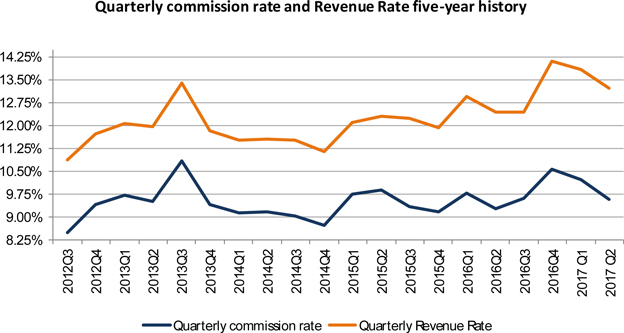
The distribution of our revenues across the geographic regions in which we operate was as follows, where the geographic location of revenues corresponds to the location in which the sale occurred, or in the case of online sales, where the company earning the revenues is incorporated:
| Revenue distribution | Canada |
Outside of
Canada |
United
States |
Europe | Other | |||||||||||||||
| Three months ended June 30, 2017 | 37 | % | 63 | % | 45 | % | 11 | % | 7 | % | ||||||||||
| Three months ended June 30, 2016 | 40 | % | 60 | % | 43 | % | 9 | % | 8 | % | ||||||||||
Revenues increased 5% in the second quarter of 2017 compared to the second quarter of 2016, primarily due to the Merger and IronPlanet’s contribution of $10.9 million of consolidated revenues in June 2017. Excluding IronPlanet revenues, revenues decreased 2% in the second quarter of 2017 compared to the second quarter of 2016, primarily due to lower auction volumes and GAP. This decrease was partially offset by a stronger Revenue Rate over the same comparative period. Included in second quarter 2017 revenues were $5.0 million of revenues from EquipmentOne, which represents an 18% increase over EquipmentOne revenues of $4.2 million in the second quarter of 2016.
Our Revenue Rate increased 77 bps to 13.22% in the second quarter of 2017 compared to 12.45% in the second quarter of 2016. The increase in Revenue Rate was primarily due to the Merger and IronPlanet’s contributed GMV and revenue, as well as performance of our value-added service offerings.
Our second quarter 2017 overall average commission rate was 9.57%, compared to 9.26% in the second quarter of 2016. This increase was primarily due to the Merger and the healthy commission rate performance contributed by IronPlanet, as well as the continued strong performance of our straight and underwritten contract commission rates during the three months ended June 30, 2017 compared to the same period in 2016.
| Ritchie Bros. | 57 |
Fee revenue earned in the second quarter of 2017 represented 3.64% of GAP compared to 3.18% of GAP in the second quarter of 2016. The increase was primarily due to the Merger and fee revenue from IronPlanet online marketplace sales, as well as an increase in financing and other fees resulting from improved performance of our value-added service offerings. This increase was partially offset by a decrease in auction fees resulting from the mix of equipment sold at our auctions. IronPlanet contributed $5.4 million of fee revenue in June 2017. Financing fees from RBFS increased 33% to $4.8 million in the second quarter of 2017 from $3.6 million in the second quarter of 2016. Subscription, license, and other fee revenues from Mascus increased 13% to $2.3 million in the second quarter of 2017 from $2.0 million in the second quarter of 2016.
Revenue grew in the United States and Europe during the three months ended June 30, 2017 compared to the same period in 2016, primarily due to the Merger for the United States growth and due to GAP growth and a strong Revenue Rate in Europe. Comparatively, revenues in Canada decreased in the second quarter of 2017 compared to the second quarter of 2016, primarily due to the decrease in GAP in that region. Revenue grew in the rest of the world during the three months ended June 30, 2017 compared to the same period in 2016, primarily due to strong Revenue Rates. Foreign exchange rates did not have a significant impact on revenues in the second quarter of 2017.
Costs of services
Costs of services are comprised of expenses incurred in direct relation to conducting auctions (“direct expenses”), earning online marketplace revenues, and earning other fee revenues. Direct expenses include direct labour, buildings and facilities charges, and travel, advertising and promotion costs. Typically, agricultural auctions and auctions located in frontier regions are costlier than auctions held at our permanent and regional auction sites as they do not benefit from economies of scale and frequency.
Costs of services incurred to earn online marketplace revenues include inspection costs, facilities costs, and inventory management, referral, sampling, and appraisal fees. Costs of services incurred in earning other fee revenues include direct labour (including commissions on sales), software maintenance fees, and materials. Costs of services exclude depreciation and amortization expenses.
Costs of services increased $1.8 million or 9% in the second quarter of 2017 compared to the second quarter of 2016, primarily due to the Merger. Excluding IronPlanet’s contribution, costs of services decreased 5% over the same comparative period. Costs of services related to our Core Auction segment were $18.0 million, or 1.60% of Core Auction segment GAP in the second quarter of 2017 compared to $19.4 million, or 1.58% of Core Auction segment GAP, in the second quarter of 2016. This decrease is primarily due to an increase in our Private Treaty business, which requires less costs to generate revenues compared to our traditional on site auction business, combined with a decrease in the number of lots in the second quarter of 2017 compared to the second quarter of 2016.
Selling, general and administrative expenses
Selling, general and administrative (“SG&A”) expenses by nature are presented below:
| (in U.S. $000's) | Three months ended June 30, | |||||||||||
| % Change | ||||||||||||
| 2017 | 2016 |
2017 over
2016 |
||||||||||
| Employee compensation | $ | 47,405 | $ | 46,989 | 1 | % | ||||||
| Buildings, facilities and technology | 13,319 | 12,969 | 3 | % | ||||||||
| Travel, advertising and promotion | 6,201 | 6,792 | (9 | )% | ||||||||
| Professional fees | 3,224 | 3,083 | 5 | % | ||||||||
| Other SG&A expenses | 4,228 | 4,159 | 2 | % | ||||||||
| $ | 74,377 | $ | 73,992 | 1 | % | |||||||
| Ritchie Bros. | 58 |
Our SG&A expenses increased $0.4 million, or 1%, in the second quarter of 2017 compared to the second quarter of 2016, primarily due to the Merger and the resulting $5.4 million of SG&A expenses contributed by IronPlanet in June 2017. Excluding IronPlanet, SG&A expenses decreased 7% over the same comparative period. Foreign exchange rates did not have a significant impact on SG&A expenses in the second quarter of 2017.
Employee compensation expenses increased $0.4 million in the second quarter of 2017 compared to the second quarter of 2016, primarily due to the $3.6 million contributed by IronPlanet in June 2017. Excluding IronPlanet, employee compensation costs decreased $3.2 million over the same comparative period. The primary driver of the decrease was a $4.5 million decrease in SG&A expense share-based payments, partially offset by the 5% net growth of our headcount – excluding Xcira, Mascus, and IronPlanet employees – between June 30, 2016 and June 30, 2017.
The decrease in SG&A expense share-based payments over the same comparative period was primarily due to a $4.6 million mark-to-market fair value decrease in our liability-classified share units. The mark-to-market fair value decrease was driven by the performance of our common share price over the previous reporting period. Our share price closed at $28.74 per common share on June 30, 2017, a decrease from the $32.90 per common share on March 31, 2017. Comparatively, our share price closed at $33.78 per common share on June 30, 2016, an increase from the $27.08 per common share on March 31, 2016. $1.6 million of the mark-to-market fair value decrease relates to the performance share units awarded to Ravichandra Saligram, our Chief Executive Officer, in 2014 (the “CEO SOG PSUs”) as part of a grant agreement dated August 11, 2014 between the Company and Mr. Saligram (the “Sign-On Grant Agreement”). The CEO SOG PSUs were modified on May 1, 2017 from liability-classified to equity-classified. Post-modification, these awards are no longer subject to quarterly mark-to-market fair value fluctuations.
Travel, advertising and promotion decreased $0.6 million in the second quarter of 2017 compared to the second quarter of 2016. This decrease was primarily due to a 2016 strategic increase in advertising and promotional expenditure targeted at our larger auction events, including our participation in a triennial tradeshow in the second quarter of 2016. The decrease was partially offset by the Merger, with IronPlanet contributing $0.8 million of costs in June 2017.
Acquisition-related costs
Acquisition-related costs consist of operating expenses directly incurred as part of a business combination, due diligence and integration planning – including those related to the Merger – and continuing employment costs that are recognized separately from our business combinations. Business combination, due diligence, and integration operating expenses include advisory, legal, accounting, valuation, and other professional or consulting fees, as well as stock option compensation expenses resulting from accelerated vesting of options assumed as part of the Merger, and travel and securities filing fees.
Second quarter 2017 acquisition-related costs consisted of $22.2 million associated with the Merger, which consist primarily of $9.1 million of non-recurring acquisition and finance structure advisory fees, $4.8 million of stock option compensation expenses resulting from accelerated vesting of options assumed as part of the Merger, $3.5 million of legal fees related to the regulatory approval process and closing of the transaction, $1.4 million of severance and retention costs that followed the Merger in the resulting corporate reorganization, and various integration costs.
Impairment loss
During the three months ended June 30, 2017, management identified indicators of impairment on certain software and software under development intangible assets (the “technology assets”). The indicators consisted of decisions made after the acquisition of IronPlanet that resulted in a significant adverse change in the extent or manner in which the technology assets would be used or continue to be developed in the future, as well as expectations that it was more likely than not that we would discontinue use of the technology assets before the end of their previously estimated useful lives. Accordingly, management performed an impairment test and concluded that those technology assets should be written off in their entirety, which resulted in the recognition of an impairment loss of $8.9 million.
| Ritchie Bros. | 59 |
Operating income
Operating income decreased $26.7 million, or 50%, to $26.9 million in the second quarter of 2017 compared to $53.6 million in the second quarter of 2016. This decrease was primarily due to the increase in acquisition-related costs and the impairment loss, partially offset by the increase in revenues over the same comparative period. Adjusted operating income 5 (non-GAAP measure) decreased $2.6 million, or 5%, to $51.1 million in the second quarter of 2017 compared to $53.6 million in the second quarter of 2016.
Foreign exchange rates did not have a significant impact on operating income in the second quarter of 2017.
Primarily for the same reasons noted above, operating income margin, which is our operating income divided by revenues, decreased 1760 bps to 16.2% in the second quarter of 2017 compared to 33.8% in the second quarter of 2016. Adjusted operating income margin 6 (non-GAAP measure) decreased 310 bps to 30.7% in the second quarter of 2017 from 33.8% in the second quarter of 2016.
Other income (expense)
Other income (expense) is comprised of the following:
| (in U.S. $000's) | Three months ended June 30, | |||||||||||
| % Change | ||||||||||||
| 2017 | 2016 |
2017 over
2016 |
||||||||||
| Interest income | $ | 987 | $ | 487 | 103 | % | ||||||
| Interest expense | (8,620 | ) | (1,060 | ) | 713 | % | ||||||
| Equity income | 4 | 477 | (99 | )% | ||||||||
| Other, net | 2,479 | 269 | 822 | % | ||||||||
| Other income (expense) | $ | (5,150 | ) | $ | 173 | (3077 | )% | |||||
We incurred substantial indebtedness in connection with the Merger. As of June 30, 2017, our debt was $828.4 million, consisting of $14.1 million in revolving loans, $332.4 million in delayed draw term loans reduced by $4.5 million of unamortized debt issue costs, and $500.0 million of senior unsecured notes (the “Notes”) reduced by $13.5 million of unamortized debt issue costs.
When we completed our offering of the Notes on December 21, 2016, the proceeds from the offering were held in escrow until completion of the IronPlanet acquisition. On that date, we prepaid $6.7 million of interest on the Notes then being held in escrow, which represented interest for the first quarter of 2017. That interest was also held in escrow with the proceeds from the offering.
| 5 | Adjusted operating income is a non-GAAP measure. We use income statement and balance sheet performance scorecards to align our operations with our strategic priorities. We concentrate on a limited number of metrics to ensure focus and to facilitate quarterly performance discussions. Our income statement scorecard includes the performance metric, adjusted operating income. We believe that comparing adjusted operating income for different financial periods provides useful information about the growth or decline of operating income for the relevant financial period. We calculate adjusted operating income by eliminating from operating income the pre-tax effects of significant non-recurring items that we do not consider to be part of our normal operating results, such as acquisition-related costs, management reorganization costs, severance, retention, gains/losses on sale of certain property, plant and equipment, impairment losses, and certain other items, which we refer to as ‘adjusting items’. Adjusted operating income is reconciled to the most directly comparable GAAP measures in our consolidated financial statements under “Non-GAAP Measures” below. |
| 6 | Our income statement scorecard includes the performance metric, adjusted operating income margin, which is a non-GAAP measure. We believe that comparing adjusted operating income margin for different financial periods provides useful information about the growth or decline of our operating income for the relevant financial period. We calculate adjusted operating income margin by dividing adjusted operating income (non-GAAP measure) by revenues. Adjusted operating income margin is reconciled to the most directly comparable GAAP measures in our consolidated financial statements under “Non-GAAP Measures” below. |
| Ritchie Bros. | 60 |
On May 31, 2017, the proceeds and prepaid interest on the Notes were released from escrow. The proceeds from the offering were used to finance the Merger. The prepaid interest on the Notes that was returned to us was deposited into an interest-bearing bank account and held in that bank account until the interest on the Notes fell due on July 15, 2017.
The increase in interest income in the second quarter of 2017 compared to the second quarter of 2016 was primarily due to the interest earned on the funds released from escrow that were held in an interest-bearing bank account from May 31, 2017 until June 30, 2017. The increase in interest expense in the second quarter of 2017 compared to the second quarter of 2016 is primarily due to $6.8 million of interest on the Notes. Refer to “Liquidity and Capital Resources” below for a more detailed discussion of the Notes.
$1.2 million of the increase in ‘other, net’ in the second quarter of 2017 compared to the second quarter of 2016 is due to changes in the fair value of contingent consideration associated with our Petrowsky and Mascus acquisitions.
Income tax expense and effective tax rate
At the end of each interim period, we make our best estimate of the effective tax rate expected to be applicable for the full fiscal year. The estimate reflects, among other items, our best estimate of operating results. It does not include the estimated impact of foreign exchange rates or unusual and/or infrequent items, which may cause significant variations in the customary relationship between income tax expense and income before income taxes.
For the three months ended June 30, 2017, income tax expense was $4.0 million, compared to an income tax expense of $13.2 million for the same period in 2016. Our effective tax rate was 18.5% in the second quarter of 2017, compared to 24.6% in the second quarter of 2016. The decrease in effective tax rate over this comparative period was primarily due to a greater proportion of earnings taxed in jurisdictions with lower tax rates.
Net income
Net income attributable to stockholders decreased $22.1 million, or 56%, to $17.6 million in the second quarter of 2017 compared to $39.7 million in the second quarter of 2016. This decrease is primarily due to the increase in acquisition-related costs, the impairment loss, and interest expense, partially offset by the decrease in income tax expense and increase in revenues over the same comparative period. Adjusted net income attributable to stockholders 7 (non-GAAP measure) decreased $3.3 million, or 8%, to $36.4 million in the second quarter of 2017 from $39.7 million in the second quarter of 2016.
Primarily for the same reasons noted above, net income decreased $22.9 million, or 56%, to $17.7 million in the second quarter of 2017 from $40.6 million in the second quarter of 2016. Adjusted Earnings Before Interest, Taxes, Depreciation and Amortization (“EBITDA”) 8 (non-GAAP measure) increased $0.8 million, or 1%, to $65.4 million in the second quarter of 2017 from $64.7 million in the second quarter of 2016.
| 7 | Adjusted net income attributable to stockholders is a non-GAAP financial measure. We believe that comparing adjusted net income attributable to stockholders for different financial periods provides useful information about the growth or decline of our net income attributable to stockholders for the relevant financial period, and eliminates the financial impact of adjusting items we do not consider to be part of our normal operating results. Adjusted net income attributable to stockholders represents net income attributable to stockholders excluding the effects of adjusting items and is reconciled to the most directly comparable GAAP measures in our consolidated financial statements under “Non-GAAP Measures” below. |
| 8 | Adjusted EBITDA is a non-GAAP financial measure that we believe provides useful information about the growth or decline of our net income when compared between different financial periods. Adjusted EBITDA was also an element of the performance criteria for certain performance share units that we granted our employees and officers in 2013 and 2014. Adjusted EBITDA is calculated by adding back depreciation and amortization expenses, interest expense, and current income tax expense, and subtracting interest income and deferred income tax recovery from net income excluding the pre-tax effects of adjusting items. Adjusted EBITDA is reconciled to the most directly comparable GAAP measures in our consolidated financial statements under “Non-GAAP Measures” below. |
| Ritchie Bros. | 61 |
Primarily for the same reasons noted above, net income margin, which is our net income divided by our revenues, decreased 1490 bps to 10.7% in the second quarter of 2017 from 25.6% in the second quarter of 2016. Adjusted EBITDA margin 9 (non-GAAP measure) decreased 130 bps to 39.4% in the second quarter of 2017 from 40.7% in the second quarter of 2016.
Diluted EPS
Diluted EPS attributable to stockholders decreased 57% to $0.16 per share in the second quarter of 2017 from $0.37 per share in the second quarter of 2016. This decrease is primarily due to the decrease in net income attributable to stockholders, combined with a 1,258,850 increase in the weighted average number of dilutive shares outstanding over the same comparative period. The increase in the weighted average number of dilutive shares is primarily due to the assumption of IronPlanet stock options, as well as the modification of certain share units from liability-classified to equity-classified in May 2016 and the modification of the CEO SOG PSUs in May 2017. Diluted adjusted EPS attributable to stockholders (non-GAAP measure) decreased 11% to $0.33 per share in the second quarter of 2017 from $0.37 per share in the second quarter of 2016.
| 9 | Adjusted EBITDA margin is a non-GAAP financial measure that we believe provides useful information about the growth or decline of our net income when compared between different financial periods. Adjusted EBITDA margin presents adjusted EBITDA (non-GAAP measure) as a multiple of revenues. Adjusted EBITDA margin is reconciled to the most directly comparable GAAP measures in our consolidated financial statements under “Non-GAAP Measures” below. |
| Ritchie Bros. | 62 |
Year-to-Date Performance
| Financial overview | Six months ended June 30, | |||||||||||
| Change | ||||||||||||
| (in U.S. $000's, except EPS) | 2017 | 2016 | 2017 over 2016 | |||||||||
| Revenues | $ | 290,685 | $ | 290,750 | - | |||||||
| Costs of services, excluding depreciation and amortization | 34,404 | 35,071 | (2 | )% | ||||||||
| Selling, general and administrative expenses | 144,952 | 141,102 | 3 | % | ||||||||
| Acquisition-related costs | 31,575 | 1,800 | 1654 | % | ||||||||
| Depreciation and amortization expenses | 22,210 | 20,364 | 9 | % | ||||||||
| Gain on disposal of property, plant and equipment | (1,029 | ) | (447 | ) | 130 | % | ||||||
| Impairment loss | 8,911 | - | 100 | % | ||||||||
| Foreign exchange loss (gain) | (823 | ) | 51 | (1714 | )% | |||||||
| Operating income | 50,485 | 92,809 | (46 | )% | ||||||||
| Operating income margin | 17.4 | % | 31.9 | % | -1450 | bps | ||||||
| Other income (expense) | (10,999 | ) | 525 | (2195 | )% | |||||||
| Income tax expense | 11,340 | 22,749 | (50 | )% | ||||||||
| Net income attributable to stockholders | 28,012 | 69,116 | (59 | )% | ||||||||
| Diluted EPS attributable to stockholders | $ | 0.26 | $ | 0.65 | (60 | )% | ||||||
| Effective tax rate | 28.7 | % | 24.4 | % | 430 | bps | ||||||
| GAP | $ | 2,156,840 | $ | 2,295,604 | (6 | )% | ||||||
| Revenue Rate | 13.48 | % | 12.67 | % | 81 | bps | ||||||
Gross Auction Proceeds
GAP was $2.2 billion for the first half of 2017, a 6% decrease over the first half of 2016. Included in our first half 2017 GAP is $76.8 million of GMV from IronPlanet and $93.9 million of GTV from our EquipmentOne online marketplaces. The first half 2017 EquipmentOne GTV represents a 44% increase over GTV of $65.3 million in the first half of 2016.
First half 2017 GMV includes $3.1 million of assets that transacted on a dealer-to-dealer basis through IronPlanet post-acquisition. Revenues earned on those dealer-to-dealer transactions were $0.1 million in the first half of 2017, post-acquisition. First half 2017 GTV includes $21.3 million of assets that transacted on a dealer-to-dealer basis on EquipmentOne’s online marketplaces, compared to $7.4 million in the first half of 2016. This increase was primarily due to EquipmentOne’s Enterprise Software Solution not being launched until April 2016. Revenues earned on these dealer-to-dealer transactions were $0.4 million in the first half of 2017 compared to $0.2 million in the first half of 2016.
During the first half of 2017, 82% of our GAP was attributable to auctions held at our permanent and regional auction sites, including those located in frontier regions, compared to 86% in the first half of 2016. We held 218 on site auctions in the first half of 2017, compared to 194 in the first half of 2016. The proportion of GAP earned at those sites decreased over the same comparative period.
| Ritchie Bros. | 63 |
The decrease in GAP during the first half of 2017 compared to the first half of 2016 is primarily due to a decrease in the number of Core Auction segment lots and changes in our auction calendar over the same comparative period. The total number of Core Auction segment lots decreased 5% to 214,900 in the first half of 2017 from 225,500 in the first half of 2016. In addition, Core Auction segment GAP decreased 6% on a per-lot basis to $9,300 in the first half of 2017 from $9,900 in the first half of 2016. With respect to auction calendar changes, we held the largest-ever auction in Grande Prairie, Canada, in March 2016, which generated more than $46.0 million (62.0 million Canadian dollars) of GAP, with no similar auction on the calendar in the first half of 2017.
GAP, on a U.S. dollar basis, decreased in Canada – and most significantly in Western Canada – in the first half of 2017 compared to the first half of 2016, primarily due to the aforementioned auction calendar changes and pressure on used equipment market supply volume. Although GAP grew in the United States and Europe in the first half of 2017 compared to the first half of 2016, this growth was offset by reductions in GAP in the rest of the world over the same comparative period. Foreign exchange rates did not have a significant impact on GAP in the first half of 2017.
The volume of underwritten commission contracts decreased to 16% of our GAP in the first half of 2017 from 25% in the first half of 2016, primarily due to the pressure on used equipment market supply volume. The tight supply of used equipment resulted in less opportunity for us to pursue underwritten commission contracts. Straight commission contracts continue to account for the majority of our GAP.
Revenues and Revenue Rate
| (in U.S. $000's) | Six months ended June 30, | |||||||||||
| Better/(Worse) | ||||||||||||
| 2017 | 2016 |
2017 over
2016 |
||||||||||
| United States | $ | 151,917 | $ | 143,492 | 6 | % | ||||||
| Canada | 87,603 | 95,554 | (8 | )% | ||||||||
| Europe | 30,296 | 26,404 | 15 | % | ||||||||
| Other | 20,869 | 25,300 | (18 | )% | ||||||||
| Revenues | $ | 290,685 | $ | 290,750 | - | |||||||
The distribution of our revenues across the geographic regions in which we operate was as follows, where the geographic location of revenues corresponds to the location in which the sale occurred, or in the case of online sales, where the company earning the revenues is incorporated:
| Revenue distribution | Canada |
Outside of
Canada |
United
States |
Europe | Other | |||||||||||||||
| Six months ended June 30, 2017 | 30 | % | 70 | % | 52 | % | 10 | % | 8 | % | ||||||||||
| Six months ended June 30, 2016 | 33 | % | 67 | % | 49 | % | 9 | % | 9 | % | ||||||||||
Revenues remained consistent in the first half of 2017 compared to the first half of 2016, primarily due to the Merger and IronPlanet’s contribution of $10.9 million of consolidated revenues in June 2017. Excluding IronPlanet revenues, revenues decreased 4% in the first half of 2017 compared to the first half of 2016, primarily due to lower auction volumes and GAP. This decrease was partially offset by a stronger Revenue Rate over the same comparative period. Included in first half 2017 revenues were $9.5 million of revenues from EquipmentOne, which represents a 26% increase over EquipmentOne revenues of $7.6 million in the first half of 2016.
Our Revenue Rate increased 81 bps to 13.48% in the first half of 2017 compared to 12.67% in the first half of 2016. The increase in Revenue Rate was primarily due to the Merger and IronPlanet’s contributed GMV and revenue, as well as performance of our value-added service offerings.
| Ritchie Bros. | 64 |
Our overall average commission rate was 9.84% for the first half of 2017, compared to 9.50% in the first half of 2016. This increase was primarily due to the Merger and the healthy commission rate performance contributed by IronPlanet, as well as the continued strong performance of our straight and underwritten contract commission rates during the six months ended June 30, 2017 compared to the same period in 2016.
Fee revenue earned in the first half of 2017 represented 3.63% of GAP compared to 3.17% of GAP in the first half of 2016. The increase was primarily due to the Merger and fee revenue from IronPlanet online marketplace sales, as well as an increase in financing and other fees resulting from improved performance of our value-added service offerings. This increase was partially offset by a decrease in auction fees resulting from the mix of equipment sold at our auctions. IronPlanet contributed $5.4 million of fee revenue in June 2017. Financing fees from RBFS increased 33% to $8.1 million in the first half of 2017 from $6.1 million in the first half of 2016. Subscription, license, and other fee revenues from Mascus increased 35% to $4.5 million in the first half of 2017 from $3.3 million in the first half of 2016.
Revenue grew in the United States and Europe in the first half of 2017 compared to the first half of 2016, primarily due to the Merger for the United States growth and due to GAP growth and a strong Revenue Rate in Europe. Comparatively, revenues in Canada and the rest of the world decreased in the first half of 2017 compared to the first half of 2016, primarily due to the decreases in GAP in those regions. Foreign exchange rates did not have a significant impact on revenues in the first half of 2017.
Costs of services
Costs of services decreased $0.7 million or 2% in the first half of 2017 compared to the first half of 2016. Excluding IronPlanet’s contribution, costs of services decreased 10% over the same comparative period. Costs of services related to our Core Auction segment were $30.0 million, or 1.51% of Core Auction segment GAP, in the first half of 2017 compared to $34.2 million, or 1.53% of Core Auction segment GAP, in the first half of 2016. This decrease is primarily due to an increase in our Private Treaty business, which requires less costs to generate revenues compared our traditional on site auction business, combined with a decrease in the number of lots in the first half of 2017 compared to the first half of 2016.
Selling, general and administrative expenses
SG&A expenses by nature are presented below:
| (in U.S. $000's) | Six months ended June 30, | |||||||||||
| % Change | ||||||||||||
| 2017 | 2016 |
2017 over
2016 |
||||||||||
| Employee compensation | $ | 91,860 | $ | 91,000 | 1 | % | ||||||
| Buildings, facilities and technology | 25,594 | 24,205 | 6 | % | ||||||||
| Travel, advertising and promotion | 12,781 | 12,322 | 4 | % | ||||||||
| Professional fees | 6,324 | 5,849 | 8 | % | ||||||||
| Other SG&A expenses | 8,393 | 7,726 | 9 | % | ||||||||
| $ | 144,952 | $ | 141,102 | 3 | % | |||||||
Our SG&A expenses increased $3.9 million, or 3%, in the first half of 2017 compared to the first half of 2016, primarily due to the Merger and the resulting $5.4 million of SG&A expenses contributed by IronPlanet in June 2017. Excluding IronPlanet, SG&A expenses decreased 1% over the same comparative period. Foreign exchange rates did not have a significant impact on SG&A expenses in the first half of 2017.
Employee compensation expenses increased $0.9 million in the first half of 2017 compared to the first half of 2016, primarily due to the $3.6 million contributed by IronPlanet in June 2017. Excluding IronPlanet, employee compensation costs decreased $2.8 million over the same comparative period. The primary driver of the decrease was a $4.8 million decrease in SG&A expense share-based payments, partially offset by the 5% net growth of our headcount – excluding Xcira, Mascus, and IronPlanet employees – between June 30, 2016 and June 30, 2017.
| Ritchie Bros. | 65 |
The decrease in SG&A expense share-based payments over the same comparative period was primarily due to a $6.6 million mark-to-market fair value decrease in our liability-classified share units. The mark-to-market fair value decrease was driven by the performance of our common share price over the previous reporting period. Our share price closed at $28.74 per common share on June 30, 2017, a decrease from the $34.00 per common share on December 31, 2016. Comparatively, our share price closed at $33.78 per common share on June 30, 2016, an increase from the $24.11 per common share on December 31, 2015. $2.0 million of the mark-to-market fair value decrease relates to the CEO SOG PSUs that were modified on May 1, 2017 from liability-classified to equity-classified. Post-modification, these awards are no longer subject to quarterly mark-to-market fair value fluctuations.
Buildings, facilities and technology costs increased $1.4 million in the first half of 2017 compared to the first half of 2016. This increase was primarily due to higher technology costs, including software license fees, associated with maintenance of our servers and networks, as well as development of a new disaster recovery centre. The increase is also attributable to the Merger, with IronPlanet contributing $0.5 million in June 2017.
Travel, advertising and promotion increased $0.5 million in the first half of 2017 compared to the first half of 2016. This increase was primarily due to the Merger, with IronPlanet contributing $0.8 million in June 2017. The increase was partially offset by a reduction in costs resulting from a 2016 strategic increase in advertising and promotional expenditure targeted at our larger auction events, including our participation in a triennial tradeshow in the second quarter of 2016.
Professional fees increased $0.5 million in the first half of 2017 compared to the first half of 2016, primarily due to the Merger, with IronPlanet contributing $0.2 million in June 2017.
Other SG&A expenses increased $0.7 million in the first half of 2017 compared to the first half of 2016, primarily due to bank commitment fee increases resulting from our fourth quarter 2016 debt restructuring, which increased our total credit facilities from $0.6 billion at June 30, 2016 to $1.0 billion at June 30, 2017. This increase was partially offset by a decrease in yard supplies at our auction sites, which was driven by the reduction in volume of equipment on our yards in the first half of 2017 compared to the first half of 2016.
Acquisition-related costs
Acquisition-related costs for the first half of 2017 totalled $31.6 million and consisted primarily of $29.9 million associated with the Merger. IronPlanet acquisitions costs for the first half of 2017 included $9.1 million of non-recurring acquisition and finance structure advisory fees, $8.6 million of legal fees related to the regulatory approval process and closing of the transaction, $4.8 million of stock option compensation expenses resulting from accelerated vesting of options assumed as part of the Merger, $1.4 million of severance and retention costs that followed the Merger in the resulting corporate reorganization, and various integration costs.
Impairment loss
During the first half of 2017, we recognized an impairment loss of $8.9 million on certain technology assets.
Operating income
Operating income decreased $42.3 million, or 46%, to $50.5 million in the first half of 2017 compared to $92.8 million in the first half of 2016. This decrease was primarily due to the increase in acquisition-related costs, the impairment loss, and the increase in SG&A expense over the same comparative period. Adjusted operating income (non-GAAP measure) decreased $18.2 million, or 20%, to $74.7 million in the first half of 2017 compared to $92.8 million in the first half of 2016.
Foreign exchange rates had a negative impact on operating income in the first half of 2017. Refer to the table under “Translational impact of foreign exchange rates” below for details of the foreign exchange rate impact.
| Ritchie Bros. | 66 |
Primarily for the same reasons noted above, operating income margin, which is our operating income divided by revenues, decreased 1450 bps to 17.4% in the first half of 2017 compared to 31.9% in the first half of 2016. Adjusted operating income margin (non-GAAP measure) decreased 620 bps to 25.7% in the first half of 2017 from 31.9% in the first half of 2016.
Other income (expense)
Other income (expense) is comprised of the following:
| (in U.S. $000's) | Six months ended June 30, | |||||||||||
| % Change | ||||||||||||
| 2017 | 2016 |
2017 over
2016 |
||||||||||
| Interest income | $ | 1,942 | $ | 985 | 97 | % | ||||||
| Interest expense | (16,753 | ) | (2,423 | ) | (591 | )% | ||||||
| Equity income (loss) | (49 | ) | 996 | (105 | )% | |||||||
| Other, net | 3,861 | 967 | 299 | % | ||||||||
| Other income (expense) | $ | (10,999 | ) | $ | 525 | (2195 | )% | |||||
The increase in interest income in the first half 2017 compared to the first half of 2016 was primarily due to the interest earned on the funds released from escrow that were held in an interest-bearing bank account from May 31, 2017 until June 30, 2017. The increase in interest expense in the first half of 2017 compared to the first half of 2016 is primarily due to $13.5 million of interest on the Notes. Refer to “Liquidity and Capital Resources” below for a more detailed discussion of the Notes.
$1.6 million of the increase in ‘other, net’ in the first half of 2017 compared to the first half of 2016 is due to changes in the fair value of contingent consideration associated with our Petrowsky, Mascus, and Kramer acquisitions, as well as our acquisition of the non-controlling interests in RBFS.
Income tax expense and effective tax rate
Income tax expense was $11.3 million in the first half of 2017, compared to $22.7 million in the first half of 2016. Our effective tax rate was 28.7% in the first half of 2017, compared to 24.4% in the first half of 2016. The increase in the effective tax rate over this comparative period was primarily due to a $2.3 million expense related to an increase in uncertain tax positions. We increased our uncertain tax position in the first quarter of 2017 due to an unfavourable outcome of a tax dispute in one of our European operating jurisdictions.
Net income
Net income attributable to stockholders decreased $41.1 million, or 59%, to $28.0 million in the first half of 2017 compared to $69.1 million in the first half of 2016. This decrease is primarily due to the increase in acquisition-related costs, interest expense, the impairment loss, and SG&A expenses, partially offset by the decrease in income tax expense over the same comparative period. Adjusted net income attributable to stockholders (non-GAAP measure) decreased $20.0 million, or 29%, to $49.1 million in the first half of 2017 from $69.1 million in the first half of 2016.
For these same reasons, net income decreased $42.4 million, or 60%, to $28.1 million in the first half of 2017 from $70.6 million in the first half of 2016. Adjusted EBITDA (non-GAAP measure) decreased $14.5 million, or 13%, to $100.7 million, in the first half of 2017 from $115.1 million in the first half of 2016.
Primarily for the same reasons noted above, net income margin decreased 1460 bps to 9.7% in the first half of 2017 from 24.3% in the first half of 2016. Adjusted EBITDA margin (non-GAAP measure) decreased 500 bps to 34.6% in the first half of 2017 from 39.6% in the first half of 2016.
| Ritchie Bros. | 67 |
Debt at June 30, 2017 represented 16.2 times net income for the 12 months ended June 30, 2017. This compares to debt at June 30, 2016, which represented 0.9 times net income for the 12 months ended June 30, 2016. The increase in this debt/net income multiplier is primarily due to a net increase in long-term debt from June 30, 2016 to June 30, 2017, combined with a decrease in net income for the 12 months ended June 30, 2017 compared to the 12 months ended June 30, 2016, as discussed above. The increase in debt is primarily due to the issuance of the Notes and proceeds from the delayed draw term loans to fund the Merger. Adjusted net debt/adjusted EBITDA 10 (non-GAAP measure) was 2.9 as at and for the 12 months ended June 30, 2017 compared to -0.2 as at and for the 12 months ended June 30, 2016.
Diluted EPS
Diluted EPS attributable to stockholders decreased 60% to $0.26 per share in the first half of 2017 from $0.65 per share in the first half of 2016. This decrease is primarily due to the decrease in net income attributable to stockholders, combined with a 944,818 increase in the weighted average number of dilutive shares outstanding over the same comparative period. The increase in the weighted average number of dilutive shares is primarily due to the assumption of IronPlanet stock options, as well as the modification of certain share units from liability-classified to equity-classified in May 2016 and the modification of the CEO SOG PSUs in May 2017. Diluted adjusted EPS attributable to stockholders (non-GAAP measure) decreased 31% to $0.45 per share in the first half of 2017 from $0.65 per share in the first half of 2016.
Foreign exchange loss and effect of exchange rate movement on income statement components
We conduct operations around the world in a number of different currencies, but our presentation currency is the U.S. dollar. In the first six months of 2017, approximately 45% of our revenues and 56% of our operating expenses were denominated in currencies other than the U.S. dollar, compared to 46% and 57%, respectively in the first six months of 2016.
Transactional impact of foreign exchange rates
We recognized $0.8 million of transactional foreign exchange gains in the first six months of 2017, compared to $0.1 million of transactional foreign exchange losses in the first six months of 2016. Foreign exchange losses and gains are primarily the result of settlement of non-functional currency-denominated monetary assets and liabilities.
Translational impact of foreign exchange rates
Since late 2014, there has been significant weakening of the Canadian dollar and the Euro relative to the U.S. dollar. This weakening of the Canadian dollar and Euro has affected our reported operating income when non-U.S. dollar amounts were translated into U.S. dollars for financial statement reporting purposes.
Constant Currency amounts and Translational FX Impact are non-GAAP financial measures. We calculate our Constant Currency amounts by applying prior period foreign exchange rates to current period transactional currency amounts. We define Translational FX Impact as the amounts we report under GAAP, less Constant Currency amounts.
| 10 | Adjusted net debt/adjusted EBITDA is a non-GAAP financial measure. We believe that comparing adjusted net debt/adjusted EBIDTA on a trailing 12-month basis for different financial periods provides useful information about the performance of our operations as an indicator of the amount of time it would take us to settle both our short and long-term debt. We do not consider this to be a measure of our liquidity, which is our ability to settle only short-term obligations, but rather a measure of how well we fund liquidity. Measures of liquidity are discussed further below under “liquidity and capital resources”. We calculate adjusted net debt/adjusted EBITDA by dividing adjusted net debt (non-GAAP measure) by adjusted EBITDA (non-GAAP measure). Adjusted net debt (non-GAAP measure) is calculated by subtracting cash and cash equivalents and long-term debt held in escrow from debt. Adjusted net debt/adjusted EBITDA is reconciled to the most directly comparable GAAP measures in our consolidated financial statements under “Non-GAAP Measures” below. In prior periods, we calculated this metric as adjusted debt (non-GAAP measure) divided by adjusted EBITDA (non-GAAP measure) and called it ‘adjusted debt/adjusted EBITDA (non-GAAP measure)’. In the second quarter of 2017, we changed the title, definition, and calculation of this non-GAAP measure to more closely align with our Evergreen Model performance metric, which reduces debt for cash and cash equivalents. The change has been applied retrospectively. |
| Ritchie Bros. | 68 |
We believe that presenting Constant Currency amounts and Translational FX Impact, and comparing Constant Currency amounts to prior period results, provides useful information regarding the potential effect of changes in foreign exchange rates on our performance and the growth or decline in our operating income by eliminating the financial impact of items we do not consider to be part of our normal operating results.
The following tables present our Constant Currency results and Translational FX Impact for the three and six months, respectively, ended June 30, 2017 and 2016, as well as reconcile those metrics to revenues, costs of services, SG&A expenses, acquisition-related costs, depreciation and amortization expenses, gain on disposition of property, plant and equipment, foreign exchange loss (gain), and operating income, which are the most directly comparable GAAP measures in our consolidated financial statements:
| (in U.S. $000's) | Six months ended June 30, | 2017 over 2016 | Constant | |||||||||||||||||||||||||||||
| 2017 | reported | Currency | ||||||||||||||||||||||||||||||
| Translational | Constant | 2016 | change | change | ||||||||||||||||||||||||||||
| As reported | FX Impact | Currency | as reported | $ | % | $ | % | |||||||||||||||||||||||||
| GAP | $ | 2,156,840 | $ | 28,014 | $ | 2,184,854 | $ | 2,295,604 | $ | (138,764 | ) | (6 | )% | $ | (110,750 | ) | (5 | )% | ||||||||||||||
| Revenues | 290,685 | 3,871 | 294,556 | $ | 290,750 | $ | (65 | ) | - | $ | 3,806 | 1 | % | |||||||||||||||||||
| Costs of services, excluding depreciation and amortization | 34,404 | 436 | 34,840 | 35,071 | (667 | ) | (2 | )% | (231 | ) | (1 | )% | ||||||||||||||||||||
| SG&A expenses | 144,952 | 952 | 145,904 | 141,102 | 3,850 | 3 | % | 4,802 | 3 | % | ||||||||||||||||||||||
| Acquisition-related costs | 31,575 | - | 31,575 | 1,800 | 29,775 | 1654 | % | 29,775 | 1654 | % | ||||||||||||||||||||||
| Depreciation and amortization expenses | 22,210 | 15 | 22,225 | 20,364 | 1,846 | 9 | % | 1,861 | 9 | % | ||||||||||||||||||||||
| Gain on disposition of property, plant and equipment | (1,029 | ) | (1 | ) | (1,030 | ) | (447 | ) | (582 | ) | 130 | % | (583 | ) | 130 | % | ||||||||||||||||
| Impairment loss | 8,911 | - | 8,911 | - | 8,911 | 100 | % | 8,911 | 100 | % | ||||||||||||||||||||||
| Foreign exchange loss (gain) | (823 | ) | 80 | (743 | ) | 51 | (874 | ) | (1714 | )% | (794 | ) | (1557 | )% | ||||||||||||||||||
| Operating income | $ | 50,485 | $ | 2,389 | $ | 52,874 | $ | 92,809 | $ | (42,324 | ) | (46 | )% | $ | (39,935 | ) | (43 | )% | ||||||||||||||
| (in U.S. $000's) | Six months ended June 30, | 2016 over 2015 | Constant | |||||||||||||||||||||||||||||
| 2016 | reported | Currency | ||||||||||||||||||||||||||||||
| Translational | Constant | 2015 | change | change | ||||||||||||||||||||||||||||
| As reported | FX Impact | Currency | as reported | $ | % | $ | % | |||||||||||||||||||||||||
| GAP | $ | 2,295,604 | $ | 49,578 | $ | 2,345,182 | $ | 2,217,729 | $ | 77,875 | 4 | % | $ | 127,453 | 6 | % | ||||||||||||||||
| Revenues | 290,750 | 6,236 | 296,986 | $ | 271,095 | $ | 19,655 | 7 | % | $ | 25,891 | 10 | % | |||||||||||||||||||
| Costs of services, excluding depreciation and amortization | 35,071 | 510 | 35,581 | 28,636 | 6,435 | 22 | % | 6,945 | 24 | % | ||||||||||||||||||||||
| SG&A expenses | 141,102 | 3,985 | 145,087 | 128,995 | 12,107 | 9 | % | 16,092 | 12 | % | ||||||||||||||||||||||
| Acquisition-related costs | 1,800 | - | 1,800 | - | 1,800 | 100 | % | 1,800 | 100 | % | ||||||||||||||||||||||
| Depreciation and amortization expenses | 20,364 | 685 | 21,049 | 21,385 | (1,021 | ) | (5 | )% | (336 | ) | (2 | )% | ||||||||||||||||||||
| Gain on disposition of property, plant and equipment | (447 | ) | (3 | ) | (450 | ) | (966 | ) | 519 | (54 | )% | 516 | (53 | )% | ||||||||||||||||||
| Foreign exchange loss (gain) | 51 | 353 | 404 | (2,769 | ) | 2,820 | (102 | )% | 3,173 | (115 | )% | |||||||||||||||||||||
| Operating income | $ | 92,809 | $ | 706 | $ | 93,515 | $ | 95,814 | $ | (3,005 | ) | (3 | )% | $ | (2,299 | ) | (2 | )% | ||||||||||||||
| Ritchie Bros. | 69 |
U.S. dollar exchange rate comparison
| Value of one U.S. dollar | Six months ended June 30, | |||||||||||
| % Change | ||||||||||||
| 2017 | 2016 |
2017 over
2016 |
||||||||||
| Period-end exchange rate | ||||||||||||
| Canadian dollar | $ | 1.2966 | $ | 1.2925 | - | |||||||
| Euro | 0.8752 | 0.9003 | (3 | )% | ||||||||
| Average exchange rate | ||||||||||||
| Canadian dollar | $ | 1.3340 | $ | 1.3317 | - | |||||||
| Euro | 0.9239 | 0.8963 | 3 | % | ||||||||
Operations Update
The majority of our business continues to be generated by our Core Auction segment operations. During the first half of 2017, we conducted 111 unreserved industrial auctions at locations in North America, Europe, the Middle East, Australia, New Zealand, and Asia, compared to 109 during the first half of 2016. We also held 107 unreserved agricultural auctions in the first half of 2017, compared to 85 in the first half of 2016.
Our key industrial auction metrics 11 are shown below:
| Six months ended June 30, | ||||||||||||
| % Change | ||||||||||||
| 2017 | 2016 |
2017 over
2016 |
||||||||||
| Bidder registrations | 278,000 | 276,000 | 1 | % | ||||||||
| Consignments | 28,050 | 26,350 | 6 | % | ||||||||
| Buyers | 69,550 | 70,150 | (1 | )% | ||||||||
| Lots | 192,000 | 203,500 | (6 | )% | ||||||||
We saw decreases in industrial auction buyers and lots in the first half of 2017 compared to the first half of 2016, primarily due to changes in our auction calendar combined with the performance of the used equipment market, which experienced supply volume pressure over the same comparative period. Regarding auction calendar changes, we held the largest-ever auction in Grande Prairie, Canada, in the first quarter of 2016 that generated more than $46.0 million (62.0 million Canadian dollars) of GAP, with no similar auction on the calendar in the first half of 2017.
Although our auctions vary in size, our average industrial auction results on a trailing 12-month basis are described in the following table:
| 12 months ended June 30, | ||||||||||||
| Change | ||||||||||||
| 2017 | 2016 |
2017 over
2016 |
||||||||||
| GAP | $ | 15.8 million | $ | 17.0 million | $ | -1.2 million | ||||||
| Bidder registrations | 2,345 | 2,322 | 1 | % | ||||||||
| Consignors | 235 | 225 | 4 | % | ||||||||
| Lots | 1,648 | 1,698 | (3 | )% | ||||||||
| 11 | For a breakdown of these key industrial auction metrics by month, please refer to our website at www.rbauction.com . None of the information in our website is incorporated by reference into this document by this or any other reference. |
| Ritchie Bros. | 70 |
For the same reasons discussed above, we saw a decrease in the average number of lots for the 12 months ended June 30, 2017 compared to the 12 months ended June 30, 2016.
Website metrics 12
The Ritchie Bros. website ( www.rbauction.com ) is a gateway to our online bidding system that allows bidders to participate in our auctions over the internet and showcases upcoming auctions and equipment to be sold. This online bidding service gives our auction customers the choice of how they want to do business with us and access to both live and online auction participation. In July 2016, we launched our mobile bidding app to allow bidders to access our website for online bidding through their mobile devices.
Internet bidders comprised 67% of the total bidder registrations at our industrial auctions in the first half of 2017, compared to 64% in the first half of 2016. This increase in the level of internet bidders continues to demonstrate our ability to drive multichannel participation at our auctions.
Our IronPlanet websites www.ironplanet.com , www.govplanet.com , and www.truckplanet.com , and our EquipmentOne websites www.equipmentone.com , www.salvagesale.com , www.salvagesale.uk.com , and www.mexico.assetnation.com provide access to our online marketplaces. Our website, www.mascus.com , provides access to our online listing service.
Traffic across all our websites increased 7% in the first half of 2017 compared to the first half of 2016, with the addition of IronPlanet traffic accounting for 370 of the 690 bps increase. In July 2016, we launched our mobile app that enables users to bid at our live auctions. Since its introduction, we have seen a dramatic increase in the number of sessions on our mobile app.
Online bidding and equipment marketplace purchase metrics
We continue to see an increase in the popularity of our online bidding system. During the first half of 2017, we attracted record first half online bidder registrations for our live auctions. In addition, primarily due to the Merger, we saw an increase in the use of our online bidding system and online marketplaces, selling $1.1 billion of equipment, trucks, and other assets to online auction bidders and online marketplace customers during the first half of 2017, an increase of 2% compared to the first half of 2016.
Productivity
We measure Sales Force Productivity as trailing 12-month Core Auction segment GAP per Revenue Producer 13 . It is an operational statistic that we believe provides a gauge of the effectiveness of Revenue Producers in increasing our GAP, and ultimately our net income. For purposes of the following discussion, IronPlanet’s 94 Revenue Producers have been excluded from the Sales Force Productivity calculation as IronPlanet’s GMV is excluded from the Core Auction segment GAP total.
Sales Force Productivity, excluding IronPlanet results, decreased to $11.4 million per Revenue Producer at June 30, 2017 from $12.0 million per Revenue Producer at June 30, 2016. This decrease was primarily due to a 6% Core Auction segment GAP decrease during the 12 months ended June 30, 2017 compared to the 12 months ended June 30, 2016, partially offset by a 1% decrease in the number of Revenue Producers (excluding IronPlanet) between June 30, 2016 and June 30, 2017. The decrease in Core Auction segment GAP was primarily due to a decrease in the number of lots sold over the comparative period, combined with a decrease in Core Auction segment GAP on a per-lot basis. We believe the declines in volume and Core Auction segment GAP on a per-lot basis were primarily due to used equipment market supply constraints, as well as due to the mix of equipment sold at our auctions.
| 12 | None of the information in our websites is incorporated by reference into this document by this or any other reference. |
| 13 | Revenue Producers is a term used to describe our revenue-producing sales personnel. This definition is comprised of Regional Sales Managers and Territory Managers. |
| Ritchie Bros. | 71 |
Our headcount statistics, which include IronPlanet and exclude Xcira and Mascus employees, are presented below as at the end of each period:
| Q2 2017 | Q1 2017 | Q4 2016 | Q3 2016 | Q2 2016 | Q1 2016 | Q4 2015 | Q3 2015 | |||||||||||||||||||||||||
| Total full-time employees | 2,114 | 1,659 | 1,649 | 1,641 | 1,600 | 1,559 | 1,522 | 1,513 | ||||||||||||||||||||||||
| Regional Sales Managers | 62 | 52 | 51 | 50 | 45 | 49 | 46 | 48 | ||||||||||||||||||||||||
| Territory Managers | 379 | 301 | 301 | 304 | 304 | 296 | 296 | 307 | ||||||||||||||||||||||||
| Revenue Producers | 441 | 353 | 352 | 354 | 349 | 345 | 342 | 355 | ||||||||||||||||||||||||
| Trainee Territory Managers | 21 | 20 | 23 | 22 | 28 | 26 | 31 | 26 | ||||||||||||||||||||||||
| Other sales personnel | 166 | 107 | 109 | 110 | 103 | 99 | 95 | 88 | ||||||||||||||||||||||||
| Sales personnel | 628 | 480 | 484 | 486 | 480 | 470 | 468 | 469 | ||||||||||||||||||||||||
Total headcount (excluding Xcira and Mascus employees) increased by net 465 between December 31, 2016 and June 30, 2017, of which 428 represented full-time IronPlanet employees. Excluding IronPlanet, the number of administrative and operational personnel increased by net 42, which included net 17 from RBFS 14 to support the growth of that business, as well as net nine and net eight through our acquisitions of Petrowsky and Kramer, respectively. IronPlanet added 149 sales personnel and 279 administrative and operational personnel as of June 30, 2017.
Xcira had a total headcount of 58 full time employees at June 30, 2017, which has increased by net six since December 31, 2016. Mascus had a total headcount of 49 at June 30, 2017 and December 31, 2016.
Outstanding Share Data
We are a public company and our common shares are listed under the symbol “RBA” on the New York Stock Exchange (“NYSE”) and the Toronto Stock Exchange (“TSX”). On August 4, 2017, we had 107,101,433 common shares issued and outstanding, 587,684 share units awarded under our senior executive and employee performance share unit (“PSU”) plans, 81,973 CEO SOG PSUs, and stock options outstanding to purchase a total of 4,483,282 common shares. No preferred shares have been issued or are outstanding. The outstanding stock options had a weighted average exercise price of $24.01 per share and a weighted average remaining term of 7.6 years. In respect of PSUs awarded under the senior executive and employee PSU plans, performance and market conditions, depending on their outcome at the end of the contingency period, can reduce the number of vested awards to nil or to a maximum of 200% of the number of outstanding PSUs. In respect of the CEO SOG PSUs, market conditions, depending on their outcome at the end of the contingency period, can reduce the number of vested awards to nil or to a maximum of 200% of the number of outstanding CEO SOG PSUs. Certain of our PSUs have been cash-settled, whereas others may be settled, at our discretion, in either cash or equity. Equity settlements can be settled through either the issuance of shares or, at our discretion, subject to certain exceptions, by open market purchases of shares.
Share repurchase program
Our normal course issuer bid (“NCIB”) that was approved by the TSX on March 1, 2016 expired on March 2, 2017 and was not renewed. No share purchases were made pursuant to the NCIB, or by any other means, during the six months ended June 30, 2017. To conserve cash, we allowed our NCIB to expire and did not repurchase any shares in the first half of 2017. We reprioritized our capital management strategy to utilize cash to make scheduled interest and principal payments on debt, to repay debt to lower our debt levels, and to grow dividends.
| 14 | RBFS account managers generate financing fee revenue but do not produce GAP. As such, they are excluded from our definition of Revenue Producers and the measurement of Sales Force Productivity, which is based on Core Auction segment GAP. |
| Ritchie Bros. | 72 |
Liquidity and Capital Resources
Working capital
| (in U.S. $000's) | June 30, | December 31, | ||||||||||
| 2017 | 2016 | % Change | ||||||||||
| Cash and cash equivalents | $ | 254,103 | $ | 207,867 | 22 | % | ||||||
| Current restricted cash | $ | 113,391 | $ | 50,222 | 126 | % | ||||||
| Current assets | $ | 574,512 | $ | 377,998 | 52 | % | ||||||
| Current liabilities | 463,054 | 252,834 | 83 | % | ||||||||
| Working capital | $ | 111,458 | $ | 125,164 | (11 | )% | ||||||
We believe that working capital is a more meaningful measure of our liquidity than cash alone. Our working capital decreased during the six months ended June 30, 2017, primarily due to the payment of dividends of $36.4 million and partially offset by net income generated during the period.
Cash flows
| (in U.S. $000's) | Six months ended June 30, | |||||||||||
| % Change | ||||||||||||
| 2017 | 2016 |
2017 over
2016 |
||||||||||
| Cash provided by (used in): | ||||||||||||
| Operating activities | $ | 114,705 | $ | 148,112 | (23 | )% | ||||||
| Investing activities | (686,027 | ) | (38,611 | ) | 1677 | % | ||||||
| Financing activities | 170,417 | (48,668 | ) | 450 | % | |||||||
| Effect of changes in foreign currency rates | 10,310 | 8,593 | 20 | % | ||||||||
| Net increase (decrease) in cash, cash equivalents, and restricted cash | $ | (390,595 | ) | $ | 69,426 | (663 | )% | |||||
Operating activities
Cash provided by operating activities can fluctuate significantly from period to period due to factors such as differences in the timing, size, and number of auctions during the period, the volume of our underwritten contracts, the timing of the receipt of auction proceeds from buyers and of the payment of net amounts due to consignors, as well as the location of the auction with respect to restrictions on the use of cash generated therein.
Cash provided by operating activities decreased $33.4 million, or 23%, during the first half of 2017 compared to the first half of 2016. This decrease was primarily due to the decrease in net income, which included cash payments for most acquisition-related costs and interest expenses, as well as changes in certain of our operating assets and liabilities, including auction proceeds payable over the same comparative period. This decrease was partially offset by changes in inventory, a $14.3 million increase in adjustments for items not affecting cash, and changes in prepaid expense and refundable deposits during the first half of 2017 compared to the first half of 2016.
Cash provided by operating activities decreased $6.8 million, or 5%, during the 12 months ended June 30, 2017 compared to the 12 months ended June 30, 2016, primarily due to an $88.1 million decrease in net income and changes in certain of our operating assets and liabilities, including auction proceeds payable, over the same comparative period. This decrease was partially offset by changes in inventory and a $54.3 million increase in adjustments for items not affecting cash, including $37.2 million of impairment losses, during the 12 months ended June 30, 2017 compared to the 12 months ended June 30, 2016. Net capital spending increased $12.3 million, or 64%, during the 12 months ended June 30, 2017 compared to the 12 months ended June 30, 2016, primarily due to a $10.0 million increase in intangible asset additions over the same comparative period.
| Ritchie Bros. | 73 |
The increase in intangible asset additions period-over-period is primarily due to the capitalization of costs to assets under development. Significant software development projects during the 12 months ended June 30, 2017 include those related to computer system transformation, customer experience and process improvements, website enhancement, adaptation of our website to mobile devices including creation of a mobile bidding app, Xcira’s next-generation auction bidding platforms, enhanced Wi-Fi access at many of our auction sites, and disaster recovery preparedness. The decrease in cash provided by operating activities combined with the increase in net capital spending resulted in a decrease in operating free cash flow (“OFCF”) 15 (non-GAAP measure) of $19.1 million, or 14%, to $112.7 million during the 12 months ended June 30, 2017 from $131.8 million during the 12 months ended June 30, 2016.
Investing activities
Net cash used in investing activities increased $647.4 million, or 1677%, during the first half of 2017 compared to the first half of 2016. This increase was primarily due to the acquisition of IronPlanet for $674.1 million, net of cash acquired, in the first half of 2017, partially offset by the acquisition of Mascus for $28.1 million during the first half of 2016.
CAPEX intensity presents net capital spending as a percentage of revenue. We believe that comparing CAPEX intensity on a trailing 12-month basis for different financial periods provides useful information as to the amount of capital expenditure that we require to generate revenues.
| (in U.S. $ millions) | 12 months ended June 30, | |||||||||||
| Change | ||||||||||||
| 2017 | 2016 |
2017 over
2016 |
||||||||||
| Property, plant and equipment additions | $ | 18.2 | $ | 22.4 | (19 | )% | ||||||
| Intangible asset additions | 21.0 | 11.0 | 91 | % | ||||||||
| Proceeds on disposition of property plant and equipment | (7.7 | ) | (14.2 | ) | (46 | )% | ||||||
| Net capital spending | $ | 31.5 | $ | 19.2 | 64 | % | ||||||
| Revenues | $ | 566.3 | $ | 535.5 | 6 | % | ||||||
| CAPEX intensity | 5.6 | % | 3.6 | % | 200 | bps | ||||||
CAPEX intensity for the 12 months ended June 30, 2017 increased compared to CAPEX intensity for the 12 months ended June 30, 2016, primarily due to the net capital spending increase of 64% exceeding the revenue increase of 6% period-over-period.
Financing activities
Net cash provided by financing activities increased $219.1 million, or 450%, in the first half of 2017 compared to the first half of 2016. This increase was primarily due to a $278.4 million increase in proceeds from long-term debt and a $36.7 million decrease in share repurchases over the same comparative period. This increase was partially offset by a $54.0 million increase in repayment of long-term debt, a $24.5 million decrease in proceeds from short-term debt, payment of debt issue costs of $12.4 million, and a $12.0 million decrease in issuance of share capital in the first half of 2017 compared to the first half of 2016.
| 15 | OFCF is non-GAAP financial measure that we believe, when compared on a trailing 12-month basis to different financial periods provides an effective measure of the cash generated by our business and provides useful information regarding cash flows remaining for discretionary return to stockholders, mergers and acquisitions, or debt reduction. Our balance sheet scorecard includes the performance metric, OFCF. OFCF is also an element of the performance criteria for certain annual short-term incentive awards we grant to our employees and officers. We calculate OFCF by subtracting net capital spending from cash provided by operating activities. OFCF is reconciled to the most directly comparable GAAP measures in our consolidated financial statements under “Non-GAAP Measures” below. |
| Ritchie Bros. | 74 |
We declared and paid regular cash dividends of $0.17 per common share for the quarters ended June 30, 2016, September 30, 2016, December 31, 2016, and March 31, 2017. We have declared, but not yet paid, a dividend of $0.17 per common share for the quarter ended June 30, 2017.
Total dividend payments during the six months ended June 30, 2017 were $36.3 million to stockholders and $40.8 thousand to non-controlling interests. This compares to total dividend payments of $34.2 million to stockholders and $2.4 million to non-controlling interests during the six months ended June 30, 2016. All dividends we pay are “eligible dividends” for Canadian income tax purposes unless indicated otherwise.
Our dividend payout ratio, which we calculate as dividends paid to stockholders divided by net income attributable to stockholders, increased 9300 bps to 143.2% for the 12 months ended June 30, 2017 from 50.2% for the 12 months ended June 30, 2016. This increase is primarily the result of the decrease in net income attributable to stockholders combined with the increase in our dividends paid to stockholders over the same comparative period. Our adjusted dividend payout ratio 16 (non-GAAP measure) increased 1380 bps to 70.3% for the 12 months ended June 30, 2017 from 56.5% for the 12 months ended June 30, 2016.
Our return on average invested capital is calculated as net income attributable to stockholders divided by our average invested capital. We calculate average invested capital over a trailing 12-month period by adding the average long-term debt over that period to the average stockholders’ equity over that period. Return on average invested capital decreased 1270 bps to 4.3% during the 12 months ended June 30, 2017 from 17.0% during the 12 months ended June 30, 2016. This decrease is primarily due to a $364.7 million, or a 45%, increase in average invested capital period-over-period, which was primarily the result of the issuance of the Notes in the fourth quarter of 2016 and the delayed draw term loans borrowed in the second quarter of 2017. Also contributing to the decrease in return on average invested capital over this comparative period was an $85.8 million, or 63%, decrease in net income attributable to stockholders. Return on invested capital (“ROIC”) 17 (non-GAAP measure) decreased 630 bps to 8.8% during the 12 months ended June 30, 2017 from 15.1% during the 12 months ended June 30, 2016.
At June 30, 2017, our short-term debt of $14.1 million consisted of borrowings under our committed revolving credit facilities and had a weighted average annual interest rate of 2.4%. This compares to current borrowings of $23.9 million as at December 31, 2016 with a weighted average annual interest rate of 2.2%.
As at June 30, 2017, we had a total of $814.3 million long-term debt with a weighted average annual interest rate of 4.2%. This compares to long-term debt of $595.7 million as at December 31, 2016 with a weighted average annual interest rate of 4.9%.
| 16 | Adjusted dividend payout ratio is non-GAAP financial measure. We believe that comparing the adjusted dividend payout ratio for different financial periods provides useful information about how well our net income supports our dividend payments. Adjusted dividend payout ratio is calculated by dividing dividends paid to stockholders by adjusted net income attributable to stockholders (non-GAAP measure). Adjusted dividend payout ratio is reconciled to the most directly comparable GAAP measures in our consolidated financial statements under “Non-GAAP Measures” below. |
| 17 | ROIC is a non-GAAP financial measure that we believe, by comparing on a trailing 12-month basis for different financial periods provides useful information about the after-tax return generated by our investments. Our balance sheet scorecard includes the performance metric ROIC. ROIC was also an element of the performance criteria for certain PSUs that we granted our employees and officers in 2013 and 2014. We calculate ROIC as net income attributable to stockholders excluding the effects of adjusting items divided by average invested capital. Average invested capital is a GAAP measure calculated as the average long-term debt (including current and non-current portions) and stockholders’ equity over a trailing 12-month period. ROIC is reconciled to the most directly comparable GAAP measures in our consolidated financial statements under “Non-GAAP Measures” below. |
| Ritchie Bros. | 75 |
Future scheduled principal and interest payments over the next five years relating to our long-term debt outstanding at June 30, 2017 are as follows:
| (in U.S. $000's) | Scheduled payments by due period | |||||||||||||||||||||||
| In 2017 | In 2018 | In 2019 | In 2020 | In 2021 | Thereafter | |||||||||||||||||||
| On long-term debt: | ||||||||||||||||||||||||
| Principal | $ | 8,309 | $ | 16,618 | $ | 24,927 | $ | 33,236 | $ | 249,273 | $ | 500,000 | ||||||||||||
| Interest | 19,446 | 34,990 | 34,539 | 33,770 | 31,900 | 94,063 | ||||||||||||||||||
Syndicated credit facility
On October 27, 2016, we closed a five-year credit agreement (the “Credit Agreement”) with a syndicate of lenders, including Bank of America, N.A. (“BofA”) and Royal Bank of Canada, that provides us with:
| 1) | Multicurrency revolving facilities of up to $675.0 million (the “Multicurrency Facilities”); |
| 2) | A delayed-draw term loan facility of up to $325.0 million (the “Delayed-Draw Facility” and together with the Multicurrency Facilities, the “Syndicated Facilities”); and |
| 3) | At our election and subject to certain conditions, including receipt of related commitments, incremental term loan facilities and/or increases to the Multicurrency Facilities in an aggregate amount of up to $50 million. |
We may use the proceeds from the Multicurrency Facilities for general corporate purposes. During the second quarter of 2017, the full amount of the Delayed-Draw Facility was drawn to finance the Merger.
The Syndicated Facilities are secured by the assets of Ritchie Bros. Auctioneers Incorporated and certain of its subsidiaries in Canada and the United States. The Syndicated Facilities may become unsecured again, subject to Ritchie Bros. meeting specified credit rating or leverage ratio conditions. The Syndicated Facilities mature five years after the closing date of the Credit Agreement. The Delayed-Draw Facility is amortized in equal quarterly installments in an annual amount of 5% for the first two years after the closing of the Merger, and 10% in the third through fifth years after the closing of the Merger, with the balance payable at maturity.
Borrowings under the Credit Agreement bear floating rates of interest, which, at our option, are based on either a base rate (or Canadian prime rate for certain Canadian dollar borrowings) or LIBOR (or such customary floating rate customarily used by BofA for currencies other than U.S. dollars). In either case, an applicable margin is added to the rate. The applicable margin ranges from 0.25% to 1.50% for base rate loans, and 1.25% to 2.50% for LIBOR (or the equivalent of such currency) loans, depending on our leverage ratio at the time of borrowing. We must also pay quarterly in arrears a commitment fee equal to the daily amount of the unused commitments under the Syndicated Facilities multiplied by an applicable percentage per annum (which ranges from 0.25% to 0.50% depending on our leverage ratio).
We incurred debt issuance costs of $9.5 million in connection with the Credit Agreement, of which $4.7 million was allocated to the Multicurrency Facilities and $4.8 million was allocated to the Delayed-Draw Facility. As the former allocation is not related to specific draws, the costs have been capitalized as other non-current assets and are being amortized over the term of the Syndicated Facilities. For the latter allocation, the costs have been capitalized and reduce the carrying value of the delayed draw term loans to which they relate. At June 30, 2017, the unamortized deferred debt issuance costs relating to the Multicurrency Facilities and delayed draw term loans were $4.2 million and $4.5 million, respectively.
Senior unsecured notes
On December 21, 2016, we completed the offering of the Notes for an aggregate principal amount of $500.0 million. The Notes bear interest at a rate of 5.375% per annum and have a maturity date of January 15, 2025. The Notes were offered only to qualified institutional buyers in reliance on Rule 144A under the Securities Act, and outside the United States, only to non-U.S. investors pursuant to Regulation S under the Securities Act. The Notes have not been registered under the Securities Act or any state securities laws and may not be offered or sold in the United States absent an effective registration statement or an applicable exemption from registration requirements or a transaction not subject to the registration requirements of the Securities Act or any state securities laws.
| Ritchie Bros. | 76 |
The proceeds of the offering were used to finance the Merger. Upon the closing of the offering, the gross proceeds from the offering together with certain additional amounts including prepaid interest were deposited in to an escrow account. The funds were held in escrow until the Merger was completed on May 31, 2017.
Until the release of the proceeds in the escrow account, the Notes were secured by a first priority security interest in the escrow account. Upon the completion of the Merger, the Notes became senior unsecured obligations. The Notes are jointly and severally guaranteed on an unsecured basis, subject to certain exceptions, by each of our subsidiaries that is a borrower or guarantees indebtedness under the Credit Agreement. IronPlanet and certain of its subsidiaries were added as additional guarantors in connection with the Merger.
We incurred debt issuance costs of $13.9 million in connection with the offering of the Notes. At June 30, 2017, we had unamortized deferred debt issuance costs relating to the Notes of $13.5 million.
Other credit facilities
As at June 30, 2017, we also have $12.0 million in committed, revolving credit facilities, in certain foreign jurisdictions, which expire on May 31, 2018.
Debt covenants
The Credit Agreement contains certain covenants that could limit the ability of the Company and certain of its subsidiaries to, among other things and subject to certain significant exceptions: (i) incur, assume or guarantee additional indebtedness; (ii) declare or pay dividends or make other distributions with respect to, or purchase or otherwise acquire or retire for value, equity interests; (iii) make loans, advances or other investments; (iv) incur liens; (v) sell or otherwise dispose of assets; and (vi) enter into transactions with affiliates. The Credit Agreement also provides for certain events of default, which, if any of them occurs, would permit or require the principal, premium, if any, interest and any other monetary obligations on all the then outstanding under the Credit Agreement to be declared immediately due and payable.
The Notes were issued pursuant to an indenture, dated December 21, 2016, with U.S. Bank National Association, as trustee (the “Indenture”). The Indenture contains covenants that limit our ability, and the ability of certain of our subsidiaries to, among other things and subject to certain significant exceptions: (i) incur, assume or guarantee additional indebtedness; (ii) declare or pay dividends or make other distributions with respect to, or purchase or otherwise acquire or retire for value, equity interests; (iii) make any principal payment on, or redeem or repurchase, subordinated debt; (iv) make loans, advances or other investments; (v) incur liens; (vi) sell or otherwise dispose of assets; and (vii) enter into transactions with affiliates. The Indenture also provides for certain events of default, which, if any of them occurs, would permit or require the principal, premium, if any, interest and any other monetary obligations on all the then outstanding Notes under the applicable indenture to be declared immediately due and payable.
At inception of the Credit Agreement and the Indenture, all parties anticipated the increase in indebtedness that followed the Merger. As such, covenants pertaining to our leverage ratio provide for a six-quarter expansion of debt levels, after which the leverage ratio settles to a moderately higher tier than pre-Merger conditions.
We were in compliance with all financial and other covenants applicable to our credit facilities at June 30, 2017.
Off-Balance Sheet Arrangements
We have no off-balance sheet arrangements that have or are reasonably likely to have a current or future material effect on our financial condition, changes in financial condition, revenues or expenses, financial performance, liquidity, capital expenditures or capital resources.
| Ritchie Bros. | 77 |
Critical Accounting Policies, Judgments, Estimates and Assumptions
Aside from those discussed below, there were no material changes in our critical accounting policies, judgments, estimates and assumptions from those disclosed in our Annual Report on Form 10-K for the year ended December 31, 2016, which is available on our website at www.rbauction.com , on EDGAR at www.sec.gov , or on SEDAR at www.sedar.com , or in the notes to our consolidated financial statements included in “Part I, Item 1: Consolidated Financial Statements” in this Quarterly Report on Form 10-Q.
Recoverability of goodwill
We perform impairment tests on goodwill on an annual basis in accordance with US GAAP, or more frequently if events or changes in circumstances indicate that those assets might be impaired. Goodwill is tested for impairment at a reporting unit level, which is at the same level or one level below an operating segment.
On January 1, 2017, we early adopted ASU 2017-04, Intangibles – Goodwill and Other (Topic 350): Simplifying the Test for Goodwill Impairment (“ASU 2017-04”), which eliminates Step 2 from the goodwill impairment test. Under ASU 2017-04, we still have the option of performing a qualitative assessment of a reporting unit to first determine whether the quantitative impairment test is necessary. We exercise judgment in performing our qualitative assessment of whether indicators of impairment exist.
When we determine that an annual or interim quantitative impairment test is necessary, we now only perform one step in order to identify potential impairment, which is to compare the reporting unit’s fair value with its carrying amount, including goodwill. The reporting unit’s fair value is determined using various valuation approaches and techniques that involve assumptions based on what we believe a hypothetical marketplace participant would use in estimating fair value on the measurement date. An impairment loss is recognized as the difference between the reporting unit’s carrying amount and its fair value to the extent the difference does not exceed the total amount of goodwill allocated to the reporting unit.
We measure the fair value of our reporting units using a blended analysis of the earnings valuation approach, which employs a discounted cash flow valuation technique, and the market valuation approach, which employs a multiple of earnings valuation technique. We believe that using a blended valuation approach compensates for the inherent risks associated with each technique if used on a stand-alone basis. In applying these valuation approaches, management is required to make significant estimates and assumptions about the timing and amount of future cash flows, revenue growth rates, and discount rates, which requires a significant amount of judgment. Accordingly, actual results may differ from those used in the goodwill impairment test.
Changes in Accounting Policies
Aside from the early adoption of ASU 2017-09 Compensation–Stock Compensation (Topic 718), Scope Modification Accounting, which did not have a significant impact on the Company’s financial statements, there have been no changes in our significant accounting policies during the three months ended June 30, 2017.
Non-GAAP Measures
We make reference to various non-GAAP measures throughout this Quarterly Report on Form 10-Q. These measures do not have a standardized meaning and are, therefore, unlikely to be comparable to similar measures presented by other companies. The presentation of this financial information, which is not prepared under any comprehensive set of accounting rules or principles, is not intended to be considered in isolation of, or as a substitute for, the financial information prepared and presented in accordance with generally accepted accounting principles.
| Ritchie Bros. | 78 |
The following tables present our adjusted operating income (non-GAAP measure) and adjusted operating income margin (non-GAAP measure) results for the three and six months, respectively, ended June 30, 2017 and 2016, as well as reconcile those metrics to operating income, revenues, and operating income margin, which are the most directly comparable GAAP measures in, or calculated from, our consolidated income statements:
| (in U.S. $000's) | Three months ended June 30, | |||||||||||
| Change | ||||||||||||
| 2017 | 2016 |
2017 over
2016 |
||||||||||
| Operating income | $ | 26,888 | $ | 53,635 | (50 | )% | ||||||
| Pre-tax adjusting item: | ||||||||||||
| Accelerated vesting of assumed options | 4,752 | - | 100 | % | ||||||||
| Acquisition and finance structure advisory | 9,063 | - | 100 | % | ||||||||
| Severance and retention | 1,447 | - | 100 | % | ||||||||
| Impairment loss | 8,911 | - | 100 | % | ||||||||
| Adjusted operating income (non-GAAP measure) | 51,061 | 53,635 | (5 | )% | ||||||||
| Revenues | $ | 166,186 | $ | 158,805 | 5 | % | ||||||
| Operating income margin | 16.2 | % | 33.8 | % | -1760 | bps | ||||||
| Adjusted operating income margin (non-GAAP measure) | 30.7 | % | 33.8 | % | -310 | bps | ||||||
| (in U.S. $000's) | Six months ended June 30, | |||||||||||
| Change | ||||||||||||
| 2017 | 2016 |
2017 over
2016 |
||||||||||
| Operating income | $ | 50,485 | $ | 92,809 | (46 | )% | ||||||
| Pre-tax adjusting items: | ||||||||||||
| Accelerated vesting of assumed options | 4,752 | - | 100 | % | ||||||||
| Acquisition and finance structure advisory | 9,063 | - | 100 | % | ||||||||
| Severance and retention | 1,447 | - | 100 | % | ||||||||
| Impairment loss | 8,911 | - | 100 | % | ||||||||
| Adjusted operating income (non-GAAP measure) | 74,658 | 92,809 | (20 | )% | ||||||||
| Revenues | $ | 290,685 | $ | 290,750 | - | |||||||
| Operating income margin | 17.4 | % | 31.9 | % | -1450 | bps | ||||||
| Adjusted operating income margin (non-GAAP measure) | 25.7 | % | 31.9 | % | -620 | bps | ||||||
The second quarter and first half 2017 adjusting items were $4.8 million ($4.8 million after tax, or $0.04 per diluted share) of stock option compensation expense related to the accelerated vesting of certain IronPlanet stock options assumed as part of the Merger, $9.1 million ($6.6 million after tax, or $0.06 per diluted share) of acquisition and finance structure advisory costs, $1.4 million ($0.9 million after tax, or $0.01 per diluted share) of severance and retention costs in a corporate reorganization that followed the Merger, and an $8.9 million ($6.6 million after tax, or $0.06 per diluted share) impairment loss recognized on various technology assets. There were no second quarter or first half 2016 adjusting items.
| Ritchie Bros. | 79 |
The following tables present our adjusted net income attributable to stockholders (non-GAAP measure) and diluted adjusted EPS attributable to stockholders (non-GAAP measure) results for the three and six months, respectively, ended June 30, 2017 and 2016, as well as reconcile those metrics to net income attributable to stockholders, the effect of dilutive securities, the weighted average number of dilutive shares outstanding, and diluted EPS attributable to stockholders, which are the most directly comparable GAAP measures in our consolidated income statements:
| (in U.S. $000's, except share and | Three months ended June 30, | |||||||||||
| per share data) | Change | |||||||||||
| 2017 | 2016 |
2017 over
2016 |
||||||||||
| Net income attributable to stockholders | $ | 17,635 | $ | 39,710 | (56 | )% | ||||||
| Pre-tax adjusting items: | ||||||||||||
| Accelerated vesting of assumed options | 4,752 | - | 100 | % | ||||||||
| Acquisition and finance structure advisory | 9,063 | - | 100 | % | ||||||||
| Severance and retention | 1,447 | - | 100 | % | ||||||||
| Impairment loss | 8,911 | - | 100 | % | ||||||||
| Current income tax effect of adjusting | ||||||||||||
| items: | ||||||||||||
| Acquisition and finance structure advisory | (2,447 | ) | - | 100 | % | |||||||
| Severance and retention | (564 | ) | - | 100 | % | |||||||
| Deferred income tax effect of adjusting | ||||||||||||
| items: | ||||||||||||
| Impairment loss | (2,361 | ) | - | 100 | % | |||||||
| Adjusted net income attributable to stockholders (non-GAAP measure) | $ | 36,436 | $ | 39,710 | (8 | )% | ||||||
| Effect of dilutive securities | $ | (545 | ) | $ | - | (100 | )% | |||||
| Weighted average number of dilutive shares outstanding | 108,238,660 | 106,979,810 | 1 | % | ||||||||
| Diluted EPS attributable to stockholders | $ | 0.16 | $ | 0.37 | (57 | )% | ||||||
| Diluted adjusted EPS attributable to stockholders (non-GAAP measure) | $ | 0.33 | $ | 0.37 | (11 | )% | ||||||
| Ritchie Bros. | 80 |
| (in U.S. $000's, except share and | Six months ended June 30, | |||||||||||
| per share data) | Change | |||||||||||
| 2017 | 2016 |
2017 over
2016 |
||||||||||
| Net income attributable to stockholders | $ | 28,012 | $ | 69,116 | (59 | )% | ||||||
| Pre-tax adjusting items: | ||||||||||||
| Accelerated vesting of assumed options | 4,752 | - | 100 | % | ||||||||
| Acquisition and finance structure advisory | 9,063 | - | 100 | % | ||||||||
| Severance and retention | 1,447 | - | 100 | % | ||||||||
| Impairment loss | 8,911 | - | 100 | % | ||||||||
| Current income tax effect of adjusting | ||||||||||||
| items: | ||||||||||||
| Acquisition and finance structure advisory | (2,447 | ) | - | 100 | % | |||||||
| Severance and retention | (564 | ) | - | 100 | % | |||||||
| Deferred income tax effect of adjusting | ||||||||||||
| items: | ||||||||||||
| Impairment loss | (2,361 | ) | - | 100 | % | |||||||
| Current income tax adjusting item: | ||||||||||||
| Change in uncertain tax provision | 2,290 | - | 100 | % | ||||||||
| Adjusted net income attributable to stockholders (non-GAAP measure) | $ | 49,103 | $ | 69,116 | (29 | )% | ||||||
| Effect of dilutive securities | $ | (176 | ) | $ | - | (100 | )% | |||||
| Weighted average number of dilutive shares outstanding | 108,014,228 | 107,069,410 | 1 | % | ||||||||
| Diluted EPS attributable to stockholders | $ | 0.26 | $ | 0.65 | (60 | )% | ||||||
| Diluted adjusted EPS attributable to stockholders (non-GAAP measure) | $ | 0.45 | $ | 0.65 | (31 | )% | ||||||
The second quarter and first half 2017 adjusting items were $4.8 million ($4.8 million before tax, or $0.04 per diluted share) of stock option compensation expense related to the accelerated vesting of certain IronPlanet stock options assumed as part of the Merger, $6.6 million ($9.1 million before tax, or $0.06 per diluted share) of acquisition and finance structure advisory costs, $0.9 million ($1.4 million before tax, or $0.01 per diluted share) of severance and retention costs in a corporate reorganization that followed the Merger, and a $6.6 million ($8.9 million before tax, or $0.06 per diluted share) impairment loss recognized on various technology assets during the second quarter of 2017. In addition, there was a $2.3 million ($2.3 million before tax, or $0.02 per diluted share) charge related to the change in uncertain tax provisions incurred in the first quarter of 2017. There were no second quarter or first half 2016 adjusting items.
| Ritchie Bros. | 81 |
The following tables present our adjusted EBITDA (non-GAAP measure) and adjusted EBITDA margin (non-GAAP measure) results for the three and six months, respectively, ended June 30, 2017 and 2016, as well as reconcile those metrics to net income, revenues, and net income margin, which are the most directly comparable GAAP measures in, or calculated from, our consolidated income statements:
| (in U.S. $000's) | Three months ended June 30, | |||||||||||
| Change | ||||||||||||
| 2017 | 2016 |
2017 over
2016 |
||||||||||
| Net income | $ | 17,713 | $ | 40,591 | (56 | )% | ||||||
| Add: depreciation and amortization expenses | 11,872 | 10,284 | 15 | % | ||||||||
| Less: interest income | (987 | ) | (487 | ) | 103 | % | ||||||
| Add: interest expense | 8,620 | 1,060 | 713 | % | ||||||||
| Add: current income tax expense | 8,675 | 16,106 | (46 | )% | ||||||||
| Less: deferred income tax recovery | (4,650 | ) | (2,889 | ) | 61 | % | ||||||
| Pre-tax adjusting items: | ||||||||||||
| Accelerated vesting of assumed options | 4,752 | - | 100 | % | ||||||||
| Acquisition and finance structure advisory | 9,063 | - | 100 | % | ||||||||
| Severance and retention | 1,447 | - | 100 | % | ||||||||
| Impairment loss | 8,911 | - | 100 | % | ||||||||
| Adjusted EBITDA (non-GAAP measure) | 65,416 | 64,665 | 1 | % | ||||||||
| Revenues | $ | 166,186 | $ | 158,805 | 5 | % | ||||||
| Net income margin | 10.7 | % | 25.6 | % | -1490 | bps | ||||||
| Adjusted EBITDA margin (non-GAAP measure) | 39.4 | % | 40.7 | % | -130 | bps | ||||||
| Ritchie Bros. | 82 |
| (in U.S. $000's) | Six months ended June 30, | |||||||||||
| Change | ||||||||||||
| 2017 | 2016 |
2017 over
2016 |
||||||||||
| Net income | $ | 28,146 | $ | 70,585 | (60 | )% | ||||||
| Add: depreciation and amortization expenses | 22,210 | 20,364 | 9 | % | ||||||||
| Less: interest income | (1,942 | ) | (985 | ) | 97 | % | ||||||
| Add: interest expense | 16,753 | 2,423 | 591 | % | ||||||||
| Add: current income tax expense | 16,163 | 26,115 | (38 | )% | ||||||||
| Add: deferred income tax recovery | (4,823 | ) | (3,366 | ) | 43 | % | ||||||
| Pre-tax adjusting items: | ||||||||||||
| Accelerated vesting of assumed options | 4,752 | - | 100 | % | ||||||||
| Acquisition and finance structure advisory | 9,063 | - | 100 | % | ||||||||
| Severance and retention | 1,447 | - | 100 | % | ||||||||
| Impairment loss | 8,911 | - | 100 | % | ||||||||
| Adjusted EBITDA (non-GAAP measure) | 100,680 | 115,136 | (13 | )% | ||||||||
| Revenues | $ | 290,685 | $ | 290,750 | - | |||||||
| Net income margin | 9.7 | % | 24.3 | % | -1460 | bps | ||||||
| Adjusted EBITDA margin (non-GAAP measure) | 34.6 | % | 39.6 | % | -500 | bps | ||||||
The second quarter and first half 2017 adjusting items were $4.8 million ($4.8 million after tax, or $0.04 per diluted share) of stock option compensation expense related to the accelerated vesting of certain IronPlanet stock options assumed as part of the Merger, $9.1 million ($6.6 million after tax, or $0.06 per diluted share) of acquisition and finance structure advisory costs, $1.4 million ($0.9 million after tax, or $0.01 per diluted share) of severance and retention costs in a corporate reorganization that followed the Merger, and an $8.9 million ($6.6 million after tax, or $0.06 per diluted share) impairment loss recognized on various technology assets during the second quarter of 2017. There were no second quarter or first half 2016 adjusting items.
| Ritchie Bros. | 83 |
The following table presents our adjusted net debt/adjusted EBITDA (non-GAAP measures) results on a trailing 12-month basis, as well as reconciles that metric to debt, net income, and debt as a multiple of net income, which are the most directly comparable GAAP measures in, or calculated from, our consolidated financial statements:
| (in U.S. $ millions) | As at and for the 12 months ended June 30, | |||||||||||
| Change | ||||||||||||
| 2017 | 2016 |
2017 over
2016 |
||||||||||
| Short-term debt | $ | 14.1 | $ | 22.4 | (37 | )% | ||||||
| Long-term debt | 814.3 | 102.7 | 693 | % | ||||||||
| Debt | 828.4 | 125.1 | 562 | % | ||||||||
| Less: cash and cash equivalents | (254.1 | ) | (166.5 | ) | 53 | % | ||||||
| Adjusted net debt (non-GAAP measure) | 574.3 | (41.4 | ) | (1487 | )% | |||||||
| Net income | $ | 51.1 | $ | 139.2 | (63 | )% | ||||||
| Add: depreciation and amortization expenses | 42.8 | 41.0 | 4 | % | ||||||||
| Less: interest income | (2.8 | ) | (2.1 | ) | 33 | % | ||||||
| Add: interest expense | 19.9 | 4.8 | 315 | % | ||||||||
| Add: current income tax expense | 30.4 | 38.5 | (21 | )% | ||||||||
| Less: deferred income tax recovery | (4.8 | ) | (4.7 | ) | 2 | % | ||||||
| Pre-tax adjusting items: | ||||||||||||
| Accelerated vesting of assumed options | 4.8 | - | 100 | % | ||||||||
| Acquisition and finance structure advisory | 9.1 | - | 100 | % | ||||||||
| Severance and retention | 1.4 | - | 100 | % | ||||||||
| Debt extinguishment costs | 6.8 | - | 100 | % | ||||||||
| Gain on sale of excess property | - | (8.4 | ) | (100 | )% | |||||||
| Impairment loss | 37.2 | - | 100 | % | ||||||||
| Adjusted EBITDA (non-GAAP measure) | $ | 195.9 | $ | 208.3 | (6 | )% | ||||||
| Debt/net income | 16.2 | x | 0.9 | x | 1700 | % | ||||||
| Adjusted net debt/adjusted EBITDA (non-GAAP measure) | 2.9 | x | -0.2 | x | (1550 | )% | ||||||
There was no long-term debt held in escrow at June 30, 2017 or June 30, 2016.
The net income adjusting items for the 12 months ended June 30, 2017 were:
Recognized in the second quarter of 2017
| · | $4.8 million ($4.8 million after tax, or $0.04 per diluted share) of stock option compensation expense related to the accelerated vesting of certain IronPlanet stock options assumed as part of the Merger, |
| · | $9.1 million ($6.6 million after tax, or $0.06 per diluted share) of acquisition and finance structure advisory costs, |
| · | $1.4 million ($0.9 million after tax, or $0.01 per diluted share) of severance and retention costs in a corporate reorganization that followed the Merger, and |
| · | An $8.9 million ($6.6 million after tax, or $0.06 per diluted share) impairment loss recognized on various technology assets. |
Recognized in the fourth quarter of 2016
| · | A $6.8 million ($5.0 million after tax, or $0.05 per diluted share) charge related to the early termination of pre-existing debt. |
| Ritchie Bros. | 84 |
Recognized in the third quarter of 2016
| · | A $28.2 million ($26.4 million after tax, or $0.25 per diluted share) impairment loss on the Company’s EquipmentOne reporting unit goodwill and customer relationships. |
The adjusting item for the 12 months ended June 30, 2016 was an $8.4 million ($7.3 million after tax, or $0.07 per diluted share) gain on the sale of excess property in Edmonton, Canada, recognized in the fourth quarter of 2015.
The following table presents our OFCF (non-GAAP measure) results on a trailing 12-month basis, and reconciles that metric to cash provided by operating activities and net capital spending, which are the most directly comparable GAAP measures in, or calculated from, our consolidated statements of cash flows:
| (in U.S. $ millions) | 12 months ended June 30, | |||||||||||
| Change | ||||||||||||
| 2017 | 2016 |
2017 over
2016 |
||||||||||
| Cash provided by operating activities | $ | 144.2 | $ | 151.0 | (5 | )% | ||||||
| Property, plant and equipment additions | 18.2 | 22.4 | (19 | )% | ||||||||
| Intangible asset additions | 21.0 | 11.0 | 91 | % | ||||||||
| Proceeds on disposition of property plant and equipment | (7.7 | ) | (14.2 | ) | (46 | )% | ||||||
| Net capital spending | $ | 31.5 | $ | 19.2 | 64 | % | ||||||
| OFCF (non-GAAP measure) | $ | 112.7 | $ | 131.8 | (14 | )% | ||||||
| Ritchie Bros. | 85 |
The following table presents our adjusted net income attributable to stockholders (non-GAAP measure) and adjusted dividend payout ratio (non-GAAP measure) results on a trailing 12-month basis, and reconciles those metrics to dividends paid to stockholders, net income attributable to stockholders, and dividend payout ratio, which are the most directly comparable GAAP measures in, or calculated from, our consolidated financial statements:
| (in U.S. $ millions) | 12 months ended June 30, | |||||||||||
| Change | ||||||||||||
| 2017 | 2016 |
2017 over
2016 |
||||||||||
| Dividends paid to stockholders | $ | 72.6 | $ | 68.5 | 6 | % | ||||||
| Net income attributable to stockholders | $ | 50.7 | $ | 136.5 | (63 | )% | ||||||
| Pre-tax adjusting items: | ||||||||||||
| Accelerated vesting of assumed options | 4.8 | - | 100 | % | ||||||||
| Acquisition and finance structure advisory | 9.1 | - | 100 | % | ||||||||
| Severance and retention | 1.4 | - | 100 | % | ||||||||
| Debt extinguishment costs | 6.8 | - | 100 | % | ||||||||
| Gain on sale of excess property | - | (8.4 | ) | (100 | )% | |||||||
| Impairment loss | 37.2 | - | 100 | % | ||||||||
| Current income tax effect of adjusting | ||||||||||||
| items: | ||||||||||||
| Acquisition and finance structure advisory | (2.4 | ) | - | 100 | % | |||||||
| Severance and retention | (0.6 | ) | - | 100 | % | |||||||
| Debt extinguishment costs | (1.8 | ) | - | 100 | % | |||||||
| Gain on sale of excess property | - | 1.1 | (100 | )% | ||||||||
| Deferred income tax effect of adjusting | ||||||||||||
| items: | ||||||||||||
| Impairment loss | (4.2 | ) | - | 100 | % | |||||||
| Current income tax adjusting item: | ||||||||||||
| Change in uncertain tax provision | 2.3 | - | 100 | % | ||||||||
| Deferred tax adjusting item: | ||||||||||||
| Tax loss utilization | - | (7.9 | ) | (100 | )% | |||||||
| Adjusted net income attributable to stockholders (non-GAAP measure) | $ | 103.3 | $ | 121.3 | (15 | )% | ||||||
| Dividend payout ratio | 143.2 | % | 50.2 | % | 9300 | bps | ||||||
| Adjusted dividend payout ratio (non-GAAP measure) | 70.3 | % | 56.5 | % | 1380 | bps | ||||||
The adjusting items for the 12 months ended June 30, 2017 were:
Recognized in the second quarter of 2017
| · | $4.8 million ($4.8 million before tax, or $0.04 per diluted share) of stock option compensation expense related to the accelerated vesting of certain IronPlanet stock options assumed as part of the Merger, |
| · | $6.6 million ($9.1 million before tax, or $0.06 per diluted share) of acquisition and finance structure advisory costs, |
| · | $0.9 million ($1.4 million before tax, or $0.01 per diluted share) of severance and retention costs in a corporate reorganization that followed the Merger, and |
| · | A $6.6 million ($8.9 million before tax, or $0.06 per diluted share) impairment loss recognized on various technology assets. |
| Ritchie Bros. | 86 |
Recognized in the first quarter of 2017
| · | A $2.3 million ($2.3 million before tax, or $0.02 per diluted share) charge related to the change in uncertain tax provisions. |
Recognized in the fourth quarter of 2016
| · | A $5.0 million ($6.8 million before tax, or $0.05 per diluted share) charge related to the early termination of pre-existing debt. |
Recognized in the third quarter of 2016
| · | A $26.4 million ($28.2 million before tax, or $0.25 per diluted share) impairment loss on the Company’s EquipmentOne reporting unit goodwill and customer relationships. |
The adjusting items for the 12 months ended June 30, 2016 were a $7.3 million ($8.4 million before tax, or $0.07 per diluted share) gain on the sale of excess property in Edmonton, Canada, recognized in the fourth quarter of 2015, and $7.9 million ($7.9 million before tax, or $0.07 per diluted share) of tax savings generated by tax loss utilization recognized in the fourth quarter of 2015.
| Ritchie Bros. | 87 |
The following table presents our ROIC (non-GAAP measure) results on a trailing 12-month basis, and reconciles that metric to net income attributable to stockholders, long-term debt, stockholders’ equity, and return on average invested capital, which are the most directly comparable GAAP measures in, or calculated from, our consolidated financial statements:
| (in U.S. $ millions) | As at and for the 12 months ended June 30, | |||||||||||
| Change | ||||||||||||
| 2017 | 2016 |
2017 over
2016 |
||||||||||
| Net income attributable to stockholders | $ | 50.7 | $ | 136.5 | (63 | )% | ||||||
| Pre-tax adjusting items: | ||||||||||||
| Accelerated vesting of assumed options | 4.8 | - | 100 | % | ||||||||
| Acquisition and finance structure advisory | 9.1 | - | 100 | % | ||||||||
| Severance and retention | 1.4 | - | 100 | % | ||||||||
| Debt extinguishment costs | 6.8 | - | 100 | % | ||||||||
| Gain on sale of excess property | - | (8.4 | ) | (100 | )% | |||||||
| Impairment loss | 37.2 | - | 100 | % | ||||||||
| Current income tax effect of adjusting | ||||||||||||
| items: | ||||||||||||
| Acquisition and finance structure advisory | (2.4 | ) | - | 100 | % | |||||||
| Severance and retention | (0.6 | ) | - | 100 | % | |||||||
| Debt extinguishment costs | (1.8 | ) | - | 100 | % | |||||||
| Gain on sale of excess property | - | 1.1 | (100 | )% | ||||||||
| Deferred income tax effect of adjusting | ||||||||||||
| items: | ||||||||||||
| Impairment loss | (4.2 | ) | - | 100 | % | |||||||
| Current income tax adjusting item: | ||||||||||||
| Change in uncertain tax provision | 2.3 | - | 100 | % | ||||||||
| Deferred tax adjusting item: | ||||||||||||
| Tax loss utilization | - | (7.9 | ) | (100 | )% | |||||||
| Adjusted net income attributable to stockholders (non-GAAP measure) | $ | 103.3 | $ | 121.3 | (15 | )% | ||||||
| Opening long-term debt | $ | 102.7 | $ | 105.2 | (2 | )% | ||||||
| Ending long-term debt | 814.3 | 102.7 | 693 | % | ||||||||
| Average long-term debt | $ | 458.5 | $ | 104.0 | 341 | % | ||||||
| Opening stockholders' equity | $ | 709.0 | $ | 691.1 | 3 | % | ||||||
| Ending stockholders' equity | 711.6 | 709.0 | - | |||||||||
| Average stockholders' equity | 710.3 | 700.1 | 1 | % | ||||||||
| Average invested capital | $ | 1,168.8 | $ | 804.1 | 45 | % | ||||||
| Return on average invested capital (1) | 4.3 | % | 17.0 | % | -1270 | bps | ||||||
| ROIC (non-GAAP measure) (2) | 8.8 | % | 15.1 | % | -630 | bps | ||||||
| (1) | Calculated as net income attributable to stockholders divided by average invested capital. |
| (2) | Calculated as adjusted net income attributable to stockholders (non-GAAP measure) divided by average invested capital. |
| Ritchie Bros. | 88 |
The net income attributable to stockholders adjusting items for the 12 months ended June 30, 2017 were:
Recognized in the second quarter of 2017
| · | $4.8 million ($4.8 million before tax, or $0.04 per diluted share) of stock option compensation expense related to the accelerated vesting of certain IronPlanet stock options assumed as part of the Merger, |
| · | $6.6 million ($9.1 million before tax, or $0.06 per diluted share) of acquisition and finance structure advisory costs, |
| · | $0.9 million ($1.4 million before tax, or $0.01 per diluted share) of severance and retention costs in a corporate reorganization that followed the Merger, and |
| · | A $6.6 million ($8.9 million before tax, or $0.06 per diluted share) impairment loss recognized on various technology assets. |
Recognized in the first quarter of 2017
| · | A $2.3 million ($2.3 million before tax, or $0.02 per diluted share) charge related to the change in uncertain tax provisions. |
Recognized in the fourth quarter of 2016
| · | A $5.0 million ($6.8 million before tax, or $0.05 per diluted share) charge related to the early termination of pre-existing debt. |
Recognized in the third quarter of 2016
| · | A $26.4 million ($28.2 million before tax, or $0.25 per diluted share) impairment loss on the Company’s EquipmentOne reporting unit goodwill and customer relationships. |
The net income attributable to stockholders adjusting items for the 12 months ended June 30, 2016 were a $7.3 million ($8.4 million before tax, or $0.07 per diluted share) gain on the sale of excess property in Edmonton, Canada, recognized in the fourth quarter of 2015, and $7.9 million ($7.9 million before tax, or $0.07 per diluted share) of tax savings generated by tax loss utilization recognized in the fourth quarter of 2015.
There were no adjustments to debt at June 30, 2017 or June 30, 2016 as there was no long-term debt held in escrow at those reporting dates.
| ITEM 3: | QUANTITATIVE AND QUALITATIVE DISCLOSURES ABOUT MARKET RISK |
There have been no material changes to the Company’s market risk during the three months ended June 30, 2017 from those disclosed in the Company’s Annual Report on Form 10-K for the year ended December 31, 2016, which is available on our website at www.rbauction.com , on EDGAR at www.sec.gov , or on SEDAR at www.sedar.com .
| ITEM 4: | CONTROLS AND PROCEDURES |
Disclosure Controls and Procedures
Management of the Company, including the Chief Executive Officer (“CEO”) and Chief Financial Officer (“CFO”), have evaluated the effectiveness of the Company’s disclosure controls and procedures as at June 30, 2017. The term “disclosure controls and procedures” means controls and other procedures established by the Company that are designed to ensure that information required to be disclosed by the Company in the reports that it files or submits under the Exchange Act is recorded, processed, summarized and reported within the time periods specified in the Securities and Exchange Commission’s (“SEC’s”) rules and forms. Disclosure controls and procedures include, without limitation, controls and procedures designed to ensure that information required to be disclosed by the Company in the reports that it files or submits under the Exchange Act is accumulated and communicated to the Company’s management, including its CEO and CFO, as appropriate, to allow timely decisions regarding required disclosure.
| Ritchie Bros. | 89 |
Based upon their evaluation of the Company’s disclosure controls and procedures, the CEO and the CFO concluded that the disclosure controls are effective to provide reasonable assurance that information required to be disclosed by the Company in the reports that it files or submits under the Exchange Act is accumulated and communicated to management, including the CEO and CFO, as appropriate, to allow timely decisions regarding required disclosure and are effective to provide reasonable assurance that such information is recorded, processed, summarized and reported within the time periods specified by the SEC’s rules and forms.
The Company closed the acquisition of IronPlanet on May 31, 2017. As at and for the six months ended June 30, 2017, IronPlanet’s total assets and revenues constituted 42% and 4%, respectively, of the Company’s consolidated total assets and revenues as shown on the Company’s consolidated financial statements. As the Merger occurred in the second quarter of 2017, management excluded the internal control over financial reporting of IronPlanet from the scope of its assessment of the effectiveness of the Company’s disclosure controls and procedures. This exclusion is in accordance with the general guidance issued by the Staff of the Securities and Exchange Commission that an assessment of a recently-acquired business may be omitted from the scope in the year of acquisition, if specified conditions are satisfied.
The Company, including its CEO and CFO, does not expect that its internal controls and procedures will prevent or detect all error and all fraud. A control system, no matter how well conceived or operated, can provide only reasonable, not absolute, assurance that the objectives of the control system are met.
Changes in Internal Control over Financial Reporting
Management, with the participation of the CEO and CFO, concluded that there were no changes in the Company’s internal control over financial reporting during the quarter ended June 30, 2017 that have materially affected, or are reasonably likely to materially affect, the Company’s internal control over financial reporting.
| Ritchie Bros. | 90 |
| ITEM 1: | LEGAL PROCEEDINGS |
The Company has no material legal proceedings pending, other than ordinary routine litigation incidental to the business, and management does not know of any material proceedings contemplated by governmental authorities.
| ITEM 1A: | RISK FACTORS |
Our business is subject to a number of risks and uncertainties, and our past performance is no guarantee of our performance in future periods. In addition to the other information set forth in this Quarterly Report on Form 10-Q, you should carefully consider the risks and uncertainties discussed in “Part I, Item 1A: Risk Factors” of our Annual Report on Form 10-K for the year ended December 31, 2016, which is available on our website at www.rbauction.com , on EDGAR at www.sec.gov , or on SEDAR at www.sedar.com , before purchasing our common shares. Our business could also be affected by additional risks not currently known to us or that we currently deem to be immaterial. If any of the risks actually occur, our business, financial condition and results of operations could materially suffer. As a result, the trading price of our common shares could decline, and you may lose all or part of your investment.
Management anticipated that the acquisition of IronPlanet would result in a change to the Company’s risk factors. As such, during the fourth quarter of 2016, the Company’s risk factors were revised to apply to our post-Merger, combined business; particularly risk factors associated with the acquisition, financing, and integration of IronPlanet. These revised risk factors were disclosed in “Part I, Item 1A: Risk Factors” of our Annual Report on Form 10-K for the year ended December 31, 2016. Other than those risk factors related to the potential non-completion or delay of the IronPlanet acquisition (which closed on May 31, 2017), there were no material changes in risk factors during the three months ended June 30, 2017.
| ITEM 2: | UNREGISTERED SALES OF EQUITY SECURITIES AND USE OF PROCEEDS |
At the Company’s Annual and Special Meeting of Shareholders (the “Meeting”) held on May 1, 2017, the shareholders ratified, confirmed and approved certain amendments to the Company’s 2013 Performance Share Unit Plan and the Sign-On Grant Agreement (together, the “2013 PSU Plan Amendment”) approved and adopted by the Board in February of 2017, including provisions permitting the Company to pay vested CEO SOG PSUs under the Sign-On Grant Agreement either in cash or by issuing common shares, as opposed to payment only in cash, and setting the aggregate maximum number of the Company’s common shares reserved for issuance pursuant to the Sign-On Grant Agreement at 150,000 common shares. Immediately following the Meeting on May 1, 2017, the Company and Mr. Saligram executed and entered into the 2013 PSU Plan Amendment.
The Sign-On Grant Agreement had provided for the grant to Mr. Saligram of approximately 102,375 CEO SOG PSUs, which became eligible for vesting at a rate of 25% per year starting on the second anniversary of the grant date, with the actual number of units to vest to be determined based on achievement of pre-established performance criteria as set out therein. Additional terms, conditions, privileges and restrictions under the Sign-On Grant Agreement, as amended, are further described in the Company’s Schedule 14A proxy statement filed with the Securities and Exchange Commission on March 20, 2017.
The Company did not receive any proceeds from the execution and entering into the 2013 PSU Plan Amendment and will not receive any proceeds from the vesting of CEO SOG PSUs or any issuance of common shares as payment for vested CEO SOG PSUs under the Sign-On Grant Agreement. The CEO SOG PSUs were, and any common shares will be, issued for compensatory purposes.
| Ritchie Bros. | 91 |
To the extent that the execution and entering into the 2013 PSU Plan Amendment, the vesting of CEO SOG PSUs or any issuance of common shares as payment for vested CEO SOG PSUs under the Sign-On Grant Agreement constitutes a “sale” of securities, the Company relies on the exemption under Section 4(a)(2) of the Securities Act. Section 4(a)(2) generally provides an exemption from registration for transactions by an issuer not involving any public offering. Mr. Saligram is the Company’s CEO and an accredited investor as defined in Rule 501 under the Securities Act. No sales involved the use of an underwriter and no commissions were paid in connection with the sale of any securities.
| ITEM 6: | EXHIBITS |
Exhibits
The exhibits listed in below are filed as part of this Quarterly Report on Form 10-Q and incorporated herein by reference.
| Exhibit | |||
| Number | Document | ||
| 10.1 | Amendment No. 1 to Grant Agreement and Amendment No. 1 to Performance Share Unit Plan, dated May 1, 2017 | ||
| 10.2 | IronPlanet, Inc. 1999 Stock Plan (incorporated by reference to Exhibit 4.1 to the Company’s registration statement on Form S-8 filed on June 1, 2017) | ||
| 10.3 | Form of Stock Option Agreement for IronPlanet, Inc. 1999 Stock Plan | ||
| 10.4 | IronPlanet Holdings, Inc. 2015 Stock Plan (incorporated by reference to Exhibit 4.2 to the Company’s registration statement on Form S-8 filed on June 1, 2017) | ||
| 10.5 | Form of Stock Option Agreement for IronPlanet Holdings, Inc. 2015 Stock Plan | ||
| 10.6 | Form of Ritchie Bros. Auctioneers Incorporated Stock Option Assumption Notice | ||
| 10.7 | Employment Agreement between Ritchie Bros. Auctioneers (America) Inc. and Douglas Feick, dated August 29, 2016 | ||
| 10.8 | Employment Agreement between Ritchie Bros. Auctioneers (America) Inc. and James Jeter, dated August 28, 2016 | ||
| 31.1 | Certification of Chief Executive Officer pursuant to Rule 13a-14(a) under the Securities Exchange Act of 1934, as amended | ||
| 31.2 | Certification of Chief Financial Officer pursuant to Rule 13a-14(a) under the Securities Exchange Act of 1934, as amended | ||
| 32.1 | Certification of Chief Executive Officer pursuant to 18 U.S.C. Section 1350, as adopted pursuant to Section 906 of the Sarbanes-Oxley Act of 2002 | ||
| 32.2 | Certification of Chief Financial Officer pursuant to 18 U.S.C. Section 1350, as adopted pursuant to Section 906 of the Sarbanes-Oxley Act of 2002 | ||
| 101.INS | XBRL Instance Document | ||
| 101.SCH | XBRL Taxonomy Extension Schema Document | ||
| 101.CAL | XBRL Taxonomy Extension Calculation Linkbase Document | ||
| 101.DEF | XBRL Taxonomy Extension Definition Linkbase Document | ||
| 101.LAB | XBRL Taxonomy Extension Label Linkbase Document | ||
| 101.PRE | XBRL Taxonomy Extension Presentation Linkbase Document | ||
| Ritchie Bros. | 92 |
Pursuant to the requirements of the Securities Exchange Act of 1934, the registrant has duly caused this report to be signed on its behalf by the undersigned, thereunto duly authorized.
| RITCHIE BROS. AUCTIONEERS INCORPORATED | ||
| Dated: August 8, 2017 | By: | /s/ Ravichandra K. Saligram |
| Ravichandra K. Saligram | ||
| Chief Executive Officer | ||
| Dated: August 8, 2017 | By: | /s/ Sharon R. Driscoll |
| Sharon R. Driscoll | ||
| Chief Financial Officer | ||
| Ritchie Bros. | 93 |