|
|
|
|
|
|
|
|
|
|
|
|
|
|
|
|
|
|
|
|
|
|
|
|
|
|
|
|
|
|
|
|
|
|
|
|
|
|
|
|
|
|
|
|
|
|
|
|
|
|
UNITED STATES
SECURITIES AND EXCHANGE COMMISSION
Washington, D.C. 20549
FORM 10-K
|
ý |
|
ANNUAL REPORT PURSUANT TO SECTION 13 OR 15(d) OF THE SECURITIES EXCHANGE ACT OF 1934 |
|
For the fiscal year ended December 31, 2012 |
||
|
OR |
||
|
o |
|
TRANSITION REPORT PURSUANT TO SECTION 13 OR 15(d) OF THE SECURITIES EXCHANGE ACT OF 1934 |
|
For the transition period from to |
||
Commission File Number 001-35169
RLJ LODGING TRUST
(Exact Name of Registrant as Specified in Its Charter)
| Maryland | 27-4706509 | |
| (State or Other Jurisdiction of Incorporation or Organization) | (I.R.S. Employer Identification No.) | |
|
3 Bethesda Metro Center, Suite 1000 |
|
|
| Bethesda, Maryland | 20814 | |
| (Address of Principal Executive Offices) | (Zip Code) |
(301) 280-7777
(Registrant's Telephone Number, Including Area Code)
Securities registered pursuant to Section 12(b) of the Act:
| Title of Each Class | Name of Each Exchange on Which Registered | |
|---|---|---|
| Common Shares, $0.01 par value | New York Stock Exchange |
Securities registered pursuant to Section 12(g) of the Act: None
Indicate by check mark if the registrant is a well-known seasoned issuer, as defined in Rule 405 of the Securities Act. Yes ý No o
Indicate by check mark if the registrant is not required to file reports pursuant to Section 13 or 15(d) of the Act. Yes o No ý
Indicate by check mark whether the registrant (1) has filed all reports required to be filed by Section 13 or 15(d) of the Securities Exchange Act of 1934 during the preceding 12 months (or for such shorter period that the registrant was required to file such reports), and (2) has been subject to such filing requirements for the past 90 days. ý Yes o No
Indicate by check mark whether the registrant has submitted electronically and posted on its corporate Web site, if any, every Interactive Data File required to be submitted and posted pursuant to Rule 405 of Regulation S-T (§232.405 of this chapter) during the preceding 12 months (or for such shorter period that the registrant was required to submit and post such files). ý Yes o No
Indicate by check mark if disclosure of delinquent filers pursuant to Item 405 of Regulation S-K (§ 229.405 of this chapter) is not contained herein, and will not be contained, to the best of registrant's knowledge, in definitive proxy or information statements incorporated by reference in Part III of this Form 10-K or any amendment to this Form 10-K. o
Indicate by check mark whether the registrant is a large accelerated filer, an accelerated filer, a non-accelerated filer, or a smaller reporting company. See the definitions of "large accelerated filer," "accelerated filer" and "smaller reporting company" in Rule 12b-2 of the Exchange Act.
| Large accelerated filer ý | Accelerated filer o |
Non-accelerated filer
o
(do not check if a smaller reporting company) |
Smaller reporting company o |
Indicate by check mark whether the registrant is a shell company (as defined in Rule 12b-2 of the Exchange Act). o Yes ý No
The aggregate market value of the 102,481,816 common shares of beneficial interest held by non-affiliates of the Registrant was approximately $1,857,995,324 based on the closing price of $18.13 as reported on the New York Stock Exchange for such common shares of beneficial interest on June 29, 2012.
As of February 20, 2013, 106,540,971 common shares of beneficial interest of the Registrant, $0.01 par value per share, were outstanding.
Documents Incorporated by Reference
Portions of the Definitive Proxy Statement for our 2013 Annual Meeting of Shareholders are incorporated by reference into Part III of this report. We expect to file our proxy statement within 120 days after December 31, 2012.
RLJ Lodging Trust
1
SPECIAL NOTE ABOUT FORWARD-LOOKING STATEMENTS
Certain statements in this Annual Report on Form 10-K, other than purely historical information, including estimates, projections, statements relating to our business plans, objectives and expected operating results, and the assumptions upon which those statements are based, are "forward-looking statements" within the meaning of the Private Securities Litigation Reform Act of 1995, Section 27A of the Securities Act of 1933, as amended and Section 21E of the Securities Exchange Act of 1934, as amended. These forward-looking statements generally are identified by the use of the words "believe," "project," "expect," "anticipate," "estimate," "plan," "may," "will," "will continue," "intend," "should," "may" or similar expressions. Although we believe that the expectations reflected in such forward-looking statements are based upon reasonable assumptions, beliefs and expectations, such forward-looking statements are not predictions of future events or guarantees of future performance and our actual results could differ materially from those set forth in the forward-looking statements. Some factors that might cause such a difference include the following: the current global economic uncertainty, increased direct competition, changes in government regulations or accounting rules, changes in local, national and global real estate conditions, declines in the lodging industry, seasonality of the lodging industry, risks related to natural disasters, such as earthquakes and hurricanes, hostilities, including future terrorist attacks or fear of hostilities that affect travel, our ability to obtain lines of credit or permanent financing on satisfactory terms, changes in interest rates, access to capital through offerings of our common and preferred shares of beneficial interest, or debt, our ability to identify suitable acquisitions, our ability to close on identified acquisitions and integrate those businesses and inaccuracies of our accounting estimates. A discussion of these and other risks and uncertainties that could cause actual results and events to differ materially from such forward-looking statements is included in "Risk Factors" and "Management's Discussion and Analysis of Financial Condition and Results of Operations" of this Annual Report on Form 10-K. Given these uncertainties, undue reliance should not be placed on such statements. Except as required by law, we undertake no obligation to update or revise publicly any forward-looking statements, whether as a result of new information, future events or otherwise. Except where the context suggests otherwise, we define certain terms in this Annual Report on Form 10-K as follows:
- •
-
"our company," "we," "us" and "our" refer to RLJ Lodging Trust, a Maryland real estate investment trust, together with its
consolidated subsidiaries, including RLJ Lodging Trust, L.P., a Delaware limited partnership, which we refer to as "our operating partnership";
- •
-
"our predecessor" collectively refers to RLJ Development, LLC, or RLJ Development, and two lodging-focused private
equity funds that were sponsored and managed by RLJ Development, RLJ Lodging Fund II, L.P. (and its parallel fund), or collectively, Fund II, and RLJ Real Estate Fund III, L.P. (and its
parallel fund), or collectively, Fund III, all of which were entities under the common control of Robert L. Johnson, our Executive Chairman;
- •
-
"our hotels" refers to the 145 hotels owned by us as of December 31, 2012;
- •
-
"our formation transactions" refers to a series of transactions in which, among other things, (1) our company was
formed, (2) our operating partnership was formed, (3) each of Fund II and Fund III were merged with and into our company, with investors in each of Fund II and Fund III receiving common
shares as consideration, and (4) RLJ Development contributed substantially all of its assets and liabilities to our operating partnership in exchange for units of limited partnership interest
in our operating partnership, or OP units;
- •
- a "compact full-service hotel" typically refers to any hotel with (1) less than 300 guestrooms and less than 12,000 square feet of meeting space or (2) more than 300 guestrooms where, unlike traditional full-service hotels, the operations focus primarily on the rental of guestrooms such that a significant majority of its total revenue is generated from room rentals rather than other sources, such as food and beverage;
2
- •
-
a "focused-service hotel" typically refers to any hotel where the operations focus primarily on the rental of guestrooms
and that offers services and amenities to a lesser extent than a typical full-service or compact full-service hotel. For example, a focused-service hotel may have a restaurant,
but, unlike a restaurant in a typical full-service or compact full-service hotel, it may not offer three meals per day and may not offer room service. In addition, a
focused-service hotel differs from a compact full-service hotel in that it typically has less than 2,000 square feet of meeting space, if any at all; and
- •
-
"TRSs" refers to our taxable REIT subsidiaries that are wholly-owned, directly or indirectly, by our operating partnership
and any disregarded subsidiaries of our TRSs.
- •
- "RevPAR penetration index" of our hotels is the measure of each hotel's revenue per available room, or RevPAR, in relation to the average RevPAR of that hotel's competitive set. Each hotel's competitive set consists of a small group of hotels in the relevant market that we and the third-party hotel management company that manages the hotel believe are comparable for purposes of benchmarking the performance of such hotel.
Our Company
We are a self-advised and self-administered Maryland real estate investment trust, or REIT, that acquires primarily premium-branded, focused-service and compact full-service hotels. We are one of the largest U.S. publicly-traded lodging REITs in terms of both number of hotels and number of rooms. Our hotels are concentrated in urban and dense suburban markets that we believe exhibit multiple demand generators and high barriers to entry. We believe focused-service and compact full-service hotels with these characteristics generate high levels of RevPAR, strong operating margins and attractive returns.
As of December 31, 2012, we, through wholly-owned subsidiaries, owned 100% of the interests in 144 hotels and a 95% interest in one hotel. Our 145 hotels are made up of 21,617 suites/rooms and are located in 21 states and the District of Columbia.
We elected to be taxed as a REIT, for U.S. federal income tax purposes, when we filed our U.S. federal tax return for the taxable year ended December 31, 2011. Substantially all of our assets are held by, and all of our operations are conducted through, our operating partnership. We are the sole general partner of our operating partnership. As of December 31, 2012, we owned, through a combination of direct and indirect interests, 99.2% of the OP units in our operating partnership.
Our Investment and Growth Strategies
Our objective is to generate strong returns for our shareholders by continuing to acquire primarily premium-branded, focused-service hotels and compact full-service hotels at prices where we believe we can generate attractive returns on investment and long-term value appreciation through proactive asset management. We intend to pursue acquisitions of these hotels in urban and dense suburban markets, and we also intend to selectively dispose of properties when we believe returns have been maximized in order to redeploy capital into more accretive acquisitions and other opportunities. We intend to pursue this objective through the following investment and growth strategies:
- •
- Targeted ownership of premium-branded, focused-service and compact full-service hotels. We believe that premium-branded, focused-service hotels have the potential to generate attractive returns relative to other types of hotels due to their ability to achieve RevPAR levels at or close to those generated by traditional full-service hotels, while achieving higher profit margins due to their
Investment Strategies
3
- •
-
Use of premium hotel brands.
We believe in affiliating
our hotels with premium brands owned by leading international franchisors such as Marriott, Hilton and Hyatt. Within the focused-service category, we target hotels affiliated with premium brands such
as Courtyard by Marriott, Residence Inn by Marriott, Hilton Garden Inn, Homewood Suites by Hilton and Hyatt Place. We believe that utilizing premium brands provides significant advantages because of
their guest loyalty programs, worldwide reservation systems, effective product segmentation, global distribution and strong customer awareness.
- •
- Focus on urban and dense suburban markets. We focus on owning and acquiring hotels in both urban and dense suburban markets that we believe have multiple demand generators and high barriers to entry. As a result, we believe that these hotels generate higher returns on investment.
more efficient operating model and less volatile cash flows. We also may acquire compact full-service hotels which have operating characteristics that resemble those of focused-service hotels.
- •
-
Maximize returns from our hotels.
We believe that our
hotels have the potential to generate significant improvements in RevPAR and earnings before interest, taxes, depreciation and amortization, or EBITDA, as a result of our proactive asset management
and the ongoing economic recovery in the United States. We actively monitor and advise our third-party hotel management companies on most aspects of our hotels' operations, including property
positioning, physical design, capital planning and investment, guest experience and overall strategic direction. We regularly review opportunities to invest in our hotels in an effort to enhance the
quality and attractiveness of our hotels, increase their long-term value and generate attractive returns on investment.
- •
-
Pursue a disciplined hotel acquisition strategy.
We seek
to acquire additional hotels at prices below replacement cost where we believe we can generate attractive returns on investment. We intend to target acquisition opportunities where we can enhance
value by pursuing proactive investment strategies such as renovation, repositioning or rebranding.
- •
- Pursue a disciplined capital recycling program. We intend to continue to pursue a disciplined capital allocation strategy designed to maximize the value of our investments by selectively selling hotels that are no longer consistent with our investment strategy or whose returns appear to have been maximized. To the extent that we sell hotels, we intend to redeploy the capital into acquisition and investment opportunities that we believe will achieve higher returns.
Growth Strategies
Our Hotels
Overview
As of December 31, 2012, we owned a high-quality portfolio of 145 hotels located in 21 states and the District of Columbia comprised of over 21,600 rooms. Including certain pro forma operating information, for the year ended December 31, 2012, the average occupancy rate for our hotels was 72.9%, and the average daily rate, or ADR, and RevPAR of our hotels were $134.05 and $97.71, respectively. No single hotel accounted for more than 7.4% of our total revenue for the year ended December 31, 2012.
We believe that the quality of our portfolio is evidenced by the RevPAR penetration index of 111.2 for our hotels for the year ended December 31, 2012 and portfolio-wide guest satisfaction scores that are consistently higher than the average industry scores for their respective brands.
4
The following table sets forth certain pro forma operating information for our hotels as of and for the years ended December 31, 2012, 2011 and 2010 (excluding hotels that were not open at the end of the applicable period):
|
|
For the year ended December 31, | |||||||||
|---|---|---|---|---|---|---|---|---|---|---|
|
|
2012 | 2011 | 2010 | |||||||
|
Statistical Data(1)(2): |
||||||||||
|
Number of hotels |
144 | 144 | 144 | |||||||
|
Number of rooms |
21,480 | 21,480 | 21,480 | |||||||
|
Occupancy(3) |
72.9 | % | 71.6 | % | 69.8 | % | ||||
|
ADR(3) |
$ | 134.05 | $ | 126.55 | $ | 120.46 | ||||
|
RevPAR(3) |
$ | 97.71 | $ | 90.56 | $ | 84.09 | ||||
- (1)
-
The
table includes unaudited pro forma financial information that excludes discontinued operations and is not necessarily indicative of what actual results
of operations of the hotels would have been had we owned them for the entirety of all periods presented.
- (2)
-
The
132-room Hotel Indigo New Orleans Garden District was closed for substantially all of the periods presented and, therefore, is not reflected
in the table.
- (3)
- For a more detailed explanation of the terms occupancy, ADR and RevPAR and a discussion of how we use these metrics to evaluate the operating performance of our business, see "Management's Discussion and Analysis of Financial Condition and Results of Operations—Key Indicators of Our Operating Performance."
Brand Affiliations
Our hotels operate under strong, premium brands, with approximately 96% of our hotels operating under existing relationships with Marriott, Hilton or Hyatt. The following table sets forth the brand affiliations of our hotels as of December 31, 2012:
|
Brand Affiliations
|
Number of
hotels |
Percentage of
total |
Number of
rooms |
Percentage of
total |
|||||||||
|---|---|---|---|---|---|---|---|---|---|---|---|---|---|
|
Marriott |
|||||||||||||
|
Courtyard by Marriott |
34 | 23.4 | % | 4,625 | 21.4 | % | |||||||
|
Fairfield Inn & Suites by Marriott |
14 | 9.7 | % | 1,433 | 6.6 | % | |||||||
|
Marriott |
6 | 4.1 | % | 1,834 | 8.5 | % | |||||||
|
Renaissance |
3 | 2.1 | % | 782 | 3.6 | % | |||||||
|
Residence Inn by Marriott |
34 | 23.4 | % | 3,794 | 17.6 | % | |||||||
|
SpringHill Suites by Marriott |
11 | 7.6 | % | 1,354 | 6.2 | % | |||||||
|
Subtotal |
102 | 70.3 | % | 13,822 | 63.9 | % | |||||||
|
Hilton |
|||||||||||||
|
Doubletree |
2 | 1.4 | % | 916 | 4.2 | % | |||||||
|
Embassy Suites |
6 | 4.1 | % | 1,419 | 6.6 | % | |||||||
|
Hampton Inn/Hampton Inn & Suites |
9 | 6.2 | % | 1,115 | 5.2 | % | |||||||
|
Hilton |
2 | 1.4 | % | 462 | 2.1 | % | |||||||
|
Hilton Garden Inn |
10 | 6.9 | % | 1,993 | 9.2 | % | |||||||
|
Homewood Suites |
2 | 1.4 | % | 301 | 1.4 | % | |||||||
|
Subtotal |
31 | 21.4 | % | 6,206 | 28.7 | % | |||||||
|
Hyatt |
|||||||||||||
|
Hyatt House |
6 | 4.1 | % | 828 | 3.8 | % | |||||||
|
Subtotal |
6 | 4.1 | % | 828 | 3.8 | % | |||||||
|
Other Brand Affiliation |
6 | 4.2 | % | 761 | 3.6 | % | |||||||
|
Total |
145 | 100.0 | % | 21,617 | 100.0 | % | |||||||
5
Asset Management
We have a dedicated team of asset management professionals that proactively work with our third-party hotel management companies to maximize profitability at each of our hotels. Our asset management team monitors the performance of our hotels on a daily basis and holds frequent ownership meetings with personnel at the hotels. Our asset management team works closely with our third-party hotel management companies on key aspects of each hotel's operation, including, among others, revenue management, market positioning, cost structure, capital and operational budgeting as well as the identification of return on investment initiatives and overall business strategy. In addition, we retain approval rights on key staffing positions at many of our hotels, such as the hotel's general manager and director of sales. We believe that our strong asset management process helps to ensure that each hotel is being operated to our and our franchisors' standards, that our hotels are being adequately maintained in order to preserve the value of the asset and the safety of the hotel to customers, and that our hotel management companies are maximizing revenue and enhancing operating margins.
Competition
The U.S. lodging industry is highly competitive. Our hotels compete with other hotels for guests in each of their markets on the basis of several factors, including, among others, location, quality of accommodations, convenience, brand affiliation, room rates, service levels and amenities, and level of customer service. Competition is often specific to the individual markets in which our hotels are located and includes competition from existing and new hotels operated under premium brands in the focused-service and full-service segments. We believe that hotels, such as our hotels, that are affiliated with leading national brands, such as the Marriott, Hilton or Hyatt brands, will enjoy the competitive advantages associated with operating under such brands. Increased competition could harm our occupancy and revenues and may require us to provide additional amenities or make capital improvements that we otherwise would not have to make, which may materially and adversely affect our operating results and liquidity.
We face competition for the acquisition of hotels from institutional pension funds, private equity funds, REITs, hotel companies and others who are engaged in the acquisition of hotels. Some of these competitors may have substantially greater financial and operational resources and access to capital than we have and may have greater knowledge of the markets in which we seek to invest. This competition may reduce the number of suitable investment opportunities offered to us and decrease the attractiveness of the terms on which we may acquire our targeted hotel investments, including the cost thereof.
Seasonality
The lodging industry is seasonal in nature, which can be expected to cause quarterly fluctuations in our revenues. Our quarterly earnings may be adversely affected by factors outside our control, including weather conditions and poor economic factors in certain markets in which we operate. For example, our hotels in the Chicago, Illinois metropolitan area experience lower revenues and profits during the winter months of December through March while our hotels in Florida generally have higher revenues in the months of January through April. This seasonality can be expected to cause periodic fluctuations in a hotel's room revenues, occupancy levels, room rates, operating expenses and cash flows.
Our Financing Strategy
We expect to continue to maintain a prudent capital structure by limiting our net debt-to-EBITDA to a ratio of 5.0x or below. We define net debt as total indebtedness minus cash and cash equivalents. Over time, we intend to finance our long-term growth with equity issuances and debt financing having
6
staggered maturities. We will seek to primarily utilize unsecured debt (with the ultimate goal of achieving an investment grade credit rating) and a greater percentage of fixed rate and hedged floating rate debt relative to unhedged floating rate debt. Our debt currently is comprised of both unsecured debt and mortgage debt secured by our hotels. We have a mix of fixed and floating rate debt; however, the majority of our debt either bears interest at fixed rates or effectively bears interest at fixed rates due to interest rate hedges on the debt.
As of December 31, 2012, we had approximately $997.7 million of outstanding mortgage debt and $400.0 million in outstanding unsecured term loans. In addition, on November 20, 2012, we, through our operating partnership, entered into a four-year, $300.0 million unsecured revolving credit facility, or our unsecured revolving credit facility, to fund future acquisitions, as well as for hotel redevelopments, capital expenditures and general corporate purposes. As of December 31, 2012, $16.0 million was drawn on our unsecured revolving credit facility. For more information regarding our indebtedness, see "Management's Discussion and Analysis of Financial Condition and Results of Operations—Liquidity and Capital Resources—Our Outstanding Mortgage Indebtedness."
Organizational Structure
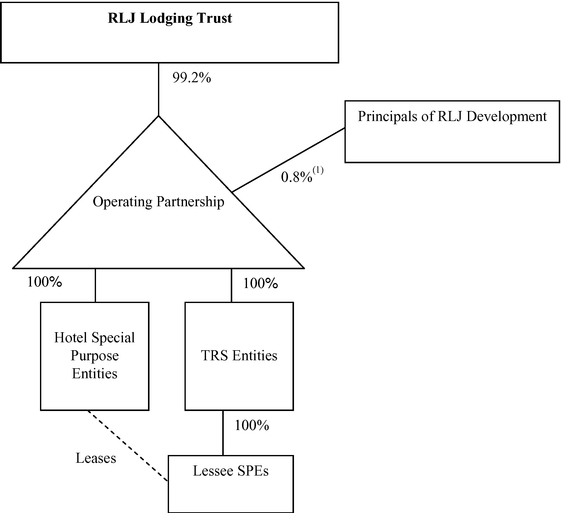
We were formed as a Maryland real estate investment trust in January 2011. We conduct our business through a traditional umbrella partnership real estate investment trust, or UPREIT, in which our hotels are indirectly owned by our operating partnership, RLJ Lodging Trust, L.P., through limited partnerships, limited liability companies or other subsidiaries. We are the sole general partner of our operating partnership and as of December 31, 2012, we owned 99.2% of the OP units in our operating partnership. In the future, we may issue OP units from time to time in connection with acquisitions of hotels or for financing, compensation or other reasons.
In order for the income from our hotel operations to constitute "rents from real property" for purposes of the gross income tests required for REIT qualification, we cannot directly or indirectly operate any of our hotels. Accordingly, we lease each of our hotels, and intend to lease any hotels we acquire in the future, to subsidiaries of our TRSs, or TRS lessees, which are wholly-owned by us, and our TRS lessees have engaged, or will engage, third-party hotel management companies to manage our hotels, and any hotels we acquire in the future, on market terms. Our TRS lessees pay rent to us that we intend to treat as "rents from real property," provided that the third-party hotel management companies engaged by our TRS lessees to manage our hotels are deemed to be "eligible independent contractors" and certain other requirements are met. Our TRSs are subject to U.S. federal, state and local income taxes applicable to corporations.
7
The following chart generally depicts our corporate structure as of December 31, 2012:
- (1)
- Reflects OP units issued to RLJ Development, an entity in which each of Messrs. Johnson, Baltimore and Bierkan hold an equity interest, as consideration for substantially all of RLJ Development's assets and liabilities, which were contributed to us in connection with our formation transactions.
Regulation
General
Our hotels are subject to various U.S. federal, state and local laws, ordinances and regulations, including regulations relating to common areas and fire and safety requirements. We believe that each of our hotels has the necessary permits and approvals to operate its business.
Americans with Disabilities Act
Our hotels must comply with applicable provisions of the Americans with Disabilities Act of 1990, or ADA, to the extent that such hotels are "public accommodations" as defined by the ADA. The ADA may require removal of structural barriers to access by persons with disabilities in certain public areas of our hotels where such removal is readily achievable. We believe that our hotels are in substantial compliance with the ADA and that we will not be required to make substantial capital expenditures to address the requirements of the ADA. However, non-compliance with the ADA could
8
result in imposition of fines or an award of damages to private litigants. The obligation to make readily achievable accommodations is an ongoing one, and we will continue to assess our hotels and to make alterations as appropriate in this respect.
Environmental Matters
Under various laws relating to the protection of the environment, a current or previous owner or operator (including tenants) of real estate may be subject to liability related to contamination resulting from the presence or discharge of hazardous or toxic substances at that property and may be required to investigate and clean up such contamination at that property or emanating from that property. These costs could be substantial and liability under these laws may attach without regard to whether the owner or operator knew of, or was responsible for, the presence of the contaminants, and the liability may be joint and several. The presence of contamination or the failure to remediate contamination at our hotels may expose us to third-party liability for cleanup costs, property damage or bodily injury, natural resource damages and costs or expenses related to liens or property use restrictions and materially and adversely affect our ability to sell, lease or develop the real estate or to incur debt using the real estate as collateral. Furthermore, persons who sent waste to a waste disposal facility, such as a landfill or an incinerator, may be liable for costs associated with cleanup of that facility.
Our hotels are subject to various federal, state, and local environmental, health and safety laws and regulations that address a wide variety of issues, including, but not limited to, storage tanks, air emissions from emergency generators, storm water and wastewater discharges, lead-based paint, mold and mildew and waste management. Our hotels incur costs to comply with these laws and regulations and could be subject to fines and penalties for non-compliance. The costs of complying with environmental, health and safety laws could increase as new laws are enacted and existing laws are modified.
Some of our hotels contain asbestos-containing building materials. We believe that the asbestos is appropriately contained, in accordance with current environmental regulations and that we have no need for any immediate remediation or current plans to remove the asbestos. Environmental laws require that owners or operators of buildings with asbestos-containing building materials properly manage and maintain these materials, adequately inform or train those who may come into contact with asbestos and undertake special precautions, including removal or other abatement, in the event that asbestos is disturbed during building renovation or demolition. These laws may impose fines and penalties on building owners or operators for failure to comply with these requirements. In addition, third parties may seek recovery from owners or operators for personal injury associated with exposure to asbestos-containing building materials.
Some of our hotels may contain or develop harmful mold or suffer from other adverse conditions, which could lead to liability for adverse health effects and costs of remediation. The presence of significant mold or other airborne contaminants at any of our hotels could require us to undertake a costly remediation program to contain or remove the mold or other airborne contaminants from the affected hotel or increase indoor ventilation. In addition, the presence of significant mold or other airborne contaminants could expose us to liability from guests or employees at our hotels and others if property damage or health concerns arise.
Insurance
We carry comprehensive general liability, fire, extended coverage, business interruption, rental loss coverage and umbrella liability coverage on all of our hotels and earthquake, wind, flood and hurricane coverage on hotels in areas where we believe such coverage is warranted, in each case with limits of liability that we deem adequate. Similarly, we are insured against the risk of direct physical damage in amounts we believe to be adequate to reimburse us, on a replacement basis, for costs incurred to repair
9
or rebuild each hotel, including loss of rental income during the reconstruction period. We have selected policy specifications and insured limits which we believe to be appropriate given the relative risk of loss, the cost of the coverage and industry practice. We do not carry insurance for generally uninsured losses, including, but not limited to losses caused by riots, war or acts of God. In the opinion of our management, our hotels are adequately insured.
Employees
As of December 31, 2012 we had 53 employees.
Corporate Information
Our principal executive offices are located at 3 Bethesda Metro Center, Suite 1000, Bethesda, Maryland 20814. Our telephone number is (301) 280-7777. Our website is located at www.rljlodgingtrust.com. The information that is found on or accessible through our website is not incorporated into, and does not form a part of, this Annual Report on Form 10-K or any other report or document that we file with or furnish to the SEC. We have included our website address in this Annual Report on Form 10-K as an inactive textual reference and do not intend it to be an active link to our website.
We make available on our website, free of charge, our Annual Report on Form 10-K, Quarterly Reports on Form 10-Q, Current Reports on Form 8-K and amendments to those reports filed or furnished pursuant to Section 13(a) or 15(d) of the Exchange Act as soon as reasonably practicable after we electronically file such material with, or furnish it to, the SEC. We also make our Code of Business Conduct and Ethics for our trustees, officers and employees available on our website on the Corporate Governance page under the Investor Relations section of our website.
This Annual Report on Form 10-K and other reports filed with the SEC can be read or copied at the SEC's Public Reference Room at 100 F Street, NE, Washington, D.C. 20549. Information on the operation of the Public Reference Room can be obtained by calling the SEC at 1-800-SEC-0330. The SEC maintains a website that contains reports, proxy and information statements, and other information regarding issuers that file electronically with the SEC; the website address is www.sec.gov.
Set forth below are the risks that we believe are material to our shareholders. You should carefully consider the following risks in evaluating our Company and our business. The occurrence of any of the following risks could materially adversely impact our financial condition, results of operations, cash flow, the market price of our common shares and our ability to, among other things, satisfy our debt service obligations and to make distributions to our shareholders, which in turn could cause our shareholders to lose all or a part of their investment. Some statements in this report including statements in the following risk factors constitute forward-looking statements. Please refer to the section entitled "Special Note About Forward-Looking Statements" at the beginning of our Annual Report on Form 10-K.
Risks Related to Our Business and Properties
We will continue to be significantly influenced by the economies and other conditions in the specific markets in which we operate, particularly in the metropolitan areas where we have high concentrations of hotels.
Our hotels located in the New York, New York, Chicago, Illinois, Austin, Texas, Denver-Boulder, Colorado, Louisville, Kentucky, and the Baltimore, Maryland-Washington, D.C. metropolitan areas accounted for approximately 15.8%, 12.1%, 10.5%, 8.8%, 6.5%, and 5.8%, respectively, of our total revenue for the fiscal year ended December 31, 2012. As a result, we are particularly susceptible to adverse market conditions in these areas, including industry downturns, relocation of businesses and
10
any oversupply of hotel rooms or a reduction in lodging demand. Adverse economic developments in the markets in which we have a concentration of hotels, or in any of the other markets in which we operate, or any increase in hotel supply or decrease in lodging demand resulting from the local, regional or national business climate, could materially and adversely affect us.
We are dependent on the performance of the third-party hotel management companies that manage the operations of each of our hotels and could be materially and adversely affected if such third-party managers do not manage our hotels in our best interests.
Because federal income tax laws restrict REITs and their subsidiaries from operating or managing hotels, we do not operate or manage our hotels. Instead, we lease all of our hotels to subsidiaries of our TRSs, and our TRS lessees retain third-party managers to operate our hotels pursuant to management agreements. We have entered into individual hotel management agreements for our hotels, 104 of which are with White Lodging Services, or WLS. We could be materially and adversely affected if any of our third-party managers fail to provide quality services and amenities, fail to maintain a quality brand name or otherwise fail to manage our hotels in our best interest. In addition, from time to time, disputes may arise between us and our third-party managers regarding their performance or compliance with the terms of the hotel management agreements, which in turn could adversely affect our results of operations. We generally will attempt to resolve any such disputes through discussions and negotiations; however, if we are unable to reach satisfactory results through discussions and negotiations, we may choose to terminate our management agreement, litigate the dispute or submit the matter to third-party dispute resolution, the outcome of which may be unfavorable to us.
Under the terms of the hotel management agreements, our ability to participate in operating decisions regarding our hotels is limited to certain matters, including approval of the annual operating budget, and we do not have the authority to require any hotel to be operated in a particular manner (for instance, setting room rates). While our TRS lessees closely monitor the performance of our third-party managers, our general recourse under the hotel management agreements is limited to termination upon sixty days' notice if we believe our third-party managers are not performing adequately. For example, we have a right to terminate a management agreement with WLS, our largest provider of management services, if WLS fails to achieve certain hotel performance criteria measured over any two consecutive fiscal years, as outlined in each WLS management agreement. However, even if WLS fails to perform under the terms of a management agreement, it has the option (exercisable a maximum of three times per hotel) to avoid a performance termination by paying a performance deficit fee as specified in the management agreement.
In the event that we terminate any of our management agreements, we can provide no assurances that we could find a replacement manager or that our franchisors will consent to a replacement manager in a timely manner, or at all, or that any replacement manager will be successful in operating our hotels. Furthermore, if WLS, as our largest provider of management services, is financially unable or unwilling to perform its obligations pursuant to our management agreements, our ability to find a replacement manager or managers for our WLS-managed hotels could be challenging and time consuming, depending on the number of WLS-managed hotels affected, and could cause us to incur significant costs to obtain new management agreements for the affected hotels. Accordingly, if we lose a significant number of our WLS management agreements, we could be materially and adversely affected. In addition, many of our existing franchise agreements provide the franchisor with a right of first offer in the event of certain sales or transfers of a hotel and provide that the franchisor has the right to approve any change in the hotel management company engaged to manage the hotel. If any of the foregoing were to occur, it could have a material adverse effect on us.
11
Restrictive covenants in certain of our hotel management and franchise agreements contain provisions limiting or restricting the sale or financing of our hotels, which could have a material adverse effect on us.
Hotel management and franchise agreements typically contain restrictive covenants that limit or restrict our ability to sell or refinance a hotel without the consent of the hotel management company or franchisor. Many of our franchise agreements provide the franchisor with a right of first offer in the event of certain sales or transfers of a hotel and provide that the franchisor has the right to approve any change in the hotel management company engaged to manage the hotel. Generally, we may not agree to sell, lease or otherwise transfer particular hotels unless the transferee is not a competitor of the hotel management company or franchisor and the transferee assumes the related hotel management and franchise agreements. For example, substantially all of our management agreements with WLS provide that any sale of a hotel to a purchaser who does not meet all of the requirements under the applicable franchise agreement associated with such hotel must be first approved by WLS. If the hotel management company or franchisor does not consent to the sale or financing of our hotels, we may be prohibited from taking actions that would otherwise be in our and our shareholders' best interests.
Substantially all of our hotels operate under either Marriott or Hilton brands; therefore, we are subject to risks associated with concentrating our portfolio in just two brand families.
133 of the 145 hotels that we owned as of December 31, 2012 utilize brands owned by Marriott or Hilton. As a result, our success is dependent in part on the continued success of Marriott and Hilton and their respective brands. We believe that building brand value is critical to increase demand and build customer loyalty. Consequently, if market recognition or the positive perception of Marriott and/or Hilton is reduced or compromised, the goodwill associated with the Marriott- and Hilton-branded hotels in our portfolio may be adversely affected. Furthermore, if our relationship with Marriott or Hilton were to deteriorate or terminate as a result of disputes regarding the management of our hotels or for other reasons, Marriott and/or Hilton could, under certain circumstances, terminate our current franchise licenses with them or decline to provide franchise licenses for hotels that we may acquire in the future. If any of the foregoing were to occur, it could have a material adverse effect on us.
Our long-term growth depends in part on successfully identifying and consummating acquisitions of additional hotels and the failure to make such acquisitions could materially impede our growth.
We can provide no assurances that we will be successful in identifying attractive hotels or that, once identified, we will be successful in consummating an acquisition. We face significant competition for attractive investment opportunities from other well-capitalized investors, some of which have greater financial resources and a greater access to debt and equity capital to acquire hotels than we do. This competition increases as investments in real estate become increasingly attractive relative to other forms of investment. As a result of such competition, we may be unable to acquire certain hotels that we deem attractive or the purchase price may be significantly elevated or other terms may be substantially more onerous. In addition, we expect to finance future acquisitions through a combination of borrowings under our unsecured revolving credit facility, the use of retained cash flows, and offerings of equity and debt securities, which may not be available on advantageous terms, or at all. Any delay or failure on our part to identify, negotiate, finance on favorable terms, consummate and integrate such acquisitions could materially impede our growth.
The departure of any of our key personnel who have significant experience and relationships in the lodging industry, including Robert L. Johnson, Thomas J. Baltimore, Jr. and Ross H. Bierkan, could materially and adversely affect us.
We depend on the experience and relationships of our senior management team, especially Robert L. Johnson, Executive Chairman of our board of trustees, Thomas J. Baltimore, Jr., our
12
President and Chief Executive Officer and a member of our board of trustees, and Ross H. Bierkan, our Chief Investment Officer, to manage our day-to-day operations and strategic business direction. Messrs. Johnson, Baltimore and Bierkan have 19, 24 and 27 years of experience in the lodging industry, respectively, during which time they have established an extensive network of lodging industry contacts and relationships, including relationships with global and national hotel brands, hotel owners, financiers, operators, commercial real estate brokers, developers and management companies. We can provide no assurances that any of our key personnel will continue their employment with us, even though all of the members of our senior management team have entered employment agreements with us. The loss of services of Messrs. Johnson, Baltimore or Bierkan, or of the services of other members of our senior management team, or any difficulty attracting and retaining other talented and experienced personnel, could adversely affect our ability to source potential investment opportunities, our relationship with global and national hotel brands and other industry participants and the execution of our business strategy. Further, such a loss could be negatively perceived in the capital markets, which could reduce the market value of our common shares.
Our business strategy depends on achieving revenue and net income growth from anticipated increases in demand for hotel rooms; accordingly, any delay or a weaker than anticipated economic recovery could materially and adversely affect us and our growth prospects.
Our hotels experienced declining operating performance across various U.S. markets during the most recent economic recession. Our business strategy depends on achieving revenue and net income growth from anticipated improvement in demand for hotel rooms as part of the continued economic recovery. As a result, any delay or a weaker than anticipated continued economic recovery could materially and adversely affect us and our growth prospects. Furthermore, even if the economy continues to recover, we cannot provide any assurances that demand for hotel rooms will increase from current levels. If demand does not increase in the near future, or if demand weakens, our future results of operations and our growth prospects could be materially and adversely affected.
The ongoing need for capital expenditures at our hotels could have a material adverse effect on us.
Our hotels have an ongoing need for renovations and other capital improvements, including replacements, from time to time, of furniture, fixtures and equipment. The franchisors of our hotels also require periodic capital improvements as a condition of maintaining the franchise licenses. In addition, our lenders will likely require that we set aside annual amounts for capital improvements to our hotels. The costs of these capital improvements could materially and adversely affect us.
Any difficulties in obtaining capital necessary to make required periodic capital expenditures and renovation of our hotels could materially and adversely affect our financial condition and results of operations.
Our hotels require periodic capital expenditures and renovation to remain competitive. In addition, acquisitions or redevelopment of additional hotels will require significant capital expenditures. We may not be able to fund capital improvements on our hotels or acquisitions of new hotels solely from cash provided from our operating activities because we must distribute annually at least 90% of our REIT taxable income, determined without regard to the deduction for dividends paid and excluding net capital gain, to maintain our qualification as a REIT, and we are subject to tax on any retained income and gain. As a result, our ability to fund capital expenditures, acquisitions or hotel redevelopment through retained earnings is very limited. Consequently, we expect to rely upon the availability of debt or equity capital to fund capital improvements and acquisitions. If we are unable to obtain the capital necessary to make required periodic capital expenditures and renovate our hotels on favorable terms, or at all, our financial condition, liquidity and results of operations could be materially and adversely affected.
13
Adverse global market and economic conditions and dislocations in the markets could cause us to recognize impairment charges, which could materially and adversely affect our business, financial condition and results of operations.
We continually monitor events and changes in circumstances, including those resulting from the recent economic downturn that could indicate that the carrying value of the real estate and related intangible assets in which we have an ownership interest may not be recoverable. When circumstances indicate that the carrying value of real estate and related intangible assets may not be recoverable, we assess the recoverability of these assets by determining whether the carrying value will be recovered through the undiscounted future operating cash flows expected from the use of the asset and its eventual disposition. In the event that such expected undiscounted future cash flows do not exceed the carrying value, we adjust the real estate and related intangible assets to the fair value and recognize an impairment loss. Because our predecessor acquired many of our hotels in the last five years, when prices for hotels in many markets were at or near their peaks, we may be particularly susceptible to future non-cash impairment charges as compared to companies that have carrying values well below current market values, which could materially and adversely affect our business, financial condition and results of operations. During the fiscal year ended December 31, 2012, we recognized an impairment charge on the Fairfield Inn Memphis of $0.9 million.
Projections of expected future cash flows require management to make assumptions to estimate future occupancy, hotel operating expenses, and the number of years the hotel is held for investment, among other factors. The subjectivity of assumptions used in the future cash flow analysis, including discount rates, could result in an incorrect assessment of the hotel's fair value and, therefore, could result in the misstatement of the carrying value of our real estate and related intangible assets on our balance sheet and our results of operations. Ongoing adverse market and economic conditions and market volatility will likely continue to make it difficult to value the hotels owned by us, as well as the value of our intangible assets. As a result of adverse market and economic conditions, there may be significant uncertainty in the valuation, or in the stability of, the cash flows, discount rates and other factors related to such assets that could result in a substantial decrease in their value.
Competition from other hotels in the markets in which we operate could adversely affect occupancy levels and/or ADRs, which could have a material adverse effect on us.
We face significant competition from owners and operators of other hotels. These competitors may have an operating model that enables them to offer rooms at lower rates than we can, which could result in those competitors increasing their occupancy at our expense and adversely affecting our ADRs. Given the importance of occupancy and ADR at focused-service and compact full-service hotels, this competition could adversely affect our ability to attract prospective guests, which could materially and adversely affect our results of operations.
The RevPAR penetration index may not accurately reflect our hotels' respective market shares.
We use the RevPAR penetration index, which measures a hotel's RevPAR in relation to the average RevPAR of that hotel's competitive set, as an indicator of a hotel's market share in relation to its competitive set. However, as a particular hotel's competitive set is selected by us and the hotel management company that manages such hotel, no assurance can be given that a competitive set consisting of different hotels would not lead to a more accurate measure of such hotel's market share. As such, the RevPAR penetration index may not accurately reflect our hotels' respective market shares.
14
At December 31, 2012, we had approximately $1.4 billion of debt outstanding, which may materially and adversely affect our operating performance and put us at a competitive disadvantage.
Required repayments of debt and related interest may materially and adversely affect our operating performance. At December 31, 2012, we had approximately $1.4 billion of outstanding debt, approximately $643.0 million of which bears interest at variable rates. Increases in interest rates on our existing or future variable rate debt would increase our interest expense, which could adversely affect our cash flows and our ability to pay distributions to shareholders.
Because we anticipate that our internally generated cash will be adequate to repay only a portion of our debt at maturity, we expect that we will be required to repay debt through debt refinancings and/or offerings of our securities. The amount of our outstanding debt may adversely affect our ability to refinance our debt.
If we are unable to refinance our debt on acceptable terms, or at all, we may be forced to dispose of one or more of our hotels on disadvantageous terms, which may result in losses to us and may adversely affect cash available for distributions to our shareholders. In addition, if then-prevailing interest rates or other factors at the time of refinancing result in higher interest rates upon refinancing, our interest expense would increase, which would adversely affect our future operating results and liquidity.
Our substantial outstanding debt may harm our business, financial condition, liquidity, EBITDA, Funds from Operations, or FFO, and results of operations, including:
- •
-
requiring us to use a substantial portion of our cash flows to pay principal and interest, which would reduce the cash
available for distributions to our shareholders;
- •
-
placing us at a competitive disadvantage compared to our competitors that have less debt;
- •
-
making us vulnerable to the ongoing economic recovery, particularly if the recovery were to slow or stall and reduce our
flexibility to respond to difficult economic conditions; and
- •
- limiting our ability to borrow more money for operations, capital or to finance future acquisitions.
The use of debt to finance future acquisitions could restrict operations, inhibit our ability to grow our business and revenues, and negatively affect our business and financial results.
We may incur additional debt in connection with future hotel acquisitions. We may, in some instances, borrow under our unsecured revolving credit facility or borrow new funds to acquire hotels. In addition, we may incur mortgage debt by obtaining loans secured by a portfolio of some or all of the hotels that we own or acquire. If necessary or advisable, we also may borrow funds to make distributions to our shareholders in order to maintain our qualification as a REIT for U.S. federal income tax purposes. To the extent that we incur debt in the future and do not have sufficient funds to repay such debt at maturity, it may be necessary to refinance the debt through debt or equity financings, which may not be available on acceptable terms or at all and which could be dilutive to our shareholders. If we are unable to refinance our debt on acceptable terms or at all, we may be forced to dispose of hotels at inopportune times or on disadvantageous terms, which could result in losses. To the extent we cannot meet our future debt service obligations, we will risk losing to foreclosure some or all of our hotels that may be pledged to secure our obligations.
For tax purposes, a foreclosure of any of our hotels would be treated as a sale of the hotel for a purchase price equal to the outstanding balance of the debt secured by the mortgage. If the outstanding balance of the debt secured by the mortgage exceeds our tax basis in the hotel, we would recognize taxable income on foreclosure, but we would not receive any cash proceeds, which could hinder our ability to meet the REIT distribution requirements imposed by the Internal Revenue Code
15
of 1986, as amended, or the Code. In addition, we may give full or partial guarantees to lenders of mortgage debt on behalf of the entities that own our hotels. When we give a guarantee on behalf of an entity that owns one of our hotels, we will be responsible to the lender for satisfaction of the debt if it is not paid by such entity. If any of our hotels are foreclosed on due to a default, our ability to pay cash distributions to our shareholders will be limited.
Our organizational documents have no limitation on the amount of indebtedness we may incur. As a result, we may become highly leveraged in the future, which could materially and adversely affect us.
Our business strategy contemplates the use of both non-recourse secured and unsecured debt to finance long-term growth. In addition, our organizational documents contain no limitations on the amount of debt that we may incur, and our board of trustees may change our financing policy at any time without shareholder notice or approval. As a result, we may be able to incur substantial additional debt, including secured debt, in the future. Incurring debt could subject us to many risks, including the risks that:
- •
-
our cash flows from operations may be insufficient to make required payments of principal and interest;
- •
-
our debt may increase our vulnerability to adverse economic and industry conditions;
- •
-
we may be required to dedicate a substantial portion of our cash flows from operations to payments on our debt, thereby
reducing cash available for distribution to our shareholders, funds available for operations and capital expenditures, future business opportunities or other purposes;
- •
-
the terms of any refinancing may not be in the same amount or on terms as favorable as the terms of the existing debt
being refinanced; and
- •
- the use of leverage could adversely affect our ability to raise capital from other sources or to make distributions to our shareholders and could adversely affect the market price of our common shares.
If we violate covenants in future agreements relating to indebtedness that we may incur, we could be required to repay all or a portion of our indebtedness before maturity at a time when we might be unable to arrange financing for such repayment on attractive terms, if at all. In addition, future indebtedness agreements may require that we meet certain covenant tests in order to make distributions to our shareholders.
Disruptions in the financial markets could adversely affect our ability to obtain sufficient third-party financing for our capital needs, including expansion, acquisition and other activities, on favorable terms or at all, which could materially and adversely affect us.
In recent years, the U.S. stock and credit markets have experienced significant price volatility, dislocations and liquidity disruptions, which have caused market prices of many stocks to fluctuate substantially and the spreads on prospective debt financings to widen considerably. These circumstances have materially impacted liquidity in the financial markets, making terms for certain financings less attractive, and in some cases have resulted in the unavailability of financing, even for companies which otherwise are qualified to obtain financing. In addition, several banks and other institutions that historically have been reliable sources of financing have gone out of business, which has reduced significantly the number of lending institutions and the availability of credit. Continued volatility and uncertainty in the stock and credit markets may negatively impact our ability to access additional financing for our capital needs, including expansion, acquisition activities and other purposes, on favorable terms or at all, which may negatively affect our business. Additionally, due to this uncertainty, we may in the future be unable to refinance or extend our debt, or the terms of any refinancing may
16
not be as favorable as the terms of our existing debt. If we are not successful in refinancing our debt when it becomes due, we may be forced to dispose of hotels on disadvantageous terms, which might adversely affect our ability to service other debt and to meet our other obligations. A prolonged downturn in the financial markets may cause us to seek alternative sources of potentially less attractive financing and may require us to further adjust our business plan accordingly. These events also may make it more difficult or costly for us to raise capital through the issuance of new equity capital or the incurrence of additional secured or unsecured debt, which could materially and adversely affect us.
Hedging against interest rate exposure may adversely affect us.
Subject to maintaining our qualification as a REIT, we may manage our exposure to interest rate volatility by using interest rate hedging arrangements, such as cap agreements and swap agreements. These agreements involve the risks that these arrangements may fail to protect or adversely affect us because, among other things:
- •
-
interest rate hedging can be expensive, particularly during periods of rising and volatile interest rates;
- •
-
available interest rate hedges may not correspond directly with the interest rate risk for which protection is sought;
- •
-
the duration of the hedge may not match the duration of the related liability;
- •
-
the credit quality of the hedging counterparty owing money on the hedge may be downgraded to such an extent that it
impairs our ability to sell or assign our side of the hedging transaction; and
- •
- the hedging counterparty owing money in the hedging transaction may default on its obligation to pay.
As a result of any of the foregoing, our hedging transactions, which are intended to limit losses, could have a material adverse effect on us.
Our failure to comply with all covenants in our existing or future debt agreements could materially and adversely affect us.
The mortgages on our hotels, and hotels that we may acquire in the future likely will, contain customary covenants such as those that limit our ability, without the prior consent of the lender, to further mortgage the applicable hotel or to discontinue insurance coverage. In addition, our continued ability to borrow under our unsecured revolving credit facility is subject to compliance with our financial and other covenants, including covenants relating to debt service coverage ratios and leverage ratios, and our ability to meet these covenants will be adversely affected if U.S. lodging fundamentals do not continue to improve to the extent that we expect. In addition, any credit facility or secured loans that we enter into in the future likely will contain customary financial covenants, restrictions, requirements and other limitations with which we must comply. Our failure to comply with covenants in our existing or future indebtedness, as well as our inability to make required payments, could cause a default under the applicable debt agreement, which could result in the acceleration of the debt and require us to repay such debt with capital obtained from other sources, which may not be available to us or may be available only on unattractive terms. Furthermore, if we default on secured debt, lenders can take possession of the hotel or hotels securing such debt. In addition, debt agreements may contain specific cross-default provisions with respect to specified other indebtedness, giving the lenders the right to declare a default on its debt and to enforce remedies, including acceleration of the maturity of such debt upon the occurrence of a default under such other indebtedness. If we default on several of our debt agreements or any significant debt agreement, we could be materially and adversely affected.
17
Covenants applicable to future debt could restrict our ability to make distributions to our shareholders and, as a result, we may be unable to make distributions necessary to maintain our qualification as a REIT, which could materially and adversely affect us and the market price of our common shares.
We intend to continue to operate in a manner so as to maintain our qualification as a REIT for U.S. federal income tax purposes. In order to qualify as a REIT, we generally are required to distribute at least 90% of our REIT taxable income, determined without regard to the dividends paid deduction and excluding net capital gain, each year to our shareholders. To the extent that we satisfy this distribution requirement, but distribute less than 100% of our REIT taxable income, we will be subject to U.S. federal corporate income tax on our undistributed taxable income. In addition, we will be subject to a 4% nondeductible excise tax if the actual amount that we distribute to our shareholders in a calendar year is less than a minimum amount specified under the Code. In order to meet the REIT requirements, we may be required to issue common shares of beneficial interest in lieu of cash distributions. If, as a result of covenants applicable to our future debt, we are restricted from making distributions to our shareholders, we may be unable to make distributions necessary for us to avoid U.S. federal corporate income and excise taxes and maintain our qualification as a REIT, which could materially and adversely affect us and the market price of our shares.
We may change the distribution policy for our common shares of beneficial interest in the future.
Our management and Board of Trustees will continue to evaluate our distribution policy on a quarterly basis as they monitor the capital markets, the impact of the economy on our operations and other factors. Future distributions will be declared and paid at the discretion of our board of trustees and will depend upon a number of factors, including our actual and projected financial condition, liquidity, EBITDA, FFO and results of operations, the revenue we actually receive from our properties, our operating expenses, our debt service requirements, our capital expenditures, prohibitions and other limitations under our financing arrangements, our REIT taxable income, the annual REIT distribution requirements, applicable law and such other factors as our board of trustees deems relevant. Any change in our distribution policy could have a material adverse effect on the market price of our common shares.
Costs associated with, or failure to maintain, franchisor operating standards may materially and adversely affect us.
Under the terms of our franchise license agreements, we are required to meet specified operating standards and other terms and conditions. We expect that our franchisors will periodically inspect our hotels to ensure that we and the hotel management companies follow brand standards. Failure by us, or any hotel management company that we engage, to maintain these standards or other terms and conditions could result in a franchise license being canceled or the franchisor requiring us to undertake a costly property improvement program. If a franchise license is terminated due to our failure to make required improvements or to otherwise comply with its terms, we also may be liable to the franchisor for a termination payment, which will vary by franchisor and by hotel. Furthermore, under certain circumstances, a franchisor may require us to make capital expenditures, even if we do not believe the capital improvements are necessary or desirable or will result in an acceptable return on our investment. If the funds required to maintain franchisor operating standards are significant, or if a franchise license is terminated, we could be materially and adversely affected.
If we were to lose a franchise license at one or more of our hotels, the value of the affected hotels could decline significantly and we could incur significant costs to obtain new franchise licenses, which could have a material adverse effect on us.
If we were to lose a franchise license, we would be required to re-brand the affected hotel(s). As a result, the underlying value of a particular hotel could decline significantly from the loss of associated
18
name recognition, marketing support, participation in guest loyalty programs and the centralized system provided by the franchisor, which could require us to recognize an impairment on the hotel. Furthermore, the loss of a franchise license at a particular hotel could harm our relationship with the franchisor, which could impede our ability to operate other hotels under the same brand, limit our ability to obtain new franchise licenses from the franchisor in the future on favorable terms, or at all, and cause us to incur significant costs to obtain a new franchise license for the particular hotel. Accordingly, if we lose one or more franchise licenses, we could be materially and adversely affected.
Applicable REIT laws may restrict certain business activities.
As a REIT, we are subject to various restrictions on our income, assets and activities. Business activities that could be impacted by applicable REIT laws include, but are not limited to, activities such as developing alternative uses of real estate, including the development and/or sale of timeshare or condominium units. Due to these restrictions, we anticipate that we will continue to conduct certain business activities, including those mentioned above, in one or more of our TRSs. Our TRSs are taxable as regular C corporations and are subject to federal, state, local, and, if applicable, foreign taxation on their taxable income. In addition, neither we, nor our TRSs can directly manage or operate hotels, making us entirely dependent on unrelated third-party operators/managers.
Federal income tax provisions applicable to REITs may restrict our business decisions regarding the potential sale of a hotel.
The federal income tax provisions applicable to REITs provide that any gain realized by a REIT on the sale of property held as inventory or other property held primarily for sale to customers in the ordinary course of business is treated as income from a "prohibited transaction" that is subject to a 100% excise tax. Under existing law, whether property, including hotels, is held as inventory or primarily for sale to customers in the ordinary course of business is a question of fact that depends upon all of the facts and circumstances with respect to the particular transaction. We intend to hold our hotels for investment with a view to long-term appreciation, to engage in the business of acquiring and owning hotels and to make occasional sales of hotels consistent with our investment objectives. There can be no assurance, however, that the Internal Revenue Service, or the IRS, might not contend that one or more of these sales are subject to the 100% excise tax. Moreover, the potential application of this penalty tax could deter us from selling one or more hotels even though it otherwise would be in the best interests of us and our shareholders for us to do so. There is a statutory safe harbor available for a limited number of sales in a single taxable year of properties that have been owned by a REIT for at least two years, but that safe harbor likely would not apply to all sales transactions that we might otherwise consider. As a result, we may not be able to vary our portfolio promptly in response to economic or other conditions or on favorable terms, which may adversely affect us.
Joint venture investments that we make could be adversely affected by our lack of sole decision-making authority, our reliance on joint venture partners' financial condition and liquidity and disputes between us and our joint venture partners.
We own the Doubletree Metropolitan Hotel New York City through a joint venture with an affiliate of the hotel's property manager. In addition, we may enter into joint ventures in the future to acquire, develop, improve or partially dispose of hotels, thereby reducing the amount of capital required by us to make investments and diversifying our capital sources for growth. Such joint venture investments involve risks not otherwise present in a wholly-owned hotel or a redevelopment project, including the following:
- •
- we may not have exclusive control over the development, financing, leasing, management and other aspects of the hotel or joint venture, which may prevent us from taking actions that are in our best interest but opposed by our partners;
19
- •
-
joint venture agreements often restrict the transfer of a partner's interest or may otherwise restrict our ability to sell
the interest when we desire or on advantageous terms;
- •
-
joint venture agreements may contain buy-sell provisions pursuant to which one partner may initiate procedures
requiring the other partner to choose between buying the other partner's interest or selling its interest to that partner;
- •
-
we may not be in a position to exercise sole decision-making authority regarding the hotel or joint venture, which could
create the potential risk of creating impasses on decisions, such as acquisitions or sales;
- •
-
a partner may, at any time, have economic or business interests or goals that are, or that may become, inconsistent with
our business interests or goals;
- •
-
a partner may be in a position to take action contrary to our instructions, requests, policies or objectives, including
our current policy with respect to maintaining our qualification as a REIT;
- •
-
a partner may fail to fund its share of required capital contributions or may become bankrupt, which would mean that we
and any other remaining partners generally would remain liable for the joint venture's liabilities;
- •
-
relationships with joint-venture partners are contractual in nature and may be terminated or dissolved under the terms of
the applicable joint venture agreements and, in such event, we may not continue to own or operate the interests or assets underlying such relationship or may need to purchase such interests or assets
at a premium to the market price to continue ownership;
- •
-
disputes between us and a partner may result in litigation or arbitration that would increase our expenses and prevent our
officers and trustees from focusing their time and efforts on our business and could result in subjecting the hotels owned by the joint venture to additional risk; or
- •
- we may, in certain circumstances, be liable for the actions of a partner, and the activities of a partner could adversely affect our ability to qualify as a REIT, even though we do not control the joint venture.
Any of the above might subject a hotel to liabilities in excess of those contemplated and adversely affect the value of our current and future joint venture investments.
Risks Related to the Lodging Industry
Our ability to make distributions to our shareholders may be adversely affected by various operating risks common to the lodging industry, including competition, over-building and dependence on business travel and tourism.
The hotels that we own have different economic characteristics than many other real estate assets. A typical office property, for example, has long-term leases with third-party tenants, which provides a relatively stable long-term stream of revenue. Hotels, on the other hand, generate revenue from guests that typically stay at the hotel for only a few nights, which causes the room rate and occupancy levels at each of our hotels to change every day, and results in earnings that can be highly volatile.
In addition, our hotels are subject to various operating risks common to the lodging industry, many of which are beyond our control, including, among others, the following:
- •
-
competition from other hotels in the markets in which we operate;
- •
- over-building of hotels in the markets in which we operate, which results in increased supply and will adversely affect occupancy and revenues at our hotels;
20
- •
-
dependence on business and commercial travelers and tourism;
- •
-
labor strikes, disruptions or lockouts that may impact operating performance;
- •
-
increases in energy costs and other expenses affecting travel, which may affect travel patterns and reduce the number of
business and commercial travelers and tourists;
- •
-
requirements for periodic capital reinvestment to repair and upgrade hotels;
- •
-
increases in operating costs due to inflation and other factors that may not be offset by increased room rates;
- •
-
changes in interest rates;
- •
-
changes in the availability, cost and terms of financing;
- •
-
changes in governmental laws and regulations, fiscal policies and zoning ordinances and the related costs of compliance
with laws and regulations, fiscal policies and ordinances;
- •
-
adverse effects of international, national, regional and local economic and market conditions;
- •
-
unforeseen events beyond our control, such as terrorist attacks, travel-related health concerns, including pandemics and
epidemics such as the H1N1 influenza, the avian bird influenza and SARS, imposition of taxes or surcharges by regulatory authorities, travel-related accidents and unusual weather patterns, including
natural disasters such as hurricanes, tsunamis or earthquakes;
- •
-
adverse effects of worsening conditions in the lodging industry; and
- •
- risks generally associated with the ownership of hotels and real estate, as we discuss in detail below.
The occurrence of any of the foregoing could materially and adversely affect us.
The seasonality of the lodging industry could have a material adverse effect on us.
The lodging industry is seasonal in nature, which can be expected to cause quarterly fluctuations in our revenues. Our quarterly earnings may be adversely affected by factors outside our control, including weather conditions and poor economic factors in certain markets in which we operate. For example, our hotels in the Chicago, Illinois metropolitan area experience lower revenues and profits during the winter months of December through March while our hotels in Florida generally have higher revenues in the months of January through April. This seasonality can be expected to cause periodic fluctuations in room revenues, occupancy levels, room rates and operating expenses in particular hotels. We can provide no assurances that our cash flows will be sufficient to offset any shortfalls that occur as a result of these fluctuations. As a result, we may have to enter into short-term borrowings in certain quarters in order to make distributions to our shareholders, and we can provide no assurances that such borrowings will be available on favorable terms, if at all. Consequently, volatility in our financial performance resulting from the seasonality of the lodging industry could have a material adverse effect on us.
The cyclical nature of the lodging industry may cause fluctuations in our operating performance, which could have a material adverse effect on us.
The lodging industry historically has been highly cyclical in nature. Fluctuations in lodging demand and, therefore, operating performance, are caused largely by general economic and local market conditions, which subsequently affect levels of business and leisure travel. In addition to general economic conditions, new hotel room supply is an important factor that can affect the lodging industry's performance, and overbuilding has the potential to further exacerbate the negative impact of
21
an economic recession. Room rates and occupancy, and thus RevPAR, tend to increase when demand growth exceeds supply growth. We can provide no assurances regarding whether, or the extent to which, lodging demand will rebound or whether any such rebound will be sustained. An adverse change in lodging fundamentals could result in returns that are substantially below our expectations or result in losses, which could have a material adverse effect on us.
Our acquisition, redevelopment, repositioning, renovation and re-branding activities are subject to various risks, any of which could, among other things, result in disruptions to our hotel operations, strain management resources and materially and adversely affect our business.
We intend to continue to acquire, redevelop, reposition, renovate and re-brand hotels, subject to the availability of attractive hotels or projects and our ability to undertake such activities on satisfactory terms. In deciding whether to undertake such activities, we will make certain assumptions regarding the expected future performance of the hotel or project. However, newly acquired, redeveloped, renovated, repositioned or re-branded hotels may fail to perform as expected and the costs necessary to bring such hotels up to franchise standards may exceed our expectations, which may result in the hotels' failure to achieve projected returns.
In particular, to the extent that we engage in the activities described above, they could pose the following risks to our ongoing operations:
- •
-
we may abandon such activities and may be unable to recover expenses already incurred in connection with exploring such
opportunities;
- •
-
acquired, redeveloped, renovated or re-branded hotels may not initially be accretive to our results of
operations, and we and the hotel management companies may not successfully manage newly acquired, renovated, redeveloped, repositioned or re-branded hotels to meet our expectations;
- •
-
we may be unable to quickly, effectively and efficiently integrate new acquisitions, particularly acquisitions of
portfolios of hotels, into our existing operations;
- •
-
our redevelopment, repositioning, renovation or re-branding activities may not be completed on schedule, which
could result in increased debt service and other costs and lower revenues; and
- •
- management attention may be diverted by our acquisition, redevelopment, repositioning or rebranding activities, which in some cases may turn out to be less compatible with our growth strategy than originally anticipated.
The occurrence of any of the foregoing events, among others, could materially and adversely affect our business.
Certain of our hotels are subject to ground leases that contain provisions that may impact our ability to sell such hotels.
Our ground lease agreements with respect to certain of our hotels require the consent of the lessor or sub-lessor prior to transferring our interest in the ground lease. These provisions may impact our ability to sell our hotels which, in turn, could adversely impact the price realized from any such sale. In addition, at any given time, investors may be disinterested in buying properties subject to a ground lease and may pay a lower price for such properties than for a comparable property in fee simple or they may not purchase such properties at any price. Accordingly, we may find it difficult to sell a property subject to a ground lease or may receive lower proceeds from any such sale.
22
If we are found to be in breach of a ground lease or are unable to renew a ground lease, we could be materially and adversely affected.
As of December 31, 2012, seven of our hotels were on land subject to ground leases. Accordingly, we only own a long-term leasehold or similar interest in those seven hotels. If we are found to be in breach of a ground lease, we could lose the right to use the hotel. In addition, unless we can purchase a fee interest in the underlying land and improvements or extend the terms of these leases before their expiration, as to which no assurance can be given, we will lose our right to operate these properties and our interest in the improvements upon expiration of the leases. Our ability to exercise any extension options relating to our ground leases is subject to the condition that we are not in default under the terms of the ground lease at the time that we exercise such options, and we can provide no assurances that we will be able to exercise any available options at such time. Furthermore, we can provide no assurances that we will be able to renew any ground lease upon its expiration. If we were to lose the right to use a hotel due to a breach or non-renewal of the ground lease, we would be unable to derive income from such hotel and would be required to purchase an interest in another hotel to attempt to replace that income, which could materially and adversely affect us.
We will not recognize any increase in the value of the land or improvements subject to our ground leases and may only receive a portion of compensation paid in any eminent domain proceeding with respect to the hotel.
Unless we purchase a fee interest in the land and improvements subject to our ground leases, we will not have any economic interest in the land or improvements at the expiration of our ground leases and therefore we will not share in any increase in value of the land or improvements beyond the term of a ground lease, notwithstanding our capital outlay to purchase our interest in the hotel or fund improvements thereon, and will lose our right to use the hotel. Furthermore, if the state or federal government seizes a hotel subject to a ground lease under its eminent domain power, we may only be entitled to a portion of any compensation awarded for the seizure.
The increasing use of Internet travel intermediaries by consumers may materially and adversely affect our profitability.
Although a majority of rooms sold on the Internet are sold through websites maintained by the hotel franchisors and managers, including Marriott and Hilton, some of our hotel rooms will be booked through Internet travel intermediaries. Typically, these Internet travel intermediaries purchase rooms at a negotiated discount from participating hotels, which could result in lower room rates than the franchisor or manager otherwise could have obtained. As these Internet bookings increase, these intermediaries may be able to obtain higher commissions, reduced room rates or other significant contract concessions from us and any hotel management companies that we engage. Moreover, some of these Internet travel intermediaries are attempting to offer hotel rooms as a commodity, by increasing the importance of price and general indicators of quality, such as "three-star downtown hotel," at the expense of brand identification or quality of product or service. If consumers develop brand loyalties to Internet reservations systems rather than to the brands under which our hotels are franchised, the value of our hotels could deteriorate and our business could be materially and adversely affected. Although most of the business for our hotels is expected to be derived from traditional channels, if the amount of sales made through Internet intermediaries increases significantly, room revenues may flatten or decrease and our profitability may be materially and adversely affected.
Technology is used in our operations, and any material failure, inadequacy, interruption or security failure of that technology could harm the business.
We and our hotel managers and franchisors rely on information technology networks and systems, including the Internet, to process, transmit and store electronic information, and to manage or support a variety of business processes, including financial transactions and records, personal identifying
23
information, reservations, billing and operating data. Although we believe we and our hotel managers and franchisors have taken commercially reasonable steps to protect the security of our systems, there can be no assurance that such security measures will prevent failures, inadequacies or interruptions in system services, or that system security will not be breached. Any failure to maintain proper function, security and availability of information systems could interrupt operations, damage reputation, subject us to liability claims or regulatory penalties and could have a material adverse effect on our business, financial condition and results of operations.
The need for business-related travel and, thus, demand for rooms in our hotels may be materially and adversely affected by the increased use of business-related technology.
The increased use of teleconference and video-conference technology by businesses could result in decreased business travel as companies increase the use of technologies that allow multiple parties from different locations to participate at meetings without traveling to a centralized meeting location, such as our hotels. To the extent that such technologies play an increased role in day-to-day business and the necessity for business-related travel decreases, demand for our hotel rooms may decrease and we could be materially and adversely affected.
Future terrorist attacks or changes in terror alert levels could materially and adversely affect us.
Previous terrorist attacks and subsequent terrorist alerts have adversely affected the U.S. travel and hospitality industries over the past several years, often disproportionately to the effect on the overall economy. The extent of the impact that actual or threatened terrorist attacks in the U.S. or elsewhere could have on domestic and international travel and our business in particular cannot be determined, but any such attacks or the threat of such attacks could have a material adverse effect on travel and hotel demand and our ability to insure our hotels, which could materially and adversely affect us.
The outbreak of influenza or other widespread contagious disease could reduce travel and adversely affect hotel demand, which would have a material adverse effect on us.
The widespread outbreak of an infectious or contagious disease in the U.S., such as the H1N1 virus, could reduce travel and adversely affect demand within the lodging industry. If demand at our hotels decreases significantly or for a prolonged period of time as a result of an outbreak of an infectious or contagious disease, our revenue would be adversely affected, which could have a material adverse effect on us.
Risks Related to Our Organization and Structure
The share ownership limits imposed by the Code for REITs and our declaration of trust may restrict share transfers and/or business combination opportunities, particularly if our management and board of trustees do not favor a combination proposal.
In order for us to maintain our qualification as a REIT under the Code, not more than 50% in value of our outstanding shares may be owned, directly or indirectly, by five or fewer individuals (as defined in the Code to include certain entities) at any time during the last half of each taxable year following our first year. Our declaration of trust, with certain exceptions, authorizes our board of trustees to take the actions that are necessary and desirable to preserve our qualification as a REIT. Unless exempted by our board of trustees, no person or entity (other than a person or entity who has been granted an exception) may directly or indirectly, beneficially or constructively, own more than 9.8% of the aggregate of our outstanding common shares, by value or by number of shares, whichever is more restrictive, or 9.8% of the aggregate of the outstanding preferred shares of any class or series, by value or by number of shares, whichever is more restrictive.
24
Our board may, in its sole discretion, grant an exemption to the share ownership limits, subject to certain conditions and the receipt by our board of certain representations and undertakings. Our board of trustees has granted an exemption from our ownership limits to certain shareholders who received common shares in our formation transactions. During the time that such waiver is effective, the excepted holders will be subject to an increased ownership limit. As a condition to granting such excepted holder limit, the excepted holders were required to make representations and warranties to us, which are intended to ensure that we will continue to meet the REIT ownership requirements. The excepted holders must inform us if any of these representations becomes untrue or is violated, in which case such excepted holder will lose its exemption from the ownership limit.
In addition, our board of trustees may change the share ownership limits. Our declaration of trust also prohibits any person from (1) beneficially or constructively owning, as determined by applying certain attribution rules of the Code, our shares if that would result in us being "closely held" under Section 856(h) of the Code or otherwise cause us to fail to qualify as a REIT, including, but not limited to, as a result of any "eligible independent contractor" that operates a "qualified lodging facility" (each as defined in the Code) on behalf of a TRS failing to qualify as such, or us having significant non-qualifying income from "related" parties, or (2) transferring shares if such transfer would result in our shares being owned by fewer than 100 persons. The share ownership limits contained in our declaration of trust key off the ownership at any time by any "person," which term includes entities, and take into account direct and indirect ownership as determined under various ownership attribution rules in the Code. The share ownership limits also might delay or prevent a transaction or a change in our control that might involve a premium price for our common shares or otherwise be in the best interests of our shareholders.
Our authorized but unissued common shares and preferred shares may prevent a change in our control that might involve a premium price for our common shares or otherwise be in the best interests of our shareholders.
Our declaration of trust authorizes us to issue additional authorized but unissued common or preferred shares. In addition, our board of trustees may, without shareholder approval, amend our declaration of trust to increase the aggregate number of our common shares or the number of shares of any class or series of preferred shares that we have authority to issue and classify or reclassify any unissued common shares or preferred shares and set the preferences, rights and other terms of the classified or reclassified shares. As a result, our board of trustees may establish a series of common shares or preferred shares that could delay or prevent a transaction or a change in our control that might involve a premium price for our common shares or otherwise be in the best interests of our shareholders.
Certain provisions of Maryland law could inhibit changes in control.
Certain provisions of the Maryland General Corporation Law, or MGCL, that are applicable to Maryland real estate investment trusts may have the effect of deterring a third party from making a proposal to acquire us or of impeding a change in our control under circumstances that otherwise could provide the holders of our common shares with the opportunity to realize a premium over the then-prevailing market price of our common shares, including:
- •
- "business combination" provisions that, subject to limitations, prohibit certain business combinations between us and an "interested shareholder" (defined generally as any person who beneficially owns, directly or indirectly, 10% or more of the voting power of our voting shares or an affiliate or associate of ours who was the beneficial owner, directly or indirectly, of 10% or more of the voting power of our then outstanding voting shares at any time within the two-year period immediately prior to the date in question) for five years after the most recent date on
25
- •
- "control share" provisions that provide that "control shares" of our company (defined as voting shares that, when aggregated with other shares controlled by the shareholder, entitle the shareholder to exercise one of three increasing ranges of voting power in electing trustees) acquired in a "control share acquisition" (defined as the direct or indirect acquisition of ownership or control of issued and outstanding "control shares") have no voting rights except to the extent approved by our shareholders by the affirmative vote of at least two-thirds of all the votes entitled to be cast on the matter, excluding all interested shares.
which the shareholder becomes an interested shareholder, and thereafter impose fair price and/or supermajority and shareholder voting requirements on these combinations; and
As permitted by Maryland law, we have elected, by resolution of our board of trustees, to opt out of the business combination provisions of the MGCL and, pursuant to a provision in our bylaws, to exempt any acquisition of our shares from the control share provisions of the MGCL. However, our board of trustees may by resolution elect to repeal the exemption from the business combination provisions of the MGCL and may by amendment to our bylaws opt into the control share provisions of the MGCL at any time in the future.
Certain provisions of the MGCL applicable to Maryland real estate investment trusts permit our board of trustees, without shareholder approval and regardless of what is currently provided in our declaration of trust or bylaws, to adopt certain mechanisms, some of which (for example, a classified board) we do not have. These provisions may have the effect of limiting or precluding a third party from making an acquisition proposal for us or of delaying, deferring or preventing a change in our control under circumstances that otherwise could provide the holders of our common shares with the opportunity to realize a premium over the then current market price.
Certain advance notice provisions of our bylaws inhibit changes in control.
Our bylaws provide that (a) with respect to an annual meeting of shareholders, nominations of individuals for election to our board of trustees and the proposal of other business to be considered by shareholders may be made only (i) pursuant to our notice of the meeting, (ii) by the board of trustees or (iii) by a shareholder who was a shareholder of record at the time of the notice of the meeting and at the time of the annual meeting, who is entitled to vote at the meeting and has complied with the advance notice procedures set forth in the bylaws and (b) with respect to special meetings of shareholders, only the business specified in our notice of meeting may be brought before the meeting of shareholders and nominations of individuals for election to the board of trustees may be made only (A) pursuant to our notice of the meeting, (B) by the board of trustees or (C) provided that the board of trustees has determined that directors shall be elected at such meeting, by a shareholder who was a shareholder of record at the time of the notice of the meeting and at the time of the special meeting, who is entitled to vote at the meeting and has complied with the advance notice provisions set forth in the bylaws. These advance notice provisions may have the effect of delaying, deferring or preventing a transaction or a change in control of our company that might involve a premium to the market price of our common stock or otherwise be in our shareholders' best interests.
Conflicts of interest could arise between the interests of our shareholders and the interests of holders of OP units in our operating partnership, which may impede business decisions that could benefit our shareholders.
Conflicts of interest could arise as a result of the relationships between us, on the one hand, and our operating partnership or any limited partner thereof, on the other. Our trustees and officers have duties to us and our shareholders under applicable Maryland law in connection with their management of our company. At the same time, we, as general partner of our operating partnership, have fiduciary duties and obligations to our operating partnership and its limited partners under Delaware law and the partnership agreement of our operating partnership in connection with the management of our
26
operating partnership. Our duties as general partner to our operating partnership and its partners may come into conflict with the duties of our trustees and officers to our company and our shareholders. These conflicts may be resolved in a manner that is not in the best interests of our shareholders.
Our conflict of interest policy may not be successful in eliminating the influence of future conflicts of interest that may arise between us and our trustees, officers and employees.
We have adopted a policy that any transaction, agreement or relationship in which any of our trustees, officers or employees has a material direct or indirect pecuniary interest must be approved by a majority of our disinterested trustees. Other than this policy, however, we may not adopt additional formal procedures for the review and approval of conflict of interest transactions generally. As such, our policies and procedures may not be successful in eliminating the influence of conflicts of interest.
Certain provisions in the partnership agreement for our operating partnership may delay or prevent unsolicited acquisitions of us.
Provisions in the partnership agreement for our operating partnership may delay or make more difficult unsolicited acquisitions of us or changes in our control. These provisions could discourage third parties from making proposals involving an unsolicited acquisition of us or a change in our control, although some shareholders might consider such proposals, if made, desirable.
Our operating partnership may issue OP units to third parties without the consent of our shareholders, which would reduce our ownership percentage in our operating partnership and would have a dilutive effect on the amount of distributions made to us by our operating partnership and, therefore, the amount of distributions we can make to our shareholders.
As of December 31, 2012, we owned 99.2% of the outstanding OP units in our operating partnership. We may, in connection with our acquisition of hotels or otherwise, issue OP units to third parties in the future. Such issuances would reduce our ownership percentage in our operating partnership and affect the amount of distributions made to us by our operating partnership and, therefore, the amount of distributions we can make to our shareholders. Because shareholders will not directly own OP units, shareholders will not have any voting rights with respect to any such issuances or other partnership level activities of our operating partnership.
Termination of the employment agreements with our executive officers could be costly and prevent a change in our control.
The employment agreements that we entered into with each of our executive officers provide that, if their employment with us terminates under certain circumstances (including upon a change in our control), we are required to pay them significant amounts of severance compensation, including accelerated vesting of equity awards, thereby making it costly to terminate their employment. Furthermore, these provisions could delay or prevent a transaction or a change in our control that might involve a premium paid for our common shares or otherwise be in the best interests of our shareholders.
Our declaration of trust contains provisions that make removal of our trustees difficult, which could make it difficult for our shareholders to effect changes to our management.
Our declaration of trust provides that, subject to the rights of holders of one or more classes or series of preferred shares to elect or remove one or more trustees, a trustee may be removed only for cause and only by the affirmative vote of holders of at least two-thirds of the votes entitled to be cast in the election of trustees and that our board of trustees has the exclusive power to fill vacant trusteeships, even if the remaining trustees do not constitute a quorum. These provisions make it more
27
difficult to change our management by removing and replacing trustees and may delay or prevent a change in our control that is in the best interests of our shareholders.
We may change our operational policies, investment guidelines and our investment and growth strategies without shareholder consent, which may subject us to different and more significant risks in the future, which could materially and adversely affect us.
Our board of trustees determines our operational policies, investment guidelines and our investment and growth strategies. Our board of trustees may make changes to, or approve transactions that deviate from, those policies, guidelines and strategies without a vote of, or notice to, our shareholders. This could result in us conducting operational matters, making investments or pursuing different investment or growth strategies than those contemplated in this Annual Report on Form 10-K. Under any of these circumstances, we may expose ourselves to different and more significant risks in the future, which could materially and adversely affect us.
Our rights and the rights of our shareholders to take action against our trustees and officers are limited, which could limit our shareholders' recourse in the event of actions not in our shareholders' best interests.
Under Maryland law generally, a trustee is required to perform his or her duties in good faith, in a manner he or she reasonably believes to be in our best interest and with the care that an ordinarily prudent person in a like position would use under similar circumstances. Under Maryland law, trustees are presumed to have acted with this standard of care. In addition, our declaration of trust limits the liability of our trustees and officers to us and our shareholders for money damages, except for liability resulting from:
- •
-
actual receipt of an improper benefit or profit in money, property or services; or
- •
- active and deliberate dishonesty by the trustee or officer that was established by a final judgment as being material to the cause of action adjudicated.
Our declaration of trust and bylaws obligate us, to the fullest extent permitted by Maryland law in effect from time to time, to indemnify and to pay or reimburse reasonable expenses in advance of final disposition of a proceeding to any present or former trustee or officer who is made or threatened to be made a party to the proceeding by reason of his or her service to us in that capacity. In addition, we may be obligated to advance the defense costs incurred by our trustees and officers. As a result, we and our shareholders may have more limited rights against our trustees and officers than might otherwise exist absent the current provisions in our declaration of trust and bylaws or that might exist with other companies.
If we fail to maintain an effective system of integrated internal controls, we may not be able to accurately report our financial results.
In connection with operating as a public company, we are required to provide reliable financial statements and reports to our shareholders. To monitor the accuracy and reliability of our financial reporting, we have established an internal audit function that oversees our internal controls. We can provide no assurances that such procedures will be adequate to provide reasonable assurance to our shareholders regarding the reliability of our financial reporting and the preparation of our financial statements. In addition, we have developed policies and procedures with respect to company-wide business processes and cycles in order to implement effective internal control over financial reporting. We have established, or caused our third-party hotel management companies to establish, controls and procedures designed to ensure that hotel revenues and expenses are properly recorded at our hotels. While we have undertaken substantial work to comply with Section 404 of the Sarbanes-Oxley Act of 2002, we cannot be certain that we will be successful in maintaining effective internal control over our financial reporting and may determine in the future that our existing internal controls need
28
improvement. If we fail to comply with proper overall controls, we could be materially harmed or we could fail to meet our reporting obligations. In addition, the existence of a material weakness or significant deficiency in our internal controls could result in errors in our financial statements that could require a restatement, cause us to fail to meet our reporting obligations, result in increased costs to remediate any deficiencies, attract regulatory scrutiny or lawsuits and cause investors to lose confidence in our reported financial information, leading to a substantial decline in the market price of our common shares.
Risks Related to the Real Estate Industry
The illiquidity of real estate investments could significantly impede our ability to respond to changing economic, financial, and investment conditions or changes in the operating performance of our properties, which could adversely affect our cash flows and results of operations.
Real estate investments, including the focused-service and compact full-service hotels in our portfolio, are relatively illiquid. As a result, we may not be able to sell a hotel or hotels quickly or on favorable terms in response to changing economic, financial and investment conditions or changes in the hotel's operating performance when it otherwise may be prudent to do so. Current conditions in the U.S. economy and stock and credit markets have made it difficult to sell hotels at attractive prices. We cannot predict whether we will be able to sell any hotel we desire to sell for the price or on the terms set by us or whether any price or other terms offered by a prospective purchaser would be acceptable to us. We also cannot predict the length of time needed to find a willing purchaser and to close the sale of a hotel. We may be required to expend funds to correct defects or to make improvements before a hotel can be sold, and we cannot provide any assurances that we will have funds available to correct such defects or to make such improvements. Our inability to dispose of assets at opportune times or on favorable terms could adversely affect our cash flows and results of operations.
Moreover, the Code imposes restrictions on a REIT's ability to dispose of properties that are not applicable to other types of real estate companies. In particular, the tax laws applicable to REITs require that we hold our hotels for investment, rather than primarily for sale in the ordinary course of business, which may cause us to forego or defer sales of hotels that otherwise would be in our best interests. Therefore, we may not be able to vary our portfolio promptly in response to economic or other conditions or on favorable terms, which may adversely affect our cash flows, our ability to make distributions to shareholders and the market price of our common shares.
In addition, our ability to dispose of some of our hotels could be constrained by their tax attributes. Hotels that we own for a significant period of time or that we may acquire in the future through tax deferred contribution transactions in exchange for OP units in our operating partnership may have low tax bases. If we dispose of these hotels outright in taxable transactions, we may be required to distribute the taxable gain to our shareholders under the requirements of the Code applicable to REITs or to pay tax on that gain, either of which, in turn, would impact our cash flow and increase our leverage. In some cases, we may be restricted from disposing of properties contributed to us in the future in exchange for our OP units under tax protection agreements with contributors unless we incur additional costs related to indemnifying those contributors. To dispose of low basis or tax-protected hotels efficiently, we may from time to time use like-kind exchanges, which qualify for non-recognition of taxable gain, but can be difficult to consummate and result in the hotel for which the disposed assets are exchanged inheriting their low tax bases and other tax attributes.
Many real estate costs are fixed, even if revenue from our hotels decreases.
Many costs, such as real estate taxes, insurance premiums and maintenance costs, generally are not reduced even when a hotel is not fully occupied, room rates decrease or other circumstances cause a
29
reduction in revenues. In addition, newly acquired hotels may not produce the revenues we anticipate immediately, or at all, and the hotel's operating cash flow may be insufficient to pay the operating expenses and debt service associated with these new hotels. If we are unable to offset real estate costs with sufficient revenues across our portfolio, our financial performance and liquidity could be materially and adversely affected.
Uninsured and underinsured losses at our hotels could materially and adversely affect us.
We maintain comprehensive insurance on each of our hotels and intend to maintain comprehensive insurance on any hotels that we acquire, including liability, fire and extended coverage, of the type and amount we believe are customarily obtained for or by hotel owners. There are no assurances that coverage will be available at reasonable rates. Various types of catastrophic losses, like windstorms, earthquakes and floods, losses from foreign terrorist activities such as those on September 11, 2001, or losses from domestic terrorist activities such as the Oklahoma City bombing on April 19, 1995, may not be insurable or may not be economically insurable. Even when insurable, these policies may have high deductibles and/or high premiums. Lenders may require such insurance and our failure to obtain such insurance could constitute a default under loan agreements, which could have a material adverse effect on us.
In the event of a substantial loss, our insurance coverage may not be sufficient to cover the full current market value or replacement cost of our lost investment. Should an uninsured loss or a loss in excess of insured limits occur, we could lose all or a portion of the capital we have invested in a hotel, as well as the anticipated future revenue from the hotel. In that event, we might nevertheless remain obligated for any mortgage debt or other financial obligations related to the hotel. Inflation, changes in building codes and ordinances, environmental considerations and other factors might also keep us from using insurance proceeds to replace or renovate a hotel after it has been damaged or destroyed. Under those circumstances, the insurance proceeds we receive might be inadequate to restore our economic position on the damaged or destroyed hotel, which could have a material adverse effect on us.
In addition, insurance risks associated with potential acts of terrorism could sharply increase the premiums we pay for coverage against property and casualty claims. With the enactment of the Terrorism Risk Insurance Program Reauthorization Act of 2007, United States insurers cannot exclude conventional chemical, biological, nuclear and radiation terrorism losses. These insurers must make terrorism insurance available under their property and casualty insurance policies; however, this legislation does not regulate the pricing of such insurance. In many cases, mortgage lenders have begun to insist that commercial property owners purchase coverage against terrorism as a condition of providing mortgage loans. Such insurance policies may not be available at a reasonable cost, which could inhibit our ability to finance or refinance our hotels. In such instances, we may be required to provide other financial support, either through financial assurances or self-insurance, to cover potential losses. We may not have adequate coverage for such losses, which could have a material adverse effect on us.
We may be subject to unknown or contingent liabilities related to recently acquired hotels and the hotels that we may acquire in the future, which could have a material adverse effect on us.
Our recently acquired hotels, and the hotels that we may acquire in the future, may be subject to unknown or contingent liabilities for which we may have no recourse, or only limited recourse, against the sellers. In general, the representations and warranties provided under the transaction agreements related to the purchase of hotels we acquire may not survive the completion of the transactions. Furthermore, indemnification under such agreements may be limited and subject to various materiality thresholds, a significant deductible or an aggregate cap on losses. As a result, there is no guarantee that we will recover any amounts with respect to losses due to breaches by the sellers of their representations and warranties. In addition, the total amount of costs and expenses that may be incurred with respect to liabilities associated with these hotels may exceed our expectations, and we may experience other unanticipated adverse effects, all of which may materially and adversely affect us.
30
Compliance or failure to comply with the Americans with Disabilities Act and other safety regulations and requirements could result in substantial costs.
Under the Americans with Disabilities Act of 1990 and the Accessibility Guidelines promulgated thereunder, which we refer to collectively as the ADA, all public accommodations must meet various federal requirements related to access and use by disabled persons. Compliance with the ADA's requirements could require removal of access barriers, and non-compliance could result in the U.S. government imposing fines or in private litigants winning damages. In 2008, the ADA Amendments Act was enacted to expand the scope of the ADA. In September 2010, the Department of Justice published revised regulations that adopted revised enforceable accessibility standards called the 2010 ADA Standards for Accessible Design. These standards generally became effective on March 15, 2012. The new standards could cause some of our hotels to incur costly measures to become fully compliant. If we are required to make substantial modifications to the hotels that we acquire, whether to comply with the ADA or other changes in governmental rules and regulations, we could be materially and adversely affected.
Our hotels also are subject to various federal, state and local regulatory requirements, such as state and local fire and life safety requirements. If we fail to comply with these requirements, we could incur fines or private damage awards. We do not know whether existing requirements will change or whether compliance with future requirements would require significant unanticipated expenditures that would affect our cash flow and results of operations. If we incur substantial costs to comply with the ADA or other safety regulations and requirements, our financial condition, results of operations, the market price of our common shares, cash flows and our ability to satisfy our debt obligations and to make distributions to our shareholders could be adversely affected.
We could incur significant, material costs related to government regulation and litigation with respect to environmental matters, which could have a material adverse effect on us.
Our hotels are subject to various U.S. federal, state and local environmental laws that impose liability for contamination. Under these laws, governmental entities have the authority to require us, as the current owner of a hotel, to perform or pay for the clean-up of contamination (including hazardous substances, asbestos and asbestos-containing materials, waste or petroleum products) at, on, under or emanating from the hotel and to pay for natural resource damages arising from such contamination. Such laws often impose liability without regard to whether the owner or operator or other responsible party knew of, or caused such contamination, and the liability may be joint and several. Because these laws also impose liability on persons who owned or operated a property at the time it became contaminated, it is possible we could incur cleanup costs or other environmental liabilities even after we sell or no longer operate hotels. Contamination at, on, under or emanating from our hotels also may expose us to liability to private parties for costs of remediation and/or personal injury or property damage. In addition, environmental laws may create liens on contaminated sites in favor of the government for damages and costs it incurs to address such contamination. If contamination is discovered on our properties, environmental laws also may impose restrictions on the manner in which the properties may be used or businesses may be operated, and these restrictions may require substantial expenditures. Moreover, environmental contamination can affect the value of a property and, therefore, an owner's ability to borrow funds using the property as collateral or to sell the property on favorable terms or at all. Furthermore, persons who sent waste to a waste disposal facility, such as a landfill or an incinerator, may be liable for costs associated with cleanup of that facility.
In addition, our hotels are subject to various federal, state, and local environmental, health and safety laws and regulations that address a wide variety of issues, including, but not limited to, storage tanks, air emissions from emergency generators, storm water and wastewater discharges, lead-based paint, mold and mildew, and waste management. Some of our hotels routinely handle and use hazardous or regulated substances and wastes as part of their operations, which substances and wastes
31
are subject to regulation ( e.g. , swimming pool chemicals). Our hotels incur costs to comply with these environmental, health and safety laws and regulations and could be subject to fines and penalties for non-compliance with applicable requirements.
Certain of our hotels contain, and those that we acquire in the future may contain, or may have contained, asbestos-containing material, or ACM. Federal, state and local environmental, health and safety laws require that ACM be properly managed and maintained, and include requirements to undertake special precautions, such as removal or abatement, if ACM would be disturbed during maintenance, renovation or demolition of a building. Such laws regarding ACM may impose fines and penalties on building owners, employers and operators for failure to comply with these requirements. In addition, third parties may seek recovery from owners or operators for personal injury associated with exposure to asbestos-containing building materials.
When excessive moisture accumulates in buildings or on building materials, mold growth may occur, particularly if the moisture problem remains undiscovered or is not addressed over a period of time. Some molds may produce airborne toxins or irritants. Indoor air quality issues can also stem from inadequate ventilation, chemical contamination from indoor or outdoor sources, and other biological contaminants such as pollen, viruses and bacteria. Indoor exposure to airborne toxins or irritants above certain levels can be alleged to cause a variety of adverse health effects and symptoms, including allergic or other reactions. As a result, the presence of significant mold or other airborne contaminants at any of our hotels could require us to undertake a costly remediation program to contain or remove the mold or other airborne contaminants from the affected property or increase indoor ventilation. In addition, the presence of significant mold or other airborne contaminants could expose us to liability to third parties if property damage or personal injury occurs.
Liabilities and costs associated with environmental contamination at, on, under or emanating from our properties, defending against claims related to alleged or actual environmental issues, or complying with environmental, health and safety laws could be material and could materially and adversely affect us. We can make no assurances that changes in current laws or regulations or future laws or regulations will not impose additional or new material environmental liabilities or that the current environmental condition of our hotels will not be affected by our operations, the condition of the properties in the vicinity of our hotels, or by third parties unrelated to us. The discovery of material environmental liabilities at our properties could subject us to unanticipated significant costs, which could significantly reduce or eliminate our profitability and the cash available for distribution to our shareholders.
We face possible risks associated with the physical effects of climate change.
We cannot predict with certainty whether climate change is occurring and, if so, at what rate. However, the physical effects of climate change could have a material adverse effect on us. For example, many of our properties are located along the Gulf and East coasts. To the extent climate change causes changes in weather patterns, our markets could experience increases in storm intensity and rising sea-levels. Over time, these conditions could result in declining hotel demand or our inability to operate the affected hotels at all. Climate change also may have indirect effects on our business by increasing the cost of (or making unavailable) property insurance on terms we find acceptable, increasing the cost of energy and increasing the cost of snow removal at our properties. There can be no assurance that climate change will not have a material adverse effect on us.
We may incur significant costs complying with various regulatory requirements, which could materially and adversely affect us.
Our properties are subject to various federal, state and local regulatory requirements, such as state and local fire and life safety requirements. If we fail to comply with these various requirements, we could incur governmental fines or private damage awards. In addition, existing requirements could
32
change and future requirements might require us to make significant unanticipated expenditures, which could materially and adversely affect us.
Risks Related to Our Status as a REIT
Qualifying as a REIT involves highly technical and complex provisions of the Code.
Our qualification as a REIT involves the application of highly technical and complex Code provisions for which only limited judicial and administrative authorities exist. Even a technical or inadvertent violation could jeopardize our REIT qualification. Moreover, new legislation, court decisions or administrative guidance, in each case possibly with retroactive effect, may make it more difficult or impossible for us to qualify as a REIT. Maintaining our qualification as a REIT will depend on our satisfaction of certain asset, income, organizational, distribution, shareholder ownership and other requirements on a continuing basis. Our ability to satisfy the REIT income and asset tests depends upon our analysis of the characterization and fair market values of our assets, some of which are not susceptible to a precise determination and for which we will not obtain independent appraisals, and upon our ability to successfully manage the composition of our income and assets on an ongoing basis. In addition, our ability to satisfy the requirements to maintain our qualification as a REIT depends in part on the actions of third parties over which we have no control or only limited influence, including in some cases where we own an equity interest in an entity that is classified as a partnership for U.S. federal income tax purposes.
Legislative or regulatory tax changes related to REITs could materially and adversely affect us.
There are a number of issues associated with an investment in a REIT that are related to the federal income tax laws, including, but not limited to, the consequences of a company's failing to qualify or to continue to qualify as a REIT and the tax rates applicable to REITs and their shareholders. At any time, the federal income tax laws governing REITs or the administrative interpretations of those laws may be amended or modified. Any new laws or interpretations may take effect retroactively and could materially and adversely affect us.
If we do not qualify as a REIT or if we fail to remain qualified as a REIT, we will be subject to U.S. federal income tax and potentially state and local taxes, which would reduce our earnings and the amount of cash available for distribution to our shareholders.
We have been organized, operate, and intend to continue to operate, in a manner that will enable us to qualify as a REIT for U.S. federal income tax purposes commencing with the taxable year ended December 31, 2011 and thereafter. Our qualification as a REIT depends on our satisfaction of the requirements described above under "—Qualifying as a REIT involves highly technical and complex provisions of the Code."
If we were to fail to qualify as a REIT in any taxable year and any available relief provisions do not apply, we would be subject to U.S. federal and state corporate income tax, including any applicable alternative minimum tax, on our taxable income at regular corporate rates, and dividends paid to our shareholders would not be deductible by us in computing our taxable income. Unless we were entitled to statutory relief under certain Code provisions, we also would be disqualified from taxation as a REIT for the four taxable years following the year in which we failed to qualify as a REIT.
Any determination that we do not qualify as a REIT would have a material adverse effect on our results of operations and could materially reduce the value of our common shares. Our additional tax liability could be substantial and would reduce our net earnings available for investment, debt service or distributions to shareholders. Furthermore, we would no longer be required to make any distributions to shareholders as a condition to REIT qualification and all of our distributions to shareholders would be taxable as ordinary C corporation dividends to the extent of our current and accumulated earnings
33
and profits. This means that our shareholders currently taxed as individuals would be taxed on those dividends at capital gain rates and our corporate shareholders generally would be entitled to the dividends received deduction with respect to such dividends, subject in each case, to applicable limitations under the Code. Our failure to qualify as a REIT also could cause an event of default under loan documents governing our debt.
REIT distribution requirements could adversely affect our ability to execute our business plan or cause us to finance our needs during unfavorable market conditions.
We generally must distribute annually at least 90% of our REIT taxable income, subject to certain adjustments and excluding any net capital gain, in order for U.S. federal corporate income tax not to apply to earnings that we distribute. To the extent that we satisfy this distribution requirement but distribute less than 100% of our taxable income, we will be subject to U.S. federal corporate income tax on our undistributed taxable income. In addition, we will be subject to a 4% nondeductible excise tax if the actual amount that we pay out to our shareholders in a calendar year is less than a minimum amount specified under U.S. federal tax laws. We intend to make distributions to our shareholders to comply with the REIT requirements of the Code.
From time to time, we may generate taxable income greater than our income for financial reporting purposes prepared in accordance with accounting principles generally accepted in the United States of America, or GAAP. In addition, differences in timing between the recognition of taxable income and the actual receipt of cash may occur. As a result, we may find it difficult or impossible to meet distribution requirements in certain circumstances. In particular, where we experience differences in timing between the recognition of taxable income and the actual receipt of cash, the requirement to distribute a substantial portion of our taxable income could cause us to: (1) sell assets in adverse market conditions; (2) incur debt or issue additional equity on unfavorable terms; (3) distribute amounts that would otherwise be invested in future acquisitions, capital expenditures or repayment of debt; or (4) make a taxable distribution of our common shares as part of a distribution in which shareholders may elect to receive our common shares or (subject to a limit measured as a percentage of the total distribution) cash, in order to comply with REIT requirements. These alternatives could increase our costs or dilute our equity. In addition, because the REIT distribution requirement prevents us from retaining earnings, we generally will be required to refinance debt at its maturity with additional debt or equity. Thus, compliance with the REIT requirements may hinder our ability to grow, which could adversely affect the market price of our common shares.
We may in the future choose to pay dividends in the form of our own common shares, in which case shareholders may be required to pay income taxes in excess of the cash dividends they receive.
We may seek in the future to distribute taxable dividends that are payable in cash and our common shares, at the election of each shareholder. Taxable shareholders receiving such dividends will be required to include the full amount of the dividend as ordinary income to the extent of our current and accumulated earnings and profits for U.S. federal income tax purposes. As a result, shareholders may be required to pay income taxes with respect to such dividends in excess of the cash dividends received. If a U.S. shareholder sells the common shares that it receives as a dividend in order to pay this tax, the sales proceeds may be less than the amount included in income with respect to the dividend, depending on the market price of our common shares at the time of the sale. In addition, in such case, a U.S. shareholder could have a capital loss with respect to the common shares sold that could not be used to offset such dividend income. Furthermore, with respect to certain non-U.S. shareholders, we may be required to withhold U.S. federal income tax with respect to such dividends, including in respect of all or a portion of such dividend that is payable in common shares. In addition, such a taxable share dividend could be viewed as equivalent to a reduction in our cash distributions, and that factor, as well as the possibility that a significant number of our shareholders could determine
34
to sell our common shares in order to pay taxes owed on dividends, may put downward pressure on the market price of our common shares.
Dividends payable by REITs do not qualify for the reduced tax rates available for some dividends.
For taxable years beginning on or after January 1, 2013, the maximum tax rate applicable to "qualified dividends" paid to U.S. shareholders that are individuals, trusts and estates is 23.8% (taking into account the 3.8% Medicare tax applicable to net investment income) . Dividends payable by REITs, however, generally are not eligible for the reduced rates and will continue to be subject to tax at rates applicable to ordinary income, which will be as high as 43.4% (taking into account the 3.8% Medicare tax applicable to net investment income). The more favorable tax rates applicable to regular corporate qualified dividends could cause investors who are individuals, trusts and estates to perceive investments in REITs to be relatively less attractive than investments in the shares of non-REIT corporations that pay dividends, which could adversely affect the value of the shares of REITs, including our common shares.
Even if we qualify as a REIT, we may face other tax liabilities that reduce our cash flow.
Even if we qualify for taxation as a REIT, we may be subject to certain U.S. federal, state and local taxes, including payroll taxes, taxes on any undistributed income, taxes on income from some activities conducted as a result of a foreclosure, a 100% excise tax on any transactions with a TRS that are not conducted on an arm's-length basis, and state or local income, property and transfer taxes. In addition, we could, in certain circumstances, be required to pay an excise or penalty tax (which could be significant in amount) in order to utilize one or more relief provisions under the Code to maintain our qualification as a REIT. In addition, our TRSs will be subject to U.S. federal, state and local corporate income taxes on their net taxable income, if any. To the extent that we conduct operations outside of the United States, our operations would subject us to applicable foreign taxes, as well. Any of these taxes would decrease cash available for the payment of our debt obligations and distributions to shareholders.
If our leases are not respected as true leases for federal income tax purposes, we would likely fail to qualify as a REIT.
To qualify as a REIT, we must satisfy two gross income tests, pursuant to which specified percentages of our gross income must be passive income, such as rent. For the rent paid pursuant to the hotel leases with our TRSs, which we currently expect will continue to constitute substantially all of our gross income, to qualify for purposes of the gross income tests, the leases must be respected as true leases for federal income tax purposes and must not be treated as service contracts, joint ventures or some other type of arrangement. We believe that the leases will be respected as true leases for federal income tax purposes. There can be no assurance, however, that the IRS will agree with this characterization. If the leases were not respected as true leases for federal income tax purposes, we would not be able to satisfy either of the two gross income tests applicable to REITs and would likely lose our REIT status.
Rents paid to us by each of our TRSs may not be based on the net income or profits of any person, or they would not be treated as "rents from real property," in which case we would likely fail to qualify for taxation as a REIT. We receive "percentage rents" calculated based on the gross revenues of the hotels subject to leases with our TRSs, but not on net income or profits. We believe our leases have customary terms and rents, reflect normal business practices and do not provide for rent based on net income or profits, but there can be no assurance the IRS will agree.
The IRS has conducted audits of other lodging REITs, and in at least one case has focused on intercompany hotel leases between the REIT and its TRSs which purportedly reflect market terms. The
35
IRS proposed transfer pricing adjustments in connection with this audit. We believe our leases have customary terms and rents and reflect normal business practices in this regard and comply with the arms-length requirement, but there can be no assurance that the IRS will agree. While it would not affect our REIT status, the IRS could adjust rents related to our leases which would cause us to incur a 100% excise tax on the potential adjustment.
If our TRSs fail to qualify as "taxable REIT subsidiaries" under the Code, we would likely fail to qualify as a REIT.
Rent paid by a lessee that is a "related party tenant" will not be qualifying income for purposes of the two gross income tests applicable to REITs. We lease and expect to continue to lease substantially all of our hotels to our TRSs, which will not be treated as "related party tenants" so long as they qualify as "taxable REIT subsidiaries" under the Code. To qualify as such, most significantly, a taxable REIT subsidiary cannot engage in the operation or management of hotels or health care properties. We believe that our TRSs will qualify to be treated as taxable REIT subsidiaries for federal income tax purposes. There can be no assurance, however, that the IRS will not challenge the status of a TRS for federal income tax purposes or that a court would not sustain such a challenge. If the IRS were successful in disqualifying any of our TRSs from treatment as a taxable REIT subsidiary, it is likely that we would fail to meet the asset tests applicable to REITs and substantially all of our income would fail to qualify for the gross income tests. If we failed to meet either the asset tests or the gross income tests, we would likely lose our REIT status.
If any hotel management companies that we engage do not qualify as "eligible independent contractors," or if our hotels are not "qualified lodging facilities," we would likely fail to qualify as a REIT.
Rent paid by a lessee that is a "related party tenant" of ours generally will not be qualifying income for purposes of the two gross income tests applicable to REITs. An exception is provided, however, for leases of "qualified lodging facilities" to a TRS so long as the hotels are managed by an "eligible independent contractor" and certain other requirements are satisfied. We intend to take advantage of this exception. We lease and expect to lease all or substantially all of our hotels to TRS lessees, which are disregarded subsidiaries of the TRSs, and to engage hotel management companies that are intended to qualify as "eligible independent contractors." Among other requirements, in order to qualify as an eligible independent contractor, the hotel management company must not own, directly or through its shareholders, more than 35% of our outstanding shares, and no person or group of persons can own more than 35% of our outstanding shares and the shares (or ownership interest) of the hotel management company (taking into account certain ownership attribution rules and, with respect to our shares and the outstanding shares of any publicly traded hotel management company, only the shares owned by persons who own, directly or indirectly, more than 5% of a publicly traded class of shares). The ownership attribution rules that apply for purposes of these 35% thresholds are complex, and monitoring actual and constructive ownership of our shares by the hotel management companies and their owners may not be practical. Accordingly, there can be no assurance that these ownership levels will not be exceeded.
In addition, for a hotel management company to qualify as an eligible independent contractor, such company or a related person must be actively engaged in the trade or business of operating "qualified lodging facilities" (as defined below) for one or more persons not related to the REIT or its TRSs at each time that such company enters into a hotel management contract with a TRS or its TRS lessee. As of the date hereof, we believe the hotel management companies operate qualified lodging facilities for certain persons who are not related to us or our TRS. However, no assurances can be provided that this will continue to be the case or that any other hotel management companies that we may engage in the future will in fact comply with this requirement in the future. Failure to comply with
36
this requirement would require us to find other managers for future contracts, and, if we hired a management company without knowledge of the failure, it could jeopardize our status as a REIT.
Finally, each hotel with respect to which our TRS lessees pay rent must be a "qualified lodging facility." A "qualified lodging facility" is a hotel, motel, or other establishment more than one-half of the dwelling units in which are used on a transient basis, including customary amenities and facilities, provided that no wagering activities are conducted at or in connection with such facility by any person who is engaged in the business of accepting wagers and who is legally authorized to engage in such business at or in connection with such facility. As of the date hereof, we believe that all of the hotels leased to our TRS lessees will be qualified lodging facilities. Although we intend to monitor future acquisitions and improvements of hotels, the REIT provisions of the Code provide only limited guidance for making determinations under the requirements for qualified lodging facilities, and there can be no assurance that these requirements will be satisfied in all cases.
Our ownership of taxable REIT subsidiaries is limited, and our transactions with our taxable REIT subsidiaries will cause us to be subject to a 100% penalty tax on certain income or deductions if those transactions are not conducted on arm's length terms.
A REIT may own up to 100% of the stock of one or more taxable REIT subsidiaries. A taxable REIT subsidiary may hold assets and earn income that would not be qualifying assets or income if held or earned directly by a REIT. Both the subsidiary and the REIT must jointly elect to treat the subsidiary as a taxable REIT subsidiary. A corporation of which a taxable REIT subsidiary directly or indirectly owns more than 35% of the voting power or value of the stock will automatically be treated as a taxable REIT subsidiary. Overall, no more than 25% of the value of a REIT's assets may consist of stock or securities of one or more taxable REIT subsidiaries. In addition, the rules applicable to taxable REIT subsidiaries limit the deductibility of interest paid or accrued by a taxable REIT subsidiary to its parent REIT to assure that the taxable REIT subsidiary is subject to an appropriate level of corporate taxation. The rules also impose a 100% excise tax on "redetermined rent" or "redetermined deductions" to the extent rent paid by a taxable REIT subsidiary exceeds an arm's-length amount.
Our TRSs will pay U.S. federal, state and local income taxes on their net taxable income, and their after-tax net income will be available for distribution to us but is not required to be distributed. We anticipate that the aggregate value of the stock and securities of our TRSs will be less than 25% of the value of our total assets (including the stock and securities of our TRSs). Furthermore, we will monitor the value of our respective investments in our TRSs for the purpose of ensuring compliance with the ownership limitations applicable to taxable REIT subsidiaries. In addition, we will scrutinize all of our transactions with our TRSs to ensure that they are entered into on arm's-length terms to avoid incurring the 100% excise tax described above. There can be no assurance, however, that we will be able to comply with the 25% limitation discussed above or to avoid application of the 100% excise tax discussed above. While we believe our leases have customary terms and reflect normal business practices and that the rents paid thereto reflect market terms, there can be no assurance that the IRS will agree.
Complying with REIT requirements may force us to forgo and/or liquidate otherwise attractive investment opportunities.
To qualify as a REIT, we must ensure that we meet the REIT gross income tests annually and that at the end of each calendar quarter, at least 75% of the value of our assets consists of cash, cash items, government securities and qualified real estate assets. The remainder of our investment in securities (other than government securities and qualified real estate assets) generally cannot include more than 10% of the outstanding voting securities of any one issuer or more than 10% of the total value of the outstanding securities of any one issuer. In addition, in general, no more than 5% of the value of our
37
assets (other than government securities and qualified real estate assets) can consist of the securities of any one issuer, and no more than 25% of the value of our total assets can be represented by securities of one or more taxable REIT subsidiaries. If we fail to comply with these requirements at the end of any calendar quarter, we must correct the failure within 30 days after the end of the calendar quarter or qualify for certain statutory relief provisions to avoid losing our REIT qualification and suffering adverse tax consequences. As a result, we may be required to liquidate from our portfolio, or contribute to a taxable REIT subsidiary, otherwise attractive investments in order to maintain our qualification as a REIT. These actions could have the effect of reducing our income and amounts available for distribution to our shareholders. In addition, we may be required to make distributions to shareholders at disadvantageous times or when we do not have funds readily available for distribution, and may be unable to pursue investments that would otherwise be advantageous to us in order to satisfy the source of income or asset diversification requirements for qualifying as a REIT. Thus, compliance with the REIT requirements may hinder our ability to make, and, in certain cases, maintain ownership of, certain attractive investments.
If the IRS were to challenge successfully our operating partnership's status as a partnership for federal income tax purposes, we would cease to qualify as a REIT and suffer other adverse consequences.
Our operating partnership will be treated as a separate entity for federal income tax purposes, rather than as an entity that is disregarded as separate from us. We believe, and will take steps to structure any ownership of OP units so that, our operating partnership will be treated as a partnership for federal income tax purposes, rather than as a corporation. As a partnership, it will not be subject to federal income tax on its income. Instead, each of its partners, including our company, will be required to pay tax on such partner's allocable share of its income. No assurance can be provided, however, that the IRS will not challenge our operating partnership's status as a partnership for federal income tax purposes, or that a court would not sustain such a challenge. If the IRS were successful in treating our operating partnership as a corporation for federal income tax purposes, our company would fail to meet the gross income tests and certain of the asset tests applicable to REITs and, accordingly, would cease to qualify as a REIT.
As a result of our formation transactions, our TRSs may be limited in using certain tax benefits.
If a corporation undergoes an "ownership change" within the meaning of Section 382 of the Code and the Treasury Regulations thereunder, such corporation's ability to use net operating losses, or NOLs, generated prior to the time of that ownership change may be limited. To the extent the affected corporation's ability to use NOLs is limited, such corporation's taxable income may increase. As of December 31, 2012, we had approximately $50.4 million of NOLs (all of which are attributable to our TRSs) which will begin to expire in 2026 for federal tax purposes and during the period from 2016 to 2026 for state tax purposes if not utilized. In general, an ownership change occurs if one or more large shareholders, known as "5% shareholders," including groups of shareholders that may be aggregated and treated as a single 5% shareholder, increase their aggregate percentage interest in a corporation by more than 50% over their lowest ownership percentage during the preceding three-year period. The formation transactions caused an ownership change within the meaning of Section 382 of the Code with respect to the TRSs of the REITs of Funds II and III. Accordingly, to the extent such TRSs have taxable income in future years, their ability to use NOLs incurred prior to our formation transactions in future years will be limited, and they may have greater taxable income as a result of such limitation.
38
Risks Related to Our Common Shares
Our cash available for distribution to shareholders may not be sufficient to pay distributions at expected or required levels, and we may need to borrow funds or rely on other external sources in order to make such distributions, or we may not be able to make such distributions at all, which could cause the market price of our common shares to decline significantly.
We intend to continue to pay regular quarterly distributions to holders of our common shares. All distributions will be made at the discretion of our board of trustees and will depend on our historical and projected results of operations, EBITDA, FFO, liquidity and financial condition, REIT qualification, debt service requirements, capital expenditures and operating expenses, prohibitions and other restrictions under financing arrangements and applicable law and other factors as our board of trustees may deem relevant from time to time. No assurance can be given that our projections will prove accurate or that any level of distributions or particular yield will be made or sustained. We may not be able to make distributions in the future or may need to fund such distributions through borrowings or other external financing sources, which may be available only at commercially unattractive terms, if at all. Any of the foregoing could cause the market price of our common shares to decline significantly.
Future issuances of debt securities, which would rank senior to our common shares upon our liquidation, and future issuances of equity securities (including OP units), which would dilute the holdings of our existing common shareholders and may be senior to our common shares for the purposes of making distributions, periodically or upon liquidation, may negatively affect the market price of our common shares.
In the future, we may issue debt or equity securities or incur other borrowings. Upon our liquidation, holders of our debt securities and other loans and preferred shares will receive a distribution of our available assets before common shareholders. If we incur debt in the future, our future interest costs could increase, and adversely affect our liquidity, FFO and results of operations. We are not required to offer any additional equity securities to existing common shareholders on a preemptive basis. Therefore, additional common share issuances, directly or through convertible or exchangeable securities (including OP units), warrants or options, will dilute the holdings of our existing common shareholders and such issuances or the perception of such issuances may reduce the market price of our common shares. Our preferred shares, if issued, would likely have a preference on distribution payments, periodically or upon liquidation, which could eliminate or otherwise limit our ability to make distributions to common shareholders. Because our decision to issue debt or equity securities or incur other borrowings in the future will depend on market conditions and other factors beyond our control, we cannot predict or estimate the amount, timing, nature or success of our future capital raising efforts. Thus, common shareholders bear the risk that our future issuances of debt or equity securities or our incurrence of other borrowings will negatively affect the market price of our common shares.
The number of common shares available for future issuance or sale could adversely affect the per share trading price of our common shares.
As of February 20, 2013, we had 106,540,971 common shares outstanding. In addition, as of such date, 894,000 OP units in our operating partnership were outstanding, which are redeemable for cash or, at our option, for a like number of our common shares. We cannot predict the effect, if any, of future resales of our common shares or OP units, or the perception of such resales, on the market price of our common shares. Any such future resales, or the perception that such resales might occur, could adversely affect the market price of our common shares and may also make it more difficult for us to sell equity or equity-related securities in the future at times and upon terms that we deem appropriate.
39
In addition, subject to applicable law, our board of trustees has the authority, without further shareholder approval, to issue additional common shares and preferred shares on the terms and for the consideration it deems appropriate. We may issue from time to time additional common shares or OP units in connection with hotel acquisitions and may grant registration rights in connection with such issuances, pursuant to which we would agree to register the resale of such securities under the Securities Act. Furthermore, in the future we may issue common shares and securities convertible into, or exchangeable or exercisable for, our common shares under our equity incentive plan. The market price of our common shares may decline significantly upon future issuances of equity under our equity incentive plan or in connection with hotel acquisitions.
The trading volume and market price of our common shares may be volatile and could decline substantially in the future.
The market price of our common shares may be volatile in the future. In addition, the trading volume in our common shares may fluctuate and cause significant price variations to occur. We cannot assure shareholders that the market price of our common shares will not fluctuate or decline significantly in the future, including as a result of factors unrelated to our operating performance or prospects. In particular, the market price of our common shares could be subject to wide fluctuations in response to a number of factors, including, among others, the following:
- •
-
actual or anticipated differences in our operating results, liquidity, or financial condition;
- •
-
changes in our revenues, EBITDA, FFO or earnings estimates;
- •
-
publication of research reports about us, our hotels or the lodging or overall real estate industry;
- •
-
additions and departures of key personnel;
- •
-
the performance and market valuations of other similar companies;
- •
-
the passage of legislation or other regulatory developments that adversely affect us or our industry;
- •
-
the realization of any of the other risk factors presented in this Annual Report on Form 10-K;
- •
-
speculation in the press or investment community;
- •
-
changes in accounting principles;
- •
-
terrorist acts; and
- •
- general market and economic conditions, including factors unrelated to our operating performance.
In the past, securities class action litigation has often been instituted against companies following periods of volatility in the market price of their common shares. If the market price of our common shares is volatile and this type of litigation is brought against us, it could result in substantial costs and divert our management's attention and resources, which could have a material adverse effect on us.
Increases in market interest rates may reduce demand for our common shares and result in a decline in the market price of our common shares.
The market price of our common shares may be influenced by the distribution yield on our common shares (i.e., the amount of our annual distributions as a percentage of the market price of our common shares) relative to market interest rates. An increase in market interest rates, which are currently low compared to historical levels, may lead prospective purchasers of our common shares to expect a higher distribution yield, which we may not be able, or may choose not, to provide. Higher interest rates would also likely increase our borrowing costs and decrease our operating results and cash available for distribution. Thus, higher market interest rates could cause the market price of our common shares to decline.
None.
40
Our Hotels
The following table provides a comprehensive list of our hotels as of December 31, 2012. The table includes key metrics such as each hotel's brand, franchise affiliation, service level and geographic region:
|
Hotel
|
State | Region |
Year
Opened(1) |
Rooms |
Franchise
Parent company |
Brand | Service Level | |||||||||
|---|---|---|---|---|---|---|---|---|---|---|---|---|---|---|---|---|
|
Courtyard Atlanta Buckhead |
GA | South | 1996 | 181 | Marriott | Courtyard | Focused Service | |||||||||
|
Courtyard Austin Airport |
TX | South | 2006 | 150 | Marriott | Courtyard | Focused Service | |||||||||
|
Courtyard Austin Downtown/Convention Center(2) |
TX | South | 2006 | 270 | Marriott | Courtyard | Focused Service | |||||||||
|
Courtyard Austin Northwest/Arboretum |
TX | South | 1996 | 102 | Marriott | Courtyard | Focused Service | |||||||||
|
Courtyard Austin South |
TX | South | 1996 | 110 | Marriott | Courtyard | Focused Service | |||||||||
|
Courtyard Austin-University Area |
TX | South | 1987 | 198 | Marriott | Courtyard | Focused Service | |||||||||
|
Courtyard Benton Harbor St. Joseph |
MI | Midwest | 1988 | 98 | Marriott | Courtyard | Focused Service | |||||||||
|
Courtyard Boulder Longmont |
CO | West | 2002 | 78 | Marriott | Courtyard | Focused Service | |||||||||
|
Courtyard Boulder Louisville |
CO | West | 1996 | 154 | Marriott | Courtyard | Focused Service | |||||||||
|
Courtyard Charleston Historic District(2) |
SC | South | 1961 | 176 | Marriott | Courtyard | Focused Service | |||||||||
|
Courtyard Chicago Downtown/Magnificent Mile |
IL | Midwest | 2003 | 306 | Marriott | Courtyard | Focused Service | |||||||||
|
Courtyard Chicago Midway Airport |
IL | Midwest | 1997 | 174 | Marriott | Courtyard | Focused Service | |||||||||
|
Courtyard Chicago Schaumburg |
IL | Midwest | 2005 | 162 | Marriott | Courtyard | Focused Service | |||||||||
|
Courtyard Chicago Southeast/Hammond, IN |
IN | Midwest | 1997 | 85 | Marriott | Courtyard | Focused Service | |||||||||
|
Courtyard Dallas Mesquite |
TX | South | 1998 | 101 | Marriott | Courtyard | Focused Service | |||||||||
|
Courtyard Denver Southwest/Lakewood |
CO | West | 1999 | 90 | Marriott | Courtyard | Focused Service | |||||||||
|
Courtyard Denver West/Golden |
CO | West | 2000 | 110 | Marriott | Courtyard | Focused Service | |||||||||
|
Courtyard Detroit Pontiac/Bloomfield |
MI | Midwest | 1998 | 110 | Marriott | Courtyard | Focused Service | |||||||||
|
Courtyard Fort Lauderdale SW/Miramar |
FL | South | 2006 | 128 | Marriott | Courtyard | Focused Service | |||||||||
|
Courtyard Fort Wayne |
IN | Midwest | 1989 | 142 | Marriott | Courtyard | Focused Service | |||||||||
|
Courtyard Goshen |
IN | Midwest | 1989 | 91 | Marriott | Courtyard | Focused Service | |||||||||
|
Courtyard Grand Junction |
CO | West | 2007 | 136 | Marriott | Courtyard | Focused Service | |||||||||
|
Courtyard Grand Rapids Airport |
MI | Midwest | 1997 | 84 | Marriott | Courtyard | Focused Service | |||||||||
|
Courtyard Houston by The Galleria |
TX | South | 2007 | 190 | Marriott | Courtyard | Focused Service | |||||||||
|
Courtyard Houston Sugar Land |
TX | South | 1997 | 112 | Marriott | Courtyard | Focused Service | |||||||||
41
|
Hotel
|
State | Region |
Year
Opened(1) |
Rooms |
Franchise
Parent company |
Brand | Service Level | |||||||||
|---|---|---|---|---|---|---|---|---|---|---|---|---|---|---|---|---|
|
Courtyard Indianapolis at the Capitol |
IN | Midwest | 1997 | 124 | Marriott | Courtyard | Focused Service | |||||||||
|
Courtyard Louisville Northeast |
KY | South | 2004 | 114 | Marriott | Courtyard | Focused Service | |||||||||
|
Courtyard Merrillville |
IN | Midwest | 1987 | 112 | Marriott | Courtyard | Focused Service | |||||||||
|
Courtyard New York Manhattan / Upper East Side |
NY | Northeast | 2006 | 226 | Marriott | Courtyard | Focused Service | |||||||||
|
Courtyard Salt Lake City Airport |
UT | West | 1999 | 154 | Marriott | Courtyard | Focused Service | |||||||||
|
Courtyard San Antonio Airport/North Star Mall |
TX | South | 1996 | 78 | Marriott | Courtyard | Focused Service | |||||||||
|
Courtyard South Bend Mishawaka |
IN | Midwest | 1995 | 78 | Marriott | Courtyard | Focused Service | |||||||||
|
Courtyard Tampa Brandon |
FL | South | 1997 | 90 | Marriott | Courtyard | Focused Service | |||||||||
|
Courtyard Valparaiso |
IN | Midwest | 1985 | 111 | Marriott | Courtyard | Focused Service | |||||||||
|
Fairfield Inn & Suites Austin South |
TX | South | 1995 | 63 | Marriott | Fairfield Inn & Suites | Focused Service | |||||||||
|
Fairfield Inn & Suites Austin-University Area |
TX | South | 1995 | 63 | Marriott | Fairfield Inn & Suites | Focused Service | |||||||||
|
Fairfield Inn & Suites Chicago Midway Airport |
IL | Midwest | 1997 | 114 | Marriott | Fairfield Inn & Suites | Focused Service | |||||||||
|
Fairfield Inn & Suites Chicago Southeast/Hammond, IN |
IN | Midwest | 1997 | 94 | Marriott | Fairfield Inn & Suites | Focused Service | |||||||||
|
Fairfield Inn & Suites Denver Cherry Creek |
CO | West | 1986 | 134 | Marriott | Fairfield Inn & Suites | Focused Service | |||||||||
|
Fairfield Inn & Suites Indianapolis Airport |
IN | Midwest | 1994 | 86 | Marriott | Fairfield Inn & Suites | Focused Service | |||||||||
|
Fairfield Inn & Suites Key West |
FL | South | 1986 | 106 | Marriott | Fairfield Inn & Suites | Focused Service | |||||||||
|
Fairfield Inn & Suites Memphis |
TN | South | 1995 | 63 | Marriott | Fairfield Inn & Suites | Focused Service | |||||||||
|
Fairfield Inn & Suites Merrillville |
IN | Midwest | 1990 | 112 | Marriott | Fairfield Inn & Suites | Focused Service | |||||||||
|
Fairfield Inn & Suites San Antonio Airport/North Star Mall |
TX | South | 1996 | 120 | Marriott | Fairfield Inn & Suites | Focused Service | |||||||||
|
Fairfield Inn & Suites San Antonio Downtown/Market Square |
TX | South | 1995 | 110 | Marriott | Fairfield Inn & Suites | Focused Service | |||||||||
|
Fairfield Inn & Suites Tampa Brandon |
FL | South | 1997 | 107 | Marriott | Fairfield Inn & Suites | Focused Service | |||||||||
|
Fairfield Inn & Suites Valparaiso |
IN | Midwest | 1996 | 63 | Marriott | Fairfield Inn & Suites | Focused Service | |||||||||
|
Fairfield Inn & Suites Washington, DC/Downtown |
DC | South | 1986 | 198 | Marriott | Fairfield Inn & Suites | Focused Service | |||||||||
|
Louisville Marriott Downtown(2) |
KY | South | 2005 | 616 | Marriott | Marriott | Full Service | |||||||||
|
Auburn Hills Marriott Pontiac at Centerpoint |
MI | Midwest | 2000 | 290 | Marriott | Marriott | Compact Full Service | |||||||||
|
Austin Marriott South |
TX | South | 2001 | 211 | Marriott | Marriott | Compact Full Service | |||||||||
|
Chicago Marriott Midway |
IL | Midwest | 2002 | 200 | Marriott | Marriott | Compact Full Service | |||||||||
|
Denver Airport Marriott at Gateway Park |
CO | West | 1998 | 238 | Marriott | Marriott | Compact Full Service | |||||||||
42
|
Hotel
|
State | Region |
Year
Opened(1) |
Rooms |
Franchise
Parent company |
Brand | Service Level | |||||||||
|---|---|---|---|---|---|---|---|---|---|---|---|---|---|---|---|---|
|
Denver Marriott South at Park Meadows |
CO | West | 2003 | 279 | Marriott | Marriott | Compact Full Service | |||||||||
|
Renaissance Boulder Flatiron Hotel |
CO | West | 2002 | 232 | Marriott | Renaissance | Compact Full Service | |||||||||
|
Renaissance Fort Lauderdale-Plantation Hotel |
FL | South | 2002 | 250 | Marriott | Renaissance | Compact Full Service | |||||||||
|
Renaissance Pittsburgh Hotel |
PA | Northeast | 2001 | 300 | Marriott | Renaissance | Compact Full Service | |||||||||
|
Residence Inn Austin Downtown/Convention Center(2) |
TX | South | 2006 | 179 | Marriott | Residence Inn | Focused Service | |||||||||
|
Residence Inn Austin North/Parmer Lane |
TX | South | 2000 | 88 | Marriott | Residence Inn | Focused Service | |||||||||
|
Residence Inn Austin Northwest/Arboretum |
TX | South | 1996 | 84 | Marriott | Residence Inn | Focused Service | |||||||||
|
Residence Inn Austin Round Rock |
TX | South | 1999 | 96 | Marriott | Residence Inn | Focused Service | |||||||||
|
Residence Inn Austin South |
TX | South | 1996 | 66 | Marriott | Residence Inn | Focused Service | |||||||||
|
Residence Inn Bethesda Downtown |
MD | South | 1986 | 187 | Marriott | Residence Inn | Focused Service | |||||||||
|
Residence Inn Boulder Longmont |
CO | West | 2002 | 84 | Marriott | Residence Inn | Focused Service | |||||||||
|
Residence Inn Boulder Louisville |
CO | West | 2000 | 88 | Marriott | Residence Inn | Focused Service | |||||||||
|
Residence Inn Chicago Naperville/Warrenville |
IL | Midwest | 2003 | 130 | Marriott | Residence Inn | Focused Service | |||||||||
|
Residence Inn Chicago Oak Brook(2) |
IL | Midwest | 2003 | 156 | Marriott | Residence Inn | Focused Service | |||||||||
|
Residence Inn Chicago Schaumburg |
IL | Midwest | 2001 | 125 | Marriott | Residence Inn | Focused Service | |||||||||
|
Residence Inn Chicago Southeast/Hammond, IN |
IN | Midwest | 1998 | 78 | Marriott | Residence Inn | Focused Service | |||||||||
|
Residence Inn Columbia |
MD | South | 1998 | 108 | Marriott | Residence Inn | Focused Service | |||||||||
|
Residence Inn Denver Southwest/Lakewood |
CO | West | 1998 | 102 | Marriott | Residence Inn | Focused Service | |||||||||
|
Residence Inn Denver West/Golden |
CO | West | 2000 | 88 | Marriott | Residence Inn | Focused Service | |||||||||
|
Residence Inn Detroit Novi |
MI | Midwest | 2003 | 107 | Marriott | Residence Inn | Focused Service | |||||||||
|
Residence Inn Detroit Pontiac/Auburn Hills |
MI | Midwest | 1998 | 114 | Marriott | Residence Inn | Focused Service | |||||||||
|
Residence Inn Fort Lauderdale Plantation |
FL | South | 1996 | 138 | Marriott | Residence Inn | Focused Service | |||||||||
|
Residence Inn Fort Lauderdale SW/Miramar |
FL | South | 2006 | 130 | Marriott | Residence Inn | Focused Service | |||||||||
|
Residence Inn Grand Junction |
CO | West | 2007 | 104 | Marriott | Residence Inn | Focused Service | |||||||||
|
Residence Inn Houston by The Galleria |
TX | South | 1994 | 146 | Marriott | Residence Inn | Focused Service | |||||||||
|
Residence Inn Houston Sugar Land |
TX | South | 1997 | 78 | Marriott | Residence Inn | Focused Service | |||||||||
|
Residence Inn Indianapolis Airport |
IN | Midwest | 1994 | 95 | Marriott | Residence Inn | Focused Service | |||||||||
43
|
Hotel
|
State | Region |
Year
Opened(1) |
Rooms |
Franchise
Parent company |
Brand | Service Level | |||||||||
|---|---|---|---|---|---|---|---|---|---|---|---|---|---|---|---|---|
|
Residence Inn Indianapolis Carmel |
IN | Midwest | 2002 | 120 | Marriott | Residence Inn | Focused Service | |||||||||
|
Residence Inn Indianapolis Downtown on the Canal |
IN | Midwest | 1997 | 134 | Marriott | Residence Inn | Focused Service | |||||||||
|
Residence Inn Indianapolis Fishers |
IN | Midwest | 1996 | 78 | Marriott | Residence Inn | Focused Service | |||||||||
|
Residence Inn Louisville Downtown |
KY | South | 2005 | 140 | Marriott | Residence Inn | Focused Service | |||||||||
|
Residence Inn Louisville Northeast |
KY | South | 2000 | 102 | Marriott | Residence Inn | Focused Service | |||||||||
|
Residence Inn Merrillville |
IN | Midwest | 1996 | 78 | Marriott | Residence Inn | Focused Service | |||||||||
|
Residence Inn National Harbor Washington, DC |
MD | South | 2008 | 162 | Marriott | Residence Inn | Focused Service | |||||||||
|
Residence Inn Salt Lake City Airport |
UT | West | 1999 | 104 | Marriott | Residence Inn | Focused Service | |||||||||
|
Residence Inn San Antonio Downtown/Market Square |
TX | South | 1995 | 95 | Marriott | Residence Inn | Focused Service | |||||||||
|
Residence Inn Silver Spring |
MD | South | 2005 | 130 | Marriott | Residence Inn | Focused Service | |||||||||
|
Residence Inn South Bend |
IN | Midwest | 1988 | 80 | Marriott | Residence Inn | Focused Service | |||||||||
|
SpringHill Suites Austin North/Parmer Lane |
TX | South | 2002 | 132 | Marriott | SpringHill Suites | Focused Service | |||||||||
|
SpringHill Suites Austin South |
TX | South | 2000 | 152 | Marriott | SpringHill Suites | Focused Service | |||||||||
|
SpringHill Suites Bakersfield |
CA | West | 2007 | 119 | Marriott | SpringHill Suites | Focused Service | |||||||||
|
SpringHill Suites Boulder Longmont |
CO | West | 2005 | 90 | Marriott | SpringHill Suites | Focused Service | |||||||||
|
SpringHill Suites Chicago Schaumburg |
IL | Midwest | 2001 | 132 | Marriott | SpringHill Suites | Focused Service | |||||||||
|
SpringHill Suites Denver North/Westminster |
CO | West | 2002 | 164 | Marriott | SpringHill Suites | Focused Service | |||||||||
|
SpringHill Suites Detroit Southfield |
MI | Midwest | 2003 | 84 | Marriott | SpringHill Suites | Focused Service | |||||||||
|
SpringHill Suites Gainesville |
FL | South | 2007 | 126 | Marriott | SpringHill Suites | Focused Service | |||||||||
|
SpringHill Suites Indianapolis Carmel |
IN | Midwest | 2002 | 126 | Marriott | SpringHill Suites | Focused Service | |||||||||
|
SpringHill Suites Louisville Hurstbourne/North |
KY | South | 2001 | 142 | Marriott | SpringHill Suites | Focused Service | |||||||||
|
SpringHill Suites South Bend Mishawaka |
IN | Midwest | 2001 | 87 | Marriott | SpringHill Suites | Focused Service | |||||||||
|
Doubletree Hotel Columbia |
MD | South | 1982 | 152 | Hilton | Doubletree | Compact Full Service | |||||||||
|
Doubletree Metropolitan Hotel New York City(3) |
NY | Northeast | 1962 | 764 | Hilton | Doubletree | Compact Full Service | |||||||||
|
Embassy Suites Boston Waltham |
MA | Northeast | 1989 | 275 | Hilton | Embassy Suites | Compact Full Service | |||||||||
|
Embassy Suites Columbus |
OH | Midwest | 1984 | 221 | Hilton | Embassy Suites | Compact Full Service | |||||||||
|
Embassy Suites Fort Myers—Estero |
FL | South | 2006 | 150 | Hilton | Embassy Suites | Compact Full Service | |||||||||
|
Embassy Suites Los Angeles—Downey |
CA | West | 1985 | 219 | Hilton | Embassy Suites | Compact Full Service | |||||||||
44
|
Hotel
|
State | Region |
Year
Opened(1) |
Rooms |
Franchise
Parent company |
Brand | Service Level | |||||||||
|---|---|---|---|---|---|---|---|---|---|---|---|---|---|---|---|---|
|
Embassy Suites Tampa—Downtown Convention Center |
FL | South | 2006 | 360 | Hilton | Embassy Suites | Compact Full Service | |||||||||
|
Embassy Suites West Palm Beach—Central |
FL | South | 1983 | 194 | Hilton | Embassy Suites | Compact Full Service | |||||||||
|
Hampton Inn Chicago-Midway Airport |
IL | Midwest | 1990 | 170 | Hilton | Hampton Inn | Focused Service | |||||||||
|
Hampton Inn Ft. Walton Beach |
FL | South | 2000 | 100 | Hilton | Hampton Inn | Focused Service | |||||||||
|
Hampton Inn Garden City(2) |
NY | Northeast | 2006 | 143 | Hilton | Hampton Inn | Focused Service | |||||||||
|
Hampton Inn Houston-Near the Galleria |
TX | South | 1995 | 176 | Hilton | Hampton Inn | Focused Service | |||||||||
|
Hampton Inn Merrillville |
IN | Midwest | 1995 | 64 | Hilton | Hampton Inn | Focused Service | |||||||||
|
Hampton Inn West Palm Beach Central Airport |
FL | South | 2004 | 105 | Hilton | Hampton Inn | Focused Service | |||||||||
|
Hampton Inn & Suites Clearwater/St. Petersburg-Ulmerton Road |
FL | South | 2007 | 128 | Hilton | Hampton Inn & Suites | Focused Service | |||||||||
|
Hampton Inn & Suites Denver Tech Center |
CO | West | 1999 | 123 | Hilton | Hampton Inn & Suites | Focused Service | |||||||||
|
Hampton Inn & Suites Las Vegas-Red Rock/Summerlin |
NV | West | 2007 | 106 | Hilton | Hampton Inn & Suites | Focused Service | |||||||||
|
Hilton Mystic |
CT | Northeast | 1986 | 182 | Hilton | Hilton | Compact Full Service | |||||||||
|
Hilton New York/Fashion District |
NY | Northeast | 2010 | 280 | Hilton | Hilton | Compact Full Service | |||||||||
|
Hilton Garden Inn Bloomington(2) |
IN | Midwest | 2006 | 168 | Hilton | Hilton Garden Inn | Focused Service | |||||||||
|
Hilton Garden Inn Chicago/Midway Airport |
IL | Midwest | 2005 | 174 | Hilton | Hilton Garden Inn | Focused Service | |||||||||
|
Hilton Garden Inn Los Angeles / Hollywood |
CA | West | 1975 | 160 | Hilton | Hilton Garden Inn | Focused Service | |||||||||
|
Hilton Garden Inn New Orleans Convention Center |
LA | South | 2000 | 286 | Hilton | Hilton Garden Inn | Focused Service | |||||||||
|
Hilton Garden Inn New York/West 35th Street |
NY | Northeast | 2009 | 298 | Hilton | Hilton Garden Inn | Focused Service | |||||||||
|
Hilton Garden Inn Pittsburgh University Place |
PA | Northeast | 1970 | 202 | Hilton | Hilton Garden Inn | Focused Service | |||||||||
|
Hilton Garden Inn Raleigh-Durham/Research Triangle Park |
NC | South | 1989 | 177 | Hilton | Hilton Garden Inn | Focused Service | |||||||||
|
Hilton Garden Inn San Francisco / Oakland Bay Bridge |
CA | West | 1971 | 278 | Hilton | Hilton Garden Inn | Focused Service | |||||||||
|
Hilton Garden Inn St. George |
UT | West | 2005 | 150 | Hilton | Hilton Garden Inn | Focused Service | |||||||||
|
Hilton Garden Inn West Palm Beach Airport |
FL | South | 2007 | 100 | Hilton | Hilton Garden Inn | Focused Service | |||||||||
|
Homewood Suites by Hilton Tampa-Brandon |
FL | South | 2006 | 126 | Hilton | Homewood Suites | Focused Service | |||||||||
|
Homewood Suites by Hilton Washington |
DC | South | 2001 | 175 | Hilton | Homewood Suites | Focused Service | |||||||||
45
|
Hotel
|
State | Region |
Year
Opened(1) |
Rooms |
Franchise
Parent company |
Brand | Service Level | |||||||||
|---|---|---|---|---|---|---|---|---|---|---|---|---|---|---|---|---|
|
Hyatt House Austin/Arboretum(4) |
TX | South | 1999 | 130 | Hyatt | Hyatt House | Focused Service | |||||||||
|
Hyatt House Colorado Springs(4) |
CO | West | 2000 | 125 | Hyatt | Hyatt House | Focused Service | |||||||||
|
Hyatt House Dallas/Lincoln Park(4) |
TX | South | 2000 | 155 | Hyatt | Hyatt House | Focused Service | |||||||||
|
Hyatt House Dallas/Richardson(4) |
TX | South | 1997 | 130 | Hyatt | Hyatt House | Focused Service | |||||||||
|
Hyatt House Dallas/Uptown(4) |
TX | South | 2000 | 141 | Hyatt | Hyatt House | Focused Service | |||||||||
|
Hyatt House Houston/Galleria(4) |
TX | South | 2000 | 147 | Hyatt | Hyatt House | Focused Service | |||||||||
|
Holiday Inn Austin-NW Plaza/Arboretum Area |
TX | South | 1984 | 194 | InterContinental | Holiday Inn | Compact Full Service | |||||||||
|
Holiday Inn Grand Rapids Airport |
MI | Midwest | 2003 | 148 | InterContinental | Holiday Inn | Compact Full Service | |||||||||
|
Holiday Inn Express Chicago—Midway Airport |
IL | Midwest | 1999 | 104 | InterContinental | Holiday Inn Express | Focused Service | |||||||||
|
Holiday Inn Express Merrillville |
IN | Midwest | 1995 | 62 | InterContinental | Holiday Inn Express | Focused Service | |||||||||
|
Hotel Indigo New Orleans Garden District |
LA | South | 1955 | 132 | InterContinental | Indigo | Focused Service | |||||||||
|
Sleep Inn Midway Airport |
IL | Midwest | 1995 | 121 | Choice Hotels | Sleep Inn | Focused Service | |||||||||
- (1)
-
Represents
the year that each hotel was initially constructed and opened.
- (2)
-
This
hotel is subject to a ground lease.
- (3)
-
This
hotel is owned through a joint venture in which we own a 95% economic interest. We are the managing member of this joint venture and control all
material decisions related to this hotel. Our joint venture partner is affiliated with the hotel's property manager.
- (4)
- During the first quarter of 2012, Hyatt Summerfield Suites changed the brand name to Hyatt House
Our Hotel Management Agreements
In order to qualify as a REIT, we cannot directly or indirectly operate any of our hotels. We lease our hotels to TRS lessees, which in turn engage property managers to manage our hotels. Each of our hotels is operated pursuant to a hotel management agreement with one of 16 independent hotel management companies. Each hotel management company receives a base management fee and is also eligible to receive an incentive management fee upon the achievement of certain financial benchmarks set forth in each applicable management agreement. The incentive management fee is generally calculated as a percentage of hotel operating profit after we have received a priority return on our investment in the hotel. WLS, a fully-integrated owner, developer and manager of premium-brand hotels, is the management company for 104 of our hotels and the remaining hotels are managed by 15 other hotel management companies located in the United States. Below is a summary of the principal terms of the hotel management agreements with WLS and a general overview of our non-WLS hotel management agreements.
WLS Hotel Management Agreements
Our TRS lessees, as lessees of the respective hotels, have entered into hotel management agreements with WLS for 104 of our hotels. This summary is qualified in its entirety by reference to the form of the WLS hotel management agreement included as an exhibit to this Annual Report on Form 10-K.
46
Term
Ninety-nine of our WLS hotel management agreements contain initial terms of 20 years (with an average remaining term of approximately 14 years) and are subject to two automatic renewal terms of 10 years each, while the remaining five WLS hotel management agreements contain initial terms of 10 years (with an average remaining term of approximately six years) and are subject to two automatic renewal terms of five years each.
Amounts Payable under our WLS Hotel Management Agreements
Under the WLS hotel management agreements, WLS receives a base management fee and, if certain financial thresholds are met or exceeded, an incentive management fee. The base management fee ranges between 3.0% and 3.5% of gross hotel revenues for the applicable hotel. Gross hotel revenue is calculated as all hotel revenue before subtracting expenses. The incentive management fee, which is calculated on a per hotel basis, is 15% of operating profit (as defined in the applicable management agreements) remaining after we receive an annual return equal to 11% of our total capital investment, including debt, in the applicable hotels. We also pay certain computer support and accounting service fees to WLS, as reflected in each hotel management agreement.
Termination Events
Performance Termination. We have structured our WLS management agreements to align our interests with those of WLS by providing us with a right to terminate a WLS management agreement if WLS fails to achieve certain criteria relating to the performance of a hotel under WLS management, as measured with respect to any two consecutive fiscal years. We may initiate a performance termination if, during any two consecutive year period, (1) an independent hotel consulting expert, agreed to by both WLS and us, determines that the operating profit of the affected hotel is less than the operating profit of comparable hotels as determined by the independent hotel consulting expert, and (2) the RevPAR penetration index fails to exceed a specified RevPAR penetration index threshold, as set forth in the applicable management agreement. WLS has the right, which can be exercised no more than three times per hotel, to avoid a performance termination by paying an amount equal to the amount that the operating profit fell below the annual operating budgets for the relevant performance termination period, as reflected in each WLS management agreement, or by agreeing to offset the operating budget difference against future management fees due to WLS.
Early Termination for Casualty/Condemnation or Cause. Subject to certain qualifications and applicable cure periods, the hotel management agreements are generally terminable by either party upon material casualty or condemnation of the hotel or the occurrence of certain customary events of default, including, among others: the bankruptcy or insolvency of either party; the failure of either party to make a payment when due, and failure to cure such non-payment after due notice; failure by us to provide WLS with sufficient working capital to operate the hotel after due notice; breach by either party of covenants or obligations under a WLS hotel management agreement; and failure by us to complete work approved or required under the terms of the hotel's franchise agreement and the applicable WLS management agreement.
If an event of default occurs and continues beyond the grace period set forth in the WLS hotel management agreement, the non-defaulting party generally has, among other remedies, the option of terminating the applicable hotel management agreement, upon at least 30 days' written notice to the other party.
Early Termination by WLS—Liquidated Damages. In the event that WLS elects to terminate a WLS hotel management agreement due to an event of default by us, WLS may elect to recover a termination fee, as liquidated damages, equal to 2.5 times the actual base management fee and
47
incentive management fee earned by WLS under that hotel management agreement in the fiscal year immediately preceding the fiscal year in which such termination occurred.
Sale of a Hotel
Each WLS hotel management agreement provides that we cannot sell the applicable hotel to any unrelated third party or engage in certain change of control actions (1) if we are in default under the hotel management agreement or (2) with or to a person or entity that is known in the community as being of bad moral character or has been convicted of a felony or is in control of or controlled by persons convicted of a felony or would be in violation of any franchise agreement requirements applicable to us. Each WLS hotel management agreement further requires that any future owner of the applicable hotel, at the option of WLS, assume the WLS hotel management agreement or enter into a new WLS hotel management agreement for such hotel.
Other Hotel Management Agreements
As of the date of this Annual Report on Form 10-K, 41 of our hotels are managed by 15 hotel management companies other than WLS. Each of these hotels is subject to a hotel management agreement that contains customary terms and conditions that generally are similar to the provisions found in the WLS hotel management agreements described above. The hotel management agreements generally have initial terms that range from one to ten years, and some provide for one or two automatic extension periods ranging from five to ten years. In addition, each hotel management company receives a base management fee ranging from 2.0% to 7.0% of gross hotel revenues and an incentive management fee ranging from 10% to 25% of available cash flow (or other similar metric) as set forth in the applicable management agreement, calculated on a per hotel basis, generally equal to the operating profit of the hotel after deducting a priority return to us based upon a percentage of our total capital investment in the hotels. Each of the non-WLS hotel management agreements also provides us with a right to terminate such management agreement if the hotel management company fails to reach certain performance targets (as provided in the applicable management agreement) or provides us with a right to terminate the management agreement in our sole and absolute discretion. In addition, certain management agreements give us the right to terminate the management agreement upon the sale of the hotel or for any reason upon payment of a stipulated termination fee. The performance targets vary, but generally provide us with the right to terminate the applicable hotel management agreement if the operating profit of the hotel is less than 90% to 95% of the budget targets set forth pursuant to such management agreement and/or the RevPAR is less than 90% to 115% of comparable hotels. The hotel management agreements are also generally terminable by either party upon material casualty or condemnation of the hotel or the occurrence of certain customary events of default.
Franchise Agreements
As of December 31, 2012, 102, 31 and six of our hotels operated under franchise agreements with Marriott, Hilton and Hyatt, respectively. Five of these hotels receive the benefits of a franchise agreement pursuant to management agreements with Marriott. The remaining six hotels that we own as of December 31, 2012 operate under existing franchise agreements with brands other than Marriott, Hilton or Hyatt.
Franchisors provide a variety of benefits to franchisees, including centralized reservation systems, national advertising, marketing programs and publicity designed to increase brand awareness, training of personnel and maintenance of operational quality at hotels across the brand system. The franchise agreements generally specify management, operational, record-keeping, accounting, reporting and marketing standards and procedures with which our TRS lessees, as the franchisees, must comply. The franchise agreements obligate our TRS lessees to comply with the franchisors' standards and
48
requirements, including training of operational personnel, safety, maintaining specified insurance, the types of services and products ancillary to guest room services that may be provided by the TRS lessee, display of signage and the type, quality and age of furniture, fixtures and equipment included in guest rooms, lobbies and other common areas. Each of the existing franchise agreements for our hotels require that we pay a royalty fee of between 3% and 6% of the gross room revenue of the hotels and, for certain full service hotels, on food and beverage revenue. We also must pay marketing, reservation or other program fees ranging between 1.0% and 4.3% of gross room revenue. In addition, under certain of our franchise agreements, the franchisor may require that we renovate guest rooms and public facilities from time to time to comply with then-current brand standards.
The franchise agreements also provide for termination at the applicable franchisor's option upon the occurrence of certain events, including failure to pay royalties and fees or to perform other obligations under the franchise license, bankruptcy and abandonment of the franchise or a change in control. The TRS lessee that is the franchisee is responsible for making all payments under the applicable franchise agreement to the franchisor; however we are required to guarantee the obligations under each of the franchise agreements. In addition, many of our existing franchise agreements provide the franchisor with a right of first offer in the event of certain sales or transfers of a hotel and provide that the franchisor has the right to approve any change in the hotel management company engaged to manage the hotel.
TRS Leases
In order for us to qualify as a REIT, neither our company nor any of our subsidiaries, including the operating partnership, may directly or indirectly operate our hotels. Subsidiaries of our operating partnership, as lessors, lease our hotels to our TRS lessees, which, in turn, are parties to the existing hotel management agreements with third-party hotel management companies for each of our hotels. The TRS leases for our hotels contain the provisions described below. We intend that leases with respect to hotels acquired in the future will contain substantially similar provisions to those described below; however, we may, in our discretion, alter any of these provisions with respect to any particular lease.
Lease Terms
Leases have initial terms that range from three to five years and a majority of the leases can be renewed by our TRS lessees for three successive five-year renewal terms unless the lessee is in default at the expiration of the then-current term. In addition, our TRS leases are subject to early termination by us in the event that we sell the hotel to an unaffiliated party, a change in control occurs or applicable provisions of the Code are amended to permit us to operate our hotels. Our leases are also subject to early termination upon the occurrence of certain events of default and/or other contingencies described in the lease.
Amounts Payable under the Leases
During the term of each TRS lease, our TRS lessees are obligated to pay us a fixed annual base rent plus a percentage rent and certain other additional charges that our TRS lessees agree to pay under the terms of the respective TRS lease. Percentage rent is calculated based on revenues generated from guest rooms, food and beverage sales, and certain other sources, including meeting rooms and movie rentals. Base rent is paid to us monthly, any percentage rent is paid to us quarterly, and any additional charges are paid to us when due.
Other than certain capital expenditures for the building and improvements, which are obligations of the lessor, the leases require our TRS lessees to pay rent, all costs and expenses, franchise fees, ground rent (if applicable), property taxes and certain insurance, and all utility and other charges
49
incurred in the operation of the hotels they lease. The leases also provide for rent reductions and abatements in the event of damage to, or destruction or a partial taking of, any hotel.
All of the above mentioned transactions eliminate in consolidation.
Maintenance and Modifications
Under each TRS lease, the TRS lessee may, at its expense, make additions, modifications or improvements to the hotel that it deems desirable and that we approve. In addition, our TRS lessees are required, at their expense, to maintain the hotels in good order and repair, except for ordinary wear and tear, and to make repairs that may be necessary and appropriate to keep the hotel in good order and repair. Under the TRS lease, we are responsible for maintaining, at our cost, any underground utilities or structural elements, including exterior walls and the roof of the hotel (excluding, among other things, windows and mechanical, electrical and plumbing systems). Each TRS lessee, when and as required to meet the standards of the applicable hotel management agreement, any applicable hotel franchise agreement or to satisfy the requirements of any lender, must establish an FF&E reserve in an amount equal to up to 5% of room revenue for the purpose of periodically repairing, replacing or refurbishing furnishings and equipment.
Events of Default
Events of default under each of the leases include, among others: the failure by a TRS lessee to pay rent when due; the breach by a TRS lessee of a covenant, condition or term under the lease, subject to the applicable cure period; the bankruptcy or insolvency of a TRS lessee; cessation of operations by a TRS lessee of the leased hotel for more than 30 days, except as a result of damage, destruction, or a partial or complete condemnation; or the default by a TRS lessee under a franchise agreement subject to any applicable cure period.
Termination of Leases on Disposition of the Hotels or Change of Control
In the event that we sell a hotel to a non-affiliate or a change of control occurs, we generally have the right to terminate the lease by paying the applicable TRS lessee a termination fee to be governed by the terms and conditions of the lease.
Ground Leases
As of December 31, 2012, seven of our hotels were subject to ground leases that cover the land underlying the respective hotels:
- •
-
The Residence Inn Chicago Oak Brook is subject to a ground lease with an initial term that expires on March 6,
2100. During the initial term of the ground lease, the total rent is $1.56 million, which was paid in a lump sum upon commencement of the ground lease in 2001. After the initial term, we may
extend the ground lease for an additional renewal term of 99 years for $1. Under certain circumstances set forth in the ground lease, we have the option to acquire the land underlying the
Residence Inn Chicago Oak Brook.
- •
- The Courtyard Austin Downtown/Convention Center and the Residence Inn Austin Downtown/Convention Center, which are situated on the same parcel of land, are subject to a single ground lease with a term that expires on November 14, 2100. In addition to an aggregate base annual rent of $0.4 million, we must pay annual percentage rent in the amount by which 3.25% of the total amount of rents for all guest rooms, meeting rooms or conference room exceeds total annual base rent. Under certain circumstances set forth in the ground lease, we will need to obtain the consent of the ground lessor prior to transferring our interest in the ground lease.
50
- •
-
The Hilton Garden Inn Bloomington is subject to a ground lease with an initial term that expires on January 30,
2053. During the initial term of the ground lease, the total rent is $490, payable in 10 equal annual installments of $49 each, commencing on December 2, 2024. After expiration of the initial
term, the ground lease will be automatically extended for five successive 10-year renewal terms unless we give notice of non-renewal or there is an uncured event of default (as
defined in the ground lease) at the expiration of the then-current term. Under certain circumstances set forth in the ground lease, we will need to obtain the consent of the ground lessor
prior to transferring our interest in the ground lease. The Hilton Garden Inn Bloomington is also subject to an agreement to lease parking spaces with an initial term extending out to 2033. The
agreement to lease parking spaces may be extended if certain events occur. The agreement provides for a monthly rental payment based on city ordinance rates (at December 31, 2012 the rate was
approximately $2 per month) and the number of parking spaces reserved for the exclusive use of the hotel, plus amounts based on actual usage in excess of the reserved spaces.
- •
-
The Louisville Marriott Downtown is subject to a ground lease with an initial term that expires on June 25, 2053.
The annual rent for the initial term of the ground lease is $1 plus a profits participation payment equal to 25% of the amount that net income during any year during the lease term exceeds a specified
investment return as calculated based on the terms of the ground lease. After expiration of the initial term, the ground lease will be automatically extended for four successive 25-year
terms unless we give notice of non-renewal or there is an uncured event of default (as defined in the ground lease) at the expiration of the then-current term. Under certain
circumstances set forth in the ground lease, we will need to obtain the consent of the ground lessor prior to transferring our interest in the ground lease.
- •
-
The Hampton Inn Garden City is subject to a sublease of a ground lease with a term that expires on December 31,
2016. The sublease is associated with an agreement for payment in lieu of taxes and will revert to fee simple ownership at the end of the ground lease. The annual rent for the term of the sublease is
$1. In addition, an annual compliance fee of $1,000 is required under the terms of the ground lease. Under certain circumstances set forth in the sub-sublease, we will need to obtain the
consent of the ground sub-sublessor prior to transferring our interest in the sub-sublease.
- •
- A portion of the site of the Courtyard Charleston Historic District is subject to a ground lease with a term that expires on October 1, 2096. The current annual base rent of $0.8 million continues until 2021, after which the annual base rent increases periodically during the term of the ground lease to a maximum of $1.0 million. In addition to base rent, we are required to pay, as percentage rent, 1.5% of gross quarterly collected room revenue (from no more than 126 rooms per night). We are also responsible for paying all taxes, utilities and other costs associated with the ownership and operation of the property. All FF&E is deemed to be part of the leased premises. The ground lessor has a security interest in FF&E, which will become the property of the ground lessor upon termination or expiration of ground lease. We and the ground lessor each have the right to match any offer to purchase the hotel should the other party desire to sell their interest in the property. We are required to obtain the ground lessor's consent (which may not be unreasonably withheld) in connection with any change in the hotel management company.
The foregoing ground leases and ground subleases generally require us to pay all charges, costs, expenses, assessments and liabilities relating to ownership and operation of the properties, including real property taxes and utilities, and to obtain and maintain insurance covering the subject property.
51
The nature of the operations of our hotels exposes our hotels, the Company and the operating partnership to the risk of claims and litigation in the normal course of business. Other than routine litigation arising out of the ordinary course of business, the Company is not presently subject to any material litigation nor, to the Company's knowledge, is any material litigation threatened against the Company.
Not applicable.
52
Our common shares are traded on the New York Stock Exchange, or the NYSE, under the symbol "RLJ." Below is a summary of the high and low prices of our common shares for each quarterly period since the date of our initial public offering, or the IPO, as reported on the NYSE and distributions paid by us with respect to each quarterly period.
|
2012
|
High | Low | Distribution | |||||||
|---|---|---|---|---|---|---|---|---|---|---|
|
January 1, 2012–March 31, 2012 |
$ | 19.11 | $ | 16.58 | $ | 0.165 | ||||
|
April 1, 2012–June 30, 2012 |
$ | 19.75 | $ | 16.74 | $ | 0.165 | ||||
|
July 1, 2012–September 30, 2012 |
$ | 19.45 | $ | 16.61 | $ | 0.165 | ||||
|
October 1, 2012–December 31, 2012 |
$ | 19.66 | $ | 16.86 | $ | 0.205 | ||||
|
2011
|
High | Low | Distribution | |||||||
|---|---|---|---|---|---|---|---|---|---|---|
|
May 16, 2011–June 30, 2011(1) |
$ | 18.38 | $ | 16.65 | $ | 0.08 | ||||
|
July 1, 2011–September 30, 2011 |
$ | 17.89 | $ | 11.70 | $ | 0.15 | ||||
|
October 1, 2011–December 31, 2011 |
$ | 17.35 | $ | 11.66 | $ | 0.15 | ||||
- (1)
- We completed an initial public offering of our common shares on May 16, 2011
On December 31, 2012 and February 20, 2013, the closing price of our common shares as reported on the NYSE was $19.37 and $20.72, respectively.
53
Share Return Performance
The following graph compares the total shareholder return on our common shares against the cumulative total returns of the Standard & Poor's Corporation Composite 500 Index and the Morgan Stanley Capital International United States REIT Index, or the MSCI US REIT Index for the period from May 11, 2011, the date of the initial listing of our common shares of beneficial interest on the NYSE to December 31, 2012. The graph assumes an initial investment of $100 in our common shares and in each of the indices, and also assumes the reinvestment of dividends.
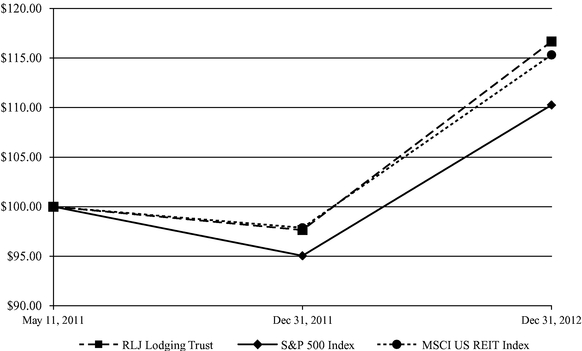
|
Name
|
Initial Investment at May 11, 2011 |
Value of Initial
Investment at Dec 31, 2011 |
Value of
Investment at Dec 31, 2012 |
|||||||
|---|---|---|---|---|---|---|---|---|---|---|
|
RLJ Lodging Trust |
$ | 100.00 | $ | 97.64 | $ | 116.67 | ||||
|
S&P 500 Index |
$ | 100.00 | $ | 95.05 | $ | 110.26 | ||||
|
MSCI US REIT Index |
$ | 100.00 | $ | 97.87 | $ | 115.32 | ||||
This performance graph shall not be deemed "filed" for the purposes of Section 18 of the Securities Exchange Act of 1934, as amended, or incorporated by reference into any filing by us under the Securities Act of 1933, as amended, or the Securities Exchange Act except as shall be expressly set forth by specific reference in such filing.
Shareholder Information
At February 20, 2013, we had 94 holders of record of our common shares. However, because many of our common shares are held by brokers and other institutions on behalf of shareholders, we believe there are substantially more beneficial holders of our common shares than record holders. At February 20, 2013, there were four holders (other than our company) of our OP units. Our OP units are redeemable for cash or, at our election, for our common shares.
In order to comply with certain requirements related to our qualification as a REIT, our declaration of trust provides that, subject to certain exceptions, no person or entity (other than a person or entity who has been granted an exception) may directly or indirectly, beneficially or constructively, own more than 9.8% of the aggregate of our outstanding common shares, by value or by
54
number of shares, whichever is more restrictive, or 9.8% of the aggregate of the outstanding preferred shares of any class or series, by value or by number of shares, whichever is more restrictive.
Distribution Information
We intend, over time, to make regular quarterly distributions to our common shareholders. In order to qualify and maintain our qualification for taxation as a REIT, we intend to make annual distributions to our shareholders of at least 90% of our taxable income, determined without regard to the deduction for dividends paid and excluding any net capital gain.
The credit agreement governing our $300 million unsecured revolving credit facility and our $275 million unsecured term loan limits our ability to pay cash dividends. However, so long as no default or event of default exists, the credit agreement allows us to pay cash dividends with respect to any period of four fiscal quarters in an amount not to exceed (i) 95% of adjusted funds from operations (as defined in the credit agreement), (ii) the amount required for us to maintain our status as a REIT (including the right to distribute 100% of net capital gain) under Sections 856 through 860 of the Code, and (iii) the amount necessary for us to avoid income or excise tax under the Code. If certain defaults or events of default exist, we may pay cash dividends with respect to any fiscal year in an aggregate amount not to exceed the greater of (x) the minimum amount required for us to maintain our status as a REIT under Sections 856 through 860 of the Code, or (y) the amount necessary to avoid income or excise tax under the Code. In addition, the term loan agreement governing our unsecured term loan of $125 million contains the same restrictions related to payment of dividends as contained in the credit agreement described above.
Any future distributions will be at the sole discretion of our board of trustees, and their form, timing and amount, if any, will depend upon a number of factors, including our actual and projected financial condition, liquidity, EBITDA, FFO and results of operations, the revenue we actually receive from our properties, our operating expenses, our debt service requirements, our capital expenditures, prohibitions and other limitations under our financing arrangements, as described above, our REIT taxable income, the annual REIT distribution requirements, applicable law and such other factors as our board of trustees deems relevant. To the extent that our cash available for distribution is less than 90% of our REIT taxable income, we may consider various means to cover any such shortfall, including borrowing under our unsecured revolving credit facility or other loans, selling certain of our assets or using a portion of the net proceeds we receive from offerings of equity, equity-related or debt securities or declaring taxable share dividends.
Unregistered Sales of Equity Securities
The Company did not sell any securities during the fiscal year ended December 31, 2012 that were not registered under the Securities Act of 1933, as amended.
Issuer Purchases of Equity Securities
During the year ended December 31, 2012, certain of our employees surrendered common shares owned by them to satisfy their statutory minimum federal and state tax obligations associated with the vesting of restricted common shares of beneficial interest issued under our 2011 Equity Incentive Plan, or the 2011 Plan.
55
The following table summarizes all of these repurchases during the year ended December 31, 2012.
|
Period
|
Total number
of shares purchased |
Average price
paid per share |
Total number of
shares purchased as part of publicly announced plans or programs |
Maximum number
of shares that may yet be purchased under the plans or programs |
|||||||||
|---|---|---|---|---|---|---|---|---|---|---|---|---|---|
|
January 1, 2012 through January 31, 2012 |
— | — | N/A | N/A | |||||||||
|
February 1, 2012 through February 29, 2012 |
24,128 | (1) | $ | 18.15 | — | N/A | |||||||
|
March 1, 2012 through March 31, 2012 |
536 | (1) | $ | 17.44 | — | N/A | |||||||
|
April 1, 2012 through April 30, 2012 |
— | — | N/A | N/A | |||||||||
|
May 1, 2012 through May 31, 2012 |
25,264 | (1) | $ | 18.44 | — | N/A | |||||||
|
June 1, 2012 through June 30, 2012 |
9,537 | (1) | $ | 17.29 | — | N/A | |||||||
|
July 1, 2012 through July 31, 2012 |
— | — | N/A | N/A | |||||||||
|
August 1, 2012 through August 31, 2012 |
25,368 | (1) | $ | 17.60 | — | N/A | |||||||
|
September 1, 2012 through September 30, 2012 |
10,085 | (1) | $ | 17.90 | — | N/A | |||||||
|
October 1, 2012 through October 31, 2012 |
— | — | N/A | N/A | |||||||||
|
November 1, 2012 through November 30, 2012 |
26,841 | (1) | $ | 17.19 | — | N/A | |||||||
|
December 1, 2012 through December 31, 2012 |
10,072 | (1) | $ | 18.59 | — | N/A | |||||||
|
Total year ended December 31, 2012 |
131,831 | ||||||||||||
- (1)
- The number of shares purchased represents common shares surrendered by certain of our employees to satisfy their statutory minimum federal and state tax obligations associated with the vesting of restricted common shares of beneficial interest issued under our 2011 Equity Incentive Plan. With respect to these shares, the price paid per share is based on the closing price of our common shares as of the date of the determination of the statutory minimum federal and state tax obligations.
Share Repurchase Plan
In November 2011, our Board of Trustees authorized a share repurchase plan to acquire up to $100.0 million of our common shares. Under this plan, we may repurchase our own common shares from time to time, in amounts and prices, as we deem appropriate, all subject to market conditions and other considerations, including available investment alternatives and capital availability. Under the terms of the share repurchase program, repurchases can be made in the open market or in privately negotiated transactions, including from our legacy investors. The program does not obligate us to acquire any specified amount of common shares and, may be modified or suspended at any time at our discretion. We did not elect to repurchase any shares under the share repurchase plan in 2012.
56
The following selected historical combined financial information should be read in conjunction with "Management's Discussion and Analysis of Financial Condition and Results of Operations" and the historical combined consolidated financial statements as of December 31, 2012 and 2011 and for the three years ended December 31, 2012, 2011 and 2010, and the related notes included elsewhere in this Annual Report on Form 10-K.
We completed our IPO, on May 16, 2011. Due to the timing of the IPO, we present herein certain combined consolidated historical financial data for us and our predecessor. Our predecessor was not a legal entity, but rather a combination of the real estate hospitality assets, liabilities and operations of Fund II and Fund III and substantially all of the assets, liabilities and operations of RLJ Development. The historical combined consolidated financial data for our predecessor is not necessarily indicative of our results of operations, cash flows or financial position following the completion of the IPO.
The selected historical combined financial information as of and for the years ended December 31, 2012, 2011, 2010, 2009 and 2008 has been derived from our audited historical financial statements. Due to the timing of the IPO, the results of operations for the years ended December 31, 2010, 2009 and 2008 reflect the financial condition and results of operations of our predecessor. The results of operations for the year ended December 31, 2011 reflect the financial condition and results of operations of our predecessor together with our company.
|
|
Year Ended December 31, | |||||||||||||||
|---|---|---|---|---|---|---|---|---|---|---|---|---|---|---|---|---|
|
|
Historical Combined Consolidated | |||||||||||||||
|
|
2012 | 2011 | 2010 | 2009 | 2008 | |||||||||||
|
|
(In thousands, except share and per share data)
|
|||||||||||||||
|
Statement of Operations Data: |
||||||||||||||||
|
Revenues: |
||||||||||||||||
|
Room revenue |
$ | 742,618 | $ | 656,997 | $ | 445,630 | $ | 389,622 | $ | 438,388 | ||||||
|
Other hotel revenue |
111,587 | 101,955 | 71,036 | 66,139 | 79,114 | |||||||||||
|
Total revenue |
854,205 | 758,952 | 516,666 | 455,761 | 517,502 | |||||||||||
|
Expenses: |
||||||||||||||||
|
Room expense |
163,374 | 147,039 | 96,389 | 84,131 | 90,475 | |||||||||||
|
Other hotel expense |
349,227 | 314,264 | 215,438 | 195,268 | 215,290 | |||||||||||
|
Total hotel operating expense |
512,601 | 461,303 | 311,827 | 279,399 | 305,765 | |||||||||||
|
Depreciation and amortization |
126,798 | 128,112 | 96,940 | 91,503 | 80,105 | |||||||||||
|
Property tax, insurance and other |
53,091 | 46,605 | 32,500 | 33,191 | 32,002 | |||||||||||
|
Impairment loss |
896 | — | — | 61,426 | 21,472 | |||||||||||
|
General and administrative(1) |
31,099 | 24,253 | 19,542 | 18,208 | 18,784 | |||||||||||
|
Transaction, pursuit and organization costs |
3,520 | 3,996 | 14,345 | 8,665 | 2,100 | |||||||||||
|
IPO Costs |
— | 10,733 | — | — | — | |||||||||||
|
Total operating expenses |
728,005 | 675,002 | 475,154 | 492,392 | 460,228 | |||||||||||
|
Operating income/(loss) |
126,200 | 83,950 | 41,512 | (36,631 | ) | 57,274 | ||||||||||
|
Interest and other income |
1,485 | 2,683 | 3,981 | 1,573 | 2,303 | |||||||||||
|
Interest expense |
(84,997 | ) | (96,020 | ) | (86,735 | ) | (87,849 | ) | (88,656 | ) | ||||||
|
Income (loss) before provision for income tax (expense)/ benefit |
42,688 | (9,387 | ) | (41,242 | ) | (122,907 | ) | (29,079 | ) | |||||||
|
Income tax (expense)/benefit |
(1,369 | ) | (740 | ) | (945 | ) | (1,801 | ) | 945 | |||||||
|
Net income (loss) from continuing operations |
41,319 | (10,127 | ) | (42,187 | ) | (124,708 | ) | (28,134 | ) | |||||||
|
Net (income) loss attributable to noncontrolling interests |
(21 | ) | (302 | ) | 213 | — | — | |||||||||
|
Distributions to preferred shareholders |
— | (61 | ) | (62 | ) | (62 | ) | (61 | ) | |||||||
|
Net income (loss) from continuing operations available to shareholders/owners |
$ | 41,298 | $ | (10,490 | ) | $ | (42,036 | ) | $ | (124,770 | ) | $ | (28,195 | ) | ||
57
|
|
Year Ended December 31, | |||||||||||||||
|---|---|---|---|---|---|---|---|---|---|---|---|---|---|---|---|---|
|
|
Historical Combined Consolidated | |||||||||||||||
|
|
2012 | 2011 | 2010 | 2009 | 2008 | |||||||||||
|
|
(In thousands, except share and per share data)
|
|||||||||||||||
|
Balance Sheet Data: |
||||||||||||||||
|
Investment in hotels, net |
$ | 3,073,483 | $ | 2,820,457 | $ | 2,626,690 | $ | 1,877,583 | $ | 1,905,653 | ||||||
|
Cash and cash equivalents |
115,861 | 310,231 | 267,454 | 151,382 | 156,181 | |||||||||||
|
Total assets |
3,346,385 | 3,290,018 | 3,045,824 | 2,202,865 | 2,213,108 | |||||||||||
|
Total debt |
1,413,651 | 1,341,735 | 1,747,077 | 1,598,991 | 1,448,872 | |||||||||||
|
Total other liabilities |
124,823 | 114,295 | 75,014 | 118,127 | 143,504 | |||||||||||
|
Total owners' equity |
1,807,911 | 1,833,988 | 1,223,733 | 485,747 | 620,732 | |||||||||||
|
Per Share Data: |
||||||||||||||||
|
Basic income (loss) from continuing operations per share |
$ | 0.38 | $ | (0.11 | ) | |||||||||||
|
Diluted income (loss) from continuing operations per share(2) |
$ | 0.38 | $ | (0.11 | ) | |||||||||||
|
Weighted average shares outstanding—basic |
105,423,604 | 95,340,666 | ||||||||||||||
|
Weighted average shares outstanding—diluted(2) |
105,748,686 | 95,340,666 | ||||||||||||||
|
Dividends declared per share |
$ | 0.70 | $ | 0.38 | ||||||||||||
- (1)
-
The
general and administrative expense includes non-cash share compensation expense amortization for restricted share grants of $8,626 and
$3,284 for the years ended December 31, 2012 and 2011, respectively.
- (2)
- Income (loss) allocated to noncontrolling interest in our operating partnership has been excluded from the numerator, and OP units of our operating partnership have been omitted from the denominator, since the effect of including these amounts in the numerator and denominator would have no impact.
58
The following discussion and analysis should be read in conjunction with the accompanying consolidated financial statements, related notes included thereto and Item 1.A., "Risk Factors", appearing elsewhere in this Annual Report on Form 10-K.
Overview
We are a self-advised and self-administered Maryland real estate investment trust, which acquires primarily premium-branded, focused-service and compact full-service hotels. As of December 31, 2012, we owned 145 hotels in 21 states and the District of Columbia comprising 21,617 suites/rooms. We are one of the largest U.S. publicly-traded lodging REITs in terms of both number of hotels and number of rooms. Our hotels are concentrated in urban and dense suburban markets that we believe generally exhibit multiple demand generators and high barriers to entry.
Our strategy is to acquire primarily premium-branded, focused-service and compact full-service hotels. Focused-service hotels typically generate most of their revenue from room rentals, have limited food and beverage outlets and meeting space and require fewer employees than traditional full-service hotels. We believe premium-branded, focused-service and compact full-service hotels have the potential to generate attractive returns relative to other types of hotels due to their ability to achieve RevPAR levels at or close to those achieved by traditional full-service hotels while achieving higher profit margins due to their more efficient operating model and less volatile cash flows.
We recognize the challenging geopolitical environment and the possibility that the current economic recovery might not be as robust as anticipated or that economic conditions could deteriorate. However, with growth in lodging supply expected to be below historical averages for the next few years and corporate profits rising, we currently do not anticipate any significant slowdown in lodging fundamentals. Accordingly, we remain cautiously optimistic that we are in the midst of a multiyear lodging recovery.
Furthermore, we believe that attractive acquisition opportunities that meet our investment profile remain available in the market. We believe our cash on hand and expected access to capital (including availability under our unsecured revolving credit facility) along with our senior management team's experience, extensive industry relationships and asset management expertise, will enable us to compete effectively for such acquisitions and enable us to generate additional internal and external growth.
Our Customers
Substantially all of our hotels consist of premium-branded focused-service and compact full-service hotels. As a result of this property profile, the majority of our customers are transient in nature. Transient business typically represents individual business or leisure travelers. The majority of our hotels are located in the business districts and suburban markets of major metropolitan areas. Accordingly, business travelers represent the majority of the transient demand at our hotels. As a result, macroeconomic factors impacting business travel have a greater effect on our business than factors impacting leisure travel.
Group business is typically defined as a minimum of 10 guestrooms booked together as part of the same piece of business. Group business may or may not use the meeting space at any given hotel. Given the limited meeting space at the majority of our hotels, group business represents a smaller component of our customer base.
A number of our hotels are affiliated with brands marketed toward extended-stay customers. Extended-stay customers are generally defined as those staying five nights or longer. Reasons for extended-stays may include, but are not limited to, training and/or special project business, relocation, litigation and insurance claims.
59
Our Revenues and Expenses
Our revenue is derived from hotel operations, including the sale of rooms, food and beverage revenue and other operating department revenue, which consist of telephone, parking and other guest services.
Our operating costs and expenses consist of the costs to provide hotel services, including room expense, food and beverage expense, management fees and other hotel expenses. Room expense includes housekeeping wages and payroll taxes, reservation systems, room supplies, laundry services and front desk costs. Food and beverage expense primarily includes the cost of food, the cost of beverages and associated labor costs. Other hotel expenses include labor and other costs associated with the other operating department revenue, as well as labor and other costs associated with administrative departments, franchise fees, sales and marketing, repairs and maintenance and utility costs. Our hotels are managed by independent, third-party management companies under long-term agreements under which the management companies typically earn base and incentive management fees based on the levels of revenues and profitability of each individual hotel. We generally receive a cash distribution from the hotel management companies on a monthly basis, which reflects hotel-level sales less hotel-level operating expenses.
Key Indicators of Operating Performance
We use a variety of operating and other information to evaluate the operating performance of our business. These key indicators include financial information that is prepared in accordance with GAAP as well as other financial measures that are non-GAAP measures. In addition, we use other information that may not be financial in nature, including industry standard statistical information and comparative data. We use this information to measure the operating performance of our individual hotels, groups of hotels and/or business as a whole. We also use these metrics to evaluate the hotels in our portfolio and potential acquisitions to determine each hotel's contribution to cash flow and its potential to provide attractive long-term total returns. These key indicators include:
- •
-
Occupancy
—Occupancy represents the total number of hotel rooms
sold in a given period divided by the total number of rooms available. Occupancy measures the utilization of our hotels' available capacity. We use occupancy to measure demand at a specific hotel or
group of hotels in a given period. Additionally, occupancy levels help us determine achievable ADR levels.
- •
-
Average Daily Rate (ADR)
—ADR represents total hotel room
revenues divided by total number of rooms sold in a given period. ADR measures average room price attained by a hotel and ADR trends provide useful information concerning the pricing environment and
the nature of the customer base of a hotel or group of hotels. We use ADR to assess the pricing levels that we are able to generate, as changes in rates have a greater impact on operating margins and
profitability than changes in occupancy.
- •
-
Revenue Per Available Room (RevPAR)
—RevPAR is the product of
ADR and occupancy. RevPAR does not include non-room revenues such as food and beverage revenue or other operating department revenues. We use RevPAR to identify trend information with
respect to room revenues from comparable properties and to evaluate hotel performance on a regional basis.
RevPAR changes that are primarily driven by changes in occupancy have different implications for overall revenues and profitability than changes that are driven primarily by changes in ADR. For example, an increase in occupancy at a hotel would lead to additional variable operating costs (including housekeeping services, utilities and room supplies) and could also result in increased other operating department revenue and expense. Changes in ADR typically have a
60
greater impact on operating margins and profitability as they only have a limited effect on variable operating costs.
Occupancy, ADR and RevPAR are commonly used measures within the lodging industry to evaluate operating performance. RevPAR is an important statistic for monitoring operating performance at the individual hotel level and across our entire business. We evaluate individual hotel RevPAR performance on an absolute basis with comparisons to budget and prior periods, as well as on a regional and company-wide basis. ADR and RevPAR include only room revenue. Room revenue comprised approximately 86.9% of our total revenue for the year ended December 31, 2012 and is dictated by demand (as measured by occupancy), pricing (as measured by ADR) and our available supply of hotel rooms.
Another commonly used measure in the lodging industry is the RevPAR penetration index, which measures a hotel's RevPAR in relation to the average RevPAR of that hotel's competitive set. Like other lodging companies, we use the RevPAR penetration index as an indicator of a hotel's market share in relation to its competitive set. However, the RevPAR penetration index for a particular hotel is not necessarily reflective of that hotel's relative share of any particular lodging market. The RevPAR penetration index for a particular hotel is calculated as the quotient of (1) the subject hotel's RevPAR divided by (2) the average RevPAR of the hotels in the subject hotel's competitive set, multiplied by 100. For example, if a hotel's RevPAR is $90 and the average RevPAR of the hotels in its competitive set is $90, the RevPAR penetration index would be 100, which would indicate that the subject hotel is capturing its fair market share in relation to its competitive set (i.e., the hotel's RevPAR is, on average, the same as its competitors). If, however, a hotel's RevPAR is $110 and the average RevPAR of the hotels in its competitive set is $90, the RevPAR penetration index of the subject hotel would be 122.2, which would indicate that the subject hotel maintains a RevPAR premium of approximately 22.2% (and, therefore, a market share premium) in relation to its competitive set.
One critical component in this calculation is the determination of a hotel's competitive set, which consists of a small group of hotels in the relevant market that we and the third-party hotel management company that manages the hotel believe are comparable for purposes of benchmarking the performance of such hotel. A hotel's competitive set is mutually agreed upon by us and the hotel's management company. Factors that we consider when establishing a competitive set include geographic proximity, brand affiliations and rate structure, as well as the level of service provided at the hotel. Competitive set determinations are highly subjective, however, and our methodology for determining a hotel's competitive set may differ materially from those used by other hotel owners and/or management companies.
For the year ended December 31, 2012, the portfolio wide RevPAR penetration index of our hotels was 111.2 which indicates that, on average, our hotels maintained a market share premium of approximately 11.2% in relation to their competitive set.
We also use FFO, Adjusted FFO, EBITDA and Adjusted EBITDA as non-GAAP measures of the operating performance of our business. See "—Non-GAAP Financial Measures."
Principal Factors Affecting Our Results of Operations
The principal factors affecting our operating results include overall demand for hotel rooms compared to the supply of available hotel rooms, and the ability of our third-party management companies to increase or maintain revenues while controlling expenses.
- •
- Demand —The demand for lodging, especially business travel, generally fluctuates with the overall economy. Historically, periods of declining demand are followed by extended periods of relatively strong demand, which typically occurs during the growth phase of the lodging cycle.
61
- •
- Supply —The development of new hotels is driven largely by construction costs, the availability of financing and expected performance of existing hotels.
We expect that our ADR, occupancy and RevPAR performance will be impacted by macroeconomic factors such as regional and local employment growth, personal income and corporate earnings, office vacancy rates and business relocation decisions, airport activity, business and leisure travel demand, new hotel construction and the pricing strategies of competitors. In addition, our ADR, occupancy and RevPAR performance are dependent on the continued success of the Marriott, Hilton and Hyatt brands.
- •
-
Revenue
—
Substantially all of our
revenue is derived from the operation of hotels. Specifically, our revenue is comprised of:
- •
-
Room revenue—
Occupancy and ADR are the major drivers of room
revenue. Room revenue accounts for the substantial majority of our total revenue.
- •
-
Food and beverage revenue—
Occupancy and the type of customer
staying at the hotel are the major drivers of food and beverage revenue (i.e., group business typically generates more food and beverage business through catering functions when compared to
transient business, which may or may not utilize the hotel's food and beverage outlets).
- •
-
Other operating department revenue—
Occupancy and the nature of
the property are the main drivers of other ancillary revenue, such as telephone, parking and other guest services. Some hotels, due to the limited focus of the services offered and size or space
limitations, may not have facilities that generate other operating department revenue.
- •
-
Hotel Operating Expenses
—
The following
presents the components of our hotel operating expenses:
- •
-
Room expense—
These costs include housekeeping wages and
payroll taxes, reservation systems, room supplies, laundry services and front desk costs. Like room revenue, occupancy is the major driver of room expense and, therefore, room expense has a
significant correlation to room revenue. These costs can increase based on increases in salaries and wages, as well as the level of service and amenities that are provided.
- •
-
Food and beverage expense—
These expenses primarily include
food, beverage and labor costs. Occupancy and the type of customer staying at the hotel (i.e., catered functions generally are more profitable than restaurant, bar or other
on-property food and beverage outlets) are the major drivers of food and beverage expense, which correlates closely with food and beverage revenue.
- •
-
Management fees—
Base management fees are computed as a
percentage of gross revenue. Incentive management fees generally are paid when operating profits exceed certain threshold levels. See "Our Properties—Our Hotel Management Agreements."
- •
- Other hotel expenses— These expenses include labor and other costs associated with the other operating department revenue, as well as labor and other costs associated with administrative departments, franchise fees, sales and marketing, repairs and maintenance and utility costs.
Most categories of variable operating expenses, including labor costs such as housekeeping, fluctuate with changes in occupancy. Increases in occupancy are accompanied by increases in most categories of variable operating expenses, while increases in ADR typically only result in increases in limited categories of operating costs and expenses, such as franchise fees, management fees and credit card processing fee expenses which are based on hotel revenues. Thus, changes in ADR have a more significant impact on operating margins than changes in occupancy.
62
Results of Operations
At December 31, 2012, 2011 and 2010, we owned 145, 141 and 131 hotels, respectively (excluding one hotel and seven hotels carried as discontinued operations for the years ended December 31, 2011 and 2010, respectively). All hotels owned during these periods, excluding discontinued operations, have been included in our results of operations during those respective periods or since their date of acquisition. Operating results for certain hotels are not comparable for the years ended December 31, 2012, 2011 and 2010. The hotels listed in the table below are hereafter referred to as non-comparable hotels.
|
|
|
|
Noncomparable hotel for the
|
||||||
|---|---|---|---|---|---|---|---|---|---|
|
Hotel
|
Location | Acquisition Date |
years ended
December 31, 2012 and 2011 |
years ended
December 31, 2011 and 2010 |
|||||
|
Fairfield Inn & Suites Washington DC/Downtown(1) |
Washington DC | June 1, 2010 | x | x | |||||
|
Hotel Indigo New Orleans Garden District(2) |
New Orleans, LA | October 26, 2010 | x | x | |||||
|
Embassy Suites Columbus |
Columbus, OH | January 11, 2011 | x | ||||||
|
Renaissance Pittsburgh Hotel |
Pittsburgh, PA | January 12, 2011 | x | ||||||
|
Courtyard Atlanta Buckhead |
Atlanta, GA | January 18, 2011 | x | ||||||
|
Doubletree Hotel Columbia |
Columbia, MD | January 18, 2011 | x | ||||||
|
Denver Airport Marriott at Gateway Park |
Denver, CO | January 18, 2011 | x | ||||||
|
Embassy Suites West Palm Beach-Central |
West Palm Beach, FL | January 18, 2011 | x | ||||||
|
Hilton Garden Inn Raleigh Durham-Research Triangle Park |
Durham, NC | January 24, 2011 | x | ||||||
|
Hilton Garden Inn Pittsburgh University Place |
Pittsburgh, PA | January 24, 2011 | x | ||||||
|
Hampton Inn Houston-Near the Galleria |
Houston, TX | March 14, 2011 | x | x | |||||
|
Courtyard Charleston Historic District |
Charleston, SC | October 27, 2011 | x | x | |||||
|
Residence Inn Bethesda Hotel Downtown |
Bethesda, MD | May 29, 2012 | x | n/a | |||||
|
Courtyard New York/Manhattan Upper East Side |
New York, NY | May 30, 2012 | x | n/a | |||||
|
Hilton Garden Inn San Francisco/Oakland Bay Bridge |
Emeryville, CA | June 11, 2012 | x | n/a | |||||
|
Embassy Suites Boston/Waltham |
Waltham, MA | November 13, 2012 | x | n/a | |||||
- (1)
-
Property
was closed for renovation from December 18, 2010 until March 29, 2011.
- (2)
- Property was closed for renovation until December 27, 2012.
63
Comparison of the Year Ended December 31, 2012 to the Year Ended December 31, 2011
Income from continuing operations for the year ended December 31, 2012 was $41.3 million compared to a loss from continuing operations of $10.1 million for the year ended December 31, 2011, representing an increase of $51.4 million. This improved performance was primarily due to a $95.3 million, or 12.6%, increase in total revenue (including $42.0 million arising from non-comparable hotels), partially offset by the net impact of a $51.3 million, or 11.1%, increase in hotel operating expenses, an increase of $2.1 million or 1.0% in other operating expenses, a decrease in other income of $0.6 million and a decrease in interest expense of $11.0 million, or 11.5%.
|
|
For the year ended December 31, |
|
|
||||||||||
|---|---|---|---|---|---|---|---|---|---|---|---|---|---|
|
|
2012 | 2011 | $ change | % change | |||||||||
|
|
(amounts in thousands)
|
|
|||||||||||
|
Revenue |
|||||||||||||
|
Hotel operating revenue |
|||||||||||||
|
Room revenue |
$ | 742,618 | $ | 656,997 | $ | 85,621 | 13.0 | % | |||||
|
Food and beverage revenue |
87,610 | 81,781 | 5,829 | 7.1 | % | ||||||||
|
Other operating department revenue |
23,977 | 20,174 | 3,803 | 18.9 | % | ||||||||
|
Total revenue |
854,205 | 758,952 | 95,253 | 12.6 | % | ||||||||
|
Expense |
|||||||||||||
|
Hotel operating expense |
|||||||||||||
|
Room |
163,374 | 147,039 | 16,335 | 11.1 | % | ||||||||
|
Food and beverage |
60,508 | 56,606 | 3,902 | 6.9 | % | ||||||||
|
Management fees |
30,075 | 26,056 | 4,019 | 15.4 | % | ||||||||
|
Other hotel expenses |
258,644 | 231,602 | 27,042 | 11.7 | % | ||||||||
|
Total hotel operating expense |
512,601 | 461,303 | 51,298 | 11.1 | % | ||||||||
|
Depreciation and amortization |
126,798 | 128,112 | (1,314 | ) | (1.0 | )% | |||||||
|
Impairment loss |
896 | — | 896 | — | |||||||||
|
Property tax, insurance and other |
53,091 | 46,605 | 6,486 | 13.9 | % | ||||||||
|
General and administrative |
31,099 | 24,253 | 6,846 | 28.2 | % | ||||||||
|
Transaction and pursuit costs |
3,520 | 3,996 | (476 | ) | (11.9 | )% | |||||||
|
IPO Costs |
— | 10,733 | (10,733 | ) | (100.0 | )% | |||||||
|
Total operating expense |
728,005 | 675,002 | 53,003 | 7.9 | % | ||||||||
|
Operating income |
126,200 | 83,950 | 42,250 | 50.3 | % | ||||||||
|
Other income |
433 | 1,001 | (568 | ) | (56.7 | )% | |||||||
|
Interest income |
1,686 | 1,682 | 4 | 0.2 | % | ||||||||
|
Interest expense |
(84,997 | ) | (96,020 | ) | 11,023 | (11.5 | )% | ||||||
|
Loss on disposal |
(634 | ) | — | (634 | ) | — | |||||||
|
Income (loss) from continuing operations before income taxes |
42,688 | (9,387 | ) | 52,075 | 554.8 | % | |||||||
|
Income tax expense |
(1,369 | ) | (740 | ) | (629 | ) | 85.0 | % | |||||
|
Income (loss) from continuing operations |
41,319 | (10,127 | ) | 51,446 | (508.0 | )% | |||||||
|
Income from discontinued operations |
— | 21,836 | (21,836 | ) | (100.0 | )% | |||||||
|
Net income |
41,319 | 11,709 | 29,610 | 252.9 | % | ||||||||
|
Net (income) loss attributable to non-controlling interests |
|||||||||||||
|
Noncontrolling interest in joint venture |
404 | (47 | ) | 451 | (959.6 | )% | |||||||
|
Noncontrolling interest in common units of Operating Partnership |
(425 | ) | (255 | ) | (170 | ) | (66.7 | )% | |||||
|
Net income attributable to the Company |
41,298 | 11,407 | 29,891 | 262.0 | % | ||||||||
|
Distributions to preferred unitholders |
— | (61 | ) | 61 | (100.0 | )% | |||||||
|
Net income attributable to common shareholders |
$ | 41,298 | $ | 11,346 | $ | 29,952 | 264.0 | % | |||||
64
Revenue
Total revenue increased $95.3 million, or 12.6%, to $854.2 million for the year ended December 31, 2012 from $759.0 million for the year ended December 31, 2011. The increase was a result of $42.0 million in revenue attributable to non-comparable hotels and the effects of improving economic conditions as demonstrated by a 6.8% increase in RevPAR for properties held for the entirety of both periods.
The following are the key hotel operating statistics for hotels owned at December 31, 2012 and 2011, respectively, for our ownership period:
|
|
For the year ended
December 31, |
|
||||||||
|---|---|---|---|---|---|---|---|---|---|---|
|
|
2012 | 2011 | % Change | |||||||
|
Number of hotels (at end of period) |
145 | 141 | 2.8 | % | ||||||
|
Occupancy % |
72.6 | % | 71.5 | % | 1.6 | % | ||||
|
ADR |
$ | 133.35 | $ | 124.50 | 7.1 | % | ||||
|
RevPAR |
$ | 96.82 | $ | 88.99 | 8.8 | % | ||||
Portfolio RevPAR increased to $96.82 from $88.99, representing an 8.8% increase. For the comparable hotels, RevPAR increased 6.8% and was driven by a 1.1% increase in occupancy and a 5.7% increase in ADR. The addition of new hotels to the portfolio drove occupancy up by 0.3% and increased ADR by $2.24 for a total RevPAR impact of $2.05.
Room Revenue —Our portfolio consists primarily of premium-branded focused-service and compact full-service hotels that generate the majority of their revenues through room sales. Room revenue increased $85.6 million, or 13.0%, to $742.6 million for the year ended December 31, 2012 from $657.0 million for the year ended December 31, 2011. The increase was primarily due to $37.3 million of room revenue from non-comparable hotels and a 6.8% RevPAR growth at comparable hotels.
Food and Beverage Revenue —Food and beverage revenue increased $5.8 million, or 7.1%, to $87.6 million for the year ended December 31, 2012 from $81.8 million for the year ended December 31, 2011. The increase includes $3.0 million in food and beverage revenue arising from non-comparable hotels.
Other Operating Department Revenue —Other operating department revenue, which includes revenue derived from ancillary sources such as telephone charges and parking fees, increased $3.8 million, or 18.9%, to $24.0 million for the year ended December 31, 2012 from $20.2 million for the year ended December 31, 2011. The increase is the result of $1.7 million in other operating revenue from non-comparable hotels, an increase of $1.5 million of parking revenue across the portfolio and an increase of $0.6 million of other operating revenue.
Hotel Operating Expense
Hotel operating expense increased $51.3 million, or 11.1%, to $512.6 million for the year ended December 31, 2012 from $461.3 million for the year ended December 31, 2011. The increase includes $22.5 million in hotel operating expense attributed to non-comparable hotels. The remaining increase was primarily attributable to higher room expense, other operating department costs, and management and franchise fees. Room expense and other operating department costs were driven by higher occupancy at hotels not under renovation. Management fees and franchise fees, which are computed as a percentage of gross revenue and room revenue, respectively, increased as a result of higher revenues.
65
Depreciation and Amortization
Depreciation and amortization expense decreased $1.3 million, or 1.0%, to $126.8 million for the year ended December 31, 2012 from $128.1 million for the year ended December 31, 2011. The decrease is partially attributable to a net decrease of $2.9 million of accelerated depreciation. For the years ended 2012 and 2011, we recorded accelerated depreciation on furniture, fixtures and equipment of $4.7 million and $7.6 million, respectively, in conjunction with brand conversions under our 2011 capital improvement plan. Additionally, the decrease reflects approximately $69.3 million of furniture, fixtures and equipment that were fully depreciated during 2012. This decrease was offset by a $3.7 million increase in depreciation and amortization expense attributable to non-comparable hotels and a $9.1 million increase in depreciation on building and furniture, fixtures and equipment for property improvement capital expenditures made during 2012.
Impairment Loss
Impairment loss increased $0.9 million to $0.9 million for the year ended December 31, 2012 from zero for the year ended December 31, 2011, related to an impairment charge on the Fairfield Inn Memphis.
Property Tax, Insurance and Other
Property tax, insurance and other expense increased $6.5 million, or 13.9%, to $53.1 million for the year ended December 31, 2012 from $46.6 million for the year ended December 31, 2011. The increase includes $3.2 million in property tax, insurance and other expense attributable to non-comparable hotels. The remaining increase of $3.3 million is the net impact of increasing property tax assessments offset by favorable resolution of property tax appeals.
General and Administrative
General and administrative expense increased $6.8 million, or 28.2%, to $31.1 million for the year ended December 31, 2012 from $24.3 million for the year ended December 31, 2011. The increase in general and administrative expense is attributable to an increase in amortization of restricted share awards of $5.3 million, an increase in filing fees and other expenses of being a publicly traded company of $0.4 million and an increase in professional fees of $1.2 million.
Transaction and Pursuit Costs
Transaction and pursuit costs decreased $0.5 million, or 11.9%, to $3.5 million for the year ended December 31, 2012 from $4.0 million for the year ended December 31, 2011. There were four acquisitions in 2012, which resulted in transaction costs of $3.4 million in 2012. The ten acquisitions in 2011 resulted in transaction costs of $3.8 million incurred in 2011. Additionally, there was a net increase of $0.1 million of costs associated with unsuccessful acquisition efforts during the periods. Costs associated with unsuccessful acquisitions totaled $0.3 million in 2012 compared to $0.2 million in 2011.
IPO Costs
Non-recurring IPO and related formation transaction costs totaled $10.7 million for the year ended December 31, 2011. Such costs primarily arose as a result of the transfer and assumption of indebtedness and other contractual obligations of our predecessor in connection with the IPO and our formation transactions. There were no such costs for the year ended December 31, 2012.
66
Interest Expense
Interest expense decreased $11.0 million, or 11.5%, to $85.0 million for the year ended December 31, 2012 from $96.0 million for the year ended December 31, 2011. The decrease was primarily due to a decrease in interest expense on mortgage loans of $4.8 million, a decrease in interest expense on credit facilities and term loans of $2.8 million and the expiration of unfavorable interest rate hedges resulting in a decrease in hedge driven interest expense of $3.6 million. Additionally, in 2012, $1.5 million was incurred for the prepayment of mortgage indebtedness, compared to $2.9 million in 2011. Partially offsetting this decrease was $1.8 million that was reclassified from accumulated other comprehensive loss to interest expense related to hedges that were ineffective in offsetting variable cash flows.
Income Tax Expense
Income tax expense increased $0.7 million, or 85.0%, to $1.4 million for the year ended December 31, 2012 from $0.7 million for the year ended December 31, 2011. Tax expense incurred for 2012 was higher than 2011 due to the recording of a one-time benefit during 2011 related to the disposal of an acquired tax attribute of $0.6 million. As part of our structure, we own TRSs that are subject to federal and state income taxes. The TRSs' 2012 and 2011 effective tax rate was 6.2% and 1.7%, respectively.
Income from Discontinued Operations
Income from discontinued operations decreased $21.8 million to zero for the year ended December 31, 2012 from $21.8 million for the year ended December 31, 2011. Net income from discontinued operations for 2011 consisted of $21.8 million in net income, including a $23.5 million gain on extinguishment of indebtedness, from the New York LaGuardia Airport Marriott.
67
Comparison of the Year Ended December 31, 2011 to the Year Ended December 31, 2010
Net loss from continuing operations for the year ended December 31, 2011 was $10.1 million compared to a net loss from continuing operations of $42.2 million for the year ended December 31, 2010, representing a decrease of $32.1 million. This improved performance was primarily due to a $242.3 million, or 46.9%, increase in total revenue (including $210.3 million arising from non-comparable hotels), partially offset by the net impact of a $149.5 million, or 47.9%, increase in hotel operating expenses, an increase of $50.4 million or 30.1% in other operating expenses, an increase in other income of $0.4 million and an increase in interest expense of $9.3 million, or 10.7%.
|
|
For the year ended December 31, |
|
|
||||||||||
|---|---|---|---|---|---|---|---|---|---|---|---|---|---|
|
|
2011 | 2010 | $ change | % change | |||||||||
|
Revenue |
|||||||||||||
|
Hotel operating revenue |
|||||||||||||
|
Room revenue |
$ | 656,997 | $ | 445,630 | $ | 211,367 | 47.4 | % | |||||
|
Food and beverage revenue |
81,781 | 57,710 | 24,071 | 41.7 | % | ||||||||
|
Other operating department revenue |
20,174 | 13,326 | 6,848 | 51.4 | % | ||||||||
|
Total revenue |
758,952 | 516,666 | 242,286 | 46.9 | % | ||||||||
|
Expense |
|||||||||||||
|
Hotel operating expense |
|||||||||||||
|
Room |
147,039 | 96,389 | 50,650 | 52.5 | % | ||||||||
|
Food and beverage |
56,606 | 37,798 | 18,808 | 49.8 | % | ||||||||
|
Management fees |
26,056 | 18,373 | 7,683 | 41.8 | % | ||||||||
|
Other hotel expenses |
231,602 | 159,267 | 72,335 | 45.4 | % | ||||||||
|
Total hotel operating expense |
461,303 | 311,827 | 149,476 | 47.9 | % | ||||||||
|
Depreciation and amortization |
128,112 | 96,940 | 31,172 | 32.2 | % | ||||||||
|
Property tax, insurance and other |
46,605 | 32,500 | 14,105 | 43.4 | % | ||||||||
|
General and administrative |
24,253 | 19,542 | 4,711 | 24.1 | % | ||||||||
|
Transaction and pursuit costs |
3,996 | 14,345 | (10,349 | ) | (72.1 | )% | |||||||
|
IPO Costs |
10,733 | — | 10,733 | — | |||||||||
|
Total operating expense |
675,002 | 475,154 | 199,848 | 42.1 | % | ||||||||
|
Operating income |
83,950 | 41,512 | 42,438 | 102.2 | % | ||||||||
|
Other income |
1,001 | 629 | 372 | 59.1 | % | ||||||||
|
Interest income |
1,682 | 3,352 | (1,670 | ) | (49.8 | )% | |||||||
|
Interest expense |
(96,020 | ) | (86,735 | ) | (9,285 | ) | 10.7 | % | |||||
|
Loss from continuing operations before income taxes |
(9,387 | ) | (41,242 | ) | 31,855 | (77.2 | )% | ||||||
|
Income tax expense |
(740 | ) | (945 | ) | 205 | (21.7 | )% | ||||||
|
Loss from continuing operations |
(10,127 | ) | (42,187 | ) | 32,060 | (76.0 | )% | ||||||
|
Income from discontinued operations |
21,836 | 19,571 | 2,265 | 11.6 | % | ||||||||
|
Net income (loss) |
11,709 | (22,616 | ) | 34,325 | (151.8 | )% | |||||||
|
Net loss (income) attributable to non-controlling interests |
|||||||||||||
|
Noncontrolling interest in joint venture |
(47 | ) | 213 | (260 | ) | (122.1 | )% | ||||||
|
Noncontrolling interest in common units of Operating Partnership |
(255 | ) | — | (255 | ) | — | |||||||
|
Net income (loss) attributable to the Company |
11,407 | (22,403 | ) | 33,810 | (150.9 | )% | |||||||
|
Distributions to preferred unitholders |
(61 | ) | (62 | ) | 1 | (1.6 | )% | ||||||
|
Net income (loss) attributable to common shareholders |
$ | 11,346 | $ | (22,465 | ) | $ | 33,811 | (150.5 | )% | ||||
68
Revenue
Total revenue increased $242.3 million, or 46.9%, to $759.0 million for the year ended December 31, 2011 from $516.7 million for the year ended December 31, 2010. The increase was a result of $210.3 million in revenue attributable to ten hotels acquired in 2011 and fifteen hotels acquired in 2010 and the effects of improving economic conditions as demonstrated by a 7.4% increase in RevPAR for comparable hotels.
The following are the key hotel operating statistics for hotels owned at December 31, 2011 and 2010, respectively, for our ownership period:
|
|
For the Year Ended
December 31, |
|
||||||||
|---|---|---|---|---|---|---|---|---|---|---|
|
|
2011 | 2010 | % Change | |||||||
|
Number of hotels (at end of period) |
141 | 131 | 7.6 | % | ||||||
|
Occupancy % |
71.5 | % | 68.0 | % | 5.2 | % | ||||
|
ADR |
$ | 124.50 | $ | 110.98 | 12.2 | % | ||||
|
RevPAR |
$ | 88.99 | $ | 75.43 | 18.0 | % | ||||
Portfolio RevPAR increased to $88.99 from $75.43, representing an 18.0% increase. For the comparable hotels, RevPAR increased 7.4% and was driven by a 3.4% increase in occupancy and a 3.9% increase in ADR. The addition of new hotels to the portfolio drove occupancy up by 1.1% and increased ADR by $11.27 for a total RevPAR impact of $9.35.
Room Revenue —Our portfolio consists primarily of premium-branded focused-service and compact full-service hotels that generate the majority of their revenues through room sales. Room revenue increased $211.4 million, or 47.4%, to $657.0 million for the year ended December 31, 2011 from $445.6 million for the year ended December 31, 2010. The increase was primarily due to $130.6 million of room revenue from non-comparable hotels. The remaining increase was the result of a 7.4% RevPAR growth at comparable hotels.
Food and Beverage Revenue —Food and beverage revenue increased $24.1 million, or 41.7%, to $81.8 million for the year ended December 31, 2011 from $57.7 million for the year ended December 31, 2010. The increase includes $21.9 million in food and beverage revenue arising from non-comparable hotels.
Other Operating Department Revenue —Other operating department revenue, which includes revenue derived from ancillary sources, increased $6.8 million, or 51.4%, to $20.2 million for the year ended December 31, 2011 from $13.3 million for the year ended December 31, 2010. The increase is the result of $7.0 million in other operating revenue from non-comparable hotels.
Hotel Operating Expense
Hotel operating expense increased $149.5 million, or 47.9%, to $461.3 million for the year ended December 31, 2011 from $311.8 million for the year ended December 31, 2010. The increase includes $131.5 million in hotel operating expense attributed to non-comparable hotels. The remaining increase was primarily attributable to variable costs associated with increases in business activity, as reflected by our increase in occupancy of 3.4%.
Depreciation and Amortization
Depreciation and amortization expense increased $31.2 million, or 32.2%, to $128.1 million for the year ended December 31, 2011 from $96.9 million for the year ended December 31, 2010. The increase reflects a $26.3 million increase in depreciation and amortization expense attributable to non-comparable hotels, a $10.1 million increase in depreciation on building and furniture, fixtures and
69
equipment for property improvement capital expenditures made during 2011, and an increase of $7.6 million related to the accelerated depreciation of furniture, fixtures and equipment at certain hotels that underwent renovations during the year. The increase was partially offset primarily due to approximately $124.7 million of furniture, fixtures and equipment that were fully depreciated during 2011.
Property Tax, Insurance and Other
Property tax, insurance and other expense increased $14.1 million, or 43.4%, to $46.6 million for the year ended December 31, 2011 from $32.5 million for the year ended December 31, 2010. The increase includes $12.6 million in property tax, insurance and other expense attributable to non-comparable hotels. The remaining increase of $1.5 million is the net impact of increasing property tax assessments offset by favorable resolution of property tax appeals.
General and Administrative
General and administrative expense increased $4.7 million, or 24.1%, to $24.3 million for the year ended December 31, 2011 from $19.5 million for the year ended December 31, 2010. The majority of the increase in general and administrative expense is the result of our IPO and is attributable to amortization of restricted share awards of $3.3 million related to restricted shares issued in 2011, an increase in salaries and associated payroll taxes of $0.9 million, filing fees and other expenses of being a publicly traded company of $0.5 million and an increase in professional fees of $0.4 million. This increase was partially offset by a decrease in legal fees of $0.6 million related to the settlement and reinstatement of our investment in loans in 2010.
Transaction and Pursuit Costs
Transaction and pursuit costs decreased $10.3 million, or 72.1%, to $4.0 million for the year ended December 31, 2011 from $14.3 million for the year ended December 31, 2010. There were 24 acquisitions in 2010 and the first quarter of 2011, which resulted in transaction costs of $13.2 million in 2010. The ten acquisitions in 2011 resulted in transaction costs of $3.8 million incurred in 2011. Additionally, there was a net decrease of $1.0 million of costs associated with unsuccessful acquisition efforts during the periods. Costs associated with unsuccessful acquisitions totaled $0.2 million in 2011 compared to $1.2 million in 2010.
IPO Costs
Non-recurring IPO and related formation transaction costs totaled $10.7 million for the year ended December 31, 2011. Such costs primarily arose as a result of the transfer and assumption of indebtedness and other contractual obligations of our Predecessor in connection with the IPO and our formation transactions. There were no such costs for the year ended December 31, 2010.
Interest Income
Interest income decreased $1.7 million, or 49.8%, to $1.7 million for the year ended December 31, 2011 from $3.4 million for the year ended December 31, 2010. This decrease was primarily due to a $1.4 million decline in interest income recognized for the year ended December 31, 2011 arising from interest on our investment in loans in 2010, including $0.8 million of default interest.
Interest Expense
Interest expense increased $9.3 million, or 10.7%, to $96.0 million for the year ended December 31, 2011 from $86.7 million for the year ended December 31, 2010. Interest expense increased as a result of $14.9 million in additional interest expense arising from the net impact of debt
70
incurred related to hotel acquisitions during the periods. In addition, interest expense increased year over year as a result of an increase in amortization of deferred financing fees of $1.7 million, interest on the term loan of $4.5 million, unused fee incurred on our prior credit facility of $0.5 million and $3.3 million of expenses related to the payoff of variable rate indebtedness. The partially offsetting decrease was primarily due to the expiration of unfavorable interest rate hedges resulting in a decrease in hedge driven interest expense of $7.9 million and a decrease in interest expense of $7.7 million due to the payoff of variable rate indebtedness.
Income Tax Expense
Income tax expense decreased $0.2 million, or 21.7%, to $0.7 million for the year ended December 31, 2011 from $0.9 million for the year ended December 31, 2010. Tax expense incurred for 2011 was less than 2010 due to the reversal of acquired deferred tax liabilities for which the relevant assets were disposed of in the fourth quarter. As part of our structure, we own TRSs that are subject to federal and state income taxes. The TRSs' 2011 and 2010 effective tax rate was 1.7% and 3.5%, respectively.
Income from Discontinued Operations
Net income from discontinued operations increased $2.3 million to $21.8 million for the year ended December 31, 2011 from $19.6 million for the year ended December 31, 2010. Net income from discontinued operations for 2011 consists of $21.8 million in net income, including a $23.5 million gain on extinguishment of indebtedness, from the New York LaGuardia Airport Marriott. Included in net income from discontinued operations for 2010 is net income of $19.6 million, including $23.7 million gain on sale of the six hotels sold in 2010 which was offset by a net loss of $1.6 million from the six hotels sold in 2010 and a net loss of $2.5 million from the New York LaGuardia Airport Marriott.
Non-GAAP Financial Measures
We consider the following non-GAAP financial measures useful to investors as key supplemental measures of our performance: (1) FFO, (2) Adjusted FFO, (3) EBITDA, and (4) Adjusted EBITDA. These non-GAAP financial measures should be considered along with, but not as alternatives to, net income or loss as a measure of our operating performance. FFO, Adjusted FFO, EBITDA and Adjusted EBITDA, as calculated by us, may not be comparable to FFO, Adjusted FFO, EBITDA and Adjusted EBITDA as reported by other companies that do not define such terms exactly as we define such terms.
Funds From Operations
We calculate FFO in accordance with standards established by the National Association of Real Estate Investment Trusts, or NAREIT, which defines FFO as net income or loss (calculated in accordance with GAAP), excluding gains or losses from sales of real estate, items classified by GAAP as extraordinary, the cumulative effect of changes in accounting principles, plus depreciation and amortization, and adjustments for unconsolidated partnerships and joint ventures. Historical cost accounting for real estate assets implicitly assumes that the value of real estate assets diminishes predictably over time. Since real estate values instead have historically risen or fallen with market conditions, most real estate industry investors consider FFO to be helpful in evaluating a real estate company's operations. We believe that the presentation of FFO provides useful information to investors regarding our operating performance by excluding the effect of depreciation and amortization, gains or losses from sales for real estate, extraordinary items and the portion of items related to unconsolidated entities, all of which are based on historical cost accounting, and that FFO can facilitate comparisons of operating performance between periods and between REITs, even though FFO does not represent an amount that accrues directly to common shareholders. Our calculation of FFO may not be comparable
71
to measures calculated by other companies who do not use the NAREIT definition of FFO or do not calculate FFO per diluted share in accordance with NAREIT guidance. Additionally, FFO may not be helpful when comparing us to non-REITs. We present FFO attributable to common shareholders, which includes our OP units, because our OP units are redeemable for common shares. We believe it is meaningful for the investor to understand FFO attributable to all common shares and OP units.
We further adjust FFO for certain additional items that are not in NAREIT's definition of FFO, such as hotel transaction and pursuit costs, the amortization of share-based compensation, legal expenses that we consider outside the normal course of business, loan default penalties and fees and certain other expenses that were the result of the IPO and related formation transactions. We believe that Adjusted FFO provides investors with another financial measure that may facilitate comparisons of operating performance between periods and between REITs.
The following is a reconciliation of our GAAP net income (loss) to FFO and Adjusted FFO for the years ended December 31, 2012, 2011 and 2010 (in thousands):
|
|
For the year ended December 31, | |||||||||
|---|---|---|---|---|---|---|---|---|---|---|
|
|
2012 | 2011 | 2010 | |||||||
|
Net income (loss)(1) |
$ | 41,319 | $ | 11,709 | $ | (22,616 | ) | |||
|
Depreciation and amortization |
126,798 | 128,112 | 96,940 | |||||||
|
Depreciation and amortization, discontinued operations |
— | 2,602 | 3,853 | |||||||
|
Distributions to preferred unitholders |
— | (61 | ) | (62 | ) | |||||
|
Gain on sale of properties |
— | — | (23,710 | ) | ||||||
|
Loss on disposal |
634 | — | — | |||||||
|
Gain on extinguishment of indebtedness(2) |
— | (23,515 | ) | — | ||||||
|
Impairment loss |
896 | — | — | |||||||
|
Noncontrolling interest in joint venture |
404 | (47 | ) | 213 | ||||||
|
Adjustments related to joint venture(3) |
(451 | ) | (308 | ) | (30 | ) | ||||
|
FFO attributable to common shareholders |
169,600 | 118,492 | 54,588 | |||||||
|
Transaction and pursuit costs |
3,520 | 3,996 | 14,345 | |||||||
|
IPO Costs(4) |
— | 10,733 | — | |||||||
|
Amortization of share based compensation |
8,626 | 3,284 | — | |||||||
|
Loan related costs(5)(6)(7) |
3,451 | 4,303 | — | |||||||
|
Other expenses(8)(9) |
436 | 1,362 | 3,126 | |||||||
|
Adjusted FFO |
$ | 185,633 | $ | 142,170 | $ | 72,059 | ||||
- (1)
-
Includes
net income from discontinued operations.
- (2)
-
Includes
the gain on the transfer of title to the New York LaGuardia Marriott hotel to the lenders pursuant to a deed in lieu of foreclosure. The gain is
included in Discontinued Operations.
- (3)
-
Includes
depreciation and amortization expense allocated to the noncontrolling interest in joint venture.
- (4)
-
Includes
expenses related to the transfer and assumption of indebtedness and other contractual obligations of our predecessor in connection with the IPO and
our formation transactions.
- (5)
- Includes $0.7 million for the year ended December 31, 2012 of default interest and penalties incurred in connection with Springhill Suites Southfield, Michigan mortgage loan.
72
- (6)
-
Includes
$1.4 million for the year ended December 31, 2012 of accelerated amortization of deferred financing fees related to the amendment and
restatement of the credit facility.
- (7)
-
Includes
$1.4 million and $4.3 million for the years ended December 31, 2012 and 2011, respectively, of incremental interest expense
related to the accelerated payoff of mortgage indebtedness.
- (8)
-
Includes
$0.4 million for the year ended December 31, 2012 of legal expenses outside the normal course of operations.
- (9)
- Includes $1.4 million for the year ended December 31, 2011 of certain compensation obligations of our predecessor not continued.
Earnings Before Interest, Taxes, Depreciation and Amortization
EBITDA is defined as net income or loss excluding: (1) interest expense; (2) provision for income taxes, including income taxes applicable to sale of assets; and (3) depreciation and amortization. We consider EBITDA useful to an investor in evaluating and facilitating comparisons of our operating performance between periods and between REITs by removing the impact of our capital structure (primarily interest expense) and asset base (primarily depreciation and amortization) from our operating results. In addition, EBITDA is used as one measure in determining the value of hotel acquisitions and dispositions. We present EBITDA attributable to common shareholders, which includes our OP units, because our OP units are redeemable for common shares. We believe it is meaningful for the investor to understand EBITDA attributable to all common shares and OP units.
We further adjust EBITDA for certain additional items such as discontinued operations, hotel transaction and pursuit costs, the amortization of share-based compensation, disposal of assets, legal expenses that we consider outside the normal course of business and certain other expenses that were the result of the IPO and related formation transactions. We believe that Adjusted EBITDA provides investors with another financial measure that can facilitate comparisons of operating performance between periods and between REITs.
73
The following is a reconciliation of our GAAP net income (loss) to EBITDA and Adjusted EBITDA for the years ended December 31, 2012, 2011 and 2010 (in thousands):
|
|
For the year ended December 31, | |||||||||
|---|---|---|---|---|---|---|---|---|---|---|
|
|
2012 | 2011 | 2010 | |||||||
|
Net income (loss)(1) |
$ | 41,319 | $ | 11,709 | $ | (22,616 | ) | |||
|
Depreciation and amortization |
126,798 | 128,112 | 96,940 | |||||||
|
Depreciation and amortization, discontinued operations |
— | 2,602 | 3,853 | |||||||
|
Distributions to preferred unitholders |
— | (61 | ) | (62 | ) | |||||
|
Interest expense, net(2) |
84,939 | 95,966 | 84,970 | |||||||
|
Interest expense, net, discontinued operations |
— | 488 | 5,646 | |||||||
|
Income tax expense |
1,369 | 740 | 945 | |||||||
|
Income tax expense, discontinued operations |
— | — | 270 | |||||||
|
Noncontrolling interest in joint venture |
404 | (47 | ) | 213 | ||||||
|
Adjustments related to joint venture(3) |
(1,199 | ) | (1,007 | ) | (45 | ) | ||||
|
EBITDA |
253,630 | 238,502 | 170,114 | |||||||
|
Transaction and pursuit costs |
3,520 | 3,996 | 14,345 | |||||||
|
IPO costs(4) |
— | 10,733 | — | |||||||
|
Gain on sale of properties |
— | — | (23,710 | ) | ||||||
|
Gain on extinguishment of indebtedness(5) |
— | (23,515 | ) | — | ||||||
|
Impairment loss |
896 | — | — | |||||||
|
Loss on disposal |
634 | — | — | |||||||
|
Amortization of share based compensation |
8,626 | 3,284 | — | |||||||
|
Other expenses(6)(7) |
436 | 1,363 | 3,126 | |||||||
|
Adjusted EBITDA |
$ | 267,742 | $ | 234,363 | $ | 163,875 | ||||
- (1)
-
Includes
net income from discontinued operations.
- (2)
-
Excludes
amounts attributable to investment in loans of $1.6 million, $1.6 million and $1.2 million for the years ended
December 31, 2012, 2011 and 2010, respectively.
- (3)
-
Includes
depreciation, amortization and interest expense allocated to the noncontrolling interest in joint venture.
- (4)
-
Includes
expenses related to the transfer and assumption of indebtedness and other contractual obligations of our predecessor in connection with the IPO and
our formation transactions.
- (5)
-
Includes
the gain on the transfer of title to the New York LaGuardia Marriott hotel to the lenders pursuant to a deed in lieu of foreclosure. The gain is
included in Discontinued Operations.
- (6)
-
Includes
$0.4 million for the year ended December 31, 2012 of legal expenses outside the normal course of operations.
- (7)
- Includes $1.4 million for the year ended December 31, 2011 of certain compensation obligations of our predecessor not continued.
74
Liquidity and Capital Resources
Our short-term liquidity requirements consist primarily of funds necessary to pay for operating expenses and other expenditures directly associated with our hotels, including:
- •
-
recurring maintenance and capital expenditures necessary to maintain our hotels in accordance with brand standards;
- •
-
interest expense and scheduled principal payments on outstanding indebtedness;
- •
-
distributions necessary to qualify for taxation as a REIT; and
- •
- capital expenditures to improve our hotels, including capital expenditures required by our franchisors in connection with our formation transactions and recent hotel acquisitions.
We expect to meet our short-term liquidity requirements generally through net cash provided by operations, existing cash balances and, if necessary, short-term borrowings under our unsecured revolving credit facility.
Our long-term liquidity requirements consist primarily of funds necessary to pay for the costs of acquiring additional hotels and redevelopments, renovations, expansions and other capital expenditures that need to be made periodically with respect to our hotels and scheduled debt payments. We expect to meet our long-term liquidity requirements through various sources of capital, including our unsecured revolving credit facility and future equity (including OP units) or debt offerings, existing working capital, net cash provided by operations, long-term hotel mortgage indebtedness and other secured and unsecured borrowings. However, there are a number of factors that may have a material adverse effect on our ability to access these capital sources, including the current state of overall equity and credit markets, our degree of leverage, the value of our unencumbered assets and borrowing restrictions imposed by lenders, general market conditions for REITs, our operating performance and liquidity and market perceptions about us. The success of our business strategy will depend, in part, on our ability to access these various capital sources.
Our hotels will require periodic capital expenditures and renovation to remain competitive. In addition, acquisitions, redevelopments or expansions of hotels will require significant capital outlays. We may not be able to fund such capital improvements solely from net cash provided by operations because we must distribute annually at least 90% of our REIT taxable income, determined without regard to the deductions for dividends paid and excluding net capital gain, to qualify and maintain our qualification as a REIT, and we are subject to tax on any retained income and gain. As a result, our ability to fund capital expenditures, acquisitions or hotel redevelopment through retained earnings is very limited. Consequently, we expect to rely heavily upon the availability of debt or equity capital for these purposes. If we are unable to obtain the necessary capital on favorable terms, or at all, our financial condition, liquidity, results of operations and prospects could be materially and adversely affected.
Revolving Credit Facility and Term Loans
We entered into a credit agreement on November 20, 2012 that provides for (i) an unsecured revolving credit facility of up to $300.0 million with a scheduled maturity date of November 20, 2016 with a one year extension option, or the Revolver, and (ii) an unsecured term loan of $275.0 million with a scheduled maturity date of November 20, 2017, or the Five-Year Term Loan. The credit agreement amends and restates in its entirety our unsecured revolving credit facility, which was originally entered into as of June 20, 2011. In addition, on November 20, 2012 we also entered into an unsecured term loan of $125.0 million with a scheduled maturity date of November 20, 2019, or the Seven-Year Term Loan.
75
The credit agreement requires that a group of no less than 20 of our hotel properties remain unencumbered by outstanding indebtedness. The credit agreement contains certain financial covenants relating to our maximum leverage ratio, minimum fixed charge coverage ratio, minimum tangible net worth and maximum secured indebtedness. If an event of default exists we are not permitted to make distributions to shareholders, other than those required to qualify for and maintain REIT status. As of December 31, 2012, we were in compliance with all financial covenants.
Borrowings under the Revolver, the Five-Year Term Loan and the Seven-Year Term Loan bear interest at variable rates equal to the London InterBank Offered Rate, or LIBOR, plus an applicable margin. The margin ranges from 1.70% to 3.00%, depending on our leverage ratio, as calculated under the terms of the Revolver and each term loan. We incur an unused facility fee on the Revolver of between 0.25% and 0.35%, based on the amount by which the maximum borrowing amount exceeds the total principal balance of outstanding borrowings.
For the year ended December 31, 2012, we incurred an unused commitment fee on the Revolver of approximately $0.1 million. At December 31, 2012, outstanding borrowings on the Revolver, the Five-Year Term Loan and the Seven-Year Term Loan were $16.0 million, $275.0 million and $125.0 million, respectively. For the year ended December 31, 2012, interest expense incurred on the Revolver, the Five-Year Term Loan and the Seven-Year Term Loan was $40,000, $0.7 million and $0.4 million, respectively.
76
Our Outstanding Mortgage Indebtedness
As of December 31, 2012 and 2011, we were subject to the following mortgage loans (in thousands):
|
|
|
|
|
Principal balance at, | ||||||||||||
|---|---|---|---|---|---|---|---|---|---|---|---|---|---|---|---|---|
|
Lender
|
Number
of Assets Encumbered |
Interest rate at
December 31, 2012 |
Maturity
Date |
December 31,
2012 |
December 31,
2011 |
|||||||||||
|
Keybank |
April 2012 | (1) | $ | — | $ | 48,000 | ||||||||||
|
State Street Bank |
April 2012 | (1) | — | 37,000 | ||||||||||||
|
Wells Fargo |
June 2013 | (2) | — | 60,000 | ||||||||||||
|
Wells Fargo |
Oct 2013 | (2) | — | 40,000 | ||||||||||||
|
Wells Fargo |
Oct 2013 | (2) | — | 31,000 | ||||||||||||
|
Wells Fargo |
Dec 2013 | (2) | — | 150,000 | ||||||||||||
|
Blackstone |
Dec 2013 | (2) | — | 50,000 | ||||||||||||
|
Wells Fargo |
1 | 4.60 | %(3)(4) | Oct 2014 | (5) | 68,500 | 68,500 | |||||||||
|
Wells Fargo |
1 | 3.81 | %(4) | Oct 2014 | (5) | 17,500 | 17,500 | |||||||||
|
Wells Fargo |
1 | 3.81 | %(4) | Oct 2014 | (5) | 21,000 | 21,000 | |||||||||
|
Wells Fargo |
1 | 3.81 | %(4) | Oct 2014 | (5) | 11,000 | 11,000 | |||||||||
|
Wells Fargo |
1 | 3.81 | %(4) | Oct 2014 | (5) | 24,000 | 24,000 | |||||||||
|
Capmark Financial Group |
1 | 6.12 | % | April 2015 | 4,202 | 4,327 | ||||||||||
|
Capmark Financial Group |
1 | 5.55 | % | May 2015 | 11,298 | 11,656 | ||||||||||
|
VFC Partners 20 LLC |
1 | 5.50 | % | June 2015 | 5,014 | 5,014 | ||||||||||
|
Capmark Financial Group |
1 | 5.55 | % | June 2015 | 4,901 | 5,057 | ||||||||||
|
Barclay's Bank |
1 | 5.55 | % | June 2015 | 2,561 | 2,642 | ||||||||||
|
Barclay's Bank |
1 | 5.55 | % | June 2015 | 4,203 | 4,336 | ||||||||||
|
Barclay's Bank |
1 | 5.55 | % | June 2015 | 9,798 | 10,107 | ||||||||||
|
Barclay's Bank |
1 | 5.55 | % | June 2015 | 8,745 | 9,020 | ||||||||||
|
Barclay's Bank |
1 | 5.55 | % | June 2015 | 7,839 | 8,084 | ||||||||||
|
Barclay's Bank |
1 | 5.60 | % | June 2015 | 5,434 | 5,603 | ||||||||||
|
Barclay's Bank |
1 | 5.60 | % | June 2015 | 8,422 | 8,707 | ||||||||||
|
Barclay's Bank |
1 | 5.55 | % | June 2015 | 5,134 | 5,296 | ||||||||||
|
Barclay's Bank |
1 | 5.55 | % | June 2015 | 34,042 | 35,115 | ||||||||||
|
Barclay's Bank |
1 | 5.60 | % | June 2015 | 6,466 | 6,669 | ||||||||||
|
Barclay's Bank |
1 | 5.55 | % | June 2015 | 5,762 | 5,943 | ||||||||||
|
Barclay's Bank |
1 | 5.55 | % | June 2015 | 6,621 | 6,830 | ||||||||||
|
Barclay's Bank |
1 | 5.60 | % | June 2015 | 8,437 | 8,701 | ||||||||||
|
Barclay's Bank |
1 | 5.55 | % | June 2015 | 6,614 | 6,821 | ||||||||||
|
Barclay's Bank |
1 | 5.55 | % | June 2015 | 7,280 | 7,508 | ||||||||||
|
Barclay's Bank |
1 | 5.55 | % | June 2015 | 6,621 | 6,830 | ||||||||||
|
Barclay's Bank |
1 | 5.55 | % | June 2015 | 7,558 | 7,796 | ||||||||||
|
Barclay's Bank |
1 | 5.55 | % | June 2015 | 9,484 | 9,783 | ||||||||||
|
Capmark Financial Group |
1 | 5.50 | % | July 2015 | 6,673 | 6,883 | ||||||||||
|
Barclay's Bank |
1 | 5.44 | % | Sept 2015 | 10,883 | 11,223 | ||||||||||
|
PNC Bank(6) |
7 | 2.56 | %(4) | May 2016 | (7) | 85,000 | — | |||||||||
|
Merrill Lynch |
1 | 6.29 | % | July 2016 | 9,180 | 9,294 | ||||||||||
|
Merrill Lynch |
1 | 6.29 | % | July 2016 | 5,531 | 5,552 | ||||||||||
|
Merrill Lynch |
1 | 6.29 | % | July 2016 | 7,684 | 7,780 | ||||||||||
|
Merrill Lynch |
1 | 6.29 | % | July 2016 | 9,194 | 9,307 | ||||||||||
|
Wachovia Securities(8) |
43 | 6.29 | % | July 2016 | 487,296 | 493,358 | ||||||||||
|
Wachovia Securities |
1 | 6.29 | % | July 2016 | 6,582 | 6,664 | ||||||||||
|
Wells Fargo/Morgan Stanley |
2 | 6.29 | % | July 2016 | 34,823 | 35,256 | ||||||||||
|
Wells Fargo/Morgan Stanley |
1 | 6.29 | % | July 2016 | 6,753 | 6,837 | ||||||||||
|
Wells Fargo/Morgan Stanley |
1 | 6.29 | % | July 2016 | 9,616 | 9,736 | ||||||||||
|
|
88 | $ | 997,651 | $ | 1,341,735 | |||||||||||
- (1)
-
The
Keybank and State Street Bank loans were paid off with borrowings on the prior credit facility at maturity on April 9, 2012.
- (2)
-
The
Wells Fargo/Blackstone loans were paid off on November 20, 2012 with borrowings on the Five-Year Term Loan and Seven-Year
Term Loan.
- (3)
- Interest rate at December 31, 2012 gives effect to interest rate swaps and LIBOR floors.
77
- (4)
-
Requires
payments of interest only until the commencement of the extension period(s).
- (5)
-
Maturity
date may be extended for up to two additional one-year terms at our option (subject to our prior satisfaction of certain conditions and
advance notice of the exercise of our option).
- (6)
-
The
seven hotels encumbered by the PNC Bank Loans are cross-collateralized.
- (7)
-
Maturity
date may be extended for one one-year term at our option (subject to our prior satisfaction of certain conditions and advance notice of
the exercise of our option).
- (8)
- The 43 Wachovia Securities loans are cross-collateralized.
Sources and Uses of Cash
As of December 31, 2012, we had $115.9 million of cash and cash equivalents compared to $310.2 million at December 31, 2011 and $267.5 million at December 31, 2010.
Cash flows from Operating Activities
Net cash flow provided by operating activities totaled $176.1 million for the year ended December 31, 2012. Net income of $41.2 million included significant non-cash expenses, including $126.8 million of depreciation and amortization, $8.6 million of amortization of share-based compensation, $5.5 million of amortization of deferred financing costs, $1.0 million of amortization of deferred management fees, $0.9 million loss on impairment, $0.6 million loss on disposal, $0.5 million unrealized gain on interest rate swaps and $0.2 million of expense related to the grant of shares to our trustees. In addition, changes in operating assets and liabilities due to the timing of cash receipts and payments from our hotels resulted in net cash outflow of $9.2 million.
Net cash flow provided by operating activities totaled $134.1 million for the year ended December 31, 2011. Net income of $11.7 million included significant non-cash expenses, including $130.7 million of depreciation, $5.8 million of amortization of deferred financing costs, $1.0 million of amortization of deferred management fees and $3.3 million of amortization of share-based compensation. In addition, there was a gain on the extinguishment of indebtedness of $23.5 million and changes in operating assets and liabilities due to the timing of cash receipts and payments from our hotels, which resulted in net cash inflow of $5.5 million.
Net cash flow provided by operating activities totaled $64.1 million for the year ended December 31, 2010. Net loss of $22.6 million was due in significant part to non-cash expenses, including $100.8 million of depreciation and $3.1 million of amortization of deferred financing costs, partially offset by a $23.7 million gain on the sale of six hotels. In addition, changes in operating assets and liabilities due to the timing of cash receipts and payments from our hotels resulted in net cash inflow of $5.6 million.
Cash flows from Investing Activities
Net cash flow used in investing activities totaled $363.8 million for the year ended December 31, 2012 primarily due to $247.0 million used for the purchase of four hotels, $9.9 million in purchase deposits paid, $0.3 million paid for additions to property and equipment and $129.2 million in improvements and additions to hotels. These were partially offset by $0.2 million of principal payments on investment in loans and the net releases from restricted cash reserves of $22.5 million in conjunction with the completion of renovation projects.
Net cash flow used in investing activities totaled $347.0 million for the year ended December 31, 2011 primarily due to $236.9 million used for the purchase of nine hotels, $93.5 million in improvements and additions to hotels, and the net funding of restricted cash reserves of $16.8 million.
Net cash flow used in investing activities totaled $786.6 million for the year ended December 31, 2010 primarily due to $828.9 million used for the purchase of 15 hotels, $15.9 million in improvements
78
and additions to hotels, a purchase deposit paid of $8.5 million and the net funding of restricted cash reserves of $16.1 million, partially offset by $72.7 million from the sale of six hotels.
Cash flows from Financing Activities
Net cash flow used in financing activities totaled $6.7 million for the year ended December 31, 2012 primarily due to $429.1 million of mortgage loan repayments, $85.0 million repayment of the prior credit facility, $68.8 million in payment of distributions to shareholders and unitholders, $6.9 million paid for deferred financing fees and $2.3 million of shares acquired to satisfy the statutory minimum federal and state tax obligations of certain employees in connection with the vesting of restricted common shares of beneficial interest issued to such employees under our 2011 Plan. This was offset by $400.0 million of aggregate proceeds from the Five-Year Term Loan and Seven-Year Term Loan, $85.0 million in borrowings on the prior credit facility, $85.0 million in proceeds from mortgage loans and $16.0 million in borrowings on the Revolver.
Net cash flow provided by financing activities totaled $255.7 million for the year ended December 31, 2011 primarily due to $567.7 of proceeds from the issuance and sale of common shares of beneficial interest, $142.0 million in proceeds from mortgage loans, $140.0 million in proceeds from the term loan and $126.7 million in net contributions from partners. This was offset by $489.3 million of mortgage loan repayments, $140.0 million repayment of the term loan, $39.4 million paid for offering costs related to the issuance and sale of common shares of beneficial interest, $16.3 million of partners' distributions, $24.7 million in payment of distributions to shareholders and unitholders, $6.2 million paid for deferred financing fees, $3.1 million in payment of member distributions, $0.5 million of payments for the redemption of preferred units, a $0.5 million distribution related to the joint venture noncontrolling interest and $0.7 million of shares acquired to satisfy the statutory minimum federal and state tax obligations of certain employees in connection with the vesting of restricted common shares of beneficial interest issued to such employees under our 2011 Plan.
Net cash flow provided by financing activities totaled $838.6 million for year ended December 31, 2010 primarily due to $589.1 million of borrowing under our predecessor's credit facility, $331.0 million in proceeds from mortgage loans, $801.8 million in net contributions from partners, offset by $735.1 million of repayments under our predecessor's credit facility, $79.7 million of mortgage loan repayments, $29.0 million in payment of member distributions, $31.0 million in payment of partners distributions and $8.4 million paid for deferred financing fees.
Capital Expenditures and Reserve Funds
We maintain each of our hotels in good repair and condition and in conformity with applicable laws and regulations, franchise agreements and management agreements. The cost of all such routine improvements and alterations are paid out of furniture, fixture and equipment, or FF&E, reserves, which are funded by a portion of each hotel's gross revenues. Routine capital expenditures are administered by the hotel management companies. However, we have approval rights over the capital expenditures as part of the annual budget process for each of our hotels.
From time to time, certain of our hotels may be undergoing renovations as a result of our decision to upgrade portions of the hotels, such as guestrooms, public space, meeting space, and/or restaurants, in order to better compete with other hotels in our markets. In addition, upon acquisition of a hotel we often are required to complete a property improvement plan in order to bring the hotel up to the respective franchisor's standards. If permitted by the terms of the management agreement, funding for a renovation will first come from the FF&E reserves. To the extent that the FF&E reserves are not available or adequate to cover the cost of the renovation, we will fund all or the remaining portion of the renovation with cash and cash equivalents on hand, our unsecured revolving credit facility and/or other sources of available liquidity.
79
We initiated an extensive two-year capital program in 2011 largely focused on upgrading and/or repositioning 24 hotels we acquired in 2010 and 2011, including rebranding of seven hotels. The balance of the renovations included brand related upgrades at other select hotels.
In 2012, we upgraded and/or repositioned 45 hotels for approximately $95.0 million. In aggregate, we invested approximately $210.0 million at 93 hotels during the two years ended December 31, 2012.
With respect to some of our hotels that are operated under franchise agreements with major national hotel brands and for some of our hotels subject to first mortgage liens, we are obligated to maintain FF&E reserve accounts for future capital expenditures at these hotels. The amount funded into each of these reserve accounts is generally determined pursuant to the management agreements, franchise agreements and/or mortgage loan documents for each of the respective hotels, and typically ranges between 2.0% and 5.0% of the respective hotel's total gross revenue. As of December 31, 2012, approximately $41.6 million was held in FF&E reserve accounts for future capital expenditures.
Off-Balance Sheet Arrangements
As of December 31, 2012, we had no off-balance sheet arrangements.
Contractual Obligations
The following table sets forth our contractual obligations as of December 31, 2012 (in thousands):
|
|
Amount of commitment expiration per period | |||||||||||||||||||||
|---|---|---|---|---|---|---|---|---|---|---|---|---|---|---|---|---|---|---|---|---|---|---|
|
Obligations and Commitments
|
2013 | 2014 | 2015 | 2016 | 2017 | Thereafter | Total | |||||||||||||||
|
Mortgage loans and interest(1) |
$ | 56,678 | $ | 197,777 | $ | 239,032 | $ | 682,728 | $ | — | $ | — | $ | 1,176,215 | ||||||||
|
Borrowings under credit facilities(2) |
9,072 | 9,072 | 9,072 | 25,016 | 282,789 | 130,633 | 465,654 | |||||||||||||||
|
Ground rent |
1,150 | 1,150 | 1,150 | 1,150 | 1,150 | 103,460 | 109,210 | |||||||||||||||
|
Operating lease obligations |
864 | 887 | 914 | — | — | — | 2,665 | |||||||||||||||
|
|
$ | 67,764 | $ | 208,886 | $ | 250,168 | $ | 708,894 | $ | 283,939 | $ | 234,093 | $ | 1,753,744 | ||||||||
- (1)
-
Amounts
include principal and interest payments. Interest payments have been included in the long-term debt obligations based on the interest
rate at December 31, 2012, considering the effect of interest rate swaps and caps, as applicable.
- (2)
- Amounts include principal and interest payments. Interest expense is calculated based on the variable rate as of December 31, 2012. It is assumed that the outstanding debt as of December 31, 2012 will be repaid upon maturity with interest-only payments until then.
Critical Accounting Policies
Our discussion and analysis of the historical financial condition and results of operations is based on our combined consolidated financial statements. The preparation of financial statements in conformity with GAAP requires management to make estimates and assumptions that affect the reported amount of assets and liabilities at the date of our financial statements and the reported amounts of revenues and expenses during the reporting period. Actual amounts may differ significantly from these estimates and assumptions. We have provided a summary of our significant accounting policies in the notes to the historical combined consolidated financial statements. We have set forth below those accounting policies that we believe require material subjective or complex judgments and have the most significant impact on our financial condition and results of operations. We evaluate our estimates, assumptions and judgments on an ongoing basis, based on information that is then available
80
to us, our experience and various matters that we believe are reasonable and appropriate for consideration under the circumstances.
Investment in Hotel Properties
Hotel acquisitions consist almost exclusively of land, land improvements, buildings, building improvements, furniture, fixtures and equipment and inventory. We record the purchase price among these asset classes based on their respective fair values. When we acquire hotels, we acquire them for use. Generally, we do not acquire any significant in-place leases or other intangible assets (e.g., management agreements, franchise agreements or trademarks) when hotels are acquired. The only intangible assets acquired through December 31, 2012 consist of favorable lease agreements and miscellaneous operating agreements, which are short-term in nature. In conjunction with the acquisition of a hotel, we typically negotiate new franchise and management agreements with the selected brand and manager.
Our investments in hotels are carried at cost and are depreciated using the straight-line method over estimated useful lives of 15 years for land improvements, 15 years for building improvements, 40 years for buildings and three to five years for furniture, fixtures and equipment. Intangible assets arising from favorable or unfavorable leases are amortized using the straight-line method over the term of the non-cancelable term of the agreement. Maintenance and repairs are expensed and major renewals or improvements are capitalized. Upon the sale or disposition of a fixed asset, the asset and related accumulated depreciation are removed from the accounts and the related gain or loss is included in discontinued operations.
We assess the carrying values of each hotel whenever events or changes in circumstances indicate that the carrying amounts of these hotels may not be fully recoverable. Recoverability of the hotel is measured by comparison of the carrying amount of the hotel to the estimated future undiscounted cash flows, which take into account current market conditions and our intent with respect to holding or disposing of the hotel. If our analysis indicates that the carrying value of the hotel is not recoverable on an undiscounted cash flow basis, we recognize an impairment charge for the amount by which the carrying value exceeds the fair value of the hotel. Fair value is determined through various valuation techniques, including internally developed discounted cash flow models or comparable market transactions. In some cases third-party appraisals are obtained when considered necessary.
The use of projected future cash flows is based on assumptions that are consistent with a market participant's future expectations for the travel industry and economy in general and our strategic plans to manage the underlying hotels. However, assumptions and estimates about future cash flows and capitalization rates are complex and subjective. Changes in economic and operating conditions and our ultimate investment intent that occur subsequent to a current impairment analysis could impact these assumptions and result in future impairment charges of the hotels.
Revenue Recognition
Our revenue comprises hotel operating revenue, such as room revenue, food and beverage revenue and revenue from other hotel operating departments (such as telephone, parking and business centers). These revenues are recorded net of any sales and occupancy taxes collected from guests. All rebates or discounts are recorded as a reduction to revenue, and there are no material contingent obligations with respect to rebates and discounts offered by the hotels. All revenues are recorded on an accrual basis as earned. Appropriate allowances are made for doubtful accounts and are recorded as bad debt expense. The allowances are calculated as a percentage of aged accounts receivable, based on individual hotel management company policy. Cash received prior to guest arrival is recorded as an advance from the guest and recognized as revenue at the time of occupancy.
81
Income Taxes
We have elected to be taxed as a real estate investment trust under Sections 856 through 860 of the Internal Revenue Code, as amended, commencing with the taxable year ended December 31, 2011. To qualify as a REIT, we must meet a number of organizational and operational requirements, including a requirement that we currently distribute at least 90% of our REIT taxable income, subject to certain adjustments and excluding any net capital gain. Our current intention is to adhere to these requirements and maintain the qualification for taxation as a REIT. As a REIT, we generally are not subject to federal corporate income tax on that portion of net income that is currently distributed. If we fail to qualify for taxation as a REIT in any taxable year, we will be subject to federal income taxes at regular corporate rates (including any applicable alternative minimum tax) and may not be able to qualify as a REIT for four subsequent taxable years. Even if we qualify for taxation as a REIT, we may be subject to certain state and local taxes on our income and property, and to federal income and excise taxes on undistributed taxable income.
Taxable income from non-REIT activities managed through taxable REIT subsidiaries is subject to federal, state and local income taxes. As a wholly-owned subsidiary of the Operating Partnership, the taxable REIT subsidiary is required to pay income taxes at the applicable rates. Our consolidated income tax provision or benefit includes the income tax provision or benefit related to the operations of the taxable REIT subsidiary as well as state income taxes incurred.
Where required, deferred income taxes are accounted for using the asset and liability method. Under this method, deferred income taxes are recognized for temporary differences between the financial reporting bases of assets and liabilities and their respective income tax bases and for operating loss, capital loss and tax credit carryforwards based on enacted income tax rates expected to be in effect when such amounts are realized or settled. However, deferred tax assets are recognized only to the extent that is more likely than not they will be realized based on consideration of available evidence, including future reversals of existing taxable temporary differences, future projected taxable income and tax planning strategies.
We perform an annual review for any uncertain tax positions and, if necessary, will record expected future tax consequences of uncertain tax positions in the financial statements. At December 31, 2012 and 2011, we did not identify any uncertain tax positions.
Share-Based Compensation
We may issue equity-based awards to officers, employees, non-employee trustees and other eligible persons under the 2011 Plan. The 2011 Plan provides for a maximum of 5,000,000 common shares of beneficial interest to be issued in the form of share options, share appreciation rights, restricted share awards, unrestricted share awards, share units, dividend equivalent rights, long-term incentive units, other equity-based awards and cash bonus awards. In addition, the maximum number of common shares subject to awards of any combination that may be granted under the 2011 Plan during any calendar year to any one individual is limited to 1,000,000 shares. The exercise price of share options is determined by the Board of Trustees, but may not be less than 100% of the fair market value of the common shares on the date of grant. For grantees that own greater than ten percent of the total combined voting power of all classes of outstanding voting securities of our shares, the exercise price of share options may not be less than 110% of the fair market value of the common shares on the date of grant. The fair market value for all other types of share awards is determined by the closing price on the date of grant.
82
Inflation
We rely entirely on the performance of the hotels and their ability to increase revenues to keep pace with inflation. Increases in the costs of operating our hotels due to inflation would adversely affect the operating performance of our TRS, which in turn, could inhibit the ability of our TRS to make required rent payments to us. Hotel management companies, in general, possess the ability to adjust room rates daily to reflect the effects of inflation. However, competitive pressures may limit the ability of our hotel management companies to raise room rates.
Seasonality
Depending on a hotel's location and market, operations for the hotel may be seasonal in nature. This seasonality can be expected to cause fluctuations in our quarterly operating performance. For hotels located in non-resort markets, demand is generally lower in the winter months due to decreased travel and higher in the spring and summer months during the peak travel season. Accordingly, we expect that we will have lower revenue, operating income and cash flow in the first and fourth quarters and higher revenue, operating income and cash flow in the second and third quarters.
Market risk includes risks that arise from changes in interest rates, equity prices and other market changes that affect market sensitive instruments. Our primary market risk exposure is to changes in interest rates on our variable rate debt. As of December 31, 2012, we had approximately $643.0 million of total variable debt outstanding (or 45.5% of total indebtedness) with a weighted average interest rate of 2.67% per annum. If market rates of interest on our variable rate debt outstanding as of December 31, 2012 were to increase by 1.00%, or 100 basis points, interest expense would decrease future earnings and cash flows by approximately $5.7 million annually, taking into account our existing contractual hedging arrangements.
Our interest rate risk objectives are to limit the impact of interest rate fluctuations on earnings and cash flows and to lower our overall borrowing costs. To achieve these objectives, we manage our exposure to fluctuations in market interest rates through the use of fixed rate debt instruments to the extent that reasonably favorable rates are obtainable. We have entered into derivative financial instruments such as interest rate swaps or caps to mitigate our interest rate risk or to effectively lock the interest rate on a portion of our variable rate debt. We do not enter into derivative or interest rate transactions for speculative purposes.
The following table provides information about our financial instruments that are sensitive to changes in interest rates. For debt obligations outstanding as of December 31, 2012, the following table presents principal repayments and related weighted average interest rates by contractual maturity dates (in thousands):
|
|
2013 | 2014 | 2015 | 2016 | 2017 | Thereafter | Total | |||||||||||||||
|---|---|---|---|---|---|---|---|---|---|---|---|---|---|---|---|---|---|---|---|---|---|---|
|
Fixed rate debt |
$ | — | $ | — | $ | 193,992 | $ | 576,659 | $ | — | $ | — | $ | 770,651 | ||||||||
|
Weighted average interest rate |
— | — | 5.56 | % | 6.29 | % | — | — | 6.11 | % | ||||||||||||
|
Variable rate debt |
$ | — | $ | 142,000 | $ | — | $ | 101,000 | $ | 275,000 | $ | 125,000 | $ | 643,000 | ||||||||
|
Weighted average interest rate |
— | 4.19 | % | — | 2.49 | % | 2.06 | % | 2.46 | % | 2.67 | % | ||||||||||
|
Total |
$ | — | $ | 142,000 | $ | 193,992 | $ | 677,659 | $ | 275,000 | $ | 125,000 | $ | 1,413,651 | ||||||||
The foregoing table reflects indebtedness outstanding as of December 31, 2012 and does not consider indebtedness, if any, incurred or repaid after that date. Our ultimate realized gain or loss with respect to interest rate fluctuations will depend on the exposures that arise during future periods, prevailing interest rates, and our hedging strategies at that time.
83
Changes in market interest rates on our fixed rate debt impact the fair value of the debt, but such changes have no impact on our combined consolidated financial statements. If interest rates rise, and our fixed rate debt balance remains constant, we expect the fair value of our debt to decrease. As of December 31, 2012, the estimated fair value of our fixed rate debt was $745.3 million, which is based on having the same debt service requirements that could have been borrowed at the date presented, at prevailing current market interest rates.
Item 8. Financial Statements and Supplementary Data
See Index to the Financial Statements on page F-1.
None.
Evaluation of Disclosure Controls and Procedures
The Company's management has evaluated, under the supervision and with the participation of the Company's Chief Executive Officer and Chief Financial Officer, the effectiveness of the disclosure controls and procedures (as defined in Rules 13a-15(e) and 15d-15(e) under the Securities Exchange Act of 1934, as amended, or the Exchange Act), as required by paragraph (b) of Rules 13a-15 and 15d-15 of the Exchange Act. Based on this evaluation, the Company's Chief Executive Officer and Chief Financial Officer have concluded that as of December 31, 2012, the Company's disclosure controls and procedures were effective to ensure that information we are required to disclose in reports filed or submitted with the Securities and Exchange Commission (i) is recorded, processed, summarized and reported within the time periods specified in the Securities and Exchange Commission's rules and forms and (ii) is accumulated and communicated to our management, including our Chief Executive Officer and Chief Financial Officer, as appropriate to allow timely decisions regarding disclosure.
Management's Annual Report on Internal Control over Financial Reporting
The Company's management is responsible for establishing and maintaining adequate internal control over financial reporting (as defined in Rule 13a-15(f) and 15d-15(f) of the Exchange Act). The Company's internal control over financial reporting is a process designed to provide reasonable assurance regarding the reliability of financial reporting and the preparation of financial statements for external purposes in accordance with accounting principles generally accepted in the United States of America.
Because of its inherent limitations, internal control over financial reporting may not prevent or detect misstatements. Also, projections of any evaluations of effectiveness to future periods are subject to the risk that controls may become inadequate because of changes in conditions, or that the degree of compliance with the policies or procedures may deteriorate.
The Company's management assessed the effectiveness of its internal control over financial reporting as of December 31, 2012. In making this assessment, management used the criteria set forth by the Committee of Sponsoring Organizations of the Treadway Commission, or COSO, in Internal Control-Integrated Framework. Based on this assessment, management has concluded that, as of December 31, 2012, our internal control over financial reporting is effective based on those criteria.
The effectiveness of the Company's internal control over financial reporting as of December 31, 2012 has been audited by PricewaterhouseCoopers LLP, an independent registered public accounting firm, as stated in their report which appears on page F-2 of this Annual Report on Form 10-K.
84
Changes in Internal Control over Financial Reporting
There have been no changes in our internal control over financial reporting (as defined in Rules 13a-15(f) and 15d-15(f) of the Exchange Act) during the quarter ended December 31, 2012 that have materially affected, or are reasonably likely to materially affect, our internal control over financial reporting.
None.
The information called for by this Item is contained in our definitive Proxy Statement for our 2013 Annual Meeting of Shareholders, and is incorporated herein by reference.
The information called for by this Item is contained in our definitive Proxy Statement for our 2013 Annual Meeting of Shareholders, and is incorporated herein by reference.
The information called for by this Item is contained in our definitive Proxy Statement for our 2013 Annual Meeting of Shareholders, or in Item 5 of this Annual Report on Form 10-K for the year ended December 31, 2012, and is incorporated herein by reference.
The information called for by this Item is contained in our definitive Proxy Statement for our 2013 Annual Meeting of Shareholders, and is incorporated herein by reference.
The information called for by this Item is contained in our definitive Proxy Statement for our 2013 Annual Meeting of Shareholders, and is incorporated herein by reference.
The following is a list of documents filed as a part of this report:
(1) Financial Statements
Included herein at pages F-1 through F-46.
(2) Financial Statement Schedules
The following financial statement schedule is included herein at pages F-47 through F-52:
Schedule III—Real Estate and Accumulated Depreciation for RLJ Lodging Trust
All other schedules for which provision is made in Regulation S-X are either not required to be included herein under the related instructions, are inapplicable or the related information is included in the footnotes to the applicable financial statement and, therefore, have been omitted.
(3) Exhibits
The exhibits required to be filed by Item 601 of Regulation S-K are listed in the Exhibit Index on pages 87 and 88 of this report, which is incorporated by reference herein.
85
Pursuant to the requirements of Section 13 or 15(d) of the Securities Exchange Act of 1934, the registrant has duly caused this report to be signed on its behalf by the undersigned, thereunto duly authorized on February 28, 2013.
| RLJ LODGING TRUST | ||||
|
|
|
By: |
|
/s/ THOMAS J. BALTIMORE, JR. Thomas J. Baltimore, Jr. President, Chief Executive Officer and Trustee |
Pursuant to the requirements of the Securities Exchange Act of 1934, this report has been signed below by the following persons on behalf of the registrant and in the capacities and on the dates indicated.
|
Signature
|
Title
|
Date
|
||
|---|---|---|---|---|
|
|
|
|
|
|
|
/s/ ROBERT L. JOHNSON
Robert L. Johnson |
Executive Chairman and Trustee | February 28, 2013 | ||
|
/s/ THOMAS J. BALTIMORE, JR. Thomas J. Baltimore, Jr. |
|
President, Chief Executive Officer and Trustee (principal executive officer) |
|
February 28, 2013 |
|
/s/ LESLIE D. HALE Leslie D. Hale |
|
Chief Financial Officer (principal financial officer) |
|
February 28, 2013 |
|
/s/ CHRISTOPHER A. GORMSEN Christopher A. Gormsen |
|
Chief Accounting Officer (principal accounting officer) |
|
February 28, 2013 |
|
/s/ EVAN BAYH Evan Bayh |
|
Trustee |
|
February 28, 2013 |
|
/s/ NATHANIEL A. DAVIS Nathaniel A. Davis |
|
Trustee |
|
February 28, 2013 |
|
/s/ ROBERT M. LA FORGIA Robert M. La Forgia |
|
Trustee |
|
February 28, 2013 |
|
/s/ GLENDA G. MCNEAL Glenda G. McNeal |
|
Trustee |
|
February 28, 2013 |
|
/s/ JOSEPH RYAN Joseph Ryan |
|
Trustee |
|
February 28, 2013 |
86
|
Exhibit
Number |
Exhibit Description | ||
|---|---|---|---|
| 2.1(1 | ) | Merger Agreement, dated as of February 1, 2011, by and among RLJ Lodging Fund II, L.P., RLJ Lodging Fund II (PF #1), L.P., RLJ Lodging Trust and RLJ Capital Partners II, LLC | |
| 2.2(1 | ) | Merger Agreement, dated as of February 1, 2011, by and among RLJ Real Estate Fund III, L.P., RLJ Real Estate Fund III (PF #1), L.P., RLJ Lodging Trust and RLJ Capital Partners III, LLC | |
| 2.3(1 | ) | Contribution Agreement, dated as of February 1, 2011, by and between RLJ Lodging Trust and RLJ Development, LLC | |
| 2.4(3 | ) | First Amendment to Contribution Agreement, dated as of April 25, 2011, by and between RLJ Lodging Trust and RLJ Development, LLC | |
| 3.1(4 | ) | Articles of Amendment and Restatement of Declaration of Trust of RLJ Lodging Trust | |
| 3.2(4 | ) | Amended and Restated Bylaws of RLJ Lodging Trust | |
| 4.1(3 | ) | Form of Specimen Common Share Certificate | |
| 4.2(5 | ) | Registration Rights Agreement, dated May 16, 2011, by and among RLJ Lodging Trust and the persons listed on Schedule I thereto | |
| 4.3(5 | ) | Registration Rights Agreement, dated May 16, 2011, by and among RLJ Lodging Trust and the persons listed on Schedule I thereto | |
| 10.1(5 | ) | Amended and Restated Agreement of Limited Partnership, dated May 13, 2011 | |
| 10.2(5 | ) | Indemnification Agreement, dated May 16, 2011, between RLJ Lodging Trust and Thomas J. Baltimore, Jr. | |
| 10.3(5 | ) | Indemnification Agreement, dated May 16, 2011, between RLJ Lodging Trust and Evan Bayh | |
| 10.4(5 | ) | Indemnification Agreement, dated May 16, 2011, between RLJ Lodging Trust and Ross H. Bierkan | |
| 10.5(5 | ) | Indemnification Agreement, dated May 16, 2011, between RLJ Lodging Trust and Nathaniel Davis | |
| 10.6(5 | ) | Indemnification Agreement, dated May 16, 2011, between RLJ Lodging Trust and Leslie D. Hale | |
| 10.7(5 | ) | Indemnification Agreement, dated May 16, 2011, between RLJ Lodging Trust and Robert L. Johnson | |
| 10.8(5 | ) | Indemnification Agreement, dated May 16, 2011, between RLJ Lodging Trust and Robert M. La Forgia | |
| 10.9(5 | ) | Indemnification Agreement, dated May 16, 2011, between RLJ Lodging Trust and Glenda McNeal | |
| 10.10(5 | ) | Indemnification Agreement, dated May 16, 2011, between RLJ Lodging Trust and Julio E. Morales | |
| 10.11(5 | ) | Indemnification Agreement, dated May 16, 2011, between RLJ Lodging Trust and Joseph Ryan | |
| 10.12(4 | ) | RLJ Lodging Trust 2011 Equity Incentive Plan | |
| 10.13(4 | ) | Form of Restricted Share Agreement | |
| 10.14(4 | ) | Form of Restricted Share Agreement for Trustees | |
| 10.15(2 | ) | Form of Non-Qualified Option Agreement | |
| 10.16(2 | ) | Form of Share Units Agreement | |
| 10.17(4 | ) | Employment Agreement dated as of April 27, 2011 by and among RLJ Lodging Trust, RLJ Lodging Trust, L.P. and Robert L. Johnson | |
| 10.18(4 | ) | Employment Agreement dated as of April 27, 2011 by and among RLJ Lodging Trust, RLJ Lodging Trust, L.P. and Thomas J. Baltimore, Jr. | |
| 10.19(4 | ) | Employment Agreement dated as of April 27, 2011 by and among RLJ Lodging Trust, RLJ Lodging Trust, L.P. and Leslie D. Hale | |
| 10.20(4 | ) | Employment Agreement dated as of April 27, 2011 by and among RLJ Lodging Trust, RLJ Lodging Trust, L.P. and Ross H. Bierkan | |
87
|
Exhibit
Number |
Exhibit Description | ||
|---|---|---|---|
| 10.21(2 | ) | Form of the Wachovia Mortgage | |
| 10.22(2 | ) | Form of the Wachovia Note | |
| 10.23(6 | ) | Amended and Restated Credit Agreement, dated as of November 20, 2012, by and among the Operating Partnership, the Company, Wells Fargo Bank National Association, as Administrative Agent, Bank of America, N.A., as Syndication Agent, PNC Bank, National Association, as Documentation Agent, Compass Bank, an Alabama corporation, Deutsche Bank Securities Inc., and U.S. Bank National Association, as Senior Managing Agents, Royal Bank of Canada and Sumitomo Mitsui Banking Corporation, as Managing Agents, Wells Fargo Securities LLC and Merrill Lynch, Pierce, Fenner & Smith Incorporated, as Joint Lead Arrangers and Joint Bookrunners and the other lenders party thereto | |
| 10.24(6 | ) | Amended and Restated Guaranty, dated as of November 20, 2012, by the Company and certain subsidiaries of the Company party thereto | |
| 10.25(2 | ) | Form of WLS Management Agreement | |
| 21.1* | List of Subsidiaries of RLJ Lodging Trust | ||
| 23.1* | Consent of PricewaterhouseCoopers LLP | ||
| 31.1* | Certification of Chief Executive Officer pursuant to Rule 13a-14(a)/15d-14(a) of the Securities Exchange Act of 1934, as amended, as adopted pursuant to Section 302 of the Sarbanes-Oxley Act of 2002 | ||
| 31.2* | Certification of Chief Financial Officer pursuant to Rule 13a-14(a)/15d-14(a) of the Securities Exchange Act of 1934, as amended, as adopted pursuant to Section 302 of the Sarbanes-Oxley Act of 2002 | ||
| 32.1* | Certification of Chief Executive Officer and Chief Financial Officer pursuant to 18 U.S.C. 1350, as adopted pursuant to Section 906 of the Sarbanes-Oxley Act of 2002 | ||
| 101.INS |
XBRL Instance Document
Submitted electronically with this report |
||
| 101.SCH |
XBRL Taxonomy Extension Schema Document
Submitted electronically with this report |
||
| 101.CAL |
XBRL Taxonomy Calculation Linkbase Document
Submitted electronically with this report |
||
| 101.DEF |
XBRL Taxonomy Extension Definition Linkbase Document
Submitted electronically with this report |
||
| 101.LAB |
XBRL Taxonomy Label Linkbase Document
Submitted electronically with this report |
||
| 101.PRE |
XBRL Taxonomy Presentation Linkbase Document
Submitted electronically with this report |
||
- *
-
Filed
herewith
- (1)
-
Previously
filed with Registration Statement on Form S-11/A filed by the Registrant with the Securities and Exchange Commission on
March 15, 2011.
- (2)
-
Previously
filed with Registration Statement on Form S-11/A filed by the Registrant with the Securities and Exchange Commission on
April 13, 2011.
- (3)
-
Previously
filed with Registration Statement on Form S-11/A filed by the Registrant with the Securities and Exchange Commission on
April 29, 2011.
- (4)
-
Previously
filed with Registration Statement on Form S-11/A filed by the Registrant with the Securities and Exchange Commission on
May 5, 2011.
- (5)
-
Previously
filed with the Current Report on Form 8-K filed by the Registrant with the Securities and Exchange Commission on
May 19, 2011.
- (6)
- Previously filed with the Current Report on Form 8-K filed by the Registrant with the Securities and Exchange Commission on November 27, 2012.
88
F-1
REPORT OF INDEPENDENT REGISTERED PUBLIC ACCOUNTING FIRM
The
Board of Trustees and Shareholders
RLJ Lodging Trust:
In our opinion, the combined consolidated financial statements listed in the accompanying index present fairly, in all material respects, the financial position of RLJ Lodging Trust and its subsidiaries (the "Company") as of December 31, 2012 and 2011 and the results of their operations and their cash flows for each of the three years in the period ended December 31, 2012 in conformity with accounting principles generally accepted in the United States of America. In addition, in our opinion, the financial statement schedule listed in the accompanying index presents fairly, in all material respects, the information set forth therein when read in conjunction with the related combined consolidated financial statements. Also in our opinion, the Company maintained, in all material respects, effective internal control over financial reporting as of December 31, 2012, based on criteria established in Internal Control—Integrated Framework issued by the Committee of Sponsoring Organizations of the Treadway Commission (COSO). The Company's management is responsible for these financial statements and financial statement schedule, for maintaining effective internal control over financial reporting and for its assessment of the effectiveness of internal control over financial reporting, included in Management's Annual Report on Internal Control over Financial Reporting appearing under Item 9A. Our responsibility is to express opinions on these financial statements, on the financial statement schedule and on the Company's internal control over financial reporting based on our audits (which was an integrated audit in 2012). We conducted our audits in accordance with the standards of the Public Company Accounting Oversight Board (United States). Those standards require that we plan and perform the audits to obtain reasonable assurance about whether the financial statements are free of material misstatement and whether effective internal control over financial reporting was maintained in all material respects. Our audits of the financial statements included examining, on a test basis, evidence supporting the amounts and disclosures in the financial statements, assessing the accounting principles used and significant estimates made by management, and evaluating the overall financial statement presentation. Our audit of internal control over financial reporting included obtaining an understanding of internal control over financial reporting, assessing the risk that a material weakness exists, and testing and evaluating the design and operating effectiveness of internal control based on the assessed risk. Our audits also included performing such other procedures as we considered necessary in the circumstances. We believe that our audits provide a reasonable basis for our opinions.
A company's internal control over financial reporting is a process designed to provide reasonable assurance regarding the reliability of financial reporting and the preparation of financial statements for external purposes in accordance with generally accepted accounting principles. A company's internal control over financial reporting includes those policies and procedures that (i) pertain to the maintenance of records that, in reasonable detail, accurately and fairly reflect the transactions and dispositions of the assets of the company; (ii) provide reasonable assurance that transactions are recorded as necessary to permit preparation of financial statements in accordance with generally accepted accounting principles, and that receipts and expenditures of the company are being made only in accordance with authorizations of management and directors of the company; and (iii) provide reasonable assurance regarding prevention or timely detection of unauthorized acquisition, use, or disposition of the company's assets that could have a material effect on the financial statements.
Because of its inherent limitations, internal control over financial reporting may not prevent or detect misstatements. Also, projections of any evaluation of effectiveness to future periods are subject to the risk that controls may become inadequate because of changes in conditions, or that the degree of compliance with the policies or procedures may deteriorate.
/s/ PricewaterhouseCoopers LLP
McLean,
Virginia
February 28, 2013
F-2
RLJ Lodging Trust
Combined Consolidated Balance Sheets
(Amounts in thousands, except share and per share data)
|
|
December 31,
2012 |
December 31,
2011 |
|||||
|---|---|---|---|---|---|---|---|
|
Assets |
|||||||
|
Investment in hotel properties, net |
$ | 3,073,483 | $ | 2,820,457 | |||
|
Investment in loans |
12,426 | 12,633 | |||||
|
Cash and cash equivalents |
115,861 | 310,231 | |||||
|
Restricted cash reserves |
64,787 | 87,288 | |||||
|
Hotel receivables, net of allowance of $194 and $150, respectively |
22,738 | 20,081 | |||||
|
Deferred financing costs, net |
11,131 | 9,639 | |||||
|
Deferred income tax asset |
2,206 | 1,369 | |||||
|
Purchase deposits |
9,910 | — | |||||
|
Prepaid expense and other assets |
33,843 | 28,320 | |||||
|
Total assets |
$ | 3,346,385 | $ | 3,290,018 | |||
|
Liabilities and Equity |
|||||||
|
Borrowings under revolving credit facilities |
$ | 16,000 | $ | — | |||
|
Mortgage loans |
997,651 | 1,341,735 | |||||
|
Term loans |
400,000 | — | |||||
|
Interest rate swap liability |
470 | 1,796 | |||||
|
Accounts payable and accrued expense |
87,105 | 86,213 | |||||
|
Deferred income tax liability |
4,064 | 3,314 | |||||
|
Advance deposits and deferred revenue |
8,508 | 4,781 | |||||
|
Accrued interest |
2,284 | 2,115 | |||||
|
Distributions payable |
22,392 | 16,076 | |||||
|
Total liabilities |
1,538,474 | 1,456,030 | |||||
|
Commitments and Contingencies (Note 10) |
|||||||
|
Equity |
|||||||
|
Shareholders' equity: |
|||||||
|
Preferred shares of beneficial interest, $0.01 par value, 50,000,000 shares authorized; zero shares issued and outstanding at December 31, 2012 and 2011, respectively. |
— | — | |||||
|
Common shares of beneficial interest, $0.01 par value, 450,000,000 shares authorized; 106,565,516 and 106,279,049 shares issued and outstanding at December 31, 2012 and 2011, respectively. |
1,066 | 1,063 | |||||
|
Additional paid-in-capital |
1,841,449 | 1,835,011 | |||||
|
Accumulated other comprehensive loss |
— | (1,782 | ) | ||||
|
Distributions in excess of net earnings |
(52,681 | ) | (18,960 | ) | |||
|
Total shareholders' equity |
1,789,834 | 1,815,332 | |||||
|
Noncontrolling interest |
|||||||
|
Noncontrolling interest in joint venture |
6,766 | 7,170 | |||||
|
Noncontrolling interest in Operating Partnership |
11,311 | 11,486 | |||||
|
Total noncontrolling interest |
18,077 | 18,656 | |||||
|
Total equity |
1,807,911 | 1,833,988 | |||||
|
Total liabilities and equity |
$ | 3,346,385 | $ | 3,290,018 | |||
The accompanying notes are an integral part of these combined consolidated financial statements.
F-3
RLJ Lodging Trust
Combined Consolidated Statements of Operations and Comprehensive Income
(Amounts in thousands, except share and per share data)
|
|
For the year ended December 31, | |||||||||
|---|---|---|---|---|---|---|---|---|---|---|
|
|
2012 | 2011 | 2010 | |||||||
|
Revenue |
||||||||||
|
Hotel operating revenue |
||||||||||
|
Room revenue |
$ | 742,618 | $ | 656,997 | $ | 445,630 | ||||
|
Food and beverage revenue |
87,610 | 81,781 | 57,710 | |||||||
|
Other operating department revenue |
23,977 | 20,174 | 13,326 | |||||||
|
Total revenue |
854,205 | 758,952 | 516,666 | |||||||
|
Expense |
||||||||||
|
Hotel operating expense |
||||||||||
|
Room |
163,374 | 147,039 | 96,389 | |||||||
|
Food and beverage |
60,508 | 56,606 | 37,798 | |||||||
|
Management fees |
30,075 | 26,056 | 18,373 | |||||||
|
Other hotel expenses |
258,644 | 231,602 | 159,267 | |||||||
|
Total hotel operating expense |
512,601 | 461,303 | 311,827 | |||||||
|
Depreciation and amortization |
126,798 | 128,112 | 96,940 | |||||||
|
Impairment loss |
896 | — | — | |||||||
|
Property tax, insurance and other |
53,091 | 46,605 | 32,500 | |||||||
|
General and administrative |
31,099 | 24,253 | 19,542 | |||||||
|
Transaction and pursuit costs |
3,520 | 3,996 | 14,345 | |||||||
|
IPO costs |
— | 10,733 | — | |||||||
|
Total operating expense |
728,005 | 675,002 | 475,154 | |||||||
|
Operating income |
126,200 | 83,950 | 41,512 | |||||||
|
Other income |
433 | 1,001 | 629 | |||||||
|
Interest income |
1,686 | 1,682 | 3,352 | |||||||
|
Interest expense |
(84,997 | ) | (96,020 | ) | (86,735 | ) | ||||
|
Loss on disposal |
(634 | ) | — | — | ||||||
|
Income (loss) from continuing operations before income taxes |
42,688 | (9,387 | ) | (41,242 | ) | |||||
|
Income tax expense |
(1,369 | ) | (740 | ) | (945 | ) | ||||
|
Income (loss) from continuing operations |
41,319 | (10,127 | ) | (42,187 | ) | |||||
|
Income from discontinued operations |
— | 21,836 | 19,571 | |||||||
|
Net income (loss) |
41,319 | 11,709 | (22,616 | ) | ||||||
|
Net (income) loss attributable to non-controlling interests |
||||||||||
|
Noncontrolling interest in joint venture |
404 | (47 | ) | 213 | ||||||
|
Noncontrolling interest in common units of Operating Partnership |
(425 | ) | (255 | ) | — | |||||
|
Net income (loss) attributable to the Company |
41,298 | 11,407 | (22,403 | ) | ||||||
|
Distributions to preferred unitholders |
— | (61 | ) | (62 | ) | |||||
|
Net income (loss) attributable to common shareholders |
$ | 41,298 | $ | 11,346 | $ | (22,465 | ) | |||
|
Basic per common share data: |
||||||||||
|
Net income (loss) per share attributable to common shareholders before discontinued operations |
$ | 0.38 | $ | (0.11 | ) | |||||
|
Discontinued operations |
— | 0.23 | ||||||||
|
Net income per share attributable to common shareholders |
$ | 0.38 | $ | 0.12 | ||||||
|
Weighted-average number of common shares |
105,423,604 | 95,340,666 | ||||||||
|
Diluted per common share data: |
||||||||||
|
Net income (loss) per share attributable to common shareholders before discontinued operations |
$ | 0.38 | $ | (0.11 | ) | |||||
|
Discontinued operations |
— | 0.23 | ||||||||
|
Net income per share attributable to common shareholders |
$ | 0.38 | $ | 0.12 | ||||||
|
Weighted-average number of common shares |
105,748,686 | 95,340,666 | ||||||||
|
Comprehensive income |
||||||||||
|
Net income (loss) attributable to the Company |
$ | 41,298 | $ | 11,407 | ||||||
|
Unrealized gain on interest rate derivatives |
1,782 | 2,024 | ||||||||
|
Comprehensive income attributable to the Company |
$ | 43,080 | $ | 13,431 | ||||||
The accompanying notes are an integral part of these combined consolidated financial statements.
F-4
RLJ Lodging Trust
Combined Consolidated Statement of Changes in Equity
(Amounts in thousands, except share data)
|
|
Partners' Capital |
|
|
|
|
|
|
|
||||||||||||||||||||||||||
|---|---|---|---|---|---|---|---|---|---|---|---|---|---|---|---|---|---|---|---|---|---|---|---|---|---|---|---|---|---|---|---|---|---|---|
|
|
Fund II | Fund III |
Members'
Capital |
|
|
|
|
|
||||||||||||||||||||||||||
|
|
Preferred Units |
Accumulated
Other Comprehensive Loss |
|
|
||||||||||||||||||||||||||||||
|
|
General
Partner |
Limited
Partners |
General
Partner |
Limited
Partners |
Noncontrolling
Interest |
Total
Owners' Equity |
||||||||||||||||||||||||||||
|
|
Class A | Class B | Fund II | Fund III | ||||||||||||||||||||||||||||||
|
Balance at December 31, 2009 |
$ | (11,440 | ) | $ | 459,903 | $ | (17,852 | ) | $ | 50,163 | $ | 13,643 | $ | 5,807 | $ | 189 | $ | 190 | $ | (14,856 | ) | $ | — | $ | 485,747 | |||||||||
|
Components of comprehensive loss: |
||||||||||||||||||||||||||||||||||
|
Net (loss) income |
(20 | ) | (26,859 | ) | (8 | ) | (16,379 | ) | 15,658 | 5,205 | — | — | — | (213 | ) | (22,616 | ) | |||||||||||||||||
|
Reclassification adjustment for gains included in net loss |
— | — | — | — | — | — | — | — | (58 | ) | — | (58 | ) | |||||||||||||||||||||
|
Unrealized gain on interest rate derivatives |
— | — | — | — | — | — | — | — | 11,108 | — | 11,108 | |||||||||||||||||||||||
|
Total comprehensive loss |
(11,566 | ) | ||||||||||||||||||||||||||||||||
|
Partners' contributions |
6,697 | 8,646 | 8,243 | 778,165 | — | — | — | — | — | — | 801,751 | |||||||||||||||||||||||
|
Partners' distributions |
(8,646 | ) | (8,646 | ) | (13,711 | ) | — | — | — | — | — | — | — | (31,003 | ) | |||||||||||||||||||
|
Members' distributions |
— | — | — | — | (22,709 | ) | (6,261 | ) | — | — | — | — | (28,970 | ) | ||||||||||||||||||||
|
Noncontrolling interest recorded upon the Doubletree Metropolitan hotel acquisition |
— | — | — | — | — | — | — | — | — | 7,836 | 7,836 | |||||||||||||||||||||||
|
Distributions to preferred unitholders |
— | (31 | ) | — | (31 | ) | — | — | — | — | — | — | (62 | ) | ||||||||||||||||||||
|
Balance at December 31, 2010 |
$ | (13,409 | ) | $ | 433,013 | $ | (23,328 | ) | $ | 811,918 | $ | 6,592 | $ | 4,751 | $ | 189 | $ | 190 | $ | (3,806 | ) | $ | 7,623 | $ | 1,223,733 | |||||||||
The accompanying notes are an integral part of these combined consolidated financial statements.
F-5
RLJ Lodging Trust
Combined Consolidated Statement of Changes in Equity (Continued)
(Amounts in thousands, except share data)
|
|
Partners' Capital |
|
|
|
|
Shareholders' Equity |
|
|
|
|
|
|||||||||||||||||||||||||||||||||||||||||
|---|---|---|---|---|---|---|---|---|---|---|---|---|---|---|---|---|---|---|---|---|---|---|---|---|---|---|---|---|---|---|---|---|---|---|---|---|---|---|---|---|---|---|---|---|---|---|---|---|---|---|---|---|
|
|
Fund II | Fund III |
Members'
Capital |
|
|
Common Stock |
|
|
Noncontrolling Interests |
|
||||||||||||||||||||||||||||||||||||||||||
|
|
Preferred Units |
|
Accumulated
Other Comprehensive Loss |
Total
Owners'/ Shareholders Equity |
||||||||||||||||||||||||||||||||||||||||||||||||
|
|
General
Partner |
Limited
Partners |
General
Partner |
Limited
Partners |
|
|
Additional
Paid-in- Capital |
Distributions
in excess of net earnings |
Operating
Partnership |
Consolidated
Joint Venture |
Total
Noncontrolling Interests |
|||||||||||||||||||||||||||||||||||||||||
|
|
Class A | Class B | Fund II | Fund III | Shares | Par Value | ||||||||||||||||||||||||||||||||||||||||||||||
|
Balance at December 31, 2010 |
$ | (13,409 | ) | $ | 433,013 | $ | (23,328 | ) | $ | 811,918 | $ | 6,592 | $ | 4,751 | $ | 189 | $ | 190 | — | $ | — | $ | — | $ | — | $ | (3,806 | ) | $ | — | $ | 7,623 | $ | 7,623 | $ | 1,223,733 | ||||||||||||||||
|
Components of comprehensive income: |
||||||||||||||||||||||||||||||||||||||||||||||||||||
|
Net income (loss) |
(7 | ) | (9,444 | ) | — | (234 | ) | (256 | ) | (85 | ) | — | — | — | — | — | 21,433 | — | 255 | 47 | 302 | 11,709 | ||||||||||||||||||||||||||||||
|
Unrealized gain on interest rate derivatives |
— | — | — | — | — | — | — | — | — | — | — | — | 2,024 | — | — | — | 2,024 | |||||||||||||||||||||||||||||||||||
|
Total comprehensive income |
13,733 | |||||||||||||||||||||||||||||||||||||||||||||||||||
|
Partners' contributions |
4,258 | 3,291 | 5,031 | 114,141 | — | — | — | — | — | — | — | — | — | — | — | — | 126,721 | |||||||||||||||||||||||||||||||||||
|
Partners' distributions |
(3,230 | ) | (4,876 | ) | (3,798 | ) | (4,392 | ) | — | — | — | — | — | — | — | — | — | — | — | — | (16,296 | ) | ||||||||||||||||||||||||||||||
|
Members' distributions |
— | — | — | — | (2,547 | ) | (557 | ) | — | — | — | — | — | — | — | — | — | — | (3,104 | ) | ||||||||||||||||||||||||||||||||
|
Proceeds from sale of common stock, net- |
— | — | — | — | — | — | — | 31,595,000 | 316 | 527,977 | — | — | — | 528,293 | ||||||||||||||||||||||||||||||||||||||
|
Issuance of restricted stock |
— | — | — | — | — | — | — | — | 1,120,830 | 11 | (11 | ) | — | — | — | — | — | — | ||||||||||||||||||||||||||||||||||
|
Amortization of share based compensation- |
— | — | — | — | — | — | — | — | — | 3,284 | — | — | — | 3,284 | ||||||||||||||||||||||||||||||||||||||
|
Share grants to trustees |
— | — | — | — | — | — | — | — | 7,810 | — | 120 | — | — | — | — | — | 120 | |||||||||||||||||||||||||||||||||||
|
Shares acquired to satisfy minimum required federal and state tax withholding on vesting restricted stock |
— | — | — | — | — | — | — | — | (47,542 | ) | — | (702 | ) | — | — | — | — | — | (702 | ) | ||||||||||||||||||||||||||||||||
|
Forfeiture of restricted stock |
— | — | — | — | — | — | — | — | (3,000 | ) | — | — | — | — | — | — | — | — | ||||||||||||||||||||||||||||||||||
|
Exchange of owners' equity for common stock and units |
12,388 | (421,960 | ) | 22,095 | (921,396 | ) | (3,789 | ) | (4,109 | ) | 61 | 60 | 73,605,951 | 736 | 1,304,343 | — | — | 11,571 | — | 11,571 | — | |||||||||||||||||||||||||||||||
|
Distributions to JV partner |
— | — | — | — | — | — | — | — | — | — | — | — | — | — | (500 | ) | (500 | ) | (500 | ) | ||||||||||||||||||||||||||||||||
|
Distributions to preferred unitholders |
— | (24 | ) | — | (37 | ) | — | — | — | — | — | — | — | — | — | — | — | — | (61 | ) | ||||||||||||||||||||||||||||||||
|
Redemption of preferred units |
— | — | — | — | — | — | (250 | ) | (250 | ) | — | — | — | — | — | — | — | — | (500 | ) | ||||||||||||||||||||||||||||||||
|
Distributions on common shares and units- |
— | — | — | — | — | — | — | — | — | — | — | (40,393 | ) | — | (340 | ) | — | (340 | ) | (40,733 | ) | |||||||||||||||||||||||||||||||
|
Balance at December 31, 2011 |
$ | — | $ | — | $ | — | $ | — | $ | — | $ | — | $ | — | $ | — | 106,279,049 | $ | 1,063 | $ | 1,835,011 | $ | (18,960 | ) | $ | (1,782 | ) | $ | 11,486 | $ | 7,170 | $ | 18,656 | $ | 1,833,988 | |||||||||||||||||
The accompanying notes are an integral part of these combined consolidated financial statements.
F-6
RLJ Lodging Trust
Combined Consolidated Statement of Changes in Equity (Continued)
(Amounts in thousands, except share data)
|
|
Shareholders' Equity |
|
Noncontrolling Interests |
|
||||||||||||||||||||||||
|---|---|---|---|---|---|---|---|---|---|---|---|---|---|---|---|---|---|---|---|---|---|---|---|---|---|---|---|---|
|
|
Common Stock |
|
|
|
|
|
|
|||||||||||||||||||||
|
|
|
Accumulated
Other Comprehensive Loss |
|
|
|
|
||||||||||||||||||||||
|
|
Shares | Par Value |
Additional
Paid-in- Capital |
Distributions
in excess of net earnings |
Operating
Partnership |
Consolidated
Joint Venture |
Total
Noncontrolling Interests |
Total Equity | ||||||||||||||||||||
|
Balance at December 31, 2011 |
106,279,049 | $ | 1,063 | $ | 1,835,011 | $ | (18,960 | ) | $ | (1,782 | ) | $ | 11,486 | $ | 7,170 | $ | 18,656 | $ | 1,833,988 | |||||||||
|
Net income (loss) |
— | — | — | 41,298 | — | 425 | (404 | ) | 21 | 41,319 | ||||||||||||||||||
|
Unrealized gain on interest rate derivative |
— | — | — | — | 1,782 | — | — | — | 1,782 | |||||||||||||||||||
|
Issuance of restricted stock |
436,646 | 4 | (4 | ) | — | — | — | — | — | — | ||||||||||||||||||
|
Amortization of share based compensation |
— | — | 8,626 | — | — | — | — | — | 8,626 | |||||||||||||||||||
|
Share grants to trustees |
8,530 | — | 160 | — | — | — | — | — | 160 | |||||||||||||||||||
|
Shares acquired to satisfy minimum required federal and state tax withholding on vesting restricted stock |
(131,831 | ) | (1 | ) | (2,344 | ) | — | — | — | — | — | (2,345 | ) | |||||||||||||||
|
Forfeiture of restricted stock |
(26,878 | ) | — | — | — | — | — | — | — | — | ||||||||||||||||||
|
Distributions on common shares and units |
— | — | — | (75,019 | ) | — | (600 | ) | — | (600 | ) | (75,619 | ) | |||||||||||||||
|
Balance at December 31, 2012 |
106,565,516 | $ | 1,066 | $ | 1,841,449 | $ | (52,681 | ) | $ | — | $ | 11,311 | $ | 6,766 | $ | 18,077 | $ | 1,807,911 | ||||||||||
The accompanying notes are an integral part of these combined consolidated financial statements.
F-7
RLJ Lodging Trust
Combined Consolidated Statements of Cash Flows
(Amounts in thousands)
|
|
For the year ended December 31, | |||||||||
|---|---|---|---|---|---|---|---|---|---|---|
|
|
2012 | 2011 | 2010 | |||||||
|
Cash flows from operating activities: |
||||||||||
|
Net income (loss) |
$ | 41,319 | $ | 11,709 | $ | (22,616 | ) | |||
|
Adjustments to reconcile net income (loss) to cash flow provided by operating activities: |
||||||||||
|
Gain on sale of properties |
— | — | (23,710 | ) | ||||||
|
Gain on extinguishment of indebtedness |
— | (23,515 | ) | |||||||
|
Depreciation and amortization |
126,798 | 130,714 | 100,793 | |||||||
|
Amortization of deferred financing costs |
5,452 | 5,842 | 3,083 | |||||||
|
Amortization of deferred management fees |
1,000 | 1,000 | 1,000 | |||||||
|
Impairment loss |
896 | — | — | |||||||
|
Loss on disposal |
634 | — | — | |||||||
|
Share grants to trustees |
160 | 120 | — | |||||||
|
Amortization of share based compensation |
8,626 | 3,284 | — | |||||||
|
Unrealized gain (loss) on interest rate swaps |
456 | — | (58 | ) | ||||||
|
Deferred income taxes |
(87 | ) | 1,945 | — | ||||||
|
Changes in assets and liabilities: |
||||||||||
|
Hotel receivables, net |
(2,493 | ) | 31 | (7,431 | ) | |||||
|
Prepaid expense and other assets |
(5,851 | ) | (6,723 | ) | 2,048 | |||||
|
Accounts payable and accrued expense |
(4,448 | ) | 12,618 | 8,247 | ||||||
|
Advance deposits and deferred revenue |
3,503 | (1,525 | ) | 342 | ||||||
|
Accrued interest |
169 | (1,380 | ) | 2,380 | ||||||
|
Net cash flow provided by operating activities |
176,134 | 134,120 | 64,078 | |||||||
|
Cash flows from investing activities: |
||||||||||
|
Acquisition of hotel properties, net of cash acquired |
(247,049 | ) | (236,858 | ) | (828,872 | ) | ||||
|
Purchase deposit |
(9,910 | ) | — | (8,500 | ) | |||||
|
Proceeds from principal payments on investment in loans |
207 | 207 | 68 | |||||||
|
Improvements and additions to hotel properties |
(129,235 | ) | (93,477 | ) | (15,984 | ) | ||||
|
Additions to property and equipment |
(342 | ) | (116 | ) | (80 | ) | ||||
|
Advances from related parties |
— | — | 10,103 | |||||||
|
Proceeds from sale of hotel properties |
— | — | 72,747 | |||||||
|
Releases from (funding of) restricted cash reserves, net |
22,501 | (16,768 | ) | (16,089 | ) | |||||
|
Net cash flow used in investing activities |
(363,828 | ) | (347,012 | ) | (786,607 | ) | ||||
|
Cash flows from financing activities: |
||||||||||
|
Borrowings under credit facility |
101,000 | — | 589,146 | |||||||
|
Repayments under credit facility |
(85,000 | ) | — | (735,129 | ) | |||||
|
Proceeds from term loans |
400,000 | 140,000 | — | |||||||
|
Repayments of term loan |
— | (140,000 | ) | — | ||||||
|
Proceeds from mortgage loans |
85,000 | 142,000 | 331,000 | |||||||
|
Payment of mortgage principal |
(429,084 | ) | (489,342 | ) | (79,706 | ) | ||||
|
Distributions to noncontrolling interest |
— | (500 | ) | — | ||||||
|
Repurchase of common shares |
(2,344 | ) | (702 | ) | — | |||||
|
Distributions on common shares |
(68,752 | ) | (24,451 | ) | — | |||||
|
Distributions on OP units |
(551 | ) | (206 | ) | — | |||||
|
Payment of preferred unitholder distributions |
— | (61 | ) | (62 | ) | |||||
|
Payment of deferred financing costs |
(6,944 | ) | (6,183 | ) | (8,424 | ) | ||||
|
Payment of members' distributions |
— | (3,104 | ) | (28,971 | ) | |||||
|
Proceeds from partners' contributions |
— | 126,721 | 801,750 | |||||||
|
Payment of partners' distributions |
— | (16,296 | ) | (31,003 | ) | |||||
|
Redemption of preferred units |
— | (500 | ) | — | ||||||
|
Proceeds from issuance of common shares |
— | 567,672 | — | |||||||
|
Shares acquired to satisfy withholding on vested restricted stock |
(1 | ) | — | — | ||||||
|
Payment of offering costs |
— | (39,379 | ) | — | ||||||
|
Net cash flow (used in) provided by financing activities |
(6,676 | ) | 255,669 | 838,601 | ||||||
|
Net change in cash and cash equivalents |
(194,370 | ) | 42,777 | 116,072 | ||||||
|
Cash and cash equivalents, beginning of period |
310,231 | 267,454 | 151,382 | |||||||
|
Cash and cash equivalents, end of period |
$ | 115,861 | $ | 310,231 | $ | 267,454 | ||||
The accompanying notes are an integral part of these combined consolidated financial statements.
F-8
RLJ Lodging Trust
Notes to the Combined Consolidated Financial Statements
1. Organization
RLJ Lodging Trust (the "Company") was formed as a Maryland real estate investment trust ("REIT") on January 31, 2011. The Company is a self-advised and self-administered REIT that acquires primarily premium-branded, focused-service and compact full-service hotels. The Company completed the initial public offering of its common shares of beneficial interest (the "IPO") on May 16, 2011. The IPO resulted in the sale of 27,500,000 common shares at a price per share of $18.00 and generated gross proceeds of $495.0 million. The aggregate proceeds to the Company, net of underwriters' discounts in connection with the IPO, were approximately $464.1 million. On June 3, 2011, the Company issued and sold an additional 4,095,000 common shares at a price per share of $18.00 upon exercise of the underwriters' overallotment option (the "Overallotment"), generating gross proceeds of approximately $73.7 million. The Company received aggregate proceeds, net of underwriters' discounts, in connection with the Overallotment of approximately $69.1 million. Subsequent to the IPO, the Company contributed the net proceeds from the IPO, including proceeds received from the Overallotment, to the Company's operating partnership, RLJ Lodging Trust, L.P. (the "Operating Partnership"), which was formed as a Delaware limited partnership on January 31, 2011, in exchange for units of limited partnership interest in the Operating Partnership ("OP units"). The Operating Partnership holds substantially all of the Company's assets and conducts substantially all of its business. Upon completion of the IPO, the Company owned approximately 99.1% of the aggregate OP units. The Company qualified and elected to be taxed as a REIT, for U.S. federal income tax purposes, commencing with the portion of its taxable year ending December 31, 2011.
Upon completion of the IPO and related formation transactions, the Company succeeded to the operations and hotel investment and ownership platform of RLJ Development, LLC ("RLJ Development"), and the lodging assets of RLJ Lodging Fund II, L.P. (and its parallel fund) ("Fund II") and RLJ Real Estate Fund III, L.P. (and its parallel fund) ("Fund III"), which collectively comprise the Company's predecessor (the "RLJ Predecessor"). Accordingly, the RLJ Predecessor was not a separate legal entity. RLJ Development, Fund II and Fund III were entities under the common control of Robert L. Johnson, the Company's Executive Chairman, and were formed for the purpose of acquiring and operating hotel properties. Upon completion of the IPO and formation transactions, all of the existing investors in RLJ Development, Fund II and Fund III received common shares or OP units, as applicable, as consideration for their respective interests in RLJ Development, Fund II and Fund III, and as a result became equity owners of the Company and/or the Operating Partnership, as applicable.
Due to the timing of the IPO and the formation transactions, the Company's results of operations as of and for the year ended December 31, 2010 reflect the financial condition and results of operations of the RLJ Predecessor. The Company's results of operations for the year ended December 31, 2011 reflect the results of operations of the RLJ Predecessor together with the Company. The financial condition as of December 31, 2012 and December 31, 2011, as well as the results of operations for the year ended December 31, 2012 reflects solely the Company.
Substantially all of the Company's assets are held by, and all of its operations are conducted through, the Operating Partnership. The Company is the sole general partner of the Operating Partnership. The Company owned, through a combination of direct and indirect interests, 99.2% of the OP units at December 31, 2012. See Note 11 for additional disclosures on OP units.
As of December 31, 2012, the Company owned interests in 145 hotels with 21,617 rooms located in 21 states and the District of Columbia, interests in land parcels located adjacent to certain hotels and an interest in two mortgage loans secured by hotels. The Company, through wholly-owned subsidiaries,
F-9
RLJ Lodging Trust
Notes to the Combined Consolidated Financial Statements (Continued)
1. Organization (Continued)
owned a 100% interest in all of its assets, with the exception of the Doubletree Metropolitan Hotel New York City, in which the Company, through wholly-owned subsidiaries, owned a 95% interest in a joint venture, DBT Met Hotel Venture, LP, which was formed to engage in hotel operations related to the Doubletree Metropolitan hotel. An independent hotel operator manages each hotel.
2. Summary of Significant Accounting Policies
Basis of Presentation and Principles of Consolidation
The combined consolidated financial statements have been prepared on the accrual basis of accounting in accordance with accounting principles generally accepted in the United States of America ("GAAP").
The combined consolidated financial statements include the accounts of the Company, the Operating Partnership and its wholly-owned subsidiaries, including joint ventures. All significant intercompany balances have been eliminated in consolidation.
The combined consolidated financial statements for the periods prior to the May 16, 2011 IPO of RLJ Lodging Trust include the accounts of Fund II, Fund III, and RLJ Development and their respective wholly-owned subsidiaries. RLJ Development, Fund II and Fund III were entities under the common control of Robert L. Johnson and were formed for the purpose of acquiring and operating hotel properties. As part of the IPO and related formation transactions, the Company acquired certain of the assets of RLJ Development, including employees, furniture, fixtures and equipment ("FF&E") and leases, which represented substantially all of RLJ Development's business. Since these three entities were under common control and the Company succeeded to their operations and businesses, the combined entities of Fund II, Fund III and RLJ Development, for the periods prior to the May 16, 2011 IPO, are presented as the RLJ Predecessor and referred to as the Company. All significant intercompany balances have been eliminated in consolidation.
Use of Estimates
The preparation of the financial statements and accompanying notes in conformity with GAAP requires management to make estimates and assumptions that affect the reported amounts of certain assets and liabilities and the amounts of contingent assets and liabilities at the balance sheet date and the reported amounts of revenues and expenses during the reporting period. Actual results could differ from those estimates.
Reporting Periods
As of December 31, 2012, the Company owned five hotels that are managed by affiliates of Marriott International ("Marriott"). The Company's hotels managed by Marriott are accounted for on a fiscal year comprised of 52 or 53 weeks ending on the Friday closest to December 31. The Company's results for the years ended December 31, 2012, 2011 and 2010 include the results of operations for the Company's Marriott-managed hotels for the 52-week periods ending December 28, 2012, December 30, 2011 and December 31, 2010, respectively.
F-10
RLJ Lodging Trust
Notes to the Combined Consolidated Financial Statements (Continued)
2. Summary of Significant Accounting Policies (Continued)
Risks and Uncertainties
During the last economic recession, the Company experienced reduced demand for its hotel rooms and services. While uncertainty over the continued economic recovery may impact the lodging industry and the Company's financial results and growth, the Company remains cautiously optimistic that its future financial results and growth will benefit from current economic conditions and favorable lodging fundamentals.
At December 31, 2012, the Company owned five, 21 and 17 hotels located in the New York, New York; Chicago, Illinois; and Austin, Texas metropolitan areas, respectively, that accounted for 15.8%, 12.1% and 10.5% of our total revenue, respectively. As a result, the Company is susceptible to adverse market conditions in these areas, including industry downturns, relocation of businesses and any oversupply of hotel rooms or a reduction in lodging demand.
At December 31, 2012, the Company owned 102 and 31 hotels that operate under Marriott and Hilton brands, respectively. As a result, the Company is subject to the potential risks associated with the concentration of its hotels under a limited number of brands. A negative public image or other adverse event that becomes associated with either of these brands could adversely affect hotels operated under the respective brand. If either of these brands suffers a significant decline in appeal to the traveling public, the revenues and profitability of the Company's branded hotels could be adversely affected.
The Company owns 104 hotels that are managed by White Lodging Services Corporation ("WLS"). As a result, the Company is subject to the potential risks associated with the concentration of the majority of our hotels under a single management company. A negative public image or other adverse event that becomes associated with or impacts WLS could adversely affect the revenues and profitability of hotels that are managed by them.
Revenue Recognition
The Company's revenue comprises hotel operating revenue, such as room revenue, food and beverage revenue and revenue from other hotel operating departments (such as telephone, parking and business centers). These revenues are recorded net of any sales and occupancy taxes collected from guests. All rebates or discounts are recorded as a reduction in revenue, and there are no material contingent obligations with respect to rebates and discounts offered by the hotels. All revenues are recorded on an accrual basis as earned. Appropriate allowances are made for doubtful accounts and are recorded as bad debt expense. The allowances are calculated as a percentage of aged accounts receivable, based on individual hotel management company policy. Cash received prior to guest arrival is recorded as an advance from the guest and recognized as revenue at the time of occupancy.
Incentive payments received pursuant to entry into management agreements are deferred and amortized into income over the life of the respective agreements. In May 2012, the Company received an incentive payment of $4.0 million related to purchasing a hotel and entering into a franchise agreement, which will be recognized over the remaining term of the franchise agreement. As of December 31, 2012, there is approximately $3.9 million remaining to be recognized.
F-11
RLJ Lodging Trust
Notes to the Combined Consolidated Financial Statements (Continued)
2. Summary of Significant Accounting Policies (Continued)
Fair Value of Financial Instruments
The estimated fair values of financial instruments have been determined by the Company using available market information and appropriate valuation methods. Considerable judgment is required in interpreting market data to develop the estimates of fair value. Accordingly, the estimates presented herein are not necessarily indicative of the amounts that the Company could realize in a current market exchange. The use of different market assumptions and/or estimation methods may have a material effect on the estimated fair value amounts. The Company used the following market assumptions and/or estimation methods:
- •
-
Cash and cash equivalents, hotel receivables, accounts payable and accrued expenses—The carrying amounts
reported in the combined consolidated balance sheets for these financial instruments approximate fair value because of their short maturities.
- •
-
Investment in collateralized loans—Fair value is determined by discounting the future contractual cash flows
to the present value using a current market interest rate. The market rate is determined by giving consideration to one or both of the following criteria, as appropriate: (1) interest rates for
loans of comparable quality and maturity, and (2) the value of the underlying collateral. The fair values of the Company's investment in collateralized loans are generally classified within
Level 3 of the valuation hierarchy. The fair value estimated at December 31, 2012 and 2011 was $23.0 million and $22.6 million, respectively.
- •
-
Interest rate swaps and caps—The fair value of interest rate swaps and caps is determined as discussed in
Note 9 to these financial statements.
- •
-
Variable rate mortgage notes payable and borrowings under the credit facility—The carrying amounts reported in
the combined consolidated balance sheets for these financial instruments approximate fair value. The Company estimates the fair value of its variable rate debt by using quoted market rates for similar
loans with similar terms. As a result, the Company determined that its variable rate mortgage notes payable in their entirety are classified in Level 2 of the fair value hierarchy.
- •
- Fixed rate mortgage notes payable—The fair value estimated at December 31, 2012 and 2011 of $745.3 million and $771.5 million, respectively, is calculated based on the net present value of payments over the term of the loans using estimated market rates for similar mortgage loans with similar terms and loan to value ratios, which is a Level 3 input. As a result, the Company determined that its fixed rate mortgage notes payable in their entirety are classified in Level 3 of the fair value hierarchy. The carrying value of fixed rate mortgage notes payable at December 31, 2012 and 2011 was $770.7 million and $783.7 million, respectively.
Investment in Hotel Properties
Hotel acquisitions consist almost exclusively of land, land improvements, buildings, building improvements, furniture, fixtures and equipment and inventory. The Company records the purchase price among these asset classes based on their respective fair values. When the Company acquires properties, they are acquired for use. Generally, the Company does not acquire any significant in-place leases or other intangible assets (e.g., management agreements, franchise agreements or trademarks) when hotels are acquired. The only intangible assets acquired through December 31, 2012 consisted of favorable lease agreements and miscellaneous operating agreements, which are short-term in nature. In
F-12
RLJ Lodging Trust
Notes to the Combined Consolidated Financial Statements (Continued)
2. Summary of Significant Accounting Policies (Continued)
conjunction with the acquisition of a hotel, the Company typically negotiates new franchise and management agreements with the selected brand and manager.
The Company's investments in hotels are carried at cost and are depreciated using the straight-line method over estimated useful lives of 15 years for land improvements, 15 years for building improvements, 40 years for buildings and three to five years for furniture, fixtures and equipment. Intangible assets arising from favorable or unfavorable leases are amortized using the straight-line method over the non-cancelable portion of the term of the agreement. Maintenance and repairs are expensed and major renewals or improvements are capitalized. Upon the sale or disposition of a fixed asset, the asset and related accumulated depreciation are removed from the accounts and the related gain or loss is included in discontinued operations.
The Company considers each individual hotel to be an identifiable component of the business. In accordance with the impairment or disposal of long-lived assets guidance, the Company does not consider a hotel as "held for sale" until it is probable that the sale will be completed within one year and the other requisite criteria for such classification have been met. Once a hotel is designated as "held for sale" the operations for that hotel are included in discontinued operations. The Company does not depreciate hotel assets so long as they are classified as "held for sale." Upon designation of a hotel as being "held for sale" and quarterly thereafter, the Company reviews the realizability of the carrying value, less cost to sell, in accordance with the guidance. Any such adjustment in the carrying value of a hotel classified as "held for sale" is reflected in discontinued operations.
The Company assesses the carrying values of each hotel whenever events or changes in circumstances indicate that the carrying amounts of these hotels may not be fully recoverable. Recoverability of the hotel is measured by comparison of the carrying amount of the hotel to the estimated future undiscounted cash flows which take into account current market conditions and the Company's intent with respect to holding or disposing of the hotel. If the Company's analysis indicates that the carrying value of the hotel is not recoverable on an undiscounted cash flow basis, it recognizes an impairment charge for the amount by which the carrying value exceeds the fair value of the hotel. Fair value is determined through various valuation techniques, including internally developed discounted cash flow models, comparable market transactions and third party appraisals, where considered necessary.
The use of projected future cash flows is based on assumptions that are consistent with a market participant's future expectations for the travel industry and economy in general and the Company's plans to manage the underlying hotels. However, assumptions and estimates about future cash flows and capitalization rates are complex and subjective. Changes in economic and operating conditions and the Company's ultimate investment intent that occur subsequent to a current impairment analysis could impact these assumptions and result in future impairment charges of the hotels.
Investment in Loans
The Company holds investments in two collateralized mortgage loans. The loans are collateralized by the related hotels and were recorded at acquisition at their initial investment, which includes the amount paid to the seller plus any fees paid or less any fees received. The acquired loans were of a deteriorated credit quality as the loans were already in default, as of the date they were acquired by the Company and therefore the amounts paid for the loans reflected the Company's determination that
F-13
RLJ Lodging Trust
Notes to the Combined Consolidated Financial Statements (Continued)
2. Summary of Significant Accounting Policies (Continued)
it was probable the Company would be unable to collect all amounts due pursuant to the loan's contractual terms.
The Company considers expected prepayments, and estimates the amount and timing of undiscounted expected principal, interest and other cash flows. The Company determines any excess of the loan's scheduled contractual principal and contractual interest payments over all cash flows expected at acquisition as an amount that should not be accreted. The remaining amount, representing the excess of the loan's cash flows expected to be collected over the amount paid to acquire the loan is accreted into interest income over the remaining life of the loan. The Company will regularly re-estimate cash flows expected to be collected over the life of the loan. Any increases in future cash flows expected to be collected will result in a prospective adjustment to the interest yield which will be recognized over the loan's remaining life. Any decreases in cash flows expected to be collected after loan acquisition will result in an impairment charge. A reserve will be established if the present value of payments expected to be received, observable market prices, or the estimated fair value of the collateral (for loans that are dependent on the collateral for repayment) of an impaired loan is lower than the carrying value of that loan. As of December 31, 2012 and 2011, no reserves for loan losses were deemed necessary.
Cash and Cash Equivalents
All highly liquid investments with a maturity of three months or less when purchased are considered to be cash equivalents. The Company maintains cash balances in domestic banks, which, at times, may exceed the limits of amounts insured by the Federal Deposit Insurance Corporation.
Restricted Cash Reserves
All cash that is required to be maintained in a reserve escrow account by a management agreement, franchise agreement and/or a mortgage agreement for replacement of furniture, fixtures and equipment and funding of real estate taxes and insurance is considered to be restricted cash reserves.
Hotel Receivables
Hotel receivables consist mainly of hotel guest and meeting and banquet room rental receivables. The Company does not generally require collateral, as ongoing credit evaluations are performed and an allowance for doubtful accounts is established against any receivable that is estimated to be uncollectible.
Deferred Financing Fees
Deferred financing fees relate to costs incurred to obtain long-term financing. Deferred financing fees are recorded at cost and are amortized using the straight-line method, which approximates the effective interest method, over the respective terms of the financing agreement, as applicable (see Note 7) and are included as a component of interest expense. The Company expenses unamortized deferred financing fees when the associated financing agreement is refinanced or repaid before maturity, unless criteria are met that would allow for the carryover of such costs to the refinanced agreement. For the years ended December 31, 2012, 2011 and 2010, approximately $5.5 million, $5.8 million and $2.5 million (excluding discontinued operations), respectively, of amortization expense was recorded as a component of interest expense. Accumulated amortization at December 31, 2012 and
F-14
RLJ Lodging Trust
Notes to the Combined Consolidated Financial Statements (Continued)
2. Summary of Significant Accounting Policies (Continued)
2011 was approximately $17.7 million and $16.8 million (excluding discontinued operations), respectively.
Deferred Management Fees
In June 2006, in consideration for the agreement of WLS to enter into new management agreements on terms favorable to Fund II, a subsidiary of Fund II made a one-time payment of $20.0 million to WLS. This payment was recorded at cost, and is being amortized as a component of management fee expense over the 20-year initial term of the management agreement. For the years ended December 31, 2012, 2011 and 2010, $1.0 million of amortization expense was recorded in each year with respect to deferred management fees. As of December 31, 2012 and 2011, accumulated amortization was approximately $6.6 million and $5.6 million, respectively.
Comprehensive Income (Loss)
Comprehensive income (loss) includes net income (loss) and other comprehensive income (loss). Other comprehensive income (loss) is comprised of unrealized gains and losses resulting from hedging activities.
Advertising Costs
The Company expenses advertising costs as incurred. Advertising expense was approximately $4.4 million, $4.0 million and $2.2 million for the years ended December 31, 2012, 2011 and 2010, respectively, (excluding discontinued operations) and is included in other hotel operating expenses.
Transaction and Pursuit Costs
The Company incurs costs during the review of potential property acquisitions, including legal fees, architectural costs, environmental reviews and market studies. These costs are expensed as incurred.
Derivative Financial Instruments
In the normal course of business, the Company is exposed to the effects of interest rate changes. As of December 31, 2012 and 2011, 45.5% and 41.6%, respectively, of the Company's borrowings were subject to variable rates. As of December 31, 2012 and 2011, after taking into consideration the effect of interest rate swaps and caps, 40.6% and 25.1%, respectively, of the Company's borrowings were subject to variable rates. The Company limits the risks associated with interest rate changes by following the Company's established risk management policies and procedures, including the use of derivatives. The Company utilizes derivative financial instruments to manage, or hedge, interest rate risk. The Company attempts to require that hedging derivative instruments be effective in reducing the interest rate risk exposure that they are designated to hedge. This effectiveness is essential in order to qualify for hedge accounting. Instruments that meet these hedging criteria are formally designated as hedges at the inception of the derivative contract. When the terms of an underlying transaction are modified, or when the underlying hedged item ceases to exist, all changes in the fair value of the instrument are marked-to-market with changes in value included in net income each period until the instrument matures.
F-15
RLJ Lodging Trust
Notes to the Combined Consolidated Financial Statements (Continued)
2. Summary of Significant Accounting Policies (Continued)
The Company utilizes a variety of borrowing vehicles including an unsecured revolving credit facility and medium and long-term financings. To reduce the Company's susceptibility to interest rate variability, the Company uses interest rate instruments, typically interest rate swaps and caps, to convert a portion of variable rate debt to fixed rate debt.
Interest rate differentials that arise under interest rate swap and cap contracts are recognized in interest expense over the life of the contracts. Interest rate swap and cap agreements contain a credit risk that counterparties may be unable to fulfill the terms of the agreement. The Company has minimized that risk by evaluating the creditworthiness of its counterparties, who are limited to major banks and financial institutions, and it does not anticipate nonperformance by the counterparties.
Gains and losses on swap and cap agreements determined to be effective hedges are reported in other comprehensive income (loss) and are reclassified to earnings in the period in which earnings are affected by the underlying hedged item. The ineffective portion of all hedged items is recognized in earnings in the current period. At December 31, 2012 and 2011, the aggregate fair value of approximately $0.5 million and $1.8 million, respectively, of the swap and cap agreements was recorded as a liability in the accompanying combined consolidated financial statements.
Distributions by the RLJ Predecessor
Fund II was required to make quarterly distributions to the Fund II General Partner and Fund II's limited partners in accordance with the Fund II LP Agreements. Distributable proceeds were apportioned among the Fund II General Partner and the Fund II limited partners in proportion to their respective percentage interests and then distributed to each partner (i) first, to partners until each has received a hurdle return of 9%, (ii) second, to partners until each partners' respective unreturned invested equity is reduced to zero, and (iii) thereafter 80% to limited partners and 20% to the Fund II General Partner. As of December 31, 2010 and through the date of the closing of the IPO on May 16, 2011, an aggregate of approximately $158.8 million (excluding advisory fees, see Note 12) had been distributed to partners.
Fund III was required to make quarterly distributions to the Fund III General Partner and Fund III's limited partners in accordance with the Fund III LP Agreements. Distributable proceeds were apportioned among the Fund III General Partner and the Fund III LP limited partners in proportion to their respective percentage interests and then distributed to each partner (i) first, to partners until each has received a hurdle return of 9%, (ii) second, to partners until each partners' respective unreturned invested equity is reduced to zero, (iii) third, 80% to partners and 20% to the Fund III General Partner, until each partner has received an internal rate of return of 11%, (iv) fourth, 60% to partners and 40% to the Fund III General Partner until the aggregate amount under (i) and (iii) distributed to the Fund III General Partner equals 20% of the aggregate amount distributed to the partners, and (v) thereafter 80% to limited partners and 20% to the Fund III General Partner. As of December 31, 2010 and through the date of the closing of the IPO on May 16, 2011, no distributions had been made to partners (excluding advisory fees, see Note 12).
Fund II, through wholly-owned subsidiaries, made distributions to preferred unitholders semi-annually on June 30 and December 31 each year. As of December 31, 2010 and through the date of the closing of the IPO on May 16, 2011, an aggregate of approximately $0.1 million had been distributed to preferred unitholders.
F-16
RLJ Lodging Trust
Notes to the Combined Consolidated Financial Statements (Continued)
2. Summary of Significant Accounting Policies (Continued)
Fund III, through wholly-owned subsidiaries, made distributions to preferred unitholders semi-annually on June 30 and December 31 each year. As of December 31, 2010 and through the date of the closing of the IPO on May 16, 2011, an aggregate of approximately $0.1 million had been distributed to preferred unitholders.
Pursuant to the terms of the RLJ Development's Limited Liability Company Agreement (the "LLC Agreement"), distributions were made at the discretion of the managing member. Distributions were made to Members in the following priority; (i), first to Class A Members who are entitled to receive any unpaid preferred return until the unpaid preferred return is reduced to zero; (ii), next to each Member, an amount equal to the excess of the tax rate percentage (as defined by the LLC Agreement) multiplied by the aggregate amount of net profits allocated to such members; (iii), next to Class A Members in proportion to the respective amounts of their unreturned capital (as defined by the LLC Agreement), until the unreturned capital of all Class A Members is reduced to zero; (iv), thereafter, among the Members in proportion to their respective membership percentage interests.
Distributions by the Company
The Company's Board of Trustees determines the amount of future distributions based upon various factors including operating results, economic conditions, other operating trends, our financial condition and capital requirements, as well as minimum REIT distribution requirements. The Company's ability to make distributions is dependent on our receipt of quarterly distributions from the Operating Partnership and the Operating Partnership's ability to make distributions is dependent upon the results of operations of our hotels.
Allocation of Profits and Losses
Profits and losses of Fund II were allocated to the Fund II General Partner and Fund II's limited partners in accordance with the Fund II LP Agreements. Profits and losses were apportioned among the Fund II General Partner and the Fund II limited partners in proportion to their respective percentage interests (i) first, to partners until each has received a hurdle return of 9%, (ii) second, to partners until each partners' respective unreturned invested equity is reduced to zero, and (iii) thereafter 80% to limited partners and 20% to the Fund II General Partner.
Profits and losses of Fund III were allocated to the Fund III General Partner and Fund III's limited partners in accordance with the Fund III LP Agreements. Profits and losses were apportioned among the Fund III General Partner and the Fund III limited partners in proportion to their respective percentage interests (i) first, to partners until each has received a hurdle return of 9%, (ii) second, to partners until each partners' respective unreturned invested equity is reduced to zero, (iii) third, 80% to partners and 20% to the Fund III General Partner, until each partner has received an internal rate of return of 11%, (iv) fourth, 60% to partners and 40% to the Fund III General Partner until the aggregate amount under (i) and (iii) distributed to the Fund III General Partner equals 20% of the aggregate amount distributed to the partners, and (v) thereafter 80% to limited partners and 20% to the Fund III General Partner.
Profits of RLJ Development were allocated in accordance with the LLC Agreement: (i) first, to Members who received allocations of losses for earlier periods in proportion to the cumulative amount of those losses; (ii) next, to Class A Members in proportion to their respective percentage interests, until those Members have received cumulative allocation of profits for the current year and all prior
F-17
RLJ Lodging Trust
Notes to the Combined Consolidated Financial Statements (Continued)
2. Summary of Significant Accounting Policies (Continued)
years not offset by losses allocated to them equal to the cumulative amount of their annual preferred return; and (iii) thereafter, to the Members in proportion to their respective membership percentage interests. Losses of RLJ Development were allocated to Members in the following order or priority: (i) first, to Members who received allocations of profits in earlier fiscal years in proportion to the cumulative amount of profits previously allocated to them; (ii) next, to Members who have a positive capital account in proportion to the respective amounts of their positive capital accounts until the accounts are reduced to zero; and (iii) thereafter, to the Members in proportion to their respective percentage interests.
Noncontrolling Interests
The combined consolidated financial statements include all subsidiaries controlled by the Company. For controlled subsidiaries that are not wholly-owned, the noncontrolling interests in these subsidiaries are presented separately in the combined consolidated financial statements. As of December 31, 2012, the Company consolidated DBT Met Hotel Venture, LP, a majority-owned partnership that has a third-party, noncontrolling 5.0% ownership interest. The third-party partnership interest is included in noncontrolling interest in joint venture on the balance sheet. Profits and losses are allocated in proportion to each party's respective ownership interest.
As of December 31, 2012, the Company consolidates RLJ Lodging Trust, LP, the Operating Partnership, which is a majority-owned partnership that has a third-party, noncontrolling 0.8% ownership interest. The third-party partnership interest is included in noncontrolling interest in operating partnership on the balance sheet. Profits and losses are allocated in proportion to each party's respective ownership interest.
Income Taxes
The Company has elected to be taxed as a real estate investment trust under Sections 856 through 860 of the Internal Revenue Code, as amended, commencing with the taxable year ended December 31, 2011. To qualify as a REIT, the Company must meet a number of organizational and operational requirements, including a requirement that it currently distribute at least 90% of its REIT taxable income, subject to certain adjustments and excluding any net capital gain. The Company's current intention is to adhere to these requirements and maintain the qualification for taxation as a REIT. As a REIT, the Company generally is not subject to federal corporate income tax on that portion of net income that is currently distributed. If the Company fails to qualify for taxation as a REIT in any taxable year, it will be subject to federal income taxes at regular corporate rates (including any applicable alternative minimum tax) and may not be able to qualify as a REIT for four subsequent taxable years. Even if the Company qualifies for taxation as a REIT, it may be subject to certain state and local taxes on income and property, and to federal income and excise taxes on undistributed taxable income.
Taxable income from non-REIT activities managed through taxable REIT subsidiaries is subject to federal, state and local income taxes. The taxable REIT subsidiary is required to pay income taxes at the applicable rates. The consolidated income tax provision or benefit includes the income tax provision or benefit related to the operations of the taxable REIT subsidiary as well as state income taxes incurred.
F-18
RLJ Lodging Trust
Notes to the Combined Consolidated Financial Statements (Continued)
2. Summary of Significant Accounting Policies (Continued)
Where required, deferred income taxes are accounted for using the asset and liability method. Under this method, deferred income taxes are recognized for temporary differences between the financial reporting bases of assets and liabilities and their respective income tax bases and for operating loss, capital loss and tax credit carryforwards based on enacted income tax rates expected to be in effect when such amounts are realized or settled. However, deferred tax assets are recognized only to the extent that is more likely than not they will be realized based on consideration of available evidence, including future reversals of existing taxable temporary differences, future projected taxable income and tax planning strategies.
The Company performs an annual review for any uncertain tax positions and, if necessary, will record expected future tax consequences of uncertain tax positions in the financial statements. At December 31, 2012 and 2011, the Company did not identify any uncertain tax positions.
Earnings Per Share
Basic earnings per common share is calculated by dividing net income attributable to common shareholders by the weighted-average number of common shares outstanding during the period excluding the weighted average number of unvested restricted shares outstanding during the period. Diluted earnings per common share is calculated by dividing net income attributable to common shareholders by the weighted average number of common shares outstanding during the period, plus any shares that could potentially be outstanding during the period. Potential shares consist of unvested restricted share grants and unvested performance units, calculated using the treasury stock method. Any anti-dilutive shares have been excluded from the diluted earnings per share calculation.
Share-based Compensation
From time to time, the Company may issue share-based awards under the 2011 Equity Incentive Plan (the "2011 Plan"), as compensation to officers, employees and non-employee trustees (see Note 12). The vesting of awards issued to officers and employees is based on either continued employment (time-based) or based on the relative total shareholder returns of the Company and continued employment (performance-based), as determined by the Board of Trustees at the date of grant. For time-based awards, the Company recognizes compensation expense for non-vested shares on a straight-line basis over the vesting period based upon the fair market value of the shares on the date of grant, adjusted for forfeitures. For performance-based awards, the Company recognizes compensation expense over the requisite service period for each award, based on the fair market value of the shares on the date of grant, as determined using a Monte Carlo simulation, adjusted for forfeitures.
Environmental
The Company is subject to various Federal, state and local environmental regulations related to its property ownership and operation. The Company has performed environmental assessments of its properties, the results of which have not revealed any environmental liability that the Company believes would have a materially adverse effect on its financial position, operations or liquidity.
F-19
RLJ Lodging Trust
Notes to the Combined Consolidated Financial Statements (Continued)
2. Summary of Significant Accounting Policies (Continued)
Recent Accounting Pronouncements
Recently Adopted
In May 2011, the FASB issued Accounting Standards Update ("ASU") No. 2011-04, "Fair Value Measurement (Topic 820): Amendments to Achieve Common Fair Value Measurement and Disclosure requirements in U.S.GAAP and IFRSs" ("ASU 2011-04"). ASU 2011-04 provides new guidance concerning fair value measurements and disclosure. The new guidance is the result of joint efforts by the FASB and the International Accounting Standards Board ("IASB") to develop a single, converged fair value framework on how to measure fair value and the necessary disclosures concerning fair value measurements. The guidance is to be applied prospectively and is effective for interim and annual periods beginning after December 15, 2011. This ASU did not have a material effect on the Company's financial position, results of operations, or cash flows.
In June 2011, the FASB issued ASU No. 2011-05, "Comprehensive Income (ASC 220): Presentation of Comprehensive Income" ("ASU 2011-05"). ASU 2011-05 revised guidance over the manner in which entities present comprehensive income in the financial statements. This guidance removes the previous presentation options and provides that entities must report comprehensive income in either a continuous statement of comprehensive income or two separate but consecutive statements. This guidance does not change the items that must be reported in other comprehensive income nor does it require incremental disclosures in addition to those previously required. The guidance is effective for fiscal years, and interim periods within those years, beginning after December 15, 2011. In February 2013, the FASB issued ASU 2013-02 "Reporting of Amounts Reclassified Out of Accumulated Other Comprehensive Income" This amendment to ASC 220 "Comprehensive Income" requires the presentation, in one place, of information about significant amounts reclassified out of accumulated other comprehensive income. The guidance is effective for fiscal years and interim periods beginning after December 15, 2012. These ASUs did not and will not have a material effect on the Company's financial position, results of operations, or cash flows.
In December 2011, the FASB issued ASU No. 2011-10, "Property, Plant, and Equipment (Topic 360): Derecognition of in Substance Real Estate-a Scope Clarification" ("ASU No. 2011-10") which represents the consensus reached in EITF Issue No. 10-E, "Derecognition of in Substance Real Estate." The objective of ASU 2011-10 is to resolve the diversity in practice about whether the guidance in ASC 360-20, "Property, Plant, and Equipment—Real Estate Sales," of ASC 360, Property, Plant, and Equipment , applies to a parent that ceases to have a controlling financial interest in a subsidiary that is in substance real estate as a result of default on the subsidiary's nonrecourse debt.
ASU 2011-10 provides that when a parent (reporting entity) ceases to have a controlling financial interest in a subsidiary that is in substance real estate as a result of default on the subsidiary's nonrecourse debt, the reporting entity should apply the guidance in ASC 360-20 to determine whether it should derecognize the in substance real estate. Generally, a reporting entity would not satisfy the requirements to derecognize the in substance real estate before the legal transfer of the real estate to the lender and the extinguishment of the related nonrecourse indebtedness. That is, even if the reporting entity ceases to have a controlling financial interest under ASC 810-10, the reporting entity would continue to include the real estate, debt, and the results of the subsidiary's operations in its consolidated financial statements until legal title to the real estate is transferred to legally satisfy the debt.
F-20
RLJ Lodging Trust
Notes to the Combined Consolidated Financial Statements (Continued)
2. Summary of Significant Accounting Policies (Continued)
This guidance should be applied on a prospective basis to deconsolidation events occurring after the effective date; with prior periods not adjusted even if the reporting entity has continuing involvement with previously derecognized in substance real estate entities. The guidance is effective for fiscal years, and interim periods within those years, beginning on or after June 15, 2012. This ASU did not have a material effect on the Company's financial position, results of operations, or cash flows.
3. Acquisition of Hotel Properties
During the year ended December 31, 2012, the Company acquired the following hotels, which were funded through a combination of cash available on the Company's balance sheet and borrowings under its credit facility:
|
Hotel
|
Location | Acquisition Date | Management Company | Rooms |
Purchase
Price |
%
Interest |
||||||||||
|---|---|---|---|---|---|---|---|---|---|---|---|---|---|---|---|---|
|
Residence Inn Bethesda |
Bethesda, MD | May 29, 2012 | Marriott International | 187 | $ | 64.5 million | 100 | % | ||||||||
|
Courtyard New York Manhattan/Upper East Side |
New York, NY | May 30, 2012 | Highgate Hotels | 226 | 82.0 million | 100 | % | |||||||||
|
Hilton Garden Inn San Francisco/Oakland Bay Bridge |
Emeryville, CA | June 11, 2012 | Davidson Hotels and Resorts | 278 | 36.2 million | 100 | % | |||||||||
|
Embassy Suites Boston/Waltham |
Waltham, MA | November 13, 2012 | HEI Hotels and Resorts | 275 | 64.5 million | 100 | % | |||||||||
|
|
966 | $ | 247.2 million | |||||||||||||
During the year ended December 31, 2011, the Company, through wholly-owned subsidiaries, acquired the following hotels, which were funded by capital contributions or with cash on hand:
|
Hotel
|
Location | Acquisition Date | Management Company | Rooms |
Purchase
Price |
%
Interest |
||||||||||
|---|---|---|---|---|---|---|---|---|---|---|---|---|---|---|---|---|
|
Embassy Suites Columbus |
Columbus, OH | January 11, 2011 | Crescent Hotels and Resorts | 221 | $ | 9.5 million | 100 | % | ||||||||
|
Renaissance Pittsburgh Hotel |
Pittsburgh, PA | January 12, 2011 | Sage Hospitality | 300 | 47.1 million | 100 | % | |||||||||
|
Courtyard Atlanta Buckhead |
Atlanta, GA | January 18, 2011 | Noble Management Group, LLC | 181 | 27.0 million | 100 | % | |||||||||
|
Doubletree Hotel Columbia |
Columbia, MD | January 18, 2011 | Urgo Hotels | 152 | 10.5 million | 100 | % | |||||||||
|
Denver Airport Marriott at Gateway Park |
Denver, CO | January 18, 2011 | Sage Hospitality | 238 | 46.0 million | 100 | % | |||||||||
|
Embassy Suites West Palm Beach-Central |
West Palm Beach, FL | January 18, 2011 | Windsor Capital Group | 194 | 16.0 million | 100 | % | |||||||||
|
Hilton Garden Inn Raleigh Durham-Research Triangle Park |
Durham, NC | January 24, 2011 | Noble Management Group, LLC | 177 | 7.0 million | 100 | % | |||||||||
|
Hilton Garden Inn Pittsburgh University Place |
Pittsburgh, PA | January 24, 2011 | Urgo Hotels | 202 | 21.2 million | 100 | % | |||||||||
|
Hampton Inn Houston-Near the Galleria |
Houston, TX | March 14, 2011 | Interstate Hotels and Resorts | 176 | 20.3 million | 100 | % | |||||||||
|
Courtyard Charleston Historic District |
Charleston, SC | October 27, 2011 | Noble Management Group, LLC | 176 | 42.0 million | 100 | % | |||||||||
|
|
2,017 | $ | 246.6 million | |||||||||||||
F-21
RLJ Lodging Trust
Notes to the Combined Consolidated Financial Statements (Continued)
3. Acquisition of Hotel Properties (Continued)
The allocation of purchase price for the hotel properties acquired and liabilities assumed was as follows (in thousands):
|
|
For the year ended
December 31, |
||||||
|---|---|---|---|---|---|---|---|
|
|
2012 | 2011 | |||||
|
Land and land improvements |
$ | 46,980 | $ | 31,845 | |||
|
Buildings and improvements |
191,751 | 191,823 | |||||
|
Furniture, fixtures and equipment |
8,427 | 24,791 | |||||
|
Intangibles |
— | 559 | |||||
|
Deferred tax liabilities assumed |
— | (2,438 | ) | ||||
|
Total Purchase Price |
$ | 247,158 | $ | 246,580 | |||
There were no contingent consideration arrangements associated with these acquisitions nor was any goodwill recognized. See Note 19 for detail of non-cash prorations assumed at acquisition dates.
For the years ended December 31, 2012 and 2011, the Company included $116.8 million and $69.4 million of total revenue, respectively, and $12.0 million and ($3.2 million) of net income (loss), respectively, in the accompanying combined consolidated statements of operations related to the hotels acquired in 2012 and 2011.
The following unaudited condensed pro forma financial information presents the results of operations as if the 2012 acquisitions had taken place on January 1, 2011and the 2011 acquisitions had taken place on January 1, 2010.
The condensed pro forma financial information excludes discontinued operations and is not necessarily indicative of what actual results of operations of the Company would have been assuming the 2012 and 2011 acquisitions had taken place on January 1, 2011 and 2010, respectively, nor does it purport to represent the results of operations for future periods. The unaudited condensed pro forma financial information, excluding discontinued operations, is as follows, (in thousands, except share and per share data):
|
|
For the year ended
December 31, |
||||||
|---|---|---|---|---|---|---|---|
|
|
2012 | 2011 | |||||
|
Revenue |
$ | 884,874 | $ | 817,724 | |||
|
Net income (loss) |
$ | 49,311 | $ | (577 | ) | ||
|
Net income (loss) per share attributable to common shareholders—basic |
$ | 0.47 | $ | (0.01 | ) | ||
|
Net income (loss) per share attributable to common shareholders—diluted |
$ | 0.47 | $ | (0.01 | ) | ||
|
Weighted average number of shares outstanding—basic |
105,423,604 | 93,340,666 | |||||
|
Weighted average number of shares outstanding—diluted |
105,748,686 | 93,340,666 | |||||
F-22
RLJ Lodging Trust
Notes to the Combined Consolidated Financial Statements (Continued)
4. Discontinued Operations
On November 16, 2009, RLJ Development, through wholly-owned subsidiaries, entered into a purchase and sale agreement to sell six hotels. The assets were reclassified as held for sale and the operating results for the hotels were reclassified to discontinued operations. On April 23, 2010, RLJ Development completed the sale of the six hotels for a total sale price of $73.5 million. The sale resulted in a gain of approximately $23.7 million.
On April 23, 2010, the Company defeased five individual mortgages associated with the aforementioned six hotels sold on April 23, 2010 by replacing the original collateral with government securities. These loans carried an outstanding balance of $34.0 million at April 23, 2010. On April 28, 2010, the Company fully repaid the remaining outstanding $8.5 million mortgage loan associated with the six hotels sold on April 23, 2010, including a mortgage prepayment penalty totaling $0.2 million.
In February 2010, Fund II received a notice of event of default for failure to make the required monthly payment on its mortgage loan secured by the New York LaGuardia Airport Marriott located in New York, NY. The mortgage loan matured in July 2010. In April 2011, Fund II escrowed an executed deed in lieu of foreclosure agreement for the benefit of the lenders. On August 5, 2011, the Company transferred title to the hotel to the lenders pursuant to the deed in lieu of foreclosure arrangement. The Company recorded a gain on extinguishment of indebtedness of approximately $23.5 million to discontinued operations in August 2011 and removed the hotel's net assets and liabilities from its combined consolidated balance sheet at that time.
Operating results of discontinued operations were as follows (in thousands):
|
|
For the year ended
December 31, |
||||||
|---|---|---|---|---|---|---|---|
|
|
2011 | 2010 | |||||
|
Net revenues |
$ | 16,917 | $ | 35,673 | |||
|
Operating expenses |
18,108 | 34,165 | |||||
|
Impairment loss |
— | — | |||||
|
Operating (loss) income |
(1,191 | ) | 1,508 | ||||
|
Interest expense |
(488 | ) | (5,647 | ) | |||
|
Net loss from discontinued operations, before gain on sale |
(1,679 | ) | (4,139 | ) | |||
|
Gain on extinguishment of indebtedness |
23,515 | — | |||||
|
Gain on sale of properties |
— | 23,710 | |||||
|
Net income from discontinued operations |
$ | 21,836 | $ | 19,571 | |||
F-23
RLJ Lodging Trust
Notes to the Combined Consolidated Financial Statements (Continued)
5. Investment in Hotel Properties
Investment in hotel properties as of December 31, 2012 and 2011 consisted of the following (in thousands):
|
|
December 31, | ||||||
|---|---|---|---|---|---|---|---|
|
|
2012 | 2011 | |||||
|
Land and land improvements |
$ | 563,524 | $ | 515,957 | |||
|
Buildings and improvements |
2,655,086 | 2,392,669 | |||||
|
Furniture, fixtures and equipment |
438,807 | 375,561 | |||||
|
Intangibles |
1,857 | 1,857 | |||||
|
|
3,659,274 | 3,286,044 | |||||
|
Accumulated depreciation and amortization |
(585,791 | ) | (465,587 | ) | |||
|
Investment in hotel properties, net |
$ | 3,073,483 | $ | 2,820,457 | |||
For the years ended December 31, 2012, 2011 and 2010, depreciation and amortization expense related to investment in hotel properties was approximately $126.4 million, $127.2 million and $96.0 million (excluding discontinued operations), respectively. During the years ended December 31, 2012 and 2011, the Company accelerated approximately $4.7 million and $7.6 million, respectively, of depreciation on furniture, fixtures and equipment in conjunction with brand conversions under the 2011 capital improvement program.
Impairment
During the year ended December 31, 2012, the Company recorded an impairment loss of $0.9 million related to the Fairfield Inn Memphis. The Company evaluated the recoverability of the hotel's carrying value given deteriorating operating results. Based on an analysis of estimated undiscounted net cash flow, the Company concluded that the carrying value of the hotel was not recoverable. The Company estimated the fair value of the hotel using a discounted cash flow analysis. In the analysis, the Company estimated the future net cash flows from the hotel, the expected useful life and holding period, and applicable capitalization and discount rates.
During each of the years ended December 31, 2011 and 2010, the Company determined there was no impairment on its investment in hotels.
6. Investment in Loans
On November 3, 2009, Fund III purchased two mortgage loans collateralized by the SpringHill Suites Houston Medical Park and the Residence Inn Atlanta Midtown for a total purchase price of $12.7 million. The loans mature on September 6, 2017 and amortize based on a 30 year term. The acquired loans were of deteriorated credit quality as the loans were already in default at the date of the Company's acquisition of the loans, and therefore the amounts paid for the loans reflected the Company's determination that it was probable the Company would be unable to collect all amounts due pursuant to the loan's contractual terms.
F-24
RLJ Lodging Trust
Notes to the Combined Consolidated Financial Statements (Continued)
6. Investment in Loans (Continued)
Investment in loans as of December 31, 2012 and 2011 consisted of the following (in thousands):
|
|
December 31, | ||||||
|---|---|---|---|---|---|---|---|
|
|
2012 | 2011 | |||||
|
Note secured by SpringHill Suites Houston Medical Park |
$ | 13,876 | $ | 14,057 | |||
|
Note secured by Residence Inn Atlanta Midtown |
10,490 | 10,634 | |||||
|
Face Value |
$ | 24,366 | $ | 24,691 | |||
|
Carrying amount of loans |
$ | 12,426 | $ | 12,633 | |||
|
|
December 31, | ||||||
|---|---|---|---|---|---|---|---|
|
|
2012 | 2011 | |||||
|
Accretable yield balance at beginning of year |
$ | 7,120 | $ | 7,169 | |||
|
Reclassification from nonaccretable difference |
64 | 62 | |||||
|
Accretion |
(117 | ) | (111 | ) | |||
|
Accretable yield balance at end of year |
$ | 7,067 | $ | 7,120 | |||
The SpringHill Suites Houston Medical Park and Residence Inn Atlanta Midtown loans each require monthly payments of principal and interest of $0.1 million. For the years ended December 31, 2012, 2011 and 2010, interest income from the loans was $1.6 million, $1.6 million and $2.2 million, respectively. For the year ended December 31, 2010, interest income included $0.8 million of default interest.
7. Debt
Revolving Credit Facility and Term Loans
The Company entered into a credit agreement on November 20, 2012 that provides for (i) an unsecured revolving credit facility of up to $300.0 million with a scheduled maturity date of November 20, 2016 with a one-year extension option (the "Revolver"), and (ii) an unsecured term loan of $275.0 million with a scheduled maturity date of November 20, 2017 (the "Five-Year Term Loan"). The credit agreement amends and restates in its entirety the Company's prior unsecured revolving credit facility, which was originally entered into as of June 20, 2011. In addition, on November 20, 2012 the Company also entered into an unsecured term loan of $125.0 million with a scheduled maturity date of November 20, 2019 (the "Seven-Year Term Loan").
The credit agreement requires that a group of no less than 20 of the Company's hotel properties remain unencumbered by outstanding indebtedness. The credit agreement contains certain financial covenants relating to the Company's maximum leverage ratio, minimum fixed charge coverage ratio, minimum tangible net worth and maximum secured indebtedness. If an event of default exists the Company is not permitted to make distributions to shareholders, other than those required to qualify for and maintain REIT status. As of December 31, 2012, the Company was in compliance with all financial covenants
The Company incurred $5.2 million in fees related to the credit agreement and the Seven-Year Term Loan which are being deferred and amortized over the term of the Revolver, the Five-Year Term Loan and the Seven-Year Term Loan, respectively.
F-25
RLJ Lodging Trust
Notes to the Combined Consolidated Financial Statements (Continued)
7. Debt (Continued)
Borrowings under the Revolver, the Five-Year Term Loan and the Seven-Year Term Loan bear interest at variable rates equal to the London InterBank Offered Rate ("LIBOR") plus an applicable margin. The margin ranges from 1.70% to 3.00%, depending on the Company's leverage ratio, as calculated under the terms of each facility. The Company incurs an unused facility fee on the Revolver of between 0.25% and 0.35%, based on the amount by which the maximum borrowing amount exceeds the total principal balance of outstanding borrowings.
Under the terms of the credit agreement, one or more standby letters of credit, up to a maximum aggregate outstanding balance of $30.0 million, may be issued on behalf of the Company by the lenders holding the unsecured revolving credit facility. The Company will incur a fee of 0.125% of the value of each standby letter of credit that is issued on its behalf. Any outstanding standby letters of credit would reduce the available borrowings on the unsecured revolving credit facility by a corresponding amount. No standby letters of credit were outstanding at December 31, 2012. The Company also may borrow up to a maximum aggregate outstanding balance of $40.0 million of swingline loans. Any outstanding swingline loans would reduce the available borrowings on the credit facility by a corresponding amount. No swingline loans were outstanding at December 31, 2012.
For the year ended December 31, 2012, the Company incurred an unused commitment fee on the Revolver of approximately $0.1 million. At December 31, 2012, outstanding borrowings on the Revolver, the Five-Year Term Loan and the Seven-Year Term Loan were $16.0 million, $275.0 million and $125.0 million, respectively. For the year ended December 31, 2012, interest expense incurred on the Revolver, the Five-Year Term Loan and the Seven-Year Term Loan was $40,000, $0.7 million and $0.4 million, respectively.
Prior Credit Facility
The Company entered into an unsecured revolving credit facility on June 20, 2011, that provided for maximum borrowings of up to $300.0 million. The credit facility required that a group of no less than 15 of the Company's hotel properties remain unencumbered by outstanding indebtedness. The credit facility contained certain financial covenants relating to the Company's maximum leverage ratio, minimum fixed charge coverage ratio, minimum tangible net worth and maximum secured indebtedness. If an event of default existed the Company was not permitted to make distributions to shareholders, other than those required to qualify for and maintain REIT status. As of December 31, 2011, the Company was in compliance with all financial covenants. On November 20, 2012, the unsecured revolving credit facility agreement was amended and restated in its entirety with the Revolver and Five-Year Term Loan as discussed above.
The Company incurred $3.0 million in fees related to the credit facility which were being deferred and amortized over the term of the credit facility. On November 20, 2012, when the unsecured revolving credit facility agreement was amended and restated in its entirety, approximately $1.7 million of the fees unamortized at the time of the amendment and restatement were transferred to the Revolver and will be amortized over the term of that credit facility.
Borrowings under the credit facility bore interest at variable rates equal to LIBOR plus an applicable margin. The margin ranged from 2.25% to 3.25%, depending on the Company's leverage ratio, as calculated under the terms of the credit facility. The Company incurred an unused facility fee of between 0.30% and 0.40%, based on the amount by which the maximum borrowing amount exceeded the total principal balance of outstanding borrowings.
F-26
RLJ Lodging Trust
Notes to the Combined Consolidated Financial Statements (Continued)
7. Debt (Continued)
The Company did not incur any interest expense on the credit facility for the year ended December 31, 2011. For the years ended December 31, 2012 and 2011, the Company incurred an unused commitment fee of approximately $0.8 and $0.7 million, respectively. For the year ended December 31, 2012, the Company incurred interest expense of $1.6 million. There were no borrowings outstanding at December 31, 2011.
RLJ Predecessor Credit Facility
Fund III, through wholly-owned subsidiaries, maintained a credit facility that provided for maximum borrowings of up to $200.0 million. The credit facility was collateralized by Fund III's partners' committed and uncalled capital and was guaranteed by Fund III. Borrowings under the credit facility bore interest at variable rates equal to the LIBOR plus a margin of 0.75%. For the year ended December 31, 2010 the weighted average interest rate for borrowings under the credit facility was approximately 1.04%. The credit facility matured on January 31, 2011.
Fund III incurred interest expense related to the credit facility of approximately $1.0 million for the year ended December 31, 2010. No interest expense related to the credit facility was incurred for the year ended December 31, 2011. Additionally, there was an unused commitment fee of 0.15% of the unused portion of the credit facility. For the years ended December 31, 2011 and 2010, Fund III incurred an unused commitment fee of approximately $12,000 and $0.2 million, respectively.
Term Loan
On January 14, 2011, Fund III entered into a $140.0 million unsecured term loan. Fund III agreed to maintain an unencumbered asset pool of ten hotel properties during the term of the term loan. The term loan had an original maturity date of September 30, 2011, with two six month extension options, and bore interest at LIBOR plus 4.25%, with a LIBOR floor of 1.00%. For the year ended December 31, 2011, the Company incurred $5.1 million of interest expense, related to the term loan. On September 30, 2011, the Company amended the term loan to extend the maturity date to November 15, 2011, with one extension to December 31, 2011, at the Company's option. On October 21, 2011, the term loan was fully repaid.
F-27
RLJ Lodging Trust
Notes to the Combined Consolidated Financial Statements (Continued)
7. Debt (Continued)
Mortgage Loans
As of December 31, 2012 and 2011, the Company was subject to the following mortgage loans (in thousands):
|
|
|
|
|
Principal balance at, | ||||||||||||
|---|---|---|---|---|---|---|---|---|---|---|---|---|---|---|---|---|
|
Lender
|
Number
of Assets Encumbered |
Interest rate at
December 31, 2012 |
Maturity
Date |
December 31,
2012 |
December 31,
2011 |
|||||||||||
|
Keybank |
April 2012 | (1) | $ | — | $ | 48,000 | ||||||||||
|
State Street Bank |
April 2012 | (1) | — | 37,000 | ||||||||||||
|
Wells Fargo |
June 2013 | (2) | — | 60,000 | ||||||||||||
|
Wells Fargo |
Oct 2013 | (2) | — | 40,000 | ||||||||||||
|
Wells Fargo |
Oct 2013 | (2) | — | 31,000 | ||||||||||||
|
Wells Fargo |
Dec 2013 | (2) | — | 150,000 | ||||||||||||
|
Blackstone |
Dec 2013 | (2) | — | 50,000 | ||||||||||||
|
Wells Fargo |
1 | 4.60% | (3)(4) | Oct 2014 | (5) | 68,500 | 68,500 | |||||||||
|
Wells Fargo |
1 | 3.81% | (4) | Oct 2014 | (5) | 17,500 | 17,500 | |||||||||
|
Wells Fargo |
1 | 3.81% | (4) | Oct 2014 | (5) | 21,000 | 21,000 | |||||||||
|
Wells Fargo |
1 | 3.81% | (4) | Oct 2014 | (5) | 11,000 | 11,000 | |||||||||
|
Wells Fargo |
1 | 3.81% | (4) | Oct 2014 | (5) | 24,000 | 24,000 | |||||||||
|
Capmark Financial Group |
1 | 6.12% | April 2015 | 4,202 | 4,327 | |||||||||||
|
Capmark Financial Group |
1 | 5.55% | May 2015 | 11,298 | 11,656 | |||||||||||
|
VFC Partners 20 LLC |
1 | 5.50% | June 2015 | 5,014 | 5,014 | |||||||||||
|
Capmark Financial Group |
1 | 5.55% | June 2015 | 4,901 | 5,057 | |||||||||||
|
Barclay's Bank |
1 | 5.55% | June 2015 | 2,561 | 2,642 | |||||||||||
|
Barclay's Bank |
1 | 5.55% | June 2015 | 4,203 | 4,336 | |||||||||||
|
Barclay's Bank |
1 | 5.55% | June 2015 | 9,798 | 10,107 | |||||||||||
|
Barclay's Bank |
1 | 5.55% | June 2015 | 8,745 | 9,020 | |||||||||||
|
Barclay's Bank |
1 | 5.55% | June 2015 | 7,839 | 8,084 | |||||||||||
|
Barclay's Bank |
1 | 5.60% | June 2015 | 5,434 | 5,603 | |||||||||||
|
Barclay's Bank |
1 | 5.60% | June 2015 | 8,422 | 8,707 | |||||||||||
|
Barclay's Bank |
1 | 5.55% | June 2015 | 5,134 | 5,296 | |||||||||||
|
Barclay's Bank |
1 | 5.55% | June 2015 | 34,042 | 35,115 | |||||||||||
|
Barclay's Bank |
1 | 5.60% | June 2015 | 6,466 | 6,669 | |||||||||||
|
Barclay's Bank |
1 | 5.55% | June 2015 | 5,762 | 5,943 | |||||||||||
|
Barclay's Bank |
1 | 5.55% | June 2015 | 6,621 | 6,830 | |||||||||||
|
Barclay's Bank |
1 | 5.60% | June 2015 | 8,437 | 8,701 | |||||||||||
|
Barclay's Bank |
1 | 5.55% | June 2015 | 6,614 | 6,821 | |||||||||||
|
Barclay's Bank |
1 | 5.55% | June 2015 | 7,280 | 7,508 | |||||||||||
|
Barclay's Bank |
1 | 5.55% | June 2015 | 6,621 | 6,830 | |||||||||||
|
Barclay's Bank |
1 | 5.55% | June 2015 | 7,558 | 7,796 | |||||||||||
|
Barclay's Bank |
1 | 5.55% | June 2015 | 9,484 | 9,783 | |||||||||||
|
Capmark Financial Group |
1 | 5.50% | July 2015 | 6,673 | 6,883 | |||||||||||
|
Barclay's Bank |
1 | 5.44% | Sept 2015 | 10,883 | 11,223 | |||||||||||
|
PNC Bank(6) |
7 | 2.56% | (4) | May 2016 | (7) | 85,000 | — | |||||||||
|
Merrill Lynch |
1 | 6.29% | July 2016 | 9,180 | 9,294 | |||||||||||
|
Merrill Lynch |
1 | 6.29% | July 2016 | 5,531 | 5,552 | |||||||||||
|
Merrill Lynch |
1 | 6.29% | July 2016 | 7,684 | 7,780 | |||||||||||
|
Merrill Lynch |
1 | 6.29% | July 2016 | 9,194 | 9,307 | |||||||||||
|
Wachovia Securities(8) |
43 | 6.29% | July 2016 | 487,296 | 493,358 | |||||||||||
|
Wachovia Securities |
1 | 6.29% | July 2016 | 6,582 | 6,664 | |||||||||||
|
Wells Fargo/Morgan Stanley |
2 | 6.29% | July 2016 | 34,823 | 35,256 | |||||||||||
|
Wells Fargo/Morgan Stanley |
1 | 6.29% | July 2016 | 6,753 | 6,837 | |||||||||||
|
Wells Fargo/Morgan Stanley |
1 | 6.29% | July 2016 | 9,616 | 9,736 | |||||||||||
|
|
88 | $ | 997,651 | $ | 1,341,735 | |||||||||||
- (1)
- The Keybank and State Street Bank loans were paid off with borrowings on the prior credit facility at maturity on April 9, 2012.
F-28
RLJ Lodging Trust
Notes to the Combined Consolidated Financial Statements (Continued)
7. Debt (Continued)
- (2)
-
The
Wells Fargo/Blackstone loans were paid off on November 20, 2012 with borrowings on the Five-Year Term Loan and Seven-Year
Term Loan.
- (3)
-
Interest
rate at December 31, 2012 gives effect to interest rate swaps and LIBOR floors.
- (4)
-
Requires
payments of interest only until the commencement of the extension period(s).
- (5)
-
Maturity
date may be extended for up to two additional one-year terms at the Company's option (subject to the Company's prior satisfaction of
certain conditions and advance notice of the exercise of the Company's option).
- (6)
-
The
seven hotels encumbered by the PNC Bank Loans are cross-collateralized.
- (7)
-
Maturity
date may be extended for one one-year term at the Company's option (subject to the Company's prior satisfaction of certain conditions
and advance notice of the exercise of the Company's option).
- (8)
- The 43 Wachovia loans are cross-collateralized.
Some mortgage agreements are subject to customary financial covenants. The Company was in compliance with these covenants at both December 31, 2012 and 2011.
In November 2011, the Company elected to cease the subsidization of debt service on the mortgage loan secured by the SpringHill Suites Southfield, Michigan. The loan matures in June 2015. In January 2012, the Company received notice of an event of default for failure to make the required monthly payment on its mortgage loan secured by the SpringHill Suites Southfield. Under the terms of the mortgage loan, the lender receives the monthly net cash from operations from the hotel.
In December 2012, the Company entered into a deed in lieu of foreclosure agreement with the lender, providing for a consensual transfer of the property to the lender or its designee. This transaction is expected to close in March 2013. As of December 31, 2012, the principal balance outstanding was $5.0 million for the SpringHill Suites Southfield loan.
In November 2011, the Company elected to cease the subsidization of debt service on the mortgage loan secured by the Courtyard Goshen, Indiana. The loan matures in July 2016. In December 2011, the Company received notice of an event of default for failure to make the required monthly payment on its mortgage loan secured by the Courtyard Goshen. Under the terms of the mortgage loan, the lender receives the monthly net cash from operations from the hotel. In May 2012, an Order Appointing Receiver (the "Order") was entered in the Elkhart County, Indiana, Superior Court No. 1. In June 2012, the receiver, pursuant to the Order, took control of the property for the benefit of the lender of the mortgage loan. As of December 31, 2012, the principal balance outstanding was $5.5 million for the Courtyard Goshen loan. In February 2013, the lender filed suit against the Company claiming amounts due from the Company in its capacity as a guarantor of certain borrower obligations. The Company disputes the lender's claim and intends to defend itself against the claim.
F-29
RLJ Lodging Trust
Notes to the Combined Consolidated Financial Statements (Continued)
7. Debt (Continued)
Future Minimum Principal Payments
As of December 31, 2012, future minimum principal payments on debt are as follows (in thousands):
|
2013 |
$ | 14,211 | ||
|
2014 |
157,095 | |||
|
2015 |
189,485 | |||
|
2016 |
652,860 | |||
|
2017 |
275,000 | |||
|
Thereafter |
125,000 | |||
|
|
$ | 1,413,651 | ||
8. Financial Instruments: Derivatives and Hedging
The Company employs interest rate swaps and caps to hedge against interest rate fluctuations. Unrealized gains and losses are reported in other comprehensive loss with no effect recognized in earnings as long as the characteristics of the swap and the hedged item are closely matched. The ineffective portion of all hedges is recognized in earnings in the current period. As of December 31, 2012 and 2011, 45.5% and 41.6%, respectively, of the Company's borrowings were subject to variable rates. As of December 31, 2012 and 2011, after taking into consideration the effect of interest rate swaps and caps, 40.6% and 25.1%, respectively, of the Company's borrowings were subject to variable rates.
As of December 31, 2012 and 2011, the Company held the following interest rate swaps and caps (in thousands):
|
|
Notional value at |
|
|
Fair value at | |||||||||||||||
|---|---|---|---|---|---|---|---|---|---|---|---|---|---|---|---|---|---|---|---|
|
Hedge type
|
December 31,
2012 |
December 31,
2011 |
Hedge
interest rate |
Maturity |
December 31,
2012 |
December 31,
2011 |
|||||||||||||
|
Interest rate cap |
$ | — | $ | 48,000 | 6.00 | % | 4/9/2012 | $ | — | $ | — | ||||||||
|
Interest rate cap |
— | 37,000 | 6.00 | % | 4/9/2012 | — | — | ||||||||||||
|
Interest rate cap |
— | 60,000 | 5.00 | % | 6/29/2012 | — | — | ||||||||||||
|
Interest rate cap |
— | 50,000 | 3.50 | % | 12/23/2012 | — | 3 | ||||||||||||
|
Swap-cash flow |
— | 150,000 | 1.15 | % | 12/23/2012 | — | (1,145 | ) | |||||||||||
|
Swap-cash flow |
40,000 | 40,000 | 1.00 | % | 10/6/2013 | (265 | ) | (369 | ) | ||||||||||
|
Swap-cash flow |
31,000 | 31,000 | 1.00 | % | 10/6/2013 | (205 | ) | (285 | ) | ||||||||||
|
Interest rate cap |
60,000 | — | 1.00 | % | 6/29/2013 | — | — | ||||||||||||
|
|
$ | 131,000 | $ | 416,000 | $ | (470 | ) | $ | (1,796 | ) | |||||||||
As of December 31, 2012 and 2011, there was approximately zero and $1.8 million, respectively, in unrealized losses included in accumulated other comprehensive loss, a component of shareholders' equity, related to interest rate hedges that are effective in offsetting the variable cash flows. For the year ended December 31, 2012, approximately $1.8 million was reclassified from accumulated other comprehensive loss to interest expense due to the discontinuance of hedge accounting on the outstanding interest rate swaps. There were no ineffective hedges during the year ended December 31, 2011.
F-30
RLJ Lodging Trust
Notes to the Combined Consolidated Financial Statements (Continued)
9. Fair Value
Fair Value Measurement
Fair value is defined as the price that would be received to sell an asset or paid to transfer a liability in an orderly transaction between market participants at the measurement date in the principal or most advantageous market. The fair value hierarchy has three levels of inputs, both observable and unobservable:
- •
-
Level 1—Inputs include quoted market prices in an active market for identical assets or liabilities.
- •
-
Level 2—Inputs are market data, other than Level 1, that are observable either directly or
indirectly. Level 2 inputs include quoted market prices for similar assets or liabilities, quoted market prices in an inactive market, and other observable information that can be corroborated
by market data.
- •
- Level 3—Inputs are unobservable and corroborated by little or no market data.
Recurring Fair Value Measurements: The following table presents the Company's fair value hierarchy for those financial assets and liabilities measured at fair value on a recurring basis as of December 31, 2012 (in thousands).
|
|
Fair Value at December 31, 2012 | ||||||||||||
|---|---|---|---|---|---|---|---|---|---|---|---|---|---|
|
|
Level 1 | Level 2 | Level 3 | Total | |||||||||
|
Interest rate swap and cap liability |
$ | — | $ | (470 | ) | $ | — | $ | (470 | ) | |||
|
Total |
$ | — | $ | (470 | ) | $ | — | $ | (470 | ) | |||
The fair values of the derivative financial instruments are determined using widely accepted valuation techniques including discounted cash flow analysis on the expected cash flows of each derivative. The Company determined that the significant inputs, such as interest yield curves and discount rates, used to value its derivatives fall within Level 2 of the fair value hierarchy and that the credit valuation adjustments associated with the Company's counterparties and its own credit risk utilize Level 3 inputs, such as estimates of current credit spreads to evaluate the likelihood of default by itself and its counterparties. As of December 31, 2012, the Company assessed the significance of the impact of the credit valuation adjustments on the overall valuation of its derivative positions and determined that the credit valuation adjustments were not significant to the overall valuation of its derivatives. As a result, the Company's derivative valuations in their entirety are classified in Level 2 of the fair value hierarchy.
Non-recurring Fair Value Measurement
For purposes of determining impairment charges, investments in hotel properties were valued using inputs including projected cash flows, and discount and capitalization rates. These valuations are generally classified within Level 3 of the valuation hierarchy.
F-31
RLJ Lodging Trust
Notes to the Combined Consolidated Financial Statements (Continued)
10. Commitments and Contingencies
Ground Leases
The Residence Inn Chicago Oak Brook is subject to a ground lease with an initial term that expires on March 6, 2100. During the initial term of the ground lease, the total rent is $1.56 million, which was paid in a lump sum upon commencement of the ground lease in 2001. After the initial term, we may extend the ground lease for an additional renewal term of 99 years for $1. Under certain circumstances set forth in the ground lease, we have the option to acquire the land underlying the Residence Inn Chicago Oak Brook.
The Louisville Marriott Downtown is subject to a ground lease with an initial term extending out to 2053. The ground lease may be extended for up to four additional twenty-five year terms at the Company's option. The annual ground rent is one dollar; however, the property is subject to an annual profit participation payment based on net income as calculated based on the terms of the ground lease. For the years ended December 31, 2012, 2011 and 2010, no liability was incurred for profit participation.
The Courtyard Austin Downtown/Convention Center and Residence Inn Austin Downtown/Convention Center are subject to a ground lease with a term extending to 2100. The annual ground rent is $0.4 million; however, the properties are subject to an annual profit participation payment based on gross revenue as calculated based on the terms of the ground lease. For the years ended December, 31, 2012, 2011 and 2010, approximately $0.3 million, $0.2 million and $0.2 million, respectively was incurred for contingent rent.
The Hilton Garden Inn Bloomington is subject to a ground lease with an initial term extending to 2053. The ground lease automatically extends for up to five additional ten-year terms unless certain conditions are met. A de minimis minimum rent payment is to be paid in ten equal annual installments commencing with the twentieth anniversary of the leases' inception. No other payments are required under the terms of the ground lease.
The Hilton Garden Inn Bloomington is subject to an agreement to lease parking spaces with an initial term extending to 2033. The agreement to lease parking spaces may be extended if certain events occur. The agreement provides for a monthly rental payment based on city ordinance rates (at December 31, 2012, 2011 and 2010 the rate was de minimis) and the number of parking spaces reserved for the exclusive use of the hotel, plus amounts based on actual usage in excess of the reserved spaces. For each of the years ended December 31, 2012, 2011 and 2010, approximately $0.1 million of rent was paid.
The Hampton Inn Garden City is subject to a ground lease with an initial term extending to 2016. The lease is associated with an agreement for payment in lieu of taxes and will revert to fee simple ownership at the end of the ground lease. A de minimus rent payment is to be paid annually. In addition, an annual compliance fee of $1 is required under the terms of the ground lease.
The Courtyard Charleston Historic District is subject to a ground lease with a term extending to 2096. The annual ground rent is $0.8 million until 2021, after which the annual base rent increases periodically during the term of the ground lease to a maximum of $1.0 million. The annual ground rent expense is recognized on a straight-line basis. In addition to base rent, the property is subject to a contingent rent payment based on gross quarterly collected room revenue (for no more than 126 rooms per night), as calculated based on the terms of the ground lease. For the years ended December 31, 2012 and 2011, approximately $0.3 million and $16,000, respectively, was incurred for contingent rent.
F-32
RLJ Lodging Trust
Notes to the Combined Consolidated Financial Statements (Continued)
10. Commitments and Contingencies (Continued)
As of December 31, 2012, future minimum ground lease payments are as follows:
|
|
Amount of commitment expiration per period | |||||||||||||||||||||
|---|---|---|---|---|---|---|---|---|---|---|---|---|---|---|---|---|---|---|---|---|---|---|
|
|
2013 | 2014 | 2015 | 2016 | 2017 | Thereafter | Total | |||||||||||||||
|
Minimum ground rent |
$ | 1,150 | $ | 1,150 | $ | 1,150 | $ | 1,150 | $ | 1,150 | $ | 103,460 | $ | 109,210 | ||||||||
Restricted Cash Reserves
The Company is obligated to maintain reserve funds for capital expenditures at the hotels (including the periodic replacement or refurbishment of furniture, fixtures and equipment) as determined pursuant to the management agreements, franchise agreements and/or mortgage loan documents. The management agreements, franchise agreements and/or mortgage loan documents require the Company to reserve restricted cash ranging from 1.0% to 5.0% of the individual hotel's revenues and maintain the reserves in restricted cash reserve escrows. Amounts will be capitalized as incurred. Any unexpended amounts will remain the property of the Company upon termination of the management agreements, franchise agreements or mortgage loan documents. Additionally, some mortgage agreements require the Company to reserve restricted cash for the periodic payment of real estate taxes and insurance. As of December 31, 2012 and 2011, approximately $64.8 million and $87.3 million, respectively, was available in restricted cash reserves for future capital expenditures, real estate taxes and insurance.
As of December 31, 2010, the New York LaGuardia Airport Marriott was in default on its mortgage loan. Under the terms of the mortgage loan, the lender received the monthly net cash from operations from the hotel. As of December 31, 2010, approximately $4.6 million in cash was held by the lender. The Company transferred title to the New York LaGuardia Airport Marriott to the lenders pursuant to a deed in lieu of foreclosure arrangement on August 5, 2011, and the cash was retained by the lender.
F-33
RLJ Lodging Trust
Notes to the Combined Consolidated Financial Statements (Continued)
10. Commitments and Contingencies (Continued)
Management Agreements
As of December 31, 2012, all of the Company's hotel properties are operated pursuant to long-term agreements with terms ranging from 5 to 25 years, with 16 management companies as follows:
|
Management Company
|
Number of
Properties |
|||
|---|---|---|---|---|
|
Aimbridge Hospitality |
2 | |||
|
Concord Hospitality Enterprises Company |
1 | |||
|
Crescent Hotels and Resorts |
3 | |||
|
Crestline Hotels and Resorts |
1 | |||
|
Davidson Hotels and Resorts |
1 | |||
|
Embassy Suites Management |
3 | |||
|
HEI Hotels and Resorts |
1 | |||
|
Highgate Hotels |
4 | |||
|
Interstate Hotels and Resorts(1) |
11 | |||
|
K Partners Hospitality Group |
1 | |||
|
Marriott Hotel Services |
5 | |||
|
Sage Hospitality |
2 | |||
|
Stonebridge Realty Advisors |
1 | |||
|
Urgo Hotels |
4 | |||
|
Windsor Capital Group |
1 | |||
|
WLS |
104 | |||
|
|
145 | |||
- (1)
- Includes agreements entered into with Noble Management Group, LLC, a wholly-owned subsidiary of Interstate Hotels and Resorts.
Each management company receives a base management fee generally between 2.0% and 7.0% of hotel revenues. The management companies are also eligible to receive an incentive management fee if hotel operating income, as defined in the management agreements, exceeds certain thresholds. The incentive management fee is generally calculated as a percentage of hotel operating income after the Company has received a priority return on their investment in the hotel.
For the years ended December 31, 2012, 2011 and 2010, the Company incurred management fee expense, including amortization of deferred management fees, of approximately $30.1 million, $26.1 million and $18.4 million, respectively, (excluding discontinued operations).
Franchise Agreements
As of December 31, 2012, 140 of the Company's hotel properties are operated under franchise agreements with terms ranging from 9 to 30 years. The franchise agreements for these hotels allow the properties to operate under the respective brands. Pursuant to the franchise agreements, the Company pays a royalty fee, generally between 3.0% and 6.0% of room revenue, plus additional fees for marketing, central reservation systems and other franchisor costs that amount to between 1.0% and 4.3% of room revenue. Certain hotels are also charged a royalty fee of between 1.0% and 3.0% of food
F-34
RLJ Lodging Trust
Notes to the Combined Consolidated Financial Statements (Continued)
10. Commitments and Contingencies (Continued)
and beverage revenues. For the years ended December 31, 2012, 2011 and 2010, the Company incurred franchise fee expense of approximately $55.7 million, $48.6 million and $33.0 million, respectively, (excluding discontinued operations).
Litigation
Neither the Company nor any of its subsidiaries are currently involved in any regulatory or legal proceedings that management believes will have a material adverse effect on the financial position, operations or liquidity of the Company.
Purchase Commitments
As of December 31, 2012 the Company, through wholly-owned subsidiaries, is subject to three purchase and sale agreements to purchase five properties. The Company intends to consummate the transactions pursuant to the terms of the agreements. However, if the Company fails to consummate, it could be required to forfeit its deposits of $9.9 million.
11. Equity
Common Shares of Beneficial Interest
Under the original declaration of trust of the Company, the total number of shares initially authorized for issuance was 100,000 common shares. At formation, the Company issued to each of its two initial shareholders 500 common shares at $1 per share, which shares were subsequently redeemed. On May 5, 2011, the declaration of trust was amended to authorize the issuance of up to 450,000,000 common shares.
On May 16, 2011, RLJ Lodging Trust completed its IPO and formation transactions. The IPO resulted in the sale of 27,500,000 common shares of beneficial interest, $0.01 par value per share, at $18.00 per share, for total gross proceeds of $495.0 million. The aggregate proceeds to the Company, net of underwriters' discounts, were approximately $464.1 million. The Company used the net proceeds from the IPO and cash on hand to repay approximately $472.6 million of secured indebtedness. The Company recorded costs incurred in connection with the IPO as a reduction of additional paid-in capital in shareholders' equity. Costs incurred in connection with the formation transactions for the transfer and assumption of indebtedness and other contractual obligations of the RLJ Predecessor were expensed as incurred and are included in IPO costs. In connection with the formation transactions, the Company issued 73,605,951 common shares of beneficial interest as consideration to certain entities for their interest in certain entities that merged with and into the Company or the Company's subsidiaries in the formation transactions.
On June 3, 2011, the Company issued and sold an additional 4,095,000 common shares of beneficial interest, $0.01 par value per share, at a price per share of $18.00 upon exercise of the Overallotment, for total gross proceeds of $73.7 million. The Company received aggregate net proceeds of approximately $69.1 million in connection with the Overallotment. The Company used the net proceeds from the Overallotment for general corporate purposes.
Preferred Shares of Beneficial Interest
Under the declaration of trust of the Company, the total number of shares initially authorized for issuance was 10,000 preferred shares. On May 5, 2011, the declaration of trust was amended to authorize the issuance of up to 50,000,000 preferred shares. As of both December 31, 2012 and 2011, respectively, there were no preferred shares of beneficial interest outstanding.
F-35
RLJ Lodging Trust
Notes to the Combined Consolidated Financial Statements (Continued)
11. Equity (Continued)
Noncontrolling Interest in Joint Venture
As of December 31, 2012, the Company consolidated DBT Met Hotel Venture, LP, a majority-owned limited partnership that has a third-party partner that owns a noncontrolling 5.0% ownership interest. The third-party partnership interest is included in noncontrolling interest in joint venture on the balance sheet.
Noncontrolling Interest in Operating Partnership
The Company consolidates its Operating Partnership, a majority owned limited partnership that has a noncontrolling ownership interest and is included in noncontrolling interest in Operating Partnership on the balance sheet. As of December 31, 2012, the Operating Partnership had 107,459,516 OP units outstanding, of which 99.2% were owned by the Company and its subsidiaries and 0.8% were owned by other limited partners.
The outstanding OP units held by limited partners are redeemable for cash, or at the option of the Company, for a like number of common shares of beneficial interest of the Company.
Partners' Capital
As of May 16, 2011, the Fund II partners had made aggregate capital contributions of approximately $726.2 million. In addition, $16.9 million of advisory fees, which reduced limited partner capital commitments, had been paid by the limited partners to the Fund II General Partner. Accordingly, 100.0% of total capital commitments had been committed as of May 16, 2011. As of May 16, 2011, Fund II had made distributions of approximately $162.0 million, in aggregate, including approximately $26.5 million of advisory fees distributed to the Fund II General Partner on behalf of the limited partners. On May 16, 2011, Fund II was merged into the Company.
As of May 16, 2011, the Fund III partners had made aggregate capital contributions of approximately $917.3 million. In addition, $50.1 million of advisory fees, which reduced limited partner capital commitments, had been paid by the limited partners to the Fund III General Partner. Accordingly, 81.2% of total capital commitments had been deployed as of May 16, 2011. As of May 16, 2011, Fund III had made no distributions, except for advisory fees (see Note 14). On May 16, 2011, Fund III was merged into the Company.
On May 16, 2011, in conjunction with the IPO, the partners of Fund II and Fund III received 73,605,951 common shares of beneficial interest, $0.01 par value per share, at $18.00 per share, for a total gross amount of $1,324.9 million, in exchange for their partnership interests in Fund II and Fund III.
Members' Capital
The rights and obligations of the equity holders of RLJ Development (the "Members") were governed by the limited liability company agreement of RLJ Development, dated December 19, 2000 and amended January 1, 2002 (the "Operating Agreement"). Each Member's interest in the Company is equal to the percentage of capital initially contributed by that Member. The Class A Member held a 75% ownership interest and the two Class B Members held a total interest of 25%. The Class A Member made capital contributions totaling $115.3 million, none of which were contributed during the period from January 1, 2011 through May 16, 2011 or the year ended December 31, 2010. The Class B
F-36
RLJ Lodging Trust
Notes to the Combined Consolidated Financial Statements (Continued)
11. Equity (Continued)
Members were not required to make, nor did they make any, capital contributions during the period from January 1, 2011 through May 16, 2011 or the year ended December 31, 2010.
On May 16, 2011, in conjunction with the IPO, the Members of RLJ Development received 894,000 OP Units, at $18.00 per unit, for a total gross amount of $16.1 million, in exchange for their contribution to the Operating Partnership of substantially all of the assets and liabilities of RLJ Development.
Preferred Distributions
Fund II, through wholly-owned subsidiaries, made distributions to preferred unitholders semi-annually on June 30 and December 31 each year. As of May 16, 2011, an aggregate of approximately $0.1 million had been distributed or was payable to preferred unitholders. On May 16, 2011, in conjunction with the IPO, the Fund II unitholders interests in Fund II were redeemed. The Company paid the unitholders the liquidation value of $0.3 million plus accumulated and unpaid dividends of approximately $12,000 and a redemption premium of approximately $12,000.
Fund III, through wholly-owned subsidiaries, made distributions to preferred unitholders semi-annually on June 30 and December 31 each year. As of May 16, 2011, an aggregate of approximately $0.1 million had been distributed or was payable to preferred unitholders. On May 16, 2011, in conjunction with the IPO, the Fund III unitholders interests in Fund III were redeemed. The Company paid the unitholders the liquidation value of $0.3 million plus accumulated and unpaid dividends of approximately $12,000 and a redemption premium of approximately $24,000.
12. Equity Incentive Plan
The Company may issue equity-based awards to officers, employees, non-employee trustees and other eligible persons under the 2011 Plan. The 2011 Plan provides for a maximum of 5,000,000 common shares of beneficial interest to be issued in the form of share options, share appreciation rights, restricted share awards, unrestricted share awards, share units, dividend equivalent rights, long-term incentive units, other equity-based awards and cash bonus awards. In addition, the maximum number of common shares subject to awards of any combination that may be granted under the 2011 Plan during any calendar year to any one individual is limited to 1,000,000 shares. The exercise price of share options is determined by the Board of Trustees, but may not be less than 100% of the fair market value of the common shares on the date of grant. For grantees that own greater than ten percent of the total combined voting power of all classes of outstanding voting securities of the Company, the exercise price of share options may not be less than 110% of the fair market value of the common shares on the date of grant. The fair market value for all other types of share awards is determined by the closing price on the date of grant.
Non-vested Restricted Share Awards
From time to time, the Company may award non-vested shares under the 2011 Plan, as compensation to officers, employees and non-employee trustees. The shares issued to officers and employees vest over a period of time as determined by the Board of Trustees at the date of grant. The Company recognizes compensation expense for non-vested shares on a straight-line basis over the vesting period based upon the fair market value of the shares on the date of issuance, adjusted for forfeitures.
F-37
RLJ Lodging Trust
Notes to the Combined Consolidated Financial Statements (Continued)
12. Equity Incentive Plan (Continued)
A summary of the non-vested shares as of December 31, 2012 and 2011 is as follows:
|
|
2012 | 2011 | |||||||||||
|---|---|---|---|---|---|---|---|---|---|---|---|---|---|
|
|
Number of
Shares |
Weighted
Average Grant Date Fair Value |
Number of
Shares |
Weighted
Average Grant Date Fair Value |
|||||||||
|
Unvested at January 1 |
970,288 | $ | 17.93 | — | $ | — | |||||||
|
Granted |
436,646 | 17.57 | 1,120,830 | 17.93 | |||||||||
|
Vested |
(366,383 | ) | 17.86 | (147,542 | ) | 17.93 | |||||||
|
Forfeited |
(26,878 | ) | 17.80 | (3,000 | ) | 17.53 | |||||||
|
Unvested at December 31 |
1,013,673 | $ | 17.80 | 970,288 | $ | 17.93 | |||||||
For the years ended December 31, 2012 and 2011, the Company recognized approximately $6.7 million and $3.3 million, respectively, of share-based compensation expense related to these restricted share awards. As of December 31, 2012, there was $17.3 million of total unrecognized compensation costs related to non-vested share awards. As of December 31, 2012, these costs were expected to be primarily recognized over a weighted-average period of 2.6 years. The total fair value of shares vested (calculated as number of shares multiplied by vesting date share price) during the years ended December 31, 2012 and 2011 was approximately $6.5 million and $2.6 million, respectively.
Performance Units
The Company awarded performance units to certain employees under the 2011 Plan. The performance units vest over a four-year period, including three years of performance-based vesting ("measurement period") plus an additional one year of time-based vesting. The performance units may convert into restricted shares at a range of 50% to 150% of the number of performance units granted contingent upon the Company achieving a total shareholder return over the measurement period at specified percentiles of the peer group, as defined by the award. If at the end of the measurement period the performance criterion is met, 50% of the restricted shares will vest immediately. The remaining 50% will vest one year later. The award recipients will not be entitled to receive any dividends prior to the date of conversion. For any restricted shares issued upon conversion, the award recipient will be entitled to receive payment of an amount equal to all dividends that would have been paid if such restricted shares had been issued at the beginning of the measurement period. The fair value of the performance units is determined using a Monte Carlo simulation with the following assumptions: risk-free interest rate of 0.31%, volatility of 38.92%, and an expected term equal to the requisite service period for the awards. The Company determined compensation expense for the performance units on a straight line basis using a calculation that recognizes 50% of the grant date fair value over three years and 50% of the grant date fair value over four years.
F-38
RLJ Lodging Trust
Notes to the Combined Consolidated Financial Statements (Continued)
12. Equity Incentive Plan (Continued)
A summary of the performance units is as follows:
|
|
Number of
Units |
Weighted
Average Grant Date Fair Value |
|||||
|---|---|---|---|---|---|---|---|
|
Unvested at January 1, 2012 |
— | $ | — | ||||
|
Granted |
1,000,000 | 15.36 | |||||
|
Unvested at December 31, 2012 |
1,000,000 | $ | 15.36 | ||||
For the year ended December 31, 2012, the Company recognized $1.9 million of share-based compensation expense related to performance unit awards. There was no share-based compensation expense in 2011 related to the performance units as they were granted in 2012. As of December 31, 2012, there was $13.4 million of total unrecognized compensation cost related to the performance units and these costs are expected to be recognized over a weighted-average period of 3.1 years.
As of December 31, 2012, there were 3,456,062 common shares available for future grant under the 2011 Plan. Any performance units that convert into restricted shares will reduce the number of common shares available for future grant under the 2011 Plan.
13. Earnings per Common Share
Basic earnings per common share is calculated by dividing net income attributable to common shareholders by the weighted-average number of common shares outstanding during the period excluding the weighted average number of unvested restricted shares outstanding during the period. Diluted earnings per common share is calculated by dividing net income attributable to common shareholders by the weighted average number of common shares outstanding during the period, plus any shares that could potentially be outstanding during the period. Potential shares consist of unvested restricted share grants and unvested performance units, calculated using the treasury stock method. Any anti-dilutive shares have been excluded from the diluted earnings per share calculation.
Unvested share-based payment awards that contain non-forfeitable rights to dividends or dividend equivalents (whether paid or unpaid) are participating shares and are considered in the computation of earnings per share pursuant to the two-class method. If there were any undistributed earnings allocable to participating shares, they would be deducted from net income attributable to common shareholders utilized in the basic and diluted earnings per share calculations.
For the year ended December 31, 2012, no earnings representing undistributed earnings were allocated to participating shares because the Company paid dividends in excess of net income. For the year ended December 31, 2011, diluted weighted average common shares did not include the impact of unvested compensation-related shares because the effect of these items on diluted earnings per share would have been anti-dilutive. For the year ended December 31, 2011 there were 970,288 anti-dilutive compensation-related shares outstanding.
The limited partners' outstanding limited partnership units in the Operating Partnership (which may be redeemed for common shares of beneficial interest under certain circumstances) have been excluded from the diluted earnings per share calculation as there was no effect on the amounts for the years ended December 31, 2012 and 2011, since the limited partners' share of income would also be added back to net income attributable to common shareholders.
F-39
RLJ Lodging Trust
Notes to the Combined Consolidated Financial Statements (Continued)
13. Earnings per Common Share (Continued)
The computation of basic and diluted earnings per common share is as follows (in thousands, except share and per share data):
|
|
For the year ended, | ||||||
|---|---|---|---|---|---|---|---|
|
|
December 31,
2012 |
December 31,
2011 |
|||||
|
Numerator: |
|||||||
|
Net income (loss) attributable to common shareholders before discontinued operations |
$ | 41,298 | $ | (10,490 | ) | ||
|
Add: Income from discontinued operations |
— | 21,836 | |||||
|
Net income attributable to common shareholders |
41,298 | 11,346 | |||||
|
Less: Dividends paid on unvested restricted shares |
(802 | ) | (392 | ) | |||
|
Net income attributable to common shareholders excluding amounts attributable to unvested restricted shares |
$ | 40,496 | $ | 10,954 | |||
|
Denominator: |
|||||||
|
Weighted-average number of common shares—basic |
105,423,604 | 95,340,666 | |||||
|
Unvested restricted shares |
59,587 | — | |||||
|
Performance units |
265,495 | — | |||||
|
Weighted-average number of common shares—diluted |
105,748,686 | 95,340,666 | |||||
|
Net income (loss) per share attributable to common shareholders—basic |
$ | 0.38 | $ | (0.11 | ) | ||
|
Discontinued operations |
— | 0.23 | |||||
|
Net income per share attributable to common shareholders—basic |
$ | 0.38 | $ | 0.12 | |||
|
Net income (loss) per share attributable to common shareholders—diluted |
$ | 0.38 | $ | (0.11 | ) | ||
|
Discontinued operations |
— | 0.23 | |||||
|
Net income per share attributable to common shareholders—diluted |
$ | 0.38 | $ | 0.12 | |||
14. Advisory Fees
Pursuant to the terms of the Fund II LP Agreements, the Fund II General Partner was entitled to receive annual advisory fees directly from the limited partners in consideration for the Fund II General Partner providing and managing the day-to-day operations and expenditures of Fund II. Total advisory fees due to the Fund II General Partner from limited partners, including advisory fees due from the limited partners admitted during subsequent closes, for the years ended December 31, 2011 and 2010, were approximately $3.2 million and $8.6 million, respectively. As of December 31, 2011 all advisory fees due had been paid by the limited partners.
Pursuant to the terms of the Fund III LP Agreements, the Fund III General Partner was entitled to receive annual advisory fees directly from the limited partners in consideration for the Fund III General Partner providing and managing the day-to-day operations and expenditures of Fund III. Total advisory fees due to the Fund III General Partner from limited partners, including advisory fees due from the limited partners admitted during subsequent closes, for the years ended December 31,
F-40
RLJ Lodging Trust
Notes to the Combined Consolidated Financial Statements (Continued)
14. Advisory Fees (Continued)
2011and 2010, were approximately $3.8 million and $13.7 million, respectively. As of December 31, 2011 all advisory fees due had been paid by the limited partners.
The combined consolidated financial statements of the Company reflect these advisory fees as contributions and distributions within the respective partner accounts. As a result of the combination of RLJ Development with Fund II and Fund III and after elimination entries, the actual expenses associated with operating Fund II and Fund III have been reflected in these financial statements. Upon completion of the IPO and related formation transactions, the advisory fee obligations of the limited partners ceased to exist.
15. Related Party Transactions
The RLJ Predecessor paid monthly fees for management advisory services to the managing member of RLJ Development, which are included in general and administrative expense. Such fees amounted to $0.9 million and $2.3 million for years ended December 31, 2011 and 2010, respectively. Upon completion of the IPO and related formation transactions, the management fee obligation of the RLJ Predecessor ceased to exist.
RLJ Companies LLC and its affiliates, a related party, periodically provide or receive services or pay or collect certain amounts to or from the Company. At December 31, 2012 and 2011, there was approximately $45,000 and $28,000, respectively, due from RLJ Companies, LLC which was included in other assets.
For the years ended December 31, 2012, 2011 and 2010, the Company made charitable contributions to various foundations and charitable organizations totaling $0.3 million, $0.2 million and $0.3 million, respectively, which are included in general and administrative expense. For the years ended December 31, 2012, 2011 and 2010, zero, $25,000 and $0.1 million, respectively, of these charitable contributions were paid to organizations directed by related parties.
16. Income Taxes
For federal income tax purposes, the cash distributions paid for the years ended December 31, 2012 and 2011 are characterized as follows:
|
|
For the Years
Ended December 31, |
||||||
|---|---|---|---|---|---|---|---|
|
|
2012 | 2011 | |||||
|
Common distributions |
|||||||
|
Ordinary income |
100.0 | % | 100.0 | % | |||
|
Return of capital |
— | — | |||||
|
Capital gains |
— | — | |||||
|
|
100.0 | % | 100.0 | % | |||
|
Preferred distributions |
|||||||
|
Ordinary income |
— | 100.0 | % | ||||
|
Return of capital |
— | — | |||||
|
Capital gains |
— | — | |||||
|
|
— | 100.0 | % | ||||
F-41
RLJ Lodging Trust
Notes to the Combined Consolidated Financial Statements (Continued)
16. Income Taxes (Continued)
The components of the income tax provision from continuing operations are as follows (in thousands):
|
|
For the Years Ended
December 31, |
|||||||||
|---|---|---|---|---|---|---|---|---|---|---|
|
|
2012 | 2011 | 2010 | |||||||
|
Current: |
||||||||||
|
Federal |
$ | (50 | ) | $ | (1 | ) | $ | — | ||
|
State |
(1,381 | ) | (1,232 | ) | (945 | ) | ||||
|
Deferred: |
||||||||||
|
Federal |
64 | 443 | — | |||||||
|
State |
(2 | ) | 50 | — | ||||||
|
Total net tax expense |
$ | (1,369 | ) | $ | (740 | ) | $ | (945 | ) | |
The provision for income taxes differs from the amount of income tax determined by applying the applicable U.S. statutory federal income tax rate to pretax income from continuing operations for the years ended December 31, 2012, 2011 and 2010 as a result of the following differences (in thousands):
|
|
For the Years Ended
December 31, |
|||||||||
|---|---|---|---|---|---|---|---|---|---|---|
|
|
2012 | 2011 | 2010 | |||||||
|
"Expected" federal tax benefit at statutory rate |
$ | (14,952 | ) | $ | (4,398 | ) | $ | 13,932 | ||
|
Tax impact of passthrough entities |
— | — | (5,850 | ) | ||||||
|
Tax impact of REIT election |
22,618 | 19,619 | 1,992 | |||||||
|
Expected tax benefit at TRS |
7,666 | 15,221 | 10,074 | |||||||
|
Change in valuation allowance |
(8,741 | ) | (17,045 | ) | (11,291 | ) | ||||
|
State income (expense) benefit, net of federal tax benefit |
595 | 1,411 | 143 | |||||||
|
Impact of rate change |
146 | — | — | |||||||
|
Other permanent items |
(394 | ) | (436 | ) | (116 | ) | ||||
|
Impact of acquired tax attributes |
(361 | ) | — | — | ||||||
|
Impact of provision to return |
(280 | ) | 109 | 245 | ||||||
|
Income tax expense |
$ | (1,369 | ) | $ | (740 | ) | $ | (945 | ) | |
F-42
RLJ Lodging Trust
Notes to the Combined Consolidated Financial Statements (Continued)
16. Income Taxes (Continued)
Deferred income taxes represent the tax effect from continuing operations of the differences between the book and tax basis of assets and liabilities. Deferred tax assets (liabilities) include the following (in thousands):
|
|
December 31, | ||||||
|---|---|---|---|---|---|---|---|
|
|
2012 | 2011 | |||||
|
Property and equipment |
$ | (2,633 | ) | $ | (2,319 | ) | |
|
Prepaid expenses |
(1,431 | ) | (995 | ) | |||
|
Gross deferred tax liabilities |
$ | (4,064 | ) | $ | (3,314 | ) | |
|
Property and equipment |
$ | 4,997 | $ | 5,853 | |||
|
Deferred revenue—key money |
1,933 | — | |||||
|
Incentive and vacation accrual |
1,562 | 1,554 | |||||
|
Allowance for doubtful accounts |
77 | 58 | |||||
|
Other |
204 | 168 | |||||
|
Other carryforwards |
108 | 28 | |||||
|
Net operating loss carryforwards |
50,463 | 42,105 | |||||
|
Valuation allowance |
(57,138 | ) | (48,397 | ) | |||
|
Gross deferred tax assets |
$ | 2,206 | $ | 1,369 | |||
The Company recorded a valuation allowance of approximately $57.1 million and $48.4 million related to its net operating loss, or NOL, carryforwards and other deferred tax assets at December 31, 2012 and 2011, respectively, as the Company believed it was more likely than not that it would not realize the benefits associated with these NOLs and other deferred tax assets. The ability to carry forward the NOLs of approximately $50.5 million will begin to expire in 2026 for federal tax purposes and during the period from 2016 to 2026 for state tax purposes if not utilized. If the Company's TRS entities were to experience a change in control as defined in Section 382 of the Code, the TRS's ability to utilize NOLs in the years after the change in control would be limited.
The Company owns subsidiary TRSs which are not part of a consolidated tax return, these deferred tax assets and liabilities are presented on a combined basis and are not subject to a valuation allowance.
The net current and non-current components of deferred income taxes included in the combined consolidated balance sheets are as follows (in thousands):
|
|
December 31, | ||||||
|---|---|---|---|---|---|---|---|
|
|
2012 | 2011 | |||||
|
Current net deferred tax assets |
$ | 193 | $ | 71 | |||
|
Current net deferred tax liabilities |
(1,431 | ) | (995 | ) | |||
|
Non-current net deferred tax assets |
2,013 | 1,298 | |||||
|
Non-current net deferred tax liabilities |
(2,633 | ) | (2,319 | ) | |||
|
Net deferred tax liability |
$ | (1,858 | ) | $ | (1,945 | ) | |
F-43
RLJ Lodging Trust
Notes to the Combined Consolidated Financial Statements (Continued)
16. Income Taxes (Continued)
The Company had no accruals for tax uncertainties as of December 31, 2012 and December 31, 2011. One of our predecessor entities was under examination by the Internal Revenue Service for the period ended December 31, 2009. The examination concluded in September 2012, and no adjustments were proposed or made as a result of the examination.
17. Comprehensive Income (Loss)
For the years ended December 31, 2012 and 2011, comprehensive income was approximately $43.1 million and $13.7 million, respectively. For the year ended December 31, 2010 comprehensive loss was approximately $11.6 million. As of December 31, 2012 and 2011, the Company's accumulated other comprehensive loss was approximately zero and $1.8 million, respectively. The accumulated other comprehensive loss resulted entirely from the Company's unrealized losses on its interest rate derivative instruments.
18. Segment Information
The Company separately evaluates the performance of each of its hotels. However, because each of the hotels has similar economic characteristics, facilities, and services, the properties have been aggregated into a single operating segment.
F-44
RLJ Lodging Trust
Notes to the Combined Consolidated Financial Statements (Continued)
19. Supplemental Information to Statements of Cash Flows (in thousands)
|
|
For the year ended December 31, | |||||||||
|---|---|---|---|---|---|---|---|---|---|---|
|
|
2012 | 2011 | 2011 | |||||||
|
Interest paid |
$ | 79,376 | $ | 91,558 | $ | 83,670 | ||||
|
Income taxes paid |
$ | 1,598 | $ | 1,392 | $ | 1,934 | ||||
|
Supplemental investing and financing transactions: |
||||||||||
|
In conjunction with the hotel acquisitions, the Company assumed the following assets and liabilities: |
||||||||||
|
Purchase of real estate |
$ | 247,158 | $ | 249,018 | $ | 833,080 | ||||
|
Accounts receivable |
164 | 556 | 878 | |||||||
|
Other assets |
728 | 1,040 | 6,942 | |||||||
|
Advance deposits |
(224 | ) | (379 | ) | (624 | ) | ||||
|
Non-controlling interest |
— | — | (7,836 | ) | ||||||
|
Accounts payable and accrued expenses |
(777 | ) | (2,439 | ) | (3,568 | ) | ||||
|
Application of purchase deposit |
— | (8,500 | ) | — | ||||||
|
Deferred tax liabilities assumed |
— | (2,438 | ) | — | ||||||
|
Acquisition of hotel properties |
$ | 247,049 | $ | 236,858 | $ | 828,872 | ||||
|
In conjunction with the hotel disposals, the Company disposed of the following assets and liabilities: |
||||||||||
|
Sale of real estate |
$ | — | $ | (31,534 | ) | $ | (49,452 | ) | ||
|
Other assets |
— | (8,007 | ) | (286 | ) | |||||
|
Other liabilities |
— | 5,056 | 701 | |||||||
|
Gain on sale of property |
— | — | (23,710 | ) | ||||||
|
Gain on extinguishment of indebtedness |
— | (23,515 | ) | — | ||||||
|
Forgiveness of indebtedness |
— | 58,000 | — | |||||||
|
Disposition of hotel properties |
$ | — | $ | — | $ | (72,747 | ) | |||
|
Supplemental non-cash transactions: |
||||||||||
|
Change in fair market value of interest rate swaps |
$ | 1,326 | $ | 2,024 | $ | 11,109 | ||||
|
Accrued capital expenditures |
$ | 4,563 | $ | 12,801 | $ | — | ||||
|
Distributions payable |
$ | 22,392 | $ | 16,076 | $ | — | ||||
20. Subsequent Events
On January 15, 2013, the Company paid a dividend of $0.205 per common share of beneficial interest to shareholders of record at December 31, 2012.
21. Quarterly Operating Results (unaudited)
The Company's unaudited condensed consolidated quarterly operating data for the years ended December 31, 2012 and 2011 follows (in thousands, except share and per share data). In the opinion of management, all adjustments (consisting of normal recurring accruals) necessary for a fair presentation of quarterly results have been reflected in the data. It is also management's opinion, however, that quarterly operating data for hotels enterprises are not indicative of results to be achieved in succeeding years or quarters. In order to obtain a more accurate indication of performance, there should be a review of operating results, changes in shareholders' equity and cash flows for a period of several years.
F-45
RLJ Lodging Trust
Notes to the Combined Consolidated Financial Statements (Continued)
21. Quarterly Operating Results (unaudited) (Continued)
Depreciation expense for the fourth quarter of 2011 includes an out-of-period adjustment to record an increase to depreciation expense of $3.1 million, of which approximately $2.8 million related to under reporting of depreciation expense in the first three quarters of 2011 and $0.3 million related to an underreporting of depreciation in the fourth quarter of 2010. The Company believes that both the actual depreciation expense errors and the correction of those errors out of period in the fourth quarter of 2011 are not material.
|
|
Year ended December 31, 2012 | ||||||||||||
|---|---|---|---|---|---|---|---|---|---|---|---|---|---|
|
|
First Quarter | Second Quarter | Third Quarter | Fourth Quarter | |||||||||
|
Total revenue |
$ | 183,193 | $ | 223,257 | $ | 225,217 | $ | 222,538 | |||||
|
Income (loss) from continuing operations |
$ | (6,921 | ) | $ | 19,019 | $ | 15,301 | $ | 13,920 | ||||
|
Discontinued operations |
$ | — | $ | — | $ | — | $ | — | |||||
|
Net income (loss) attributable to common shareholders |
$ | (6,513 | ) | $ | 18,885 | $ | 15,196 | $ | 13,730 | ||||
|
Comprehensive income (loss) |
$ | (6,519 | ) | $ | 19,266 | $ | 15,585 | $ | 14,748 | ||||
|
Basic per share data: |
|||||||||||||
|
Income (loss) from continuing operations |
$ | (0.07 | ) | $ | 0.18 | $ | 0.15 | $ | 0.13 | ||||
|
Discontinued operations |
$ | — | $ | — | $ | — | $ | — | |||||
|
Net income (loss) attributable to common shareholders |
$ | (0.06 | ) | $ | 0.18 | $ | 0.14 | $ | 0.13 | ||||
|
Diluted per share data: |
|||||||||||||
|
Income (loss) from continuing operations |
$ | (0.07 | ) | $ | 0.18 | $ | 0.15 | $ | 0.13 | ||||
|
Discontinued operations |
$ | — | $ | — | $ | — | $ | — | |||||
|
Net income (loss) attributable to common shareholders |
$ | (0.06 | ) | $ | 0.18 | $ | 0.14 | $ | 0.13 | ||||
|
Basic weighted average common shares outstanding |
105,332,812 |
105,388,743 |
105,453,978 |
105,517,515 |
|||||||||
|
Diluted weighted average common shares outstanding |
105,332,812 | 105,454,679 | 105,509,104 | 105,865,104 | |||||||||
|
|
Year ended December 31, 2011 | ||||||||||||
|---|---|---|---|---|---|---|---|---|---|---|---|---|---|
|
|
First Quarter | Second Quarter | Third Quarter | Fourth Quarter | |||||||||
|
Total revenue |
$ | 168,169 | $ | 204,271 | $ | 197,251 | $ | 189,261 | |||||
|
Income (loss) from continuing operations |
$ | (15,304 | ) | $ | (2,301 | ) | $ | 8,677 | $ | (1,199 | ) | ||
|
Discontinued operations |
$ | (972 | ) | $ | (160 | ) | $ | 22,970 | $ | (2 | ) | ||
|
Net income (loss) attributable to common shareholders |
$ | (16,132 | ) | $ | (2,568 | ) | $ | 31,319 | $ | (1,273 | ) | ||
|
Comprehensive income (loss) |
$ | (14,936 | ) | $ | (2,952 | ) | $ | 32,001 | $ | (743 | ) | ||
|
Basic and diluted per share data: |
|||||||||||||
|
Income (loss) from continuing operations |
n/a | $ | (0.03 | ) | $ | 0.08 | $ | (0.01 | ) | ||||
|
Discontinued operations |
n/a | $ | (0.00 | ) | $ | 0.22 | $ | (0.00 | ) | ||||
|
Net income (loss) attributable to common shareholders |
n/a | $ | (0.03 | ) | $ | 0.30 | $ | (0.01 | ) | ||||
|
Basic weighted average common shares outstanding |
n/a |
88,767,570 |
105,228,305 |
105,280,964 |
|||||||||
|
Diluted weighted average common shares outstanding |
n/a | 88,767,570 | 105,228,305 | 105,280,964 | |||||||||
F-46
RLJ Lodging Trust
Real Estate and Accumulated Depreciation
December 31, 2012
(Dollars in thousands)
|
|
|
Initial Costs | Subsequent Costs Capitalized | Gross Amount at December 31, 2012 |
|
|
||||||||||||||||||||||||||||
|---|---|---|---|---|---|---|---|---|---|---|---|---|---|---|---|---|---|---|---|---|---|---|---|---|---|---|---|---|---|---|---|---|---|---|
|
Description
|
Debt |
Land &
Improvements |
Building &
Improvements |
Land &
Improvements |
Building &
Improvements |
Land &
Improvements |
Buildings &
Improvements |
Total |
Accumulated
Depreciation |
Date
Acquired |
Depreciation
Life |
|||||||||||||||||||||||
|
Marriott Airport Austin South |
$ | 21,521 | $ | 2,253 | $ | 16,522 | $ | — | $ | 1,430 | $ | 2,253 | $ | 17,952 | $ | 20,205 | $ | 2,862 | 2006 | 15 - 40 years | ||||||||||||||
|
Marriott Denver South @ Park Meadow |
38,226 | 5,385 | 39,488 | — | 1,827 | 5,385 | 41,315 | 46,700 | 6,594 | 2006 | 15 - 40 years | |||||||||||||||||||||||
|
Marriott Louisville Downtown |
68,500 | — | 89,541 | — | 1,587 | — | 91,128 | 91,128 | 14,749 | 2006 | 15 - 40 years | |||||||||||||||||||||||
|
Marriott Pontiac |
13,479 | 3,438 | 25,224 | — | 125 | 3,438 | 25,349 | 28,787 | 4,157 | 2006 | 15 - 40 years | |||||||||||||||||||||||
|
Marriott Midway |
27,362 | 4,464 | 32,736 | — | 1,766 | 4,464 | 34,502 | 38,966 | 5,512 | 2006 | 15 - 40 years | |||||||||||||||||||||||
|
Renaissance Boulder Suites @ Flatiron |
18,386 | 4,440 | 32,557 | — | 1,542 | 4,440 | 34,099 | 38,539 | 5,406 | 2006 | 15 - 40 years | |||||||||||||||||||||||
|
Renaissance Plantation |
24,759 | 4,842 | 35,517 | — | 1,757 | 4,842 | 37,274 | 42,116 | 5,917 | 2006 | 15 - 40 years | |||||||||||||||||||||||
|
Holiday Inn Austin NW Plaza |
— | 1,546 | 11,337 | — | 489 | 1,546 | 11,826 | 13,372 | 1,925 | 2006 | 15 - 40 years | |||||||||||||||||||||||
|
Courtyard Austin Central |
— | 1,894 | 13,891 | — | 911 | 1,894 | 14,802 | 16,696 | 2,355 | 2006 | 15 - 40 years | |||||||||||||||||||||||
|
Courtyard Austin NW Parmer Lane |
12,249 | 1,443 | 10,585 | 3 | 1,277 | 1,446 | 11,862 | 13,308 | 1,842 | 2006 | 15 - 40 years | |||||||||||||||||||||||
|
Courtyard Austin South |
5,134 | 1,530 | 11,222 | 3 | 1,210 | 1,533 | 12,432 | 13,965 | 1,899 | 2006 | 15 - 40 years | |||||||||||||||||||||||
|
Courtyard Benton Harbor |
2,534 | 345 | 2,534 | — | 181 | 345 | 2,715 | 3,060 | 430 | 2006 | 15 - 40 years | |||||||||||||||||||||||
|
Courtyard Brandon |
10,366 | 1,036 | 7,599 | — | 1,353 | 1,036 | 8,952 | 9,988 | 1,606 | 2006 | 15 - 40 years | |||||||||||||||||||||||
|
Courtyard Chicago Downtown Mag Mile |
34,042 | 8,140 | 59,696 | — | 2,271 | 8,140 | 61,967 | 70,107 | 9,849 | 2006 | 15 - 40 years | |||||||||||||||||||||||
|
Courtyard Fort Wayne |
9,482 | 1,143 | 8,389 | — | 316 | 1,143 | 8,705 | 9,848 | 1,406 | 2006 | 15 - 40 years | |||||||||||||||||||||||
|
Courtyard Golden |
6,466 | 1,325 | 9,716 | — | 609 | 1,325 | 10,325 | 11,650 | 1,587 | 2006 | 15 - 40 years | |||||||||||||||||||||||
|
Courtyard Goshen |
5,531 | 356 | 2,614 | — | 116 | 356 | 2,730 | 3,086 | 555 | 2006 | 15 - 40 years | |||||||||||||||||||||||
|
Courtyard Grand Rapids Airport |
4,202 | 706 | 5,185 | — | 142 | 706 | 5,327 | 6,033 | 847 | 2006 | 15 - 40 years | |||||||||||||||||||||||
|
Courtyard Hammond |
7,684 | 1,038 | 7,616 | 2 | 711 | 1,040 | 8,327 | 9,367 | 1,296 | 2006 | 15 - 40 years | |||||||||||||||||||||||
|
Courtyard Indy Capital |
17,289 | 2,482 | 18,207 | — | 1,140 | 2,482 | 19,347 | 21,829 | 3,049 | 2006 | 15 - 40 years | |||||||||||||||||||||||
|
Courtyard Lakewood |
2,561 | 536 | 3,931 | — | 569 | 536 | 4,500 | 5,036 | 649 | 2006 | 15 - 40 years | |||||||||||||||||||||||
|
Courtyard Longmont/Boulder |
5,762 | 1,192 | 8,745 | — | 834 | 1,192 | 9,579 | 10,771 | 1,469 | 2006 | 15 - 40 years | |||||||||||||||||||||||
|
Courtyard Louisville |
8,745 | 1,640 | 12,025 | 2 | 805 | 1,642 | 12,830 | 14,472 | 1,995 | 2006 | 15 - 40 years | |||||||||||||||||||||||
|
Courtyard Louisville NE |
9,224 | 1,374 | 10,079 | 2 | 752 | 1,376 | 10,831 | 12,207 | 1,699 | 2006 | 15 - 40 years | |||||||||||||||||||||||
|
Courtyard Merrillville |
8,927 | 537 | 3,943 | — | 357 | 537 | 4,300 | 4,837 | 973 | 2006 | 15 - 40 years | |||||||||||||||||||||||
|
Courtyard Mesquite |
7,064 | 942 | 6,915 | — | 97 | 942 | 7,012 | 7,954 | 1,147 | 2006 | 15 - 40 years | |||||||||||||||||||||||
|
Courtyard Midway |
9,034 | 2,172 | 15,927 | 3 | 1,791 | 2,175 | 17,718 | 19,893 | 3,314 | 2006 | 15 - 40 years | |||||||||||||||||||||||
|
Courtyard Mishawaka/South Bend |
6,857 | 640 | 4,699 | 2 | 603 | 642 | 5,302 | 5,944 | 1,010 | 2006 | 15 - 40 years | |||||||||||||||||||||||
|
Courtyard Pontiac |
6,746 | 482 | 3,543 | — | 126 | 482 | 3,669 | 4,151 | 843 | 2006 | 15 - 40 years | |||||||||||||||||||||||
|
Courtyard Salt Lake City Airport |
17,741 | 2,333 | 17,110 | — | 923 | 2,333 | 18,033 | 20,366 | 2,825 | 2006 | 15 - 40 years | |||||||||||||||||||||||
F-47
|
|
|
Initial Costs | Subsequent Costs Capitalized | Gross Amount at December 31, 2012 |
|
|
||||||||||||||||||||||||||||
|---|---|---|---|---|---|---|---|---|---|---|---|---|---|---|---|---|---|---|---|---|---|---|---|---|---|---|---|---|---|---|---|---|---|---|
|
Description
|
Debt |
Land &
Improvements |
Building &
Improvements |
Land &
Improvements |
Building &
Improvements |
Land &
Improvements |
Buildings &
Improvements |
Total |
Accumulated
Depreciation |
Date
Acquired |
Depreciation
Life |
|||||||||||||||||||||||
|
Courtyard San Antonio Airport Northstar |
9,616 | 1,196 | 8,768 | 4 | 1,032 | 1,200 | 9,800 | 11,000 | 1,521 | 2006 | 15 - 40 years | |||||||||||||||||||||||
|
Courtyard Sugarland |
8,056 | 1,217 | 8,931 | — | 1,084 | 1,217 | 10,015 | 11,232 | 1,511 | 2006 | 15 - 40 years | |||||||||||||||||||||||
|
Courtyard Valparaiso |
4,579 | 248 | 1,825 | — | 186 | 248 | 2,011 | 2,259 | 482 | 2006 | 15 - 40 years | |||||||||||||||||||||||
|
Courtyard Schaumburg |
— | 2,078 | 15,239 | — | 967 | 2,078 | 16,206 | 18,284 | 2,391 | 2007 | 15 - 40 years | |||||||||||||||||||||||
|
Courtyard Miramar |
— | 1,619 | 11,872 | — | 425 | 1,619 | 12,297 | 13,916 | 1,634 | 2007 | 15 - 40 years | |||||||||||||||||||||||
|
Courtyard Austin Downtown |
— | 6,049 | 44,361 | — | 1,476 | 6,049 | 45,837 | 51,886 | 5,853 | 2007 | 15 - 40 years | |||||||||||||||||||||||
|
Courtyard Grand Junction |
— | 1,576 | 11,754 | — | — | 1,576 | 11,754 | 13,330 | 1,299 | 2008 | 15 - 40 years | |||||||||||||||||||||||
|
Courtyard Austin Airport |
— | 1,691 | 12,404 | 58 | 1,246 | 1,749 | 13,650 | 15,399 | 1,652 | 2007 | 15 - 40 years | |||||||||||||||||||||||
|
Residence Inn Austin NW |
11,205 | 1,403 | 10,290 | — | 67 | 1,403 | 10,357 | 11,760 | 1,699 | 2006 | 15 - 40 years | |||||||||||||||||||||||
|
Residence Inn Austin South Airport |
6,691 | 802 | 5,883 | — | 788 | 802 | 6,671 | 7,473 | 988 | 2006 | 15 - 40 years | |||||||||||||||||||||||
|
Residence Inn Austin Parmer Lane |
7,558 | 1,483 | 10,872 | — | 263 | 1,483 | 11,135 | 12,618 | 1,775 | 2006 | 15 - 40 years | |||||||||||||||||||||||
|
Residence Inn Carmel |
8,437 | 1,646 | 12,076 | — | 1,082 | 1,646 | 13,158 | 14,804 | 2,017 | 2006 | 15 - 40 years | |||||||||||||||||||||||
|
Residence Inn Fishers |
8,138 | 998 | 7,322 | — | 845 | 998 | 8,167 | 9,165 | 1,230 | 2006 | 15 - 40 years | |||||||||||||||||||||||
|
Residence Inn Golden |
6,614 | 1,222 | 8,963 | — | 69 | 1,222 | 9,032 | 10,254 | 1,462 | 2006 | 15 - 40 years | |||||||||||||||||||||||
|
Residence Inn Hammond |
6,753 | 980 | 7,190 | — | 726 | 980 | 7,916 | 8,896 | 1,216 | 2006 | 15 - 40 years | |||||||||||||||||||||||
|
Residence Inn Galleria |
17,189 | 2,665 | 19,549 | — | 21 | 2,665 | 19,570 | 22,235 | 3,220 | 2006 | 15 - 40 years | |||||||||||||||||||||||
|
Residence Inn Indianapolis Airport |
— | 786 | 5,772 | — | 304 | 786 | 6,076 | 6,862 | 1,118 | 2006 | 15 - 40 years | |||||||||||||||||||||||
|
Residence Inn Indianapolis Canal |
17,534 | 2,670 | 19,588 | — | 1,752 | 2,670 | 21,340 | 24,010 | 3,308 | 2006 | 15 - 40 years | |||||||||||||||||||||||
|
Residence Inn Lakewood |
4,203 | 986 | 7,230 | — | 24 | 986 | 7,254 | 8,240 | 1,177 | 2006 | 15 - 40 years | |||||||||||||||||||||||
|
Residence Inn Longmont |
6,621 | 1,407 | 10,321 | — | 780 | 1,407 | 11,101 | 12,508 | 1,694 | 2006 | 15 - 40 years | |||||||||||||||||||||||
|
Residence Inn Louisville |
8,231 | 1,298 | 9,519 | — | 122 | 1,298 | 9,641 | 10,939 | 1,573 | 2006 | 15 - 40 years | |||||||||||||||||||||||
|
Residence Inn Louisville NE |
7,280 | 1,319 | 9,675 | — | 71 | 1,319 | 9,746 | 11,065 | 1,580 | 2006 | 15 - 40 years | |||||||||||||||||||||||
|
Residence Inn Merrillville |
6,943 | 595 | 4,372 | — | 1,181 | 595 | 5,553 | 6,148 | 1,057 | 2006 | 15 - 40 years | |||||||||||||||||||||||
|
Residence Inn Novi |
6,673 | 1,427 | 10,445 | — | 24 | 1,427 | 10,469 | 11,896 | 1,701 | 2006 | 15 - 40 years | |||||||||||||||||||||||
|
Residence Inn Oakbrook |
10,883 | — | 20,436 | — | 831 | — | 21,267 | 21,267 | 3,341 | 2006 | 15 - 40 years | |||||||||||||||||||||||
|
Residence Inn Plantation |
19,470 | 2,183 | 16,021 | 79 | 774 | 2,262 | 16,795 | 19,057 | 3,029 | 2006 | 15 - 40 years | |||||||||||||||||||||||
|
Residence Inn Pontiac |
10,253 | 320 | 2,354 | — | 163 | 320 | 2,517 | 2,837 | 951 | 2006 | 15 - 40 years | |||||||||||||||||||||||
|
Residence Inn Round Rock |
11,292 | 1,684 | 12,349 | — | 151 | 1,684 | 12,500 | 14,184 | 2,042 | 2006 | 15 - 40 years | |||||||||||||||||||||||
|
Residence Inn Salt Lake City |
9,180 | 875 | 6,416 | — | 45 | 875 | 6,461 | 7,336 | 1,062 | 2006 | 15 - 40 years | |||||||||||||||||||||||
|
Residence Inn San Antonio Downtown |
— | 1,822 | 13,360 | — | 88 | 1,822 | 13,448 | 15,270 | 2,205 | 2006 | 15 - 40 years | |||||||||||||||||||||||
F-48
|
|
|
Initial Costs | Subsequent Costs Capitalized | Gross Amount at December 31, 2012 |
|
|
||||||||||||||||||||||||||||
|---|---|---|---|---|---|---|---|---|---|---|---|---|---|---|---|---|---|---|---|---|---|---|---|---|---|---|---|---|---|---|---|---|---|---|
|
Description
|
Debt |
Land &
Improvements |
Building &
Improvements |
Land &
Improvements |
Building &
Improvements |
Land &
Improvements |
Buildings &
Improvements |
Total |
Accumulated
Depreciation |
Date
Acquired |
Depreciation
Life |
|||||||||||||||||||||||
|
Residence Inn Schaumburg |
10,112 | 1,790 | 13,124 | — | 271 | 1,790 | 13,395 | 15,185 | 2,185 | 2006 | 15 - 40 years | |||||||||||||||||||||||
|
Residence Inn South Bend |
3,310 | 603 | 4,425 | — | 459 | 603 | 4,884 | 5,487 | 752 | 2006 | 15 - 40 years | |||||||||||||||||||||||
|
Residence Inn Sugarland |
7,322 | 1,100 | 8,073 | — | 1,295 | 1,100 | 9,368 | 10,468 | 1,393 | 2006 | 15 - 40 years | |||||||||||||||||||||||
|
Residence Inn Chicago Naperville |
9,484 | 1,923 | 14,101 | — | 823 | 1,923 | 14,924 | 16,847 | 2,337 | 2006 | 15 - 40 years | |||||||||||||||||||||||
|
Residence Inn Downtown Louisville |
— | 1,815 | 13,308 | — | 563 | 1,815 | 13,871 | 15,686 | 2,011 | 2007 | 15 - 40 years | |||||||||||||||||||||||
|
Residence Inn Miramar |
— | 1,692 | 12,409 | — | 112 | 1,692 | 12,521 | 14,213 | 1,708 | 2007 | 15 - 40 years | |||||||||||||||||||||||
|
Residence Inn Grand Junction |
— | 870 | 9,197 | — | 8 | 870 | 9,205 | 10,075 | 1,065 | 2008 | 15 - 40 years | |||||||||||||||||||||||
|
Residence Inn Austin Downtown |
— | 3,767 | 27,626 | — | 604 | 3,767 | 28,230 | 31,997 | 3,640 | 2007 | 15 - 40 years | |||||||||||||||||||||||
|
SpringHill Suites North Parmer Lane |
6,621 | 1,957 | 14,351 | — | 577 | 1,957 | 14,928 | 16,885 | 2,349 | 2006 | 15 - 40 years | |||||||||||||||||||||||
|
SpringHill Suites Austin South Airport |
11,775 | 1,605 | 11,768 | — | 114 | 1,605 | 11,882 | 13,487 | 1,948 | 2006 | 15 - 40 years | |||||||||||||||||||||||
|
SpringHill Suites Carmel |
8,422 | 1,816 | 13,320 | — | 849 | 1,816 | 14,169 | 15,985 | 2,236 | 2006 | 15 - 40 years | |||||||||||||||||||||||
|
SpringHill Suites Louisville Hurstbourne |
7,839 | 1,890 | 13,869 | — | 740 | 1,890 | 14,609 | 16,499 | 2,319 | 2006 | 15 - 40 years | |||||||||||||||||||||||
|
SpringHill Suites Mishawaka South Bend |
5,434 | 983 | 7,217 | — | 213 | 983 | 7,430 | 8,413 | 1,330 | 2006 | 15 - 40 years | |||||||||||||||||||||||
|
SpringHill Suites Schaumburg |
9,884 | 1,554 | 11,396 | — | 829 | 1,554 | 12,225 | 13,779 | 1,937 | 2006 | 15 - 40 years | |||||||||||||||||||||||
|
SpringHill Suites Southfield |
5,014 | 379 | 2,782 | — | 17 | 379 | 2,799 | 3,178 | 778 | 2006 | 15 - 40 years | |||||||||||||||||||||||
|
SpringHill Suites Westminster |
9,798 | 2,409 | 17,670 | — | 1,120 | 2,409 | 18,790 | 21,199 | 2,935 | 2006 | 15 - 40 years | |||||||||||||||||||||||
|
SpringHill Suites Longmont |
— | 1,144 | 8,388 | — | 112 | 1,144 | 8,500 | 9,644 | 1,260 | 2007 | 15 - 40 years | |||||||||||||||||||||||
|
Fairfield Inn Austin Central |
— | 556 | 4,078 | — | 142 | 556 | 4,220 | 4,776 | 676 | 2006 | 15 - 40 years | |||||||||||||||||||||||
|
Fairfield Inn Austin South |
4,195 | 505 | 3,702 | — | 186 | 505 | 3,888 | 4,393 | 612 | 2006 | 15 - 40 years | |||||||||||||||||||||||
|
Fairfield Inn Brandon |
9,832 | 926 | 6,795 | — | 117 | 926 | 6,912 | 7,838 | 1,380 | 2006 | 15 - 40 years | |||||||||||||||||||||||
|
Fairfield Inn & Suites Cherry Creek |
— | 1,203 | 8,823 | — | 629 | 1,203 | 9,452 | 10,655 | 1,467 | 2006 | 15 - 40 years | |||||||||||||||||||||||
|
Fairfield Inn Hammond |
6,582 | 722 | 5,301 | — | 279 | 722 | 5,580 | 6,302 | 906 | 2006 | 15 - 40 years | |||||||||||||||||||||||
|
Fairfield Inn Indianapolis Airport |
— | 657 | 4,820 | — | 299 | 657 | 5,119 | 5,776 | 929 | 2006 | 15 - 40 years | |||||||||||||||||||||||
|
Fairfield Inn & Suites Key West |
— | 1,803 | 19,325 | — | 251 | 1,803 | 19,576 | 21,379 | 3,018 | 2006 | 15 - 40 years | |||||||||||||||||||||||
|
Fairfield Inn Memphis |
— | 55 | 411 | — | 108 | 55 | 519 | 574 | 249 | 2006 | 15 - 40 years | |||||||||||||||||||||||
|
Fairfield Inn Merrillville |
7,302 | 768 | 5,636 | — | 287 | 768 | 5,923 | 6,691 | 944 | 2006 | 15 - 40 years | |||||||||||||||||||||||
|
Fairfield Inn Midway |
4,901 | 1,425 | 10,449 | — | 58 | 1,425 | 10,507 | 11,932 | 1,725 | 2006 | 15 - 40 years | |||||||||||||||||||||||
|
Fairfield Inn San Antonio Airport |
9,194 | 1,140 | 8,363 | — | 142 | 1,140 | 8,505 | 9,645 | 1,389 | 2006 | 15 - 40 years | |||||||||||||||||||||||
|
Fairfield Inn San Antonio Downtown |
— | 1,378 | 10,105 | — | 618 | 1,378 | 10,723 | 12,101 | 1,672 | 2006 | 15 - 40 years | |||||||||||||||||||||||
|
Fairfield Inn Valparaiso |
2,213 | 157 | 1,157 | — | 135 | 157 | 1,292 | 1,449 | 272 | 2006 | 15 - 40 years | |||||||||||||||||||||||
F-49
|
|
|
Initial Costs | Subsequent Costs Capitalized | Gross Amount at December 31, 2012 |
|
|
||||||||||||||||||||||||||||
|---|---|---|---|---|---|---|---|---|---|---|---|---|---|---|---|---|---|---|---|---|---|---|---|---|---|---|---|---|---|---|---|---|---|---|
|
Description
|
Debt |
Land &
Improvements |
Building &
Improvements |
Land &
Improvements |
Building &
Improvements |
Land &
Improvements |
Buildings &
Improvements |
Total |
Accumulated
Depreciation |
Date
Acquired |
Depreciation
Life |
|||||||||||||||||||||||
|
Holiday Inn Select Kentwood |
3,958 | 582 | 4,274 | — | 2 | 582 | 4,276 | 4,858 | 860 | 2006 | 15 - 40 years | |||||||||||||||||||||||
|
Hampton Inn Merrillville |
5,646 | 665 | 4,879 | — | 657 | 665 | 5,536 | 6,201 | 827 | 2006 | 15 - 40 years | |||||||||||||||||||||||
|
Holiday Inn Express Merrillville |
5,036 | 545 | 4,005 | — | 87 | 545 | 4,092 | 4,637 | 669 | 2006 | 15 - 40 years | |||||||||||||||||||||||
|
Hampton Inn Chicago Midway Airport |
16,163 | 2,747 | 20,143 | — | 719 | 2,747 | 20,862 | 23,609 | 3,359 | 2006 | 15 - 40 years | |||||||||||||||||||||||
|
Hilton Garden Inn Midway |
20,910 | 2,978 | 21,842 | — | 40 | 2,978 | 21,882 | 24,860 | 3,597 | 2006 | 15 - 40 years | |||||||||||||||||||||||
|
Sleep Inn Midway Airport |
10,081 | 1,189 | 8,718 | — | 162 | 1,189 | 8,880 | 10,069 | 1,698 | 2006 | 15 - 40 years | |||||||||||||||||||||||
|
Holiday Inn Express Hotel & Suites Midway Airport |
12,587 | 1,874 | 13,742 | — | 232 | 1,874 | 13,974 | 15,848 | 2,288 | 2006 | 15 - 40 years | |||||||||||||||||||||||
|
Homewood Suites Brandon |
— | 1,377 | 10,099 | — | 136 | 1,377 | 10,235 | 11,612 | 1,289 | 2007 | 15 - 40 years | |||||||||||||||||||||||
|
Hilton Garden Inn Bloomington |
17,500 | — | 18,945 | — | — | — | 18,945 | 18,945 | 1,895 | 2009 | 15 - 40 years | |||||||||||||||||||||||
|
TGIFriday's |
2,264 | 829 | 6,139 | — | 170 | 829 | 6,309 | 7,138 | 1,009 | 2006 | 15 - 40 years | |||||||||||||||||||||||
|
Marriott LaGuardia |
— | — | — | — | — | — | — | — | — | 2007 | 15 - 40 years | |||||||||||||||||||||||
|
Hilton Garden Inn St. George |
— | 1,822 | 13,363 | — | 17 | 1,822 | 13,380 | 15,202 | 1,895 | 2007 | 15 - 40 years | |||||||||||||||||||||||
|
SpringHill Suites Bakersfield |
— | 1,560 | 8,838 | — | 3 | 1,560 | 8,841 | 10,401 | 1,453 | 2007 | 15 - 40 years | |||||||||||||||||||||||
|
SpringHill Suites Gainesville |
— | 4,018 | 12,118 | — | — | 4,018 | 12,118 | 16,136 | 1,658 | 2007 | 15 - 40 years | |||||||||||||||||||||||
|
Hampton Inn & Suites Clearwater |
— | 1,106 | 12,721 | — | 162 | 1,106 | 12,883 | 13,989 | 1,737 | 2007 | 15 - 40 years | |||||||||||||||||||||||
|
Hampton Inn Garden City |
— | 5,691 | 22,764 | 7 | 266 | 5,698 | 23,030 | 28,728 | 3,144 | 2007 | 15 - 40 years | |||||||||||||||||||||||
|
Hampton Inn & Suites Las Vegas / Summerlin |
— | 2,341 | 4,609 | — | 3 | 2,341 | 4,612 | 6,953 | 742 | 2007 | 15 - 40 years | |||||||||||||||||||||||
|
Courtyard Houston Galleria |
21,000 | 3,069 | 22,508 | — | 10 | 3,069 | 22,518 | 25,587 | 3,049 | 2007 | 15 - 40 years | |||||||||||||||||||||||
|
Hampton Inn Fort Walton Beach |
— | 8,774 | 6,109 | 35 | 685 | 8,809 | 6,794 | 15,603 | 817 | 2007 | 15 - 40 years | |||||||||||||||||||||||
|
Hilton Mystic |
— | 6,092 | 9,111 | 104 | 336 | 6,196 | 9,447 | 15,643 | 1,200 | 2007 | 15 - 40 years | |||||||||||||||||||||||
|
Embassy Suites Downey |
22,000 | 4,857 | 29,943 | — | 2,240 | 4,857 | 32,183 | 37,040 | 3,803 | 2008 | 15 - 40 years | |||||||||||||||||||||||
|
Hyatt House Colorado Springs |
4,500 | 1,453 | 8,234 | — | — | 1,453 | 8,234 | 9,687 | 926 | 2008 | 15 - 40 years | |||||||||||||||||||||||
|
Hyatt House Austin |
10,300 | 2,813 | 15,940 | — | 54 | 2,813 | 15,994 | 18,807 | 1,798 | 2008 | 15 - 40 years | |||||||||||||||||||||||
|
Hyatt House Dallas Lincoln Park |
17,400 | 3,169 | 17,958 | 46 | 237 | 3,215 | 18,195 | 21,410 | 2,040 | 2008 | 15 - 40 years | |||||||||||||||||||||||
|
Hyatt House Dallas Uptown |
12,300 | 2,241 | 12,698 | 33 | 28 | 2,274 | 12,726 | 15,000 | 1,433 | 2008 | 15 - 40 years | |||||||||||||||||||||||
|
Hyatt House Dallas Richardson |
5,500 | 1,445 | 8,186 | 94 | 51 | 1,539 | 8,237 | 9,776 | 933 | 2008 | 15 - 40 years | |||||||||||||||||||||||
|
Hyatt House Houston |
13,000 | 2,976 | 16,866 | — | 110 | 2,976 | 16,976 | 19,952 | 1,905 | 2008 | 15 - 40 years | |||||||||||||||||||||||
|
Hilton Garden Inn New York/West 35th Street |
— | 24,244 | 96,978 | 5 | 513 | 24,249 | 97,491 | 121,740 | 9,525 | 2009 | 15 - 40 years | |||||||||||||||||||||||
|
Embassy Suite Tampa Downtown Convention Center |
— | 2,161 | 71,017 | 98 | 807 | 2,259 | 71,824 | 74,083 | 4,946 | 2010 | 15 - 40 years | |||||||||||||||||||||||
|
Fairfield Inn and Suites Washington, DC |
— | 16,214 | 22,265 | 89 | 3,840 | 16,303 | 26,105 | 42,408 | 1,876 | 2010 | 15 - 40 years | |||||||||||||||||||||||
F-50
|
|
|
Initial Costs | Subsequent Costs Capitalized | Gross Amount at December 31, 2012 |
|
|
||||||||||||||||||||||||||||
|---|---|---|---|---|---|---|---|---|---|---|---|---|---|---|---|---|---|---|---|---|---|---|---|---|---|---|---|---|---|---|---|---|---|---|
|
Description
|
Debt |
Land &
Improvements |
Building &
Improvements |
Land &
Improvements |
Building &
Improvements |
Land &
Improvements |
Buildings &
Improvements |
Total |
Accumulated
Depreciation |
Date
Acquired |
Depreciation
Life |
|||||||||||||||||||||||
|
Embassy Suites Fort Myers Estero |
— | 2,816 | 7,862 | 17 | 154 | 2,833 | 8,016 | 10,849 | 620 | 2010 | 15 - 40 years | |||||||||||||||||||||||
|
Homewood Suites Washington DC |
— | 23,139 | 34,188 | — | 189 | 23,139 | 34,377 | 57,516 | 2,159 | 2010 | 15 - 40 years | |||||||||||||||||||||||
|
Hilton New York / Fashion District |
— | 35,592 | 82,392 | 2 | 325 | 35,594 | 82,717 | 118,311 | 4,825 | 2010 | 15 - 40 years | |||||||||||||||||||||||
|
Hampton Inn & Suites Denver Tech Center |
— | 2,373 | 9,180 | 32 | 991 | 2,405 | 10,171 | 12,576 | 684 | 2010 | 15 - 40 years | |||||||||||||||||||||||
|
Garden District Hotel |
— | 1,901 | 3,865 | 128 | 12,333 | 2,029 | 16,198 | 18,227 | 71 | 2010 | 15 - 40 years | |||||||||||||||||||||||
|
Residence Inn Columbia |
— | 1,993 | 11,487 | 2 | 1,462 | 1,995 | 12,949 | 14,944 | 759 | 2010 | 15 - 40 years | |||||||||||||||||||||||
|
Residence Inn National Harbor Washington DC |
— | 7,457 | 37,046 | 5 | 65 | 7,462 | 37,111 | 44,573 | 2,040 | 2010 | 15 - 40 years | |||||||||||||||||||||||
|
Residence Inn Silver Spring |
11,000 | 3,945 | 18,896 | 22 | 856 | 3,967 | 19,752 | 23,719 | 1,183 | 2010 | 15 - 40 years | |||||||||||||||||||||||
|
Hilton Garden Inn New Orleans Convention Center |
— | 3,405 | 20,750 | — | 3,083 | 3,405 | 23,833 | 27,238 | 1,381 | 2010 | 15 - 40 years | |||||||||||||||||||||||
|
Hampton Inn West Palm Beach Central Airport |
— | 2,280 | 9,769 | — | 436 | 2,280 | 10,205 | 12,485 | 599 | 2010 | 15 - 40 years | |||||||||||||||||||||||
|
Hilton Garden Inn West Palm Beach Airport |
— | 1,206 | 10,811 | 9 | 212 | 1,215 | 11,023 | 12,238 | 623 | 2010 | 15 - 40 years | |||||||||||||||||||||||
|
Hollywood Heights Hotel |
— | 5,303 | 19,136 | 75 | 4,972 | 5,378 | 24,108 | 29,486 | 1,333 | 2010 | 15 - 40 years | |||||||||||||||||||||||
|
Doubletree Metropolitan Hotel New York City |
— | 140,332 | 188,014 | 85 | 14,320 | 140,417 | 202,334 | 342,751 | 10,448 | 2010 | 15 - 40 years | |||||||||||||||||||||||
|
Embassy Suites Columbus |
— | 1,274 | 6,805 | 170 | 697 | 1,444 | 7,502 | 8,946 | 434 | 2011 | 15 - 40 years | |||||||||||||||||||||||
|
Renaissance Pittsburgh Hotel |
— | 3,274 | 39,934 | 42 | 902 | 3,316 | 40,836 | 44,152 | 2,076 | 2011 | 15 - 40 years | |||||||||||||||||||||||
|
Courtyard Atlanta Buckhead |
— | 2,860 | 21,668 | — | 1,115 | 2,860 | 22,783 | 25,643 | 1,154 | 2011 | 15 - 40 years | |||||||||||||||||||||||
|
Doubletree Hotel Columbia |
— | 1,933 | 6,486 | 68 | 2,817 | 2,001 | 9,303 | 11,304 | 516 | 2011 | 15 - 40 years | |||||||||||||||||||||||
|
Marriott Denver Airport at Gateway Park |
24,000 | 3,083 | 38,356 | 14 | 1,068 | 3,097 | 39,424 | 42,521 | 2,047 | 2011 | 15 - 40 years | |||||||||||||||||||||||
|
Embassy Suites West Palm Beach-Central |
— | 3,656 | 9,614 | 106 | 4,117 | 3,762 | 13,731 | 17,493 | 837 | 2011 | 15 - 40 years | |||||||||||||||||||||||
|
Hilton Garden Inn Raleigh Durham |
— | 1,751 | 4,763 | 45 | 4,995 | 1,796 | 9,758 | 11,554 | 657 | 2011 | 15 - 40 years | |||||||||||||||||||||||
|
Hilton Garden Inn University Place |
— | 1,975 | 18,490 | 58 | 5,827 | 2,033 | 24,317 | 26,350 | 1,380 | 2011 | 15 - 40 years | |||||||||||||||||||||||
|
Hampton Inn Houston Near the Galleria |
— | 9,326 | 9,220 | 69 | 568 | 9,395 | 9,788 | 19,183 | 520 | 2011 | 15 - 40 years | |||||||||||||||||||||||
|
Courtyard Charleston Historic District |
— | 2,714 | 35,828 | 9 | 275 | 2,723 | 36,103 | 38,826 | 1,119 | 2011 | 15 - 40 years | |||||||||||||||||||||||
|
Residence Inn Bethesda |
— | 8,154 | 52,750 | — | — | 8,154 | 52,750 | 60,904 | 952 | 2012 | 15 - 40 years | |||||||||||||||||||||||
|
Courtyard Upper East Side |
— | 20,654 | 60,223 | 6 | 7 | 20,660 | 60,230 | 80,890 | 1,034 | 2012 | 15 - 40 years | |||||||||||||||||||||||
|
Hilton Garden Inn Emeryville |
— | 11,902 | 22,758 | 1 | 5 | 11,903 | 22,764 | 34,666 | 351 | 2012 | 15 - 40 years | |||||||||||||||||||||||
|
Embassy Suites Waltham |
— | 6,267 | 56,025 | 2 | — | 6,269 | 56,025 | 62,294 | 247 | 2012 | 15 - 40 years | |||||||||||||||||||||||
|
|
$ | 997,651 | $ | 561,888 | $ | 2,525,567 | $ | 1,636 | $ | 129,519 | $ | 563,524 | $ | 2,655,086 | $ | 3,218,610 | $ | 295,397 | ||||||||||||||||
F-51
- A)
- The change in total cost of properties for the years ended December 31, 2012, 2011, and 2010 is as follows:
|
|
2012 | 2011 | 2010 | |||||||
|---|---|---|---|---|---|---|---|---|---|---|
|
Reconciliation of Land and Buildings and Improvements |
||||||||||
|
Balance at beginning of period |
$ | 2,908,626 | $ | 2,676,184 | $ | 1,875,767 | ||||
|
Add: Acquisitions |
238,731 | 223,668 | 797,065 | |||||||
|
Add: Improvements |
72,149 | 41,188 | 57,188 | |||||||
|
Less: Disposition of properties |
— | (32,414 | ) | (53,836 | ) | |||||
|
Balance at end of period before impairment charges |
3,219,506 | 2,908,626 | 2,676,184 | |||||||
|
Impairment charges on real estate assets owned at end of period |
(896 | ) | — | — | ||||||
|
Balance at end of period |
$ | 3,218,610 | $ | 2,908,626 | $ | 2,676,184 | ||||
- B)
- The change in accumulated depreciation of real estate assets for the years ended December 31, 2011, 2010 and 2009 is as follows:
|
|
2012 | 2011 | 2010 | |||||||
|---|---|---|---|---|---|---|---|---|---|---|
|
Reconciliation of Accumulated Depreciation |
||||||||||
|
Balance at beginning of period |
$ | (228,809 | ) | $ | (175,432 | ) | $ | (141,560 | ) | |
|
Add: Depreciation for the period |
(66,588 | ) | (58,743 | ) | (44,272 | ) | ||||
|
Less: Disposition of properties |
— | 5,366 | 10,400 | |||||||
|
Balance at end of period |
$ | (295,397 | ) | $ | (228,809 | ) | $ | (175,432 | ) | |
F-52