CARTESIAN THERAPEUTICS, INC.
10-Ks and 10-Qs
|
|
|
|
|
|
|
|
|
|
|
|
|
|
|
|
|
|
|
|
|
|
|
|
|
|
|
|
|
|
|
|
|
|
|
|
|
|
|
|
|
|
|
|
|
|
|
|
|
|
|
|
|
|
|
|
|
|
|
|
|
|
|
|
|
|
|
|
|
|
|
|
|
|
|
|
|
|
|
|
|
|
|
|
|
|
|
|
|
|
|
|
|
|
|
|
|
|
|
|
|
|
|
|
|
|
|
|
|
|
|
|
|
|
|
|
|
|
|
|
|
|
|
|
|
|
|
|
|
|
|
|
|
|
|
|
|
|
|
|
|
|
|
|
|
|
|
|
|
|
|
|
|
|
|
|
|
|
|
|
UNITED STATES
SECURITIES AND EXCHANGE COMMISSION
WASHINGTON, D.C. 20549
FORM 10-K
|
☒
|
ANNUAL REPORT PURSUANT TO SECTION 13 OR 15(d) OF THE SECURITIES EXCHANGE ACT OF 1934
|
For the fiscal year ended
December 31, 2016
OR
|
☐
|
TRANSITION REPORT PURSUANT TO SECTION 13 OR 15(d) OF THE SECURITIES EXCHANGE ACT OF 1934
|
Commission File Number: 001-37798
Selecta Biosciences, Inc.
(Exact Name of Registrant as Specified in its Charter)
|
Delaware
|
|
26-1622110
|
|
(State or Other Jurisdiction of Incorporation or Organization)
|
|
(I.R.S. Employer Identification No.)
|
|
|
|
|
|
480 Arsenal Way
|
|
|
|
Watertown, MA
|
|
02472
|
|
(Address Of Principal Executive Offices)
|
|
(Zip Code)
|
Registrant’s Telephone Number, Including Area Code (
617) 923-1400
Securities registered pursuant to Section 12(b) of the Act:
|
Title of each class
|
Name of each exchange on which registered
|
|
|
Common Stock, $0.0001 par value per share
|
NASDAQ Global Market
|
|
Securities registered pursuant to Section 12(g) of the Act:
None
|
Indicate by check mark if the registrant is a well-known seasoned issuer, as defined in Rule 405 of the Securities Act. Yes ☐ No ☒
|
|
Indicate by check mark if the registrant is not required to file reports pursuant to Section 13 or Section 15(d) of the Act. Yes ☐ No ☒
|
|
Indicate by check mark whether the registrant (1) has filed all reports required to be filed by Section 13 or 15(d) of the Se-curities Exchange Act of 1934 during the preceding 12 months (or for such shorter period that the registrant was required to file such reports), and (2) has been subject to such filing requirements for the past 90 days. Yes ☒ No ☐
|
|
Indicate by check mark whether the registrant has submitted electronically and posted on its corporate Web site, if any,every Interactive Data File required to be submitted and posted pursuant to Rule 405 of Regulation S-T (§ 232.405 of this chapter) during the preceding 12 months (or for such shorter period that the registrant was required to submit and post such files). Yes ☒ No ☐
|
|
Indicate by check mark if disclosure of delinquent filers pursuant to Item 405 of Regulation S-K (§ 229.405 of this chapter)is not contained herein, and will not be contained, to the best of registrant’s knowledge, in definitive proxy or information statements incorporated by reference in Part III of this Form 10-K or any amendment to this Form 10-K. ☒
|
Indicate by check mark whether the registrant is a large accelerated filer, an accelerated filer, a non-accelerated filer, or a smaller reporting company. See the definitions of “large accelerated filer,” “accelerated filer” and “smaller reporting company” in Rule 12b-2 of the Exchange Act.
|
Large accelerated filer ☐
|
|
Accelerated filer ☐
|
|
Non-accelerated filer ☒
|
|
Smaller reporting company ☐
|
Indicate by check mark whether the registrant is a shell company (as defined in Rule 12b-2 of the Exchange Act). Yes ☐ No ☒
Aggregate market value of the common equity held by non-affiliates of the registrant, based on the last sale price for the registrant's common stock as reported on the NASDAQ Global Market on June 30, 2016:
$152,365,971
As of March 17, 2017 the registrant had
18,480,138
shares of common stock, par value $0.0001 per share, outstanding.
DOCUMENTS INCORPORATED BY REFERENCE
None.
|
TABLE OF CONTENTS
|
||
|
Item 1A.
|
Risk Factors
|
|
|
Item 1B.
|
Unresolved Staff Comments
|
|
|
Item 2.
|
Properties
|
|
|
Item 3.
|
Legal Proceedings
|
|
|
Item 4.
|
Mine Safety Disclosures
|
|
|
Part II
|
||
|
Item 5.
|
Market for Registrant's Common Equity, Related Stockholder Matters and Issuer Purchases of Equity Securities
|
|
|
Item 6.
|
Selected Consolidated Financial Data
|
|
|
Item 7.
|
Management's Discussion and Analysis of Financial Condition and Results of Operations
|
|
|
Item 7A.
|
Quantitative and Qualitative Disclosures About Market Risk
|
|
|
Item 8.
|
Financial Statements and Supplementary Data
|
|
|
Item 9.
|
Changes in and Disagreements With Accountants on Accounting and Financial Disclosure
|
|
|
Item 9A.
|
Controls and Procedures
|
|
|
Item 9B.
|
Other Information
|
|
|
Part III
|
||
|
Item 10.
|
Directors, Executive Officers and Corporate Governance
|
|
|
Item 11.
|
Executive Compensation
|
|
|
Item 12.
|
Security Ownership of Certain Beneficial Owners and Management and Related Stockholder Matters
|
|
|
Item 13.
|
Certain Relationships and Related Transactions, and Director Independence
|
|
|
Item 14.
|
Principal Accounting Fees and Services
|
|
|
Part IV
|
||
|
Item 15.
|
Exhibits and Financial Statement Schedules
|
|
|
Item 16.
|
Form 10-K Summary
|
|
|
SIGNATURES
|
||
|
EXHIBIT INDEX
|
||
1
FORWARD-LOOKING STATEMENTS
This Annual Report on Form 10-K contains forward-looking statements. We intend such forward-looking statements to be covered by the safe harbor provisions for forward-looking statements contained in Section 27A of the Securities Act of 1933 and Section 21E of the Securities Exchange Act of 1934. All statements other than statements of historical facts contained in this Annual Report, including statements regarding our future results of operations and financial position, business strategy, prospective products, product approvals, research and development costs, timing and likelihood of success, and the plans and objectives of management for future operations and future results of anticipated products are forward-looking statements. These statements involve known and unknown risks, uncertainties and other important factors that may cause our actual results, performance or achievements to be materially different from any future results, performance or achievements expressed or implied by the forward-looking statements.
In some cases, you can identify forward-looking statements by terms such as “may,” “will,” “should,” “expect,” “plan,” “anticipate,” “could,” “intend,” “target,” “project,” “contemplate,” “believe,” “estimate,” “predict,” “potential”, or “continue” or the negative of these terms or other similar expressions. The forward-looking statements in this Annual Report are only predictions. We have based these forward-looking statements largely on our current expectations and projections about future events and financial trends that we believe may affect our business, financial condition and results of operations. These forward-looking statements speak only as of the date of this Annual Report and are subject to a number of important factors that could cause actual results to differ materially from those in the forward-looking statements, including the factors described under the sections in this Annual Report titled “Risk Factors” and “Management’s Discussion and Analysis of Financial Condition and Results of Operations” as well as the following:
- our status as a development-stage company and our expectation to incur losses in the future;
- our future capital needs and our need to raise additional funds;
- our ability to build a pipeline of product candidates and develop and commercialize drugs;
- our unproven approach to therapeutic intervention;
|
-
|
our ability to enroll patients in clinical trials, timely and successfully complete those trials and receive necessary regulatory approvals;
|
|
-
|
our ability to establish our own manufacturing facilities and to receive or manufacture sufficient quantities of our product candidates;
|
- our ability to maintain our existing or future collaborations or licenses;
- our ability to protect and enforce our intellectual property rights;
- federal, state, and foreign regulatory requirements, including FDA regulation of our product candidates;
- our ability to obtain and retain key executives and attract and retain qualified personnel; and
- our ability to successfully manage our growth.
Moreover, we operate in an evolving environment. New risk factors and uncertainties may emerge from time to time, and it is not possible for management to predict all risk factors and uncertainties.
You should read this Annual Report and the documents that we reference in this Annual Report completely and with the understanding that our actual future results may be materially different from what we expect. We qualify all of our forward-looking statements by these cautionary statements. Except as required by applicable law, we do not plan to publicly update or revise any forward-looking statements contained herein, whether as a result of any new information, future events, changed circumstances or otherwise.
2
OVERVIEW
We are a clinical-stage biopharmaceutical company using our proprietary synthetic vaccine particle, or SVP, technology to discover and develop targeted therapies that are designed to modulate the immune system to effectively and safely treat rare and serious diseases. Many such diseases are treated with biologic therapies that are foreign to the patient’s immune system and therefore, elicit an undesired immune response. Of particular concern are anti-drug antibodies, or ADAs, which are produced by the immune system in response to biologic therapy and can adversely affect the efficacy and safety of treatment. Our SVP technology is a highly flexible platform that is capable of incorporating a wide range of antigens and immunomodulators, potentially allowing for the development of products that either induce antigen-specific immune tolerance or activate the immune system. Our proprietary tolerogenic SVP technology encapsulates an immunomodulator in biodegradable nanoparticles to induce antigen-specific immune tolerance to mitigate the formation of ADAs in response to life-sustaining biologic drugs. We believe our SVP technology has potential to enhance existing approved biologic drugs, improve product candidates under development and enable novel therapies. Our lead product candidate, SEL-212, is a combination of a therapeutic enzyme and our SVP technology that is designed to be the first biologic treatment that durably controls uric acid in refractory gout and dissolves and removes the harmful deposits of uric acid in chronic tophaceous gout, both of which are painful and debilitating rare diseases with an unmet medical need. SEL-212 is currently in a comprehensive Phase 1/2 clinical program in multiple clinical sites in the United States. The Phase 1/2 clinical program is comprised of two Phase 1 clinical trials that have been completed and an ongoing Phase 2 clinical trial, and is designed to evaluate the ability of SEL-212 to control uric acid levels and mitigate the formation of ADAs. Based on data from our Phase 1b clinical trial, we believe that SEL-212 has the potential to control serum uric acid levels for at least 30 days after a single dose by mitigating the formation of ADAs in response to the therapeutic enzyme. We received final data from both Phase 1 clinical trials in December 2016. We initiated patient recruitment in the Phase 2 clinical trial in October 2016. We have submitted to the FDA two investigational new drug, or IND, applications, both of which are active. Each IND lists us as the named sponsor and is indicated for the treatment of chronic gout in adult patients refractory to conventional therapy.
Despite rapid advancement in biologic treatment of rare and serious diseases, many of these therapies are not broadly effective because they are exogenous proteins that are foreign to the patient’s immune system and, therefore, may elicit an immune response, known as immunogenicity. Undesired immunogenicity includes the formation of ADAs that can compromise the drug’s efficacy and cause serious allergic reactions. The formation of ADAs is known to occur in established treatments such as enzyme and protein replacement therapies, as well as in novel technologies, such as gene therapy and antibody-drug conjugates. ADAs can start developing in the body with the first dose of a biologic therapy and can render subsequent doses ineffective or unsafe, potentially depriving patients of life-saving therapeutic options and limiting the likelihood of success for many otherwise promising novel biologic drugs and technologies. We believe the co-administration of our SVP technology with biologic treatments has the potential to overcome these limitations without requiring changes in dosing or formulation of the biologic. We intend to build a product pipeline by combining our SVP technology with a wide range of biologics.
Our lead product candidate, SEL-212, was designed specifically to overcome the challenges faced by Krystexxa® (pegloticase), a pegylated uricase. Krystexxa is the only product approved by the U.S. Food and Drug Administration, or the FDA, for the treatment of chronic refractory gout. In clinical trials, Krystexxa demonstrated the ability to rapidly reduce uric acid levels in serum upon initial dosing. However, despite these results, Krystexxa has not achieved broad commercial adoption. We believe this is largely attributable to undesired immunogenicity. The package insert information for Krystexxa indicates that 92% of patients developed ADAs and 6.5% experienced anaphylaxis during Phase 3 clinical trials. The package insert information also indicates that during the drug’s Phase 3 clinical trials, high Krystexxa-specific ADA levels in patients were associated with a failure to maintain Krystexxa-induced normalization of uric acid levels. Similarly, a 2011 study published in The Journal of the American Medical Association found that 58% of Krystexxa patients who received biweekly doses of Krystexxa were non-responders.
SEL-212 consists of SVP-Rapamycin co-administered with pegsiticase, our proprietary pegylated uricase, for the treatment of refractory and chronic tophaceous gout. SVP-Rapamycin uses our SVP technology to encapsulate the approved immunomodulator rapamycin in biodegradable nanoparticles. Our preclinical data indicate that SVP-Rapamycin, when co-administered with pegsiticase, induces antigen-specific immune tolerance to pegsiticase and substantially reduces the formation of associated ADAs. Our Phase 1 data shows that SVP-Rapamycin mitigated the formation of ADAs against pegsiticase after a single dose of SEL-212. We believe that SEL-212 has the potential to offer a uniquely effective treatment for patients with refractory or chronic tophaceous gout, while also demonstrating the clinical effectiveness of our SVP technology. Approximately 8.3 million patients in the United States suffer from gout, which is caused by elevated levels of serum uric acid.
3
Excessive uric acid levels result in harmful deposits of insoluble uric acid crystals in joints and tissues, causing joint damage and painful inflammation. High concentrations of serum uric acid also increase the risk for other conditions, including cardiovascular, cardiometabolic, joint and kidney disease. No treatment has been approved to remove uric acid deposits from joints and tissues. Approximately 50,000 patients in the United States have been diagnosed with chronic refractory gout, an orphan indication defined as uric acid levels that cannot be controlled by available oral therapies. Approximately 500,000 patients in the United States suffer from chronic tophaceous gout, in which patients develop nodular insoluble masses of uric acid crystals referred to as tophi, which can occur either in joints, such as fingers, toes or elbows, or in the tissues that make up organs, such as the kidney and heart. Tophi are a source of inflammation and pain, and have been associated with diseases of the heart, vascular system, metabolic process, kidney and joints. There is no approved drug for chronic tophaceous gout.
We are also applying our SVP technology to induce antigen-specific immune tolerance for gene therapy involving gene augmentation, replacement or editing. Gene therapies often use a viral vector, such as an adeno-associated virus, or AAV, vector to place corrective genetic material into cells to treat genetic diseases. One of the key hurdles for the gene therapy field is to overcome immunogenicity against the viral vector, which can manifest itself in three ways. First, pre-existing ADAs that were induced following a natural AAV infection can neutralize the viral vector and block gene transfer. Up to 50% of patients are ineligible for gene therapy due to the presence of pre-existing ADAs. Second, ADAs form in response to the first administration of a gene therapy vector and prevent effective subsequent doses of gene therapy. The ability to provide repeat doses may be particularly important for pediatric patients to receive continued treatment benefit later in life as gene expression wanes due to cellular turnover as patients grow. The ability to readminister gene therapies also could provide the potential for dose titration and could be advantageous for diseases where the goal is to transfect a high number of cells. The third way in which immunogenicity can manifest itself against the viral vector is the cellular immune response to the transduced cells, which is associated with liver inflammation and loss of transgene expression.
We have in-licensed the Anc80 gene therapy vector, or Anc80, from the Massachusetts Eye and Ear Infirmary and The Schepens Eye Research Institute, Inc., collectively referred to as MEE. Developed by the laboratory of Luk H. Vandenberghe, Ph.D., of Massachusetts Eye and Ear Infirmary and Harvard Medical School, Anc80 was designed as a synthetic precursor of AAV1, AAV2, AAV8 and AAV9. In preclinical studies, Anc80 has been observed to be a potent gene therapy vector that has demonstrated the capability of yielding superior gene expression levels in the liver compared to naturally occurring AAVs that are currently being evaluated in clinical trials. Based on published data from Dr. Vandenberghe, we believe Anc80 has limited cross-reactivity to naturally-occurring AAVs and therefore has the potential to treat patients with pre-existing AAV-specific ADAs. By combining SVP-Rapamycin and Anc80, we intend to develop highly differentiated gene therapies to address all three of the immunogenicity issues associated with the use of viral vectors. We believe that any such potential proprietary gene therapy products utilizing SVP-Rapamycin and Anc80 would have significant advantages, including (i) applicability to patients with pre-existing ADAs to naturally occurring AAV, a current exclusion criteria for many clinical studies, and (ii) the potential development of gene therapies for diseases that require repeat dosing.
Our first gene therapy program is targeted to treat a rare genetic disease, Methylmalonic Acidemia, or MMA, pursuant to which we are collaborating with a clinical and gene therapy laboratory at the National Institutes of Health, or NIH, and MEE. Under our license agreement with MEE, we also have the exclusive option to develop gene therapies using Anc80 for several additional diseases including lysosomal storage, muscular and genetic metabolic diseases. For our second gene therapy program, we are using another gene therapy vector and collaborating with Genethon in Evry, France and the International Centre for Genetic Engineering and Biotechnology, or ICGEB, in Trieste, Italy with preclinical and clinical experience to develop a new treatment for a genetic metabolic disorder known as Ornithine Transcarbamylase Deficiency, or OTC.
In addition to developing these proprietary non-immunogenic therapeutic enzymes and gene therapies, we intend to continue expanding our proprietary immune tolerance pipeline and pursue out-licensing opportunities for select applications of our SVP technology. In December 2016, we entered into a license agreement, or the Spark License Agreement, with Spark Therapeutics, Inc., or Spark, that provides Spark with exclusive worldwide rights to our SVP technology to research, develop and commercialize gene therapies for Factor VIII, an essential blood clotting protein relevant to the treatment of hemophilia A, which is the initial target under the agreement, as well as exclusive options for up to four additional pre-specified targets. For more information, see “Business - Licenses and Collaborations” below.
We are also applying our SVP technology to the treatment of autoimmune diseases and allergies. Currently, most autoimmune diseases are treated with broadly immunosuppressive therapies that indiscriminately affect the function of the entire immune system. Our SVP technology is designed to re-program the immune system to modulate the immune response to a specific antigen without impacting the rest of the immune system. We had three collaborations with Sanofi to research novel products for the treatment of peanut allergy, celiac disease and type 1 diabetes. On November 9, 2016, we received written notice from Sanofi that Sanofi has elected to terminate in its entirety our license and research collaboration agreement with Sanofi, or the Sanofi Agreement. Such termination will be effective no later than May 8, 2017. We have exercised our right to acquire the peanut allergy and celiac disease programs under the Sanofi Agreement. We were also the beneficiary of a joint grant from the
4
Juvenile Diabetes Research Foundation, or JDRF, and Sanofi, which we entered into in September 2014 to conduct research in type 1 diabetes. This grant expired in September 2016. We will be solely responsible for performing and funding any development and clinical trial activities relating to further development of the therapeutic candidates subject to the Sanofi Agreement that we choose to undertake. We continue to evaluate our strategic options to continue our research in peanut allergy, celiac disease and type 1 diabetes. We intend to continue a strategy of out-licensing our SVP technology for antigen-specific immune tolerance for applications that are outside our core areas of focus. For more information, see “Business - Licenses and Collaborations.”
We believe our SVP technology also has the potential to be used for therapies that stimulate the immune system to prevent and treat cancer, infectious diseases and other diseases. We have early-stage research programs for therapeutic vaccines for human papilloma virus, or HPV, associated cancers and for antibody-based vaccine programs for nicotine addiction and malaria. These programs use our SVP technology to encapsulate an immune-stimulatory agent to stimulate the immune system in response to a specific antigen. We currently finance these programs primarily through grants.
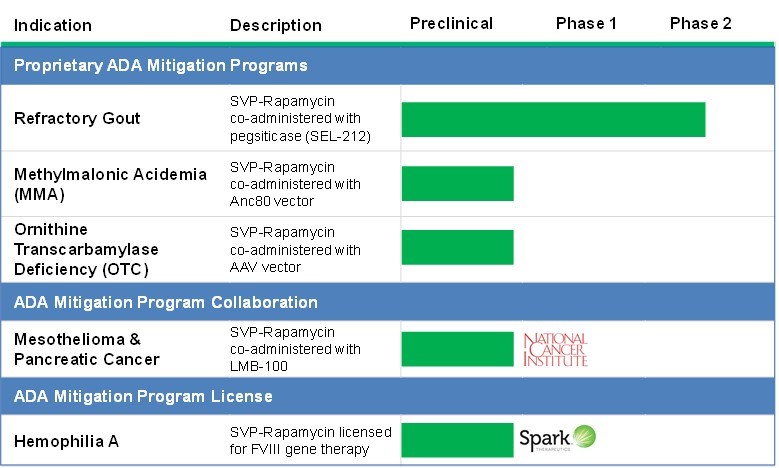
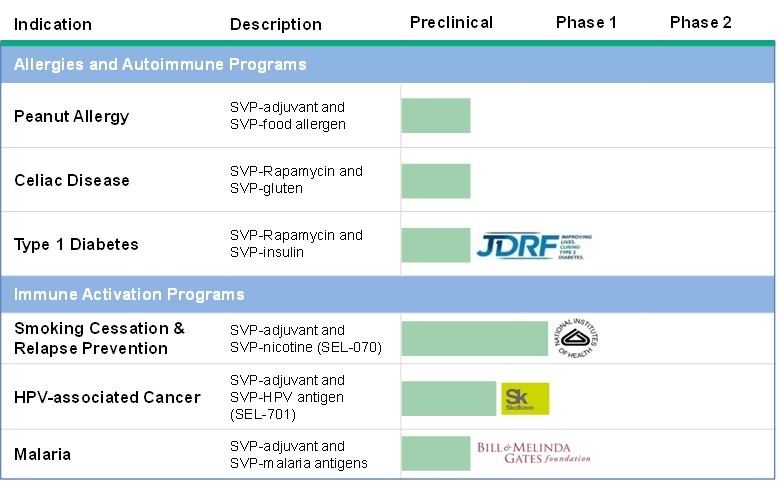
The following charts summarize our current SVP product candidate and discovery pipeline:
5
OUR STRATEGY
Our goal is to become the first biopharmaceutical company to develop and commercialize targeted therapies that are designed to modulate the immune system in an antigen-specific manner to effectively and safely treat rare and serious diseases. In addition, we intend to maximize the value of our SVP technology by collaborating with biopharmaceutical companies on programs that can benefit from our technology but that are outside our area of focus. The key elements of our strategy include the following.
|
•
|
Rapidly advance the development of our lead product candidate, SEL-212, for the treatment of refractory and chronic tophaceous gout.
We believe SEL-212 has the potential to be the first biologic treatment that durably controls uric acid in refractory gout and dissolves and removes harmful deposits of uric acid crystals in chronic tophaceous gout in a majority of patients. We are currently conducting a comprehensive Phase 1/2 clinical program, comprised of two Phase 1 clinical studies, for which we received final data in December 2016, and an ongoing Phase 2 clinical trial, which commenced patient recruitment in October 2016 and for which we expect to announce initial data in the second quarter of 2017. We plan to advance this program through regulatory approval and commercialization, to the extent warranted by clinical trial results.
|
|
•
|
Leverage our SVP technology for immune tolerance to develop additional novel uses and classes of non-immunogenic biologics.
We intend to use our SVP technology to develop a range of proprietary, non-immunogenic biologic therapies. Our current pipeline includes SEL-212 as well as gene therapies designed to mitigate the formation of ADAs and therefore enable repeat administration. In addition, we intend to pursue opportunities to co-administer SVP-Rapamycin with other enzymes, gene therapies and immuno-oncology drugs. In each case SVP-Rapamycin would be intended to mitigate undesired immune response to the biologic therapy with the goal to improve efficacy and/or safety. Our strategy is to develop proprietary treatments for rare and serious diseases by combining SVP-Rapamycin with biologics that have been in licensed or provided through research collaborations.
|
|
•
|
Establish infrastructure and capabilities to commercialize our products in rare and orphan diseases.
While we believe our SVP technology may be broadly applicable across disease areas, we intend to focus our proprietary efforts on developing and commercializing proprietary SVP-enabled products for rare and serious diseases where there is high unmet medical need. Therapies for treating these diseases require focused commercial efforts and coordination with patient groups and investigators. As our product candidates advance towards commercialization, we intend to build a commercial infrastructure to capture the full value of our proprietary SVP products.
|
6
|
•
|
Selectively pursue collaborations and maximize the value of our SVP programs for immune tolerance.
In addition to our own proprietary product development efforts, we are in discussions with potential collaborators and licensees to pursue novel new therapies that would utilize our SVP technology. For example, in December 2016, we entered into the Spark License Agreement to develop gene therapies for certain targets utilizing our SVP technology. For more information, see “Business - Licenses and Collaborations.”
|
|
•
|
Opportunistically utilize our SVP technology to stimulate the immune system to fight disease.
We are currently utilizing funding to develop prophylactic and therapeutic vaccines that activate the immune system to fight disease through our SVP immune stimulation programs. Our current pipeline includes a product candidate to treat HPV-associated cancers, a nicotine vaccine candidate for smoking cessation and relapse prevention and a product candidate for the prevention of malaria. We are developing our programs for HPV-associated cancers and smoking cessation and prevention on our own with grant funding from the Skolkovo Foundation for our HPV program and from the National Institute for Drug Abuse for our nicotine program. We are developing our malaria program under a sponsored research arrangement with The Bill and Melinda Gates Foundation.
|
OVERVIEW OF THE HUMAN IMMUNE SYSTEM
The human immune system is an integrated system of specialized immune cells, cell products and tissues that protect against infectious disease and cancer. The immune system recognizes antigens, which are substances, such as proteins, enzymes or complex sugars. These antigens can be endogenous, or self-antigens, which are produced by the body, or exogenous antigens derived from foreign sources, such as viruses, fungi or bacteria. The human immune system has evolved to recognize and destroy potentially harmful substances. To function effectively, the immune system must discern between harmful antigens and innocuous antigens. The immune system maintains a delicate balance between effector cells, which mount immune responses to antigens that represent potential threats, and regulatory cells, which mitigate undesired and potentially harmful immune responses through immune tolerance. Depending upon the characteristics of the antigen and the context in which the antigen is encountered, the immune system must determine whether to mount a defensive (effector) or regulatory (tolerogenic) immune response.
Antigens are processed in lymphoid organs, such as lymph nodes and the spleen, where the immune system determines whether to mount a defensive or regulatory response through a process called “antigen presentation.” In connection with antigen presentation, dendritic cells process the antigens and present them to T cells. When presented, antigens perceived as harmful induce a stimulatory response that can result in the activation of cytolytic T cells or helper T cells, the latter of which help to induce B cells to produce antibodies. The role of cytolytic T cells is to kill cells that harbor intracellular antigens, such as viruses. The role of antibodies is to neutralize or eliminate extracellular antigens on cell surfaces or in interstitial fluids, such as plasma. Figure 1 below depicts both antigen presentation and the related immune responses.

Figure 1. Antigen Presentation and Related Tolerogenic or Stimulatory Immune Response
There are a number of adverse outcomes that can occur when the immune system mounts an undesired response to an innocuous foreign antigen or a self-antigen. For example, food allergy occurs when the immune system mounts an immune response to innocuous food antigens. Another example of undesired immunogenicity occurs when the immune system is exposed to a biologic treatment, recognizes it as a foreign antigen and instructs the body to mount a defense by forming ADAs
7
to the biologic, which can compromise a therapy’s desired beneficial effect. Undesired immunogenicity is common with biologic therapies, such as in enzyme and protein replacement therapies, and in novel technologies, such as gene therapy and antibody-drug conjugates.
A number of therapies have been developed to modulate an immune response. These therapies fall into two categories:
|
•
|
Immunosuppressive therapies.
Immunosuppressive therapies are designed to suppress the immune system and inhibit an undesired immune response. However, many current therapies are not antigen-specific and, as a result, broadly suppress the immune system leading to undesired side effects that include opportunistic infections, skin cancer and lymphomas. We believe there is an opportunity to develop therapies that instruct the immune system to remain tolerant to a specific antigen and thereby avoid off-target effects of systemic immunosuppression.
|
|
•
|
Immunostimulatory therapies.
Immunostimulatory therapies are designed to stimulate the immune system to prevent or treat infections and cancers. The most common class of immunostimulatory therapies are vaccines, which are designed to simulate the body’s immune system to mount a defensive response to a specific antigen. While traditional vaccines have been successful for the prevention of infectious diseases, there has been limited success in developing therapeutic vaccines for the successful treatment of certain other diseases, including chronic infections and cancer. As a result, we believe there is a need for more effective vaccines to treat these diseases.
|
OUR SVP TECHNOLOGY
Our SVP technology is a highly flexible nanoparticle platform, capable of incorporating a wide range of antigens and immunomodulators, allowing us to utilize our SVP products for specific applications across multiple indications. Our SVP technology is based in part on the pioneering research performed by our co-founders at Harvard University, Massachusetts Institute of Technology, or MIT, and Brigham and Women’s Hospital, or Brigham. In connection with our company’s founding, we licensed 17 patent families related to certain aspects of our SVP technology as applied to nanoparticles for use in vaccines from our co-founders’ institutions pursuant to an agreement with MIT, the party that administers licensing arrangements with respect to patents jointly owned by these institutions. We believe one of the key insights from this research is that nanoparticles are uniquely suited to deliver precise instructions to the immune system as a result of the natural predisposition of the immune system to interrogate nanoparticles, such as viruses. This research led to a portfolio of patents and patent applications covering aspects of our SVP technology, which we have exclusively in-licensed with respect to therapeutic or prophylactic vaccine products or processes. We have aggressively sought to extend and protect the proprietary intellectual property underlying the composition and use of SVP for antigen-specific immunomodulation.
We are currently developing our SVP technology for:
|
•
|
the treatment of chronic tophaceous and refractory gout;
|
|
•
|
antigen-specific immune tolerance for gene therapy involving gene augmentation, replacement or editing;
|
|
•
|
application with marketed products, product candidates in development and novel biologic drugs that would otherwise be too immunogenic to develop; and
|
|
•
|
immune stimulation programs to prevent and treat cancer, infectious diseases and other diseases.
|
SVP are designed to remain intact after injection into the body and accumulate selectively in lymphoid organs, which include lymph nodes and the spleen, where the immune response is coordinated. SVP are designed to be processed by specialized immune cells, such as dendritic cells and other antigen-presenting cells that initiate and regulate immune responses, where they deliver the antigen and immunomodulator in a coordinated and targeted manner. Depending on the type of immunomodulator encapsulated in the SVP, our technology is designed to induce either a:
|
•
|
tolerogenic response to mitigate the formation of ADAs against a biologic drug or treat allergies and autoimmune diseases; or
|
|
•
|
potent antigen-specific stimulatory response, such as an antibody response to a microbial antigen or a cytolytic T cell response to a tumor antigen.
|
A tolerogenic response is the induction of immune tolerance or non-responsiveness to a specific antigen. Cytolytic T cells are specialized antigen-specific immune cells that target and kill cells that harbor a specific antigen.
Figure 2 below depicts the process by which SVP communicate with the immune system to induce either a tolerogenic or antigen-specific stimulatory response.
8

Figure 2. How SVP Communicate with the Immune System
OUR ANTIGEN-SPECIFIC IMMUNE TOLERANCE PROGRAM
Our antigen-specific SVP tolerance programs utilize SVP-Rapamycin, our biodegradable nanoparticle encapsulating the immunomodulator rapamycin. Rapamycin is a small molecule approved for the prevention of organ rejection in kidney transplant patients. To induce immune tolerance in the body, we co-administer our SVP-Rapamycin with a free antigen, such as a biologic drug, which is depicted in Figure 3 below.

Figure 3. Co-Administration of SVP-Rapamycin with a Biologic Drug
SVP-Rapamycin is co-administered at the beginning of therapy with a biologic drug to mitigate the formation of ADAs without requiring the alteration of the drug or its dose regimen. As a result, we believe our SVP-Rapamycin may provide us with significant growth opportunities in the areas of immune tolerance because SVP-Rapamycin can be co-administered at the beginning of therapy with many different biologic drugs. Importantly, each pairing of SVP-Rapamycin with a biologic drug also offers us the opportunity to pursue another proprietary product candidate, which can be separately patented, approved and marketed. SVP-Rapamycin is manufactured under cGMP using well-defined commercial operations, which, we believe, further enhances the scalability of our tolerance programs.
During preclinical studies, we observed that delivering an antigen together with SVP-Rapamycin provided the appropriate signals
in vivo
to induce regulatory T cells, which, in turn, inhibited effector immune responses, such as the formation of ADAs. In our preclinical studies, we observed that SVP-Rapamycin labeled with a fluorescent dye selectively accumulated in lymphoid organs where it was processed by antigen-presenting cells. Figure 4 below depicts a model of how SVP-Rapamycin would enter a lymph node and be taken up by a dendritic cell. We believe that when delivered in the context of our SVP-Rapamycin, both the biologic drug and SVP-Rapamycin are taken up and processed by dendritic cells in a manner that induces regulatory T cells, which can block the activation of helper T cells, mitigating the formation of ADAs.
9
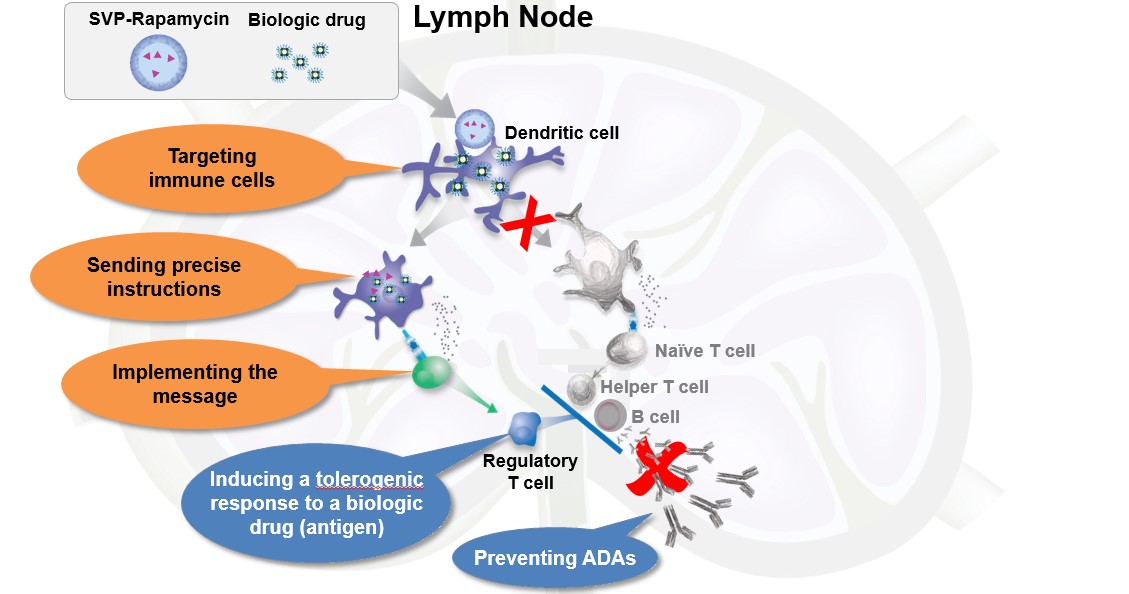
Figure 4. SVP-Rapamycin and Antigen/Biologic Drug Presentation and Related Immune Tolerance Induction
Limitations of existing therapies
All biologics, even those comprised of human protein sequences, have the potential to induce ADAs. Whether a biologic drug elicits an ADA response depends on both product-specific factors, such as propensity to form aggregates, route of administration and mechanism of action, as well as patient-specific factors, such as genetics, underlying disease and medications. Many enzyme and protein replacement therapies used in the treatment of rare and serious diseases have a particularly high rate of immunogenicity because patients are genetically deficient in the target protein and, as a result, the therapeutic protein can be recognized as foreign by the patient’s immune system.
The induction of ADAs can lead to neutralization of efficacy, modification of pharmacokinetics and pharmacodynamics as well as allergic responses. Immunogenicity is a significant hurdle for the development of safe and effective biologic treatments and has become a key concern for regulators, as evidenced by over 100 approved biologics that describe immunogenicity in their labels or clinical literature. We believe that immunogenicity is a leading cause of treatment failure for patients and product development failure for biopharmaceutical companies. As depicted in Figure 5 below:
|
•
|
for 43 currently marketed biologics, over 20% of the patients receiving the biologic are affected by immunogenicity, including Factor VIII products, such as Advate
®(antihemophilic factor)
, for the treatment of hemophilia A, antibody therapeutics with fully human sequences, such as Humira
®(adalimumab)
, and recently approved products such as the anti-IL-17 antibody Taltz
®(
ixekizumab
)
, and the enzyme replacement therapy Strensiq®(
asfotase alfa
);
|
|
•
|
improved versions of biologics that are in the same pharmaceutical class as marketed biologics, including pegsiticase, long-acting coagulation Factor VII and certain antibody drug conjugates, are affected by immunogenicity; and
|
|
•
|
novel platform technologies, such as gene therapy and gene editing, are fundamentally restricted by immunogenicity.
|
10

Figure 5. ADA Mitigation Platform Opportunities
Undesired immunogenicity represents a significant hurdle that can hamper the clinical development of new biologic platforms. For example, in gene therapy, viral vectors are required to transport the genetic material into cells. The viral origin of these vectors explains their immunogenicity, which has led drug developers to limit applications to situations where the required frequency and site of administration are conducive to manageable immune responses.
Treatment and product development failure resulting from undesired immunogenicity has been recognized by regulators and patient advocacy organizations. Recently, the FDA and the National Organization for Rare Diseases, or NORD, co-sponsored a workshop on undesired immune responses to enzyme replacement therapies and called on the biopharmaceutical industry to take a more proactive approach to addressing immunogenicity to biologics.
Currently, we believe there are no comprehensive solutions to the complications of immunogenicity. Drug developers often stop the development of biologics that show an undesired immune response during preclinical or clinical development. In some cases, biopharmaceutical companies may attempt to reduce undesired immune responses by re-engineering the biologic through protein pegylation or removal of immunogenic epitopes. However, these approaches are limited in their effectiveness. Physicians may try to address the issue of undesired immune responses by increasing the dose of the biologic, which can be prohibitively expensive and may present greater safety concerns, or in life-threatening situations by using general immunosuppressive combination therapies. We believe that our tolerogenic SVP technology could offer an entirely new and effective treatment alternative for undesired immune responses, including with respect to the formation of ADAs, but potentially also for autoimmune diseases and allergies.
Immune tolerance preclinical studies
We have conducted several preclinical studies that we believe demonstrate the efficacy of our SVP technology in inducing immune tolerance.
Transfer of immune tolerance from mice treated with SVP-Rapamycin
In a preclinical study, we observed that
in vivo
administration of SVP resulted in induction of regulatory T cells, which, in turn inhibited effector immune responses. The objective of this study was to evaluate the ability to transfer tolerance from a tolerized animal to a naïve animal, a hallmark of tolerance induction. As depicted in Figure 6 below, we injected donor mice with two injections of either:
|
•
|
an empty nanoparticle, or Empty Nanoparticle, as indicated in blue;
|
|
•
|
a nanoparticle encapsulating rapamycin, or NP-Rapamycin, and administered without antigen, as indicated in red; or
|
11
|
•
|
SVP-Rapamycin encapsulating a peptide sequence from proteolipoprotein, or PLP, a myelin antigen associated with multiple sclerosis, or SVP-Rapamycin.PLP, as indicated in green.
|
Two weeks after the second injection, cells from the spleens of the mice were harvested and expanded
in vitro
. These immune cells were then transferred into naïve recipient mice. The next day, all recipient mice were immunized with the PLP peptide in complete Freund’s adjuvant, or CFA, a potent immune stimulating adjuvant, to induce experimental autoimmune encephalomyelitis, or EAE, a model of multiple sclerosis. As indicated by the increase in the mean clinical score for multiple sclerosis in Figure 6 below, the untreated control mice that were immunized but received no transferred cells developed EAE approximately ten days after immunization with PLP and CFA, as reflected in black in Figure 6 below. The mice receiving immune cells transferred from donor mice treated with either Empty Nanoparticle or NP-Rapamycin, as indicated in blue and red in Figure 6 below, respectively, also developed EAE approximately ten days after immunization. In contrast, mice that received immune cells transferred from donor mice treated with SVP-Rapamycin. PLP did not develop EAE during the course of the trial, as indicated in green in Figure 6 below. We believe that these results indicate that the SVP-Rapamycin treatment induces a population of antigen-specific regulatory cells that mediate immune tolerance, as evidenced by the ability of transferred cells to confer protection from disease to naïve animals, reflecting a hallmark of immune tolerance.

Figure 6. Preclinical Study: Transfer of Immune Tolerance from Mice Treated with SVP-Rapamycin to Naive Mice
Immune tolerance induction with SVP-Rapamycin
We conducted a preclinical study to test whether the encapsulation of Rapamycin in SVP was necessary for immune tolerance induction by comparing weekly doses of SVP-Rapamycin with daily doses of free unencapsulated rapamycin. Our preclinical data indicated that SVP-Rapamycin, but not free unencapsulated rapamycin, induced antigen-specific immune tolerance that was resistant to subsequent challenges with the antigen alone. As depicted in Figure 7 below, study mice were separated into three groups during the course of a 21-day treatment period:
|
•
|
the first group, referred to as the Delayed Immunization Group indicated in black, was not treated with anything during the treatment period;
|
|
•
|
the second group, referred to as the Daily Free Rapamycin Group indicated in red, was treated with doses of free unencapsulated rapamycin five days per week and weekly doses of the highly immunogenic antigen keyhole limpet hemocyanin, or KLH; and
|
|
•
|
the third group, referred to as the SVP-Rapamycin Group indicated in green, received three weekly doses of SVP-Rapamycin combined with KLH.
|
Following the treatment period, all of the mice were then challenged with three weekly injections of KLH alone to assess the durability of immune tolerance. As depicted in Figure 7 below, the mice in both the SVP-Rapamycin Group and Daily Free Rapamycin Group showed inhibition of the KLH-specific ADA responses after the treatment phase of the trial. However, only
12
the SVP-Rapamycin Group maintained immune tolerance after the challenge phase. We believe that these results indicate that SVP-Rapamycin induced a population of regulatory T cells that maintained tolerance to challenge with antigen alone, whereas the administration of daily free rapamycin did not. Notably, the Daily Free Rapamycin Group was administered free unencapsulated rapamycin at five times the dose of SVP-Rapamycin administered to the SVP-Rapamycin Group during the course of the treatment period, yet we observed that this treatment induced only transient immunosuppression during the treatment phase but not durable immune tolerance during the challenge phase. We believe that the difference between the durable immune tolerance observed in the SVP-Rapamycin Group and the transient immunosuppression observed in the Daily Free Rapamycin Group was attributable to the ability of our SVP technology to specifically deliver the tolerogenic instructions, in the form of the encapsulated Rapamycin, directly to the antigen-presenting dendritic cells.

Figure 7. Preclinical Study: Immune Tolerance Induction with SVP-Rapamycin
Inhibition of KLH-Specific ADA response by SVP-Rapamycin in nonhuman primates
In a preclinical study, we also observed that our SVP technology inhibited antibody responses to KLH in nonhuman primates. As depicted in Figure 8 below, during a 56-day treatment period, nonhuman primates were administered five biweekly intravenous doses of KLH combined with either:
|
•
|
an empty nanoparticle, referred to as the Empty Nanoparticle Group and indicated in blue, or
|
|
•
|
SVP-Rapamycin, referred to as the SVP-Rapamycin Group and indicated in green.
|
After the treatment period, there was a challenge phase in which the nonhuman primates were administered three doses of KLH alone on days 70, 84 and 98. As indicated in Figure 8 below, the animals in the SVP-Rapamycin Group, which were injected with KLH combined with SVP-Rapamycin, mounted no or a much lower immune response as indicated by the lack of KLH-specific ADAs. In comparison, we observed high levels of KLH-specific ADAs in the Empty Nanoparticle Group.
13

Figure 8. Preclinical Study: Inhibition of KLH-Specific ADA Response by SVP-Rapamycin in Nonhuman Primates
OUR SVP PROGRAMS TO INDUCE ANTIGEN-SPECIFIC IMMUNE TOLERANCE
We believe our SVP technology to induce antigen-specific immune tolerance has a broad range of applications. We are currently pursuing targeted product development strategies for multiple applications in which we believe SVP products could be highly differentiated.
|
•
|
Therapeutic enzymes
. Therapeutic enzymes are a frequently used class of biologic drugs to treat rare diseases. Through our analysis of biologic drugs, including our preclinical studies, we have observed that enzymes are especially prone to undesired immune responses. Our lead product candidate, SEL-212, includes pegsiticase, a pegylated uricase enzyme, which is an example of an immunogenic enzyme for which we are applying SVP-Rapamycin with the intention of improving the enzyme’s efficacy and safety. Other examples of immunogenic enzymes include acid alpha-glucosidase for the treatment of Pompe disease, alpha galactosidase A for the treatment of Fabry’s disease and microbial enzymes such as asparaginase for the treatment of cancers. We intend to seek opportunities to secure supply of and, if appropriate, licenses to these or other enzymes that we would pair with SVP-Rapamycin to enhance their efficacy, safety and use in their treatment of diseases.
|
|
•
|
Gene therapies
. We believe gene therapies have the potential to address key unmet medical needs for many rare genetic diseases, but that undesired immune responses to the viral vectors used for gene replacement, augmentation and editing may be restricting their broader use. Through our analysis of genetic diseases, we have identified applications and patient segments that we believe would benefit from our SVP technology. We intend to develop proprietary SVP-Rapamycin-enabled non-immunogenic gene therapies with viral vectors such as the Anc80 vector that we have licensed from MEE. We believe our product candidates have the potential to solve the problem of pre-existing immunogenicity to the gene therapy vector by using a novel engineered gene therapy vector, Anc80, and to prevent undesired immune responses to the vector and transgene that can occur with the first dose of gene therapy by using our SVP technology. Our initial areas of focus include lysosomal storage, genetic muscular and genetic metabolic diseases. Our proprietary gene therapy programs are focused on the use of vectors that have documented efficiency in delivery of the transgene in nonhuman primates such as Anc80. We believe we are the first company to systematically pursue the development of gene therapy products in combination with an immunotherapy with the goal of enabling repeat administration of the gene therapy. We have engaged third parties with experience in gene therapy and rare diseases to support the development of our proprietary products.
|
|
•
|
Oncology treatments
. While a variety of cancer treatments have demonstrated the ability potential to halt or reverse the course of tumor growth in patients, some of these therapies have proven to be highly immunogenic. One such example is LMB-100, an investigational immunotoxin being developed by the National Cancer Institute. The majority of mesothelioma patients treated with an earlier version of LMB-100, called SS1P, experienced dose-limiting immune responses despite the use of potent immunosuppressants. However, the few chemotherapy-refractory mesothelioma patients tolerating more than two treatment cycles in this Phase 1 clinical trial showed marked antitumor activity. We and NCI have generated preclinical data demonstrating that co-administration of SVP-Rapamycin with LMB-100 in mouse models prevented the formation of anti-LMB-100 antibodies and allowed for the administration of at least four
|
14
treatment cycles, representing a meaningful increase in the number of effective doses that could be administrated without the onset of neutralizing antibodies. Further, in a tumor model, the addition of SVP-Rapamycin to the regimen demonstrated a beneficial effect on controlling tumor growth. We are seeking to further develop this program and to identify additional oncology opportunities.
|
•
|
Other products and product candidates affected by undesired immune responses
. We have generated preclinical data demonstrating the broad potential benefit of SVP for immune tolerance. For many biologic drugs, undesired immune responses limit efficacy and cause safety concerns. This includes TNF-alpha-specific monoclonal antibodies for the treatment of rheumatoid arthritis and coagulation factor replacement therapies for the treatment of hemophilia. We intend to out-license SVP-Rapamycin technology for use with other products that are outside our focus to larger biopharmaceutical companies. We believe our SVP technology may also be of interest to biopharmaceutical companies with novel biologic development concepts or product candidates in clinical development that have demonstrated initial efficacy but are experiencing issues with safety or sustained efficacy due to inhibitory ADAs.
|
In addition to the formation of ADAs, undesired immunogenicity can take the form of allergies when the immune system reacts to allergens such as food and pollen, or autoimmune diseases when the immune system attacks the body’s own proteins. We collaborated with Sanofi to advance our SVP programs in the area of allergies and autoimmune disease. On November 9, 2016, we received written notice from Sanofi that Sanofi has elected to terminate in its entirety the Sanofi Agreement. Such termination will be effective on May 8, 2017. We have exercised our right to acquire the peanut allergy and celiac disease programs under the Sanofi Agreement. We will be solely responsible for performing and funding any development and clinical trial activities relating to further development of vaccines candidates that we choose to undertake. We were also the beneficiary of a joint grant from the JDRF and Sanofi, which we entered into in September 2014 to conduct research in type 1 diabetes. This grant expired in September 2016. We continue to evaluate our strategic options to continue our research in peanut allergy, celiac disease and type 1 diabetes. We intend to continue a strategy of out-licensing our SVP technology for antigen-specific immune tolerance for applications that are outside our core areas of focus.
SEL-212 for the treatment of refractory and chronic tophaceous gout
Overview
SEL-212 is our proprietary product candidate for the treatment of refractory and chronic tophaceous gout. SEL-212 consists of SVP-Rapamycin co-administered with pegsiticase, a pegylated uricase. We believe that our SEL-212 has the potential to offer a uniquely effective treatment for patients with refractory or chronic tophaceous gout, while also demonstrating the clinical effectiveness of our SVP technology. Pegylated uricase, in the form of the approved drug Krystexxa, has demonstrated the ability to significantly reduce uric acid levels and dissolve the harmful uric acid crystals that are the manifestations of gout upon initial treatment in naïve patients. However, Krystexxa has not achieved broad commercial adoption, which we believe is primarily due to an undesired immune response that significant restricts clinical use. Based on our preclinical studies, we believe that by leveraging our SVP technology to induce durable immune tolerance of our pegylated uricase, pegsiticase, SEL-212 may potentially overcome this undesired immune response and optimize pegsiticase’s effectiveness in controlling uric acid levels and, as a result, enable the effective dissolution and removal of uric acid crystals.
The market for gout therapy
Gout is a painful and potentially disabling form of arthritis resulting from excess accumulation of uric acid and deposition of uric acid crystals in joints and soft tissues, including those of the kidney and heart, causing harmful inflammation. Gout is caused by an overproduction of uric acid, a natural byproduct of purine metabolism that is produced after consumption of food with high levels of purines such as seafood, meat, yeast and certain vegetables, or an inability of the kidneys to excrete adequate amounts of uric acid from the body. High concentrations of serum uric acid lead to formation of insoluble uric acid crystals in joints and tissues, causing pain, inflammation and joint damage, and increase the risk for other conditions, including cardiovascular, cardiometabolic, joint and kidney disease.
There are approximately 8.3 million and 10.0 million gout sufferers in the United States and the European Union, respectively. The first line of treatments for gout are Allopurinol and Febuxostat. Both drugs are Xanthine Oxidase inhibitors, oral drugs that reduce the synthesis of uric acid. Lesinurad and Probenecid are oral gout drugs that increase the rate of excretion of uric acid through the kidneys, and are used almost exclusively in combination with these first line treatments. While both of these treatments are designed to prevent the formation of uric acid deposits, neither of these treatments effectively reduces existing uric acid deposits in joints and tissues. Additionally, neither of these first line treatments individually or in combination with Lesinurad and Probenecid are indicated for refractory or chronic tophaceous gout.
15
We estimate that approximately 50,000 patients in the United States suffer from chronic refractory gout, an orphan indication defined by uric acid levels that cannot be controlled by available oral therapies. Krystexxa, an injectable pegylated uricase enzyme, is indicated for the treatment of chronic refractory gout. In clinical trials, Krystexxa demonstrated the ability to rapidly reduce uric acid levels upon initial dosing. However, despite these clinical results, Krystexxa has not achieved broad commercial adoption. Because uricase is an enzyme foreign to humans, we believe this is primarily due to an undesired immune response. The package insert information for Krystexxa indicates that 92% of patients develop ADAs, 26% experience infusion site reactions and 6.5% experience anaphylaxis, a life-threatening allergic reaction typically involving itchy rash, throat swelling and low blood pressure. The package insert information also indicates that during the drug’s clinical trials, high Krystexxa-specific ADA titer in patients was associated with a failure to maintain normalization of uric acid levels. Similarly, a 2011 study published in The Journal of the American Medical Association found that 58% of Krystexxa patients who received biweekly doses of Krystexxa were non-responders with loss of efficacy starting as early as two weeks after treatment.
Gout is a spectrum of disease with the traditional diagnosis being the extraction of monosodium urate crystals with joint fluid or uric acid crystals from a visible tophus. Additionally, high concentrations of serum uric acid increase the risk of co-morbidities, including cardiovascular, cardiometabolic, joint and kidney disease. Patients who are unable to reduce their serum uric acids levels below 6 mg/dl with oral drugs are diagnosed with refractory gout. Patients who have uric acid deposits, or tophi, in soft tissues, joints, the urinary tract, the digestive tract or the heart and a persistently elevated uric acid level when left untreated are diagnosed with chronic tophaceous gout. Tophi are a source of inflammation and pain.
Figure 9 below illustrates the association between gout and diseases of the heart, vascular system, metabolic process, kidney and joints.

Figure 9. Co-Morbidities Associated with Gout
Approximately 500,000 patients in the United States suffer from chronic tophaceous gout. There is no approved drug for this indication that resolves tophi, although clinical studies have indicated that Krystexxa is effective in clearing uric acid deposits in patients that do not develop inhibitory levels of ADAs. We believe that oral gout drugs cannot effectively remove tophi from joints and tissue due to their limited ability to affect existing uric acid deposits.
Based on our preclinical studies, our Phase 1b clinical data and market research, we believe that SEL-212 may potentially address two key unmet needs in the treatment of severe gout, the durable control of serum uric acid levels in patients with chronic refractory gout and removal of painful and damaging uric acid deposits for patients with chronic tophaceous gout.
Our product development strategy is designed to address these unmet medical needs while improving the dosing regimen compared to Krystexxa. We plan to initially seek regulatory approval for the treatment of refractory gout by demonstrating reduction of serum uric acid levels below the FDA-approved endpoint and clinical guideline of 6 mg/dl. We plan to conduct a clinical program to support a label extension for the treatment of patients with chronic tophaceous gout. During our market research, physicians expressed their preference for monthly dosing as well as for a subcutaneous route of administration. In
16
response to this preference, we intend to develop SEL-212 as a monthly treatment and intend to develop a subcutaneous formulation following the initial launch of the intravenous dosage form, if approved. We believe that Krystexxa has been developed as a bi-weekly intravenous-only formulation to avoid additional immunogenicity anticipated from a higher dose that would be required by a monthly regimen.
We believe that SEL-212 is ideally suited for patients diagnosed with chronic tophaceous gout. If approved, our strategy is to position SEL-212 as an induction therapy for gout that would remove harmful uric acid deposits over five monthly doses on average and allow patients to switch to oral gout maintenance therapy with xanthine oxidase inhibitors unless and until such patients experience a subsequent manifestation of uric acid deposits at which time a new course of SEL-212 would be required. We do not believe that oral therapy would completely prevent the build-up over time of uric acid crystals in patients with a history of chronic tophaceous gout. As a result, we anticipate that SEL-212 induction treatment, if approved, would be required intermittently in such patients. We believe that, in contrast to Krystexxa, SEL-212 induction treatment may be effective in removing harmful uric acid deposits in most patients with chronic tophaceous gout over multiple courses of treatment in their lifetimes. Figure 10 below depicts this positioning strategy as a sample diagram illustrating what we believe to be a shift in the treatment paradigm for chronic tophaceous gout.

Figure 10. Sample Treatment Course for Chronic Tophaceous Gout.
We expect our clinical and marketing strategy for SEL-212 to initially focus on the estimated 160,000 patients in the United States diagnosed with refractory or chronic tophaceous gout being treated by rheumatologists, as well as approximately the same estimated number of patients in Europe. We believe that for these patients who are already being treated by rheumatologists and diagnosed with chronic tophaceous gout, the need for a new treatment is the highest. If SEL-212 is approved, we expect our strategy for marketing SEL-212 to rheumatologists will be to promote a switch from oral therapies to SEL-212 for patients with serum uric acid levels chronically above 6 mg/dl and diagnosed with chronic tophaceous gout. We intend to leverage imaging technologies recently recommended by the guideline writing associations for rheumatology, including the American College of Rheumatology and the European League Against Rheumatism. In particular, dual energy computed tomography can visualize uric acid deposits in joints and tissues as depicted in Figure 11 below in green and has the potential to become an important tool to manage chronic tophaceous gout and to visualize the efficacy of SEL-212. We believe dual energy computed tomography imaging use could increase the market for SEL-212 by increasing the rate of diagnosis of chronic tophaceous gout.
17

Figure 11. Tophi / Uric Acid Deposits (shown in green) Visualized Using Dual Energy Computed Tomography Imaging
SEL-212 components
Our SEL-212 consists of SVP-Rapamycin co-administered with pegsiticase. Our SVP-Rapamycin consists of nanoparticles composed of poly(D,L-lactide), or PLA, and poly(D,L-lactide)-block-poly(ethylene-glycol), or PLA-PEG, encapsulating rapamycin. Our pegsiticase consists of a uricase modified with poly(ethylene-glycol), or PEG. The components of SEL-212 are depicted in Figure 12 below.

Figure 12. Components of SEL-212
Our pegsiticase is a pegylated version of the therapeutic enzyme uricase, which we have licensed from Shenyang Sunshine Pharmaceutical Co., Ltd., or 3SBio, exclusively for all markets, except Japan and Greater China, and exclusively for Japan only in combination with our SVP Platform technology. Uricase is an enzyme endogenous to all mammals, except for humans and certain primates, which converts uric acid to the more soluble metabolite, allantoin. There is a natural limit to the amount of uric acid that can be excreted by the kidneys, which decreases with age and can be reduced by some medications. By converting uric acid to allantoin, uricase provides an additional way for the body to reduce uric acid. Unlike other gout drugs, uricase is highly effective in lowering existing high uric acid levels within the first few hours of administration.
SVP-Rapamycin is our biodegradable nanoparticle that encapsulates the tolerance-inducing immunomodulator Rapamycin, also referred to as sirolimus. Rapamycin is the active ingredient of Rapamune, an immunosuppressant which has extensive prior use in humans and is currently FDA-approved for prophylaxis of organ rejection in kidney transplant patients aged 13 or older. PLA is part of the broader poly(lactic-co-glycolic acid), or PLGA, family of biodegradable polymers that have more than 30 years of commercial use and are formulation components in a number of approved products. Polyethylene glycol, or PEG, has been widely studied in clinical trials and is also a formulation component in many approved biologic products. In our preclinical studies, SVP-Rapamycin co-administered at the initiation of treatment with a biologic drug induced antigen-specific immune tolerance to the biologic drug, substantially reducing the formation of associated ADAs.
As depicted in Figure 13 below, SEL-212 is designed as a treatment course consisting of three doses of SVP-Rapamycin co-administered with pegsiticase followed by two doses of pegsiticase alone, with each dose administered every two to four weeks.
18

Figure 13. SEL-212 Treatment Course
Preclinical development
We have executed a comprehensive preclinical program of SEL-212 in uricase deficient mice and wild type mice, rats and nonhuman primates to evaluate efficacy, dose regimens and safety.
Proof-of-concept study in uricase-deficient mice
We conducted a pharmacology study in mice that were genetically deficient in endogenous uricase. The study evaluated the efficacy of a dose regimen consisting of three immunizations with SEL-212 followed by doses of pegsiticase alone in preventing the formation of ADAs to pegsiticase. The treatment period consisted of the first 14 days of the study. In the study, mice were separated into three treatment groups. As depicted in Figure 14 below, during the treatment period:
|
•
|
the first group, referred to as the Untreated Group and indicated in black, received no treatment;
|
|
•
|
the second group, referred to as the Pegsiticase Group and indicated in red, was treated with pegsiticase alone; and
|
|
•
|
the third group, referred to as the SVP-Rapamycin + Pegsiticase Group and indicated in green, was treated with SVP-Rapamycin co-administered with pegsiticase.
|
The Pegsiticase Group and SVP-Rapamycin + Pegsiticase Group were treated on days zero, seven and 14 of the treatment period. Each group was then treated with pegsiticase alone on days 35 and 42 of the study, or the challenge period. Uricase-specific ADA levels were recorded to determine the formation of ADAs to pegsiticase. Uric acid levels were measured to determine effectiveness of SVP-Rapamycin co-administered with pegsiticase in lowering uric acid levels below 6 mg/dL, which is the treatment target for gout patients.

Figure 14. Preclinical Study: Proof-of-Concept in Uricase-Deficient Mice
Antibody formation.
The Pegsiticase Group developed uricase-specific ADAs when exposed to pegsiticase during the treatment period. The Untreated Group also developed uricase-specific ADAs as soon as they were challenged with pegsiticase. Despite exposure to pegsiticase during both the treatment and challenge periods, the SVP-Rapamycin + Pegsiticase Group did not develop uricase-specific ADAs during either period.
19
Uric acid levels.
After initial exposure to pegsiticase, the Untreated Group maintained high uric acid levels of approximately 10 mg/dL. The Pegsiticase Group recorded uric acid levels below 6 mg/dl after the first dose in the treatment period. However, during subsequent doses in the treatment period and challenge period, uric acid levels returned to levels well in excess of 6 mg/dL. In contrast, the SVP-Rapamycin + Pegsiticase Group maintained uric acid levels that were close to zero throughout the study.
Proof-of-concept study in nonhuman primates
We also conducted a preclinical study to evaluate the ability of SVP-Rapamycin to mitigate the formation of uricase-specific ADAs in nonhuman primates. As depicted in Figure 15 below, during the study we either:
|
•
|
administered pegsiticase alone, referred to as the Empty Nanoparticle Group and indicated in blue, or
|
|
•
|
co-administered pegsiticase with one of two dose levels of SVP-Rapamycin, referred to as the SVP-Rapamycin 0.1X and SVP-Rapamycin 1X Groups and indicated in purple and green, respectively. The SVP-Rapamycin 0.1X Group received a dose level of SVP-Rapamycin of 0.3 mg/kg and the SVP-Rapamycin 1X Group received a dose level of SVP-Rapamycin of 3 mg/kg.
|
The Empty Nanoparticle Group received three monthly doses of pegsiticase and each of the SVP-Rapamycin 0.1X Group and SVP-Rapamycin 1X Group received three monthly doses of pegsiticase co-administered with SVP-Rapamycin. All groups then received two monthly doses of pegsiticase alone. The SVP-Rapamycin 0.1X Group received one-tenth of the dose administered in the SVP-Rapamycin 1X Group.

Figure 15. Preclinical Study: Proof-of-Concept in Nonhuman Primates
Antibody formation.
We observed that the Empty Nanoparticle Group produced high levels of uricase-specific ADAs by the end of the study. The SVP-Rapamycin 0.1X Group and SVP-Rapamycin 1X Group were able to reduce the levels of uricase-specific ADAs significantly compared to the Empty Nanoparticle Group and, in the case of the SVP-Rapamycin 1X Group, inhibited the formation of antibodies. Our observations in this study confirmed in non-human primates the mitigation of uricase-specific ADAs we observed in mice.
Uric acid levels.
As expected, we could not determine the effect that pegsiticase alone or pegsiticase co-administered with SVP-Rapamycin had on uric acid levels in nonhuman primates due to the activity of naturally occurring uricase in these animals.
Based on these preclinical studies, as well as toxicology studies conducted to conform to regulatory guidelines, referred to as current good laboratory practice, or GLP, we believe that SEL-212 demonstrated sufficient efficacy and safety in the preclinical animal models to justify movement into clinical development, and the FDA indicated that our Phase 1b clinical trial for SEL-212 was safe to proceed.
20
Clinical development
For chronic refractory gout, we are executing a clinical development program that seeks to demonstrate SEL-212’s ability to durably reduce serum uric acid levels below 6.0 mg/dL. The saturation point of uric acid, or the maximum level at which uric acid will remain soluble in plasma, is 6.8 mg/dL. When uric acid rises above 6.8 mg/dL, monosodium urate microcrystals form and settle in joints and other tissues, creating an inflammatory response that is diagnosed as gout. This inflammatory response is the source of highly debilitating gout flares experienced by patients. When serum uric acid levels drop below the level of 6.0 mg/dL, microcrystals will dissolve and, over time, gout symptoms will disappear. Therefore, a serum uric acid level of less than 6.0 mg/dL is defined as the target for uric acid-lowering treatments by organizations such as the American College of Rheumatology and the European League Against Rheumatism. The FDA and EMA have also established the maintenance of serum uric acid levels below 6 mg/dL as the primary endpoint in clinical trials for urate lowering therapies. Available oral gout therapies are designed to prevent the formation of uric acid microcrystals but are not effective in rapidly removing existing crystalized deposits. In severe gout patients who have significant deposits of monosodium urate crystals, known as tophi, it is of clinical benefit to significantly reduce serum uric acid levels (i.e. below 0.1 mg/dL) for a period of time in order to rapidly dissolve the monosodium urate crystals.
We expect to conduct five clinical studies in a total of approximately 400 patients with gout or elevated levels of serum uric acid. We initiated our clinical program in the U.S. in the second quarter of 2015 with a multicenter Phase 1a trial of pegsiticase in patients with serum uric acid levels greater than 6.0 mg/dL. We completed the patient treatment portion of our Phase 1a trial in November 2015, initiated a Phase 1b trial in December 2015 and reported data from both Phase 1 clinical trials in December 2016. In our Phase 1b trial, we demonstrated that a single dose of SEL-212 was capable of lowering serum uric acid levels below 0.1 mg/dL for at least 30 days, which is correlated with the inhibition of uricase-specific ADAs. We initiated patient recruitment in an open label multi-dose Phase 2 clinical trial of SEL-212 in patients with symptomatic gout and elevated uric acid levels in October 2016. This study is being conducted at multiple clinical sites in the U.S. After an end-of-Phase 2 meeting with the FDA, we expect that we will be required to conduct two Phase 3 clinical trials in patients with chronic refractory gout. We plan to leverage our experience in chronic refractory gout for additional but similar clinical trials for the indication of chronic tophaceous gout.
Phase 1 and Phase 2 clinical trials
SEL-212 is currently being evaluated in a comprehensive Phase 1/2 clinical program that includes a Phase 1a and Phase 1b clinical trial in patients with high uric acid levels as well as a Phase 2 clinical trial in patients with symptomatic gout and high uric acid levels. Each Phase 1 clinical trial was designed with the primary objective to evaluate the safety and tolerability of SEL-212 and its individual components. Additional objectives of the Phase 1 clinical trials include identifying a pegsiticase dose that is capable of lowering serum uric acid levels over a period of 1 month, evaluating the immunogenicity of pegsiticase after a single dose and demonstrating that SVP-Rapamycin co-administered with pegsiticase reduces uric acid levels and mitigates the formation of uricase-specific ADAs. The Phase 2 clinical trial is evaluating the effect of multiple doses over an extended period of time on serum uric acid and the formation of uricase-specific ADAs in more than 36 patients with symptomatic gout and elevated serum uric acid levels. We received final data from both Phase 1 clinical trials in December 2016. We commenced patient recruitment in the Phase 2 clinical trial in October 2016 and expect to receive initial data in the second quarter of 2017.
Phase 1a clinical trial
The Phase 1a clinical trial for SEL-212 was conducted at multiple sites in the United States and was a single ascending dose trial of pegsiticase alone in 22 patients with elevated serum uric acid levels greater than 6 mg/dl. At the outset of the trial, each of five cohorts received a single intravenous infusion of pegsiticase at ascending dose levels of 0.1 mg/kg for Cohort #1, 0.2 mg/kg for Cohort #2, 0.4 mg/kg for Cohort #3, 0.8 mg/kg for Cohort #4 and 1.2 mg/kg for Cohort #5. We monitored the patients during a 30-day period post-infusion. We commenced enrollment of the clinical trial in the second quarter of 2015 and completed the treatment portion of the trial in November 2015. We observed that pegsiticase demonstrated no serious adverse events and was well tolerated at the five dose levels tested. Additionally, we observed that pegsiticase rapidly reduced and sustained average serum uric acid levels below 6 mg/dl for each cohort for 14 to 30 days, depending on the dose level. Consistent with our preclinical studies in animals, pegsiticase induced uricase-specific ADAs in all patients with varying levels in this Phase 1a trial.
Figure 16 below depicts average serum uric acid levels of the Phase 1a clinical trials five cohorts tested at different measurement intervals during the course of the 30-day period following the single intravenous infusion of pegsiticase at the outset of the trial.
21

Figure 16. Phase 1a Clinical Trial: Serum Uric Acid Levels Across Five Cohorts
Figure 17 below indicates the serum uric acid and uricase-specific ADA levels for each patient in Cohort #3 of the Phase 1a clinical trial. The serum uric acid levels were measured at baseline and days seven, 14, 21 and 30 and uricase-specific ADA levels at baseline and days seven, 14 and 30 following a single intravenous injection of pegsiticase. We did not measure uricase-specific ADA levels at day 21 in the Phase 1a clinical trial. One patient in this cohort, patient number two, developed a relatively low level uricase-specific ADA titer of 40 and maintained uric acid levels below 0.5 mg/dL through the thirtieth day after dosing. By contrast, the remaining four patients in the cohort developed levels of uricase-specific ADAs greater than 1,000 titer and uric acid levels above 5 mg/dL by the thirtieth day after dosing. Based on the results from our Phase 1a clinical trial, we observed that pegsiticase at a tolerated dose is capable of achieving and maintaining a reduction of serum uric acid below the target of 6 mg/dL for a 30-day period in the absence of inhibitory uricase-specific ADAs.

Figure 17. Phase 1a Clinical Trial: Serum Uric Acid and Uricase-Specific ADA Levels of the Third Cohort
Based on our analysis of the Phase 1a clinical trial data, we selected the pegsiticase dose of 0.4 mg/kg from Cohort #3 of the Phase 1a clinical trial for further study in the Phase 1b clinical trial.
Phase 1b clinical trial
In December 2015, we initiated our Phase 1b clinical trial at multiple sites in the United States. The clinical trial enrolled 63 patients with serum uric acid levels greater than 6 mg/dl. One group of five patients received a single dose of pegsiticase alone at a dose level of 0.4 mg/kg, which we refer to as the Pegsiticase Cohort. Four groups of patients, each containing 2 placebo-control patients and five test article patients, received a placebo or a single intravenous infusion of SVP‑Rapamycin alone at the following ascending dose levels: 0.03 mg/kg, 0.1 mg/kg, 0.3 mg/kg and 0.5 mg/kg, which we refer to collectively as the SVP‑Rapamycin Cohorts. Four groups of patients received a single intravenous infusion of SVP‑Rapamycin at ascending dose levels of 0.03 mg/kg (5 patients), 0.1 mg/kg (10 patients), 0.15 mg/kg (5 patients) or 0.3 mg/kg (5 patients) with a fixed dose of pegsiticase of 0.4 mg/kg, which we collectively call the SEL-212 cohorts. All patients were followed for at least 30 days after their initial dose.
22
Figure 18 below depicts the serum uric acid levels of Pegsiticase Cohort (depicted in red symbols), the SVP‑Rapamycin Cohorts (depicted in blue symbols), and the SEL‑212 Cohorts (depicted in green symbols) from the Phase 1b clinical trial. The observational data is presented for all cohorts through the 30 day observational period and for those patients who were requested to return on day 37, day 44 and day 51. Serum uric acid levels were measured at baseline and days seven, 14, 21, 30 and longer for some patients that maintained serum uric acid control at day 21. As expected, SVP‑Rapamycin alone had no relevant effect on reducing serum uric acid levels across the SVP‑Rapamycin Cohorts, as such levels remained relatively constant during the 30‑day period. Patients in the Pegsiticase Cohort showed an immediate drop in uric acid levels after dosing, with uric acid levels returning close to or above baseline levels by day 21 in four of the five patients, similar to what was observed in Cohort #3 in the Phase 1A study. In contrast, patients in the SEL-212 Cohort receiving the lowest dose of SVP‑Rapamycin (0.03 mg/kg) co‑administered with pegsiticase (0.4 mg/kg), showed four out of five patients maintaining serum uric acid levels below 6 mg/dL through day 21 after dosing. SEL-212 patients receiving SVP-Rapamycin at 0.1 mg/kg co-administered with 0.4 mg/kg of pegsiticase, showed seven out of 10 patients maintained levels of serum uric acid of less than 0.1 mg/dl through day 30. SEL-212 patients receiving SVP-Rapamycin at 0.15 mg/kg co-administered with 0.4 mg/kg of pegsiticase, showed all five patients maintaining levels of serum uric acid of less than 6 mg/dL through day 30. Finally, SEL-212 patients receiving SVP-Rapamycin at 0.3 mg/kg co-administered with 0.4 mg/kg of pegsiticase, showed all five patients maintaining levels of serum uric acid of less than 0.1 mg/dL through day 30. These results indicate that SEL-212 showed a dose-dependent reduction in serum uric acid levels.
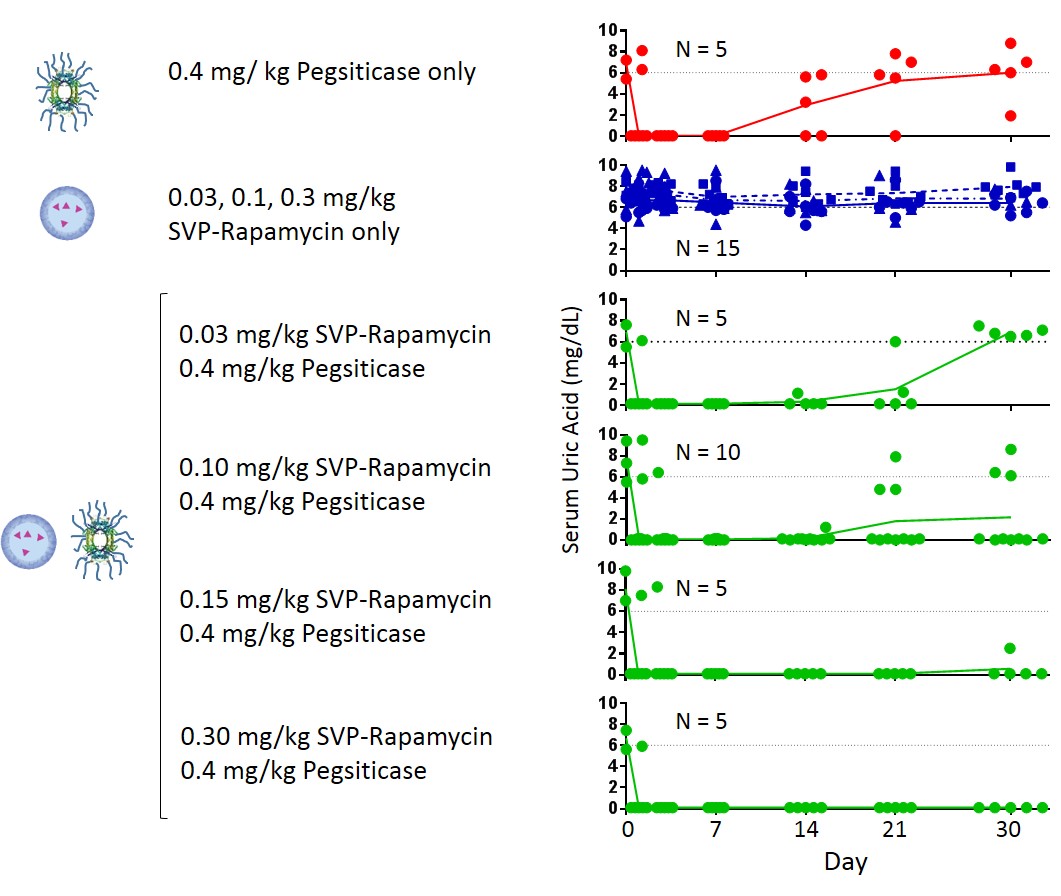
Figure 18. Phase 1b Clinical Trial: Uric Acid Levels Across All Phase 1b Cohorts - image pending, current copy provided does not save correctly
Figure 19 below depicts the serum uric acid levels at day 30 next to the corresponding day 30 uricase-specific ADA titer for all patients in the Pegsiticase Cohort and in the SEL-212 Cohorts at the three higher dose levels. Four of the five patients treated with 0.4 mg/kg pegsiticase alone showed their serum uric return to baseline by day 30 and all five showed uricase specific ADA titers greater than 1000. Seven of 10 SEL-212 patients treated with 0.1 mg/kg SVP-Rapamycin and 0.4 mg/kg pegsiticase showed serum uric acid levels <0.1 mg/dL with corresponding low or negative uricase specific ADA titers at day 30. All five SEL-212 patients treated with 0.15 mg/kg SVP-Rapamycin and 0.4 mg/kg pegsiticase showed serum uric acid below 6 mg/dL at day 30. One patient developed uricase specific ADA titers greater than 1000 but still maintained his serum uric acid below the target threshold of 6 mg/dL at day 30. The other four patients showed no ADA titers and had serum uric acid levels <0.1
23
mg/kg. Finally all five SEL-212 patients treated with 0.3 mg/kg SVP-Rapamycin and 0.4 mg/kg pegsiticase showed serum uric acid <0.1mg/dL at day 30 with corresponding low or negative ADA titers. The one patient with an ADA titer of 120 at baseline showed the same titer at baseline and at each time point tested, indicating that this patient had pre-existing low titer of antibody that was cross-reactive with pegsiticase at baseline. These results indicate that SEL-212 can mitigate the formation of uricase-specific ADAs which correlates with sustained control of serum uric acid levels through at least day 30 after a single dose.

Figure 19. Comparison of Phase 1b Uric Acid and Uricase
‑
Specific ADA Levels-image pending, current copy provided does not save correctly
Certain patients in the SEL-212 Cohort were requested to return for additional visits on days 37, 44, and/or 51 because their serum uric acid levels were still under control (< 6mg/dL) at day 21. Not all patients were able to return for the additional visits. The data for those who could return are in included in Figure 20 below. The data show that uric acid levels eventually return to baseline, as expected after a single dose of pegsiticase. Importantly, no emergence of ADAs was detected in those patients who exhibited low or no ADA titers at day 30. These data suggest that the treatment with SVP-Rapamycin could control immune responses to pegsiticase for up to 51 days after dosing. The data also support monthly dosing in the Phase 2 multiple dose trial of SEL-212.

Figure 20. Comparison of Phase 1b Uric Acid and Uricase
‑
Specific ADA Levels-image pending, current copy provided does not save correctly
24
Figure 21 below presents a non‑head‑to‑head comparison of the activity of selected dose levels of SEL‑212 (0.1, 0.15, and 0.3 mg/kg SVP-Rapamycin + 0.4 mg/kg pegsiticase) and the Pegsiticase Cohort of the Phase 1b clinical trial with data from two replicate, randomized, double‑blind, placebo‑controlled clinical trials of Krystexxa as reported in the Journal of the American Medical Association in 2011. These two Krystexxa clinical trials included 85 patients who received biweekly doses of Krystexxa, 84 patients who received monthly doses of Krystexxa and 43 patients who received a placebo. Of the Krystexxa‑treated patients that were considered responders, as defined by the maintenance of uric acid levels below 6 mg/dl for 80% of the time at months three and six, the mean uric acid levels in patients on the biweekly dose regimen were more meaningfully and consistently improved than patients on the monthly dose regimen. Krystexxa has been approved for the treatment of refractory gout on a biweekly dose regimen whereas the monthly dose regimen of Krystexxa has not been approved for marketing. The graph on the left in Figure 21 below depicts the data for the four‑week period after the first dose of Krystexxa from the cohorts of patients in the Krystexxa clinical trials who received monthly doses.
The placebo control patients, indicated in open circles in Figure 21 below, had uric acid levels above 6 mg/dl for the entire four weeks. The Krystexxa‑treated patients that went on to become responders are indicated in black circles. The Krystexxa‑treated patients that went on to become non‑responders, as defined by the inability to maintain uric acid levels below 6 mg/dl for 80% of the time at months three and six, are indicated in black triangles. Only 35% of Krystexxa‑treated patients in the monthly dosing cohorts were classified as responders. Of the patients that received monthly doses, it is notable that, even at four weeks, the mean uric acid levels were above 6 mg/dl in the non‑responders, representing 65% of patients, and were above 4 mg/dl in the responders. While not depicted in Figure 21 below, 89% of all Krystexxa‑treated patients developed ADAs. In comparison, the middle graph in Figure 21 below depicts data patients treated with pegsiticase alone of the Phase 1b clinical trial, indicated in red. The overall kinetics of serum uric acid levels following a single dose of pegsiticase is qualitatively similar to that observed in the monthly Krystexxa study. In contrast, patients of the Phase 1b clinical trial treated with a single dose of SEL-212 (0.1, 0.15, or 0.3 mg/kg SVP-Rapamycin + 0.4 mg/kg pegsiticase), and indicated in green, maintained levels of serum uric acid well below the target threshold of 6.0 mg/dL through day 30. Patients in the Phase 1b clinical trial, treated with SVP‑Rapamycin alone and indicated in blue, experienced no significant reduction in uric acid levels, as such levels remained relatively constant over the 30‑day period.

Figure 21. Retrospective Comparison of the Activity of Krystexxa, Pegsiticase, and SEL
‑
212 After a Single Dose
While we believe the above comparison is useful in evaluating the results of SEL-212 Cohorts of the Phase 1b clinical trial, our Phase 1b clinical trial and the Krystexxa clinical trials were separate trials conducted by different investigators at different sites. In addition, there were substantial differences, including, for example, that the Krystexxa clinical trials were double‑blind trials involving a substantial number of patients with refractory gout while our Phase 1b clinical trial evaluated SEL‑212 in an unblinded manner in a small number of patients with elevated uric acid levels. Moreover, we could only compare the efficacy of SEL‑212 with the four‑week period following the first injection of Krystexxa as SEL‑212 has not yet been evaluated in a multi‑dose clinical trial. In this regard, we have not conducted a head‑to‑head comparison of SEL‑212 and Krystexxa in a clinical trial. Results of a head‑to‑head comparison may differ significantly from those set forth in Figure 21 above. In addition, because our Phase 1b clinical trial and the Krystexxa clinical trials were separate trials and because Cohort #6 of our Phase 1b clinical trial involved only five patients, differences between the results of our Phase 1b clinical trial and the two Krystexxa clinical trials may not be statistically or clinically meaningful. For these reasons, investors should not place undue weight on the comparative information set forth above, including in Figure 21. Based on our observations from the Phase 1b clinical trial data that SEL‑212 was capable of controlling uric acid levels for at least 30 days in patients treated with SEL-212
25
at SVP-Rapamycin dose levels of 0.1, 0.15, and 0.3 mg/kg, we believe SEL‑212 has the potential to maintain low uric acid levels with monthly dosing, which we plan to test in the Phase 2 clinical trial.
At the completion of our Phase 1 program for SEL-212 we had dosed a total of 85 patients with either SEL‑212 (SVP‑Rapamycin and pegsiticase), SVP‑Rapamycin alone or pegsiticase alone in connection with the Phase 1a and Phase 1b clinical trials. The median serum acid level of patients enrolled was 7.4 mg/dL, with a mean of 7.5 mg/dL at baseline. Patients presented with an average of two co-morbidities, such as hypertension and diabetes. We have generally observed that SEL‑212 and its components, SVP‑Rapamycin and pegsiticase, have been well tolerated in this patient population. There were a total of six serious adverse events, or SAEs, in both Phase 1 clinical trials combined.
One SAE occurred among the 27 patients treated with pegsiticase alone in the Phase 1a and 1b trials. This patient, a 62 year‑old male who received a dose level of pegsiticase alone of 0.4 mg/kg in the Phase 1b study, developed atrial fibrillation 13 days after administration of pegsiticase. The patient underwent successful cardioversion and the medical records from the principal investigator indicate that this patient has recovered. The principal investigator has deemed this SAE to not have been related to the study drug, pegsiticase.
Among patients dosed with SVP-Rapamycin alone in the Phase 1b trial, no SAEs were observed at the lower dose levels of 0.03, 0.1, or 0.3 mg/kg. However, two SAEs were observed at 0.5 mg/kg, the highest dose tested of SVP-Rapamycin. In the first of the two SVP-Rapamycin-related SAEs, a 59 year‑old male developed stomatitis approximately seven days after being dosed with 0.5 mg/kg of SVP‑Rapamycin, and experienced 4.3 kg of weight loss. This patient was treated with oral over‑the‑counter and topical antihistamines followed by a steroid gel. The principal investigator indicated that the patient’s stomatitis had resolved. The principal investigator classified this SAE as having been possibly related to the study drug, SVP‑Rapamycin. The second of the two SVP-Rapamycin-related SAEs occurred in a 33 year-old male who developed a sore throat five days after receiving the study drug. The discomfort continued and the patient presented to the Emergency Room on day 15 for treatment where he was prescribed acyclovir and a medicated mouthwash. The principal investigator classified this event as an SAE and possibly related to the study drug due to the patient’s stomatitis and resultant weight loss of 9 kg. The patient’s symptoms and weight loss resolved before the completion of his participation in the trial. Both SAEs related to the diagnosis of stomatitis occurred at the highest dose of SVP-Rapamycin (0.5 mg/kg) tested in this Phase 1 clinical trial. Stomatitis is a form of mouth sores and inflammation of the mouth and lips that often limits food intake and, according to the label for rapamycin, is a common adverse reaction to rapamycin itself. These two SAEs set the maximum tolerated dose of SVP-Rapamycin at 0.3 mg/kg.
Three SAEs were observed among patients treated with SEL-212 in the Phase 1b trial, one classified as possibly related to study drug and two classified as not related to study drug. The SAE possibly related to the study drug, SEL-212, was observed in a 59 year‑old male who developed a pruritic rash on his lower extremities and joint pain approximately 12 days after being dosed with SEL‑212, consisting of a dose level of SVP‑Rapamycin of 0.1 mg/kg and a dose level of pegsiticase of 0.4 mg/kg. This patient was treated with steroids, analgesics, anti‑nausea medications and topical antihistamine cream. As a result of such treatment, the medical records from the principal investigator indicate that the rash and joint pain experienced by the patient have been resolved. This patient developed significant uricase‑specific ADAs and showed serum uric acid levels returning to baseline by day 30. This adverse event was classified as an SAE because the patient was admitted to the emergency room instead of going directly to the investigational site for treatment.
The other two SAEs observed among patients treated with SEL-212 in the Phase 1b trial were classified as not related to the study drug by the medical monitor. The first SAE was reported in a 50 year-old male treated with SEL-212 at a dose level of 0.1 mg/kg SVP-Rapamycin + 0.4 mg/g pegsiticase. This patient, who was later determined to be indigent, developed pneumonia and dehydration which was treated and resolved before he completed his participation in the clinical trial. The second SAE was reported in a 70 year-old male treated with SEL-212 at a dose level of 0.1 mg/kg SVP-Rapamycin + 0.4 mg/kg pegsiticase. This patients developed a small bowel obstruction 34 days after receiving study drug. The patient underwent successful surgery to remove the obstruction. There were no SAEs observed among patients treated with the higher dose levels of SEL-212, consisting of 0.1, 0.15, or 0.3 mg/kg SVP-Rapamycin + 0.4 mg/kg pegsiticase.
Phase 2 clinical trial
In October 2016, Selecta began enrolling patients with symptomatic gout and elevated serum uric acid levels (above 6.0 mg/dL) in an open-label, multiple ascending dose Phase 2 clinical trial of SEL-212. Primary and secondary endpoints for this trial include the safety and tolerability of repeated monthly doses of SEL-212. Secondary endpoints include pharmacokinetics, pharmacodynamics, immunogenicity, and the reduction of ADA levels.
26
As of March 23, 2017, a total of 38 patients had been dosed in the Phase 2 trial at 10 active U.S. clinical sites. In the company’s single-dose Phase 1a/b trial, it was determined that 0.4 mg/kg of pegsiticase combined with 0.1 mg/kg SVP-Rapamycin enabled the control of uric acid for at least 30 days while preventing ADAs in the majority of patients. In the ongoing Phase 2 study, patients are being enrolled in multiple ascending dose cohorts to identify the optimal dose ratio of SVP-Rapamycin and pegsiticase, the minimal effective dose level of SEL-212 for repeat monthly administration, and the dose regimen to take forward into Phase 3.
Enrollment has been completed for the first six patient cohorts, and recruitment of two additional patient cohorts is ongoing. Serum uric acid data was available as of March 23, 2017. Multiple serum samples have been collected from all patients for the measurement of ADA levels, and this analysis was ongoing. Patient data as of March 23, 2017 was as follows:
|
•
|
Mid-Dose Cohorts (three monthly doses of 0.08 mg/kg of SVP-Rapamycin + 0.2 mg/kg or 0.4 mg/kg of pegsiticase followed by two monthly doses of pegsiticase alone): Of the 13 patients in these cohorts, 11 patients continue to be dosed and all had maintained serum uric acid control through March 23. Nine of these patients had received three monthly doses and the other two patients had received two monthly doses. Of the two patients no longer being dosed, one dropped out of the trial and one reached the trial’s stopping rules.
|
|
•
|
Low-Dose Cohorts (three monthly doses of 0.05 mg/kg of SVP-Rapamycin + 0.2 mg/kg or 0.4 mg/kg of pegsiticase followed by two monthly doses of pegsiticase alone): Of the 19 patients in these cohorts, one patient had completed the full five-month regimen and maintained serum uric acid control for the duration of the trial, and three have received three monthly doses while maintaining serum uric acid and continue to be dosed. Of the 15 patients no longer being dosed, seven dropped out of the trial and eight reached the trial’s stopping rules.
|
|
•
|
Control Cohorts (five monthly doses of 0.2 mg/kg or 0.4 mg/kg of pegsiticase alone) - As expected, based upon the known immunogenicity of uricase enzymes, five of six patients who received pegsiticase alone were unable to maintain serum uric acid control. Consequently, enrollment in these control cohorts was stopped early.
|
Selecta developed stopping rules for its Phase 2 trial to ensure patient safety given the well-recognized immunogenicity of uricase enzymes. The loss of serum uric acid control is an accepted surrogate for the formation of ADAs and potential risk of subsequent infusion reactions. In order to ensure patient safety, these rules call for serum uric acid levels to be rapidly analyzed and dosing to cease upon a loss of serum uric acid control at Day 21 following a dose. As expected, these stopping rules have been applied more frequently in cohorts dosed with pegsiticase alone and the lower SVP-Rapamycin dose.
SEL-212 has been generally well tolerated thus far in patients in the mid-dose cohorts, with no SAEs being reported for these patients. One infusion reaction was reported in the control cohorts, which was classified as a SAE and successfully treated. Two infusion reactions occurred in the low-dose cohorts; they were classified as SAEs and were successfully treated. These findings are consistent with the expected reduction in immunogenicity of pegsiticase as SVP-Rapamycin doses increase.
In March 2017, recruiting in this Phase 2 trial began for two higher dose cohorts of patients, which will receive three monthly doses of 0.1 mg/kg of SVP-Rapamycin, plus 0.2 mg/kg or 0.4 mg/kg of pegsiticase, followed by two monthly doses of 0.2 mg/kg or 0.4 mg/kg of pegsiticase alone.
Our SVP-Rapamycin programs for immune tolerance in gene therapy
Overview
We believe gene therapy has the potential to fundamentally change the treatment of genetic diseases in the form of replacing, augmenting or editing a gene. Gene therapy modifies the genetic content of the patient’s own cells by placing corrective genetic material, or a transgene, within the nuclei of a patient’s cells. The transferred genetic material enables the affected cells to become producers of a protein that is either missing or deficient in the patient. Engineered viruses that are unable to replicate themselves serve as carriers, or vectors, for the delivery of transgenes to various tissues and organs in the body. Adeno-associated viruses, or AAV, are the preferred vectors for
in vivo
gene therapy because they cannot reproduce on their own, do not cause pathogenic infections and can be produced using manufacturing practices that conform to cGMP.
Although gene therapy has made significant progress over the last several years, it faces certain limitations due to undesired immunogenicity to either the AAV vector or the encoded transgene. This undesired immunogenicity frequently exists prior to the gene therapy or is induced with the first dose. Once an antibody response to the AAV vector exists, it is likely to interfere with the efficacy of subsequent administration of the AAV vector. For naturally occurring types of AAV such as AAV1 to AAV10, patients can have prior exposure to the naturally occurring virus, which leads to the presence of pre-existing
27
antibodies, or pre-existing immunity. The presence of pre-existing immunity is an exclusion criterion for most clinical gene therapy studies conducted with naturally occurring AAV vectors. Up to 50% of potential gene therapy patients can have pre-existing immunity, depending on the treated patient population and the AAV strain. Gene vector-specific ADAs frequently occur after the first dose and have been found to prevent the AAV vector from reaching its target cell. In addition, cellular immune responses have been found to destroy transfected cells. It is unknown exactly how long these neutralizing ADAs prevent redosing of gene therapy. However, it has been observed in studies with animals and humans that high titer AAV-specific ADAs develop and persist for more than 10 years, preventing vector readministration. Because of the induction of lasting antibodies against AAV, we believe gene therapy companies have focused on the single localized dose in diseases of the eye and central nervous system for which immunogenicity is perceived to be less of an issue. We believe that many gene therapy applications may require multiple doses, especially therapies designed to treat diseases by intravenous administration. Some of these rare genetic deficiencies are best treated when patients are infants or small children in order to prevent developmental defects. However, pediatric patients may have a higher need for repeat dosing due to higher cell turnover as the patient grows. Accordingly, we believe that a solution that enables repeat dosing for gene therapies would significantly expand the number of diseases that could be treated with these therapies.
Our solution for gene therapy
We believe SVP-Rapamycin co-administered with gene therapies has the potential to mitigate undesired immune responses and enable desired efficacy in subsequent administration of gene therapy by intravenous administration for diseases and patients where a single dose of gene therapy is unlikely to be sufficient.
In collaboration with Genethon, a not-for-profit company focusing on gene therapies, we conducted a preclinical study in mice in which we observed the ability of SVP-Rapamycin to mitigate the formation of ADAs to AAV-based gene therapy, thereby enabling repeat dosing of the AAV vector in these mice. At the outset of the study, all mice received an intravenous injection of AAV8, a commonly used AAV strain to target expression in the liver, encoding the luciferase gene, referred to as AAV8-Luciferase. On day 21 of the study, mice received a second injection of AAV8, this time encoding human coagulation Factor IX, referred to as AAV8-Factor IX. Mutations in the Factor IX gene can cause hemophilia B, a defect in blood clotting. As depicted in Figure 22 below, in addition to an injection of AAV8 encoding either the luciferase gene or Factor IX, the mice also received either:
|
•
|
empty nanoparticles, with such mice referred to as the Empty Nanoparticle Group and indicated in blue; or
|
|
•
|
SVP-Rapamycin, with such mice referred to as the SVP-Rapamycin Group and indicated in green.
|
We assessed AAV8-specific ADA levels to determine the formation of ADAs to the AAV8 vector. We also determined the levels of human Factor IX protein in mouse serum to determine the relative success in conveyance and expression of the Factor IX gene. We observed from our preclinical data that the SVP-Rapamycin treatment mitigated the formation of AAV8-specific ADAs in the SVP-Rapamycin Group, thereby enabling higher levels of Factor IX expression in the SVP-Rapamycin Group following-Rapamycin treatment may have the potential to mitigate undesired immune responses and enable repeat intravenous administration of gene therapies such as those utilizing the AAV8 vector.
28

Figure 22. Preclinical Study: SVP-Rapamycin Co-Administered with AAV-Based Gene Therapy in Mice
In addition to eliciting antibody responses against the viral capsid (a protein shell that encloses the virus’s genetic material), gene therapy can also induce cellular immunity mediated by cytolytic T cells, or CD8 T cells. CD8 T cells can reduce the effectiveness of gene therapy by specifically killing those cells that have taken up the AAV capsid and/or express the encoded transgene protein product. In a preclinical study, we assessed the CD8 T cell levels in the liver following the treatment of mice with an AAV8 vector alone and in combination with SVP-Rapamycin on days 0 and 21 of the study. Naïve mice that were not treated with either an AAV8 vector or SVP-Rapamycin were used as a control. On day 53, we then quantified the level of CD8 T cells in the liver by using a process known as reverse transcriptase-polymerase chain reaction, or RT-PCR, to amplify messenger ribonucleic acid, or mRNA, encoding the CD8 gene. As depicted in Figure 23 below, in this study, we observed that livers isolated from mice treated with the AAV8 vector alone showed a substantial increase in CD8 T cells compared to the naïve mice, which received neither an AAV8 vector nor SVP-Rapamycin. Based on our observations, we believe that the co-administration of SVP-Rapamycin with the AAV vector inhibited this increase in CD8 T cells.

Figure 23. Preclinical Study: CD8 T Cell Levels in the Livers of Mice Treated with SVP-Rapamycin Co-Administered with AAV-Based Gene Therapy (as measured by CD8 mRNA using RT-PCR)
29
We also evaluated the ability of SVP-Rapamycin to mitigate the formation of ADAs to AAV capsids in nonhuman primates in a preclinical study. As depicted in Figure 24b below, nonhuman primates were screened on different dates for the presence of AAV-specific ADAs. On a later date, we drew blood from the nonhuman primates to evaluate the levels of AAV-specific ADAs again. This date is depicted in Figure 24b below as day -12 as it occurred 12 days prior to day zero of the study when the nonhuman primates received an intravenous injection of AAV8. As depicted in Figure 24a below, on day zero of the study, in addition to receiving an injection of AAV8, one nonhuman primate received empty nanoparticles, referred to as the Empty Nanoparticles Subject and indicated in purple, and two nonhuman primates received SVP-Rapamycin, referred to as SVP-Rapamycin Subject No. 1 and SVP-Rapamycin Subject No. 2 and indicated in orange and red, respectively. As depicted in Figure 24b below, on days three, 15 and 45 of the study, we again drew blood from the nonhuman primates and tested it for the presence of AAV8-specific ADAs. As depicted in Figure 24a below, on day 30 of the study, we administered to all nonhuman primates an injection of AAV-Human Factor IX together with an injection of empty nanoparticles for the Empty Nanoparticles Subject or an injection of SVP-Rapamycin for SVP-Rapamycin Subject No. 1 and SVP-Rapamycin Subject No. 2. As depicted in Figure 24c below, on day 45 of the study we tested the nonhuman primates’ serum for levels of Human-Factor IX.
We assessed AAV8-specific ADA levels to determine the formation of ADAs in nonhuman primates to the AAV8 vector. We also determined the levels of human Factor IX protein in nonhuman primate serum to determine the relative success in conveyance and expression of the Factor IX gene. We observed from our preclinical data that the SVP-Rapamycin treatment mitigated the formation of AAV8-specific ADAs in SVP-Rapamycin Subject No. 1 and SVP-Rapamycin Subject No. 2, thereby enabling higher levels of Factor IX expression in the SVP-Rapamycin Subjects following the second injection on day 30 as compared to the Empty Nanoparticles Subject. We believe these results further indicate that the SVP-Rapamycin treatment may have the potential to mitigate undesired immune responses and enable repeat intravenous administration of gene therapies such as those utilizing the AAV8 vector.

Figure 24. Preclinical Study: SVP-Rapamycin Co-Administered with AAV-Based Gene Therapy in Nonhuman Primates
We believe SVP technology can be applied to induce antigen-specific immune tolerance for gene therapy involving gene augmentation, replacement or editing. Gene therapies often use a viral vector, such as an AAV vector, to place corrective genetic material into cells to treat genetic diseases. One of the key hurdles for the gene therapy field is to overcome immunogenicity against the viral vector, which can manifest itself in three ways. First, pre-existing ADAs that were induced following a natural AAV infection can neutralize the viral vector and block gene transfer. Up to 50% of patients are ineligible for gene therapy due to the presence of pre-existing ADAs. Second, ADAs form in response to a first administration of a gene therapy vector and prevent effective subsequent doses of gene therapy. The ability to provide repeat doses would allow for pediatric patients to receive additional treatments later in life if gene expression wanes due to cellular turnover as the patients grow. The ability to readminister gene therapies also could provide the potential for dose titration and could be advantageous for diseases where the goal is to transfect a high number of cells. The third way in which immunogenicity can manifest itself
30
against the viral vector is the cellular immune response to the transduced cells, which is associated with liver inflammation and loss of transgene expression.
We have in-licensed the Anc80 vector from MEE. In preclinical studies, Anc80 has been observed to be a potent gene therapy vector that has demonstrated the capability of yielding superior gene expression levels in the liver compared to vectors based on naturally occurring AAV that are currently evaluated in clinical trials. As a synthetic vector, we believe Anc80 has limited cross-reactivity to naturally-occurring AAVs and therefore has the potential to treat patients with pre-existing AAV-specific ADAs. By combining SVP-Rapamycin and Anc80, we intend to develop highly differentiated gene therapies to address all three of the immunogenicity issues associated with the use of viral vectors. We also intend to develop the combination of Anc80 and SVP-Rapamycin to expand the potential application of gene therapies. The goals would include (i) the ability to treat patients with pre-existing ADAs to naturally occurring AAV, a current exclusion criteria for many clinical studies, and (ii) treating diseases that require repeat dosing due to a young patient population or the need to reach higher levels of protein expression than can be achieved with a single dose.
In collaboration with the clinical and gene therapy laboratory at the NIH and MEE, we plan to develop a product candidate utilizing the Anc80 vector for the treatment of methylmalonic acidemia, or MMA, which can cause severe developmental defects and premature death as a result of an accumulation of toxic metabolites. Other than dietary and cofactor therapy, organ transplantation is the only existing option for patients with isolated MMA, a severe organic acidemia most frequently caused by mutations in the enzyme methylmalonyl-CoA mutase (MUT). In January 2017 we entered into a strategic manufacturing agreement with Lonza Houston, Inc. to scale up and manufacture an Anc80 AAV-based gene therapy product for our development of a potential product candidate for MMA.
Under our license agreement with MEE, we also have the exclusive option to develop gene therapies using Anc80 for several additional diseases including lysosomal storage, muscular and genetic metabolic diseases.
For our second gene therapy program, we plan to develop another product candidate for the treatment of OTC deficiency, which is another metabolic disorder. We are pursuing this second indication through collaborations with third parties with preclinical and clinical experience in this area.
On December 2, 2016, or the Spark Signing Date, we entered into a License and Option Agreement, or the Spark License Agreement, with Spark Therapeutics, Inc., or Spark, to collaborate on the development of gene therapies for certain targets utilizing our SVP technology. Under the terms of the Spark License Agreement, we granted Spark certain exclusive, worldwide, royalty-bearing licenses to our intellectual property and know-how relating to our SVP technology to research, develop and commercialize gene therapies for Factor VIII, an essential blood clotting protein relevant to the treatment of hemophilia A, which is the initial target under the collaboration.
Pursuant to the Spark License Agreement, Spark paid us an upfront payment of
$10.0 million
. Spark is obligated to make additional payments to us of an aggregate of
$5.0 million
by December 2, 2017. On a target-by-target basis, we will be eligible to receive up to an aggregate of
$430.0 million
in milestone payments for each target, with up to
$65.0 million
being based on Spark’s achievement of specified development and regulatory milestones and up to
$365.0 million
for commercial milestones, as well as tiered royalties on global net sales at percentages ranging from mid-single to low-double digits. Until December 2019, Spark has the right to fund up to
50.0%
of any development or regulatory milestone payable to us by issuing us shares of Spark’s common stock having a fair market value equal to the percentage of such development or regulatory milestone, as applicable.
In addition, for a period of three years from the Spark Signing Date, Spark may exercise options to research, develop and commercialize gene therapies utilizing the SVP technology for up to four additional pre-specified targets, subject to Spark’s payment of the applicable option exercise fee, in a range of
$1.4 million
to
$2.0 million
depending on the incidence of the applicable indication, to us in each case.
In connection with the Spark License Agreement, we also entered into a stock purchase agreement with Spark, or the Spark SPA, pursuant to which Spark purchased
197,238
shares of our common stock for an aggregate purchase price of
$5.0 million
. Under the terms of the Spark SPA, Spark has also agreed to make two additional investments of
$5.0 million
in our common stock, the first between May 1, 2017 and June 1, 2017, and the second between October 1, 2017 and November 1, 2017.
For more information about the Spark License Agreement and the Spark SPA, see the discussion under “Licenses and Collaborations” herein.
31
Our SVP-Rapamycin program for immunotoxins
We entered a research collaboration with the National Cancer Institute (NCI) to investigate the ability of SVP-Rapamycin to mitigate ADAs to LMB-100, a second-generation immunotoxin being developed for the treatment of solid cancers. LMB-100 is a fusion protein comprised of an antibody fragment targeting mesothelioma, an antigen over-expressed in mesothelioma, pancreatic cancer, lung cancer, breast cancer, and other solid tumors fused via a cleavable linker to an engineered fragment of the Pseudomonas exotoxin A protein. A first generation immunotoxin, termed SS1P, was highly immunogenic in mesothelioma patients, with most patients in a Phase 1 clinical trial limited to one or two cycles of treatment (each cycle consisting of three injections of LMB-100 administered every other day), even with concomitant immunosuppressive therapy [Hassan et al., Sci Trans Med 2013, 5:208ra147]. However those patients that could tolerate more than 2 cycles showed major tumor regression. These data suggested that further mitigation of ADAs may be beneficial.
Preclinical data generated at the NCI showed that the addition of SVP-Rapamycin to the first two treatment cycles of LMB-100 inhibited the formation of ADAs and enabled dosing of at least four cycles of treatment in mice (Figure 25a). Furthermore, therapeutic treatment of mice pre-sensitized with LMB-100 to induce ADAs showed a drop in ADA titers after being challenged with LMB-100 in combination with SVP-Rapamycin. In contrast, mice challenged with LMB-100 alone showed a dramatic boost in titers, while mice challenged with saline showed no significant change in ADA titers (Figure 25b). Next, the effects of LMB-100 alone or in combination with SVP-Rapamycin were tested in immunocompetent mice with pre-existing ADAs and bearing syngeneic mesothelioma tumors expressing human mesothelin. LMB-100 alone had no effect on tumor growth; whereas, SVP-Rapamycin administered with the first dose of each cycle of LMB-100 inhibited tumor growth (Figure 25c). Importantly, SVP-Rapamycin alone did not enhance tumor growth in immunocompetent mice (Figure 25d).

32

Figures 25a through 25d. SVP-Rapamycin Co-Administered with or without LMB-100 Immunotoxin in Mice
Our SVP-Rapamycin programs for marketed biologics
In preclinical studies, we have observed the ability of SVP-Rapamycin to inhibit the formation of ADAs when co-administered with several marketed biologics, including Myozyme
®
(alglucosidase alfa)
, Humira
®(adalimumab)
and Advate
®(antihemophilic factor)
. Myozyme is an enzyme replacement therapy for Pompe disease. Humira is an anti-inflammatory medication that is used in the treatment of rheumatoid arthritis and other autoimmune diseases. Advate is a recombinant human clotting factor VIII used in the treatment of hemophilia A.
In February 2017 Dr. Priya Kishnani, Chief of Medical Genetics at Duke University Medical Center and one of the world’s leading experts in the treatment of Pompe disease, made a presentation at the 13th Annual WORLDSymposium entitled “A pilot study on using rapamycin-carrying synthetic vaccine particles (SVP) in conjunction with enzyme replacement therapy to induce immune tolerance in Pompe disease.” Dr. Kishnani’s presentation described a recent Duke University Medical Center preclinical study demonstrating that SVP-Rapamycin mitigates the formation of ADAs to alglucosidase alfa in a mouse model of Pompe disease. Animals treated with alglucosidase alfa and SVP-Rapamycin had significantly increased glycogen clearance in skeletal muscles and improved motor function as compared to treatment with alglucosidase alfa alone or with the global immunosuppressant methotrexate.
In another preclinical study, we co-administered SVP-Rapamycin with Humira in genetically modified mice that produce human TNF-alpha, a protein involved in systemic inflammation. Due to the constitutive expression of TNF-alpha, these mice spontaneously developed arthritis. In connection with this study:
|
•
|
one group of mice, referred to as the Untreated Group and indicated in black in Figure 26c below, were left untreated;
|
|
•
|
a second group of mice, referred to as the Humira Group and indicated in blue in Figures 26a through 24d below, were treated weekly with Humira alone from weeks 5 through 20; and
|
|
•
|
a third group of mice, referred to as the SVP-Rapamycin Group and indicated in green in Figures 26a through 26d below, were treated weekly with SVP-Rapamycin together with Humira from weeks five through 11 and then weekly with Humira alone from weeks 12 to 20.
|
We evaluated Humira-specific ADA levels to determine the formation of ADAs to Humira. Levels of Humira in serum, or in the blood, were measured to determine whether the formation of ADAs increased the clearance of Humira in serum. In addition, we measured the arthritis score, based on the level of severity of the disease, each week from weeks 10 through 20, for each of the three groups.
As depicted in Figure 26a below, we observed a reduction in the formation of ADAs to Humira in the SVP-Rapamycin Group as compared to the Humira Group at week 20. Consistent with the observation of the formation of ADAs, as depicted in Figure 26b below, we observed a higher level of Humira in serum in the SVP-Rapamycin Group as compared to the Humira Group at week 19. As expected, mice in the Untreated Group did not show any Humira-specific ADAs or the presence of Humira in serum. As depicted in Figure 26c below, we observed a decrease in arthritis in the SVP-Rapamycin Group as compared to both the Humira Group and Untreated Group. Notably, the inhibition of ADAs and protection from arthritis were observed through the termination of the study at 20 weeks, even though the last treatment with SVP-Rapamycin was at 11 weeks.
33
Figure 26d below depicts an x-ray at week 20 of a severely eroded ankle joint in an arthritic mouse in the Humira Group compared to the normal ankle joint of a mouse in the Humira + SVP-Rapamycin Group.
Based on these observations, we believe the co-administration of SVP-Rapamycin with Humira results in the formation of less anti-Humira ADAs, which, in turn, increases the therapeutic levels of Humira in serum and improves the efficacy of Humira.

Figures 26a through 26d. Preclinical Study: SVP-Rapamycin Co-Administered with Humira
We also conducted a preclinical study evaluating SVP-Rapamycin co-administered with Advate in mice with hemophilia A, a genetic disorder caused by missing or defective blood coagulation Factor VIII. As depicted in Figures 27a through 27c below, during the first 28 days of the study, or the treatment period:
|
•
|
the first group of mice, referred to as the Empty Nanoparticle Group and indicated in blue, received five weekly injections of empty nanoparticle together with Advate; and
|
|
•
|
the second group of mice, referred to as the SVP-Rapamycin Group and indicated in green, received five weekly doses of SVP-Rapamycin together with Advate.
|
All groups were then challenged with five injections of Advate on days 57, 81, 125, 143 and 187 of the study, referred to as the challenge period. We also administered an unrelated antigen, bacteriophage PhiX174 on days 81, 95 and 143, into all mice to evaluate whether SVP-Rapamycin caused global immunosuppression. We evaluated Advate-specific ADA levels to determine the formation of ADAs to Advate. We also evaluated PhiX174-specific ADA levels to determine the specificity of the SVP-Rapamycin and Advate treatment.
As depicted in Figure 27a below, we observed a reduction in the formation of ADAs to Advate in the SVP-Rapamycin Group as compared to the Empty Nanoparticle Group, which lasted over five months following the last treatment of SVP-Rapamycin. We also observed that when both groups were immunized with a different antigen, PhiX174, the SVP-Rapamycin Group and the Empty Nanoparticle Group showed relatively similar levels of PhiX174-specific ADA levels, suggesting that the SVP-Rapamycin treatment does not induce global immunosuppression, as depicted in Figure 27b below.
34
In a separate study, the ability of mice to control bleeding following repeated administration of Factor VIII was evaluated and expressed as the percentage of normalized hemoglobin levels, as depicted in Figure 27c below. A higher percentage of normalized hemoglobin levels indicate an increased ability of the mice to control bleeding. As depicted in Figure 27c below, we observed that mice in the SVP-Rapamycin Group were able to control bleeding at a higher rate than mice in the Empty Nanoparticle Group.
Based on our observations, we believe the co-administration of SVP-Rapamycin with Advate inhibits the formation of anti-Advate ADAs, which, in turn, increases the efficacy of Advate to treat hemophilia A, but does not trigger global immunosuppression.

Figures 27a through 27c. Preclinical Study: SVP-Rapamycin Co-Administered with Advate
Our allergy and autoimmune disease programs
We are applying our SVP technology to the treatment of allergies and autoimmune diseases. Currently, many autoimmune diseases are treated with immunosuppressive therapies that indiscriminately affect the function of the entire immune system. Our SVP technology, however, is designed to reprogram the immune system to induce tolerance to a specific antigen that is
35
causing the autoimmune disease, without impacting the rest of the immune system. Sanofi initiated and funded a discovery collaboration with us for the development of product candidates to treat peanut allergy and celiac disease, which led to the License and Research Collaboration Agreement between us and Sanofi, or the Sanofi Agreement, in November 2012. In November 2016, after Sanofi terminated the Sanofi Agreement, we exercised our right to acquire the peanut allergy and celiac disease programs including certain intellectual rights and materials developed under the collaboration. We continue to evaluate strategic opportunities to continue advancing these programs.
|
•
|
Peanut Allergy.
In November 2012, we entered into an exclusive license agreement with Sanofi for the use of our SVP technology for peanut allergy, which will terminate no later than May 8, 2017. Our work with Sanofi focused on evaluating SVP encapsulating an adjuvant together with an allergen provided by Sanofi. In November 2016, we exercised our right to acquire this program under the Sanofi Agreement including certain intellectual rights and materials developed under the collaboration. After the termination date, we will be released from our exclusivity obligations under the Sanofi Agreement and may pursue development opportunities for this indication with third parties.
|
|
•
|
Celiac Disease.
In November 2014, Sanofi exercised its option to develop a SVP‑based therapy to treat celiac disease under similar financial and other terms as the peanut allergy program, which will likewise terminate on May 8, 2017. Our work with Sanofi focused on evaluating SVP encapsulating a rapamycin together with gluten antigens provided by Sanofi. In November 2016, we exercised our right to acquire this program under the Sanofi Agreement including certain intellectual rights and materials developed under the collaboration. After the termination date, we will be released from our exclusivity obligations under the Sanofi Agreement and may pursue development opportunities for this indication with third parties.
|
|
•
|
Type 1 Diabetes.
In September 2014, we received a grant from Sanofi, together with the JDRF for research on SVP formulations encapsulating Rapamycin and insulin or insulin peptides. The grant expired in September 2016. We continue to evaluate our strategic options to continue our research in type 1 diabetes.
|
In the peanut allergy program, we pursued an immune switching strategy. Allergic reactions are mediated by a subset of T cells called Th2 cells, which can promote the production of pathogenic IgE antibodies. Our immune switching particles employ an SVP-encapsulated immunomodulator called Resiquimod (SVP-Resiquimod). Resiquimod is a toll-like receptor-7 and -8 (TLR7/8) agonist which promotes a non-allergic Th1 type T cell response. The SVP-Resiquimod particles were co-administered with SVP encapsulated crude peanut extract (SVP-CPE), which contains the major peanut allergens. C3H mice sensitized with two intraperitoneal (i.p.) injections of CPE and alum adjuvant on days 0 and 7 become hypersensitive to peanut antigens and undergo anaphylaxis following subsequent challenge with CPE administered intranasally (i.n.) or intradermally (i.d.). We evaluated the ability of SVP-CPE + SVP-Resiquimod to therapeutically treat CPE-sensitized mice. Four s.c. injections of SVP-CPE + SVP-Resiquimod administered on days 40, 47, 61 and 82 protected mice from systemic and local anaphylaxis following challenge with CPE administered i.n. on day 103 or i.d. on day 104, respectively (Figure 28 and 29, respectively). In contrast, mice treated with SVP-Resiquimod alone or with SVP-Empty were not protected. Protection from anaphylaxis in the SVP-CPE + SVP-Resiquimod treated animals correlated with a decrease in CPE-specific IgE antibody titers (Figure 29). The therapeutic dose of SVP-CPE contained 0.2-0.4 µg CPE. Importantly, SVP encapsulation of CPE reduces the risk of administering CPE in peanut allergic mice. SVP-CPE administered s.c. alone (without SVP-Resiquimod) at >100 times the therapeutic dose (50 µg) did not trigger anaphylaxis in peanut allergic mice (Figure 30). In contrast, comparable doses of free CPE administered s.c. induced systemic anaphylaxis.
36

Figures 28. Preclinical Study: Therapeutic treatment with SVP-CPE + SVP-Resiquimod protects peanut-allergic mice from systemic anaphylaxis

Figures 29. Preclinical Study: Therapeutic treatment with SVP-CPE + SVP-Resiquimod protects peanut-allergic mice from cutaneous anaphylaxis
37

Figures 30. Preclinical Study: 50 µg Free CPE but not SVP-CPE induces anaphylaxis in peanut allergic mice
Translation of the SVP immune switching approach to nonhuman primates (NHP) was evaluated in a colony of twelve animals that were naturally allergic to Ascaris suum, a parasitic nematode. This colony of NHP had been used to test various allergy therapies over a period of multiple years. Intranasal challenge with Ascaris extract induced constriction of the nasal passage, which could be quantified by acoustic rhinometry. For therapeutic evaluation, Ascaris protein extract was encapsulated in SVP (SVP-Ascaris) and co-administered with SVP-Resiquimod. Hypersensitivity to Ascaris was measured at baseline (Day -14) after i.n. Ascaris challenge. Baseline acoustic rhinometry measurements were typically ~20-30% of normal (pre-Ascaris challenge). In the Latin square study design, all animals were scheduled to be rotated through four treatment groups (SVP-R848 alone at two dose levels and SVP-CPE+SVP-Resiquimod at two dose levels). For each cycle, animals were treated on Days 0, 7, 14, and 42. NHP received i.n. Ascaris challenge and were subjected to acoustic rhinometry at 3, 5, 8, and 11 weeks after the last treatment. Historically most NHP treated with other allergy therapies returned to baseline levels of allergic response by week 8. If the animals had not returned to baseline by week 11, they were subjected to additional periodic challenge with Ascaris and acoustic rhinometry until baseline levels were achieved. After the first cycle of SVP treatment, the majority of animals returned to baseline levels at week 11 (Figure 31). However in the second cycle of treatment, only four animals returned to their baseline allergic state by week 14. By the third cycle of treatment, the majority of animals were still well above baseline at 19 weeks after the last treatment. The NHP did not return to their allergic baseline state even after three additional Ascaris challenges. At 35 weeks after the last treatment, the mean acoustic rhinometry measurement for all animals was >85% of normal. The experiment was terminated at this point. These data suggest that the SVP immune switching approach is capable of inducing durable (>8 month) protection in the face of multiple allergen challenges in a natural model of allergy in NHP.
38


Figures 31. Preclinical Study: SVP-Ascaris + SVP-Resiquimod induces durable protection in a natural model of allergy in nonhuman primates
Celiac disease is a T cell driven disease with autoimmune features. We had demonstrated that SVP containing rapamycin and proteolipid protein (PLP) peptide was therapeutically protective in experimental autoimmune encephalomyelitis (EAE), a model of multiple sclerosis (MS). In this model, SJL mice were immunized with PLP
139-151
peptide emulsified in complete Freund’s adjuvant (CFA) to induce disease. Mice exhibited initial symptoms of paralysis around day 11. On the third day after onset of disease symptoms, when mice exhibited hind limb paralysis, a single dose of SVP-Rapamycin+PLP139-151 was administered either s.c. or i.v. In this relapsing-remitting model of MS, all mice initially go into remission. Control animals treated with empty nanoparticles start to relapse around Day 21 (Figure 32). In contrast, mice treated with SVP-Rapamycin
39
+PLP139-151 were almost completely protected from relapse (Figure 32). These data motivated us to evaluate a similar approach for celiac disease.

Figures 32. Preclinical Study: Therapeutic treatment with SVP inhibits relapses in a mouse model of relapsing-remitting multiple sclerosis
Efficacy of SVP was evaluated in an adoptive transfer model of celiac disease. Donor C57Bl/6 mice were immunized with gliadin, the water-soluble proteinaceous component of gluten to which most celiac patients are intolerant, formulated in CFA, and boosted with gliadin in incomplete Freund’s adjuvant. Three weeks after boost, memory T cells were purified from the spleen and lymph nodes and adoptively transferred into naïve immunodeficient (RAG-/-) recipient mice that had been maintained on a gluten-free diet for several generations. The recipient mice were then switched to a gluten-containing diet and treated with SVP-Gliadin+Rapamycin or SVP-Rapamycin alone on Day 0 and 7 after transfer. Control animals were untreated and either kept on a gluten-free diet (negative control) or switched to a gluten-containing diet (positive control). Histopathology of the small intestine was evaluated at day 56 after transfer. Animals treated with SVP-Gliadin+Rapamycin showed little evidence of disease and were indistinguishable from control animals that were maintained on a gluten-free diet (Figure 33). In contrast, mice treated with SVP-Rapamycin alone showed little or no protection from disease.
40

Figures 33. Preclinical Study: SVP treatment is protective in an adoptive transfer model of celiac disease
OUR IMMUNE STIMULATION PROGRAMS
We believe our SVP technology, by encapsulating antigens and adjuvants, has the potential to be used for therapies that stimulate the immune system to treat cancer, infectious diseases and other diseases. We have early-stage programs for therapeutic treatment of HPV-associated cancers and antibody-based vaccine programs for nicotine addiction and malaria. These programs are primarily funded by grants and are the focus of our Russian operations.
Our SVP immune stimulation programs are designed to encapsulate an antigen and a toll-like receptor, or TLR, agonist as the immunomodulator. Humans possess ten TLRs, each of which recognizes distinct molecular patterns associated with pathogens. Activation of TLRs alert the immune system that a potential pathogen is present and that the immune system should mount a response. In this regard, we refer to TLR agonists as substances that activate specific TLRs. TLR agonists can be used as supplements, or adjuvants, to vaccines to increase the immune response to the vaccine by activating the TLRs in antigen-presenting cells.
Injecting TLR agonists alone can cause off-target, systemic immune stimulation, leading to the production of secreted factors called cytokines, which can effectively limit the dosage of vaccines by causing inflammation and flu-like symptoms. To address this issue, our stimulatory SVP technology is designed to limit the TLR agonists from creating a systemic immune response by encapsulating the TLR agonists within our biodegradable nanoparticle. When the TLR agonist is encapsulated with SVP, referred to as SVP-TLR agonist, it can be selectively delivered, together with the vaccine target antigen, to the antigen-presenting cells to induce antigen-specific immune stimulation.
Immune stimulation-related preclinical study
We conducted a preclinical study in mice to evaluate the ability of a SVP-TLR agonist containing an antigen to minimize the production of systemic cytokines, which are responsible for an undesired systemic immune-stimulatory response, while increasing the production of local cytokines, which are responsible for a strong and antigen-specific immune-stimulatory response.
In this study, we used a specific agonist of TLR7 and TLR8, referred to as TLR 7/8 agonist, that we either delivered in free form mixed with a nanoparticle containing an antigen or encapsulated with an antigen in a nanoparticle.
41
As depicted in Figures 34a through 34d below:
|
•
|
the first group of mice, referred to as the Encapsulated TLR 7/8 Agonist Group and indicated in green, received a single dose of SVP encapsulating both an antigen and a TLR 7/8 agonist; and
|
|
•
|
the second group of mice, referred to as the Free TLR 7/8 Agonist Group and indicated in red, received a single dose of SVP encapsulating an antigen alone together with free TLR 7/8 agonist.
|
We evaluated serum levels of TNF-alpha and interleukin-6, or IL-6, two pro-inflammatory cytokines indicative of an undesired, systemic immune response and associated with flu-like symptoms, to determine the levels of systemic cytokine production, as depicted in Figures 34a and 34b below. We also evaluated the levels of interleukin-12, or IL-12, and interferon-gamma, or IFN, in the draining lymph node to determine the levels of local cytokine production involved in desired T helper cell type 1 immune responses, as depicted in Figures 34c and 34d below.
As depicted in Figures 34a and 34b below, we observed increased levels of systemic cytokine production in the Free TLR 7/8 Agonist Group in comparison to the Encapsulated TLR 7/8 Agonist Group. As depicted in Figures 34c and 34d below, we observed increased levels of local cytokine production in the draining lymph node in the Encapsulated TLR 7/8 Agonist Group as compared to the Free TLR 7/8 Agonist Group.
Based on these results, we believe that by encapsulating a TLR agonist in SVP, we are able to increase the production of local cytokines without triggering an undesired systemic immune response.

Figures 34a through 34d. Preclinical Study: Minimization of Production of Systemic Cytokines
Cancer immunotherapy
Cancer immunotherapy leverages the immune system to treat cancer. The main function of the immune system is to discriminate between “self” and “non-self” antigens. Cancer cells thrive, in part, because they are derived from the body’s own cells, and thus are recognized by the immune system as self. We believe that cancer vaccines could be an important therapeutic modality to treat cancer by training the immune system to recognize cancer-associated antigens that are mutated or not expressed in normal adult tissues.
42
Tumors also evade the immune system by increasing the expression of certain molecules that suppress the immune response against the tumor. This mechanism may be overcome by administering products called immune checkpoint inhibitors, which are designed to block or overcome the immunosuppressive pathways and stimulate the immune system. We believe the efficacy of this approach depends on the existence of pre-existing tumor-specific cytolytic T cells, or CTL, that can be mobilized by checkpoint inhibitors. In some patients, the immune system either does not recognize the tumor or is too weak to mount a response and, as a result, cannot generate the CTL necessary to kill the tumor. For these patients, a vaccine therapy that stimulates the immune system and could be given in conjunction with a checkpoint inhibitor, may result in better outcomes. We believe that the combination of checkpoint inhibitors and effective cancer vaccines represents an advance in cancer immunotherapy.
HPV-associated cancer
HPV overview
HPV is a sexually transmitted infection that can lead to the development of cancer. Cervical HPV infection often clears spontaneously. However, when it persists, it can lead to the development of cervical intraepithelial neoplasia, or CIN, and cervical cancer.
According to the World Health Organization, HPV infection results in an estimated 530,000 new cases of cervical cancer worldwide, with 270,000 deaths annually. The Centers for Disease Control and Prevention estimates that there are more than 26,000 U.S. cases of HPV-associated cancer per year. HPV is found in approximately 99% of cases of cervical cancer and 72% of cases of oropharyngeal head and neck cancer. The rising incidence of such cancers is thought to be related to the increasing proportion of cancers caused by HPV. In 2011, a study published in the Journal of Clinical Oncology observed that HPV prevalence in oropharyngeal cancers increased from 16.3% during 1984 to 1989 to 71.7% during 2000 to 2004. There are two HPV strains that are responsible for more than 70% of cervical cancer cases worldwide.
Gardasil and Cervarix are FDA-approved prophylactic vaccines for HPV-related cancers with aggregate worldwide sales reaching $1.9 billion in 2014. While these vaccines can prevent tumor occurrence, Gardasil and Cervarix have not been approved for treatment of patients with existing HPV-related cancers.
According to the Centers for Disease Control and Prevention, in 2012, only 54% of women between the ages of 13 to 17 had received at least one dose of the HPV vaccine and only 33% received a complete series of three, which may serve as a prophylactic if administered prior to exposure. This level of vaccination is well below the 80% rate set as a goal by the U.S. Department of Health and Human Services. As a result, we believe that HPV-associated cancer will be an ongoing medical condition for the foreseeable future.
Overview of our program for HPV-associated cancer
Our first CTL-activating SVP program in development is designed to treat HPV-associated cancers by stimulating the immune response to the E6 and E7 proteins, which are expressed by HPV-associated tumor cells. The HPV E6 and E7 antigens are oncogenic proteins that promote malignant transformation and tumor growth. Our SVP program for HPV-associated cancer consists of a SVP encapsulating the E6 and E7 proteins, or SVP-E6/E7, co-administered with an SVP adjuvant which contains a TLR agonist. We refer to this co-administration as SVP-HPV. Both E6 and E7 present within the SVP are mutated in a targeted fashion and thus devoid of their oncogenic potential.
We were awarded a grant from the Skolkovo Foundation to support our program to develop an SVP immunotherapy to treat HPV-associated cancers. We believe the grant will assist us with advancing the program from preclinical to early clinical evaluation.
Preclinical development
We conducted a preclinical study in which we evaluated the ability of SVP-HPV to reverse tumor growth for HPV-associated cancers. In this study, we delivered SVP-HPV to mice using the TC-1 tumor model, which expresses the HPV E6 and E7 antigens. Mice were treated either 13 days or 14 days after the introduction (inoculation) of TC-1 tumor cells, at which time the average tumor size was approximately 200 mm
3
.
In this study, we administered to:
|
•
|
the first group of mice, referred to as the Empty Nanoparticle Group and indicated in blue in Figures 35a and 35c below, four doses of empty nanoparticles; and
|
|
•
|
the second group of mice, referred to as the SVP-HPV Group and indicated by in green in Figures 35b and 35c below, four doses of SVP-HPV.
|
43
As depicted in Figures 35a and 35b below, we recorded the volumes of the tumors in both the Empty Nanoparticle Group and the SVP-HPV Group to determine the efficacy of the treatment.
As depicted in Figures 35a and 35b below, we observed that the administration of SVP-HPV reduced the growth of tumors in the SVP-HPV Group in comparison to the Empty Nanoparticle Group, even when administered to mice with palpable tumors. Notably, the tumors in the mice in the SVP-HPV Group continued to grow to an average size of approximately 1,200 mm
3
at day 20, before regressing back to baseline.
In a separate experiment, we re-challenged surviving mice on day 154 with a second inoculation of TC-1 tumor cells to test the durability of the immune response and the ability to prevent tumor recurrence. As depicted in Figure 35c below, we observed that immunization with SVP-HPV increases the survival rate of SVP-HPV immunized mice compared to saline treated mice, referred to as the Saline Control Group. The surviving mice withstood a second inoculation of tumors at day 154, indicating the development of long term immunological memory.
Based on these observations, we believe administration of SVP-HPV can both reduce tumor size and increase survival rate.

Figures 35a through 35c. Preclinical Study: Administration of SVP-HPV in TC-1 Tumor Model
We conducted a preclinical study to evaluate the synergistic effects that our SVP technology may have with certain checkpoint inhibitors such as anti-PD-L1 antibodies. In this study, mice were separated into four groups and implanted with B16F10 melanoma tumor cells, which express an endogenous tumor antigen called TRP-2. In these experiments, we used an SVP-encapsulated TLR9 agonist, CpG oligonucleotide, in its natural phosphodiester form (PO-CpG) as an adjuvant.
As depicted in Figure 36 below, the:
|
•
|
first group of mice, referred to as the Empty Nanoparticle + Control Antibody Group and indicated in black, received empty nanoparticles with an isotype control antibody;
|
|
•
|
second group of mice, referred to as the Empty Nanoparticle + Anti-PD-L1 Antibody Group and indicated in red, received empty nanoparticles with a PD-L1-specific monoclonal antibody;
|
|
•
|
third group of mice, referred to as the SVP-TRP-2 + SVP-PO-CpG + Control Antibody Group and indicated in blue, received SVP encapsulating the TRP-2 peptide antigen and a TLR agonist with an isotype control antibody; and
|
44
|
•
|
fourth group of mice, referred to as the SVP-TRP-2 +SVP-PO-CpG + Anti-PD-L1 Antibody Group and indicated in green, received SVP encapsulating the TRP-2 peptide antigen and a TLR agonist with a PD-L1-specific monoclonal antibody.
|
We evaluated the presence of tumors over time in the mice to determine the efficacy of treatment. We observed better survival in mice in the SVP-TRP-2 + SVP-PO-CpG + Control Antibody Group over a longer period of time than that of the Empty Nanoparticle + Control Antibody and the Empty Nanoparticle + Anti-PD-L1 Antibody Groups. The SVP-TRP-2 + SVP-PO-CpG + Anti-PD-L1 Group showed even better efficacy, with approximately 50% of mice surviving at day 80, compared to approximately 15% of mice in the SVP-TRP-2 + Control Antibody Group and 0% of mice in each of the Empty Nanoparticle + Control Antibody and the Empty Nanoparticle + Anti-PD-L1 Antibody Groups.
Based on our observations, we believe our SVP technology may have synergistic effects with certain checkpoint inhibitors to treat cancer.

Figure 36. Preclinical Study: Synergistic activity of SVP Encapsulating the TRP-2 Peptide Antigen and TLR Agonist with Anti-PD-L1 Antibody in the B16F10-Melanoma Tumor Model
We conducted a preclinical study to evaluate the synergistic effects that our SVP technology may have with certain chemotherapeutic agents, such as cisplatin. In this study, mice were separated into four groups and implanted with TC-1 tumor cells, which express the HPV E6 and E7 oncogenes.
As depicted in Figure 37 below, the:
|
•
|
first group of mice, referred to as the Empty Nanoparticle Group and indicated in black, received four injections of empty nanoparticles starting on day 14;
|
|
•
|
second group of mice, referred to as the Cisplatin Group and indicated in red, received cisplatin on days 5 and 12;
|
|
•
|
third group of mice, referred to as the SVP-E7*/E6* + SVP-CpG and indicated in blue, received four injections of SVP encapsulating the E7*/E6* fusion protein (comprising mutated E7 and E6 proteins of HPV) and a TLR agonist starting on day 14; and
|
|
•
|
fourth group of mice, referred to as the SVP-E7*/E6* + SVP-CpG + Cisplatin Antibody Group and indicated in green, received cisplatin on days 5 and 12 and four injections of SVP encapsulating the E7*/E6* fusion protein and a TLR agonist starting on day 14.
|
We evaluated the presence of tumors over time in the mice to determine the efficacy of treatment. Mice in the SVP- E7*/E6* +SVP-CpG Group and the Cisplatin Group showed ~40-50% survival at day 124, compared no survivors in the SVP-Empty Group. The SVP- E7*/E6* + SVP-CpG + Cisplatin Group showed 100% survival at day 124, with all mice in this group being tumor-free.
Based on our observations, we believe our SVP technology may have synergistic effects with certain chemotherapeutic agents to treat cancer.
45

Figure 37. Preclinical Study: Synergistic activity of SVP Encapsulating the E7/E6* fusion protein and TLR Agonist with cisplatin in the TC-1 Tumor Model
OUR OTHER IMMUNE STIMULATION PROGRAMS
Our other immune stimulation programs are a prophylactic malaria vaccine, funded by a grant from The Bill and Melinda Gates Foundation, and a therapeutic vaccine for smoking cessation and relapse prevention, funded by a grant from the NIDA part of the National Institutes of Health.
The malaria program is designed to be a dual action, immune-stimulating SVP nanoparticle vaccine that we believe may offer the potential to protect against malaria by preventing infection and transmission. This program is in the discovery phase. We expect that the final report due in respect of the grant from The Bill and Melinda Gates Foundation will be completed by the second quarter of 2017.
The smoking cessation and relapse prevention program aims to stimulate the immune system to produce nicotine-specific antibodies in smokers. We believe such antibodies have the potential to bind to the inhaled nicotine and prevent the inhaled nicotine from reaching the brain thereby reducing levels of nicotine in the brain to support smoking cessation and relapse prevention. The SVP-nicotine program, SEL-070, is in preclinical development. We had a prior SVP-nicotine product candidate that was partly sponsored by a grant from NIDA, which entered clinical development. Results from a Phase 1 clinical trial conducted in smokers and non-smokers with this prior product candidate showed that it was well tolerated and that nicotine-specific antibodies were induced, but at sub-therapeutic levels. On the basis of the data from this Phase 1 trial, we obtained a new grant from NIDA to further optimize our SVP-nicotine product candidate. We completed GLP toxicology studies for our optimized smoking cessation candidate and are preparing for a Phase 1 clinical trial.
MANUFACTURING
We manufacture SVP using a readily-scalable, self-assembly nanoemulsion process with well-defined, robust commercial pharmaceutical unit operations. This proprietary, highly specialized and precisely controlled manufacturing process enables us to reproducibly manufacture SVP across many production scales, from milligram-scale at the laboratory bench, to tens of grams to support investigational new drug application-enabling toxicology studies and early-phase clinical studies, to hundreds of grams to multi-kilogram scale for commercial production. This well-defined process has been produced at multiple scales. We have also developed and executed the required detailed analytic characterization of our products. We have completed and released multiple cGMP batches of nanoparticles at the 50 gram scale for our SVP-Rapamycin program and at the 10 and 20 gram scale for our nicotine program.
For the SEL-212 program, we have increased SVP-Rapamycin production to a 50-gram scale and have initiated development at the 200-gram scale, which, at the current projected clinical dose, we believe would be suitable for commercial launch. The process is designed such that this same equipment is capable of potentially producing up to a one kilogram batch size scale. As our nanoparticle manufacturing process is compact, and therefore also portable, our strategy is to transfer our custom designed process skids to our contract manufacturing organization, or CMO, and have the CMO produce the nanoparticles, under our direction. This is the strategy we use for production of clinical supplies for clinical trials and would be the expected strategy for commercial production.
The pegsiticase enzyme for SEL-212 is produced by fermentation in E. Coli and is sourced from 3SBio in China. 3SBio is a Chinese pharmaceutical company that produces multiple approved products in China and also has product sales in other countries around the world. 3SBio supplies the pegsiticase used in the current clinical trials of SEL-212 in the United States. Through a licensing arrangement, we own exclusive worldwide rights to pegsiticase outside of China, with co-ownership of
46
rights in Japan and with 3SBio owning all rights in China. Under this arrangement, 3SBio has agreed to supply us with pegsiticase. We are in the process of evaluating a back-up supplier for pegsiticase in the United States.
In January 2017 we entered into a manufacturing agreement with Lonza Houston, Inc., a leader in viral gene and cell therapy manufacturing. Under the terms of the agreement, Lonza has agreed to produce an Anc80-AAV-based gene therapy product for our proprietary program for MMA.
LICENSES AND COLLABORATIONS
Spark Therapeutics
In December 2016, we entered into the Spark License Agreement to develop gene therapies for certain targets utilizing our SVP technology.
Under the terms of the Spark License Agreement, we granted Spark certain exclusive, worldwide, royalty-bearing licenses to our intellectual property and know-how relating to our SVP technology to research, develop and commercialize gene therapies for Factor VIII, an essential blood clotting protein relevant to the treatment of hemophilia A, which is the initial target under the license agreement.
Pursuant to the Spark License Agreement, Spark paid us an upfront payment of
$10.0 million
. Spark is obligated to make additional payments to us of an aggregate of
$5.0 million
by December 2, 2017. On a target-by-target basis, we will be eligible to receive up to an aggregate of
$430.0 million
in milestone payments for each target, with up to
$65.0 million
being based on Spark’s achievement of specified development and regulatory milestones and up to
$365.0 million
for commercial milestones, as well as tiered royalties on global net sales at percentages ranging from mid-single to low-double digits. Until December 2019, Spark has the right to fund up to
50.0%
of any development or regulatory milestone payable to us by issuing us shares of Spark’s common stock having a fair market value equal to the percentage of such development or regulatory milestone, as applicable.
In addition, until December 2019, Spark may exercise options to research, develop and commercialize gene therapies utilizing our SVP technology for up to four additional targets, subject to Spark’s payment to us of the applicable option exercise fee, in a range of
$1.4 million
to
$2.0 million
depending on the incidence of the applicable indication.
Each party is responsible for its own costs and expenses incurred in connection with its respective activities under the Spark License, except that Spark has agreed to reimburse us for FTE and out-of-pocket costs incurred in performing certain tasks or assistance specifically requested by Spark. We retain the responsibility to manufacture Spark’s preclinical, clinical and commercial requirements for the SVP technology, subject to the terms of the Spark License.
The Spark License Agreement will continue on a country-by-country and product-by-product basis until the expiration of Spark’s royalty payment obligations with respect to such product in such country unless earlier terminated by the parties. The Spark License Agreement may be terminated by Spark for convenience upon ninety days’ notice. Either party may terminate the Spark License Agreement on a target-by-target basis for material breach with respect to such target.
In connection with the Spark License Agreement, we also entered into the Spark SPA, pursuant to which Spark purchased
197,238
shares of our common stock for an aggregate purchase price of
$5.0 million
, which purchase price per share represented a
115.0%
premium to the average of the daily volume-weighted average price, or VWAP, of the common stock during the thirty consecutive calendar days ending on, and including, December 1, 2016. Under the terms of the Spark SPA, Spark has also agreed to make two additional investments of
$5.0 million
in our common stock, the first between May 1, 2017 and June 1, 2017, and the second between October 1, 2017 and November 1, 2017. In each case, such additional shares will be purchased at a price per share equal to
115.0%
of the average of the daily VWAPs for the common stock during the thirty consecutive calendar days immediately prior to the date on which Spark notifies us of its election to purchase the applicable additional shares (subject to our election to refuse the applicable purchase and certain ownership limitations). The aggregate number of shares that we may issue pursuant to the Spark SPA may not exceed the lesser of (i)
2,758,112
shares and (ii) such number of shares that would require us to obtain prior shareholder approval under the rules of The NASDAQ Stock Market LLC.
Massachusetts Institute of Technology
In November 2008, we entered into a license agreement with MIT, which we refer to as the MIT License. We amended the MIT License in January 2010, November 2012, August 2013 and November 2016. Under the MIT License, we acquired an exclusive worldwide license, with the right to grant sublicenses, to develop, make, sell, use and import certain licensed products that are therapeutic or prophylactic vaccines and use certain licensed processes in the exercise of rights to the licensed products, the manufacture, sale and practice of which are covered by patent rights owned or controlled by MIT, including patents jointly
47
owned with Brigham, the President and Fellows of Harvard College, the Immune Disease Institute and the Children’s Medical Center Corporation. Our exclusivity is subject to certain retained rights of these institutions and other third parties.
Pursuant to the MIT License, we are required to use diligent efforts to develop and commercialize one or more licensed products or licensed processes, and to thereafter make such products and processes reasonably available to the public, which include annual minimum spending on research, development and commercialization by us or our sublicensees. Upon our entry into the MIT License, we paid MIT a non-refundable license issue fee, reimbursed certain of MIT’s costs and issued shares of our common stock to MIT and the other institutional patent owners which were subject to certain anti-dilution, registration and other protective rights. We are obligated to pay MIT annual maintenance fees, which may be credited against the low-single-digit running royalty on annual net sales that we are also obligated to pay. Additionally, we are required to pay MIT (i) developmental milestones up to an aggregate of $1.5 million, (ii) a mid-single digit percentage of income received in consideration of practice of patent rights or development of the products or processes in collaboration with or on behalf of a non-sublicensee corporate partner, (iii) a specified percentage of income received from sublicensees in the low thirties prior to November 25, 2009 and, after that, between 10% and 20%, and (iv) certain fees and costs. Pursuant to the MIT License, we are required to use diligent efforts to develop and commercialize one or more licensed products or licensed processes, and to thereafter make such products and processes reasonably available to the public, which include annual minimum spending of a specified amount in the low-to-mid-six figures in 2008 and 2009 and, thereafter, in the low seven figures, on research, development and commercialization by or our sublicensees.
We may terminate the MIT License at any time upon six months written notice. MIT has the right to terminate the MIT License immediately upon written notice to us if we cease to carry on our business related to the MIT License, fail to maintain insurance as required under the MIT License, file for bankruptcy, fail to pay amounts due under the MIT License, challenge or assist others in bringing a challenge to MIT’s patents or fail to cure material breach within 60 days’ written notice thereof. Absent early termination, the MIT License will continue until the expiration or abandonment of the last to expire patent right subject to the MIT License.
Sanofi
In November 2012, we entered into a license and research collaboration agreement with Sanofi, which we refer to as the Sanofi Agreement. Under the terms of the Sanofi Agreement, we granted Sanofi an exclusive, worldwide license to certain intellectual property rights and technologies owned by or licensed exclusively to us, including a sublicense under the MIT License, for the research, development and commercialization of one or more treatments for peanut allergies. The Sanofi Agreement contains an option to extend the license grant for two additional allergy indications, including celiac disease but excluding house dust mite allergies. In November 2014, Sanofi exercised the option to include celiac disease as an additional indication and the Sanofi Agreement was amended to add terms specific to the celiac disease indication and to terminate Sanofi’s right to exercise its option for any additional indications in May 2015. Except as authorized by Sanofi or permitted under the Sanofi Agreement, during the term of the Sanofi Agreement, our exclusivity obligations prevent us from researching, developing, or commercializing products in these indications or granting third party licenses under the intellectual property rights and technologies licensed to Sanofi for use in these indications.
Under the terms of the research collaboration portion of the Sanofi Agreement, we are required to use commercially reasonable efforts to perform the activities set out for us in the research and development plans created and overseen by a joint research committee. We are responsible for manufacturing all vaccines required for research, development and commercialization of licensed products.
The research term for the first indication expired on the third anniversary of the Sanofi Agreement (November 27, 2015). We completed our research obligations within the initial three year period and are not obligated to perform any further research on the specific indication under the Sanofi Agreement. A vaccine candidate for development and commercialization was not selected by Sanofi by the end of the research plan.
On November 9, 2016, we received written notice from Sanofi that Sanofi has elected to terminate in its entirety the Sanofi Agreement. The termination of the Sanofi Agreement will be effective no later than May 8, 2017, or the Termination Date, which is six months from the date of the notice.
As a result, the research term for the second indication (celiac disease) will expire on the Termination Date. Under the Sanofi Agreement, each party is responsible for its own internal costs, as well as any third‑party or out‑of‑pocket costs incurred in the performance of the activities laid out in the research plan.
Pursuant to the Sanofi Agreement, Sanofi paid us an initial payment of $2.0 million and an additional payment of $3.0 million during preclinical research for the initial indication (peanut allergy) and an additional $3.0 million for the second indication
48
(celiac disease), for total aggregate payments by Sanofi to us of $8.0 million. If Sanofi had not elected to terminate the Sanofi Agreement, we would have been eligible to receive additional development-based, regulatory-based and sales-based milestone payments and tiered royalties on net sales of any approved product generated by the collaboration.
Subject to the terms and conditions of the Sanofi Agreement, all rights granted to Sanofi will terminate and revert to us effective on the Termination Date, and Sanofi is required to grant us a royalty bearing, exclusive license, with the right to grant sublicenses, under certain Sanofi intellectual property solely to the extent necessary to research, develop, make, have made, use, offer for sale, import, export and otherwise commercialize the vaccine candidates developed under the Sanofi Agreement. We exercised our right to acquire the development programs under the Sanofi Agreement, and will be solely responsible for performing and funding any development and clinical trial activities relating to further development of vaccine candidates that it chooses to undertake after the Termination Date.
Except as authorized by Sanofi or permitted under the Sanofi Agreement, during the term of the Sanofi Agreement, exclusivity obligations prevent us from researching, developing, or commercializing products in these indications or granting third party licenses under the intellectual property rights and technologies licensed to Sanofi for use in these indications. The exclusivity obligations discussed above will also expire on the Termination Date.
Shenyang Sunshine Pharmaceutical Co., Ltd.
In May 2014, we entered into a license agreement with 3SBio, which we refer to as the 3SBio License. Pursuant to the 3SBio License, we were granted an exclusive license to certain pegsiticase-related patents and related “know-how” owned or in-licensed by 3SBio for the worldwide (except for Greater China and Japan) development and commercialization of products based thereupon for human therapeutic, diagnostic and prophylactic use. We are also granted a worldwide (except for Greater China) exclusive license to develop, commercialize and manufacture or have manufactured products combining our proprietary SVP technology with pegsiticase or related compounds supplied by 3SBio (or otherwise supplied if our rights to manufacture are in effect) for human therapeutic, diagnostic and prophylactic use. We were also granted a co-exclusive license to manufacture and have manufactured pegsiticase and related compounds for our preclinical and clinical use or, if the 3SBio License is terminated for 3SBio’s material breach, for any use under the 3SBio License. Otherwise, we are obligated to obtain all of our supply of such compounds for Phase 3 clinical trials and commercial use from 3SBio under the terms of supply agreements to be negotiated.
Pursuant to the 3SBio License, we are required to use our commercially reasonable efforts to develop and commercialize a product containing pegsiticase or a related compound. If we do not commercialize any such product in a particular country in Asia, Africa or South America within 48 months after approval of any such product in the United States or a major European country, then 3SBio will have the right to do so, but only until we commercialize a product combining our SVP technology with any such compound in such country. Under the 3SBio License we have paid to 3SBio an aggregate of
$1.0 million
in upfront and milestone-based payments and recognized an additional payable during 2016 totaling
$2.0 million
. We are required to make future payments to 3SBio contingent upon the occurrence of events related to the achievement of clinical and regulatory approval milestones of up to an aggregate of
$21.0 million
for products containing our SVP technology, and up to an aggregate of
$41.5 million
for products without our SVP technology. We are also required to pay 3SBio tiered royalties on annual worldwide net sales (on a country-by-country and product-by-product basis) related to the pegsiticase component of products at percentages ranging from the low-to-mid single digits for products containing our SVP technology, and a range of no more than ten percentage points from the mid-single digits to low double-digits for products without our SVP technology. We will pay these royalties to 3SBio, subject to specified reductions, on a country-by-country and product-by-product basis until the later of (i) the date that all of the patent rights for that product have expired in that country, or (ii) a specified number of years from the first commercial sale of such product in such country.
The 3SBio License expires on the date of expiration of all of our royalty payment obligations unless earlier terminated by either party for an uncured material default or for the other party’s bankruptcy. Any such termination by 3SBio for our material default may be on a country-by country or product-by-product basis in certain circumstances. We may also terminate the 3SBio License on a country-by-country or product-by-product basis for any reason effective upon 60 days‘prior written notice to 3SBio or, with respect to a given product, immediately upon written notice to 3SBio if we identify a safety or efficacy concern related to such product.
BIND
In December 2008, we entered into a cross-license agreement with BIND Therapeutics, Inc. (formerly BIND Biosciences, Inc.), or BIND, which we refer to as the BIND Agreement. Pursuant to the BIND Agreement, BIND granted us a perpetual, irrevocable, royalty-free worldwide non-exclusive license under certain of BIND’s existing and future patent rights to make, have made, use, sell, offer for sale and import products and services covered by such patents and patent applications in the field of certain prophylactic and therapeutic vaccines. The time period for adding new patent rights, not included in the families of
49
previously licensed patent rights, to our license grant from BIND has expired. Pursuant to the BIND Agreement, we granted BIND a perpetual, irrevocable, royalty-free, worldwide non-exclusive license under certain of our current and future patent rights to make, have made, use, sell, offer for sale and import products and services covered by such patents and patent applications in all other fields, in each case, excluding certain future patent rights of each party related to novel targeting agents. The time period for adding new patent rights, not included in the families of previously licensed patent rights, to BIND’s license grant from us has expired.
We have paid BIND an upfront license issuance fee and reimbursed certain of BIND’s fees in connection with the entry into the BIND Agreement. No royalties or other payments are due to or by either party. The BIND Agreement expires upon expiration of the last patent right covered by the BIND Agreement. Neither party may unilaterally terminate the BIND Agreement for any reason. If either party materially breaches the BIND Agreement, fails to expend a specified amount in research and development activities related to the BIND Agreement, undergoes bankruptcy or insolvency, or undergoes a change of control, the future patent rights to be included in the license grant to the party breaching, failing to expend such amounts or undergoing such event under the BIND Agreement will no longer be granted to the breaching party.
In connection with BIND’s entry into bankruptcy proceeding in 2016, Pfizer purchased substantially all of the assets of BIND, including those pertaining to the BIND Agreement.
Massachusetts Eye and Ear Infirmary
In May 2016, we entered into a license agreement with the Massachusetts Eye and Ear Infirmary and The Schepens Eye Research Institute, Inc., or, collectively, MEE, which we refer to as the MEE License. Under the MEE License, we were granted an exclusive commercial worldwide license, with the right to grant sublicenses through multiple tiers, to make, have made, use, offer to sell, sell and import certain products and to practice certain processes, the sale, use or practice of which are covered by patents and proprietary know-how owned or controlled by MEE, for use of Anc80 gene therapy vectors for gene augmentation therapies expressing certain target sequences.
MEE also granted us exclusive options to exclusively license certain of their intellectual property rights relating to several additional target sequences and variations thereof each linked to a specified disease. During a defined option period, we may exercise this right for up to a designated number of target sequences. If we exercise our options, under certain circumstances, we may substitute alternative target sequences for previously selected target sequences.
We agreed to use commercially reasonable efforts to develop and commercialize licensed products pursuant to a development plan, and to market and sell at least one product for each target sequence for which we exercised our option as soon as reasonably practicable. Subject to certain exceptions, following commercial launch we must use commercially reasonable efforts to market, sell, and maintain public availability of licensed products in a certain number of specified major markets.
Pursuant to the MEE Agreement, we agreed to pay MEE a license fee in the low six figures, annual license maintenance fees ranging from the mid-twenty thousands to mid-seventy thousands and an option maintenance fee in the low five figures for each exercisable option. We also agreed to reimburse MEE for a specified percentage of the past patent expenses for the patents licensed to us. We also agreed to pay development milestones on a licensed product-by-licensed product basis, totaling up to an aggregate of between $4.2 million to $37.0 million and sales milestones on a licensed product-by-licensed product basis, totaling up to an aggregate of between $50.0 million to $70.0 million; tiered royalties on a licensed product-by-licensed product and country-by-country basis equal to a percentage of net sales ranging from mid-single digits to mid-teens, subject to the prevalence of the targeted disease and certain reductions; and a percentage, in a range expected to be in the mid-teens depending on timing, of any sublicense income we receive from sublicensing our rights granted thereunder, subject to certain reductions and exclusions. Upon exercise of each option, we agreed to pay MEE an option exercise fee ranging from low-six figures to mid-six figures, depending on the prevalence of the targeted disease.
The MEE License will continue until the expiration of the last to expire of the patent rights licensed thereunder. We may terminate the MEE License in whole or in part upon prior written notice. MEE may terminate the MEE License on a target sequence-by-target sequence basis if we fail to make any scheduled payments in respect of such target sequence or if we materially breach a diligence obligation in respect of such target sequence, in each case if we fail to cure within a specified time period. MEE may terminate the MEE License in its entirety if we materially breach certain of our obligations related to diligence, representations and warranties, and maintenance of insurance; if we challenge the validity or enforceability of any patents licensed thereunder; if any of our executive officers are convicted of a felony relating to manufacture, use, sale or importation of licensed products; or upon our insolvency or bankruptcy.
INTELLECTUAL PROPERTY
We endeavor to protect our SVP based immunotherapy program technology, which we consider fundamental to our business, by seeking, maintaining and defending patent rights, whether developed internally or licensed from third parties, relating to our
50
program, product candidates, their methods of use and the processes for their manufacture. Our practice is to strive to protect our intellectual property by, among other methods, pursuing and obtaining patent protection in the United States and in jurisdictions outside of the United States related to our proprietary technology, inventions, improvements, programs and product candidates that are commercially important to the operation and growth of our business. We also rely on trade secrets and know-how relating to our proprietary technology, programs and product candidates, continuing innovation and in-licensing opportunities to maintain, advance and fortify our proprietary position in our SVP-based immunotherapy program and product candidates. Our commercial success will depend in part on our ability to obtain and maintain patent and other proprietary protection for our program technology, inventions and improvements; to preserve the confidentiality of our trade secrets; to maintain our licenses to use intellectual property owned or controlled by third parties; to defend and enforce our proprietary rights, including our patents; and to operate without infringing the patents and proprietary rights of third parties.
We have developed and in-licensed numerous patents and patent applications and possess substantial know-how and trade secrets relating to our SVP-based immunotherapy technology, program and product candidates. Our patent portfolio contains nine issued patents in the United States and seven foreign issued patents, in all cases, owned solely by us. We also have 50 pending patent applications in the United States as well as 307 foreign pending patent applications, in all cases, owned solely by us. These patents and patent applications include claims directed to:
|
•
|
tolerance and cancer immunotherapy programs;
|
|
•
|
other immune stimulation programs;
|
|
•
|
methods and compositions incorporating our proprietary SVP nanoparticle in a variety of tolerance applications, including:
|
|
•
|
mitigating or treating anti-drug antibodies association with protein drugs (such as SEL-212), and
|
|
•
|
genetic therapies (such as viral delivery of genes);
|
|
•
|
development and commercialization of SEL-212, including both composition of matter and method of treatment claims (there are three patent families that cover the SEL-212 product, one of which is a licensed, issued U.S. patent that covers the SEL-212 product, which expires in 2021); and
|
|
•
|
methods and compositions incorporating our proprietary SVP nanoparticle in a variety of cancer immunotherapy applications, including:
|
|
•
|
creating various cancer vaccines, and
|
|
•
|
combination treatments, including co-treatment with PD-1/PDL-1 checkpoint inhibitors.
|
Set forth below is a table indicating the expiration dates for our owned patent families, or expected expiration dates in the case of our owned patent application families, corresponding to each of our programs.
|
Program
|
Description
|
Patent
Family(1)
|
Expiration(2)
|
|||
|
Refractory and chronic tophaceous gout (SEL-212)
|
SVP-Rapamycin co-administered with pegsiticase
|
19
|
2032-2035
|
|||
|
Gene therapy
|
SVP-Rapamycin co-administered with AAV vector
|
19
|
2032-2035
|
|||
|
Peanut allergy
|
SVP-adjuvant and SVP-food allergen
|
13
|
2032-2035
|
|||
|
Celiac disease
|
SVP-Rapamycin and SVP-gluten
|
13
|
2032-2035
|
|||
|
Type 1 diabetes
|
SVP-Rapamycin and SVP-insulin
|
15
|
2032-2035
|
|||
|
Smoking cessation and relapse prevention (SEL-070)
|
SVP-adjuvant and SVP-nicotine
|
6
|
2030-2032
|
|||
|
HPV-associated cancer (SEL-701)
|
SVP-adjuvant and SVP-HPV antigen
|
6
|
2030-2032
|
|||
|
Malaria
|
SVP-adjuvant and SVP-malaria antigen
|
6
|
2030-2032
|
|||
|
(1)
|
Reflects number of relevant patent and patent application families.
|
|
(2)
|
Reflects expiration date and estimated expiration date ranges of issued patents and patent applications, respectively.
|
In addition, we have exclusively or non-exclusively licensed intellectual property, including the following patent portfolio: 18 U.S. issued patents; 16 foreign issued patents; 9 U.S. pending patent applications; and 56 foreign pending applications. The licensed patents and patent applications cover various aspects of the technology being developed by us, including claims directed to compositions of matter and methods of use, and have been filed in various countries worldwide including in North America, Europe and Asia, with material expiration dates varying from 2021 to, if claims are issued, 2028.
As we continue to develop the SVP-based immunotherapy program technology, we intend to pursue, when possible, patent protection for product candidates, methods of use and processes for manufacture. We continually evaluate and enhance our intellectual property strategy as we develop new program technologies and product candidates. To that end, we are prepared to file additional patent applications if our intellectual property strategy requires such filings, or where we seek to adapt to competition or seize business opportunities. In addition to filing and prosecuting patent applications in the United States, we often file analogous patent applications in the European Union and in additional foreign countries where we believe such filing
51
is likely to be beneficial, including but not limited to Australia, Brazil, China, and Eurasia, including the Russian Federation, Europe, South Korea, Mexico, India, Israel and Japan.
Each patent’s term depends upon the laws of the countries in which they are obtained. The patent term in most countries in which we file is 20 years from the earliest date of filing of a non-provisional patent application. Notably, the term of U.S. patents may be extended due to delays incurred due to compliance with FDA or by delays encountered during prosecution that are caused by the USPTO. For example, the Hatch-Waxman Act permits a patent term extension for FDA-approved drugs of up to five years beyond the expiration of the patent, depending upon the length of time the drug is under regulatory review. There is a limit to the amount of time a patent may be extended in the United States; no patent extension can extend the remaining term of a patent beyond a total of 14 years from the date of product approval and only one patent applicable to an approved drug may be extended. Similar patent term extensions are available in Europe and other jurisdictions for patents that cover regulatory-approved drugs. We intend to apply for patent term extensions on patents covering our product candidates if and when they receive FDA approval. We expect to seek patent term extensions to any of our issued patents in any jurisdiction where these are available; however there is no guarantee that the applicable authorities, including the FDA in the United States, will agree with our assessment of whether such extensions should be granted, and even if granted, the length of such extensions. Currently, we own or license patents with material expiration dates ranging from 2021 to 2032. If patents are issued on pending patent applications that we own or license, the resulting patents are expected to have material expiration dates ranging from 2027 to 2035. However, the actual patent protection period varies on a product-by-product basis, from country-to-country, and depends upon many factors, including the type of patent, the scope of its coverage, the availability of regulatory-related extensions, the availability of legal remedies in a particular country and the validity and enforceability of the patent.
Generally, the patent positions of companies similar to ours are uncertain and encompass complex legal and factual questions. There has been no consistent policy regarding the scope of claims allowable in patents in the field of immunotherapy in the United States The foreign patent situation is even more uncertain. Changes in the patent laws and rules, either by legislation, judicial decisions, or regulatory interpretation in the United States and other countries may lessen our ability to protect our intellectual property and enforce our proprietary rights, and more generally could affect the value of our intellectual property. Specifically, our ability to stop third parties from making, using, selling, offering to sell, or importing any of our patented inventions, either directly or indirectly, will depend in part on our success in obtaining and enforcing patent claims that cover our program technology, inventions and improvements. With respect to both company-owned and in-licensed intellectual property, we cannot be certain that patents will be granted with respect to any of our pending patent applications or with respect to any patent applications filed by us in the future, nor can we be sure that any of our existing patents or any patents that may be granted to us in the future will be commercially beneficial in protecting our programs and product candidates and the methods used to manufacture those programs and product candidates. Moreover, even our issued patents do not guarantee us the right to practice our technology in relation to the commercialization of our programs or product candidates. The field of patent and other intellectual property rights in biotechnology is an evolving one with many risks and uncertainties, and third parties may have blocking patents that could be used to prevent us from commercializing our patented immunotherapy technology, programs and product candidates and practicing our proprietary technology. Our issued patents and those that may issue in the future may be challenged, invalidated, or circumvented, which could inhibit our ability to stop competitors from marketing related programs or product candidates or limit the length of the term of patent protection that we may have for our immunotherapy technology, programs and product candidates. Additionally, the rights granted under any issued patents may not provide us with protection or competitive advantages against competitors with similar technology. Furthermore, our competitors may independently develop similar technologies. Consequently, we may have competition for our immunotherapy technology, programs and product candidates. Moreover, because of the extensive time required for development, testing and regulatory review of a potential product, it is possible that, before any particular product candidate can be commercialized, any related patent may expire or remain in force for only a short period following commercialization, thereby reducing any economic advantage of the patent. For this and more comprehensive risks related to our proprietary technology, inventions, improvements, programs and product candidates, please see the section entitled “Risk factors-Risks related to our intellectual property.”
We currently have three trademark registrations, one in the United States, one in Europe and one in Russia. We intend to file applications for trademark registrations in connection with our product candidates in various jurisdictions, including the United States.
We may also rely on trade secrets to protect our confidential and proprietary information. However, trade secrets are difficult to protect. Although we seek to protect our program technology and product candidates as trade secrets, in part, by entering into confidentiality agreements with those who have access to our confidential information, including our employees, contractors, consultants, collaborators and advisors, third parties may independently discover substantially equivalent trade secrets or otherwise gain access to our trade secrets or disclose our technology. It is our policy to require our employees, contractors, consultants, collaborators and advisors to execute confidentiality agreements upon the commencement of employment or consulting relationships with us. These agreements provide that all confidential information concerning our business or
52
financial affairs developed or made known to the individual during the course of the individual’s relationship with us is to be kept confidential and not disclosed to third parties except in specific circumstances. In the case of employees, the agreements provide that all inventions conceived by the individual, and which are related to our current or planned business or research and development or made during normal working hours, on our premises or using our equipment or proprietary information, are our exclusive property. In many cases our confidentiality and other agreements with consultants, outside scientific collaborators, sponsored researchers and other advisors require them to assign or grant us licenses to inventions they invent as a result the work or services they render under such agreements or grant us an option to negotiate a license to use such inventions. To the extent that our employees, contractors, consultants, collaborators, and advisors use intellectual property owned by others in their work for us, disputes may arise as to the rights in related or resulting know-how and inventions.
We also seek to protect the integrity and confidentiality of our proprietary technology and processes by maintaining physical security of our premises and physical and electronic security of our information technology systems. Although we have confidence in these individuals, organizations and systems, agreements or security measures may be breached and we may not have adequate remedies for any breach.
COMPETITION
The biotechnology and pharmaceutical industries are characterized by rapidly advancing technologies, intense competition and a strong emphasis on proprietary products. While we believe that our SVP technology, our expertise in triggering antigen-specific immune responses, integrated research, clinical and manufacturing capabilities, development experience, scientific knowledge and portfolio strategy provide us with competitive advantages, we face potential competition from many different sources, including pharmaceutical and biotechnology companies, academic institutions and governmental agencies and public and private research institutions. Product candidates that we successfully develop and commercialize may compete with existing therapies and new therapies that may become available in the future.
Our competitors may have significantly greater financial resources, established presence in the market, expertise in research and development, manufacturing, preclinical and clinical testing, obtaining regulatory approvals and reimbursement and marketing approved products than we do. These competitors also compete with us in recruiting and retaining qualified scientific, sales, marketing and management personnel, establishing clinical trial sites and patient registration for clinical trials, as well as in acquiring technologies complementary to, or necessary for, our programs. Smaller or early-stage companies may also prove to be significant competitors, particularly through collaborative arrangements with large and established companies.
The key competitive factors affecting the success of SEL-212, and any other tolerance or immune stimulation product candidates that we develop, if approved, are likely to be their efficacy, safety, convenience, price, the level of generic competition and the availability of reimbursement from government and other third-party payors.
Our commercial opportunity could be reduced or eliminated if our competitors develop and commercialize products that are more effective, have fewer or less severe side effects, are more convenient or are less expensive than any products that we may develop. Our competitors also may obtain FDA or other regulatory approval for their products more rapidly than we may obtain approval for ours. In addition, our ability to compete may be affected in many cases by insurers or other third-party payors seeking to encourage the use of generic or biosimilar products. SEL-212 may compete with others in the gout market, including Krystexxa, which contains a pegylated uricase similar to the Pegsiticase component of SEL-212 and is indicated for the treatment of refractory gout. Horizon Pharma plc, whose affiliates recently acquired Krystexxa, may find other approaches to eliminate undesired immunogenicity to Krystexxa. Long-term treatment with global immunosuppressive products may increase the susceptibility to contract infections, tumors and may lead to organ failure. Large companies with active research to prevent the formation of ADAs and treat allergies or autoimmune diseases include Sanofi, Pfizer Inc., or Pfizer, and Merck & Co., Inc., or Merck. Small, early-stage biopharmaceutical companies active in the research for new technologies to induce antigen-specific immune tolerance include Anokion SA, AnTolRx Inc., Apitope International NV, Caladrius Biosciences, Cour Pharmaceutical Development Company, Inc., Evotec AG, Dendright International, Inc., Parvus Therapeutics Inc., Tolerion Inc., Txcell SA, We believe that desensitization strategies are restricted to allergies, take more time to achieve a therapeutic effect than therapies that use an immuno-modulator and are more restricted in breadth of efficacy and applications than SVP products.
Our immunostimulatory therapies are also subject to intense competition. In cancer therapy, the most common methods of treating patients are surgery, radiation and drug therapy, including chemotherapy and immunotherapy. Large pharmaceutical companies, including AstraZeneca PLC, or AstraZeneca, Roche Holding AG, Pfizer, Merck, Bristol-Myers Squibb Company, and Amgen Inc., as well as smaller biopharmaceutical companies including Immune Design Corp. are active in the research and development of cancer vaccines. There are a variety of vaccine approaches to treat HPV-associated cancer including the use of DNA vaccines, novel adjuvants, novel antigens and novel delivery vectors for the antigen. Clinical-stage companies with these approaches include, among others, Advaxis, in Phase 3 clinical development with Axalimogene Filolisbac; Inovio Pharmaceuticals, Inc., in Phase 2 clinical development with VGX3100; ISA Pharmaceuticals, B.V., in Phase 2 clinical
53
development with ISA-101; and AstraZeneca, in Phase 2 clinical development with Axalimogene Filolisbac, which it licensed from Advaxis, and in Phase 1/2 clinical development with INO-3112, which it licensed from Inovio Pharmaceuticals, Inc. We believe that our approach shares the safety of approved vaccine technologies that use antigens and adjuvants and could be synergistic with the use of checkpoint inhibitors such as PD-1 and PD-L1 inhibitors.
We are also competing in the development of new prophylactic vaccines with large pharmaceutical companies such as Sanofi, Pfizer, Merck, GlaxoSmithKline Pharmaceuticals Ltd, Johnson & Johnson, and AstraZeneca and smaller biopharmaceutical companies such as Genocea Biosciences, Inc. and Novavax Inc.
GOVERNMENT REGULATION
Government authorities in the United States, at the federal, state and local level, and in other countries extensively regulate, among other things, the research, development, testing, manufacturing, quality control, approval, labeling, packaging, storage, record-keeping, promotion, advertising, distribution, post-approval monitoring and reporting, marketing and export and import of products such as those we are developing. Our most advanced product candidate, SEL-212, is subject to regulation in the United States as a combination product. If marketed individually, each component would be subject to different regulatory pathways and would require approval of independent marketing applications by the FDA. A combination product, however, is assigned to a Center that will have primary jurisdiction over its regulation based on a determination of the combination product’s primary mode of action, which is the single mode of action that provides the most important therapeutic action. In the case of our SEL-212, we believe that the primary mode of action is attributable to the biologic component of the product. In the case of SEL-212, which we believe will be regulated as a therapeutic biologic, the FDA’s Center for Drug Evaluation and Research, or CDER, will have primary jurisdiction over premarket development. The CDER currently has regulatory responsibility, including premarket review and continuing oversight, over certain therapeutic biologic products that were previously regulated by the Center for Biologics Evaluation and Research, or CBER. We expect to seek approval of SEL-212 through a single Biologics License Application, or BLA, reviewed by CDER, and we do not expect that the FDA will require a separate marketing authorization for each constituent of SEL-212.
Biological products are subject to regulation under the Federal Food, Drug, and Cosmetic Act, or FD&C Act, and the Public Health Service Act, or PHS Act, and other federal, state, local and foreign statutes and regulations. SEL-212 and any other product candidates that we develop must be approved by the FDA before they may be legally marketed in the United States and by the appropriate foreign regulatory agency before they may be legally marketed in foreign countries.
U.S. biological products development process
The process required by the FDA before a biologic, including a gene therapy, may be marketed in the United States generally involves the following:
|
•
|
completion of extensive nonclinical testing, sometimes referred to as preclinical testing, including laboratory tests, animal trials and formulation studies in accordance with applicable regulations, including good laboratory practices, or GLPs, and applicable requirements for humane use of laboratory animals;
|
|
•
|
submission to the FDA of an investigational new drug, or IND, application, which must become effective before human clinical trials may begin;
|
|
•
|
performance of adequate and well-controlled human clinical trials according to the FDA’s regulations commonly referred to as good clinical practice, or GCP, regulations and any additional requirements for the protection of human research subjects and their health information, to establish the safety, purity and potency of the proposed biological product for its intended use;
|
|
•
|
submission to the FDA of a BLA for marketing approval that includes substantive evidence of safety, purity, and potency from results of nonclinical testing and clinical trials;
|
|
•
|
satisfactory completion of an FDA inspection of the manufacturing facility or facilities where the biological product is produced to assess compliance with current good manufacturing practice, or cGMP, requirements to assure that the facilities, methods and controls are adequate to preserve the biological product’s identity, strength, quality and purity;
|
|
•
|
potential FDA audit of the nonclinical and clinical study sites that generated the data in support of the BLA; and
|
|
•
|
FDA review and approval, or licensure, of the BLA.
|
Before testing any biological product candidate in humans, the product candidate enters the preclinical testing stage. Preclinical tests, also referred to as nonclinical studies, include laboratory evaluations of product chemistry, toxicity and formulation, as well as animal studies to assess the potential safety and activity of the product candidate. The conduct of the preclinical tests must comply with federal regulations and requirements including GLPs.
The clinical study sponsor must submit the results of the preclinical tests, together with manufacturing information, analytical data, any available clinical data or literature and a proposed clinical protocol, to the FDA as part of the IND. Some preclinical testing may continue even after the IND is submitted. The IND automatically becomes effective 30 days after receipt by the
54
FDA, unless the FDA places the clinical study on a clinical hold within that 30-day time period. In such a case, the IND sponsor and the FDA must resolve any outstanding concerns before the clinical study can begin. The FDA may also impose clinical holds on a biological product candidate at any time before or during clinical trials due to safety concerns or non-compliance. If the FDA imposes a clinical hold, trials may not recommence without FDA authorization and then only under terms authorized by the FDA.
Clinical trials involve the administration of the biological product candidate to healthy volunteers or patients under the supervision of qualified investigators, generally physicians not employed by or under the study sponsor’s control. Clinical trials are conducted under protocols detailing, among other things, the objectives of the clinical study, dosing procedures, patient selection and exclusion criteria, and the parameters to be used to monitor patient safety, including stopping rules that assure a clinical study will be stopped if certain adverse events should occur. Each protocol and any amendments to the protocol must be submitted to the FDA as part of the IND. Clinical trials must be conducted and monitored in accordance with the FDA’s regulations comprising the GCP requirements, including the requirement that all research patients provide informed consent. Further, each clinical study must be reviewed and approved by an independent institutional review board, or IRB, at or servicing each institution at which the clinical study will be conducted. An IRB is charged with protecting the welfare and rights of study participants and considers such items as whether the risks to individuals participating in the clinical trials are minimized and are reasonable in relation to expected benefits. The IRB also approves the form and content of the informed consent that must be signed by each clinical study patient or his or her legal representative and must monitor the clinical study until completed.
Human clinical trials are typically conducted in three sequential phases that may overlap or be combined:
|
•
|
Phase I
. The biological product candidate is initially introduced into healthy human patients and tested for safety. In the case of some products for severe or life-threatening diseases, especially when the product may be too inherently toxic to ethically administer to healthy volunteers, the initial human testing is often conducted in patients.
|
|
•
|
Phase II
. The biological product candidate is evaluated in a limited patient population to identify possible adverse effects and safety risks, to preliminarily evaluate the efficacy of the product for specific targeted diseases and to determine dosage tolerance, optimal dosage and dosing schedule.
|
|
•
|
Phase III
. Clinical trials are undertaken to further evaluate dosage, clinical efficacy, potency, and safety in an expanded patient population at geographically dispersed clinical study sites. These clinical trials are intended to establish the overall risk/benefit ratio of the product and provide an adequate basis for product labelling.
|
Post-approval clinical trials, sometimes referred to as Phase IV clinical trials, may be conducted after initial marketing approval. These clinical trials are used to gain additional experience from the treatment of patients in the intended therapeutic indication, particularly for long-term safety follow-up.
During all phases of clinical development, regulatory agencies require extensive monitoring and auditing of all clinical activities, clinical data, and clinical study investigators. Annual progress reports detailing the results of the clinical trials must be submitted to the FDA. Written IND safety reports must be promptly submitted to the FDA and the investigators for serious and unexpected adverse events, any findings from other trials, tests in laboratory animals or
in vitro
testing that suggest a significant risk for human patients, or any clinically important increase in the rate of a serious suspected adverse reaction over that listed in the protocol or investigator brochure. The sponsor must submit an IND safety report within 15 calendar days after the sponsor determines that the information qualifies for reporting. The sponsor also must notify the FDA of any unexpected fatal or life-threatening suspected adverse reaction within seven calendar days after the sponsor’s initial receipt of the information. The FDA or the sponsor or its data safety monitoring board may suspend a clinical study at any time on various grounds, including a finding that the research patients or patients are being exposed to an unacceptable health risk. Similarly, an IRB can suspend or terminate approval of a clinical study at its institution if the clinical study is not being conducted in accordance with the IRB’s requirements or if the biological product candidate has been associated with unexpected serious harm to patients.
There are also requirements governing the reporting of ongoing clinical trials and completed clinical trial results to public registries. Sponsors of clinical trials of FDA-regulated products, including biologics, are required to register and disclose certain clinical trial information, which is publicly available at www.clinicaltrials.gov. Information related to the product, patient population, phase of investigation, study sites and investigators, and other aspects of the clinical trial is then made public as part of the registration. Sponsors are also obligated to discuss the results of their clinical trials after completion. Disclosure of the results of these trials can be delayed until the new product or new indication being studied has been approved.
Concurrent with clinical trials, companies usually complete additional animal trials and must also develop additional information about the physical characteristics of the biological product candidate as well as finalize a process for manufacturing the product in commercial quantities in accordance with GMP requirements. To help reduce the risk of the introduction of adventitious agents with use of biological products, the PHS Act emphasizes the importance of manufacturing
55
control for products whose attributes cannot be precisely defined. The manufacturing process must be capable of consistently producing quality batches of the product candidate and, among other things, the sponsor must develop methods for testing the identity, strength, quality, potency and purity of the final biological product. Additionally, appropriate packaging must be selected and tested and stability studies must be conducted to demonstrate that the biological product candidate does not undergo unacceptable deterioration over its shelf life.
Gene therapies
In addition to the IND submission process, sponsors of certain clinical studies of cells containing recombinant or synthetic nucleic acid molecules, including human gene transfer studies, must comply with the National Institutes of Health’s, or NIH’s, Guidelines for Research Involving Recombinant or Synthetic Nucleic Acid Molecules (“NIH Guidelines”). The NIH Guidelines set forth the principles and requirements for NIH and institutional oversight of research with recombinant or synthetic nucleic acid molecules, including the standards for investigators and institutions to follow to ensure the safe handling and containment of such molecules. In April 2016, modifications to the NIH Guidelines went into effect, pursuant to which only a subset of human gene transfer protocols are subject to review by the NIH Recombinant DNA Advisory Committee, or RAC, a federal advisory committee that provides recommendations regarding research involving recombinant or synthetic nucleic acid molecules. Specifically, under the modified NIH Guidelines, RAC review of the protocol will be required only in exceptional cases where (a) an oversight body such as an Institutional Biosafety Committee, or IBC, which provides local review and oversight of research utilizing recombinant or synthetic nucleic acid molecules, or an IRB determines that the protocol would significantly benefit from RAC review, and (b) the protocol (i) uses a new vector, genetic material, or delivery methodology that represents a first-in-human experience and thus presents an unknown risk, and/or (ii) relies on preclinical safety data that were obtained using a new preclinical model system of unknown and unconfirmed value, and/or (iii) involves a proposed vector, gene construct, or method of delivery associated with possible toxicities that are not widely known and that may render it difficult for oversight bodies to evaluate the protocol rigorously. The RAC review proceedings are public, and reports are posted publicly to the website for the NIH’s Office of Biotechnology Activities. Although compliance with the NIH Guidelines is mandatory for research conducted at or sponsored by institutions receiving NIH funding of recombinant or synthetic nucleic acid molecule research, many companies and other institutions not otherwise subject to the NIH Guidelines voluntarily follow them. Independent of RAC review, the NIH Guidelines also require all human gene transfer protocols subject to the NIH Guidelines to be registered with NIH, with limited exemptions. A study subject to the NIH Guidelines may not begin until the IBC approves the protocol, and the IBC cannot approve the protocol until confirmation from the NIH that such registration is complete. In the event that RAC review is warranted, the protocol registration process cannot be completed until RAC review has taken place.
U.S. review and approval processes
After the completion of clinical trials of a biological product candidate, FDA approval of a BLA must be obtained before commercial marketing of the biological product. The BLA must include results of product development, laboratory and animal trials, human trials, information on the manufacture and composition of the product, proposed labeling and other relevant information. In addition, under the Pediatric Research Equity Act, or PREA, a BLA or supplement to a BLA must contain data to assess the safety and effectiveness of the biological product candidate for the claimed indications in all relevant pediatric subpopulations and to support dosing and administration for each pediatric subpopulation for which the product is safe and effective. The Food and Drug Administration Safety and Innovation Act, or FDASIA, requires that a sponsor who is planning to submit a marketing application for a drug or biological product that includes a new active ingredient, new indication, new dosage form, new dosing regimen or new route of administration submit an initial Pediatric Study Plan, or PSP, within sixty days after an end-of-Phase 2 meeting or as may be agreed between the sponsor and FDA. Unless otherwise required by regulation, PREA does not apply to any biological product for an indication for which orphan designation has been granted.
Under the Prescription Drug User Fee Act, or PDUFA, as amended, each BLA must be accompanied by a user fee. The FDA adjusts the PDUFA user fees on an annual basis. Fee waivers or reductions are available in certain circumstances, including a waiver of the application fee for the first application filed by a small business. Additionally, no user fees are assessed on BLAs for products designated as orphan drugs, unless the product also includes a non-orphan indication.
Within 60 days following submission of the application, the FDA reviews a BLA submitted to determine if it is substantially complete before the agency accepts it for filing. The FDA may refuse to file any BLA that it deems incomplete or not properly reviewable at the time of submission and may request additional information. In this event, the BLA must be resubmitted with the additional information. The resubmitted application also is patient to review before the FDA accepts it for filing. Once the submission is accepted for filing, the FDA begins an in-depth substantive review of the BLA. The FDA reviews the BLA to determine, among other things, whether the proposed product is safe and potent, or effective, for its intended use, and has an acceptable purity profile, and whether the product is being manufactured in accordance with cGMP requirements to assure and preserve the product’s identity, safety, strength, quality, potency and purity. The FDA may refer applications for novel biological products or biological products that present difficult questions of safety or efficacy to an advisory committee,
56
typically a panel that includes clinicians and other experts, for review, evaluation and a recommendation as to whether the application should be approved and under what conditions. The FDA is not bound by the recommendations of an advisory committee, but it considers such recommendations carefully when making decisions. During the biological product approval process, the FDA also will determine whether a Risk Evaluation and Mitigation Strategy, or REMS, is necessary to assure the safe use of the biological product candidate. If the FDA concludes a REMS is needed, the sponsor of the BLA must submit a proposed REMS; the FDA will not approve the BLA without a REMS, if required.
Before approving a BLA, the FDA will inspect the facilities at which the product is manufactured. The FDA will not approve the product unless it determines that the manufacturing processes and facilities are in compliance with GMP requirements and adequate to assure consistent production of the product within required specifications. Additionally, before approving a BLA, the FDA will typically inspect one or more clinical sites to assure that the clinical trials were conducted in compliance with IND study requirements and GCP requirements.
Notwithstanding the submission of relevant data and information, the FDA may ultimately decide that the BLA does not satisfy its regulatory criteria for approval and deny approval. Data obtained from clinical trials are not always conclusive and the FDA may interpret data differently than the applicant interprets the same data. If the FDA decides not to approve the BLA in its present form, the FDA will issue a complete response letter that usually describes all of the specific deficiencies in the BLA identified by the FDA. The deficiencies identified may be minor, for example, requiring labeling changes, or major, for example, requiring additional clinical trials. Additionally, the complete response letter may include recommended actions that the applicant might take to place the application in a condition for approval. If a complete response letter is issued, the applicant may either resubmit the BLA, addressing all of the deficiencies identified in the letter, or withdraw the application.
If a product receives regulatory approval, the approval may be significantly limited to specific diseases and dosages or the indications for use may otherwise be limited, which could restrict the commercial value of the product. Further, the FDA may require that certain contraindications, warnings or precautions be included in the product labeling. The FDA may impose restrictions and conditions on product distribution, prescribing, or dispensing in the form of a REMS, or otherwise limit the scope of any approval. In addition, the FDA may require post marketing clinical trials, sometimes referred to as Phase IV clinical trials, designed to further assess a biological product’s safety and effectiveness, and testing and surveillance programs to monitor the safety of approved products that have been commercialized.
One of the performance goals agreed to by the FDA under the PDUFA is to review 90% of standard BLAs in 10 months from the filing date and 90% of priority BLAs in six months from the filing date, whereupon a review decision is to be made. The FDA does not always meet its PDUFA goal dates for standard and priority BLAs and its review goals are subject to change from time to time. The review process and the PDUFA goal date may be extended by three months if the FDA requests or the BLA sponsor otherwise provides additional information or clarification regarding information already provided in the submission within the last three months before the PDUFA goal date.
Orphan designation
The FDA may grant orphan designation to drugs or biologics intended to treat a rare disease or condition that affects fewer than 200,000 individuals in the United States, or if it affects more than 200,000 individuals in the United States, there is no reasonable expectation that the cost of developing and marketing the product for this type of disease or condition will be recovered from sales in the United States. Orphan designation must be requested before submitting a BLA. After the FDA grants orphan designation, the identity of the therapeutic agent and its potential orphan use are disclosed publicly by the FDA. Orphan designation does not convey any advantage in or shorten the duration of the regulatory review and approval process.
In the United States, orphan designation entitles a party to financial incentives such as opportunities for grant funding towards clinical trial costs, tax advantages and user-fee waivers. In addition, if a product receives the first FDA approval for the indication for which it has orphan designation, the product is entitled to orphan exclusivity, which means the FDA may not approve any other application to market the same product for the same indication for a period of seven years, except in limited circumstances, such as a showing of clinical superiority over the product with orphan exclusivity or where the manufacturer with orphan exclusivity is unable to assure sufficient quantities of the approved orphan designated product. Competitors, however, may receive approval of different products for the indication for which the orphan product has exclusivity or obtain approval for the same product but for a different indication for which the orphan product has exclusivity. Orphan product exclusivity also could block the approval of one of our products for seven years if a competitor obtains approval of the same biological product as defined by the FDA or if our product candidate is determined to be contained within the competitor’s product for the same indication or disease. If a drug or biological product designated as an orphan product receives marketing approval for an indication broader than what is designated, it may not be entitled to orphan product exclusivity.
We have not requested orphan designation for our product candidates, but depending on the proposed indication for which we intend to develop our future products, we may in the future request such designation.
57
Expedited development and review programs
The FDA has a Fast Track program that is intended to expedite or facilitate the process for reviewing new biological products that meet certain criteria. Specifically, new biological products are eligible for Fast Track designation if they are intended to treat a serious or life-threatening disease or condition and demonstrate the potential to address unmet medical needs for the disease or condition. Fast Track designation applies to the combination of the product and the specific indication for which it is being studied. The sponsor of a new biologic may request that the FDA designate the biologic as a Fast Track product at any time during the clinical development of the product. Unique to a Fast Track product, the FDA may consider for review sections of the marketing application on a rolling basis before the complete application is submitted, if the sponsor provides a schedule for the submission of the sections of the application, the FDA agrees to accept sections of the application and determines that the schedule is acceptable, and the sponsor pays any required user fees upon submission of the first section of the application.
Any product submitted to the FDA for marketing, including under a Fast Track program, may be eligible for other types of FDA programs intended to expedite development and review, such as priority review and accelerated approval. Any product is eligible for priority review if it has the potential to provide safe and effective therapy where no satisfactory alternative therapy exists or a significant improvement in the treatment, diagnosis or prevention of a disease compared to marketed products. The FDA will attempt to direct additional resources to the evaluation of an application for a new biological product designated for priority review in an effort to facilitate the review. Additionally, a product may be eligible for accelerated approval. Biological products studied for their safety and effectiveness in treating serious or life-threatening illnesses and that provide meaningful therapeutic benefit over existing treatments may be eligible for accelerated approval, which means that they may be approved on the basis of adequate and well-controlled clinical studies establishing that the product has an effect on a surrogate endpoint that is reasonably likely to predict a clinical benefit, or on the basis of an effect on a clinical endpoint other than survival or irreversible morbidity or mortality or other clinical benefit, taking into account the severity, rarity, or prevalence of the condition and the availability or lack of alternative treatments. As a condition of approval, the FDA may require that a sponsor of a biological product subject to accelerated approval perform adequate and well-controlled post-marketing clinical studies. In addition, the FDA currently requires as a condition for accelerated approval pre-approval of promotional materials, which could adversely impact the timing of the commercial launch of the product. Fast Track designation, priority review and accelerated approval do not change the standards for approval but may expedite the development or approval process.
In addition, under the provisions of FDASIA, the FDA established a Breakthrough Therapy Designation which is intended to expedite the development and review of products that treat serious or life-threatening diseases or conditions. A breakthrough therapy is defined as a drug that is intended, alone or in combination with one or more other drugs, to treat a serious or life-threatening disease or condition, and preliminary clinical evidence indicates that the drug may demonstrate substantial improvement over existing therapies on one or more clinically significant endpoints, such as substantial treatment effects observed early in clinical development. The designation includes all of the features of Fast Track designation, as well as more intensive FDA interaction and guidance. The Breakthrough Therapy Designation is a distinct status from both accelerated approval and priority review, but these can also be granted to the same product candidate if the relevant criteria are met. The FDA must take certain actions, such as holding timely meetings and providing advice, intended to expedite the development and review of an application for approval of a breakthrough therapy. Requests for breakthrough therapy designation will be reviewed within 60 days of receipt, and FDA will either grant or deny the request.
Fast Track designation, priority review, accelerated approval and breakthrough therapy designation do not change the standards for approval but may expedite the development or approval process. Even if we receive one of these designations for our product candidates, the FDA may later decide that our product candidates no longer meet the conditions for qualification. In addition, these designations may not provide us with a material commercial advantage.
Post-approval requirements
Maintaining substantial compliance with applicable federal, state and local statutes and regulations requires the expenditure of substantial time and financial resources. Rigorous and extensive FDA regulation of biological products continues after approval, particularly with respect to cGMP requirements. We will rely, and expect to continue to rely, on third parties for the production of clinical and commercial quantities of any products that we may commercialize. Manufacturers of our products are required to comply with applicable requirements in the cGMP regulations, including quality control and quality assurance and maintenance of records and documentation. Other post-approval requirements applicable to biological products include record-keeping requirements, reporting of adverse effects and reporting updated safety and efficacy information.
We also must comply with the FDA’s advertising and promotion requirements, such as those related to direct-to-consumer advertising, the prohibition on promoting products for uses or in patient populations that are not described in the product’s approved labelling (known as “off-label use”), industry-sponsored scientific and educational activities and promotional activities involving the internet. Discovery of previously unknown problems or the failure to comply with the applicable regulatory requirements may result in restrictions on the marketing of a product or withdrawal of the product from the market
58
as well as possible civil or criminal sanctions. Failure to comply with the applicable U.S. requirements at any time during the product development process, approval process or after approval, may subject an applicant or manufacturer to administrative or judicial civil or criminal sanctions and adverse publicity. FDA sanctions could include refusal to approve pending applications, withdrawal of an approval, clinical hold, warning or untitled letters, product recalls, product seizures, total or partial suspension of production or distribution, injunctions, fines, refusals of government contracts, mandated corrective advertising or communications with doctors, debarment, restitution, disgorgement of profits, or civil or criminal penalties.
Biological product manufacturers and other entities involved in the manufacture and distribution of approved biological products are required to register their establishments with the FDA and certain state agencies, and are subject to periodic unannounced inspections by the FDA and certain state agencies for compliance with cGMP requirements and other laws. Accordingly, manufacturers must continue to expend time, money and effort in the area of production and quality control to maintain GMP compliance. In addition, changes to the manufacturing process or facility generally require prior FDA approval before being implemented and other types of changes to the approved product, such as adding new indications and additional labeling claims, are also subject to further FDA review and approval.
Biosimilars and exclusivity
The Patient Protection and Affordable Care Act, or ACA, signed into law on March 23, 2010, includes a subtitle called the Biologics Price Competition and Innovation Act of 2009, or BPCIA, which created an abbreviated approval pathway for biological products that are biosimilar to or interchangeable with an FDA-licensed reference biological product. To date, only four biosimilars have been licensed under the BPCIA, although numerous biosimilars have been approved in Europe. The FDA has issued several guidance documents outlining an approach to review and approval of biosimilars.
Biosimilarity, which requires that there be no clinically meaningful differences between the biological product and the reference product in terms of safety, purity and potency, can be shown through analytical studies, animal studies and a clinical study or studies. Interchangeability requires that a product is biosimilar to the reference product and the product must demonstrate that it can be expected to produce the same clinical results as the reference product in any given patient and, for products that are administered multiple times to an individual, the biologic and the reference biologic may be alternated or switched after one has been previously administered without increasing safety risks or risks of diminished efficacy relative to exclusive use of the reference biologic. However, complexities associated with the larger, and often more complex, structures of biological products, as well as the processes by which such products are manufactured, pose significant hurdles to implementation of the abbreviated approval pathway that are still being worked out by the FDA.
Under the BPCIA, an application for a biosimilar product may not be submitted to the FDA until four years following the date that the reference product was first licensed by the FDA. In addition, the approval of a biosimilar product may not be made effective by the FDA until 12 years from the date on which the reference product was first licensed. During this 12-year period of exclusivity, another company may still market a competing version of the reference product if the FDA approves a full BLA for the competing product containing the sponsor’s own preclinical data and data from adequate and well-controlled clinical trials to demonstrate the safety, purity and potency of their product. The BPCIA also created certain exclusivity periods for certain biosimilars approved as interchangeable products. At this juncture, it is unclear whether products deemed “interchangeable” by the FDA will, in fact, be readily substituted by pharmacies, which are governed by state pharmacy law.
A biological product can also obtain pediatric market exclusivity in the United States. Pediatric exclusivity, if granted, adds six months to existing exclusivity periods and patent terms. This six-month exclusivity, which runs from the end of other exclusivity protection or patent term, may be granted based on the voluntary completion of a pediatric study in accordance with an FDA-issued “Written Request” for such a study.
The BPCIA is complex and only beginning to be interpreted and implemented by the FDA. In addition, recent government proposals have sought to reduce the 12-year reference product exclusivity period. Other aspects of the BPCIA, some of which may impact the BPCIA exclusivity provisions, have also been the subject of recent litigation. As a result, the ultimate impact, implementation and meaning of the BPCIA is subject to significant uncertainty.
Government regulation outside of the United States
In addition to regulations in the United States, we will be subject to a variety of regulations in other jurisdictions governing, among other things, clinical studies and any commercial sales and distribution of our products. Because biologically sourced raw materials are subject to unique contamination risks, their use may be restricted in some countries.
Whether or not we obtain FDA approval for a product, we must obtain the requisite approvals from regulatory authorities in foreign countries prior to the commencement of clinical studies or marketing of the product in those countries. Certain countries outside of the United States have a similar process that requires the submission of a clinical study application much like the IND prior to the commencement of human clinical studies. In the European Union, for example, a clinical trial
59
authorization, or CTA, must be submitted to each country’s national health authority and an independent ethics committee, much like the FDA and the IRB, respectively. Once the CTA is approved in accordance with a country’s requirements, clinical study development may proceed.
The requirements and process governing the conduct of clinical studies, product licensing, pricing and reimbursement vary from country to country. In all cases, the clinical studies are conducted in accordance with GCP and the applicable regulatory requirements and the ethical principles that have their origin in the Declaration of Helsinki.
In the European Economic Area, or EEA, which is composed of the 28 Member States of the European Union plus Norway, Iceland and Liechtenstein, medicinal products can only be commercialized after obtaining a Marketing Authorization, or MA.
There are two types of MAs.
|
•
|
The Community MA, which is issued by the European Commission through the Centralized Procedure, based on the opinion of the Committee for Medicinal Products for Human Use, or CHMP, of the European Medicines Agency, or EMA, and which is valid throughout the entire territory of the EEA. The Centralized Procedure is mandatory for certain types of products, such as biotechnology medicinal products, orphan medicinal products, and medicinal products that contain a new active substance indicated for the treatment of AIDS, cancer, neurodegenerative disorders, diabetes, auto-immune and viral diseases. The Centralized Procedure is optional for products containing a new active substance not yet authorized in the EEA, or for products that constitute a significant therapeutic, scientific or technical innovation or which are in the interest of public health in the EU. Under the Centralized Procedure the maximum timeframe for the evaluation of a marketing authorization application is 210 days (excluding clock stops, when additional written or oral information is to be provided by the applicant in response to questions asked by the CHMP). Accelerated evaluation might be granted by the CHMP in exceptional cases, when the authorization of a medicinal product is of major interest from the point of view of public health and in particular from the viewpoint of therapeutic innovation. Under the accelerated procedure the standard 210 days review period is reduced to 150 days.
|
|
•
|
National MAs, which are issued by the competent authorities of the Member States of the EEA and only cover their respective territory, are available for products not falling within the mandatory scope of the Centralized Procedure. Where a product has already been authorized for marketing in a Member State of the EEA, this National MA can be recognized in another Member States through the Mutual Recognition Procedure. If the product has not received a National MA in any Member State at the time of application, it can be approved simultaneously in various Member States through the Decentralized Procedure.
|
To obtain regulatory approval of an investigational biological product under European Union regulatory systems, we must submit a marketing authorization application, which is similar to the U.S. BLA. The European Union also provides opportunities for market exclusivity. For example, in the European Union, upon receiving marketing authorization, new chemical entities generally receive eight years of data exclusivity and an additional two years of market exclusivity. If granted, data exclusivity prevents regulatory authorities in the European Union from referencing the innovator’s data to assess a generic application. During the additional two-year period of market exclusivity, a generic marketing authorization can be submitted, and the innovator’s data may be referenced, but no generic product can be marketed until the expiration of the market exclusivity. However, there is no guarantee that a product will be considered by the European Union’s regulatory authorities to be a new chemical entity, and products may not qualify for data exclusivity. Products receiving orphan designation in the European Union can receive ten years of market exclusivity, during which time no marketing authorization application shall be accepted and no marketing authorization shall be granted for a similar medicinal product for the same indication. An orphan product can also obtain an additional two years of market exclusivity in the European Union for pediatric studies. No extension to any supplementary protection certificate can be granted on the basis of pediatric studies for orphan indications.
The criteria for designating an “orphan medicinal product” in the European Union are similar in principle to those in the United States. Under Article 3 of Regulation (EC) 141/2000, a medicinal product may be designated as orphan if (1) it is intended for the diagnosis, prevention or treatment of a life-threatening or chronically debilitating condition; (2) either (a) such condition affects no more than five in 10,000 persons in the European Union when the application is made, or (b) the product, without the benefits derived from orphan status, would not generate sufficient return in the European Union to justify investment; and (3) there exists no satisfactory method of diagnosis, prevention or treatment of such condition authorized for marketing in the European Union, or if such a method exists, the product will be of significant benefit to those affected by the condition, as defined in Regulation (EC) 847/2000. Orphan medicinal products are eligible for financial incentives such as reduction of fees or fee waivers and are, upon grant of a marketing authorization, entitled to ten years of market exclusivity for the approved therapeutic indication. The application for orphan drug designation must be submitted before the application for marketing authorization. The applicant will receive a fee reduction for the marketing authorization application if the orphan drug designation has been granted, but not if the designation is still pending at the time the marketing authorization is submitted. Orphan drug designation does not convey any advantage in, or shorten the duration of, the regulatory review and approval process.
60
The 10-year market exclusivity may be reduced to six years if, at the end of the fifth year, it is established that the product no longer meets the criteria for orphan designation, for example, if the product is sufficiently profitable not to justify maintenance of market exclusivity. Additionally, marketing authorization may be granted to a similar product for the same indication at any time if the:
|
•
|
second applicant can establish that its product, although similar, is safer, more effective or otherwise clinically superior;
|
|
•
|
applicant consents to a second orphan medicinal product application; or
|
|
•
|
applicant cannot supply enough orphan medicinal product.
|
For other countries outside of the European Union, such as countries in Eastern Europe, Latin America or Asia, the requirements governing the conduct of clinical studies, product licensing, pricing and reimbursement vary from country to country. In all cases, again, the clinical studies are conducted in accordance with GCP and the applicable regulatory requirements and the ethical principles that have their origin in the Declaration of Helsinki.
If we fail to comply with applicable foreign regulatory requirements, we may be subject to, among other things, fines, suspension or withdrawal of regulatory approvals, product recalls, seizure of products, operating restrictions and criminal prosecution.
Other healthcare laws
In addition to FDA restrictions on marketing of pharmaceutical and biological products, other U.S. federal and state healthcare regulatory laws restrict business practices in the biopharmaceutical industry, which include, but are not limited to, state and federal anti-kickback, false claims, data privacy and security, and physician payment and drug pricing transparency laws.
The federal Anti-Kickback Statute prohibits, among other things, any person or entity from knowingly and willfully offering, paying, soliciting, receiving or providing any remuneration, directly or indirectly, overtly or covertly, to induce or in return for purchasing, leasing, ordering, or arranging for or recommending the purchase, lease, or order of any item or service reimbursable, in whole or in part, under Medicare, Medicaid or other federal healthcare programs. The term “remuneration” has been broadly interpreted to include anything of value. The Anti-Kickback Statute has been interpreted to apply to arrangements between pharmaceutical manufacturers on the one hand and prescribers, purchasers and formulary managers on the other. Although there are a number of statutory exceptions and regulatory safe harbors protecting some common activities from prosecution, the exceptions and safe harbors are drawn narrowly. Practices that involve remuneration that may be alleged to be intended to induce prescribing, purchases, or recommendations may be subject to scrutiny if they do not meet the requirements of a statutory or regulatory exception or safe harbor. Failure to meet all of the requirements of a particular applicable statutory exception or regulatory safe harbor does not make the conduct per se illegal under the Anti-Kickback Statute. Instead, the legality of the arrangement will be evaluated on a case-by-case basis based on a cumulative review of all its facts and circumstances. Several courts have interpreted the statute’s intent requirement to mean that if any one purpose of an arrangement involving remuneration is to induce referrals of federal healthcare covered business, the statute has been violated.
Additionally, the intent standard under the Anti-Kickback Statute was amended by the ACA to a stricter standard such that a person or entity does not need to have actual knowledge of the statute or specific intent to violate it in order to have committed a violation. In addition, the ACA codified case law that a claim including items or services resulting from a violation of the federal Anti-Kickback Statute constitutes a false or fraudulent claim for purposes of the federal civil False Claims Act. The majority of states also have anti-kickback laws, which establish similar prohibitions and in some cases may apply to items or services reimbursed by any third-party payor, including commercial insurers.
The federal false claims and civil monetary penalties laws, including the civil False Claims Act, prohibit any person or entity from, among other things, knowingly presenting, or causing to be presented, a false, fictitious or fraudulent claim for payment to, or approval by, the federal government or knowingly making, using, or causing to be made or used a false record or statement material to a false or fraudulent claim to the federal government, or from knowingly making a false statement to avoid, decrease or conceal an obligation. A claim includes “any request or demand” for money or property presented to the U.S. government. Actions under the civil False Claims Act may be brought by the Attorney General or as a qui tam action by a private individual in the name of the government. Violations of the civil False Claims Act can result in very significant monetary penalties and treble damages. Several pharmaceutical and other healthcare companies have been prosecuted under these laws for, among other things, allegedly providing free product to customers with the expectation that the customers would bill federal programs for the product. Other companies have been prosecuted for causing false claims to be submitted because of the companies’ marketing of products for unapproved (e.g., off-label) uses. In addition, the civil monetary penalties statute imposes penalties against any person who is determined to have presented or caused to be presented a claim to a federal health program that the person knows or should know is for an item or service that was not provided as claimed or is false or fraudulent. Many states also have similar fraud and abuse statutes or regulations that apply to items and services reimbursed
61
under Medicaid and other state programs, or, in several states, apply regardless of the payor. Given the significant size of actual and potential settlements, it is expected that the government authorities will continue to devote substantial resources to investigating healthcare providers’ and manufacturers’ compliance with applicable fraud and abuse laws.
The federal Health Insurance Portability and Accountability Act of 1996, or HIPAA, created additional federal criminal statutes that prohibit, among other actions, knowingly and willfully executing, or attempting to execute, a scheme to defraud any healthcare benefit program, including private third-party payors, knowingly and willfully embezzling or stealing from a healthcare benefit program, willfully obstructing a criminal investigation of a healthcare offense, and knowingly and willfully falsifying, concealing or covering up a material fact or making any materially false, fictitious or fraudulent statement in connection with the delivery of or payment for healthcare benefits, items or services. Similar to the U.S. federal Anti-Kickback Statute, the ACA broadened the reach of certain criminal healthcare fraud statutes created under HIPAA by amending the intent requirement such that a person or entity does not need to have actual knowledge of the statute or specific intent to violate it in order to have committed a violation.
In addition, there has been a recent trend of increased federal and state regulation of payments made to physicians and certain other healthcare providers. The ACA imposed, among other things, new annual reporting requirements through the Physician Payments Sunshine Act for covered manufacturers for certain payments and “transfers of value” provided to physicians and teaching hospitals, as well as ownership and investment interests held by physicians and their immediate family members. Failure to submit timely, accurately and completely the required information for all payments, transfers of value and ownership or investment interests may result in civil monetary penalties of up to an aggregate of $165,786 per year and up to an aggregate of $1,105,241 per year for “knowing failures.” Covered manufacturers must submit reports by the 90th day of each calendar year. In addition, certain states require implementation of compliance programs and compliance with the pharmaceutical industry’s voluntary compliance guidelines and the relevant compliance guidance promulgated by the federal government, impose restrictions on marketing practices, and/or tracking and reporting of pricing information and marketing expenditure as well as gifts, compensation and other remuneration or items of value provided to physicians and other healthcare professionals and entities.
We may also be subject to data privacy and security regulation by both the federal government and the states in which we conduct our business. HIPAA, as amended by the Health Information Technology for Economic and Clinical Health Act, or HITECH, and their respective implementing regulations, including the Final HIPAA Omnibus Rule published on January 25, 2013, impose specified requirements relating to the privacy, security and transmission of individually identifiable health information held by covered entities and their business associates. Among other things, HITECH made HIPAA’s security standards directly applicable to, as well as imposed certain other privacy obligations on, “business associates,” defined as independent contractors or agents of covered entities that create, receive, maintain or transmit protected health information in connection with providing a service for or on behalf of a covered entity. HITECH also increased the civil and criminal penalties that may be imposed against covered entities, business associates and possibly other persons, and gave state attorneys general new authority to file civil actions for damages or injunctions in federal courts to enforce the federal HIPAA laws and seek attorney’s fees and costs associated with pursuing federal civil actions. In addition, state laws govern the privacy and security of health information in certain circumstances, many of which differ from each other in significant ways and may not have the same requirements, thus complicating compliance efforts.
If our operations are found to be in violation of any of such laws or any other governmental regulations that apply to us, we may be subject to penalties, including, without limitation, administrative, civil and criminal penalties, damages, fines, disgorgement, contractual damages, reputational harm, diminished profits and future earnings, the curtailment or restructuring of our operations, exclusion from participation in federal and state healthcare programs and individual imprisonment, any of which could adversely affect our ability to operate our business and our financial results.
To the extent that any of our product candidates, once approved, are sold in a foreign country, we may be subject to similar foreign laws and regulations, which may include, for instance, applicable post-marketing requirements, including safety surveillance, anti-fraud and abuse laws, and implementation of corporate compliance programs and reporting of payments or other transfers of value to healthcare professionals.
Coverage and reimbursement
Significant uncertainty exists as to the coverage and reimbursement status of any pharmaceutical or biological products for which we obtain regulatory approval. In the United States and markets in other countries, patients who are prescribed treatments for their conditions and providers performing the prescribed services generally rely on third-party payors to reimburse all or part of the associated healthcare costs. Patients are unlikely to use our products unless coverage is provided and reimbursement is adequate to cover a significant portion of the cost of our products. Sales of any products for which we receive regulatory approval for commercial sale will therefore depend, in part, on the availability of coverage and adequate
62
reimbursement from third-party payors. Third-party payors include government authorities, managed care plans, private health insurers and other organizations.
The process for determining whether a third-party payor will provide coverage for a pharmaceutical or biological product typically is separate from the process for setting the price of such product or for establishing the reimbursement rate that the payor will pay for the product once coverage is approved. Third-party payors may limit coverage to specific products on an approved list, also known as a formulary, which might not include all of the FDA-approved products for a particular indication. A decision by a third-party payor not to cover our product candidates could reduce physician utilization of our products once approved and have a material adverse effect on our sales, results of operations and financial condition. Moreover, a third-party payor’s decision to provide coverage for a pharmaceutical or biological product does not imply that an adequate reimbursement rate will be approved. Adequate third-party reimbursement may not be available to enable us to maintain price levels sufficient to realize an appropriate return on our investment in product development. Additionally, coverage and reimbursement for products can differ significantly from payor to payor. One third-party payor’s decision to cover a particular medical product or service does not ensure that other payors will also provide coverage for the medical product or service, or will provide coverage at an adequate reimbursement rate. As a result, the coverage determination process will require us to provide scientific and clinical support for the use of our products to each payor separately and will be a time-consuming process.
The containment of healthcare costs has become a priority of federal, state and foreign governments, and the prices of pharmaceutical or biological products have been a focus in this effort. Third-party payors are increasingly challenging the prices charged for medical products and services, examining the medical necessity and reviewing the cost-effectiveness of pharmaceutical or biological products, medical devices and medical services, in addition to questioning safety and efficacy. If these third-party payors do not consider our products to be cost-effective compared to other available therapies, they may not cover our products after FDA approval or, if they do, the level of payment may not be sufficient to allow us to sell our products at a profit.
Healthcare reform
A primary trend in the U.S. healthcare industry and elsewhere is cost containment. Government authorities and other third-party payors have attempted to control costs by limiting coverage and the amount of reimbursement for particular medical products. For example, in March 2010, the ACA was enacted, which, among other things, increased the minimum Medicaid rebates owed by most manufacturers under the Medicaid Drug Rebate Program; introduced a new methodology by which rebates owed by manufacturers under the Medicaid Drug Rebate Program are calculated for drugs that are inhaled, infused, instilled, implanted or injected; extended the Medicaid Drug Rebate Program to utilization of prescriptions of individuals enrolled in Medicaid managed care plans; imposed mandatory discounts for certain Medicare Part D beneficiaries as a condition for manufacturers’ outpatient drugs coverage under Medicare Part D; subjected drug manufacturers to new annual fees based on pharmaceutical companies’ share of sales to federal healthcare programs; created a new Patient Centered Outcomes Research Institute to oversee, identify priorities in, and conduct comparative clinical effectiveness research, along with funding for such research; and imposed an annual excise tax of 2.3% on any entity that manufactures or imports medical devices, which was suspended from January 1, 2016, to December 31, 2017, by the Consolidated Appropriations Act of 2016, but will be reinstated starting January 1, 2018, absent further action.
We expect that the ACA, as well as other healthcare reform measures that may be adopted in the future, may result in more rigorous coverage criteria and lower reimbursement and additional downward pressure on the price that we receive for any approved product. Any reduction in reimbursement from Medicare or other government-funded programs may result in a similar reduction in payments from private payors. The implementation of cost containment measures or other healthcare reforms may prevent us from being able to generate revenue, attain profitability or commercialize our drugs.
We also expect that the new presidential administration and U.S. Congress will seek to modify, repeal, or otherwise invalidate all, or certain provisions of, the ACA. In January 2017, the House and Senate passed a budget resolution that authorizes congressional committees to draft legislation to repeal all or portions of the ACA and permits such legislation to pass with a majority vote in the Senate. President Trump has also recently issued an executive order in which he stated that it is his administration’s policy to seek the prompt repeal of the ACA and directed executive departments and federal agencies to waive, defer, grant exemptions from, or delay the implementation of the burdensome provisions of the ACA to the maximum extent permitted by law. There is still uncertainty with respect to the impact President Trump’s administration and the U.S. Congress may have, if any, and any changes will likely take time to unfold, and could have an impact on coverage and reimbursement for healthcare items and services covered by plans that were authorized by the ACA.
In addition, other legislative changes have been proposed and adopted in the United States since the ACA was enacted. This included aggregate reductions of Medicare payments to providers of 2% per fiscal year, which went into effect on April 1, 2013 and, due to subsequent legislative amendments, will stay in effect through 2025 unless additional Congressional action is taken. On January 2, 2013, the American Taxpayer Relief Act was signed into law, which, among other things, further reduced
63
Medicare payments to several providers, including hospitals and imaging centers, and increased the statute of limitations period for the government to recover overpayments to providers from three to five years. Recently there has also been heightened governmental scrutiny over the manner in which manufacturers set prices for their marketed products, which has resulted in several Congressional inquiries and proposed bills designed to, among other things, reform government program reimbursement methodologies. For example, the 21st Century Cures Act changes the reimbursement methodology for infusion drugs and biologics furnished through durable medical equipment in an attempt to remedy over- and underpayment of certain drugs.
We expect that additional state and federal healthcare reform measures will be adopted in the future, any of which could limit the amounts that federal and state governments will pay for healthcare products and services, which could result in reduced demand for our products once approved or additional pricing pressures.
EMPLOYEES
As of January 31, 2017, we had 66 full-time employees, 49 of whom were primarily engaged in research and development activities. A total of 33 employees have either one or both an M.D. or Ph.D. degree. None of our employees is represented by a labor union and we consider our employee relations to be good.
Investing in our common stock involves a high degree of risk. You should consider carefully the risks described below, together with the other information included or incorporated by reference in this Annual Report on Form 10-K. If any of the following risks occur, our business, financial condition, results of operations and future growth prospects could be materially and adversely affected. In these circumstances, the market price of our common stock could decline. Other events that we do not currently anticipate or that we currently deem immaterial may also affect our business, prospects, financial condition and results of operations.
RISKS RELATED TO OUR FINANCIAL POSITION AND NEED FOR ADDITIONAL CAPITAL
We are a development‑stage company and have incurred significant losses since our inception. We expect to incur losses for the foreseeable future and may never achieve or maintain profitability.
Since inception, we have incurred significant operating losses in every year. Our net loss was
$36.2 million
,
$25.2 million
and
$12.9 million
for the years ended
December 31, 2016
, 2015 and
2014
, respectively. As of
December 31, 2016
, we had an accumulated deficit of
$151.6 million
. To date, we have financed our operations primarily through issuances of preferred stock, debt, research grants and a research collaboration. We currently have no source of product revenue, and we do not expect to generate product revenue for the foreseeable future. All of our revenue to date has been collaboration and grant revenue. In November 2016 we received written notice from Sanofi that Sanofi has elected to terminate in its entirety our license and research collaboration agreement with Sanofi, or the Sanofi Agreement, and as a result we do not expect to receive any future payments related to the Sanofi Agreement. We have devoted substantially all of our financial resources and efforts to developing our SVP technology, identifying potential product candidates and conducting preclinical studies and our clinical trials. We are in the early stages of development of our product candidates, and we have not completed development of any SVP therapies. We expect to continue to incur significant expenses and operating losses for the foreseeable future. We expect that our expenses will increase substantially as we:
- conduct additional clinical trials of SEL‑212, our lead product candidate;
|
-
|
continue the research and development of our other product candidates;
|
- seek to enhance our SVP technology and discover and develop additional product candidates;
- seek regulatory approvals for any product candidates that successfully complete clinical trials;
|
-
|
potentially establish a sales, marketing and distribution infrastructure and scale up external manufacturing capabilities to commercialize any products for which we may obtain regulatory approval;
|
|
-
|
scale up external manufacturing capabilities to commercialize any products for which we may obtain regulatory approval;
|
- maintain, expand and protect our intellectual property portfolio, including through licensing arrangements;
64
|
-
|
add clinical, scientific, operational, financial and management information systems and personnel, including personnel to support our product development and potential future commercialization efforts and to support our transition to a public company; and
|
|
-
|
experience any delays or encounter any issues with any of the above, including, but not limited to, failed studies, complex results, safety issues or other regulatory challenges.
|
To become and remain profitable, we must succeed in developing and eventually commercializing products that generate significant revenue. This will require us to be successful in a range of challenging activities, including completing preclinical testing and clinical trials of our product candidates, discovering additional product candidates, obtaining regulatory approval and securing reimbursement for these product candidates, manufacturing, marketing and selling any products for which we may obtain regulatory approval, and establishing and managing our collaborations at various stages of a product candidate’s development. We are only in the preliminary stages of most of these activities. We may never succeed in these activities and, even if we do, may never generate revenues that are significant enough to achieve profitability.
Because of the numerous risks and uncertainties associated with pharmaceutical and biological product development, we are unable to accurately predict the timing or amount of increased expenses or when, or if, we will be able to achieve profitability. If we are required by the U.S. Food and Drug Administration, or FDA, or other regulatory authorities to perform studies in addition to those currently expected, or if there are any delays in completing our clinical trials or the development of any of our product candidates, our expenses could increase and revenue could be further delayed.
Even if we do achieve profitability, we may not be able to sustain or increase profitability on a quarterly or annual basis. Our failure to become and remain profitable would depress our value and could impair our ability to raise capital, expand our business, maintain our research and development efforts, diversify our product offerings or continue our operations.
In addition, we have recurring losses and negative cash flows from operations and will require additional capital to fund planned operations. There can be no assurance that we will be able to raise additional capital on reasonable terms, if at all, which could prevent us from continuing our operations.
We will need substantial additional funding in order to complete development of our product candidates and commercialize our products, if approved. If we are unable to raise capital when needed, we could be forced to delay, reduce or eliminate our product development programs or commercialization efforts
.
We expect our expenses to increase in connection with our ongoing activities, particularly as we conduct our clinical trials of SEL‑212, and continue research and development for our other product candidates. In addition, if we obtain regulatory approval for any of our product candidates, we expect to incur significant commercialization expenses related to product manufacturing, marketing, sales and distribution. Accordingly, we will need to obtain substantial additional funding to continue operations. If we are unable to raise capital when needed or on attractive terms, we could be forced to delay, reduce or eliminate our research and development programs or any future commercialization efforts.
We believe that our existing cash, cash equivalents and investments, and funding that we expect to receive under our existing collaborations will enable us to fund our operating expenses and capital expenditure requirements into mid-year 2018. We have based this estimate on assumptions that may prove to be wrong, and we could use our capital resources sooner than we currently expect. Our future capital requirements will depend on many factors, including:
- the progress and results of our clinical trials of SEL‑212;
- the number of product candidates that we pursue;
|
-
|
our collaboration agreements remaining in effect, our entering into additional collaboration agreements and our ability to achieve milestones under these agreements;
|
- the cost of manufacturing clinical supplies of our product candidates;
- our headcount growth and associated costs;
|
-
|
the scope, progress, results and costs of preclinical development, laboratory testing and clinical trials for our other product candidates;
|
65
- the costs, timing and outcome of regulatory review of our product candidates;
|
-
|
the costs and timing of future commercialization activities, including manufacturing, marketing, sales and distribution, for any of our product candidates for which we receive marketing approval;
|
- the revenue, if any, received from commercial sales of our product candidates for which we receive marketing approval;
|
-
|
the costs and timing of preparing, filing and prosecuting patent applications, maintaining and enforcing our intellectual property rights and defending any intellectual property‑related claims;
|
- the effect of competing technological and market developments; and
|
-
|
the extent to which we acquire or invest in businesses, products and technologies, including entering into licensing or collaboration arrangements for product candidates.
|
Any additional fundraising efforts may divert our management from their day‑to‑day activities, which may adversely affect our ability to develop and commercialize our product candidates. In addition, we cannot guarantee that future financing will be available in sufficient amounts or on terms acceptable to us, if at all. Moreover, the terms of any financing may adversely affect the holdings or the rights of our stockholders, and the issuance of additional securities, whether equity or debt, by us, or the possibility of such issuance, may cause the market price of our shares to decline. The sale of additional equity or convertible securities would dilute all of our stockholders. The incurrence of indebtedness could result in increased fixed payment obligations and we may be required to agree to certain restrictive covenants, such as limitations on our ability to incur additional debt, limitations on our ability to acquire, sell or license intellectual property rights and other operating restrictions that could adversely impact our ability to conduct our business. We could also be required to seek funds through arrangements with collaborators or others at an earlier stage than otherwise would be desirable and we may be required to relinquish rights to some of our technologies or product candidates or otherwise agree to terms unfavorable to us, any of which may have a material adverse effect on our business, operating results and prospects.
If we are unable to obtain funding on a timely basis, we may be required to significantly curtail, delay or discontinue one or more of our research or development programs or the commercialization of any product candidates, or be unable to expand our operations or otherwise capitalize on our business opportunities, as desired, which could materially affect our business, financial condition and results of operations.
Revenues from research and development activities in collaboration with Sanofi represent a significant portion of our revenues and the loss of these revenues may adversely affect our business and our liquidity.
Revenues from research and development activities under the Sanofi Agreement were a significant source of revenues in
2016
and
2015
. In November 2016 we received written notice from Sanofi that Sanofi has elected to terminate in its entirety the Sanofi Agreement. The termination of the Sanofi Agreement will be effective on May 8, 2017, which is six months from the date of the notice. The loss of revenue derived from research and development activities under the Sanofi Agreement may adversely affect our business and our liquidity. In addition, Sanofi's termination of this agreement could adversely affect our reputation.
Our limited operating history may make it difficult for you to evaluate the success of our business to date and to assess our future viability.
We commenced active operations in 2007, and our operations to date have been limited to developing and researching our SVP technology and related products and programs, building our intellectual property portfolio, developing our supply chain, planning our business, raising capital and providing general and administrative support for these operations. All but one of our product candidates, SEL‑212, are still in preclinical development. We completed the patient treatment portion of our Phase 1a clinical trial of pegsiticase, a component of SEL‑212, our lead product candidate, but have not yet completed any other clinical trials for SEL‑212 or any other product candidates. We initiated our Phase 2 clinical trial of SEL‑212 in October 2016, but have not yet demonstrated our ability to successfully complete any Phase 3 or other pivotal clinical trials, obtain regulatory approvals, manufacture a commercial scale product, or arrange for a third party to do so on our behalf, or conduct sales and marketing activities necessary for successful product commercialization. Additionally, we expect our financial condition and operating results to continue to fluctuate significantly from quarter‑to‑quarter and year‑to‑year due to a variety of factors, many of which are beyond our control. Consequently, any predictions you make about our future success or viability may not be as accurate as they could be if we had a longer operating history.
66
The terms of our credit facility and subsidiary’s charter place restrictions on our operating and financial flexibility. If we raise additional capital through debt financing, the terms of any new debt could further restrict our ability to operate our business.
We have a
$12.0 million
credit facility with Oxford Finance LLC, or Oxford, and Pacific Western Bank, as successor in interest to Square 1 Bank, that is secured by a lien covering substantially all of our personal property, excluding intellectual property. As of
December 31, 2016
, the outstanding principal balance under the credit facility was
$12.0 million
. The credit facility contains customary affirmative and negative covenants and events of default applicable to us and our subsidiaries. The affirmative covenants include, among others, covenants requiring us (and us to cause our subsidiaries) to maintain our legal existence and governmental approvals, deliver certain financial reports and notifications, maintain proper books of record and account, timely file and pay tax returns, maintain inventory and insurance coverage, maintain unrestricted cash in a control account equal to or greater than the lesser of 105% of all outstanding amounts under the credit facility and 100% of the cash and cash equivalents of our company and our wholly‑owned subsidiary, Selecta Biosciences Security Corporation, and protect material intellectual property. The negative covenants include, among others, restrictions on us and our subsidiaries transferring collateral, changing businesses, dissolving, liquidating, engaging in mergers or acquisitions, adding new offices or locations, making certain organizational changes, incurring additional indebtedness, encumbering collateral, paying cash dividends or making other distributions, making investments, selling assets, undergoing a change in control, engaging in certain non‑ordinary course material transactions with affiliates, and making certain payments or transfers to our subsidiary Selecta (RUS) LLC, or Selecta RUS, in each case subject to certain exceptions. If we default under the credit facility, Oxford, as collateral agent for the lenders, may accelerate all of our repayment obligations and take control of our pledged assets, potentially requiring us to renegotiate our agreement on terms less favorable to us or to immediately cease operations. Further, if we are liquidated, the lenders’ right to repayment would be senior to the rights of the holders of our common stock to receive any proceeds from the liquidation. The lenders could declare a default upon the occurrence of any event that they interpret as a material adverse effect as defined under the credit facility, thereby requiring us to repay the loan immediately or to attempt to reverse the declaration of default through negotiation or litigation. Any declaration by the lenders of an event of default could significantly harm our business and prospects and could cause the price of our common stock to decline. If we raise any additional debt financing, the terms of such additional debt could further restrict our operating and financial flexibility.
In addition, the charter of our subsidiary, Selecta RUS, prohibits distributions to us in violation of Russian law or if, as a result of such distribution, Selecta RUS would be insolvent or its net assets would be less than its charter capital and statutory reserves. Selecta RUS held
$2.5 million
of total cash in Russian banks as of
December 31, 2016
, including
$2.4 million
of cash and cash equivalents and
$0.1 million
of restricted cash.
Our ability to use our net operating loss and research and development tax credit carryforwards to offset future taxable income may be subject to certain limitations.
We have net operating loss carryforwards, or NOLs, for federal and state income tax purposes which may be available to offset our future taxable income, if any. In general, under Sections 382 and 383 of the U.S. Internal Revenue Code of 1986, as amended, or the Code, a corporation that undergoes an “ownership change” is subject to limitations on its ability to use its pre‑change NOLs to offset future taxable income. If the U.S. Internal Revenue Service, or IRS, challenges our analysis that existing NOLs will not expire before utilization due to previous ownership changes, or if we undergo an ownership change in connection with or after this public offering, our ability to use our NOLs could be limited by Section 382 of the Code. Future changes in our stock ownership, some of which are outside of our control, could result in an ownership change under Sections 382 and 383 of the Code. Furthermore, our ability to use NOLs of companies that we may acquire in the future may be subject to limitations. As a result, we may not be able to use a material portion of the NOLs reflected on our balance sheet, even if we attain profitability.
RISKS RELATED TO THE DISCOVERY, DEVELOPMENT AND REGULATORY APPROVAL OF OUR PRODUCT CANDIDATES
We are very early in our clinical development efforts and may not be successful in our efforts to use our SVP technology to build a pipeline of product candidates and develop marketable drugs.
We are primarily using our SVP technology to improve and enable biologics that treat rare and serious diseases, with an initial focus on developing SEL‑212 for the treatment of refractory and chronic tophaceous gout. While we believe our preclinical and clinical data to date have validated our technology to a degree, we are at an early stage of development and our technology has not yet led to, and may never lead to, approvable or marketable drugs. We are developing additional product candidates to address the problem of anti‑drug antibodies, or ADAs, and immunogenicity in biologic therapy and to treat cancer and other
67
infectious diseases and conditions that are not responsive to currently available vaccines. We may have problems applying our technologies to these other areas, and our new product candidates may not be as effective as our initial product candidates. Even if we are successful in identifying additional product candidates, they may not be suitable for clinical development, including as a result of harmful side effects, limited efficacy or other characteristics that indicate that they are unlikely to be products that will receive marketing approval and achieve market acceptance. The success of our product candidates will depend on several factors, including the following:
- completion of preclinical studies and clinical trials with positive results;
- receipt of marketing approvals from applicable regulatory authorities;
- obtaining and maintaining patent and trade secret protection and regulatory exclusivity for our product candidates;
|
-
|
making arrangements with third party manufacturers for, or establishing, commercial manufacturing capabilities, or --establishing such capabilities ourselves;
|
- launching commercial sales of our products, if and when approved, whether alone or in collaboration with others;
|
-
|
our existing collaboration agreements remaining in effect and our entering into new collaborations throughout the development process as appropriate, from preclinical studies through to commercialization;
|
- acceptance of our products, if and when approved, by patients and the medical community;
- effectively competing with other therapies;
|
-
|
obtaining and maintaining coverage and adequate reimbursement by third‑party payors, including government payors, for our products, if approved;
|
- protecting our rights in our intellectual property portfolio;
- operating without infringing or violating the valid and enforceable patents or other intellectual property of third parties;
- maintaining an acceptable safety profile of our products following approval; and
|
-
|
maintaining and growing an organization of scientists and business people who can develop and commercialize our product candidates and technology.
|
If we do not successfully develop and commercialize product candidates based upon our technological approach, we will not be able to obtain future revenues, which would result in significant harm to our financial position and adversely affect our stock price.
Our product candidates are based on our SVP technology, which is an unproven approach designed to induce antigen‑specific immune tolerance to biologic drugs or stimulate the immune system.
All of our product candidates are derived from our SVP technology, which is an unproven approach to inducing antigen‑specific tolerance or stimulating the immune system. In addition, SEL‑212, our lead product candidate, uses pegsiticase, a biologic, which we source from Shenyang Sunshine Pharmaceutical Co., Ltd., or 3SBio, in China. We have not, nor to our knowledge has any other company, received FDA approval for a therapeutic based on SVP or for a biologic product manufactured in China. In addition, we may use biologics other than pegsiticase with our SVP technology.
As a result, we cannot be certain that our approach, or our development of SEL‑212, will lead to the development or approval of marketable products. In addition:
|
-
|
due to the unproven nature of our SVP therapeutics, they may have different efficacy and safety rates in various indications;
|
|
-
|
the FDA or other regulatory agencies may lack experience in evaluating the efficacy and safety of products based on SVP or a biologic sourced from China or other jurisdictions, which could result in a longer‑than‑expected regulatory review process, increase our expected development costs or delay or prevent commercialization of our product candidates; and
|
68
|
-
|
in the event of a biologics license application for SEL‑212 or another product and a pre‑approval inspection by the FDA of the facilities of 3SBio or any other manufacturer of biologics we may use, the FDA may not approve the facility for production or may make observations that will take significant time for 3SBio or such other provider to address.
|
The occurrence of any of the foregoing, would effectively prevent or delay approval of our lead and other product candidates.
We are applying our SVP technology to antigen specific immune tolerance for gene therapy involving gene augmentation, replacement or editing. So far no gene therapy product has been approved for a genetic disease in the United States and only two such products have been approved in the European Union.
Our future success depends in part on our successful development of viable gene therapy product candidates utilizing SVP technology. We may experience problems or delays in developing such product candidates and any such problems or delays (i) may result in unanticipated costs and time to develop our product candidates and/or (ii) may not be resolved in a satisfactory manner.
The requirements of the FDA, the European Medicines Agency, or EMA, and other regulatory authorities, and the criteria these regulators use to determine the safety and efficacy of a product candidate, vary substantially according to the type, complexity, novelty and intended use and market of such product candidates. The regulatory approval process and clinical trial requirements for novel product candidates can be more expensive and take longer than for other, better known or more extensively studied product candidates.
Sponsors of certain clinical studies of cells containing recombinant or synthetic nucleic acid molecules, including human gene transfer studies, must comply with the National Institutes of Health’s, or NIH’s, Guidelines for Research Involving Recombinant or Synthetic Nucleic Acid Molecules (“NIH Guidelines”). The NIH Guidelines set forth the principles and requirements for NIH and institutional oversight of research with recombinant or synthetic nucleic acid molecules, including the standards for investigators and institutions to follow to ensure the safe handling and containment of such molecules. In April 2016, modifications to the NIH Guidelines went into effect, pursuant to which only a subset of human gene transfer protocols are subject to review by the NIH Recombinant DNA Advisory Committee, or RAC, a federal advisory committee that provides recommendations regarding research involving recombinant or synthetic nucleic acid molecules. Specifically, under the modified NIH Guidelines, RAC review of the protocol will be required only in exceptional cases where (a) an oversight body such as an Institutional Biosafety Committee, or IBC, which provides local review and oversight of research utilizing recombinant or synthetic nucleic acid molecules, or an IRB determines that the protocol would significantly benefit from RAC review, and (b) the protocol (i) uses a new vector, genetic material, or delivery methodology that represents a first-in-human experience and thus presents an unknown risk, and/or (ii) relies on preclinical safety data that were obtained using a new preclinical model system of unknown and unconfirmed value, and/or (iii) involves a proposed vector, gene construct, or method of delivery associated with possible toxicities that are not widely known and that may render it difficult for oversight bodies to evaluate the protocol rigorously. The RAC review proceedings are public, and reports are posted publicly to the website for the NIH’s Office of Biotechnology Activities. Although compliance with the NIH Guidelines is mandatory for research conducted at or sponsored by institutions receiving NIH funding of recombinant or synthetic nucleic acid molecule research, many companies and other institutions not otherwise subject to the NIH Guidelines voluntarily follow them. Independent of RAC review, the NIH Guidelines also require all human gene transfer protocols subject to the NIH Guidelines to be registered with NIH, with limited exemptions. A study subject to the NIH Guidelines may not begin until the IBC approves the protocol, and the IBC cannot approve the protocol until confirmation from the NIH that such registration is complete. In the event that RAC review is warranted, the protocol registration process cannot be completed until RAC review has taken place.
Although the FDA decides whether individual gene therapy protocols may proceed, the RAC public review process, if undertaken, can delay the initiation of a clinical trial. Conversely, the FDA can delay or prevent the initiation of a clinical study even if the RAC has provided a favorable review the study is not subject to in-depth, public RAC review. In addition, clinical trials involving a gene therapy product candidate must be authorized by an applicable IRB and an IBC, which provides oversight of recombinant DNA research.
In 2012, the European Medicines Agency approved a gene therapy product called Glybera, which is the first gene therapy product approved by regulatory authorities anywhere in the Western world. GlaxoSmithKline plc’s Strimvelis and uniQure N.V.’s Glybera, are the only two gene therapy products for a genetic disease that have received marketing authorization from the European Commission. We cannot predict how long it will take or how much it will cost to obtain regulatory approvals for a gene therapy product candidate in either the United States or the European Union or how long it will take to commercialize a gene therapy product candidate. Regulatory requirements governing gene therapy products have changed frequently and may continue to change in the future. Adverse developments in clinical trials of gene therapy products conducted by others may cause the FDA or other oversight bodies to modify the requirements for testing or approval of any of our product candidates.
69
Similarly, the EMA may issue new guidelines concerning the development and marketing authorization for gene therapy medicinal products and require that we comply with these new guidelines.
As we advance any gene therapy product candidate, we will be required to consult with various regulatory authorities, and we must comply with applicable laws, rules, and regulations, which may change from time to time including during the course of development of our product candidates. If we fail to do so, we may be required to delay or discontinue development of certain of our product candidates. These additional processes may result in a review and approval process that is longer than we otherwise would have expected. Even if we comply with applicable laws, rules, and regulations, and even if we maintain close coordination with the applicable regulatory authorities with oversight over our product candidates, our development programs may fail to succeed. Delay or failure to obtain, or unexpected costs in obtaining, the regulatory approval necessary to bring a potential product to market would materially and adversely affect our business, financial condition, results of operations and prospects.
We may expend our limited resources to pursue a particular product candidate or indication and fail to capitalize on other product candidates or indications that may be more profitable or for which there is a greater likelihood of success.
Because we have limited financial and management resources, we focus on a limited number of research programs and product candidates and are currently principally focused on SEL‑212. As a result, we may forego or delay our pursuit of opportunities with other product candidates or for other indications that later prove to have greater commercial potential. Our resource‑allocation decisions may cause us to fail to capitalize on viable commercial drugs or profitable market opportunities. Our spending on current and future research and development programs and product candidates for specific indications may not yield any commercially viable drugs. If we do not accurately evaluate the commercial potential or target market for a particular product candidate, we may not pursue such product candidate, or we may relinquish valuable rights to that product candidate through future collaboration, licensing or other arrangements, in cases in which it would have been more advantageous for us to retain sole development and commercialization rights.
Clinical drug development involves a lengthy and expensive process, with an uncertain outcome. We may incur additional costs or experience delays in completing, or ultimately be unable to complete, the development and commercialization of our product candidates.
Our lead product candidate, SEL-212, is currently being evaluated in a Phase 1/2 clinical program that includes a Phase 1a and Phase 1b clinical trial. We initiated the Phase 2 clinical trial in October 2016. Aside from SEL-212, our other product candidates are in preclinical development. It is impossible to predict when or if any of our product candidates will prove effective and safe in humans or will receive regulatory approval, and the risk of failure through the development process is high. Before obtaining marketing approval from regulatory authorities for the sale of any product candidate, we must complete preclinical development and then conduct extensive clinical trials to demonstrate the safety and efficacy of our product candidates in humans. Clinical testing is expensive, difficult to design and implement, can take many years to complete and its outcome is inherently uncertain. A failed clinical trial can occur at any stage of testing. Moreover, the outcome of preclinical testing and early clinical trials may not be predictive of the success of later clinical trials, and interim results of a clinical trial do not necessarily predict final results.
We had a prior SVP-nicotine product candidate, which entered clinical development after a promising preclinical program. However, results from a Phase 1 clinical trial conducted in smokers and non-smokers with this product candidate showed that nicotine-specific antibodies were induced at sub-therapeutic levels. In this regard, many companies in the pharmaceutical and biotechnology industries have suffered significant setbacks in clinical trials after achieving positive results in preclinical development or early-stage clinical trials, and we cannot be certain that we will not face similar setbacks. These setbacks have been caused by, among other things, preclinical findings made while clinical trials were underway or safety or efficacy observations made in clinical trials, including adverse events. For example, multiple serious adverse events, or SAEs, have occurred in connection with SEL-212’s Phase 1/2 clinical program and additional SAEs or similar events could occur during the course of our development of SEL-212 or other product candidates, which could be materially adverse to the success of these programs. Moreover, preclinical and clinical data is often susceptible to varying interpretations and analyses, and many companies that believed their product candidates performed satisfactorily in preclinical studies and clinical trials nonetheless failed to obtain FDA or other regulatory authority approval. If we fail to produce positive results in our clinical trials of our product candidates, the development timeline and regulatory approval and commercialization prospects for our product candidates, and, correspondingly, our business and financial prospects, would be negatively impacted.
In addition, we cannot be certain as to what type and how many clinical trials the FDA will require us to conduct before we may successfully gain approval to market SEL-212 or any of our other product candidates in the United States or other countries. Prior to approving a new therapeutic product, the FDA generally requires that safety and efficacy be demonstrated in
70
two adequate and well-controlled clinical trials. In some situations, evidence from a Phase 2 trial and a Phase 3 trial or from a single Phase 3 trial can be sufficient for FDA approval, such as in cases where the trial or trials provide highly reliable and statistically strong evidence of an important clinical benefit. We expect to conduct more than one Phase 3 trial for SEL-212 in the refractory gout indication in order to gain approval. Additional clinical trials could cause us to incur significant development costs, delay or prevent the commercialization of SEL-212 or otherwise adversely affect our business.
We may experience numerous unforeseen events during, or as a result of, clinical trials that could delay or prevent our ability to receive marketing approval for, or commercialize, our product candidates, including:
|
-
|
clinical trials of our product candidates may produce unfavorable, incomplete or inconclusive results;
|
|
-
|
regulators or institutional review boards may not authorize us or our investigators to commence a clinical trial or conduct a clinical trial at a prospective trial site;
|
|
-
|
we may experience delays in reaching, or fail to reach, agreement on acceptable terms with contract research organizations, or CROs, or clinical trial sites;
|
|
-
|
we may be unable to recruit suitable patients to participate in a clinical trial, the number of patients required for clinical trials of our product candidates may be larger than we expect, enrollment in these clinical trials may be slower than we expect or participants may drop out of these clinical trials at a higher rate than we expect;
|
|
-
|
the number of clinical trial sites required for clinical trials of our product candidates may be larger than we expect;
|
|
-
|
our third‑party contractors may fail to comply with regulatory requirements or meet their contractual obligations to us in a timely manner, or at all;
|
|
-
|
we may have to suspend or terminate clinical trials of our product candidates for various reasons, including a finding that the participants are being exposed to unacceptable health risks;
|
|
-
|
investigators, regulators, data safety monitoring boards or institutional review boards may require that we or our investigators suspend or terminate clinical research, or we may decide to do so ourselves, for various reasons including noncompliance with regulatory requirements, inspection of the clinical trial operations or trial site by the FDA or other regulatory authorities resulting in the imposition of a clinical hold, unforeseen safety issues such as a finding that the participants are being exposed to unacceptable health risks, undesirable side effects or other unexpected characteristics, failure to demonstrate a benefit from using a drug, changes in governmental regulations or administrative actions;
|
|
-
|
investigators may deviate from the trial protocol, fail to conduct the trial in accordance with regulatory requirements or misreport study data;
|
|
-
|
the cost of clinical trials of our product candidates may be greater than we expect;
|
|
-
|
the supply or quality of raw materials or manufactured product candidates (whether provided by us or third parties) or other materials necessary to conduct clinical trials of our product candidates may be insufficient, inadequate or not available at an acceptable cost, or we may experience interruptions in supply;
|
|
-
|
regulators may revise the requirements for approving our product candidates, or such requirements may not be as we expect;
|
|
-
|
the FDA or comparable foreign regulatory authorities may disagree with our clinical trial design or our interpretation of data from preclinical studies and clinical trials, or may change the requirements for approval even after it has reviewed and commented on the design of our clinical trials; and
|
|
-
|
regarding trials managed by our existing or any future collaborators, our collaborators may face any of the above issues, and may conduct clinical trials in ways they view as advantageous to them but potentially suboptimal for us.
|
If we are required to conduct additional clinical trials or other testing of our product candidates beyond those that we currently contemplate, if we are unable to successfully complete clinical trials of our product candidates or other testing, if the results of these trials or tests are not positive or are only modestly positive or if there are safety concerns, we may:
71
|
-
|
be delayed in obtaining marketing approval for our product candidates, if at all;
|
|
-
|
lose the support of collaborators, requiring us to bear more of the burden of research and development;
|
|
-
|
not obtain marketing approval at all;
|
|
-
|
obtain marketing approval in some countries and not in others;
|
|
-
|
obtain approval for indications or patient populations that are not as broad as intended or desired;
|
|
-
|
obtain approval with labeling that includes significant use or distribution restrictions or safety warnings;
|
|
-
|
be subject to additional post‑marketing testing requirements; or
|
|
-
|
have a product removed from the market after obtaining marketing approval.
|
Our product development costs will increase if we experience delays in clinical testing or in obtaining marketing approvals. We do not know whether any of our preclinical studies or clinical trials will begin as planned, will need to be restructured or will be completed on schedule, or at all. Significant preclinical or clinical trial delays also could shorten any periods during which we may have the exclusive right to commercialize our product candidates or allow our competitors to bring products to market before we do, potentially impairing our ability to successfully commercialize our product candidates and harming our business and results of operations.
If we experience delays or difficulties in the enrollment of patients in clinical trials, our receipt of necessary regulatory approvals could be delayed or prevented.
We may not be able to initiate or continue clinical trials for our product candidates if we are unable to locate and enroll a sufficient number of eligible patients to participate in these trials as required by the FDA or similar regulatory authorities outside the United States. In addition, from time to time our competitors have ongoing clinical trials for product candidates that treat the same indications as our product candidates, and patients who would otherwise be eligible for our clinical trials may instead enroll in clinical trials of our competitors’ product candidates.
We are initially developing our lead product candidate, SEL‑212, for the treatment of chronic refractory gout, which affects approximately 50,000 patients in the United States. Accordingly, there is a limited number of patients who could enroll in our clinical studies.
In addition to the size of the patient population, patient enrollment is also affected by other factors including:
|
-
|
the severity of the disease under investigation;
|
|
-
|
the patient eligibility criteria for the study in question;
|
|
-
|
the perceived risks and benefits of the product candidate under study;
|
|
-
|
the availability of other treatments for the disease under investigation;
|
|
-
|
the existence of competing clinical trials;
|
|
-
|
our efforts to facilitate timely enrollment in clinical trials;
|
|
-
|
investigators engagement with, or enthusiasm about, the trial;
|
|
-
|
our payments for participating in clinical trials;
|
|
-
|
the patient referral practices of physicians;
|
|
-
|
the design of the trial;
|
|
-
|
the ability to monitor patients adequately during and after treatment; and
|
72
|
-
|
the proximity and availability of clinical trial sites for prospective patients.
|
Our inability to enroll a sufficient number of patients for our clinical trials would result in significant delays and could require us to abandon one or more clinical trials altogether. Enrollment delays in our clinical trials may result in increased development costs for our product candidates, which could cause the value of our common stock to decline and limit our ability to obtain additional financing.
If we are not able to obtain, or if there are delays in obtaining, required regulatory approvals, we will not be able to commercialize our product candidates, and our ability to generate revenue will be materially impaired.
Our product candidates and the activities associated with their development and commercialization, including their design, testing, manufacture, safety, efficacy, recordkeeping, labeling, packaging, storage, approval, advertising, promotion, adverse event reporting, sale and distribution, are subject to comprehensive regulation by the FDA and other regulatory agencies in the United States, and by the EMA and similar regulatory authorities outside the United States. Failure to obtain marketing approval for a product candidate will prevent us from commercializing that product candidate. We have not received approval to market any of our product candidates from regulatory authorities in any jurisdiction. We have only limited experience in filing and supporting the applications necessary to gain marketing approvals and expect to rely on third parties to assist us in this process. Securing marketing approval requires the submission of extensive preclinical and clinical data and supporting information to regulatory authorities for each therapeutic indication to establish the product candidate’s safety and efficacy. Securing marketing approval also requires the submission of information about the product manufacturing process to, and inspection of manufacturing facilities by, the regulatory authorities. Our product candidates may not be effective, may be only moderately effective or may prove to have undesirable or unintended side effects, toxicities or other characteristics that may preclude our obtaining marketing approval for, or prevent or limit the commercial use of, such product candidates.
The process of obtaining marketing approvals, both in the United States and abroad, is expensive and may take many years. If additional clinical trials are required for certain jurisdictions, these trials can vary substantially based upon a variety of factors, including the type, complexity and novelty of the product candidates involved, and may ultimately be unsuccessful. Changes in marketing approval policies during the development period, changes in or the enactment or promulgation of additional statutes or regulations, respectively, or changes in the regulatory review process for each submitted product application, may cause delays in the review and approval of an application. Regulatory authorities have substantial discretion in the approval process and may refuse to accept a marketing application as deficient or may decide that our data is insufficient for approval and require additional preclinical, clinical or other studies. In addition, varying interpretations of the data obtained from preclinical and clinical testing could delay, limit or prevent marketing approval of a product candidate. Any marketing approval we ultimately obtain may be limited or subject to restrictions or post‑approval commitments that render the approved product not commercially viable.
Although the FDA and other regulatory authorities have approved nanotechnology‑based therapeutics in the past, they are monitoring whether nanotechnology‑based therapeutics pose any specific health and human safety risks. While they have not issued any regulations to date, it is possible that the FDA and other regulatory authorities could issue regulations in the future regarding nanotechnology‑based therapeutics that could adversely affect our product candidates.
If we experience delays in obtaining approval or if we fail to obtain approval of our product candidates, the commercial prospects for our product candidates may be harmed and our ability to generate revenues will be materially impaired.
We may not be able to obtain orphan drug designation for our product candidates, and even if we do, we may be unable to maintain the benefits associated with orphan drug designation, including the potential for market exclusivity.
Regulatory authorities in some jurisdictions, including the United States and Europe, may designate drugs for relatively small patient populations as orphan drugs. We expect to seek orphan drug designation for several of our product candidates, although we have not yet applied for or obtained such designation. Under the Orphan Drug Act of 1983, the FDA may designate a product as an orphan product if it is intended to treat a rare disease or condition, which is generally defined as a patient population of fewer than 200,000 individuals annually in the United States, or a patient population of greater than 200,000 individuals in the United States, but for which there is no reasonable expectation that the cost of developing the drug or biologic will be recovered from sales in the United States.
In the United States, orphan designation entitles a party to financial incentives such as opportunities for grant funding towards clinical trial costs, tax advantages and user‑fee waivers. In addition, if a product candidate that has orphan designation subsequently receives the first FDA approval for the disease for which it has such designation, the product is entitled to orphan drug exclusivity, which means that the FDA may not approve any other applications, including a full biologics license
73
application, or BLA, or full new drug application, or NDA, to market the same biologic or drug for the same indication for seven years, except in limited circumstances, such as a showing of clinical superiority to the product with orphan drug exclusivity or where the manufacturer is unable to assure sufficient product quantity. Our competitors, including Horizon Pharma plc, may seek orphan drug status for the same biologic or drug for the same indication as our product candidates. In this regard, Krystexxa® (pegloticase) previously obtained orphan drug status for chronic refractory gout, although the exclusivity period has lapsed. However, Krystexxa could in the future obtain orphan drug status for chronic tophaceous gout, an indication we plan to pursue.
The applicable exclusivity period is ten years in the European Union, but such exclusivity period can be reduced to six years if a product no longer meets the criteria for orphan designation or if the product is sufficiently profitable so that market exclusivity is no longer justified.
Even if we obtain orphan drug exclusivity for a product, that exclusivity may not effectively protect the product from competition because different drugs can be approved for the same condition. Even after an orphan drug is approved, the FDA can subsequently approve the same drug for the same condition if the FDA concludes that the later drug is clinically superior if it is shown to be safer, more effective or makes a major contribution to patient care.
Any breakthrough therapy designation that we may receive from the FDA for our product candidates may not lead to a faster development or regulatory review or approval process, and it does not increase the likelihood that our product candidates will receive marketing approval.
We may in the future seek breakthrough therapy designation for some of our product candidates. A breakthrough therapy is defined as a drug that is intended, alone or in combination with one or more other drugs, to treat a serious or life‑threatening disease or condition, and preliminary clinical evidence indicates that the drug may demonstrate substantial improvement over existing therapies on one or more clinically significant endpoints. For drugs that have been designated as breakthrough therapies, interaction and communication between the FDA and the sponsor of the trial can help to identify the most efficient path for clinical development while minimizing the number of patients placed in ineffective control regimens. Drugs designated as breakthrough therapies by the FDA are also eligible for accelerated approval.
Designation as a breakthrough therapy is within the discretion of the FDA. Accordingly, even if we believe one of our product candidates meets the criteria for designation as a breakthrough therapy, the FDA may disagree and instead determine not to make such designation. The availability of breakthrough therapy designation was established recently with the passage of the Food and Drug Administration Safety and Innovation Act of 2012. We cannot be sure that any evaluation we may make of our product candidates as qualifying for breakthrough therapy designation will meet the FDA’s expectations. In any event, the receipt of a breakthrough therapy designation for a product candidate may not result in a faster development process, review or approval compared to drugs considered for approval under conventional FDA procedures and does not assure ultimate approval by the FDA. In addition, even if one or more of our product candidates qualify as breakthrough therapies, the FDA may later decide that such product candidates no longer meet the conditions for qualification or decide that the time period for FDA review or approval will not be shortened.
Our product candidates may cause undesirable side effects or have other properties that could delay or prevent their regulatory approval, limit the commercial profile of an approved label, or result in significant negative consequences following marketing approval, if any.
Undesirable side effects caused by our product candidates could cause us or regulatory authorities to interrupt, delay or halt clinical trials and could result in a more restrictive label or the delay or denial of regulatory approval by the FDA or other comparable foreign authorities. Further, therapies such as those we are developing involve unique side effects that could be exacerbated compared to side effects from other types of therapies with singular components. Results of our clinical trials could reveal a high and unacceptable severity and prevalence of side effects. In such an event, our trials could be suspended or terminated and the FDA or comparable foreign regulatory authorities could order us to cease further development of or deny approval of our product candidates for any or all targeted indications. The drug‑related side effects could affect patient enrollment in our clinical trials or the ability of any enrolled patients to complete such trials or result in potential product liability claims. Any of these occurrences may harm our business, financial condition and prospects significantly.
Additionally, if one or more of our product candidates receives marketing approval, and we or others later identify undesirable side effects caused by such products, a number of potentially significant negative consequences could result, including:
|
-
|
regulatory authorities may withdraw approvals of such product;
|
74
|
-
|
regulatory authorities may require the addition of labeling statements, such as a “black box” warning or a contraindication;
|
|
-
|
regulatory authorities may impose additional restrictions on the marketing of, or the manufacturing processes for, the particular product;
|
|
-
|
we may be required to create a medication guide outlining the risks of such side effects for distribution to patients;
|
|
-
|
we could be sued and held liable for harm caused to patients, or become subject to fines, injunctions or the imposition of civil or criminal penalties; and
|
|
-
|
our reputation may suffer.
|
Any of these events could prevent us from achieving or maintaining market acceptance of the particular product candidate, if approved, and could significantly harm our business, results of operations and prospects.
In addition, if our product candidates are associated with undesirable side effects in certain patient populations, such as pediatric patients or the elderly, we may need to abandon their development or limit development to more narrow uses or subpopulations in which the undesirable side effects or other characteristics are less prevalent, less severe or more acceptable from a risk‑benefit perspective, any of which would harm our business.
RISKS RELATED TO OUR DEPENDENCE ON THIRD PARTIES AND MANUFACTURING
We rely on 3SBio in China as our sole supplier of pegsiticase and on other third parties for the manufacture of our product candidates for preclinical and clinical testing, and expect to continue to do so for the foreseeable future. Our reliance on third parties increases the risk that we will not have sufficient quantities of our product candidates or that such quantities may not be available at an acceptable cost, which could delay, prevent or impair our development or commercialization efforts.
We obtain the biologic pegsiticase, a component of SEL‑212, our lead product candidate, from 3SBio in China. Under our license agreement with 3SBio, we are not permitted to manufacture pegsiticase and, as a result, expect to continue to rely on 3SBio for our supply of pegsiticase for the foreseeable future. Although we intend to seek to secure a backup supplier outside of China, we cannot assure you that we will be able to do so on acceptable terms, or at all.
Any disruption in production or inability of 3SBio in China to produce adequate quantities of pegsiticase to meet our needs, whether as a result of a natural disaster or other causes, could impair our ability to operate our business on a day‑to‑day basis and to continue our research and development of our future product candidates. Furthermore, since 3SBio is located in China, we are exposed to the possibility of product supply disruption and increased costs in the event of changes in the policies of the Chinese government, political unrest or unstable economic conditions in China. Any of these matters could materially and adversely affect our business and results of operations. Any issues related to the manufacturing lots or similar action regarding pegsiticase used in preclinical studies or clinical trials could delay the studies or trials or detract from the integrity of the trial data and its potential use in future regulatory filings. In addition, manufacturing interruptions or failure to comply with regulatory requirements by 3SBio could significantly delay our clinical development of potential products and reduce third‑party or clinical researcher interest and support of our proposed trials. These interruptions or failures could also impede commercialization of our future product candidates and impair our competitive position. Further, we may be exposed to fluctuations in the value of the local currency in China. Future appreciation of the local currency could increase our costs. In addition, our labor costs could continue to rise as wage rates increase due to increased demand for skilled laborers and the availability of skilled labor declines in China.
In addition to 3SBio, we rely, and expect to continue to rely, on other third parties for the manufacture of our product candidates for preclinical and clinical testing, as well as for commercial manufacture if any of our product candidates receive marketing approval. Our reliance on such third parties increases the risk that we will not have sufficient quantities of our product candidates on a timely basis or at all, or that such quantities will be available at an acceptable cost or quality, which could delay, prevent or impair our development or commercialization efforts.
We may be unable to establish any agreements with third‑party manufacturers on acceptable terms or at all. Even if we are able to establish agreements with third‑party manufacturers, reliance on third‑party manufacturers entails additional risks, including the:
75
|
-
|
inability, failure or unwillingness of third‑party manufacturers to comply with regulatory requirements, maintain quality assurance, meet our needs, specifications or schedules or continue to supply products to us;
|
|
-
|
reduced control we have over product development, including with respect to our lead product candidate, due to our reliance on such third‑party manufacturers,
|
|
-
|
breach of manufacturing agreements by the third‑party manufacturers;
|
|
-
|
misappropriation or disclosure of our proprietary information, including our trade secrets and know‑how;
|
|
-
|
relationships that the third party manufacturer may have with others, some of which may be our competitors, and, if it does not successfully carry out its contractual duties, does not meet expectations, experiences work stoppages, or needs to be replaced, we may need to enter into alternative arrangements, which may not be available, desirable or cost‑effective; and
|
|
-
|
termination or nonrenewal of agreements by third‑party manufacturers at times that are costly or inconvenient for us.
|
Third‑party manufacturers may not be able to comply with current Good Manufacturing Practices, or cGMP, regulations or similar regulatory requirements outside the United States. Our failure, or the failure of our third‑party manufacturers, to comply with applicable regulations could result in sanctions being imposed on us, including clinical holds, fines, injunctions, civil penalties, delays, suspension or withdrawal of approvals, license revocations, seizures or recalls of product candidates or products, operating restrictions and criminal prosecutions, any of which could significantly and adversely affect supplies of our products. If our CMOs are is unable to comply with cGMP regulations or if the FDA does not approve their facilities upon a pre‑approval inspection, our product candidate may not be approved or may be delayed in obtaining approval. In addition, there are a limited number of manufacturers that operate under cGMP regulations and that might be capable of manufacturing our products. Therefore, our product candidates and any future products that we may develop may compete with other products for access to manufacturing facilities. Any failure to gain access to these limited manufacturing facilities could severely impact the clinical development, marketing approval and commercialization of our product candidates.
Any performance failure on the part of our existing or future manufacturers could delay clinical development or marketing approval. We do not currently have arrangements in place for redundant supply or a second source for required raw materials used in the manufacture of our product candidates or for the manufacture of finished product. Moreover, we often rely on one CMO to produce multiple product components. For instance, one of our CMOs produces several polymers used in our SVP technology. If our current CMOs cannot perform as agreed, we may be required to replace such manufacturers and we may be unable to replace them on a timely basis or at all. Our current and expected future dependence upon others for the manufacture of our product candidates or products could delay, prevent or impair our development and commercialization efforts.
Our existing collaborations are important to our business, and future licenses may also be important to us. If we are unable to maintain any of these collaborations, or if these arrangements are not successful, our business could be adversely affected.
We have entered into collaborations with other parties, including pharmaceutical companies and universities, to develop products based on our SVP technology, and such collaborations and licensing arrangements currently represent a significant portion of our product pipeline. Certain of our collaborations also provide us with important funding for some of our development programs and we expect to receive additional funding under collaborations in the future. Our existing collaborations, and any future collaborations we enter into, may pose a number of risks, including the following:
|
-
|
collaborators have significant discretion in determining the efforts and resources that they will apply to these -collaborations;
|
|
-
|
collaborators may not perform their obligations as expected;
|
|
-
|
collaborators may not pursue development and commercialization of any product candidates that achieve regulatory approval or may elect not to continue or renew development or commercialization programs based on preclinical or clinical trial results, changes in the collaborators’ strategic focus or available funding, or external factors, such as an acquisition, that divert resources or create competing priorities;
|
|
-
|
collaborators may delay clinical trials, provide insufficient funding for a clinical trial program, stop a clinical trial or abandon a product candidate, repeat or conduct new clinical trials or require a new formulation of a product candidate for clinical testing;
|
76
|
-
|
collaborators could independently develop, or develop with third parties, products that compete directly or indirectly with our product candidates if the collaborators believe that competitive products are more likely to be successfully developed or can be commercialized under terms that are more economically attractive than ours, which may cause collaborators to cease to devote resources to the commercialization of our product candidates;
|
|
-
|
a collaborator with marketing and distribution rights to one or more of our product candidates that achieve regulatory approval may not commit sufficient resources to the marketing and distribution of such product or products;
|
|
-
|
disagreements with collaborators, including disagreements over proprietary rights, contract interpretation or the preferred course of development, might cause delays or termination of the research, development or commercialization of product candidates, might lead to additional responsibilities for us with respect to product candidates, or might result in litigation or arbitration, any of which would be time‑consuming and expensive;
|
|
-
|
collaborators may not properly maintain or defend our intellectual property rights or may use our proprietary information in such a way as to invite litigation that could jeopardize or invalidate our intellectual property or proprietary information or expose us to potential litigation;
|
|
-
|
collaborators may infringe the intellectual property rights of third parties, which may expose us to litigation and potential liability;
|
|
-
|
collaborations may be terminated for the convenience of the collaborator and, if terminated, we would potentially lose the right to pursue further development or commercialization of the applicable product candidates;
|
|
-
|
collaborators may learn about our technology and use this knowledge to compete with us in the future;
|
|
-
|
there may be conflicts between different collaborators that could negatively affect those collaborations and potentially others;
|
|
-
|
the number and type of our collaborations could adversely affect our attractiveness to future collaborators or acquirers; and
|
|
-
|
we currently have, and in the future may have, a limited number of collaborations and the loss of, or a disruption in our relationship with, any one or more of such collaborators may could harm our business.
|
If our collaborations do not result in the successful development and commercialization of products or if one of our collaborators terminates its agreement with us, we may not receive any future research and development funding or milestone or royalty payments under such collaborations. For example, In November 2016, we received written notice from Sanofi that Sanofi has elected to terminate in its entirety the Sanofi Agreement, and as a result we do not expect to receive any future payments related in the Sanofi Agreement. If we do not receive the funding we expect under these agreements, our continued development of our SVP technology and product candidates could be delayed and we may need additional resources to develop additional product candidates. All of the risks relating to product development, regulatory approval and commercialization described in this report also apply to the activities of our therapeutic program collaborators and there can be no assurance that our collaborations will produce positive results or successful products on a timely basis or at all.
Additionally, subject to its contractual obligations to us, if one of our collaborators is involved in a business combination or otherwise changes its business priorities, the collaborator might deemphasize or terminate the development or commercialization of any product candidate licensed to it by us. If one of our collaborators terminates its agreement with us, we may find it more difficult to attract new collaborators and the perception of our business in the business and financial communities, and our stock price, could be adversely affected. In addition, we have a limited number of collaborations and if our relationship with any one or more of such collaborators were to cease, our business would be harmed as a result.
We may in the future collaborate with additional pharmaceutical and biotechnology companies for development and potential commercialization of therapeutic products. We face significant competition in seeking appropriate collaborators. Our ability to reach a definitive agreement for a collaboration will depend, among other things, upon our assessment of the collaborator’s resources and expertise, the terms and conditions of the proposed collaboration and the proposed collaborator’s evaluation of a number of factors. If we are unable to reach agreements with suitable collaborators on a timely basis, on acceptable terms, or at all, we may not be able to access specific antigens that would be suitable to development with our technology, have to curtail the development of a product candidate, reduce or delay its development program or one or more of our other development programs, delay its potential commercialization or reduce the scope of any sales or marketing activities, or increase our
77
expenditures and undertake development or commercialization activities at our own expense. If we elect to fund and undertake development or commercialization activities on our own, we may need to obtain additional expertise and additional capital, which may not be available to us on acceptable terms or at all. If we fail to enter into collaborations and do not have sufficient funds or expertise to undertake the necessary development and commercialization activities, we may not be able to further develop our product candidates or bring them to market or continue to develop our programs, and our business may be materially and adversely affected.
We rely, and expect to continue to rely, on third parties to conduct our clinical trials, and those third parties may not perform satisfactorily, including by failing to meet deadlines for the completion of such trials.
We expect to continue to rely on third parties, such as CROs, clinical data management organizations, medical institutions and clinical investigators, to conduct and manage our clinical trials, including our Phase 1/2 clinical trial of SEL‑212.
Our reliance on these third parties for research and development activities will reduce our control over these activities but does not relieve us of our responsibilities. For example, we remain responsible for ensuring that each of our clinical trials is conducted in accordance with the general investigational plan and protocols for the trial. Moreover, the FDA requires us to comply with regulatory standards, commonly referred to as good clinical practice, or GCP, regulations, for conducting, recording and reporting the results of clinical trials to assure that data and reported results are credible and accurate and that the rights, safety and welfare of trial participants are protected. Other countries’ regulatory agencies also have requirements for clinical trials. We also are required to register ongoing clinical trials and post the results of completed clinical trials on a government‑sponsored database,
ClinicalTrials.gov
, within specified timeframes. Failure to do so can result in fines, adverse publicity and civil and criminal sanctions.
Furthermore, these third parties may also have relationships with other entities, some of which may be our competitors. If these third parties do not successfully carry out their contractual duties, do not meet expected deadlines, experience work stoppages, terminate their agreements with us or need to be replaced, or do not conduct our clinical trials in accordance with regulatory requirements or our stated protocols, we may need to enter into new arrangements with alternative third parties, which could be difficult, costly or impossible, and our clinical trials may be extended, delayed or terminated, or may need to be repeated. If any of the foregoing occur, we may not be able to obtain, or may be delayed in obtaining, marketing approvals for our product candidates or in commercializing our product candidates.
We also expect to rely on other third parties to store and distribute drug supplies for our clinical trials. Any performance failure on the part of our distributors could delay clinical development or marketing approval of our product candidates or commercialization of such product candidates, producing additional losses and depriving us of potential product revenue.
We have no experience manufacturing our product candidates at commercial scale, and if we decide to establish our own manufacturing facility, we cannot assure you that we can manufacture our product candidates in compliance with regulations at a cost or in quantities necessary to make them commercially viable.
We have a pilot manufacturing facility at our Watertown, Massachusetts location where we conduct process development, scale‑up activities and the manufacture of SVP product candidates for preclinical use. We rely on the scale equipment at our CMOs for the manufacture of the clinical supply of all of our product candidates. If our facility, or our CMOs’ facilities, were damaged or destroyed, or otherwise subject to disruption, it would require substantial lead‑time to replace our manufacturing capabilities. In such event, we would be forced to identify and rely entirely on alternative third‑party contract manufacturers for an indefinite period of time. Any disruptions or delays at our facility or its failure to meet regulatory compliance would impair our ability to develop and commercialize our product candidates, which would adversely affect our business and results of operations.
In addition, the FDA and other comparable foreign regulatory agencies must, pursuant to inspections that are conducted after submitting a BLA or relevant foreign marketing submission, confirm that the manufacturing processes for the product candidate meet cGMP regulations. We do not currently have any of our own manufacturing facilities that meet the FDA’s cGMP requirements for the production of any product candidates used in humans, and rely on our CMOs for clinical production.
We may choose to establish a manufacturing facility for our product candidates for production at a commercial scale. However, we have no experience in commercial‑scale manufacturing of our product candidates. We currently intend to develop our manufacturing capacity in part by expanding our current facility or building additional facilities. This activity will require substantial additional funds and we would need to hire and train significant numbers of qualified employees to staff these
78
facilities. We may not be able to develop commercial‑scale manufacturing facilities that are adequate to produce materials for additional later‑stage clinical trials or commercial use.
The equipment and facilities employed in the manufacture of pharmaceuticals are subject to stringent qualification requirements by regulatory agencies, including validation of such facilities, equipment, systems, processes and analytics. We may be subject to lengthy delays and expense in conducting validation studies, if we can meet the requirements at all.
RISKS RELATED TO COMMERCIALIZATION OF OUR PRODUCT CANDIDATES AND OTHER LEGAL COMPLIANCE MATTERS
Even if any of our product candidates receives marketing approval, it may fail to achieve the degree of market acceptance by physicians, patients, third‑party payors and others in the medical community necessary for commercial success.
If any of our product candidates receives marketing approval, it may nonetheless fail to gain sufficient market acceptance by physicians, patients, third‑party payors and others in the medical community. If our product candidates do not achieve an adequate level of acceptance, we may not generate significant product revenues and we may not become profitable. The degree of market acceptance of our product candidates, if any, will depend on a number of factors, including:
|
-
|
their efficacy, safety and other potential advantages compared to alternative treatments;
|
|
-
|
the clinical indications for which our product candidates are approved;
|
|
-
|
our ability to offer them for sale at competitive prices;
|
|
-
|
their convenience and ease of administration compared to alternative treatments;
|
|
-
|
the willingness of the target patient population to try new therapies and of physicians to prescribe these therapies;
|
|
-
|
the strength of marketing and distribution support;
|
|
-
|
the availability of third‑party coverage and adequate reimbursement for our product candidates;
|
|
-
|
the prevalence and severity of their side effects and their overall safety profiles;
|
|
-
|
any restrictions on the use of our product candidates together with other medications;
|
|
-
|
interactions of our product candidates with other medicines patients are taking;
|
|
-
|
our ability to create awareness with patients and physicians about the harmful effects of uric acid deposits;
|
|
-
|
the timing of market introduction of any approved product candidates as well as competitive products and other therapies;
|
|
-
|
inability of certain types of patients to take our product candidates;
|
|
-
|
their ability to remain attractive in the event of changing treatment guidelines;
|
|
-
|
adverse publicity about the product or favorable publicity about competitive products; and
|
|
-
|
potential product liability claims.
|
The research, development and commercialization of our product candidates depends upon our maintaining strong working relationships with the medical community. We rely on these professionals to provide us with considerable knowledge and experience regarding the development, marketing and commercialization of our product candidates. If we are unable to maintain our strong relationships with these professionals and continue to receive their advice and input, our products and product candidates may not be developed and marketed in line with such professionals’ needs and expectations. Accordingly, the development and commercialization of our products and product candidates could suffer, which could have a material adverse effect on our business and results of operations.
79
We currently have no sales organization. If we are unable to establish effective sales, marketing and distribution capabilities, or enter into agreements with third parties with such capabilities, we may not be successful in commercializing our product candidates if and when they are approved.
We do not have a sales or marketing infrastructure and have no experience in the sale, marketing or distribution of pharmaceutical products. To achieve commercial success for any product candidate for which we obtain marketing approval, we will need to establish a sales and marketing organization or make arrangements with third parties to perform sales and marketing functions and we may not be successful in doing so.
In the future, we expect to build a focused sales and marketing infrastructure to market or co‑promote our product candidates in the United States and potentially elsewhere, if and when they are approved. There are risks involved with establishing our own sales, marketing and distribution capabilities. For example, recruiting and training a sales force is expensive and time‑consuming and could delay any product launch. If the commercial launch of a product candidate for which we recruit a sales force and establish marketing capabilities is delayed or does not occur for any reason, we would have prematurely or unnecessarily incurred these commercialization expenses. This may be costly, and our investment would be lost if we cannot retain or reposition our sales and marketing personnel.
Factors that may inhibit our efforts to commercialize our product candidates on our own include:
|
-
|
our inability to recruit, train and retain adequate numbers of effective sales and marketing personnel;
|
|
-
|
the inability of sales personnel to obtain access to or educate physicians on the benefits of our products;
|
|
-
|
the lack of complementary products to be offered by sales personnel, which may put us at a competitive disadvantage relative to companies with more extensive product lines;
|
|
-
|
unforeseen costs and expenses associated with creating an independent sales and marketing organization; and
|
|
-
|
inability to obtain sufficient coverage and reimbursement from third‑party payors and governmental agencies for our product candidates.
|
Outside the United States, we may rely on third parties to sell, market and distribute our product candidates. We may not be successful in entering into arrangements with such third parties or may be unable to do so on terms that are favorable to us. In addition, our product revenue and our profitability, if any, may be lower if we rely on third parties for these functions than if we were to market, sell and distribute any products that we develop ourselves. We likely will have little control over such third parties, and any of them may fail to devote the necessary resources and attention to sell and market our products effectively. If we do not establish sales, marketing and distribution capabilities successfully, either on our own or in collaboration with third parties, we will not be successful in commercializing our product candidates.
Our product candidates, if approved, may fail to offer material commercial advantages over other treatments.
The therapeutic advantages that we believe may be offered by our product candidates, if approved, may fail to materialize, or may not be recognized by physicians, hospital administrators, patients, caregivers, healthcare payors and others in the medical community. For example, physicians may be skeptical to use SEL‑212 for the treatment of refractory and chronic tophaceous gout. Patients may also be skeptical of using a product based on our SVP technology. The therapeutic advantages of our product candidates may not be sufficient to either move market share to us or expand the population of patients using our treatments.
We face substantial competition, which may result in others discovering, developing or commercializing competing products before or more successfully than we do.
The development and commercialization of new drug and biologic products and technologies is highly competitive and is characterized by rapid and substantial technological development and product innovations. We protect our products and technologies by filing patent applications in major pharmaceutical markets as well as leading emerging growth markets. We have either been granted patents or filed patent applications covering our SVP technology, our immune tolerance programs and our SEL-212 product candidate. To the extent that our product candidates and technologies are protected by such intellectual property rights, they will be protected from competition for the life of the applicable patents. However, we are aware of a number of large pharmaceutical and biotechnology companies, including Sanofi, Horizon Pharma plc, Pfizer Inc., and Merck & Co., Inc., as well as smaller, early-stage companies, that offer or are pursuing the development of pharmaceutical products or
80
technologies that may address one or more indications that our product candidates target. We face competition with respect to our current product candidates, and will face competition with respect to any product candidates that we may seek to develop or commercialize in the future, from major pharmaceutical companies, specialty pharmaceutical companies and biotechnology companies worldwide.
Many of the companies against which we are competing or against which we may compete in the future have significantly greater financial resources, established presence in the market and expertise in research and development, manufacturing, preclinical testing, conducting clinical trials, obtaining regulatory approvals and reimbursement for product candidates and in marketing approved products than we do. Mergers and acquisitions in the pharmaceutical and biotechnology industries may result in even more resources being concentrated among a smaller number of our competitors.
These third parties compete with us in recruiting and retaining qualified scientific, sales and marketing and management personnel, establishing clinical trial sites and patient registration for clinical trials, as well as in acquiring technologies complementary to, or necessary for, our programs.
Our commercial opportunity could be reduced or eliminated if our competitors develop and commercialize products that are more effective, have fewer or less severe side effects, are more convenient or are less expensive than any products that we may develop. Our competitors also may obtain FDA or other regulatory approval for their products more rapidly than we may obtain approval for ours, which could result in our competitors establishing a strong market position before we are able to enter the market, especially for any competitor developing a microbiome therapeutic which will likely share our same regulatory approval requirements. In addition, our ability to compete may be affected in many cases by insurers or other third‑party payors seeking to encourage the use of generic or biosimilar products.
Even if we are able to commercialize any product candidates, the products may become subject to unfavorable pricing regulations or third‑party coverage or reimbursement policies, any of which would harm our business.
Significant uncertainty exists as to the coverage and reimbursement status of any product candidates for which we obtain regulatory approval. Our ability to commercialize any product candidates successfully will depend, in part, on the extent to which coverage and adequate reimbursement for these products and related treatments will be available from government health administration authorities, private health insurers and other organizations. Government authorities and third‑party payors, such as private health insurers and health maintenance organizations, decide which medications they will pay for and establish reimbursement levels.
Obtaining and maintaining adequate reimbursement for our products may be difficult. The process for determining whether a third‑party payor will provide coverage for a product may be separate from the process for setting the price of a product or for establishing the reimbursement rate that such a payor will pay for the product. Further, one payor’s determination to provide coverage for a product does not assure that other payors will also provide coverage and adequate reimbursement for the product. We cannot be certain if and when we will obtain an adequate level of reimbursement for our products by third‑party payors. Even if we do obtain adequate levels of reimbursement, third‑party payors, such as government or private healthcare insurers, carefully review and increasingly question the coverage of, and challenge the prices charged for, products. Reimbursement rates from private health insurance companies vary depending on the company, the insurance plan and other factors. A primary trend in the U.S. healthcare industry and elsewhere is cost containment. Government authorities and third‑party payors have attempted to control costs by limiting coverage and the amount of reimbursement for particular medications. Increasingly, third‑party payors are requiring that pharmaceutical companies provide them with predetermined discounts from list prices and are challenging the prices charged for products. We may also be required to conduct expensive pharmacoeconomic studies to justify coverage and reimbursement or the level of reimbursement relative to other therapies. If coverage and reimbursement are not available or reimbursement is available only to limited levels, we may not be able to successfully commercialize any product candidate for which we obtain marketing approval.
There may be significant delays in obtaining reimbursement for newly approved products, and coverage may be more limited than the purposes for which the product is approved by the FDA or similar regulatory authorities outside of the United States. Moreover, eligibility for reimbursement does not imply that a product will be paid for in all cases or at a rate that covers our costs, including research, development, manufacture, sale and distribution. Interim reimbursement levels for new products, if applicable, may also not be sufficient to cover our costs and may not be made permanent. Reimbursement rates may vary according to the use of the product and the clinical setting in which it is used, may be based on reimbursement levels already set for lower cost products and may be incorporated into existing payments for other services. Net prices for products may be reduced by mandatory discounts or rebates required by government healthcare programs or private payors and by any future relaxation of laws that presently restrict imports of products from countries where they may be sold at lower prices than in the United States. Our inability to promptly obtain coverage and adequate reimbursement rates from both government‑funded and
81
private payors for any approved products that we develop could have a material adverse effect on our operating results, our ability to raise capital needed to commercialize products and our overall financial condition.
The regulations that govern marketing approvals, pricing, coverage and reimbursement for new products vary widely from country to country. Current and future legislation may significantly change the approval requirements in ways that could involve additional costs and cause delays in obtaining approvals. Some countries require approval of the sale price of a product before it can be marketed. In many countries, the pricing review period begins after marketing or product licensing approval is granted. In some foreign markets, prescription pharmaceutical pricing remains subject to continuing governmental control, including possible price reductions, even after initial approval is granted. As a result, we might obtain marketing approval for a product in a particular country, but then be subject to price regulations that delay our commercial launch of the product, possibly for lengthy time periods, and negatively impact the revenues we are able to generate from the sale of the product in that country. Adverse pricing limitations may hinder our ability to recoup our investment in one or more product candidates, even if our product candidates obtain marketing approval. There can be no assurance that our product candidates, if they are approved for sale in the United States or in other countries, will be considered medically necessary for a specific indication or cost‑effective, or that coverage or an adequate level of reimbursement will be available.
Product liability lawsuits against us could cause us to incur substantial liabilities and limit commercialization of any products that we may develop.
We face an inherent risk of product liability exposure related to the testing of our product candidates in clinical trials and will face an even greater risk if we commercially sell any products that we may develop. If we cannot successfully defend ourselves against claims that our product candidates or products caused injuries, we will incur substantial liabilities. Regardless of merit or eventual outcome, liability claims may result in:
|
-
|
regulatory investigations, product recalls or withdrawals, or labeling, marketing or promotional restrictions;
|
|
-
|
decreased demand for any product candidates or products that we may develop;
|
|
-
|
injury to our reputation and significant negative media attention;
|
|
-
|
loss of clinical trial participants or increased difficulty in enrolling future participants;
|
|
-
|
significant costs to defend the related litigation or to reach a settlement;
|
|
-
|
substantial payments to trial participants or patients;
|
|
-
|
loss of revenue;
|
|
-
|
reduced resources of our management to pursue our business strategy; and
|
|
-
|
the inability to commercialize any products that we may develop.
|
We maintain general liability, product liability and umbrella liability insurance. Our existing insurance coverage may not fully cover potential liabilities that we may incur. The cost of any product liability litigation or other proceeding, even if resolved in our favor, could be substantial. We will need to increase our insurance coverage as our risks of exposure increase, which, for example, would happen if and when we begin selling any product candidate that receives marketing approval. In addition, certain types of insurance coverage are becoming increasingly expensive. If we are unable to obtain or maintain sufficient insurance coverage at an acceptable cost or to otherwise protect against potential product liability claims, it could prevent or inhibit the development and commercial production and sale of any approved product candidates, which could adversely affect our business, financial condition, results of operations and prospects.
Failure to obtain marketing approval in international jurisdictions would prevent our product candidates from being marketed abroad.
Although we do not have any current plans to market and sell our products in other jurisdictions outside of the United States, we may decide to do so in the future and either we or our collaborators would need to obtain separate marketing approvals and comply with numerous and varying regulatory requirements. The approval procedure varies among countries and can involve additional testing. The time required to obtain approval in foreign countries may differ substantially from that required to obtain FDA approval. Clinical trials conducted in one country may not be accepted by regulatory authorities in other countries. The
82
regulatory approval process outside the United States generally includes all of the risks associated with obtaining FDA approval. In addition, in many countries outside the United States, it is required that the product candidate be approved for reimbursement before the product candidate can be approved for sale in that country. We or our collaborators may not obtain approvals for our product candidates from regulatory authorities outside the United States on a timely basis, if at all. Approval by the FDA does not ensure approval by regulatory authorities in other countries or jurisdictions, and approval by one regulatory authority outside the United States does not ensure approval by regulatory authorities in other countries or jurisdictions, or by the FDA. However, a failure or delay in obtaining regulatory approval in one country may have a negative effect on the regulatory process in others. We may not be able to file for marketing approvals and may not receive necessary approvals to commercialize our product candidates in any market.
Although we are not currently marketing our product candidates, including to healthcare providers, if and when we do, our relationships with healthcare providers, customers and third‑party payors may be subject to applicable anti‑kickback, fraud and abuse and other healthcare laws and regulations, which could expose us to criminal sanctions, civil penalties, exclusion from government healthcare programs, contractual damages, reputational harm and diminished profits and future earnings.
Healthcare providers, customers and third‑party payors will play a primary role in the recommendation and prescription of any product candidates for which we may obtain marketing approval. Our future arrangements with third party payors and customers may expose us to broadly applicable fraud and abuse and other healthcare laws and regulations that may constrain the business or financial arrangements and relationships through which we market, sell and distribute any products for which we obtain marketing approval. Restrictions under applicable federal and state healthcare laws and regulations may include the following:
|
-
|
the federal Anti‑Kickback Statute, which prohibits, among other things, persons and entities from knowingly and willfully soliciting, offering, receiving or providing remuneration, directly or indirectly, in cash or in kind, to induce or reward, or in return for, either the referral of an individual for, or the purchase, order or recommendation of, any good or service for which payment may be made under a federal healthcare program such as Medicare and Medicaid. A person or entity does not need to have actual knowledge of the federal Anti‑Kickback Statute or specific intent to violate it to have committed a violation; in addition, the government may assert that a claim including items or services resulting from a violation of the federal Anti‑Kickback Statute constitutes a false or fraudulent claim for purposes of the False Claims Act);
|
|
-
|
the federal false claims and civil monetary penalties laws, including the civil False Claims Act, which impose criminal and civil penalties, through civil whistleblower or qui tam actions, against individuals or entities for knowingly presenting, or causing to be presented, to the federal government claims for payment that are false or fraudulent or making a false statement to avoid, decrease or conceal an obligation to pay money to the federal government;
|
|
-
|
the federal Health Insurance Portability and Accountability Act of 1996, or HIPAA, which imposes criminal and civil liability for, among other things, executing or attempting to execute a scheme to defraud any healthcare benefit program or making false statements relating to healthcare matters. Similar to the federal Anti‑Kickback Statute, a person or entity does not need to have actual knowledge of the statute or specific intent to violate it to have committed a violation;
|
|
-
|
HIPAA, as amended by the Health Information Technology for Economic and Clinical Health Act, or HITECH, and its implementing regulations, which also imposes obligations, including mandatory contractual terms, on certain types of people and entities with respect to safeguarding the privacy, security and transmission of individually identifiable health information;
|
|
-
|
the federal Physician Payments Sunshine Act, which requires manufacturers of drugs, devices, biologics and medical supplies for which payment is available under Medicare, Medicaid or the Children’s Health Insurance Program (with certain exceptions) to report annually to the government information related to certain payments or other “transfers of value” made to physicians (defined to include doctors, dentists, optometrists, podiatrists and chiropractors) and teaching hospitals, and requires applicable manufacturers to report annually to the government ownership and investment interests held by the physicians described above and their immediate family members and payments or other “transfers of value” to such physician owners; and
|
|
-
|
analogous state and foreign laws and regulations, such as state anti‑kickback and false claims laws, which may apply to sales or marketing arrangements and claims involving healthcare items or services reimbursed by third‑party payors, including private insurers; state laws that require pharmaceutical companies to comply with the pharmaceutical industry’s voluntary compliance guidelines and the relevant compliance guidance promulgated by the federal government; state laws that require drug manufacturers to report information related to payments and other transfers of value to physicians and
|
83
other healthcare providers or marketing expenditures and pricing information; and state and foreign laws governing the privacy and security of health information in some circumstances, many of which differ from each other in significant ways and often are not preempted by HIPAA, thus complicating compliance efforts.
Efforts to ensure that our business arrangements with third parties comply with applicable healthcare laws and regulations will involve substantial costs. It is possible that governmental authorities will conclude that our business practices may not comply with current or future statutes, regulations or case law involving applicable fraud and abuse or other healthcare laws and regulations. If our operations are found to be in violation of any of these laws or any other governmental laws and regulations that may apply to us, we may be subject to significant civil, criminal and administrative penalties, damages, fines, imprisonment, exclusion of products from government funded healthcare programs, such as Medicare and Medicaid, disgorgement, contractual damages, reputational harm, diminished profits and the curtailment or restructuring of our operations. If any of the physicians or other healthcare providers or entities with whom we expect to do business is found to be not in compliance with applicable laws, they may be subject to criminal, civil or administrative sanctions, including exclusions from government funded healthcare programs. The risk of our being found in violation of these laws is increased by the fact that many of them have not been fully interpreted by the regulatory authorities or the courts, and their provisions are open to a variety of interpretations. Because of the breadth of these laws and the narrowness of the statutory exceptions and safe harbors available under such laws, it is possible that some of our business activities, including our relationships with physicians and other healthcare providers, some of whom will recommend, purchase and/or prescribe our product candidates, if approved, could be subject to challenge under one or more of such laws.
Recently enacted and future legislation may increase the difficulty and cost for us to obtain marketing approval of and commercialize our product candidates and affect the prices we may obtain.
In the United States and some foreign jurisdictions, there have been a number of legislative and regulatory changes and proposed changes regarding the healthcare system that could prevent or delay marketing approval of our product candidates, restrict or regulate post‑approval activities and affect our ability to profitably sell any product candidates for which we obtain marketing approval.
For example, in the United States, in 2010, President Obama signed into law the Patient Protection and Affordable Care Act, as amended by the Health Care and Education Reconciliation Act, or collectively the ACA, a sweeping law intended to broaden access to health insurance, reduce or constrain the growth of healthcare spending, enhance remedies against fraud and abuse, add new transparency requirements for the healthcare and health insurance industries, impose new taxes and fees on the health industry and impose additional health policy reforms.
Among the provisions of the ACA of importance to our potential product candidates are the following:
|
-
|
an annual, nondeductible fee payable by any entity that manufactures or imports specified branded prescription drugs and biologic agents;
|
|
-
|
an increase in the statutory minimum rebates a manufacturer must pay under the Medicaid Drug Rebate Program;
|
|
-
|
a new methodology by which rebates owed by manufacturers under the Medicaid Drug Rebate Program are calculated for drugs that are inhaled, infused, instilled, implanted or injected;
|
|
-
|
a new Medicare Part D coverage gap discount program, in which manufacturers must agree to offer 50% point‑of‑sale discounts off negotiated prices of applicable brand drugs to eligible beneficiaries under their coverage gap period, as a condition for the manufacturer’s outpatient drugs to be covered under Medicare Part D;
|
|
-
|
extension of manufacturers’ Medicaid rebate liability to individuals enrolled in Medicaid managed care organizations;
|
|
-
|
expansion of eligibility criteria for Medicaid programs;
|
|
-
|
expansion of the entities eligible for discounts under the Public Health Service pharmaceutical pricing program;
|
|
-
|
a new requirement to annually report drug samples that manufacturers and distributors provide to physicians; and
|
|
-
|
a new Patient‑Centered Outcomes Research Institute to oversee, identify priorities in, and conduct comparative clinical effectiveness research, along with funding for such research.
|
84
We expect that the new presidential administration and U.S. Congress will seek to modify, repeal, or otherwise invalidate all, or certain provisions of, the ACA. Since taking office, President Trump has continued to support the repeal of all or portions of the ACA. In January 2017, the House and Senate passed a budget resolution that authorizes congressional committees to draft legislation to repeal all or portions of the ACA and permits such legislation to pass with a majority vote in the Senate. President Trump has also recently issued an executive order in which he stated that it is his administration’s policy to seek the prompt repeal of the ACA and directed executive departments and federal agencies to waive, defer, grant exemptions from, or delay the implementation of the provisions of the ACA to the maximum extent permitted by law. There is still uncertainty with respect to the impact President Trump’s administration and the U.S. Congress may have, if any, and any changes will likely take time to unfold, and could have an impact on coverage and reimbursement for healthcare items and services covered by plans that were authorized by the ACA. However, we cannot predict the ultimate content, timing or effect of any healthcare reform legislation or the impact of potential legislation on us.
In addition, other legislative changes have been proposed and adopted since the ACA was enacted. These changes included aggregate reductions to Medicare payments to providers of 2% per fiscal year, which went into effect in April 2013 and, due to subsequent legislative amendments to the statute, will remain in effect through 2025 unless additional Congressional action is taken. In January 2013, President Obama signed into law the American Taxpayer Relief Act of 2012, which, among other things, further reduced Medicare payments to several types of providers, and increased the statute of limitations period for the government to recover overpayments to providers from three to five years. These new laws may result in additional reductions in Medicare and other healthcare funding.
We expect that the ACA, as well as other healthcare reform measures that may be adopted in the future, may result in additional reductions in Medicare and other healthcare funding, more rigorous coverage criteria, new payment methodologies and in additional downward pressure on the price that we receive for any approved product. Any reduction in reimbursement from Medicare or other government programs may result in a similar reduction in payments from private payors. The implementation of cost containment measures or other healthcare reforms may prevent us from being able to generate revenue, attain profitability or commercialize our products.
Moreover, there has recently been heightened governmental scrutiny over the manner in which manufacturers set prices for their marketed products, which has resulted in several Congressional inquiries and proposed bills designed to, among other things, bring more transparency to product pricing, review the relationship between pricing and manufacturer patient programs, and reform government program reimbursement methodologies for drug products. For example, the 21st Century Cures Act changed the reimbursement methodology for infusion drugs and biologics furnished through durable medical equipment in an attempt to remedy over- and underpayment of certain products. Individual states in the United States have become increasingly aggressive in implementing regulations designed to control pharmaceutical and biological product pricing, including price or patient reimbursement constraints, discounts, restrictions on certain product access and marketing cost disclosure and transparency measures, and, in some cases, designed to encourage importation from other countries and bulk purchasing. Legally mandated price controls on payment amounts by third party payors or other restrictions could harm our business, results of operations, financial condition and prospects. In addition, regional healthcare authorities and individual hospitals are increasingly using bidding procedures to determine what pharmaceutical products and which suppliers will be included in their prescription drug and other healthcare programs. This could reduce the ultimate demand for our product candidates, if approved, or put pressure on our product pricing, which could negatively affect our business, results of operations, financial condition and prospects.
Legislative and regulatory proposals have been made to expand post‑approval requirements and restrict sales and promotional activities for pharmaceutical products. We cannot be sure whether additional legislative changes will be enacted, or whether the FDA’s regulations, guidance or interpretations will be changed, or what the impact of such changes on the marketing approvals of our product candidates, if any, may be. In addition, increased scrutiny by the U.S. Congress of the FDA’s approval process may significantly delay or prevent marketing approval, as well as subject us to more stringent product labeling and post‑marketing testing and other requirements.
Any product candidate for which we obtain marketing approval could be subject to post‑marketing restrictions or withdrawal from the market, and we may be subject to penalties if we fail to comply with regulatory requirements or if we experience unexpected problems with our products, when and if any of them are approved.
Any product candidate for which we obtain marketing approval, along with the manufacturing processes, post‑approval clinical data, labeling, advertising and promotional activities for such product, will be subject to the continual requirements of and review by the FDA and other regulatory authorities. These requirements include submissions of safety and other post‑marketing information and reports, registration and listing requirements, cGMP requirements relating to manufacturing, quality control, quality assurance and corresponding maintenance of records and documents, requirements regarding the
85
distribution of samples to physicians and recordkeeping. We and our contract manufacturers will also be subject to continual review and periodic inspections to assess compliance with cGMP. Accordingly, we and others with whom we work must continue to expend time, money and effort in all areas of regulatory compliance, including manufacturing, production and quality control.
Even if marketing approval of a product candidate is granted, the approval may be subject to limitations on the indicated uses for which the product may be marketed or to the conditions of approval, including the requirement to implement a risk evaluation and mitigation strategy, or REMS, which could include requirements for a medication guide, physician communication plans or additional elements to ensure safe use, such as restricted distribution methods, patient registries and other risk mitigation tools. If any of our product candidates receives marketing approval, the accompanying label may limit the approved use of our product, which could limit sales of the product.
The FDA may also impose requirements for costly post‑marketing studies or clinical trials and surveillance to monitor the safety or efficacy of our approved products. The FDA closely regulates the post‑approval marketing and promotion of drugs and biologics to ensure they are marketed only for the approved indications and in accordance with the provisions of the approved labeling. The FDA imposes stringent restrictions on manufacturers’ communications regarding off‑label use, and if we market our products outside of their approved indications, we may be subject to enforcement action for off‑label marketing. Violations of the FDA’s restrictions relating to the promotion of prescription products may also lead to investigations alleging violations of federal and state health care fraud and abuse laws, as well as state consumer protection laws.
In addition, if a regulatory agency or we later discover previously unknown problems with our products, such as adverse events of unexpected severity or frequency, problems with manufacturers or manufacturing processes, or failure to comply with regulatory requirements, the regulatory agency may impose restrictions on the products or us, including requiring withdrawal of the product from the market. Any failure to comply with applicable regulatory requirements may yield various results, including:
|
-
|
litigation involving patients taking our products
|
|
-
|
restrictions on such products, manufacturers or manufacturing processes;
|
|
-
|
restrictions on the labeling or marketing of a product;
|
|
-
|
restrictions on product distribution or use;
|
|
-
|
requirements to conduct post‑marketing studies or clinical trials;
|
|
-
|
warning letters;
|
|
-
|
withdrawal of products from the market;
|
|
-
|
suspension or termination of ongoing clinical trials;
|
|
-
|
refusal to approve pending applications or supplements to approved applications that we submit;
|
|
-
|
recall of products;
|
|
-
|
fines, restitution or disgorgement of profits or revenues;
|
|
-
|
suspension or withdrawal of marketing approvals;
|
|
-
|
damage to relationships with existing and potential collaborators;
|
|
-
|
unfavorable press coverage and damage to our reputation;
|
|
-
|
refusal to permit the import or export of our products;
|
|
-
|
product seizure or detention;
|
|
-
|
injunctions; or
|
86
|
-
|
imposition of civil or criminal penalties.
|
Noncompliance with other requirements in foreign jurisdictions regarding safety monitoring or pharmacovigilance can also result in significant financial penalties. Similarly, failure to comply with U.S. and foreign regulatory requirements regarding the development of products for pediatric populations and the protection of personal health information can also lead to significant penalties and sanctions.
Any government investigation of alleged violations of law could require us to expend significant time and resources in response, and could generate negative publicity. Any failure to comply with ongoing regulatory requirements may significantly and adversely affect our ability to commercialize and generate revenues. If regulatory sanctions are applied or if regulatory approval is withheld or withdrawn, the value of our company and our operating results will be adversely affected.
The FDA’s and other regulatory authorities’ policies may change and additional government regulations may be enacted that could prevent, limit or delay regulatory approval of our product candidates. For example, in December 2016, the 21st Century Cures Act, or Cures Act, was signed into law. The Cures Act, among other things, is intended to modernize the regulation of drugs and spur innovation, but its ultimate implementation is unclear. If we are slow or unable to adapt to changes in existing requirements or the adoption of new requirements or policies, or if we are not able to maintain regulatory compliance, we may lose any marketing approval that we may have obtained and we may not achieve or sustain profitability, which would adversely affect our business, prospects, financial condition and results of operations.
We also cannot predict the likelihood, nature or extent of government regulation that may arise from future legislation or administrative or executive action, either in the United States or abroad. For example, certain policies of the Trump administration may impact our business and industry. Namely, the Trump administration has taken several executive actions, including the issuance of a number of Executive Orders, that could impose significant burdens on, or otherwise materially delay, FDA’s ability to engage in routine regulatory and oversight activities such as implementing statutes through rulemaking, issuance of guidance, and review and approval of marketing applications. If these executive actions impose constraints on FDA’s ability to engage in oversight and implementation activities in the normal course, our business may be negatively impacted.
We are subject to U.S. and certain foreign export and import controls, sanctions, embargoes, anti‑corruption laws, and anti‑money laundering laws and regulations. Compliance with these legal standards could impair our ability to compete in domestic and international markets. We can face criminal liability and other serious consequences for violations, which can harm our business.
We are subject to export control and import laws and regulations, including the U.S. Export Administration Regulations, U.S. Customs regulations, various economic and trade sanctions regulations administered by the U.S. Treasury Department’s Office of Foreign Assets Controls, the U.S. Foreign Corrupt Practices Act of 1977, as amended, the U.S. domestic bribery statute contained in 18 U.S.C. § 201, the U.S. Travel Act, the USA PATRIOT Act, and other state and national anti‑bribery and anti‑money laundering laws in the countries in which we conduct activities. Anti‑corruption laws are interpreted broadly and prohibit companies and their employees, agents, contractors and other partners from authorizing, promising, offering or providing, directly or indirectly, improper payments or anything else of value to recipients in the public or private sector. We may engage third parties for clinical trials outside of the United States, to sell our product candidates abroad once we enter a commercialization phase, and/or to obtain necessary permits, licenses, patent registrations, and other regulatory approvals. We have direct or indirect interactions with officials and employees of government agencies or government‑affiliated hospitals, universities and other organizations. We can be held liable for the corrupt or other illegal activities of our employees, agents, contractors and other partners, even if we do not explicitly authorize or have actual knowledge of such activities. Our violations of the laws and regulations described above may result in substantial civil and criminal fines and penalties, imprisonment, the loss of export or import privileges, debarment, tax reassessments, breach of contract and fraud litigation, reputational harm and other consequences.
Governments outside the United States tend to impose strict price controls, which may adversely affect our revenues, if any.
In some countries, the pricing of prescription pharmaceuticals is subject to governmental control. In these countries, pricing negotiations with governmental authorities can take considerable time after the receipt of marketing approval for a product candidates. In addition, there can be considerable pressure by governments and other stakeholders on prices and reimbursement levels, including as part of cost containment measures. Political, economic and regulatory developments may further complicate pricing negotiations, and pricing negotiations may continue after coverage and reimbursement have been obtained.
87
Reference pricing used by various countries and parallel distribution or arbitrage between low‑priced and high‑priced countries, can further reduce prices. To obtain reimbursement or pricing approval in some countries, we may be required to conduct a clinical trial that compares the cost‑effectiveness of our product candidate to other available therapies, which is time‑consuming and costly. If coverage and reimbursement of our product candidates are unavailable or limited in scope or amount, or if pricing is set at unsatisfactory levels, our business could be harmed, possibly materially.
If we or our contract manufacturers or other third parties fail to comply with environmental, health and safety laws and regulations, we could become subject to fines or penalties or incur costs that could harm our business.
We and our contract manufacturers and other third parties with whom we do business are subject to numerous environmental, health and safety laws and regulations, including those governing laboratory procedures and the handling, use, storage, treatment and disposal of hazardous materials and wastes. Our operations involve the use of hazardous and flammable materials, including biological materials and chemicals, such as trichloroethylene. Our operations also produce hazardous waste products. We generally contract with third parties for the disposal of these materials and wastes. We cannot eliminate the risk of contamination or injury from these materials. In the event of contamination or injury resulting from our use of hazardous materials, we could be held liable for any resulting damages, and any liability could exceed our resources. We also could incur significant costs associated with civil or criminal fines and penalties for failure to comply with such laws and regulations.
Although we maintain workers’ compensation insurance to cover us for costs and expenses we may incur due to injuries to our employees resulting from the use of hazardous materials, this insurance may not provide adequate coverage against potential liabilities. We do not maintain insurance for environmental liability or toxic tort claims that may be asserted against us in connection with our storage or disposal of biological, hazardous or radioactive materials.
In addition, we may incur substantial costs in order to comply with current or future environmental, health and safety laws and regulations. These current or future laws and regulations may impair our research, development or production efforts. The failure to comply with these laws and regulations also may result in substantial fines, penalties or other sanctions.
Negative public opinion and increased regulatory scrutiny of gene therapy and genetic research may damage public perception of our product candidates or compromise our ability to conduct our business or obtain regulatory approvals for our product candidates.
Gene therapy remains a novel technology. Public perception may be influenced by claims that gene therapy is unsafe, and gene therapy may not gain the acceptance of the public or the medical community. In particular, our success will depend upon physicians specializing in the treatment of those diseases that our product candidates target and prescribing treatments that involve the use of our product candidates in lieu of, or in addition to, existing treatments they are already familiar with and for which greater clinical data may be available. More restrictive government regulations or negative public opinion would have a negative effect on our business or financial condition and may delay or impair the development and commercialization of our product candidates or demand for any products we may develop. Our product candidates, including our products that utilize viral delivery systems, could produce adverse events. Adverse events in our clinical trials or following approval of any of our product candidates, even if not ultimately attributable to our product candidates, could result in increased governmental regulation, unfavorable public perception, potential regulatory delays in the testing or approval of our product candidates, stricter labeling requirements for those product candidates that are approved and a decrease in demand for any such product candidates.
RISKS RELATED TO OUR INTELLECTUAL PROPERTY
If we are unable to adequately protect our proprietary technology, or obtain and maintain issued patents which are sufficient to protect our product candidates, others could compete against us more directly, which would negatively impact our business.
Our success depends in large part on our ability to obtain and maintain patent and other intellectual property protection in the United States and other countries with respect to our proprietary technology and products. We seek to protect our proprietary position by filing patent applications in the United States and abroad related to our novel technologies and product candidates. We also rely on trade secrets to protect aspects of our business that are not amenable to, or that we do not consider appropriate for, patent protection.
The patent prosecution process is expensive and time‑consuming, and we may not be able to file and prosecute all necessary or desirable patent applications at a reasonable cost, in a timely manner or in all jurisdictions. Prosecution of our patent portfolio
88
is at a very early stage, and we are just beginning to reach the statutory deadlines for deciding whether and where to initiate prosecution in specific foreign jurisdictions by filing national stage applications based on our Patent Cooperation Treaty, or PCT, applications. As those deadlines come due, we will have to decide whether and where to pursue patent protection for the various inventions claimed in our patent portfolio, and we will only have the opportunity to obtain patents in those jurisdictions where we pursue protection. It is also possible that we will fail to identify patentable aspects of our research and development output before it is too late to obtain patent protection. It is possible that defects of form in the preparation or filing of our patents or patent applications may exist, or may arise in the future, such as, with respect to proper priority claims, inventorship, claim scope or patent term adjustments. If there are material defects in the form or preparation of our patents or patent applications, such patents or applications may be invalid and unenforceable. Moreover, our competitors may independently develop equivalent knowledge, methods and know‑how. Any of these outcomes could impair our ability to prevent competition from third parties, which may have an adverse impact on our business.
In some circumstances, we may not have the right to control the preparation, filing and prosecution of patent applications, or to maintain the patents covering technology that we license from third parties. We may also require the cooperation of our licensors to enforce any licensed patent rights, and such cooperation may not be provided. Therefore, these patents and applications may not be prosecuted and enforced in a manner consistent with the best interests of our business. Moreover, we have obligations under our licenses, and any failure to satisfy those obligations could give our licensor the right to terminate the license. Termination of a necessary license could have a material adverse impact on our business.
We currently own nine issued U.S. patents. Although we have patent applications pending, we cannot provide any assurances that any of these pending patent applications will mature into issued patents and, if they do, that such patents or our current patents will include claims with a scope sufficient to protect our product candidates or otherwise provide any competitive advantage. Further, it is possible that a patent claim may provide coverage for some but not all parts of a product candidate or third‑party product. These and other factors may provide opportunities for our competitors to design around our patents, should they issue.
Moreover, other parties may have developed technologies that may be related or competitive to our approach, and may have filed or may file patent applications, and may have received or may receive patents that may overlap or conflict with our patent applications, either by claiming similar methods or by claiming subject matter that could dominate our patent position. In addition, given the early stage of prosecution of our portfolio, it may be some time before we understand how patent offices react to our patent claims and whether they identify prior art of relevance that we have not already considered.
Publications of discoveries in the scientific literature often lag behind the actual discoveries, and patent applications in the United States and other jurisdictions are typically not published until 18 months after filing, or in some cases not at all. Therefore, we cannot know with certainty whether we were the first to make the inventions claimed in any owned patents or pending patent applications, or that we were the first to file for patent protection of such inventions, nor can we know whether those from whom we may license patents were the first to make the inventions claimed or were the first to file. For these and other reasons, the issuance, scope, validity, enforceability and commercial value of our patent rights are subject to a level of uncertainty. Our pending and future patent applications may not result in patents being issued that protect our technology or products, in whole or in part, or which effectively prevent others from commercializing competitive technologies and products. Changes in either the patent laws or interpretation of the patent laws in the United States and other countries may diminish the value of our patents or narrow the scope of our patent protection.
We may be subject to a third‑party preissuance submission of prior art to the U.S. Patent and Trademark Office, or USPTO, or become involved in opposition, derivation, reexamination, inter partes review, post‑grant review or interference proceedings challenging our patent rights or the patent rights of others. An adverse determination in any such submission, proceeding or litigation could reduce the scope of, or invalidate, our patent rights, allow third parties to commercialize our technology or products and compete directly with us, without payment to us, or result in our inability to manufacture or commercialize product candidates without infringing third‑party patent rights. In addition, if the breadth or strength of protection provided by our patents and patent applications is threatened, it could dissuade companies from collaborating with us to license, develop or commercialize current or future product candidates. Furthermore, an adverse decision in an interference proceeding can result in a third party receiving the patent right sought by us, which in turn could affect our ability to develop, market or otherwise commercialize our product candidates. The issuance, scope, validity, enforceability and commercial value of our patents are subject to a level of uncertainty.
The patent position of biotechnology and pharmaceutical companies generally is highly uncertain, involves complex legal and factual questions and has in recent years been the subject of much litigation. Due to legal standards relating to patentability, validity, enforceability and claim scope of patents covering biotechnological and pharmaceutical inventions, our ability to obtain, maintain and enforce patents is uncertain and involves complex legal and factual questions. Even if issued, a patent’s
89
validity, inventorship, ownership or enforceability is not conclusive. Accordingly, rights under any existing patent or any patents we might obtain or license may not cover our product candidates, or may not provide us with sufficient protection for our product candidates to afford a commercial advantage against competitive products or processes, including those from branded and generic pharmaceutical companies.
In addition to the protection afforded by patents, we rely on trade secret protection and confidentiality agreements to protect proprietary know‑how, information, or technology that is not covered by our patents. Although our agreements require all of our employees to assign their inventions to us, and we require all of our employees, consultants, advisors and any other third parties who have access to our trade secrets, proprietary know‑how and other confidential information and technology to enter into appropriate confidentiality agreements, we cannot be certain that our trade secrets, proprietary know‑how, and other confidential information and technology will not be subject to unauthorized disclosure or that our competitors will not otherwise gain access to or independently develop substantially equivalent trade secrets, proprietary know‑how, and other information and technology. Furthermore, the laws of some foreign countries do not protect proprietary rights to the same extent or in the same manner as the laws of the United States As a result, we may encounter significant problems in protecting and defending our intellectual property globally. If we are unable to prevent unauthorized disclosure of our intellectual property related to our product candidates and technology to third parties, we may not be able to establish or maintain a competitive advantage in our market, which could adversely affect our business and operations.
Intellectual property rights do not prevent all potential threats to competitive advantages we may have.
The degree of future protection afforded by our intellectual property rights is uncertain because intellectual property rights have limitations, and intellectual property rights may not adequately protect our business or permit us to maintain our competitive advantage.
The following examples are illustrative:
|
-
|
others may be able to make compounds that are the same as or similar to our current or future product candidates but that are not covered by the claims of the patents that we own or have exclusively licensed;
|
|
-
|
we or any of our licensors or collaborators might not have been the first to make the inventions covered by the patents or pending patent applications that we own or have exclusively licensed;
|
|
-
|
we or any of our licensors or collaborators might not have been the first to file patent applications covering certain of our inventions;
|
|
-
|
others may independently develop similar or alternative technologies or duplicate any of our technologies without infringing our intellectual property rights;
|
|
-
|
the prosecution of our pending patent applications may not result in granted patents;
|
|
-
|
granted patents that we own or have licensed may not cover our products or may be held not infringed, invalid or unenforceable, as a result of legal challenges by our competitors;
|
|
-
|
with respect to granted patents that we own or have licensed, especially patents that we either acquire or in‑license, if certain information was withheld from or misrepresented to the patent examiner, such patents might be held to be unenforceable;
|
|
-
|
patent protection on our product candidates may expire before we are able to develop and commercialize the product, or before we are able to recover our investment in the product candidates;
|
|
-
|
our competitors might conduct research and development activities in the United States and other countries that provide a safe harbor from patent infringement claims for such activities, as well as in countries in which we do not have patent rights, and may then use the information learned from such activities to develop competitive products for sale in markets where we intend to market our product candidates;
|
|
-
|
we may not develop additional proprietary technologies that are patentable;
|
|
-
|
the patents of others may have an adverse effect on our business; and
|
90
|
-
|
we may choose not to file a patent application for certain technologies, trade secrets or know‑how, and a third party may subsequently file a patent covering such intellectual property.
|
We may not identify relevant patents or may incorrectly interpret the relevance, scope or expiration of a patent, which might adversely affect our ability to develop and market our product candidates.
We cannot guarantee that any of our patent searches or analyses, including but not limited to the identification of relevant patents, the scope of patent claims or the expiration of relevant patents, are complete and thorough, nor can we be certain that we have identified each and every patent and pending application in the United States and abroad that is relevant to or necessary for the commercialization of our product candidates in any jurisdiction.
The scope of a patent claim is determined by an interpretation of the law, the written disclosure in a patent and the patent’s prosecution history. Our interpretation of the relevance or the scope of a patent or a pending application may be incorrect, which may negatively impact our ability to market our products or pipeline molecules. We may incorrectly determine that our product candidates are not covered by a third‑party patent.
Many patents may cover a marketed product, including but not limited to the composition of the product, methods of use, formulations, cell line constructs, vectors, growth media, production processes and purification processes. The identification of all patents and their expiration dates relevant to the production and sale of an originator product is extraordinarily complex and requires sophisticated legal knowledge in the relevant jurisdiction. It may be impossible to identify all patents in all jurisdictions relevant to a marketed product. Our determination of the expiration date of any patent in the United States or abroad that we consider relevant may be incorrect which may negatively impact our ability to develop and market our product candidates.
Our failure to identify and correctly interpret relevant patents may negatively impact our ability to develop and market our product candidates.
If we are unable to protect the confidentiality of our trade secrets and know‑how, our business and competitive position would be harmed.
In addition to seeking patents for some of our technology and product candidates, we also rely on trade secrets, including unpatented know‑how, technology and other proprietary information, to maintain our competitive position. We seek to protect these trade secrets, in part, by entering into non‑disclosure and confidentiality agreements with parties who have access to them, such as our employees, corporate collaborators, outside scientific collaborators, contract manufacturers, consultants, advisors and other third parties. We also seek to enter into confidentiality and invention or patent assignment agreements with our employees, advisors and consultants. Despite these efforts, any of these parties may breach the agreements and disclose our proprietary information, including our trade secrets, and we may not be able to obtain adequate remedies for such breaches. Our trade secrets may also be obtained by third parties by other means, such as breaches of our physical or computer security systems. Enforcing a claim that a party illegally disclosed or misappropriated a trade secret is difficult, expensive and time‑consuming, and the outcome is unpredictable. In addition, some courts inside and outside the United States are less willing or unwilling to protect trade secrets. Moreover, if any of our trade secrets were to be lawfully obtained or independently developed by a competitor, we would have no right to prevent them, or those to whom they communicate it, from using that technology or information to compete with us. If any of our trade secrets were to be disclosed to, or independently developed by, a competitor, our competitive position would be harmed.
Changes in U.S. patent law could diminish the value of patents in general, thereby impairing our ability to protect our product candidates.
As is the case with other biotechnology companies, our success is heavily dependent on intellectual property, particularly patents. Obtaining and enforcing patents in the biotechnology industry involves both technological and legal complexity, and is therefore costly, time‑consuming and inherently uncertain. In addition, recent patent reform legislation could further increase the uncertainties and costs surrounding the prosecution of our patent applications and the enforcement or defense of our issued patents. On September 16, 2011, the Leahy‑Smith America Invents Act, or the Leahy‑Smith Act, was signed into law. The Leahy‑Smith Act includes a number of significant changes to U.S. patent law. These include provisions that affect the way patent applications are prosecuted and may also affect patent litigation. The USPTO recently developed new regulations and procedures to govern administration of the Leahy‑Smith Act, and many of the substantive changes to patent law associated with the Leahy‑Smith Act, in particular the first to file provisions, became effective on March 16, 2013. A third party that files a patent application in the USPTO after that date but before us could therefore be awarded a patent covering an invention of ours even if we had made the invention before it was made by the third party. This requires us to be cognizant of the time
91
from invention to filing of a patent application. Thus, for our U.S. patent applications containing a priority claim after March 16, 2013, there is a greater level of uncertainty in the patent law. Moreover, some of the patent applications in our portfolio will be subject to examination under the pre‑Leahy‑Smith Act law and regulations, while other patents applications in our portfolio will be subject to examination under the law and regulations, as amended by the Leahy‑Smith Act. This introduces additional complexities into the prosecution and management of our portfolio.
In addition, the Leahy‑Smith Act limits where a patentee may file a patent infringement suit and provides opportunities for third parties to challenge any issued patent in the USPTO. These provisions apply to all of our U.S. patents, even those issued before March 16, 2013. Because of a lower evidentiary standard in USPTO proceedings compared to the evidentiary standard in U.S. federal court necessary to invalidate a patent claim, a third party could potentially provide evidence in a USPTO proceeding sufficient for the USPTO to hold a claim invalid even though the same evidence would be insufficient to invalidate the claim if first presented in a federal court action.
Accordingly, a third party may attempt to use the USPTO procedures to invalidate our patent claims because it may be easier for them to do so relative to challenging the patent in a federal court action. It is not clear what, if any, impact the Leahy‑Smith Act will have on the operation of our business. However, the Leahy‑Smith Act and its implementation could increase the uncertainties and costs surrounding the prosecution of our patent applications and the enforcement or defense of our issued patents, all of which could have a material adverse effect on our business and financial condition.
In addition, recent U.S. Supreme Court rulings have narrowed the scope of patent protection available in certain circumstances and weakened the rights of patent owners in certain situations. From time to time, the U.S. Supreme Court, other federal courts, the U.S. Congress or the USPTO may change the standards of patentability, and any such changes could have a negative impact on our business.
Depending on these and other decisions by the U.S. Congress, the federal courts and the USPTO, the laws and regulations governing patents could change or be interpreted in unpredictable ways that would weaken our ability to obtain new patents or to enforce any patents that may issue to us in the future. In addition, these events may adversely affect our ability to defend any patents that may issue in procedures in the USPTO or in courts.
We may become involved in lawsuits to protect or enforce our patents or other intellectual property, which could be expensive, time‑consuming and ultimately unsuccessful.
Competitors may infringe our issued patents or other intellectual property. To counter infringement or unauthorized use, we may be required to file infringement claims, which can be expensive and time‑consuming. Any claims we assert against perceived infringers could provoke these parties to assert counterclaims against us alleging that we infringe their patents. In addition, in a patent infringement proceeding, a court may decide that one of our patents is invalid or unenforceable, in whole or in part, construe the patent’s claims narrowly or refuse to stop the other party from using the technology at issue on the grounds that our patents do not cover the technology in question. An adverse result in any litigation proceeding could put one or more of our patents at risk of being invalidated or interpreted narrowly, which could materially and adversely affect us and our collaborators.
Any litigation to enforce or defend our patent rights, even if we were to prevail, could be costly and time‑consuming and would divert the attention of our management and key personnel from our business operations. We may not prevail in any lawsuits that we initiate and the damages or other remedies awarded if we were to prevail may not be commercially meaningful. Even if we are successful, domestic or foreign litigation, or USPTO or foreign patent office proceedings, may result in substantial costs and distraction to our management. We may not be able, alone or with our licensors or potential collaborators, to prevent misappropriation of our proprietary rights, particularly in countries where the laws may not protect such rights as fully as in the United States. Furthermore, because of the substantial amount of discovery required in connection with intellectual property litigation or other proceedings, there is a risk that some of our confidential information could be compromised by disclosure during this type of litigation or other proceedings. In addition, during the course of this kind of litigation or proceedings, there could be public announcements of the results of hearings, motions or other interim proceedings or developments or public access to related documents. If investors perceive these results to be negative, the market price for our common stock could be significantly harmed.
Third parties may initiate legal proceedings alleging that we are infringing their intellectual property rights, the outcome of which would be uncertain and could have a material adverse effect on the success of our business.
Our commercial success depends upon our ability, and the ability of our collaborators, to develop, manufacture, market and sell our product candidates and use our proprietary technologies without infringing the proprietary rights of third parties. There is
92
considerable intellectual property litigation in the biotechnology and pharmaceutical industries. While no such litigation has been brought against us and we have not been held by any court to have infringed a third party’s intellectual property rights, we cannot guarantee that our technology, product candidates or use of our product candidates do not infringe third‑party patents.
We are aware of numerous patents and pending applications owned by third parties, and we monitor patents and patent applications in the fields in which we are developing product candidates, both in the United States and elsewhere. However, we may have failed to identify relevant third‑party patents or applications. For example, applications filed before November 29, 2000 and certain applications filed after that date that will not be filed outside the United States remain confidential until patents issue. Moreover, it is difficult for industry participants, including us, to identify all third‑party patent rights that may be relevant to our product candidates and technologies because patent searching is imperfect due to differences in terminology among patents, incomplete databases and the difficulty in assessing the meaning of patent claims. We may fail to identify relevant patents or patent applications or may identify pending patent applications of potential interest but incorrectly predict the likelihood that such patent applications may issue with claims of relevance to our technology. In addition, we may be unaware of one or more issued patents that would be infringed by the manufacture, sale or use of a current or future product candidate, or we may incorrectly conclude that a third‑party patent is invalid, unenforceable or not infringed by our activities. Additionally, pending patent applications that have been published can, subject to certain limitations, be later amended in a manner that could cover our technologies, our product candidates or the use of our product candidates.
The biotechnology and pharmaceutical industries are characterized by extensive litigation regarding patents and other intellectual property rights. Other parties may allege that our product candidates or the use of our technologies infringes patent claims or other intellectual property rights held by them or that we are employing their proprietary technology without authorization. We may become party to, or threatened with, future adversarial proceedings or litigation regarding intellectual property rights with respect to our product candidates and technology, including interference or derivation proceedings before the USPTO and similar bodies in other countries. Third parties may assert infringement claims against us based on existing intellectual property rights and intellectual property rights that may be granted in the future. If we were to challenge the validity of an issued U.S. patent in court, such as an issued U.S. patent of potential relevance to some of our product candidates or methods of use, we would need to overcome a statutory presumption of validity that attaches to every U.S. patent. This means that in order to prevail, we would have to present clear and convincing evidence as to the invalidity of the patent’s claims. There is no assurance that a court would find in our favor on questions of infringement or validity.
Patent and other types of intellectual property litigation can involve complex factual and legal questions, and their outcome is uncertain. If we are found, or believe there is a risk we may be found, to infringe a third party’s intellectual property rights, we could be required or may choose to obtain a license from such third party to continue developing and marketing our product candidates and technology. However, we may not be able to obtain any such license on commercially reasonable terms or at all. Even if we were able to obtain a license, it could be non‑exclusive, thereby giving our competitors access to the same technologies licensed to us. We could be forced, including by court order, to cease commercializing the infringing technology or product. In addition, we could be found liable for monetary damages, including treble damages and attorneys’ fees if we are found to have willfully infringed a patent. A finding of infringement could prevent us from commercializing our product candidates or force us to cease some of our business operations, which could materially harm our business. Claims that we have misappropriated the confidential information or trade secrets of third parties could have a similar negative impact on our business.
Even if we are successful in such proceedings, we may incur substantial costs and divert management time and attention in pursuing these proceedings, which could have a material adverse effect on us. If we are unable to avoid infringing the patent rights of others, we may be required to seek a license, defend an infringement action or challenge the validity of the patents in court, or redesign our product candidates. Patent litigation is costly and time‑consuming. We may not have sufficient resources to bring these actions to a successful conclusion. There could be public announcements of the results of hearings, motions or other interim proceedings or developments and if securities analysts or investors perceive these results to be negative, it could have a substantial adverse effect on the price of our common stock.
In addition, intellectual property litigation or claims could force us to do one or more of the following:
|
-
|
cease developing, selling or otherwise commercializing our product candidates;
|
|
-
|
pay substantial damages for past use of the asserted intellectual property;
|
|
-
|
obtain a license from the holder of the asserted intellectual property, which license may not be available on reasonable terms, if at all; and
|
93
|
-
|
in the case of trademark claims, redesign or rename some or all of our product candidates, or other brands to avoid infringing the intellectual property rights of third parties, which may not be possible and, even if possible, could be costly and time‑consuming.
|
We may not have sufficient financial or other resources to conduct such litigation or proceedings adequately. Some of our competitors may be able to sustain the costs of such litigation or proceedings more effectively than we can because of their greater financial resources. Uncertainties resulting from the initiation and continuation of patent litigation or other proceedings could compromise our ability to compete in the marketplace.
Any of these risks coming to fruition could harm our business.
Issued patents covering our product candidates could be found invalid or unenforceable or could be interpreted narrowly if challenged in court.
Competitors may infringe our intellectual property, including our patents or the patents of our licensors. As a result, we may be required to file infringement claims to stop third‑party infringement or unauthorized use. This can be expensive, particularly for a company of our size, and time‑consuming. If we initiated legal proceedings against a third party to enforce a patent, if and when issued, covering one of our product candidates, the defendant could counterclaim that the patent covering our product candidate is invalid and/or unenforceable. In patent litigation in the United States, defendant counterclaims alleging invalidity and/or unenforceability are commonplace. Grounds for a validity challenge include alleged failures to meet any of several statutory requirements, including lack of novelty, obviousness or non‑enablement, or failure to claim patent‑eligible subject matter. Grounds for unenforceability assertions include allegations that someone connected with the prosecution of the patent withheld relevant information from the USPTO, or made a misleading statement, during prosecution. Third parties may also raise similar claims before administrative bodies in the United States or abroad, even outside the context of litigation. Such mechanisms include re‑examination, post‑grant review, inter partes review, interference proceedings and equivalent proceedings in foreign jurisdictions, such as opposition proceedings. Such proceedings could result in revocation or amendment of our patents in such a way that they no longer cover our product candidates or competitive products. The outcome following legal assertions of invalidity and unenforceability is unpredictable. With respect to validity, for example, we cannot be certain that there is no invalidating prior art, of which we and the patent examiner were unaware during prosecution. If a defendant were to prevail on a legal assertion of invalidity and/or unenforceability, we would lose at least part, and perhaps all, of the patent protection on our product candidates. Moreover, even if not found invalid or unenforceable, the claims of our patents could be construed narrowly or in a manner that does not cover the allegedly infringing technology in question. Such a loss of patent protection would have a material adverse impact on our business.
Obtaining and maintaining our patent protection depends on compliance with various procedural, document submission, fee payment and other requirements imposed by governmental patent agencies, and our patent protection could be reduced or eliminated for noncompliance with these requirements.
Periodic maintenance fees on any issued patent are due to be paid to the USPTO and foreign patent agencies in several stages over the lifetime of the patent and, in some jurisdictions, during the pendency of a patent application. The USPTO and various foreign governmental patent agencies require compliance with a number of procedural, documentary, fee payment and other similar provisions during the patent application process. While an inadvertent lapse can in many cases be cured by payment of a late fee or by other means in accordance with the applicable rules, there are situations in which noncompliance can result in abandonment or lapse of the patent or patent application, resulting in partial or complete loss of patent rights in the relevant jurisdiction. Noncompliance events that could result in abandonment or lapse of a patent or patent application include, but are not limited to, failure to respond to official actions within prescribed time limits, non‑payment of fees and failure to properly legalize and submit formal documents. In such an event, our competitors might be able to enter the market, which would have an adverse effect on our business.
We may be subject to claims challenging the inventorship or ownership of our patents and other intellectual property.
It is our policy to enter into confidentiality and intellectual property assignment agreements with our employees, consultants, contractors and advisors. These agreements generally provide that inventions conceived by the party in the course of rendering services to us will be our exclusive property. However, these agreements may not be honored and may not effectively assign intellectual property rights to us. For example, even if we have a consulting agreement in place with an academic advisor pursuant to which such academic advisor is required to assign any inventions developed in connection with providing services to us, such academic advisor may not have the right to assign such inventions to us, as it may conflict with his or her obligations to assign all such intellectual property to his or her employing institution.
94
Litigation may be necessary to defend against these and other claims challenging inventorship or ownership. If we fail in defending any such claims, in addition to paying monetary damages, we may lose valuable intellectual property rights, such as exclusive ownership of, or right to use, valuable intellectual property. Such an outcome could have a material adverse effect on our business. Even if we are successful in defending against such claims, litigation could result in substantial costs and be a distraction to management and other employees.
If we fail to comply with our obligations in our intellectual property licenses and funding arrangements with third parties, we could lose rights that are important to our business.
We are party to multiple license agreements that impose, and we may enter into additional licensing and funding arrangements with third parties that may impose, diligence, development and commercialization timelines, milestone payment, royalty, insurance and other obligations on us. Under our existing licensing agreements, we are obligated to pay royalties on net product sales of product candidates or related technologies to the extent they are covered by the agreement. Our results of operations will be affected by the level of royalty payments that we are required to pay to third parties. We cannot precisely predict the amount, if any, of royalties that we will be required to pay to third parties in the future. Any disagreements with the counterparty over the amount of royalties owed could lead to litigation, which is costly. In addition, if we fail to comply with our obligations under current or future license agreements, our counterparties may have the right to terminate these agreements, in which event we might not be able to develop, manufacture or market any product candidate that is covered by these agreements, or may face other penalties under the agreements. Such an occurrence could materially adversely affect the value of product candidates being developed using rights licensed to us under any such agreement. Termination of these agreements or reduction or elimination of our rights under these agreements may result in our having to negotiate new or reinstated agreements with less favorable terms, or cause us to lose our rights under these agreements, including our rights to important intellectual property or technology. Furthermore, our counterparties may allege that we are operating outside the scope of the licenses granted and terminate our license or otherwise require us to alter development, manufacturing or marketing activities.
We may not be successful in obtaining or maintaining necessary rights to our product candidates through acquisitions and in‑licenses.
We currently have rights to certain intellectual property, through licenses from third parties and under patents and patent applications that we own, to develop our product candidates. Because we may find that our programs require the use of proprietary rights held by third parties, the growth of our business may depend in part on our ability to acquire, in‑license or use these proprietary rights. We may be unable to acquire or in‑license compositions, methods of use, processes or other third‑party intellectual property rights from third parties that we identify as necessary for our product candidates. The licensing and acquisition of third‑party intellectual property rights is a competitive area, and a number of more established companies are also pursuing strategies to license or acquire third‑party intellectual property rights that we may consider attractive. These established companies may have a competitive advantage over us due to their size, financial resources and greater clinical development and commercialization capabilities. In addition, companies that perceive us to be a competitor may be unwilling to assign or license rights to us. We also may be unable to license or acquire third‑party intellectual property rights on terms that would allow us to make an appropriate return on our investment.
If we are unable to successfully obtain rights to required third‑party intellectual property rights or maintain the existing intellectual property rights we have, we may have to abandon development of that program and our business and financial condition could suffer.
We may be subject to claims by third parties asserting that our employees or we have misappropriated their intellectual property, or claiming ownership of what we regard as our own intellectual property.
Many of our employees were previously employed at universities or other biotechnology or pharmaceutical companies, including our competitors or potential competitors. We may also engage advisors and consultants who are concurrently employed at universities or other organizations or who perform services for other entities. Although we try to ensure that our employees, advisors and consultants do not use the proprietary information or know‑how of others in their work for us, we may be subject to claims that we or our employees, advisors or consultants have used or disclosed intellectual property, including trade secrets or other proprietary information, of any such party’s former or current employer or in violation of an agreement with another party. Although we have no knowledge of any such claims being alleged to date, if such claims were to arise, litigation may be necessary to defend against any such claims.
In addition, while it is our policy to require our employees, consultants, advisors and contractors who may be involved in the development of intellectual property to execute agreements assigning such intellectual property to us, we may be unsuccessful in executing such an agreement with each party who in fact develops intellectual property that we regard as our own. Our and
95
their assignment agreements may not be self‑executing or may be breached, and we may be forced to bring claims against third parties, or defend claims they may bring against us, to determine the ownership of what we regard as our intellectual property. Similarly, we may be subject to claims that an employee, advisor or consultant performed work for us that conflicts with that person’s obligations to a third party, such as an employer, and thus, that the third party has an ownership interest in the intellectual property arising out of work performed for us. Litigation may be necessary to defend against these claims. Although we have no knowledge of any such claims being alleged to date, if such claims were to arise, litigation may be necessary to defend against any such claims.
If we fail in prosecuting or defending any such claims, in addition to paying monetary damages, we may lose valuable intellectual property rights or personnel. Even if we are successful in prosecuting or defending against such claims, litigation could result in substantial costs and be a distraction to management.
If our trademarks and trade names are not adequately protected, then we may not be able to build name recognition in our markets of interest and our business may be adversely affected.
Our registered or unregistered trademarks or trade names may be challenged, infringed, circumvented or declared generic or determined to be infringing on other marks. We may not be able to protect our rights to these trademarks and trade names, which we need to build name recognition among potential collaborators or customers in our markets of interest. At times, competitors may adopt trade names or trademarks similar to ours, thereby impeding our ability to build brand identity and possibly leading to market confusion. In addition, there could be potential trade name or trademark infringement claims brought by owners of other registered trademarks or trademarks that incorporate variations of our registered or unregistered trademarks or trade names. Over the long term, if we are unable to establish name recognition based on our trademarks and trade names, then we may not be able to compete effectively and our business may be adversely affected. Our efforts to enforce or protect our proprietary rights related to trademarks, trade secrets, domain names, copyrights or other intellectual property may be ineffective and could result in substantial costs and diversion of resources, and could adversely impact our financial condition or results of operations.
We will need to obtain FDA approval for any proposed product names, and any failure or delay associated with such approval may adversely affect our business.
Any proprietary name or trademark we intend to use for our product candidates will require approval from the FDA regardless of whether we have secured a formal trademark registration from the USPTO. The FDA typically conducts a review of proposed product names, including an evaluation of the potential for confusion with other product names. The FDA may also object to a product name if it believes the name inappropriately implies certain medical claims or contributes to an overstatement of efficacy. If the FDA objects to any product names we propose, we may be required to adopt an alternative name for our product candidates. If we adopt an alternative name, we would lose the benefit of any existing trademark applications for such product candidate and may be required to expend significant additional resources in an effort to identify a suitable product name that would qualify under applicable trademark laws, not infringe the existing rights of third parties and be acceptable to the FDA. We may be unable to build a successful brand identity for a new trademark in a timely manner or at all, which would limit our ability to commercialize our product candidates.
We will not seek to protect our intellectual property rights in all jurisdictions throughout the world and we may not be able to adequately enforce our intellectual property rights even in the jurisdictions where we seek protection.
Filing, prosecuting and defending patents on product candidates in all countries and jurisdictions throughout the world would be prohibitively expensive, and our intellectual property rights in some countries outside the United States could be less extensive than in the United States, assuming that rights are obtained in the United States and assuming that rights are pursued outside the United States. In this regard, in addition to the United States, we also seek to protect our intellectual property rights in other countries, including Russia. The statutory deadlines for pursuing patent protection in individual foreign jurisdictions are based on the priority date of each of our patent applications. For all of the patent families in our portfolio, including the families that may provide coverage for our lead product candidate, the relevant statutory deadlines have not yet expired. Therefore, for each of the patent families that we believe provide coverage for our lead product candidate, we will need to decide whether and where to pursue additional protection outside the United States or Russia. In addition, the laws of some foreign countries, do not protect intellectual property rights to the same extent as federal and state laws in the United States. Consequently, for our existing patent rights outside the United States and any foreign patent rights we may decide to pursue in the future, we may not be able to obtain relevant claims and/or we may not be able to prevent third parties from practicing our inventions in all countries outside the United States, or from selling or importing products made using our inventions in and into the United States or other jurisdictions.
96
Competitors may use our technologies in jurisdictions where we do not pursue and obtain patent protection to develop their own products and further, may export otherwise infringing products to territories where we have patent protection, but enforcement is not as strong as in the United States. These products may compete with our product candidates and our patents or other intellectual property rights may not be effective or sufficient to prevent them from competing. Even if we pursue and obtain issued patents in particular jurisdictions, our patent claims or other intellectual property rights may not be effective or sufficient to prevent third parties from so competing.
The laws of some foreign countries do not protect intellectual property rights to the same extent as the laws of the United States. Many companies have encountered significant problems in protecting and defending intellectual property rights in certain foreign jurisdictions. The legal systems of some countries, particularly developing countries, do not favor the enforcement of patents and other intellectual property protection, especially those relating to biotechnology. This could make it difficult for us to stop the infringement of our patents, if obtained, or the misappropriation of our other intellectual property rights. For example, many foreign countries have compulsory licensing laws under which a patent owner must grant licenses to third parties. In addition, many countries limit the enforceability of patents against third parties, including government agencies or government contractors. In these countries, patents may provide limited or no benefit. Patent protection must ultimately be sought on a country‑by‑country basis, which is an expensive and time‑consuming process with uncertain outcomes. Accordingly, we may choose not to seek patent protection in certain countries, and we will not have the benefit of patent protection in such countries.
If our ability to obtain and, if obtained, enforce our patents to stop infringing activities is inadequate, third parties may compete with our product candidates, and our patents or other intellectual property rights may not be effective or sufficient to prevent them from competing. Accordingly, our intellectual property rights around the world may be inadequate to obtain a significant commercial advantage from the intellectual property we develop or license.
If we do not obtain additional protection under the Hatch‑Waxman Act and similar foreign legislation extending the terms of our patents for our product candidates, our business may be harmed.
Depending upon the timing, duration and specifics of FDA regulatory approval for our product candidates, one or more of our U.S. patents may be eligible for limited patent term restoration under the Hatch‑Waxman Act. The Hatch‑Waxman Act permits a patent restoration term of up to five years as compensation for patent term lost during product development and the FDA regulatory review process. Patent term restorations, however, are limited to a maximum of five years and cannot extend the remaining term of a patent beyond a total of 14 years from the date of product approval by the FDA.
The application for patent term extension is subject to approval by the USPTO, in conjunction with the FDA. It takes at least six months to obtain approval of the application for patent term extension. We may not be granted an extension because of, for example, failing to apply within applicable deadlines, failing to apply prior to expiration of relevant patents or otherwise failing to satisfy applicable requirements. Moreover, the applicable time period or the scope of patent protection afforded could be less than we request. If we are unable to obtain patent term extension or restoration or the term of any such extension is less than we request, the period during which we will have the right to exclusively market our product will be shortened, our competitors may obtain earlier approval of competing products and our ability to generate revenues could be materially adversely affected.
We may face competition from biosimilars, which may have a material adverse effect on the future commercial prospects of our product candidates
.
Even if we are successful in achieving regulatory approval to commercialize a product candidate faster than our competitors, we may face competition from biosimilars. In the United States, the Biologics Price Competition and Innovation Act of 2009 created an abbreviated approval pathway for biological products that are demonstrated to be “highly similar,” or biosimilar, to or “interchangeable” with an FDA‑approved biological product. This new pathway could allow competitors to reference data from innovative biological products 12 years after the time of approval of the innovative biological product. This data exclusivity does not prevent another company from developing a product that is highly similar to the innovative product, generating its own data, and seeking approval. Data exclusivity only assures that another company cannot rely upon the data within the innovator’s application to support the biosimilar product’s approval. In his proposed budget for fiscal year 2017, President Obama proposed to cut this 12‑year period of exclusivity down to seven years. He also proposed to prohibit additional periods of exclusivity due to minor changes in product formulations, a practice often referred to as “evergreening.” While President Obama has proposed these measures in previous years without success, it is possible that Congress may take these or other measures to reduce or eliminate periods of exclusivity. The Biologics Price Competition and Innovation Act of 2009 is complex and only beginning to be interpreted and implemented by the FDA. As a result, its ultimate impact, implementation and meaning is subject to uncertainty. Although it is uncertain when any such processes may be fully adopted
97
by the FDA, any such processes could have a material adverse effect on the future commercial prospects for our product candidates.
RISKS RELATED TO EMPLOYEE MATTERS AND MANAGING GROWTH AND OTHER RISKS RELATED TO OUR BUSINESS
Our future success depends on our ability to retain key executives and to attract, retain and motivate qualified personnel.
We are highly dependent on Werner Cautreels, Ph.D., our President and Chief Executive Officer, as well as the other principal members of our management, scientific and clinical team. Although we have entered into employment agreements or offer letters with Dr. Cautreels and certain of our executive officers, each of them may terminate their employment with us at any time. We do not maintain “key person” insurance for any of our executives or other employees.
Recruiting and retaining qualified scientific, clinical, manufacturing and sales and marketing personnel will also be critical to our success. The loss of the services of our executive officers or other key employees could impede the achievement of our research, development and commercialization objectives and seriously harm our ability to successfully implement our business strategy. Furthermore, replacing executive officers and key employees may be difficult and may take an extended period of time because of the limited number of individuals in our industry with the breadth of skills and experience required to successfully develop, gain regulatory approval of and commercialize product candidates. Competition to hire from this limited pool is intense, and we may be unable to hire, train, retain or motivate these key personnel on acceptable terms given the competition among numerous pharmaceutical and biotechnology companies for similar personnel. We also experience competition for the hiring of scientific and clinical personnel from universities and research institutions. In addition, we rely on consultants and advisors, including scientific and clinical advisors, to assist us in formulating our research and development and commercialization strategy. Our consultants and advisors may be employed by employers other than us and may have commitments under consulting or advisory contracts with other entities that may limit their availability to us. If we are unable to continue to attract and retain high quality personnel, our ability to pursue our growth strategy will be limited.
We expect to expand our development and regulatory capabilities and potentially implement sales, marketing and distribution capabilities, and as a result, we may encounter difficulties in managing our growth, which could disrupt our operations.
We expect to experience significant growth in the number of our employees and the scope of our operations, particularly in the areas of lead discovery and product development, regulatory affairs, clinical affairs and manufacturing and, if any of our product candidates receives marketing approval, sales, marketing and distribution. To manage our expected future growth, we must continue to implement and improve our managerial, operational and financial systems, expand our facilities and continue to recruit and train additional qualified personnel. Due to our limited financial resources and the limited experience of our management team in managing a company with such expected growth, we may not be able to effectively manage the expansion of our operations or recruit and train additional qualified personnel. The expansion of our operations may lead to significant costs and may divert our management and business development resources. Any inability to manage growth could delay the execution of our business plans or disrupt our operations.
A variety of risks associated with operating in Russia and internationally could adversely affect our business.
In addition to our U.S. operations, we have operations in Russia through our wholly owned subsidiary, Selecta RUS, and may expand international operations in the future, including by conducting clinical trials of our product candidates in countries outside the United States, including Russia and Belgium. We face risks associated with our operations in Russia, including possible unfavorable regulatory, pricing and reimbursement, legal, political, tax and labor conditions, which could harm our business.
We may also rely on collaborators to commercialize any approved product candidates outside of the United States. Doing business in Russia and internationally involves a number of risks, including but not limited to:
|
-
|
multiple, conflicting and changing laws and regulations, such as privacy regulations, tax laws, export and import restrictions, employment laws, regulatory requirements and other governmental approvals, permits and licenses;
|
|
-
|
failure by us to obtain and maintain regulatory approvals for the use of our product candidates in various countries;
|
|
-
|
additional potentially relevant third‑party patent rights;
|
98
|
-
|
complexities and difficulties in obtaining protection of and enforcing our intellectual property rights;
|
|
-
|
difficulties in staffing and managing foreign operations;
|
|
-
|
complexities associated with managing multiple‑payor reimbursement regimes, government payors or patient self‑pay systems;
|
|
-
|
limits on our ability to penetrate international markets;
|
|
-
|
financial risks, such as longer payment cycles, difficulty collecting accounts receivable, the impact of local and regional financial crises on demand and payment for our product candidates and exposure to foreign currency exchange rate fluctuations, which could result in increased operating expenses and reduced revenues;
|
|
-
|
natural disasters, political and economic instability, including wars, events of terrorism and political unrest, outbreak of disease, boycotts, curtailment of trade and other business restrictions and economic weakness, including inflation;
|
|
-
|
changes in diplomatic and trade relationships;
|
|
-
|
challenges in enforcing our contractual and intellectual property rights, especially in those foreign countries that do not respect and protect intellectual property rights to the same extent as the United States;
|
|
-
|
certain expenses including, among others, expenses for travel, translation and insurance;
|
|
-
|
legal risks, including use of the legal system by the government to benefit itself or affiliated entities at our expense, including expropriation of property; and
|
|
-
|
regulatory and compliance risks that relate to maintaining accurate information and control over sales and activities that may fall within the purview of the FCPA its books and records provisions, or its anti‑bribery provisions.
|
Any of these factors could significantly harm our future international expansion and operations and, consequently, our results of operations.
Sanctions against Russia, and Russia’s response to those sanctions, could adversely affect our business.
Due to Russia’s recent military intervention in Ukraine, the United States and the European Union have imposed sanctions on certain individuals and six financial institutions in Russia and have proposed the use of broader economic sanctions. In response, Russia has imposed entry bans on certain U.S. lawmakers and officials. If the United States and European Union were to impose sanctions on Russian businesses, or if Russia were to take retaliatory action against U.S. companies operating in Russia, our research and development activities with respect to our program for HPV‑associated cancers currently conducted by Selecta RUS, or any other research and development activities with respect to our other immune stimulation programs conducted by Selecta RUS in the future, could be adversely affected.
Our business and operations would suffer in the event of system failures.
Despite the implementation of security measures, our internal computer systems and those of our current and future contractors and consultants are vulnerable to damage from computer viruses, unauthorized access, natural disasters, terrorism, war and telecommunication and electrical failures. While we are not aware of any such material system failure, accident or security breach to date, if such an event were to occur and cause interruptions in our operations, it could result in a material disruption of our development programs and our business operations. For example, the loss of clinical trial data from completed or future clinical trials could result in delays in our regulatory approval efforts and significantly increase our costs to recover or reproduce the data. Likewise, we rely on third parties to manufacture our product candidates and conduct clinical trials, and similar events relating to their computer systems could also have a material adverse effect on our business. To the extent that any disruption or security breach were to result in a loss of, or damage to, our data or applications, or inappropriate disclosure of confidential or proprietary information, we could incur liability and the further development and commercialization of our product candidates could be delayed.
99
Our employees, independent contractors, principal investigators, CROs, consultants, commercial partners and vendors may engage in misconduct or other improper activities, including noncompliance with regulatory standards and requirements, which could expose us to liability and hurt our reputation.
We are exposed to the risk that our employees, independent contractors, principal investigators, CROs, consultants, commercial partners and vendors may engage in fraudulent conduct or other illegal activity. Misconduct by these parties could include intentional, reckless and/or negligent conduct or disclosure of unauthorized activities to us that violates: (1) FDA laws and regulations, including those laws that require the reporting of true, complete and accurate information to the FDA, (2) manufacturing standards, (3) healthcare fraud and abuse laws, or (4) laws that require the true, complete and accurate reporting of financial information or data. Activities subject to these laws also involve the improper use or misrepresentation of information obtained in the course of clinical trials, creating fraudulent data in our preclinical studies or clinical trials or illegal misappropriation of drug product, which could result in regulatory sanctions and cause serious harm to our reputation. It is not always possible to identify and deter misconduct by employees and third parties, and the precautions we take to detect and prevent this activity may not be effective in controlling unknown or unmanaged risks or losses or in protecting us from governmental investigations or other actions or lawsuits stemming from a failure to be in compliance with such laws or regulations. Additionally, we are subject to the risk that a person or government could allege such fraud or other misconduct, even if none occurred. If any such actions are instituted against us, and we are not successful in defending ourselves or asserting our rights, those actions could have a significant impact on our business and financial results, including, without limitation, the imposition of significant civil, criminal and administrative penalties, damages, monetary fines, possible exclusion from participation in Medicare, Medicaid and other federal healthcare programs, reputational harm, diminished profits and future earnings, and curtailment of our operations, any of which could adversely affect our ability to operate our business and our results of operations.
Acquisitions or joint ventures could disrupt our business, cause dilution to our stockholders and otherwise harm our business.
We may acquire other businesses, product candidates or technologies as well as pursue strategic alliances, joint ventures, technology licenses or investments in complementary businesses. We have not made any acquisitions to date, and our ability to do so successfully is unproven. Any of these transactions could be material to our financial condition and operating results and expose us to many risks, including:
|
-
|
disruption in our relationships with future customers or with current or future distributors or suppliers as a result of such a transaction;
|
|
-
|
unexpected liabilities related to acquired companies;
|
|
-
|
difficulties integrating acquired personnel, technologies and operations into our existing business;
|
|
-
|
diversion of management time and focus from operating our business to acquisition integration challenges;
|
|
-
|
increases in our expenses and reductions in our cash available for operations and other uses;
|
|
-
|
possible write‑offs or impairment charges relating to acquired businesses; and
|
|
-
|
inability to develop a sales force for any additional product candidates.
|
Foreign acquisitions involve unique risks in addition to those mentioned above, including those related to integration of operations across different cultures and languages, currency risks and the particular economic, political and regulatory risks associated with specific countries.
Also, the expected benefit of any acquisition may not materialize. Future acquisitions or dispositions could result in potentially dilutive issuances of our equity securities, the incurrence of debt, contingent liabilities or amortization expenses or write‑offs of goodwill, any of which could harm our financial condition. We cannot predict the number, timing or size of future joint ventures or acquisitions, or the effect that any such transactions might have on our operating results.
100
RISKS RELATED TO OUR COMMON STOCK
The market price of our common stock may be volatile and fluctuate substantially, which could result in substantial losses for purchasers of our common stock.
The trading price of our common stock is likely to be volatile and could be subject to wide fluctuations in response to various factors, some of which are beyond our control. The stock market in general and the market for smaller biopharmaceutical companies in particular have experienced extreme volatility that has often been unrelated to the operating performance of particular companies. As a result of this volatility, you may not be able to sell your common stock at or above the price at which you purchased. The market price for our common stock may be influenced by many factors, including:
|
-
|
the success of competitive products or technologies;
|
|
-
|
results of clinical trials of our product candidates or those of our competitors;
|
|
-
|
failure or discontinuation of any of our development programs;
|
|
-
|
commencement of, termination of, or any development related to any collaboration or licensing arrangement;
|
|
-
|
regulatory or legal developments in the United States and other countries;
|
|
-
|
development of new product candidates that may address our markets and make our product candidates less attractive;
|
|
-
|
changes in physician, hospital or healthcare provider practices that may make our product candidates less useful;
|
|
-
|
announcements by us, our partners or our competitors of significant acquisitions, strategic partnerships, joint ventures, collaborations or capital commitments;
|
|
-
|
announcement or market expectation of additional financing efforts;
|
|
-
|
developments or disputes concerning patent applications, issued patents or other proprietary rights;
|
|
-
|
the recruitment or departure of key personnel;
|
|
-
|
the level of expenses related to any of our product candidates or clinical development programs;
|
|
-
|
failure to meet or exceed financial estimates, projections or development timelines of the investment community or that we provide to the public;
|
|
-
|
the results of our efforts to discover, develop, acquire or in‑license additional product candidates or products;
|
|
-
|
actual or expected changes in estimates as to financial results, development timelines or recommendations by securities analysts;
|
|
-
|
variations in our financial results or those of companies that are perceived to be similar to us;
|
|
-
|
changes in the structure of healthcare payment systems;
|
|
-
|
sale of common stock by us or our stockholders in the future as well as the overall trading volume of our common stock;
|
|
-
|
market conditions in the pharmaceutical and biotechnology sectors;
|
|
-
|
general economic, industry and market conditions; and
|
|
-
|
the other factors described in this “Risk factors” section.
|
101
Our executive officers, directors and principal stockholders, if they choose to act together, will continue to have the ability to control or significantly influence all matters submitted to stockholders for approval.
Our executive officers, directors and stockholders who own more than 5% of our outstanding common stock and their respective affiliates, in the aggregate, hold shares representing approximately 50% of our outstanding voting stock as of
December 31, 2016
. As a result, if these stockholders choose to act together, they would be able to control or significantly influence all matters submitted to our stockholders for approval, as well as our management and affairs. For example, these persons, if they choose to act together, would control or significantly influence the election of directors, the composition of our management and approval of any merger, consolidation or sale of all or substantially all of our assets.
A significant portion of our total outstanding shares are eligible to be sold into the market, which could cause the market price of our common stock to drop significantly, even if our business is doing well.
Sales of a substantial number of shares of our common stock in the public market, or the perception in the market that the holders of a large number of shares intend to sell shares, could reduce the market price of our common stock. Approximately
12.9 million
shares of our common stock recently became eligible to be sold into the market, unless held by one of our affiliates, in which case the resale of those securities is subject to volume limitations under Rule 144 of the Securities Act of 1933, as amended, or Rule 144. Moreover, holders of an aggregate of approximately
12.3 million
shares of our common stock as of the completion of the initial public offering of our common stock on June 27, 2016 have rights, subject to specified conditions, to require us to file registration statements covering their shares or to include their shares in registration statements that we may file for ourselves or other stockholders, until such shares can otherwise be sold without restriction under Rule 144 or until the rights terminate pursuant to the terms of the investors’ rights agreement between us and such holders. We have also registered and intend to continue to register all shares of common stock that we may issue under our equity compensation plans. Once we register these shares, they can be freely sold in the public market upon issuance, subject to volume limitations applicable to affiliates and the lock-up agreements.
We are an “emerging growth company,” and the reduced disclosure requirements applicable to emerging growth companies may make our common stock less attractive to investors
.
We are an “emerging growth company,” as defined in the Jumpstart Our Business Startups Act of 2012, or the JOBS Act, and may remain an emerging growth company until the last day of the fiscal year following the fifth anniversary of the closing of the initial public offering of our common stock. However, if certain events occur prior to the end of such five‑year period, including if we become a “large accelerated filer,” our annual gross revenues exceed $1.0 billion or we issue more than $1.0 billion of non‑convertible debt in any three‑year period, we will cease to be an emerging growth company prior to the end of such five‑year period. For so long as we remain an emerging growth company, we are permitted and intend to rely on exemptions from certain disclosure requirements that are applicable to other public companies that are not emerging growth companies. These exemptions include:
|
-
|
being permitted to provide only two years of audited financial statements, in addition to any required unaudited interim financial statements, with correspondingly reduced “Management’s discussion and analysis of financial condition and results of operations”;
|
|
-
|
not being required to comply with the auditor attestation requirements in the assessment of our internal control over financial reporting;
|
|
-
|
not being required to comply with any requirement that may be adopted by the Public Company Accounting Oversight Board regarding mandatory audit firm rotation or a supplement to the auditor’s report providing additional information about the audit and the financial statements;
|
|
-
|
reduced disclosure obligations regarding executive compensation; and
|
|
-
|
exemptions from the requirements of holding a nonbinding advisory vote on executive compensation and shareholder approval of any golden parachute payments not previously approved.
|
We cannot predict whether investors will find our common stock less attractive if we rely on these exemptions. If some investors find our common stock less attractive as a result, there may be a less active trading market for our common stock and our stock price may be reduced or more volatile. In addition, the JOBS Act provides that an emerging growth company can take advantage of an extended transition period for complying with new or revised accounting standards. This allows an emerging growth company to delay the adoption of these accounting standards until they would otherwise apply to private companies.
102
We have irrevocably elected not to avail ourselves of this exemption and, therefore, we will be subject to the same new or revised accounting standards as other public companies that are not emerging growth companies.
If we sell shares of our common stock in future financings, stockholders may experience immediate dilution and, as a result, our stock price may decline.
We may from time to time issue additional shares of common stock at a discount from the current trading price of our common stock. As a result, our stockholders would experience immediate dilution upon the sale of any shares of our common stock at such discount. In addition, as opportunities present themselves, we may enter into financing or similar arrangements in the future, including the issuance of debt securities, preferred stock or common stock. If we issue common stock or securities exercisable for or convertible into common stock, our common stockholders would experience additional dilution and, as a result, our stock price may decline.
For instance, on December 2, 2016 we entered into a stock purchase agreement, or the Spark SPA, with Spark Therapeutics, Inc., or Spark, in conjunction with a license and option agreement with Spark. Pursuant to the Spark SPA, we issued and sold
197,238
shares of our common stock to Spark for gross proceeds of
$5.0 million
, which purchase price per share represented a
115.0%
premium to the average of the daily volume-weighted average price, or VWAP, of the common stock during the thirty consecutive calendar days ending on, and including, December 1, 2016. Spark has also agreed to make two additional investments of
$5.0 million
in our common stock, the first between May 1, 2017 and June 1, 2017, and the second between October 1, 2017 and November 1, 2017, in each case at a
115.0%
premium, subject to the terms and conditions of the Spark SPA. For additional information, see “Business - Licenses and collaborations.”
We will incur increased costs as a result of operating as a public company, and our management will be required to devote substantial time to new compliance initiatives and corporate governance practices.
As a public company, and particularly after we are no longer an emerging growth company, we will incur significant legal, accounting and other expenses that we did not incur as a private company. The Sarbanes‑Oxley Act of 2002, the Dodd‑Frank Wall Street Reform and Consumer Protection Act, the listing requirements of The NASDAQ Global Market and other applicable securities rules and regulations impose various requirements on public companies, including establishment and maintenance of effective disclosure and financial controls and corporate governance practices. Our management and other personnel will need to devote a substantial amount of time to these compliance initiatives. Moreover, these rules and regulations will increase our legal and financial compliance costs and will make some activities more time‑consuming and costly. For example, we expect that these rules and regulations may make it more difficult and more expensive for us to obtain director and officer liability insurance, which in turn could make it more difficult for us to attract and retain qualified members of our board of directors.
We are evaluating these rules and regulations, and cannot predict or estimate the amount of additional costs we may incur or the timing of such costs. These rules and regulations are often subject to varying interpretations, in many cases due to their lack of specificity, and, as a result, their application in practice may evolve over time as new guidance is provided by regulatory and governing bodies. This could result in continuing uncertainty regarding compliance matters and higher costs necessitated by ongoing revisions to disclosure and governance practices.
Pursuant to Section 404 of the Sarbanes‑Oxley Act of 2002, or Section 404, we will be required to furnish a report by our management on our internal control over financial reporting. However, while we remain an emerging growth company, we will not be required to include an attestation report on internal control over financial reporting issued by our independent registered public accounting firm. To achieve compliance with Section 404 within the prescribed period, we will be engaged in a process to document and evaluate our internal control over financial reporting, which is both costly and challenging. In this regard, we will need to continue to dedicate internal resources, potentially engage outside consultants, adopt a detailed work plan to assess and document the adequacy of internal control over financial reporting, continue steps to improve control processes as appropriate, validate through testing whether such controls are functioning as documented, and implement a continuous reporting and improvement process for internal control over financial reporting. Despite our efforts, there is a risk that we will not be able to conclude, within the prescribed timeframe or at all, that our internal control over financial reporting is effective as required by Section 404. If we identify one or more material weaknesses, it could result in an adverse reaction in the financial markets due to a loss of confidence in the reliability of our financial statements.
103
If securities or industry analysts do not publish research or reports about our business, or if they issue an adverse or misleading opinion regarding our stock, our stock price and trading volume could decline.
The trading market for our common stock will be influenced by the research and reports that industry or securities analysts publish about us or our business. If any of the analysts who cover us issue an adverse or misleading opinion regarding us, our business model, our intellectual property or our stock performance, or if our target animal studies and operating results fail to meet the expectations of analysts, our stock price would likely decline. If one or more of these analysts ceases coverage of us or fails to publish reports on us regularly, we could lose visibility in the financial markets, which in turn could cause our stock price or trading volume to decline.
Provisions in our restated certificate of incorporation and restated bylaws and under Delaware law could make an acquisition of our company, which may be beneficial to our stockholders, more difficult and may prevent attempts by our stockholders to replace or remove our current management.
Provisions in our restated certificate of incorporation and our restated bylaws, which became effective upon the closing of the initial public offering of our common stock may discourage, delay or prevent a merger, acquisition or other change in control of our company that stockholders may consider favorable, including transactions in which you might otherwise receive a premium for your shares. These provisions could also limit the price that investors might be willing to pay in the future for shares of our common stock, thereby depressing the market price of our common stock. In addition, because our board of directors is responsible for appointing the members of our management team, these provisions may frustrate or prevent any attempts by our stockholders to replace or remove our current management by making it more difficult for stockholders to replace members of our board of directors. Among other things, these provisions include those establishing:
|
•
|
a classified board of directors with three‑year staggered terms, which may delay the ability of stockholders to change the membership of a majority of our board of directors;
|
|
•
|
no cumulative voting in the election of directors, which limits the ability of minority stockholders to elect director candidates;
|
|
•
|
the exclusive right of our board of directors to elect a director to fill a vacancy created by the expansion of the board of directors or the resignation, death or removal of a director, which prevents stockholders from filling vacancies on our board of directors;
|
|
•
|
the ability of our board of directors to authorize the issuance of shares of preferred stock and to determine the terms of those shares, including preferences and voting rights, without stockholder approval, which could be used to significantly dilute the ownership of a hostile acquirer;
|
|
•
|
the ability of our board of directors to alter our bylaws without obtaining stockholder approval;
|
|
•
|
the required approval of the holders of at least two‑thirds of the shares entitled to vote at an election of directors to adopt, amend or repeal our bylaws or repeal the provisions of our restated certificate of incorporation regarding the election and removal of directors;
|
|
•
|
a prohibition on stockholder action by written consent, which forces stockholder action to be taken at an annual or special meeting of our stockholders;
|
|
•
|
the requirement that a special meeting of stockholders may be called only by the chairman of the board of directors, the chief executive officer, the president or the board of directors, which may delay the ability of our stockholders to force consideration of a proposal or to take action, including the removal of directors; and
|
|
•
|
advance notice procedures that stockholders must comply with in order to nominate candidates to our board of directors or to propose matters to be acted upon at a stockholders’ meeting, which may discourage or deter a potential acquirer from conducting a solicitation of proxies to elect the acquirer’s own slate of directors or otherwise attempting to obtain control of us.
|
Moreover, because we are incorporated in Delaware, we are governed by the provisions of Section 203 of the General Corporation Law of the State of Delaware, which prohibits a person who owns in excess of 15% of our outstanding voting stock from merging or combining with us for a period of three years after the date of the transaction in which the person
104
acquired in excess of 15% of our outstanding voting stock, unless the merger or combination is approved in a prescribed manner.
Our restated certificate of incorporation provides that, unless we consent in writing to the selection of an alternative forum, the Court of Chancery of the State of Delaware will be the sole and exclusive forum for most legal actions between us and our stockholders, which could limit our stockholders’ ability to obtain a favorable judicial forum for disputes with us or our directors, officers, employees or agents.
Our restated certificate of incorporation specifies that, unless we consent in writing to the selection of an alternative forum, the Court of Chancery of the State of Delaware will be the sole and exclusive forum for most legal actions involving claims brought against us by stockholders. Any person or entity purchasing or otherwise acquiring any interest in shares of our capital stock shall be deemed to have notice of and to have consented to the provisions of our restated certificate of incorporation described above.
We believe this provision benefits us by providing increased consistency in the application of Delaware law by chancellors particularly experienced in resolving corporate disputes, efficient administration of cases on a more expedited schedule relative to other forums and protection against the burdens of multi‑forum litigation. However, the provision may have the effect of discouraging lawsuits against our directors, officers, employees and agents as it may limit any stockholder’s ability to bring a claim in a judicial forum that such stockholder finds favorable for disputes with us or our directors, officers, employees or agents. The enforceability of similar choice of forum provisions in other companies’ certificates of incorporation has been challenged in legal proceedings, and it is possible that, in connection with any applicable action brought against us, a court could find the choice of forum provisions contained in our restated certificate of incorporation to be inapplicable or unenforceable in such action. If a court were to find the choice of forum provision contained in our restated certificate of incorporation to be inapplicable or unenforceable in an action, we may incur additional costs associated with resolving such action in other jurisdictions, which could adversely affect our business, financial condition or results of operations.
Because we do not expect paying any cash dividends on our capital stock in the foreseeable future, capital appreciation, if any, will be your sole source of gain.
We have never declared or paid cash dividends on our capital stock. We currently intend to retain all of our future earnings, if any, to finance the growth and development of our business. In addition, our credit facility with Oxford and Pacific Western Bank currently prohibits us from paying cash dividends on our equity securities, and any future debt agreements may likewise preclude us from paying dividends. As a result, capital appreciation, if any, of our common stock will be your sole source of gain for the foreseeable future.
We could be subject to securities class action litigation.
In the past, securities class action litigation has often been brought against a company following a decline in the market price of its securities. This risk is especially relevant for us because biopharmaceutical companies have experienced significant stock price volatility in recent years. If we face such litigation, it could result in substantial costs and a diversion of management’s attention and resources, which could harm our business.
None.
Our offices are located in Watertown, Massachusetts and consist of
27,833
square feet of leased office and laboratory space. The lease expires on March 31, 2020. We also lease approximately
2,500
square feet of office and laboratory space in Moscow, Russia on a month to month basis. We believe that our existing facilities are sufficient for our needs for the foreseeable future.
105
We are not party to any material legal proceedings.
Not applicable.
Market Information
Our common stock has been publicly traded on The NASDAQ Global Market under the symbol “SELB” since our initial public offering on June 21, 2016. Prior to our initial public offering, there was no public market for our common stock. The following table sets forth, for the periods indicated, the high and low intraday sale prices of our common stock as reported by The NASDAQ Global Market.
|
2016:
|
High
|
Low
|
||||
|
Second Quarter (beginning June 21, 2016)
|
$
|
16.32
|
|
$
|
11.16
|
|
|
Third Quarter
|
$
|
18.88
|
|
$
|
10.26
|
|
|
Fourth Quarter
|
$
|
28.00
|
|
$
|
13.69
|
|
On March 24, 2017, the last reported sale price for our common stock on the NASDAQ Global Market was $
12.04
per share.
Holders
As of March 17, 2017, there were approximately
18,480,138
shares of our common stock outstanding held by approximately
65
holders of record, for which there were no shares of restricted common stock outstanding.
Dividends
We have never declared or paid any cash dividends on our capital stock. We intend to retain future earnings, if any, to finance the operation and expansion of our business and do not expect to pay any cash dividends in the foreseeable future. Any future determination related to our dividend policy will be made at the discretion of our board of directors after considering our financial condition, results of operations, capital requirements, business prospects and other factors the board of directors deems relevant, and subject to the restrictions contained in any future financing instruments. In addition, our ability to pay cash dividends is currently prohibited by the terms of our credit facility.
Stock Performance Graph
This performance graph shall not be deemed “soliciting material” or to be “filed” with the SEC for purposes of Section
18 of the Securities Exchange Act of 1934, as amended (the “Exchange Act”), or otherwise subject to the liabilities under that Section, and shall not be deemed to be incorporated by reference into any of our filings under the Securities Act of 1933, as amended (the “Securities Act”), or the Exchange Act.
The graph set forth below compares the cumulative total stockholder return on our common stock between June 21, 2016 (the date of our initial public offering) and December 31, 2016, with the cumulative total return of (a) the Nasdaq Biotechnology Index and (b) the Nasdaq Composite Index, over the same period. This graph assumes the investment of $100 at the market close on June 21, 2016 in our common stock, the Nasdaq Biotechnology Index and the Nasdaq Composite Index and assumes
106
the reinvestment of dividends, if any. The stock price performance of the following graph is not necessarily indicative of future stock price performance.

* $100 invested on June 22, 2016 in stock or index. Fiscal Year ended December 31, 2016.
Purchases of Equity Securities by the Issuer or Affiliated Purchasers
There were no repurchases of shares of common stock made during the quarter ended December 31, 2016.
Use of Proceeds from Registered Securities
On June 21, 2016, we completed the initial public offering of our common stock and issued and sold
5,000,000
shares of our common stock at a public offering price of
$14.00
per share.
The offer and sale of all of the shares in the offering was registered under the Securities Act pursuant to a registration on Form S-1 (File No. 333-211555), as amended, which was declared effective by the Securities and Exchange Commission (the “SEC”) on June 21, 2016, and a registration statement on Form S-1MEF (File No. 333-212162), which was automatically effective upon filing with the SEC on June 21, 2016. On July 25, 2016, we closed the underwriters’ over-allotment option, and we sold
289,633
shares at a price to the public of
$14.00
per share.
The net proceeds of approximately
$64.5 million
from our initial public offering have been invested in short-term, investment-grade, interest-bearing instruments and U.S. government securities. There has been no material change in the expected use of the net proceeds from our initial public offering as described in our final prospectus, dated June 21, 2016, filed with the SEC pursuant to Rule 424(b) relating to our Registration Statement on Form S-1.
You should read the following selected consolidated financial data together with our consolidated financial statements and the related notes and with the “Management’s Discussion and Analysis of Financial Condition and Results of Operations” section of this Annual Report on Form 10-K. The selected consolidated financial data in this section are not intended to replace the consolidated financial statements and are qualified in their entirety by the consolidated financial statements and related notes included elsewhere in this Annual Report on Form 10-K.
We have derived the consolidated statement of operations and comprehensive loss data for the years ended December 31, 2016, 2015 and 2014 and the consolidated balance sheet data as of December 31, 2016 and 2015 from our audited consolidated financial statements included elsewhere in this Annual Report on Form 10-K. The consolidated balance sheet data as of December 31, 2014 are derived from our audited consolidated financial statements that are not included in this Annual Report
107
on Form 10-K. Our historical results are not necessarily indicative of the results that should be expected in the future.
|
|
Year Ended December 31,
|
||||||||||
|
Consolidated Statement of Operations Data
|
2016
|
2015
|
2014
|
||||||||
|
(in thousands, except share and per share data)
|
|||||||||||
|
Grant and collaboration revenue
|
$
|
8,083
|
|
$
|
6,011
|
|
$
|
3,040
|
|
||
|
Operating expenses
|
42,753
|
|
31,315
|
|
18,439
|
|
|||||
|
Loss from operations
|
(34,670
|
)
|
(25,304
|
)
|
(15,399
|
)
|
|||||
|
Other income (expense)
|
(1,540
|
)
|
130
|
|
2,519
|
|
|||||
|
Net loss
|
$
|
(36,210
|
)
|
$
|
(25,174
|
)
|
$
|
(12,880
|
)
|
||
|
Net loss per share:
|
|||||||||||
|
Basic and diluted
|
$
|
(3.89
|
)
|
$
|
(15.13
|
)
|
$
|
(7.84
|
)
|
||
|
Weighted average common shares outstanding
|
|||||||||||
|
Basic and diluted
|
10,493,939
|
|
2,150,422
|
|
2,090,677
|
|
|||||
|
Balance Sheet Data
|
|||||||||||
|
Cash, cash equivalents and short-term investments
|
$
|
84,141
|
|
$
|
36,462
|
|
$
|
16,592
|
|
||
|
Total assets
|
$
|
89,301
|
|
$
|
42,824
|
|
$
|
22,228
|
|
||
|
Loans payable, net of current portion
|
$
|
7,977
|
|
$
|
11,855
|
|
$
|
4,824
|
|
||
|
Redeemable convertible preferred stock
|
$
|
—
|
|
$
|
137,482
|
|
$
|
94,033
|
|
||
|
Total stockholders' equity (deficit)
|
$
|
54,957
|
|
$
|
(116,493
|
)
|
$
|
(87,755
|
)
|
||
The following discussion and analysis of our financial condition and results of operations should be read in conjunction with “Item 6. Selected Consolidated Financial Data” and our consolidated financial statements and related notes appearing elsewhere in this Annual Report on Form 10-K. This discussion and other parts of this Annual Report on Form 10-K contain forward-looking statements that involve risks and uncertainties, such as statements regarding our plans, objectives, expectations, intentions and projections. Our actual results could differ materially from those discussed in these forward-looking statements. Factors that could cause or contribute to such differences include, but are not limited to, those discussed in Item 1A “Risk Factors.”
OVERVIEW
We are a clinical‑stage biopharmaceutical company using our proprietary synthetic vaccine particle, or SVP, technology to discover and develop targeted therapies that are designed to modulate the immune system to effectively and safely treat rare and serious diseases. Many such diseases are treated with biologic therapies that are foreign to the patient’s immune system and, therefore, elicit an undesired immune response. Our proprietary SVP technology encapsulates an immunomodulator in biodegradable nanoparticles to induce antigen‑specific immune tolerance to mitigate the formation of anti‑drug antibodies, or ADAs, in response to life‑sustaining biologic drugs. We believe our SVP technology has the potential for broad applications to both enhance existing biologic drugs and enable novel therapies. Our lead product candidate, SEL‑212, is a combination of a therapeutic enzyme and our SVP technology designed to be the first biologic treatment for gout that durably controls uric acid in refractory gout and dissolves and removes harmful deposits of uric acid crystals in chronic tophaceous gout, each a painful and debilitating disease with unmet medical need. SEL‑212 is currently in a comprehensive Phase 1/2 clinical program. The Phase 1/2 clinical program is comprised of two Phase 1 clinical trials and a Phase 2 clinical trial, which commenced in October 2016, and is designed to evaluate the ability of SEL‑212 to control uric acid levels and mitigate the formation of ADAs. The Phase 1 clinical trials have been completed and we initiated the Phase 2 clinical trial in the fourth quarter of 2016.
We were incorporated in 2007 under the laws of the State of Delaware and our corporate headquarters is in Watertown, Massachusetts. Our operations to date have been limited to organizing and staffing our company, business planning, acquiring operating assets, raising capital, developing our technology, identifying potential nanoparticle immunomodulatory product candidates, research and development, undertaking preclinical studies and conducting clinical trials. To date, we have financed our operations primarily through our initial public offering, or IPO, of common stock in June 2016, private placements of our preferred stock, common stock and debt securities, funding received from research grants and collaboration arrangements and our credit facility. We do not have any products approved for sale and have not generated any product sales. All of our revenue to date has been generated from research grants and contracts.
108
Since inception, we have incurred significant operating losses. We incurred net losses of
$36.2 million
,
$25.2 million
and
$12.9 million
for the years ended December 31, 2016, 2015 and 2014 respectively. As of
December 31, 2016
, we had an accumulated deficit of
$151.6 million
. We expect to continue incurring significant expenses and operating losses for at least the next several years as we:
- conduct and expand clinical trials for SEL‑212, our lead product candidate;
- continue the research and development of our other product candidates;
- seek regulatory approval for any product candidates that successfully complete clinical trials;
|
-
|
potentially establish a sales, marketing and distribution infrastructure and scale‑up external manufacturing capabilities to commercialize any products for which we may obtain regulatory approval;
|
- maintain, expand and protect our intellectual property portfolio;
|
-
|
hire additional staff, including clinical, scientific, operational and financial personnel, to execute our business plan; and
|
|
-
|
add personnel and clinical, scientific, operational, financial and management information systems to support our product development and potential future commercialization efforts, and to enable us to operate as a public company.
|
Until such time, if ever, as we can generate substantial product revenues, we expect to finance our cash needs through a combination of equity offerings, debt financings, license and collaboration agreements with partners, and research grants. We may be unable to raise capital when needed or on reasonable terms, if at all, which would force us to delay, limit, reduce or terminate our product development or future commercialization efforts. We will need to generate significant revenues to achieve profitability, and we may never do so.
The consolidated financial information presented below includes the accounts of Selecta Biosciences Inc. and our wholly owned subsidiaries, Selecta (RUS) LLC, a Russian limited liability company, or Selecta RUS, and Selecta Biosciences Security Corporation, a Massachusetts securities corporation. All intercompany accounts and transactions have been eliminated.
We expect that our existing cash, cash equivalents and short-term investments, will enable us to fund our operating expenses and capital expenditure requirements into mid-year 2018. See “-Liquidity and Capital Resources.”
FINANCIAL OPERATIONS OVERVIEW
Grant and collaboration revenue
To date, we have not generated any product sales. Our revenue consists of grant and collaboration revenue, which includes amounts recognized related to upfront and milestone payments for research and development funding under collaboration and license agreements. In addition, we earn revenue under the terms of government contracts or grants, which require the performance of certain research and development activities. We expect that any revenue we generate will fluctuate from quarter to quarter as a result of the timing and amount of fees, research and development reimbursements and other payments from collaborators. We do not expect to generate revenue from product sales for at least the next several years. If we or our collaborators fail to complete the development of our product candidates in a timely manner or fail to obtain regulatory approval as needed, our ability to generate future revenue will be harmed, and will affect the results of our operations and financial position. In November 2016, we received written notice from Sanofi that Sanofi has elected to terminate in its entirety the license and research collaboration agreement focused on the identification and development of vaccines focused against food allergies that we entered into with Sanofi in November 2012, or the “Sanofi Agreement”, and as a result of the termination we do not expect to receive any further collaboration payments related to the Sanofi Agreement. For a further description of the agreements underlying our collaboration and grant‑based revenue, see Notes 2 and 13 to our consolidated financial statements included elsewhere in this Annual Report on Form 10-K.
Research and development
Research and development expenses consist of costs incurred in performing research and development activities, including compensation and benefits for full‑time research and development employees, including stock-based compensation, an
109
allocation of facilities expenses, overhead expenses, manufacturing process‑development and scale‑up activities, clinical trial and related clinical manufacturing expenses, fees paid to contract research organizations, or CROs, and investigative sites, payments to partners under our license agreements and other outside expenses. Our research and development costs are often devoted to expanding our programs and are not necessarily allocable to a specific target.
Our research and development expenses consist of external research and development costs, which we track on a program‑by‑program basis and primarily include contract manufacturing organization, or CMO, and contract research organization, or CRO, related costs, and internal research and development costs, which are primarily compensation expenses for our research and development employees, lab supplies, analytical testing, allocated overhead costs and other related expenses. As we expand the clinical development of SEL‑212, we expect our research and development expenses to increase. In addition, as a result of the termination of the Sanofi Agreement, we exercised our right to acquire the development programs under the Sanofi Agreement. This exercise does not require the payment of any consideration to Sanofi. We will be solely responsible for performing and funding any development and clinical trial activities relating to further development of vaccine candidates that we choose to undertake after the termination date of the Sanofi Agreement. We have incurred a total of
$105.2 million
in research and development expenses from inception through
December 31, 2016
, with a majority of the expenses being spent on the development of SEL‑212 and a prior nicotine vaccine, and the remainder being spent on our various discovery and preclinical stage product candidate programs and the general expansion of our technology.
We expense research and development costs as incurred. Conducting a significant amount of research and development is central to our business model. Product candidates in clinical development generally have higher development costs than those in earlier stages of development, primarily due to the size and duration of clinical trials. We plan to increase our research and development expenses for the foreseeable future as we seek to complete development of SEL‑212, and to further advance our preclinical and earlier stage research and development projects. The successful development of our clinical and preclinical product candidates is highly uncertain. At this time, we cannot reasonably estimate the nature, timing or costs of the efforts that will be necessary to complete the development of SEL‑212 or any of our preclinical programs or the period, if any, in which material net cash inflows from these product candidates may commence. Clinical development timelines, the probability of success and development costs can differ materially from our expectations. For example, if the FDA or another regulatory authority were to require us to conduct clinical trials beyond those which we currently expect will be required for the completion of clinical development of a product candidate, or if we experience significant delays in enrollment in any of our clinical trials, we could be required to expend significant additional financial resources and time to complete any clinical development.
The following table sets forth the components of our research and development expenses during the periods indicated (in thousands, except percentages):
|
|
Year ended December 31,
|
||||||||||
|
|
2016
|
2015
|
2014
|
||||||||
|
External research and development expenses:
|
|||||||||||
|
SEL-212
|
$
|
7,442
|
|
$
|
9,335
|
|
$
|
474
|
|
||
|
Discovery and preclinical stage product programs, collectively
|
3,085
|
|
856
|
|
38
|
|
|||||
|
Internal research and development expenses
|
19,175
|
|
12,789
|
|
9,974
|
|
|||||
|
Total research and development expenses
|
$
|
29,702
|
|
|
$
|
22,980
|
|
|
$
|
10,486
|
|
General and administrative
General and administrative expenses consist primarily of salaries and related benefits, including stock‑based compensation, related to our executive, finance, business development and support functions. Other general and administrative expenses include facility‑related costs not otherwise allocated to research and development expenses, travel expenses for our general and administrative personnel and professional fees for auditing, tax and corporate legal services, including intellectual property‑related legal services. We expect that our general and administrative expenses will increase in future periods, reflecting an expanding infrastructure and increased professional fees associated with being a public reporting company and maintaining and expanding our intellectual property-related legal services.
Investment income
Investment income consists primarily of interest income earned on our cash and cash equivalents and short term investments.
110
Interest expense
Interest expense consists of interest expense on amounts borrowed under our credit facility.
Other expense
Other expense for the years ended
December 31, 2016
,
2015
and
2014
was de minimis.
Foreign currency
The functional currency of our Russian subsidiary is the Russian ruble. In addition to holding cash denominated in Russian rubles, our Russian bank accounts also hold cash balances denominated in U.S. dollars to facilitate payments to be settled in U.S. dollars or other currencies. At
December 31, 2016
and
December 31, 2015
, we maintained cash of
$2.5 million
and
$3.8 million
, respectively, in Russian banks, of which
$1.6 million
and
$3.0 million
was denominated in U.S. dollars for the periods ended
December 31, 2016
and
December 31, 2015
, respectively. The amounts denominated in U.S. dollars and used in transacting the day to day operations are subject to transaction gains and losses, which are reported as incurred.
Income taxes
As of December 31, 2016, we had net operating loss carryforwards, or NOLs, for federal and state income tax purposes of
$102.1 million
and
$95.6 million
, respectively, which expire at various times through 2036. In 2014, our wholly owned subsidiary, Selecta RUS, was granted a “Skolkovo designated” resident status in Russia. As a result, the subsidiary operates as a corporate tax exempt entity, with lower employee and employment taxes. All foreign net operating loss carryforwards have been eliminated. The state NOLs began expiring in 2015 and will continue to expire through 2036. At December 31, 2016, we had available federal and state research and development income tax credits of approximately
$2.1 million
and
$1.5 million
respectively, which may be available to reduce future income taxes, if any, at various times through 2036.
Utilization of the NOLs and credits may be subject to a substantial annual limitation due to ownership change limitations provided by Section 382 of the Code. Specifically, this limitation may arise in the event of a cumulative change in our ownership of more than 50% within any three‑year period. The amount of the annual limitation is determined based on our value immediately before the ownership change. Subsequent ownership changes may further affect the limitation in future years. The annual limitation may result in the expiration of our net operating losses and credits before we can use them. We have recorded a valuation allowance on all of our deferred tax assets, including our deferred tax assets related to our NOLs and research and development tax credit carryforwards. We plan to undertake a study to analyze and determine if any historical ownership changes have occurred to determine if there are any permanent limitations on our ability to utilize NOLs and other tax attributes in the future. In addition, we may experience ownership changes after this offering as a result of subsequent shifts in our stock ownership. As a result, we are unable to estimate the effect of these limitations, if any, on our ability to utilize NOLs and other tax attributes in the future.
CRITICAL ACCOUNTING POLICIES AND USE OF ESTIMATES
Our management’s discussion and analysis of financial condition and results of operations is based on our consolidated financial statements, which have been prepared in accordance with accounting principles generally accepted in the United States, or GAAP. The preparation of these financial statements requires us to make estimates and judgments that affect the reported amounts of assets and liabilities and the disclosure of contingent assets and liabilities in our consolidated financial statements, as well as the reported revenues and expenses during the reporting periods. These items are monitored and analyzed by us for changes in facts and circumstances, and material changes in these estimates could occur in the future. We base our estimates on historical experience, known trends and events, and on various other factors that we believe are reasonable under the circumstances, the results of which form the basis for making judgments about the carrying value of assets and liabilities that are not readily apparent from other sources. Changes in estimates are reflected in reported results for the period in which they become known. Actual results may differ materially from these estimates under different assumptions or conditions.
While our significant accounting policies are more fully described in the notes to our consolidated financial statements included elsewhere in this Annual Report, we believe that the following accounting policies are critical to the process of making significant judgments and estimates in the preparation of our consolidated financial statements and understanding and evaluating our reported financial results.
111
Collaborative research and development and multiple-deliverable arrangements
We enter into collaborative arrangements for the development and commercialization of product candidates utilizing our SVP technology. The terms of these agreements contain multiple deliverables which may include (i) licenses, or options to obtain licenses, to our technology platforms, (ii) rights to future technological improvements, (iii) research and development activities to be performed on behalf of the collaborative partner or as part of the collaboration, iv) the manufacture of pre-clinical or clinical materials for the collaborative partner, (v) options to acquire licenses for additional therapeutic areas. Payments to us under these agreements may include nonrefundable license fees, option fees, exercise fees, payments for research and development activities, payments for the manufacture of preclinical or clinical materials, payments based upon the achievement of certain milestones and royalties on product sales.
When evaluating multiple element arrangements such as the agreements discussed in Note 13, the Company considers whether the deliverables under the arrangement represent separate units of accounting. This evaluation requires subjective determinations and requires management to make judgments about the individual deliverables and whether such deliverables are separable from the other aspects of the contractual relationship. In determining the units of accounting, management evaluates certain criteria, including whether the deliverables have standalone value, based on the consideration of the relevant facts and circumstances for each arrangement. The consideration received is allocated among the separate units of accounting using the relative selling price method, and the applicable revenue recognition criteria are applied to each of the separate units.
The Company determines the estimated selling price for deliverables within each agreement using vendor‑specific objective evidence (“VSOE”) of selling price, if available, third‑party evidence (“TPE”) of selling price if VSOE is not available, or best estimate of selling price if neither VSOE nor TPE is available. Determining the best estimate of selling price for a deliverable requires significant judgment. Since the Company is a clinical stage company without a marketable product, and currently there is no technologically comparative product on the market, to determine either VSOE or TPE, the Company has used its best estimate of selling price to estimate the selling price for licenses and deliverables related to the Company’s proprietary technology. Under the circumstances, the Company considers market conditions as well as entity‑specific factors, including those factors contemplated in negotiating the agreements, estimated development costs, probability of success and the time needed to commercialize a product candidate pursuant to the license. In validating the Company’s best estimate of selling price, the Company evaluates whether changes in the key assumptions used to determine the best estimate of selling price will have a significant effect on the allocation of arrangement consideration between multiple deliverables.
Options for future deliverables are considered substantive if, at the inception of the arrangement, we are at risk as to whether the collaboration partner will choose to exercise the option. Factors that we consider in evaluating whether an option is substantive include the overall objective of the arrangement, the benefit the collaborator might obtain from the arrangement without exercising the option, the cost to exercise the option and the likelihood that the option will be exercised. When an option is considered substantive and there is no significant incremental discount, the option is not considered a deliverable in the arrangement and no consideration is allocated to it. Conversely, when an option is not considered substantive or it is considered substantive but is priced at an incremental discount, it would be considered a deliverable at the inception of the arrangement and a corresponding amount would be included in the initial consideration.
The Company may receive upfront payments when licensing its intellectual property in conjunction with a manufacturing or a research and development agreement. When management believes the license to its intellectual property does not have stand‑alone value from the other deliverables to be provided in the arrangement, the Company generally recognizes revenue attributed to the license over the Company’s contractual or estimated performance period. When management believes the license to its intellectual property has stand‑alone value, the Company generally recognizes revenue attributed to the license upon delivery. The periods over which revenue should be recognized are subject to estimates by management and may change over the course of the research and development agreement. Such a change could have a material impact on the amount of revenue the Company records in future periods. Payments or reimbursements resulting from the Company’s deliveries of manufactured products and research and development efforts are recognized as the services are performed.
At the inception of each agreement that includes milestone payments, the Company evaluates whether each milestone is substantive and at risk to both parties on the basis of the contingent nature of the milestone, specifically reviewing factors such as the scientific and other risks that must be overcome to achieve the milestone, whether the milestone consideration is reasonable relative to all deliverables and payment terms, as well as the level of effort and investment required. Revenues from milestones, if they are nonrefundable and deemed substantive, are recognized upon successful accomplishment of the milestones. Milestones that are not considered substantive are accounted for as license payments and recognized over the remaining period of performance.
112
Deferred revenue
Amounts received prior to satisfying the above revenue recognition criteria are recorded as deferred revenue in the accompanying consolidated balance sheets. Amounts not expected to be recognized within one year following the balance sheet date are classified as non-current deferred revenue.
Accrued expenses
As part of the process of preparing our consolidated financial statements, we are required to estimate our accrued research and development expenses. This process involves reviewing contracts and purchase orders, reviewing the terms of our vendor agreements, communicating with our applicable personnel to identify services that have been performed on our behalf, and estimating the level of service performed and the associated cost incurred for the service when we have not yet been invoiced or otherwise notified of actual cost. The majority of our service providers invoice us monthly in arrears for services performed. We make estimates of our accrued expenses as of each balance sheet date in our consolidated financial statements based on facts and circumstances known to us at that time. Examples of estimated accrued research and development expenses include:
|
•
|
fees payable to CROs and other third parties;
|
|
•
|
fees payable to vendors in connection with preclinical or clinical development activities; and
|
|
•
|
fees payable to vendors related to product manufacturing, development and distribution of clinical supplies.
|
We base our expenses related to clinical studies on our estimates of the services received and efforts expended pursuant to contracts with multiple research institutions and CROs that conduct and manage clinical studies on our behalf. The financial terms of these agreements are subject to negotiation, vary from contract to contract, and may result in uneven payment flows and expense recognition. In accruing service fees, we estimate the time period over which services will be performed and the level of effort to be expended in each period. If the actual timing of the performance of services or the level of effort varies from our estimate, we adjust the accrual accordingly. Our understanding of the status and timing of services performed relative to the actual status and timing of services performed may vary and may result in our reporting changes in estimates in any particular period. We have not experienced any significant adjustments to our estimates to date.
Stock-based compensation
We issue stock-based awards to employees and non-employees, generally in the form of stock options and restricted stock. We account for our stock-based awards in accordance with the ASC 718,
Compensation-Stock Compensation
, or ASC 718. We account for stock-based awards to non-employees in accordance with ASC 505-50,
Equity-Based Payments to Non-Employees
, or ASC 505-50.
Pursuant to ASC 718, we measure stock options and other stock-based awards granted to employees and directors based on the fair value on the date of grant and recognize the corresponding compensation expense of those awards, net of estimated forfeitures, over the requisite service period, which is generally the vesting period of the respective award. Generally, we issue stock options and restricted stock awards with only service-based vesting conditions and record the expense for these awards using the straight-line method.
Pursuant to ASC 505-50, we measure stock-based awards granted to consultants and non-employees based on the fair value of the award on the date at which the related service is complete. Compensation expense is recognized over the period during which services are rendered by such consultants and non-employees until completed. At the end of each financial reporting period prior to completion of the service, the fair value of these awards is remeasured using the then-current fair value of our common stock and updated assumption inputs in the Black-Scholes option-pricing model.
Prior to our IPO, we estimated the fair value of each stock option grant using the Black-Scholes option-pricing model, which uses as inputs the fair value of our common stock and assumptions we make for the volatility of our common stock, the expected terms of our stock options, the risk-free interest rate for a period that approximates the expected term of our stock options and our expected dividend yield.
Effective upon our IPO in June 2016, the fair value of each stock option grant is determined using the NASDAQ market closing price of our common stock on the date the option is granted. The fair value of awards granted to consultants and non-employees is based on the NASDAQ market price of our common stock as of the close of trading on the end date of the valuation period.
113
Stock-based compensation for employees and non-employees were classified in the consolidated statements of operations and comprehensive loss as outlined below (in thousands):
|
Year Ended December 31,
|
|||||||||||
|
2016
|
2015
|
2014
|
|||||||||
|
Research and development
|
$
|
1,183
|
|
|
$
|
495
|
|
|
$
|
384
|
|
|
General and administrative
|
847
|
|
630
|
|
840
|
|
|||||
|
Total
|
$
|
2,030
|
|
$
|
1,125
|
|
$
|
1,224
|
|
||
As of December 31, 2016, we had
$6.6 million
of total unrecognized compensation expense, net of related forfeiture estimates, which is expected to be recognized over a weighted average remaining vesting period of approximately
2.96
years. We expect the impact of our stock-based compensation expense for stock options and restricted stock granted to employees and non-employees to grow in future periods due to the potential increases in the value of our common stock and headcount.
Warrant valuation
We granted warrants to purchase shares of our Series D preferred stock and Series E preferred stock to the lenders under our loan and security agreement dated August 9, 2013, as amended on May 9, 2014, and as amended and restated on December 31, 2015. Prior to our IPO, these warrants were classified as a liability as the warrants are free‑standing financial instruments that may require us to transfer assets upon exercise. The warrants were initially recorded at their grant date fair value on and are remeasured to fair value at each subsequent balance sheet date. Changes in fair value of these warrants are recognized as a component of other income (expense) in our consolidated statements of operations and comprehensive loss.
The fair value of the warrants are estimated using Black‑Scholes, which incorporates assumptions and estimates to value these warrants. We assess these assumptions and estimates on a quarterly basis based on information available to us on each valuation date. Such assumptions and estimates include: the fair value per share of the underlying Series D preferred stock and Series E preferred stock, the remaining contractual term of the warrants, risk‑free interest rate applicable to the remaining contractual term, expected dividend yield and expected volatility of the price of the underlying preferred stock. We determine the fair value per share of the underlying preferred stock by taking into consideration the most recent sales of our redeemable convertible preferred stock, results obtained from third‑party valuations and additional factors that we deem relevant. We have historically been a private company and lack company‑specific historical and implied volatility information of our stock. Therefore, we estimate expected stock volatility based on the historical volatility of publicly traded comparable companies for a term equal to the remaining contractual term of the warrants. The risk‑free interest rate is determined by reference to the U.S. Treasury yield curve for time periods that approximately equal to the remaining contractual term of the warrants. We assumed no dividend yield based on the fact that we have never paid or declared dividends, and do not expect to pay or declare dividends in the future.
Effective upon the IPO, the underlying redeemable convertible preferred stock were converted to common stock. The preferred warrants became exercisable into common stock instead of preferred stock and the fair value of the warrant liability was reclassified to additional paid‑in capital.
Emerging growth company status
The Jumpstart Our Business Startups Act of 2012, or the JOBS Act, permits an ‘‘emerging growth company’’ such as us to take advantage of an extended transition period to comply with new or revised accounting standards applicable to public companies until those standards would otherwise apply to private companies. We have irrevocably elected not to avail ourselves of this exemption and, therefore, we will be subject to the same new or revised accounting standards as other public companies that are not emerging growth companies.
114
RESULTS OF OPERATIONS
Comparison of the Years Ended
December 31, 2016
and
2015
Revenue
The following is a comparison of revenue for the
years ended December 31, 2016 and 2015
(in thousands, except percentages):
|
|
Year Ended December 31,
|
Increase
|
||||||||||||
|
|
2016
|
2015
|
(decrease)
|
|||||||||||
|
Grant revenue
|
$
|
5,243
|
|
|
$
|
3,621
|
|
|
$
|
1,622
|
|
|
45
|
%
|
|
Collaboration revenue
|
2,840
|
|
2,390
|
|
450
|
|
|
19
|
%
|
|||||
|
Total revenue
|
$
|
8,083
|
|
$
|
6,011
|
|
$
|
2,072
|
|
|
34
|
%
|
||
During the year ended December 31, 2016, total revenue increased by
$2.1 million
, or
34%
, as compared 2015. The increase was primarily the result of increased research and development activities, resulting in an increase of
$1.7 million
of revenue recognized during 2016 from the NIDA grant, and
$0.6 million
from the Sanofi Celiac collaboration, offset by
$0.2 million
in reduced revenues resulting from the wind down of other collaborations.
Research and development
The following is a comparison of research and development expenses for the
years ended December 31, 2016 and 2015
(in thousands, except percentages):
|
|
Year Ended December 31,
|
Increase
|
||||||||||||
|
|
2016
|
2015
|
(decrease)
|
|||||||||||
|
Research and development
|
$
|
29,702
|
|
|
$
|
22,980
|
|
|
$
|
6,722
|
|
29
|
%
|
|
During the year ended December 31, 2016, our research and development expenses increased by
$6.7 million
, or
29%
, as compared to 2015, reflecting (i)
$2.1 million
of compensation costs related to headcount growth to support the clinical trial programs and pipeline advancements, (ii)
$2.0 million
for a milestone payment to 3SBio, (iii)
$2.2 million
of costs related to the NIDA grant, (iv)
$0.8 million
for facilities and office costs, (v)
$0.7 million
of stock compensation expense, (vi)
$0.6 million
for lab supplies and external costs associated with our other pipeline projects and (vii)
$0.2 million
of other expenses, offset by a decrease of
$1.9 million
of external costs as the Phase 1 trial came to a close in the latter half of 2016.
General and administrative
The following is a comparison of general and administrative expenses for the
years ended December 31, 2016 and 2015
(in thousands, except percentages):
|
|
Year Ended December 31,
|
Increase
|
||||||||||||
|
|
2016
|
2015
|
(decrease)
|
|||||||||||
|
General and administrative
|
$
|
13,051
|
|
|
$
|
8,335
|
|
|
$
|
4,716
|
|
57
|
%
|
|
For the year ended December 31, 2016, our general and administrative expenses increased
$4.7 million
, or
57%
, as compared to 2015, primarily due to (i)
$2.1 million
in license costs mainly driven by a
$1.7 million
sublicensing fee paid to MIT associated with licensing our core technology to Spark Therapeutics, (ii)
$0.7 million
increase in consulting fees for market research and investor relations, (iii)
$0.6 million
increase in accounting fees associated with implementing quarterly reviews and filings of our financial statements, (iv)
$0.7 million
for growth in headcount to support public company filings, (v)
$0.2 million
increase for travel costs for IPO roadshows, (vi)
$0.2 million
of stock compensation costs and (vii)
$0.2 million
of other expenses.
Investment income
Investment income changed less than
$0.1 million
during the year ended December 31, 2016 as compared to 2015.
115
Foreign currency gain (loss)
We recognized a foreign currency loss of
$0.5 million
during the year ended December 31, 2016 and a Russian foreign currency gain of
$0.9 million
during year ended December 31, 2015, reflecting the fluctuation of the U.S. dollar to the Russian ruble from the beginning to the end of each year.
Interest expense
Interest expense was
$1.3 million
and
$0.9 million
for each of the
years ended December 31, 2016 and 2015
, respectively, representing interest expense and amortization of the carrying costs of our credit facility.
Other income (expense)
Other income (expense) was de minimis for the
years ended December 31, 2016 and 2015
.
Comparison of the Years Ended December 31, 2015 and 2014
Revenue
The following is a comparison of revenue for the
years ended December 31, 2015 and 2014
(in thousands, except percentages):
|
|
Year Ended December 31,
|
Increase
|
||||||||||||
|
|
2015
|
2014
|
(decrease)
|
|||||||||||
|
Grant revenue
|
$
|
3,620
|
|
|
$
|
948
|
|
|
$
|
2,672
|
|
282
|
%
|
|
|
Collaboration revenue
|
2,390
|
|
2,092
|
|
298
|
|
14
|
%
|
||||||
|
Total revenue
|
$
|
6,010
|
|
$
|
3,040
|
|
$
|
2,970
|
|
98
|
%
|
|||
During the year ended December 31, 2015, total revenue increased by $3.0 million, or 98%, as compared to 2014, primarily due to revenue from our grants and collaborations associated with increased research and development activities, including an increase of $1.9 million of revenue recognized during the year from the NIDA grant, $0.1 million for our collaboration with JDRF, $0.4 million of revenue recognized that was previously reported as contingently repayable grant funding, $0.3 million from other collaborations initiated in 2015 and $0.3 million from other agreements.
Research and development
The following is a comparison of research and development expenses for the
years ended December 31, 2015 and 2014
(in thousands, except percentages):
|
|
Year Ended December 31,
|
Increase
|
||||||||||||
|
|
2015
|
2014
|
(decrease)
|
|||||||||||
|
Research and development
|
$
|
22,980
|
|
|
$
|
10,486
|
|
|
$
|
12,494
|
|
119
|
%
|
|
During the year ended December 31, 2015, our total research and development expenses increased by $12.5 million or 119% from 2014, reflecting the costs associated with the advancement of SEL-212 into clinical trials, including related headcount growth, as compared to the prior year during which research and development expenses primarily reflected costs associated with the general pre-clinical development of SEL-212.
General and administrative
The following is a comparison of general and administrative expenses for the
years ended December 31, 2015 and 2014
(in thousands, except percentages):
|
|
Year Ended December 31,
|
Increase
|
||||||||||||
|
|
2015
|
2014
|
(decrease)
|
|||||||||||
|
General and administrative
|
$
|
8,335
|
|
|
$
|
7,953
|
|
|
$
|
382
|
|
5
|
%
|
|
116
During the year ended December 31, 2015, our general and administrative expenses increased by $0.4 million, or 5%, as compared to 2014, primarily due to an increase in legal expense as a result of initiating and reviewing potential collaboration agreements and expanding intellectual property protections.
Investment income
Change in investment income was de minimis during the year ended December 31, 2015 as compared to 2014 as cash and cash equivalent balances held in interest bearing accounts and the prevailing interest rates remained relatively consistent during both years.
Foreign currency gain
We recognized a foreign currency gain of
$0.9 million
during the year ended December 31, 2015 as compared to
$3.0 million
during the year ended December 31, 2014 reflecting the continued strength of the U.S. dollar to the Russian ruble occurring between December 31, 2014 (beginning of the period) to December 31, 2015 (end of period).
Interest expense
Interest expense was
$0.9 million
during the year ended December 31, 2015, as compared to
$0.6 million
in 2014. The increase was primarily due to outstanding borrowings throughout 2015 as well as incremental amounts borrowed during the year. As of January 2014, we had outstanding borrowings of $3.0 million under our credit facility. In July 2014, we drew the remaining $4.5 million of available borrowings under the credit facility. As of December 31, 2015, we expanded the credit facility to a total of $12.0 million and drew all of the remaining borrowings available under the credit facility. Additionally, the increase included the amortization of loan issuance costs and interest accrued on convertible notes issued in April 2015 that were converted into our Series E preferred stock in August 2015.
Other expense
Other expense for the
years ended December 31, 2015 and 2014
was de minimis.
LIQUIDITY AND CAPITAL RESOURCES
Since our inception, we have incurred recurring net losses. We expect that we will continue to incur losses and that such losses will increase for the foreseeable future. We expect that our research and development and general and administrative expenses will continue to increase and, as a result, we will need additional capital to fund our operations, which we may raise through a combination of equity offerings, debt financings, third‑party funding and other collaborations and strategic alliances.
From our inception through
December 31, 2016
, we had raised an aggregate of
$236.5 million
to fund our operations, of which
$118.5 million
was from the sale of preferred stock,
$9.9 million
was from government grants and
$14.3 million
was from borrowings under our credit facility,
$29.3 million
was through our collaborations and license agreements, and
$64.5 million
in combined net proceeds from our initial public offering in June 2016, and the underwriters' exercise in part of their option to purchase additional shares of our common stock in July 2016.
As of
December 31, 2016
, our cash and cash equivalents were
$58.7 million
, of which
$2.5 million
was held by our Russian subsidiary designated solely for use in its operations including
$0.1 million
of restricted cash. Our Russian subsidiary cash is consolidated for financial reporting purposes.
In addition to our existing cash and cash equivalents, we receive research and development funding pursuant to our research grants. In November 2016, we received written notice from Sanofi that Sanofi has elected to terminate in its entirety the Sanofi Agreement. Currently, funding from research grants and payments under our remaining collaboration agreements represent our only source of committed external funds.
In August 2013, we entered into a credit facility with Oxford Finance, LLC, or Oxford, and Pacific Western Bank, as successor in interest to Square 1 Bank, as co‑lenders. The credit facility initially provided funding for an aggregate principal amount of up to
$7.5 million
. The term loan A portion of the facility was funded on the facility’s closing date in the aggregate principal
117
amount of
$3.0 million
. In July 2014, we borrowed the remaining
$4.5 million
of the available capacity under a term loan B portion of the facility. On
December 31, 2015
, we expanded the credit facility to a total of
$12.0 million
, and drew down all available funding at the closing, with the full amount borrowed referred to as the term loan.
The credit facility is secured by substantially all of our personal property other than our intellectual property. The term loan under the credit facility bears interest at an annual rate equal to the greater of (i)
8.0%
and (ii) the sum of (a) the 30‑day U.S. LIBOR rate five business days prior to the applicable funding date plus (b)
7.68%
. We are required to make interest payments through January 1, 2017, or the interest only period. Following the interest only period, all outstanding borrowings under the credit facility will begin amortizing with monthly payments of principal and interest being made over 30 consecutive monthly installments. All loans under the facility mature on
July 1, 2019
, and include a final payment fee equal to
6.0%
of the total amount borrowed under the credit facility. This final payment has been recorded as a discount to the loan balance and is being amortized into interest expense over the life of the loan.
The term loan is prepayable at our option in whole, but not in part, subject to a prepayment fee of
3.0%
if the term loan is prepaid prior to the first anniversary of the
December 31, 2015
borrowing date, the borrowing date,
2.0%
if the terms loans are prepaid between the first and second anniversary of the borrowing date and
1.0%
if the term loan is prepaid after the second anniversary of the borrowing date. We are also required to prepay the term loan upon the occurrence of customary events of default set forth in the credit agreement. In addition, the term loan contains a subjective acceleration clause whereby an event of default and immediate acceleration of the borrowings under credit agreement occurs in the event of a material impairment of the perfection or priority of the lenders’ lien in the collateral or the value of such collateral, a material adverse change in our business operations or condition (financial or otherwise) or a material impairment of the prospect of repayment of any portion of the obligations.
The credit facility includes affirmative and negative covenants applicable to us and our subsidiaries. The affirmative covenants include, among others, covenants requiring us to (and to cause our subsidiaries to) maintain our legal existence and governmental approvals, deliver certain financial reports, maintain inventory and insurance coverage, maintain unrestricted cash in a control account equal to or greater than the lesser of
105%
of all outstanding amounts under the credit facility and
100%
of the cash and cash equivalents of our company and our wholly owned subsidiary, Selecta Biosciences Security Corporation, and protect material intellectual property. The negative covenants include, among others, restrictions on us and our subsidiaries transferring collateral, incurring additional indebtedness, engaging in mergers or acquisitions, paying dividends or making other distributions, making investments, creating liens, selling assets and allowing a change in control, in each case subject to certain exceptions. Additionally, the credit facility restricts us from making certain payments or transfers to our Russian subsidiary, Selecta RUS, subject to certain exceptions. The credit facility does not include any other financial covenants.
The credit facility also includes events of default, the occurrence and continuation of which provide the co‑lenders with the right to exercise remedies against us and the collateral securing the loans under the credit facility, including our cash. These events of default include, among other things, our failure to pay any amounts due under the credit facility, a breach of covenants under the credit facility, our insolvency and the insolvency of our subsidiaries, the occurrence of a material adverse event, the occurrence of any default under certain other indebtedness, and a final judgment against us in an amount greater than $100,000.
Plan of operations and future funding requirements
As of the date of this Annual Report on Form 10-K, we have not generated any product sales. We do not know when, or if, we will generate revenue from product sales. We will not generate significant revenue from product sales unless and until we obtain regulatory approval and commercialize one of our current or future product candidates. Our primary uses of capital are, and we expect will continue to be, compensation and related expenses, third-party clinical research and development services, laboratory and related supplies, clinical costs, legal and other regulatory expenses, and general overhead costs. Moreover, as a result of the termination of the Sanofi Agreement, we intend to exercise our right to acquire the development programs under the Sanofi Agreement. This exercise itself does not require the payment of any consideration to Sanofi. We will be solely responsible for performing and funding any development and clinical trial activities relating to further development of vaccine candidates that we choose to undertake after the termination date of the agreement. We expect that we will continue to generate losses for the foreseeable future, and we expect the losses to increase as we continue the development of, and seek regulatory approvals for, our product candidates, and begin to commercialize any approved products. We are subject to risks in the development of our products, and we may encounter unforeseen expenses, difficulties, complications, delays and other unknown factors that may adversely affect our business. We expect that we will need substantial additional funding in connection with our continuing operations.
118
Based on the current operating plan, we expect that our cash, cash equivalents, short-term investments and restricted cash as of
December 31, 2016
, will fund our operating expenses and capital expenditure requirements into mid-year 2018. We have based this estimate on assumptions that may prove to be wrong, and we could use our capital resources sooner than we currently expect. Additionally, the process of testing product candidates in clinical trials is costly, and the timing of progress in these trials is uncertain. Because our product candidates are in various stages of clinical and preclinical development and the outcome of these efforts is uncertain, we cannot estimate the actual amounts necessary to successfully complete the development and commercialization of our product candidates or whether, or when, we may achieve profitability. Our future capital requirements will depend on many factors, including:
- the progress and results of our clinical trials of SEL-212;
|
-
|
our collaboration agreements remaining in effect, our ability to enter into additional collaboration agreements and our ability to achieve milestones under these agreements;
|
|
-
|
the scope, progress, results and costs of preclinical development, laboratory testing and clinical trials for our other product candidates;
|
- the number and development requirements of other product candidates that we pursue;
- the costs, timing and outcome of regulatory review of our product candidates;
|
-
|
the costs and timing of future commercialization activities, including manufacturing, marketing, sales and distribution, for any of our product candidates for which we receive marketing approval;
|
|
-
|
the revenue, if any, received from commercial sales of our product candidates for which we receive marketing approval;
|
|
-
|
the costs and timing of preparing, filing and prosecuting patent applications, maintaining and enforcing our intellectual property rights and defending any intellectual property-related claims; and
|
- the extent to which we acquire or in-license other products and technologies.
Until such time, if ever, as we can generate substantial product revenues, we expect to finance our cash needs through a combination of equity offerings, debt financings and revenue from license and collaboration arrangements. Except for any obligations of our collaborators to reimburse us for research and development expenses or to make milestone payments under our agreements with them, we do not have any committed external source of liquidity. To the extent that we raise additional capital through the future sale of equity or debt, the ownership interest of our stockholders will be diluted, and the terms of these securities may include liquidation or other preferences that adversely affect the rights of our existing common stockholders. If we raise additional funds through collaboration arrangements in the future, we may have to relinquish valuable rights to our technologies, future revenue streams or product candidates or grant licenses on terms that may not be favorable to us. If we are unable to raise additional funds through equity or debt financings when needed, we may be required to delay, limit, reduce or terminate our product development or future commercialization efforts or grant rights to develop and market product candidates that we would otherwise prefer to develop and market ourselves.
Cash flows
Comparison of the Years Ended December 31, 2016 and 2015
The following is a summary of cash flows for the years ended December 31, 2016 and 2015 (in thousands):
|
|
Year Ended December 31,
|
||||||
|
|
2016
|
2015
|
|||||
|
Beginning of the period
|
$
|
32,337
|
|
$
|
16,592
|
|
|
|
Net cash used in operating activities
|
(19,683
|
)
|
(22,463
|
)
|
|||
|
Net cash used in investing activities
|
(22,100
|
)
|
(4,679
|
)
|
|||
|
Net cash provided by financing activities
|
67,659
|
|
43,906
|
|
|||
|
Effect of exchange rate changes on cash
|
443
|
|
(1,019
|
)
|
|||
|
End of the period
|
$
|
58,656
|
|
$
|
32,337
|
|
|
119
Net cash used in operating activities
Net cash used in operating activities was
$19.7 million
for the year ended December 31, 2016 as compared to
$22.5 million
for the year ended December 31, 2015. The decrease in net cash used in operating activities of
$2.8 million
reflects an increase in the recorded net loss of
$11.0 million
offset by (i) an increase in recorded deferred revenues of
$10.7 million
, (ii) an increase in recorded accounts payable and other liabilities of
$1.8 million
, (iii) additional (non-cash) stock based compensation expense of
$0.9 million
, and (vi) an increase in other assets and liabilities of
$0.2 million
.
Net cash used in investing activities
Net cash used in investing activities was
$22.1 million
for the year ended December 31, 2016, as compared to
$4.7 million
for the year ended December 31, 2015. The net change in cash of
$17.4 million
used in investing activities for the year ended December 31, 2016 resulted from the purchase of
$24.9 million
in short term investments offset by maturity of
$6.9 million
of short‑term investments, and a
$0.6 million
decrease in purchased equipment.
Net cash provided by financing activities
Net cash provided by financing activities was
$67.7 million
for the year ended December 31, 2016 as compared to
$43.9 million
for the year ended December 31, 2015. The increase of
$23.8 million
provided by financing activities is the result of the net cash of
$65.1 million
derived from our IPO related activities combined with the
$2.7 million
issuance of common stock in conjunction with our license agreement with Spark during the year ended December 31, 2016, compared to the year ended December 31, 2015 whereby we generated net cash of
$39.8 million
from the issuance of Series E Preferred Stock and of loans payable totaling
$6.7 million
, which was reduced by the
$2.4 million
of loan principle payments made.
Effect of exchange rates on cash
The functional currency of our Russian subsidiary is the Russian ruble. The statement of cash flows for our Russian subsidiary is translated using the average translation rate applicable during the period except that all cash and cash equivalents, short term investments and restricted cash at the beginning of the period is translated using the exchange rate as of the beginning balance sheet date, and cash and cash equivalents, short term investments and restricted cash at the end of the period is translated using the exchange rate as of the ending balance sheet date.
Comparison of the Years Ended December 31, 2015 and 2014
The following is a summary of cash flows for the years ended December 31, 2015 and 2014 (in thousands):
|
|
Year Ended December 31,
|
||||||
|
|
2015
|
2014
|
|||||
|
Beginning of the period
|
$
|
16,592
|
|
$
|
8,057
|
|
|
|
Net cash used in operating activities
|
(22,463
|
)
|
(12,686
|
)
|
|||
|
Net cash used in investing activities
|
(4,679
|
)
|
(227
|
)
|
|||
|
Net cash provided by financing activities
|
43,906
|
|
24,771
|
|
|||
|
Effect of exchange rate changes on cash
|
(1,019
|
)
|
(3,323
|
)
|
|||
|
End of the period
|
$
|
32,337
|
|
$
|
16,592
|
|
|
Net cash used in operating activities
Net cash used in operating activities was
$22.5 million
for the year ended December 31, 2015, as compared to
$12.7 million
for the year ended December 31, 2014. The increase of
$10.0 million
in cash used in operating activities during the year ended December 31, 2015, was primarily related to the increased net loss position as a result of the incremental costs associated with the clinical trial.
Net cash used in investing activities
Net cash used in investing activities was
$4.7 million
for the year ended December 31, 2015, as compared to
$0.2 million
for the year ended December 31, 2014. The increase in cash used in investing activities was caused by the purchase of
$3.5 million
of short-term investments and an additional
$1.0 million
of purchased equipment.
120
Net cash provided by financing activities
Net cash provided by financing activities was
$43.9 million
for the year ended December 31, 2015, as compared to
$24.8 million
for the year ended December 31, 2014. The increase of
$19.1 million
reflected the difference in proceeds from the issuance of the Series E preferred stock and the convertible notes (that converted into series E preferred stock) in 2015 versus the proceeds from the issuance of Series D preferred stock and our Series SRN preferred stock issued in 2014.
Effect of exchange rates on cash
The functional currency of our Russian subsidiary is the Russian ruble. The statement of cash flows for our Russian subsidiary is translated using the average translation rate applicable during the period except that all cash and cash equivalents, short term investments and restricted cash at the beginning of the period is translated using the exchange rate as of the beginning balance sheet date, and cash and cash equivalents, short term investments and restricted cash at the end of the period is translated using the exchange rate as of the ending balance sheet date.
Off-Balance sheet arrangements
As of
December 31, 2016
, we did not have any off-balance sheet arrangements as defined in the rules and regulations of the Securities and Exchange Commission.
Recently issued and adopted accounting pronouncements
For a discussion of recent accounting standards see Note 2, Summary of Significant Accounting Policies, to our consolidated financial statements included in this Annual Report.
Contractual obligations and contingent liabilities
The following summarizes our significant contractual obligations as of
December 31, 2016
(in thousands):
|
|
|
Less than
|
|
|
More than
|
||||||||||||||
|
Contractual Obligations
|
Total
|
1 year
|
1 to 3 years
|
3 to 5 years
|
5 years
|
||||||||||||||
|
Operating leases(1)
|
$
|
4,200
|
|
$
|
1,244
|
|
$
|
2,621
|
|
$
|
335
|
|
$
|
—
|
|
||||
|
Research and development contract obligations(2)
|
180
|
|
60
|
|
120
|
|
—
|
|
—
|
|
|||||||||
|
Long term debt(3)
|
14,016
|
|
5,319
|
|
8,697
|
|
—
|
|
—
|
|
|||||||||
|
Total obligations
|
$
|
18,396
|
|
$
|
6,623
|
|
$
|
11,438
|
|
$
|
335
|
|
$
|
—
|
|
||||
(1) Represents future minimum lease payments under non‑cancellable operating leases in effect as of
December 31, 2016
, including the remaining lease payments for our current facilities in Watertown, Massachusetts. In August 2016, the Company signed an amendment to the operating lease, which extends the lease term of the Company's laboratory and office space through March 31, 2020. The minimum lease payments above do not include common area maintenance charges, real estate taxes or any sublease payments we receive.
(2) Represents minimum annual license fees payable to universities or partners under our license agreements. Under our license agreement with the Massachusetts Institute of Technology, or MIT, milestone payments are due upon the occurrence of certain events and royalty payments commence upon our commercialization of a product. For the purposes of presenting our contractual obligations under the MIT agreement, we have assumed license payments are fully offset by royalty payments in 2020.
(3) Represents payments of principal and interest under our credit facility assuming
$12.0 million
of borrowings and no prepayments.
The contractual obligations table does not include any potential contingent payments upon the achievement by us of specified clinical, regulatory and commercial events, as applicable, or patent prosecution or royalty payments we may be required to make under license agreements we have entered into with various universities or partners pursuant to which we have in‑licensed certain intellectual property, including our license agreement with MIT. We have excluded these potential payments in the contractual obligations table because the timing and likelihood of these contingent payments are not known.
We enter into agreements in the normal course of business with manufacturers and CROs for clinical trials, preclinical research studies and testing, manufacturing and other services and products for operating purposes. As of
December 31, 2016
, we had approximately
$14.0 million
of purchase orders under these agreements. However, these agreements generally provide for termination upon notice. As a result, we have excluded payments under these agreements because (i) the timing of these payments is uncertain and contingent upon completion of future activities and (ii) we believe that our non‑cancelable obligations under these agreements are not material.
121
Item 7A.
Quantitative and Qualitative Disclosures About Market Risk
The market risk inherent in our financial instruments and in our financial position represents the potential loss arising from adverse changes in interest rates. As of
December 31, 2016
and
December 31, 2015
, we had cash equivalents and short term investments of
$84.1 million
and
$36.5 million
, respectively, consisting of non‑interest and interest‑bearing money market accounts, repurchase agreements, short-term investments of treasuries and government obligations. Our primary exposure to market risk is interest rate sensitivity, which is affected by changes in the general level of U.S. interest rates. Due to the short‑term and the low risk profile of our money market accounts and investments, and our current plan to hold investments to maturity, an immediate 100 basis point change in interest rates would not have a material effect on the fair market value of our cash equivalents or short-term investments.
In addition, we are subject to currency risk for balances held in Russian rubles in our foreign subsidiary. We hold portions of our funds in both U.S. dollars and Russian rubles. The exchange rate between the U.S. dollar and Russian ruble changes from period to period. At
December 31, 2016
, we held
$2.5 million
of total cash in Russian banks to support our Russian subsidiary, which includes
$2.4 million
of cash and cash equivalents and
$0.1 million
of restricted cash, of which
$1.6 million
of cash and cash equivalents were denominated in U.S. dollars. We do not hedge against foreign currency risks. We do not believe that inflation and changing prices had a significant impact on our results of operations for any periods presented herein.
I
tem 8. Financial Statements and Supplementary Data
The consolidated financial statements together with the report of our independent registered public company accounting firm, required to be filed pursuant to this Item 8 are appended to this Annual Report of Form 10-K. An index of those consolidated financial statements is found in Item 15 of this Annual Report on Form 10-K.
There has been no change of accountants nor any disagreements with accountants on any matter of accounting principles or practices or financial disclosure required to be reported under this Item.
Item 9A.
Controls and Procedures
Limitations on effectiveness of controls and procedures
In designing and evaluating our disclosure controls and procedures, management recognizes that any controls and procedures, no matter how well designed and operated, can provide only reasonable assurance of achieving the desired control objectives. In addition, the design of disclosure controls and procedures must reflect the fact that there are resource constraints and that management is required to apply judgment in evaluating the benefits of possible controls and procedures relative to their costs.
Evaluation of disclosure controls and procedures
Our management, with the participation of our Chief Executive Officer and Chief Financial Officer, evaluated, as of the end of the period covered by this Annual Report on Form 10-K, the effectiveness of our disclosure controls and procedures (as defined in Rules 13a-15(e) and 15d-15(e) under the Securities Exchange Act of 1934, as amended (the “Exchange Act”)). Based on that evaluation, our Chief Executive Officer and Chief Financial Officer concluded that our disclosure controls and procedures were effective at the reasonable assurance level as of
December 31, 2016
.
Management’s annual report on internal control over financial reporting
This Annual Report on Form 10-K does not include a report of management’s assessment regarding internal control over financial reporting or an attestation report of our registered public accounting firm due to a transition period established by the rules of the SEC for newly public companies.
Changes in internal control over financial reporting
122
There were no changes in our internal control over financial reporting (as defined in Rules 13a-15(f) and 15d-15(f) under the Exchange Act) during our most recent fiscal quarter that have materially affected, or is reasonably likely to materially affect, our internal control over financial reporting.
None.
123
Biographical information concerning each of our directors and executive officers is set forth below:
|
Name
|
Age
|
Position
|
|||
|
Directors
|
|||||
|
Werner Cautreels, Ph.D.
|
64
|
|
President and Chief Executive Officer and Director
|
||
|
Timothy C. Barabe (1)
|
63
|
|
Director
|
||
|
Omid Farokhzad, M.D.(3)
|
47
|
|
Director
|
||
|
Carl Gordon, Ph.D.(1)
|
52
|
|
Director
|
||
|
Peter Barton Hutt, LL.B., LL.M.(2)
|
82
|
|
Director
|
||
|
Edwin M. Kania(1)(2)
|
59
|
|
Director
|
||
|
Amir Nashat, Ph.D(1)(3)
|
43
|
|
Director
|
||
|
Aymeric Sallin, M.S.(2)
|
43
|
|
Director
|
||
|
Timothy A. Springer, Ph.D.(3)
|
68
|
|
Director
|
||
|
Executive Officers
|
|||||
|
Lloyd Johnston, Ph.D.
|
49
|
|
Chief Operating Officer and Senior Vice President, Research and Development
|
||
|
Takashi Kei Kishimoto, Ph.D.
|
56
|
|
Chief Scientific Officer
|
||
|
Peter Keller, M.Sci.
|
45
|
|
Chief Business Officer
|
||
|
David Abraham, J.D.
|
51
|
|
Chief Compliance Officer, General Counsel and Corporate Secretary
|
||
|
Earl Sands, M.D.
|
58
|
|
Chief Medical Officer
|
||
|
David Siewers, CPA
|
63
|
|
Chief Financial Officer
|
||
|
(1)
|
Member of the audit committee.
|
|
(2)
|
Member of the compensation committee.
|
|
(3)
|
Member of the nominating and corporate governance committee.
|
Directors
Werner Cautreels, Ph.D.
has served as our President, Chief Executive Officer and member of our board of directors since July 2010. Prior to joining Selecta, Dr. Cautreels was Chief Executive Officer of Solvay Pharmaceuticals, the pharmaceuticals division of the Solvay Group, in Brussels, Belgium, from 2005 until Solvay Pharmaceuticals was acquired by Abbott Laboratories in February 2010. Before becoming the CEO of Solvay Pharmaceuticals, Dr. Cautreels was their Global Head of R&D from 1998. Prior to joining Solvay, he was employed by Sanofi, Sterling-Winthrop from 1979 to 1994, and Nycomed-Amersham from 1994 to 1998 in a variety of R&D management positions in Europe and in the United States. Dr. Cautreels was a director of Innogenetics NV in Gent, Belgium and ArQule Inc., in Woburn, Massachusetts from 1999 to 2006. He also served on the Board of Directors of Seres Therapeutics, Inc. from 2013 to 2016. He currently serves as a director of Galapagos NV, in Mechelen, Belgium. He was the President of the Belgian-Luxemburg Chamber of Commerce for Russia and Belarus until June 2010. Dr. Cautreels received his Ph.D. in Chemistry, specializing in Mass Spectrometry, from the University of Antwerp (Antwerp, Belgium), and his financial and business training from the Advanced Management Program at Harvard Business School.
Timothy C. Barabe
joined our board of directors in July 2016. Mr. Barabe also serves on the boards of ArQule, Inc., Veeva Systems Inc., Opexa Therapeutics, Inc. as well as Vigilant Biosciences, Inc., a private company. Mr. Barabe retired in June 2013 from his position as Executive Vice President and Chief Financial Officer of Affymetrix, Inc. Previously, from July 2006 until March 2010, he was Senior Vice President and Chief Financial Officer of Human Genome Sciences, Inc. From 2004 to 2006, he served as Chief Financial Officer of Regent Medical Limited, a U.K.-based, privately owned, surgical supply company. Mr. Barabe served with Novartis AG from 1982 through August 2004 in a succession of senior executive positions in
124
finance and general management, most recently as the Chief Financial Officer of Sandoz GmbH, the generic pharmaceutical subsidiary of Novartis. Mr. Barabe received his B.B.A. degree from the University of Massachusetts (Amherst) and his M.B.A. degree from the University of Chicago. Mr. Barabe’s experience as a senior financial executive of life sciences companies and knowledge of the pharmaceutical and biotech industries contributed to our board of directors’ conclusion that he should serve as a director of our company.
Omid Farokhzad, M.D.
is one of our co-founders and has served as a member of our board of directors since 2007. Dr. Farokhzad is an Associate Professor at Harvard Medical School, or HMS and a physician-scientist in the Department of Anesthesiology at Brigham and Women’s Hospital, or BWH, positions he has held since 2004. Dr. Farokhzad directs the Laboratory of Nanomedicine and Biomaterials at BWH. Prior to joining the HMS faculty, Dr. Farokhzad completed his postgraduate clinical and postdoctoral research trainings, respectively, at BWH/HMS and MIT. In 2016, he was among the recipients of the Ellis Island Medal of Honor for his scientific, societal, and economic contributions to America as an immigrant. Dr. Farokhzad was elected to the College of the Fellows of the American Institute of Medical and Biological Engineering. He is the recipient of the 2013 RUSNANOPRIZE. Dr. Farokhzad has been directly involved in the launch and development of four biotechnology companies and, on occasion, has assumed additional roles in support of management. Dr. Farokhzad currently serves on the Board of Directors of Tarveda Therapeutics and Placon Therapeutics. From 2006 to 2014, Dr. Farokhzad served on the Board of Directors of BIND Therapeutics, Inc. He received his M.D. and M.A. from Boston University School of Medicine, and his M.B.A. from MIT. Dr. Farokhzad’s extensive knowledge of our business and the nanomedicine field and his medical training contributed to our board of directors’ conclusion that he should serve as a director of our company.
Carl Gordon, Ph.D.
has served as a member of our board of directors since 2010. Dr. Gordon serves as General Partner and Co-Head of Private Equity of OrbiMed Advisors LLC, which he co-founded in 1998. From 1995 to 1997 he was a senior biotechnology analyst at Mehta and Isaly, and from 1993 to 1995 he was a Fellow at The Rockefeller University. Dr. Gordon currently serves on the board of directors of numerous private companies. Previously, Dr. Gordon had served on the board of directors of Acceleron Pharma Inc., Amarin Corporation plc and Pacira Pharmaceuticals, Inc. Dr. Gordon received his B.S. in Chemistry from Harvard College and his Ph.D. in Molecular Biology from MIT. Dr. Gordon’s venture capital experience, expertise in the scientific field of molecular biology and financial credentials contributed to our board of directors’ conclusion that he should serve as a director of our company.
Peter Barton Hutt, LL.B., LL.M.
has served as a member of our board of directors since 2010. Mr. Hutt is a senior counsel in the Washington, D.C. law firm of Covington & Burling specializing in food and drug law. Mr. Hutt began his law practice with the firm in 1960 and, except for his four years in the government, has continued at the firm ever since. Mr. Hutt served as Chief Counsel for the FDA during 1971 to 1975. Since 1994 he has taught a course on Food and Drug Law at Harvard Law School. Mr. Hutt serves on the board of directors of Seres Therapeutics, Inc., Xoma Corp., Concert Pharmaceuticals, Inc., Flex Pharma, Inc. and Q Therapeutics, Inc. From 2008 to 2016, Mr. Hutt served on the board of directors of BIND Therapeutics, Inc., from 2009 to 2015 he served on the board of directors of DBV Technologies, from 2001 to 2014 he served on the board of Momenta Pharmaceuticals, Inc., from 2008 to 2011, he served on the board of Celera Corp and from 2002 to 2012 he served on the board of ISTA Pharmaceuticals, Inc. Mr. Hutt received his B.A. from Yale University, his LL.B. from Harvard Law School and his LL.M. from New York University. Mr. Hutt’s extensive knowledge of and experience with food and drug law and his service on numerous boards of directors in the biotechnology and pharmaceutical industries contributed to our board of directors’ conclusion that he should serve as a director of our company.
Edwin M. Kania
has served as a member of our board of directors since 2013. Mr. Kania is Co-Founder of Flagship Pioneering, a Boston-based venture capital firm, and serves as a Managing Partner for several of its funds. He served as Chairman of Flagship Pioneering between 2001 and 2014. Prior to co-founding Flagship Ventures in 2000, Mr. Kania was a General Partner at OneLiberty Ventures and its predecessor firm, Morgan Holland Ventures. His direct investment experience covers over 100 companies. Mr. Kania has also served on the boards of Acceleron Pharma Inc., Aspect Medical, EXACT Sciences and other public and private companies. Mr. Kania received his B.S. in Physics from Dartmouth College and his M.B.A. from Harvard Business School. Mr. Kania’s extensive investment experience in the biotechnology sector contributed to our board of directors’ conclusion that he should serve as a director of our company.
Amir Nashat, Ph.D.
has served as a member of our board of directors since 2008. Dr. Nashat has been a Managing General Partner at Polaris Venture Partners, a venture capital firm, since 2009 and focuses on investments in the life sciences. He currently serves on the board of directors of Fate Therapeutics, Inc., aTyr Pharma, Inc., Syros Pharmaceuticals and several private companies. Dr. Nashat has also served as a director of Receptos, Inc., BIND Therapeutics, Inc., as well as Adnexus Therapeutics, Inc. (acquired by Bristol-Myers Squibb Company) and other private companies. Dr. Nashat completed his Ph.D. as a Hertz Fellow in Chemical Engineering at MIT with a minor in biology. Dr. Nashat earned both his M.S. and B.S. in materials science and mechanical engineering at the University of California, Berkeley. Dr. Nashat’s extensive experience as a
125
venture capitalist and board member to numerous companies in the biotechnology industry contributed to our board of directors’ conclusion that he should serve as a director of our company.
Aymeric Sallin, M.S.
has served as a member of our board of directors since 2008. Mr. Sallin has served as the Chief Executive Officer of NanoDimension, a venture capital firm, since 2002 and is the founder of that firm. Since 2014, Mr. Sallin has served as a strategic advisory board member of the École Polytechnique Fédérale de Lausanne, or EPFL. Since 2002, Mr. Sallin has worked to promote nanotechnology around the world, and has received the NSTI Fellow Award and 2012 EPFL Alumni award for his contribution to the field of nanotechnology. Mr. Sallin has worked to generate and close investments of hundreds of millions of dollars into several of NanoDimension’s portfolio companies. He currently serves as a board member of View, Inc., CROCUS Technology and Tarveda Therapeutics. Mr. Sallin is also a member of the Swiss Academy of Engineering Science. Mr. Sallin received his Masters in Physical Engineering from EPFL in Lausanne, Switzerland. Mr. Sallins' extensive knowledge of our business and the nanomedicine field contributed to our board of directors’ conclusion that he should serve as a director of our company.
Timothy A. Springer, Ph.D.
has served as a member of our board of directors since June 2016 and as a scientific advisor to us since December 2008. Since 1989, Dr. Springer has served as the Latham Family Professor at Harvard Medical School. He has also served as Senior Investigator in the Program in Cellular and Molecular Medicine at Boston Children’s Hospital since 2012, and as Professor of Biological Chemistry and Molecular Pharmacology at Harvard Medical School and Professor of Medicine at Boston Children’s Hospital since 2011. Dr. Springer was the Founder of LeukoSite, a biotechnology company acquired by Millennium Pharmaceuticals in 1999. Additionally, he is a founder, investor and board member of Scholar Rock and Morphic Therapeutic. Dr. Springer is a member of the National Academy of Sciences and his honors include the Crafoord Prize, the American Association of Immunologists Meritorious Career Award, the Stratton Medal from the American Society of Hematology, and the Basic Research Prize from the American Heart Association. Dr. Springer received a B.A. from the University of California, Berkeley, and a Ph.D. from Harvard University. Dr. Springer’s extensive knowledge of our business and the nanomedicine field contributed to our board of directors’ conclusion that he should serve as a director of our company.
Executive Officers
Information concerning Werner Cautreels, Ph.D., our President and Chief Executive Officer, may be found above in the section entitled “Directors.”
Lloyd Johnston, Ph.D.
has served as our Chief Operating Officer and Senior Vice President, Research and Development since January 2014. Dr. Johnston served as Selecta’s Senior Vice President of Pharmaceutical Research, Development and Operations from 2011 to 2013 and Vice President of Pharmaceutical Research from July 2008 to 2011. Prior to joining Selecta, Dr. Johnston was Vice President of Operations for Alkermes, Inc. from 2004 to 2008, and served in several roles, including Director of Manufacturing, from 1999 to 2004, with responsibility for process development, scale-up, and clinical manufacturing for pulmonary and sustained release injectable products, as well as leadership of Alkermes’ manufacturing facility in Chelsea, MA. At Alkermes, Dr. Johnston was also a project leader and member of Steering Committees for numerous products through various stages of development from Phase 1 through registration. Dr. Johnston was an original member of Advanced Inhalation Research Inc., or AIR, a private company formed in 1998 and acquired by Alkermes in 1999. Prior to joining AIR, Dr. Johnston was a lecturer in the Department of Chemical Engineering at the University of New South Wales in Sydney, Australia. He received his B.Sc. in Chemical Engineering from Queen’s University in Ontario, Canada, and his M.S. and Ph.D. in Chemical Engineering from MIT.
Takashi Kei Kishimoto, Ph.D.
has served as our Chief Scientific Officer since June 2011. Prior to joining Selecta, Dr. Kishimoto was Vice President of Discovery Research at Momenta Pharmaceuticals, Inc., where he served in several leadership positions from March 2006 to June 2011 and led a multidisciplinary team in advancing both novel and complex generic products for inflammation, oncology, and cardiovascular disease. He served as Senior Director of Inflammation Research at Millennium Pharmaceuticals, Inc. from 1999 to 2006, where he provided the scientific leadership for four programs in clinical development, and as an Associate Director of Research at Boehringer Ingelheim Pharmaceuticals. Dr. Kishimoto has published over 50 peer-reviewed articles in scientific journals, including Nature, Science, Cell and the New England Journal of Medicine. Dr. Kishimoto received his B.A. from New College of the University of South Florida and his Ph.D. in Immunology from Harvard University.
Peter Keller, M.Sci.
has served as our Chief Business Officer since he joined Selecta from Abbott Laboratories in February 2011. After the acquisition of Solvay Pharmaceuticals in February 2010 by Abbott Laboratories, he led the integration process for five R&D and manufacturing facilities in Europe. Before the acquisition, Mr. Keller was Vice President, Head of Mergers & Acquisitions and Alliance Management at Solvay Pharmaceuticals from March 2007 to February 2010, where he negotiated license and acquisition agreements in various therapeutic areas such as vaccines, neurology, and cardiology. He was the lead
126
negotiator for the $1.5 billion fenofibrate alliance between Solvay Pharmaceuticals and Abbott Laboratories and instrumental in the $6.2 billion acquisition of Solvay Pharmaceuticals by Abbott Laboratories. Mr. Keller previously worked in management consulting at McKinsey & Company from October 2000 to February 2007 and Simon Kucher & Partners from July 1998 to September 2000. Mr. Keller received his M.Sci. in Industrial Engineering and Management from the Technical University of Karlsruhe in Karlsruhe, Germany.
David Abraham, J.D.
has served as our General Counsel and Corporate Secretary since he joined Selecta in May 2011. From January 2009 to April 2011, Mr. Abraham was a member of Innovation Legal Group, a boutique intellectual property law firm. From August 2006 to December 2008, Mr. Abraham was Executive Director for Patents at Durect Corporation, a small-cap specialty pharmaceutical company. From February 2004 to August 2006, he was Senior Patent Counsel for ALZA Corporation, or ALZA, a Johnson & Johnson company. Prior to working at Durect and ALZA, Mr. Abraham was employed by the law firms of Wilson Sonsini Goodrich and Rosati, and Finnegan Henderson Farabow Garrett and Dunner. Mr. Abraham also was a Patent Examiner at the USPTO. Mr. Abraham received his B.S. in Chemical Engineering from the University of Rochester and his J.D. from the George Washington School of Law.
Earl Sands, M.D.
has served as our Chief Medical Officer since July 2015. From July 2014 to May 2015, Dr. Sands served as the Chief Medical Officer of Targacept, Inc., now part of Catalyst Biosciences, a biopharmaceutical company focused on protease therapeutic agents, where he was responsible for providing strategic and scientific input on intellectual property matters and in-licensing opportunities. From 2013 to 2014, Dr. Sands was the Chief Medical Officer of Plasma Surgical, Inc., a developer of surgical and therapeutic applications, where he was responsible for strategic integrated clinical development plans and execution. From 2011 to 2013, Dr. Sands served as President of Alpha Med Solutions, LLC, a consulting firm. From 2003 to 2011, Dr. Sands served in various capacities at Solvay Pharmaceuticals, both prior to and following the acquisition by Abbott Laboratories, including Executive Vice President, Market Access, from 2008 to 2011, Senior Vice President of R&D and acting Chief Medical Officer from 2006 to 2008, and Director of Women’s Health from 2003 to 2006. Previously, Dr. Sands served as Senior Regional Medical Director, Professional and Scientific Relations, at Procter & Gamble Pharmaceuticals, was a founding partner and medical director at Innovation in Medical Education and Training, was a Managing Partner of Women’s Health Care, PC and was Chairman of the OB/GYN department at Pottstown Memorial Medical Center in Pottstown, Pennsylvania. Dr. Sands received his B.A. in Premedical Sciences from Lehigh University and his M.D. from Hahnemann University School of Medicine.
David Siewers
has served as our Chief Financial Officer since September 2009. Mr. Siewers has 30 years of experience in financial management, financial systems design and implementation, equity and debt financing and mergers and acquisitions. Prior to joining Selecta, Mr. Siewers was an independent consultant from 2002 to 2009, providing strategic guidance and tactical implementation of accounting systems, management and regulatory reporting, internal controls, profitability and cost analysis to an array of clients ranging from startups to mid-level companies. Previously, Mr. Siewers held various positions in the financial services industry, including Senior Vice President and Divisional Chief Financial Officer roles within Fleet Financial Group and Senior Vice President of Putnam Investments. Mr. Siewers received his B.S. in Accounting from Marietta College and received his CPA in 1978 while working at KPMG.
CORPORATE GOVERNANCE
Audit committee
The members of our audit committee are Timothy Barabe, Carl Gordon, Edwin Kania and Amir Nashat. Edwin Kania serves as chairperson of the committee. All members of our audit committee meet the requirements for financial literacy under the applicable rules and regulations of the SEC and The NASDAQ Global Market. Our board of directors has determined that Timothy Barabe, Carl Gordon, Edwin Kania and Amir Nashat meet the independence requirements of Rule 10A-3 under the Exchange Act and the applicable listing standards of NASDAQ. Our board of directors has determined that Edwin Kania is an “audit committee financial expert” as defined by applicable SEC rules and has the requisite financial sophistication as defined under the applicable NASDAQ rules and regulations.
Section 16(a) Beneficial Ownership Reporting Compliance
Section 16(a) of the Securities Exchange Act of 1934 requires our directors and officers, and persons who beneficially own more than ten percent of a registered class of our equity securities, to file reports of ownership of, and transactions in, our securities with the Securities and Exchange Commission. These directors, officers and ten-percent stockholders are also required to furnish us with copies of all Section 16(a) forms they file.
127
Based solely on a review of the copies of such forms received by us, and on written representations from certain reporting persons, we believe that during and with respect to fiscal year 2016 all of our directors, officers and ten-percent stockholders complied with all applicable Section 16(a) filing requirements
.
Code of ethics
We have adopted a written Code of Business Conduct and Ethics that applies to our directors, officers and employees, including our principal executive officer, principal financial officer, principal accounting officer or controller, or persons performing similar functions. Our Code of Business Conduct and Ethics contains general guidelines for conducting the business of our company consistent with the highest standards of business ethics and is intended to qualify as a “code of ethics” within the meaning of Section 406 of the Sarbanes-Oxley Act of 2002 and Item 406 of Regulation S-K. Our Code of Business Conduct and Ethics is available under the Corporate Governance section of our website at
www.selectabio.com
. In addition, we intend to post on our website all disclosures that are required by law or the listing standards of NASDAQ concerning any amendments to, or waivers from, any provision of the code.
128
The following table sets forth information regarding compensation earned for the fiscal years ended December 31, 2016 and December 31, 2015 concerning compensation of our principal executive officer and two most highly compensated executive officers, other than our principal executive officer, who were serving as executive officers as of December 31, 2016. We refer to these three executives as our named executive officers.
We are an “emerging growth company,” within the meaning of the JOBS Act, and have elected to comply with the reduced compensation disclosure requirements available to emerging growth companies under the JOBS Act.
2016 Summary Compensation Table
|
Name and principal position
|
Year
|
Salary ($)
|
Option awards ($)(1)
|
Non-equity incentive plan compensation ($)(2)
|
All other compensation ($)(3)
|
Total ($)
|
||||||||||
|
Werner Cautreels, Ph.D.
|
2016
|
425,000
|
|
1,286,295
|
|
258,000
|
|
—
|
|
1,969,295
|
|
|||||
|
President and Chief Executive Officer
|
2015
|
400,000
|
|
568,798
|
|
130,000
|
|
—
|
|
1,098,798
|
|
|||||
|
Earl Sands, M.D
|
2016
|
300,000
|
|
649,401
|
|
115,000
|
|
44,240
|
|
1,108,641
|
|
|||||
|
Chief Medical Officer
|
2015
|
143,231
|
|
388,147
|
|
40,000
|
|
22,847
|
|
594,225
|
|
|||||
|
Peter Keller, M.Sci.
|
2016
|
290,000
|
|
415,194
|
|
142,000
|
|
3,400
|
|
850,594
|
|
|||||
|
Chief Business Officer
|
2015
|
275,000
|
|
72,856
|
|
75,000
|
|
3,400
|
|
426,256
|
|
|||||
|
(1)
|
Represents the aggregate grant date fair value of stock options computed in accordance with ASC Topic 718, excluding the effect of estimated forfeitures. For a description of the assumptions used in valuing these awards, see Note 12 o our consolidated audited financial statements included elsewhere in this Annual Report.
|
|
(2)
|
Represents amounts earned under our annual performance based bonus program. For additional information, see “Performance Bonuses” below.
|
|
(3)
|
For Dr. Sands, the amount represents
$3,400
in our company’s matching contributions to his 401(k) plan account and
$40,840
in reimbursements for expenses incurred in 2016 for travel between his home in Georgia and our offices in Massachusetts. For Mr. Keller, the 2016 amount represents our company’s matching contributions to 401(k) plan accounts.
|
NARRATIVE DISCLOSURE TO SUMMARY COMPENSATION TABLE
The primary elements of compensation for our named executive officers are base salary, annual performance bonuses and equity-based compensation awards. The named executive officers also participate in employee benefit plans and programs that we offer to our other full-time employees on the same basis.
Base salaries
We pay our named executive officers a base salary to compensate them for the satisfactory performance of services rendered to our company. The base salary payable to each named executive officer is intended to provide a fixed component of compensation reflecting the executive’s skill set, experience, role and responsibilities. Base salaries for our named executive officers have generally been set at levels deemed necessary to attract and retain individuals with superior talent and were originally established in each named executive officer’s employment agreement.
In early 2016, our board of directors approved increases in the annual base salaries of our named executive officers. Dr. Cautreels’ base salary was increased from
$400,000
to
$425,000
, Dr. Sands’ base salary was increased from
$280,000
to
$300,000
and Mr. Keller’s base salary was increased from
$275,000
to
$290,000
.
In early 2017, the compensation committee of our board of directors, or the Compensation Committee, approved an increase in Dr. Cautreels, Dr. Sands and Mr. Keller in the amount of
$35,000
,
$30,000
and
$40,000
respectively. Following this increase, Dr. Cautreels' annual base salary is
$460,000
, Dr. Sands' annual base salary is
$330,000
and Mr. Keller’s annual base salary is
$330,000
.
Performance bonuses
We offer our named executive officers the opportunity to earn annual cash bonuses to compensate them for attaining short-term company and individual performance goals. Each named executive officer has an annual target bonus that that is expressed as a percentage of his annual base salary. In May 2016, our board of director approved increases to each named executive officer’s
129
target bonus amount, effective upon the closing of our initial public offering. The 2016 target bonus percentage for Dr. Cautreels was increased from
25%
to
45%
of his base salary and for our other named executive officers, from
25%
to
35%
of their respective base salaries.
Our Compensation Committee, based upon the recommendation of our chief executive officer, establishes company performance goals each year and, at the completion of the year, determines actual bonus payouts after assessing company performance against these goals and each named executive officer’s individual performance and contributions to the company’s achievements. The 2016 company performance goals were based on completing our Initial Public Offering, completing the Phase 1 a/b clinical trial for SEL-212, initiating our Phase 2 clinical trial of SEL-212 and executing a significant business deal.
The actual cash bonuses earned by our named executive officers for 2016 and 2015 are reported under the “Non-equity incentive award” column of the 2016 and 2015 Summary Compensation Table above.
Equity compensation
We grant stock options to our named executive officers as the long-term incentive component of their compensation. We have historically granted stock options to named executive officers when they commenced employment with us and have from time to time thereafter made additional grants as, and when, our board of directors determined appropriate to reward, retain or encourage particular named executive officers.
In connection with our initial public offering, we adopted and our stockholders approved a 2016 Incentive Award Plan (the “2016 Plan”) to facilitate the grant of cash and equity incentives to our directors, employees (including our named executive officers) and consultants and to enable our company to obtain and retain the services of these individuals, which we believe is essential to our long-term success. Following the effective date of our 2016 Plan, we stopped making grants under our 2008 Stock Incentive Plan (the “2008 Plan”). However, the 2008 Plan continues to govern the terms and conditions of the outstanding awards granted under it.
Our stock options have an exercise price at least equal to the fair market value of our common stock on the date of grant, as determined by our board of directors, and vest as to
25%
of the underlying shares on the first anniversary of the date of grant and in equal monthly installments over the following 36 months, subject to the holder’s continued employment with us and potential accelerated vesting in certain circumstances, including as described below for our named executive officers in the section titled “Potential payments upon a change in control.” From time to time, our board of directors may also construct alternate vesting schedules as it determines are appropriate to motivate particular employees. Our stock options may be intended to qualify as incentive stock options under the Code. The 2008 Plan, generally permits “early exercise” of any unvested portion of an option in exchange for shares of restricted stock subject to the same vesting schedule as the stock option. Options granted under the 2016 Plan to date do not currently allow “early exercise” of the unvested portion.
We granted stock options in the following amounts to our named executive officers during 2016:
|
Named executive officer
|
Incentive Plan
|
Options Granted (#)
|
|||
|
Werner Cautreels, Ph.D.
|
2008 Plan
|
—
|
|
||
|
2016 Plan
|
115,384
|
|
|||
|
Earl Sands, M.D.
|
2008 Plan
|
10,256
|
|
||
|
2016 Plan
|
53,999
|
|
|||
|
Peter Keller, M.Sci.
|
2008 Plan
|
15,383
|
|
||
|
2016 Plan
|
30,841
|
|
|||
These options were granted with exercise prices equal to the fair market value on the date of grant, as determined by our board of directors, and are subject to our standard vesting schedule described above.
Retirement, health, welfare and additional benefits
Our named executive officers are eligible to participate in our employee benefit plans and programs, including medical and dental benefits, flexible spending accounts, long-term care benefits, and short- and long-term disability and life insurance, to the same extent as our other full-time employees, subject to the terms and eligibility requirements of those plans.
We sponsor a 401(k) defined contribution plan in which our named executive officers may participate, subject to limits imposed by the Code, to the same extent as our other full-time employees. Currently, we match
50%
of contributions made by
130
participants in the 401(k) plan up to a maximum company match of
$3,400
per year. All matching contributions are subject to vesting at the rate of
25%
per year of service.
The following table sets forth information regarding outstanding stock options held by our named executive officers as of December 31, 2016.
OUTSTANDING EQUITY AWARDS AT 2016 FISCAL YEAR-END
|
Option Awards
|
Stock awards
|
|||||||||||||||
|
Name
|
Number of
securities underlying unexercised options (#) exercisable(1) |
Number of
securities underlying unexercised options (#) unexercisable |
Option
exercise price ($) |
Option
expiration date |
Number of
securities that have not vested (#) |
Market
value of securities that have not vested ($) |
||||||||||
|
Werner Cautreels, Ph.D.
|
—
|
|
115,384
|
|
14.00
|
|
6/20/2026
|
—
|
|
—
|
|
|||||
|
123,076
|
|
(2)
|
—
|
|
6.40
|
|
|
12/4/2025
|
—
|
|
—
|
|
||||
|
57,692
|
|
(2)
|
—
|
|
8.97
|
|
|
4/7/2024
|
—
|
|
—
|
|
||||
|
16,613
|
|
(3)
|
—
|
|
2.77
|
|
|
6/13/2023
|
—
|
|
—
|
|
||||
|
41,025
|
|
(3)
|
—
|
|
3.44
|
|
|
3/29/2022
|
—
|
|
—
|
|
||||
|
Earl Sands, M.D.
|
—
|
|
53,999
|
|
14.00
|
|
6/20/2016
|
—
|
|
—
|
|
|||||
|
10,256
|
|
(2)
|
—
|
|
7.02
|
|
3/8/2026
|
—
|
|
—
|
|
|||||
|
102,563
|
|
(2)
|
—
|
|
9.36
|
|
|
9/7/2025
|
—
|
|
—
|
|
||||
|
Peter Keller, M.Sci.
|
—
|
|
30,841
|
|
14.00
|
|
|
6/20/2026
|
—
|
|
—
|
|
||||
|
15,383
|
|
(2)
|
—
|
|
7.02
|
|
3/8/2026
|
—
|
|
—
|
|
|||||
|
10,256
|
|
(2)
|
—
|
|
9.36
|
|
2/20/2025
|
—
|
|
—
|
|
|||||
|
8,461
|
|
(2)
|
—
|
|
8.97
|
|
4/7/2024
|
—
|
|
—
|
|
|||||
|
2,564
|
|
(2)
|
—
|
|
2.77
|
|
6/13/2023
|
—
|
|
—
|
|
|||||
|
94,183
|
|
(3)
|
—
|
|
0.63
|
|
|
2/16/2021
|
—
|
|
—
|
|
||||
|
(1)
|
All stock options issued under the 2008 Plan and held by our named executive officers, whether vested or unvested, are immediately exercisable on the date of grant. Shares purchased upon exercise of an unvested option become restricted stock and are subject to our right of repurchase in the event the option holder's service with us terminates prior to the date the shares vest for a purchase price equal to the exercise price paid for the shares.
|
|
(2)
|
The option vests as to 25% of the total shares underlying the option on the first anniversary of the vesting commencement date and in equal monthly installments over the ensuing 36 months, subject to the holder's continued employment with us through the applicable vesting date and potential accelerated vesting in the event of a termination without cause or resignation for good reason within 12 months following a change in control.
|
|
(3)
|
All shares underlying the option are fully vested.
|
EMPLOYMENT ARRANGEMENTS
In connection with our initial public offering, we entered into new employment agreements with each of our named executive officers, effective June 6, 2016.
The agreements entitle our named executives officers to receive annual base salaries and target bonus opportunities, the current amounts of which are described above under the headings "Base salaries” and “Performance bonuses."
If we terminate Dr. Cautreels, Dr. Sands or Mr. Keller without "cause" or he resigns for "good reason," subject to his timely executing a release of claims in our favor and continued compliance with a separate restrictive covenant agreement, he is entitled to receive (i) base salary continuation for a period of 12 months, (ii) a prorated portion of the annual bonus he would otherwise have earned for the year of termination, based on actual performance for the full year (or based on his target bonus if such termination occurs during the first quarter of the calendar year), and (iii) direct payment of or reimbursement for continued medical, dental or vision coverage pursuant to COBRA for up to 12 months. If such termination occurs within the 12 months following or the 60 days preceding a change in control, each named executive officer would be entitled to receive, in addition to the foregoing payments and benefits, accelerated vesting of such named executive officer's outstanding unvested company equity awards that vest solely based on the passage of time. The company must provide a named executive officer 30 days' notice, or pay in lieu of notice, in the event we terminate such named executive officer for any reason other than "cause".
131
For purposes of the new employment agreements, "cause" generally means, subject to applicable cure rights, the named executive officer's (i) commission of, or indictment or conviction of, any felony or any crime involving dishonesty; (ii) participation in any fraud against the company; (iii) intentional damage to any company property; (iv) misconduct which materially and adversely reflects upon the business, operations, or reputation of the company; or (v) breach of any material provision of the employment agreement or any other written agreement with the company. "Good reason" generally means, subject to the company's cure rights, the occurrence of any of the following, without the named executive officer's written consent (i) a material reduction in his base salary or target bonus opportunity; (ii) a material diminution in his authority, title, duties or areas of responsibility; (iii) the requirement that he report to someone other than the board of directors with respect to Dr. Cautreels or the chief executive officer with respect to Dr. Sands and Mr. Keller; (iv) the relocation of his primary office to a location more than 40 miles from the Boston metropolitan area; or (v) a material breach by the company of the employment agreement or any other written agreement with the named executive officer.
Pursuant to his employment agreement, Mr. Keller is also entitled to reimbursement for the cost of roundtrip airfare incurred for travel to visit his children not more than once per calendar month during the term of the agreement.
We also entered into non-disclosure, non-competition and assignment of intellectual property agreements with the named executive officers pursuant to which each of Drs. Cautreels, Sands and Mr. Keller agree to refrain from engaging in direct competition with us or soliciting our employees, in each case, while employed and following his termination of employment for any reason for a period of 12 months.
POTENTIAL PAYMENTS UPON A CHANGE IN CONTROL
In addition to the accelerated vesting provisions provided in the named executive officers’ employment agreements, the agreements governing the named executive officers’ unvested stock options granted under the 2008 Plan provide for full accelerated vesting if the named executive officers’ employment is terminated by us without cause or if they resign for good reason, in either case, within 12 months following a change in control.
DIRECTOR COMPENSATION
While certain of our non-employee directors receive consulting fees under the terms of consulting agreements with our company, prior to our initial public offering we did not historically pay cash fees to our non-employee directors for their service on our board but did, from time to time, grant stock options to non-employee directors and founders to compensate them for their board service. Dr. Cautreels, our President and Chief Executive Officer, also serves on our board of directors but receives no additional compensation for this service.
In connection with our initial public offering, we adopted and our stockholders approved a compensation program for our non-employee directors under which each non-employee director receives the following amounts for their services on our board of directors:
Initial Equity Award
. Upon a director’s initial election or appointment to our board of directors, the director receives an option to purchase 12,820 shares of our common stock, which award vests in substantially equal monthly installments over three years following the date of grant, subject to accelerated vesting upon a change in control.
Annual Equity Award
. If a director has served on our board of directors for at least six months as of the date of an annual meeting of stockholders, the director receives an option to purchase 6,410 shares of our common stock on the date of the annual meeting, which award vests in a single installment on the earlier of the day before the next annual meeting or the first anniversary of the date of grant, subject to accelerated vesting upon a change in control.
Annual Retainer Fees
. In addition to option grants, each director receives an annual retainer for service on our board of directors and additional fees for service on a committee of our board of directors as follows:
|
•
|
annual director fee of $35,000,
|
|
•
|
chairman of the board or lead independent director, $15,000,
|
|
•
|
chairman of the audit committee, $15,000,
|
|
•
|
audit committee member other than the chairman, $7,500,
|
|
•
|
chairman of the compensation committee, $10,000,
|
132
|
•
|
compensation committee member other than the chairman, $5,000,
|
|
•
|
chairman of the nominating and corporate governance committee, $7,500, and
|
|
•
|
nominating and corporate governance committee member other than the chairman, $3,500.
|
Director fees are paid in arrears in four equal quarterly installments not later than the fifteenth day following the final day of each calendar quarter, provided that the amount of each payment is prorated for any portion of a quarter that a director is not serving on our board. Each member of our board of directors is entitled to be reimbursed for reasonable travel and other expenses incurred in connection with attending meetings of the board of directors and any committee of the board of directors on which he or she serves.
The following table sets forth the compensation earned to our non-employee directors for their service on our board of directors during 2016.
2016 DIRECTOR COMPENSATION TABLE
|
Name
|
Fees earned or paid in cash ($)(1)
|
Option awards ($)(2)
|
All other compensation ($)(3)
|
Total ($)
|
|||||||
|
Omid Farokhzad, M.D.
|
20,319
|
|
|
—
|
|
|
110,000
|
|
|
130,319
|
|
|
Carl Gordon, Ph.D.
|
22,431
|
|
|
—
|
|
—
|
|
|
22,431
|
|
|
|
Peter Barton Hutt J.D., L.L.B., L.L.M
|
23,750
|
|
|
—
|
|
|
—
|
|
|
23,750
|
|
|
Edwin M. Kania
|
28,819
|
|
|
—
|
|
|
—
|
|
28,819
|
|
|
|
Timothy Barabe (4)
|
17,981
|
|
|
99,633
|
|
|
—
|
|
|
117,614
|
|
|
Amir Nashat, Ph.D
|
34,514
|
|
|
—
|
|
|
—
|
|
|
34,514
|
|
|
Aymeric Sallin, M.S.
|
21,111
|
|
|
—
|
|
|
—
|
|
|
21,111
|
|
|
Timothy Springer, Ph.D.
|
20,319
|
|
|
—
|
|
|
—
|
|
|
20,319
|
|
|
Robert Langer, Sc.D. (5)
|
—
|
|
—
|
|
33,750
|
|
33,750
|
|
|||
|
Leysan Shaydullina, M.D. (5)
|
—
|
|
—
|
|
—
|
|
—
|
|
|||
|
George Siber, M.D. (5)
|
—
|
|
—
|
|
20,100
|
|
20,100
|
|
|||
|
(1)
|
Represents cash retainers earned for services rendered as members of the Board of Directors and related Committees.
|
|
(2)
|
Represents the aggregate grant date fair value of stock options computed in accordance with ASC Topic 718, excluding the effect of estimated forfeitures. For a description of the assumptions used in valuing these awards, see Note 12 to our consolidated audited financial statements included elsewhere in this Annual Report.
|
|
(3)
|
Represents compensation earned in 2016 under consulting agreements with the company. For Robert Langer and George Siber, the amounts represent those fees earned only for the period for which they were directors. For additional information regarding this agreement, see "Certain relationships and related party transactions"
|
|
(4)
|
Timothy Barabe was elected to the Board of Directors in July 2016 and as such received an initial stock option award of
12,820
shares which will vest in equal monthly installments over a three year period following the date of grant.
|
|
(5)
|
Drs. Langer, Shaydullina and Siber resigned from our board of directors in June 2016.
|
The table below shows the aggregate number of option awards (exercisable and unexercisable) held by each non-employee director as of December 31, 2016. None of our non-employee directors held stock awards in our company as of that date.
|
Name
|
Options outstanding
at fiscal year end
|
||
|
Omid Farokhzad, M.D.
|
87,554
|
|
|
|
Carl Gordon, Ph.D.
|
—
|
|
|
|
Peter Barton Hutt J.D., L.L.B., L.L.M
|
44,870
|
|
|
|
Edwin M. Kania
|
—
|
|
|
|
Timothy Barabe (3)
|
12,820
|
|
|
|
Amir Nashat, Ph.D
|
—
|
|
|
|
Aymeric Sallin, M.S.
|
—
|
|
|
|
Timothy Springer
|
—
|
|
|
133
Compensation committee interlocks and insider participation
The members of our compensation committee are Peter Barton Hutt, Edwin Kania and Aymeric Sallin. Peter Barton Hutt serves as chairperson of the committee.
No member of our compensation committee is or has been our current or former officer or employee. None of our executive officers served as a director or a member of a compensation committee (or other committee serving an equivalent function) of any other entity, one of whose executive officers served as a director or member of our compensation committee during the fiscal year ended December 31, 2016.
The number of shares beneficially owned by each stockholder is determined under rules issued by the SEC. Under these rules, beneficial ownership includes any shares as to which the individual or entity has sole or shared voting power or investment power. Applicable percentage ownership information is based on
18,472,501
shares of common stock outstanding as of February 15, 2017.
In computing the number of shares beneficially owned by an individual or entity and the percentage ownership of that person, shares of common stock subject to options, warrants or other rights held by such person that are currently exercisable or will become exercisable within 60 days of February 15, 2017 are considered outstanding, although these shares are not considered outstanding for purposes of computing the percentage ownership of any other person. Unless noted otherwise, the address of all listed stockholders is 480 Arsenal Way, Watertown, Massachusetts 02472. Each of the stockholders listed has sole voting and investment power with respect to the shares beneficially owned by the stockholder unless noted otherwise, subject to community property laws where applicable.
|
Name of Beneficial Owner
|
Number of Shares
|
Percent (%) of Total
|
||||
|
5% or Greater Stockholders
|
|
|
|
|||
|
Entities affiliated with Polaris Partners(1)
|
1,924,151
|
|
10.4
|
%
|
||
|
Entities affiliated with OrbiMed Advisors LLC(2)
|
1,849,371
|
|
10.0
|
%
|
||
|
TAS Partners LLC, and Leukon Partners, LP as affiliated entities (3)
|
1,692,234
|
|
9.2
|
%
|
||
|
RUSNANO(4)
|
1,489,280
|
|
8.1
|
%
|
||
|
Entities affiliated with Deerfield Partners, L.P. (5)
|
1,060,000
|
|
5.7
|
%
|
||
|
NanoDimension L.P.(6)
|
1,052,864
|
|
5.7
|
%
|
||
|
Named Executive Officers and Directors
|
||||||
|
Werner Cautreels, Ph.D. (8)
|
446,759
|
|
2.4
|
%
|
||
|
Lloyd Johnston, Ph.D.(9)
|
110,141
|
|
*
|
|
||
|
Earl Sands, M.D.(10)
|
47,867
|
|
*
|
|
||
|
Omid Farokhzad, M.D.(11)
|
449,704
|
|
2.4
|
%
|
||
|
Carl Gordon, Ph.D.(2)
|
1,849,371
|
|
10
|
%
|
||
|
Peter Barton Hutt (12)
|
40,173
|
|
*
|
|
||
|
Edwin M. Kania, Jr. (13)
|
847,124
|
|
4.6
|
%
|
||
|
Amir Nashat, Ph.D(1)
|
1,924,151
|
|
10.4
|
%
|
||
|
Aymeric Sallin, M.S.(6)
|
—
|
|
—
|
%
|
||
|
Timothy Barabe(7)
|
2,855
|
|
*
|
|
||
|
Timothy Springer(3)
|
1,692,234
|
|
9.2
|
%
|
||
|
All executive officers and directors as a group (14 persons)
|
7,828,752
|
|
42.4
|
%
|
||
* Less than 1%.
|
(1)
|
Based on a Schedule 13D filed with the SEC on July 7, 2016, consists of (i) 1,836,703 shares of common stock held by Polaris Venture Partners V, L.P., or PVP V, (ii) 19,990 shares of common stock underlying warrants exercisable within 60 days of February 15, 2017 held by PVP V, (iii) 35,793 shares of common stock held by Polaris Venture Partners Entrepreneurs’ Fund V, L.P., or PVPE V, (iv) 389 shares of common stock underlying warrants exercisable within 60 days of February 15, 2017 held by PVPE V, (v) 12,577 shares of common stock held by Polaris Venture Partners Founders’ Fund V, L.P., or PVPFF V, (vi) 136 shares of common stock underlying warrants exercisable within 60 days of February 15, 2017 held by PVPFF V, (vii) 18,364 shares of common stock held by Polaris Venture Partners Special Founders’ Fund V, L.P., or PVPSFF V and, together with PVP V, PVPE V, PVPFF V and PVPSFF V, the Funds, and (viii) 199 shares of common stock underlying warrants exercisable within 60 days of February 15, 2017 held by PVPSFF V. The general partner of each of the Funds is Polaris Venture Management Co., V, L.L.C., or PVM V. PVM V may be deemed to have sole voting and investment power with respect to the shares held by the Funds. Jonathan A. Flint and Terrance G. McGuire are managing members of PVM V and Dr. Amir Nashat, our director, is the holder of an assignee interest in PMV V. As a result, each of Messrs. Flint and McGuire and Dr. Nashat may be
|
134
deemed to have shared voting and investment powers for the shares held by the Funds. Each such person disclaims beneficial ownership of all securities other than those he or she owns directly, if any, or by virtue of his or her indirect pro rata interest, as a member of PVM V, in the securities owned by the Funds. The address of the beneficial owners is c/o Polaris Partners, One Marina Park Drive, 10th Floor, Boston, Massachusetts, 02210.
|
(2)
|
Based on a Schedule 13D filed with the SEC on July 7, 2016, consists of (i) 1,825,415 shares of common stock held by OrbiMed Private Investments III, LP, or OPI III, (ii) 17,382 shares of common stock held by OrbiMed Associates III, LP, or Associates III and, together with OPI III, the OrbiMed Funds, and (iii) 6,574 shares of common stock underlying warrants exercisable within 60 days of February 15, 2017. OrbiMed Capital GP III LLC, or GP III, is the general partner of OPI III and OrbiMed Advisors LLC, or OrbiMed Advisors, is the managing member of GP III and the general partner of Associates III. Mr. Samuel D. Isaly is the managing member of and owner of a controlling interest in OrbiMed Advisors. By virtue of such relationships, GP III, OrbiMed Advisors and Mr. Isaly may be deemed to have shared voting and investment power over the shares held by OPI III and OrbiMed Advisors and Mr. Isaly may be deemed to have shared voting and investment power over the shares held by Associates III. The mailing address of the beneficial owners is 601 Lexington Avenue, 54th Floor, New York, NY 10022.
|
|
(3)
|
Consists of (i) 445,576 shares of common stock held by TAS Partners, LLC, or TAS, (ii) 4,304 shares of common stock underlying warrants exercisable within 60 days of February 15, 2017 held by TAS, (iii) 1,237,028 shares of common stock held by Leukon Investments LP, or Leukon, and (iv) 5,326 shares of common stock underlying warrants exercisable within 60 days of February 15, 2017. LKST, Inc. is the general partner of Leukon. Timothy Springer, our director, is the president of LKST, Inc. and is also the manager of TAS. Mr. Springer disclaims beneficial ownership of the shares held by TAS and Leukon. Each of TAS and Leukon disclaim beneficial ownership of the shares held by the other. The address of TAS and Leukon is 36 Woodman Road, Chestnut Hill, MA 02467.
|
|
(4)
|
Based on a Schedule 13G filed with the SEC on July 5, 2016, consists of (i) 1,476,177 shares of common stock held by RUSNANO and (ii) 13,103 shares of common stock underlying warrants exercisable within 60 days of February 15, 2017 held by RUSNANO. RUSNANO is a joint stock company organized under the laws of the Russian Federation. The Russian Federation owns 100% of RUSNANO. RUSNANO is managed by RUSNANO Management Company LLC, the Executive Board of which has the power to vote and dispose of the securities held directly by RUSNANO below a certain amount, and is supervised by the Board of Directors of RUSNANO, which, along with the Executive Board of RUSNANO Management Company LLC, has the power to dispose of the securities held directly by RUSNANO above a certain amount. Anatoly Chubais, Vladimir Avetissian, German Pikhoya, Oleg Kiselev, Boris Podolsky and Yury Udaltsov, as the members of the Executive Board of RUSNANO Management Company LLC, and Arkadiy Dvorkovich, Anatoly Chubais, Igor Agamirzyan, Mikhail Alfimov, Oleg Fomichev, Andrey Ivanov, Denis Manturov, Vladislav Putilin, Pavel Teplukhin, Viktor Vekselberg and Ilya Yuzhanov, as the members of the Board of Directors of RUSNANO, may be deemed to have or share beneficial ownership of these securities. Each of them disclaims any such beneficial ownership. The address of each of RUSNANO and RUSNANO Management Company LLC is 10A prospect 60‑letiya Oktyabrya, Moscow, Russia 117036.
|
(5) Based on a Schedule 13G filed with the SEC on January 23, 2017, consists of (i) 465,082 shares of common stock held by Deerfield Partners, L.P. or Deerfield Fund, and (ii) 594,918 shares of common stock held by Deerfield International Master Fund, L.P., or Deerfield Master Fund. Deerfield Management Company, L.P. is the investment manager of each of Deerfield Fund and Deerfield Master Fund, collectively referred to as the Deerfield Funds. Deerfield Mgmt, L.P. is the general partner of each of the Deerfield Funds. Mr. James E. Flynn is the sole member of the general partner of each of Deerfield Mgmt, L.P. and Deerfield Management Company, L.P., collectively referred to as Deerfield Management. Each of the Deerfield Management entities and Mr. James E. Flynn may be deemed to beneficially own the shares held by the Deerfield Funds. The address of the Deerfield Funds, the Deerfield Management entities and Mr. James E. Flynn is c/o Deerfield Management Company, L.P., 780 Third Avenue, 37th Floor, New York, NY 10017.
|
(6)
|
Based on a Schedule 13G filed with the SEC on February 24, 2017, consists of (i) 660,857 shares of common stock held by NanoDimension L.P., or ND LP, (ii) 350,000 shares of common stock held by NanoDimension L.P. II, or ND LP II, (iii) 35,000 shares of common stock held by NanoDimension Management Limited, or ND GP, and (iv) 7,007 shares of common stock underlying warrants exercisable within 60 days of February 15, 2017 held by ND LP. ND GP serves as the general partner of ND LP and possesses power to direct the voting and disposition of the shares owned by ND LP and may be deemed to have indirect beneficial ownership of the shares held by ND LP. NanoDimension II Management Limited, or ND GP II, serves as the general partner of ND LP II and possesses the power to direct the voting and disposition of the shares owned by ND LP2 II and may be deemed to have indirect beneficial ownership of the shares held by ND LP II. Jonathan Nicholson and Richard Coles are the members of the board of directors of ND GP and ND GP II and share voting and dispositive power over the shares held by ND LP and ND LP II. Aymeric Sallin is a member of the investment advisory committee of ND GP that provides investment recommendation to ND GP. Each such person disclaims beneficial ownership of the shares reported herein. The address for the beneficial owners is Governor’s Square, Unit 3‑213‑6, 23 Lime Tree Bay Ave, Grand Cayman, Cayman Islands KY1‑1302.
|
|
(7)
|
Includes 2,855 shares of common stock underlying outstanding stock options exercisable within 60 days of February 15, 2017.
|
|
(8)
|
Includes 446,759 shares of common stock underlying outstanding stock options exercisable within 60 days of February 15, 2017.
|
|
(9)
|
Includes 110,141 shares of common stock underlying outstanding stock options exercisable within 60 days of February 15, 2017.
|
|
(10)
|
Includes 47,867 shares of common stock underlying stock options exercisable within 60 days of February 15, 2017.
|
|
(11)
|
Includes (i) 94,023 shares of common stock underlying outstanding stock options exercisable within 60 days of February 15, 2017; (ii) 202,051 shares of common stock held by a family trust for which Dr. Farokhzad’s wife serves as trustee; and (iii) 25,626 shares of common stock held by BioDynamics Core, L.P., which is managed by BioDynamics, LLC, of which Dr. Farokhzad is a member. Dr. Farokhzad disclaims beneficial ownership over the shares held by the family trust.
|
|
(12)
|
Includes 38,465 shares of common stock underlying outstanding stock options exercisable within 60 days of February 15, 2017.
|
|
(13)
|
Consists of (i) 826,862 shares of common stock held of record by Flagship Ventures Fund 2007, L.P., or Flagship Ventures 2007, and (ii) 20,262 shares of common stock underlying warrants exercisable within 60 days of February 15, 2017 held of record by Flagship Ventures 2007. Flagship Ventures 2007 General Partner, LLC, or Flagship 2007 LLC, is the general partner of Flagship Ventures 2007 and Noubar B. Afeyan Ph.D. and Edwin M. Kania, Jr. are the managers of Flagship 2007 LLC. Flagship 2007 LLC, Dr. Afeyan and Mr. Kania may be deemed to share voting and investment power with respect to all shares held by Flagship Ventures 2007. Flagship 2007 LLC, Dr. Afeyan and Mr. Kania expressly disclaim beneficial ownership of the securities listed above except to the extent of any pecuniary interest therein. The address for Flagship Ventures 2007 is One Memorial Drive, 7th Floor, Cambridge, MA 02142.
|
135
Securities Authorized for Issuance under Equity Compensation Plans
The following table contains information about our equity compensation plans as of
December 31, 2016
:
|
Number of securities
|
Number of securities
|
|||||||||
|
to be issued upon
|
Weighted-average
|
remaining available for
|
||||||||
|
exercise of outstanding
|
exercise price of
|
future issuance under
|
||||||||
|
stock options, warrants
|
outstanding options,
|
equity compensation
|
||||||||
|
Plan category
|
and rights
|
warrants and rights
|
plans (1)
|
|||||||
|
(a)
|
(b)
|
(c)
|
||||||||
|
Equity compensation plans approved by security holders
(2)
|
2,128,346
|
|
(3)
|
$
|
7.09
|
|
(4)
|
939,317
|
|
(5)
|
|
Equity compensation plans not approved by security holders
|
—
|
|
—
|
|
—
|
|
||||
|
Total
|
2,128,346
|
|
$
|
7.09
|
|
939,317
|
|
|||
|
(1)
|
Pursuant to the terms of the 2016 Plan, the number of shares of common stock available for issuance under the 2016 Plan automatically increases on each January 1, until and including January 1, 2026, by an amount equal to the lesser of: (a) 4% of the shares of common stock outstanding on the final day of the immediately preceding calendar year and (b) such smaller number of shares as is determined by our board of directors. Pursuant to the terms of the 2016 Employee Stock Purchase Plan (the “2016 ESPP”), the number of shares of common stock available for issuance under the 2016 ESPP automatically increases on each January 1, until and including January 1, 2026, by an amount equal to the lesser of: (a) 1% of the shares of common stock outstanding on the final day of the immediately preceding calendar year and (b) such smaller number of shares as is determined by our board of directors.
|
|
(2)
|
Includes the 2016 Plan, the 2008 Plan and the 2016 ESPP.
|
|
(3)
|
Includes
1,665,384
outstanding options to purchase stock under the 2008 Plan and
462,962
outstanding options to purchase stock under the 2016 Plan.
|
|
(4)
|
As of December 31, 2016, the weighted-average exercise price of outstanding options under the 2008 Plan was
$5.00
and the weighted-average exercise price of outstanding options under the 2016 Plan was
$14.62
.
|
|
(5)
|
Represents
18,947
shares available for issuance under the 2008 Plan,
747,294
shares available for issuance under the 2016 Plan and
173,076
shares available for issuance under the 2016 ESPP. To the extent outstanding stock options under the 2008 Plan are forfeited or lapse unexercised, the shares of common stock subject to such stock option awards will be available for issuance under the 2016 Plan.
No purchase rights were outstanding under the 2016 ESPP as of December 31, 2016.
|
CERTAIN RELATIONSHIPS AND RELATED TRANSACTIONS
Policies and Procedures for Related Person Transactions
Our board of directors has adopted a written related person transaction policy setting forth the policies and procedures for the review and approval or ratification of related person transactions. This policy covers, with certain exceptions set forth in Item 404 of Regulation S-K under the Securities Act of 1933, as amended, or the Securities Act, any transaction, arrangement or relationship, or any series of similar transactions, arrangements or relationships, in which we were or are to be a participant, where the amount involved exceeds
$120,000
in any fiscal year and a related person had, has or will have a direct or indirect material interest, including without limitation, purchases of goods or services by or from the related person or entities in which the related person has a material interest, indebtedness, guarantees of indebtedness and employment by us of a related person. In reviewing and approving any such transactions, our audit committee is tasked to consider all relevant facts and circumstances, including, but not limited to, whether the transaction is on terms comparable to those that could be obtained in an arm’s length transaction and the extent of the related person’s interest in the transaction.
Initial Public Offering
On June 27, 2016, we completed our IPO in which we issued and sold an aggregate of 5,000,000 shares of common stock at a price to the public of $14.00 per share. On July 25, 2016, we sold an additional 289,633 shares of common stock to the underwriters pursuant to the exercise of their option to purchase additional shares of common stock at a price to the public of $14.00 per share. The following table sets forth the aggregate number of shares of our common stock acquired by beneficial owners of more than 5% of our common stock in our IPO.
136
|
Participants
|
Shares of Common Stock
|
||
|
5% or Greater Stockholders(1)
|
|||
|
Entities affiliated with Polaris Partners(2)
|
150,000
|
|
|
|
RUSNANO
|
107,143
|
|
|
|
Entities affiliated with OrbiMed Advisors LLC(3)
|
550,000
|
|
|
|
NanoDimension L.P.
|
385,000
|
|
|
|
TAS Partners LLC and Leukon Partners, LP, as affiliated entities(4)
|
710,000
|
|
|
|
(1)
|
Additional details regarding these stockholders and their equity holdings are provided in this Annual Report under the caption “Security Ownership of Certain Beneficial Owners and Management and Related Stockholder Matters.”
|
|
(2)
|
Represents shares acquired by Polaris Venture Partners Entrepreneurs’ Fund V, L.P., Polaris Venture Partners Founders’ Fund V, L.P., Polaris Venture Partners Special Founders’ Fund V, L.P. and Polaris Venture Partners V, L.P.
|
|
(3)
|
Represents shares acquired by OrbiMed Associates III, LP and OrbiMed Private Investments III, LP.
|
|
(4)
|
Represents shares acquired by Leukon Investments LP.
|
Investors’ Rights Agreement
We entered into an amended and restated investors’ rights agreement in April 2014, which was further amended in July 2014, August 2015 and June 2016 with our director, Omid Farokhzad, the holders of our preferred stock, including entities in which certain other of our directors or former directors are related, and certain other stockholders. The agreement provides for certain rights relating to the registration of such holders’ common stock, including shares issuable upon conversion of preferred stock, and a right of first refusal to purchase future securities sold by us.
Consulting Agreements
We have entered into consulting agreements with director Omid Farokhzad, former directors Robert Langer and George Siber, and Ulrich von Andrian, a prior beneficial owner of 5% of our capital stock. The consulting agreements provide for annual payments of $75,000 for each of Drs. Farokhzad, Langer and von Andrian and $36,000 for Dr. Siber. Dr. Siber also received stock options to purchase up to 123,140 shares of common stock at an exercise price equal to fair market value on the date of grant. Prior to the closing of our IPO on June 27, 2016, we also paid Dr. Farokhzad $35,000 for the year in addition to the annual $75,000 payment under his consulting agreement.
The consulting agreements for each of Drs. Farokhzad, Langer and von Andrian provide that we may terminate the agreements at any time, but must deposit with an escrow agent the consulting fees for the prior 90 days which would then be payable to the consulting party post-termination. The agreements may also be terminated without penalty by both parties upon mutual consent or by the consulting party with 30 days’ prior written notice. The consulting agreement for Dr. Siber provides that the agreement may be terminated by mutual consent of the parties or by either party upon 30 days’ prior written notice. Each agreement contains provisions regarding intellectual property assignment, confidentiality, noncompetition and nonsolicitation. Our consulting agreement with Dr. Siber terminated in June 2016.
Indemnification Agreements
We have entered into indemnification agreements with each of our directors and executive officers. These agreements, among other things, require us or will require us to indemnify each director (and in certain cases their related venture capital funds) and executive officer to the fullest extent permitted by Delaware law, including indemnification of expenses such as attorneys’ fees, judgments, fines and settlement amounts incurred by the director or executive officer in any action or proceeding, including any action or proceeding by or in right of us, arising out of the person’s services as a director or executive officer.
DIRECTOR INDEPENDENCE
Our board of directors consists of nine members. Our board of directors has determined that, of these nine directors, Timothy Barabe, Carl Gordon, Peter Barton Hutt, Edwin Kania, Amir Nashat, Aymeric Sallin and Timothy Springer do not have a relationship that would interfere with the exercise of independent judgment in carrying out the responsibilities of a director and that each of these directors is “independent” as that term is defined under the rules of The NASDAQ Stock Market LLC, or NASDAQ. The board of directors has also determined that each director who currently serves on the Audit Committee is independent under the applicable listing standards of NASDAQ and Rule 10A-3 under the Exchange Act, that each director who currently serves on the Compensation Committee meets NASDAQ’s heightened standard of independence applicable to
137
compensation committee members, and that each director who currently serves on the Nominating and Corporate Governance Committee is independent under the applicable listing standards of NASDAQ. The board of directors has determined that Werner Cautreels and Omid Farokhzad are not independent as defined by the applicable listing standards of NASDAQ. There are no family relationships among any of our directors or executive officers.
The information required by this Item 14 of Form 10-K regarding principal accountant fees and services will be included in our 2017 Proxy Statement and is incorporated herein by reference.
138
(a)(1) Financial Statements
The financial statements listed below are filed as part of this Annual Report on Form 10-K and are incorporated herein by reference.
INDEX TO CONSOLIDATED FINANCIAL STATEMENTS
|
Report of Independent Registered Public Accounting Firm
|
F-1
|
|
Consolidated Balance Sheets at December 31, 2016 and 2015
|
F-2
|
|
Consolidated Statements of Operations and Comprehensive Loss for the years ended December 31, 2016, 2015 and 2014
|
F-3
|
|
Consolidated Statements of Convertible Preferred Stock and Stockholders' Equity (Deficit) for the years ended December 31, 2016, 2015 and 2014
|
F-4
|
|
Consolidated Statements of Cash Flows for the years ended December 31, 2016, 2015 and 2014
|
F-5
|
|
Notes to Consolidated Financial Statements
|
F-6
|
(a)(2) Financial Statement Schedules
All financial schedules have been omitted because the required information is either presented in the consolidated financial statements filed as part of this Annual Report on Form 10-K or the notes thereto or is not applicable or required.
(a)(3) Exhibits
See the Exhibit Index immediately following the signature page of this Annual Report on Form 10-K. The exhibits listed in the Exhibit Index below are filed or incorporated by reference as part of this Annual Report on Form 10-K.
None.
139
REPORT OF INDEPENDENT REGISTERED PUBLIC ACCOUNTING FIRM
The Board of Directors and Stockholders of Selecta Biosciences, Inc.
We have audited the accompanying consolidated balance sheets of Selecta Biosciences, Inc. and subsidiaries (“the Company”) as of December 31, 2016 and 2015, and the related consolidated statements of operations and comprehensive loss, redeemable convertible preferred stock and stockholders’ equity/(deficit), and cash flows for each of the three years in the period ended December 31, 2016. These financial statements are the responsibility of the Company’s management. Our responsibility is to express an opinion on these financial statements based on our audits.
We conducted our audits in accordance with the standards of the Public Company Accounting Oversight Board (United States). Those standards require that we plan and perform the audit to obtain reasonable assurance about whether the financial statements are free of material misstatement. We were not engaged to perform an audit of the Company’s internal control over financial reporting. Our audits included consideration of internal control over financial reporting as a basis for designing audit procedures that are appropriate in the circumstances, but not for the purpose of expressing an opinion on the effectiveness of the Company’s internal control over financial reporting. Accordingly, we express no such opinion. An audit also includes examining, on a test basis, evidence supporting the amounts and disclosures in the financial statements, assessing the accounting principles used and significant estimates made by management, and evaluating the overall financial statement presentation. We believe that our audits provide a reasonable basis for our opinion.
In our opinion, the financial statements referred to above present fairly, in all material respects, the consolidated financial position of Selecta Biosciences, Inc. and subsidiaries at December 31, 2016 and 2015, and the consolidated results of their operations and their cash flows for each of the three years in the period ended December 31, 2016, in conformity with U.S. generally accepted accounting principles.
/s/Ernst & Young LLP
Boston, Massachusetts
March 27, 2017
F-1
Selecta Biosciences, Inc. and Subsidiaries
(in thousands, except share data and par value)
|
|
December 31,
|
December 31,
|
|||||
|
|
2016
|
2015
|
|||||
|
|
|
||||||
|
Assets
|
|
|
|||||
|
Current assets:
|
|
|
|||||
|
Cash and cash equivalents
|
$
|
58,656
|
|
$
|
32,337
|
|
|
|
Short-term deposits and investments
|
25,485
|
|
4,125
|
|
|||
|
Restricted cash
|
78
|
|
133
|
|
|||
|
Accounts receivable
|
215
|
|
824
|
|
|||
|
Prepaid expenses and other current assets
|
2,382
|
|
1,494
|
|
|||
|
Total current assets
|
86,816
|
|
|
38,913
|
|
||
|
Property and equipment, net
|
2,047
|
|
2,029
|
|
|||
|
Restricted cash and other deposits
|
316
|
|
316
|
|
|||
|
Other assets
|
122
|
|
1,566
|
|
|||
|
Total assets
|
$
|
89,301
|
|
|
$
|
42,824
|
|
|
Liabilities, redeemable convertible preferred stock, and stockholders’ equity (deficit)
|
|
|
|||||
|
Current liabilities:
|
|
|
|||||
|
Accounts payable
|
$
|
3,882
|
|
$
|
2,179
|
|
|
|
Accrued expenses
|
3,921
|
|
3,378
|
|
|||
|
Loans payable, current portion
|
4,067
|
|
—
|
|
|||
|
Deferred revenue, current portion
|
1,836
|
|
1,313
|
|
|||
|
Contingently repayable grant funding
|
—
|
|
420
|
|
|||
|
Total current liabilities
|
13,706
|
|
|
7,290
|
|
||
|
Non‑current liabilities:
|
|||||||
|
Deferred rent and lease incentive
|
222
|
|
105
|
|
|||
|
Loans payable, net of current portion
|
7,977
|
|
11,855
|
|
|||
|
Deferred revenue, net of current portion
|
12,439
|
|
2,295
|
|
|||
|
Other long‑term liabilities
|
—
|
|
290
|
|
|||
|
Total liabilities
|
34,344
|
|
|
21,835
|
|
||
|
Commitments and contingencies (Notes 8 and 13)
|
|
|
|||||
|
Redeemable Convertible Preferred Stock:
|
|
|
|||||
|
Series A redeemable convertible preferred stock, $0.0001 par value; 0 and 2,589,868 shares authorized; 0 and 2,589,868 shares issued and outstanding; as of December 31, 2016 and December 31, 2015 respectively.
|
—
|
|
3,644
|
|
|||
|
Series B redeemable convertible preferred stock, $0.0001 par value; 0 and 7,437,325 shares authorized; 0 and 7,437,325 shares issued and outstanding; as of December 31, 2016 and December 31, 2015 respectively.
|
—
|
|
21,448
|
|
|||
|
Series C redeemable convertible preferred stock, $0.0001 par value; 0 and 5,000,002 shares authorized; 0 and 5,000,002 shares issued and outstanding; as of December 31, 2016 and December 31, 2015 respectively.
|
—
|
|
20,178
|
|
|||
|
Series D redeemable convertible preferred stock, $0.0001 par value; 0 and 8,166,662 shares authorized; 0 and 8,099,994 shares issued and outstanding; as of December 31, 2016 and December 31, 2015 respectively.
|
—
|
|
42,902
|
|
|||
|
Series SRN redeemable convertible preferred stock, $0.0001 par value; 0 and 5,611,112 shares authorized; 0 and 2,111,109 shares issued and outstanding; as of December 31, 2016 and December 31, 2015 respectively.
|
—
|
|
12,082
|
|
|||
|
Series E redeemable convertible preferred stock, $0.0001 par value; 0 and 9,030,654 shares authorized; 0 and 8,888,888 shares issued and outstanding; as of December 31, 2016 and December 31, 2015 respectively.
|
—
|
|
37,228
|
|
|||
|
Total redeemable convertible preferred stock
|
—
|
|
|
137,482
|
|
||
|
Stockholders’ equity (deficit):
|
|
|
|||||
|
Preferred stock, $0.0001 par value; 10,000,000 and 0 shares authorized; 0 shares issued and outstanding at December 31, 2016 and December 31, 2015, respectively.
|
—
|
|
—
|
|
|||
|
Common stock, $0.0001 par value; 200,000,000 and 62,164,377 shares authorized at December 31, 2016 and December 31, 2015 respectively; 18,438,742 and 2,180,976 shares issued, 18,438,742 and 2,173,399 shares outstanding as of December 31, 2016 and December 31, 2015, respectively.
|
1
|
|
—
|
|
|||
|
Additional paid-in capital
|
211,125
|
|
1
|
|
|||
|
Receivable from stock option exercises
|
(75
|
)
|
—
|
|
|||
|
Accumulated deficit
|
(151,576
|
)
|
(111,508
|
)
|
|||
|
Accumulated other comprehensive loss
|
(4,518
|
)
|
(4,986
|
)
|
|||
|
Total stockholders’ equity (deficit)
|
54,957
|
|
(116,493
|
)
|
|||
|
Total liabilities, redeemable convertible preferred stock and stockholders’ equity
|
$
|
89,301
|
|
|
$
|
42,824
|
|
The accompanying notes are an integral part of these consolidated financial statements.
F-2
Selecta Biosciences, Inc. and Subsidiaries
(in thousands, except share and per share data)
|
|
Year Ended December 31,
|
||||||||||
|
|
2016
|
2015
|
2014
|
||||||||
|
Grant and collaboration revenue
|
$
|
8,083
|
|
$
|
6,011
|
|
$
|
3,040
|
|
||
|
Operating expenses:
|
|||||||||||
|
Research and development
|
29,702
|
|
22,980
|
|
10,486
|
|
|||||
|
General and administrative
|
13,051
|
|
8,335
|
|
7,953
|
|
|||||
|
Total operating expenses
|
42,753
|
|
|
31,315
|
|
18,439
|
|
||||
|
Loss from operations
|
(34,670
|
)
|
(25,304
|
)
|
(15,399
|
)
|
|||||
|
Investment income
|
234
|
|
171
|
|
111
|
|
|||||
|
Foreign currency transaction gain (loss), net
|
(525
|
)
|
933
|
|
3,004
|
|
|||||
|
Interest expense
|
(1,253
|
)
|
(948
|
)
|
(552
|
)
|
|||||
|
Other expense, net
|
4
|
|
(26
|
)
|
(44
|
)
|
|||||
|
Net loss
|
(36,210
|
)
|
|
(25,174
|
)
|
(12,880
|
)
|
||||
|
Other comprehensive loss:
|
|||||||||||
|
Foreign currency translation adjustment
|
504
|
|
(1,110
|
)
|
(3,281
|
)
|
|||||
|
Unrealized gain (loss) on securities
|
(36
|
)
|
—
|
|
—
|
|
|||||
|
Comprehensive loss
|
$
|
(35,742
|
)
|
|
$
|
(26,284
|
)
|
$
|
(16,161
|
)
|
|
|
Net loss
|
(36,210
|
)
|
(25,174
|
)
|
(12,880
|
)
|
|||||
|
Accretion of redeemable convertible preferred stock
|
(4,566
|
)
|
(7,335
|
)
|
(4,951
|
)
|
|||||
|
Net effect of extinguishment of Series SRN redeemable convertible preferred stock
|
$
|
—
|
|
$
|
—
|
|
$
|
1,459
|
|
||
|
Net loss attributable to common stockholders
|
$
|
(40,776
|
)
|
|
$
|
(32,509
|
)
|
$
|
(16,372
|
)
|
|
|
Net loss per share attributable to common stockholders
|
|||||||||||
|
Basic and diluted
|
$
|
(3.89
|
)
|
$
|
(15.13
|
)
|
$
|
(7.84
|
)
|
||
|
Weighted average common shares outstanding
|
|||||||||||
|
Basic and diluted
|
10,493,939
|
|
2,150,422
|
|
2,090,677
|
|
|||||
The accompanying notes are an integral part of these consolidated financial statements.
F-3
Selecta Biosciences, Inc. and Subsidiaries
Consolidated Statements of Redeemable Convertible Preferred Stock and Stockholders’ Equity (Deficit)
(in thousands, except share data)
|
|
Series A
|
Series B
|
Series C
|
Series D
|
Series SRN
|
Series E
|
|
|
|
|
|
|
|||||||||||||||||||||||||||||||||||||||||||||||||
|
|
redeemable
|
redeemable
|
redeemable
|
redeemable
|
redeemable
|
redeemable
|
|
|
|
|
Accumulated
|
|
|||||||||||||||||||||||||||||||||||||||||||||||||
|
|
convertible
|
convertible
|
convertible
|
convertible
|
convertible
|
convertible
|
|
|
Additional
|
Stock
|
|
other
|
Stockholders’
|
||||||||||||||||||||||||||||||||||||||||||||||||
|
|
preferred stock
|
preferred stock
|
preferred stock
|
preferred stock
|
preferred stock
|
preferred stock
|
Common stock
|
paid‑In
|
option
|
Accumulated
|
comprehensive
|
Equity
|
|||||||||||||||||||||||||||||||||||||||||||||||||
|
|
Shares
|
Amount
|
Shares
|
Amount
|
Shares
|
Amount
|
Shares
|
Amount
|
Shares
|
Amount
|
Shares
|
Amount
|
Shares
|
Amount
|
Capital
|
receivable
|
deficit
|
loss
|
(Deficit)
|
||||||||||||||||||||||||||||||||||||||||||
|
Balance at December 31, 2013
|
2,589,868
|
|
$
|
3,350
|
|
7,437,325
|
|
$
|
19,662
|
|
5,000,002
|
|
$
|
18,381
|
|
4,888,889
|
|
$
|
24,366
|
|
777,777
|
|
$
|
4,643
|
|
—
|
|
$
|
—
|
|
2,027,254
|
|
$
|
—
|
|
$
|
1
|
|
$
|
—
|
|
$
|
(68,869
|
)
|
$
|
(595
|
)
|
$
|
(69,463
|
)
|
|||||||||||
|
Vesting of restricted common stock
|
—
|
|
—
|
|
—
|
|
—
|
|
—
|
|
—
|
|
—
|
|
—
|
|
—
|
|
—
|
|
—
|
|
—
|
|
58,104
|
|
—
|
|
69
|
|
—
|
|
—
|
|
—
|
|
69
|
|
|||||||||||||||||||||||
|
Issuance of common stock upon exercise of options
|
—
|
|
—
|
|
—
|
|
—
|
|
—
|
|
—
|
|
—
|
|
—
|
|
—
|
|
—
|
|
—
|
|
—
|
|
38,639
|
|
—
|
|
68
|
|
—
|
|
—
|
|
—
|
|
68
|
|
|||||||||||||||||||||||
|
Stock‑based compensation expense
|
—
|
|
—
|
|
—
|
|
—
|
|
—
|
|
—
|
|
—
|
|
—
|
|
—
|
|
—
|
|
—
|
|
—
|
|
—
|
|
—
|
|
1,224
|
|
—
|
|
—
|
|
—
|
|
1,224
|
|
|||||||||||||||||||||||
|
Accretion of preferred stock to redemption value
|
—
|
|
143
|
|
—
|
|
871
|
|
—
|
|
889
|
|
—
|
|
1,855
|
|
—
|
|
1,193
|
|
—
|
|
—
|
|
—
|
|
—
|
|
(2,820
|
)
|
—
|
|
(2,131
|
)
|
—
|
|
(4,951
|
)
|
|||||||||||||||||||||||
|
Issuance of Series D redeemable convertible preferred stock, net of issuance costs of $100,734
|
—
|
|
—
|
|
—
|
|
—
|
|
—
|
|
—
|
|
3,211,105
|
|
14,349
|
|
—
|
|
—
|
|
—
|
|
—
|
|
—
|
|
—
|
|
—
|
|
—
|
|
—
|
|
—
|
|
—
|
|
|||||||||||||||||||||||
|
Net effect of extinguishment of Series SRN redeemable preferred stock
|
—
|
|
—
|
|
—
|
|
—
|
|
—
|
|
—
|
|
—
|
|
—
|
|
—
|
|
(1,459
|
)
|
—
|
|
—
|
|
—
|
|
—
|
|
1,459
|
|
—
|
|
—
|
|
—
|
|
1,459
|
|
|||||||||||||||||||||||
|
Issuance of Series SRN redeemable convertible preferred stock, net of issuance costs of $209,587
|
—
|
|
—
|
|
—
|
|
—
|
|
—
|
|
—
|
|
—
|
|
—
|
|
1,333,332
|
|
5,790
|
|
—
|
|
—
|
|
—
|
|
—
|
|
—
|
|
—
|
|
—
|
|
—
|
|
—
|
|
|||||||||||||||||||||||
|
Currency translation adjustment
|
—
|
|
—
|
|
—
|
|
—
|
|
—
|
|
—
|
|
—
|
|
—
|
|
—
|
|
—
|
|
—
|
|
—
|
|
—
|
|
—
|
|
—
|
|
—
|
|
—
|
|
(3,281
|
)
|
(3,281
|
)
|
|||||||||||||||||||||||
|
Unrealized gains (losses) on securities
|
—
|
|
—
|
|
—
|
|
—
|
|
—
|
|
—
|
|
—
|
|
—
|
|
—
|
|
—
|
|
—
|
|
—
|
|
—
|
|
—
|
|
—
|
|
—
|
|
—
|
|
—
|
|
—
|
|
|||||||||||||||||||||||
|
Net loss
|
—
|
|
—
|
|
—
|
|
—
|
|
—
|
|
—
|
|
—
|
|
—
|
|
—
|
|
—
|
|
—
|
|
—
|
|
—
|
|
—
|
|
—
|
|
—
|
|
(12,880
|
)
|
—
|
|
(12,880
|
)
|
|||||||||||||||||||||||
|
Balance at December 31, 2014
|
2,589,868
|
|
$
|
3,493
|
|
7,437,325
|
|
$
|
20,533
|
|
5,000,002
|
|
$
|
19,270
|
|
8,099,994
|
|
$
|
40,570
|
|
2,111,109
|
|
$
|
10,167
|
|
—
|
|
$
|
—
|
|
2,123,997
|
|
$
|
—
|
|
$
|
1
|
|
$
|
—
|
|
$
|
(83,880
|
)
|
$
|
(3,876
|
)
|
$
|
(87,755
|
)
|
|||||||||||
|
Vesting of restricted common stock
|
—
|
|
—
|
|
—
|
|
—
|
|
—
|
|
—
|
|
—
|
|
—
|
|
—
|
|
—
|
|
—
|
|
—
|
|
7,688
|
|
—
|
|
23
|
|
—
|
|
—
|
|
—
|
|
23
|
|
|||||||||||||||||||||||
|
Issuance of common stock upon exercise of options
|
—
|
|
—
|
|
—
|
|
—
|
|
—
|
|
—
|
|
—
|
|
—
|
|
—
|
|
—
|
|
—
|
|
—
|
|
41,714
|
|
—
|
|
86
|
|
—
|
|
—
|
|
—
|
|
86
|
|
|||||||||||||||||||||||
|
Stock‑based compensation expense
|
—
|
|
—
|
|
—
|
|
—
|
|
—
|
|
—
|
|
—
|
|
—
|
|
—
|
|
—
|
|
—
|
|
—
|
|
—
|
|
—
|
|
1,125
|
|
—
|
|
—
|
|
—
|
|
1,125
|
|
|||||||||||||||||||||||
|
Accretion of preferred stock to redemption value
|
—
|
|
151
|
|
—
|
|
915
|
|
—
|
|
908
|
|
—
|
|
2,332
|
|
—
|
|
1,915
|
|
—
|
|
1,114
|
|
—
|
|
—
|
|
(4,881
|
)
|
—
|
|
(2,454
|
)
|
—
|
|
(7,335
|
)
|
|||||||||||||||||||||||
|
Issuance of Series E redeemable convertible preferred stock, net of issuance costs of $213,469
|
—
|
|
—
|
|
—
|
|
—
|
|
—
|
|
—
|
|
—
|
|
—
|
|
—
|
|
—
|
|
8,888,888
|
|
36,114
|
|
—
|
|
—
|
|
—
|
|
—
|
|
—
|
|
—
|
|
—
|
|
|||||||||||||||||||||||
|
Issuance of common stock warrants
|
—
|
|
—
|
|
—
|
|
—
|
|
—
|
|
—
|
|
—
|
|
—
|
|
—
|
|
—
|
|
—
|
|
—
|
|
—
|
|
—
|
|
3,647
|
|
—
|
|
—
|
|
—
|
|
3,647
|
|
|||||||||||||||||||||||
|
Currency translation adjustment
|
—
|
|
—
|
|
—
|
|
—
|
|
—
|
|
—
|
|
—
|
|
—
|
|
—
|
|
—
|
|
—
|
|
—
|
|
—
|
|
—
|
|
—
|
|
—
|
|
—
|
|
(1,110
|
)
|
(1,110
|
)
|
|||||||||||||||||||||||
|
Unrealized gains (losses) on securities
|
—
|
|
—
|
|
—
|
|
—
|
|
—
|
|
—
|
|
—
|
|
—
|
|
—
|
|
—
|
|
—
|
|
—
|
|
—
|
|
—
|
|
—
|
|
—
|
|
—
|
|
—
|
|
—
|
|
|||||||||||||||||||||||
F-4
|
Net loss
|
—
|
|
—
|
|
—
|
|
—
|
|
—
|
|
—
|
|
—
|
|
—
|
|
—
|
|
—
|
|
—
|
|
—
|
|
—
|
|
—
|
|
—
|
|
—
|
|
(25,174
|
)
|
—
|
|
(25,174
|
)
|
|||||||||||||||||||||||
|
Balance at December 31, 2015
|
2,589,868
|
|
$
|
3,644
|
|
7,437,325
|
|
$
|
21,448
|
|
5,000,002
|
|
$
|
20,178
|
|
8,099,994
|
|
$
|
42,902
|
|
2,111,109
|
|
$
|
12,082
|
|
8,888,888
|
|
$
|
37,228
|
|
2,173,399
|
|
$
|
—
|
|
$
|
1
|
|
$
|
—
|
|
$
|
(111,508
|
)
|
$
|
(4,986
|
)
|
$
|
(116,493
|
)
|
|||||||||||
|
Vesting of restricted common stock
|
—
|
|
—
|
|
—
|
|
—
|
|
—
|
|
—
|
|
—
|
|
—
|
|
—
|
|
—
|
|
—
|
|
—
|
|
8,535
|
|
—
|
|
21
|
|
—
|
|
—
|
|
—
|
|
21
|
|
|||||||||||||||||||||||
|
Issuance of common stock upon exercise of options
|
—
|
|
—
|
|
—
|
|
—
|
|
—
|
|
—
|
|
—
|
|
—
|
|
—
|
|
—
|
|
—
|
|
—
|
|
71,816
|
|
—
|
|
224
|
|
(75
|
)
|
—
|
|
—
|
|
149
|
|
|||||||||||||||||||||||
|
Stock‑based compensation expense
|
—
|
|
—
|
|
—
|
|
—
|
|
—
|
|
—
|
|
—
|
|
—
|
|
—
|
|
—
|
|
—
|
|
—
|
|
—
|
|
—
|
|
2,030
|
|
—
|
|
—
|
|
—
|
|
2,030
|
|
|||||||||||||||||||||||
|
Accretion of preferred stock to redemption value
|
—
|
|
75
|
|
—
|
|
449
|
|
—
|
|
446
|
|
—
|
|
1,131
|
|
—
|
|
913
|
|
—
|
|
1,552
|
|
—
|
|
—
|
|
(708
|
)
|
—
|
|
(3,858
|
)
|
—
|
|
(4,566
|
)
|
|||||||||||||||||||||||
|
Exercise of common warrants
|
—
|
|
—
|
|
—
|
|
—
|
|
—
|
|
—
|
|
—
|
|
—
|
|
—
|
|
—
|
|
—
|
|
—
|
|
572,003
|
|
—
|
|
—
|
|
—
|
|
—
|
|
—
|
|
—
|
|
|||||||||||||||||||||||
|
Conversion of convertible stock upon listing
|
(2,589,868
|
)
|
(3,719
|
)
|
(7,437,325
|
)
|
(21,897
|
)
|
(5,000,002
|
)
|
(20,624
|
)
|
(8,099,994
|
)
|
(44,033
|
)
|
(2,111,109
|
)
|
(12,995
|
)
|
(8,888,888
|
)
|
(38,780
|
)
|
10,126,118
|
|
1
|
|
142,047
|
|
—
|
|
—
|
|
—
|
|
142,048
|
|
|||||||||||||||||||||||
|
Issuance of common stock, Initial public offering net of issuance costs
|
—
|
|
—
|
|
—
|
|
—
|
|
—
|
|
—
|
|
—
|
|
—
|
|
—
|
|
—
|
|
—
|
|
—
|
|
5,289,633
|
|
—
|
|
64,465
|
|
—
|
|
—
|
|
—
|
|
64,465
|
|
|||||||||||||||||||||||
|
Issuance of common stock, license agreement
|
—
|
|
—
|
|
—
|
|
—
|
|
—
|
|
—
|
|
—
|
|
—
|
|
—
|
|
—
|
|
—
|
|
—
|
|
197,238
|
|
—
|
|
2,743
|
|
—
|
|
—
|
|
—
|
|
2,743
|
|
|||||||||||||||||||||||
|
Conversion of series D preferred stock warrants into warrants for the purchase of common stock
|
—
|
|
—
|
|
—
|
|
—
|
|
—
|
|
—
|
|
—
|
|
—
|
|
—
|
|
—
|
|
—
|
|
—
|
|
—
|
|
—
|
|
189
|
|
—
|
|
—
|
|
—
|
|
189
|
|
|||||||||||||||||||||||
|
Conversion of series E preferred stock warrants into warrants for the purchase of common stock
|
—
|
|
—
|
|
—
|
|
—
|
|
—
|
|
—
|
|
—
|
|
—
|
|
—
|
|
—
|
|
—
|
|
—
|
|
—
|
|
—
|
|
113
|
|
—
|
|
—
|
|
—
|
|
113
|
|
|||||||||||||||||||||||
|
Currency translation adjustment
|
—
|
|
—
|
|
—
|
|
—
|
|
—
|
|
—
|
|
—
|
|
—
|
|
—
|
|
—
|
|
—
|
|
—
|
|
—
|
|
—
|
|
—
|
|
—
|
|
—
|
|
504
|
|
504
|
|
|||||||||||||||||||||||
|
Unrealized gains (losses) on securities
|
—
|
|
—
|
|
—
|
|
—
|
|
—
|
|
—
|
|
—
|
|
—
|
|
—
|
|
—
|
|
—
|
|
—
|
|
—
|
|
—
|
|
—
|
|
—
|
|
—
|
|
(36
|
)
|
(36
|
)
|
|||||||||||||||||||||||
|
Net loss
|
—
|
|
—
|
|
—
|
|
—
|
|
—
|
|
—
|
|
—
|
|
—
|
|
—
|
|
—
|
|
—
|
|
—
|
|
—
|
|
—
|
|
—
|
|
—
|
|
(36,210
|
)
|
—
|
|
(36,210
|
)
|
|||||||||||||||||||||||
|
Balance at December 31, 2016
|
—
|
|
$
|
—
|
|
—
|
|
$
|
—
|
|
—
|
|
$
|
—
|
|
—
|
|
$
|
—
|
|
—
|
|
$
|
—
|
|
—
|
|
$
|
—
|
|
18,438,742
|
|
$
|
1
|
|
$
|
211,125
|
|
$
|
(75
|
)
|
$
|
(151,576
|
)
|
$
|
(4,518
|
)
|
$
|
54,957
|
|
|||||||||||
The accompanying notes are an integral part of these consolidated financial statements
.
F-5
Selecta Biosciences, Inc. and Subsidiaries
(in thousands)
|
|
Year Ended December 31,
|
||||||||||
|
|
2016
|
2015
|
2014
|
||||||||
|
Operating activities
|
|
|
|||||||||
|
Net loss
|
$
|
(36,210
|
)
|
$
|
(25,174
|
)
|
$
|
(12,880
|
)
|
||
|
Adjustments to reconcile net loss to net cash used in operating activities:
|
|||||||||||
|
Depreciation
|
802
|
|
1,044
|
|
864
|
|
|||||
|
Amortization of premiums and accretion of discounts on investments
|
193
|
|
—
|
|
—
|
|
|||||
|
Loss on disposal of fixed assets
|
3
|
|
—
|
|
—
|
|
|||||
|
Stock‑based compensation expense
|
2,051
|
|
1,125
|
|
1,224
|
|
|||||
|
Non‑cash interest expense
|
263
|
|
198
|
|
155
|
|
|||||
|
Change in fair value of redeemable convertible preferred stock warrant
|
12
|
|
(83
|
)
|
38
|
|
|||||
|
Changes in operating assets and liabilities:
|
|
|
|||||||||
|
Accounts receivable
|
610
|
|
(153
|
)
|
(514
|
)
|
|||||
|
Prepaid expenses and other assets
|
(860
|
)
|
(1,011
|
)
|
(404
|
)
|
|||||
|
Restricted cash and other deposits
|
103
|
|
977
|
|
(1,779
|
)
|
|||||
|
Accounts payable
|
2,686
|
|
667
|
|
(90
|
)
|
|||||
|
Deferred revenue
|
10,409
|
|
(507
|
)
|
(20
|
)
|
|||||
|
Contingently repayable grant funding
|
(461
|
)
|
(805
|
)
|
305
|
|
|||||
|
Accrued expenses and other liabilities
|
716
|
|
1,259
|
|
415
|
|
|||||
|
Net cash used in operating activities
|
(19,683
|
)
|
(22,463
|
)
|
(12,686
|
)
|
|||||
|
Investing activities
|
|
|
|||||||||
|
Maturities of short term government obligations
|
6,900
|
|
—
|
|
—
|
|
|||||
|
Purchase of short term investments
|
(28,416
|
)
|
(3,516
|
)
|
—
|
|
|||||
|
Purchases of property and equipment
|
(586
|
)
|
(1,163
|
)
|
(227
|
)
|
|||||
|
Proceeds from the sale of property and equipment
|
2
|
|
—
|
|
—
|
|
|||||
|
Net cash used in investing activities
|
(22,100
|
)
|
(4,679
|
)
|
(227
|
)
|
|||||
|
Financing activities
|
|
|
|||||||||
|
Net proceeds from issuance of preferred stock and warrants
|
—
|
|
32,669
|
|
20,140
|
|
|||||
|
Principle payments on loan payable
|
—
|
|
(2,336
|
)
|
—
|
|
|||||
|
Deferred IPO costs paid
|
(4,103
|
)
|
(302
|
)
|
—
|
|
|||||
|
Issuance of convertible note
|
—
|
|
7,092
|
|
—
|
|
|||||
|
Proceeds from Initial Public Offering, net of underwriters' discounts and commissions
|
68,870
|
|
—
|
|
—
|
|
|||||
|
Issuance of common stock
|
2,743
|
|
—
|
|
—
|
|
|||||
|
Proceeds from loans payable, net of issuance costs
|
—
|
|
6,674
|
|
4,494
|
|
|||||
|
Exercise of stock options
|
149
|
|
109
|
|
137
|
|
|||||
|
Net cash provided by financing activities
|
67,659
|
|
43,906
|
|
24,771
|
|
|||||
|
Effect of exchange rate changes on cash
|
443
|
|
(1,019
|
)
|
(3,323
|
)
|
|||||
|
Net increase in cash and cash equivalents
|
26,319
|
|
15,745
|
|
8,535
|
|
|||||
|
Cash and cash equivalents at beginning of period
|
32,337
|
|
16,592
|
|
8,057
|
|
|||||
|
Cash and cash equivalents at end of period
|
$
|
58,656
|
|
$
|
32,337
|
|
$
|
16,592
|
|
||
|
Cash paid during the year for:
|
|
|
|||||||||
|
Interest
|
$
|
972
|
|
$
|
531
|
|
$
|
366
|
|
||
|
Supplemental noncash investing and financing activities:
|
|
|
|||||||||
|
Purchase of property and equipment not yet paid
|
$
|
147
|
|
$
|
—
|
|
$
|
—
|
|
||
|
Venture debt termination fee liability
|
—
|
|
270
|
|
270
|
|
|||||
|
Issuance of preferred warrants in connection with venture loans
|
—
|
|
137
|
|
121
|
|
|||||
|
Reclassification of deferred IPO costs from non-current assets to additional paid-in capital
|
4,404
|
|
—
|
|
—
|
|
|||||
|
Initial public offering costs in accounts payable and accrued liabilities
|
122
|
|
1,246
|
|
—
|
|
|||||
|
Accrued dividends and accretion of preferred stock to redemption value
|
4,566
|
|
7,335
|
|
4,951
|
|
|||||
|
Conversion of bridge loans into Series E preferred
|
—
|
|
7,288
|
|
—
|
|
|||||
|
Unrealized gain on marketable securities
|
$
|
(36
|
)
|
$
|
—
|
|
$
|
—
|
|
||
The accompanying notes are an integral part of these consolidated financial statements
.
F-6
Selecta Biosciences, Inc. and Subsidiaries
Notes to Consolidated Financial Statements
1. Nature of the Business and Basis of Presentation
Selecta Biosciences, Inc. (the “Company”) was incorporated in Delaware on December 10, 2007, and is based in Watertown, Massachusetts. The Company is a biopharmaceutical company dedicated to developing the first generation of nanoparticle immunomodulatory drugs for the treatment and prevention of human diseases. Since inception, the Company has devoted its efforts principally to research and development of its technology and product candidates, recruiting management and technical staff, acquiring operating assets, and raising capital.
The Company is subject to risks common to companies in the biotechnology industry including, but not limited to, new technological innovations, protection of proprietary technology, dependence on key personnel, compliance with government regulations and the need to obtain additional financing. Product candidates currently under development will require significant additional research and development efforts, including extensive pre-clinical and clinical testing and regulatory approval, prior to commercialization. These efforts require significant amounts of additional capital, adequate personnel infrastructure and extensive compliance-reporting capabilities.
The Company’s product candidates are in development. There can be no assurance that the Company’s research and development will be successfully completed, that adequate protection for the Company’s intellectual property will be obtained, that any products developed will obtain necessary government regulatory approval or that any approved products will be commercially viable. Even if the Company’s product development efforts are successful, it is uncertain when, if ever, the Company will generate significant revenue from product sales. The Company operates in an environment of rapid change in technology and substantial competition from pharmaceutical and biotechnology companies. In addition, the Company is dependent upon the services of its employees and consultants.
On June 21, 2016 the Company completed an IPO of its common stock and issued and sold
5,000,000
shares of common stock at a price to the public of
$14.00
per share for net proceeds of
$60.8 million
after deducting underwriting discounts and commissions and offering expenses. On July 25, 2016,
289,633
additional shares of the Company’s common stock were sold to the underwriters pursuant to the exercise of their option to purchase additional shares of common stock at a price to the public of
$14.00
per share resulting in additional net proceeds of approximately
$3.7 million
after deducting underwriting discounts, commissions and offering expenses, bringing the total IPO net proceeds to
$64.5 million
. Upon the closing of the IPO on June 27, 2016, all outstanding shares of the Company’s convertible preferred stock automatically converted into
10,126,118
shares of the Company’s common stock. In addition, at this time, the warrants to purchase shares of the Company’s Series D and Series E convertible preferred stock were converted into warrants to purchase shares of the Company’s common stock.
Liquidity
The Company has incurred losses since inception and negative cash flows from operating activities. As of
December 31, 2016
and
December 31, 2015
, the Company had an accumulated deficit of
$151.6 million
and
$111.5 million
, respectively. The Company’s cash and cash equivalents as of
December 31, 2016
and
December 31, 2015
, includes
$2.4 million
and
$3.0 million
of unrestricted cash held by its Russian subsidiary. The future success of the Company is dependent upon its ability to obtain additional capital through issuances of equity and debt securities and from collaboration and grant agreements in order to further the development of its technology and product candidates, and ultimately upon its ability to attain profitable operations. There can be no assurance that the Company will be able to obtain the necessary financing to successfully develop and market its product candidates or attain profitability.
Guarantees and Indemnifications
As permitted under Delaware law, the Company indemnifies its officers, directors, consultants and employees for certain events or occurrences that happen by reason of the relationship with, or position held at, the Company. Through
December 31, 2016
, the Company had not experienced any losses related to these indemnification obligations, and no claims were outstanding. The Company does not expect significant claims related to these indemnification obligations and, consequently, concluded that the fair value of these obligations is negligible, and no related reserves were established.
2. Summary of Significant Accounting Policies
F-7
Principles of Consolidation
The consolidated financial statements include the accounts of the Company and its wholly owned subsidiaries, Selecta RUS, LLC (“Selecta (RUS)”), a Russian limited liability corporation, and Selecta Biosciences Security Corporation, a Massachusetts Security Corporation. All significant intercompany accounts and transactions have been eliminated.
Foreign Currency
The functional currency of Selecta (RUS) is the Russian ruble. Assets and liabilities of Selecta (RUS) are translated at period-end exchange rates, while revenues and expenses are translated at average exchange rates for the period. Translation gains and losses are reflected in accumulated other comprehensive loss within stockholders’ deficit. Foreign currency transaction gains or losses are reflected in the consolidated statements of operations and comprehensive loss.
Use of Estimates
The preparation of consolidated financial statements in conformity with U.S. GAAP requires the Company’s management to make estimates and assumptions that affect the reported amounts of assets and liabilities, the disclosure of contingent assets and liabilities at the date of the consolidated financial statements and the reported amounts of revenues and expenses during the reporting period. The Company’s management considers many factors in selecting appropriate financial accounting policies and controls, and bases its estimates on historical experience and other market-specific or other relevant assumptions that it believes to be reasonable under the circumstances. In preparing these consolidated financial statements, management used significant estimates in the following areas, among others: revenue recognition, the fair value of common stock and other equity instruments, accounting for stock-based compensation, income taxes, collectability of accounts receivable, useful lives of long-lived assets, accrued expenses, and accounting for project development. The Company assesses the above estimates on an ongoing basis; however, actual results could materially differ from those estimates.
The Company’s management made significant estimates and assumptions in determining the fair value of its common stock for those periods reported prior to the completion of the IPO. The Company utilized various valuation methodologies in accordance with the framework of the 2004 American Institute of Certified Public Accountants’ Technical Practice Aid, Valuation of Privately-Held Company Equity Securities Issued as Compensation, to estimate the fair value of its common stock. Each valuation methodology included estimates and assumptions that require the Company’s judgment. These estimates and assumptions included a number of objective and subjective factors, including external market conditions affecting the biotechnology industry sector, the prices at which the Company sold shares of preferred stock, the superior rights and preferences of securities senior to the Company’s common stock at the time and the likelihood of achieving a liquidity event, such as an initial public offering or sale. Significant changes to the key assumptions used in the valuations could result in different fair values of common stock at each valuation date.
Segment Information
Operating segments are identified as components of an enterprise about which separate discrete financial information is available for evaluation by the chief operating decision maker, the Company’s Chief Executive Officer, in making decisions regarding resource allocation and assessing performance. The Company views its operations and manages its business in
one
operating segment, the research and development of nanoparticle immunomodulatory drugs for the treatment and prevention of human diseases.
Reverse stock split
In connection with the initial public offering, the Company’s Board of Directors and stockholders approved a
one-for-3.9
reverse stock split of the Company’s common stock. The reverse stock split became effective June 7, 2016. All share and per share amounts presented have been retroactively adjusted for all periods presented to give effect to this reverse stock split, including reclassifying an amount equal to the reduction in par value of common stock to additional paid-in capital.
Cash Equivalents and Short Term Investments
Cash equivalents include all highly liquid investments maturing within 90 days from the date of purchase. Investments consist of securities with remaining maturities greater than 90 days when purchased. The Company classifies these investments as available‑for‑sale and records them at fair value in the accompanying consolidated balance sheets. Unrealized gains or losses are included in accumulated other comprehensive income (loss). Premiums or discounts from par value are amortized to investment income over the life of the underlying investment.
F-8
The Company, as part of its cash management strategy, may invest in reverse repurchase agreements. All reverse repurchase agreements are tri-party and have maturities of three months or less at the time of investment. These agreements are collateralized by U.S. treasury securities for an amount no less than
102%
of their value.
Although available to be sold to meet operating needs or otherwise, securities are generally held through maturity. The cost of securities sold is determined based on the specific identification method for purposes of recording realized gains and losses. During the reporting periods, there were
no
realized gains or losses on sales of investments, and no investments were adjusted for other than temporary declines in fair value.
Concentrations of Credit Risk and Off‑Balance Sheet Risk
Financial instruments that potentially subject the Company to concentration of credit risk consist primarily of cash, cash equivalents, and accounts receivable. Cash and cash equivalents are deposited with federally insured financial institutions in the United States and may, at times, exceed federally insured limits. Management believes that the financial institutions that hold the Company’s deposits are financially credit worthy and, accordingly, minimal risk exists with respect to those balances. Generally, these deposits may be redeemed upon demand and therefore bear minimal interest rate risk. As an integral part of operating its Russian subsidiary, the Company also maintains cash in Russian bank accounts in denominations of both Russian rubles and U.S. dollars. As of
December 31, 2016
, the Company maintained approximately
$2.5 million
in Russian bank accounts, of which
$1.6 million
was held in U.S. dollars.
The Company has minimal credit risk as the majority of accounts receivable relates to amounts due under a government sponsored grant, collaboration with large pharmaceutical companies or grants from well‑known and supported non‑profit organizations. The Company did not have any off balance sheet arrangements as of
December 31, 2016
and
December 31, 2015
.
Fair Value of Financial Instruments
The Company’s financial instruments consist mainly of cash equivalents, short‑term investments, restricted cash, accounts receivable, accounts payable, loans payable, common stock warrants, and redeemable convertible preferred stock warrants. The carrying amounts of cash equivalents, short term investments, restricted cash, accounts receivable, and accounts payable approximate their estimated fair value due to their short term maturities. The carrying amount of loans payable approximates their estimated fair value due to the consistency between the prevailing market rates in effect and the effective interest rate of
11.6%
for the debt arrangement.
Accounting standards define fair value as the price that would be received to sell an asset or paid to transfer a liability in an orderly transaction between market participants at the measurement date. A three‑level hierarchy is used to prioritize the inputs to valuation techniques used to measure fair value. The hierarchy gives the highest priority to unadjusted quoted prices in active markets for identical assets or liabilities (Level 1 measurements), and the lowest priority to unobservable inputs (Level 3 measurements). The three levels of the fair value hierarchy are described below:
Level 1
—Level 1 inputs are quoted prices in active markets for identical assets or liabilities that the reporting entity has the ability to access at the measurement date.
Level 2
—Level 2 inputs are inputs other than quoted prices included within Level 1 that are observable for the asset or liability, either directly or indirectly. If the asset or liability has a specified (contractual) term, a Level 2 input must be observable for substantially the full term of the asset or liability.
Level 3
—Level 3 inputs are unobservable inputs for the asset or liability in which there is little, if any, market activity for the asset or liability at the measurement date.
To the extent that a valuation is based on models or inputs that are less observable or unobservable in the market, the determination of fair value requires more judgment. Accordingly, the degree of judgment exercised by the Company in determining fair value is greatest for instruments categorized in Level 3. A financial instrument’s level within the fair value hierarchy is based on the lowest level of any input that is significant to the fair value measurement.
Fair value is a market‑based measure considered from the perspective of a market participant rather than an entity‑specific measure. Therefore, even when market assumptions are not readily available, the Company’s own assumptions are set to reflect those that market participants would use in pricing the asset or liability at the measurement date. The Company uses prices and inputs that are current as of the measurement date, including during periods of market dislocation. In periods of market
F-9
dislocation, the observability of prices and inputs may change for many instruments. This condition could cause an instrument to be reclassified within levels in the fair value hierarchy. There were no transfers within the fair value hierarchy during the year ended
December 31, 2016
or the year ended
December 31, 2015
.
Property and Equipment
Property and equipment are recorded at cost and depreciated using the straight‑line method over the estimated useful lives of the respective assets, generally
seven
years for furniture,
five
years for equipment and
three
years for computer and office equipment. Leasehold improvements are amortized over their useful life or the life of the lease, whichever is shorter. Major additions and betterments are capitalized. Maintenance and repairs, which do not improve or extend the life of the respective assets, are charged to operations as incurred. Costs incurred for construction in progress are recorded as assets and are not amortized until the construction is substantially complete and the assets are ready for their intended use.
Impairment of Long‑Lived Assets
The Company periodically evaluates its long‑lived assets for potential impairment. Impairment is assessed when there is evidence that events or changes in circumstances indicate that the carrying amount of an asset may not be recovered. Recoverability of these assets is assessed based on undiscounted expected future cash flows from the assets, considering a number of factors, including past operating results, budgets and economic projections, market trends, and product development cycles. Impairment in the carrying value of each asset is assessed when the undiscounted expected future cash flows derived from the asset are less than their carrying value. The Company did not recognize any impairment charges through
December 31, 2016
.
Debt Issuance Costs
Debt issuance costs and fees paid to lenders are recorded as a direct deduction from the face amount of the related debt. Debt issuance costs are accounted for as additional debt discount and are amortized over the term of the related debt using the interest method and recorded as interest expense. Costs and fees paid to third parties are expensed as incurred.
Accumulated Other Comprehensive Income (Loss)
The components of accumulated other comprehensive income (loss), net of tax, were as follows (in thousands):
|
Foreign exchange translation adjustment
|
Unrealized gains (losses) on available-for-sale securities
|
Accumulated other comprehensive income (loss)
|
|||||||||
|
Balance as of December 31, 2015
|
$
|
(4,986
|
)
|
—
|
|
$
|
(4,986
|
)
|
|||
|
Other comprehensive gain (loss) during the period
|
504
|
|
(36
|
)
|
468
|
|
|||||
|
Balance as of December 31, 2016
|
$
|
(4,482
|
)
|
$
|
(36
|
)
|
$
|
(4,518
|
)
|
||
Comprehensive income (loss) is the total net earnings and all other non-owner changes in equity. Except for net income and unrealized gains and losses on available-for-sale securities and foreign exchange translation adjustments, the Company does not have any transactions or other economic events that qualify as comprehensive income (loss). There were no reclassifications out of accumulated other comprehensive income or loss as well as no tax effect for the period presented.
Revenue Recognition
The Company’s revenue is primarily generated from research grants in both the United States and Russia, and, prior to its termination, a license and research collaboration agreement with Sanofi. The Company recognizes revenue in accordance with ASC Topic 605,
Revenue Recognition
. Accordingly, revenue is recognized when all of the following criteria are met:
- Persuasive evidence of an arrangement exists;
- Delivery has occurred or services have been rendered;
- The seller’s price to the buyer is fixed or determinable; and
- Collectability is reasonably assured.
F-10
Amounts received prior to satisfying the revenue recognition criteria are recognized as deferred revenue in the Company’s consolidated balance sheets. Amounts expected to be recognized as revenue within the 12 months following the balance sheet date are classified as deferred revenue, current portion. Amounts not expected to be recognized as revenue within the 12 months following the balance sheet date are classified as deferred revenue, net of current portion.
Collaboration Revenue
The Company enters into collaborative arrangements for the development and commercialization of product candidates utilizing our SVP technology. The terms of these agreements contain multiple deliverables which may include (i) licenses, or options to obtain licenses, to our technology platforms, (ii) rights to future technological improvements, (iii) research and development activities to be performed on behalf of the collaborative partner or as part of the collaboration, iv) the manufacture of pre-clinical or clinical materials for the collaborative partner, (v) options to acquire licenses for additional therapeutic areas. Payments to us under these agreements may include nonrefundable license fees, option fees, exercise fees, payments for research and development activities, payments for the manufacture of preclinical or clinical materials, payments based upon the achievement of certain milestones and royalties on product sales.
When evaluating multiple element arrangements such as the agreements discussed in Note 13, the Company considers whether the deliverables under the arrangement represent separate units of accounting. This evaluation requires subjective determinations and requires management to make judgments about the individual deliverables and whether such deliverables are separable from the other aspects of the contractual relationship. In determining the units of accounting, management evaluates certain criteria, including whether the deliverables have standalone value, based on the consideration of the relevant facts and circumstances for each arrangement. The consideration received is allocated among the separate units of accounting using the relative selling price method, and the applicable revenue recognition criteria are applied to each of the separate units.
The Company determines the estimated selling price for deliverables within each agreement using vendor‑specific objective evidence (“VSOE”) of selling price, if available, third‑party evidence (“TPE”) of selling price if VSOE is not available, or best estimate of selling price if neither VSOE nor TPE is available. Determining the best estimate of selling price for a deliverable requires significant judgment. Since the Company is a clinical stage company without a marketable product, and currently there is no technologically comparative product on the market, to determine either VSOE or TPE, the Company has used its best estimate of selling price to estimate the selling price for licenses and deliverables related to the Company’s proprietary technology. Under the circumstances, the Company considers market conditions as well as entity‑specific factors, including those factors contemplated in negotiating the agreements, estimated development costs, probability of success and the time needed to commercialize a product candidate pursuant to the license. In validating the Company’s best estimate of selling price, the Company evaluates whether changes in the key assumptions used to determine the best estimate of selling price will have a significant effect on the allocation of arrangement consideration between multiple deliverables.
Options for future deliverables are considered substantive if, at the inception of the arrangement, we are at risk as to whether the collaboration partner will choose to exercise the option. Factors that we consider in evaluating whether an option is substantive include the overall objective of the arrangement, the benefit the collaborator might obtain from the arrangement without exercising the option, the cost to exercise the option and the likelihood that the option will be exercised. When an option is considered substantive and there is no significant incremental discount, the option is not considered a deliverable in the arrangement and no consideration is allocated to it. Conversely, when an option is not considered substantive or it is considered substantive but is priced at an incremental discount, it would be considered a deliverable at the inception of the arrangement and a corresponding amount would be included in the initial consideration.
The Company may receive upfront payments when licensing its intellectual property in conjunction with a manufacturing or a research and development agreement. When management believes the license to its intellectual property does not have stand‑alone value from the other deliverables to be provided in the arrangement, the Company generally recognizes revenue attributed to the license over the Company’s contractual or estimated performance period. When management believes the license to its intellectual property has stand‑alone value, the Company generally recognizes revenue attributed to the license upon delivery. The periods over which revenue should be recognized are subject to estimates by management and may change over the course of the research and development agreement. Such a change could have a material impact on the amount of revenue the Company records in future periods. Payments or reimbursements resulting from the Company’s deliveries of manufactured products and research and development efforts are recognized as the services are performed.
At the inception of each agreement that includes milestone payments, the Company evaluates whether each milestone is substantive and at risk to both parties on the basis of the contingent nature of the milestone, specifically reviewing factors such as the scientific and other risks that must be overcome to achieve the milestone, whether the milestone consideration is reasonable relative to all deliverables and payment terms, as well as the level of effort and investment required. Revenues from
F-11
milestones, if they are nonrefundable and deemed substantive, are recognized upon successful accomplishment of the milestones. Milestones that are not considered substantive are accounted for as license payments and recognized over the remaining period of performance.
Grant Agreements
Grant revenue is generally recognized as the related research and development work is performed. Grant arrangements frequently include payment milestones which the Company has judged to be non‑substantive milestones as they are typically entitled to receive payment regardless of the outcome of the research work. Revenue under such arrangements is recognized using a proportional performance method, but not in excess of cash actually received.
Amounts received prior to satisfying the above revenue recognition criteria are recorded as deferred revenue in the accompanying consolidated balance sheets.
Research and Development Costs
Costs incurred in the research and development of the Company’s products are expensed as incurred. Research and development expenses include costs incurred in performing research and development activities, including salaries and benefits, facilities cost, overhead costs, contract services, supplies and other outside costs. Nonrefundable advance payments for goods and services that will be used in future research and development activities are expensed when the activity has been performed or when the goods have been received rather than when the payment is made.
Clinical Trial Costs
Clinical trial costs are a component of research and development expenses. The Company accrues and expenses clinical trial activities performed by third parties based on an evaluation of the progress to completion of specific tasks using data such as patient enrollment, clinical site activation, and other information provided to the Company by its vendors.
Income Taxes
The Company provides deferred tax assets and liabilities for the expected future tax consequences of temporary differences between the Company’s financial statement carrying amounts and the tax bases of assets and liabilities using enacted tax rates expected to be in effect in the years in which the differences are expected to reverse. A valuation allowance is provided to reduce the deferred tax assets to the amount that will more‑likely‑than‑not be realized.
The Company determines whether it is more likely than not that a tax position will be sustained upon examination. If it is not more likely than not that a position will be sustained, none of the benefit attributable to the position is recognized. The tax benefit to be recognized for any tax position that meets the more‑likely‑than‑not recognition threshold is calculated as the largest amount that is more than 50% likely of being realized upon resolution of the contingency. The Company accounts for interest and penalties related to uncertain tax positions as part of its provision for income taxes. To date, the Company has not incurred interest and penalties related to uncertain tax positions. Should such costs be incurred, they would be classified as a component of income tax expense.
Preferred stock
Prior to the completion of the IPO, the Company classified Preferred Stock as temporary equity and initially records it at the original issuance price, net of issuance costs and discounts. The carrying value is accreted up to the redemption value over the earliest redemption period. The carrying value is also adjusted for dividends expected to be paid upon redemption or liquidation according to the preferred stock terms on each balance sheet date.
Warrants
The Company has issued common stock warrants and redeemable convertible preferred stock warrants to investors and lenders. Common stock warrants are classified as a component of permanent equity because they are freestanding financial instruments that are legally detachable and separately exercisable from other debt and equity instruments, are contingently exercisable, do not embody an obligation for the Company to repurchase its own shares, and permit the holders to receive a fixed number of common shares upon exercise. In addition, such warrants require physical settlement and do not provide any guarantee of value or return. Common stock warrants are initially recorded at their issuance date fair value and are not subsequently re‑measured. These warrants are valued using the Black‑Scholes option pricing model (“Black‑Scholes”).
F-12
Redeemable convertible preferred stock warrants are classified as a liability and are initially recorded at their fair value and re-measured on each subsequent balance sheet date while the warrants are outstanding. Changes in fair value are recorded in interest expense, net in the accompanying consolidated statements of operations and comprehensive loss. The redeemable convertible warrants are valued using Black-Scholes.
In connection with the automatic conversion of the Company’s convertible preferred stock, which occurred upon the closing of the IPO on June 27, 2016, the preferred stock warrants became warrants to purchase common stock. The Company performed the final mark to market adjustment on the preferred stock warrant using the fair value of the underlying common shares of
$14.00
per share on June 27, 2016 and recorded the change in fair value in other income (expense), net in the consolidated statement of operations and comprehensive loss. The preferred stock warrant liability was then reclassified to additional paid-in-capital as the preferred stock warrants became warrants to purchase common stock.
Stock‑Based Compensation
The Company accounts for all stock‑based compensation granted to employees and non‑employees using a fair value method. Stock‑based compensation awarded to employees is measured at the grant date fair value of stock option grants and is recognized over the requisite service period of the awards, usually the vesting period, on a straight‑line basis, net of estimated forfeitures. Stock‑based compensation awarded to non‑employees are subject to revaluation over their vesting terms. The Company reduces recorded stock‑based compensation for estimated forfeitures. To the extent that actual forfeitures differ from the Company’s estimates, the differences are recorded as a cumulative adjustment in the period the estimates were adjusted. Stock‑based compensation expense recognized in the financial statements is based on awards that are ultimately expected to vest.
Comprehensive Loss
Comprehensive loss is defined as the change in the equity of a business entity during a period from transactions and other events and circumstances from non‑owner sources. It includes all changes in equity during a period except those resulting from investments by owners and distributions to owners. Comprehensive loss consists of both: (i) all components of net loss and (ii) all components of comprehensive loss other than net loss, referred to as other comprehensive loss. For all periods presented, other comprehensive loss is comprised of foreign currency translation adjustments and the unrealized gains and losses on investments.
Net Loss Per Share
The Company has reported losses since inception and has computed basic net loss per share attributable to common stockholders by dividing net loss attributable to common stockholders by the weighted average number of common shares outstanding for the period. The Company has computed diluted net loss per common share after giving consideration to all potentially dilutive common shares, including stock options, convertible preferred stock, and warrants outstanding during the period except where the effect of including such securities would be antidilutive. Because the Company has reported net losses since inception, these potential common shares have been anti‑dilutive and basic and diluted loss per share have been the same.
Deferred Rent
Rent expense and lease incentives from operating leases are recognized on a straight‑line basis over the lease term. The difference between rent expense recognized and rental payments is recorded as deferred rent in the accompanying consolidated balance sheets.
Contingent Liabilities
The Company accounts for its contingent liabilities in accordance with ASC No. 450,
Contingencies
. A provision is recorded when it is both probable that a liability has been incurred and the amount of the loss can be reasonably estimated. With respect to legal matters, provisions are reviewed and adjusted to reflect the impact of negotiations, estimated settlements, legal rulings, advice of legal counsel and other information and events pertaining to a particular matter. As of
December 31, 2016
and
December 31, 2015
, the Company was not a party to any litigation that could have a material adverse effect on the Company’s business, financial position, results of operations or cash flows.
Recent Accounting Pronouncements
F-13
In May 2014, the FASB issued ASU No. 2014-09,
Revenue from Contracts with Customers
(“ASU 2014-09”), which amends the guidance for revenue recognition to replace numerous industry- specific requirements. ASU 2014-09 implements a five-step process for customer contract revenue recognition that focuses on transfer of control, as opposed to transfer of risk and rewards. ASU 2014-09 also requires enhanced disclosures regarding the nature, amount, timing, and uncertainty of revenues and cash flows from contracts with customers. Other major provisions include ensuring the time value of money is considered in the transaction price, and allowing estimates of variable consideration to be recognized before contingencies are resolved in certain circumstances. The guidance permits two methods of adoption: retrospectively to each prior reporting period presented (full retrospective method), or retrospectively with the cumulative effect of initially applying the guidance recognized at the date of initial application (modified retrospective method). The amendments in ASU 2014-09 are effective for reporting periods beginning after December 15, 2017. Early adoption is permitted, but not before December 15, 2016. The new standard will be effective for us beginning December 31, 2018, and adoption as of the original effective date of January 1, 2018.
The Company started an initial assessment of the potential changes from adopting ASU 2014-09 and is in the process of evaluating whether the expected effect of these changes is material to its financial statements. The assessment includes identifying and analyzing the impact of the standard by reviewing the Company's current accounting policies and practices to identify potential differences that would result from applying the requirements of the new standard to each revenue contract associated with all of the Company's revenue streams. We plan to adopt the new standard effective January 1, 2018 using the modified retrospective method. The Company continues to monitor additional changes, modifications, clarifications or interpretations being undertaken by the FASB, which may impact the Company’s current conclusions.
In August 2014, the FASB issued ASU No. 2014-15,
Presentation of Financial Statements-Going Concern
(“ASU 2014-15”). ASU 2014-15 requires management to assess an entity’s ability to continue as a going concern and to provide related disclosures in certain circumstances. The requirement of ASU 2014-15 became effective for the annual financial statement period ending after December 15, 2016. We adopted ASU 2014-15 for the year ended December 31, 2016, and the adoption did not have a material effect on the Company's consolidated financial statements.
In February 2016, FASB issued ASU No. 2016-02,
Leases
(“ASU 2016-02”). ASU 2016-02 requires a lessee to separate the lease components from the non-lease components in a contract and recognize in the statement of financial position a liability to make lease payments (the lease liability) and a right-of-use asset representing its right to use the underlying asset for the lease term. It also aligns lease accounting for lessors with the revenue recognition guidance in ASU 2014-09. ASU 2016-02 is effective for fiscal years beginning after December 15, 2018, including interim periods within those fiscal years. We are currently evaluating the effect of the adoption of this guidance on our consolidated financial statements.
In March 2016, the FASB issued ASU No. 2016-9,
Improvements to Employee Share-Based Payment Accounting
(“ASU 2016-9”), which simplifies several aspects of accounting for share-based payment transactions including the income tax consequences, classification of awards as either equity or liabilities, the estimation of forfeitures, shares withheld for taxes and classification on the statement of cash flows. This guidance is effective for annual reporting periods beginning after December 15, 2016, including interim periods within that reporting period, with early adoption permitted. As part of the adoption of this guidance the Company will continue to use estimated forfeitures in its calculation of stock-based compensation expense. We adopted ASU 2016-09 on January 1, 2017 and there was not a material impact on the consolidated financial statements.
In August 2016, the FASB issued ASU No. 2016-15,
Statements of Cash Flows - Classifications of Certain Cash Receipts and Cash Payments
("ASU 2016-15"), to clarify how companies present and classify certain cash receipts and cash payments in the statement of cash flows. This guidance is effective for annual reporting periods beginning after December 15, 2017, including interim periods within that reporting period, with early adoption permitted. We are currently evaluating the effect of the adoption of this guidance on our consolidated financial statements.
In November 2016, the FASB issued ASU No. 2016-18, S
tatement of Cash Flows, Restricted Cash
("ASU 2016-18"). This guidance requires that a statement of cash flows explain the total change during the period of cash, cash equivalents, and amounts generally described as restricted cash or restricted cash equivalents. Amounts described as restricted cash and restricted cash equivalents should be included with cash and cash equivalents when reconciling the beginning of period and end of period to total amounts shown on the statement of cash flows. This guidance is effective for annual reporting periods beginning after December 15, 2017, including interim periods within that reporting period, with early adoption permitted. We are currently evaluating the effect of the adoption of this guidance on our consolidated financial statements.
3. Available-for-Sale Marketable Securities
F-14
As of
December 31, 2016
and
December 31, 2015
, the Company’s available-for-sale marketable securities consisted of debt securities issued by the U.S. government and corporate debt securities.
The following tables summarize the Company’s available-for-sale marketable securities by major type of security as of
December 31, 2016
and
December 31, 2015
(in thousands):
|
December 31, 2016
|
|||||||||||||||
|
Amortized Cost
|
Gross Unrealized Gains
|
Gross Unrealized Losses
|
Estimated Fair Value
|
||||||||||||
|
U.S. Treasury securities
|
$
|
—
|
|
|
$
|
—
|
|
$
|
—
|
|
|
$
|
—
|
|
|
|
Corporate bonds
|
24,821
|
|
|
17
|
|
|
(53
|
)
|
|
24,785
|
|
||||
|
Total available-for-sale marketable securities
|
$
|
24,821
|
|
$
|
17
|
|
$
|
(53
|
)
|
$
|
24,785
|
|
|||
|
December 31, 2015
|
|||||||||||||||
|
Amortized Cost
|
Gross Unrealized Gains
|
Gross Unrealized Losses
|
Estimated Fair Value
|
||||||||||||
|
U.S. Treasury securities
|
$
|
3,516
|
|
|
$
|
—
|
|
$
|
—
|
|
|
$
|
3,516
|
|
|
|
Corporate bonds
|
—
|
|
|
—
|
|
|
—
|
|
|
—
|
|
||||
|
Total available-for-sale marketable securities
|
$
|
3,516
|
|
$
|
—
|
|
$
|
—
|
|
$
|
3,516
|
|
|||
All available-for-sale marketable securities are classified in the Company’s Condensed Balance Sheets as Short term deposits and investments.
The Company classifies its marketable debt securities based on their contractual maturity dates. As of
December 31, 2016
, the Company’s marketable debt securities mature at various dates through August 2017. The fair values and amortized cost of marketable debt securities by contractual maturity were as follows (in thousands):
|
December 31, 2016
|
December 31, 2015
|
||||||||||||||
|
Fair Value
|
Amortized Cost
|
Fair Value
|
Amortized Cost
|
||||||||||||
|
Less than one year
|
$
|
24,785
|
|
$
|
24,821
|
|
$
|
3,516
|
|
$
|
3,516
|
|
|||
As of
December 31, 2016
the Company held a total of
6
out of
20
positions that were in an unrealized loss position, none of which had been in an unrealized loss position for 12 months or greater. Based on the Company’s review of these securities, the Company believes that the cost basis of its available-for-sale marketable securities is recoverable and that, therefore, it had
no
other-than-temporary impairments on these securities as of
December 31, 2016
. The Company does not intend to sell these debt securities and the Company believes it is not more likely than not that it will be required to sell these securities before the recovery of their amortized cost basis, which may be maturity.
4. Net Loss Per Share
Because the Company has reported a net loss attributable to common stockholders for all periods presented, basic and diluted net loss per share attributable to common stockholders are the same for those periods. The following table sets forth the computation of basic and diluted net loss per share (in thousands, except share and per‑share data):
|
|
Year Ended December 31,
|
||||||||||
|
|
2016
|
2015
|
2014
|
||||||||
|
Numerator:
|
|
|
|
||||||||
|
Net (loss)
|
$
|
(36,210
|
)
|
$
|
(25,174
|
)
|
$
|
(12,880
|
)
|
||
|
Less: accretion on preferred stock
|
(4,566
|
)
|
(7,335
|
)
|
(4,951
|
)
|
|||||
|
Net effect of extinguishment of preferred stock
|
$
|
—
|
|
$
|
—
|
|
$
|
1,459
|
|
||
|
Net loss attributable to common stockholders
|
$
|
(40,776
|
)
|
$
|
(32,509
|
)
|
|
$
|
(16,372
|
)
|
|
|
Denominator:
|
|
|
|
||||||||
|
Weighted‑average common shares outstanding—basic and diluted
|
10,493,939
|
|
2,150,422
|
|
2,090,677
|
|
|||||
|
Net loss per share attributable to common stockholders—basic and diluted
|
$
|
(3.89
|
)
|
$
|
(15.13
|
)
|
$
|
(7.84
|
)
|
||
F-15
Potential common shares issuable upon conversion of warrants to purchase common stock and stock options that are excluded from the computation of diluted weighted average shares outstanding are as follows:
|
|
Year Ended December 31,
|
|||||||
|
|
2016
|
2015
|
2014
|
|||||
|
Redeemable convertible preferred stock
|
—
|
|
9,890,580
|
|
6,471,358
|
|
||
|
Stock options to purchase common stock
|
2,128,346
|
|
1,569,379
|
|
1,143,237
|
|
||
|
Stock warrants to purchase common stock
|
97,302
|
|
650,618
|
|
—
|
|
||
|
Redeemable convertible preferred stock warrants
|
—
|
|
26,832
|
|
17,094
|
|
||
|
Total
|
2,225,648
|
|
|
12,137,409
|
|
7,631,689
|
|
|
5. Fair Value Measurements
The tables below present information about the Company’s financial assets and liabilities that are measured and carried at fair value as of December 31, 2016, 2015 and 2014, and indicate the level within the fair value hierarchy where each measurement is classified. Below is a summary of assets measured at fair value on a recurring basis (in thousands):
|
|
December 31, 2016
|
||||||||||||||
|
|
(level 1)
|
(level 2)
|
(level 3)
|
Total
|
|||||||||||
|
Money market funds, included in cash equivalents
|
$
|
183
|
|
$
|
—
|
|
$
|
—
|
|
$
|
183
|
|
|||
|
Tri-party repurchase agreements, included in cash equivalents
|
$
|
—
|
|
$
|
27,000
|
|
$
|
—
|
|
$
|
27,000
|
|
|||
|
US Treasury obligations, included in investments
|
$
|
—
|
|
$
|
—
|
|
$
|
—
|
|
$
|
—
|
|
|||
|
Corporate bonds, included in investments
|
$
|
24,785
|
|
$
|
—
|
|
$
|
—
|
|
$
|
24,785
|
|
|||
|
Warrants to purchase redeemable convertible preferred stock, included in other long term liabilities
|
$
|
—
|
|
$
|
—
|
|
$
|
—
|
|
$
|
—
|
|
|||
|
|
December 31, 2015
|
||||||||||||||
|
|
(level 1)
|
(level 2)
|
(level 3)
|
Total
|
|||||||||||
|
US Treasury obligations, included in cash equivalents
|
$
|
14,486
|
|
$
|
—
|
|
$
|
—
|
|
$
|
14,486
|
|
|||
|
US Treasury obligations, included in investments
|
$
|
3,516
|
|
$
|
—
|
|
$
|
—
|
|
$
|
3,516
|
|
|||
|
Corporate bonds, included in investments
|
$
|
—
|
|
$
|
—
|
|
$
|
—
|
|
$
|
—
|
|
|||
|
Warrants to purchase redeemable convertible preferred stock, included in other long term liabilities
|
$
|
—
|
|
$
|
—
|
|
$
|
290
|
|
$
|
290
|
|
|||
|
|
December 31, 2014
|
||||||||||
|
|
(level 1)
|
(level 2)
|
(level 3)
|
Total
|
|||||||
|
Warrants to purchase redeemable convertible preferred stock, included in other long term liabilities
|
—
|
|
—
|
|
236
|
|
236
|
|
|||
At
December 31, 2016
, all cash and cash equivalent investments where held in money market funds and tri-party repurchase agreements. The tri-party repurchase agreements are collateralized by government securities for an amount not less than
102%
of their value. All tri-party repurchase agreements have maturities of three months or less at the time of investment.
The average maturity date for Corporate Bonds, included in investments at December 31, 2016 was
297
days. Fair value of Corporate Bonds approximates amortized value.
The average maturity for the US Treasury obligations, included in cash equivalents at December 31, 2015 was
34
days and for those included within investments at December 31, 2015 was
106
days. Fair value of US Treasury obligations approximates amortized value.
In July 2015, in connection with the issuance of convertible notes (Note 9), the Company issued warrants to purchase up to
315,198
shares of the Company's Common Stock at an exercise price of
$4.50
. At the IPO, these warrants were converted to warrants to purchase
80,813
shares of common stock at an exercise price of
$17.55
per share. These warrants expire
three years
from date of issuance. Common stock warrants are classified as permanent equity which are initially recorded at issuance date fair value and are not subsequently re‑measured.
In August 2013 and July 2014, in conjunction with the execution of a loan and security agreement (Note 9), the Company issued warrants to the lenders for the purchase of up to
66,668
shares of the Company’s Series D preferred stock (“Series D Preferred”) at an exercise price of
$4.50
per share. At the IPO, these warrants were converted to warrants to purchase
17,888
of common stock at an exercise price of
$16.77
.
F-16
These warrants are classified as permanent equity in the accompanying consolidated balance sheets and will expire
four years
from the date of issuance.
In December 2015, in conjunction with the execution of a loan and security agreement (Note 9), the Company issued warrants to the lenders for the purchase of up to
37,978
shares of the Company’s Series E preferred stock ("Series E Preferred") at an exercise price of
$4.50
per share. At the IPO, these warrants were converted to warrants to purchase
15,094
of common stock at an exercise price of
$11.32
. These warrants are classified as permanent equity in the accompanying consolidated balance sheets and will expire
four years
from the date of issuance.
In December 2016, a total of
16,493
warrants to purchase common stock were exercised under a cashless exercise, resulting in a net
4,697
shares of common stock issued. The warrant exercise prices had been established at the time that the warrants were converted.
Level 3 instruments consist of the Company's Series D and Series E Preferred stock warrant liability. The fair values of the outstanding warrants were measured using the Black-Scholes option pricing model. Inputs used to determined estimated fair value of the warrant liabilities include the estimated fair value of the underlying stock at the valuation date, the estimated term of the warrants, risk-free interest rates, expected dividends and the expected volatility of the underlying stock. The significant unobservable inputs used in the fair value measurement of the warrant liabilities were the fair value of the underlying stock at the valuation date and the estimated term of the warrants. Generally, increase (decreases) in the fair value of the underlying stock and estimated term would result in directionally similar impact to the fair value measurement.
|
Warrant Liability
|
|||
|
Fair value as of December 31, 2014
|
$
|
236
|
|
|
Fair value of warrants issued
|
137
|
|
|
|
Change in fair value
|
(83
|
)
|
|
|
Fair value as of December 31, 2015
|
290
|
|
|
|
Fair value of warrants issued
|
—
|
|
|
|
Change in fair value
|
12
|
|
|
|
Reclassification to additional paid in capital at IPO
|
(302
|
)
|
|
|
Fair value as of December 31, 2016
|
$
|
—
|
|
6. Property and Equipment
Property and equipment consists of the following (in thousands):
|
|
December 31,
|
December 31,
|
|||||
|
|
2016
|
2015
|
|||||
|
Laboratory equipment
|
$
|
4,713
|
|
$
|
4,028
|
|
|
|
Computer equipment and software
|
562
|
|
409
|
|
|||
|
Leasehold improvements
|
222
|
|
91
|
|
|||
|
Furniture and fixtures
|
226
|
|
222
|
|
|||
|
Office equipment
|
64
|
|
62
|
|
|||
|
P,P&E—Construction in process
|
—
|
|
144
|
|
|||
|
Total property and equipment
|
5,787
|
|
|
4,956
|
|
||
|
Less accumulated depreciation
|
(3,740
|
)
|
(2,927
|
)
|
|||
|
Property and equipment, net
|
$
|
2,047
|
|
|
$
|
2,029
|
|
Depreciation expense was
$0.8 million
,
$1.0 million
and
$0.9 million
for the years ended
December 31, 2016
,
2015
and
2014
, respectively.
7. Accrued Expenses
F-17
Accrued expenses consist of the following (in thousands):
|
|
December 31,
|
December 31,
|
|||||
|
|
2016
|
2015
|
|||||
|
Payroll and employee related expenses
|
$
|
1,551
|
|
$
|
669
|
|
|
|
Legal
|
196
|
|
213
|
|
|||
|
Current portion of deferred rent and lease incentive
|
29
|
|
405
|
|
|||
|
Accrued patent fees
|
415
|
|
219
|
|
|||
|
Accrued external research and development costs
|
794
|
|
1,649
|
|
|||
|
Accrued audit fees
|
224
|
|
135
|
|
|||
|
Accrued grant refund
|
152
|
|
—
|
|
|||
|
Accrued interest
|
81
|
|
34
|
|
|||
|
Other
|
479
|
|
54
|
|
|||
|
Accrued expenses
|
$
|
3,921
|
|
|
$
|
3,378
|
|
8. Commitments and Contingencies
Operating Leases
The Company has a non‑cancellable operating lease for its laboratory and office space located in Watertown, Massachusetts. As part of the lease agreement, the landlord provided the Company a tenant improvement allowance of up to
$0.7 million
, which the Company fully utilized during 2012. The tenant improvement allowance is accounted for as a lease incentive obligation and is being amortized as a reduction to rent expense over the lease term. The leasehold improvements are capitalized as a component of property and equipment.
In connection with the lease, the Company secured a letter of credit for
$0.3 million
which renews automatically each year and is classified in restricted cash and other deposits in the accompanying consolidated balance sheets.
The Company subleased a portion of its facility to a tenant with a term that would have expired in March 2017. In March 2015, the tenant terminated the sublease and vacated the space. The sublease amount from the tenant was recorded as a reduction of lease expense. There was
no
sublease income recorded during the year ended December 31, 2016, and income totaling
$0.2 million
and
$0.7 million
for the year ended
December 31, 2015
and 2014, respectively.
In April 2015, the Company amended the lease agreement to exchange
13,711
square feet of space for another
15,174
square feet of space within the same building. Rental payments on the prior space ceased as of March 31, 2015 and rental payments on the new space began on October 1, 2015.
In August 2016, the Company signed an amendment to the operating lease, which extends the lease term of the Company's laboratory and office space through March 31, 2020. The lease agreement includes a rent escalation clause, and accordingly, rent expense is being recognized on a straight-line basis over the lease term.
Deferred rent and lease incentive liability totaled
$0.3 million
and
$0.5 million
for the years ended
December 31, 2016
and
December 31, 2015
, respectively. Included in that amount, the current portion of deferred rent and lease incentive liability is classified as accrued expenses and was less than
$0.1 million
at
December 31, 2016
and
$0.4 million
at
December 31, 2015
, respectively.
The Company has a month‑to‑month facility agreement for its Moscow, Russia facility. Rent expense is recognized as incurred.
Rent expense, net of sublease payments, for the years ended
December 31, 2016
, 2015 and 2014 was
$1.6 million
,
$1.1 million
and
$0.6 million
, respectively.
As of
December 31, 2016
, the future minimum lease payments under the lease agreement, as amended by the lease amendment are as follows (in thousands):
F-18
|
Year ended December 31,
|
|||
|
2017
|
$
|
1,244
|
|
|
2018
|
1,291
|
|
|
|
2019
|
1,330
|
|
|
|
2020
|
335
|
|
|
|
Total minimum lease payments
|
$
|
4,200
|
|
Other
As permitted under Delaware law, the Company indemnifies its directors for certain events or occurrences while the director is, or was, serving at the Company’s request in such capacity. The term of the indemnification is for the director’s lifetime. The maximum potential amount of future payments the Company could be required to make is unlimited; however, the Company has directors’ insurance coverage that limits its exposure and enables it to recover a portion of any future amounts paid. The Company also has indemnification arrangements under certain of its facility leases that require it to indemnify the landlord against certain costs, expenses, fines, suits, claims, demands, liabilities, and actions directly resulting from certain breaches, violations, or non‑performance of any covenant or condition of the Company’s lease. The term of the indemnification is for the term of the related lease agreement. The maximum potential amount of future payments the Company could be required to make under these indemnification agreements is unlimited. To date, the Company had not experienced any material losses related to any of its indemnification obligations, and no material claims with respect thereto were outstanding. The Company does not expect significant claims related to these indemnification obligations and, accordingly, has concluded that the fair value of these obligations is negligible, and no related reserves have been established.
The Company is a party in various other contractual disputes and potential claims arising in the ordinary course of business. The Company does not believe that the resolution of these matters will have a material adverse effect the Company's business, financial position, results of operations or cash flows.
9. Debt
Term Loans
On August 9, 2013, the Company entered into a loan and security agreement with
two
lenders to borrow up to
$7.5 million
. The Company initially borrowed
$3.0 million
in August 2013 and subsequently borrowed an additional
$4.5 million
in July 2014. The amounts borrowed are collectively referred to as “Term Loans.” In December 2015, the Company refinanced its existing debt facility that was originally entered into on August 9, 2013, as amended with Oxford Finance LLC (“Oxford”) and Square 1Bank (“Square 1”), to increase the amount of the borrowing to
$12.0 million
and to extend the repayment term. The lenders for the refinanced debt facility are Oxford and Pacific Western Bank (“Pacific Western”). Pacific Western had acquired Square 1 since the time of the original loan. Such a change in lender does not constitute third party financing on its own, and does not require extinguishment accounting. As a result of the refinancing, the stated interest rate was also adjusted to reflect the current market borrowing rate. As of
December 31, 2016
and
December 31, 2015
, the outstanding principal balance under the Term Loans was
$12.0 million
.
According to ASC 470‑50‑40, the refinancing and modification of the prior debt in a non‑troubled debt situation must be treated as either an extinguishment or a modification based on whether the present value of the cash flows under the terms of the new debt instrument is different by greater than, or less than, 10% from the present value of the remaining cash flows under the terms of the original instrument. For cash flow changes greater than 10%, the debt modification is accounted for as a debt extinguishment, whereby the original debt is derecognized and the new debt is initially recorded at fair value, with the difference recognized as an extinguishment gain or loss. For cash flow changes of less than 10%, the new loan is considered a modification and no gain or loss is recognized. In considering all cash flow changes, the Company concluded that the refinancing of the debt as of
December 31, 2015
is a modification of the debt and not a debt extinguishment, and as a result the debt is initially recorded at its amortizable value net of discounts and deferred costs.
The Term Loans are collateralized by the assets of the Company and bear interest at
8.1%
per annum. The monthly payments for the Term Loans are initially interest only through January 2017. Principal repayments for the Term Loans are due over
30
monthly installments beginning on February 1, 2017. The Term Loans may be prepaid at the Company’s option at any time prior to maturity subject to a prepayment fee of
3%
if prepaid prior to the first anniversary of the borrowing date,
2%
if prepaid after the first anniversary but before the second anniversaries, and
1%
if prepaid after the second anniversary.
F-19
The Term Loans do not include any financial covenants. The Term Loans require a final payment fee of
6.0%
on the aggregate principal amounts borrowed upon repayment at maturity, on a prepayment date, or upon default. The final payment fee totaling
$0.7 million
is recorded as a loan discount. In addition, the Term Loans contain a subjective acceleration clause whereby in an event of default, an immediate acceleration of repayment occurs if there is a material impairment of the lenders’ lien or the value of the collateral, a material adverse change in the business condition or operations, or a material uncertainty exists that any portion of the loan may not be repaid. To date, there have been no such events and the lender has not exercised its right under this clause. As a result, the Company concluded that a material adverse change has not occurred and is unlikely to occur, therefore, no liability has been recorded in connection with the clause.
In connection with the Term Loans, the Company granted the lenders warrants in August 2013 to purchase up to
26,668
shares of the Company’s Series D Preferred and additional warrants in July 2014 to purchase up to
40,000
shares of the Company’s Series D Preferred. As of the IPO, the warrants to purchase up to
66,668
shares of the Company’s Series D Preferred were converted to warrants to purchase
17,888
shares of the Company’s common stock at an exercise price of
$16.77
per share. These warrants are classified as permanent equity in the accompanying consolidated balance sheets and will expire
four years
from the date of issuance.
Additionally, with the refinancing of the Term Loans at
December 31, 2015
, the Company granted the lenders
37,978
shares of the Company’s Series E Preferred which also was converted at the IPO to warrants to purchase
15,094
shares of Company’s common stock at an exercise price of
$11.32
per share. These warrants are classified as permanent equity in the accompanying consolidated balance sheets and will expire
four years
from the date of issuance.
The initial grant date fair value of the warrants of
$0.1 million
and
$0.1 million
for each issuance respectively, was recorded as a loan discount.
Term Loan discounts are amortized as additional interest expense over the term of the loans. During the years ended December 31, 2016, 2015 and 2014, the Company recognized
$1.2 million
,
$0.6 million
and
$0.6 million
, respectively, of interest expense related to the Term Loan.
In December 2016, a total of
16,493
warrants to purchase common stock were exercised under a cashless exercise, resulting in a net issuance of
4,697
shares of common stock. The warrant exercise prices had been established at the time that the warrants were converted.
Future minimum payments on the Term Loans as of
December 31, 2016
are as follows (in thousands):
|
Year ended December 31,
|
|
||
|
2017
|
$
|
5,319
|
|
|
2018
|
5,318
|
|
|
|
2019
|
3,379
|
|
|
|
Total minimum debt payments
|
14,016
|
|
|
|
Less: Amount representing interest
|
(1,296
|
)
|
|
|
Less: Debt discount and deferred charges
|
(621
|
)
|
|
|
Less: Current portion of loans payable
|
(4,122
|
)
|
|
|
Loans payable, net of current portion
|
$
|
7,977
|
|
Convertible Notes
In April 2015, the Company issued convertible notes as a bridge loan to be automatically converted into the Company’s capital stock upon the consummation of a private placement of the Company’s Preferred Stock. The convertible notes bore interest at
8%
per annum, compounding monthly. In the event the Company was unable to consummate the private placement by July 15, 2015, the Company would be required to issue warrants to purchase shares of the Company’s common stock equal to
20%
of the convertible note principal divided by
$17.55
. On July 24, 2015, the Company issued warrants to the convertible note holders to purchase up to
80,813
shares of the Company’s common stock at an exercise price of
$17.55
per share for a term of
three
years. The carrying value and accrued interest of the outstanding convertible notes were automatically converted into
1,619,550
shares of Series E Preferred. As part of the Series E Preferred issuance, the convertible note holders also received warrants to purchase up to
103,817
shares of the Company’s common stock (Note 10). The difference between the carrying value and accrued interest of the convertible notes that were converted and the combined fair value of the Series E Preferred shares and common stock warrants issued were negligible. There was
no
interest expense related to the convertible notes for the
F-20
year ended December 31, 2016,
$0.3 million
for the year ended December 31, 2015, and
no
interest expense for the year ended December 31, 2014.
10. Preferred Stock
Prior to the completion of its IPO, the Company had
37,835,623
and
28,804,969
authorized shares of Preferred Stock as of December 31, 2015 and 2014, respectively. The Company issued Preferred Stock with a
$0.0001
par value to investors for cash or as settlement for outstanding debt under convertible notes (Note 9).
The Company had issued Preferred Stock of (i)
2,589,868
shares of Series A redeemable convertible preferred stock (“Series A Preferred”), (ii)
7,437,325
shares of Series B redeemable convertible preferred stock (“Series B Preferred”), (iii)
5,000,002
shares of Series C redeemable convertible preferred stock (“Series C Preferred”), (iv)
8,099,994
shares of Series D Preferred, (v)
2,111,109
shares of Series SRN Redeemable Convertible Preferred Stock (“Series SRN Preferred”) and (vi)
8,888,888
shares of Series E Preferred.
In April 2014 and August 2014, the Company issued an additional
3,211,105
shares of Series D Preferred at
$4.50
per share for total net proceeds of
$14,349,239
. In July 2014, the Company issued an additional
1,333,332
shares of Series SRN Preferred at
$4.50
per share for total net proceeds of
$5.8 million
. In connection with the issuance of the additional shares of Series SRN Preferred, the Series SRN Preferred terms were amended. Significant terms that were amended included a change of the Series SRN Preferred optional and mandatory conversion price (other than a special conversion event, as defined in the certificate of incorporation) to
$16.77
per share, the elimination of a time‑based tranche investment requirement, and the removal of a call option for the Company to repurchase the Series SRN Preferred shares. Based upon the qualitative characteristics of the amendments, the Company determined that the changes significantly modified the terms of Series SRN Preferred resulting in an extinguishment of the then outstanding SRN Preferred shares. As a result, the carrying value of Series SRN Preferred of
$5.0 million
at the date of the amendment was derecognized, and the amended Series SRN Preferred shares were recorded at their fair value of
$4.50
per share. The difference of
$1.5 million
was recorded as additional paid in capital.
In August 2015 and September 2015, the Company issued an aggregate of
7,269,338
shares of Series E Preferred at
$4.50
per share for total gross proceeds of
$32.7 million
with issuance costs totaling
$0.2 million
. In addition, the Company issued
1,619,550
shares of Series E Preferred in connection with the conversion of convertible notes (Note 9). In connection with the Series E Preferred issuances, each Series E Preferred stockholder also received warrants to purchase a number of shares of the Company’s common stock that equal to
25%
of the number of Series E Preferred shares issued. The fair value of the issued common stock warrants is accounted for as an issuance discount on the Series E Preferred. The common stock warrants are classified as permanent equity and were recorded as additional paid‑in capital.
All outstanding shares of the Company’s convertible preferred stock automatically converted into
10,126,118
shares of the Company’s common stock upon the closing of the IPO on June 27, 2016.
11. Common Stock
As of
December 31, 2016
, the Company has
200,000,000
shares of Common Stock authorized for issuance,
$0.0001
par value per share, with
18,438,742
shares issued and outstanding. The voting, dividend and liquidation rights of the common stockholders are subject to and qualified by the rights, powers and preferences of the Preferred Stock. The common stock has the following characteristics:
Voting
The common stockholders are entitled to
one
vote for each share of common stock held with respect to all matters voted on by the stockholders of the Company. Common stock voting rights on certain matters are subject to the powers, preferences, and rights of the Senior Preferred.
Dividends
F-21
The common stockholders are entitled to receive dividends, if and when declared by the Board of Directors. The Company may not declare or pay any cash dividends to the common stockholders unless dividends are first declared and paid to the holders of Preferred Stock in accordance with their respective terms. Through
December 31, 2016
,
no
dividends have been declared or paid on common stock.
Liquidation
After holders of Preferred Stock are satisfied of their liquidation preferences upon any voluntary or involuntary liquidation, dissolution or winding up of the affairs of the Company, the common stockholders are then entitled to receive that portion of the remaining funds to be distributed to all holders of the Company’s stock on an as‑converted basis.
Reserved Shares
The Company has authorized shares of common stock for future issuance as follows:
|
|
Periods ending
|
||||
|
|
December 31, 2016
|
December 31, 2015
|
|||
|
Conversion of Series A Preferred
|
—
|
|
664,068
|
|
|
|
Conversion of Series B Preferred
|
—
|
|
1,907,006
|
|
|
|
Conversion of Series C Preferred
|
—
|
|
1,282,051
|
|
|
|
Conversion of Series D Preferred
|
—
|
|
2,191,412
|
|
|
|
Conversion of Series SRN Preferred
|
—
|
|
1,798,433
|
|
|
|
Conversion of Series E Preferred
|
—
|
|
2,662,885
|
|
|
|
Exercise of common warrants
|
97,302
|
|
651,618
|
|
|
|
Shares available for future stock incentive awards
|
939,317
|
|
100,034
|
|
|
|
Exercise of outstanding common stock options
|
2,128,346
|
|
1,569,379
|
|
|
|
Total
|
3,164,965
|
|
|
12,826,886
|
|
12. Stock Incentive Plans
The Company maintained the 2008 Stock Incentive Plan (the “2008 Plan”) for employees, consultants, advisors, and directors. The 2008 Plan provided for the granting of incentive and non‑qualified stock option and restricted stock awards as determined by the Board. As of
December 31, 2016
, a total of
2,213,412
shares of common stock are authorized for grants under the 2008 Plan with
18,947
shares available for future grants. All stock options granted under the 2008 Plan, and unvested, may be exercised into restricted stock subject to forfeiture provisions upon termination.
The 2008 Plan provided that the exercise price of incentive stock options cannot be less than
100%
of the fair market value of the common stock on the grant date for participants who own less than
10%
of the total combined voting power of the Company, and not less than
110%
for participants who own more than
10%
of the Company’s voting power. Options and restricted stock granted under the 2008 Plan vest over periods as determined by the Board, which are generally
four
years and with terms that generally expire
ten
years from the grant date. The fair value of each option award was estimated on the grant date using Black‑Scholes. Expected volatilities were based on historical volatilities from guideline companies, since there was no active market for the Company’s common stock. The Company used the “simplified” method to estimate the expected life of options granted and are expected to be outstanding. The risk‑free interest rate used is the rate for a U.S. Treasury zero coupon issue with a remaining life consistent with the options expected life on the grant date. The Company has not paid, and does not expect to pay, any cash dividends in the foreseeable future. Forfeitures were estimated at the time of grant and were adjusted, if necessary, in subsequent periods if actual forfeitures differed from those estimates. The Company had estimated a forfeitures rate of
10%
based on historical attrition trends. The Company records stock‑based compensation expense only on the awards that are expected to vest.
As of the S-1 registration date of May 24, 2016, the Company ceased granting awards under the 2008 Plan; however, awards issued under the 2008 Plan remain subject to the terms of the applicable 2008 Plan agreement.
On June 7, 2016, the Company’s stockholders approved the 2016 Incentive Award Plan (the “2016 Plan”), which became effective June 21, 2016. The 2016 Plan provides for the granting of incentive and non‑qualified stock option and restricted stock awards as determined by the Board. As of
December 31, 2016
, a total of
1,210,256
shares of common stock are authorized for grants under the 2016 Plan with
747,294
shares available for future grant.
F-22
The 2016 Plan provides that the exercise price of incentive stock options cannot be less than
100%
of the fair market value of the common stock on the grant date for participants who own less than
10%
of the total combined voting power of the Company, and not less than
110%
for participants who own more than
10%
of the Company’s voting power. Options and restricted stock granted under the 2016 Plan vest over periods as determined by the Board, which are generally
four
years and with terms that generally expire
ten
years from the grant date.
On June 7, 2016, the Company’s stockholders approved the 2016 Employee Stock Purchase Plan (the “ESPP”), which became effective June 21, 2016. A total of
173,076
shares of common stock were reserved for issuance under the ESPP. In addition, the number of shares of common stock that may be issued under the ESPP will automatically increase on the first day of each calendar year, beginning in 2017 and ending in and including 2026, by an amount equal to (i)
1%
of the number of shares of the Company’s common stock outstanding on the last day of the applicable preceding calendar year and (ii) such smaller number of shares as is determined by the Company’s Board of Directors. As of December 31, 2016,
no
shares have been issued under the ESPP.
The weighted average assumptions used for employee stock option grants issued for the years ended
December 31, 2016
,
2015
and
2014
are as follows:
|
Year Ended December 31,
|
|||||||||||
|
|
2016
|
2015
|
2014
|
||||||||
|
Risk-free interest rate
|
1.42
|
%
|
1.79
|
%
|
1.93
|
%
|
|||||
|
Expected dividend yield
|
—
|
|
—
|
|
—
|
|
|||||
|
Expected life
|
6.04
|
|
6.02
|
|
5.94
|
|
|||||
|
Expected volatility
|
94.97
|
%
|
79.80
|
%
|
100.81
|
%
|
|||||
|
Weighted-average fair value of common stock
|
$
|
13.25
|
|
$
|
7.35
|
|
$
|
8.97
|
|
||
The resulting weighted average grant date fair value of stock options granted to employees during the years ended
December 31, 2016
,
2015
and
2014
was
$10.23
,
$5.03
and
$6.86
, respectively. The aggregate intrinsic value of stock options exercised during the years ended
December 31, 2016
,
2015
and
2014
was
$0.8 million
,
$0.3 million
and
$0.3 million
, respectively.
As of
December 31, 2016
,
2015
and
2014
, total unrecognized compensation expense related to unvested employee stock options was
$5.6 million
,
$2.3 million
and
$0.9 million
, respectively, which is expected to be recognized over a weighted average period of
3.0
years,
3.1
years and
2.3
years, respectively.
The weighted average assumptions used for unvested non‑employee stock options are as follows:
|
|
Year Ended December 31,
|
|||||||
|
|
2016
|
2015
|
2014
|
|||||
|
Risk‑free interest rate
|
2.06
|
%
|
1.57
|
%
|
1.22
|
%
|
||
|
Expected dividend yield
|
—
|
|
—
|
|
—
|
|
||
|
Expected life (in years)
|
8.80
|
|
6.46
|
|
5.87
|
|
||
|
Expected volatility
|
87.33
|
%
|
98.18
|
%
|
98.25
|
%
|
||
The unvested options held by non‑employees are revalued using the Company’s estimate of fair value on each vesting and reporting date through the remaining vesting period. Non‑employee stock‑based compensation expense of
$0.4 million
,
$0.4 million
and
$0.5 million
was recorded during the years ended
December 31, 2016
,
2015
and
2014
, respectively.
As of
December 31, 2016
,
2015
and
2014
, total unrecognized compensation expense related to unvested non‑employee stock options was
$1.1 million
,
$0.1 million
and
$0.4 million
, respectively.
The following table summarizes the activity under the 2008 Plan and the 2016 Plan since
December 31, 2014
:
F-23
|
|
|
|
Weighted‑average
|
|
||||||||
|
|
|
Weighted‑average
|
remaining
|
Aggregate
|
||||||||
|
|
Number of
|
exercise
|
contractual term
|
intrinsic value
|
||||||||
|
|
options
|
price
|
(in years)
|
(in thousands)
|
||||||||
|
Employee
|
|
|
|
|
||||||||
|
Outstanding at December 31, 2014
|
800,165
|
|
$
|
3.24
|
|
6.99
|
$
|
4,895
|
|
|||
|
Granted
|
485,833
|
|
$
|
7.91
|
|
|||||||
|
Exercised
|
(20,861
|
)
|
$
|
1.21
|
|
|||||||
|
Forfeited
|
(17,977
|
)
|
$
|
6.32
|
|
|||||||
|
Outstanding at December 31, 2015
|
1,247,160
|
|
$
|
5.05
|
|
7.41
|
$
|
3,130
|
|
|||
|
Vested at December 31, 2015
|
668,465
|
|
$
|
2.61
|
|
5.71
|
$
|
2,946
|
|
|||
|
Vested and expected to vest at December 31, 2015
|
1,171,380
|
|
$
|
4.84
|
|
7.26
|
$
|
3,138
|
|
|||
|
Outstanding at December 31, 2015
|
1,247,160
|
|
$
|
5.05
|
|
7.41
|
$
|
3,130
|
|
|||
|
Granted
|
543,595
|
|
$
|
13.25
|
|
|
|
|||||
|
Exercised
|
(57,850
|
)
|
$
|
2.00
|
|
|
|
|||||
|
Forfeited
|
(12,164
|
)
|
$
|
7.41
|
|
|
|
|||||
|
Outstanding at December 31, 2016
|
1,720,741
|
|
$
|
7.73
|
|
7.43
|
$
|
16,425
|
|
|||
|
Vested at December 31, 2016
|
830,833
|
|
$
|
4.05
|
|
5.65
|
$
|
10,885
|
|
|||
|
Vested and expected to vest at December 31, 2016
|
1,601,908
|
|
$
|
7.44
|
|
7.30
|
$
|
15,731
|
|
|||
|
Non‑Employee
|
|
|
|
|
||||||||
|
Outstanding at December 31, 2014
|
343,072
|
|
$
|
2.93
|
|
6.50
|
$
|
2,207
|
|
|||
|
Granted
|
—
|
|
$
|
—
|
|
|||||||
|
Exercised
|
(20,852
|
)
|
$
|
2.91
|
|
|||||||
|
Forfeited
|
—
|
|
$
|
—
|
|
|||||||
|
Outstanding at December 31, 2015
|
322,220
|
|
$
|
2.93
|
|
5.50
|
$
|
1,288
|
|
|||
|
Vested at December 31, 2015
|
310,680
|
|
$
|
2.70
|
|
5.40
|
$
|
1,288
|
|
|||
|
Vested and expected to vest at December 31, 2015
|
322,219
|
|
$
|
2.93
|
|
5.50
|
$
|
1,288
|
|
|||
|
Outstanding at December 31, 2015
|
322,220
|
|
$
|
2.93
|
|
5.50
|
$
|
1,288
|
|
|||
|
Granted
|
102,435
|
|
$
|
8.43
|
|
|
|
|||||
|
Exercised
|
(17,049
|
)
|
$
|
0.47
|
|
|
|
|||||
|
Forfeited
|
(1
|
)
|
$
|
3.44
|
|
|
|
|||||
|
Outstanding at December 31, 2016
|
407,605
|
|
$
|
4.42
|
|
5.79
|
$
|
5,224
|
|
|||
|
Vested at December 31, 2016
|
327,879
|
|
$
|
3.44
|
|
4.98
|
$
|
4,508
|
|
|||
|
Vested and expected to vest at December 31, 2016
|
406,200
|
|
$
|
4.40
|
|
5.77
|
$
|
5,215
|
|
|||
Restricted Stock
During the year ended December 31, 2013, the Company issued
30,317
shares of restricted common stock to employees upon the early exercise of stock options. During the year ended December 31, 2014, the Company issued
2,564
shares of restricted common stock to employees. Under the terms of each agreement, the Company has a repurchase provision whereby the Company has the right to repurchase any unvested shares when/if the shareholders terminate their business relationship with the Company, at a price equal to the original exercise price. Accordingly, the Company recorded the cumulative payments received of
$0.1 million
for the purchase of the restricted shares as a liability. The Company records payment received from the granting of restricted stock as a liability which is amortized over the vesting period. The liability became fully amortized as of
December 31, 2016
.
Total fair value of restricted shares that vested during the years ended
December 31, 2016
,
2015
and
2014
was less than
$0.1 million
.
The following table summarizes the restricted stock award activity of the 2008 Plan and the 2016 Plan for the years ended
December 31, 2016
,
2015
and
2014
:
F-24
|
Year Ended December 31,
|
|||||||||||||||||
|
2016
|
2015
|
2014
|
|||||||||||||||
|
|
|
Weighted‑
|
|
Weighted‑
|
|
Weighted‑
|
|||||||||||
|
|
|
average
|
|
average
|
|
average
|
|||||||||||
|
|
|
exercise
|
|
exercise
|
|
exercise
|
|||||||||||
|
|
Shares
|
price
|
Shares
|
price
|
Shares
|
price
|
|||||||||||
|
Unvested at beginning of period
|
7,574
|
|
$
|
2.77
|
|
15,264
|
|
$
|
2.77
|
|
70,804
|
|
$
|
1.56
|
|
||
|
Issued
|
962
|
|
9.36
|
|
—
|
|
—
|
|
2,564
|
|
0.62
|
|
|||||
|
Vested
|
(8,536
|
)
|
3.51
|
|
(7,690
|
)
|
2.72
|
|
(58,104
|
)
|
1.44
|
|
|||||
|
Unvested at end of period
|
—
|
|
$
|
—
|
|
7,574
|
|
$
|
2.77
|
|
15,264
|
|
$
|
2.77
|
|
||
As of
December 31, 2016
, there was
no
unrecognized compensation cost related to unvested restricted stock.
The Company recorded stock-based compensation expense related to stock options and restricted common stock in the following expense categories of its consolidated statements of operations and comprehensive loss (in thousands):
|
|
Year Ended December 31,
|
||||||||||
|
|
2016
|
|
2015
|
|
2014
|
||||||
|
Research and development
|
$
|
1,183
|
|
$
|
495
|
|
$
|
384
|
|
||
|
General and administrative
|
847
|
|
630
|
|
840
|
|
|||||
|
Total
|
$
|
2,030
|
|
$
|
1,125
|
|
$
|
1,224
|
|
||
13. Revenue Arrangements
Spark license agreement
In December 2016, the Company entered into a License and Option Agreement (“Spark License Agreement”) with Spark Therapeutics, Inc. (“Spark”) pursuant to which the Company and Spark agreed to collaborate on the development of gene therapies for certain targets utilizing the Company’s Synthetic Vaccine Particles (SVP™) technology. The Spark License Agreement provides Spark with certain exclusive, worldwide, royalty bearing licenses to the Company’s intellectual property, allowing Spark to develop and commercialize gene therapies for an initial identified target.
In addition to an upfront cash payment of
$10.0 million
under the Spark License Agreement, additional payments of an aggregate of
$5.0 million
will be due within twelve months of the contract dated December 2, 2016 (“Contract Date”). Spark may also exercise options to research, develop and commercialize gene therapies utilizing the SVP technology for up to
four
additional targets. The Company is eligible to receive a variable fee up to
$2.0 million
for each additional target option elected, dependent on the incidence of the applicable indication. As per the agreement, the election period in which Spark can exercise additional targets is a term of
three years
from the Contract Date, or December 1, 2019.
Assuming successful development and commercialization, the Company could receive up to an additional
$65.0 million
in development and regulatory milestone payments and
$365.0 million
in commercialization milestone payments for each indication. If commercialized, the Company would be eligible to receive tiered royalties on global net sales at percentages ranging from mid-single to low-double digits, all of which apply on a target-by-target basis. Under the terms of the agreement, the Company will be eligible to receive these royalties commencing on the first commercial sale of the licensed product and terminating upon the later of (i)
ten years
after the first commercial sale, (ii) expiration of the last to expire valid claim on patents covering the jointly invented field specific improvements, or (iii) the expiration of regulatory exclusivity in the applicable country for the licensed product.
The License Agreement may be terminated by Spark for convenience upon
ninety days
’ notice. Either party may terminate the License Agreement on a target-by-target basis for material breach with respect to such target.
In December 2016, the Company also entered into a Share Purchase Agreement (the “Purchase Agreement”) with Spark. Pursuant to the Purchase Agreement, the Company sold
197,238
shares of the Company’s common stock to Spark for gross proceeds of
$5.0 million
, or
$25.35
per share of common stock, at an initial closing (the “Initial Closing”). The purchase price per share represents an amount equal to
115%
of the average daily volume weighted average price (“VWAP”) of the Common Stock during the
thirty
consecutive calendar days leading up to and ending on the day prior to the Contract Date. Under the
F-25
Stock Purchase Agreement, Spark has agreed not to dispose of any of the Initial Closing Shares or any Acquisition Right Shares that it may acquire until January 1, 2018 and, thereafter, transfers will be contractually subject to volume limitations applicable to an “affiliate” under Rule 144 of the Securities Act. Closings under the Stock Purchase Agreement are subject to customary conditions. Beyond the Initial Closing, the Purchase Agreement provides for potential future sales of shares by the Company to Spark as follows:
|
•
|
First Acquisition Right. During the period beginning on May 1, 2017 and ending on June 1, 2017, Spark will have the right (the “First Acquisition Right”) to purchase a number of shares of Common Stock equal to an aggregate price of
$5.0 million
.
|
|
•
|
Second Acquisition Right. During the period beginning on October 1, 2017 and ending on November 1, 2017, Spark will have the right (the “Second Acquisition Right”) to purchase a number of shares of Common Stock equal to an aggregate price of
$5.0 million
.
|
The First Acquisition Rights and Second Acquisition Rights are collectively referred to herein as the “Acquisition Rights”. The number of shares issued under the Acquisition Rights will be determined based on the calculated purchase price on the date of notification, which is defined as an amount equal to
115%
of the average daily volume weighted average price (“VWAP”) of the Common Stock during the
thirty
consecutive calendar days leading up to and ending on the day prior to the Acquisition Right notification date. The aggregate number of shares that the Company may issue pursuant to the Stock Purchase Agreement may not exceed the lesser of (i)
2,758,112
shares and (ii) such number of shares that would require the Company to obtain prior shareholder approval under the Nasdaq Marketplace Rules.
In connection with the execution of the Spark License Agreement and Purchase Agreement, the Company made contractual payments defined in the MIT license agreement (Note 15) totaling
$1.5 million
for the MIT sub-license provided to Spark, and
$0.2 million
relative to the calculated premium paid by Spark for the initial equity investment made under the Purchase Agreement.
Accounting Analysis
The Spark License Agreement contains the following deliverables: (1) certain exclusive, worldwide, royalty bearing licenses to the Company’s intellectual property and a license to conduct certain research activities under the collaboration, or the License Deliverable, (2) options to research, develop and commercialize gene therapies utilizing the SVP technology for up to
four
additional target therapy options, or the Option Deliverable, and (3) manufactured supply of pre-clinical and clinical SVP, or the Supply Deliverable. The Company considered the provisions of the multiple-element arrangement guidance in determining how to recognize the revenue associated with the identified deliverables. The Company has accounted for access to certain of the Company's technology through the various licenses and rights to use under the license deliverables listed above and the delivery of the manufactured supply as a single unit of accounting. The deliverables are not considered to have standalone value from one another and amounts allocated to these obligations will be recognized throughout the estimated period of delivery of the supply.
The Option Deliverable is determined to be substantive at the outset of the agreement, and therefore will not be considered an element of the arrangement when allocating the consideration as there is considerable uncertainty that the options would be exercised. Although the options are not considered a deliverable at inception, it was determined that there is a significant and incremental discount that requires inclusion as an element of the initial allocation of contract consideration.
In addition, the Company evaluated the stock purchase agreement and the collaboration and license agreement as one arrangement and determined that the initial purchase of common stock combined with the embedded future stock Acquisition Rights had a fair value of
$2.7 million
and this amount was recorded in equity.
The Company evaluated and determined that the Acquisition Rights under the stock purchase agreement are not freestanding instruments as these rights are not legally detachable from the Company’s common stock. In addition, the Company has further assessed that the Acquisition Rights were clearly and closely related to the economic characteristic and risk of the Common Stock. The Company determined that the Acquisition Rights are embedded and inseparable from the initial stock purchase and no subsequent remeasurement is necessary.
Allocable arrangement consideration at inception consisted of the total non-contingent payments aggregating to
$15 million
. The Company allocated
$2.7 million
to equity (representing the fair value of the initial purchase of common stock combined with the embedded future stock Acquisition Rights),
$7.1 million
to the License and Supply Deliverable combined unit of accounting and
$5.2 million
to the discount on the Option Deliverable. The total arrangement consideration for the License and
F-26
Supply deliverable and the Option deliverable was allocated using the relative best estimate of selling price method to each deliverable. The best estimate of selling price for the License and Supply deliverable was determined using a discounted cash flow model that includes Level 3 fair value measurements. The best estimate of selling price for the Option Deliverable was determined based on the fair value of the license minus the strike price of the option. The consideration allocated to the combined unit of accounting for the License and Supply Deliverable, totaling
$7.1 million
, will be recognized based on the expected deliveries over an initial term which is estimated to be approximately
four years
. The discount associated with the Option Deliverable, totaling
$5.2 million
, will be recognized, if the options are exercised, over the related expected deliveries of supply. If the options expire without exercise, the related deferred revenue will be recognized upon expiration (December 1, 2019).
There were
no
revenues recognized related to the Spark License Agreement for the year ended December 31, 2016.
The Company determined that each potential future clinical and regulatory milestone was non-substantive.
Sales-based milestones and royalty payments are expected to be recognized when earned.
As of December 31, 2016, there was
$12.3 million
of deferred revenue related to this agreement. A total of
$1.8 million
was recorded as a current liability and
$10.5 million
was classified as a long term liability in the accompanying consolidated balance sheet.
Sanofi Collaboration Agreement
On November 27, 2012, the Company and Sanofi entered into a license and research collaboration agreement focused on the identification and development of vaccines against food allergies (the “Sanofi Agreement”). Under the arrangement, the Company agreed to perform research to identify an initial vaccine candidate for development and commercialization by Sanofi under an exclusive license.
Pursuant to the Sanofi Agreement, the Company received an upfront payment of
$2.0 million
for the initial indication in November 2012 and an additional payment of
$3.0 million
in August 2013. In November 2014, Sanofi exercised the option to include celiac disease as an additional indication, and in May 2015, the Sanofi Agreement was amended to add terms specific to the celiac disease indication and to terminate Sanofi's right to exercise its option for any additional indications. Sanofi paid the Company an additional
$2.0 million
upon the exercise of the option in May 2015 and an additional
$1.0 million
in July 2016 upon attaining the first milestone for the celiac disease indication. To date, Sanofi has paid the Company
$8.0 million
in the aggregate under the Sanofi Agreement.
Except as authorized by Sanofi or permitted under the Sanofi Agreement, during the term of the Sanofi Agreement, exclusivity obligations prevent the Company from researching, developing, or commercializing products in these indications or granting third party licenses under the intellectual property rights and technologies licensed to Sanofi for use in these indications.
As per the agreement, the research term expired for the first indication on the third anniversary (November 27, 2015) of the agreement. The Company completed its research obligations within the initial
three
year period and is not obligated to perform any further research on the specific indication under the agreement. A vaccine candidate for development and commercialization was not selected by Sanofi by the end of the research plan, and therefore no further milestone payments have been received.
The Company identified the deliverables under the arrangement as the license, the research necessary to identify the development candidate, and participation of the Joint Research Committee ("JRC"). The Company determined that the exclusive license granted to Sanofi did not have standalone value from the research to be performed to identify the vaccine development candidate. As a result, each upfront and milestone consideration was allocated to the combined unit of account comprising the license and research services, and is being recognized over the estimated development period using a proportional performance method. The consideration allocated to participation on the JRC was not material. The Company recognized revenue in the amount of
$2.8 million
,
$2.1 million
and
$2.1 million
for the years ended
December 31, 2016
, 2015 and 2014, respectively.
Termination of the Sanofi Collaboration Agreement
On November 9, 2016, the Company received written notice from Sanofi that Sanofi has elected to terminate in its entirety the Sanofi Agreement. The termination of the Sanofi Agreement will be effective on May 8, 2017, or the Termination Date, which is six months from the date of the notice.
F-27
As discussed above, Sanofi has paid the Company
$8.0 million
in the aggregate under the Sanofi Agreement to date. The Company would have been eligible to receive additional development-based, regulatory-based and sales-based milestone payments and tiered royalties on net sales of any approved product generated by the collaboration had the Sanofi Agreement not been terminated. As of December 31, 2016, the Company has recognized the remaining
$2.2 million
in revenue associated with the Sanofi Agreement, as the Company has no more performance obligation under the contact.
Upon timely exercise by the Company, all rights granted to Sanofi will terminate and revert to the Company effective on the Termination Date, and Sanofi is required to grant to the Company a royalty bearing, exclusive license, with the right to grant sublicenses, under certain Sanofi intellectual property solely to the extent necessary to research, develop, make, have made, use, offer for sale, import, export and otherwise commercialize the vaccine candidates developed under the Sanofi Agreement. The exclusivity obligations discussed above will also expire on the Termination Date.
The Company has exercised its right to acquire the development programs under the Sanofi Agreement. The Company will be solely responsible for performing and funding any development and clinical trial activities relating to further development of vaccine candidates that it chooses to undertake after the Termination Date.
Other Research and Collaboration Agreements
The Company has entered into other research and collaboration agreements in
2016
and
2015
for which the Company recognized revenue of less than
$0.1 million
and
$0.3 million
. There was
no
revenue recognized for the year ended December 31, 2014.
Grant Agreements
The Company receives funding in the form of grants from the National Institutes of Health (“NIH”), the Juvenile Diabetes Research Foundation (“JDRF”), the Bill and Melinda Gates Foundation, the Russian Ministry of Industry and Trade (“Minpromtorg”), and the Russia based Development Fund of New Technologies Development and Commercialization Center (“Skolkovo”).
NIH
The Company has
two
grants through the NIH. The first grant, for an aggregate amount of
$8.1 million
, was awarded in May 2014 to support research in the development of a next generation vaccine for smoking cessation and relapse prevention. The Company recognized revenue in the amount of
$4.1 million
,
$2.4 million
and
$0.6 million
for the years ended December 31, 2016, 2015 and 2014, respectively.
The second grant is for an aggregate amount of
$0.2 million
, which was awarded in September 2015 for the development of nanoparticles for immune tolerance to factor VIII. The Company recognized revenue in an amount less than
$0.1 million
for the year ended
December 31, 2016
and
$0.1 million
for the year ended December 31, 2015, related to this grant.
JDRF
The Company had
two
contracts in effect with JDRF during 2014 and only
one
of those contracts was in effect during 2015 and 2016. The first contract was a continuation and completion of the 2011 grant for
$0.8 million
. The Company recognized the remaining
$0.2 million
of revenue during the year ended December 31, 2014 under this contract.
The second JDRF grant is a joint grant with Sanofi entered into in September 2014 for
$0.4 million
to conduct Type 1 Diabetes research. The Company recognized revenue in the amount of
$0.1 million
,
$0.2 million
and less than
$0.1 million
for the years ended December 31, 2016, 2015 and 2014, respectively, related to this grant.
Bill and Melinda Gates Foundation
The Company received a grant in 2013 from the Bill and Melinda Gates Foundation for
$1.2 million
to fund the Company’s immunology research on malaria antigens. During 2014, the grant amount was increased to a total of
$1.6 million
and the term was extended to a
three
-year research term. Revenue is recognized on a proportional performance basis as it relates to employee time expended on the research, along with reimbursement for external costs directly related to, and approved, by the grant terms. For the years ended December 31, 2016, 2015 and 2014, the Company recognized revenue of
$0.5 million
,
$0.6 million
and
$0.2 million
, respectively.
F-28
Minpromtorg
The Company had a contract awarded from Minpromtorg for approximately
$4.6 million
to fund the Company’s nicotine cessation vaccine clinical trial to be conducted in Russia. The grant covered a term from July 9, 2013 through December 31, 2015, and provided for reimbursement of expenses incurred by the Company from the clinical trial. Under the agreement term, the Company was subject to a penalty in the event that the clinical trial was delayed or terminated prior to completion. As a result of the penalty provision, the Company concluded the amounts received under the agreement were not fixed or determinable. In 2014, the Company terminated its plan to conduct the clinical trial in Russia subjecting the Company to the penalty obligation.
In February 2015, the Company received an executed final settlement agreement from Minpromtorg that included the repayment of funds previously received by the Company totaling
$0.2 million
, and a penalty fee that equaled to
10%
of the contract value, or
$0.2 million
. The Company paid the settlement payment in March 2015 and all mutual claims under the contract were terminated. According to the terms of the agreement, Minpromtorg has the right to audit the expenditure incurred under the agreement for a period up to
three
years from each research milestone date. All grant funding received in excess of the penalty settlement will remain as a liability on the balance sheet until such time the audit period has expired and at which time, the amount will be recognized as revenue. Through
December 31, 2016
, the Company received payments totaling approximately
$1.4 million
.
The first audit period expired on December 31, 2015, and as a result
$0.4 million
of revenue was recognized for the year ended December 31, 2015. The second and third audit periods expired during the twelve months ended December 31, 2016, and as a result
$0.5 million
of revenue was recognized for the year ended December 31, 2016.
Skolkovo
On November 28, 2014, the Company executed a grant awarded by Skolkovo for the development of a therapeutic vaccine using nanoparticles to treat chronic infection caused by HPV and diseases associated with this infection. The grant covers a period from August 1, 2014 through July 21, 2017. The grant provides for up to
$2.7 million
that covers
48.5%
of the estimated total cost of the research plan with the remaining
51.5%
of estimated costs to be contributed by the Company. The Company has received from Skolkovo
$1.8 million
through the year ended December 31, 2016.
At any time during the term of the grant agreement, but not more than once per quarter, Skolkovo has the right to request information related to the project and to conduct an audit of the expenses incurred by the Company. In the event the project or the expenses do not meet predefined requirements, the Company may be required to reimburse the funds received up to
three
years after the completion of the project. As a result, the Company has determined that the grant funding is not fixed or determinable and all amounts received to date are recorded as deferred revenue in the consolidated balance sheet until the completion of the Skolkovo audit or the expiration of the audit term.
14. Related‑Party Transactions
As part of the Series B Preferred and Series D Preferred financings (as described in Note 10), the Company’s landlord (the “Landlord”) purchased
49,254
shares of Series B Preferred at
$2.03
per share for total proceeds of
$0.1 million
and
488,888
shares of Series D Preferred at
$4.50
per share for total proceeds of
$2.2 million
. Additionally, in April 2015, the Landlord participated in the Company’s bridge loan in the amount of
$0.2 million
, which converted into Series E Preferred (see Note 10). The Landlord paid the same price as the price paid by other investors in each of these Preferred Stock purchases. At the IPO, all preferred stock was converted to common stock.
The Company incurred expenses for consulting services provided by its founders totaling
$0.3 million
,
$0.3 million
and
$0.3 million
during each of the years ended
December 31, 2016
,
2015
and
2014
, respectively.
F-29
15. Technology License Agreements
MIT
On November 25, 2008, the Company entered into an Exclusive Patent License agreement with the Massachusetts Institute of Technology (“MIT”). The Company received an exclusive royalty‑bearing license to utilize patents held by MIT in exchange for upfront consideration and annual license maintenance fees. Such fees are expensed as incurred and have not been material to any period presented. In the event the Company sublicenses the MIT patents to a third party, it will be required to remit to MIT a percentage (ranging from
10%
to
30%
) of sublicense income. In addition, the Company is obligated to pay MIT a certain amount upon the achievement of defined clinical milestones, up to a total of
$1.5 million
. On December 18, 2008, the Company entered into a patent‑cross‑license agreement with BIND Therapeutics, Inc. whereby each party receives a license for the use of the other patents in their respective fields of use. In exchange for this license, the Company paid a one‑time expense in 2008.
In connection with the execution of the Spark License Agreement, the Company made contractual payments defined in the Exclusive Patent License agreement totaling
$1.5 million
for the sub-license provided to Spark, and
$0.2 million
relative to the calculated premium paid by Spark for the initial equity investment made under the Purchase Agreement.
Shenyang Sunshine Pharmaceutical Co., Ltd
In May 2014, the Company entered into a license agreement with Shenyang Sunshine Pharmaceutical Co., Ltd., (“3SBio”) which is referred to as the 3SBio License. Pursuant to the 3SBio License, the Company was granted an exclusive license to certain pegsiticase‑related patents and related “know‑how” owned or in‑licensed by 3SBio for the worldwide (except for Greater China and Japan) development and commercialization of products based thereupon for human therapeutic, diagnostic and prophylactic use. The Company was also granted a worldwide (except for Greater China) exclusive license to develop, commercialize and manufacture or have manufactured products combining the Company’s proprietary SVP technology with pegsiticase or related compounds supplied by 3SBio (or otherwise supplied if the Company’s rights to manufacture are in effect) for human therapeutic, diagnostic and prophylactic use. The Company was also granted a co‑exclusive license to manufacture and have manufactured pegsiticase and related compounds for preclinical and clinical use or, if the 3SBio License is terminated for 3SBio’s material breach, for any use under the 3SBio License. Otherwise, the Company is obligated to obtain all of its supply of such compounds for Phase 3 clinical trials and commercial use from 3SBio under the terms of supply agreements to be negotiated.
Pursuant to the 3SBio License, the Company is required to use commercially reasonable efforts to develop and commercialize a product containing pegsiticase or a related compound. If the Company does not commercialize any such product in a particular country in Asia, Africa or South America within
48 months
after approval of any such product in the United States or a major European country, then 3SBio will have the right to do so, but only until the Company commercializes a product combining the Company’s SVP technology with any such compound in such country. The Company has paid to 3SBio an aggregate of
$1.0 million
in upfront and milestone‑based payments under the 3SBio License. An additional liability totaling
$2.0 million
for milestone payments has been expensed in 2016, and is included with Accounts Payable on the balance sheet as of December 31, 2016. The Company is required to make future payments to 3SBio contingent upon the occurrence of events related to the achievement of clinical and regulatory approval milestones of up to an aggregate of
$21.0 million
for products containing the Company’s SVP technology, and up to an aggregate of
$41.5 million
for products without the Company’s SVP technology. The Company is also required to pay 3SBio tiered royalties on annual worldwide net sales (on a country‑by‑country and product‑by‑product basis) related to the pegsiticase component of products at percentages ranging from the low‑to‑mid single digits for products containing the Company’s SVP technology, and a range of no more than
ten percent
points from the mid‑single digits to low double‑digits for products without the Company’s SVP technology. The Company will pay these royalties to 3SBio, subject to specified reductions, on a country‑by‑country and product‑by‑product basis until the later of (i) the date that all of the patent rights for that product have expired in that country, or (ii) a specified number of years from the first commercial sale of such product in such country.
The 3SBio License expires on the date of expiration of all of the Company’s royalty payment obligations unless earlier terminated by either party for an uncured material default or for the other party’s bankruptcy. Any such termination by 3SBio for material default may be on a country‑by‑country or product‑by‑product basis in certain circumstances. The Company may also terminate the 3SBio License on a country‑by‑country or product‑by‑product basis for any reason effective upon
60
days’ prior written notice to 3SBio or, with respect to a given product, immediately upon written notice to 3SBio if the Company identifies a safety or efficacy concern related to such product.
F-30
Massachusetts Eye and Ear Infirmary and The Schepens Eye Research Institute, Inc.
In May 2016, the Company entered into a license agreement with the Massachusetts Eye and Ear Infirmary and The Schepens Eye Research Institute, Inc., (collectively, “MEE”) referred to as the MEE License. Under the MEE License, the Company was granted an exclusive commercial worldwide license, with the right to grant sublicenses through multiple tiers, to make, have made, use, offer to sell, sell and import certain products and to practice certain processes, the sale, use or practice of which are covered by patents and proprietary know‑how owned or controlled by MEE, for use of Anc80 gene therapy vectors for gene augmentation therapies expressing certain target sequences.
MEE also granted the Company exclusive options to exclusively license certain of their intellectual property rights relating to several additional target sequences and variations thereof each linked to a specified disease. During a defined option period, the Company may exercise this right for up to a designated number of target sequences. If the Company exercises its options, under certain circumstances, the Company may substitute alternative target sequences for previously selected target sequences.
The Company agreed to use commercially reasonable efforts to develop and commercialize licensed products pursuant to a development plan, and to market and sell at least
one
product for each target sequence for which the Company exercised its option as soon as reasonably practicable. Subject to certain exceptions, following commercial launch, the Company must use commercially reasonable efforts to market, sell, and maintain public availability of licensed products in a certain number of specified major markets.
Pursuant to the MEE Agreement, the Company agreed to pay MEE a license fee in the low six figures, annual license maintenance fees ranging from the mid‑twenty thousands to mid‑seventy thousands and an option maintenance fee in the low five figures for each exercisable option. The Company also agreed to reimburse MEE for a specified percentage of the past patent expenses for the patents licensed to the Company. The Company also agreed to pay development milestones on a licensed product‑by‑licensed product basis, totaling up to an aggregate of between
$4.2 million
to
$37.0 million
and sales milestones on a licensed product‑by‑licensed product basis, totaling up to an aggregate of between
$50.0 million
to
$70.0 million
; tiered royalties on a licensed product‑by‑licensed product and country‑by‑country basis equal to a percentage of net sales ranging from mid‑single digits to mid‑teens, subject to the prevalence of the targeted disease and certain reductions; and a percentage, in a range expected to be in the mid‑teens depending on timing, of any sublicense income the Company receives from sublicensing its rights granted thereunder, subject to certain reductions and exclusions. Upon exercise of each option, the Company agreed to pay MEE an option exercise fee ranging from low‑six figures to mid‑six figures, depending on the prevalence of the targeted disease.
The MEE License will continue until the expiration of the last to expire of the patent rights licensed thereunder. The Company may terminate the MEE License in whole or in part upon prior written notice. MEE may terminate the MEE License on a target sequence‑by‑target sequence basis if the Company fails to make any scheduled payments in respect of such target sequence or if the Company materially breaches a diligence obligation in respect of such target sequence, in each case if the Company fails to cure within a specified time period. MEE may terminate the MEE License in its entirety if the Company materially breaches certain of its obligations related to diligence, representations and warranties, and maintenance of insurance; if the Company challenges the validity or enforceability of any patents licensed thereunder; if any of the Company’s executive officers are convicted of a felony relating to manufacture, use, sale or importation of licensed products; or upon the Company’s insolvency or bankruptcy.
As of December 31, 2016, the Company paid its initial license fee due under the agreement totaling
$0.1 million
.
16. Income Taxes
The Company provides for income taxes under ASC 740. Under ASC 740, the Company provides deferred tax assets and liabilities for the expected future tax consequences of temporary differences between the Company’s financial statement carrying amounts and the tax bases of assets and liabilities using enacted tax rates expected to be in effect in the years in which the differences are expected to reverse.
For the years ended
December 31, 2016
,
2015
and
2014
, the Company did not record a current or deferred income tax expense or benefit. A reconciliation of income taxes computed using the U.S. federal statutory rate to that reflected in operations is as
F-31
follows:
|
Year Ended December 31,
|
||||||||
|
2016
|
2015
|
2014
|
||||||
|
Statutory U.S. federal rate
|
34.0
|
%
|
34
|
%
|
34
|
%
|
||
|
State income taxes - net of federal benefit
|
5.8
|
%
|
5.7
|
%
|
5.9
|
%
|
||
|
Permanent items
|
(1.1
|
)%
|
(0.7
|
)%
|
(0.7
|
)%
|
||
|
Research tax credits/other
|
1.3
|
%
|
1.0
|
%
|
1.6
|
%
|
||
|
Valuation allowance, net
|
(39.8
|
)%
|
(40
|
)%
|
(33
|
)%
|
||
|
Other
|
(0.2
|
)%
|
—
|
%
|
(7.8
|
)%
|
||
|
Net deferred tax assets
|
—
|
%
|
—
|
%
|
—
|
%
|
||
The tax effects of temporary differences that give rise to the Company's net deferred tax assets are as follows (in thousands):
|
Year Ended December 31,
|
|||||||
|
2016
|
2015
|
||||||
|
Deferred Tax Assets
|
|||||||
|
Net operating loss carryforwards
|
$
|
39,420
|
|
$
|
31,958
|
|
|
|
Research and development credits
|
3,052
|
|
2,305
|
|
|||
|
Stock-based compensations expense
|
904
|
|
570
|
|
|||
|
Deferred rent and other expenses
|
713
|
|
493
|
|
|||
|
Deferred revenue
|
5,607
|
|
1,582
|
|
|||
|
Patent costs/amortization
|
4,934
|
|
3,500
|
|
|||
|
Tenant improvement allowance
|
—
|
|
—
|
|
|||
|
Warrant liability
|
—
|
|
114
|
|
|||
|
Gross deferred tax assets
|
54,630
|
|
40,522
|
|
|||
|
Deferred Tax Liabilities
|
|||||||
|
Depreciation
|
$
|
(131
|
)
|
$
|
(197
|
)
|
|
|
Debt discount
|
(69
|
)
|
(97
|
)
|
|||
|
Unrealized foreign exchange gain
|
(1,525
|
)
|
(1,728
|
)
|
|||
|
Gross deferred tax liabilities
|
(1,725
|
)
|
(2,022
|
)
|
|||
|
Net deferred tax assets
|
52,905
|
|
38,500
|
|
|||
|
Valuation allowance
|
(52,905
|
)
|
(38,500
|
)
|
|||
|
Net deferred tax assets
|
$
|
—
|
|
$
|
—
|
|
|
The Company has provided a full valuation allowance against its net deferred tax assets, as the Company believes that it is more likely than not that the deferred tax assets will not be realized. Realization of future tax benefits is dependent on many factors, including the Company’s ability to generate taxable income within the net operating loss carryforward period. The Company has evaluated the positive and negative evidence bearing upon the realizability of its deferred tax assets and concluded that it is more likely than not that the Company will not realize the benefit of its deferred tax assets. The valuation allowance increased by
$14.4 million
and
$10.1 million
for the years ended December 31, 2016 and 2015, respectively, primarily as a result of an increase in net operating loss. In 2014, the Company's Russian subsidiary was granted a
10
year tax holiday in Russia. As a result, previously reported deferred tax assets were adjusted for the change in tax rate. There has been no change to the tax holiday status for the subsidiary as of December 31, 2016.
At December 31, 2016, the Company had federal and state net operating loss carryforwards of
$102.1 million
and
$95.6 million
, which will expire at various times through
2036
. Included in the net operating loss above is approximately
$0.8 million
related to excess stock option deductions. The Company also has federal and state research and development tax credit carryforwards of
$2.1 million
and
$1.5 million
available to reduce future tax liabilities, which will expire at various times through
2036
.
Included in the carryforwards above, the Company has federal and state NOLs related to stock compensation in the amount of
$0.8 million
and
$0.8 million
, respectively that is not included in deferred tax assets. When the excess stock-based compensation related to the NOL carryover tax assets are realized, the benefit will be credited directly to stockholders’ equity under the Company’s current accounting policy. However, the Company will adopt ASU 2016-09, Improvements to Employee Share-Based Payment Accounting, during the quarter ended March 31, 2017. As a result of the adoption, the net operating losses deferred tax assets will increase by
$0.3 million
and will be offset by a corresponding increase in the valuation
F-32
allowance. The adoption of ASU 2016-09 will have no impact to the Company’s income statement, balance sheet, or retained earnings.
Utilization of the net operating loss and research and development credit carryforwards may be subject to a substantial annual limitation under Section 382 of the Internal Revenue Code of 1986 due to ownership change limitations that have occurred previously, or that could occur in the future. These ownership changes may limit the amount of net operating loss and research and development credit carryforwards that can be utilized annually to offset future taxable income and tax, respectively.
The Company applies ASC 740, Income Taxes to uncertain tax positions. As of the adoption date on January 1, 2009 and through December 31, 2016, the Company had
no
unrecognized tax benefits or related interest and penalties accrued.
The Company has not, as of yet, conducted a study of its research and development credit carryforwards. This study may result in an adjustment to the Company’s research and development credit carryforwards; however, until a study is completed and any adjustment is known, no amounts are being presented as an uncertain tax position. A full valuation allowance has been provided against the Company’s research and development credits and, if an adjustment is required, this adjustment would be offset by an adjustment to the valuation allowance. As a result, there would be no impact to the consolidated balance sheets, statements of operations and comprehensive loss, or cash flows if an adjustment was required.
Interest and penalty charges, if any, related to unrecognized tax benefits would be classified as income tax expense in the accompanying statement of operations and comprehensive loss. As of December 31, 2016, the Company had
no
accrued interest related to uncertain tax positions.
The statute of limitations for assessment by the Internal Revenue Service and Massachusetts tax authorities is open for tax years since inception. The Company files income tax returns in the United States and Massachusetts. There are currently no federal, state or foreign audits in progress.
17. 401(k) Savings Plan
The Company maintains a defined‑contribution savings plan under Section 401(k) of the Internal Revenue Code (the “401(k) Plan”). The 401(k) Plan covers all employees who meet defined minimum age and service requirements, and allows participants to defer a portion of their annual compensation on a pretax basis. The 401 (k) Plan provides for matching contributions on a portion of participant contributions pursuant to the 401(k) Plan’s matching formula. All matching contributions vest ratably over
4
years and participant contributions vest immediately.
Contributions by the Company totaling
$0.1 million
,
$0.1 million
and
$0.1 million
for the years ended
December 31, 2016
,
2015
and
2014
, respectively, have been recorded in the consolidated statements of operations and comprehensive loss.
18. Selected Quarterly Financial Data (Unaudited)
The following table summarizes unaudited quarterly financial data for the years ended December 31, 2016, 2015 and 2014 (in thousands, except per share data).
F-33
|
Three Months Ended (unaudited)
|
|||||||||||||||
|
March 31,
|
June 30,
|
September 30,
|
December 31,
|
||||||||||||
|
2016
|
2016
|
2016
|
2016
|
||||||||||||
|
(in thousands, except per share data)
|
|||||||||||||||
|
Revenue
|
$
|
2,088
|
|
$
|
2,017
|
|
$
|
1,048
|
|
$
|
2,930
|
|
|||
|
Operating expenses
|
9,029
|
|
8,418
|
|
8,516
|
|
16,790
|
|
|||||||
|
Net (loss) income
|
$
|
(7,476
|
)
|
$
|
(6,923
|
)
|
$
|
(7,728
|
)
|
$
|
(14,083
|
)
|
|||
|
Accretion on preferred stock
|
(2,356
|
)
|
(2,210
|
)
|
—
|
|
—
|
|
|||||||
|
Net effect of extinguishment of preferred stock
|
—
|
|
—
|
|
—
|
|
—
|
|
|||||||
|
Net (loss) income attributable to common stockholders - basic & diluted
|
$
|
(9,832
|
)
|
$
|
(9,133
|
)
|
$
|
(7,728
|
)
|
$
|
(14,083
|
)
|
|||
|
Net (loss) per share attributable to common stockholders:
|
|||||||||||||||
|
Basic & diluted
|
$
|
(4.52
|
)
|
$
|
(2.75
|
)
|
|
$
|
(0.43
|
)
|
$
|
(0.77
|
)
|
||
|
Weighted-average common shares outstanding used in net (loss) income per share attributable to common stockholders:
|
|||||||||||||||
|
Basic & diluted
|
2,175,037
|
|
3,322,546
|
|
|
18,108,014
|
|
18,265,771
|
|
||||||
|
Three Months Ended (unaudited)
|
|||||||||||||||
|
March 31,
|
June 30,
|
September 30,
|
December 31,
|
||||||||||||
|
2015
|
2015
|
2015
|
2015
|
||||||||||||
|
(in thousands, except per share data)
|
|||||||||||||||
|
Revenue
|
$
|
1,034
|
|
$
|
1,236
|
|
$
|
1,607
|
|
$
|
2,134
|
|
|||
|
Operating expenses
|
6,844
|
|
7,552
|
|
7,678
|
|
9,241
|
|
|||||||
|
Net (loss) income
|
$
|
(5,733
|
)
|
$
|
(6,867
|
)
|
$
|
(5,725
|
)
|
$
|
(6,849
|
)
|
|||
|
Accretion on preferred stock
|
(1,561
|
)
|
(1,562
|
)
|
(1,836
|
)
|
(2,376
|
)
|
|||||||
|
Net effect of extinguishment of preferred stock
|
—
|
|
—
|
|
—
|
|
—
|
|
|||||||
|
Net (loss) income attributable to common stockholders - basic & diluted
|
$
|
(7,294
|
)
|
$
|
(8,429
|
)
|
$
|
(7,561
|
)
|
$
|
(9,225
|
)
|
|||
|
Net (loss) per share attributable to common stockholders:
|
|||||||||||||||
|
Basic & diluted
|
$
|
(3.43
|
)
|
$
|
(3.93
|
)
|
$
|
(3.50
|
)
|
$
|
(4.26
|
)
|
|||
|
Weighted-average common shares outstanding used in net (loss) income per share attributable to common stockholders:
|
|||||||||||||||
|
Basic & diluted
|
2,126,878
|
|
2,147,184
|
|
2,159,658
|
|
2,167,769
|
|
|||||||
19. Subsequent Events
None
F-34
SIGNATURES
Pursuant to the requirements of Section 13 or 15(d) of the Securities Exchange Act of 1934, the registrant has duly caused this report to be signed on its behalf by the undersigned, thereunto duly authorized.
|
|
SELECTA BIOSCIENCES, INC.
|
||
|
|
|
||
|
Date: March 27, 2017
|
By:
|
/s/ Werner Cautreels, Ph.D.
|
|
|
|
Werner Cautreels, Ph.D.
|
||
|
|
President and Chief Executive Officer
|
||
Pursuant to the requirements of the Securities Exchange Act of 1934, this report has been signed by the following persons on behalf of the registrant in the capacities and on the dates indicated.
|
Signature
|
Title
|
Date
|
|
/s/ Werner Cautreels, Ph.D.
|
President and Chief Executive Officer, and Director
|
March 27, 2017
|
|
Werner Cautreels, Ph.D.
|
(Principal Executive Officer)
|
|
|
/s/ David Siewers
|
Chief Financial Officer
|
March 27, 2017
|
|
David Siewers
|
(Principal Financial and Accounting Officer)
|
|
|
/s/ Timothy C. Barabe
|
Director
|
March 27, 2017
|
|
Timothy C. Barabe
|
||
|
/s/ Omid Farokhzad, M.D.
|
Director
|
March 27, 2017
|
|
Omid Farokhzad, M.D.
|
||
|
/s/ Carl Gordon, Ph.D.
|
Director
|
March 27, 2017
|
|
Carl Gordon, Ph.D.
|
||
|
/s/ Peter Barton Hutt
|
Director
|
March 27, 2017
|
|
Peter Barton Hutt
|
||
|
/s/ Edwin M. Kania, Jr.
|
Director
|
March 27, 2017
|
|
Edwin M. Kania, Jr.
|
||
|
/s/ Amir Nashat, Ph.D
|
Director
|
March 27, 2017
|
|
Amir Nashat, Ph.D
|
||
|
/s/ Aymeric Sallin
|
Director
|
March 27, 2017
|
|
Aymeric Sallin
|
||
|
/s/ Timothy Springer, Ph.D.
|
Director
|
March 27, 2017
|
|
Timothy Springer, Ph.D.
|
||
F-35
Exhibit Index
|
|
|
Incorporated by Reference
|
||||||||||
|
Exhibit
Number
|
Exhibit Description
|
Form
|
File No.
|
Exhibit
|
Filing
Date
|
Filed
Herewith
|
||||||
|
3.1
|
Restated Certificate of Incorporation of Selecta Biosciences, Inc.
|
8-K
|
001-37798
|
3.1
|
6/29/2016
|
|
||||||
|
3.2
|
Amended and Restated By-laws of Selecta Biosciences, Inc.
|
8-K
|
001-37798
|
3.2
|
6/29/2016
|
|
||||||
|
4.1
|
Fifth Amended and Restated Investors' Rights Agreement, dated as of August 26, 2015, by and between the Registrant and each of the stockholders party thereto, as amended by Amendment No. 1 to Fifth Amended and Restated Investors Rights Agreement, dated as of June 7, 2016
|
S-1/A
|
333-211555
|
4.1
|
6/8/2016
|
|||||||
|
4.2
|
Specimen Stock Certificate evidencing the shares of common stock
|
S-1
|
333-211555
|
4.2
|
5/24/2016
|
|||||||
|
4.3
|
Form of Warrant to Purchase Common Stock, dated July 24, 2015, issued by the Registrant to Investors in the Registrant's April 2015 Convertible Notes Financing, together with a schedule of warrant holders
|
S-1
|
333-211555
|
4.3
|
5/24/2016
|
|||||||
|
4.4
|
Form of Warrant to Purchase Shares of Series D Preferred Stock, dated August 9, 2013 or July 25, 2014, issued by the Registrant to Oxford Finance LLC and Square One Bank, together with a schedule of warrant holders
|
S-1
|
333-211555
|
4.5
|
5/24/2016
|
|||||||
|
4.5
|
Form of Warrant to Purchase Shares of Series E Preferred Stock, dated December 31, 2015, issued by the Registrant to Oxford Finance LLC and Square One Bank, together with a schedule of warrant holders
|
S-1
|
333-211555
|
4.6
|
5/24/2016
|
|||||||
|
10.1#
|
2016 Incentive Award Plan and form of award agreements thereunder
|
S-1/A
|
333-211555
|
10.2
|
6/8/2016
|
|||||||
|
10.2#
|
2016 Employee Stock Purchase Plan
|
S-1/A
|
333-211555
|
10.3
|
6/8/2016
|
|||||||
|
10.3#
|
Non-Employee Director Compensation Program
|
S-1/A
|
333-211555
|
10.4
|
6/8/2016
|
|||||||
|
10.4#
|
Form of Indemnification Agreement for Directors and Officers
|
S-1
|
333-211555
|
10.5
|
5/24/2016
|
|||||||
|
10.5
|
Amended and Restated Loan and Security Agreement, dated as of December 31, 2015, by and between the Registrant, Oxford Finance LLC and Pacific Western Bank
|
S-1
|
333-211555
|
10.6
|
5/24/2016
|
|||||||
|
10.6(a)†
|
Exclusive Patent License Agreement, dated as of November 25, 2008, by and between the Registrant and the Massachusetts Institute of Technology
|
S-1
|
333-211555
|
10.7(a)
|
5/24/2016
|
|||||||
|
10.6(b)†
|
First Amendment to Exclusive Patent License Agreement, dated as of January 12, 2010, by and between the Registrant and the Massachusetts Institute of Technology
|
S-1
|
333-211555
|
10.7(b)
|
5/24/2016
|
|||||||
|
10.6(c)†
|
Letter Agreement, dated as of November 27, 2012, by and among the Registrant, Massachusetts Institute of Technology and Sanofi
|
S-1
|
333-211555
|
10.7(c)
|
5/24/2016
|
|||||||
|
10.6(d)†
|
Letter Amendment, dated as of November 27, 2012, by and between the Registrant and the Massachusetts Institute of Technology
|
S-1
|
333-211555
|
10.7(d)
|
5/24/2016
|
|||||||
|
10.6(e)†
|
Second Amendment to Exclusive Patent License Agreement, dated as of August 29, 2013, by and between the Registrant and the Massachusetts Institute of Technology
|
S-1
|
333-211555
|
10.7(e)
|
5/24/2016
|
|||||||
|
10.7(a)†
|
License and Research Collaboration Agreement, dated as of November 27, 2012, by and between the Registrant and Sanofi
|
S-1
|
333-211555
|
10.8(a)
|
5/24/2016
|
|||||||
|
10.7(b)†
|
Supplemental Agreement No. 1 to License and Research Collaboration Agreement, dated as of May 7, 2015, by and between the Registrant and Sanofi
|
S-1
|
333-211555
|
10.8(b)
|
5/24/2016
|
|||||||
|
10.8†
|
License Agreement, dated as of May 12, 2014, by and between the Registrant and Shenyang Sunshine Pharmaceutical Co., Ltd.
|
S-1
|
333-211555
|
10.9
|
5/24/2016
|
|||||||
|
10.9†
|
Manufacturing Services Agreement, dated as of August 1, 2014, by and between the Registrant and Shenyang Sunshine Pharmaceutical Co., Ltd.
|
S-1
|
333-211555
|
10.10
|
5/24/2016
|
|||||||
|
10.10†
|
Patent Cross-License Agreement, dated as of December 18, 2008, by and between the Registrant and BIND Therapeutics, Inc. (formerly BIND Biosciences, Inc.)
|
S-1
|
333-211555
|
10.11
|
5/24/2016
|
|||||||
|
10.11†
|
Exclusive License Agreement, dated as of May 17, 2016, by and among the Registrant, the Massachusetts Eye and Ear Infirmary and The Schepens Eye Research Institute, Inc.
|
S-1
|
333-211555
|
10.12
|
5/24/2016
|
|||||||
|
10.12†
|
Lease, dated as of September 30, 2008, as amended by the First Amendment, dated as of July 12, 2011, the Second Amendment, dated as of October 11, 2011 and the Third Amendment, dated as of April 6, 2015, by and between the Registrant and ARE-480 Arsenal Street, LLC
|
S-1
|
333-211555
|
10.13
|
5/24/2016
|
|||||||
|
10.13
|
Fourth Amendment to Lease, dated August 21, 2016, by and between ARE-480 Arsenal Street LLC and Selecta Biosciences, Inc.
|
8-K
|
001-37798
|
10.1
|
9/14/2016
|
|||||||
|
10.14#
|
Consulting Agreement, dated as of March 10, 2008, as amended by the First Amendment to Consulting Agreement, dated as of January 1, 2012, by and between the Registrant and Omid Farokhzad
|
S-1
|
333-211555
|
10.15
|
5/24/2016
|
|||||||
|
10.15#
|
Summary of Oral Agreement, by and between the Registrant and Omid Farokhzad
|
S-1/A
|
333-211555
|
10.16
|
6/8/2016
|
|||||||
|
10.16#
|
Employment Agreement, dated as of June 6, 2016, by and between the Registrant and Werner Cautreels
|
S-1/A
|
333-211555
|
10.17
|
6/8/2016
|
|||||||
|
10.17#
|
Employment Agreement, dated as of June 6, 2016, by and between the Registrant and Takashi Kei Kishimoto
|
S-1/A
|
333-211555
|
10.18
|
6/8/2016
|
|||||||
|
10.18#
|
Employment Agreement, dated as of June 6, 2016, by and between the Registrant and Peter Keller
|
S-1/A
|
333-211555
|
10.19
|
6/8/2016
|
|||||||
|
10.19#
|
Employment Agreement, dated as of June 6, 2016, by and between the Registrant and Earl E. Sands
|
S-1/A
|
333-211555
|
10.20
|
6/8/2016
|
|||||||
|
10.20#
|
Employment Agreement, dated as of June 6, 2016, by and between the Registrant and Lloyd P. M. Johnston, Ph.D.
|
S-1/A
|
333-211555
|
10.21
|
6/8/2016
|
|||||||
|
10.21#
|
Employment Agreement, dated as of June 6, 2016, by and between the Registrant and David Abraham
|
S-1/A
|
333-211555
|
10.22
|
6/8/2016
|
|||||||
|
10.22#
|
Employment Agreement, dated as of June 6, 2016, by and between the Registrant and David Siewers
|
S-1/A
|
333-211555
|
10.23
|
6/8/2016
|
|||||||
|
10.23†
|
License and Option Agreement, dated as of December 2, 2016, by and between Spark Therapeutics, Inc. and the Registrant
|
8-K/A
|
001-37798
|
10.1
|
2/14/2017
|
|||||||
|
10.24†
|
Stock Purchase Agreement, dated as of December 2, 2016, by and between Spark Therapeutics, Inc. and the Registrant
|
8-K/A
|
001-37798
|
10.2
|
12/14/2016
|
|||||||
|
10.25(a)†
|
Third Amendment to Exclusive Patent License Agreement, entered into on November 21, 2016 and effective as of November 18, 2016, by and between the Massachusetts Institute of Technology and the Registrant
|
8-K/A
|
001-37798
|
10.3(a)
|
12/14/2016
|
|||||||
|
10.25(b)†
|
Letter Agreement, dated as of December 2, 2016, by and between the Massachusetts Institute of Technology and the Registrant
|
8-K/A
|
001-37798
|
10.3(b)
|
12/14/2016
|
|||||||
|
10.25(c)†
|
Letter Agreement, dated as of December 2, 2016, by and among Spark Therapeutics, Inc., the Massachusetts Institute of Technology and the Registrant
|
8-K/A
|
001-37798
|
10.3(c)
|
12/14/2016
|
|||||||
|
21.1
|
Subsidiaries of Selecta Biosciences, Inc.
|
S-1
|
333-211555
|
21.1
|
5/24/2016
|
|||||||
|
23.1
|
Consent of
Ernst & Young LLP, Independent Registered Public Accounting Firm
|
**
|
||||||||||
|
31.1
|
Rule 13a-14(a) / 15d-14(a) Certification of Chief Executive Officer
|
|
|
|
|
**
|
||||||
|
31.2
|
Rule 13a-14(a) / 15d-14(a) Certification of Chief Financial Officer
|
|
|
|
|
**
|
||||||
|
32.1
|
Section 1350 Certification of Chief Executive Officer
|
|
|
|
|
**
|
||||||
|
32.2
|
Section 1350 Certification of Chief Financial Officer
|
|
|
|
|
**
|
||||||
|
101.INS
|
XBRL Instance Document
|
|
|
|
|
*
|
||||||
|
101.SCH
|
XBRL Taxonomy Extension Schema Document
|
|
|
|
|
*
|
||||||
|
101.CAL
|
XBRL Taxonomy Extension Calculation Linkbase Document
|
|
|
|
|
*
|
||||||
|
101.DEF
|
XBRL Taxonomy Extension Definition Linkbase Document
|
|
|
|
|
*
|
||||||
|
101.LAB
|
XBRL Taxonomy Extension Label Linkbase Document
|
|
|
|
|
*
|
||||||
|
101.PRE
|
XBRL Taxonomy Extension Presentation Linkbase Document
|
|
|
|
|
*
|
||||||
* Filed herewith.
** Furnished herewith.
# Indicates management contract or compensatory plan.
† Portions of this exhibit (indicated by asterisks) have been omitted pursuant to a request for confidential treatment pursuant to Rule 24h-2 under the Securities Exchange Act of 1934.
TABLE OF CONTENTS
Part IItem 1. BusinessItem 1A. Risk FactorsItem 1B. Unresolved Staff CommentsItem 2. PropertiesItem 3. Legal ProceedingsItem 4. Mine Safety DisclosuresPart IIItem 5. Market For Registrant's Common Equity, Related Stockholder Matters and Issuer Purchases Of Equity SecuritiesItem 6. Selected Consolidated Financial DataItem 7. Management S Discussion and Analysis Of Financial Condition and Results Of OperationsItem 7A. Quantitative and Qualitative Disclosures About Market RiskItem 8. Financial Statements and Supplementary DataItem 9. Changes in and Disagreements with Accountants on Accounting and Financial DisclosureItem 9A. Controls and ProceduresItem 9B. Other InformationPart IIIItem 10. Directors, Executive Officers and Corporate GovernanceItem 11. Executive CompensationItem 12. Security Ownership Of Certain Beneficial Owners and Management and Related Stockholder MattersItem 13. Certain Relationships and Related Transactions, and Director IndependenceItem 14. Principal Accounting Fees and ServicesPart IVItem 15. Exhibits, Financial Statement SchedulesItem 16. Form 10-k Summary