RPT REALTY
10-Ks and 10-Qs
|
|
|
|
|
|
|
|
|
|
|
|
|
|
|
|
|
|
|
|
|
|
|
|
|
|
|
|
|
|
|
|
|
|
|
|
|
|
|
|
|
|
|
|
UNITED STATES SECURITIES AND EXCHANGE COMMISSION
Washington, D.C. 20549
________________
Form 10-K
[X]
ANNUAL REPORT PURSUANT TO SECTION 13 OR 15(d) OF THE SECURITIES EXCHANGE ACT OF 1934
For the fiscal year ended
December 31, 2018
OR
[ ]
TRANSITION REPORT PURSUANT TO SECTION 13 OR 15(d) OF THE SECURITIES EXCHANGE ACT OF 1934
For the transition period from
to
Commission file number 1-10093
RPT REALTY
(Exact Name of Registrant as Specified in its Charter)
|
Maryland
|
13-6908486
|
|
(State or Other Jurisdiction of
|
(I.R.S. Employer Identification No.)
|
|
Incorporation or Organization)
|
|
|
31500 Northwestern Highway, Suite 300
|
48334
|
|
Farmington Hills, Michigan
|
(Zip Code)
|
|
(Address of Principal Executive Offices)
|
|
Registrant’s Telephone Number, Including Area Code: 248-350-9900
Securities Registered Pursuant to Section 12(b) of the Act:
|
Title of Each Class
|
|
Name of Each Exchange
On Which Registered
|
|
Common Shares of Beneficial Interest, ($0.01 Par Value Per Share)
|
|
New York Stock Exchange
|
|
7.25% Series D Cumulative Convertible Perpetual Preferred Shares of Beneficial Interest ($0.01 Par Value Per Share)
|
|
New York Stock Exchange
|
Securities Registered Pursuant to Section 12(g) of the Act: None
Indicate by check mark if the registrant is a well-known seasoned issuer, as defined in Rule 405 of the Securities Act. Yes [X] No [ ]
Indicate by check mark if the registrant is not required to file reports pursuant to Section 13 or Section 15(d) of the Act. Yes [ ] No [X]
Indicate by check mark whether the registrant (1) has filed all reports required to be filed by Section 13 or 15(d) of the Securities Exchange Act of 1934 during the preceding 12 months (or for such shorter period that the registrant was required to file such reports), and (2) has been subject to such filing requirements for the past 90 days. Yes [X] No [ ]
Indicate by check mark whether the registrant has submitted electronically every Interactive Data File required to be submitted pursuant to Rule 405 of Regulation S-T during the preceding 12 months (or for such shorter period that the registrant was required to submit such files). Yes [X] No [ ]
Indicate by check mark if disclosure of delinquent filers pursuant to Item 405 of Regulation S-K is not contained herein, and will not be contained, to the best of the registrant’s knowledge, in definitive proxy or information statements incorporated by reference in Part III of this Form 10-K or any amendment to this Form 10-K. [ ]
Indicate by check mark whether the registrant is a large accelerated filer, an accelerated filer, a non-accelerated filer, a smaller reporting company, or an emerging growth company. See the definitions of “large accelerated filer,” “accelerated filer,” “smaller reporting company,” and “emerging growth company” in Rule 12b-2 of the Exchange Act.
|
Large Accelerated Filer [X]
|
Accelerated Filer [ ]
|
Non-Accelerated Filer [ ]
|
Small Reporting Company [ ]
|
Emerging Growth Company [ ]
|
Indicate by check mark whether the registrant is a shell company (as defined in Rule 12b-2 of the Exchange Act). Yes [ ] No [X]
The aggregate market value of the common equity held by non-affiliates of the registrant as of the last business day of the registrant’s most recently completed second fiscal quarter (June 29,
2018
) was $1,039,336,657. As of
February 15
,
2019
there were outstanding
80,154,911 Common Shares of Beneficial Interest.
DOCUMENTS INCORPORATED BY REFERENCE
Portions of the proxy statement for the annual meeting of shareholders to be held in
2019
are incorporated by reference into Part III.
TABLE OF CONTENTS
|
Item
|
PART I
|
Page
|
|
1.
|
||
|
1A.
|
||
|
1B.
|
||
|
2.
|
||
|
3.
|
||
|
4.
|
||
|
|
|
|
|
|
PART II
|
|
|
5.
|
||
|
6.
|
||
|
7.
|
||
|
7A.
|
||
|
8.
|
||
|
9.
|
||
|
9A.
|
||
|
9B.
|
||
|
|
|
|
|
|
PART III
|
|
|
10.
|
||
|
11.
|
||
|
12.
|
||
|
13.
|
||
|
14.
|
||
|
|
|
|
|
|
PART IV
|
|
|
15.
|
||
|
|
||
Forward-Looking Statements
This document contains forward-looking statements within the meaning of Section 27A of the Securities Act of 1933, as amended, and Section 21E of the Securities Exchange Act of 1934, as amended. These forward-looking statements represent our expectations, plans or beliefs concerning future events and may be identified by terminology such as “may,” “will,” “should,” “believe,” “expect,” “estimate,” “anticipate,” “continue,” “predict,” or similar terms. Although the forward-looking statements made in this document are based on our good-faith beliefs, reasonable assumptions and our best judgment based upon current information, certain factors could cause actual results to differ materially from those in the forward-looking statements, including: our success or failure in implementing our business strategy; economic conditions generally and in the commercial real estate and finance markets specifically; the cost and availability of capital, which depends in part on our asset quality and our relationships with lenders and other capital providers; our business prospects and outlook; changes in governmental regulations, tax rates and similar matters; our continuing to qualify as a real estate investment trust (“REIT”); and other factors detailed from time to time in our filings with the Securities and Exchange Commission (the “SEC”) and in particular those set forth under "Risk Factors" in this Annual Report on Form 10-K. Given these uncertainties, you should not place undue reliance on any forward-looking statements. Except as required by law, we assume no obligation to update these forward-looking statements, even if new information becomes available in the future.
PART I
Item 1. Business
The terms “Company,” “we,” “our,” or “us” refer to RPT Realty, RPT Realty, L.P., and/or its subsidiaries, as the context may require. The content of our website and the websites of third parties noted herein in not incorporated by reference in this Annual Report on Form 10-K.
General
RPT Realty owns and operates a national portfolio of open-air shopping destinations principally located in top U.S. markets. As of
December 31, 2018
, our property portfolio consisted of
51
shopping centers (including
one
shopping center owned through a joint venture) representing
12.4 million
square feet of gross leasable area. As of
December 31, 2018
, the Company's aggregate portfolio was
94.3%
leased.
The Company's principal executive offices are located at 19 West 44th Street, New York, New York 10036 and its telephone number is (212) 221-1261. The Company’s website is rptrealty.com. As of December 31, 2018, the Company had 95 full-time employees. None of our employees is represented by a collective bargaining unit, and we believe that our relations with our employees are good.
We conduct substantially all of our business through our operating partnership, RPT Realty, L.P. (the “Operating Partnership” or “OP”), a Delaware limited partnership. The Operating Partnership, either directly or indirectly through partnerships or limited liability companies, holds fee title to all owned properties. As the sole general partner of the Operating Partnership, we have the exclusive power to manage and conduct the business of the Operating Partnership. As of
December 31, 2018
, we owned approximately
97.7%
of the Operating Partnership. The interests of the limited partners are reflected as noncontrolling interests in our financial statements and the limited partners are generally individuals or entities that contributed interests in certain assets or entities to the Operating Partnership in exchange for units of limited partnership interest (“OP Units”). The holders of OP units are entitled to exchange them for our common shares on a 1:1 basis or for cash. The form of payment is at our election.
We operate in a manner intended to qualify as a REIT pursuant to the provisions of the Internal Revenue Code of 1986, as amended (the “Code”). Certain of our operations, including property and asset management, as well as ownership of certain land parcels, are conducted through taxable REIT subsidiaries (“TRSs”), which are subject to federal and state income taxes.
Business Strategy
In 2018, the new executive management team set and met several key foundational objectives which included the streamlining of the organizational platform, resetting the company culture, conducting a strategic asset review that resulted in the decision to sell approximately $200 million of non-core assets, cultivating a redevelopment pipeline and changing the name of the Company to RPT Realty. The asset sale proceeds are expected to be re-allocated into the Company’s balance sheet to lower leverage, as well as fund its near-term accretive internal growth initiatives, including the reconfiguration of anchor boxes and the increasing of small shop occupancy.
1
Our goal is to be a dominant shopping center owner, with a focus on the following:
|
•
|
Own and manage high quality open-air shopping centers predominantly concentrated in the top U.S. metro areas;
|
|
•
|
Maintain value creation redevelopment and expansion pipeline;
|
|
•
|
Maximize balance sheet liquidity and flexibility; and
|
|
•
|
Retain motivated, talented and high performing employees.
|
Key methods to achieve our strategy:
|
•
|
Deliver above average relative shareholder return and generate outsized consistent and sustainable same property NOI and Operating FFO per share growth;
|
|
•
|
Pursue selective redevelopment projects with significant pre-leasing for which we expect to achieve attractive returns on investment;
|
|
•
|
Sell assets that no longer meet our long-term strategy and redeploy the proceeds to lease, redevelop and acquire assets in our core markets;
|
|
•
|
Achieve lower leverage while maintaining low variable interest rate risk; and
|
|
•
|
Retain access to diverse sources of capital, maintain liquidity through borrowing capacity under our unsecured line of credit and minimize the amount of debt maturities in a single year.
|
Our portfolio consists of town center and urban-infill neighborhood and power center properties that include national chain store tenants, market-leading supermarket tenants, as well as a strong lineup of smaller national retailers to optimize the overall merchandise mix. Our centers also include entertainment components, including theaters, fitness centers and restaurants, which, in addition to supermarkets, are daily drivers of consumer traffic at our properties. National chain anchor tenants in our centers include, among others, TJ Maxx/Marshalls, Dick’s Sporting Goods, and ULTA Salon. Supermarket anchor tenants in our centers include, among others, Publix Super Market, Whole Foods, Kroger, Aldi, and Sprouts. Theater, fitness and restaurant tenants include, among others, Regal Cinema, LA Fitness, Starbucks, Panera, and Rusty Bucket. Our shopping centers are primarily located in key growth markets in the 40 largest metropolitan markets in the United States such as Metro Detroit, Cincinnati, Southeast Florida, Milwaukee, St. Louis, Chicago, Tampa/Lakeland, Jacksonville, and Minneapolis-St. Paul.
Operating Strategies and Significant Transactions
Our operating objective is to maximize the risk-adjusted return on invested capital at our shopping centers. We seek to do so by increasing the property operating income of our centers, controlling our capital expenditures, monitoring our tenants' credit risk and taking actions to mitigate our exposure to that tenant credit risk.
During
2018
, our consolidated properties reported the following leasing activity:
|
Leasing Transactions
|
|
Square Footage
|
|
Base Rent/SF
(1)
|
Prior Rent/SF
(2)
|
Tenant Improvements/SF
(3)
|
Leasing Commissions/SF
|
|
|
Renewals
|
173
|
|
969,782
|
|
$17.80
|
$16.87
|
$1.24
|
$0.16
|
|
New Leases - Comparable
|
22
|
|
142,339
|
|
$13.24
|
$9.27
|
$15.07
|
$7.48
|
|
New Leases - Non-Comparable
(4)
|
93
|
|
495,131
|
|
$15.59
|
N/A
|
$43.51
|
$6.45
|
|
Total
|
288
|
|
1,607,252
|
|
$16.72
|
N/A
|
$15.48
|
$2.75
|
|
(1)
|
Base rent represents contractual minimum rent under the new lease for the first 12 months of the term.
|
|
(2)
|
Prior rent represents minimum rent, if any, paid by the prior tenant in the final 12 months of the term.
|
|
(3)
|
Includes tenant improvement cost, tenant allowances, and landlord costs. Excludes first generation space and new leases related to development and redevelopment activity.
|
|
(4)
|
Non-comparable lease transactions include leases for space vacant for greater than 12 months and leases signed where the previous and current lease do not have a consistent lease structure. As a result, there is no comparable prior rent per square foot to compare to the base rent per square foot of the new lease.
|
Investing Activities and Significant Transactions
2
Our investing objective is to generate an attractive risk-adjusted return on capital invested in acquisitions, developments, and redevelopments. In addition we seek to sell land or shopping centers that we deem to be fully valued or that no longer meet our investment criteria. We underwrite acquisitions based upon current cash flow, projections of future cash flow and scenario analyses that take into account the risks and opportunities of ownership. We underwrite development of new shopping centers on the same basis, but also take into account the unique risks of entitling land, constructing buildings and leasing newly built space.
In January
2018
, we acquired a
60,000
square foot leasehold interest in West Oaks, a shopping center in Novi, Michigan for
$6.4 million
. In addition, we sold
six
shopping centers and
three
land outparcels for gross proceeds of
$125.1 million
. Refer to
Note 4
for additional information related to acquisitions and dispositions.
Financing Strategies and Significant Transactions
Our financing objective is to maintain a strong and flexible balance sheet to ensure access to capital at a competitive cost. In general, we seek to increase our financial flexibility by increasing our pool of unencumbered properties and borrowing on an unsecured basis. In keeping with our objective, we routinely benchmark our balance sheet on a variety of measures to our peers in the shopping center sector and REITs in general.
Specifically, we completed the following financing transactions:
Debt
During
2018
, our outstanding debt balance decreased by approximately
$36.1 million
, primarily through repayments on our revolving credit facility with the net proceeds received from disposed properties during the year. Refer to
Note 8
for additional information related to our debt.
At
December 31, 2018
and
2017
we had
$349.8 million
and $318.7 million, respectively, available to draw under our unsecured revolving line of credit, subject to compliance with applicable covenants.
Equity
In June 2016, we terminated our previous controlled equity offering arrangement and commenced a new distribution agreement that registered up to 8.0 million common shares for issuance from time to time, in our sole discretion. For the year ended December 31, 2018, we did not issue any common shares through either arrangement. The shares issuable in the new distribution agreement are registered with the Securities and Exchange Commission ("SEC") on our registration statement on Form S-3 (No. 333-211925).
Sustainability
We continue to advance our commitment to sustainability, with a focus on achieving goals in each of the Environmental, Social and Governance (“ESG”) areas of sustainability. We believe that sustainability initiatives are a vital part of supporting our primary goal to maximize value for our shareholders.
Our commitment to ESG principles starts with our employees. We are establishing a culture that intentionally attracts and retains talented employees to work in an engaging and energetic team environment that shares a passion for innovation, transparency and excellence. Our employees are awarded competitive compensation packages, including healthcare benefits for employees and their families, participation in a 401(k) plan, paid time-off benefits and employee referral bonuses. In addition, we have recently adopted “RPT Remote”, a flexible work initiative that allows employees the ability to telecommute one day per week. We are focused on creating healthy workspaces and promote health and wellness for our employees and their families. In 2018, we were recognized for winning Michigan’s Best and Brightest in Wellness for the fifth year in a row. The Best and Brightest in Wellness awards program honors organizations that are making their workplaces, their employees and the community a healthier place to live and work. We are also devoted to philanthropy initiatives and partner with organizations that are committed to improving the overall quality of life in our communities. Each month, we support a local community organization through charitable giving or volunteerism.
In 2019, we intend to establish an environmental stewardship policy aimed at providing the necessary framework to commence comprehensive sustainability initiatives that meet our objectives of safeguarding the environment, while improving the energy efficiency of our portfolio and corporate office locations and lowering operating costs. We intend to establish measurable goals to reduce energy consumption, water usage and waste reduction across our portfolio and will report on actual performance in our environmental disclosures. Our New York City office is already a Leadership in Energy and Environmental Design (“LEED”) certified location. LEED is an internationally recognized green building certification system, providing third-party verification
3
that a building or community was designed and built using strategies aimed at improving performance metrics that matter most: energy savings, water efficiency, CO2 emissions reduction, improved indoor environmental quality, and stewardship of resources and sensitivity to their impacts. We are committed to transparency with regard to our sustainability performance and will strive to enhance our disclosure using industry accepted measures.
Competition
See page 5 of Item 1A. “Risk Factors” for a description of competitive conditions in our business.
Environmental Matters
See page 11 of Item 1A. "Risk Factors" for a description of environmental risks for our business.
Available Information
All reports we electronically file with, or furnish to, the SEC, including our Annual Report on Form 10-K, Quarterly Reports on Form 10-Q, Current Reports on Form 8-K and amendments to such reports, are available, free of charge, on our website at
rptrealty.com
, as soon as reasonably practicable after we electronically file such reports with, or furnish those reports to, the SEC. These filings are also available at the SEC's website at www.sec.gov. Our Corporate Governance Guidelines, Code of Business Conduct and Ethics and Board of Trustees’ committee charters also are available on our website.
4
Item 1A. Risk Factors
You should carefully consider each of the risks and uncertainties described below and elsewhere in this Annual Report on Form 10-K, as well as any amendments or updates reflected in subsequent filings with the SEC. We believe these risks and uncertainties, individually or in the aggregate, could cause our actual results to differ materially from expected and historical results and could materially and adversely affect our business operations, results of operations and financial condition. Further, additional risks and uncertainties not presently known to us or that we currently deem immaterial may also impair our results and business operations.
Operating Risks
A shift in retail shopping from brick and mortar stores to online shopping may have an adverse impact on our cash flow, financial condition and results of operations.
In recent periods, sales by online retailers such as Amazon have increased, and many retailers operating brick and mortar stores have made online sales a vital piece of their businesses. Although many of the retailers operating in our properties sell groceries and other necessity-based soft goods or provide services, including entertainment and dining options, the shift to online shopping may cause declines in brick and mortar sales generated by certain of our tenants and/or may cause certain of our tenants to reduce the size or number of their retail locations in the future. As a result, our cash flow, financial condition and results of operations could be adversely affected.
National economic conditions and retail sales trends may adversely affect the performance of our properties.
Demand to lease space in our shopping centers generally fluctuates with the overall economy. Economic downturns often result in a lower rate of retail sales growth, or even declines in retail sales. In response, retailers that lease space in shopping centers typically reduce their demand for retail space during such downturns. As a result, economic downturns and unfavorable retail sales trends may diminish the income, cash flow, and value of our properties.
Our concentration of properties in Florida and Michigan makes us more susceptible to adverse market conditions in these states.
Our performance depends on the economic conditions in the markets in which we operate. As of December 31,
2018
and
2017
, our wholly-owned properties located in Florida and Michigan accounted for approximately
23%
and
19%
, and 21% and 20%, respectively, of our annualized base rent. To the extent that market conditions in these or other states in which we operate deteriorate, the performance or value of our properties may be adversely affected.
Increasing sales through non-retail channels and changes in the supply and demand for the type of space we lease to our tenants could affect the income, cash flow and value of our properties.
Our tenants compete with alternate forms of retailing, including on-line shopping, home shopping networks and mail order catalogs. Alternate forms of retailing may reduce the demand for space in our shopping centers. Our shopping centers generally compete for tenants with similar properties located in the same neighborhood, community or region. Although we believe we own high quality centers, competing centers may be newer, better located or have a better tenant mix. In addition, new centers or retail stores may be developed, increasing the supply of retail space competing with our centers or taking retail sales from our tenants.
As a result, we may not be able to renew leases or attract replacement tenants as leases expire. When we do renew tenants or attract replacement tenants, the terms of renewals or new leases may be less favorable to us than current lease terms. In order to lease our vacancies, we often incur costs to reconfigure or modernize our properties to suit the needs of a particular tenant. Under competitive circumstances, such costs may exceed our budgets. If we are unable to lease vacant space promptly, if the rental rates upon a renewal or new lease are lower than expected, or if the costs incurred to lease space exceed our expectations, then the income and cash flow of our properties will decrease.
Our reliance on key tenants for significant portions of our revenues exposes us to increased risk of tenant bankruptcies that could adversely affect our income and cash flow.
As of
December 31, 2018
, we received
40.6%
of our combined annualized base rents from our top 25 tenants, including our top five tenants: TJX Companies (
4.8%
), Dick's Sporting Goods (
3.4%
), Regal Cinemas (
2.8%
), Bed Bath & Beyond (
2.8%
) and LA Fitness (
2.7%
). No
other tenant represented more than 2.0% of our total annualized base rent. The credit risk posed by our major tenants varies.
5
If any of our major tenants experiences financial difficulties or files for bankruptcy protection, our operating results could be adversely affected. Bankruptcy filings by our tenants or lease guarantors generally delay our efforts to collect pre-bankruptcy receivables and could ultimately preclude full collection of these sums. If a tenant rejects a lease, we would have only a general unsecured claim for damages, which may be collectible only to the extent that funds are available and only in the same percentage as is paid to all other holders of unsecured claims.
Our properties generally rely on anchor tenants (tenants greater than or equal to 10,000 square feet) to attract customers. The loss of anchor tenants may adversely impact the performance of our properties.
If any of our anchor tenants becomes insolvent, suffers a downturn in business, abandons occupancy or decides not to renew its lease, such event could adversely impact the performance of the affected center. An abandonment or lease termination by an anchor tenant may give other tenants in the same shopping center the right to terminate their leases or pay less rent pursuant to the terms of their leases. Our leases with anchor tenants may, in certain circumstances, permit them to transfer their leases to other retailers. The transfer to a new anchor tenant could result in lower customer traffic to the center, which would affect our other tenants. In addition, a transfer of a lease to a new anchor tenant could give other tenants the right to make reduced rental payments or to terminate their leases.
We may be restricted from leasing vacant space based on existing exclusivity lease provisions with some of our tenants.
In a number of cases, our leases give a tenant the exclusive right to sell clearly identified types of merchandise or provide specific types of services at a particular shopping center. In other cases, leases with a tenant may limit the ability of other tenants to sell similar merchandise or provide similar services to that tenant. When leasing a vacant space, these restrictions may limit the number and types of prospective tenants suitable for that space. If we are unable to lease space on satisfactory terms, our operating results would be adversely impacted.
Increases in operating expenses could adversely affect our operating results.
Our operating expenses include, among other items, property taxes, insurance, utilities, repairs and the maintenance of the common areas of our shopping centers. We may experience increases in our operating expenses, some or all of which may be out of our control. Most of our leases require that tenants pay for a share of property taxes, insurance and common area maintenance costs. However, if any property is not fully occupied or if recovery income from tenants is not sufficient to cover operating expenses, then we could be required to expend our own funds for operating expenses. In addition, we may be unable to renew leases or negotiate new leases with terms requiring our tenants to pay all the property tax, insurance and common area maintenance costs that tenants currently pay, which would adversely affect our operating results.
Our real estate assets may be subject to additional impairment provisions based on market and economic conditions.
On a periodic basis, we assess whether there are any indicators that the value of our real estate properties and other investments may be impaired. Under generally accepted accounting principles (“GAAP”) a property’s value is impaired only if the estimate of the aggregate future cash flows (undiscounted and without interest charges) to be generated by the property is less than the carrying value of the property. In our estimate of cash flows, we consider factors such as expected future operating income, trends and prospects, the effects of demand, competition and other factors. We are required to make subjective assessments as to whether there are impairments in the value of our real estate properties and other investments.
No assurance can be given that we will be able to recover the current carrying amount of all of our properties and those of our unconsolidated joint ventures. There can be no assurance that we will not take charges in the future related to the impairment of our assets. Any future impairment could have a material adverse effect on our results of operations in the period in which the charge is taken. We recorded an impairment provision of
$13.7 million
in
2018
related to our real estate properties. Refer to
Note 1
Organization and Summary of Significant Accounting Policies -
Accounting for the Impairment of Long-Lived Assets
of the notes to the consolidated financial statements for further information related to impairment provisions.
Our redevelopment projects may not yield anticipated returns, which would adversely affect our operating results.
Our redevelopment activities generally call for a capital commitment and project scope greater than that required to lease vacant space. To the extent a significant amount of construction is required, we are susceptible to risks such as permitting, cost overruns and timing delays as a result of the lack of availability of materials and labor, the failure of tenants to commit or fulfill their commitments, weather conditions and other factors outside of our control. Any substantial unanticipated delays or expenses would adversely affect the investment returns from these redevelopment projects and adversely impact our operating results.
6
Current or future joint venture investments could be adversely affected by our lack of sole decision-making authority.
As of December 31, 2018, we were a party to three joint venture agreements pursuant to which one property was owned by one of the joint ventures, and we expect that we may enter into additional joint venture arrangements in the future. Our existing joint ventures are subject to various risks, and any additional joint venture arrangements in which we may engage in the future are likely to be subject to various risks, including the following:
|
•
|
lack of exclusive control over the joint venture, which may prevent us from taking actions that are in our best interest;
|
|
•
|
future capital constraints of our partners or failure of our partners to fund their share of required capital contributions, which may require us to contribute more capital than we anticipated to fund developments and/or cover the joint venture's liabilities;
|
|
•
|
actions by our partners that could jeopardize our REIT status, require us to pay taxes or subject the properties owned by the joint venture to liabilities greater than those contemplated by the terms of the joint venture agreements;
|
|
•
|
disputes between us and our partners that may result in litigation or arbitration that would increase our expenses and prevent our officers and/or directors from focusing their time and effort on our business;
|
|
•
|
changes in economic and market conditions for any adjacent non-retail use that may adversely impact the cash flow of our retail property;
|
|
•
|
joint venture agreements that may require prior consent of our joint venture partners for a sale or transfer to a third party of our interest in the joint venture, which would restrict our ability to dispose of our interest in such a joint venture; and
|
|
•
|
joint venture agreements that may contain buy-sell provisions pursuant to which one partner may initiate procedures requiring us to buy the other partner's interest.
|
If any of the foregoing were to occur, our cash flow, financial condition and results of operations could be adversely affected.
If we suffer losses that are uninsured or in excess of our insurance coverage limits, we could lose invested capital and anticipated profits.
Catastrophic losses, such as losses resulting from wars, acts of terrorism, earthquakes, floods, hurricanes and tornadoes or other natural disasters, and pollution or environmental matters, generally are either uninsurable or not economically insurable, or may be subject to insurance coverage limitations, such as large deductibles or co-payments. Although we currently maintain “all risk” replacement cost insurance for our buildings, rents and personal property, commercial general liability insurance and pollution and environmental liability insurance, our insurance coverage may be inadequate if any of the events described above occurs to, or causes the destruction of, one or more of our properties. Under that scenario, we could lose both our invested capital and anticipated profits from that property.
Investing Risks
We face competition for the acquisition and development of real estate properties, which may impede our ability to grow our operations or may increase the cost of these activities.
We compete with many other entities for the acquisition of shopping centers and land suitable for new developments, including other REITs, private institutional investors and other owner-operators of shopping centers. In particular, larger REITs may enjoy competitive advantages that result from, among other things, a lower cost of capital. These competitors may increase the market prices we would have to pay in order to acquire properties. If we are unable to acquire properties that meet our criteria at prices we deem reasonable, our ability to grow will be adversely affected.
Commercial real estate investments are relatively illiquid, which could hamper our ability to dispose of properties that no longer meet our investment criteria or respond to adverse changes in the performance of our properties.
Our ability to promptly sell one or more properties in our portfolio in response to changing economic, financial and investment conditions is limited because real estate investments are relatively illiquid. The real estate market is affected by many factors, such as general economic conditions, supply and demand, availability of financing, interest rates and other factors that are beyond our control. We cannot be certain that we will be able to sell any property for the price and other terms we seek, or that any price
7
or other terms offered by a prospective purchaser would be acceptable to us. We also cannot estimate with certainty the length of time needed to find a willing purchaser and to complete the sale of a property. We may be required to expend funds to correct defects or to make improvements before a property can be sold. Factors that impede our ability to dispose of properties could adversely affect our financial condition and operating results.
We are seeking to develop new properties, an activity that has inherent risks that could adversely impact our cash flow, financial condition and results of operations. These activities are subject to the following risks:
|
•
|
We may not be able to complete construction on schedule due to labor disruptions, construction delays, and delays or failure to receive zoning or other regulatory approvals;
|
|
•
|
We may abandon our development, redevelopment and expansion opportunities after expending resources to determine feasibility and we may incur an impairment loss on our investment;
|
|
•
|
Construction and other project costs may exceed our original estimates because of increases in material and labor costs, interest rates, operating costs, and leasing costs;
|
|
•
|
We may not be able to obtain financing on favorable terms for construction;
|
|
•
|
We might not be able to secure key anchor or other tenants;
|
|
•
|
We may experience a decrease in customer traffic during the redevelopment period causing a decrease in tenant sales;
|
|
•
|
Occupancy rates and rents at a completed project may not meet our projections; and
|
|
•
|
The time frame required for development, constructions and lease-up of these properties means that we may have to wait years for a significant cash return.
|
If any of these events occur, our development activities may have an adverse effect on our results of operations, including additional impairment provisions. For a detailed discussion of development projects, refer to Notes 3 and 5 of the notes to the consolidated financial statements.
Financing Risks
Increases in interest rates may affect the cost of our variable-rate borrowings, our ability to refinance maturing debt and the cost of any such refinancings.
As of
December 31, 2018
, we had
seven
interest rate swap agreements in effect for an aggregate notional amount of
$210.0 million
converting our floating rate corporate debt to fixed rate debt. After accounting for these interest rate swap agreements, we had
$28.1 million
of variable rate debt outstanding at
December 31, 2018
. Increases in interest rates on our existing indebtedness would increase our interest expense, which would adversely affect our cash flow and our ability to distribute cash to our shareholders. For example, if market rates of interest on our variable rate debt outstanding as of
December 31, 2018
increased by 1.0%, the increase in interest expense on our existing variable rate debt would decrease future earnings and cash flows by approximately
$0.3 million
annually. Interest rate increases could also constrain our ability to refinance maturing debt because lenders may reduce their advance rates in order to maintain debt service coverage ratios.
Our debt must be refinanced upon maturity, which makes us reliant on the capital markets on an ongoing basis.
We are not structured in a manner to generate and retain sufficient cash flow from operations to repay our debt at maturity. Instead, we expect to refinance our debt by raising equity, debt or other capital prior to the time that it matures. As of
December 31, 2018
, we had
$964.1 million
of outstanding indebtedness, net of deferred financing costs, including
$1.0 million
of capital lease obligations. The availability, price and duration of capital can vary significantly. If we seek to refinance maturing debt when capital market conditions are restrictive, we may find capital scarce, costly or unavailable. Refinancing debt at a higher cost would affect our operating results and cash available for distribution. The failure to refinance our debt at maturity would result in default and the exercise by our lenders of the remedies available to them, including foreclosure and, in the case of recourse debt, liability for unpaid amounts.
We could increase our outstanding debt.
Our management and Board of Trustees (“Board”) generally have discretion to increase the amount of our outstanding debt at any time. Subject to existing financial covenants, we could become more highly leveraged, resulting in an increase in debt service
8
costs that could adversely affect our cash flow and the amount available for distribution to our shareholders. If we increase our debt, we may also increase the risk of default on our debt.
Our mortgage debt exposes us to the risk of loss of property, which could adversely affect our financial condition.
As of
December 31, 2018
, we had
$118.0 million
of mortgage debt, net of unamortized premiums and deferred financing costs, encumbering our properties. A default on any of our mortgage debt may result in foreclosure actions by lenders and ultimately our loss of the mortgaged property. We have entered into mortgage loans which are secured by multiple properties and contain cross-collateralization and cross-default provisions. Cross-collateralization provisions allow a lender to foreclose on multiple properties in the event that we default under the loan. Cross-default provisions allow a lender to foreclose on the related property in the event a default is declared under another loan. For federal income tax purposes, a foreclosure of any of our properties would be treated as a sale of the property for a purchase price equal to the outstanding balance of the debt secured by the mortgage. If the outstanding balance of the debt secured by the mortgage exceeds our tax basis in the property, we would recognize taxable income on foreclosure but would not receive any cash proceeds.
Financial covenants may restrict our operating, investing or financing activities, which may adversely impact our financial condition and operating results.
The financial covenants contained in our mortgages and debt agreements reduce our flexibility in conducting our operations and create a risk of default on our debt if we cannot continue to satisfy them. The mortgages on our properties contain customary negative covenants such as those that limit our ability, without the prior consent of the lender, to further mortgage the applicable property or to discontinue insurance coverage. In addition, if we breach covenants in our debt agreements, the lender can declare a default and require us to repay the debt immediately and, if the debt is secured, can ultimately take possession of the property securing the loan.
Our outstanding line of credit contains customary restrictions, requirements and other limitations on our ability to incur indebtedness, including limitations on the maximum ratio of total liabilities to assets, the minimum fixed charge coverage and the minimum tangible net worth. Our ability to borrow under our line of credit is subject to compliance with these financial and other covenants. We rely on our ability to borrow under our line of credit to finance acquisition, development and redevelopment activities and for working capital. If we are unable to borrow under our line of credit, our financial condition and results of operations would be adversely impacted.
We must distribute a substantial portion of our income annually in order to maintain our REIT status, and as a result we may not retain sufficient cash from operations to fund our investing needs.
As a REIT, we are subject to annual distribution requirements under the Code. In general, we must distribute at least 90% of our REIT taxable income annually, excluding net capital gains, to our shareholders to maintain our REIT status. We intend to make distributions to our shareholders to comply with the requirements of the Code.
Differences in timing between the recognition of taxable income and the actual receipt of cash could require us to sell assets or borrow funds on a short-term or long-term basis to meet the 90% distribution requirement. In addition, the distribution requirement reduces the amount of cash we retain for use in funding our capital requirements and our growth. As a result, we have historically funded our acquisition, development and redevelopment activities by any of the following: selling assets that no longer meet our investment criteria; selling common shares and preferred shares; borrowing from financial institutions; and entering into joint venture transactions with third parties. Our failure to obtain funds from these sources could limit our ability to grow, which could have a material adverse effect on the value of our securities.
There may be future dilution to holders of our common shares.
Our Declaration of Trust authorizes our Board to, among other things, issue additional common or preferred shares, or securities convertible or exchangeable into equity securities, without shareholder approval. We may issue such additional equity or convertible securities to raise additional capital. The issuance of any additional common or preferred shares or convertible securities could be dilutive to holders of our common shares. Moreover, to the extent that we issue restricted shares, options or warrants to purchase our common shares in the future and those options or warrants are exercised or the restricted shares vest, our shareholders will experience further dilution. Holders of our common shares have no preemptive rights that entitle them to purchase a pro rata share of any offering of shares of any class or series and, therefore, such sales or offerings could result in increased dilution to our shareholders.
9
We may issue debt and equity securities or securities convertible into equity securities, any of which may be senior to our common shares as to distributions and in liquidation, which could negatively affect the value of our common shares.
There were
354,029
shares of unvested restricted common shares outstanding at
December 31, 2018
.
Corporate Risks
The price of our common shares may fluctuate significantly.
The market price of our common shares fluctuates based upon numerous factors, many of which are outside of our control. A decline in our share price, whether related to our operating results or not, may constrain our ability to raise equity in pursuit of our business objectives. In addition, a decline in price may affect the perceptions of lenders, tenants or others with whom we transact. Such parties may withdraw from doing business with us as a result. An inability to raise capital at a suitable cost or at any cost, or to do business with certain tenants or other parties, would affect our operations and financial condition.
Our failure to qualify as a REIT would result in higher taxes and reduced cash available for distribution to our shareholders.
We intend to operate in a manner so as to qualify as a REIT for federal income tax purposes. Our continued qualification as a REIT will depend on our satisfaction of certain asset, income, investment, organizational, distribution, shareholder ownership and other requirements on a continuing basis. Our ability to satisfy the asset requirements depends upon our analysis of the fair market values of our assets, some of which are not susceptible to a precise determination and for which we will not obtain independent appraisals. In addition, our compliance with the REIT income and asset requirements depends upon our ability to manage successfully the composition of our income and assets on an ongoing basis. Moreover, the proper classification of an instrument as debt or equity for federal income tax purposes may be uncertain in some circumstances, which could affect the application of the REIT qualification requirements. Accordingly, there can be no assurance that the Internal Revenue Service (“IRS”) will not contend that our interests in subsidiaries or other issuers constitute a violation of the REIT requirements. Moreover, future economic, market, legal, tax or other considerations may cause us to fail to qualify as a REIT.
If we were to fail to qualify as a REIT in any taxable year, we would be subject to federal income tax, including any applicable alternative minimum tax, on our taxable income at regular corporate rates and distributions to shareholders would not be deductible by us in computing our taxable income. Any such corporate tax liability could be substantial and would reduce the amount of cash available for distribution to our shareholders, which in turn could have an adverse impact on the value of and trading prices for, our common shares. Unless entitled to relief under certain Code provisions, we also would be disqualified from taxation as a REIT for the four taxable years following the year during which we ceased to qualify as a REIT.
Even as a REIT, we may be subject to various federal income and excise taxes, as well as state and local taxes.
Even as a REIT, we may be subject to federal income and excise taxes in various situations, such as if we fail to distribute all of our REIT taxable income. We also will be required to pay a 100% tax on non-arm’s length transactions between us and our TRSs and on any net income from sales of property that the IRS successfully asserts was property held for sale to customers in the ordinary course of business. Additionally, we may be subject to state or local taxation in various state or local jurisdictions, including those in which we transact business. The state and local tax laws may not conform to the federal income tax treatment. Any taxes imposed on us would reduce our operating cash flow and net income.
The rules dealing with federal income taxation are constantly under review by persons involved in the legislative process and by the IRS and the United States Treasury Department. Changes to tax laws, which may have retroactive application, could adversely affect our shareholders or us. We cannot predict how changes in tax laws might affect our shareholders or us.
We are party to litigation in the ordinary course of business, and an unfavorable court ruling could have a negative effect on us.
We are the defendant in a number of claims brought by various parties against us. Although we intend to exercise due care and consideration in all aspects of our business, it is possible additional claims could be made against us. We maintain insurance coverage including general liability coverage to help protect us in the event a claim is awarded; however, some claims may be uninsured. In the event that claims against us are successful and uninsured or underinsured, or we elect to settle claims that we determine are in our interest to settle, our operating results and cash flow could be adversely impacted. In addition, an increase in claims and/or payments could result in higher insurance premiums, which could also adversely affect our operating results and cash flow.
10
We are subject to various environmental laws and regulations which govern our operations and which may result in potential liability.
Under various federal, state and local laws, ordinances and regulations relating to the protection of the environment, a current or previous owner or operator of real estate may be liable for the costs of removal or remediation of certain hazardous or toxic substances disposed, stored, released, generated, manufactured or discharged from, on, at, onto, under or in such property. Environmental laws often impose such liability without regard to whether the owner or operator knew of, or was responsible for, the presence or release of such hazardous or toxic substance. The presence of such substances, or the failure to properly remediate such substances when present, released or discharged, may adversely affect the owner’s ability to sell or rent such property or to borrow using such property as collateral. The cost of any required remediation and the liability of the owner or operator therefore as to any property is generally not limited under such environmental laws and could exceed the value of the property and/or the aggregate assets of the owner or operator. Persons who arrange for the disposal or treatment of hazardous or toxic substances may also be liable for the cost of removal or remediation of such substances at a disposal or treatment facility, whether or not such facility is owned or operated by such persons. In addition to any action required by federal, state or local authorities, the presence or release of hazardous or toxic substances on or from any property could result in private plaintiffs bringing claims for personal injury or other causes of action.
In connection with ownership (direct or indirect), operation, management and development of real properties, we have the potential to be liable for remediation, releases or injury. In addition, environmental laws impose on owners or operators the requirement of ongoing compliance with rules and regulations regarding business-related activities that may affect the environment. Such activities include, for example, the ownership or use of transformers or underground tanks, the treatment or discharge of waste waters or other materials, the removal or abatement of asbestos-containing materials (“ACMs”) or lead-containing paint during renovations or otherwise, or notification to various parties concerning the potential presence of regulated matters, including ACMs. Failure to comply with such requirements could result in difficulty in the lease or sale of any affected property and/or the imposition of monetary penalties, fines or other sanctions in addition to the costs required to attain compliance. Several of our properties have or may contain ACMs or underground storage tanks; however, we are not aware of any potential environmental liability which could reasonably be expected to have a material impact on our financial position or results of operations. No assurance can be given that future laws, ordinances or regulations will not impose any material environmental requirement or liability, or that a material adverse environmental condition does not otherwise exist.
Our success depends on key personnel whose continued service is not guaranteed.
We depend on the efforts and expertise of our senior management team to manage our day-to-day operations and strategic business direction. While we have retention and severance agreements with certain members of our executive management team that provide for certain payments in the event of a change of control or termination without cause, we do not have employment agreements with all of the members of our executive management team. Therefore, we cannot guarantee their continued service. The loss of their services, and our inability to find suitable replacements, could have an adverse effect on our operations.
Our business and operations would suffer in the event of system failures, security breaches, cyber security intrusions, cyber-attacks or other disruptions of our information technology systems.
We rely extensively upon information technology networks and systems, some of which are managed by third parties, to process, transmit and store electronic information, and to manage and support a variety of business processes and activities. Although we employ a number of security measures to prevent, detect and mitigate these risks, including a disaster recovery plan for our internal information technology systems, a dedicated IT team, employee training and background checks and password protection, along with purchasing cyber liability insurance coverage, there can be no assurance that these measures will be effective and our systems, networks and services remain vulnerable to damages from any number of sources, including system failures due to energy blackouts, natural disasters, terrorism, war or telecommunication failures, security breaches, cyber intrusions and cyber security attacks, such as computer viruses, malware or e-mail attachments or any unauthorized access to our data and/or computer systems. In recent years, there has been an increased number of significant cyber security attacks that include, but are not limited to, gaining unauthorized access to digital systems for purposes of misappropriating assets or sensitive information, corrupting data or causing operational disruption. A system failure, security breach, cyber intrusion, cyber-attack or other disruption of our information technology systems may cause interruptions in our operations and other negative consequences, which may include but are not limited to the following, any of which could have a material adverse effect on our cash flow, financial condition and results of operations:
|
•
|
Compromising of confidential information;
|
|
•
|
Manipulation and destruction of data;
|
11
|
•
|
System downtimes and operational disruptions;
|
|
•
|
Remediation cost that may include liability for stolen assets or information, expenses related to repairing system damage, costs associated with damage to business relationships or due to legal requirements imposed;
|
|
•
|
Loss of revenues resulting from unauthorized use of proprietary information;
|
|
•
|
Cost to deploy additional protection strategies, training employees and engaging third party experts and consultants;
|
|
•
|
Reputational damage adversely affecting investor confidence;
|
|
•
|
Damage to tenant relationships;
|
|
•
|
Violation of applicable privacy and other laws;
|
|
•
|
Litigation; and
|
|
•
|
Loss of trade secrets.
|
Restrictions on the ownership of our common shares are in place to preserve our REIT status.
Our Declaration of Trust restricts ownership by any one shareholder to no more than 9.8% of our outstanding common shares, subject to certain exceptions granted by our Board. The ownership limit is intended to ensure that we maintain our REIT status given that the Code imposes certain limitations on the ownership of the stock of a REIT. Not more than 50% in value of our outstanding shares of beneficial interest may be owned, directly or indirectly by five or fewer individuals (as defined in the Code) during the last half of any taxable year. If an individual or entity were found to own constructively more than 9.8% in value of our outstanding shares, then any excess shares would be transferred by operation of our Declaration of Trust to a charitable trust, which would sell such shares for the benefit of the shareholder in accordance with procedures specified in our Declaration of Trust.
The ownership limit may discourage a change in control, may discourage tender offers for our common shares and may limit the opportunities for our shareholders to receive a premium for their shares. Upon due consideration, our Board previously has granted limited exceptions to this restriction for certain shareholders who requested an increase in their ownership limit. However, the Board has no obligation to grant such limited exceptions in the future.
Certain anti-takeover provisions of our Declaration of Trust and Bylaws may inhibit a change of our control.
Certain provisions contained in our Declaration of Trust and Bylaws and the Maryland General Corporation Law, as applicable to Maryland REITs, may discourage a third party from making a tender offer or acquisition proposal to us. These provisions and actions may delay, deter or prevent a change in control or the removal of existing management. These provisions and actions also may delay or prevent the shareholders from receiving a premium for their common shares of beneficial interest over then-prevailing market prices.
These provisions and actions include:
|
•
|
the REIT ownership limit described above;
|
|
•
|
authorization of the issuance of our preferred shares of beneficial interest with powers, preferences or rights to be determined by our Board;
|
|
•
|
special meetings of our shareholders may be called only by the chairman of our Board, the president, one-third of the Trustees, or the secretary upon the written request of the holders of shares entitled to cast not less than a majority of all the votes entitled to be cast at such meeting;
|
|
•
|
a two-thirds shareholder vote is required to approve some amendments to our Declaration of Trust;
|
|
•
|
our Bylaws contain advance-notice requirements for proposals to be presented at shareholder meetings; and
|
|
•
|
our Board, without the approval of our shareholders, may from time to time (i) amend our Declaration of Trust to increase or decrease the aggregate number of shares of beneficial interest, or the number of shares of beneficial interest of any class, that we have authority to issue, and (ii) reclassify any unissued shares of beneficial interest into one or more classes or series of shares of beneficial interest.
|
12
In addition, the Trust, by Board action, may elect to be subject to certain provisions of the Maryland General Corporation Law that inhibit takeovers such as the provision that permits the Board by way of resolution to classify itself, notwithstanding any provision our Declaration of Trust or Bylaws.
Changes in accounting standards may adversely impact our financial results.
The Financial Accounting Standards Board, in conjunction with the SEC, has several projects on its agenda, as well as recently issued updates that could impact how we currently account for material transactions, including lease accounting. At this time, we are unable to predict with certainty which, if any, proposals may be passed or what level of impact that new standards may have on the presentation of our consolidated financial statements, results of operations and financial ratios required by our debt covenants. Refer to
Note 2
Recently Issued Accounting Pronouncements
of the notes to the consolidated financial statements for further information related to the impact of the new leasing standard (ASC Topic 842).
U.S. federal tax reform legislation could affect REITs generally, the geographic markets in which we operate, our stock and our results of operations, both positively and negatively in ways that are difficult to anticipate.
Changes to the federal income tax laws are proposed regularly. Additionally, the REIT rules are constantly under review by persons involved in the legislative process and by the Internal Revenue Service and the U.S. Department of the Treasury, which may result in revisions to regulations and interpretations in addition to statutory changes. If enacted, certain such changes could have an adverse impact on our business and financial results. In particular, H.R. 1, which generally took effect for taxable years that began on or after January 1, 2018 (subject to certain exceptions), made many significant changes to the federal income tax laws that profoundly impacted the taxation of individuals, corporations (both regular C corporations as well as corporations that have elected to be taxed as REITs), and the taxation of taxpayers with overseas assets and operations. A number of changes that affect non-corporate taxpayers will expire at the end of 2025 unless Congress acts to extend them. These changes will impact us and our shareholders in various ways, some of which are adverse or potentially adverse compared to prior law. To date, the IRS has issued some guidance with respect to certain of the new provisions but there are numerous interpretive issues that still require further guidance. It is highly likely that technical corrections legislation will be needed to clarify certain aspects of the new law and give proper effect to Congressional intent. There can be no assurance, however, that technical clarifications or further changes needed to prevent unintended or unforeseen tax consequences will be enacted by Congress in the near future. In addition, while certain elements of tax reform legislation do not impact us directly as a REIT, they could impact the geographic markets in which we operate, the tenants that populate our shopping centers and the customers who frequent our properties in ways, both positive and negative, that are difficult to anticipate.
Other legislative proposals could be enacted in the future that could affect REITs and their shareholders. Prospective investors are urged to consult their tax advisors regarding the effect of H.R. 1 and any other potential tax law changes on an investment in our common stock.
We may have to borrow funds or sell assets to meet our distribution requirements.
Subject to some adjustments that are unique to REITs, a REIT generally must distribute 90% of its taxable income. For the purpose of determining taxable income, we may be required to accrue interest, rent and other items treated as earned for tax purposes but that we have not yet received. In addition, we may be required not to accrue as expenses for tax purposes some that which actually have been paid, including, for example, payments of principal on our debt, or some of our deductions might be disallowed by the Internal Revenue Service. As a result, we could have taxable income in excess of cash available for distribution. If this occurs, we may have to borrow funds or liquidate some of our assets in order to meet the distribution requirement applicable to a REIT.
Liquidation of our assets may jeopardize our REIT qualification.
To qualify as a REIT, we must comply with requirements regarding our assets and our sources of income. If we are compelled to liquidate our investments to repay obligations to our lenders, we may be unable to comply with these requirements, ultimately jeopardizing our qualification as a REIT, or we may be subject to a 100% tax on any gain if we sell assets in transactions that are considered to be “prohibited transactions,” which are explained in the risk factor
“Even as a REIT, we may be subject to various federal income and excise taxes, as well as state and local taxes”
.
Dividends payable by REITs do not qualify for the reduced tax rates on dividend income from regular corporations.
The maximum federal income tax rate applicable to “qualified dividend income” payable by non-REIT corporations to certain non-corporate U.S. stockholders is generally 20%, and a 3.8% Medicare tax may also apply. Dividends paid by REITs, however, generally are not eligible for the reduced rates applicable to qualified dividend income. Commencing with taxable years beginning
13
on or after January 1, 2018 and continuing through 2025, H.R. 1 temporarily reduces the effective tax rate on ordinary REIT dividends (i.e., dividends other than capital gain dividends and dividends attributable to certain qualified dividend income received by us) for U.S. holders of our common stock that are individuals, estates or trusts by permitting such holders to claim a deduction in determining their taxable income equal to 20% of any such dividends they receive. Taking into account H.R. 1’s reduction in the maximum individual federal income tax rate from 39.6% to 37%, this results in a maximum effective rate of regular income tax on ordinary REIT dividends of 29.6% through 2025 (as compared to the 20% maximum federal income tax rate applicable to qualified dividend income received from a non-REIT corporation). The more favorable rates applicable to regular corporate distributions could cause investors who are individuals to perceive investments in REITs to be relatively less attractive than investments in the stocks of non-REIT corporations that pay distributions. This could materially and adversely affect the value of the stock of REITs, including our common stock.
Item 1B. Unresolved Staff Comments.
None.
14
Item 2. Properties
As of
December 31, 2018
, we owned and managed a portfolio of
51
shopping centers with approximately
12.4 million
square feet ("SF") of GLA. Our wholly-owned properties consist of
50
shopping centers comprising approximately
12.3 million
square feet.
|
Property Name
|
Location City
|
State
|
Ownership %
|
Year Built / Acquired / Redeveloped
|
Total GLA
|
|
% Leased
|
|
Average base rent per leased SF
(1)
|
|
Anchor Tenants
(2)
|
||||||||
|
Atlanta [MSA Rank 9]
|
|||||||||||||||||||
|
Holcomb Center
|
Alpharetta
|
GA
|
100%
|
1986/1996/2010
|
106,143
|
|
89.6
|
%
|
$
|
12.81
|
|
Aspire Fitness, Studio Movie Grill
|
|||||||
|
Peachtree Hill
|
Duluth
|
GA
|
100%
|
1986/2015/NA
|
154,700
|
|
99.3
|
%
|
14.02
|
|
Kroger, LA Fitness
|
||||||||
|
Promenade at Pleasant Hill
|
Duluth
|
GA
|
100%
|
1993/2004/NA
|
265,398
|
|
96.4
|
%
|
10.26
|
|
K1 Speed, LA Fitness, Publix
|
||||||||
|
Baltimore [MSA Rank 21]
|
|||||||||||||||||||
|
Crofton Centre
|
Crofton
|
MD
|
100%
|
1974/2015/NA
|
252,230
|
|
94.7
|
%
|
9.70
|
|
At Home, Gold's Gym, Shoppers Food Warehouse,
|
||||||||
|
Chicago [MSA Rank 3]
|
|||||||||||||||||||
|
Deer Grove Centre
|
Palatine
|
IL
|
100%
|
1997/2013/2013
|
237,644
|
|
87.0
|
%
|
10.42
|
|
Aldi, Hobby Lobby, Ross Dress for Less, T.J. Maxx, (Target)
|
||||||||
|
Market Plaza
|
Glen Ellyn
|
IL
|
100%
|
1965/2015/2009
|
166,572
|
|
94.7
|
%
|
16.24
|
|
Jewel-Osco, Ross Dress for Less
|
||||||||
|
Mount Prospect Plaza
|
Mount Prospect
|
IL
|
100%
|
1958/2012/2013
|
227,785
|
|
76.8
|
%
|
14.52
|
|
Aldi, LA Fitness, Marshalls, Ross Dress for Less, (Walgreens)
|
||||||||
|
Webster Place
|
Lincoln Park
|
IL
|
100%
|
1987/2017/NA
|
134,918
|
|
95.0
|
%
|
25.25
|
|
Barnes & Noble, Regal Cinema
|
||||||||
|
Cincinnati [MSA Rank 28]
|
|||||||||||||||||||
|
Bridgewater Falls
|
Hamilton
|
OH
|
100%
|
2005/2014/NA
|
503,340
|
|
93.3
|
%
|
14.65
|
|
Bed Bath & Beyond, Best Buy, Dick's Sporting Goods, Five Below, J.C. Penney, Michaels, PetSmart, T.J. Maxx, (Target)
|
||||||||
|
Buttermilk Towne Center
|
Crescent Springs
|
KY
|
100%
|
2005/2014/NA
|
290,033
|
|
100.0
|
%
|
10.19
|
|
Field & Stream, Home Depot, LA Fitness, Petco, Remke Market
|
||||||||
|
Deerfield Towne Center
|
Mason
|
OH
|
100%
|
2004/2013/2018
|
469,583
|
|
89.0
|
%
|
20.69
|
|
Ashley Furniture HomeStore, Bed Bath & Beyond, buybuy Baby, Crunch Fitness Dick's Sporting Goods, Five Below, Regal Cinemas, Whole Foods Market
|
||||||||
|
Columbus [MSA Rank 33]
|
|||||||||||||||||||
|
Olentangy Plaza
|
Columbus
|
OH
|
100%
|
1981/2015/1997
|
252,739
|
|
90.4
|
%
|
12.27
|
|
Aveda Institute Columbus, Eurolife Furniture, Marshalls, Micro Center, Tuesday Morning
|
||||||||
|
The Shops on Lane Avenue
|
Upper Arlington
|
OH
|
100%
|
1952/2015/2004
|
183,381
|
|
98.2
|
%
|
23.59
|
|
Bed Bath & Beyond, CoHatch
(4)
, Whole Foods Market
|
||||||||
|
Denver [MSA Rank 19]
|
|||||||||||||||||||
|
Front Range Village
|
Fort Collins
|
CO
|
100%
|
2008/2014/NA
|
502,103
|
|
89.5
|
%
|
21.30
|
|
2nd and Charles, Charming Charlie, Cost Plus World Market, DSW, Microsoft Corporation, Party City, Sprouts Farmers Market, Staples, TruFut Athletic Club, Ulta Beauty, Urban Air Adventure Park
(3)
, (Fort Collins Library), (Lowes), (Target)
|
||||||||
15
|
Property Name
|
Location City
|
State
|
Ownership %
|
Year Built /Acquired / Redeveloped
|
Total GLA
|
|
% Leased
|
|
Average base rent per leased SF
(1)
|
|
Anchor Tenants
(2)
|
||||||||
|
Detroit [MSA Rank 14]
|
|||||||||||||||||||
|
Clinton Pointe
|
Clinton Township
|
MI
|
100%
|
1992/2003/NA
|
135,450
|
|
97.6
|
%
|
9.92
|
|
Gibralter Rug, OfficeMax, T.J. Maxx, (Target)
|
||||||||
|
Hunter's Square
|
Farmington Hills
|
MI
|
100%
|
1988/2013/NA
|
352,772
|
|
98.2
|
%
|
17.04
|
|
Bed Bath & Beyond, buybuy Baby, DSW Shoe Warehouse , Old Navy, Marshalls, Saks Fifth Avenue Off 5th, T.J. Maxx
|
||||||||
|
Southfield Plaza
|
Southfield
|
MI
|
100%
|
1969/1996/2003
|
190,099
|
|
99.1
|
%
|
9.00
|
|
Big Lots, Burlington Coat Factory, Forman Mills
|
||||||||
|
Tel-Twelve
|
Southfield
|
MI
|
100%
|
1968/1996/2005
|
523,392
|
|
100.0
|
%
|
11.94
|
|
Best Buy, DSW Shoe Warehouse, Lowe's, Meijer, Michaels, Office Depot, PetSmart
|
||||||||
|
The Shops at Old Orchard
|
West Bloomfield
|
MI
|
100%
|
1972/2013/2011
|
96,768
|
|
98.2
|
%
|
18.34
|
|
Plum Market
|
||||||||
|
Troy Marketplace
|
Troy
|
MI
|
100%
|
2000/2013/2010
|
240,608
|
|
100.0
|
%
|
19.94
|
|
Airtime, Golf Galaxy, LA Fitness, Nordstrom Rack, PetSmart, (REI)
|
||||||||
|
West Oaks I Shopping Center
|
Novi
|
MI
|
100%
|
1979/1996/2004
|
284,973
|
|
91.0
|
%
|
17.28
|
|
Gardner White Furniture, Home Goods, Michaels, Nordstrom Rack, Old Navy, Rally House, The Container Store
|
||||||||
|
West Oaks II Shopping Center
|
Novi
|
MI
|
100%
|
1986/1996/2000
|
167,954
|
|
97.8
|
%
|
18.22
|
|
Jo-Ann, Marshalls, (Art Van), (ABC Warehouse), (Bed Bath & Beyond), (Kohl's), (Value City Furniture)
|
||||||||
|
Winchester Center
|
Rochester Hills
|
MI
|
100%
|
1980/2013/NA
|
320,134
|
|
100.0
|
%
|
12.36
|
|
Bed Bath & Beyond, Dick's Sporting Goods, Marshalls, Michaels, Party City, PetSmart, Stein Mart
|
||||||||
|
Indianapolis [MSA Rank 34]
|
|||||||||||||||||||
|
Merchants' Square
|
Carmel
|
IN
|
100%
|
1970/2010/2014
|
246,630
|
|
86.0
|
%
|
13.53
|
|
Flix Brewhouse, Planet Fitness
|
||||||||
|
Jacksonville [MSA Rank 40]
|
|||||||||||||||||||
|
Parkway Shops
|
Jacksonville
|
FL
|
100%
|
2013/2008/NA
|
144,114
|
|
100.0
|
%
|
11.61
|
|
Dick's Sporting Goods, Hobby Lobby, Marshalls, (Wal-Mart Supercenter)
|
||||||||
|
River City Marketplace
|
Jacksonville
|
FL
|
100%
|
2005/2005/NA
|
562,998
|
|
84.5
|
%
|
19.41
|
|
Ashley Furniture HomeStore, Bed Bath & Beyond, Best Buy, Hollywood Theaters, Michaels, PetSmart, Ross Dress for Less, (Lowe's), (Wal-Mart Supercenter)
|
||||||||
|
Miami [MSA Rank 8]
|
|||||||||||||||||||
|
Coral Creek Shops
|
Coconut Creek
|
FL
|
100%
|
1992/2002/NA
|
109,312
|
|
96.5
|
%
|
19.04
|
|
Publix
|
||||||||
|
Marketplace of Delray
|
Delray Beach
|
FL
|
100%
|
1981/2013/2010
|
241,715
|
|
95.4
|
%
|
15.56
|
|
Office Depot, Ross Dress for Less, Winn-Dixie
|
||||||||
|
Mission Bay Plaza
|
Boca Raton
|
FL
|
100%
|
1989/2013/NA
|
262,759
|
|
98.4
|
%
|
24.95
|
|
Dick's Sporting Goods, Five Below, LA Fitness, OfficeMax, Tuesday Morning, The Fresh Market
|
||||||||
|
Rivertowne Square
|
Deerfield Beach
|
FL
|
100%
|
1980/1998/2010
|
146,666
|
|
92.6
|
%
|
10.77
|
|
Bealls, Winn-Dixie
|
||||||||
|
The Crossroads
|
Royal Palm Beach
|
FL
|
100%
|
1988/2002/NA
|
121,509
|
|
99.2
|
%
|
17.11
|
|
Publix
|
||||||||
|
West Broward Shopping Center
|
Plantation
|
FL
|
100%
|
1965/2005/NA
|
152,973
|
|
91.0
|
%
|
12.04
|
|
Badcock, DD's Discounts, Save-A-Lot
|
||||||||
|
Milwaukee [MSA Rank 39]
|
|||||||||||||||||||
|
Nagawaukee Center
|
Delafield
|
WI
|
100%
|
1994/2012-13/NA
|
220,083
|
|
100.0
|
%
|
14.94
|
|
HomeGoods, Kohl's, Marshalls, Sierra Trading Post, (Sentry Foods)
|
||||||||
|
The Shoppes at Fox River
|
Waukesha
|
WI
|
100%
|
2009/2010/2011
|
331,541
|
|
97.4
|
%
|
15.31
|
|
Hobby Lobby, Old Navy, Pick n' Save, Ross Dress for Less, T.J. Maxx, Tuesday Morning
(4)
, (Target)
|
||||||||
|
West Allis Towne Centre
|
West Allis
|
WI
|
100%
|
1987/1996/2011
|
326,223
|
|
83.2
|
%
|
10.79
|
|
Burlington Coat Factory, Five Below, Hobby Lobby
(3)
, Ross Dress for Less, Xperience Fitness
|
||||||||
16
|
Property Name
|
Location City
|
State
|
Ownership %
|
Year Built /Acquired / Redeveloped
|
Total GLA
|
|
% Leased
|
|
Average base rent per leased SF
(1)
|
|
Anchor Tenants
(2)
|
||||||||
|
Minneapolis [MSA Rank 16]
|
|||||||||||||||||||
|
Centennial Shops
|
Edina
|
MN
|
100%
|
2008/2016/NA
|
85,206
|
|
100.0
|
%
|
38.80
|
|
Pinstripes, The Container Store, West Elm
|
||||||||
|
Woodbury Lakes
|
Woodbury
|
MN
|
100%
|
2005/2014/NA
|
360,028
|
|
91.3
|
%
|
21.15
|
|
Alamo Drafthouse Cinema, Athleta, DSW, H&M, Michaels, (Trader Joe's)
|
||||||||
|
Nashville [MSA Rank 36]
|
|||||||||||||||||||
|
Providence Marketplace
|
Mt. Juliet
|
TN
|
100%
|
2006/2017/NA
|
634,088
|
|
98.2
|
%
|
13.09
|
|
Belk, Best Buy, Books A Million, Dick's Sporting Goods, J C Penney, JoAnn Fabrics, Old Navy, PetSmart, Regal Cinema, Ross Dress for Less, Staples, T.J. Maxx/HomeGoods, (Kroger), (Target)
|
||||||||
|
St. Louis [MSA Rank 20]
|
|||||||||||||||||||
|
Central Plaza
|
Ballwin
|
MO
|
100%
|
1970/2012/2012
|
163,625
|
|
93.7
|
%
|
12.62
|
|
buybuy Baby, Jo-Ann, Old Navy, Ross Dress for Less
|
||||||||
|
Deer Creek Shopping Center
|
Maplewood
|
MO
|
100%
|
1975/2013/2013
|
208,122
|
|
95.0
|
%
|
10.76
|
|
buybuy Baby, GFS, State of Missouri, Marshalls, Ross Dress for Less
|
||||||||
|
Heritage Place
|
Creve Coeur
|
MO
|
100%
|
1989/2011/2005
|
269,127
|
|
98.9
|
%
|
14.69
|
|
Dierbergs Markets, Marshalls, Office Depot, T.J. Maxx
|
||||||||
|
Town & Country Crossing
|
Town & Country
|
MO
|
100%
|
2008/2011/2011
|
186,590
|
|
99.0
|
%
|
24.17
|
|
HomeGoods, Starbucks, Stein Mart, Whole Foods Market, (Target)
|
||||||||
|
Tampa [MSA Rank 18]
|
|||||||||||||||||||
|
Cypress Point
|
Clearwater
|
FL
|
100%
|
1983/2013/NA
|
167,197
|
|
97.7
|
%
|
13.14
|
|
Burlington Coat Factory, The Fresh Market
|
||||||||
|
Lakeland Park Center
|
Lakeland
|
FL
|
100%
|
2014/NA/NA
|
210,422
|
|
98.1
|
%
|
13.67
|
|
Dick's Sporting Goods, Floor & Décor, Ross Dress for Less, (Target)
|
||||||||
|
Shoppes of Lakeland
|
Lakeland
|
FL
|
100%
|
1985/1996/NA
|
183,702
|
|
100.0
|
%
|
13.28
|
|
Ashley Furniture HomeStore, Michaels, Staples, T.J. Maxx, (Target)
|
||||||||
|
Village Lakes Shopping Center
|
Land O' Lakes
|
FL
|
100%
|
1987/1997/NA
|
166,485
|
|
98.7
|
%
|
9.73
|
|
Bealls Outlet, Marshalls, Ross Dress for Less
|
||||||||
|
Properties Not in Top 40 MSA's
|
|||||||||||||||||||
|
East Town Plaza
|
Madison
|
WI
|
100%
|
1992/2000/2000
|
216,732
|
|
83.1
|
%
|
11.73
|
|
Burlington Coat Factory, Jo-Ann, Marshalls, Ross Dress for Less, (Shopko)
|
||||||||
|
Spring Meadows Place
|
Holland
|
OH
|
100%
|
1987/1996/2005
|
314,514
|
|
95.4
|
%
|
11.20
|
|
Ashley Furniture HomeStore, Big Lots, DSW, Guitar Center, HomeGoods, Michaels, OfficeMax, PetSmart, T.J. Maxx, (Best Buy), (Dick's Sporting Goods), (Sam's Club), (Target), (Wal-Mart)
|
||||||||
|
Treasure Coast Commons
|
Jensen Beach
|
FL
|
100%
|
1996/2013/NA
|
91,656
|
|
100.0
|
%
|
12.75
|
|
Barnes & Noble, Beall's Outlet Store, Dick's Sporting Goods
|
||||||||
|
Vista Plaza
|
Jensen Beach
|
FL
|
100%
|
1998/2013/NA
|
109,761
|
|
100.0
|
%
|
14.18
|
|
Bed Bath & Beyond, Michaels, Total Wine & More
|
||||||||
|
CONSOLIDATED SHOPPING CENTERS TOTAL/AVERAGE
|
12,292,497
|
|
94.3
|
%
|
$
|
15.28
|
|
||||||||||||
|
JOINT VENTURE PORTFOLIO
|
|||||||||||||||||||
|
Nora Plaza
|
Marion
|
IN
|
7%
|
1958/2007/2002
|
139,743
|
|
97.1
|
%
|
$
|
14.58
|
|
Marshalls, Whole Foods Market, (Target)
|
|||||||
|
CONSOLIDATED AND JV PORTFOLIO TOTAL / AVERAGE
|
12,432,240
|
|
94.3
|
%
|
$
|
15.27
|
|
||||||||||||
|
(1)
|
Average base rent per leased SF is calculated based on annual minimum contractual base rent pursuant to the tenant lease, excluding percentage rent and recovery income from tenants, and is net of tenant concessions. Percentage rent and recovery income from tenants is presented separately in our consolidated statements of operations and comprehensive income (loss) statement
.
|
|
(2)
|
Anchor tenant is defined as any tenant leasing 10,000 square feet or more. Tenants in parenthesis represent non-company owned GLA.
|
|
(3)
|
Space delivered to tenant.
|
|
(4)
|
Space leased to tenant, not yet delivered.
|
17
Our leases for tenant space under 10,000 square feet generally have terms ranging from three to five years. Tenant leases greater than or equal to 10,000 square feet generally have lease terms of five years or longer, and are considered anchor leases. Many of the anchor leases contain provisions allowing the tenant the option of extending the lease term at expiration at contracted rental rates that often include fixed rent increases, consumer price index adjustments or other market rate adjustments from the prior base rent. The majority of our leases provide for monthly payment of base rent in advance, percentage rent based on the tenant’s sales volume, reimbursement of the tenant’s allocable real estate taxes, insurance and common area maintenance (“CAM”) expenses and reimbursement for utility costs if not directly metered.
Major Tenants
The following table sets forth as of
December 31, 2018
the breakdown of GLA between anchor and retail tenants, of our
50
existing properties for our wholly owned properties portfolio:
|
Type of Tenant
|
Annualized Base Rent
|
|
% of Total Annualized Base Rent
|
|
GLA
|
|
% of Total GLA
|
|
|||||
|
Anchor
(1)
|
$
|
98,966,172
|
|
57.5
|
%
|
8,649,662
|
|
70.4
|
%
|
||||
|
Retail (non-anchor)
|
73,232,133
|
|
42.5
|
%
|
3,642,835
|
|
29.6
|
%
|
|||||
|
Total
|
$
|
172,198,305
|
|
100.0
|
%
|
12,292,497
|
|
100.0
|
%
|
||||
(1)
Anchor tenant is defined as any tenant leasing 10,000 square feet or more.
18
The following table depicts, as of
December 31, 2018
, information regarding leases with the 25 largest retail tenants (in terms of annualized base rent) for our wholly owned properties portfolio:
|
Tenant Name
|
Credit Rating S&P/Moody's
(1)
|
Number of Leases
|
|
GLA
|
|
% of Total Company Owned GLA
|
|
Total Annualized Base Rent
|
|
Annualized Base Rent PSF
|
|
% of Annualized Base Rent
|
|
|||||||||
|
TJX Companies
(2)
|
A+/A2
|
25
|
|
780,111
|
|
6.3
|
%
|
$
|
8,193,758
|
|
$
|
10.50
|
|
4.8
|
%
|
|||||||
|
Dick's Sporting Goods
(3)
|
--/--
|
10
|
|
474,259
|
|
3.9
|
%
|
5,810,460
|
|
12.25
|
|
3.4
|
%
|
|||||||||
|
Regal Cinemas
|
--/Ba1
|
4
|
|
219,160
|
|
1.8
|
%
|
4,898,068
|
|
22.35
|
|
2.8
|
%
|
|||||||||
|
Bed Bath & Beyond
(4)
|
BB+/Baa3
|
14
|
|
418,062
|
|
3.4
|
%
|
4,830,594
|
|
11.55
|
|
2.8
|
%
|
|||||||||
|
LA Fitness
|
B+/B2
|
6
|
|
252,000
|
|
2.0
|
%
|
4,701,626
|
|
18.66
|
|
2.7
|
%
|
|||||||||
|
Ross Stores
(5)
|
A-/A3
|
14
|
|
353,909
|
|
2.9
|
%
|
3,205,117
|
|
9.06
|
|
1.9
|
%
|
|||||||||
|
PetSmart
|
CCC/Caa1
|
8
|
|
178,250
|
|
1.4
|
%
|
2,829,180
|
|
15.87
|
|
1.6
|
%
|
|||||||||
|
Michaels Stores
|
BB-/Ba2
|
9
|
|
217,456
|
|
1.8
|
%
|
2,761,113
|
|
12.70
|
|
1.6
|
%
|
|||||||||
|
ULTA Salon
|
--/--
|
10
|
|
103,719
|
|
0.8
|
%
|
2,554,155
|
|
24.63
|
|
1.5
|
%
|
|||||||||
|
Gap, Inc.
(6)
|
BB+/Baa2
|
11
|
|
147,445
|
|
1.2
|
%
|
2,463,877
|
|
16.71
|
|
1.4
|
%
|
|||||||||
|
Whole Foods
|
A+/A3
|
3
|
|
118,879
|
|
1.0
|
%
|
2,457,592
|
|
20.67
|
|
1.4
|
%
|
|||||||||
|
Ascena Retail
(7)
|
B/Ba3
|
24
|
|
126,425
|
|
1.0
|
%
|
2,449,246
|
|
19.37
|
|
1.4
|
%
|
|||||||||
|
DSW Designer Shoe Warehouse
|
--/--
|
7
|
|
135,680
|
|
1.1
|
%
|
2,414,627
|
|
17.80
|
|
1.4
|
%
|
|||||||||
|
Burlington Coat Factory
|
BB+/Ba1
|
4
|
|
260,115
|
|
2.1
|
%
|
2,337,021
|
|
8.98
|
|
1.4
|
%
|
|||||||||
|
Office Depot
(8)
|
B/Ba3
|
7
|
|
166,011
|
|
1.4
|
%
|
2,258,632
|
|
13.61
|
|
1.3
|
%
|
|||||||||
|
Best Buy
|
BBB/Baa1
|
4
|
|
134,129
|
|
1.1
|
%
|
2,089,147
|
|
15.58
|
|
1.2
|
%
|
|||||||||
|
Dollar Tree
|
BBB-/Baa3
|
19
|
|
195,988
|
|
1.6
|
%
|
1,959,717
|
|
10.00
|
|
1.1
|
%
|
|||||||||
|
Jo-Ann Fabric and Craft Stores
|
B/B2
|
5
|
|
154,949
|
|
1.3
|
%
|
1,951,280
|
|
12.59
|
|
1.1
|
%
|
|||||||||
|
Meijer
|
--/--
|
1
|
|
189,635
|
|
1.5
|
%
|
1,530,650
|
|
8.07
|
|
0.9
|
%
|
|||||||||
|
Ashley Furniture HomeStore
|
--/--
|
4
|
|
147,778
|
|
1.2
|
%
|
1,463,243
|
|
9.90
|
|
0.9
|
%
|
|||||||||
|
Party City Corporation
|
B+/--
|
7
|
|
90,261
|
|
0.7
|
%
|
1,436,396
|
|
15.91
|
|
0.8
|
%
|
|||||||||
|
Five Below
|
--/--
|
9
|
|
82,904
|
|
0.7
|
%
|
1,429,611
|
|
17.24
|
|
0.8
|
%
|
|||||||||
|
Barnes & Noble
|
--/--
|
2
|
|
54,947
|
|
0.5
|
%
|
1,352,321
|
|
24.61
|
|
0.8
|
%
|
|||||||||
|
Pinstripes
|
--/--
|
1
|
|
32,414
|
|
0.3
|
%
|
1,301,098
|
|
40.14
|
|
0.8
|
%
|
|||||||||
|
Hobby Lobby
|
--/--
|
3
|
|
165,000
|
|
1.3
|
%
|
1,278,750
|
|
7.75
|
|
0.8
|
%
|
|||||||||
|
Total top 25 tenants
|
211
|
|
5,199,486
|
|
42.3
|
%
|
$
|
69,957,279
|
|
$
|
13.45
|
|
40.6
|
%
|
||||||||
|
(1)
|
Source: Latest Company filings, as of December 31, 2018, per CreditRiskMonitor.
|
||||||||
|
(2)
|
Marshalls (11) / TJ Maxx (9) / HomeGoods (4) / Sierra Trading Post (1)
|
||||||||
|
(3)
|
Dick's Sporting Goods (8) / Field & Stream (1) / Golf Galaxy (1)
|
||||||||
|
(4)
|
Bed Bath & Beyond (7) / Buy Buy Baby (5) / Cost Plus World Market (2)
|
||||||||
|
(5)
|
Ross Dress for Less (13) / DD's Discounts (1)
|
||||||||
|
(6)
|
Old Navy (7) / Gap (2) / Banana Republic (1) / Athleta (1)
|
||||||||
|
(7)
|
Ann Taylor (3) / Catherine's (3) / Dress Barn (3) / Justice (5) / Lane Bryant (6) / Maurice's (4)
|
||||||||
|
(8)
|
OfficeMax (4) / Office Depot (3)
|
||||||||
19
Lease Expirations
The following tables set forth a schedule of lease expirations for our wholly owned portfolio, for the next ten years and thereafter, assuming that no renewal options are exercised:
ALL TENANTS
|
Expiring Leases As of December 31, 2018
|
|||||||||||||||||
|
Year
|
Number of Leases
|
|
GLA
|
|
Average Annualized
Base Rent |
|
Total
Annualized Base Rent (1) |
|
% of Total Annualized
Base Rent |
|
|||||||
|
(per square foot)
|
|||||||||||||||||
|
2019
|
120
|
|
613,137
|
|
$
|
17.77
|
|
$
|
10,897,746
|
|
6.3
|
%
|
|||||
|
2020
|
157
|
|
1,166,122
|
|
14.55
|
|
16,961,891
|
|
9.9
|
%
|
|||||||
|
2021
|
219
|
|
1,599,496
|
|
15.95
|
|
25,509,895
|
|
14.9
|
%
|
|||||||
|
2022
|
172
|
|
1,106,753
|
|
17.13
|
|
18,964,062
|
|
11.0
|
%
|
|||||||
|
2023
|
191
|
|
1,728,392
|
|
15.19
|
|
26,261,314
|
|
15.3
|
%
|
|||||||
|
2024
|
81
|
|
943,955
|
|
12.82
|
|
12,100,216
|
|
7.0
|
%
|
|||||||
|
2025
|
50
|
|
614,605
|
|
15.80
|
|
9,707,768
|
|
5.6
|
%
|
|||||||
|
2026
|
55
|
|
954,272
|
|
13.00
|
|
12,407,253
|
|
7.2
|
%
|
|||||||
|
2027
|
61
|
|
581,879
|
|
17.01
|
|
9,899,424
|
|
5.7
|
%
|
|||||||
|
2028
|
83
|
|
840,268
|
|
16.62
|
|
13,966,083
|
|
8.1
|
%
|
|||||||
|
2029+
|
53
|
|
1,023,917
|
|
13.35
|
|
13,673,463
|
|
7.9
|
%
|
|||||||
|
Tenants month to month
|
27
|
|
100,083
|
|
18.48
|
|
1,849,190
|
|
1.1
|
%
|
|||||||
|
Sub-Total
|
1,269
|
|
11,272,879
|
|
$
|
15.28
|
|
$
|
172,198,305
|
|
100.0
|
%
|
|||||
|
Leased
(2)
|
50
|
|
318,269
|
|
N/A
|
|
N/A
|
|
N/A
|
|
|||||||
|
Vacant
|
163
|
|
701,349
|
|
N/A
|
|
N/A
|
|
N/A
|
|
|||||||
|
Total
|
1,482
|
|
12,292,497
|
|
N/A
|
|
$
|
172,198,305
|
|
100.0
|
%
|
||||||
ANCHOR TENANTS (greater than or equal to 10,000 square feet)
|
Expiring Anchor Leases As of December 31, 2018
|
|||||||||||||||||
|
Year
|
Number of Leases
|
|
GLA
|
|
Average Annualized
Base Rent |
|
Total
Annualized Base Rent (1) |
|
% of Total Annualized
Base Rent |
|
|||||||
|
(per square foot)
|
|||||||||||||||||
|
2019
|
12
|
|
284,343
|
|
$
|
12.90
|
|
$
|
3,667,890
|
|
3.7
|
%
|
|||||
|
2020
|
26
|
|
765,062
|
|
11.00
|
|
8,418,134
|
|
8.5
|
%
|
|||||||
|
2021
|
47
|
|
1,131,786
|
|
12.98
|
|
14,688,803
|
|
14.9
|
%
|
|||||||
|
2022
|
31
|
|
702,058
|
|
13.15
|
|
9,231,490
|
|
9.3
|
%
|
|||||||
|
2023
|
37
|
|
1,256,703
|
|
11.59
|
|
14,561,205
|
|
14.7
|
%
|
|||||||
|
2024
|
28
|
|
744,169
|
|
10.58
|
|
7,873,705
|
|
8.0
|
%
|
|||||||
|
2025
|
17
|
|
466,734
|
|
13.38
|
|
6,243,341
|
|
6.3
|
%
|
|||||||
|
2026
|
18
|
|
818,166
|
|
10.78
|
|
8,818,280
|
|
8.9
|
%
|
|||||||
|
2027
|
18
|
|
420,153
|
|
13.88
|
|
5,833,037
|
|
5.9
|
%
|
|||||||
|
2028
|
18
|
|
633,651
|
|
13.02
|
|
8,248,232
|
|
8.3
|
%
|
|||||||
|
2029+
|
24
|
|
924,591
|
|
11.64
|
|
10,759,974
|
|
10.9
|
%
|
|||||||
|
Tenants month to month
|
2
|
|
38,610
|
|
16.11
|
|
622,081
|
|
0.6
|
%
|
|||||||
|
Sub-Total
|
278
|
|
8,186,026
|
|
$
|
12.09
|
|
$
|
98,966,172
|
|
100.0
|
%
|
|||||
|
Leased
(2)
|
6
|
|
169,480
|
|
N/A
|
|
N/A
|
|
N/A
|
|
|||||||
|
Vacant
|
14
|
|
294,156
|
|
N/A
|
|
N/A
|
|
N/A
|
|
|||||||
|
Total
|
298
|
|
8,649,662
|
|
N/A
|
|
$
|
98,966,172
|
|
100.0
|
%
|
||||||
(1)
Annualized Base Rent is based upon rents currently in place.
(2)
Includes signed leases where the space has not yet been delivered.
20
NON-ANCHOR TENANTS (less than 10,000 square feet)
|
Expiring Non-Anchor Leases As of December 31, 2018
|
|||||||||||||||||
|
Year
|
Number of Leases
|
|
GLA
|
|
Average Annualized
Base Rent |
|
Total
Annualized Base Rent (1) |
|
% of Total Annualized
Base Rent |
|
|||||||
|
(per square foot)
|
|||||||||||||||||
|
2019
|
108
|
|
328,794
|
|
$
|
21.99
|
|
$
|
7,229,856
|
|
9.9
|
%
|
|||||
|
2020
|
131
|
|
401,060
|
|
21.30
|
|
8,543,757
|
|
11.6
|
%
|
|||||||
|
2021
|
172
|
|
467,710
|
|
23.14
|
|
10,821,092
|
|
14.8
|
%
|
|||||||
|
2022
|
141
|
|
404,695
|
|
24.05
|
|
9,732,572
|
|
13.3
|
%
|
|||||||
|
2023
|
154
|
|
471,689
|
|
24.80
|
|
11,700,109
|
|
16.0
|
%
|
|||||||
|
2024
|
53
|
|
199,786
|
|
21.16
|
|
4,226,511
|
|
5.8
|
%
|
|||||||
|
2025
|
33
|
|
147,871
|
|
23.43
|
|
3,464,427
|
|
4.7
|
%
|
|||||||
|
2026
|
37
|
|
136,106
|
|
26.37
|
|
3,588,973
|
|
4.9
|
%
|
|||||||
|
2027
|
43
|
|
161,726
|
|
25.14
|
|
4,066,387
|
|
5.5
|
%
|
|||||||
|
2028
|
65
|
|
206,617
|
|
27.67
|
|
5,717,851
|
|
7.8
|
%
|
|||||||
|
2029+
|
29
|
|
99,326
|
|
29.33
|
|
2,913,489
|
|
4.0
|
%
|
|||||||
|
Tenants month to month
|
25
|
|
61,473
|
|
19.96
|
|
1,227,109
|
|
1.7
|
%
|
|||||||
|
Sub-Total
|
991
|
|
3,086,853
|
|
$
|
23.72
|
|
$
|
73,232,133
|
|
100.0
|
%
|
|||||
|
Leased
(2)
|
44
|
|
148,789
|
|
N/A
|
|
N/A
|
|
N/A
|
|
|||||||
|
Vacant
|
149
|
|
407,193
|
|
N/A
|
|
N/A
|
|
N/A
|
|
|||||||
|
Total
|
1,184
|
|
3,642,835
|
|
N/A
|
|
$
|
73,232,133
|
|
100.0
|
%
|
||||||
(1)
Annualized Base Rent is based upon rents currently in place.
(2)
Includes signed leases where the space has not yet been delivered.
Land Available for Development
At
December 31, 2018
, our three largest development sites, Hartland Towne Square, Lakeland Park Center and Parkway Shops, had environmental phase one assessments completed. We continue to evaluate the best use for land available for development, portions of which are adjacent to our existing shopping centers. It is our policy to start vertical construction on new development projects only after the project has received entitlements, significant anchor commitments and construction financing, if appropriate.
Our development and construction activities are subject to risks and uncertainties such as our inability to obtain the necessary governmental approvals for a project, our determination that the expected return on a project is not sufficient to warrant continuation of the planned development, or our change in plan or scope for the development. If any of these events occur, we may record an impairment provision.
The Company evaluates these assets each reporting period and records an impairment charge equal to the difference between the current carrying value and fair value, when the fair value is determined to be less than the asset's carrying value. During
2018
, we recorded a
$0.2 million
impairment charge on a land parcel that was ultimately sold. We also recorded impairment provisions of
$1.0 million
in both
2017
and
2016
related to developable land that we decided to market for sale. Refer to
Note 1
Organization and Summary of Significant Accounting Policies -
Accounting for the Impairment of Long-Lived Assets
of the notes to the consolidated financial statements for further information related to impairment provisions.
Insurance
Our tenants are generally responsible under their leases for providing adequate insurance on the spaces they lease. In addition we believe our properties are adequately covered by commercial general liability, fire, flood, terrorism, environmental, and where necessary, hurricane and windstorm insurance coverages, which are all provided by reputable companies, with commercially reasonable exclusions, deductibles and limits.
21
Item 3. Legal Proceedings
We are currently involved in certain litigation arising in the ordinary course of business.
Item 4. Mine Safety Disclosures
Not applicable.
22
PART II
Item 5. Market for Registrant’s Common Equity, Related Stockholder Matters and Issuer Purchases of Equity Securities
Market Information
Our common shares are currently listed and traded on the New York Stock Exchange (“NYSE”) under the symbol “RPT”. On
February 15
,
2019
, the closing price of our common shares on the NYSE was $13.36.
Shareholder Return Performance Graph
The following line graph sets forth the cumulative total return on a $100 investment (assuming the reinvestment of dividends) in each of our common shares, the NAREIT Equity Index and the S&P 500 Index for the period December 31, 2013 through
December 31, 2018
. The stock price performance shown is not necessarily indicative of future price performance.
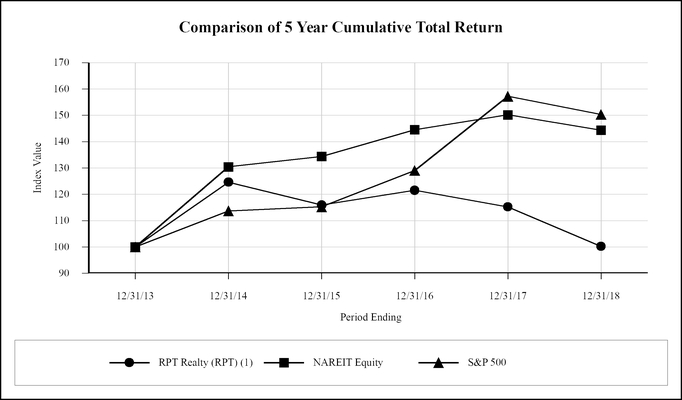
(1)
On October 31, 2018, the Company announced it re-branded to RPT Realty.
Holders
The number of holders of record of our common shares was 1,087
at
February 15
,
2019
. A substantially greater number of holders are beneficial owners whose shares of record are held by banks, brokers and other financial institutions.
Dividends
Under the Code, a REIT must meet requirements, including a requirement that it distribute to its shareholders at least 90% of its REIT taxable income annually, excluding net capital gain. Distributions paid by us are at the discretion of our Board and depend on our actual net income available to common shareholders, cash flow, financial condition, capital requirements, the annual distribution requirements under REIT provisions of the Code, and such other factors as the Board deems relevant. We do not believe that the preferential rights available to the holders of our preferred shares or the financial covenants contained in our debt agreements had or will have an adverse effect on our ability to pay dividends in the normal course of business to our common shareholders or to distribute amounts necessary to maintain our qualification as a REIT. See "Dividends and Equity" under
Item 7
, Management’s Discussion and Analysis of Financial Condition and Results of Operations, elsewhere in this report.
23
For information on our equity compensation plans as of
December 31, 2018
, refer to
Item 12
of Part III of this report and
Note 15
of the notes to the consolidated financial statements for further information regarding our share-based compensation and other benefit plans.
Item 6. Selected Financial Data
The following table sets forth our selected consolidated financial data and should be read in conjunction with the consolidated financial statements and notes to the consolidated financial statements and Management’s Discussion and Analysis of Financial Condition and Results of Operations (“MD&A”) included elsewhere in this report.
|
|
Year Ended December 31,
|
||||||||||||||||||
|
|
2018
|
2017
|
2016
|
2015
|
2014
|
||||||||||||||
|
|
(In thousands, except per share)
|
||||||||||||||||||
|
OPERATING DATA:
|
|||||||||||||||||||
|
Total revenue
|
$
|
260,622
|
|
$
|
265,082
|
|
$
|
260,930
|
|
$
|
251,790
|
|
$
|
218,363
|
|
||||
|
Operating income
|
52,260
|
|
63,399
|
|
70,908
|
|
65,497
|
|
23,330
|
|
|||||||||
|
Income (loss) from continuing operations
|
18,036
|
|
70,719
|
|
61,112
|
|
66,895
|
|
(2,412
|
)
|
|||||||||
|
Gain on sale of depreciable real estate
|
3,699
|
|
51,977
|
|
34,108
|
|
13,529
|
|
10,022
|
|
|||||||||
|
Gain on sale of land
|
295
|
|
787
|
|
1,673
|
|
4,041
|
|
835
|
|
|||||||||
|
Net income (loss)
|
18,036
|
|
70,719
|
|
61,112
|
|
66,895
|
|
(2,412
|
)
|
|||||||||
|
Net (income) loss attributable to noncontrolling partner interest
|
(417
|
)
|
(1,659
|
)
|
(1,448
|
)
|
(1,786
|
)
|
48
|
|
|||||||||
|
Preferred share dividends
|
(6,701
|
)
|
(6,701
|
)
|
(6,701
|
)
|
(6,838
|
)
|
(7,250
|
)
|
|||||||||
|
Net income (loss) available to common shareholders
|
10,918
|
|
62,359
|
|
52,963
|
|
57,771
|
|
(9,614
|
)
|
|||||||||
|
Earnings (loss) per common share:
|
|||||||||||||||||||
|
Basic
|
$
|
0.13
|
|
$
|
0.78
|
|
$
|
0.66
|
|
$
|
0.73
|
|
$
|
(0.14
|
)
|
||||
|
Diluted
|
0.13
|
|
0.78
|
|
0.66
|
|
0.73
|
|
(0.14
|
)
|
|||||||||
|
Weighted average shares outstanding:
|
|
|
|
|
|||||||||||||||
|
Basic
|
79,592
|
|
79,344
|
|
79,236
|
|
78,848
|
|
72,118
|
|
|||||||||
|
Diluted
|
80,088
|
|
79,530
|
|
79,435
|
|
79,035
|
|
72,118
|
|
|||||||||
|
Cash dividends declared per RPT preferred share
|
$
|
3.625
|
|
$
|
3.625
|
|
$
|
3.625
|
|
$
|
3.625
|
|
$
|
3.625
|
|
||||
|
Cash dividends declared per RPT common share
|
$
|
0.880
|
|
$
|
0.880
|
|
$
|
0.860
|
|
$
|
0.820
|
|
$
|
0.775
|
|
||||
|
Cash distributions to RPT preferred shareholders
|
$
|
6,701
|
|
$
|
6,701
|
|
$
|
6,701
|
|
$
|
6,977
|
|
$
|
7,250
|
|
||||
|
Cash distributions to RPT common shareholders
|
$
|
70,458
|
|
$
|
70,225
|
|
$
|
67,710
|
|
$
|
63,972
|
|
$
|
54,149
|
|
||||
|
BALANCE SHEET DATA (at December 31):
|
|||||||||||||||||||
|
Investment in real estate (before accumulated depreciation)
|
$
|
2,025,773
|
|
$
|
2,130,779
|
|
$
|
2,132,670
|
|
$
|
2,184,481
|
|
$
|
1,934,032
|
|
||||
|
Total assets
|
1,928,440
|
|
2,030,394
|
|
2,061,498
|
|
2,136,082
|
|
1,951,743
|
|
|||||||||
|
Total notes payable, net
|
963,149
|
|
999,215
|
|
1,021,223
|
|
1,083,711
|
|
917,658
|
|
|||||||||
|
Total liabilities
|
1,096,897
|
|
1,145,225
|
|
1,172,900
|
|
1,234,709
|
|
1,058,428
|
|
|||||||||
|
Total RPT shareholders' equity
|
811,962
|
|
864,322
|
|
867,701
|
|
879,391
|
|
867,525
|
|
|||||||||
|
Noncontrolling interest
|
19,581
|
|
20,847
|
|
20,897
|
|
21,982
|
|
25,790
|
|
|||||||||
|
Total shareholders' equity
|
831,543
|
|
885,169
|
|
888,598
|
|
904,466
|
|
896,408
|
|
|||||||||
|
OTHER DATA:
|
|||||||||||||||||||
|
Funds from operations ("FFO") available to common shareholders
(1)
|
$
|
109,417
|
|
$
|
118,563
|
|
$
|
118,683
|
|
$
|
119,556
|
|
$
|
77,574
|
|
||||
|
Net cash provided by operating activities
|
106,322
|
|
117,925
|
|
116,601
|
|
105,630
|
|
110,592
|
|
|||||||||
|
Net cash provided by (used in) investing activities
|
42,262
|
|
(16,675
|
)
|
11,250
|
|
(154,333
|
)
|
(315,723
|
)
|
|||||||||
|
Net cash (used in) provided by financing activities
|
(116,753
|
)
|
(103,085
|
)
|
(128,477
|
)
|
46,012
|
|
208,671
|
|
|||||||||
|
(1)
FFO is a non-GAAP financial measure that we believe provides useful information to investors. Under the NAREIT definition, FFO represents net income (computed in accordance with generally accepted accounting principles), excluding gains (or losses) from sales of depreciable property and impairment provisions on depreciable real estate or on investments in non-consolidated investees that are driven by measurable decreases in the fair value of depreciable real estate held by the investee, plus depreciation and amortization, (excluding amortization of financing costs). Adjustments for unconsolidated partnerships and joint ventures are calculated to reflect funds from operations on the same basis See “Funds From Operations” in Item 7 for a discussion of FFO and a reconciliation of FFO to net income.
|
|||||||||||||||||||
24
Item 7. Management’s Discussion and Analysis of Financial Condition and Results of Operations
The following discussion should be read in conjunction with the consolidated financial statements, the notes thereto, and the comparative summary of selected financial data appearing elsewhere in this report.
Overview
RPT Realty owns and operates a national portfolio of open-air shopping destinations principally located in top U.S. markets. As of
December 31, 2018
, our property portfolio consisted of
51
shopping centers (including
one
shopping center owned through a joint venture) representing
12.4 million
square feet of gross leasable area. As of
December 31, 2018
, the Company's aggregate portfolio was
94.3%
leased.
In 2018, the new executive management team completed several key foundational objectives which included the streamlining of the organizational platform, resetting the company culture, conducting a strategic asset review that resulted in the decision to sell approximately $200 million of non-core assets, cultivating a redevelopment pipeline and changing the name of the Company to RPT Realty. The asset sale proceeds are expected to be re-allocated into the Company’s balance sheet to lower leverage, as well as fund its near-term accretive internal growth initiatives, including the reconfiguration of anchor boxes and the lease up of small shop occupancy.
Our goal is to be a dominant shopping center owner, with a focus on the following:
|
•
|
Own and manage high quality open-air shopping centers predominantly concentrated in the top U.S. metro areas;
|
|
•
|
Maintain value creation redevelopment and expansion pipeline;
|
|
•
|
Maximize balance sheet liquidity and flexibility; and
|
|
•
|
Retain motivated, talented and high performing employees.
|
Key methods to achieve our strategy:
|
•
|
Deliver above average relative shareholder return and generate outsized consistent and sustainable same property NOI and Operating FFO per share growth;
|
|
•
|
Pursue selective redevelopment projects with significant pre-leasing for which we expect to achieve attractive returns on investment;
|
|
•
|
Sell assets that no longer meet our long-term strategy and redeploy the proceeds to lease, redevelop and acquire assets in our core markets;
|
|
•
|
Achieve lower leverage while maintaining low variable interest rate risk; and
|
|
•
|
Retain access to diverse sources of capital, maintain liquidity through borrowing capacity under our unsecured line of credit and minimize the amount of debt maturities in a single year.
|
The following highlights the Company's significant transactions, events and results that occurred during the year ended
December 31, 2018
:
Financial Results:
|
•
|
Net income available to common shareholders was
$10.9 million
, or
$0.13
per diluted share, for the year ended
December 31, 2018
, as compared to
$62.4 million
, or
$0.78
per diluted share, for the same period in
2017
.
|
|
•
|
Funds from operations ("FFO") was
$109.4 million
, or
$1.23
per diluted share, for the year ended
December 31, 2018
, as compared to
$118.6 million
, or
$1.34
per diluted share, for the same period in
2017
(see additional disclosure on FFO beginning on page 36).
|
|
•
|
Operating funds from operations ("Operating FFO") was
$120.1 million
, or
$1.35
per diluted share, for the year ended
December 31, 2018
, as compared to
$119.6 million
, or
$1.36
per diluted share, for the same period in
2017
(see additional disclosure on FFO beginning on page 36).
|
|
•
|
Same property net operating income with redevelopment increased
2.9%
for the year ended
December 31, 2018
, as compared to the same period in
2017
(see additional disclosure on FFO beginning on page 38).
|
|
•
|
Executed
288
new leases and renewals, totaling approximately
1.6 million
square feet.
|
25
|
•
|
As of
December 31, 2018
, the consolidated portfolio leased rate was
94.3%
, as compared to 93.3% at
December 31, 2017
.
|
Acquisition Activity (See
Note 4
of the Notes to Consolidated Financial Statements included in this Form 10-K):
|
•
|
Acquired leasehold interest in
one
operating property for a purchase price of
$6.4 million
.
|
Disposition Activity (See
Note 4
of the Notes to Consolidated Financial Statements included in this Form 10-K):
|
•
|
Disposed of
six
operating properties and
three
land parcels for aggregate
gross proceeds of
$125.1 million
. These transactions resulted in (i) an aggregate gain on real estate of
$4.0 million
and (ii) an aggregate impairment charge of $5.9 million.
|
Critical Accounting Policies
Management’s Discussion and Analysis of Financial Condition and Results of Operations is based on our consolidated financial statements, which have been prepared in accordance with GAAP. The preparation of these financial statements requires us to make estimates and assumptions that affect the reported amounts of assets, liabilities, revenue and expenses, and related disclosure of contingent assets and liabilities. Our estimates are based on historical experience and on various other assumptions that are believed to be reasonable under the circumstances. Actual results could differ from these estimates under different assumptions or conditions.
We believe the following critical accounting policies require our most subjective judgment and use of estimates in the preparation of our consolidated financial statements.
Revenue Recognition and Accounts Receivable
Most of our leases contain non-contingent rent escalations for which we recognize income on a straight-line basis over the non-cancelable lease term. This method results in rental income in the early years of a lease being higher than actual cash received, creating a straight-line rent receivable asset which is included in the “Other Assets” line item in our consolidated balance sheets. We review our unbilled straight-line rent receivable balance to determine the future collectability of revenue that will not be billed to or collected from tenants due to early lease terminations, lease modifications, bankruptcies and other factors. An allowance to write down the straight-line receivable balance is taken in the period that future collectability is uncertain.
Additionally, we provide for bad debt expense based upon the allowance method of accounting. We continuously monitor the collectability of our accounts receivable from specific tenants, analyze historical bad debts, customer creditworthiness, current economic trends and changes in tenant payment terms when evaluating the adequacy of the allowance for bad debts. Allowances are taken for those balances that we have reason to believe will be uncollectible.
For more information refer to
Note 1
Organization and Summary of Significant Accounting Policies,
Revenue Recognition
and
Accounts Receivable
subtopics of the notes to the consolidated financial statements.
Acquisitions
Acquisitions of properties are accounted for utilizing the acquisition method (which requires all assets acquired and liabilities assumed be measured at acquisition date fair value) and, accordingly, the results of operations of an acquired property are included in our results of operations from the date of acquisition. Estimates of fair values are based upon future cash flows and other valuation techniques in accordance with our fair value measurements policy, which are used to allocate the purchase price of acquired property among land, buildings on an “as if vacant” basis, tenant improvements, identifiable intangibles and any gain on purchase. Identifiable intangible assets and liabilities include the effect of above-and below-market leases, the value of having leases in place (“as-is” versus “as if vacant” and absorption costs), other intangible assets such as assumed tax increment revenue bonds and out-of-market assumed mortgages. Depreciation and amortization are computed using the straight-line method over the estimated useful lives of 40 years for buildings, and over the remaining terms of any intangible asset contracts and the respective tenant leases, which may include bargain renewal options. The impact of these estimates, including estimates in connection with acquisition values and estimated useful lives, could result in significant differences related to the purchased assets, liabilities and subsequent depreciation or amortization expense. For more information, refer to
Note 1
, Organization and Summary of Significant Accounting Policies - Real Estate of the notes to the consolidated financial statements.
26
Impairment
We review our investment in real estate, including any related intangible assets, for impairment on a property-by-property basis whenever events or changes in circumstances indicate that the carrying value of the property may not be recoverable. These changes in circumstances include, but are not limited to, changes in occupancy, rental rates, tenant sales, net operating income, geographic location, real estate values and expected holding period. The viability of all projects under construction or development, including those owned by unconsolidated joint ventures, is regularly evaluated under applicable accounting requirements, including requirements relating to abandonment of assets or changes in use. To the extent a project or an individual component of the project, is no longer considered to have value, the related capitalized costs are charged against operations.
Impairment provisions resulting from any event or change in circumstances, including changes in our intentions or our analysis of varying scenarios, could be material to our consolidated financial statements.
We recognize an impairment of an investment in real estate when the estimated undiscounted cash flow are less than the net carrying value of the property. If it is determined that an investment in real estate is impaired, then the carrying value is reduced to the estimated fair value as determined by cash flow models and discount rates or comparable sales in accordance with our fair value measurement policy. Refer to
Note 1
Organization and Summary of Significant Accounting Policies -
Accounting for the Impairment of Long-Lived Assets
for further information regarding impairment provisions.
Results of Operations
Comparison of the Year Ended
December 31, 2018
to the Year Ended
December 31, 2017
The following summarizes certain line items from our audited statements of operations which we believe are important in understanding our operations and/or those items that have significantly changed during the year ended
December 31, 2018
as compared to
2017
:
|
|
Year Ended December 31,
|
||||||||||||||
|
|
2018
|
2017
|
Dollar Change
|
Percent Change
|
|||||||||||
|
|
(In thousands)
|
|
|||||||||||||
|
Total revenue
|
$
|
260,622
|
|
$
|
265,082
|
|
$
|
(4,460
|
)
|
(1.7
|
)%
|
||||
|
Real estate taxes
|
42,306
|
|
42,683
|
|
(377
|
)
|
(0.9
|
)%
|
|||||||
|
Recoverable operating expenses
|
26,177
|
|
27,653
|
|
(1,476
|
)
|
(5.3
|
)%
|
|||||||
|
Non-recoverable operating expense
|
4,808
|
|
4,664
|
|
144
|
|
3.1
|
%
|
|||||||
|
Depreciation and amortization
|
87,327
|
|
91,335
|
|
(4,008
|
)
|
(4.4
|
)%
|
|||||||
|
Acquisition costs
|
233
|
|
—
|
|
233
|
|
NM
|
|
|||||||
|
General and administrative expense
|
33,861
|
|
25,944
|
|
7,917
|
|
30.5
|
%
|
|||||||
|
Provision for impairment
|
13,650
|
|
9,404
|
|
4,246
|
|
45.2
|
%
|
|||||||
|
Gain on sale of real estate
|
3,994
|
|
52,764
|
|
(48,770
|
)
|
(92.4
|
)%
|
|||||||
|
Earnings from unconsolidated joint ventures
|
589
|
|
273
|
|
316
|
|
115.8
|
%
|
|||||||
|
Interest expense
|
43,439
|
|
44,866
|
|
(1,427
|
)
|
(3.2
|
)%
|
|||||||
|
Other gain on unconsolidated joint ventures
|
5,208
|
|
—
|
|
5,208
|
|
NM
|
|
|||||||
|
NM - Not meaningful
|
|||||||||||||||
Total revenue in
2018
decrease
d
$4.5 million
, or
(1.7)%
, from
2017
. The decrease is primarily due to the following:
|
•
|
$20.1 million decrease related to properties sold in 2018 and 2017; offset by
|
|
•
|
$7.7 million increase related to our existing centers largely attributable to changes in estimates associated with recoveries of common area maintenance and real estate taxes, and higher minimum rent;
|
|
•
|
$5.2 million increase from acceleration of a below market lease attributable to a specific tenant who vacated prior to the original estimated lease termination date; and
|
|
•
|
$2.7 million increase related to properties acquired in 2017 and a leasehold interest acquired in 2018.
|
27
Real estate tax expense in
2018
decrease
d
$0.4 million
, or
(0.9)%
, from
2017
primarily due to properties sold during 2018 and 2017, partially offset by properties acquired in 2017 and higher net expense; specifically at two properties as a result of a change in estimates.
Recoverable operating expense in
2018
decrease
d
$1.5 million
, or
(5.3)%
, from
2017
primarily due to properties sold during 2018 and 2017, partially offset by additional expense from properties acquired in 2017.
Non-recoverable operating expense in
2018
remained flat from
2017
.
Depreciation and amortization expense in
2018
decrease
d
$4.0 million
, or
(4.4)%
, from
2017
. The decrease is primarily a result of properties sold during 2018 and 2017, partially offset by higher asset write offs in 2018 for tenant lease terminations prior to their original estimated term, and higher depreciation expense from acquisitions completed in 2017.
During
2018
we recorded acquisition costs of
$0.2 million
related to legal and professional fees associated with a potential shopping center acquisition that was abandoned during the year.
General and administrative expense in
2018
increase
d
$7.9 million
, or
30.5%
, from
2017
. The increase was primarily due to the following:
|
•
|
$9.7 million of executive management reorganization expenses, which included severance costs associated with former executives as well as executive recruiting fees, sign on bonuses and relocation fees associated with the new executive team;
|
|
•
|
$0.8 million of severance costs resulting from the reduction-in-force associated with the reorganization of the Company's operating structure; offset by
|
|
•
|
$0.8 million decrease in service-based and performance-based stock compensation expense; and
|
|
•
|
$0.5 million decrease in other severance costs.
|
During
2018
we recorded an impairment provision totaling
$13.7 million
, of which
$13.4 million
was on shopping centers classified as income producing and
$0.2 million
on land held for development. The adjustments related to shopping centers were triggered by changes in associated market prices and expected hold period assumptions, as well as a purchase price reduction at one property. The provision related to land held for development was triggered by changes in the expected use of the land and higher costs. During
2017
we recorded an impairment provision totaling
$9.4 million
, of which $8.4 million was on shopping centers classified as income producing and $1.0 million on land held for development. The adjustments were triggered by changes in associated sales price assumptions, a purchase price reduction at one property and changes in the expected use of land. Refer to
Note 1
Organization and Summary of Significant Accounting Policies -
Accounting for the Impairment of Long-Lived Assets
of the notes to the consolidated financial statements for further information related to impairment provisions.
Gain on sale of real estate was
$4.0 million
in
2018
. In the comparable period in
2017
we had a gain of
$52.8 million
. Refer to Note 4 of the notes to the consolidated financial statements for further detail on dispositions.
Earnings from unconsolidated joint ventures in
2018
increase
d
$0.3 million
from
2017
. The increase was primarily due to our portion of the gain on sale of the Martin Square property which was disposed of by our joint venture during the year compared to no disposals by our unconsolidated joint ventures in the comparable period.
Interest expense
decrease
d in
2018
by
$1.4 million
, or
(3.2)%
from
2017
. The decrease is primarily a result of an 8% decrease in our average outstanding debt, offset partially by a 45 basis point increase in our weighted average interest rate. The decline in our average outstanding debt is primarily a result of using proceeds from asset sales in the second half of 2017 to paydown our revolving credit line.
Other gain on unconsolidated joint ventures
increase
d
$5.2 million
primarily due to the sale of the Martin Square property by our joint venture during the year. The gain represents the difference between our share of the distributed proceeds and the carrying value of our equity investment in the joint venture.
28
Comparison of the Year Ended
December 31, 2017
to the Year Ended
December 31, 2016
The following summarizes certain line items from our audited statements of operations which we believe are important in understanding our operations and/or those items which have significantly changed during the year ended
December 31, 2017
as compared to
2016
:
|
|
Year Ended December 31,
|
||||||||||||||
|
|
2017
|
2016
|
Dollar Change
|
Percent Change
|
|||||||||||
|
|
(In thousands)
|
|
|||||||||||||
|
Total revenue
|
$
|
265,082
|
|
$
|
260,930
|
|
$
|
4,152
|
|
1.6
|
%
|
||||
|
Real estate taxes
|
42,683
|
|
41,739
|
|
944
|
|
2.3
|
%
|
|||||||
|
Recoverable operating expenses
|
27,653
|
|
29,581
|
|
(1,928
|
)
|
(6.5
|
)%
|
|||||||
|
Non-recoverable operating expenses
|
4,664
|
|
3,575
|
|
1,089
|
|
30.5
|
%
|
|||||||
|
Depreciation and amortization
|
91,335
|
|
91,793
|
|
(458
|
)
|
(0.5
|
)%
|
|||||||
|
General and administrative expense
|
25,944
|
|
22,041
|
|
3,903
|
|
17.7
|
%
|
|||||||
|
Provision for impairment
|
9,404
|
|
977
|
|
8,427
|
|
862.5
|
%
|
|||||||
|
Gain on sale of real estate
|
52,764
|
|
35,781
|
|
16,983
|
|
47.5
|
%
|
|||||||
|
Earnings from unconsolidated joint ventures
|
273
|
|
454
|
|
(181
|
)
|
(39.9
|
)%
|
|||||||
|
Interest expense
|
44,866
|
|
44,514
|
|
352
|
|
0.8
|
%
|
|||||||
|
Other gain on unconsolidated joint ventures
|
—
|
|
215
|
|
(215
|
)
|
NM
|
|
|||||||
|
Loss on extinguishment of debt
|
—
|
|
(1,256
|
)
|
1,256
|
|
NM
|
|
|||||||
|
NM - Not meaningful
|
|
|
|
|
|
|
|
|
|||||||
Total revenue in
2017
increase
d
$4.2 million
, or
1.6%
, from
2016
. The increase is primarily due to the following:
|
•
|
$17.3 million increase related to acquisitions completed in 2017 and 2016;
|
|
•
|
$3.1 million increase at existing centers; offset by
|
|
•
|
$14.8 million decrease related to properties sold in 2017 and 2016;
|
|
•
|
$1.1 million decrease related to disposal of our office building; and a
|
|
•
|
$0.1 million decrease in management and other fee income.
|
The $3.1 million increase at existing centers was primarily the result of higher minimum rent. Recovery income from tenants decreased $1.4 million, or 2.2%, primarily due to lower net recoverable operating expenses and real estate taxes of $1.0 million.
Real estate tax expense in
2017
increase
d
$0.9 million
, or
2.3%
, from
2016
primarily due to incremental tax increases within existing properties of $0.6 million, as well as net tax increases from acquisition and disposition activity of $0.3 million.
Recoverable operating expense in
2017
decrease
d
$1.9 million
, or
(6.5)%
, from
2016
primarily due to a decrease at existing centers of $1.3 million, as a result of lower spending, as well as a net decrease in operating expenses from acquisition and disposition activity of $0.6 million.
Non-recoverable operating expense in
2017
increase
d
$1.1 million
. or
30.5%
, from
2016
primarily due to ground rent expense at a property acquired in the fourth quarter of 2016.
Depreciation and amortization expense in
2017
decrease
d
$0.5 million
, or
(0.5)%
, from
2016
. The net decrease was primarily attributable to tenant bankruptcy and vacancy write-offs in 2017 resulting in partial year expense recognition, lease origination costs reaching full amortization and a reduction in expense from property dispositions. The net decrease was partially offset by depreciations and amortization on new building and improvement assets and lease origination costs from the 2017 and 2016 acquisitions.
General and administrative expense in
2017
increase
d
$3.9 million
, or
17.7%
, from
2016
. The increase was primarily due to increased costs associated with professional fees, the change in performance-based executive compensation recognized in the respective periods and an increase in wages.
29
During
2017
we recorded an impairment provision totaling
$9.4 million
, of which $8.4 million was on shopping centers classified as income producing and $1.0 million on land held for development or sale. The adjustments were triggered by changes in associated sales price assumptions, a purchase price reduction at one property and changes in the expected use of the land. Impairment provisions of
$1.0 million
recorded in
2016
related to developable land held for sale triggered by unforeseen increases in development costs and changes in associated sales price assumptions. Refer to
Note 1
Organization and Summary of Significant Accounting Policies -
Accounting for the Impairment of Long-Lived Assets
of the notes to the consolidated financial statements for further information related to impairment provisions.
Gain on sale of real estate was
$52.8 million
in
2017
. In the comparable period in
2016
we had a gain of
$35.8 million
. Refer to Note 4 of the notes to the consolidated financial statements for further detail on dispositions.
Earnings from unconsolidated joint ventures in
2017
decrease
d
$0.2 million
from
2016
. The decrease was primarily due to the reduced level of properties in unconsolidated joint ventures for the majority of 2017 as compared to 2016.
Interest expense
increase
d in
2017
by
$0.4 million
, or
0.8%
, from
2016
primarily due to a 7% increase in our average outstanding debt and lower debt premium amortization, offset partially by a 30 basis point decline in our weighted average interest rate.
Loss on extinguishment of debt of approximately
$1.3 million
in
2016
resulted from a $0.9 million loss upon the conveyance of our Aquia office property to the lender and a $0.4 million cash prepayment penalty on a mortgage payoff in
2016
. There was no loss on extinguishment of debt in
2017
.
Liquidity and Capital Resources
Our primary uses of capital include principal and interest payments on our outstanding indebtedness, recurring capital expenditures such as tenant improvements, leasing commissions, improvements made to individual properties, shareholder dividends, redevelopments, operating expenses of our business, debt maturities, acquisitions and developments. We generally strive to cover our principal and interest payments, operating expenses, shareholder distributions, and recurring capital expenditures from cash flow from operations, although from time to time we may borrow or sell assets to finance a portion of those uses. We believe the combination of cash flow from operations, cash balances, available borrowings under our Unsecured Credit Facility, issuance of long-term debt, property dispositions, and issuance of equity securities will provide adequate capital resources to fund all of our expected uses over at least the next 12 months. Although we believe that the combination of factors discussed above will provide sufficient liquidity, no such assurance can be given.
We believe our current capital structure provides us with the financial flexibility to fund our current capital needs. We intend to continue to enhance our financial and operational flexibility by extending the duration of our debt, appropriately laddering our debt maturities and further expanding our unencumbered asset base. In addition, we believe we have access to multiple forms of capital which includes unsecured corporate debt, preferred equity and common equity including our at-the-market equity program we have in place.
At
December 31, 2018
and
2017
, we had
$44.7 million
and
$12.9 million
, respectively, in cash and cash equivalents and restricted cash. Restricted cash of
$3.7 million
and
$4.8 million
as of
December 31, 2018
and
2017
, respectively, was comprised primarily of funds held in escrow by lenders to pay real estate taxes, insurance premiums and certain capital expenditures. As of
December 31, 2018
we had no debt maturing in 2019. As of
December 31, 2018
we had
$349.8 million
available to be drawn on our
$350.0 million
unsecured revolving credit facility subject to our compliance with certain covenants.
Our long-term liquidity needs consist primarily of funds necessary to pay indebtedness at maturity, potential acquisitions of properties, redevelopment of existing properties and the development of land. We continually search for investment opportunities that may require additional capital and/or liquidity, which will afford us the opportunity to significantly increase our return on total investment. We will continue to pursue the strategy of selling mature properties and non-core assets that no longer meet our investment criteria. Our ability to obtain acceptable selling prices and satisfactory terms and financing will impact the timing of future sales. We anticipate using net proceeds from the sale of properties to reduce outstanding debt and support current and future growth initiatives. To the extent that asset sales are not sufficient to meet our long-term liquidity needs, we expect to meet such needs by incurring debt or issuing equity.
30
The following is a summary of our cash flow activities:
|
|
Year Ended December 31,
|
||||||||||
|
|
2018
|
2017
|
2016
|
||||||||
|
|
(In thousands)
|
||||||||||
|
Cash provided by operating activities
|
$
|
106,322
|
|
$
|
117,925
|
|
$
|
116,601
|
|
||
|
Cash provided by (used in) investing activities
|
42,262
|
|
(16,675
|
)
|
11,250
|
|
|||||
|
Cash used in financing activities
|
(116,753
|
)
|
(103,085
|
)
|
(128,477
|
)
|
|||||
Operating Activities
Net cash flow provided by operating activities
decrease
d
$11.6 million
in
2018
compared to
2017
primarily due to the following:
|
•
|
Decrease of $13.4 million as a result of shopping centers sold in 2017; and
|
|
•
|
a $4.4 million decrease related to executive management reorganization costs; partially offset by
|
|
•
|
higher operating cash of $4.1 million from shopping centers owned and operated throughout all of 2017 and 2018.
|
Investing Activities
Net cash provided by investing activities was
$42.3 million
in 2018 compared to net cash used in investing activities of
$(16.7) million
in 2017. The
$58.9 million
change in net cash provided by (used in) investing activities was primarily due to:
|
•
|
Acquisitions of real estate
decrease
d
$163.5 million
; offset by
|
|
•
|
net proceeds from the sale of real estate, including distributions on joint venture sales,
decrease
d
$93.7 million
; and
|
|
•
|
development and capital improvements to real estate
increase
d
$13.9 million
.
|
In
2018
we acquired the leasehold interest in a ground lease at our existing West Oaks shopping center for approximately
$6.4 million
. In
2017
we acquired two properties at a combined gross purchase price of
$168.3 million
and three outparcel acquisitions with a combined gross purchase price of
$1.6 million
.
At
December 31, 2018
, we had four properties under redevelopment or expansion that have an estimated cost of
$8.5 million
, of which
$5.1 million
remains to be invested. Completion for these projects is expected over the next twelve months.
In
2018
we sold
six
properties and
three
outparcels with aggregate net proceeds of
$116.5 million
. During 2017 we closed eleven property dispositions, a Walgreen’s Data Center and five outparcel sales with aggregate net proceeds of
$216.5 million
. Refer to Note 4 Property Acquisitions and Dispositions of the notes to the consolidated financial statements for additional information related to dispositions.
Our development and capital improvements spend in 2018 and 2017 included $9.7 million and $6.1 million, respectively, for the retenanting of anchor tenants forced to close as a result of bankruptcy proceedings.
Financing Activities
Net cash used in financing activities
increase
d
$13.7 million
compared to
2017
primarily because net borrowings on our mortgages and notes payable
decrease
d
$41.0 million
, offset partially by lower net paydowns on our revolving credit facility of
$26.0 million
.
As of
December 31, 2018
,
$349.8 million
was available to be drawn on our
$350.0 million
unsecured revolving credit facility subject to our compliance with certain covenants. In addition, as of
December 31, 2018
, we had
$44.7 million
in cash and cash equivalents and restricted cash. It is anticipated that additional funds borrowed under our credit facilities will be used for general corporate purposes, including working capital, capital expenditures, the repayment of indebtedness or other corporate activities. For further information on the credit facilities and other debt, refer to Note 8 of notes to the consolidated financial statements.
31
Dividends and Equity
We currently qualify, and intend to continue to qualify in the future, as a REIT under the Code. As a REIT, we must distribute to our shareholders at least 90% of our REIT taxable income annually, excluding net capital gain. Distributions paid are at the discretion of our Board and depend on our actual net income available to common shareholders, cash flow, financial condition, capital requirements, restrictions in financing arrangements, the annual distribution requirements under REIT provisions of the Code and such other factors as our Board deems relevant.
We paid cash dividends of
$0.88
per common share to shareholders in
2018
. Cash dividends for
2017
and
2016
were
$0.88
and
$0.86
per common share, respectively. Our dividend policy is to make distributions to shareholders of at least 90% of our REIT taxable income, excluding net capital gain, in order to maintain qualification as a REIT. On an annualized basis, our current dividend is above our estimated minimum required distribution. Distributions paid by us are generally expected to be funded from cash flows from operating activities. To the extent that cash flows from operating activities are insufficient to pay total distributions for any period, alternative funding sources can be used. Examples of alternative funding sources include proceeds from sales of real estate and bank borrowings. During
2018
, the sum of our principal and interest payments, operating expenses, shareholder distributions and recurring capital expenditures exceeded our cash flow, in order to fund our distributions from operations by $18.0 million, and we used other sources of liquidity, including a portion of the proceeds from asset sales. The $18.0 million shortfall was primarily a result of the $11.6 million year-over-year decrease in net cash provided by operating activities due to asset sales and $9.7 million for the retenanting of anchor tenants forced to close as a result of bankruptcy proceedings.
Additionally, we paid cash dividends of
$3.625
per share of our 7.25% Series D Cumulative Convertible Perpetual Preferred Shares to preferred shareholders in
2018
.
We have an equity distribution agreement pursuant to which we may sell up to 8.0 million common shares from time to time, in our sole discretion in an at-the-market equity program. For the year ended
December 31, 2018
, we did not issue any common shares through the arrangement. The sale of such shares issuable pursuant to the distribution agreement is registered with the Securities and Exchange Commission (“SEC”) on our registration statement on Form S-3 (No. 333-211925).
Debt
At
December 31, 2018
, we had no outstanding borrowings on our revolving credit facility,
$115.1 million
of fixed rate mortgage loans encumbering certain properties,
$210.0 million
of unsecured term loan facilities,
$610.0 million
in senior unsecured notes and
$28.1 million
of junior subordinated notes.
In September 2017, the Company closed on its amended and restated
$350.0 million
unsecured revolving credit facility. The credit facility matures September 2021 and can be extended one year to 2022 through two six-month options. Borrowings on the credit facility are priced on a leverage grid ranging from LIBOR plus 130 basis points to LIBOR plus 195 basis points. At
December 31, 2018
, borrowings were priced at LIBOR plus 130 basis points. Additionally, the facility allows for increased borrowing capacity up to $650.0 million through an accordion feature.
Our
$115.1 million
of fixed rate mortgages have interest rates ranging from
3.76%
to
6.50%
and are due at various maturity dates from April 2020 through June 2026. The fixed rate mortgage notes are secured by mortgages on properties that have an approximate net book value of
$181.4 million
as of
December 31, 2018
.
Our
$820.0 million
of senior unsecured notes and unsecured term loans have interest rates ranging from
2.84%
to
4.74%
and are due at various maturity dates from May 2020 through December 2029.
Our junior subordinated notes have a variable rate of LIBOR plus 3.30%, for an effective rate of
5.82%
at
December 31, 2018
. The maturity date is January 2038.
In addition, we had interest rate swap derivative instruments in effect for an aggregate notional amount of
$210.0 million
converting a portion of our floating rate corporate debt to fixed rate debt. After taking into account the impact of converting our variable rate debt to fixed rate debt by use of the interest rate swap agreements, at
December 31, 2018
, we had
$28.1 million
of variable rate debt outstanding.
32
Off Balance Sheet Arrangements
Real Estate Joint Ventures
We consolidate entities in which we own less than 100% equity interest if we have a controlling interest or are the primary beneficiary in a variable interest entity, as defined in the Consolidation Topic of FASB ASC 810. From time to time, we enter into joint venture arrangements from which we believe we can benefit by owning a partial interest in one or more properties.
As of
December 31, 2018
, our investments in unconsolidated joint ventures were approximately
$1.6 million
representing our ownership inter
est in
three
join
t ventures. We accounted for these entities under the equity method. Refer to Note 6 of the notes to the consolidated financial statements for further information regarding our equity investments in unconsolidated joint ventures.
We are engaged by certain our joint ventures to provide asset management, property management, leasing and investing services for such ventures' respective properties. We receive fees for our services, including a property management fee calculated as a percentage of gross revenues received.
Guarantee
A redevelopment agreement was entered into between the City of Jacksonville, the Jacksonville Economic Development Commission and the Company, to construct and develop River City Marketplace in 2005. As part of the agreement, the city agreed to finance up to
$12.2 million
of bonds. Repayment of the bonds is to be made in accordance with a level-payment amortization schedule over 20 years, and repayments are made out of tax revenues generated by the redevelopment. The remaining debt service payments due over the life of the bonds, including principal and interest, are
$10.3 million
. As part of the redevelopment, the Company executed a guaranty agreement whereby the Company would fund debt service payments if incremental revenues were not sufficient to fund repayment. There have been no payments made by the Company under this guaranty agreement to date.
Contractual Obligations
The following are our contractual cash obligations as of
December 31, 2018
:
|
|
Payments due by period
|
|
|
||||||||||||||||
|
Contractual Obligations
|
Total
|
Less than 1 year
|
1-3 years
|
3-5 years
|
More than 5 years
|
||||||||||||||
|
|
(In thousands)
|
||||||||||||||||||
|
Mortgages and notes payable:
|
|
|
|
|
|
||||||||||||||
|
Scheduled amortization
|
$
|
12,409
|
|
$
|
2,611
|
|
$
|
6,508
|
|
$
|
1,708
|
|
$
|
1,582
|
|
||||
|
Payments due at maturity
|
950,850
|
|
—
|
|
287,666
|
|
253,559
|
|
409,625
|
|
|||||||||
|
Total mortgages and notes payable
(1)
|
963,259
|
|
2,611
|
|
294,174
|
|
255,267
|
|
411,207
|
|
|||||||||
|
Interest expense
(2)
|
243,515
|
|
40,436
|
|
102,106
|
|
46,829
|
|
54,144
|
|
|||||||||
|
Employment contracts
|
4,617
|
|
2,086
|
|
2,531
|
|
—
|
|
—
|
|
|||||||||
|
Capital lease
|
1,400
|
|
100
|
|
300
|
|
200
|
|
800
|
|
|||||||||
|
Operating leases
|
101,123
|
|
1,631
|
|
3,757
|
|
2,164
|
|
93,571
|
|
|||||||||
|
Construction commitments
|
6,668
|
|
6,668
|
|
—
|
|
—
|
|
—
|
|
|||||||||
|
Development obligations
|
3,665
|
|
517
|
|
974
|
|
463
|
|
1,711
|
|
|||||||||
|
Total contractual obligations
|
$
|
1,324,247
|
|
$
|
54,049
|
|
$
|
403,842
|
|
$
|
304,923
|
|
$
|
561,433
|
|
||||
|
(1)
|
Excludes
$2.9 million
of unamortized mortgage debt premium and
$3.1 million
in deferred financing costs.
|
|
(2)
|
Variable rate debt interest is calculated using rates at
December 31, 2018
.
|
At
December 31, 2018
, we did not have any contractual obligations that required or allowed settlement, in whole or in part, with consideration other than cash.
Mortgages and notes payable
See the analysis of our debt included in “Liquidity and Capital Resources” above.
33
Employment Contracts
At
December 31, 2018
, we had employment contract obligations with our Chief Executive Officer, Chief Financial Officer, former Chief Executive Officer and former Chief Operating Officer that contain minimum guaranteed compensation. All other employees are subject to at-will employment.
Operating and Capital Leases
We have an operating ground lease at Centennial Shops located in Edina, Minnesota. The lease includes rent escalations throughout the lease period and expires in April 2105.
We have an operating lease for our 29,802 square foot corporate office in Farmington Hills, Michigan, and an operating lease for our 5,629 square foot corporate office in New York, New York. These leases are set to expire in August 2019 and January 2024, respectively.
We also have a capital ground lease at our Buttermilk Towne Center with the City of Crescent Springs, Kentucky. The lease provides for fixed annual payments of $0.1 million through maturity in December 2032, at which time we can acquire the land for one dollar.
Construction Costs
In connection with the development and expansion of various shopping centers as of
December 31, 2018
, we have entered into agreements for construction activities with an aggregate cost of approximately
$6.7 million
.
Planned Capital Spending
We are focused on enhancing the value of our existing portfolio of shopping centers through successful leasing efforts, including the reconfiguration of anchor-space and small shop lease-up, and the completion of our redevelopment projects currently in process.
For
2019
, we anticipate spending
betwee
n $50.0 million and $60.0 million for capital expenditures, of which
$6.7 million
is reflected in the construction commitments in the above contractual obligations table. The total anticipated spending relates to redevelopment projects, tenant improvements and leasing costs. Estimates for future spending will change as new projects are approved.
34
Capitalization
At
December 31, 2018
our total market capitalization was
$2.0 billion
and is detailed below:
|
(In thousands)
|
|||
|
Notes payable, net
|
$
|
963,149
|
|
|
Capital lease obligation
|
975
|
|
|
|
Less: Cash and cash equivalents
|
(41,064
|
)
|
|
|
Net debt
|
$
|
923,060
|
|
|
Common shares outstanding
|
79,734
|
|
|
|
Operating Partnership Units outstanding
|
1,909
|
|
|
|
Restricted share awards (treasury method)
|
763
|
|
|
|
Total common shares and equivalents
|
82,406
|
|
|
|
Market price per common share (at December 31, 2018)
|
$
|
11.95
|
|
|
Equity market capitalization
|
$
|
984,752
|
|
|
7.25% Series D Cumulative Convertible Perpetual Preferred Shares
|
1,849
|
|
|
|
Market price per convertible preferred share (at December 31, 2018)
|
$
|
49.45
|
|
|
Convertible perpetual preferred shares (at market)
|
$
|
91,433
|
|
|
Total market capitalization
|
$
|
1,999,245
|
|
|
Net debt to total market capitalization
|
46.2
|
%
|
|
At
December 31, 2018
, noncontrolling interests represented a
2.3%
ownership in the Operating Partnership. The OP Units may, under certain circumstances, be exchanged for our common shares of beneficial interest on a one-for-one basis. We, as sole general partner of the Operating Partnership, have the option, but not the obligation, to settle exchanged OP Units held by others in cash. Assuming the exchange of all OP Units, there would have been approximately
81.6 million
of our common shares of beneficial interest outstanding at
December 31, 2018
, with a market value of approximately
$975.6 million
.
35
Non-GAAP Financial Measures
Certain of our key performance indicators are considered non-GAAP financial measures. Management uses these measures along with our GAAP financial statements in order to evaluate our operations results. We believe these additional measures provide users of our financial information additional comparable indicators of our industry, as well as our performance.
Funds From Operations
We consider funds from operations, also known as “FFO,” to be an appropriate supplemental measure of the financial performance of an equity REIT. The National Association of Real Estate Investment Trusts "NAREIT" is an industry body public REITs participate in and provides guidance to its members. Under the NAREIT definition, FFO represents net income (computed in accordance with generally accepted accounting principles), excluding gains (or losses) from sales of depreciable property and impairment provisions on depreciable real estate or on investments in non-consolidated investees that are driven by measurable decreases in the fair value of depreciable real estate held by the investee, plus depreciation and amortization, (excluding amortization of financing costs). Adjustments for unconsolidated partnerships and joint ventures are calculated to reflect funds from operations on the same basis.
In addition to FFO available to common shareholders, we include Operating FFO available to common shareholders as an additional measure of our financial and operating performance. Operating FFO excludes acquisition costs and periodic items such as impairment provisions on land available for development, bargain purchase gains, accelerated amortization of debt premiums and gains or losses on extinguishment of debt that are not adjusted under the current NAREIT definition of FFO. We provide a reconciliation of FFO to Operating FFO. FFO and Operating FFO should not be considered alternatives to GAAP net income available to common shareholders or as alternatives to cash flow as measures of liquidity.
While we consider FFO available to common shareholders and Operating FFO available to common shareholders useful measures for reviewing our comparative operating and financial performance between periods or to compare our performance to different REITs, our computations of FFO and Operating FFO may differ from the computations utilized by other real estate companies, and therefore, may not be comparable.
We recognize the limitations of FFO and Operating FFO when compared to GAAP net income available to common shareholders. FFO and Operating FFO available to common shareholders do not represent amounts available for needed capital replacement or expansion, debt service obligations, or other commitments and uncertainties. In addition, FFO and Operating FFO do not represent cash generated from operating activities in accordance with GAAP and are not necessarily indicative of cash available to fund cash needs, including the payment of dividends. FFO and Operating FFO are simply used as additional indicators of our operating performance. The following table illustrates the calculations of FFO and Operating FFO:
36
|
|
Years Ended December 31,
|
||||||||||
|
|
2018
|
2017
|
2016
|
||||||||
|
|
(In thousands, except per share data)
|
||||||||||
|
Net income
|
$
|
18,036
|
|
$
|
70,719
|
|
$
|
61,112
|
|
||
|
Net (income) attributable to noncontrolling partner interest
|
(417
|
)
|
(1,659
|
)
|
(1,448
|
)
|
|||||
|
Preferred share dividends
|
(6,701
|
)
|
(6,701
|
)
|
(6,701
|
)
|
|||||
|
Net income (loss) available to common shareholders
|
10,918
|
|
62,359
|
|
52,963
|
|
|||||
|
Adjustments:
|
|
|
|||||||||
|
Rental property depreciation and amortization expense
|
86,970
|
|
91,097
|
|
91,610
|
|
|||||
|
Pro-rata share of real estate depreciation from unconsolidated joint ventures
|
191
|
|
302
|
|
310
|
|
|||||
|
Gain on sale of depreciable real estate
|
(3,699
|
)
|
(51,977
|
)
|
(34,108
|
)
|
|||||
|
Gain on sale of joint venture depreciable real estate
|
(307
|
)
|
—
|
|
(26
|
)
|
|||||
|
Provision for impairment on income-producing properties
|
13,434
|
|
8,422
|
|
—
|
|
|||||
|
Other gain on unconsolidated joint ventures
|
(5,208
|
)
|
—
|
|
(215
|
)
|
|||||
|
FFO available to common shareholders
|
102,299
|
|
110,203
|
|
110,534
|
|
|||||
|
Noncontrolling interest in Operating Partnership
(1)
|
417
|
|
1,659
|
|
1,448
|
|
|||||
|
Preferred share dividends (assuming conversion)
(2)
|
6,701
|
|
6,701
|
|
6,701
|
|
|||||
|
FFO available to common shareholders and dilutive securities
|
$
|
109,417
|
|
$
|
118,563
|
|
$
|
118,683
|
|
||
|
Gain on sale of land
|
(295
|
)
|
(787
|
)
|
(1,673
|
)
|
|||||
|
Provision for impairment for land available for development
|
216
|
|
982
|
|
977
|
|
|||||
|
Loss on extinguishment of debt
|
134
|
|
—
|
|
1,256
|
|
|||||
|
Accelerated amortization of debt premium
|
—
|
|
110
|
|
(128
|
)
|
|||||
|
Severance expense
(3)
|
1,117
|
|
715
|
|
492
|
|
|||||
|
Executive management reorganization, net
(3)(4)(5)
|
9,673
|
|
—
|
|
—
|
|
|||||
|
Acquisition costs
|
233
|
|
—
|
|
316
|
|
|||||
|
Other gain
|
(398
|
)
|
—
|
|
—
|
|
|||||
|
Operating FFO available to common shareholders and dilutive securities
|
$
|
120,097
|
|
$
|
119,583
|
|
$
|
119,923
|
|
||
|
Weighted average common shares
|
79,592
|
|
79,344
|
|
79,236
|
|
|||||
|
Shares issuable upon conversion of Operating Partnership Units
(1)
|
1,912
|
|
1,917
|
|
1,943
|
|
|||||
|
Dilutive effect of restricted stock
|
496
|
|
186
|
|
199
|
|
|||||
|
Shares issuable upon conversion of preferred shares
(2)
|
6,858
|
|
6,740
|
|
6,630
|
|
|||||
|
Weighted average equivalent shares outstanding, diluted
|
88,858
|
|
88,187
|
|
88,008
|
|
|||||
|
Diluted earnings per share
(6)
|
$
|
0.13
|
|
$
|
0.78
|
|
$
|
0.66
|
|
||
|
Per share adjustments for FFO available to common shareholders and dilutive securities
|
1.10
|
|
0.56
|
|
0.69
|
|
|||||
|
FFO available to common shareholders and dilutive securities per share, diluted
|
$
|
1.23
|
|
$
|
1.34
|
|
$
|
1.35
|
|
||
|
|
|
|
|
||||||||
|
Per share adjustments for Operating FFO available to common shareholders and dilutive securities
|
0.12
|
|
0.02
|
|
0.01
|
|
|||||
|
Operating FFO available to common shareholders and dilutive securities per share, diluted
|
$
|
1.35
|
|
$
|
1.36
|
|
$
|
1.36
|
|
||
|
(1)
|
The total noncontrolling interest reflects OP units convertible 1:1 into common shares.
|
|
(2)
|
Series D convertible preferred shares paid annual dividends of
$6.7 million
and are currently convertible into approximately
6.9 million
shares of common stock. They are dilutive only when earnings or FFO exceed approximately $0.98 per diluted share per year The conversion ratio is subject to adjustment based upon a number of factors, and such adjustment could affect the dilutive impact of the Series D convertible preferred shares on FFO and earnings per share in future periods.
|
|
(3)
|
Amounts noted are included in General and Administrative expense.
|
|
(4)
|
Includes severance, accelerated vesting of restricted stock and performance award charges and the benefit from the forfeiture of unvested restricted stock and performance awards associated with our former executives, in addition to recruiting fees, relocation expenses and cash inducement bonuses related to the Company's current executive team.
|
|
(5)
|
The $9.7 million reported for the twelve months ended December 31, 2018 includes $0.4 million for the three months ended March 31, 2018 not previously reported.
|
|
(6)
|
The denominator to calculate diluted earnings per share excludes shares issuable upon conversion of Operating Partnership Units and preferred shares for all periods reported.
|
37
Same Property Operating Income
Same Property Operating Income ("Same Property NOI with Redevelopment") is a supplemental non-GAAP financial measure of real estate companies' operating performance. Same Property NOI with Redevelopment is considered by management to be a relevant performance measure of our operations because it includes only the NOI of comparable properties for the reporting period. Same Property NOI with Redevelopment excludes acquisitions and dispositions. Same Property NOI with Redevelopment is calculated using consolidated operating income and adjusted to exclude management and other fee income, depreciation and amortization, general and administrative expense, provision for impairment and non-comparable income/expense adjustments such as straight-line rents, lease termination fees, above/below market rents, and other non-comparable operating income and expense adjustments.
In addition to Same Property NOI with Redevelopment, the Company also believes Same Property NOI without Redevelopment to be a relevant performance measure of our operations. Same Property NOI without Redevelopment follows the same methodology as Same Property NOI with Redevelopment, however it excludes redevelopment activity that significantly impacts the entire property, as well as lesser redevelopment activity where we are adding GLA or retenanting a specific space. A property is designated as redevelopment when projected costs exceed $1.0 million, and the construction impacts approximately 20% or more of the income producing property's gross leasable area ("GLA") or the location and nature of the construction significantly impacts or disrupts the daily operations of the property. Redevelopment may also include a portion of certain properties designated as same property for which we are adding additional GLA or retenanting space.
Same Property NOI should not be considered an alternative to net income in accordance with GAAP or as a measure of liquidity. Our method of calculating Same Property NOI may differ from methods used by other REITs and, accordingly, may not be comparable to such other REITs.
The following is a summary of our wholly owned properties for the periods noted with consistent classification in the prior period for presentation of Same Property NOI:
|
Three Months Ended December 31,
|
Twelve Months Ended December 31,
|
|||||
|
Property Designation
|
2018
|
2017
|
2018
|
2017
|
||
|
Same-property
|
48
|
48
|
46
|
46
|
||
|
Acquisitions
(1)
|
—
|
—
|
2
|
2
|
||
|
Redevelopment
(2)
|
2
|
2
|
2
|
2
|
||
|
Total wholly owned properties
|
50
|
50
|
50
|
50
|
||
|
(1)
|
Includes the following properties for the twelve months ended
December 31, 2018
and
2017
: Providence Marketplace and Webster Place.
|
|
(2)
|
Includes the following properties for the three months and twelve months ended
December 31, 2018
and
2017
: Deerfield Towne Center and Woodbury Lakes. The entire property indicated for each period is completely excluded from the same property NOI without redevelopment.
|
38
The following is a reconciliation of our Operating Income to Same Property NOI:
|
Three Months Ended December 31,
|
Twelve Months Ended December 31,
|
||||||||||||||
|
2018
|
2017
|
2018
|
2017
|
||||||||||||
|
(in thousands)
|
|||||||||||||||
|
Net (loss) income available to common shareholders
|
$
|
(5,769
|
)
|
$
|
19,248
|
|
$
|
10,918
|
|
$
|
62,359
|
|
|||
|
Preferred share dividends
|
1,675
|
|
1,675
|
|
6,701
|
|
6,701
|
|
|||||||
|
Net (loss) income attributable to noncontrolling partner interest
|
(97
|
)
|
501
|
|
417
|
|
1,659
|
|
|||||||
|
Income tax provision
|
51
|
|
24
|
|
198
|
|
143
|
|
|||||||
|
Interest expense
|
11,085
|
|
10,995
|
|
43,439
|
|
44,866
|
|
|||||||
|
Costs associated with early extinguishment of debt
|
134
|
|
—
|
|
134
|
|
—
|
|
|||||||
|
Earnings from unconsolidated joint ventures
|
(19
|
)
|
(50
|
)
|
(589
|
)
|
(273
|
)
|
|||||||
|
Gain on sale of real estate
|
(3,813
|
)
|
(16,843
|
)
|
(3,994
|
)
|
(52,764
|
)
|
|||||||
|
Gain on remeasurement of unconsolidated joint venture
|
—
|
|
—
|
|
(5,208
|
)
|
—
|
|
|||||||
|
Other expense, net
|
189
|
|
96
|
|
244
|
|
708
|
|
|||||||
|
Management and other fee income
|
(32
|
)
|
(141
|
)
|
(254
|
)
|
(455
|
)
|
|||||||
|
Depreciation and amortization
|
21,608
|
|
22,053
|
|
87,327
|
|
91,335
|
|
|||||||
|
Acquisition costs
|
—
|
|
—
|
|
233
|
|
—
|
|
|||||||
|
General and administrative expenses
|
6,465
|
|
7,383
|
|
33,861
|
|
25,944
|
|
|||||||
|
Provision for impairment
|
13,434
|
|
982
|
|
13,650
|
|
9,404
|
|
|||||||
|
Lease termination fees
|
(53
|
)
|
(23
|
)
|
(161
|
)
|
(83
|
)
|
|||||||
|
Amortization of lease inducements
|
43
|
|
44
|
|
173
|
|
175
|
|
|||||||
|
Amortization of acquired above and below market lease intangibles, net
|
(1,147
|
)
|
(1,130
|
)
|
(9,880
|
)
|
(4,397
|
)
|
|||||||
|
Straight-line ground rent expense
|
70
|
|
70
|
|
281
|
|
281
|
|
|||||||
|
Amortization of acquired ground lease intangibles
|
6
|
|
6
|
|
25
|
|
25
|
|
|||||||
|
Straight-line rental income
|
(602
|
)
|
(872
|
)
|
(2,892
|
)
|
(2,669
|
)
|
|||||||
|
NOI
|
43,228
|
|
44,018
|
|
174,623
|
|
182,959
|
|
|||||||
|
NOI from Other Investments
|
(2,939
|
)
|
(5,407
|
)
|
(25,586
|
)
|
(38,065
|
)
|
|||||||
|
Same Property NOI with Redevelopment
|
40,289
|
|
38,611
|
|
149,037
|
|
144,894
|
|
|||||||
|
NOI from Redevelopment
(1)
|
(3,828
|
)
|
(2,944
|
)
|
(14,185
|
)
|
(11,659
|
)
|
|||||||
|
Same Property NOI without Redevelopment
|
$
|
36,461
|
|
$
|
35,667
|
|
$
|
134,852
|
|
$
|
133,235
|
|
|||
|
(1)
|
The NOI from Redevelopment adjustments represent 100% of the NOI related to Deerfield Towne Center and Woodbury Lakes, and a portion of the NOI related to specific GLA at Buttermilk Towne Center, Front Range Village, The Shoppes at Fox River, The Shops on Lane Avenue and Troy Marketplace for all periods presented. A portion of the NOI related to specific GLA at River City Marketplace, Spring Meadows and Town & Country Crossing is adjusted for only the twelve-month periods presented. Because of the redevelopment activity, the center or specific space is not considered comparable for the periods presented and is adjusted out of Same Property NOI with Redevelopment in arriving at Same Property NOI without Redevelopment.
|
The following table summarizes GLA and NOI at properties for which we are adding additional GLA or retenanting space. The property is included in same property NOI, however a portion of GLA and NOI is excluded.
|
Three Months Ended December 31,
|
Twelve Months Ended December 31,
|
|||||||||||||||||||||||||
|
Stable
|
2018
|
2017
|
2018
|
2017
|
||||||||||||||||||||||
|
Property
|
GLA
|
GLA
|
NOI
|
GLA
|
NOI
|
GLA
|
NOI
|
GLA
|
NOI
|
|||||||||||||||||
|
(in thousands)
|
||||||||||||||||||||||||||
|
Buttermilk Towne Center
|
278
|
13
|
|
$
|
(56
|
)
|
13
|
|
$
|
(34
|
)
|
13
|
|
$
|
(224
|
)
|
13
|
|
$
|
(34
|
)
|
|||||
|
Front Range Village
|
461
|
41
|
|
(252
|
)
|
41
|
|
—
|
|
41
|
|
(516
|
)
|
41
|
|
—
|
|
|||||||||
|
River City Marketplace
|
557
|
—
|
|
—
|
|
—
|
|
—
|
|
6
|
|
(78
|
)
|
6
|
|
(19
|
)
|
|||||||||
|
Spring Meadows
|
266
|
—
|
|
—
|
|
—
|
|
—
|
|
49
|
|
(420
|
)
|
49
|
|
(205
|
)
|
|||||||||
|
The Shoppes at Fox River
|
261
|
71
|
|
(239
|
)
|
71
|
|
(141
|
)
|
71
|
|
(793
|
)
|
71
|
|
(422
|
)
|
|||||||||
|
The Shops on Lane Avenue
|
177
|
6
|
|
(52
|
)
|
6
|
|
(27
|
)
|
6
|
|
(187
|
)
|
6
|
|
(108
|
)
|
|||||||||
|
Town & Country Crossing
|
167
|
—
|
|
—
|
|
—
|
|
—
|
|
20
|
|
(139
|
)
|
20
|
|
(25
|
)
|
|||||||||
|
Troy Marketplace
|
218
|
23
|
|
(203
|
)
|
23
|
|
—
|
|
23
|
|
(420
|
)
|
23
|
|
—
|
|
|||||||||
|
Total adjustments
|
154
|
|
$
|
(802
|
)
|
154
|
|
$
|
(202
|
)
|
229
|
|
$
|
(2,777
|
)
|
229
|
|
$
|
(813
|
)
|
||||||
39
Inflation
Inflation has been relatively low in recent years and has not had a significant impact on the results of our operations. Should inflation rates increase in the future, substantially all of our tenant leases contain provisions designed to partially mitigate the negative impact of inflation in the near term. Such lease provisions include clauses that require our tenants to reimburse us for real estate taxes and many of the operating expenses we incur. Also, many of our leases provide for periodic increases in base rent which are either of a fixed amount or based on changes in the consumer price index and/or percentage rents (where the tenant pays us rent based on a percentage of its sales). Significant inflation rate increases over a prolonged period of time may have a material adverse impact on our business.
Recent Accounting Pronouncements
Refer to
Note 2
of the notes to the consolidated financial statements for a discussion of Recent Accounting Pronouncements.
Item 7A. Quantitative and Qualitative Disclosures About Market Risk
We have exposure to interest rate risk on our variable rate debt obligations. Based on market conditions, we may manage our exposure to interest rate risk by entering into interest rate swap agreements to hedge our variable rate debt. We are not subject to any foreign currency exchange rate risk or commodity price risk, or other material rate or price risks. Based on our debt and interest rates and interest rate swap agreements in effect at
December 31, 2018
, a 100 basis point change in interest rates would impact our future earnings and cash flows by approximately
$0.3 million
annually. We believe that a 100 basis point increase in interest rates would decrease the fair value of our total outstanding debt by approximately
$39.2 million
at
December 31, 2018
.
We had interest rate swap agreements with an aggregate notional amount of
$210.0 million
as of
December 31, 2018
. The agreements provided for fixed rates ranging from
1.46%
to
2.15%
and had expirations ranging from
May 2020
to
March 2023
.
The following table sets forth information as of
December 31, 2018
concerning our long-term debt obligations, including principal cash flows by scheduled maturity, weighted average interest rates of maturing amounts and fair market value. Net debt premium and unamortized deferred financing costs of approximately
$0.1 million
are excluded:
|
|
2019
|
2020
|
2021
|
2022
|
2023
|
Thereafter
|
Total
|
Fair Value
|
|||||||||||||||||||||||
|
(dollars in thousands)
|
|||||||||||||||||||||||||||||||
|
Fixed-rate debt
|
$
|
2,611
|
|
$
|
102,269
|
|
$
|
114,508
|
|
$
|
77,397
|
|
$
|
129,388
|
|
$
|
508,961
|
|
$
|
935,134
|
|
$
|
928,234
|
|
|||||||
|
Average interest rate
|
6.0
|
%
|
3.9
|
%
|
3.2
|
%
|
5.2
|
%
|
3.7
|
%
|
4.3
|
%
|
4.1
|
%
|
4.4
|
%
|
|||||||||||||||
|
Variable-rate debt
|
$
|
—
|
|
$
|
—
|
|
$
|
—
|
|
$
|
—
|
|
$
|
—
|
|
$
|
28,125
|
|
$
|
28,125
|
|
$
|
28,125
|
|
|||||||
|
Average interest rate
|
—
|
%
|
—
|
%
|
—
|
%
|
—
|
%
|
—
|
%
|
5.8
|
%
|
5.8
|
%
|
5.8
|
%
|
|||||||||||||||
We estimated the fair value of our fixed rate mortgages using a discounted cash flow analysis, based on borrowing rates for similar types of borrowing arrangements with the same remaining maturity. Considerable judgment is required to develop estimated fair values of financial instruments. The table incorporates only those exposures that exist at
December 31, 2018
and does not consider those exposures or positions which could arise after that date or firm commitments as of such date. Therefore, the information presented therein has limited predictive value. Our actual interest rate fluctuations will depend on the exposures that arise during the period and on market interest rates at that time.
Item 8. Financial Statements and Supplementary Data
Our consolidated financial statements and supplementary data are included as a separate section in this Annual Report on Form 10-K commencing on page F-1 and are incorporated herein by reference.
40
Item 9. Changes in and Disagreements with Accountants on Accounting and Financial Disclosure
None.
Item 9A. Controls and Procedures
Disclosure Controls and Procedures
We maintain disclosure controls and procedures designed to ensure that information required to be disclosed in our reports under the Securities Exchange Act of 1934, as amended (“Exchange Act”), such as this report on Form 10-K, is recorded, processed, summarized and reported within the time periods specified in the SEC rules and forms, and that such information is accumulated and communicated to our management, including our Chief Executive Officer and Chief Financial Officer, as appropriate, to allow timely decisions regarding required disclosure. In designing and evaluating the disclosure controls and procedures, management recognizes that any controls and procedures, no matter how well designed and operated, can provide only reasonable assurance of achieving the design control objectives, and management was required to apply its judgment in evaluating the cost-benefit relationship of possible controls and procedures.
We carried out an assessment as of
December 31, 2018
of the effectiveness of the design and operation of our disclosure controls and procedures. This assessment was done under the supervision and with the participation of management, including our Chief Executive Officer and Chief Financial Officer. Based on such evaluation, our management, including our Chief Executive Officer and Chief Financial Officer, concluded that such disclosure controls and procedures were effective at the reasonable assurance level as of
December 31, 2018
.
Statement of Our Management
Our management has issued a report on its assessment of the Company’s internal control over financial reporting, which appears on page F-2 of this Annual Report on Form 10-K.
Statement of Our Independent Registered Public Accounting Firm
Grant Thornton LLP, our independent registered public accounting firm that audited the financial statements included in this Annual Report on Form 10-K, has issued an attestation report on the Company’s internal control over financial reporting, which appears on page F-3 of this Annual Report on Form 10-K.
Changes in Internal Control over Financial Reporting
There have been no changes in our internal control over financial reporting during the most recently completed fiscal quarter that have materially affected, or are reasonably likely to materially affect, our internal control over financial reporting.
Item 9B. Other Information
None.
41
PART III
Item 10. Directors, Executive Officers and Corporate Governance
Incorporated by reference from our definitive proxy statement to be filed within 120 days after the end of our fiscal year covered by this Form 10-K.
Item 11. Executive Compensation
Incorporated by reference from our definitive proxy statement to be filed within 120 days after the end of our fiscal year covered by this Form 10-K.
Item 12. Security Ownership of Certain Beneficial Owners and Management and Related Stockholder Matters
The following table sets forth information regarding our equity compensation plans as of
December 31, 2018
:
|
|
(A)
|
(B)
|
(C)
|
|||
|
Plan Category
|
Number of securities to be
issued upon exercise of
outstanding options,
warrants and rights
|
Weighted-average
exercise price of
outstanding options,
warrants and rights
|
Number of securities
remaining available for
future issuances under
equity compensation plans
(excluding securities
reflected in column (A))
|
|||
|
Equity compensation plans approved by security holders
|
—
|
$—
|
934,127
|
|||
|
Equity compensation plans not approved by security holders
|
—
|
—
|
5,366,319
|
|||
|
Total
|
—
|
$—
|
6,300,446
|
|||
Additional information required by this Item is incorporated by reference from our definitive proxy statement to be filed within 120 days after the end of our fiscal year covered by this Form 10-K.
Item 13. Certain Relationships and Related Transactions, and Director Independence
Incorporated by reference from our definitive proxy statement to be filed within 120 days after the end of our fiscal year covered by this Form 10-K.
Item 14. Principal Accountant Fees and Services
Incorporated by reference from our definitive proxy statement to be filed within 120 days after the end of our fiscal year covered by this Form 10-K.
42
PART IV
Item 15. Exhibits and Financial Statement Schedules
|
(a)
(1)
|
Consolidated financial statements. See “Item 8 – Financial Statements and Supplementary Data.”
|
|
(2)
|
Financial statement schedule. See “Item 8 – Financial Statements and Supplementary Data.”
|
|
(3)
|
Exhibits
|
|
3.1
|
Articles of Restatement of Declaration of Trust of the Company, effective June 8, 2010, incorporated by reference to
Appendix A
to the Company's 2010 Proxy dated April 30, 2010.
|
|
3.2
|
Amended and Restated Bylaws of the Company, effective November 13, 2018, incorporated by reference to
Exhibit 3.2
to the Company's Current Report on Form 8-K dated November 13, 2018.
|
|
3.3
|
Articles of Amendment, as filed with the State Department of Assessments and Taxation of Maryland on April 5, 2011, incorporated by reference to
Exhibit 3.1
to the Company’s Current Report on Form 8-K dated April 6, 2011.
|
|
3.4
|
Articles Supplementary, as filed with the State Department of Assessments and Taxation of Maryland on April 5, 2011, incorporated by reference to
Exhibit 3.2
to the Company’s Current Report on Form 8-K dated April 6, 2011.
|
|
3.5
|
Articles Supplementary, as filed with the State Department of Assessments and Taxation of Maryland on April 28, 2011, incorporated by reference to
Exhibit 3.1
to the Company’s Current Report on Form 8-K dated April 28, 2011.
|
|
3.6
|
Articles of Amendment, as filed with the State Department of Assessments and Taxation of Maryland on September 21, 2012, incorporated by reference to
Exhibit 3.1
to the Company’s Current Report on Form 8-K dated September 21, 2012.
|
|
3.7
|
Articles of Amendment, as filed with the State Department of Assessments and Taxation of Maryland on July 31, 2013, incorporated by reference to
Exhibit 3.1
to the Company's Current Report on Form 8-K dated July 31, 2013.
|
|
3.8
|
Articles of Amendment, as filed with the State Department of Assessments and Taxation of Maryland on November 9, 2018, incorporated by reference to
Exhibit 3.1
to the Company's Current Report on Form 8-K dated November 13, 2018.
|
|
10.1
|
Registration Rights Agreement, dated May 10, 1996, among the Company, Dennis Gershenson, Joel Gershenson, Bruce Gershenson, Richard Gershenson, Michael A. Ward U/T/A dated 2/22/77, as amended, and each of the Persons set forth on Exhibit A attached thereto, incorporated by reference to
Exhibit 10.2
to the Company’s Quarterly Report on Form 10-Q for the period ended June 30, 1996.
|
|
10.2
|
Exchange Rights Agreement, dated May 10, 1996, among the Company and each of the Persons whose names are set forth on Exhibit A attached thereto, incorporated by reference to
Exhibit 10.3
to the Company’s Quarterly Report on Form 10-Q for the period ended June 30, 1996.
|
|
10.3
|
Amended and Restated Limited Partnership Agreement of Ramco/Lion Venture LP, dated as of December 29, 2004, by Ramco-Gershenson Properties, L.P., as a limited partner, Ramco Lion LLC, as a general partner, CLPF-Ramco, L.P., as a limited partner, and CLPF-Ramco GP, LLC as a general partner, incorporated by reference to
Exhibit 10.62
to the Company’s Annual Report on Form 10-K for the year ended December 31, 2004.
|
|
10.4
|
Amended and Restated Employment Agreement, dated April 26, 2017, between the Company and Dennis Gershenson, incorporated by reference to
Exhibit 10.1
to the Company's Current Report on Form 8-K dated April 26, 2017.**
|
|
10.5
|
|
10.6
|
Ramco-Gershenson Properties Trust 2012 Omnibus Long-Term Incentive Plan, incorporated by reference to
Exhibit 10.1
to the Company’s Current Report on Form 8-K, dated June 12, 2012.**
|
|
10.7
|
Change in Control Policy, dated May 14, 2013, incorporated by reference to
Exhibit 10.1
to the Company's Current Report on Form 8-K dated May 16, 2013.
|
43
|
10.8
|
Form of Non-Qualified Option Agreement Under 2012 Omnibus Long-Term Incentive Plan, incorporated by reference to
Exhibit 10.1
to the Company's Current Report on Form 8-K dated June 12, 2012.**
|
|
10.9
|
Form of Restricted Stock Award Agreement Under 2012 Omnibus Long-Term Incentive Plan, incorporated by reference to
Exhibit 10.1
to the Company’s Current Report on Form 8-K dated June 6, 2012.**
|
|
10.10
|
Unsecured Term Loan Agreement, dated September 30, 2011 among Ramco-Gershenson Properties, L.P., as Borrower, Ramco-Gershenson Properties Trust, as Guarantor, KeyBank National Association, The Huntington National Bank, PNC Bank, National Association and the other lending institutions party thereto from time to time, KeyBank National Association, as Agent, and KeyBanc Capital Markets, as Sole Lead Manager and Arranger, incorporated by reference to
Exhibit 10.1
to the Company’s Quarterly Report on Form 10-Q for the period ended September 30, 2011.
|
|
10.11
|
Unconditional Guaranty of Payment and Performance, dated September 30, 2011, by Ramco-Gershenson Properties Trust, in favor of KeyBank National Association and the other lenders under the Unsecured Term Loan Agreement, incorporated by reference to
Exhibit 10.2
to the Company’s Quarterly Report on Form 10-Q for the period ended September 30, 2011.
|
|
10.12
|
2018 Executive Incentive Plan, dated February 27, 2018, incorporated by reference to
Exhibit 10.1
to the Company’s Current Report on Form 8-K dated March 5, 2018.**
|
|
10.13
|
$110 Million Note Purchase Agreement, by Ramco-Gershenson Properties, L.P. incorporated by reference to
Exhibit 10.1
to the Company's Current Report on Form 8-K dated July 2, 2013.
|
|
10.14
|
Agreement for the Acquisition of Partnership and Limited Liability Company Interests, dated March 5, 2013, among CLPF-Ramco GP, LLC, CLPF-Ramco, L.P., Ramco Lion LLC and Ramco-Gershenson Properties, L.P., incorporated by reference to
Exhibit 10.1
to the Company's Quarterly Report on Form 10-Q for the period ended March 31, 2013.
|
|
10.15
|
Unsecured Term Loan Agreement, dated May 16, 2013 among Ramco-Gershenson Properties, L.P., as borrower, Ramco-Gershenson Properties Trust, as Guarantor, Capital One, National Association, as bank, The Other Banks Which Are A Party To this Agreement, The Other Banks Which May Become Party To This Agreement, Capital One, National Association, as Agent and Capital One, National Association, as Sole Lead Manager and Arranger incorporated by reference to
Exhibit 10.2
to the Company's Quarterly Report on Form 10-Q for the period ended June 30, 2013.
|
|
10.16
|
Third Amendment To Unsecured Term Loan Agreement by and among Ramco-Gershenson Properties, L.P. and KeyBank National Association incorporated by reference to
Exhibit 10.4
to the Company's Quarterly Report on Form 10-Q for the period ended June 30, 2013.
|
|
10.17
|
$100 Million Note Purchase Agreement, by Ramco-Gershenson Properties, L.P. dated May 28, 2014, incorporated by reference to
Exhibit 10.1
to the Company's Quarterly Report on Form 10-Q for the period ended June 30, 2014.
|
|
10.18
|
Unsecured Term Loan Agreement, dated May 29, 2014 among Ramco-Gershenson Properties, L.P., as borrower, Ramco-Gershenson Properties Trust, as a Guarantor, Capital One, National Association, as a Bank, The Other Banks Which Are A Party To This Agreement, The Other Banks Which May Become Parties To This Agreement, Capital One, National Association, as Administrative Agent, and Capital One, National Association, as Sole Lead Arranger and Sole Bookrunner, incorporated by reference to
Exhibit 10.2
to the Company's Quarterly Report on Form 10-Q for the period ended June 30, 2014.
|
|
10.19
|
$100 Million Note Purchase Agreement, by Ramco-Gershenson Properties, L.P. dated September 8, 2014, incorporated by reference to
Exhibit 10.1
to the Company's Quarterly Report on Form 10-Q for the period ended September 30, 2014.
|
|
10.20
|
First Amended Employment Agreement, dated January 29, 2018, between Ramco-Gershenson Properties Trust and John Hendrickson, incorporated by reference to
Exhibit 10.1
to the Company's Current Report on Form 8-K dated February 2, 2018.**
|
|
10.21
|
$100 Million Note Purchase Agreement, by Ramco-Gershenson Properties, L.P. dated September 30, 2015, incorporated by reference to
Exhibit 10.1
to the Company's Quarterly Report on Form 10-Q for the period ended September 30, 2015.
|
44
|
10.22
|
Employment Agreement, dated December 16, 2015, between Ramco-Gershenson Properties Trust and Geoffrey Bedrosian, incorporated by reference to
Exhibit 10.1
to the Company's Current Report on Form 8-K dated December 18, 2015.**
|
|
10.23
|
$75 Million Note Purchase Agreement, by Ramco-Gershenson Properties, L.P. dated August 19, 2016, incorporated by reference to
Exhibit 10.1
to the Company's Current Report on Form 8-K dated December 7, 2016.
|
|
10.24
|
Fourth Amended and Restated Unsecured Credit Agreement dated September 14, 2017 among Ramco-Gershenson Properties, L.P., as Borrower, Ramco-Gershenson Properties Trust, as a Guarantor, KeyBank National Association, as a Bank, the Other Banks which are a Party to this Agreement, the Other Banks which may become Parties to this Agreement, KeyBank National Association, as Administrative Agent, KeyBanc Capital Markets Inc., Deutsche Bank Securities Inc., and PNC Capital Markets LLC, as Joint-Lead Arrangers, Deutsche Bank Securities Inc. and PNC Bank, National Association as Syndication Agents and Bank of America, N.A. and JPMorgan Chase Bank, N.A., as Documentation Agents, incorporated by reference to
Exhibit 10.1
to the Company’s Current Report on Form 8-K dated September 20, 2017.
|
|
10.25
|
Guaranty, dated September 14, 2017 among Ramco-Gershenson Properties Trust, as Guarantor, in favor of KeyBank National Association and certain other lenders, incorporated by referenced to
Exhibit 10.1
to the Company's Annual Report on Form 10-K for the year ended December 31, 2017.
|
|
10.26
|
$75 Million Note Purchase Agreement, by Ramco-Gershenson Properties, L.P. dated December 21, 2017 incorporated by reference to
Exhibit 10.1
to the Company's Current Report on Form 8-K dated December 27, 2017.
|
|
10.27
|
Employment Agreement, dated April 4, 2018 between the Company and Brian Harper, incorporated by reference to
Exhibit 10.1
to the Company's Current Report on Form 8-K dated April 12, 2018.**
|
|
10.28
|
Ramco-Gershenson Properties Trust Inducement Incentive Plan, incorporated by reference to
Exhibit 10.2
to the Company's Current Report on Form 8-K dated April 12, 2018.**
|
|
10.29
|
Form of Performance Share Award Agreement Under Inducement Incentive Plan, incorporated by reference to
Exhibit 10.3
to the Company's Current Report on Form 8-K dated April 12, 2018.**
|
|
10.30
|
Form of Restricted Share Award Agreement Under Inducement Incentive Plan, incorporated by reference to
Exhibit 10.4
to the Company's Current Report on Form 8-K dated April 12, 2018.**
|
|
10.31
|
Employment Agreement, dated June 2, 2018 between the Company and Michael Fitzmaurice, incorporated by reference to
Exhibit 10.1
to the Company's Current Report on Form 8-K dated June 15, 2018.**
|
|
10.32
|
Agreement Regarding Severance, dated April 27, 2018 between the Company and Catherine Clark, incorporated by reference to
Exhibit 10.1
to the Company's Quarterly Report on Form 10-Q for the period ended June 30, 2018.**
|
|
10.33
|
Agreement Regarding Severance, dated April 27, 2018 between the Company and Edward Eickhoff, incorporated by reference to
Exhibit 10.2
to the Company's Quarterly Report on Form 10-Q for the period ended June 30, 2018.**
|
|
10.34
|
Agreement Regarding Severance, dated April 27, 2018 between the Company and Dawn Hendershot, incorporated by reference to
Exhibit 10.3
to the Company's Quarterly Report on Form 10-Q for the period ended June 30, 2018.
|
|
10.35*
|
|
21.1*
|
|
23.1*
|
|
31.1*
|
|
31.2*
|
|
32.1*
|
|
32.2*
|
45
|
101.INS
(1)
|
XBRL Instance Document
|
|
101.SCH
(1)
|
XBRL Taxonomy Extension Schema
|
|
101.CAL
(1)
|
XBRL Extension Calculation
|
|
101.DEF
(1)
|
XBRL Extension Definition
|
|
101.LAB
(1)
|
XBRL Taxonomy Extension Label
|
|
101.PRE
(1)
|
XBRL Taxonomy Extension Presentation
|
* Filed herewith
** Management contract or compensatory plan or arrangement
(1)
Pursuant to Rule 406T of Regulations S-T, these interactive data files are deemed not filed or part of a registration statement or prospectus for purposes of Sections 11 or 12 of the Securities Act of 1933, are deemed not filed for purposes of Sections 18 of the Securities Exchange Act of 1934 and otherwise are not subject to liability thereunder.
15(b) The exhibits listed at Item 15(a)(3) that are noted ‘filed herewith’ are hereby filed with this report.
15(c) The financial statement schedules listed at Item 15(a)(2) are hereby filed with this report.
46
SIGNATURES
Pursuant to the requirements of Section 13 or 15 (d) of the Securities Exchange Act of 1934, the registrant has duly caused this report to be signed on its behalf by the undersigned, thereunto duly authorized.
|
|
RPT Realty
|
||
|
Dated:
|
February 21, 2019
|
By: /s/ BRIAN L. HARPER
|
|
|
Brian L. Harper
|
|||
|
|
President and Chief Executive Officer
|
||
Pursuant to the requirements of the Securities Exchange Act of 1934, this report has been signed by the following persons on behalf of registrant and in the capacities and on the dates indicated.
|
Dated:
|
February 21, 2019
|
By: /s/ STEPHEN R. BLANK
|
|
|
|
Stephen R. Blank,
|
||
|
|
Trustee
|
||
|
Dated:
|
February 21, 2019
|
By: /s/ RICHARD L. FEDERICO
|
|
|
Richard L. Federico,
|
|||
|
Trustee
|
|||
|
Dated:
|
February 21, 2019
|
By: /s/ DENNIS E. GERSHENSON
|
|
|
Dennis E. Gershenson,
|
|||
|
Trustee
|
|||
|
Dated:
|
February 21, 2019
|
By: /s/ ARTHUR H. GOLDBERG
|
|
|
|
Arthur H. Goldberg,
|
||
|
|
Trustee
|
||
|
Dated:
|
February 21, 2019
|
By: /s/ BRIAN L. HARPER
|
|
|
|
Brian L. Harper
|
||
|
|
Trustee, President and Chief Executive Officer
|
||
|
(Principal Executive Officer)
|
|||
|
Dated:
|
February 21, 2019
|
By: /s/ DAVID J. NETTINA
|
|
|
|
David J. Nettina,
|
||
|
|
Trustee
|
||
|
Dated:
|
February 21, 2019
|
By: /s/ JOEL M. PASHCOW
|
|
|
|
Joel M. Pashcow,
|
||
|
|
Trustee
|
||
|
Dated:
|
February 21, 2019
|
By: /s/ LAURIE M. SHAHON
|
|
|
|
Laurie M. Shahon,
|
||
|
|
Trustee
|
||
|
Dated:
|
February 21, 2019
|
By: /s/ ANDREA M. WEISS
|
|
|
|
Andrea M. Weiss,
|
||
|
|
Trustee
|
||
|
Dated:
|
February 21, 2019
|
By: /s/ MICHAEL P. FITZMAURICE
|
|
|
|
Michael P. Fitzmaurice,
|
||
|
|
Chief Financial Officer and Secretary
|
||
|
|
(Principal Financial Officer)
|
||
|
Dated:
|
February 21, 2019
|
By: /s/ RAYMOND J. MERK
|
|
|
Raymond J. Merk
|
|||
|
Chief Accounting Officer
|
|||
|
(Principal Accounting Officer)
|
|||
47
RPT REALTY
Index to Consolidated Financial Statements
|
Page
|
|
|
Consolidated Financial Statements:
|
|
|
|
|
|
|
|
|
|
|
|
|
|
|
|
|
|
|
|
F-1
Management’s Report on Internal Control Over Financial Reporting
Management is responsible for establishing and maintaining effective internal control over financial reporting as such term is defined under Rule 13a-15(f) promulgated under the Securities Exchange Act of 1934, as amended.
Internal control over financial reporting is a process designed to provide reasonable assurance regarding the reliability of financial reporting and preparation of our consolidated financial statements for external purposes in accordance with generally accepted accounting principles.
Internal control over financial reporting includes those policies and procedures that pertain to our ability to record, process, summarize and report reliable financial data. Management recognizes that there are inherent limitations in the effectiveness of any internal control and effective internal control over financial reporting can provide only reasonable assurance with respect to financial statement preparation. Additionally, because of changes in conditions, the effectiveness of internal control over financial reporting may vary over time.
Because of its inherent limitations, internal control over financial reporting may not prevent or detect misstatements. Also, projections of any evaluation of effectiveness to future periods are subject to the risk that controls may become inadequate because of changes in conditions, or that the degree of compliance with the policies or procedures may deteriorate.
Our management conducted an assessment of our internal controls over financial reporting as of
December 31, 2018
using the framework established in 2013 by the Committee of Sponsoring Organizations of the Treadway Commission in Internal Control – Integrated Framework. Based on this assessment, management has concluded that our internal control over financial reporting was effective as of
December 31, 2018
.
Our independent registered public accounting firm, Grant Thornton LLP, has issued an attestation report on our internal control over financial reporting. Their report appears on page F-3 of this Annual Report on Form 10-K.
F-2
REPORT OF INDEPENDENT REGISTERED PUBLIC ACCOUNTING FIRM
Board of Trustees and Shareholders
RPT Realty
Opinion on internal control over financial reporting
We have audited the internal control over financial reporting of RPT Realty (a Maryland corporation) and subsidiaries (the “Company”) as of
December 31, 2018
, based on criteria established in the 2013
Internal Control-Integrated Framework
issued by the Committee of Sponsoring Organizations of the Treadway Commission (COSO). In our opinion, the Company maintained, in all material respects, effective internal control over financial reporting as of
December 31, 2018
, based on criteria established in the 2013
Internal Control-Integrated Framework
issued by COSO.
We also have audited, in accordance with the standards of the Public Company Accounting Oversight Board (United States) (“PCAOB”), the consolidated financial statements of the Company as of and for the year ended
December 31, 2018
, and our report dated
February 21, 2019
, expressed an unqualified opinion on those financial statements.
Basis for opinion
The Company’s management is responsible for maintaining effective internal control over financial reporting and for its assessment of the effectiveness of internal control over financial reporting, included in the accompanying Management’s Report on Internal Control over Financial Reporting. Our responsibility is to express an opinion on the Company’s internal control over financial reporting based on our audit. We are a public accounting firm registered with the PCAOB and are required to be independent with respect to the Company in accordance with the U.S. federal securities laws and the applicable rules and regulations of the Securities and Exchange Commission and the PCAOB.
We conducted our audit in accordance with the standards of the PCAOB. Those standards require that we plan and perform the audit to obtain reasonable assurance about whether effective internal control over financial reporting was maintained in all material respects. Our audit included obtaining an understanding of internal control over financial reporting, assessing the risk that a material weakness exists, testing and evaluating the design and operating effectiveness of internal control based on the assessed risk, and performing such other procedures as we considered necessary in the circumstances. We believe that our audit provides a reasonable basis for our opinion.
Definition and limitations of internal control over financial reporting
A company’s internal control over financial reporting is a process designed to provide reasonable assurance regarding the reliability of financial reporting and the preparation of financial statements for external purposes in accordance with generally accepted accounting principles. A company’s internal control over financial reporting includes those policies and procedures that (1) pertain to the maintenance of records that, in reasonable detail, accurately and fairly reflect the transactions and dispositions of the assets of the company; (2) provide reasonable assurance that transactions are recorded as necessary to permit preparation of financial statements in accordance with generally accepted accounting principles, and that receipts and expenditures of the company are being made only in accordance with authorizations of management and directors of the company; and (3) provide reasonable assurance regarding prevention or timely detection of unauthorized acquisition, use, or disposition of the company’s assets that could have a material effect on the financial statements.
Because of its inherent limitations, internal control over financial reporting may not prevent or detect misstatements. Also, projections of any evaluation of effectiveness to future periods are subject to the risk that controls may become inadequate because of changes in conditions, or that the degree of compliance with the policies or procedures may deteriorate.
/s/ GRANT THORNTON LLP
Philadelphia, Pennsylvania
February 21, 2019
F-3
REPORT OF INDEPENDENT REGISTERED PUBLIC ACCOUNTING FIRM
Board of Trustees and Shareholders
RPT Realty
Opinion on the financial statements
We have audited the accompanying consolidated
balance sheets of RPT Realty (a Maryland corporation)
and subsidiaries
(the “Company”) as of
December 31, 2018
and
2017
, and the related consolidated
statements of operations and comprehensive income, shareholders’ equity, and cash flows for each of the three years in the period ended
December 31, 2018
, and the related notes and financial statement schedules included under Item 15 (collectively referred to as the “financial statements”). In our opinion, the
financial statements present fairly, in all material respects, the financial position of the Company as of
December 31, 2018
and
2017
, and the results of its operations and its cash flows for each of the three years in the period ended
December 31, 2018
, in conformity with accounting principles generally accepted in the United States of America.
We also have audited, in accordance with the standards of the Public Company Accounting Oversight Board (United States) (“PCAOB”), the Company’s internal control over financial reporting as of
December 31, 2018
, based on criteria established in the 2013
Internal Control-Integrated Framework
issued by the Committee of Sponsoring Organizations of the Treadway Commission (“COSO”), and our report dated
February 21, 2019
expressed an unqualified opinion.
Basis for opinion
These financial statements are the responsibility of the Company’s management. Our responsibility is to express an opinion on the Company’s financial statements based on our audits. We are a public accounting firm registered with the PCAOB and are required to be independent with respect to the Company in accordance with the U.S. federal securities laws and the applicable rules and regulations of the Securities and Exchange Commission and the PCAOB.
We conducted our audits in accordance with the standards of the PCAOB. Those standards require that we plan and perform the audit to obtain reasonable assurance about whether the financial statements are free of material misstatement, whether due to error or fraud. Our audits included performing procedures to assess the risks of material misstatement of the financial statements, whether due to error or fraud, and performing procedures that respond to those risks. Such procedures included examining, on a test basis, evidence supporting the amounts and disclosures in the financial statements. Our audits also included evaluating the accounting principles used and significant estimates made by management, as well as evaluating the overall presentation of the financial statements. We believe that our audits provide a reasonable basis for our opinion.
/s/ GRANT THORNTON LLP
We have served as the Company's auditor since 2005.
Philadelphia, Pennsylvania
February 21, 2019
F-4
RPT REALTY
CONSOLIDATED BALANCE SHEETS
(In thousands, except per share amounts)
|
|
December 31,
|
||||||
|
|
2018
|
2017
|
|||||
|
ASSETS
|
|
||||||
|
Income producing properties, at cost:
|
|
|
|||||
|
Land
|
$
|
373,490
|
|
$
|
397,935
|
|
|
|
Buildings and improvements
|
1,652,283
|
|
1,732,844
|
|
|||
|
Less accumulated depreciation and amortization
|
(358,195
|
)
|
(351,632
|
)
|
|||
|
Income producing properties, net
|
1,667,578
|
|
1,779,147
|
|
|||
|
Construction in progress and land available for development
|
53,222
|
|
58,243
|
|
|||
|
Net real estate
|
1,720,800
|
|
1,837,390
|
|
|||
|
Equity investments in unconsolidated joint ventures
|
1,572
|
|
3,493
|
|
|||
|
Cash and cash equivalents
|
41,064
|
|
8,081
|
|
|||
|
Restricted cash
|
3,658
|
|
4,810
|
|
|||
|
Accounts receivable, net
|
23,802
|
|
26,145
|
|
|||
|
Acquired lease intangibles, net
|
44,432
|
|
59,559
|
|
|||
|
Other assets, net
|
93,112
|
|
90,916
|
|
|||
|
TOTAL ASSETS
|
$
|
1,928,440
|
|
$
|
2,030,394
|
|
|
|
LIABILITIES AND SHAREHOLDERS' EQUITY
|
|||||||
|
Notes payable, net
|
$
|
963,149
|
|
$
|
999,215
|
|
|
|
Capital lease obligation
|
975
|
|
1,022
|
|
|||
|
Accounts payable and accrued expenses
|
56,355
|
|
56,750
|
|
|||
|
Acquired lease intangibles, net
|
48,647
|
|
60,197
|
|
|||
|
Other liabilities
|
8,043
|
|
8,375
|
|
|||
|
Distributions payable
|
19,728
|
|
19,666
|
|
|||
|
TOTAL LIABILITIES
|
1,096,897
|
|
1,145,225
|
|
|||
|
Commitments and Contingencies
|
|
|
|||||
|
RPT Realty ("RPT") Shareholders' Equity:
|
|||||||
|
Preferred shares, $0.01 par, 2,000 shares authorized: 7.25% Series D Cumulative Convertible Perpetual Preferred Shares, (stated at liquidation preference $50 per share), 1,849 shares issued and outstanding as of December 31, 2018 and 2017, respectively
|
92,427
|
|
92,427
|
|
|||
|
Common shares of beneficial interest, $0.01 par, 120,000 shares authorized, 79,734 and 79,366 shares issued and outstanding as of December 31, 2018 and 2017, respectively
|
797
|
|
794
|
|
|||
|
Additional paid-in capital
|
1,164,848
|
|
1,160,862
|
|
|||
|
Accumulated distributions in excess of net income
|
(450,130
|
)
|
(392,619
|
)
|
|||
|
Accumulated other comprehensive income
|
4,020
|
|
2,858
|
|
|||
|
TOTAL SHAREHOLDERS' EQUITY ATTRIBUTABLE TO RPT
|
811,962
|
|
864,322
|
|
|||
|
Noncontrolling interest
|
19,581
|
|
20,847
|
|
|||
|
TOTAL SHAREHOLDERS' EQUITY
|
831,543
|
|
885,169
|
|
|||
|
TOTAL LIABILITIES AND SHAREHOLDERS' EQUITY
|
$
|
1,928,440
|
|
$
|
2,030,394
|
|
|
The accompanying notes are an integral part of these consolidated financial statements.
F-5
RPT REALTY
CONSOLIDATED STATEMENTS OF OPERATIONS AND COMPREHENSIVE INCOME
(In thousands, except per share amounts)
|
|
Year Ended December 31,
|
||||||||||
|
|
2018
|
2017
|
2016
|
||||||||
|
REVENUE
|
|
|
|
||||||||
|
Minimum rent
|
$
|
194,810
|
|
$
|
198,362
|
|
$
|
192,793
|
|
||
|
Percentage rent
|
585
|
|
704
|
|
600
|
|
|||||
|
Recovery income from tenants
|
61,136
|
|
61,258
|
|
62,841
|
|
|||||
|
Other property income
|
3,837
|
|
4,303
|
|
4,167
|
|
|||||
|
Management and other fee income
|
254
|
|
455
|
|
529
|
|
|||||
|
TOTAL REVENUE
|
260,622
|
|
265,082
|
|
260,930
|
|
|||||
|
EXPENSES
|
|
|
|
|
|
|
|||||
|
Real estate taxes
|
42,306
|
|
42,683
|
|
41,739
|
|
|||||
|
Recoverable operating expense
|
26,177
|
|
27,653
|
|
29,581
|
|
|||||
|
Other non-recoverable operating expense
|
4,808
|
|
4,664
|
|
3,575
|
|
|||||
|
Depreciation and amortization
|
87,327
|
|
91,335
|
|
91,793
|
|
|||||
|
Acquisitions costs
|
233
|
|
—
|
|
316
|
|
|||||
|
General and administrative expense
|
33,861
|
|
25,944
|
|
22,041
|
|
|||||
|
Provision for impairment
|
13,650
|
|
9,404
|
|
977
|
|
|||||
|
TOTAL EXPENSES
|
208,362
|
|
201,683
|
|
190,022
|
|
|||||
|
OPERATING INCOME
|
52,260
|
|
63,399
|
|
70,908
|
|
|||||
|
OTHER INCOME AND EXPENSES
|
|
|
|
|
|
|
|||||
|
Other expense, net
|
(244
|
)
|
(708
|
)
|
(177
|
)
|
|||||
|
Gain on sale of real estate
|
3,994
|
|
52,764
|
|
35,781
|
|
|||||
|
Earnings from unconsolidated joint ventures
|
589
|
|
273
|
|
454
|
|
|||||
|
Interest expense
|
(43,439
|
)
|
(44,866
|
)
|
(44,514
|
)
|
|||||
|
Other gain on unconsolidated joint ventures
|
5,208
|
|
—
|
|
215
|
|
|||||
|
Loss on extinguishment of debt
|
(134
|
)
|
—
|
|
(1,256
|
)
|
|||||
|
NET INCOME BEFORE TAX
|
18,234
|
|
70,862
|
|
61,411
|
|
|||||
|
Income tax provision
|
(198
|
)
|
(143
|
)
|
(299
|
)
|
|||||
|
NET INCOME
|
18,036
|
|
70,719
|
|
61,112
|
|
|||||
|
Net (income) attributable to noncontrolling interest
|
(417
|
)
|
(1,659
|
)
|
(1,448
|
)
|
|||||
|
NET INCOME ATTRIBUTABLE TO RPT
|
17,619
|
|
69,060
|
|
59,664
|
|
|||||
|
Preferred share dividends
|
(6,701
|
)
|
(6,701
|
)
|
(6,701
|
)
|
|||||
|
NET INCOME AVAILABLE TO COMMON SHAREHOLDERS
|
$
|
10,918
|
|
$
|
62,359
|
|
$
|
52,963
|
|
||
|
EARNINGS PER COMMON SHARE
|
|
|
|
|
|
|
|||||
|
Basic
|
$
|
0.13
|
|
$
|
0.78
|
|
$
|
0.66
|
|
||
|
Diluted
|
$
|
0.13
|
|
$
|
0.78
|
|
$
|
0.66
|
|
||
|
|
|
|
|
|
|
|
|||||
|
WEIGHTED AVERAGE COMMON SHARES OUTSTANDING
|
|
|
|
|
|
|
|||||
|
Basic
|
79,592
|
|
79,344
|
|
79,236
|
|
|||||
|
Diluted
|
80,088
|
|
79,530
|
|
79,435
|
|
|||||
|
OTHER COMPREHENSIVE INCOME
|
|
|
|
|
|
|
|||||
|
Net income
|
$
|
18,036
|
|
$
|
70,719
|
|
$
|
61,112
|
|
||
|
Other comprehensive income:
|
|
|
|
|
|
|
|||||
|
Change in fair value of interest rate swaps
|
1,190
|
|
2,082
|
|
2,442
|
|
|||||
|
Comprehensive income
|
19,226
|
|
72,801
|
|
63,554
|
|
|||||
|
Comprehensive income attributable to noncontrolling interest
|
(445
|
)
|
(1,708
|
)
|
(1,501
|
)
|
|||||
|
COMPREHENSIVE INCOME ATTRIBUTABLE TO RPT
|
$
|
18,781
|
|
$
|
71,093
|
|
$
|
62,053
|
|
||
The accompanying notes are an integral part of these consolidated financial statements.
F-6
RPT REALTY
CONSOLIDATED STATEMENTS OF SHAREHOLDERS' EQUITY
(In thousands, except share amounts)
|
|
Shareholders' Equity of RPT Realty
|
|
|
||||||||||||||||||||||||
|
|
Preferred Shares
|
Common Shares
|
Additional Paid-in Capital
|
Accumulated Distributions in Excess of Net Income
|
Accumulated Other Comprehensive (Loss) Income
|
Noncontrolling Interest
|
Total Shareholders’ Equity
|
||||||||||||||||||||
|
Balance, December 31, 2015
|
$
|
92,427
|
|
$
|
792
|
|
$
|
1,156,345
|
|
$
|
(368,769
|
)
|
$
|
(1,404
|
)
|
$
|
21,982
|
|
$
|
901,373
|
|
||||||
|
Issuance of common shares, net of costs
|
—
|
|
—
|
|
(202
|
)
|
—
|
|
—
|
|
—
|
|
(202
|
)
|
|||||||||||||
|
Redemption of OP unit holders
|
—
|
|
—
|
|
—
|
|
(598
|
)
|
—
|
|
(919
|
)
|
(1,517
|
)
|
|||||||||||||
|
Share-based compensation, net of shares withheld for employee taxes
|
—
|
|
1
|
|
2,287
|
|
—
|
|
—
|
|
—
|
|
2,288
|
|
|||||||||||||
|
Dividends declared to common shareholders
|
—
|
|
—
|
|
—
|
|
(68,160
|
)
|
—
|
|
—
|
|
(68,160
|
)
|
|||||||||||||
|
Dividends declared to preferred shareholders
|
—
|
|
—
|
|
—
|
|
(6,701
|
)
|
—
|
|
—
|
|
(6,701
|
)
|
|||||||||||||
|
Distributions declared to noncontrolling interests
|
—
|
|
—
|
|
—
|
|
—
|
|
—
|
|
(1,667
|
)
|
(1,667
|
)
|
|||||||||||||
|
Dividends declared to deferred shares
|
—
|
|
—
|
|
—
|
|
(370
|
)
|
—
|
|
—
|
|
(370
|
)
|
|||||||||||||
|
Other comprehensive income adjustment
|
—
|
|
—
|
|
—
|
|
—
|
|
2,389
|
|
53
|
|
2,442
|
|
|||||||||||||
|
Net income
|
—
|
|
—
|
|
—
|
|
59,664
|
|
—
|
|
1,448
|
|
61,112
|
|
|||||||||||||
|
Balance, December 31, 2016
|
92,427
|
|
793
|
|
1,158,430
|
|
(384,934
|
)
|
985
|
|
20,897
|
|
888,598
|
|
|||||||||||||
|
Issuance of common shares, net of costs
|
—
|
|
—
|
|
(24
|
)
|
—
|
|
—
|
|
—
|
|
(24
|
)
|
|||||||||||||
|
Adoption of ASU 2017-12
|
—
|
|
—
|
|
—
|
|
221
|
|
(160
|
)
|
(61
|
)
|
—
|
|
|||||||||||||
|
Redemption of OP unit holders
|
—
|
|
—
|
|
—
|
|
(1
|
)
|
—
|
|
(10
|
)
|
(11
|
)
|
|||||||||||||
|
Share-based compensation, net of shares withheld for employee taxes
|
—
|
|
1
|
|
2,456
|
|
—
|
|
—
|
|
—
|
|
2,457
|
|
|||||||||||||
|
Dividends declared to common shareholders
|
—
|
|
—
|
|
—
|
|
(69,845
|
)
|
—
|
|
—
|
|
(69,845
|
)
|
|||||||||||||
|
Dividends declared to preferred shareholders
|
—
|
|
—
|
|
—
|
|
(6,701
|
)
|
—
|
|
—
|
|
(6,701
|
)
|
|||||||||||||
|
Distributions declared to noncontrolling interests
|
—
|
|
—
|
|
—
|
|
—
|
|
—
|
|
(1,687
|
)
|
(1,687
|
)
|
|||||||||||||
|
Dividends declared to deferred shares
|
—
|
|
—
|
|
—
|
|
(419
|
)
|
—
|
|
—
|
|
(419
|
)
|
|||||||||||||
|
Other comprehensive income adjustment
|
—
|
|
—
|
|
—
|
|
—
|
|
2,033
|
|
49
|
|
2,082
|
|
|||||||||||||
|
Net income
|
—
|
|
—
|
|
—
|
|
69,060
|
|
—
|
|
1,659
|
|
70,719
|
|
|||||||||||||
|
Balance, December 31, 2017
|
92,427
|
|
794
|
|
1,160,862
|
|
(392,619
|
)
|
2,858
|
|
20,847
|
|
885,169
|
|
|||||||||||||
|
Issuance of common shares, net of costs
|
—
|
|
—
|
|
(39
|
)
|
—
|
|
—
|
|
—
|
|
(39
|
)
|
|||||||||||||
|
Adoption of ASU 2017-05
|
—
|
|
—
|
|
—
|
|
2,109
|
|
—
|
|
51
|
|
2,160
|
|
|||||||||||||
|
Redemption of OP unit holders
|
—
|
|
—
|
|
—
|
|
(18
|
)
|
—
|
|
(79
|
)
|
(97
|
)
|
|||||||||||||
|
Share-based compensation, net of shares withheld for employee taxes
|
—
|
|
3
|
|
4,025
|
|
—
|
|
—
|
|
—
|
|
4,028
|
|
|||||||||||||
|
Dividends declared to common shareholders
|
—
|
|
—
|
|
—
|
|
(70,060
|
)
|
—
|
|
—
|
|
(70,060
|
)
|
|||||||||||||
|
Dividends declared to preferred shareholders
|
—
|
|
—
|
|
—
|
|
(6,701
|
)
|
—
|
|
—
|
|
(6,701
|
)
|
|||||||||||||
|
Distributions declared to noncontrolling interests
|
—
|
|
—
|
|
—
|
|
—
|
|
—
|
|
(1,683
|
)
|
(1,683
|
)
|
|||||||||||||
|
Dividends declared to deferred shares
|
—
|
|
—
|
|
—
|
|
(460
|
)
|
—
|
|
—
|
|
(460
|
)
|
|||||||||||||
|
Other comprehensive income adjustment
|
—
|
|
—
|
|
—
|
|
—
|
|
1,162
|
|
28
|
|
1,190
|
|
|||||||||||||
|
Net income
|
—
|
|
—
|
|
—
|
|
17,619
|
|
—
|
|
417
|
|
18,036
|
|
|||||||||||||
|
Balance, December 31, 2018
|
$
|
92,427
|
|
$
|
797
|
|
$
|
1,164,848
|
|
$
|
(450,130
|
)
|
$
|
4,020
|
|
$
|
19,581
|
|
$
|
831,543
|
|
||||||
The accompanying notes are an integral part of these consolidated financial statements.
F-7
RPT REALTY
CONSOLIDATED STATEMENTS OF CASH FLOWS
(In thousands)
|
|
Year Ended December 31,
|
||||||||||
|
|
2018
|
2017
|
2016
|
||||||||
|
OPERATING ACTIVITIES
|
|
|
|
||||||||
|
Net income
|
$
|
18,036
|
|
$
|
70,719
|
|
$
|
61,112
|
|
||
|
Adjustments to reconcile net income to net cash provided by operating activities:
|
|
|
|
|
|||||||
|
Depreciation and amortization
|
87,327
|
|
91,335
|
|
91,793
|
|
|||||
|
Amortization of deferred financing fees
|
1,503
|
|
1,418
|
|
1,443
|
|
|||||
|
Income tax provision
|
198
|
|
143
|
|
299
|
|
|||||
|
Earnings from unconsolidated joint ventures
|
(589
|
)
|
(273
|
)
|
(454
|
)
|
|||||
|
Distributions received from operations of unconsolidated joint ventures
|
546
|
|
738
|
|
496
|
|
|||||
|
Provision for impairment
|
13,650
|
|
9,404
|
|
977
|
|
|||||
|
Loss on extinguishment of debt
|
134
|
|
—
|
|
1,256
|
|
|||||
|
Other gain on unconsolidated joint ventures
|
(5,208
|
)
|
—
|
|
(215
|
)
|
|||||
|
Gain on sale of real estate
|
(3,994
|
)
|
(52,764
|
)
|
(35,781
|
)
|
|||||
|
Amortization of premium on mortgages and notes payable, net
|
(1,019
|
)
|
(1,153
|
)
|
(1,815
|
)
|
|||||
|
Service-based restricted share expense
|
4,673
|
|
2,710
|
|
2,861
|
|
|||||
|
Long-term incentive cash and equity compensation expense
|
2,003
|
|
1,695
|
|
664
|
|
|||||
|
Changes in assets and liabilities, net of effect of acquisitions and dispositions:
|
|
|
|
|
|
|
|||||
|
Accounts receivable, net
|
2,390
|
|
(1,974
|
)
|
1,859
|
|
|||||
|
Acquired lease intangibles and other assets, net
|
(1,418
|
)
|
(170
|
)
|
674
|
|
|||||
|
Accounts payable, acquired lease intangibles and other liabilities
|
(11,910
|
)
|
(3,903
|
)
|
(8,568
|
)
|
|||||
|
Net cash provided by operating activities
|
106,322
|
|
117,925
|
|
116,601
|
|
|||||
|
INVESTING ACTIVITIES
|
|
|
|
|
|
|
|||||
|
Acquisitions of real estate, net of assumed debt
|
(6,365
|
)
|
(169,882
|
)
|
(12,990
|
)
|
|||||
|
Development and capital improvements
|
(77,173
|
)
|
(63,256
|
)
|
(68,038
|
)
|
|||||
|
Net proceeds from sales of real estate
|
116,492
|
|
216,463
|
|
90,975
|
|
|||||
|
Distributions from sale of joint venture property
|
6,308
|
|
—
|
|
1,303
|
|
|||||
|
Proceeds from sale of equity interest in unconsolidated joint venture
|
3,000
|
|
—
|
|
—
|
|
|||||
|
Net cash provided by (used in) investing activities
|
42,262
|
|
(16,675
|
)
|
11,250
|
|
|||||
|
FINANCING ACTIVITIES
|
|
|
|
|
|
|
|||||
|
Proceeds on mortgages and notes payable
|
—
|
|
75,000
|
|
75,000
|
|
|||||
|
Repayment of mortgages and notes payable
|
(5,810
|
)
|
(39,775
|
)
|
(149,956
|
)
|
|||||
|
Proceeds on revolving credit facility
|
90,000
|
|
258,000
|
|
185,000
|
|
|||||
|
Repayments on revolving credit facility
|
(120,000
|
)
|
(314,000
|
)
|
(159,000
|
)
|
|||||
|
Payment of debt extinguishment costs
|
(134
|
)
|
—
|
|
(410
|
)
|
|||||
|
Payment of deferred financing costs
|
—
|
|
(3,120
|
)
|
(698
|
)
|
|||||
|
Proceeds from issuance of common shares, net of costs
|
(39
|
)
|
(24
|
)
|
(202
|
)
|
|||||
|
Repayment of capitalized lease obligation
|
(47
|
)
|
(44
|
)
|
(42
|
)
|
|||||
|
Redemption of operating partnership units for cash
|
(97
|
)
|
(11
|
)
|
(1,517
|
)
|
|||||
|
Shares used for employee taxes upon vesting of awards
|
(1,784
|
)
|
(498
|
)
|
(574
|
)
|
|||||
|
Dividends paid to preferred shareholders
|
(6,701
|
)
|
(6,701
|
)
|
(6,701
|
)
|
|||||
|
Dividends paid to common shareholders
|
(70,458
|
)
|
(70,225
|
)
|
(67,710
|
)
|
|||||
|
Distributions paid to operating partnership unit holders
|
(1,683
|
)
|
(1,687
|
)
|
(1,667
|
)
|
|||||
|
Net cash used in financing activities
|
(116,753
|
)
|
(103,085
|
)
|
(128,477
|
)
|
|||||
|
Net change in cash, cash equivalents and restricted cash
|
31,831
|
|
(1,835
|
)
|
(626
|
)
|
|||||
|
Cash, cash equivalents and restricted cash at beginning of period
|
12,891
|
|
14,726
|
|
15,352
|
|
|||||
|
Cash, cash equivalents and restricted cash at end of period
|
$
|
44,722
|
|
$
|
12,891
|
|
$
|
14,726
|
|
||
The accompanying notes are an integral part of these consolidated financial statements.
RPT REALTY
CONSOLIDATED STATEMENTS OF CASH FLOWS
(In thousands)
|
Year Ended December 31,
|
|||||||||||
|
2018
|
2017
|
2016
|
|||||||||
|
SUPPLEMENTAL DISCLOSURE OF NON-CASH ACTIVITY
|
|
|
|
|
|
|
|||||
|
Equity investment in unconsolidated joint venture
|
$
|
—
|
|
$
|
3,000
|
|
$
|
—
|
|
||
|
Deferred gain on real estate sold to unconsolidated joint venture
|
$
|
2,160
|
|
$
|
(2,167
|
)
|
$
|
—
|
|
||
|
SUPPLEMENTAL DISCLOSURE OF CASH FLOW INFORMATION
|
|
|
|
|
|
|
|||||
|
Cash paid for interest (net of capitalized interest of $782, $345 and $743, respectively)
|
$
|
43,943
|
|
$
|
43,744
|
|
$
|
46,937
|
|
||
The accompanying notes are an integral part of these consolidated financial statements.
F-8
RPT REALTY
NOTES TO CONSOLIDATED FINANCIAL STATEMENTS
Years Ended
December 31, 2018
,
2017
and
2016
1. Organization and Summary of Significant Accounting Policies
RPT Realty, together with our subsidiaries (the “Company”), is a real estate investment trust (“REIT”) engaged in the business of owning and operating a national portfolio of dynamic open-air shopping destinations principally located in the top U.S. markets. The Company's locally-curated consumer experience reflect the lifestyles of its diverse neighborhoods and match the modern expectation of its retail partners. As of
December 31, 2018
, the Company's portfolio consisted of
51
shopping centers (including
one
shopping center owned through a joint venture) representing
12.4 million
square feet. We also have ownership interests of
7%
,
20%
, and
30%
, respectively, in
three
joint ventures,
one
of which owns a single shopping center and
two
with no significant activity. Our joint ventures are reported using equity method accounting. We earn fees from certain joint ventures for managing, leasing and redeveloping the shopping centers they own. We also own interests in several land parcels that are available for development. Most of our properties are anchored by supermarkets and/or national chain stores. The Company's credit risk, therefore, is concentrated in the retail industry. As of
December 31, 2018
, our wholly-owned properties located in Michigan and Florida accounted for approximately
19%
, and
23%
, respectively, of our annualized base rent.
We made an election to qualify as a REIT for federal income tax purposes. Accordingly, we generally will not be subject to federal income tax, provided that we annually distribute at least
90%
of our taxable income to our shareholders and meet other conditions.
Principles of Consolidation
The consolidated financial statements include the accounts of us and our majority owned subsidiary, the Operating Partnership, RPT Realty, L.P. (
97.7%
,
97.7%
and
97.6%
owned by us at
December 31, 2018
,
2017
and
2016
, respectively), and all wholly-owned subsidiaries, including entities in which we have a controlling interest or have been determined to be the primary beneficiary of a variable interest entity (“VIE”). The presentation of consolidated financial statements does not itself imply that assets of any consolidated entity (including any special-purpose entity formed for a particular project) are available to pay the liabilities of any other consolidated entity, or that the liabilities of any other consolidated entity (including any special-purpose entity formed for a particular project) are obligations of any other consolidated entity. Investments in real estate joint ventures over which we have the ability to exercise significant influence, but for which we do not have financial or operating control, are accounted for using the equity method of accounting. Accordingly, our share of the earnings (loss) of these joint ventures is included in consolidated net income (loss). All intercompany transactions and balances are eliminated in consolidation.
We own
100%
of the non-voting and voting common stock of RPT Realty, Inc., and therefore it is included in the consolidated financial statements. RPT Realty, Inc. has elected to be a taxable REIT subsidiary for federal income tax purposes. RPT Realty, Inc. provides property management services to us and to other entities, including certain real estate joint venture partners.
Use of Estimates
The preparation of financial statements in conformity with accounting principles generally accepted in the United States of America (“GAAP”) requires our management to make estimates and assumptions that affect the reported amounts of assets and liabilities and disclosure of contingent assets and liabilities at the date of the financial statements and the reported amounts of revenues and expenses during the reporting period. We base our estimates on historical experience and on various other assumptions that we believe to be reasonable under the circumstances, the results of which form the basis for making judgments about the carrying values of assets and liabilities and reported amounts that are not readily apparent from other sources. Actual results could differ from those estimates.
Reclassifications
Certain reclassifications of prior period amounts have been made in the consolidated financial statements and footnotes in order to conform to the current presentation.
Revenue Recognition and Accounts Receivable
Our shopping center space is generally leased to retail tenants under leases that are classified as operating leases. We recognize minimum rents using the straight-line method over the terms of the leases commencing when the tenant takes possession of the space or when construction of landlord funded improvements is substantially complete. Certain of the leases also provide for contingent percentage rental income which is recorded on an accrual basis once the specified target that triggers this type of income
F-9
is achieved. The leases also provide for reimbursement from tenants for common area maintenance (“CAM”), insurance, real estate taxes and other operating expenses ("Recovery Income"). The majority of our Recovery Income is estimated and recognized as revenue in the period the recoverable costs are incurred or accrued. Revenues from management, leasing, and other fees are recognized in the period in which the services have been provided and the earnings process is complete. Lease termination income is recognized when a lease termination agreement is executed by the parties and the tenant vacates the space. When a lease is terminated early but the tenant continues to control the space under a modified lease agreement, the lease termination fee is generally recognized evenly over the remaining term of the modified lease agreement.
Current accounts receivable from tenants primarily relate to contractual minimum rent, percentage rent and recovery income.
We provide for bad debt expense based upon the allowance method of accounting. We monitor the collectability of our accounts receivable from specific tenants on an ongoing basis, analyze historical bad debts, customer creditworthiness, current economic trends and changes in tenant payment terms when evaluating the adequacy of the allowance for bad debts. Allowances are taken for those balances that we have reason to believe may be uncollectible. When tenants are in bankruptcy, we make estimates of the expected recovery of pre-petition and post-petition claims. The period to resolve these claims can exceed one year. Management believes the allowance for doubtful accounts is adequate to absorb currently estimated bad debts. However, if we experience bad debts in excess of the allowance we have established, our operating income would be reduced. At
December 31, 2018
and
2017
, our accounts receivable were
$23.8 million
and
$26.1 million
, respectively, net of allowances for doubtful accounts of
$0.9 million
and
$1.4 million
, respectively.
In addition, many of our leases contain non-contingent rent escalations for which we recognize income on a straight-line basis over the non-cancelable lease term. This method results in rental income in the early years of a lease being higher than actual cash received, creating a straight-line rent receivable asset which is included in the “Other assets, net” line item in our consolidated balance sheets. We review our unbilled straight-line rent receivable balance to determine the future collectability of revenue that will not be billed to or collected from tenants due to early lease terminations, lease modifications, bankruptcies and other factors. Our evaluation is based on our assessment of tenant credit risk changes indicating that expected future straight-line rent may not be realized. Depending on circumstances, we may provide a reserve against the previously recognized straight-line rent receivable asset for a portion, up to its full value, that we estimate may not be received. The balance of straight-line rent receivable at
December 31, 2018
and
2017
, net of allowances of
$2.3 million
and
$2.7 million
was
$21.2 million
and
$19.4 million
, respectively. To the extent any of the tenants under these leases become unable to pay its contractual cash rents, we may be required to write down the straight-line rent receivable from that tenant, which would reduce our operating income.
Real Estate
Real estate assets that we own directly are stated at cost less accumulated depreciation. Depreciation is computed using the straight-line method. The estimated useful lives for computing depreciation are generally
10
–
40
years for buildings and improvements and
5
–
30
years for parking lot surfacing and equipment. We capitalize all capital improvement expenditures associated with replacements and improvements to real property that extend the property's useful life and depreciate them over their estimated useful lives ranging from
15
–
25
years. In addition, we capitalize qualifying tenant leasehold improvements and depreciate them over the lesser of the useful life of the improvements or the term of the related tenant lease. We also capitalize direct internal and external costs of procuring leases and amortize them over the base term of the lease. If a tenant vacates before the expiration of its lease, we charge unamortized leasing costs and undepreciated tenant leasehold improvements of no future value to expense. We charge maintenance and repair costs that do not extend an asset’s life to expense as incurred.
Sale of a real estate asset is recognized when it is determined that the sale has been consummated, the buyer’s initial and continuing investment is adequate, our receivable, if any, is not subject to future subordination, and the buyer has assumed the usual risks and rewards of ownership of the asset. We will classify properties as held for sale when executed purchase and sales agreement contingencies have been satisfied thereby signifying that the sale is legally binding.
Acquisitions of properties are accounted for utilizing the acquisition method and, accordingly, the results of operations of an acquired property are included in our results of operations from the date of acquisition. Estimates of fair values are based upon future cash flows and other valuation techniques in accordance with our fair value measurements policy, which are used to allocate the purchase price of acquired property among land, buildings on an “as if vacant” basis, tenant improvements, identifiable intangibles and any gain on purchase. Identifiable intangible assets and liabilities include the effect of above-and below-market leases, the value of having leases in place (“as-is” versus “as if vacant” and absorption costs), other intangible assets such as assumed tax increment revenue bonds and out-of-market assumed mortgages. Depreciation and amortization are computed using the straight-line method over the estimated useful lives of
40 years
for buildings, and over the remaining terms of any intangible asset contracts and the respective tenant leases, which may include bargain renewal options. The impact of these estimates,
F-10
including estimates in connection with acquisition values and estimated useful lives, could result in significant differences related to the purchased assets, liabilities and subsequent depreciation or amortization expense.
Real estate also includes costs incurred in the development of new operating properties and the redevelopment of existing operating properties. These properties are carried at cost and no depreciation is recorded on these assets until the commencement of rental revenue or no later than
one
year from the completion of major construction. These costs include pre-development costs directly identifiable with the specific project, development and construction costs, interest, real estate taxes and insurance. Interest is capitalized on land under development and buildings under construction based on the weighted average rate applicable to our borrowings outstanding during the period and the weighted average balance of qualified assets under development/redevelopment during the period. Indirect project costs associated with development or construction of a real estate project are capitalized until the earlier of
one
year following substantial completion of construction or when the property becomes available for occupancy.
The capitalized costs associated with development and redevelopment projects are depreciated over the useful life of the improvements. If we determine a development or redevelopment project is no longer probable, we expense all capitalized costs which are not recoverable.
It is our policy to start vertical construction on new development projects only after the project has received entitlements, significant anchor leasing commitments, construction financing and joint venture partner commitments, if appropriate. We are in the entitlement and pre-leasing phases at our development projects.
Accounting for the Impairment of Long-Lived Assets
We review our investment in real estate, including any related intangible assets, for impairment on a property-by-property basis whenever events or changes in circumstances indicate that the carrying value of the property may not be recoverable. These changes in circumstances include, but are not limited to, changes in occupancy, rental rates, tenant sales, net operating income, real estate values and expected holding period. The viability of all projects under construction or development, including those owned by unconsolidated joint ventures, is regularly evaluated under applicable accounting requirements, including requirements relating to abandonment of assets or changes in use. To the extent a project, or individual components of the project, is no longer considered to have value, the related capitalized costs are charged against operations.
Impairment provisions resulting from any event or change in circumstances, including changes in management’s intentions or management’s analysis of varying scenarios, could be material to our consolidated financial statements.
We recognize an impairment of an investment in real estate when the estimated undiscounted cash flow is less than the net carrying value of the property. If it is determined that an investment in real estate is impaired, then the carrying value is reduced to the estimated fair value as determined by cash flow models and discount rates or comparable sales in accordance with our fair value measurement policy.
In
2018
, we recorded impairment provisions totaling
$0.2 million
and
$13.4 million
, related to developable land and shopping centers classified as income producing, respectively. The adjustment related to land was triggered by higher costs related to this parcel. The impairment provision on income producing properties was related to the Company's decision to market for potential sale certain wholly-owned income producing properties.
Investments in Real Estate Joint Ventures
We have
three
equity investments in unconsolidated joint venture entities in which we own
30%
or less of the total ownership interest. Under
three
of the joint ventures, because we can influence but not make significant decisions without our partners' approval, these investments are accounted for under the equity method of accounting. We provide leasing, development, asset and property management services to these joint ventures for which we are paid fees.
We review our equity investments in unconsolidated entities for impairment on a venture-by-venture basis whenever events or changes in circumstances indicate that the carrying value of the equity investment may not be recoverable. In testing for impairment of these equity investments, we primarily use cash flow models, discount rates, and capitalization rates to estimate the fair value of properties held in joint ventures, and mark the debt of the joint ventures to market. Considerable judgment by management is applied when determining whether an equity investment in an unconsolidated entity is impaired and, if so, the amount of the impairment. Changes to assumptions regarding cash flows, discount rates or capitalization rates could be material to our consolidated financial statements.
There were
no
impairment provisions on our equity investments in joint ventures recorded in
2018
,
2017
or
2016
.
F-11
Deferred Financing Costs
Debt issuance costs related to a recognized debt liability is presented in the balance sheet as a direct deduction from the carrying amount of that debt liability, consistent with debt discounts. Unamortized debt issuance costs of
$3.1 million
and
$3.8 million
are included in Notes payable, net as of
December 31, 2018
and
2017
, respectively.
Debt issuance costs associated with a line of credit arrangement is classified as an asset and subsequently amortized ratably over the term of the line of credit arrangement, regardless of whether there are any outstanding borrowings on the line of credit arrangement. Unamortized debt issuance costs related to our unsecured revolving credit facility of
$2.0 million
and
$2.7 million
are included in Other assets, net as of
December 31, 2018
and
2017
, respectively.
Other Assets, net
Other assets consist primarily of acquired development agreement intangibles, an acquired ground lease intangible, straight-line rent receivable, deferred leasing costs, deferred financing costs related to our unsecured revolving credit facility and prepaid expenses. Deferred financing costs related to our unsecured revolving credit facility and leasing costs are amortized using the straight-line method over the terms of the respective agreements, which approximates the effective interest method. Should a tenant terminate its lease, the unamortized portion of the leasing cost is expensed. Unamortized deferred financing costs are expensed when the related agreements are terminated before their scheduled maturity dates. Lastly, the acquired development agreement and acquired ground lease intangible assets are amortized over the terms of the respective agreements as well.
Cash and Cash Equivalents
We consider all highly liquid investments with an original maturity of three months or less to be cash equivalents. Cash balances in individual banks may exceed the federally insured limit by the Federal Deposit Insurance Corporation (the “FDIC”). As of
December 31, 2018
, we had
$39.3 million
in excess of the FDIC insured limit.
Recognition of Share-based Compensation Expense
We grant share-based compensation awards to employees and trustees in the form of restricted common shares and cash settled awards, and in the past we have granted stock options to employees and trustees. Our share-based award costs are equal to each grant date fair value and are recognized over the service periods of the awards using the graded vesting method. We recognize forfeitures related to stock awards and stock options as they occur. See Note 15 of the notes to the consolidated financial statements for further information regarding our share based compensation.
Income Tax Status
We made an election, and believe our operating activities permit us, to qualify as a REIT for federal income tax purposes. Accordingly, we generally will not be subject to federal income tax, provided that we distribute at least
90%
of our taxable income annually to our shareholders and meet other conditions. We are obligated to pay state taxes, generally consisting of franchise or gross receipts taxes in certain states which are not material to our consolidated financial statements.
Certain of our operations, including property and asset management, as well as ownership of certain land parcels, are conducted through taxable REIT subsidiaries, (“TRSs”) which are subject to federal and state income taxes. During the years ended
December 31, 2018
,
2017
, and
2016
, we sold various properties and land parcels at a gain, resulting in both a federal and state tax liability. See Note 16 of the notes to the consolidated financial statements for further information regarding income taxes.
Variable Interest Entities
Certain entities that do not have sufficient equity at risk for the entity to finance its activities without additional subordinated financial support from other parties or in which equity investors do not have the characteristics of a controlling financial interest qualify as VIEs. VIEs are required to be consolidated by their primary beneficiary. The primary beneficiary of a VIE has both (i) the power to direct the activities that most significantly impact economic performance of the VIE, and (ii) the obligation to absorb losses or the right to receive benefits that could potentially be significant to the VIE. We have evaluated our investments in joint ventures and determined that our joint ventures do not meet the requirements of a VIE and, therefore, consolidation of these ventures is not required.
F-12
Noncontrolling Interest in Subsidiaries
There are third parties who have certain noncontrolling interests in the Operating Partnership that are exchangeable for our common shares on a
1
:
1
basis or cash, at our election. Noncontrolling interest is classified as a separate component of equity outside of the permanent equity section of our consolidated balance sheets. Consolidated net income and comprehensive income includes the noncontrolling interest’s share. The calculation of earnings per share is based on income available to common shareholders.
Segment Information
Our primary business is the ownership, management, redevelopment, development and operation of retail shopping centers. We do not distinguish our primary business or group our operations on a geographical basis for purposes of measuring performance. We review operating and financial data for each property on an individual basis and define an operating segment as an individual property. The individual properties have been aggregated into
one
reportable segment based upon their similarities with regard to both the nature and economics of the centers, tenants and operational processes, as well as long-term financial performance. No one individual property constitutes more than
10%
of our revenue or property operating income and none of our shopping centers is located outside the United States. Accordingly, we have a single reportable segment for disclosure purposes.
2. Recently Issued Accounting Pronouncements
Recently Adopted Accounting Pronouncements
In February 2017, the FASB issued ASU 2017-05 "Other Income - Gains and Losses from the Derecognition of Nonfinancial Assets" ("ASU 2017-05"). ASU 2017-05 clarifies that a financial asset is within the scope of Subtopic 610-20 if it meets the definition of an in substance nonfinancial asset. ASU 2017-05 also defines the term "in substance nonfinancial asset". In addition, ASU 2017-05 eliminates the guidance specific to real estate sales in ASC 360-20. It became effective for annual periods beginning after December 15, 2017, therefore we adopted the standard on January 1, 2018. In doing so, the Company recorded an adjustment under the modified retrospective method of approximately
$2.2 million
to shareholders' equity associated with a transaction that occurred in the fourth quarter of 2017. The adjustment had no impact on earnings or cash flows.
In May 2017, the FASB issued ASU 2017-09 "Compensation - Stock Compensation (Topic 718): Scope of Modification Accounting" ("ASU 2017-09"). ASU 2017-09 clarifies guidance about what changes to the terms and conditions of a share-based payment award require an entity to apply modification accounting in Topic 718. It became effective for annual periods, and interim periods within those annual periods, beginning after December 15, 2017. The adoption of this standard did not have a material impact on our consolidated financial statements.
In November 2016, the FASB issued ASU 2016-18 "Statement of Cash Flows." This new guidance became effective January 1, 2018, with early adoption permitted, and requires amounts that are generally described as restricted cash and restricted cash equivalents to be included with cash and cash equivalents when reconciling the beginning-of-period and end-of-period total amounts shown on the statement of cash flows. The pronouncement requires a retrospective transition method of adoption. The adoption of this standard resulted in the reclassification of approximately $
4.0 million
of cash outflows from real estate acquisitions during the year ended
December 31, 2017
and approximately
$4.0 million
of cash outflows from development and capital improvements during the year ended
December 31, 2016
that were held in escrow as restricted cash.
The following table provides a reconciliation of cash, cash equivalents and restricted cash reported within the consolidated balances sheets that reconciles to the total shown within the consolidated statements of cash flows.
|
As of December 31,
|
|||||||||||||
|
2018
|
2017
|
2016
|
|||||||||||
|
(In thousands)
|
|||||||||||||
|
Cash and cash equivalents
|
$
|
41,064
|
|
$
|
8,081
|
|
$
|
3,582
|
|
||||
|
Restricted cash and escrows
|
3,658
|
|
4,810
|
|
11,144
|
|
|||||||
|
$
|
44,722
|
|
$
|
12,891
|
|
|
$
|
14,726
|
|
||||
Restricted cash generally consists of funds held in escrow by lenders to pay real estate taxes, insurance premiums and certain capital expenditures. In limited instances, restricted cash may include deposits on potential future acquisitions and/or proceeds related to dispositions of real estate.
F-13
In August 2016, the FASB issued ASU 2016-15 "Classification of Certain Cash Receipts and Cash Payments" ("ASU 2016-15"), which clarifies the treatment of several cash flow categories. In addition, ASU 2016-15 clarifies that when cash receipts and cash payments have aspects of more than one class of cash flows and cannot be separated, classification will depend on the predominant source or use. This update became effective for annual periods beginning after December 15, 2017, and interim periods within those fiscal years, with early adoption permitted, including adoption in an interim period. The adoption of this standard did not have a material impact on our consolidated financial statements.
In May 2014, the FASB issued ASU 2014-09, "Revenue from Contracts with Customers" ("ASU 2014-09"). ASU 2014-09 is a comprehensive revenue recognition standard that superseded nearly all prior GAAP revenue recognition guidance as well as prior GAAP guidance governing the sale of non-financial assets. The standard’s core principle is that a company should recognize revenue when it satisfies performance obligations, by transferring promised goods or services to customers, in an amount that reflects the consideration to which the company expects to be entitled in exchange for fulfilling those performance obligations. In doing so, companies need to exercise more judgment and make more estimates than under prior GAAP guidance. ASU 2014-09 became effective for public entities for annual and interim reporting periods beginning after December 15, 2017 and early adoption was permitted in periods ending after December 15, 2016. The guidance permitted two methods of adoption: retrospectively to each prior reporting period presented (full retrospective method), or retrospectively with the cumulative effect initially applying the guidance recognized at the date of initial application (modified retrospective method). We adopted the standard and the related updates subsequently issued by the FASB using the modified retrospective method on January 1, 2018. ASU 2014-09 applies only to certain revenue included in Other Property Income and Management and Other Fee Income in our Consolidated Statement of Operations which approximate
$4.1 million
or less than
2.0%
of total revenue. The timing of revenue recognition associated with these items remains substantially unchanged and no adjustment occurred upon adoption.
Recent Accounting Pronouncements
In August 2018, the Financial Accounting Standards Board (FASB) issued Accounting Standards Update (ASU) 2018-13, "Disclosure Framework—Changes to the Disclosure Requirements for Fair Value Measurement", which amends ASC 820, Fair Value Measurement. ASU 2018-13 modified the disclosure requirements for fair value measurements by removing, modifying or adding certain disclosures. This standard is effective for public companies for fiscal years beginning after December 15, 2019, including interim periods within that fiscal year. We are currently evaluating the guidance and have not determined the impact this standard may have on our consolidated financial statements.
In June 2018, the FASB issued ASU 2018-07, "Compensation-Stock Compensation (Topic 718): Improvements to Nonemployee Share-Based Payment Accounting", which expands the scope of Topic 718, Compensation-Stock Compensation (which currently only includes share-based payments to employees) to include share-based payments issued to nonemployees for goods or services. Consequently, the accounting for share-based payments to nonemployees and employees will be substantially aligned. This standard is effective for public companies for fiscal years beginning after December 15, 2018, including interim periods within that fiscal year. The adoption of ASU 2018-07 is not expected to have a material impact on our consolidated financial statements.
In January 2017, the FASB issued ASU 2017-04 "Simplifying the Test for Goodwill Impairment" ("ASU 2017-04"). ASU 2017-04 simplifies the accounting for goodwill impairment by removing Step 2 of the goodwill impairment test, which requires a hypothetical purchase price allocation. ASU 2017-04 is effective for annual or interim goodwill impairment tests in fiscal years beginning after December 15, 2019, and should be applied on a prospective basis. Early adoption is permitted for interim or annual goodwill impairment tests performed on testing dates after January 1, 2017. The adoption of ASU 2017-04 is not expected to have a material impact on our consolidated financial statements.
In June 2016, the FASB updated Accounting Standards Codification ("ASC") Topic 326 "Financial Instruments - Credit Losses" with ASU 2016-13 “Measurement of Credit Losses on Financial Instruments” ("ASU 2016-13"). ASU 2016-13 enhances the methodology of measuring expected credit losses to include the use of forward-looking information to better inform credit loss estimates. In November 2018, the FASB subsequently issued ASU 2018-19, which clarifies that receivables arising from operating leases are not within the scope of the credit losses standard, but rather, should be accounted for in accordance with the leases standard. ASU 2016-13 is effective for annual periods beginning after December 15, 2019, including interim periods within that fiscal year. We are currently evaluating the guidance and have not determined the impact this standard may have on our consolidated financial statements.
F-14
In February 2016, the FASB updated ASC Topic 842 "Leases" ("ASU 2016-02"). ASU 2016-02 requires lessees to record operating and financing leases as assets and liabilities on the balance sheet and lessors to expense costs that are not direct leasing costs. In addition, the following ASUs were subsequently issued related to ASC Topic 842, all of which will be effective with ASU 2016-02:
|
•
|
In January 2018, the FASB issued ASU 2018-01, "Leases (Topic 842): Land Easement Practical Expedient for Transition to Topic 842". The standard provides an optional transition practical expedient for the adoption of ASU 2016-02 that, if elected, would not require an organization to reconsider its accounting for existing land easements that are not currently accounted for under the old leases standard.
|
|
•
|
In July 2018, the FASB issued ASU 2018-10, "Codification Improvements to Topic 842, Leases", which affects narrow aspects of the guidance issued in the amendments in ASU 2016-02.
|
|
•
|
In July 2018, the FASB issued ASU 2018-11, "Leases (Topic 842): Targeted Improvements", which provide lessors with a practical expedient, by class of underlying asset, to not separate nonlease components from the associated lease component and, instead, to account for those components as a single component if the nonlease components otherwise would be accounted for under the new revenue guidance (Topic 606) and certain criteria are met. The guidance also provides an optional transition method which would allow entities to initially apply the new guidance in the period of adoption, recognizing a cumulative-effect adjustment to the opening balance of retained earnings, if necessary.
|
|
•
|
In December 2018, the FASB issued ASU 2018-20, "Leases (Topic 842): Narrow-Scope Improvements for Lessors", which addresses specific issues in the leasing guidance, including sales taxes and other similar taxes collected from lessees, certain lessor costs paid directly by lessees, and recognition of variable payments for contracts with leases and nonlease components.
|
ASU 2016-02 is effective for periods beginning after December 15, 2018, with early adoption permitted using a modified retrospective approach. The Company has elected the practical expedients allowable under ASU 2018-01 and ASU 2018-11, and has concluded the adoption of ASU 2016-02 will not have a material impact for operating leases where we are a lessor and we will continue to record revenues from rental properties for operating leases on a straight-line basis. In addition, for leases where the Company is a lessee, primarily the Company’s ground lease and administrative office leases, the Company will record a lease liability of
$16.6 million
and a right of use asset of
$18.0 million
upon adoption related to these items. Additionally, only incremental direct leasing costs will be capitalized under this new guidance and expect to recognize a cumulative effect adjustment to accumulated distributions in excess of net income of primarily relating to certain costs associated with unexecuted leases that were deferred of
$0.4 million
as of
December 31, 2018
. The Company has adopted this new guidance effective on January 1, 2019.
F-15
3. Real Estate
Included in our net real estate are income producing shopping center properties that are recorded at cost less accumulated depreciation and amortization, construction in process and land available for development.
Following is the detail of the construction in progress and land available for development as of
December 31, 2018
and
2017
:
|
|
December 31,
|
|||||||
|
2018
|
2017
|
|||||||
|
|
(In thousands)
|
|||||||
|
Construction in progress
|
$
|
23,747
|
|
$
|
26,598
|
|
||
|
Land available for development
|
29,475
|
|
31,645
|
|
||||
|
Total
|
$
|
53,222
|
|
$
|
58,243
|
|
||
|
|
|
|
||||||
Construction in progress represents existing development, redevelopment and tenant build-out projects. When projects are substantially complete and ready for their intended use, balances are transferred to land or building and improvements as appropriate.
Land available for development includes real estate projects where vertical construction has yet to commence, but which have been identified by us and are available for future development when market conditions dictate the demand for a new shopping center. The viability of all projects under construction or development, including those owned by unconsolidated joint ventures, is regularly evaluated under applicable accounting requirements, including requirements relating to abandonment of assets or changes in use.
4. Property Acquisitions and Dispositions
Acquisitions
The following table provides a summary of our acquisitions during
2018
and
2017
:
|
|
|
|
|
Gross
|
||||||||||||||
|
Property Name
|
Location
|
GLA
|
|
Acreage
|
|
Date Acquired
|
Purchase Price
|
Assumed Debt
|
||||||||||
|
(In thousands)
|
|
(In thousands)
|
||||||||||||||||
|
2018
|
||||||||||||||||||
|
Leasehold Interest (West Oaks)
|
Novi, MI
|
60
|
|
N/A
|
|
01/05/18
|
$
|
6,365
|
|
$
|
—
|
|
||||||
|
Total acquisitions
|
60
|
|
—
|
|
6,365
|
|
—
|
|
||||||||||
|
2017
|
||||||||||||||||||
|
Providence Marketplace
|
Mt. Juliet, TN
|
632
|
|
N/A
|
|
02/17/17
|
$
|
115,126
|
|
$
|
—
|
|
||||||
|
Webster Place
|
Chicago, IL
|
135
|
|
N/A
|
|
02/17/17
|
53,162
|
|
—
|
|
||||||||
|
Total consolidated income producing acquisitions
|
767
|
|
—
|
|
168,288
|
|
—
|
|
||||||||||
|
Troy Marketplace - Outparcel
|
Troy, MI
|
N/A
|
|
0.4
|
|
08/24/17
|
$
|
901
|
|
$
|
—
|
|
||||||
|
Troy Marketplace - Outparcel
|
Troy, MI
|
N/A
|
|
0.4
|
|
06/30/17
|
175
|
|
—
|
|
||||||||
|
Troy Marketplace - Outparcel
|
Troy, MI
|
N/A
|
|
0.5
|
|
01/17/17
|
475
|
|
—
|
|
||||||||
|
Total consolidated land acquisitions / outparcel acquisitions
|
—
|
|
1.3
|
|
1,551
|
|
—
|
|
||||||||||
|
Total acquisitions
|
767
|
|
1.3
|
|
$
|
169,839
|
|
$
|
—
|
|
||||||||
F-16
The total aggregate fair value of the acquisitions was allocated and is reflected in the following table in accordance with accounting guidance for business combinations. At the time of acquisition, these assets and liabilities were considered Level 3 fair value measurements:
|
|
December 31,
|
||||||
|
|
2018
|
2017
|
|||||
|
|
(In thousands)
|
||||||
|
Land
|
$
|
—
|
|
$
|
52,132
|
|
|
|
Buildings and improvements
|
6,427
|
|
107,156
|
|
|||
|
Above market leases
|
237
|
|
409
|
|
|||
|
Lease origination costs
|
633
|
|
12,885
|
|
|||
|
Other assets
|
—
|
|
3,899
|
|
|||
|
Other liabilities
|
(353
|
)
|
—
|
|
|||
|
Below market leases
|
(579
|
)
|
(6,642
|
)
|
|||
|
Net assets acquired
(1)
|
$
|
6,365
|
|
$
|
169,839
|
|
|
(1)
The
2017
net assets acquired include
$4.0 million
of deposits paid in
2016
.
Total revenue and net income for the
2018
acquisition included in our consolidated statement of operations for the year ended
December 31, 2018
were
$0.8 million
and
$0.5 million
, respectively.
Unaudited Proforma Information
If the
2018
and
2017
acquisitions had occurred on January 1, 2017, our consolidated revenues and net income for the years ended
December 31, 2018
and
2017
would have been as follows:
|
Year Ended December 31,
|
||||||||
|
2018
|
2017
|
|||||||
|
(in thousands)
|
||||||||
|
Consolidated revenue
|
$
|
260,630
|
|
$
|
265,755
|
|
||
|
Consolidated net income available to common shareholders
|
$
|
11,143
|
|
$
|
62,749
|
|
||
F-17
Dispositions
The following table provides a summary of our disposition activity during
2018
and
2017
.
|
|
|
|
|
Gross
|
||||||||||||||
|
Property Name
|
Location
|
GLA
|
|
Acreage
|
|
Date Sold
|
Sales
Price |
Gain (loss) on Sale
|
||||||||||
|
|
|
(In thousands)
|
|
(In thousands)
|
||||||||||||||
|
2018
|
||||||||||||||||||
|
Harvest Junction North
|
Longmont, CO
|
191
|
|
N/A
|
|
12/28/18
|
$
|
33,629
|
|
$
|
—
|
|
||||||
|
Harvest Junction South
|
Longmont, CO
|
177
|
|
N/A
|
|
12/28/18
|
26,097
|
|
58
|
|
||||||||
|
Jackson West
|
Jackson, MI
|
210
|
|
N/A
|
|
12/20/18
|
12,750
|
|
3,641
|
|
||||||||
|
Crossroads Centre
|
Rossford, OH
|
344
|
|
N/A
|
|
12/14/18
|
19,931
|
|
—
|
|
||||||||
|
Rossford Pointe
|
Rossford, OH
|
47
|
|
N/A
|
|
12/14/18
|
4,169
|
|
—
|
|
||||||||
|
Jackson Crossing
|
Jackson, MI
|
420
|
|
N/A
|
|
11/14/18
|
25,000
|
|
—
|
|
||||||||
|
Total income producing dispositions
|
1,389
|
|
—
|
|
$
|
121,576
|
|
$
|
3,699
|
|
||||||||
|
Harvest Junction North - Outparcel
|
Longmont, CO
|
N/A
|
|
3.2
|
|
12/28/18
|
$
|
1,424
|
|
$
|
114
|
|
||||||
|
Peachtree Hills - Outparcel
|
Duluth, GA
|
N/A
|
|
1.7
|
|
05/25/18
|
650
|
|
—
|
|
||||||||
|
Theatre Parcel - Hartland Town Square
|
Hartland, MI
|
N/A
|
|
7.5
|
|
04/02/18
|
1,450
|
|
181
|
|
||||||||
|
Total outparcel dispositions
|
—
|
|
12.4
|
|
$
|
3,524
|
|
$
|
295
|
|
||||||||
|
Total dispositions
|
1,389
|
|
12.4
|
|
$
|
125,100
|
|
$
|
3,994
|
|
||||||||
|
2017
|
||||||||||||||||||
|
Liberty Square
|
Wauconda, IL
|
107
|
|
N/A
|
|
12/27/17
|
$
|
14,075
|
|
$
|
2,113
|
|
||||||
|
Rolling Meadows
|
Rolling Meadows, IL
|
134
|
|
N/A
|
|
12/21/17
|
17,350
|
|
5,815
|
|
||||||||
|
Village Plaza
|
Lakeland, FL
|
158
|
|
N/A
|
|
12/15/17
|
19,000
|
|
3,547
|
|
||||||||
|
Millennium Park
(1)
|
Livonia, MI
|
273
|
|
N/A
|
|
11/30/17
|
51,000
|
|
5,056
|
|
||||||||
|
Hoover Eleven
|
Warren, MI
|
281
|
|
N/A
|
|
09/29/17
|
20,350
|
|
—
|
|
||||||||
|
Auburn Mile - Aqua Tots
|
Auburn Hills, MI
|
5
|
|
N/A
|
|
08/25/17
|
1,000
|
|
123
|
|
||||||||
|
New Towne Plaza
|
Canton Township, MI
|
193
|
|
N/A
|
|
08/04/17
|
26,000
|
|
16,120
|
|
||||||||
|
Clinton Valley
|
Sterling Heights, MI
|
205
|
|
N/A
|
|
08/01/17
|
23,500
|
|
7,376
|
|
||||||||
|
Roseville Towne Center
|
Roseville, MI
|
77
|
|
N/A
|
|
07/24/17
|
10,250
|
|
(291
|
)
|
||||||||
|
Gaines Marketplace
|
Caledonia, MI
|
60
|
|
N/A
|
|
07/07/17
|
9,500
|
|
690
|
|
||||||||
|
Walgreen's Data Center
|
Mount Prospect, IL
|
73
|
|
N/A
|
|
07/07/17
|
6,200
|
|
252
|
|
||||||||
|
Auburn Mile
|
Auburn Hills, MI
|
91
|
|
N/A
|
|
03/17/17
|
13,311
|
|
6,991
|
|
||||||||
|
Oak Brook Square
|
Flint, MI
|
152
|
|
N/A
|
|
02/10/17
|
14,200
|
|
4,185
|
|
||||||||
|
Total income producing dispositions
|
1,809
|
|
—
|
|
$
|
225,736
|
|
$
|
51,977
|
|
||||||||
|
Holcomb Roswell - Outparcel
|
Alpharetta, GA
|
N/A
|
|
1.0
|
|
12/29/17
|
$
|
375
|
|
$
|
(102
|
)
|
||||||
|
River City Marketplace - Outparcel
|
Jacksonville, FL
|
N/A
|
|
0.9
|
|
09/29/17
|
360
|
|
63
|
|
||||||||
|
Hartland - Outparcel
|
Hartland, MI
|
N/A
|
|
1.3
|
|
08/04/17
|
550
|
|
148
|
|
||||||||
|
River City Marketplace
|
Jacksonville, FL
|
N/A
|
|
1.4
|
|
07/27/17
|
675
|
|
493
|
|
||||||||
|
Lakeland Park Center - Outparcel
|
Lakeland, FL
|
N/A
|
|
1.8
|
|
03/31/17
|
1,305
|
|
185
|
|
||||||||
|
Total outparcel dispositions
|
—
|
|
6.4
|
|
$
|
3,265
|
|
$
|
787
|
|
||||||||
|
Total dispositions
|
1,809
|
|
6.4
|
|
$
|
229,001
|
|
$
|
52,764
|
|
||||||||
(1)
In November
2017
, we disposed of Millennium Park to an entity in which we held a
30%
equity interest. Net proceeds from closing excluded
$3.0 million
which was used to fund our equity investment. In addition, as a result of our continuing involvement with the shopping center at the time of disposal, we deferred approximately
$2.2 million
of gain on the transaction which upon the adoption of ASU 2017-05 in 2018 was recognized in accumulated distributions in excess of net income. See
Note 6
.
F-18
5. Impairment Provisions
We established provisions for impairment for the following consolidated assets:
|
Year Ended December 31,
|
|||||||||||
|
|
2018
|
2017
|
2016
|
||||||||
|
|
(In thousands)
|
||||||||||
|
Land available for development
|
$
|
216
|
|
$
|
982
|
|
$
|
977
|
|
||
|
Income producing properties marketed for sale
|
13,434
|
|
8,422
|
|
—
|
|
|||||
|
Total
|
$
|
13,650
|
|
$
|
9,404
|
|
$
|
977
|
|
||
During 2018, the Company's decision to market for potential sale certain wholly-owned income producing properties resulted in an impairment provision of
$13.4 million
. The adjustment was triggered by changes in the associated market prices and expected hold period assumptions related to these shopping centers. During 2018, we recorded an impairment provision totaling
$0.2 million
on a land parcel due to higher costs related to this parcel.
During 2017, the Company's decision to market for potential sale certain wholly-owned income producing properties resulted in an impairment provision of $
8.4 million
. The adjustment was triggered by changes in the associated market prices and expected hold period assumptions related to these shopping centers. During 2017, changes in the expected use and changes in associated sales price assumptions related to land held for development or sale resulted in an impairment provision of
$1.0 million
.
During 2016, unforeseen increases in development costs, changes in associated sales price assumptions and a change in the expected use of the land held for development resulted in impairment provisions of
$1.0 million
.
6. Equity Investments in Unconsolidated Joint Ventures
We have
three
joint venture agreements whereby we own
7%
,
20%
and
30%
, respectively, of the equity in each joint venture. We and the joint venture partners have joint approval rights for major decisions, including those regarding property operations. We cannot make significant decisions without our partner’s approval. Accordingly, we account for our interest in the joint ventures using the equity method.
On April 27, 2018 we sold our
30%
interest in a joint venture created in November 2017 for proceeds of
$3.1 million
to our unrelated joint venture partner. The proceeds received from the transaction represent the return of our initial investment of
$3.0 million
and our share of earnings from the joint venture's operations since inception of
$0.1 million
. We did not record a gain or loss on sale of our interest in the joint venture.
Combined financial information of our unconsolidated joint ventures is summarized as follows:
|
|
December 31,
|
||||||
|
Balance Sheets
|
2018
|
2017
|
|||||
|
|
(In thousands)
|
||||||
|
ASSETS
|
|
|
|||||
|
Investment in real estate, net
|
$
|
22,591
|
|
$
|
93,801
|
|
|
|
Other assets
|
2,099
|
|
4,099
|
|
|||
|
Total Assets
|
$
|
24,690
|
|
$
|
97,900
|
|
|
|
LIABILITIES AND OWNERS' EQUITY
|
|
|
|
|
|||
|
Mortgage notes payable
|
$
|
—
|
|
$
|
42,330
|
|
|
|
Other liabilities
|
525
|
|
220
|
|
|||
|
Owners' equity
|
24,165
|
|
55,350
|
|
|||
|
Total Liabilities and Owners' Equity
|
$
|
24,690
|
|
$
|
97,900
|
|
|
|
RPT's equity investments in unconsolidated joint ventures
|
$
|
1,572
|
|
$
|
3,493
|
|
|
F-19
|
|
Year Ended December 31,
|
||||||||||
|
Statements of Operations
|
2018
|
2017
|
2016
|
||||||||
|
|
(In thousands)
|
||||||||||
|
Total revenue
|
$
|
3,868
|
|
$
|
4,620
|
|
$
|
4,742
|
|
||
|
Total expenses
|
(2,671
|
)
|
(3,067
|
)
|
(3,030
|
)
|
|||||
|
Income before other income and expenses and discontinued operations
|
1,197
|
|
1,553
|
|
1,712
|
|
|||||
|
Gain on sale of real estate
|
1,024
|
|
—
|
|
—
|
|
|||||
|
Net income from continuing operations
|
2,221
|
|
1,553
|
|
1,712
|
|
|||||
|
Discontinued operations
(1)
|
|
|
|
|
|
|
|||||
|
Gain on sale of real estate
|
—
|
|
—
|
|
371
|
|
|||||
|
Income (loss) from discontinued operations
|
—
|
|
—
|
|
492
|
|
|||||
|
Net income (loss) from discontinued operations
|
—
|
|
—
|
|
863
|
|
|||||
|
Net income (loss)
|
$
|
2,221
|
|
$
|
1,553
|
|
$
|
2,575
|
|
||
|
RPT's share of earnings from unconsolidated joint ventures
|
$
|
589
|
|
$
|
273
|
|
$
|
454
|
|
||
(1)
Discontinued operations reflects results of operations for those properties that meet the criteria for discontinued operations under ASU 2014-08.
Acquisitions
The following table provides a summary of our unconsolidated joint venture property acquisitions during
2018
and
2017
:
|
|
|
|
|
Gross
|
|||||||||||||
|
Property Name
|
Location
|
GLA
|
Acreage
|
Date Acquired
|
Purchase Price
|
Debt Assumed
|
|||||||||||
|
(In thousands)
|
(In thousands)
|
||||||||||||||||
|
2018
|
|||||||||||||||||
|
None
|
|||||||||||||||||
|
2017
|
|||||||||||||||||
|
Millennium Park
(1)
|
Livonia, MI
|
273
|
|
N/A
|
11/30/17
|
$
|
51,000
|
|
$
|
—
|
|
||||||
|
273
|
|
N/A
|
$
|
51,000
|
|
$
|
—
|
|
|||||||||
(1)
In November 2017, we disposed of Millennium Park to an entity in which we held a
30%
equity interest. Net proceeds from closing excluded
$3.0 million
which was used to fund our equity investment. In addition, as a result of our continuing involvement with the shopping center, we deferred approximately
$2.2 million
of gain on the transaction.
Dispositions
The following table provides a summary of our unconsolidated joint venture property disposition activity during 2018 and 2017.
|
|
|
|
|
Gross
|
||||||||||||||
|
Property Name
|
Location
|
GLA
|
Ownership %
|
Date Sold
|
Gross Sales Price
|
Gain on Sale (at 100%)
|
||||||||||||
|
(In thousands)
|
(In thousands)
|
|||||||||||||||||
|
2018
|
||||||||||||||||||
|
Martin Square
|
Stuart, FL
|
330
|
|
30
|
%
|
7/18/18
|
$
|
22,000
|
|
$
|
1,024
|
|
||||||
|
330
|
|
$
|
22,000
|
|
$
|
1,024
|
|
|||||||||||
|
RPT's proportionate share of gross sales price and gain on sale of joint venture property
|
$
|
6,600
|
|
$
|
307
|
|
||||||||||||
|
2017
|
||||||||||||||||||
|
None
|
||||||||||||||||||
F-20
The Company recorded an other gain on unconsolidated joint ventures for the year ended
December 31, 2018
of
$5.2 million
which represents the excess of the net cash distributed to it from the Martin Square disposition and its proportionate share of the remaining equity in the unconsolidated joint venture.
Joint Venture Management and Other Fee Income
We are engaged by certain of our joint ventures, which we consider to be related parties, to provide asset management, property management, leasing and investing services for such ventures' respective properties. We receive fees for our services, including property management fees calculated as a percentage of gross revenues received and recognize these fees as the services are rendered.
The following table provides information for our fees earned which are reported in our consolidated statements of operations:
|
|
Year Ended December 31,
|
||||||||||
|
|
2018
|
2017
|
2016
|
||||||||
|
|
(In thousands)
|
||||||||||
|
Management fees
|
$
|
159
|
|
$
|
276
|
|
$
|
318
|
|
||
|
Leasing fees
|
40
|
|
146
|
|
118
|
|
|||||
|
Acquisition/disposition fees
|
55
|
|
33
|
|
45
|
|
|||||
|
Construction fees
|
—
|
|
—
|
|
48
|
|
|||||
|
Total
|
$
|
254
|
|
$
|
455
|
|
$
|
529
|
|
||
7. Other Assets, Net and Acquired Lease Intangible Assets, Net
Other assets, net consisted of the following:
|
|
December 31,
|
||||||
|
|
2018
|
2017
|
|||||
|
|
(In thousands)
|
||||||
|
Deferred leasing costs, net
|
$
|
36,385
|
|
$
|
34,545
|
|
|
|
Deferred financing costs on unsecured revolving credit facility, net
|
1,966
|
|
2,691
|
|
|||
|
Acquired development agreements
(1)
|
19,061
|
|
20,105
|
|
|||
|
Ground leasehold intangible
|
2,148
|
|
2,173
|
|
|||
|
Other, net
|
3,249
|
|
2,579
|
|
|||
|
Total amortizable other assets
|
62,809
|
|
62,093
|
|
|||
|
Straight-line rent receivable, net
|
21,225
|
|
19,370
|
|
|||
|
Goodwill
|
2,089
|
|
2,089
|
|
|||
|
Cash flow hedge mark-to-market asset
|
4,115
|
|
3,133
|
|
|||
|
Prepaid and other deferred expenses, net
|
2,874
|
|
4,231
|
|
|||
|
Other assets, net
|
$
|
93,112
|
|
$
|
90,916
|
|
|
|
(1)
|
Represents in-place public improvement agreement of approximately
$14.5 million
and real estate tax exemption agreement of approximately
$4.6 million
associated with
two
properties acquired in
2014
.
|
Straight-line rent receivables are recorded net of allowances of
$2.3 million
and $
2.7 million
at
December 31, 2018
and
2017
, respectively.
F-21
Acquired lease intangible assets, net consisted of the following:
|
|
December 31,
|
||||||
|
|
2018
|
2017
|
|||||
|
|
(In thousands)
|
||||||
|
Lease originations costs
|
$
|
79,890
|
|
$
|
94,200
|
|
|
|
Above market leases
|
6,982
|
|
9,587
|
|
|||
|
86,872
|
|
103,787
|
|
||||
|
Accumulated amortization
|
(42,440
|
)
|
(44,228
|
)
|
|||
|
Net acquired lease intangibles
|
$
|
44,432
|
|
$
|
59,559
|
|
|
Acquired lease intangible assets have a remaining weighted-average amortization period of
10.6
years as of
December 31, 2018
. These intangible assets are being amortized over the terms of the applicable lease. Amortization of lease origination costs is an increase to amortization expense and amortization of above-market leases is a reduction to minimum rent revenue over the applicable terms of the respective leases. Amortization of the above market lease asset resulted in a reduction of revenue of approximately
$1.6 million
,
$2.0 million
, and
$2.5 million
for the years ended
December 31, 2018
,
2017
, and
2016
, respectively.
Combined, amortizable other assets, net and acquired lease intangibles, net totaled
$107.2 million
. The following table represents estimated aggregate amortization expense related to those assets as of
December 31, 2018
:
|
Year Ending December 31,
|
|||
|
|
(In thousands)
|
|
|
|
2019
|
$
|
16,434
|
|
|
2020
|
13,558
|
|
|
|
2021
|
11,494
|
|
|
|
2022
|
9,107
|
|
|
|
2023
|
7,542
|
|
|
|
Thereafter
|
49,106
|
|
|
|
Total
|
$
|
107,241
|
|
F-22
8. Debt
The following table summarizes our mortgages, notes payable and capital lease obligation as of
December 31, 2018
and
2017
:
|
|
December 31,
|
||||||
|
2018
|
2017
|
||||||
|
|
(In thousands)
|
||||||
|
Senior unsecured notes
|
$
|
610,000
|
|
$
|
610,000
|
|
|
|
Unsecured term loan facilities
|
210,000
|
|
210,000
|
|
|||
|
Fixed rate mortgages
|
115,134
|
|
120,944
|
|
|||
|
Unsecured revolving credit facility
|
—
|
|
30,000
|
|
|||
|
Junior subordinated notes
|
28,125
|
|
28,125
|
|
|||
|
|
963,259
|
|
999,069
|
|
|||
|
Unamortized premium
|
2,948
|
|
3,967
|
|
|||
|
Unamortized deferred financing costs
|
(3,058
|
)
|
(3,821
|
)
|
|||
|
|
$
|
963,149
|
|
$
|
999,215
|
|
|
|
Capital lease obligation
|
$
|
975
|
|
$
|
1,022
|
|
|
Senior Unsecured Notes
The following table summarizes the Company's senior unsecured notes:
|
December 31, 2018
|
December 31, 2017
|
|||||||||||||||
|
Senior Unsecured Notes
|
Maturity Date
|
Principal Balance
|
Interest Rate/Weighted Average Interest Rate
|
Principal Balance
|
Interest Rate/Weighted Average Interest Rate
|
|||||||||||
|
|
(in thousands)
|
(in thousands)
|
||||||||||||||
|
Senior unsecured notes - 3.75% due 2021
|
6/27/2021
|
$
|
37,000
|
|
3.75
|
%
|
$
|
37,000
|
|
3.75
|
%
|
|||||
|
Senior unsecured notes - 4.13% due 2022
|
12/21/2022
|
25,000
|
|
4.13
|
%
|
25,000
|
|
4.13
|
%
|
|||||||
|
Senior unsecured notes - 4.12% due 2023
|
6/27/2023
|
41,500
|
|
4.12
|
%
|
41,500
|
|
4.12
|
%
|
|||||||
|
Senior unsecured notes - 4.65% due 2024
|
5/28/2024
|
50,000
|
|
4.65
|
%
|
50,000
|
|
4.65
|
%
|
|||||||
|
Senior unsecured notes - 4.16% due 2024
|
11/4/2024
|
50,000
|
|
4.16
|
%
|
50,000
|
|
4.16
|
%
|
|||||||
|
Senior unsecured notes - 4.05% due 2024
|
11/18/2024
|
25,000
|
|
4.05
|
%
|
25,000
|
|
4.05
|
%
|
|||||||
|
Senior unsecured notes - 4.27% due 2025
|
6/27/2025
|
31,500
|
|
4.27
|
%
|
31,500
|
|
4.27
|
%
|
|||||||
|
Senior unsecured notes - 4.20% due 2025
|
7/6/2025
|
50,000
|
|
4.20
|
%
|
50,000
|
|
4.20
|
%
|
|||||||
|
Senior unsecured notes - 4.09% due 2025
|
9/30/2025
|
50,000
|
|
4.09
|
%
|
50,000
|
|
4.09
|
%
|
|||||||
|
Senior unsecured notes - 4.74% due 2026
|
5/28/2026
|
50,000
|
|
4.74
|
%
|
50,000
|
|
4.74
|
%
|
|||||||
|
Senior unsecured notes - 4.30% due 2026
|
11/4/2026
|
50,000
|
|
4.30
|
%
|
50,000
|
|
4.30
|
%
|
|||||||
|
Senior unsecured notes - 4.28% due 2026
|
11/18/2026
|
25,000
|
|
4.28
|
%
|
25,000
|
|
4.28
|
%
|
|||||||
|
Senior unsecured notes - 4.57% due 2027
|
12/21/2027
|
30,000
|
|
4.57
|
%
|
30,000
|
|
4.57
|
%
|
|||||||
|
Senior unsecured notes - 3.64% due 2028
|
11/30/2028
|
75,000
|
|
3.64
|
%
|
75,000
|
|
3.64
|
%
|
|||||||
|
Senior unsecured notes - 4.72% due 2029
|
12/21/2029
|
20,000
|
|
4.72
|
%
|
20,000
|
|
4.72
|
%
|
|||||||
|
|
$
|
610,000
|
|
4.21
|
%
|
$
|
610,000
|
|
4.21
|
%
|
||||||
|
Unamortized deferred financing costs
|
(1,546
|
)
|
(1,743
|
)
|
||||||||||||
|
Total
|
$
|
608,454
|
|
$
|
608,257
|
|
||||||||||
F-23
Unsecured Term Loan Facilities and Revolving Credit Facility
The following table summarizes the Company's unsecured term loan facilities and revolving credit facility:
|
December 31, 2018
|
December 31, 2017
|
|||||||||||||||
|
Unsecured Credit Facilities
|
Maturity Date
|
Principal Balance
|
Interest Rate/Weighted Average Interest Rate
|
Principal Balance
|
Interest Rate/Weighted Average Interest Rate
|
|||||||||||
|
|
(in thousands)
|
(in thousands)
|
||||||||||||||
|
Unsecured term loan due 2020 - fixed rate
(1)
|
5/16/2020
|
$
|
75,000
|
|
2.99
|
%
|
$
|
75,000
|
|
2.99
|
%
|
|||||
|
Unsecured term loan due 2021 - fixed rate
(2)
|
5/29/2021
|
75,000
|
|
2.84
|
%
|
75,000
|
|
2.84
|
%
|
|||||||
|
Unsecured term loan due 2023 - fixed rate
(3)
|
3/1/2023
|
60,000
|
|
3.42
|
%
|
60,000
|
|
3.60
|
%
|
|||||||
|
|
$
|
210,000
|
|
3.06
|
%
|
$
|
210,000
|
|
3.11
|
%
|
||||||
|
Unamortized deferred financing costs
|
(808
|
)
|
(1,224
|
)
|
||||||||||||
|
Term loans, net
|
$
|
209,192
|
|
$
|
208,776
|
|
||||||||||
|
Revolving credit facility - variable rate
|
9/14/2021
|
$
|
—
|
|
3.81
|
%
|
$
|
30,000
|
|
2.71
|
%
|
|||||
|
(1)
|
Swapped to a weighted average fixed rate of
1.69%
, plus a credit spread of
1.30%
, based on a leverage grid at
December 31, 2018
.
|
|
(2)
|
Swapped to a weighted average fixed rate of
1.49%
, plus a credit spread of
1.35%
, based on a leverage grid at
December 31, 2018
.
|
|
(3)
|
Swapped to a weighted average fixed rate of
1.77%
, plus a credit spread of
1.65%
, based on a leverage grid at
December 31, 2018
.
|
As of
December 31, 2018
, we had
no
balance outstanding under our revolving credit facility,
a decrease
of
$30.0 million
from
December 31, 2017
, as a result of
repayments
made with the net proceeds received from disposed properties during the year. The credit facility matures September 2021 and can be extended
one
year to 2022 through
two
six month options. Borrowings on the credit facility are priced on a leverage grid ranging from LIBOR plus
130
basis points to LIBOR plus
195
basis points. At
December 31, 2018
borrowings were priced at LIBOR plus
130
basis points. Additionally, the facility allows for increased borrowing capacity up to
$650.0 million
through an accordion feature. After adjusting for outstanding letters of credit issued under our revolving credit facility, not reflected in the accompanying consolidated balance sheets, totaling
$0.2 million
, we had
$349.8 million
of availability under our revolving credit facility. The interest rate as of
December 31, 2018
was
3.81%
.
Mortgages
The following table summarizes the Company's fixed rate mortgages:
|
December 31, 2018
|
December 31, 2017
|
|||||||||||||||
|
Mortgage Debt
|
Maturity Date
|
Principal Balance
|
Interest Rate/Weighted Average Interest Rate
|
Principal Balance
|
Interest Rate/Weighted Average Interest Rate
|
|||||||||||
|
|
(in thousands)
|
(in thousands)
|
||||||||||||||
|
Crossroads Centre Home Depot
|
12/1/2019
|
$
|
—
|
|
—
|
%
|
$
|
3,352
|
|
7.38
|
%
|
|||||
|
West Oaks II and Spring Meadows Place
|
4/20/2020
|
25,804
|
|
6.50
|
%
|
26,611
|
|
6.50
|
%
|
|||||||
|
Bridgewater Falls Shopping Center
|
2/6/2022
|
54,514
|
|
5.70
|
%
|
55,545
|
|
5.70
|
%
|
|||||||
|
The Shops on Lane Avenue
|
1/10/2023
|
28,650
|
|
3.76
|
%
|
28,650
|
|
3.76
|
%
|
|||||||
|
Nagawaukee II
|
6/1/2026
|
6,166
|
|
5.80
|
%
|
6,786
|
|
5.80
|
%
|
|||||||
|
|
$
|
115,134
|
|
5.40
|
%
|
$
|
120,944
|
|
5.47
|
%
|
||||||
|
Unamortized premium
|
2,948
|
|
3,967
|
|
||||||||||||
|
Unamortized deferred financing costs
|
(73
|
)
|
(149
|
)
|
||||||||||||
|
Total
|
$
|
118,009
|
|
$
|
124,762
|
|
||||||||||
The fixed rate mortgages are secured by properties that have an approximate net book value of
$181.4 million
as of
December 31, 2018
.
F-24
The mortgage loans encumbering our properties are generally nonrecourse, subject to certain exceptions for which we would be liable for any resulting losses incurred by the lender. These exceptions vary from loan to loan but generally include fraud or a material misrepresentation, misstatement or omission by the borrower, intentional or grossly negligent conduct by the borrower that harms the property or results in a loss to the lender, filing of a bankruptcy petition by the borrower, either directly or indirectly and certain environmental liabilities. In addition, upon the occurrence of certain events, such as fraud or filing of a bankruptcy petition by the borrower, we or our joint ventures would be liable for the entire outstanding balance of the loan, all interest accrued thereon and certain other costs, including penalties and expenses.
We have entered into mortgage loans which are secured by multiple properties and contain cross-collateralization and cross-default provisions. Cross-collateralization provisions allow a lender to foreclose on multiple properties in the event that we default under the loan. Cross-default provisions allow a lender to foreclose on the related property in the event a default is declared under another loan.
Junior Subordinated Notes
Our junior subordinated notes have a variable rate of LIBOR plus
3.30%
, for an effective rate of
5.82%
at
December 31, 2018
. The maturity date is January 2038.
Capital lease
At
December 31, 2018
we had a capital ground lease at our Buttermilk Towne Center with the City of Crescent Springs, Kentucky with a gross carrying value of
$13.2 million
classified as land. Total amounts expensed as interest relating to this lease were
$0.1 million
,
$0.1 million
and
$0.1 million
for each of the years ended
December 31, 2018
,
2017
, and
2016
, respectively.
Covenants
Our revolving credit facility, senior unsecured notes and term loans contain financial covenants relating to total leverage, fixed charge coverage ratio, tangible net worth and various other calculations. As of
December 31, 2018
, we were in compliance with these covenants.
The following table presents scheduled principal payments on mortgages and notes payable and capital lease payments as of
December 31, 2018
:
|
Year Ending December 31,
|
Principal Payments
|
Capital Lease Payments
|
||||||
|
|
(In thousands)
|
|||||||
|
2019
|
$
|
2,611
|
|
$
|
100
|
|
||
|
2020
|
102,269
|
|
100
|
|
||||
|
2021
|
114,508
|
|
100
|
|
||||
|
2022
|
77,397
|
|
100
|
|
||||
|
2023
|
129,388
|
|
100
|
|
||||
|
Thereafter
|
537,086
|
|
900
|
|
||||
|
Subtotal debt
|
963,259
|
|
1,400
|
|
||||
|
Unamortized mortgage premium
|
2,948
|
|
—
|
|
||||
|
Unamortized deferred financing costs
|
(3,058
|
)
|
—
|
|
||||
|
Amounts representing interest
|
—
|
|
(425
|
)
|
||||
|
Total
|
$
|
963,149
|
|
$
|
975
|
|
||
|
|
|
|
||||||
F-25
9. Acquired Lease Intangible Liabilities, Net
Acquired lease intangible liabilities, net were
$48.6 million
and
$60.2 million
as of
December 31, 2018
and
2017
, respectively. The lease intangible liabilities relate to below-market leases and are being accreted over the applicable terms of the acquired leases, which resulted in an increase in revenue of
$11.4 million
,
$6.4 million
, and
$5.9 million
for the years ended
December 31, 2018
,
2017
and
2016
, respectively.
We completed
one
acquisition in
2018
and the purchase price allocation included
$0.6 million
of acquired lease intangible liabilities.
10. Fair Value
We utilize fair value measurements to record fair value adjustments to certain assets and liabilities and to determine fair value disclosures. Derivative instruments (interest rate swaps) are recorded at fair value on a recurring basis. Additionally, we, from time to time, may be required to record other assets at fair value on a nonrecurring basis. As a basis for considering market participant assumptions in fair value measurements, GAAP establishes three fair value levels, based on the markets in which the assets and liabilities are traded and the reliability of the assumptions used to determine fair value. The assessed inputs used in determining any fair value measurement could result in incorrect valuations that could be material to our consolidated financial statements. These levels are:
|
Level 1
|
Valuation is based upon quoted prices for identical instruments traded in active markets.
|
|
Level 2
|
Valuation is based upon quoted prices for similar instruments in active markets, quoted prices for identical or similar instruments in markets that are not active, and model-based valuation techniques for which all significant assumptions are observable in the market.
|
|
Level 3
|
Valuation is generated from model-based techniques that use at least one significant assumption not observable in the market. These unobservable assumptions reflect estimates of assumptions that market participants would use in pricing the asset or liability.
|
The following is a description of valuation methodologies used for our assets and liabilities recorded at fair value.
Derivative Assets and Liabilities
All of our derivative instruments are interest rate swaps for which quoted market prices are not readily available. For those derivatives, we measure fair value on a recurring basis using valuation models that use primarily market observable inputs, such as yield curves. We classify derivative instruments as Level 2. Refer to Note 11 of notes to the consolidated financial statements for additional information on our derivative financial instruments.
The table below presents the recorded amount of assets and liabilities measured at fair value on a recurring basis as of
December 31, 2018
and
2017
.
|
Balance Sheet Location
|
Total Fair Value
|
Level 1
|
Level 2
|
Level 3
|
||||||||||||||
|
2018
|
(In thousands)
|
|||||||||||||||||
|
Derivative assets - interest rate swaps
|
Other assets
|
$
|
4,115
|
|
$
|
—
|
|
$
|
4,115
|
|
$
|
—
|
|
|||||
|
Derivative liabilities - interest rate swaps
|
Other liabilities
|
$
|
—
|
|
$
|
—
|
|
$
|
—
|
|
$
|
—
|
|
|||||
|
2017
|
||||||||||||||||||
|
Derivative assets - interest rate swaps
|
Other assets
|
$
|
3,133
|
|
$
|
—
|
|
$
|
3,133
|
|
$
|
—
|
|
|||||
|
Derivative liabilities - interest rate swaps
|
Other liabilities
|
$
|
(208
|
)
|
$
|
—
|
|
$
|
(208
|
)
|
$
|
—
|
|
|||||
Other Assets and Liabilities
The carrying values of cash and cash equivalents, restricted cash, receivables and accounts payable and accrued liabilities are reasonable estimates of their fair values because of the short maturity of these financial instruments.
F-26
Debt
We estimated the fair value of our debt based on our incremental borrowing rates for similar types of borrowing arrangements with the same remaining maturity and on the discounted estimated future cash payments to be made for other debt. The discount rates used approximate current lending rates for loans or groups of loans with similar maturities and credit quality, assumes the debt is outstanding through maturity and considers the debt’s collateral (if applicable). Since such amounts are estimates that are based on limited available market information for similar transactions, there can be no assurance that the disclosed value of any financial instrument could be realized by immediate settlement of the instrument. Fixed rate debt (including variable rate debt swapped to fixed through derivatives) with carrying values of
$935.1 million
and
$940.9 million
as of
December 31, 2018
and
2017
, respectively, have fair values of approximately
$928.2 million
and
$940.8 million
, respectively. Variable rate debt’s fair value is estimated to be the carrying values of
$28.1 million
and
$58.1 million
as of
December 31, 2018
and
2017
, respectively. We classify our debt as Level 2.
Net Real Estate
Our net real estate, including any identifiable intangible assets, are regularly subject to impairment testing but marked to fair value on a nonrecurring basis. To estimate fair value, we use discounted cash flow models that include assumptions of the discount rates that market participants would use in pricing the asset. To the extent impairment has occurred, we charge to expense the excess of the carrying value of the property over its estimated fair value. We classify impaired real estate assets as nonrecurring Level 3.
The table below presents the recorded amount of assets at the time they were marked to fair value during the years ended
December 31, 2018
and
2017
on a nonrecurring basis. We did not have any material liabilities that were required to be measured at fair value on a nonrecurring basis during the years ended
December 31, 2018
and
2017
.
|
Assets
|
Total Fair Value
|
Level 1
|
Level 2
|
Level 3
|
Total
Impairment
|
||||||||||||||
|
|
(In thousands)
|
||||||||||||||||||
|
2018
|
|
|
|
|
|
||||||||||||||
|
Income producing properties
|
$
|
85,185
|
|
$
|
—
|
|
$
|
—
|
|
$
|
85,185
|
|
$
|
(13,434
|
)
|
||||
|
Land available for sale
|
610
|
|
—
|
|
—
|
|
610
|
|
(216
|
)
|
|||||||||
|
Total
|
$
|
85,795
|
|
$
|
—
|
|
$
|
—
|
|
$
|
85,795
|
|
$
|
(13,650
|
)
|
||||
|
2017
|
|
|
|
|
|
|
|
|
|
|
|||||||||
|
Income producing properties
|
$
|
68,100
|
|
$
|
—
|
|
$
|
—
|
|
$
|
68,100
|
|
$
|
(8,422
|
)
|
||||
|
Land available for sale
|
1,896
|
|
—
|
|
—
|
|
1,896
|
|
(982
|
)
|
|||||||||
|
Total
|
$
|
69,996
|
|
$
|
—
|
|
$
|
—
|
|
$
|
69,996
|
|
$
|
(9,404
|
)
|
||||
Equity Investments in Unconsolidated Entities
Our equity investments in unconsolidated joint venture entities are subject to impairment testing on a nonrecurring basis if a decline in the fair value of the investment below the carrying amount is determined to be a decline that is other-than-temporary. To estimate the fair value of properties held by unconsolidated entities, we use cash flow models, discount rates, and capitalization rates based upon assumptions of the rates that market participants would use in pricing the asset. To the extent other-than-temporary impairment has occurred, we charge to expense the excess of the carrying value of the equity investment over its estimated fair value. We classify other-than-temporarily impaired equity investments in unconsolidated entities as nonrecurring Level 3.
11. Derivative Financial Instruments
We utilize interest rate swap agreements for risk management purposes to reduce the impact of changes in interest rates on our variable rate debt. We may also enter into forward starting swaps to set the effective interest rate on planned variable rate financing. On the date we enter into an interest rate swap, the derivative is designated as a hedge against the variability of cash flows that are to be paid in connection with a recognized liability. Subsequent changes in the fair value of a derivative designated as a cash flow hedge that is determined to be highly effective are recorded in other comprehensive income (“OCI”) until earnings are affected by the variability of cash flows of the hedged transaction. The differential between fixed and variable rates to be paid or received is accrued, as interest rates change, and recognized currently as interest expense in our consolidated statements of operations. We assess effectiveness of our cash flow hedges both at inception and on an ongoing basis. Our cash flow hedges
F-27
become ineffective if critical terms of the hedging instrument and the debt do not perfectly match such as notional amounts, settlement dates, reset dates, calculation period and LIBOR rate. At
December 31, 2018
, all of our hedges were highly effective.
As of
December 31, 2018
, we had
seven
interest rate swap agreements in effect for an aggregate notional amount of
$210.0 million
converting our floating rate corporate debt to fixed rate debt. All of our interest rate swap agreements are designated as cash flow hedges. The agreements provide for swapping one-month LIBOR interest rates ranging from
1.460%
to
2.150%
and have expirations ranging from
May 2020
to
March 2023
.
The following table summarizes the notional values and fair values of our derivative financial instruments as of
December 31, 2018
:
|
Underlying Debt
|
Hedge
Type
|
Notional
Value
|
Fixed
Rate
|
Fair
Value
|
Expiration
Date
|
||||||||||
|
|
|
(In thousands)
|
|
(In thousands)
|
|
||||||||||
|
Derivative Assets
|
|||||||||||||||
|
Unsecured term loan facility
|
Cash Flow
|
$
|
15,000
|
|
2.150
|
%
|
$
|
77
|
|
05/2020
|
|||||
|
Unsecured term loan facility
|
Cash Flow
|
10,000
|
|
2.150
|
%
|
51
|
|
05/2020
|
|||||||
|
Unsecured term loan facility
|
Cash Flow
|
50,000
|
|
1.460
|
%
|
726
|
|
05/2020
|
|||||||
|
Unsecured term loan facility
|
Cash Flow
|
20,000
|
|
1.498
|
%
|
449
|
|
05/2021
|
|||||||
|
Unsecured term loan facility
|
Cash Flow
|
15,000
|
|
1.490
|
%
|
340
|
|
05/2021
|
|||||||
|
Unsecured term loan facility
|
Cash Flow
|
40,000
|
|
1.480
|
%
|
914
|
|
05/2021
|
|||||||
|
Unsecured term loan facility
|
Cash Flow
|
60,000
|
|
1.770
|
%
|
1,558
|
|
03/2023
|
|||||||
|
$
|
210,000
|
|
|
|
$
|
4,115
|
|
||||||||
The effect of fair value and cash flow hedge accounting on Accumulated Other Comprehensive Income for the years ended
December 31, 2018
and
2017
is summarized as follows:
|
Amount of Gain
Recognized in OCI on Derivative |
Location of Gain (Loss) Reclassified from Accumulated OCI into Income
|
Amount of Loss Reclassified from
Accumulated OCI into
Income
|
||||||||||||||||
|
Derivatives in Cash Flow Hedging Relationship
|
Year Ended December 31,
|
Year Ended December 31,
|
||||||||||||||||
|
2018
|
2017
|
2018
|
2017
|
|||||||||||||||
|
(In thousands)
|
|
(In thousands)
|
||||||||||||||||
|
Interest rate contracts - assets
|
$
|
360
|
|
$
|
1,373
|
|
Interest Expense
|
$
|
623
|
|
$
|
(383
|
)
|
|||||
|
Interest rate contracts - liabilities
|
246
|
|
1,983
|
|
Interest Expense
|
(39
|
)
|
(891
|
)
|
|||||||||
|
Total
|
$
|
606
|
|
$
|
3,356
|
|
Total
|
$
|
584
|
|
$
|
(1,274
|
)
|
|||||
F-28
12. Leases
Revenues
Approximate future minimum revenues from rentals under non-cancelable operating leases in effect at
December 31, 2018
, assuming no new or renegotiated leases or option extensions on lease agreements and no early lease terminations were as follows:
|
Year Ending December 31,
|
|
||
|
|
(In thousands)
|
||
|
2019
|
$
|
165,132
|
|
|
2020
|
152,065
|
|
|
|
2021
|
132,928
|
|
|
|
2022
|
110,472
|
|
|
|
2023
|
89,124
|
|
|
|
Thereafter
|
286,226
|
|
|
|
Total
|
$
|
935,947
|
|
|
|
|
|
|
Expenses
We have operating leases for our
two
corporate offices that expire in August 2019 and January 2024. We recognized rent expense of
$0.7 million
,
$0.6 million
, and
$0.6 million
for the years ended
December 31, 2018
,
2017
, and
2016
, respectively.
We also have an operating ground lease at Centennial Shops located in Edina, Minnesota. The lease includes rent escalations throughout the lease period and expires in April 2105. We recognized rent expense of
$1.2 million
,
$1.2 million
and
$0.2 million
f
or the years ended
December 31, 2018
,
2017
and
2016
, respectively.
Approximate future rental payments under our non-cancelable operating leases, assuming no option extensions are as follows:
|
Year Ending December 31,
|
|
||
|
|
(In thousands)
|
||
|
2019
|
$
|
1,631
|
|
|
2020
|
1,243
|
|
|
|
2021
|
1,252
|
|
|
|
2022
|
1,262
|
|
|
|
2023
|
1,272
|
|
|
|
Thereafter
|
94,463
|
|
|
|
Total
|
$
|
101,123
|
|
|
|
|
|
|
F-29
13. Earnings per Common Share
The following table sets forth the computation of basic earnings per share (“EPS”):
|
|
Year Ended December 31,
|
||||||||||
|
|
2018
|
2017
|
2016
|
||||||||
|
|
(In thousands, except per share data)
|
||||||||||
|
Net income
|
$
|
18,036
|
|
$
|
70,719
|
|
$
|
61,112
|
|
||
|
Net (income) attributable to noncontrolling interest
|
(417
|
)
|
(1,659
|
)
|
(1,448
|
)
|
|||||
|
Preferred share dividends and conversion costs
|
(6,701
|
)
|
(6,701
|
)
|
(6,701
|
)
|
|||||
|
Allocation of income to restricted share awards
|
(460
|
)
|
(429
|
)
|
(354
|
)
|
|||||
|
Net income available to common shareholders
|
$
|
10,458
|
|
$
|
61,930
|
|
$
|
52,609
|
|
||
|
Weighted average shares outstanding, Basic
|
79,592
|
|
79,344
|
|
79,236
|
|
|||||
|
Earnings per common share, Basic
|
$
|
0.13
|
|
$
|
0.78
|
|
$
|
0.66
|
|
||
The following table sets forth the computation of diluted EPS:
|
|
Year Ended December 31,
|
||||||||||
|
|
2018
|
2017
|
2016
|
||||||||
|
|
(In thousands, except per share data)
|
||||||||||
|
Net income
|
$
|
18,036
|
|
$
|
70,719
|
|
$
|
61,112
|
|
||
|
Net (income) attributable to noncontrolling interest
|
(417
|
)
|
(1,659
|
)
|
(1,448
|
)
|
|||||
|
Preferred share dividends and conversion costs
|
(6,701
|
)
|
(6,701
|
)
|
(6,701
|
)
|
|||||
|
Allocation of income to restricted share awards
|
(460
|
)
|
(429
|
)
|
(354
|
)
|
|||||
|
Net income available to common shareholders
|
$
|
10,458
|
|
$
|
61,930
|
|
$
|
52,609
|
|
||
|
Weighted average shares outstanding, Basic
|
79,592
|
|
79,344
|
|
79,236
|
|
|||||
|
Restricted share awards using the treasury method
|
496
|
|
186
|
|
199
|
|
|||||
|
Weighted average shares outstanding, Diluted
|
80,088
|
|
79,530
|
|
79,435
|
|
|||||
|
Earnings per common share, Diluted
|
$
|
0.13
|
|
$
|
0.78
|
|
$
|
0.66
|
|
||
We exclude certain securities from the computation of diluted earnings per share. The following table presents the outstanding securities that were excluded from the computation of diluted earnings per share and the number of common shares each was convertible into (in thousands):
|
Year Ended December 31,
|
||||||||||||||
|
2018
|
2017
|
2016
|
||||||||||||
|
Issued
|
Converted
|
Issued
|
Converted
|
Issued
|
Converted
|
|||||||||
|
Operating Partnership Units
|
1,909
|
|
1,909
|
|
1,916
|
|
1,916
|
|
1,917
|
|
1,917
|
|
||
|
Series D Preferred Shares
|
1,849
|
|
6,858
|
|
1,849
|
|
6,740
|
|
1,849
|
|
6,630
|
|
||
|
Performance Share Units
|
—
|
|
—
|
|
98
|
|
—
|
|
—
|
|
—
|
|
||
|
3,758
|
|
8,767
|
|
3,863
|
|
8,656
|
|
3,766
|
|
8,547
|
|
|||
F-30
14. Shareholders’ Equity
Underwritten public offerings
We did not complete any underwritten public offerings in
2018
,
2017
nor
2016
.
Controlled equity offerings
In June 2016, we commenced an equity distribution agreement that registered up to
8.0 million
common shares pursuant to which we may sell up to
8.0 million
common shares from time to time, in our sole discretion in an at-the-market equity program. The sale of such shares issuable pursuant to the distribution agreement is registered with the Securities and Exchange Commission (“SEC”) on our registration statement on Form S-3 (No. 333-211925). We issued no shares under the arrangement in either
2018
or
2017
.
Non-Controlling Interests
As of
December 31, 2018
,
2017
and
2016
we had
1,909,018
,
1,916,403
and
1,917,329
OP Units outstanding, respectively. OP Unit holders are entitled to exchange their units for our common shares on a
1
:
1
basis or for cash. The form of payment is at our election. During
2018
,
2017
and
2016
,
7,385
,
926
and
84,132
units were converted for cash in the amount of $
0.1 million
, $
0.0 million
and $
1.5 million
, respectively.
Preferred Shares
As of
December 31, 2018
,
2017
and
2016
we had
1,848,539
shares of
7.25%
Series D Cumulative Convertible Perpetual Preferred Shares (“Preferred Shares”) outstanding that have a liquidation preference of
$50
per share and a par value of
$0.01
per share. The Preferred Shares are convertible at any time by the holders to our common shares at a conversion rate of
$13.48
,
$13.71
and
$13.94
per share as of
December 31, 2018
,
2017
and
2016
, respectively. The conversion rate is adjusted quarterly. The Preferred Shares are also convertible under certain circumstances at our election. The holders of the Preferred Shares have no voting rights. At
December 31, 2018
,
2017
, and
2016
, the Preferred Shares were convertible into approximately
6.9 million
,
6.7 million
and
6.6 million
shares of common stock, respectively.
The following table provides a summary of dividends declared and paid per share:
|
Year Ended December 31,
|
|||||||||||||||||||||||
|
2018
|
2017
|
2016
|
|||||||||||||||||||||
|
Declared
|
Paid
|
Declared
|
Paid
|
Declared
|
Paid
|
||||||||||||||||||
|
Common shares
|
$
|
0.880
|
|
$
|
0.880
|
|
$
|
0.880
|
|
$
|
0.880
|
|
$
|
0.860
|
|
$
|
0.850
|
|
|||||
|
Preferred shares
|
$
|
3.625
|
|
$
|
3.625
|
|
$
|
3.625
|
|
$
|
3.625
|
|
$
|
3.625
|
|
$
|
3.625
|
|
|||||
A summary of the income tax status of dividends per share paid is as follows:
|
Year Ended December 31,
|
|||||||||||
|
2018
|
2017
|
2016
|
|||||||||
|
Common shares
|
|||||||||||
|
Ordinary dividend
(1)
|
$
|
0.214
|
|
$
|
0.686
|
|
$
|
0.640
|
|
||
|
Capital gain distribution
|
—
|
|
0.034
|
|
0.160
|
|
|||||
|
Non-dividend distribution
|
0.666
|
|
—
|
|
—
|
|
|||||
|
$
|
0.880
|
|
$
|
0.720
|
|
$
|
0.800
|
|
|||
|
7.25% Series D Cumulative Convertible Perpetual Preferred Shares
|
|||||||||||
|
Ordinary dividend
(1)
|
$
|
3.482
|
|
$
|
2.725
|
|
$
|
2.881
|
|
||
|
Capital gain distribution
|
—
|
|
0.137
|
|
0.744
|
|
|||||
|
$
|
3.482
|
|
$
|
2.862
|
|
$
|
3.625
|
|
|||
F-31
The fourth quarter common shares distribution for
2018
, which was paid on
January 2, 2019
, has been treated as paid on
January 2, 2019
for income tax purposes. The fourth quarter distribution for
2017
which was paid on
January 2, 2018
, has been treated as paid on
January 2, 2018
for income tax purposes.
The fourth quarter preferred shares distribution for
2018
, which was paid on
January 2, 2019
, has been treated as paid on
January 2, 2019
for income tax purposes. The fourth quarter preferred shares distribution for
2017
, which was paid on
January 2, 2018
has been treated as paid in
two
tax years for income tax purposes,
$0.14
has been treated as paid on
December 31, 2017
and
$0.76
has been treated as paid on
January 2, 2018
.
Dividend reinvestment plan
We have a dividend reinvestment plan that allows for participating shareholders to have their dividend distributions automatically invested in additional shares of beneficial interest based on the average price of the shares acquired for the distribution.
15. Share-Based Compensation and Other Benefit Plans
Incentive, Inducement and Stock Option Plans
As of
December 31, 2018
we had
two
share-based compensation plan in effect: 1) the 2012 Omnibus Long-Term Incentive Plan (“2012 LTIP”) under which our compensation committee may grant, subject to any Company performance conditions as specified by the compensation committee, restricted shares, restricted share units, options and other awards to trustees, officers and other key employees; and 2) the Inducement Incentive Plan (“Inducement Plan”), which was approved by the Board of Trustees in April 2018 and under which our compensation committee may grant, subject to any Company performance conditions as specified by the compensation committee, restricted shares, restricted share units, options and other awards to individuals who were not previously employees or members of the Board as an inducement material to the individual’s entry into employment with the Company. The 2012 LTIP allows us to issue up to
2.0 million
common shares of beneficial interest, of which
0.9 million
remained available for issuance as of
December 31, 2018
. The Inducement Plan allows us to issue up to
6.0 million
common shares of beneficial interest, of which
5.4 million
remained available for issuance as of
December 31, 2018
.
The following share-based compensation plans have been terminated, except with respect to awards outstanding under each plan:
|
•
|
The 2009 Omnibus Long-Term Incentive Plan ("2009 LTIP") which allowed for the grant of restricted shares, restricted share units, options and other awards to trustees, officers and other key employees; and
|
|
•
|
The 2008 Restricted Share Plan for Non-Employee Trustees (the "Trustees' Plan") which allowed for the grant of restricted shares to non-employee trustees of the Company;
|
We recognized total share-based compensation expense of
$6.7 million
,
$4.4 million
, and
$3.5 million
for
2018
,
2017
, and
2016
, respectively.
Restricted Stock Share-Based Compensation
Under the 2012 LTIP and Inducement Plan, the Company has made grants of service-based restricted shares, performance-based cash awards and performance-based equity awards.
The service-based restricted share awards to employees vest over
three years
or
five years
and the compensation expense is recognized on a graded vesting basis. The service-based restricted share awards to trustees vest over
one year
. We recognized expense related to service-based restricted share grants of
$4.7 million
for the year ended
December 31, 2018
,
$2.7 million
for year ended
December 31, 2017
and
$2.9 million
for the year ended
December 31, 2016
.
F-32
A summary of the activity of service-based restricted shares under the 2012 LTIP and Inducement Plan for the years ended
December 31, 2018
,
2017
and
2016
is presented below:
|
|
2018
|
2017
|
2016
|
|||||||||||||||||
|
|
Number of Shares
|
Weighted- Average Grant Date Fair Value
|
Number of Shares
|
Weighted- Average Grant Date Fair Value
|
Number of Shares
|
Weighted- Average Grant Date Fair Value
|
||||||||||||||
|
Outstanding, beginning of the year
|
412,195
|
|
$
|
15.58
|
|
327,543
|
|
$
|
17.02
|
|
327,732
|
|
$
|
16.39
|
|
|||||
|
Granted
|
492,871
|
|
12.99
|
|
210,895
|
|
14.22
|
|
130,890
|
|
17.80
|
|
||||||||
|
Vested
|
(478,863
|
)
|
13.57
|
|
(119,134
|
)
|
16.66
|
|
(124,187
|
)
|
15.88
|
|
||||||||
|
Forfeited or expired
|
(72,174
|
)
|
13.96
|
|
(7,109
|
)
|
14.75
|
|
(6,892
|
)
|
16.76
|
|
||||||||
|
Outstanding, end of the year
|
354,029
|
|
$
|
13.05
|
|
412,195
|
|
$
|
15.58
|
|
327,543
|
|
$
|
17.02
|
|
|||||
The performance-based awards are earned subject to a future performance measurement based on a
three
-year shareholder return peer comparison (the “TSR Grants”). Pursuant to ASC 718 – Stock Compensation, we determine the grant date fair value of TSR Grants that will be settled in cash, and any subsequent re-measurements, based upon a Monte Carlo simulation model. We will recognize the compensation expense ratably over the requisite service period. We are required to re-value the cash awards at the end of each quarter using the same methodology as was used at the initial grant date and adjust the compensation expense accordingly. If at the end of the
three
-year measurement period the performance criterion is not met, compensation expense related to the cash awards previously recognized would be reversed. We recognized compensation expense of
$0.9 million
,
$1.5 million
and
$0.7 million
related to these performance awards recorded during the years ended
December 31, 2018
,
2017
and
2016
, respectively.
The Company also determines the grant date fair value of the TSR Grants that will be settled in equity based upon a Monte Carlo simulation model and recognizes the compensation expense ratably over the requisite service period. These equity awards are not re-valued at the end of each quarter. The compensation cost will be recognized regardless of whether the performance criterion are met, provided the requisite service has been provided. We recognized compensation expense of
$1.1 million
and
$0.2 million
related to these performance awards recorded during the years ended
December 31, 2018
and
2017
, respectively.
As of
December 31, 2018
, we had
$6.9 million
of total unrecognized compensation expense related to unvested restricted shares and performance based equity and cash awards. This expense is expected to be recognized over a weighted-average period of
2.3
years.
Stock Option Share-Based Compensation
When we grant options, the fair value of each option granted, used in determining the share-based compensation expense, is estimated on the date of grant using the Black-Scholes option-pricing model. This model incorporates certain assumptions for inputs including risk-free rates, expected dividend yield of the underlying common shares, expected option life and expected volatility.
No
options were granted under the LTIP in the years ended
December 31, 2018
,
2017
and
2016
.
F-33
The following table reflects the stock option activity for all plans described above:
|
|
2018
|
2017
|
2016
|
|||||||||||||||||
|
|
Shares Under Option
|
Weighted-Average Exercise Price
|
Shares Under Option
|
Weighted-Average Exercise Price
|
Shares Under Option
|
Weighted-Average Exercise Price
|
||||||||||||||
|
Outstanding, beginning of the year
|
—
|
|
$
|
—
|
|
57,140
|
|
$
|
34.69
|
|
107,165
|
|
$
|
32.13
|
|
|||||
|
Granted
|
—
|
|
—
|
|
—
|
|
—
|
|
—
|
|
—
|
|
||||||||
|
Exercised
|
—
|
|
—
|
|
—
|
|
—
|
|
—
|
|
—
|
|
||||||||
|
Forfeited or expired
|
—
|
|
—
|
|
(57,140
|
)
|
34.69
|
|
(50,025
|
)
|
29.21
|
|
||||||||
|
Outstanding, end of the year
|
—
|
|
$
|
—
|
|
—
|
|
$
|
—
|
|
57,140
|
|
$
|
34.69
|
|
|||||
|
Exercisable, end of the year
|
—
|
|
$
|
—
|
|
—
|
|
$
|
—
|
|
57,140
|
|
$
|
34.69
|
|
|||||
Other Benefit Plan
The Company has a defined contribution profit sharing plan and trust (the "Plan") with a qualified cash or deferred 401(k) arrangement covering all employees. Participation in the Plan is discretionary for all full-time employees who have attained the age of 21. The entry date eligibility is the first pay date of a quarter following the date of hire.
Our expense for the years ended
December 31, 2018
,
2017
and
2016
was approximately
$0.2 million
,
$0.2 million
and
$0.2 million
, respectively.
16. Taxes
Income Taxes
We conduct our operations with the intent of meeting the requirements applicable to a REIT under sections 856 through 860 of the Internal Revenue Code. In order to maintain our qualification as a REIT, we are required to distribute annually at least
90%
of our REIT taxable income, excluding net capital gain, to our shareholders. As long as we qualify as a REIT, we will generally not be liable for federal corporate income taxes.
Certain of our operations, including property management and asset management, as well as ownership of certain land, are conducted through our TRSs which allows us to provide certain services and conduct certain activities that are not generally considered as qualifying REIT activities.
Deferred tax assets and liabilities reflect the impact of temporary differences between the amounts of assets and liabilities for financial reporting purposes and the bases of such assets and liabilities as measured by tax laws. Deferred tax assets are reduced by a valuation allowance to the amount where realization is more likely than not assured after considering all available evidence, including expected taxable earnings and potential tax planning strategies. Our temporary differences primarily relate to deferred compensation, depreciation, impairment charges and net operating loss carryforwards.
As of
December 31, 2018
, we had a federal and state deferred tax asset of
$7.4 million
and a valuation allowance of
$7.4 million
, which represents a
increase
of
$0.7 million
from
December 31, 2017
. Our deferred tax assets, such as net operating losses and land basis differences, are reduced by an offsetting valuation allowance where there is uncertainty regarding their realizability. We believe that it is more likely than not that the results of future operations will not generate sufficient taxable income to recognize the deferred tax assets. These future operations are primarily dependent upon the profitability of our TRSs, the timing and amounts of gains on land sales, and other factors affecting the results of operations of the TRSs.
If in the future we are able to conclude it is more likely than not that we will realize a future benefit from a deferred tax asset, we will reduce the related valuation allowance by the appropriate amount. If this occurs, it will result in a net deferred tax asset on our balance sheet and an income tax benefit of equal magnitude in our statement of operations in the period we made the determination.
During the years ended
December 31, 2018
,
2017
and
2016
, we recorded an income tax provision of approximately
$0.2 million
,
$0.1 million
, and
$0.3 million
, respectively.
F-34
We had
no
unrecognized tax benefits as of or during the three year period ended
December 31, 2018
. We expect
no
significant increases or decreases in unrecognized tax benefits due to changes in tax positions within one year of
December 31, 2018
.
No
material interest or penalties relating to income taxes were recognized in the statement of operations for the years ended
December 31, 2018
,
2017
, and
2016
or in the consolidated balance sheets as of
December 31, 2018
,
2017
, and
2016
. It is our accounting policy to classify interest and penalties relating to unrecognized tax benefits as tax expense. As of
December 31, 2018
, returns for the calendar years
2015
through
2018
remain subject to examination by the Internal Revenue Service (“IRS”) and various state and local tax jurisdictions. As of
December 31, 2018
, certain returns for calendar year
2014
also remain subject to examination by various state and local tax jurisdictions.
Sales Tax
We collect various taxes from tenants and remit these amounts, on a net basis, to the applicable taxing authorities.
17. Commitments and Contingencies
Construction Costs
In connection with the development and expansion of various shopping centers as of
December 31, 2018
, we had entered into agreements for construction costs of approximately
$6.7 million
.
Litigation
We are currently involved in certain litigation arising in the ordinary course of business. We are not aware of any matters that would have a material effect on our consolidated financial statements.
Development Obligations
As of
December 31, 2018
, the Company has
$2.2 million
of development related obligations that require annual payments through December 2034.
Guarantee
A redevelopment agreement was entered into between the City of Jacksonville, the Jacksonville Economic Development Commission and the Company, to construct and develop River City Marketplace in 2005. As part of the agreement, the city agreed to finance up to
$12.2 million
of bonds. Repayment of the bonds is to be made in accordance with a level-payment amortization schedule over
20
years, and repayments are made out of tax revenues generated by the redevelopment. The remaining debt service payments due over the life of the bonds, including principal and interest, are
$10.3 million
. As part of the redevelopment, the Company executed a guaranty agreement whereby the Company would fund debt service payments if incremental revenues were not sufficient to fund repayment. There have been no payments made by the Company under this guaranty agreement to date.
Environmental Matters
We are subject to numerous federal, state and local environmental laws, ordinances and regulations in the areas where we own or operate properties. We are not aware of any contamination which may have been caused by us or any of our tenants that would have a material effect on our consolidated financial statements.
As part of our risk management activities, we have applied and been accepted into state sponsored environmental programs which will expedite and assure satisfactory compliance with environmental laws and regulations should contaminants need to be remediated. We also have an environmental insurance policy that covers us against third party liabilities and remediation costs.
While we believe that we do not have any material exposure to environmental remediation costs, we cannot give absolute assurance that changes in the law or new discoveries of contamination will not result in additional liabilities to us.
F-35
18. Reorganization
In connection with the reorganization of the executive management team, we recorded one-time employee termination benefits of
$7.6 million
for the year ended
December 31, 2018
. In connection with the reduction-in-force resulting from the reorganization of the Company's operating structure, we recorded one-time employee termination benefits of
$0.8 million
for the year ended
December 31, 2018
. Such charges are reflected in the consolidated statements of operations in general and administrative expense.
19. Subsequent Events
In February 2019, the Company sold the East Town Plaza shopping center in located in Madison, Wisconsin for a gross sales price of
$13.5 million
.
20. Selected Quarterly Financial Data (Unaudited)
The following table sets forth summarized quarterly financial data for the year ended
December 31, 2018
:
|
|
Quarters Ended 2018
|
||||||||||||||
|
|
March 31
(1)
|
June 30
(1)
|
September 30
(1)
|
December 31
(1)
|
|||||||||||
|
|
(In thousands, except per share amounts)
|
||||||||||||||
|
Total revenue
|
$
|
62,718
|
|
$
|
69,967
|
|
$
|
64,217
|
|
$
|
63,720
|
|
|||
|
Operating income
|
$
|
17,755
|
|
$
|
14,829
|
|
$
|
16,240
|
|
$
|
3,436
|
|
|||
|
Net income attributable to RPT
|
$
|
7,460
|
|
$
|
4,403
|
|
$
|
10,364
|
|
$
|
(4,191
|
)
|
|||
|
Net income available to common shareholders
|
$
|
5,611
|
|
$
|
2,627
|
|
$
|
8,449
|
|
$
|
(5,769
|
)
|
|||
|
Earnings per common share, basic:
(1)
|
$
|
0.07
|
|
$
|
0.03
|
|
$
|
0.10
|
|
$
|
(0.07
|
)
|
|||
|
Earnings per common share, diluted:
(1)
|
$
|
0.07
|
|
$
|
0.03
|
|
$
|
0.10
|
|
$
|
(0.07
|
)
|
|||
|
(1)
|
EPS amounts are based on weighted average common shares outstanding during the quarter and, therefore, may not agree with the EPS calculated for the year ended
December 31, 2018
.
|
The following table sets forth summarized quarterly financial data for the year ended
December 31, 2017
:
|
|
Quarters Ended 2017
|
||||||||||||||
|
|
March 31
(1)
|
June 30
(1)
|
September 30
(1)
|
December 31
(1)
|
|||||||||||
|
|
(In thousands, except per share amounts)
|
||||||||||||||
|
Total revenue
|
$
|
67,825
|
|
$
|
67,062
|
|
$
|
65,931
|
|
$
|
64,263
|
|
|||
|
Operating income
|
$
|
13,091
|
|
$
|
18,132
|
|
$
|
16,531
|
|
$
|
15,646
|
|
|||
|
Net income attributable to RPT
|
$
|
13,098
|
|
$
|
6,105
|
|
$
|
28,933
|
|
$
|
20,923
|
|
|||
|
Net income available to common shareholders
|
$
|
11,423
|
|
$
|
4,430
|
|
$
|
27,258
|
|
$
|
19,248
|
|
|||
|
Earnings per common share, basic:
(1)
|
$
|
0.14
|
|
$
|
0.05
|
|
$
|
0.34
|
|
$
|
0.24
|
|
|||
|
Earnings per common share, diluted:
(1)
|
$
|
0.14
|
|
$
|
0.05
|
|
$
|
0.33
|
|
$
|
0.24
|
|
|||
|
(1)
|
EPS amounts are based on weighted average common shares outstanding during the quarter and, therefore, may not agree with the EPS calculated for the year ended
December 31, 2017
.
|
F-36
RPT REALTY
SCHEDULE II
VALUATION AND QUALIFYING ACCOUNTS
December 31, 2018
(in thousands of dollars)
|
Balance at
Beginning of Year
|
Charged to Costs
and Expenses
|
Charged to
Other Accounts
|
Deductions
|
Balance at End
of Year
|
|||||||||||||
|
For the Year Ended December 31, 2018
|
|||||||||||||||||
|
Allowance for Doubtful Accounts
|
$
|
1,374
|
|
57
|
|
(573
|
)
|
—
|
|
$
|
858
|
|
|||||
|
Straight Line Rent Reserve
|
$
|
2,667
|
|
(337
|
)
|
(7
|
)
|
—
|
|
$
|
2,323
|
|
|||||
|
For the Year Ended December 31, 2017
|
|||||||||||||||||
|
Allowance for Doubtful Accounts
|
$
|
1,861
|
|
298
|
|
(929
|
)
|
144
|
|
$
|
1,374
|
|
|||||
|
Straight Line Rent Reserve
|
$
|
3,245
|
|
(500
|
)
|
(67
|
)
|
(11
|
)
|
$
|
2,667
|
|
|||||
|
For the Year Ended December 31, 2016
|
|||||||||||||||||
|
Allowance for Doubtful Accounts
|
$
|
2,790
|
|
477
|
|
(1,506
|
)
|
100
|
|
$
|
1,861
|
|
|||||
|
Straight Line Rent Reserve
|
$
|
3,531
|
|
353
|
|
(619
|
)
|
(20
|
)
|
$
|
3,245
|
|
|||||
F-37
RPT REALTY
SCHEDULE III
SUMMARY OF REAL ESTATE AND ACCUMULATED DEPRECIATION
December 31, 2018
(in thousands of dollars)
|
INITIAL COST
TO COMPANY
|
Capitalized Subsequent to
Acquisition or Improvements, Net of Impairments |
GROSS AMOUNTS AT WHICH
CARRIED AT CLOSE OF PERIOD
|
|||||||||||||||||||||||||||||||||||
|
Property
|
Location
|
Encumbrances
|
Land
|
Building & Improvements
|
Land
|
Building & Improvements
|
Total
|
Accumulated Depreciation
|
Date Constructed
|
Date Acquired
|
|||||||||||||||||||||||||||
|
Bridgewater Falls
|
OH
|
$
|
54,514
|
|
$
|
9,831
|
|
$
|
76,446
|
|
$
|
550
|
|
$
|
9,831
|
|
$
|
76,996
|
|
$
|
86,827
|
|
$
|
10,450
|
|
2005/2007
|
2014
|
||||||||||
|
Buttermilk Towne Center
|
KY
|
—
|
|
13,249
|
|
21,103
|
|
2,576
|
|
13,249
|
|
23,679
|
|
36,928
|
|
3,422
|
|
2005
|
2014
|
||||||||||||||||||
|
Centennial Shops
|
MN
|
—
|
|
—
|
|
29,639
|
|
532
|
|
—
|
|
30,171
|
|
30,171
|
|
2,391
|
|
2008
|
2016
|
||||||||||||||||||
|
Central Plaza
|
MO
|
—
|
|
10,250
|
|
10,909
|
|
2,195
|
|
10,250
|
|
13,104
|
|
23,354
|
|
2,372
|
|
1970
|
2012
|
||||||||||||||||||
|
Clinton Pointe
|
MI
|
—
|
|
1,175
|
|
10,499
|
|
2,074
|
|
1,176
|
|
12,572
|
|
13,748
|
|
4,338
|
|
1992
|
2003
|
||||||||||||||||||
|
Coral Creek Shops
|
FL
|
—
|
|
1,565
|
|
14,085
|
|
2,211
|
|
1,572
|
|
16,289
|
|
17,861
|
|
6,229
|
|
1992
|
2002
|
||||||||||||||||||
|
Crofton Centre
|
MD
|
—
|
|
8,012
|
|
22,774
|
|
1,010
|
|
8,012
|
|
23,784
|
|
31,796
|
|
2,632
|
|
1974
|
2015
|
||||||||||||||||||
|
Cypress Point
|
FL
|
—
|
|
2,968
|
|
17,637
|
|
1,427
|
|
2,968
|
|
19,064
|
|
22,032
|
|
3,348
|
|
1983
|
2013
|
||||||||||||||||||
|
Deer Creek Shopping Center
|
MO
|
—
|
|
6,070
|
|
18,105
|
|
126
|
|
6,070
|
|
18,231
|
|
24,301
|
|
3,213
|
|
1970's/2013
|
2013
|
||||||||||||||||||
|
Deer Grove Centre
|
IL
|
—
|
|
8,408
|
|
8,197
|
|
6,562
|
|
8,408
|
|
14,759
|
|
23,167
|
|
3,331
|
|
1997
|
2013
|
||||||||||||||||||
|
Deerfield Towne Center
|
OH
|
—
|
|
6,868
|
|
78,551
|
|
10,861
|
|
6,868
|
|
89,412
|
|
96,280
|
|
15,526
|
|
2004/2007
|
2013
|
||||||||||||||||||
|
East Town Plaza
|
WI
|
—
|
|
1,768
|
|
16,216
|
|
1,863
|
|
1,768
|
|
18,079
|
|
19,847
|
|
8,982
|
|
1992
|
2000
|
||||||||||||||||||
|
Front Range Village
|
CO
|
—
|
|
19,413
|
|
80,600
|
|
14,285
|
|
19,413
|
|
94,885
|
|
114,298
|
|
11,032
|
|
2008
|
2014
|
||||||||||||||||||
|
Heritage Place
|
MO
|
—
|
|
13,899
|
|
22,506
|
|
3,290
|
|
13,899
|
|
25,796
|
|
39,695
|
|
6,455
|
|
1989
|
2011
|
||||||||||||||||||
|
Holcomb Center
|
GA
|
—
|
|
658
|
|
5,953
|
|
11,067
|
|
658
|
|
17,020
|
|
17,678
|
|
8,152
|
|
1986
|
1996
|
||||||||||||||||||
|
Hunters Square
|
MI
|
—
|
|
7,673
|
|
52,774
|
|
6,466
|
|
7,652
|
|
59,261
|
|
66,913
|
|
9,957
|
|
1988
|
2013
|
||||||||||||||||||
|
Lakeland Park Center
|
FL
|
—
|
|
15,365
|
|
—
|
|
38,458
|
|
16,864
|
|
36,959
|
|
53,823
|
|
5,501
|
|
2014
|
2008
|
||||||||||||||||||
|
Marketplace of Delray
|
FL
|
—
|
|
7,922
|
|
18,910
|
|
2,690
|
|
7,922
|
|
21,600
|
|
29,522
|
|
3,808
|
|
1981/2010
|
2013
|
||||||||||||||||||
|
Market Plaza
|
IL
|
—
|
|
9,391
|
|
22,682
|
|
39
|
|
9,391
|
|
22,721
|
|
32,112
|
|
2,606
|
|
1965/2009
|
2015
|
||||||||||||||||||
|
Merchants' Square
|
IN
|
—
|
|
4,997
|
|
18,346
|
|
3,542
|
|
4,997
|
|
21,888
|
|
26,885
|
|
5,908
|
|
1970
|
2010
|
||||||||||||||||||
|
Mission Bay
|
FL
|
—
|
|
33,975
|
|
48,159
|
|
12,884
|
|
33,975
|
|
61,043
|
|
95,018
|
|
10,169
|
|
1989
|
2013
|
||||||||||||||||||
|
Mount Prospect Plaza
|
IL
|
—
|
|
11,633
|
|
21,767
|
|
(4,922
|
)
|
9,601
|
|
18,877
|
|
28,478
|
|
3,939
|
|
1958/1987/2012
|
2013
|
||||||||||||||||||
|
Nagawaukee Shopping Center
|
WI
|
6,166
|
|
7,549
|
|
30,898
|
|
4,301
|
|
7,549
|
|
35,199
|
|
42,748
|
|
5,807
|
|
1994/2004/2008
|
2012/2013
|
||||||||||||||||||
|
Olentangy Plaza
|
OH
|
—
|
|
4,283
|
|
20,774
|
|
2,448
|
|
4,283
|
|
23,222
|
|
27,505
|
|
2,585
|
|
1981
|
2015
|
||||||||||||||||||
|
Parkway Shops
|
FL
|
—
|
|
3,145
|
|
—
|
|
21,481
|
|
5,902
|
|
18,724
|
|
24,626
|
|
3,024
|
|
2013
|
2008
|
||||||||||||||||||
|
Peachtree Hill
|
GA
|
—
|
|
7,517
|
|
17,062
|
|
(939
|
)
|
6,926
|
|
16,714
|
|
23,640
|
|
1,763
|
|
1986
|
2015
|
||||||||||||||||||
|
Promenade at Pleasant Hill
|
GA
|
—
|
|
3,891
|
|
22,520
|
|
6,704
|
|
3,440
|
|
29,675
|
|
33,115
|
|
10,125
|
|
1993
|
2004
|
||||||||||||||||||
|
Providence Marketplace
|
TN
|
—
|
|
22,171
|
|
85,657
|
|
591
|
|
22,171
|
|
86,248
|
|
108,419
|
|
5,671
|
|
2006
|
2017
|
||||||||||||||||||
|
River City Marketplace
|
FL
|
—
|
|
19,768
|
|
73,859
|
|
8,438
|
|
11,194
|
|
90,871
|
|
102,065
|
|
29,234
|
|
2005
|
2005
|
||||||||||||||||||
|
Rivertowne Square
|
FL
|
—
|
|
954
|
|
8,587
|
|
2,282
|
|
954
|
|
10,869
|
|
11,823
|
|
4,497
|
|
1980
|
1998
|
||||||||||||||||||
|
Shoppes of Lakeland
|
FL
|
—
|
|
5,503
|
|
20,236
|
|
1,147
|
|
5,503
|
|
21,383
|
|
26,886
|
|
3,835
|
|
1985
|
1996
|
||||||||||||||||||
|
Shops at Old Orchard
|
MI
|
—
|
|
2,864
|
|
16,698
|
|
878
|
|
2,864
|
|
17,576
|
|
20,440
|
|
2,904
|
|
1972/2011
|
2013
|
||||||||||||||||||
F-38
|
INITIAL COST
TO COMPANY
|
Capitalized Subsequent to
Acquisition or Improvements, Net of Impairments |
GROSS AMOUNTS AT WHICH
CARRIED AT CLOSE OF PERIOD
|
|||||||||||||||||||||||||||||||||||
|
Property
|
Location
|
Encumbrances
|
Land
|
Building & Improvements
|
Land
|
Building & Improvements
|
Total
|
Accumulated Depreciation
|
Date Constructed
|
Date Acquired
|
|||||||||||||||||||||||||||
|
Southfield Plaza
|
MI
|
—
|
|
1,121
|
|
10,777
|
|
795
|
|
1,121
|
|
11,572
|
|
12,693
|
|
7,286
|
|
1969
|
1996
|
||||||||||||||||||
|
Spring Meadows Place
(1)
|
OH
|
25,804
|
|
2,646
|
|
16,758
|
|
17,718
|
|
5,041
|
|
32,081
|
|
37,122
|
|
12,064
|
|
1987
|
1996
|
||||||||||||||||||
|
Tel-Twelve
|
MI
|
—
|
|
3,819
|
|
43,181
|
|
30,091
|
|
3,819
|
|
73,272
|
|
77,091
|
|
35,805
|
|
1968
|
1996
|
||||||||||||||||||
|
The Crossroads
|
FL
|
—
|
|
1,850
|
|
16,650
|
|
1,296
|
|
1,857
|
|
17,939
|
|
19,796
|
|
7,315
|
|
1988
|
2002
|
||||||||||||||||||
|
The Shoppes at Fox River
|
WI
|
—
|
|
8,534
|
|
26,227
|
|
21,258
|
|
9,750
|
|
46,269
|
|
56,019
|
|
8,581
|
|
2009
|
2010
|
||||||||||||||||||
|
The Shops on Lane Avenue
|
OH
|
28,650
|
|
4,848
|
|
51,273
|
|
3,749
|
|
4,848
|
|
55,022
|
|
59,870
|
|
6,394
|
|
1952/2004
|
2015
|
||||||||||||||||||
|
Town & Country Crossing
|
MO
|
—
|
|
8,395
|
|
26,465
|
|
10,308
|
|
8,395
|
|
36,773
|
|
45,168
|
|
7,371
|
|
2008
|
2011
|
||||||||||||||||||
|
Treasure Coast Commons
|
FL
|
—
|
|
2,924
|
|
10,644
|
|
717
|
|
2,924
|
|
11,361
|
|
14,285
|
|
1,839
|
|
1996
|
2013
|
||||||||||||||||||
|
Troy Marketplace
|
MI
|
—
|
|
4,581
|
|
19,041
|
|
11,032
|
|
6,176
|
|
28,478
|
|
34,654
|
|
3,389
|
|
2000/2010
|
2013
|
||||||||||||||||||
|
Troy Marketplace II
|
MI
|
—
|
|
3,790
|
|
10,292
|
|
610
|
|
3,790
|
|
10,902
|
|
14,692
|
|
2,891
|
|
2000/2010
|
2013
|
||||||||||||||||||
|
Village Lakes Shopping Center
|
FL
|
—
|
|
862
|
|
7,768
|
|
7,300
|
|
862
|
|
15,068
|
|
15,930
|
|
6,530
|
|
1987
|
1997
|
||||||||||||||||||
|
Vista Plaza
|
FL
|
—
|
|
3,667
|
|
16,769
|
|
489
|
|
3,667
|
|
17,258
|
|
20,925
|
|
2,984
|
|
1998
|
2013
|
||||||||||||||||||
|
Webster Place
|
IL
|
—
|
|
28,410
|
|
21,752
|
|
572
|
|
28,410
|
|
22,324
|
|
50,734
|
|
2,594
|
|
1987
|
2017
|
||||||||||||||||||
|
West Broward
|
FL
|
—
|
|
5,339
|
|
11,521
|
|
570
|
|
5,339
|
|
12,091
|
|
17,430
|
|
1,961
|
|
1965
|
2013
|
||||||||||||||||||
|
West Allis Towne Centre
|
WI
|
—
|
|
1,866
|
|
16,789
|
|
17,443
|
|
1,866
|
|
34,232
|
|
36,098
|
|
14,438
|
|
1987
|
1996
|
||||||||||||||||||
|
West Oaks I
|
MI
|
—
|
|
1,058
|
|
17,173
|
|
21,677
|
|
2,826
|
|
37,082
|
|
39,908
|
|
9,641
|
|
1979
|
1996/2018
|
||||||||||||||||||
|
West Oaks II
|
MI
|
—
|
|
1,391
|
|
12,519
|
|
7,773
|
|
1,391
|
|
20,292
|
|
21,683
|
|
10,364
|
|
1986
|
1996
|
||||||||||||||||||
|
Winchester Center
|
MI
|
—
|
|
5,667
|
|
18,559
|
|
7,076
|
|
5,667
|
|
25,635
|
|
31,302
|
|
4,282
|
|
1980
|
2013
|
||||||||||||||||||
|
Woodbury Lakes
|
MN
|
—
|
|
10,411
|
|
55,635
|
|
25,721
|
|
10,411
|
|
81,356
|
|
91,767
|
|
9,260
|
|
2005
|
2014
|
||||||||||||||||||
|
Land Held for Future Development
(2)
|
Various
|
—
|
|
28,266
|
|
14,026
|
|
(12,465
|
)
|
22,967
|
|
6,860
|
|
29,827
|
|
—
|
|
N/A
|
N/A
|
||||||||||||||||||
|
TOTALS
|
|
$
|
115,134
|
|
$
|
402,180
|
|
$
|
1,335,968
|
|
$
|
340,847
|
|
$
|
396,457
|
|
$
|
1,682,538
|
|
$
|
2,078,995
|
|
$
|
358,195
|
|
|
|
||||||||||
(1)
The property's mortgage loan is cross-collateralized with West Oaks II.
(2)
Primarily in Hartland, MI, Lakeland, FL and Jacksonville, FL.
F-39
SCHEDULE III
REAL ESTATE INVESTMENT AND ACCUMULATED DEPRECIATION
December 31, 2018
|
|
Year ended December 31,
|
||||||||||
|
|
2018
|
2017
|
2016
|
||||||||
|
|
(In thousands)
|
||||||||||
|
Reconciliation of total real estate carrying value:
|
|
|
|
||||||||
|
Balance at beginning of year
|
$
|
2,189,022
|
|
$
|
2,202,670
|
|
$
|
2,245,100
|
|
||
|
Additions during period:
|
|||||||||||
|
Acquisition
|
6,427
|
|
159,332
|
|
29,694
|
|
|||||
|
Improvements
|
68,914
|
|
56,384
|
|
62,927
|
|
|||||
|
Deductions during period:
|
|
|
|
|
|
|
|||||
|
Cost of real estate sold/written off
|
(171,718
|
)
|
(219,960
|
)
|
(127,343
|
)
|
|||||
|
Impairment
|
(13,650
|
)
|
(9,404
|
)
|
(977
|
)
|
|||||
|
Reclassification to held for sale
|
—
|
|
—
|
|
(6,731
|
)
|
|||||
|
Balance at end of year
|
$
|
2,078,995
|
|
$
|
2,189,022
|
|
$
|
2,202,670
|
|
||
|
Reconciliation of accumulated depreciation:
|
|
|
|
|
|
|
|||||
|
Balance at beginning of year
|
$
|
351,632
|
|
$
|
345,204
|
|
$
|
331,520
|
|
||
|
Depreciation Expense
|
63,524
|
|
65,720
|
|
63,085
|
|
|||||
|
Cost of real estate sold/written off
|
(56,961
|
)
|
(59,292
|
)
|
(42,670
|
)
|
|||||
|
Reclassification to held for sale
|
—
|
|
—
|
|
(6,731
|
)
|
|||||
|
Balance at end of year
|
$
|
358,195
|
|
$
|
351,632
|
|
$
|
345,204
|
|
||
|
Aggregate cost for federal income tax purposes
|
$
|
2,128,169
|
|
$
|
2,243,928
|
|
$
|
2,326,027
|
|
||
F-40
TABLE OF CONTENTS
Part IItem 1. BusinessItem 1A. Risk FactorsItem 1B. Unresolved Staff CommentsItem 2. PropertiesItem 3. Legal ProceedingsItem 4. Mine Safety DisclosuresPart IIItem 5. Market For Registrant S Common Equity, Related Stockholder Matters and Issuer Purchases Of Equity SecuritiesItem 6. Selected Financial DataItem 7. Management S Discussion and Analysis Of Financial Condition and Results Of OperationsItem 7A. Quantitative and Qualitative Disclosures About Market RiskItem 8. Financial Statements and Supplementary DataItem 9. Changes in and Disagreements with Accountants on Accounting and Financial DisclosureItem 9A. Controls and ProceduresItem 9B. Other InformationPart IIIItem 10. Directors, Executive Officers and Corporate GovernanceItem 11. Executive CompensationItem 12. Security Ownership Of Certain Beneficial Owners and Management and Related Stockholder MattersItem 13. Certain Relationships and Related Transactions, and Director IndependenceItem 14. Principal Accountant Fees and ServicesPart IVItem 15. Exhibits and Financial Statement Schedules