|
|
|
|
|
|
|
|
|
|
|
|
|
|
|
|
|
|
|
|
|
|
|
|
|
|
|
|
|
|
|
|
|
|
|
|
|
|
|
|
|
|
|
|
|
|
|
|
|
|
|
|
|
|
|
|
UNITED STATES
SECURITIES AND EXCHANGE COMMISSION
Washington, D.C. 20549
FORM 10-K
(Mark One)
x ANNUAL REPORT PURSUANT TO SECTION 13 OR 15(d) OF THE SECURITIES EXCHANGE ACT OF 1934
For the fiscal year ended December 31, 2012
OR
o TRANSITION REPORT PURSUANT TO SECTION 13 OR 15(d) OF THE SECURITIES EXCHANGE ACT OF 1934
For the transition period from to
Commission file number 0-6233
1ST SOURCE CORPORATION
(Exact name of registrant as specified in its charter)
|
Indiana |
|
35-1068133 |
|
(State or other jurisdiction of incorporation or |
|
(I.R.S. Employer |
|
organization) |
|
Identification No.) |
|
100 North Michigan Street |
|
|
|
South Bend, Indiana |
|
46601 |
|
(Address of principal executive offices) |
|
(Zip Code) |
Registrant’s telephone number, including area code: (574) 235-2000
Securities registered pursuant to Section 12(b) of the Act:
|
Title of each class |
|
Name of each exchange on which registered |
|
Common Stock — without par value |
|
The NASDAQ Stock Market LLC |
Securities registered pursuant to section 12(g) of the Act: None
Indicate by check mark if the registrant is a well-known seasoned issuer, as defined in Rule 405 of the Securities Act. Yes o No x
Indicate by check mark if the registrant is not required to file reports pursuant to Section 13 or Section 15(d) of the Act. Yes o No x
Indicate by check mark whether the registrant (1) has filed all reports required to be filed by Section 13 or 15(d) of the Securities Exchange Act of 1934 during the preceding 12 months (or for such shorter period that the registrant was required to file such reports), and (2) has been subject to such filing requirements for the past 90 days. Yes x No o
Indicate by check mark whether the registrant has submitted electronically and posted on its corporate Website, if any, every Interactive Data File required to be submitted and posted pursuant to Rule 405 of Regulation S-T (§232.405 of this chapter) during the preceding 12 months (or for such shorter period that the registrant was required to submit and post such files). Yes x No o
Indicate by check mark if disclosure of delinquent filers pursuant to Item 405 of Regulation S-K (§229.405 of this chapter) is not contained herein, and will not be contained, to the best of registrant’s knowledge, in definitive proxy or information statements incorporated by reference in Part III of this Form 10-K or any amendment to this Form 10-K. x
Indicate by check mark whether the registrant is a large accelerated filer, an accelerated filer, a non-accelerated filer, or a smaller reporting company. See the definitions of “large accelerated filer,” “accelerated filer” and “smaller reporting company” in Rule 12b-2 of the Exchange Act.
|
Large accelerated filer o |
|
Accelerated filer x |
|
|
|
|
|
Non-accelerated filer o |
|
Smaller reporting company o |
Indicate by check mark whether the registrant is a shell company (as defined in Rule 12b-2 of the Act). Yes o No x
The aggregate market value of the voting common stock held by non-affiliates of the registrant as of June 30, 2012 was $425,967,467
The number of shares outstanding of each of the registrant’s classes of stock as of February 8, 2013: Common Stock, without par value — 24,357,874 shares
DOCUMENTS INCORPORATED BY REFERENCE
Portions of the annual proxy statement for the 2013 annual meeting of shareholders to be held April 25, 2013, are incorporated by reference into Part III.
|
|
|
||
|
|
|
|
|
|
3 |
|||
|
8 |
|||
|
11 |
|||
|
11 |
|||
|
11 |
|||
|
11 |
|||
|
|
|
|
|
|
|
|
||
|
|
|
|
|
|
12 |
|||
|
13 |
|||
|
Management’s Discussion and Analysis of Financial Condition and Results of Operations |
13 |
||
|
30 |
|||
|
31 |
|||
|
|
|
31 |
|
|
|
|
32 |
|
|
|
|
33 |
|
|
|
|
34 |
|
|
|
|
34 |
|
|
|
|
35 |
|
|
|
|
36 |
|
|
Changes in and Disagreements with Accountants on Accounting and Financial Disclosure |
65 |
||
|
65 |
|||
|
66 |
|||
|
|
|
|
|
|
|
|
||
|
|
|
|
|
|
66 |
|||
|
66 |
|||
|
Security Ownership of Certain Beneficial Owners and Management and Related Stockholder Matters |
67 |
||
|
Certain Relationships and Related Transactions, and Director Independence |
67 |
||
|
67 |
|||
|
|
|
|
|
|
|
|
||
|
|
|
|
|
|
67 |
|||
|
69 |
|||
|
Certifications |
|
||
1st Source Corporation
1st Source Corporation, an Indiana corporation incorporated in 1971, is a bank holding company headquartered in South Bend, Indiana that provides, through its subsidiaries (collectively referred to as “1st Source”, “we”, and “our”), a broad array of financial products and services. 1st Source Bank (“Bank”), its banking subsidiary, offers commercial and consumer banking services, trust and investment management services, and insurance to individual and business clients through most of our 76 banking center locations in 17 counties in Indiana and Michigan. 1st Source Bank’s Specialty Finance Group, with 22 locations nationwide, offers specialized financing services for new and used private and cargo aircraft, automobiles and light trucks for leasing and rental agencies, medium and heavy duty trucks, construction equipment, and environmental equipment. While concentrated in certain equipment types, we serve a diverse client base. We are not dependent upon any single industry or client. At December 31, 2012, we had consolidated total assets of $4.55 billion, loans and leases of $3.33 billion, deposits of $3.62 billion, and total shareholders’ equity of $558.66 million.
Our principal executive office is located at 100 North Michigan Street, South Bend, Indiana 46601 and our telephone number is 574 235-2000. Access to our annual report on Form 10-K, quarterly reports on Form 10-Q, current reports on Form 8-K, and all amendments to those reports is available, free of charge, at www.1stsource.com soon after the material is electronically filed with the Securities and Exchange Commission (SEC).
1st Source Bank
1st Source Bank is a wholly owned subsidiary of 1st Source Corporation that offers a broad range of consumer and commercial banking services through its lending operations, retail branches, and fee based businesses.
Commercial, Agricultural, and Real Estate Loans — 1st Source Bank provides commercial, small business, agricultural, and real estate loans to primarily privately owned business clients mainly located within our regional market area. Loans are made for a wide variety of general corporate purposes, including financing for industrial and commercial properties, financing for equipment, inventories and accounts receivable, and acquisition financing. Other services include commercial leasing and cash management services.
Consumer Services — 1st Source Bank provides a full range of consumer banking services, including checking accounts, on-line banking including bill payment, telephone banking, mobile banking, savings programs, installment and real estate loans, home equity loans and lines of credit, drive-through and night deposit services, safe deposit facilities, automated teller machines, debit and credit card services, financial literacy seminars and brokerage services.
Trust Services — 1st Source Bank provides a wide range of trust, investment, agency, and custodial services for individual, corporate, and not-for-profit clients. These services include the administration of estates and personal trusts, as well as the management of investment accounts for individuals, employee benefit plans, and charitable foundations.
Specialty Finance Group Services — 1st Source Bank, through its Specialty Finance Group, provides a broad range of comprehensive equipment loan and lease finance products addressing the financing needs of a broad array of companies. This group can be broken down into five areas: auto and light trucks; environmental equipment; medium and heavy duty trucks; new and used aircraft; and construction equipment.
The auto and light truck division consists of financings to automobile rental and leasing companies, light truck rental and leasing companies, and special purpose vehicles. The auto and light truck finance receivables generally range from $100,000 to $20 million with fixed or variable interest rates and terms of one to five years.
Environmental equipment financing handles trash and recycling equipment for municipalities and private businesses as well as equipment for landfills. Receivables generally range from $50,000 to $5 million with fixed or variable interest rates and terms of one to five years.
The medium and heavy duty truck division provides financing for highway tractors and trailers and delivery trucks to the commercial trucking industry. Medium and heavy duty truck finance receivables generally range from $500,000 to $15 million with fixed or variable interest rates and terms of three to seven years.
Aircraft financing consists of financings for new and used general aviation aircraft (including helicopters) for private and corporate aircraft users, aircraft distributors and dealers, air charter operators, air cargo carriers, and other aircraft operators. We have selectively entered the international aircraft markets, primarily Brazil and Mexico, on a limited basis where desirable aircraft financing opportunities exist for private and corporate aircraft users. Aircraft finance receivables generally range from $500,000 to $15 million with fixed or variable interest rates and terms of one to ten years.
Construction equipment financing includes financing of equipment (i.e., asphalt and concrete plants, bulldozers, excavators, cranes, and loaders, etc.) to the construction industry. Construction equipment finance receivables generally range from $100,000 to $15 million with fixed or variable interest rates and terms of three to five years.
We also generate equipment rental income through the leasing of construction equipment, medium and heavy duty trucks, automobiles, and other equipment to clients through operating leases.
Specialty Finance Group Subsidiaries
The Specialty Finance Group also consists of separate wholly owned subsidiaries of 1st Source Bank which include: Michigan Transportation Finance Corporation, 1st Source Specialty Finance, Inc., SFG Aircraft, Inc., 1st Source Intermediate Holding, LLC, SFG Commercial Aircraft Leasing, Inc., and SFG Equipment Leasing Corporation I.
1st Source Insurance, Inc.
1st Source Insurance, Inc. is a wholly owned subsidiary of 1st Source Bank that provides insurance products and services to individuals and businesses covering corporate and personal property, casualty insurance, and individual and group health and life insurance. 1st Source Insurance, Inc. has eight offices.
1st Source Corporation Investment Advisors, Inc.
1st Source Corporation Investment Advisors, Inc. (Investment Advisors) is a wholly owned subsidiary of 1st Source Bank that provides investment advisory services to trust and investment clients of 1st Source Bank and to Wasatch Advisors, Inc., the investment advisor of the Wasatch Mutual Fund family. Investment Advisors is registered as an investment advisor with the Securities and Exchange Commission under the Investment Advisors Act of 1940. Investment Advisors serves strictly in an advisory capacity and, as such, does not hold any client securities.
Other Consolidated Subsidiaries
We have other subsidiaries that are not significant to the consolidated entity.
1st Source Master Trust
Our unconsolidated subsidiary includes 1st Source Master Trust. This subsidiary was created for the purpose of issuing $57.00 million of trust preferred securities and lending the proceeds to 1st Source. We guarantee, on a limited basis, payments of distributions on the trust preferred securities and payments on redemption of the trust preferred securities.
Competition
The activities in which we and the Bank engage in are highly competitive. Our businesses and the geographic markets we serve require us to compete with other banks, some of which are affiliated with large bank holding companies headquartered outside of our principal market. We generally compete on the basis of client service and responsiveness to client needs, available loan and deposit products, the rates of interest charged on loans and leases, the rates of interest paid for funds, other credit and service charges, the quality of services rendered, the convenience of banking facilities, and in the case of loans and leases to large commercial borrowers, relative lending limits.
In addition to competing with other banks within our primary service areas, the Bank also competes with other financial service companies, such as credit unions, industrial loan associations, securities firms, insurance companies, small loan companies, finance companies, mortgage companies, real estate investment trusts, certain governmental agencies, credit organizations, and other enterprises.
Additional competition for depositors’ funds comes from United States Government securities, private issuers of debt obligations, and suppliers of other investment alternatives for depositors. Many of our non-bank competitors are not subject to the same extensive Federal and State regulations that govern bank holding companies and banks. Such non-bank competitors may, as a result, have certain advantages over us in providing some services.
We compete against these financial institutions by being convenient to do business with, and by taking the time to listen and understand our clients’ needs. We deliver personalized, one-on-one banking through knowledgeable local members of the community always keeping the clients best interest in mind while offering a full array of products and highly personalized services. We rely on our history and our reputation in northern Indiana dating back to 1863.
Employees
At December 31, 2012, we had approximately 1,180 employees on a full-time equivalent basis. We provide a wide range of employee benefits and consider employee relations to be good.
Regulation and Supervision
General — 1st Source and the Bank are extensively regulated under Federal and State law. To the extent that the following information describes statutory or regulatory provisions, it is qualified in its entirety by reference to the particular statutory and regulatory provisions. Any change in applicable laws or regulations may have a material effect on our business and our prospective business. Our operations may be affected by legislative changes and by the policies of various regulatory authorities. We are unable to predict the nature or the extent of the effects on our business and earnings that fiscal or monetary policies, economic controls, or new Federal or State legislation may have in the future.
We are a registered bank holding company under the Bank Holding Company Act of 1956 (BHCA) and, as such, we are subject to regulation, supervision, and examination by the Board of Governors of the Federal Reserve System (Federal Reserve). We are required to file annual reports with the Federal Reserve and to provide the Federal Reserve such additional information as it may require.
1st Source Bank, as an Indiana state bank and member of the Federal Reserve System, is supervised by the Indiana Department of Financial Institutions (DFI) and the Federal Reserve. As such, 1st Source Bank is regularly examined by and subject to regulations promulgated by the DFI and the Federal Reserve. Because the Federal Deposit Insurance Corporation (FDIC) provides deposit insurance to 1st Source Bank, we are also subject to supervision and regulation by the FDIC (even though the FDIC is not our primary Federal regulator).
Bank Holding Company Act — Under the BHCA, as amended, our activities are limited to business so closely related to banking, managing, or controlling banks as to be a proper incident thereto. We are also subject to capital requirements applied on a consolidated basis in a form substantially similar to those required of the Bank. The BHCA also requires a bank holding company to obtain approval from the Federal Reserve before (i) acquiring, or holding more than 5% voting interest in any bank or bank holding company, (ii) acquiring all or substantially all of the assets of another bank or bank holding company, or (iii) merging or consolidating with another bank holding company.
The BHCA also restricts non-bank activities to those which, by statute or by Federal Reserve regulation or order, have been identified as activities closely related to the business of banking or of managing or controlling banks. As discussed below, the Gramm-Leach-Bliley Act (GLBA), which was enacted in 1999, established a new type of bank holding company known as a “financial holding company” that has powers that are not otherwise available to bank holding companies.
The Federal Deposit Insurance Corporation Improvement Act of 1991 — The Federal Deposit Insurance Corporation Improvement Act of 1991 (FDICIA) was adopted to supervise and regulate a wide variety of banking issues. In general, FDICIA provided for the recapitalization of the former Bank Insurance Fund, deposit insurance reform, including the implementation of risk-based deposit insurance premiums, the establishment of five capital levels for financial institutions (“well capitalized,” “adequately capitalized,” “undercapitalized,” “significantly undercapitalized,” and “critically undercapitalized”) that would impose more scrutiny and restrictions on less capitalized institutions, along with a number of other supervisory and regulatory issues. At December 31, 2012, the Bank was categorized as “well capitalized,” meaning that our total risk-based capital ratio exceeded 10.00%, our Tier 1 risk-based capital ratio exceeded 6.00%, our leverage ratio exceeded 5.00%, and we are not subject to a regulatory order, agreement, or directive to meet and maintain a specific capital level for any capital measure.
Federal Deposit Insurance Reform Act — On February 1, 2006, Congress approved the Federal Deposit Insurance Reform Act of 2005 (FDIRA). Among other things, the FDIRA provides for the merger of the Bank Insurance Fund with the Savings Association Insurance Fund and for an immediate increase in Federal deposit insurance for certain retirement accounts up to $250,000. The statute further provides for the indexing of the maximum deposit insurance coverage for all types of deposit accounts in the future to account for inflation. The FDIRA also requires the FDIC to provide certain banks and thrifts that were in existence prior to December 31, 1996 with one-time credits against future premiums based on the amount of their payments to the Bank Insurance Fund or Savings Association Insurance Fund prior to that date.
FDIC Deposit Insurance Assessments — On October 16, 2008, in response to the problems facing the financial markets and the economy, the Federal Deposit Insurance Corporation (FDIC) published a restoration plan (Restoration Plan) designed to replenish the Deposit Insurance Fund (DIF) such that the reserve ratio would return to 1.15 percent within five years. On December 16, 2008, the FDIC adopted a final rule increasing risk-based assessment rates uniformly by seven basis points, on an annual basis, for the first quarter 2009.
On February 27, 2009, the FDIC concluded that the problems facing the financial services sector and the economy at large constituted extraordinary circumstances and amended the Restoration Plan and extended the time within which the reserve ratio would return to 1.15 percent from five to seven years (Amended Restoration Plan). In May 2009, Congress amended the statutory provision governing establishment and implementation of a Restoration Plan to allow the FDIC eight years to bring the reserve ratio back to 1.15 percent, absent extraordinary circumstances.
On May 22, 2009, the FDIC adopted a final rule imposing a five basis point special assessment on each insured depository institution’s assets minus Tier 1 capital as of June 30, 2009. The special assessment was collected on September 30, 2009.
In a final rule issued on September 29, 2009, the FDIC amended the Amended Restoration Plan as follows:
· The period of the Amended Restoration Plan was extended from seven to eight years.
· The FDIC announced that it will not impose any further special assessments under the final rule it adopted in May 2009.
· The FDIC announced plans to maintain assessment rates at their current levels through the end of 2010. The FDIC also immediately adopted a uniform three basis point increase in assessment rates effective January 1, 2011 to ensure that the DIF returns to 1.15 percent within the Amended Restoration Plan period of eight years. The FDIC subsequently rescinded this three basis point increase in assessment rates before it became effective.
· The FDIC announced that, at least semi-annually following the adoption of the Amended Restoration Plan, it will update its loss and income projections for the DIF. The FDIC also announced that it may, if necessary, adopt a new rule prior to the end of the eight-year period to increase assessment rates in order to return the reserve ratio to 1.15 percent.
On November 12, 2009, the FDIC adopted a final rule to require insured institutions to prepay their quarterly risk-based deposit insurance assessments for the fourth quarter of 2009, and for all of 2010, 2011 and 2012, on December 30, 2009. Our payment was $20.26 million.
The Dodd-Frank Wall Street Reform and Consumer Protection Act (Dodd-Frank Act), which was signed into law on July 21, 2010, changes how the FDIC will calculate future deposit insurance premiums payable by insured depository institutions. The Dodd-Frank Act directs the FDIC to amend its assessment regulations so that future assessments will generally be based upon a depository institution’s average total consolidated assets minus the average tangible equity of the insured depository institution during the assessment period, whereas assessments were previously based on the amount of an institution’s insured deposits. The minimum deposit insurance fund rate will increase from 1.15% to 1.35% by September 30, 2020, and the cost of the increase will be borne by depository institutions with assets of $10 billion or more.
The Dodd-Frank Act also provides the FDIC with discretion to determine whether to pay rebates to insured depository institutions when its deposit insurance reserves exceed certain thresholds. Previously, the FDIC was required to give rebates to depository institutions equal to the excess once the reserve ratio exceeded 1.50%, and was required to rebate 50% of the excess over 1.35% but not more than 1.5% of insured deposits. The FDIC adopted a final rule on February 7, 2011 that implements these provisions of the Dodd-Frank Act.
Temporary Liquidity Guarantee Program — On November 21, 2008, the FDIC Board of Directors adopted a final rule implementing the Temporary Liquidity Guarantee Program (TLGP). The TLGP consists of two basic components: a guarantee of newly issued senior unsecured debt of banks, thrifts, and certain holding companies (the debt guarantee program) and full guarantee of non-interest bearing deposit transaction accounts, such as business payroll accounts, regardless of dollar amount (the transaction account guarantee program). The purpose of the guarantee of transaction accounts and the debt guarantee was to reduce funding costs and allow banks and thrifts to increase lending to consumers and businesses. All insured depository institutions were automatically enrolled in both programs unless they elected to opt out by a specified date. 1st Source did not elect to opt out and thus participated in both programs.
As originally adopted, the transaction account guarantee program was to terminate on December 31, 2009, although the FDIC subsequently extended the program through December 31, 2010. The Dodd-Frank Act, which was adopted on July 21, 2010, included a provision that effectively replaced the transaction account guarantee program and extended the unlimited FDIC guarantee of noninterest bearing transaction accounts through December 31, 2012 for all insured depository institutions, not just those that elect to participate. Also, the Dodd-Frank Act provision, unlike the transaction account guarantee program, does not include low-interest NOW accounts within the definition of noninterest-bearing transaction accounts, and such accounts are therefore not covered by unlimited deposit insurance coverage. A subsequent amendment to the Dodd-Frank Act that became effective on December 31, 2010 extended unlimited deposit insurance coverage for “Interest on Lawyers Trust Accounts” through December 31, 2012.
The debt guarantee program under the TLGP initially permitted participating entities to issue FDIC-guaranteed senior unsecured debt until June 30, 2009, with the FDIC’s guarantee for such debt to expire on the earlier of the maturity of the debt (or the conversion date, for mandatory convertible debt) or June 30, 2012. On March 17, 2009, the FDIC extended the debt guarantee portion of the TLGP from June 30, 2009 to October 31, 2009 and imposed a surcharge on debt issued with a maturity of one year or more beginning in the second quarter to gradually phase out the program. There were no further extensions of the debt guarantee program, and the program concluded on October 31, 2009. The FDIC’s guarantee of debt issued before that date expired on December 31, 2012.
Emergency Economic Stabilization Act of 2008 — On October 3, 2008, President George W. Bush signed the Emergency Economic Stabilization Act of 2008 (EESA). This Act temporarily increased the standard maximum deposit insurance amount from $100,000 to $250,000 effective immediately. This temporary increase in the scope of deposit insurance coverage was originally set to expire on December 31, 2013, but the Dodd-Frank Act made this temporary increase permanent.
Under the Troubled Asset Relief Program established by EESA, the U.S. Treasury Department (Treasury) announced a Capital Purchase Program (CPP). CPP was designed to encourage U.S. financial institutions to build capital to increase the flow of financing to U.S. businesses and consumers and support the U.S. economy. Under the program, Treasury could purchase up to $250 billion of senior preferred shares on standardized terms as described in the program’s term sheet. The program was available to qualifying U.S. controlled banks, savings associations, and certain bank and savings and loan holding companies engaged only in financial activities that submitted applications to Treasury by November 14, 2008. EESA provided for Treasury to determine an applicant’s eligibility to participate in the CPP after consulting with the appropriate federal banking agency.
1st Source submitted an application to participate in the CPP and obtained Treasury approval on December 11, 2008. On January 23, 2009, 1st Source issued preferred stock valued at $111.00 million and a warrant to acquire 837,947 shares of its common stock to Treasury pursuant to the CPP. The warrant was exercisable at any time during the ten-year period following issuance at an exercise price of $19.87 per share. On December 29, 2010, 1st Source redeemed all of the preferred stock issued to the Treasury under CPP for $111.68 million, which included accrued and unpaid dividends payable to Treasury on the preferred stock. On March 8, 2011, 1st Source repurchased the common stock warrant for $3.75 million.
Securities and Exchange Commission (SEC) and The Nasdaq Stock Market (Nasdaq) — We are under the jurisdiction of the SEC and certain state securities commissions for matters relating to the offering and sale of our securities and our investment advisory services. We are subject to the disclosure and regulatory requirements of the Securities Act of 1933, as amended, and the Securities Exchange Act of 1934, as amended, as administered by the SEC. We are listed on the Nasdaq Global Select Market under the trading symbol “SRCE,” and we are subject to the rules of Nasdaq for listed companies.
Interstate Branching — Congress enacted the Riegle-Neal Interstate Banking and Branching Efficiency Act of 1994 (Interstate Act) to allow bank holding companies to expand, by acquiring existing banks, into all states, even those which had theretofore restricted entry. The legislation also authorized a bank to open de novo branches in other states, but only to the extent that the law of the bank’s home state, as well as the law of the state where the branch was to be located, permitted an out-of-state bank to open a de novo branch. The Interstate Act also authorized, subject to future action by individual states, a bank holding company to convert its subsidiary banks located in different states under a single charter.
The Dodd-Frank Act amended the Interstate Act by expanding the authority of a state or national bank to open offices in other states. A state or national bank may now open a de novo branch in another state if the law of the state where the branch is to be located would permit a state bank chartered by that state to open the branch. This amendment repealed the restriction under the Interstate Act that permitted an out-of-state bank to open a de novo branch in another state only if the bank’s home state and the state where the branch was to be located had each enacted reciprocal de novo interstate branching laws.
Gramm-Leach-Bliley Act of 1999 — The GLBA is intended to modernize the banking industry by removing barriers to affiliation among banks, insurance companies, the securities industry, and other financial service providers. It provides financial organizations with the flexibility of structuring such affiliations through a holding company structure or through a financial subsidiary of a bank, subject to certain limitations. The GLBA establishes a new type of bank holding company, known as a financial holding company, which may engage in an expanded list of activities that are “financial in nature,” which include securities and insurance brokerage, securities underwriting, insurance underwriting, and merchant banking. The GLBA also sets forth a system of functional regulation that makes the Federal Reserve the “umbrella supervisor” for holding companies, while providing for the supervision of the holding company’s subsidiaries by other Federal and state agencies. A bank holding company may not become a financial holding company if any of its subsidiary financial institutions are not well-capitalized or well-managed. Further, each bank subsidiary of the holding company must have received at least a satisfactory Community Reinvestment Act (CRA) rating. The GLBA also expands the types of financial activities a national bank may conduct through a financial subsidiary, addresses state regulation of insurance, generally prohibits unitary thrift holding companies organized after May 4, 1999 from participating in new activities that are not financial in nature, provides privacy protection for nonpublic customer information of financial institutions, modernizes the Federal Home Loan Bank system, and makes miscellaneous regulatory improvements. The Federal Reserve and the Secretary of the Treasury must coordinate their supervision regarding approval of new financial activities to be conducted through a financial holding company or through a financial subsidiary of a bank. While the provisions of the GLBA regarding activities that may be conducted through a financial subsidiary directly apply only to national banks, those provisions indirectly apply to state-chartered banks. In addition, the Bank is subject to other provisions of the GLBA, including those relating to CRA and privacy, regardless of whether we elect to become a financial holding company or to conduct activities through a financial subsidiary. We do not currently intend to file notice with the Board to become a financial holding company or to engage in expanded financial activities through a financial subsidiary.
Financial Privacy — In accordance with the GLBA, Federal banking regulators adopted rules that limit the ability of banks and other financial institutions to disclose non-public information about customers to nonaffiliated third parties. These limitations require disclosure of privacy policies to consumers and, in some circumstances, allow consumers to prevent disclosure of certain personal information to a nonaffiliated third party. The privacy provisions of the GLBA affect how consumer information is transmitted through diversified financial companies and conveyed to outside vendors. We are also subject to various state laws that generally require us to notify any customer whose personal financial information may have been released to an unauthorized person as the result of a breach of our data security policies and procedures.
USA Patriot Act of 2001 — The USA Patriot Act of 2001 (USA Patriot Act) was signed into law following the terrorist attacks of September 11, 2001. The USA Patriot Act is comprehensive anti-terrorism legislation that, among other things, substantially broadened the scope of anti-money laundering laws and regulations by imposing significant new compliance and due diligence obligations on financial institutions.
The regulations adopted by the Treasury under the USA Patriot Act require financial institutions to maintain appropriate policies, procedures and controls to detect, prevent and report money laundering, and terrorist financing. Additionally, the regulations require that we, upon request from the appropriate Federal regulatory agency, provide records related to anti-money laundering, perform due diligence of private banking and correspondent accounts, establish standards for verifying customer identity, and perform other related duties.
Failure of a financial institution to comply with the USA Patriot Act’s requirements could have serious legal and reputational consequences for the institution.
Regulations Governing Capital Adequacy — The Federal bank regulatory agencies use capital adequacy guidelines in their examination and regulation of bank holding companies and banks. If capital falls below the minimum levels established by these guidelines, a bank holding company or bank will be required to submit an acceptable plan for achieving compliance with the capital guidelines and will be subject to denial of applications and appropriate supervisory enforcement actions. The various regulatory capital requirements that we are subject to are disclosed in Part II, Item 8, Financial Statements and Supplementary Data — Note 19 of the Notes to Consolidated Financial Statements.
Community Reinvestment Act — The Community Reinvestment Act of 1977 requires that, in connection with examinations of financial institutions within their jurisdiction, the Federal banking regulators must evaluate the record of the financial institutions in meeting the credit needs of their local communities, including low and moderate income neighborhoods, consistent with the safe and sound operation of those banks. Federal banking regulators are required to consider a financial institution’s performance in these areas as they review applications filed by the institution to engage in mergers or acquisitions or to open a branch or facility.
Regulations Governing Extensions of Credit — 1st Source Bank is subject to certain restrictions imposed by the Federal Reserve Act on extensions of credit to 1st Source or our subsidiaries, or investments in our securities and on the use of our securities as collateral for loans to any borrowers. These regulations and restrictions may limit our ability to obtain funds from the Bank for our cash needs, including funds for acquisitions and for payment of dividends, interest and operating expenses. Further, the BHCA, certain regulations of the Federal Reserve, state laws and many other Federal laws govern the extensions of credit and generally prohibit a bank from extending credit, engaging in a lease or sale of property, or furnishing services to a customer on the condition that the customer obtain additional services from the bank’s holding company or from one of its subsidiaries.
1st Source Bank is also subject to certain restrictions imposed by the Federal Reserve Act on extensions of credit to executive officers, directors, principal shareholders, or any related interest of such persons. Extensions of credit (i) must be made on substantially the same terms, including interest rates and collateral, and subject to credit underwriting procedures that are at least as stringent as those prevailing at the time for comparable transactions with non affiliates, and (ii) must not involve more than the normal risk of repayment or present other unfavorable features. The Bank is also subject to certain lending limits and restrictions on overdrafts to such persons.
Reserve Requirements — The Federal Reserve requires all depository institutions to maintain reserves against their transaction account deposits. The Bank must maintain reserves of 3.00% against net transaction accounts greater than $12.40 million and up to $79.50 million (subject to adjustment by the Federal Reserve) and reserves of 10.00% must be maintained against that portion of net transaction accounts in excess of $79.50 million. These amounts are indexed to inflation and adjusted annually by the Federal Reserve.
Dividends — The ability of the Bank to pay dividends is limited by state and Federal laws and regulations that require 1st Source Bank to obtain the prior approval of the DFI and the Federal Reserve Bank of Chicago before paying a dividend that, together with other dividends it has paid during a calendar year, would exceed the sum of its net income for the year to date combined with its retained net income for the previous two years. The amount of dividends the Bank may pay may also be limited by certain covenant agreements and by the principles of prudent bank management. See Part II, Item 5, Market for Registrant’s Common Equity, Related Stockholder Matters and Issuer Purchases of Equity Securities for further discussion of dividend limitations.
Monetary Policy and Economic Control — The commercial banking business in which we engage is affected not only by general economic conditions, but also by the monetary policies of the Federal Reserve. Changes in the discount rate on member bank borrowing, availability of borrowing at the “discount window,” open market operations, the imposition of changes in reserve requirements against member banks’ deposits and assets of foreign branches, and the imposition of, and changes in, reserve requirements against certain borrowings by banks and their affiliates are some of the instruments of monetary policy available to the Federal Reserve. These monetary policies are used in varying combinations to influence overall growth and distributions of bank loans, investments, and deposits, and such use may affect interest rates charged on loans and leases or paid on deposits. The monetary policies of the Federal Reserve have had a significant effect on the operating results of commercial banks and are expected to do so in the future. The monetary policies of the Federal Reserve are influenced by various factors, including economic growth, inflation, unemployment, short-term and long-term changes in the international trade balance, and in the fiscal policies of the U.S. Government. Future monetary policies and the effect of such policies on our future business and earnings, and the effect on the future business and earnings of the Bank cannot be predicted.
Sarbanes-Oxley Act of 2002 — The Sarbanes-Oxley Act of 2002 (SOA) includes provisions intended to enhance corporate responsibility and protect investors by improving the accuracy and reliability of corporate disclosures pursuant to the securities laws, and which increase penalties for accounting and auditing improprieties at public traded companies. The SOA generally applies to all companies that file or are required to file periodic reports with the SEC under the Exchange Act.
Among other things, the SOA creates the Public Company Accounting Oversight Board as an independent body subject to SEC supervision with responsibility for setting auditing, quality control, and ethical standards for auditors of public companies. The SOA also requires public companies to make faster and more-extensive financial disclosures, requires the chief executive officer and the chief financial officer of public companies to provide signed certifications as to the accuracy and completeness of financial information filed with the SEC, and provides enhanced criminal and civil penalties for violations of the Federal securities laws.
The SOA also addresses functions and responsibilities of audit committees of public companies. The statute, by mandating certain stock exchange listing rules, makes the audit committee directly responsible for the appointment, compensation, and oversight of the work of the company’s outside auditor, and requires the auditor to report directly to the audit committee. The SOA authorizes each audit committee to engage independent counsel and other advisors, and requires a public company to provide the appropriate funding, as determined by its audit committee, to pay the company’s auditors and any advisors that its audit committee retains. The SOA also requires public companies to prepare an internal control report and assessment by management, along with an attestation to this report prepared by the company’s independent registered public accounting firm, in their annual reports to stockholders.
Secure and Fair Enforcement for Mortgage Licensing Act — The Secure and Fair Enforcement for Mortgage Licensing Act of 2008 (S.A.F.E. Act) establishes a nationwide licensing and registration system for mortgage loan originators. The S.A.F.E. Act requires an employee of a bank, savings association or credit union and certain of their subsidiaries that are regulated by a federal banking agency (agency-regulated institutions) who acts as a residential mortgage loan originator to register with the Nationwide Mortgage Licensing System and Registry (NMLS), obtain a unique identifier, and maintain this registration.
The federal banking agencies adopted a final rule that was published on August 23, 2010 to implement these provisions. The final rule requires, among other things, that a loan originator submit to the NMLS certain information concerning his or her personal history and experience, undergo an FBI criminal background check, and authorize the NMLS to obtain information related to any administrative, civil, or criminal findings by any governmental agency regarding the loan originator.
Dodd-Frank Wall Street Reform and Consumer Protection Act — On July 21, 2010, President Obama signed into law the Dodd-Frank Act, which significantly changes the regulation of financial institutions and the financial services industry. The Dodd-Frank Act includes provisions affecting large and small financial institutions alike, including several provisions that will profoundly affect how community banks, thrifts, and small bank and thrift holding companies will be regulated in the future. Among other things, these provisions abolish the Office of Thrift Supervision and transfer its functions to the other federal banking agencies, relax rules regarding interstate branching, allow financial institutions to pay interest on business checking accounts, and impose new capital requirements on bank
and thrift holding companies. The Dodd-Frank Act also includes several corporate governance provisions that apply to all public companies, not just financial institutions. These include provisions mandating certain disclosures regarding executive compensation and provisions addressing proxy access by shareholders.
The Dodd-Frank Act also makes permanent the temporary increase in deposit insurance coverage from $100,000 to $250,000 that was included in the EESA, and extended until December 31, 2012 the period during which the FDIC provided unlimited deposit insurance for “noninterest-bearing transaction accounts.” After that date, deposit insurance coverage of non-interest bearing transaction accounts at an insured depository institution is subject to the same restrictions that apply to other deposit accounts at the institution.
The Dodd-Frank Act also establishes the Consumer Financial Protection Bureau (CFPB) as an independent entity within the Federal Reserve. Effective July 10, 2011, the CFPB assumed primary responsibility for administering substantially all of the consumer compliance regulations, including Regulation Z issued under the Truth in Lending Act and Regulation X issued under the Real Estate Settlement Procedures Act, formerly administered by other federal agencies. The CFPB also has the authority to promulgate consumer protection regulations that will apply to all entities, including banks, that offer consumer financial services or products. Additionally, the Dodd-Frank Act includes a series of provisions covering mortgage loan origination standards affecting, among other things, originator compensation, minimum repayment standards, and pre-payment penalties. The Dodd-Frank Act contains numerous other provisions affecting financial institutions of all types, many of which may have an impact on our operating environment in substantial and unpredictable ways.
Because many of the regulations required to implement the Dodd-Frank Act have not yet been issued, the statute’s effect on the financial services industry in general, and on us in particular, is uncertain at this time. The Dodd-Frank Act is likely to affect our cost of doing business, however, and may limit or expand the scope of our permissible activities and affect the competitive balance within our industry and market areas. Our management continues to monitor the implementation of the Dodd-Frank Act and as new regulations are issued, will assess their effect on our business, financial condition, and results of operations.
Basel III — In June 2012, the Federal Reserve and the other federal banking agencies issued a proposed rule that would revise each agency’s risk-based and leverage capital requirements consistent with agreements reached by the Basel Committee on Banking Supervision (Basel III). As proposed, the rule would require banks and bank holding companies to maintain a minimum amount of capital in the form of tangible common equity, and would generally increase the required capital ratios and change the risk weightings of assets used to determine those ratios. The proposed rule would also require new deductions from capital for certain intangible assets, including mortgage servicing assets and deferred tax assets exceeding specified thresholds. The proposed rule would also require institutions seeking the freedom to make capital distributions and to pay discretionary bonuses to executive officers without restriction to maintain a 2.5% common equity “capital conservation buffer,” which would be phased in from January 1, 2016 through January 1, 2019. This capital conservation buffer is in addition to the other minimum risk-based capital standards in the rule.
The proposed rule would also eliminate or reduce the ability of certain types of capital instruments to count as regulatory capital, and would eliminate the Tier 1 treatment of trust preferred securities (as required by the Dodd-Frank Act) following a phase-in period beginning in 2013. The Company has outstanding two series of trust preferred securities, representing an aggregate principal amount of $58.76 million, which would no longer qualify as Tier 1 capital if the proposed rule were to be adopted as proposed and after it is fully implemented.
As originally proposed, these capital standards were to become effective on January 1, 2013. On November 9, 2012, however, the banking agencies announced that they do not expect that the proposed rule would become effective on that date. The agencies did not indicate the likely new effective date.
Pending Legislation — Because of concerns relating to competitiveness and the safety and soundness of the banking industry, Congress often considers a number of wide-ranging proposals for altering the structure, regulation, and competitive relationships of the nation’s financial institutions. We cannot predict whether or in what form any proposals will be adopted or the extent to which our business may be affected.
An investment in our common stock is subject to risks inherent to our business. The material risks and uncertainties that we believe affect us are described below. See “Forward Looking Statements” under Item 7 of this report for a discussion of other important factors that can affect our business.
Credit Risks
We are subject to credit risks relating to our loan and lease portfolios — We have certain lending policies and procedures in place that are designed to optimize loan and lease income within an acceptable level of risk. Our management reviews and approves these policies and procedures on a regular basis. A reporting system supplements the review process by providing our management with frequent reports related to loan and lease production, loan quality, concentrations of credit, loan and lease delinquencies, and nonperforming and potential problem loans and leases. Diversification in the loan and lease portfolios is a means of managing risk associated with fluctuations and economic conditions.
We maintain an independent loan review department that reviews and validates the credit risk program on a periodic basis. Results of these reviews are presented to our management. The loan and lease review process complements and reinforces the risk identification and assessment decisions made by lenders and credit personnel, as well as our policies and procedures.
Commercial and commercial real estate loans generally involve higher credit risks than residential real estate and consumer loans. Because payments on loans secured by commercial real estate or equipment are often dependent upon the successful operation and management of the underlying assets, repayment of such loans may be influenced to a great extent by conditions in the market or the economy. We seek to minimize these risks through our underwriting standards. We obtain financial information and perform credit risk analysis on our customers. Credit criteria may include, but are not limited to, assessments of income, cash flows, collateral, and net worth; asset ownership; bank and trade credit references; credit bureau reports; and operational history.
Commercial real estate or equipment loans are underwritten after evaluating and understanding the borrower’s ability to operate profitably and generate positive cash flows. Our management examines current and projected cash flows of the borrower to determine the ability of the borrower to repay their obligations as agreed. Underwriting standards are designed to promote relationship banking rather than transactional banking. Most commercial and industrial loans are secured by the assets being financed or other business assets; however, some loans may be made on an unsecured basis. Our credit policy sets different maximum exposure limits both by business sector and our current and historical relationship and previous experience with each customer.
We offer both fixed-rate and adjustable-rate consumer mortgage loans secured by properties, substantially all of which are located in our primary market area. Adjustable-rate mortgage loans help reduce our exposure to changes in interest rates; however, during periods of rising interest rates, the risk of default on adjustable-rate mortgage loans may increase as a result of repricing and the increased payments required from the borrower. Additionally, some residential mortgages are sold into the secondary market and serviced by our principal banking subsidiary, 1st Source Bank.
Consumer loans are primarily all other non-real estate loans to individuals in our regional market area. Consumer loans can entail risk, particularly in the case of loans that are unsecured or secured by rapidly depreciating assets. In these cases, any repossessed collateral may not provide an adequate source of repayment of the outstanding loan balance. The remaining deficiency often does not warrant further substantial collection efforts against the borrower beyond obtaining a deficiency judgment. In addition, consumer loan collections are dependent on the borrower’s continuing financial stability, and thus are more likely to be adversely affected by job loss, divorce, illness, or personal bankruptcy.
The 1st Source Specialty Finance Group loan and lease portfolio consists of commercial loans and leases secured by construction and transportation equipment, including aircraft, autos, trucks, and vans. Finance receivables for this Group generally provide for monthly payments and may include prepayment penalty provisions.
Our construction and transportation related businesses could be adversely affected by slowdowns in the economy. Clients who rely on the use of assets financed through the Specialty Finance Group to produce income could be negatively affected, and we could experience substantial loan and lease losses. By the nature of the businesses these clients operate in, we could be adversely affected by rapid increases of fuel costs. Since some of the relationships in these industries are large (up to $25 million), a slowdown could have a significant adverse impact on our performance.
Our construction and transportation related businesses could be adversely impacted by the negative effects caused by high fuel costs, terrorist and other potential attacks, and other destabilizing events. These factors could contribute to the deterioration of the quality of our loan and lease portfolio, as they could have a negative impact on the travel and transportation sensitive businesses for which our specialty finance businesses provide financing.
In addition, our leasing and equipment financing activity is subject to the risk of cyclical downturns, industry concentration and clumping, and other adverse economic developments affecting these industries and markets. This area of lending, with transportation in particular, is dependent upon general economic conditions and the strength of the travel, construction, and transportation industries.
Our reserve for loan and lease losses may prove to be insufficient to absorb probable losses in our loan and lease portfolio — In the financial services industry, there is always a risk that certain borrowers may not repay borrowings. The determination of the appropriate level of the reserve for loan and lease losses inherently involves a high degree of subjectivity and requires us to make significant estimates of current credit risks and future trends, all of which may undergo material changes. Our reserve for loan and lease losses may not be sufficient to cover the loan and lease losses that we may actually incur. If we experience defaults by borrowers in any of our businesses, our earnings could be negatively affected. Changes in local economic conditions could adversely affect credit quality, particularly in our local business loan and lease portfolio. Changes in national or international economic conditions could also adversely affect the quality of our loan and lease portfolio and negate, to some extent, the benefits of national or international diversification through our Specialty Finance Group’s portfolio. In addition, bank regulatory agencies periodically review our reserve for loan and lease losses and may require an increase in the provision for loan and lease losses or the recognition of further loan or lease charge-offs based upon their judgments, which may be different from ours.
The soundness of other financial institutions could adversely affect us — Financial services institutions are interrelated as a result of trading, clearing, counterparty, or other relationships. We have exposure to many different industries and counterparties, and we routinely execute transactions with counterparties in the financial services industry, including commercial banks, brokers and dealers, investment banks, and other institutional clients. Many of these transactions expose us to credit risk in the event of a default by our counterparty or client. In addition, our credit risk may be exacerbated when the collateral held by us cannot be realized or is liquidated at prices not sufficient to recover the full amount of the credit or derivative exposure due us. Any such losses could have a material adverse effect on our financial condition and results of operations.
Certain investments could have a negative impact — As a result of recent economic conditions, some municipalities are struggling to meet financial obligations. We have investment securities which are subject to credit risk if the issuers are unable to meet their obligations to us. Although we believe the issuers will be able to meet their obligations, there can be no certainty regarding future results. In addition, we face further credit analysis requirements as a result of the Dodd-Frank Act and rules promulgated by the Federal Reserve.
Our liability for residential mortgage loan repurchases could be insufficient — The agreements under which we sell residential mortgage loans in the secondary market contain various representations and warranties regarding the acceptability of loans for purchase. On occasion, we may be asked to indemnify the loan purchaser for credit losses on loans that were later deemed ineligible for purchase or we may be asked to repurchase the loan. We have established a mortgage loan repurchase liability which represents our best estimate of the losses we may incur. This estimate is based on specific loan repurchase requests and a historical loss ratio with respect to origination dollar volume. Because the level of mortgage loan repurchase losses are dependent on economic factors, investor demand strategies and other external conditions that may change over the life of the underlying loans, the level of liability for mortgage loan repurchase losses is difficult to estimate and requires considerable management judgment. Within the industry, repurchase demands in recent years have increased and while we believe the loans we have underwritten and sold have met or exceeded applicable transaction parameters, we must acknowledge the current trend of mortgage insurance rescissions and speculative repurchase requests. If significant additions to our existing repurchase liability are required, it could have a material adverse impact on our financial condition and results of operations.
Market Risks
Fluctuations or stagnation in interest rates could reduce our profitability and affect the value of our assets — Like other financial institutions, we are subject to interest rate risk. Our primary source of income is net interest income, which is the difference between interest earned on loans and leases and investments, and interest paid on deposits and borrowings. We expect that we will periodically experience imbalances in the interest rate sensitivities of our assets and liabilities and the relationships of various interest rates to each other. Over any defined period of time, our interest-earning assets may be more sensitive to changes in market interest rates than our interest-bearing liabilities, or vice-versa. In addition, the individual market interest rates underlying our loan and lease and deposit products may not change to the same degree over a given time period. In any event, if market interest rates should move contrary to our position, earnings may be negatively affected. In addition, loan and lease volume and quality and deposit volume and mix can be affected by market interest rates as can the businesses of our clients. Changes in levels of market interest rates could have a material adverse effect on our net interest spread, asset quality, origination volume, and overall profitability.
Market interest rates are beyond our control, and they fluctuate in response to general economic conditions and the policies of various governmental and regulatory agencies, in particular, the Federal Reserve Board. Changes in monetary policy, including changes in interest rates, may negatively affect our ability to originate loans and leases, the value of our assets and our ability to realize gains from the sale of our assets, all of which ultimately could affect our earnings.
Adverse changes in economic conditions could impair our financial condition and results of operations — We are impacted by general business and economic conditions in the United States and abroad. These conditions include short-term and long-term interest rates, inflation, money supply, political issues, legislative and regulatory changes, fluctuations in both debt and equity capital markets, broad trends in industry and finance, unemployment, and the strength of the U.S. economy and the local economies in which we operate, all of which are beyond our control. A deterioration in economic conditions could result in an increase in loan delinquencies and non-performing assets, decreases in loan collateral values and a decrease in demand for our products and services. Economic turmoil in the European Union represents significant risk to the global economy. Economic collapse of any EU member or similar severe crisis in Europe could adversely impact us and our clients.
Liquidity Risks
We could have liquidity risks associated with our Indiana public fund deposits — Under Indiana law governing the collateralization of public fund deposits, the Indiana Board for Depositories determines which financial institutions are required to pledge collateral based on the strength of their financial ratings. We have been informed that no collateral is required for our public fund deposits. However, the Board of Depositories could alter this requirement in the future and adversely impact our liquidity.
We rely on dividends from our subsidiaries — Our parent company, 1st Source Corporation, receives substantially all of its revenue from dividends from our subsidiaries. These dividends are the principal source of funds to pay dividends on our common stock and interest and principal on our debt. Various federal and/or state laws and regulations limit the amount of dividends that our subsidiaries may pay to our parent company. In the event our subsidiaries are unable to pay dividends to our parent company, we may not be able to service debt, pay obligations or pay dividends on our common stock. The inability to receive dividends from our subsidiaries could have a material adverse effect on our business, financial condition and results of operations.
Operational Risks
We are dependent upon the services of our management team — Our future success and profitability is substantially dependent upon our management and the banking abilities of our senior executives. We believe that our future results will also depend in part upon our ability to attract and retain highly skilled and qualified management. We are especially dependent on a limited number of key management personnel, many of whom do not have employment agreements with us. The loss of the chief executive officer and other senior management and key personnel could have a material adverse impact on our operations because other officers may not have the experience and expertise to readily replace these individuals. Many of these senior officers have primary contact with our clients and are important in maintaining personalized relationships with our client base. The unexpected loss of services of one or more of these key employees could have a material adverse effect on our operations and possibly result in reduced revenues if we were unable to find suitable replacements promptly. Competition for senior personnel is intense, and we may not be successful in attracting and retaining such personnel. Changes in key personnel and their responsibilities may be disruptive to our businesses and could have a material adverse effect on our businesses, financial condition, and results of operations.
Technology security breaches and constant technological change — Information security risks have increased significantly due to the use of online, telephone, and mobile banking channels by clients and the increased sophistication and activities of organized crime, hackers, terrorists and other external parties. Any compromise of our security could deter our clients from using our banking services. We depend on the services of a variety of third party vendors to meet data processing and communication needs. We rely on security systems to provide the security and authentication necessary to effect secure transmission of data against damage by theft, fire, power loss, telecommunications failure or similar catastrophic event, as well as from security breaches, denial of service attacks, viruses, worms, and other disruptive problems caused by hackers. Computer break-ins, phishing and other disruptions of customer or vendor systems could also jeopardize the security of information stored in and transmitted through our computer systems and network infrastructure. We also maintain a cyber insurance policy that is designed to cover loss resulting from cyber security breaches. These precautions may not protect our systems from compromises or breaches of our security measures that could result in damage to our reputation and business.
The financial services industry is constantly undergoing rapid technological change with frequent introductions of new technology-driven products and services. The effective use of technology increases efficiency and enables financial institutions to better service clients and reduce costs. Our future success depends, in part, upon our ability to address the needs of our clients by using technology to provide products and services that will satisfy client demands, as well as create additional efficiencies within our operations. Many of our competitors have substantially greater resources to invest in technological improvements. We may not be able to effectively implement new technology-driven products and services quickly or be successful in marketing these products and services to our clients. Failure to successfully keep pace with technological change affecting the financial services industry could have a material adverse impact on our business and, in turn, our financial condition and results of operations.
Legal/Compliance Risks
We are subject to extensive government regulation and supervision — Our operations are subject to extensive federal and state regulation and supervision. Banking regulations are primarily intended to protect depositors’ funds, federal deposit insurance funds and the banking system as a whole, not security holders. These regulations affect our lending practices, capital structure, investment practices, dividend policy and growth, among other things. Congress and federal regulatory agencies continually review banking laws, regulations and policies for possible change. Changes to statutes, regulations or regulatory policies, including changes in interpretation or implementation of statutes, regulation or policies, could affect us in substantial and unpredictable ways. Such changes could subject us to additional costs and limit the types of financial services and products we may offer. Failure to comply with laws, regulations or policies could result in sanctions by regulatory agencies, civil money penalties and/or reputation damage, which could have a material adverse effect on our business, financial condition and results of operations. While we have policies and procedures designed to prevent any such violations, there can be no assurance that such violations will not occur.
Changes in accounting standards could impact reported earnings — Current accounting and tax rules, standards, policies and interpretations influence the methods by which financial institutions conduct business, implement strategic initiatives and tax compliance, and govern financial reporting and disclosures. These laws, regulations, rules, standards, policies and interpretations are constantly evolving and may change significantly over time. Events that may not have a direct impact on us, such as bankruptcy of major U.S. companies, have resulted in legislators, regulators, and authoritative bodies, such as the Financial Accounting Standards Board, the Securities and Exchange Commission, the Public Company Accounting Oversight Board and various taxing authorities, responding by adopting and/or proposing substantive revision to laws, regulations, rules, standards, policies and interpretations. New accounting pronouncements and varying interpretations of accounting pronouncements have occurred and may occur in the future. A change in accounting standards may adversely affect our reported financial condition and results of operations.
Substantial ownership concentration — Our directors, executive officers and 1st Source Bank, as trustee, collectively hold a significant ownership concentration of our common shares. Due to this significant level of ownership among our affiliates, our directors, executive officers, and 1st Source Bank, as trustee, may be able to influence the outcome of director elections or impact significant transactions, such as mergers or acquisitions, or any other matter that might otherwise be favored by other stockholders.
Reputational Risks
Competition from other financial services providers could adversely impact our results of operations — The banking and financial services business is highly competitive. We face competition in making loans and leases, attracting deposits and providing insurance, investment, trust, and other financial services. Increased competition in the banking and financial services businesses may reduce our market share, impair our growth or cause the prices we charge for our services to decline. Our results of operations may be adversely impacted in future periods depending upon the level and nature of competition we encounter in our various market areas.
Managing reputational risk is important to attracting and maintaining customers, investors, and employees — Threats to our reputation can come from many sources, including adverse sentiment about financial institutions generally, unethical practices, employee misconduct, failure to deliver minimum standards of service or quality, compliance deficiencies, and questionable or fraudulent activities of our customers. We have policies and procedures in place that seek to protect our reputation and promote ethical conduct. Nonetheless, negative publicity may arise regarding our business, employees, or customers, with or without merit, and could result in the loss of customers, investors, and employees; costly litigation; a decline in revenues; and increased government regulation.
None
Our headquarters building is located in downtown South Bend, Indiana. The building is part of a larger complex, including a 300-room hotel and a 500-car parking garage. In December 2010, we entered into a new 10.5 year lease on our headquarters building which became effective January 1, 2011. As of December 31, 2012, 1st Source leases approximately 69% of the office space in this complex.
At December 31, 2012, we also owned property and/or buildings on which 54 of 1st Source Bank’s 76 banking centers were located, including the facilities in Allen, Elkhart, Fulton, Huntington, Kosciusko, LaPorte, Marshall, Porter, St. Joseph, Starke, Whitley, and Wells Counties in the State of Indiana and Berrien and Cass Counties in the State of Michigan, as well as an operations center, warehouse, and our former headquarters building, which is utilized for additional business operations. The Bank leases additional property and/or buildings to and from third parties under lease agreements negotiated at arms-length.
As previously reported, 1st Source Bank, as the trustee (the “Trustee”) of the Morris Family Trusts for Ernestine M. Raclin, Chairman Emeritus of the Company, and other beneficiaries, requested approval of the Probate Court of St. Joseph County Indiana to divide the Morris Family Trusts into four separate family trust lines. The Trustee also sought other relief regarding the trusts including approving its accounts. The action was taken in light of possible changes in tax laws and for financial and estate planning purposes, including the possible divesture of some 1st Source Corporation common stock owned by the Trusts. Shares at issue in the probate action held by the Morris Family Trusts represent approximately 22% of the outstanding common stock of the Company.
The four family trust lines correspond to the four children of Mrs. Raclin. In a response filed on September 28, 2012, two of the siblings and their respective children filed a joint answer to the Trustee’s petition and a counter-petition setting forth their objection to the Trustee’s proposed division of the Morris Family Trusts into four family trust lines. They also sought affirmative relief, alleging that the Trustee has breached its duties by, among other things, acquiring an inappropriate and unreasonably high concentration in common stock of the Company in 1971 and, for decades thereafter, failing to prudently, impartially and timely diversify the assets of the Morris Family Trusts uninfluenced by the impact on the Company or its executives.
The relief sought includes removal of the Trustee, unspecified damages and payment by 1st Source Bank of all fees, costs and expenses incurred by the Trustee for, among other things, all matters related to the preparation and prosecution of the probate action. Mrs. Raclin, the two remaining siblings and their children, respectively, filed their joint answer to the petition indicating their previous and ongoing support for the Trustee’s acquisition of and continuing investment in the common stock of the Company. The Company believes there is no basis for the relief requested in the objection and counter-petition. The Trustee intends to defend the matter vigorously.
1st Source and our subsidiaries are involved in various other legal proceedings incidental to the conduct of our businesses. Our management does not expect that the outcome of any such proceedings will have a material adverse effect on our consolidated financial position or results of operations.
None
Our common stock is traded on the Nasdaq Global Select Market under the symbol “SRCE.” The following table sets forth for each quarter the high and low sales prices for our common stock, as reported by Nasdaq, and the cash dividends paid per share for each quarter.
|
|
|
2012 Sales Price |
|
Cash Dividends |
|
2011 Sales Price |
|
Cash Dividends |
|
||||||||||
|
Common Stock Prices (quarter ended) |
|
High |
|
Low |
|
Paid |
|
High |
|
Low |
|
Paid |
|
||||||
|
March 31 |
|
$ |
26.79 |
|
$ |
23.54 |
|
$ |
0.16 |
|
$ |
20.90 |
|
$ |
17.86 |
|
$ |
0.16 |
|
|
June 30 |
|
24.86 |
|
20.51 |
|
0.16 |
|
21.33 |
|
19.10 |
|
0.16 |
|
||||||
|
September 30 |
|
23.97 |
|
21.40 |
|
0.17 |
|
24.00 |
|
19.36 |
|
0.16 |
|
||||||
|
December 31 |
|
23.15 |
|
19.70 |
|
0.17 |
|
26.06 |
|
19.91 |
|
0.16 |
|
||||||
As of February 08, 2013, there were 948 holders of record of 1st Source common stock
Comparison of Five Year Cumulative Total Return
*
Among 1st Source, Morningstar Market Weighted NASDAQ Index** and Peer Group Index***
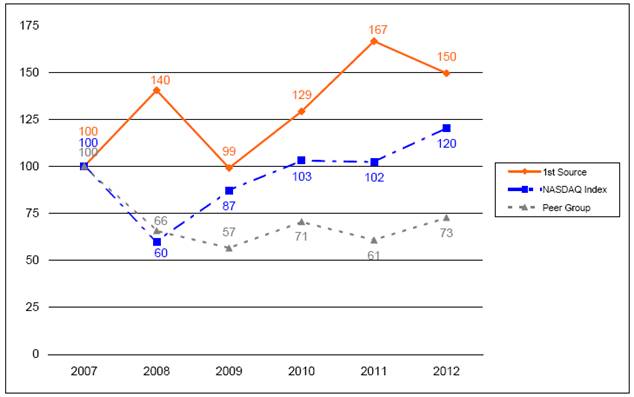
* Assumes $100 invested on December 31, 2007, in 1st Source Corporation common stock, NASDAQ market index, and peer group index.
** The Morningstar Weighted NASDAQ Index Return is calculated using all companies which trade as NASD Capital Markets, NASD Global Markets or NASD Global Select. It includes both domestic and foreign companies. The index is weighted by the then current shares outstanding and assumes dividends reinvested. The return is calculated on a monthly basis.
*** The peer group is a market-capitalization-weighted stock index of 151 banking companies in Illinois, Indiana, Michigan, Ohio, and Wisconsin.
NOTE: Total return assumes reinvestment of dividends.
The following table summarizes our share repurchase activity during the three months ended December 31, 2012.
|
Period |
|
Total Number of
|
|
Average Price
|
|
Total Number of
|
|
Maximum Number (or Approximate
|
|
|
|
October 01 - 31, 2012 |
|
— |
|
$ |
— |
|
— |
|
1,020,192 |
|
|
November 01 - 30, 2012 |
|
3,500 |
|
19.91 |
|
3,500 |
|
1,016,692 |
|
|
|
December 01 - 31, 2012 |
|
46,666 |
|
21.74 |
|
46,666 |
|
970,026 |
|
|
*1st Source maintains a stock repurchase plan that was authorized by the Board of Directors on April 26, 2007. Under the terms of the plan, 1st Source may repurchase up to 2,000,000 shares of its common stock when favorable conditions exist on the open market or through private transactions at various prices from time to time. Since the inception of the plan, 1st Source has repurchased a total of 1,029,974 shares.
Federal laws and regulations contain restrictions on the ability of 1st Source and the Bank to pay dividends. For information regarding restrictions on dividends, see Part I, Item 1, Business - Regulation and Supervision - Dividends and Part II, Item 8, Financial Statements and Supplementary Data - Note 19 of the Notes to Consolidated Financial Statements.
The following selected financial data should be read in conjunction with our Consolidated Financial Statements and the accompanying notes presented elsewhere herein.
|
(Dollars in thousands, except per share amounts) |
|
2012 |
|
2011 |
|
2010 |
|
2009 |
|
2008 |
|
|||||
|
Interest income |
|
$ |
182,085 |
|
$ |
187,523 |
|
$ |
200,626 |
|
$ |
200,412 |
|
$ |
235,308 |
|
|
Interest expense |
|
30,309 |
|
39,123 |
|
53,129 |
|
72,200 |
|
103,148 |
|
|||||
|
Net interest income |
|
151,776 |
|
148,400 |
|
147,497 |
|
128,212 |
|
132,160 |
|
|||||
|
Provision for loan and lease losses |
|
5,752 |
|
3,129 |
|
19,207 |
|
31,101 |
|
16,648 |
|
|||||
|
Net interest income after provision for loan and lease losses |
|
146,024 |
|
145,271 |
|
128,290 |
|
97,111 |
|
115,512 |
|
|||||
|
Noninterest income |
|
81,192 |
|
80,872 |
|
86,691 |
|
85,530 |
|
84,003 |
|
|||||
|
Noninterest expense |
|
151,536 |
|
152,354 |
|
154,505 |
|
151,123 |
|
153,114 |
|
|||||
|
Income before income taxes |
|
75,680 |
|
73,789 |
|
60,476 |
|
31,518 |
|
46,401 |
|
|||||
|
Income taxes |
|
26,047 |
|
25,594 |
|
19,232 |
|
6,028 |
|
13,015 |
|
|||||
|
Net income |
|
49,633 |
|
48,195 |
|
41,244 |
|
25,490 |
|
33,386 |
|
|||||
|
Net income available to common shareholders |
|
$ |
49,633 |
|
$ |
48,195 |
|
$ |
29,655 |
|
$ |
19,074 |
|
$ |
33,386 |
|
|
Assets at year-end |
|
$ |
4,550,693 |
|
$ |
4,374,071 |
|
$ |
4,445,281 |
|
$ |
4,542,100 |
|
$ |
4,464,174 |
|
|
Long-term debt and mandatorily redeemable securities at year-end |
|
71,021 |
|
37,156 |
|
24,816 |
|
19,761 |
|
29,832 |
|
|||||
|
Shareholders’ equity at year-end (1) |
|
558,655 |
|
523,918 |
|
486,383 |
|
570,320 |
|
453,664 |
|
|||||
|
Basic net income per common share |
|
2.02 |
|
1.96 |
|
1.21 |
|
0.79 |
|
1.38 |
|
|||||
|
Diluted net income per common share |
|
2.02 |
|
1.96 |
|
1.21 |
|
0.79 |
|
1.37 |
|
|||||
|
Cash dividends per common share |
|
0.66 |
|
0.64 |
|
0.61 |
|
0.59 |
|
0.58 |
|
|||||
|
Dividend payout ratio |
|
32.67 |
% |
32.65 |
% |
50.41 |
% |
74.68 |
% |
42.34 |
% |
|||||
|
Return on average assets |
|
1.11 |
% |
1.09 |
% |
0.91 |
% |
0.57 |
% |
0.76 |
% |
|||||
|
Return on average common equity |
|
9.10 |
% |
9.51 |
% |
6.10 |
% |
4.07 |
% |
7.52 |
% |
|||||
|
Average common equity to average assets |
|
12.20 |
% |
11.51 |
% |
10.69 |
% |
10.40 |
% |
10.09 |
% |
|||||
(1) Results for 2009 include the issuance of Preferred Stock under TARP which was redeemed in the fourth quarter of 2010.
The purpose of this analysis is to provide the reader with information relevant to understanding and assessing our results of operations for each of the past three years and financial condition for each of the past two years. In order to fully appreciate this analysis the reader is encouraged to review the consolidated financial statements and statistical data presented in this document.
Forward-Looking Statements
This report, including Management’s Discussion and Analysis of Financial Condition and Results of Operations, contains forward-looking statements. Forward-looking statements include statements with respect to our beliefs, plans, objectives, goals, expectations, anticipations, assumptions, estimates, intentions, and future performance, and involve known and unknown risks, uncertainties and other factors, which may be beyond our control, and which may cause actual results, performance or achievements to be materially different from future results, performance or achievements expressed or implied by such forward-looking statements.
All statements other than statements of historical fact are statements that could be forward-looking statements. Words such as “believe,” “contemplate,” “seek,” “estimate,” “plan,” “project,” “anticipate,” “possible,” “assume,” “expect,” “intend,” “targeted,” “continue,” “remain,” “will,” “should,” “indicate,” “would,” “may” and other similar expressions are intended to identify forward-looking statements but are not the exclusive means of identifying such statements. Forward-looking statements provide current expectations or forecasts of future events and are not guarantees of future performance, nor should they be relied upon as representing management’s views as of any subsequent date.
All written or oral forward-looking statements that are made by or attributable to us are expressly qualified in their entirety by this cautionary notice. We have no obligation and do not undertake to update, revise, or correct any of the forward-looking statements after the date of this report, or after the respective dates on which such statements otherwise are made. We have expressed our expectations, beliefs, and projections in good faith and we believe they have a reasonable basis. However, we make no assurances that our expectations, beliefs, or projections will be achieved or accomplished. The results or outcomes indicated by our forward-looking statements may not be realized due to a variety of factors, including, without limitation, the following:
· Local, regional, national, and international economic conditions and the impact they may have on us and our clients and our assessment of that impact.
· Changes in the level of nonperforming assets and charge-offs.
· Changes in estimates of future cash reserve requirements based upon the periodic review thereof under relevant regulatory and accounting requirements.
· The effects of and changes in trade and monetary and fiscal policies and laws, including the interest rate policies of the Federal Reserve Board.
· Inflation, interest rate, securities market, and monetary fluctuations.
· Political instability.
· Acts of war or terrorism.
· Substantial increases in the cost of fuel.
· The timely development and acceptance of new products and services and perceived overall value of these products and services by others.
· Changes in consumer spending, borrowings, and savings habits.
· Changes in the financial performance and/or condition of our borrowers.
· Technological changes.
· Acquisitions and integration of acquired businesses.
· The ability to increase market share and control expenses.
· Changes in the competitive environment among bank holding companies.
· The effect of changes in laws and regulations (including laws and regulations concerning taxes, banking, securities, and insurance) with which we and our subsidiaries must comply.
· The effect of changes in accounting policies and practices and auditing requirements, as may be adopted by the regulatory agencies, as well as the Public Company Accounting Oversight Board, the Financial Accounting Standards Board, and other accounting standard setters.
· Changes in our organization, compensation, and benefit plans.
· The costs and effects of legal and regulatory developments including the resolution of legal proceedings or regulatory or other governmental inquires and the results of regulatory examinations or reviews.
· Greater than expected costs or difficulties related to the integration of new products and lines of business.
· Our success at managing the risks described in Item 1A. Risk Factors.
Application of Critical Accounting Policies and Estimates
Our consolidated financial statements are prepared in accordance with U.S. generally accepted accounting principles (GAAP) and follow general practices within the industries in which we operate. Application of these principles requires management to make estimates or judgments that affect the amounts reported in the financial statements and accompanying notes. These estimates or judgments reflect management’s view of the most appropriate manner in which to record and report our overall financial performance. Because these estimates or judgments are based on current circumstances, they may change over time or prove to be inaccurate based on actual experience. As such, changes in these estimates, judgments, and/or assumptions may have a significant impact on our financial statements. All accounting policies are important, and all policies described in Part II, Item 8, Financial Statements and Supplementary Data, Note 1 (Note 1), should be reviewed for a greater understanding of how our financial performance is recorded and reported.
We have identified the following three policies as being critical because they require management to make particularly difficult, subjective, and/or complex estimates or judgments about matters that are inherently uncertain and because of the likelihood that materially different amounts would be reported under different conditions or using different assumptions. These policies relate to the determination of the reserve for loan and lease losses, fair value measurements, and the valuation of mortgage servicing rights. Management believes it has used the best information available to make the estimations or judgments necessary to value the related assets and liabilities. Actual performance that differs from estimates or judgments and future changes in the key variables could change future valuations and impact net income. Management has reviewed the application of these policies with the Audit Committee of the Board of Directors. Following is a discussion of the areas we view as our most critical accounting policies.
Reserve for Loan and Lease Losses — The reserve for loan and lease losses represents management’s estimate of probable losses inherent in the loan and lease portfolio and the establishment of a reserve that is sufficient to absorb those losses. In determining an appropriate reserve, management makes numerous judgments, assumptions, and estimates based on continuous review of the loan and lease portfolio, estimates of client performance, collateral values, and disposition, as well as historical loss rates and expected cash flows. In assessing these factors, management benefits from a lengthy organizational history and experience with credit decisions and related outcomes. Nonetheless, if management’s underlying assumptions prove to be inaccurate, the reserve for loan and lease losses would have to be adjusted. Our accounting policy related to the reserve is disclosed in Note 1 under the heading “Reserve for Loan and Lease Losses.”
Fair Value Measurements — We use fair value measurements to record certain financial instruments and to determine fair value disclosures. Available-for-sale securities, trading account securities, mortgage loans held for sale, and interest rate swap agreements are financial instruments recorded at fair value on a recurring basis. Additionally, from time to time, we may be required to record at fair value other financial assets on a nonrecurring basis. These nonrecurring fair value adjustments typically involve write-downs of, or specific reserves against, individual assets. GAAP establishes a three-level hierarchy for disclosure of assets and liabilities recorded at fair value. The classification of assets and liabilities within the hierarchy is based on whether the inputs to the valuation methodology used in the measurement are observable or unobservable. Observable inputs reflect market-driven or market-based information obtained from independent sources, while unobservable inputs reflect our estimates about market data.
The degree of management judgment involved in determining the fair value of a financial instrument is dependent upon the availability of quoted market prices or observable market data. For financial instruments that trade actively and have quoted market prices or observable market data, there is minimal subjectivity involved in measuring fair value. When observable market prices and data are not fully available, management judgment is necessary to estimate fair value. In addition, changes in the market conditions may reduce the availability of quoted prices or observable data. For example, reduced liquidity in the capital markets or changes in secondary market activities could result in observable market inputs becoming unavailable. Therefore, when market data is not available, we use valuation techniques that require more management judgment to estimate the appropriate fair value measurement. Fair value is discussed further in Note 1 under the heading “Fair Value Measurements” and in Note 20, “Fair Value Measurements.”
Mortgage Servicing Rights Valuation — We recognize as assets the rights to service mortgage loans for others, known as mortgage servicing rights, whether the servicing rights are acquired through purchases or through originated loans. Mortgage servicing rights do not trade in an active open market with readily observable market prices. Although sales of mortgage servicing rights do occur, the precise terms and conditions may not be readily available. As such, the value of mortgage servicing assets is established and valued using discounted cash flow modeling techniques which require management to make estimates regarding future net servicing cash flows, taking into consideration actual and expected mortgage loan prepayment rates, discount rates, servicing costs, and other economic factors. The estimated rates of mortgage loan prepayments are the most significant factors driving the value of mortgage servicing assets. Increases in mortgage loan prepayments reduce estimated future net servicing cash flows because the life of the underlying loan is reduced. In determining the fair value of the mortgage servicing assets, mortgage interest rates (which are used to determine prepayment rates), and discount rates are held constant over the estimated life of the portfolio. Estimated mortgage loan prepayment rates are derived from a third-party model and adjusted to reflect our actual prepayment experience. Mortgage servicing assets are carried at the lower of amortized cost or fair value. The values of these assets are sensitive to changes in the assumptions used and readily available market pricing does not exist. The valuation of mortgage servicing assets is discussed further in Note 20 “Fair Value Measurements.”
Earnings Summary
Net income in 2012 was $49.63 million, up from $48.20 million in 2011 and up from $41.24 million in 2010. Diluted net income per common share was $2.02 in 2012, $1.96 in 2011, and $1.21 in 2010. Return on average total assets was 1.11% in 2012 compared to 1.09% in 2011, and 0.91% in 2010. Return on average common shareholders’ equity was 9.10% in 2012 versus 9.51% in 2011, and 6.10% in 2010.
Net income in 2012 was positively impacted by a $3.38 million or 2.27% increase in net interest income from 2011, which was offset by an increase of $2.62 million or 83.83% in provision for loan and lease losses. Net income in 2011, as compared to 2010, was positively impacted by a $16.08 million or 83.71% decrease in provision for loan and lease losses, which was offset by a decrease of $5.82 million or 6.71% in noninterest income and an increase of $6.36 million or 33.08% in income tax expense.
Dividends paid on common stock in 2012 amounted to $0.66 per share, compared to $0.64 per share in 2011, and $0.61 per share in 2010. The level of earnings reinvested and dividend payouts are determined by the Board of Directors based on management’s assessment of future growth opportunities and the level of capital necessary to support them.
Net Interest Income — Our primary source of earnings is net interest income, the difference between income on earning assets and the cost of funds supporting those assets. Significant categories of earning assets are loans and securities while deposits and borrowings represent the major portion of interest-bearing liabilities. For purposes of the following discussion, comparison of net interest income is done on a tax equivalent basis, which provides a common basis for comparing yields on earning assets exempt from federal income taxes to those which are fully taxable.
Net interest margin (the ratio of net interest income to average earning assets) is significantly affected by movements in interest rates and changes in the mix of earning assets and the liabilities that fund those assets. Net interest margin on a fully taxable equivalent basis was 3.69% in 2012 and 2011, compared to 3.59% in 2010. The stable margin in 2012 reflects the decline in funding costs offset by lower yields on earnings assets. The higher margin in 2011 compared to 2010 was due to a decline in funding costs. Net interest income was $151.78 million for 2012, compared to $148.40 million for 2011 and $147.50 for 2010. Tax-equivalent net interest income totaled $153.84 million for 2012, up $2.93 million from the $150.91 million reported for 2011. Tax-equivalent net interest income for 2011 was relatively flat from the $150.87 million reported in 2010.
During 2012, average earning assets increased $84.15 million while average interest-bearing liabilities decreased $46.72 million over the comparable period in 2011. The yield on average earning assets decreased 24 basis points to 4.41% for 2012 from 4.65% for 2011 due to reduced market interest rates. Total cost of average interest-bearing liabilities decreased 25 basis points to 0.94% during 2012 from 1.19% in 2011 as liabilities were impacted by decreases in market rates and rate re-pricing on maturing certificates of deposit. The result was an increase of 1 basis point to net interest spread, or the difference between interest income on earning assets and expense on interest-bearing liabilities.
The largest contributor to the decrease in the yield on average earning assets in 2012 was the 31 basis point decrease in the loan and lease portfolio yield. Average net loans and leases increased $130.91 million or 4.25% in 2012 from 2011 while the yield decreased to 5.02%.
During 2012, the tax-equivalent yield on securities available for sale decreased 30 basis points to 2.42% while the average balance decreased $17.50 million. Average mortgages held for sale increased $5.74 million during 2012 and the yield decreased 73 basis points. Average other investments, which include federal funds sold, time deposits with other banks, Federal Reserve Bank excess balances, Federal Reserve Bank and Federal Home Loan Bank stock and commercial paper decreased $35.00 million during 2012 while the yield increased 45 basis points. The increase in yield was primarily a result of higher dividends on Federal Home Loan Bank stock.
Average interest-bearing deposits decreased $56.25 million during 2012 while the effective rate paid on those deposits decreased 28 basis points. Average noninterest-bearing demand deposits increased $75.01 million during 2012.
Average short-term borrowings decreased $11.49 million during 2012 while the effective rate paid decreased 8 basis points. Average long-term debt increased $22.29 million during 2012 as the effective rate decreased 124 basis points.
The following table provides an analysis of net interest income and illustrates interest income earned and interest expense charged for each major component of interest earning assets and the interest bearing liabilities. Yields/rates are computed on a tax-equivalent basis, using a 35% rate. Nonaccrual loans and leases are included in the average loan and lease balance outstanding.
|
|
|
2012 |
|
2011 |
|
2010 |
|
||||||||||||||||||
|
|
|
|
|
Interest |
|
|
|
|
|
Interest |
|
|
|
|
|
Interest |
|
|
|
||||||
|
|
|
Average |
|
Income/ |
|
Yield/ |
|
Average |
|
Income/ |
|
Yield/ |
|
Average |
|
Income/ |
|
Yield/ |
|
||||||
|
(Dollars in thousands) |
|
Balance |
|
Expense |
|
Rate |
|
Balance |
|
Expense |
|
Rate |
|
Balance |
|
Expense |
|
Rate |
|
||||||
|
ASSETS |
|
|
|
|
|
|
|
|
|
|
|
|
|
|
|
|
|
|
|
||||||
|
Investment securities: |
|
|
|
|
|
|
|
|
|
|
|
|
|
|
|
|
|
|
|
||||||
|
Taxable |
|
$ |
775,103 |
|
$ |
16,426 |
|
2.12 |
% |
$ |
780,215 |
|
$ |
18,533 |
|
2.38 |
% |
$ |
743,838 |
|
$ |
20,466 |
|
2.75 |
% |
|
Tax-exempt |
|
107,289 |
|
4,939 |
|
4.60 |
|
119,680 |
|
5,921 |
|
4.95 |
|
170,415 |
|
8,201 |
|
4.81 |
|
||||||
|
Mortgages held for sale |
|
16,700 |
|
592 |
|
3.54 |
|
10,959 |
|
468 |
|
4.27 |
|
52,097 |
|
2,430 |
|
4.66 |
|
||||||
|
Net loans and leases |
|
3,209,490 |
|
161,253 |
|
5.02 |
|
3,078,581 |
|
164,117 |
|
5.33 |
|
3,109,508 |
|
171,843 |
|
5.53 |
|
||||||
|
Other investments |
|
65,861 |
|
943 |
|
1.43 |
|
100,862 |
|
991 |
|
0.98 |
|
131,627 |
|
1,061 |
|
0.81 |
|
||||||
|
Total earning assets |
|
4,174,443 |
|
184,153 |
|
4.41 |
|
4,090,297 |
|
190,030 |
|
4.65 |
|
4,207,485 |
|
204,001 |
|
4.85 |
|
||||||
|
Cash and due from banks |
|
60,099 |
|
|
|
|
|
59,698 |
|
|
|
|
|
60,977 |
|
|
|
|
|
||||||
|
Reserve for loan and lease losses |
|
(83,430 |
) |
|
|
|
|
(86,617 |
) |
|
|
|
|
(89,656 |
) |
|
|
|
|
||||||
|
Other assets |
|
321,767 |
|
|
|
|
|
339,176 |
|
|
|
|
|
364,896 |
|
|
|
|
|
||||||
|
Total assets |
|
$ |
4,472,879 |
|
|
|
|
|
$ |
4,402,554 |
|
|
|
|
|
$ |
4,543,702 |
|
|
|
|
|
|||
|
LIABILITIES AND SHAREHOLDERS’ EQUITY |
|
|
|
|
|
|
|
|
|
|
|
|
|
|
|
|
|
|
|
||||||
|
Interest bearing deposits |
|
$ |
2,957,785 |
|
$ |
21,877 |
|
0.74 |
% |
$ |
3,014,033 |
|
$ |
30,762 |
|
1.02 |
% |
$ |
3,121,167 |
|
$ |
44,605 |
|
1.43 |
% |
|
Short-term borrowings |
|
137,937 |
|
169 |
|
0.12 |
|
149,428 |
|
300 |
|
0.20 |
|
164,191 |
|
800 |
|
0.49 |
|
||||||
|
Subordinated notes |
|
88,425 |
|
6,484 |
|
7.33 |
|
89,692 |
|
6,589 |
|
7.35 |
|
89,692 |
|
6,589 |
|
7.35 |
|
||||||
|
Long-term debt and mandatorily redeemable securities |
|
55,383 |
|
1,779 |
|
3.21 |
|
33,093 |
|
1,472 |
|
4.45 |
|
27,149 |
|
1,135 |
|
4.18 |
|
||||||
|
Total interest bearing liabilities |
|
3,239,530 |
|
30,309 |
|
0.94 |
|
3,286,246 |
|
39,123 |
|
1.19 |
|
3,402,199 |
|
53,129 |
|
1.56 |
|
||||||
|
Noninterest bearing deposits |
|
616,426 |
|
|
|
|
|
541,421 |
|
|
|
|
|
484,028 |
|
|
|
|
|
||||||
|
Other liabilities |
|
71,292 |
|
|
|
|
|
67,948 |
|
|
|
|
|
67,011 |
|
|
|
|
|
||||||
|
Shareholders’ equity |
|
545,631 |
|
|
|
|
|
506,939 |
|
|
|
|
|
590,464 |
|
|
|
|
|
||||||
|
Total liabilities and shareholders’ equity |
|
$ |
4,472,879 |
|
|
|
|
|
$ |
4,402,554 |
|
|
|
|
|
$ |
4,543,702 |
|
|
|
|
|
|||
|
Net interest income |
|
|
|
$ |
153,844 |
|
|
|
|
|
$ |
150,907 |
|
|
|
|
|
$ |
150,872 |
|
|
|
|||
|
Net interest margin on a tax equivalent basis |
|
|
|
|
|
3.69 |
% |
|
|
|
|
3.69 |
% |
|
|
|
|
3.59 |
% |
||||||
The change in interest due to both rate and volume has been allocated to volume and rate changes in proportion to the relationship of the absolute dollar amounts of the change in each. The following table shows changes in tax equivalent interest earned and interest paid, resulting from changes in volume and changes in rates:
|
|
|
Increase (Decrease) due to |
|
|
|
|||||
|
(Dollars in thousands) |
|
Volume |
|
Rate |
|
Net |
|
|||
|
2012 compared to 2011 |
|
|
|
|
|
|
|
|||
|
Interest earned on: |
|
|
|
|
|
|
|
|||
|
Investment securities: |
|
|
|
|
|
|
|
|||
|
Taxable |
|
$ |
(90 |
) |
$ |
(2,017 |
) |
$ |
(2,107 |
) |
|
Tax-exempt |
|
(581 |
) |
(401 |
) |
(982 |
) |
|||
|
Mortgages held for sale |
|
184 |
|
(60 |
) |
124 |
|
|||
|
Net loans and leases |
|
8,256 |
|
(11,120 |
) |
(2,864 |
) |
|||
|
Other investments |
|
150 |
|
(198 |
) |
(48 |
) |
|||
|
Total earning assets |
|
$ |
7,919 |
|
$ |
(13,796 |
) |
$ |
(5,877 |
) |
|
Interest paid on: |
|
|
|
|
|
|
|
|||
|
Interest bearing deposits |
|
$ |
(593 |
) |
$ |
(8,292 |
) |
$ |
(8,885 |
) |
|
Short-term borrowings |
|
(19 |
) |
(112 |
) |
(131 |
) |
|||
|
Subordinated notes |
|
(87 |
) |
(18 |
) |
(105 |
) |
|||
|
Long-term debt and mandatorily redeemable securities |
|
523 |
|
(216 |
) |
307 |
|
|||
|
Total interest bearing liabilities |
|
$ |
(176 |
) |
$ |
(8,638 |
) |
$ |
(8,814 |
) |
|
Net interest income |
|
$ |
8,095 |
|
$ |
(5,158 |
) |
$ |
2,937 |
|
|
2011 compared to 2010 |
|
|
|
|
|
|
|
|||
|
Interest earned on: |
|
|
|
|
|
|
|
|||
|
Investment securities: |
|
|
|
|
|
|
|
|||
|
Taxable |
|
$ |
1,026 |
|
$ |
(2,959 |
) |
$ |
(1,933 |
) |
|
Tax-exempt |
|
(2,527 |
) |
247 |
|
(2,280 |
) |
|||
|
Mortgages held for sale |
|
(1,774 |
) |
(188 |
) |
(1,962 |
) |
|||
|
Net loans and leases |
|
(1,557 |
) |
(6,169 |
) |
(7,726 |
) |
|||
|
Other investments |
|
(941 |
) |
871 |
|
(70 |
) |
|||
|
Total interest earning assets |
|
$ |
(5,773 |
) |
$ |
(8,198 |
) |
$ |
(13,971 |
) |
|
Interest paid on: |
|
|
|
|
|
|
|
|||
|
Interest bearing deposits |
|
$ |
(1,439 |
) |
$ |
(12,404 |
) |
$ |
(13,843 |
) |
|
Short-term borrowings |
|
(62 |
) |
(438 |
) |
(500 |
) |
|||
|
Subordinated notes |
|
— |
|
— |
|
— |
|
|||
|
Long-term debt and mandatorily redeemable securities |
|
260 |
|
77 |
|
337 |
|
|||
|
Total interest bearing liabilities |
|
$ |
(1,241 |
) |
$ |
(12,765 |
) |
$ |
(14,006 |
) |
|
Net interest income |
|
$ |
(4,532 |
) |
$ |
4,567 |
|
$ |
35 |
|
Noninterest Income — Noninterest income increased $0.32 million or 0.40% in 2012 from 2011 following a $5.82 million or 6.71% decrease in 2011 over 2010. Noninterest income for the most recent three years ended December 31 was as follows:
|
(Dollars in thousands) |
|
2012 |
|
2011 |
|
2010 |
|
|||
|
Noninterest income: |
|
|
|
|
|
|
|
|||
|
Trust fees |
|
$ |
16,498 |
|
$ |
16,327 |
|
$ |
15,838 |
|
|
Service charges on deposit accounts |
|
18,807 |
|
18,488 |
|
19,323 |
|
|||
|
Mortgage banking income |
|
8,357 |
|
3,839 |
|
6,218 |
|
|||
|
Insurance commissions |
|
5,494 |
|
4,793 |
|
5,074 |
|
|||
|
Equipment rental income |
|
18,796 |
|
23,361 |
|
26,036 |
|
|||
|
Other income |
|
12,660 |
|
12,665 |
|
11,909 |
|
|||
|
Investment securities and other investment gains |
|
580 |
|
1,399 |
|
2,293 |
|
|||
|
Total noninterest income |
|
$ |
81,192 |
|
$ |
80,872 |
|
$ |
86,691 |
|
Trust fees (which include investment management fees, estate administration fees, mutual fund fees, annuity fees, and fiduciary fees) increased by $0.17 million or 1.05% in 2012 from 2011 compared to an increase of $0.49 million or 3.09% in 2011 over 2010. Trust fees are largely based on the size of client relationships and the market value of assets under management. The market value of trust assets under management at December 31, 2012 and 2011 was $3.40 billion and $3.30 billion, respectively. At December 31, 2012, these trust assets were comprised of $2.01 billion of personal and agency trusts, $966.54 million of employee benefit plan assets, $309.63 million of estate administration assets and individual retirement accounts, and $113.29 million of custody assets. The increase in trust fees in 2012 and 2011 was primarily a result of an increase in the market values of investment accounts.
Service charges on deposit accounts increased $0.32 million or 1.73% in 2012 from 2011 compared to a decrease of $0.84 million or 4.32% in 2011 from 2010. The improvement in service charges on deposit accounts in 2012 was primarily due to higher usage of debit cards offset by lower volume of nonsufficient fund transactions. The decline in service charges on deposit accounts in 2011 from 2010 largely reflects a lower volume of nonsufficient fund transactions.
Mortgage banking income increased $4.52 million or 117.69% in 2012 over 2011, compared to a decrease of $2.38 million or 38.26% in 2011 over 2010. In 2012, we had $0.24 million in valuation recovery adjustments of mortgage servicing rights compared to $0.24 million in valuation impairment adjustments of mortgage servicing rights in 2011 and no mortgage servicing rights impairment in 2010. During 2012, 2011 and 2010, we determined that no permanent write-down was necessary for previously recorded impairment on mortgage servicing assets. During 2012, mortgage banking income was also positively impacted by higher loan production volumes and higher margins on loan sales. Mortgage banking income was impacted by reduced loan production volumes in 2011 as a result of exiting wholesale broker lending in late 2010.
Insurance commissions increased $0.70 million or 14.63% in 2012 from 2011 compared to a decrease of $0.28 million or 5.54% in 2011 from 2010. The increase in 2012 was due to the acquisition of a benefits agency’s book of business in January 2012. The lower commission income in 2011 was mainly due to reduced contingent commissions, primarily as a result of a higher level of claims activity in our books of business and intense competition which drove premiums lower.
Equipment rental income generated from operating leases declined by $4.57 million or 19.54% during 2012 from 2011 compared to a decrease of $2.68 million or 10.27% during 2011 from 2010. The average equipment rental portfolio decreased 19.10% in 2012 over 2011 and 8.79% in 2011 over 2010 resulting in lower rental income. In addition, new leases are at lower rates due to current market conditions including lower rates and increased competition.
Investment securities and other investment gains totaled $0.58 million for the year ended 2012 compared to gains of $1.40 million for the year ended 2011 and gains of $2.29 million for the year ended 2010. During 2012, we recorded investment portfolio gains on the sale of corporate equity and agency securities and recognized partnership valuation net gains. In 2011, we recorded gains on the sale of agency securities. In 2010, we recognized a gain on sale of a venture capital investment of $1.62 million and had other partnership gains of $0.64 million.
Other income was flat in 2012 from 2011 and increased $0.76 million or 6.35% in 2011 from 2010. The increase in 2011 was mainly due to higher earnout fees on the sale of assets of Investment Advisors related to the management of the 1st Source Monogram Funds.
Noninterest Expense — Noninterest expense decreased $0.82 million or 0.54% in 2012 over 2011 following a $2.15 million or 1.39% decrease in 2011 from 2010. Noninterest expense for the recent three years ended December 31 was as follows:
|
(Dollars in thousands) |
|
2012 |
|
2011 |
|
2010 |
|
|||
|
Noninterest expense: |
|
|
|
|
|
|
|
|||
|
Salaries and employee benefits |
|
$ |
82,599 |
|
$ |
77,261 |
|
$ |
75,815 |
|
|
Net occupancy expense |
|
7,819 |
|
8,714 |
|
8,788 |
|
|||
|
Furniture and equipment expense |
|
15,406 |
|
14,130 |
|
12,543 |
|
|||
|
Depreciation — leased equipment |
|
15,202 |
|
18,650 |
|
20,715 |
|
|||
|
Professional fees |
|
6,083 |
|
5,508 |
|
6,353 |
|
|||
|
Supplies and communications |
|
5,701 |
|
5,453 |
|
5,499 |
|
|||
|
FDIC and other insurance |
|
3,602 |
|
4,421 |
|
6,256 |
|
|||
|
Business development and marketing expense |
|
4,232 |
|
4,032 |
|
3,774 |
|
|||
|
Loan and lease collection and repossession expense |
|
5,772 |
|
6,724 |
|
6,227 |
|
|||
|
Intangible asset amortization |
|
1,325 |
|
1,300 |
|
1,324 |
|
|||
|
Other expense |
|
3,795 |
|
6,161 |
|
7,211 |
|
|||
|
Total noninterest expense |
|
$ |
151,536 |
|
$ |
152,354 |
|
$ |
154,505 |
|
Total salaries and employee benefits increased $5.34 million or 6.91% in 2012 from 2011, following a $1.45 million or 1.91% increase in 2011 from 2010.
Employee salaries increased $3.72 million or 5.94% in 2012 from 2011 compared to being flat in 2011 from 2010. The increase in 2012 was primarily due to higher base salaries, executive incentive expense and loan producer commissions. Larger base salary expense was primarily due to more full time equivalent employees and annual performance raises. Loan producer commissions were higher due to increased residential mortgage loan production volumes.
Employee benefits grew by $1.62 million or 11.04% in 2012 from 2011, compared to an increase of $1.48 million or 11.21% in 2011 from 2010. The increase in 2012 and 2011 was primarily due to higher group insurance costs.
Occupancy expense decreased $0.90 million or 10.27% in 2012 from 2011, compared to remaining stable in 2011 from 2010. The lower expense in 2012 was mainly due to reduced real estate taxes as a result of the successful appeals of assessed values.
Furniture and equipment expense, including depreciation, increased $1.28 million or 9.03% in 2012 from 2011 compared to an increase of $1.59 million or 12.65% in 2011 from 2010. The higher expense during 2012 was in the areas of equipment depreciation, computer processing charges and software maintenance. The increase in 2011 was primarily due to higher computer processing charges, Mastercard operating expense and aircraft maintenance.
Depreciation on equipment owned under operating leases decreased $3.45 million or 18.49% in 2012 from 2011, following a $2.07 million or 9.97% decrease in 2011 from 2010. In 2012 and 2011, depreciation on equipment owned under operating leases decreased in conjunction with the decrease in equipment rental income.
Professional fees grew by $0.58 million or 10.44% in 2012 from 2011, compared to a $0.85 million or 13.30% decrease in 2011 from 2010. The increase in 2012 was primarily due to higher consulting fees offset by lower legal fees. During 2011, reduced legal and consulting fees resulted in lower professional fees than 2010.
Supplies and communications expense increased $0.25 million or 4.55% in 2012 from 2011 after being flat in 2011 as compared to 2010. During 2012, data communication costs were higher than prior year.
FDIC and other insurance expense declined $0.82 million or 18.53% in 2012 over 2011 versus a $1.84 million or 29.33% decrease in 2011 over 2010. The decrease in 2012 and 2011 was due to a change in FDIC premium calculations in the second quarter 2011 based on average total consolidated assets minus the average tangible equity of the insured depository institution during the assessment period, whereas assessments were previously based on the amount of an institution’s insured deposits.
Business development and marketing expense increased $0.20 million or 4.96% in 2012 from 2011 compared to a $0.26 million or 6.84% increase in 2011 from 2010. Increased promotions and marketing activity resulted in higher costs in 2012. The increase in 2011 from 2010 was primarily related to business development costs.
Loan and lease collection and repossession expenses decreased $0.95 million or 14.16% in 2012 from 2011 compared to an increase of $0.50 million or 7.98% in 2011 from 2010. Loan and lease collection and repossession expense was lower in 2012 mainly due to reduced ORE operating costs, collection and repossession expense, and valuation adjustments as credit quality slowly improves. These reductions were offset by higher mortgage loan repurchase losses. The increase in 2011 was primarily a result of higher ORE operating costs and valuation adjustments and mortgage loan repurchase losses offset by lower valuation adjustments on repossessed aircraft in 2011 as compared to 2010.
Intangible asset amortization increased $0.03 million or 1.92% in 2012 from 2011 compared to a $0.02 million or 1.81% decrease in 2011 from 2010. Due to the acquisition of a benefits agency’s book of business in January 2012, intangible asset amortization increased over 2011. During early 2011, deposit intangibles from a prior acquisition fully amortized causing 2011 expense to be lower than 2010.
Other expenses decreased $2.37 million or 38.40% in 2012 as compared to 2011 and decreased $1.05 million or 14.56% in 2011 from 2010. The decline in 2012 was mainly due to a lower provision on unfunded loan commitments and the gain on sale of the corporate headquarters’ parking garage. Other expense decreased in 2011 primarily due to a gain on sale of the corporate aircraft offset by a charge for provision on unfunded loan commitments.
Income Taxes — 1st Source recognized income tax expense in 2012 of $26.05 million, compared to $25.59 million in 2011, and $19.23 million in 2010. The effective tax rate in 2012 was 34.42% compared to 34.69% in 2011, and 31.80% in 2010. The effective tax rate was higher in 2012 and 2011 compared to 2010 due to a decrease in tax-exempt interest in relation to income before taxes. Additionally, during the first quarter of 2011 we reached a state tax settlement for the 2008 year and as a result recorded a reduction of unrecognized tax benefit in the amount of $0.84 million that affected the effective tax rate and increased earnings in the amount of $0.47 million. For a detailed analysis of 1st Source’s income taxes see Part II, Item 8, Financial Statements and Supplementary Data — Note 16 of the Notes to Consolidated Financial Statements.
Financial Condition
Loan and Lease Portfolio — The following table shows 1st Source’s loan and lease distribution at the end of each of the last five years as of December 31:
|
(Dollars in thousands) |
|
2012 |
|
2011 |
|
2010 |
|
2009 |
|
2008 |
|
|||||
|
Commercial and agricultural loans |
|
$ |
639,069 |
|
$ |
545,570 |
|
$ |
530,228 |
|
$ |
546,222 |
|
$ |
643,440 |
|
|
Auto, light truck and environmental equipment |
|
438,147 |
|
435,965 |
|
396,500 |
|
349,741 |
|
353,838 |
|
|||||
|
Medium and heavy duty truck |
|
172,002 |
|
159,796 |
|
162,824 |
|
204,545 |
|
243,375 |
|
|||||
|
Aircraft financing |
|
696,479 |
|
620,782 |
|
614,357 |
|
617,384 |
|
632,121 |
|
|||||
|
Construction equipment financing |
|
278,974 |
|
261,204 |
|
285,634 |
|
313,300 |
|
375,983 |
|
|||||
|
Commercial real estate |
|
554,968 |
|
545,457 |
|
594,729 |
|
580,709 |
|
574,394 |
|
|||||
|
Residential real estate |
|
438,641 |
|
423,606 |
|
390,951 |
|
371,514 |
|
344,355 |
|
|||||
|
Consumer loans |
|
109,273 |
|
98,163 |
|
95,400 |
|
109,735 |
|
130,706 |
|
|||||
|
Total loans and leases |
|
$ |
3,327,553 |
|
$ |
3,090,543 |
|
$ |
3,070,623 |
|
$ |
3,093,150 |
|
$ |
3,298,212 |
|
At December 31, 2012, 13.2% of total loans and leases were concentrated with auto rental and leasing.
Loans and leases, net of unearned discount, at December 31, 2012, were $3.33 billion and were 73.12% of total assets, compared to $3.09 billion and 70.66% of total assets at December 31, 2011. Average loans and leases, net of unearned discount, increased $130.91 million or 4.25% and decreased $30.93 million or 0.99% in 2012 and 2011, respectively.
Commercial and agricultural lending, excluding those loans secured by real estate, increased $93.50 million or 17.14% in 2012 over 2011. Commercial and agricultural lending outstandings were $639.07 million and $545.57 million at December 31, 2012 and December 31, 2011, respectively. This increase was mainly attributed to an improved economy in our target markets, resulting in greater line of credit usage and the financing of increased capital expenditures by our clients. In 2012, we also grew our business client base.
Auto, light truck, and environmental equipment financing increased very slightly in 2012 over 2011. At December 31, 2012, auto, light truck, and environmental equipment financing had outstandings of $438.15 million and $435.97 million at December 31, 2011.
Medium and heavy duty truck loans and leases grew by $12.21 million or 7.64% in 2012. Medium and heavy duty truck financing at December 31, 2012 and 2011 had outstandings of $172.00 million and $159.80 million, respectively. Most of the increase at December 31, 2012 from December 31, 2011 can be attributed to clients reacting to their aging equipment by normalizing their replacement policies. Consequently, demand has increased as the trucking industry acquired new equipment.
Aircraft financing at year-end 2012 increased $75.70 million or 12.19% from year-end 2011. Aircraft financing at December 31, 2012 and 2011 had outstandings of $696.48 million and $620.78 million, respectively. The increase was mainly due to a recovering business climate, a perception in the markets that business aircraft values had bottomed and reduced aircraft lending competition.
Construction equipment financing increased $17.77 million or 6.80% in 2012 compared to 2011. Construction equipment financing at December 31, 2012 had outstandings of $278.97 million, compared to outstandings of $261.20 million at December 31, 2011. The increase in this category was primarily due to a gradual improvement in the construction industry and the need to replace older equipment.
Commercial loans secured by real estate, the majority of which is owner occupied, increased slightly during 2012 over 2011. Commercial loans secured by real estate outstanding at December 31, 2012 were $554.97 million and $545.46 million at December 31, 2011.
Residential real estate loans were $438.64 million at December 31, 2012 and $423.61 million at December 31, 2011. Residential real estate loans increased $15.04 million or 3.55% in 2012 from 2011. The increase in residential mortgage lending was primarily due to a higher volume of refinance activity as a result of lower market interest rates and our decision to retain more loans in our portfolio.
Consumer loans increased $11.11 million or 11.32% in 2012 over 2011. Consumer loans outstanding at December 31, 2012, were $109.27 million and $98.16 million at December 31, 2011. The increase during 2012 was due to higher demand in auto and personal loans as a result of lower interest rates.
The following table shows the maturities of loans and leases in the categories of commercial and agriculture, auto, light truck and environmental equipment, medium and heavy duty truck, aircraft and construction equipment outstanding as of December 31, 2012.
|
(Dollars in thousands) |
|
0-1 Year |
|
1-5 Years |
|
Over 5 Years |
|
Total |
|
||||
|
Commercial and agricultural loans |
|
$ |
338,635 |
|
$ |
250,694 |
|
$ |
49,740 |
|
$ |
639,069 |
|
|
Auto, light truck and environmental equipment |
|
189,849 |
|
247,378 |
|
920 |
|
438,147 |
|
||||
|
Medium and heavy duty truck |
|
52,425 |
|
116,697 |
|
2,880 |
|
172,002 |
|
||||
|
Aircraft financing |
|
197,777 |
|
397,635 |
|
101,067 |
|
696,479 |
|
||||
|
Construction equipment financing |
|
77,662 |
|
184,310 |
|
17,002 |
|
278,974 |
|
||||
|
Total |
|
$ |
856,348 |
|
$ |
1,196,714 |
|
$ |
171,609 |
|
$ |
2,224,671 |
|
The amounts due after one year are also classified according to the sensitivity to changes in interest rates.
|
Rate Sensitivity (Dollars in thousands) |
|
Fixed Rate |
|
Variable Rate |
|
Total |
|
|||
|
1 – 5 Years |
|
$ |
684,682 |
|
$ |
512,032 |
|
$ |
1,196,714 |
|
|
Over 5 Years |
|
33,763 |
|
137,846 |
|
171,609 |
|
|||
|
Total |
|
$ |
718,445 |
|
$ |
649,878 |
|
$ |
1,368,323 |
|
During 2012, approximately 70% of the Bank’s residential mortgage originations were sold into the secondary market. Mortgage loans held for sale were $10.88 million at December 31, 2012 and were $12.64 million at December 31, 2011. Although 1st Source Bank is participating in the U.S. Treasury Making Home Affordable programs, we do not feel it has a material effect on our financial condition or results of operations.
1st Source Bank sells residential mortgage loans to Fannie Mae and Freddie Mac, as well as FHA-insured and VA-guaranteed loans in Ginnie Mae mortgage-backed securities. Additionally, we have sold loans on a service released basis to various other financial institutions in recent years. The agreements under which we sell these mortgage loans contain various representations and warranties regarding the acceptability of loans for purchase. On occasion, we may be asked to indemnify the loan purchaser for credit losses on loans that were later deemed ineligible for purchase or we may be asked to repurchase a loan. Both circumstances are collectively referred to as “repurchases.” Within the industry, repurchase demands have increased during recent years. While we believe the loans we have underwritten and sold to these entities have met or exceeded applicable transaction parameters, we must acknowledge the trend of mortgage insurance rescissions and speculative repurchase requests.
Our liability for repurchases, included in accrued expenses and other liabilities on the Statements of Financial Condition, was $1.59 million and $1.14 million as of December 31, 2012 and 2011, respectively. Our expense for repurchase losses, included in loan and lease collection and repossession expense on the Statements of Income, was $2.05 million in 2012 compared to $1.47 million in 2011 and $1.09 million in 2010. The mortgage repurchase liability represents our best estimate of the loss that we may incur. The estimate is based on specific loan repurchase requests and a historical loss ratio with respect to origination dollar volume. Because the level of mortgage loan repurchase losses are dependent on economic factors, investor demand strategies and other external conditions that may change over the life of the underlying loans, the level of liability for mortgage loan repurchase losses is difficult to estimate and requires considerable management judgment.
Credit Experience
Reserve for Loan and Lease Losses — Our reserve for loan and lease losses is provided for by direct charges to operations. Losses on loans and leases are charged against the reserve and likewise, recoveries during the period for prior losses are credited to the reserve. Our management evaluates the reserve quarterly, reviewing all loans and leases over a fixed-dollar amount ($100,000) where the internal credit quality grade is at or below a predetermined classification, actual and anticipated loss experience, current economic events in specific industries, and other pertinent factors including general economic conditions. Determination of the reserve is inherently subjective as it requires significant estimates, including the amounts and timing of expected future cash flows or fair value of collateral on collateral-dependent impaired loans and leases, estimated losses on pools of homogeneous loans and leases based on historical loss experience, and consideration of environmental factors, principally economic risk and concentration risk, all of which may be susceptible to significant and unforeseen changes. We review the status of the loan and lease portfolio to identify borrowers that might develop financial problems in order to aid borrowers in the handling of their accounts and to mitigate losses. See Part II, Item 8, Financial Statements and Supplementary Data — Note 1 of the Notes to Consolidated Financial Statements for additional information on management’s evaluation of the reserve for loan and lease losses.
The reserve for loan and lease loss methodology has been consistently applied for several years, with enhancements instituted periodically. Reserve ratios are reviewed quarterly and revised periodically to reflect recent loss history and to incorporate current risks and trends which may not be recognized in historical data. As we update our historical charge-off analysis, we review the look-back periods for each business loan portfolio.
During 2012, the medium-term portion of the look-back period was four years given that 2009 through 2012 losses were considerably impacted by the severe recession. Although the recession began in December 2007, its financial consequences were not recognized in the loan portfolios until 2009. We gave the greatest weight to this recent four year period in our calculation, as we feel it is most consistent with our current expectations for 2013. Furthermore, we perform a thorough analysis of charge-offs, non-performing asset levels, special attention outstandings and delinquency in order to review portfolio trends and other factors, including specific industry risks and economic conditions, which may have an impact on the reserves and reserve ratios applied to various portfolios. We adjust the calculated historical based ratio as a result of our analysis of environmental factors, principally economic risk and concentration risk. Key economic factors affecting our portfolios are growth in gross domestic product, unemployment rates, housing market trends, commodity prices, inflation and global economic and political issues, particularly the European debt crisis. Concentration risk is impacted primarily by geographic concentration in Northern Indiana and Southwestern Lower Michigan in our business banking and commercial real estate portfolios and by collateral concentration in our specialty finance portfolios.
The European debt crisis continues to be a large shadow hanging over the global economy. Problems in Europe eroded confidence and deepened fears of businesses and consumers in the U.S. and around the world. While we are unable to determine with any precision the impact of global economic and political issues on 1st Source Bank’s loan portfolios, we feel the risks are real and significant. We believe there is a risk of negative consequences for our borrowers that would affect their ability to repay their financial obligations. Therefore, we increased our loss ratios across all portfolios as of year-end 2011 and continued to include this risk factor in our analysis throughout 2012.
Another area of concern continues to be our aircraft portfolio. Several aircraft borrowers who are experiencing financial difficulty have significant commercial real estate exposure. The severe recession and the protracted recovery have had a negative effect on our borrowers and global economic concerns have resulted in steeply declining aircraft values. As a result of current economic conditions and the depressed private jet market as evidenced by declines in new jet deliveries and softening of used jet prices, we continue to experience relatively high loss ratios in this portfolio. We reduced the ratios slightly in 2012 as the velocity of deterioration in collateral values has slowed, although we have not seen any significant sustained up-tick in values.
We experienced ongoing improvement in the medium and heavy duty truck portfolio during 2012. We recognized sizable losses during 2009 and the first half of 2010; however, there were no charge-offs during the most recent thirty months. Current industry concerns are focused on new regulation for driver hours of service, higher equipment costs, long-term rising fuel costs and ongoing concerns with driver turnover and driver shortages. Nevertheless, the underlying industry fundamentals are improving. As a result, we reduced some of the risk factors in our calculated reserve ratio slightly again in 2012.
Our construction equipment portfolio is characterized by stable outstanding loan balances and improved credit quality in 2012. The construction industry, which was hard hit during the recession, is positioned to benefit from an improved housing market and increased demand in the energy sector. Historically, 1st Source Bank has experienced less volatility in this portfolio than the industry as losses have been mitigated by appropriate underwriting and the advantage of strong collateral values due to the global market for used construction equipment. The underlying risk has not changed significantly for this portfolio; our reserve factors are similar to last year.
The auto, light truck and environmental equipment portfolio has been a source of loan growth during this time of economic turmoil. Industry dynamics changed favorably for auto rental operations with stable to increasing rental rates, strong used car prices and improved efficiencies in the business model with downsized fleets and fewer repurchase vehicles. We sustained a significant loss on one auto rental account in 2012 as a result of fraudulent activity by the borrower. Recognizing the higher potential for fraud related losses and our recent experience, we made an upward adjustment in the reserve ratio for the auto portfolio. As a result of realizing a full recovery on our largest environmental equipment charge-off, we reduced slightly the reserve ratio for the environmental equipment portfolio.
There are several industries represented in the commercial and agricultural portfolio. The outlook for the business banking portfolio is somewhat mixed. While recent economic news indicates improvement, the economy remains weak and small business owners remained concerned. With the struggling job market, unemployment remains high nationally and is somewhat higher in our local region, which also bodes poorly for our consumer portfolios. The outlook for the agriculture portfolio is strong, with high and increasing crop prices and land values. Agricultural input costs are higher, but the strong commodity prices are more than offsetting the increased input costs. We have reviewed the calculated loss ratios and the environmental factors and concentration issues affecting these portfolios and incorporated minor adjustments to the reserve ratios as deemed appropriate.
The reserve for loan and lease losses at December 31, 2012, totaled $83.31 million and was 2.50% of loans and leases, compared to $81.64 million or 2.64% of loans and leases at December 31, 2011 and $86.87 million or 2.83% of loans and leases at December 31, 2010. It is our opinion that the reserve for loan and lease losses was appropriate to absorb losses inherent in the loan and lease portfolio as of December 31, 2012.
Charge-offs for loan and lease losses were $7.64 million for 2012, compared to $12.59 million for 2011 and $24.11 million for 2010. Charge-offs decreased in 2012 and 2011 due to a decrease in nonperforming loans and leases reflecting a slowly improving economy. In 2012, the large auto rental account loss accounted for almost fifty percent of gross losses and in excess of ninety percent of net charge-offs. The provision for loan and lease losses was $5.75 million for 2012, compared to the provision for loan and lease losses of $3.13 million for 2011 and the provision for loan and lease losses of $19.21 million for 2010. The higher provision for loan and lease losses in 2010 was due to the deterioration in the loan portfolio mainly due to the deterioration in the economy which led to a decline in underlying collateral values.
The following table summarizes our loan and lease loss experience for each of the last five years ended December 31:
|
(Dollars in thousands) |
|
2012 |
|
2011 |
|
2010 |
|
2009 |
|
2008 |
|
|||||
|
Amounts of loans and leases outstanding at end of period |
|
$ |
3,327,553 |
|
$ |
3,090,543 |
|
$ |
3,070,623 |
|
$ |
3,093,150 |
|
$ |
3,298,212 |
|
|
Average amount of net loans and leases outstanding during period |
|
$ |
3,209,490 |
|
$ |
3,078,581 |
|
$ |
3,109,508 |
|
$ |
3,154,820 |
|
$ |
3,263,276 |
|
|
Balance of reserve for loan and lease losses at beginning of period |
|
$ |
81,644 |
|
$ |
86,874 |
|
$ |
88,236 |
|
$ |
79,776 |
|
$ |
66,602 |
|
|
Charge-offs: |
|
|
|
|
|
|
|
|
|
|
|
|||||
|
Commercial and agricultural loans |
|
524 |
|
1,667 |
|
4,000 |
|
8,809 |
|
1,580 |
|
|||||
|
Auto, light truck and environmental equipment |
|
3,795 |
|
346 |
|
1,014 |
|
2,750 |
|
234 |
|
|||||
|
Medium and heavy duty truck |
|
— |
|
— |
|
1,879 |
|
2,071 |
|
924 |
|
|||||
|
Aircraft financing |
|
600 |
|
4,681 |
|
6,507 |
|
7,812 |
|
462 |
|
|||||
|
Construction equipment financing |
|
120 |
|
853 |
|
2,372 |
|
1,476 |
|
1,695 |
|
|||||
|
Commercial real estate |
|
471 |
|
3,120 |
|
6,219 |
|
2,654 |
|
761 |
|
|||||
|
Residential real estate |
|
594 |
|
282 |
|
486 |
|
99 |
|
118 |
|
|||||
|
Consumer loans |
|
1,532 |
|
1,640 |
|
1,629 |
|
2,544 |
|
2,619 |
|
|||||
|
Total charge-offs |
|
7,636 |
|
12,589 |
|
24,106 |
|
28,215 |
|
8,393 |
|
|||||
|
Recoveries: |
|
|
|
|
|
|
|
|
|
|
|
|||||
|
Commercial and agricultural loans |
|
484 |
|
1,923 |
|
1,612 |
|
3,193 |
|
1,177 |
|
|||||
|
Auto, light truck and environmental equipment |
|
1,223 |
|
175 |
|
80 |
|
310 |
|
330 |
|
|||||
|
Medium and heavy duty truck |
|
192 |
|
2 |
|
50 |
|
5 |
|
248 |
|
|||||
|
Aircraft financing |
|
711 |
|
964 |
|
636 |
|
983 |
|
2,230 |
|
|||||
|
Construction equipment financing |
|
268 |
|
308 |
|
345 |
|
444 |
|
139 |
|
|||||
|
Commercial real estate |
|
223 |
|
346 |
|
105 |
|
28 |
|
— |
|
|||||
|
Residential real estate |
|
43 |
|
56 |
|
47 |
|
8 |
|
171 |
|
|||||
|
Consumer loans |
|
407 |
|
456 |
|
662 |
|
603 |
|
624 |
|
|||||
|
Total recoveries |
|
3,551 |
|
4,230 |
|
3,537 |
|
5,574 |
|
4,919 |
|
|||||
|
Net charge-offs |
|
4,085 |
|
8,359 |
|
20,569 |
|
22,641 |
|
3,474 |
|
|||||
|
Provision for loan and lease losses |
|
5,752 |
|
3,129 |
|
19,207 |
|
31,101 |
|
16,648 |
|
|||||
|
Balance at end of period |
|
$ |
83,311 |
|
$ |
81,644 |
|
$ |
86,874 |
|
$ |
88,236 |
|
$ |
79,776 |
|
|
Ratio of net charge-offs to average net loans and leases outstanding |
|
0.13 |
% |
0.27 |
% |
0.66 |
% |
0.72 |
% |
0.11 |
% |
|||||
|
Ratio of reserve for loan and lease losses to net loans and leases outstanding end of period |
|
2.50 |
% |
2.64 |
% |
2.83 |
% |
2.85 |
% |
2.42 |
% |
|||||
|
Coverage ratio of reserve for loan and lease losses to nonperforming loans and leases |
|
226.03 |
% |
143.49 |
% |
115.50 |
% |
104.84 |
% |
212.30 |
% |
|||||
Net charge-offs (recoveries) as a percentage of average loans and leases by portfolio type follow:
|
|
|
2012 |
|
2011 |
|
2010 |
|
2009 |
|
2008 |
|
|
Commercial and agricultural loans |
|
0.01 |
% |
(0.05 |
)% |
0.44 |
% |
0.95 |
% |
0.06 |
% |
|
Auto, light truck and environmental equipment |
|
0.56 |
|
0.04 |
|
0.24 |
|
0.73 |
|
(0.03 |
) |
|
Medium and heavy duty truck |
|
(0.11 |
) |
— |
|
0.99 |
|
0.93 |
|
0.25 |
|
|
Aircraft financing |
|
(0.02 |
) |
0.61 |
|
0.96 |
|
1.09 |
|
(0.30 |
) |
|
Construction equipment financing |
|
(0.05 |
) |
0.20 |
|
0.67 |
|
0.30 |
|
0.41 |
|
|
Commercial real estate |
|
0.05 |
|
0.49 |
|
1.05 |
|
0.45 |
|
0.14 |
|
|
Residential real estate |
|
0.13 |
|
0.06 |
|
0.11 |
|
0.03 |
|
(0.02 |
) |
|
Consumer loans |
|
1.08 |
|
1.24 |
|
0.95 |
|
1.63 |
|
1.44 |
|
|
Total net charge-offs to average portfolio loans and leases |
|
0.13 |
% |
0.27 |
% |
0.66 |
% |
0.72 |
% |
0.11 |
% |
The reserve for loan and lease losses has been allocated according to the amount deemed necessary to provide for the estimated probable losses that have been incurred within the categories of loans and leases set forth in the table below. The amount of such components of the reserve at December 31 and the ratio of such loan and lease categories to total outstanding loan and lease balances, are as follows:
|
|
|
2012 |
|
2011 |
|
2010 |
|
2009 |
|
2008 |
|
|||||||||||||||
|
|
|
|
|
Percent of |
|
|
|
Percent of |
|
|
|
Percent of |
|
|
|
Percent of |
|
|
|
Percent of |
|
|||||
|
|
|
|
|
Loans and |
|
|
|
Loans and |
|
|
|
Loans and |
|
|
|
Loans and |
|
|
|
Loans and |
|
|||||
|
|
|
|
|
Leases |
|
|
|
Leases |
|
|
|
Leases |
|
|
|
Leases |
|
|
|
Leases |
|
|||||
|
|
|
|
|
in Each |
|
|
|
in Each |
|
|
|
in Each |
|
|
|
in Each |
|
|
|
in Each |
|
|||||
|
|
|
|
|
Category |
|
|
|
Category |
|
|
|
Category |
|
|
|
Category |
|
|
|
Category |
|
|||||
|
|
|
|
|
to Total |
|
|
|
to Total |
|
|
|
to Total |
|
|
|
to Total |
|
|
|
to Total |
|
|||||
|
|
|
Reserve |
|
Loans and |
|
Reserve |
|
Loans and |
|
Reserve |
|
Loans and |
|
Reserve |
|
Loans and |
|
Reserve |
|
Loans and |
|
|||||
|
(Dollars in thousands) |
|
Amount |
|
Leases |
|
Amount |
|
Leases |
|
Amount |
|
Leases |
|
Amount |
|
Leases |
|
Amount |
|
Leases |
|
|||||
|
Commercial and agricultural loans |
|
$ |
12,326 |
|
19.21 |
% |
$ |
13,091 |
|
17.65 |
% |
$ |
20,544 |
|
17.27 |
% |
$ |
24,017 |
|
17.66 |
% |
$ |
22,694 |
|
19.51 |
% |
|
Auto, light truck, and environmental equipment |
|
9,584 |
|
13.17 |
|
8,469 |
|
14.11 |
|
7,542 |
|
12.91 |
|
9,630 |
|
11.31 |
|
9,709 |
|
10.73 |
|
|||||
|
Medium and heavy duty truck |
|
3,001 |
|
5.17 |
|
3,742 |
|
5.17 |
|
5,768 |
|
5.30 |
|
6,186 |
|
6.61 |
|
8,785 |
|
7.38 |
|
|||||
|
Aircraft financing |
|
34,205 |
|
20.93 |
|
28,626 |
|
20.09 |
|
29,811 |
|
20.01 |
|
24,807 |
|
19.96 |
|
18,883 |
|
19.17 |
|
|||||
|
Construction equipment financing |
|
5,390 |
|
8.38 |
|
6,295 |
|
8.45 |
|
8,439 |
|
9.30 |
|
8,875 |
|
10.13 |
|
10,516 |
|
11.40 |
|
|||||
|
Commercial real estate |
|
13,778 |
|
16.68 |
|
16,772 |
|
17.65 |
|
11,177 |
|
19.37 |
|
10,453 |
|
18.76 |
|
4,939 |
|
17.41 |
|
|||||
|
Residential real estate |
|
3,652 |
|
13.18 |
|
3,362 |
|
13.70 |
|
2,518 |
|
12.73 |
|
880 |
|
12.02 |
|
755 |
|
10.44 |
|
|||||
|
Consumer loans |
|
1,375 |
|
3.28 |
|
1,287 |
|
3.18 |
|
1,075 |
|
3.11 |
|
3,388 |
|
3.55 |
|
3,495 |
|
3.96 |
|
|||||
|
Total |
|
$ |
83,311 |
|
100.00 |
% |
$ |
81,644 |
|
100.00 |
% |
$ |
86,874 |
|
100.00 |
% |
$ |
88,236 |
|
100.00 |
% |
$ |
79,776 |
|
100.00 |
% |
Nonperforming Assets — Nonperforming assets include loans past due over 90 days, nonaccrual loans, other real estate, former bank premises held for sale, repossessions and other nonperforming assets we own. Our policy is to discontinue the accrual of interest on loans and leases where principal or interest is past due and remains unpaid for 90 days or more, or when an individual analysis of a borrower’s credit worthiness indicates a credit should be placed on nonperforming status, except for residential mortgage loans, which are placed on nonaccrual at the time the loan is placed in foreclosure and consumer loans that are both well secured and in the process of collection.
Nonperforming assets amounted to $42.27 million at December 31, 2012, compared to $72.48 million at December 31, 2011, and $88.71 million at December 31, 2010. During 2012, interest income on nonaccrual loans and leases would have increased by approximately $3.58 million compared to $3.90 million in 2011 if these loans and leases had earned interest at their full contractual rate.
Nonperforming assets at December 31, 2012 decreased from December 31, 2011, mainly due to decreases in nonaccrual loans and leases and repossessed aircraft. The decrease in nonaccrual loans and leases was spread among the various loan portfolios except for an increase in consumer and construction equipment financing. The largest dollar decreases during the most recent year occurred in the aircraft and commercial real estate portfolios.
As of December 31, 2012, the industry with the largest dollar exposure was with borrowers whose primary source of income was derived from commercial real estate. These impaired loans totaled approximately $15.70 million which were comprised of $12.89 million secured by commercial real estate and included in commercial real estate loans, $1.52 million secured by aircraft and included in aircraft financing and $1.29 million secured by construction equipment and included in construction equipment financing. We have limited exposure to commercial real estate. However, our borrowers with commercial real estate exposure have suffered as a result of declining real estate values and minimal sales activity. Furthermore, aircraft values for some models have been declining since 2010, increasing the risk in aircraft secured transactions.
|
Nonperforming assets at December 31 (Dollars in thousands) |
|
2012 |
|
2011 |
|
2010 |
|
2009 |
|
2008 |
|
|||||
|
Loans past due over 90 days |
|
$ |
442 |
|
$ |
460 |
|
$ |
361 |
|
$ |
628 |
|
$ |
1,022 |
|
|
Nonaccrual loans and leases |
|
|
|
|
|
|
|
|
|
|
|
|||||
|
Commercial and agricultural loans |
|
9,179 |
|
10,966 |
|
8,083 |
|
9,507 |
|
5,399 |
|
|||||
|
Auto, light truck and environmental equipment |
|
858 |
|
2,002 |
|
3,330 |
|
9,200 |
|
709 |
|
|||||
|
Medium and heavy duty truck |
|
52 |
|
1,599 |
|
5,068 |
|
11,624 |
|
7,801 |
|
|||||
|
Aircraft financing |
|
5,292 |
|
12,526 |
|
17,897 |
|
6,024 |
|
9,975 |
|
|||||
|
Construction equipment financing |
|
5,285 |
|
4,137 |
|
8,568 |
|
7,218 |
|
1,934 |
|
|||||
|
Commercial real estate |
|
13,055 |
|
20,569 |
|
26,621 |
|
32,395 |
|
6,524 |
|
|||||
|
Residential real estate |
|
2,323 |
|
4,380 |
|
4,958 |
|
6,605 |
|
2,623 |
|
|||||
|
Consumer loans |
|
373 |
|
261 |
|
328 |
|
964 |
|
1,590 |
|
|||||
|
Total nonaccrual loans and leases |
|
36,417 |
|
56,440 |
|
74,853 |
|
83,537 |
|
36,555 |
|
|||||
|
Total nonperforming loans and leases |
|
36,859 |
|
56,900 |
|
75,214 |
|
84,165 |
|
37,577 |
|
|||||
|
Other real estate |
|
4,311 |
|
7,621 |
|
6,392 |
|
4,039 |
|
1,381 |
|
|||||
|
Former bank premises held for sale |
|
1,034 |
|
1,134 |
|
1,200 |
|
2,490 |
|
3,356 |
|
|||||
|
Repossessions: |
|
|
|
|
|
|
|
|
|
|
|
|||||
|
Commercial and agricultural loans |
|
— |
|
33 |
|
24 |
|
164 |
|
53 |
|
|||||
|
Auto, light truck and environmental equipment |
|
52 |
|
222 |
|
475 |
|
336 |
|
226 |
|
|||||
|
Medium and heavy duty truck |
|
— |
|
— |
|
170 |
|
— |
|
1,248 |
|
|||||
|
Aircraft financing |
|
— |
|
6,490 |
|
4,795 |
|
9,391 |
|
16 |
|
|||||
|
Construction equipment financing |
|
— |
|
— |
|
201 |
|
238 |
|
67 |
|
|||||
|
Consumer loans |
|
11 |
|
47 |
|
5 |
|
36 |
|
59 |
|
|||||
|
Total repossessions |
|
63 |
|
6,792 |
|
5,670 |
|
10,165 |
|
1,669 |
|
|||||
|
Operating leases |
|
— |
|
29 |
|
236 |
|
154 |
|
185 |
|
|||||
|
Total nonperforming assets |
|
$ |
42,267 |
|
$ |
72,476 |
|
$ |
88,712 |
|
$ |
101,013 |
|
$ |
44,168 |
|
|
Nonperforming loans and leases to loans and leases, net of unearned discount |
|
1.11 |
% |
1.84 |
% |
2.45 |
% |
2.72 |
% |
1.14 |
% |
|||||
|
Nonperforming assets to loans and leases and operating leases, net of unearned discount |
|
1.25 |
% |
2.28 |
% |
2.81 |
% |
3.15 |
% |
1.30 |
% |
|||||
Potential Problem Loans — Potential problem loans consist of loans that are performing but for which management has concerns about the ability of a borrower to continue to comply with repayment terms because of the borrower’s potential operating or financial difficulties. Management monitors these loans closely and reviews their performance on a regular basis. As of December 31, 2012 and 2011, we had $11.41 million and $4.10 million, respectively, in loans of this type which are not included in either of the non-accrual or 90 days past due loan categories. At December 31, 2012, potential problem loans consisted of 5 credit relationships. Weakness in these companies’ operating performance has caused us to heighten attention given to these credits.
Foreign Outstandings — Our foreign loan and lease outstandings, all denominated in U.S. dollars were $271.41 million and $216.93 million as of December 31, 2012 and 2011, respectively. Foreign loans and leases are in aircraft financing. Loan and lease outstandings to borrowers in Brazil and Mexico were $169.42 million and $55.12 million as of December 31, 2012, respectively, compared to $149.21 million and $41.27 million as of December 31, 2011, respectively. Outstanding balances to borrowers in other countries were insignificant.
Investment Portfolio
The amortized cost of securities at year-end 2012 decreased slightly from 2011, following a 10.39% decrease from year-end 2010 to year-end 2011. The amortized cost of securities at December 31, 2012 was $849.14 million or 18.66% of total assets, compared to $853.20 million or 19.51% of total assets at December 31, 2011. The decrease in the investment portfolio in 2011 from 2010 was primarily related to a reduction in deposits as a funding source.
The amortized cost of securities available-for-sale as of December 31 is summarized as follows:
|
(Dollars in thousands) |
|
2012 |
|
2011 |
|
2010 |
|
|||
|
U.S. Treasury and Federal agencies securities |
|
$ |
410,983 |
|
$ |
390,819 |
|
$ |
442,612 |
|
|
U.S. States and political subdivisions securities |
|
100,055 |
|
101,587 |
|
147,679 |
|
|||
|
Mortgage-backed securities — Federal agencies |
|
301,136 |
|
317,392 |
|
309,046 |
|
|||
|
Corporate debt securities |
|
30,897 |
|
36,349 |
|
45,778 |
|
|||
|
Foreign government and other securities |
|
3,700 |
|
4,690 |
|
5,732 |
|
|||
|
Marketable equity securities |
|
2,368 |
|
2,367 |
|
1,254 |
|
|||
|
Total investment securities available-for-sale |
|
$ |
849,139 |
|
$ |
853,204 |
|
$ |
952,101 |
|
Yields on tax-exempt obligations are calculated on a fully tax equivalent basis assuming a 35% tax rate. The following table shows the maturities of securities available-for-sale at December 31, 2012, at the amortized costs and weighted average yields of such securities:
|
(Dollars in thousands) |
|
Amount |
|
Yield |
|
|
|
U.S. Treasury and Federal agencies securities |
|
|
|
|
|
|
|
Under 1 year |
|
$ |
10,091 |
|
1.91 |
% |
|
1 – 5 years |
|
304,256 |
|
1.69 |
|
|
|
5 – 10 years |
|
96,636 |
|
1.48 |
|
|
|
Over 10 years |
|
— |
|
— |
|
|
|
Total U.S. Treasury and Federal agencies securities |
|
410,983 |
|
1.65 |
|
|
|
U.S. States and political subdivisions securities |
|
|
|
|
|
|
|
Under 1 year |
|
9,822 |
|
5.57 |
|
|
|
1 – 5 years |
|
45,228 |
|
4.94 |
|
|
|
5 – 10 years |
|
38,895 |
|
4.65 |
|
|
|
Over 10 years |
|
6,110 |
|
2.20 |
|
|
|
Total U.S. States and political subdivisions securities |
|
100,055 |
|
4.72 |
|
|
|
Corporate debt securities |
|
|
|
|
|
|
|
Under 1 year |
|
12,224 |
|
1.03 |
|
|
|
1 – 5 years |
|
18,673 |
|
1.52 |
|
|
|
5 – 10 years |
|
— |
|
— |
|
|
|
Over 10 years |
|
— |
|
— |
|
|
|
Total Corporate debt securities |
|
30,897 |
|
1.32 |
|
|
|
Foreign government and other securities |
|
|
|
|
|
|
|
Under 1 year |
|
3,100 |
|
1.32 |
|
|
|
1 – 5 years |
|
600 |
|
1.95 |
|
|
|
5 – 10 years |
|
— |
|
— |
|
|
|
Over 10 years |
|
— |
|
— |
|
|
|
Total Foreign government and other securities |
|
3,700 |
|
1.42 |
|
|
|
Mortgage-backed securities — Federal agencies |
|
301,136 |
|
2.55 |
|
|
|
Marketable equity securities |
|
2,368 |
|
4.28 |
|
|
|
Total investment securities available-for-sale |
|
$ |
849,139 |
|
2.32 |
% |
At December 31, 2012, the residential mortgage-backed securities we held consisted primarily of GNMA, FNMA and FHLMC pass-through certificates (Government Sponsored Enterprise, GSEs). The type of loans underlying the securities were all conforming loans at the time of issuance. The underlying GSE backing these mortgage-backed securities are rated Aaa or AA+ from the rating agencies. At December 31, 2012, the vintage of the underlying loans comprising our securities are: 42% in the years 2011 and 2012; 41% in the years 2009 and 2010; 8% in the years 2007 and 2008; and 9% in years 2006 and prior.
Deposits
The average daily amounts of deposits and rates paid on such deposits are summarized as follows:
|
|
|
2012 |
|
2011 |
|
2010 |
|
|||||||||
|
(Dollars in thousands) |
|
Amount |
|
Rate |
|
Amount |
|
Rate |
|
Amount |
|
Rate |
|
|||
|
Noninterest bearing demand deposits |
|
$ |
616,426 |
|
— |
% |
$ |
541,421 |
|
— |
% |
$ |
484,028 |
|
— |
% |
|
Interest bearing demand deposits |
|
1,151,617 |
|
0.16 |
|
1,350,193 |
|
0.22 |
|
1,377,549 |
|
0.32 |
|
|||
|
Savings deposits |
|
656,245 |
|
0.14 |
|
364,453 |
|
0.11 |
|
321,030 |
|
0.13 |
|
|||
|
Other time deposits |
|
1,149,923 |
|
1.66 |
|
1,299,387 |
|
2.11 |
|
1,422,588 |
|
2.79 |
|
|||
|
Total deposits |
|
$ |
3,574,211 |
|
|
|
$ |
3,555,454 |
|
|
|
$ |
3,605,195 |
|
|
|
See Part II, Item 8, Financial Statements and Supplementary Data — Note 10 of the Notes to Consolidated Financial Statements for additional information on deposits.
Short-Term Borrowings
The following table shows the distribution of our short-term borrowings and the weighted average interest rates thereon at the end of each of the last three years. Also provided are the maximum amount of borrowings and the average amount of borrowings, as well as weighted average interest rates for the last three years.
|
|
|
Federal Funds |
|
|
|
|
|
|
|
||||
|
|
|
Purchased and |
|
|
|
|
|
|
|
||||
|
|
|
Securities |
|
|
|
Other |
|
|
|
||||
|
|
|
Repurchase |
|
Commercial |
|
Short-Term |
|
Total |
|
||||
|
(Dollars in thousands) |
|
Agreements |
|
Paper |
|
Borrowings |
|
Borrowings |
|
||||
|
2012 |
|
|
|
|
|
|
|
|
|
||||
|
Balance at December 31, 2012 |
|
$ |
158,680 |
|
$ |
3,469 |
|
$ |
7,039 |
|
$ |
169,188 |
|
|
Maximum amount outstanding at any month-end |
|
189,150 |
|
10,114 |
|
11,531 |
|
210,795 |
|
||||
|
Average amount outstanding |
|
121,495 |
|
6,739 |
|
9,703 |
|
137,937 |
|
||||
|
Weighted average interest rate during the year |
|
0.13 |
% |
0.21 |
% |
— |
% |
0.12 |
% |
||||
|
Weighted average interest rate for outstanding amounts at December 31, 2012 |
|
0.20 |
% |
0.22 |
% |
— |
% |
0.19 |
% |
||||
|
2011 |
|
|
|
|
|
|
|
|
|
||||
|
Balance at December 31, 2011 |
|
$ |
106,991 |
|
$ |
7,579 |
|
$ |
10,664 |
|
$ |
125,234 |
|
|
Maximum amount outstanding at any month-end |
|
144,062 |
|
8,058 |
|
16,548 |
|
168,668 |
|
||||
|
Average amount outstanding |
|
129,233 |
|
5,506 |
|
14,689 |
|
149,428 |
|
||||
|
Weighted average interest rate during the year |
|
0.16 |
% |
0.30 |
% |
0.53 |
% |
0.20 |
% |
||||
|
Weighted average interest rate for outstanding amounts at December 31, 2011 |
|
0.14 |
% |
0.21 |
% |
— |
% |
0.13 |
% |
||||
|
2010 |
|
|
|
|
|
|
|
|
|
||||
|
Balance at December 31, 2010 |
|
$ |
136,028 |
|
$ |
3,598 |
|
$ |
16,363 |
|
$ |
155,989 |
|
|
Maximum amount outstanding at any month-end |
|
169,831 |
|
8,533 |
|
21,542 |
|
199,906 |
|
||||
|
Average amount outstanding |
|
137,368 |
|
6,866 |
|
19,957 |
|
164,191 |
|
||||
|
Weighted average interest rate during the year |
|
0.27 |
% |
0.43 |
% |
1.97 |
% |
0.49 |
% |
||||
|
Weighted average interest rate for outstanding amounts at December 31, 2010 |
|
0.20 |
% |
0.28 |
% |
0.68 |
% |
0.25 |
% |
||||
Liquidity
Core Deposits — Our major source of investable funds is provided by stable core deposits consisting of all interest bearing and noninterest bearing deposits, excluding brokered certificates of deposit and certain certificates of deposit over $250,000 in 2012 and $100,000 in 2011 and 2010 based on established FDIC insured deposits. In 2012, average core deposits equaled 77.32% of average total assets, compared to 71.46% in 2011 and 70.53% in 2010. The effective rate of core deposits in 2012 was 0.58%, compared to 0.72% in 2011 and 1.05% in 2010.
Average demand deposits (noninterest bearing core deposits) increased 13.85% in 2012 compared to an increase of 11.86% in 2011. These represented 17.82% of total core deposits in 2012, compared to 17.21% in 2011, and 15.10% in 2010.
Purchased Funds — We use purchased funds to supplement core deposits, which include certain certificates of deposit over $250,000, brokered certificates of deposit, over-night borrowings, securities sold under agreements to repurchase, commercial paper, and other short-term borrowings. Purchased funds are raised from customers seeking short-term investments and are used to manage the Bank’s interest rate sensitivity. During 2012, our reliance on purchased funds decreased to 5.67% of average total assets from 12.70% in 2011.
Shareholders’ Equity — Average shareholders’ equity equated to 12.20% of average total assets in 2012 compared to 11.51% in 2011. Shareholders’ equity was 12.28% of total assets at year-end 2012, compared to 11.98% at year-end 2011. We include unrealized gains (losses) on available-for-sale securities, net of income taxes, in accumulated other comprehensive income (loss) which is a component of shareholders’ equity. While regulatory capital adequacy ratios exclude unrealized gains (losses), it does impact our equity as reported in the audited financial statements. The unrealized gains (losses) on available-for-sale securities, net of income taxes, were $19.54 million and $18.51 million at December 31, 2012 and 2011, respectively.
Other Liquidity — Under Indiana law, the Indiana Board of Depositories determines what financial institutions are required to pledge collateral on a quarterly basis. We have been informed that no collateral is necessary for our Indiana public fund deposits. However, the Board of Depositories could alter this requirement in the future. Our potential liquidity exposure if we must pledge collateral is approximately $569 million.
Liquidity Risk Management — The Bank’s liquidity is monitored and closely managed by the Asset/Liability Management Committee (ALCO), whose members are comprised of the Bank’s senior management. Asset and liability management includes the management of interest rate sensitivity and the maintenance of an adequate liquidity position. The purpose of interest rate sensitivity management is to stabilize net interest income during periods of changing interest rates.
Liquidity management is the process by which the Bank ensures that adequate liquid funds are available to meet financial commitments on a timely basis. Financial institutions must maintain liquidity to meet day-to-day requirements of depositors and borrowers, take advantage of market opportunities and provide a cushion against unforeseen needs.
Liquidity of the Bank is derived primarily from core deposits, principal payments received on loans, the sale and maturity of investment securities, net cash provided by operating activities, and access to other funding sources. The most stable source of liability-funded liquidity is deposit growth and retention of the core deposit base. The principal source of asset-funded liquidity is available-for-sale investment securities, cash and due from banks, overnight investments, securities purchased under agreements to resell, and loans and interest bearing deposits with other banks maturing within one year. Additionally, liquidity is provided by repurchase agreements, and the ability to borrow from the Federal Reserve Bank (FRB) and the Federal Home Loan Bank (FHLB).
The Bank’s liquidity strategy is guided by internal policies and the Interagency Policy Statement on Funding and Liquidity Risk Management. Internal guidelines consist of:
(i) Available Liquidity (sum of short term borrowing capacity) greater than $500 million;
(ii) Liquidity Ratio (total of net cash, short term investments and unpledged marketable assets divided by the sum of net deposits and short term liabilities) greater than 15%;
(iii) Dependency Ratio (net potentially volatile liabilities minus short term investments divided by total earning assets minus short term investments) less than 15%; and
(iv) Loans to Deposits Ratio less than 100%
At December 31, 2012, we were in compliance with the foregoing internal policies and regulatory guidelines.
The Bank also maintains a contingency funding plan that assesses the liquidity needs under various scenarios of market conditions, asset growth and credit rating downgrades. The plan includes liquidity stress testing which measures various sources and uses of funds under the different scenarios. The contingency plan provides for ongoing monitoring of unused borrowing capacity and available sources of contingent liquidity to prepare for unexpected liquidity needs and to cover unanticipated events that could affect liquidity.
We have borrowing sources available to supplement deposits and meet our funding needs. 1st Source Bank has established relationships with several banks to provide short term borrowings in the form of federal funds purchased. While at December 31, 2012 there was $58.50 million outstanding, we could borrow approximately $176.50 million in additional funds for a short time from these banks on a collective basis. As of December 31, 2012, we had $56.71 million outstanding in FHLB advances and could borrow an additional $138.98 million. We also had $338.34 million available to borrow from the FRB with no amounts outstanding as of December 31, 2012.
Interest Rate Risk Management — ALCO monitors and manages the relationship of earning assets to interest bearing liabilities and the responsiveness of asset yields, interest expense, and interest margins to changes in market interest rates. In the normal course of business, we face ongoing interest rate risks and uncertainties. We occasionally utilize interest rate swaps to partially manage the primary market exposures associated with the interest rate risk related to underlying assets, liabilities, and anticipated transactions.
A hypothetical change in net interest income was modeled by calculating an immediate 100 basis point (1.00%) change in interest rates across all maturities. At December 31, 2012 and 2011, the aggregate hypothetical impact to pre-tax net interest income was as follows:
|
|
|
Aggregate Hypothetical Change in Net Interest Income |
|
||||||||||||||
|
|
|
December 31, 2012 |
|
December 31, 2011 |
|
||||||||||||
|
|
|
Estimated |
|
Dollar |
|
Percent |
|
Estimated |
|
Dollar |
|
Percent |
|
||||
|
Change in Interest Rates (dollars in thousands) |
|
Net Interest Income |
|
Change |
|
Change |
|
Net Interest Income |
|
Change |
|
Change |
|
||||
|
+1.00% |
|
$ |
152,241 |
|
$ |
1,066 |
|
0.71 |
% |
$ |
151,003 |
|
$ |
4,733 |
|
3.24 |
% |
|
Base |
|
151,175 |
|
— |
|
— |
|
146,270 |
|
— |
|
— |
|
||||
|
-1.00% |
|
148,660 |
|
(2,515 |
) |
(1.66 |
) |
138,435 |
|
(7,835 |
) |
(5.36 |
) |
||||
The earnings simulation model excludes the earnings dynamics related to how fee income and noninterest expense may be affected by changes in interest rates. Actual results may differ materially from those projected. The use of this methodology to quantify the market risk of the balance sheet should not be construed as an endorsement of its accuracy or the accuracy of the related assumptions.
At December 31, 2012 and 2011, the impact of these hypothetical fluctuations in interest rates on our derivative holdings was not significant, and, as such, separate disclosure is not presented. We manage the interest rate risk related to mortgage loan commitments by entering into contracts for future delivery of loans with outside parties. See Part II, Item 8, Financial Statements and Supplementary Data — Note 17 of the Notes to Consolidated Financial Statements.
Off-Balance Sheet Arrangements and Contractual Obligations
In the ordinary course of operations, we enter into certain contractual obligations. Such obligations include the funding of operations through debt issuances as well as leases for premises and equipment. The following table summarizes our significant fixed, determinable, and estimated contractual obligations, by payment date, at December 31, 2012, except for obligations associated with short-term borrowing arrangements. Payments for borrowings do not include interest. Further discussion of the nature of each obligation is included in the referenced note to the consolidated financial statements.
Contractual obligation payments by period follows:
|
|
|
|
|
|
|
|
|
|
|
|
|
Indeterminate |
|
|
|
||||||
|
(Dollars in thousands) |
|
Note |
|
0 – 1 Year |
|
1 – 3 Years |
|
3 – 5 Years |
|
Over 5 Years |
|
maturity |
|
Total |
|
||||||
|
Deposits without stated maturity |
|
— |
|
$ |
2,556,122 |
|
$ |
— |
|
$ |
— |
|
$ |
— |
|
$ |
— |
|
$ |
2,556,122 |
|
|
Certificates of deposit |
|
10 |
|
511,848 |
|
522,153 |
|
27,473 |
|
6,751 |
|
— |
|
1,068,225 |
|
||||||
|
Long-term debt |
|
11 |
|
15,646 |
|
6,377 |
|
31,704 |
|
4,544 |
|
12,750 |
|
71,021 |
|
||||||
|
Subordinated notes |
|
12 |
|
— |
|
— |
|
— |
|
58,764 |
|
— |
|
58,764 |
|
||||||
|
Operating leases |
|
17 |
|
3,188 |
|
4,937 |
|
4,249 |
|
7,122 |
|
— |
|
19,496 |
|
||||||
|
Purchase obligations |
|
— |
|
25,305 |
|
2,451 |
|
575 |
|
— |
|
— |
|
28,331 |
|
||||||
|
Total contractual obligations |
|
|
|
$ |
3,112,109 |
|
$ |
535,918 |
|
$ |
64,001 |
|
$ |
77,181 |
|
$ |
12,750 |
|
$ |
3,801,959 |
|
We routinely enter into contracts for services. These contracts may require payment for services to be provided in the future and may also contain penalty clauses for early termination of the contract. We have made a diligent effort to estimate such payments and penalties, where applicable. Additionally, where necessary, we have made reasonable estimates as to certain purchase obligations as of December 31, 2012. Our management has used the best information available to make the estimations necessary to value the related purchase obligations. Our management is not aware of any additional commitments or contingent liabilities which may have a material adverse impact on our liquidity or capital resources at year-end 2012.
We also enter into derivative contracts under which we are required to either receive cash from, or pay cash to, counterparties depending on changes in interest rates. Derivative contracts are carried at fair value on the consolidated balance sheet with the fair value representing the net present value of expected future cash receipts or payments based on market interest rates as of the balance sheet date. The fair value of the contracts changes daily as market interest rates change. Because the derivative assets and liabilities recorded on the balance sheet at December 31, 2012 do not necessarily represent the amounts that may ultimately be paid under these contracts, these assets and liabilities are not included in the table of contractual obligations presented above.
In addition, due to the uncertainty with respect to the timing of future cash flows associated with our unrecognized tax benefits at December 31, 2012, we are unable to make reasonably reliable estimates of the period of cash settlement with the respective taxing authority. Therefore, $2.57 million of unrecognized tax benefits have been excluded from the contractual obligations table above. See Note 16 of the Notes to Consolidated Financial Statements for a discussion on income taxes.
Assets under management and assets under custody are held in fiduciary or custodial capacity for our clients. In accordance with U.S. generally accepted accounting principles, these assets are not included on our balance sheet.
We are also party to financial instruments with off-balance sheet risk in the normal course of business to meet the financing needs of our clients. These financial instruments include commitments to extend credit and standby letters of credit. Further discussion of these commitments is included in Part II, Item 8, Financial Statements and Supplementary Data — Note 17 of the Notes to Consolidated Financial Statements.
Quarterly Results of Operations
The following table sets forth unaudited consolidated selected quarterly statement of operations data for the years ended December 31, 2012 and 2011.
|
Three Months Ended (Dollars in thousands, except per share amounts) |
|
March 31 |
|
June 30 |
|
September 30 |
|
December 31 |
|
||||
|
2012 |
|
|
|
|
|
|
|
|
|
||||
|
Interest income |
|
$ |
45,301 |
|
$ |
45,731 |
|
$ |
45,580 |
|
$ |
45,473 |
|
|
Interest expense |
|
7,916 |
|
7,756 |
|
7,673 |
|
6,964 |
|
||||
|
Net interest income |
|
37,385 |
|
37,975 |
|
37,907 |
|
38,509 |
|
||||
|
Provision for loan and lease losses |
|
2,254 |
|
2,055 |
|
650 |
|
793 |
|
||||
|
Investment securities and other investment gains |
|
395 |
|
8 |
|
89 |
|
88 |
|
||||
|
Income before income taxes |
|
17,606 |
|
19,132 |
|
20,369 |
|
18,573 |
|
||||
|
Net income |
|
11,715 |
|
12,567 |
|
13,005 |
|
12,346 |
|
||||
|
Diluted net income per common share |
|
0.48 |
|
0.51 |
|
0.53 |
|
0.50 |
|
||||
|
2011 |
|
|
|
|
|
|
|
|
|
||||
|
Interest income |
|
$ |
47,210 |
|
$ |
47,873 |
|
$ |
46,586 |
|
$ |
45,854 |
|
|
Interest expense |
|
10,350 |
|
10,289 |
|
9,960 |
|
8,524 |
|
||||
|
Net interest income |
|
36,860 |
|
37,584 |
|
36,626 |
|
37,330 |
|
||||
|
Provision for (recovery of) loan and lease losses |
|
2,198 |
|
67 |
|
1,260 |
|
(396 |
) |
||||
|
Investment securities and other investment gains (losses) |
|
130 |
|
1,142 |
|
414 |
|
(287 |
) |
||||
|
Income before income taxes |
|
15,139 |
|
22,998 |
|
18,448 |
|
17,204 |
|
||||
|
Net income |
|
10,608 |
|
14,865 |
|
11,540 |
|
11,182 |
|
||||
|
Diluted net income per common share |
|
0.43 |
|
0.61 |
|
0.47 |
|
0.45 |
|
||||
Net income was $12.35 million for the fourth quarter of 2012, compared to the $11.18 million of net income reported for the fourth quarter of 2011. Diluted net income per common share for the fourth quarter of 2012 amounted to $0.50, compared to $0.45 per common share reported in the fourth quarter of 2011.
The net interest margin was 3.64% for the fourth quarter of 2012 versus 3.66% for the same period in 2011. Tax-equivalent net interest income was $39.00 million for the fourth quarter of 2012, up 2.93% from 2011’s fourth quarter.
Our provision for loan and lease losses was $0.79 million in the fourth quarter of 2012 compared to recovery of provision for loan and lease losses of $(0.40) million in the fourth quarter of 2011. Net charge-offs were $0.98 million for the fourth quarter 2012, compared to net charge-offs of $2.17 million a year ago.
Noninterest income for the fourth quarter of 2012 was $20.57 million, compared to $20.27 million for the fourth quarter of 2011. Noninterest expense for the fourth quarter of 2012 was $39.72 million and was $40.79 million in the fourth quarter 2011.
For information regarding Quantitative and Qualitative Disclosures about Market Risk, see Part II, Item 7, Management’s Discussion and Analysis of Financial Condition and Results of Operations, Interest Rate Risk Management.
Report of Independent Registered Public Accounting Firm
The Board of Directors and Shareholders of 1st Source Corporation
We have audited 1st Source Corporation (the “Company”) internal control over financial reporting as of December 31, 2012, based on criteria established in Internal Control—Integrated Framework issued by the Committee of Sponsoring Organizations of the Treadway Commission (the COSO criteria). 1st Source Corporation management is responsible for maintaining effective internal control over financial reporting, and for its assessment of the effectiveness of internal control over financial reporting included in the accompanying Management Report on Internal Control over Financial Reporting. Our responsibility is to express an opinion on the company’s internal control over financial reporting based on our audit.
We conducted our audit in accordance with the standards of the Public Company Accounting Oversight Board (United States). Those standards require that we plan and perform the audit to obtain reasonable assurance about whether effective internal control over financial reporting was maintained in all material respects. Our audit included obtaining an understanding of internal control over financial reporting, assessing the risk that a material weakness exists, testing and evaluating the design and operating effectiveness of internal control based on the assessed risk, and performing such other procedures as we considered necessary in the circumstances. We believe that our audit provides a reasonable basis for our opinion.
A company’s internal control over financial reporting is a process designed to provide reasonable assurance regarding the reliability of financial reporting and the preparation of financial statements for external purposes in accordance with generally accepted accounting principles. A company’s internal control over financial reporting includes those policies and procedures that (1) pertain to the maintenance of records that, in reasonable detail, accurately and fairly reflect the transactions and dispositions of the assets of the company; (2) provide reasonable assurance that transactions are recorded as necessary to permit preparation of financial statements in accordance with generally accepted accounting principles, and that receipts and expenditures of the company are being made only in accordance with authorizations of management and directors of the company; and (3) provide reasonable assurance regarding prevention or timely detection of unauthorized acquisition, use or disposition of the company’s assets that could have a material effect on the financial statements.
Because of its inherent limitations, internal control over financial reporting may not prevent or detect misstatements. Also, projections of any evaluation of effectiveness to future periods are subject to the risk that controls may become inadequate because of changes in conditions, or that the degree of compliance with the policies or procedures may deteriorate.
In our opinion, 1 st Source Corporation maintained, in all material respects, effective internal control over financial reporting as of December 31, 2012 based on the COSO criteria .
We also have audited, in accordance with the standards of the Public Company Accounting Oversight Board (United States), the consolidated statements of financial condition of 1st Source Corporation as of December 31, 2012 and 2011, and the related consolidated statements of income, comprehensive income, shareholders’ equity and cash flows for each of the three years in the period ended December 31, 2012 and our report dated February 22, 2013 expressed an unqualified opinion thereon.
|
/s/ Ernst & Young LLP |
|
|
|
|
|
|
|
|
Chicago, Illinois |
|
|
February 22, 2013 |
|
Report of Independent Registered Public Accounting Firm
The Board of Directors and Shareholders of 1st Source Corporation and Subsidiaries
We have audited the accompanying consolidated statements of financial condition of 1st Source Corporation and subsidiaries (“the Company”) as of December 31, 2012 and 2011, and the related consolidated statements of income, comprehensive income, shareholders’ equity, and cash flows for each of the three years in the period ended December 31, 2012. These financial statements are the responsibility of the Company’s management. Our responsibility is to express an opinion on these financial statements based on our audits.
We conducted our audits in accordance with the standards of the Public Company Accounting Oversight Board (United States). Those standards require that we plan and perform the audit to obtain reasonable assurance about whether the financial statements are free of material misstatement. An audit includes examining, on a test basis, evidence supporting the amounts and disclosures in the financial statements. An audit also includes assessing the accounting principles used and significant estimates made by management, as well as evaluating the overall financial statement presentation. We believe that our audits provide a reasonable basis for our opinion.
In our opinion, the financial statements referred to above present fairly, in all material respects, the consolidated financial position of 1st Source Corporation and subsidiaries at December 31, 2012 and 2011, and the consolidated results of their operations and their cash flows for each of the three years in the period ended December 31, 2012, in conformity with U.S. generally accepted accounting principles.
We also have audited, in accordance with the standards of the Public Company Accounting Oversight Board (United States), 1st Source Corporation’s internal control over financial reporting as of December 31, 2012, based on criteria established in Internal Control-Integrated Framework issued by the Committee of Sponsoring Organizations of the Treadway Commission and our report dated February 22, 2013 expressed an unqualified opinion thereon.
|
/s/ Ernst & Young LLP |
|
|
|
|
|
|
|
|
Chicago, Illinois |
|
|
February 22, 2013 |
|
CONSOLIDATED STATEMENTS OF FINANCIAL CONDITION
|
December 31 (Dollars in thousands) |
|
2012 |
|
2011 |
|
||
|
|
|
|
|
|
|
||
|
ASSETS |
|
|
|
|
|
||
|
Cash and due from banks |
|
$ |
83,232 |
|
$ |
61,406 |
|
|
Federal funds sold and interest bearing deposits with other banks |
|
702 |
|
52,921 |
|
||
|
Investment securities available-for-sale
|
|
880,764 |
|
883,000 |
|
||
|
Other investments |
|
22,609 |
|
18,974 |
|
||
|
Trading account securities |
|
146 |
|
132 |
|
||
|
Mortgages held for sale |
|
10,879 |
|
12,644 |
|
||
|
Loans and leases, net of unearned discount: |
|
|
|
|
|
||
|
Commercial and agricultural loans |
|
639,069 |
|
545,570 |
|
||
|
Auto, light truck and environmental equipment |
|
438,147 |
|
435,965 |
|
||
|
Medium and heavy duty truck |
|
172,002 |
|
159,796 |
|
||
|
Aircraft financing |
|
696,479 |
|
620,782 |
|
||
|
Construction equipment financing |
|
278,974 |
|
261,204 |
|
||
|
Commercial real estate |
|
554,968 |
|
545,457 |
|
||
|
Residential real estate |
|
438,641 |
|
423,606 |
|
||
|
Consumer loans |
|
109,273 |
|
98,163 |
|
||
|
Total loans and leases |
|
3,327,553 |
|
3,090,543 |
|
||
|
Reserve for loan and lease losses |
|
(83,311 |
) |
(81,644 |
) |
||
|
Net loans and leases |
|
3,244,242 |
|
3,008,899 |
|
||
|
Equipment owned under operating leases, net |
|
52,173 |
|
69,551 |
|
||
|
Net premises and equipment |
|
45,016 |
|
39,857 |
|
||
|
Goodwill and intangible assets |
|
87,502 |
|
87,675 |
|
||
|
Accrued income and other assets |
|
123,428 |
|
139,012 |
|
||
|
Total assets |
|
$ |
4,550,693 |
|
$ |
4,374,071 |
|
|
LIABILITIES |
|
|
|
|
|
||
|
Deposits: |
|
|
|
|
|
||
|
Noninterest bearing |
|
$ |
646,380 |
|
$ |
580,101 |
|
|
Interest bearing |
|
2,977,967 |
|
2,940,040 |
|
||
|
Total deposits |
|
3,624,347 |
|
3,520,141 |
|
||
|
Short-term borrowings: |
|
|
|
|
|
||
|
Federal funds purchased and securities sold under agreements to repurchase |
|
158,680 |
|
106,991 |
|
||
|
Other short-term borrowings |
|
10,508 |
|
18,243 |
|
||
|
Total short-term borrowings |
|
169,188 |
|
125,234 |
|
||
|
Long-term debt and mandatorily redeemable securities |
|
71,021 |
|
37,156 |
|
||
|
Subordinated notes |
|
58,764 |
|
89,692 |
|
||
|
Accrued expenses and other liabilities |
|
68,718 |
|
77,930 |
|
||
|
Total liabilities |
|
3,992,038 |
|
3,850,153 |
|
||
|
SHAREHOLDERS’ EQUITY |
|
|
|
|
|
||
|
Preferred stock; no par value |
|
|
|
|
|
||
|
Authorized 10,000,000 shares; none issued or outstanding |
|
— |
|
— |
|
||
|
Common stock; no par value |
|
|
|
|
|
||
|
Authorized 40,000,000 shares; issued 25,641,887 shares in 2012 and 25,643,506 shares in 2011 |
|
346,535 |
|
346,535 |
|
||
|
Retained earnings |
|
223,715 |
|
190,261 |
|
||
|
Cost of common stock in treasury (1,399,261 shares in 2012 and 1,429,484 shares in 2011) |
|
(31,134 |
) |
(31,389 |
) |
||
|
Accumulated other comprehensive income |
|
19,539 |
|
18,511 |
|
||
|
Total shareholders’ equity |
|
558,655 |
|
523,918 |
|
||
|
Total liabilities and shareholders’ equity |
|
$ |
4,550,693 |
|
$ |
4,374,071 |
|
The accompanying notes are a part of the consolidated financial statements.
CONSOLIDATED STATEMENTS OF INCOME
|
Year Ended December 31 (Dollars in thousands, except per share data) |
|
2012 |
|
2011 |
|
2010 |
|
|||
|
Interest income: |
|
|
|
|
|
|
|
|||
|
Loans and leases |
|
$ |
161,376 |
|
$ |
163,986 |
|
$ |
173,526 |
|
|
Investment securities, taxable |
|
16,426 |
|
18,533 |
|
20,466 |
|
|||
|
Investment securities, tax-exempt |
|
3,340 |
|
4,013 |
|
5,573 |
|
|||
|
Other |
|
943 |
|
991 |
|
1,061 |
|
|||
|
Total interest income |
|
182,085 |
|
187,523 |
|
200,626 |
|
|||
|
Interest expense: |
|
|
|
|
|
|
|
|||
|
Deposits |
|
21,877 |
|
30,762 |
|
44,605 |
|
|||
|
Short-term borrowings |
|
169 |
|
300 |
|
800 |
|
|||
|
Subordinated notes |
|
6,484 |
|
6,589 |
|
6,589 |
|
|||
|
Long-term debt and mandatorily redeemable securities |
|
1,779 |
|
1,472 |
|
1,135 |
|
|||
|
Total interest expense |
|
30,309 |
|
39,123 |
|
53,129 |
|
|||
|
Net interest income |
|
151,776 |
|
148,400 |
|
147,497 |
|
|||
|
Provision for loan and lease losses |
|
5,752 |
|
3,129 |
|
19,207 |
|
|||
|
Net interest income after provision for loan and lease losses |
|
146,024 |
|
145,271 |
|
128,290 |
|
|||
|
Noninterest income: |
|
|
|
|
|
|
|
|||
|
Trust fees |
|
16,498 |
|
16,327 |
|
15,838 |
|
|||
|
Service charges on deposit accounts |
|
18,807 |
|
18,488 |
|
19,323 |
|
|||
|
Mortgage banking income |
|
8,357 |
|
3,839 |
|
6,218 |
|
|||
|
Insurance commissions |
|
5,494 |
|
4,793 |
|
5,074 |
|
|||
|
Equipment rental income |
|
18,796 |
|
23,361 |
|
26,036 |
|
|||
|
Other income |
|
12,660 |
|
12,665 |
|
11,909 |
|
|||
|
Investment securities and other investment gains |
|
580 |
|
1,399 |
|
2,293 |
|
|||
|
Total noninterest income |
|
81,192 |
|
80,872 |
|
86,691 |
|
|||
|
Noninterest expense: |
|
|
|
|
|
|
|
|||
|
Salaries and employee benefits |
|
82,599 |
|
77,261 |
|
75,815 |
|
|||
|
Net occupancy expense |
|
7,819 |
|
8,714 |
|
8,788 |
|
|||
|
Furniture and equipment expense |
|
15,406 |
|
14,130 |
|
12,543 |
|
|||
|
Depreciation — leased equipment |
|
15,202 |
|
18,650 |
|
20,715 |
|
|||
|
Professional fees |
|
6,083 |
|
5,508 |
|
6,353 |
|
|||
|
Supplies and communications |
|
5,701 |
|
5,453 |
|
5,499 |
|
|||
|
FDIC and other insurance |
|
3,602 |
|
4,421 |
|
6,256 |
|
|||
|
Business development and marketing expense |
|
4,232 |
|
4,032 |
|
3,774 |
|
|||
|
Loan and lease collection and repossession expense |
|
5,772 |
|
6,724 |
|
6,227 |
|
|||
|
Other expense |
|
5,120 |
|
7,461 |
|
8,535 |
|
|||
|
Total noninterest expense |
|
151,536 |
|
152,354 |
|
154,505 |
|
|||
|
Income before income taxes |
|
75,680 |
|
73,789 |
|
60,476 |
|
|||
|
Income taxes |
|
26,047 |
|
25,594 |
|
19,232 |
|
|||
|
Net income |
|
49,633 |
|
48,195 |
|
41,244 |
|
|||
|
Preferred stock dividends and discount accretion |
|
— |
|
— |
|
(11,589 |
) |
|||
|
Net income available to common shareholders |
|
$ |
49,633 |
|
$ |
48,195 |
|
$ |
29,655 |
|
|
Basic net income per common share |
|
$ |
2.02 |
|
$ |
1.96 |
|
$ |
1.21 |
|
|
Diluted net income per common share |
|
$ |
2.02 |
|
$ |
1.96 |
|
$ |
1.21 |
|
The accompanying notes are a part of the consolidated financial statements.
CONSOLIDATED STATEMENTS OF COMPREHENSIVE INCOME
|
Year Ended December 31 (Dollars in thousands, except per share data) |
|
2012 |
|
2011 |
|
2010 |
|
|||
|
|
|
|
|
|
|
|
|
|||
|
Net income |
|
$ |
49,633 |
|
$ |
48,195 |
|
$ |
41,244 |
|
|
Other comprehensive income, net of tax: |
|
|
|
|
|
|
|
|||
|
Change in unrealized appreciation of available-for-sale securities, net of tax |
|
1,202 |
|
8,857 |
|
5,578 |
|
|||
|
Reclassification adjustment for gains included in net income, net of tax |
|
(174 |
) |
(856 |
) |
(162 |
) |
|||
|
Other comprehensive income |
|
1,028 |
|
8,001 |
|
5,416 |
|
|||
|
Comprehensive income |
|
$ |
50,661 |
|
$ |
56,196 |
|
$ |
46,660 |
|
The accompanying notes are a part of the consolidated financial statements.
CONSOLIDATED STATEMENTS OF SHAREHOLDERS’ EQUITY
|
|
|
|
|
|
|
|
|
|
|
Cost of |
|
Accumulated |
|
||||||
|
|
|
|
|
|
|
|
|
|
|
Common |
|
Other |
|
||||||
|
|
|
|
|
Preferred |
|
Common |
|
Retained |
|
Stock |
|
Comprehensive |
|
||||||
|
(Dollars in thousands, except per share data) |
|
Total |
|
Stock |
|
Stock |
|
Earnings |
|
in Treasury |
|
Income (Loss), Net |
|
||||||
|
Balance at January 1, 2010 |
|
$ |
570,320 |
|
$ |
104,930 |
|
$ |
350,269 |
|
$ |
142,407 |
|
$ |
(32,380 |
) |
$ |
5,094 |
|
|
Net income |
|
41,244 |
|
— |
|
— |
|
41,244 |
|
— |
|
— |
|
||||||
|
Other comprehensive income |
|
5,416 |
|
— |
|
— |
|
— |
|
— |
|
5,416 |
|
||||||
|
Issuance of 187,554 common shares per stock based compensation awards, including related tax effects |
|
2,873 |
|
— |
|
— |
|
635 |
|
2,238 |
|
— |
|
||||||
|
Cost of 125,767 shares of common stock acquired for treasury |
|
(2,142 |
) |
— |
|
— |
|
— |
|
(2,142 |
) |
— |
|
||||||
|
Preferred stock discount accretion |
|
— |
|
6,070 |
|
— |
|
(6,070 |
) |
— |
|
— |
|
||||||
|
Redemption of preferred stock |
|
(111,000 |
) |
(111,000 |
) |
— |
|
— |
|
— |
|
— |
|
||||||
|
Preferred stock dividend (paid and/or accrued) |
|
(5,519 |
) |
— |
|
— |
|
(5,519 |
) |
— |
|
— |
|
||||||
|
Stock based compensation |
|
13 |
|
— |
|
13 |
|
— |
|
— |
|
— |
|
||||||
|
Common stock dividend ($.61 per share) |
|
(14,822 |
) |
— |
|
— |
|
(14,822 |
) |
— |
|
— |
|
||||||
|
Balance at December 31, 2010 |
|
$ |
486,383 |
|
$ |
— |
|
$ |
350,282 |
|
$ |
157,875 |
|
$ |
(32,284 |
) |
$ |
10,510 |
|
|
Net income |
|
48,195 |
|
— |
|
— |
|
48,195 |
|
— |
|
— |
|
||||||
|
Other comprehensive income |
|
8,001 |
|
— |
|
— |
|
— |
|
— |
|
8,001 |
|
||||||
|
Issuance of 154,921 common shares per stock based compensation awards, including related tax effects |
|
2,953 |
|
— |
|
— |
|
(183 |
) |
3,136 |
|
— |
|
||||||
|
Cost of 113,709 shares of common stock acquired for treasury |
|
(2,241 |
) |
— |
|
— |
|
— |
|
(2,241 |
) |
— |
|
||||||
|
Repurchase of common stock warrant |
|
(3,750 |
) |
— |
|
(3,750 |
) |
— |
|
— |
|
— |
|
||||||
|
Stock based compensation |
|
3 |
|
— |
|
3 |
|
— |
|
— |
|
— |
|
||||||
|
Common stock dividend ($.64 per share) |
|
(15,626 |
) |
— |
|
— |
|
(15,626 |
) |
— |
|
— |
|
||||||
|
Balance at December 31, 2011 |
|
$ |
523,918 |
|
$ |
— |
|
$ |
346,535 |
|
$ |
190,261 |
|
$ |
(31,389 |
) |
$ |
18,511 |
|
|
Net income |
|
49,633 |
|
— |
|
— |
|
49,633 |
|
— |
|
— |
|
||||||
|
Other comprehensive income |
|
1,028 |
|
— |
|
— |
|
— |
|
— |
|
1,028 |
|
||||||
|
Issuance of 184,220 common shares per stock based compensation awards, including related tax effects |
|
3,935 |
|
— |
|
— |
|
(21 |
) |
3,956 |
|
— |
|
||||||
|
Cost of 154,637 shares of common stock acquired for treasury |
|
(3,701 |
) |
— |
|
— |
|
— |
|
(3,701 |
) |
— |
|
||||||
|
Common stock dividend ($.66 per share) |
|
(16,158 |
) |
— |
|
— |
|
(16,158 |
) |
— |
|
— |
|
||||||
|
Balance at December 31, 2012 |
|
$ |
558,655 |
|
$ |
— |
|
$ |
346,535 |
|
$ |
223,715 |
|
$ |
(31,134 |
) |
$ |
19,539 |
|
The accompanying notes are a part of the consolidated financial statements.
CONSOLIDATED STATEMENTS OF CASH FLOW
|
Year Ended December 31 (Dollars in thousands) |
|
2012 |
|
2011 |
|
2010 |
|
|||
|
Operating activities: |
|
|
|
|
|
|
|
|||
|
Net income |
|
$ |
49,633 |
|
$ |
48,195 |
|
$ |
41,244 |
|
|
Adjustments to reconcile net income to net cash provided by operating activities: |
|
|
|
|
|
|
|
|||
|
Provision for loan and lease losses |
|
5,752 |
|
3,129 |
|
19,207 |
|
|||
|
Depreciation of premises and equipment |
|
4,241 |
|
3,733 |
|
4,132 |
|
|||
|
Depreciation of equipment owned and leased to others |
|
15,202 |
|
18,650 |
|
20,715 |
|
|||
|
Amortization of investment security premiums and accretion of discounts, net |
|
4,214 |
|
2,260 |
|
1,576 |
|
|||
|
Amortization of mortgage servicing rights |
|
2,921 |
|
2,907 |
|
3,277 |
|
|||
|
Mortgage servicing asset (recoveries)/impairment |
|
(238 |
) |
238 |
|
(1 |
) |
|||
|
Deferred income taxes |
|
(7,641 |
) |
3,634 |
|
(1,055 |
) |
|||
|
Investment securities and other investment gains |
|
(580 |
) |
(1,399 |
) |
(2,293 |
) |
|||
|
Originations of loans held for sale, net of principal collected |
|
(210,276 |
) |
(107,974 |
) |
(411,541 |
) |
|||
|
Proceeds from the sales of loans held for sale |
|
219,269 |
|
130,400 |
|
412,019 |
|
|||
|
Net gain on sale of loans held for sale |
|
(7,228 |
) |
(2,471 |
) |
(6,427 |
) |
|||
|
Change in trading account securities |
|
(14 |
) |
6 |
|
(13 |
) |
|||
|
Change in interest receivable |
|
928 |
|
592 |
|
1,969 |
|
|||
|
Change in interest payable |
|
(1,001 |
) |
(2,514 |
) |
(4,728 |
) |
|||
|
Change in other assets |
|
15,571 |
|
15,950 |
|
22,100 |
|
|||
|
Change in other liabilities |
|
1,254 |
|
6,274 |
|
8,387 |
|
|||
|
Other |
|
1,186 |
|
2,798 |
|
2,700 |
|
|||
|
Net change in operating activities |
|
93,193 |
|
124,408 |
|
111,268 |
|
|||
|
Investing activities: |
|
|
|
|
|
|
|
|||
|
Proceeds from sales of investment securities |
|
61,001 |
|
133,241 |
|
83,089 |
|
|||
|
Proceeds from maturities of investment securities |
|
295,241 |
|
353,170 |
|
431,137 |
|
|||
|
Purchases of investment securities |
|
(355,811 |
) |
(388,376 |
) |
(572,172 |
) |
|||
|
Net change in other investments |
|
(3,635 |
) |
2,369 |
|
3,605 |
|
|||
|
Loans sold or participated to others |
|
28,919 |
|
20,254 |
|
19,311 |
|
|||
|
Net change in loans and leases |
|
(273,439 |
) |
(64,167 |
) |
(35,428 |
) |
|||
|
Net change in equipment owned under operating leases |
|
2,176 |
|
(10,063 |
) |
(1,850 |
) |
|||
|
Purchases of premises and equipment |
|
(9,478 |
) |
(11,417 |
) |
(2,515 |
) |
|||
|
Net change in investing activities |
|
(255,026 |
) |
35,011 |
|
(74,823 |
) |
|||
|
Financing activities: |
|
|
|
|
|
|
|
|||
|
Net change in demand deposits, NOW accounts and savings accounts |
|
223,037 |
|
39,919 |
|
126,079 |
|
|||
|
Net change in certificates of deposit |
|
(118,831 |
) |
(142,523 |
) |
(155,798 |
) |
|||
|
Net change in short-term borrowings |
|
43,954 |
|
(30,755 |
) |
5,879 |
|
|||
|
Proceeds from issuance of long-term debt |
|
36,169 |
|
11,427 |
|
16,163 |
|
|||
|
Payments on subordinated notes |
|
(30,928 |
) |
— |
|
— |
|
|||
|
Payments on long-term debt |
|
(5,673 |
) |
(1,073 |
) |
(11,134 |
) |
|||
|
Net proceeds from issuance of treasury stock |
|
3,935 |
|
2,953 |
|
2,873 |
|
|||
|
Acquisition of treasury stock |
|
(3,701 |
) |
(2,241 |
) |
(2,142 |
) |
|||
|
Redemption of preferred stock |
|
— |
|
— |
|
(111,000 |
) |
|||
|
Repurchase of common stock warrant |
|
— |
|
(3,750 |
) |
— |
|
|||
|
Cash dividends paid on preferred stock |
|
— |
|
— |
|
(5,519 |
) |
|||
|
Cash dividends paid on common stock |
|
(16,522 |
) |
(15,921 |
) |
(15,076 |
) |
|||
|
Net change in financing activities |
|
131,440 |
|
(141,964 |
) |
(149,675 |
) |
|||
|
Net change in cash and cash equivalents |
|
(30,393 |
) |
17,455 |
|
(113,230 |
) |
|||
|
Cash and cash equivalents, beginning of year |
|
114,327 |
|
96,872 |
|
210,102 |
|
|||
|
Cash and cash equivalents, end of year |
|
$ |
83,934 |
|
$ |
114,327 |
|
$ |
96,872 |
|
|
Supplemental Information: |
|
|
|
|
|
|
|
|||
|
Non-cash transactions: |
|
|
|
|
|
|
|
|||
|
Loans transferred to other real estate and repossessed assets |
|
$ |
3,425 |
|
$ |
15,633 |
|
$ |
18,075 |
|
|
Common stock matching contribution to Employee Stock Ownership and Profit Sharing Plan |
|
2,643 |
|
2,420 |
|
2,545 |
|
|||
|
Cash paid for: |
|
|
|
|
|
|
|
|||
|
Interest |
|
$ |
31,309 |
|
$ |
41,637 |
|
$ |
57,857 |
|
|
Income taxes |
|
33,833 |
|
19,867 |
|
17,404 |
|
|||
The accompanying notes are a part of the consolidated financial statements.
Notes to Consolidated Financial Statements
1st Source Corporation is a bank holding company headquartered in South Bend, Indiana that provides, through its subsidiaries (collectively referred to as “1st Source” or “the Company”), a broad array of financial products and services. 1st Source Bank (“Bank”), its banking subsidiary, offers commercial and consumer banking services, trust and investment management services, and insurance to individual and business clients in Indiana and Michigan. The following is a summary of significant accounting policies followed in the preparation of the consolidated financial statements.
Basis of Presentation — The financial statements consolidate 1st Source and its subsidiaries (principally the Bank). All significant intercompany balances and transactions have been eliminated. For purposes of the parent company only financial information presented in Note 21, investments in subsidiaries are carried at equity in the underlying net assets.
Use of Estimates in the Preparation of Financial Statements — Financial statements prepared in accordance with U.S. generally accepted accounting principles require the Company to make estimates and assumptions that affect the reported amounts of assets and liabilities and disclosure of contingent assets and liabilities at the date of the financial statements and the reported amounts of income and expenses during the reporting period. Actual results could differ from those estimates.
Business Combinations — Business combinations are accounted for under the purchase method of accounting. Under the purchase method, assets and liabilities of the business acquired are recorded at their estimated fair values as of the date of acquisition with any excess of the cost of the acquisition over the fair value of the net tangible and intangible assets acquired recorded as goodwill. Results of operations of the acquired business are included in the income statement from the date of acquisition.
Cash Flow — For purposes of the consolidated and parent company only statements of cash flows, the Company considers cash and due from banks, federal funds sold and interest bearing deposits with other banks with original maturities of three months or less as cash and cash equivalents.
Securities — Securities that the Company has the ability and positive intent to hold to maturity are classified as investment securities held-to-maturity. Held-to-maturity investment securities, when present, are carried at amortized cost. As of December 31, 2012 and 2011, the Company held no securities classified as held-to-maturity. Securities that may be sold in response to, or in anticipation of, changes in interest rates and resulting prepayment risk, or for other factors, are classified as available-for-sale and are carried at fair value. Unrealized gains and losses on these securities are reported, net of applicable taxes, as a separate component of accumulated other comprehensive income (loss) in shareholders’ equity.
The initial indication of other-than-temporary impairment (OTTI) for both debt and equity securities is a decline in fair value below amortized cost. Quarterly, any impaired securities are analyzed on a qualitative and quantitative basis in determining OTTI. Declines in the fair value of available-for-sale debt securities below their cost that are deemed to be other-than-temporary are reflected in earnings as realized losses to the extent the impairment is related to credit losses. The amount of impairment related to other factors is recognized in other comprehensive income. In estimating OTTI impairment losses, the Company considers among other things, (i) the length of time and the extent to which fair value has been less than cost, (ii) the financial condition and near-term prospects of the issuer, and (iii) whether it is more likely than not that the Company will not have to sell any such securities before an anticipated recovery of cost.
Debt and equity securities that are purchased and held principally for the purpose of selling them in the near term are classified as trading account securities and are carried at fair value with unrealized gains and losses reported in earnings. Realized gains and losses on the sales of all securities are reported in earnings and computed using the specific identification cost basis.
Other investments consist of shares of Federal Home Loan Bank of Indianapolis (FHLBI) and Federal Reserve Bank stock. As restricted member stocks, these investments are carried at cost. Both cash and stock dividends received on the stocks are reported as income. Quarterly, the Company reviews its investment in FHLBI for impairment. Factors considered in determining impairment are: history of dividend payments; determination of cause for any net loss; adequacy of capital; and review of the most recent financial statements. As of December 31, 2012 and 2011, it was determined that the Company’s investment in FHLBI stock is appropriately valued at cost, which equates to par value. In addition, other investments include interest bearing deposits with other banks with original maturities of greater than three months. These investments are in denominations, including accrued interest, that are fully insured by the FDIC.
Loans and Leases — Loans are stated at the principal amount outstanding, net of unamortized deferred loan origination fees and costs and net of unearned income. Interest income is accrued as earned based on unpaid principal balances. Origination fees and direct loan and lease origination costs are deferred and the net amount amortized to interest income over the estimated life of the related loan or lease. Loan commitment fees are deferred and amortized into other income over the commitment period.
Direct financing leases are carried at the aggregate of lease payments plus estimated residual value of the leased property, net of unamortized deferred lease origination fees and costs and unearned income. Interest income on direct financing leases is recognized over the term of the lease to achieve a constant periodic rate of return on the outstanding investment.
The accrual of interest on loans and leases is discontinued when a loan or lease becomes contractually delinquent for 90 days, or when an individual analysis of a borrower’s credit worthiness indicates a credit should be placed on nonperforming status, except for residential mortgage loans and consumer loans that are well secured and in the process of collection. Residential mortgage loans are placed on nonaccrual at the time the loan is placed in foreclosure. When interest accruals are discontinued, interest credited to income in the current year is reversed and interest accrued in the prior year is charged to the reserve for loan and lease losses. However, in some cases, the Company may elect to continue the accrual of interest when the net realizable value of collateral is sufficient to cover the principal and accrued interest. When a loan or lease is classified as nonaccrual and the future collectibility of the recorded loan or lease balance is doubtful, collections on interest and principal are applied as a reduction to principal outstanding. Loans are returned to accrual status when all principal and interest amounts contractually due are brought current and future payments are reasonably assured, which is typically evidenced by a sustained repayment performance of at least six months.
A loan or lease is considered impaired, based on current information and events, if it is probable that the Company will be unable to collect the scheduled payments of principal or interest when due according to the contractual terms of the loan or lease agreement. Interest on impaired loans and leases, which are not classified as nonaccrual, is recognized on the accrual basis. The Company evaluates loans and leases exceeding $100,000 for impairment and establishes an allowance as a component of the reserve for loan and lease losses when it is probable all amounts due will not be collected pursuant to the contractual terms of the loan or lease and the recorded investment in the loan or lease exceeds its fair value.
Loans and leases that have been modified and economic concessions have been granted to borrowers who have experienced financial difficulties are considered a troubled debt restructuring (TDR). These concessions typically result from the Company’s loss mitigation activities and may include reductions in the interest rate, payment extensions, forgiveness of principal, forbearance or other actions. Certain TDRs are classified as nonperforming at the time of restructuring and typically are returned to performing status after considering the borrower’s sustained repayment performance for a reasonable period of at least six months.
When the Company modifies loans and leases in a TDR, it evaluates any possible impairment similar to other impaired loans based on the present value of expected future cash flows, discounted at the contractual interest rate of the original loan or lease agreement, or use the current fair value of the collateral, less selling costs for collateral dependent loans. If the Company determines that the value of the modified loan is less than the recorded investment in the loan (net of previous charge-offs, deferred loan fees or costs and unamortized premium or discount), impairment is recognized through an allowance estimate or a charge-off to the allowance. In periods subsequent to modification, the Company evaluates all TDRs, including those that have payment defaults, for possible impairment and recognizes impairment through the allowance.
The Company sells mortgage loans to the Government National Mortgage Association (GNMA) in the normal course of business and retains the servicing rights. The GNMA programs under which the loans are sold allow the Company to repurchase individual delinquent loans that meet certain criteria from the securitized loan pool. At its option, and without GNMA’s prior authorization, the Company may repurchase a delinquent loan for an amount equal to 100% of the remaining principal balance on the loan. Once the Company has the unconditional ability to repurchase a delinquent loan, the Company is deemed to have regained effective control over the loan and the Company is required to recognize the loan on its balance sheet and record an offsetting liability, regardless of its intent to repurchase the loan. At December 31, 2012 and 2011, residential real estate portfolio loans included $7.04 million and $10.66 million, respectively, of loans available for repurchase under the GNMA optional repurchase programs with the offsetting liability recorded within other short-term borrowings.
Mortgage Banking Activities — Loans held for sale are composed of performing one-to-four family residential mortgage loans originated for resale. Mortgage loans originated with the intent to sell are carried at fair value.
The Company recognizes the rights to service mortgage loans for others as separate assets, whether the servicing rights are acquired through a separate purchase or through the sale of originated loans with servicing rights retained. The Company allocates a portion of the total proceeds of a mortgage loan to servicing rights based on the fair value. These assets are amortized as reductions of mortgage servicing fee income over the estimated servicing period in proportion to the estimated servicing income to be received. Gains and losses on the sale of mortgage servicing rights are recognized as noninterest income in the period in which such rights are sold.
Mortgage servicing assets are evaluated for impairment at each reporting date. For purposes of impairment measurement, mortgage servicing assets are stratified based on the predominant risk characteristics of the underlying servicing, principally by loan type. If temporary impairment exists within a tranche, a valuation allowance is established through a charge to income equal to the amount by which the carrying value exceeds the fair value. If it is later determined all or a portion of the temporary impairment no longer exists for a particular tranche, the valuation allowance is reduced through a recovery of income.
Mortgage servicing assets are also reviewed for other-than-temporary impairment. Other-than-temporary impairment exists when recoverability of a recorded valuation allowance is determined to be remote considering historical and projected interest rates, prepayments, and loan pay-off activity. When this situation occurs, the unrecoverable portion of the valuation allowance is applied as a direct write-down to the carrying value of the mortgage servicing asset. Unlike a valuation allowance, a direct write-down permanently reduces the carrying value of the mortgage servicing asset and the valuation allowance, precluding subsequent recoveries.
As part of mortgage banking operations, the Company enters into commitments to originate loans whereby the interest rate on these loans is determined prior to funding (“rate lock commitments”). Similar to loans held for sale, the fair value of rate lock commitments is subject to change primarily due to changes in interest rates. Under the Company’s risk management policy, these fair values are hedged primarily by selling forward contracts on agency securities. The rate lock commitments on mortgage loans intended to be sold and the related hedging instruments are recorded at fair value with changes in fair value recorded in current earnings.
Reserve for Loan and Lease Losses — The reserve for loan and lease losses is maintained at a level believed to be appropriate by the Company to absorb probable losses inherent in the loan and lease portfolio. The determination of the reserve requires significant judgment reflecting the Company’s best estimate of probable loan and lease losses related to specifically identified impaired loans and leases as well as probable losses in the remainder of the various loan and lease portfolios. For purposes of determining the reserve, the Company has segmented loans and leases into classes based on the associated risk within these segments. The Company has determined that eight classes exist within the loan and lease portfolio. The methodology for assessing the appropriateness of the reserve consists of several key elements, which include: specific reserves for impaired loans, formula reserves for each business lending division portfolio including percentage allocations for special attention loans and leases not deemed impaired, and reserves for pooled homogenous loans and leases. The Company’s evaluation is based upon a continuing review of these portfolios, estimates of customer performance, collateral values and dispositions, and assessments of economic and geopolitical events, all of which are subject to judgment and will change.
Specific reserves are established for certain business and specialty finance credits based on a regular analysis of special attention loans and leases. This analysis is performed by the Credit Policy Committee, the Loan Review Department, Credit Administration, and the Loan Workout Departments. The specific reserves are based on an analysis of underlying collateral values, cash flow considerations and, if applicable, guarantor capacity. Sources for determining collateral values include appraisals, evaluations, auction values and industry guides. Generally, for loans secured by commercial real estate and dependent on cash flows from the underlying collateral to service the debt, a new appraisal is obtained at the time the credit is deemed to be impaired. For non-income producing commercial real estate, an appraisal or evaluation is ordered depending on an analysis of the underlying factors, including an assessment of the overall credit worthiness of the borrower, the value of non-real estate collateral supporting the transaction and the date of the most recent existing appraisal or evaluation. An evaluation may be performed in lieu of obtaining a new appraisal for less complex transactions secured by local market properties. Values based on evaluations are discounted more heavily than those determined by appraisals when calculating loan impairment. Appraisals, evaluations and industry guides are used to determine aircraft values. Appraisals, industry guides and auction values are used to determine construction equipment, truck and auto values.
The formula reserves determined for each business lending division portfolio are calculated quarterly by applying loss factors to outstanding loans and leases based upon a review of historical loss experience and qualitative factors, which include but are not limited to, economic trends, current market risk assessment by industry, recent loss experience in particular segments of the portfolios, movement in equipment values collateralizing specialized industry portfolios, concentrations of credit, delinquencies, trends in volume, experience and depth of relationship managers and division management, and the effects of changes in lending policies and practices, including changes in quality of the loan and lease origination, servicing and risk management processes. Special attention loans and leases without specific reserves receive a higher percentage allocation ratio than credits not considered special attention.
Pooled loans and leases are smaller credits and are homogenous in nature, such as consumer credits and residential mortgages. Pooled loan and lease loss reserves are based on historical net charge-offs, adjusted for delinquencies, the effects of lending practices and programs and current economic conditions, and current trends in the geographic markets which the Company serves.
A comprehensive analysis of the reserve is performed on a quarterly basis by reviewing all loans and leases over a fixed dollar amount ($100,000) where the internal credit quality grade is at or below a predetermined classification. Although the Company determines the amount of each element of the reserve separately and relies on this process as an important credit management tool, the entire reserve is available for the entire loan and lease portfolio. The actual amount of losses incurred can vary significantly from the estimated amounts both positively and negatively. The Company’s methodology includes several factors intended to minimize the difference between estimated and actual losses. These factors allow the Company to adjust its estimate of losses based on the most recent information available.
Impaired loans with impairment are reviewed quarterly to assess the probability of being able to collect the portion considered impaired. When a review and analysis of the underlying credit and collateral indicates ultimate collection is improbable, the impairment is charged-off and deducted from the reserve. Additional loans and leases, which are deemed uncollectible or have a low likelihood of collection, are charged off and deducted from the reserve, while recoveries of amounts previously charged off are credited to the reserve. A (recovery of) provision for loan and lease losses is credited or charged to operations based on the Company’s periodic evaluation of the factors previously mentioned, as well as other pertinent factors.
Equipment Owned Under Operating Leases — The Company finances various types of construction equipment, medium and heavy duty trucks, automobiles and other equipment under leases classified as operating leases. Revenue consists of the contractual lease payments and is recognized on a straight-line basis over the lease term. Generally, lease terms range from three to seven years. Leased assets are being depreciated on a straight-line method over the lease term to the estimate of the equipment’s fair market value at lease termination, also referred to as “residual” value. For automobile leases, fair value was based upon published industry market guides. For other equipment leases, fair value may be based upon observable market prices, third-party valuations, or prices received on sales of similar assets at the end of the lease term. These residual values are reviewed periodically to ensure the recorded amount does not exceed the fair market value at the lease termination.
Other Real Estate — Other real estate acquired through partial or total satisfaction of nonperforming loans is included in other assets and recorded at the lower of cost or fair value less anticipated selling costs based upon the property’s appraised value at the date of transfer, with any difference between the fair value of the property less cost to sell, and the carrying value of the loan charged to the reserve for loan losses. Other real estate also includes bank premises qualifying as held for sale . Bank premises are transferred at the lower of carrying value or estimated fair value less anticipated selling costs. Subsequent fair value write-downs, property maintenance costs, and gains or losses recognized upon the sale of other real estate are recognized in Noninterest Expense on the Statements of Income. Gains or losses resulting from the sale of other real estate are recognized on the date of sale. As of December 31, 2012 and 2011, other real estate had carrying values of $5.35 million and $8.76 million, respectively, and is included in Other Assets in the Statements of Financial Condition.
Repossessed Assets — Repossessed assets may include fixtures and equipment, inventory and receivables, aircraft, construction equipment, and vehicles acquired from business banking activities and specialty finance activities. Repossessed assets are included in other assets at the lower of cost or fair value of the equipment or vehicle less estimated selling costs. At the time of repossession, the recorded amount of the loan or lease is written down, if necessary, to the fair value of the equipment or vehicle by a charge to the reserve for loan and lease losses. Subsequent fair value write-downs, equipment maintenance costs, and gains or losses recognized upon the sale of repossessions are recognized in Noninterest Expense on the Statements of Income. Gains or losses resulting from the sale of repossessed assets are recognized on the date of sale. Repossessed assets totaled $0.06 million and $6.79 million, as of December 31, 2012 and 2011, respectively, and are included in Other Assets in the Statements of Financial Condition.
Premises and Equipment — Premises and equipment are stated at cost, less accumulated depreciation and amortization. The provision for depreciation is computed by the straight-line method, primarily with useful lives ranging from three to 31.5 years. Maintenance and repairs are charged to expense as incurred, while improvements, which extend the useful life, are capitalized and depreciated over the estimated remaining life.
Goodwill and Intangibles — Goodwill represents the excess of the cost of businesses acquired over the fair value of the net assets acquired. Other intangible assets represent purchased assets that also lack physical substance but can be distinguished from goodwill because of contractual or other legal rights or because the asset is capable of being sold or exchanged either on its own or in combination with a related contract, asset, or liability. Goodwill is reviewed for impairment at least annually or on an interim basis if an event occurs or circumstances change that would more likely than not reduce the carrying amount. Goodwill is allocated into two reporting units. Fair value for each reporting unit is estimated using stock price multiples or revenue multiples. Intangible assets that have finite lives are amortized over their estimated useful lives and are subject to impairment testing. All of the Company’s other intangible assets have finite lives and are amortized on a straight-line basis over varying periods not exceeding eleven years. The Company performed the required annual impairment test of goodwill during the fourth quarter of 2012 and determined that no impairment exists.
Partnership Investment — The Company accounts for its investments in partnerships for which it owns three percent or more of the partnership on the equity method. The partnerships which the Company has investments in account for their investments at fair value. As a result, the Company’s investments in these partnerships reflect the underlying fair value of the partnerships’ investments. The Company accounts for its investments in partnerships of which it owns less than three percent at the lower of cost or fair value. Investments in partnerships are included in Other Assets in the Statements of Financial Condition. The balances as of December 31, 2012 and 2011 were $3.21 million and $2.80 million, respectively.
Short-Term Borrowings — Short-term borrowings consist of Federal funds purchased, securities sold under agreements to repurchase, commercial paper, Federal Home Loan Bank notes, and borrowings from non-affiliated banks. Federal funds purchased, securities sold under agreements to repurchase, and other short-term borrowings mature within one to 365 days of the transaction date. Commercial paper matures within seven to 270 days. Other short-term borrowings in the Statements of Financial Condition include the Company’s liability related to mortgage loans available for repurchase under GNMA optional repurchase programs.
Securities purchased under agreements to resell and securities sold under agreements to repurchase are treated as collateralized financing transactions and are recorded at the amounts at which the securities were acquired or sold plus accrued interest. The fair value of collateral either received from or provided to a third party is continually monitored and additional collateral obtained or requested to be returned to the Company as deemed appropriate.
Trust Fees — Trust fees are recognized on the accrual basis.
Income Taxes — 1st Source and its subsidiaries file a consolidated Federal income tax return. The provision for incomes taxes is based upon income in the consolidated financial statements, rather than amounts reported on the income tax return. Deferred tax assets and liabilities are recognized for the future tax consequences attributable to differences between the financial statement carrying amounts of existing assets and liabilities and their respective tax bases. Deferred tax assets and liabilities are measured using enacted tax rates expected to apply to taxable income in the years in which those temporary differences are expected to be recovered or settled. The effect on deferred tax assets and liabilities of a change in tax rates is recognized as income or expense in the period that includes the enactment date. A valuation allowance, if needed, reduces deferred tax assets to the expected amount most likely to be realized. Realization of deferred tax assets is dependent upon the generation of a sufficient level of future taxable income and recoverable taxes paid in prior years. Although realization is not assured, the Company believes it is more likely than not that all of the deferred tax assets will be realized.
Positions taken in the tax returns may be subject to challenge by the taxing authorities upon examination. Uncertain tax positions are initially recognized in the financial statements when it is more likely than not the position will be sustained upon examination by the tax authorities. Such tax positions are both initially and subsequently measured as the largest amount of tax benefit that is greater than 50% likely of being realized upon settlement with the tax authority, assuming full knowledge of the position and all relevant facts. The Company provides for interest and, in some cases, penalties on tax positions that may be challenged by the taxing authorities. Interest expense is recognized beginning in the first period that such interest would begin accruing. Penalties are recognized in the period that the Company claims the position in the tax return. Interest and penalties on income tax uncertainties are classified within income tax expense in the Statements of Income.
Net Income Per Common Share — Basic earnings per common share is computed by dividing net income available to common shareholders by the weighted-average number of shares of common stock outstanding. Diluted earnings per common share is computed by dividing net income available to common shareholders by the weighted-average number of shares of common stock outstanding, plus the dilutive effect of outstanding stock options, stock warrants and nonvested stock-based compensation awards.
Stock-Based Employee Compensation — The Company recognizes stock-based compensation as compensation cost in the Statements of Income based on their fair values on the measurement date, which, for its purposes, is the date of grant. The Company accounts for stock-based compensation using the modified prospective transition method.
Segment Information — 1st Source has one principal business segment, commercial banking. While our chief decision makers monitor the revenue streams of various products and services, the identifiable segments’ operations are managed and financial performance is evaluated on a company-wide basis. Accordingly, all of the Company’s financial service operations are considered to be aggregated in one reportable operating segment.
Derivative Financial Instruments — The Company occasionally enters into derivative financial instruments as part of its interest rate risk management strategies. These derivative financial instruments consist primarily of interest rate swaps. All derivative instruments are recorded on the Statements of Financial Condition, as either an asset or liability, at their fair value. The accounting for the gain or loss resulting from the change in fair value depends on the intended use of the derivative. For a derivative used to hedge changes in fair value of a recognized asset or liability, or an unrecognized firm commitment, the gain or loss on the derivative will be recognized in earnings together with the offsetting loss or gain on the hedged item. This results in an earnings impact only to the extent that the hedge is ineffective in achieving offsetting changes in fair value. If it is determined that the derivative instrument is not highly effective as a hedge, hedge accounting is discontinued and the adjustment to fair value of the derivative instrument is recorded in earnings. For a derivative used to hedge changes in cash flows associated with forecasted transactions, the gain or loss on the effective portion of the derivative will be deferred, and reported as accumulated other comprehensive income, a component of shareholders’ equity, until such time the hedged transaction affects earnings. For derivative instruments not accounted for as hedges, changes in fair value are recognized in noninterest income/expense. Deferred gains and losses from derivatives that are terminated and were in a cash flow hedge are amortized over the shorter of the original remaining term of the derivative or the remaining life of the underlying asset or liability.
Fair Value Measurements — The Company records certain assets and liabilities at fair value. Fair value is defined as the price that would be received to sell an asset or paid to transfer a liability in an orderly transaction between market participants at the measurement date. Securities available for sale, trading securities, mortgage loans held for sale, and derivative instruments are carried at fair value on a recurring basis. Fair value measurements are also utilized to determine the initial value of certain assets and liabilities, to perform impairment assessments, and for disclosure purposes. The Company uses quoted market prices and observable inputs to the maximum extent possible when measuring fair value. In the absence of quoted market prices, various valuation techniques are utilized to measure fair value. When possible, observable market data for identical or similar financial instruments are used in the valuation. When market data is not available, fair value is determined using valuation models that incorporate management’s estimates of the assumptions a market participant would use in pricing the asset or liability.
Fair value measurements are classified within one of three levels based on the observability of the inputs used to determine fair value, as follows:
Level 1 — The valuation is based on quoted prices in active markets for identical instruments.
Level 2 — The valuation is based on observable inputs such as quoted prices for similar instruments in active markets, quoted prices for identical or similar instruments in markets that are not active, and model-based valuation techniques for which all significant assumptions are observable in the market.
Level 3 — The valuation is based on unobservable inputs that are supported by minimal or no market activity and that are significant to the fair value of the instrument. Level 3 valuations are typically performed using pricing models, discounted cash flow methodologies, or similar techniques that incorporate management’s own estimates of assumptions that market participants would use in pricing the instrument, or valuations that require significant management judgment or estimation.
Reclassifications — Certain amounts in the prior period consolidated financial statements have been reclassified to conform with the current year presentation. These reclassifications had no effect on total assets, shareholders’ equity or net income as previously reported.
Offsetting Assets and Liabilities: In December 2011, the Financial Accounting Standards Board (FASB) issued Accounting Standards Update (ASU) No. 2011-11 “Balance Sheet (Topic 210) - Disclosures about Offsetting Assets and Liabilities.” ASU 2011-11 requires an entity to disclose both gross information and net information about both instruments and transactions eligible for offset in the statement of financial position and instruments and transactions subject to an agreement similar to a master netting arrangement. ASU 2011-11 is effective for annual reporting periods beginning on or after January 1, 2013, and interim
periods within those annual periods. Retrospective disclosure is required for all comparative periods presented. The Company is assessing the impact of ASU 2011-11 on its disclosures.
Goodwill : In September 2011, the FASB issued ASU No. 2011-08 “Intangibles — Goodwill and Other (Topic 350) - Testing Goodwill for Impairment.” ASU 2011-08 allows an entity the option to make a qualitative evaluation about the likelihood of goodwill impairment to determine whether it should calculate the fair value of the reporting unit. ASU 2011-08 was effective for annual and interim goodwill impairment tests performed for fiscal years beginning after December 15, 2011. Early adoption was permitted. The Company did not adopt ASU 2011-08.
Comprehensive Income: In June 2011, the FASB issued ASU No. 2011-05 “Comprehensive Income (Topic 220) — Presentation of Comprehensive Income.” ASU 2011-05 requires that all non-owner changes in stockholders’ equity be presented either in a single continuous statement of comprehensive income or in two separate but consecutive statements. In both cases, an entity is required to present each component of net income along with total net income, each component of other comprehensive income along with a total for other comprehensive income, and a total amount for comprehensive income. In December 2011, FASB issued ASU No. 2011-12 which defers the effective date of the requirement in ASU 2011-05 to present items that are reclassified from accumulated other comprehensive income to net income alongside their respective components of net income and other comprehensive income. ASU 2011-05 was effective retrospectively for fiscal years, and interim periods within those years, beginning after December 15, 2011. The effect of applying this standard is reflected in the Consolidated Statements of Comprehensive Income and Consolidated Statements of Shareholders’ Equity.
Fair Value Measurements: In May 2011, the FASB issued ASU No. 2011-04 “Fair Value Measurement (Topic 820) - Amendments to Achieve Common Fair Value Measurement and Disclosure Requirements in U.S. GAAP and IFRSs.” ASU 2011-04 changed the wording used to describe many of the requirements in U.S. GAAP for measuring fair value and for disclosing information about fair value measurements. Consequently, the amendments in this update result in common fair value measurement and disclosure requirements in U.S. GAAP and IFRSs (International Financial Reporting Standards). ASU 2011-04 was effective prospectively during interim and annual periods beginning on or after December 15, 2011. Early application by public entities was not permitted. The effect of applying this standard is reflected in Note 20 - Fair Value Measurements.
Transfers and Servicing: In April 2011, the FASB issued ASU No. 2011-03 “Transfers and Servicing (Topic 860) - Reconsideration of Effective Control for Repurchase Agreement.” ASU 2011-03 removed from the assessment of effective control the criterion relating to the transferor’s ability to repurchase or redeem financial assets on substantially the agreed terms, even in the event of default by the transferee. ASU 2011-03 was effective for the first interim or annual period beginning on or after December 15, 2011. The guidance should be applied prospectively to transactions or modifications of existing transactions that occur on or after the effective date. Early adoption was not permitted. ASU 2011-03 did not have an impact on the Company’s financial condition, results of operations, or disclosures.
Investment securities available-for-sale were as follows:
|
|
|
Amortized |
|
Gross |
|
Gross |
|
|
|
||||
|
(Dollars in thousands) |
|
Cost |
|
Unrealized Gains |
|
Unrealized Losses |
|
Fair Value |
|
||||
|
December 31, 2012 |
|
|
|
|
|
|
|
|
|
||||
|
U.S. Treasury and Federal agencies securities |
|
$ |
410,983 |
|
$ |
11,353 |
|
$ |
(83 |
) |
$ |
422,253 |
|
|
U.S. States and political subdivisions securities |
|
100,055 |
|
5,864 |
|
(482 |
) |
105,437 |
|
||||
|
Mortgage-backed securities - Federal agencies |
|
301,136 |
|
11,296 |
|
(25 |
) |
312,407 |
|
||||
|
Corporate debt securities |
|
30,897 |
|
445 |
|
(94 |
) |
31,248 |
|
||||
|
Foreign government and other securities |
|
3,700 |
|
26 |
|
— |
|
3,726 |
|
||||
|
Total debt securities |
|
846,771 |
|
28,984 |
|
(684 |
) |
875,071 |
|
||||
|
Marketable equity securities |
|
2,368 |
|
3,329 |
|
(4 |
) |
5,693 |
|
||||
|
Total investment securities available-for-sale |
|
$ |
849,139 |
|
$ |
32,313 |
|
$ |
(688 |
) |
$ |
880,764 |
|
|
December 31, 2011 |
|
|
|
|
|
|
|
|
|
||||
|
U.S. Treasury and Federal agencies securities |
|
$ |
390,819 |
|
$ |
10,356 |
|
$ |
(50 |
) |
$ |
401,125 |
|
|
U.S. States and political subdivisions securities |
|
101,587 |
|
6,433 |
|
(660 |
) |
107,360 |
|
||||
|
Mortgage-backed securities - Federal agencies |
|
317,392 |
|
11,565 |
|
(9 |
) |
328,948 |
|
||||
|
Corporate debt securities |
|
36,349 |
|
325 |
|
(364 |
) |
36,310 |
|
||||
|
Foreign government and other securities |
|
4,690 |
|
24 |
|
(1 |
) |
4,713 |
|
||||
|
Total debt securities |
|
850,837 |
|
28,703 |
|
(1,084 |
) |
878,456 |
|
||||
|
Marketable equity securities |
|
2,367 |
|
2,673 |
|
(496 |
) |
4,544 |
|
||||
|
Total investment securities available-for-sale |
|
$ |
853,204 |
|
$ |
31,376 |
|
$ |
(1,580 |
) |
$ |
883,000 |
|
At December 31, 2012, the residential mortgage-backed securities held by the Company consisted primarily of GNMA, FNMA and FHLMC pass-through certificates which are guaranteed by those respective agencies of the United States government (Government Sponsored Enterprise, GSEs).
The contractual maturities of investments in securities available-for-sale at December 31, 2012, are shown below. Expected maturities will differ from contractual maturities, because borrowers may have the right to call or prepay obligations with or without call or prepayment penalties.
|
|
|
Amortized |
|
|
|
||
|
(Dollars in thousands) |
|
Cost |
|
Fair Value |
|
||
|
Due in one year or less |
|
$ |
111,582 |
|
$ |
111,603 |
|
|
Due after one year through five years |
|
343,408 |
|
356,027 |
|
||
|
Due after five years through ten years |
|
90,336 |
|
94,725 |
|
||
|
Due after ten years |
|
309 |
|
309 |
|
||
|
Mortgage-backed securities |
|
301,136 |
|
312,407 |
|
||
|
Total debt securities available-for-sale |
|
$ |
846,771 |
|
$ |
875,071 |
|
The following table shows the gross realized gains and losses on sale of securities from the securities available-for-sale portfolio, including marketable equity securities.
|
(Dollars in thousands) |
|
2012 |
|
2011 |
|
2010 |
|
|||
|
Gross realized gains |
|
$ |
282 |
|
$ |
1,662 |
|
$ |
297 |
|
|
Gross realized losses |
|
— |
|
(284 |
) |
(36 |
) |
|||
|
Net realized gains |
|
$ |
282 |
|
$ |
1,378 |
|
$ |
261 |
|
The following table summarizes gross unrealized losses and fair value by investment category and age. There were no other-than-temporary-impairment (OTTI) write-downs in 2012 or 2011.
|
|
|
Less than 12 Months |
|
12 months or Longer |
|
Total |
|
||||||||||||
|
|
|
Fair |
|
Unrealized |
|
Fair |
|
Unrealized |
|
Fair |
|
Unrealized |
|
||||||
|
(Dollars in thousands) |
|
Value |
|
Losses |
|
Value |
|
Losses |
|
Value |
|
Losses |
|
||||||
|
December 31, 2012 |
|
|
|
|
|
|
|
|
|
|
|
|
|
||||||
|
U.S. Treasury and Federal agencies securities |
|
$ |
37,316 |
|
$ |
(83 |
) |
$ |
— |
|
$ |
— |
|
$ |
37,316 |
|
$ |
(83 |
) |
|
U.S. States and political subdivisions securities |
|
7,730 |
|
(46 |
) |
3,364 |
|
(436 |
) |
11,094 |
|
(482 |
) |
||||||
|
Mortgage-backed securities - Federal agencies |
|
6,264 |
|
(24 |
) |
60 |
|
(1 |
) |
6,324 |
|
(25 |
) |
||||||
|
Corporate debt securities |
|
— |
|
— |
|
4,431 |
|
(94 |
) |
4,431 |
|
(94 |
) |
||||||
|
Foreign government and other securities |
|
100 |
|
— |
|
— |
|
— |
|
100 |
|
— |
|
||||||
|
Total debt securities |
|
51,410 |
|
(153 |
) |
7,855 |
|
(531 |
) |
59,265 |
|
(684 |
) |
||||||
|
Marketable equity securities |
|
— |
|
— |
|
5 |
|
(4 |
) |
5 |
|
(4 |
) |
||||||
|
Total temporarily impaired available-for-sale securities |
|
$ |
51,410 |
|
$ |
(153 |
) |
$ |
7,860 |
|
$ |
(535 |
) |
$ |
59,270 |
|
$ |
(688 |
) |
|
December 31, 2011 |
|
|
|
|
|
|
|
|
|
|
|
|
|
||||||
|
U.S. Treasury and Federal agencies securities |
|
$ |
42,536 |
|
$ |
(50 |
) |
$ |
— |
|
$ |
— |
|
$ |
42,536 |
|
$ |
(50 |
) |
|
U.S. States and political subdivisions securities |
|
423 |
|
(9 |
) |
5,149 |
|
(651 |
) |
5,572 |
|
(660 |
) |
||||||
|
Mortgage-backed securities - Federal agencies |
|
5,071 |
|
(1 |
) |
13,099 |
|
(8 |
) |
18,170 |
|
(9 |
) |
||||||
|
Corporate debt securities |
|
4,858 |
|
(142 |
) |
8,579 |
|
(222 |
) |
13,437 |
|
(364 |
) |
||||||
|
Foreign government and other securities |
|
1,011 |
|
(1 |
) |
— |
|
— |
|
1,011 |
|
(1 |
) |
||||||
|
Total debt securities |
|
53,899 |
|
(203 |
) |
26,827 |
|
(881 |
) |
80,726 |
|
(1,084 |
) |
||||||
|
Marketable equity securities |
|
622 |
|
(492 |
) |
4 |
|
(4 |
) |
626 |
|
(496 |
) |
||||||
|
Total temporarily impaired available-for-sale securities |
|
$ |
54,521 |
|
$ |
(695 |
) |
$ |
26,831 |
|
$ |
(885 |
) |
$ |
81,352 |
|
$ |
(1,580 |
) |
At December 31, 2012, the Company does not have the intent to sell any of the available-for-sale securities in the table above and believes that it is more likely than not that it will not have to sell any such securities before an anticipated recovery of cost. The unrealized losses on debt securities are due to market volatility and market illiquidity on auction rate securities which are reflected in U.S. States and Political subdivisions. The fair value is expected to recover on all debt securities as they approach their maturity date or repricing date or if market yields for such investments decline. The Company does not believe any of the securities are impaired due to reasons of credit quality.
At December 31, 2012 and 2011, investment securities with carrying values of $216.34 million and $250.36 million, respectively, were pledged as collateral to secure government deposits, security repurchase agreements, and for other purposes.
Total loans and leases outstanding were recorded net of unearned income and deferred loan fees and costs at December 31, 2012 and 2011, and totaled $3.33 billion and $3.09 billion, respectively. At December 31, 2012 and 2011, net deferred loan and lease costs were $3.68 million and $3.51 million, respectively.
The loan and lease portfolio includes direct financing leases, which are included in auto, light truck and environmental equipment, medium and heavy duty truck, aircraft financing, and construction equipment financing on the consolidated Statements of Financial Condition.
A summary of the gross investment in lease financing and the components of the investment in lease financing at December 31, 2012 and 2011, follows:
|
(Dollars in thousands) |
|
2012 |
|
2011 |
|
||
|
Direct finance leases: |
|
|
|
|
|
||
|
Rentals receivable |
|
$ |
256,851 |
|
$ |
216,322 |
|
|
Estimated residual value of leased assets |
|
13,131 |
|
23,115 |
|
||
|
Gross investment in lease financing |
|
269,982 |
|
239,437 |
|
||
|
Unearned income |
|
(43,209 |
) |
(35,118 |
) |
||
|
Net investment in lease financing |
|
$ |
226,773 |
|
$ |
204,319 |
|
At December 31, 2012, the minimum future lease payments receivable for each of the years 2013 through 2017 were $48.26 million, $42.83 million, $37.45 million, $30.73 million, and $26.27 million, respectively.
In the ordinary course of business, the Company has extended loans to certain directors, executive officers, and principal shareholders of equity securities of 1st Source and to their affiliates. In the opinion of management, these loans are made on substantially the same terms, including interest rates and collateral, as those prevailing at the time for comparable transactions with persons not related to the Company and did not involve more than the normal risk of collectability, or present other unfavorable features. The loans are consistent with sound banking practices and within applicable regulatory and lending limitations. The aggregate dollar amounts of these loans were $14.94 million and $14.21 million at December 31, 2012 and 2011, respectively. During 2012, $1.58 million of new loans and other additions were made and repayments and other reductions totaled $0.85 million.
The Company evaluates loans and leases for credit quality at least annually but more frequently if certain circumstances occur (such as material new information which becomes available and indicates a potential change in credit risk). The Company uses two methods to assess credit risk: loan or lease credit quality grades and credit risk classifications. The purpose of the loan or lease credit quality grade is to document the degree of risk associated with individual credits as well as inform management of the degree of risk in the portfolio taken as a whole. Credit risk classifications are used to categorize loans by degree of risk and to designate individual or committee approval authorities for higher risk credits at the time of origination. Credit risk classifications include categories for: Acceptable, Marginal, Special Attention, Special Risk, Restricted by Policy, Regulated and Prohibited by Law.
All loans and leases, except residential real estate loans and consumer loans, are assigned credit quality grades on a scale from 1 to 12 with grade 1 representing superior credit quality. The criteria used to assign grades to extensions of credit that exhibit potential problems or well-defined weaknesses are primarily based upon the degree of risk and the likelihood of orderly repayment, and their effect on our safety and soundness. Loans or leases graded 7 or weaker are considered “special attention” credits and, as such, relationships in excess of $100,000 are reviewed quarterly as part of management’s evaluation of the appropriateness of the reserve for loan and lease losses. Grade 7 credits are defined as “watch” and contain greater than average credit risk and are monitored to limit our exposure to increased risk; grade 8 credits are “special mention” and, following regulatory guidelines, are defined as having potential weaknesses that deserve management’s close attention. Credits that exhibit well-defined weaknesses and a distinct possibility of loss are considered ‘‘classified’’ and are graded 9 through 12 corresponding to the regulatory definitions of “substandard” (grades 9 and 10) and the more severe ‘‘doubtful’’ (grade 11) and ‘‘loss’’ (grade 12).
The table below presents the credit quality grades of the recorded investment in loans and leases, segregated by class, as of December 31.
|
|
|
Credit Quality Grades |
|
|||||||
|
(Dollars in thousands) |
|
1-6 |
|
7-12 |
|
Total |
|
|||
|
December 31, 2012 |
|
|
|
|
|
|
|
|||
|
Commercial and agricultural loans |
|
$ |
612,567 |
|
$ |
26,502 |
|
$ |
639,069 |
|
|
Auto, light truck and environmental equipment |
|
428,582 |
|
9,565 |
|
438,147 |
|
|||
|
Medium and heavy duty truck |
|
170,116 |
|
1,886 |
|
172,002 |
|
|||
|
Aircraft financing |
|
648,316 |
|
48,163 |
|
696,479 |
|
|||
|
Construction equipment financing |
|
262,980 |
|
15,994 |
|
278,974 |
|
|||
|
Commercial real estate |
|
507,219 |
|
47,749 |
|
554,968 |
|
|||
|
Total |
|
$ |
2,629,780 |
|
$ |
149,859 |
|
$ |
2,779,639 |
|
|
December 31, 2011 |
|
|
|
|
|
|
|
|||
|
Commercial and agricultural loans |
|
$ |
513,011 |
|
$ |
32,559 |
|
$ |
545,570 |
|
|
Auto, light truck, and environmental equipment |
|
432,288 |
|
3,677 |
|
435,965 |
|
|||
|
Medium and heavy duty truck |
|
154,261 |
|
5,535 |
|
159,796 |
|
|||
|
Aircraft financing |
|
580,004 |
|
40,778 |
|
620,782 |
|
|||
|
Construction equipment financing |
|
239,643 |
|
21,561 |
|
261,204 |
|
|||
|
Commercial real estate |
|
487,576 |
|
57,881 |
|
545,457 |
|
|||
|
Total |
|
$ |
2,406,783 |
|
$ |
161,991 |
|
$ |
2,568,774 |
|
For residential real estate and consumer loans, credit quality is based on the aging status of the loan and by payment activity. The table below presents the recorded investment in residential real estate and consumer loans by performing or nonperforming status as of December 31. Nonperforming loans are those loans which are on nonaccrual status or are 90 days or more past due.
|
(Dollars in thousands) |
|
Performing |
|
Nonperforming |
|
Total |
|
|||
|
December 31, 2012 |
|
|
|
|
|
|
|
|||
|
Residential real estate |
|
$ |
435,962 |
|
$ |
2,679 |
|
$ |
438,641 |
|
|
Consumer |
|
108,814 |
|
459 |
|
109,273 |
|
|||
|
Total |
|
$ |
544,776 |
|
$ |
3,138 |
|
$ |
547,914 |
|
|
December 31, 2011 |
|
|
|
|
|
|
|
|||
|
Residential real estate |
|
$ |
418,810 |
|
$ |
4,796 |
|
$ |
423,606 |
|
|
Consumer |
|
97,857 |
|
306 |
|
98,163 |
|
|||
|
Total |
|
$ |
516,667 |
|
$ |
5,102 |
|
$ |
521,769 |
|
The table below presents the recorded investment of loans and leases, segregated by class, with delinquency aging and nonaccrual status as of December 31.
|
|
|
|
|
|
|
|
|
90 Days or |
|
|
|
|
|
|
|
|||||||
|
|
|
|
|
30-59 Days |
|
60-89 Days |
|
More Past Due |
|
Total |
|
|
|
Total Financing |
|
|||||||
|
(Dollars in thousands) |
|
Current |
|
Past Due |
|
Past Due |
|
and Accruing |
|
Accruing Loans |
|
Nonaccrual |
|
Receivables |
|
|||||||
|
December 31, 2012 |
|
|
|
|
|
|
|
|
|
|
|
|
|
|
|
|||||||
|
Commercial and agricultural loans |
|
$ |
629,035 |
|
$ |
807 |
|
$ |
48 |
|
$ |
— |
|
$ |
629,890 |
|
$ |
9,179 |
|
$ |
639,069 |
|
|
Auto, light truck and environmental equipment |
|
437,087 |
|
202 |
|
— |
|
— |
|
437,289 |
|
858 |
|
438,147 |
|
|||||||
|
Medium and heavy duty truck |
|
171,950 |
|
— |
|
— |
|
— |
|
171,950 |
|
52 |
|
172,002 |
|
|||||||
|
Aircraft financing |
|
691,187 |
|
— |
|
— |
|
— |
|
691,187 |
|
5,292 |
|
696,479 |
|
|||||||
|
Construction equipment financing |
|
272,817 |
|
598 |
|
274 |
|
— |
|
273,689 |
|
5,285 |
|
278,974 |
|
|||||||
|
Commercial real estate |
|
541,811 |
|
102 |
|
— |
|
— |
|
541,913 |
|
13,055 |
|
554,968 |
|
|||||||
|
Residential real estate |
|
434,434 |
|
1,019 |
|
509 |
|
356 |
|
436,318 |
|
2,323 |
|
438,641 |
|
|||||||
|
Consumer |
|
107,630 |
|
816 |
|
368 |
|
86 |
|
108,900 |
|
373 |
|
109,273 |
|
|||||||
|
Total |
|
$ |
3,285,951 |
|
$ |
3,544 |
|
$ |
1,199 |
|
$ |
442 |
|
$ |
3,291,136 |
|
$ |
36,417 |
|
$ |
3,327,553 |
|
|
December 31, 2011 |
|
|
|
|
|
|
|
|
|
|
|
|
|
|
|
|||||||
|
Commercial and agricultural loans |
|
$ |
534,053 |
|
$ |
550 |
|
$ |
1 |
|
$ |
— |
|
$ |
534,604 |
|
$ |
10,966 |
|
$ |
545,570 |
|
|
Auto, light truck and environmental equipment |
|
433,048 |
|
674 |
|
241 |
|
— |
|
433,963 |
|
2,002 |
|
435,965 |
|
|||||||
|
Medium and heavy duty truck |
|
158,192 |
|
5 |
|
— |
|
— |
|
158,197 |
|
1,599 |
|
159,796 |
|
|||||||
|
Aircraft financing |
|
608,032 |
|
224 |
|
— |
|
— |
|
608,256 |
|
12,526 |
|
620,782 |
|
|||||||
|
Construction equipment financing |
|
256,691 |
|
376 |
|
— |
|
— |
|
257,067 |
|
4,137 |
|
261,204 |
|
|||||||
|
Commercial real estate |
|
522,883 |
|
2,005 |
|
— |
|
— |
|
524,888 |
|
20,569 |
|
545,457 |
|
|||||||
|
Residential real estate |
|
415,177 |
|
2,894 |
|
739 |
|
416 |
|
419,226 |
|
4,380 |
|
423,606 |
|
|||||||
|
Consumer |
|
96,824 |
|
762 |
|
271 |
|
45 |
|
97,902 |
|
261 |
|
98,163 |
|
|||||||
|
Total |
|
$ |
3,024,900 |
|
$ |
7,490 |
|
$ |
1,252 |
|
$ |
461 |
|
$ |
3,034,103 |
|
$ |
56,440 |
|
$ |
3,090,543 |
|
Interest income for the years ended December 31, 2012, 2011, and 2010, would have increased by approximately $3.58 million, $3.90 million, and $5.81 million, respectively, if the nonaccrual loans and leases had earned interest at their full contract rate.
The table below presents impaired loans and leases, segregated by class, and the corresponding reserve for impaired loan and lease losses as of December 31.
|
|
|
|
|
Unpaid |
|
|
|
|||
|
|
|
Recorded |
|
Principal |
|
Related |
|
|||
|
(Dollars in thousands) |
|
Investment |
|
Balance |
|
Allowance |
|
|||
|
December 31, 2012 |
|
|
|
|
|
|
|
|||
|
With no related allowance recorded: |
|
|
|
|
|
|
|
|||
|
Commercial and agricultural loans |
|
$ |
2,572 |
|
$ |
2,572 |
|
$ |
— |
|
|
Auto, light truck and environmental equipment |
|
474 |
|
474 |
|
— |
|
|||
|
Medium and heavy duty truck |
|
— |
|
— |
|
— |
|
|||
|
Aircraft financing |
|
3,115 |
|
3,115 |
|
— |
|
|||
|
Construction equipment financing |
|
5,109 |
|
5,107 |
|
— |
|
|||
|
Commercial real estate |
|
19,597 |
|
19,597 |
|
— |
|
|||
|
Residential real estate |
|
101 |
|
101 |
|
— |
|
|||
|
Consumer |
|
— |
|
— |
|
— |
|
|||
|
Total with no related allowance recorded |
|
30,968 |
|
30,966 |
|
— |
|
|||
|
With an allowance recorded: |
|
|
|
|
|
|
|
|||
|
Commercial and agricultural loans |
|
6,075 |
|
6,074 |
|
729 |
|
|||
|
Auto, light truck and environmental equipment |
|
— |
|
— |
|
— |
|
|||
|
Medium and heavy duty truck |
|
— |
|
— |
|
— |
|
|||
|
Aircraft financing |
|
2,086 |
|
2,086 |
|
852 |
|
|||
|
Construction equipment financing |
|
— |
|
— |
|
— |
|
|||
|
Commercial real estate |
|
1,588 |
|
1,588 |
|
42 |
|
|||
|
Residential real estate |
|
— |
|
— |
|
— |
|
|||
|
Consumer |
|
— |
|
— |
|
— |
|
|||
|
Total with an allowance recorded |
|
9,749 |
|
9,748 |
|
1,623 |
|
|||
|
Total impaired loans |
|
$ |
40,717 |
|
$ |
40,714 |
|
$ |
1,623 |
|
|
December 31, 2011 |
|
|
|
|
|
|
|
|||
|
With no related allowance recorded: |
|
|
|
|
|
|
|
|||
|
Commercial and agricultural loans |
|
$ |
2,002 |
|
$ |
2,002 |
|
$ |
— |
|
|
Auto, light truck and environmental equipment |
|
770 |
|
770 |
|
— |
|
|||
|
Medium and heavy duty truck |
|
959 |
|
959 |
|
— |
|
|||
|
Aircraft financing |
|
11,206 |
|
11,206 |
|
— |
|
|||
|
Construction equipment financing |
|
3,949 |
|
3,949 |
|
— |
|
|||
|
Commercial real estate |
|
17,088 |
|
17,091 |
|
— |
|
|||
|
Residential real estate |
|
— |
|
— |
|
— |
|
|||
|
Consumer |
|
211 |
|
210 |
|
— |
|
|||
|
Total with no related allowance recorded |
|
36,185 |
|
36,187 |
|
— |
|
|||
|
With an allowance recorded: |
|
|
|
|
|
|
|
|||
|
Commercial and agricultural loans |
|
8,406 |
|
8,406 |
|
1,461 |
|
|||
|
Auto, light truck and environmental equipment |
|
113 |
|
113 |
|
35 |
|
|||
|
Medium and heavy duty truck |
|
645 |
|
645 |
|
165 |
|
|||
|
Aircraft financing |
|
1,118 |
|
1,118 |
|
534 |
|
|||
|
Construction equipment financing |
|
— |
|
— |
|
— |
|
|||
|
Commercial real estate |
|
6,029 |
|
6,029 |
|
294 |
|
|||
|
Residential real estate |
|
— |
|
— |
|
— |
|
|||
|
Consumer |
|
— |
|
— |
|
— |
|
|||
|
Total with an allowance recorded |
|
16,311 |
|
16,311 |
|
2,489 |
|
|||
|
Total impaired loans |
|
$ |
52,496 |
|
$ |
52,498 |
|
$ |
2,489 |
|
Average recorded investment and interest income recognized on impaired loans and leases, segregated by class, is shown in the table below for years ending December 31, 2012, 2011 and 2010.
|
|
|
2012 |
|
2011 |
|
2010 |
|
||||||||||||
|
(Dollars in thousands) |
|
Average
|
|
Interest
|
|
Average
|
|
Interest
|
|
Average
|
|
Interest
|
|
||||||
|
Commercial and agricultural loans |
|
$ |
9,322 |
|
$ |
16 |
|
$ |
11,256 |
|
$ |
340 |
|
$ |
16,058 |
|
$ |
563 |
|
|
Auto, light truck and environmental equipment |
|
2,113 |
|
7 |
|
1,581 |
|
2 |
|
3,346 |
|
4 |
|
||||||
|
Medium and heavy duty truck |
|
696 |
|
2 |
|
3,786 |
|
5 |
|
8,514 |
|
7 |
|
||||||
|
Aircraft financing |
|
7,976 |
|
— |
|
14,971 |
|
16 |
|
11,941 |
|
85 |
|
||||||
|
Construction equipment financing |
|
4,409 |
|
6 |
|
5,634 |
|
36 |
|
10,591 |
|
222 |
|
||||||
|
Commercial real estate |
|
22,126 |
|
441 |
|
27,172 |
|
186 |
|
29,791 |
|
170 |
|
||||||
|
Residential real estate |
|
87 |
|
6 |
|
— |
|
— |
|
— |
|
— |
|
||||||
|
Consumer loans |
|
— |
|
— |
|
88 |
|
5 |
|
— |
|
— |
|
||||||
|
Total |
|
$ |
46,729 |
|
$ |
478 |
|
$ |
64,488 |
|
$ |
590 |
|
$ |
80,241 |
|
$ |
1,051 |
|
The number of loans and leases classified as troubled debt restructuring (TDR) during 2012 and 2011, segregated by class, is shown in the table below as well as the recorded investment as of December 31. The classification between nonperforming and performing is shown at the time of modification. During 2012 and 2011, modification programs focused on extending maturity dates or modifying payment patterns with most TDRs experiencing a combination of concessions. The modifications did not result in the contractual forgiveness of principal or interest, or interest rate reductions below market rates. Consequently, the financial impact of the modifications was immaterial.
|
|
|
2012 |
|
2011 |
|
||||||
|
|
|
Number of |
|
Recorded |
|
Number of |
|
Recorded |
|
||
|
(Dollars in thousands) |
|
Modifications |
|
Investment |
|
Modifications |
|
Investment |
|
||
|
Performing TDRs: |
|
|
|
|
|
|
|
|
|
||
|
Commercial and agricultural loans |
|
1 |
|
$ |
127 |
|
9 |
|
$ |
831 |
|
|
Auto, light truck and environmental equipment |
|
— |
|
— |
|
— |
|
— |
|
||
|
Medium and heavy duty truck |
|
— |
|
— |
|
— |
|
— |
|
||
|
Aircraft financing |
|
— |
|
— |
|
1 |
|
— |
|
||
|
Construction equipment financing |
|
— |
|
— |
|
1 |
|
218 |
|
||
|
Commercial real estate |
|
1 |
|
7,014 |
|
5 |
|
421 |
|
||
|
Residential real estate |
|
1 |
|
101 |
|
— |
|
— |
|
||
|
Consumer |
|
— |
|
— |
|
2 |
|
211 |
|
||
|
Total performing TDR modifications |
|
3 |
|
7,242 |
|
18 |
|
1,681 |
|
||
|
Nonperforming TDRs: |
|
|
|
|
|
|
|
|
|
||
|
Commercial and agricultural loans |
|
— |
|
— |
|
3 |
|
155 |
|
||
|
Auto, light truck and environmental equipment |
|
— |
|
— |
|
— |
|
— |
|
||
|
Medium and heavy duty truck |
|
— |
|
— |
|
— |
|
— |
|
||
|
Aircraft financing |
|
— |
|
— |
|
— |
|
— |
|
||
|
Construction equipment financing |
|
3 |
|
1,316 |
|
4 |
|
886 |
|
||
|
Commercial real estate |
|
1 |
|
1,141 |
|
6 |
|
944 |
|
||
|
Residential real estate |
|
— |
|
— |
|
— |
|
— |
|
||
|
Consumer |
|
— |
|
— |
|
— |
|
— |
|
||
|
Total nonperforming TDR modifications |
|
4 |
|
2,457 |
|
13 |
|
1,985 |
|
||
|
Total TDR modifications |
|
7 |
|
$ |
9,699 |
|
31 |
|
$ |
3,666 |
|
The number of troubled debt restructured loans and leases which had payment defaults within twelve months following modification during the years ended December 31, 2012 and 2011, segregated by class, are shown in the table below as well as the recorded investment as of December 31. The classification between nonperforming and performing is shown at the time of modification. Default occurs when a loan or lease is 90 days or more past due under the modified terms or transferred to nonaccrual.
|
|
|
2012 |
|
2011 |
|
||||||
|
|
|
Number of |
|
Recorded |
|
Number of |
|
Recorded |
|
||
|
(Dollars in thousands) |
|
Defaults |
|
Investment |
|
Defaults |
|
Investment |
|
||
|
Performing TDRs: |
|
|
|
|
|
|
|
|
|
||
|
Commercial and agricultural loans |
|
— |
|
$ |
— |
|
4 |
|
$ |
6,625 |
|
|
Auto, light truck and environmental equipment |
|
— |
|
— |
|
— |
|
— |
|
||
|
Medium and heavy duty truck |
|
— |
|
— |
|
— |
|
— |
|
||
|
Aircraft financing |
|
— |
|
— |
|
2 |
|
519 |
|
||
|
Construction equipment financing |
|
— |
|
— |
|
— |
|
— |
|
||
|
Commercial real estate |
|
— |
|
— |
|
2 |
|
84 |
|
||
|
Residential real estate |
|
— |
|
— |
|
— |
|
— |
|
||
|
Consumer |
|
— |
|
— |
|
— |
|
— |
|
||
|
Total performing TDR defaults |
|
— |
|
— |
|
8 |
|
7,228 |
|
||
|
Nonperforming TDRs: |
|
|
|
|
|
|
|
|
|
||
|
Commercial and agricultural loans |
|
3 |
|
113 |
|
— |
|
— |
|
||
|
Auto, light truck and environmental equipment |
|
— |
|
— |
|
— |
|
— |
|
||
|
Medium and heavy duty truck |
|
— |
|
— |
|
— |
|
— |
|
||
|
Aircraft financing |
|
— |
|
— |
|
— |
|
— |
|
||
|
Construction equipment financing |
|
1 |
|
— |
|
— |
|
— |
|
||
|
Commercial real estate |
|
2 |
|
171 |
|
— |
|
— |
|
||
|
Residential real estate |
|
— |
|
— |
|
— |
|
— |
|
||
|
Consumer |
|
— |
|
— |
|
— |
|
— |
|
||
|
Total nonperforming TDR defaults |
|
6 |
|
284 |
|
— |
|
— |
|
||
|
Total TDR defaults |
|
6 |
|
$ |
284 |
|
8 |
|
$ |
7,228 |
|
The table below presents the recorded investment of loans and leases classified as troubled debt restructurings as of December 31.
|
Year Ended December 31 (Dollars in thousands) |
|
2012 |
|
2011 |
|
||
|
Performing TDRs |
|
$ |
8,839 |
|
$ |
3,294 |
|
|
Nonperforming TDRs |
|
12,869 |
|
12,125 |
|
||
|
Total TDRs |
|
$ |
21,708 |
|
$ |
15,419 |
|
Changes in the reserve for loan and lease losses, segregated by class, for each of the three years ended December 31 are shown below.
|
|
|
|
|
Auto, light truck |
|
Medium and |
|
|
|
Construction |
|
|
|
|
|
|
|
|
|
|||||||||
|
|
|
Commercial and |
|
and environmental |
|
heavy duty |
|
Aircraft |
|
equipment |
|
Commercial |
|
Residential |
|
Consumer |
|
|
|
|||||||||
|
(Dollars in thousands) |
|
agricultural loans |
|
equipment |
|
truck |
|
financing |
|
financing |
|
real estate |
|
real estate |
|
loans |
|
Total |
|
|||||||||
|
December 31, 2012 |
|
|
|
|
|
|
|
|
|
|
|
|
|
|
|
|
|
|
|
|||||||||
|
Reserve for loan and lease losses |
|
|
|
|
|
|
|
|
|
|
|
|
|
|
|
|
|
|
|
|||||||||
|
Balance, beginning of year |
|
$ |
13,091 |
|
$ |
8,469 |
|
$ |
3,742 |
|
$ |
28,626 |
|
$ |
6,295 |
|
$ |
16,772 |
|
$ |
3,362 |
|
$ |
1,287 |
|
$ |
81,644 |
|
|
Charge-offs |
|
524 |
|
3,795 |
|
— |
|
600 |
|
120 |
|
471 |
|
594 |
|
1,532 |
|
7,636 |
|
|||||||||
|
Recoveries |
|
484 |
|
1,223 |
|
192 |
|
711 |
|
268 |
|
223 |
|
43 |
|
407 |
|
3,551 |
|
|||||||||
|
Net charge-offs (recoveries) |
|
40 |
|
2,572 |
|
(192 |
) |
(111 |
) |
(148 |
) |
248 |
|
551 |
|
1,125 |
|
4,085 |
|
|||||||||
|
Provision (recovery of provision) |
|
(725 |
) |
3,687 |
|
(933 |
) |
5,468 |
|
(1,053 |
) |
(2,746 |
) |
841 |
|
1,213 |
|
5,752 |
|
|||||||||
|
Balance, end of year |
|
$ |
12,326 |
|
$ |
9,584 |
|
$ |
3,001 |
|
$ |
34,205 |
|
$ |
5,390 |
|
$ |
13,778 |
|
$ |
3,652 |
|
$ |
1,375 |
|
$ |
83,311 |
|
|
|
|
|
|
|
|
|
|
|
|
|
|
|
|
|
|
|
|
|
|
|||||||||
|
Ending balance, individually evaluated for impairment |
|
$ |
729 |
|
$ |
— |
|
$ |
— |
|
$ |
852 |
|
$ |
— |
|
$ |
42 |
|
$ |
— |
|
$ |
— |
|
$ |
1,623 |
|
|
Ending balance, collectively evaluated for impairment |
|
11,597 |
|
9,584 |
|
3,001 |
|
33,353 |
|
5,390 |
|
13,736 |
|
3,652 |
|
1,375 |
|
81,688 |
|
|||||||||
|
Total reserve for loan and lease losses |
|
$ |
12,326 |
|
$ |
9,584 |
|
$ |
3,001 |
|
$ |
34,205 |
|
$ |
5,390 |
|
$ |
13,778 |
|
$ |
3,652 |
|
$ |
1,375 |
|
$ |
83,311 |
|
|
|
|
|
|
|
|
|
|
|
|
|
|
|
|
|
|
|
|
|
|
|||||||||
|
Recorded investment in loans |
|
|
|
|
|
|
|
|
|
|
|
|
|
|
|
|
|
|
|
|||||||||
|
Ending balance, individually evaluated for impairment |
|
$ |
8,647 |
|
$ |
474 |
|
$ |
— |
|
$ |
5,201 |
|
$ |
5,109 |
|
$ |
21,185 |
|
$ |
101 |
|
$ |
— |
|
$ |
40,717 |
|
|
Ending balance, collectively evaluated for impairment |
|
630,422 |
|
437,673 |
|
172,002 |
|
691,278 |
|
273,865 |
|
533,783 |
|
438,540 |
|
109,273 |
|
3,286,836 |
|
|||||||||
|
Total recorded investment in loans |
|
$ |
639,069 |
|
$ |
438,147 |
|
$ |
172,002 |
|
$ |
696,479 |
|
$ |
278,974 |
|
$ |
554,968 |
|
$ |
438,641 |
|
$ |
109,273 |
|
$ |
3,327,553 |
|
|
|
|
|
|
|
|
|
|
|
|
|
|
|
|
|
|
|
|
|
|
|||||||||
|
December 31, 2011 |
|
|
|
|
|
|
|
|
|
|
|
|
|
|
|
|
|
|
|
|||||||||
|
Reserve for loan and lease losses |
|
|
|
|
|
|
|
|
|
|
|
|
|
|
|
|
|
|
|
|||||||||
|
Balance, beginning of year |
|
$ |
20,544 |
|
$ |
7,542 |
|
$ |
5,768 |
|
$ |
29,811 |
|
$ |
8,439 |
|
$ |
11,177 |
|
$ |
2,518 |
|
$ |
1,075 |
|
$ |
86,874 |
|
|
Charge-offs |
|
1,667 |
|
346 |
|
— |
|
4,681 |
|
853 |
|
3,120 |
|
282 |
|
1,640 |
|
12,589 |
|
|||||||||
|
Recoveries |
|
1,923 |
|
175 |
|
2 |
|
964 |
|
308 |
|
346 |
|
56 |
|
456 |
|
4,230 |
|
|||||||||
|
Net charge-offs (recoveries) |
|
(256 |
) |
171 |
|
(2 |
) |
3,717 |
|
545 |
|
2,774 |
|
226 |
|
1,184 |
|
8,359 |
|
|||||||||
|
Provision (recovery of provision) |
|
(7,709 |
) |
1,098 |
|
(2,028 |
) |
2,532 |
|
(1,599 |
) |
8,369 |
|
1,070 |
|
1,396 |
|
3,129 |
|
|||||||||
|
Balance, end of year |
|
$ |
13,091 |
|
$ |
8,469 |
|
$ |
3,742 |
|
$ |
28,626 |
|
$ |
6,295 |
|
$ |
16,772 |
|
$ |
3,362 |
|
$ |
1,287 |
|
$ |
81,644 |
|
|
|
|
|
|
|
|
|
|
|
|
|
|
|
|
|
|
|
|
|
|
|||||||||
|
Ending balance, individually evaluated for impairment |
|
$ |
1,461 |
|
$ |
35 |
|
$ |
165 |
|
$ |
534 |
|
$ |
— |
|
$ |
294 |
|
$ |
— |
|
$ |
— |
|
$ |
2,489 |
|
|
Ending balance, collectively evaluated for impairment |
|
11,630 |
|
8,434 |
|
3,577 |
|
28,092 |
|
6,295 |
|
16,478 |
|
3,362 |
|
1,287 |
|
79,155 |
|
|||||||||
|
Total reserve for loan and lease losses |
|
$ |
13,091 |
|
$ |
8,469 |
|
$ |
3,742 |
|
$ |
28,626 |
|
$ |
6,295 |
|
$ |
16,772 |
|
$ |
3,362 |
|
$ |
1,287 |
|
$ |
81,644 |
|
|
|
|
|
|
|
|
|
|
|
|
|
|
|
|
|
|
|
|
|
|
|||||||||
|
Recorded investment in loans |
|
|
|
|
|
|
|
|
|
|
|
|
|
|
|
|
|
|
|
|||||||||
|
Ending balance, individually evaluated for impairment |
|
$ |
10,408 |
|
$ |
883 |
|
$ |
1,604 |
|
$ |
12,324 |
|
$ |
3,949 |
|
$ |
23,117 |
|
$ |
— |
|
$ |
211 |
|
$ |
52,496 |
|
|
Ending balance, collectively evaluated for impairment |
|
535,162 |
|
435,082 |
|
158,192 |
|
608,458 |
|
257,255 |
|
522,340 |
|
423,606 |
|
97,952 |
|
3,038,047 |
|
|||||||||
|
Total recorded investment in loans |
|
$ |
545,570 |
|
$ |
435,965 |
|
$ |
159,796 |
|
$ |
620,782 |
|
$ |
261,204 |
|
$ |
545,457 |
|
$ |
423,606 |
|
$ |
98,163 |
|
$ |
3,090,543 |
|
|
|
|
|
|
|
|
|
|
|
|
|
|
|
|
|
|
|
|
|
|
|||||||||
|
December 31, 2010 |
|
|
|
|
|
|
|
|
|
|
|
|
|
|
|
|
|
|
|
|||||||||
|
Reserve for loan and lease losses |
|
|
|
|
|
|
|
|
|
|
|
|
|
|
|
|
|
|
|
|||||||||
|
Balance, beginning of year |
|
$ |
24,017 |
|
$ |
9,630 |
|
$ |
6,186 |
|
$ |
24,807 |
|
$ |
8,875 |
|
$ |
10,453 |
|
$ |
880 |
|
$ |
3,388 |
|
$ |
88,236 |
|
|
Charge-offs |
|
4,000 |
|
1,014 |
|
1,879 |
|
6,507 |
|
2,372 |
|
6,219 |
|
486 |
|
1,629 |
|
24,106 |
|
|||||||||
|
Recoveries |
|
1,612 |
|
80 |
|
50 |
|
636 |
|
345 |
|
105 |
|
47 |
|
662 |
|
3,537 |
|
|||||||||
|
Net charge-offs (recoveries) |
|
2,388 |
|
934 |
|
1,829 |
|
5,871 |
|
2,027 |
|
6,114 |
|
439 |
|
967 |
|
20,569 |
|
|||||||||
|
Provision (recovery of provision) |
|
(1,085 |
) |
(1,154 |
) |
1,411 |
|
10,875 |
|
1,591 |
|
6,838 |
|
2,077 |
|
(1,346 |
) |
19,207 |
|
|||||||||
|
Balance, end of year |
|
$ |
20,544 |
|
$ |
7,542 |
|
$ |
5,768 |
|
$ |
29,811 |
|
$ |
8,439 |
|
$ |
11,177 |
|
$ |
2,518 |
|
$ |
1,075 |
|
$ |
86,874 |
|
|
|
|
|
|
|
|
|
|
|
|
|
|
|
|
|
|
|
|
|
|
|||||||||
|
Ending balance, individually evaluated for impairment |
|
$ |
4,190 |
|
$ |
377 |
|
$ |
1,049 |
|
$ |
2,050 |
|
$ |
648 |
|
$ |
893 |
|
$ |
— |
|
$ |
— |
|
$ |
9,207 |
|
|
Ending balance, collectively evaluated for impairment |
|
16,354 |
|
7,165 |
|
4,719 |
|
27,761 |
|
7,791 |
|
10,284 |
|
2,518 |
|
1,075 |
|
77,667 |
|
|||||||||
|
Total reserve for loan and lease losses |
|
$ |
20,544 |
|
$ |
7,542 |
|
$ |
5,768 |
|
$ |
29,811 |
|
$ |
8,439 |
|
$ |
11,177 |
|
$ |
2,518 |
|
$ |
1,075 |
|
$ |
86,874 |
|
|
|
|
|
|
|
|
|
|
|
|
|
|
|
|
|
|
|
|
|
|
|||||||||
|
Recorded investment in loans |
|
|
|
|
|
|
|
|
|
|
|
|
|
|
|
|
|
|
|
|||||||||
|
Ending balance, individually evaluated for impairment |
|
$ |
13,212 |
|
$ |
2,732 |
|
$ |
5,095 |
|
$ |
18,422 |
|
$ |
8,908 |
|
$ |
29,696 |
|
$ |
— |
|
$ |
— |
|
$ |
78,065 |
|
|
Ending balance, collectively evaluated for impairment |
|
517,016 |
|
393,768 |
|
157,729 |
|
595,935 |
|
276,726 |
|
565,033 |
|
390,951 |
|
95,400 |
|
2,992,558 |
|
|||||||||
|
Total recorded investment in loans |
|
$ |
530,228 |
|
$ |
396,500 |
|
$ |
162,824 |
|
$ |
614,357 |
|
$ |
285,634 |
|
$ |
594,729 |
|
$ |
390,951 |
|
$ |
95,400 |
|
$ |
3,070,623 |
|
The Company finances various types of construction equipment, medium and heavy duty trucks, automobiles, and miscellaneous production equipment under leases classified as operating leases. The equipment underlying the operating leases is reported at cost, net of accumulated depreciation, in the Statements of Financial Condition. These operating lease arrangements require the lessee to make a fixed monthly rental payment over a specified lease term, typically from three to seven years. Rental income is earned on the operating lease assets and reported as noninterest income. These operating lease assets are depreciated over the term of the lease to the estimated fair value of the asset at the end of the lease. The depreciation of these operating lease assets is reported as a component of noninterest expense. At the end of the lease, the operating lease asset is either purchased by the lessee or returned to the Company.
Operating lease equipment at December 31, 2012 and 2011 was $52.17 million and $69.55 million, respectively, net of accumulated depreciation of $33.51 million and $47.88 million, respectively. Depreciable lives for operating lease equipment generally range from three to seven years.
The minimum future lease rental payments due from clients on operating lease equipment at December 31, 2012, totaled $32.90 million, of which $12.89 million is due in 2013, $9.29 million in 2014, $5.81 million in 2015, $3.55 million in 2016, $1.25 million in 2017, and $0.11 million thereafter. Depreciation expense related to operating lease equipment for the years ended December 31, 2012, 2011 and 2010 was $15.20 million, $18.65 million and $20.72 million, respectively.
Premises and equipment as of December 31 consisted of the following:
|
(Dollars in thousands) |
|
2012 |
|
2011 |
|
||
|
Land |
|
$ |
13,944 |
|
$ |
10,869 |
|
|
Buildings and improvements |
|
44,601 |
|
42,330 |
|
||
|
Furniture and equipment |
|
36,667 |
|
36,574 |
|
||
|
Total premises and equipment |
|
95,212 |
|
89,773 |
|
||
|
Accumulated depreciation and amortization |
|
(50,196 |
) |
(49,916 |
) |
||
|
Net premises and equipment |
|
$ |
45,016 |
|
$ |
39,857 |
|
On December 28, 2010, the Company entered into an agreement with the City of South Bend for the sale of the South Bend headquarters building parking garage for $1.95 million. Although the City of South Bend took possession of the parking garage on that date, the proceeds were placed in an escrow account. Under the terms of the agreement, receipt of the proceeds from the escrow was contingent upon the Company investing $5.40 million into its properties within the City of South Bend by December 31, 2013. As of December 31, 2011, the parking garage asset was classified as held for sale and included in Accrued Income and Other Assets on the Statements of Financial Condition. In the third quarter 2012, the proceeds for the parking garage were received from escrow and a gain on sale of $1.61 million (or $1.00 million net of tax) was recognized in Other Expense on the Statements of Income.
Depreciation and amortization of properties and equipment totaled $4.24 million in 2012, $3.73 million in 2011, and $4.13 million in 2010.
The unpaid principal balance of residential mortgage loans serviced for third parties was $921.20 million at December 31, 2012, compared to $995.09 million at December 31, 2011, and $1.08 billion at December 31, 2010.
Amortization expense on mortgage servicing rights is expected to total $1.00 million, $0.84 million, $0.65 million, $0.50 million, and $0.39 million in 2013, 2014, 2015, 2016, and 2017, respectively. Projected amortization excludes the impact of future asset additions or disposals.
Changes in the carrying value of mortgage servicing assets and the associated valuation allowance follow:
|
(Dollars in thousands) |
|
2012 |
|
2011 |
|
||
|
Mortgage servicing assets: |
|
|
|
|
|
||
|
Balance at beginning of year |
|
$ |
5,610 |
|
$ |
7,556 |
|
|
Additions |
|
1,956 |
|
961 |
|
||
|
Amortization |
|
(2,921 |
) |
(2,907 |
) |
||
|
Sales |
|
— |
|
— |
|
||
|
Carrying value before valuation allowance at end of year |
|
4,645 |
|
5,610 |
|
||
|
Valuation allowance: |
|
|
|
|
|
||
|
Balance at beginning of year |
|
(238 |
) |
— |
|
||
|
Impairment (charges) recoveries |
|
238 |
|
(238 |
) |
||
|
Balance at end of year |
|
$ |
— |
|
$ |
(238 |
) |
|
Net carrying value of mortgage servicing assets at end of year |
|
$ |
4,645 |
|
$ |
5,372 |
|
|
Fair value of mortgage servicing assets at end of year |
|
$ |
5,760 |
|
$ |
6,725 |
|
During 2012 and 2011, the Company determined that it was not necessary to permanently write-down any previously established valuation allowance. At December 31, 2012, the fair value of mortgage servicing assets exceeded the carrying value reported in the consolidated Statements of Financial Condition by $1.12 million. This difference represents increases in the fair value of certain mortgage servicing assets that could not be recorded above cost basis.
Funds held in trust at 1st Source for the payment of principal, interest, taxes and insurance premiums applicable to mortgage loans being serviced for others, were approximately $23.54 million and $24.84 million at December 31, 2012 and December 31, 2011, respectively. Mortgage loan contractual servicing fees, including late fees and ancillary income, were $3.63 million, $4.08 million, and $4.04 million for 2012, 2011, and 2010, respectively. Mortgage loan contractual servicing fees are included in Mortgage Banking Income on the consolidated Statements of Income.
At December 31, 2012, intangible assets consisted of goodwill of $83.68 million and other intangible assets of $3.82 million, which is net of accumulated amortization of $6.00 million. At December 31, 2011, intangible assets consisted of goodwill of $83.33 million and other intangible assets of $4.35 million, which is net of accumulated amortization of $6.13 million. Intangible asset amortization was $1.32 million, $1.30 million, and $1.32 million for 2012, 2011, and 2010, respectively. Amortization on other intangible assets is expected to total $1.16 million, $0.97 million, $0.69 million, $0.57 million, and $0.36 million in 2013, 2014, 2015, 2016, and 2017, respectively.
A summary of core deposit intangible and other intangible assets as of December 31 follows:
|
(Dollars in thousands) |
|
2012 |
|
2011 |
|
||
|
Core deposit intangibles: |
|
|
|
|
|
||
|
Gross carrying amount |
|
$ |
9,566 |
|
$ |
10,224 |
|
|
Less: accumulated amortization |
|
(5,821 |
) |
(5,985 |
) |
||
|
Net carrying amount |
|
$ |
3,745 |
|
$ |
4,239 |
|
|
Other intangibles: |
|
|
|
|
|
||
|
Gross carrying amount |
|
$ |
254 |
|
$ |
254 |
|
|
Less: accumulated amortization |
|
(177 |
) |
(146 |
) |
||
|
Net carrying amount |
|
$ |
77 |
|
$ |
108 |
|
The amount of certificates of deposit of $100,000 or more and other time deposits of $100,000 or more outstanding at December 31, 2012, by time remaining until maturity is as follows:
|
(Dollars in thousands) |
|
|
|
|
|
Under 3 months |
|
$ |
61,765 |
|
|
4 – 6 months |
|
31,760 |
|
|
|
7 – 12 months |
|
96,960 |
|
|
|
Over 12 months |
|
218,732 |
|
|
|
Total |
|
$ |
409,217 |
|
Scheduled maturities of time deposits, including both private and public funds, at December 31, 2012 were as follows:
|
(Dollars in thousands) |
|
|
|
|
|
2013 |
|
$ |
511,848 |
|
|
2014 |
|
397,895 |
|
|
|
2015 |
|
124,258 |
|
|
|
2016 |
|
16,329 |
|
|
|
2017 |
|
11,144 |
|
|
|
Thereafter |
|
6,751 |
|
|
|
Total |
|
$ |
1,068,225 |
|
Details of long-term debt and mandatorily redeemable securities as of December 31, 2012 and 2011 are as follows:
|
(Dollars in thousands) |
|
2012 |
|
2011 |
|
||
|
Federal Home Loan Bank borrowings (0.78% – 6.54%) |
|
$ |
56,711 |
|
$ |
25,897 |
|
|
Mandatorily redeemable securities |
|
12,750 |
|
10,213 |
|
||
|
Other long-term debt |
|
1,560 |
|
1,046 |
|
||
|
Total long-term debt and mandatorily redeemable securities |
|
$ |
71,021 |
|
$ |
37,156 |
|
Annual maturities of long-term debt outstanding at December 31, 2012, for the next five years and thereafter beginning in 2013, are as follows (in thousands): $15,646; $5,686; $691; $5,844; $25,860; and $17,294.
At December 31, 2012, the Federal Home Loan Bank borrowings represented a source of funding for certain residential mortgage activities and consisted of 17 fixed rate notes with maturities ranging from 2013 to 2023. These notes were collateralized by $71.46 million of certain real estate loans.
Short-term borrowings include Federal funds purchased, security repurchase agreements, commercial paper and other short-term borrowings. Federal funds purchased were $58.50 million as of December 31, 2012. There were no Federal funds purchased outstanding as of December 31, 2011. Securities sold under agreement to repurchase were $100.18 million and $106.99 million as of December 31, 2012 and 2011. Commercial paper was $3.47 million and $7.58 million as of December 31, 2012 and 2011. Other short-term borrowings were $7.04 million and $10.66 million as of December 31, 2012 and 2011. Weighted average interest rates on short term borrowings as of December 31, 2012 and 2011 were 0.20% and 0.14% for Federal funds purchased and security repurchase agreements, 0.22% and 0.21% for commercial paper and 0.00% and 0.00% for other short-term borrowings, respectively.
Mandatorily redeemable securities as of December 31, 2012 and 2011, of $12.75 million and $10.21 million, respectively reflected the “book value” shares under the 1st Source Executive Incentive Plan. See Note 15 - Employee Stock Benefit Plans for additional information. Dividends paid on these shares and changes in book value per share are recorded as other interest expense. Total interest expense recorded for 2012, 2011, and 2010 was $1.11 million, $1.04 million, and $0.55 million, respectively.
The Company sponsors one trust, 1st Source Master Trust (Capital Trust) of which 100% of the common equity is owned by the Company. The Capital Trust was formed in 2007 for the purpose of issuing corporation-obligated mandatorily redeemable capital securities (the capital securities) to third-party investors and investing the proceeds from the sale of the capital securities solely in junior subordinated debenture securities of the Company (the subordinated notes). The subordinated notes held by the Capital Trust are the sole assets of the Capital Trust. The Capital Trust qualifies as a variable interest entity for which the Company is not the primary beneficiary and therefore reported in the financial statements as an unconsolidated subsidiary. The junior subordinated debentures are reflected as subordinated notes in the Statements of Financial Condition with the corresponding interest distributions reflected as interest expense in the Statements of Income. The common shares issued by the Capital Trust are included in other assets in the Statements of Financial Condition.
Distributions on the capital securities issued by the Capital Trust are payable quarterly at a rate per annum equal to the interest rate being earned by the Capital Trust on the subordinated notes held by the Capital Trust. The capital securities are subject to mandatory redemption, in whole or in part, upon repayment of the subordinated notes. The Company has entered into agreements which, taken collectively, fully and unconditionally guarantee the capital securities subject to the terms of each of the guarantees. The capital securities held by the Capital Trust qualify as Tier 1 capital under Federal Reserve Board guidelines.
On December 17, 2012, the capital securities of 1st Source Capital Trust IV, the September 2004 issuance, were redeemed in whole for $30.93 million.
The subordinated notes are summarized as follows, at December 31, 2012:
|
|
|
Amount of |
|
|
|
|
|
|
|
|
|
Subordinated |
|
Interest |
|
Maturity |
|
|
|
(Dollars in thousands) |
|
Notes |
|
Rate |
|
Date |
|
|
|
June 2007 issuance-fixed rate |
|
$ |
41,238 |
|
7.22 |
% |
06/15/37 |
|
|
August 2007 issuance-fixed rate |
|
17,526 |
|
7.10 |
% |
09/15/37 |
|
|
|
Total |
|
$ |
58,764 |
|
|
|
|
|
Earnings per common share is computed using the two-class method. Basic earnings per common share is computed by dividing net income available to common shareholders by the weighted-average number of common shares outstanding during the applicable period, excluding outstanding participating securities. Participating securities include non-vested restricted stock awards. Non-vested restricted stock awards are considered participating securities to the extent the holders of these securities receive non-forfeitable dividends at the same rate as holders of common stock. Diluted earnings per common share is computed using the weighted-average number of shares determined for the basic earnings per common share computation plus the dilutive effect of stock compensation using the treasury stock method.
Stock options and warrants, where the exercise price was greater than the average market price of the common shares, were excluded from the computation of diluted earnings per common share because the result would have been antidilutive. No stock options were considered antidilutive as of December 31, 2012 and 2011. Stock options of 33,000 were considered antidilutive as of December 31, 2010. A stock warrant for 837,947 shares was considered antidilutive as of December 31, 2010. No warrants were outstanding as of December 31, 2012 and 2011.
The following table presents a reconciliation of the number of shares used in the calculation of basic and diluted earnings per common share for the three years ending December 31.
|
(Dollars in thousands - except per share amounts) |
|
2012 |
|
2011 |
|
2010 |
|
|||
|
Distributed earnings allocated to common stock |
|
$ |
16,027 |
|
$ |
15,524 |
|
$ |
14,771 |
|
|
Undistributed earnings allocated to common stock |
|
32,923 |
|
32,025 |
|
14,594 |
|
|||
|
Net earnings allocated to common stock |
|
48,950 |
|
47,549 |
|
29,365 |
|
|||
|
Net earnings allocated to participating securities |
|
683 |
|
646 |
|
290 |
|
|||
|
Net income allocated to common stock and participating securities |
|
$ |
49,633 |
|
$ |
48,195 |
|
$ |
29,655 |
|
|
|
|
|
|
|
|
|
|
|||
|
Weighted average shares outstanding for basic earnings per common share |
|
24,267,471 |
|
24,237,924 |
|
24,232,092 |
|
|||
|
Dilutive effect of stock compensation |
|
9,857 |
|
9,532 |
|
7,102 |
|
|||
|
Weighted average shares outstanding for diluted earnings per common share |
|
24,277,328 |
|
24,247,456 |
|
24,239,194 |
|
|||
|
|
|
|
|
|
|
|
|
|||
|
Basic earnings per common share |
|
$ |
2.02 |
|
$ |
1.96 |
|
$ |
1.21 |
|
|
Diluted earnings per common share |
|
$ |
2.02 |
|
$ |
1.96 |
|
$ |
1.21 |
|
The 1st Source Corporation Employee Stock Ownership and Profit Sharing Plan (as amended, the “Plan”) includes an employee stock ownership component, which is designed to invest in and hold 1st Source common stock, and a 401(k) plan component, which holds all Plan assets not invested in 1st Source common stock. The Plan encourages diversification of investments with opportunities to change investment elections and contribution levels.
Employees are eligible to participate in the Plan the first of the month following 90 days of employment. The Company matches dollar for dollar on the first 4% of deferred compensation, plus 50 cents on the dollar of the next 2% deferrals. The Company will also contribute to the Plan an amount designated as a fixed 2% employer contribution. The amount of fixed contribution is equal to two percent of the participant’s eligible compensation. Additionally, each year the Company may, in its sole discretion, make a discretionary profit sharing contribution. As of December 31, 2012 and 2011, there were 1,472,043 and 1,510,309 shares, respectively, of 1st Source Corporation common stock held in relation to employee benefit plans.
The Company contributions are allocated among the participants on the basis of compensation. Each participant’s account is credited with cash and/or shares of 1st Source common stock based on that participant’s compensation earned during the year. After completing five years of service in which they worked at least 1,000 hours per year, a participant will be completely vested in their employer’s contribution. An employee is always 100% vested in their deferral. Plan participants are entitled to receive distributions from their Plan accounts upon termination of service, retirement, or death.
Contribution expense for the years ended December 31, 2012, 2011, and 2010, amounted to $4.52 million, $4.30 million, and $4.01 million, respectively.
In addition to the 1st Source Corporation Employee Stock Ownership and Profit Sharing Plan, the Company provides a limited health care and life insurance benefit for some of its retired employees. Effective March 31, 2009, the Company amended the plan so that no new retirees would be covered by the plan. The amendment will have no effect on the coverage for retirees covered at the time of the amendment. Prior to amendment, all full-time employees became eligible for these retiree benefits upon reaching age 55 with 20 years of credited service. The retiree medical plan pays a stated percentage of eligible medical expenses reduced by any deductibles and payments made by government programs and other group coverage. The lifetime maximum benefit payable under the medical plan is $15,000 and for life insurance is $3,000.
The Company’s net periodic post retirement benefit cost (recovery) recognized in the consolidated Statements of Income for the year ended December 31, 2012 was insignificant and for the years ended December 31, 2011, and 2010 amounted to $(0.03) million, and $(0.02) million, respectively. The accrued post retirement benefit cost was not material at December 31, 2012, 2011, and 2010.
As of December 31, 2012, the Company had five active stock-based employee compensation plans. These plans include one stock option plan, namely, the 2001 Stock Option Plan; three executive stock award plans, namely, the Executive Incentive Plan (EIP), the Restricted Stock Award Plan, and the 1998 Performance Compensation Plan; and the Employee Stock Purchase Plan. The 2011 Stock Option Plan was approved by the shareholders on April 21, 2011 but the Company had not made any grants through December 31, 2012. These stock-based employee compensation plans were established to help retain and motivate key employees. All of the plans have been approved by the shareholders of 1st Source Corporation. The Executive Compensation and Human Resources Committee (the “Committee”) of the 1st Source Corporation Board of Directors has sole authority to select the employees, establish the awards to be issued, and approve the terms and conditions of each award under the stock-based compensation plans.
Stock-based compensation to employees is recognized as compensation cost in the Statements of Income based on their fair values on the measurement date, which, for 1st Source, is the date of grant. Stock-based compensation expense is recognized ratably over the requisite service period for all awards. The total fair value of share awards vested was $4.30 million during 2012, $2.45 million in 2011, and $0.38 million in 2010.
A combined summary of activity regarding active stock option and stock award plans is presented in the following table.
|
|
|
|
|
Non-Vested Stock |
|
Stock Options |
|
||||||
|
|
|
|
|
Awards Outstanding |
|
Outstanding |
|
||||||
|
|
|
|
|
|
|
Weighted- |
|
|
|
Weighted- |
|
||
|
|
|
Shares |
|
|
|
Average |
|
|
|
Average |
|
||
|
|
|
Available |
|
Number of |
|
Grant-Date |
|
Number of |
|
Exercise |
|
||
|
|
|
for Grant |
|
Shares |
|
Fair Value |
|
Shares |
|
Price |
|
||
|
Balance, January 1, 2010 |
|
2,348,117 |
|
421,907 |
|
$ |
16.40 |
|
71,763 |
|
$ |
18.19 |
|
|
Shares authorized - 2010 EIP |
|
55,351 |
|
— |
|
— |
|
— |
|
— |
|
||
|
Granted |
|
(93,350 |
) |
93,350 |
|
17.31 |
|
— |
|
— |
|
||
|
Stock options exercised |
|
— |
|
— |
|
— |
|
— |
|
— |
|
||
|
Stock awards vested |
|
— |
|
(21,666 |
) |
19.21 |
|
— |
|
— |
|
||
|
Forfeited |
|
9,530 |
|
(54,981 |
) |
12.68 |
|
(9,255 |
) |
25.03 |
|
||
|
Canceled |
|
— |
|
— |
|
— |
|
— |
|
— |
|
||
|
Balance, December 31, 2010 |
|
2,319,648 |
|
438,610 |
|
16.92 |
|
62,508 |
|
17.18 |
|
||
|
Shares authorized - 2011 EIP |
|
190,515 |
|
— |
|
— |
|
— |
|
— |
|
||
|
Shares authorized - 2011 Stock Option Plan |
|
2,000,000 |
|
— |
|
— |
|
— |
|
— |
|
||
|
Shares authorized - 1982 Restricted Stock Plan |
|
100,000 |
|
— |
|
— |
|
— |
|
— |
|
||
|
Shares authorized - 1998 Performance Compensation Plan |
|
100,000 |
|
— |
|
— |
|
— |
|
— |
|
||
|
Granted |
|
(261,523 |
) |
261,523 |
|
20.15 |
|
— |
|
— |
|
||
|
Stock options exercised |
|
— |
|
— |
|
— |
|
(5,090 |
) |
19.15 |
|
||
|
Stock awards vested |
|
— |
|
(121,744 |
) |
17.08 |
|
— |
|
— |
|
||
|
Forfeited |
|
1,029 |
|
(47,541 |
) |
13.71 |
|
(35,418 |
) |
20.09 |
|
||
|
Canceled |
|
(2,129,177 |
) |
— |
|
— |
|
— |
|
— |
|
||
|
Balance, December 31, 2011 |
|
2,320,492 |
|
530,848 |
|
18.76 |
|
22,000 |
|
12.04 |
|
||
|
Shares authorized - 2012 EIP |
|
76,815 |
|
— |
|
— |
|
— |
|
— |
|
||
|
Shares authorized - 1998 Performance Compensation Plan |
|
2,302 |
|
— |
|
— |
|
— |
|
— |
|
||
|
Granted |
|
(98,617 |
) |
98,617 |
|
21.95 |
|
— |
|
— |
|
||
|
Stock options exercised |
|
— |
|
— |
|
— |
|
(14,500 |
) |
12.04 |
|
||
|
Stock awards vested |
|
— |
|
(190,674 |
) |
17.24 |
|
— |
|
— |
|
||
|
Forfeited |
|
4,124 |
|
(5,587 |
) |
19.71 |
|
— |
|
— |
|
||
|
Canceled |
|
— |
|
— |
|
— |
|
— |
|
— |
|
||
|
Balance, December 31, 2012 |
|
2,305,116 |
|
433,204 |
|
$ |
20.15 |
|
7,500 |
|
$ |
12.04 |
|
Stock Option Plans — Incentive stock option plans include the 2001 Stock Option Plan (the “2001 Plan”) and the 2011 Stock Option Plan (the “2011 Plan”). The 2001 Plan was terminated, except for outstanding options, after the 2011 Plan was approved by the shareholders. Options under the 2001 Plan vest in one to eight years from date of grant. As of December 31, 2012, there were 7,500 shares available for issuance upon exercise from previous grants under the 2001 Plan. No additional grants will be made under the 2001 Plan. There were 2,000,000 shares available for issuance under the 2011 Plan.
Each award from all plans is evidenced by an award agreement that specifies the option price, the duration of the option, the number of shares to which the option pertains, and such other provisions as the Committee determines. The option price is equal to the fair market value of a share of 1st Source Corporation’s common stock on the date of grant. Options granted expire at such time as the Committee determines at the date of grant and in no event does the exercise period exceed a maximum of ten years. Upon merger, consolidation, or other corporate consolidation in which 1st Source Corporation is not the surviving corporation, as defined in the plans, all outstanding options immediately vest.
There were 14,500 and 5,090 stock options exercised during 2012 and 2011, respectively. There were no stock option exercises during 2010. All shares issued in connection with stock option exercises and non-vested stock awards are issued from available treasury stock.
The total intrinsic value of outstanding stock options (all of which were exercisable) was $0.08 million at December 31, 2012. Only one stock option grant of 7,500 shares was outstanding and exercisable as of December 31, 2012. It had a contractual life of 0.30 years and an exercise price of $12.04. The Company recognized an insignificant amount of additional stock-based compensation expense related to stock options for 2011 and for 2010 (not subject to tax). No stock-based compensation expense related to stock options was recognized in 2012.
The fair value of each option on the date of grant was estimated using the Black-Scholes option pricing model. Expected volatility is based on the historical volatility estimated over a period equal to the expected life of the options. In estimating the fair value of stock options under the Black-Scholes valuation model, separate groups of employees that have similar historical exercise behavior are considered separately. The expected life of the options granted is derived based on past experience and represents the period of time that options granted are expected to be outstanding.
Stock Award Plans — Incentive stock award plans include the Executive Incentive Plan (EIP), the 1998 Performance Compensation Plan (PCP) and the Restricted Stock Award Plan (RSAP). The EIP is also administered by the Committee. Awards under the EIP and PCP include “book value” shares and “market value” shares of common stock. These shares are awarded annually based on weighted performance criteria and generally vest over a period of five years. The EIP book value shares may only be sold to 1st Source and such sale is mandatory in the event of death, retirement, disability, or termination of employment. The RSAP is designed for key employees. Awards under the RSAP are made to employees recommended by the Chief Executive Officer and approved by the Committee. Shares granted under the RSAP vest over a two to ten year period and vesting is based upon meeting certain various criteria, including continued employment with 1st Source.
Stock-based compensation expense relating to the EIP, PCP and RSAP totaled $2.07 million in 2012, $2.09 million in 2011, and $1.84 million in 2010. The total income tax benefit recognized in the accompanying consolidated Statements of Income related to stock-based compensation was $0.78 million in 2012, $0.79 million in 2011, and $0.70 million in 2010. No unrecognized stock-based compensation expense related to stock options existed at December 31, 2012. Unrecognized stock-based compensation expense related to non-vested stock awards (EIP/PCP/RSAP) was $7.98 million at December 31, 2012. At such date, the weighted-average period over which this unrecognized expense was expected to be recognized was 3.31 years.
The fair value of non-vested stock awards for the purposes of recognizing stock-based compensation expense is market price of the stock on the measurement date, which, for the Company’s purposes is the date of the award.
Employee Stock Purchase Plan — The Company offers an Employee Stock Purchase Plan (ESPP) for substantially all employees with at least two years of service on the effective date of an offering under the plan. Eligible employees may elect to purchase any dollar amount of stock, so long as such amount does not exceed 25% of their base rate of pay and the aggregate stock accrual rate for all offerings does not exceed $25,000 in any calendar year. The purchase price for shares offered is the lower of the closing market bid price for the offering date or the average market bid price for the five business days preceding the offering date. The purchase price and discount to the actual market closing price on the offering date for the 2012, 2011, and 2010 offerings were $20.54 (0.15%), $20.29 (0.00%), and $17.80 (0.00%), respectively. Payment for the stock is made through payroll deductions over the offering period, and employees may discontinue the deductions at any time and exercise the option or take the funds out of the program. The most recent offering began June 1, 2012 and runs through May 31, 2014, with $240,813 in stock value to be purchased at $20.54 per share.
Income tax expense was comprised of the following:
|
Year Ended December 31 (Dollars in thousands) |
|
2012 |
|
2011 |
|
2010 |
|
|||
|
Current: |
|
|
|
|
|
|
|
|||
|
Federal |
|
$ |
30,041 |
|
$ |
18,985 |
|
$ |
17,446 |
|
|
State |
|
3,647 |
|
2,975 |
|
2,841 |
|
|||
|
Total current |
|
33,688 |
|
21,960 |
|
20,287 |
|
|||
|
Deferred: |
|
|
|
|
|
|
|
|||
|
Federal |
|
(7,087 |
) |
3,596 |
|
(731 |
) |
|||
|
State |
|
(554 |
) |
38 |
|
(324 |
) |
|||
|
Total deferred |
|
(7,641 |
) |
3,634 |
|
(1,055 |
) |
|||
|
Total provision |
|
$ |
26,047 |
|
$ |
25,594 |
|
$ |
19,232 |
|
The reasons for the difference between income tax expense and the amount computed by applying the statutory federal income tax rate (35%) to income before income taxes are as follows:
|
|
|
2012 |
|
2011 |
|
2010 |
|
|||||||||
|
|
|
|
|
Percent of |
|
|
|
Percent of |
|
|
|
Percent of |
|
|||
|
|
|
|
|
Pretax |
|
|
|
Pretax |
|
|
|
Pretax |
|
|||
|
Year Ended December 31 (Dollars in thousands) |
|
Amount |
|
Income |
|
Amount |
|
Income |
|
Amount |
|
Income |
|
|||
|
Statutory federal income tax |
|
$ |
26,488 |
|
35.0 |
% |
$ |
25,826 |
|
35.0 |
% |
$ |
21,167 |
|
35.0 |
% |
|
(Decrease) increase in income taxes resulting from: |
|
|
|
|
|
|
|
|
|
|
|
|
|
|||
|
Tax-exempt interest income |
|
(1,370 |
) |
(1.8 |
) |
(1,668 |
) |
(2.3 |
) |
(2,240 |
) |
(3.7 |
) |
|||
|
State taxes, net of federal income tax benefit |
|
2,010 |
|
2.7 |
|
1,958 |
|
2.7 |
|
1,636 |
|
2.7 |
|
|||
|
Other |
|
(1,081 |
) |
(1.5 |
) |
(522 |
) |
(0.7 |
) |
(1,331 |
) |
(2.2 |
) |
|||
|
Total |
|
$ |
26,047 |
|
34.4 |
% |
$ |
25,594 |
|
34.7 |
% |
$ |
19,232 |
|
31.8 |
% |
The tax expense applicable to securities gains for the years 2012, 2011, and 2010 was $222,000, $530,000, and $868,000, respectively.
Deferred tax assets and liabilities as of December 31, 2012 and 2011 consisted of the following:
|
(Dollars in thousands) |
|
2012 |
|
2011 |
|
||
|
Deferred tax assets: |
|
|
|
|
|
||
|
Reserve for loan and lease losses |
|
$ |
32,979 |
|
$ |
32,547 |
|
|
Accruals for employee benefits |
|
3,590 |
|
3,683 |
|
||
|
Other |
|
1,831 |
|
992 |
|
||
|
Total deferred tax assets |
|
38,400 |
|
37,222 |
|
||
|
Deferred tax liabilities: |
|
|
|
|
|
||
|
Differing depreciable bases in premises and leased equipment |
|
23,795 |
|
30,812 |
|
||
|
Net unrealized gains on securities available-for-sale |
|
12,087 |
|
11,284 |
|
||
|
Differing bases in assets related to acquisitions |
|
4,376 |
|
4,003 |
|
||
|
Mortgage servicing |
|
1,493 |
|
1,598 |
|
||
|
Capitalized loan costs |
|
1,440 |
|
1,382 |
|
||
|
Prepaid expenses |
|
826 |
|
1,873 |
|
||
|
Other |
|
781 |
|
762 |
|
||
|
Total deferred tax liabilities |
|
44,798 |
|
51,714 |
|
||
|
Net deferred tax liability |
|
$ |
(6,398 |
) |
$ |
(14,492 |
) |
No valuation allowance for deferred tax assets was recorded at December 31, 2012 and 2011 as the Company believes it is more likely than not that all of the deferred tax assets will be realized.
A reconciliation of the beginning and ending amounts of unrecognized tax benefits is as follows:
|
(Dollars in thousands) |
|
2012 |
|
2011 |
|
2010 |
|
|||
|
Balance, beginning of year |
|
$ |
3,387 |
|
$ |
3,424 |
|
$ |
3,043 |
|
|
Additions based on tax positions related to the current year |
|
704 |
|
419 |
|
431 |
|
|||
|
Additions for tax positions of prior years |
|
1,471 |
|
1,632 |
|
1,105 |
|
|||
|
Reductions for tax positions of prior years |
|
(49 |
) |
(79 |
) |
(2 |
) |
|||
|
Reductions due to lapse in statute of limitations |
|
(1,445 |
) |
(1,165 |
) |
(1,153 |
) |
|||
|
Settlements |
|
— |
|
(844 |
) |
— |
|
|||
|
Balance, end of year |
|
$ |
4,068 |
|
$ |
3,387 |
|
$ |
3,424 |
|
The total amount of unrecognized tax benefits that would affect the effective tax rate if recognized was $2.02 million at December 31, 2012, $1.67 million at December 31, 2011 and $1.52 million at December 31, 2010. Interest and penalties are recognized through the income tax provision. For the years 2012, 2011 and 2010, the Company recognized approximately $(0.02) million, $(0.03) million and $0.05 million in interest, net of tax effect, and penalties, respectively. Interest and penalties of approximately $0.55 million, $0.57 million and $0.60 million were accrued at December 31, 2012, 2011 and 2010, respectively.
Tax years that remain open and subject to audit include the federal 2009—2012 years and the Indiana 2009—2012 years. Additionally, during 2011 the Company reached a state tax settlement for the 2008 year and as a result recorded a reduction of unrecognized tax benefits in the amount of $0.84 million that affected the effective tax rate and increased earnings in the amount of $0.47 million. The Company does not anticipate a significant change in the amount of uncertain tax positions within the next 12 months.
Contingent Liabilities —1st Source and its subsidiaries are defendants in various legal proceedings arising in the normal course of business. In the opinion of management, based upon present information including the advice of legal counsel, the ultimate resolution of these proceedings will not have a material effect on the Company’s consolidated financial position or results of operations.
1st Source Bank sells residential mortgage loans to Fannie Mae and Freddie Mac, as well as FHA-insured and VA-guaranteed loans in Ginnie Mae mortgage-backed securities. Additionally, the Bank has sold loans on a service released basis to various other financial institutions in recent years. The agreements under which the Bank sells these mortgage loans contain various representations and warranties regarding the acceptability of loans for purchase. On occasion, the Bank may be required to indemnify the loan purchaser for credit losses on loans that were later deemed ineligible for purchase or may be required to repurchase a loan. Both circumstances are collectively referred to as “repurchases.”
The Company’s liability for repurchases, included in accrued expenses and other liabilities on the Statements of Financial Condition, was $1.59 million and $1.14 million as of December 31, 2012 and 2011, respectively. The mortgage repurchase liability represents the Company’s best estimate of the loss that it may incur. The estimate is based on specific loan repurchase requests and a historical loss ratio with respect to origination dollar volume. Because the level of mortgage loan repurchase losses are dependent on economic factors, investor demand strategies and other external conditions that may change over the life of the underlying loans, the level of liability for mortgage loan repurchase losses is difficult to estimate and requires considerable management judgment.
Commitments — 1st Source and its subsidiaries are obligated under operating leases for certain office premises and equipment. Future minimum rental commitments for all noncancellable operating leases total approximately, $3.19 million in 2013, $2.68 million in 2014, $2.26 million in 2015, $2.17 million in 2016, $2.08 million in 2017, and $7.12 million, thereafter. As of December 31, 2012, future minimum rentals to be received under noncancellable subleases totaled $2.99 million.
Rental expense of office premises and equipment and related sublease income were as follows:
|
Year Ended December 31 (Dollars in thousands) |
|
2012 |
|
2011 |
|
2010 |
|
|||
|
Gross rental expense |
|
$ |
3,787 |
|
$ |
3,714 |
|
$ |
3,173 |
|
|
Sublease rental income |
|
(878 |
) |
(878 |
) |
(1,562 |
) |
|||
|
Net rental expense |
|
$ |
2,909 |
|
$ |
2,836 |
|
$ |
1,611 |
|
Financial Instruments with Off-Balance-Sheet Risk —To meet the financing needs of our clients, 1st Source and its subsidiaries are parties to financial instruments with off-balance-sheet risk in the normal course of business. These off-balance-sheet financial instruments include commitments to originate and sell loans, and standby letters of credit. The instruments involve, to varying degrees, elements of credit and interest rate risk in excess of the amount recognized in the consolidated statements of financial condition.
The Company’s exposure to credit loss in the event of nonperformance by the other party to the financial instruments for loan commitments and standby letters of credit is represented by the dollar amount of those instruments. The Company uses the same credit policies and collateral requirements in making commitments and conditional obligations as it does for on-balance-sheet instruments.
Loan commitments generally have fixed expiration dates or other termination clauses and may require payment of a fee. Since many of the commitments are expected to expire without being drawn upon, the total commitment amounts do not necessarily represent future cash requirements. The Company grants mortgage loan commitments to borrowers, subject to normal loan underwriting standards. The interest rate risk associated with these loan commitments is managed by entering into contracts for future deliveries of loans.
Standby letters of credit are conditional commitments issued to guarantee the performance of a client to a third party. The credit risk involved in and collateral obtained when issuing standby letters of credit are essentially the same as those involved in extending loan commitments to clients. Standby letters of credit totaled $17.29 million and $14.66 million at December 31, 2012 and 2011, respectively. Standby letters of credit generally have terms ranging from six months to one year.
Commitments to originate residential mortgage loans held for sale and forward commitments to sell residential mortgage loans are considered derivative instruments. See Note 17 for further information.
The Company has certain interest rate derivative positions that are not designated as hedging instruments. These derivative positions relate to transactions in which the Company enters into an interest rate swap with a client while at the same time entering into an offsetting interest rate swap with another financial institution. In connection with each transaction, the Company agrees to pay interest to the client on a notional amount at a variable interest rate and receive interest from the client on the same notional amount at a fixed interest rate. At the same time, the Company agrees to pay another financial institution the same fixed interest rate on the same notional amount and receive the same variable interest rate on the same notional amount. The transaction allows the client to effectively convert a variable rate loan to a fixed rate. Because the terms of the swaps with the customers and the other financial institution offset each other, with the only difference being counterparty credit risk, changes in the fair value of the underlying derivative contracts are not materially different and do not significantly impact the Company’s results of operations.
At December 31, 2012 and 2011, the amounts of non-hedging derivative financial instruments are shown in the chart below:
|
|
|
|
|
Asset derivatives |
|
Liability derivatives |
|
|||||||
|
|
|
Notional or |
|
Statement of |
|
|
|
Statement of |
|
|
|
|||
|
|
|
contractual |
|
Financial Condition |
|
Fair |
|
Financial Condition |
|
Fair |
|
|||
|
(Dollars in thousands) |
|
amount |
|
classification |
|
value |
|
classification |
|
value |
|
|||
|
|
|
|
|
|
|
|
|
|
|
|
|
|||
|
Interest rate swap contracts |
|
$ |
446,024 |
|
Other assets |
|
$ |
16,126 |
|
Other liabilities |
|
$ |
16,444 |
|
|
Loan commitments |
|
33,961 |
|
Mortgages held for sale |
|
220 |
|
N/A |
|
— |
|
|||
|
Forward contracts |
|
21,500 |
|
N/A |
|
— |
|
Mortgages held for sale |
|
33 |
|
|||
|
Total - December 31, 2012 |
|
$ |
501,485 |
|
|
|
$ |
16,346 |
|
|
|
$ |
16,477 |
|
|
|
|
|
|
|
|
|
|
|
|
|
|
|||
|
Interest rate swap contracts |
|
$ |
453,428 |
|
Other assets |
|
$ |
17,496 |
|
Other liabilities |
|
$ |
17,945 |
|
|
Loan commitments |
|
38,209 |
|
Mortgages held for sale |
|
189 |
|
N/A |
|
— |
|
|||
|
Forward contracts |
|
21,247 |
|
N/A |
|
— |
|
Mortgages held for sale |
|
218 |
|
|||
|
Total - December 31, 2011 |
|
$ |
512,884 |
|
|
|
$ |
17,685 |
|
|
|
$ |
18,163 |
|
At December 31, 2012, 2011 and 2010, the amounts included in the consolidated statements of income for non-hedging derivative financial instruments are shown in the chart below:
|
|
|
Statement of |
|
Gain (loss) |
|
|||||||
|
(Dollars in thousands) |
|
Income classification |
|
2012 |
|
2011 |
|
2010 |
|
|||
|
Interest rate swap contracts |
|
Other expense |
|
$ |
131 |
|
$ |
57 |
|
$ |
61 |
|
|
Interest rate swap contracts |
|
Other income |
|
721 |
|
588 |
|
448 |
|
|||
|
Loan commitments |
|
Mortgage banking income |
|
31 |
|
159 |
|
(47 |
) |
|||
|
Forward contracts |
|
Mortgage banking income |
|
185 |
|
(669 |
) |
40 |
|
|||
|
Total |
|
|
|
$ |
1,068 |
|
$ |
135 |
|
$ |
502 |
|
The Company is subject to various regulatory capital requirements administered by the Federal banking agencies. Failure to meet minimum capital requirements can result in certain mandatory and possible additional discretionary actions by regulators that, if undertaken, could have a material effect on the Company’s financial statements. Under capital adequacy guidelines and the regulatory framework for prompt corrective action, the Company must meet specific capital guidelines that involve quantitative measures of assets, liabilities, and certain off-balance-sheet items as calculated under regulatory accounting practices. Capital amounts and classification are subject to qualitative judgments by the regulators about components, risk weightings, and other factors.
Quantitative measures established by regulation to ensure capital adequacy require the Company to maintain minimum amounts and ratios of total capital and Tier I capital to risk-weighted assets and of Tier I capital to average assets. The Company believes that it meets all capital adequacy requirements to which it is subject.
The most recent notification from the Federal bank regulators categorized 1st Source Bank, the largest of its subsidiaries, as “well capitalized” under the regulatory framework for prompt corrective action. To be categorized as “well capitalized” the Bank must maintain minimum total risk-based, Tier I risk-based, and Tier I leverage ratios as set forth in the table below. There are no conditions or events since that notification that the Company believes will have changed the institution’s category.
As discussed in Note 12, the capital securities held by the Capital Trusts qualify as Tier 1 capital under Federal Reserve Board guidelines. The actual and required capital amounts and ratios for 1st Source Corporation and 1st Source Bank as of December 31, 2012, are presented in the table below:
|
|
|
|
|
|
|
|
|
|
|
To Be Well |
|
|||||
|
|
|
|
|
|
|
|
|
|
|
Capitalized Under |
|
|||||
|
|
|
|
|
|
|
Minimum Capital |
|
Prompt Corrective |
|
|||||||
|
|
|
Actual |
|
Adequacy |
|
Action Provisions |
|
|||||||||
|
(Dollars in thousands) |
|
Amount |
|
Ratio |
|
Amount |
|
Ratio |
|
Amount |
|
Ratio |
|
|||
|
2012 |
|
|
|
|
|
|
|
|
|
|
|
|
|
|||
|
Total Capital (to Risk-Weighted Assets): |
|
|
|
|
|
|
|
|
|
|
|
|
|
|||
|
1st Source Corporation |
|
$ |
555,163 |
|
15.57 |
% |
$ |
285,304 |
|
8.00 |
% |
$ |
356,631 |
|
10.00 |
% |
|
1st Source Bank |
|
535,409 |
|
15.05 |
% |
284,611 |
|
8.00 |
% |
355,763 |
|
10.00 |
% |
|||
|
Tier I Capital (to Risk-Weighted Assets): |
|
|
|
|
|
|
|
|
|
|
|
|
|
|||
|
1st Source Corporation |
|
508,582 |
|
14.26 |
% |
142,652 |
|
4.00 |
% |
213,978 |
|
6.00 |
% |
|||
|
1st Source Bank |
|
490,077 |
|
13.78 |
% |
142,305 |
|
4.00 |
% |
213,458 |
|
6.00 |
% |
|||
|
Tier I Capital (to Average Assets): |
|
|
|
|
|
|
|
|
|
|
|
|
|
|||
|
1st Source Corporation |
|
508,582 |
|
11.47 |
% |
177,299 |
|
4.00 |
% |
221,624 |
|
5.00 |
% |
|||
|
1st Source Bank |
|
490,077 |
|
11.08 |
% |
176,928 |
|
4.00 |
% |
221,160 |
|
5.00 |
% |
|||
|
2011 |
|
|
|
|
|
|
|
|
|
|
|
|
|
|||
|
Total Capital (to Risk-Weighted Assets): |
|
|
|
|
|
|
|
|
|
|
|
|
|
|||
|
1st Source Corporation |
|
$ |
547,655 |
|
16.51 |
% |
$ |
265,368 |
|
8.00 |
% |
$ |
331,710 |
|
10.00 |
% |
|
1st Source Bank |
|
536,730 |
|
16.24 |
% |
264,479 |
|
8.00 |
% |
330,599 |
|
10.00 |
% |
|||
|
Tier I Capital (to Risk-Weighted Assets): |
|
|
|
|
|
|
|
|
|
|
|
|
|
|||
|
1st Source Corporation |
|
504,691 |
|
15.21 |
% |
132,684 |
|
4.00 |
% |
199,026 |
|
6.00 |
% |
|||
|
1st Source Bank |
|
494,882 |
|
14.97 |
% |
132,240 |
|
4.00 |
% |
198,359 |
|
6.00 |
% |
|||
|
Tier I Capital (to Average Assets): |
|
|
|
|
|
|
|
|
|
|
|
|
|
|||
|
1st Source Corporation |
|
504,691 |
|
11.72 |
% |
172,246 |
|
4.00 |
% |
215,307 |
|
5.00 |
% |
|||
|
1st Source Bank |
|
494,882 |
|
11.52 |
% |
171,812 |
|
4.00 |
% |
214,764 |
|
5.00 |
% |
|||
The Bank was required to maintain noninterest bearing cash balances with the Federal Reserve Bank until July 11, 2012 when the Federal Reserve eliminated the contractual clearing balance program. The average balance of these deposits for the years ended December 31, 2012 and 2011, was approximately $1.62 million and $3.00 million, respectively.
Dividends that may be paid by a subsidiary bank to the parent company are subject to certain legal and regulatory limitations and also may be affected by capital needs, as well as other factors.
Due to the Company’s mortgage activities, 1st Source Bank is required to maintain minimum net worth capital requirements established by various governmental agencies. 1st Source Bank’s net worth requirements are governed by the Department of Housing and Urban Development and GNMA. As of December 31, 2012, 1st Source Bank met its minimum net worth capital requirements.
The Company determines the fair values of its financial instruments based on the fair value hierarchy, which requires an entity to maximize the use of quoted prices and observable inputs and to minimize the use of unobservable inputs when measuring fair value. The Company elected fair value accounting for mortgages held for sale. The Company believes the election for mortgages held for sale (which are economically hedged with free-standing derivatives) will reduce certain timing differences and better match changes in the value of these assets with changes in the value of derivatives used as economic hedges for these assets. At December 31, 2012 and 2011, all mortgages held for sale are carried at fair value.
The following table reflects the differences between fair value carrying amount of mortgages held for sale measured at fair value and the aggregate unpaid principal amount the Company is contractually entitled to receive at maturity on December 31, 2012 and 2011:
|
|
|
|
|
|
|
Excess of fair value |
|
|||
|
|
|
|
|
|
|
carrying amount |
|
|||
|
|
|
Fair value carrying |
|
Aggregate unpaid |
|
over (under) unpaid |
|
|||
|
(Dollars in thousands) |
|
amount |
|
principal |
|
principal |
|
|||
|
December 31, 2012 |
|
|
|
|
|
|
|
|||
|
Mortgages held for sale reported at fair value: |
|
|
|
|
|
|
|
|||
|
Total Loans |
|
$ |
10,879 |
|
$ |
10,293 |
|
$ |
586 |
(1) |
|
Nonaccrual Loans |
|
— |
|
— |
|
— |
|
|||
|
Loans 90 days or more past due and still accruing |
|
— |
|
— |
|
— |
|
|||
|
December 31, 2011 |
|
|
|
|
|
|
|
|||
|
Mortgages held for sale reported at fair value: |
|
|
|
|
|
|
|
|||
|
Total Loans |
|
$ |
12,644 |
|
$ |
12,265 |
|
$ |
379 |
(1) |
|
Nonaccrual Loans |
|
— |
|
— |
|
— |
|
|||
|
Loans 90 days or more past due and still accruing |
|
— |
|
— |
|
— |
|
|||
(1) The excess of fair value carrying amount over unpaid principal is included in mortgage banking income and includes changes in fair value at and subsequent to funding, gains and losses on the related loan commitment prior to funding, and premiums on acquired loans.
Financial Instruments on Recurring Basis:
The following is a description of the valuation methodologies used for financial instruments measured at fair value on a recurring basis:
Investment securities available for sale are valued primarily by a third party pricing agent. Prices supplied by the independent pricing agent, as well as their pricing methodologies and assumptions, are reviewed by the Company for reasonableness and to ensure such prices are aligned with market levels. In general, the Company’s investment securities do not possess a complex structure that could introduce greater valuation risk. The portfolio mainly consists of traditional investments including U.S. Treasury and Federal agencies securities, federal agency mortgage pass-through securities, and general obligation and revenue municipal bonds. Pricing for such instruments is fairly generic and is easily obtained. On a quarterly basis, prices supplied by the pricing agent are validated by comparison to prices obtained from other third party sources for a material portion of the portfolio.
The valuation policy and procedures for Level 3 fair value measurements of available for sale debt securities are decided through collaboration between management of the Corporate Accounting and Funds Management departments. The changes in fair value measurement for Level 3 securities are analyzed on a periodic basis under a collaborative framework with the aforementioned departments. The methodology and variables used for input are derived from the combination of observable and unobservable inputs. The unobservable inputs are determined through internal assumptions that may vary from period to period due to external factors, such as market movement and credit rating adjustments.
Both the market and income valuation approaches are implemented using the following types of inputs:
· U.S. treasuries are priced using the market approach and utilizing live data feeds from active market exchanges for identical securities.
· Government-sponsored agency debt securities and corporate bonds are primarily priced using available market information through processes such as benchmark curves, market valuations of like securities, sector groupings and matrix pricing.
· Other government-sponsored agency securities, mortgage-backed securities and some of the actively traded REMICs and CMOs, are primarily priced using available market information including benchmark yields, prepayment speeds, spreads and volatility of similar securities.
· Other inactive government-sponsored agency securities are primarily priced using consensus pricing and dealer quotes.
· State and political subdivisions are largely grouped by characteristics, i.e., geographical data and source of revenue in trade dissemination systems. Since some securities are not traded daily and due to other grouping limitations, active market quotes are often obtained using benchmarking for like securities. Local direct placement municipal securities, with very little market activity, are priced using an appropriate market yield curve.
· Marketable equity (common) securities are primarily priced using the market approach and utilizing live data feeds from active market exchanges for identical securities.
Trading account securities are priced using the market approach and utilizing live data feeds from active market exchanges for identical securities.
Mortgages held for sale and the related loan commitments and forward contracts (hedges) are valued using a market value approach and utilizing an appropriate current market yield and a loan commitment closing rate based on historical analysis.
Interest rate swap positions, both assets and liabilities, are valued by a third party pricing agent using an income approach and utilizing models that use as their basis readily observable market parameters. This valuation process considers various factors including interest rate yield curves, time value and volatility factors. Validation of third party agent valuations is accomplished by comparing those values to the Company’s swap counterparty valuations. Management believes an adjustment is required to “mid-market” valuations for derivatives tied to its performing loan portfolio to recognize the imprecision and related exposure inherent in the process of estimating expected credit losses as well as velocity of deterioration evident with systemic risks imbedded in these portfolios.
The table below presents the balance of assets and liabilities at December 31, 2012 and 2011 measured at fair value on a recurring basis.
|
(Dollars in thousands) |
|
Level 1 |
|
Level 2 |
|
Level 3 |
|
Total |
|
||||
|
Assets: |
|
|
|
|
|
|
|
|
|
||||
|
Investment securities available-for-sale: |
|
|
|
|
|
|
|
|
|
||||
|
U.S. Treasury and Federal agencies securities |
|
$ |
20,063 |
|
$ |
402,190 |
|
$ |
— |
|
$ |
422,253 |
|
|
U.S. States and political subdivisions securities |
|
— |
|
97,736 |
|
7,701 |
|
105,437 |
|
||||
|
Mortgage-backed securities - Federal agencies |
|
— |
|
312,407 |
|
— |
|
312,407 |
|
||||
|
Corporate debt securities |
|
— |
|
31,248 |
|
— |
|
31,248 |
|
||||
|
Foreign government and other securities |
|
— |
|
3,726 |
|
— |
|
3,726 |
|
||||
|
Total debt securities |
|
20,063 |
|
847,307 |
|
7,701 |
|
875,071 |
|
||||
|
Marketable equity securities |
|
5,693 |
|
— |
|
— |
|
5,693 |
|
||||
|
Total investment securities available-for-sale |
|
25,756 |
|
847,307 |
|
7,701 |
|
880,764 |
|
||||
|
Trading account securities |
|
146 |
|
— |
|
— |
|
146 |
|
||||
|
Mortgages held for sale |
|
— |
|
10,879 |
|
— |
|
10,879 |
|
||||
|
Accrued income and other assets (interest rate swap agreements) |
|
— |
|
16,126 |
|
— |
|
16,126 |
|
||||
|
Total - December 31, 2012 |
|
$ |
25,902 |
|
$ |
874,312 |
|
$ |
7,701 |
|
$ |
907,915 |
|
|
|
|
|
|
|
|
|
|
|
|
||||
|
Liabilities: |
|
|
|
|
|
|
|
|
|
||||
|
Accrued expenses and other liabilities (interest rate swap agreements) |
|
$ |
— |
|
$ |
16,444 |
|
$ |
— |
|
$ |
16,444 |
|
|
Total - December 31, 2012 |
|
$ |
— |
|
$ |
16,444 |
|
$ |
— |
|
$ |
16,444 |
|
|
|
|
|
|
|
|
|
|
|
|
||||
|
Assets: |
|
|
|
|
|
|
|
|
|
||||
|
Investment securities available-for-sale: |
|
|
|
|
|
|
|
|
|
||||
|
U.S. Treasury and Federal agencies securities |
|
$ |
20,016 |
|
$ |
381,109 |
|
$ |
— |
|
$ |
401,125 |
|
|
U.S. States and political subdivisions securities |
|
— |
|
96,867 |
|
10,493 |
|
107,360 |
|
||||
|
Mortgage-backed securities - Federal agencies |
|
— |
|
328,948 |
|
— |
|
328,948 |
|
||||
|
Corporate debt securities |
|
— |
|
36,310 |
|
— |
|
36,310 |
|
||||
|
Foreign government and other securities |
|
— |
|
4,038 |
|
675 |
|
4,713 |
|
||||
|
Total debt securities |
|
20,016 |
|
847,272 |
|
11,168 |
|
878,456 |
|
||||
|
Marketable equity securities |
|
4,403 |
|
141 |
|
— |
|
4,544 |
|
||||
|
Total investment securities available-for-sale |
|
24,419 |
|
847,413 |
|
11,168 |
|
883,000 |
|
||||
|
Trading account securities |
|
132 |
|
— |
|
— |
|
132 |
|
||||
|
Mortgages held for sale |
|
— |
|
12,644 |
|
— |
|
12,644 |
|
||||
|
Accrued income and other assets (interest rate swap agreements) |
|
— |
|
17,496 |
|
— |
|
17,496 |
|
||||
|
Total - December 31, 2011 |
|
$ |
24,551 |
|
$ |
877,553 |
|
$ |
11,168 |
|
$ |
913,272 |
|
|
|
|
|
|
|
|
|
|
|
|
||||
|
Liabilities: |
|
|
|
|
|
|
|
|
|
||||
|
Accrued expenses and other liabilities (interest rate swap agreements) |
|
$ |
— |
|
$ |
17,945 |
|
$ |
— |
|
$ |
17,945 |
|
|
Total - December 31, 2011 |
|
$ |
— |
|
$ |
17,945 |
|
$ |
— |
|
$ |
17,945 |
|
The changes in Level 3 assets and liabilities at December 31, 2012 and 2011 measured at fair value on a recurring basis are summarized as follows:
|
|
|
U.S. States |
|
|
|
Foreign |
|
|
|
||||
|
|
|
and political |
|
Corporate |
|
government |
|
Investment |
|
||||
|
|
|
subdivisions |
|
debt |
|
and other |
|
securities |
|
||||
|
(Dollars in thousands) |
|
securities |
|
securities |
|
securities |
|
available-for-sale |
|
||||
|
Beginning balance January 1, 2012 |
|
$ |
10,493 |
|
$ |
— |
|
$ |
675 |
|
$ |
11,168 |
|
|
Total gains or losses (realized/unrealized): |
|
|
|
|
|
— |
|
|
|
||||
|
Included in earnings |
|
— |
|
— |
|
— |
|
— |
|
||||
|
Included in other comprehensive income |
|
258 |
|
— |
|
— |
|
258 |
|
||||
|
Purchases |
|
— |
|
— |
|
— |
|
— |
|
||||
|
Issuances |
|
— |
|
— |
|
— |
|
— |
|
||||
|
Settlements |
|
— |
|
— |
|
— |
|
— |
|
||||
|
Maturities |
|
(3,050 |
) |
— |
|
— |
|
(3,050 |
) |
||||
|
Transfers into Level 3 |
|
— |
|
— |
|
— |
|
— |
|
||||
|
Transfers out of Level 3 |
|
— |
|
— |
|
(675 |
) |
(675 |
) |
||||
|
Ending balance December 31, 2012 |
|
$ |
7,701 |
|
$ |
— |
|
$ |
— |
|
$ |
7,701 |
|
|
|
|
|
|
|
|
|
|
|
|
||||
|
Beginning balance January 1, 2011 |
|
$ |
16,306 |
|
$ |
9,992 |
|
$ |
675 |
|
$ |
26,973 |
|
|
Total gains or losses (realized/unrealized): |
|
|
|
|
|
— |
|
|
|
||||
|
Included in earnings |
|
— |
|
— |
|
— |
|
— |
|
||||
|
Included in other comprehensive income |
|
978 |
|
— |
|
— |
|
978 |
|
||||
|
Purchases |
|
700 |
|
— |
|
100 |
|
800 |
|
||||
|
Issuances |
|
— |
|
— |
|
— |
|
— |
|
||||
|
Settlements |
|
— |
|
— |
|
— |
|
— |
|
||||
|
Maturities |
|
(7,491 |
) |
(9,992 |
) |
(100 |
) |
(17,583 |
) |
||||
|
Transfers into Level 3 |
|
— |
|
— |
|
— |
|
— |
|
||||
|
Transfers out of Level 3 |
|
— |
|
— |
|
— |
|
— |
|
||||
|
Ending balance December 31, 2011 |
|
$ |
10,493 |
|
$ |
— |
|
$ |
675 |
|
$ |
11,168 |
|
There were no gains or losses for the period included in earnings attributable to the change in unrealized gains or losses relating to assets and liabilities still held at December 31, 2012 or 2011. A foreign government debt security was transferred from Level 3 to Level 2 during 2012 due to the Company’s periodic review of valuation methodologies and inputs. The Company determined that the observable inputs used in determining fair value warranted a transfer to Level 2 as the unobservable inputs were deemed to be insignificant to the overall fair value measurement. No transfers between Level 1 and 2 occurred during 2012 or 2011.
The table below presents the valuation methodology and unobservable inputs for Level 3 assets and liabilities measured at fair value on a recurring basis at December 31, 2012.
|
|
|
|
|
Valuation |
|
|
|
|
|
|
|
(Dollars in thousands) |
|
Fair value |
|
Methodology |
|
Unobservable Inputs |
|
Range of Inputs |
|
|
|
Investment securities available-for-sale |
|
|
|
|
|
|
|
|
|
|
|
Adjustable rate securities |
|
$ |
3,364 |
|
Discounted cash flows |
|
Illiquidity adjustment |
|
4% - 8% |
|
|
|
|
|
|
|
|
Term assumption (1) |
|
5 years |
|
|
|
|
|
|
|
|
|
Coupon forecast assumption |
|
0.50% - 0.88% |
|
|
|
|
|
|
|
|
|
|
|
|
|
|
|
Direct placement municipal securities |
|
4,337 |
|
Discounted cash flows |
|
Credit spread assumption |
|
1.22% - 1.95% |
|
|
|
Total investment securities available-for-sale |
|
$ |
7,701 |
|
|
|
|
|
|
|
(1) Term assumption is influenced by security call history
The sensitivity to changes in the unobservable inputs and their impact on the fair value measurement can be significant. The significant unobservable inputs for Adjustable Rate Securities are illiquidity, term and coupon forecast assumptions. The illiquidity adjustment is negatively correlated to the fair value measure. An increase (decrease) in the determined illiquidity adjustment will lower (increase) the fair value measure. The term assumption is negatively correlated to the fair value measure. An increase (decrease) in the determined term adjustment will decrease (increase) the fair value measure. The coupon forecast is positively correlated to the fair value measure. An increase (decrease) in the determined coupon forecast will increase (decrease) the fair value measure. A permutation that includes a change in the coupon forecast with a change in either or both of the two variables will mitigate the significance of the change to the fair value measure. The significant unobservable input for direct placement municipal securities is the underlying market level used to determine the fair value measure. An increase (decrease) in the estimated yield level of the market will decrease (increase) the fair value measure of the securities.
Financial Instruments on Non-recurring Basis:
The Company may be required, from time to time, to measure certain other financial assets at fair value on a non-recurring basis in accordance with GAAP. These adjustments to fair value usually result from application of lower of cost or market accounting or impairment charges of individual assets.
The Credit Policy Committee, a management committee, is responsible for overseeing the valuation processes and procedures for Level 3 measurements of impaired loans, other real estate and repossessions. The Committee reviews these assets on a quarterly basis to determine the accuracy of the observable inputs, generally third party appraisals, auction values, values derived from trade publications and data submitted by the borrower, and the appropriateness of the unobservable inputs, generally discounts due to current market conditions and collection issues. The Committee establishes discounts based on asset type and valuation source; deviations from the standard are documented. The discounts are reviewed periodically, annually at a minimum, to determine they remain appropriate. Consideration is given to current trends in market values for the asset categories and gain and losses on sales of similar assets. The Loan and Funds Management Committee of the Board of Directors is responsible for overseeing the Credit Policy Committee.
Discounts range from 10% to 90% depending on the nature of the assets and the source of value. Aircraft are generally valued using quarterly trade publications adjusted for engine time, condition, maintenance programs, discounted by 10%. Likewise, autos are valued using current auction values, discounted by 10%; medium and heavy duty trucks are valued using trade publications and auction values, discounted by 15%. Construction equipment and environmental equipment is generally valued using trade publications and auction values, discounted by 20%. Real estate is valued based on appraisals or evaluations, discounted by 20% at a minimum with higher discounts for property in poor condition or property with characteristics which may make it more difficult to market. Commercial loans subject to borrowing base certificates are generally discounted by 20% for receivables and 40-75% for inventory with higher discounts when monthly borrowing base certificates are not required or received.
Impaired loans and related write-downs are based on the fair value of the underlying collateral if repayment is expected solely from the collateral. Collateral values are reviewed quarterly and estimated using customized discounting criteria, appraisals and dealer and trade magazine quotes which are used in a market valuation approach.
Partnership investments and the adjustments to fair value primarily result from application of lower of cost or fair value accounting. The partnership investments are priced using financial statements provided by the partnerships. Quantitative unobservable inputs are not reasonably available for reporting purposes.
The Company has established mortgage servicing rights (MSRs) valuation policies and procedures based on industry standards and to ensure valuation methodologies are consistent and verifiable. MSRs and related adjustments to fair value result from application of lower of cost or fair value accounting. For purposes of impairment, MSRs are stratified based on the predominant risk characteristics of the underlying servicing, principally by loan type. The fair value of each tranche of the servicing portfolio is estimated by calculating the present value of estimated future net servicing cash flows, taking into consideration actual and expected mortgage loan prepayment rates, discount rates, servicing costs, and other economic factors. Prepayment rates and discount rates are derived through a third party pricing agent. Changes in the most significant inputs, including prepayment rates and discount rates, are compared to the changes in the fair value measurements and appropriate resolution is made. A fair value analysis is also obtained from an independent third party agent and compared to the internal valuation for reasonableness. MSRs do not trade in an active, open market with readily observable prices and though sales of MSRs do occur, precise terms and conditions typically are not readily available and the characteristics of the Company’s servicing portfolio may differ from those of any servicing portfolios that do trade.
Other real estate is based on the lower of cost or fair value of the underlying collateral less expected selling costs. Collateral values are estimated primarily using appraisals and reflect a market value approach. Fair values are reviewed quarterly and new appraisals are obtained annually. Repossessions are similarly valued.
For assets measured at fair value on a nonrecurring basis the following represents impairment charges (recoveries) recognized on these assets during the year ended December 31, 2012 and 2011, respectively: impaired loans - $0.46 million and $3.37 million; partnership investments - $(0.28) million and $(0.20) million; mortgage servicing rights - $(0.24) million and $0.24 million; repossessions - $0.40 million and $0.89 million, and other real estate - $0.71 million and $0.76 million.
The table below presents the carrying value of assets at December 31, 2012 and 2011, measured at fair value on a non-recurring basis.
|
(Dollars in thousands) |
|
Level 1 |
|
Level 2 |
|
Level 3 |
|
Total |
|
||||
|
December 31, 2012 |
|
|
|
|
|
|
|
|
|
||||
|
Impaired loans - collateral based |
|
$ |
— |
|
$ |
— |
|
$ |
2,027 |
|
$ |
2,027 |
|
|
Accrued income and other assets (partnership investments) |
|
— |
|
— |
|
2,032 |
|
2,032 |
|
||||
|
Accrued income and other assets (mortgage servicing rights) |
|
— |
|
— |
|
4,645 |
|
4,645 |
|
||||
|
Accrued income and other assets (repossessions) |
|
— |
|
— |
|
63 |
|
63 |
|
||||
|
Accrued income and other assets (other real estate) |
|
— |
|
— |
|
5,344 |
|
5,344 |
|
||||
|
Total |
|
$ |
— |
|
$ |
— |
|
$ |
14,111 |
|
$ |
14,111 |
|
|
December 31, 2011 |
|
|
|
|
|
|
|
|
|
||||
|
Impaired loans - collateral based |
|
$ |
— |
|
$ |
— |
|
$ |
7,419 |
|
$ |
7,419 |
|
|
Accrued income and other assets (partnership investments) |
|
— |
|
— |
|
2,799 |
|
2,799 |
|
||||
|
Accrued income and other assets (mortgage servicing rights) |
|
— |
|
— |
|
5,372 |
|
5,372 |
|
||||
|
Accrued income and other assets (repossessions) |
|
— |
|
— |
|
6,792 |
|
6,792 |
|
||||
|
Accrued income and other assets (other real estate) |
|
— |
|
— |
|
8,755 |
|
8,755 |
|
||||
|
Total |
|
$ |
— |
|
$ |
— |
|
$ |
31,137 |
|
$ |
31,137 |
|
The table below presents the valuation methodology and unobservable inputs for Level 3 assets and liabilities measured at fair value on a non-recurring basis at December 31, 2012.
|
|
|
|
|
|
|
Valuation |
|
|
|
|
|
||
|
(Dollars in thousands) |
|
Carrying Value |
|
Fair value |
|
Methodology |
|
Unobservable Inputs |
|
Range of Inputs |
|
||
|
Impaired loans |
|
$ |
2,027 |
|
$ |
2,027 |
|
Collateral based measurements including appraisals, trade publications, and auction values |
|
Discount for lack of marketability and current conditions |
|
10% - 90% |
|
|
|
|
|
|
|
|
|
|
|
|
|
|
||
|
Mortgage servicing rights |
|
4,645 |
|
5,760 |
|
Discounted cash flows |
|
Constant prepayment rate (CPR) |
|
14.1% - 23.2% |
|
||
|
|
|
|
|
|
|
|
|
Discount rate |
|
8.5% - 11.5% |
|
||
|
|
|
|
|
|
|
|
|
|
|
|
|
||
|
Repossessions |
|
63 |
|
59 |
|
Appraisals, trade publications and auction values |
|
Discount for lack of marketability |
|
0% - 45% |
|
||
|
|
|
|
|
|
|
|
|
|
|
|
|
||
|
Other real estate |
|
5,344 |
|
6,550 |
|
Appraisals |
|
Discount for lack of marketability |
|
0% - 68% |
|
||
GAAP requires disclosure of the fair value of financial assets and financial liabilities, including those financial assets and financial liabilities that are not measured and reported at fair value on a recurring or non-recurring basis.
The fair values of the Company’s financial instruments as of December 31, 2012 and 2011 are summarized in the table below.
|
|
|
Carrying or |
|
|
|
|
|
|
|
|
|
|||||
|
(Dollars in thousands) |
|
Contract Value |
|
Fair Value |
|
Level 1 |
|
Level 2 |
|
Level 3 |
|
|||||
|
December 31, 2012 |
|
|
|
|
|
|
|
|
|
|
|
|||||
|
Assets: |
|
|
|
|
|
|
|
|
|
|
|
|||||
|
Cash and due from banks |
|
$ |
83,232 |
|
$ |
83,232 |
|
$ |
83,232 |
|
$ |
— |
|
$ |
— |
|
|
Federal funds sold and interest bearing deposits with other banks |
|
702 |
|
702 |
|
702 |
|
— |
|
— |
|
|||||
|
Investment securities, available-for-sale |
|
880,764 |
|
880,764 |
|
25,756 |
|
847,307 |
|
7,701 |
|
|||||
|
Other investments and trading account securities |
|
22,755 |
|
22,755 |
|
22,755 |
|
— |
|
— |
|
|||||
|
Mortgages held for sale |
|
10,879 |
|
10,879 |
|
— |
|
10,879 |
|
— |
|
|||||
|
Loans and leases, net of reserve for loan and lease losses |
|
3,244,242 |
|
3,287,976 |
|
— |
|
— |
|
3,287,976 |
|
|||||
|
Cash surrender value of life insurance policies |
|
56,572 |
|
56,572 |
|
56,572 |
|
— |
|
— |
|
|||||
|
Mortgage servicing rights |
|
4,645 |
|
5,760 |
|
— |
|
— |
|
5,760 |
|
|||||
|
Interest rate swaps |
|
16,126 |
|
16,126 |
|
— |
|
16,126 |
|
— |
|
|||||
|
Liabilities: |
|
|
|
|
|
|
|
|
|
|
|
|||||
|
Deposits |
|
$ |
3,624,347 |
|
$ |
3,641,280 |
|
$ |
2,556,122 |
|
$ |
1,085,158 |
|
$ |
— |
|
|
Short-term borrowings |
|
169,188 |
|
169,188 |
|
161,138 |
|
8,050 |
|
— |
|
|||||
|
Long-term debt and mandatorily redeemable securities |
|
71,021 |
|
71,557 |
|
— |
|
71,557 |
|
— |
|
|||||
|
Subordinated notes |
|
58,764 |
|
72,914 |
|
— |
|
72,914 |
|
— |
|
|||||
|
Interest rate swaps |
|
16,444 |
|
16,444 |
|
— |
|
16,444 |
|
— |
|
|||||
|
Off-balance-sheet instruments * |
|
— |
|
188 |
|
— |
|
188 |
|
— |
|
|||||
|
|
|
|
|
|
|
|
|
|
|
|
|
|||||
|
December 31, 2011 |
|
|
|
|
|
|
|
|
|
|
|
|||||
|
Assets: |
|
|
|
|
|
|
|
|
|
|
|
|||||
|
Cash and due from banks |
|
$ |
61,406 |
|
$ |
61,406 |
|
|
|
|
|
|
|
|||
|
Federal funds sold and interest bearing deposits with other banks |
|
52,921 |
|
52,921 |
|
|
|
|
|
|
|
|||||
|
Investment securities, available-for-sale |
|
883,000 |
|
883,000 |
|
|
|
|
|
|
|
|||||
|
Other investments and trading account securities |
|
19,106 |
|
19,106 |
|
|
|
|
|
|
|
|||||
|
Mortgages held for sale |
|
12,644 |
|
12,644 |
|
|
|
|
|
|
|
|||||
|
Loans and leases, net of reserve for loan and lease losses |
|
3,008,899 |
|
3,125,581 |
|
|
|
|
|
|
|
|||||
|
Cash surrender value of life insurance policies |
|
54,729 |
|
54,729 |
|
|
|
|
|
|
|
|||||
|
Mortgage servicing rights |
|
5,372 |
|
6,725 |
|
|
|
|
|
|
|
|||||
|
Interest rate swaps |
|
17,496 |
|
17,496 |
|
|
|
|
|
|
|
|||||
|
Liabilities: |
|
|
|
|
|
|
|
|
|
|
|
|||||
|
Deposits |
|
$ |
3,520,141 |
|
$ |
3,546,366 |
|
|
|
|
|
|
|
|||
|
Short-term borrowings |
|
125,141 |
|
125,234 |
|
|
|
|
|
|
|
|||||
|
Long-term debt and mandatorily redeemable securities |
|
37,156 |
|
37,865 |
|
|
|
|
|
|
|
|||||
|
Subordinated notes |
|
89,692 |
|
87,527 |
|
|
|
|
|
|
|
|||||
|
Interest rate swaps |
|
17,945 |
|
17,945 |
|
|
|
|
|
|
|
|||||
|
Off-balance-sheet instruments * |
|
— |
|
131 |
|
|
|
|
|
|
|
|||||
* Represents estimated cash outflows required to currently settle the obligations at current market rates.
The methodologies for estimating fair value of financial assets and financial liabilities that are measured at fair value on a recurring or non-recurring basis are discussed above. The estimated fair value approximates carrying value for cash and due from banks, federal funds sold and interest bearing deposits with other banks, other investments, and cash surrender value of life insurance policies. The methodologies for other financial assets and financial liabilities are discussed below:
Loans and Leases — For variable rate loans and leases that reprice frequently and with no significant change in credit risk, fair values are based on carrying values. The fair values of other loans and leases are estimated using discounted cash flow analyses which use interest rates currently being offered for loans and leases with similar terms to borrowers of similar credit quality.
Deposits — The fair values for all deposits other than time deposits are equal to the amounts payable on demand (the carrying value). Fair values of variable rate time deposits are equal to their carrying values. Fair values for fixed rate time deposits are estimated using discounted cash flow analyses using interest rates currently being offered for deposits with similar remaining maturities.
Short-Term Borrowings — The carrying values of Federal funds purchased, securities sold under repurchase agreements, and other short-term borrowings, including the liability related to mortgage loans available for repurchase under GNMA optional repurchase programs, approximate their fair values.
Subordinated Notes — Fair values are based on quoted market prices, where available. If quoted market prices are not available, fair values are estimated based on calculated market prices of comparable securities.
Off-Balance-Sheet Instruments — Contract and fair values for certain of our off-balance-sheet financial instruments (guarantees) are estimated based on fees currently charged to enter into similar agreements, taking into account the remaining terms of the agreements and the counterparties’ credit standing.
Limitations — Fair value estimates are made at a specific point in time based on relevant market information and information about the financial instruments. Because no market exists for a significant portion of our financial instruments, fair value estimates are based on judgments regarding future expected loss experience, current economic conditions, risk characteristics of various financial instruments, and other such factors.
These estimates do not reflect any premium or discount that could result from offering for sale at one time the Company’s entire holdings of a particular financial instrument. These estimates are subjective in nature and require considerable judgment to interpret market data. Accordingly, the estimates presented herein are not necessarily indicative of the amounts the Company could realize in a current market exchange, nor are they intended to represent the fair value of 1st Source as a whole. The use of different market assumptions and/or estimation methodologies may have a material effect on the estimated fair value amounts. The fair value estimates presented herein are based on pertinent information available to management as of the respective balance sheet date. Although the Company is not aware of any factors that would significantly affect the estimated fair value amounts, such amounts have not been comprehensively revalued since the presentation dates, and therefore, estimates of fair value after the balance sheet date may differ significantly from the amounts presented herein.
Other significant assets, such as premises and equipment, other assets, and liabilities not defined as financial instruments, are not included in the above disclosures. Also, the fair value estimates for deposits do not include the benefit that results from the low-cost funding provided by the deposit liabilities compared to the cost of borrowing funds in the market.
STATEMENTS OF FINANCIAL CONDITION
|
December 31 (Dollars in thousands) |
|
2012 |
|
2011 |
|
||
|
ASSETS |
|
|
|
|
|
||
|
Cash and cash equivalents |
|
$ |
32,603 |
|
$ |
24,415 |
|
|
Short-term investments with bank subsidiary |
|
500 |
|
500 |
|
||
|
Investment securities, available-for-sale
|
|
3,779 |
|
4,275 |
|
||
|
Other investments |
|
1,470 |
|
— |
|
||
|
Trading account securities |
|
146 |
|
132 |
|
||
|
Investments in: |
|
|
|
|
|
||
|
Bank subsidiaries |
|
594,851 |
|
598,507 |
|
||
|
Non-bank subsidiaries |
|
2,120 |
|
1,858 |
|
||
|
Premises and equipment, net |
|
30 |
|
63 |
|
||
|
Other assets |
|
5,693 |
|
8,298 |
|
||
|
Total assets |
|
$ |
641,192 |
|
$ |
638,048 |
|
|
LIABILITIES AND SHAREHOLDERS’ EQUITY |
|
|
|
|
|
||
|
Commercial paper borrowings |
|
$ |
4,659 |
|
$ |
8,001 |
|
|
Other liabilities |
|
4,824 |
|
5,198 |
|
||
|
Long-term debt and mandatorily redeemable securities |
|
73,054 |
|
100,931 |
|
||
|
Total liabilities |
|
82,537 |
|
114,130 |
|
||
|
Shareholders’ equity |
|
558,655 |
|
523,918 |
|
||
|
Total liabilities and shareholders’ equity |
|
$ |
641,192 |
|
$ |
638,048 |
|
STATEMENTS OF INCOME
|
Year Ended December 31 (Dollars in thousands) |
|
2012 |
|
2011 |
|
2010 |
|
|||
|
Income: |
|
|
|
|
|
|
|
|||
|
Dividends from bank subsidiary |
|
$ |
58,739 |
|
$ |
28,175 |
|
$ |
106,485 |
|
|
Rental income from subsidiaries |
|
1,873 |
|
1,772 |
|
2,439 |
|
|||
|
Other |
|
499 |
|
418 |
|
584 |
|
|||
|
Investment securities and other investment gains |
|
273 |
|
237 |
|
592 |
|
|||
|
Total income |
|
61,384 |
|
30,602 |
|
110,100 |
|
|||
|
Expenses: |
|
|
|
|
|
|
|
|||
|
Interest on long-term debt and mandatorily redeemable securities |
|
7,592 |
|
7,628 |
|
7,497 |
|
|||
|
Interest on commercial paper and other short-term borrowings |
|
17 |
|
18 |
|
30 |
|
|||
|
Rent expense |
|
1,635 |
|
1,483 |
|
1,109 |
|
|||
|
Other |
|
354 |
|
763 |
|
3,693 |
|
|||
|
Total expenses |
|
9,598 |
|
9,892 |
|
12,329 |
|
|||
|
Income before income tax benefit and equity in undistributed (distributed in excess of) income of subsidiaries |
|
51,786 |
|
20,710 |
|
97,771 |
|
|||
|
Income tax benefit |
|
2,274 |
|
2,607 |
|
3,365 |
|
|||
|
Income before equity in undistributed (distributed in excess of) income of subsidiaries |
|
54,060 |
|
23,317 |
|
101,136 |
|
|||
|
Equity in (distributed in excess of) undistributed income of subsidiaries: |
|
|
|
|
|
|
|
|||
|
Bank subsidiaries |
|
(4,690 |
) |
24,511 |
|
(59,987 |
) |
|||
|
Non-bank subsidiaries |
|
263 |
|
367 |
|
95 |
|
|||
|
Net income |
|
$ |
49,633 |
|
$ |
48,195 |
|
$ |
41,244 |
|
STATEMENTS OF CASH FLOW
|
Year Ended December 31 (Dollars in thousands) |
|
2012 |
|
2011 |
|
2010 |
|
|||
|
Operating activities: |
|
|
|
|
|
|
|
|||
|
Net income |
|
$ |
49,633 |
|
$ |
48,195 |
|
$ |
41,244 |
|
|
Adjustments to reconcile net income to net cash provided by operating activities: |
|
|
|
|
|
|
|
|||
|
Equity distributed (undistributed) in excess of income of subsidiaries |
|
4,427 |
|
(24,878 |
) |
59,892 |
|
|||
|
Depreciation of premises and equipment |
|
39 |
|
76 |
|
541 |
|
|||
|
Realized/unrealized investment securities and other investment gains |
|
(273 |
) |
(237 |
) |
(592 |
) |
|||
|
Change in trading account securities |
|
(14 |
) |
6 |
|
(13 |
) |
|||
|
Other |
|
3,600 |
|
2,246 |
|
1,431 |
|
|||
|
Net change in operating activities |
|
57,412 |
|
25,408 |
|
102,503 |
|
|||
|
Investing activities: |
|
|
|
|
|
|
|
|||
|
Proceeds from sales and maturities of investment securities |
|
500 |
|
657 |
|
3,613 |
|
|||
|
Purchases of other investments |
|
(1,470 |
) |
— |
|
— |
|
|||
|
Net change in premises and equipment |
|
(6 |
) |
142 |
|
1,418 |
|
|||
|
Return of capital from subsidiaries |
|
— |
|
1,000 |
|
— |
|
|||
|
Net change in investing activities |
|
(976 |
) |
1,799 |
|
5,031 |
|
|||
|
Financing activities: |
|
|
|
|
|
|
|
|||
|
Net change in commercial paper |
|
(3,342 |
) |
3,760 |
|
(872 |
) |
|||
|
Proceeds from issuance of long-term debt and mandatorily redeemable securities |
|
2,627 |
|
1,936 |
|
142 |
|
|||
|
Payments on subordinated notes |
|
(30,928 |
) |
— |
|
— |
|
|||
|
Payments on long-term debt and mandatorily redeemable securities |
|
(317 |
) |
(328 |
) |
(10,337 |
) |
|||
|
Net proceeds from issuance of treasury stock |
|
3,935 |
|
2,953 |
|
2,873 |
|
|||
|
Repurchase of common stock warrant |
|
— |
|
(3,750 |
) |
— |
|
|||
|
Redemption of preferred stock |
|
— |
|
— |
|
(111,000 |
) |
|||
|
Acquisition of treasury stock |
|
(3,701 |
) |
(2,241 |
) |
(2,142 |
) |
|||
|
Cash dividends paid on preferred stock |
|
— |
|
— |
|
(5,519 |
) |
|||
|
Cash dividends paid on common stock |
|
(16,522 |
) |
(15,921 |
) |
(15,076 |
) |
|||
|
Net change in financing activities |
|
(48,248 |
) |
(13,591 |
) |
(141,931 |
) |
|||
|
Net change in cash and cash equivalents |
|
8,188 |
|
13,616 |
|
(34,397 |
) |
|||
|
Cash and cash equivalents, beginning of year |
|
24,415 |
|
10,799 |
|
45,196 |
|
|||
|
Cash and cash equivalents, end of year |
|
$ |
32,603 |
|
$ |
24,415 |
|
$ |
10,799 |
|
None
1st Source carried out an evaluation, under the supervision and with the participation of our management, including the Chief Executive Officer and Chief Financial Officer, of the effectiveness of the design and operation of our disclosure controls and procedures (as defined in Rule 13a-15(e) under the Securities Exchange Act of 1934) pursuant to Exchange Act Rule 13a-14. Based upon that evaluation, the Chief Executive Officer and Chief Financial Officer concluded that, at December 31, 2012, our disclosure controls and procedures were effective in ensuring that information required to be disclosed by 1st Source in reports that it files or submits under the Exchange Act is recorded, processed, summarized and reported within the time periods specified in the Securities and Exchange Commission’s rules and forms and are designed to ensure that information required to be disclosed in those reports is accumulated and communicated to management as appropriate to allow timely decisions regarding required disclosure.
In addition, there were no changes in our internal control over financial reporting (as defined in Exchange Act Rule 13a-15(f)) during the fourth fiscal quarter of 2012 that have materially affected, or are reasonably likely to materially affect, our internal controls over financial reporting.
MANAGEMENT REPORT ON INTERNAL CONTROL OVER FINANCIAL REPORTING
Management of 1st Source Corporation (“1st Source”) is responsible for establishing and maintaining adequate internal control over financial reporting. 1st Source’s internal control over financial reporting includes policies and procedures pertaining to 1st Source’s ability to record, process, and report reliable information. Actions are taken to correct any deficiencies as they are identified through internal and external audits, regular examinations by bank regulatory agencies, 1st Source’s formal risk management process, and other means. 1st Source’s internal control system is designed to provide reasonable assurance to 1st Source’s management and Board of Directors regarding the preparation and fair presentation of 1st Source’s published financial statements.
All internal control systems, no matter how well designed, have inherent limitations. Therefore, even those systems determined to be effective can provide only reasonable assurance with respect to financial statement preparation and presentation. Further, because of changes in conditions, the effectiveness of internal control may vary over time.
1st Source’s management assessed the effectiveness of internal control over financial reporting as of December 31, 2012. In making this assessment, management used the criteria set forth by the Committee of Sponsoring Organizations of the Treadway Commission (COSO) in Internal Control — Integrated Framework . Based on management’s assessment, 1st Source believes that, as of December 31, 2012, 1st Source’s internal control over financial reporting is effective based on those criteria.
Ernst & Young LLP, independent registered public accounting firm, has issued an attestation report on management’s assessment of 1st Source’s internal control over financial reporting. This report appears on page 31.
|
By |
/s/ CHRISTOPHER J. MURPHY III |
|
|
|
Christopher J. Murphy III, Chief Executive Officer |
|
|
|
|
|
|
|
|
|
|
By |
/s/ ANDREA G. SHORT |
|
|
|
Andrea G. Short, Treasurer and Chief Financial Officer |
|
South Bend, Indiana
None
The information under the caption “Proposal Number 1: Election of Directors,” “Board Committees and Other Corporate Governance Matters,” and “Section 16(a) Beneficial Ownership Reporting Compliance” of the 2013 Proxy Statement is incorporated herein by reference.
The information under the caption “Compensation Discussion & Analysis” of the 2013 Proxy Statement is incorporated herein by reference.
The information under the caption “Voting Securities and Principal Holders Thereof” and “Proposal Number 1: Election of Directors” of the 2013 Proxy Statement is incorporated herein by reference.
Equity Compensation Plan Information as of December 31, 2012:
|
|
|
|
|
|
|
Number of Securities |
|
|
|
|
|
|
|
|
|
Remaining Available |
|
|
|
|
|
|
|
|
|
for Future Issuance |
|
|
|
|
|
Number of Securities to be |
|
Weighted-average |
|
Under Equity |
|
|
|
|
|
Issued upon Exercise of |
|
Exercise Price of |
|
Compensation Plans |
|
|
|
|
|
Outstanding Options, |
|
Outstanding Options, |
|
[excluding securities |
|
|
|
|
|
Warrants and Rights |
|
Warrants and Rights |
|
reflected in column (a)] |
|
|
|
Equity compensation plans approved by shareholders |
|
|
|
|
|
|
|
|
|
2001 stock option plan |
|
7,500 |
|
$ |
12.04 |
|
— |
|
|
2011 stock option plan |
|
— |
|
— |
|
2,000,000 |
|
|
|
1997 employee stock purchase plan |
|
20,519 |
|
20.42 |
|
131,677 |
|
|
|
1982 executive incentive plan |
|
— |
|
— |
|
148,253 |
(1)(2) |
|
|
1982 restricted stock award plan |
|
— |
|
— |
|
67,186 |
(1) |
|
|
1998 performance compensation plan |
|
— |
|
— |
|
89,677 |
(1)(2) |
|
|
Total plans approved by shareholders |
|
28,019 |
|
$ |
18.18 |
|
2,436,793 |
|
|
Equity compensation plans not approved by shareholders |
|
— |
|
— |
|
— |
|
|
|
Total equity compensation plans |
|
28,019 |
|
$ |
18.18 |
|
2,463,793 |
|
(1)Amount is to be awarded by grants administered by the Executive Compensation Committee of the 1st Source Board of Directors.
(2)Amount includes market value stock only. Book value shares used for annual awards may only be sold to 1st Source
The information under the caption “Proposal Number 1: Election of Directors”, “Board Committees and Other Corporate Governance Matters, “ and “Transactions with Related Persons” of the 2013 Proxy Statement is incorporated herein by reference.
The information under the caption “Relationship with Independent Registered Public Accounting Firm” of the 2013 Proxy Statement is incorporated herein by reference.
(a) Financial Statements and Schedules:
The following Financial Statements and Supplementary Data are filed as part of this annual report:
Financial statement schedules required by Article 9 of Regulation S-X are not required under the related instructions, or are inapplicable and, therefore, have been omitted.
(b) Exhibits (numbered in accordance with Item 601 of Regulation S-K):
|
3(a) |
|
Articles of Incorporation of Registrant, as amended April 30, 1996, and filed as exhibit to Form 10-K, dated December 31, 1996, and incorporated herein by reference. |
|
|
|
|
|
3(b) |
|
By-Laws of Registrant, as amended July 30, 2009, filed as exhibit to Form 8-K, dated July 30, 2009, and incorporated herein by reference. |
|
|
|
|
|
3(c) |
|
Certificate of Designations for Series A Preferred Stock, dated January 23, 2009, filed as exhibit to Form 8-K, dated January 23, 2009, and incorporated herein by reference. |
|
|
|
|
|
4(a) |
|
Form of Common Stock Certificates of Registrant filed as exhibit to Registration Statement 2-40481 and incorporated herein by reference. |
|
|
|
|
|
4(b) |
|
1st Source agrees to furnish to the Commission, upon request, a copy of each instrument defining the rights of holders of Senior and Subordinated debt of 1st Source. |
|
|
|
|
|
10(a)(1) |
|
Employment Agreement of Christopher J. Murphy III, dated January 1, 2008, filed as exhibit to Form 8-K, dated March 17, 2008, and incorporated herein by reference. |
|
|
|
|
|
10(a)(2) |
|
Employment Agreement of Andrea G. Short dated January 1, 2013, filed as exhibit to Form 10-K, dated December 31, 2012. |
|
|
|
|
|
10(a)(3) |
|
Employment Agreement of John B. Griffith, dated January 1, 2008, filed as exhibit to Form 8-K, dated March 17, 2008, and incorporated herein by reference. |
|
|
|
|
|
10(a)(4) |
|
Employment Agreement of Steven J. Wessell, dated June 1, 2011, filed as exhibit to Form 10-Q, dated March 31, 2012, and incorporated herein by reference. |
|
|
|
|
|
10(b) |
|
1st Source Corporation Employee Stock Purchase Plan dated April 17, 1997, filed as exhibit to Form 10-K, dated December 31, 1997, and incorporated herein by reference. |
|
|
|
|
|
10(c) |
|
1st Source Corporation 1982 Executive Incentive Plan, amended February 3, 2011, filed as exhibit to Form 10-K, dated December 31, 2010, and incorporated herein by reference. |
|
|
|
|
|
10(d) |
|
1st Source Corporation 1982 Restricted Stock Award Plan, amended January 17, 2003, and filed as exhibit to Form 10-K, dated December 31, 2003, and incorporated herein by reference. |
|
|
|
|
|
10(e) |
|
1st Source Corporation 2001 Stock Option Plan, amended July 27, 2006, and filed as an exhibit to 1st Source Corporation Proxy Statement dated March 7, 2001, and incorporated herein by reference. |
|
|
|
|
|
10(f) |
|
1st Source Corporation 1998 Performance Compensation Plan, amended January 20, 2011, filed as exhibit to Form 10-K, dated December 31, 2010, and incorporated herein by reference. |
|
|
|
|
|
10(g) |
|
Contract with Fiserv Solutions, Inc. dated November 23, 2005, filed as exhibit to Form 10-K, dated, December 31, 2005, and incorporated herein by reference. |
|
|
|
|
|
10 (h) |
|
1st Source Corporation 2011 Stock Option Plan, dated January 20, 2011, filed as exhibit to Form 10-K, dated December 31, 2010, and incorporated herein by reference. |
|
|
|
|
|
21 |
|
Subsidiaries of Registrant (unless otherwise indicated, each subsidiary does business under its own name): |
|
Name |
|
Jurisdiction |
|
1st Source Bank |
|
Indiana |
|
SFG Aircraft, Inc. *
|
|
Indiana |
|
1st Source Insurance, Inc. * |
|
Indiana |
|
1st Source Specialty Finance, Inc. * |
|
Indiana |
|
FBT Capital Corporation (Inactive) |
|
Indiana |
|
1st Source Leasing, Inc. |
|
Indiana |
|
1st Source Capital Corporation * |
|
Indiana |
|
Trustcorp Mortgage Company (Inactive) |
|
Indiana |
|
1st Source Capital Trust IV |
|
Delaware |
|
1st Source Master Trust |
|
Delaware |
|
Michigan Transportation Finance Corporation * |
|
Michigan |
|
1st Source Intermediate Holding, LLC |
|
Delaware |
|
1st Source Funding, LLC (Inactive) |
|
Delaware |
|
1st Source Corporation Investment Advisors, Inc. * |
|
Indiana |
|
SFG Commercial Aircraft Leasing, Inc. * |
|
Indiana |
|
SFG Equipment Leasing Corporation I* |
|
Indiana |
|
Washington and Michigan Insurance, Inc.* |
|
Arizona |
|
*Wholly-owned subsidiaries of 1st Source Bank |
|
|
|
23 |
|
Consent of Ernst & Young LLP, Independent Registered Public Accounting Firm. |
|
|
|
|
|
31.1 |
|
Certification of Christopher J. Murphy III, Chief Executive Officer (Rule 13a-14(a)). |
|
|
|
|
|
31.2 |
|
Certification of Andrea G. Short, Chief Financial Officer (Rule 13a-14(a)). |
|
|
|
|
|
32.1 |
|
Certification of Christopher J. Murphy III, Chief Executive Officer. |
|
|
|
|
|
32.2 |
|
Certification of Andrea G. Short, Chief Financial Officer. |
|
|
|
|
|
101.INS |
|
XBRL Instance Document |
|
|
|
|
|
101.SCH |
|
XBRL Taxonomy Extension Schema Document |
|
101.CAL |
|
XBRL Taxonomy Extension Calculation Linkbase Document |
|
|
|
|
|
101.LAB |
|
XBRL Taxonomy Extension Labels Linkbase Document |
|
|
|
|
|
101.PRE |
|
XBRL Taxonomy Extension Presentation Linkbase Document |
|
|
|
|
|
101.DEF |
|
XBRL Taxonomy Extension Definition Linkbase Document |
(c) Financial Statement Schedules — None.
Pursuant to the requirements of Section 13 or 15(d) of the Securities Exchange Act of 1934, the registrant has duly caused this report to be signed on its behalf by the undersigned, thereunto duly authorized.
1st SOURCE CORPORATION
|
|
By |
/s/ CHRISTOPHER J. MURPHY III |
|
|
|
|
|
|
|
|
|
|
|
|
|
Christopher J. Murphy III, Chairman of the Board, |
|
|
|
|
President and Chief Executive Officer |
|
|
Date: February 22, 2013
Pursuant to the requirements of the Securities Exchange Act of 1934, this report has been signed below by the following persons on behalf of the registrant and in the capacities and on the dates indicated.
|
Signature |
|
Title |
|
Date |
|
|
|
|
|
|
|
/s/ CHRISTOPHER J. MURPHY III |
|
Chairman of the Board, |
|
February 22, 2013 |
|
Christopher J. Murphy III |
|
President and Chief Executive Officer |
|
|
|
|
|
|
|
|
|
/s/ WELLINGTON D. JONES III |
|
Vice Chairman of the Board |
|
February 22, 2013 |
|
Wellington D. Jones III |
|
and Director |
|
|
|
|
|
|
|
|
|
/s/ ANDREA G. SHORT |
|
Treasurer, Chief Financial Officer |
|
February 22, 2013 |
|
Andrea G. Short |
|
and Principal Accounting Officer |
|
|
|
|
|
|
|
|
|
/s/ JOHN B. GRIFFITH |
|
Secretary |
|
February 22, 2013 |
|
John B. Griffith |
|
and General Counsel |
|
|
|
|
|
|
|
|
|
/s/ ALLISON N. EGIDI |
|
Director |
|
February 22, 2013 |
|
Allison N. Egidi |
|
|
|
|
|
|
|
|
|
|
|
/s/ DANIEL B. FITZPATRICK |
|
Director |
|
February 22, 2013 |
|
Daniel B. Fitzpatrick |
|
|
|
|
|
|
|
|
|
|
|
/s/ TRACY D. GRAHAM |
|
Director |
|
February 22, 2013 |
|
Tracy D. Graham |
|
|
|
|
|
|
|
|
|
|
|
/s/ CRAIG A. KAPSON |
|
Director |
|
February 22, 2013 |
|
Craig A. Kapson |
|
|
|
|
|
|
|
|
|
|
|
/s/ NAJEEB A. KHAN |
|
Director |
|
February 22, 2013 |
|
Najeeb A. Khan |
|
|
|
|
|
|
|
|
|
|
|
/s/ REX MARTIN |
|
Director |
|
February 22, 2013 |
|
Rex Martin |
|
|
|
|
|
|
|
|
|
|
|
/s/ CHRISTOPHER J. MURPHY IV |
|
Director |
|
February 22, 2013 |
|
Christopher J. Murphy IV |
|
|
|
|
|
|
|
|
|
|
|
/s/ TIMOTHY K. OZARK |
|
Director |
|
February 22, 2013 |
|
Timothy K. Ozark |
|
|
|
|
|
|
|
|
|
|
|
/s/ JOHN T. PHAIR |
|
Director |
|
February 22, 2013 |
|
John T. Phair |
|
|
|
|
|
|
|
|
|
|
|
/s/ MARK D. SCHWABERO |
|
Director |
|
February 22, 2013 |
|
Mark D. Schwabero |
|
|
|
|