|
|
|
|
|
|
|
|
|
|
|
|
|
|
|
|
|
|
|
|
|
|
|
|
|
|
|
|
|
|
|
|
Table of Contents
UNITED STATES
SECURITIES AND EXCHANGE COMMISSION
WASHINGTON, D.C. 20549
FORM 10-K
| x | ANNUAL REPORT PURSUANT TO SECTION 13 OR 15(d) OF THE SECURITIES EXCHANGE ACT OF 1934 |
For the fiscal year ended December 31, 2015
Commission file number 001-37420
SERITAGE GROWTH PROPERTIES
(Exact name of registrant as specified in its charter)
| Maryland | 38-3976287 | |
|
(State or Other Jurisdiction of Incorporation or Organization) |
(I.R.S. Employer Identification No.) |
|
| 489 Fifth Avenue, 18th Floor, New York, New York | 10017 | |
| (Address of principal executive offices) | (Zip Code) | |
Registrant’s telephone number, including area code (212) 355-7800
Securities registered pursuant to Section 12(b) of the Act:
|
Title of each class |
Name of each exchange on which registered |
|
|
Class A common shares of beneficial interest, par value $0.01 per share |
New York Stock Exchange |
Indicate by check mark if the registrant is a well-known seasoned issuer, as defined in Rule 405 of the Securities Act. Yes ¨ No x
Indicate by check mark if the registrant is not required to file reports pursuant to Section 13 or Section 15(d) of the Act. Yes ¨ No x
Indicate by check mark whether the registrant (1) has filed all reports required to be filed by Section 13 or 15(d) of the Securities Exchange Act of 1934 during the preceding 12 months (or for such shorter period that the registrant was required to file such reports), and (2) has been subject to such filing requirements for the past 90 days. Yes x No ¨
Indicate by check mark whether the registrant has submitted electronically and posted on its corporate Web site, if any, every Interactive Data File required to be submitted and posted pursuant to Rule 405 of Regulation S-T (§232.405 of this chapter) during the preceding 12 months (or for such shorter period that the registrant was required to submit and post such files). Yes x No ¨
Indicate by check mark if disclosure of delinquent filers pursuant to Item 405 of Regulation S-K (§232.405 of this chapter) is not contained herein, and will not be contained, to the best of registrant’s knowledge, in definitive proxy or information statements incorporated by reference in Part III of this Form 10-K or any amendment to this Form 10-K. ¨
Indicate by check mark whether the registrant is a large accelerated filer, an accelerated filer, a non-accelerated filer, or a smaller reporting company. See the definitions of “large accelerated filer,” “accelerated filer” and “smaller reporting company” in Rule 12b-2 of the Exchange Act (Check one):
| Large accelerated filer | ¨ | Accelerated filer | ¨ | |||
| Non-accelerated filer | x (Do not check if a smaller reporting company) | Smaller reporting company | ¨ | |||
Indicate by check mark whether the registrant is a shell company (as defined in Rule 12b-2 of the Act). Yes ¨ No x
The aggregate market value of the voting and non-voting common equity held by non-affiliates of the registrant as of July 6, 2015 was approximately $1,163,986,000 based upon the closing price of $37.10 of the registrant’s common stock as reported on the New York Stock Exchange. The registrant has elected to use July 6, 2015 as the calculation date, which was the initial trading date of the registrant’s common shares on the New York Stock Exchange, because as of the last business day of the registrant’s most recently completed second fiscal quarter, the registrant was a privately held company.
As of March 4, 2016, the registrant had the following common shares outstanding:
|
Class |
Shares Outstanding | |||
|
Class A common shares of beneficial interest, par value $0.01 per share |
25,261,542 | |||
|
Class B common shares of beneficial interest, par value $0.01 per share |
1,589,020 | |||
|
Class C common shares of beneficial interest, par value $0.01 per share |
6,329,485 | |||
DOCUMENTS INCORPORATED BY REFERENCE
Portions of Seritage Growth Properties’ Proxy Statement for its 2016 Annual Meeting of Shareholders, to be held May 3, 2016, are incorporated by reference into Part III of this Annual Report on Form 10-K.
Table of Contents
ANNUAL REPORT ON FORM 10-K
PERIOD FROM JULY 7, 2015 (Date Operations Commenced) TO DECEMBER 31, 2015
TABLE OF CONTENTS
| Page | ||||||
|
Item 1. |
1 | |||||
|
Item 1A. |
5 | |||||
|
Item 1B. |
25 | |||||
|
Item 2. |
26 | |||||
|
Item 3. |
36 | |||||
|
Item 4. |
37 | |||||
|
Item 5. |
38 | |||||
|
Item 6. |
40 | |||||
|
Item 7. |
Management’s Discussion and Analysis of Financial Condition and Results of Operations |
41 | ||||
|
Item 7A. |
51 | |||||
|
Item 8. |
51 | |||||
|
Item 9. |
Changes in and Disagreements with Accountants on Accounting and Financial Disclosure |
52 | ||||
|
Item 9A. |
52 | |||||
|
Item 9B. |
52 | |||||
|
Item 10. |
53 | |||||
|
Item 11. |
53 | |||||
|
Item 12. |
Security Ownership of Certain Beneficial Owners and Management and Related Stockholder Matters |
53 | ||||
|
Item 13. |
Certain Relationships and Related Transactions, and Director Independence |
53 | ||||
|
Item 14. |
53 | |||||
|
Item 15. |
54 | |||||
| 57 | ||||||
i
Table of Contents
CAUTIONARY STATEMENT REGARDING FORWARD-LOOKING STATEMENTS
This Annual Report on Form 10-K (the “Annual Report”) of Seritage Growth Properties contains statements that constitute forward-looking statements within the meaning of the federal securities laws. Any statements that do not relate to historical or current facts or matters are forward-looking statements. You can identify forward-looking statements by the use of forward-looking terminology such as “believes,” “expects,” “may,” “will,” “should,” “seeks,” “approximately,” “intends,” “plans,” “pro forma,” “estimates” or “anticipates” or the opposite of these words and phrases or similar words or phrases which are predictions of or indicate future events or trends and which do not relate solely to historical matters. Statements concerning current conditions may also be forward-looking if they imply a continuation of current conditions. You can also identify forward-looking statements by discussions of strategy, plans or intentions.
Forward-looking statements involve numerous risks and uncertainties and you should not rely on them as predictions of future events. Forward-looking statements depend on assumptions, data or methods which may be incorrect or imprecise and we may not be able to realize them. The following factors, among others, could cause actual results and future events to differ materially from those set forth or contemplated in the forward-looking statements:
| • | Declines in retail, real estate and general economic conditions; |
| • | Our current dependence on Sears Holdings Corporation for a substantial majority of our revenue; |
| • | Sears Holdings Corporation’s termination and other rights under its master lease with us; |
| • | Risks relating to our recapture and redevelopment activities and potential acquisition or disposition of properties; |
| • | Our limited operating history as an independent public company; |
| • | The terms of our indebtedness; |
| • | Tax, environmental, health, safety and land use laws and regulations; and |
| • | Restrictions with which we are required to comply in order to maintain REIT status. |
While forward-looking statements reflect our good faith beliefs, they are not guarantees of future performance. Except as required by law, we disclaim any obligation to publicly update or revise any forward-looking statement to reflect changes in underlying assumptions or factors of new information, data or methods, future events or other changes. For a further discussion of these and other factors that could impact our future results, performance or transactions, see “Item 1A. Risk Factors.”
ii
Table of Contents
| ITEM 1. | BUSINESS |
Seritage Growth Properties (“Seritage”) (NYSE: SRG), a Maryland real estate investment trust formed on June 3, 2015, is a fully-integrated, self-administered and self-managed real estate investment trust (“REIT”) as defined under Section 856(c) of the Internal Revenue Code (the “Code”). Seritage’s assets are held by and its operations are primarily conducted through, directly or indirectly, Seritage Growth Properties, L.P., a Delaware limited partnership (the “Operating Partnership”). Under the partnership agreement of the Operating Partnership, Seritage, as the sole general partner, has exclusive responsibility and discretion in the management and control of the Operating Partnership. Unless otherwise expressly stated or the context otherwise requires, the “Company”, “we,” “us,” and “our” as used herein refer to Seritage, the Operating Partnership and its owned and controlled subsidiaries.
Seritage is principally engaged in the acquisition, ownership, development, redevelopment, management and leasing of diversified retail real estate throughout the United States. As of December 31, 2015, our portfolio included approximately 42.4 million square feet of gross leasable area (“GLA”), consisting of 235 wholly owned properties totaling over 37.0 million square feet of GLA across 49 states and Puerto Rico, and interests in 31 joint venture properties totaling over 5.4 million square feet of GLA across 17 states.
On June 11, 2015 Sears Holdings Corporation (“Sears Holdings”) effected a rights offering (the “Rights Offering”) to Sears Holdings stockholders to purchase common shares of Seritage in order to fund, in part, the $2.7 billion acquisition of 234 of Sears Holdings’ owned properties and one of its ground leased properties (the “Wholly Owned Properties”), and its 50% interests in three joint ventures (the “JV Interests”) that collectively own 28 properties, ground lease one property and lease two properties (collectively, the “JV Properties”) (collectively, the “Transaction”). The Rights Offering ended on July 2, 2015, and the Company’s Class A common shares were listed on the New York Stock Exchange on July 6, 2015.
On July 7, 2015, the Company completed the Transaction with Sears Holdings and commenced operations. The Company’s only operations prior to the completion of the Rights Offering and Transaction were those incidental to the completion of such activities.
As of December 31, 2015, we leased a substantial majority of the space in our portfolio at all but 11 of the Wholly Owned Properties (such 11 properties, the “Third-Party Properties”) to Sears Holdings under a master lease agreement (the “Master Lease”), with the remainder of such space leased to third-party tenants. The Third-Party Properties, which do not contain a Sears Holdings store or have any space leased to Sears Holdings, are leased solely to third-party tenants. A substantial majority of the space at the JV Properties is also leased to Sears Holdings by, as applicable, GS Portfolio Holdings LLC (the “GGP JV”), a joint venture between a subsidiary of the Operating Partnership and a subsidiary of General Growth Properties, Inc. (together with its other subsidiaries, “GGP”), SPS Portfolio Holdings LLC (the “Simon JV”), a joint venture between a subsidiary of the Operating Partnership and a subsidiary of Simon Property Group, Inc. (together with its other subsidiaries, “Simon”), or MS Portfolio LLC (the “Macerich JV” and, together with the GGP JV and the Simon JV, each, a “JV” and collectively, the “JVs”), a joint venture between a subsidiary of the Operating Partnership and a subsidiary of The Macerich Company (together with its subsidiaries, “Macerich”), in each case under a separate master lease with each JV (the “JV Master Leases”).
The Master Lease and the JV Master Leases provide the Company and the JVs with the right to recapture certain space from Sears Holdings at each property for retenanting or redevelopment purposes.
Business Strategies
Our primary objective is to create value for our shareholders through the re-leasing and redevelopment of the majority of our Wholly Owned Properties and JV Properties. In doing so, we expect to meaningfully grow net operating income (“NOI”) by re-leasing space to third-party retailers at materially higher rents while also substantially diversifying our tenant base. In order to achieve our objective, we intend to execute the following strategies:
| • | Convert single-tenant buildings into multi-tenant properties at meaningfully higher rents. We intend to increase NOI and diversify our portfolio by actively recapturing space at our properties and re-leasing such space to third-party retailers for higher rents than are payable under the Master Lease by Sears Holdings. |
We seek to optimize the mix of tenants at, and maximize the value of, our properties by focusing on growing national retailers and taking into account customer demographics and the competitive environment of each property’s market
- 1 -
Table of Contents
area. We believe that the superior real estate locations, diversity of property types and national footprint that characterize our portfolio, combined with the unique recapture features of the Master Lease, make us well-positioned to meet the store growth needs of retailers across a variety of sectors and concepts. As we lease space to such retailers, we aim to create multi-tenant shopping centers that command superior rents and valuations due to their prime locations, synergies with adjoining retailers and proximity to productive malls and shopping centers.
| • | Maximize value of vast land holdings through retail and mixed-use densification. Our portfolio includes over 3,000 acres of land, or approximately 13 acres per site for our Wholly Owned Properties, and our most significant geographic concentrations are in higher growth markets in California, Florida, Texas and the Northeast. We believe these land holdings will provide meaningful opportunities for additional retail and mixed-use development. |
In addition to the right to recapture up to approximately 50% of the space occupied by Sears Holdings at substantially all of our Wholly Owned Properties, the Master Lease provides us with the right to recapture (i) 100% of the stores located at 21 identified properties; (ii) all of any automotive care centers which are free-standing or attached as “appendages” to the stores; and (iii) outparcels or outlots, as well as certain portions of parking areas and common areas.
The 21 identified properties for which we have 100% recapture rights include over 3.9 million square feet of entitled commercial space on over 350 acres of land and our portfolio of automotive care centers encompasses approximately 3.5 million square feet of scarce real estate typically located on the most visible and highly-trafficked site at a property. Given our fee ownership of these properties and control over parking lots and outparcels, we believe that many of these sites, as well as others throughout the portfolio, will provide attractive and value-enhancing development, redevelopment and densification opportunities.
| • | Leverage existing and future joint venture relationships with leading real estate and financial partners. We currently own 50% interests in 31 JV Properties with leading regional mall REITs each of which, we believe, is focused on driving value creation at the JV Properties through recapturing and re-leasing space pursuant to the JV Master Leases. |
We participate in 50% of all net value created at the JV Properties and expect to benefit from the leasing and redevelopment platforms of our JV partners, as well as stores that are, generally, located at high-productivity malls within their respective portfolios.
We may participate in future joint ventures to leverage our human and capital resources and pursue additional value-creating projects. We will generally seek partners that provide incremental expertise or, as a result of circumstances, allow us to create more value together than we believe we could create on our own.
| • | Maintain a flexible capital structure to support value creation activities. The capital structure resulting from the Transaction provides us with sufficient financial flexibility and capacity to fund our current capital needs and redevelopment opportunities. We believe we have access to multiple forms of capital, including internally generated cash from operations, that can provide us with additional funding to invest in value-creating projects. |
Significant Tenants
Substantially all of the Company’s real estate properties are leased to Sears Holdings, and the majority of our rental revenues are derived from the Master Lease.
The Master Lease provides Seritage the right to recapture up to approximately 50% of the space occupied by Sears Holdings at each of the Wholly Owned Properties included in the Master Lease (subject to certain exceptions). In addition, Seritage has the right to recapture any automotive care centers which are freestanding or attached as “appendages” to the stores, and all outparcels or outlots, as well as certain portions of parking areas and common areas. We also have the right to recapture 100% of the space occupied by Sears Holdings at each of 21 identified Wholly Owned Properties by making a specified lease termination payment to Sears Holdings. While we will be permitted to exercise our recapture rights all at once or in stages as to any particular property, we will not be permitted to recapture all or substantially all of the space subject to the recapture right at more than 50 Wholly Owned Properties during any lease year.
The Master Lease also provides for certain rights to Sears Holdings to terminate the Master Lease with respect to Wholly Owned Properties that cease to be profitable for operation by Sears Holdings. In order to terminate the Master Lease with respect to a certain property, Sears Holdings must make a payment to us of an amount equal to one year of rent (together with taxes and other expenses) with respect to such property. Such termination right, however, will be limited so that it will not have the effect of reducing the fixed rent under the Master Lease by more than 20% per annum. Further, no such termination rights can be exercised prior to August 1, 2016.
- 2 -
Table of Contents
A substantial majority of the space at the JV Properties is leased to Sears Holdings under the JV Master Leases which include recapture rights and termination rights with similar terms as the Master Lease.
Sears Holdings is a publicly traded company and is subject to the informational filing requirements of the Securities Exchange Act of 1934, as amended, and is required to file periodic reports on Form 10-K and Form 10-Q with the Securities and Exchange Commission (“SEC”); refer to www.sec.gov for Sears Holdings Corporation’s publicly available financial information. We make no representation as to the accuracy or completeness of the information regarding Sears Holdings that is available through the SEC’s website or otherwise made available by Sears Holdings or any third party, and none of such information is incorporated by reference herein.
Competition
We compete for investment opportunities and prospective tenants with other REITs, real estate partnerships or other real estate companies, private individuals, investment companies, private equity and hedge fund investors, sovereign funds, pension funds, insurance companies, lenders and other investors. In addition, revenues from our properties are dependent on the ability of our tenants and operators to compete with other retail operators.
Some of our competitors are significantly larger and have greater financial resources and lower costs of capital than we have. Increased competition will make it more challenging to identify and successfully capitalize on investment opportunities that meet our objectives. Our ability to compete is also impacted by national and local economic trends, availability of investment alternatives, availability and cost of capital, construction and renovation costs, existing laws and regulations, new legislation and population trends.
As a landlord, we compete in the real estate market with numerous developers and owners of properties, including the shopping centers in which our properties are located. Some of our competitors have greater economies of scale, relationships with national tenants at multiple properties which are owned or operated by such competitors, access to more resources and greater name recognition than we do. If our competitors offer space at rental rates below the current market rates or below the rentals we currently charge, or on terms and conditions which include locations at multiple properties, we may lose our existing and/or potential tenants and we may be pressured to reduce our rental rates or to offer substantial rent abatements, tenant improvement allowances, early termination rights or below-market renewal options in order to win new tenants and retain tenants when our leases expire.
Environmental Matters
Our properties are subject to environmental laws regulating, among other things, air emissions, wastewater discharges and the handling and disposal of wastes. Certain of the properties were built during the time that asbestos-containing building materials were routinely installed in residential and commercial structures. In addition, a substantial portion of the properties we acquired from Sears Holdings currently include, or previously included, automotive care center facilities and retail fueling facilities, and are or were subject to laws and regulations governing the handling, storage and disposal of hazardous substances contained in some of the products or materials used or sold in the automotive care center facilities (such as motor oil, fluid in hydraulic lifts, antifreeze and solvents and lubricants), the recycling/disposal of batteries and tires, air emissions, wastewater discharges and waste management. In addition to these products or materials, the equipment in use or previously used at such properties, such as service equipment, car lifts, oil/water separators, and storage tanks, has been subject to increasing environmental regulation relating to, among other things, the storage, handling, use, disposal, and transportation of hazardous materials. The Master Lease obligates Sears Holdings to comply with applicable environmental laws and to indemnify us if their noncompliance results in losses or claims against us, and to remove all automotive care center equipment and facilities upon the expiration or sooner termination of the Master Lease. We expect that any future leases will include similar provisions for other operators of their respective spaces with respect to environmental matters first arising during their occupancy. An operator’s failure to comply could result in fines and penalties or the requirement to undertake corrective actions which may result in significant costs to the operator and thus adversely affect their ability to meet their obligations to us.
Pursuant to U.S. federal, state and local environmental laws and regulations, a current or previous owner or operator of real property may be required to investigate, remove and/or remediate a release of hazardous substances or other regulated materials at, or emanating from, such property. Further, under certain circumstances, such owners or operators of real property may be held liable for property damage, personal injury and/or natural resource damage resulting from or arising in
- 3 -
Table of Contents
connection with such releases. Certain of these laws have been interpreted to be joint and several unless the harm is divisible and there is a reasonable basis for allocation of responsibility. We also may be liable under certain of these laws for damage that occurred prior to our ownership of a property or at a site where we sent wastes for disposal. The failure to properly remediate a property may also adversely affect our ability to lease, sell or rent the property or to borrow funds using the property as collateral.
Under the Master Lease, Sears Holdings is required to indemnify us from certain environmental liabilities at the Wholly Owned Properties before or during the period in which each Wholly Owned Property is leased to Sears Holdings, including removal and remediation of all affected facilities and equipment constituting the automotive care center facilities (and each JV Master Lease includes a similar requirement of Sears Holdings). In addition, pursuant to the terms our debt financing agreements, an escrow account for environment remediation was funded at the closing of the Transaction in the amount of approximately $12.0 million.
In connection with the ownership of our current or past properties and any properties that we may acquire in the future, we could be legally responsible for environmental liabilities or costs relating to a release of hazardous substances or other regulated materials at or emanating from such property. We are not aware of any environmental issues that are expected to have a material impact on the operations of our properties.
Insurance
We have comprehensive liability, property and rental loss insurance with respect to our portfolio of properties. We believe that such insurance provides adequate coverage.
REIT Qualification
We plan to elect to be treated as a REIT for U.S. federal income tax purposes commencing with our initial taxable year ended December 31, 2015 and expect to continue to operate so as to qualify as a REIT. So long as we qualify as a REIT, we generally will not be subject to U.S. federal income tax on net taxable income that we distribute annually to our shareholders. In order to qualify as a REIT for U.S. federal income tax purposes, we must continually satisfy tests concerning, including, but not limited to, the real estate qualification of sources of our income, the composition and values of our assets, the amounts we distribute to our shareholders and the diversity of ownership of our stock. In order to comply with REIT requirements, we may need to forego otherwise attractive opportunities and limit our expansion opportunities and the manner in which we conduct our operations. See “Risk Factors—Risks Related to Status as a REIT.”
Financial Information about Industry Segments
We currently operate in a single reportable segment, which includes the acquisition, ownership, development, redevelopment, management and leasing of retail properties. We review operating and financial information for each property on an individual basis and therefore, each property represents an individual operating segment. We do not distinguish or group our consolidated operations based on geography, size, or type. We aggregate all of our properties into one reportable segment due to their similarities with regard to the nature and economics of the properties, tenants and operational process.
Employees
As of March 4, 2016, we had 21 full-time employees. Our employees are not covered by a collective bargaining agreement, and we consider our employee relations to be satisfactory.
Available Information
Our principal offices are located at 489 Fifth Avenue, New York, New York 10017 and our telephone number is (212) 355-7800. Our website address is www.seritage.com. Our reports electronically filed with or furnished to the SEC pursuant to Section 13(a) or 15(d) of the Securities Exchange Act can be accessed through this site, free of charge, as soon as reasonably practicable after we electronically file or furnish such reports. These filings are also available on the SEC’s website at www.sec.gov. Our website also contains copies of our corporate governance guidelines and code of business conduct and ethics as well as the charters of our audit, compensation and nominating and corporate governance committees. The information on our website is not part of this or any other report we file with or furnish to the SEC.
- 4 -
Table of Contents
| ITEM 1A. | RISK FACTORS |
Certain factors may have a material adverse effect on our business, financial condition and results of operations. You should consider carefully the risks and uncertainties described below, in addition to other information contained in this Annual Report, including our consolidated financial statements and related notes. The risks and uncertainties described below are not the only ones we face. Additional risks and uncertainties that we are unaware of, or that we currently believe are not material, may also become important factors that adversely affect our business. If any of the following risks actually occurs, our business, financial condition, results of operations, and future prospects could be materially and adversely affected. In that event, the trading price of our common shares of beneficial interest could decline, and you could lose part or all of your investment.
Risks Related to Our Business and Operations
We will be substantially dependent on Sears Holdings, as a tenant, until we diversify the tenancy of our portfolio, and an event that has a material adverse effect on Sears Holdings’ business, financial condition or results of operations could have a material adverse effect on our business, financial condition or results of operations.
Sears Holdings is the lessee of a substantial majority of our properties and accounts for a substantial majority of our revenues. Under the Master Lease, Sears Holdings is required to pay all insurance, taxes, utilities and maintenance and repair expenses in connection with these leased properties and to indemnify, defend and hold us harmless from and against various claims, litigation and liabilities arising in connection with its business, subject to proportionate sharing of certain of these expenses with occupants of the remainder of the space not leased to Sears Holdings. We also rely on Sears Holdings for certain support services, pursuant to a transition services agreement that we have entered into with a subsidiary of Sears Holdings (the “Transition Services Agreement”). Sears Holdings may not in the future have sufficient assets, income and access to financing to enable it to satisfy its payment obligations under the Master Lease. In addition, Sears Holdings has disclosed that its domestic pension and postretirement benefit plan obligations are currently underfunded. Sears Holdings may have to make significant cash payments to some or all of its pension and postretirement benefit plans, which would reduce the cash available for its businesses, potentially including its rent obligations under the Master Lease. The inability or unwillingness of Sears Holdings to meet its rent obligations and other obligations under the Master Lease could materially adversely affect our business, financial condition or results of operations, including our ability to pay the interest, principal and other costs and expenses under our financings, or to pay dividends to Seritage shareholders as required to maintain our status as a REIT. For these reasons, if Sears Holdings were to experience a material adverse effect on its business, financial condition or results of operations, our business, financial condition or results of operations could also be materially adversely affected.
Our dependence on rental payments from Sears Holdings as our main source of revenues may limit our ability to enforce our rights under the Master Lease. In addition, we may be limited in our ability to enforce our rights under the Master Lease because it is a unitary lease and does not provide for termination with respect to individual properties by reason of the default of the tenant. Failure by Sears Holdings to comply with the terms of the Master Lease or to comply with the regulations to which the leased properties are subject could require us to find another master lessee for all such leased property and there could be a decrease or cessation of rental payments by Sears Holdings. In such event, we may be unable to locate a suitable master lessee or a lessee for individual properties at similar rental rates and other obligations and in a timely manner or at all, which would have the effect of reducing our rental revenues. In addition, each JV is subject to similar limitations on enforcements of remedies and risks under its respective JV Master Lease, which could reduce the value of our investment in, or distributions to us by, one or more of the JVs.
The bankruptcy or insolvency of any of our tenants, particularly Sears Holdings, could result in the termination of such tenant’s lease and material losses to us.
A tenant bankruptcy or insolvency could diminish the rental revenue we receive from that property or could force us to “take back” tenant space as a result of a default or a rejection of the lease by a tenant in bankruptcy. In particular, a bankruptcy or insolvency of Sears Holdings, which is our primary tenant, could result in a loss of a substantial portion of our rental revenue and materially and adversely affect us. Any claims against bankrupt tenants for unpaid future rent would be subject to statutory limitations that would likely result in our receipt of rental revenues that are substantially less than the contractually specified rent we are owed under their leases or no payments at all. In addition, any claim we have for unpaid past rent will likely not be paid in full. If a tenant becomes bankrupt or insolvent, federal law may prohibit us from evicting such tenant based solely upon such bankruptcy or insolvency. We may also be unable to re-lease a terminated or rejected space or re-lease it on comparable or more favorable terms. If we do re-lease rejected space, we may incur costs for brokerage, marketing and tenant expenses.
- 5 -
Table of Contents
Sears Holdings leases a substantial majority of our properties. Bankruptcy laws afford certain protections to tenants that may also affect the Master Lease or JV Master Leases. Subject to certain restrictions, a tenant under a master lease generally is required to assume or reject the master lease as a whole, rather than making the decision on a property-by-property basis. This prevents the tenant from assuming only the better performing properties and terminating the master lease with respect to the poorer performing properties. Whether or not a bankruptcy court will require that a master lease be assumed or rejected as a whole depends upon a “facts and circumstances” analysis considering a number of factors, including the parties’ intent, the nature and purpose of the relevant documents, whether there was separate and distinct consideration for each property included in the master lease, the provisions contained in the relevant documents and applicable state law. If a bankruptcy court in a Sears Holdings bankruptcy were to allow the Master Lease or a JV Master Lease to be rejected in part, certain underperforming leases related to properties we or the applicable JV as landlord under a JV Master Lease, respectively, own could be rejected by the tenant in bankruptcy while tenant-favorable leases are allowed to remain in place, thereby adversely affecting payments to us derived from the properties. For this and other reasons, a Sears Holdings bankruptcy could materially and adversely affect us.
In addition, although we believe that the Master Lease is a “true lease” for purposes of bankruptcy law, it is possible that a bankruptcy court could re-characterize the lease transaction set forth in the Master Lease as a secured lending transaction. If the Master Lease were judicially recharacterized as a secured lending transaction, we would not be treated as the owner of the property and could lose certain rights as the owner in the bankruptcy proceeding. In addition, each JV is subject to this risk with respect to its JV Master Lease, which could reduce the value of our investment in, or distribution to us by, one or more of the JVs.
Sears Holdings’ right to terminate the Master Lease with respect to a portion of our properties could negatively impact our business, results of operations and financial condition.
Under the terms of the Master Lease, in each year after the first lease year, Sears Holdings will have the right to terminate the Master Lease with respect to properties representing up to 20% of the aggregate annual rent payment under the Master Lease with respect to all properties, if, with respect to a property leased under the Master Lease, the EBITDAR for the 12-month period ending as of the most recent fiscal quarter end produced by the Sears Holdings store operated there is less than the rent allocated to such property payable during that year. While Sears Holdings must pay a termination fee equal to one year of rent (together with taxes and other expenses) with respect to such property, the value of some of the properties could be materially adversely affected if we are not able to re-lease such properties at the same rates which Sears Holdings was paying in a timely manner or at all, and this may negatively impact our business, results of operations and financial condition. In addition, Sears Holdings will have the right to terminate a portion of the JV Master Lease with the GGP JV with respect to up to four JV Properties in any lease year, the JV Master Lease with the Simon JV with respect to up to three JV Properties in any lease year and the JV Master Lease with the Macerich JV with respect to up to three JV Properties in any lease year, in each case if, with respect to a JV Property owned by the applicable JV, the same EBITDAR condition is satisfied, which could reduce the value of our investment in, or distributions to us by, one or more of the JVs.
We may not be able to renew leases or re-lease space at our properties, or lease space in newly recaptured properties, and property vacancies could result in significant capital expenditures.
When leases for our properties expire, the premises may not be re-released in a timely manner or at all, or the terms of re-releasing, including the cost of allowances and concessions to tenants, may be less favorable than the current lease terms. The loss of a tenant through lease expiration or other circumstances may require us to spend (in addition to other re-letting expenses) significant amounts of capital to renovate the property before it is suitable for a new tenant and cause us to incur significant costs in the form of ongoing expenses for property maintenance, taxes, insurance and other expenses. Many of the leases we will enter into or acquire may be for properties that are especially suited to the particular business of the tenants operating on those properties. Because these properties have been designed or physically modified for a particular tenant, if the current lease is terminated or not renewed, we may be required to renovate the property at substantial costs, decrease the rent we charge or provide other concessions to re-lease the property. In addition, if we are required or otherwise determine to sell the property, we may have difficulty selling it to a party other than the tenant due to the special purpose for which the property may have been designed or modified. This potential illiquidity may limit our ability to quickly modify our portfolio in response to changes in economic or other conditions, including tenant demand. Also, we may not be able to lease new properties to an appropriate mix of tenants or for rents that are consistent with our expectations. To the extent that our leasing plans are not achieved or we incur significant capital expenditures as a result of property vacancies, our business, results of operations and financial condition could be materially adversely affected.
- 6 -
Table of Contents
Real estate investments are relatively illiquid.
Our properties represent a substantial portion of our total consolidated assets, and these investments are relatively illiquid. Significant expenditures associated with each equity investment, such as mortgage payments, real estate taxes, insurance, and repair and maintenance costs, are generally not reduced when circumstances cause a reduction in income from the investment. If income from a property declines while the related expenses do not decline, our income and cash available to us would be adversely affected. If it becomes necessary or desirable for us to dispose of one or more of our mortgaged properties, we might not be able to obtain a release of the lien on the mortgaged property without payment of the associated debt or other costs and expenses. As a result, our ability to sell one or more of our properties or investments in real estate in response to any changes in economic or other conditions may be limited. If we want to sell a property, we may not be able to dispose of it in the desired time period or at a sale price that would exceed the cost of our investment in that property.
The number of potential buyers for certain properties that we may seek to sell may be limited by the presence of such properties in retail or mall complexes owned or managed by other property owners. In addition, our ability to sell or dispose of certain properties may be hindered by the fact that such properties are subject to the Master Lease or a JV Master Lease, as the terms of the Master Lease and the JV Master Leases or the fact that Sears Holdings is the lessee may make such properties less attractive to a potential buyer than alternative properties that may be for sale. Furthermore, if we decide to sell any of our properties, we may provide financing to purchasers and bear the risk that the purchasers may default, which may delay or prevent our use of the proceeds of the sales for other purposes or the distribution of such proceeds to our shareholders.
Both we and our tenants face a wide range of competition that could affect our ability to operate profitably.
The presence of competitive alternatives, both to our properties and the businesses that lease our properties, affects our ability to lease space and the level of rents we can obtain. Our properties operate in locations that compete with other retail properties and also compete with other forms of retailing, such as catalogs and e-commerce websites. Competition may also come from strip centers, outlet centers, lifestyle centers and malls, and both existing and future development projects. New construction, renovations and expansions at competing sites could also negatively affect our properties. In addition, we compete with other retail property companies for tenants and qualified management. These other retail property companies may have relationships with tenants that we do not have since we have a limited operating history, including with respect to national chains that may be desirable tenants. If we are unable to successfully compete, our business, results of operations and financial condition could be materially adversely affected.
In addition, the retail business is highly competitive and if our tenants fail to differentiate their shopping experiences, create an attractive value proposition or execute their business strategies, they may terminate, default on, or fail to renew their leases with us, and our results of operations and financial condition could be materially adversely affected. Furthermore, we believe that the increase in digital and mobile technology usage has increased the speed of the transition from shopping at physical locations to web-based purchases and that our tenants, including Sears Holdings, may be negatively affected by these changing consumer spending habits. If our tenants are unsuccessful in adapting their businesses, and, as a result terminate, default on, or fail to renew their leases with us, our results of operations and financial condition could be materially adversely affected.
Our pursuit of investments in and redevelopment of properties, and investments in and acquisitions or development of additional properties, may be unsuccessful or fail to meet our expectations.
We intend to grow our business through investments in, and acquisitions or development of, properties, including through the recapture and redevelopment of space at many of our properties. However, our industry is highly competitive, and we face competition from other REITs, investment companies, private equity and hedge fund investors, sovereign funds, lenders, and other investors, some of whom are significantly larger and have greater resources and lower costs of capital. This competition will make it more challenging to identify and successfully capitalize on acquisition and development opportunities that meet our investment objectives. If we are unable to finance acquisitions or other development opportunities on commercially favorable terms, our business, financial condition or results of operations could be materially adversely affected. Additionally, the fact that we must distribute 90% of our net taxable income in order to maintain our qualification as a REIT may limit our ability to rely upon rental payments from leased properties or subsequently acquired properties in order to finance acquisitions. As a result, if debt or equity financing is not available on acceptable terms, further acquisitions or other development opportunities might be limited or curtailed.
- 7 -
Table of Contents
Investments in, and acquisitions of, properties we might seek to acquire entail risks associated with real estate investments generally, including (but not limited to) the following risks and as noted elsewhere in this section:
| • | we may be unable to acquire a desired property because of competition; |
| • | even if we are able to acquire a desired property, competition from other potential acquirers may significantly increase the purchase price; |
| • | even if we enter into agreements for the acquisition of properties, these agreements are subject to customary conditions to closing, including completion of due diligence investigations to our satisfaction; |
| • | we may incur significant costs and divert management attention in connection with evaluation and negotiation of potential acquisitions, including ones that we are subsequently unable to complete; |
| • | we may acquire properties that are not initially accretive to our results upon acquisition, and we may not successfully manage and lease those properties to meet our expectations; |
| • | we may be unable to finance the acquisition on favorable terms in the time period we desire, or at all; |
| • | even if we are able to finance the acquisition, our cash flow may be insufficient to meet our required principal and interest payments; |
| • | we may spend more than budgeted to make necessary improvements or renovations to acquired properties; |
| • | we may be unable to quickly and efficiently integrate new acquisitions, particularly the acquisition of portfolios of properties, into our existing operations; |
| • | market conditions may result in higher than expected vacancy rates and lower than expected rental rates; and |
| • | we may acquire properties subject to liabilities and without any recourse, or with only limited recourse, with respect to unknown liabilities. |
In addition, we intend to redevelop a significant portion of the properties purchased from Sears Holdings in order to make space available for lease to additional retail tenants and potentially other third-party lessees for other uses. The redevelopment of these properties involves the risks associated with real estate development activities generally. Our redevelopment strategies also involve additional risks, including that Sears Holdings may terminate or fail to renew leases with us for the applicable portion of the redeveloped space as a result of our redevelopment activities. If we are unable to successfully redevelop properties or to lease the redeveloped properties to third parties on acceptable terms, our business, results of operations and financial condition could be materially adversely affected.
Current and future redevelopment may not yield expected returns.
We expect to undertake redevelopment, expansion and reinvestment projects involving our properties as part of our long-term strategy. Likewise, each JV expects to undertake redevelopment, expansion and reinvestment projects involving its JV Properties, with respect to which we may be required to make additional capital contributions to the applicable JV under certain circumstances. These projects are subject to a number of risks, including (but not limited to):
| • | abandonment of redevelopment activities after expending resources to determine feasibility; |
| • | loss of rental income, as well as payments of maintenance, repair, real estate taxes and other charges, from Sears Holdings related to space that is recaptured pursuant to the Master Lease (or the JV Master Leases) and which may not be re-leased to third parties; |
| • | restrictions or obligations imposed pursuant to other agreements; |
| • | construction and/or lease-up costs (including tenant improvements or allowances) and delays and cost overruns, including construction costs that exceed original estimates; |
| • | failure to achieve expected occupancy and/or rent levels within the projected time frame or at all; |
- 8 -
Table of Contents
| • | inability to operate successfully in new markets where new properties are located; |
| • | inability to successfully integrate new or redeveloped properties into existing operations; |
| • | difficulty obtaining financing on acceptable terms or paying operating expenses and debt service costs associated with redevelopment properties prior to sufficient occupancy and commencement of rental obligations under new leases; |
| • | changes in zoning, building and land use laws, and conditions, restrictions or limitations of, and delays or failures to obtain, necessary zoning, building, occupancy, land use and other governmental permits; |
| • | changes in local real estate market conditions, including an oversupply of, or a reduction in demand for, retail space or retail goods, and the availability and creditworthiness of current and prospective tenants; |
| • | negative perceptions by retailers or shoppers of the safety, convenience and attractiveness of the property; |
| • | exposure to fluctuations in the general economy due to the significant time lag between commencement and completion of redevelopment projects; and |
| • | vacancies or ability to rent space on favorable terms, including possible market pressures to offer tenants rent abatements, tenant improvements, early termination rights or below-market renewal options. |
If any of these events occur at any time during the process with respect to any project, overall project costs may significantly exceed initial cost estimates, which could result in reduced returns or losses from such investments. In addition, we may not have sufficient liquidity to fund such projects, and delays in the completion of a redevelopment project may provide various tenants the right to withdraw from a property.
Rising expenses could reduce cash flow and funds available for future development.
If any property is not fully occupied or becomes vacant in whole or in part, or if rents are being paid in an amount that is insufficient to cover operating costs and expenses, we could be required to expend funds with respect to that property for operating expenses. Our properties are subject to increases in tax rates and tax assessments, utility costs, insurance costs, repairs, maintenance and administrative expenses, and other operating expenses. We may also incur significant expenditures as a result of deferred maintenance for the properties we have already acquired (subject to reserved funds to cover certain of these costs) and other properties we may acquire in the future. While properties under the Master Lease and the JV Master Leases are generally leased on a triple-net basis (subject to proportionate sharing of operating expenses with respect to space not leased by Sears Holdings), renewals of leases or future leases may not be negotiated on that basis, in which event we may have to pay those costs. If we are unable to lease properties on a triple-net-lease basis or on a basis requiring the tenants to pay all or some of such expenses, or if tenants fail to pay required tax, utility and other impositions and other operating expenses, we could be required to pay those costs which could adversely affect funds available for future development or cash available for distributions.
Real estate related taxes may increase, and if these increases are not passed on to tenants, our income will be reduced.
Some local real property tax assessors may seek to reassess some of our properties as a result of our acquisitions of properties. Generally, from time to time, our property taxes increase as property values or assessment rates change or for other reasons deemed relevant by the assessors. An increase in the assessed valuation of a property for real estate tax purposes will result in an increase in the related real estate taxes on that property. Although the Master Lease and some third-party tenant leases may permit us to pass through such tax increases to the tenants for payment, there is no assurance that renewal leases or future leases will be negotiated on the same basis. Increases not passed through to tenants will reduce our income and the cash available for distributions to our shareholders.
Changes in building and/or zoning laws may require us to update a property in the event of recapture or prevent us from fully restoring a property in the event of a substantial casualty loss and/or require us to meet additional or more stringent construction requirements.
Due to changes, among other things, in applicable building and zoning laws, ordinances and codes that may affect certain of our properties that have come into effect after the initial construction of the properties, certain properties may not comply
- 9 -
Table of Contents
fully with current building and/or zoning laws, including electrical, fire, health and safety codes and regulations, use, lot coverage, parking and setback requirements, but may qualify as permitted non-conforming uses. Such changes in building and zoning laws may require updating various existing physical conditions of buildings in connection with our recapture, renovation, and/or redevelopment of properties. In addition, such changes in building and zoning laws may limit our or our tenants’ ability to restore the premises of a property to its previous condition in the event of a substantial casualty loss with respect to the property or the ability to refurbish, expand or renovate such property to remain compliant, or increase the cost of construction in order to comply with changes in building or zoning codes and regulations. If we are unable to restore a property to its prior use after a substantial casualty loss or are required to comply with more stringent building or zoning codes and regulations, we may be unable to re-lease the space at a comparable effective rent or sell the property at an acceptable price, which may materially and adversely affect us.
Our real estate assets may be subject to impairment charges.
On a periodic basis, we must assess whether there are any indicators that the value of our real estate assets and other investments may be impaired. If an impairment indicator is identified, a property’s value is considered to be impaired only if management’s estimate of current and projected operating cash flows (undiscounted and unlevered), taking into account the anticipated and probability weighted holdings periods, are less than the carrying value of the property. In our estimate of cash flows model, we consider factors such as expected future operating income, trends and prospects, the effects of demand, competition and other factors. If we are evaluating the potential sale of an asset or development alternatives, the undiscounted future cash flows considers the most likely course of action at the balance sheet date based on current plans, intended holding periods and available market information. We are required to make subjective assessments as to whether there are impairments in the value of our real estate assets and other investments. These assessments may have a direct impact on our earnings because recording an impairment charge results in an immediate negative adjustment to earnings. We may take impairment charges in the future related to the impairment of our assets, and any future impairment could have a material adverse effect on our results of operations in the period in which the impairment charge is taken.
Properties in our portfolio may be subject to ground leases; if we are found to be in breach of these ground leases or are unable to renew them, we could be materially and adversely affected.
We currently have one property in our portfolio that is on land subject to a ground lease. Accordingly, we only own a long-term leasehold in the land underlying this property, and we own the improvements thereon only during the term of the ground lease. In the future, our portfolio may include additional properties subject to ground leases or similar interests. If we are found to be in breach of a ground lease, we could lose the right to use the property and could also be liable to the ground lessor for damages. In addition, unless we can purchase a fee interest in the underlying land or extend the terms of these leases before their expiration, which we may be unable to do, we will lose our right to operate these properties and our interest in the improvements upon expiration of the leases. Our ability to exercise options to extend the term of our ground lease is subject to the condition that we are not in default under the terms of the ground lease at the time that we exercise such options, and we may not be able to exercise our options at such time. In addition, three JV Properties are currently ground leased or leased and, therefore, subject to similar risks. Furthermore, we may not be able to renew our ground lease or future ground leases upon their expiration (after the exercise of all renewal options). If we were to lose the right to use a property due to a breach or non-renewal or final expiration of the ground lease, we would be unable to derive income from such property, which could materially and adversely affect our business, financial conditions or results of operations.
Certain properties within our portfolio are subject to restrictions pursuant to reciprocal easement agreements, operating agreements, or similar agreements, some of which contain a purchase option or right of first refusal or right of first offer in favor of a third party.
Many of the properties in our portfolio are, and properties that we acquire in the future may be, subject to use restrictions and/or operational requirements imposed pursuant to ground leases, restrictive covenants or conditions, reciprocal easement agreements or operating agreements (collectively, “Property Restrictions”) that could adversely affect our ability to redevelop the properties or lease space to third parties. Such Property Restrictions could include, for example, limitations on alterations, changes, expansions, or reconfiguration of properties; limitations on use of properties, including for retail uses only; limitations affecting parking requirements; restrictions on exterior or interior signage or facades; or access to an adjoining mall, among other things. In certain cases, consent of the other party or parties to such agreements may be required when altering, reconfiguring, expanding, redeveloping or re-leasing properties. Failure to secure such consents when necessary may harm our ability to execute leasing, redevelopment or expansion strategies, which could adversely affect our business, financial condition or results of operations. In certain cases, a third party may have a purchase option or right of first refusal or right of first offer that is activated by a sale or transfer of the property, or a change in use or operations, including a closing of the Sears Holdings operation or cessation of business operations, on the encumbered property.
- 10 -
Table of Contents
Economic conditions may affect the cost of borrowing, which could materially adversely affect our business.
Our business is affected by a number of factors that are largely beyond our control but may nevertheless have a significant negative impact on us. These factors include, but are not limited to:
| • | interest rates and credit spreads; |
| • | the availability of credit, including the price, terms and conditions under which it can be obtained; |
| • | a decrease in consumer spending or sentiment, including as a result of increases in savings rates and tax increases, and any effect that this may have on retail activity; |
| • | the actual and perceived state of the real estate market, market for dividend-paying stocks and public capital markets in general; and |
| • | unemployment rates, both nationwide and within the primary markets in which we operate. |
In addition, economic conditions such as inflation or deflation could materially adversely affect our business, financial condition and results of operations. Deflation may have an impact on our ability to repay our debt. Deflation may delay consumption and thus weaken tenant sales, which may reduce our tenants’ ability to pay rents. Deflationary pressure on retailers may diminish their ability to rent our space and decrease our ability to re-lease the space on favorable terms to us. In an inflationary economic environment, increased inflation may have a pronounced negative impact on the interest expense we pay in connection with our indebtedness and our general and administrative expenses, as these costs could increase at a rate higher than rents we collect. Also, inflation may adversely affect tenant leases with stated rent increases, which could be lower than the increase in inflation at any given time. Inflation could also have an adverse effect on consumer spending, which could impact our tenants’ sales and, in turn, our own results of operations. Restricted lending practices may impact our ability to obtain financing for our properties and may also negatively impact our tenants’ ability to obtain credit. Decreases in consumer demand can have a direct impact on our tenants and the rents we receive.
Compliance with the Americans with Disabilities Act may require us to make expenditures that adversely affect our cash flows.
The Americans with Disabilities Act (the “ADA”) has separate compliance requirements for “public accommodations” and “commercial facilities,” but generally requires that buildings be made accessible to people with disabilities. Compliance with the ADA requirements could require removal of access barriers, and non-compliance could result in imposition of fines by the United States government or an award of damages to private litigants, or both. While the tenants to whom our properties are leased are generally obligated by law or lease to comply with the ADA provisions applicable to the property being leased to them, if required changes involve other property not being leased to such tenants, if the required changes include greater expenditures than anticipated, or if the changes must be made on a more accelerated basis than anticipated, the ability of these tenants to cover costs could be adversely affected. Moreover, certain third-party leases may require the landlord to comply with the ADA with respect to the building as a whole and/or the tenant’s space. As a result of any of the foregoing circumstances, we could be required to expend funds to comply with the provisions of the ADA, which could adversely affect our results of operations and financial condition.
Environmental, health, safety and land use laws and regulations may limit or restrict some of our operations.
As the owner or operator of various real properties and facilities, we must comply with various federal, state and local environmental, health, safety and land use laws and regulations. We and our properties are subject to such laws and regulations relating to the use, storage, disposal, emission and release of hazardous and non-hazardous substances and employee health and safety, as well as zoning restrictions. Historically, Sears Holdings has not incurred significant expenditures to comply with these laws with respect to the substantial majority of the space at the properties. However, a substantial portion of our properties that have resulted in certain remediation activities currently include, or previously included, automotive care center facilities and retail fueling facilities, and/or above-ground or underground storage tanks, and are or were subject to laws and regulations governing the handling, storage and disposal of hazardous substances contained in some of the products or materials used or sold in the automotive care center facilities (such as gasoline, motor oil, fluid in hydraulic lifts, antifreeze, solvents and lubricants), the recycling/disposal of batteries and tires, air emissions, wastewater discharges and waste management. In addition to these products, the equipment in use or previously used at such properties, such as service equipment, car lifts, oil/water separators, and storage tanks, has been subject to increasing environmental
- 11 -
Table of Contents
regulation relating to, among other things, the storage, handling, use, disposal and transportation of hazardous materials. There are also federal, state and local laws, regulations and ordinances that govern the use, removal and/or replacement of underground storage tanks in the event of a release on, or an upgrade or redevelopment of, certain properties. Such laws, as well as common-law standards, may impose liability for any releases of hazardous substances associated with the underground storage tanks and may provide for third parties to seek recovery from owners or operators of such properties for damages associated with such releases. If hazardous substances are released from any underground storage tanks on any of our properties, we may be materially and adversely affected. In a few states, transfers of some types of sites are conditioned upon clean-up of contamination prior to transfer. If any of our properties are subject to such contamination, we may be subject to substantial clean-up costs before we are able to sell or otherwise transfer the property.
Under the Master Lease, Sears Holdings is required to indemnify us from certain environmental liabilities at the properties purchased from Sears Holdings before or during the period in which each property is leased to Sears Holdings, including removal and remediation of all affected facilities and equipment constituting the automotive care center facilities (and each JV Master Lease includes a similar requirement of Sears Holdings). Although existing and future third-party leases are expected to require tenants generally to indemnify us for such tenants’ non-compliance with environmental laws as a result of their occupancy, such tenants typically will not be required to indemnify us for environmental non-compliance arising prior to their occupancy. In such cases, we may incur costs and expenses under such leases or as a matter of law. The amount of any environmental liabilities could exceed the amounts for which Sears Holdings or other third parties are required to indemnify us (or the applicable JV) or their financial ability to do so. In addition, under the terms of the agreements governing our indebtedness, we have deposited funds in a reserve account that will be used to fund costs incurred in correcting certain environmental and other conditions. The amount of such funds may not be sufficient to correct the environmental and other conditions to which they are expected to be applied.
In addition, additional laws which may be passed in the future, or a finding of a violation of or liability under existing laws, could require us and/or one or more of the JVs to make significant expenditures and otherwise limit or restrict some of our or its or their operations, which could have an adverse effect on our business, financial condition and results of operations.
Environmental compliance costs and liabilities associated with real estate properties owned by us may materially and adversely affect us.
Our properties may be subject to known and unknown environmental liabilities under various federal, state and local laws and regulations relating to human health and the environment. Certain of these laws and regulations may impose joint and several liability on certain statutory classes of persons, including owners or operators, for the costs of investigation or remediation of contaminated properties. These laws and regulations apply to past and present business operations on the properties, and the use, storage, handling and recycling or disposal of hazardous substances or wastes. We may face liability regardless of our knowledge of the contamination, the timing of the contamination, the cause of the contamination or the party responsible for the contamination of the property.
We may be held primarily or jointly and severally liable for costs relating to the investigation and clean-up of any of our properties from which there has been a release or threatened release of a regulated material as well as other affected properties, regardless of whether we knew of or caused the release.
As the owner or operator of real property, we may also incur liability based on various building conditions. For example, buildings and other structures on properties that we currently own or operate or those we acquire or operate in the future contain, may contain, or may have contained, asbestos-containing material (or “ACM”). Environmental, health and safety laws require that ACM be properly managed and maintained and may impose fines or penalties on owners, operators or employers for non-compliance with those requirements. These requirements include special precautions, such as removal, abatement or air monitoring, if ACM would be disturbed during maintenance, renovation or demolition of a building, potentially resulting in substantial costs. In addition, we may be subject to liability for personal injury or property damage sustained as a result of exposure to ACM or releases of ACM into the environment. In addition, the presence of significant mold or other airborne contaminants at any of our properties could require us to undertake a costly remediation program to contain or remove the mold or other airborne contaminants or increase ventilation and/or expose us to liability from our tenants, employees of our tenants, or others if property damage or personal injury occurs.
In addition to these costs, which are typically not limited by law or regulation and could exceed a property’s value, we could be liable for certain other costs, including governmental fines, and injuries to persons, property or natural resources. Further, some environmental laws create a lien on the contaminated site in favor of the government for damages and the costs the government incurs in connection with such contamination. Any such costs or liens could have a material adverse effect on our business or financial condition.
- 12 -
Table of Contents
Although we intend to require our tenants to undertake to indemnify us for certain environmental liabilities, including environmental liabilities they cause, the amount of such liabilities could exceed the financial ability of the tenant to indemnify us. The presence of contamination or the failure to remediate contamination may adversely affect our ability to sell or lease the real estate or to borrow using the real estate as collateral.
Each JV is subject to similar risks relating to environmental compliance costs and liabilities associated with its JV Properties, which may reduce the value of our investment in, or distributions to us by, one or more JVs, or require that we make additional capital contributions to one or more JVs.
Possible terrorist activity or other acts of violence could adversely affect our financial condition and results of operations.
Terrorist attacks or other acts of violence may result in declining economic activity, which could harm the demand for goods and services offered by our tenants and the value of our properties and might adversely affect the value of an investment in our securities. Such a resulting decrease in retail demand, could make it difficult for us to renew or re-lease our properties at lease rates equal to or above historical rates. Terrorist activities or violence also could directly affect the value of our properties through damage, destruction or loss, and the availability of insurance for such acts, or of insurance generally, might be lower or cost more, which could increase our operating expenses and adversely affect our financial condition and results of operations. To the extent that our tenants are affected by future attacks, their businesses similarly could be adversely affected, including their ability to continue to meet obligations under their existing leases. These acts might erode business and consumer confidence and spending and might result in increased volatility in national and international financial markets and economies. Any one of these events might decrease demand for real estate, decrease or delay the occupancy of our new or redeveloped properties, and limit our access to capital or increase our cost of raising capital.
We may have future capital needs and may not be able to obtain additional financing on acceptable terms.
As of December 31, 2015, we had aggregate outstanding indebtedness of approximately $1.2 billion. We may incur additional indebtedness in the future to refinance our existing indebtedness, to finance newly acquired properties or capital contributions to joint ventures, or to fund retenanting and redevelopment projects. Our existing debt and any significant additional indebtedness could require a substantial portion of our cash flow to make interest and principal payments. Demands on our cash resources from debt service will reduce funds available to us to pay dividends, make capital expenditures and acquisitions or carry out other aspects of our business strategy. Our indebtedness may also limit our ability to adjust rapidly to changing market conditions, make us more vulnerable to general adverse economic and industry conditions and create competitive disadvantages for us compared to other companies with relatively lower debt levels. Increased future debt service obligations may limit our operational flexibility, including our ability to acquire properties, finance or refinance our properties, contribute properties to joint ventures or sell properties as needed.
Moreover, our ability to obtain additional financing and satisfy our financial obligations under indebtedness outstanding from time to time will depend upon our future operating performance, which is subject to then-prevailing general economic, real estate and credit market conditions, including interest rate levels and the availability of credit generally, and financial, business and other factors, many of which are beyond our control. A prolonged worsening of credit market conditions would have a material adverse effect on our ability to obtain financing on favorable terms, if at all.
We may be unable to obtain additional financing or financing on favorable terms or our operating cash flow may be insufficient to satisfy our financial obligations under any indebtedness outstanding from time to time. Among other things, the absence of an investment grade credit rating or any credit rating downgrade could increase our financing costs and could limit our access to financing sources. If financing is not available when needed, or is available only on unfavorable terms, we may be unable to enhance our properties or develop new properties, complete acquisitions or otherwise take advantage of business opportunities or respond to competitive pressures, any of which could have a material adverse effect on our business, financial condition and results of operations.
If additional funds are raised through the issuance of equity securities, our shareholders may experience significant dilution. Additionally, sales of substantial amounts of Class A common shares in the public market, or the perception that such sales could occur, could adversely affect the market price of Class A common shares, may make it more difficult for our shareholders to sell their common shares at a time and price that they deem appropriate, and could impair our future ability to raise capital through an offering of our equity securities.
- 13 -
Table of Contents
We expect to incur mortgage indebtedness and other borrowings, which may increase our business risks.
We may incur mortgage debt and pledge all or some of our real properties as security for that debt to obtain funds to acquire additional real properties. The Company may also borrow if it needs funds or deems it necessary or advisable to assure that it maintains its qualification as a REIT for federal income tax purposes. If there is a shortfall between the cash flow from a property and the cash flow needed to service mortgage debt on a property, then the amount available for distributions to shareholders may be reduced. In addition, incurring mortgage debt increases the risk of loss since defaults on indebtedness secured by a property may result in lenders initiating foreclosure actions. In that case, we could lose the property securing the loan that is in default. For tax purposes, a foreclosure of any of our properties would be treated as a sale of the property for a purchase price equal to the outstanding balance of the debt secured by the mortgage. If the outstanding balance of the debt secured by the mortgage exceeds our tax basis in the property, we would recognize taxable income on foreclosure, but would not receive any cash proceeds. In such event, the Company may be unable to pay the amount of distributions required in order to maintain its REIT status. If any mortgages contain cross-collateralization or cross-default provisions, a default on a single property could affect multiple properties. If any properties are foreclosed upon due to a default, our ability to pay cash distributions to our shareholders may be adversely affected, which could result in us losing our REIT status.
Covenants in our debt agreements may limit our operational flexibility, and a covenant breach or default could materially adversely affect our business and financial condition.
The agreements governing our indebtedness contain customary covenants for a real estate financing, including restrictions on the ability of the borrowers under the agreements governing our existing indebtedness to grant liens on their assets (including the Wholly Owned Properties and JV Interests, which comprise substantially all of our assets as of the closing of the Transaction), incur additional indebtedness, or transfer or sell assets. Such restrictions also include cash flow sweep provisions based on certain measures of our financial and operating performance, including in the case that “Debt Yield” (the ratio of net operating income for the borrowers to their debt) is less than 11.0% or if we fail to achieve certain thresholds for tenant diversification. If a cash flow sweep period is triggered under the loan agreements, we expect that we will be constrained in our ability to use cash generated by the Wholly Owned Properties to pay dividends and distributions to holders of Seritage common shares and Operating Partnership units. The covenants in our loan agreements also require Seritage to maintain a minimum consolidated liquidity and minimum consolidated net worth. Covenants that limit our operational flexibility as well as defaults under our debt instruments could have a material adverse effect on our business and financial condition.
We have limited operating history as a REIT and an independent public company, and our inexperience may impede our ability to successfully manage our business or implement effective internal controls.
We have limited operating history owning, leasing or developing properties independent from Sears Holdings or operating as a REIT. Similarly, we have limited operating history as an independent public company. We cannot assure you that our past experience will be sufficient to successfully operate our company as a REIT and an independent public company. The Company is required to implement substantial control systems and procedures in order to maintain its qualification as a REIT, satisfy its periodic and current reporting requirements under applicable SEC regulations and comply with the Sarbanes-Oxley Act, the Dodd-Frank Wall Street Reform and Consumer Protection Act of 2010 and the NYSE listing standards. As a result, our management and other personnel need to devote a substantial amount of time to comply with these rules and regulations and establish the corporate infrastructure and controls demanded of a publicly traded REIT. These costs and time commitments could be substantially more than we currently expect. If our finance and accounting organization is unable for any reason to respond adequately to the increased demands, the quality and timeliness of our financial reporting may suffer, and we could experience significant deficiencies or material weaknesses in our disclosure controls and procedures or our internal control over financial reporting.
An inability to establish effective disclosure controls and procedures and internal control over financial reporting or remediate existing deficiencies could cause us to fail to meet our reporting obligations under the Exchange Act, or result in material weaknesses, material misstatements or omissions in our Exchange Act reports, any of which could cause investors to lose confidence in our company, which could have an adverse effect on our revenues and results of operations or the market price of Class A common shares, par value $0.01 per share, Class B non-economic common shares of beneficial interest, par value $0.01 per share (“Class B non-economic common shares”), and Class C non-voting common shares of beneficial interest, par value $0.01 per share (“Class C non-voting common shares”).
For as long as we are an “emerging growth company” under the recently enacted JOBS Act or we remain a non-accelerated filer, our independent registered public accounting firm will not be required to attest to the effectiveness of our internal control over financial reporting pursuant to Section 404(b). We could be an emerging growth company until December 31,
- 14 -
Table of Contents
2020. An independent assessment of the effectiveness of our internal controls could detect problems that our management’s assessment might not detect. Undetected material weaknesses in our internal controls could lead to financial statement restatements and require us to incur the expense of remediation.
For as long as we are an emerging growth company and while remaining a non-accelerated filer, we will not be required to comply with certain reporting requirements that apply to other public companies.
As an “emerging growth company” under the JOBS Act, we may take advantage of provisions that, among other things, reduce certain reporting requirements, including relating to accounting standards and compensation disclosure. For as long as we are an emerging growth company and while remaining a non-accelerated filer, which may be up to five full fiscal years, unlike most other public companies, we will not be required to:
| • | provide an auditor’s attestation report on the effectiveness of our system of internal control over financial reporting pursuant to Section 404 of the Sarbanes-Oxley Act; |
| • | comply with any new requirements adopted by the Public Company Accounting Oversight Board, requiring mandatory audit firm rotation or a supplement to the auditor’s report in which the auditor would be required to provide additional information about the audit and the financial statements of the issuer; |
| • | provide certain disclosure regarding executive compensation required of larger public companies; or |
| • | hold shareholder advisory votes on executive compensation. |
Our status as an “emerging growth company” under the JOBS Act may make it more difficult to raise capital as and when we need it.
Because of the exemptions from various reporting requirements provided to us as an “emerging growth company,” we may be less attractive to investors and it may be difficult for us to raise additional capital as and when we need it. Investors may be unable to compare our business with other companies in our industry if they believe that our financial accounting is not as transparent as other companies in our industry. If we are unable to raise additional capital as and when we need it, our financial condition and results of operations may be materially and adversely affected.
Our rights and the rights of our shareholders to take action against our trustees and officers are limited.
As permitted by the Maryland REIT Law, the Company’s Declaration of Trust limits the liability of its trustees and officers to Seritage and its shareholders for money damages, except for liability resulting from:
| • | actual receipt of an improper benefit or profit in money, property or services; or |
| • | a final judgment based upon a finding of active and deliberate dishonesty by the trustee or officer that was material to the cause of action adjudicated. |
In addition, the Company’s Declaration of Trust authorizes it and Seritage’s bylaws obligate it to indemnify its present and former trustees and officers for actions taken by them in those capacities and to pay or reimburse their reasonable expenses in advance of final disposition of a proceeding to the maximum extent permitted by Maryland law, and we have entered into indemnification agreements with our trustees and executive officers. As a result, the Company and our shareholders may have more limited rights against our trustees and officers than might otherwise exist absent the provisions in our Declaration of Trust and bylaws or that might exist with other companies. Accordingly, in the event that actions taken by any of our trustees or officers are immune or exculpated from, or indemnified against, liability but which impede our performance, the Company and our shareholders’ ability to recover damages from that trustee or officer will be limited.
- 15 -
Table of Contents
Seritage’s Declaration of Trust and bylaws, Maryland law, and the partnership agreement of Operating Partnership contain provisions that may delay, defer or prevent an acquisition of Class A common shares or a change in control.
The Company’s Declaration of Trust and bylaws, Maryland law and the partnership agreement of Operating Partnership contain a number of provisions, the exercise or existence of which could delay, defer or prevent a transaction or a change in control that might involve a premium price for our shareholders or otherwise be in their best interests, including the following:
| • | The Company ’ s Declaration of Trust Contains Restrictions on the Ownership and Transfer of Seritage Shares of Beneficial Interest. In order for us to qualify as a REIT, no more than 50% of the value of all outstanding common shares may be owned, beneficially or constructively, by five or fewer individuals at any time during the last half of each taxable year other than the first year for which we elect to be taxed as a REIT. Additionally, at least 100 persons must beneficially own Class A common shares during at least 335 days of a taxable year (other than the first taxable year for which we elect to be taxed as a REIT). The Company’s Declaration of Trust, with certain exceptions, authorizes the Board of Trustees to take such actions as are necessary and desirable to preserve its qualification as a REIT. For this and other purposes, subject to certain exceptions, our Declaration of Trust provides that no person may beneficially or constructively own more than 9.6%, in value or in number of shares, whichever is more restrictive, of all outstanding shares, or all outstanding common shares (including our Class A common shares, our Class B non-economic common shares and our Class C non-voting common shares), of beneficial interest of the Company. We refer to these restrictions collectively as the “ownership limits.” The constructive ownership rules under the Code are complex and may cause shares owned directly or constructively by a group of related individuals or entities to be deemed to be constructively owned by one individual or entity. As a result, the acquisition of less than 9.6% of the outstanding shares of beneficial interest of our shares by an individual or entity could cause that individual or entity or another individual or entity to own, beneficially or constructively, the Company’s shares of beneficial interest in violation of the ownership limits. In addition, because we have multiple classes of common shares, the acquisition of Class A common shares may result in a shareholder inadvertently owning, beneficially or constructively, the Company’s shares of beneficial interest in violation of the ownership limits. Our Declaration of Trust also prohibits any person from owning Class A common shares that would result in our being “closely held” under Section 856(h) of the Code or otherwise cause us to fail to qualify as a REIT. Any attempt to own or transfer Class A common shares or any of our other shares of beneficial interest in violation of these restrictions or other restrictions on ownership or transfer in our Declaration of Trust may result in the transfer being automatically void. The Company’s Declaration of Trust also provides that Class A common shares in excess of the ownership limits will be transferred to a trust for the exclusive benefit of a designated charitable beneficiary, and that any person who acquires Class A common shares in violation of the ownership limits will not be entitled to any dividends on the shares or be entitled to vote the shares or receive any proceeds from the subsequent sale of the shares in excess of the lesser of the price paid by such person for the shares (or, if such person did not give value for such shares, the market price on the day the shares were transferred to the trust) or the amount realized from the sale. We or our designee will have the right to purchase the shares from the trustee at this calculated price as well. The ownership limits and other restrictions on ownership and transfer in our Declaration of Trust may have the effect of preventing, or may be relied upon to prevent, a third party from acquiring control of us if the Board of Trustees does not grant an exemption from the ownership limits, even if our shareholders believe the change in control is in their best interests. |
| • | The Company’s Board of Trustees Has the Power to Cause Us to Issue Additional Shares of Beneficial Interest and Classify and Reclassify Any Unissued Class A Common Shares without Shareholder Approval. The Company has issued and outstanding, in addition to the Class A common shares, Class B non-economic common shares having, in the aggregate, approximately 6.0% of the voting power of the Company, all of which are held by ESL Partners, L.P. and Edward S. Lampert (“ESL”), and Class C non-voting common shares entitled to, in the aggregate, 21.4% of the dividends or other distributions issued to holders of shares of beneficial interest of the Company, all of which are held by clients (“Fairholme Clients”) of Fairholme Capital Management L.L.C. (“FCM”). Our Declaration of Trust authorizes us to issue additional authorized but unissued common shares or preferred shares of beneficial interest. In addition, the Board of Trustees may, without shareholder approval, (i) amend the Declaration of Trust to increase or decrease the aggregate number of shares of beneficial interest or the number of shares of beneficial interest of any class or series that we have authority to issue and (ii) classify or reclassify any unissued common shares or preferred shares of beneficial interest and set the preferences, rights and other terms of the classified or reclassified shares. As a result, the Board of Trustees may establish a class or series of common shares or preferred shares of beneficial interest that could delay or prevent a transaction or a change in control that might involve a premium price for Class A common shares or otherwise be in the best interests of our shareholders. |
| • |
The Board of Trustees Is Divided into Three Classes and Trustee Elections Require a Vote of 75% of the Class A Common Shares and Class B Non-Economic Common Shares Entitled to Vote. The Board of Trustees is divided into three classes of trustees, with each class to be as nearly equal in number as possible. As a result, approximately one-third of the Board of Trustees will be elected at each annual meeting of shareholders, with, in both contested and uncontested elections, trustees elected by the vote of 75% of the votes of the Class A common shares and Class B non-economic common shares (voting together as a single class) entitled to be cast in the election of trustees. In the event that an incumbent trustee does not receive a sufficient percentage of votes cast for election, |
- 16 -
Table of Contents
|
he or she will continue to serve on the Board of Trustees until a successor is duly elected and qualifies. The classification of trustees and requirement that trustee nominees receive a vote of 75% of the votes of the Class A common shares and Class B non-economic common shares (voting together as a single class) entitled to be cast in the election of trustees may have the effect of making it more difficult for shareholders to change the composition of the Board of Trustees. The requirement that trustee nominees receive a vote of 75% of the votes of the Class A common shares and Class B non-economic common shares (voting together as a single class) entitled to be cast in the election of trustees may also have the effect of making it more difficult for shareholders to elect trustee nominees that do not receive the votes of shares of beneficial interest held by ESL and/or Fairholme Clients, which control approximately 9.7% and approximately 9.0%, respectively, of the voting power of the Company. |
| • | The Partnership Agreement of Operating Partnership Provides Holders of Operating Partnership Units Approval Rights over Certain Change in Control Transactions Involving the Company or Operating Partnership. Pursuant to the partnership agreement of Operating Partnership, certain transactions, including mergers, consolidations, conversions or other combinations or extraordinary transactions or transactions that constitute a “change of control” of the Company or Operating Partnership, as defined in the partnership agreement, will require the approval of the partners (other than the Company and entities controlled by it) holding a majority of all the outstanding Operating Partnership units held by all partners (other than the Company and entities controlled by it). These provisions could have the effect of delaying or preventing a change in control. ESL holds all of the Operating Partnership units not held by the Company and entities controlled by it. |
| • | Certain Provisions of Maryland Law May Limit the Ability of a Third Party to Acquire Control of Us. Certain provisions of the Maryland General Corporation Law (the “MGCL”) applicable to Maryland REITs may have the effect of inhibiting a third party from acquiring us or of impeding a change of control of the Company under circumstances that otherwise could provide Class A common shareholders with the opportunity to realize a premium over the then-prevailing market price of such shares or otherwise be in the best interest of shareholders, including: |
| • | “business combination” provisions that, subject to certain exceptions and limitations, prohibit certain business combinations between a Maryland REIT and an “interested shareholder” (defined generally as any person who beneficially owns, directly or indirectly, 10% or more of the voting power of the Company’s outstanding voting shares or an affiliate or associate of the Maryland REIT who, at any time within the two-year period immediately prior to the date in question, was the beneficial owner of 10% or more of the voting power of the then-outstanding shares of the Company) or an affiliate of any interested shareholder and the Maryland REIT for five years after the most recent date on which the shareholder becomes an interested shareholder, and thereafter imposes two supermajority shareholder voting requirements on these combinations; |
| • | “control share” provisions that provide that, subject to certain exceptions, holders of “control shares” of our company (defined as voting shares that, if aggregated with all other shares owned or controlled by the acquirer, would entitle the acquirer to exercise one of three increasing ranges of voting power in electing trustees) acquired in a “control share acquisition” (defined as the direct or indirect acquisition of issued and outstanding “control shares”) have no voting rights with respect to the control shares except to the extent approved by our shareholders by the affirmative vote of at least two-thirds of all of the votes entitled to be cast on the matter, excluding all interested shares; and |
| • | Additionally, Title 3, Subtitle 8 of the MGCL permits the Board of Trustees, without shareholder approval and regardless of what is currently provided in our Declaration of Trust or bylaws, to implement certain takeover defenses. |
The Board of Trustees has, by resolution, exempted from the provisions of the Maryland Business Combination Act all business combinations (a) between us and (i) Sears Holdings or its affiliates or (ii) ESL or FCM and/or Fairholme Clients and their respective affiliates and (b) between us and any other person, provided that such business combination is first approved by the Board of Trustees (including a majority of our trustees who are not affiliates or associates of such person). In addition, our bylaws contain a provision opting out of the Maryland control share acquisition act.
- 17 -
Table of Contents
We may experience uninsured or underinsured losses, or insurance proceeds may not otherwise be available to us which could result in a significant loss of the capital we have invested in a property, decrease anticipated future revenues or cause us to incur unanticipated expense.
While the Master Lease and other existing third-party leases require, and new lease agreements are expected to require, that comprehensive general insurance and hazard insurance be maintained by the tenants with respect to their premises, and we have obtained casualty insurance with respect to our properties, there are certain types of losses, generally of a catastrophic nature, such as earthquakes, hurricanes and floods, that may be uninsurable or not economically insurable. Insurance coverage (net of deductibles) may not be effective or be sufficient to pay the full current market value or current replacement cost of a loss. Inflation, changes in building and zoning codes and ordinances, environmental considerations, and other factors also might make it infeasible to use insurance proceeds to restore or replace the property after such property has been damaged or destroyed. Under such circumstances, the insurance proceeds received might not be adequate to restore the economic position with respect to such property or to comply with the requirements of our mortgages and Property Restrictions. Moreover, the holders of any mortgage indebtedness may require some or all property insurance proceeds to be applied to reduce such indebtedness, rather than being made available for property restoration.
If we experience a loss that is uninsured or that exceeds our policy coverage limits, we could lose the capital invested in the damaged properties as well as the anticipated future cash flows from those properties. In addition, if the damaged properties were subject to recourse indebtedness, Property Restrictions or ground leases, we could continue to be liable for the indebtedness or subject to claims for damages even if these properties were irreparably damaged.
In addition, even if damage to our properties is covered by insurance, a disruption of our business or that of our tenants caused by a casualty event may result in the loss of business and/or tenants. The business interruption insurance we or our tenants carry may not fully compensate us for the loss of business or tenants due to an interruption caused by a casualty event. Further, if one of our tenants has insurance but is underinsured, that tenant may be unable to satisfy its payment obligations under its lease with us or its other payment or other obligations.
A disruption in the financial markets may make it more difficult to evaluate the stability, net assets and capitalization of insurance companies and any insurer’s ability to meet its claim payment obligations. A failure of an insurance company to make payments to us upon an event of loss covered by an insurance policy, losses in excess of our policy coverage limits or disruptions to our business or the business of our tenants caused by a casualty event could adversely affect our business, financial condition and results of operations.
Each JV may also experience uninsured or underinsured losses, and also faces other risks related to insurance that are similar to those we face, which could reduce the value of our investment in, or distributions to us by, one or more JVs, or require that we make additional capital contributions to one or more JVs.
Conflicts of interest may exist or could arise in the future between the interests of Seritage shareholders and the interests of holders of Operating Partnership units, and the partnership agreement of Operating Partnership grants holders of Operating Partnership units certain rights, which may harm the interests of Seritage shareholders.
Conflicts of interest may exist or could arise in the future as a result of the relationships between Seritage and its affiliates, on the one hand, and Operating Partnership or any of its partners, on the other. Seritage’s trustees and officers have duties to Seritage under Maryland law in connection with their oversight and management of the company. At the same time, Seritage, as general partner of Operating Partnership, will have duties and obligations to Operating Partnership and its limited partners under Delaware law, as modified by the partnership agreement of Operating Partnership in connection with the management of Operating Partnership.
For example, without the approval of the majority of the Operating Partnership units not held by Seritage and entities controlled by it, Seritage will be prohibited from taking certain extraordinary actions, including change of control transactions of Seritage or Operating Partnership.
ESL owns a substantial percentage of the Operating Partnership Units, which may be exchanged for cash or, at the election of Seritage, Class A common shares, and which will result in certain transactions involving Seritage or Operating Partnership requiring the approval of ESL.
As of December 31, 2015, ESL owns approximately 43.4% of the Operating Partnership units, with the remainder of the units held by the Company. In addition, ESL will have the right to acquire additional Operating Partnership units in order to allow it to maintain its relative ownership interest in Operating Partnership if Operating Partnership issues additional units to
- 18 -
Table of Contents
the Company under certain circumstances, including if we issue additional equity and contribute the funds to Operating Partnership to fund acquisitions or redevelopment of properties, among other uses. In addition, ESL will have the right to require the Operating Partnership to redeem its Operating Partnership units in whole or in part in exchange for cash or, at the election of the Company, Class A common shares, except as described below. Due to the ownership limits set forth in our Declaration of Trust, ESL may dispose of some or all of the Class A common shares it beneficially owns prior to exercising its right to require Operating Partnership to redeem Operating Partnership units, and the partnership agreement of Operating Partnership will permit ESL (and only ESL) to transfer its Operating Partnership units to one or more underwriters to be exchanged for Class A common shares in connection with certain dispositions in order to achieve the same effect as would occur if ESL were to exchange a larger portion of its Operating Partnership units for Class A common shares and then dispose of those shares in an underwritten offering. Sales of a substantial number of Class A common shares in connection with or to raise cash proceeds to facilitate, such a redemption, or the perception that such sales may occur, could adversely affect the market price of the Class A common shares.
In addition, the partnership agreement of Operating Partnership requires the approval of a majority of the Operating Partnership units not held by the Company and entities controlled by it for certain transactions and other actions, including certain change of control transactions involving Seritage or Operating Partnership, sales of all or substantially all of the assets of Operating Partnership, waivers to the excess share provision in the Declaration of Trust of the Company, certain modifications to the partnership agreement, withdrawal or succession of the Company as general partner of Operating Partnership, limits on the right of holders of Operating Partnership units to redeem their units, tax elections and certain other matters. As long as ESL owns a majority of the outstanding Operating Partnership units not held by the Company and entities controlled by it (and, for certain actions, as long as ESL holds at least 40% of the economic interests of Seritage and Operating Partnership on a combined basis), ESL’s approval will be required in order for the general partner to undertake such actions. If ESL refuses to approve a transaction, our business could be materially adversely affected. Furthermore, ESL owns approximately 3.9% of the outstanding Class A common shares, as well as Class B non-economic common shares having, in the aggregate, 9.7% of the voting power of the Company. In any of these matters, the interests of ESL may differ from or conflict with the interests of our other shareholders.
ESL exerts substantial influence over us and Sears Holdings, and its interests may differ from or conflict with the interests of our other shareholders.
As of December 31, 2015, ESL beneficially owns approximately 43.4% of the Operating Partnership units, and approximately 3.9% of the outstanding Class A common shares and Class B non-economic common shares having, in the aggregate, 9.7% of the voting power of Seritage. ESL also beneficially owns approximately 49.6% of the outstanding common stock of Sears Holdings. In addition, Mr. Lampert, the Chairman of the Board and Chief Executive Officer of Sears Holdings and Chairman and Chief Executive Officer of ESL, serves as the Chairman of the Seritage Board of Trustees. As a result, ESL and its affiliates have substantial influence over us and Sears Holdings. In any matter affecting us, including our relationship with Sears Holdings, the interests of ESL may differ from or conflict with the interests of our other shareholders.
The businesses of each of the GGP JV, the Simon JV, and the Macerich JV are similar to our business and the occurrence of risks that adversely affect us could also adversely affect our investment in the GGP JV, the Simon JV and/or the Macerich JV.
The GGP JV is a joint venture that owns and operates certain JV Properties, which consist of twelve properties formerly owned or leased by Sears Holdings, the Simon JV is a joint venture that owns and operates certain other JV Properties, which consist of ten other properties formerly owned by Sears Holdings and the Macerich JV is a joint venture that owns and operates the remaining JV Properties, which consist of nine other properties formerly owned by Sears Holdings. A substantial majority of the space at the JV Properties is leased by the applicable JV to Sears Holdings under the applicable JV Master Lease. Except with respect to the rent amounts and the properties covered, the general formats of the JV Master Leases are similar to one another and to the Master Lease, including with respect to the lessor’s right to recapture space leased to Sears Holdings (other than at one property owned by the Macerich JV) and Sears Holdings’ right to terminate a portion of the lease as to certain properties. As a result, each JV’s business is similar to our business, and each JV is subject to many of the same risks that we face. The occurrence of risks that adversely affect us could also adversely affect one or more JVs and reduce the value of our investment in, or distributions to us from, one or more JVs, or require that we make additional capital contributions to one or more JVs.
In addition, our influence over each JV may be limited by the fact that day-to-day operation of the GGP JV, the Simon JV and the Macerich JV, and responsibility for leasing and redevelopment activities related to the JV Properties owned by the GGP JV, the Simon JV and the Macerich JV, as applicable, are generally delegated to GGP, Simon and Macerich, respectively, subject to certain exceptions. The JV Properties owned by the GGP JV are located at malls owned and operated
- 19 -
Table of Contents
by GGP, the JV Properties owned by the Simon JV are located at malls owned and operated by the Simon JV and the JV Properties owned by the Macerich JV are located at malls owned and operated by the Macerich JV. As a result, conflicts of interest may exist or could arise in the future between the interests of GGP, Simon or Macerich and our interests as a holder of 50% interests in the GGP JV, the Simon JV and the Macerich JV, respectively, including, for example, with respect to decisions as to whether to lease to third parties space at a JV Property or other space at the mall at which such JV Property is located.
We depend on Sears Holdings to provide us with certain services for our business which may not be sufficient to meet our business needs, and we may have difficulty finding replacement services or be required to pay increased costs to replace these services after our agreements with Sears Holdings expire.
Certain administrative services required for the operation of our business are provided by Sears Holdings. We entered into various agreements that effected the purchase and sale of the acquired properties and the lease or sublease of a substantial majority of the acquired properties to Sears Holdings, including, among others, the Subscription, Distribution and Purchase and Sale Agreement, the Master Lease and the Transition Services Agreement. The Subscription, Distribution and Purchase and Sale Agreement provide for, among other things, our responsibility for liabilities relating to our business and the responsibility of Sears Holdings for liabilities unrelated to our business. The agreements between us and Sears Holdings also govern our various interim and ongoing relationships. The Subscription, Distribution and Purchase and Sale Agreement also contains indemnification obligations and ongoing commitments of us and Sears Holdings. The Master Lease governs the terms of the use and operation of the properties leased by us to Sears Holdings, including our redevelopment and recapture rights and Sears Holdings’ lease termination rights, and the repair, maintenance and redevelopment-related services Sears Holdings may provide to us. Under the Transition Services Agreement, Sears Holdings Management Corporation continues to provide select corporate support services to us.
After these agreements expire, or if Sears Holdings is unable to meet its obligations under these agreements, we may be forced to seek replacement services from alternate providers. These replacement services may be more costly to us or of lower quality, and the transition process to a new service provider may result in interruptions to our business or operations, which could harm our financial condition or results of operations.
Sears Holdings has agreed to indemnify us for certain liabilities. However, these indemnities may be insufficient to insure us against the full amount of such liabilities, and Sears Holdings’ ability to satisfy its indemnification obligations may be impaired in the future.
Pursuant to the Subscription, Distribution and Purchase and Sale Agreement and the Master Lease, Sears Holdings has agreed to indemnify us for certain liabilities. However, third parties could seek to hold us responsible for any of the liabilities that Sears Holdings has agreed to retain, and Sears Holdings may be unable to fully satisfy its indemnification obligations. Moreover, even if we ultimately succeed in recovering from Sears Holdings any amounts for which we are held liable, we may be temporarily required to bear these losses while seeking recovery from Sears Holdings. Any liabilities in excess of amounts for which we receive timely indemnification from Sears Holdings could have a material adverse effect on our business and financial condition.
Risks Related to Status as a REIT
If we do not qualify to be taxed as a REIT, or fail to remain qualified as a REIT, we will be subject to U.S. federal income tax as a regular corporation and could face a substantial tax liability, which would reduce the amount of cash available for distribution to our shareholders.
We plan to elect to be taxed as a REIT for U.S. federal income tax purposes commencing with our initial taxable year ended December 31, 2015 and expect to continue to operate to qualify as a REIT. References throughout this document to the “first taxable year” for which we have elected to be taxed as a REIT refer to the taxable year ended December 31, 2015. In connection with the Transaction, the Company received an opinion of Wachtell, Lipton, Rosen & Katz (“Wachtell Lipton”) with respect to its qualification as a REIT. Investors should be aware, however, that opinions of counsel are not binding on the IRS or any court. The opinion of Wachtell Lipton represented only the view of Wachtell Lipton based on its review and analysis of existing law and on certain representations as to factual matters and covenants made by us, including representations relating to the values of our assets and the sources of our income. The opinion is expressed as of the date it was issued. Wachtell Lipton has no obligation to advise us or the holders of Class A common shares of any subsequent change in the matters stated, represented or assumed or of any subsequent change in applicable law. Furthermore, both the validity of the opinion of Wachtell Lipton and our qualification as a REIT will depend on our satisfaction of certain asset, income, organizational, distribution, shareholder ownership and other requirements on a continuing basis, the results of
- 20 -
Table of Contents
which will not be monitored by Wachtell Lipton. Our ability to satisfy the asset tests depends upon our analysis of the characterization and fair market values of our assets, some of which are not susceptible to a precise determination, and for some of which we will not obtain independent appraisals.
If we were to fail to qualify as a REIT in any taxable year, we would be subject to U.S. federal income tax, including any applicable alternative minimum tax, on our taxable income at regular corporate rates, and dividends paid to our shareholders would not be deductible by the Company in computing our taxable income. Any resulting corporate tax liability could be substantial and would reduce the amount of cash available for distribution to our shareholders, which in turn could have an adverse impact on the value of Class A common shares. Unless we were entitled to relief under certain Code provisions, the Company also would be disqualified from re-electing to be taxed as a REIT for the four taxable years following the year in which we failed to qualify as a REIT.
Qualifying as a REIT involves highly technical and complex provisions of the Code.
Qualification as a REIT involves the application of highly technical and complex Code provisions for which only limited judicial and administrative authorities exist. Even a technical or inadvertent violation could jeopardize our REIT qualification. The Company’s qualification as a REIT depends on the satisfaction of certain asset, income, organizational, distribution, shareholder ownership and other requirements on a continuing basis. In addition, our ability to satisfy the requirements to qualify as a REIT may depend in part on the actions of third parties over which we have no control or only limited influence, including in cases where we own an equity interest in an entity that is classified as a partnership for U.S. federal income tax purposes.
We could fail to qualify to be taxed as a REIT if income we receive from Sears Holdings is not treated as qualifying income.
Under applicable provisions of the Code, we will not be treated as a REIT unless we satisfy various requirements, including requirements relating to the sources of our gross income. Rents we receive or accrue from Sears Holdings will not be treated as qualifying rent for purposes of these requirements if the Master Lease is not respected as a true lease for U.S. federal income tax purposes and is instead treated as a service contract, joint venture, financing, or some other type of arrangement. If the Master Lease is not respected as a true lease for U.S. federal income tax purposes, we may fail to qualify to be taxed as a REIT. Furthermore, our qualification as a REIT depends on the satisfaction of certain asset, income, organizational, distribution, shareholder ownership and other requirements on a continuing basis. Our ability to satisfy the asset tests depends upon our analysis of the characterization and fair market values of our assets, some of which are not susceptible to a precise determination, and for some of which we will not obtain independent appraisals.
In addition, subject to certain exceptions, rents we receive or accrue from Sears Holdings (or other tenants) will not be treated as qualifying rent for purposes of these requirements if we or an actual or constructive owner of 10% or more of the Class A common shares actually or constructively owns 10% or more of the total combined voting power of all classes of Sears Holdings stock (or the stock of such other tenant) entitled to vote or 10% or more of the total value of all classes of Sears Holdings stock (or the stock of such other tenant). The Company’s Declaration of Trust provides for restrictions on ownership and transfer of Class A common shares, including restrictions on such ownership or transfer that would cause the rents we receive or accrue from Sears Holdings (or other tenants) to be treated as non-qualifying rent for purposes of the REIT gross income requirements. Nevertheless, such restrictions may not be effective in ensuring that rents we receive or accrue from Sears Holdings (or other tenants) will be treated as qualifying rent for purposes of REIT qualification requirements.
Dividends payable by REITs do not qualify for the reduced tax rates available for some dividends.
The maximum U.S. federal income tax rate applicable to income from “qualified dividends” payable by U.S. corporations to U.S. shareholders that are individuals, trusts and estates is currently 20%. Dividends payable by REITs, however, generally are not eligible for the reduced rates. Although these rules do not adversely affect the taxation of REITs, the more favorable rates applicable to regular corporate qualified dividends could cause investors who are individuals, trusts and estates to perceive investments in REITs to be relatively less attractive than investments in the shares of non-REIT corporations that pay dividends, which could adversely affect the value of the shares of REITs, including the Class A common shares.
REIT distribution requirements could adversely affect our ability to execute our business plan.
We generally must distribute annually at least 90% of our REIT taxable income, determined without regard to the dividends paid deduction and excluding any net capital gains, in order for us to qualify to be taxed as a REIT (assuming that certain
- 21 -
Table of Contents
other requirements are also satisfied) so that U.S. federal corporate income tax does not apply to earnings that we distribute. To the extent that we satisfy this distribution requirement and qualify for taxation as a REIT but distribute less than 100% of our REIT taxable income, determined without regard to the dividends paid deduction and including any net capital gains, we will be subject to U.S. federal corporate income tax on our undistributed net taxable income. In addition, we will be subject to a 4% nondeductible excise tax if the actual amount that we distribute to our shareholders in a calendar year is less than a minimum amount specified under U.S. federal tax laws. We intend to, at a minimum, make distributions to our shareholders to comply with the REIT requirements of the Code.
From time to time, we may generate taxable income greater than our cash flow as a result of differences in timing between the recognition of taxable income and the actual receipt of cash or the effect of nondeductible capital expenditures, the creation of reserves or required debt or amortization payments. If we do not have other funds available in these situations, we could be required to borrow funds on unfavorable terms, sell assets at disadvantageous prices or distribute amounts that would otherwise be invested in future acquisitions to make distributions sufficient to enable us to pay out enough of our taxable income to satisfy the REIT distribution requirement and to avoid corporate income tax and the 4% excise tax in a particular year. These alternatives could increase our costs or reduce our equity. Thus, compliance with the REIT requirements may hinder our ability to grow, which could adversely affect the value of Class A common shares.
Restrictions in our indebtedness, including restrictions on our ability to incur additional indebtedness or make certain distributions, could preclude us from meeting the 90% distribution requirement. Decreases in funds from operations due to unfinanced expenditures for acquisitions of properties or increases in the number of Class A common shares outstanding without commensurate increases in funds from operations each would adversely affect our ability to maintain distributions to our shareholders. Moreover, the failure of Sears Holdings to make rental payments under the Master Lease would materially impair our ability to make distributions. Consequently, we may be unable to make distributions at the anticipated distribution rate or any other rate.
Even if we remain qualified as a REIT, we may face other tax liabilities that reduce our cash flow.
Even if we remain qualified for taxation as a REIT, we may be subject to certain U.S. federal, state, local and foreign taxes on our income and assets, including taxes on any undistributed income and state, local or foreign income, property and transfer taxes. For example, in order to meet the REIT qualification requirements, Seritage may hold some of our assets or conduct certain of our activities through one or more taxable REIT subsidiaries (“TRSs”) or other subsidiary corporations that will be subject to federal, state and local corporate-level income taxes as regular C corporations. In addition, we may incur a 100% excise tax on transactions with a TRS if they are not conducted on an arm’s-length basis. Any of these taxes would decrease cash available for distribution to our shareholders.
Complying with REIT requirements may cause us to liquidate or forgo otherwise attractive opportunities.
To qualify to be taxed as a REIT, we must ensure that, at the end of each calendar quarter, at least 75% of the value of our assets consists of cash, cash items, government securities and “real estate assets” (as defined in the Code), including certain mortgage loans and securities. The remainder of our investments (other than government securities, qualified real estate assets and securities issued by a TRS) generally cannot include more than 10% of the outstanding voting securities of any one issuer or more than 10% of the total value of the outstanding securities of any one issuer. In addition, in general, no more than 5% of the value of our total assets (other than government securities, qualified real estate assets and securities issued by a TRS) can consist of the securities of any one issuer, and no more than 25% of the value of our total assets can be represented by securities of one or more TRSs. If the Company fails to comply with these requirements at the end of any calendar quarter, we must correct the failure within 30 days after the end of the calendar quarter or qualify for certain statutory relief provisions to avoid losing our REIT qualification and suffering adverse tax consequences. As a result, we may be required to liquidate or forgo otherwise attractive investments. These actions could have the effect of reducing our income and amounts available for distribution to our shareholders.
In addition to the asset tests set forth above, to qualify to be taxed as a REIT, we must continually satisfy tests concerning, among other things, the sources of our income, the amounts we distribute to our shareholders and the ownership of our shares of beneficial interest. We may be unable to pursue investments that would be otherwise advantageous to us in order to satisfy the source-of-income or asset-diversification requirements for qualifying as a REIT. Thus, compliance with the REIT requirements may hinder our ability to make certain attractive investments.
- 22 -
Table of Contents
Complying with REIT requirements may limit our ability to hedge effectively and may cause us to incur tax liabilities.
The REIT provisions of the Code substantially limit our ability to hedge our assets and liabilities. Any income from a hedging transaction that we enter into to manage risk of interest rate changes with respect to borrowings made or to be made to acquire or carry real estate assets does not constitute “gross income” for purposes of the 75% or 95% gross income tests that apply to REITs, provided that certain identification requirements are met. To the extent that we enter into other types of hedging transactions or fail to properly identify such transaction as a hedge, the income is likely to be treated as non-qualifying income for purposes of both of the gross income tests. As a result of these rules, we may be required to limit our use of advantageous hedging techniques or implement those hedges through a TRS. This could increase the cost of our hedging activities because our TRS may be subject to tax on gains or expose us to greater risks associated with changes in interest rates than we would otherwise want to bear. In addition, losses in our TRS will generally not provide any tax benefit, except that such losses could theoretically be carried back or forward against past or future taxable income in the TRS.
Legislative or other actions affecting REITs could have a negative effect on us.
The rules dealing with U.S. federal income taxation are constantly under review by persons involved in the legislative process and by the IRS and the U.S. Department of the Treasury (the “Treasury”). Changes to the tax laws or interpretations thereof, with or without retroactive application, could materially and adversely affect our investors or us. We cannot predict how changes in the tax laws might affect our investors or us. New legislation, Treasury regulations, administrative interpretations or court decisions could significantly and negatively affect our ability to qualify as a REIT or the U.S. federal income tax consequences to our investors and the Company of such qualification.
Risks Related to Ownership of our Common Shares
The market price and trading volume of our common shares may be volatile.
The market price of our common shares may be volatile, and the trading volume in our common shares may fluctuate and cause significant price variations to occur. Some of the factors that could negatively affect the market price of our common shares or result in fluctuations in the price or trading volume of our common shares include:
| • | actual or anticipated variations in our quarterly results of operations or distributions; |
| • | changes in our funds from operations or earnings estimates; |
| • | publication of research reports about us or the real estate or retail industries; |
| • | increases in market interest rates that may cause purchasers of our common shares to demand a higher yield; |
| • | changes in market valuations of similar companies; |
| • | adverse market reaction to any additional debt we may incur in the future; |
| • | actions by ESL or FCM and/or Fairholme Clients, or by institutional shareholders; |
| • | speculation in the press or investment community about our company or industry or the economy in general; |
| • | adverse performance by Sears Holdings, our primary tenant; |
| • | the occurrence of any of the other risk factors presented in this filing; |
| • | specific real estate market and real estate economic conditions; and |
| • | general market and economic conditions. |
- 23 -
Table of Contents
Future offerings of debt, which would be senior to our common shares upon liquidation, and/or preferred equity securities, which may be senior to our common shares for purposes of distributions or upon liquidation, may adversely affect the market price of our common shares.
In the future, we may attempt to increase our capital resources by making additional offerings of debt or preferred equity securities, including medium-term notes, trust preferred securities, senior or subordinated notes and preferred shares. Upon liquidation, holders of our debt securities and preferred shares and lenders with respect to other borrowings may receive distributions of our available assets prior to the holders of our common shares. Additional equity offerings may dilute the holdings of our existing shareholders or reduce the market price of our common shares, or both. Holders of our common shares are not entitled to preemptive rights or other protections against dilution, and will have no voting rights in connection with the issuance of these securities. Our preferred shares of beneficial interest, if issued, could have a preference on liquidating distributions or a preference on distribution payments that could limit our ability to make a distribution to the holders of our common shares. Since our decision to issue securities in any future offering will depend in part on market conditions and other factors beyond our control, we cannot predict or estimate the amount, timing or nature of our future offerings. Thus, our shareholders bear the risk of our future offerings reducing the market price of our common shares and diluting their holdings in us.
The transactions with Sears Holdings could give rise to disputes or other unfavorable effects, which could have a material adverse effect on our business, financial condition or results of operations.
Disputes with third parties could arise out of our transactions with Sears Holdings, and we could experience unfavorable reactions from employees, ratings agencies, regulators or other interested parties. These disputes and reactions of third parties could have a material adverse effect on our business, financial condition or results of operations. In addition, disputes between us and Sears Holdings (and our subsidiaries) could arise in connection with any of the Subscription, Distribution and Purchase and Sale Agreement, the Master Lease, the Transition Services Agreement or other agreements.
A court could deem aspects of the transactions with Sears Holdings to be a fraudulent conveyance and void the transaction or impose substantial liabilities upon us.
A court could deem aspects of the transactions with Sears Holdings (such as the acquisition of properties from Sears Holdings) to be a fraudulent conveyance upon a subsequent legal challenge by unpaid creditors or a bankruptcy trustee of the debtor that made the conveyance. Fraudulent conveyances include transfers made or obligations incurred with the actual intent to hinder, delay or defraud current or future creditors, or transfers made or obligations incurred in exchange for less than reasonably equivalent value when the debtor was, or was rendered, insolvent, inadequately capitalized or unable to pay its debts as they become due. To remedy a fraudulent conveyance, a court could void the challenged transfer or obligation, requiring us to return consideration that we received, or impose substantial liabilities upon us for the benefit of unpaid creditors of the debtor that made the fraudulent conveyance, which could adversely affect our financial condition and our results of operations. Among other things, the court could require our shareholders to return to Sears Holdings some or all of the Class A common shares issued in the distribution. Whether a transaction is a fraudulent conveyance may vary depending upon, among other things, the jurisdiction whose law is being applied.
The number of shares available for future sale could adversely affect the market price of Class A common shares.
We cannot predict whether future issuances of Class A common shares, the availability of Class A common shares for resale in the open market or the conversion of Class C non-voting common shares into Class A common shares will decrease the market price per share of Class A common shares. Sales of a substantial number of Class A common shares in the public market, or the perception that such sales might occur, could adversely affect the market price of the Class A common shares.
Our earnings and cash distributions will affect the market price of Class A common shares.
We believe that the market value of a REIT’s equity securities is based primarily upon market perception of the REIT’s growth potential and its current and potential future cash distributions, whether from operations, sales, acquisitions, development or refinancing, and is secondarily based upon the value of the underlying assets. For these reasons, Class A common shares and Class C non-voting common shares may trade at prices that are higher or lower than the net asset value per share. To the extent we retain operating cash flow for investment purposes, working capital reserves or other purposes rather than distributing the cash flow to shareholders, these retained funds, while increasing the value of our underlying assets, may negatively impact the market price of Class A common shares. Our failure to meet market expectations with regard to future earnings and cash distributions would likely adversely affect the market price of Class A common shares and Class C non-voting common shares.
- 24 -
Table of Contents
| ITEM 1B. | UNRESOLVED STAFF COMMENTS |
There are no unresolved comments from the staff of the SEC as of the date of this Annual Report.
- 25 -
Table of Contents
| ITEM 2. | PROPERTIES |
As of December 31, 2015, our portfolio included 235 Wholly Owned Properties totaling over 37.0 million square feet of GLA across 49 states and Puerto Rico, and 50% interests in 31 JV Properties totaling over 5.4 million square feet of GLA across 17 states. The following tables set forth certain information regarding our Wholly Owned Properties and JV Properties based on signed leases as of December 31, 2015, including signed but not yet open leases (“SNO leases”):
|
Wholly Owned Properties |
||||||||||||||||||||||||||||||
| GLA (3) | ||||||||||||||||||||||||||||||
|
City |
State |
Recapture
Rights (1)(2) |
Total |
Sears
Holdings |
Third
Parties |
Vacant |
Sears or Kmart |
Significant Third-party Tenants (3) |
%
Leased |
|||||||||||||||||||||
| 1 |
Anchorage |
AK | 100% | 257,900 | 204,100 | 42,900 | 10,900 | Sears |
Lands’ End, Nordstrom Rack |
95.8 | % | |||||||||||||||||||
| 2 |
Cullman |
AL | 50% | 98,500 | 98,500 | 0 | 0 | Kmart |
n/a |
100.0 | % | |||||||||||||||||||
| 3 |
North Little Rock |
AR | 50% | 185,700 | 185,700 | 0 | 0 | Sears |
n/a |
100.0 | % | |||||||||||||||||||
| 4 |
Russellville |
AR | 50% | 88,000 | 88,000 | 0 | 0 | Kmart |
n/a |
100.0 | % | |||||||||||||||||||
| 5 |
Flagstaff |
AZ | 50% | 66,200 | 66,200 | 0 | 0 | Sears |
n/a |
100.0 | % | |||||||||||||||||||
| 6 |
Mesa |
AZ | 50% | 121,900 | 121,900 | 0 | 0 | Sears |
n/a |
100.0 | % | |||||||||||||||||||
| 7 |
Peoria |
AZ | n/a | 104,400 | 0 | 104,400 | 0 | n/a |
At Home |
100.0 | % | |||||||||||||||||||
| 8 |
Phoenix |
AZ | 50% | 144,200 | 144,200 | 0 | 0 | Sears |
n/a |
100.0 | % | |||||||||||||||||||
| 9 |
Phoenix |
AZ | n/a | 151,200 | 0 | 151,200 | 0 | n/a |
At Home |
100.0 | % | |||||||||||||||||||
| 10 |
Prescott |
AZ | 50% | 102,300 | 102,300 | 0 | 0 | Sears |
n/a |
100.0 | % | |||||||||||||||||||
| 11 |
Sierra Vista |
AZ | 50% | 94,700 | 94,700 | 0 | 0 | Sears |
n/a |
100.0 | % | |||||||||||||||||||
| 12 |
Sierra Vista |
AZ | 50% | 86,100 | 86,100 | 0 | 0 | Kmart |
n/a |
100.0 | % | |||||||||||||||||||
| 13 |
Tucson |
AZ | 50% | 250,100 | 250,100 | 0 | 0 | Sears |
n/a |
100.0 | % | |||||||||||||||||||
| 14 |
Yuma |
AZ | 50% | 90,400 | 90,400 | 0 | 0 | Sears |
n/a |
100.0 | % | |||||||||||||||||||
| 15 |
Antioch |
CA | 50% | 95,200 | 95,200 | 0 | 0 | Kmart |
n/a |
100.0 | % | |||||||||||||||||||
| 16 |
Big Bear Lake |
CA | 50% | 80,000 | 69,300 | 7,900 | 2,800 | Kmart | Radio Shack, Subway, Wells Fargo Bank | 96.5 | % | |||||||||||||||||||
| 17 |
Carson |
CA | 50% | 181,200 | 163,400 | 17,800 | 0 | Sears | Applebee’s, Chick-Fil-A, Chipotle Mexican Grill, Jersey Mike’s, Smash Burger | 100.0 | % | |||||||||||||||||||
| 18 |
Chula Vista |
CA | 50% | 250,100 | 250,100 | 0 | 0 | Sears |
n/a |
100.0 | % | |||||||||||||||||||
| 19 |
Citrus Heights |
CA | 50% | 289,500 | 280,700 | 8,800 | 0 | Sears |
Lands’ End |
100.0 | % | |||||||||||||||||||
| 20 |
Delano |
CA | 50% | 86,100 | 86,100 | 0 | 0 | Kmart |
n/a |
100.0 | % | |||||||||||||||||||
| 21 |
El Cajon |
CA | 50% | 286,500 | 275,700 | 10,800 | 0 | Sears | Lands’ End, Wireless Choice | 100.0 | % | |||||||||||||||||||
| 22 |
El Centro |
CA | 50% | 139,700 | 139,700 | 0 | 0 | Sears |
n/a |
100.0 | % | |||||||||||||||||||
| 23 |
Fairfield |
CA | 50% | 164,100 | 159,300 | 4,800 | 0 | Sears |
Lands’ End |
100.0 | % | |||||||||||||||||||
| 24 |
Florin |
CA | 50% | 272,700 | 272,700 | 0 | 0 | Sears |
n/a |
100.0 | % | |||||||||||||||||||
| 25 |
Fresno |
CA | 50% | 217,600 | 217,600 | 0 | 0 | Sears |
n/a |
100.0 | % | |||||||||||||||||||
| 26 |
McKinleyville |
CA | 50% | 94,800 | 94,800 | 0 | 0 | Kmart |
n/a |
100.0 | % | |||||||||||||||||||
| 27 |
Merced |
CA | 50% | 92,600 | 92,600 | 0 | 0 | Sears |
n/a |
100.0 | % | |||||||||||||||||||
| 28 |
Montclair |
CA | 50% | 174,700 | 174,700 | 0 | 0 | Sears |
n/a |
100.0 | % | |||||||||||||||||||
| 29 |
Moreno Valley |
CA | 50% | 169,400 | 169,400 | 0 | 0 | Sears |
n/a |
100.0 | % | |||||||||||||||||||
| 30 |
Newark |
CA | 50% | 145,800 | 145,800 | 0 | 0 | Sears |
n/a |
100.0 | % | |||||||||||||||||||
| 31 |
North Hollywood |
CA | 50% | 151,000 | 151,000 | 0 | 0 | Sears |
n/a |
100.0 | % | |||||||||||||||||||
- 26 -
Table of Contents
|
Wholly Owned Properties |
||||||||||||||||||||||||||||||
| GLA (3) | ||||||||||||||||||||||||||||||
|
City |
State |
Recapture
Rights (1)(2) |
Total |
Sears
Holdings |
Third
Parties |
Vacant |
Sears or Kmart |
Significant Third-party Tenants (3) |
%
Leased |
|||||||||||||||||||||
|
32 |
Northridge | CA | 50% | 291,800 | 256,900 | 34,900 | 0 | Sears | Ashley Furniture | 100.0 | % | |||||||||||||||||||
|
33 |
Palm Desert | CA | 50% | 151,500 | 151,500 | 0 | 0 | Sears | n/a | 100.0 | % | |||||||||||||||||||
|
34 |
Ramona | CA | 50% | 107,500 | 87,000 | 14,700 | 5,800 | Kmart | Dollar Tree, Little Caesar’s | 94.6 | % | |||||||||||||||||||
|
35 |
Riverside | CA | 50% | 214,200 | 202,000 | 12,200 | 0 | Sears | Bank of America | 100.0 | % | |||||||||||||||||||
|
36 |
Riverside | CA | 50% | 132,600 | 94,500 | 38,100 | 0 | Kmart | Jack in the Box | 100.0 | % | |||||||||||||||||||
|
37 |
Roseville | CA | 50% | 139,000 | 131,400 | 7,600 | 0 | Sears | Lands’ End | 100.0 | % | |||||||||||||||||||
|
38 |
Salinas | CA | 50% | 133,000 | 133,000 | 0 | 0 | Sears | n/a | 100.0 | % | |||||||||||||||||||
|
39 |
San Bernardino | CA | 100% | 264,700 | 264,700 | 0 | 0 | Sears | n/a | 100.0 | % | |||||||||||||||||||
|
40 |
San Bruno | CA | 50% | 276,600 | 267,900 | 8,700 | 0 | Sears | Lands’ End | 100.0 | % | |||||||||||||||||||
|
41 |
San Diego | CA | 50% | 194,800 | 164,800 | 30,000 | 0 | Sears | Lands’ End, Williams-Sonoma | 100.0 | % | |||||||||||||||||||
|
42 |
San Jose | CA | 50% | 262,500 | 262,500 | 0 | 0 | Sears | n/a | 100.0 | % | |||||||||||||||||||
|
43 |
Santa Cruz | CA | 50% | 119,600 | 105,800 | 13,800 | 0 | Sears | Lands’ End | 100.0 | % | |||||||||||||||||||
|
44 |
Santa Maria | CA | 50% | 108,600 | 108,600 | 0 | 0 | Sears | n/a | 100.0 | % | |||||||||||||||||||
|
45 |
Santa Monica | CA | 100% | 117,800 | 112,000 | 5,800 | 0 | Sears | Lands’ End | 100.0 | % | |||||||||||||||||||
|
46 |
Santa Paula | CA | 50% | 71,300 | 71,300 | 0 | 0 | Kmart | n/a | 100.0 | % | |||||||||||||||||||
|
47 |
Temecula | CA | 50% | 115,600 | 115,600 | 0 | 0 | Sears | n/a | 100.0 | % | |||||||||||||||||||
|
48 |
Thousand Oaks | CA | 50% | 164,000 | 50,300 | 113,700 | 0 | Sears | DSW, Nordstrom Rack, The Sports Authority | 100.0 | % | |||||||||||||||||||
|
49 |
Ventura | CA | 50% | 178,600 | 171,900 | 6,700 | 0 | Sears | Lands’ End | 100.0 | % | |||||||||||||||||||
|
50 |
Visalia | CA | 50% | 75,600 | 75,600 | 0 | 0 | Sears | n/a | 100.0 | % | |||||||||||||||||||
|
51 |
West Covina | CA | 50% | 142,000 | 142,000 | 0 | 0 | Sears | n/a | 100.0 | % | |||||||||||||||||||
|
52 |
Westminster | CA | 100% | 197,900 | 197,900 | 0 | 0 | Sears | n/a | 100.0 | % | |||||||||||||||||||
|
53 |
Lakewood | CO | 50% | 153,000 | 153,000 | 0 | 0 | Sears | n/a | 100.0 | % | |||||||||||||||||||
|
54 |
Thornton | CO | 50% | 190,200 | 190,200 | 0 | 0 | Kmart | n/a | 100.0 | % | |||||||||||||||||||
|
55 |
Waterford | CT | 50% | 149,300 | 141,800 | 7,500 | 0 | Sears | Lands’ End | 100.0 | % | |||||||||||||||||||
|
56 |
West Hartford | CT | 100% | 202,100 | 186,900 | 15,200 | 0 | Sears | Lands’ End, Olive Garden | 100.0 | % | |||||||||||||||||||
|
57 |
Rehoboth Beach | DE | 50% | 122,200 | 117,200 | 5,000 | 0 | Kmart | Chick-Fil-A | 100.0 | % | |||||||||||||||||||
|
58 |
Altamonte Springs | FL | 50% | 214,300 | 205,600 | 8,700 | 0 | Sears | Seasons 52 | 100.0 | % | |||||||||||||||||||
|
59 |
Boca Raton | FL | 50% | 178,500 | 167,600 | 10,900 | 0 | Sears | Lands’ End, Washington Mutual | 100.0 | % | |||||||||||||||||||
|
60 |
Bradenton | FL | 50% | 99,900 | 99,900 | 0 | 0 | Sears | n/a | 100.0 | % | |||||||||||||||||||
|
61 |
Bradenton | FL | 50% | 82,900 | 82,900 | 0 | 0 | Kmart | n/a | 100.0 | % | |||||||||||||||||||
|
62 |
Clearwater | FL | 50% | 211,700 | 129,700 | 82,000 | 0 | Sears | Lands’ End, Nordstrom Rack, Whole Foods | 100.0 | % | |||||||||||||||||||
|
63 |
Doral | FL | 50% | 212,900 | 212,900 | 0 | 0 | Sears | n/a | 100.0 | % | |||||||||||||||||||
|
64 |
Ft. Myers | FL | 50% | 146,800 | 146,800 | 0 | 0 | Sears | n/a | 100.0 | % | |||||||||||||||||||
|
65 |
Gainesville | FL | 50% | 140,500 | 140,500 | 0 | 0 | Sears | n/a | 100.0 | % | |||||||||||||||||||
|
66 |
Hialeah | FL | 50% | 197,400 | 184,400 | 13,000 | 0 | Sears | Forever 21, Goodwill | 100.0 | % | |||||||||||||||||||
|
67 |
Hialeah | FL | 50% | 106,400 | 88,400 | 18,000 | 0 | Kmart | Aldi | 100.0 | % | |||||||||||||||||||
|
68 |
Kissimmee | FL | 50% | 148,900 | 112,500 | 36,400 | 0 | Kmart | Big Lots | 100.0 | % | |||||||||||||||||||
- 27 -
Table of Contents
|
Wholly Owned Properties |
||||||||||||||||||||||||||||||
| GLA (3) | ||||||||||||||||||||||||||||||
|
City |
State |
Recapture
Rights (1)(2) |
Total |
Sears
Holdings |
Third
Parties |
Vacant |
Sears or Kmart |
Significant Third-party Tenants (3) |
%
Leased |
|||||||||||||||||||||
|
69 |
Lakeland | FL | 50% | 156,200 | 156,200 | 0 | 0 | Sears | n/a | 100.0 | % | |||||||||||||||||||
|
70 |
Melbourne | FL | 50% | 102,600 | 102,600 | 0 | 0 | Sears | n/a | 100.0 | % | |||||||||||||||||||
|
71 |
Miami | FL | 100% | 173,300 | 173,300 | 0 | 0 | Sears | n/a | 100.0 | % | |||||||||||||||||||
|
72 |
Miami | FL | 100% | 170,100 | 170,100 | 0 | 0 | Sears | n/a | 100.0 | % | |||||||||||||||||||
|
73 |
Naples | FL | 50% | 161,900 | 151,800 | 10,100 | 0 | Sears | n/a | 100.0 | % | |||||||||||||||||||
|
74 |
North Miami | FL | 100% | 122,200 | 106,300 | 15,900 | 0 | Kmart | Aldi | 100.0 | % | |||||||||||||||||||
|
75 |
Ocala | FL | 50% | 146,200 | 146,200 | 0 | 0 | Sears | n/a | 100.0 | % | |||||||||||||||||||
|
76 |
Orange Park | FL | n/a | 87,400 | 0 | 87,400 | 0 | n/a | Old Time Pottery, Freddy’s Frozen Custard | 100.0 | % | |||||||||||||||||||
|
77 |
Orlando | FL | 100% | 202,000 | 197,500 | 4,500 | 0 | Sears | Lands’ End | 100.0 | % | |||||||||||||||||||
|
78 |
Panama City | FL | 50% | 139,300 | 139,300 | 0 | 0 | Sears | n/a | 100.0 | % | |||||||||||||||||||
|
79 |
Pensacola | FL | 50% | 212,300 | 212,300 | 0 | 0 | Sears | n/a | 100.0 | % | |||||||||||||||||||
|
80 |
Plantation | FL | 50% | 201,600 | 201,600 | 0 | 0 | Sears | n/a | 100.0 | % | |||||||||||||||||||
|
81 |
Sarasota | FL | 50% | 212,500 | 204,500 | 8,000 | 0 | Sears | Lands’ End | 100.0 | % | |||||||||||||||||||
|
82 |
St. Petersburg | FL | 50% | 120,600 | 120,600 | 0 | 0 | Kmart | n/a | 100.0 | % | |||||||||||||||||||
|
83 |
St. Petersburg | FL | 100% | 193,900 | 187,000 | 6,900 | 0 | Sears | n/a | 100.0 | % | |||||||||||||||||||
|
84 |
Atlanta | GA | 50% | 226,300 | 218,700 | 7,600 | 0 | Sears | Lands’ End | 100.0 | % | |||||||||||||||||||
|
85 |
Savannah | GA | 100% | 167,300 | 155,700 | 11,600 | 0 | Sears | Golden Corral | 100.0 | % | |||||||||||||||||||
|
86 |
Honolulu (4) | HI | 100% | 77,400 | 34,100 | 43,300 | 0 | Kmart | Long’s Drugs (CVS), PetSmart | 100.0 | % | |||||||||||||||||||
|
87 |
Algona | IA | 50% | 99,300 | 99,300 | 0 | 0 | Kmart | n/a | 100.0 | % | |||||||||||||||||||
|
88 |
Cedar Rapids | IA | 50% | 146,000 | 141,100 | 4,900 | 0 | Sears | Lands’ End | 100.0 | % | |||||||||||||||||||
|
89 |
Charles City | IA | 50% | 96,600 | 96,600 | 0 | 0 | Kmart | n/a | 100.0 | % | |||||||||||||||||||
|
90 |
Webster City | IA | 50% | 40,800 | 40,800 | 0 | 0 | Kmart | n/a | 100.0 | % | |||||||||||||||||||
|
91 |
Boise | ID | 50% | 123,600 | 123,600 | 0 | 0 | Sears | n/a | 100.0 | % | |||||||||||||||||||
|
92 |
Chicago | IL | 50% | 356,700 | 356,700 | 0 | 0 | Sears | n/a | 100.0 | % | |||||||||||||||||||
|
93 |
Chicago | IL | 50% | 293,700 | 293,700 | 0 | 0 | Sears | n/a | 100.0 | % | |||||||||||||||||||
|
94 |
Chicago | IL | 50% | 168,500 | 118,800 | 49,700 | 0 | Kmart | China Town Buffet, Chuck E Cheese | 100.0 | % | |||||||||||||||||||
|
95 |
Homewood | IL | n/a | 196,100 | 0 | 196,100 | 0 | n/a | Wal-Mart | 100.0 | % | |||||||||||||||||||
|
96 |
Joliet | IL | 50% | 204,600 | 204,600 | 0 | 0 | Sears | n/a | 100.0 | % | |||||||||||||||||||
|
97 |
Lombard | IL | n/a | 139,300 | 0 | 139,300 | 0 | n/a | The Dump | 100.0 | % | |||||||||||||||||||
|
100 |
Orland Park | IL | 50% | 199,600 | 192,400 | 7,200 | 0 | Sears | Lands’ End | 100.0 | % | |||||||||||||||||||
|
101 |
Springfield | IL | 50% | 126,900 | 84,200 | 42,700 | 0 | Kmart | Casual Male, Popeye’s, Staples | 100.0 | % | |||||||||||||||||||
|
102 |
Steger | IL | 50% | 87,400 | 87,400 | 0 | 0 | Kmart | n/a | 100.0 | % | |||||||||||||||||||
|
103 |
Elkhart | IN | 50% | 86,500 | 86,500 | 0 | 0 | Kmart | n/a | 100.0 | % | |||||||||||||||||||
|
104 |
Ft. Wayne | IN | 50% | 220,000 | 213,500 | 6,500 | 0 | Sears | Lands’ End | 100.0 | % | |||||||||||||||||||
|
105 |
Merrillville | IN | 50% | 173,100 | 108,300 | 38,900 | 25,900 | Kmart | Dollar Tree, Payless ShoeSource, Sherwin-Williams | 85.0 | % | |||||||||||||||||||
|
106 |
Leavenworth | KS | 50% | 83,600 | 76,900 | 6,700 | 0 | Kmart | Sears Hometown | 100.0 | % | |||||||||||||||||||
- 28 -
Table of Contents
|
Wholly Owned Properties |
||||||||||||||||||||||||||||||
| GLA (3) | ||||||||||||||||||||||||||||||
|
City |
State |
Recapture
Rights (1)(2) |
Total |
Sears
Holdings |
Third
Parties |
Vacant |
Sears or Kmart |
Significant Third-party Tenants (3) |
%
Leased |
|||||||||||||||||||||
|
107 |
Overland Park | KS | 50% | 223,200 | 215,000 | 8,200 | 0 | Sears | Lands’ End | 100.0 | % | |||||||||||||||||||
|
108 |
Hopkinsville | KY | 50% | 93,000 | 70,300 | 4,900 | 17,800 | Kmart | Cato Fashions | 80.9 | % | |||||||||||||||||||
|
109 |
Owensboro | KY | 50% | 68,300 | 68,300 | 0 | 0 | Kmart | n/a | 100.0 | % | |||||||||||||||||||
|
110 |
Paducah | KY | 50% | 108,200 | 108,200 | 0 | 0 | Sears | n/a | 100.0 | % | |||||||||||||||||||
|
111 |
Houma | LA | 50% | 101,400 | 96,700 | 4,700 | 0 | Kmart | Meineke Car Care | 100.0 | % | |||||||||||||||||||
|
112 |
Lafayette | LA | 50% | 194,900 | 194,900 | 0 | 0 | Sears | n/a | 100.0 | % | |||||||||||||||||||
|
113 |
New Iberia | LA | 50% | 91,700 | 91,700 | 0 | 0 | Kmart | n/a | 100.0 | % | |||||||||||||||||||
|
114 |
Braintree (4) | MA | 100% | 113,500 | 65,900 | 47,600 | 0 | Kmart | Nordstrom Rack | 100.0 | % | |||||||||||||||||||
|
115 |
Saugus | MA | 50% | 210,500 | 204,900 | 5,600 | 0 | Sears | Lands’ End | 100.0 | % | |||||||||||||||||||
|
116 |
Bowie | MD | 50% | 131,500 | 131,500 | 0 | 0 | Sears | n/a | 100.0 | % | |||||||||||||||||||
|
117 |
Cockeysville | MD | 50% | 165,900 | 149,700 | 16,200 | 0 | Sears | Lands’ End | 100.0 | % | |||||||||||||||||||
|
118 |
Edgewater | MD | 50% | 117,200 | 117,200 | 0 | 0 | Kmart | n/a | 100.0 | % | |||||||||||||||||||
|
119 |
Hagerstown | MD | 50% | 122,700 | 122,700 | 0 | 0 | Sears | n/a | 100.0 | % | |||||||||||||||||||
|
120 |
Madawaska | ME | 50% | 49,700 | 49,700 | 0 | 0 | Kmart | n/a | 100.0 | % | |||||||||||||||||||
|
121 |
Alpena | MI | 50% | 118,200 | 118,200 | 0 | 0 | Kmart | n/a | 100.0 | % | |||||||||||||||||||
|
122 |
Jackson | MI | 50% | 152,700 | 144,200 | 8,500 | 0 | Sears | Panera Bread, Pizza Hut | 100.0 | % | |||||||||||||||||||
|
123 |
Lincoln Park | MI | 50% | 301,700 | 297,900 | 3,800 | 0 | Sears | Bank of America | 100.0 | % | |||||||||||||||||||
|
124 |
Manistee | MI | 50% | 94,600 | 87,800 | 6,800 | 0 | Kmart | Hometown Dealer | 100.0 | % | |||||||||||||||||||
|
125 |
Roseville | MI | 50% | 385,400 | 367,400 | 18,000 | 0 | Sears | Lands’ End, Red Robin | 100.0 | % | |||||||||||||||||||
|
126 |
Sault Ste. Marie | MI | 50% | 92,700 | 92,700 | 0 | 0 | Kmart | n/a | 100.0 | % | |||||||||||||||||||
|
127 |
St. Clair Shores | MI | 100% | 122,200 | 118,000 | 4,200 | 0 | Kmart | n/a | 100.0 | % | |||||||||||||||||||
|
128 |
Troy | MI | 50% | 402,600 | 380,900 | 21,700 | 0 | Sears | Krispy Kreme, Lands’ End, Logan’s Roadhouse | 100.0 | % | |||||||||||||||||||
|
129 |
Ypsilanti | MI | n/a | 99,400 | 0 | 99,400 | 0 | n/a | At Home | 100.0 | % | |||||||||||||||||||
|
130 |
Burnsville | MN | 50% | 167,400 | 161,700 | 5,700 | 0 | Sears | Lands’ End | 100.0 | % | |||||||||||||||||||
|
137 |
Springfield | MO | n/a | 112,900 | 0 | 112,900 | 0 | n/a | At Home | 100.0 | % | |||||||||||||||||||
|
138 |
Columbus | MS | 50% | 166,700 | 117,100 | 2,800 | 46,800 | Kmart | Enterprise Leasing Company | 71.9 | % | |||||||||||||||||||
|
139 |
Havre | MT | 50% | 94,700 | 94,700 | 0 | 0 | Kmart | n/a | 100.0 | % | |||||||||||||||||||
|
140 |
Asheville | NC | 50% | 240,700 | 232,400 | 8,300 | 0 | Sears | Lands’ End | 100.0 | % | |||||||||||||||||||
|
141 |
Concord | NC | 50% | 171,300 | 137,500 | 33,800 | 0 | Kmart | Sears Outlet | 100.0 | % | |||||||||||||||||||
|
142 |
Greensboro | NC | n/a | 173,300 | 0 | 171,600 | 1,700 | n/a | Floor & Décor, Gabriel Brothers, Sears Outlet | 99.0 | % | |||||||||||||||||||
|
143 |
Minot | ND | 50% | 110,400 | 108,100 | 2,300 | 0 | Kmart | US Bank | 100.0 | % | |||||||||||||||||||
|
144 |
Kearney | NE | 50% | 86,500 | 86,500 | 0 | 0 | Kmart | n/a | 100.0 | % | |||||||||||||||||||
|
145 |
Manchester | NH | 50% | 144,100 | 135,100 | 9,000 | 0 | Sears | Lands’ End | 100.0 | % | |||||||||||||||||||
|
146 |
Nashua | NH | 50% | 167,100 | 159,500 | 7,600 | 0 | Sears | Lands’ End | 100.0 | % | |||||||||||||||||||
|
147 |
Portsmouth | NH | 50% | 127,000 | 120,100 | 6,900 | 0 | Sears | Lands’ End | 100.0 | % | |||||||||||||||||||
- 29 -
Table of Contents
|
Wholly Owned Properties |
||||||||||||||||||||||||||||||
| GLA (3) | ||||||||||||||||||||||||||||||
|
City |
State |
Recapture
Rights (1)(2) |
Total |
Sears
Holdings |
Third
Parties |
Vacant |
Sears or Kmart |
Significant Third-party Tenants (3) |
%
Leased |
|||||||||||||||||||||
|
148 |
Salem | NH | 50% | 206,500 | 119,000 | 87,500 | 0 | Sears | Dick’s Sporting Goods, Lands’ End | 100.0 | % | |||||||||||||||||||
|
149 |
Middletown | NJ | 100% | 191,200 | 176,100 | 15,100 | 0 | Sears | Investors Bank, Lands’ End, Wendy’s | 100.0 | % | |||||||||||||||||||
|
150 |
Watchung | NJ | 100% | 262,900 | 253,900 | 9,000 | 0 | Sears | Lands’ End | 100.0 | % | |||||||||||||||||||
|
151 |
Wayne | NJ | 50% | 327,400 | 317,700 | 9,700 | 0 | Sears | Lands’ End | 100.0 | % | |||||||||||||||||||
|
152 |
Deming | NM | 50% | 96,600 | 96,600 | 0 | 0 | Kmart | n/a | 100.0 | % | |||||||||||||||||||
|
153 |
Farmington | NM | 50% | 90,700 | 90,700 | 0 | 0 | Kmart | n/a | 100.0 | % | |||||||||||||||||||
|
154 |
Hobbs | NM | 50% | 88,900 | 88,900 | 0 | 0 | Kmart | n/a | 100.0 | % | |||||||||||||||||||
|
155 |
Henderson | NV | 50% | 143,900 | 122,800 | 21,100 | 0 | Kmart | Sears Outlet | 100.0 | % | |||||||||||||||||||
|
156 |
Las Vegas | NV | 50% | 150,200 | 150,200 | 0 | 0 | Sears | n/a | 100.0 | % | |||||||||||||||||||
|
157 |
Reno | NV | 50% | 198,800 | 198,800 | 0 | 0 | Sears | n/a | 100.0 | % | |||||||||||||||||||
|
158 |
Albany | NY | 50% | 305,700 | 264,300 | 41,400 | 0 | Sears | Lands’ End, Whole Foods | 100.0 | % | |||||||||||||||||||
|
159 |
Clay | NY | 50% | 146,500 | 138,000 | 8,500 | 0 | Sears | Lands’ End | 100.0 | % | |||||||||||||||||||
|
160 |
East Northport | NY | 50% | 195,400 | 187,000 | 8,400 | 0 | Sears | Lands’ End | 100.0 | % | |||||||||||||||||||
|
161 |
Hicksville | NY | 100% | 362,600 | 332,100 | 30,500 | 0 | Sears | Chase Bank, Chipotle Mexican Grill, Citigroup, Lands’ End, Red Lobster, TD Bank | 100.0 | % | |||||||||||||||||||
|
162 |
Johnson City | NY | 50% | 155,100 | 155,100 | 0 | 0 | Sears | n/a | 100.0 | % | |||||||||||||||||||
|
163 |
Olean | NY | 50% | 118,000 | 118,000 | 0 | 0 | Kmart | n/a | 100.0 | % | |||||||||||||||||||
|
164 |
Rochester | NY | 50% | 128,500 | 128,500 | 0 | 0 | Sears | n/a | 100.0 | % | |||||||||||||||||||
|
165 |
Sidney | NY | 50% | 94,400 | 94,400 | 0 | 0 | Kmart | n/a | 100.0 | % | |||||||||||||||||||
|
166 |
Victor | NY | 50% | 123,000 | 115,300 | 7,700 | 0 | Sears | Lands’ End | 100.0 | % | |||||||||||||||||||
|
167 |
Yorktown Heights | NY | 50% | 160,000 | 153,700 | 6,300 | 0 | Sears | Lands’ End | 100.0 | % | |||||||||||||||||||
|
168 |
Canton | OH | 50% | 219,400 | 210,400 | 9,000 | 0 | Sears | Lands’ End | 100.0 | % | |||||||||||||||||||
|
169 |
Chapel Hill | OH | 50% | 196,300 | 187,200 | 9,100 | 0 | Sears | Lands’ End | 100.0 | % | |||||||||||||||||||
|
170 |
Dayton | OH | 50% | 192,500 | 183,500 | 9,000 | 0 | Sears | Lands’ End | 100.0 | % | |||||||||||||||||||
|
171 |
Kenton | OH | 50% | 96,100 | 96,100 | 0 | 0 | Kmart | n/a | 100.0 | % | |||||||||||||||||||
|
172 |
Marietta | OH | 50% | 87,500 | 87,500 | 0 | 0 | Kmart | n/a | 100.0 | % | |||||||||||||||||||
|
173 |
Mentor | OH | 50% | 219,100 | 208,700 | 10,400 | 0 | Sears | Lands’ End | 100.0 | % | |||||||||||||||||||
|
174 |
Middleburg Heights | OH | 50% | 359,000 | 351,600 | 7,400 | 0 | Sears | Lands’ End | 100.0 | % | |||||||||||||||||||
|
175 |
North Canton | OH | 50% | 87,100 | 84,200 | 2,900 | 0 | Kmart | Burger King | 100.0 | % | |||||||||||||||||||
|
176 |
Tallmadge | OH | 50% | 84,200 | 84,200 | 0 | 0 | Kmart | n/a | 100.0 | % | |||||||||||||||||||
|
177 |
Toledo | OH | 50% | 218,700 | 209,900 | 8,800 | 0 | Sears | Lands’ End | 100.0 | % | |||||||||||||||||||
|
178 |
Muskogee | OK | 50% | 87,500 | 87,500 | 0 | 0 | Kmart | n/a | 100.0 | % | |||||||||||||||||||
|
179 |
Oklahoma City | OK | 50% | 173,700 | 173,700 | 0 | 0 | Sears | n/a | 100.0 | % | |||||||||||||||||||
|
180 |
Tulsa | OK | n/a | 87,200 | 0 | 87,200 | 0 | n/a | Long John Silver’s, Hobby Lobby | 100.0 | % | |||||||||||||||||||
|
181 |
Happy Valley | OR | 50% | 144,300 | 137,900 | 6,400 | 0 | Sears | Lands’ End | 100.0 | % | |||||||||||||||||||
|
182 |
The Dalles | OR | 50% | 87,100 | 87,100 | 0 | 0 | Kmart | n/a | 100.0 | % | |||||||||||||||||||
- 30 -
Table of Contents
|
Wholly Owned Properties |
||||||||||||||||||||||||||||||
| GLA (3) | ||||||||||||||||||||||||||||||
|
City |
State |
Recapture
Rights (1)(2) |
Total |
Sears
Holdings |
Third
Parties |
Vacant |
Sears or Kmart |
Significant Third-party Tenants (3) |
%
Leased |
|||||||||||||||||||||
|
183 |
Carlisle | PA | 50% | 117,800 | 117,800 | 0 | 0 | Kmart | n/a | 100.0 | % | |||||||||||||||||||
|
184 |
Columbia | PA | 50% | 86,700 | 86,700 | 0 | 0 | Kmart | n/a | 100.0 | % | |||||||||||||||||||
|
185 |
King Of Prussia (5) | PA | n/a | 210,800 | 0 | 205,800 | 5,000 | n/a | Dick’s Sporting Goods, Primark, Outback Steakhouse, Yard House | 97.6 | % | |||||||||||||||||||
|
186 |
Lebanon | PA | 50% | 117,200 | 117,200 | 0 | 0 | Kmart | n/a | 100.0 | % | |||||||||||||||||||
|
187 |
Mount Pleasant | PA | 50% | 83,500 | 83,500 | 0 | 0 | Kmart | n/a | 100.0 | % | |||||||||||||||||||
|
188 |
Walnutport | PA | 50% | 121,200 | 121,200 | 0 | 0 | Kmart | n/a | 100.0 | % | |||||||||||||||||||
|
189 |
York | PA | 50% | 82,000 | 82,000 | 0 | 0 | Kmart | n/a | 100.0 | % | |||||||||||||||||||
|
190 |
Bayamon | PR | 50% | 115,200 | 114,600 | 600 | 0 | Kmart | n/a | 100.0 | % | |||||||||||||||||||
|
191 |
Caguas | PR | 50% | 138,700 | 138,700 | 0 | 0 | Sears | n/a | 100.0 | % | |||||||||||||||||||
|
192 |
Carolina | PR | 50% | 198,000 | 198,000 | 0 | 0 | Sears | n/a | 100.0 | % | |||||||||||||||||||
|
193 |
Guaynabo | PR | 50% | 217,300 | 115,700 | 89,500 | 12,100 | Kmart | Baskin Robbins, Firstbank, Gamestop, McDonald’s, Ocean Garden Buffet, Payless ShoeSource, Rent-a-Center, Sally Beauty Supply, T-Mobile | 94.4 | % | |||||||||||||||||||
|
194 |
Mayaguez | PR | 50% | 118,200 | 118,200 | 0 | 0 | Kmart | n/a | 100.0 | % | |||||||||||||||||||
|
195 |
Ponce | PR | 50% | 126,900 | 126,900 | 0 | 0 | Kmart | n/a | 100.0 | % | |||||||||||||||||||
|
196 |
Warwick | RI | 50% | 246,000 | 216,900 | 29,100 | 0 | Sears | Chuck E Cheese, Lands’ End, On The Border, Wendy’s | 100.0 | % | |||||||||||||||||||
|
197 |
Anderson | SC | 50% | 118,700 | 118,700 | 0 | 0 | Kmart | n/a | 100.0 | % | |||||||||||||||||||
|
198 |
Charleston | SC | 50% | 138,800 | 132,000 | 6,800 | 0 | Sears | Carrabba’s Italian Grill | 100.0 | % | |||||||||||||||||||
|
199 |
Rock Hill | SC | 50% | 89,300 | 89,300 | 0 | 0 | Kmart | n/a | 100.0 | % | |||||||||||||||||||
|
200 |
Sioux Falls | SD | 50% | 72,500 | 72,500 | 0 | 0 | Kmart | n/a | 100.0 | % | |||||||||||||||||||
|
201 |
Cordova | TN | 50% | 160,900 | 156,100 | 4,800 | 0 | Sears | Lands’ End | 100.0 | % | |||||||||||||||||||
|
202 |
Memphis (4) | TN | 100% | 202,400 | 158,500 | 43,900 | 0 | Sears | Lands’ End, Nordstrom Rack | 100.0 | % | |||||||||||||||||||
|
203 |
Austin | TX | 50% | 172,000 | 172,000 | 0 | 0 | Sears | n/a | 100.0 | % | |||||||||||||||||||
|
204 |
Dallas | TX | 50% | 205,300 | 205,300 | 0 | 0 | Sears | n/a | 100.0 | % | |||||||||||||||||||
|
205 |
El Paso | TX | 50% | 112,100 | 103,700 | 8,400 | 0 | Kmart | n/a | 100.0 | % | |||||||||||||||||||
|
206 |
Friendswood | TX | 50% | 166,000 | 166,000 | 0 | 0 | Sears | n/a | 100.0 | % | |||||||||||||||||||
|
207 |
Harlingen | TX | 50% | 91,700 | 91,700 | 0 | 0 | Kmart | n/a | 100.0 | % | |||||||||||||||||||
|
208 |
Houston | TX | 50% | 218,600 | 209,500 | 9,100 | 0 | Sears | Lands’ End, Torchy’s Tacos | 100.0 | % | |||||||||||||||||||
|
209 |
Houston | TX | n/a | 134,000 | 0 | 134,000 | 0 | n/a | At Home | 100.0 | % | |||||||||||||||||||
|
210 |
Ingram | TX | 50% | 168,400 | 168,400 | 0 | 0 | Sears | n/a | 100.0 | % | |||||||||||||||||||
|
211 |
Irving | TX | 50% | 170,900 | 79,500 | 91,400 | 0 | Sears | Pollo Tropical, Taco Cabana, Winco | 100.0 | % | |||||||||||||||||||
|
212 |
San Antonio (6) | TX | 50% | 221,900 | 210,500 | 11,400 | 0 | Sears | Long Horn Steakhouse, Orvis | 100.0 | % | |||||||||||||||||||
|
213 |
Shepherd | TX | 50% | 201,700 | 201,700 | 0 | 0 | Sears | n/a | 100.0 | % | |||||||||||||||||||
|
214 |
Valley View | TX | 100% | 235,000 | 229,200 | 5,800 | 0 | Sears | Jared Galleria of Jewelry | 100.0 | % | |||||||||||||||||||
|
215 |
Westwood | TX | 50% | 215,000 | 215,000 | 0 | 0 | Sears | n/a | 100.0 | % | |||||||||||||||||||
|
216 |
Layton | UT | 50% | 166,800 | 90,000 | 11,000 | 65,800 | Kmart | Arby’s | 60.6 | % | |||||||||||||||||||
- 31 -
Table of Contents
|
Wholly Owned Properties |
||||||||||||||||||||||||||||||
| GLA (3) | ||||||||||||||||||||||||||||||
|
City |
State |
Recapture
Rights (1)(2) |
Total |
Sears
Holdings |
Third
Parties |
Vacant |
Sears or Kmart |
Significant Third-party Tenants (3) |
%
Leased |
|||||||||||||||||||||
|
217 |
West Jordan | UT | 50% | 205,400 | 201,100 | 4,300 | 0 | Sears | Lands’ End | 100.0 | % | |||||||||||||||||||
|
218 |
Alexandria | VA | 50% | 262,100 | 252,500 | 9,600 | 0 | Sears | Lands’ End | 100.0 | % | |||||||||||||||||||
|
219 |
Chesapeake | VA | 50% | 169,400 | 169,400 | 0 | 0 | Sears | n/a | 100.0 | % | |||||||||||||||||||
|
220 |
Fairfax | VA | 50% | 225,800 | 214,100 | 11,700 | 0 | Sears | Lands’ End | 100.0 | % | |||||||||||||||||||
|
221 |
Hampton | VA | 50% | 245,000 | 245,000 | 0 | 0 | Sears | n/a | 100.0 | % | |||||||||||||||||||
|
222 |
Virginia Beach | VA | 50% | 200,400 | 86,900 | 113,500 | 0 | Sears | BB&T, DSW, The Fresh Market, Nordstrom Rack, REI | 100.0 | % | |||||||||||||||||||
|
223 |
Warrenton | VA | 50% | 121,000 | 113,900 | 7,100 | 0 | Sears | Lands’ End | 100.0 | % | |||||||||||||||||||
|
224 |
Redmond | WA | 50% | 274,900 | 255,900 | 19,000 | 0 | Sears | Lands’ End, Red Robin, Sprint | 100.0 | % | |||||||||||||||||||
|
225 |
Vancouver | WA | 50% | 129,700 | 124,900 | 4,800 | 0 | Sears | Lands’ End | 100.0 | % | |||||||||||||||||||
|
226 |
Yakima | WA | 50% | 117,300 | 97,300 | 0 | 20,000 | Kmart | Vacant | 82.9 | % | |||||||||||||||||||
|
227 |
Greendale | WI | 50% | 238,400 | 238,400 | 0 | 0 | Sears | n/a | 100.0 | % | |||||||||||||||||||
|
228 |
Madison | WI | 50% | 138,300 | 130,200 | 8,100 | 0 | Sears | Lands’ End | 100.0 | % | |||||||||||||||||||
|
229 |
Platteville | WI | 50% | 94,800 | 94,800 | 0 | 0 | Kmart | n/a | 100.0 | % | |||||||||||||||||||
|
230 |
Charleston | WV | 50% | 105,600 | 105,600 | 0 | 0 | Kmart | n/a | 100.0 | % | |||||||||||||||||||
|
231 |
Elkins | WV | 50% | 99,600 | 94,900 | 0 | 4,700 | Kmart | Vacant | 95.3 | % | |||||||||||||||||||
|
232 |
Scott Depot | WV | 50% | 89,800 | 89,800 | 0 | 0 | Kmart | n/a | 100.0 | % | |||||||||||||||||||
|
233 |
Casper | WY | 50% | 91,400 | 91,300 | 100 | 0 | Kmart | n/a | 100.0 | % | |||||||||||||||||||
|
234 |
Gillette | WY | 50% | 94,600 | 94,600 | 0 | 0 | Kmart | n/a | 100.0 | % | |||||||||||||||||||
|
235 |
Riverton | WY | 50% | 94,800 | 94,800 | 0 | 0 | Kmart | n/a | 100.0 | % | |||||||||||||||||||
|
|
|
|
|
|
|
|
|
|
|
|||||||||||||||||||||
| Total - Wholly Owned Properties | 37,018,600 | 33,416,200 | 3,383,100 | 219,300 | 99.4 | % | ||||||||||||||||||||||||
|
|
|
|
|
|
|
|
|
|
|
|||||||||||||||||||||
| (1) | Properties with 50% recapture rights are subject to the Company’s right to recapture approximately 50% of the space within a store (subject to certain exceptions) In addition, the Company has the right to recapture any automotive care centers which are free-standing or attached as “appendages” to the stores and all outparcels or outlots, as well as certain portions of parking areas and common areas. These properties were referred to as “Type II” properties in the Company’s Form S-11 dated June 8, 2015. |
| (2) | In addition to the 50% recapture rights described above, properties with 100% recapture rights are subject to the Company’s right to recapture the entire space within a store for a specified fee. These properties were referred to as “Type I” properties in the Company’s Form S-11 dated June 8, 2015. |
| (3) | Based on signed leases as of December 31, 2015, including SNO leases. |
| (4) | The Company exercised its recapture rights for this property during the period from July 7, 2015 (Date Operations Commenced) through December 31, 2015. |
| (5) | Property is subject to a ground lease. |
| (6) | The Company submitted a recapture notice for this property subsequent to December 31, 2015. |
|
JV Properties |
||||||||||||||||||||||||||||||
| GLA (2) | ||||||||||||||||||||||||||||||
|
City |
State |
Recapture
Rights (1) |
Total |
Sears
Holdings |
Third
Parties |
Vacant |
Sears or
Kmart |
Third-party Tenants (2) |
%
Leased |
|||||||||||||||||||||
|
1 |
Chandler | AZ | 50% | 141,600 | 141,600 | 0 | 0 | Sears | n/a | 100.0 | % | |||||||||||||||||||
|
2 |
Glendale | AZ | 50% | 125,000 | 125,000 | 0 | 0 | Sears | n/a | 100.0 | % | |||||||||||||||||||
|
3 |
Bakersfield (3) | CA | 50% | 204,200 | 204,200 | 0 | 0 | Sears | n/a | 100.0 | % | |||||||||||||||||||
- 32 -
Table of Contents
|
JV Properties |
||||||||||||||||||||||||||||||
| GLA (2) | ||||||||||||||||||||||||||||||
|
City |
State |
Recapture
Rights (1) |
Total |
Sears
Holdings |
Third
Parties |
Vacant |
Sears or
Kmart |
Third-party Tenants (2) |
%
Leased |
|||||||||||||||||||||
|
4 |
Brea | CA | 50% | 168,200 | 163,800 | 4,400 | 0 | Sears |
Lands’ End |
100.0 | % | |||||||||||||||||||
|
5 |
Cerritos | CA | 50% | 277,600 | 277,600 | 0 | 0 | Sears | n/a | 100.0 | % | |||||||||||||||||||
|
6 |
Modesto | CA | 50% | 148,600 | 148,600 | 0 | 0 | Sears | n/a | 100.0 | % | |||||||||||||||||||
|
7 |
Santa Rosa | CA | 50% | 165,400 | 161,600 | 3,800 | 0 | Sears | Lands’ End | 100.0 | % | |||||||||||||||||||
|
8 |
Danbury | CT | 50% | 178,400 | 108,400 | 70,000 | 0 | Sears | Primark | 100.0 | % | |||||||||||||||||||
|
9 |
Pembroke Pines (3)(4) | FL | 50% | 144,200 | 144,200 | 0 | 0 | Sears | n/a | 100.0 | % | |||||||||||||||||||
|
10 |
Oak Brook | IL | 50% | 314,000 | 219,600 | 94,400 | 0 | Sears | Lands’ End, Pinstripes, Williams-Sonoma | 100.0 | % | |||||||||||||||||||
|
11 |
Burlington | MA | 50% | 271,200 | 184,800 | 86,400 | 0 | Sears | Lands’ End, Primark | 100.0 | % | |||||||||||||||||||
|
12 |
Natick (4) | MA | 50% | 190,600 | 176,200 | 14,400 | 0 | Sears | Lands’ End | 100.0 | % | |||||||||||||||||||
|
13 |
Columbia | MD | 50% | 149,000 | 142,000 | 7,000 | 0 | Sears | Lands’ End | 100.0 | % | |||||||||||||||||||
|
14 |
Ann Arbor | MI | 50% | 170,600 | 156,400 | 14,200 | 0 | Sears | Lands’ End | 100.0 | % | |||||||||||||||||||
|
15 |
Minnetonka | MN | 50% | 205,000 | 199,200 | 5,800 | 0 | Sears | Lands’ End | 100.0 | % | |||||||||||||||||||
|
16 |
Deptford | NJ | 50% | 191,800 | 183,800 | 8,000 | 0 | Sears | Lands’ End | 100.0 | % | |||||||||||||||||||
|
17 |
Freehold | NJ | 50% | 139,400 | 72,200 | 67,200 | 0 | Sears | Primark | 100.0 | % | |||||||||||||||||||
|
18 |
Paramus | NJ | 50% | 192,400 | 177,200 | 15,200 | 0 | Sears | Lands’ End | 100.0 | % | |||||||||||||||||||
|
19 |
Toms River | NJ | 50% | 109,200 | 109,200 | 0 | 0 | Sears | n/a | 100.0 | % | |||||||||||||||||||
|
20 |
Albuquerque (5) | NM | 50% | 166,600 | 157,600 | 9,000 | 0 | Sears | n/a | 100.0 | % | |||||||||||||||||||
|
21 |
Nanuet | NY | 50% | 221,400 | 213,800 | 7,600 | 0 | Sears | Lands’ End | 100.0 | % | |||||||||||||||||||
|
22 |
Staten Island (5) | NY | 50% | 188,800 | 82,800 | 106,000 | 0 | Sears | Lands’ End, Primark | 100.0 | % | |||||||||||||||||||
|
23 |
Norman (4) | OK | 50% | 66,800 | 66,800 | 0 | 0 | Sears | n/a | 100.0 | % | |||||||||||||||||||
|
24 |
Tulsa | OK | 50% | 150,200 | 150,200 | 0 | 0 | Sears | n/a | 100.0 | % | |||||||||||||||||||
|
25 |
Portland | OR | 50% | 220,000 | 205,800 | 14,200 | 0 | Sears | Lands’ End | 100.0 | % | |||||||||||||||||||
|
26 |
Pittsburgh | PA | 50% | 176,600 | 159,600 | 17,000 | 0 | Sears | Lands’ End | 100.0 | % | |||||||||||||||||||
|
27 |
Austin | TX | 50% | 164,600 | 164,600 | 0 | 0 | Sears | n/a | 100.0 | % | |||||||||||||||||||
|
28 |
Frisco | TX | 50% | 163,000 | 163,000 | 0 | 0 | Sears | n/a | 100.0 | % | |||||||||||||||||||
|
29 |
Lubbock | TX | 50% | 150,600 | 150,600 | 0 | 0 | Sears | n/a | 100.0 | % | |||||||||||||||||||
|
30 |
Midland | TX | 50% | 116,600 | 116,600 | 0 | 0 | Sears | n/a | 100.0 | % | |||||||||||||||||||
|
31 |
Lynnwood | WA | 50% | 177,600 | 170,600 | 7,000 | 0 | Sears | Lands’ End | 100.0 | % | |||||||||||||||||||
|
|
|
|
|
|
|
|
|
|
|
|||||||||||||||||||||
| Total - JV Properties | 5,449,200 | 4,897,600 | 551,600 | 0 | 100.0 | % | ||||||||||||||||||||||||
|
|
|
|
|
|
|
|
|
|
|
|||||||||||||||||||||
|
(1) Properties with 50% recapture rights are subject to the Company’s right to recapture approximately 50% of the space within a store (subject to certain exceptions). In addition, the Company has the right to recapture any automotive care centers which are free-standing or attached as “appendages” to the stores and all outparcels or outlots, as well as certain portions of parking areas and common areas. (2) Based on signed leases as of December 31, 2015, including SNO leases. (3) The JV submitted a recapture notice for this property subsequent to December 31, 2015. (4) Property is subject to a lease or ground lease agreement. (5) The JV submitted a recapture notice for this property during the period from July 7, 2015 (Date Operations Commenced) through December 31, 2015.
|
|
|||||||||||||||||||||||||||||
|
|
||||||||||||||||||||||||||||||
|
266 |
Grand Total - All Properties |
42,467,800 | 38,313,800 | 3,934,700 | 219,300 | 99.5 | % | |||||||||||||||||||||||
|
|
|
|
|
|
|
|
|
|
|
|
||||||||||||||||||||
|
266 |
Grand Total - All Properties (at share) |
39,743,200 | 35,865,000 | 3,658,900 | 219,300 | 99.4 | % | |||||||||||||||||||||||
|
|
|
|
|
|
|
|
|
|
|
|
||||||||||||||||||||
- 33 -
Table of Contents
The following table sets forth information regarding the geographic diversification of our portfolio, with JV Properties presented at our proportional share, based on signed leases as of December 31, 2015, including SNO leases:
| (dollars in thousands except PSF amounts) | ||||||||||||||||
|
State |
Number of
Properties |
Annual
Base Rent |
% of Total
Annual Base Rent |
Annual Base
Rent PSF |
||||||||||||
|
California |
43 | $ | 39,926 | 19.7 | % | $ | 5.85 | |||||||||
|
Florida |
27 | 23,086 | 11.4 | % | 5.48 | |||||||||||
|
New York |
12 | 12,684 | 6.2 | % | 6.36 | |||||||||||
|
Texas |
17 | 12,480 | 6.1 | % | 4.78 | |||||||||||
|
Illinois |
12 | 9,166 | 4.5 | % | 4.06 | |||||||||||
|
Pennsylvania |
8 | 8,413 | 4.1 | % | 9.32 | |||||||||||
|
New Jersey |
7 | 7,171 | 3.5 | % | 6.53 | |||||||||||
|
Michigan |
10 | 6,571 | 3.2 | % | 3.54 | |||||||||||
|
Virginia |
6 | 6,553 | 3.2 | % | 5.35 | |||||||||||
|
Puerto Rico |
6 | 6,318 | 3.1 | % | 7.00 | |||||||||||
|
|
|
|
|
|
|
|
|
|||||||||
|
Total Top 10 |
148 | $ | 132,368 | 65.0 | % | $ | 5.54 | |||||||||
|
Other (1) |
118 | 70,570 | 35.0 | % | 4.51 | |||||||||||
|
|
|
|
|
|
|
|
|
|||||||||
|
Total |
266 | $ | 202,938 | 100.0 | % | $ | 5.13 | |||||||||
|
|
|
|
|
|
|
|
|
|||||||||
| (1) | Includes 40 states. |
The Master Lease and JV Master Leases
The Master Lease
The Master Lease is a unitary, non-divisible lease as to all properties, with Sears Holdings’ obligations as to each property cross-defaulted with all obligations of Sears Holdings with respect to all other properties. The Master Lease generally is a triple net lease with respect to all space which is leased thereunder to Sears Holdings, subject to proportional sharing by Sears Holdings for repair and maintenance charges, real property taxes, insurance and other costs and expenses which are common to both the space leased by Sears Holdings and other space occupied by unrelated third-party tenants in the same or other buildings pursuant to third-party leases, space which is recaptured pursuant to the Company recapture rights described below and all other space which is constructed on the properties. Under the Master Lease, Sears Holdings is required to make all expenditures reasonably necessary to maintain the premises in good appearance, repair and condition for as long as they are in occupancy.
The Master Lease has an initial term of 10 years and contains three options for five-year renewals of the term and a final option for a four-year renewal. In each of the initial and first two renewal terms, base rent will be increased by 2.0% per annum for each lease year over the rent for the immediately preceding lease year. For subsequent renewal terms, rent will be set at the commencement of the renewal term at a fair market rent based on a customary third-party appraisal process, taking into account all the terms of the Master Lease and other relevant factors, but in no event will the renewal rent be less than the rent payable in the immediately preceding lease year.
The Master Lease provides the Company with the right to recapture up to approximately 50% of the space occupied by Sears Holdings at the 224 Wholly Owned Properties included in the Master Lease (subject to certain exceptions). In addition, Seritage has the right to recapture any automotive care centers which are free-standing or attached as “appendages” to the properties, all outparcels or outlots and certain portions of the parking areas and common areas. Upon exercise of this recapture right, we will generally incur certain costs and expenses for the separation of the recaptured space from the remaining Sears Holdings space and can reconfigure and rent the recaptured space to third-party tenants on potentially superior terms determined by us and for our own account. We also have the right to recapture 100% of the space occupied by Sears Holdings at each of 21 identified Wholly Owned Properties by making a specified lease termination payment to Sears Holdings, after which we expect to be able to reposition and re-lease those stores on potentially superior terms determined by us and for our own account. While we will be permitted to exercise our recapture rights all at once or in stages as to any particular property, we will not be permitted to recapture all or substantially all of the space subject to the recapture right at more than 50 Wholly Owned Properties during any lease year.
- 34 -
Table of Contents
The Master Lease also provides for certain rights of Sears Holdings to terminate the Master Lease with respect to Wholly Owned Properties that cease to be profitable for operation by Sears Holdings (those stores that possess Earnings Before Interest, Taxes, Depreciation, Amortization and Rent (or “EBITDAR”) for the 12 month period ending as of the last day of the most recently completed fiscal quarter of Sears Holdings that is less than the base rent for that store) after the first lease year. In order to terminate the Master Lease with respect to a certain property, Sears Holdings must make a payment to us of an amount equal to one year of rent (together with taxes and other expenses) with respect to such property. Sears Holdings’ termination right is limited to terminating the Master Lease with respect to properties representing up to 20% of the aggregate annual rent payment under the Master Lease with respect to all properties in any lease year. Further, no such termination rights can be exercised prior to August 1, 2016.
The JV Master Leases
The JV Master Leases are unitary, non-severable leases for all JV Properties in the applicable JV Master Lease and are generally triple net leases with respect to the space occupied by Sears Holdings, subject to Sears Holdings’ proportionate sharing of taxes and other operating expenses with respect to properties that have third-party tenants of the GGP JV, the Simon JV and the Macerich JV, as applicable. The JV Master Leases each have an initial term of 10 years, and in each case Sears Holdings has three separate, consecutive five-year renewal options to extend the initial term. For each JV Master Lease in each of the initial and renewal terms, after the third lease year of the initial term, the annual base rent for the remainder of the term and all renewal terms will be increased by 2% per annum for each lease year over the rent for the immediately preceding lease year.
Each JV Master Lease provides the GGP JV, the Simon JV and the Macerich JV, as applicable, with the right to recapture (without additional payment) up to approximately 50% of the space occupied by Sears Holdings under such JV Master Lease (subject to certain exceptions). In addition, Seritage has the right to recapture any automotive care centers which are free-standing or attached as “appendages” to the JV Properties, all outparcels or outlots, and certain portions of parking areas and common areas at the JV Properties, in each case under such JV Master Lease (other than with respect to one property owned by the Macerich JV). The Simon JV has the additional right to recapture 100% of the space occupied by Sears Holdings at some of the JV Properties under its JV Master Lease for termination fees as provided in such JV Master Lease.
Each JV Master Lease also provides Sears Holdings with the right to terminate the lease with respect to underperforming stores upon payment of a termination fee calculated as provided in the JV Master Lease. In the case of the JV Properties owned by the GGP JV, the Simon JV and the Macerich JV, Sears Holdings’ termination right is limited to no more than four JV Properties, three JV Properties and three JV Properties, respectively, in any lease year.
Except with respect to the rent amounts and the properties covered, the general formats of the JV Master Leases are similar to one another and to the Master Lease.
Tenant Summary
The following table sets forth information regarding our tenants and our leases, with JV Properties presented at our proportional share, based on signed leases as of December 31, 2015, including SNO leases:
| (in thousands except number of leases and PSF amounts) | ||||||||||||||||||||||||
|
Tenant |
Number of
Leases |
Leased
GLA |
% of Total
Leased GLA |
Annual
Base Rent |
% of Total
Annual Base Rent |
Annual Base
Rent PSF |
||||||||||||||||||
|
Sears Holdings (1) |
255 | 35,865 | 90.7 | % | $ | 154,255 | 76.0 | % | $ | 4.30 | ||||||||||||||
|
In-place third-party leases |
240 | 3,035 | 7.7 | % | 35,747 | 17.6 | % | 11.78 | ||||||||||||||||
|
SNO third-party leases |
30 | 624 | 1.6 | % | 12,936 | 6.4 | % | 20.73 | ||||||||||||||||
|
|
|
|
|
|
|
|
|
|
|
|
|
|||||||||||||
|
Sub-total third-party leases |
270 | 3,659 | 9.3 | % | 48,683 | 24.0 | % | 13.31 | ||||||||||||||||
|
|
|
|
|
|
|
|
|
|
|
|
|
|||||||||||||
|
Total |
525 | 39,524 | 100.0 | % | $ | 202,938 | 100.0 | % | $ | 5.13 | ||||||||||||||
|
|
|
|
|
|
|
|
|
|
|
|
|
|||||||||||||
| (1) | Leases reflects number of properties subject to the Master Lease and JV Master Leases. |
- 35 -
Table of Contents
The following table lists the top five tenants at our properties, including JV Properties presented at our proportional share, based on signed leases as of December 31, 2015, including SNO leases:
| (dollars in thousands) | ||||||||||||
|
Tenant |
Number of
Leases |
Annual
Base Rent |
% of Total
Annual Base Rent |
|||||||||
|
Sears Holdings (1) |
255 | $ | 154,255 | 76.0 | % | |||||||
|
Lands’ End (2) |
74 | 7,134 | 3.5 | % | ||||||||
|
Primark |
5 | 5,544 | 2.7 | % | ||||||||
|
Nordstrom Rack |
6 | 4,388 | 2.2 | % | ||||||||
|
At Home |
5 | 2,732 | 1.3 | % | ||||||||
| (1) | Leases reflects number of properties subject to the Master Lease and JV Master Leases. |
| (2) | Lease agreements between Sears Holdings and Lands’ End were retained as a sublease under the Master Lease. However, Sears Holdings pays us additional rent under the Master Lease (in lieu of base rent attributable to the Lands’ End space leased to Sears Holdings under the Master Lease) an amount equal to rent payments (including expenses) required to be made by Lands’ End under the Lands’ End leases. |
Lease Expirations
The following table sets forth a summary schedule of lease expirations for signed leases, including SNO leases, with JV Properties presented at our proportional share, as of December 31, 2015. The information set forth in the table assumes that tenants exercise no renewal options or early termination rights:
| (in thousands except number of leases) | ||||||||||||||||||||
|
Year |
Number of
Leases (1) |
Leased
GLA |
% of Total
Leased GLA |
Annual
Base Rent |
% of Total
Annual Base Rent |
|||||||||||||||
|
Month-to-Month |
18 | 59 | 0.1 | % | $ | 943 | 0.5 | % | ||||||||||||
|
2016 |
23 | 110 | 0.3 | % | 1,594 | 0.8 | % | |||||||||||||
|
2017 |
24 | 178 | 0.5 | % | 2,542 | 1.3 | % | |||||||||||||
|
2018 |
39 | 234 | 0.6 | % | 4,237 | 2.1 | % | |||||||||||||
|
2019 |
41 | 595 | 1.5 | % | 4,520 | 2.2 | % | |||||||||||||
|
2020 |
40 | 416 | 1.1 | % | 3,841 | 1.9 | % | |||||||||||||
|
2021 |
8 | 189 | 0.5 | % | 1,550 | 0.8 | % | |||||||||||||
|
2022 |
4 | 18 | 0.0 | % | 810 | 0.4 | % | |||||||||||||
|
2023 |
7 | 348 | 0.9 | % | 6,220 | 3.1 | % | |||||||||||||
|
2024 |
5 | 74 | 0.2 | % | 1,395 | 0.7 | % | |||||||||||||
|
2025 |
267 | 36,137 | 91.4 | % | 157,552 | 77.5 | % | |||||||||||||
|
Thereafter |
49 | 1,166 | 2.9 | % | 17,734 | 8.7 | % | |||||||||||||
|
|
|
|
|
|
|
|
|
|
|
|||||||||||
|
Total |
525 | 39,524 | 100.0 | % | $ | 202,938 | 100.0 | % | ||||||||||||
|
|
|
|
|
|
|
|
|
|
|
|||||||||||
| (1) | In 2025, leases includes 255 properties subject to the Master Lease and JV Master Leases. |
| ITEM 3. | LEGAL PROCEEDINGS |
The Company is subject, from time to time, to various legal proceedings and claims that arise in the ordinary course of business. While the resolution of such matters cannot be predicted with certainty, management believes, based on currently available information, that the final outcome of such matters will not have a material effect on the consolidated financial position, results of operations, cash flows or liquidity of the Company.
- 36 -
Table of Contents
Litigation Relating to the Transaction
In May and June of 2015, four purported Sears Holdings shareholders filed lawsuits in the Delaware Court of Chancery challenging the Transaction, which lawsuits have since been consolidated into a single action captioned In re Sears Holdings Corporation Stockholder and Derivative Litigation, Consol. C.A. No. 11081-VCL (the “Action”). On October 15, 2015, plaintiffs filed a verified consolidated stockholder derivative complaint (the “Complaint”) in the Action against defendants the individual members of Sears Holdings’ Board of Directors, ESL, Sears Holdings’ CEO, FCM, and Seritage. The plaintiffs have brought the Action derivatively on behalf of Sears Holdings, which is named as a nominal defendant, and allege that the Sears Holdings directors, as well as ESL (in its capacity as the alleged controlling stockholder of Sears Holdings), breached their fiduciary duties to Sears Holdings shareholders by selling the Wholly Owned Properties to Seritage at a price that was unfairly low and was the result of a process that allegedly was flawed. The Complaint also alleges that Seritage and FCM aided and abetted these alleged fiduciary breaches. Among other forms of relief, the plaintiffs are currently seeking damages in unspecified amounts. Due to uncertainties surrounding the status and outcome of this matter, management cannot reasonably estimate the possible loss or range of loss, if any, that may arise from this matter. The Company believes that the plaintiffs’ claims and allegations against the Company are legally without merit and intends to contest these lawsuits vigorously.
| ITEM 4. | MINE SAFETY DISCLOSURES |
Not applicable.
- 37 -
Table of Contents
| ITEM 5. | MARKET FOR REGISTRANT’S COMMON EQUITY, RELATED STOCKHOLDER MATTERS AND ISSUER PURCHASES OF EQUITY SECURITIES |
The Company’s Class A common stock is listed and traded on the New York Stock Exchange (“NYSE”) under the symbol “SRG”. The Company’s Class A common stock began trading on July 6, 2015. The following table presents the high and low sales prices for our Class A common stock on the NYSE and the dividends declared per share for the periods indicated:
| Stock Price |
Dividends
Declared |
|||||||||||
|
Quarter Ended |
High | Low | ||||||||||
|
December 31, 2015 |
$ | 42.50 | $ | 33.84 | $ | 0.50 | ||||||
|
September 30, 2015 |
44.00 | 36.97 | — | |||||||||
The following graph provides a comparison, from July 6, 2015 through December 31, 2015, of the percentage change in the cumulative total shareholder return (assuming reinvestment of dividends) on $100 invested in each of Class A shares of the Company, the Standard & Poor’s (“S&P”) 500 Index and the SNL US REIT Index, an industry index of publicly-traded REITs (including the Company).
Data for the S&P 500 Index and the SNL US REIT Index were provided by SNL Financial LC.
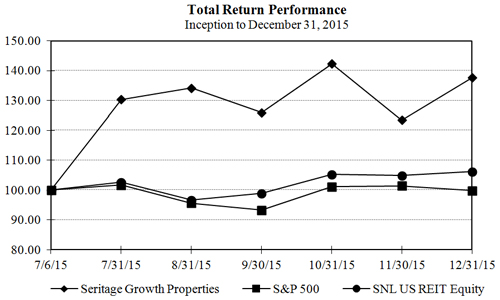
|
Index |
7/6/15 | 7/31/15 | 8/31/15 | 9/30/15 | 10/31/15 | 11/30/15 | 12/31/15 | |||||||||||||||||||||
|
Seritage Growth Properties |
100.00 | 130.36 | 134.18 | 125.93 | 142.43 | 123.39 | 137.64 | |||||||||||||||||||||
|
S&P 500 |
100.00 | 101.79 | 95.65 | 93.28 | 101.15 | 101.45 | 99.85 | |||||||||||||||||||||
|
SNL US REIT Equity |
100.00 | 102.72 | 96.73 | 98.88 | 105.33 | 104.92 | 106.28 | |||||||||||||||||||||
On March 4, 2016, the reported closing sale price per share of our Class A common stock on the NYSE was $42.63.
At March 4, 2016, there were 25,261,542 Class A common shares issued and outstanding which were held by approximately 154 shareholders of record. The number of shareholders of record does not reflect persons or entities that held their shares in nominee or “street” name.
In addition, at March 4, 2016, there were 1,589,020 Class B non-economic common shares issued and outstanding, 6,329,485 Class C non-voting common shares issued and outstanding and 24,176,327 outstanding Operating Partnership units held by limited partners other than the Company.
The Class B non-economic common shares have voting rights, but do not have economic rights and, as such, do not receive dividends and are not included in earnings per share computations.
- 38 -
Table of Contents
The Class C non-voting common shares have economic rights, but do not have voting rights. Upon any transfer of a Class C non-voting common share to any person other than an affiliate of the holder of such share, such share shall automatically convert into one Class A common share. During the period from July 7, 2015 (Date Operations Commenced) through December 31, 2015, 17,450 net shares of Class C non-voting common shares were converted to Class A common shares.
The Operating Partnership units are generally exchangeable into shares of Class A common stock on a one-for-one basis.
We currently intend to pay quarterly distributions in cash. However, the timing, amount and composition of all distributions will be made by the Company at the discretion of its Board of Trustees. Such distributions will depend on the financial position, results of operations, cash flows, capital requirements, debt covenants, applicable law and other factors as the Board of Trustees of Seritage deems relevant.
We plan to elect to be treated as a REIT for U.S. Federal income tax purposes in connection with the filing of our first U.S. federal tax return and intend to maintain this status in future periods. To qualify as a REIT, the Company must meet a number of organizational and operational requirements, including requirements to distribute at least 90% of our ordinary taxable income and to either distribute capital gains to shareholders, or pay corporate income tax on the undistributed capital gains. A REIT will generally not pay federal taxes if it distributes 100% of its capital gains and ordinary income.
- 39 -
Table of Contents
| ITEM 6. | SELECTED FINANCIAL DATA |
The following table sets forth selected financial data which should be read in conjunction with the Consolidated Financial Statements and the related Notes and Management’s Discussion and Analysis of Financial Condition and Results of Operations contained in this Annual Report:
|
July 7, 2015
(Date Operations Commenced) to December 31, 2015 |
||||
|
Operating Data |
||||
|
Total revenue |
$ | 113,571 | ||
|
Total expenses |
122,944 | |||
|
Equity in income of unconsolidated joint ventures |
4,772 | |||
|
Net loss |
(38,803 | ) | ||
|
Net loss attributable to common shareholders |
(22,338 | ) | ||
|
Net loss per share attributable to Class A and Class C common shareholders – Basic and diluted (1)(2) |
$ | (0.71 | ) | |
|
Dividends declared per share |
0.50 | |||
|
Total NOI (3) |
$ | 89,493 | ||
|
EBITDA (4) |
67,496 | |||
|
Adjusted EBITDA (4) |
90,732 | |||
|
Funds from Operations (“FFO”) (5) |
36,061 | |||
|
Normalized FFO (5) |
61,954 | |||
|
Cash Flow Data (6) |
||||
|
Operating activities |
$ | 17,671 | ||
|
Investing activities |
(2,730,399 | ) | ||
|
Financing activities |
2,775,595 | |||
|
Balance Sheet Data |
||||
|
Investment in real estate, net |
$ | 1,639,275 | ||
|
Total assets |
2,833,359 | |||
|
Mortgage loans payable, net |
1,142,422 | |||
|
Total liabilities |
1,263,282 | |||
|
Non-controlling interests |
683,382 | |||
|
Total equity |
1,570,077 | |||
|
Other Data (7) |
||||
|
Number of properties |
266 | |||
|
Gross leasable area (sq. ft.) |
42,468 | |||
|
Percentage leased |
99.4 | % | ||
|
Annual base rent |
$ | 202,938 | ||
|
Rent PSF |
$ | 5.13 | ||
| (1) | Earnings per share is not presented for Class B shareholders as they do not have economic rights. |
| (2) | Non-vested restricted shares are excluded from the computation of diluted loss per share because their inclusion would have an anti-dilutive effect. |
| (3) | Total NOI is presented at our proportional share and does not represent operating income as defined by GAAP. See page 49. |
| (4) | EBITDA and Adjusted EBITDA are supplemental financial measurements and do not represent net income as defined by GAAP. See page 49. |
| (5) | FFO and Normalized FFO are supplemental financial measurements and do not represent net income as defined by GAAP. See page 50. |
| (6) | Cash flow data only represents the Company’s consolidated cash flows as defined by GAAP and as such, operating cash flow does not include the cash received from our unconsolidated joint ventures, except to the extent of operating distributions from our unconsolidated joint ventures. |
| (7) | JV Properties are presented at our proportional share; based on signed leases as of December 31, 2015, including SNO leases. |
- 40 -
Table of Contents
| ITEM 7. | MANAGEMENT’S DISCUSSION AND ANALYSIS OF FINANCIAL CONDITION AND RESULTS OF OPERATIONS |
This section contains forward-looking statements that involve risks and uncertainties. Our actual results may vary materially from those discussed in the forward-looking statements as a result of various factors, including, without limitation, those set forth in “Risk Factors” and the other matters set forth in this Annual Report. See “Cautionary Statement Regarding Forward-Looking Statements.”
All references to numbered Notes are to specific footnotes to our Consolidated Financial Statements included in this Annual Report. You should read this discussion in conjunction with our Consolidated Financial Statements, the notes thereto and other financial information included elsewhere in this Annual Report. Our financial statements are prepared in accordance with GAAP. Capitalized terms used, but not defined, in this Management’s Discussion and Analysis of Financial Condition and Results of Operations (“MD&A”) have the same meanings as in such Notes.
Overview
We are principally engaged in the acquisition, ownership, development, redevelopment, management and leasing of diversified retail real estate throughout the United States. As of December 31, 2015, our portfolio included over 42.4 million square feet of GLA, consisting of 235 Wholly Owned Properties totaling over 37.0 million square feet of GLA across 49 states and Puerto Rico, and interests in 31 JV Properties totaling over 5.4 million square feet of GLA across 17 states.
As of December 31, 2015, we leased a substantial majority of the space in our portfolio at all but 11 of the Wholly Owned Properties (such 11 properties, the “Third-Party Properties”) to Sears Holdings under a Master Lease agreement, with the remainder of such space leased to third-party tenants. The Third-Party Properties, which do not contain a Sears Holdings store or have any space leased to Sears Holdings, are leased solely to third-party tenants. A substantial majority of the space at the JV Properties is also leased to Sears Holdings by, as applicable, the GGP JV, the Simon JV or the Macerich JV in each case under a separate JV Master Lease.
We generate revenues primarily by leasing our properties to tenants, including both Sears Holdings and third-party tenants, who operate retail stores (and potentially other uses) in the leased premises, a business model common to many publicly traded REITs. In addition to revenues generated under the Master Lease through rent payments from Sears Holdings, we generate revenue through leases to third-party tenants under existing and future leases for space at our properties.
The Master Lease provides us with the right to recapture up to approximately 50% of the space occupied by Sears Holdings at the 224 Wholly Owned Properties included in the Master Lease (subject to certain exceptions and limitations). In addition, Seritage has the right to recapture any automotive care centers which are free-standing or attached as “appendages” to the properties, and all outparcels or outlots and certain portions of parking areas and common areas. Upon exercise of this recapture right, we will generally incur certain costs and expenses for the separation of the recaptured space from the remaining Sears Holdings space and can reconfigure and rent the recaptured space to third-party tenants on potentially superior terms determined by us and for our own account. We also have the right to recapture 100% of the space occupied by Sears Holdings at each of 21 identified Wholly Owned Properties by making a specified lease termination payment to Sears Holdings, after which we expect to be able to reposition and re-lease those stores on potentially superior terms determined by us and for our own account.
With respect to the JV Properties, each JV Master Lease provides for similar recapture rights as the Master Lease governing the Company’s Wholly Owned Properties.
Our primary objective is to create value for our shareholders through the re-leasing and redevelopment of the majority of our Wholly Owned Properties and JV Properties. In doing so, we expect to meaningfully grow NOI and diversify our tenant base while transforming our portfolio from one with a single-tenant orientation to one comprised predominately of first-class, multi-tenant shopping centers. In order to achieve our objective, we intend to execute the following strategies:
| • | Convert single-tenant buildings into multi-tenant properties at meaningfully higher rents; |
| • | Maximize value of vast land holdings through retail and mixed-use densification; |
| • | Leverage existing and future joint venture relationships with leading landlords and financial partners; and |
| • | Maintain a flexible capital structure to support value creation activities. |
- 41 -
Table of Contents
Results of Operations
We derive substantially all of our revenue from rents received from tenants under existing leases at each of our properties. This revenue generally includes fixed base rents and recoveries of expenses that we have incurred and that we pass through to the individual tenants, in each case as provided in the respective leases.
Our primary cash expenses consist of our property operating expenses, general and administrative expenses, interest expense and construction and development related costs. Property operating expenses include: real estate taxes, repairs and maintenance, management expenses, insurance, ground lease costs and utilities; general and administrative expenses include payroll, office expenses, professional fees, and other administrative expenses; and interest expense is primarily on our mortgage loan payable. In addition, we incur substantial non-cash charges for depreciation and amortization on our properties and related intangible assets and liabilities resulting from the Transaction.
We did not have any revenues or expenses until we completed the Transaction on July 7, 2015.
Rental Income
Our earnings are primarily the result of the rental revenue generated through rent payments from Sears Holdings under the Master Lease. During the period from July 7, 2015 (Date Operations Commenced) through December 31, 2015, and excluding the effect of straight-line rent, the rental income attributable directly to Sears was $64.8 million, or approximately 83.5% of total rental income earned in the period.
In addition to revenues generated under the Master Lease through rent payments from Sears Holdings, we generate revenue through direct leases to third-party tenants for space at our properties. During the period from July 7, 2015 (Date Operations Commenced) through December 31, 2015, and excluding the effect of straight-line rent, the rental income attributable to third-party tenants was $12.9 million, or 16.5% of total rental income earned in the period.
On an annual basis, and taking into account all signed leases, including those which have not yet commenced rental payments, rental income attributable to third-party tenants would have represented approximately 24.0% of total annual base rental income as of December 31, 2015.
For the period from July 7, 2015 (Date Operations Commenced) through December 31, 2015, the Company recognized total rental income of $86.6 million, including straight-line rent of approximately $8.3 million, percentage rent of approximately $0.1 million and other adjustments of approximately $0.5 million.
Tenant Reimbursements and Property Operating Expenses
Pursuant to the provisions of the Master Lease and many third-party leases, the Company is entitled to be reimbursed for certain property related expenses. For the period from July 7, 2015 (Date Operations Commenced) through December 31, 2015, the Company recorded tenant reimbursement income of $26.9 million, compared to property operating expenses and real estate tax expense aggregating $28.7 million.
General and Administrative Expenses
General and administrative expenses consist of personnel costs, including stock-based compensation, professional fees, office expenses, acquisition costs and overhead expenses. For the period from July 7, 2015 (Date Operations Commenced) through December 31, 2015, the Company incurred general and administrative expenses of approximately $10.0 million of which approximately $1.9 million consisted of up-front personnel costs related to the hiring of certain executives.
Acquisition-Related Expenses
The Company incurred $18.4 million of non-recurring costs related to the Transaction, including due diligence, legal, consulting and other similar expenses. These costs are included in acquisition-related expenses on the consolidated statement of operations.
Interest expense
For the period from July 7, 2015 (Date Operations Commenced) through December 31, 2015, the Company incurred $30.5 million of interest expense related to the Mortgage Loans, including amortization of debt issuance costs in the amount of $2.7 million.
- 42 -
Table of Contents
Unrealized Loss on Interest Rate Cap
In connection with the issuance of the Mortgage Loans, the Company purchased for $5.0 million an interest rate cap with a term of four years, a notional amount of $1.26 billion and a strike rate of 3.5%. As of December 31, 2015, the interest rate cap had a fair value of approximately $2.1 million.
Liquidity and Capital Resources
Property rental income is our primary source of cash and is dependent on a number of factors including occupancy levels and rental rates, as well as our tenants’ ability to pay rent. Our primary uses of cash include payment of operating expenses, debt service, reinvestment in and redevelopment of properties and distributions to shareholders. We believe that we currently have sufficient liquidity to satisfy all of our commitments in the form of $62.9 million of unrestricted cash, $92.5 million of restricted cash and $100.0 million of borrowing capacity under our Future Funding Facility as of December 31, 2015, as well as anticipated cash provided by operations.
We may raise capital through public or private issuances of debt securities, common or preferred equity or other instruments convertible into or exchangeable for common or preferred equity, as well as other capital raising activities such as asset sales or joint ventures.
Mortgage Notes Payable
During the period from July 7, 2015 (Date Operations Commenced) through December 31, 2015, pursuant to the Transaction, the Company entered into Loan Agreements providing for Mortgage Loans in an initial principal amount of approximately $1.16 billion and a $100 million Future Funding Facility, which we expect to be available to us to finance the redevelopment of properties in our portfolio from time to time, subject to satisfaction of certain conditions. No amounts have been drawn as of December 31, 2015 under the Future Funding Facility.
The Mortgage Loans mature in July 2019. The Company has two one-year extension options subject to the payment of an extension fee and satisfaction of certain other conditions. Borrowings under the Mortgage Loans bear interest at the London Interbank Offered Rates (“LIBOR”) plus, as of December 31, 2015, a weighted-average spread of 465 basis points; payments are made monthly on an interest-only basis. The weighted-average interest rate for the Mortgage Loans for the period from July 7, 2015 (Date Operations Commenced) through December 31, 2015 was 4.96%.
All obligations under the Loan Agreements are non-recourse to the borrowers and the pledgors of the JV Interests and the guarantors thereunder, except that (i) the borrowers and the guarantors will be liable, on a joint and several basis, for losses incurred by the lenders in respect of certain matters customary for commercial real estate loans, including misappropriation of funds and certain environmental liabilities and (ii) the indebtedness under the Loan Agreements will be fully recourse to the borrowers and guarantors upon the occurrence of certain events customary for commercial real estate loans, including without limitation prohibited transfers, prohibited voluntary liens and bankruptcy. Additionally the guarantors delivered a limited completion guaranty with respect to future redevelopments undertaken by the borrowers at the properties.
The Mortgage Loans are secured by all of our Wholly Owned Properties and a pledge of our equity in the JVs. The Loan Agreements contain terms that limit our ability to incur additional indebtedness on these properties and may require lender approval of certain major tenant leases or significant redevelopment projects. The Loan Agreement prohibits repayment of any amounts outstanding for the first 12 months (other than repayments in connection with property releases and certain other exceptions) and contains a yield maintenance provision for the early extinguishment of the debt within the first 30 months. The Company believes it is currently in compliance with all material terms and conditions of the Loan Agreements.
Hedging Instruments
In connection with the issuance of the Company’s mortgage loans, we purchased for $5.0 million an interest rate cap with a term of four years, a notional amount of $1.26 billion and a strike rate of 3.5%. Our objectives in using interest rate derivatives are to add stability to interest expense and to manage our exposure to interest rate movements. The interest rate cap is measured at fair value and included as a component of prepaid expenses, deferred expenses and other assets on the consolidated balance sheet. The Company did not elect hedge accounting and therefore the change in fair value is included within unrealized loss on interest rate cap on the consolidated statement of operations. For the period from July 7, 2015 (Date Operations Commenced) through December 31, 2015, the Company recorded a loss of $2.9 million related to the change in fair value of the interest rate cap.
- 43 -
Table of Contents
Dividends and Distributions
On December 17, 2015, the Company’s Board of Trustees declared a cash dividend of $0.50 per share for the period from July 7, 2015 (Date Operations Commenced) through to December 31, 2015. The dividend was paid on January 14, 2016 to Class A and Class C shareholders of record on December 31, 2015. The holders of Operating Partnership units were entitled to an equal distribution per Operating Partnership unit held as of December 31, 2015.
On March 8, 2016, the Company’s Board of Trustees declared a cash dividend of $0.25 per share for the quarter ending March 31, 2016. The dividend will be paid on April 14, 2016 to Class A and Class C shareholders of record on March 31, 2016. The holders of Operating Partnership units are entitled to an equal distribution per Operating Partnership unit held as of March 31, 2016.
We currently intend to pay quarterly dividends and distributions in cash. However, the timing, amount and composition of all dividends and distributions will be made by the Company at the discretion of its Board of Trustees. Such dividends and distributions will depend on the financial position, results of operations, cash flows, capital requirements, debt covenants, applicable law and other factors as the Board of Trustees of Seritage deems relevant
Off-Balance Sheet Arrangements
The Company accounts for its investments in joint ventures that it does not have a controlling interest or is not the primary beneficiary using the equity method of accounting and those investments are reflected on the consolidated balance sheets of the Company as investments in unconsolidated joint ventures. As of December 31, 2015 we did not have any off-balance sheet financing arrangements.
Contractual Obligations
Our contractual obligations relate to our mortgage loans payable and non-cancelable operating leases in the form of a ground lease at one of our properties, as well as the operating lease for our corporate office.
Information concerning our obligations and commitments to make future payments under contracts for these loan and lease agreements is aggregated in the following table (in thousands):
| Payments due by Period | ||||||||||||||||||||
|
Contractual Obligation |
Total |
Within
1 year |
1 - 3 years | 3 -5 years |
After
5 years |
|||||||||||||||
|
Long-term debt (1) |
$ | 1,362,550 | $ | 57,586 | $ | 115,171 | $ | 1,189,793 | $ | — | ||||||||||
|
Operating leases |
3,105 | 412 | 854 | 826 | 1,013 | |||||||||||||||
| (1) | Includes expected interest payments. |
Capital Expenditures
Capital expenditures for Wholly Owned Properties under the Master Lease are generally the responsibility of the tenant. Given that the substantial majority of our GLA is subject to the Master Lease as of December 31, 2015, we do not currently anticipate incurring material expenses related to maintenance capital expenditures, tenant improvements or leasing commissions, outside of those associated with retenanting and redevelopment projects as described below.
During the period from July 7, 2015 (Date Operations Commenced) through December 31, 2015, we incurred maintenance capital expenditures of less than $0.1 million and did not pay for any tenant improvements or leasing commissions that were not associated with retenanting and redevelopment projects.
Summary of Cash Flows
Net cash provided by operating activities for the period from July 7, 2015 (Date Operations Commenced) through December 31, 2015 was $13.7 million and included (i) $26.9 million of cash from operating income (net of acquisition-related expenses of $18.4 million) and (ii) a $13.2 million net decrease in cash due to timing of cash receipts and payments related to changes in operating assets and liabilities.
Net cash used in investing activities for the period from July 7, 2015 (Date Operations Commenced) through December 31, 2015 was $2.7 billion which was primarily a result of the Transaction.
Net cash provided by financing activities for the period from July 7, 2015 (Date Operations Commenced) through December 31, 2015 was $2.8 billion and included (i) $1.6 billion of gross cash proceeds from the issuance of common stock and non-controlling interests; (ii) $1.2 billion of gross cash proceeds from the issuance of the Mortgage Loans; and (iii) $29.6 million of offering and financing costs.
- 44 -
Table of Contents
Litigation and Other Matters
In accordance with accounting standards regarding loss contingencies, the Company accrues an undiscounted liability for those contingencies where the incurrence of a loss is probable and the amount can be reasonably estimated, and we disclose the amount accrued and the amount of a reasonably possible loss in excess of the amount accrued or disclose the fact that such a range of loss cannot be estimated. We do not record liabilities when the likelihood that the liability has been incurred is probable but the amount cannot be reasonably estimated, or when the liability is believed to be only reasonably possible or remote. In such cases, we disclose the nature of the contingency, and an estimate of the possible loss, range of loss, or disclose the fact that an estimate cannot be made.
The Company is subject, from time to time, to various legal proceedings and claims that arise in the ordinary course of business. While the resolution of such matters cannot be predicted with certainty, management believes, based on currently available information, that the final outcome of such matters will not have a material effect on the consolidated financial position, results of operations or liquidity of the Company.
In May and June of 2015, four purported Sears Holdings shareholders filed lawsuits in the Delaware Court of Chancery challenging the Transaction, which lawsuits have since been consolidated into a single action captioned In re Sears Holdings Corporation Stockholder and Derivative Litigation, Consol. C.A. No. 11081-VCL (the “Action”). On October 15, 2015, plaintiffs filed a verified consolidated stockholder derivative complaint (the “Complaint”) in the Action against defendants the individual members of Sears Holdings’ Board of Directors, ESL Investments, Inc. (together with its affiliates, “ESL”), Sears Holdings’ CEO, Fairholme Capital Management L.L.C. (“FCM”), and Seritage. The plaintiffs have brought the Action derivatively on behalf of Sears Holdings, which is named as a nominal defendant, and allege that the Sears Holdings directors, as well as ESL (in its capacity as the alleged controlling stockholder of Sears Holdings), breached their fiduciary duties to Sears Holdings shareholders by selling the Wholly Owned Properties to Seritage at a price that was unfairly low and was the result of a process that allegedly was flawed. The Complaint also alleges that Seritage and FCM aided and abetted these alleged fiduciary breaches. Among other forms of relief, the plaintiffs are currently seeking damages in unspecified amounts. The Company believes that the plaintiffs’ claims and allegations against the Company are legally without merit and intends to contest these lawsuits vigorously. Due to, among other things, the fact that the litigation is at a very early stage, management cannot reasonably estimate the possible loss or range of loss, if any, that may arise from this matter.
Retenanting and Redevelopment Projects
We are currently retenanting or redeveloping several properties primarily to convert single-tenant buildings occupied by Sears Holdings into multi-tenant properties occupied by a diversity of retailers and related concepts. The table below summarizes new projects initiated by the Company during the period from July 7, 2015 (Date Operations Commenced) through December 31, 2015:
| (dollars in thousands) | ||||||||||||||||||
|
Property |
Description |
Total Project
Square Feet |
Total Est.
Development Cost (1) |
Total Est.
Project Cost (1) |
Est.
Construction Start |
Est.
Substantial Completion |
||||||||||||
|
King of Prussia, PA |
Repurpose of former auto center space for Outback Steakhouse, Yard House and small shop retail | 29,100 | $ | 3,900 | $ | 3,900 | Q1 2016 | Q4 2016 | ||||||||||
|
Braintree, MA |
100% recapture; redevelopment of existing building to be anchored by Nordstrom Rack and Saks Off 5th | 90,000 | 11,700 | 12,100 | Q1 2016 | Q4 2016 | ||||||||||||
|
Honolulu, HI |
100% recapture; redevelopment of existing building for Longs Drugs (CVS), PetSmart and Ross Dress For Less | 79,000 | 8,500 | 19,700 | Q2 2016 | Q2 2017 | ||||||||||||
|
Memphis, TN |
100% recapture; demolish and construct new buildings to be anchored by Nordstrom Rack | 135,200 | 24,100 | 25,200 | Q2 2016 | Q3 2017 | ||||||||||||
|
San Antonio, TX |
Recapture and repurpose auto center space for Orvis and Jared’s Jeweler | 19,500 | 3,300 | 3,300 | Q3 2016 | Q2 2017 | ||||||||||||
|
|
|
|
|
|
|
|||||||||||||
|
Total |
352,800 | $ | 51,500 | $ | 64,200 | |||||||||||||
|
|
|
|
|
|
|
|||||||||||||
| (1) | Total estimated development costs exclude, and total estimated project costs include, termination fees to recapture 100% of property. |
- 45 -
Table of Contents
We plan to fund these projects with available cash balances, cash flow from operations, draws against the Future Funding Facility and other potential capital raising activities.
The Company also acquired 15 retenanting or redevelopment projects that were in various stages of development at the closing of the Transaction. The projected total cost of these projects was approximately $63.6 million of which a portion was incurred by Sears Holdings prior to the Transaction and for which reserve accounts were established at the closing of the Transaction to fund the remaining costs to be incurred by the Company. Of the 15 projects acquired by the Company, seven have been substantially completed and delivered to tenants as of December 31, 2015. The remaining eight projects, representing a total Company investment of approximately $29.7 million, are under development and have approximately $21.7 million remaining to be deployed as of December 31, 2015.
We continue to evaluate a number of additional retenanting and redevelopment projects that are consistent with our primary objective to maximize the value of our properties by recapturing space from Sears Holdings and re-leasing it to third-party tenants at higher rents. Investment returns are dependent on the success of the leasing and development plans in place for each project, as well as the successful completion of each project. Investment returns are subject to a number of variables, risks, and uncertainties including those disclosed within Item 1A of our Annual Report. We also refer you to our disclosure related to forward-looking statements.
Critical Accounting Policies
In preparing the consolidated financial statements, we have made estimates and assumptions that affect the reported amounts of assets and liabilities at the date of the financial statements and the reported amounts of revenues and expenses during the reporting periods. Actual results could differ from those estimates. Set forth below is a summary of the accounting policies that we believe are critical to the preparation of our consolidated financial statements. The summary should be read in conjunction with the more complete discussion of our accounting policies included in Note 2 to the audited combined financial statements in Part II, Item 8 of this Annual Report.
Accounting for Real Estate Acquisitions
Upon the acquisition of real estate, the Company assesses the fair value of acquired assets and liabilities assumed, including land, buildings, improvements and identified intangibles such as above-market and below-market leases, in-place leases and other items, as applicable, and allocates the purchase price based on these assessments. In making estimates of fair values, the Company may use a number of sources, including data provided by third parties, as well as information obtained by the Company as a result of its due diligence, including expected future cash flows of the property and various characteristics of the markets where the property is located.
The fair values of tangible assets are determined on an “if vacant” basis. The “if vacant” fair value allocated to land is generally estimated via a market or sales comparison approach with the subject site being compared to similar properties that have sold or are currently listed for sale. The comparable properties are adjusted for dissimilar characteristics such as market conditions, location, access/frontage, size, shape/topography, or intended use, including the impact of any encumbrances on such use. The “if vacant” value allocated to buildings and site improvements is generally estimated using an income approach and a cost approach that utilizes published guidelines for current replacement cost or actual construction costs for similar, recently developed properties. Assumptions used in the income approach include capitalization and discount rates, lease-up time, market rents, make ready costs, land value, and site improvement value.
The estimated fair value of in-place tenant leases includes lease origination costs (the costs the Company would have incurred to lease the property to the current occupancy level) and the lost revenues during the period necessary to lease-up from vacant to the current occupancy level. Such estimates include the fair value of leasing commissions, legal costs and tenant coordination costs that would be incurred to lease the property to this occupancy level. Additionally, the Company evaluates the time period over which such occupancy level would be achieved and include an estimate of the net operating costs (primarily real estate taxes, insurance and utilities) incurred during the lease-up period, which generally ranges up to one year. The fair value of acquired in-place tenant leases is included in lease intangible assets on the consolidated balance sheet and amortized over the remaining lease term for each tenant.
Identifiable intangible assets and liabilities are calculated for above-market and below-market tenant and ground leases where the Company is either the lessor or the lessee. The difference between the contractual rental rates and the Company’s estimate of market rental rates is measured over a period equal to the remaining non-cancelable term of the leases, including significantly below-market renewal options for which exercise of the renewal option appears to be reasonably assured. Above-market tenant leases and below-market ground leases are included in lease intangible assets on the consolidated balance sheet and below-market tenant leases are included in accounts payable, accrued expenses and other liabilities on the consolidated balance sheet.
- 46 -
Table of Contents
Real Estate Investments
Real estate assets are recorded at cost, less accumulated depreciation and amortization.
Expenditures for ordinary repairs and maintenance will be expensed as incurred. Significant renovations which improve the property or extend the useful life of the assets are capitalized. As real estate is undergoing redevelopment activities, all amounts directly associated with and attributable to the project, including planning, development and construction costs, interest costs, personnel costs of employees directly involved and other miscellaneous costs incurred during the period of redevelopment, are capitalized. The capitalization period begins when redevelopment activities are underway and ends when the project is substantially complete
Depreciation of real estate assets, excluding land, is recognized on a straight-line basis over their estimated useful lives which generally range from five to 40 years. Tenant improvements are amortized on a straight-line basis over the shorter of the estimated useful life or non-cancelable term of lease.
We amortize identified intangibles that have finite lives over the period they are expected to contribute directly or indirectly to the future cash flows of the property or business acquired, generally the remaining non-cancelable term of a related lease.
Investments in Unconsolidated Joint Ventures
The Company accounts for its investments in unconsolidated joint ventures using the equity method of accounting. These investments are initially recorded at cost and are subsequently adjusted for cash contributions, cash distributions and earnings which are recognized in accordance with the terms of the applicable agreement.
To determine the method of accounting for partially owned joint ventures, we evaluate the characteristics of associated entities and determine whether an entity is a variable interest entity (“VIE”) and, if so, determine which party is primary beneficiary by analyzing whether we have both the power to direct the entity’s significant economic activities and the obligation to absorb potentially significant losses or receive potentially significant benefits. We will consolidate a VIE if we have determined that we are the primary beneficiary.
Revenue Recognition
Rental income is recognized on a straight-line basis over the non-cancelable terms of the related leases. For leases that have fixed and measurable rent escalations, the difference between such rental income earned and the cash rent due under the provisions of the lease is recorded as deferred rent receivable and included as a component of tenant and other receivables on the consolidated balance sheet.
In leasing tenant space, we may provide funding to the lessee through a tenant allowance. In accounting for a tenant allowance, we will determine whether the allowance represents funding for the construction of leasehold improvements and evaluate the ownership of such improvements. If we are considered the owner of the improvements for accounting purposes, we capitalize the amount of the tenant allowance and depreciate it over the shorter of the useful life of the improvements or the related lease term. If the tenant allowance represents a payment for a purpose other than funding leasehold improvements, or in the event we are not considered the owner of the improvements for accounting purposes, the allowance is considered to be a lease incentive and is recognized over the lease term as reduction of rental revenue on straight-line basis.
Accounting for Recapture and Termination Activity Pursuant to the Master Lease
We generally treat recapture and termination activity pursuant to the Master Lease as modifications of the Master Lease as of the date of notice. Such notices and lease modifications result in the following accounting adjustments for the recaptured or terminated property:
| • | The portion of accrued rental revenues related to the straight-line method of reporting rental revenue that is associated with recapture is deemed to be a lease modification and amortized over the remaining shortened life of the lease from the date of notice to the date of termination. The portion of accrued rental revenues related to the straight-line method of reporting rental revenue that is attributable to the retained space, if any, is amortized over the remaining life of the Master Lease. |
| • | The portion of intangible lease assets and liabilities that are deemed to be impacted by the lease modification is amortized over the shorter of the shortened lease term or the remaining useful life of the asset or liability. The portion of intangible lease assets and liabilities that is attributable to the retained space is amortized over the remaining useful life of the asset or liability. |
- 47 -
Table of Contents
Additionally, termination fees paid by us to Sears Holding, if any, in connection with a 100% recapture notice are generally capitalized as a necessary cost of the real estate project and depreciated over the life of the real estate asset being constructed or improved. Termination fees required to be paid by Sears Holdings to us in connection with a lease termination by Sears Holdings are recognized as income over the shortened life of the lease from the date of notice to the date of termination.
Recent Accounting Pronouncements
Refer to Note 2 of the Consolidated Financial Statements for recently issued accounting pronouncements.
Non-GAAP Supplemental Financial Measures and Definitions
The Company makes reference to NOI, Total NOI, FFO, Normalized FFO, EBITDA and Adjusted EBITDA.
Net Operating Income (“NOI”) and Total NOI
We define NOI as income from property operations less property operating expenses. Other REITs may use different methodologies for calculating NOI, and accordingly, the Company’s depiction of NOI may not be comparable to other REITs. We believe NOI provides useful information regarding the Company, its financial condition and results of operations because it reflects only those income and expense items that are incurred at the property level.
The Company uses Total NOI, which includes its share of unconsolidated properties and excludes certain GAAP adjustments, to present the Company’s proportional share of NOI excluding non-cash items. We believe Total NOI is a helpful supplemental measure of our operating performance. However, due to the adjustments noted, Total NOI should only be used as an alternative measure of the Company’s financial performance.
Earnings Before Interest Expense, Income Tax, Depreciation, and Amortization (“EBITDA”) and Adjusted EBITDA
We define EBITDA as NOI less administrative expenses and other operational items. EBITDA is a commonly used measure of performance in many industries, but may not be comparable to measures calculated by other companies. We believe EBITDA provides useful information to investors regarding our results of operations because it removes the impact of our capital structure (primarily interest expense) and our asset base (primarily depreciation and amortization). Management also believes the use of EBITDA facilitates comparisons between us and other equity REITs, retail property owners who are not REITs and other capital-intensive companies.
The Company also considers Adjusted EBITDA to be a helpful supplemental measure of its operating performance because it excludes from EBITDA certain other non-cash and non-comparable items that we do not believe are representative of ongoing operating results. However, due to the adjustments noted, Adjusted EBITDA should only be used as an alternative measure of the Company’s financial performance
Funds From Operations (“FFO”) and Normalized FFO
We define FFO using the definition set forth by the National Association of Real Estate Investment Trusts (“NAREIT”), which may not be comparable to measures calculated by other companies who do not use the NAREIT definition of FFO. FFO is calculated as net income computed in accordance with GAAP, excluding gains (or losses) from property sales, real estate related depreciation and amortization, and impairment charges on depreciable real estate asset.
We consider FFO a helpful supplemental measure of the operating performance for equity REITs and a complement to GAAP measures because it is a recognized measure of performance by the real estate industry. FFO facilitates an understanding of the operating performance of our properties between periods because it does not give effect to real estate depreciation and amortization which are calculated to allocate the cost of a property over its useful life. Since values for well-maintained real estate assets have historically increased or decreased based upon prevailing market conditions, the Company believes that FFO provides investors with a clearer view of the Company’s operating performance.
The Company makes certain adjustments to FFO, which it refers to as Normalized FFO, to account for certain non-cash and non-comparable items, such as loss on interest rate cap, acquisition-related expenses, and up-front-hiring and personnel costs, that it does not believe are representative of ongoing operating results. Due to the adjustments noted, Normalized FFO should only be used as an alternative measure of the Company’s financial performance.
- 48 -
Table of Contents
Reconciliation of Non-GAAP Financial Measures to GAAP Financial Measures
None of Total NOI, FFO, Normalized FFO, EBITDA and Adjusted EBITDA are measures that (i) represent cash flow from operations as defined by GAAP; (ii) are indicative of cash available to fund all cash flow needs, including the ability to make distributions; (iii) are alternatives to cash flow as a measure of liquidity; or (iv) should be considered alternatives to net income (which is determined in accordance with GAAP) for purposes of evaluating the Company’s operating performance. Reconciliations of these measures to the respective GAAP measures we deem most comparable are presented below.
The following table reconciles Total NOI to GAAP operating income or loss for the period from July 7, 2015 (Date Operations Commenced) through December 31, 2015 (in thousands):
|
July 7, 2015
(Date Operations Commenced) to December 31, 2015 |
||||
|
TOTAL NET OPERATING INCOME |
||||
|
GAAP operating loss |
$ | (9,373 | ) | |
|
Depreciation and amortization |
65,907 | |||
|
General and administrative |
9,956 | |||
|
Acquisition-related expenses |
18,397 | |||
|
NOI of unconsolidated joint ventures |
14,456 | |||
|
|
|
|||
|
Total NOI before certain non-cash adjustments |
99,343 | |||
|
|
|
|||
|
Straight-line rent adjustment (1) |
(9,353 | ) | ||
|
Above/below market rental income/expense (1) |
(497 | ) | ||
|
|
|
|||
|
Total NOI |
$ | 89,493 | ||
|
|
|
|||
| (1) | Includes adjustments for unconsolidated joint ventures. |
The following table reconciles EBITDA and Adjusted EBITDA to GAAP net loss for the period from July 7, 2015 (Date Operations Commenced) through December 31, 2015 (in thousands):
|
July 7, 2015
(Date Operations Commenced) to December 31, 2015 |
||||
|
EBITDA |
||||
|
Net loss |
$ | (38,803 | ) | |
|
Depreciation and amortization |
65,907 | |||
|
Depreciation and amortization (unconsolidated joint ventures) |
8,987 | |||
|
Interest expense |
30,461 | |||
|
Provision for income and other taxes |
944 | |||
|
|
|
|||
|
EBITDA |
$ | 67,496 | ||
|
|
|
|||
|
ADJUSTED EBITDA |
||||
|
EBITDA |
$ | 67,496 | ||
|
Unrealized loss on interest rate cap |
2,933 | |||
|
Acquisition-related expenses |
18,397 | |||
|
Up-front hiring and personnel costs |
1,906 | |||
|
|
|
|||
|
Adjusted EBITDA |
$ | 90,732 | ||
|
|
|
|||
- 49 -
Table of Contents
The following table reconciles FFO and Normalized FFO to GAAP loss for the period from July 7, 2015 (Date Operations Commenced) through December 31, 2015 (in thousands):
|
July 7, 2015
(Date Operations Commenced) to December 31, 2015 |
||||
|
FUNDS FROM OPERATIONS |
||||
|
Net loss |
$ | (38,803 | ) | |
|
Real estate depreciation and amortization (consolidated properties) |
65,877 | |||
|
Real estate depreciation and amortization (unconsolidated joint ventures) |
8,987 | |||
|
|
|
|||
|
FFO attributable to Seritage Growth Properties |
$ | 36,061 | ||
|
|
|
|||
|
|
||||
|
|
|
|||
|
FFO per diluted common share and unit |
$ | 0.65 | ||
|
|
|
|||
|
NORMALIZED FUNDS FROM OPERATIONS |
||||
|
Funds from Operations |
$ | 36,061 | ||
|
Unrealized loss on interest rate cap |
2,933 | |||
|
Amortization of deferred financing costs |
2,657 | |||
|
Acquisition-related expenses |
18,397 | |||
|
Up-front hiring and personnel costs |
1,906 | |||
|
|
|
|||
|
Normalized FFO attributable to Seritage Growth Properties |
$ | 61,954 | ||
|
|
|
|||
|
|
||||
|
|
|
|||
|
Normalized FFO per diluted common share and unit |
$ | 1.12 | ||
|
|
|
|||
|
WEIGHTED AVERAGE COMMON SHARES AND UNITS |
||||
|
Weighted average common shares outstanding |
31,386 | |||
|
Weighted average OP units outstanding |
24,176 | |||
|
|
|
|||
|
Weighted average common shares and units outstanding |
55,562 | |||
|
|
|
|||
- 50 -
Table of Contents
| ITEM 7A. | QUANTITATIVE AND QUALITATIVE DISCLOSURES ABOUT MARKET RISK |
We are subject to market risk associated with changes in interest rates both in terms of existing variable-rate debt and the price of new fixed-rate debt upon maturity of existing debt and to fund investments. As of December 31, 2015, we had $1,161 million of consolidated debt, all of which of was our variable-rate Mortgage Loans Payable. An immediate 100 basis point change in the underlying interest rate would result in an $11.6 million increase to interest expense and corresponding decrease to operating cash flow.
The Company has managed and will continue to manage interest rate risk through the use of interest rate caps and/or swaps and by taking advantage of favorable market conditions for fixed-rate debt and/or equity or equity-linked capital, depending on our analysis of the interest rate environment and the costs and risks of such strategies.
As of December 31, 2015, the estimated fair value of our consolidated debt was $1.2 billion. The estimated fair value of our consolidated debt is calculated based on current market prices and discounted cash flows at the current rate at which similar loans would be made to borrowers with similar credit ratings for the remaining term of such debt.
| ITEM 8. | FINANCIAL STATEMENTS AND SUPPLEMENTARY DATA |
Reference is made to the Consolidated Financial Statements and Consolidated Financial Statement Schedule beginning on page F-1 for the required information.
- 51 -
Table of Contents
| ITEM 9. | CHANGES IN AND DISAGREEMENTS WITH ACCOUNTANTS ON ACCOUNTING AND FINANCIAL DISCLOSURE |
None.
| ITEM 9A. | CONTROLS AND PROCEDURES |
Evaluation of Disclosure Controls and Procedures
We maintain disclosure controls and procedures (as defined in Rules 13a-15(e) under the Securities Exchange Act of 1934 (the “Exchange Act”)) that are designed to provide reasonable assurance that information required to be disclosed in the reports that we file or submit under the Exchange Act is recorded, processed, summarized and reported within the time periods specified in the SEC’s rules and forms, and that such information is accumulated and communicated to our management, including our Chief Executive Officer and Chief Financial Officer, as appropriate to allow timely decisions regarding required disclosures. Because of inherent limitations, disclosure controls and procedures, no matter how well designed and operated, can provide only reasonable, and not absolute, assurance that the objectives of disclosure controls and procedures are met.
Our management, with the participation of our Chief Executive Officer and Chief Financial Officer, evaluated the effectiveness of the design and operation of our disclosure controls and procedures. Based on that evaluation, our Chief Executive Officer and Chief Financial Officer concluded that, as of the end of the period covered by this report, our disclosure controls and procedures are effective.
No Management Report or Attestation Report Regarding Internal Control
This Annual Report does not include a report of management’s assessment regarding internal control over financial reporting or an attestation report of the Company’s registered public accounting firm due to a transition period established by rules of the SEC for newly public companies.
Changes in Internal Controls over Financial Reporting
There were no changes in our internal control over financial reporting that occurred during the period from July 7, 2015 (Date Operations Commenced) through December 31, 2015 that have materially affected, or are reasonably likely to materially affect, our internal control over financial reporting.
| ITEM 9B. | OTHER INFORMATION |
None.
- 52 -
Table of Contents
| ITEM 10. | DIRECTORS, EXECUTIVE OFFICERS, AND CORPORATE GOVERNANCE |
Incorporated herein by reference to our definitive proxy statement with respect to our 2016 Annual Meeting of Shareholders.
| ITEM 11. | EXECUTIVE COMPENSATION |
Incorporated herein by reference to our definitive proxy statement with respect to our 2016 Annual Meeting of Shareholders.
| ITEM 12. | SECURITY OWNERSHIP OF CERTAIN BENEFICIAL OWNERS AND MANAGEMENT AND RELATED STOCKHOLDER MATTERS |
Incorporated herein by reference to our definitive proxy statement with respect to our 2016 Annual Meeting of Shareholders.
| ITEM 13. | CERTAIN RELATIONSHIPS AND RELATED TRANSACTIONS, AND DIRECTOR INDEPENDENCE |
Incorporated herein by reference to our definitive proxy statement with respect to our 2016 Annual Meeting of Shareholders.
| ITEM 14. | PRINCIPAL ACCOUNTING FEES AND SERVICES |
Incorporated herein by reference to our definitive proxy statement with respect to our 2016 Annual Meeting of Shareholders.
- 53 -
Table of Contents
| ITEM 15. | EXHIBITS AND FINANCIAL STATEMENT SCHEDULE |
| (a) | Consolidated Financial Statements and Consolidated Financial Statement Schedule. |
The consolidated financial statements and consolidated financial statement schedule listed in the accompanying Index to Consolidated Financial Statements and Consolidated Financial Statement Schedule are filed as part of this Annual Report.
| (b) | Exhibits. |
|
Exhibit
|
Description |
SEC Document Reference |
||
| 2.1 | Subscription, Distribution and Purchase and Sale Agreement, dated as of June 8, 2015, by and between Seritage Growth Properties and Sears Holdings Corporation | Incorporated by reference to Exhibit 2.1 to our Registration Statement on Form S-11, filed on June 9, 2015 | ||
| 3.1 | Articles of Amendment and Restatement | Incorporated by reference to Exhibit 3.1 to our Current Report on Form 8-K, filed on July 10, 2015 | ||
| 3.2 | Amended and Restated Bylaws | Incorporated by reference to Exhibit 3.2 to our Current Report on Form 8-K, filed on July 10, 2015 | ||
| 4.1 | Registration Rights Agreement by and among Seritage Growth Properties, ESL Investments, Inc., and Seritage Growth Properties, L.P., dated as of July 7, 2015 | Incorporated by reference to Exhibit 4.1 to our Current Report on Form 8-K, filed on July 10, 2015 | ||
| 10.1 | Transition Services Agreement by and between Sears Holdings Management Corporation and Seritage Growth Properties, L.P., dated as of July 7, 2015 | Incorporated by reference to Exhibit 10.1 to our Current Report on Form 8-K, filed on July 10, 2015 | ||
| 10.2 | Agreement of Limited Partnership of Seritage Growth Properties, L.P., dated as of July 7, 2015 | Incorporated by reference to Exhibit 10.2 to our Current Report on Form 8-K, filed on July 10, 2015 | ||
| 10.3 | Master Lease by and among Seritage SRC Finance LLC, Seritage KMT Finance LLC, Kmart Operations, LLC, and Sears Operations, LLC, dated as of July 7, 2015 | Incorporated by reference to Exhibit 10.3 to our Current Report on Form 8-K, filed on July 10, 2015 | ||
| 10.4 | Mortgage Loan Agreement by and among Seritage SRC Finance LLC, Seritage KMT Finance LLC, certain other subsidiaries of Operating Partnership, JPMorgan Chase Bank, National Association and H/2 SO III Funding LLC, dated as of July 7, 2015 | Incorporated by reference to Exhibit 10.4 to our Current Report on Form 8-K, filed on July 10, 2015 | ||
| 10.5 | Mezzanine Loan Agreement by and among Seritage SRC Mezzanine Finance LLC, Seritage KMT Mezzanine Finance LLC, JPMorgan Chase Bank, National Association and H/2 Special Opportunities III Corp., dated as of July 7, 2015 | Incorporated by reference to Exhibit 10.5 to our Current Report on Form 8-K, filed on July 10, 2015 | ||
- 54 -
Table of Contents
|
10.6 |
Seritage Growth Properties Restricted Share Agreement | Incorporated by reference to Exhibit 10.6 to our Current Report on Form 8-K, filed on July 10, 2015 | ||
|
10.7 |
Form of Seritage Growth Properties Sign-On P-RSU Restricted Share Agreement | Incorporated by reference to Exhibit 10.7 to our Current Report on Form 8-K, filed on July 10, 2015 | ||
|
10.8 |
Form of Seritage Growth Properties Time-Vesting Restricted Share Unit Agreement | Incorporated by reference to Exhibit 10.8 to our Current Report on Form 8-K, filed on July 10, 2015 | ||
|
10.9 |
Form of Seritage Growth Properties Annual P-RSU Restricted Share Agreement | Incorporated by reference to Exhibit 10.9 to our Current Report on Form 8-K, filed on July 10, 2015 | ||
|
10.10 |
Employment Agreement with Brian Dickman, dated as of July 6, 2015. | Incorporated by reference to Exhibit 10.10 to our Current Report on Form 8-K, filed on July 10, 2015 | ||
|
10.11 |
Employment Agreement with Mary Rottler, dated as of June 2, 2015 | Incorporated by reference to Exhibit 10.1 to our Current Report on Form 8-K, filed on June 19, 2015 | ||
|
10.12 |
Employment Agreement, dated April 17, 2015, between Benjamin Schall and Seritage Growth Properties | Incorporated by reference to Exhibit 10.8 to our Registration Statement on Form S-11, filed on May 26, 2015 | ||
|
10.13 |
Letter Agreement, dated April 30, 2015, among Seritage Growth Properties, Seritage Growth Properties, L.P. and Benjamin Schall | Incorporated by reference to Exhibit 10.9 to our Registration Statement on Form S-11, filed on May 26, 2015 | ||
|
10.14 |
Letter Agreement, dated May 15, 2015, between Matthew Fernand and Seritage Growth Properties | Incorporated by reference to Exhibit 10.10 to our Registration Statement on Form S-11, filed on May 26, 2015 | ||
|
10.15 |
Letter Agreement, dated May 13, 2015, between James Bry and Seritage Growth Properties | Incorporated by reference to Exhibit 10.11 to our Registration Statement on Form S-11, filed on May 26, 2015 | ||
|
10.16 |
Exchange Agreement by and among Seritage Growth Properties, Seritage Growth Properties, L.P., ESL Partners, L.P., and Edward S. Lampert, dated as of June 26, 2015 | Incorporated by reference to Exhibit 10.1 to our Current Report on Form 8-K, filed on July 2, 2015 | ||
- 55 -
Table of Contents
|
10.17 |
Exchange Agreement by and among Seritage Growth Properties and Fairholme Capital Management, L.L.C., dated as of June 30, 2015 | Incorporated by reference to Exhibit 10.2 to our Current Report on Form 8-K, filed on July 2, 2015 | ||
|
21.1 |
List of subsidiaries | Filed herewith. | ||
|
23.1 |
Consent of Deloitte & Touche LLP, Independent Registered Public Accounting Firm | Filed herewith. | ||
|
31.1 |
Certification of the Chief Executive Officer pursuant to Section 302 of the Sarbanes-Oxley Act of 2002 | Filed herewith. | ||
|
31.2 |
Certification of the Chief Financial Officer pursuant to Section 302 of the Sarbanes-Oxley Act of 2002 | Filed herewith. | ||
|
32.1 |
Certification of the Chief Executive Officer pursuant to Section 906 of the Sarbanes-Oxley Act of 2002, 18 U.S.C. Section 1350 | Filed herewith. | ||
|
32.2 |
Certification of the Chief Financial Officer pursuant to Section 906 of the Sarbanes-Oxley Act of 2002, 18 U.S.C. Section 1350 | Filed herewith. | ||
|
101.INS |
XBRL Instance Document | Filed herewith. | ||
|
101.SCH |
XBRL Taxonomy Extension Schema Document | Filed herewith. | ||
|
101.CAL |
XBRL Taxonomy Extension Calculation Linkbase Document | Filed herewith. | ||
|
101.DEF |
XBRL Taxonomy Extension Definition Linkbase Document | Filed herewith. | ||
|
101.LAB |
XBRL Taxonomy Extension Label Linkbase Document | Filed herewith. | ||
|
101.PRE |
XBRL Taxonomy Extension Presentation Linkbase Document | Filed herewith. | ||
- 56 -
Table of Contents
Pursuant to the requirements of the Securities Exchange Act of 1934, the registrant has duly caused this report to be signed on its behalf by the undersigned thereunto duly authorized.
| SERITAGE GROWTH PROPERTIES | ||||||
| Dated: March 11, 2016 |
/s/ Benjamin Schall |
|||||
Pursuant to the requirements of the Securities Exchange Act of 1934, this report has been signed below by the following persons on behalf of the registrant and in the capacities and on the dates indicated.
|
Signature |
Title |
Date |
||
|
/s/ Edward S. Lampert |
Chairman of the Board of Trustees |
March 11, 2016 |
||
| Edward S. Lampert | ||||
|
/s/ Benjamin W. Schall |
President, Chief Executive Officer and Trustee (Principal Executive Officer) |
March 11, 2016 |
||
| Benjamin W. Schall | ||||
|
/s/ Brian R. Dickman |
Executive Vice President, Chief Financial Officer (Principal Financial and Accounting Officer) |
March 11, 2016 |
||
| Brian R. Dickman | ||||
|
/s/ David S. Fawer |
Trustee |
March 11, 2016 |
||
| David S. Fawer | ||||
|
/s/ Kenneth T. Lombard |
Trustee |
March 11, 2016 |
||
| Kenneth T. Lombard | ||||
|
/s/ John. T. McClain |
Trustee |
March 11, 2016 |
||
| John T. McClain | ||||
|
/s/ Thomas M. Steinberg |
Trustee |
March 11, 2016 |
||
| Thomas M. Steinberg | ||||
- 57 -
Table of Contents
SERITAGE GROWTH PROPERTIES
INDEX TO CONSOLIDATED FINANCIAL STATEMENTS
AND CONSOLIDATED FINANCIAL STATEMENT SCHEDULE
|
Financial Statements
|
||||
| Page | ||||
| F-2 | ||||
| F-3 | ||||
| F-4 | ||||
| F-5 | ||||
| F-6 | ||||
| F-7 | ||||
|
Financial Statement Schedule |
||||
| F-26 | ||||
All other schedules are omitted since the required information is either not present in any amounts, is not present in amounts sufficient to require submission of the schedule or because the information required is included in the consolidated financial statements and related notes.
F-1
Table of Contents
REPORT OF INDEPENDENT REGISTERED PUBLIC ACCOUNTING FIRM
To the Board of Trustees and Shareholders of
Seritage Growth Properties
New York, New York
We have audited the accompanying consolidated balance sheet of Seritage Growth Properties and subsidiaries (the “Company”) as of December 31, 2015, and the related consolidated statements of operations, equity, and cash flows for the period from July 7, 2015 (Date Operations Commenced) through December 31, 2015. Our audit also included the financial statement schedule listed in the Index at Item 15. These financial statements and financial statement schedule are the responsibility of the Company’s management. Our responsibility is to express an opinion on these financial statements and financial statement schedule based on our audit.
We conducted our audit in accordance with the standards of the Public Company Accounting Oversight Board (United States). Those standards require that we plan and perform the audit to obtain reasonable assurance about whether the financial statements are free of material misstatement. The Company is not required to have, nor were we engaged to perform, an audit of its internal control over financial reporting. Our audit included consideration of internal control over financial reporting as a basis for designing audit procedures that are appropriate in the circumstances, but not for the purpose of expressing an opinion on the effectiveness of the Company’s internal control over financial reporting. Accordingly, we express no such opinion. An audit also includes examining, on a test basis, evidence supporting the amounts and disclosures in the financial statements, assessing the accounting principles used and significant estimates made by management, as well as evaluating the overall financial statement presentation. We believe that our audit provides a reasonable basis for our opinion.
In our opinion, such consolidated financial statements present fairly, in all material respects, the financial position of Seritage Growth Properties and subsidiaries as of December 31, 2015, and the results of their operations and their cash flows for the period from July 7, 2015 (Date Operations Commenced) through December 31, 2015, in conformity with accounting principles generally accepted in the United States of America. Also, in our opinion, such financial statement schedule, when considered in relation to the basic consolidated financial statements taken as a whole, presents fairly, in all material respects, the information set forth therein.
/s/ Deloitte & Touche LLP
New York, New York
March 11, 2016
F-2
Table of Contents
(Amounts in thousands, except share and per share amounts)
| December 31, 2015 | ||||
|
ASSETS |
||||
|
Investment in real estate |
||||
|
Land |
$ | 840,563 | ||
|
Buildings and improvements |
814,652 | |||
|
Accumulated depreciation |
(29,076 | ) | ||
|
|
|
|||
| 1,626,139 | ||||
|
Construction in progress |
13,136 | |||
|
|
|
|||
|
Net investment in real estate |
1,639,275 | |||
|
Investment in unconsolidated joint ventures |
427,052 | |||
|
Cash and cash equivalents |
62,867 | |||
|
Restricted cash |
92,475 | |||
|
Tenant and other receivables, net |
9,772 | |||
|
Lease intangible assets, net |
578,795 | |||
|
Prepaid expenses, deferred expenses and other assets, net |
23,123 | |||
|
|
|
|||
|
Total assets |
$ | 2,833,359 | ||
|
|
|
|||
|
LIABILITIES AND EQUITY |
||||
|
Liabilities |
||||
|
Mortgage loans payable, net |
$ | 1,142,422 | ||
|
Accounts payable, accrued expenses and other liabilities |
120,860 | |||
|
|
|
|||
|
Total liabilities |
1,263,282 | |||
|
|
|
|||
|
Commitments and contingencies (Note 10) |
||||
|
Shareholders’ Equity |
||||
|
Class A shares $0.01 par value; 100,000,000 shares authorized; 24,817,842 shares issued and outstanding |
248 | |||
|
Class B shares $0.01 par value; 5,000,000 shares authorized; 1,589,020 shares issued and outstanding |
16 | |||
|
Class C shares $0.01 par value; 50,000,000 shares authorized; 6,773,185 shares issued and outstanding |
68 | |||
|
Additional paid-in capital |
924,508 | |||
|
Accumulated deficit |
(38,145 | ) | ||
|
|
|
|||
|
Total shareholders’ equity |
886,695 | |||
|
Non-controlling interests |
683,382 | |||
|
|
|
|||
|
Total equity |
1,570,077 | |||
|
|
|
|||
|
Total liabilities and equity |
$ | 2,833,359 | ||
|
|
|
|||
The accompanying notes are an integral part of these consolidated financial statements.
F-3
Table of Contents
(Amounts in thousands, except per share amounts)
| July 7, 2015 | ||||
| (Date Operations | ||||
| Commenced) to | ||||
| December 31, 2015 | ||||
|
REVENUE |
||||
|
Rental income |
$ | 86,645 | ||
|
Tenant reimbursements |
26,926 | |||
|
|
|
|||
|
Total revenue |
113,571 | |||
|
|
|
|||
|
EXPENSES |
||||
|
Property operating |
6,329 | |||
|
Real estate taxes |
22,355 | |||
|
Depreciation and amortization |
65,907 | |||
|
General and administrative |
9,956 | |||
|
Acquisition-related expenses |
18,397 | |||
|
|
|
|||
|
Total expenses |
122,944 | |||
|
|
|
|||
|
Operating loss |
(9,373 | ) | ||
|
Equity in income of unconsolidated joint ventures |
4,772 | |||
|
Interest and other income |
136 | |||
|
Interest expense |
(30,461 | ) | ||
|
Unrealized loss on interest rate cap |
(2,933 | ) | ||
|
|
|
|||
|
Loss before income taxes |
(37,859 | ) | ||
|
Provision for income taxes |
(944 | ) | ||
|
|
|
|||
|
Net loss |
(38,803 | ) | ||
|
Net loss attributable to non-controlling interests |
16,465 | |||
|
|
|
|||
|
Net loss attributable to common shareholders |
$ | (22,338 | ) | |
|
|
|
|||
|
Net loss per share attributable to Class A and Class C common shareholders – Basic and diluted |
$ | (0.71 | ) | |
|
|
|
|||
|
Weighted average Class A and Class C common shares outstanding – Basic and diluted |
31,386 | |||
|
|
|
|||
The accompanying notes are an integral part of these consolidated financial statements.
F-4
Table of Contents
CONSOLIDATED STATEMENT OF EQUITY
(Amounts in thousands)
| Class A | Class B | Class C | Additional | Accumulated | Non-Controlling | Total | ||||||||||||||||||||||||||||||||||
| Shares | Amount | Shares | Amount | Shares | Amount | Paid-In Capital | Deficit | Interests | Equity | |||||||||||||||||||||||||||||||
|
Balance at July 7, 2015 (Date Operations Commenced) |
24,584 | $ | 246 | 1,589 | $ | 16 | 6,790 | $ | 68 | $ | 923,636 | $ | — | $ | 711,991 | $ | 1,635,957 | |||||||||||||||||||||||
|
Net loss |
— | — | — | — | — | — | — | (22,338 | ) | (16,465 | ) | (38,803 | ) | |||||||||||||||||||||||||||
|
Offering related costs |
— | — | — | — | — | — | (70 | ) | — | (56 | ) | (126 | ) | |||||||||||||||||||||||||||
|
Dividends and distributions declared ($0.50 per share and unit) |
— | — | — | — | — | — | — | (15,807 | ) | (12,088 | ) | (27,895 | ) | |||||||||||||||||||||||||||
|
Issuance of restricted stock, net (216,835 common shares) |
217 | 2 | — | — | — | — | (2 | ) | — | — | — | |||||||||||||||||||||||||||||
|
Stock-based compensation |
— | — | — | — | — | — | 944 | — | — | 944 | ||||||||||||||||||||||||||||||
|
Share class exchanges, net (17,450 common shares) |
17 | 0 | — | — | (17 | ) | (0 | ) | — | — | — | — | ||||||||||||||||||||||||||||
|
|
|
|
|
|
|
|
|
|
|
|
|
|
|
|
|
|
|
|
|
|||||||||||||||||||||
|
Balance at December 31, 2015 |
24,818 | $ | 248 | 1,589 | $ | 16 | 6,773 | $ | 68 | $ | 924,508 | $ | (38,145 | ) | $ | 683,382 | $ | 1,570,077 | ||||||||||||||||||||||
|
|
|
|
|
|
|
|
|
|
|
|
|
|
|
|
|
|
|
|
|
|||||||||||||||||||||
The accompanying notes are an integral part of these consolidated financial statements.
F-5
Table of Contents
(Amounts in thousands)
|
July 7, 2015
(Date Operations Commenced) to December 31, 2015 |
||||
|
CASH FLOW FROM OPERATING ACTIVITIES |
||||
|
Net loss |
$ | (38,803 | ) | |
|
Adjustments to reconcile net loss to net cash provided by operating activities: |
||||
|
Equity in income of unconsolidated joint ventures |
(4,772 | ) | ||
|
Distributions from unconsolidated joint ventures |
6,733 | |||
|
Unrealized loss on interest rate cap |
2,933 | |||
|
Stock-based compensation |
944 | |||
|
Depreciation and amortization |
65,907 | |||
|
Amortization of deferred financing costs |
2,657 | |||
|
Amortization of above and below market leases, net |
(388 | ) | ||
|
Straight-line rent adjustment |
(8,299 | ) | ||
|
Change in operating assets and liabilities |
||||
|
Tenants and other receivables |
(1,473 | ) | ||
|
Prepaid expenses, deferred expenses and other assets |
(25,596 | ) | ||
|
Restricted cash |
(3,761 | ) | ||
|
Accounts payable, accrued expenses and other liabilities |
21,589 | |||
|
|
|
|||
|
Net cash provided by operating activities |
17,671 | |||
|
|
|
|||
|
CASH FLOW FROM INVESTING ACTIVITIES |
||||
|
Acquisition of real estate and unconsolidated joint ventures |
(2,653,019 | ) | ||
|
Development of real estate |
(11,273 | ) | ||
|
Increase in restricted cash |
(66,107 | ) | ||
|
|
|
|||
|
Net cash used in investing activities |
(2,730,399 | ) | ||
|
|
|
|||
|
CASH FLOW FROM FINANCING ACTIVITIES |
||||
|
Proceeds from issuance of mortgage loans payable, net |
1,161,196 | |||
|
Payment of financing costs |
(21,431 | ) | ||
|
Proceeds from issuance of common stock and non-controlling interest |
1,644,042 | |||
|
Offering related costs |
(8,212 | ) | ||
|
|
|
|||
|
Net cash provided by financing activities |
2,775,595 | |||
|
|
|
|||
|
Net increase in cash and cash equivalents |
62,867 | |||
|
Cash and cash equivalents, beginning of period |
— | |||
|
|
|
|||
|
Cash and cash equivalents, end of period |
$ | 62,867 | ||
|
|
|
|||
|
SUPPLEMENTAL DISCLOSURE OF CASH FLOW INFORMATION |
||||
|
Cash payments for interest |
$ | 25,325 | ||
|
Capitalized interest |
226 | |||
|
Income taxes paid |
944 | |||
|
SUPPLEMENTAL DISCLOSURE OF NON-CASH INVESTING AND FINANCING ACTIVITIES |
||||
|
Development of real estate financed with accounts payable |
$ | 2,856 | ||
|
Dividends and distribution declared and unpaid |
27,894 | |||
The accompanying notes are an integral part of these consolidated financial statements.
F-6
Table of Contents
NOTES TO CONSOLIDATED FINANCIAL STATEMENTS
Seritage Growth Properties was organized in Maryland on June 3, 2015 and initially capitalized with 100 shares of Class A common shares. The Company conducts its operations through Seritage Growth Properties, L.P. (the “Operating Partnership”), a Delaware limited partnership that was formed on April 22, 2015. Unless the context otherwise requires, “Seritage” and the “Company” refer to Seritage Growth Properties, the Operating Partnership and its subsidiaries.
On June 11, 2015 Sears Holdings Corporation (“Sears Holdings”) effected a rights offering (the “Rights Offering”) to Sears Holdings stockholders to purchase common shares of Seritage in order to fund, in part, the $2.7 billion acquisition of 234 of Sears Holdings’ owned properties and one of its ground leased properties (the “Wholly Owned Properties”), and its 50% interests in three joint ventures (such joint ventures, the “JVs,” and such 50% joint venture interests the “JV Interests”) that collectively own 28 properties, ground lease one property and lease two properties (collectively, the “JV Properties”) (collectively, the “Transaction”). The Rights Offering ended on July 2, 2015 and the Company’s Class A common shares were listed on the New York Stock Exchange (“NYSE”) on July 6, 2015.
On July 7, 2015, the Company completed the Transaction with Sears Holdings (see Note 3) and commenced operations. The Company did not have any operations prior to the completion of the Rights Offering and Transaction.
Seritage is a fully-integrated, self-administered, self-managed real estate investment trust (“REIT”) primarily engaged in the real property business through the Company’s investment in the Operating Partnership. Subsidiaries of the Operating Partnership lease a substantial majority of the space at all but 11 of the Wholly Owned Properties back to Sears Holdings under a master lease agreement (“Master Lease”), with the remainder of such space leased to third-party tenants. A substantial majority of the space at the JV Properties is also leased (or subleased) by the JVs to Sears Holdings under master lease agreements (collectively, the “JV Master Leases”). The Master Lease and the JV Master Leases provide the Company and the JVs with the right to recapture certain space from Sears Holdings at each property for retenanting or redevelopment purposes.
Basis of Presentation and Principles of Consolidation
The accompanying consolidated financial statements are prepared in accordance with accounting principles generally accepted in the United States (“GAAP”). The consolidated financial statements include the accounts of the Company, the Operating Partnership, each of their wholly-owned subsidiaries, and all other entities in which they have a controlling financial interest or entities that meet the definition of a variable interest entity (“VIE”) in which the Company has, as a result of ownership, contractual interests or other financial interests, both the power to direct activities that most significantly impact the economic performance of the variable interest entity and the obligation to absorb losses or the right to receive benefits that could potentially be significant to the variable interest entity. All intercompany accounts and transactions have been eliminated.
If the Company has an interest in a VIE but it is not determined to be the primary beneficiary, the Company accounts for its interest under the equity method of accounting. Similarly, for those entities which are not VIEs and over which the Company has the ability to exercise significant influence, but does not have a controlling financial interest, the Company accounts for its interests under the equity method of accounting. The Company continually reconsiders its determination of whether an entity is a VIE and whether the Company qualifies as its primary beneficiary.
To the extent such variable interests are in entities that cannot be evaluated under the Variable Interest Model, the Company evaluates its interests using the Voting Interest Entity Model. The Company has a variable interest in the Operating Partnership. The Operating Partnership is not currently within the scope of the Variable Interest Model and is instead evaluated under the Voting Interest Entity Model. The Company holds a 56.6% interest in the Operating Partnership and is the sole general partner which gives the Company exclusive and complete responsibility for the day-to-day management, authority to make decisions and control of the Operating Partnership. As the limited partners in the Operating Partnership, although entitled to vote on certain matters, do not possess kick-out rights or substantive participating rights, the Company consolidates its interest in the Operating Partnership.
F-7
Table of Contents
The portions of consolidated entities not owned by the Company and the Operating Partnership are presented as non-controlling interests as of and during the period presented.
Use of Estimates
The preparation of financial statements in conformity with GAAP requires management to make estimates and assumptions. These estimates and assumptions affect the reported amounts of assets and liabilities and the disclosure of contingent assets and liabilities at the date of the financial statements and the reported amounts of revenues and expenses during the reporting periods. The most significant assumptions and estimates relate to fair values of acquired assets and liabilities assumed for purposes of applying the acquisition method of accounting, the useful lives of tangible and intangible assets, real estate impairment assessments, and assessing the recoverability of accounts receivables. These estimates are based on historical experience and other assumptions which management believes are reasonable under the circumstances. Management evaluates its estimates on an ongoing basis and makes revisions to these estimates and related disclosures as experience develops or new information becomes known. Actual results could differ from these estimates.
Segment Reporting
The Company currently operates in a single reportable segment, which includes the acquisition, ownership, development, redevelopment, management and leasing of retail properties. The Company reviews operating and financial information for each property on an individual basis and therefore, each property represents an individual operating segment. The Company does not distinguish or group consolidated operations based on geography, size, or type. The Company aggregates all properties into one reportable segment due to their similarities with regard to the nature and economics of the properties, tenants and operational process.
Accounting for Real Estate Acquisitions
Upon the acquisition of real estate, the Company assesses the fair value of acquired assets and liabilities assumed, including land, buildings, improvements and identified intangibles such as above-market and below-market leases, in-place leases and other items, as applicable, and allocates the purchase price based on these assessments. In making estimates of fair values, the Company may use a number of sources, including data provided by third parties, as well as information obtained by the Company as a result of its due diligence, including expected future cash flows of the property and various characteristics of the markets where the property is located.
The fair values of tangible assets are determined on an “if vacant” basis. The “if vacant” fair value allocated to land is generally estimated via a market or sales comparison approach with the subject site being compared to similar properties that have sold or are currently listed for sale. The comparable properties are adjusted for dissimilar characteristics such as market conditions, location, access/frontage, size, shape/topography, or intended use, including the impact of any encumbrances on such use. The “if vacant” value allocated to buildings and site improvements is generally estimated using an income approach and a cost approach that utilizes published guidelines for current replacement cost or actual construction costs for similar, recently developed properties. Assumptions used in the income approach include capitalization and discount rates, lease-up time, market rents, make ready costs, land value, and site improvement value.
The estimated fair value of in-place tenant leases includes lease origination costs (the costs the Company would have incurred to lease the property to the current occupancy level) and the lost revenues during the period necessary to lease-up from vacant to the current occupancy level. Such estimates include the fair value of leasing commissions, legal costs and tenant coordination costs that would be incurred to lease the property to this occupancy level. Additionally, the Company evaluates the time period over which such occupancy level would be achieved and include an estimate of the net operating costs (primarily real estate taxes, insurance and utilities) incurred during the lease-up period, which generally ranges up to one year. The fair value of acquired in-place tenant leases is included in lease intangible assets on the consolidated balance sheet and amortized over the remaining lease term for each tenant.
Identifiable intangible assets and liabilities are calculated for above-market and below-market tenant and ground leases where the Company is either the lessor or the lessee. The difference between the contractual rental rates and the Company’s estimate of market rental rates is measured over a period equal to the remaining non-cancelable term of the leases including significantly below-market renewal options for which exercise of the renewal option appears to be reasonably assured. Above-market tenant leases and below-market ground leases are included in lease intangible assets on the consolidated balance sheet; below-market tenant leases and above-market ground leases are included in accounts payable, accrued expenses and other liabilities on the consolidated balance sheet. The values assigned to above-market and below-market tenant leases are amortized as reductions and increases. respectively, to base rental revenue over the remaining term of the respective leases. The values assigned to below-market and above-market ground leases are amortized as increases and reductions, respectively, to property operating expenses over the remaining term of the respective leases.
The Company expenses transaction costs associated with business combinations in the period incurred. These costs are included in acquisition-related expenses within the consolidated statement of operations.
Real Estate Investments
Real estate assets are recorded at cost, less accumulated depreciation and amortization.
Expenditures for ordinary repairs and maintenance will be expensed as incurred. Significant renovations which improve the property or extend the useful life of the assets are capitalized. As real estate is undergoing redevelopment activities, all amounts directly associated with and attributable to the project, including planning, development and construction costs, interest costs, personnel costs of employees directly involved and other miscellaneous costs incurred during the period of redevelopment, are capitalized. The capitalization period begins when redevelopment activities are underway and ends when the project is substantially complete.
F-8
Table of Contents
Depreciation of real estate assets, excluding land, is recognized on a straight-line basis over their estimated useful lives as follows:
|
Building: |
25 – 40 years |
|
|
Site improvements: |
5 – 15 years |
|
|
Tenant improvements: |
shorter of the estimated useful life or non-cancelable term of lease |
The Company amortizes identified intangibles that have finite lives over the period they are expected to contribute directly or indirectly to the future cash flows of the property or business acquired, generally the remaining non-cancelable term of a related lease.
On a periodic basis, management assesses whether there are indicators that the value of the Company’s real estate assets (including any related intangible assets or liabilities) may be impaired. If an indicator is identified, a real estate asset is considered impaired only if management’s estimate of current and projected operating cash flows (undiscounted and unleveraged), taking into account the anticipated and probability weighted holding period, are less than a real estate asset’s carrying value. Various factors are considered in the estimation process, including expected future operating income, trends and prospects and the effects of demand, competition, and other economic factors. If management determines that the carrying value of a real estate asset is impaired, a loss will be recorded for the excess of its carrying amount over its estimated fair value. No such impairment losses were recognized for the period from July 7, 2015 (Date Operations Commenced) through December 31, 2015.
Investments in Unconsolidated Joint Ventures
The Company accounts for its investments in unconsolidated joint ventures using the equity method of accounting as the Company exercises significant influence, but does not control these entities. These investments are initially recorded at cost and are subsequently adjusted for cash contributions, cash distributions and earnings which are recognized in accordance with the terms of the applicable agreement.
On a periodic basis, management assesses whether there are indicators, including the operating performance of the underlying real estate and general market conditions, that the value of the Company’s investments in unconsolidated joint ventures may be impaired. An investment’s value is impaired only if management’s estimate of the fair value of the Company’s investment is less than its carrying value and such difference is deemed to be other-than-temporary. To the extent impairment has occurred, the loss is measured as the excess of the carrying amount of the investment over its estimated fair value. No such impairment losses were recognized for the period from July 7, 2015 (Date Operations Commenced) through December 31, 2015.
Cash and Cash Equivalents
The Company considers instruments with an original maturity of three months or less to be cash and cash equivalents. Cash and cash equivalent balances may, at a limited number of banks and financial institutions, exceed insurable amounts. The Company believes it mitigates this risk by investing in or through major financial institutions and primarily in funds that are insured by the United States federal government.
Restricted Cash
Restricted cash represents cash deposited in escrow accounts, which generally can only be used for the payment of real estate taxes, debt service, insurance, and future capital expenditures as required by certain loan and lease agreements, as well as legally restricted tenant security deposits. As of December 31, 2015, the Company had approximately $92.5 million of restricted cash, including $51.3 million related to future capital investments such as unfunded construction commitments, deferred maintenance and environmental reserves, and $41.2 million related to basic property carrying costs such as real estate taxes, insurance and ground rent.
Tenant and Other Receivables
Accounts receivable includes unpaid amounts billed to tenants, accrued revenues for future billings to tenants for property expenses and amounts arising from the straight-lining of rent. The Company periodically reviews its receivables for collectability, taking into consideration changes in factors such as the tenant’s payment history, the financial condition of the tenant, business conditions in the industry in which the tenant operates and economic conditions in the area where the property is located. In the event that the collectability of a receivable with respect to any tenant is in doubt, a provision for uncollectible amounts will be established or a direct write-off of the specific rent receivable will be made. For accrued rental revenues related to the straight-line method of reporting rental revenue, the Company performs a periodic review of receivable balances to assess the risk of uncollectible amounts and establish appropriate provisions.
F-9
Table of Contents
Revenue Recognition
Rental income is recognized on a straight-line basis over the non-cancelable terms of the related leases. For leases that have fixed and measurable rent escalations, the difference between such rental income earned and the cash rent due under the provisions of the lease is recorded as deferred rent receivable and included as a component of tenant and other receivables on the consolidated balance sheet.
In leasing tenant space, the Company may provide funding to the lessee through a tenant allowance. In accounting for a tenant allowance, the Company will determine whether the allowance represents funding for the construction of leasehold improvements and evaluate the ownership of such improvements. If the Company is considered the owner of the improvements for accounting purposes, the Company will capitalize the amount of the tenant allowance and depreciate it over the shorter of the useful life of the improvements or the related lease term. If the tenant allowance represents a payment for a purpose other than funding leasehold improvements, or in the event the Company is not considered the owner of the improvements for accounting purposes, the allowance is considered to be a lease incentive and is recognized over the lease term as reduction of rental revenue on straight-line basis.
The Company commences recognizing revenue based on an evaluation of a number of factors. In most cases, revenue recognition under a lease begins when the lessee takes possession of or controls the physical use of the leased asset. Generally, this occurs on the lease commencement date.
Tenant reimbursement income arises from tenant leases which provide for the recovery of all or a portion of the operating expenses and real estate taxes of the respective property. This revenue is accrued in the same periods as the expenses are incurred.
Accounting for Recapture and Termination Activity Pursuant to the Master Lease
Seritage 100% Recapture Rights. The Company generally treats the delivery of a 100% recapture notice as a modification of the Master Lease as of the date of notice. Such a notice and lease modification result in the following accounting adjustments for the recaptured property:
| • | Accrued rental revenues related to the straight-line method of reporting rental revenue that is deemed uncollectable as result of the lease modification is amortized over the remaining shortened life of the lease from the date of notice to the date of termination. |
| • | Intangible lease assets and liabilities that are deemed to be impacted by the lease modification are amortized over the shorter of the shortened lease term or the remaining useful life of the asset or liability. |
A 100% recapture will generally occur in conjunction with obtaining a new tenant or a real estate development project. As such, termination fees, if any, associated with the 100% recapture notice are generally capitalized as either an initial direct cost of obtaining a new leases or a necessary cost of the real estate project and depreciated over the life of the new lease obtained or the real estate asset being constructed or improved.
Seritage 50% Recapture Rights. The Company generally treats the delivery of a 50% recapture notice as a modification of the Master Lease as of the date of notice. Such a notice and lease modification result in the following accounting adjustments for the recaptured property:
| • | The portion of accrued rental revenues related to the straight-line method of reporting rental revenue that is subject to the lease modification is amortized over the remaining shortened life of the lease from the date of notice to the date of termination. The portion of accrued rental revenues related to the straight-line method of reporting rental revenue that is attributable to the retained space is amortized over the remaining life of the Master Lease. |
| • | The portion of intangible lease assets and liabilities that are deemed to be impacted by the lease modification is amortized over the shorter of the shortened lease term or the remaining useful life of the asset or liability. The portion of intangible lease assets and liabilities that is attributable to the retained space is amortized over the remaining useful life of the asset or liability. |
F-10
Table of Contents
Sears Holdings Termination Rights. The Master Lease provides Sears Holdings with certain rights to terminate the Master Lease with respect to properties that cease to be profitable for operation by Sears Holdings. Such a termination would generally result in the following accounting adjustments for the terminated property:
| • | Accrued rental revenues related to the straight-line method of reporting rental revenue that is subject to the termination is amortized over the remaining shortened life of the lease from the date of notice to the date of termination. |
| • | Intangible lease assets and liabilities that are deemed to be impacted by the termination are amortized over the shorter of the shortened lease term or the remaining useful life of the asset or liability. |
Additionally, termination fees required to be paid by Sears Holdings to the Company are recognized as income over the remaining shortened life of the lease from the date of notice to the date of termination.
Derivatives
The Company’s use of derivative instruments is limited to the management of interest rate exposure and not for speculative purposes. In connection with the issuance of the Company’s mortgage loans, the Company purchased for $5.0 million an interest rate cap with a term of four years, a notional amount of $1.26 billion and a strike rate of 3.5%. The interest rate cap is measured at fair value and included as a component of prepaid expenses, deferred expenses and other assets on the consolidated balance sheet. The Company has elected not to utilize hedge accounting and therefore the change in fair value is included within change in fair value of interest rate cap on the consolidated statement of operations. For the period July 7, 2015 (Date Operations Commenced) through December 31, 2015, the Company recorded a loss of $2.9 million related to the change in fair value of the interest rate cap.
Stock-Based Compensation
The Company generally recognizes equity awards to employees as compensation expense and includes such expense within general and administrative expenses on the consolidated statement of operations. Compensation expense for equity awards is generally based on the fair value of the common shares at the date of the grant and is recognized (i) ratably over the vesting period for awards with time-based vesting and (ii) for awards with performance-based vesting, at the date the achievement of performance criteria is deemed probable, an amount equal to that which would have been recognized ratably from the date of the grant through the date the achievement of performance criteria is deemed probable, and then ratably from the date the achievement of performance criteria is deemed probable through the remainder of the vesting period.
Concentration of Credit Risk
Concentrations of credit risk arise when a number of operators, tenants, or obligors related to the Company’s investments are engaged in similar business activities, or activities in the same geographic region, or have similar economic features that would cause their ability to meet contractual obligations, including those to the Company, to be similarly affected by changes in economic conditions. As of December 31, 2015, substantially all of the Company’s real estate properties were leased to Sears Holdings and the majority of Company’s rental revenues were derived from the Master Lease (see Note 6). Sears Holdings is a publicly traded company that is subject to the informational filing requirements of the Securities Exchange Act of 1934, as amended, and is required to file periodic reports on Form 10-K and Form 10-Q with the SEC. Refer to www.sec.gov for Sears Holdings Corporation publicly-available financial information.
Other than the Company’s tenant concentration, management believes the Company’s portfolio was reasonably diversified by geographical location and did not contain any other significant concentrations of credit risk. As of December 31, 2015, the Company’s portfolio of 235 Wholly Owned Properties was diversified by location across 49 states and Puerto Rico.
Earnings per Share
The Company has three classes of common stock. The rights, including the liquidation and dividend rights, of the holders of the Company’s Class A common shares and Class C non-voting common shares are identical, except with respect to voting. As the liquidation and dividend rights are identical, the undistributed earnings are allocated on a proportionate basis. The net earnings per share amounts are the same for Class A and Class C common shares because the holders of each class are legally entitled to equal per share distributions whether through dividends or in liquidation. Class B non-economic common shares are excluded from earnings per share computations as they do not have economic rights.
All outstanding non-vested shares that contain non-forfeitable rights to dividends are considered participating securities and are included in computing earnings per share pursuant to the two-class method which specifies that all outstanding non-vested share-based payment awards that contain non-forfeitable rights to distributions are considered participating securities and should be included in the computation of earnings per share.
Recently Issued Accounting Pronouncements
On February 25, 2016, the Financial Accounting Standards Boards (“FASB”) issued Accounting Standards Codification (“ASC”) 842 (“ASC 842”), “Leases” which replaces the existing guidance in ASC 840, Leases. ASC 842 is effective for fiscal years, and interim periods within those years, beginning after December 15, 2018. ASC 842 requires a dual approach
F-11
Table of Contents
for lessee accounting under which a lessee would account for leases as finance leases or operating leases. Both finance leases and operating leases will result in the lessee recognizing a right-of-use (ROU) asset and a corresponding lease liability. For finance leases, the lessee would recognize interest expense and amortization of the ROU asset and for operating leases, the lessee would recognize a straight-line total lease expense. The Company is currently assessing the impact that adoption of this guidance will have on its consolidated financial statements and footnote disclosures.
In September 2015, the FASB issued Accounting Standards Update (“ASU”) 2015-16, which amends Topic 805, Business Combinations , and requires the recognition of purchase price allocation adjustments that are identified during the measurement period in the reporting period in which the adjustment amounts are determined, and eliminates the requirement to retrospectively account for these adjustments. ASU 2015-16 is effective, on a prospective basis, for interim and annual periods beginning after December 15, 2015; early adoption is permitted. The Company has chosen to early adopt ASU 2015-16 during the current period on a prospective basis and it did not have an impact on the consolidated financial statements.
In April 2015, the FASB issued ASU 2015-03, “Simplifying the Presentation of Debt Issuance Costs,” which requires that debt issuance costs related to a recognized debt liability be presented in the balance sheet as a direct deduction from the carrying amount of that debt liability, consistent with debt discounts. The recognition and measurement guidance for debt issuance costs are not affected. ASU 2015-03 is effective for annual periods beginning after December 31, 2015. Early adoption is permitted. The Company elected to early adopt ASU 2015-03 during the current period for the costs related to the mortgage loans issued in connection with the Transaction. As the Company has not previously reported debt issuance costs and mortgage loans payable within the consolidated financial statements, retrospective application is not required. As such, debt issuance costs, net of accumulated amortization, are netted against mortgage loans payable on the consolidated balance sheet.
In February 2015, the FASB issued ASU 2015-02, “Amendments to the Consolidation Analysis,” which makes certain changes to both the variable interest model and the voting model, including changes to (1) the identification of variable interests (fees paid to a decision maker or service provider), (2) the variable interest entity characteristics for a limited partnership or similar entity and (3) the primary beneficiary determination. ASU 2015-02 is effective for annual periods beginning after December 15, 2015. Although the Company has not yet finalized its evaluation of this new accounting standard, aside from certain expanded disclosure requirements, it is not expected that the adoption of this standard will have a material impact on the consolidated financial statements.
In May 2014, the FASB issued ASU 2014-09, “Revenue from Contracts with Customers,” which outlines a single comprehensive model for entities to use in accounting for revenue arising from contracts with customers and supersedes most current revenue recognition guidance, including industry-specific guidance. ASU 2014-09 states that “an entity recognizes revenue to depict the transfer of promised goods or services to customers in an amount that reflects the consideration to which the entity expects to be entitled in exchange for those goods or services.” While ASU 2014-09 specifically references contracts with customers, it may apply to certain other transactions such as the sale of real estate or equipment. In July 2015, the FASB voted to defer the effective date of ASU 2014-09 by one year. Accordingly, ASU 2014-09 is effective for annual periods beginning after December 15, 2017, with early adoption permitted for annual periods beginning after December 15, 2016. The standard can be applied either retrospectively to each prior reporting period presented or as a cumulative-effect adjustment recognized as of the date of initial application. The Company is evaluating the impact of adopting this new accounting standard on its consolidated financial statements.
On July 7, 2015, the Company purchased the Wholly Owned Properties and JV Interests at their fair value for $2.7 billion, with the substantial majority of such properties being leased back to Sears Holdings.
F-12
Table of Contents
The following table summarizes the purchase price and fair values of the net assets acquired in the Transaction (in thousands):
|
Proceeds from issuance of common stock and non-controlling interest |
$ | 1,644,042 | ||||||
|
Less: Offering related costs |
(8,212 | ) | ||||||
|
Proceeds from issuance of mortgage loans payable |
1,161,196 | |||||||
|
Less: Deferred financing costs |
(21,431 | ) | ||||||
|
|
|
|||||||
|
Total sources of funds net of offering and financing costs |
2,775,595 | |||||||
|
|
|
|||||||
|
Real estate assets acquired |
||||||||
|
Land |
840,563 | |||||||
|
Buildings and improvements |
810,499 | |||||||
|
Lease intangibles |
||||||||
|
In-place leases |
595,443 | |||||||
|
Below-market ground lease |
11,766 | |||||||
|
Above-market leases |
9,058 | |||||||
|
Below-market leases |
(20,045 | ) | ||||||
|
Investments in unconsolidated joint ventures |
429,012 | |||||||
|
|
|
|||||||
|
Total fair value of real estate assets acquired |
2,676,296 | |||||||
|
Plus: Restricted cash |
||||||||
|
Environmental expenses reserve |
12,034 | |||||||
|
Deferred maintenance reserve |
10,575 | |||||||
|
|
|
|||||||
|
Total restricted cash |
22,609 | |||||||
|
Less: Assumed liabilities |
||||||||
|
Real estate taxes payable |
(23,277 | ) | ||||||
|
Environmental expenses |
(12,034 | ) | ||||||
|
Deferred maintenance |
(10,575 | ) | ||||||
|
Total assumed liabilities |
(45,886 | ) | ||||||
|
|
|
|||||||
|
Net cash paid for acquisition of real estate and unconsolidated joint ventures |
2,653,019 | |||||||
|
|
|
|||||||
|
Additional (sources) / uses of cash |
||||||||
|
Prepaid rent |
(26,855 | ) | ||||||
|
Initial funding of unfunded construction commitments reserve (restricted cash) |
42,470 | |||||||
|
Initial funding of property carry costs reserve (restricted cash) |
32,482 | |||||||
|
Initial funding of interest expense reserve (restricted cash) |
4,924 | |||||||
|
Acquisition-related expenses |
18,340 | |||||||
|
Prepaid interest expense |
1,249 | |||||||
|
Total additional (sources) uses of cash, net |
72,610 | |||||||
|
|
|
|||||||
|
Remaining excess cash from transaction |
$ | 49,966 | ||||||
|
|
|
|||||||
The allocation of the consideration for this acquisition remains subject to adjustment as the Company finalizes its purchase price allocation. The Company is utilizing an independent third party to assist management with its determination of the final allocation of value.
F-13
Table of Contents
Lease intangible assets (acquired in-place leases, above-market leases and below-market ground leases) and liabilities (acquired below-market leases), net of accumulated amortization, were $578.8 million and $19.0 million as of December 31, 2015, respectively. The following table summarizes the Company’s lease intangible assets and liabilities (in thousands):
| Gross | Accumulated |
Wtd. Avg. Remaining Amortization |
||||||||||||||
|
Lease Intangible Assets |
Asset | Amortization | Balance | Period | ||||||||||||
|
In-place leases, net |
$ | 595,443 | $ | (36,800 | ) | $ | 558,643 | 8.4 years | ||||||||
|
Below-market ground leases, net |
11,766 | (102 | ) | 11,664 | 57.5 years | |||||||||||
|
Above-market leases, net |
9,058 | (570 | ) | 8,488 | 8.8 years | |||||||||||
|
|
|
|
|
|
|
|
|
|||||||||
|
Total |
$ | 616,267 | $ | (37,472 | ) | $ | 578,795 | 9.4 years | ||||||||
|
|
|
|
|
|
|
|
|
|||||||||
| Gross | Accumulated |
Wtd. Avg.
Remaining Amortization |
||||||||||||||
|
Lease Intangible Liabilities |
Liability | Amortization | Balance | Period | ||||||||||||
|
Below-market leases, net |
$ | 20,045 | $ | (1,059 | ) | $ | 18,986 | 11.4 years | ||||||||
|
|
|
|
|
|
|
|
|
|||||||||
|
Total |
$ | 20,045 | $ | (1,059 | ) | $ | 18,986 | 11.4 years | ||||||||
|
|
|
|
|
|
|
|
|
|||||||||
Amortization of acquired below-market leases, net of acquired above-market leases resulted in additional rental income of $0.5 million for the period from July 7, 2015 (Date Operations Commenced) through December 31, 2015. Estimated annual amortization of acquired below-market leases, net of acquired above-market leases for each of the five succeeding years commencing January 1, 2016 is as follows (in thousands):
|
2016 |
$ | (978 | ) | |
|
2017 |
(978 | ) | ||
|
2018 |
(978 | ) | ||
|
2019 |
(951 | ) | ||
|
2020 |
(822 | ) |
Amortization of acquired below-market ground leases resulted in additional rent expense of $0.1 million for the period from July 7, 2015 (Date Operations Commenced) through December 31, 2015. Estimated annual amortization of acquired below-market ground leases for each of the five succeeding years commencing January 1, 2016 is as follows (in thousands):
|
2016 |
$ | 203 | ||
|
2017 |
203 | |||
|
2018 |
203 | |||
|
2019 |
203 | |||
|
2020 |
203 |
Amortization of acquired in-place leases resulted in additional depreciation and amortization expense of $36.8 million for the period from July 7, 2015 (Date Operations Commenced) through December 31, 2015. Estimated annual amortization of acquired in-place leases for each of the five succeeding years commencing January 1, 2016 is as follows (in thousands):
|
2016 |
$ | 73,601 | ||
|
2017 |
73,601 | |||
|
2018 |
73,033 | |||
|
2019 |
70,228 | |||
|
2020 |
67,372 |
The Company conducts a portion of its property rental activities through investments in unconsolidated joint ventures for which the Company holds less than a controlling interest. The Company’s partners in these unconsolidated joint ventures are unrelated real estate entities or commercial enterprises. The Company and its unconsolidated joint venture partners make initial and/or ongoing capital contributions to these unconsolidated joint ventures. The obligations to make capital contributions are governed by each unconsolidated joint venture’s respective operating agreement and related governing documents.
The Company currently has investments in three unconsolidated entities: GS Portfolio Holdings LLC (the “GGP JV”), a joint venture between Seritage and a subsidiary of General Growth Properties, Inc. (together with its subsidiaries, “GGP”), SPS Portfolio Holdings LLC (the “Simon JV”), a joint venture between Seritage and a subsidiary of Simon Property Group, Inc. (together with its subsidiaries, “Simon”), and MS Portfolio LLC (the “Macerich JV”), a joint venture between Seritage and a
F-14
Table of Contents
subsidiary of The Macerich Company (together with its subsidiaries, “Macerich”). A substantial majority of the space at the JV Properties is leased to Sears Holdings under the JV Master Leases which include recapture rights and termination rights with similar terms as those described under the Master Lease. The GGP JV submitted recapture notices related to two properties during the period from July 7, 2015 (Date Operations Commenced) through December 31, 2015 and submitted recapture notices related to two additional properties subsequent to December 31, 2015.
The Company’s investments in unconsolidated joint ventures at December 31, 2015, consisted of (in thousands):
|
Joint Venture |
# of
Properties |
Initial
Investment |
Seritage %
Ownership |
|||||||||
|
GGP JV |
12 | $ | 165,000 | 50 | % | |||||||
|
Macerich JV |
9 | 150,000 | 50 | % | ||||||||
|
Simon JV |
10 | 114,012 | 50 | % | ||||||||
|
|
|
|
|
|||||||||
|
Total |
31 | $ | 429,012 | |||||||||
|
|
|
|
|
|||||||||
Each unconsolidated joint venture is obligated to maintain financial statements in accordance with GAAP. The Company shares in the profits and losses of these unconsolidated joint ventures generally in accordance with the Company’s respective equity interests. In some instances, the Company may recognize profits and losses related to investment in an unconsolidated joint venture that differ from the Company’s equity interest in the unconsolidated joint venture. This may arise from impairments that the Company recognizes related to its investment that differ from the impairments the unconsolidated joint venture recognizes with respect to its assets; differences between the Company’s basis in assets it has transferred to the unconsolidated joint venture and the unconsolidated joint venture’s basis in those assets; the Company’s deferral of the unconsolidated joint venture’s profits from land sales to the Company; or other items. There were no joint venture impairment charges during the period from July 7, 2015 (Date Operations Commenced) through December 31, 2015.
F-15
Table of Contents
The following table presents combined condensed financial data for all of the Company’s unconsolidated joint ventures as of December 31, 2015 (in thousands):
|
December 31,
2015 |
||||
|
ASSETS |
||||
|
Investment in real estate |
||||
|
Land |
$ | 214,726 | ||
|
Buildings and improvements |
603,265 | |||
|
Accumulated depreciation |
(24,111 | ) | ||
|
|
|
|||
| 793,880 | ||||
|
Construction in progress |
1,481 | |||
|
|
|
|||
|
Net investment in real estate |
795,361 | |||
|
Cash and cash equivalents |
19,903 | |||
|
Tenant and other receivables, net |
4,990 | |||
|
Other assets, net |
30,506 | |||
|
|
|
|||
|
Total assets |
$ | 850,760 | ||
|
|
|
|||
|
LIABILITIES AND EQUITY |
||||
|
Liabilities |
||||
|
Accounts payable, accrued expenses and other liabilities |
$ | 13,973 | ||
|
|
|
|||
|
Total liabilities |
13,973 | |||
|
|
|
|||
|
Equity |
||||
|
Partnership equity |
823,923 | |||
|
Retained earnings |
12,864 | |||
|
|
|
|||
|
Total equity |
836,787 | |||
|
|
|
|||
|
Total liabilities and equity |
$ | 850,760 | ||
|
|
|
|||
|
INVESTMENT IN UNCONSOLIDATED JOINT VENTURES |
|
|||
|
Total equity |
$ | 836,786 | ||
|
Less: joint venture partners’ share |
(418,393 | ) | ||
|
Plus: basis differences |
8,659 | |||
|
|
|
|||
|
Investment in unconsolidated joint ventures |
$ | 427,052 | ||
|
|
|
|||
|
July 7, 2015
(Date Operations Commenced) to December 31, 2015 |
||||
|
EQUITY IN INCOME OF UNCONSOLIDATED JOINT VENTURES |
||||
|
Total revenue |
$ | 35,150 | ||
|
Property operating expenses |
(7,339 | ) | ||
|
Depreciation and amortization |
(17,975 | ) | ||
|
|
|
|||
|
Operating income |
9,836 | |||
|
Other expenses |
(292 | ) | ||
|
|
|
|||
|
Net income |
$ | 9,544 | ||
|
|
|
|||
|
Equity in income of unconsolidated joint ventures |
$ | 4,772 | ||
|
|
|
|||
Master Lease
On July 7, 2015, subsidiaries of Seritage and subsidiaries of Sears Holdings entered into the Master Lease. The Master Lease generally is a triple net lease with respect to all space which is leased thereunder to Sears Holdings, subject to proportional sharing by Sears Holdings for repair and maintenance charges, real property taxes, insurance and other costs and expenses which are common to both the space leased by Sears Holdings and other space occupied by unrelated third-party tenants in the same or other buildings pursuant to third-party leases, space which is recaptured pursuant to the Company recapture rights described below and all other space which is constructed on the properties. Under the Master Lease, Sears Holdings and/or one or more of its subsidiaries will be required to make all expenditures reasonably necessary to maintain the premises in good appearance, repair and condition for as long as they are in occupancy.
The Master Lease has an initial term of 10 years and contains three options for five-year renewals of the term and a final option for a four-year renewal. As of December 31, 2015, the annual base rent paid directly by Sears Holdings and its
F-16
Table of Contents
subsidiaries under the Master Lease was approximately $134 million. In each of the initial and first two renewal terms, annual base rent will be increased by 2.0% per annum for each lease year over the rent for the immediately preceding lease year. For subsequent renewal terms, rent will be set at the commencement of the renewal term at a fair market rent based on a customary third-party appraisal process, taking into account all the terms of the Master Lease and other relevant factors, but in no event will the renewal rent be less than the rent payable in the immediately preceding lease year.
The Master Lease provides the Company with the right to recapture up to approximately 50% of the space occupied by Sears Holdings at the 224 Wholly Owned Properties included in the Master Lease (subject to certain exceptions). In addition, Seritage has the right to recapture any automotive care centers which are free-standing or attached as “appendages” to the properties, all outparcels or outlots and certain portions of the parking areas and common areas. Upon exercise of this recapture right, the Company will generally incur certain costs and expenses for the separation of the recaptured space from the remaining Sears Holdings space and can reconfigure and rent the recaptured space to third-party tenants. The Company also has the right to recapture 100% of the space occupied by Sears Holdings at each of 21 identified Wholly Owned Properties by making a specified lease termination payment to Sears Holdings, after which the Company can reposition and re-lease those stores. While the Company will be permitted to exercise its recapture rights all at once or in stages as to any particular property, it will not be permitted to recapture all or substantially all of the space subject to the recapture right at more than 50 Wholly Owned Properties during any lease year.
The Company exercised its 100% recapture rights with respect to three properties during the period from July 7, 2015 (Date Operations Commenced) through December 31, 2015 and deposited lease termination payments of $0.4 million, $11.2 million and $1.1 million in escrow accounts for each of Braintree, MA, Honolulu, HI, and Memphis, TN, respectively. For each of these properties, the Company will recapture 100% of the space formerly leased to Sears Holdings. The lease termination payments were calculated as the greater of an amount specified at the time the Company entered into the Master Lease with Sears Holding and an amount equal to 10 times the adjusted EBITDA attributable to such space within the Sears Holdings main store which is not attributable to the space subject to the separate 50% recapture right discussed above for the 12-month period ending at the end of the fiscal quarter ending immediately prior to recapturing such space. Note that there are no lease termination fees associated with the Company’s right to recapture 50% of the space occupied by Sears Holdings as described above.
The Master Lease also provides for certain rights to Sears Holdings to terminate the Master Lease with respect to Wholly Owned Properties that cease to be profitable for operation by Sears Holdings. In order to terminate the Master Lease with respect to a certain property, Sears Holdings must make a payment to the Company of an amount equal to one year of rent (together with taxes and other expenses) with respect to such property. Such termination right, however, will be limited so that it will not have the effect of reducing the fixed rent under the Master Lease by more than 20% per annum. Further, no such termination rights can be exercised prior to August 1, 2016.
Revenues from the Master Lease for the period from July 7, 2015 (Date Operations Commenced) through December 31, 2015 are as follows (in thousands and excluding the effect of straight-line rent):
|
July 7, 2015
(Date Operations Commenced) to December 31, 2015 |
||||
|
Rental income |
$ | 64,838 | ||
|
Tenant reimbursements |
25,204 | |||
|
|
|
|||
|
Total revenue |
$ | 90,042 | ||
|
|
|
|||
Lessor
The Company generally leases space to tenants under non-cancelable operating leases. The leases typically provide for the payment of fixed base rents, as well as reimbursements of real estate taxes, insurance, maintenance and other costs. Certain leases also provide for the payment by the lessee of additional rents based on a percentage of their sales.
F-17
Table of Contents
As of December 31, 2015, future base rental revenue under non-cancelable operating leases, excluding extension options and signed leases for which rental payments have not yet commenced, is as follows (in thousands):
|
2016 |
$ | 158,638 | ||
|
2017 |
159,878 | |||
|
2018 |
161,561 | |||
|
2019 |
163,279 | |||
|
2020 |
163,789 | |||
|
Thereafter |
843,241 | |||
|
|
|
|||
| $ | 1,650,386 | |||
|
|
|
These future minimum amounts do not include tenant reimbursement income or additional rents based on a percentage of tenants’ sales. For the period from July 7, 2015 (Date Operations Commenced) through December 31, 2015, the Company recognized $26.9 million of tenant reimbursement income, as well as, approximately $0.1 million of additional rent based on a percentage of tenants’ sales which was included in rental income.
As Lessee
In connection with the Transaction, the Company acquired a ground lease for one property. During the period from July 7, 2015 (Date Operations Commenced) through December 31, 2015, the Company recorded rent expense of less than $0.1 million, which is classified within property operating expenses on the consolidated statement of operations. The ground lease requires the Company to make fixed annual rental payments and expires in 2073 assuming all options are exercised.
During the period from July 7, 2015 (Date Operations Commenced) through December 31, 2015, pursuant to the Transaction, the Company entered into a mortgage and mezzanine loan agreement (collectively, the “Loan Agreements”), providing for term loans in an initial principal amount of approximately $1.16 billion (collectively, the “Mortgage Loans”) and a $100 million future funding facility (the “Future Funding Facility”), which the Company expects to be available to finance the redevelopment of properties in its portfolio from time to time, subject to satisfaction of certain conditions. No amounts were drawn during the period from July 7, 2015 (Date Operations Commenced) through December 31, 2015 under the Future Funding Facility.
All outstanding principal and interest under the Mortgage Loans is due and payable on the payment dates and will mature on the payment date in July 2019, pursuant to the mezzanine loan agreement and mortgage loan agreement, respectively. The Company has two one-year extension options subject to the payment of an extension fee and satisfaction of certain other conditions. Borrowings under the Mortgage Loans bear interest at the London Interbank Offered Rates (“LIBOR”) plus, as of December 31, 2015, a weighted-average spread of 465 basis points; payments are made monthly on an interest-only basis. The weighted-average interest rate for the Mortgage Loans for the period from July 7, 2015 (Date Operations Commenced) through December 31, 2015 was 4.96%.
The Mortgage Loans are secured by all of the Company’s Wholly Owned Properties and a pledge of its equity in the JVs. The Loan Agreements contain customary covenants for a real estate financing, including terms that limit the Company’s ability to grant liens on its assets, incur additional indebtedness, or transfer or sell assets, as well as those that may require the Company to obtain lender approval for certain major tenant leases or significant redevelopment projects. Such restrictions also include cash flow sweep provisions based on certain measures of the Company’s financial and operating performance, including in the case that “Debt Yield” (the ratio of net operating income for the borrowers to their debt) is less than 11.0% or if the Company fails to achieve certain thresholds for tenant diversification. The Loan Agreements prohibit repayment of any amounts outstanding for the first 12 months (other than repayments in connection with property releases and certain other exceptions) and contains a yield maintenance provision for the early extinguishment of the debt within the first 30 months. The Company believes it is currently in compliance with all material terms and conditions of the Loan Agreements.
All obligations under the Loan Agreements are non-recourse to the borrowers and the pledgors of the JV Interests and the guarantors thereunder, except that (i) the borrowers and the guarantors will be liable, on a joint and several basis, for losses incurred by the lenders in respect of certain matters customary for commercial real estate loans, including misappropriation of funds and certain environmental liabilities and (ii) the indebtedness under the Loan Agreements will be fully recourse to the borrowers and guarantors upon the occurrence of certain events customary for commercial real estate loans, including without limitation prohibited transfers, prohibited voluntary liens and bankruptcy. Additionally the guarantors delivered a limited completion guaranty with respect to future redevelopments undertaken by the borrowers at the properties.
F-18
Table of Contents
The Company incurred $21.4 million of debt issuance costs related to the Mortgage Loans, which are recorded as a direct deduction from the carrying amount of the Mortgage Loans and amortized over the term of the Loan Agreements. As of December 31, 2015, the unamortized balance of the Company’s debt issuance costs was $18.8 million.
The Company plans to elect to be taxed as a REIT as defined under Section 856(c) of the Code for federal income tax purposes, commencing with its initial taxable year ended December 31, 2015 and expects to continue to operate to qualify as a REIT. To qualify as a REIT, the Company must meet a number of organizational and operational requirements, including a requirement to currently distribute at least 90% of its adjusted REIT taxable income to its shareholders.
As a REIT, the Company generally will not be subject to federal income tax on taxable income that is distributed to its shareholders. If the Company fails to qualify as a REIT or does not distribute 100% of its taxable income in any taxable year, it will be subject to federal taxes at regular corporate rates (including any applicable alternative minimum tax) and may not be able to qualify as a REIT for four subsequent taxable years.
Even if the Company qualifies for taxation as a REIT, the Company is subject to certain state, local and Puerto Rico taxes on its income and property, and to federal income and excise taxes on its undistributed taxable income.
The Company has evaluated whether any uncertain tax provisions exist as of December 31, 2015 and has concluded that there are no uncertain tax positions.
ASC 820, Fair Value Measurement and Disclosures , defines fair value and establishes a framework for measuring fair value. The objective of fair value is to determine the price that would be received upon the sale of an asset or paid to transfer a liability in an orderly transaction between market participants at the measurement date (the exit price). ASC 820 establishes a fair value hierarchy that prioritizes observable and unobservable inputs used to measure fair value into three levels:
Level 1 - quoted prices (unadjusted) in active markets that are accessible at the measurement date for assets or liabilities
Level 2 - observable prices based on inputs not quoted in active markets, but corroborated by market data
Level 3 - unobservable inputs used when little or no market data is available
The fair value hierarchy gives the highest priority to Level 1 inputs and the lowest priority to Level 3 inputs. In determining fair value, the Company utilizes valuation techniques that maximize the use of observable inputs and minimize the use of unobservable inputs to the extent possible as well as consider counterparty credit risk in its assessment of fair value.
Financial Assets and Liabilities Measured at Fair Value on a Recurring or Non-Recurring Basis
All derivative instruments are carried at fair value and are valued using Level 2 input. The Company’s derivative instruments as of December 31, 2015 included an interest rate cap. The Company utilizes an independent third party and interest rate market pricing models to assist management in determining the fair value of this instrument.
The fair value of the Company’s interest rate cap at December 31, 2015 was approximately $2.1 million and is included as a component of prepaid expenses, deferred expenses and other assets on the consolidated balance sheet. The Company has elected not to utilize hedge accounting and therefore the change in fair value is included within change in fair value of interest rate cap on the consolidated statement of operations. For the period from July 7, 2015 (Date Operations Commenced) through December 31, 2015, the Company recorded a loss of $2.9 million related to the change in fair value of the interest rate cap.
Financial Assets and Liabilities not Measured at Fair Value
Financial assets and liabilities that are not measured at fair value on the consolidated balance sheet include cash equivalents and mortgages payable. The fair value of cash equivalents is classified as Level 1 and the fair value of mortgages payable is classified as Level 2.
F-19
Table of Contents
Cash equivalents are carried at cost, which approximates fair value. The fair value of mortgages payable is calculated by discounting the future contractual cash flows of these instruments using current risk-adjusted rates available to borrowers with similar credit ratings. As of December 31, 2015, the estimated fair value of the Company’s debt was $1.2 billion which approximated the carrying value at such date as the current risk-adjusted rate approximates the stated rates on the Company’s mortgages.
Insurance
The Company maintains general liability insurance and all-risk property and rental value, with sub-limits for certain perils such as floods and earthquakes on each of the Company’s properties. The Company also maintains coverage for terrorism acts as defined by Terrorism Risk Insurance Program Reauthorization Act, which expires in December 2020.
Insurance premiums are charged directly to each of the retail properties. The Company will be responsible for deductibles and losses in excess of insurance coverage, which could be material. The Company continues to monitor the state of the insurance market and the scope and costs of coverage for acts of terrorism. However, the Company cannot anticipate what coverage will be available on commercially reasonable terms in the future.
Environmental Matters
Under various federal, state and local laws, ordinances and regulations, the Company may be considered an owner or operator of real property or may have arranged for the disposal or treatment of hazardous or toxic substances. As a result, the Company may be liable for certain costs including removal, remediation, government fines and injuries to persons and property. The Company does not believe that any resulting liability from such matters will have a material effect on the consolidated financial position, results of operations or liquidity of the Company. Under the Master Lease, Sears Holdings has indemnified the Company from certain environmental liabilities at the Wholly Owned Properties existing before, or caused by Sears Holdings during, the period in which each Wholly Owned Property is leased to Sears Holdings, including removal and remediation of all affected facilities and equipment constituting the automotive care center facilities (and each JV Master Lease includes a similar requirement of Sears Holdings). As of December 31, 2015, the Company had approximately $12.0 million of restricted cash in a lender reserve account to fund potential environmental costs that were identified during due diligence related to the Transaction.
Litigation and Other Matters
In accordance with accounting standards regarding loss contingencies, the Company accrues an undiscounted liability for those contingencies where the incurrence of a loss is probable and the amount can be reasonably estimated, and the Company discloses the amount accrued and the amount of a reasonably possible loss in excess of the amount accrued or disclose the fact that such a range of loss cannot be estimated. The Company does not record liabilities when the likelihood that the liability has been incurred is probable but the amount cannot be reasonably estimated, or when the liability is believed to be only reasonably possible or remote. In such cases, the Company discloses the nature of the contingency, and an estimate of the possible loss, range of loss, or disclose the fact that an estimate cannot be made.
The Company is subject, from time to time, to various legal proceedings and claims that arise in the ordinary course of business. While the resolution of such matters cannot be predicted with certainty, management believes, based on currently available information, that the final outcome of such matters will not have a material effect on the consolidated financial position, results of operations, cash flows or liquidity of the Company.
In May and June of 2015, four purported Sears Holdings shareholders filed lawsuits in the Delaware Court of Chancery challenging the Transaction, which lawsuits have since been consolidated into a single action captioned In re Sears Holdings Corporation Stockholder and Derivative Litigation, Consol. C.A. No. 11081-VCL (the “Action”). On October 15, 2015, plaintiffs filed a verified consolidated stockholder derivative complaint (the “Complaint”) in the Action against defendants the individual members of Sears Holdings’ Board of Directors, ESL Investments, Inc. (together with its affiliates, “ESL”), Sears Holdings’ CEO, Fairholme Capital Management L.L.C. (“FCM”), and Seritage. The plaintiffs have brought the Action derivatively on behalf of Sears Holdings, which is named as a nominal defendant, and allege that the Sears Holdings directors, as well as ESL (in its capacity as the alleged controlling stockholder of Sears Holdings), breached their fiduciary duties to Sears Holdings shareholders by selling the Wholly Owned Properties to Seritage at a price that was unfairly low and was the result of a process that allegedly was flawed. The Complaint also alleges that Seritage and FCM aided and abetted these alleged fiduciary breaches. Among other forms of relief, the plaintiffs are currently seeking damages in unspecified amounts. The Company believes that the plaintiffs’ claims and allegations against the Company are legally without merit and intends to contest these lawsuits vigorously. Due to, among other things, the fact that the litigation is at a very early stage, management cannot reasonably estimate the possible loss or range of loss, if any, that may arise from this matter.
F-20
Table of Contents
Edward S. Lampert
Edward S. Lampert is Chairman and Chief Executive Officer of Sears Holdings and is the Chairman and Chief Executive Officer of ESL. ESL beneficially owned approximately 49.6% of Sears Holdings’ outstanding common stock at December 31, 2015. Mr. Lampert is also the Chairman of Seritage.
For purposes of funding the purchase price for the acquisition of the Wholly Owned Properties and the JV Interests from Sears Holdings, the Company effected the Rights Offering to existing Sears Holdings shareholders, including ESL. As of December 31, 2015, ESL held an approximately 43.4% interest in Operating Partnership and approximately 3.9% and 100% of the outstanding Class A common shares and Class B non-economic common shares, respectively.
Transition Services Agreement
On July 7, 2015, the Operating Partnership and Sears Holdings Management Corporation (“SHMC”), a wholly owned subsidiary of Sears Holdings, entered into a transition services agreement (the “Transition Services Agreement”, or “TSA”). Pursuant to the TSA, SHMC will provide certain limited services to the Operating Partnership during the period from the closing of the Transaction through the 18-month anniversary of the closing, unless the Operating Partnership terminates the agreement. During the period from July 7, 2015 (Date Operations Commenced) through December 31, 2015, the services provided by SHMC included specified facilities management, accounting, treasury, tax and related support services. Fees incurred under the TSA were approximately $0.2 million for the period from July 7, 2015 (Date Operations Commenced) through December 31, 2015 and are included in general and administrative expenses on the consolidated statement of operations. Of this amount, less than $0.1 million was accrued as of December 31, 2015 and is included in accounts payable, accrued expenses and other liabilities on the on the consolidated balance sheet. SHMC does not provide the Company with any business managerial, leasing, development or construction services or direct any of the Company’s business, financial or strategic policies or decisions.
Sears Holding Corporation
During the period from July 7, 2015 (Date Operations Commenced) through December 31, 2015, Sears Holdings made direct payments to certain taxing authorities with respect to real estate taxes due at Wholly Owned Properties covered under the Master Lease. Pursuant to the Master Lease, Sears Holdings also remits monthly installment payments to the Company for the payment of real estate taxes. As such, the amounts remitted directly to the taxing authorities by Sears Holdings were deemed overpayments that were to be returned to Sears Holdings. As of December 31, 2015, these amounts totaled $8.7 million and are included in accounts payable, accrued expenses and other liabilities on the consolidated balance sheet.
Partnership Agreement
On July 7, 2015, Seritage and ESL entered into the agreement of limited partnership of the Operating Partnership (the “Partnership Agreement”). Pursuant to the Partnership Agreement, as the sole general partner of Operating Partnership, Seritage exercises exclusive and complete responsibility and discretion in its day-to-day management, authority to make decisions and control of Operating Partnership, and may not be removed as general partner by the limited partners. As of December 31, 2015, the Company held a 56.6% interest in the Operating Partnership and ESL held a 43.4% interest. The portions of consolidated entities not owned by the Company are presented as non-controlling interest as of and during the period presented.
Class A Common Shares
On July 7, 2015, the Company issued 22,332,037 Class A common shares at a price of $29.58 per share, for aggregate proceeds of $660.6 million, pursuant to the Rights Offering. The Company incurred costs of approximately $8.2 million related to the Rights Offering.
F-21
Table of Contents
On July 7, 2015, the Company issued and sold to a subsidiary of GGP 1,125,760 Class A common shares at a price of $29.58 per share, for an aggregate purchase price of $33.3 million, in a transaction exempt from registration under the Securities Act.
On July 7, 2015, the Company issued and sold to a subsidiary of Simon 1,125,760 Class A common shares at a price of $29.58 per share, for an aggregate purchase price of $33.3 million, in a transaction exempt from registration under the Securities Act.
Class A shares have a par value of $0.01 per share.
Class B Non-Economic Common Shares
On July 7, 2015, the Company issued and sold to ESL 1,589,020 Class B non-economic common shares of beneficial interest in connection with an exchange of cash and subscription rights for Class B non-economic common shares in a transaction exempt from registration under the Securities Act pursuant to Section 4(a)(2) thereof. The aggregate purchase price for the Class B non-economic common shares purchased by ESL was $0.9 million. The Class B non-economic common shares have voting rights, but do not have economic rights and, as such, do not receive dividends and are not included in earnings per share computations.
Class B non-economic common shares have a par value of $0.01 per share.
Class C Non-Voting Common Shares
On July 7, 2015, the Company issued 6,790,635 Class C non-voting common shares at a price of $29.58 per share, for aggregate proceeds of $200.9 million, pursuant to the Rights Offering. The Class C non-voting common shares have economic rights, but do not have voting rights. Upon any transfer of a Class C non-voting common share to any person other than an affiliate of the holder of such share, such share shall automatically convert into one Class A common share. During the period from July 7, 2015 (Date Operations Commenced) through December 31, 2015, 17,450 net shares of Class C non-voting common shares were converted to Class A common shares.
Class C non-voting shares have a par value of $0.01 per share.
Dividends and Distributions
On December 17, 2015, the Company declared a cash dividend of $0.50 per Class A and Class C common share for the period from July 7, 2015 (Date Operations Commenced) through December 31, 2015. The holders of Operating Partnership units were entitled to an equal distribution per Operating Partnership unit held as of December 31, 2015. The dividends and distributions payable are recorded as liabilities in the Company’s consolidated balance sheet at December 31, 2015. The dividend has been reflected as a reduction of shareholders’ equity and the distribution has been reflected as a reduction of the limited partners’ non-controlling interest. These amounts were paid on January 14, 2016.
The Company declared total dividends of $0.50 per Class A and Class C common share during the period from July 7, 2015 (Date Operations Commenced) through December 31, 2015. The dividends have been reflected as follows for federal income tax purposes:
| July 7, 2015 | ||||
| (Date Operations | ||||
| Commenced) to | ||||
| December 31, 2015 | ||||
|
Ordinary income |
$ | 0.50 | ||
|
Return of capital |
— | |||
|
|
|
|||
|
Total |
$ | 0.50 | ||
|
|
|
|||
On March 8, 2016, the Company declared a cash dividend of $0.25 per Class A and Class C common share for the quarter ending March 31, 2016. The holders of Operating Partnership units are entitled to an equal distribution per Operating Partnership unit held as of March 31, 2016.
The table below provides a reconciliation of net loss and the number of common shares used in the computations of “basic” earnings per share (“EPS”), which utilizes the weighted-average number of common shares outstanding without regard to dilutive potential common shares, and “diluted” EPS, which includes all such shares. Potentially dilutive securities consist of shares of non-vested restricted stock and the redeemable non-controlling interests in Operating Partnership.
All outstanding non-vested shares that contain non-forfeitable rights to dividends are considered participating securities and are included in computing EPS pursuant to the two-class method which specifies that all outstanding non-vested share-based payment awards that contain non-forfeitable rights to distributions are considered participating securities and should be included in the computation of EPS.
F-22
Table of Contents
Earnings per share has not been presented for Class B shareholders as they do not have economic rights.
| (in thousands except per share amounts) | July 7, 2015 | |||
| (Date Operations | ||||
| Commenced) to | ||||
| December 31, 2015 | ||||
|
Numerator - Basic and Diluted |
||||
|
Net loss |
$ | (38,803 | ) | |
|
Net loss attributable to non-controlling interests |
16,465 | |||
|
|
|
|||
|
Net loss attributable to common shareholders |
$ | (22,338 | ) | |
|
|
|
|||
|
Denominator - Basic and Diluted |
||||
|
Weighted average Class A common shares outstanding |
24,707 | |||
|
Weighted average Class C common shares outstanding |
6,679 | |||
|
|
|
|||
|
Weighted average Class A and Class C common shares outstanding |
31,386 | |||
|
|
|
|||
|
Net loss per share attributable to Class A and Class C common shareholders |
$ | (0.71 | ) | |
No adjustments were made to the numerator for the period from July 7, 2015 (Date Operations Commenced) through December 31, 2015, because the Company generated a net loss. During periods of net loss, undistributed losses are not allocated to the participating securities as they are not required to absorb losses.
No adjustments were made to the denominator for the period from July 7, 2015 (Date Operations Commenced) through December 31, 2015, because (i) the inclusion of outstanding non-vested restricted shares would have had an anti-dilutive effect and (ii) including the non-controlling interest in the Operating Partnership would also require that the share of Operating Partnership loss attributable to such interests be added back to net loss, therefore, resulting in no effect on earnings per share.
As of December 31, 2015, there were 221,484 shares of non-vested restricted stock outstanding.
On July 7, 2015, the Company adopted the Seritage Growth Properties 2015 Share Plan (the “Plan”). The number of shares of common stock reserved for issuance under the Plan is 3,250,000. The Plan provides for grants of restricted shares, share units, other share-based awards, options, and share appreciation rights, each as defined in the Plan (collectively, the “Awards”). Directors, officers, other employees and consultants of the Company and its subsidiaries and affiliates are eligible for Awards.
Restricted Shares
Pursuant to the Plan, the Company made grants of restricted shares and share units during the period from July 7, 2015 (Date Operations Commenced) through December 31, 2015. The vesting terms of these grants are specific to the individual grant and vary in that a portion of the restricted shares and share units vest either immediately or in equal annual amounts over the next three years (time-based vesting) and a portion of the restricted shares vest on the third anniversary of the grants subject to the achievement of certain performance criteria (performance-based vesting).
In general, participating employees are required to remain employed for vesting to occur (subject to certain limited exceptions). Restricted shares that do not vest are forfeited. Dividends on restricted shares and share units with time-based vesting are paid to holders of such shares and share units and are not returnable, even if the underlying shares or share units do not ultimately vest. Dividends on restricted shares with performance-based vesting are accrued when declared and paid to holders of such shares on the third anniversary of the initial grant subject to the vesting of the underlying shares.
F-23
Table of Contents
The following table summarizes restricted share activity for the grant year ended December 31, 2015:
| For the year ended December 31, 2015 | ||||||||
| Weighted- | ||||||||
| Average Grant | ||||||||
| Shares | Date Fair Value | |||||||
|
Unvested restricted shares at beginning of period |
— | $ | — | |||||
|
Restricted shares granted (1) |
238,387 | 30.73 | ||||||
|
Restricted shares vested |
(16,903 | ) | 29.58 | |||||
|
Restricted shares forfeited |
— | — | ||||||
|
|
|
|
|
|||||
|
Unvested restricted shares at end of period |
221,484 | $ | 30.81 | |||||
|
|
|
|
|
|||||
| (1) | Includes 21,552 share units. |
The Company recognized $0.9 million in compensation expense related to the restricted shares for the period from July 7, 2015 (Date Operations Commenced) through December 31, 2015, which is included in general and administrative on the Company’s consolidated statement of operations. As of December 31, 2015, there were $6.4 million of total unrecognized compensation costs related to the outstanding restricted shares which is expected to be recognized over a weighted-average period of approximately 2.8 years.
The following table summarizes the significant components of accounts payable, accrued expenses and other liabilities (in thousands):
| December 31, 2015 | ||||
|
Dividends payable |
$ | 27,894 | ||
|
Accrued real estate taxes |
25,333 | |||
|
Below-market leases |
18,986 | |||
|
Accounts payable and accrued expenses |
15,124 | |||
|
Environmental reserve |
11,824 | |||
|
Deferred maintenance |
10,281 | |||
|
Sears Holdings payable |
8,670 | |||
|
Accrued interest |
2,748 | |||
|
|
|
|||
|
Total accounts payable, accrued expenses and other liabilities |
$ | 120,860 | ||
|
|
|
|||
F-24
Table of Contents
The following table sets forth the selected quarterly financial data for the Company (in thousands, except per share amounts):
| July 7, 2015 | ||||||||
| (Date Operations | ||||||||
| Three Months Ended | Commenced) to | |||||||
| December 31, 2015 | September 30, 2015 | |||||||
|
Total revenue |
$ | 59,508 | $ | 54,063 | ||||
|
Operating income (loss) |
7,177 | (16,550 | ) | |||||
|
Net loss |
(6,950 | ) | (31,853 | ) | ||||
|
Net loss attributable to common shareholders |
(4,037 | ) | (18,301 | ) | ||||
|
Net loss per share attributable to Class A and Class C common shareholders - Basic and diluted |
(0.13 | ) | (0.58 | ) | ||||
|
Weighted average Class A and Class C common shares outstanding - Basic and diluted |
31,391 | 31,384 | ||||||
F-25
Table of Contents
SCHEDULE III—REAL ESTATE AND ACCUMULATED DEPRECIATION
DECEMBER 31, 2015
(Dollars in thousands)
| Acquisition Costs (1) |
Costs Capitalized
Subsequent to Acquisition |
Gross Amount at Which Carried
at Close of Period (2) |
||||||||||||||||||||||||||||||||||||||
|
Name of Center |
Location | Encumbrances | Land |
Buildings and
Improvements |
Land |
Buildings and
Improvements |
Land |
Buildings and
Improvements |
Total |
Accumulated
Depreciation |
Date
Acquired |
Life Upon Which
Depreciation is Computed |
||||||||||||||||||||||||||||
|
The Mall at Sears |
Anchorage,
AK |
(3) | $ | 11,517 | $ | 11,729 | $ | — | $ | 554 | $ | 11,517 | $ | 12,283 | $ | 23,800 | $ | (403 | ) | July, 2015 | (4) | |||||||||||||||||||
|
Freestanding |
Cullman, AL | (3) | 947 | 846 | — | — | 947 | 846 | 1,793 | (38 | ) | July, 2015 | (4) | |||||||||||||||||||||||||||
|
McCain Mall |
North Little
Rock, AR |
(3) | 1,288 | 2,881 | — | — | 1,288 | 2,881 | 4,169 | (140 | ) | July, 2015 | (4) | |||||||||||||||||||||||||||
|
Freestanding |
Russellville,
AR |
(3) | 318 | 1,270 | — | — | 318 | 1,270 | 1,588 | (49 | ) | July, 2015 | (4) | |||||||||||||||||||||||||||
|
Flagstaff Mall |
Flagstaff, AZ | (3) | 932 | 2,179 | — | — | 932 | 2,179 | 3,111 | (71 | ) | July, 2015 | (4) | |||||||||||||||||||||||||||
|
Superstition Springs |
Mesa, AZ | (3) | 2,661 | 2,559 | — | — | 2,661 | 2,559 | 5,220 | (109 | ) | July, 2015 | (4) | |||||||||||||||||||||||||||
|
Shopping Center |
Peoria, AZ | (3) | 1,204 | 509 | — | — | 1,204 | 509 | 1,713 | (60 | ) | July, 2015 | (4) | |||||||||||||||||||||||||||
|
Desert Sky Mall |
Phoenix , AZ | (3) | 2,605 | 2,448 | — | — | 2,605 | 2,448 | 5,053 | (96 | ) | July, 2015 | (4) | |||||||||||||||||||||||||||
|
Freestanding |
Phoenix , AZ | (3) | 568 | 1,088 | — | — | 568 | 1,088 | 1,656 | (70 | ) | July, 2015 | (4) | |||||||||||||||||||||||||||
|
Prescott Gateway Mall |
Prescott, AZ | (3) | 1,071 | 835 | — | — | 1,071 | 835 | 1,906 | (58 | ) | July, 2015 | (4) | |||||||||||||||||||||||||||
|
The Mall at Sierra Vista |
Sierra Vista,
AZ |
(3) | 1,252 | 1,791 | — | — | 1,252 | 1,791 | 3,043 | (58 | ) | July, 2015 | (4) | |||||||||||||||||||||||||||
|
Freestanding |
Sierra Vista,
AZ |
(3) | 938 | 1,736 | — | — | 938 | 1,736 | 2,674 | (87 | ) | July, 2015 | (4) | |||||||||||||||||||||||||||
|
Park Place |
Tucson, AZ | (3) | 5,207 | 3,458 | — | — | 5,207 | 3,458 | 8,665 | (132 | ) | July, 2015 | (4) | |||||||||||||||||||||||||||
|
Southgate Mall |
Yuma, AZ | (3) | 1,485 | 1,596 | — | — | 1,485 | 1,596 | 3,081 | (87 | ) | July, 2015 | (4) | |||||||||||||||||||||||||||
|
Kmart Center |
Antioch, CA | (3) | 1,594 | 2,525 | — | — | 1,594 | 2,525 | 4,119 | (82 | ) | July, 2015 | (4) | |||||||||||||||||||||||||||
|
Big Bear Lake Shopping Center |
Big Bear
Lake, CA |
(3) | 3,664 | 2,945 | — | — | 3,664 | 2,945 | 6,609 | (87 | ) | July, 2015 | (4) | |||||||||||||||||||||||||||
|
Southbay Pavilion |
Carson, CA | (3) | 11,476 | 5,223 | — | — | 11,476 | 5,223 | 16,699 | (196 | ) | July, 2015 | (4) | |||||||||||||||||||||||||||
|
Chula Vista Center |
Chula Vista,
CA |
(3) | 7,315 | 6,834 | — | — | 7,315 | 6,834 | 14,149 | (215 | ) | July, 2015 | (4) | |||||||||||||||||||||||||||
|
Sunrise Mall |
Citrus Heights,
CA |
(3) | 3,778 | 2,088 | — | — | 3,778 | 2,088 | 5,866 | (216 | ) | July, 2015 | (4) | |||||||||||||||||||||||||||
|
Freestanding |
Delano, CA | (3) | 1,905 | 2,208 | — | — | 1,905 | 2,208 | 4,113 | (66 | ) | July, 2015 | (4) | |||||||||||||||||||||||||||
|
Parkway Plaza |
El Cajon, CA | (3) | 10,573 | 2,883 | — | — | 10,573 | 2,883 | 13,456 | (203 | ) | July, 2015 | (4) | |||||||||||||||||||||||||||
|
Imperial Valley Mall |
El Centro, CA | (3) | 3,877 | 3,977 | — | — | 3,877 | 3,977 | 7,854 | (134 | ) | July, 2015 | (4) | |||||||||||||||||||||||||||
|
Solano |
Fairfield, CA | (3) | 3,679 | 1,366 | — | — | 3,679 | 1,366 | 5,045 | (62 | ) | July, 2015 | (4) | |||||||||||||||||||||||||||
|
Florin Mall |
Florin, CA | (3) | 1,022 | 1,366 | — | — | 1,022 | 1,366 | 2,388 | (91 | ) | July, 2015 | (4) | |||||||||||||||||||||||||||
|
Manchester Mall |
Fresno, CA | (3) | 1,370 | 2,000 | — | — | 1,370 | 2,000 | 3,370 | (134 | ) | July, 2015 | (4) | |||||||||||||||||||||||||||
|
Mill Creek Marketplace |
McKinleyville,
CA |
(3) | 1,354 | 1,655 | — | — | 1,354 | 1,655 | 3,009 | (72 | ) | July, 2015 | (4) | |||||||||||||||||||||||||||
|
Merced Mall |
Merced, CA | (3) | 2,534 | 1,604 | — | — | 2,534 | 1,604 | 4,138 | (95 | ) | July, 2015 | (4) | |||||||||||||||||||||||||||
F-26
Table of Contents
| Acquisition Costs (1) |
Costs Capitalized
Subsequent to Acquisition |
Gross Amount at Which Carried
at Close of Period (2) |
||||||||||||||||||||||||||||||||||||||
|
Name of Center |
Location | Encumbrances | Land |
Buildings and
Improvements |
Land |
Buildings and
Improvements |
Land |
Buildings and
Improvements |
Total |
Accumulated
Depreciation |
Date
Acquired |
Life Upon Which
Depreciation is Computed |
||||||||||||||||||||||||||||
|
Montclair Plaza |
Montclair,
CA |
(3) | 2,498 | 2,119 | — | — | 2,498 | 2,119 | 4,617 | (47 | ) | July, 2015 | (4) | |||||||||||||||||||||||||||
|
Moreno Valley Mall |
Moreno
Valley, CA |
(3) | 3,898 | 3,407 | — | — | 3,898 | 3,407 | 7,305 | (134 | ) | July, 2015 | (4) | |||||||||||||||||||||||||||
|
NewPark Mall |
Newark, CA | (3) | 4,312 | 3,268 | — | — | 4,312 | 3,268 | 7,580 | (152 | ) | July, 2015 | (4) | |||||||||||||||||||||||||||
|
Valley Plaza |
North
Hollywood, CA |
(3) | 8,049 | 3,172 | — | — | 8,049 | 3,172 | 11,221 | (74 | ) | July, 2015 | (4) | |||||||||||||||||||||||||||
|
Northridge Fashion Center |
Northridge,
CA |
(3) | 5,402 | 3,466 | — | — | 5,402 | 3,466 | 8,868 | (134 | ) | July, 2015 | (4) | |||||||||||||||||||||||||||
|
Palm Desert |
Palm Desert,
CA |
(3) | 5,473 | 1,705 | — | — | 5,473 | 1,705 | 7,178 | (75 | ) | July, 2015 | (4) | |||||||||||||||||||||||||||
|
Ramona Station |
Ramona, CA | (3) | 7,239 | 1,452 | — | — | 7,239 | 1,452 | 8,691 | (100 | ) | July, 2015 | (4) | |||||||||||||||||||||||||||
|
Freestanding |
Riverside,
CA |
(3) | 4,397 | 4,407 | — | — | 4,397 | 4,407 | 8,804 | (200 | ) | July, 2015 | (4) | |||||||||||||||||||||||||||
|
Freestanding |
Riverside,
CA |
(3) | 2,670 | 2,489 | — | — | 2,670 | 2,489 | 5,159 | (110 | ) | July, 2015 | (4) | |||||||||||||||||||||||||||
|
Galleria at Roseville |
Roseville,
CA |
(3) | 4,848 | 3,215 | — | — | 4,848 | 3,215 | 8,063 | (106 | ) | July, 2015 | (4) | |||||||||||||||||||||||||||
|
Northridge Mall |
Salinas, CA | (3) | 2,644 | 4,394 | — | — | 2,644 | 4,394 | 7,038 | (137 | ) | July, 2015 | (4) | |||||||||||||||||||||||||||
|
Inland Center |
San
Bernardino, CA |
(3) | 4,131 | 2,066 | — | — | 4,131 | 2,066 | 6,197 | (119 | ) | July, 2015 | (4) | |||||||||||||||||||||||||||
|
Shops at Tanforan |
San Bruno,
CA |
(3) | 7,854 | 4,642 | — | — | 7,854 | 4,642 | 12,496 | (183 | ) | July, 2015 | (4) | |||||||||||||||||||||||||||
|
University Town Centre (UTC) |
San Diego,
CA |
(3) | 22,445 | 14,094 | — | — | 22,445 | 14,094 | 36,539 | (301 | ) | July, 2015 | (4) | |||||||||||||||||||||||||||
|
Eastridge Mall (CA) |
San Jose,
CA |
(3) | 1,531 | 2,356 | — | — | 1,531 | 2,356 | 3,887 | (227 | ) | July, 2015 | (4) | |||||||||||||||||||||||||||
|
Capitola Mall |
Santa Cruz,
CA |
(3) | 4,338 | 4,803 | — | — | 4,338 | 4,803 | 9,141 | (140 | ) | July, 2015 | (4) | |||||||||||||||||||||||||||
|
Santa Maria Town Center |
Santa Maria,
CA |
(3) | 3,967 | 2,635 | — | — | 3,967 | 2,635 | 6,602 | (71 | ) | July, 2015 | (4) | |||||||||||||||||||||||||||
|
Freestanding |
Santa
Monica, CA |
(3) | 43,915 | 3,974 | — | — | 43,915 | 3,974 | 47,889 | (81 | ) | July, 2015 | (4) | |||||||||||||||||||||||||||
|
Freestanding |
Santa Paula,
CA |
(3) | 2,002 | 1,147 | — | — | 2,002 | 1,147 | 3,149 | (75 | ) | July, 2015 | (4) | |||||||||||||||||||||||||||
|
Promenade in Temecula |
Temecula,
CA |
(3) | 6,098 | 2,214 | — | — | 6,098 | 2,214 | 8,312 | (118 | ) | July, 2015 | (4) | |||||||||||||||||||||||||||
|
Janss Marketplace |
Thousand
Oaks, CA |
(3) | 9,858 | 14,781 | — | 2,109 | 9,858 | 16,890 | 26,748 | (288 | ) | July, 2015 | (4) | |||||||||||||||||||||||||||
|
Pacific View |
Ventura, CA | (3) | 5,578 | 6,172 | — | — | 5,578 | 6,172 | 11,750 | (93 | ) | July, 2015 | (4) | |||||||||||||||||||||||||||
|
Sequoia Mall |
Visalia, CA | (3) | 2,967 | 2,243 | — | — | 2,967 | 2,243 | 5,210 | (80 | ) | July, 2015 | (4) | |||||||||||||||||||||||||||
|
West Covina |
West
Covina, CA |
(3) | 5,972 | 2,053 | — | — | 5,972 | 2,053 | 8,025 | (132 | ) | July, 2015 | (4) | |||||||||||||||||||||||||||
|
Westminster Mall |
Westminster,
CA |
(3) | 6,845 | 5,651 | — | — | 6,845 | 5,651 | 12,496 | (179 | ) | July, 2015 | (4) | |||||||||||||||||||||||||||
|
Westland Shopping Center |
Lakewood,
CO |
(3) | 1,290 | 4,550 | — | — | 1,290 | 4,550 | 5,840 | (113 | ) | July, 2015 | (4) | |||||||||||||||||||||||||||
|
Thornton Place |
Thornton,
CO |
(3) | 1,881 | 1,300 | — | — | 1,881 | 1,300 | 3,181 | (179 | ) | July, 2015 | (4) | |||||||||||||||||||||||||||
|
Crystal Mall |
Waterford,
CT |
(3) | 1,371 | 2,534 | — | — | 1,371 | 2,534 | 3,905 | (98 | ) | July, 2015 | (4) | |||||||||||||||||||||||||||
|
Corbin’s Corner |
West
Hartford, CT |
(3) | 6,434 | 10,466 | — | — | 6,434 | 10,466 | 16,900 | (252 | ) | July, 2015 | (4) | |||||||||||||||||||||||||||
|
Freestanding |
Rehoboth
Beach, DE |
(3) | 714 | 4,523 | — | — | 714 | 4,523 | 5,237 | (135 | ) | July, 2015 | (4) | |||||||||||||||||||||||||||
|
Altamonte Mall |
Altamonte
Springs, FL |
(3) | 4,051 | 6,788 | — | — | 4,051 | 6,788 | 10,839 | (212 | ) | July, 2015 | (4) | |||||||||||||||||||||||||||
F-27
Table of Contents
| Acquisition Costs (1) |
Costs Capitalized
Subsequent to Acquisition |
Gross Amount at Which Carried
at Close of Period (2) |
||||||||||||||||||||||||||||||||||||||
|
Name of Center |
Location | Encumbrances | Land |
Buildings and
Improvements |
Land |
Buildings and
Improvements |
Land |
Buildings and
Improvements |
Total |
Accumulated
Depreciation |
Date
Acquired |
Life Upon Which
Depreciation is Computed |
||||||||||||||||||||||||||||
|
Town Center at Boca Raton |
Boca
Raton, FL |
(3) | 16,089 | 7,480 | — | — | 16,089 | 7,480 | 23,569 | (241 | ) | July, 2015 | (4) | |||||||||||||||||||||||||||
|
DeSoto Square |
Bradenton,
FL |
(3) | 958 | 900 | — | — | 958 | 900 | 1,858 | (80 | ) | July, 2015 | (4) | |||||||||||||||||||||||||||
|
Beachway Plaza |
Bradenton,
FL |
(3) | 1,420 | 1,479 | — | — | 1,420 | 1,479 | 2,899 | (69 | ) | July, 2015 | (4) | |||||||||||||||||||||||||||
|
Countryside |
Clearwater,
FL |
(3) | 5,852 | 17,777 | — | 713 | 5,852 | 18,490 | 24,342 | (370 | ) | July, 2015 | (4) | |||||||||||||||||||||||||||
|
Miami International Mall |
Doral, FL | (3) | 9,214 | 2,654 | — | — | 9,214 | 2,654 | 11,868 | (108 | ) | July, 2015 | (4) | |||||||||||||||||||||||||||
|
Edison Mall |
Ft. Myers,
FL |
(3) | 3,168 | 2,853 | — | — | 3,168 | 2,853 | 6,021 | (94 | ) | July, 2015 | (4) | |||||||||||||||||||||||||||
|
The Oaks Mall |
Gainesville,
FL |
(3) | 2,439 | 1,205 | — | — | 2,439 | 1,205 | 3,644 | (53 | ) | July, 2015 | (4) | |||||||||||||||||||||||||||
|
Westland Shopping Mall |
Hialeah, FL | (3) | 9,683 | 3,472 | — | — | 9,683 | 3,472 | 13,155 | (128 | ) | July, 2015 | (4) | |||||||||||||||||||||||||||
|
Freestanding |
Hialeah, FL | (3) | 5,492 | 2,344 | — | — | 5,492 | 2,344 | 7,836 | (72 | ) | July, 2015 | (4) | |||||||||||||||||||||||||||
|
Center of Osceola |
Kissimmee,
FL |
(3) | 2,107 | 2,556 | — | — | 2,107 | 2,556 | 4,663 | (102 | ) | July, 2015 | (4) | |||||||||||||||||||||||||||
|
Lakeland Square |
Lakeland,
FL |
(3) | 1,503 | 1,045 | — | — | 1,503 | 1,045 | 2,548 | (57 | ) | July, 2015 | (4) | |||||||||||||||||||||||||||
|
Freestanding |
Melbourne,
FL |
(3) | 2,441 | 1,981 | — | — | 2,441 | 1,981 | 4,422 | (103 | ) | July, 2015 | (4) | |||||||||||||||||||||||||||
|
Aventura Mall |
Miami, FL | (3) | 13,264 | 61,577 | — | — | 13,264 | 61,577 | 74,841 | (1,063 | ) | July, 2015 | (4) | |||||||||||||||||||||||||||
|
Southland Mall (FL) |
Miami, FL | (3) | 5,219 | 1,236 | — | — | 5,219 | 1,236 | 6,455 | (120 | ) | July, 2015 | (4) | |||||||||||||||||||||||||||
|
Coastland Center |
Naples, FL | (3) | 8,857 | 2,209 | — | — | 8,857 | 2,209 | 11,066 | (90 | ) | July, 2015 | (4) | |||||||||||||||||||||||||||
|
Freestanding |
North
Miami, FL |
(3) | 4,748 | 2,434 | — | — | 4,748 | 2,434 | 7,182 | (105 | ) | July, 2015 | (4) | |||||||||||||||||||||||||||
|
Paddock Mall |
Ocala, FL | (3) | 2,468 | 1,150 | — | — | 2,468 | 1,150 | 3,618 | (68 | ) | July, 2015 | (4) | |||||||||||||||||||||||||||
|
Kmart Shopping Center |
Orange
Park, FL |
(3) | 1,477 | 1,701 | — | 9 | 1,477 | 1,710 | 3,187 | (77 | ) | July, 2015 | (4) | |||||||||||||||||||||||||||
|
Orlando Fashion Square |
Orlando,
FL |
(3) | 4,403 | 3,626 | — | — | 4,403 | 3,626 | 8,029 | (189 | ) | July, 2015 | (4) | |||||||||||||||||||||||||||
|
Panama City Mall |
Panama
City, FL |
(3) | 3,227 | 1,614 | — | — | 3,227 | 1,614 | 4,841 | (95 | ) | July, 2015 | (4) | |||||||||||||||||||||||||||
|
University Town Plaza |
Pensacola,
FL |
(3) | 2,620 | 2,990 | — | — | 2,620 | 2,990 | 5,610 | (124 | ) | July, 2015 | (4) | |||||||||||||||||||||||||||
|
Westfield Broward |
Plantation,
FL |
(3) | 6,933 | 2,509 | — | — | 6,933 | 2,509 | 9,442 | (130 | ) | July, 2015 | (4) | |||||||||||||||||||||||||||
|
Sarasota Square |
Sarasota,
FL |
(3) | 3,920 | 2,200 | — | — | 3,920 | 2,200 | 6,120 | (105 | ) | July, 2015 | (4) | |||||||||||||||||||||||||||
|
Freestanding |
St.
Petersburg, FL |
(3) | 1,653 | 777 | — | — | 1,653 | 777 | 2,430 | (78 | ) | July, 2015 | (4) | |||||||||||||||||||||||||||
|
Tyrone Square Mall |
St.
Petersburg, FL |
(3) | 2,381 | 2,420 | — | — | 2,381 | 2,420 | 4,801 | (130 | ) | July, 2015 | (4) | |||||||||||||||||||||||||||
|
Cumberland Mall |
Atlanta,
GA |
(3) | 8,891 | 6,469 | — | — | 8,891 | 6,469 | 15,360 | (164 | ) | July, 2015 | (4) | |||||||||||||||||||||||||||
|
Oglethorpe Mall |
Savannah,
GA |
(3) | 5,285 | 3,012 | — | — | 5,285 | 3,012 | 8,297 | (96 | ) | July, 2015 | (4) | |||||||||||||||||||||||||||
|
Freestanding |
Honolulu
(5), HI |
(3) | 6,824 | 2,195 | — | — | 6,824 | 2,195 | 9,019 | (68 | ) | July, 2015 | (4) | |||||||||||||||||||||||||||
|
Freestanding |
Algona, IA | (3) | 644 | 2,796 | — | — | 644 | 2,796 | 3,440 | (77 | ) | July, 2015 | (4) | |||||||||||||||||||||||||||
|
Lindale Mall |
Cedar
Rapids, IA |
(3) | 2,833 | 2,197 | — | — | 2,833 | 2,197 | 5,030 | (87 | ) | July, 2015 | (4) | |||||||||||||||||||||||||||
|
Freestanding |
Charles
City, IA |
(3) | 793 | 1,914 | — | — | 793 | 1,914 | 2,707 | (85 | ) | July, 2015 | (4) | |||||||||||||||||||||||||||
F-28
Table of Contents
| Acquisition Costs (1) |
Costs Capitalized
Subsequent to Acquisition |
Gross Amount at Which Carried
at Close of Period (2) |
||||||||||||||||||||||||||||||||||||||
|
Name of Center |
Location | Encumbrances | Land |
Buildings and
Improvements |
Land |
Buildings and
Improvements |
Land |
Buildings and
Improvements |
Total |
Accumulated
Depreciation |
Date
Acquired |
Life Upon Which
Depreciation is Computed |
||||||||||||||||||||||||||||
|
Webster City Plaza |
Webster
City, IA |
(3) | 392 | 896 | — | — | 392 | 896 | 1,288 | (33 | ) | July, 2015 | (4) | |||||||||||||||||||||||||||
|
Boise Towne Square |
Boise, ID | (3) | 1,828 | 1,848 | — | — | 1,828 | 1,848 | 3,676 | (71 | ) | July, 2015 | (4) | |||||||||||||||||||||||||||
|
Freestanding |
Chicago, IL | (3) | 3,665 | 3,504 | — | — | 3,665 | 3,504 | 7,169 | (64 | ) | July, 2015 | (4) | |||||||||||||||||||||||||||
|
Freestanding |
Chicago, IL | (3) | 905 | 804 | — | — | 905 | 804 | 1,709 | (50 | ) | July, 2015 | (4) | |||||||||||||||||||||||||||
|
Kedzie Square |
Chicago, IL | (3) | 2,385 | 7,924 | — | — | 2,385 | 7,924 | 10,309 | (176 | ) | July, 2015 | (4) | |||||||||||||||||||||||||||
|
Homewood Square |
Homewood,
IL |
(3) | 3,954 | 4,766 | — | — | 3,954 | 4,766 | 8,720 | (162 | ) | July, 2015 | (4) | |||||||||||||||||||||||||||
|
Louis Joliet Shopping Mall |
Joliet, IL | (3) | 2,557 | 3,108 | — | — | 2,557 | 3,108 | 5,665 | (165 | ) | July, 2015 | (4) | |||||||||||||||||||||||||||
|
Freestanding |
Lombard, IL | (3) | 2,685 | 8,281 | — | — | 2,685 | 8,281 | 10,966 | (153 | ) | July, 2015 | (4) | |||||||||||||||||||||||||||
|
Freestanding |
Moline, IL | (3) | 2,010 | 751 | — | — | 2,010 | 751 | 2,761 | (81 | ) | July, 2015 | (4) | |||||||||||||||||||||||||||
|
North Riverside Park Mall |
North
Riverside, IL |
(3) | 1,846 | 3,178 | — | — | 1,846 | 3,178 | 5,024 | (127 | ) | July, 2015 | (4) | |||||||||||||||||||||||||||
|
Orland Square |
Orland Park,
IL |
(3) | 1,783 | 974 | — | — | 1,783 | 974 | 2,757 | (73 | ) | July, 2015 | (4) | |||||||||||||||||||||||||||
|
Sherwood Plaza |
Springfield,
IL |
(3) | 2,182 | 5,051 | — | — | 2,182 | 5,051 | 7,233 | (172 | ) | July, 2015 | (4) | |||||||||||||||||||||||||||
|
Freestanding |
Steger, IL | (3) | 589 | 2,846 | — | — | 589 | 2,846 | 3,435 | (53 | ) | July, 2015 | (4) | |||||||||||||||||||||||||||
|
North Pointe Plaza |
Elkhart, IN | (3) | 1,349 | 869 | — | — | 1,349 | 869 | 2,218 | (42 | ) | July, 2015 | (4) | |||||||||||||||||||||||||||
|
Glenbrook Square |
Ft. Wayne,
IN |
(3) | 3,247 | 5,476 | — | — | 3,247 | 5,476 | 8,723 | (156 | ) | July, 2015 | (4) | |||||||||||||||||||||||||||
|
Broadway Center |
Merrillville,
IN |
(3) | 3,413 | 3,224 | — | — | 3,413 | 3,224 | 6,637 | (166 | ) | July, 2015 | (4) | |||||||||||||||||||||||||||
|
Freestanding |
Leavenworth,
KS |
(3) | 397 | 705 | — | — | 397 | 705 | 1,102 | (52 | ) | July, 2015 | (4) | |||||||||||||||||||||||||||
|
Metcalf Shopping Center |
Overland
Park, KS |
(3) | 2,775 | 1,766 | — | — | 2,775 | 1,766 | 4,541 | (130 | ) | July, 2015 | (4) | |||||||||||||||||||||||||||
|
Pennyrile Marketplace |
Hopkinsville,
KY |
(3) | 553 | 2,815 | — | — | 553 | 2,815 | 3,368 | (106 | ) | July, 2015 | (4) | |||||||||||||||||||||||||||
|
Audubon Plaza |
Owensboro,
KY |
(3) | 411 | 1,083 | — | — | 411 | 1,083 | 1,494 | (35 | ) | July, 2015 | (4) | |||||||||||||||||||||||||||
|
Kentucky Oaks |
Paducah, KY | (3) | 1,022 | 2,868 | — | — | 1,022 | 2,868 | 3,890 | (97 | ) | July, 2015 | (4) | |||||||||||||||||||||||||||
|
Freestanding |
Houma, LA | (3) | 590 | 2,030 | — | — | 590 | 2,030 | 2,620 | (78 | ) | July, 2015 | (4) | |||||||||||||||||||||||||||
|
The Mall of Acadiana |
Lafayette,
LA |
(3) | 1,406 | 5,094 | — | — | 1,406 | 5,094 | 6,500 | (168 | ) | July, 2015 | (4) | |||||||||||||||||||||||||||
|
Freestanding |
New Iberia,
LA |
(3) | 450 | 1,819 | — | — | 450 | 1,819 | 2,269 | (95 | ) | July, 2015 | (4) | |||||||||||||||||||||||||||
|
Braintree Marketplace |
Braintree (5),
MA |
(3) | 6,585 | 5,614 | — | — | 6,585 | 5,614 | 12,199 | (133 | ) | July, 2015 | (4) | |||||||||||||||||||||||||||
|
Square One Mall |
Saugus, MA | (3) | 1,656 | 2,835 | — | — | 1,656 | 2,835 | 4,491 | (139 | ) | July, 2015 | (4) | |||||||||||||||||||||||||||
|
Bowie Town Center |
Bowie, MD | (3) | 4,583 | 2,335 | — | — | 4,583 | 2,335 | 6,918 | (92 | ) | July, 2015 | (4) | |||||||||||||||||||||||||||
|
Hunt Valley Towne Centre |
Cockeysville,
MD |
(3) | 5,768 | 2,319 | — | — | 5,768 | 2,319 | 8,087 | (99 | ) | July, 2015 | (4) | |||||||||||||||||||||||||||
|
South River Colony |
Edgewater,
MD |
(3) | 5,534 | 2,116 | — | — | 5,534 | 2,116 | 7,650 | (102 | ) | July, 2015 | (4) | |||||||||||||||||||||||||||
|
Valley Mall (MD) |
Hagerstown,
MD |
(3) | 2,877 | 1,378 | — | — | 2,877 | 1,378 | 4,255 | (95 | ) | July, 2015 | (4) | |||||||||||||||||||||||||||
|
Midtown Shopping Center |
Madawaska,
ME |
(3) | 140 | 942 | — | — | 140 | 942 | 1,082 | (21 | ) | July, 2015 | (4) | |||||||||||||||||||||||||||
F-29
Table of Contents
| Acquisition Costs (1) |
Costs Capitalized
Subsequent to Acquisition |
Gross Amount at Which Carried
at Close of Period (2) |
||||||||||||||||||||||||||||||||||||||
|
Name of Center |
Location | Encumbrances | Land |
Buildings and
Improvements |
Land |
Buildings and
Improvements |
Land |
Buildings and
Improvements |
Total |
Accumulated
Depreciation |
Date
Acquired |
Life Upon Which
Depreciation is Computed |
||||||||||||||||||||||||||||
|
Freestanding |
Alpena, MI | (3) | 782 | 1,427 | — | — | 782 | 1,427 | 2,209 | (74 | ) | July, 2015 | (4) | |||||||||||||||||||||||||||
|
Jackson Crossing |
Jackson, MI | (3) | 2,720 | 1,184 | — | — | 2,720 | 1,184 | 3,904 | (95 | ) | July, 2015 | (4) | |||||||||||||||||||||||||||
|
Lincoln Park Shopping Center |
Lincoln
Park, MI |
(3) | 1,106 | 3,198 | — | — | 1,106 | 3,198 | 4,304 | (129 | ) | July, 2015 | (4) | |||||||||||||||||||||||||||
|
Hillside Plaza |
Manistee,
MI |
(3) | 508 | 3,045 | — | — | 508 | 3,045 | 3,553 | (115 | ) | July, 2015 | (4) | |||||||||||||||||||||||||||
|
Macomb Mall |
Roseville,
MI |
(3) | 3,286 | 4,778 | — | — | 3,286 | 4,778 | 8,064 | (182 | ) | July, 2015 | (4) | |||||||||||||||||||||||||||
|
Freestanding |
Sault Ste.
Marie, MI |
(3) | 946 | 917 | — | — | 946 | 917 | 1,863 | (67 | ) | July, 2015 | (4) | |||||||||||||||||||||||||||
|
Freestanding |
St. Clair
Shores, MI |
(3) | 2,399 | 1,797 | — | — | 2,399 | 1,797 | 4,196 | (80 | ) | July, 2015 | (4) | |||||||||||||||||||||||||||
|
Oakland Mall |
Troy, MI | (3) | 7,954 | 2,651 | — | — | 7,954 | 2,651 | 10,605 | (228 | ) | July, 2015 | (4) | |||||||||||||||||||||||||||
|
Freestanding |
Ypsilanti,
MI |
(3) | 2,462 | 1,277 | — | — | 2,462 | 1,277 | 3,739 | (101 | ) | July, 2015 | (4) | |||||||||||||||||||||||||||
|
Burnsville Center |
Burnsville,
MN |
(3) | 3,513 | 1,281 | — | — | 3,513 | 1,281 | 4,794 | (139 | ) | July, 2015 | (4) | |||||||||||||||||||||||||||
|
Detroit Lakes K Mart Plaza |
Detroit
Lakes, MN |
(3) | 1,130 | 1,220 | — | — | 1,130 | 1,220 | 2,350 | (97 | ) | July, 2015 | (4) | |||||||||||||||||||||||||||
|
Maplewood Mall |
Maplewood,
MN |
(3) | 3,605 | 1,162 | — | — | 3,605 | 1,162 | 4,767 | (97 | ) | July, 2015 | (4) | |||||||||||||||||||||||||||
|
Freestanding |
St. Paul,
MN |
(3) | 1,866 | 1,028 | — | — | 1,866 | 1,028 | 2,894 | (104 | ) | July, 2015 | (4) | |||||||||||||||||||||||||||
|
Freestanding |
Cape
Girardeau, MO |
(3) | 609 | 908 | — | — | 609 | 908 | 1,517 | (36 | ) | July, 2015 | (4) | |||||||||||||||||||||||||||
|
Flower Valley Shopping Center |
Florissant,
MO |
(3) | 2,430 | 1,607 | — | — | 2,430 | 1,607 | 4,037 | (93 | ) | July, 2015 | (4) | |||||||||||||||||||||||||||
|
Freestanding |
Jefferson
City, MO |
(3) | 957 | 2,224 | — | — | 957 | 2,224 | 3,181 | (79 | ) | July, 2015 | (4) | |||||||||||||||||||||||||||
|
Kickapoo Corners |
Springfield,
MO |
(3) | 922 | 2,050 | — | — | 922 | 2,050 | 2,972 | (68 | ) | July, 2015 | (4) | |||||||||||||||||||||||||||
|
Columbus Centre |
Columbus,
MS |
(3) | 2,940 | 2,547 | — | — | 2,940 | 2,547 | 5,487 | (116 | ) | July, 2015 | (4) | |||||||||||||||||||||||||||
|
Freestanding |
Havre, MT | (3) | 600 | 790 | — | — | 600 | 790 | 1,390 | (48 | ) | July, 2015 | (4) | |||||||||||||||||||||||||||
|
Asheville Mall |
Asheville,
NC |
(3) | 4,141 | 2,036 | — | — | 4,141 | 2,036 | 6,177 | (115 | ) | July, 2015 | (4) | |||||||||||||||||||||||||||
|
Concord Plaza |
Concord,
NC |
(3) | 2,325 | 1,275 | — | — | 2,325 | 1,275 | 3,600 | (127 | ) | July, 2015 | (4) | |||||||||||||||||||||||||||
|
Landmark Center |
Greensboro,
NC |
(3) | 3,869 | 4,387 | — | 734 | 3,869 | 5,121 | 8,990 | (153 | ) | July, 2015 | (4) | |||||||||||||||||||||||||||
|
Kmart Shopping Center |
Minot, ND | (3) | 1,724 | 2,925 | — | — | 1,724 | 2,925 | 4,649 | (106 | ) | July, 2015 | (4) | |||||||||||||||||||||||||||
|
Freestanding |
Kearney,
NE |
(3) | 272 | 483 | — | — | 272 | 483 | 755 | (35 | ) | July, 2015 | (4) | |||||||||||||||||||||||||||
|
Mall of New Hampshire |
Manchester,
NH |
(3) | 1,458 | 4,160 | — | — | 1,458 | 4,160 | 5,618 | (119 | ) | July, 2015 | (4) | |||||||||||||||||||||||||||
|
Pheasant Lane Mall |
Nashua, NH | (3) | 1,794 | 7,255 | — | — | 1,794 | 7,255 | 9,049 | (120 | ) | July, 2015 | (4) | |||||||||||||||||||||||||||
|
Fox Run Mall |
Portsmouth,
NH |
(3) | 3,934 | 3,375 | — | — | 3,934 | 3,375 | 7,309 | (135 | ) | July, 2015 | (4) | |||||||||||||||||||||||||||
|
Mall at Rockingham Park |
Salem, NH | (3) | 3,321 | 12,198 | — | — | 3,321 | 12,198 | 15,519 | (255 | ) | July, 2015 | (4) | |||||||||||||||||||||||||||
|
Freestanding |
Middletown,
NJ |
(3) | 5,647 | 2,941 | — | — | 5,647 | 2,941 | 8,588 | (241 | ) | July, 2015 | (4) | |||||||||||||||||||||||||||
|
Freestanding |
Watchung,
NJ |
(3) | 6,704 | 4,110 | — | — | 6,704 | 4,110 | 10,814 | (181 | ) | July, 2015 | (4) | |||||||||||||||||||||||||||
|
Willowbrook Mall |
Wayne, NJ | (3) | 12,849 | 4,553 | — | — | 12,849 | 4,553 | 17,402 | (245 | ) | July, 2015 | (4) | |||||||||||||||||||||||||||
F-30
Table of Contents
| Acquisition Costs (1) |
Costs Capitalized
Subsequent to Acquisition |
Gross Amount at Which Carried
at Close of Period (2) |
||||||||||||||||||||||||||||||||||||||
|
Name of Center |
Location | Encumbrances | Land |
Buildings and
Improvements |
Land |
Buildings and
Improvements |
Land |
Buildings and
Improvements |
Total |
Accumulated
Depreciation |
Date
Acquired |
Life Upon Which
Depreciation is Computed |
||||||||||||||||||||||||||||
|
Freestanding |
Deming,
NM |
(3) | 1,085 | 1,194 | — | — | 1,085 | 1,194 | 2,279 | (65 | ) | July, 2015 | (4) | |||||||||||||||||||||||||||
|
Freestanding |
Farmington,
NM |
(3) | 1,480 | 1,845 | — | — | 1,480 | 1,845 | 3,325 | (79 | ) | July, 2015 | (4) | |||||||||||||||||||||||||||
|
Kmart Shopping Center |
Hobbs, NM | (3) | 1,386 | 2,557 | — | — | 1,386 | 2,557 | 3,943 | (85 | ) | July, 2015 | (4) | |||||||||||||||||||||||||||
|
Eastern Commons Shopping Center |
Henderson,
NV |
(3) | 3,124 | 1,362 | — | — | 3,124 | 1,362 | 4,486 | (97 | ) | July, 2015 | (4) | |||||||||||||||||||||||||||
|
Meadows Mall |
Las Vegas,
NV |
(3) | 3,354 | 1,879 | — | — | 3,354 | 1,879 | 5,233 | (105 | ) | July, 2015 | (4) | |||||||||||||||||||||||||||
|
Meadowood Mall |
Reno, NV | (3) | 2,135 | 5,748 | — | — | 2,135 | 5,748 | 7,883 | (98 | ) | July, 2015 | (4) | |||||||||||||||||||||||||||
|
Colonie Center |
Albany, NY | (3) | 8,289 | 6,523 | — | — | 8,289 | 6,523 | 14,812 | (230 | ) | July, 2015 | (4) | |||||||||||||||||||||||||||
|
Great Northern Mall |
Clay, NY | (3) | 787 | 4,134 | — | — | 787 | 4,134 | 4,921 | (120 | ) | July, 2015 | (4) | |||||||||||||||||||||||||||
|
Huntington Square Mall |
East
Northport, NY |
(3) | 7,617 | 2,065 | — | — | 7,617 | 2,065 | 9,682 | (120 | ) | July, 2015 | (4) | |||||||||||||||||||||||||||
|
Freestanding |
Hicksville,
NY |
(3) | 38,625 | 19,066 | — | — | 38,625 | 19,066 | 57,691 | (538 | ) | July, 2015 | (4) | |||||||||||||||||||||||||||
|
Oakdale Mall |
Johnson
City, NY |
(3) | 2,169 | 934 | — | — | 2,169 | 934 | 3,103 | (60 | ) | July, 2015 | (4) | |||||||||||||||||||||||||||
|
Freestanding |
Olean, NY | (3) | 249 | 2,124 | — | — | 249 | 2,124 | 2,373 | (80 | ) | July, 2015 | (4) | |||||||||||||||||||||||||||
|
Mall at Greece Ridge Center |
Rochester,
NY |
(3) | 3,082 | 1,560 | — | — | 3,082 | 1,560 | 4,642 | (114 | ) | July, 2015 | (4) | |||||||||||||||||||||||||||
|
Sidney Plaza |
Sidney, NY | (3) | 1,942 | 1,769 | — | — | 1,942 | 1,769 | 3,711 | (177 | ) | July, 2015 | (4) | |||||||||||||||||||||||||||
|
Eastview Mall |
Victor, NY | (3) | 4,144 | 1,391 | — | — | 4,144 | 1,391 | 5,535 | (116 | ) | July, 2015 | (4) | |||||||||||||||||||||||||||
|
Jefferson Valley Mall |
Yorktown
Heights, NY |
(3) | 3,584 | 1,569 | — | — | 3,584 | 1,569 | 5,153 | (108 | ) | July, 2015 | (4) | |||||||||||||||||||||||||||
|
Belden Village |
Canton, OH | (3) | 1,650 | 5,854 | — | — | 1,650 | 5,854 | 7,504 | (208 | ) | July, 2015 | (4) | |||||||||||||||||||||||||||
|
Chapel Hill Mall |
Chapel Hill,
OH |
(3) | 444 | 1,460 | — | — | 444 | 1,460 | 1,904 | (147 | ) | July, 2015 | (4) | |||||||||||||||||||||||||||
|
Dayton Mall |
Dayton, OH | (3) | 2,650 | 1,223 | — | — | 2,650 | 1,223 | 3,873 | (118 | ) | July, 2015 | (4) | |||||||||||||||||||||||||||
|
Freestanding |
Kenton, OH | (3) | 340 | 417 | — | — | 340 | 417 | 757 | (61 | ) | July, 2015 | (4) | |||||||||||||||||||||||||||
|
Freestanding |
Marietta,
OH |
(3) | 598 | 706 | — | — | 598 | 706 | 1,304 | (43 | ) | July, 2015 | (4) | |||||||||||||||||||||||||||
|
Great Lakes Mall |
Mentor, OH | (3) | 1,092 | 1,776 | — | — | 1,092 | 1,776 | 2,868 | (111 | ) | July, 2015 | (4) | |||||||||||||||||||||||||||
|
Southland Shopping Center |
Middleburg
Heights, OH |
(3) | 698 | 1,547 | — | — | 698 | 1,547 | 2,245 | (78 | ) | July, 2015 | (4) | |||||||||||||||||||||||||||
|
Kmart Plaza |
North
Canton, OH |
(3) | 1,044 | 1,126 | — | — | 1,044 | 1,126 | 2,170 | (61 | ) | July, 2015 | (4) | |||||||||||||||||||||||||||
|
Freestanding |
Tallmadge,
OH |
(3) | 870 | 682 | — | — | 870 | 682 | 1,552 | (56 | ) | July, 2015 | (4) | |||||||||||||||||||||||||||
|
Westgate Village Shopping Center |
Toledo, OH | (3) | 1,664 | 1,289 | — | — | 1,664 | 1,289 | 2,953 | (74 | ) | July, 2015 | (4) | |||||||||||||||||||||||||||
|
Freestanding |
Muskogee,
OK |
(3) | 647 | 966 | — | — | 647 | 966 | 1,613 | (69 | ) | July, 2015 | (4) | |||||||||||||||||||||||||||
|
Freestanding |
Oklahoma
City, OK |
(3) | 1,542 | 2,210 | — | — | 1,542 | 2,210 | 3,752 | (184 | ) | July, 2015 | (4) | |||||||||||||||||||||||||||
|
Freestanding |
Tulsa, OK | (3) | 2,048 | 5,386 | — | — | 2,048 | 5,386 | 7,434 | (142 | ) | July, 2015 | (4) | |||||||||||||||||||||||||||
|
Clackamas Town Center |
Happy
Valley, OR |
(3) | 6,659 | 1,271 | — | — | 6,659 | 1,271 | 7,930 | (59 | ) | July, 2015 | (4) | |||||||||||||||||||||||||||
|
Freestanding |
The Dalles,
OR |
(3) | 616 | 775 | — | — | 616 | 775 | 1,391 | (50 | ) | July, 2015 | (4) | |||||||||||||||||||||||||||
F-31
Table of Contents
| Acquisition Costs (1) |
Costs Capitalized
Subsequent to Acquisition |
Gross Amount at Which Carried
at Close of Period (2) |
||||||||||||||||||||||||||||||||||||||
|
Name of Center |
Location | Encumbrances | Land |
Buildings and
Improvements |
Land |
Buildings and
Improvements |
Land |
Buildings and
Improvements |
Total |
Accumulated
Depreciation |
Date
Acquired |
Life Upon Which
Depreciation is Computed |
||||||||||||||||||||||||||||
|
Walnut Bottom Towne Centre |
Carlisle, PA | (3) | 1,103 | 1,725 | — | — | 1,103 | 1,725 | 2,828 | (28 | ) | July, 2015 | (4) | |||||||||||||||||||||||||||
|
Shops at Prospect |
Columbia,
PA |
(3) | 897 | 2,202 | — | — | 897 | 2,202 | 3,099 | (67 | ) | July, 2015 | (4) | |||||||||||||||||||||||||||
|
King of Prussia |
King Of
Prussia (6), PA |
(3) | — | 42,300 | — | 34 | — | 42,334 | 42,334 | (646 | ) | July, 2015 | (4) | |||||||||||||||||||||||||||
|
Kmart & Lowes Shopping Center |
Lebanon, PA | (3) | 1,333 | 2,085 | — | — | 1,333 | 2,085 | 3,418 | (136 | ) | July, 2015 | (4) | |||||||||||||||||||||||||||
|
Countryside Shopping Center |
Mount
Pleasant, PA |
(3) | 970 | 1,520 | — | — | 970 | 1,520 | 2,490 | (92 | ) | July, 2015 | (4) | |||||||||||||||||||||||||||
|
Freestanding |
Walnutport,
PA |
(3) | 885 | 3,452 | — | — | 885 | 3,452 | 4,337 | (141 | ) | July, 2015 | (4) | |||||||||||||||||||||||||||
|
Haines Acres Shopping Center |
York, PA | (3) | 1,096 | 1,414 | — | — | 1,096 | 1,414 | 2,510 | (58 | ) | July, 2015 | (4) | |||||||||||||||||||||||||||
|
Rexville (Bayamon) Towne Center |
Bayamon,
PR |
(3) | 656 | 7,173 | — | — | 656 | 7,173 | 7,829 | (146 | ) | July, 2015 | (4) | |||||||||||||||||||||||||||
|
Las Catalinas |
Caguas, PR | (3) | 431 | 9,362 | — | — | 431 | 9,362 | 9,793 | (178 | ) | July, 2015 | (4) | |||||||||||||||||||||||||||
|
Plaza Carolina |
Carolina, PR | (3) | 611 | 8,640 | — | — | 611 | 8,640 | 9,251 | (192 | ) | July, 2015 | (4) | |||||||||||||||||||||||||||
|
Plaza Guaynabo |
Guaynabo,
PR |
(3) | 1,603 | 26,695 | — | — | 1,603 | 26,695 | 28,298 | (472 | ) | July, 2015 | (4) | |||||||||||||||||||||||||||
|
Western Plaza |
Mayaguez,
PR |
(3) | 564 | 4,555 | — | — | 564 | 4,555 | 5,119 | (128 | ) | July, 2015 | (4) | |||||||||||||||||||||||||||
|
Ponce Towne Center |
Ponce, PR | (3) | 473 | 3,965 | — | — | 473 | 3,965 | 4,438 | (106 | ) | July, 2015 | (4) | |||||||||||||||||||||||||||
|
Rhode Island Mall |
Warwick, RI | (3) | 9,166 | 3,388 | — | — | 9,166 | 3,388 | 12,554 | (204 | ) | July, 2015 | (4) | |||||||||||||||||||||||||||
|
Boulevard Market Fair |
Anderson,
SC |
(3) | 1,297 | 638 | — | — | 1,297 | 638 | 1,935 | (36 | ) | July, 2015 | (4) | |||||||||||||||||||||||||||
|
Northwoods Mall |
Charleston,
SC |
(3) | 3,576 | 1,497 | — | — | 3,576 | 1,497 | 5,073 | (92 | ) | July, 2015 | (4) | |||||||||||||||||||||||||||
|
Kmart Plaza |
Rock Hill,
SC |
(3) | 1,432 | 1,079 | — | — | 1,432 | 1,079 | 2,511 | (73 | ) | July, 2015 | (4) | |||||||||||||||||||||||||||
|
Freestanding |
Sioux Falls,
SD |
(3) | 1,025 | 1,783 | — | — | 1,025 | 1,783 | 2,808 | (53 | ) | July, 2015 | (4) | |||||||||||||||||||||||||||
|
Wolfchase Galleria |
Cordova, TN | (3) | 2,581 | 4,279 | — | — | 2,581 | 4,279 | 6,860 | (114 | ) | July, 2015 | (4) | |||||||||||||||||||||||||||
|
Freestanding |
Memphis (5),
TN |
(3) | 2,827 | 2,475 | — | — | 2,827 | 2,475 | 5,302 | (108 | ) | July, 2015 | (4) | |||||||||||||||||||||||||||
|
Tech Ridge |
Austin, TX | (3) | 3,164 | 2,858 | — | — | 3,164 | 2,858 | 6,022 | (144 | ) | July, 2015 | (4) | |||||||||||||||||||||||||||
|
Southwest Center Mall |
Dallas, TX | (3) | 1,154 | 1,314 | — | — | 1,154 | 1,314 | 2,468 | (90 | ) | July, 2015 | (4) | |||||||||||||||||||||||||||
|
Freestanding |
El Paso, TX | (3) | 2,008 | 1,778 | — | — | 2,008 | 1,778 | 3,786 | (79 | ) | July, 2015 | (4) | |||||||||||||||||||||||||||
|
Baybrook Mall |
Friendswood,
TX |
(3) | 6,124 | 2,038 | — | — | 6,124 | 2,038 | 8,162 | (101 | ) | July, 2015 | (4) | |||||||||||||||||||||||||||
|
Kmart Plaza |
Harlingen,
TX |
(3) | 1,795 | 1,183 | — | — | 1,795 | 1,183 | 2,978 | (42 | ) | July, 2015 | (4) | |||||||||||||||||||||||||||
|
Memorial City Mall |
Houston, TX | (3) | 7,967 | 4,625 | — | — | 7,967 | 4,625 | 12,592 | (202 | ) | July, 2015 | (4) | |||||||||||||||||||||||||||
|
Freestanding |
Houston, TX | (3) | 6,110 | 1,525 | — | — | 6,110 | 1,525 | 7,635 | (80 | ) | July, 2015 | (4) | |||||||||||||||||||||||||||
|
Ingram Park Mall |
Ingram, TX | (3) | 4,651 | 2,560 | — | — | 4,651 | 2,560 | 7,211 | (99 | ) | July, 2015 | (4) | |||||||||||||||||||||||||||
|
Irving Mall |
Irving, TX | (3) | 4,493 | 5,743 | — | — | 4,493 | 5,743 | 10,236 | (204 | ) | July, 2015 | (4) | |||||||||||||||||||||||||||
|
Freestanding |
San Antonio,
TX |
(3) | 5,468 | 1,457 | — | — | 5,468 | 1,457 | 6,925 | (84 | ) | July, 2015 | (4) | |||||||||||||||||||||||||||
|
Freestanding |
Shepherd,
TX |
(3) | 5,457 | 2,081 | — | — | 5,457 | 2,081 | 7,538 | (91 | ) | July, 2015 | (4) | |||||||||||||||||||||||||||
F-32
Table of Contents
| Acquisition Costs (1) |
Costs Capitalized
Subsequent to Acquisition |
Gross Amount at Which Carried
at Close of Period (2) |
||||||||||||||||||||||||||||||||||||||
|
Name of Center |
Location | Encumbrances | Land |
Buildings and
Improvements |
Land |
Buildings and
Improvements |
Land |
Buildings and
Improvements |
Total |
Accumulated
Depreciation |
Date
Acquired |
Life Upon Which
Depreciation is Computed |
||||||||||||||||||||||||||||
|
Valley View Center |
Valley
View, TX |
(3) | 4,706 | 3,230 | — | — | 4,706 | 3,230 | 7,936 | (184 | ) | July, 2015 | (4) | |||||||||||||||||||||||||||
|
Freestanding |
Westwood,
TX |
(3) | 2,899 | 1,748 | — | — | 2,899 | 1,748 | 4,647 | (112 | ) | July, 2015 | (4) | |||||||||||||||||||||||||||
|
Antelope Square |
Layton, UT | (3) | 2,234 | 974 | — | — | 2,234 | 974 | 3,208 | (73 | ) | July, 2015 | (4) | |||||||||||||||||||||||||||
|
Jordan Landing Shopping Center |
West
Jordan, UT |
(3) | 3,190 | 2,305 | — | — | 3,190 | 2,305 | 5,495 | (80 | ) | July, 2015 | (4) | |||||||||||||||||||||||||||
|
Landmark Mall |
Alexandria,
VA |
(3) | 3,728 | 3,294 | — | — | 3,728 | 3,294 | 7,022 | (166 | ) | July, 2015 | (4) | |||||||||||||||||||||||||||
|
Greenbrier Mall |
Chesapeake,
VA |
(3) | 4,236 | 1,700 | — | — | 4,236 | 1,700 | 5,936 | (100 | ) | July, 2015 | (4) | |||||||||||||||||||||||||||
|
Fair Oaks Mall |
Fairfax, VA | (3) | 10,873 | 1,491 | — | — | 10,873 | 1,491 | 12,364 | (102 | ) | July, 2015 | (4) | |||||||||||||||||||||||||||
|
Newmarket Fair Mall |
Hampton,
VA |
(3) | 771 | 1,011 | — | — | 771 | 1,011 | 1,782 | (103 | ) | July, 2015 | (4) | |||||||||||||||||||||||||||
|
Pembroke Mall |
Virginia
Beach, VA |
(3) | 10,413 | 4,760 | — | — | 10,413 | 4,760 | 15,173 | (133 | ) | July, 2015 | (4) | |||||||||||||||||||||||||||
|
Warrenton Village |
Warrenton,
VA |
(3) | 1,956 | 2,480 | — | — | 1,956 | 2,480 | 4,436 | (78 | ) | July, 2015 | (4) | |||||||||||||||||||||||||||
|
Overland Plaza |
Redmond,
WA |
(3) | 5,133 | 4,133 | — | — | 5,133 | 4,133 | 9,266 | (164 | ) | July, 2015 | (4) | |||||||||||||||||||||||||||
|
Westfield Vancouver |
Vancouver,
WA |
(3) | 3,378 | 1,136 | — | — | 3,378 | 1,136 | 4,514 | (81 | ) | July, 2015 | (4) | |||||||||||||||||||||||||||
|
Freestanding |
Yakima,
WA |
(3) | 1,863 | 2,856 | — | — | 1,863 | 2,856 | 4,719 | (140 | ) | July, 2015 | (4) | |||||||||||||||||||||||||||
|
Southridge Mall (WI) |
Greendale,
WI |
(3) | 3,208 | 2,340 | — | — | 3,208 | 2,340 | 5,548 | (181 | ) | July, 2015 | (4) | |||||||||||||||||||||||||||
|
West Towne Mall |
Madison,
WI |
(3) | 3,053 | 2,130 | — | — | 3,053 | 2,130 | 5,183 | (168 | ) | July, 2015 | (4) | |||||||||||||||||||||||||||
|
Freestanding |
Platteville,
WI |
(3) | 748 | 1,195 | — | — | 748 | 1,195 | 1,943 | (66 | ) | July, 2015 | (4) | |||||||||||||||||||||||||||
|
Patrick Street Plaza |
Charleston,
WV |
(3) | 2,030 | 797 | — | — | 2,030 | 797 | 2,827 | (69 | ) | July, 2015 | (4) | |||||||||||||||||||||||||||
|
Valley Point |
Elkins, WV | (3) | 788 | 1,147 | — | — | 788 | 1,147 | 1,935 | (61 | ) | July, 2015 | (4) | |||||||||||||||||||||||||||
|
Freestanding |
Scott Depot,
WV |
(3) | 987 | 484 | — | — | 987 | 484 | 1,471 | (44 | ) | July, 2015 | (4) | |||||||||||||||||||||||||||
|
Mountain Plaza |
Casper, WY | (3) | 509 | 1,303 | — | — | 509 | 1,303 | 1,812 | (59 | ) | July, 2015 | (4) | |||||||||||||||||||||||||||
|
Freestanding |
Gillette,
WY |
(3) | 846 | 876 | — | — | 846 | 876 | 1,722 | (65 | ) | July, 2015 | (4) | |||||||||||||||||||||||||||
|
Freestanding |
Riverton,
WY |
(3) | 561 | 847 | — | — | 561 | 847 | 1,408 | (58 | ) | July, 2015 | (4) | |||||||||||||||||||||||||||
|
Construction in process |
Various | (3) | — | — | — | 13,136 | — | 13,136 | 13,136 | — | n/a | n/a | ||||||||||||||||||||||||||||
|
|
|
|
|
|
|
|
|
|
|
|
|
|
|
|
|
|||||||||||||||||||||||||
| 840,563 | 810,499 | — | 17,289 | 840,563 | 827,788 | 1,668,351 | (29,076 | ) | ||||||||||||||||||||||||||||||||
|
|
|
|
|
|
|
|
|
|
|
|
|
|
|
|
|
|||||||||||||||||||||||||
| (1) | Acquisition costs are based on initial purchase price acquisition and are subject to adjustment. See Note 3. |
| (2) | The aggregate cost of land, building and improvements for federal income tax purposes is approximately $2.3 billion. |
| (3) | All properties are encumbered by our Mortgage Loans Payable. See Note 7. |
| (4) | Depreciation is computed based on the following estimated useful lives: |
| Building: | 25 – 40 years | |
| Site improvements: | 5 – 15 years | |
| Tenant improvements: | shorter of the estimated useful life or non-cancelable term of lease |
F-33
Table of Contents
SERITAGE GROWTH PROPERTIES
NOTES TO SCHEDULE III
(Dollars in thousands)
Reconciliation of Real Estate
| 2015 | ||||
|
Balance at beginning of period |
$ | 1,651,062 | ||
|
Additions |
17,289 | |||
|
Impairments |
— | |||
|
Dispositions and write-offs |
— | |||
|
|
|
|||
|
Balance at end of period |
$ | 1,668,351 | ||
|
|
|
|||
Reconciliation of Accumulated Depreciation
| 2015 | ||||
|
Balance at beginning of period |
$ | — | ||
|
Depreciation expense |
29,076 | |||
|
Dispositions and write-offs |
— | |||
|
|
|
|||
|
Balance at end of period |
$ | 29,076 | ||
|
|
|
|||
F-34