|
|
|
|
|
|
|
|
|
|
|
|
|
|
|
|
|
|
|
|
|
|
|
|
|
|
|
|
|
|
|
|
|
|
|
|
|
|
|
|
|
|
|
|
|
|
|
|
|
|
|
|
|
|
|
|
Table of Contents
UNITED STATES SECURITIES AND EXCHANGE COMMISSION
Washington, D.C. 20549
FORM 10-K
|
x |
Annual Report pursuant to Section 13 or 15(d) of the Securities | |
| Exchange Act of 1934. For the fiscal year ended December 31, 2012 | ||
|
¨ |
Transition Report pursuant to Section 13 or 15(d) of the Securities | |
| Exchange Act of 1934. For the transition period from to |
Commission file number 001-34657
TEXAS CAPITAL BANCSHARES, INC.
(Exact Name of Registrant as Specified in Its Charter)
| Delaware | 75-2679109 | |
| (State or other jurisdiction of incorporation or organization) | (I.R.S. Employer Identification Number) | |
|
2000 McKinney Avenue, Suite 700, Dallas, Texas, U.S.A. |
75201 | |
| (Address of principal executive officers) | (Zip Code) | |
214/932-6600
(Registrant’s telephone number,
including area code)
N/A
(Former Name, Former Address and Former Fiscal Year, if Changed Since Last Report)
Securities registered under Section 12(b) of the Exchange Act:
Common stock, par value $0.01 per share
(Title of class)
The Nasdaq Stock Market LLC
(Name of Exchange on Which Registered)
Securities registered under Section 12(g) of the Exchange Act: NONE
Indicate by check mark if the issuer is a well-known seasoned issuer pursuant to Section 13 or Section 15(d) of the Securities Act. Yes ¨ No x
Indicate by check mark if the issuer is not required to file reports pursuant to Section 13 or Section 15(d) of the Securities Act. Yes ¨ No x
Indicate by check mark whether the registrant (1) has filed all reports required to be filed by Section 13 or 15(d) of the Exchange Act during the preceding 12 months (or for such shorter period that the registrant was required to file such reports), and (2) has been subject to such filing requirements for the past 90 days. Yes x No ¨
Indicate by check mark whether the registrant has submitted electronically and posted on its corporate Web site, if any, every Interactive Data File required to be submitted and posted pursuant to Rule 405 of Regulation S-T (Section 232.405 of this chapter) during the preceding 12 months (or for such shorter period that the registrant was required to submit and post such files). Yes x ¨ No
Indicate by check mark if disclosure of delinquent filers pursuant to Item 405 of Regulation S-K is not contained herein, and will not be contained, to the best of registrant’s knowledge, in definitive proxy or information statements incorporated by reference in Part III of this Form 10-K or any amendment to this Form 10-K. ¨
Indicate by check mark whether the registrant is a large accelerated filer, an accelerated filer, a non-accelerated filer or a smaller reporting company. See definition of “large accelerated filer,” “accelerated filer” and “smaller reporting company” in Rule 12b-2 of the Exchange Act. (Check one):
| Large Accelerated Filer x | Accelerated Filer ¨ | Non-Accelerated Filer ¨ | Non-Accelerated Filer ¨ | |||
| (Do not check if a smaller reporting company) | ||||||
Indicate by check mark whether the registrant is a shell company (as defined in Rule 12b-2 of the Exchange Act). Yes ¨ No x
As of June 30, 2012, the last business day of the registrant’s most recently completed second fiscal quarter, the aggregate market value of the shares of common stock held by non-affiliates, based on the closing price per share of the registrant’s common stock as reported on The Nasdaq Global Select Market, was approximately $1,491,142,000. There were 40,758,089 shares of the registrant’s common stock outstanding on February 19, 2013.
Documents Incorporated by Reference
Portions of the registrant’s Proxy Statement relating to the 2013 Annual Meeting of Stockholders, which will be filed no later than April 4, 2013, are incorporated by reference into Part III of this Form 10-K.
Table of Contents
| PART I | ||||||
| Business | 1 | |||||
| Risk Factors | 10 | |||||
| Unresolved Staff Comments | 19 | |||||
| Properties | 20 | |||||
| Legal Proceedings | 21 | |||||
| [Removed and Reserved] | 21 | |||||
| PART II | ||||||
| Market for Registrant’s Common Equity, Related Stockholder Matters and Issuer Purchases of Equity Securities | 21 | |||||
| Selected Consolidated Financial Data | 24 | |||||
| Management’s Discussion and Analysis of Financial Condition and Results of Operations | 27 | |||||
| Quantitative and Qualitative Disclosure About Market Risk | 54 | |||||
| Financial Statements and Supplementary Data | 57 | |||||
| Changes in and Disagreements With Accountants on Accounting and Financial Disclosures | 101 | |||||
| Controls and Procedures | 101 | |||||
| Other Information | 103 | |||||
| PART III | ||||||
| Directors, Executive Officers and Corporate Governance | 103 | |||||
| Executive Compensation | 103 | |||||
| Security Ownership of Certain Beneficial Owners and Management And Related Stockholder Matters | 103 | |||||
| Certain Relationships and Related Transactions, and Director Independence | 103 | |||||
| Principal Accounting Fees and Services | 103 | |||||
| PART IV | ||||||
| Exhibits, Financial Statement Schedules | 103 | |||||
Table of Contents
| ITEM 1. | BUSINESS |
Background
Texas Capital Bancshares, Inc. (“the Company”), a Delaware financial holding company, is the parent of Texas Capital Bank, National Association (“the Bank”), a Texas-based bank headquartered in Dallas, with our primary banking offices in Austin, Dallas, Fort Worth, Houston, and San Antonio, the state’s five largest metropolitan areas. All of our business activities are conducted through our bank subsidiary. Our market focus is commercial businesses and successful professionals and entrepreneurs, and we offer a variety of banking products and services to our customers. We have focused on organic growth, maintenance of credit quality and bankers with strong personal and professional relationships in their communities.
We focus on serving the needs of commercial businesses and successful professionals and entrepreneurs, the core of our model since our organization in March 1998. We do not incur the costs of competing in an over-branched and over-crowded consumer market. We are primarily a secured lender in Texas, and, as a result, we have experienced a low percentage of charge-offs relative to both total loans and non-performing loans since inception. Our loan portfolio is diversified by industry, collateral and geography in Texas.
Growth History
We have grown substantially in both size and profitability since our formation. The table below sets forth data regarding the growth of key areas of our business from December 2008 through December 2012 (in thousands):
| December 31 | ||||||||||||||||||||
| 2012 | 2011 | 2010 | 2009 | 2008 | ||||||||||||||||
|
Loans held for investment |
$ | 6,785,535 | $ | 5,572,371 | $ | 4,711,330 | $ | 4,457,293 | $ | 4,027,871 | ||||||||||
|
Total loans (1) |
9,960,807 | 7,652,452 | 5,905,539 | 5,150,797 | 4,524,222 | |||||||||||||||
|
Assets (1) |
10,540,542 | 8,137,225 | 6,445,679 | 5,698,318 | 5,141,034 | |||||||||||||||
|
Demand deposits |
2,535,375 | 1,751,944 | 1,451,307 | 899,492 | 587,161 | |||||||||||||||
|
Total deposits |
7,440,804 | 5,556,257 | 5,455,401 | 4,120,725 | 3,333,187 | |||||||||||||||
|
Stockholders’ equity |
836,242 | 616,331 | 528,319 | 481,360 | 387,073 | |||||||||||||||
| (1) | From continuing operations. |
The following table provides information about the growth of our loan portfolio by type of loan from December 2008 to December 2012 (in thousands):
| December 31 | ||||||||||||||||||||
| 2012 | 2011 | 2010 | 2009 | 2008 | ||||||||||||||||
|
Commercial loans |
$ | 4,106,419 | $ | 3,275,150 | $ | 2,592,924 | $ | 2,457,533 | $ | 2,276,054 | ||||||||||
|
Total real estate loans |
2,630,088 | 2,241,277 | 2,029,766 | 1,903,127 | 1,656,221 | |||||||||||||||
|
Construction loans |
737,637 | 422,026 | 270,008 | 669,426 | 667,437 | |||||||||||||||
|
Real estate term loans |
1,892,451 | 1,819,251 | 1,759,758 | 1,233,701 | 988,784 | |||||||||||||||
|
Loans held for sale |
3,175,272 | 2,080,081 | 1,194,209 | 693,504 | 496,351 | |||||||||||||||
|
Loans held for sale from discontinued operations |
302 | 393 | 490 | 586 | 648 | |||||||||||||||
|
Equipment leases |
69,470 | 61,792 | 95,607 | 99,129 | 86,937 | |||||||||||||||
|
Consumer loans |
19,493 | 24,822 | 21,470 | 25,065 | 32,671 | |||||||||||||||
The Texas Market
The Texas market for banking services is highly competitive. Texas’ largest banking organizations are headquartered outside of Texas and are controlled by out-of-state organizations. We also compete with other providers of financial services, such as savings and loan associations, credit unions, consumer finance
1
Table of Contents
companies, securities firms, insurance companies, commercial finance and leasing companies, full service brokerage firms and discount brokerage firms. We believe that many middle market companies and successful professionals and entrepreneurs are interested in banking with a company headquartered in, and with decision-making authority based in, Texas and with established Texas bankers who have the expertise to act as trusted advisors to the customer with regard to its banking needs. Our banking centers in our target markets are served by experienced bankers with lending expertise in the specific industries found in their market areas and established community ties. We believe our bank can offer customers more responsive and personalized service. We believe that, if we service these customers properly, we will be able to establish long-term relationships and provide multiple products to our customers, thereby enhancing our profitability.
Business Strategy
Utilizing the business and community ties of our management and their banking experience, our strategy is maintaining a primary focus on middle market business customers and successful professionals and entrepreneurs in each of the five major metropolitan markets of Texas. In addition, we have specialty lending businesses that have a national presence that also focus on middle market customer relationships. To achieve this, we seek to implement the following strategies:
| • |
target middle market businesses and successful professionals and entrepreneurs; |
| • |
grow our loan and deposit base in our existing markets by hiring additional experienced Texas bankers; |
| • |
continue the emphasis on credit policy to provide for credit quality consistent with long-term objectives; |
| • |
improve our financial performance through the efficient management of our infrastructure and capital base, which includes: |
| • |
leveraging our existing infrastructure to support a larger volume of business; |
| • |
maintaining stringent internal approval processes for capital and operating expenses; |
| • |
extensive use of outsourcing to provide cost-effective operational support with service levels consistent with large-bank operations; and |
| • |
extend our reach within our target markets of Austin, Dallas, Fort Worth, Houston and San Antonio through service innovation and service excellence. |
Products and Services
We offer a variety of loan, deposit account and other financial products and services to our customers.
Business Customers. We offer a full range of products and services oriented to the needs of our business customers, including:
| • |
commercial loans for general corporate purposes including financing for working capital, internal growth, acquisitions and financing for business insurance premiums; |
| • |
real estate term and construction loans; |
| • |
mortgage warehouse lending; |
| • |
equipment leasing; |
| • |
treasury management services; |
| • |
trust and wealth management services; and |
| • |
letters of credit. |
2
Table of Contents
Individual Customers. We also provide complete banking services for our individual customers, including:
| • |
personal trust and wealth management services; |
| • |
certificates of deposit; |
| • |
interest bearing and non-interest bearing checking accounts with optional features such as Visa ® debit/ATM cards and overdraft protection; |
| • |
traditional money market and savings accounts; |
| • |
loans, both secured and unsecured; and |
| • |
internet banking. |
Lending Activities
We target our lending to middle market businesses and successful professionals and entrepreneurs that meet our credit standards. The credit standards are set by our standing Credit Policy Committee with the assistance of our Bank’s Chief Credit and Risk Officer, who is charged with ensuring that credit standards are met by loans in our portfolio. Our Credit Policy Committee is comprised of senior Bank officers including our Bank’s Chief Executive Officer, our Bank’s President/Chief Lending Officer and our Bank’s Chief Credit and Risk Officer. We believe we have maintained a diversified loan portfolio. Credit policies and underwriting guidelines are tailored to address the unique risks associated with each industry represented in the portfolio. Our credit standards for commercial borrowers reference numerous criteria with respect to the borrower, including historical and projected financial information, strength of management, acceptable collateral and associated advance rates, and market conditions and trends in the borrower’s industry. In addition, prospective loans are also analyzed based on current industry concentrations in our loan portfolio to prevent an unacceptable concentration of loans in any particular industry. We believe our credit standards are consistent with achieving business objectives in the markets we serve and will generally mitigate risks. We believe that we differentiate our bank from its competitors by focusing on and aggressively marketing to our core customers and accommodating, to the extent permitted by our credit standards, their individual needs.
We generally extend variable rate loans in which the interest rate fluctuates with a predetermined indicator such as the United States prime rate or the London Interbank Offered Rate (LIBOR). Our use of variable rate loans is designed to protect us from risks associated with interest rate fluctuations since the rates of interest earned will automatically reflect such fluctuations.
Deposit Products
We offer a variety of deposit products to our core customers at interest rates that are competitive with other banks. Our business deposit products include commercial checking accounts, lockbox accounts, cash concentration accounts, and other treasury management services, including an on-line system. Our treasury management on-line system offers information services, wire transfer initiation, ACH initiation, account transfer, and service integration. Our consumer deposit products include checking accounts, savings accounts, money market accounts and certificates of deposit. We also allow our consumer deposit customers to access their accounts, transfer funds, pay bills and perform other account functions over the Internet and through ATM machines.
Trust and Wealth Management
Our trust and wealth management services include investment management, personal trust and estate services, custodial services, retirement accounts and related services. Our investment management professionals work with our clients to define objectives, goals and strategies for their investment portfolios. We assist the customer with the selection of an investment manager and work with the client to tailor the investment program accordingly. We also offer retirement products such as individual retirement accounts and administrative services for retirement vehicles such as pension and profit sharing plans.
3
Table of Contents
Cayman Islands Branch
In June 2003, we received authorization from the Cayman Islands Monetary Authority to establish a branch of our bank in the Cayman Islands. We believe that a Cayman Islands branch of our bank enables us to offer more competitive cash management and deposit products to our core customers. Our Cayman Islands branch consists of an agented office to facilitate our offering of these products. We opened our Cayman Islands branch in September 2003. All deposits in the Cayman Branch come from U.S. based customers of our Bank. Deposits do not originate from foreign sources, and funds transfers neither come from nor go to facilities outside of the U.S. All deposits are in U.S. dollars. As of December 31, 2012, our Cayman Islands deposits totaled $329.3 million.
Employees
As of December 31, 2012, we had 881 full-time employees relating to our continuing operations. None of our employees is represented by a collective bargaining agreement and we consider our relations with our employees to be good.
Regulation and Supervision
Current banking laws contain numerous provisions affecting various aspects of our business. Our bank is subject to federal banking laws and regulations that impose specific requirements on and provide regulatory oversight of virtually all aspects of our operations. These laws and regulations are generally intended for the protection of depositors, the deposit insurance funds of the Federal Deposit Insurance Corporation, or the FDIC, and the banking system as a whole, rather than for the protection of our stockholders. Banking regulators have broad enforcement powers over financial holding companies and banks and their affiliates, including the power to establish regulatory requirements, impose large fines and other penalties for violations of laws and regulations. The following is a brief summary of laws and regulations to which we are subject.
National banks such as our bank are subject to examination by the Office of the Comptroller of the Currency, or the OCC. The OCC and the FDIC regulate or monitor all areas of a national bank’s operations, including security devices and procedures, adequacy of capitalization and loss reserves, accounting treatment and impact on capital determinations, loans, investments, borrowings, deposits, mergers, issuances of securities, payment of dividends, interest rate risk management, establishment of branches, corporate reorganizations, maintenance of books and records, and adequacy of staff training to carry on safe lending and deposit gathering practices. The OCC requires national banks to maintain capital ratios and imposes limitations on its aggregate investment in real estate, bank premises and furniture and fixtures. National banks are currently required by the OCC to prepare quarterly reports on their financial condition and to conduct an annual audit of their financial affairs in compliance with minimum standards and procedures prescribed by the OCC.
Restrictions on Dividends and Repurchases. Our source of funding to pay dividends is our bank. Our bank is subject to statutory dividend restrictions. Under such restrictions, national banks may not, without the prior approval of the OCC, declare dividends in excess of the sum of the current year’s net profits plus the retained net profits from the prior two years, less any required transfers to surplus. In addition, under the Federal Deposit Insurance Corporation Improvement Act of 1991, our bank may not pay any dividend if payment would cause it to become undercapitalized or in the event it is undercapitalized.
It is the policy of the Federal Reserve, which regulates financial holding companies such as ours, that financial holding companies should pay cash dividends on common stock only out of income available over the past year and only if prospective earnings retention is consistent with the organization’s expected future needs and financial condition. The policy provides that financial holding companies should not maintain a level of cash dividends that undermines the financial holding company’s ability to serve as a source of strength to its banking subsidiaries.
If, in the opinion of the applicable federal bank regulatory authority, a depository institution or holding company is engaged in or is about to engage in an unsound practice (which could include the payment of
4
Table of Contents
dividends), such authority may require, generally after notice and hearing, that such institution or holding company cease and desist such practice. The federal banking agencies have indicated that paying dividends that deplete a depository institution’s or holding company’s capital base to an inadequate level would be such an unsafe banking practice. Moreover, the Federal Reserve and the FDIC have issued policy statements providing that financial holding companies and insured depository institutions generally should only pay dividends out of current operating earnings.
Supervision by the Federal Reserve. We operate as a financial holding company registered under the Bank Holding Company Act, and, as such, we are subject to supervision, regulation and examination by the Federal Reserve. The Bank Holding Company Act and other Federal laws subject financial holding companies to particular restrictions on the types of activities in which they may engage, and to a range of supervisory requirements and activities, including regulatory enforcement actions for violations of laws and regulations.
Because we are a legal entity separate and distinct from our bank, our right to participate in the distribution of assets of any subsidiary upon the subsidiary’s liquidation or reorganization will be subject to the prior claims of the subsidiary’s creditors. In the event of a liquidation or other resolution of a subsidiary, the claims of depositors and other general or subordinated creditors are entitled to a priority of payment over the claims of holders of any obligation of the institution to its stockholders, including any financial holding company (such as ours) or any stockholder or creditor thereof.
Support of Subsidiary Banks. Under Federal Reserve policy, a financial holding company is expected to act as a source of financial and managerial strength to each of its banking subsidiaries and commit resources to their support. Such support may be required at times when, absent this Federal Reserve policy, a holding company may not be inclined to provide it. As discussed below, a financial holding company in certain circumstances could be required to guarantee the capital plan of an undercapitalized banking subsidiary in order for it to be accepted by the regulators.
In the event of a financial holding company’s bankruptcy under Chapter 11 of the U.S. Bankruptcy Code, the bankruptcy trustee will be deemed to have assumed and is required to cure immediately any deficit under any commitment by the debtor holding company to any of the federal banking agencies to maintain the capital of an insured depository institution, and any claim for breach of such obligation will generally have priority over most other unsecured claims.
Capital Adequacy Requirements. The bank regulators have adopted a system using risk-based capital guidelines to evaluate the capital adequacy of banking organizations. Under the guidelines, specific categories of assets and off-balance sheet activities such as letters of credit are assigned different risk weights, based generally on the perceived credit or other risks associated with the asset. These risk weights are multiplied by corresponding asset balances to determine a “risk weighted” asset base. The guidelines require a minimum total risk-based capital ratio of 8% (of which at least 4% is required to consist of Tier 1 capital elements).
In addition to the risk-based capital guidelines, the OCC and the Federal Reserve use a leverage ratio as an additional tool to evaluate the capital adequacy of banking organizations. The leverage ratio is a company’s Tier 1 capital divided by its average total consolidated assets. Banking organizations must maintain a minimum leverage ratio of at least 4%, although most organizations are expected to maintain leverage ratios that are at least 100 to 200 basis points above this minimum ratio.
The federal banking agencies’ risk-based and leverage capital ratios are minimum supervisory ratios generally applicable to banking organizations that meet specified criteria, assuming that they have the highest regulatory rating. Banking organizations not meeting these criteria are expected to operate with capital positions well above the minimum ratios. The federal bank regulatory agencies may set capital requirements for a particular banking organization that are higher than the minimum ratios when circumstances warrant and the agencies can change interpretations of existing guidelines, which changes could result in decreases in our capital ratios. Federal Reserve and OCC guidelines also provide that banking organizations experiencing significant internal growth or making acquisitions will be expected to
5
Table of Contents
maintain strong capital positions substantially above the minimum supervisory levels, without significant reliance on intangible assets. In addition, the regulations of the bank regulators provide that concentration of credit risks arising from non-traditional activities, as well as an institution’s ability to manage these risks, are important factors to be taken into account by regulatory agencies in assessing an organization’s overall capital adequacy. Regulators can, from time to time, change their policies or interpretations of practices in such a way that could require a change in risk weight, which could ultimately require the bank to provide additional capital to support future growth or reduce asset balances to maintain minimum and well-capitalized levels.
Transactions with Affiliates and Insiders. Our bank is subject to Section 23A of the Federal Reserve Act which places limits on, among other covered transactions, the amount of loans or extensions of credit to affiliates that it may make. In addition, extensions of credit must be collateralized by Treasury securities or other collateral in prescribed amounts. It also limits the amount of advances to third parties which are collateralized by our securities or obligations or the securities or obligations of any of our non-banking subsidiaries.
Our bank also is subject to Section 23B of the Federal Reserve Act, which, among other things, prohibits an institution from engaging in transactions with affiliates unless the transactions are on terms substantially the same, or at least as favorable to such institution or its subsidiaries, as those prevailing at the time for comparable transactions with non-affiliates.
We are subject to restrictions on extensions of credit to executive officers, directors, principal stockholders and their related interests. These restrictions contained in the Federal Reserve Act and Federal Reserve Regulation O apply to all insured institutions and their subsidiaries and holding companies. These restrictions include limits on loans to one borrower and conditions that must be met before such a loan can be made. There is also an aggregate limitation on all loans to insiders and their related interests. These loans cannot exceed the institution’s total unimpaired capital and surplus, and the FDIC may determine that a lesser amount is appropriate. Insiders are subject to enforcement actions for knowingly accepting loans in violation of applicable restrictions. See additional restrictions on transactions with affiliates and insiders discussed in the Dodd-Frank Act section.
Corrective Measures for Capital Deficiencies. The Federal Deposit Insurance Corporation Improvement Act imposes a regulatory matrix which requires the federal banking agencies, which include the FDIC, the OCC and the Federal Reserve, to take “prompt corrective action” with respect to capital deficient institutions. The prompt corrective action provisions subject undercapitalized institutions to an increasingly stringent array of restrictions, requirements and prohibitions as their capital levels deteriorate. Should these corrective measures prove unsuccessful in recapitalizing the institution and correcting its problems, the Federal Deposit Insurance Corporation Improvement Act mandates that the institution be placed in receivership.
Pursuant to regulations promulgated under the Federal Deposit Insurance Corporation Improvement Act, the corrective actions that the banking agencies either must or may take are tied primarily to an institution’s capital levels. In accordance with the framework adopted by the Federal Deposit Insurance Corporation Improvement Act, the banking agencies have developed a classification system, pursuant to which all banks and thrifts are placed into one of five categories. Agency regulations define, for each capital category, the levels at which institutions are “well capitalized”, “adequately capitalized”, “undercapitalized”, “significantly undercapitalized” and “critically undercapitalized.” A well capitalized bank has a total risk-based capital ratio (total capital to risk-weighted assets) of 10% or higher; a Tier 1 risk-based capital ratio (Tier 1 capital to risk-weighted assets) of 6% or higher; a leverage ratio (Tier 1 capital to total adjusted assets) of 5% or higher; and is not subject to any written agreement, order or directive requiring it to maintain a specific capital level for any capital measure. An institution is critically undercapitalized if it has a tangible equity to total assets ratio that is equal to or less than 2%. Our bank’s total risk-based capital ratio was 10.34% at December 31, 2012 and, as a result, it is currently classified as “well capitalized” for purposes of the OCC’s prompt corrective action regulations. The bank’s capital category of “well capitalized” is determined solely for the purposes of applying prompt corrective action
6
Table of Contents
and that the capital category may not constitute an accurate representation of the bank’s overall financial condition or prospects. The OCC, Federal Reserve and FDIC may, pursuant to changes in their regulatory or statutory interpretations, change risk weights applicable to different assets and determine that additional capital may be required to support future growth.
In addition to requiring undercapitalized institutions to submit a capital restoration plan which must be guaranteed by its holding company (up to specified limits) in order to be accepted by the bank regulators, agency regulations contain broad restrictions on activities of undercapitalized institutions including asset growth, acquisitions, branch establishment and expansion into new lines of business. With some exceptions, an insured depository institution is prohibited from making capital distributions, including dividends, and is prohibited from paying management fees to control persons if the institution would be undercapitalized after any such distribution or payment.
As an institution’s capital decreases, the OCC’s enforcement powers become more severe. A significantly undercapitalized institution is subject to mandated capital raising activities, restrictions on interest rates paid and transactions with affiliates, removal of management and other restrictions. The OCC has only very limited discretion in dealing with a critically undercapitalized institution and is virtually required to appoint a receiver or conservator (the FDIC) if the capital deficiency is not corrected promptly.
Banks with risk-based capital and leverage ratios below the required minimums may also be subject to certain administrative actions, including the termination of deposit insurance upon notice and hearing, or a temporary suspension of insurance without a hearing in the event the institution has no tangible capital.
BASEL III. On December 15, 2010, the Basel Committee released its final framework for strengthening international capital and liquidity regulation, known as Basel III. When fully phased in on January 1, 2019, Basel III requires banks to maintain the following new standards and introduces a new capital measure “Common Equity Tier 1”, or “CET1”. Basel III increases the CET1 to risk-weighted assets to 4.5%, and introduces a capital conservation buffer of an additional 2.5% of common equity to risk-weighted assets, raising the target CET1 to risk-weighted assets ratio to 7%. It requires banks to maintain a minimum ratio of Tier 1 capital to risk weighted assets of at least 6.0%, plus the capital conservation buffer effectively resulting in Tier 1 capital ratio of 8.5%. Basel III increases the minimum total capital ratio to 8.0% plus the capital conservation buffer, increasing the minimum total capital ratio to 10.5%. Basel III also introduces a non-risk adjusted tier 1 leverage ratio of 3%, based on a measure of total exposure rather than total assets, and new liquidity standards. The Basel III capital and liquidity standards will be phased in over a multi-year period, but the implementation of the new framework will commence January 1, 2013. On that date, banks will be required to meet the following minimum capital ratios: 3.5% CET1 to risk-weighted assets, 4.5% Tier 1 capital to risk-weighted assets and 8.0% total capital to risk-weighted assets. Basel III also requires the phase-out from Tier 1 Capital of trust preferred securities over a 10-year time period beginning on January 1, 2013. It requires the phase-out of these instruments for bank holding companies having under $15 billion in total consolidated assets as of December 31, 2009, albeit on Basel III’s longer 10-year phase-out, permitting the inclusion of 90% of the carrying value of such instruments in 2013, with annual 10% decreases in the includible amount through 2021, until the instruments are fully phased-out on January 1, 2022.
Although the Basel III framework is not directly binding on the U.S. bank regulatory agencies, the regulatory agencies will likely implement changes to the capital adequacy standards applicable to the insured depository institutions and their holding companies in light of Basel III. In June 2012, the U.S. bank regulatory agencies issued three proposals to implement the capital, liquidity and other requirements under BASEL III, as well as certain other regulatory capital requirements under the Dodd-Frank Act. In November 2012, the Federal Reserve and FDIC released notice that the Basel III Notices of Proposed Rulemaking they issued in June will not be finalized and effective by January 1, 2013. They have not clarified an intended target date for implementation, but have stated that they will take “operational and other considerations” into account when they finalize implementation dates/transition periods.
Sarbanes-Oxley Act of 2002. The Sarbanes-Oxley Act of 2002 (“Sarbanes-Oxley”) contains important requirements for public companies in the area of financial disclosure and corporate governance. In
7
Table of Contents
accordance with Section 302(a) of Sarbanes-Oxley, written certifications by our chief executive officer and chief financial officer are required. These certifications attest that our quarterly and annual reports do not contain any untrue statement of a material fact.
Financial Modernization Act of 1999. The Gramm-Leach-Bliley Financial Modernization Act of 1999 (“the Modernization Act”):
| • |
allows bank holding companies meeting management, capital and Community Reinvestment Act standards to engage in a substantially broader range of non-banking activities than was permissible prior to enactment, including insurance underwriting and making merchant banking investments in commercial and financial companies; |
| • |
allows insurers and other financial services companies to acquire banks; and |
| • |
removes various restrictions that applied to bank holding company ownership of securities firms and mutual fund advisory companies; |
| • |
and establishes the overall regulatory structure applicable to bank holding companies that also engage in insurance and securities operations. |
The Modernization Act also modifies other current financial laws, including laws related to financial privacy. The financial privacy provisions generally prohibit financial institutions, including us, from disclosing non-public personal financial information to non-affiliated third parties unless customers have the opportunity to “opt out” of the disclosure.
Community Reinvestment Act. The Community Reinvestment Act of 1977 (“CRA”) requires depository institutions to assist in meeting the credit needs of their market areas consistent with safe and sound banking practice. Under the CRA, each depository institution is required to help meet the credit needs of its market areas by, among other things, providing credit to low- and moderate-income individuals and communities. Depository institutions are periodically examined for compliance with the CRA and are assigned ratings. In order for a financial holding company to commence new activity permitted by the Bank Holding Company Act, each insured depository institution subsidiary of the financial holding company must have received a rating of at least “satisfactory” in its most recent examination under the CRA.
The USA Patriot Act, the International Money Laundering Abatement and Financial Anti-Terrorism Act and the Bank Secrecy Act. A major focus of governmental policy on financial institutions in recent years has been aimed at combating money laundering and terrorist financing. The USA Patriot Act of 2001 and the International Money Laundering Abatement and Financial Anti-Terrorism Act of 2001 substantially broadened the scope of United States anti-money laundering laws and penalties, specifically related to the Bank Secrecy Act, and expanded the extra-territorial jurisdiction of the United States. The United States Treasury Department has issued a number of implementing regulations which apply various requirements of the USA Patriot Act to financial institutions such as our bank. These regulations impose obligations on financial institutions to maintain appropriate policies, procedures and controls to detect, prevent and report money laundering and terrorist financing and to verify the identity of their customers. Failure of a financial institution to maintain and implement adequate programs to combat money laundering and terrorist financing, or to comply with relevant laws or regulations, could have serious legal, reputational and financial consequences for the institution. Because of the significance of regulatory emphasis on these requirements, we will continue to expend significant staffing, technology and financial resources to maintain programs designed to ensure compliance with applicable laws and regulations and an effective audit function for testing our compliance with the Bank Secrecy Act on an ongoing basis.
The Dodd-Frank Act. On July 21, 2010, President Obama signed the Dodd-Frank Wall Street Reform and Consumer Protection Act of 2010 Act (“Dodd-Frank Act”) into law. The Dodd-Frank Act will have a broad impact on the financial services industry, imposing significant regulatory and compliance changes, including the designation of certain financial companies as systemically significant, the imposition of increased capital, leverage, and liquidity requirements, and numerous other provisions designed to improve supervision and oversight of, and strengthen safety and soundness within, the financial services sector.
8
Table of Contents
Additionally, the Dodd-Frank Act establishes a new framework of authority to conduct systemic risk oversight within the financial system to be distributed among new and existing federal regulatory agencies, including the Financial Stability Oversight Council, or Council, the Federal Reserve, the OCC, and the FDIC.
The following items provide a brief description of certain provisions of the Dodd-Frank Act that may have an effect on us.
| • |
The Dodd-Frank Act significantly reduces the ability of national banks to rely upon federal preemption of state consumer financial laws. Although the OCC, as the primary regulator of national banks, will have the ability to make preemption determinations where certain conditions are met, the broad rollback of federal preemption has the potential to create a patchwork of federal and state compliance obligations. This could, in turn, result in significant new regulatory requirements applicable to us and certain of our lending activities, with potentially significant changes in our operations and increases in our compliance costs. It could also result in uncertainty concerning compliance, with attendant regulatory and litigation risks. |
| • |
The Dodd-Frank Act makes permanent the general $250,000 deposit insurance limit for insured deposits. Amendments to the FDIC Act also revise the assessment base against which an insured depository institution’s deposit insurance premiums paid to DIF will be calculated. Under the amendments, the assessment base is no longer an institution’s deposit base, but rather its average consolidated total assets less its average tangible equity. Additionally, the Dodd-Frank Act makes changes to the minimum designated reserve ratio of the DIF, increasing the minimum from 1.15 percent to 1.35 percent of the estimated amount of total insured deposits, and eliminating the requirement that the FDIC pay dividends to depository institutions when the reserve ratio exceeds certain thresholds. Several of these provisions could increase the FDIC deposit insurance premiums paid by us. |
| • |
The Dodd-Frank Act generally enhances the restrictions on transactions with affiliates under Section 23A and 23B of the Federal Reserve Act, including an expansion of the definition of “covered transactions” and an increase in the amount of time for which collateral requirements regarding covered credit transactions must be satisfied. Insider transaction limitations are expanded through the strengthening of loan restrictions to insiders and the expansion of the types of transactions subject to the various limits, including derivatives transactions, repurchase agreements, reverse repurchase agreements and securities lending or borrowing transactions. Restrictions are also placed on certain asset sales to and from an insider to an institution, including requirements that such sales be on market terms and, in certain circumstances, approved by the institution’s board of directors. |
| • |
The Dodd-Frank Act strengthens the existing limits on a depository institution’s credit exposure to one borrower. Federal banking law currently limits a national bank’s ability to extend credit to one person (or group of related persons) in an amount exceeding certain thresholds. The Dodd-Frank Act expands the scope of these restrictions to include credit exposure arising from derivative transactions, repurchase agreements, and securities lending and borrowing transactions. |
| • |
The Dodd-Frank Act authorizes the establishment of the Consumer Financial Protection Bureau (“the CFPB”), which has the power to issue rules governing all financial institutions that offer financial services and products to consumers. The CFPB has the authority to monitor markets for consumer financial products to ensure that consumers are protected from abusive practices. Financial institutions will be subject to increased compliance and enforcement costs associated with regulations established by the CFPB. |
| • |
The Dodd-Frank Act may create risks of “secondary actor liability” for lenders that provide financing to entities offering financial products to consumers. We may incur compliance and other costs in connection with administration of credit extended to entities engaged in activities covered by Dodd-Frank. |
9
Table of Contents
| • |
The Dodd-Frank Act addresses many investor protection, corporate governance and executive compensation matters that will affect most U.S. publicly traded companies, including ours. The Dodd-Frank Act (1) grants stockholders of U.S. publicly traded companies an advisory vote on executive compensation; (2) enhances independence requirements for compensation committee members; (3) requires companies listed on national securities exchanges to adopt incentive-based compensation clawback policies for executive officers; (4) provides the SEC with authority to adopt proxy access rules that would allow stockholders of publicly traded companies to nominate candidates for election as a director and have those nominees included in a company’s proxy materials; (5) prohibits uninstructed broker votes on election of directors, executive compensation matters (including say on pay advisory votes), and other significant matters, and (6) requires disclosure on board leadership structure. |
Many requirements of the Dodd-Frank Act will be implemented over time and most will be subject to regulations implemented over the course of several years. Given the uncertainty associated with the manner in which the provisions of the Dodd-Frank Act will be implemented by the various regulatory agencies and through regulations, the full extent of the impact such requirements will have on our operations is unclear. The changes resulting from the Dodd-Frank Act may impact the profitability of our business activities, require changes to certain of our business practices, impose upon us more stringent capital, liquidity and leverage requirements or otherwise adversely affect our business. These changes may also require us to invest significant management attention and resources to evaluate and make any changes necessary to comply with new statutory and regulatory requirements. Failure to comply with the new requirements may negatively impact our results of operations and financial condition. While we cannot predict what effect any presently contemplated or future changes in the laws or regulations or their interpretations would have on us, these changes could be materially adverse to our investors.
Available Information
Under the Securities Exchange Act of 1934, we are required to file annual, quarterly and current reports, proxy statements and other information with the Securities and Exchange Commission (“SEC”). You may read and copy any document filed by us with the SEC at the SEC’s Public Reference Room at 100 F Street, N.E., Washington, D.C. 20549. Please call the SEC at 1-800-SEC-0330 for further information about the public reference room. The SEC maintains a website at www.sec.gov that contains reports, proxy and information statements and other information regarding issuers that file electronically with the SEC. We file electronically with the SEC.
We make available, free of charge through our website, our reports on Forms 10-K, 10-Q and 8-K, and amendments to those reports, as soon as reasonably practicable after such reports are filed with or furnished to the SEC. Additionally, we have adopted and posted on our website a code of ethics that applies to our principal executive officer, principal financial officer and principal accounting officer. The address for our website is www.texascapitalbank.com. We will provide a printed copy of any of the aforementioned documents to any requesting shareholder.
|
|
FACTORS |
An investment in our common stock involves certain risks. You should consider carefully the following risks and other information in this report, including our financial information and related notes, before investing in our common stock. The risks and uncertainties described below are not the only ones facing us. Additional risks and uncertainties that management is not aware of or focused on or that management currently deems immaterial may also impair our business operations. This report is qualified in its entirety by these risk factors.
Risk Factors Associated With Our Business
We must effectively manage our credit risk . There are risks inherent in making any loan, including risks with respect to the period of time over which the loan may be repaid, risks resulting from changes in economic and industry conditions, risks inherent in dealing with individual borrowers, including increased risks of
10
Table of Contents
fraud perpetrated by customers of the bank and risks resulting from uncertainties as to the future value of collateral. The risk of non-payment of loans is inherent in commercial banking. Although we attempt to minimize our credit risk by carefully monitoring the concentration of our loans within specific industries and through prudent loan approval practices in all categories of our lending, we cannot assure you that such monitoring and approval procedures will reduce these lending risks. We cannot assure you that our credit administration personnel, policies and procedures will adequately adapt to changes in economic or any other conditions affecting customers and the quality of the loan portfolio.
Our results of operations and financial condition would be adversely affected if our allowance for loan losses is not sufficient to absorb actual losses . Experience in the banking industry indicates that a portion of our loans in all categories of our lending business will become delinquent, and some may only be partially repaid or may never be repaid at all. Our methodology for establishing the adequacy of the allowance for loan losses depends on subjective application of risk grades as indicators of borrowers’ ability to repay. Deterioration in general economic conditions and unforeseen risks affecting customers may have an adverse effect on borrowers’ capacity to repay timely their obligations before risk grades could reflect those changing conditions. In times of improving credit quality, with growth in our loan portfolio, the allowance for loan losses may decrease as a percent of total loans. Changes in economic and market conditions may increase the risk that the allowance would become inadequate if borrowers experience economic and other conditions adverse to their businesses. Maintaining the adequacy of our allowance for loan losses may require that we make significant and unanticipated increases in our provisions for loan losses, which would materially affect our results of operations and capital adequacy. Recognizing that many of our loans individually represent a significant percentage of our total allowance for loan losses, adverse collection experience in a relatively small number of loans could require an increase in our allowance. Federal regulators, as an integral part of their respective supervisory functions, periodically review our allowance for loan losses. The regulatory agencies may require us to change classifications or grades on loans, increase the allowance for loan losses with large provisions for loan losses and to recognize further loan charge-offs based upon their judgments, which may be different from ours. Any increase in the allowance for loan losses required by these regulatory agencies could have a negative effect on our results of operations and financial condition. Additionally, the current proposal from the Financial Accounting Standards Board (“FASB”) for changes to the credit impairment model could require us to increase our allowance for loan losses, and that could have a negative effect on our results of operations and financial condition.
Our growth plans are dependent on the availability of capital and funding . Our historical ability to raise capital through the sale of common stock and debt securities may become limited by market conditions beyond our control, as has been evidenced with the economic downturn and issues affecting the financial services industry. Due to changes in regulation, trust preferred is no longer viable as source of long-term debt capital, and treatment of trust preferred as capital may be changed by regulation prior to the maturity of the trust preferred. Change in capital treatment of trust preferred may require the Company to issue securities at times and with maturity, conditions, and rates that are disadvantageous. Pricing of capital, in terms of interest or dividend requirements or dilutive impact on earnings available to shareholders, has increased dramatically, and an increase in costs of capital can have a direct impact on operating performance and the ability to achieve growth objectives. Costs of funding could also increase dramatically and affect our growth objectives, as well as our financial performance. Additionally, the FDIC’s guarantee on non-interest bearing deposits was not extended past December 31, 2012; as a result, we could be adversely affected in our ability to attract and maintain non-interest bearing deposits as a source of cost-effective funding. Adverse changes in operating performance or financial condition or changes in statutory or regulatory requirements could make raising additional capital difficult or extremely expensive. Regulators may change capital requirements including previous interpretations of practices related to risk weights that could require us to raise additional capital or reduce asset balances to maintain minimum and well-capitalized levels of regulatory capital. One such change could relate to the assets generated by our mortgage warehouse division. Balances shown as “loans held for sale” are comprised of ownership interests in mortgage loans to which we currently assign a risk weight applicable under current regulation to mortgage loans (50% or 20% for loans guaranteed by the FHA or VA). The OCC is considering whether assets which do not qualify as “participating interests” under ASC 860, should be assigned to the 100% risk weight category associated
11
Table of Contents
with loans to mortgage companies that are secured by a pledge of mortgage loans as collateral. We believe we have applied the correct risk weights to the ownership interests in mortgage loans held by us and are prepared to defend that position. We cannot predict the likelihood of our success if the OCC chooses to contest risk weights currently applied. We believe our business practices could be changed to maintain the risk weights currently applied, but those changes would create operating and financial risks to which the Bank currently is not exposed. The outcome of a review by the OCC of our approach to the application of risk weights to the ownership interests in mortgage assets is uncertain. An increase in risk weights applied could require the Bank to obtain additional capital to support future growth or reduce our loans held for sale to the detriment of our operating results.
Our operations are significantly affected by interest rate levels . Our profitability is dependent to a large extent on our net interest income, which is the difference between interest income we earn as a result of interest paid to us on loans and investments and interest we pay to third parties such as our depositors and those from whom we borrow funds. Like most financial institutions, we are affected by changes in general interest rate levels, which are currently at record low levels, and by other economic factors beyond our control. Prolonged periods of unusually low interest rates may have an adverse effect on earnings or returns by reducing yields on loans and other earning assets and by reducing the value of demand deposits, stockholders’ equity and fixed rate liabilities with rates higher than available earning assets. Interest rate risk can result from mismatches between the dollar amount of repricing or maturing assets and liabilities and from mismatches in the timing and rate at which our assets and liabilities reprice. Although we have implemented strategies which we believe reduce the potential effects of changes in interest rates on our results of operations, these strategies will not always be successful. In addition, any substantial and prolonged increase in market interest rates could reduce our customers’ desire to borrow money from us or adversely affect their ability to repay their outstanding loans by increasing their costs since most of our loans have adjustable interest rates that reset periodically. If our borrowers’ ability to repay is affected, our level of non-performing assets would increase and the amount of interest earned on loans would decrease, thereby having an adverse effect on operating results. Additionally, the level of interest rates may have a direct impact on the levels of mortgage origination and could affect the volumes and the profitability of our warehouse lending business. Any of these events could adversely affect our results of operations or financial condition.
Our business faces unpredictable economic and business conditions . General economic conditions and specific business conditions impact the banking industry and our customers’ businesses. The credit quality of our loan portfolio necessarily reflects, among other things, the general economic conditions in the areas in which we conduct our business. Our continued financial success depends somewhat on factors beyond our control, including:
| • |
national and local economic conditions, as well as general economic consequences of international conditions, such as weakness in European sovereign debt and the impact of that weakness on the US and global economies; |
| • |
incidence of customer fraud evident at times of severe economic weakness; |
| • |
the supply and demand for investable funds; |
| • |
interest rates; and |
| • |
federal, state and local laws affecting these matters. |
Substantial deterioration in any of the foregoing conditions, as we have experienced with the past economic downturn and continuation of weakened economy and employment growth, can have a material adverse effect on our results of operations and financial condition, and we may not be able to sustain our historical rate of growth. Our bank’s customer base is primarily commercial in nature, and our bank does not have a significant branch network or retail deposit base. In periods of economic downturn, business and commercial deposits may tend to be more volatile than traditional retail consumer deposits and, therefore, during these periods our financial condition and results of operations could be adversely affected to a greater degree than our competitors that have a larger retail customer base. We rely on investors to purchase our loans held for sale in a timely manner. Due to industry and economic conditions, investors may slow their purchase or refuse to purchase the loans.
12
Table of Contents
We are dependent upon key personnel . Our success depends to a significant extent upon the performance of certain key employees, the loss of whom could have an adverse effect on our business. Although we have entered into employment agreements with certain employees, we cannot assure you that we will be successful in retaining key employees.
Our business is concentrated in Texas and a downturn in the economy of Texas may adversely affect our business . A substantial majority of our business is located in Texas. As a result, our financial condition and results of operations may be affected by changes in the Texas economy. A prolonged period of economic recession or other adverse economic conditions in Texas may result in an increase in non-payment of loans, a decrease in collateral value and higher incidence of fraud.
Our business strategy focuses on organic growth within our target markets and, if we fail to manage our growth effectively, it could negatively affect our operations . We intend to develop our business principally through organic growth. Our prospects must be considered in light of the risks, expenses and difficulties frequently encountered by companies in significant growth stages of development. In order to execute our growth strategy successfully, we must, among other things:
| • |
identify and expand into suitable markets and lines of business; |
| • |
build our customer base; |
| • |
maintain credit quality; |
| • |
attract sufficient deposits to fund our anticipated loan growth; |
| • |
attract and retain qualified bank management in each of our targeted markets; |
| • |
identify and pursue suitable opportunities for opening new banking locations; |
| • |
maintain adequate regulatory capital; and |
| • |
maintain sufficient infrastructure to support growth, including meeting increasing regulatory requirements. |
Failure to manage our growth effectively could have a material adverse effect on our business, future prospects, financial condition or results of operations, and could adversely affect our ability to successfully implement our business strategy.
Our business is susceptible to fraud. As a financial institution, we may experience fraud risk with our loan customers and deposit customers, both directly and indirectly. As a lender we rely on financial data which could turn out to be fraudulent, both when we’re the originator of a loan or when we are purchasing ownership interests in loans originated by others. We believe we have the underwriting and operational controls in place to prevent or detect, but in some cases of collusion with multiple parties the fraud might not be readily detected and could result in losses that would affect our financial results. In addition, our lending customers could experience fraud in their business which would have an effect on their ability to repay us. Our deposit customers could be victims of fraud that may not result from ineffective controls on our part, but we could be expected to share in losses as a result of, and as a means to maintain, our relationship with the customer.
We compete with many larger financial institutions which have substantially greater financial resources than we have . Competition among financial institutions in Texas is intense. We compete with other financial and bank holding companies, state and national commercial banks, savings and loan associations, consumer finance companies, credit unions, securities brokerages, insurance companies, mortgage banking companies, money market mutual funds, asset-based non-bank lenders and other financial institutions. Many of these competitors have substantially greater financial resources, lending limits and larger branch networks than we do, and are able to offer a broader range of products and services than we can, including systems and services that could protect customers from cyber threats. Failure to compete effectively for deposit, loan and other banking customers in our markets could cause us to lose market share, slow our growth rate and may have an adverse effect on our financial condition and results of operations.
13
Table of Contents
The risks involved in commercial lending may be material . We generally invest a greater proportion of our assets in commercial loans than other banking institutions of our size, and our business plan calls for continued efforts to increase our assets invested in these loans. Commercial loans may involve a higher degree of credit risk than some other types of loans due, in part, to their larger average size, the effects of changing economic conditions on commercial loans, the dependency on the cash flow of the borrowers’ businesses to service debt, the sale of assets securing the loans, and disposition of collateral which may not be readily marketable. Losses incurred on a relatively small number of commercial loans could have a materially adverse impact on our results of operations and financial condition.
Real estate lending in our core Texas markets involves risks related to a decline in value of commercial and residential real estate . Our real estate lending activities, and the exposure to fluctuations in real estate values, are significant and expected to increase. The market value of real estate can fluctuate significantly in a relatively short period of time as a result of market conditions in the geographic area in which the real estate is located. If the value of the real estate serving as collateral for our loan portfolio were to decline materially, a significant part of our loan portfolio could become under-collateralized and we may not be able to realize the amount of security that we anticipated at the time of originating the loan. Conditions in certain segments of the real estate industry, including homebuilding, lot development and mortgage lending, may have an effect on values of real estate pledged as collateral in our markets. The inability of purchasers of real estate, including residential real estate, to obtain financing may weaken the financial condition of borrowers dependent on the sale or refinancing of property. Failure to sell some loans held for sale in accordance with contracted terms may result in mark to market charges to other operating income. In addition, after the mark to market, we may transfer the loans into the loans held for investment portfolio where they will then be subject to changes in grade, classification, accrual status, foreclosure, or loss which could have an effect on the adequacy of the allowance for loan losses. When conditions warrant, we may find it beneficial to restructure loans to improve prospects of collectability, and such actions may require loans to be treated as troubled debt restructurings (“TDR”) and/or non-performing loans.
We are subject to environmental liability risk associated with lending activities. A significant portion of our loan portfolio is secured by real property. During the ordinary course of business, we may foreclose on and take title to properties securing certain loans. In doing so, there is a risk that hazardous or toxic substances could be found on these properties. If hazardous or toxic substances are found, we may be liable for remediation costs, as well as for personal injury and property damage. Environmental laws may require us to incur substantial expenses and may materially reduce the affected property’s value or limit our ability to use or sell the affected property. In addition, future laws or more stringent interpretations or enforcement policies with respect to existing laws may increase our exposure to environmental liability. Although we have policies and procedures to perform an environmental review before initiating any foreclosure action on real property, these reviews may not be sufficient to detect all potential environmental hazards. The remediation costs and any other financial liabilities associated with an environmental hazard could have a material adverse effect on our financial condition and results of operations.
Our future profitability depends, to a significant extent, upon revenue we receive from our middle market business customers and their ability to meet their loan obligations . Our future profitability depends, to a significant extent, upon revenue we receive from middle market business customers, and their ability to continue to meet existing loan obligations. As a result, adverse economic conditions or other factors adversely affecting this market segment may have a greater adverse effect on us than on other financial institutions that have a more diversified customer base.
System failure or breaches of our network security could subject us to increased operating costs as well as litigation and other liabilities . The computer systems and network infrastructure we use could be vulnerable to unforeseen problems. Our operations are dependent upon our ability to protect our computer equipment against damage from fire, power loss, telecommunications failure or a similar catastrophic event and our reliance on third party service providers who provide many of our technology services. Any damage or failure that causes an interruption in our operations could have an adverse effect on our customers. In addition, we must be able to protect the computer systems and network infrastructure utilized by us against physical damage, security breaches and service disruption caused by the Internet or other users. Such
14
Table of Contents
computer break-ins and other disruptions would jeopardize the security of information stored in and transmitted through our computer systems and network infrastructure, which may result in significant liability to us and deter potential customers. Although we, with the help of third-party service providers, will continue to implement security technology and establish operational procedures to prevent such damage, there can be no assurance that these security measures will be successful. In addition, the failure of our customers to maintain appropriate security for their systems may increase our risk of loss. We have and will continue to incur costs with the training of our customers about protection of their systems. However, we cannot be assured that this training will be adequate to avoid risk to our customers or, under unknown circumstances to us. Cyber threats and other fraud committed against our customers by third parties can result in financial losses to us and expose us to reputation risks that would limit our ability to retain customers.
We are subject to extensive government regulation and supervision . We are subject to extensive federal and state regulation and supervision. Banking regulations are primarily intended to protect depositors’ funds, federal deposit insurance funds and the banking system as a whole, not shareholders or debtholders. Federal regulation is also designed to cause the banking system to support governmental policies that may not be beneficial to our bank. These regulations affect our lending practices, capital structure, investment practices, accounting, financial reporting, dividend policy, operations and growth, among other things. These regulations also impose obligations to maintain appropriate policies, procedures and controls, among other things, to detect, prevent and report money laundering and terrorist financing and to verify the identities of our customers. Congress and federal regulatory agencies continually review banking laws, regulations and policies for possible changes. Changes to statutes, regulations or regulatory policies, including changes in interpretation or implementation of statutes, regulations or policies, could affect us in substantial and unpredictable ways. The changes in regulation and requirements imposed on financial institutions, such as the Dodd-Frank Act and Basel III accord, could subject us to additional costs, impose requirements for additional capital, limit the types of financial services and products we may offer and/or increase the ability of non-banks to offer competing financial services and products, among other things. Over a year after the adoption of the Dodd-Frank Act, there are still many related regulations that have not been written, so the effects of those are unknown at this time. In addition, from time to time we receive inquiries from our regulators regarding, among other things, lending practices, reserve methodology, interest rate and operational risk management, regulatory and financial accounting practices and policies and related matters. Additionally, we will be subject to stress testing requirements, and the inability to know what conditions or risk factors will be imposed could subject us to criticism from regulators. Any change to our practices or policies requested or required by our regulators, or any changes in interpretation of regulatory policy applicable to our businesses, may have a material adverse effect on our business, results of operations, financial condition, credit quality or regulatory capital.
We expend substantial effort and incur costs to improve our systems, controls, accounting, operations, information security, compliance, audit capabilities, stress testing requirements, staffing and training in order to satisfy regulatory requirements, but the regulatory authorities may determine that such efforts are insufficient. Failure to comply with relevant laws, regulations or policies could result in sanctions by regulatory agencies, civil money penalties and/or reputation damage, which could have a material adverse effect on our business, financial condition and results of operations. While we have policies and procedures designed to prevent any such violations, there can be no assurance that such violations will not occur. In addition, the FDIC has imposed higher general and special assessments on deposits based on general industry conditions and as a result of changes in specific programs, and there is no restriction on the amount by which the FDIC may increase deposit assessments in the future. Any increase in FDIC assessments could affect our earnings to a significant degree, and the industry may be subject to additional assessments, fees or taxes.
Furthermore, Sarbanes-Oxley, and the related rules and regulations promulgated by the SEC and Financial Industry Regulatory Authority (“FINRA”) that are applicable to us, have increased the scope, complexity and cost of corporate governance, reporting and disclosure practices. As reports from the Public Company Accounting Oversight Board’s (“PCAOB”) inspections of public accounting firms continue to outline findings and recommendations which could require these firms to perform additional work as part of their financial statement audits, our costs to respond to these added requirements and exposure to adverse findings by the
15
Table of Contents
PCAOB of the work performed may increase. As a result, we have experienced, and may continue to experience, greater compliance and audit costs, as well as additional staffing costs to comply with these changes.
Severe weather, natural disasters, acts of war or terrorism and other external events could significantly impact our business . Severe weather, natural disasters, acts of war or terrorism and other adverse external events could have a significant impact on our ability to conduct business. Such events could affect the stability of our deposit base, impair the ability of borrowers to repay outstanding loans, impair the value of collateral securing loans, cause significant property damage, result in loss of revenue and/or cause us to incur additional expenses. Periodically, hurricanes have caused extensive flooding and destruction along the coastal areas of Texas, including communities where we conduct business, and our operations in Houston have been disrupted to a minor degree. While the impact of these hurricanes did not significantly affect us, other severe weather or natural disasters, acts of war or terrorism or other adverse external events may occur in the future. Although management has established disaster recovery policies and procedures, the occurrence of any such event could have a material adverse effect on our business, which, in turn, could have a material adverse effect on our financial condition and results of operations.
Our management maintains significant control over us . Our current executive officers and directors beneficially own approximately 4% of the outstanding shares of our common stock. Accordingly, our current executive officers and directors are able to influence, to a significant extent, the outcome of all matters required to be submitted to our stockholders for approval (including decisions relating to the election of directors) and other significant corporate matters.
There are substantial regulatory limitations on changes of control . With certain limited exceptions, federal regulations prohibit a person or company or a group of persons deemed to be “acting in concert” from, directly or indirectly, acquiring more than 10% (5% if the acquirer is a bank holding company) of any class of our voting stock or obtaining the ability to control in any manner the election of a majority of our directors or otherwise direct the management or policies of our company without prior notice or application to and the approval of the Federal Reserve. Accordingly, prospective investors need to be aware of and comply with these requirements, if applicable, in connection with any purchase of shares of our common stock.
Anti-takeover provisions of our certificate of incorporation, bylaws and Delaware law may make it more difficult for you to receive a change in control premium . Certain provisions of our certificate of incorporation and bylaws could make a merger, tender offer or proxy contest more difficult, even if such events were perceived by many of our stockholders as beneficial to their interests. These provisions include advance notice for nominations of directors and stockholders’ proposals, and authority to issue “blank check” preferred stock with such designations, rights and preferences as may be determined from time to time by our board of directors. In addition, as a Delaware corporation, we are subject to Section 203 of the Delaware General Corporation Law which, in general, prevents an interested stockholder, defined generally as a person owning 15% or more of a corporation’s outstanding voting stock, from engaging in a business combination with our company for three years following the date that person became an interested stockholder unless certain specified conditions are satisfied.
We are subject to contract claims and litigation pertaining to lending activities, employment practices, fiduciary responsibility related to our wealth management services and other general business matters . From time to time, customers make claims and take legal action pertaining to our performance of any of the above. Whether customer claims and legal action related to our performance are founded or unfounded, if such claims and legal actions are not resolved in a manner favorable to us they may result in significant financial liability which could require us to increase capital and/or adversely affect the market perception of us and our products and services as well as impact customer demand for those products and services. In addition, employees can make claims related to our employment practices. If such claims or legal actions are not resolved in a manner favorable to us they may result in significant financial liability and/or adversely affect the market perception of us. Any financial liability or reputation damage could have a material adverse effect on our business, which, in turn, could have a material adverse effect on our financial condition and results of operations.
16
Table of Contents
Our controls and procedures may fail or be circumvented . Management regularly reviews and updates our internal controls, disclosure controls and procedures, and corporate governance policies and procedures. Any system of controls, however well designed and operated, is based in part on certain assumptions and can provide only reasonable, not absolute, assurances that the objectives of the system are met. Any failure or circumvention of our controls and procedures or failure to comply with regulations related to controls and procedures could have a material adverse effect on our business, results of operations and financial condition.
New lines of business or new products and services may subject us to additional risks . From time to time, we may develop and grow new lines of business or offer new products and services within existing lines of business. There are substantial risks and uncertainties associated with these efforts, particularly in instances where the markets are not fully developed. In developing and marketing new lines of business and/or new products and services we may invest significant time and resources. Initial timetables for the introduction and development of new lines of business and/or new products or services may not be achieved and price and profitability targets may not prove feasible. External factors, such as compliance with regulations, competitive alternatives and shifting market preferences, may also impact the successful implementation of a new line of business or a new product or service. Furthermore, any new line of business and/or new product or service could have a significant impact on the effectiveness of our system of internal controls. Failure to successfully manage these risks in the development and implementation of new lines of business or new products or services could have a material adverse effect on our business, results of operations and financial condition. All service offerings, including current offerings and those which may be provided in the future, may become more risky due to changes in economic, competitive and market conditions beyond our control.
Risks Associated With Our Common Stock
Our stock price can be volatile . Stock price volatility may make it more difficult for you to resell your common stock when you want and at prices you find attractive. Our stock price can fluctuate significantly in response to a variety of factors including, among other things:
| • |
actual or anticipated variations in quarterly results of operations; |
| • |
recommendations by securities analysts; |
| • |
operating and stock price performance of other companies that investors deem comparable to us; |
| • |
news reports relating to trends, concerns and other issues in the financial services industry, including the failures of other financial institutions in the current economic downturn; |
| • |
perceptions in the marketplace regarding us and/or our competitors; |
| • |
new technology used, or services offered, by competitors; |
| • |
significant acquisitions or business combinations, strategic partnerships, joint ventures or capital commitments by or involving us or our competitors; |
| • |
changes in government regulations and interpretation of those regulations or changes in our practices requested or required by regulators; and |
| • |
geopolitical conditions such as acts or threats of terrorism or military conflicts. |
General market fluctuations, industry factors and general economic and political conditions and events, such as economic slowdowns or recessions, interest rate changes or credit loss trends, could also cause our stock price to decrease regardless of operating results as evidenced by the current volatility and disruption of capital and credit markets.
The trading volume in our common stock is less than that of other larger financial services companies . Although our common stock is traded on the Nasdaq Global Select Market, the trading volume in our common stock is less than that of other larger financial services companies. A public trading market having the desired characteristics of depth, liquidity and orderliness depends on the presence in the marketplace of willing
17
Table of Contents
buyers and sellers of our common stock at any given time. This presence depends on the individual decisions of investors and general economic and market conditions over which we have no control. Given the lower trading volume of our common stock, significant sales of our common stock, or the expectation of these sales, could cause our stock price to fall. In addition, a substantial majority of common stock outstanding is held by institutional shareholders, and trading activity involving large positions may increase volatility of the stock price. Concentration of ownership by institutional investors and inability to execute large trades covering large numbers of shares can increase volatility of stock price. Changes in outlook or view of the institutional investors, whether factual or speculative, can have a major impact on stock price.
An investment in our common stock is not an insured deposit. Our common stock is not a bank deposit and, therefore, is not insured against loss by the FDIC, any other deposit insurance fund or by any other public or private entity. Investment in our common stock is inherently risky for the reasons described in this “Risk Factors” section and elsewhere in this report and is subject to the same market forces that affect the price of common stock in any company. As a result, if you acquire our common stock, you may lose some or all of your investment.
The holders of our subordinated notes have rights that are senior to those of our shareholders. As of December 31, 2012, we had $111.0 million in subordinated notes outstanding that were issued in a public offering. Our subordinated notes are senior to our shares of common stock. As a result, we must make payments on our subordinated notes before any dividends can be paid on our common stock and, in the event of our bankruptcy, dissolution or liquidation, the holders of the debentures must be satisfied before any distributions can be made to our shareholders.
The holders of our junior subordinated debentures have rights that are senior to those of our shareholders . As of December 31, 2012 we had $113.4 million in junior subordinated debentures outstanding that were issued to our statutory trusts. The trusts purchased the junior subordinated debentures from us using the proceeds from the sale of trust preferred securities to third party investors. Payments of the principal and interest on the trust preferred securities are conditionally guaranteed by us to the extent not paid or made by each trust, provided the trust has funds available for such obligations.
Our junior subordinated debentures are senior to our shares of common stock. As a result, we must make payments on our junior subordinated debentures (and the related trust preferred securities) before any dividends can be paid on our common stock and, in the event of our bankruptcy, dissolution or liquidation, the holders of the debentures must be satisfied before any distributions can be made to our shareholders. If certain conditions are met, we have the right to defer interest payments on the junior subordinated debentures (and the related trust preferred securities) at any time or from time to time for a period not to exceed 20 consecutive quarters in a deferral period, during which time no dividends may be paid to holders of our common stock.
We do not currently pay dividends . Our ability to pay dividends is limited and we may be unable to pay future dividends. We do not currently pay dividends on our common stock. Our ability to pay dividends is limited by regulatory restrictions and the need to maintain sufficient consolidated capital. The ability of our bank subsidiary, Texas Capital Bank, to pay dividends to us is limited by its obligations to maintain sufficient capital and by other general restrictions on its dividends that are applicable to our regulated bank subsidiary. If these regulatory requirements are not met, our subsidiary bank will not be able to pay dividends to us, and we could be unable to pay dividends on our common stock or meet debt or other contractual obligations.
Risks Associated With Our Industry
The earnings of financial services companies are significantly affected by general business and economic conditions . As a financial services company, our operations and profitability are impacted by general business and economic conditions in the United States and abroad. These conditions include short-term and long-term interest rates, inflation, money supply, economic conditions in foreign markets, political issues, legislative and regulatory changes, fluctuation in both debt and equity capital markets, broad trends in industry and finance and the strength of the U.S. economy and the local economies in which we operate, all of which are
18
Table of Contents
beyond our control. Continued weakness or further deterioration in economic conditions could result in decreases in loan collateral values and increases in loan delinquencies, non-performing assets and losses on loans and other real estate acquired through foreclosure of loans. Industry conditions, competition and the performance of our bank could also result in a decrease in demand for our products and services, among other things, any of which could have a material adverse impact on our results of operations and financial condition.
There can be no assurance that recent and future legislation will not subject us to heightened regulation, and the impact of such legislation on us cannot be reliably determined at this time . On July 21, 2010, President Obama signed into law the Dodd-Frank Act, which imposes significant regulatory and compliance changes. The changes resulting from the Dodd-Frank Act may impact the profitability of our business activities, require changes to certain of our business practices, impose upon us more stringent capital, liquidity and leverage requirements or otherwise adversely affect our business. These changes may also require us to invest significant management attention and resources to evaluate and make any changes necessary to comply with the new statutory and regulatory requirements. Failure to comply with the new requirements or with any future changes in laws, regulations or interpretations of policy may negatively impact our results of operations, financial condition, operating results and capital adequacy. We cannot predict what additional legislation may be enacted affecting banks and bank holding companies and their operations, or what regulations might be adopted by bank regulators or the effects thereof. In light of current economic conditions in the financial markets and the United States economy, Congress and regulators have increased their focus on the regulation of the banking industry. If enacted, any new legislative or regulatory initiatives could affect us in substantial and unpredictable ways, including increased compliance costs and additional operating restrictions on our business, and could result in an adverse effect on our business, financial condition and results of operations.
Financial services companies depend on the accuracy and completeness of information about customers and counterparties . In deciding whether to extend credit or enter into other transactions, we may rely on information furnished by or on behalf of customers and counterparties, including financial statements, credit reports and other financial information. We may also rely on representations of those customers, counterparties or other third parties, such as independent auditors, as to the accuracy and completeness of that information. Reliance on inaccurate or misleading financial statements, credit reports or other financial information could have a material adverse impact on our business and, in turn, our results of operations and financial condition.
We compete in an industry that continually experiences technological change, and we may have fewer resources than many of our competitors to continue to invest in technological improvements . The financial services industry is undergoing rapid technological changes, with frequent introductions of new technology-driven products and services which our customers may require. Many of our competitors have substantially greater resources to invest in technological improvements. We may not be able to effectively implement new technology-driven products and services or be successful in marketing these products and services to our customers. Our growth and changes in regulation may cause services and applications provided by vendors to be obsolete and unable to meet our business requirements, competitive needs or requirements imposed upon us by regulatory authorities. Failure to meet business, competitive and regulatory requirements could cause us to suffer additional risks or costs necessary to address those risks.
Consumers and businesses may decide not to use banks to complete their financial transactions. Technology and other changes are allowing parties to complete financial transactions that historically have involved banks through alternative methods. The possibility of eliminating banks as intermediaries could result in the loss of interest and fee income, as well as the loss of customer deposits and the related income generated from those deposits. The loss of these revenue streams and the lower cost deposits as a source of funds could have a material adverse effect on our results of operations and financial condition.
|
|
STAFF COMMENTS |
None
19
Table of Contents
| ITEM 2. | PROPERTIES |
As of December 31, 2012, we conducted business at thirteen full service banking locations and one operations center. Our operations center houses our loan and deposit operations and the customer service call center. We lease the space in which our banking centers and the operations call center are located. These leases expire between March 2013 and May 2024, not including any renewal options that may be available.
The following table sets forth the location of our executive offices, operations center and each of our banking centers.
| Type of Location | Address | |
|
Executive offices, banking location |
2000 McKinney Avenue | |
|
Banking Center — Suite 190 Executive Offices — Suite 700 |
||
| Dallas, Texas 75201 | ||
|
Operations center, banking location |
2350 Lakeside Drive Banking Center — Suite 105 |
|
| Operations Center — Suite 800 | ||
| Richardson, Texas 75082 | ||
|
Banking location |
14131 Midway Road | |
| Suite 100 | ||
| Addison, Texas 75001 | ||
|
Banking location |
5910 North Central Expressway | |
| Suite 150 | ||
| Dallas, Texas 75206 | ||
|
Banking location |
5800 Granite Parkway | |
| Suite 150 | ||
| Plano, Texas 75024 | ||
|
Executive offices |
500 Throckmorton | |
| Suite 300 | ||
| Fort Worth, Texas 76102 | ||
|
Banking location |
570 Throckmorton | |
| Fort Worth, Texas 76102 | ||
|
Executive offices, banking location |
114 West 7 th Street Banking center — Suite 100 Executive offices — Suite 300 |
|
| Austin, Texas 78701 | ||
|
Banking location |
3818 Bee Caves Road | |
| Austin, Texas 78746 | ||
|
Banking location |
One Chisholm Trail Suite 225 | |
| Round Rock, Texas 78681 | ||
|
Executive offices, banking location |
745 East Mulberry Street | |
|
Banking center — Suite 150 Executive offices — Suite 350 |
||
| San Antonio, Texas 78212 | ||
|
Banking location |
7373 Broadway | |
| Suite 100 | ||
| San Antonio, Texas 78209 | ||
|
Executive offices, banking location |
One Riverway | |
|
Banking center — Suite 150 Executive offices — Suite 2100 |
||
| Houston, Texas 77056 | ||
|
Banking location |
Westway II | |
| 4424 West Sam Houston Parkway N. | ||
| Suite 170 | ||
| Houston, TX 77041 | ||
20
Table of Contents
| ITEM 3. | LEGAL PROCEEDINGS |
In the fourth quarter of 2012, we recorded a $4.0 million pre-tax charge related to the settlement of a $65.4 million jury verdict that was rendered in August 2011, in rural southeastern Oklahoma. As noted in prior filings, we have attempted to overturn this verdict on post-trial motions and appeal. The case was filed in May 2010 by one of the guarantors of a defaulted loan to an auto dealership in Hugo, Oklahoma, after we already had filed suit in Texas against the debtor and the three co-guarantors to recover the debt, and despite a forum selection clause in the guaranty requiring that any lawsuits be brought in Texas. The guarantor conceded he had signed the guaranty and that the guaranty was valid, but complained that he later had been defrauded because we had failed to notify him about on-going fraud at the dealership. Although he lacked much arguable economic loss, if any, the guarantor repeatedly emphasized to the jury in the Oklahoma case that we were claiming about $6.7 million, plus accumulating interest, on the debt and guaranty in the Texas lawsuit, and that we were asking for those damages to be trebled because of RICO violations. The Oklahoma jury proceeded to award the guarantor a total of $21.8 million in money damages, which was almost exactly three times his estimated prospective liability on his guaranty, and went on to award twice that amount in punitive damages.
In addition to seeking to overturn the Oklahoma jury verdict, we continued to pursue the Texas lawsuit over the guaranty, and in April 2012, we received summary judgment ordering the guarantor to pay us approximately $7 million on the debt. In reaction to these post-trial developments, the guarantor re-asserted the same claims that were the basis for his Oklahoma judgment as counterclaims in the Texas action. We moved for summary judgment against the guarantor on these claims and the guarantor then dismissed those claims with prejudice. We obtained a final judgment on the guaranty and the counterclaims in Texas, and in the fourth quarter of 2012 we moved to dismiss the case and vacate the verdict in Oklahoma on the ground that the final Texas judgment had preclusive effect under the Full Faith and Credit Clause of the U.S. Constitution.
The Oklahoma court ordered a settlement conference, but in advance of that conference the parties conducted a private mediation in December 2012. We reached a confidential settlement under which all litigation against us in the Oklahoma courts and actions by us against the plaintiff in the Texas courts will be dismissed with prejudice. The settlement amount was within policy limits of insurance coverage maintained by the Company, and we are aggressively pursuing claims against the insurance company for more than the pre-tax charge.
| ITEM 4. | [REMOVED AND RESERVED] |
| ITEM 5. | MARKET FOR REGISTRANT’S COMMON EQUITY, RELATED STOCKHOLDER MATTERS AND ISSUER PURCHASES OF EQUITY SECURITIES |
Our common stock is traded on The Nasdaq Global Select Market under the symbol “TCBI”. On February 19, 2013, there were approximately 257 holders of record of our common stock.
No cash dividends have ever been paid by us on our common stock, and we do not anticipate paying any cash dividends in the foreseeable future. Our principal source of funds to pay cash dividends on our common stock would be cash dividends from our bank. The payment of dividends by our bank is subject to certain restrictions imposed by federal and state banking laws, regulations and authorities.
21
Table of Contents
The following table presents the range of high and low bid prices reported on The Nasdaq Global Select Market for each of the four quarters of 2011 and 2012.
| Price Per Share | ||||||||||
| Quarter Ended | High | Low | ||||||||
|
March 31, 2011 |
26.48 | 20.20 | ||||||||
|
June 30, 2011 |
26.79 | 23.96 | ||||||||
|
September 30, 2011 |
29.48 | 21.39 | ||||||||
|
December 31, 2011 |
30.98 | 21.70 | ||||||||
|
March 31, 2012 |
36.61 | 30.57 | ||||||||
|
June 30, 2012 |
42.08 | 32.55 | ||||||||
|
September 30, 2012 |
49.96 | 39.50 | ||||||||
|
December 31, 2012 |
52.17 | 41.50 | ||||||||
Equity Compensation Plan Information
The following table presents certain information regarding our equity compensation plans as of December 31, 2012.
| Plan category |
Number of Securities
To Be Issued Upon Exercise of Outstanding Options, Warrants and Rights |
Weighted Average
Exercise Price of Outstanding Options, Warrants and Rights |
Number of Securities
Remaining Available for Future Issuance Under Equity Compensation Plans |
|||||||||
|
Equity compensation plans approved by security holders |
759,685 | $ | 20.47 | 389,635 | ||||||||
|
Equity compensation plans not approved by security holders |
— | — | — | |||||||||
|
|
||||||||||||
|
Total |
759,685 | $ | 20.47 | 389,635 | ||||||||
|
|
||||||||||||
22
Table of Contents
Stock Performance Graph
The following table and graph sets forth the cumulative total stockholder return for the Company’s common stock beginning on August 12, 2003, the date of the Company’s initial public offering, compared to an overall stock market index (Russell 2000 Index) and the Company’s peer group index (Nasdaq Bank Index). The Russell 2000 Index and Nasdaq Bank Index are based on total returns assuming reinvestment of dividends. The graph assumes an investment of $100 on August 12, 2003. The performance graph represents past performance and should not be considered to be an indication of future performance.
| 12/31/04 | 12/31/05 | 12/31/06 | 12/31/07 | 12/31/08 | 12/31/09 | 12/31/10 | 12/31/11 | 12/31/12 | ||||||||||||||||||||||||||||
|
Texas Capital |
||||||||||||||||||||||||||||||||||||
|
Bancshares, Inc. |
$ | 21.62 | $ | 22.38 | $ | 19.88 | $ | 18.25 | $ | 13.36 | $ | 13.96 | $ | 21.34 | $ | 30.61 | $ | 44.82 | ||||||||||||||||||
|
Russell 2000 |
||||||||||||||||||||||||||||||||||||
|
Index RTY |
658.72 | 681.26 | 796.70 | 775.75 | 509.18 | 633.31 | 792.00 | 751.12 | 861.37 | |||||||||||||||||||||||||||
|
Nasdaq Bank |
||||||||||||||||||||||||||||||||||||
|
Index CBNK |
3,288.71 | 3,154.28 | 3,498.55 | 2,746.89 | 2,098.35 | 1,693.34 | 1,882.37 | 1,654.00 | 1,918.84 | |||||||||||||||||||||||||||
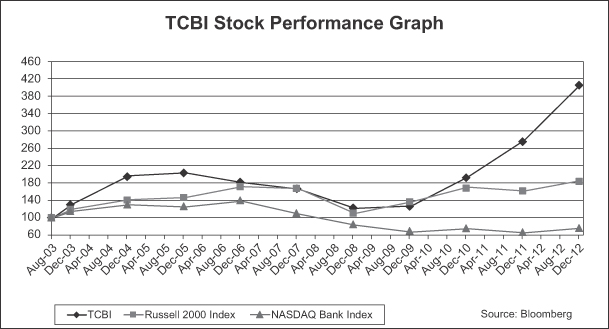
23
Table of Contents
| ITEM 6. | SELECTED CONSOLIDATED FINANCIAL DATA |
You should read the selected financial data presented below in conjunction with “Management’s Discussion and Analysis of Financial Condition and Results of Operations” and our consolidated financial statements and the related notes appearing elsewhere in this Form 10-K.
| At or For the Year Ended December 31 | ||||||||||||||||||||
| 2012 | 2011 | 2010 | 2009 | 2008 | ||||||||||||||||
| (In thousands, except per share, average share and percentage data) | ||||||||||||||||||||
|
Consolidated Operating Data (1) |
||||||||||||||||||||
|
Interest income |
$ | 398,457 | $ | 321,600 | $ | 279,810 | $ | 243,153 | $ | 248,930 | ||||||||||
|
Interest expense |
21,578 | 18,663 | 38,136 | 46,462 | 97,193 | |||||||||||||||
|
|
||||||||||||||||||||
|
Net interest income |
376,879 | 302,937 | 241,674 | 196,691 | 151,737 | |||||||||||||||
|
Provision for credit losses |
11,500 | 28,500 | 53,500 | 43,500 | 26,750 | |||||||||||||||
|
|
||||||||||||||||||||
|
Net interest income after provision for credit losses |
365,379 | 274,437 | 188,174 | 153,191 | 124,987 | |||||||||||||||
|
Non-interest income |
43,040 | 32,232 | 32,263 | 29,260 | 22,470 | |||||||||||||||
|
Non-interest expense |
219,844 | 188,201 | 163,488 | 145,542 | 109,651 | |||||||||||||||
|
|
||||||||||||||||||||
|
Income from continuing operations before income taxes |
188,575 | 118,468 | 56,949 | 36,909 | 37,806 | |||||||||||||||
|
Income tax expense |
67,866 | 42,366 | 19,626 | 12,522 | 12,924 | |||||||||||||||
|
|
||||||||||||||||||||
|
Income from continuing operations |
120,709 | 76,102 | 37,323 | 24,387 | 24,882 | |||||||||||||||
|
Loss from discontinued operations (after-tax) |
(37 | ) | (126 | ) | (136 | ) | (235 | ) | (616 | ) | ||||||||||
|
|
||||||||||||||||||||
|
Net income |
120,672 | 75,976 | 37,187 | 24,152 | 24,266 | |||||||||||||||
|
Preferred stock dividends |
— | — | — | 5,383 | — | |||||||||||||||
|
|
||||||||||||||||||||
|
Net income available to common shareholders |
$ | 120,672 | $ | 75,976 | $ | 37,187 | $ | 18,769 | $ | 24,266 | ||||||||||
|
|
||||||||||||||||||||
|
Consolidated Balance Sheet Data (1) |
||||||||||||||||||||
|
Total assets (3) |
$ | 10,540,542 | $ | 8,137,225 | $ | 6,445,679 | $ | 5,698,318 | $ | 5,141,034 | ||||||||||
|
Loans held for investment |
6,785,535 | 5,572,371 | 4,711,330 | 4,457,293 | 4,027,871 | |||||||||||||||
|
Loans held for sale |
3,175,272 | 2,080,081 | 1,194,209 | 693,504 | 496,351 | |||||||||||||||
|
Loans held for sale from discontinued operations |
302 | 393 | 490 | 586 | 648 | |||||||||||||||
|
Securities available-for-sale |
100,195 | 143,710 | 185,424 | 266,128 | 378,752 | |||||||||||||||
|
Demand deposits |
2,535,375 | 1,751,944 | 1,451,307 | 899,492 | 587,161 | |||||||||||||||
|
Total deposits |
7,440,804 | 5,556,257 | 5,455,401 | 4,120,725 | 3,333,187 | |||||||||||||||
|
Federal funds purchased |
273,179 | 412,249 | 283,781 | 580,519 | 350,155 | |||||||||||||||
|
Other borrowings |
1,673,982 | 1,355,867 | 14,106 | 376,510 | 930,452 | |||||||||||||||
|
Subordinated notes |
111,000 | — | — | — | — | |||||||||||||||
|
Trust preferred subordinated debentures |
113,406 | 113,406 | 113,406 | 113,406 | 113,406 | |||||||||||||||
|
Stockholders’ equity |
836,242 | 616,331 | 528,319 | 481,360 | 387,073 | |||||||||||||||
24
Table of Contents
| At or For the Year Ended December 31 | ||||||||||||||||||||
| 2012 | 2011 | 2010 | 2009 | 2008 | ||||||||||||||||
| (In thousands, except per share, average share and percentage data) | ||||||||||||||||||||
|
Other Financial Data |
||||||||||||||||||||
|
Income per share |
||||||||||||||||||||
|
Basic |
||||||||||||||||||||
|
Income from continuing operations |
$ | 3.09 | $ | 2.04 | $ | 1.02 | $ | 0.56 | $ | 0.89 | ||||||||||
|
Net income |
3.09 | 2.03 | 1.02 | 0.55 | 0.87 | |||||||||||||||
|
Diluted |
||||||||||||||||||||
|
Income from continuing operations |
$ | 3.01 | $ | 1.99 | $ | 1.00 | $ | 0.56 | $ | 0.89 | ||||||||||
|
Net income |
3.00 | 1.98 | 1.00 | 0.55 | 0.87 | |||||||||||||||
|
Tangible book value per share (4) |
|
19.96
|
|
15.69 | 13.89 | 12.96 | 12.19 | |||||||||||||
|
Book value per share (4) |
20.45 | 16.24 | 14.15 | 13.23 | 12.44 | |||||||||||||||
|
Weighted average shares |
||||||||||||||||||||
|
Basic |
39,046,340 | 37,334,743 | 36,627,329 | 34,113,285 | 27,952,973 | |||||||||||||||
|
Diluted |
40,165,847 | 38,333,077 | 37,346,028 | 34,410,454 | 28,048,463 | |||||||||||||||
|
Selected Financial Ratios |
||||||||||||||||||||
|
Performance Ratios |
||||||||||||||||||||
|
From continuing operations: |
||||||||||||||||||||
|
Net interest margin |
4.41 | % | 4.68 | % | 4.28 | % | 3.89 | % | 3.54 | % | ||||||||||
|
Return on average assets |
1.35 | % | 1.12 | % | 0.63 | % | 0.46 | % | 0.55 | % | ||||||||||
|
Return on average equity |
16.93 | % | 13.39 | % | 7.23 | % | 5.15 | % | 7.46 | % | ||||||||||
|
Efficiency ratio |
52.35 | % | 56.15 | % | 59.68 | % | 64.41 | % | 62.94 | % | ||||||||||
|
Non-interest expense to average earning assets |
2.57 | % | 2.90 | % | 2.88 | % | 2.87 | % | 2.54 | % | ||||||||||
|
From consolidated: |
||||||||||||||||||||
|
Net interest margin |
4.41 | % | 4.68 | % | 4.28 | % | 3.89 | % | 3.54 | % | ||||||||||
|
Return on average assets |
1.35 | % | 1.11 | % | 0.62 | % | 0.45 | % | 0.54 | % | ||||||||||
|
Return on average equity |
16.92 | % | 13.37 | % | 7.21 | % | 5.10 | % | 7.28 | % | ||||||||||
|
Asset Quality Ratios |
||||||||||||||||||||
|
Net charge-offs (recoveries) to average loans (2) |
0.10 | % | 0.58 | % | 1.14 | % | 0.46 | % | 0.35 | % | ||||||||||
|
Reserve for loan losses to loans held for investment (2) |
1.10 | % | 1.26 | % | 1.52 | % | 1.52 | % | 1.13 | % | ||||||||||
|
Reserve for loan losses to non-accrual loans (2) |
1.3x | 1.3x | .6x | .7x | 1.0x | |||||||||||||||
|
Non-accrual loans to loans (2) |
0.82 | % | 0.98 | % | 2.38 | % | 2.15 | % | 1.18 | % | ||||||||||
|
Total NPAs to loans plus OREO (2) |
1.06 | % | 1.58 | % | 3.25 | % | 2.74 | % | 1.81 | % | ||||||||||
|
Capital and Liquidity Ratios |
||||||||||||||||||||
|
Total capital ratio |
12.12 | % | 10.56 | % | 11.83 | % | 11.98 | % | 10.92 | % | ||||||||||
|
Tier 1 capital ratio |
10.06 | % | 9.57 | % | 10.58 | % | 10.73 | % | 9.97 | % | ||||||||||
|
Tier 1 leverage ratio |
9.41 | % | 8.78 | % | 9.36 | % | 10.54 | % | 10.21 | % | ||||||||||
|
Average equity/average assets |
7.95 | % | 8.33 | % | 8.67 | % | 8.91 | % | 7.38 | % | ||||||||||
|
Tangible common equity/total tangible assets(4) |
7.73 | % | 7.29 | % | 7.98 | % | 8.18 | % | 7.36 | % | ||||||||||
|
Average net loans/average deposits |
129.97 | % | 115.68 | % | 105.50 | % | 128.43 | % | 120.03 | % | ||||||||||
25
Table of Contents
| (1) | The consolidated statement of operating data and consolidated balance sheet data presented above for the five most recent fiscal years ended December 31, have been derived from our audited consolidated financial statements. The historical results are not necessarily indicative of the results to be expected in any future period. |
| (2) | Excludes loans held for sale. |
| (3) | From continuing operations. |
| (4) | Excludes unrealized gains/losses on securities. |
26
Table of Contents
| ITEM 7. | MANAGEMENT’S DISCUSSION AND ANALYSIS OF FINANCIAL CONDITION AND RESULTS OF OPERATIONS |
Forward-Looking Statements
Statements and financial analysis contained in this document that are not historical facts are forward looking statements made pursuant to the safe harbor provisions of the Private Securities Litigation Reform Act of 1995 (the “Act”). In addition, certain statements may be contained in our future filings with SEC, in press releases, and in oral and written statements made by or with our approval that are not statements of historical fact and constitute forward-looking statements within the meaning of the Act. Forward looking statements describe our future plans, strategies and expectations and are based on certain assumptions. Words such as “believes”, “anticipates”, “expects”, “intends”, “targeted”, “continue”, “remain”, “will”, “should”, “may” and other similar expressions are intended to identify forward-looking statements but are not the exclusive means of identifying such statements.
Forward-looking statements involve risks and uncertainties, many of which are beyond our control that may cause actual results to differ materially from those in such statements. The important factors that could cause actual results to differ materially from the forward looking statements include, but are not limited to, the following:
| 1) | Changes in interest rates and the relationship between rate indices, including LIBOR and Fed Funds |
| 2) | Changes in the levels of loan prepayments, which could affect the value of our loans or investment securities |
| 3) | Changes in general economic and business conditions in areas or markets where we compete |
| 4) | Competition from banks and other financial institutions for loans and customer deposits |
| 5) | The failure of assumptions underlying the establishment of and provisions made to the allowance for credit losses and differences in assumptions utilized by banking regulators which could have retroactive impact |
| 6) | The loss of senior management or operating personnel and the potential inability to hire qualified personnel at reasonable compensation levels |
| 7) | Changes to statutes, regulations or regulatory policies, including changes in interpretation or implementation of statutes, regulations or policies, could affect us in substantial and unpredictable ways. On July 21, 2010, the Dodd-Frank Act was signed into law. The Dodd-Frank Act represents a significant overhaul of many aspects of the regulation of the financial services industry. Many of the related regulations are still not written so the potential impact is still unknown |
| 8) | Claims and litigation, whether founded or unfounded, may result in significant financial liability if legal actions are not resolved in a manner favorable to us. |
Forward-looking statements speak only as of the date on which such statements are made. We have no obligation to update or revise any forward looking statements as a result of new information or future events. In light of these assumptions, risks and uncertainties, the events discussed in any forward looking statements in this annual report might not occur.
Overview of Our Business Operations
We commenced our banking operations in December 1998. An important aspect of our growth strategy has been our ability to service and effectively manage a large number of loans and deposit accounts in multiple markets in Texas. Accordingly, we created an operations infrastructure sufficient to support state-wide lending and banking operations.
The following discussions and analyses present the significant factors affecting our financial condition as of December 31, 2012 and 2011 and results of operations for each of the three years in the period ended December 31, 2012. This discussion should be read in conjunction with our consolidated financial
27
Table of Contents
statements and notes to the financial statements appearing later in this report. Please also note the below description about our discontinued operations and how it is reflected in the following discussions of our financial condition and results of operations.
On October 16, 2006, we completed the sale of our residential mortgage lending division (“RML”). The sale was effective as of September 30, 2006, and, accordingly, all operating results for this discontinued component of our operations were reclassified to discontinued operations. All prior periods were restated to reflect the change. Subsequent to the end of the first quarter of 2007, Texas Capital Bank and the purchaser of its residential mortgage loan division (RML) agreed to terminate and settle the contractual arrangements related to the sale of the division.
The loss from discontinued operations was $37,000 and $126,000, net of taxes, for the years ended December 31, 2012 and 2011, respectively. The 2012 and 2011 losses are primarily related to continuing legal expenses incurred in dealing with the remaining loans and requests from investors related to the repurchase of previously sold loans. We still have approximately $302,000 in loans held for sale from discontinued operations that are carried at the estimated market value at year-end, which is less than the original cost. We plan to sell these loans, but timing and price to be realized cannot be determined at this time due to market conditions. In addition, we will address any future requests from investors related to repurchasing loans previously sold. While the balances as of December 31, 2012 and 2011 include a liability for exposure to additional contingencies, including risk of having to repurchase loans previously sold, we recognize that market conditions may result in additional exposure to loss and the extension of time necessary to complete the discontinued mortgage operation. Our mortgage warehouse lending operations were not part of the sale, and are included in the results from continuing operations. Except as otherwise noted, all amounts and disclosures throughout this document reflect only the Company’s continuing operations.
Year ended December 31, 2012 compared to year ended December 31, 2011
We reported net income of $120.7 million, or $3.01 per diluted common share, for the year ended December 31, 2012, compared to $76.1 million, or $1.99 per diluted common share, for the same period in 2011. Return on average equity was 16.93% and return on average assets was 1.35% for the year ended December 31, 2012, compared to 13.39% and 1.12%, respectively, for the same period in 2011.
Net income increased $44.6 million, or 59%, for the year ended December 31, 2012 compared to the same period in 2011. The $44.6 million increase was primarily the result of a $73.9 million increase in net interest income, a $17.0 million decrease in the provision for credit losses and a $10.8 million increase in non-interest income, offset by a $31.6 million increase in non-interest expense, and a $25.5 million increase in income tax expense.
Details of the changes in the various components of net income are further discussed below.
Year ended December 31, 2011 compared to year ended December 31, 2010
We reported net income of $76.1 million, or $1.99 per diluted common share, for the year ended December 31, 2011, compared to $37.3 million, or $1.00 per diluted common share, for the same period in 2010. Return on average equity was 13.39% and return on average assets was 1.12% for the year ended December 31, 2011, compared to 7.23% and .63%, respectively, for the same period in 2010.
Net income increased $38.8 million, or 104%, for the year ended December 31, 2011 compared to the same period in 2010. The $38.8 million increase was primarily the result of a $61.3 million increase in net interest income and a $25.0 million decrease in the provision for credit losses, offset by a $24.7 million increase in non-interest expense and a $22.7 million increase in income tax expense.
Details of the changes in the various components of net income are further discussed below.
Net Interest Income
Net interest income was $376.8 million for the year ended December 31, 2012 compared to $302.9 million for the same period of 2011. The increase in net interest income was primarily due to an increase of $2.1
28
Table of Contents
billion in average earning assets as compared to the same period of 2011. The increase in average earning assets from 2011 included a $2.2 billion increase in average net loans offset by a $39.7 million decrease in average securities. For the year ended December 31, 2012, average net loans and securities represented 98% and 1%, respectively, of average earning assets compared to 96% and 2%, respectively, in 2011.
Average interest bearing liabilities for the year ended December 31, 2012 increased $1.5 billion from the year ended December 31, 2011, which included a $613.4 million increase in interest bearing deposits, an $862.6 million increase in other borrowings and a $30.9 million increase in subordinated notes. For the same periods, the average balance of demand deposits increased to $2.0 billion from $1.5 billion. The average cost of interest bearing liabilities decreased from 0.40% for the year ended December 31, 2011 to 0.35% in 2012, reflecting the continued low market interest rates, and our focus on reducing deposit rates.
Net interest income was $302.9 million for the year ended December 31, 2011 compared to $241.7 million for the same period of 2010. The increase in net interest income was primarily due to an increase of $819.4 million in average earning assets and the increase in our net interest margin. The increase in average earning assets from 2010 included a $915.4 million increase in average net loans offset by a $65.6 million decrease in average securities. For the year ended December 31, 2011, average net loans and securities represented 96% and 2%, respectively, of average earning assets compared to 93% and 4%, respectively, in 2010.
Average interest bearing liabilities for the year ended December 31, 2011 increased $393.7 million from the year ended December 31, 2010, which included a $48.5 million decrease in interest bearing deposits and a $442.3 million increase in other borrowings. At the beginning of the year we actively turned away certain higher priced deposits. For the same periods, the average balance of demand deposits increased to $1.5 billion from $1.1 billion. The average cost of interest bearing liabilities decreased from 0.89% for the year ended December 31, 2010 to 0.40% in 2011, reflecting the continued low market interest rates, and our focus on reducing deposit rates.
Volume/Rate Analysis
| Years Ended December 31, | ||||||||||||||||||||||||
| 2012/2011 | 2011/2010 | |||||||||||||||||||||||
|
Net Change |
Change Due To(1) |
Net Change |
Change Due To(1) | |||||||||||||||||||||
| (in thousands) | Volume | Yield/Rate | Volume | Yield/Rate | ||||||||||||||||||||
|
Interest income: |
||||||||||||||||||||||||
|
Securities(2) |
$ | (1,912 | ) | $ | (1,788 | ) | $ | (124 | ) | $ | (3,123 | ) | $ | (2,942 | ) | $ | (181 | ) | ||||||
|
Loans held for sale |
39,335 | 48,450 | (9,115 | ) | 12,132 | 15,526 | (3,394 | ) | ||||||||||||||||
|
Loans held for investment |
39,460 | 56,178 | (16,718 | ) | 32,618 | 29,748 | 2,870 | |||||||||||||||||
|
Federal funds sold |
(24 | ) | (18 | ) | (6 | ) | (173 | ) | (169 | ) | (4 | ) | ||||||||||||
|
Deposits in other banks |
(144 | ) | (152 | ) | 8 | 236 | 148 | 88 | ||||||||||||||||
|
Total |
76,715 | 102,670 | (25,955 | ) | 41,690 | 42,311 | (621 | ) | ||||||||||||||||
|
Interest expense: |
||||||||||||||||||||||||
|
Transaction deposits |
634 | 180 | 454 | (779 | ) | (104 | ) | (675 | ) | |||||||||||||||
|
Savings deposits |
877 | 1,178 | (301 | ) | (7,980 | ) | 1,911 | (9,891 | ) | |||||||||||||||
|
Time deposits |
(2,456 | ) | (296 | ) | (2,160 | ) | (6,476 | ) | (4,497 | ) | (1,979 | ) | ||||||||||||
|
Deposits in foreign branches |
(361 | ) | (277 | ) | (84 | ) | (3,124 | ) | 1,083 | (4,207 | ) | |||||||||||||
|
Borrowed funds |
4,221 | 1,360 | 2,861 | (1,114 | ) | 1,819 | (2,933 | ) | ||||||||||||||||
|
|
||||||||||||||||||||||||
|
Total |
2,915 | 2,145 | 770 | (19,473 | ) | 212 | (19,685 | ) | ||||||||||||||||
|
|
||||||||||||||||||||||||
|
Net interest income |
$ | 73,800 | $ | 100,525 | $ | (26,725 | ) | $61,163 | $ | 42,099 | $ | 19,064 | ||||||||||||
|
|
||||||||||||||||||||||||
29
Table of Contents
| (1) | Changes attributable to both volume and yield/rate are allocated to both volume and yield/rate on an equal basis. |
| (2) | Taxable equivalent rates used where applicable assuming a 35% tax rate. |
Net interest margin from continuing operations, the ratio of net interest income to average earning assets, decreased from 4.68% in 2011 to 4.41% in 2012. This 27 basis point decrease was a result of a decrease in interest income as a percent of earning assets offset by a reduction in funding costs. Total cost of funding decreased from .27% for 2011 to .24% for 2012.
Net interest margin from continuing operations, the ratio of net interest income to average earning assets, increased from 4.28% in 2010 to 4.68% in 2011. This 40 basis point increase was a result of a decline in the costs of interest bearing liabilities and growth in non-interest bearing deposits. Total cost of funding decreased from .64% for 2010 to .27% for 2011. Also contributing to the increase in net interest margin was a 2 basis point increase in the yield on earning assets from 2010.
Consolidated Daily Average Balances, Average Yields and Rates
| Year ended December 31 | ||||||||||||||||||||||||||||||||||||
| 2012 | 2011 | 2010 | ||||||||||||||||||||||||||||||||||
|
Average
Balance |
Revenue /
Expense(1) |
Yield /
Rate |
Average
Balance |
Revenue /
Expense(1) |
Yield /
Rate |
Average
Balance |
Revenue /
Expense(1) |
Yield /
Rate |
||||||||||||||||||||||||||||
|
Assets |
||||||||||||||||||||||||||||||||||||
|
Securities—Taxable |
$90,796 | $ | 3,681 | 4.05 | % | $ | 123,124 | $ | 5,186 | 4.21 | % | $ | 183,363 | $ | 8,023 | 4.38 | % | |||||||||||||||||||
|
Securities—Non-taxable(2) |
26,579 | 1,550 | 5.83 | % | 33,996 | 1,957 | 5.76 | % | 39,360 | 2,243 | 5.70 | % | ||||||||||||||||||||||||
|
Federal funds sold |
11,497 | 13 | 0.11 | % | 21,897 | 37 | 0.17 | % | 112,716 | 210 | 0.19 | % | ||||||||||||||||||||||||
|
Deposits in other banks |
61,192 | 208 | 0.34 | % | 107,734 | 352 | 0.33 | % | 47,365 | 116 | 0.24 | % | ||||||||||||||||||||||||
|
Loans held for sale |
2,298,651 | 93,275 | 4.06 | % | 1,210,954 | 53,940 | 4.45 | % | 883,033 | 41,808 | 4.73 | % | ||||||||||||||||||||||||
|
Loans held for investment |
6,148,860 | 300,273 | 4.88 | % | 5,059,134 | 260,813 | 5.16 | % | 4,475,668 | 228,195 | 5.10 | % | ||||||||||||||||||||||||
|
Less reserve for loan losses |
72,087 | — | — | 67,888 | — | — | 71,942 | — | — | |||||||||||||||||||||||||||
|
Loans, net |
8,375,424 | 393,548 | 4.70 | % | 6,202,200 | 314,753 | 5.07 | % | 5,286,759 | 270,003 | 5.11 | % | ||||||||||||||||||||||||
|
Total earning assets |
8,565,488 | 399,000 | 4.66 | % | 6,488,951 | 322,285 | 4.97 | % | 5,669,563 | 280,595 | 4.95 | % | ||||||||||||||||||||||||
|
Cash and other assets |
400,472 | 330,137 | 281,448 | |||||||||||||||||||||||||||||||||
|
|
|
|
|
|
|
|||||||||||||||||||||||||||||||
|
Total assets |
$8,965,960 | $6,819,088 | $5,951,011 | |||||||||||||||||||||||||||||||||
|
|
|
|
|
|
|
|||||||||||||||||||||||||||||||
|
Liabilities and stockholders’ equity |
||||||||||||||||||||||||||||||||||||
|
Transaction deposits |
$752,040 | $ | 829 | 0.11 | % | $ | 391,100 | $ | 195 | 0.05 | % | $ | 437,674 | $ | 974 | 0.22 | % | |||||||||||||||||||
|
Savings deposits |
2,765,089 | 8,674 | 0.31 | % | 2,401,997 | 7,797 | 0.32 | % | 2,142,541 | 15,777 | 0.74 | % | ||||||||||||||||||||||||
|
Time deposits |
530,816 | 2,775 | 0.52 | % | 562,654 | 5,231 | 0.93 | % | 913,616 | 11,707 | 1.28 | % | ||||||||||||||||||||||||
|
Deposits in foreign branches |
411,891 | 1,366 | 0.33 | % | 490,703 | 1,727 | 0.35 | % | 401,155 | 4,851 | 1.21 | % | ||||||||||||||||||||||||
|
Total interest bearing deposits |
4,459,836 | 13,644 | 0.31 | % | 3,846,454 | 14,950 | 0.39 | % | 3,894,986 | 33,309 | 0.86 | % | ||||||||||||||||||||||||
|
Other borrowings |
1,585,723 | 3,141 | 0.20 | % | 723,172 | 1,140 | 0.16 | % | 280,899 | 1,155 | 0.41 | % | ||||||||||||||||||||||||
|
Subordinated notes |
30,934 | 2,037 | 6.58 | % | — | — | — | — | — | — | ||||||||||||||||||||||||||
|
Trust preferred subordinated |
||||||||||||||||||||||||||||||||||||
|
debentures |
113,406 | 2,756 | 2.43 | % | 113,406 | 2,573 | 2.27 | % | 113,406 | 3,672 | 3.24 | % | ||||||||||||||||||||||||
|
Total interest bearing liabilities |
6,189,899 | 21,578 | 0.35 | % | 4,683,032 | 18,663 | 0.40 | % | 4,289,291 | 38,136 | 0.89 | % | ||||||||||||||||||||||||
|
Demand deposits |
1,984,171 | 1,515,021 | 1,116,260 | |||||||||||||||||||||||||||||||||
|
Other liabilities |
78,700 | 52,888 | 29,492 | |||||||||||||||||||||||||||||||||
|
Stockholders’ equity |
713,190 | 568,147 | 515,968 | |||||||||||||||||||||||||||||||||
|
|
|
|
|
|
|
|||||||||||||||||||||||||||||||
|
Total liabilities and stockholders’ equity |
$8,965,960 | $6,819,088 | $5,951,011 | |||||||||||||||||||||||||||||||||
|
|
|
|
|
|
|
|||||||||||||||||||||||||||||||
|
Net interest income |
$377,422 | $303,622 | $242,459 | |||||||||||||||||||||||||||||||||
|
Net interest margin |
4.41 | % | 4.68 | % | 4.28 | % | ||||||||||||||||||||||||||||||
|
Net interest spread |
4.31 | % | 4.57 | % | 4.06 | % | ||||||||||||||||||||||||||||||
| Additional information from discontinued operations: | ||||||||||||||||||||||||||||||||||||
|
Loans held for sale from |
||||||||||||||||||||||||||||||||||||
|
discontinued operations |
$367 | $423 | $564 | |||||||||||||||||||||||||||||||||
|
Borrowed funds |
367 | 423 | 564 | |||||||||||||||||||||||||||||||||
|
Net interest income |
$ | 24 | $33 | $ | 36 | |||||||||||||||||||||||||||||||
|
Net interest margin — consolidated |
4.41 | % | 4.68 | % | 4.28 | % | ||||||||||||||||||||||||||||||
30
Table of Contents
| (1) | The loan averages include loans on which the accrual of interest has been discontinued and are stated net of unearned income. Loan interest income includes loan fees totaling $33.7 million, $27.5 million and $20.0 million for the years ended December 31, 2012, 2011 and 2010, respectively. |
| (2) | Taxable equivalent rates used where applicable assuming a 35% tax rate. |
Non-interest income
| Year ended December 31 | ||||||||||||
| 2012 | 2011 | 2010 | ||||||||||
| (in thousands) | ||||||||||||
|
Service charges on deposit accounts |
$6,605 | $ | 6,480 | $ | 6,392 | |||||||
|
Trust fee income |
4,822 | 4,219 | 3,846 | |||||||||
|
Bank owned life insurance (BOLI) income |
2,168 | 2,095 | 1,889 | |||||||||
|
Brokered loan fees |
17,596 | 11,335 | 11,190 | |||||||||
|
Swap fees |
4,909 | 1,935 | 1,266 | |||||||||
|
Other(1) |
6,940 | 6,168 | 7,680 | |||||||||
|
Total non-interest income |
$43,040 | $ | 32,232 | $ | 32,263 | |||||||
| (1) | Other income includes such items as letter of credit fees and other general operating income, none of which account for 1% or more of total interest income and non-interest income. |
Non-interest income increased by $10.8 million during the year ended December 31, 2012 to $43.0 million, compared to $32.2 million during the same period in 2011. The increase was primarily due to a $6.3 million increase in brokered loan fees due to an increase in our mortgage warehouse lending volume. Swap fee income increased $3.0 million during the year ended December 31, 2012 due to an increase in swap transactions during 2012. Swap fees are fees related to customer swap transactions and are received from the institution that is our counterparty on the transaction. See Note 20 – Derivative Financial Instruments for further discussion.
Non-interest income decreased slightly during the year ended December 31, 2011 to $32.2 million, compared to $32.3 million during the same period in 2010. The decrease was primarily due to a $2.2 million decrease in equipment rental income included in other non-interest income related to a decline in the leased equipment portfolio. Offsetting this decrease was a $669,000 increase in swap fee income during 2011. Swap fees are fees related to customer swap transactions and are received from the institution that is our counterparty on the transaction. See Note 20 – Derivative Financial Instruments for further discussion.
While management expects continued growth in non-interest income, the future rate of growth could be affected by increased competition from nationwide and regional financial institutions and by decreased demand in mortgage warehouse lending volume. In order to achieve continued growth in non-interest income, we may need to introduce new products or enter into new markets. Any new product introduction or new market entry could place additional demands on capital and managerial resources.
31
Table of Contents
Non-interest Expense
| Year ended December 31 | ||||||||||||
| 2012 | 2011 | 2010 | ||||||||||
| (in thousands) | ||||||||||||
|
Salaries and employee benefits |
$121,456 | $ | 100,535 | $ | 85,298 | |||||||
|
Net occupancy expense |
14,852 | 13,657 | 12,314 | |||||||||
|
Marketing |
13,449 | 11,109 | 5,419 | |||||||||
|
Legal and professional |
17,557 | 14,996 | 11,837 | |||||||||
|
Communications and technology |
11,158 | 9,608 | 8,511 | |||||||||
|
FDIC insurance assessment |
5,568 | 7,543 | 9,202 | |||||||||
|
Allowance and other carrying costs for OREO |
9,075 | 9,586 | 10,404 | |||||||||
|
Litigation settlement expense |
4,000 | — | — | |||||||||
|
Other(1) |
22,729 | 21,167 | 20,503 | |||||||||
|
Total non-interest expense |
$219,844 | $ | 188,201 | $ | 163,488 | |||||||
|
|
||||||||||||
| (1) | Other expense includes such items as courier expenses, regulatory assessments other than FDIC insurance, due from bank charges and other general operating expenses, none of which account for 1% or more of total interest income and non-interest income. |
Non-interest expense for the year ended December 31, 2012 increased $31.6 million compared to the same period of 2011 primarily related to increases in salaries and employee benefits, marketing expense, legal and professional expenses and litigation settlement expense.
Salaries and employee benefits expense increased $20.9 million to $121.5 million during the year ended December 31, 2012. This increase resulted primarily from general business growth and costs of performance-based incentives resulting from the increase in stock price.
Marketing expense for the year ended December 31, 2012 increased $2.3 million compared to the same period in 2011. Marketing expense for the year ended December 31, 2012 included $850,000 of direct marketing and advertising expense and $3.1 million in business development expense compared to $669,000 and $2.6 million, respectively, in 2011. Marketing expense for the year ended December 31, 2012 also included $9.5 million for the purchase of miles related to the American Airlines AAdvantage ® program and treasury management deposit programs compared to $7.8 million during 2011. Marketing expense may increase as we seek to further develop our brand, reach more of our target customers and expand in our target markets.
Legal and professional expense increased $2.6 million, or 17%, for the year ended December 31, 2012 compared to the same period in 2011. Our legal and professional expense will continue to fluctuate from year to year and could increase in the future with growth and as we respond to continued regulatory changes and strategic initiatives, but we should see a decrease in the cost of resolving problem assets under improving economic conditions. See Note 23 – Legal Matters for further discussion.
During the fourth quarter of 2012 we recorded a pre-tax charge of $4.0 million for settlement of the judgment of $65.5 million against us in Oklahoma district court. In the settlement, all litigation against us in the Oklahoma courts and actions by us against the plaintiff in the Texas courts will be dismissed with prejudice. Because the settlement was within policy limits of insurance coverage maintained by us, we have claims against our insurance carrier for more than the charge, and we intend to pursue those claims aggressively.
Communications and technology expense increased $1.6 million to $11.2 million during the year ended December 31, 2012 as a result of general business and customer growth.
FDIC insurance assessment expense decreased by $1.9 million from $7.5 million in 2011 to $5.6 million as a result of changes to the FDIC assessment method.
32
Table of Contents
Non-interest expense for the year ended December 31, 2011 increased $24.7 million compared to the same period of 2010 primarily related to increases in salaries and employee benefits, marketing expense and legal and professional expenses.
Salaries and employee benefits expense increased $15.2 million to $100.5 million during the year ended December 31, 2011. This increase resulted primarily from general business growth.
Marketing expense for the year ended December 31, 2011 increased $5.7 million compared to the same period in 2010. Marketing expense for the year ended December 31, 2011 included $669,000 of direct marketing and advertising expense and $2.6 million in business development expense compared to $246,000 and $2.2 million, respectively, in 2010. Marketing expense for the year ended December 31, 2011 also included $7.8 million for the purchase of miles related to the American Airlines AAdvantage ® program and treasury management deposit programs compared to $3.0 million during 2010. Marketing expense may increase as we seek to further develop our brand, reach more of our target customers and expand in our target markets.
Legal and professional expense increased $3.2 million, or 27%, for the year ended December 31, 2011 compared to the same period in 2010. Our legal and professional expense will continue to fluctuate from year to year and could increase in the future as we respond to continued regulatory changes and strategic initiatives, but we should see a decrease in the cost of resolving problem assets under improving economic conditions.
Communications and technology expense increased $1.1 million to $9.6 million during the year ended December 31, 2011 as a result of general business and customer growth.
FDIC insurance assessment expense decreased by $1.7 million from $9.2 million in 2010 to $7.5 million as a result of changes to the FDIC assessment method.
Analysis of Financial Condition
Loans
Our total loans have grown at an annual rate of 15%, 30% and 30% in 2010, 2011 and 2012, respectively, reflecting the build-up of our lending operations. Our business plan focuses primarily on lending to middle market businesses and successful professionals and entrepreneurs, and as such, commercial and real estate loans have comprised a majority of our loan portfolio since we commenced operations, comprising 60% of total loans at December 31, 2012. Construction loans have decreased from 15% of the portfolio at December 31, 2008 to 7% of the portfolio at December 31, 2012. Consumer loans generally have represented 1% or less of the portfolio from December 31, 2008 to December 31, 2012. Loans held for sale relates to our mortgage warehouse lending operations where we invest in mortgage loan ownership interests that are typically sold within 10 to 20 days. Volumes fluctuate based on the level of market demand in the product and the number of days between purchase and sale of the loans. If, due to market conditions, loans are not sold within the normal timeframe, they may be transferred to the loans held for investment portfolio at a lower of cost or fair value. The loans are then subject to normal loan review, grading and reserve allocation requirements.
We originate the substantial majority of the loans held for investment in our portfolio. We also participate in syndicated loan relationships, both as a participant and as an agent. As of December 31, 2012, we have $1.3 billion in syndicated loans, $339.6 million of which we acted as agent. All syndicated loans, whether we act as agent or participant, are underwritten to the same standards as all other loans originated by us. In addition, as of December 31, 2012, $17.2 million of our syndicated loans were on non-accrual, comprised of one loan earning on a cash basis.
33
Table of Contents
The following summarizes our loans on a gross basis by major category as of the dates indicated (in thousands):
| December 31 | ||||||||||||||||||||
| 2012 | 2011 | 2010 | 2009 | 2008 | ||||||||||||||||
|
Commercial |
$ | 4,106,419 | $ | 3,275,150 | $ | 2,592,924 | $ | 2,457,533 | $ | 2,276,054 | ||||||||||
|
Construction |
737,637 | 422,026 | 270,008 | 669,426 | 667,437 | |||||||||||||||
|
Real estate |
1,892,451 | 1,819,251 | 1,759,758 | 1,233,701 | 988,784 | |||||||||||||||
|
Consumer |
19,493 | 24,822 | 21,470 | 25,065 | 32,671 | |||||||||||||||
|
Equipment leases |
69,470 | 61,792 | 95,607 | 99,129 | 86,937 | |||||||||||||||
|
Loans held for sale |
3,175,272 | 2,080,081 | 1,194,209 | 693,504 | 496,351 | |||||||||||||||
|
Total |
$ | 10,000,742 | $ | 7,683,122 | $ | 5,933,976 | $ | 5,178,358 | $ | 4,548,234 | ||||||||||
Commercial Loans and Leases. Our commercial loan portfolio is comprised of lines of credit for working capital and term loans and leases to finance equipment and other business assets. Our energy production loans are generally collateralized with proven reserves based on appropriate valuation standards. Our commercial loans and leases are underwritten after carefully evaluating and understanding the borrower’s ability to operate profitably. Our underwriting standards are designed to promote relationship banking rather than making loans on a transaction basis. Our lines of credit typically are limited to a percentage of the value of the assets securing the line. Lines of credit and term loans typically are reviewed annually and are supported by accounts receivable, inventory, equipment and other assets of our clients’ businesses. At December 31, 2012, funded commercial loans and leases totaled approximately $4.2 billion, approximately 42% of our total funded loans.
Real Estate Loans. Approximately 20% of our real estate loan portfolio (excluding construction loans) and 4% of the total portfolio is comprised of loans secured by properties other than market risk or investment-type real estate. Market risk loans are real estate loans where the primary source of repayment is expected to come from the sale or lease of the real property collateral. We generally provide temporary financing for commercial and residential property. These loans are viewed primarily as cash flow loans and secondarily as loans secured by real estate. Our real estate loans generally have maximum terms of five to seven years, and we provide loans with both floating and fixed rates. We generally avoid long-term loans for commercial real estate held for investment. Real estate loans may be more adversely affected by conditions in the real estate markets or in the general economy. Appraised values may be highly variable due to market conditions and impact of the inability of potential purchasers and lessees to obtain financing and lack of transactions at comparable values. At December 31, 2012, real estate term loans totaled approximately $1.9 billion, or 19% of our total funded loans; of this total, $1.6 billion were loans with floating rates and $252.8 million were loans with fixed rates.
Construction Loans. Our construction loan portfolio consists primarily of single- and multi-family residential properties and commercial projects used in manufacturing, warehousing, service or retail businesses. Our construction loans generally have terms of one to three years. We typically make construction loans to developers, builders and contractors that have an established record of successful project completion and loan repayment and have a substantial investment in the borrowers’ equity. However, construction loans are generally based upon estimates of costs and value associated with the completed project. Sources of repayment for these types of loans may be pre-committed permanent loans from other lenders, sales of developed property, or an interim loan commitment from us until permanent financing is obtained. The nature of these loans makes ultimate repayment extremely sensitive to overall economic conditions. Borrowers may not be able to correct conditions of default in loans, increasing risk of exposure to classification, non-performing status, reserve allocation and actual credit loss and foreclosure. These loans typically have floating rates and commitment fees. At December 31, 2012, funded construction real estate loans totaled approximately $737.6 million, approximately 7% of our total funded loans.
Loans Held for Sale. Our loans held for sale consist of ownership interests purchased in single-family residential mortgages funded through our warehouse lending group. These loans are typically on our
34
Table of Contents
balance sheet for 10 to 20 days or less. We have agreements with mortgage lenders and purchase legal ownership interests in individual loans they originate. All loans are underwritten consistent with established programs for permanent financing with financially sound investors. Substantially all loans are conforming loans or loans eligible for sale to federal agencies or government sponsored entities. At December 31, 2012, loans held for sale totaled approximately $3.2 billion, approximately 32% of our total funded loans. Loans held for sale as of December 31, 2012 are net of $436.0 million of participations sold.
Letters of Credit. We issue standby and commercial letters of credit, and can service the international needs of our clients through correspondent banks. At December 31, 2012, our commitments under letters of credit totaled approximately $84.6 million.
Portfolio Geographic and Industry Concentrations
We continue to lend primarily in Texas. As of December 31, 2012, a substantial majority of the principal amount of the loans held for investment in our portfolio was to businesses and individuals in Texas. This geographic concentration subjects the loan portfolio to the general economic conditions in Texas. The table below summarizes the industry concentrations of our funded loans at December 31, 2012. The risks created by these concentrations have been considered by management in the determination of the adequacy of the allowance for loan losses. Management believes the allowance for loan losses is appropriate to cover estimated losses on loans at each balance sheet date.
| (in thousands) | Amount |
Percent of
Total Loans |
||||||
|
Services |
$ | 3,168,733 | 31.5 | % | ||||
|
Loans held for sale |
3,175,272 | 31.8 | % | |||||
|
Investors and investment management companies |
1,038,175 | 10.4 | % | |||||
|
Petrochemical and mining |
892,303 | 8.9 | % | |||||
|
Contracting — construction and real estate development |
808,888 | 8.1 | % | |||||
|
Manufacturing |
286,991 | 2.9 | % | |||||
|
Personal/household |
185,319 | 1.9 | % | |||||
|
Wholesale |
153,448 | 1.5 | % | |||||
|
Retail |
175,275 | 1.8 | % | |||||
|
Contracting — trades |
64,938 | 0.6 | % | |||||
|
Government |
35,509 | 0.4 | % | |||||
|
Agriculture |
15,891 | 0.2 | % | |||||
|
Total |
$ | 10,000,742 | 100.0 | % | ||||
Our largest concentration in any single industry is in services. Loans extended to borrowers within the services industries include loans to finance working capital and equipment, as well as loans to finance investment and owner-occupied real estate. Significant trade categories represented within the services industries include, but are not limited to, real estate services, financial services, leasing companies, transportation and communication, and hospitality services. Borrowers represented within the real estate services category are largely owners and managers of both residential and non-residential commercial real estate properties. Personal/household loans include loans to certain successful professionals and entrepreneurs for commercial purposes, in addition to consumer loans. Loans held for sale are those loans originated by our mortgage warehouse lending group. Loans extended to borrowers within the contracting industry are comprised largely of loans to land developers and to both heavy construction and general commercial contractors. Many of these loans are secured by real estate properties, the development of which is or may be financed by our bank. Loans extended to borrowers within the petrochemical and mining industries are predominantly loans to finance the exploration and production of petroleum and natural gas. These loans are generally secured by proven petroleum and natural gas reserves.
35
Table of Contents
We make loans that are appropriately collateralized under our credit standards. Approximately 97% of our funded loans are secured by collateral. Over 90% of the real estate collateral is located in Texas. The table below sets forth information regarding the distribution of our funded loans among various types of collateral at December 31, 2012 (in thousands except percentage data):
| Amount |
Percent of
Total Loans |
|||||||
|
Collateral type: |
||||||||
|
Ownership interests in loans held for sale |
$ | 3,175,272 | 31.8 | % | ||||
|
Business assets |
2,712,751 | 27.1 | % | |||||
|
Real property |
2,630,088 | 26.2 | % | |||||
|
Energy |
769,466 | 7.7 | % | |||||
|
Unsecured |
256,614 | 2.6 | % | |||||
|
Highly liquid assets |
195,480 | 2.0 | % | |||||
|
Other assets |
193,668 | 1.9 | % | |||||
|
Rolling stock |
41,736 | 0.4 | % | |||||
|
U. S. Government guaranty |
25,667 | 0.3 | % | |||||
|
|
||||||||
|
Total |
$ | 10,000,742 | 100.0 | % | ||||
|
|
||||||||
As noted in the table above, 26% of our loans are secured by real estate. The table below summarizes our real estate loan portfolio as segregated by the type of property securing the credit. Property type concentrations are stated as a percentage of year-end total real estate loans as of December 31, 2012 (in thousands except percentage data):
| Amount |
Percent of
Total Real Estate Loans |
|||||||
|
Property type: |
||||||||
|
Market risk |
||||||||
|
Commercial buildings |
$ | 714,647 | 27.2 | % | ||||
|
Unimproved land |
123,437 | 4.7 | % | |||||
|
Apartment buildings |
311,088 | 11.8 | % | |||||
|
Shopping center/mall buildings |
176,807 | 6.7 | % | |||||
|
1-4 Family dwellings (other than condominium) |
310,422 | 11.8 | % | |||||
|
Residential lots |
161,938 | 6.2 | % | |||||
|
Hotel/motel buildings |
134,358 | 5.1 | % | |||||
|
Other |
301,144 | 11.4 | % | |||||
|
Other than market risk |
||||||||
|
Commercial buildings |
207,417 | 7.9 | % | |||||
|
1-4 Family dwellings (other than condominium) |
71,683 | 2.7 | % | |||||
|
Other |
117,147 | 4.5 | % | |||||
|
|
||||||||
|
Total real estate loans |
$ | 2,630,088 | 100.0 | % | ||||
|
|
||||||||
36
Table of Contents
The table below summarizes our market risk real estate portfolio as segregated by the geographic region in which the property is located (in thousands except percentage data):
| Amount |
Percent of
Total |
|||||||
|
Geographic region: |
||||||||
|
Dallas/Fort Worth |
$ | 801,454 | 35.9 | % | ||||
|
Houston |
444,019 | 19.9 | % | |||||
|
Austin |
282,277 | 12.6 | % | |||||
|
San Antonio |
259,224 | 11.6 | % | |||||
|
Other Texas cities |
255,332 | 11.4 | % | |||||
|
Other states |
191,535 | 8.6 | % | |||||
|
Total market risk real estate loans |
$ | 2,233,841 | 100.0 | % | ||||
We extend market risk real estate loans, including both construction/development financing and limited term financing, to professional real estate developers and owners/managers of commercial real estate projects and properties who have a demonstrated record of past success with similar properties. Collateral properties include office buildings, warehouse/distribution buildings, shopping centers, apartment buildings, residential and commercial tract development located primarily within our five major metropolitan markets in Texas. As such loans are generally repaid through the borrowers’ sale or lease of the properties, loan amounts are determined in part from an analysis of pro forma cash flows. Loans are also underwritten to comply with product-type specific advance rates against both cost and market value. We engage a variety of professional firms to supply appraisals, market study and feasibility reports, environmental assessments and project site inspections to complement our internal resources to best underwrite and monitor these credit exposures.
The determination of collateral value is critically important when financing real estate. As a result, obtaining current and objectively prepared appraisals is a major part of our underwriting and monitoring processes. Generally, our policy requires a new appraisal every three years. However, in the current economic downturn where real estate values have been fluctuating rapidly, more current appraisals are obtained when warranted by conditions such as a borrower’s deteriorating financial condition, their possible inability to perform on the loan, and the increased risks involved with reliance on the collateral value as sole repayment of the loan. Generally, loans graded substandard or worse where real estate is a material portion of the collateral value and/or the income from the real estate or sale of the real estate is the primary source of debt service, annual appraisals are obtained. In all cases, appraisals are reviewed by a third party to determine reasonableness of the appraised value. The third party reviewer will challenge whether or not the data used is appropriate and relevant, form an opinion as to the appropriateness of the appraisal methods and techniques used, and determine if overall the analysis and conclusions of the appraiser can be relied upon. Additionally, the third party reviewer provides a detailed report of that analysis. Further review is conducted by our credit officers, as well as by the Bank’s managed asset committee. These additional steps of review ensure that the underlying appraisal and the third party analysis can be relied upon. If we have differences, we will address those with the reviewer and determine the best method to resolve any differences. Both the appraisal process and the appraisal review process have been difficult in the current economic environment with the lack of comparable sales which is partially a result of the lack of available financing which has ultimately led to overall depressed real estate values.
37
Table of Contents
Large Credit Relationships
The market areas we serve primarily include the five major metropolitan markets of Texas, including Austin, Dallas, Fort Worth, Houston and San Antonio. As a result, we originate and maintain large credit relationships with numerous customers in the ordinary course of business. The legal limit of our bank is approximately $142 million and our house limit is generally $25 million or less. Larger hold positions will be accepted occasionally for exceptionally strong borrowers and otherwise where business opportunity and perceived credit risk warrant a somewhat larger investment. We consider large credit relationships to be those with commitments equal to or in excess of $10.0 million. The following table provides additional information on our large credit relationships outstanding at year-end (in thousands):
| 2012 | 2011 | |||||||||||||||||||||||
| Period-End Balances | Period-End Balances | |||||||||||||||||||||||
|
Number of
Relationships |
Committed | Outstanding |
Number of
Relationships |
Committed | Outstanding | |||||||||||||||||||
|
$20.0 million and greater |
86 | $ | 2,123,328 | $ | 1,339,070 | 39 | $ | 943,137 | $ | 683,371 | ||||||||||||||
|
$10.0 million to $19.9 million |
178 | 2,467,089 | 1,715,180 | 159 | 2,212,434 | 1,593,248 | ||||||||||||||||||
|
|
||||||||||||||||||||||||
Growth in period end outstanding balances related to large credit relationships primarily resulted from an increase in number of commitments. The following table summarizes the average per relationship committed and average outstanding loan balance related to our large credit relationships at year-end (in thousands):
| 2012 Average Balance | 2011 Average Balance | |||||||||||||||
| Committed | Outstanding | Committed | Outstanding | |||||||||||||
|
$20.0 million and greater |
$ | 24,690 | $ | 15,571 | $ | 24,183 | $ | 17,522 | ||||||||
|
$10.0 million to $19.9 million |
13,860 | 9,636 | 13,915 | 10,020 | ||||||||||||
Loan Maturity and Interest Rate Sensitivity on December 31, 2012
| Remaining Maturities of Selected Loans | ||||||||||||||||
| (in thousands) | Total | Within 1 Year | 1-5 Years | After 5 Years | ||||||||||||
|
Loan maturity: |
||||||||||||||||
|
Commercial |
$ | 4,106,419 | $ | 1,639,530 | $ | 2,334,916 | $ | 131,973 | ||||||||
|
Construction |
737,637 | 204,766 | 452,734 | 80,137 | ||||||||||||
|
Real estate |
1,892,451 | 401,730 | 1,026,589 | 464,132 | ||||||||||||
|
Consumer |
19,493 | 10,616 | 4,824 | 4,053 | ||||||||||||
|
Equipment leases |
69,470 | 9,220 | 59,866 | 384 | ||||||||||||
|
Total loans held for investment |
$ | 6,825,470 | $ | 2,265,862 | $ | 3,878,929 | $ | 680,679 | ||||||||
|
Interest rate sensitivity for selected loans with: |
||||||||||||||||
|
Predetermined interest rates |
$ | 1,170,845 | $ | 787,464 | $ | 284,165 | $ | 99,216 | ||||||||
|
Floating or adjustable interest rates |
5,654,625 | 1,478,398 | 3,594,764 | 581,463 | ||||||||||||
|
Total loans held for investment |
$ | 6,825,470 | $ | 2,265,862 | $ | 3,878,929 | $ | 680,679 | ||||||||
Interest Reserve Loans
As of December 31, 2012, we had $243.7 million in loans with interest reserves, which represents approximately 33% of our construction loans. Loans with interest reserves are common when originating construction loans, but the use of interest reserves is carefully controlled by our underwriting standards.
38
Table of Contents
The use of interest reserves is based on the feasibility of the project, the creditworthiness of the borrower and guarantors, and the loan to value coverage of the collateral. The interest reserve account allows the borrower, when financial condition precedents are met to draw loan funds to pay interest charges on the outstanding balance of the loan. When drawn, the interest is capitalized and added to the loan balance, subject to conditions specified at the time the credit is approved and during the initial underwriting. We have effective and ongoing controls for monitoring compliance with loan covenants for advancing funds and determination of default conditions. When lending relationships involve financing of land on which improvements will be constructed, construction funds are not advanced until the borrower has received lease or purchase commitments which will meet cash flow coverage requirements, and/or our analysis of market conditions and project feasibility indicate to management’s satisfaction that such lease or purchase commitments are forthcoming and/or other sources of repayment have been identified to repay the loan. We maintain current financial statements on the borrowing entity and guarantors, as well as periodic inspections of the project and analysis of whether the project is on schedule or delayed. Updated appraisals are ordered when necessary to validate the collateral values to support all advances, including reserve interest. Advances of interest reserves are discontinued if collateral values do not support the advances or if the borrower does not comply with other terms and conditions in the loan agreements. In addition, most of our construction lending is performed in Texas and our lenders are very familiar with trends in local real estate. At a point where we believe that our collateral position is jeopardized, we retain the right to stop the use of the interest reserves. As of December 31, 2012, $15.3 million of our loans with interest reserves were on nonaccrual.
Non-performing Assets
Non-performing assets include non-accrual loans and leases and repossessed assets. The table below summarizes our non-accrual loans by type (in thousands):
| As of December 31 | ||||||||||||
| 2012 | 2011 | 2010 | ||||||||||
|
Non-accrual loans(1) |
||||||||||||
|
Commercial |
$15,373 | $ | 12,913 | $ | 42,543 | |||||||
|
Construction |
17,217 | 21,119 | 21 | |||||||||
|
Real estate |
23,066 | 19,803 | 62,497 | |||||||||
|
Consumer |
57 | 313 | 706 | |||||||||
|
Leases |
120 | 432 | 6,323 | |||||||||
|
Total non-accrual loans |
55,833 | 54,580 | 112,090 | |||||||||
|
Repossessed assets: |
||||||||||||
|
OREO(3) |
15,991 | 34,077 | 42,261 | |||||||||
|
Other repossessed assets |
42 | 1,516 | 451 | |||||||||
|
Total other repossessed assets |
16,033 | 35,593 | 42,712 | |||||||||
|
Total non-performing assets |
$71,866 | $ | 90,173 | $ | 154,802 | |||||||
|
|
||||||||||||
|
Restructured loans(4) |
$ | 10,407 | $ | 25,104 | $ | 4,319 | ||||||
|
Loans past due 90 days and accruing(2) |
$ | 3,674 | $ | 5,467 | $ | 6,706 | ||||||
| (1) | The accrual of interest on loans is discontinued when there is a clear indication that the borrower’s cash flow may not be sufficient to meet payments as they become due, which is generally when a loan is 90 days past due. When a loan is placed on non-accrual status, all previously accrued and unpaid interest is reversed. Interest income is subsequently recognized on a cash basis as long as the remaining unpaid principal amount of the loan is deemed to be fully collectible. If collectibility is questionable, then cash payments are applied to principal. If these loans had been current throughout their terms, interest and fees on loans would have increased by approximately $2.4 million, $5.9 million and $10.5 million for the years ended December 31, 2012, 2011 and 2010, respectively. |
39
Table of Contents
| (2) | At December 31, 2012, 2011 and 2010, loans past due 90 days and still accruing includes premium finance loans of $2.8 million, $2.5 million and $3.3 million, respectively. These loans are generally secured by obligations of insurance carriers to refund premiums on cancelled insurance policies. The refund of premiums from the insurance carriers can take 180 days or longer from the cancellation date. |
| (3) | At December 31, 2012, 2011 and 2010, OREO balance is net of $5.6 million, $10.7 million and $12.9 million valuation allowance, respectively. |
| (4) | As of December 31, 2012, 2011 and 2010, non-accrual loans included $19.6 million, $13.8 million and 26.5 million, respectively, in loans that met the criteria for restructured. |
Total nonperforming assets at December 31, 2012 decreased $18.3 million from December 31, 2011, compared to a $64.6 million increase from December 31, 2010 to December 31, 2011. We experienced a decrease in levels of nonperforming assets in 2012 and 2011 and an overall improvement in credit quality. As a result, our reserve for loan losses as a percent of loans, as well as provision for credit losses, decreased.
The table below summarizes the non-accrual loans as segregated by loan type and type of property securing the credit as of December 31, 2012 (in thousands):
|
Non-accrual loans: |
||||
|
Commercial |
||||
|
Lines of credit secured by the following: |
||||
|
Various single family residences and notes receivable |
$ | 4,229 | ||
|
Assets of the borrowers |
10,907 | |||
|
Other |
237 | |||
|
Total commercial |
15,373 | |||
|
Real estate |
||||
|
Secured by: |
||||
|
Commercial property |
8,834 | |||
|
Unimproved land and/or developed residential lots |
8,291 | |||
|
Single family residences |
2,137 | |||
|
Other |
3,804 | |||
|
Total real estate |
23,066 | |||
|
Construction |
||||
|
Secured by: |
||||
|
Unimproved land and/or developed residential lots |
17,217 | |||
|
Consumer |
57 | |||
|
Leases (commercial leases primarily secured by assets of the lessor) |
120 | |||
|
Total non-accrual loans |
$ | 55,833 | ||
Reserves on impaired loans were $3.9 million at December 31, 2012, compared to $5.3 million at December 31, 2011 and $14.7 million at December 31, 2010. We recognized $2.6 million in interest income on non-accrual loans during 2012 compared to $2.2 million in 2011 and $566,000 in 2010. Additional interest income that would have been recorded if the loans had been current during the years ended December 31, 2012, 2011 and 2010 totaled $2.4 million, $5.9 million and $10.5 million, respectively. Average impaired loans outstanding during the years ended December 31, 2012, 2011 and 2010 totaled $66.4 million, $71.0 million and $120.6 million, respectively.
Generally, we place loans on non-accrual when there is a clear indication that the borrower’s cash flow may not be sufficient to meet payments as they become due, which is generally when a loan is 90 days past due.
40
Table of Contents
When a loan is placed on non-accrual status, all previously accrued and unpaid interest is reversed. Interest income is subsequently recognized on a cash basis as long as the remaining unpaid principal amount of the loan is deemed to be fully collectible. If collectibility is questionable, then cash payments are applied to principal. As of December 31, 2012, $17.2 million of our non-accrual loans were earning on a cash basis. A loan is placed back on accrual status when both principal and interest are current and it is probable that we will be able to collect all amounts due (both principal and interest) according to the terms of the loan agreement.
A loan is considered impaired when, based on current information and events, it is probable that we will be unable to collect all amounts due (both principal and interest) according to the terms of the original loan agreement. Reserves on impaired loans are measured based on the present value of the expected future cash flows discounted at the loan’s effective interest rate or the fair value of the underlying collateral.
At December 31, 2012, we had $3.7 million in loans past due 90 days and still accruing interest. Of this total, $454,000 are loans guaranteed as to both interest and principal by the USDA. In addition, $2.8 million are premium finance loans. These loans are primarily secured by obligations of insurance carriers to refund premiums on cancelled insurance policies. The refund of premiums from the insurance carriers can take 180 days or longer from the cancellation date.
Restructured loans are loans on which, due to the borrower’s financial difficulties, we have granted a concession that we would not otherwise consider for borrowers of similar credit. This may include a transfer of real estate or other assets from the borrower, a modification of loan terms, or a combination of the two. Modifications of terms that could potentially qualify as a restructuring include reduction of contractual interest rate, extension of the maturity date at a contractual interest rate lower than the current rate for new debt with similar risk, or a reduction of the face amount of debt, either forgiveness of principal or accrued interest. As of December 31, 2012 we have $10.4 million in loans considered restructured that are not on nonaccrual. These loans have $599,000 in unfunded commitments at December 31, 2012. Of the nonaccrual loans at December 31, 2012, $19.6 million met the criteria for restructured. A loan continues to qualify as restructured until a consistent payment history has been evidenced, generally no less than twelve months. Assuming that the restructuring agreement specifies an interest rate at the time of the restructuring that is greater than or equal to the rate that we are willing to accept for a new extension of credit with comparable risk, then the loan no longer has to be considered a restructuring if it is in compliance with modified terms in calendar years after the year of the restructuring.
Potential problem loans consist of loans that are performing in accordance with contractual terms, but for which we have concerns about the borrower’s ability to comply with repayment terms because of the borrower’s potential financial difficulties. We monitor these loans closely and review their performance on a regular basis. At December 31, 2012 and 2011, we had $10.9 million and $18.2 million, respectively, in loans of this type which were not included in either non-accrual or 90 days past due categories.
The table below presents a summary of the activity related to OREO (in thousands):
| Year ended December 31 | ||||||||||||
| 2012 | 2011 | 2010 | ||||||||||
|
Beginning balance |
$ | 34,077 | $ | 42,261 | $ | 27,264 | ||||||
|
Additions |
3,434 | 22,180 | 29,559 | |||||||||
|
Sales |
(14,637 | ) | (23,566 | ) | (6,058 | ) | ||||||
|
Valuation allowance for OREO |
(4,488 | ) | (3,922 | ) | (6,587 | ) | ||||||
|
Direct write-downs |
(2,395 | ) | (2,876 | ) | (1,917 | ) | ||||||
|
Ending balance |
$ | 15,991 | $ | 34,077 | $ | 42,261 | ||||||
41
Table of Contents
The following table summarizes the assets held in OREO at December 31, 2012 (in thousands):
|
OREO: |
||||
|
Unimproved commercial real estate lots and land |
$ | 3,116 | ||
|
Undeveloped land and residential lots |
8,820 | |||
|
Multifamily lots and land |
501 | |||
|
Single-family residences |
2,453 | |||
|
Other |
1,101 | |||
|
Total OREO |
$ | 15,991 | ||
When foreclosure occurs, fair value, which is generally based on appraised values, may result in partial charge-off of a loan upon taking property, and so long as the property is retained, reductions in appraised values will result in valuation adjustments taken as non-interest expense. In addition, if the decline in value is believed to be permanent and not just driven by market conditions, a direct write-down to the OREO balance may be taken. We generally pursue sales of OREO when conditions warrant, but we may choose to hold certain properties for a longer term, which can result in additional exposure related to the appraised values during that holding period. During the year ended December 31, 2012, we recorded $6.9 million in valuation expense. Of the $6.9 million, $4.5 million related to increases to the valuation allowance, and $2.4 million related to direct write-downs.
Summary of Loan Loss Experience
The provision for loan losses is a charge to earnings to maintain the reserve for loan losses at a level consistent with management’s assessment of the collectability of the loan portfolio in light of current economic conditions and market trends. We recorded a provision for credit losses of $11.5 million for the year ended December 31, 2012, $28.5 million for the year ended December 31, 2011, and $53.5 million for the year ended December 31, 2010. The amount of reserves and provision required to support the reserve generally increased in 2010 as a result of credit deterioration in our loan portfolio driven by negative changes in national and regional economic conditions and the impact of those conditions on the financial condition of borrowers and the values of assets, including real estate assets, pledged as collateral. However, in 2012 and 2011 we experienced improvements in credit quality, which resulted in decreases in the levels of reserves and provision. We experienced improvements in all credit quality ratios during 2012, and we expect to see some continued improvement in credit quality in 2013.
The reserve for loan losses is comprised of specific reserves for impaired loans and an estimate of losses inherent in the portfolio at the balance sheet date, but not yet identified with specified loans. We regularly evaluate our reserve for loan losses to maintain an appropriate level to absorb estimated loan losses inherent in the loan portfolio. Factors contributing to the determination of reserves include the credit worthiness of the borrower, changes in the value of pledged collateral, and general economic conditions. All loan commitments rated substandard or worse and greater than $500,000 are specifically reviewed for loss potential. For loans deemed to be impaired, a specific allocation is assigned based on the losses expected to be realized from those loans. For purposes of determining the general reserve, the portfolio is segregated by product types to recognize differing risk profiles among categories, and then further segregated by credit grades. Credit grades are assigned to all loans. Each credit grade is assigned a risk factor, or reserve allocation percentage. These risk factors are multiplied by the outstanding principal balance and risk-weighted by product type to calculate the required reserve. A similar process is employed to calculate a reserve assigned to off-balance sheet commitments, specifically unfunded loan commitments and letters of credit. Even though portions of the allowance may be allocated to specific loans, the entire allowance is available for any credit that, in management’s judgment, should be charged off.
The reserve allocation percentages assigned to each credit grade have been developed based primarily on an analysis of our historical loss rates. The allocations are adjusted for certain qualitative factors for such
42
Table of Contents
things as general economic conditions, changes in credit policies and lending standards. Changes in the trend and severity of problem loans can cause the estimation of losses to differ from past experience. In addition, the reserve considers the results of reviews performed by independent third party reviewers as reflected in their confirmations of assigned credit grades within the portfolio. The portion of the allowance that is not derived by the allowance allocation percentages compensates for the uncertainty and complexity in estimating loan and lease losses including factors and conditions that may not be fully reflected in the determination and application of the allowance allocation percentages. We evaluate many factors and conditions in determining the unallocated portion of the allowance, including the economic and business conditions affecting key lending areas, credit quality trends and general growth in the portfolio. The allowance is considered appropriate, given management’s assessment of potential losses within the portfolio as of the evaluation date, the significant growth in the loan and lease portfolio, current economic conditions in the Company’s market areas and other factors.
The methodology used in the periodic review of reserve adequacy, which is performed at least quarterly, is designed to be dynamic and responsive to changes in portfolio credit quality. The changes are reflected in the general reserve and in specific reserves as the collectability of larger classified loans is evaluated with new information. As our portfolio has matured, historical loss ratios have been closely monitored, and our reserve adequacy relies primarily on our loss history. The review of reserve adequacy is performed by executive management and presented to our board of directors for their review, consideration and ratification on a quarterly basis.
The reserve for credit losses, which includes a liability for losses on unfunded commitments, totaled $78.2 million at December 31, 2012, $72.8 million at December 31, 2011 and $73.4 million at December 31, 2010. The total reserve percentage decreased to 1.15% at year-end 2012 from 1.31% and 1.56% of loans held for investment at December 31, 2011 and 2010, respectively. The total reserve percentage had increased in 2010 as a result of the effects of national and regional economic conditions on borrowers and values of assets pledged as collateral. The combined reserve is starting to trend down as we recognize losses on loans for which there were specific or general allocations of reserves and see improvement in our overall credit quality. The overall reserve for loan losses continued to result from consistent application of the loan loss reserve methodology as described above. At December 31, 2012, we believe the reserve is sufficient to cover all expected losses in the portfolio and has been derived from consistent application of the methodology described above. Should any of the factors considered by management in evaluating the adequacy of the allowance for loan losses change, our estimate of expected losses in the portfolio could also change, which would affect the level of future provisions for loan losses.
43
Table of Contents
The table below presents a summary of our loan loss experience for the past five years (in thousands except percentage and multiple data):
| Year Ended December 31 | ||||||||||||||||||||
| 2012 | 2011 | 2010 | 2009 | 2008 | ||||||||||||||||
|
Reserve for loan losses: |
||||||||||||||||||||
|
Beginning balance |
$ | 70,295 | $ | 71,510 | $ | 67,931 | $ | 45,365 | $ | 31,686 | ||||||||||
|
Loans charged-off: |
||||||||||||||||||||
|
Commercial |
6,708 | 8,518 | 27,723 | 4,000 | 7,395 | |||||||||||||||
|
Real estate — construction |
— | — | 12,438 | 6,508 | 1,866 | |||||||||||||||
|
Real estate — term |
899 | 21,275 | 9,517 | 4,696 | 4,168 | |||||||||||||||
|
Consumer |
49 | 317 | 216 | 502 | 193 | |||||||||||||||
|
Equipment leases |
204 | 1,218 | 1,555 | 4,022 | 12 | |||||||||||||||
|
Total charge-offs |
7,860 | 31,328 | 51,449 | 19,728 | 13,634 | |||||||||||||||
|
Recoveries: |
||||||||||||||||||||
|
Commercial |
832 | 1,188 | 176 | 124 | 759 | |||||||||||||||
|
Real estate — construction |
10 | 248 | 1 | 13 | — | |||||||||||||||
|
Real estate — term |
812 | 350 | 138 | 53 | 47 | |||||||||||||||
|
Consumer |
33 | 9 | 4 | 28 | 13 | |||||||||||||||
|
Equipment leases |
108 | 383 | 158 | 54 | 79 | |||||||||||||||
|
|
||||||||||||||||||||
|
Total recoveries |
1,795 | 2,178 | 477 | 272 | 898 | |||||||||||||||
|
|
||||||||||||||||||||
|
Net charge-offs |
6,065 | 29,150 | 50,972 | 19,456 | 12,736 | |||||||||||||||
|
Provision for loan losses |
10,107 | 27,935 | 54,551 | 42,022 | 26,415 | |||||||||||||||
|
Ending balance |
$74,337 | $ | 70,295 | $ | 71,510 | $ | 67,931 | $ | 45,365 | |||||||||||
|
Reserve for off-balance sheet credit losses: |
||||||||||||||||||||
|
Beginning balance |
$2,462 | $ | 1,897 | $ | 2,948 | $ | 1,470 | $ | 1,135 | |||||||||||
|
Provision (benefit) for off-balance sheet credit losses |
1,393 | 565 | (1,051 | ) | 1,478 | 335 | ||||||||||||||
|
|
||||||||||||||||||||
|
Ending balance |
$3,855 | $ | 2,462 | $ | 1,897 | $ | 2,948 | $ | 1,470 | |||||||||||
|
|
||||||||||||||||||||
|
Total reserve for credit losses |
$78,192 | $ | 72,757 | $ | 73,407 | $ | 70,879 | $ | 46,835 | |||||||||||
|
Total provision for credit losses |
$11,500 | $ | 28,500 | $ | 53,500 | $ | 43,500 | $ | 26,750 | |||||||||||
|
Reserve for loan losses to loans held for investment(2) |
1.10 | % | 1.26 | % | 1.52 | % | 1.52 | % | 1.16 | % | ||||||||||
|
Net charge-offs to average loans (2) |
0.10 | % | 0.58 | % | 1.14 | % | 0.46 | % | 0.35 | % | ||||||||||
|
Total provision for credit losses to average loans(2) |
0.19 | % | 0.56 | % | 1.20 | % | 1.04 | % | 0.73 | % | ||||||||||
|
Recoveries to total charge-offs |
22.84 | % | 6.95 | % | 0.93 | % | 1.38 | % | 6.59 | % | ||||||||||
|
Reserve for off-balance sheet credit losses to off- balance sheet credit commitments |
0.14 | % | 0.14 | % | 0.14 | % | 0.24 | % | 0.10 | % | ||||||||||
|
Combined reserves for credit losses to loans held for investment(2) |
1.15 | % | 1.31 | % | 1.56 | % | 1.59 | % | 1.16 | % | ||||||||||
|
Non-performing assets: |
||||||||||||||||||||
|
Non-accrual loans(1) (5) |
$55,833 | $ | 54,580 | $ | 112,090 | $ | 95,625 | $ | 47,499 | |||||||||||
|
OREO(4) |
15,991 | 34,077 | 42,261 | 27,264 | 25,904 | |||||||||||||||
|
Other repossessed assets |
42 | 1,516 | 451 | 162 | 25 | |||||||||||||||
|
|
||||||||||||||||||||
|
Total |
$71,866 | $ | 90,173 | $ | 154,802 | $ | 123,051 | $ | 73,428 | |||||||||||
|
|
||||||||||||||||||||
|
Restructured loans |
$10,407 | $ | 25,104 | $ | 4,319 | $ | — | $ | — | |||||||||||
|
Loans past due 90 days and still accruing(3) |
$3,674 | $ | 5,467 | $ | 6,706 | $ | 6,081 | $ | 4,115 | |||||||||||
|
Reserve as a percent of non-performing loans |
1.3 | x | 1.3 | x | .6 | x | .7 | x | 1.0 | x | ||||||||||
| 1) |
The accrual of interest on loans is discontinued when there is a clear indication that the borrower’s cash flow may not be sufficient to meet payments as they become due, which is generally when a loan is 90 days past due. When a loan is placed on non-accrual status, all previously accrued and unpaid |
44
Table of Contents
| interest is reversed. Interest income is subsequently recognized on a cash basis as long as the remaining unpaid principal amount of the loan is deemed to be fully collectible. If collectibility is questionable, then cash payments are applied to principal. If these loans had been current throughout their terms, interest and fees on loans would have increased by approximately $2.4 million, $5.9 million and $10.5 million for the years ended December 31, 2012, 2011 and 2010, respectively. |
| 2) | Excludes loans held for sale. |
| 3) | At December 31, 2012, 2011 and 2010, loans past due 90 days and still accruing includes premium finance loans of $2.8 million, $2.5 million and $3.3 million, respectively. These loans are generally secured by obligations of insurance carriers to refund premiums on cancelled insurance policies. The refund of premiums from the insurance carriers can take 180 days or longer from the cancellation date. |
| 4) | At December 31, 2012, 2011 and 2010, OREO balance is net of $5.6 million, $10.7 million and $12.9 million valuation allowance, respectively. |
| 5) | As of December 31, 2012, 2011 and 2010, non-accrual loans included $19.6 million, $13.8 million and $26.5 million, respectively, in loans that met the criteria for restructured. |
Loan Loss Reserve Allocation
| December 31 | ||||||||||||||||||||||||||||||||||||||||
| 2012 | 2011 | 2010 | 2009 | 2008 | ||||||||||||||||||||||||||||||||||||
|
(in thousands except
percentage data) |
Reserve |
% of
Loans(1) |
Reserve |
% of
Loans(1) |
Reserve |
% of
Loans(1) |
Reserve |
% of
Loans(1) |
Reserve |
%
of Loans(1) |
||||||||||||||||||||||||||||||
|
Loan category: |
||||||||||||||||||||||||||||||||||||||||
|
Commercial |
$ | 21,547 | 60 | % | $ | 17,337 | 59 | % | $15,918 | 55 | % | $33,269 | 55 | % | $23,348 | 56 | % | |||||||||||||||||||||||
|
Construction |
12,097 | 11 | % | 7,845 | 8 | % | 7,336 | 6 | % | 10,974 | 15 | % | 7,563 | 17 | % | |||||||||||||||||||||||||
|
Real estate |
30,893 | 28 | % | 33,721 | 32 | % | 38,049 | 37 | % | 14,874 | 28 | % | 10,518 | 24 | % | |||||||||||||||||||||||||
|
Consumer |
226 | 0 | % | 223 | — | 306 | — | 1,258 | — | 1,095 | 1 | % | ||||||||||||||||||||||||||||
|
Equipment leases |
2,460 | 1 | % | 2,356 | 1 | % | 5,405 | 2 | % | 2,960 | 2 | % | 1,790 | 2 | % | |||||||||||||||||||||||||
|
Unallocated |
7,114 | — | 8,813 | — | 4,496 | — | 4,596 | — | 1,051 | — | ||||||||||||||||||||||||||||||
|
Total |
$ | 74,337 | 100 | % | $ | 70,295 | 100 | % | $ | 71,510 | 100 | % | $ | 67,931 | 100 | % | $ | 45,365 | 100 | % | ||||||||||||||||||||
| (1) | Excludes loans held for sale. |
As our credit quality has improved during 2012, increases in the reserve allocated to loan categories are due primarily to growth in the overall loan portfolio. We have traditionally maintained an unallocated reserve component to allow for uncertainty in economic and other conditions affecting the quality of the loan portfolio. The unallocated portion of our loan loss reserve has decreased since December 31, 2011. We believe the level of unallocated reserves at December 31, 2012 continues to be warranted due to the ongoing weak economic environment which has produced more frequent losses, including those resulting from fraud by borrowers. Our methodology used to calculate the allowance considers historical losses, however, the historical loss rates for specific product types or credit risk grades may not fully incorporate the effects of continued weakness in the economy. In addition, a substantial portion of losses realized over the past several years related to commercial real estate loans. Continuing uncertainty and illiquidity in the commercial real estate market has produced and continues to cause material changes in appraised values that can influence our impairment calculations on currently impaired loans and on pass-rated loans that may experience weakness if economic conditions and valuations do not stabilize.
Securities Portfolio
Securities are identified as either held-to-maturity or available-for-sale based upon various factors, including asset/liability management strategies, liquidity and profitability objectives, and regulatory requirements. Held-to-maturity securities are carried at cost, adjusted for amortization of premiums or accretion of discounts. Available-for-sale securities are securities that may be sold prior to maturity based upon asset/liability management decisions. Securities identified as available-for-sale are carried at fair
45
Table of Contents
value. Unrealized gains or losses on available-for-sale securities are recorded as accumulated other comprehensive income (loss) in stockholders’ equity, net of taxes. Amortization of premiums or accretion of discounts on mortgage-backed securities is periodically adjusted for estimated prepayments.
During the year ended December 31, 2012, we maintained an average securities portfolio of $117.4 million compared to an average portfolio of $157.1 million for the same period in 2011 and $222.7 million for the same period in 2010. At December 31, 2012 and 2011, the portfolios were primarily comprised of mortgage-backed securities. Of the mortgage-backed securities, substantially all are guaranteed by U.S. government agencies. Our portfolio included no impaired securities during 2012 and 2011.
Our net unrealized gain on the securities portfolio value decreased due to the reduction in balances held from a net gain of $7.3 million, which represented 5.32% of the amortized cost, at December 31, 2011, to a net gain of $5.0 million, which represented 5.29% of the amortized cost, at December 31, 2012. During 2011, the unrealized gain on the securities portfolio value decreased, also as a result of the reduced balances held, from a net gain of $8.2 million, which represented 4.65% of the amortized cost, at December 31, 2010, to a net gain of $7.3 million, which represented 4.65% of the amortized cost, at December 31, 2011. Changes in value reflect changes in market interest rates and the total balance of securities.
The average expected life of the mortgage-backed securities was 1.6 years at December 31, 2012 and 1.7 years at December 31, 2011. The effect of possible changes in interest rates on our earnings and equity is discussed under “Interest Rate Risk Management.”
The following presents the amortized cost and fair values of the securities portfolio at December 31, 2012, 2011 and 2010 (in thousands):
| At December 31 | ||||||||||||||||||||||||
| 2012 | 2011 | 2010 | ||||||||||||||||||||||
|
Amortized
Cost |
Fair
Value |
Amortized
Cost |
Fair
Value |
Amortized
Cost |
Fair
Value |
|||||||||||||||||||
|
Available-for-sale: |
||||||||||||||||||||||||
|
Mortgage-backed securities |
$57,342 | $ | 61,581 | $ | 84,363 | $ | 90,083 | $ | 126,838 | $ | 133,724 | |||||||||||||
|
Corporate securities |
5,000 | 5,080 | 5,000 | 5,225 | 5,000 | 5,000 | ||||||||||||||||||
|
Municipals |
25,300 | 25,894 | 29,577 | 30,742 | 37,841 | 39,085 | ||||||||||||||||||
|
Equity securities(1) |
7,519 | 7,640 | 7,506 | 7,660 | 7,506 | 7,615 | ||||||||||||||||||
|
Other |
— | — | 10,000 | 10,000 | — | — | ||||||||||||||||||
|
Total available-for-sale securities |
$95,161 | $ | 100,195 | $ | 136,446 | $ | 143,710 | $ | 177,185 | $ | 185,424 | |||||||||||||
|
|
||||||||||||||||||||||||
| (1) | Equity securities consist of Community Reinvestment Act funds. |
46
Table of Contents
The amortized cost and estimated fair value of securities are presented below by contractual maturity (in thousands except percentage data):
| At December 31, 2012 | ||||||||||||||||||||
|
Less Than
One Year |
After One
Through Five Years |
After Five
Through Ten Years |
After Ten
Years |
Total | ||||||||||||||||
|
Available-for-sale: |
||||||||||||||||||||
|
Mortgage-backed securities:(1) |
||||||||||||||||||||
|
Amortized cost |
$656 | $ | 5,698 | $ | 23,111 | $ | 27,877 | $ | 57,342 | |||||||||||
|
Estimated fair value |
690 | 6,113 | 24,948 | 29,830 | 61,581 | |||||||||||||||
|
Weighted average yield(3) |
4.20 | % | 5.29 | % | 4.86 | % | 3.41 | % | 4.19 | % | ||||||||||
|
Corporate securities: |
||||||||||||||||||||
|
Amortized cost |
— | 5,000 | — | — | 5,000 | |||||||||||||||
|
Estimated fair value |
— | 5,080 | — | — | 5,080 | |||||||||||||||
|
Weighted average yield(3) |
— | 7.38 | % | — | — | 7.38 | % | |||||||||||||
|
Municipals:(2) |
||||||||||||||||||||
|
Amortized cost |
6,575 | 16,448 | 2,277 | — | 25,300 | |||||||||||||||
|
Estimated fair value |
6,646 | 16,895 | 2,353 | — | 25,894 | |||||||||||||||
|
Weighted average yield(3) |
5.75 | % | 5.66 | % | 6.01 | % | — | 5.72 | % | |||||||||||
|
Equity securities: |
||||||||||||||||||||
|
Amortized cost |
7,519 | — | — | — | 7,519 | |||||||||||||||
|
Estimated fair value |
7,640 | — | — | — | 7,640 | |||||||||||||||
|
|
|
|||||||||||||||||||
|
Total available-for-sale securities: |
||||||||||||||||||||
|
Amortized cost |
$95,161 | |||||||||||||||||||
|
|
|
|||||||||||||||||||
|
Estimated fair value |
$100,195 | |||||||||||||||||||
|
|
|
|||||||||||||||||||
|
Available-for-sale: |
||||||||||||||||||||
|
Mortgage-backed securities:(1) |
||||||||||||||||||||
|
Amortized cost |
$ | 13 | $ | 10,420 | $ | 31,502 | $ | 42,428 | $ | 84,363 | ||||||||||
|
Estimated fair value |
13 | 11,095 | 33,745 | 45,230 | 90,083 | |||||||||||||||
|
Weighted average yield(3) |
6.50 | % | 4.85 | % | 4.71 | % | 3.79 | % | 4.26 | % | ||||||||||
|
Corporate securities: |
||||||||||||||||||||
|
Amortized cost |
— | 5,000 | — | — | 5,000 | |||||||||||||||
|
Estimated fair value |
— | 5,225 | — | — | 5,225 | |||||||||||||||
|
Weighted average yield(3) |
— | 7.38 | % | — | — | 7.38 | % | |||||||||||||
|
Municipals:(2) |
||||||||||||||||||||
|
Amortized cost |
4,184 | 18,980 | 6,413 | — | 29,577 | |||||||||||||||
|
Estimated fair value |
4,213 | 19,784 | 6,745 | — | 30,742 | |||||||||||||||
|
Weighted average yield(3) |
5.36 | % | 5.51 | % | 5.86 | % | — | 5.57 | % | |||||||||||
|
Equity securities:(4) |
||||||||||||||||||||
|
Amortized cost |
7,506 | — | — | — | 7,506 | |||||||||||||||
|
Estimated fair value |
7,660 | — | — | — | 7,660 | |||||||||||||||
|
Other securities: |
||||||||||||||||||||
|
Amortized cost |
10,000 | — | — | — | 10,000 | |||||||||||||||
|
Estimated fair value |
10,000 | — | — | — | 10,000 | |||||||||||||||
|
Weighted average yield(3) |
0.10 | % | — | — | — | 0.10 | % | |||||||||||||
|
|
|
|||||||||||||||||||
|
Total available-for-sale securities: |
||||||||||||||||||||
|
Amortized cost |
$ | 136,446 | ||||||||||||||||||
|
|
|
|||||||||||||||||||
|
Estimated fair value |
$ | 143,710 | ||||||||||||||||||
|
|
|
|||||||||||||||||||
47
Table of Contents
| (1) | Actual maturities may differ significantly from contractual maturities because borrowers may have the right to call or prepay obligations with or without prepayment penalties. The average expected life of the mortgage-backed securities was 1.6 years at December 31, 2012. |
| (2) | Yields have been adjusted to a tax equivalent basis assuming a 35% federal tax rate. |
| (3) | Yields are calculated based on amortized cost. |
| (4) | These equity securities do not have a stated maturity. |
The fair value of investment securities is based on prices obtained from independent pricing services which are based on quoted market prices for the same or similar securities. We have obtained documentation from the primary pricing service we use about their processes and controls over pricing. In addition, on a quarterly basis we independently verify the prices that we receive from the service provider using two additional independent pricing sources. Any significant differences are investigated and resolved.
At December 31, 2012 and 2011, we did not have any investment securities in an unrealized loss position.
Deposits
We compete for deposits by offering a broad range of products and services to our customers. While this includes offering competitive interest rates and fees, the primary means of competing for deposits is convenience and service to our customers. However, our strategy to provide service and convenience to customers does not include a large branch network. Our bank offers thirteen banking centers, courier services and online banking. BankDirect, the Internet division of our bank, serves its customers on a 24 hours-a-day/7 days-a-week basis solely through Internet banking.
Average deposits for the year ended December 31, 2012 increased $1.1 billion compared to the same period of 2011. Average demand deposits, interest bearing transaction deposits and savings deposits increased by $469.2 million, $360.9 million and $363.1 million, respectively, while time deposits (including deposits in foreign branches) decreased $110.7 million during the year ended December 31, 2012 as compared to the same period of 2011. The average cost of deposits decreased in 2012 mainly due to our focused effort to reduce rates paid on deposits.
Average deposits for the year ended December 31, 2011 increased $350.2 million compared to the same period of 2010. Average demand deposits and savings deposits increased by $398.8 million and $259.5 million, respectively, while interest bearing transaction deposits and time deposits (including deposits in foreign branches) decreased $46.6 million and $261.4 million during the year ended December 31, 2011 as compared to the same period of 2010. The average cost of deposits decreased in 2011 mainly due to our focused effort to reduce rates paid on deposits.
The following table discloses our average deposits for the years ended December 31, 2012, 2011 and 2010 (in thousands):
| Average Balances | ||||||||||||
| 2012 | 2011 | 2010 | ||||||||||
|
Non-interest bearing |
$ | 1,984,171 | $ | 1,515,021 | $ | 1,116,260 | ||||||
|
Interest bearing transaction |
752,040 | 391,100 | 437,674 | |||||||||
|
Savings |
2,765,089 | 2,401,997 | 2,142,541 | |||||||||
|
Time deposits |
530,816 | 562,654 | 913,616 | |||||||||
|
Deposits in foreign branches |
411,891 | 490,703 | 401,155 | |||||||||
|
Total average deposits |
$ | 6,444,007 | $ | 5,361,475 | $ | 5,011,246 | ||||||
|
|
||||||||||||
As with our loan portfolio, most of our deposits are from businesses and individuals in Texas, particularly the Dallas metropolitan area. As of December 31, 2012, approximately 82% of our deposits originated out of our Dallas metropolitan banking centers. Uninsured deposits at December 31, 2012 were 50% of total deposits, compared to 43% of total deposits at December 31, 2011 and 50% of total deposits at December 31, 2010. The presentation for 2012, 2011 and 2010 does reflect combined ownership, but does not reflect all of the account styling that would determine insurance based on FDIC regulations.
48
Table of Contents
At December 31, 2012, we had $327.1 million in interest bearing time deposits of $100,000 or more in foreign branches related to our Cayman Islands branch. All deposits in the Cayman Branch come from U.S. based customers of our Bank. Deposits do not originate from foreign sources, and funds transfers neither come from nor go to facilities outside of the U.S. All deposits are in U.S. dollars.
Maturity of Domestic CDs and Other Time Deposits in Amounts of $100,000 or More
| December 31 | ||||||||||||
| (In thousands) | 2012 | 2011 | 2010 | |||||||||
|
Months to maturity: |
||||||||||||
|
3 or less |
$ | 147,840 | $ | 302,319 | $ | 406,616 | ||||||
|
Over 3 through 6 |
77,770 | 95,474 | 179,438 | |||||||||
|
Over 6 through 12 |
96,219 | 118,649 | 153,173 | |||||||||
|
Over 12 |
70,909 | 34,887 | 43,197 | |||||||||
|
Total |
$ | 392,738 | $ | 551,329 | $ | 782,424 | ||||||
|
|
||||||||||||
Liquidity and Capital Resources
In general terms, liquidity is a measurement of our ability to meet our cash needs. Our objective in managing our liquidity is to maintain our ability to meet loan commitments, purchase securities or repay deposits and other liabilities in accordance with their terms, without an adverse impact on our current or future earnings. Our liquidity strategy is guided by policies, which are formulated and monitored by our senior management and our Balance Sheet Management Committee (“BSMC”), and which take into account the marketability of assets, the sources and stability of funding and the level of unfunded commitments. We regularly evaluate all of our various funding sources with an emphasis on accessibility, stability, reliability and cost-effectiveness. For the years ended December 31, 2012 and 2011, our principal source of funding has been our customer deposits, supplemented by short-term borrowings primarily from federal funds purchased and Federal Home Loan Bank (“FHLB”) borrowings.
Our liquidity needs have typically been fulfilled through growth in our core customer deposits and supplemented with brokered deposits and borrowings as needed. Our goal is to obtain as much of our funding for loans held for investment and other earnings assets as possible from deposits of these core customers. These deposits are generated principally through development of long-term relationships with customers and stockholders and our retail network, which is mainly through BankDirect. In addition to deposits from our core customers, we also have access to incremental deposits through brokered retail certificates of deposit, or CDs. These CDs are generally of short maturities, 30 to 90 days, and are used to supplement temporary differences in the growth in loans, including growth in specific categories of loans, compared to customer deposits. Due to the increase in loans held for sale during the fourth quarter of 2011, we issued brokered CDs with maturities of 30 days. The following tab summarizes our core customer deposits and brokered deposits (in millions):
| December 31 | ||||||||
| 2012 | 2011 | |||||||
|
Deposits from core customers |
$ | 7,440.8 | $ | 5,391.1 | ||||
|
Deposits from core customers as a percent of total deposits |
100.0 | % | 97.0 | % | ||||
|
Brokered deposits |
$ | — | $ | 165.1 | ||||
|
Brokered deposits as a percent of total deposits |
0.0 | % | 3.0 | % | ||||
|
Average deposits from core customers |
$ | 6,336.0 | $ | 5,344.2 | ||||
|
Average deposits from core customers as a percent of average total deposits |
98.3 | % | 99.7 | % | ||||
|
Average brokered deposits |
$ | 108.0 | $ | 17.3 | ||||
|
Average brokered deposits as a percent of average total deposits |
1.7 | % | 0.3 | % | ||||
49
Table of Contents
We have access to sources of brokered deposits of not less than an additional $3.5 billion. Customer deposits (total deposits minus brokered CDs) at December 31, 2012 increased $2.0 billion from December 31, 2011.
Additionally, we have borrowing sources available to supplement deposits and meet our funding needs. Such borrowings are generally used to fund our loans held for sale, due to their liquidity, short duration and interest spreads available. These borrowing sources include federal funds purchased from our downstream correspondent bank relationships (which consist of banks that are smaller than our bank) and from our upstream correspondent bank relationships (which consist of banks that are larger than our bank), customer repurchase agreements, treasury, tax and loan notes, and advances from the FHLB and the Federal Reserve. The following table summarizes our borrowings (in thousands):
| 2012 | 2011 | 2010 | ||||||||||||||||||||||||||||||||||
| Balance | Rate (4) |
Maximum
Outstanding at Any Month End |
Balance | Rate (4) |
Maximum
Outstanding
|
Balance | Rate (4) |
Maximum
Outstanding at Any Month End |
||||||||||||||||||||||||||||
|
Federal funds purchased (5) |
$273,179 | 0.26 | % | $ | $ | 412,249 | 0.27 | % | $ | $ | 283,781 | 0.32 | % | $ | ||||||||||||||||||||||
|
Customer repurchase agreements (1) |
23,936 | 0.04 | % | 23,801 | 0.06 | % | 10,920 | 0.05 | % | |||||||||||||||||||||||||||
|
Treasury, tax and loan notes (2) |
— | — | — | — | 3,100 | 0.00 | % | |||||||||||||||||||||||||||||
|
FHLB borrowings (3) |
1,650,046 | 0.09 | % | 1,200,066 | 0.14 | % | 86 | 2.21 | % | |||||||||||||||||||||||||||
|
Fed borrowings |
— | — | 132,000 | 0.75 | % | — | — | |||||||||||||||||||||||||||||
|
Subordinated notes |
111,000 | 6.50 | % | — | — | — | — | |||||||||||||||||||||||||||||
|
Trust preferred subordinated debentures |
113,406 | 2.24 | % | 113,406 | 2.48 | % | 113,406 | 2.23 | % | |||||||||||||||||||||||||||
|
Total borrowings |
$2,171,567 | $2,432,945 | $ | 1,881,522 | $1,986,324 | $ | 411,293 | $653,665 | ||||||||||||||||||||||||||||
| (1) | Securities pledged for customer repurchase agreements were $23.9 million, $28.3 million and $21.6 million at December 31, 2012, 2011 and 2010, respectively. |
| (2) | Securities pledged for treasury, tax and loan notes were $5.7 million and $7.4 million at December 31, 2011 and 2010, respectively. |
| (3) | FHLB borrowings are collateralized by a blanket floating lien of certain real estate loans and also certain pledged securities. The weighted-average interest rate for the years ended December 31, 2012, 2011 and 2010 was 0.16%, 0.11% and 0.14%, respectively. The average balance of FHLB borrowings for the years ended December 31, 2012, 2011 and 2010 was $1.2 billion, $462.5 million and $10.9 million, respectively. |
| (4) | Interest rate as of period end. |
| (5) | The weighted-average interest rate on federal funds purchased for the years ended December 31, 2012, 2011 and 2010 was 0.28%, 0.25% and 0.44%, respectively. The average balance of federal funds purchased for the years ended December 31, 2012, 2011 and 2010 was $350.8 million, $238.5 million and $247.8 million, respectively. |
The following table summarizes our other borrowing capacities in excess of balances outstanding (in thousands):
| 2012 | 2011 | 2010 | ||||||||||
|
FHLB borrowing capacity relating to loans |
$ | 267,542 | $ | 4,524 | $ | 869,089 | ||||||
|
FHLB borrowing capacity relating to securities |
33,204 | 15,909 | 120,823 | |||||||||
|
Total FHLB borrowing capacity |
$ | 300,746 | $ | 20,433 | $ | 989,912 | ||||||
|
Unused federal funds lines available from commercial banks |
$ | 706,000 | $ | 390,720 | $ | 482,460 | ||||||
Our FHLB borrowing capacity increased during the year as the blanket floating lien was expanded to include certain of our loans held for sale.
50
Table of Contents
From time to time, we borrow funds on an overnight basis from the Federal Reserve. During 2012, we did so on a total of twelve such occasions when loans held for sale balances surged at the end of certain months before the expansion of availability from the FHLB. At December 31, 2012, no borrowings from the Fed were outstanding. Fed borrowings for the year ended December 31, 2012 averaged $7.1 million.
In connection with the FDIC’s Temporary Liability Guarantee Program (“TLGP”), we had the capacity to issue up to $1.1 billion in indebtedness which was guaranteed by the FDIC for a limited period of time. The notes were issued prior to October 31, 2009 and had maturities no later than December 31, 2012. As of December 31, 2010, all of these notes had matured.
At December 31, 2012, we had an existing non-revolving amortizing line of credit with $35.0 million of unused capacity. Subsequent to December 31, 2012, we modified the line of credit to increase the capacity to $50.0 million that matures on September 30, 2013, but may be extended to March 31, 2014. The loan proceeds may be used for general corporate purposes including funding regulatory capital infusions into the Bank. The loan agreement contains customary financial covenants and restrictions. As of December 31, 2012, no borrowings were outstanding.
From November 2002 to September 2006 various Texas Capital Statutory Trusts were created and subsequently issued fixed and/or floating rate Capital Securities in various private offerings totaling $113.4 million. As of December 31, 2012, the details of the trust preferred subordinated debentures are summarized below (in thousands):
|
Texas Capital
Statutory Trust I |
Texas Capital
Statutory Trust II |
Texas Capital
Statutory Trust III |
Texas Capital
Statutory Trust IV |
Texas Capital
Statutory Trust V |
||||||||||||||||
|
Date issued |
November 19, 2002 | April 10, 2003 | October 6, 2005 | April 28, 2006 | September 29, 2006 | |||||||||||||||
|
Capital securities issued |
$ 10,310 | $ 10,310 | $ 25,774 | $ 25,774 | $ 41,238 | |||||||||||||||
|
Floating or fixed rate |
Floating | Floating | Fixed/Floating(1) | Floating | Floating | |||||||||||||||
|
securities |
||||||||||||||||||||
|
Interest rate on subordinated debentures |
|
3 month
LIBOR + 3.35% |
|
|
3 month
LIBOR + 3.25% |
|
|
3 month
LIBOR + 1.51% |
|
|
3 month
LIBOR + 1.60% |
|
|
3 month
LIBOR + 1.71% |
|
|||||
|
Maturity date |
November 2032 | April 2033 | December 2035 | June 2036 | September 2036 | |||||||||||||||
|
|
||||||||||||||||||||
| (1) | Interest rate is a fixed rate of 6.19% for five years through December 15, 2010, and a floating rate of interest for the remaining 25 years that resets quarterly to 1.51% above the three-month LIBOR. |
After deducting underwriter’s compensation and other expenses of each offering, the net proceeds were available to the Company to increase capital and for general corporate purposes, including use in investment and lending activities. Interest payments on all trust preferred subordinated debentures are deductible for federal income tax purposes. As of December 31, 2012, the weighted average quarterly rate on the trust preferred subordinated debentures was 2.33%, compared to 2.43% average for all of 2012, and 2.27% for all of 2011.
Our equity capital averaged $713.2 million for the year ended December 31, 2012 as compared to $568.1 million in 2011 and $516.0 million in 2010. We have not paid any cash dividends on our common stock since we commenced operations and have no plans to do so in the foreseeable future.
On January 27, 2010, we entered into an Equity Distribution Agreement with Morgan Stanley & Co. Incorporated, pursuant to which we may, from time to time, offer and sell shares of our common stock, having aggregate gross sales proceeds of up to $40,000,000. Sales of the shares were made by means of brokers’ transactions on or through the NASDAQ Global Select Market at market prices prevailing at the time of the sale or as otherwise agreed to by us and Morgan Stanley. During the year ended December 31, 2010 we sold 734,835 shares at an average price of $17.58. Net proceeds on the sales are approximately $12.5 million and are being used for general corporate purposes. While the program remains in place, no sales under this program have been made since July 2010.
On August 1, 2012 we completed a sale of 2.3 million shares of our common stock in a public offering. Net proceeds from the sale totaled $87.0 million. The additional equity is being used for general corporate purposes and additional capital to support continued loan growth at our bank.
51
Table of Contents
On September 21, 2012, we issued $111.0 million of subordinated notes. The notes mature in September 2042 and bear interest at a rate of 6.50% per annum, payable quarterly. The proceeds may be used for general corporate purposes including funding regulatory capital infusions into the Bank. The indenture contains customary financial covenants and restrictions.
During the fourth quarter of 2012, we filed a Registration Statement on Form S-3 with the SEC which was effective October 25, 2012. The registration statement covers issuances of up to $250.0 million of debt or equity securities. At December 31, 2012, we had no issuances related to this registration statement.
Our capital ratios remain above the levels required to be well capitalized and have been enhanced with the additional capital raised since 2008 and, based on historical policy, should allow us to grow organically with the addition of loan and deposit relationships.
Our actual and minimum required capital amounts and actual ratios are as follows (in thousands, except percentage data):
| Regulatory Capital Adequacy | ||||||||||||||||
| December 31, 2012 | December 31, 2011 | |||||||||||||||
| Amount | Ratio | Amount | Ratio | |||||||||||||
|
Total capital (to risk-weighted assets): |
||||||||||||||||
|
Company |
||||||||||||||||
|
Actual |
$ | 1,112,924 | 12.12 | % | $ | 774,360 | 10.56 | % | ||||||||
|
Minimum required |
734,385 | 8.00 | % | 586,615 | 8.00 | % | ||||||||||
|
Excess above minimum |
378,539 | 4.12 | % | 187,745 | 2.56 | % | ||||||||||
|
Bank |
||||||||||||||||
|
Actual |
$ | 948,328 | 10.34 | % | $ | 741,595 | 10.12 | % | ||||||||
|
To be well-capitalized |
917,449 | 10.00 | % | 733,140 | 10.00 | % | ||||||||||
|
Minimum required |
733,959 | 8.00 | % | 586,512 | 8.00 | % | ||||||||||
|
Excess above well-capitalized |
30,880 | 0.34 | % | 8,455 | 0.12 | % | ||||||||||
|
Excess above minimum |
214,369 | 2.34 | % | 155,083 | 2.12 | % | ||||||||||
|
Tier 1 capital (to risk-weighted assets): |
||||||||||||||||
|
Company |
||||||||||||||||
|
Actual |
$ | 923,677 | 10.06 | % | $ | 701,534 | 9.57 | % | ||||||||
|
Minimum required |
367,192 | 4.00 | % | 293,307 | 4.00 | % | ||||||||||
|
Excess above minimum |
556,485 | 6.06 | % | 408,227 | 5.57 | % | ||||||||||
|
Bank |
||||||||||||||||
|
Actual |
$ | 800,081 | 8.72 | % | $ | 668,769 | 9.12 | % | ||||||||
|
To be well-capitalized |
550,470 | 6.00 | % | 439,884 | 6.00 | % | ||||||||||
|
Minimum required |
366,980 | 4.00 | % | 293,256 | 4.00 | % | ||||||||||
|
Excess above well-capitalized |
249,611 | 2.72 | % | 228,885 | 3.12 | % | ||||||||||
|
Excess above minimum |
433,101 | 4.72 | % | 375,513 | 5.12 | % | ||||||||||
|
Tier 1 capital (to average assets): |
||||||||||||||||
|
Company |
||||||||||||||||
|
Actual |
$ | 923,677 | 9.41 | % | $ | 701,534 | 8.78 | % | ||||||||
|
Minimum required |
392,649 | 4.00 | % | 319,482 | 4.00 | % | ||||||||||
|
Excess above minimum |
531,028 | 5.41 | % | 382,052 | 4.78 | % | ||||||||||
|
Bank |
||||||||||||||||
|
Actual |
$ | 800,081 | 8.16 | % | $ | 668,769 | 8.37 | % | ||||||||
|
To be well-capitalized |
490,541 | 5.00 | % | 399,283 | 5.00 | % | ||||||||||
|
Minimum required |
392,433 | 4.00 | % | 319,427 | 4.00 | % | ||||||||||
|
Excess above well-capitalized |
309,540 | 3.16 | % | 269,486 | 3.37 | % | ||||||||||
|
Excess above minimum |
407,648 | 4.16 | % | 349,342 | 4.37 | % | ||||||||||
52
Table of Contents
Commitments and Contractual Obligations
The following table presents, as of December 31, 2012, significant fixed and determinable contractual obligations to third parties by payment date. Payments for borrowings do not include interest. Payments related to leases are based on actual payments specified in the underlying contracts. Further discussion of the nature of each obligation is included in the referenced note to the consolidated financial statements.
| (In thousands) |
Note
Reference |
Within One
Year |
After One But
Within Three Years |
After Three
But Within Five Years |
After
Five Years |
Total | ||||||||||||||||||
|
Deposits without a stated maturity(1) |
7 | $ | 6,685,418 | $ | — | $ | — | $ | — | $ | 6,685,418 | |||||||||||||
|
Time deposits(1) |
7 | 680,322 | 72,246 | 2,729 | 89 | 755,386 | ||||||||||||||||||
|
Federal funds purchased(1) |
8 | 273,179 | — | — | — | 273,179 | ||||||||||||||||||
|
Customer repurchase agreements(1) |
8 | 23,936 | — | — | — | 23,936 | ||||||||||||||||||
|
FHLB borrowings(1) |
8 | 1,650,000 | — | 46 | — | 1,650,046 | ||||||||||||||||||
|
Operating lease obligations(1) (2) |
16 | 10,197 | 10,101 | 27,655 | 37,332 | 85,285 | ||||||||||||||||||
|
Subordinated notes(1) |
8 | — | — | — | 111,000 | 111,000 | ||||||||||||||||||
|
Trust preferred subordinated debentures(1) |
8,9 | — | — | — | 113,406 | 113,406 | ||||||||||||||||||
|
Total contractual obligations(1) |
$9,323,052 | $ | 82,347 | $ | 30,430 | $ | 261,827 | $ | 9,697,656 | |||||||||||||||
|
|
||||||||||||||||||||||||
| (1) | Excludes interest. |
| (2) | Non-balance sheet item. |
Off-Balance Sheet Arrangements
The contractual amount of our financial instruments with off-balance sheet risk expiring by period at December 31, 2012 is presented below (in thousands):
|
Within
One Year |
After One But
Within Three Years |
After Three
But Within Five Years |
After Five
Years |
Total | ||||||||||||||||
|
Commitments to extend credit |
$ | 808,297 | $ | 1,430,814 | $ | 385,232 | $ | 24,111 | $ | 2,648,454 | ||||||||||
|
Standby and commercial letters of credit |
73,881 | 8,933 | 615 | — | 83,429 | |||||||||||||||
|
Total financial instruments with off-balance sheet risk |
$ | 882,178 | $ | 1,439,747 | $ | 385,847 | $ | 24,111 | $ | 2,731,883 | ||||||||||
|
|
||||||||||||||||||||
Due to the nature of our unfunded loan commitments, including unfunded lines of credit, the amounts presented in the table above do not necessarily represent amounts that we anticipate funding in the periods presented above.
Critical Accounting Policies
SEC guidance requires disclosure of “critical accounting policies.” The SEC defines “critical accounting policies” as those that are most important to the presentation of a company’s financial condition and results, and require management’s most difficult, subjective or complex judgments, often as a result of the need to make estimates about the effect of matters that are inherently uncertain.
We follow financial accounting and reporting policies that are in accordance with accounting principles generally accepted in the United States. The more significant of these policies are summarized in Note 1 to the consolidated financial statements. Not all these significant accounting policies require management to make difficult, subjective or complex judgments. However, the policy noted below could be deemed to meet the SEC’s definition of critical accounting policies.
53
Table of Contents
Management considers the policies related to the allowance for loan losses as the most critical to the financial statement presentation. The total allowance for loan losses includes activity related to allowances calculated in accordance with Accounting Standards Codification (“ASC”) 310, Receivables , and ASC 450, Contingencies . The allowance for loan losses is established through a provision for loan losses charged to current earnings. The amount maintained in the allowance reflects management’s continuing evaluation of the loan losses inherent in the loan portfolio. The allowance for loan losses is comprised of specific reserves assigned to certain classified loans and general reserves. Factors contributing to the determination of specific reserves include the credit-worthiness of the borrower, and more specifically, changes in the expected future receipt of principal and interest payments and/or in the value of pledged collateral. A reserve is recorded when the carrying amount of the loan exceeds the discounted estimated cash flows using the loan’s initial effective interest rate or the fair value of the collateral for certain collateral dependent loans. For purposes of determining the general reserve, the portfolio is segregated by product types in order to recognize differing risk profiles among categories, and then further segregated by credit grades. See “Summary of Loan Loss Experience” and Note 3 – Loans in the accompanying notes to the consolidated financial statements included elsewhere in this report for further discussion of the risk factors considered by management in establishing the allowance for loan losses.
New Accounting Standards
See Note 24 – New Accounting Standards in the accompanying notes to the consolidated financial statements included elsewhere in this report for details of recently issued accounting pronouncements and their expected impact on our financial statements.
| ITEM 7A. | QUANTITATIVE AND QUALITATIVE DISCLOSURE ABOUT MARKET RISK |
Market risk is a broad term for the risk of economic loss due to adverse changes in the fair value of a financial instrument. These changes may be the result of various factors, including interest rates, foreign exchange rates, commodity prices, or equity prices. Additionally, the financial instruments subject to market risk can be classified either as held for trading purposes or held for other than trading.
We are subject to market risk primarily through the effect of changes in interest rates on our portfolio of assets held for purposes other than trading. The effect of other changes, such as foreign exchange rates, commodity prices, and/or equity prices do not pose significant market risk to us.
The responsibility for managing market risk rests with the Balance Sheet Management Committee, which operates under policy guidelines established by our board of directors. The negative acceptable variation in net interest revenue due to a 200 basis point increase or decrease in interest rates is generally limited by these guidelines to +/- 5%. These guidelines also establish maximum levels for short-term borrowings, short-term assets and public and brokered deposits. They also establish minimum levels for unpledged assets, among other things. Compliance with these guidelines is the ongoing responsibility of the BSMC, with exceptions reported to our board of directors on a quarterly basis.
Interest Rate Risk Management
Our interest rate sensitivity is illustrated in the following table. The table reflects rate-sensitive positions as of December 31, 2012, and is not necessarily indicative of positions on other dates. The balances of interest rate sensitive assets and liabilities are presented in the periods in which they next reprice to market rates or mature and are aggregated to show the interest rate sensitivity gap. The mismatch between repricings or maturities within a time period is commonly referred to as the “gap” for that period. A positive gap (asset sensitive), where interest rate sensitive assets exceed interest rate sensitive liabilities, generally will result in the net interest margin increasing in a rising rate environment and decreasing in a falling rate environment. A negative gap (liability sensitive) will generally have the opposite results on the net interest margin. To reflect anticipated prepayments, certain asset and liability categories are shown in the table using estimated cash flows rather than contractual cash flows.
54
Table of Contents
Interest Rate Sensitivity Gap Analysis
December 31, 2012
| (in thousands) |
0-3 mo
Balance |
4-12 mo
Balance |
1-3 yr
Balance |
3+ yr
Balance |
Total
Balance |
|||||||||||||||
|
Assets: |
||||||||||||||||||||
|
Securities (1) |
$22,251 | $ | 36,087 | $ | 21,849 | $ | 20,008 | $ | 100,195 | |||||||||||
|
Total variable loans |
8,765,393 | 22,421 | 20,906 | 20,939 | 8,829,659 | |||||||||||||||
|
Total fixed loans |
591,421 | 280,247 | 197,294 | 102,423 | 1,171,385 | |||||||||||||||
|
|
||||||||||||||||||||
|
Total loans (2) |
9,356,814 | 302,668 | 218,200 | 123,362 | 10,001,044 | |||||||||||||||
|
|
||||||||||||||||||||
|
Total interest sensitive assets |
$9,379,065 | $ | 338,755 | $ | 240,049 | $ | 143,370 | $ | 10,101,239 | |||||||||||
|
|
||||||||||||||||||||
|
Liabilities |
||||||||||||||||||||
|
Interest bearing customer deposits |
$4,479,352 | $ | — | $ | — | $ | — | $ | 4,479,352 | |||||||||||
|
CDs & IRAs |
160,362 | 190,651 | 72,246 | 2,818 | 426,077 | |||||||||||||||
|
|
||||||||||||||||||||
|
Total interest bearing deposits |
4,639,714 | 190,651 | 72,246 | 2,818 | 4,905,429 | |||||||||||||||
|
|
||||||||||||||||||||
|
Repo, FF, FHLB, Fed borrowings |
1,947,115 | — | 46 | — | 1,947,161 | |||||||||||||||
|
Subordinated notes |
— | — | — | 111,000 | 111,000 | |||||||||||||||
|
Trust preferred subordinated debentures |
— | — | — | 113,406 | 113,406 | |||||||||||||||
|
|
||||||||||||||||||||
|
Total borrowings |
1,947,115 | — | 46 | 224,406 | 2,171,567 | |||||||||||||||
|
|
||||||||||||||||||||
|
Total interest sensitive liabilities |
$6,586,829 | $ | 190,651 | $ | 72,292 | $ | 227,224 | $ | 7,076,996 | |||||||||||
|
|
||||||||||||||||||||
|
GAP |
$2,792,236 | $ | 148,104 | $ | 167,757 | $ | (83,854 | ) | $ | — | ||||||||||
|
Cumulative GAP |
2,792,236 | 2,940,340 | 3,108,097 | 3,024,243 | 3,024,243 | |||||||||||||||
|
Demand deposits |
$2,535,375 | |||||||||||||||||||
|
Stockholders’ equity |
836,242 | |||||||||||||||||||
|
|
|
|||||||||||||||||||
|
Total |
$3,371,617 | |||||||||||||||||||
|
|
|
|||||||||||||||||||
| (1) | Securities based on fair market value. |
| (2) | Loans include loans held for sale and are stated at gross. |
The table above sets forth the balances as of December 31, 2012 for interest bearing assets, interest bearing liabilities, and the total of non-interest bearing deposits and stockholders’ equity. While a gap interest table is useful in analyzing interest rate sensitivity, an interest rate sensitivity simulation provides a better illustration of the sensitivity of earnings to changes in interest rates. Earnings are also affected by the effects of changing interest rates on the value of funding derived from demand deposits and stockholders’ equity. We perform a sensitivity analysis to identify interest rate risk exposure on net interest income. We quantify and measure interest rate risk exposure using a model to dynamically simulate the effect of changes in net interest income relative to changes in interest rates and account balances over the next twelve months based on three interest rate scenarios. These are a “most likely” rate scenario and two “shock test” scenarios.
55
Table of Contents
The “most likely” rate scenario is based on the consensus forecast of future interest rates published by independent sources. These forecasts incorporate future spot rates and relevant spreads of instruments that are actively traded in the open market. The Federal Reserve’s Federal Funds target affects short-term borrowing; the prime lending rate and the LIBOR are the basis for most of our variable-rate loan pricing. The 10-year mortgage rate is also monitored because of its effect on prepayment speeds for mortgage-backed securities. These are our primary interest rate exposures. We are currently not using derivatives to manage our interest rate exposure.
The two “shock test” scenarios assume a sustained parallel 200 basis point increase or decrease, respectively, in interest rates. As short-term rates continue to remain low, we could not assume interest rate changes of any amount as the results of the decreasing rates scenario would not be meaningful. We will continue to evaluate these scenarios as interest rates change, until short-term rates rise above 3.0%.
Our interest rate risk exposure model incorporates assumptions regarding the level of interest rate or balance changes on indeterminable maturity deposits (demand deposits, interest bearing transaction accounts and savings accounts) for a given level of market rate changes. These assumptions have been developed through a combination of historical analysis and future expected pricing behavior. Changes in prepayment behavior of mortgage-backed securities, residential and commercial mortgage loans in each rate environment are captured using industry estimates of prepayment speeds for various coupon segments of the portfolio. The impact of planned growth and new business activities is factored into the simulation model. This modeling indicated interest rate sensitivity as follows (in thousands):
|
Anticipated Impact Over the Next Twelve Months as Compared to Most Likely Scenario |
||||||||
|
200 bp Increase
December 31, 2012 |
200 bp Increase
December 31, 2011 |
|||||||
|
Change in net interest income |
$ | 56,242 | $ | 25,368 | ||||
|
|
||||||||
The simulations used to manage market risk are based on numerous assumptions regarding the effect of changes in interest rates on the timing and extent of repricing characteristics, future cash flows and customer behavior. These assumptions are inherently uncertain and, as a result, the model cannot precisely estimate net interest income or precisely predict the impact of higher or lower interest rates on net interest income. Actual results will differ from simulated results due to timing, magnitude and frequency of interest rate changes as well as changes in market conditions and management strategies, among other factors.
56
Table of Contents
| ITEM 8. | FINANCIAL STATEMENTS AND SUPPLEMENTARY DATA |
Index to Consolidated Financial Statements
57
Table of Contents
Report of Independent Registered Public Accounting Firm
The Board of Directors and Shareholders of
Texas Capital Bancshares, Inc.
We have audited the accompanying consolidated balance sheets of Texas Capital Bancshares, Inc. as of December 31, 2012 and 2011, and the related consolidated statements of comprehensive income, stockholders’ equity, and cash flows for each of the three years in the period ended December 31, 2012. These financial statements are the responsibility of the Company’s management. Our responsibility is to express an opinion on these financial statements based on our audits.
We conducted our audits in accordance with the standards of the Public Company Accounting Oversight Board (United States). Those standards require that we plan and perform the audit to obtain reasonable assurance about whether the financial statements are free of material misstatement. An audit includes examining, on a test basis, evidence supporting the amounts and disclosures in the financial statements. An audit also includes assessing the accounting principles used and significant estimates made by management, as well as evaluating the overall financial statement presentation. We believe that our audits provide a reasonable basis for our opinion.
In our opinion, the financial statements referred to above present fairly, in all material respects, the consolidated financial position of Texas Capital Bancshares, Inc. at December 31, 2012 and 2011, and the consolidated results of their operations and their cash flows for each of the three years in the period ended December 31, 2012, in conformity with U.S. generally accepted accounting principles.
We also have audited, in accordance with the standards of the Public Company Accounting Oversight Board (United States), Texas Capital Bancshares, Inc.’s internal control over financial reporting as of December 31, 2012, based on criteria established in Internal Control-Integrated Framework issued by the Committee of Sponsoring Organizations of the Treadway Commission and our report dated February 21, 2013 expressed an unqualified opinion thereon.
Dallas, Texas
February 21, 2013
58
Table of Contents
TEXAS CAPITAL BANCSHARES, INC.
CONSOLIDATED BALANCE SHEETS
| December 31, | December 31, | |||||||
| (In thousands except per share data) | 2012 | 2011 | ||||||
| Assets | ||||||||
|
Cash and due from banks |
$ | 111,938 | $ | 79,248 | ||||
|
Interest-bearing deposits |
94,410 | 31,310 | ||||||
|
Securities, available-for-sale |
100,195 | 143,710 | ||||||
|
Loans held for sale |
3,175,272 | 2,080,081 | ||||||
|
Loans held for sale from discontinued operations |
302 | 393 | ||||||
|
Loans held for investment (net of unearned income) |
6,785,535 | 5,572,371 | ||||||
|
Less: Allowance for loan losses |
74,337 | 70,295 | ||||||
|
|
||||||||
|
Loans held for investment, net |
6,711,198 | 5,502,076 | ||||||
|
Premises and equipment, net |
11,445 | 11,457 | ||||||
|
Accrued interest receivable and other assets |
316,201 | 268,863 | ||||||
|
Goodwill and intangible assets, net |
19,883 | 20,480 | ||||||
|
|
||||||||
|
Total assets |
$ | 10,540,844 | $ | 8,137,618 | ||||
|
|
||||||||
| Liabilities and Stockholders’ Equity | ||||||||
|
Liabilities: |
|
|||||||
|
Deposits: |
||||||||
|
Non-interest bearing |
$ | 2,535,375 | $ | 1,751,944 | ||||
|
Interest bearing |
4,576,120 | 3,324,040 | ||||||
|
Interest bearing in foreign branches |
329,309 | 480,273 | ||||||
|
|
||||||||
|
Total deposits |
7,440,804 | 5,556,257 | ||||||
|
Accrued interest payable |
650 | 599 | ||||||
|
Other liabilities |
91,581 | 82,909 | ||||||
|
Federal funds purchased |
273,179 | 412,249 | ||||||
|
Repurchase agreements |
23,936 | 23,801 | ||||||
|
Other borrowings |
1,650,046 | 1,332,066 | ||||||
|
Subordinated notes |
111,000 | — | ||||||
|
Trust preferred subordinated debentures |
113,406 | 113,406 | ||||||
|
|
||||||||
|
Total liabilities |
9,704,602 | 7,521,287 | ||||||
|
Stockholders’ equity: |
||||||||
|
Preferred stock, $.01 par value, $1,000 liquidation value: |
||||||||
|
Authorized shares — 10,000,000 |
||||||||
|
Issued shares — no shares issued at December 31, 2011 and 2010 |
— | — | ||||||
|
Common stock, $.01 par value: |
||||||||
|
Authorized shares — 100,000,000 |
||||||||
|
Issued shares — 40,727,996 and 37,666,708 at December 31, 2012 and 2011, respectively |
407 | 376 | ||||||
|
Additional paid-in capital |
450,116 | 349,458 | ||||||
|
Retained earnings |
382,455 | 261,783 | ||||||
|
Treasury stock (shares at cost: 417 at December 31, 2012 and 2011) |
(8 | ) | (8 | ) | ||||
|
Accumulated other comprehensive income, net of taxes |
3,272 | 4,722 | ||||||
|
|
||||||||
|
Total stockholders’ equity |
836,242 | 616,331 | ||||||
|
|
||||||||
|
Total liabilities and stockholders’ equity |
$ | 10,540,844 | $ | 8,137,618 | ||||
|
|
||||||||
See accompanying notes to consolidated financial statements.
59
Table of Contents
TEXAS CAPITAL BANCSHARES, INC.
CONSOLIDATED STATEMENTS OF INCOME AND OTHER
COMPREHENSIVE INCOME
| Year ended December 31 | ||||||||||||
| (In thousands except per share data) | 2012 | 2011 | 2010 | |||||||||
|
Interest income |
||||||||||||
| Interest and fees on loans | $ | 393,548 | $ | 314,753 | $ | 270,003 | ||||||
| Securities | 4,688 | 6,458 | 9,481 | |||||||||
| Federal funds sold | 13 | 37 | 210 | |||||||||
| Deposits in other banks | 208 | 352 | 116 | |||||||||
|
|
||||||||||||
| Total interest income | 398,457 | 321,600 | 279,810 | |||||||||
| Interest expense | ||||||||||||
| Deposits | 13,644 | 14,950 | 33,309 | |||||||||
| Federal funds purchased | 979 | 602 | 1,097 | |||||||||
| Repurchase agreements | 13 | 10 | 10 | |||||||||
| Other borrowings | 2,149 | 528 | 48 | |||||||||
| Subordinated notes | 2,037 | — | — | |||||||||
| Trust preferred subordinated debentures | 2,756 | 2,573 | 3,672 | |||||||||
|
|
||||||||||||
| Total interest expense | 21,578 | 18,663 | 38,136 | |||||||||
|
|
||||||||||||
|
Net interest income |
376,879 | 302,937 | 241,674 | |||||||||
|
Provision for credit losses |
11,500 | 28,500 | 53,500 | |||||||||
|
|
||||||||||||
|
Net interest income after provision for credit losses |
365,379 | 274,437 | 188,174 | |||||||||
|
Non-interest income |
||||||||||||
| Service charges on deposit accounts | 6,605 | 6,480 | 6,392 | |||||||||
| Trust fee income | 4,822 | 4,219 | 3,846 | |||||||||
| Bank owned life insurance (BOLI) income | 2,168 | 2,095 | 1,889 | |||||||||
| Brokered loan fees | 17,596 | 11,335 | 11,190 | |||||||||
| Swap fees | 4,909 | 1,935 | 1,266 | |||||||||
| Other | 6,940 | 6,168 | 7,680 | |||||||||
|
|
||||||||||||
| Total non-interest income | 43,040 | 32,232 | 32,263 | |||||||||
| Non-interest expense | ||||||||||||
| Salaries and employee benefits | 121,456 | 100,535 | 85,298 | |||||||||
| Net occupancy expense | 14,852 | 13,657 | 12,314 | |||||||||
| Marketing | 13,449 | 11,109 | 5,419 | |||||||||
| Legal and professional | 17,557 | 14,996 | 11,837 | |||||||||
| Communications and technology | 11,158 | 9,608 | 8,511 | |||||||||
| FDIC insurance assessment | 5,568 | 7,543 | 9,202 | |||||||||
| Allowance and other carrying costs for OREO | 9,075 | 9,586 | 10,404 | |||||||||
| Litigation settlement expense | 4,000 | — | — | |||||||||
| Other | 22,729 | 21,167 | 20,503 | |||||||||
|
|
||||||||||||
| Total non-interest expense | 219,844 | 188,201 | 163,488 | |||||||||
|
|
||||||||||||
|
Income from continuing operations before income taxes |
188,575 | 118,468 | 56,949 | |||||||||
| Income tax expense | 67,866 | 42,366 | 19,626 | |||||||||
|
|
||||||||||||
|
Income from continuing operations |
120,709 | 76,102 | 37,323 | |||||||||
|
Loss from discontinued operations (after-tax) |
(37 | ) | (126 | ) | (136 | ) | ||||||
|
|
||||||||||||
|
Net income |
$ | 120,672 | $ | 75,976 | $ | 37,187 | ||||||
|
|
||||||||||||
|
Basic earnings per common share |
||||||||||||
| Income from continuing operations | $ | 3.09 | $ | 2.04 | $ | 1.02 | ||||||
| Net income | $ | 3.09 | $ | 2.03 | $ | 1.02 | ||||||
|
Diluted earnings per common share |
||||||||||||
| Income from continuing operations | $ | 3.01 | $ | 1.99 | $ | 1.00 | ||||||
| Net income | $ | 3.00 | $ | 1.98 | $ | 1.00 | ||||||
|
Other comprehensive income |
||||||||||||
| Change in unrealized gain on available-for-sale securities arising during period, before tax | $ | (2,231 | ) | $ | (974 | ) | $ | (1,246 | ) | |||
| Income tax benefit related to unrealized loss on available-for-sale securities | (781 | ) | (341 | ) | (436 | ) | ||||||
|
|
||||||||||||
| Other comprehensive loss net of tax | (1,450 | ) | (633 | ) | (810 | ) | ||||||
|
|
||||||||||||
|
Comprehensive income |
$ | 119,222 | $ | 75,343 | $ | 36,377 | ||||||
|
|
||||||||||||
See accompanying notes to consolidated financial statements.
60
Table of Contents
TEXAS CAPITAL BANCSHARES, INC.
CONSOLIDATED STATEMENTS OF STOCKHOLDERS’ EQUITY
| Preferred Stock | Common Stock | Additional | Treasury Stock |
Accumulated Other |
||||||||||||||||||||||||||||||||||||
| Paid-in | Retained | Comprehensive | ||||||||||||||||||||||||||||||||||||||
| (In thousands except share data) | Shares | Amount | Shares | Amount | Capital | Earnings | Shares | Amount | Income | Total | ||||||||||||||||||||||||||||||
|
Balance at December 31, 2009 |
— | $ | — | 35,919,941 | $ | 359 | $ | 326,224 | $ | 148,620 | (417 | ) | $ | (8 | ) | $ | 6,165 | $ | 481,360 | |||||||||||||||||||||
|
Comprehensive income: |
||||||||||||||||||||||||||||||||||||||||
|
Net income |
— | — | — | — | — | 37,187 | — | — | — | 37,187 | ||||||||||||||||||||||||||||||
|
Change in unrealized gain (loss) on available-for-sale securities, net of taxes of $436 |
— | — | — | — | — | — | — | — | (810 | ) | (810 | ) | ||||||||||||||||||||||||||||
|
Total comprehensive income |
36,377 | |||||||||||||||||||||||||||||||||||||||
|
Tax expense related to exercise of stock-based awards |
— | — | — | — | 621 | — | — | — | — | 621 | ||||||||||||||||||||||||||||||
|
Stock-based compensation expense recognized in earnings |
— | — | — | — | 6,770 | — | — | — | — | 6,770 | ||||||||||||||||||||||||||||||
|
Issuance of stock related to stock-based awards |
— | — | 302,328 | 3 | 863 | — | — | — | — | 866 | ||||||||||||||||||||||||||||||
|
Issuance of common stock |
— | — | 734,835 | 7 | 12,470 | — | — | — | — | 12,477 | ||||||||||||||||||||||||||||||
|
Purchase of non-controlling interest of bank owned |
||||||||||||||||||||||||||||||||||||||||
|
subsidiary |
— | — | — | — | (10,152 | ) | — | — | — | — | (10,152 | ) | ||||||||||||||||||||||||||||
|
|
||||||||||||||||||||||||||||||||||||||||
|
Balance at December 31, 2010 |
— | — | 36,957,104 | 369 | 336,796 | 185,807 | (417 | ) | (8 | ) | 5,355 | 528,319 | ||||||||||||||||||||||||||||
|
Comprehensive income: |
||||||||||||||||||||||||||||||||||||||||
|
Net income |
— | — | — | — | — | 75,976 | — | — | — | 75,976 | ||||||||||||||||||||||||||||||
|
Change in unrealized gain (loss) on available-for-sale securities, net of taxes of $341 |
— | — | — | — | — | — | — | — | (633 | ) | (633 | ) | ||||||||||||||||||||||||||||
|
Total comprehensive income |
75,343 | |||||||||||||||||||||||||||||||||||||||
|
Tax expense related to exercise of stock-based awards |
— | — | — | — | 3,139 | — | — | — | — | 3,139 | ||||||||||||||||||||||||||||||
|
Stock-based compensation expense recognized in earnings |
— | — | — | — | 7,340 | — | — | — | — | 7,340 | ||||||||||||||||||||||||||||||
|
Issuance of stock related to stock-based awards |
— | — | 709,604 | 7 | 2,183 | — | — | — | - | 2,190 | ||||||||||||||||||||||||||||||
|
|
||||||||||||||||||||||||||||||||||||||||
|
Balance at December 31, 2011 |
— | — | 37,666,708 | 376 | 349,458 | 261,783 | (417 | ) | (8 | ) | 4,722 | 616,331 | ||||||||||||||||||||||||||||
|
Comprehensive income: |
||||||||||||||||||||||||||||||||||||||||
|
Net income |
— | — | — | — | — | 120,672 | — | — | — | 120,672 | ||||||||||||||||||||||||||||||
|
Change in unrealized gain (loss) on available-for-sale securities, net of taxes of $781 |
— | — | — | — | — | — | — | — | (1,450 | ) | (1,450 | ) | ||||||||||||||||||||||||||||
|
Total comprehensive income |
119,222 | |||||||||||||||||||||||||||||||||||||||
|
Tax expense related to exercise of stock-based awards |
— | — | — | — | 7,769 | — | — | — | — | 7,769 | ||||||||||||||||||||||||||||||
|
Stock-based compensation expense recognized in earnings |
— | — | — | — | 5,578 | — | — | — | — | 5,578 | ||||||||||||||||||||||||||||||
|
Issuance of stock related to stock-based awards |
— | — | 761,288 | 8 | 347 | — | — | — | — | 355 | ||||||||||||||||||||||||||||||
|
Issuance of common stock |
— | — | 2,300,000 | 23 | 86,964 | — | — | — | — | 86,987 | ||||||||||||||||||||||||||||||
|
|
||||||||||||||||||||||||||||||||||||||||
|
Balance at December 31, 2012 |
— | $ | — | 40,727,996 | $ | 407 | $ | 450,116 | $ | 382,455 | (417 | ) | $ | (8 | ) | $ | 3,272 | $ | 836,242 | |||||||||||||||||||||
|
|
||||||||||||||||||||||||||||||||||||||||
See accompanying notes to consolidated financial statements.
61
Table of Contents
TEXAS CAPITAL BANCSHARES, INC.
CONSOLIDATED STATEMENTS OF CASH FLOWS
| Year ended December 31 | ||||||||||||
| (In thousands) | 2012 | 2011 | 2010 | |||||||||
|
Operating activities |
||||||||||||
|
Net income from continuing operations |
$ | 120,709 | $ | 76,102 | $ | 37,323 | ||||||
|
Adjustments to reconcile net income from continuing operations to net cash used in operating activities: |
||||||||||||
|
Provision for credit losses |
11,500 | 28,500 | 53,500 | |||||||||
|
Deferred tax benefit/(expense) |
(3,131 | ) | (6,682 | ) | (5,613 | ) | ||||||
|
Depreciation and amortization |
4,782 | 5,364 | 6,821 | |||||||||
|
Amortization and accretion on securities |
38 | 78 | 139 | |||||||||
|
Bank owned life insurance (BOLI) income |
(2,168 | ) | (2,095 | ) | (1,889 | ) | ||||||
|
Stock-based compensation expense |
12,018 | 7,340 | 6,770 | |||||||||
|
Tax benefit from stock option exercises |
7,769 | 3,139 | 621 | |||||||||
|
Excess tax benefits from stock-based compensation arrangements |
(22,197 | ) | (8,970 | ) | (1,774 | ) | ||||||
|
Originations of loans held for sale |
(51,110,692 | ) | (27,234,509 | ) | (22,859,900 | ) | ||||||
|
Proceeds from sales of loans held for sale |
50,015,503 | 26,348,634 | 22,359,195 | |||||||||
|
(Gain) loss on sale of assets |
(917 | ) | (80 | ) | 93 | |||||||
|
Changes in operating assets and liabilities: |
||||||||||||
|
Accrued interest receivable and other assets |
(56,679 | ) | (59,508 | ) | (24,287 | ) | ||||||
|
Accrued interest payable and other liabilities |
3,066 | 32,694 | 25,207 | |||||||||
|
|
||||||||||||
|
Net cash used in operating activities of continuing operations |
(1,020,399 | ) | (809,993 | ) | (403,794 | ) | ||||||
|
Net cash provided by/(used in) operating activities of discontinued operations |
54 | (29 | ) | (128 | ) | |||||||
|
|
||||||||||||
|
Net cash used in operating activities |
(1,020,345 | ) | (810,022 | ) | (403,922 | ) | ||||||
|
Investing activities |
||||||||||||
|
Purchases of available-for-sale securities |
(13 | ) | (10,000 | ) | — | |||||||
|
Maturities and calls of available-for-sale securities |
14,260 | 8,240 | 4,425 | |||||||||
|
Principal payments received on available-for-sale securities |
27,000 | 42,421 | 74,895 | |||||||||
|
Net increase in loans held for investment |
(1,220,626 | ) | (890,753 | ) | (303,618 | ) | ||||||
|
Purchase of premises and equipment, net |
(3,538 | ) | (3,286 | ) | (3,832 | ) | ||||||
|
Proceeds from sale of foreclosed assets |
14,921 | 23,329 | 5,980 | |||||||||
|
Cash paid for acquisition |
— | (11,482 | ) | (10,152 | ) | |||||||
|
|
||||||||||||
|
Net cash used in investing activities of continuing operations |
(1,167,996 | ) | (841,531 | ) | (232,302 | ) | ||||||
|
Financing activities |
||||||||||||
|
Net increase in deposits |
1,884,547 | 100,856 | 1,334,676 | |||||||||
|
Proceeds from issuance of stock related to stock-based awards |
355 | 2,190 | 866 | |||||||||
|
Proceeds from issuance of common stock |
86,987 | — | 12,477 | |||||||||
|
Net increase (decrease) in other borrowings |
318,115 | 1,341,761 | (362,404 | ) | ||||||||
|
Excess tax benefits from stock-based compensation arrangements |
22,197 | 8,970 | 1,774 | |||||||||
|
Net increase (decrease) in federal funds purchased |
(139,070 | ) | 128,468 | (296,738 | ) | |||||||
|
Issuance of subordinated notes |
111,000 | — | — | |||||||||
|
|
||||||||||||
|
Net cash provided by financing activities of continuing operations |
2,284,131 | 1,582,245 | 690,651 | |||||||||
|
|
||||||||||||
|
Net increase (decrease) in cash and cash equivalents |
95,790 | (69,308 | ) | 54,427 | ||||||||
|
Cash and cash equivalents at beginning of period |
110,558 | 179,866 | 125,439 | |||||||||
|
|
||||||||||||
|
Cash and cash equivalents at end of period |
$ | 206,348 | $ | 110,558 | $ | 179,866 | ||||||
|
|
||||||||||||
|
Supplemental disclosures of cash flow information: |
||||||||||||
|
Cash paid during the period for interest |
$ | 21,527 | $ | 20,643 | $ | 38,025 | ||||||
|
Cash paid during the period for income taxes |
69,095 | 32,127 | 27,134 | |||||||||
|
Non-cash transactions: |
||||||||||||
|
Transfers from loans/leases to OREO and other repossessed assets |
3,489 | 24,327 | 29,559 | |||||||||
See accompanying notes to consolidated financial statements.
62
Table of Contents
| (1) | Operations and Summary of Significant Accounting Policies |
Organization and Nature of Business
Texas Capital Bancshares, Inc. (“the Company”), a Delaware financial holding company, was incorporated in November 1996 and commenced doing business in March 1998, but did not commence banking operations until December 1998. The consolidated financial statements of the Company include the accounts of Texas Capital Bancshares, Inc. and its wholly owned subsidiary, Texas Capital Bank, National Association (“the Bank”). The Bank currently provides commercial banking services to its customers largely in Texas and concentrates on middle market commercial businesses and successful professionals and entrepreneurs.
Basis of Presentation
The accounting and reporting policies of Texas Capital Bancshares, Inc. conform to accounting principles generally accepted in the United States and to generally accepted practices within the banking industry. Our consolidated financial statements include the accounts of Texas Capital Bancshares, Inc. and its subsidiary, the Bank. Certain prior period balances have been reclassified to conform to the current period presentation.
Use of Estimates
The preparation of financial statements in conformity with accounting principles generally accepted in the United States (“GAAP”) requires management to make estimates and assumptions that affect the reported amounts of assets and liabilities and disclosure of contingent assets and liabilities at the date of the financial statements. Actual results could differ from those estimates. The allowance for possible loan losses, the fair value of stock-based compensation awards, the fair values of financial instruments and the status of contingencies are particularly susceptible to significant change in the near term.
Cash and Cash Equivalents
Cash equivalents include amounts due from banks and federal funds sold.
Securities
Securities are classified as trading, available-for-sale or held-to-maturity. Management classifies securities at the time of purchase and re-assesses such designation at each balance sheet date; however, transfers between categories from this re-assessment are rare.
Trading Account
Securities acquired for resale in anticipation of short-term market movements are classified as trading, with realized and unrealized gains and losses recognized in income. To date, we have not had any activity in our trading account.
Held-to-Maturity and Available-for-Sale
Debt securities are classified as held-to-maturity when we have the positive intent and ability to hold the securities to maturity. Held-to-maturity securities are stated at amortized cost. Debt securities not classified as held-to-maturity or trading and marketable equity securities not classified as trading are classified as available-for-sale.
Available-for-sale securities are stated at fair value, with the unrealized gains and losses reported in a separate component of accumulated other comprehensive income (loss), net of tax. The amortized cost of debt securities is adjusted for amortization of premiums and accretion of discounts to maturity, or in the case of mortgage-backed securities, over the estimated life of the security. Such amortization and accretion is included in interest income from securities. Realized gains and losses and declines in value judged to be other-than-temporary are included in gain (loss) on sale of securities. The cost of securities sold is based on the specific identification method.
All securities are available-for-sale as of December 31, 2012 and 2011.
63
Table of Contents
Loans
Loans Held for Investment
Loans held for investment (which include equipment leases accounted for as financing leases) are stated at the amount of unpaid principal reduced by deferred income (net of costs). Interest on loans is recognized using the simple-interest method on the daily balances of the principal amounts outstanding. Loan origination fees, net of direct loan origination costs, and commitment fees, are deferred and amortized as an adjustment to yield over the life of the loan, or over the commitment period, as applicable.
A loan held for investment is considered impaired when, based on current information and events, it is probable that we will be unable to collect all amounts due (both principal and interest) according to the terms of the loan agreement. Reserves on impaired loans are measured based on the present value of expected future cash flows discounted at the loan’s effective interest rate or the fair value of the underlying collateral. Impaired loans, or portions thereof, are charged off when deemed uncollectible.
The accrual of interest on loans is discontinued when there is a clear indication that the borrower’s cash flow may not be sufficient to meet payments as they become due, which is generally when a loan is 90 days past due. When a loan is placed on non-accrual status, all previously accrued and unpaid interest is reversed. Interest income is subsequently recognized on a cash basis as long as the remaining book balance of the asset is deemed to be collectible. If collectibility is questionable, then cash payments are applied to principal. A loan is placed back on accrual status when both principal and interest are current and it is probable that we will be able to collect all amounts due (both principal and interest) according to the terms of the loan agreement.
Loans Held for Sale
We purchase legal ownership interests in mortgage loans for sale in the secondary market through our mortgage warehouse lending division. The ownership interests are purchased from unaffiliated mortgage originators who are seeking additional funding through sale of the undivided ownership interests to facilitate their ability to originate loans. The mortgage originator has no obligation to offer and we have no obligation to purchase these interests. The originator closes mortgage loans consistent with underwriting standards established by approved investors, and, at the time of the sale to the investor, our ownership interest and that of the originator are delivered by us to the investor selected by the originator and approved by us. We typically purchase up to a 99% ownership interest with the originator financing the remaining percentage. These loans are held by us for an interim period, usually less than 30 days and more typically 10-20 days. Accordingly, because we intend to sell the loans, they are classified as held for sale and are carried at the lower of cost or fair value, determined on an individual loan basis. Because of conditions in agreements with originators designed to reduce transaction risks, under the form-based rules of Accounting Standards Codification 860, Transfers and Servicing of Financial Assets (“ASC 860”), the ownership interests do not qualify as participating interests. Under ASC 860, the ownership interests are deemed to be loans to the originators. Because we have an actual, legal ownership interest in the underlying residential mortgage loan, these interests are not extensions of credit to the originators that are secured by the mortgage loans as collateral.
Due to market conditions or events of default by the investor or the originator, we could be required to purchase the remaining interests in the underlying mortgage loans and transfer them to our loans held for investment portfolio at fair value. Mortgage loans transferred to our loans held for investment portfolio could require future allocations of the allowance for loan losses or be subject to charge off in the event the loans become impaired.
We sell participations in our ownership interests to other financial institutions. These qualify as participating interests under ASC 860 and are appropriately netted from our loans held for sale balance on the balance sheet.
Allowance for Loan Losses
The allowance for loan losses is established through a provision for loan losses charged against income. The allowance for loan losses includes specific reserves for impaired loans and a general reserve for estimated
64
Table of Contents
losses inherent in the loan portfolio at the balance sheet date, but not yet identified with specific loans. Loans deemed to be uncollectible are charged against the allowance when management believes that the collectibility of the principal is unlikely and subsequent recoveries, if any, are credited to the allowance. Management’s periodic evaluation of the adequacy of the allowance is based on an assessment of the current loan portfolio, including known inherent risks, adverse situations that may affect the borrowers’ ability to repay, the estimated value of any underlying collateral and current economic conditions.
Repossessed Assets
Repossessed assets, which are included in other assets on the balance sheet, consist of collateral that has been repossessed. Collateral that has been repossessed is recorded at fair value less selling costs through a charge to the allowance for loan losses, if necessary. Write-downs are provided for subsequent permanent declines in value and are recorded in other non-interest expense.
Other Real Estate Owned
Other real estate owned (“OREO”), which is included in other assets on the balance sheet, consists of real estate that has been foreclosed. Real estate that has been foreclosed is recorded at the fair value of the real estate, less selling costs, through a charge to the allowance for loan losses, if necessary. Subsequent write-downs required for declines in value are recorded through a valuation allowance, or taken directly to the asset, charged to other non-interest expense.
Premises and Equipment
Premises and equipment are stated at cost less accumulated depreciation. Depreciation is computed using the straight-line method over the estimated useful lives of the assets, which range from three to ten years. Gains or losses on disposals of premises and equipment are included in results of operations.
Marketing and Software
Marketing costs are expensed as incurred. Ongoing maintenance and enhancements of websites are expensed as incurred. Costs incurred in connection with development or purchase of internal use software are capitalized and amortized over a period not to exceed five years. Internal use software costs are included in other assets in the consolidated financial statements.
Goodwill and Other Intangible Assets
Intangible assets are acquired assets that lack physical substance but can be distinguished from goodwill because of contractual or other legal rights or because the asset is capable of being sold or exchanged either on its own or in combination with a related contract, asset, or liability. Our intangible assets relate primarily to loan customer relationships. Intangible assets with definite useful lives are amortized on an accelerated basis over their estimated life. Intangible assets are tested for impairment annually or whenever events or changes in circumstances indicate the carrying amount of the assets may not be recoverable from future undiscounted cash flows. If impaired, the assets are recorded at fair value.
Segment Reporting
We have determined that all of our lending divisions and subsidiaries meet the aggregation criteria of ASC 280, Segment Reporting , since all offer similar products and services, operate with similar processes, and have similar customers.
Stock-based Compensation
We account for all stock-based compensation transactions in accordance with ASC 718, Compensation – Stock Compensation (“ASC 718”), which requires that stock compensation transactions be recognized as compensation expense in the statement of operations based on their fair values on the measurement date, which is the date of the grant.
65
Table of Contents
Accumulated Other Comprehensive Income
Unrealized gains or losses on our available-for-sale securities (after applicable income tax expense or benefit) are included in accumulated other comprehensive income (loss), net. Accumulated comprehensive income (loss), net for the three years ended December 31, 2012 is reported in the accompanying consolidated statements of changes in stockholders’ equity.
Income Taxes
The Company and its subsidiary file a consolidated federal income tax return. We utilize the liability method in accounting for income taxes. Under this method, deferred tax assets and liabilities are determined based upon the difference between the values of the assets and liabilities as reflected in the financial statements and their related tax basis using enacted tax rates in effect for the year in which the differences are expected to be recovered or settled. As changes in tax law or rates are enacted, deferred tax assets and liabilities are adjusted through the provision for income taxes. A valuation reserve is provided against deferred tax assets unless it is more likely than not that such deferred tax assets will be realized.
Basic and Diluted Earnings Per Common Share
Basic earnings per common share is based on net income available to common stockholders divided by the weighted-average number of common shares outstanding during the period excluding non-vested stock. Diluted earnings per common share include the dilutive effect of stock options and non-vested stock awards granted using the treasury stock method. A reconciliation of the weighted-average shares used in calculating basic earnings per common share and the weighted average common shares used in calculating diluted earnings per common share for the reported periods is provided in Note 14 – Earnings Per Share.
Fair Values of Financial Instruments
ASC 820, Fair Value Measurements and Disclosures (“ASC 820”), defines fair value, establishes a framework for measuring fair value under GAAP and enhances disclosures about fair value measurements. In general, fair values of financial instruments are based upon quoted market prices, where available. If such quoted market prices are not available, fair value is based on estimates using present value or other valuation techniques. Those techniques are significantly affected by the assumptions used, including the discount rate and estimates of future cash flows.
66
Table of Contents
| (2) | Securities |
The following is a summary of securities (in thousands):
| December 31, 2012 | ||||||||||||||||
|
Amortized
Cost |
Gross
Unrealized Gains |
Gross
Unrealized Losses |
Estimated
Fair Value |
|||||||||||||
|
Available-for-Sale Securities: |
||||||||||||||||
|
Residential mortgage-backed securities |
$57,342 | $ | 4,239 | $ | — | $ | 61,581 | |||||||||
|
Corporate securities |
5,000 | 80 | — | 5,080 | ||||||||||||
|
Municipals |
25,300 | 594 | — | 25,894 | ||||||||||||
|
Equity securities(1) |
7,519 | 121 | — | 7,640 | ||||||||||||
| $95,161 | $ | 5,034 | $ | — | $ | 100,195 | ||||||||||
| December 31, 2011 | ||||||||||||||||
|
Amortized
Cost |
Gross
Unrealized Gains |
Gross
Unrealized Losses |
Estimated
Fair Value |
|||||||||||||
|
Available-for-Sale Securities: |
||||||||||||||||
|
Residential mortgage-backed securities |
$84,363 | $ | 5,720 | $ | — | $ | 90,083 | |||||||||
|
Corporate securities |
5,000 | 225 | — | 5,225 | ||||||||||||
|
Municipals |
29,577 | 1,165 | — | 30,742 | ||||||||||||
|
Equity securities(1) |
7,506 | 154 | — | 7,660 | ||||||||||||
|
Other |
10,000 | - | — | 10,000 | ||||||||||||
| $136,446 | $ | 7,264 | $ | — | $ | 143,710 | ||||||||||
| (1) | Equity securities consist of Community Reinvestment Act funds. |
67
Table of Contents
The amortized cost and estimated fair value of securities are presented below by contractual maturity (in thousands, except percentage data):
| December 31, 2012 | ||||||||||||||||||||
|
Less Than
One Year |
After One
Through Five Years |
After Five
Through Ten Years |
After Ten
Years |
Total | ||||||||||||||||
|
Available-for-sale: |
||||||||||||||||||||
|
Residential mortgage-backed securities:(1) |
||||||||||||||||||||
|
Amortized cost |
$ | 656 | $ | 5,698 | $ | 23,111 | $ | 27,877 | $ | 57,342 | ||||||||||
|
Estimated fair value |
690 | 6,113 | 24,948 | 29,830 | 61,581 | |||||||||||||||
|
Weighted average yield(3) |
4.20 | % | 5.29 | % | 4.86 | % | 3.41 | % | 4.19 | % | ||||||||||
|
Corporate securities: |
||||||||||||||||||||
|
Amortized cost |
— | 5,000 | — | — | 5,000 | |||||||||||||||
|
Estimated fair value |
— | 5,080 | — | — | 5,080 | |||||||||||||||
|
Weighted average yield(3) |
— | 7.38 | % | — | — | 7.38 | % | |||||||||||||
|
Municipals:(2) |
||||||||||||||||||||
|
Amortized cost |
6,575 | 16,448 | 2,277 | — | 25,300 | |||||||||||||||
|
Estimated fair value |
6,646 | 16,895 | 2,353 | — | 25,894 | |||||||||||||||
|
Weighted average yield(3) |
5.75 | % | 5.66 | % | 6.01 | % | — | 5.72 | % | |||||||||||
|
Equity securities:(4) |
||||||||||||||||||||
|
Amortized cost |
7,519 | — | — | — | 7,519 | |||||||||||||||
|
Estimated fair value |
7,640 | — | — | — | 7,640 | |||||||||||||||
|
Total available-for-sale securities: |
||||||||||||||||||||
|
Amortized cost |
$95,161 | |||||||||||||||||||
|
|
|
|||||||||||||||||||
|
Estimated fair value |
$100,195 | |||||||||||||||||||
|
|
|
|||||||||||||||||||
| December 31, 2011 | ||||||||||||||||||||
|
Less Than
One Year |
After One
Through Five Years |
After Five
Through Ten Years |
After Ten
Years |
Total | ||||||||||||||||
|
Available-for-sale: |
||||||||||||||||||||
|
Residential mortgage-backed securities:(1) |
||||||||||||||||||||
|
Amortized cost |
$ | 13 | $ | 10,420 | $ | 31,502 | $ | 42,428 | $ | 84,363 | ||||||||||
|
Estimated fair value |
13 | 11,095 | 33,745 | 45,230 | 90,083 | |||||||||||||||
|
Weighted average yield(3) |
6.50 | % | 4.85 | % | 4.71 | % | 3.79 | % | 4.26 | % | ||||||||||
|
Corporate securities: |
||||||||||||||||||||
|
Amortized cost |
— | 5,000 | — | — | 5,000 | |||||||||||||||
|
Estimated fair value |
— | 5,225 | — | — | 5,225 | |||||||||||||||
|
Weighted average yield(3) |
— | 7.38 | % | — | — | 7.38 | % | |||||||||||||
|
Municipals:(2) |
||||||||||||||||||||
|
Amortized cost |
4,184 | 18,980 | 6,413 | — | 29,577 | |||||||||||||||
|
Estimated fair value |
4,213 | 19,784 | 6,745 | — | 30,742 | |||||||||||||||
|
Weighted average yield(3) |
5.36 | % | 5.51 | % | 5.86 | % | — | 5.57 | % | |||||||||||
|
Equity securities:(4) |
||||||||||||||||||||
|
Amortized cost |
7,506 | — | — | — | 7,506 | |||||||||||||||
|
Estimated fair value |
7,660 | — | — | — | 7,660 | |||||||||||||||
|
Other:(3) |
||||||||||||||||||||
|
Amortized cost |
10,000 | — | — | — | 10,000 | |||||||||||||||
|
Estimated fair value |
10,000 | — | — | — | 10,000 | |||||||||||||||
|
Weighted average yield |
0.10 | % | — | — | — | 0.10 | % | |||||||||||||
|
Total available-for-sale securities: |
||||||||||||||||||||
|
|
|
|||||||||||||||||||
|
Amortized cost |
$ | 136,446 | ||||||||||||||||||
|
|
|
|||||||||||||||||||
|
Estimated fair value |
$ | 143,710 | ||||||||||||||||||
|
|
|
|||||||||||||||||||
68
Table of Contents
| (1) | Actual maturities may differ from contractual maturities because borrowers may have the right to call or prepay obligations with or without prepayment penalties. The average expected life of the mortgage-backed securities was 1.6 years at December 31, 2012. |
| (2) | Yields have been adjusted to a tax equivalent basis assuming a 35% federal tax rate. |
| (3) | Yields are calculated based on amortized cost. |
| (4) | These equity securities do not have a stated maturity. |
Securities with carrying values of approximately $45,449,000 and $95,573,000 were pledged to secure certain borrowings and deposits at December 31, 2012 and 2011, respectively. See Note 8 for discussion of securities securing borrowings. Of the pledged securities at December 31, 2012 and 2011, approximately $21,500,000 and $67,247,000, respectively, were pledged for certain deposits.
At December 31, 2012 and 2011 we did not have any investment securities in an unrealized loss position.
Unrealized gains or losses on our available-for-sale securities (after applicable income tax expense or benefit) are included in accumulated other comprehensive income (loss), net. We had comprehensive income of $119.2 million for the year ended December 31, 2012 and comprehensive income of $75.3 million for the year ended December 31, 2011. Comprehensive income during the years ended December 31, 2012 and 2011 included a net after-tax loss of $1.5 million and $633,000, respectively, due to changes in the net unrealized gains/losses on securities available-for-sale.
| (3) | Loans |
Loans held for investment are summarized by category as follows (in thousands):
| December 31 | ||||||||
| 2012 | 2011 | |||||||
|
Commercial |
$ | 4,106,419 | $ | 3,275,150 | ||||
|
Construction |
737,637 | 422,026 | ||||||
|
Real estate |
1,892,451 | 1,819,251 | ||||||
|
Consumer |
19,493 | 24,822 | ||||||
|
Equipment leases |
69,470 | 61,792 | ||||||
|
Gross loans held for investment |
6,825,470 | 5,603,041 | ||||||
|
Deferred income (net of direct origination costs) |
(39,935 | ) | (30,670 | ) | ||||
|
Allowance for loan losses |
(74,337 | ) | (70,295 | ) | ||||
|
Total loans held for investment, net |
6,711,198 | 5,502,076 | ||||||
|
Loans held for sale |
3,175,272 | 2,080,081 | ||||||
|
Total |
$ | 9,886,470 | $ | 7,582,157 | ||||
Commercial Loans and Leases. Our commercial loan portfolio is comprised of lines of credit for working capital and term loans and leases to finance equipment and other business assets. Our energy production loans are generally collateralized with proven reserves based on appropriate valuation standards. Our commercial loans and leases are underwritten after carefully evaluating and understanding the borrower’s ability to operate profitably. Our underwriting standards are designed to promote relationship banking rather than making loans on a transaction basis. Our lines of credit typically are limited to a percentage of the value of the assets securing the line. Lines of credit and term loans typically are reviewed annually and are supported by accounts receivable, inventory, equipment and other assets of our clients’ businesses.
Real Estate Loans. A portion of our real estate loan portfolio is comprised of loans secured by properties other than market risk or investment-type real estate. Market risk loans are real estate loans where the primary source of repayment is expected to come from the sale or lease of the real property collateral. We generally provide temporary financing for commercial and residential property. These loans are viewed
69
Table of Contents
primarily as cash flow loans and secondarily as loans secured by real estate. Our real estate loans generally have maximum terms of five to seven years, and we provide loans with both floating and fixed rates. We generally avoid long-term loans for commercial real estate held for investment. Real estate loans may be more adversely affected by conditions in the real estate markets or in the general economy. Appraised values may be highly variable due to market conditions and the impact of the inability of potential purchasers and lessees to obtain financing and lack of transactions at comparable values.
Construction Loans. Our construction loan portfolio consists primarily of single- and multi-family residential properties and commercial projects used in manufacturing, warehousing, service or retail businesses. Our construction loans generally have terms of one to three years. We typically make construction loans to developers, builders and contractors that have an established record of successful project completion and loan repayment and have a substantial investment in the borrowers’ equity. However, construction loans are generally based upon estimates of costs and value associated with the completed project. Sources of repayment for these types of loans may be pre-committed permanent loans from other lenders, sales of developed property, or an interim loan commitment from us until permanent financing is obtained. The nature of these loans makes ultimate repayment extremely sensitive to overall economic conditions. Borrowers may not be able to correct conditions of default in loans, increasing risk of exposure to classification, non-performing status, reserve allocation and actual credit loss and foreclosure. These loans typically have floating rates and commitment fees.
Loans Held for Sale. Our loans held for sale consist of ownership interests purchased in single-family residential mortgages funded through our warehouse lending group. These loans are typically on our balance sheet for 10 to 20 days or less. We have agreements with mortgage lenders and purchase interests in individual loans they originate. All loans are underwritten consistent with established programs for permanent financing with financially sound investors. Substantially all loans are conforming loans. Loans held for sale as of December 31, 2012 are net of $436.0 million of participations sold.
As of December 31, 2012, a substantial majority of the principal amount of the loans held for investment in our portfolio was to businesses and individuals in Texas. This geographic concentration subjects the loan portfolio to the general economic conditions within this area. The risks created by this concentration have been considered by management in the determination of the adequacy of the allowance for loan losses. Management believes the allowance for loan losses is appropriate to cover estimated losses on loans at each balance sheet date.
At December 31, 2012, we had a blanket floating lien based on certain real estate loans used as collateral for FHLB borrowings.
The reserve for loan losses is comprised of specific reserves for impaired loans and an estimate of losses inherent in the portfolio at the balance sheet date, but not yet identified with specified loans. We regularly evaluate our reserve for loan losses to maintain an appropriate level to absorb estimated loan losses inherent in the loan portfolio. Factors contributing to the determination of reserves include the credit worthiness of the borrower, changes in the value of pledged collateral, and general economic conditions. All loan commitments rated substandard or worse and greater than $500,000 are specifically reviewed for loss potential. For loans deemed to be impaired, a specific allocation is assigned based on the losses expected to be realized from those loans. For purposes of determining the general reserve, the portfolio is segregated by product types to recognize differing risk profiles among categories, and then further segregated by credit grades. Credit grades are assigned to all loans. Each credit grade is assigned a risk factor, or reserve allocation percentage. These risk factors are multiplied by the outstanding principal balance and risk-weighted by product type to calculate the required reserve. A similar process is employed to calculate a reserve assigned to off-balance sheet commitments, specifically unfunded loan commitments and letters of credit, and any needed reserve is recorded in other liabilities. Even though portions of the allowance may be allocated to specific loans, the entire allowance is available for any credit that, in management’s judgment, should be charged off.
We have several pass credit grades that are assigned to loans based on varying levels of risk, ranging from credits that are secured by cash or marketable securities, to watch credits which have all the characteristics
70
Table of Contents
of an acceptable credit risk but warrant more than the normal level of monitoring. Within our criticized/classified credit grades are special mention, substandard, and doubtful. Special mention loans are those that are currently protected by sound worth and paying capacity of the borrower, but that are potentially weak and constitute an additional credit risk. The loan has the potential to deteriorate to a substandard grade due to the existence of financial or administrative deficiencies. Substandard loans have a well-defined weakness or weaknesses that jeopardize the liquidation of the debt. They are characterized by the distinct possibility that we will sustain some loss if the deficiencies are not corrected. Some substandard loans are inappropriately protected by sound worth and paying capacity of the borrower and of the collateral pledged and may be considered impaired. Substandard loans can be accruing or can be on nonaccrual depending on the circumstances of the individual loans. Loans classified as doubtful have all the weaknesses inherent in substandard loans with the added characteristics that the weaknesses make collection or liquidation in full highly questionable and improbable. The possibility of loss is extremely high. All doubtful loans are on nonaccrual.
The reserve allocation percentages assigned to each credit grade have been developed based primarily on an analysis of our historical loss rates. The allocations are adjusted for certain qualitative factors for such things as general economic conditions, changes in credit policies and lending standards. Historical loss rates are adjusted to account for current environmental conditions which we believe are likely to cause loss rates to be higher or lower than past experience. Each quarter we produce an adjustment range for environmental factors unique to us and our market. Changes in the trend and severity of problem loans can cause the estimation of losses to differ from past experience. In addition, the reserve considers the results of reviews performed by independent third party reviewers as reflected in their confirmations of assigned credit grades within the portfolio. The portion of the allowance that is not derived by the allowance allocation percentages compensates for the uncertainty and complexity in estimating loan and lease losses including factors and conditions that may not be fully reflected in the determination and application of the allowance allocation percentages. We evaluate many factors and conditions in determining the unallocated portion of the allowance, including the economic and business conditions affecting key lending areas, credit quality trends and general growth in the portfolio. The allowance is considered appropriate, given management’s assessment of potential losses within the portfolio as of the evaluation date, the significant growth in the loan and lease portfolio, current economic conditions in the Company’s market areas and other factors.
The methodology used in the periodic review of reserve adequacy, which is performed at least quarterly, is designed to be dynamic and responsive to changes in portfolio credit quality. The changes are reflected in the general reserve and in specific reserves as the collectability of larger classified loans is evaluated with new information. As our portfolio has matured, historical loss ratios have been closely monitored, and our reserve adequacy relies primarily on our loss history. Currently, the review of reserve adequacy is performed by executive management and presented to our board of directors for their review, consideration and ratification on a quarterly basis.
The following tables summarize the credit risk profile of our loan portfolio by internally assigned grades and nonaccrual status as of December 31, 2012 and 2011 (in thousands):
| Commercial | Construction | Real Estate | Consumer | Leases | Total | |||||||||||||||||||
|
December 31, 2012 |
||||||||||||||||||||||||
|
Grade: |
||||||||||||||||||||||||
|
Pass |
$ | 4,013,538 | $ | 703,673 | $ | 1,816,027 | $ | 19,436 | $ | 68,327 | $ | 6,621,001 | ||||||||||||
|
Special mention |
33,137 | 11,957 | 12,461 | — | 919 | 58,474 | ||||||||||||||||||
|
Substandard-accruing |
44,371 | 4,790 | 40,897 | — | 104 | 90,162 | ||||||||||||||||||
|
Non-accrual |
15,373 | 17,217 | 23,066 | 57 | 120 | 55,833 | ||||||||||||||||||
|
Total loans held for investment |
$ | 4,106,419 | $ | 737,637 | $ | 1,892,451 | $ | 19,493 | $ | 69,470 | $ | 6,825,470 | ||||||||||||
71
Table of Contents
| Commercial | Construction | Real Estate | Consumer | Leases | Total | |||||||||||||||||||
|
December 31, 2011 |
||||||||||||||||||||||||
|
Grade: |
||||||||||||||||||||||||
|
Pass |
$ | 3,185,625 | $ | 385,639 | $ | 1,717,434 | $ | 24,453 | $ | 57,255 | $ | 5,370,406 | ||||||||||||
|
Special mention |
30,872 | 5,064 | 32,413 | 50 | 3,952 | 72,351 | ||||||||||||||||||
|
Substandard-accruing |
45,740 | 10,204 | 49,601 | 6 | 153 | 105,704 | ||||||||||||||||||
|
Non-accrual |
12,913 | 21,119 | 19,803 | 313 | 432 | 54,580 | ||||||||||||||||||
|
Total loans held for investment |
$ | 3,275,150 | $ | 422,026 | $ | 1,819,251 | $ | 24,822 | $ | 61,792 | $ | 5,603,041 | ||||||||||||
The following table details activity in the reserve for loan losses by portfolio segment for the years ended December 31, 2012 and 2011. Allocation of a portion of the reserve to one category of loans does not preclude its availability to absorb losses in other categories.
| Commercial | Construction | Real Estate | Consumer | Leases | Unallocated | Total | ||||||||||||||||||||||
|
December 31, 2012 (in thousands) |
||||||||||||||||||||||||||||
|
Beginning balance |
$ | 17,337 | $ | 7,845 | $ | 33,721 | $ | 223 | $ | 2,356 | $ | 8,813 | $ | 70,295 | ||||||||||||||
|
Provision for loan losses |
10,086 | 4,242 | (2,741 | ) | 19 | 200 | (1,699 | ) | 10,107 | |||||||||||||||||||
|
Charge-offs |
6,708 | — | 899 | 49 | 204 | — | 7,860 | |||||||||||||||||||||
|
Recoveries |
832 | 10 | 812 | 33 | 108 | — | 1,795 | |||||||||||||||||||||
|
Net charge-offs (recoveries) |
5,876 | (10 | ) | 87 | 16 | 96 | — | 6,065 | ||||||||||||||||||||
|
Ending balance |
$ | 21,547 | $ | 12,097 | $ | 30,893 | $ | 226 | $ | 2,460 | $ | 7,114 | $ | 74,337 | ||||||||||||||
|
Period end amount allocated to: |
||||||||||||||||||||||||||||
|
Loans individually evaluated for impairment |
$ | 2,983 | $ | 14 | $ | 899 | $ | 16 | $ | 18 | $ | — | $ | 3,930 | ||||||||||||||
|
Loans collectively evaluated for impairment |
— | — | — | — | — | — | — | |||||||||||||||||||||
|
Ending balance |
$ | 2,983 | $ | 14 | $ | 899 | $ | 16 | $ | 18 | $ | — | $ | 3,930 | ||||||||||||||
| Commercial | Construction | Real Estate | Consumer | Leases | Unallocated | Total | ||||||||||||||||||||||
|
December 31, 2011 (in thousands) |
||||||||||||||||||||||||||||
|
Beginning balance |
$ | 15,918 | $ | 7,336 | $ | 38,049 | $ | 306 | $ | 5,405 | $ | 4,496 | $ | 71,510 | ||||||||||||||
|
Provision for loan losses |
8,749 | 261 | 16,597 | 225 | (2,214 | ) | 4,317 | 27,935 | ||||||||||||||||||||
|
Charge-offs |
8,518 | — | 21,275 | 317 | 1,218 | — | 31,328 | |||||||||||||||||||||
|
Recoveries |
1,188 | 248 | 350 | 9 | 383 | — | 2,178 | |||||||||||||||||||||
|
Net charge-offs (recoveries) |
7,330 | (248 | ) | 20,925 | 308 | 835 | — | 29,150 | ||||||||||||||||||||
|
Ending balance |
$ | 17,337 | $ | 7,845 | $ | 33,721 | $ | 223 | $ | 2,356 | $ | 8,813 | $ | 70,295 | ||||||||||||||
|
Period end amount allocated to: |
||||||||||||||||||||||||||||
|
Loans individually evaluated for impairment |
$ | 3,124 | $ | 298 | $ | 1,732 | $ | 52 | $ | 65 | $ | — | $ | 5,271 | ||||||||||||||
|
Loans collectively evaluated for impairment |
— | — | — | — | — | — | — | |||||||||||||||||||||
|
Ending balance |
$ | 3,124 | $ | 298 | $ | 1,732 | $ | 52 | $ | 65 | $ | — | $ | 5,271 | ||||||||||||||
72
Table of Contents
We have traditionally maintained an unallocated reserve component to allow for uncertainty in economic and other conditions affecting the quality of the loan portfolio. The unallocated portion of our loan loss reserve has decreased since December 31, 2011. We believe the level of unallocated reserves at December 31, 2012 is warranted due to the ongoing weak economic environment which has produced more frequent losses, including those resulting from fraud by borrowers. Our methodology used to calculate the allowance considers historical losses, however, the historical loss rates for specific product types or credit risk grades may not fully incorporate the effects of continued weakness in the economy. In addition, a substantial portion of losses realized over the past several years related to commercial real estate loans. Continuing uncertainty and illiquidity in the commercial real estate market has produced and continues to cause material changes in appraised values that can influence our impairment calculations on currently impaired loans and on pass-rated loans that may experience weakness if economic conditions and valuations do not stabilize.
Generally we place loans on non-accrual when there is a clear indication that the borrower’s cash flow may not be sufficient to meet payments as they become due, which is generally when a loan is 90 days past due. When a loan is placed on non-accrual status, all previously accrued and unpaid interest is reversed. Interest income is subsequently recognized on a cash basis as long as the remaining unpaid principal amount of the loan is deemed to be fully collectible. If collectability is questionable, then cash payments are applied to principal. We recognized $2.6 million in interest income on non-accrual loans during 2012 compared to $2.2 million in 2011 and $566,000 in 2010. Additional interest income that would have been recorded if the loans had been current during the years ended December 31, 2012, 2011 and 2010 totaled $2.4 million, $5.9 million and $10.5 million, respectively. As of December 31, 2012, $17.2 million of our non-accrual loans were earning on a cash basis. A loan is placed back on accrual status when both principal and interest are current and it is probable that we will be able to collect all amounts due (both principal and interest) according to the terms of the loan agreement. The table below summarizes our non-accrual loans by type and purpose as of December 31, 2012 (in thousands):
|
Commercial |
||||
|
Business loans |
$ | 15,373 | ||
|
Construction |
||||
|
Market risk |
17,217 | |||
|
Real estate |
||||
|
Market risk |
11,054 | |||
|
Commercial |
8,617 | |||
|
Secured by 1-4 family |
3,395 | |||
|
Consumer |
57 | |||
|
Leases |
120 | |||
|
Total non-accrual loans |
$ | 55,833 | ||
As of December 31, 2012, non-accrual loans included in the table above included $19.6 million related to loans that met the criteria for restructured.
73
Table of Contents
A loan held for investment is considered impaired when, based on current information and events, it is probable that we will be unable to collect all amounts due (both principal and interest) according to the terms of the loan agreement. In accordance with FASB ASC 310 Receivables , we have included accruing TDRs in our impaired loan totals. The following tables detail our impaired loans, by portfolio class as of December 31, 2012 and 2011 (in thousands):
| December 31, 2012 | ||||||||||||||||||||
|
Recorded
Investment |
Unpaid
Principal Balance |
Related
Allowance |
Average
Recorded Investment |
Interest
Income Recognized |
||||||||||||||||
|
With no related allowance recorded: |
||||||||||||||||||||
|
Commercial |
||||||||||||||||||||
|
Business loans |
$ | 2,938 | $ | 2,938 | $ | — | $ | 1,409 | $ | — | ||||||||||
|
Construction |
||||||||||||||||||||
|
Market risk |
17,217 | 17,217 | — | 18,571 | 677 | |||||||||||||||
|
Real estate |
||||||||||||||||||||
|
Market risk |
9,061 | 9,061 | — | 7,944 | — | |||||||||||||||
|
Commercial |
6,604 | 6,604 | — | 6,451 | — | |||||||||||||||
|
Secured by 1-4 family |
2,632 | 2,632 | — | 1,827 | — | |||||||||||||||
|
Consumer |
— | — | — | — | — | |||||||||||||||
|
Leases |
— | — | — | — | — | |||||||||||||||
|
|
||||||||||||||||||||
|
Total impaired loans with no allowance recorded |
$ | 38,452 | $ | 38,452 | $ | — | $ | 36,202 | $ | 677 | ||||||||||
|
|
||||||||||||||||||||
|
With an allowance recorded: |
||||||||||||||||||||
|
Commercial |
||||||||||||||||||||
|
Business loans |
$ | 12,435 | $ | 18,391 | $ | 2,983 | $ | 15,484 | $ | — | ||||||||||
|
Construction |
||||||||||||||||||||
|
Market risk |
962 | 962 | 14 | 321 | — | |||||||||||||||
|
Real estate |
||||||||||||||||||||
|
Market risk |
11,439 | 11,439 | 535 | 11,811 | — | |||||||||||||||
|
Commercial |
2,013 | 2,013 | 89 | 671 | — | |||||||||||||||
|
Secured by 1-4 family |
763 | 763 | 275 | 1,632 | — | |||||||||||||||
|
Consumer |
57 | 57 | 16 | 59 | — | |||||||||||||||
|
Leases |
120 | 120 | 18 | 182 | — | |||||||||||||||
|
Total impaired loans with an allowance recorded |
$ | 27,789 | $ | 33,745 | $ | 3,930 | $ | 30,160 | $ | — | ||||||||||
|
Combined: |
||||||||||||||||||||
|
Commercial |
||||||||||||||||||||
|
Business loans |
$ | 15,373 | $ | 21,329 | $ | 2,983 | $ | 16,893 | $ | — | ||||||||||
|
Construction |
||||||||||||||||||||
|
Market risk |
18,179 | 18,179 | 14 | 18,892 | 677 | |||||||||||||||
|
Real estate |
||||||||||||||||||||
|
Market risk |
20,500 | 20,500 | 535 | 19,755 | — | |||||||||||||||
|
Commercial |
8,617 | 8,617 | 89 | 7,122 | — | |||||||||||||||
|
Secured by 1-4 family |
3,395 | 3,395 | 275 | 3,459 | — | |||||||||||||||
|
Consumer |
57 | 57 | 16 | 59 | — | |||||||||||||||
|
Leases |
120 | 120 | 18 | 182 | — | |||||||||||||||
|
Total impaired loans |
$ | 66,241 | $ | 72,197 | $ | 3,930 | $ | 66,362 | $ | 677 | ||||||||||
74
Table of Contents
|
December 31, 2011 |
||||||||||||||||||||
|
Recorded
Investment |
Unpaid
Principal Balance |
Related
Allowance |
Average
Recorded Investment |
Interest
Income Recognized |
||||||||||||||||
|
With no related allowance recorded: |
||||||||||||||||||||
|
Commercial |
||||||||||||||||||||
|
Business loans |
$ | 1,716 | $ | 10,378 | $ | — | $ | 1,697 | $ | — | ||||||||||
|
Construction |
||||||||||||||||||||
|
Market risk |
19,236 | 19,236 | — | 19,315 | 291 | |||||||||||||||
|
Real estate |
||||||||||||||||||||
|
Market risk |
5,711 | 11,217 | — | 7,064 | — | |||||||||||||||
|
Commercial |
4,575 | 4,575 | — | 5,111 | — | |||||||||||||||
|
Secured by 1-4 family |
— | — | — | 899 | — | |||||||||||||||
|
Consumer |
— | — | — | — | — | |||||||||||||||
|
Leases |
— | — | — | — | — | |||||||||||||||
|
Total impaired loans with no allowance recorded |
$ | 31,238 | $ | 45,406 | $ | — | $ | 34,086 | $ | 291 | ||||||||||
|
With an allowance recorded: |
||||||||||||||||||||
|
Commercial |
||||||||||||||||||||
|
Business loans |
$ | 11,197 | $ | 11,197 | $ | 3,124 | $ | 11,056 | $ | — | ||||||||||
|
Construction |
||||||||||||||||||||
|
Market risk |
1,883 | 1,882 | 298 | 1,916 | — | |||||||||||||||
|
Real estate |
||||||||||||||||||||
|
Market risk |
30,533 | 34,275 | 1,131 | 19,146 | — | |||||||||||||||
|
Commercial |
1,809 | 1,809 | 271 | 730 | — | |||||||||||||||
|
Secured by 1-4 family |
2,279 | 2,279 | 330 | 1,465 | — | |||||||||||||||
|
Consumer |
313 | 313 | 52 | 310 | — | |||||||||||||||
|
Leases |
432 | 432 | 65 | 2,328 | — | |||||||||||||||
|
Total impaired loans with an allowance recorded |
$ | 48,446 | $ | 52,187 | $ | 5,271 | $ | 36,951 | $ | — | ||||||||||
|
Combined: |
||||||||||||||||||||
|
Commercial |
||||||||||||||||||||
|
Business loans |
$ | 12,913 | $ | 21,575 | $ | 3,124 | $ | 12,753 | $ | — | ||||||||||
|
Construction |
||||||||||||||||||||
|
Market risk |
21,119 | 21,118 | 298 | 21,231 | 291 | |||||||||||||||
|
Real estate |
||||||||||||||||||||
|
Market risk |
36,244 | 45,492 | 1,131 | 26,210 | — | |||||||||||||||
|
Commercial |
6,384 | 6,384 | 271 | 5,841 | — | |||||||||||||||
|
Secured by 1-4 family |
2,279 | 2,279 | 330 | 2,364 | — | |||||||||||||||
|
Consumer |
313 | 313 | 52 | 310 | — | |||||||||||||||
|
Leases |
432 | 432 | 65 | 2,328 | — | |||||||||||||||
|
Total impaired loans |
$ | 79,684 | $ | 97,593 | $ | 5,271 | $ | 71,037 | $ | 291 | ||||||||||
Average impaired loans outstanding during the years ended December 31, 2012, 2011 and 2010 totaled $66.4 million, $71.0 million and $120.6 million respectively.
75
Table of Contents
The table below provides an age analysis of our past due loans that are still accruing as of December 31, 2012 (in thousands):
|
30-59 Days
Past Due |
60-89 Days
Past Due |
Greater Than
90 Days |
Total Past
Due |
Current | Total (1) | |||||||||||||||||||
|
Commercial |
||||||||||||||||||||||||
|
Business loans |
$ | 13,659 | $ | 2,102 | $ | 3,279 | $ | 19,040 | $ | 3,223,325 | $ | 3,242,365 | ||||||||||||
|
Energy |
1,834 | — | — | 1,834 | 846,847 | 848,681 | ||||||||||||||||||
|
Construction |
||||||||||||||||||||||||
|
Market risk |
590 | 1,734 | 208 | 2,532 | 713,666 | 716,198 | ||||||||||||||||||
|
Secured by 1-4 family |
124 | — | — | 124 | 4,098 | 4,222 | ||||||||||||||||||
|
Real estate |
||||||||||||||||||||||||
|
Market risk |
7,847 | 2,469 | 66 | 10,382 | 1,486,687 | 1,497,069 | ||||||||||||||||||
|
Commercial |
— | — | — | — | 296,987 | 296,987 | ||||||||||||||||||
|
Secured by 1-4 family |
811 | — | 38 | 849 | 74,480 | 75,329 | ||||||||||||||||||
|
Consumer |
195 | 45 | 83 | 323 | 19,113 | 19,436 | ||||||||||||||||||
|
Leases |
195 | — | — | 195 | 69,155 | 69,350 | ||||||||||||||||||
|
Total loans held for investment |
$ | 25,255 | $ | 6,350 | $ | 3,674 | $ | 35,279 | $ | 6,734,358 | $ | 6,769,637 | ||||||||||||
| (1) | Loans past due 90 days and still accruing includes premium finance loans of $2.8 million. These loans are generally secured by obligations of insurance carriers to refund premiums on cancelled insurance policies. The refund of premiums from the insurance carriers can take 180 days or longer from the cancellation date. |
Restructured loans are loans on which, due to the borrower’s financial difficulties, we have granted a concession that we would not otherwise consider for borrowers of similar credit quality. This may include a transfer of real estate or other assets from the borrower, a modification of loan terms, or a combination of the two. Modifications of terms that could potentially qualify as a restructuring include reduction of contractual interest rate, extension of the maturity date at a contractual interest rate lower than the current rate for new debt with similar risk, or a reduction of the face amount of debt, or either forgiveness of either principal or accrued interest. As of December 31, 2012, we have $10.4 million in loans considered restructured that are not on nonaccrual. These loans have $599,000 in unfunded commitments at December 31, 2012. Of the nonaccrual loans at December 31, 2012, $19.6 million met the criteria for restructured. A loan continues to qualify as restructured until a consistent payment history or change in borrower’s financial condition has been evidenced, generally no less than twelve months. Assuming that the restructuring agreement specifies an interest rate at the time of the restructuring that is greater than or equal to the rate that we are willing to accept for a new extension of credit with comparable risk, then the loan no longer has to be considered a restructuring if it is in compliance with modified terms in calendar years after the year of the restructure.
The following tables summarize, as of December 31, 2012 and 2011, loans that have been restructured during 2012 and 2011 (in thousands):
|
December 31, 2012 |
||||||||||||
|
Number of
Contracts |
Pre-Restructuring
Outstanding Recorded Investment |
Post-Restructuring
Outstanding Recorded Investment |
||||||||||
|
Commercial business loans |
3 | $ | 7,140 | $ | 7,103 | |||||||
|
Real estate market risk |
2 | 1,726 | 1,147 | |||||||||
|
Real estate — 1-4 family |
1 | 1,424 | 1,393 | |||||||||
|
Total new restructured loans in 2012 |
6 | $ | 10,290 | $ | 9,643 | |||||||
76
Table of Contents
| December 31, 2011 | ||||||||||||
|
Number of
Contracts |
Pre-Restructuring
Outstanding Recorded Investment |
Post-Restructuring
Outstanding Recorded Investment |
||||||||||
|
Commercial business loans |
3 | $ | 2,140 | $ | 1,829 | |||||||
|
Construction market risk |
1 | 2,620 | 1,882 | |||||||||
|
Real estate market risk |
9 | 43,374 | 30,193 | |||||||||
|
Real estate — 1-4 family |
1 | 1,217 | 1,327 | |||||||||
|
Total new restructured loans in 2011 |
14 | $ | 49,351 | $ | 35,231 | |||||||
The restructured loans generally include terms to temporarily place loan on interest only, extend the payment terms or reduce the interest rate. We have not forgiven any principal on the above loans. The $647,000 million decrease in the post-restructuring recorded investment compared to the pre-restructuring recorded investment is due to paydowns. At December 31, 2012, $9.4 million of the above loans restructured in 2012 are on non-accrual. The restructuring of the loans did not have a significant impact on our allowance for loan losses at December 31, 2012 or 2011.
The following table provides information on how loans were modified as a TDR during the year ended December 31, 2012 and 2011 (in thousands):
| December 31, | ||||||||
| 2012 | 2011 | |||||||
|
Extended maturity |
$ | 1,913 | $ | 11,152 | ||||
|
Adjusted payment schedule |
1,393 | 19,806 | ||||||
|
Combination of maturity extension and payment schedule adjustment |
6,337 | 3,855 | ||||||
|
Other |
— | 418 | ||||||
|
Total |
$ | 9,643 | $ | 35,231 | ||||
|
|
||||||||
As of December 31, 2012, none of the loans that were restructured within the last 12 months have subsequently defaulted.
| (4) | OREO and Valuation Allowance for Losses on OREO |
The table below presents a summary of the activity related to OREO (in thousands):
| Year ended December 31 | ||||||||||||
| 2012 | 2011 | 2010 | ||||||||||
|
Beginning balance |
$ | 34,077 | $ | 42,261 | $ | 27,264 | ||||||
|
Additions |
3,434 | 22,180 | 29,559 | |||||||||
|
Sales |
(14,637 | ) | (23,566 | ) | (6,058 | ) | ||||||
|
Valuation allowance for OREO |
(4,488 | ) | (3,922 | ) | (6,587 | ) | ||||||
|
Direct write-downs |
(2,395 | ) | (2,876 | ) | (1,917 | ) | ||||||
|
Ending balance |
$ | 15,991 | $ | 34,077 | $ | 42,261 | ||||||
| (5) | Goodwill and Other Intangible Assets |
In June 2011, we acquired the assets of a premium finance company and recorded a total intangible asset of $11.5 million. Of this total, $7.2 million was allocated to goodwill, $4.1 million to customer relationships and $181,000 to trade name. The $4.1 million customer relationship intangible will be amortized over 18 years and the $181,000 intangible related to the trade name will be amortized over 5 years.
77
Table of Contents
In November 2009, we acquired another premium finance company and recorded a total intangible asset of $2.3 million. Of this total, $224,000 was allocated to goodwill, $1.9 million to customer relationships and $162,000 to trade name. The $1.9 million customer relationship intangible will be amortized over 14 years and the $162,000 intangible related to the trade name will be amortized over 5 years.
Goodwill and other intangible assets at December 31, 2012 and 2011 are summarized as follows (in thousands):
|
Gross Goodwill
and Intangible Assets |
Accumulated
Amortization |
Net
Goodwill and Intangible Assets |
||||||||||
|
December 31, 2012 |
||||||||||||
|
Goodwill |
$ | 14,416 | $ | (374 | ) | $ | 14,042 | |||||
|
Intangible assets—customer relationships and trademarks |
7,996 | (2,155 | ) | 5,841 | ||||||||
|
Total goodwill and intangible assets |
$ | 22,412 | $ | (2,529 | ) | $ | 19,883 | |||||
|
December 31, 2011 |
||||||||||||
|
Goodwill |
$ | 14,416 | $ | (374 | ) | $ | 14,042 | |||||
|
Intangible assets—customer relationships and trademarks |
7,996 | (1,558 | ) | 6,438 | ||||||||
|
Total goodwill and intangible assets |
$ | 22,412 | $ | (1,932 | ) | $ | 20,480 | |||||
Amortization expense related to intangible assets totaled $597,000 in 2012, $485,000 in 2011 and $323,000 in 2010. The estimated aggregate future amortization expense for intangible assets remaining as of December 31, 2012 is as follows (in thousands):
|
2013 |
$ | 596 | ||
|
2014 |
591 | |||
|
2015 |
490 | |||
|
2016 |
393 | |||
|
2017 |
365 | |||
|
Thereafter |
3,406 | |||
| $ | 5,841 | |||
(6) Premises and Equipment
Premises and equipment at December 31, 2012 and 2011 are summarized as follows (in thousands):
| December 31 | ||||||||
| 2012 | 2011 | |||||||
|
Premises |
$ | 12,950 | $ | 11,967 | ||||
|
Furniture and equipment |
26,478 | 24,290 | ||||||
| 39,428 | 36,257 | |||||||
|
Accumulated depreciation |
(27,983 | ) | (24,800 | ) | ||||
|
Total premises and equipment, net |
$ | 11,445 | $ | 11,457 | ||||
Depreciation expense for the above premises and equipment was approximately $3,550,000, $3,397,000 and $3,201,000 in 2012, 2011 and 2010, respectively.
78
Table of Contents
(7) Deposits
Deposits at December 31, 2012 and 2011 are as follows (in thousands):
| 2012 | 2011 | |||||||
|
Non-interest bearing demand deposits |
$ | 2,535,375 | $ | 1,751,944 | ||||
|
Interest-bearing deposits |
||||||||
|
Transaction |
979,642 | 448,730 | ||||||
|
Savings |
3,170,401 | 2,288,804 | ||||||
|
Time |
426,077 | 586,506 | ||||||
|
Deposits in foreign branches |
329,309 | 480,273 | ||||||
|
Total interest-bearing deposits |
4,905,429 | 3,804,313 | ||||||
|
Total deposits |
$ | 7,440,804 | $ | 5,556,257 | ||||
The scheduled maturities of interest bearing time deposits are as follows at December 31, 2012 (in thousands):
|
2013 |
$ | 680,322 | ||
|
2014 |
63,301 | |||
|
2015 |
8,945 | |||
|
2016 |
678 | |||
|
2017 |
2,051 | |||
|
2018 and after |
89 | |||
| $ | 755,386 | |||
At December 31, 2012 and 2011, the Bank had approximately $30,310,000 and $25,285,000, respectively, in deposits from related parties, including directors, stockholders, and their related affiliates on terms similar to those from third parties.
At December 31, 2012 and 2011, interest bearing time deposits, including deposits in foreign branches, of $100,000 or more were approximately $719,815,000 and $1,029,352,000, respectively.
(8) Borrowing Arrangements
The following table summarizes our borrowings at December 31, 2012, 2011 and 2010 (in thousands):
| 2012 | 2011 | 2010 | ||||||||||||||||||||||
| Balance | Rate(4) | Balance | Rate(4) | Balance | Rate(4) | |||||||||||||||||||
|
Federal funds purchased(5) |
$ | 273,179 | 0.26 | % | $ | 412,249 | 0.27 | % | $ | 283,781 | 0.32 | % | ||||||||||||
|
Customer repurchase agreements(1) |
23,936 | 0.04 | % | 23,801 | 0.06 | % | 10,920 | 0.05 | % | |||||||||||||||
|
Treasury, tax and loan notes(2) |
— | — | — | — | 3,100 | 0.00 | % | |||||||||||||||||
|
FHLB borrowings(3) |
1,650,046 | 0.09 | % | 1,200,066 | 0.14 | % | 86 | 2.21 | % | |||||||||||||||
|
Fed borrowings |
— | — | 132,000 | 0.75 | % | — | — | |||||||||||||||||
|
Subordinated notes |
111,000 | 6.50 | % | — | — | — | — | |||||||||||||||||
|
Trust preferred subordinated debentures |
113,406 | 2.24 | % | 113,406 | 2.48 | % | 113,406 | 2.23 | % | |||||||||||||||
|
Total borrowings |
$ | 2,171,567 | $ | 1,881,522 | $ | 411,293 | ||||||||||||||||||
|
Maximum outstanding at any month end |
$ | 2,432,945 | $ | 1,986,324 | $ | 653,665 | ||||||||||||||||||
| (1) | Securities pledged for customer repurchase agreements were $23.9 million, $28.3 million and $21.6 million at December 31, 2012, 2011 and 2010, respectively. |
79
Table of Contents
| (2) | Securities pledged for treasury, tax and loans notes were $5.7 million and $7.4 million at December 31, 2011 and 2010, respectively. |
| (3) | FHLB borrowings are collateralized by a blanket floating lien of certain real estate loans and also certain pledged securities. The weighted-average interest rate for the years ended December 31, 2012, 2011 and 2010 was 0.16%, 0.11% and 0.14%, respectively. The average balance of FHLB borrowings for the years ended December 31, 2012, 2011 and 2010 was $1.2 billion, $462.5 million and $10.9 million, respectively. |
| (4) | Interest rate as of period end. |
| (5) | The weighted-average interest rate on federal funds purchased for the years ended December 31, 2012, 2011 and 2010 was 0.28%, 0.25% and 0.44%, respectively. The average balance of federal funds purchased for the years ended December 31, 2012, 2011 and 2010 was $350.8 million, $238.5 million and $247.8 million, respectively. |
The following table summarizes our other borrowing capacities in addition to balances outstanding at December 31, 2012, 2011 and 2010 (in thousands):
| 2012 | 2011 | 2010 | ||||||||||
|
FHLB borrowing capacity relating to loans |
$ | 267,542 | $ | 4,524 | $ | 869,089 | ||||||
|
FHLB borrowing capacity relating to securities |
33,204 | 15,909 | 120,823 | |||||||||
|
Total FHLB borrowing capacity |
$ | 300,746 | $ | 20,433 | $ | 989,912 | ||||||
|
Unused federal funds lines available from commercial banks |
$ | 706,000 | $ | 390,720 | $ | 482,460 | ||||||
Our FHLB borrowing capacity increased during the year as the blanket floating lien was expanded to include certain of our loans held for sale.
At December 31, 2012, we had an existing non-revolving amortizing line of credit with $35.0 million of unused capacity. Subsequent to December 31, 2012, we modified the line of credit to increase the capacity to $50.0 million that matures on September 30, 2013, but may be extended to March 31, 2014. The loan proceeds may be used for general corporate purposes including funding regulatory capital infusions into the Bank. The loan agreement contains customary financial covenants and restrictions. As of December 31, 2012, no borrowings were outstanding.
The scheduled maturities of our borrowings at December 31, 2012, were as follows (in thousands):
|
Within One
Year |
After One
But Within Three Years |
After Three
But Within Five Years |
After Five
Years |
Total | ||||||||||||||||
|
Federal funds purchased(1) |
$ | 273,179 | $ | — | $ | — | $ | — | $ | 273,179 | ||||||||||
|
Customer repurchase agreements(1) |
23,936 | — | — | — | 23,936 | |||||||||||||||
|
FHLB borrowings(1) |
1,650,000 | — | 46 | — | 1,650,046 | |||||||||||||||
|
Subordinated notes(1) |
— | — | — | 111,000 | 111,000 | |||||||||||||||
|
Trust preferred subordinated debentures(1) |
— | — | — | 113,406 | 113,406 | |||||||||||||||
|
Total borrowings |
$ | 1,947,115 | $ | — | $ | 46 | $ | 224,406 | $ | 2,171,567 | ||||||||||
| (1) | Excludes interest. |
80
Table of Contents
(9) Long-Term Debt
From November 2002 to September 2006 various Texas Capital Statutory Trusts were created and subsequently issued fixed and/or floating rate Capital Securities in various private offerings totaling $113.4 million. As of December 31, 2012, the details of the trust preferred subordinated debentures are summarized below (in thousands):
|
Texas Capital
Bancshares Statutory Trust I |
Texas Capital
Trust II |
Texas Capital
Bancshares Statutory Trust III |
Texas Capital
Bancshares Statutory Trust IV |
Texas Capital
Bancshares Statutory Trust V |
||||||||||||||
|
Date issued |
November 19, 2002 | April 10, 2003 | October 6, 2005 | April 28, 2006 | September 29, 2006 | |||||||||||||
|
Capital securities issued |
$ 10,310 | $ | 10,310 | $ | 25,774 | $ | 25,774 | $ | 41,238 | |||||||||
|
Floating or fixed rate securities |
Floating | Floating | Fixed/Floating | (1) | Floating | Floating | ||||||||||||
|
Interest rate on subordinated debentures |
3 month LIBOR
+ 3.35% |
|
3 month LIBOR
+ 3.25 |
% |
|
3 month LIBOR
+ 1.51 |
% |
|
3 month
LIBOR + 1.60 |
% |
|
3 month LIBOR +
1.71 |
% |
|||||
|
Maturity date |
November 2032 | April 2033 | December 2035 | June 2036 | December 2036 | |||||||||||||
| (1) | Interest rate is a fixed rate of 6.19% for five years through December 15, 2010, and a floating rate of interest for the remaining 25 years that resets quarterly to 1.51% above the three-month LIBOR. |
On September 21, 2012, we issued $111.0 million of subordinated notes. The notes mature in September 2042 and bear interest at a rate of 6.50% per annum, payable quarterly. The indenture contains customary financial covenants and restrictions.
After deducting underwriter’s compensation and other expenses of each offering, the net proceeds were available to the Company to increase capital and for general corporate purposes, including use in investment and lending activities. Interest payments on all long-term debt are deductible for federal income tax purposes.
(10) Income Taxes
We have a gross deferred tax asset of $51.1 million at December 31, 2012, which relates primarily to our allowance for loan losses, OREO valuation reserve, loan origination fees and stock compensation. Management believes it is more likely than not that all of the deferred tax assets will be realized. Our net deferred tax asset is included in other assets in the consolidated balance sheet.
At December 31, 2011, we had a gross deferred tax asset of $49.4 million, which related primarily to our allowance for loan losses, OREO valuation reserve, loan origination fees and stock compensation.
81
Table of Contents
Income tax expense/(benefit) consists of the following for the years ended (in thousands):
| Year ended December 31 | ||||||||||||
| 2012 | 2011 | 2010 | ||||||||||
|
Current: |
||||||||||||
|
Federal |
$ | 69,092 | $ | 47,799 | $ | 24,329 | ||||||
|
State |
1,885 | 1,183 | 840 | |||||||||
|
Total |
$ | 70,977 | $ | 48,982 | $ | 25,169 | ||||||
|
Deferred |
||||||||||||
|
Federal |
$ | (3,131 | ) | $ | (6,927 | ) | $ | (5,248 | ) | |||
|
State |
— | 245 | (365 | ) | ||||||||
|
Total |
$ | (3,131 | ) | $ | (6,682 | ) | $ | (5,613 | ) | |||
|
Total expense |
||||||||||||
|
Federal |
$ | 65,961 | $ | 40,872 | $ | 19,081 | ||||||
|
State |
1,885 | 1,428 | 475 | |||||||||
|
Total |
$ | 67,846 | $ | 42,300 | $ | 19,556 | ||||||
The following table shows the breakdown of total income tax expense for continuing operations and discontinued operations for the years ended December 31, 2012, 2011 and 2010 (in thousands):
| 2012 | 2011 | 2010 | ||||||||||
|
Total expense (benefit): |
||||||||||||
|
From continuing operations |
$ | 67,866 | $ | 42,366 | $ | 19,626 | ||||||
|
From discontinued operations |
(20 | ) | (66 | ) | (70 | ) | ||||||
|
Total |
$ | 67,846 | $ | 42,300 | $ | 19,556 | ||||||
82
Table of Contents
Deferred income taxes reflect the net tax effects of temporary differences between the carrying amounts of assets and liabilities for financial reporting purposes and the amounts used for income tax purposes. Significant components of deferred tax assets and liabilities are as follows (in thousands):
| December 31 | ||||||||
| 2012 | 2011 | |||||||
|
Deferred tax assets: |
||||||||
|
Allowance for credit losses |
$ | 27,725 | $ | 25,787 | ||||
|
Organizational costs/intangibles |
— | 142 | ||||||
|
Loan origination fees |
8,991 | 6,432 | ||||||
|
Stock compensation |
5,777 | 3,776 | ||||||
|
Mark to market on mortgage loans |
245 | 401 | ||||||
|
Reserve for potential mortgage loan repurchases |
20 | 19 | ||||||
|
Non-accrual interest |
2,739 | 5,416 | ||||||
|
Deferred lease expense |
957 | 811 | ||||||
|
OREO valuation allowance |
3,168 | 6,074 | ||||||
|
Other |
1,452 | 526 | ||||||
|
Total deferred tax assets |
51,074 | 49,384 | ||||||
|
Deferred tax liabilities: |
||||||||
|
Loan origination costs |
(1,113 | ) | (1,054 | ) | ||||
|
FHLB stock dividends |
(97 | ) | (723 | ) | ||||
|
Leases |
(9,077 | ) | (11,174 | ) | ||||
|
Depreciation |
(1,077 | ) | (1,235 | ) | ||||
|
Unrealized gain on securities |
(1,762 | ) | (2,542 | ) | ||||
|
Other |
(1,672 | ) | (293 | ) | ||||
|
Total deferred tax liabilities |
(14,798 | ) | (17,021 | ) | ||||
|
Net deferred tax asset |
$ | 36,276 | $ | 32,363 | ||||
ASC 740-10, Income Taxes — Accounting for Uncertainties in Income Taxes ( “ASC 740-10” ) prescribes a recognition threshold and a measurement attribute for the financial statement recognition and measurement of a tax position taken or expected to be taken in a tax return. Benefits from tax positions should be recognized in the financial statements only when it is more likely than not that the tax position will be sustained upon examination by the appropriate taxing authority that would have full knowledge of all relevant information. A tax position that meets the more-likely-than-not recognition threshold is measured at the largest amount of cumulative benefit that is greater than fifty percent likely of being realized upon ultimate settlement. Tax positions that previously failed to meet the more-likely-than-not recognition threshold should be recognized in the first subsequent financial reporting period in which that threshold is met. Previously recognized tax positions that no longer meet the more-likely-than-not recognition threshold should be derecognized in the first subsequent financial reporting period in which that threshold is no longer met. ASC 740-10 also provides guidance on the accounting for and disclosure of unrecognized tax benefits, interest and penalties.
We file income tax returns in the U.S. federal jurisdiction and several U.S. state jurisdictions. We are no longer subject to U.S. federal income tax examinations by tax authorities for years before 2008. We are currently under examination for the 2010 federal tax return.
83
Table of Contents
The reconciliation of income attributable to continuing operations computed at the U.S. federal statutory tax rates to income tax expense (benefit) is as follows:
| Year ended December 31 | ||||||||||||
| 2012 | 2011 | 2010 | ||||||||||
|
Tax at U.S. statutory rate |
35 | % | 35 | % | 35 | % | ||||||
|
State taxes |
1 | % | 1 | % | 1 | % | ||||||
|
Non-deductible expenses |
1 | % | 1 | % | 1 | % | ||||||
|
Non-taxable income |
(1 | )% | (1 | )% | (2 | )% | ||||||
|
Total |
36 | % | 36 | % | 35 | % | ||||||
(11) Employee Benefits
We have a qualified retirement plan, with a salary deferral feature designed to qualify under Section 401 of the Internal Revenue Code (“the 401(k) Plan”). The 401(k) Plan permits our employees to defer a portion of their compensation. Matching contributions may be made in amounts and at times determined by the Company. We contributed approximately $2.7 million, $819,000, and $595,000 for the years ended December 31, 2012, 2011 and 2010, respectively. Employees are eligible to participate in the 401(k) Plan when they meet certain requirements concerning minimum age and period of credited service. All contributions to the 401(k) Plan are invested in accordance with participant elections among certain investment options.
During 2000, we implemented an Employee Stock Purchase Plan (“ESPP”). Employees are eligible for the plan when they have met certain requirements concerning period of credited service and minimum hours worked. Eligible employees may contribute a minimum of 1% to a maximum of 10% of eligible compensation up to the Section 423 of the Internal Revenue Code limit of $25,000. During January 2006, a plan (“2006 ESPP”) was adopted that allocated 400,000 shares to the plan. The 2006 ESPP was approved by stockholders at the 2006 annual meeting. As of December 31, 2012, 2011 and 2010, 85,013, 76,561 and 66,504 shares had been purchased on behalf of the employees under the 2006 ESPP.
As of December 31, 2012, we have three stock option plans, the 1999 Stock Omnibus Plan (“1999 Plan”), the 2005 Long-Term Incentive Plan (“2005 Plan”) and the 2010 Long-Term Incentive Plan (“2010 Plan”). The 1999 Plan is no longer available for grants of equity based compensation; however, options to purchase shares previously issued under the plan will remain outstanding and be subject to administration by our board of directors. Under both the 2005 and 2010 Plans, equity-based compensation grants were made by the board of directors, or its designated committee. Grants are subject to vesting requirements. Under the 2005 and 2010 Plans, we may grant, among other things, nonqualified stock options, incentive stock options, restricted stock units (“RSUs”), stock appreciation rights (“SARs”), cash-based performance units or any combination thereof. Both Plans include grants for employees and directors. Totals shares authorized under the 2005 plan are 1,500,000, with 700,000 authorized under the 2010 Plan. Total shares which may be issued under the 2005 Plan at December 31, 2012, 2011 and 2010 were 26,615, 15,865 and 60,760, respectively. Total shares which may be issued under the 2010 Plan at December 31, 2012, 2011 and 2010 were 363,020, 431,200 and 498,400, respectively.
The fair value of our stock option and SAR grants are estimated at the date of grant using the Black-Scholes option pricing model. The Black-Scholes option valuation model was developed for use in estimating the fair value of traded options which have no vesting restrictions and are fully transferable. In addition, option valuation models require the input of highly subjective assumptions including the expected stock price volatility. Because our employee stock options have characteristics significantly different from those of traded options, and because changes in the subjective input assumptions can materially affect the fair value estimate, in management’s opinion, the existing models do not necessarily provide the best single measure of the fair value of its employee stock options.
84
Table of Contents
The fair value of the options and stock appreciation rights were estimated at the date of grant using the Black-Scholes option pricing model with the following weighted-average assumptions:
| 2012 | 2011 | 2010 | ||||||||||
|
Risk-free rate |
0.76 | % | 1.83 | % | 2.26 | % | ||||||
|
Market price volatility factor |
0.404 | 0.414 | 0.418 | |||||||||
|
Weighted-average expected life of options |
5 years | 5 years | 5 years | |||||||||
Market price volatility and expected life of options is based on historical data and other factors.
A summary of our stock option activity and related information for 2012, 2011 and 2010 is as follows (in thousands, except per share data):
| December 31, 2012 | December 31, 2011 | December 31, 2010 | ||||||||||||||||||||||
| Options |
Weighted
Average Exercise Price |
Options |
Weighted
Average Exercise Price |
Options |
Weighted
Average Exercise Price |
|||||||||||||||||||
|
Options outstanding at beginning of year |
569,410 | $ | 13.02 | 943,820 | $ | 12.62 | 1,167,736 | $ | 12.07 | |||||||||||||||
|
Options exercised |
(391,348 | ) | 12.74 | (374,410 | ) | 12.00 | (155,366 | ) | 8.80 | |||||||||||||||
|
Options forfeited |
(4,000 | ) | 19.37 | — | — | (68,550 | ) | 11.33 | ||||||||||||||||
|
Options outstanding at year-end |
174,062 | $ | 13.51 | 569,410 | $ | 13.02 | 943,820 | $ | 12.62 | |||||||||||||||
|
Options vested and exercisable at year-end |
174,062 | $ | 13.51 | 569,410 | $ | 13.02 | 943,820 | $ | 12.62 | |||||||||||||||
|
Intrinsic value of options vested and exercisable |
$ | 5,450,620 | $ | 10,015,721 | $ | 8,263,646 | ||||||||||||||||||
|
Weighted average remaining contractual life of options vested and exercisable (in years) |
1.15 | 2.06 | 2.85 | |||||||||||||||||||||
|
Fair value of shares vested during year |
$ | — | $ | — | $ | 219,193 | ||||||||||||||||||
|
Intrinsic value of options exercised |
$ | 10,246,387 | $ | 5,496,861 | $ | 1,619,409 | ||||||||||||||||||
|
Weighted average remaining contractual life of options currently outstanding (in years) |
1.15 | 2.06 | 2.85 | |||||||||||||||||||||
There was no expense related to stock option awards in 2012 and 2011. We expensed approximately $219,000 in 2010 related to stock option awards. Expenses are calculated utilizing the straight-line method. No stock options were granted in 2010, 2011 or 2012.
85
Table of Contents
In connection with the 2005 Long-term Incentive Plan, stock appreciation rights were issued in 2012, 2011 and 2010. These rights are service-based and generally vest over a period of five years.
| December 31, 2012 | December 31, 2011 | December 31, 2010 | ||||||||||||||||||||||
| SARs |
Weighted
Average Exercise Price |
SARs /
PSARs |
Weighted
Average Exercise Price |
SARs /
PSARs |
Weighted
Average Exercise Price |
|||||||||||||||||||
|
SARs outstanding at beginning of year |
983,700 | $ | 19.56 | 1,213,257 | $ | 19.42 | 1,206,738 | $ | 16.16 | |||||||||||||||
|
SARs granted |
36,000 | 44.94 | 33,000 | 24.70 | 109,500 | 17.81 | ||||||||||||||||||
|
SARs exercised |
(345,480 | ) | 19.44 | (236,610 | ) | 19.86 | (16,000 | ) | 15.38 | |||||||||||||||
|
SARs forfeited |
(34,000 | ) | 24.79 | (25,947 | ) | 16.56 | (86,981 | ) | 17.97 | |||||||||||||||
|
SARs outstanding at year-end |
640,220 | $ | 20.90 | 983,700 | $ | 19.56 | 1,213,257 | $ | 19.42 | |||||||||||||||
|
SARs vested and exercisable at year-end |
446,970 | $ | 20.41 | 687,175 | $ | 20.29 | 689,144 | $ | 20.48 | |||||||||||||||
|
Weighted average remaining contractual life of |
||||||||||||||||||||||||
|
SARs vested |
4.25 | 5.24 | 5.99 | |||||||||||||||||||||
|
Compensation expense |
$ | 704,000 | $ | 1,272,000 | $ | 1,994,000 | ||||||||||||||||||
|
Weighted average fair value of SARs granted during 2012, 2011 and 2010 (in years) |
$ | 16.21 | $ | 9.54 | $ | 6.97 | ||||||||||||||||||
|
Fair value of shares vested during the year |
$ | 758,543 | $ | 1,612,435 | $ | 1,626,811 | ||||||||||||||||||
|
Weighted average remaining contractual life of |
||||||||||||||||||||||||
|
SARs currently outstanding (in years) |
5.19 | 5.95 | 6.72 | |||||||||||||||||||||
As of December 31, 2012, 2011 and 2010, the intrinsic value of SARs vested was $10,910,150, $7,093,144 and $929,900, respectively. As of December 31, 2010 the intrinsic value of SARs vested was negative as the December 31, 2010 market prices were lower than the grant price of the SARs.
The following table summarizes the status of and changes in our nonvested restricted stock units (in thousands, except per share data):
|
Non-Vested Stock Awards
Outstanding |
||||||||
|
Number
of Shares |
Weighted-
Average Grant- Date Fair Value |
|||||||
|
Balance, January 1, 2010 |
714,399 | $ | 17.04 | |||||
|
Granted |
365,000 | 15.72 | ||||||
|
Vested and issued |
(162,394 | ) | 18.25 | |||||
|
Forfeited |
(19,654 | ) | 17.82 | |||||
|
Balance, December 31, 2010 |
897,351 | 14.64 | ||||||
|
Granted |
165,891 | 24.77 | ||||||
|
Vested and issued |
(364,065 | ) | 16.07 | |||||
|
Forfeited |
(37,685 | ) | 18.70 | |||||
|
Balance, December 31, 2011 |
661,492 | 17.44 | ||||||
|
Granted |
105,000 | 39.89 | ||||||
|
Vested and issued |
(311,410 | ) | 18.82 | |||||
|
Forfeited |
(43,163 | ) | 25.25 | |||||
|
Balance, December 31, 2012 |
411,919 | $ | 23.80 | |||||
86
Table of Contents
The RSUs granted during 2012, 2011 and 2010 generally vest over four to five years. Compensation cost for restricted stock units was $4,875,000, $6,068,000, $4,559,000 for years ended December 31, 2012, 2011 and 2010, respectively. The weighted average remaining contractual life of RSUs currently outstanding is 8.06 years.
In connection with the 2010 Long-term Incentive Plan, a total of 344,127 cash-based performance units were issued in 2012, with a total of 550,584 outstanding at December 31, 2012. Of the units, 304,300 are service-based and vest over a period of five years. Additionally, 246,284 units contain both service and performance based vesting requirements: 25% of the units will vest on the third anniversary of the date of grant, and 75% will vest based on attainment of certain performance metrics developed by our Board of Directors’ HR Committee. The liability method of accounting is used for these units, so expense is based on the current stock price. Compensation cost for the units was $6,440,000 and $522,000 for the years ended December 31, 2012 and 2011, respectively. At December 31, 2012, the weighted average remaining contractual life of the units is 8.79 years.
Total compensation cost for all share-based arrangements, net of taxes, was $3,626,000, $4,771,000 and $4,434,000 for the years ended December 31, 2012, 2011 and 2010, respectively. Total compensation cost for all cash-based arrangements, net of taxes, for the year ended December 31, 2012 and 2011 was $4,186,000 and $339,000, respectively.
Unrecognized stock-based compensation expense related to SAR grants issued through December 31, 2012 is $1.3 million. At December 31, 2012, the weighted average period over which this unrecognized expense is expected to be recognized was 3.0 years. Unrecognized stock-based compensation expense related to RSU grants through December 31, 2012 is $8.2 million. At December 31, 2012, the weighted average period over which this unrecognized expense is expected to be recognized was 3.4 years.
Cash flows from financing activities included $22,197,000, $8,970,000 and $1,774,000 in cash inflows from excess tax benefits related to stock compensation in 2012, 2011 and 2010, respectively. The tax benefit realized from stock options exercised is $7,769,000, $3,139,000 and $621,000 in 2012, 2011 and 2010, respectively.
Upon share option exercise, new shares are issued as opposed to treasury shares.
| (12) | Financial Instruments with Off-Balance Sheet Risk |
The Bank is a party to financial instruments with off-balance sheet risk in the normal course of business to meet the financing needs of its customers. These financial instruments include commitments to extend credit and standby letters of credit which involve varying degrees of credit risk in excess of the amount recognized in the consolidated balance sheets. The Bank’s exposure to credit loss in the event of non-performance by the other party to the financial instrument for commitments to extend credit and standby letters of credit is represented by the contractual amount of these instruments. The Bank uses the same credit policies in making commitments and conditional obligations as it does for on-balance sheet instruments. The amount of collateral obtained, if deemed necessary, is based on management’s credit evaluation of the borrower.
Commitments to extend credit are agreements to lend to a customer as long as there is no violation of any condition established in the contract. Commitments generally have fixed expiration dates or other termination clauses and may require payment of a fee. Since many of the commitments may expire without being drawn upon, the total commitment amounts do not necessarily represent future cash requirements. The Bank evaluates each customer’s credit-worthiness on a case-by-case basis.
Standby letters of credit are conditional commitments issued by the Bank to guarantee the performance of a customer to a third party. Those guarantees are primarily issued to support public and private borrowing arrangements. The credit risk involved in issuing letters of credit is essentially the same as that involved in extending loan facilities to customers.
87
Table of Contents
At December 31, 2012 and 2011, commitments to extend credit and standby and commercial letters of credit were as follows (in thousands):
| December 31 | ||||||||
| 2012 | 2011 | |||||||
|
Commitments to extend credit |
$ | 2,648,454 | $ | 1,730,801 | ||||
|
Standby letters of credit |
83,429 | 71,360 | ||||||
| (13) | Regulatory Restrictions |
The Company and the Bank are subject to various regulatory capital requirements administered by the federal banking agencies. Failure to meet minimum capital requirements can initiate certain mandatory (and possibly additional discretionary) actions by regulators that, if undertaken, could have a direct material effect on the Company’s and the Bank’s financial statements. Under capital adequacy guidelines and the regulatory framework for prompt corrective action, the Company and the Bank must meet specific capital guidelines that involve quantitative measures of the Company’s and the Bank’s assets, liabilities, and certain off-balance sheet items as calculated under regulatory accounting practices. The Company’s and the Bank’s capital amounts and classification are also subject to qualitative judgments by the regulators about components, risk weightings and other factors.
Quantitative measures established by regulation to ensure capital adequacy require the Company and the Bank to maintain minimum amounts and ratios (set forth in the table below) of total and Tier I capital (as defined in the regulations) to risk-weighted assets (as defined), and of Tier I capital (as defined) to average assets (as defined). Management believes, as of December 31, 2012, that the Company and the Bank meet all capital adequacy requirements to which they are subject.
88
Table of Contents
Financial institutions are categorized as well capitalized or adequately capitalized, based on minimum total risk-based, Tier I risk-based and Tier I leverage ratios as set forth in the tables below. As shown below, the Company’s capital ratios exceed the regulatory definition of well capitalized as of December 31, 2012 and 2011. As of June 30, 2012, the most recent notification from the OCC categorized the Bank as well capitalized under the regulatory framework for prompt corrective action. There have been no conditions or events since the notification that management believes have changed the Bank’s category. Based upon the information in its most recently filed call report, the Bank continues to meet the capital ratios necessary to be well capitalized under the regulatory framework for prompt corrective action and continues to meet the capital ratios necessary to be well capitalized under the regulatory framework for prompt corrective action.
| Actual |
For Capital
Adequacy Purposes |
To Be Well Capitalized
Under Prompt Corrective Action Provisions |
||||||||||||||||||||||
| Amount | Ratio | Amount | Ratio | Amount | Ratio | |||||||||||||||||||
|
As of December 31, 2012: |
||||||||||||||||||||||||
|
Total capital (to risk-weighted assets): |
||||||||||||||||||||||||
|
Company |
$ | 1,112,924 | 12.12 | % | $ | 734,385 | 8.00 | % | N/A | N/A | ||||||||||||||
|
Bank |
948,328 | 10.34 | % | 733,959 | 8.00 | % | $ | 917,449 | 10.00 | % | ||||||||||||||
|
Tier 1 capital (to risk-weighted assets): |
||||||||||||||||||||||||
|
Company |
$ | 923,677 | 10.06 | % | $ | 367,192 | 4.00 | % | N/A | N/A | ||||||||||||||
|
Bank |
800,081 | 8.72 | % | 366,980 | 4.00 | % | $ | 550,470 | 6.00 | % | ||||||||||||||
|
Tier 1 capital (to average assets): |
||||||||||||||||||||||||
|
Company |
$ | 923,677 | 9.41 | % | $ | 392,649 | 4.00 | % | N/A | N/A | ||||||||||||||
|
Bank |
800,081 | 8.16 | % | 392,433 | 4.00 | % | $ | 490,541 | 5.00 | % | ||||||||||||||
|
As of December 31, 2011: |
||||||||||||||||||||||||
|
Total capital (to risk-weighted assets): |
||||||||||||||||||||||||
|
Company |
$ | 774,360 | 10.56 | % | $ | 586,615 | 8.00 | % | N/A | N/A | ||||||||||||||
|
Bank |
741,595 | 10.12 | % | 586,512 | 8.00 | % | $ | 733,140 | 10.00 | % | ||||||||||||||
|
Tier 1 capital (to risk-weighted assets): |
||||||||||||||||||||||||
|
Company |
$ | 701,534 | 9.57 | % | $ | 293,307 | 4.00 | % | N/A | N/A | ||||||||||||||
|
Bank |
668,769 | 9.12 | % | 293,256 | 4.00 | % | $ | 439,884 | 6.00 | % | ||||||||||||||
|
Tier 1 capital (to average assets): |
||||||||||||||||||||||||
|
Company |
$ | 701,534 | 8.78 | % | $ | 319,482 | 4.00 | % | N/A | N/A | ||||||||||||||
|
Bank |
668,769 | 8.37 | % | 319,427 | 4.00 | % | $ | 399,283 | 5.00 | % | ||||||||||||||
Dividends that may be paid by subsidiary banks are routinely restricted by various regulatory authorities. The amount that can be paid in any calendar year without prior approval of the Bank’s regulatory agencies cannot exceed the lesser of net profits (as defined) for that year plus the net profits for the preceding two calendar years, or retained earnings. No dividends were declared or paid on common stock during 2012, 2011 or 2010.
The required balance at the Federal Reserve at December 31, 2012 and 2011 was approximately $33,141,000 and $28,219,000, respectively.
89
Table of Contents
| (14) | Earnings Per Share |
The following table presents the computation of basic and diluted earnings per share (in thousands except share data):
| Year ended December | ||||||||||||
| 2012 | 2011 | 2010 | ||||||||||
|
Numerator: |
||||||||||||
|
Net income from continuing operations |
$ | 120,709 | $ | 76,102 | $ | 37,323 | ||||||
|
Loss from discontinued operations |
(37 | ) | (126 | ) | (136 | ) | ||||||
|
Net income |
$ | 120,672 | $ | 75,976 | $ | 37,187 | ||||||
|
Denominator: |
||||||||||||
|
Denominator for basic earnings per share—weighted average shares |
39,046,340 | 37,334,743 | 36,627,329 | |||||||||
|
Effect of employee stock-based awards (1) |
645,771 | 682,694 | 594,707 | |||||||||
|
Effect of warrants to purchase common stock |
473,736 | 315,640 | 123,992 | |||||||||
|
Denominator for dilutive earnings per share—adjusted weighted average shares and assumed conversions |
40,165,84 | 38,333,07 | 37,346,028 | |||||||||
|
Basic earnings per common share from continuing operations |
$ | 3.09 | $ | 2.04 | $ | 1.02 | ||||||
|
Basic earnings per common share |
$ | 3.09 | $ | 2.03 | $ | 1.02 | ||||||
|
Diluted earnings per share from continuing operations |
$ | 3.01 | $ | 1.99 | $ | 1.00 | ||||||
|
Diluted earnings per common share |
$ | 3.00 | $ | 1.98 | $ | 1.00 | ||||||
| (1) | Stock options, SARs and RSUs outstanding of 79,500, 98,000 and 978,567 in 2012, 2011 and 2010, respectively, have not been included in diluted earnings per share because to do so would have been antidilutive for the periods presented. Stock options are antidilutive when the exercise price is higher than the average market price of the Company’s common stock. |
| (15) | Fair Value Disclosures |
ASC 820, Fair Value Measurements and Disclosures (“ASC 820”), defines fair value, establishes a framework for measuring fair value under GAAP and enhances disclosures about fair value measurements. Fair value is defined under ASC 820 as the price that would be received for an asset or paid to transfer a liability (an exit price) in the principal market for the asset or liability in an orderly transaction between market participants on the measurement date. The adoption of ASC 820 did not have an impact on our financial statements except for the expanded disclosures noted below.
We determine the fair market values of our financial instruments based on the fair value hierarchy. The standard describes three levels of inputs that may be used to measure fair value as provided below.
| Level 1 | Quoted prices in active markets for identical assets or liabilities. Level 1 assets include U.S. Treasuries that are highly liquid and are actively traded in over-the-counter markets. |
| Level 2 | Observable inputs other than Level 1 prices, such as quoted prices for similar assets or liabilities; quoted prices in markets that are not active; or other inputs that are observable or can be corroborated by observable market data for substantially the full term of the assets or liabilities. Level 2 assets include U.S. government and agency mortgage-backed debt securities, corporate securities, municipal bonds, and Community Reinvestment Act funds. This category includes derivative assets and liabilities where values are obtained from independent pricing services. |
90
Table of Contents
| Level 3 | Unobservable inputs that are supported by little or no market activity and that are significant to the fair value of the assets or liabilities. Level 3 assets and liabilities include financial instruments whose value is determined using pricing models, discounted cash flow methodologies, or similar techniques, as well as instruments for which the determination of fair values requires significant management judgment or estimation. This category also includes impaired loans and OREO where collateral values have been based on third party appraisals; however, due to current economic conditions, comparative sales data typically used in appraisals may be unavailable or more subjective due to lack of market activity. |
Assets and liabilities measured at fair value at December 31, 2012 and 2011 are as follows (in thousands):
| Fair Value Measurements Using | ||||||||||||
| December 31, 2012 | Level 1 | Level 2 | Level 3 | |||||||||
|
Available for sale securities: (1) |
||||||||||||
|
Mortgage-backed securities |
$ | — | $ | 61,581 | $ | — | ||||||
|
Corporate securities |
— | 5,080 | — | |||||||||
|
Municipals |
— | 25,894 | — | |||||||||
|
Equity securities |
— | 7,640 | — | |||||||||
|
Loans (2) (4) |
— | — | 11,639 | |||||||||
|
OREO (3) (4) |
— | — | 15,991 | |||||||||
|
Derivative asset (5) |
— | 28,465 | — | |||||||||
|
Derivative liability (5) |
— | (28,465 | ) | — | ||||||||
| Fair Value Measurements Using | ||||||||||||
| December 31, 2011 | Level 1 | Level 2 | Level 3 | |||||||||
|
Available for sale securities: (1) |
||||||||||||
|
Mortgage-backed securities |
$ | — | $ | 90,083 | $ | — | ||||||
|
Corporate securities |
— | 5,225 | — | |||||||||
|
Municipals |
— | 30,742 | — | |||||||||
|
Equity securities |
— | 7,660 | — | |||||||||
|
Other |
— | 10,000 | — | |||||||||
|
Loans (2) (4) |
— | — | 12,448 | |||||||||
|
OREO (3) (4) |
— | — | 34,077 | |||||||||
|
Derivative asset (5) |
— | 20,071 | — | |||||||||
|
Derivative liability (5) |
— | (20,071 | ) | — | ||||||||
| (1) | Securities are measured at fair value on a recurring basis, generally monthly. |
| (2) | Includes impaired loans that have been measured for impairment at the fair value of the loan’s collateral. |
| (3) | OREO is transferred from loans to OREO at fair value less selling costs. |
| (4) | Fair value of loans and OREO is measured on a nonrecurring basis, generally annually or more often as warranted by market and economic conditions |
| (5) | Derivative assets and liabilities are measured at fair value on a recurring basis, generally quarterly. |
Level 3 Valuations
Financial instruments are considered Level 3 when their values are determined using pricing models, discounted cash flow methodologies or similar techniques and at least one significant model assumption or input is unobservable. Level 3 financial instruments also include those for which the determination of fair value requires significant management judgment or estimation. Currently, we measure fair value for certain loans on a nonrecurring basis as described below.
91
Table of Contents
Loans
During the year ended December 31, 2012, certain impaired loans were reevaluated and reported at fair value through a specific valuation allowance allocation of the allowance for possible loan losses based upon the fair value of the underlying collateral. The $11.6 million total above includes impaired loans at December 31, 2012 with a carrying value of $12.6 million that were reduced by specific valuation allowance allocations totaling $1.0 million for a total reported fair value of $11.6 million based on collateral valuations utilizing Level 3 valuation inputs. Fair values were based on third party appraisals; however, based on the current economic conditions, comparative sales data typically used in the appraisals may be unavailable or more subjective due to the lack of real estate market activity.
OREO
Certain foreclosed assets, upon initial recognition, were valued based on third party appraisals. At December 31, 2012, OREO with a carrying value of $21.6 million was reduced by specific valuation allowance allocations totaling $5.6 million for a total reported fair value of $16.0 million based on valuations utilizing Level 3 valuation inputs. Fair values were based on third party appraisals; however, based on the current economic conditions, comparative sales data typically used in the appraisals may be unavailable or more subjective due to the lack of real estate market activity.
Fair Value of Financial Instruments
Generally accepted accounting principles require disclosure of fair value information about financial instruments, whether or not recognized on the balance sheet, for which it is practical to estimate that value. In cases where quoted market prices are not available, fair values are based on estimates using present value or other valuation techniques. Those techniques are significantly affected by the assumptions used, including the discount rate and estimates of future cash flows. This disclosure does not and is not intended to represent the fair value of the Company.
A summary of the carrying amounts and estimated fair values of financial instruments is as follows (in thousands):
| December 31, 2012 | December 31, 2011 | |||||||||||||||
|
Carrying
Amount |
Estimated
Fair Value |
Carrying
Amount |
Estimated
Fair Value |
|||||||||||||
|
Cash and cash equivalents |
$ | 206,348 | $ | 206,348 | $ | 101,258 | $ | 101,258 | ||||||||
|
Securities, available-for-sale |
100,195 | 100,195 | 143,710 | 143,710 | ||||||||||||
|
Loans held for sale |
3,175,272 | 3,175,272 | 2,080,081 | 2,080,081 | ||||||||||||
|
Loans held for sale from discontinued operations |
302 | 302 | 393 | 393 | ||||||||||||
|
Loans held for investment, net |
6,711,198 | 6,714,031 | 5,502,076 | 5,506,899 | ||||||||||||
|
Derivative asset |
28,465 | 28,465 | 20,071 | 20,071 | ||||||||||||
|
Deposits |
7,440,804 | 7,441,240 | 5,556,257 | 5,557,062 | ||||||||||||
|
Federal funds purchased |
273,179 | 273,179 | 412,249 | 412,249 | ||||||||||||
|
Borrowings |
1,673,982 | 1,673,983 | 1,355,867 | 1,355,869 | ||||||||||||
|
Subordinated notes |
111,000 | 112,757 | — | — | ||||||||||||
|
Trust preferred subordinated debentures |
113,406 | 113,406 | 113,406 | 113,406 | ||||||||||||
|
Derivative liability |
28,465 | 28,465 | 20,071 | 20,071 | ||||||||||||
The following methods and assumptions were used by the Company in estimating its fair value disclosures for financial instruments:
Cash and cash equivalents
The carrying amounts reported in the consolidated balance sheet for cash and cash equivalents approximate their fair value, which is characterized as a Level 1 asset in the fair value hierarchy.
92
Table of Contents
Securities
The fair value of investment securities is based on prices obtained from independent pricing services which are based on quoted market prices for the same or similar securities, which is characterized as a Level 2 asset in the fair value hierarchy. We have obtained documentation from the primary pricing service we use about their processes and controls over pricing. In addition, on a quarterly basis we independently verify the prices that we receive from the service provider using two additional independent pricing sources. Any significant differences are investigated and resolved.
Loans, net
Loans are characterized as Level 3 assets in the fair value hierarchy. For variable-rate loans that reprice frequently with no significant change in credit risk, fair values are generally based on carrying values. The fair value for all other loans is estimated using discounted cash flow analyses, using interest rates currently being offered for loans with similar terms to borrowers of similar credit quality. The carrying amount of accrued interest approximates its fair value. The carrying amount of loans held for sale approximates fair value.
Derivatives
The estimated fair value of the interest rate swaps are obtained from independent pricing services, which is characterized as a Level 2 asset in the fair value hierarchy. On a quarterly basis, we independently verify the fair value using an additional independent pricing source.
Deposits
Deposits are characterized as Level 3 liabilities in the fair value hierarchy. The carrying amounts for variable-rate money market accounts approximate their fair value. Fixed-term certificates of deposit fair values are estimated using a discounted cash flow calculation that applies interest rates currently being offered on certificates to a schedule of aggregated expected monthly maturities.
Federal funds purchased, other borrowings, subordinated notes and trust preferred subordinated debentures
The carrying value reported in the consolidated balance sheet for federal funds purchased and other borrowings approximates their fair value. The fair value of federal funds purchased, other borrowings and trust preferred subordinated debentures are estimated using a discounted cash flow calculation that applies interest rates currently being offered on similar borrowings, which is characterized as a Level 3 liability in the fair value hierarchy. The subordinated notes are publicly traded and are valued based on market prices, which is characterized as a Level 2 liability in the fair value hierarchy.
| (16) | Commitments and Contingencies |
We lease various premises under operating leases with various expiration dates ranging from March 2013 through May 2024. Rent expense incurred under operating leases amounted to approximately $8,993,000, $7,982,000 and $6,916,000 for the years ended December 31, 2012, 2011 and 2010, respectively.
Minimum future lease payments under operating leases are as follows (in thousands):
| Year ending December 31, |
Minimum
Payments |
|||
|
2013 |
$ | 10,197 | ||
|
2014 |
10,101 | |||
|
2015 |
9,496 | |||
|
2016 |
9,099 | |||
|
2017 |
9,060 | |||
|
2018 and thereafter |
37,332 | |||
| $ | 85,285 | |||
93
Table of Contents
| (17) | Parent Company Only |
Summarized financial information for Texas Capital Bancshares, Inc. – Parent Company Only follows (in thousands):
Balance Sheet
| December 31 | ||||||||||
| 2012 | 2011 | |||||||||
|
Assets |
||||||||||
|
Cash and cash equivalents |
$ | 141,257 | $ | 21,004 | ||||||
|
Investment in subsidiaries |
836,204 | 707,124 | ||||||||
|
Other assets |
94,121 | 12,559 | ||||||||
|
Total assets |
$ | 1,071,582 | $ | 740,687 | ||||||
|
Liabilities and Stockholders’ Equity |
||||||||||
|
Other liabilities |
$ | 782 | $ | 698 | ||||||
|
Subordinated notes |
111,000 | — | ||||||||
|
Trust preferred subordinated debentures |
113,406 | 113,406 | ||||||||
|
Total liabilities |
225,188 | 114,104 | ||||||||
|
Common stock |
407 | 376 | ||||||||
|
Additional paid-in capital |
460,268 | 359,610 | ||||||||
|
Retained earnings |
382,455 | 261,883 | ||||||||
|
Treasury stock |
(8 | ) | (8 | ) | ||||||
|
Accumulated other comprehensive income |
3,272 | 4,722 | ||||||||
|
Total stockholders’ equity |
846,394 | 626,583 | ||||||||
|
Total liabilities and stockholders’ equity |
$ | 1,071,582 | $ | 740,687 | ||||||
Statement of Earnings
| Year ended December 31 | ||||||||||||
| 2012 | 2011 | 2010 | ||||||||||
|
Loan income |
$ | 1,484 | $ | — | $ | — | ||||||
|
Dividend income |
83 | 77 | 110 | |||||||||
|
Other income |
38 | 72 | 128 | |||||||||
|
Total income |
1,605 | 149 | 238 | |||||||||
|
Interest expense |
4,913 | 2,573 | 3,672 | |||||||||
|
Salaries and employee benefits |
668 | 618 | 673 | |||||||||
|
Legal and professional |
2,094 | 1,919 | 1,269 | |||||||||
|
Other non-interest expense |
744 | 450 | 453 | |||||||||
|
Total expense |
8,419 | 5,560 | 6,067 | |||||||||
|
Loss before income taxes and equity in undistributed income of subsidiary |
(6,814 | ) | (5,411 | ) | (5,829 | ) | ||||||
|
Income tax benefit |
(2,435 | ) | (1,887 | ) | (1,989 | ) | ||||||
|
Loss before equity in undistributed income of subsidiary |
(4,379 | ) | (3,524 | ) | (3,840 | ) | ||||||
|
Equity in undistributed income of subsidiary |
124,951 | 79,500 | 41,027 | |||||||||
|
Net income |
$ | 120,572 | $ | 75,976 | $ | 37,187 | ||||||
94
Table of Contents
Statements of Cash Flows
| Year ended December 31 | ||||||||||||
| 2012 | 2011 | 2010 | ||||||||||
| (in thousands) | ||||||||||||
|
Operating Activities |
||||||||||||
|
Net income |
$ | 120,572 | $ | 75,976 | $ | 37,187 | ||||||
|
Adjustments to reconcile net income to net cash used in operating activities: |
||||||||||||
|
Equity in undistributed income of subsidiary |
(124,951 | ) | (79,500 | ) | (41,027 | ) | ||||||
|
Increase in other assets |
(11,562 | ) | (3,747 | ) | (1,449 | ) | ||||||
|
Tax benefit from stock option exercises |
7,769 | 3,139 | 621 | |||||||||
|
Excess tax benefits from stock-based compensation arrangements |
(22,197 | ) | (8,970 | ) | (1,774 | ) | ||||||
|
Increase (decrease) in other liabilities |
83 | 262 | (24 | ) | ||||||||
|
Net cash used in operating activities of continuing operations |
(30,286 | ) | (12,840 | ) | (6,466 | ) | ||||||
|
Investing Activity |
||||||||||||
|
Investment in subsidiaries |
(70,000 | ) | (66,000 | ) | — | |||||||
|
Net cash used in investing activity |
(70,000 | ) | (66,000 | ) | — | |||||||
|
Financing Activities |
||||||||||||
|
Proceeds from sale of stock related to stock-based awards |
355 | 2,190 | 13,343 | |||||||||
|
Proceeds from sale of stock |
86,987 | — | — | |||||||||
|
Issuance of subordinated notes |
111,000 | — | — | |||||||||
|
Excess tax benefits from stock-based compensation arrangements |
22,197 | 8,970 | 1,774 | |||||||||
|
Net cash provided by financing activities |
220,539 | 11,160 | 15,117 | |||||||||
|
Net increase (decrease) in cash and cash equivalents |
120,253 | (67,680 | ) | 8,651 | ||||||||
|
Cash and cash equivalents at beginning of year |
21,004 | 88,684 | 80,033 | |||||||||
|
Cash and cash equivalents at end of year |
$ | 141,257 | $ | 21,004 | $ | 88,684 | ||||||
| (18) | Related Party Transactions |
See Note 7 for a description of deposits with related parties.
| (19) | Discontinued Operations |
Subsequent to the end of the first quarter of 2007, we and the purchaser of our residential mortgage loan division (“RML”) agreed to terminate and settle the contractual arrangements related to the sale of the division, which had been completed as of the end of the third quarter of 2006. Historical operating results of RML are reflected as discontinued operations in the financial statements.
During 2012, the loss from discontinued operations was $37,000, net of taxes. The 2012 losses are primarily related to continuing legal and salary expenses incurred in dealing with the remaining loans and requests from investors related to the repurchase of previously sold loans. We still have approximately $302,000 in loans held for sale from discontinued operations that are carried at the estimated market value at December 31, 2012, which is less than the original cost. We plan to sell these loans, but timing and price to be realized cannot be determined at this time due to market conditions. In addition, we continue to address requests from investors related to repurchasing loans previously sold. While the balances as of December 31, 2012 include a liability for exposure to additional contingencies, including risk of having to repurchase loans previously sold, we recognize that market conditions may result in additional exposure to loss and the extension of time necessary to complete the discontinued mortgage operation.
95
Table of Contents
The results of operations of the discontinued components are presented separately in the accompanying consolidated statements of income for 2012, 2011 and 2010, net of tax, following income from continuing operations. Details are presented in the following tables (in thousands):
|
Year ended December 31 |
||||||||||||
| 2012 | 2011 | 2010 | ||||||||||
|
Revenues |
$ | (26 | ) | $ | 58 | $ | 36 | |||||
|
Expenses |
31 | 250 | 242 | |||||||||
|
Loss before income taxes |
(57 | ) | (192 | ) | (206 | ) | ||||||
|
Income tax benefit |
(20 | ) | (66 | ) | (70 | ) | ||||||
|
Loss from discontinued operations |
$ | (37 | ) | $ | (126 | ) | $ | (136 | ) | |||
| (20) | Derivative Financial Instruments |
The fair value of derivative positions outstanding is included in other assets and other liabilities in the accompanying consolidated balance sheets.
During 2012 and 2011, we entered into certain interest rate derivative positions that are not designated as hedging instruments. These derivative positions relate to transactions in which we enter into an interest rate swap, cap and/or floor with a customer while at the same time entering into an offsetting interest rate swap, cap and/or floor with another financial institution. In connection with each swap transaction, we agree to pay interest to the customer on a notional amount at a variable interest rate and receive interest from the customer on a similar notional amount at a fixed interest rate. At the same time, we agree to pay another financial institution the same fixed interest rate on the same notional amount and receive the same variable interest rate on the same notional amount. The transaction allows our customer to effectively convert a variable rate loan to a fixed rate. Because we act as an intermediary for our customer, changes in the fair value of the underlying derivative contracts substantially offset each other and do not have a material impact on our results of operations.
The notional amounts and estimated fair values of interest rate derivative positions outstanding at December 31, 2012 and 2011 presented in the following table (in thousands):
| December 31, 2012 | December 31, 2011 | |||||||||||||||
|
Notional
Amount |
Estimated Fair
Value |
Notional
Amount |
Estimated Fair
Value |
|||||||||||||
|
Non-hedging interest rate derivative: |
||||||||||||||||
|
Commercial loan/lease interest rate swaps |
$ | 523,216 | $ | 28,469 | $ | 295,914 | $ | 20,071 | ||||||||
|
Commercial loan/lease interest rate swaps |
(523,216 | ) | (28,469 | ) | (295,914 | ) | (20,071 | ) | ||||||||
|
Commercial loan/lease interest rate caps |
(42,380 | ) | (4 | ) | — | — | ||||||||||
|
Commercial loan/lease interest rate caps |
42,380 | 4 | — | — | ||||||||||||
The weighted-average receive and pay interest rates for interest rate swaps outstanding at December 31, 2012 were as follows:
| Weighted-Average | ||||||||
| Interest Rate Received | Interest Rate Paid | |||||||
|
Non-hedging interest rate swaps |
4.76 | % | 3.11 | % | ||||
The weighted-average strike rate for outstanding interest rate caps was 2.06% at December 31, 2012.
Our credit exposure on interest rate swaps and caps is limited to the net favorable value and interest payments of all swaps by each counterparty. In such cases collateral may be required from the counterparties involved if the net value of the swaps exceeds a nominal amount considered to be
96
Table of Contents
immaterial. Our credit exposure, net of any collateral pledged, relating to interest rate swaps and caps was approximately $28.5 million at December 31, 2012, all of which relates to bank customers. Collateral levels are monitored and adjusted on a regular basis for changes in interest rate swap and cap values. At December 31, 2012, we had $17.1 million in cash collateral pledged for these derivatives included in interest-bearing deposits.
| (21) | Stockholders’ Equity |
On August 1, 2012 we completed a sale of 2.3 million shares of our common stock in a public offering. Net proceeds from the sale totaled $87.0 million. The additional equity is being used for general corporate purposes, including retirement of $15.0 million of debt and additional capital to support continued loan growth at our bank.
During 2010, we purchased a portion of a non-controlling interest in a consolidated subsidiary that is controlled and majority owned by the Bank. The purchased resulted in a $10.2 million reduction in additional paid-in capital. Prior to the purchase, we owned 90% of the subsidiary and non-controlling interest on our balance sheet was $869,000. Subsequent to this purchase we now control 97% of the subsidiary and the non-controlling interest on our balance sheet at December 31, 2012 is $591,000. Based on an existing agreement with the remaining non-controlling interest, we could purchase the remaining interest in the future based on a multiple of earnings, which could result in a future reduction to additional paid in capital.
On January 27, 2010, we entered into an Equity Distribution Agreement with Morgan Stanley & Co. Incorporated, pursuant to which we may, from time to time, offer and sell shares of our common stock, having aggregate gross sales proceeds of up to $40,000,000. Sales of the shares are being made by means of brokers’ transactions on or through the NASDAQ Global Select Market at market prices prevailing at the time of the sale or as otherwise agreed to by us and Morgan Stanley. As of December 31, 2010 we sold 734,835 shares at an average price of $17.58. Net proceeds on the sales were approximately $12.5 million and were used for general corporate purposes.
97
Table of Contents
| (22) | Quarterly Financial Data (unaudited) |
The tables below summarize our quarterly financial information for the years December 31, 2012 and 2011 (in thousands except per share and average share data):
| 2012 Selected Quarterly Financial Data | ||||||||||||||||
| Fourth | Third | Second | First | |||||||||||||
|
Interest income |
$ | 107,769 | $ | 102,011 | $ | 95,546 | $ | 93,131 | ||||||||
|
Interest expense |
6,614 | 5,156 | 4,906 | 4,902 | ||||||||||||
|
Net interest income |
101,155 | 96,855 | 90,640 | 88,229 | ||||||||||||
|
Provision for credit losses |
4,500 | 3,000 | 1,000 | 3,000 | ||||||||||||
|
Net interest income after provision for credit losses |
96,655 | 93,855 | 89,640 | 85,229 | ||||||||||||
|
Non-interest income |
12,836 | 10,552 | 10,462 | 9,190 | ||||||||||||
|
Non-interest expense |
60,074 | 53,521 | 53,973 | 52,276 | ||||||||||||
|
Income from continuing operations before income taxes |
49,417 | 50,886 | 46,129 | 42,143 | ||||||||||||
|
Income tax expense |
17,982 | 18,316 | 16,506 | 15,062 | ||||||||||||
|
Income from continuing operations |
31,435 | 32,570 | 29,623 | 27,081 | ||||||||||||
|
Loss from discontinued operations (after-tax) |
(6 | ) | (34 | ) | (1 | ) | 4 | |||||||||
|
Net income |
$ | 31,429 | $ | 32,536 | $ | 29,622 | $ | 27,085 | ||||||||
|
Basic earnings per share: |
||||||||||||||||
|
Income from continuing operations |
$ | 0.78 | $ | 0.82 | $ | 0.78 | $ | 0.72 | ||||||||
|
Net income |
$ | 0.78 | $ | 0.82 | $ | 0.78 | $ | 0.72 | ||||||||
|
Diluted earnings per share: |
||||||||||||||||
|
Income from continuing operations |
$ | 0.76 | $ | 0.80 | $ | 0.76 | $ | 0.70 | ||||||||
|
Net income |
$ | 0.76 | $ | 0.80 | $ | 0.76 | $ | 0.70 | ||||||||
|
Average shares |
||||||||||||||||
|
Basic |
40,446,000 | 39,618,000 | 38,013,000 | 37,795,000 | ||||||||||||
|
Diluted |
41,505,000 | 40,756,000 | 39,142,000 | 38,914,000 | ||||||||||||
98
Table of Contents
| 2011 Selected Quarterly Financial Data | ||||||||||||||||
| (In thousands except per share and average share data) | Fourth | Third | Second | First | ||||||||||||
|
Interest income |
$ | 92,967 | $ | 83,263 | $ | 75,259 | $ | 70,111 | ||||||||
|
Interest expense |
4,820 | 4,065 | 4,165 | 5,613 | ||||||||||||
|
Net interest income |
88,147 | 79,198 | 71,094 | 64,498 | ||||||||||||
|
Provision for credit losses |
6,000 | 7,000 | 8,000 | 7,500 | ||||||||||||
|
Net interest income after provision for credit losses |
82,147 | 72,198 | 63,094 | 56,998 | ||||||||||||
|
Non-interest income |
8,994 | 7,603 | 7,951 | 7,684 | ||||||||||||
|
Non-interest expense |
50,353 | 46,186 | 45,263 | 46,399 | ||||||||||||
|
Income from continuing operations before income taxes |
40,788 | 33,615 | 25,782 | 18,283 | ||||||||||||
|
Income tax expense |
15,043 | 11,905 | 9,074 | 6,344 | ||||||||||||
|
Income from continuing operations |
25,745 | 21,710 | 16,708 | 11,939 | ||||||||||||
|
Loss from discontinued operations (after-tax) |
(5 | ) | (7 | ) | (54 | ) | (60 | ) | ||||||||
|
Net income |
$ | 25,740 | $ | 21,703 | $ | 16,654 | $ | 11,879 | ||||||||
|
Basic earnings per share: |
||||||||||||||||
|
Income from continuing operations |
$ | 0.69 | $ | 0.58 | $ | 0.45 | $ | 0.32 | ||||||||
|
Net income |
$ | 0.69 | $ | 0.58 | $ | 0.45 | $ | 0.32 | ||||||||
|
Diluted earnings per share: |
||||||||||||||||
|
Income from continuing operations |
$ | 0.67 | $ | 0.56 | $ | 0.44 | $ | 0.31 | ||||||||
|
Net income |
$ | 0.67 | $ | 0.56 | $ | 0.43 | $ | 0.31 | ||||||||
|
Average shares |
||||||||||||||||
|
Basic |
37,549,000 | 37,412,000 | 37,281,000 | 37,091,000 | ||||||||||||
|
Diluted |
38,609,000 | 38,435,000 | 38,333,000 | 38,342,000 | ||||||||||||
(23) Legal Matters
In the fourth quarter of 2012, we recorded a $4.0 million pre-tax charge related to the settlement of a $65.4 million jury verdict that was rendered in August 2011, in rural southeastern Oklahoma. As noted in prior filings, we have attempted to overturn this verdict on post-trial motions and appeal. The case was filed in May 2010 by one of the guarantors of a defaulted loan to an auto dealership in Hugo, Oklahoma, after we already had filed suit in Texas against the debtor and the three co-guarantors to recover the debt, and despite a forum selection clause in the guaranty requiring that any lawsuits be brought in Texas. The guarantor conceded he had signed the guaranty and that the guaranty was valid, but complained that he later had been defrauded because we had failed to notify him about on-going fraud at the dealership. Although he lacked much arguable economic loss, if any, the guarantor repeatedly emphasized to the jury in the Oklahoma case that we were claiming about $6.7 million, plus accumulating interest, on the debt and guaranty in the Texas lawsuit, and that we were asking for those damages to be trebled because of RICO violations. The Oklahoma jury proceeded to award the guarantor a total of $21.8 million in money damages, which was almost exactly three times his estimated prospective liability on his guaranty, and went on to award twice that amount in punitive damages.
In addition to seeking to overturn the Oklahoma jury verdict, we continued to pursue the Texas lawsuit over the guaranty, and in April 2012, we received summary judgment ordering the guarantor to pay us approximately $7 million on the debt. In reaction to these post-trial developments, the guarantor re-asserted the same claims that were the basis for his Oklahoma judgment as counterclaims in the Texas action. We moved for summary judgment against the guarantor on these claims and the guarantor then dismissed those
99
Table of Contents
claims with prejudice. We obtained a final judgment on the guaranty and the counterclaims in Texas, and in the fourth quarter of 2012 we moved to dismiss the case and vacate the verdict in Oklahoma on the ground that the final Texas judgment had preclusive effect under the Full Faith and Credit Clause of the U.S. Constitution.
The Oklahoma court ordered a settlement conference, but in advance of that conference the parties conducted a private mediation in December 2012. We reached a confidential settlement under which all litigation against us in the Oklahoma courts and actions by us against the plaintiff in the Texas courts will be dismissed with prejudice. The settlement amount was within policy limits of insurance coverage maintained by the Company, and we are aggressively pursuing claims against the insurance company for more than the pre-tax charge.
(24) New Accounting Standards
ASU 2011-04, “Fair Value Measurement (Topic 820) – Amendments to Achieve Common Fair Value Measurements and Disclosure Requirements in U.S. GAAP and IFRSs” (“ASU 2011-04”) amends Topic 820, “Fair Value Measurements and Disclosures,” to converge the fair value measurement guidance in U.S. generally accepted accounting principles and International Financial Reporting Standards (“IFRS”). ASU 2011-04 clarifies the application of existing fair value measurement requirements, changes certain principles in Topic 820 and requires additional fair value disclosures. ASU 2011-04 was effective for annual periods beginning after December 15, 2011, and did not have a significant impact on our financial statements.
ASU 2011-05, “Comprehensive Income (Topic 220) – Presentation of Comprehensive Income” (“ASU 2011-05”) amends Topic 220, “Comprehensive Income,” to require that all non-owner changes in stockholders’ equity be presented in either a single continuous statement of comprehensive income or in two separate but consecutive statements. Additionally, ASU 2011-05 requires entities to present, on the face of the financial statements, reclassification adjustments for items that are reclassified from other comprehensive income to net income in the statement or statements where the components of net income and the components of other comprehensive income are presented. The option to present components of other comprehensive income as part of the statement of changes in stockholders’ equity was eliminated. ASU 2011-05 was effective for annual and interim periods beginning after December 15, 2011; however certain provisions related to the presentation of reclassification adjustments have been deferred by ASU 2011-12 “Comprehensive Income (Topic 820) – Deferral of the Effective Date for Amendments to the Presentation of Reclassifications of Items Out of Accumulated Other Comprehensive Income in Accounting Standards Update No. 2011-05.” ASU 2011-05 did not have a significant impact on our financial statements.
ASU 2011-08, “Intangibles – Goodwill and Other (Topic 350) – Testing Goodwill for Impairment” (“ASU 2011-08”) amends Topic 350, “Intangibles – Goodwill and Other,” to give entities the option to first assess qualitative factors to determine whether the existence of events or circumstances leads to a determination that it is more likely than not that the fair value of a reporting unit is less than its carrying amount. If, after assessing the totality of events or circumstances, an entity determines it is not more likely than not that the fair value of a reporting unit is less than its carrying amount, then performing the two-step impairment test is unnecessary. However, if an entity concludes otherwise, then it is required to perform the first step of the two-step impairment test by calculating the fair value of the reporting unit and comparing the fair value with the carrying amount of the reporting unit. ASU 2011-08 was effective of annual and interim impairment tests beginning after December 15, 2011, and did not have a significant impact on our financial statements.
ASU 2011-11, “Balance Sheet (Topic 210) – “Disclosures about Offsetting Assets and Liabilities” (“ASU 2011-11”) amends Topic 210, “Balance Sheet,” to require an entity to disclose both gross and net information about financial instruments and transactions eligible for offset in the statement of financial position and instruments and transactions subject to an agreement similar to a master netting arrangement. ASU 2011-11 is effective for annual and interim periods beginning on January 1, 2013, and is not expected to have a significant impact on our financial statements.
100
Table of Contents
| ITEM 9. | CHANGES IN AND DISAGREEMENTS WITH ACCOUNTANTS ON ACCOUNTING AND FINANCIAL DISCLOSURE |
None.
| ITEM 9A. | CONTROLS AND PROCEDURES |
We have established and maintain disclosure controls and other procedures that are designed to ensure that material information relating to us and our subsidiaries required to be disclosed by us in the reports that we file or submit under the Securities Exchange Act of 1934 is recorded, processed, summarized, and reported within the time periods specified in the SEC’s rules and forms, and that such information is accumulated and communicated to our management, including our Chief Executive Officer and Chief Financial Officer, as appropriate to allow timely decisions regarding required disclosure. For the period covered in this report, we carried out an evaluation, under the supervision and with the participation of our management, including our Chief Executive Officer and Chief Financial Officer, of the effectiveness of the design and operation of our disclosure controls and procedures. Based on that evaluation of these disclosure controls and procedures, the Chief Executive Officer and Chief Financial Officer concluded that our disclosure controls and procedures were effective as of December 31, 2012.
The Chief Executive Officer and Chief Financial Officer have also concluded that there were no changes in our internal control over financial reporting identified in connection with the evaluation described in the preceding paragraph that occurred during the fiscal quarter ended December 31, 2012, that have materially affected, or are reasonably likely to materially affect, our internal control over financial reporting.
Management’s Report on Internal Control Over Financial Reporting
The management of the Company is responsible for establishing and maintaining adequate internal control over financial reporting. Our internal control over financial reporting is a process designed under the supervision of our Chief Executive Officer and Chief Financial Officer to provide reasonable assurance regarding the reliability of financial reporting and the preparation of our financial statements for external purposes in accordance with generally accepted accounting principles.
As of December 31, 2012, management assessed the effectiveness of the Company’s internal control over financial reporting based on the criteria for effective internal control over financial reporting established in “Internal Control — Integrated Framework,” issued by the Committee of Sponsoring Organizations (COSO) of the Treadway Commission. Based on the assessment, management determined that the Company maintained effective internal control over financial reporting as of December 31, 2012, based on those criteria.
Ernst & Young LLP, the independent registered public accounting firm that audited the consolidated financial statements of the Company included in this Annual Report on Form 10-K, has issued an attestation report on the effectiveness of the Company’s internal control over financial reporting as of December 31, 2012. The report, which expresses an unqualified opinion on the effectiveness of the Company’s internal control over financial reporting as of December 31, 2012, is included in this Item under the heading “Report of Independent Registered Public Accounting Firm.”
101
Table of Contents
Report of Independent Registered Public Accounting Firm
The Board of Directors and Shareholders of
Texas Capital Bancshares, Inc.
We have audited Texas Capital Bancshares, Inc.’s internal control over financial reporting as of December 31, 2012, based on criteria established in Internal Control—Integrated Framework issued by the Committee of Sponsoring Organizations of the Treadway Commission (the COSO criteria). Texas Capital Bancshares Inc.’s management is responsible for maintaining effective internal control over financial reporting, and for its assessment of the effectiveness of internal control over financial reporting included in the accompanying Management’s Report on Internal Control over Financial Reporting. Our responsibility is to express an opinion on the company’s internal control over financial reporting based on our audit.
We conducted our audit in accordance with the standards of the Public Company Accounting Oversight Board (United States). Those standards require that we plan and perform the audit to obtain reasonable assurance about whether effective internal control over financial reporting was maintained in all material respects. Our audit included obtaining an understanding of internal control over financial reporting, assessing the risk that a material weakness exists, testing and evaluating the design and operating effectiveness of internal control based on the assessed risk, and performing such other procedures as we considered necessary in the circumstances. We believe that our audit provides a reasonable basis for our opinion.
A company’s internal control over financial reporting is a process designed to provide reasonable assurance regarding the reliability of financial reporting and the preparation of financial statements for external purposes in accordance with generally accepted accounting principles. A company’s internal control over financial reporting includes those policies and procedures that (1) pertain to the maintenance of records that, in reasonable detail, accurately and fairly reflect the transactions and dispositions of the assets of the company; (2) provide reasonable assurance that transactions are recorded as necessary to permit preparation of financial statements in accordance with generally accepted accounting principles, and that receipts and expenditures of the company are being made only in accordance with authorizations of management and directors of the company; and (3) provide reasonable assurance regarding prevention or timely detection of unauthorized acquisition, use or disposition of the company’s assets that could have a material effect on the financial statements.
Because of its inherent limitations, internal control over financial reporting may not prevent or detect misstatements. Also, projections of any evaluation of effectiveness to future periods are subject to the risk that controls may become inadequate because of changes in conditions, or that the degree of compliance with the policies or procedures may deteriorate.
In our opinion, Texas Capital Bancshares Inc. maintained, in all material respects, effective internal control over financial reporting as of December 31, 2012, based on the COSO criteria.
We also have audited, in accordance with the standards of the Public Company Accounting Oversight Board (United States), the consolidated balance sheets of Texas Capital Bancshares, Inc. as of December 31, 2012 and 2011, and the related consolidated statements of comprehensive income, stockholders’ equity, and cash flows for each of the three years in the period ended December 31, 2012 and our report dated February 21, 2013 expressed an unqualified opinion thereon.
Dallas, Texas
February 21, 2013
102
Table of Contents
| ITEM 9B. | OTHER INFORMATION |
None.
| ITEM 10. | DIRECTORS, EXECUTIVE OFFICERS AND CORPORATE GOVERNANCE |
Information required by this item is set forth in our definitive proxy materials regarding our annual meeting of stockholders to be held May 14, 2013, which proxy materials will be filed with the SEC no later than April 4, 2013.
| ITEM 11. | EXECUTIVE COMPENSATION |
Information required by this item is set forth in our definitive proxy materials regarding our annual meeting of stockholders to be held May 14, 2013, which proxy materials will be filed with the SEC no later than April 4, 2013.
| ITEM 12. | SECURITY OWNERSHIP OF CERTAIN BENEFICIAL OWNERS AND MANAGEMENT AND RELATED STOCKHOLDER MATTERS |
Information required by this item is set forth in our definitive proxy materials regarding our annual meeting of stockholders to be held May 14, 2013, which proxy materials will be filed with the SEC no later than April 4, 2013.
| ITEM 13. | CERTAIN RELATIONSHIPS AND RELATED TRANSACTIONS, AND DIRECTOR INDEPENDENCE |
Information required by this item is set forth in our definitive proxy materials regarding our annual meeting of stockholders to be held May 14, 2013, which proxy materials will be filed with the SEC no later than April 4, 2013.
| ITEM 14. | PRINCIPAL ACCOUNTING FEES AND SERVICES |
Information required by this item is set forth in our definitive proxy materials regarding our annual meeting of stockholders to be held May 14, 2013, which proxy materials will be filed with the SEC no later than April 4, 2013.
| ITEM 15. | EXHIBITS, FINANCIAL STATEMENT SCHEDULES |
(a) Documents filed as part of this report
(1) All financial statements
Independent Registered Public Accounting Firms’ Report of Ernst & Young LLP
(2) All financial statements required by Item 8
Independent Registered Public Accounting Firms’ Report of Ernst & Young LLP
103
Table of Contents
(3) Exhibits
| 3.1 | Certificate of Incorporation, which is incorporated by reference to Exhibit 3.1 to our registration statement on Form 10 dated August 24, 2001 | |
| 3.2 | Certificate of Amendment of Certificate of Incorporation, which is incorporated by reference to Exhibit 3.2 to our registration statement on Form 10 dated August 24, 2001 | |
| 3.3 | Certificate of Amendment of Certificate of Incorporation, which is incorporated by reference to Exhibit 3.3 to our registration statement on Form 10 dated August 24, 2001 | |
| 3.4 | Certificate of Amendment of Certificate of Incorporation, which is incorporated by reference to Exhibit 3.4 to our registration statement on Form 10 dated August 24, 2001 | |
| 3.5 | Amended and Restated Bylaws of Texas Capital Bancshares, Inc. which is incorporated by reference to Exhibit 3.5 to our registration statement on Form 10 dated August 24, 2001 | |
| 3.6 | First Amendment to Amended and Restated Bylaws of Texas Capital Bancshares, Inc. which is incorporated by reference to Current Report on Form 8-K dated July 18, 2007 | |
| 4.1 | Placement Agreement by and between Texas Capital Bancshares Statutory Trust I and SunTrust Capital Markets, Inc., which is incorporated by reference to our Current Report on Form 8-K dated December 4, 2002 | |
| 4.2 | Certificate of Trust of Texas Capital Bancshares Statutory Trust I, dated November 12, 2002 which is incorporated by reference to our Current Report on Form 8-K dated December 4, 2002 | |
| 4.3 | Amended and Restated Declaration of Trust by and among State Street Bank and Trust Company of Connecticut, National Association, Texas Capital Bancshares, Inc. and Joseph M. Grant, Raleigh Hortenstine III and Gregory B. Hultgren, dated November 19, 2002 which is incorporated by reference to our Current Report on Form 8-K dated December 4, 2002 | |
| 4.4 | Indenture dated November 19, 2002 which is incorporated by reference to our Current Report on Form 8-K dated December 4, 2002 | |
| 4.5 | Guarantee Agreement between Texas Capital Bancshares, Inc. and State Street Bank and Trust of Connecticut, National Association dated November 19, 2002, which is incorporated by reference to our Current Report on Form 8-K dated December 4, 2002 | |
| 4.6 | Placement Agreement by and among Texas Capital Bancshares, Inc., Texas Capital Statutory Trust II and Sandler O’Neill & Partners, L.P., which is incorporated by reference to our Current Report Form 8-K dated June 11, 2003 | |
| 4.7 | Certificate of Trust of Texas Capital Statutory Trust II, which is incorporated by reference to our Current Report on Form 8-K dated June 11, 2003 | |
| 4.8 | Amended and Restated Declaration of Trust by and among Wilmington Trust Company, Texas Capital Bancshares, Inc., and Joseph M. Grant and Gregory B. Hultgren, dated April 10, 2003, which is incorporated by reference to our Current Report on Form 8-K dated June 11, 2003 | |
| 4.9 | Indenture between Texas Capital Bancshares, Inc. and Wilmington Trust Company, dated April 10, 2003, which is incorporated by reference to our Current Report on Form 8-K dated June 11, 2003 | |
| 4.10 | Guarantee Agreement between Texas Capital Bancshares, Inc. and Wilmington Trust Company, dated April 10, 2003, which is incorporated by reference to our Current Report on Form 8-K dated June 11, 2003 | |
| 4.11 | Amended and Restated Declaration of Trust for Texas Capital Statutory Trust III by and among Wilmington Trust Company, as Institutional Trustee and Delaware Trustee, Texas Capital Bancshares, Inc. as Sponsor, and the Administrators named therein, dated as of October 6, 2005, which is incorporated by reference to our Current Report on Form 8-K dated October 13, 2005 |
104
Table of Contents
| 4.12 | Indenture between Texas Capital Bancshares, Inc., as Issuer, and Wilmington Trust Company, as Trustee, for Fixed/Floating Rate Junior Subordinated Deferrable Interest Debentures, dated as of October 6, 2005, which is incorporated by reference to our Current Report on Form 8-K dated October 13, 2005 | |
| 4.13 | Guarantee Agreement between Texas Capital Bancshares, Inc. and Wilmington Trust Company, dated as of October 6, 2005, which is incorporated by reference to our Current Report on Form 8-K dated October 13, 2005 | |
| 4.14 | Amended and Restated Declaration of Trust for Texas Capital Statutory Trust IV by and among Wilmington Trust Company, as Institutional Trustee and Delaware Trustee, Texas Capital Bancshares, Inc. as Sponsor, and the Administrators named therein, dated as of April 28, 2006, which is incorporated by reference to our Current Report on Form 8-K dated May 3, 2006 | |
| 4.15 | Indenture between Texas Capital Bancshares, Inc., as Issuer, and Wilmington Trust Company, as Trustee, for Floating Rate Junior Subordinated Deferrable Interest Debentures dated as of April 28, 2006, which is incorporated by reference to our Current Report on Form 8-K dated May 3, 2006 | |
| 4.16 | Guarantee Agreement between Texas Capital Bancshares, Inc. and Wilmington Trust Company, dated as of April 28, 2006, which is incorporated by reference to our Current Report on Form 8-K dated May 3, 2006 | |
| 4.17 | Amended and Restated Trust Agreement for Texas Capital Statutory Trust V by and among Wilmington Trust Company, as Property Trustee and Delaware Trustee, Texas Capital Bancshares, Inc., as Depositor, and the Administrative Trustees named therein, dated as of September 29, 2006, which is incorporated by reference to our Current Report on Form 8-K dated October 5, 2006 | |
| 4.18 | Junior Subordinated Indenture between Texas Capital Bancshares, Inc. and Wilmington Trust Company, as Trustee, for Floating Rate Junior Subordinated Note dated as of September 29, 2006, which is incorporated by reference to our Current Report on Form 8-K dated October 5, 2006 | |
| 4.19 | Guarantee Agreement between Texas Capital Bancshares, Inc. and Wilmington Trust Company, dated as of September 29, 2006, which is incorporated by reference to our Current Report on Form 8-K dated October 5, 2006 | |
| 4.20 | Subordinated Indenture between Texas Capital Bancshares, Inc. and U.S. Bank National Association, as Trustee, dated September 21, 2012, which is incorporated by reference to our Current Report on Form 8-K dated September 18, 2012 | |
| 10.1 | Deferred Compensation Agreement, which is incorporated by reference to Exhibit 10.2 to our registration statement on Form 10-K dated August 24, 2001+ | |
| 10.2 | Amended and Restated Deferred Compensation Agreement Irrevocable Trust dated as of November 2, 2004, by and between Texas Capital Bancshares, Inc. and Texas Capital Bank, National Association, which is incorporated by reference to our Annual Report on Form 10-K dated March 14, 2005.+ | |
| 10.3 | Chairman Emeritus and Consulting Agreement between Joseph M. Grant and Texas Capital Bancshares, Inc., dated April 8, 2008, which is incorporated by reference to our Form 10-Q dated May 2, 2008.+ | |
| 10.4 | Executive Employment Agreement between George F. Jones, Jr. and Texas Capital Bancshares, Inc. dated December 31, 2008, which is incorporated by reference to our Current Report on Form 8-K dated January 6, 2009+ | |
| 10.5 | Executive Employment Agreement between C. Keith Cargill and Texas Capital Bancshares, Inc. dated December 31, 2008, which is incorporated by reference to our Current Report on Form 8-K dated January 6, 2009+ |
105
Table of Contents
| 10.6 | Executive Employment Agreement between Peter B. Bartholow and Texas Capital Bancshares, Inc. dated December 31, 2008, which is incorporated by reference to our Current Report on Form 8-K dated January 6, 2009+ | |
| 10.7 | Officer Indemnity Agreement dated December 20, 2004, by and between Texas Capital Bancshares, Inc. and George F. Jones, Jr., which is incorporated by reference to our Current Report on Form 8-K dated December 23, 2004+ | |
| 10.8 | Officer Indemnity Agreement dated December 20, 2004, by and between Texas Capital Bancshares, Inc. and C. Keith Cargill, which is incorporated by reference to our Current Report on Form 8-K dated December 23, 2004+ | |
| 10.9 | Officer Indemnity Agreement dated December 20, 2004, by and between Texas Capital Bancshares, Inc. and Peter B. Bartholow, which is incorporated by reference to our Current Report on Form 8-K dated December 23, 2004+ | |
| 10.10 | Texas Capital Bancshares, Inc. 1999 Omnibus Stock Plan, which is incorporated by reference to Exhibit 4.1 to our registration statement on Form 10 dated August 24, 2001+ | |
| 10.11 | Texas Capital Bancshares, Inc. 2006 Employee Stock Purchase Plan, which is incorporated by reference to our registration statement on Form S-8 dated February 3, 2006+ | |
| 10.12 | Texas Capital Bancshares, Inc. 2005 Long-Term Incentive Plan, which is incorporated by reference to our registration statement on Form S-8 dated June 3, 2005+ | |
| 10.13 | Texas Capital Bancshares, Inc. 2010 Long-Term Incentive Plan, which is incorporated by reference to our registration statement on Form S-8 dated May 19, 2010+ | |
| 21 | Subsidiaries of the Registrant* | |
| 23.1 | Consent of Ernst & Young LLP* | |
| 31.1 | Certification of Chief Executive Officer pursuant to Rule 13a-14(a) of the Exchange Act* | |
| 31.2 | Certification of Chief Financial Officer pursuant to Rule 13a-14(a) of the Exchange Act* | |
| 32.1 | Section 1350 Certification of Chief Executive Officer* | |
| 32.2 | Section 1350 Certification of Chief Financial Officer* | |
| 101 | The following materials from Texas Capital Bancshares, Inc.’s Quarterly Report on Form 10-Q for the quarter ended September 30, 2011, formatted in XBRL (eXtensible Business Reporting Language): (i) Consolidated Statements of Income, (ii) Consolidated Balance Sheets, (iii) Consolidated Statements of Cash Flows, and (iv) Notes to Consolidated Financial Statements *** |
| * | Filed herewith |
| + | Management contract or compensatory plan arrangement |
| *** | Pursuant to Rule 406T of Regulation S-T, these interactive data files are deemed not filed or part of a registration statement or prospectus for purposes of Sections 11 or 12 of the Securities Act of 1933 or Section 18 of the Securities Exchange Act of 1934 and otherwise are not subject to liability under these sections. |
106
Table of Contents
SIGNATURES
Pursuant to the requirements of Section 13 or 15(d) of the Securities Exchange Act of 1934, the Registrant has duly caused this report to be signed on its behalf by the undersigned thereunto duly authorized.
| Date: February 21, 2013 | TEXAS CAPITAL BANCSHARES, INC. | |||||||
| By: | /S/ GEORGE F. JONES , JR. | |||||||
|
George F. Jones, Jr. President and Chief Executive Officer |
||||||||
Pursuant to the requirements of the Securities Exchange Act of 1934, this report has been signed below by the following persons on behalf of the registrant and in the capacities and on the dates indicated.
| Date: February 21, 2013 |
/S/ LARRY L. HELM. Larry L. Helm Chairman of the Board and Director |
|||
| Date: February 21, 2013 |
/S/ GEORGE F. JONES, JR. George F. Jones, Jr. President, Chief Executive Officer and Director (principal executive officer) |
|||
| Date: February 21, 2013 |
/S/ PETER BARTHOLOW Peter Bartholow Executive Vice President, Chief Financial Officer and Director (principal financial officer) |
|||
| Date: February 21, 2013 |
/S/ JULIE ANDERSON Julie Anderson Executive Vice President and Controller (principal accounting officer) |
|||
| Date: February 21, 2013 |
/S/ JAMES H. BROWNING James H. Browning Director |
|||
| Date: February 21, 2013 |
/S/ PRESTON M. GEREN III Preston M. Geren III Director |
|||
| Date: February 21, 2013 |
/S/ JOSEPH M. GRANT Joseph M. Grant Director |
|||
| Date: February 21, 2013 |
/S/ FREDERICK B. HEGI, JR. Frederick B. Hegi, Jr. Director |
|||
107
Table of Contents
| Date: February 21, 2013 |
/S/ JAMES R. HOLLAND, JR. James R. Holland, Jr. Director |
|||
| Date: February 21, 2013 |
/S/ WALTER W. MCALLISTER III Walter W. McAllister III Director |
|||
| Date: February 21, 2013 |
/S/ ELYSIA H. RAGUSA Elysia H. Ragusa Director |
|||
| Date: February 21, 2013 |
/S/ STEVEN P. ROSENBERG Steven P. Rosenberg Director |
|||
| Date: February 21, 2013 |
/S/ GRANT E. SIMS Grant E. Sims Director |
|||
| Date: February 21, 2013 |
/S/ ROBERT W. STALLINGS Robert W. Stallings Director |
|||
| Date: February 21, 2013 |
/S/ DALE W. TREMBLAY Dale W. Tremblay Director |
|||
| Date: February 21, 2013 |
/S/ IAN J. TURPIN Ian J. Turpin Director |
|||
108