Annual Report 2023
UNITED STATES
SECURITIES AND EXCHANGE COMMISSION
Washington, D.C. 20549
FORM
(Mark One)
☐
REGISTRATION
STATEMENT
PURSUANT TO SECTION 12(b) OR (g) OF THE
SECURITIES EXCHANGE ACT OF 1934
OR
☑
EXCHANGE ACT OF 1934
For the fiscal year ended
OR
☐
TRANSITION REPORT PURSUANT TO SECTION 13 OR 15(d) OF THE
SECURITIES EXCHANGE ACT OF 1934
OR
☐
SHELL COMPANY REPORT
PURSUANT TO SECTION 13 OR 15(d) OF THE
SECURITIES EXCHANGE ACT OF 1934
Commission file number:
(Jurisdiction of incorporation or organization)
,
,
(Address of principal executive office)
,
Telephone: (
)
(Name, Telephone,
E-mail and/or Facsimile number and Address of Company Contact Person)
Securities registered or to be registered
pursuant to Section 12(b) of the Act:
Title of each class
Trading symbol(s)
Name of each exchange on
which registered
Ordinary Shares (par value of USD 0.10 each)
UBS
New York
Stock Exchange
Securities registered or to be registered
pursuant to Section 12(g) of the Act:
None.
Securities for which there is a reporting obligation
pursuant to Section 15(d) of the Act:
None.
Annual Report 2023
Indicate the number of outstanding shares of each of the issuer’s classes of capital
or common stock as of 31 December 2023:
UBS Group AG
Ordinary shares, par value USD 0.10 per share:
(including 253,233,437 treasury shares)
Indicate by check mark if the registrant is a well-known seasoned issuer,
as defined in Rule 405 of the Securities Act.
Yes
☐
☑
If this report is an annual or transition report, indicate by check mark if the registrant is not required
to file reports pursuant to
Section 13 or 15(d) of the Securities Exchange Act of 1934.
Yes
☐
☑
Note — Checking the box above will not relieve any registrant required to
file reports pursuant to Section 13 or 15(d) of the
Securities Exchange Act of 1934 from their obligations under those
Sections.
Indicate by check mark whether the registrant (1) has filed all reports required
to be filed by Section 13 or 15(d) of the
Securities Exchange Act of 1934 during the preceding 12 months
(or for such shorter period that the registrant was required to
file such reports), and (2) has been subject to such filing requirements for the
past 90 days.
☑
No
☐
Indicate by check mark whether the registrant has submitted electronically
every Interactive Data File required to be submitted
pursuant to Rule 405 of Regulation S-T (§ 232.405 of this chapter) during
the preceding 12 months (or for such shorter period
that the registrant was required to submit such files).
☑
No
☐
Indicate by check mark whether the registrant is a large accelerated filer,
an accelerated filer, a non-accelerated filer
or an
emerging growth company.
See the definitions of “large accelerated filer”, “accelerated filer” and
“emerging growth company”
in Rule 12b-2 of the Exchange Act.
☑
Accelerated filer
☐
Non-accelerated filer
☐
☐
If an emerging growth company that prepares its financial statements
in accordance with U.S. GAAP,
indicate by check mark
if the registrant has elected not to use the extended transition period for
complying with any new or revised financial
accounting standards† provided pursuant to Section 13(a) of the Exchange
Act.
☐
† The term “new or revised financial accounting standard” refers to any update
issued by the Financial Accounting Standards
Board to its Accounting Standards Codification after April 5, 2012.
Indicate by check mark whether the registrant has filed a report on and
attestation to its management’s assessment of
the
effectiveness of its internal control over financial reporting under
Section 404(b) of the Sarbanes-Oxley Act (15 U.S.C.
7262(b)) by the registered public accounting firm that prepared
or issued its audit report.
☑
If securities are registered pursuant to Section 12(b) of the Act, indicate by check
mark whether the financial statements of the
registrant included in the filing reflect the correction of an error to previously
issued financial statements.
☐
Indicate by check mark whether any of those error corrections are restatements
that required a recovery analysis of incentive-
based compensation received by any of the registrant’s
executive officers during the relevant recovery period pursuant
to
§240.10D-1(b).
☐
Indicate by check mark which basis of accounting the registrant has used
to prepare the financial statements included in this
filing:
U.S. GAAP
☐
Standards Board
☑
Other
☐
Annual Report 2023
If “Other” has been checked in response to the previous question, indicate by
check mark which financial statement item the
registrant has elected to follow.
Item 17
☐
Item 18
☐
If this is an annual report, indicate by check mark whether the registrant is a shell company (as defined
in Rule 12b-2 of the
Exchange Act)
Yes
☐
☑
Annual Report 2023
Cautionary Statement:
Refer to the
Cautionary Statement Regarding Forward
-Looking Statements
Report 2023 (page 425).
Cross-reference table
Set forth below are the respective items of SEC Form 20-F,
and the locations in this document where the corresponding
information can be found.
●
Annual Report
hereof.
●
Supplement
refers to certain supplemental information contained in this forepart of
the Form 20-F,
starting on page
11 following the cross-reference table.
●
Financial Statements
refers to the consolidated financial statements of UBS Group AG, contained in the Annual
Report.
In the cross-reference table below,
page numbers refer either to the Annual Report or the Supplement, as noted.
Please see page 9 of the Annual Report for definitions of terms used in this Form
20-F relating to UBS.
Form 20-F item
Response or location in this filing
Item 1
.
Identity of Directors,
Senior Management and
Advisors.
Not applicable.
Item 2
.
Offer Statistics and
Expected Timetable.
Not applicable.
Item 3.
B – Capitalization and
Indebtedness.
Not applicable.
C – Reasons for the Offer and
Use of Proceeds.
Not applicable.
D – Risk Factors.
Annual Report,
(61-73).
Item 4
.
Information on the Company.
A
– History and Development of
the Company
1-3: Annual Report,
Corporate information
and
Contacts
(7). The registrants' agent is
David Kelly, 600 Washington
Boulevard, Stamford, CT
06901.
4: Annual Report,
Our evolution
(16);
Acquisition and integration of Credit Suisse
19);
Our strategy
(19-20);
Our businesses
(22-31); Note 30 to the Financial Statements
(
Changes in organization and acquisitions
and disposals of subsidiaries and businesses
)
(398).
5-6: Annual Report,
Our businesses
(22-31), as applicable, Note 2 to the Financial
Statements (
Accounting for the acquisition of the Credit Suisse
Group
) (308-314); Note
12 to the Financial Statements (
Property,
equipment and software)
Note 30 to
the Financial Statements (
Changes in organization and acquisitions and
disposals of
subsidiaries and businesses
) (398).
7: Annual Report,
Acquisition and integration of Credit Suisse
8: Annual Report,
Information sources
B – Business Overview.
1, 2 and 5: Annual Report,
Our strategy, business model and environment
Note 3a to the Financial Statements (
Segment reporting)
(314-315)
and Note 3b to the
Financial Statements (
Segment reporting by geographic location)
(316). See also
Supplement (11-12).
3: Annual Report,
Seasonal characteristics
(82).
4: Not applicable.
6: None.
7: Information as to the basis for these statements normally accompanies the
statements,
except where marked in the report as a statement based upon publicly
available
information or internal estimates, as applicable. Annual Report,
Our businesses
(22-31),
as applicable.
8: Annual Report,
Regulation and supervision
(50-55)
and
developments
Supplement (13).
C – Organizational Structure.
Annual Report,
Our evolution
(16) and Note 29 to the Financial Statements (
Interests in
subsidiaries and other entities
) (394-398).
Annual Report 2023
D – Property, Plant and
Equipment.
Annual Report,
Property, plant and
equipment
(410)
,
Note 1a, 8) to the Financial
Statements (
Summary of material accounting policies: Property,
equipment and
software
) (305), Note 12 to the Financial Statements (
Property,
equipment and software)
(328).
Information required by SEC
Regulation S-K Part 1400
Annual Report,
Information required
by Subpart 1400 of Regulation S-K
(411-416),
Loss
history statistics
(124), and Note 10 to the Financial Statements (
Financial assets at
amortized cost and other positions in scope of expected credit
loss measurement)
Item 4A
.
Unresolved Staff
Comments.
None.
Item 5
.
Operating and Financial Review and Prospects.
A
– Operating Results.
1: Annual Report,
Our key figures
(9),
(21),
Our
businesses
(22-31),
Financial and operating performance
Income statement
(282), Note 1b to the Financial Statements (
Changes in accounting policies,
comparability and other adjustments
) (307), Note 3 to the Financial Statements (
Segment
reporting)
(314-316), and
(409-410). The supporting disclosure
notes to the Financial Statements provide further details around the components
of
revenue and expenses.
2: Not applicable
3: Annual Report,
Risk factors
(61-73),
Capital management
(159-169),
Currency
Management
(180) and Note 26 to the Financial Statements (
Hedge Accounting)
282).
4:
Annual Report,
Our environment
(32-35),
Regulation and supervision
(50-55)
and
Regulatory and legal developments
Accounting and financial reporting
Note 1b to the Financial Statements (
Changes in accounting policies, comparability and
other adjustments
) (307).
A discussion on the results for the year 2022 compared with 2021
can be found on UBS
annual report 2022 filed with the SEC in Form 20-F on March 6, 2023, under
Financial
and operating performance
and under
Financial statements
B – Liquidity and Capital
Resources.
1: Annual Report,
Risk factors
(61-73)
,
Financial and operating performance
Seasonal characteristics
Interest rate risk in the banking book
Capital,
liquidity and funding, and balance sheet
(159-182)
, Asset encumbrance
(174),
Note 23 to
the Financial Statements (
Restricted and transferred financial assets)
(373-376), Note 24
to the Financial Statements (
Maturity analysis of assets and liabilities
) (376-378)
and
Note 29 to the Financial Statements (
Interests in subsidiaries and other entities
) (394-
398).
Liquidity and capital management is undertaken at UBS as an integrated asset and
liability management function. While we believe our 'working capital' is sufficient
for the
company's present requirements, it is our opinion that, as a bank, our liquidity
coverage
ratio (LCR) is the more relevant measure. For more information see,
Annual Report,
Liquidity coverage ratio
2: Annual Report,
Capital,
liquidity and funding, and balance sheet
(159-182),
Management
(180), Note 11 to the Financial Statements (
Derivative instruments)
(326-
328), Note 16 to the Financial Statements (
Debt issued designated at fair value)
(331),
Note 17 to the Financial Statements (
Debt issued measured at amortized cost
) (332),
Note 19 to the Financial Statements (
Other liabilities
) (345), and Note 26 to the Financial
Statements (
Hedge Accounting
) (379-282).
3:
Annual Report,
Material cash requirements
Liquidity and funding management
(150-152), Note 24 to the Financial Statements (
Maturity analysis of assets and
liabilities
) (376-378), and Note 12 to the Financial Statements (
Property,
equipment and
software)
C—Research and Development,
Patents and Licenses, etc.
Not applicable.
D—Trend Information.
Annual Report,
Our businesses
Our environment
Regulatory and legal
developments
Risk factors
Financial and operating performance
95),
Top and emerging
risks
(
Accounting for the acquisition of the Credit Suisse
Group
) (308-314).
E—Critical Accounting
Estimates
Not applicable.
Annual Report 2023
Item 6.
A
– Directors and Senior
Management.
1, 2 and 3: Annual Report,
Board of Directors
(193-208) and
Group Executive Board
(209-217).
4, 5: None.
B – Compensation.
1: Annual Report,
Compensation
(223-270), Note 1a, 4) to the Financial Statements
(
Share-based and other deferred
compensation plans
) (303-304), Note 28 to the Financial
Statements (
Employee benefits: variable compensation)
Financial Statements (
Related parties)
(399-400).
2: Annual Report,
Compensation
(223-270), Note 27 to the Financial Statements (
Post-
employment benefit plans)
(382-390).
C – Board practices.
1: Annual Report,
Board of Directors
(193-208). The term of office for members of the
Board of Directors and its Chairman expires after completion of the next
Annual General
Meeting. The next UBS Group AG Annual General Meeting is scheduled
on 24 April
2024.
2: Annual Report,
Board of Directors
(193-208),
Compensation
(223-270),
Clauses on
change of control
Related parties
) (399-
400).
3: Annual Report,
Audit Committee
Compensation Committee
(203) and
Auditors
(218-220).
D—Employees.
Annual Report,
(38-41).
In addition to seeking out employee feedback, we maintain an open dialogue with
our
formal employee representation groups. We
have European works councils representing
17 countries and consider topics related to our performance and operations. Local
works
councils (such as the UBS Employee Representation Committee and
the Credit Suisse
Staff Council in Switzerland) discuss benefits, workplace
conditions and redundancies,
among other topics. Collectively,
these groups represent approximately 51.5% of our
global workforce.
Where applicable, our operations are subject to collective bargaining
agreements (CBA).
Benefits are aligned with local markets and often go beyond legal requirements
or market
practice.
UBS Group AG (consolidated) personnel by business division and Group
functions:
As of
Full-time equivalents
31.12.23
31.12.22
31.12.21
Personnel (full-time equivalents)
112,842
72,597
71,385
Global Wealth Management
29,633
24,351
24,093
Personal & Corporate Banking
11,333
5,725
5,791
Asset Management
3,714
2,848
2,693
Investment Bank
11,251
9,177
8,667
Non-Core and Legacy
2,578
Group functions
54,334
30,497
30,142
Non-core and Legacy was created in 2023, and includes positions and businesses
not
aligned with our strategy and policies. Those consist of the assets and liabilities of
the
Capital Release Unit (Credit Suisse) and certain assets and liabilities of the Investment
Bank (Credit Suisse), Wealth
Management (Credit Suisse), Swiss Universal Bank (Credit
Suisse) and Asset Management (Credit Suisse). Non-core and Legacy
also includes the
remaining assets and liabilities of UBS’s Non-core
and Legacy portfolio and smaller
amounts of assets and liabilities of UBS business divisions that we have
assessed as not
strategic in light of the acquisition of the Credit Suisse Group.
E—Share Ownership.
1 and 2: Annual Report,
Compensation
(223-270), Note 28 to the Financial Statements
(
Employee benefits: variable compensation
) (390-394) and Note 31b to the Financial
Statements (
Equity holdings of key management personnel
)
(399).
F—Disclosure of a registrant’s
action to recover erroneously
awarded compensation.
Not applicable.
Annual Report 2023
Item 7.
A—Major Shareholders.
Annual Report,
Group structure and shareholders
(186),
191)
and
(191).
According to the mandatory FMIA disclosure notifications filed with UBS Group
AG and
SIX, the following entities disclosed holding of more than 3% of the total share
capital of
UBS Group AG, with the following number of shares:
Shareholder
Number of shares held
Norges Bank, Oslo, on 4 December 2023
165,792,053
BlackRock Inc., New York,
on 30 November
2023
173,509,685
Artisan Partners Limited Partnership,
Milwaukee, on 29 March 2023
106,896,637
Shareholder
Percentage of shares held (according to last
notification received up to end of given year)
2023
2022
2021
Norges Bank, Oslo
4.79
3.01
3.01
BlackRock Inc., New York
5.01
5.23
4.70
Artisan Partners Limited Partnership,
Milwaukee
3.03
3.15
3.15
B—Related Party Transactions.
Annual Report,
Loans granted to GEB members
(265)
, Loans granted to BoD members
(266)
and
Note 31 to the Financial Statements (
Related parties
)
(399-400).
C—Interests of Experts and
Counsel.
Not applicable.
Item 8
.
Financial Information.
A—Consolidated Statements
and Other Financial
Information.
1, 2, 3, 4, 6: Please see Item 18 of this Form 20-F.
5: Not applicable.
7: Information on material legal and regulatory proceedings is in Note 18 to
the Financial
Statements (
Provisions and contingent liabilities
) (332-344).
For developments during the year, please see also the
note
Provisions and contingent
liabilities
reports for the First, Second and Third Quarters 2023, filed on Forms 6-K
dated April 25,
2023 , August 31, 2023 and November 7, 2023 (, respectively; as well as the
Provisions
and contingent liabilities
dated February 6, 2024. The disclosures in each such Quarterly Report speak
only as of
their respective dates.
8: Annual Report,
Dividend distribution
(180)
, Distributions to
shareholders
(190-191).
B—Significant Changes.
None.
Item 9
.
The Offer and Listing.
A
– Offer and Listing Details.
1, 2, 3, 5, 6, 7: Not applicable.
4: Annual Report,
Listing of UBS Group AG shares
(182).
B—Plan of Distribution.
Not applicable.
C—Markets.
Cover page (3).
Annual Report,
Listing of UBS Group AG shares
D—Selling Shareholders.
Not applicable.
E—Dilution.
Not applicable.
F—Expenses of the Issue.
Not applicable.
Annual Report 2023
Item 10
.
Additional Information.
A—Share Capital.
Not applicable.
B—Memorandum and Articles
of Association.
1: Supplement (14-17).
2: Annual Report,
Compensation governance
(234-235),
Compensation for the
Board of
Directors
(255-257).
Supplement (14-17).
3: Annual Report,
Share
capital structure
(187-191),
Shareholders' participation rights
(191-193),
Elections and terms of office
Change of control and defense measures
(218). Supplement (14-17).
4: Supplement (14-17).
5: Annual Report,
Shareholders' participation rights
6: Annual Report,
Transferability,
voting rights and nominee registration
Shareholders' participation rights
7: Annual Report,
Change of control and defense measures
8: Annual Report,
Significant Shareholders
(186).
9: Supplement (14-17) and Annual Report, D
ifferences from corporate
governance standards relevant
to US-listed companies
(185),
Compensation governance
(234-235),
Compensation for the
Board of Directors
(255-257),
Share
capital structure
(187-191),
Shareholders' participation rights
Elections and terms of office
(201),
Transferability,
voting rights and nominee registration
Change of control
and defense measures
Significant Shareholders
(186).
10:
Supplement (14-17).
C—Material Contracts.
The Terms & Conditions
of the several series of capital instruments issued to date, and to
be issued pursuant to Deferred Capital Contingent Plans, are exhibits 4.1 through
4.20 to
this Form 20-F.
These notes are described under
Swiss SRB total loss-absorbing capacity
framework
Our deferred compensation plans
on pages 248-249 of the Annual Report.
The Asset Transfer Agreement by which
certain assets and liabilities of UBS AG were
transferred to UBS Switzerland AG is filed as Exhibit 4.21, and is described
under
Joint
liability of UBS AG and UBS Switzerland AG
on page 166 of the Annual Report.
The merger agreement between UBS Group AG and Credit Suisse Group
AG, as well as
the parent bank merger agreement between UBS AG and
Credit Suisse AG dated 7
December 2023 filed as Exhibit 4.22 hereto and the Swiss banks merger
agreement
between UBS Switzerland AG and Credit Suisse (Schweiz) AG dated
9 February 2024
filed as Exhibit 4.23 hereto, are described under
Acquisition and integration of Credit
Suisse
on pages 17-19 of the Annual Report.
The mergers described in the parent bank merger
agreement and the Swiss banks merger
agreement will be carried out with some procedural simplifications and without
any
consideration given that both companies are or – in the case of the
merger between UBS
Switzerland AG and Credit Suisse (Schweiz) AG – will be wholly-owned by the same
parent entity.
Upon completion, all assets and liabilities of Credit Suisse AG and Credit
Suisse (Schweiz) AG, respectively,
will, in principle, transfer automatically to UBS AG
and UBS Switzerland AG, respectively.
D—Exchange Controls.
Other than in relation to economic sanctions, there are no restrictions under
the Articles
of Association of UBS Group AG, nor under Swiss law,
as presently in force, that limit
the right of non-resident or foreign owners to hold UBS’s
securities freely. There
are
currently no Swiss foreign exchange controls or other Swiss laws restricting the import
or
export of capital by UBS or its subsidiaries, nor restrictions affecting
the remittance of
dividends, interest or other payments to non-resident holders of UBS securities.
The
Swiss federal government may impose sanctions on particular countries, regimes,
organizations or persons which may create restrictions
on exchange of control. A current
list, in German, French and Italian, of such sanctions can be found at www.seco-
admin.ch. UBS may also be subject to sanctions regulations from other
jurisdictions
where it operates imposing further restrictions.
E—Taxation.
Supplement (18-20).
F—Dividends and Paying
Agents.
Not applicable.
G—Statement by Experts.
Not applicable.
H—Documents on Display.
UBS files periodic reports and other information with the Securities and Exchange
Commission. You
may read and copy any document that we file with the SEC on the
SEC’s website,
www.sec.gov
. Much of this information may also be found on the UBS
website at
www.ubs.com/investors
.
Annual Report 2023
I—Subsidiary Information.
Not applicable.
J—Annual Report to Security
Holders
Not applicable
Item 11
.
Quantitative and Qualitative Disclosures About Market Risk.
(a) Quantitative Information
About Market Risk.
Annual Report,
Market risk
(126-134).
(b) Qualitative Information
About Market Risk.
Annual Report,
Market risk
(126-134).
(c) Interim Periods.
Not applicable.
Item 12.
A
– Debt Securities
Not applicable.
B – Warrants and
Rights
Not applicable.
C – Other Securities
Not applicable.
D – American Depositary Shares
Not applicable.
Item 13
.
Defaults, Dividend
Arrearages and Delinquencies.
There has been no material default in respect of any indebtedness of UBS or any of
its
significant subsidiaries or any arrearages of dividends or any other material delinquency
not cured within 30 days relating to any preferred stock of UBS Group AG or any of its
significant subsidiaries.
Item 14.
to the Rights of Security Holders
and Use of Proceeds.
None.
Item 15.
(a)
Disclosure Controls and
Procedures
Annual Report,
US disclosure requirements
(221), and
Exhibit 12 to this Form 20-
F.
(b) Management’s Annual
Report on Internal Control over
Financial Reporting
Annual Report,
Management’s
report on internal control
over financial reporting
(c) Attestation Report of the
Registered Public Accounting
Firm
Annual Report,
Reports of Independent Registered Public Accounting
Firm
(272-274).
(d) Changes in Internal Control
over Financial Reporting
None.
Item 16A.
Audit Committee
Financial Expert.
Annual Report,
Audit Committee
(202) and
Differences from corporate
governance
standards relevant
to US-listed companies
(185).
All Audit Committee members have accounting or related financial management
expertise and, in compliance with the rules established pursuant to the US Sarbanes-
Oxley Act of 2002, at least one member, the Chairperson
Jeremy Anderson, qualifies as a
financial
expert.
Item 16B.
Code of Ethics.
Annual Report,
Our Code of Conduct and Ethics
(43) UBS's Code of Conduct and Ethics
("the Code") is published on our website under https://www.ubs.com/code.The
Code does
not include a waiver option, and no waiver from any provision of the Code
was granted to
any employee in 2023.
Item 16C.
Principal Accountant
Fees and Services.
Annual Report,
Auditors
None of the non-audit services so disclosed were approved by the Audit Committee
pursuant to paragraph (c) (7)(i)(C) of Rule 2-01 of Regulation S-X.
Item 16D.
Exemptions from the
Listing Standards for Audit
Committees.
Not applicable.
Item 16E.
Purchases of Equity
Securities by the Issuer and
Affiliated Purchasers.
Annual Report,
Holding of UBS Group AG shares
Letter to Shareholders
6).
Item 16F.
Changes in
Registrant’s Certifying
Accountant.
Not applicable.
Annual Report 2023
Item 16G.
Corporate
Governance.
Annual Report,
companies
Governance and Nominating Committee
Item 16H.
Mine Safety
Disclosure.
Not applicable.
Item 16I.
Disclosure Regarding
Foreign Jurisdictions that
Prevent Inspections
Not applicable.
Item 16J.
Insider trading
policies.
Not applicable.
Item 16K.
Annual Report,
Operational risks affect our business
Risk management and
control
Board of Directors
Cybersecurity governance
Group Executive Board
Item 17.
Financial Statements.
Not applicable.
Item 18.
Annual Report,
Financial statements
(272),
Significant regulated subsidiary and sub-
group information
(405-407) and
Additional regulatory information
Item 19.
Exhibits
Supplement (21-22).
Annual Report 2023
Supplemental information
Item 4. Information on the Company
B – Business Overview
Item 4.B.2.
Geographic breakdown of total revenues of UBS Group
AG consolidated
The allocation of total revenues by geographical region for the Credit Suisse subgroup
is not available on the same allocation
basis as for UBS Group for 2023 and the cost to develop this information would
be excessive. The below information is
disclosed for UBS AG subgroup and for Credit Suisse AG subgroup, in their own
accounting standards.
UBS AG consolidated
UBS AG’s
Financial
Statements
are prepared
in accordance
with IFRS
Accounting
Standards,
as issued
by the
International
Accounting Standards Board and
are stated in USD. The operating
regions shown in the table below
correspond to the regional
management structure of UBS AG.
The allocation of revenues
to these regions reflects, and
is consistent with, the
basis on which
the business is
managed and its
performance is evaluated.
These allocations involve
assumptions and judgments
that management
considers to be reasonable, and may be refined to reflect changes in estimates or management
structure.
The main principles of the
allocation methodology are that client revenues are
attributed to the domicile of the
client, and trading
and portfolio management revenues are
attributed to the country
where the risk is
managed. This revenue attribution is
consistent
with the mandate
of the regional
Presidents. Certain revenues,
such as those related
to Non-core and
Legacy and Group
Items,
are managed at a Group level. These revenues are included in the
Global
USD billion
Business Division
FY
Americas
Asia Pacific
EMEA
Switzerland
Global
Total
Global Wealth
Management
2023
10.2
2.5
3.6
2.4
(0.1)
18.6
2022
10.6
2.6
3.9
1.9
0.0
19.0
2021
10.7
2.9
3.9
1.9
0.0
19.4
Personal &
Corporate Banking
2023
0.0
0.0
0.0
5.3
0.0
5.3
2022
0.0
0.0
0.0
4.3
0.0
4.3
2021
0.0
0.0
0.0
4.3
0.0
4.3
Asset Management
2023
0.6
0.3
0.4
0.8
(0.0)
2.1
2022
0.5
0.4
0.4
0.7
0.8
3.0
2021
0.6
0.5
0.5
0.8
0.0
2.6
Investment Bank
2023
2.5
2.3
2.2
0.8
0.0
7.8
2022
2.7
2.7
2.6
0.7
0.0
8.7
2021
3.2
3.0
2.5
0.8
(0.0)
9.5
Non-core and
Legacy
2023
0.0
0.0
0.0
0.0
0.1
0.1
2022
0.0
0.0
0.0
0.0
0.2
0.2
2021
0.0
0.0
0.0
0.0
0.1
0.1
Group Items
2023
0.0
0.0
0.0
0.0
(0.1)
(0.1)
2022
0.0
0.0
0.0
0.0
(0.3)
(0.3)
2021
0.0
0.0
0.0
0.0
0.0
0.0
UBS AG subgroup
2023
13.3
5.2
6.1
9.2
(0.1)
33.7
2022
13.8
5.6
7.0
7.7
0.8
34.9
2021
14.5
6.5
7.0
7.8
0.1
35.8
Annual Report 2023
Credit Suisse AG consolidated
Credit Suisse AG’s consolidated
financial statements are prepared in accordance with accounting principles generally
accepted
in the US (US GAAP) and are stated in Swiss francs (CHF). Responsibility for each
product is allocated to a specific segment,
which records all related revenues and expenses. Revenue-sharing
and service level agreements govern the compensation
received by one segment for generating revenue or providing services on
behalf of another. Corporate services and
business
support in finance, operations, human resources, legal, compliance, risk
management and IT are provided by corporate
functions, and the related costs are allocated to the segments and Corporate
Center based on their requirements and other
relevant measures.
The designation of net revenues and income/(loss) before taxes is based on
the location of the office recording the transactions.
This presentation does not reflect the way the Credit Suisse AG is managed.
Net revenues
CHF million
)
2023
2022
2021
Wealth Management
3,058
4,904
5,549
Swiss Bank
3,515
4,228
4,457
Asset Management
659
1,214
1,352
Non-core and Legacy (including
Investment Bank)
(1,185)
4,635
11,347
Corporate Center
14,586
(61)
(9)
Adjustments
1
(743)
2
293
346
Net revenues
19,890
15,213
23,042
1
not legally owned by the Bank and vice versa, and certain revenues and expenses
that were not allocated to the segments.
2
Net revenues
by geographic location
CHF million
)
2023
2022
2021
Switzerland
17,210
7,154
8,382
EMEA
(1,488)
523
2,916
Americas
4,270
6,134
8,896
Asia Pacific
(102)
1,402
2,848
Net revenues
19,890
15,213
23,042
Annual Report 2023
Disclosure Pursuant To
Section 219 of the Iran Threat Reduction And Syrian
Human Rights Act
Section 219 of the US Iran Threat Reduction and Syria Human Rights Act
of 2012 (“ITRA”) added Section 13(r) to the US
Securities Exchange Act of 1934, as amended (the “Exchange Act”) requiring
each SEC reporting issuer to disclose in its
annual and, if applicable, quarterly reports whether it or any of its affiliates
have knowingly engaged in certain activities,
transactions or dealings relating to Iran or with the Government of Iran
or certain designated natural persons or entities
involved in terrorism or the proliferation of weapons of mass destruction during
the period covered by the report. The required
disclosure may include reporting of activities not prohibited by US or other
law, even if conducted outside the
US by non-US
affiliates in compliance with local law.
Pursuant to Section 13(r) of the Exchange Act, we note the following for
the period
covered by this annual report:
UBS has a Group Sanctions Policy that prohibits transactions involving
sanctioned countries, including Iran, and sanctioned
individuals and entities. However, UBS
Switzerland AG maintains one account involving the Iranian government
under the
auspices of the United Nations in Geneva after agreeing with the Swiss government
that it would do so only under certain
conditions. These conditions include that payments involving the account
must: (1) be made within Switzerland; (2) be
consistent with paying rent, salaries, telephone and other expenses necessary for
its operations in Geneva; and (3) not involve
any Specially Designated Nationals (SDNs) blocked or otherwise restricted under
US or Swiss law. In 2023, the gross
revenues for this UN-related account were approximately USD 5,731.46.
We do not allocate expenses
to specific client
accounts in a way that enables us to calculate net profits with respect to any individual
account. UBS AG intends to continue
maintaining this account pursuant to the conditions it has established with
the Swiss Government and consistent with its Group
Sanctions Policy.
As previously reported, UBS had certain outstanding legacy trade finance arrangements
issued on behalf of Swiss client
exporters in favor of their Iranian counterparties. In February 2012 UBS ceased accepting
payments on these outstanding
export trade finance arrangements and worked with the Swiss government
who insured these contracts (Swiss Export Risk
Insurance "SERV").
On December 21, 2012, UBS and the SERV
entered into certain Transfer and Assignment
Agreements
under which SERV
purchased all of UBS's remaining receivables under or in connection with
Iran-related export finance
transactions. Hence, the SERV
is the sole beneficiary of said receivables. There was no financial activity
involving Iran in
connection with these trade finance arrangements in 2023, and no gross revenue
or net profit.
In connection with these trade finance arrangements, UBS Switzerland
AG has maintained one existing account relationship
with an Iranian bank.
This account was established prior to the US designation of this bank and maintained due
to the existing
trade finance arrangements.
In 2007, following the designation of the bank pursuant to sanctions issued by the US,
UN and
Switzerland, the account was blocked under Swiss law and remained
subject to blocking requirements until January 2016.
Client assets as of 31 December 2023 were CHF 3,097.40. Gross revenues were
USD 3.69 equivalent.
In addition to the above, during 2023, Credit Suisse AG processed a small number
of de minimis payments related to the
operation of Iranian diplomatic missions in Switzerland and related to
fees for ministerial government functions such as issuing
passports and visas. Processing these payments is permitted under Swiss law,
and Credit Suisse AG intends to continue
processing such payments. Revenues and profits from these activities are not
calculated but would be negligible.
Annual Report 2023
Item 10.
Additional Information.
B—Memorandum and Articles of Association.
Please see the Articles of Association of UBS Group AG (Exhibit 1.1 to this Form
20-F) and the Organization Regulations of
UBS Group AG (Exhibit 1.2 to this Form 20-F).
Set forth below is a summary of the material provisions of the Articles of Association
of UBS Group AG (the “Articles”),
Organization Regulations of UBS Group AG (the “Organization
Regulations”) and relevant Swiss laws, in particular the Swiss
Code of Obligations, relating to the ordinary shares of UBS Group AG (the “shares”).
This description does not purport to be
complete and is qualified in its entirety by references to Swiss law,
including Swiss company law,
and to the Articles and
Organization Regulations.
The principal legislation under which UBS Group AG operates, and under which
the shares are issued, is the Swiss Code of
Obligations.
Shares and Shareholders
Shares
The shares are registered shares
(Namenaktien)
securities (
einfache Wertrechte
) (in the sense of the Swiss Code of Obligations).
The shares are fully paid up, and there is no
liability of shareholders to further capital calls by UBS Group AG. The shares rank
pari passu
including voting rights, entitlement to dividends, share of the liquidation
proceeds in case of the liquidation of UBS Group AG,
preemptive rights in the event of a share issue (
Bezugsrechte
) and advance subscription rights in the event of the issuance of
equity-linked securities (
Vorwegzeichnungsrechte
).
The Articles provide that we may elect to print and deliver certificates for shares
at any time. However, shareholders have no
right to request the printing and delivery of certificates for shares or the conversion of the shares into
another form.
Share Register
Swiss law distinguishes between registration with and without voting rights.
Shareholders must be registered in our share
register as shareholders with voting rights in order to vote and participate
in shareholders’ meetings or to assert or exercise
other rights related to voting rights.
Swiss law and the Articles require UBS Group AG to keep a share register in which the names, addresses
and nationality (or
registered office in the case of legal entities) of the owners of the
shares are recorded. The main function of the share register is
to register shareholders entitled to vote and participate in shareholders’
meetings, or to assert or exercise other rights related to
voting rights.
A shareholder will be registered in our share register with voting rights upon disclosure
of its name, address and nationality (or
registered office in the case of legal entities). However,
we may decline a registration with voting rights if the shareholder does
not declare that it has acquired the shares in its own name and for its own account. If the shareholder
refuses to make such
declaration, it will be registered in our share register as a shareholder without
voting rights.
In order to register shares in our share register,
a shareholder must file a share registration form with the share register.
Failing
such registration, a shareholder may not vote at or participate in shareholders’
meetings, but will be entitled to receive
dividends and other rights with financial value, such as preemptive rights in the event of
a share issue (
Bezugsrechte
) and
advance subscription rights in the event of the issuance of equity-linked
securities (
Vorwegzeichnungsrechte
), and its share of
liquidation proceeds. Shareholders registered in our share register may at
any time request from us a confirmation of the shares
that they hold according to our share register.
UBS Group AG’s share register is kept
by UBS Shareholder Services, P.O.
Box, 8098 Zurich, Switzerland. UBS Shareholder
Services is responsible for the registration of the shares. The share register
is split into two parts – a Swiss register, which is
maintained by UBS Group AG, acting as Swiss share registrar,
and a US register, which is maintained by Computershare
Trust
Company NA, c/o Computershare Investor Services, P.O.
Box 505000, Louisville, KY 40233-5000, United States, as US
transfer agent.
Transfer of Shares
The transfer of shares constituting intermediated securities (
Bucheffekten
) (within the meaning of the Swiss Federal
Intermediated Securities Act) is effected by entries in securities accounts
in accordance with applicable law.
The transfer of
shares that do not constitute intermediated securities is effected
by way of a written declaration of assignment and requires
notice to UBS Group AG.
Annual Report 2023
Shareholders’ Meetings
A shareholders’ meeting is convened by the Board of Directors (the “BoD”) or,
if necessary, by the company’s
statutory
auditors upon notification of the shareholders at least 20 days prior to such meeting.
An invitation to any shareholders’ meeting
will be sent to all registered shareholders. The Articles do not require a minimum number
of shareholders to be present in order
to hold a shareholders’ meeting.
Unless otherwise provided by Swiss law or the Articles (as indicated below),
resolutions require the approval of a majority of
the votes represented, excluding blank and invalid ballots, at a shareholders’
meeting in order to be passed.
Under Swiss corporate law (or Swiss banking law,
as the case may be), a resolution passed at a shareholders’ meeting with the
approval of at least a two-thirds of the votes, and a majority of the nominal value
of shares, in each case represented at such
meeting is required in order to approve:
●
A change in the corporation’s stated purpose
in its articles of association;
●
The consolidation of shares, unless the consent of all the shareholders concerned
is required;
●
The restriction or exclusion of preemptive rights in the event of a share
issue (
Bezugsrechte
);
●
The conversion of participation certificates into shares;
●
The introduction of shares with preferential voting rights;
●
Any restriction on the transferability of registered shares;
●
Any change in the currency of the share capital;
●
The introduction of a casting vote for the person chairing the shareholders’
meeting;
●
A provision of the articles of association on holding the shareholders’ meeting abroad;
●
The delisting of the equity securities of the corporation;
●
The creation of conditional capital, the introduction of a capital band or,
in accordance with Swiss banking law,
the
introduction of reserve capital;
●
An increase in share capital in consideration of contributions in kind,
or by off-set of a claim, or involving the
granting of special privileges, or from the transformation of reserves into share
capital;
●
A change of domicile of the corporation;
●
The introduction of an arbitration clause in the articles of association;
●
Dissolution of the corporation.
Under the Articles, a resolution passed at a shareholders’ meeting with the
approval of at least two-thirds of the votes
represented at such meeting is required in order to approve:
●
A change to the provisions in the Articles regarding the number of members of
the BoD;
●
Removal of one-quarter or more of the members of the BoD; or
●
The deletion or modification of the provision of the Articles establishing these supermajority
requirements.
At shareholders’ meetings, a shareholder can be represented by a legal
representative or under a written power of attorney by a
proxy who does not need to be a shareholder or,
under a written or electronic power of attorney,
by the independent proxy.
Votes
are taken electronically, by
written ballot or by a show of hands. Shareholders representing at least 3% of the votes
represented may always request that a vote or election take place electronically
or by a written ballot.
Net Profits and Dividends
Swiss law requires that at least 5% of the annual net profits of a corporation must
be retained and booked as statutory retained
earnings until these retained earnings equal, together with the corporation’s
statutory capital reserve, no less than 50% of the
corporation’s share capital registered
in the commercial register. Holding
companies, such as UBS Group AG, must increase
their statutory retained earnings until these equal, together with their statutory
capital reserve, no less than 20% of the holding
company’s share capital registered
in the commercial register. Any
remaining net profit of the corporation may be allocated by
the shareholders represented at the applicable shareholders’ meeting.
Under Swiss law, dividends
may be paid by a corporation only if, based on its audited standalone statements prepared
in
accordance with Swiss law, the
corporation has sufficient distributable profits from the previous
financial years or if the
reserves of the corporation are sufficient to allow distribution
of a dividend. In either event, dividends may be paid by the
corporation only after approval by the shareholders’ meeting. The BoD may
propose to the shareholders that a dividend be
paid, but cannot itself set the dividend. The corporation’s
statutory auditors must confirm that any dividend proposal of the
BoD is in accordance with Swiss law and the corporation’s
articles of association.
Dividends are usually due and payable after the shareholders’ resolution relating
to the allocation of profits has been passed.
Under Swiss law, the statute of
limitations in respect of dividend payments is five years.
Annual Report 2023
Preemptive and Advance Subscription Rights
Under Swiss law, any share
issue, whether for cash or non-cash consideration or for no consideration,
is subject to the prior
approval of the shareholders’ meeting. Existing shareholders of a Swiss corporation
have certain preemptive rights in the event
of a share issue (
Bezugsrechte
) and advance subscription rights in the event of the issuance of equity-linked
securities
(
Vorwegzeichnungsrechte
) to subscribe for the new shares or equity-linked securities, as the case may be, in
proportion to the
nominal amount of shares held. However,
the articles of association of the corporation or a resolution approved at a
shareholders’ meeting by at least two-thirds of the votes and a majority
of the nominal value of the shares, in each case
represented at the meeting, may limit or exclude such preemptive or advance
subscription rights in certain limited
circumstances.
Notices
Notices to shareholders are made by publication in the Swiss Official
Gazette of Commerce. The BoD may designate further
means of communication for publishing notices to shareholders.
Mandatory Tender
Offer
Under the applicable provisions of the Swiss Financial Market Infrastructure
Act, anyone who directly or indirectly or acting in
concert with third parties acquires more than 33 1/3% of the voting rights (whether
exercisable or not) of a Swiss-listed
company will have to submit a takeover bid to acquire all other listed equity
securities of such company. A waiver
from the
mandatory bid rule may be granted by the Swiss Takeover
Board or the Swiss Financial Market Supervisory Authority
FINMA. If no waiver is granted, the mandatory takeover bid must be made pursuant
to the procedural rules set forth in the
Swiss Financial Market Infrastructure Act and its implementing ordinances
.
Board of Directors
Borrowing Power
Neither Swiss law nor the Articles restrict in any way our power to borrow and raise funds, provided
that any such borrowing
is entered into on arms’ length terms.
UBS Group AG, as a listed company,
may grant loans to members of its BoD based on the Articles. The Articles restrict UBS
Group AG’s ability to grant
loans to BoD members as follows: First, loans to the independent members of the
BoD shall be
made in accordance with the customary business and market conditions.
Second, loans to the non-independent members of the
BoD shall be made in the ordinary course of business on substantially the same terms
as those granted to UBS employees.
Third, the total amount of such loans shall not exceed CHF 20m per member.
Conflicts of Interests
Swiss law requires directors and members of senior management to inform the BoD immediately
and comprehensively of any
conflicts of interest affecting them. The BoD then has to take the measures
required to safeguard the interests of the
corporation. Directors and officers are personally liable
to the corporation for any breach of these provisions. In addition,
Swiss law contains a provision under which payments made to a shareholder
or a director or any person associated therewith,
other than at arm’s length, must be repaid
to the corporation if the shareholder or director was acting in bad faith.
In addition, the Organization Regulations provide that
the member of the BoD or senior management with a conflict of interest
shall participate in discussions and a double vote (meaning a vote with and a vote without
the conflicted individual) shall take
place. A binding decision on the matter requires the same outcome in both
votes. This is subject to exceptional circumstances
in which the best interests of UBS dictate that the member of the BoD or senior
management with a conflict of interest shall
not participate in the discussions and decision-making involving the
interest at stake.
Retirement of Board Members
There is no age-limit requirement for retirement of the members of the BoD. The term
of office for each BoD member is until
the next annual general meeting of shareholders, and no BoD member may serve
for more than 10 consecutive terms of office.
In exceptional circumstances the BoD can extend this limit.
Annual Report 2023
The Company
Repurchase of Shares
Swiss law limits a corporation’s ability
to hold or repurchase its own shares. We
and our subsidiaries may repurchase shares
only if and to the extent that (i) we have freely distributable reserves in the amount
of the purchase price and (ii) the aggregate
nominal value of all shares held by us and our subsidiaries does not exceed
10% of our nominal share capital (or 20% of our
nominal share capital in specific circumstances). Repurchases for cancellation
purposes approved by the shareholders’ meeting
are not subject to the 10% threshold for own shares within the meaning of article
659 paragraph 2 of the Swiss Code of
Obligations. We
must create a special reserve in our standalone financial statements prepared
in accordance with Swiss law in
the amount of the purchase price of any repurchased shares. Furthermore,
in our consolidated financial statements, own shares
are recorded at cost and reported as treasury shares, resulting in a reduction
in total shareholders’ equity.
Shares held by us or
any of our subsidiaries do not carry any rights to vote at shareholders’ meetings.
Sinking Fund Provisions
There are no provisions in Swiss law or in the Articles requiring us to put resources aside for
the exclusive purpose of
redeeming bonds or repurchasing shares.
Registration and Business Purpose
UBS Group AG was incorporated and registered as a corporation limited by
shares (
Aktiengesellschaft
) under the laws of
Switzerland. UBS Group AG was entered into the commercial register of
Canton Zurich on June 10, 2014 under the
registration number CHE-395.345.924 and has its registered domicile
in Zurich, Switzerland. The business purpose of UBS
Group AG, as set forth in article 2 of the Articles, is the acquisition, holding, management
and sale of direct and indirect
participations in enterprises of any kind, in particular in the area of banking, financial,
advisory, trading and service
activities
in Switzerland and abroad. UBS Group AG may establish enterprises of any kind
in Switzerland and abroad, hold equity
interests in these companies, and conduct their management. UBS Group AG is authorized
to acquire, mortgage and sell real
estate and building rights in Switzerland and abroad. UBS Group AG may provide
loans, guarantees and other types of
financing and security for group companies and borrow and invest capital on the money
and capital markets.
Duration and Liquidation
UBS Group AG has an unlimited duration.
Under Swiss law, we may be dissolved
at any time by way of liquidation or in the case of a merger in accordance
with the
Swiss Federal Act on Merger, Demerger,
Transformation of Assets of October 3, 2002, as amended, based
on a resolution
passed at a shareholders’ meeting with the approval of at least a two-thirds
majority of the votes, and a majority of the nominal
value of shares, in each case represented at such meeting. As UBS Group AG is the Swiss
parent of a financial group, the
Swiss Financial Market Supervisory Authority FINMA is the only competent
authority to open restructuring or liquidation
(bankruptcy) proceedings with respect to UBS Group AG.
Under Swiss law, any surplus arising
out of a liquidation (after the settlement of all claims of all creditors) must be used
first to
repay the nominal share capital of UBS Group AG. Thereafter,
any balance must be distributed to shareholders in proportion to
the paid-up nominal value of shares held.
Other
, Aeschengraben 9, 4051
, PCAOB number
, have been appointed as statutory
auditors and as auditors of the consolidated accounts of UBS Group
AG. The auditors are subject to election each year by the
shareholders at the annual general meeting.
Annual Report 2023
E—Taxation.
This section outlines the material Swiss tax and US federal income tax consequences
of the ownership of UBS Group AG's
ordinary shares (defined as "UBS ordinary shares " in this section) by a US holder (as defined
below) who holds UBS ordinary
shares as capital assets. This discussion addresses only US federal income
taxation and Swiss income and capital taxation and
does not discuss all of the tax consequences that may be relevant to holders
in light of their individual circumstances, including
other foreign tax consequences, state or local tax consequences, estate and gift
tax consequences, and tax consequences arising
under the Medicare contribution tax on net investment income or the
alternative minimum tax.
It is designed to explain the
major interactions between Swiss and US taxation for US persons who hold
UBS ordinary shares.
The discussion does not address the tax consequences to persons who hold
UBS ordinary shares in particular circumstances,
such as tax-exempt entities, banks, financial institutions, life insurance
companies, broker-dealers, traders in securities that
elect to use a mark-to-market method of accounting for securities holdings, holders
that actually or constructively own 10% or
more of the total combined voting power of the voting stock of UBS Group
AG or of the total value of stock of UBS Group
AG, holders that hold UBS ordinary shares as part of a straddle or a hedging
or conversion transaction, holders that purchase or
sell UBS ordinary shares as part of a wash sale for tax purposes or holders whose functional
currency for US tax purposes is
not the US dollar. This discussion also
does not apply to holders who acquired their UBS ordinary shares through a tax-
qualified retirement plan, nor generally to unvested UBS ordinary shares
held under deferred compensation arrangements.
If a partnership (or other entity treated as a partnership for US federal income
tax purposes) holds UBS ordinary shares, the US
federal income tax treatment of a partner will generally depend on the status of
the partner and the tax treatment of the
partnership. A partner in a partnership holding the UBS ordinary shares
should consult its tax advisor with regard to the US
federal income tax treatment of an investment in the ordinary shares.
The discussion is based on the tax laws of Switzerland and the United States, including
the US Internal Revenue Code of 1986,
as amended, its legislative history,
existing and proposed regulations under the Internal Revenue Code, published rulings
and
court decisions, as in effect on the date of this document, as well as the Convention
between the United States of America and
the Swiss Confederation for the Avoidance
of Double Taxation with
Respect to Taxes on Income
(the “Treaty”), all of which
may be subject to change or change in interpretation, possibly with retroactive
effect.
For purposes of this discussion, a “US holder” is any beneficial owner of UBS ordinary
shares that is for US federal income
tax purposes:
●
A citizen or resident of the United States;
●
A domestic corporation or other entity taxable as a corporation;
●
An estate, the income of which is subject to US federal income tax without regard to its source;
or
●
A trust, if a court within the United States is able to exercise primary supervision over
the administration of the trust
and one or more US persons have the authority to control all substantial decisions of
the trust.
Holders of UBS ordinary shares are urged to consult their tax advisors
regarding the US federal, state and local and the Swiss
and other tax consequences of owning and disposing of these shares in their particular
circumstances.
Dividends and Distributions
Dividends paid by UBS Group AG to a holder of UBS ordinary shares (including dividends on
liquidation proceeds and stock
dividends) are in principle subject to a Swiss federal withholding tax
at a rate of 35%.
Under the Capital Contribution Principle, the repayment of capital contributions,
including share premiums made by the
shareholders after December 31, 1996 is in principle no longer subject to Swiss withholding
tax if certain requirements
regarding the booking of these capital contributions are met.
Swiss companies listed on a Swiss stock exchange such as UBS Group AG can repay
reserves from capital contributions to
their shareholders without deduction of Swiss withholding tax only
if they distribute at least the same amount of taxable
dividends. For this reason UBS Group AG pays half of the dividend from
capital contribution reserves and half of the dividend
from taxable dividends which is subject to 35% Swiss withholding
tax.
Annual Report 2023
A US holder resident in the US that qualifies for Treaty
benefits may apply for a refund of the withholding tax withheld in
excess of the 15% Treaty rate (or for a full refund
in case of qualifying retirement arrangements). The claim for refund must be
filed with the Swiss Federal Tax
Administration, Eigerstrasse 65, CH-3003 Berne, Switzerland no later than
December 31 of
the third year following the end of the calendar year in which the income subject to withholding
was due. The form used for
obtaining a refund is one of the Swiss Tax Forms
82 (82 C for US companies; 82 E for other US entities; 82 I for individuals;
82 R for regulated investment companies), which may be obtained
from the Swiss Federal Tax
Administration at the address
above or downloaded from the web page of the Swiss Federal tax Administration.
The form must be filled out in triplicate with
each copy duly completed and signed before a notary public in the United
States. The form must be accompanied by evidence
of the deduction of withholding tax withheld at the source.
A US holder resident outside the US may be eligible for a withholding tax
reclaim. If the US holder is resident in Switzerland,
a full reclaim based on the Swiss withholding tax Act is possible provided all necessary
conditions are met. A US holder
resident neither in the US nor in Switzerland may be eligible for a partial reclaim provided
that a Treaty between Switzerland
and the country of residence is applicable and that all necessary conditions
are met.
Transfers of UBS Ordinary
Shares
The purchase or sale of UBS ordinary shares, whether by Swiss resident or non-resident
holders (including US holders), may
be subject to a Swiss securities transfer stamp duty of up to 0.15%
calculated on the purchase price or sale proceeds if it occurs
through or with a bank or other securities dealer as defined in the Swiss Federal Stamp
Tax Act in Switzerland
or the
Principality of Liechtenstein. In addition to the stamp duty,
the sale of UBS ordinary shares by or through a member of a
recognized stock exchange may be subject to a stock exchange levy.
Capital gains realized by a US holder upon the sale of UBS ordinary shares are not subject to Swiss income
or gains taxes,
unless such US holder holds such shares as business assets of a Swiss business operation
qualifying as a permanent
establishment. In the latter case, gains are taxed at ordinary Swiss individual or corporate
income tax rates, as the case may be,
and losses are deductible for purposes of Swiss income taxes. Furthermore,
a US holder who is an individual resident in
Switzerland and holds such shares as business assets (as he qualifies as a professional
trader of securities as per Swiss tax law)
may be liable to Swiss income taxes on gains.
(b) Ownership of UBS Ordinary Shares - US Federal Income
Taxation
The tax treatment of the UBS ordinary shares will depend in part on whether or not UBS Group
AG is classified as a passive
foreign investment company,
or PFIC, for US federal income tax purposes. Except as discussed below under
“—Passive
Foreign Investment Company (PFIC) Rules”, this discussion assumes that UBS Group
AG is not classified as a PFIC for
United States federal income tax purposes.
Dividends and Distributions
A US holder will include in gross income and treat as a dividend the gross amount
of any distribution paid, before reduction
for Swiss withholding taxes, by UBS Group AG out of its current or accumulated
earnings and profits (as determined for US
federal income tax purposes), other than certain pro-rata distributions
of UBS ordinary shares, when the distribution is actually
or constructively received by the US holder.
Distributions in excess of current and accumulated earnings and profits (as
determined for US federal income tax purposes) will be treated as a return of
capital to the extent of the US holder’s basis in its
UBS ordinary shares and thereafter as capital gain. However,
UBS Group AG does not expect to calculate earnings and profits
in accordance with US federal income tax principles. Accordingly,
a US holder should expect to generally treat distributions
made on UBS ordinary shares as dividends.
Dividends paid to a noncorporate US holder that constitute qualified dividend
income will be taxable to the holder at
preferential rates, provided that the holder has a holding period in the shares of
more than 60 days during the 121-day period
beginning 60 days before the ex-dividend date and meets other holding period
requirements. Dividends paid by UBS Group
AG with respect to the ordinary shares will generally be qualified dividend income
provided that, in the year that the US holder
receives the dividend, the UBS ordinary shares are readily tradable on an established
securities market in the United States.
The UBS ordinary shares are listed on the New York
Stock Exchange, and UBS Group AG therefore expects that dividends
will be qualified dividend income.
For US federal income tax purposes, a dividend will include a distribution
characterized under Swiss law as a repayment of
capital contributions if the distribution is made out of current or accumulated
earnings and profits, as described above.
Dividends will generally be income from sources outside the United States for foreign
tax credit limitation purposes, and will
generally be "passive" income for purposes of computing the foreign tax credit
allowable to the holder. However,
if (a) we are
50% or more owned, by vote or value, by US persons and (b) at least 10% of our
earnings and profits are attributable to
sources within the United States, then for foreign tax credit purposes, a portion
of our dividends would be treated as derived
from sources within the United States. With respect to any
dividend paid for any taxable year, the US source
ratio of our
dividends for foreign tax credit purposes would be equal to the portion of our earnings
and profits from sources within the
United States for such taxable year, divided
by the total amount of our earnings and profits for such taxable year.
Special rules
apply in determining the foreign tax credit limitation with respect to dividends that
are subject to preferential rates. The
dividend will not be eligible for the dividends-received deduction generally
allowed to US corporations in respect of dividends
received from other US corporations.
Annual Report 2023
Dividends on the UBS ordinary shares are taxable to a US holder when the US holder
receives the dividends, actually or
constructively.
In the case of dividends that are paid in Swiss francs, the amount of the dividend distribution
included in
income of a US holder will be the US dollar value of the Swiss franc payments made,
determined at the spot Swiss franc/US
dollar rate on the date such dividend distribution is includible in the income of
the US holder, regardless of whether the
payment is in fact converted into US dollars. Generally,
any gain or loss resulting from currency exchange fluctuations during
the period from the date the dividend payment is included in income to
the date such dividend payment is converted into US
dollars will be treated as ordinary income or loss and will not be eligible for the special tax rate
applicable to qualified
dividend income. Such gain or loss will generally be income or loss from
sources within the United States for foreign tax credit
limitation purposes.
Subject to US foreign tax credit limitations, the nonrefundable Swiss tax withheld and
paid over to Switzerland will generally
be creditable or deductible against the US holder’s US federal income
tax liability. Special rules apply
in determining the
foreign tax credit limitation with respect to dividends that are subject to the
preferential tax rates. To
the extent a reduction or
refund of the tax withheld is available to a US holder under the laws of Switzerland
or under the Treaty,
the amount of tax
withheld that is refundable will not be eligible for credit against the US holder’s
US federal income tax liability,
whether or not
the refund is actually obtained. See “(a) Ownership of UBS Ordinary
Shares – Swiss Taxation” above,
for the procedures for
obtaining a tax refund.
Transfers of UBS Ordinary
Shares
A US holder that sells or otherwise disposes of UBS ordinary shares generally will recognize
capital gain or loss for US federal
income tax purposes equal to the difference between
the US dollar value of the amount realized and its tax basis, determined in
US dollars, in such UBS ordinary shares. Capital gain of a non-corporate
US holder is generally taxed at preferential rates if
the UBS ordinary shares were held for more than one year.
The gain or loss will generally be income or loss from sources
within the United States for foreign tax credit limitation purposes. A US holder will not
be allowed a foreign tax credit in
respect of any stamp duty or stock exchange levy that is imposed upon a transfer of
UBS ordinary shares.
Passive Foreign Investment Company (PFIC)
Rules
UBS Group AG believes that it should not currently be classified as a PFIC for US federal
income tax purposes, and it does not
expect to become a PFIC in the foreseeable future.
However, this conclusion is a factual determination made annually
and
thus may be subject to change. In addition, UBS Group AG’s
current position that it is not currently,
and it does not expect to
become, a PFIC is based on the position that UBS Group AG qualifies for a
special rule that treats income recognized by a
bank in the active conduct of a banking business as active income for PFIC purposes
(the “active bank exception”). It is
possible, however, that UBS Group AG may not
satisfy the requirements of the active bank exception in the current or a future
taxable year, or that the U.S. Internal Revenue
Service may issue guidance in the future under which UBS Group AG would
not satisfy the requirements of the active bank exception. It is therefore possible
that UBS Group AG could become a PFIC in
a future taxable year.
In general, UBS Group AG will be a PFIC with respect to a US holder if, for any taxable year in which
the US holder held UBS ordinary shares, either (i) at least 75% of the gross income
of UBS Group AG for the taxable year is
passive income or (ii) at least 50% of the value, determined on the basis of
a quarterly average, of UBS Group AG’s
assets is
attributable to assets that produce or are held for the production of passive income
(including cash). “Passive income”
generally includes dividends, interest, gains from the sale or exchange of
investment property rents and royalties and certain
other specified categories of income. If a foreign corporation owns at least 25%
by value of the stock of another corporation,
the foreign corporation is treated for purposes of the PFIC tests as owning
its proportionate share of the assets of the other
corporation, and as receiving directly its proportionate share of the other
corporation's income.
If UBS Group AG were to be treated as a PFIC, special rules apply with respect to (i)
any gain a US holder realizes on the sale
or other disposition of UBS ordinary shares, and (ii) any excess distribution that UBS Group
AG makes to a US holder
(generally, any distributions
to the US holder during a single taxable year, other
than the taxable year in which the US holder’s
holding period in the UBS ordinary shares begins, that are greater than 125%
of the average annual distributions received by
the US holder in respect of the UBS ordinary shares during the three preceding taxable
years or, if shorter,
the US holder’s
holding period for the UBS ordinary shares that preceded the taxable year
in which the US holder receives the distribution).
Under these rules: (i) the gain or excess distribution will be allocated ratably
over the US holder’s holding period for the UBS
ordinary shares, (ii) the amount allocated to the taxable year in which the US holder
realized the gain or excess distribution or
to prior years before the first year in which UBS Group AG is a PFIC with respect to the US holder
will be taxed as ordinary
income, (iii) the amount allocated to each other prior year will be taxed at the highest
tax rate in effect for that year, and (iv)
the interest charge generally applicable to underpayments
of tax will be imposed in respect of the tax attributable to each such
year.
Special rules apply for calculating the amount of the foreign tax credit with respect
to excess distributions by a PFIC. With
certain exceptions, a US holder’s UBS ordinary shares will be treated
as stock in a PFIC if UBS Group AG was a PFIC at any
time during the holder’s holding period in the UBS ordinary shares.
In addition, dividends received from UBS Group AG
would not be eligible for the preferential tax rate applicable to qualified dividend
income if UBS Group AG were to be treated
as a PFIC either in the taxable year of the distribution or the preceding taxable year,
but would instead be taxable at rates
applicable to ordinary income. If a US holder owns UBS ordinary shares during
any year that UBS Group AG is PFIC with
respect to the US holder, the US holder
may be required to file Internal Revenue Service Form 8621.
Annual Report 2023
Item 19.
Exhibits.
Exhibit
number
Description
1.1
(Incorporated by reference to Form 6-K of UBS
Group AG filed on April 25, 2023)
1.2
2(b)
Instruments defining the rights of the holders of long-term debt issued by
UBS Group AG and its subsidiaries.
We agree to furnish
to the SEC upon request, copies of the instruments, including indentures, defining
the rights of
the holders of our long-term debt and of our subsidiaries’ long-term debt.
2(d)
4.1
.
(Incorporated by
reference to Exhibit 4.3 to UBS's Annual Report on Form 20-F for the fiscal year
ended December 31, 2014)
4.2
.
(Incorporated
by reference to Exhibit 4.4 to UBS's Annual Report on Form 20-F for the fiscal year
ended December 31, 2014)
4.3
(Incorporated by reference to Exhibit 4.8 to UBS's Annual Report on Form 20-F
for the fiscal year ended
December 31, 2015)
4.4
ended December 31, 2019)
4.5
(Incorporated by reference to Exhibit 4.18 to UBS's Annual Report on
Form 20-F for the fiscal
year ended December 31, 2019)
4.6
(Incorporated by reference to Exhibit 4.19 to UBS's Annual Report on Form 20-F for the fiscal
year
ended December 31, 2019)
4.7
. (Incorporated by reference to Exhibit 4.19 to UBS's Annual Report on Form 20-F
for the fiscal year
ended December 31, 2020)
4.8
(Incorporated by reference to Exhibit 4.20 to UBS's Annual Report on Form 20-F for
the fiscal year
ended December 31, 2020)
4.9
.
(Incorporated by reference to Exhibit 4.21 to UBS's Annual Report on Form 20-F for the fiscal
year
ended December 31, 2020)
4.10
(Incorporated by reference to Exhibit 4.22 to UBS's Annual Report on Form 20-F for
the fiscal year
ended December 31, 2020)
4.11
(Incorporated by reference to Exhibit 4.18 to UBS's Annual Report on Form 20-F for
the fiscal year
ended December 31, 2021)
Annual Report 2023
4.12
(Incorporated by reference to Exhibit 4.19 to UBS's Annual Report on Form 20-F for
the fiscal year
ended December 31, 2021)
4.13
(Incorporated by reference to Exhibit 4.20 to UBS's Annual Report on Form 20-F for
the fiscal year
ended December 31, 2021)
4.14
ended December 31, 2021)
4.15
ended December 31, 2022)
4.16
4.17
4.18
4.19
4.20
4.21
(Incorporated by
reference to Form 6-K of UBS AG filed on June 17, 2015)
4.22
4.23
8
Significant Subsidiaries of UBS Group AG.
Please see Note 29 to the Financial Statements (
Interests in subsidiaries and other entities),
the Annual Report.
12
13
15
97
101
Interactive Data Files (sections of the Annual Report formatted in inline XBRL (Extensible
Business Reporting
Language)). Furnished electronically herewith.
Annual Report 2023
SIGNATURES
The registrant hereby certifies that it meets
all of the requirements for filing on Form 20-F and that
it has duly
caused the undersigned to sign this annual report
on its behalf.
UBS Group AG
_/s/
Sergio Ermotti ____________
Name:
Sergio Ermotti
Title:
Group Chief Executive Officer
_/s/ Todd Tuckner ______________
Name:
Todd Tuckner
Title:
Group Chief Financial Officer
_/s/ Steffen Henrich_____________
Name:
Steffen Henrich
Title:
Group Controller
Date: March 28, 2024

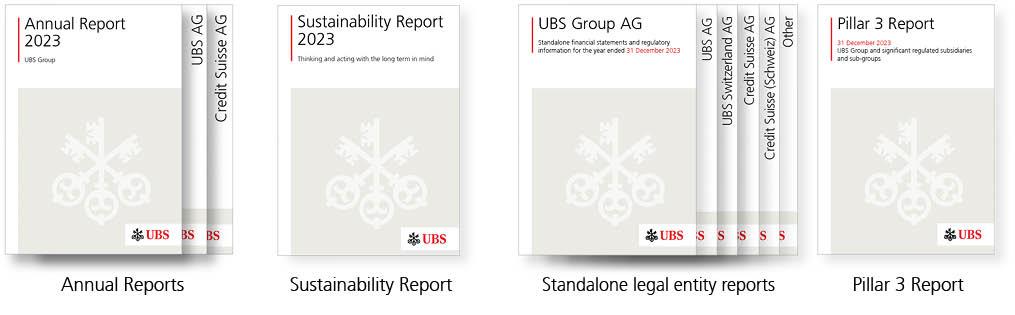
Our external reporting approach
The scope
and content
of our
external reports
are determined
by Swiss
legal and
regulatory requirements,
accounting
standards,
relevant
stock
and
debt
listing
rules,
including
regulations
promulgated
by
the
Swiss
Financial
Market
Supervisory Authority (FINMA), the SIX Swiss Exchange, the US Securities and Exchange Commission (the SEC) and other
regulatory requirements, as
well as by our financial reporting policies.
At the center of our external reporting approach is the annual report of the UBS Group, which consists of disclosures for
UBS Group AG
and its consolidated subsidiaries.
Due to the
acquisition of the
Credit Suisse Group in
2023 and our Group
structure as of 31
December 2023, we
also provide separate
annual reports for
UBS AG and for
Credit Suisse AG,
on a
sub-consolidated basis. The aforementioned three annual reports are the
basis for the corresponding 2023 SEC Form 20-
F filings for each entity.
Annual Reports
The UBS
Group Annual
Report 2023, UBS
AG Annual
Report 2023
and Credit
Suisse AG
Annual Report
2023 include
the consolidated financial statements
of UBS Group
AG, UBS AG
and Credit Suisse AG,
respectively, and together provide
comprehensive information
about our
Group, including
strategy, businesses,
financial and
operating performance,
and
other key information.
The
consolidated
financial
statements
of
UBS
Group
AG
and
UBS
AG
have
been
prepared
in
accordance
with
IFRS
Accounting
Standards.
The
sections
within
“Risk,
capital,
liquidity
and
funding,
and
balance
sheet“
include
certain
audited financial
information, which
forms part
of the
consolidated financial
statements.
The UBS
Group and
UBS AG
reports are presented in US dollars.
The consolidated financial statements of Credit Suisse AG have been prepared in accordance with US generally accepted
accounting principles (GAAP). The Credit Suisse AG report
is presented in Swiss francs.
The
UBS
Group
Annual
Report
2023
is
partly
translated
into
German,
with
the
German
translation
available
under
“Annual reporting” at
ubs.com/investors
.
Sustainability Report
The UBS Group
Sustainability Report
2023 provides
disclosures on
environmental, social
and governance topics
for the
UBS Group
,
UBS AG,
Credit
Suisse AG.
UBS Switzerland
AG, UBS
Europe SE.
Selected
information on
environmental,
social and governance is also included in our annual reports.
Standalone reports of UBS Group AG and significant regulated
entities
We publish separate statutory financial statements
2023 of UBS Group AG, which are the
basis for our appropriation of
profit and
the proposed
distribution of
dividends, subject
to shareholder
approval at
the Annual
General Meeting.
We
also
publish
standalone
reports
for
UBS AG,
UBS
Switzerland
AG,
Credit
Suisse
AG
and
Credit
Suisse
(Schweiz)
AG.
Selected financial
and regulatory
key figures for
our significant
regulated subsidiaries
and sub-groups
are also
included
in this report.
Pillar 3 Report of UBS Group AG including significant
regulated entities and sub-groups
The Pillar 3 Report as of 31 December 2023
provides detailed quantitative and qualitative information about risk, capital,
leverage
and
liquidity
and
funding
for
the
UBS
Group
and
prudential
key
figures
and
regulatory
information
for
our
significant regulated subsidiaries and sub-groups.
Scopes subject to disclosure are
UBS Group AG consolidated, UBS AG
consolidated and standalone,
UBS Switzerland AG standalone,
UBS Europe SE
consolidated, UBS Americas
Holding LLC
consolidated, Credit
Suisse AG
consolidated and
standalone, Credit
Suisse (Schweiz)
AG consolidated
and standalone,
Credit Suisse International standalone, Credit Suisse
Holdings (USA), Inc. consolidated.
2
9
12
14
16
1
Our strategy, business model and
environment
17
19
21
22
32
36
50
55
61
2
Financial and
operating performance
74
75
84
87
90
92
94
95
3
Risk, capital, liquidity and funding,
and balance sheet
97
158
4
Corporate governance
and compensation
184
222
5
Financial
statements
271
6
Significant regulated subsidiary and sub-
group information
405
7
Additional
regulatory information
409
A
Appendix
417
422
424
425
Annual Report 2023 |
Letter to shareholders
2
Dear shareholders,
2023 was a
defining moment
in the 162-year
history of UBS.
The acquisition of
the Credit Suisse
Group (Credit Suisse)
was momentous as the first-ever combination of two global systemically important financial institutions (G-SIFIs). As that
extraordinary weekend in March 2023 unfolded,
the Swiss financial center was
a source of worry, even embarrassment,
for many
in the
country. One
of its
largest banks
was on
the brink
of collapse
after years
of reputational
and financial
distress.
Two
days
later,
with
UBS,
the
government
found
a
Swiss
solution
that
will
benefit
our
stakeholders
and
strengthen Switzerland’s role as a global leader in wealth
management.
Thanks to our
strategy focused
on delivering outstanding
client services,
sustainable profitability,
financial strength
and
sound risk management, we were able to answer the call to help stabilize the financial
system at home and abroad. The
Swiss government did not
have to execute a resolution
plan under the too-big-to-fail regulation, nationalize
Credit Suisse
or call a foreign bank to
the rescue. Aside from
the idiosyncratic failure of
Credit Suisse, the resilience
of UBS and other
large institutions is a testament
to the substantial regulatory
reforms introduced, and coherently
implemented, over the
past decade.
The transaction succeeded not just in
restoring financial stability and preventing
contagion. We are confident it will
also
create
enduring
value
for
you,
our
shareholders.
The
acquisition
vaulted
us
into
a
new
league
by
giving
us
a
highly
complementary
footprint
in
our
key
markets
and
increased
scale
and
capabilities.
To
that
end,
the
acquisition
has
accelerated – not changed – our existing strategy.
By adding client assets
equivalent to seven
to ten years’ worth
of organic growth, the
acquisition solidified our
primacy
as a leading and truly global wealth manager and the leading bank in Switzerland, with stronger asset
management and
investment
bank
franchises.
The
scale
we
achieve
with
the
combination
and
the
efficiencies
we
expect
to
create
will
enable us to
deepen our relationships with
clients at every level
in every geography. And
as we position our
firm to deliver
sustainably
higher
returns
and
long-term
growth,
we
are
committed
to
maintaining
our
UBS
culture
at
the
heart
of
everything we do.
Building on a proven track record
Following the
transaction, the
Board of
Directors asked
Sergio Ermotti,
who had
previously served
as Group
CEO from
2011 to
2020,
to return
in
April
2023. Sergio
has
committed
to
stay
at
least
until
the
completion
of
the
integration
process, if
not longer.
Additionally, he
is supported
by an
executive team
with a
proven track
record in
managing and
executing complex restructuring and a qualified and experienced
Board of Directors.
We
recognize
the
extraordinary
responsibility
with
which
we
have
been
entrusted
with
the
Credit
Suisse
acquisition.
Although we
expect to
forego until
2027 the levels
of profitability we
have previously delivered,
it reinforces
the promising
long-term trajectory for our firm, our clients, our industry
and the communities where we live and work.
The need to build scale and efficiencies
to enhance capabilities and services
for clients, often through inorganic growth,
is a
reality for
every
company in
every
industry, and
we are
no exception.
Dating back
to its
founding as
The Bank
in
Winterthur
in
1862,
UBS
can
claim
a
heritage
of
consolidation
encompassing
more
than
500
different
firms,
from
cantonal
and
regional
banks
that
needed
saving,
to
wealth
managers
and
Wall
Street
brokerages.
Many
of
these
enterprises contribute
to the
DNA of
today’s UBS.
Credit Suisse,
adding its
own legacy
brands such
as Schweizerische
Kreditanstalt, First
Boston, Bank
Leu and
Swiss Volksbank
,
joins a
family of
historic franchises,
including PaineWebber,
S.G. Warburg, Swiss Bank Corporation and Union Bank of Switzerland
,
to name just a few.
Integration at pace
Since
the
acquisition
closed
in
June
2023,
we
have
been
off
to
a
strong
start
in
enabling
Credit
Suisse’s
market-
competitive franchises and
talented people to
flourish and make
us even stronger.
Our immediate focus
was on stabilizing
Credit Suisse’s client base and employees. At the
same time, we began swiftly executing our integration plans,
which we
aim to substantially complete by the end of 2026.
We made significant progress on
these ambitions in 2023. We
decided to integrate Credit Suisse
(Schweiz) AG, following
a careful review of strategic options, and defined the new
Non-core and Legacy perimeter.
Annual Report 2023 |
Letter to shareholders
3
We experienced robust momentum in our client win-back initiatives, as evidenced by net new assets of USD 77 billion in
Global Wealth Management and USD 77 billion
of net new deposits across Global Wealth
Management and Personal &
Corporate Banking since the close. This enabled us to terminate and hand back Swiss government support at the end of
August. We also repaid Credit Suisse’s emergency liquidity
facilities, generating substantial funding cost efficiencies. We
were also encouraged by the high demand for our first
additional tier 1 capital bond issue since the acquisition.
The support that
investors extended
to us during
2023 has given
us confidence
and energy as
we embark
on the
next
phase of the integration. Total shareholder returns
in 2023 were 56%
1
the Swiss Market
Index
2
3
5-year credit
default swap
spreads for
UBS AG
tightening from
78 basis
points at
year-end 2022
to 53
basis points
at
year-end 2023.
In 2024, we will continue
to restructure and optimize
the assets we acquired.
Completing the merger
of our significant
legal entities
by the
end of
the third
quarter
of 2024,
subject to
regulatory
approvals,
is a
key step
in enabling
us to
unlock the next phase of the cost, capital and funding synergies
that we expect to realize in 2025 and 2026.
Our financial performance and capital position in 2023
UBS
achieved
underlying
profitability
in
2023,
despite
the
fact
that
Credit
Suisse
was,
and
remains,
structurally
loss
making. Following
the publication
of our unaudited
fourth quarter
2023 financial report
on 6 February
2024, we
have
refined our acquisition-date fair value estimates. This has resulted in certain adjustments to our financials. Full-year profit
before tax therefore stood at
USD 28.7 billion, including USD 27.7
billion of negative goodwill.
Capital strength is a key
pillar of our strategy, and
we remain committed to maintaining
a balance sheet for all
seasons. Our common equity tier 1
(CET1) capital ratio
increased to 14.4%
at year-end,
comfortably above
our guidance
as we expect
to maintain a
CET1
capital ratio of
around 14% throughout the
integration timeline. Our
year-end CET1 ratio
supports us in
building capacity
for higher
capital returns
while, at
the same
time, it
prepares
us to
absorb integration
charges as
we integrate
Credit
Suisse. The CET1 leverage
ratio was 4.6%, also
in excess of our
guidance. We maintained
healthy liquidity buffers
with
a liquidity coverage ratio of 216% and a net stable funding ratio
of 125%.
Setting UBS’s trajectory for years to come
UBS today
boasts an
appealing business
mix that
stands out
among global
peers. The
integration of
Credit Suisse
has
further shifted
us toward
Global Wealth
Management, Asset
Management and
Personal &
Corporate Banking.
Over a
third
of
our
risk-weighted
assets
(RWA)
are
dedicated
to
our
Global
Wealth
Management
and
Asset
Management
businesses,
which
are
attractive
from a
risk,
growth
and
capital
perspective.
These
businesses
generated
60%
of our
revenues in 2023. Roughly another
third of our RWA are in Personal
& Corporate Banking in Switzerland,
a prosperous,
stable and well-diversified economy with low historic credit
losses.
In the Investment Bank,
we have gained accretive
expertise in global banking
in key sectors such
as technology, health-
care and
financial sponsors.
In markets,
we bolstered
our capabilities
in services
that
are most
relevant to
our
clients,
including execution and research coverage. While we now have a
broader and more diversified business, we reduced the
overall weighting of the Investment Bank to no more than 25%
of group RWA.
Our complementary footprints in Asia Pacific have reinforced
our leading position in the fastest-growing wealth market.
With USD 645 billion in
invested assets in Global
Wealth Management, we
have scale as the
largest wealth manager in
the
region,
supported
by
our
premium
brand,
a
strong
Investment
Bank
with
leading
research
capabilities
and
our
significant China presence.
We expect
Global Wealth Management
margins in the
region to eventually
exceed 40% as
we capture the benefits of our leadership positions and
integration-related synergies.
In the US, our other key wealth
management growth market, we
have scope to improve our profitability,
also thanks to
our strengthened investment bank and
asset management franchises. In addition, over
the next three years,
we will build
out our
core banking
infrastructure in
the US
to provide
clients with
a more
comprehensive loan
and deposit
offering,
and roll out more products and services to ultra high net
worth, family and institutional wealth clients.
We will
further
leverage
our advisory
capabilities
in the
US through
our global
Chief
Investment
Office
platform.
Our
international clients who have interests in the
US will benefit from better access to
our American advisors and products.
These
actions
will
help
produce
mid-teen
profit
margins
by
the
end
of
2026
and
put
us
in
a
position
to
explore
opportunities to further narrow the gap to our peers.
1
Total shareholder returns based on shares in Swiss francs
2
3


Annual Report 2023 |
Letter to shareholders
4
Colm Kelleher
Chairman of the Board of Directors
Sergio P.
Ermotti
Group Chief Executive Officer
Fit for the future
We
intend
to
remain
at
the
forefront
of
technological
change,
providing
a
more
personalized,
relevant,
on-time
and
seamless experience for our clients. We will continue to invest
and innovate to benefit our clients and shareholders.
While we remain focused on providing world-class digital-led solutions,
recent geopolitical, macroeconomic and societal
shifts have highlighted the relevance
of our core values such as superior
service, security and stability. We
are convinced
that technology
will continue
to boost
our ability
to help
our clients
manage risks
and capture
opportunities
in
good
times as well as during moments of economic uncertainty
and geopolitical instability.
Most importantly,
however, it
will be
our employees
that determine
our future
success as
they continue
to shape
our
bank for clients and shareholders
today and generations to come.
We want our employees to
be able to build long and
successful careers,
driving innovation
for our
stakeholders. Investing
in our
people and
culture therefore
remains a
key
priority. Together with Credit Suisse, we invested more than
USD 100 million in training activities in 2023.
Our targets and capital returns
While our financial
progress in the
integration of Credit
Suisse will not
be delivered in
a straight line,
our ambitions are
clear. We aim to
realize an underlying return
on CET1 capital of
around 15% and a
cost-to-income ratio of less
than 70%
as we exit 2026.
By the end
of 2028, we endeavor
to achieve a
return on CET1
capital of around
18%. We expect
the
execution of our integration plans and the run-down
of Non-core and Legacy to result in around
USD 13 billion in gross
cost saves by the end
of 2026, with around
45% of the cumulative
gross cost reductions expected
by the end of
2024.
This
will
provide
us
with
capacity
to
invest
in
talent,
products
and
services,
and
reinforce
the
resilience
of
our
infrastructure.
As we
follow through on
the integration, we
remain focused on
client retention and
win-back initiatives, while
also taking
actions to improve
capital efficiency. We will
aim to capture around
USD 100 billion of net
new assets per
annum through
2025, building to around
USD 200 billion per
annum by 2028 and
surpassing USD 5 trillion
of invested assets in
Global
Wealth Management by the end of 2028.
In 2023, we
bought back USD
1.3 billion of
our shares before
the acquisition required
us to temporarily
suspend share
repurchases. In
2024, we
expect to
repurchase up to
USD 1 billion
of our
shares, commencing
after the
completion of
the merger of UBS AG and Credit Suisse AG, which is expected
to occur by the end of the second quarter of 2024.
At the
upcoming Annual
General Meeting
(AGM), the
Board of
Directors intends
to propose
an ordinary
dividend per
share
of
USD 0.70
for
the
2023
financial
year,
a
27%
year-on-year
increase.
We
remain
committed
to
progressive
dividends and are accruing for a mid-teen
percentage increase in the dividend per
share for the 2024 financial year. Our
goal is for share repurchases to exceed our pre-acquisition
levels by 2026.
Annual Report 2023 |
Letter to shareholders
5
Our sustainability ambition
We
remain
steadfast
in
our
ambition
to
be
a
global
leader
in
sustainability.
This
is
underpinned
by
our
continued
commitment to supporting our
clients in the
transition to a low-carbon
world, leading by example
in our own
operations,
and sharing our lessons learned along the way.
Recognizing the
acquisition
of Credit
Suisse
has
increased
our exposures
to certain
carbon-intensive
sectors,
we
have
expanded our Sustainability & Climate Risk framework
and associated processes to reflect the
full suite of activities of
the
combined
business
and
ensure
a
consistent
approach.
We
have
also
moved
swiftly
to transition
portfolios
in
carbon-
intensive sectors that do not align with our approach and risk appetite into Non-Core and Legacy to be managed
off our
balance sheet over time.
In addition, we have established
new baselines and set decarbonization
targets for 2030 across seven
key sectors: fossil
fuels, power generation, iron and steel, cement, Swiss residential real estate, Swiss commercial real estate, and shipping,
using the latest
science-based pathways
available to us.
We believe these
targets are among
the most ambitious
in the
industry. By
way of
example, our
target for
the fossil
fuel sector
is to
reduce our
absolute financed
emissions by
70%
from the 2021 baseline to 2030.
We are
proud of
the progress we
have made
so far.
We remain
committed to
our ambition
to achieve
net-zero greenhouse
gas (GHG) emissions across our scope 1 and 2, and specified scope 3 activities by 2050, with decarbonization targets for
2025,
2030
and
2035.
At
the
same
time,
we
fully
acknowledge
we
have
more
work
to
do,
in
phasing
in
additional
scope 3
activities
and
further
embedding
our
new
targets.
For
more
information,
please
refer
to
our
UBS
Group
Sustainability Report 2023.
By working collectively,
philanthropists and public
and private organizations
have the potential
to create lasting
change
and maximize a
positive impact for
people and planet.
To this end, we
also provide comprehensive
advice, insights and
execution
services, working
with our
clients
and finding
ways to
tackle
some of
the
world’s
most pressing
social and
environmental
problems.
We
aim
to
mobilize
USD 1
billion
in
philanthropic
capital
and
positively
impact
more
than
26.5 million people by 2025 (cumulative total since 2021).
In
2023,
the
UBS
Optimus
network
of
foundations
raised
USD 328
million
in
donations,
including
UBS
matching
contributions, and committed USD 306 million
in grants from Optimus. Our engagement
addressed humanitarian crises
around the
globe in
2023. Optimus
also continued
to distribute
the USD 56
million raised
for the
Ukraine Relief
Fund
launched in 2022. To date, USD 43 million has been granted
to our partners on the ground.
Lessons learned
The failure of
Credit Suisse and
some US regional
financial institutions in the
first half of
2023 will unquestionably provide
global investors,
managers, policymakers
and regulators
alike with
important lessons.
Most of
the post-mortems
from
regulators and expert bodies since March 2023 have devised specific recommendations in the areas of supervision,
stress
testing,
liquidity
and
accountability.
We
endorse
many
of
these
targeted
adjustments
and
will
continue
to
actively
contribute to this discussion.
But having analyzed
the causes of
Credit Suisse’s troubles
following the takeover,
we have some
clear takeaways. First,
there can
be no
regulatory solution
for a
broken business
model. That
is a
job for
executives and
managers who
must
also be held accountable by engaged shareholders. And
second, trust cannot be regulated.
Furthermore, it was
not a lack
of capital that
forced Credit Suisse into
a historic weekend
rescue. The capital
requirements
for G-SIFIs have
been transformed over
the past 15
years, bolstering the
resilience of the
world’s largest banks
and the
safety of the financial system.
Effective loss-absorbing capacity
increased around 20-fold since the
2008 global financial
crisis, and at our firm now is around USD 200 billion.
The
fact
that
we
were
in
a
position
to
rescue
Credit
Suisse,
despite
both
firms
operating
under
the
same
regulatory
regime, shows the framework
and capital requirements
were not the problem.
This has also been
confirmed by various
international and domestic experts. Therefore, we welcome the ongoing analysis by the Swiss parliamentary commission
into the collapse of
Credit Suisse, so that appropriate
and focused actions can
be taken both in
respect of how regulation
is potentially fine-tuned and subsequently
implemented.


Annual Report 2023 |
Letter to shareholders
6
A pillar for Switzerland
There
has
been
much
debate
about
our
size
relative
to
the
Swiss
economy
and
its
impact
on
competition.
We
are
convinced that
our size and
business model
are fit
for the purpose
for which they
are intended:
to act
as an engine
of
credit creation and prosperity to our clients and the economies
we serve.
It is important to
consider the composition and
risk profile of the
balance sheet, as not
every position represents the
same
risk. We hold
around 20% of total
assets in high-quality liquid
assets and another 15%
in private client
mortgages, which
bear very low risk. When looking at
the risk profile of a balance sheet,
it is crucial to look at risk-weighted
assets, which
totaled around
USD 547 billion
at year-end
and are
expected to
further decrease.
We expect
our Group
RWA to
be at
around
USD 510
billion
by
the
end
of
2026,
which
are
supported
by
our
strong
capital
position,
including
around
USD 200 billion of loss-absorbing capacity.
The collapse
of Credit
Suisse unleashed
an extraordinary
race for
clients, talent
and market
share in the
Swiss banking
market. This is
the ultimate proof
that the competition provided
by both domestic
and foreign banks active
in Switzerland
is robust.
Over the past decade,
UBS, Credit Suisse and
our combined staff paid
around CHF 25 billion
in Swiss taxes and
bought
some
CHF 3.5
billion
in
goods
and
services
in
Switzerland
as
well.
Last
year
we
collectively
offered
more
than
2,300
trainee positions – a number we pledge to maintain in 2024 as well.
We are convinced
that the acquisition
will make us
an even better
diversified and stronger
pillar in Switzerland,
and an
even more reliable economic partner, employer and taxpayer
in the communities where we operate.
The 2024 Annual General Meeting
At the
upcoming AGM,
we are
proposing Gail
Kelly for
election to
the Board
of Directors
as Dieter
Wemmer will
not
stand for re-election after eight
years of Board membership.
We thank him for
his invaluable collaboration and
significant
contribution
to the
strong
governance
at
our firm.
Gail
has an
outstanding
reputation
as
one of
the
most
influential
voices in the Asia-Pacific financial industry and
an acknowledged leader. She is recognized as
an excellent bank CEO who
successfully navigated
a merger.
You will
also be
asked to
vote on
our first
combined UBS
Group Sustainability
Report
and the proposed increase in dividends.
We are excited about our
long-term value proposition.
Our strategy is clear and augmented
by the acquisition of
Credit
Suisse. We have
an opportunity to
create an even
better experience for
clients while generating
sustainably higher returns
on capital and allowing us to provide you, our shareholders,
with attractive shareholder returns.
Thank you
for your
support in
one of
the most
decisive years
in our history.
We look
forward to
your feedback
and to
welcoming you to the 2024 AGM, which will take place
on 24 April in Basel, Switzerland.
Yours sincerely,
Colm Kelleher
Sergio P. Ermotti
Chairman of the Board of Directors
Group Chief Executive Officer
Corporate information
UBS Group AG
under Art. 620ff. of the Swiss Code of Obligations
as an Aktiengesellschaft, a
corporation limited by shares. Its registered office is at Bahnhofstrasse
45,
CH-8001 Zurich, Switzerland, telephone +41-44-234
11 11, and its corporate
identification number is CHE-395.345.924.
UBS Group AG was incorporated
on 10 June 2014 and was established in 2014
as the holding company of the
UBS Group. UBS Group AG shares are listed on the SIX Swiss
Exchange and
on the New York Stock Exchange (ISIN CH0244767585; CUSIP H42097107).
UBS Group AG owns 100% of the outstanding shares in
UBS AG and Credit
Suisse AG.
Contacts
Switchboards
For all general inquiries
ubs.com/contact
Zurich +41-44-234 1111
London +44-207-567 8000
New York +1-212-821 3000
Hong Kong SAR +852-2971 8888
Singapore +65-6495 8000
Investor Relations
UBS’s Investor Relations team manages
relationships with institutional investors,
research analysts and credit rating agencies.
ubs.com/investors
Zurich +41-44-234 4100
New York +1-212-882 5734
Media Relations
UBS’s Media Relations team manages
relationships with global media and
journalists.
ubs.com/media
Zurich +41-44-234 8500
mediarelations@ubs.com
London +44-20-7567 4714
ubs-media-relations@ubs.com
New York +1-212-882 5858
mediarelations@ubs.com
Hong Kong SAR +852-2971 8200
sh-mediarelations-ap@ubs.com
Office of the Group Company Secretary
The Group Company Secretary handles
inquiries directed to the Chairman or to other
members of the Board of Directors.
UBS Group AG, Office of the
Group Company Secretary
PO Box, CH-8098 Zurich, Switzerland
sh-company-secretary@ubs.com
Zurich +41-44-235 6652
Shareholder Services
UBS’s Shareholder Services team, a unit
of the Group Company Secretary’s office,
manages relationships with shareholders
and the registration of UBS Group AG
registered shares.
UBS Group AG, Shareholder Services
PO Box, CH-8098 Zurich, Switzerland
sh-shareholder-services@ubs.com
Zurich +41-44-235 6652
US Transfer Agent
For global registered share-related
inquiries in the US.
Computershare Trust Company NA
PO Box 43006
Providence, RI, 02940-3006, USA
Shareholder online inquiries:
www.computershare.com/us/
investor-inquiries
Shareholder website:
computershare.com/investor
Calls from the US
+1-866-305-9566
Calls from outside the US
+1-781-575-2623
TDD for hearing impaired
+1-800-231-5469
TDD for foreign shareholders
+1-201-680-6610
Corporate calendar UBS Group AG
More information about future publication dates is
available at
ubs.com/global/en/investor-relations/events/calendar.html
Imprint
Publisher: UBS Group AG, Zurich, Switzerland | ubs.com
Language: English
© UBS 2024. The key symbol and UBS are among
the registered and
unregistered trademarks of UBS. All rights reserved.
Annual Report 2023
Our key figures
As of or for the year ended
USD m, except where indicated
31.12.23
31.12.22
31.12.21
Group results
Total revenues
Negative goodwill
Credit loss expense / (release)
Operating expenses
Operating profit / (loss) before tax
Net profit / (loss) attributable to shareholders
Diluted earnings per share (USD)
1
Profitability and growth
2,3,4
Return on equity (%)
Return on tangible equity (%)
Underlying return on tangible equity (%)
5
Return on common equity tier 1 capital (%)
Underlying return on common equity tier 1 capital (%)
5
Return on leverage ratio denominator, gross (%)
Cost / income ratio (%)
6
Underlying cost / income ratio (%)
5,6
Effective tax rate (%)
Net profit growth (%)
Resources
2
Total assets
Equity attributable to shareholders
Common equity tier 1 capital
7
Risk-weighted assets
7
Common equity tier 1 capital ratio (%)
7
Going concern capital ratio (%)
7
Total loss-absorbing capacity ratio (%)
7
Leverage ratio denominator
7
Common equity tier 1 leverage ratio (%)
7
Liquidity coverage ratio (%)
8
Net stable funding ratio (%)
Other
Invested assets (USD bn)
3,9,10
Personnel (full-time equivalents)
Market capitalization
11,12
Total book value per share (USD)
11
Tangible book value per share (USD)
11
1 Refer to “Share information and earnings per share” in the “Consolidated financial statements” section of this report for more information.
2 Refer to the “Targets, capital guidance and ambitions” section of this
report for more information
about our performance
targets.
3 Refer to “Alternative
performance measures” in the
appendix to this report
for the definition and
calculation method.
4 Profit or loss information
for 2023 includes seven months (June to December
2023, inclusive) of Credit Suisse data for the
return measures.
5 Refer to the “Group performance” section of
this report for more information about underlying
results.
6 Negative goodwill is not used in the calculation as it is presented in a separate reporting line and is not part of total revenues.
7 Based on the Swiss systemically relevant bank framework as of 1 January
2020. Refer to the “Capital, liquidity and funding, and balance sheet” section of this report for more information.
8 The disclosed ratios represent averages for the fourth quarter of each year presented, which were
calculated based on
an average of
63 data points in
the fourth quarter
of 2023, 63 data
points in the fourth
quarter of 2022
and 66 data points
in the fourth quarter
of 2021. Refer
to the “Capital,
liquidity and
funding, and balance sheet”
section of this report
for more information.
9 Consists of invested
assets for Global Wealth
Management, Asset Management
and Personal &
Corporate Banking. Refer
to “Note 32
Invested assets and net new money” in the “Consolidated financial statements” section of this report for more information.
10 Starting with the second quarter of 2023, invested assets include invested assets from
associates in the Asset Management business division,
to better reflect the business strategy.
Comparative figures have been restated to
reflect this change.
11 Refer to “UBS shares” in the “Capital, liquidity and
funding, and balance sheet” section of this report for more information.
12 In the second quarter of 2023, the calculation of market capitalization was amended to reflect total shares issued multiplied by the share
price at the end of
the period. The calculation
was previously based on
total shares outstanding multiplied
by the share price at
the end of the
period. Market capitalization
has been increased by
USD 7.8bn as of
31 December 2022 and by USD 5.5bn as of 31 December 2021 as a result.
Adjustment made within the IFRS 3 measurement period after
publication of the fourth quarter 2023
report
The acquisition of the Credit Suisse Group
in the second quarter of 2023 resulted
in provisional negative goodwill of
USD 28.9bn. Following
the publication
of the
unaudited fourth
quarter
2023 report
on 6
February
2024, UBS
has
refined its acquisition-date
fair value estimates
in accordance with
the 12-month measurement
period requirements
provided by IFRS 3,
Business Combinations
. This has resulted in an adjustment of USD 1.2bn, decreasing the negative
goodwill to USD
27.7bn. As a result,
2023 operating profit before tax
and 2023 net
profit attributable to shareholders
decreased by USD 1.2bn, basic earnings
per share decreased by USD 0.38 to USD
8.83 and diluted earnings per share
decreased by USD 0.36 to USD 8.45. In addition, the
CET1 capital ratio decreased to 14.4% from
14.5%.
›
Refer to “Note 2 Accounting for the acquisition
of the Credit Suisse Group” in the “Consolidated financial
statements” section
of this report for more information
Annual Report 2023
Alternative performance measures
An alternative
performance measure (an
APM) is
a financial
measure of historical
or future financial
performance, financial
position
or
cash
flows
other
than
a
financial
measure
defined
or
specified
in
the
applicable
recognized
accounting
standards or in other
applicable regulations. We report a number
of APMs in
the discussion of
the financial and operating
performance of the Group, our business divisions and Group Items. We use APMs to provide a more complete picture of
our
operating
performance
and
to
reflect
management’s
view
of
the
fundamental
drivers
of
our
business
results.
A
definition of each
APM, the method
used to calculate
it and the
information content
are presented
under “Alternative
performance measures” in
the appendix to this report.
Our APMs may qualify as
non-GAAP measures as
defined by US
Securities
and Exchange
Commission
(SEC)
regulations.
Our underlying
results
are
APMs and
are
non-GAAP
financial
measures.
›
Refer to the ”Group performance” section of this report and
to “Alternative performance measures” in
the appendix to this report
for additional information about underlying results
Terms used in this report, unless the context requires
otherwise
”UBS,” ”UBS Group,” “UBS Group AG consolidated,”
“Group,” “the Group,” “we,” “us” and
“our”
UBS Group AG and its consolidated subsidiaries
“UBS Group excluding the Credit Suisse
AG sub-group”
All UBS Group entities, excluding the Credit
Suisse AG
sub-group
“UBS Group excluding Credit Suisse” and
“UBS sub-group”
All UBS Group entities, excluding Credit
Suisse AG and its
consolidated subsidiaries, Credit Suisse Services AG,
and
other small former Credit Suisse Group entities
now
directly held by UBS Group AG
“UBS AG,” “UBS AG consolidated“ and “UBS AG sub-
group”
UBS AG and its consolidated subsidiaries
“Pre-acquisition UBS”
UBS before the acquisition of the Credit
Suisse Group
“Credit Suisse AG,” “Credit Suisse AG consolidated”
and “Credit Suisse AG sub-group”
Credit Suisse AG and its consolidated subsidiaries
“Credit Suisse Group” and “Credit
Suisse Group AG
consolidated”
Credit Suisse Group AG and its consolidated
subsidiaries,
before the acquisition by UBS
“Credit Suisse” and “Credit Suisse sub-group”
Credit Suisse AG, its consolidated subsidiaries, Credit
Suisse Services AG, and other small former Credit Suisse
Group entities now directly held by UBS Group
AG
“UBS Group AG” and “UBS Group AG
standalone”
UBS Group AG on a standalone basis
“Credit Suisse Group AG” and “Credit
Suisse Group AG
standalone”
Credit Suisse Group AG on a standalone basis
“UBS AG standalone”
UBS AG on a standalone basis
“Credit Suisse AG standalone”
Credit Suisse AG on a standalone basis
“UBS Switzerland AG”
UBS Switzerland AG on a standalone basis
“UBS Europe SE consolidated”
UBS Europe SE and its consolidated subsidiaries
“UBS Americas Holding LLC”
UBS Americas Holding LLC and its consolidated
subsidiaries
“Pre-acquisition Global Wealth Management”
The UBS Global Wealth Management business division
before the acquisition of the Credit Suisse
Group (data, if
any, from
before the date of the acquisition of the Credit
Suisse Group)
“UBS AG Global Wealth Management”
The Global Wealth Management business division
of UBS
AG and its consolidated subsidiaries
“Wealth Management (Credit Suisse)”
The Wealth Management business division of Credit
Suisse AG and its consolidated subsidiaries
Annual Report 2023
Terms used in this report, unless the context requires
otherwise (continued)
The Personal & Corporate Banking business division
before the acquisition of the Credit Suisse
Group (data, if
any, from
before the date of the acquisition of the Credit
Suisse Group)
“UBS AG Personal & Corporate Banking”
The Personal & Corporate Banking business division of
UBS AG and its consolidated subsidiaries
“Swiss Bank (Credit Suisse)”
The Swiss Bank business division of Credit Suisse
AG and
its consolidated subsidiaries
“Pre-acquisition Asset Management”
The Asset Management business division before
the
acquisition of the Credit Suisse Group
(data, if any,
from
before the date of the acquisition of the Credit
Suisse
Group)
“UBS AG Asset Management”
The Asset Management business division of UBS AG and
its consolidated subsidiaries
“Asset Management (Credit Suisse)”
The Asset Management business division of Credit
Suisse
AG and its consolidated subsidiaries
“Pre-acquisition Investment Bank”
The Investment Bank business division before
the
acquisition of the Credit Suisse Group
(data, if any,
from
before the date of the acquisition of the Credit
Suisse
Group)
“UBS AG Investment Bank”
The Investment Bank business division of UBS AG and its
consolidated subsidiaries
“Investment Bank (Credit Suisse)”
The Investment Bank business division of Credit Suisse
AG
and its consolidated subsidiaries
“1m”
One million, i.e., 1,000,000
“1bn”
One billion, i.e., 1,000,000,000
“1trn”
One trillion, i.e., 1,000,000,000,000
In this report, unless the context requires
otherwise, references to any gender shall
apply to all genders.

Our Board of Directors

The Board
of Directors
of UBS
Group AG
(the BoD),
led by the
Chairman, consists of between 6 and 12
members,
as per our
Articles
of Association.
The BoD
decides on
the strategy
of the
Group, upon
recommendation
by the
Group Chief
Executive
Officer
(the Group CEO),
and is responsible for the
overall direction, supervision
and control of the Group and its management.
It is also
responsible for supervising compliance with applicable laws, rules and regulations. The BoD exercises oversight over UBS Group
AG and its subsidiaries,
and is responsible for establishing
a clear Group governance
framework to provide effective
steering and
supervision
of the Group,
taking into
account the
material risks
to which UBS
Group AG and
its subsidiaries
are exposed.
The BoD
has ultimate responsibility for the success of
the Group and
for delivering sustainable shareholder value within a framework of
prudent
and
effective
controls.
It
approves
all
financial
statements
and
appoints
and
removes
all
Group
Executive
Board
(GEB) members.
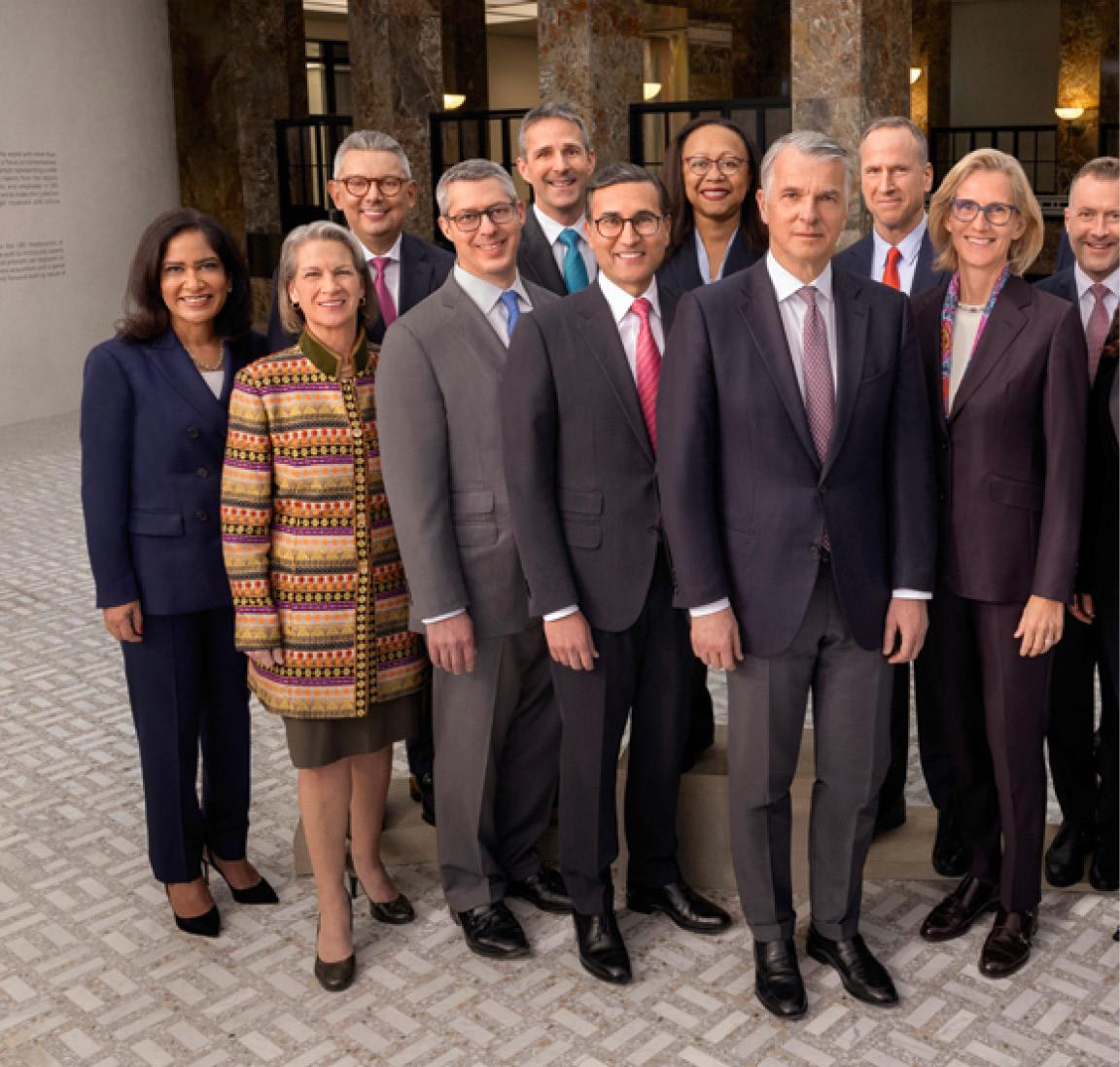
Our Group Executive Board
UBS Group AG
operates under a
strict dual-board structure,
as mandated
by Swiss
banking law, and
therefore the BoD
delegates
the
management
of
the
business
to
the
GEB.
As of
31 December
2023,
the
GEB,
under
the
leadership
of
the
Group
CEO,
consisted of 16
members.
It has executive
management responsibility
for the steering
of the Group
and its business,
develops
the strategies of the Group, business divisions and
Group Items, and implements the BoD-approved
strategies.
›
Refer to “Board of Directors” and “Group Executive Board” in the
“Corporate governance” section of this report
or to
ubs.com/bod
ubs.com/geb

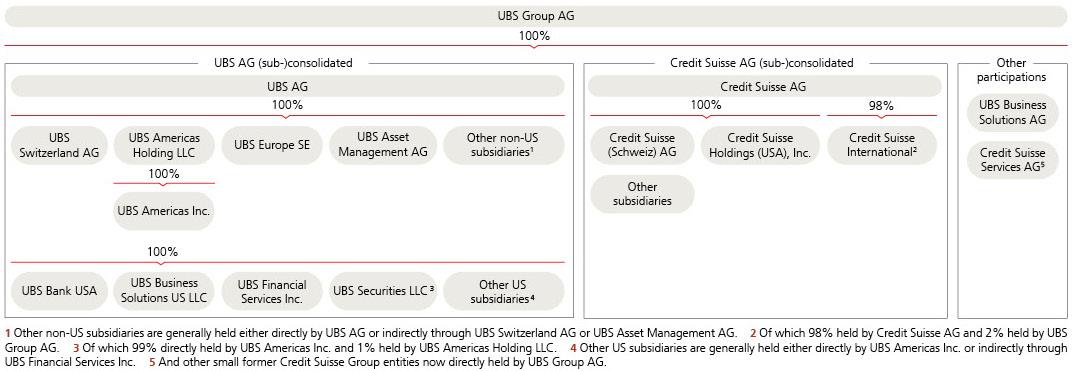
Annual Report 2023
Our evolution
Since our origins in the mid-19th century, more than 500 different firms have become part of the history of our firm and
helped shape
our development.
1998 was
a major
turning point:
two of
the three
largest Swiss
banks, Union
Bank of
Switzerland and Swiss Bank Corporation (SBC), merged to form UBS. Both banks were well established and successful in
their own
right. Union
Bank of
Switzerland had
grown
organically to
become the
largest Swiss
bank. In
contrast, SBC
had grown mainly through strategic
partnerships and acquisitions, including S.G. Warburg
in 1995.
In
2000,
we
acquired
PaineWebber,
a
US
brokerage
and
asset
management
firm
with
roots
going
back
to
1879,
establishing us as a
significant player in the
US. Since 1964, we
have been building our strong
presence in the Asia Pacific
region, where we are by far the largest wealth manager,
1
After incurring significant losses
in the 2008
financial crisis, we sought to
return to our roots,
emphasizing a client-centric
model that requires less risk-taking
and capital. In 2011,
we started a strategic transformation
of our business model to
focus on our traditional businesses: wealth management
globally, and personal and corporate banking in Switzerland.
In 2014,
we began
adapting our
legal entity
structure in
response to
too-big-to-fail requirements
and other
regulatory
initiatives.
First,
we
established
UBS
Group
AG
as
the
ultimate
parent
holding
company
for
the
Group.
In
2015,
we
transferred personal and
corporate banking
and Swiss-booked wealth
management businesses
from UBS AG
to the newly
established UBS Switzerland AG. That
same year,
we set up UBS Business Solutions
AG as the Group’s service company.
In 2016, UBS
Americas Holding
LLC became the
intermediate holding
company for
our US subsidiaries
and our wealth
management
subsidiaries
across
Europe
were
merged
into
UBS
Europe
SE,
our
Germany-headquartered
European
subsidiary.
In 2019, we merged UBS Limited, our UK-headquartered
subsidiary, into UBS Europe SE.
2023 was another defining moment in
our 162-year history as we acquired
the Credit Suisse Group, a global
systemically
important financial institution and a
major wealth manager headquartered in
Switzerland that was founded in 1856.
The
acquisition followed
a request
from the
Swiss Federal
Department
of Finance,
the
Swiss National
Bank and
the
Swiss
Financial
Market
Supervisory
Authority
(FINMA)
to
UBS
Group
AG
and
Credit
Suisse
Group
AG
to
duly
consider
the
acquisition in order
to restore necessary confidence
in the stability
of the Swiss
economy and banking system
and to serve
the best interests of the shareholders and stakeholders
of UBS and Credit Suisse.
The
acquisition
strengthened
our
position
today
as
a
leading
and
truly
global
wealth
manager,
the
leading
bank
in
Switzerland,
a global, large-scale and diversified asset manager, and a focused
investment bank.
The chart below gives an overview of our principal legal entities
and our legal entity structure.
›
Refer to
ubs.com/history
›
Refer to the “Risk factors” and “Regulatory and
legal developments” sections of this report for more information
›
Refer to the “Acquisition and integration
of Credit Suisse” section of this report for more information
The legal structure of the UBS Group
1
Annual Report 2023 |
Our strategy, business model and environment
| Acquisition and integration of Credit
Suisse
17
Our strategy, business model and
environment
Management report
Acquisition and integration of Credit Suisse
Acquisition of Credit Suisse
On 12 June
2023, UBS
Group AG acquired
Credit Suisse
Group AG, succeeding
by operation
of Swiss law
to all
assets
and liabilities
of Credit
Suisse Group
AG, and
became the
direct or
indirect shareholder
of all
of the
former direct
and
indirect subsidiaries of Credit Suisse Group AG (the Transaction).
The acquisition followed a request from the Swiss Federal Department of Finance, the Swiss
National Bank and the Swiss
Financial Market Supervisory
Authority (FINMA) to
both firms
to duly
consider the Transaction
in order to
restore necessary
confidence in the stability of
the Swiss economy and banking
system and to serve the
best interests of the shareholders
and stakeholders
of UBS
and
Credit Suisse.
As a
result
of further
negotiations
and
supported by
distinct
government
guarantees and measures, the firms subsequently entered
into a merger agreement on 19 March 2023.
Upon the
completion
of the
Transaction,
each
outstanding
registered
Credit
Suisse
Group AG
share
converted
to the
right to
receive, subject
to the
payment of
certain fees
to the
Credit Suisse
Depositary in
the case
of Credit
Suisse American
depositary shares (ADS), a merger consideration consisting of 1/22.48 UBS Group AG shares. In aggregate, Credit Suisse
Group AG shareholders received 5.1%
of the outstanding UBS
Group AG shares on the acquisition
date, with a purchase
price of USD 3.7bn.
UBS
has
accounted
for
the
acquisition
as
a
business
combination
under
IFRS 3,
Business
Combinations
,
applying
the
acquisition method of accounting.
›
Refer to “Note 1 Summary of material accounting
policies” and “Note 2 Accounting for the acquisition
of the Credit Suisse Group”
in the “Consolidated financial statements” section
of this report
Integration of Credit Suisse
We are successfully executing our
integration plans. We have stabilized
the franchise and successfully won back,
retained
and grown client assets, as we have been entrusted with USD 77bn of net
new assets since the acquisition. We achieved
underlying profitability,
which enabled
us to
pay down
the extraordinary
liquidity support
and to
voluntarily terminate
the loss
protection agreement
guaranteed by
the Swiss
government, reducing
our funding
costs by
around USD 550m
per quarter. On 22
March 2024, Credit Suisse (Schweiz)
AG repaid loans drawn
under the Emergency Liquidity Assistance
(ELA) facility, reducing the amount of loans outstanding under the ELA from CHF 38bn
to CHF 19bn as of that date.
We
achieved around USD 4bn in exit rate gross cost savings as of the end of 2023 compared with the full year 2022 for UBS
and the Credit Suisse Group combined. We
established the perimeter for
Non-core and Legacy, and our strategy for
the
wind-down of Non-core
and Legacy
led to reductions
of USD 12bn in
risk-weighted assets,
nearly 80% of
which came
from unwinds. We also provided
important clarity for all of
our stakeholders as we finalized
our target operating model
and initiated the restructuring
phase. We aim to substantially complete the integration
by the end of 2026.
Beginning with the third quarter of 2023,
we report five business divisions, reflecting the
way we manage our businesses
and engage
with clients:
Global Wealth Management,
Personal &
Corporate Banking, Asset
Management, the Investment
Bank, and Non-core and Legacy. We separately report
Group Items.
Non-core and Legacy
includes positions and
businesses not aligned
with our strategy
and policies. Those
consist of the
assets and
liabilities
that prior
to the
acquisition were
reported as
part of
the Capital
Release Unit
(Credit
Suisse) and
certain assets
and liabilities
of the
Investment Bank
(Credit Suisse),
Wealth Management (Credit
Suisse), Swiss Bank
(Credit
Suisse) and Asset Management (Credit Suisse) divisions, as well as of the Corporate Center (Credit Suisse). Also included
are the remaining
assets and liabilities
of UBS’s
Non-core and
Legacy Portfolio,
previously reported
in Group Functions,
and smaller amounts of assets and liabilities of UBS’s
business divisions that we have assessed as not strategic
in light of
the acquisition of the Credit Suisse Group.
Legal structure integration
In December 2023, the Board of Directors of UBS Group AG approved the merger of UBS AG and Credit Suisse AG, and
both entities entered into a
definitive merger agreement. The completion of
the merger is subject
to regulatory approvals
and is expected to occur by the end of the second quarter of 2024.
We also expect to complete the transition to a single
US intermediate
holding company
in the
second quarter
of 2024
and the
planned merger
of UBS Switzerland
AG and
Credit Suisse (Schweiz) AG in the third
quarter of 2024.
Annual Report 2023 |
Our strategy, business model and environment
| Acquisition and integration of Credit
Suisse
18
Completing the
mergers of
our significant
legal entities
is a critical
step in enabling
us to unlock
the next
phase of
the
cost, capital and funding synergies that we expect to
realize in 2025 and 2026. These significant-legal-entity mergers are
a prerequisite for the first
wave of client migrations and will
enable us to begin streamlining and
decommissioning legacy
Credit Suisse platforms in the second half of 2024.
Material weaknesses in internal control over financial reporting
of the Credit Suisse Group
As a registrant
with the
US Security
and Exchange
Commission (the
SEC), UBS
Group is
subject to
requirements under
the
Sarbanes–Oxley
Act
of
2002
with
respect
to
financial
reporting.
This
requires
us
to
perform
system
and
process
evaluation and
testing of internal
control over
financial reporting
to enable
management to
assess the
effectiveness of
our internal controls. A
material weakness is a
deficiency or a
combination of deficiencies in
internal control over financial
reporting such that there is a
reasonable possibility that a material misstatement of
a registrant’s financial statements will
not be prevented or detected on a timely basis.
In March 2023, prior to acquisition
by UBS, the Credit Suisse
Group and Credit Suisse AG
disclosed that their respective
management had
identified three
material weaknesses
in internal
control over
financial reporting,
as a
result of
which
each of Credit
Suisse Group
and Credit Suisse
AG concluded that,
as of 31
December 2022,
their internal control
over
financial reporting was not effective and, for
the same reasons, had reached the
same conclusion regarding their internal
control over financial reporting
as of 31 December
2021. The material weaknesses
identified by Credit Suisse
related to
the
failure
to
design
and
maintain
an
effective
risk
assessment
process
to
identify
and
analyze
the
risk
of
material
misstatements in Credit Suisse financial statements and
the failure to design and maintain effective monitoring
activities
relating
to
(i)
providing
sufficient
management
oversight
over
the
internal
control
evaluation
process
to
support
the
company’s internal control objectives; (ii) involving
appropriate and sufficient management
resources to support the risk
assessment
and
monitoring
objectives;
and
(iii)
assessing
and
communicating
the
severity
of
deficiencies
in
a
timely
manner to those parties responsible for taking corrective action. These material weaknesses contributed to an additional
material weakness,
as the
Credit Suisse
Group’s management
did not
design and
maintain effective
controls over
the
classification and
presentation
of the
consolidated
statement
of cash
flows under
US Generally
Accepted
Accounting
Principles
(“US
GAAP”).
Specifically,
certain
control
activities
over
the
completeness
and
the
classification
and
presentation of non-cash
items in the consolidated
statement of cash
flows were not
performed on a timely
basis or at
the appropriate level of
precision. This material weakness
resulted in the revisions
to Credit Suisse Group’s
consolidated
financial statements for the three years ended 31 December, 2021
as disclosed in its 2021 Annual Report.
Following the identification of the material weaknesses, Credit Suisse management
initiated a remediation program and
further enhanced its processes and controls over financial reporting,
with the key remediation steps to date as follows.
With
respect
to
the
material
weakness
relating
to
the
US
GAAP
consolidated
statement
of
cash
flows,
Credit
Suisse
management performed a review of
the process to produce the
statement, including a third-party review
and, as a result,
enhanced controls within the process
and implemented additional controls, including senior
management reviews. Based
on the work
completed to
date, Credit
Suisse management
has assessed
that the
changes to
internal control
made to
address the material weakness relating to the classification and presentation of
the consolidated statement of cash flows
are designed effectively,
but that additional time
is required to conclude
that these controls
are operating effectively
on
a sustainable basis.
With
respect
to
the
material
weaknesses
on
risk
assessment
of
internal
control
and
severity
assessment
of
control
deficiencies, Credit
Suisse has
implemented an
enhanced
severity assessment
framework
and additional
management
oversight of severity assessments. The changes to the
severity assessment process include updated training and guidance
on the assessment
of the severity
of control deficiencies
as well as
increased management oversight and
quality assurance
over these assessments. In addition, Credit Suisse
has augmented its risk assessment process
and increased its testing of
controls. UBS has determined to complete
remediation of the internal control risk
identification and severity assessment
weaknesses by integrating Credit Suisse into the UBS
internal control risk assessment and evaluation framework in 2024.
The operating effectiveness of the
risk and severity assessment processes will
be assessed based on an evaluation
of the
2024 risk
assessment and
control testing
process. In
light of
the above,
Credit Suisse
management has
concluded that
the material weaknesses at Credit Suisse were not fully remediated
at 31 December 2023.
The material weaknesses result in a risk that
a material error may not be detected by Credit
Suisse’s internal controls that
could result in a material misstatement to Credit Suisse’s reported financial results, which are consolidated in UBS Group
AG’s results.
Annual Report 2023 |
Our strategy, business model and environment
| Acquisition and integration of Credit
Suisse
19
Following the acquisition, UBS commenced a review of the processes and systems giving rise to the material weaknesses
and the remediation program. In
addition to the measures
taken by Credit Suisse to
remediate the material weaknesses
described above,
UBS has
taken
measures to
mitigate
the
risk that
internal control
deficiencies at
Credit Suisse
could
result in material misstatements
to the UBS Group
financial statements. UBS has
separately tested Credit Suisse
internal
controls deemed higher
risk, established processes
for production, control
and review of IFRS
financial data from
Credit
Suisse’s US GAAP
based accounting systems
for inclusion in
the UBS Group
consolidation process (including
a separate
process for
preparation and
control of
the UBS
Group consolidated
statement of
cash flows),
and conducted
detailed
asset level valuation and substantiation reviews in connection with
its purchase accounting.
Under guidance published by
the SEC, companies are
permitted to exclude the
processes and controls of certain
acquired
businesses from their assessment
of internal control over
financial reporting during the
year of acquisition. Accordingly,
UBS has excluded
Credit Suisse entities
from UBS management’s
assessment of internal control
over financial reporting
as of 31 December 2023.
Our strategy
UBS – who we are
UBS is a
leading and
truly global
wealth manager,
enhanced by
synergetic investment
banking and asset
management
capabilities, and the leading bank
in Switzerland. We enable people, institutions
and corporations to achieve their
goals
by providing financial advice and
solutions. We have a unique
capital-generative and well-diversified business model with
a strong competitive
position in our
target markets and an
attractive long-term outlook on
return on capital.
Our business
model, our
strong culture,
our respected
brand with
over 160
years of
history and
our capital
prudence have
made it
possible to both grow profits and deliver high return on
equity.
We are focused on driving sustainable long-term growth
while maintaining risk and cost discipline
Our objective is to generate value for our shareholders and clients
by driving sustainable long-term structural growth
,
as
well as capital
returns. To accomplish
this, we are
building on
our scale, content
and solutions, while
remaining disciplined
on capital,
risk and
costs. Maintaining
a balance
sheet for
all seasons
remains the
foundation of
our success.
This will
give
us
the
capacity
to
invest
strategically
and
will
enable
us
to
deliver
against
our
financial
targets
and
commercial
ambitions, which are outlined in the “Targets, capital guidance
and ambitions”
section of this report.
We benefit
from an
attractive business
mix, with
more than
one-third of
our risk-weighted
assets (RWA)
in our
global
asset-gathering Global Wealth Management
and Asset Management business divisions,
which are structurally attractive
from
the
risk,
growth
and
capital
consumption
perspectives
and
generate
more
than
half
of
our
revenues.
Roughly
another third
of our RWA
are in Personal
& Corporate
Banking in Switzerland,
an attractive,
stable and well-diversified
economy with
low historic
credit losses.
Furthermore, we
operate a
capital-efficient Investment
Bank business
division,
which is limited to less than 25% of Group RWA (excluding
Non-core and Legacy).
Moreover, we are
aiming to maximize our
impact and that
of our clients to create
long-term sustainable value.
We also
have a
responsibility toward
the communities
we serve
and our
employees. We
have outlined
selected environmental,
social and governance (ESG) aspirations, which should support
our financial and commercial targets.
The acquisition of the Credit Suisse Group is accelerating our
strategy
The acquisition of
the Credit Suisse
Group enhances our
client franchises by
increasing scale while
adding complementary
capabilities and gaining talent.
Our strategic focus remains
on building out our leading
global investment platform.
The
acquisition of the Credit Suisse Group enables
us to combine and optimize our resources
and to target investments that
enable us
to provide
superior levels
of client
service. Our
geographical growth
segments will
remain the
Americas and
Asia Pacific,
with Switzerland
remaining our
home market.
The acquisition
of the
Credit Suisse
Group will
further shift
our
business
mix
toward
wealth
management,
asset
management
and
our
Swiss
business.
The
acquisition
also
strengthens our investment banking capabilities, without
compromising our model, as the Investment
Bank will consume
a limited share of the Group’s RWA.
Annual Report 2023 |
Our strategy, business model and environment
| Our strategy
20
We have a global, diversified business model
Our invested
assets of
more
than USD 5trn
are regionally
diversified across
the globe.
We give
our clients
access
to a
broader, more
relevant and
customizable range of
solutions, which, together
with our
thought leadership
and capabilities,
position us well to
become their partner
of choice. Our strategic
ambitions are a reflection
of the outlook on
long-term
demographic and social trends affecting wealth distribution,
product demand and client experience.
Regionally, more than half
of our wealth management
clients’ invested assets
are in the US,
which is the largest
wealth
pool
globally,
with
solid
wealth
generation.
Here
we
are
a
top
player,
and
we
are
focused
on
improving
scale
and
profitability by
deepening our
relationships with
core clients
and by
building out
our digital-supported
capabilities and
banking platform.
In Asia
Pacific, which is
the fastest-growing wealth
market, we are
by far
the largest
wealth manager,
1
on that scale to drive growth. We are further developing our businesses in China and working to offer our capabilities in
a more cohesive way to our clients in Southeast Asia.
In EMEA, we are
focused on improving profitability and driving
focused growth by optimizing our domestic
footprint and
providing holistic coverage for entrepreneurs.
Finally, in Switzerland,
we have
a highly integrated
business and
aim to reinforce
our position
as the
leading bank.
We
are
driving
our
digital
transformation,
improving
the
client
experience
and
focusing
on
capturing
selected
growth
opportunities.
Our growth plans are underpinned by cross-divisional
collaboration
We want to serve our clients as
one firm. The collaboration between our business
divisions is critical to the success of
our
strategy and is a source of competitive advantage. This collaboration also provides further revenue
growth potential and
enables us
to better
meet client
needs in
our core
wealth and
global family
and institutional
wealth (GFIW)
segments
alike. Our
Asset Management
business division
provides clients
with a
broad offering
and exclusive
access to
premium
personalized services, while our
investment banking capabilities support our
growth plans across the client franchise
with
unique
insights, execution,
and risk
management.
Close
collaboration
between
our
businesses
adds
value
for
clients,
including
access
to
private
markets,
alternatives
and
ESG
products,
and
we
are
continuously
striving
to
enhance
our
holistic client offering.
Clients are at the center of everything we do
Helping clients
to achieve
their financial
and personal
goals is
the essence
of what
we do.
We aim
to differentiate
our
service by delivering a
client experience that is
personalized, relevant, on-time and
seamless. This is
our promise to clients.
With evolving client needs,
we are adapting by making
our wealth coverage more
needs-based, digital and effective.
In
wealth
management,
our
focus
remains
on
our
core
wealth
and
GFIW
clients,
while
expanding
our
coverage
of
entrepreneurs,
women
and
the
next
generation
of
wealthy
individuals.
We
are
launching
and
scaling
digitally
customizable services, enhancing personally advised wealth with digital support,
and expanding our custom offerings for
GFIW to cater for the different needs of our clients.
›
Refer to “Clients” in the “How we create value
for our stakeholders” section of this
report for more information
Sustainability drives our ambitions
We partner
with our
clients
to help
them
mobilize their
capital toward
a more
sustainable
world. Our
aim is
to meet
clients’ demands
for credible
sustainable offerings.
We want
to be the
financial provider
of choice for
clients that
wish
to
mobilize
capital
toward
the
achievement
of
the
United
Nations
Sustainable
Development
Goals
and
the
orderly
transition to a low-carbon economy,
including in Switzerland, where, as the leading bank, we are helping to finance this
transition.
We are investing in our technology as an enabler for
client experience, simplicity and efficiency
The trusted
and personal
relationship with
our clients
across our
businesses is
evolving. Today,
our clients
expect us
to
provide
our
services
more
seamlessly
across
the
firm
in
a
personalized,
relevant
and
timely
fashion,
with
increasing
demand for services that are digital first and available anytime and anywhere. This presents an opportunity for us to fully
embrace technology, through which we aim to differentiat
e
the firm.
We
continue
to
invest
in
technology,
such
as
Artificial
Intelligence,
with
the
goals
of
improving
efficiency
and
effectiveness, driving and enhancing growth and better serving
our clients. We believe the continued optimization of
our
processes, our platforms, our organization and our capital resources
will help us to achieve this.
1

Annual Report 2023 |
Our strategy, business model and environment
| Targets, capital guidance and ambitions
21
Targets, capital guidance and ambitions
In February 2024, we
announced our performance
targets and capital guidance
for the Group,
based on our execution
of the integration of Credit Suisse to date and the completion of our annual business planning process. We
have also set
ambitions for each of the business divisions that collectively
are building blocks toward achieving our targets.
The graphic below shows our updated financial targets, capital
guidance and long-term ambitions.
We also aim to deliver exit rate gross
cost savings of approximately USD 13bn by the end of
2026 compared with the full
year 2022 for the combined organizations. Gross cost savings will create
capacity to reinvest for growth and to enhance
the resilience of our infrastructure.
We expect Group
risk-weighted assets (RWA)
to be around
USD 510bn by the
end of 2026,
assuming constant foreign
exchange
rates,
including
an
estimated
USD 25bn
day-1
increase
for
the
finalization
of
Basel III
in
2025
(of
which
USD 10bn in
Non-core and
Legacy) and
an increase
of around USD
10bn in our
core businesses from
the alignment
of
Credit Suisse’s
risk models
to those
of UBS.
We expect
to offset
these increases
with RWA
reductions in
Non-core and
Legacy, with the remaining portfolio there representing around 5% of Group RWA at the end of 2026. We also expect a
further net decrease in RWA of around USD 15bn resulting from business
-led actions to optimize returns on RWA in our
core businesses.
Additionally, we expect up to USD 1bn of funding cost sav
ings by 2026 compared with 2023 levels.
Our business divisions aim to achieve the following.
–
Global Wealth Management: surpass USD 5trn of invested
assets over the next five years, with around USD
100bn of
net new
assets annually
through
2025, building
to around
USD 200bn
annually
by 2028,
and an
underlying
cost /
income ratio of less than 70% by the end of 2026 (exit rate).
–
Personal & Corporate Banking: an underlying cost / income
ratio of less than 50% by the end of 2026 (exit rate).
–
Asset Management: an underlying cost / income ratio of
less than 70% by the end of 2026 (exit rate).
–
The
Investment
Bank:
an
underlying
return
on
attributed
equity
of
approximately
15%
through
the
cycle,
while
operating with no more than 25% of the Group’s RWA
(excluding Non-core and Legacy).
–
Non-core and Legacy:
an underlying pre-tax loss
of less than USD 1bn
(exit rate), underlying costs
of less than
USD 1bn
(exit rate) and a share of around 5% of Group RWA, all
by the end of 2026.
Our aspirations on environmental,
social and governance (ESG)
matters are set forth in “Our
focus on sustainability and
climate” in the “How we create value for our stakeholders” section
of this report.
Performance
against
targets,
capital
guidance
and
ambitions
is
taken
into
account
when
determining
variable
compensation.
›
Refer to “Society” and “Our focus on sustainability
and climate” in the “How we create value
for our stakeholders” section and to
the “Corporate governance” section of this
report for more information about ESG
›
Refer to the “Compensation” section of this
report for more information about variable compensation
›
Refer to “Alternative performance measures” in the
appendix to this report for definitions of and
further information about our
performance measures
Annual Report 2023 |
Our strategy, business model and environment
| Our businesses
22
Our businesses
We
operate
through
five
business
divisions:
Global
Wealth
Management,
Personal
&
Corporate
Banking,
Asset
Management,
the Investment Bank
and Non-core and
Legacy.
Our global reach and the breadth
of our expertise are the
major assets setting us apart from our competitors.
Our Group
functions are
support and control
functions that
provide
services
to
the
Group.
Virtually
all
costs
incurred
by
the
support
and
control
functions
are
allocated
to
the
business
divisions, leaving a residual
amount that we refer
to as Group Items
in our segment reporting.
Disclosures in this report
may refer to Group functions as Group
Items.
We see
joint efforts
as key
to our
growth, both
within and
between
business divisions.
We combine
our strengths
to
provide
our
clients
with
better,
innovative
solutions
and
differentiated
offerings,
for
example,
our
Global
Family
&
Institutional Wealth offering with integrated global coverage
.
Global Wealth Management
We are a leading and truly global
wealth manager and strive to
help our clients pursue what
matters most to them. We
are
focused on
serving
the
needs of
ultra
high and
high
net
worth
individuals through
trusted
relationships
with
our
advisors, while
expanding our
specialized services.
We offer
clients our
global reach,
our advisory
approach led
by the
Chief Investment
Office (the
CIO) and
access to
our platform
with its
broad array
of solutions,
alongside our
premium
brand.
The
acquisition
of
the
Credit
Suisse
Group
extended
our
leading
global
position,
by
contributing
approximately
USD 680bn in invested assets and more than 1,500 client
advisors globally to our business,
1
Organizational changes
During the first half
of 2023, we
took several steps to
simplify our organizational
structure into four
regions:
Americas,
EMEA, Asia
Pacific and
Switzerland. We
also unified
key solutions
and functions
under global
leads. This
will facilitate
further convergence and simplification of our global operating model,
while retaining the flexibility for local and regional
differences.
In June 2023, the
new Global Wealth Management leadership team
overseeing the combined business division following
the acquisition of the Credit Suisse Group was announced, including
the creation of a new business unit, Global Wealth
Management Strategic
Clients, which is
focused on enabling
and delivering
to our strategic
clients globally, working
in
partnership with our regional business leaders and supported
by senior client coverage teams.
How we do business
Our distinctive approach to wealth management helps our clients pursue what matters most to them by offering advice,
expertise and solutions, and delivering on our client promise.
Our advice to clients is led by our global CIO, which produces the
UBS House View
, identifying investment opportunities
designed to
protect and
increase our
clients’ wealth
over the
long term.
CIO views
drive investment
recommendations
for advisory
clients and investment
decisions for discretionary
clients representing more
than USD 1.6trn in
fee-generating
assets globally. Since
September 2023,
the full breadth
of CIO content
has been
made available to
clients and
advisors
across the entire firm, including Credit Suisse.
We make
available to
clients a
broad range
of securities
and investment
products. In
addition to
traditional equity
and
fixed-income securities, our investment
specialists source and craft
a range of investment products,
including separately
managed accounts (SMAs), structured products,
sustainable-
and impact-investing products, and
alternative investments.
Our alternative
investments offering
gives clients
access to
private markets,
including equity,
real estate
and other
real
assets,
and
investments
in
private
equity
funds
and
hedge
funds.
We
offer
our
own
private
equity
multi-manager
investments and enable clients to access selected single-manager
funds and open-ended programs.
To
complement
this
advice,
we
provide
clients
with
advice
on
wealth
planning,
sustainability-focused
and
impact
investing, and corporate and banking services. Our specialist teams also advise
on art and collecting, family strategy and
governance, philanthropy, next generation, and wealth transition.
Our Global Family
& Institutional Wealth
service model,
in collaboration with
the Investment Bank,
provides specialized
services to
meet the
needs of
family offices
and ultra
high net
worth clients.
For clients
with institutional-level
trading,
execution
and
clearing
needs,
our
Unified
Global
Markets
offers
access
to
the
full
capabilities
of
the
Global
Markets
business of the Investment Bank.
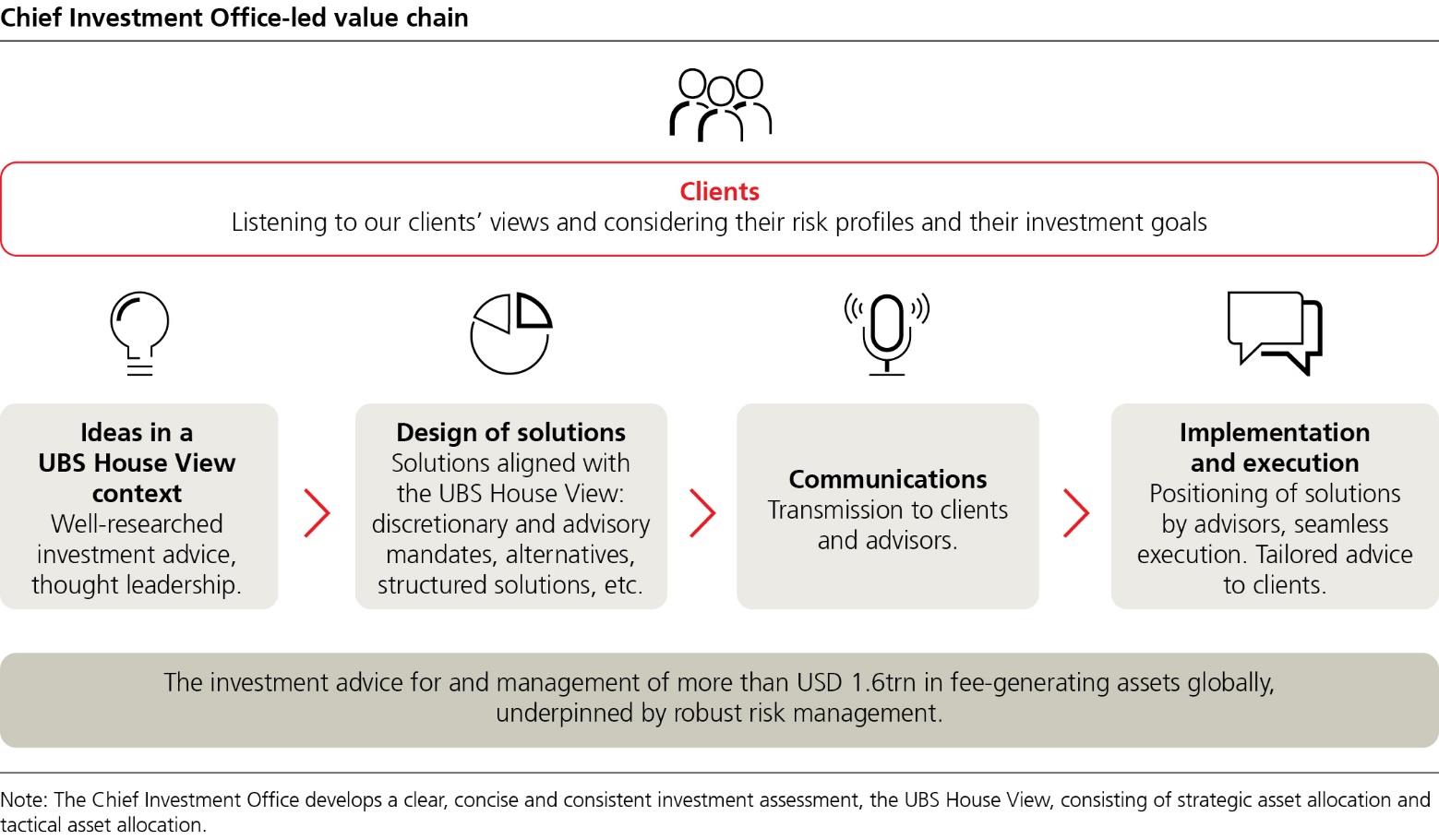
Annual Report 2023 |
Our strategy, business model and environment
| Our businesses
23
In Asia Pacific and Switzerland, the
Direct Investment Insights
trade directly based on CIO insights via their smartphones
and other digital devices.
Advice Compass
enables advisors to
conveniently identify
the most
relevant ideas
and solutions
for clients
during one-to-one
meetings. It
should be
noted
that the aforementioned products relate to the UBS AG
sub-group only.
To provide our clients with the
full breadth of investment management
products and solutions, our Global Lending
Unit
offers
extensive
mortgage,
securities-based
and
structured
lending
expertise,
catering
to
sophisticated
client
lending
needs.
›
Refer to the UBS Group Sustainability Report 2023,
available under “Annual reporting” at
ubs.com/investors
, for more
information about sustainability matters
Our newly established Global Wealth Management Strategic Clients unit aims to deliver the best advice and guidance to
our strategic client segments,
including business owners, female
clients, the next generation of
wealthy clients, athletes
and entertainers,
and multi-cultural investors. To
this end, we have developed
a dedicated approach and
resources with
specialized teams supporting our clients in achieving their
goals.
We are
investing in
our operating
platforms and
tools to
better serve our
clients’ needs,
improve their
experience, enhance
overall
advisor
productivity
and
improve
our
operational
resilience.
We
aim
to
make
our
services
faster
and
more
responsive and offer more
convenience to our clients.
For example, our Global
Wealth Management clients have invested
more than USD 9bn in
UBS My Way
, our discretionary mandate solution that enables clients to
customize their portfolio
themselves via the
UBS mobile banking
app. Additionally, we
continue to broaden
our offering across
asset classes and
themes,
collaborating
with
best-in-class
managers
across
the
most
relevant
strategies.
We
are
making
continuous
improvements to our direct-to-client digital offerings and have rolled out innovative
new solutions, such as
UBS My Way
on mobile
, a next-generation
discretionary mandate
solution that now
enables clients to
tailor their investments
within
their risk profile to their individual preferences via their mobile device
s.
We
also
closely
collaborate
across
business
divisions
to
deliver
our
best
capabilities
to
clients.
Joint
efforts
with
the
Investment Bank, Asset Management and selected external partners enable us to offer
clients broad access to financing,
global capital
markets
and
bespoke
portfolio
solutions.
For example,
in
the
US market,
the
SMA initiative
with
Asset
Management continues to gain momentum, with USD
158bn in assets under management.
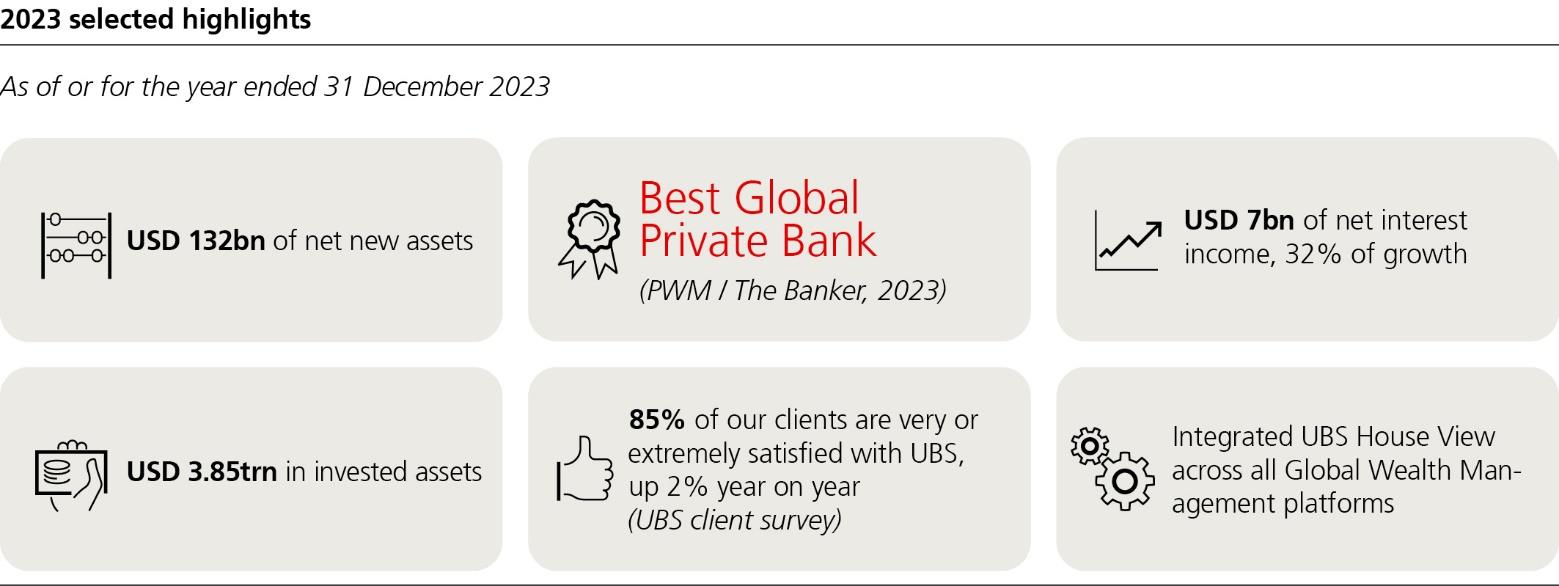
Annual Report 2023 |
Our strategy, business model and environment
| Our businesses
24
Competition
Our main competitors fall
into two categories: competitors
with a strong
position in the Americas
but more limited global
footprints, such as Morgan Stanley,
JPMorgan Chase and Bank of America; and
competitors with international footprints
but with a
smaller presence than UBS in
the US, such as
Julius Baer,
BNP Paribas and HSBC.
We also compete with
fintech
firms
in
some
regions
and
products.
We
have
strong
positions
in the
largest
region
(the
US) and
the
fastest-growing
regions (Asia
Pacific and the
Middle East).
The size
of our global
franchise, bespoke cross-divisional
solutions and
premium
brand and reputation set us apart and would be difficult
to replicate.
1
Personal & Corporate Banking
As the
leading
bank
in
Switzerland,
we
provide
a
comprehensive
range
of
financial
products
and
services
to
private,
corporate and institutional clients. Personal & Corporate Banking is the core of our bank in
Switzerland,
the only country
where we
operate in all
of our
business areas.
We are
fully committed
to our
home market,
as our leading
position in
Switzerland is crucial in terms of
sustaining our global brand and the stability
of our profits. Drawing on a
broad network
of branches and highly qualified client advisors, complemented by modern digital banking
services and customer service
centers, we are able to serve more than
one-third of Swiss households and more
than 90% of large Swiss corporations.
Organizational changes
Following
the
acquisition
of
Credit
Suisse
Group AG
in
June
2023
and
based
on
a
thorough
strategic
review,
UBS
announced
on
31 August
2023
its
decision
to
fully
integrate
Credit
Suisse
(Schweiz) AG
with
UBS
Switzerland AG
through a merger of the two banks.
The legal merger of the two
entities is expected to be completed
in the third quarter
of 2024.
The Swiss Bank (Credit
Suisse) division is
being integrated into
Personal & Corporate
Banking, and the
newly combined
Swiss business is led
by the President UBS
Switzerland and President Personal
& Corporate Banking.
For the time being,
the Credit Suisse brand will remain in use in Switzerland and the Swiss Bank (Credit Suisse) division will continue to offer
comprehensive
advice
and
a
wide
range
of
financial
solutions
to
private,
corporate
and
institutional
clients
primarily
domiciled in Switzerland. The Swiss Bank (Credit Suisse)
private clients business franchise serves high net worth,
affluent,
retail and
small business
clients. In
addition, consumer
finance services
are provided
through the
BANK-now subsidiary
and credit card brands through our investment
in Swisscard AECS GmbH. The corporate and institutional
clients business
of
Swiss
Bank
(Credit
Suisse)
serves
large
corporate
clients,
small
and
medium-sized
enterprises,
institutional
clients,
financial institutions,
and commodities traders. Part
of the Swiss Bank (Credit Suisse)
private clients business is expected
to be shifted to Global Wealth Management as part of the integration
progress.

Annual Report 2023 |
Our strategy, business model and environment
| Our businesses
25
How we do business
We provide our personal banking clients with access to a comprehensive,
life-cycle-based offering. This includes a broad
range of basic
banking products,
from payments
to deposits,
cards and
convenient online
and mobile banking,
as well
as lending
(predominantly
mortgages),
investments and
retirement
planning
services.
In 2023,
UBS was
named
“Best
Bank in
Switzerland”
by
Euromoney
Global Wealth Management to provide
our clients with access to leading wealth management
services.
Our corporate and institutional clients benefit from our financing and investment solutions, in particular access to equity
and debt
capital
markets,
syndicated
and structured
credit, private
placements,
leasing, and
traditional
financing.
We
offer transaction
banking solutions
for payment
and cash
management services,
trade and
export finance,
and global
custody solutions for institutional clients.
Personal
&
Corporate
Banking
works
closely
with
the
Investment
Bank
to
offer
capital
market
and
foreign
exchange
products,
hedging
strategies,
and
trading
capabilities,
as
well
as
corporate
finance
advice.
In
cooperation
with
Asset
Management, we also provide fund and portfolio management
solutions.
In
2023,
we
continued
to
support
our
clients’
sustainability
ambitions.
In
the
corporate
client
segment,
we
further
expanded
our
client-centric
approach
and
focused
on
supporting
our
clients
by
advising
them
as
part
of
a
strategic
dialogue
and
launching
a
sustainability-linked
loan
for
multi-national
corporations.
We
also
took
positive
steps
in
providing transparency and sustainability insights to our private clients. With the launch of the carbon tracker in the UBS
key4
cards
and
through
UBS
TWINT,
helping
them
navigate
the
carbon
footprints
of
their
purchases
in
a
relatively
simple
manner.
›
Refer to the UBS Group Sustainability Report 2023, available
under “Annual reporting” at
ubs.com/investors
, for more
information about sustainability matters
We are
building stronger
relationships
with our
clients during
the life
cycle of
their property
ownership and
providing
services
along the
value
chain.
With
our
strategic
partner
Baloise,
we
offer
Houzy
,
a
leading homeowner
platform
in
Switzerland with a
nationwide network of
qualified craftsmen and
comprehensive services through
buying, renovation,
maintenance
and
sale
of
property.
Services
relating
to
property
transactions
and
promotion
financing
are
provided
through
our
partner,
Brixel
.
Our
exclusive
partnership
with
SMG
Swiss
Marketplace
Group
enables
us
to
extend
our
ecosystem network to Switzerland’s largest real estate portals,
such as Homegate and Immoscout24.
Our operations and our competitors
We operate
primarily in
our Swiss
home market,
where we
are organized
into 10
regions, covering distinct
Swiss economic
areas. We operate a multi-channel approach,
and we are constantly developing our digital and remote
channels.
In Personal Banking,
our main competitors
are the cantonal
banks, Raiffeisen,
PostFinance and
other regional and
local
Swiss banks; we also face competition from international neobanks and other national digital market participants. Areas
of competition are basic banking services, mortgages and
foreign exchange, as well as investment mandates and
funds.
In the
corporate and institutional
business,
the cantonal banks
and globally
active foreign banks
are our
main competitors.
We compete
in basic banking
services, cash
management, trade
and export
finance, asset
servicing, investment
advice
for institutional clients,
corporate finance
and lending, and
cash and
securities transactions
for banks. We
also support
the international business
activities of our
Swiss corporate
clients through local
hubs in New
York, Frankfurt, Singapore
and the Hong
Kong SAR in
competition with globally active
foreign banks. No
other Swiss bank
offers its corporate
clients
local banking capabilities abroad.
Annual Report 2023 |
Our strategy, business model and environment
| Our businesses
26
Asset Management
Asset
Management
is
a
global,
large-scale
and
diversified
asset
manager.
We
offer
investment
capabilities
and
styles
across
all
major
traditional
and
alternative
asset
classes,
as
well
as
advisory
support
to
institutions,
wholesale
intermediaries and our Global Wealth Management
clients.
Our
strategy
is focused
on
capitalizing
on
the
areas
where
we
have
a
leading
position
and
differentiated
capabilities
(including alternatives,
sustainability,
indexed customization,
separately managed
accounts
(SMAs) and
key markets
in
Asia Pacific) in order to further drive profitable growth, while
building on our strong business division partnerships across
the Group.
Organizational changes
The acquisition of the Credit Suisse Group
Following
UBS’s
acquisition
of
the
Credit
Suisse
Group
in
2023,
we
are
now
one
of
the
leading
Europe-based
asset
managers,
with total
invested assets of
USD 1.6trn. The
combination of our
highly complementary businesses
strengthens
our positioning
across
key asset
classes and
growth
markets,
with greater
scale in
customized indexing,
an enhanced
offering in alternative investments (including a leading credit
franchise) and an increased presence
in the US and Asia.
We are
bringing our two
organizations operationally together, with
a clear
goal to provide
our clients with
the full breadth
of our combined offering while ensuring a seamless transition
and exceptional service.
Other organizational changes
In October 2023, we completed the sale of our 51% stake in UBS Hana Asset Management Co., Ltd. to Hana Securities,
after that firm exercised
its buyout option. Hana Securities now owns 100% of UBS
Hana Asset Management Co., Ltd.
In addition,
we completed
the acquisition
of the
40% minority
interest in
our real
estate joint
venture with
Aventicum
and
now
own
100%
of
the
business.
In
December
2023,
we
announced
the
sale
of
our
Brazilian
real
estate
fund
management business
to Patria
Investments; the
transaction
is subject
to the
approval of
the investors
in the
relevant
funds and customary anti-trust approvals.
We also transferred the management
of our three funds in Mexico
to Catena
Activos Alternativos and, with this sale, exited the asset
management business in this market.
How we do business
We offer clients
a wide range of
investment products and services
across all major
traditional and alternative asset
classes,
in the form
of segregated,
pooled or advisory
mandates, as well
as registered
investment funds
in various jurisdictions.
Our capabilities include equities, fixed income, hedge funds (single-
and multi-manager), real estate and private markets,
and indexed and alternative beta strategies,
including exchange-traded funds (ETFs), as
well as sustainable- and impact-
investing products and solutions.
We also
draw on
the breadth
of our
capabilities to
offer asset
allocation and
currency investment
strategies across
the
risk–return spectrum, customized multi-asset solutions,
and advisory and fiduciary services.
We continue to develop our award-winning
1
solutions
across
equities,
fixed
income
and
commodities,
as
well
as
sustainability-focused
products.
Our
offering
also
includes a wide range of ETFs in Europe, Switzerland and
Asia.
In our
Real Estate
& Private
Markets
business, we
continue
to build
on our
global
scale, leading
core capabilities
and
highly differentiated sustainable-investing and specialized-thematic offering, including our Cold Storage,
Energy Storage
and
Life
Sciences
strategies.
We
also
continue
to
expand
our
leading
multi-manager
capabilities
across
real
estate,
infrastructure and private equity, including the development of new products to meet the growing demand from wealth
management
clients.
Sustainable and impact investing remain
key areas of interest for
our clients. In 2023, we further
expanded our offering
across asset classes and themes, including
new net-zero ambition products. We
launched our first sustainability-focused
fund of hedge funds strategy,
created in close collaboration with
Global Wealth Management.
We also partnered again
with Aon
to launch the
UBS Global
Emerging Markets Equity
Climate Transition Fund,
which tilts toward
emerging market
companies supporting the transition to a low-carbon economy,
while factoring in important social considerations.
Stewardship
is
a
fundamental
element
of
our
sustainability
strategy.
In
2023,
we
sharpened
our
five-year
climate
engagement
program’s
focus
and
also
aligned
our
voting
policy
to
our
evolved
climate
engagement
objectives.
In
addition, to
support our
increasing focus
on natural
capital, we
became a
founding member
of the
Nature Action 100
collaborative
engagement
initiative
and
joined
the
Principles
for
Responsible
Investment’s
Stewardship
Advisory
Committee for its initiative on nature.
›
Refer to the UBS Group Sustainability Report 2023,
available under “Annual reporting” at
ubs.com/investors
, for more
information about sustainability matters

Annual Report 2023 |
Our strategy, business model and environment
| Our businesses
27
We also continue to build on
our joint efforts with the other
business divisions, enabling our teams
to draw on the best
ideas,
solutions
and
capabilities
from
across
the
firm
in
order
to
deliver
high-quality
investment
performance
and
experiences
for
our
clients.
For
example,
in
2023
we
continued
to
expand
our
separately
managed
accounts
(SMA)
offering as part of
our joint initiative with
Global Wealth Management in
the US. In support
of this initiative, we
launched
the SMA Hub, a
new self-service portal
that enables financial
advisors to generate
custom client reports or
proposals in
only minutes.
Geographically, we are building on our extensive
and long-standing presence in the Asia Pacific
region, including China,
where we continue to capitalize on our on- and offshore
products and market presence, including our joint ventures.
To support
our growth,
we are
focused on
disciplined execution
of our
operational excellence
initiatives. This
includes
further
automation,
simplification,
process
optimization
and
offshoring
or
nearshoring
of
selected
activities,
complemented by continued enhancements to our platform and development of
our analytics and data capabilities. One
example
is
our
Portfolio
Engineering
&
Trading
initiative,
which
will
streamline
trading
and
portfolio
implementation
across our
active and
index capabilities
through an
integrated technology
architecture.
It will
harmonize processes
and
enable further scalability of customization across asset classes.
Our operations and our competitors
Our business division is organized into
five areas: Client Coverage; Investments; Real
Estate & Private Markets; Products;
and the
COO area.
We cover
the main
asset management
markets globally,
and have
a local
presence in
25 locations
across four
regions: the
Americas; Asia
Pacific; EMEA;
and Switzerland.
We have
nine main
hubs: Chicago;
the Hong
Kong SAR; London; New York; Shanghai; Singapore; Sydney;
Tokyo; and Zurich.
Our main
competitors are global
firms with wide-ranging
capabilities and distribution
channels, such as
AllianceBernstein,
Allianz
Asset
Management,
Amundi,
BlackRock,
DWS,
Franklin
Templeton,
Invesco,
J.P.
Morgan
Asset
Management,
Morgan Stanley Investment Management, Schroders, SSGA Funds Management
and T. Rowe Price, as well as firms with
a specific market or asset-class focus.
1
Annual Report 2023 |
Our strategy, business model and environment
| Our businesses
28
Investment Bank
The
Investment
Bank
provides
services
to institutional,
corporate
and wealth
management
clients, helping
them
raise
capital, invest
and manage
risks, while
targeting attractive
and sustainable
risk-adjusted
returns for
shareholders.
Our
traditional strengths are in equities, foreign exchange, research, advisory services and
capital markets, complemented by
a focused rates and credit platform. We use our data-driven research and technology capabilities to help clients adapt to
evolving market structures and changes in regulatory, technological,
economic and competitive landscapes.
Aiming to deliver market-leading
solutions by using our
intellectual capital and electronic platforms,
we work closely with
Global Wealth
Management,
Personal &
Corporate Banking
and Asset
Management
to bring
the best
of the
Group’s
capabilities to our clients. We do so with a disciplined
approach to balance sheet deployment and
costs.
Our priority is
providing high-quality execution
and seamless client
service, through an
integrated, solutions-led approach,
with disciplined growth in the advisory and execution businesses, while accelerating our digital transformation. In Global
Banking, we position ourselves as trusted advisors via our
client coverage and ability to provide access to the wider suite
of UBS’s capabilities. In Global
Markets, we enable clients to
buy, sell and finance
securities on capital markets worldwide
and to manage their risks and liquidity.
Organizational changes
The acquisition of the Credit Suisse Group
The acquisition of
the Credit Suisse Group represented an acceleration
of the Investment Bank’s
existing growth strategy,
reinforcing
and strengthening
our coverage
and presenting
a
powerful opportunity
to enhance
capabilities
and
client
relevance in key products and regions.
An ambitious
integration timeline
for the
Investment Bank
has been
set, and
significant progress
has been
made with
the creation of the newly established
Non-core and Legacy division, which has
started the process of divesting assets.
We
are working
at pace
to migrate
clients and
positions to
the UBS
platform and
have concluded
our workforce
plans for
the combined Investment Bank.
The Credit Suisse franchise helps us
to build a more sustainable market
share in a range of products and
markets.
It will
enhance our capabilities, core products and services and enable us to deliver these products
and services to an expanded
institutional
and
corporate
client
base.
The
Investment
Bank
will
be
better
positioned
to
serve
Global
Wealth
Management,
offering
differentiated
investment
banking
capabilities,
and further
enhance the
connectivity
with ultra
high net worth and Global Family & Institutional Wealth
clients.
The
combination
is
expected
to
drive
changes
in
our
future
revenue
footprint.
Our
increased
scale
will
enhance
our
competitive
positioning
within
each
region
and
product
set
and
rebalance
our
footprint.
The
Investment
Bank
has
historically been strong
in both
equities and
in the
Asia Pacific
region, while
having a
smaller footprint across
fixed income,
global banking, and the Americas.
The integration of the Investment Bank
(Credit Suisse) strengthens our presence in
the
Americas, particularly in global banking,
and represents an acceleration of our growth
strategy in the region.
In Global Markets,
we see the potential
to gain market share
in cash equities. We
will also aim to
capture market share
in global
equity derivatives,
with a
specific focus
on flow
derivatives, quantitative
investment strategies
and corporate
derivatives.
In Switzerland and EMEA,
the combination will reinforce our strong position in our domestic market.
Meanwhile, in Asia
Pacific, there is a
complementarity between UBS’s strength in China
and Australia and Credit Suisse’s
broader capabilities
across Southeast Asia.
Other organizational changes
In June 2023, Michael Ebert joined the
Investment Bank Management Forum as Head of Credit Suisse
for the Investment
Bank, as
well as
Head of
Americas for
the Investment
Bank. In
August 2023,
Marco
Valla
joined the
Investment Bank
Management Forum as Co-Head of Global Banking.
In October
2023, we
launched
our Strategic
Insights and
Advisory
team
in Global
Banking, our
content
and advisory
offering that brings
together the
expertise of the
UBS Strategic Insights
group and the
Credit Suisse Corporate
Insights
group.
In December 2023, we announced the formation of our Executive Client Group, which is aimed at advising our clients at
the C-suite level on strategic matters and is intended to drive a broad array of transactions to enhance the impact of our
Global Banking coverage teams.
Annual Report 2023 |
Our strategy, business model and environment
| Our businesses
29
How we do business
Our business division consists
of two areas: Global
Banking and Global Markets,
which are supported by
Investment Bank
Research. Our global coverage model utilizes our
international industry expertise and product capabilities to meet
clients’
emerging needs.
Our Global Banking business advises
clients on strategic business opportunities, such
as mergers, acquisitions and related
strategic matters, and helps them raise capital, in both
public and private markets, to fund their activities.
Our
Global
Markets
business
enables
clients
to
buy,
sell
and
finance
securities
on
capital
markets
worldwide
and
to
manage their risks and liquidity. We
distribute, trade, finance and clear
cash equities and equity-linked products,
as well
as
structuring,
originating
and
distributing
new
equity
and
equity-linked
issues.
From
origination
and
distribution
to
managing risk
and providing
liquidity in
foreign exchange,
rates, credit
and precious
metals, we
help clients
to realize
their financial
goals. We
provide flexible,
innovative and
bespoke access
to solutions,
from market
and insight
tools to
trading strategies and execution.
Our Investment
Bank Research
business continues
to publish
research based
on primary
data to
concentrate
on data-
driven outcomes and offers clients differentiated content about major financial markets and securities around the globe,
with analysts based
in more than
20 countries and
with coverage
of more than
3,400 stocks in 49
different countries
1
.
The Strategic Insights
team provides timely
and relevant
information and insights
to help clients
quickly make decisions
regarding their most important questions.
We seek to develop new
products and solutions consistent
with our capital-efficient business
model, typically related
to
new technologies or changing market standards.
The Investment
Bank
offers
our clients
global advice
and access
to the
world’s
primary, secondary
and private
capital
markets,
including
through
an
extensive
array
of
sustainability-focused
advice,
products,
research
and
events.
The
Investment
Bank
is
focused
on
meeting
clients’
needs,
including
those
with
respect
to
environmental,
social
and
governance
(ESG)
considerations
and
sustainable
finance,
helping
to
reshape
business
models
and
investment
opportunities and to develop sustainable finance products and
solutions.
In Global
Markets, we
develop products
and solutions
designed to
meet clients’
specific and
increasingly detailed
ESG
objectives. In carbon
emissions solutions, our
clients continued to
access solutions that are
linked to the
recently launched
UBS
Constant
Maturity
Commodity
Index
emissions
index,
as
well
as
those
that
are
available
via
our
execution
and
clearing capabilities for
carbon emissions futures.
We continued to
scale the number of
portfolio certificates linked
to a
range of sustainability and climate investment themes, despite
challenging market conditions throughout 2023.
UBS is a founding
member of Carbonplace,
a marketplace platform
that seeks to
build infrastructure to
scale voluntary
carbon markets, with
the aim of
enabling firms such
as UBS to
offer clients the
ability to buy,
sell, hold and
retire voluntary
carbon credits.
In
Global
Banking,
ESG
is
a
core
component
of
many
corporate
business
strategies
and
a
key
tool
in
achieving
sustainability in business and corporate operating
models. As pressure from regulators and
other key stakeholder groups,
such as
customers, investors
and employees,
is increasing,
so is
the need
for transformation.
The ESG
Advisory
group
provides the necessary lens helping UBS’s clients assess ESG
topics throughout the corporate life cycle.
UBS
arranged
USD 53.7bn
in
green,
social,
sustainability
and
sustainability-linked
themed
(GSSS)
bonds
through
102
deals
during
2023.
1
market share of nearly 50%.
1
We have also built a strong position in the ESG-labelled local debt market
in Brazil.
Our independent
ESG research
team collaborates with
UBS sector
analysts and
UBS Evidence
Lab
providing data-driven insights
into ESG-relevant questions. The
ESG research team
works to identify
touchpoints between
markets, society
and the
environment, and to
respond to
ESG issues as
they move
to the
center of
investors’ agendas.
UBS sector
lead analysts
authored a
variety of
our flagship
ESG Sector
Radar
reports, as
well as
a broad
range of
ESG
Company Radar
reports.
Our
ESG Company
Radar
level,
and
we
continued
to
see
a
very
positive
client
response
to
those
reports.
Other
types
of
ESG
content
include
thematic
and
cross-sectoral
collaborations,
ESG
Keys
number of regional perspectives from our expanded ESG team, which works out of
our offices in New York, London, the
Hong Kong SAR, Tokyo and Sydney.
›
Refer to the UBS Group Sustainability Report 2023, available
under “Annual reporting” at
ubs.com/investors
, for more
information about sustainability matters
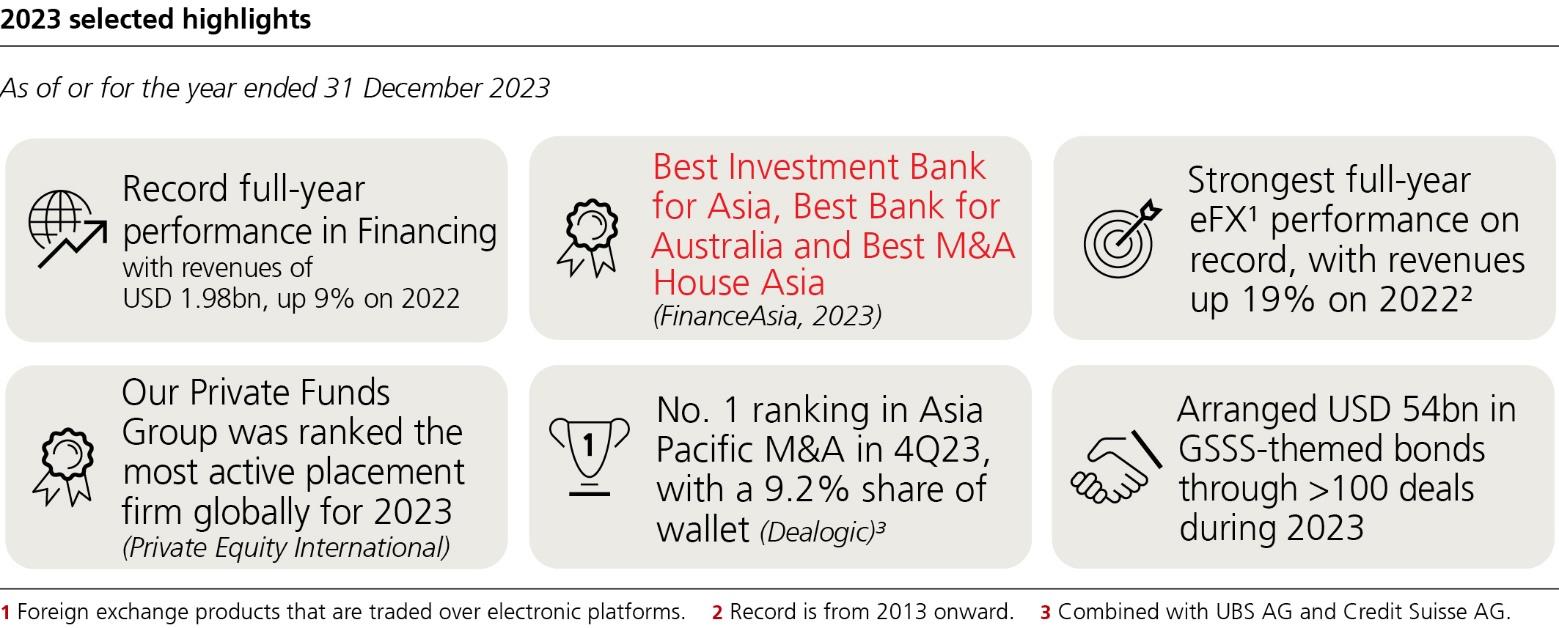
Annual Report 2023 |
Our strategy, business model and environment
| Our businesses
30
Our digital strategy harnesses technology to
provide access to sources of
unique, global liquidity, personalized advice and
differentiated content. The Investment Bank strives to be the
digital investment bank of the future, focused on delivering
innovation-led solutions, and
efficiencies for our
clients. As the
world around us changes,
our digital capabilities
aim to
harness emerging
technologies
and create
new products
and solutions,
which enable
our clients
to adapt
to evolving
market structures and achieve their investment goals.
Our
ambition
to
be
the
most
client-focused,
efficient
and
data-driven
investment
bank
is
being
realized
through
the
simplification of technology architecture, increased
speed and quality of
delivery and the attraction
of best-in-class talent.
As we look forward to the continued
evolution
of our digital capabilities, we will see increased adoption of
technologies,
such as generative
artificial intelligence, the consistent
re-use of platforms
and products, and the
continued drive to make
progress in our overall strategic imperatives, with regard
to a new, combined Investment Bank.
Joint efforts between
the Investment Bank
and the other
business divisions (for
example, our work
with Global
Wealth
Management
on
our
new
Global
Family
&
Institutional
Wealth
coverage)
and,
externally,
strategic
partnerships
(for
example,
UBS
BB
jointly
with
Banco
do
Brasil,
focused
on
Latin
America)
continue
to
be
key
strategic
priorities.
Partnerships with Global Wealth Management and Asset Management
enable us to provide clients with broad access to
financing, global
capital
markets and
portfolio solutions.
We expect
these initiatives
to continue
to lead
to growth
by
delivering global
products to
each region,
leveraging our
global connectivity
across borders
and sharing
and strengthening
our best client relationships.
Our operations and our competitors
Our two business areas,
Global Banking and Global
Markets, are organized globally by
product. Our business is
regionally
diversified, with a presence
in more than 30
countries. We cover the main
investment banking markets globally,
and have
major financial hubs across four regions: the Americas;
Asia Pacific; EMEA; and Switzerland.
Our global reach
gives attractive
options for growth.
In the Americas,
the largest investment
banking fee pool
globally,
we
continue
to
focus
on
increasing
market
share
in
our
core
Global Banking
and
Global
Markets
businesses.
In
Asia
Pacific,
opportunities
arise
mainly
from
expected
market
internationalization
and
growth
in
China,
where
we
plan
to
grow by
strengthening
our
presence,
both
onshore
and
offshore.
In EMEA,
we
plan
to leverage
our strong
base
and
brand recognition even further.
Competing firms operate in many
of our markets, but our strategy
differentiates us, with our focus on leadership
in the
areas where we have chosen to compete and a business model that leverages talent and technology rather than balance
sheet.
Our
main
competitors
are
the
major
global
investment
banks
(e.g.,
Morgan
Stanley
and
Goldman
Sachs)
and
corporate
investment
banks
(e.g.,
Bank
of
America,
Barclays,
Citigroup,
BNP
Paribas,
Deutsche
Bank
and
JPMorgan
Chase). We also compete with boutique investment bank
s
and fintech firms in certain regions and products.
1
Annual Report 2023 |
Our strategy, business model and environment
| Our businesses
31
Non-core and Legacy
In 2023,
we created
Non-core
and Legacy,
which includes
positions and
businesses not
aligned with
our strategy
and
policies. Those consist of the
assets and liabilities reported
as part of the former Capital
Release Unit (Credit Suisse)
and
certain assets
and liabilities
of the
former Investment
Bank
(Credit
Suisse),
Wealth
Management
(Credit
Suisse),
Swiss
Bank (Credit Suisse)
and Asset Management
(Credit Suisse) divisions,
as well as
of the former
Corporate Center (Credit
Suisse). Non-core
and Legacy
also includes
the remaining
assets and
liabilities of
UBS’s Non-core
and Legacy
Portfolio,
previously reported
in Group
Functions (now renamed
to Group
Items), and smaller
amounts of assets
and liabilities of
UBS’s business divisions that we have assessed as not strategic
in light of the acquisition of the Credit Suisse
Group.
At the
end of
the second
quarter of
2023, the
positions included
in Non-core
and Legacy
represented USD 83.8bn
of
risk-weighted assets (RWA) and USD 208.7bn of leverage ratio denominator (LRD). Since then, Non-core and Legacy has
made significant progress
against its capital
reduction goals
by reducing RWA
by USD 11.8bn,
or 14%, to
USD 72.0bn
and reducing the LRD by USD 71.6bn, or 34%, to USD 137.1bn
,
by the end of 2023.
Our key priorities and operations
We are
actively reduc
ing the
assets of
Non-core
and Legacy
in order
to reduce
operating costs
and financial
resource
consumption, and
to enable
us to
simplify infrastructure.
Incremental
costs or
losses may
arise in
connection with
the
reduction of such assets and liabilities.
Our key priorities are as follows.
–
Reduce RWA and LRD,
freeing up capital for the UBS Group. We aim to achieve a share of around 5% of Group RWA
by the end of
2026. Non-core and Legacy
will continue to actively
pursue acceleration of the
natural roll-off through
active unwinds when economically accretive.
–
Reduce
operating
costs
and
financial
resource
consumption
by
simplifying
and
decommissioning
infrastructure,
accelerate integration where accretive, and minimize the size of
the legal entity footprint.
–
Protect the client franchise by partnering with colleagues across the
business divisions.
Non-core
and
Legacy
includes
assets,
operating
expenses
and
funding
costs
related
to
the
following
Credit
Suisse
businesses: loans primarily related to
corporate bank and emerging markets, the
residual securitized products businesses,
the macro trading business including rates and
foreign exchange, the legacy life-finance business,
the equities portfolio,
including the remaining prime services businesses,
electronic trading, equity swaps, share back-lending
positions, legacy
structured renewables-linked positions and the
residual credit business.
Non-core and Legacy also
includes residual trades
from
businesses
exited
by
the
pre-integration
UBS
Investment
Bank,
mainly
in
2012.
The
portfolio
additionally
encompasses positions relating to legal matters arising from businesses
transferred to it at the time of its formation.
Group functions
Our Group functions are support and control functions that provide services to
the Group, focusing on effectiveness, risk
mitigation and efficiency.
How we are organized
Our Group
functions
include
the
following major
areas:
Group
Services
(which consists
of
the
Group
Operations
and
Technology
Office, Corporate Services, Compliance, Regulatory & Governance, Finance, Risk Control, Human Resources,
Communications &
Branding, Legal,
the Group
Integration Office,
Group Sustainability
and Impact, and
Chief Strategy
Office) and Group Treasury.
Group Services
The vast majority
of the support
and control functions
are fully aligned
or shared among
the business
divisions,
where they
have full management responsibility. By keeping the activities of the businesses
and support and control functions closely
aligned,
we improve
efficiency
and create
a working
environment
built on
accountability
and collaboration.
Virtually
all costs
incurred by
the support
and control
functions
are allocated
to the
business
divisions,
leaving
a residual
amount that
we refer
to as Group Items in our segment reporting in accordance with IFRS Accounting Standards. Certain
activities are retained
centrally, where
not directly
related to
the businesses,
such as
group hedging
and own
debt activities
in Group
Treasury and
certain
other
costs
that
are mainly
related
to deferred
tax assets
and
costs
relating
to our
legal
entity
transformation
program.
Group Treasury
Group Treasury
manages balance
sheet structural
risk (e.g.,
interest rate,
structural foreign
exchange and
collateral
risks),
as well
as the
risks associated
with our
liquidity, capital
and funding
portfolios. Group
Treasury serves
all five
business divisions, and its risk management is integrated into
the Group risk governance framework.
Organizational changes
As a result
of the acquisition of
the Credit Suisse Group,
Corporate Center (Credit Suisse),
including Treasury, has become
a part of Group
Items. In addition,
the former Non-core
and Legacy Portfolio
unit was transferred
to the new Non
-core
and Legacy business division.
Annual Report 2023 |
Our strategy, business model and environment
| Our environment
32
Our environment
Market environment
Global economic developments in 2023
1
The global economy was resilient in 2023, in
spite of the steep interest rate rises by
major central banks designed to curb
inflation from the multi-decade highs reached
in 2022.
Global growth slowed only slightly, to 3.2%, in 2023, down from 3.4% in 2022. This partly reflected the strength of the
US economy, where
growth withstood higher
interest rates, tightening
bank lending standards,
and mediocre real
income
growth. US GDP growth increased to 2.5% in 2023, up from 1.9% in 2022, as job security and relatively strong balance
sheets encouraged higher spending by middle-income
consumers. Economies in Europe also expanded
in 2023, though
at a slower pace. Growth in
the Eurozone slowed to 0.5%
in 2023, down from 3.4%
in 2022, as the European
Central
Bank (the ECB) repeatedly raised interest rates.
Growth in the Swiss economy slowed to
0.7% in 2023, down from 2.7%
in 2022. UK
GDP growth slowed to 0.1% in 2023,
down from 4.3% in 2022, as high inflation
and interest rate rises also
limited growth.
Growth in China
increased to 5.2%
in 2023, compared
with 3% in
2022, when its
economy was slowed
by pandemic
restrictions that were in place until late in that
year. However, cautious spending by domestic
consumers meant that the
rebound in
growth was
weaker than
had been
expected. Growth
in India
remained robust
at 7%
in 2023,
down only
slightly from 7.2% in 2022.
Inflation eased across developed economies, especially in the second half of 2023, as supply chains continued to recover
from COVID-19 disruptions,
energy prices were
lower than 2022
and central
bank interest
rate rises increased
the cost
of borrowing.
US consumer
price inflation
slowed to
an annual 3.4%
in December
2023, from
6.4% in January
2023.
Inflation decelerated
even more
markedly in
the Eurozone,
to 2.9%
year over
year in
December 2023,
compared with
8.5% in
January 2023. This
trend enabled the
Federal Reserve and
the ECB
to signal
late in
2023 that
monetary tightening
had probably come to an end.
The MSCI All Country World Index
returned a 22.2% gain in 2023,
with close to half of that
gain coming in the final
two
months of
the year.
The S&P
500 rose
by 26.3%,
lifted by
optimism that
innovations in
artificial intelligence
will boost
profits and hopes that
the Federal Reserve
will cut rates swiftly in
response to falling inflation.
The FANG+ index,
which
tracks the 10 most traded US tech stocks, increased 96%
over the year. The MSCI Japan was the best-performing
major
market in
local currency
terms in 2023,
with a
return of
28.6%, its highest
in a
decade. In
Europe, the MSCI
EMU returned
18.8%. Although the Swiss and
UK markets lagged behind global
stocks, both ended the year
in positive territory,
with
returns of 5.3% and 7.7%, respectively. The weakest performance by a major
market came from the MSCI China, which
lost 10.7% amid disappointment
over the pace
of the economic recovery
from pandemic restrictions
and more limited-
than-expected stimulus.
Economic and market outlook for 2024
1
Our baseline
scenario for
2024 is
for a
soft landing
in
the US
and subdued
but positive
growth in
the Eurozone.
We
expect growth in China to enter a new normal of lower,
but potentially higher-quality, growth.
We believe inflation
will continue falling
toward central bank
targets, and, as
a result, we
believe policymakers will
feel
confident enough to lower
interest rates starting
around the middle
of 2024. We expect
cuts from the Federal
Reserve,
the ECB, the
Swiss National
Bank and the
Bank of England.
In contrast, with
Japanese deflation
coming to an
end, we
expect the Bank of Japan to raise rates into positive territory
for the first time since late 2015.
With regard
to growth,
we expect
the US
to slow to
a sustainable
long-term rate
of growth, due
to declining
housing
affordability and
the withdrawal
of some
government support
measures that
helped households
during the
COVID-19
pandemic. However, middle-income
consumers still appear
to have spending power,
as well as relatively
strong balance
sheets, and
we expect
demand for
labor to
remain resilient.
Overall, we
expect US
GDP growth
to remain
positive, at
around
1.1%
in
2024.
We
expect
growth
to
be
weak
in the
Eurozone,
at
0.6%,
due
to
the
lagged
effect
of higher
interest rates.
We also
expect
UK GDP
to increase
by 0.6%
in 2024,
while GDP
growth in
Switzerland
is expected
to
increase to 1.2% in 2024.
Geopolitical events
and elections
also have
the potential
to play an
outsized role
in 2024.
The US
presidential election,
the ongoing Israel–Hamas and Russia–Ukraine wars,
and the tension between the US and China could all affect markets
globally. In addition, more than four billion people in more than 40 countries are set to
go to the polls in 2024, including
in the US, India and, potentially,
the UK.
1
Based on sources: Haver Analytics, CEIC, National Statistic and UBS.
Annual Report 2023 |
Our strategy, business model and environment
| Our environment
33
Industry trends
Although
our
industry
has
been
significantly
affected
by
various
regulatory
developments
in
the
past
decade,
technological
transformation
and
changing
client
expectations
are
further
emerging
as
key
drivers
of
change
today,
increasingly affecting the
competitive landscape, as well
as our products, service
models and operations. In parallel,
our
industry
continues
to
be
materially
driven
by
changes
in
financial
markets
and
macroeconomic
and
geopolitical
conditions.
Digitalization
Digitalization continues to accelerate in our industry. Clients demand
a seamless and personalized technology experience
that involves both innovative and sustainable solutions. The rising rate of digital
adoption can be seen across all regional,
demographic
and
client
segments.
The
ascent
of
artificial
intelligence
(AI)
has
created
an
opportunity
to
significantly
improve both employee efficiency and client service. Financial
institutions are finding ways to accelerate
the adoption of
AI
in
a
risk-
and
regulatory-compliant
manner
and
with
ethical
considerations
in
place.
As
a
result,
the
shift
from
digitalizing
and
automating
existing
processes
to
digital-as-default
solutions
is
well
underway,
while
also
taking
into
consideration human interaction, a component that continues to
be an important competitive factor.
Keeping pace
with
emerging
technologies
is key;
themes
such
as
generative
AI have
progressed
significantly
and
are
expected to continue growing at pace. Generative
AI offers the potential to democratize the
use of AI well beyond data
scientists, broadening
the scope
for its
application and
its associated
benefits. As
the technology
evolves, so
does the
associated
risk
landscape,
but
the
focus
remains
on
safeguarding
our clients
and their
data,
with the
evolution
of
AI
governance as an area of strategic importance.
Digital communication, with clients
and employees alike, has
established new remote ways
of working, enabling
financial
services providers
to attract
an even
wider array
of talent than
before. The
digitalization of the
financial services
sector
has led to
a structural
shift in the
workforce: more
and better
engineers are required
to keep banks
at the forefront
of
technology.
Continuous
investment
in
technology
is
driving
automation
and
simplification
of
labor-intensive
processes,
improving
banks’ operational efficiency, and
freeing up resources
to focus on
client needs. Decision-making is
becoming increasingly
data-driven, with advanced analytics and AI enabling banks to address client needs in an even
more targeted manner. In
a consistently connected, open, and location-independent financial services ecosystem, the focus lies on adopting open-
source technology, including cloud-native and modular architecture,
to drive innovation and open exchange.
An open-finance environment combined with a shift in business models from in-person to digital channels bears the risk
of increased digital vulnerability. Clients and other stakeholders expect ethical, responsible and secure data management
practices. This makes
the protection of
the firm’s data
and the optimization
of its cybersecurity
capabilities a continued
priority and focus.
Distributed ledger technology
applications, including digital
cash solutions, are gradually
being adopted by the
banking
industry. Decentralized
finance solutions
are expected
to mature
over the
coming years
and may
reshape our
industry.
They provide opportunities to overcome friction within the existing
financial system, increase banking efficiency, broaden
access to underserved
communities and make
previously unviable products
or services available
to the financial
services
sector.
They
also
further
enable
early-stage
concepts,
such
as
Web
3.0
and
the
metaverse,
which
could
lead
to
an
enhanced digital user experience.
Sustainability
The continued decarbonization of the global economy will require governments, regulators, all industries
and consumers
to move
in the
same direction.
A series
of recent
legislative acts,
including the
rollout of
the Inflation
Reduction Act
in
the US
and the
EU’s Green
Deal Industrial
Plan, along
with rising
regulatory requirements,
encourage investment
into
sustainable solutions,
including infrastructure.
Meanwhile, policymakers
and regulators
increasingly require
corporations to
embed and
disclose environmental,
social
and
governance
considerations.
For
example,
the
EU’s
Corporate
Sustainability
Reporting
Directive,
which
came
into
force in 2023, is intended to provide greater transparency
and reliability of information to investors.
During 2023, flows into
sustainable funds remained
modestly positive,
while traditional funds
faced outflows impacted
by
the
equity
and
bond
market
volatility
and
worsening
geopolitical
tensions.
1
expanded their
sustainable investment
allocations into
alternative asset
classes, including
hedge funds,
real estate
and
infrastructure. Following the subdued
issuances in 2022,
green, social, sustainability
and sustainability-linked (GSSS) bond
supply rebounded in 2023.
Our view is that
the long-term growth
trajectory for sustainable
finance plays to
our strengths, as
we continue to
build
on our offering and develop the innovative products and
solutions that our institutional and private clients need both to
manage the risks and capture the opportunities
presented by the transition to a low-carbon
economy.
›
Refer to the UBS Group Sustainability Report 2023,
available under “Annual reporting” at
ubs.com/investors
, for more
information about sustainability matters
Annual Report 2023 |
Our strategy, business model and environment
| Our environment
34
Client expectations
As technology progresses, clients more rapidly
redefine the way they live,
work and interact with others.
This is reshaping
clients’ expectations
toward financial
services firms, as
their reference
points are increasingly
influenced by
experiences
with companies
outside the
sector, where
technology-supported and
data-driven solutions
are progressively
enabling a
more personalized,
relevant, on-time and
seamless client experience.
These services
often focus
on convenience,
flexibility,
transparency
and
personalization,
and
drive
toward
holistically
addressing
clients’
needs
and
facilitating
community
building. Therefore, our industry needs to evolve, as clients
measure us against new standards.
While the
industry’s overall
focus still
remains on
digital-led solutions,
recent geopolitical,
macroeconomic and
societal
shifts have highlighted values such as security,
trust, stability and a credible
plan toward a sustainable future,
leading to
an
increased
demand
in
investment,
financing
and
advisory
products
and
services
that
fit
clients’
own
sustainability
preferences and ambitions.
Consolidation
Many regions and businesses in the financial services sector are still highly fragmented. We expect further consolidation,
with the key drivers being ongoing margin pressure, capital constraints (e.g., due to pressure
on asset prices in a higher-
interest-rate environment),
a push
for cost efficiencies
and increasing
scale advantages
resulting from
fixed technology
costs and
regulatory requirements. Many stakeholders
in the
financial services
sector continue to
seek increasing exposure
and access to
regions with attractive growth
profiles, such as
Asia and
other emerging markets, through
local acquisitions
or partnerships, as well as acquiring new capabilities
addressing changes in market dynamics and overall client demands.
The
increased
focus on
core
capabilities
and geographical
footprint, as
well as
the
ongoing
simplification
of business
models to reduce operational
and compliance risks, is likely to
drive further disposals of non-core
businesses and assets.
While banks already
face increasing challenges from
digitalization needs and
intensified competition, potential
tightening
in macroeconomic and geopolitical conditions across
major economies may create further pressure.
New competitors
Our competitive
environment
is evolving.
In addition
to traditional
competitors in
the asset-gathering
businesses, new
entrants are
targeting selected
parts of
the value
chain. We
have recently
observed a
growing supply
of private
credit
from private
debt funds,
facilitating an
industry shift
in lending
volumes for
high-yield lending
products. However,
we
have not yet seen a fundamental unbundling of the value chain and client relationships, which
might ultimately result in
the further
disintermediation of
banks by
new competitors.
Over the
long term,
we believe
large platform
companies
entering the financial
services sector could pose
a larger competitive threat, given
their strong client franchises
and access
to client
data, if
they decide
to broaden
the scope
of their
services. While
fintech firms
continue to
gain momentum,
recent
macroeconomic
developments
have
slowed
this
trend,
as
funding
appetite
and
valuations
have
trended
downward. Although we expect
the industry to
recover in the future,
we do not
expect a material disruption
to our asset-
gathering
businesses.
As
fintech
firms
mature,
their
success
will
inevitably
depend
on
their
ability
to
navigate
our
regulatory
landscape,
build
customer trust
and maintain
innovation.
The trend
for
forging partnerships
between
new
entrants
and
incumbent
banks
will
therefore
continue,
as
technology
and
innovation
help
banks
overcome
new
challenges.
Wealth development
2
General overview of wealth development
2
As of
the end
of 2022,
global financial
wealth is
estimated at
USD 255trn and
is expected
to continue
to grow.
After
more
than
a
decade
of
steady
expansion,
the
growth
of
global
financial
wealth
slowed
for
the
first
time
in
2022,
decreasing
to
USD 255trn,
a
3.5%
decrease
compared
with
2021.
The
decrease
was
mainly
driven
by
various
macroeconomic and geopolitical
factors. However,
this decrease is
expected to be
temporary,
and wealth development
is projected to continue in an upward trajectory
in the coming years.
Challenges
such
as
persistent
inflation,
the
resulting
rise
in
interest
rates
(which
contributed
to
lower
equity
market
performance)
and
a
weaker-than-expected
recovery
in
China,
as
well
as
geopolitical
tensions
and
armed
conflicts,
persisted throughout 2023.
However, global financial
wealth is expected
to continue growing
at an average
of 5% per
year until 2027.
Almost half
of the
world’s
financial
wealth was
concentrated
in the
Americas (48%),
followed
by Asia
Pacific
(28%),
Europe (21%) and the Middle East and Africa (3%).
Looking at our invested assets,
almost half of those were concentrated
in the Americas (49%), while the
remaining half
was
almost
equally
distributed
between
Asia Pacific,
Europe
and the
Middle
East
and
Africa
(approximately
17%
per
region).
Annual Report 2023 |
Our strategy, business model and environment
| Our environment
35
Wealth segment view
3
At
the
beginning
of
2023,
wealth
was
still
highly
concentrated.
Approximately
one-third
of
global
high
net
worth
individual
(HNWI)
wealth
was
controlled
by
1%
of
the
HNWI
population
(those
with
wealth
in
excess
of
USD 30m).
Around
a
quarter
of global
HNWI
wealth
was
held
by
9% of
the
HNWI
population
(those
with wealth
ranging
from
USD 5m to
USD 30m), while
the remainder
of the
HNWI wealth
was held by
90% of
the HNWI population,
i.e.,
those
with wealth between USD 1m and USD 5m.
Specifically, when
looking at
the billionaire
wealth segment
,
wealth recovered
from its
post-pandemic fall,
growing by
9% in nominal terms, while the billionaire population rose
by 7% globally.
4
Wealth transfer
5
Between 2020 and 2030, more
than USD 18trn
of collective wealth is expected
to be transferred globally
by individuals
with USD 5m or more in net worth to
their next-in-line heirs or spouses.
6
the largest expected wealth transfers, with the US alone
responsible for approximately
60% of all transfers.
When looking at
the billionaire
wealth segment,
based on the
findings of
UBS’s latest
Billionaire Ambitions
Report
, for
the first time in 10 years
new billionaires in the 12 months
to April 2023 accumulated more
wealth through inheritance
than entrepreneurship. This
is expected to increase
during the next
20 to 30 years,
as more than 1,000
billionaires pass
an estimated USD 5.2trn to their heirs. This is of great significance,
as this new generation of billionaires has fresh views
about business, investments
and philanthropy. Many are redirecting the
large pools of private wealth they control
to new
business opportunities, and possibly away from their families’
businesses.
4
While this wealth transfer poses a challenge for wealth managers to retain current assets, it also creates opportunities to
capture new assets
from competitors,
as well as to
start building relationships
with the next
generation and to
cater to
their
evolving
needs.
UBS
provides
clients
with
tailored
services
and
solutions
depending
on
client
profiles
and
jurisdictions, while facilitating succession planning, a highly significant
and challenging topic for many clients.
7
Female investors
Today
,
women are creat
ing wealth faster than
ever before and
doing so at a
faster pace than men,
due to factors such
as shifting global wealth
distribution, cultural attitudes, intergenerational wealth transfers and
a rise in businesses owned
by women.
This trend will likely gain further momentum in the years to come. In 2022,
12% of all billionaires worldwide
were women, worth a total of USD
1.56trn, an increase of 2% compared
with the prior year.
3
UBS has
created
a dedicated
approach tailored
to female
investors, adapting
its offering
to the
specific needs
of each
client. UBS
was recently
highly commended
in the
Best
Private
Bank for
Wealthy
Women category
at the
PWM /
The
Banker 2023 awards.
Entrepreneurs
With an expected compounded annual growth rate of
6% between 2020 and 2025, entrepreneurs represent the largest
and fastest-growing contributors
to the global
wealth management revenue pool and
are expected to account
for almost
one-third of total wealth management revenues
by 2025.
8
We are addressing the opportunities entrepreneurs
present by leveraging our global footprint and capabilities to address
their evolving needs at every stage of the
business life cycle. Additionally, we have
created the Industry Leader Network,
an exclusive
peer-to-peer
entrepreneur
network
that
offers
opportunities
for
connecting
through
content-rich
events,
through a dedicated digital platform and through regular
information exchanges.
Long-term investment trends resilient in the face of market uncertainty
2023 saw turbulence in the global financial markets, as a combination of varying expectations about the level of interest
rates, inflation, and
geopolitical tensions
caused equity and
fixed income performance
to fluctuate
several times across
the course
of the
year.
There was
increased
investor appetite
for fixed
income, accompanied
by outflows
from
equity
funds.
Inflation
has
decreased
across
most
major
markets
globally,
and
while
hopes
of
a
softer
landing
have
risen,
inflation
remains above target, including in the US. This continues
to be a challenge across Europe,
given continued low growth.
In our view, despite the
uncertainty, the opportunity
has significantly improved for
investors looking to build
diversified,
risk-aware portfolios, and
the long-term trend
toward shifts into
illiquid alternatives that
can deliver compelling
longer-
term,
risk-adjusted
returns
and
into
low-cost,
efficient
passive
strategies
across
liquid
markets
has
not
changed.
The
breadth of our investment expertise
and capabilities enables us to
find the right solutions for
clients as the environment
evolves.
1
2
3
greater than USD 1m, excluding primary residence, collectibles, consumables
and consumer durables.
4
5
6
7
8
Annual Report 2023 |
Our strategy, business model and environment
| How we create value for our stakeholders
36
How we create value for our stakeholders
Clients
Our clients are the heart of our business. We are committed to building and sustaining long-term relationships
based on
mutual
respect,
trust
and
integrity.
Understanding
our
clients’
needs
and
expectations
enables
us
to
best
serve
their
interests and to create value for them.
A combined firm with expanded reach and capabilities for
clients
With
the
acquisition
of
the
Credit
Suisse
Group
in
2023,
our
client
offering,
expertise
and
geographical
reach
have
expanded significantly.
The
wealth
management
businesses
of
UBS AG
and
Credit
Suisse AG
have
largely
complementary
footprints
across
locations
and
client
segments,
that
support
one
of
the
core
pillars
of
our
client
value
proposition
in
Global
Wealth
Management:
the ability to serve clients regardless
of where they are and
what they need. Following the acquisition,
all
of our Global Wealth Management
clients now have access to
the
UBS House View
are
continuing
to
align
our
wealth
management
product
and solution
offerings,
helping
clients
to
grow,
protect
and
transfer their wealth.
We are the
leading bank In
Switzerland,
leveraging the strength
of the newly
combined Swiss
business to broaden
our
services and to promote innovation
to our clients. The legal
merger of two entities,
Credit Suisse (Schweiz) AG and
UBS
Switzerland AG, is
expected to
be completed
in the
third quarter
of 2024,
with the
Swiss Bank
(Credit Suisse)
division
being integrated into Personal
& Corporate Banking. We
are taking on the
integration with the utmost
care and intend
to spend
the time
needed to
achieve the
best possible
outcome for
our clients,
our employees
and the
Swiss financial
center.
Following
the
acquisition
of
the
Credit
Suisse
Group,
we
are
bringing
together
our
highly
complementary
asset
management businesses
and enhancing
the value
that we
provide to
clients through
expanded capabilities
across key
asset classes and
growth markets. This includes
greater scale in
customized indexing, an enhanced
offering in alternatives
including a leading credit franchise, and an increased presence
in the US and Asia.
The acquisition of
the Credit Suisse Group
strengthens the Investment Bank’s coverage.
It deepens our
capabilities in core
products and services, enabling us to deliver services to a broader institutional-
and corporate-client base, while
bringing
us critical mass in key
markets. The Investment Bank will
also be better positioned to
serve Global Wealth Management
clients,
offering
differentiated
investment
banking
capabilities
and
further
enhancing
connectivity
with
ultra
high
net
worth and Global Family & Institutional Wealth clients.
Engaging with our clients
Our clients’ needs and their preferred communication
channels continually evolve. Our objective is
to engage with clients
in
the
ways
most
convenient
for
them.
We
use
a
variety
of
channels
to
engage
with
clients,
including
regular
client
relationship and service meetings, as
well as various corporate roadshows
and dedicated events, and we
have established
a mix of hybrid and in-person events.
Global Wealth Management interacted with clients via various settings in 2023, from
personalized private briefings with
subject matter
experts to
segment-specific virtual
and in-person
events and
large-scale initiatives.
We utilize
marketing
campaigns,
events,
advertising,
publications
and
digital-only
solutions to
help
drive
greater
awareness
of UBS
among
prospective
clients
and reinforce
trust-based
relationships
between
advisors and
clients.
We
proactively
engaged
with
clients to reassure them about the acquisition and highlighted the benefits of the combined organization. This was done
through individual meetings and calls, and,
as the acquisition progressed, we were able to open up some of our flagship
events and conferences to clients of the combined firm.
Personal
&
Corporate
Banking holds
regular
client
events
(leveraging
a
number
of
formats,
such
as webcasts
and
in-
person, virtual
or hybrid
events), covering a
wide range
of topics. In
2023, we
enhanced our digital
engagement strategies
to reach more clients and strengthen
relationships with existing ones. We utilize various
channels, including social media,
online displays, and search engines.
In Asset Management, we had a consistent program of client events and engagement activities throughout 2023. These
included our flagship
conferences, such
as the annual
UBS Reserve Management
Seminar
, and we
held our first
global
in-person outlook roadshow in multiple locations across the world. Alongside this, our teams continued the high level of
interaction with clients globally, supported by digital tools and our publication of
macro insights. We also hosted a broad
range
of
hybrid
events,
including
our
investment
series,
to
help
our
clients
better
understand
market
challenges
and
opportunities, and we continued to engage with clients through
our social media and online channels.
Annual Report 2023 |
Our strategy, business model and environment
| How we create value for our stakeholders
37
The Investment Bank hosted more
than 180 investor conferences
and educational seminars globally in 2023,
covering a
broad range
of macro,
sector,
regional
and
regulatory
topics.
Almost
all
of those
conferences
were
held virtually.
We
leverage
our
intellectual
capital
and
relationships
and
use
our
execution
capabilities,
differentiated
research
content,
bespoke solutions, client franchise model and global platform to expand coverage across a broad set of clients.
UBS Neo
Question Bank
UBS Live
Desk
,
UBS Neo
UBS Analytical
Research
Community
(UBS-ARC)
is
a
proprietary,
interconnected
research
network
of
industry
leaders,
subject matter specialists, executives, academics and analysts
in the Americas region.
How we measure client satisfaction
We continue to
use multiple techniques
to regularly assess
our achievements
and the satisfaction
of our clients.
Global
Wealth Management is increasingly using technology and analytics capabilities to collect and
respond to client feedback.
Personal & Corporate Banking
1
most private and corporate
-client segments annually
since 2015. In Asset
Management, we have
an integrated process
to record
and manage
client feedback
through our
client relationship
management
tool, and
we also
conduct regular
surveys.
The
Investment
Bank
closely
monitors
client
satisfaction
via
individual
product
coverage
points.
Direct
client
feedback
is actively
captured
and tracked
in our
systems.
The Investment
Bank also
closely monitors
external surveys,
which provide feedback across a range of investment banking services.
1
Refers to UBS AG Personal & Corporate Banking.
Investors
We aim to create
sustainable, long-term value for our investors
by executing our strategy,
growth and integration plans
while maintaining risk and cost discipline, and delivering
attractive shareholder returns through the cycle.
Investor base
Our investor
base is
well diversified.
A substantial
proportion of
our institutional
shareholders are
based in
the US,
the
UK and Switzerland.
›
Refer to the “Corporate governance” section
of this report for more information about disclosed shareholdings
Alignment of interests
We aim to align the
interests of our employees with those
of our equity and
debt investors, and this approach is
reflected
in our compensation philosophy and practices.
›
Refer to “Our compensation philosophy” in the
“Compensation” section of this report for more information
We are focused on driving sustainable long-term growth
while maintaining risk and cost discipline
Our objective is
generating value
for all of
our stakeholders
by driving sustainable
growth across the
cycle. In the
short
term, our main priorities are the integration of Credit Suisse, positioning the firm for efficient long-term growth by right-
sizing the
cost base,
optimizing the
balance sheet
and investing
strategically in
order to
achieve our
long-term growth
ambitions. By
the end
of 2026
and beyond,
this will
enable us
to deliver
significant value
for all
our stakeholders
and
remain a
reliable
economic
partner,
employer
and
taxpayer
in the
communities
where
we
operate.
Moreover,
we
are
aiming to maximize our impact and that of our clients to create
long-term sustainable value.
Our primary measurement of the Group’s financial
performance is return on common equity
tier 1 (CET1), as regulatory
capital is our binding constraint and drives our ability to
return capital to shareholders.
›
Refer to the “Targets, capital guidance and ambitions” section of this report for
more information
›
Refer to “Our focus on sustainability and climate”
in this section for more information about our environmental,
social and
governance aspirations
Balancing resilience, growth and attractive capital returns
Capital strength is a key pillar of our strategy, and we are committed to maintaining a
balance sheet for all seasons. This
includes our
strong capitalization,
in line
with our
capital guidance
of maintaining
a CET1
capital ratio
of around
14%
and a CET1 leverage ratio of greater than 4.0%.
We are committed
to investing
for sustainable
growth. Our balance
sheet provides
ample capacity
for return-accretive,
sustainable growth. We
plan to fund
this growth organically
from the capital
released from the
unwinding of the
Non-
core and Legacy business division, as well as capital optimization
measures in our core divisions.
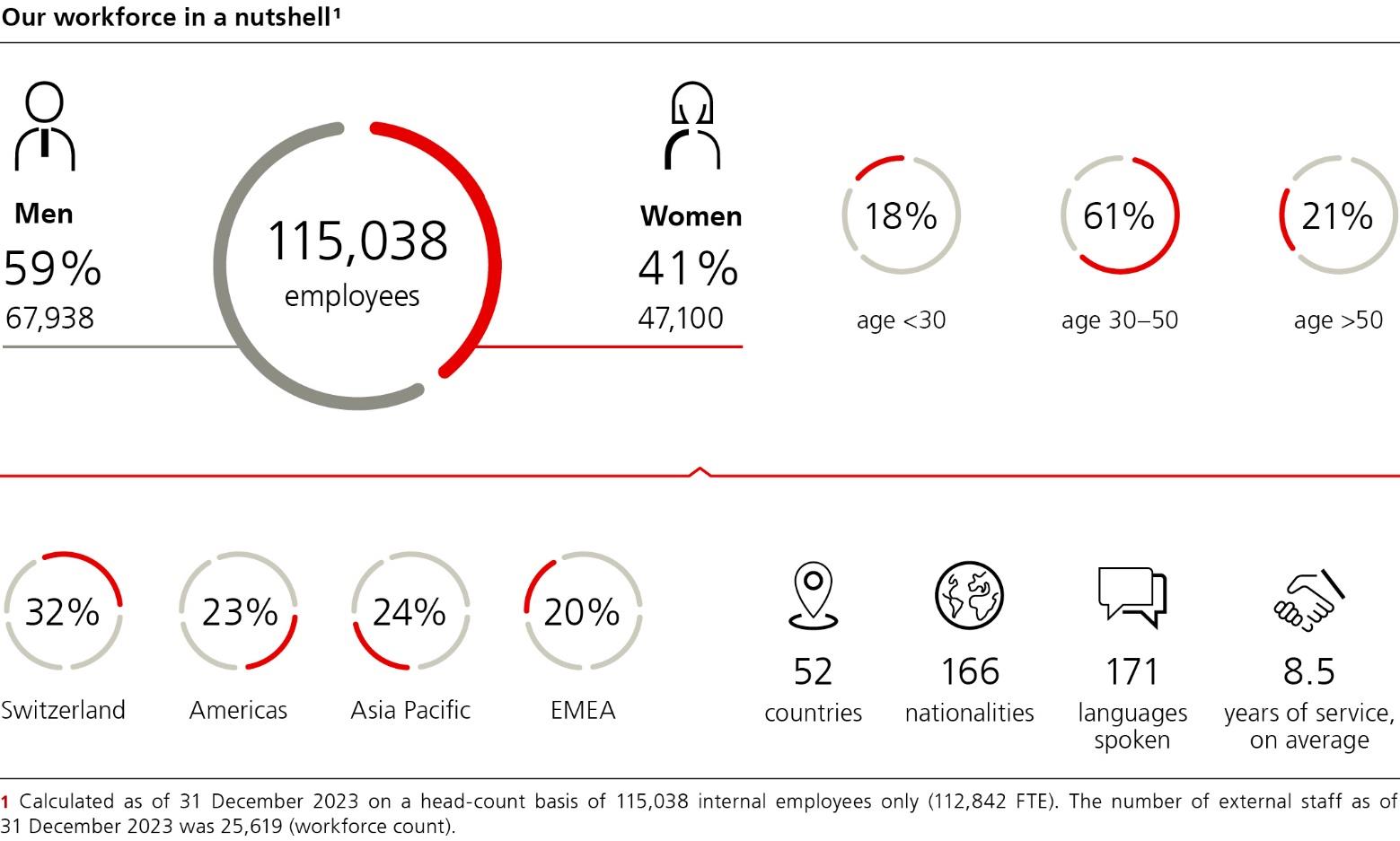
Annual Report 2023 |
Our strategy, business model and environment
| How we create value for our stakeholders
38
We intend to distribute excess capital to shareholders, in the form of a progressive
dividend and share buybacks. For the
2023 financial year, the
Board of Directors plans
to propose a
dividend to UBS Group
AG shareholders of
USD 0.70 per
share,
a
27%
increase
year
on
year.
We
remain
committed
to
progressive
dividends
and
are
accruing
for
a
mid-teen
percentage increase in the dividend per share
for the 2024 financial year. We are
committed to distributing excess capital
to shareholders in the form of share repurchases and plan to reinstate share repurchases of up to USD 1bn during 2024,
commencing after the
completion of the
merger between UBS AG
and Credit Suisse
AG, which is expected
by the end
of the second quarter of 2024. It is our ambition for share
repurchases in 2026 to exceed the 2022 levels of USD
5.6bn.
›
Refer to “UBS shares” in the “Risk, capital, liquidity
and funding, and balance sheet” section of this
report for more information
Communications
Our
Investor
Relations
(IR)
function
is
the
primary
point
of
contact
between
UBS
and
our
shareholders.
Our
senior
management and IR regularly
interact with institutional
investors, financial analysts
and other market
participants, such
as credit
rating agencies.
Clear,
transparent
and relevant
disclosures,
and regular
direct
interactions with
existing
and
prospective shareholders, form
the basis for our communications.
The IR team relays
the views of and feedback
on UBS
from institutional investors and other market participants
to our senior management.
IR and our Corporate Responsibility
function work together and
interact with investors interested
in sustainability topics
relevant to UBS and wider society.
›
Refer to the first part of the “Corporate
governance” section of this report and
“Information policy” in that same section for more
information
›
Refer to the UBS Group Sustainability Report 2023,
available under “Annual reporting” at
ubs.com/investors
, for more
information
Employees
We
are
dedicated
to
being
a
world-class
employer
and
a
place
where
people
can
unlock
their
full
potential.
Our
employees execute our business strategy and deliver the products and services our clients need. We
therefore continued
to invest in measures to
strengthen our culture in 2023 and
to provide a framework for employee growth and
well-being
within our overarching people management approach.
Annual Report 2023 |
Our strategy, business model and environment
| How we create value for our stakeholders
39
The three keys and our corporate culture
Our culture,
which
is the
foundation
of our
identity,
is
based on
our three
keys
to
success:
our
Pillars,
Principles
and
Behaviors
. Together, these keys drive our business decisions and our people management processes. Generally speaking,
the employee cultures of UBS and Credit Suisse are
based on similar foundations: integrity, collaboration
and high levels
of engagement are
the norm for
both organizations. In
the second half
of 2023, familiarizing
our new colleagues
with
our three keys
principles and
building a
unified culture
across our combined
organization were
top priorities.
A culture
integration
forum
was
established
to
oversee
and
support
the
cultural
integration
efforts
across
the
combined
firm.
Employee
integration
progressed
throughout
2023,
starting
with
senior
leadership
decisions
and
continuing
down
to
individual teams,
seeking
to
bring
talented
individuals
together
in a
fair,
consistent
and meritocratic
approach.
Those
efforts, and the employee engagement and development initiatives that support the integration, will continue, and even
increase, in 2024.
Culture-building behavior is promoted through a number of Group-wide, divisional and regional initiatives. One
example
is
Three Keys on Air
. In 2023, this Group-wide series of webcast employee events highlighted key aspects of our culture,
including maximizing
performance, psychological
safety in
high-performing teams
and excellence
in risk
management.
In addition, the
Group Franchise Awards
suggesting
innovative
or
simplification
ideas.
In
2023,
more
than
1,800
ideas
were
submitted
for
consideration.
The
global peer-to-peer
appreciation program
(called
Kudos
) makes it
easy for employees
to recognize and
appreciate their
colleagues’
above-and-beyond
behavior.
This
serves
to
promote
excellence
and
increase
engagement
and
employee
satisfaction. In
2023, our
employees gave
nearly 439,000
Kudos recognitions.
Credit Suisse
employees
participated in
Recognizing and Valuing Excellence (RAVE)
, a similar peer-to-peer recognition
program. The GFA program and
Kudos will
be rolled out to the entire organization starting in 2024.
›
Refer to
ubs.com/global/en/our-firm/our-culture.html
›
Refer to the UBS Group Sustainability Report 2023,
available under “Annual reporting” at
ubs.com/investors
, for more
information
Hiring, developing and retaining talent
We
hired
a
total
of
11,435
external
candidates
across
the
combined
firm
in
2023
and
developed
more
than
3,700
graduates and other trainees,
apprentices and interns around
the globe. We actively
promote multi-year apprenticeship
programs
in
Switzerland
and
the
UK,
along
with
summer
internship
programs
in
the
US,
EMEA,
Asia
Pacific
and
Switzerland.
In 2023, most employees were
eligible to work partially from home,
depending on their role, regulatory
restrictions and
location, as well
as divisional
or functional
requirements. Already
similar, the
hybrid-working programs
of the UBS
sub-
group and
the Credit
Suisse sub-group
will be
aligned over
the course
of the
integration. These
measures, along
with
options such as part-time working, job sharing and partial
retirement, help us attract and retain diverse top talent.
›
Refer to
ubs.com/global/en/careers/awards.html
Personnel by region
As of
% change from
Full-time equivalents
31.12.23
31.12.22
31.12.21
31.12.22
Americas
27,638
21,819
21,317
27
of which: USA
26,024
21,032
20,537
24
Asia Pacific
27,638
16,489
15,618
68
Europe, Middle East and Africa (excluding Switzerland)
22,686
14,342
14,091
58
of which: UK
8,970
6,234
6,051
44
of which: rest of Europe (excluding Switzerland)
13,085
7,823
7,826
67
of which: Middle East and Africa
631
285
215
121
Switzerland
34,880
19,947
20,359
75
Total
112,842
72,597
71,385
55
Talent management and development
We want our employees to be able to build long and successful careers. Our systematic approach to talent management
includes annual
talent
and succession
reviews
that
help ensure
we
have
strong
talent
pipelines and
succession
plans.
Group-wide talent programs are offered
across the organization and supplemented by specific programs in the business
divisions, business areas or functions and regions.
Programs range from those targeting senior leaders to those targeting
junior talent, in addition to those open to women and employees
from diverse backgrounds.
Internal mobility
is a key
component of
our approach,
with line
managers expected
to support
individual development
and mobility. In
2023, 38.8% of all
open roles at our
firm were filled
by internal candidates. Employees
can explore career
paths,
search
for
jobs
and
short-term
rotations,
and
connect
with
mentors
on
our
Career
Navigator
Suisse employees are expected to have full access during
2024.
Annual Report 2023 |
Our strategy, business model and environment
| How we create value for our stakeholders
40
All
internal
training
is
delivered
via
our
UBS
University
regulatory, business,
and line
manager training,
alongside modules
on topics
such as
sustainable finance,
data literacy,
and
well-being.
Credit
Suisse
employees
transitioned
onto
the
UBS
University
combined firm in 2023, employees completed more than
2.3 million learning activities (including mandatory training) for
an average of 1.91 training days
per employee. Together with Credit Suisse we
invested more than USD 100m in training
activities in 2023.
Performance management
Our performance
management approach
(
MyImpact
) reflects
our strategy
and supports
our high-performance
culture.
We consider
both performance
and behavior-related
objectives because we
value what an
employee accomplishes
and
how
our
Behaviors
(accountability
with
integrity,
collaboration
and
innovation)
are
demonstrated.
Regular
check-ins,
along with an embedded feedback app, enable employees
to give and receive ongoing feedback, supporting continuous
improvement.
Credit Suisse employees were fully integrated
into this performance management approach
before the start of year-end
reviews, and the same process was applied across the entire organization. Active involvement from managers and matrix
managers, along
with feedback from
across the
combined organization, ensured
a consistent
and fair
performance review
approach.
Fair and equitable pay
Fair and consistent pay practices
are designed to ensure employees are appropriately rewarded for their contribution.
We
pay
for
performance,
and
we
take
pay
equity
seriously.
We
have
embedded
clear
commitments
in
our
global
compensation
policies
and
practices.
We
regularly
conduct
internal
reviews
and
independent
external
audits
on
pay
equity, and our statistical analyses
show a differential between
men and women
in similar roles
across our major locations
of less than 1%. Beginning in 2020,
UBS was certified (through 2023) by the EQUAL-SALARY Foundation for
our human
resources
(HR) practices,
including compensation,
in Switzerland,
the US,
the UK,
the Hong
Kong SAR
and Singapore,
covering more than two-thirds of our global
employee population.
All
of
our
HR
policies
are
global,
and
we
apply
the
same
standards
across
all
locations.
Furthermore,
we
review
our
approach and
policies annually
to support
our continuous
improvement. We
also aim
to ensure
that all
employees are
paid at least a living wage.
1
by the Fair Wage Network. In 2023, all employees’ salaries
were at or above the respective benchmarks.
›
Refer to the “Compensation” section of this
report
for more information
Diversity, equity and inclusion
Our employee diversity,
equity and inclusion
(DE&I) strategy is
built on four
pillars: how we
hold ourselves accountable,
how we hire, how
we develop talent
and how we build
a culture of belonging.
We leverage all
four pillars as we
move
toward achieving our ambitious gender and ethnic diversity
aspirations and creating an inclusive culture for all.
In
2020,
we
outlined
specific
intentions
to
increase
our
female
and
ethnic
minority
representation,
especially
among
management. We
aspire to
have by
2025 30%
of Director
level and
above roles
globally held
by women
and 26%
of
Director
level
and
above
roles
in
the
US
and
the
UK
held
by
ethnic
minority
talent,
along
with
additional
regional
aspirations. Our DE&I
aspirations remain unchanged
for the combined
organization and the
Credit Suisse DE&I
aspirations
have been retired.
As
of
the
end
of
2023,
women
accounted
for
40.9%
of
our
workforce
and
29.5%
of
our
Director
level
and
above
population, up from 27.8% in 2022 and 26.7% in 2021.
2
22.6% were in revenue-generating functions. Further
more, 37.5% of members of the Group Executive
Board (the GEB)
and
33.3%
of
members
of
the
Board
of
Directors
(the
BoD)
were
women,
as
were
30.3%
of
senior
managers
who
reported directly to a member of the GEB.
Due to
variations in
legal requirements
and other factors,
we take
a country-specific approach
to increasing
representation
of ethnic
minorities and
place particular
focus on
making progress in
the UK
and the
US. As
of the
end of
2023, employees
from ethnic minority backgrounds
held 24.3% of Director
level and above roles
in the UK, up from
23.4% in 2022 and
21.9% in 2021. In the same
year,
employees from ethnic minority
backgrounds held 25.1% of Director
level and above
roles in the US, up from 20.5% in 2022 and 20.1% in
2021.
Our 64 employee networks are vital to building a sense of belonging and
strengthening our inclusive culture. The Credit
Suisse sub-group and
the UBS sub-group
employee networks were
integrated by
the end
of 2023,
enabling us to
combine
programming and resources, and to extend our networks’ impact
to a much larger audience.
We build connections
with colleagues and
clients with disabilities
through our association
with The Valuable
500, a global
collective of companies actively supporting disability inclusion. Initiatives in 2023 included training for employees and HR
specialists,
sponsoring
disability-focused
employee
networks
and
groups,
and
further
increasing
physical
and
digital
accessibility for employees and clients alike.
›
Refer to the UBS Group Sustainability Report 2023,
available under “Annual reporting” at
ubs.com/investors
, and
ubs.com/diversity
Annual Report 2023 |
Our strategy, business model and environment
| How we create value for our stakeholders
41
Employee engagement and support
We regularly conduct employee
life-cycle surveys, analyses of
specific business issues and
short “pulse” surveys to
learn
about employees’ views and concerns. One
such pulse survey, conducted across the
combined organization in November
2023, found that 87% of respondents reported experiencing a professional and respectful
work environment, and 83%
reported that their function collaborates well with different
areas. Furthermore, 77% of respondents felt empowered
to
make decisions
and 86%
felt able
to speak
up and
raise concerns.
3
benchmark.
4
We are committed to being a responsible
employer, and that includes supporting our employees’
overall health and well-
being. Social, physical, mental and financial well-being elements are
woven into our HR policies and practices, as well as
into
initiatives
to
increase
awareness
and
educate
employees.
In
early
2023,
UBS
became
a
founding
partner
of
#WorkingWithCancer to better
support employees who are
impacted by cancer. During
the second half of the
year, we
provided
information and
support to
help employees
adapt
to changes
related to
the acquisition
of the
Credit
Suisse
Group.
›
Refer to the UBS Group Sustainability Report 2023,
available under “Annual reporting” at
ubs.com/investors
, for more
information about our workforce, our people management
approach and relevant data
1
2
3
The result shown is the sum of respondents that “strongly agree” and “agree.”
4
Benchmarks provided by Ipsos Karian and Box as of the third quarter of 2023.
Society
With a clear focus
on people, planet
and partnerships, Social
Impact has continued
to be a strong
differentiator for the
firm, with our activities underpinning our sustainability strategy.
With our acquisition of the Credit Suisse Group and the
ongoing integration,
we will continue
to put clients
and people first
across the combined
organization and
help clients
maximize their
impact locally and
globally. Credit Suisse’s
long-standing commitment to
society and philanthropic
support
to communities complements
and strengthens our global impact footprint.
Our vision is to contribute to and scale an impact economy, an economy that values the well-being of all people and
the
planet. This
means building
partnerships that
drive greater
impact transparency,
more impact
ventures and
innovative
ways of financing and paying for impact.
Philanthropy services and collective impact
We believe that by working collectively,
philanthropists and public and private organizations have the potential to
create
lasting change
and maximize
a positive
impact for
people and
planet. We
provide comprehensive
advice, insights
and
execution
services, working
with our
clients
and finding
ways to
tackle
some of
the
world’s
most pressing
social and
environmental
problems.
We
aim
to
mobilize
USD 1bn
in
philanthropic
capital
and
positively
impact
more
than
26.5 million people by 2025 (cumulative total since 2021)
.
Collective impact
The power of philanthropic partnerships will be critical in achieving systemic scalable
change. We have three
Collectives
,
where philanthropists,
led by our in-house
philanthropy team,
are working together, bringing together their efforts, skills
and resources
during a
two-year
learning journey.
By combining
our expertise
and investor
capital, our
aim is
to fund
initiatives that
address (i) child protection, (ii) climate
change and (iii) health-
and education-related issues. Each
Collective
provides investors with an opportunity to work alongside
peers and expert practitioners to achieve systemic change.
Helping our clients structure their philanthropy:
donor-advised funds
Donor-advised funds offer clients an
alternative charitable-giving vehicle
to set up
their own foundations,
offering greater
choice and
personalization,
and are
managed in
line with
their usual
investment approach.
Their charitable
donations
can be invested within
the parameters they
select (such as capital,
growth or income),
helping them to grow
their fund
to give grants at a
later date. Administration fees
are borne by UBS.
UBS offers these services
in Switzerland, Singapore
and the UK, and in 2023 they were launched in
the Hong Kong SAR, with USD 318m in donations in
2023.
1
UBS Global Visionaries
Through
our
UBS
Global
Visionaries
connect with leading
social entrepreneurs and (ii) help
the best entrepreneurs focusing
on social
and environmental issues
to scale
their
positive
change
by expanding
their
network,
building
capacity
and raising
awareness
about their
work.
Since the program started in 2016, we have onboarded
and supported 85 entrepreneurs to accelerate
their impact.
Annual Report 2023 |
Our strategy, business model and environment
| How we create value for our stakeholders
42
The UBS Optimus network of foundations
The UBS Optimus network of foundations also aims
to contribute to an impact economy that meets
the long-term needs
of children and preserves the
natural environment. It connects clients
with programs that are making a
measurable, long-
term difference to the most serious and enduring
social and environmental problems. It has been operating
for 24 years
now
and
it
is
focused
on
incubating
impact
ventures,
scaling
impact
through
partnerships
and
achieving
impact
transparency. In 2023, the
UBS Optimus
network of
foundations
had a
presence in nine
global locations.
It is
now working
on
harmonizing
the
Credit
Suisse
program
portfolio.
This
effort
includes
Credit
Suisse’s
four
corporate
foundations
supporting the Americas, EMEA, Asia Pacific and Switzerland.
In 2023, the
UBS Optimus network of foundations
raised USD 328m in donations,
including UBS matching contributions,
and committed USD 306m in grants from the foundations.
1
Highlights in 2023
Social and blended finance
The UBS Optimus
network of foundations
is actively developing
larger-scale investment vehicles, in
partnership with other
parts of
UBS, by
using a
blended finance
approach.
In 2023,
it secured
major investor
commitments for
a USD 100m
SDG Outcomes blended finance initiative with Bridges Outcomes
Partnerships, British International Investment (the UK’s
development
finance
institution)
and
the
US
International
Development
Finance
Corporation.
These
anchor
investors
participated alongside private investors, including Legatum, family offices (such as the Tsao Family Office) and other high
net worth individuals.
Emergency philanthropy
The
UBS
Optimus
network
of
foundations
and
UBS
Social
Impact
teams
raise
funds
and
support
partners
providing
emergency relief in response to disaster situations, and we sometimes launch
dedicated appeals to support these efforts.
In 2023, the
UBS Optimus
network of
foundations raised
and started
to distribute
more than
USD 25m for
the Turkey
and Syria
earthquake,
the Hawaiian
wildfires, flooding
in Pakistan
and Italy,
and people
affected
by the
humanitarian
crisis in Israel
and Gaza. The
UBS Optimus network
of foundations also
continued to distribute
the USD 56m raised
for
the Ukraine Relief Fund launched in 2022. To
date, USD 43m has been granted to our partners
on the ground.
UBS’s charitable contributions
Communities
We aim to
maximize our impact
in local communities.
We recognize
that our long-term
success depends on
the health
and prosperity of the communities that we
are part of. We have a strategic
focus on education and the development
of
skills, as we
believe these topics
are where our resources can make
the most impact.
We regard our long-term investment
in these areas as central to furthering the economic
and social inclusion of people that our activities
support.
Our direct cash contributions (including through partnerships in the
communities that we operate in) and UBS’s affiliated
foundations in Switzerland, as well as
contributions to the UBS Optimus network of
foundations, amounted to USD 63m
in 2023.
›
Refer to “Charitable contributions”
in the Supplement to the UBS Group Sustainability Report
2023, available under “Annual
reporting” at
ubs.com/investors
, for an overview of UBS’s charitable contributions in 2023
Employee volunteering
Our
well-established
employee
volunteering
model
has
been
adapted
to
meet
the
needs
of
our
new
hybrid
ways
of
working, with both face
-to-face and virtual opportunities
to support our local
communities. We
have global targets
for
employee
engagement
through
volunteering,
which
are
built
bottom-up
and
on
a
best-efforts
basis.
In
2023,
we
successfully engaged 38% of our global
workforce in volunteering, and 45% of the 199,633
volunteer hours were skills-
based.
2
Volunteering not only
has a positive
impact on our
NGO partners
and the populations
they serve, it
also contributes
to
corporate culture and creates a sense of belonging. UBS and Credit Suisse regional employee volunteering teams started
to offer joint assignments in July 2023 to support team-building
efforts across the firm.
1
Figures provided for the UBS Optimus network of foundations and donor-advised
funds are based on unaudited management accounts and information available
as of January 2024.
Audited financial statements for
the UBS Optimus network of foundations
and donor-advised foundation entities are produced and available per local market regulatory guideline
s.
2
Reported numbers only account for UBS employee volunteers, Credit Suisse volunteers that participated in joint volunteering events are not reflected
in the reported numbers.
Annual Report 2023 |
Our strategy, business model and environment
| How we create value for our stakeholders
43
Our focus on sustainability and climate
At UBS, we are committed to working toward the 17 United Nations Sustainable Development Goals (the SDGs) and
the
orderly transition
to a
low-carbon economy,
as well
as assisting
our clients
to do
so. Finance
has an
important role
to
play as companies and
individuals consider how
best to approach
the transition to
a more sustainable
global economy.
As
the
world
shifts
to
a
low-carbon
economy,
the
regulatory
environment
continues
to
evolve,
as
do
the
associated
capital-raising and investment opportunities.
Our Code of Conduct and Ethics
In our Code of Conduct
and Ethics (the Code), the Board of
Directors (the BoD) and the Group Executive Board (the
GEB)
set out
the principles
and practices
that define
our ethical
standards,
and the
way we
do business,
which apply
to all
aspects of our business.
All employees must affirm
annually that they
have read and
will adhere to
the Code and other
key policies, supporting a culture where ethical and responsible behavior is part of our everyday operations. In our Code,
we make
a commitment
to acting
with the
long term
in mind
and creating
value for
clients, employees,
communities
and
investors.
We
aspire
to
play
our
part
in
creating
a
fairer
and
more
prosperous
society,
championing
a
healthier
environment and addressing inequalities. This ethos is in line with our external commitments, such as our pledge to help
make progress toward
the SDGs. Following a
substantial revision of the
Code in 2021, we made
further adjustments in
our 2022 and 2023 reviews of it, mainly focused
on clarifying, simplifying and aligning language used.
›
Refer to the Code of Conduct and Ethics of
UBS, available at
ubs.com/code
, for more information
Our sustainability and impact governance
Sustainability
activities,
including climate,
are
overseen
at the
highest
level of
UBS, by
the
BoD and
the
GEB,
and are
grounded in our Code.
›
Refer to the UBS Group Sustainability Report 2023,
available under “Annual reporting” at
ubs.com/investors
, for more
information about sustainability activities
The BoD is
responsible for
setting UBS’s
values and standards
for the purpose
of ensuring that
the Group’s
obligations
to
shareholders
and
other
stakeholders
are
met.
The
Chairman
of
the
BoD,
together
with
the
Group
CEO,
takes
responsibility for
UBS’s reputation
and is closely
involved in
and responsible
for ensuring
effective communication
with
shareholders
and
other
stakeholders,
including
government
officials,
regulators
and
public
organizations.
All
BoD
committees have specific responsibilities pertaining to environmental, social and governance (ESG) matters. For example,
the Compensation
Committee
is responsible
for ESG
-related
compensation
topics,
the
Risk
Committee
supervises
the
integration of ESG in risk management,
the Governance and Nominating
Committee supports the Board
in establishing
best practices in corporate
governance and the
Audit Committee has
oversight of the
control framework underpinning
ESG metrics.
The
Corporate
Culture
and
Responsibility
Committee
(the
CCRC)
of
the
BoD
is
the
body
primarily
responsible
for
corporate culture, responsibility and sustainability. The CCRC oversees our Group-wide sustainability and impact strategy
and key
activities
across
environmental
and
social topics.
This
includes
climate,
nature
and
human
rights.
Annually,
it
considers
and
approves
our
sustainability
and
impact
objectives.
Each
year,
the
CCRC
considers
and
approves
our
sustainability
and
impact
objectives.
The
CCRC’s
function
is forward
looking,
in
that
it
monitors
and
reviews
societal
trends
and
transformational
developments
and
assesses
their
potential
relevance
for
the
Group.
In
undertaking
this
assessment, it reviews
stakeholder concerns and
expectations pertaining
to the societal
performance of UBS and
to the
development of UBS’s corporate
culture. The CCRC is also responsible
for conducting the annual review
process for the
Code and
for proposing
amendments to
the BoD.
This review
process includes
a prior
review of
the Code
by the
GEB
and is led by the Group CEO.
The Group CEO
has delegated responsibility for
setting the sustainability and
impact strategy and developing
Group-wide
sustainability
and
impact
objectives,
in
agreement
with
fellow
GEB
members,
to
the
GEB
Lead
for
Sustainability
and
Impact, Beatriz Martin Jimenez. On
behalf of the GEB, the GEB
Lead for Sustainability and Impact proposes
the strategy
and objectives to the CCRC. Progress against strategy and the associated targets are reviewed at least once
a year by the
GEB and the CCRC. The GEB Lead
for Sustainability and Impact also manages
the Group Sustainability and Impact
(GSI)
organization and, together
with our Chief Sustainability
Officer (the CSO), co
-chairs our Sustainability
and Climate Task
Force (the SCTF),
which oversees
the implementation
of the
Group’s sustainability
activities and
its climate action
plan,
including its
net-zero program.
Senior representatives
from across
our firm,
including from
the business
divisions, Risk,
Compliance and Finance,
attend the SCTF’s
regular meetings.
Both the GEB
Lead for Sustainability
and Impact
and the
CSO attend the meetings of the CCRC.
The
GEB
also
resolves
overarching
matters
relating
to
sustainability
and
climate
risks,
including
risk
management
framework, policies, and disclosure.
›
Refer to “Board of Directors” in the “Corporate governance”
section of this report for more information about
the CCRC
Annual Report 2023 |
Our strategy, business model and environment
| How we create value for our stakeholders
44
Group Sustainability
and Impact
The GSI organization consists of the Chief Sustainability Office and the Social Impact Office, headed by the CSO and the
Head Social Impact, respectively.
The CSO is responsible for driving the implementation of the
Group-wide sustainability
and impact strategy,
net-zero strategy across
all in-scope activities, and
the ESG data strategy.
In addition, the CSO
has
responsibility
for
supporting
the
business
divisions
and
Group
Items
in
the
design
of
sustainability
frameworks,
implementation
of
sustainability
regulations
and
development
of
training
on
sustainability.
The
CSO
also
manages
external relationships, industry advocacy and the annual
sustainability disclosure.
The
Head
Social
Impact
is
responsible
for
driving
and
implementing
the
social
impact
strategy,
including
Community
Impact, Philanthropy
Services
and UBS
Global Visionaries.
Reporting to
the Head
Social Impact,
the regional
Heads of
Social Impact and Philanthropy are
responsible for extending the reach
of and maximizing the impact
of our social impact
activities
locally,
nationally
and
globally.
In
addition,
they
have
responsibility
for
all
our programs’
operations
and
risk
management, client engagement, and employee volunteering.
Progress
made
in
implementing
Group-wide
sustainability
and
impact
objectives
is
reported
as
part
of
UBS’s
annual
sustainability
disclosure.
UBS
is
certified
against
the
ISO
14001
standard
for
its
products,
services
and
activities
in
all
business
divisions
and
locations.
To
this
extent,
UBS
seeks
to
continuously
improve
environmental
and
sustainability
performance, as
well as
pollution prevention
across UBS.
The GSI
governance and
framework document
complements
the Code, and together they govern UBS’s environmental management
system, according to ISO 14001.
›
Refer to the UBS Group Sustainability Report 2023,
available under “Annual reporting” at
ubs.com/investors
, for more
information about our sustainability and impact
governance
Our sustainability and impact strategy
To
help us
maximize our
impact, we
focus on
three key
areas to
drive the
sustainability transition:
planet, people
and
partnerships.
–
Planet:
We
acknowledge
that
achieving
the
orderly
transition
to
a
low-carbon
economy
is
highly
ambitious.
Nonetheless, we are committed to doing our part, which is why the shift to a lower-carbon future is a priority for UBS
and a key focus of our sustainability strategy.
–
People
: We
believe
in a
diverse,
equitable and
inclusive society.
We are
taking
action to
get there,
within
our
own
workplace and beyond.
–
Partnerships
: By
working in
partnership with
other thought
leaders and
standard setters,
our goal
is to
help change
on a global scale.
›
Refer to the UBS Group Sustainability Report 2023,
available under “Annual reporting” at
ubs.com/investors
, for more
information about how UBS is advancing sustainability
in the financial sector and beyond
Our approach to climate
Our approach to climate outlines three
key objectives to support our overarching ambitions
.
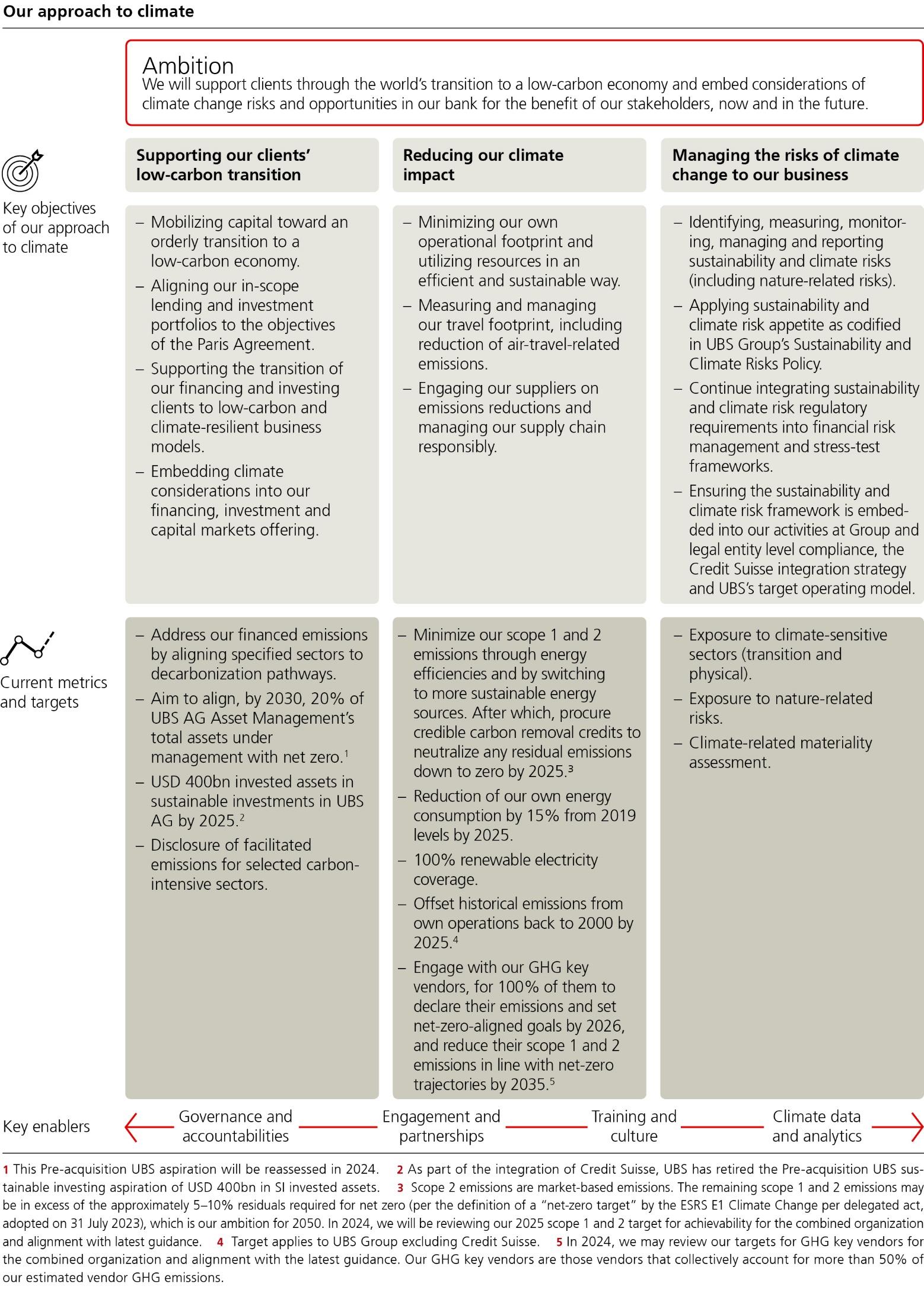
Annual Report 2023 |
Our strategy, business model and environment
| How we create value for our stakeholders
45
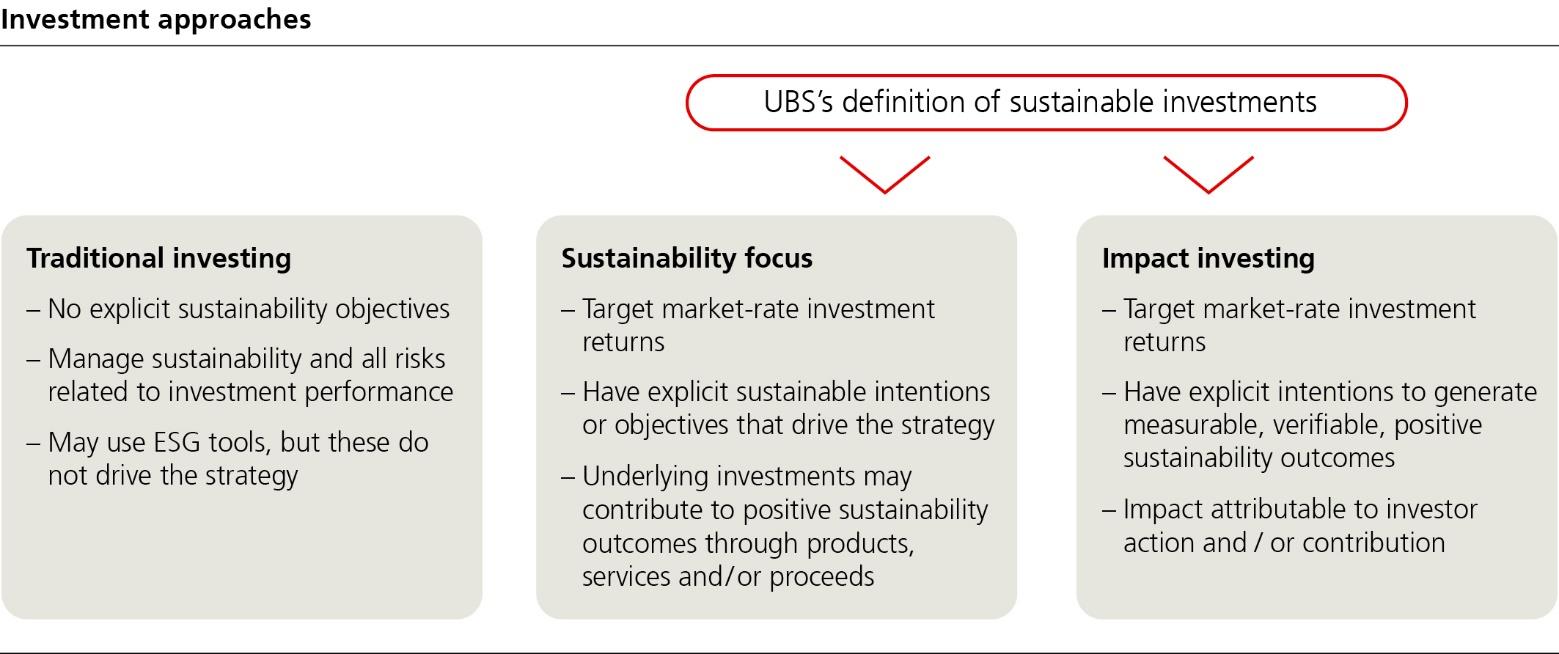
Annual Report 2023 |
Our strategy, business model and environment
| How we create value for our stakeholders
46
We understand
the deep
interrelationships
that exist
between climate
and nature.
Our approach
to climate,
including
our
ambition
to
achieve
net
zero,
also
forms
part
of
our
approach
toward
managing
nature-related
risks
and
opportunities.
›
Refer to the UBS Group Climate and Nature Report 2023, available
at
ubs.com/sustainability-reporting
, for a full description of
UBS’s approach to climate and nature
Our approach to sustainable finance
We
are
committed
to
supporting
our
clients’
sustainability
ambitions,
whether
they
focus
on
reducing
the
carbon
emissions footprint of their business or portfolios or seek
to encourage a more equitable and more
prosperous society.
›
Refer to the UBS Group Sustainability Report 2023,
available under “Annual reporting” at
ubs.com/investors
, for more
information about our sustainability and impact
strategy and activities
Defining sustainable finance
It is important
to set out
how we define
sustainable finance,
as no uniformly
accepted definition
currently exists
in the
industry.
We
consider
sustainable
finance
to
include
any
financial
product
or
service
(including
both
investing
and
financing solutions) that
aims to
explicitly align with
and / or
contribute to sustainability-related objectives,
while targeting
market-rate risk-adjusted financial returns. Sustainability-related objectives may include, but are not limited to, the SDGs
identified in the United Nations 2030 Agenda for Sustainable Development
.
Our approach
to sustainable
finance is
also reflected
in the
Group sustainable
investing framework,
which specifically
defines “sustainability focus” and “impact investing” products.
Both
categories
reflect
a
defined
and
explicit
sustainability
intention
of
the
underlying
investment
strategy.
This
intentionality differentiates them
from traditional investment
products or
those that consider
sustainability-related aspects
but do not
actively and
explicitly pursue
any specific
sustainability objective,
such as
ESG integration
or exclusions-only
approaches.
Our sustainable finance ambitions
Through our sustainable finance product and
service offerings, we target four key objectives
in serving our clients.
–
The power of choice:
we want to give
our investing clients
the choices they
need to meet
their specific sustainability
objectives.
–
An orderly transition:
we aim to
support our clients
in their transition
to a low-carbon
economy, for instance
by offering
innovative sustainable financing and investment solutions
.
–
Managing risks
and identifying
opportunities: we
offer research
and thematic
insights, as
well as
data and
analytics
services. Combined with targeted
advice, these are designed
to help clients better
understand and mitigate risks
and
identify new opportunities.
–
Making
sustainable
finance
an
everyday
topic:
we
want
to
make
sustainability
topics
tangible
throughout
our
interactions with clients. To help us do that, we provide support
in the form of tools, platforms and education.
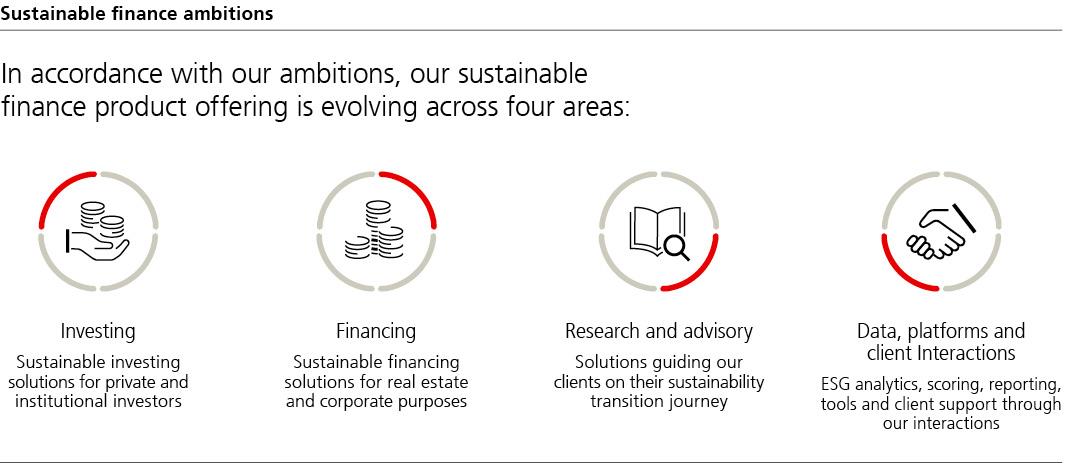
Annual Report 2023 |
Our strategy, business model and environment
| How we create value for our stakeholders
47
Sustainable finance
We continued to support
the sustainability ambitions of
our corporate and institutional
clients via our financing
solutions.
We helped facilitate
USD 53.7bn of green,
social, sustainability and sustainability
-linked bond deals,
such as structuring
and support of
Western Australia Treasury Corporation’s inaugural AUD 1.9bn green bond.
We introduced sustainability-
linked loans for multi-national corporations
and further supported our clients with
ESG advisory services and tools,
such
as the renovation and subsidies calculators for clients
in Switzerland.
Sustainable investing
Similarly to the
overall markets, our
sustainable investing (SI)
invested assets continued
to grow in
2023. We continued
to expand the SI product offering for our clients, including, among others, new net-zero ambition portfolios, sustainable
hedge funds and private-market impact solutions, as well as low-carbon
investing modules.
›
Refer to the UBS Group Sustainability Report 2023,
available under “Annual reporting” at
ubs.com/investors
, for more
information about our approach to sustainable investing
and financing
Sustainable investments
1
For the year ended
% change from
USD bn, except where indicated
31.12.23
31.12.22
31.12.21
31.12.22
Total invested assets (UBS Group)
5,714.1
3,980.9
4,614.5
44
of which: total invested assets (UBS AG)
4,504.7
3,980.9
4,614.5
13
Sustainable investments (UBS AG)
2
Sustainability focus
3
270.4
246.9
222.7
10
Impact investing
4
21.8
19.2
28.1
14
Total sustainable investments
5,6,7
292.3
266.0
250.8
10
SI proportion of total invested assets (%)
8
6.5
6.7
5.4
1
The table above
details UBS AG
Sustainable Investing
Invested Assets (IA)
and the evolution
thereof.
This table
does not contain
any Credit Suisse
products and associated
IA classified under
the Credit Suisse
Sustainable Investing Framework
(SIF). Credit Suisse
IA in accordance
with the SIF
are reported separately
as figures are
not directly comparable
with the UBS
figures due to
material differences in
the underlying
sustainable investment
frameworks and
definitions being
applied. Refer
to “Appendix
3 –
Entity-specific disclosures
for Credit
Suisse AG”
in the
UBS Group
Sustainability Report
2023, available
under “Annual
reporting” at ubs.com/investors, for more information.
2
We focus our sustainable investment reporting on those investment strategies exhibiting an explicit
sustainability intention.
3
sustainable intentions or objectives
that drive the strategy.
Underlying investments may contribute
to positive sustainability
outcomes through products /
services / use of
proceeds.
4
intentions of generating measurable,
verifiable and positive sustainability outcomes.
Impact generated is attributable to investor
action and/or contributions.
5
Certain products have been reclassified during 2023
for reasons including,
but not limited
to, an
evolving regulatory environment,
periodic monitoring of
the product shelf,
and developing internal
classification standards.
Impact of these
movements on sustainable
investment invested assets was a net reduction by USD 7bn in UBS AG Global Wealth Management Americas
and a net reduction by USD
6bn in UBS AG Asset Management.
6
IA reported
for sustainable
investments include
limited amounts
of instruments
not classified
as sustainable
investment, including
cash and
cash-like
instruments that
each fund
and portfolio
hold for
liquidity
management purposes, as well as, subject to clear, limiting restrictions, client-directed investments included in sustainable investing mandates managed by UBS Asset Management.
7
sustainable investments (UBS AG) disclosures for 31
December 2022 and 31
December 2021 reporting periods have been restated to remove investments that were duplicated in the disclosed values.
As a result, the
values disclosed for 31
December 2022 and 31
December 2021 for both
categories have each decreased
by USD
1.6bn and USD
0.4bn, respectively.
8
Total invested assets (UBS
AG) are used to
calculate the SI
proportion.
This was
also reflected
in our
clients’ continued
interest in
SI solutions.
Over the
course of
2023, UBS
AG’s SI
invested
assets rose
to USD
292.3bn
as of
31
December
2023, compared
with USD
266bn at
the end
of 2022,
representing
a
year-on-year increase of 10%. A combination of factors
contributed to this growth, including new product launches, net
new money inflows as well as market performance.
SI invested assets accounted for 6.5% of UBS’s total invested
assets
at year-end
2023.
›
Refer to the UBS Group Sustainability Report 2023,
available under “Annual reporting” at
ubs.com/investors
, for more
information about our approach to sustainable investing
and financing

Annual Report 2023 |
Our strategy, business model and environment
| How we create value for our stakeholders
48
Managing sustainability and climate risks
Helping to further
the Group’s
broader sustainability
goals with
due consideration to
our responsibility
to manage risk,
we
manage
sustainability
and
climate
risk
under
a
pragmatic
and
robust
policy.
That
policy
incorporates
our
risk
management framework
and related
standards
and guidelines
and applies
to our
own operations,
our balance
sheet,
our clients’ assets and our supply chain.
Our approach to managing sustainability,
climate and nature-related risk helps us identify and manage potential adverse
impacts on the climate, on the environment and to human rights, as well as the associated risks affecting our clients and
us. We define
sustainability and
climate risk
as the risk
that UBS
negatively impacts,
or is impacted
by, climate
change,
natural capital,
human
rights, and
other
ESG matters.
Sustainability
and climate
risks may
manifest
as credit,
market,
liquidity and / or non-financial risks for UBS,
resulting in potential adverse financial, liability and / or
reputational impacts.
These risks extend to the value of investments
and may also affect the value of collateral
(e.g., real estate). Climate risks
can arise
from either
changing climate
conditions (physical
risks) or
from efforts
to mitigate
climate change
(transition
risks).
Physical
and
transition
risks
from
a
changing
climate
contribute
to
a
structural
change
across
economies
and,
consequently, can affect banks and the financial sector through
financial and non-financial impacts.
›
Refer to “Sustainability and climate risk” in
the “Risk management and control” section of this
report
›
Refer to the UBS Group Sustainability Report 2023,
available under “Annual reporting” at
ubs.com/investors
, for a full description
of our sustainability and climate risk policy
framework
Our aspirations and progress
We work with
a long-term focus on
providing appropriate
returns to our stakeholders
in a responsible
manner.
We are
committed to providing
transparent aspirations
or targets and reporting
on the progress
made against them.
Following
the
acquisition
of
the
Credit
Suisse
Group,
our
exposure
increased
accordingly,
so
we
reviewed
our
aspirations.
Amendments
that
arose
from
this
review
process
were
considered
by
the
GEB
and the
CCRC.
This
table
reflects
the
overall outcomes of this process with more
detailed information provided in the UBS
Group Sustainability Report 2023.
›
Refer to the UBS Group Sustainability Report 2023,
available under “Annual Reporting” at
ubs.com/investors
, for more detailed
information on our aspirations
and our progress
Our aspirations
and progress
Our priorities
Our aspirations
or targets
Our progress in 2023
Planet, people,
partnerships
Sustainable investments.
1
Increased invested assets in sustainable investments
in UBS AG to
USD 292.3bn (compared with USD 266bn in 2022).
Planet
Following the acquisition of the Credit Suisse Group,
we
refined the UBS Group lending sector decarbonization
targets to reflect the activities of the combined
organization and evolving standards and methodologies.
2
Reduce emissions intensity associated with
UBS in-scope
lending by 2030 from 2021 levels for:
–
Swiss residential real estate by 45%;
–
Swiss commercial real estate by 48%;
–
power generation by 60%;
–
iron and steel by 27%; and
–
cement by 24%.
Reduce absolute financed emissions associated
with UBS
in-scope lending by 2030 from 2021 levels for:
–
fossil fuels by 70%.
Continue disclosing in-scope ship finance portfolios
according to the Poseidon Principles decarbonization
trajectories with the aim of aligning therewith.
3
Calculated progress against pathways for revised targets.
4
Changes in emissions intensity associated with
UBS in-scope lending (end of
2022 vs.
2021 baseline):
–
Swiss residential real estate reduced by 6%;
–
Swiss commercial real estate increased by 2%;
–
power generation reduced by 13%;
–
iron and steel reduced by 4%; and
–
cement reduced by 1%.
Changes in absolute financed emissions associated
with UBS in-scope
lending (end of 2022 vs.
2021 baseline) for:
–
fossil fuels reduced by 29%.
In-scope ship finance portfolio remains below the
existing International
Maritime Organization (IMO 50) decarbonization
trajectory.
Aim, by 2030, to align 20% of UBS AG Asset
Management’s total assets under management
(AuM)
with net zero. This pre-acquisition UBS aspiration will be
reassessed in 2024.
5
Aligned 2.9% of UBS AG Asset Management’s
total AuM with net zero.
Minimize our scope 1 and 2 emissions through
energy
efficiencies and switching to more sustainable energy
sources. After which, procuring credible carbon removal
credits to neutralize any residual emissions down to zero
by 2025.
6
Reduced net GHG footprint for scope 1 and
2 emissions by 21% and energy
consumption by 8% (compared with 2022); continued
replacing fossil fuel
heating systems and monitored delivery of contracted
carbon removal
credits; achieved 96% renewable electricity coverage in line
with RE100
despite challenging market conditions.


Annual Report 2023 |
Our strategy, business model and environment
| How we create value for our stakeholders
49
Offset historical emissions back to the year 2000
by
sourcing carbon offsets (by year-end 2021) and by
offsetting credit delivery and full retirement in registry (by
year-end 2025). The scope is UBS Group excluding Credit
Suisse.
Continued to follow up on credit delivery and retirement of
sourced
portfolio.
Engage with our greenhouse gas (GHG) key vendors,
for
100% of them to declare their emissions and set
net
zero-aligned goals by 2026, and reduce their scope 1 and
2 emissions in line with net-zero trajectories by 2035.
7
We invited the vendors that accounted for 67%
of our annual vendor spend
to disclose their environmental performance through CDP’s
Supply Chain
Program, with 70% of the invited vendors completing
their disclosures in the
CDP platform.
65% of GHG key vendors (defined as those
vendors that collectively account
for more than 50% of our estimated vendor GHG
emissions) have declared
their emissions on CDP and set net-zero-aligned goals.
People
(aspirations)
By 2025, 30% of worldwide roles at Director level and
above held by women.
Increased to 29.5% (2022: 27.8%) of worldwide
roles at Director level and
above held by women.
By 2025, 26% of US roles at Director level and above
held by employees from ethnic minority backgrounds.
Increased to 25.1% (2022: 20.5%) of US roles at Director level
and above
held by employees from ethnic minority backgrounds.
By 2025, 26% of UK roles at Director level and above
held by employees from ethnic minority backgrounds.
Increased to 24.3% (2022: 23.4%) of UK roles at Director
level and above
held by employees from ethnic minority backgrounds.
By 2025, 4% of UK roles at Director level and above held
by black employees.
Stable at 2.1% (2022: 2.2%).
By 2025, 25% of Americas financial advisor
/ client
advisor roles held by women (UBS Group excluding
Credit Suisse).
Increased to 16.8% (2022: 16.6%).
By 2025, 18.8% of US financial advisor
/ client advisor
roles held by employees from racial / ethnic minority
backgrounds (UBS Group excluding Credit Suisse).
Decreased to 12.2% (2022: 12.4%).
Raise USD 1bn in donations to our client philanthropy
foundations and funds and reach 26.5 million
beneficiaries by 2025 (cumulative for 2021–2025).
Achieved a UBS Optimus network of foundations
donation volume of
USD 328.0m in 2023, totaling USD 763.9m since
2021 (both figures include
UBS matching contributions).
8
Reached 7 million beneficiaries in 2023
and 18.5 million beneficiaries across
our social impact activities since 2021.
Partnerships
Continue to position UBS as a leading facilitator
of
discussion, debate and idea generation.
Delivered a variety of insights, including through interviews
with subject-
matter experts, individual research reports and comprehensive white
papers,
via the UBS Sustainability and Impact Institute,
including key publications
The
Rise of the Impact Economy
Rethink, rebuild, reimagine
.
Co-organized, with the Institute of International
Finance, the second
Wolfsberg Forum for Sustainable Finance.
Drive standards, research and development, and
product development.
Co-led financial-sector-specific working group of the
Taskforce on Nature-
related Financial Disclosures (the TNFD) and supported the
launch of the
TNFD framework.
Co-chaired the UNEP FI Principles for Responsible
Banking Nature working
group that developed initial guidance on nature target
setting for financial
institutions.
1
2
activities to our targets, it is important to note that progress towards
our targets may not be linear and that the realization of our own targets and aspirations
is dependent on various factors which are outside of our
direct influence.
We will
continue to
adjust our
approach in
line with
external developments
and evolving
best practices
for the
financial sector
and climate
science. Refer
to the
Supplement to
the UBS
Group
Sustainability Report 2023,
available under “Annual
reporting” at
ubs.com/investors
, for more
information about parts
of the value
chain within sectors
covered by metrics
and targets. Metrics
are based on
gross
exposure, which includes
total loans and advances
to customers, fair value
loans and guarantees,
and irrevocable loan commitments.
Exclusions from the
scope of analysis primarily
include financial services,
credit
card and other exposure
to private individuals.
3
trajectories. The
PP are a framework
for assessing and disclosing, on
an annual basis, the
climate alignment of in-scope ship
finance portfolios to the ambition
of the International Maritime Organization
(the IMO),
including its 2023 Revised
GHG Strategy for GHG
emissions from international shipping
to decrease to net
zero by or around
2050 (compared with 2008
levels).
4
Group Sustainability Report 2023, available under “Annual
reporting” at
ubs.com/investors
, for further information. The inherent one-year time lag between
the as-of date of our lending exposure and the as-of date
of emissions can be explained
by two factors: corpora
tions disclose their emissions
in annual reporting only
a few months after the
end of a financial year;
and specialized third-party data
providers take up
to nine
months to collect disclosed data and make it available to data users. Consequently, the baselines for our decarbonization targets are calculated on year-end 2021 lending exposure and 2020 emissions data. Our 2022
emissions actuals are based on
year-end 2022 lending
exposure and 2021 emissions data.
For asset financing (e.g.
,
real estate, shipping) there
is no time lag, and
exposure and emissions actuals refer
to the same
year.
5
carbon intensity of the respective 2019 benchmark.
6
Scope 2 emissions are market-based emissions. The remaining scope 1 and 2 emissions may be in excess of the approximately 5–10% residuals required for net
zero (per the definition
of a “net-zero target”
by the ESRS E1
Climate Change per delegated
act, adopted on 31
July 2023), which is
our ambition for 2050.
In 2024, we will
be reviewing our 2025
scope 1 and 2
target for achievability
for the combined
organization and
alignment with latest
guidance.
7
guidance. Our GHG key vendors are those vendors that collectively account for more than 50% of our estimated vendor GHG emissions.
8
Figures provided for the UBS Optimus network of foundations are based on
unaudited management accounts and information available
as of January 2024.
Audited financial statements for UBS Optimus
network of foundations
entities are produced and available per
local market regulatory
guideline.
Cautionary note:
We have developed
methodologies that we
use to set
our climate-related targets
and identify climate-related
risks and which
underly the metrics
that are disclosed
in this report.
Standard-setting
organizations and regulators continue to provide new or revised guidance
and standards, as well as new or enhanced regulatory requirements for climate disclosures. Our disclosed
metrics are based upon data available
to us, including estimates and approximations
where actual or specific data is not
available. We intend
to update our disclosures to comply
with new guidance and regulatory requirements
as they become applicable
to UBS. Such updates may result in revisions to our disclosed metrics, our methodologies
and related disclosures, which may be substantial, as well as changes to the metrics we disclose.
Annual Report 2023 |
Our strategy, business model and environment
| How we create value for our stakeholders
50
Reporting to our stakeholders on our sustainability
strategy and activities
Further information about our sustainability efforts and commitments is provided in the UBS Group Sustainability
Report
2023, available under
“Annual reporting” at
ubs.com/investors
. The
content of the
UBS Group Sustainability
Report 2023
has been prepared
in accordance with
Global Reporting Initiative
(GRI) standards,
with the German
rules implementing
the EU Directive on disclosure of non-financial and diversity information (2014/95/EU) and the Swiss Code of
Obligations
(Art. 964a et. seq.). UBS is
in the process of implementing a combined
and aligned sustainability-and-climate-risk dataset
across
UBS Group
and including
Credit
Suisse
AG. For
this reason,
UBS will
publish UBS
Group
and Credit
Suisse AG
sustainability and
climate risk
metrics required
pursuant to
FINMA Circular
2016/1 “Disclosure
– banks”,
Annex 5,
in a
supplement to
the UBS
Group Annual Report
and the UBS Group
Sustainability Report in
line with
the publication
timeline
for the semi-annual Pillar
3 disclosures in the
third quarter of 2024. All
climate-
and nature-related information contained
in the UBS
Group Sustainability
Report 2023
is also made
available through
a separate
UBS Group
Climate and
Nature
Report
2023.
The
latter
report
follows
the
structure
recommended
by
the
Task
Force
on
Climate-related
Financial
Disclosures (the
TCFD) and
also leverages
the framework
of the
Taskforce
on Nature-related
Financial Disclosures
(the
TNFD). Our reporting on
sustainability has been reviewed
on a limited assurance basis
by Ernst & Young
Ltd against the
GRI Standards.
›
Refer to the UBS Group Sustainability Report 2023,
available under “Annual reporting” at
ubs.com/investors
, for an overview of
non-financial disclosures in accordance with the German rules implementing
EU Directive 2014/95 and the Swiss Code of
Obligations (Art. 964a et. Seq.), and for information
about the disclosures of UBS AG and UBS Europe SE
pursuant to Art. 8 of the
EU Taxonomy Regulation
›
Refer to “Sustainability and climate risk” in
the “Risk management and control” section of this
report, for the UBS AG
sustainability and climate risk metrics disclosures as
required by FINMA Circular 2016/1 "Disclosure – banks," Annex 5
Regulation and supervision
As a
financial services provider based
in Switzerland, the
UBS Group
is subject to
consolidated supervision by the
Swiss
Financial
Market
Supervisory
Authority
(FINMA).
Our entities
are also
regulated
and supervised
by authorities
in each
country
where
we conduct
business.
Through
UBS AG,
Credit
Suisse AG,
UBS
Switzerland AG
and Credit
Suisse
(Schweiz) AG,
which
are licensed
as banks
in Switzerland,
UBS may
engage in
a full
range of
financial
services
activities
in Switzerland
and abroad,
including personal
banking, commercial
banking, investment
banking and asset
management.
As a
global systemically important
bank (a
G-SIB), as
designated by
the Financial
Stability Board,
and a
systemically relevant
bank (an
SRB) in Switzerland,
we are
subject to stricter
regulatory requirements
and supervision
than most
other Swiss
banks.
›
Refer to the “Our evolution” section of this report for
more information
›
Refer to the “Regulatory and legal developments”
and “Risk factors” sections of this report for
more information
Regulation and supervision in Switzerland
Supervision
UBS Group AG
and its
subsidiaries are
subject to
consolidated supervision by
FINMA under
the Swiss
Banking Act
and
related ordinances, which
impose standards for
matters such as
capital adequacy and
risk diversification rules,
liquidity,
internal
control systems,
business
conduct,
and corporate
governance.
FINMA meets
its statutory
supervisory
responsibilities
through licensing,
regulation, supervision,
and enforcement.
It is responsible
for prudential
supervision
and mandates
audit
firms to perform
regulatory audits
and other supervisory
tasks on its behalf.
Capital adequacy and liquidity regulation
As an internationally active Swiss systemically important bank
(an SIB), we are subject to capital and total
loss-absorbing
capacity (TLAC) requirements
that are
based on both
risk-weighted assets
and the leverage
ratio denominator,
and are
among the
most stringent
in the
world. We
are also
subject to
Swiss SIB
liquidity requirements
and to
minimum long-
term funding requirements.
›
Refer to the “Risk, capital, liquidity and funding,
and balance sheet” section of this report for
more information about the Swiss
SRB framework and the Swiss too-big-to-fail (TBTF)
requirements
›
Refer to “Liquidity coverage ratio” in the “Risk,
capital, liquidity and funding, and balance sheet”
section of this report for more
information about liquidity coverage ratio requirements
Regulation and supervision outside Switzerland
Regulation and supervision in the US
In the
US, UBS
is subject
to regulation
and supervision
by the
Board of
Governors
of the
Federal Reserve
System (the
Federal
Reserve Board) under a
number of laws.
UBS Group AG, UBS AG and
Credit Suisse AG are
subject to the
Bank Holding
Company Act,
pursuant to
which the Federal
Reserve Board has
supervisory
authority over
our US operations.
Annual Report 2023 |
Our strategy, business model and environment
| Regulation and supervision
51
In addition to being
a financial holding company under the
Bank Holding Company Act, UBS AG has
US branches, which
are authorized and
supervised by
the Office
of the Comptroller
of the Currency
(the OCC).
Credit Suisse
AG New York
Branch
is
authorized
and
supervised
by
the
New
York
Department
of
Financial
Services.
UBS AG
and
Credit
Suisse
International are registered
as swap dealers with
the Commodity Futures
Trading Commission (the
CFTC), and UBS AG,
Credit Suisse AG
and Credit
Suisse International
are registered
as securities-based
swap dealers
with the
Securities and
Exchange Commission (the SEC).
UBS Americas Holding
LLC, the intermediate
holding company for
our operations in
the US outside
of the UBS AG
branch
network,
as required
under
the
Dodd–Frank
Act,
is subject
to requirements
established
by
the
Federal
Reserve
Board
related to risk-based
capital, liquidity, the
Comprehensive Capital
Analysis and Review
(CCAR) stress testing
and capital
planning process, and resolution
planning and governance.
Credit Suisse Holdings (USA),
Inc., the intermediate
holding
company for Credit Suisse’s US operations, is subject to the same Federal Reserve Board requirements and is expected to
be integrated into UBS Americas Holding LLC in June 2024.
UBS Bank USA,
a Federal Deposit
Insurance Corporation
(FDIC)-insured depository
institution subsidiary,
is licensed and
regulated by state regulators in Utah and is also supervised
by the FDIC.
UBS Financial Services
Inc., UBS Securities
LLC and several
other US subsidiaries
of UBS, as
well as US
subsidiaries of Credit
Suisse Holdings (USA),
Inc., are subject
to regulation by
a number of different
government agencies and
self-regulatory
organizations,
including
the
SEC,
the
Financial
Industry
Regulatory
Authority,
the
CFTC,
the
Municipal
Securities
Rulemaking Board and national securities exchanges, depending on the nature of their business. Certain of our activities
in the US are subject to regulation by the Consumer Financial Protection
Bureau.
Regulation and supervision in the UK
Our regulated UK operations are mainly
subject to the authority of the Prudential Regulation
Authority (the PRA), which
is part of the Bank of England (the BoE), and the Financial Conduct Authority
(the FCA). We are also subject to the
rules
of the London Stock Exchange and other securities and commodities
exchanges of which UBS AG is a member.
UBS AG has a UK-registered branch, UBS AG
London Branch, which serves as a
global booking center for our Investment
Bank. Our regulated subsidiaries
that provide asset management services,
including Credit Suisse Asset
Management Ltd,
are
authorized
and
regulated
by
the
FCA.
UBS
Asset
Management
Life
Ltd,
Credit
Suisse
International,
Credit
Suisse
Securities (Europe)
Limited and
Credit Suisse
(UK) Limited
are authorized
and regulated
by the
FCA and
subject to
the
authority of the PRA.
Regulation and supervision in Germany and the EU
UBS Europe SE, headquartered
in Germany,
is subject to the direct
supervision of the European
Central Bank (the ECB),
as well
as
to continued
conduct,
consumer
protection
and anti-money
-laundering-related
supervision
by
the
German
Federal Financial Supervisory Authority (BaFin) and supervisory support
by the German Bundesbank. The entity is subject
to EU and German laws and regulations. UBS Europe
SE maintains branches in Denmark, France,
Italy, Luxembourg,
the
Netherlands, Poland,
Spain, Sweden
and Switzerland,
and is
subject
to conduct
supervision by
authorities
in all
those
countries.
Credit Suisse AG has four banking
subsidiaries in Europe:
in Italy, Credit Suisse (Italy)
S.p.A. is supervised by the
Bank of
Italy
and
the
Commissione
Nazionale
per
le
Società
e
la
Borsa
(Consob);
in
Spain,
Credit
Suisse
Bank
(Europe)
SA
is
supervised by the
Bank of Spain,
the Comisión
Nacional del Mercado
de Valores (the
CNMV) and the
Servicio Ejecutivo
de
la
Comisión
de
Prevención
del
Blanqueo
de
Capitales
e
Infracciones
Monetarias
(Sepblac);
in
Luxembourg,
Credit
Suisse
(Luxembourg)
S.A.
is
supervised
by
the
Commission
de
Surveillance
du
Secteur
Financier
(the
CSSF),
the
Commissariat
aux
Assurances
(the
CAA)
and
the
Banque
de
Luxembourg;
and
in
Germany,
Credit
Suisse
(Deutschland) AG
is
supervised
by
BaFin
and
the
Bundesbank.
Credit
Suisse
(Luxembourg)
S.A.
operates
branches
in
France, Ireland and Portugal and is subject to conduct supervision by
authorities in all those countries. Credit Suisse Bank
(Europe) S.A.
operates branches
in France,
Italy, the
Netherlands and
Sweden and
is subject
to conduct
supervision by
authorities in all those countries.
We expect
to wind
down or
consolidate the
European banking
subsidiaries of
Credit Suisse
AG into
UBS Europe
SE in
accordance
with
the
intermediate
EU
parent
undertaking
requirement,
which
in
agreement
with
the
ECB
is
to
be
implemented by June 2025.
Regulation and supervision in Asia Pacific
We operate
in numerous
locations in Asia
Pacific, including
Singapore, the
Hong Kong SAR,
mainland China,
Australia
and Japan. The
operations in these
locations are subject
to regulation and
supervision by local
financial regulators.
Our
Asia Pacific regional hubs are in Singapore
and the Hong Kong SAR.
In Singapore,
UBS AG Singapore Branch,
UBS Securities Pte
Ltd, UBS
Asset Management (Singapore)
Ltd and Credit
Suisse
Securities (Singapore)
Pte Limited are
supervised by the
Monetary Authority
of Singapore
and the Singapore
Exchange.
Credit Suisse AG
Singapore Branch
and Credit
Suisse (Singapore)
Limited are
supervised by
the Monetary
Authority of
Singapore.
Annual Report 2023 |
Our strategy, business model and environment
| Regulation and supervision
52
In the Hong Kong SAR, UBS AG
Hong Kong Branch and Credit Suisse AG Hong Kong Branch
are supervised by the Hong
Kong Monetary Authority. UBS
Securities Hong Kong
Limited, UBS Securities Asia
Limited, UBS Asset Management
(Hong
Kong) Limited, Credit Suisse (Hong Kong) Limited and Credit Suisse Securities (Hong Kong) Limited are supervised by the
Hong Kong Securities and
Futures Commission. In
addition, UBS Securities
Hong Kong Limited and
Credit Suisse (Hong
Kong) Limited are supervised by Hong Kong Exchanges and
Clearing Limited.
In mainland China,
we have
multiple licenses
to operate the
respective business
lines of UBS
AG and Credit
Suisse AG,
and the
various entities
are subject
to regulation
by a
number of
different government
agencies. The
People’s Bank
of
China oversees China’s
macro capital markets
policies and ensures
coordinated supervisory
approaches by the
National
Administration of
Financial Regulation
(the China
Banking and
Insurance Regulatory
Commission until
May 2023),
the
China Securities Regulatory Commission and a number
of exchanges.
In Australia,
UBS AG Australia
Branch and
Credit Suisse AG
Sydney Branch
are supervised
by the
Australian Prudential
Regulation
Authority,
the
Australian
Securities
and
Investments
Commission,
the
Australian
Transaction
Reports
and
Analysis Centre, the Reserve Bank of Australia, and the
Australian Securities Exchange. UBS Securities
Australia Ltd, UBS
Asset Management Limited
and Credit Suisse Equities
(Australia) Limited are supervised
by the Australian Securities
and
Investments Commission, the Australian Transaction Reports and Analysis Centre and the
Australian Securities Exchange.
In Japan,
UBS Securities Japan
Co., Ltd. and
Credit Suisse Securities
(Japan) Limited
are supervised by
the Financial
Services
Agency and the Japan Exchange Group. UBS AG Tokyo Branch and Credit Suisse AG Tokyo Branch are supervised
by the
Financial Services
Agency and
the Bank
of Japan.
UBS SuMi
TRUST Wealth
Management Co.,
Ltd. is
supervised by
the
Financial
Services
Agency
and
the
Japanese
Ministry
of
Finance.
UBS
Asset
Management
(Japan)
Ltd
and
UBS
Japan
Advisors Inc. are supervised by the Financial Services Agency.
Financial crime prevention
Combating money laundering and terrorist financing has been a major focus of
many governments in recent years. Laws
and regulations, including the Swiss Banking Act and the US Bank Secrecy Act, require effective policies, procedures and
controls to detect,
prevent and report
money laundering and
terrorist financing, and
the verification of client
identities.
Failure to introduce
and maintain adequate
programs to prevent
money laundering and
terrorist financing can
result in
significant legal and reputational risk and fines.
We are
also subject
to laws
and regulations
prohibiting
corrupt or
illegal payments
to government
officials and
other
persons, including
the US
Foreign Corrupt
Practices Act
and the
UK Bribery
Act. We
maintain policies,
procedures and
internal controls intended to comply with those regulations.
›
Refer to “Non-financial risk” in the “Risk
management and control” section of this report for more information
Data protection
We
are
subject
to
regulations
concerning
the
use
and
protection
of
customer,
employee,
and
other
personal
and
confidential information. This includes provisions under Swiss
law, the EU General Data Protection Regulation (the GDPR)
and laws of other jurisdictions.
›
Refer to the “Risk factors” section of this report for
more information about regulatory change
Recovery and resolution
Swiss TBTF legislation
requires each Swiss
SRB to establish
an emergency plan
to maintain systemic
functions in case
of
impending insolvency. In response to these Swiss requirements and similar ones in other jurisdictions, UBS has developed
recovery plans and
resolution strategies, as
well as plans
for restructuring or
winding down businesses
if the firm could
not otherwise be stabilized.
In 2013, FINMA
stated its
preference for
a single point
of entry
(an SPE)
strategy for globally
active SRBs,
such as
UBS,
with a bail-in
at the group
holding company level.
UBS has made
structural, financial and operational
changes to facilitate
an SPE strategy and
is confident that
a resolution of
the bank is
operationally executable and legally
enforceable. In 2023,
UBS acquired
the Credit Suisse
Group and merged
Credit Suisse Group AG
into UBS
Group AG. UBS Group AG
subsumed
all
the
capital
and
loss-absorbing
instruments
of
Credit
Suisse
Group AG
with
the
acquisition.
A
bail-in
remains
operationally executable for
the combined UBS Group and
an SPE resolution strategy
remains the preferred strategy
for
UBS.
FINMA evaluates the recovery and resolution plans of Swiss SRBs on a regular basis. In its most recent assessment,
which
was published in April 2023 and based on year-end 2022 information, FINMA
re-confirmed that UBS’s Swiss emergency
plan is
effective, that
the recovery
plan has
been approved
and that
UBS fulfills
all resolvability
criteria. The
same was
confirmed for Credit Suisse. This assessment
did not reflect the combined organization and
the respective plans will need
to be
amended and
approved for
the new
and combined
Group. FINMA
will review
its resolvability
assessment of
the
combined UBS Group as the integration progresses. A new, interim assessment
is expected to be published by FINMA at
the end of the second quarter of 2024.

Annual Report 2023 |
Our strategy, business model and environment
| Regulation and supervision
53
Crisis management framework
The UBS Group’s crisis management framework
assigns responsibility and actions depending on the
nature of the stress
incident and the scale of the response needed.
–
For incident,
risk and
crisis
management,
the Group
Crisis Task
Force
works with
incident management
teams that
provide monitoring and early-warning
indicators at the local /
regional level, without needing
to activate protocols at
the Group
level. If
a local
response is
insufficient, global
task forces
and crisis
management teams
provide decision-
making
guidance
and
coordination,
including
crisis
management
plans,
protocols
and
playbooks,
and
contingency
funding plans.
–
The Group Executive Board (the GEB) and the Board of Directors
(the BoD) would evaluate and decide upon the need
to activate
the Global
Recovery
Plan (the
GRP) if
a stress
event reached
a severity
requiring activation
based on
the
GRP’s recovery risk indicators.
–
FINMA has the authority
to determine whether the
point of non-viability (the
PONV), as defined by
Swiss law, has been
reached and, as part of the resolution plan, has the power to order the
bail-in of creditors to recapitalize and stabilize
the Group, limit payments of dividends and interest, alter our legal structure, take actions to reduce business risk, and
order a restructuring of the bank.
Credit
Suisse AG
and
its
subsidiaries
also
maintain
a
separate
crisis
management
framework,
including
processes,
governance and responsibilities, which will
be in place as long
as those legal entities
exist and are subject to
standalone
recovery
and
resolution
requirements.
The
standards
and
processes
applied
have
been
harmonized
with
the
UBS
framework to the extent possible.
Global Recovery Plan
The GRP
provides a
tool to
restore financial
strength if
UBS comes
under severe
capital or
liquidity stress.
Quantitative
and qualitative triggers are monitored daily and are
subject to predefined governance and escalation processes. Recovery
options
are
linked
to
owners
and
checklists,
with
the
objectives
of
preserving
capital,
raising
capital
or
liquidity,
or
disposing of or winding down businesses.
Annual Report 2023 |
Our strategy, business model and environment
| Regulation and supervision
54
Global Resolution Strategy
FINMA is required
to produce
a global resolution
plan for UBS.
The plan
includes setting out
measures that
FINMA can
take to
resolve UBS
in an
orderly manner
if the
Group enters
resolution. The
SPE bail-in
strategy would
involve writing
down the
Group’s remaining
equity and
additional tier
1 and
tier 2 instruments,
as well
as the
bailing in
of the
TLAC-
eligible senior unsecured
bonds at the
UBS Group AG
level. An internal
recapitalization of
undercapitalized subsidiaries
would
be
executed
simultaneously
with
losses
transmitted
to
UBS AG
or
Credit
Suisse AG,
and,
ultimately,
UBS
Group AG. Post-resolution restructuring measures could
include disposals or wind-down of businesses and assets.
Local recovery and resolution plans
The Swiss
emergency plans demonstrate
how UBS’s
systemically important functions
and critical
operations in
Switzerland
can continue if
the UBS Group
cannot be restructured.
This is achieved
mainly by operating
the Swiss-booked
business
in separate legal entities and by maintaining sufficient capital and liquidity to ensure their continued operation. Until the
merger of Credit
Suisse (Schweiz) AG into
UBS Switzerland AG,
UBS will maintain
two separate
Swiss emergency plans
to cater for differences in the organizational setup and differences
in infrastructure.
The US resolution plans set
out the steps that could be taken
to resolve the US intermediate
holding companies (the US
IHCs) i.e., UBS
Americas Holding LLC
and Credit Suisse
Holdings (USA), Inc.,
and their subsidiaries
if they suffered
material
financial distress and the UBS Group was unable or unwilling to provide financial support. As required by US regulations,
our US plans contemplate that
the US IHCs will commence
US bankruptcy proceedings. Prior
to this, the plans envisage
the
US
IHCs
downstreaming
financial
resources
to
their
respective
subsidiaries
to
facilitate
an
orderly
wind-down
or
disposal of
businesses. Following the
expected integration of
Credit Suisse
Holdings (USA), Inc.
into UBS
Americas Holding
LLC in 2024, only the resolution plan of UBS Americas Holding
LLC will be maintained.
UBS Europe SE updates
a local recovery
plan annually based
on ECB requirements,
and resolution planning
information
and capabilities based on
Single Resolution Board requirements. On the
basis of such information,
the Internal Resolution
Team, composed of members of the Single
Resolution Board, produces a resolution plan
for UBS Europe SE. In addition,
several Credit Suisse subsidiaries in Europe will maintain local
recovery plans until the Credit Suisse entities are integrated
into the UBS intermediate parent undertaking.
UBS operates
a UK
banking subsidiary with
Credit Suisse
International, which is
subject to
the UK
Resolvability Assessment
Framework (the
UK RAF).
Under the
UK RAF,
Credit Suisse
International is
required to
assess its
recovery planning
and
resolvability
planning
capabilities
against
the
standards
defined
in
the
UK
RAF
on
an
annual
basis
and
confirm
its
compliance to the BoE and PRA.
Other local recovery and resolution plans
exist for various Group entities and jurisdictions
.
Regulatory trends
In
2023,
regulatory
policy
was
strongly
impacted
by
the
banking
turmoil
in
March,
with
financial
stability
concerns
returning
to
the
forefront,
followed
by
renewed
discussions
around
the
effectiveness
of
too-big-to-fail
/
resolution
frameworks
and
subsequent
initial
lessons
drawn
being
discussed
throughout
the
year.
While
the
reviews
by
supranational standard-setters
and in
Switzerland generally
upheld the
appropriateness
of the
international regulatory
and resolution frameworks, certain themes requiring further
attention were identified with additional analyses ongoing.
The
digitalization
of banking
and corresponding
policy
responses
continued
throughout
2023,
with attention
paid to
systemic risks, market integrity, investor
protection and cross-border aspects
related to digital assets. Initial
policy efforts
started
on
decentralized
finance.
In
the
meantime,
most
major
central
banks
increased
their
engagement
related
to
central bank digital currencies.
New capabilities and wider
adoption of artificial intelligence (AI)
have resulted in increased
regulatory focus on the
topic, particularly regarding
sound governance frameworks,
safety and fairness. The
large-scale
use of both traditional and non-traditional data by AI
models has given rise to questions around the adequacy
of existing
data legislation
and in
some jurisdictions will
likely result
in enhanced
protections. Separately, many
jurisdictions continued
to make data more available across sectors, with a focus
on open finance.
Sustainable finance and climate-related financial
risks remained a key
focus for policymakers in
2023, where we observed
noteworthy activity in
the areas of
corporate and product
disclosures for climate-related
financial risks, specifically
relating
to banks’ governance, strategy, and risk management, as well as
efforts to standardize and harmonize regulations across
different jurisdictions. Policymakers advanced guidelines
related to nature and
biodiversity topics by intensifying
the focus
on disclosures,
risk management, and
quantification methodologies. Furthermore,
we observed ongoing
regulatory policy
related to net-zero financing while transition
planning started to become an
important focus topic for policymakers. On
the topic of products regulation, regulatory initiatives continued
to focus on carbon and carbon markets and addressing
issues related
to greenwashing.
Lastly, we
saw increased
regulatory attention
paid to
solutions related
to social
impact
investing and blended finance.
Annual Report 2023 |
Our strategy, business model and environment
| Regulation and supervision
55
The national
implementation of
the Basel III
requirements continued
to be
an important
focus area.
The authorities
in
Switzerland issued
rules to
implement the
final standards
into Swiss
law, and
US banking
regulators launched
a public
consultation in 2023. Switzerland has confirmed the effective date for the revised rules as 1 January 2025. Although the
EU is
still targeting
implementation by
January 2025,
the UK
and the
US have
delayed the
application until
July 2025,
with the US also
including a three-year transition
timeline. Differences in the implementation
timelines and in the
content
of the provisions remain a challenge for globally active banks.
In addition, regulatory
authorities continued to
refine existing regulations,
including efforts to
strengthen the anti-money-
laundering
guidelines
on
beneficial
ownership
and work
on enhancing
third-party
risk management
with
operational
resilience remaining a key issue. The focus on retail investor
protection sharpened, in particular in asset management
.
In
the US, retail investor protection features became a component of an ongoing broader
equity market reform. In the UK,
reviews of the Senior Managers and Certification Regime focused
on determining whether the regime delivers against its
original aim and how it can be improved.
Finally, in light of increasing risks,
non-bank financial intermediation remained
a topic of concern with national and supranational policymakers.
We believe the continued adaptations made to our business model
and our proactive management of regulatory change
put us in a strong position
to absorb upcoming changes
to the regulatory environment.
We trust that our strengthened
position as a combined organization will allow us to cope
with any potential challenges.
›
Refer to the “Regulatory and legal developments”
and the “Risk, capital, liquidity and funding,
and balance sheet” sections of this
report for more information
Regulatory and legal developments
Developments related to the acquisition of the Credit Suisse
Group and the banking turmoil in March 2023
Key developments in Switzerland
Based on the emergency
ordinance issued by the
Swiss Federal Council in
connection with the
acquisition of the Credit
Suisse Group
on 16 March
2023, as amended
on 19 March
2023, (the Emergency
Ordinance), UBS
Group AG entered
into a loss protection agreement (an LPA)
with the Swiss Confederation, with an effective date of 12 June 2023. As part
of
this
agreement,
the
Swiss
Confederation
would
have
borne up
to
CHF 9bn
of
losses,
if
realized,
on
a
designated
portfolio of Credit Suisse’s non-core assets
after the first CHF 5bn of losses, which would have
been borne by UBS.
Under the Emergency
Ordinance, UBS AG
and Credit
Suisse AG also
had access to
additional liquidity
assistance loans,
the Emergency Liquidity Assistance Plus (ELA+) loans, provided by the Swiss National Bank
(the SNB) of up to CHF 100bn
on a combined
basis, with
the loans
under the
facility having
preferential rights
in bankruptcy
proceedings. The
Credit
Suisse Group was also allowed to borrow up
to an additional CHF 100bn from the SNB backed
by a Swiss federal default
guarantee,
the Public Liquidity Backstop (the PLB), with the loans
having preferential rights in bankruptcy proceedings.
On 11 August 2023, UBS Group AG voluntarily terminated the LPA
and the PLB. After reviewing all assets
covered by the
LPA since the closing of the
Transaction in June 2023 and
taking the appropriate fair
value adjustments, UBS concluded
that the LPA was no
longer required. All loans
under the PLB were
fully repaid by the
Credit Suisse Group as
of the end
of May 2023
and Credit Suisse AG
fully repaid the
outstanding ELA+ loans
on 10 August 2023.
As of 31 December
2023,
Credit Suisse (Schweiz) AG had a total of CHF 38bn outstanding under the Emergency Liquidity Assistance facility, which
is fully collateralized by Swiss mortgages.
In parallel with
the measures
taken by
the Swiss
Confederation in
March 2023,
the Swiss
Financial Market
Supervisory
Authority (FINMA) also ordered a write-off of CHF 15.8bn principal amount of Credit Suisse Group AG’s additional tier 1
(AT1) instruments.
In May 2023,
the Swiss
Federal Department
of Finance
mandated a group
of experts
on banking
stability to assess
the
role
of
banks
and
the
legal
and
regulatory
framework
related
to
the
stability
of
the
Swiss
financial
center.
The
corresponding report,
published in
September 2023,
concluded that
Swiss capital
regulations are
working as
intended
and
that
there
is
no
need
for
a
major
revision.
However,
the
report
sees
a
need
for
reforms
with
regard
to
banking
supervision
and
proposes
that
the
relevant
authorities
be
granted
broader
powers.
Furthermore,
the
report
suggests
improvements regarding liquidity regulations, including a proposal to extend the supply of liquidity in the case of a crisis.
The
report
also
suggests
that
Swiss
authorities
should
make
improvements
with
regard
to
crisis
preparation
and
management.
Annual Report 2023 |
Our strategy, business model and environment
| Regulatory and legal developments
56
In
June
2023,
the
Swiss
Parliament
formed
a
parliamentary
inquiry
committee
that
is
mandated
to
investigate
the
legitimacy, expediency and
effectiveness of the
management of the competent
authorities and bodies
in the context
of
the
events
involving
the
Credit
Suisse
Group.
The
committee
will
report
to
the
Swiss
Parliament
on
the
results
of
its
investigation and will
propose measures to
remedy any identified
deficiencies. We
expect the results
to be published
in
the
fourth
quarter
of
2024.
The
conclusions
by
the
inquiry
committee
may
include
potentially
significant
recommendations, which could result in more stringent regulation.
In December 2023, FINMA
published a report on
the case of
Credit Suisse that analyzed
the development of Credit
Suisse
in recent
years and
examined
its supervisory
work with
the bank.
In addition,
FINMA
noted in
its report
a number
of
lessons to
be learned,
calling for
a stronger
legal basis,
specifically for
instruments such
as a
Senior Managers
Regime,
the
power
to impose
fines,
and more
stringent
rules regarding
corporate
governance.
Furthermore,
FINMA explained
that it
will adapt
its supervisory
approach in
certain areas
and will
step up
its review
of whether
stabilization measures
are ready to be implemented.
The findings of the
group of experts and the
lessons drawn by FINMA include
recommendations that could result in
more
stringent
regulation,
and
will
be
considered
by
the
Swiss
Federal
Council
in
its
next
report
on
systemically
important
banks, which is to be presented by April 2024.
Key developments in the US
In May 2023, the
Federal Reserve Board
and the Federal Deposit
Insurance Corporation (the
FDIC) released reports
that
covered the
circumstances leading
to the
closing of
certain banking
organizations following
the events
in the
banking
market in March 2023. The reports noted shortcomings in the supervisory agencies’ execution of
examination programs,
including escalation
of supervisory
issues and
staffing. They
also raised
concerns related
to the
regulatory
framework,
including the Federal Reserve’s Tailoring Rule and other topics, such as interest rate risk management. UBS expects these
developments to impact the regulatory environment
in the US, where UBS has significant
operations.
In November
2023, the
FDIC approved
a final rule
to implement
a special
assessment to
recover losses
incurred by
the
Deposit Insurance
Fund in
connection with
the failures
of Silicon
Valley Bank
and Signature
Bank in
March 2023.
The
assessment
is
based
on
the
estimated
uninsured
deposits
of
each
depository
institution
at
the
end
of
2022.
The
assessment will
be collected
over an
eight-quarter
period that
started in
January 2024.
In the
fourth quarter
of 2023,
UBS Bank USA recorded a charge for the full amount
of its estimated assessment of USD 60m.
Key developments at the supranational level
In October 2023,
the Basel Committee
on Banking Supervision
(the BCBS) released
a report
on the causes
of the 2023
banking turmoil. The BCBS argues that
while the distress of various banks
in March 2023 reflected
idiosyncratic factors,
recurring
themes
can
be
grouped
into
three
broad
categories:
bank
risk-management
practices
and
governance
arrangements; strong and effective
supervision; and robust regulatory standards.
Also in October
2023, the
Financial Stability
Board (the
FSB) identified
in a review
several areas
related to
the effective
operationalization and implementation
of the international
resolution framework that
merit further attention as
part of
future work, but concluded that recent events demonstrate
the soundness of the framework.
No concrete changes to the Basel
standards or the FSB framework
are proposed at this stage, but the
follow-up work is
particularly focused
on strengthening
supervisory effectiveness,
liquidity risk,
interest rate
risk in the
banking book
and
the effectiveness of the resolution frameworks.
Developments regarding capital and liquidity adequacy
and TBTF frameworks
Developments related to liquidity adequacy
In September
2023, the
Swiss Federal
Council adopted
a dispatch
and draft
legislation on
the introduction
of a
public
liquidity
backstop
for
systemically
important
banks
(SIBs),
which
was
initially
implemented
as
part
of
the
Emergency
Ordinance. The proposed legislative changes aim to
establish the public liquidity backstop
as part of ordinary law
in order
to enable the Swiss
government and the SNB
to support an
SIB domiciled in Switzerland
with liquidity in the
process of
resolution, in
line with
other financial
centers. The
introduction of
the public
liquidity backstop
is intended
to increase
the confidence of market
participants in the ability of
SIBs to be successfully
recapitalized and remain
solvent in a crisis.
Furthermore, the draft legislation
provides that SIBs
will pay the
Swiss Confederation an
annual fee to
mitigate a potential
impact on competition
and to compensate
the Swiss
Confederation for
its guarantee
to the SNB
of the
public liquidity
backstop,
if required.
In addition
to the
public liquidity
backstop, the
proposed legislative
changes would
enact into
ordinary law
additional
provisions contained in
the Emergency Ordinance,
including mandated clawback
of variable compensation
in the event
that government support is provided to an SIB.
Annual Report 2023 |
Our strategy, business model and environment
| Regulatory and legal developments
57
The legislative changes are expected to come into force by January 2025, at the earliest,
as in November 2023, the Swiss
Parliament suspended
discussions on
the public
liquidity backstop
until the
presentation of
the Swiss
Federal Council’s
report on systemically important banks.
Furthermore, FINMA communicated
in the third
quarter of 2023
the liquidity requirements
arising from the
revisions to
the
Swiss
Liquidity
Ordinance,
with
the
aim
of
strengthening
the
resilience
of
SIBs
in
Switzerland.
The
affected
legal
entities of the UBS Group are compliant with these requirements,
which became effective on 1 January 2024.
Developments related to capital adequacy
In July 2023, US banking regulators,
including the Federal Reserve
Board, the FDIC and the
Office of the Comptroller
of
the Currency
(the OCC), issued
a public consultation
on a proposal
that would
implement the
final components of
the
Basel III capital standards for US banking organizations and foreign-owned intermediate holding
companies, such as UBS
Americas Holding
LLC and
Credit Suisse
Holdings (USA),
Inc. Among
other matters,
the proposed
rules would
end the
use of
the internal
model approach
for credit
risk by
the largest
banking organizations
and would
introduce instead
a
new
standardized
approach.
In
addition,
the
proposed
rules
for
operational
risks
would
replace
the
advanced
measurement approach
with a
standardized
measure. The
proposal calls
for a
three-year
transition period,
starting on
1 July 2025, and full implementation by 1 July 2028. We currently estimate that the proposed rule changes would
result
in increased capital requirements
for our US-based intermediate holding companies
if implemented as proposed.
In November
2023, the
Swiss Federal
Council adopted
amendments to
the Capital
Adequacy Ordinance
(the CAO)
for
banks to
incorporate the
final Basel III
standards adopted
by the
BCBS in
Swiss law.
The amended
CAO will
enter into
force on
1 January 2025. The
final degree
of alignment
between the
Swiss implementation and
those in
other jurisdictions
remains
uncertain
at
this
stage.
Although
EU
legislators
target
implementation
by
January
2025, the
implementation
timelines in the UK and
the US have been
delayed until July 2025.
The Swiss Federal Department
of Finance will inform
the Swiss
Federal Council about
the status of
international implementation by
the end of
July 2024. We
currently estimate
that the revised Basel III framework will lead
to a further net increase in
risk-weighted assets of approximately USD 25bn,
of
which
USD 10bn
is
in
Non-core
and
Legacy.
This
estimate
is
based
on
static
balances,
before
taking
into
account
mitigating actions, as well as not reflecting the impact of
the output floor, which is phased in over time.
Developments related to TBTF frameworks
In
August
2023,
the
Federal
Reserve
Board
and
the
FDIC
issued
joint
proposals
on
long-term
debt
requirements
and
resolution
planning
guidance
for
large
banks.
The
long-term
debt
proposal
would
require
certain
large
bank-holding
companies, intermediate holding companies
and insured depositories with
USD 100bn or more in
total assets to
maintain
a minimum amount of long-term debt, intended
to enhance the resilience and resolvability
of such organizations. Large
banking organizations would also be
prohibited from certain activities that could
complicate the resolution or would lead
to contagion risks.
If the proposals are
implemented, UBS Bank
USA would be
subject to the
long-term debt requirement,
which would be
incremental to
the requirements
already imposed
upon its parent
organization, UBS
Americas Holding
LLC. The resolution
planning guidance
proposed by
US banking regulators
would cover
our US-based
entities and calls
for certain enhancements in the requirements
of the submitted resolution plans.
In November 2023, the FSB published the 2023 list of global
systemically important banks (G-SIBs). UBS has been moved
from Bucket
1 to
Bucket 2,
corresponding to
an increased
FSB common
equity tier
1 capital
surcharge requirement
of
1.5%
from
1.0%,
effective
from
1 January
2025.
Credit
Suisse
has
been
removed
from the
list.
As UBS
is
subject
to
higher requirements under the Swiss CAO, the change does
not affect the capital requirements applicable to UBS.
In February 2024, the FSB published its
Peer Review of Switzerland, which examines Switzerland’s implementation of the
FSB’s
TBTF
reforms
for
G-SIBs.
The
review
states
that
although
Swiss
authorities
have
made
important
steps
toward
implementing an
effective TBTF
regime for
G-SIBs, additional
steps can
be taken
to further
strengthen the
Swiss TBTF
framework.
Recommendations
include
increasing
supervisory
resources,
strengthening
early
intervention
powers
and
enhancing the recovery and resolution regime.
Annual Report 2023 |
Our strategy, business model and environment
| Regulatory and legal developments
58
Developments regarding climate-related financial
risks and sustainable finance
In 2023, the Swiss
National Council discussed
the revision of
the Act on
the Reduction of
CO
2
2
which contains
measures to
halve greenhouse
gas emissions
by 2030
compared
with 1990.
The proposal
is based
on
supplementing the
existing
CO
2
economy. For the
financial sector, it
contains a provision
mandating FINMA and
the SNB to
regularly assess climate-related
financial risks
in the
financial sector
and to
report the
results,
as well
as potential
measures,
to the
Swiss government.
FINMA is currently collecting
the data from the
financial sector in
order to be able
to carry out
the assessment in
2024.
It is expected that the proposal will be formally adopted by the
Swiss Parliament in spring 2024.
In June 2023, the Swiss electorate voted in favor of the
new Climate and Innovation Act (the CI Act). The CI
Act defines
a net-zero-by-2050 target
for Switzerland, including
interim targets for
selected sectors of
the Swiss economy
covering
scope 1
and
2
emissions.
In
addition,
each
Switzerland-domiciled
company
is
required
to
set
a
net-zero
target
by
1 January 2025. The CI Act
also contains provisions for
public funding to replace aged
heating systems in buildings and
for application of innovative technologies within companies.
Article 9 of the CI Act requires the financial
sector to make
an effective contribution to the transition to net zero and sets the general goal of the alignment of financial resources to
climate-friendly outcomes. Specific measures to achieve
the targets will be proposed in the CO
2
In December 2023, the Swiss Parliament added a provision on greenwashing to the Unfair Competition Act under which
companies are required
to make truthful and
clear statements in
relation to their
climate impact that
can be substantiated
by objective and verifiable bases.
Also in December 2023, the Swiss Federal Council announced that it intends to further improve climate transparency for
financial products and to further
develop the voluntary Swiss Climate
Scores (the SCS), which were
introduced in 2022.
The SCS
provide investors
with information
about the
extent to
which their
financial investments
are compatible
with
climate goals. The updated SCS, which will apply from 1 January 2025, will continue to prescribe disclosures by financial
institutions
on
climate
alignment
and
climate
change
mitigation
characteristics
of
financial
products
and
will
newly
prescribe disclosure of exposures to renewable energy. UBS
has committed to the voluntary use of the SCS.
In October
2023, the
Federal
Reserve
Board, the
OCC and
the FDIC
approved guidance
on the
principles for
climate-
related
financial
risk
management.
The
final
principles
describe
how
climate-related
risks
can
be
addressed
in
the
management
of
traditional
financial
risks.
The
principles
cover
six
areas:
governance;
policies,
procedures
and
limits;
strategic planning; risk management; data, risk measurement and reporting; and scenario analysis. The guidance applies
to our US-based operations. UBS is evaluating the guidance to ensure the principles are addressed by the relevant Group
practices.
In June 2023,
the International Sustainability Standards
Board (the ISSB)
finalized its first
set of requirements
for corporate
disclosures
regarding
sustainability
matters:
IFRS S1
and
IFRS S2.
IFRS S1
addresses
the
disclosure
of
a
company’s
sustainability-related risks and
opportunities. IFRS S2 addresses the
disclosures for the
governance processes, controls
and
procedures an
entity uses
to monitor,
manage and oversee
climate-related risks and
opportunities and
the entity’s strategy
for managing
risks and
opportunities.
The
standards
incorporate
the recommendations
of the
Task
Force
on Climate-
related Financial
Disclosures (the
TCFD). These
ISSB standards
have been
available for
use from
January 2024
onward.
UBS’s
implementation
of
the
standards
will
depend,
among
other
factors,
on
whether
the
standards
are
adopted
in
jurisdictions in which UBS files financial reports.
In October
2023, the
EU finalized
the first
set of
cross-sectoral
European Sustainability
Reporting Standards
(the ESRS)
under the Corporate Sustainability Reporting Directive. In addition to
general disclosures and requirements,
the ESRS
set
out
disclosure
requirements,
which
are
subject
to
a
materiality
assessment
that
is
contingent
on
external
assurance,
effectively allowing companies
to focus
on reporting
sustainability factors that
are material
to their
businesses. Companies
that were previously subject to the Non-Financial Reporting Directive and
large non-EU listed companies with more than
500 employees, including UBS, are
required to begin reporting under the
ESRS for the 2024 financial year,
with the first
reports to
be published
in 2025.
The European
Commission will
develop and
adopt additional
sector-specific reporting
standards by June 2026.
In March 2024, the
US Securities and
Exchange Commission (the
SEC) released the
final rules regarding
climate-related
disclosures
for
investors.
The
rules
will
require
certain
firms,
including
UBS,
to
disclose
qualitative
and
quantitative
information on the firm’s exposures
to climate-related risks and
risk management practices. The
rules are anticipated to
be effective for filings for the 2025 financial year.
Annual Report 2023 |
Our strategy, business model and environment
| Regulatory and legal developments
59
Other developments in Switzerland
In June 2023, the Swiss electorate voted in favor of the introduction of a minimum corporate tax rate of 15% applicable
to companies with a consolidated turnover of
more than EUR 750m, as stipulated by
the Global Anti-Base Erosion Model
Rules (Pillar Two) of
the Organisation for Economic Co-operation and
Development. In December 2023, the
Swiss Federal
Council decided on a partial adoption in Switzerland, by way of
an ordinance, and, as a result, a domestic minimum top-
up
tax
regime
became
effective
from
1 January
2024,
ensuring
a
Swiss
local
minimal
tax
burden
of
at
least
15%.
Switzerland will not implement any top-up tax regime in 2024 with respect to
non-Swiss taxation below 15%. The Swiss
Federal Council will
further observe
international developments
and decide at
a later stage
if and when
any top-up tax
with respect
to non-Swiss
taxation below
15% will
be introduced
in Switzerland. UBS
does not
expect the
implementation
of global minimum taxation in Switzerland to materially
impact its effective tax rate.
In
August
2023,
the
Swiss
Federal
Council
launched
a
consultation
on
a
bill
to
strengthen
the
Swiss
anti-money-
laundering framework,
with the
aim of
reinforcing the
integrity and
competitiveness
of Switzerland
as a
financial and
business location.
The measures
aim to
comply with
the international
standards of
the Financial
Action Task
Force (the
FATF). Among other matters, key elements of the proposal include the introduction of a
non-public register managed by
the Federal Department of Justice
and Police containing information about
the beneficial owners of
companies and other
legal
entities
in
Switzerland,
as
well
as
due
diligence
requirements
for
activities
with
an
increased
risk
of
money
laundering. In the context of the Swiss anti-money-laundering framework, the FATF also acknowledged in October 2023
the progress made
by Switzerland, especially
with the revision
of the Anti-Money
Laundering Act adopted
in March 2021.
In November
2023, the
Swiss Federal
Council adopted
an amendment
to the
Financial Market
Infrastructure
Act that
enacts a measure aimed at protecting
the Swiss stock exchange infrastructure
into Swiss law with effect
from 1 January
2024. This ruling
followed the
EU’s decision to
withdraw equivalence
for the Swiss
stock exchange regulation
in 2019.
The protective measure enables
EU firms to
trade Swiss shares on
the Swiss trading venues,
even without EU equivalence.
In the event of equivalence recognition by the EU, the
measure may be deactivated at any time.
In the first
quarter of 2023,
the Swiss Federal
Council implemented the
remaining measures of
the 9th and
10th sanctions
packages imposed
by the
EU against
Russia in
December 2022
and February
2023, respectively.
The measures
include
additional export restrictions and more detailed reporting
obligations with regard to frozen assets.
In August 2023,
the Swiss Federal
Council adopted the
EU’s 11th package
of sanctions against
Russia, which was
partially
adopted by Switzerland in June 2023 by expanding the sanction lists. As part
of the 11th sanctions package, the EU has
created a specific legal
basis for an instrument to
prevent the evasion of sanctions.
The Swiss Federal Council emphasized
its determination
to take
effective action
against the
evasion of
sanctions and
will examine
the implementation
of this
instrument in the event
of its actual application
by the EU. In
addition, Switzerland joined
the EU in imposing
sanctions
at Moldova’s
request and
against Belarus,
in view
of its
continued involvement
in Russia’s
ongoing military
aggression
against Ukraine.
In September 2023,
the Swiss Federal Council
issued sanctions measures in
connection with the
delivery of Iranian drones
to Russia. The sale,
supply, export and
transit of components
used in the construction
and production of
drones is now
prohibited. In January 2024,
the Swiss Federal Council
adopted the measures of
the EU’s 12th sanctions
package relevant
to Switzerland
,
following the
expansion of
the sanction
lists by
Switzerland
in December
2023. The
measures include
import bans
on certain
goods
that generate
significant revenue
for Russia,
as well
as certain
bans in
the financial
and
services
sectors.
In
February
2024,
the
Federal
Department
of
Economic
Affairs,
Education
and
Research
adopted
measures of
the EU’s
13th sanctions
package, which
target, among
others, individuals,
entities and
organizations that
are
operating
in
Russia’s
military-industrial
complex
and
that
are
involved
in
supplying
defense
equipment
from
the
Democratic People’s Republic of Korea, as well as officials from
the occupied territories of Ukraine.
UBS’s sanctions
programs are
designed to
comply with
sanctions across
multiple jurisdictions,
including those
imposed
by the United Nations, Switzerland, the EU, the UK and the
US.
The revised
Swiss Federal
Data Protection
Act and
the corresponding
Data Protection
Ordinance entered
into force
on
1 September 2023. The revised law represents a fundamental reform that strengthens the rights of consumers regarding
their data by
enhancing the transparency and
accountability rules for
companies processing data, among
other measures.
In addition, it seeks to
align Swiss data protection law with
the EU General Data Protection Regulation,
in order to ensure
continued cross-border transmission of data with EU Member
States.
Other developments in the US
In October 2023, the Federal Reserve Board,
the FDIC and the OCC adopted revisions
to their regulations implementing
the Community Reinvestment Act (the CRA). The CRA encourages banks to meet the credit needs of the communities
in
which they do business, with a focus on low- and moderate-income communities. The final rule will implement separate
evaluations
for
retail
lending,
retail
services
and
products,
community
development
financing,
and
community
development services
for banks
with over
USD 2bn in
total assets.
For large
banks with
over USD 10bn
in total
assets,
the evaluation of retail services
and products will cover
digital delivery systems. The final
rule also updates requirements
on the reporting of exposures. The rule has an implementation date of
1 April 2024, with additional phase-in periods for
general
provisions
and
reporting
that
extend
out
to
April
2027.
UBS
Bank
USA
expects
a
modest
level
of
increased
monitoring and reporting requirements
.
Annual Report 2023 |
Our strategy, business model and environment
| Regulatory and legal developments
60
In
October
2022,
the
SEC
adopted
rules
requiring
US
national
securities
exchanges,
including
the
New
York
Stock
Exchange (the NYSE) and Nasdaq, to adopt listing standards that require issuers to adopt and enforce a policy to recover
from
executive
officers
incentive
compensation
received
based
on
attainment
of
a
financial
reporting
measure
in
the
event
that
the
issuer
is
required
to
prepare
an
accounting
restatement
of
financial
statements
due
to
material
non-
compliance with financial reporting requirements. The SEC approved the listing standards promulgated by the NYSE and
Nasdaq in
June 2023
and the
clawback policy
requirement came
into effect
as of
1 December 2023.
Under the
listing
standards, an issuer
must recover the
amount of incentive-based
compensation that would
not have been
received if it
had been
determined based
on the
restated financial
information. UBS
Group AG, UBS
AG and
Credit Suisse AG
each
have securities listed on US national securities exchanges and have adopted a
policy to comply with the listing standards.
In
September
2023,
the
new
rules
from
the
SEC
to
enhance
and
standardize
disclosure
requirements
related
to
cybersecurity
incidents
and
cybersecurity
risk
management,
strategy
and
governance
became
effective.
Among
other
changes, the
rules require
foreign private
issuers, including
UBS Group AG,
UBS AG and
Credit Suisse AG,
to annually
report material information
regarding their cybersecurity
risk management, strategy
and governance on
Form 20-F. The
Form 20-F disclosures are applicable with annual reports for
fiscal years ending on or after 15 December 2023.
Other developments in Europe
US securities markets will
transition to one business day
after the trade date (T+1)
settlement of most transactions in
May
2024. In
October 2023, the
European Securities and
Markets
Authority (ESMA) launched
a call
for evidence on
shortening
the standard settlement cycle for securities transactions from two business days after
the trade date (T+2) to T+1. ESMA
aims to
perform an
assessment of
the costs
and benefits
linked to
the potential
reduction
of the
securities settlement
cycle in the EU and
intends to submit the results of
its assessment to the European Commission and publish
a final report
in the fourth quarter of 2024, at the latest. The UK Treasury has also established an Accelerated Settlement
Taskforce
to
consider
whether
the
UK
should
follow
the
US
and
transition
to
a
T+1
settlement.
The
UK
task
force
is expected
to
publish
its
findings
in
2024,
with
further
work
expected
during
2024.
UBS
is
implementing
and
testing
required
enhancements based
on the
US rules
and will
prepare
for further
implementation
according to
the evolving
rules and
market practice in the UK, the EU and Switzerland.
In May
2023, the
European Commission
presented draft
legislative proposals
aimed at
empowering retail
investors to
make investment
decisions that
are aligned
with their
needs and
preferences and
ensuring that
they are
treated fairly
and duly
protected.
The
proposals
also
aim
to encourage
greater
participation in
EU
capital
markets
and to
enable
a
greater volume of funds to
flow more easily into EU capital
markets. The package revises EU capital
markets rules, which,
once agreed and in
force, could have significant
implications and require significant
implementation efforts by UBS across
business divisions.
In
June
2023,
legislators
in
the
EU
reached
a
provisional
agreement
on
amendments
to
the
Capital
Requirements
Regulation and
the Capital Requirements
Directive. The provisional
agreement includes, alongside
measures to
implement
the remaining
elements
of the
Basel III standard,
a framework
that would
require non-EU
firms to
establish a
physical
presence within
the EU
when
providing certain
banking services
to EU-domiciled
clients
and counterparties
(including
deposit-taking and commercial
lending), unless they
are subject to
an exemption. The
changes will affect
the cross-border
provision of certain banking services
and will require UBS to adapt
its approaches to providing such
services to clients in
the EU.
The requirement
is expected to
become effective in
late 2026,
with grandfathering provisions
for contracts already
in existence at the date of introduction.
In December 2023, the
Swiss Confederation and
the UK signed a
mutual recognition agreement
(an MRA) for financial
services
to
facilitate
cross-border
financial
activities.
The
MRA
is
supplemented
by
measures
to
enhance
supervisory
cooperation and coordination.
The MRA envisages
a memorandum
of understanding
between FINMA and
the Bank of
England on resolution arrangements,
and it is
expected to enable Swiss
banks to provide cross-border
investment services
to high net worth UK-domiciled clients and to broadly
allow UK and Swiss over-the-counter derivatives counterparties to
choose whether
to rely
on Swiss
or UK
risk mitigation
rules (except
for physically
settled foreign
exchange swaps
and
forwards). The
agreement is
expected to
apply from
2026, depending
on the
completion of
parliamentary approval
in
both countries.
Annual Report 2023 |
Our strategy, business model and environment
| Risk factors
61
Risk factors
Certain risks,
including those
described below,
may affect
our ability
to execute
our strategy
or our
business activities,
financial condition, results of operations and prospects. We
are inherently exposed to multiple risks, many of which may
become apparent only with the benefit of hindsight.
As a result, risks that we do
not consider to be material, or
of which
we are
not currently
aware, could also
adversely affect
us. Within each category,
the risks that
we consider to
be most
material are presented first.
Strategy, management and operational risks
UBS’s acquisition of Credit Suisse Group AG exposes UBS
to heightened litigation risk and regulatory scrutiny and
entails significant additional costs, liabilities and business
integration risks
UBS acquired
Credit Suisse
Group AG
under exceptional
circumstances of
volatile financial
markets and
the continued
outflows and deteriorating overall financial
position of Credit Suisse, in
order to avert a failure
of Credit Suisse and thus
damage to the Swiss
financial center and
to global financial
stability.
The acquisition was
effected through
a merger of
Credit Suisse
Group AG
with and
into UBS Group
AG, with UBS
Group AG
succeeding to all
assets and all
liabilities of
Credit
Suisse
Group
AG, becoming
the
direct
or indirect
shareholder
of the
former
direct
and indirect
subsidiaries
of
Credit
Suisse
Group
AG. Therefore,
on a
consolidated
basis, all
assets,
risks
and
liabilities
of the
Credit
Suisse
Group
became a
part of
UBS. This
includes all
ongoing and
future
litigation, regulatory
and similar
matters arising
out of
the
business of the Credit Suisse
Group, thereby materially increasing
UBS’s exposure to litigation and
investigation risks, as
described in further detail below.
We have
incurred substantial
transaction fees
and costs
in connection
with the
transaction and
will continue
to incur
substantial integration
and restructuring
costs. In
addition, we
may not
realize all
of the
expected cost
reductions and
other
benefits
of
the
transaction.
We
may
not
be
able
to
successfully
execute
our
strategic
plans
or
to
achieve
the
expected
benefits
of the
acquisition
of
the
Credit
Suisse
Group. The
success
of the
transaction,
including
anticipated
benefits and cost savings, will depend, in part, on the
ability to successfully integrate the operations of both firms rapidly
and effectively,
while maintaining stability
of operations and
high levels of
service to
customers of
the combined franchise.
Our ability to successfully
integrate Credit Suisse
will depend on
a number of factors,
some of which are
outside of our
control, including our ability to:
–
combine the operations of the two firms in a
manner that preserves client service, simplifies infrastructure
and results
in operating cost savings;
–
reverse outflows of deposits and client invested assets at Credit Suisse, particularly in its Wealth Management division
and in Switzerland,
and to attract additional deposits and other client assets to
the combined firm;
–
achieve cost reductions at the levels and in the time frame
we plan;
–
enhance, integrate
and, where
necessary, remediate
risk management
and financial
control
and other
systems
and
frameworks,
including
to
remediate
the
material
weaknesses
in
Credit
Suisse’s
internal
controls
over
financial
reporting;
–
simplify the
legal structure
of the
combined firm
in an
expedited manner,
through the
planned mergers
of UBS
AG
and Credit Suisse
AG and of
UBS Switzerland
AG and Credit
Suisse (Schweiz)
AG, as well
as the creation
of a single
intermediate holding company (an IHC) for the combined firm in the US, other entity
mergers and consolidations and
asset dispositions, including obtaining regulatory approvals and
licenses required to implement such changes;
–
retain staff and to reverse attrition of staff in certain of Credit
Suisse’s business areas;
–
successfully execute the wind-down of the assets and
liabilities in our Non-core and Legacy division and
release capital
and resources for other purposes;
and
–
resolve outstanding litigation, regulatory and similar matters, including matters relating to Credit
Suisse, on terms that
are
not
significantly
adverse
to
the
UBS
Group,
as
well
as
to
successfully
remediate
outstanding
regulatory
and
supervisory matters and meet other regulatory commitments.
Further
investigation
and
planning
for
integration
is
taking
place,
and
risks
that
we
do
not
currently
consider
to
be
material, or of which we are not currently aware, could also adversely
affect us.
The
level
of
success
in
the
absorption
of
Credit
Suisse,
in
the
integration
of
the
two
groups
and
their
businesses,
particularly
in
the
area
of
the
Swiss
domestic
bank,
as
well
as
the
domestic
and
international
wealth
management
businesses, the execution of the
planned strategy regarding cost reductions
and divestment of any non-core
assets, and
the level of resulting impairments and write-downs, may impact the operational results,
share price and the credit rating
of UBS entities. The past
financial performance of each of UBS Group
AG and Credit Suisse may not
be indicative of their
future financial performance. In addition, the financial effects of management decisions and transactions will likely differ
between UBS Group and Credit Suisse
as a result of the application of
the acquisition method of accounting
under IFRS
by UBS Group, including
valuation adjustments recorded
by UBS Group, as well
as other differences
between US GAAP
accounting
principles
applied
by
Credit
Suisse
and
IFRS
Accounting
Standards
applied
by
UBS
Group.
The
combined
Group will
be required
to devote
significant management
attention and
resources to
integrating its
business practices
and support functions. The diversion
of management’s attention and any
delays or difficulties encountered in
connection
with the
transaction and the
coordination of the
two companies’ operations
could have an
adverse effect on
the business,
financial results, financial condition
or the share price
of the combined Group
following the transaction. The coordination
process may also result in additional and unforeseen expenses.
Annual Report 2023 |
Our strategy, business model and environment
| Risk factors
62
Our reputation is critical to our success
Our reputation is critical to the success of our strategic plans, business and prospects. Reputational damage is difficult to
reverse,
and
improvements
tend
to
be
slow
and
difficult
to
measure.
In
the
past,
our
reputation
has
been
adversely
affected
by
our
losses
during
the
2008
financial
crisis,
investigations
into
our
cross-border
private
banking
services,
criminal resolutions
of London
Interbank Offered
Rates (LIBOR)-related
and foreign
exchange matters,
as well
as other
matters. We
believe that
reputational damage
as a
result of
these events
was an
important factor
in our loss
of clients
and client assets across our asset-gathering businesses. The
Credit Suisse Group was more recently
subject to significant
litigation and
regulatory matters and
to financial
losses that adversely
affected its
reputation and the
confidence of
clients,
which played a significant role
in the events leading to the
acquisition of the Credit Suisse
Group in March 2023.
These
events, or new events
that cause reputational damage,
could have a material
adverse effect on
our results of operation
and financial condition, as well as our ability to achieve
our strategic goals and financial targets.
Operational risks affect our business
Our
businesses
depend
on
our
ability
to
process
a
large
number
of
transactions,
many
of
which
are
complex,
across
multiple and diverse markets in different currencies,
to comply with requirements of many different
legal and regulatory
regimes
to
which
we
are
subject
and
to
prevent,
or
promptly
detect
and
stop,
unauthorized,
fictitious
or
fraudulent
transactions. We also rely on access to, and
on the functioning of, systems maintained by
third parties, including clearing
systems, exchanges,
information processors
and central
counterparties. Any
failure of
our or
third-party
systems could
have
an
adverse
effect
on
us.
These
risks
may
be
greater
as
we
deploy
newer
technologies,
such
as
blockchain,
or
processes, platforms or products
that rely on these technologies.
Our operational risk management
and control systems
and processes
are
designed
to help
ensure
that
the
risks
associated
with
our
activities
–
including
those
arising
from
process error,
failed execution,
misconduct, unauthorized
trading, fraud,
system failures,
financial crime,
cyberattacks,
breaches of information security,
inadequate or ineffective access controls and failure of security and physical protection
– are
appropriately controlled.
If our
internal controls
fail or
prove ineffective
in identifying
and remedying
these risks,
we could suffer operational failures that might result in material losses, such as the substantial loss we incurred from the
unauthorized trading
incident announced
in September
2011. The
acquisition of
the Credit
Suisse Group
may elevate
these
risks,
particularly
during
the
first
phases
of
integration,
as
the
firms
have
historically
operated
under
different
procedures, IT systems, risk policies and structures
of governance.
As a significant proportion of our staff have been and will continue working from outside the office, we have faced, and
will
continue
to
face,
new
challenges
and
operational
risks,
including
maintenance
of
supervisory
and
surveillance
controls, as well as
increased fraud and
data security risks. While
we have taken
measures to manage
these risks, these
measures could prove not to be effective.
We use automation
as part of
our efforts to
improve efficiency, reduce the risk of error
and improve our
client experience.
We intend to expand the use
of robotic processing, machine learning and artificial
intelligence (AI) to further these goals.
Use of these
tools presents
their own
risks, including
the need
for effective
design and
testing; the
quality of
the data
used for development and
operation of machine
learning and AI tools
may adversely affect
their functioning and result
in errors and other operational risks.
Financial services
firms have
increasingly been
subject to
breaches of
security and
to cyber-
and other
forms of
attack,
some of
which are
sophisticated
and targeted
attacks intended
to gain
access to
confidential information
or systems,
disrupt service or steal or destroy data, which may result in business
disruption or the corruption or loss of data at UBS’s
locations or those of
third parties. Cyberattacks by hackers, terrorists,
criminal organizations, nation states and extremists
have
also
increased
in
frequency
and
sophistication.
Current
geopolitical
tensions
have
also
led
to
increased
risk
of
cyberattack from foreign state actors. In particular, the Russia–Ukraine war and
the imposition of significant sanctions on
Russia by Switzerland,
the US,
the EU, the
UK and others
has resulted
and may continue
to result
in an increase
in the
risk of cyberattacks. Such attacks may occur on our own systems or on the systems that
are operated by external service
providers, may be attempted
through the introduction of
ransomware, viruses or malware,
phishing and other forms of
social engineering,
distributed
denial
of
service
attacks
and other
means. These
attempts
may
occur
directly
or
using
equipment or security
passwords of
our employees, third
-party service
providers or
other users. Cybersecurity
risks also
have
increased
due
to
the
widespread
use
of
digital
technologies,
cloud
computing
and
mobile
devices
to
conduct
financial
business
and
transactions,
as well
as
due
to
generative
AI, which
increases
the
capabilities
of adversaries
to
mount
sophisticated
phishing
attacks,
for
example,
through
the
use
of
deepfake
technologies,
and
presents
new
challenges to
the protection
of our systems
and networks
and the
confidentiality and
integrity of
our data.
During the
first quarter of 2023, a third-party
vendor, ION XTP, suffered a ransomware
attack, which resulted in some disruption
to
our exchange-traded derivatives clearing activities, although we restored our services within 36 hours, using an available
alternative solution.
In addition
to external
attacks, we
have experienced
loss of
client data
from failure
by employees
and others to follow internal policies and procedures and
from misappropriation of our data by employees and others.
Annual Report 2023 |
Our strategy, business model and environment
| Risk factors
63
We may not be able to anticipate, detect or recognize threats to our systems
or data and our preventative measures may
not
be
effective
to
prevent
an
attack
or
a
security
breach.
In
the
event
of
a
security
breach,
notwithstanding
our
preventative measures, we may not immediately detect a particular breach or attack. The acquisition of the Credit Suisse
Group may elevate
and intensify these risks
,
as would-be attackers
have a larger potential
target in the combined
bank
and
differences
in
systems,
policies,
and
platforms
could
make
threat
detection
more
difficult.
In
addition,
the
implementation
of
the
large-scale
technological
change
program
that
is
necessary
to
integrate
the
combined
bank’s
systems at pace
may also result
in increased risks.
Once a particular
attack is detected, time
may be required
to investigate
and assess the nature and extent of the attack,
and to restore and test systems and data.
If a successful attack occurs at
a service provider, as we have
recently experienced, we may be
dependent on the service provider’s
ability to detect the
attack, investigate
and assess
the attack
and successfully
restore the
relevant systems
and data.
A successful
breach or
circumvention
of
security
of
our
systems
or
data
or
those
of
a
service
provider
could
have
significant
negative
consequences for us, including disruption of our operations, misappropriation of confidential
information concerning us
or our
clients, damage
to our
systems, financial
losses for
us or
our clients,
violations of
data privacy
and similar
laws,
litigation exposure,
and damage
to our
reputation. We
may be
subject to
enforcement
actions as
regulatory focus
on
cybersecurity
increases and
regulators
have
announced
new
rules, guidance
and initiatives
on ransomware
and
other
cybersecurity-related issues.
We are subject to complex and frequently changing laws
and regulations governing the protection of client
and personal
data, such as the EU General Data
Protection Regulation. Ensuring that
we comply with applicable laws and regulations
when we collect, use and transfer personal information
requires substantial resources
and may affect the ways in which
we conduct our business. In
the event that we fail
to comply with applicable laws,
we may be exposed to
regulatory fines
and penalties and
other sanctions.
We may also
incur such penalties
if our vendors
or other service
providers or
clients
or counterparties fail to comply with these laws or to maintain appropriate controls over protected data. In addition, any
loss or exposure of client or other data may adversely
damage our reputation and adversely affect
our business.
A major focus of US and other countries’ governmental policies
relating to financial institutions in recent
years has been
on fighting
money
laundering
and
terrorist
financing.
We
are
required
to
maintain
effective
policies,
procedures
and
controls to detect,
prevent and report
money laundering and
terrorist financing, and
to verify the identity
of our clients
under the
laws of
many of
the countries
in which
we operate.
We are
also subject
to laws
and regulations
related
to
corrupt and illegal payments to government officials by others, such as the
US Foreign Corrupt Practices Act and the UK
Bribery Act. We have implemented policies, procedures and internal controls that are designed to comply with such laws
and regulations. Notwithstanding this, US regulators have found deficiencies in the design and operation of anti-money-
laundering
programs
in
our
US
operations.
We
have
undertaken
a
significant
program
to
address
these
regulatory
findings with the objective of fully meeting regulatory expectations for our programs. Failure to maintain and implement
adequate
programs
to
combat
money
laundering,
terrorist
financing
or corruption,
or any
failure
of our
programs
in
these areas, could have
serious consequences both from
legal enforcement action
and from damage
to our reputation.
Frequent changes in
sanctions imposed and
increasingly complex sanctions
imposed on countries,
entities and individuals,
as exemplified by the breadth and scope
of the sanctions imposed in relation to
the war in Ukraine, increase our
cost of
monitoring and complying with sanctions requirements and increase the risk that we will not identify in a timely manner
client activity that is subject to a sanction.
As a
result
of
new
and
changed
regulatory
requirements
and
the
changes
we
have
made
in
our
legal
structure,
the
volume, frequency
and complexity
of our
regulatory
and other
reporting
has remained
elevated. Regulators
have also
significantly
increased
expectations
regarding
our
internal
reporting
and
data
aggregation,
as
well
as
management
reporting.
We
have
incurred,
and
continue
to
incur,
significant
costs
to
implement
infrastructure
to
meet
these
requirements.
Failure
to
meet
external
reporting
requirements
accurately
and
in
a
timely
manner
or
failure
to
meet
regulatory expectations of
internal reporting, data aggregation
and management reporting
could result in enforcement
action or other adverse consequences for us.
In addition, despite
the contingency plans
that we have
in place, our
ability to conduct
business may be
adversely affected
by
disruption
in
the
infrastructure
that
supports
our
businesses
and
the
communities
in
which
we
operate.
This
may
include
disruption
due
to
natural
disasters,
pandemics,
civil
unrest,
war
or
terrorism
and
involve
electrical,
communications, transportation
or other services
that we
use or that
are used
by third
parties with whom
we conduct
business.
We depend on our risk management and control processes to avoid
or limit potential losses in our businesses
Controlled risk-taking
is a
major part
of the
business of
a financial
services firm.
Some losses
from risk-taking
activities
are inevitable, but,
to be
successful over
time, we
must balance
the risks
we take
against the
returns generated. Therefore,
we must diligently identify,
assess, manage and control
our risks, not only
in normal market
conditions but also as
they
might develop under more extreme,
stressed conditions, when concentrations of exposures
can lead to severe losses.
We have
not always
been able
to prevent
serious losses
arising from
risk management
failures and
extreme or
sudden
market
events.
We
recorded
substantial
losses
on
fixed-income
trading
positions
in
the
2008
financial
crisis,
in
the
unauthorized trading incident in
2011 and, more recently,
positions resulting from
the default of a US
prime brokerage
client. In
the recent
past, the
Credit Suisse
Group has
suffered
very significant
losses from
the default
of the
US prime
brokerage client,
the losses in
supply chain finance
funds (SCFF) managed
by it, as
well as other
matters. As a
result of
these,
Credit
Suisse
is
subject
to
significant
regulatory
remediation
obligations
to
address
deficiencies
in
its
risk
management and control systems, that continue following
the merger.
Annual Report 2023 |
Our strategy, business model and environment
| Risk factors
64
We
regularly
revise
and
strengthen
our
risk
management
and
control
frameworks
to
seek
to
address
identified
shortcomings. Nonetheless, we could suffer further
losses in the future if, for example:
–
we do not fully identify the risks in our portfolio, in particular
risk concentrations and correlated risks;
–
our
assessment
of
the
risks
identified,
or
our
response
to
negative
trends,
proves
to
be
untimely,
inadequate,
insufficient or incorrect;
–
our risk models prove insufficient to predict the scale of financial
risks the bank faces;
–
markets
move in
ways that
we do
not expect
– in
terms of
their speed,
direction,
severity
or correlation
– and
our
ability to manage risks in the resulting environment is, therefore,
affected;
–
third parties
to whom
we have
credit exposure
or whose
securities we
hold are
severely affected
by events
and we
suffer defaults and impairments beyond the level implied
by our risk assessment; or
–
collateral or other
security provided by
our counterparties
and clients proves
inadequate to
cover their obligations
at
the time of default.
We also hold legacy risk positions, primarily in Non-core and Legacy, that, in many cases, are illiquid and may deteriorate
in value. The acquisition
of the Credit Suisse
Group has increased,
materially, the portfolio of
business that is
outside of
our risk appetite and subject to exit that will be managed
in the Non-core and Legacy segment.
We also manage
risk on behalf
of our clients.
The performance of assets
we hold for
our clients may
be adversely affected
by the same aforementioned
factors. If clients suffer
losses or the performance
of their assets held
with us is not
in line
with relevant benchmarks against
which clients assess investment
performance, we may suffer
reduced fee income and
a decline in assets under management, or withdrawal of mandates.
Investment positions, such
as equity investments
made as part
of strategic initiatives
and seed investments
made at the
inception of funds that we
manage, may also be affected
by market risk factors. These
investments are often not
liquid
and generally
are intended
or required
to be
held beyond
a normal
trading horizon.
Deteriorations in
the fair
value of
these positions would have a negative effect on our earnings.
We may be unable to identify or capture revenue or competitive
opportunities, or retain and attract qualified
employees
The financial
services
industry
is characterized
by intense
competition,
continuous
innovation, restrictive,
detailed
and
sometimes
fragmented
regulation
and
ongoing
consolidation.
We
face
competition
at
the
level
of
local
markets
and
individual business lines and from global financial institutions that are comparable to us in their size and breadth, as well
as competition from
new technology-based market
entrants, which may not
be subject to the
same level of regulation.
Barriers to entry in individual markets and pricing levels are being eroded
by new technology. We
expect these trends to
continue and competition
to increase.
Our competitive
strength and
market position
could be eroded
if we are
unable
to
identify
market
trends
and
developments,
do
not
respond
to
such
trends
and
developments
by
devising
and
implementing adequate
business strategies,
do not adequately
develop or update
our technology,
including our
digital
channels and tools, or are unable to attract
or retain the qualified people needed.
The
amount
and
structure
of
our
employee
compensation
is
affected
not
only
by
our
business
results
but
also
by
competitive factors and regulatory considerations.
In response
to the
demands of
various stakeholders,
including regulatory
authorities and
shareholders, and
in order
to
better
align
the
interests
of
our
staff
with
other
stakeholders,
we
have
increased
average
deferral
periods
for
stock
awards, expanded forfeiture provisions and, to a more limited extent, introduced clawback
provisions for certain awards
linked to business
performance. We
have also
introduced individual
caps on the
proportion of
fixed to variable
pay for
the
members
of
the
Group
Executive
Board
(GEB),
as
well
as
certain
other
employees.
UBS
will
also
be
required
to
introduce and enforce
provisions requiring UBS
to recover from
GEB members and certain other
executives a portion of
performance-based incentive compensation in the event that the
UBS Group or another entity with securities listed on a
US national securities exchange, is required
to restate its financial statements as a result
of a material error.
Constraints on the
amount or structure of
employee compensation, higher levels of
deferral, performance conditions and
other circumstances triggering the forfeiture of unvested awards may adversely
affect our ability to retain and attract key
employees, particularly where we compete with companies that are not subject to
these constraints. The loss of key staff
and the inability to
attract qualified replacements
could seriously compromise
our ability to execute
our strategy and
to
successfully
improve
our
operating
and
control
environment,
and
could
affect
our
business
performance.
This
risk
is
intensified by
elevated levels
of attrition
among Credit
Suisse employees.
Swiss law
requires that
shareholders approve
the
compensation
of the
Board
of Directors
(the
BoD) and
the
GEB
each
year.
If our
shareholders
fail to
approve
the
compensation for the GEB or the BoD,
this could have an adverse effect on
our ability to retain experienced directors and
our senior management.
Annual Report 2023 |
Our strategy, business model and environment
| Risk factors
65
As UBS Group AG is a holding company, its operating results,
financial condition and ability to pay dividends and other
distributions and / or to pay its obligations in the future depend
on funding, dividends and other distributions received
directly or indirectly from its subsidiaries, which may be subject
to restrictions
UBS Group
AG’s ability to
pay dividends and
other distributions
and to pay
its obligations in
the future
will depend
on
the level of funding, dividends and other distributions, if any, received from UBS AG and other subsidiaries. The ability of
such subsidiaries to
make loans or
distributions, directly
or indirectly,
to UBS Group
AG may be
restricted as
a result of
several
factors,
including restrictions
in financing
agreements
and the
requirements
of applicable
law
and regulatory,
fiscal or other restrictions. In particular,
UBS Group AG’s direct and indirect subsidiaries, including UBS AG, Credit
Suisse
AG, UBS Switzerland AG, Credit Suisse (Schweiz) AG, UBS Americas Holding LLC, Credit Suisse
Holdings (USA) Inc., UBS
Europe
SE
and
Credit
Suisse
International,
are
subject
to
laws
and
regulations
that
require
the
entities
to
maintain
minimum
levels
of
capital
and
liquidity,
that
restrict
dividend
payments,
that
authorize
regulatory
bodies
to
block
or
reduce the
flow of funds
from those
subsidiaries to
UBS Group
AG or that
could affect
their ability to
repay any
loans
made to, or
other investments in,
such subsidiary
by UBS Group
AG or another
member of the
Group. For example,
in
the early stages of the COVID-19 pandemic, the
European Central Bank ordered
all banks under its supervision to cease
dividend distributions,
and the
Board of
Governors of
the Federal
Reserve System
limited capital
distributions by
bank
holding
companies
and
intermediate
holding
companies.
Restrictions
and
regulatory
actions
could
impede
access
to
funds that UBS Group AG may
need to meet its obligations or to
pay dividends to shareholders.
In addition, UBS Group
AG’s right to participate in a
distribution of assets upon
a subsidiary’s liquidation or reorganization
is subject to all prior
claims of the subsidiary’s creditors.
Our capital instruments may contractually prevent us from proposing the distribution of dividends to shareholders, other
than in the form of shares, and from engaging in repurchases
of shares, if we do not pay interest on these instruments.
Furthermore, UBS Group AG may guarantee some of
the payment obligations of certain of the Group’s subsidiaries from
time to time. These guarantees
may require UBS Group AG to provide
substantial funds or assets to subsidiaries
or their
creditors or counterparties at a time when UBS Group AG
is in need of liquidity to fund its own obligations.
The credit ratings of UBS
Group AG or its subsidiaries
used for funding purposes could
be lower than the ratings
of the
Group’s operating
subsidiaries,
which may
adversely affect
the market
value of
the securities
and other
obligations of
UBS Group AG or those subsidiaries on a standalone basis.
Market, credit and macroeconomic risks
Performance in the financial services industry is affected
by market conditions and the macroeconomic climate
Our
businesses
are
materially
affected
by
market
and
macroeconomic
conditions.
A
market
downturn
and
weak
macroeconomic conditions can be
precipitated by a
number of
factors, including geopolitical
events, such as
international
armed conflicts,
war,
or acts
of terrorism,
the imposition
of sanctions,
global trade
or global
supply chain
disruptions,
including
energy
shortages
and
food
insecurity,
changes
in
monetary
or
fiscal
policy,
changes
in
trade
policies
or
international trade
disputes, significant
inflationary or
deflationary price
changes, disruptions in
one or
more concentrated
economic
sectors,
natural
disasters,
pandemics
or
local
and
regional
civil
unrest.
Such
developments
can
have
unpredictable and destabilizing effects.
Adverse changes in interest rates,
credit spreads, securities prices, market
volatility and liquidity, foreign exchange
rates,
commodity prices, and
other market fluctuations,
as well as changes
in investor sentiment,
can affect our earnings
and
ultimately our financial
and capital positions. As
financial markets are global
and highly interconnected, local
and regional
events
can
have
widespread
effects
well
beyond
the
countries
in
which
they
occur.
Any
of
these
developments
may
adversely affect our business or financial results.
As a
result of
significant volatility
in the
market, our
businesses
may experience
a decrease
in client
activity levels
and
market
volumes,
which
would
adversely
affect
our
ability
to
generate
transaction
fees,
commissions
and
margins,
particularly in Global Wealth Management and
the Investment Bank. A market downturn
would likely reduce the volume
and valuation of
assets that
we manage on
behalf of clients,
which would reduce
recurring fee
income that is
charged
based on invested assets, primarily in Global Wealth Management and Asset Management, and performance-based fees
in Asset Management.
Such a downturn
could also cause
a decline in the
value of assets that
we own and account
for
as investments or trading positions. In addition, reduced market
liquidity or volatility may limit trading opportunities and
therefore may reduce transaction-based income and may also
impede our ability to manage risks.
Annual Report 2023 |
Our strategy, business model and environment
| Risk factors
66
Health emergencies, including
pandemics and measures
taken by governmental authorities
to manage them,
may have
effects
such
as
labor
market
displacements,
supply
chain
disruptions,
and
inflationary
pressures,
and
adversely
affect
global
and
regional
economic
conditions,
resulting
in
contraction
in
the
global
economy,
substantial
volatility
in
the
financial markets, crises
in markets for
goods and services, disruptions
in real estate
markets, increased unemployment,
increased
credit
and
counterparty
risk,
and
operational
challenges,
as
we
saw
with
the
COVID-19
pandemic.
Such
economic or market disruptions,
including inflationary pressures, may lead
to reduced levels of
client activity and demand
for
our
products
and
services,
increased
utilization
of
lending
commitments,
significantly
increased
client
defaults,
continued
and
increasing
credit
and
valuation
losses
in
our
loan
portfolios,
loan
commitments
and
other
assets,
and
impairments of
other financial
assets.
A fall
in equity
markets
and a
consequent decline
in invested
assets would
also
reduce recurring
fee income in our Global
Wealth Management and
Asset Management businesses,
as we experienced
in the second
quarter of 2022. These
factors and other
consequences of a
health emergency may
negatively affect
our
financial condition, including
possible constraints on capital
and liquidity,
as well as resulting
in a higher cost
of capital,
and possible downgrades to our credit ratings.
Geopolitical events:
Ukraine war,
may have
significant impacts
on global
markets, exacerbate
global inflationary
pressures and
slow global
growth.
In
addition,
the
ongoing
conflicts
may
continue
to
cause
significant
population
displacement,
and
lead
to
shortages of vital commodities, including energy shortages and food insecurity outside the areas immediately involved in
armed
conflict.
Governmental
responses
to
the
armed
conflicts,
including,
with
respect
to
the
Russia–Ukraine
war,
coordinated successive
sets of
sanctions on
Russia and
Belarus, and
Russian and
Belarusian entities
and nationals,
and
the uncertainty
as to
whether the
ongoing conflicts
will widen
and intensify,
may continue
to have
significant adverse
effects on the
market and macroeconomic
conditions, including in
ways that cannot
be anticipated.
If individual countries
impose restrictions
on cross-border
payments or
trade, or
other exchange
or capital
controls, or
change their
currency
(for example, if one
or more countries should
leave the Eurozone, as
a result of
the imposition of sanctions on
individuals,
entities or countries, or escalation of trade restrictions and other
actions between the US, or other countries, and China),
we could suffer adverse effects on our business, losses from enforced
default by counterparties, be unable to access our
own assets or be unable to effectively manage our risks.
We could
be materially
affected
if a
crisis develops,
regionally or
globally, as
a result
of disruptions
in markets
due to
macroeconomic or political developments, trade
restrictions, or the failure of a major
market participant. Over time, our
strategic plans have
become more heavily
dependent on our
ability to generate
growth and
revenue in emerging
markets,
including China, causing us to be more exposed to the risks
associated with such markets.
Global Wealth Management derives
revenues from all the principal regions
but has a greater concentration
in Asia than
many peers and a
substantial presence in
the US, unlike
many European peers.
The Investment Bank’s
business is more
heavily weighted to Europe and Asia than our peers, while its derivatives business is more heavily weighted to structured
products
for
wealth
management
clients,
in
particular
with
European
and
Asian
underlyings.
Our
performance
may
therefore be more affected
by political, economic and
market developments in these
regions and businesses than
some
other financial service providers.
The extent to which ongoing conflicts, current inflationary pressures
and related adverse economic conditions affect our
businesses, results of operations and financial condition, as well as our regulatory capital and liquidity ratios, will depend
on future
developments,
including the
effects
of the
current
conditions on
our clients,
counterparties, employees
and
third-party service providers.
Our credit risk exposure to clients, trading counterparties
and other financial institutions would increase under adverse
or other economic conditions
Credit risk is an integral part of many of our activities,
including lending, underwriting and derivatives activities. Adverse
economic or market conditions, or the imposition of sanctions or other
restrictions on clients, counterparties or financial
institutions, may lead
to impairments and
defaults on these
credit exposures.
Losses may be
exacerbated by declines
in
the value
of collateral
securing loans and
other exposures. In
our prime
brokerage, securities finance
and Lombard lending
businesses, we
extend substantial amounts
of credit against
securities collateral the
value or
liquidity of
which may decline
rapidly.
Market
closures and
the imposition
of exchange
controls, sanctions
or other
measures
may limit
our ability
to
settle existing transactions
or to realize
on collateral, which
may result in
unexpected increases
in exposures. Our
Swiss
mortgage and corporate lending portfolios,
which have increased substantially as
a result of the Credit
Suisse acquisition,
are
a
large
part
of
our
overall
lending.
We
are
therefore
exposed
to
the
risk
of
adverse
economic
developments
in
Switzerland, including property valuations
in the housing market, the strength
of the Swiss franc and its effect
on Swiss
exports, a return to negative interest rates applied by the Swiss National Bank, economic conditions within the Eurozone
or
the
EU,
and
the
evolution
of
agreements
between
Switzerland
and
the
EU
or
European
Economic
Area,
which
represent Switzerland’s largest
export market. We have
exposures related to real
estate in various countries, including
a
substantial Swiss mortgage portfolio. Although we believe this portfolio is prudently managed,
we could nevertheless be
exposed to losses if a substantial deterioration in the Swiss real
estate market were to occur.
As we experienced in 2020, under the IFRS 9 expected credit loss (ECL) regime, credit
loss expenses may increase rapidly
at the onset of
an economic downturn as
a result of higher
levels of credit impairments
(stage 3), as well as
higher ECL
from stages 1 and
2. Substantial increases
in ECL
could exceed expected loss
for regulatory capital
purposes and adversely
affect our common equity tier 1 (CET1) capital and regulatory
capital ratios.
Annual Report 2023 |
Our strategy, business model and environment
| Risk factors
67
Interest rate trends and changes could negatively affect our
financial results
UBS’s businesses
are sensitive
to changes
in interest
rate trends.
A prolonged
period of
low or
negative interest
rates,
particularly in Switzerland
and the Eurozone,
adversely affected
the net interest
income generated by
UBS’s Personal &
Corporate Banking and Global Wealth Management businesses prior to 2022. Actions that UBS
took to mitigate adverse
effects on income, such as
the introduction of
selective deposit fees or minimum
lending rates, contributed to
outflows
of customer
deposits (a
key source
of funding
for
UBS), net
new money
outflows and
a declining
market
share
in its
Swiss lending business.
During 2022, interest
rates increased sharply in
the US and most
other markets, including a
shift from negative
to positive
central bank policy rates in the Eurozone and Switzerland, as central
banks responded to higher inflation. Higher interest
rates
generally
benefit
UBS’s
net
interest
income.
However,
as returns
on
alternatives
to deposits
increase
with
rising
interest rates, such
as returns on
money market
funds, UBS experienced
outflows from customer
deposits and shifts
of
deposits from lower
-interest account types
to accounts
bearing higher interest
rates, such as
savings and certificates
of
deposit, starting
with effects
in the
US, where
rates had
rapidly increased.
In addition,
higher-for-longer
interest rates,
such as those experienced
in 2023, have
led to similar
shifts in euro
and Swiss franc
deposits. Sustained higher
interest
rates
also
may
adversely
affect
our
credit
counterparties.
Customer
deposit
outflows
could
require
UBS
to
obtain
alternative funding, which would likely be more costly than
customer deposits.
Our shareholders’ equity and capital are also affected by
changes in interest rates.
Currency
fluctuation may have an adverse effect
on our profits, balance sheet and regulatory capital
We
are
subject
to
currency
fluctuation
risks
as
a
substantial
portion
of
our
assets
and
liabilities
are
denominated
in
currencies other than our Group presentation currency,
the US dollar. In order to hedge our CET1 capital ratio, our CET1
capital must have
foreign currency
exposure, which leads
to currency sensitivity.
As a consequence,
it is not possible
to
simultaneously fully hedge both CET1 capital and the CET1 capital ratio. Accordingly,
changes in foreign exchange rates
may adversely affect our profits, balance
sheet, and capital, leverage and liquidity coverage
ratios.
Regulatory and legal risks
Material legal and regulatory risks arise in the conduct of
our business
As a global
financial services
firm operating
in more
than 50 countries,
we are
subject to many
different legal,
tax and
regulatory regimes,
including extensive regulatory
oversight, and are
exposed to significant
liability risk. We
are subject
to a large number of claims,
disputes, legal proceedings and government investigations, and
we expect that our ongoing
business activities will
continue to give rise
to such matters
in the future. In
addition, as noted
above, UBS inherited claims
against Credit Suisse
entities as part of the acquisition, including matters that may be material to
the operating results of
the combined Group such
as the ongoing SCFF matter.
The extent of our financial
exposure to these and other
matters
is material and could substantially exceed the level of provisions that we have established. We are not able to predict the
financial and non-financial consequences these matters may
have when resolved.
We may be subject to adverse preliminary determinations or court decisions that may negatively affect public perception
and our
reputation,
result
in prudential
actions from
regulators, and
cause us
to record
additional
provisions
for
such
matters even when we believe we have substantial
defenses and expect to ultimately achieve a more
favorable outcome.
This risk
is illustrated
by the
award of
aggregate penalties
and damages
of EUR 4.5bn
by the
court of
first instance
in
France.
This award
was
reduced
to an
aggregate
of EUR 1.8bn
by the
Court of
Appeal,
and,
in a
further
appeal,
the
French Supreme Court referred the case back to the
Paris Court of Appeal to reconsider the amount after
a new trial.
Litigation,
regulatory
and
similar
matters
may
also
result
in
non-monetary
penalties
and consequences.
Among
other
things,
a
guilty
plea
to,
or
conviction
of,
a
crime
(including
as
a
result
of
termination
of
the
Deferred
Prosecution
Agreement Credit Suisse
entered into with
the US Department of
Justice in 2021
to resolve its
Mozambique matter) could
have material consequences for UBS.
Resolution of regulatory proceedings has required us to obtain waivers of regulatory disqualifications to maintain certain
operations, may entitle
regulatory authorities
to limit, suspend
or terminate licenses
and regulatory authorizations,
and
may
permit
financial
market
utilities
to
limit,
suspend
or
terminate
our
participation
in
them.
Failure
to
obtain
such
waivers,
or any
limitation,
suspension
or termination
of
licenses,
authorizations
or
participations,
could
have
material
adverse consequences for us.
Our settlements with
governmental authorities in
connection with foreign
exchange, LIBOR and
other benchmark interest
rates starkly
illustrate the
significantly increased
level of
financial and
reputational risk
now associated
with regulatory
matters
in
major
jurisdictions.
In
connection
with
investigations
related
to
LIBOR
and
other
benchmark
rates,
and
to
foreign exchange
and precious
metals, very
large fines
and disgorgement
amounts
were assessed
against us,
and we
were required to enter guilty pleas despite our full cooperation
with the authorities in the investigations and despite
our
receipt of conditional leniency
or conditional immunity from anti
-trust authorities in a number
of jurisdictions, including
the US and Switzerland.
For a number of years, we
have been,
and we continue
to be, subject
to a very
high level of
regulatory scrutiny
and to
certain regulatory
measures that
constrain our
strategic flexibility.
We believe we
have remediated
the deficiencies
that
led to significant losses in the past
and made substantial changes in our controls and
conduct risk frameworks to address
the issues highlighted
by the LIBOR-related,
foreign exchange and
precious metals regulatory
resolutions. We have
also
undertaken extensive efforts to implement new regulatory
requirements and meet heightened expectations.
Annual Report 2023 |
Our strategy, business model and environment
| Risk factors
68
Credit Suisse and UBS
have become the target of
lawsuits, and may become
the target of further
litigation, in connection
with the merger transaction
and / or the
regulatory and other actions
taken in connection with
the merger transaction,
all of which could result in substantial costs. Since the close of the acquisition, various litigation claims have been lodged
against UBS under
Swiss merger law
alleging that Credit
Suisse Group AG
shareholders received disadvantaged treatment
in the acquisition.
In addition, numerous
cases have been
lodged against the
Swiss Financial Market Supervisory
Authority
(FINMA) in respect of the
write-down of the Credit
Suisse Group’s additional
tier 1 (AT1) bonds ordered
by FINMA. UBS
Group
AG,
as
the
successor
to
Credit
Suisse
Group
AG,
is
participating
in
proceedings
as
an
aggrieved
party.
The
cumulative
effects
of
the
litigations
to
which
UBS
has
succeeded
and
the
claims
related
to
the
acquisition
and
the
circumstances surrounding it, may have material adverse
consequences for the combined Group.
We continue
to be
in active
dialogue with
regulators concerning
the actions
we are
taking to
improve our
operational
risk management, risk control, anti-money-laundering, data
management and other frameworks, and otherwise seek to
meet supervisory expectations, but there can be no assurance that our efforts will have the desired effects. As a result of
this history, our level of risk with respect to regulatory enforcement
may be greater than that of some of our peers.
Substantial changes in regulation may adversely affect our
businesses and our ability to execute our strategic plans
Since the
financial crisis
of 2008,
we have
been subject
to significant
regulatory
requirements,
including recovery
and
resolution planning,
changes in
capital and
prudential standards,
changes in
taxation regimes
as a
result of
changes in
governmental administrations,
new and
revised market
standards and
fiduciary duties,
as well
as new
and developing
environmental,
social
and
governance
(ESG)
standards
and
requirements.
Notwithstanding
attempts
by
regulators
to
align
their
efforts,
the
measures
adopted
or
proposed
for
banking
regulation
differ
significantly
across
the
major
jurisdictions, making
it increasingly
difficult to
manage a
global institution.
Regulatory reviews
of the events
leading to
the failures
of US
banks and
our acquisition
of Credit
Suisse in
2023, as
well as
regulatory
measures
to complete
the
implementation
of
the
Basel
3
standards,
may
increase
capital,
liquidity
and
other
requirements
applicable
to
banks,
including
UBS.
In
addition,
Swiss
regulatory
changes
with
regard
to
such
matters
as
capital
and
liquidity
have
often
proceeded more
quickly than those
in other major
jurisdictions, and Switzerland’s
requirements for
major international
banks are among the strictest of the
major financial centers. This could put Swiss banks,
such as UBS, at a disadvantage
when
competing
with
peer
financial
institutions
subject
to
more
lenient
regulation
or
with
unregulated
non-bank
competitors.
Our
implementation
of
additional
regulatory
requirements
and
changes
in
supervisory
standards,
as
well
as
our
compliance with
existing laws
and regulations,
continue to
receive heightened
scrutiny from
supervisors. If
we do
not
meet supervisory expectations in relation to these or other
matters, or if additional supervisory or regulatory issues arise,
we would
likely be
subject to
further regulatory
scrutiny,
as well
as measures
that may
further constrain
our strategic
flexibility.
Resolvability and
resolution
and recovery
planning:
We have
moved significant
operations into
subsidiaries to
improve
resolvability and meet other regulatory requirements, and this
has resulted in substantial implementation costs, increased
our
capital
and
funding
costs
and
reduced
operational
flexibility.
For
example,
we
have
transferred
all
of
our
US
subsidiaries
under
a
US
intermediate
holding
company
to
meet
US
regulatory
requirements
and
have
transferred
substantially all the operations of Personal & Corporate Banking and Global Wealth Management booked in Switzerland
to UBS Switzerland AG to improve resolvability.
These
changes
create
operational,
capital,
liquidity,
funding
and
tax
inefficiencies.
Our
operations
in
subsidiaries
are
subject
to
local
capital,
liquidity,
stable
funding,
capital
planning
and
stress
testing
requirements.
These
requirements
have resulted in increased capital and liquidity requirements in
affected subsidiaries, which limit our operational flexibility
and negatively affect our
ability to benefit
from synergies between business
units and to
distribute earnings to
the Group.
Under the Swiss too-big-to-fail (TBTF) framework, we are required to put in place viable emergency plans to
preserve the
operation
of
systemically
important
functions
in
the
event
of
a
failure.
Moreover,
under
this
framework
and
similar
regulations in
the US,
the UK,
the EU
and other
jurisdictions in
which we
operate, we
are required
to prepare
credible
recovery and resolution
plans detailing the
measures that would
be taken to
recover in a significant
adverse event or
in
the event of winding down the Group or the operations
in a host country through resolution or insolvency
proceedings.
If a recovery or resolution plan that we produce is determined by the relevant authority to be inadequate or not credible,
relevant regulation may permit the authority
to place limitations on the scope or
size of our business in that jurisdiction,
or oblige us to hold higher amounts of capital or liquidity or to change our legal structure or business in order to remove
the relevant impediments to resolution.
The
authorities
in
Switzerland
and
internationally
are
working
on
lessons
learned
from
the
Credit
Suisse
and
the
US
regional bank failures, which might result
in additional requirements regarding resolution planning and early
intervention
tools for authorities.
Capital and prudential standards: As an internationally active Swiss systemically relevant bank (an SRB),
we are subject to
capital and total loss-absorbing capacity (TLAC) requirements that are among the most stringent in the world. Moreover,
many
of
our
subsidiaries
must
comply
with
minimum
capital,
liquidity
and
similar
requirements
and,
as
a
result,
UBS
Group AG
and UBS
AG have
contributed a
significant portion
of their
capital and
provide substantial
liquidity to
these
subsidiaries. These funds are available to meet funding and collateral needs in the relevant entities, but are generally not
readily available for use by the Group as a whole.
Annual Report 2023 |
Our strategy, business model and environment
| Risk factors
69
We
expect
our
risk-weighted
assets
(RWA)
to
further
increase
as
the
effective
date
for
additional
capital
standards
promulgated by the Basel
Committee on Banking Supervision
(the BCBS) draws nearer. In
connection with the acquisition
of the Credit Suisse Group,
FINMA has permitted Credit
Suisse entities to continue
to apply certain prior
interpretations
and has
provided supervisory
rulings on
the treatment
of certain
items for
RWA or
capital purposes.
In general,
these
interpretations require that UBS phase out the treatment over the next several
years. In addition, FINMA has agreed that
the additional capital requirement applicable to Swiss
SRBs, which is based on market share
in Switzerland and leverage
ratio denominator (LRD), will
not increase as
a result of the
acquisition of the
Credit Suisse Group before
the end of 2025.
The
phase-out
or end
of these
periods
will
likely
increase
our overall
capital
requirements,
and
such
increase
may
be
substantial.
Increases in
capital
and
liquidity standards
could
significantly
curtail our
ability
to pursue
strategic opportunities
or to
return capital to shareholders.
Market regulation and fiduciary standards:
Our wealth and asset management
businesses operate in an environment
of
increasing regulatory scrutiny and changing standards
with respect to fiduciary and
other standards of care and
the focus
on mitigating
or eliminating
conflicts of
interest between
a manager
or advisor
and the
client, which
require effective
implementation
across
the
global systems
and
processes
of investment
managers
and
other
industry
participants.
For
example, we
have made
material changes
to our
business processes,
policies and
the terms
on which we
interact with
these clients
in order
to comply
with US
Securities and
Exchange Commission
(SEC)
Regulation
Best Interest,
which is
intended to enhance and clarify
the duties of brokers and investment
advisers to retail customers,
and the Volcker Rule,
which
limits
our
ability
to
engage
in
proprietary
trading,
as
well
as
changes
in
European
and
Swiss
market
conduct
regulation. Future changes
in the regulation
of our duties
to customers may
require us to
make further
changes to our
businesses, which would result
in additional expense and may
adversely affect our business.
We may also
become subject
to other similar regulations substantively
limiting the types of activities in which
we may engage or the
way we conduct
our operations.
In many
instances, we provide
services on
a cross-border basis,
and we
are therefore sensitive
to barriers restricting
market
access for
third-country firms.
In particular,
efforts in
the EU
to harmonize
the regime
for third-country
firms to
access
the European market may have the effect of creating new barriers that adversely affect our ability to conduct business in
these
jurisdictions
from
Switzerland.
In
addition,
a
number
of
jurisdictions
are
increasingly
regulating
cross-border
activities based on
determinations of equivalence of
home country regulation,
substituted compliance or
similar principles
of
comity.
A
negative
determination
with
respect
to
Swiss
equivalence
could
limit
our
access
to
the
market
in
those
jurisdictions and
may negatively
influence our
ability to
act as a
global firm. For
example, the
EU declined to
extend its
equivalence determination for Swiss exchanges, which lapsed as
of 30 June 2019.
UBS has experienced
cross-border outflows
over a number
of years as
a result of
heightened focus
by fiscal authorities
on cross-border
investment
and fiscal
amnesty
programs,
in
anticipation
of the
implementation
in Switzerland
of the
global automatic exchange of tax
information, and as a
result of the
measures UBS has implemented in
response to these
changes. Further changes in local tax laws or regulations
and their enforcement, additional cross-border tax
information
exchange
regimes,
national
tax
amnesty
or
enforcement
programs
or
similar
actions
may
affect
our
clients’
ability
or
willingness to do business with us and could result in additional
cross-border outflows.
If we experience financial difficulties, FINMA has the power
to open restructuring or liquidation proceedings or impose
protective measures in relation to UBS Group AG, UBS AG
or UBS Switzerland AG, and such proceedings or measures
may have a material adverse effect on our shareholders
and creditors
Under the
Swiss Banking
Act, FINMA
is able
to exercise
broad statutory
powers with
respect to
Swiss banks
and Swiss
parent companies of financial
groups, such as UBS
Group AG, UBS AG, Credit
Suisse AG, UBS Switzerland AG and Credit
Suisse (Schweiz)
AG, if
there is
justified concern
that an
entity is
over-indebted,
has serious
liquidity problems
or,
after
the expiration
of any
relevant deadline,
no longer
fulfills capital
adequacy requirements.
Such powers
include ordering
protective
measures,
instituting
restructuring
proceedings
(and
exercising
any
Swiss
resolution
powers
in
connection
therewith), and instituting liquidation
proceedings, all of which
may have a material adverse
effect on shareholders and
creditors or may
prevent UBS Group
AG, UBS AG, UBS Switzerland
AG, Credit Suisse
AG or Credit Suisse
(Schweiz) AG
from paying dividends or making payments on debt
obligations.
UBS would
have limited
ability
to challenge
any such
protective
measures,
and creditors
and shareholders
would
also
have limited ability under Swiss
law or in Swiss courts
to reject them, seek their suspension,
or challenge their imposition,
including measures that require
or result in the deferment of payments.
Annual Report 2023 |
Our strategy, business model and environment
| Risk factors
70
If restructuring proceedings are
opened with respect to UBS Group
AG, UBS AG, UBS Switzerland
AG, Credit Suisse AG
or Credit
Suisse (Schweiz)
AG, the
resolution powers
that FINMA
may exercise
include the
power to:
(i) transfer
all or
some of the assets, debt and other liabilities, and contracts of
the entity subject to proceedings to another entity; (ii) stay
for a maximum of
two business days (a) the
termination of, or the exercise
of rights to terminate, netting
rights, (b) rights
to enforce
or dispose
of certain
types of
collateral
or (c)
rights to
transfer
claims, liabilities
or certain
collateral, under
contracts to which the entity subject to proceedings is a party; and / or (iii) partially or fully write down the equity capital
and regulatory capital instruments and, if such regulatory capital is fully written down, write down or convert into equity
the other debt instruments of
the entity subject to
proceedings. Shareholders and creditors would have no
right to reject,
or to seek the suspension of, any restructuring plan pursuant to which such resolution powers are exercised. They would
have only
limited rights
to challenge
any decision
to exercise
resolution powers
or to
have that
decision reviewed
by a
judicial or administrative process or otherwise.
Upon full
or partial
write-down
of the
equity and
regulatory
capital
instruments
of the
entity
subject to
restructuring
proceedings, the relevant shareholders
and creditors would receive
no payment in respect of the equity
and debt that is
written
down,
the
write-down
would
be
permanent,
and
the
investors
would
likely
not,
at
such
time
or
at
any
time
thereafter,
receive any
shares or other
participation rights,
or be entitled
to any write-up
or any other
compensation in
the event of a potential subsequent
recovery of the debtor.
If FINMA orders the conversion
of debt of the entity subject
to restructuring proceedings
into equity,
the securities received by
the investors may be worth significantly
less than the
original debt and may have a
significantly different risk profile. In addition, creditors receiving equity would be effectively
subordinated to all creditors of the restructured entity in the event
of a subsequent winding up, liquidation
or dissolution
of the restructured entity,
which would increase the risk that investors would
lose all or some of their investment.
FINMA has significant discretion in the exercise of its powers in connection with restructuring proceedings. Furthermore,
certain categories of debt obligations, such as certain types of
deposits, are subject to preferential treatment. As a result,
holders of obligations
of an entity
subject to a
Swiss restructuring
proceeding may
have their obligations
written down
or converted
into equity even
though obligations ranking
on par
with such obligations
are not written
down or
converted.
Developments in sustainability, climate, environmental and social
standards and regulations may affect our business and
impact our ability to fully realize our goals
We have set
ambitious goals for
ESG matters. These
goals include our
ambitions for environmental
sustainability in our
operations, including carbon
emissions, in the
business we do
with clients and
in products that
we offer. They also include
goals
or
aspirations
for
diversity
in
our
workforce
and
supply
chain,
and
support
for
the
United
Nations
Sustainable
Development Goals. There is substantial
uncertainty as to the scope of actions that
may be required of us, governments
and others to
achieve the goals
we have set,
and many of
our goals
and objectives are only
achievable with a
combination
of government
and private action.
National and
international standards and
expectations, industry and
scientific practices,
regulatory
taxonomies,
and
disclosure
obligations
addressing
these
matters
are
relatively
immature
and
are
rapidly
evolving.
In
addition,
there
are
significant
limitations
in
the
data
available
to
measure
our
climate
and
other
goals.
Although we have
defined and disclosed
our goals based
on the standards
existing at the
time of disclosure,
there can
be no assurance
(i) that the
various ESG
regulatory and
disclosure regimes
under which
we operate
will not come
into
conflict with
one another,
(ii) that the
current
standards
will not
be interpreted
differently
than our
understanding
or
change in a manner that substantially increases
the cost or effort for us to achieve such goals
or (iii) that additional data
or
methods,
whether
voluntary
or
required
by
regulation,
may
substantially
change
our
calculation
of
our
goals
and
ambitions. It
is possible that
such goals
may prove
to be considerably
more difficult
or even impossible
to achieve.
The
evolving
standards
may
also
require
us
to
substantially
change
the
stated
goals
and
ambitions.
If
we
are
not able
to
achieve the goals we
have set, or
can only do
so at significant
expense to our
business, we may
fail to meet
regulatory
expectations, incur damage to our reputation or be exposed
to an increased risk of litigation or other adverse
action.
While ESG regulatory regimes and
international standards are being developed, including
to require consideration of ESG
risks in investment decisions,
some jurisdictions, notably in
the US, have developed rules
restricting the consideration
of
ESG factors in investment
and business decisions. Under
these anti-ESG rules, companies
that are perceived
as boycotting
or discriminating against certain industries may be
restricted from doing business with certain governmental
entities. Our
businesses
may
be
adversely
affected
if
we
are
considered
as
discriminating
against
companies
based
on
ESG
considerations, or if further anti-ESG rules are developed
or broadened.
Material weaknesses of Credit Suisse controls over financial
reporting
In March 2023,
prior to the
acquisition by UBS
Group AG, the
Credit Suisse Group
and Credit Suisse
AG disclosed that
their management had identified material weaknesses in
internal control over financial reporting as
a result of which, the
Credit
Suisse
Group
and
Credit
Suisse
AG
had
concluded
that,
as
of
31 December
2022,
their
internal
control
over
financial reporting
were not
effective, and
for the same
reasons, reached
the same conclusion
regarding 31
December
2021. A
material weakness
is a
deficiency or
a combination
of deficiencies
in internal
controls over
financial reporting
such that there
is a reasonable
possibility that
a material misstatement
of a registrant’s
financial statements
will not be
prevented or detected on
a timely basis.
The material weaknesses result
in a risk
that a material
error may not
be detected
by Credit Suisse’s
internal controls that
could result in
a material misstatement
to Credit Suisse’s
reported financial results,
which are consolidated with UBS Group AG’s results.
Annual Report 2023 |
Our strategy, business model and environment
| Risk factors
71
The material
weaknesses that
were identified
relate to
the failure
to design
and maintain
an effective
risk assessment
process to
identify and
analyze the
risk of
material misstatements
in our
financial statements
and the
failure to
design
and maintain
effective
monitoring activities
relating to
(i) providing
sufficient
management
oversight over
the internal
control
evaluation
process
to
support
Credit
Suisse
internal
control
objectives;
(ii)
involving
appropriate
and
sufficient
management resources to support the risk assessment and monitoring
objectives; and (iii) assessing and communicating
the severity
of deficiencies
in a
timely manner
to those
parties responsible
for taking
corrective action.
These material
weaknesses contributed to an additional material weakness, as the Credit Suisse Group
management did not design and
maintain effective controls over the classification and presentation of the consolidated statement of cash flows under US
GAAP.
Credit
Suisse
subsequently
started
a
remediation
program
to
address
the
identified
material
weaknesses
and
has
implemented additional controls
and procedures Based
on the work completed
to date, Credit Suisse
management has
assessed that
the changes
to internal
control made
to address
the material
weakness relating
to the
classification and
presentation of the
consolidated statement
of cash flows
are effective
in design, but
that additional time
is required to
conclude
that
these
controls
and
processes
are
operating
effectively
on
a
sustainable
basis.
The
remaining
material
weaknesses at Credit Suisse relate to the risk and severity assessment of internal
controls. Credit Suisse has implemented
an
enhanced
severity
assessment
framework
and
additional
management
oversight
of
severity
assessments.
UBS
has
determined to
remediate the internal
control risk
identification weakness by
integrating Credit Suisse
into the
UBS internal
control risk
assessment and evaluation
framework in 2024.
The operating effectiveness
of the
of both the
risk and severity
assessment processes
will be
assessed based
on an evaluation
of the 2024
risk assessment
and control testing
process.
In light of
the above, Credit Suisse
management has concluded that these
material weaknesses were not
fully remediated
at 31 December 2023.
In addition, since the acquisition,
UBS has commenced a review
of the processes and systems
giving rise to the material
weaknesses and the
remediation program undertaken. This
review is ongoing,
and UBS and Credit
Suisse expect to adopt
and implement further controls and procedures following the completion of the review. In the course of this review, UBS
and Credit Suisse may become aware of facts that
cause UBS to broaden the scope of the review.
UBS Group
AG management
and UBS
AG management
have assessed
that, as
of 31
December 2023,
UBS’s
internal
control over financial reporting was effective. Under guidance published by
the SEC, companies are permitted to exclude
the processes and controls
certain acquired businesses from
their assessment of internal
control over financial reporting
during the year of acquisition. Accordingly,
UBS Group AG has excluded
Credit Suisse entities, from UBS
Group AG and
UBS AG management’s assessments
of internal control over financial reporting as of 31 December
2023.
Our financial results may be negatively affected by changes
to assumptions and valuations, as well as changes to
accounting standards
We
prepare
our
consolidated
financial
statements
in
accordance
with
IFRS
Accounting
Standards.
The
application
of
these accounting
standards requires the use
of judgment
based on
estimates and
assumptions that may
involve significant
uncertainty at
the time
they are
made. This
is the
case, for
example, with
respect to
the measurement
of fair
value of
financial
instruments,
the
recognition
of
deferred
tax
assets
(DTAs),
the
assessment
of
the
impairment
of
goodwill,
expected
credit
losses
and
estimation
of
provisions
for
litigation,
regulatory
and
similar
matters.
Such
judgments,
including the underlying
estimates and assumptions,
which encompass historical
experience, expectations of
the future
and other
factors, are
regularly
evaluated
to determine
their continuing
relevance
based on
current
conditions.
Using
different assumptions could cause the reported results to differ.
Changes in assumptions, or failure to make the changes
necessary to reflect
evolving market conditions,
may have a
significant effect
on the financial statements
in the periods
when
changes
occur.
Estimates
of
provisions
may
be
subject
to
a
wide
range
of
potential
outcomes
and
significant
uncertainty.
For example, the broad
range of potential outcomes
in our legal proceedings
in France and in a
number of
Credit
Suisse’s
legal
proceedings
increase
the
uncertainty
associated
with
assessing
the
appropriate
provision.
If
the
estimates and assumptions in
future periods deviate from the
current outlook, our financial
results may also be
negatively
affected.
Changes to IFRS
Accounting Standards or
interpretations thereof may
cause future reported
results and
financial positions
to differ
from current
expectations, or
historical results
to differ
from those
previously reported
due to the
adoption of
accounting
standards
on
a
retrospective
basis.
Such
changes
may
also
affect
our
regulatory
capital
and
ratios.
For
example, the
introduction of
the ECL regime
under IFRS 9
in 2018 fundamentally
changed how
credit risk arising
from
loans, loan commitments, guarantees
and certain revocable facilities
is accounted for. Under
the ECL regime, credit
loss
expenses may
increase rapidly
at the
onset of an
economic downturn
as a
result of
higher levels
of credit
impairments
(stage 3), as well as higher ECL from stages 1 and 2, only gradually diminishing once the economic outlook improves. As
we observed
in 2020,
this effect may
be more
pronounced in a
deteriorating economic environment.
Substantial increases
in ECL could
exceed expected
loss for regulatory
capital purposes
and adversely
affect our
CET1 capital
and regulatory
capital ratios.
Annual Report 2023 |
Our strategy, business model and environment
| Risk factors
72
We may be unable to maintain our capital strength
Capital
strength
enables
us
to grow
our
businesses
and
absorb
increases
in
regulatory
and
capital
requirements.
Our
ability to
maintain our
capital
ratios is
subject to
numerous risks,
including the
financial results
of our
businesses,
the
effect of changes to
capital standards,
methodologies and interpretations that may
adversely affect the calculation of our
capital
ratios, the
imposition
of risk
add-ons
or capital
buffers,
and the
application
of additional
capital,
liquidity
and
similar requirements to subsidiaries. Our capital and leverage ratios are driven primarily by RWA, LRD and eligible capital,
all of which
may fluctuate
based on
a number
of factors,
some of
which are
outside of
our control.
The results
of our
businesses may
be adversely
affected by
events arising from
other risk
factors described
herein. In
some cases, such
as
litigation and regulatory
risk and
operational risk
events, losses
may be sudden
and large.
These risks could
reduce the
amount of
capital available
for return
to shareholders
and hinder
our ability
to achieve
our capital
returns target
of a
progressive cash dividend coupled with
a share repurchase
program.
Our eligible capital may be
reduced by losses recognized within net
profit or other comprehensive income.
Eligible capital
may also
be reduced
for other
reasons, including
acquisitions that
change the
level of
goodwill, changes
in temporary
differences
related
to
DTAs
included
in
capital,
adverse
currency
movements
affecting
the
value
of
equity,
prudential
adjustments that may be required due to the valuation uncertainty associated with certain types of positions, changes in
regulatory
interpretations
on the
inclusion
or exclusion
of items
contributing
to our
shareholders
’
capital, and changes
in the value
of certain pension
fund assets and
liabilities or in
the interest rate and
other assumptions
used to calculate the changes in our net defined benefit
obligation recognized in other comprehensive income.
RWA
are
driven
by
our
business
activities,
by
changes
in
the
risk
profile
of
our
exposures,
by
changes
in
our
foreign
currency exposures and foreign exchange rates, and by regulation.
For instance, substantial market volatility, a widening
of credit spreads,
adverse currency movements,
increased counterparty
risk, deterioration in the
economic environment
or increased
operational risk
could result
in an
increase in
RWA. Changes
in the
calculation of
RWA, the
imposition of
additional
supplemental RWA
charges or
multipliers applied
to certain
exposures and
other methodology
changes,
as
well as the
finalization of the
Basel III framework and
Fundamental Review of the
Trading Book promulgated by
the BCBS,
which are expected to increase our RWA.
The
leverage
ratio
is
a
balance
sheet-driven
measure
and
therefore
limits
balance
sheet-intensive
activities,
such
as
lending, more
than activities
that are
less balance
sheet intensive,
and it
may constrain
our business
even if
we satisfy
other
risk-based
capital
requirements.
Our
LRD
is
driven
by,
among
other
things,
the
level
of
client
activity,
including
deposits and loans,
foreign exchange
rates, interest rates,
other market
factors and changes
in required liquidity.
Many
of these factors are wholly or partly outside of our control.
The effect of taxes on our financial results is significantly
influenced by tax law changes and reassessments of our
deferred tax assets and, also, operating losses of certain entities with
no associated tax benefit
Our
effective
tax
rate
is highly
sensitive
to
our
performance,
our
expectation
of
future
profitability
and
any
potential
increases or
decreases in
statutory tax
rates, such as
any potential
increase or
decrease in
the US
federal corporate
tax
rate.
Furthermore,
based
on
prior
years’
tax
losses
and
deductible
temporary
differences,
we
have
recognized
DTAs
reflecting
the
probable
recoverable
level
based
on
future
taxable
profit
as
informed
by
our
business
plans.
If
our
performance is expected to produce diminished taxable
profit in future years, particularly in the US, we
may be required
to write down
all or a
portion of the
currently recognized
DTAs
through the
income statement
in excess of
anticipated
amortization. This
would have
the effect
of increasing
our
effective
tax rate
in the
year in
which any
write-downs are
taken.
Conversely,
if
we
expect
the
performance
of
entities
in
which
we
have
unrecognized
tax
losses
to
improve,
particularly
in
the
US or
the
UK, we
could potentially
recognize
additional
DTAs.
The
effect
of doing
so
would
be to
reduce our
effective tax
rate in
years in
which additional
DTAs
are recognized
and to
increase our
effective
tax rate
in
future years. Our
effective tax rate
is also sensitive to
any future reductions
in statutory tax
rates, particularly in
the US,
which would cause
the expected
future tax
benefit from
items such as
tax loss carry
-forwards in
the affected
locations
to
diminish
in
value.
This,
in
turn,
would
cause
a
write-down
of
the
associated
DTAs.
Conversely,
an
increase
in
US
corporate tax rates would result in an increase
in the Group’s DTAs.
We generally revalue our
DTAs in the
fourth quarter of the financial year
based on a reassessment of future
profitability
taking into
account our
updated
business plans.
We
consider
the performance
of our
businesses and
the accuracy
of
historical forecasts,
tax rates and
other factors in
evaluating the recoverability
of our DTAs,
including the remaining
tax
loss carry-forward
period and our assessment
of expected future
taxable profits over
the life of DTAs.
Estimating future
profitability is
inherently subjective
and is particularly
sensitive to future
economic, market
and other conditions,
which
are difficult to predict.
Our results
in past
years have
demonstrated that
changes in
the recognition
of DTAs
can have
a very
significant effect
on our reported results. Any future change in the manner in
which UBS remeasures DTAs could affect UBS’s effective tax
rate, particularly in the year in which the change is made.
Annual Report 2023 |
Our strategy, business model and environment
| Risk factors
73
Our
full-year
effective
tax
rate
would
be
impacted
if
aggregate
tax
expenses
in
respect
of
profits
from
branches
and
subsidiaries without
loss coverage
differ from
what is
expected or
if certain
branches and
subsidiaries
incur operating
losses that we cannot benefit
from through the income
statement. In particular, operating
losses at entities or branches
that cannot
offset
for tax
purposes
taxable
profits
in other
Group entities,
and which
do not
result in
additional
DTA
recognition, would increase our effective tax rate. In addition, tax laws or the tax
authorities in countries where we have
undertaken
legal structure
changes
may cause
entities to
be subject
to taxation
as
permanent
establishments
or may
prevent the transfer
of tax losses incurred
in one legal entity
to newly organized
or reorganized subsidiaries
or affiliates
or may impose limitations
on the utilization
of tax losses that
relate to businesses formerly
conducted by the transferor.
Were
this
to
occur
in
situations
where
there
were
also
limited
planning
opportunities
to
utilize
the
tax
losses
in
the
originating entity,
the
DTAs
associated with
such tax
losses
may be
required to
be written
down through
the
income
statement.
Changes in tax
law may materially
affect our effective
tax rate and,
in some cases,
may substantially affect the
profitability
of certain activities. In addition, statutory and regulatory changes, as well as changes
to the way in which courts and tax
authorities interpret tax laws, including
assertions that we are required
to pay taxes in
a jurisdiction as a
result of activities
connected to that
jurisdiction constituting a
permanent establishment
or similar theory,
and changes in
our assessment
of
uncertain
tax
positions,
could
cause
the
amount
of
taxes
we
ultimately
pay
to
materially
differ
from
the
amount
accrued.
We may incur material future tax liabilities in connection
with the acquisition of the Credit Suisse Group
In
the
past,
the
Credit
Suisse
Group
has
recorded
significant
impairments
of
the
tax
value
of
its
participations
in
subsidiaries below
their tax
acquisition costs.
As a
result
of the
acquisition
of the
Credit
Suisse Group,
tax acquisition
costs of participations held by Credit Suisse Group
AG and its subsidiaries have been transferred
to the UBS Group. UBS
Group AG
and its
subsidiaries may
become subject
to additional
Swiss tax
on future
reversals of
such impairments
for
Swiss tax
purposes.
Reversals
of prior
impairments
may
occur to
the extent
that the
net asset
value
of the
previously
impaired subsidiary increases,
e.g., as a result
of an increase in retained
earnings. Although it is difficult
to quantify this
additional future
tax exposure,
as various
potential mitigants
(e.g., transfers
of assets
and liabilities,
business activities,
subsidiary
investments,
as
well
as
other
restructuring
measures
within
the
combined
Group
in
the
course
of
the
integration) exist, it may be material.
Liquidity and funding risk
Liquidity and funding management are critical to UBS’s
ongoing performance
The viability
of our
business depends
on the
availability of
funding sources,
and our
success depends
on our
ability to
obtain funding
at times,
in amounts,
for tenors
and at
rates that
enable us
to efficiently
support our
asset base
in all
market conditions. Our
funding sources
have generally been
stable, but could
change in the
future because
of, among
other things,
general market
disruptions or
widening credit
spreads, which
could also
influence the
cost of
funding. A
substantial part of our liquidity
and funding requirements are met using short-term unsecured funding
sources, including
retail and wholesale
deposits and the regular
issuance of money market
securities. A change in the
availability of short-
term funding could occur quickly.
The addition
of loss-absorbing
debt as
a component
of capital
requirements,
the regulatory
requirements
to maintain
minimum TLAC at UBS’s holding company and at certain
of its subsidiaries, as well as the
power of resolution authorities
to bail in TLAC instruments and other debt obligations, and uncertainty as to how such powers will be exercised, caused
and may still cause
a further increase in UBS’s
cost of funding, and
could potentially increase the total amount
of funding
required, in the absence of other changes
in its business.
Reductions in our credit ratings
may adversely affect the market value
of the securities and
other obligations and increase
our funding costs,
in particular with
regard to funding from
wholesale unsecured sources, and could
affect the availability
of certain kinds of funding. In addition,
as experienced in connection with the Moody’s Investors Service Ltd. downgrade
of UBS AG’s long-term debt rating in June 2012, rating downgrades can require
us to post additional collateral or make
additional
cash
payments
under
trading
agreements.
Our
credit
ratings,
together
with
our
capital
strength
and
reputation, also contribute to
maintaining client and counterparty confidence,
and it is
possible that rating changes
could
influence the performance of some of our businesses. The acquisition of the Credit Suisse Group has elevated these
risks
and
may
cause
these
risks
to
intensify.
Upon
the
close
of
the
acquisition
in
June
2023,
Fitch
Ratings
Ireland
Limited
downgraded the Long-Term
Issuer Default Ratings (IDRs)
of UBS Group AG
to “A” from “A+”
and of UBS AG to
“A+”
from “AA–“. Fitch Ratings Ltd. also upgraded Credit
Suisse AG’s Long-Term
IDR to “A+” from “BBB+”.
The requirement
to maintain
a liquidity
coverage
ratio of
high-quality
liquid assets
to estimated
stressed short-term
net cash
outflows,
and other
similar liquidity
and funding
requirements, oblige
us to maintain
high levels
of overall
liquidity, limit our
ability to optimize
interest income and expense,
make certain lines
of business less attractive
and reduce our overall ability
to generate profits. The liquidity coverage
ratio and net stable funding ratio requirements
are intended to ensure that we
are not overly reliant on short-term funding
and that we have sufficient long-term funding
for illiquid assets. The relevant
calculations make assumptions about the relative likelihood and amount of outflows of funding and available sources of
additional funding
in market-wide and
firm-specific stress situations. In
an actual
stress situation, however,
our funding
outflows could
exceed the
assumed amounts.
Further, UBS is subject
to increased
liquidity requirements
related to too-big-
to-fail (TBTF)
measures under
the direction
of FINMA, which
became effective
on 1 January
2024.
Annual Report 2023 |
Financial and operating performance | Accounting
and financial reporting
74
Financial and operating
performance
Management report
Accounting and financial reporting
Critical accounting estimates and judgments
In
preparing
our
financial
statements
in
accordance
with
IFRS
Accounting
Standards,
as
issued
by
the
International
Accounting
Standards
Board
(the
IASB),
we
apply
judgment
and
make
estimates
and
assumptions
that
may
involve
significant
uncertainty
at
the
time
they
are
made.
We
regularly
reassess
those
estimates
and
assumptions,
which
encompass historical
experience, expectations
of the
future and
other pertinent
factors, to
determine their
continuing
relevance based on current conditions, and
update them as necessary.
Changes in estimates and assumptions may have
significant
effects
on the
financial
statements.
Furthermore,
actual
results
may
differ
significantly from
our estimates,
which could result in significant losses to the Group,
beyond what we expected or provided for.
Key
areas
involving
a
high
degree
of
judgment
and
areas
where
estimates
and
assumptions
are
significant
to
the
consolidated financial statements include
the following (note references below
are found in the “Consolidated financial
statements” section of this report):
–
provisional amounts
of identifiable
assets acquired
and liabilities
assumed
in connection
with the
acquisition
of the
Credit Suisse Group (refer to “Note 2 Accounting for the
acquisition of Credit Suisse Group”);
–
expected credit loss measurement (refer to “Note 20 Expected
credit loss measurement”);
–
fair value measurement (refer to “Note 21 Fair value
measurement”);
–
income taxes (refer to “Note 9 Income taxes”);
–
provisions and contingent liabilities (refer to “Note 18 Provisions
and contingent liabilities”);
–
post-employment benefit plans (refer to “Note 27 Post-employment
benefit plans”);
–
goodwill (refer to Note 13 Goodwill and intangible assets”);
and
–
consolidation of structured entities (refer to “Note 29 Interests
in subsidiaries and other entities”).
›
Refer to “Note 1 Summary of material accounting
policies” in the “Consolidated financial statements”
section of this report and to
the “Risk factors” section of this report for more information
Adjustment made within the IFRS 3 measurement period after
publication of the fourth quarter 2023 report
The acquisition
of the
Credit Suisse
Group
in the
second
quarter
of 2023
resulted
in provisional
negative
goodwill
of
USD 28.9bn. Following the publication of
the unaudited fourth quarter 2023
report on 6 February 2024,
UBS has refined
its acquisition-date fair value estimates in accordance with the 12-month measurement period requirements provided by
IFRS 3,
Business
combinations.
This
has resulted
in an
adjustment of
USD 1.2bn,
decreasing the
negative goodwill
to
USD 27.7bn. As a result, 2023 operating profit before tax
and 2023 net profit attributable to shareholders decreased by
USD 1.2bn, basic
earnings per
share decreased
by USD 0.38
to USD 8.83
and diluted
earnings per
share decreased
by
USD 0.36 to USD 8.45. In addition, the CET1 capital ratio
decreased to 14.4% from 14.5%.
›
Refer to “Note 2 Accounting for the acquisition
of the Credit Suisse Group” in the “Consolidated financial
statements” section of
this report for more information
Non-adjusting post balance sheet event
In
March
2024,
we
have
entered
into
agreements
with
entities
and
funds
managed
by
affiliates
of
Apollo
Global
Management
(collectively,
Apollo)
and
Atlas
SP
Partners
(Atlas)
to
conclude
the
investment
management
agreement
under
which
Atlas
has
managed
Credit
Suisse’s
retained
portfolio
of
assets
of
its
former
securitized
products
group
(SPG). Following this
agreement, the assets
previously managed
by Atlas will
be managed in
Non-core and
Legacy. The
parties have also
agreed to
conclude the transition
services agreement
under which
Credit Suisse
has provided
services
to Atlas. In
addition, Credit
Suisse AG
has entered
into an
agreement to
transfer to
Apollo approximately
USD 8bn of
senior secured
asset-based financing.
As part
of the
loan transfer,
Credit Suisse
AG will
extend a
one-year
USD 750m
swingline facility to the borrowers
under the transferred financing facilities.
In UBS Group, we expect to
recognize a net
gain in the first quarter of 2024 of
around USD 0.3bn and Credit Suisse AG is expected to recognize a net
loss of around
USD 0.9bn from
the
conclusion
of the
investment
management
agreement
and assignment
of the
loan facilities.
The
differences reflect adjustments UBS Group made under IFRS as part
of the purchase price allocation at the closing of the
acquisition of Credit Suisse Group, as well as provisions
in the second and third quarter of 2023 that are
not recognized
under Credit Suisse AG’s US GAAP accounting policies.
Annual Report 2023 |
Financial and operating performance | Group
performance
75
Group performance
Income statement
For the year ended
% change from
USD m
31.12.23
31.12.22
31.12.21
31.12.22
Net interest income
Other net income from financial instruments measured
at fair value through profit or loss
Net fee and commission income
Other income
Total revenues
Negative goodwill
Credit loss expense / (release)
Personnel expenses
General and administrative expenses
Depreciation, amortization and impairment of non-financial
assets
Operating expenses
Operating profit / (loss) before tax
Tax expense / (benefit)
Net profit / (loss)
Net profit / (loss) attributable to non-controlling interests
Net profit / (loss) attributable to shareholders
Comprehensive income
Total comprehensive income
Total comprehensive income attributable to non-controlling interests
Total comprehensive income attributable to shareholders
Annual Report 2023 |
Financial and operating performance | Group
performance
76
Selected financial information of our business divisions and Group Items
For the year ended 31.12.23
USD m
Global Wealth
Management
Personal &
Corporate
Banking
Asset
Management
Investment
Bank
Non-core and
Legacy
1
Group Items
1
Negative
goodwill
Total
Total revenues as reported
of which: accretion of PPA adjustments on financial
instruments and other effects
of which: losses related to investment in SIX Group
Total revenues (underlying)
Negative goodwill
Credit loss expense / (release)
Operating expenses as reported
of which: integration-related expenses
of which: acquisition-related costs
of which: amortization from newly recognized intangibles
resulting from the acquisition of the Credit Suisse Group
Operating expenses (underlying)
Operating profit / (loss) before tax as reported
Operating profit / (loss) before tax (underlying)
For the year ended 31.12.22
USD m
Global Wealth
Management
Personal &
Corporate
Banking
Asset
Management
Investment
Bank
Non-core and
Legacy
1
Group Items
1
Total
Total revenues as reported
of which: net gain from disposals
of which: gains from sales of subsidiary and business
of which: losses in the first quarter of 2022 from
transactions with Russian counterparties
of which: litigation settlement
of which: gain from sales of real estate
Total revenues (underlying)
Credit loss expense / (release)
Operating expenses as reported
Operating profit / (loss) before tax as reported
Operating profit / (loss) before tax (underlying)
1 During 2023, Non-core and Legacy became a separate reportable segment and Group Functions has been renamed Group Items.
Prior periods have been restated to reflect these changes.
Integration-related expenses by business division and Group Items
For the year ended
USD m
31.12.23
Global Wealth Management
Personal & Corporate Banking
Asset Management
Investment Bank
Non-core and Legacy
1
Group Items
1
Total net integration-related expenses
of which: personnel expenses
of which: general and administrative expenses
of which: depreciation, amortization and impairment of non-financial
assets
1 During 2023, Non-core
and Legacy (previously reported
within Group Functions) became
a separate reportable segment
and Group Functions has
been renamed Group Items.
Prior periods have been
restated to
reflect these changes.
Annual Report 2023 |
Financial and operating performance | Group
performance
77
2023 compared with 2022
The acquisition of the Credit
Suisse Group had a significant
impact on the results for
2023, including the recognition of
negative goodwill,
impacts from
accretion of
purchase price
allocation (PPA)
adjustments on
financial instruments,
and
integration-related costs. As the integration of the UBS and Credit Suisse businesses continues, from the third quarter of
2023
onward,
a
new
business
division,
Non-core
and
Legacy,
became
a
reportable
segment
containing
assets
and
liabilities that have been assessed as not strategic in light of
the acquisition.
›
Refer to “Note 2 Accounting for the acquisition
of the Credit Suisse Group” in the “Consolidated financial
statements” section of
this report for more information
Underlying results
In
addition
to
reporting
our
results
in
accordance
with
IFRS
Accounting
Standards,
we
report
underlying
results
that
exclude items of profit or loss that management believes
are not representative
of the underlying performance.
In 2023, underlying revenues exclude accretion of
PPA adjustments on financial instruments measured at amortized cost,
including off-balance
sheet positions and
other related
effects, arising
from the
acquisition of
the Credit
Suisse Group.
Accretion of PPA adjustments on financial instruments is accelerated when the related financial instrument
is terminated
or
disposed
of
before
its
contractual
maturity.
No
adjustment
is
made
for
accretion
of
PPA
adjustments
on
financial
instruments within the Non-core
and Legacy due to the nature
of the business model. Underlying revenues also
exclude
losses relating to our investment in SIX Group.
Underlying
expenses
exclude
integration-related
expenses
that
are
temporary,
incremental
and
directly
related
to
the
integration
of
Credit
Suisse
into
UBS,
including
costs
of
internal
staff
and
contractors
substantially
dedicated
to
integration activities,
retention
awards,
redundancy
costs, incremental
expenses from
the shortening
of useful
lives of
property,
equipment and software, and impairment charges rel
ating to these assets. Classification as integration-related
expenses does
not affect
the timing of
recognition and
measurement of
those expenses
or the
presentation thereof
in
the
income
statement.
Integration-related
expenses
incurred
by
Credit
Suisse
also
included
expenses
associated
with
restructuring programs that existed prior
to the acquisition.
Acquisition-related
costs consist
of costs
directly attributable
to the
acquisition of
the Credit
Suisse Group
and mainly
include consulting and legal fees.
Results
In 2023,
reported
net profit
attributable to
shareholders
increased
by USD 20,219m
to USD 27,849m,
which included
negative
goodwill
of
USD 27,748m
relating
to
the
acquisition
of
the
Credit
Suisse
Group
and
a
net
tax
expense
of
USD 873m.
Operating profit
before tax
increased by
USD 19,135m
to USD 28,739m,
primarily reflecting
negative goodwill
and an
increase in
total revenues,
partly offset
by higher
operating expenses
and net
credit loss
expenses. Operating
expenses
increased
by
USD 13,876m,
or
56%,
to
USD 38,806m,
largely
due
to
the
consolidation
of
Credit
Suisse
expenses
of
USD 10,598m,
and
included
integration-related
expenses
of
USD 4,478m.
This
increase
was
mainly
driven
by
a
USD 7,219m
increase
in
personnel
expenses
and
a
USD 4,967m
increase
in
general
and
administrative
expenses.
Depreciation, amortization
and impairment
of non-financial
assets increased
by USD 1,689m.
Net credit
loss expenses
were
USD 1,037m,
compared
with
USD 29m
in
2022.
Total
revenues
increased
by
USD 6,271m,
or
18%,
to
USD 40,834m,
driven
by
the
consolidation
of
Credit
Suisse
revenues
of
USD 7,566m,
and
included
USD 2,280m
of
accretion resulting from PPA adjustments on financial instruments
and other effects. Total combined net interest
income
and other net income
from financial instruments measured at fair
value through profit or loss increased
by USD 4,743m
and
net
fee
and
commission
income
increased
by
USD 2,604m.
These
increases
were
partly
offset
by
a
USD 1,075m
decrease in other
income, largely attributable
to the prior
year including a gain
of USD 848m in
Asset Management on
the sale of our shareholding in our Japanese real estate
joint venture, Mitsubishi Corp.-UBS Realty Inc.
Underlying results 2023 vs 2022
For
2023,
underlying
results
exclude
negative
goodwill
of
USD 27,748m,
USD 2,280m
of
accretion
impacts
resulting
from PPA
adjustments on financial instruments and
other effects, as well as losses of
USD 508m from our investment
in
SIX Group.
We have
also excluded
from
operating expenses
integration-related
expenses of
USD 4,478m, acquisition-
related
costs
of
USD 202m
and
USD 65m
of
amortization
from
newly
recognized
intangibles
resulting
from
the
acquisition of the Credit Suisse Group.
On an underlying basis, profit
before tax decreased by
USD 4,537m, or 53%, to
USD 3,963m, reflecting a USD 9,
131m
increase in underlying operating
expenses and an
increase in net credit
loss expenses of USD
1,008m,
partly offset by
a
USD 5,603m increase in underlying total revenues.
Annual Report 2023 |
Financial and operating performance | Group
performance
78
Total revenues
Net interest income and other net income from financial instruments
measured at fair value through profit or loss
Total
combined
net
interest
income
and other
net
income
from
financial
instruments
measured
at
fair
value
through
profit or
loss increased
by USD 4,743m
to USD 18,880m,
mainly driven
by the
consolidation of
USD 4,302m of
Credit
Suisse revenues, and included USD 1,533m of
accretion of PPA
adjustments on financial instruments and other effects.
Personal
&
Corporate
Banking
increased
by
USD 3,381m
to
USD 6,066m,
largely
attributable
to
the
consolidation
of
USD 2,451m of Credit Suisse revenues,
and included USD 917m of
accretion of PPA adjustments on
financial instruments
and
other
effects.
The
remaining
increase
was
mainly
driven
by
higher
deposit
margins,
which
resulted
from
higher
interest
rates,
and
higher
loan
revenues,
partly
offset
by
lower
deposit
fees.
2022
included
a
benefit
from
the
Swiss
National Bank deposit exemption. Excluding accretion effects,
underlying net interest income was USD 4,387m.
Global
Wealth
Management
increased
by
USD 1,969m
to
USD 8,324m,
largely
attributable
to
the
consolidation
of
USD 1,718m of Credit Suisse
revenues,
and included USD 671m of
accretion of PPA adjustments
on financial instruments
and other
effects. The
remaining increase
was mainly
driven by
higher deposit
margins, resulting
from higher
interest
rates, partly offset
by the effects
of shifts to
lower-margin deposit
products. Excluding
accretion effects, underlying
net
interest income was USD 6,294m.
Non-core and Legacy increased by USD 273m to USD 391m, mainly due to the transfer of assets and liabilities into Non-
core and Legacy following
the acquisition of
the Credit Suisse Group.
Revenues included net
gains from position
marks
and unwinds, along with net carry from securitized products
and credit products.
Investment
Bank
decreased
by
USD 734m
to
USD 5,035m,
despite
the
consolidation
of
USD 34m
of
Credit
Suisse
revenues. The decrease
was mainly attributable
to lower revenues
in the Derivatives &
Solutions business, mostly
driven
by Equity Derivatives, Rates and Foreign Exchange, due to lower levels of
both volatility and client activity. This was partly
offset by an increase in Financing, reflecting higher client
balances.
›
Refer to “Note 4 Net interest income and other
net income from financial instruments measured at fair value through
profit or
loss” in the “Consolidated financial statements”
section of this report for more information
Net interest income and other net income from financial instruments measured at fair value through profit or loss
For the year ended
% change from
USD m
31.12.23
31.12.22
31.12.21
31.12.22
Net interest income from financial instruments measured
at amortized cost and fair value through other
comprehensive income
Net interest income from financial instruments measured
at fair value through profit or loss and other
Other net income from financial instruments measured
at fair value through profit or loss
Total
Global Wealth Management
of which: net interest income
of which: transaction-based income from foreign exchange and other
intermediary activity
Personal & Corporate Banking
of which: net interest income
of which: transaction-based income from foreign exchange and other
intermediary activity
Asset Management
Investment Bank
2
Non-core and Legacy
Group Items
1 Mainly includes spread-related income in connection with client-driven transactions,
foreign currency translation effects and income and expenses from precious metals,
which are included in the income statement
line Other net income from financial instruments measured
at fair value through profit or loss.
The amounts reported on this
line are one component of Transaction
-based income in the management discussion and
analysis of
Global Wealth
Management and
Personal &
Corporate Banking
in the
“Global Wealth
Management” and
“Personal &
Corporate Banking”
sections of
this report,
respectively.
2 Investment Bank
information is provided at the
business line level rather than by
financial statement reporting line in
order to reflect the underlying
business activities, which is consistent with the
structure of the management discussion
and analysis in the “Investment Bank” section of this report.
Net fee and commission income
Net fee and commission income
increased by USD 2,604m to USD 21,570m and included USD 747m of
accretion of PPA
adjustments on financial instruments,
which was included in other fee and commission income, mainly
in the Investment
Bank.
Fees
for
portfolio
management
and
related
services
increased
by
USD 1,614m
to
USD 10,673m,
largely
due
to
the
consolidation of USD 1,583m of Credit Suisse revenues.
Excluding the
consolidation of
Credit Suisse
revenues, investment
fund fees
decreased by
USD 212m, driven
by Global
Wealth Management and Asset Management, mainly reflecting
negative market performance.
Excluding the consolidation of Credit Suisse
revenues, net brokerage fees decreased by USD 204m,
driven by lower levels
of client activity
in Global Wealth
Management and lower
market volumes of
cash equities in
Execution Services
in the
Investment Bank.
›
Refer to “Note 5 Net fee and commission
income” in the “Consolidated financial statements”
section of this report for more
information
Annual Report 2023 |
Financial and operating performance | Group
performance
79
Other income
Other income decreased by USD 1,075m
to USD 384m, largely due to a USD 380m decrease in share of net profits from
associates and joint ventures
,
which included USD 508m
losses relating to our
investment in SIX Group,
partly offset by
higher recognition of recurring share of
net profits. These losses
reflected UBS’s share of impairments
taken by SIX Group
on its
investment
in Worldline
and on
goodwill related
to its
Bolsas y
Mercados
Españoles
(BME)
subsidiary.
This
was
partly offset by USD 174m of mortgage servicing
rights fees, attributable to the consolidation of Credit
Suisse revenues,
as well as a USD 62m increase
in gains recognized on
repurchases of UBS’s
own debt instruments. In contrast,
in 2022,
other
income
included
gains
from
disposals
of
associates
and
subsidiaries,
including
a
gain
of
USD 848m
in
Asset
Management on the sale of our shareholding in our Japanese real
estate joint venture, Mitsubishi Corp.-UBS Realty Inc.,
gains in Global Wealth
Management of USD 133m
on the sale of
our domestic wealth
management business in
Spain,
USD 86m on
the sale
of UBS
Swiss Financial
Advisers AG and
USD 41m on
the sale
of our
US alternative
investments
administration business.
›
Refer to “Note 6 Other income” in the “Consolidated
financial statements”
section of this report for more information
›
Refer to “Note 30 Changes in organization and
acquisitions and disposals of subsidiaries and businesses”
in the “Consolidated
financial statements”
section of this report for more information about the
gains from disposals of associates and subsidiaries
Credit loss expense / release
Total
net
credit
loss
expenses
were
USD 1,037m
in
2023, reflecting
net
credit
loss
expenses
of USD
593m
related
to
stage 1
and
2 positions
and
net
credit
loss
expenses
of
USD 445m
related
to credit
-impaired
(stage 3
and
purchased
credit-impaired) positions. Expected credit
loss (ECL)
expenses of USD 593m
for the performing
loans were predominantly
attributable
to the
initial recognition
of
ECL allowances
and provisions
after
the
date of
the
acquisition of
the
Credit
Suisse Group. Credit
-impaired net expenses
amounted to USD 445m, of
which USD 325m was
within the Credit
Suisse
portfolio
and
USD 120m
was
within
the
UBS
portfolio.
As
per
IFRS
9,
no
ECL
allowances and
provisions had
to
be
recognized on
the acquisition
date for credit-impaired
exposures, after
the fair valuation
as per the PPA.
›
Refer to “Note 10 Financial assets at amortized
cost and other positions in scope of expected
credit loss measurement” and
“Note 20 Expected credit loss measurement” in the “Consolidated
financial statements” section of this report for more
information about credit loss expenses / releases
›
Refer to the “Risk factors” section of this report for
more information
Credit loss expense / (release)
Performing positions
Credit-impaired positions
USD m
Stages 1 and 2
Stage 3
Purchased
Total
For the year ended 31.12.23
Global Wealth Management
Personal & Corporate Banking
Asset Management
Investment Bank
Non-core and Legacy
Group Items
1
Total
For the year ended 31.12.22
Global Wealth Management
Personal & Corporate Banking
Asset Management
Investment Bank
Non-core and Legacy
Group Items
1
Total
For the year ended 31.12.21
Global Wealth Management
Personal & Corporate Banking
Asset Management
Investment Bank
Non-core and Legacy
Group Items
1
Total
1 Starting with the third quarter of 2023, Non-core and Legacy became a separate reportable segment and Group Functions has been renamed Group Items.
Prior periods have been restated to reflect these changes.
Annual Report 2023 |
Financial and operating performance | Group
performance
80
Operating expenses
Personnel expenses
Personnel expenses increased
by USD 7,219m to
USD 24,899m, mainly due
to the
consolidation of
Credit Suisse expenses
of
USD 6,330m,
and
included
integration-related
expenses
of
USD 2,192m
covering
post-employment
benefit
plans,
awards granted
to employees
to support retention
and operational
stability,
severance expenses,
and the alignment
of
Credit Suisse
processes to
the UBS
variable compensation
framework.
Salaries and variable
compensation increased
by
USD 5,843m
due to the aforementioned effects
and also salary adjustments, higher variable
compensation, and foreign
currency
effects.
Social security
costs also
increased
by
USD 529m.
Pension and
other
post-employment
benefit plans
increased by USD 567m as a
result of the aforementioned factors and
included an increase in the
pension plan obligation
of the Swiss pension plan of Credit Suisse following the decision to align that Swiss pension plan to UBS’s Swiss pension
plan, which resulted
in a pre-tax
loss of USD 245m (CHF
207m) in the fourth
quarter of 2023 and
an offsetting gain
in
other comprehensive income due to the asset ceiling.
›
Refer to the “Compensation”
section of this report for more information
›
Refer to “Note 7 Personnel expenses,” “Note 27
Post-employment benefit plans” and “Note 28
Employee benefits: variable
compensation” in the “Consolidated financial statements”
section of this report for more information
General and administrative expenses
General
and
administrative
expenses
increased
by
USD 4,967m
to
USD 10,156m,
largely
due
to
the
consolidation
of
Credit
Suisse
expenses
of
USD 3,000m,
and
included
total
integration-related
expenses
of
USD 1,436m,
mainly
from
higher consulting and
real estate costs, as
well as acquisition-related costs
of USD 202m, also
mainly related to
consulting
fees. Excluding the
aforementioned effects,
general and administrative
expenses increased
by USD 1,050m, mainly
due
to a USD 665m
increase in
provisions related
to the US
residential mortgage-backed
securities litigation matter,
as well
as an increase in technology costs of USD 190m.
We
believe
that
the
industry
continues
to
operate
in
an
environment
in
which
expenses
associated
with
litigation,
regulatory and
similar matters will
remain elevated for
the foreseeable future,
and we
continue to
be exposed
to a
number
of significant claims and regulatory
matters. The outcome of
many of these matters,
the timing of a resolution,
and the
potential effects
of resolutions
on our
future business,
financial results
or financial
condition
are extremely
difficult to
predict.
›
Refer to “Note 8 General and administrative expenses”
and “Note 18 Provisions and contingent liabilities” in
the “Consolidated
financial statements” section of this report for more information
Depreciation, amortization and impairment of non-financial
assets
Depreciation, amortization and impairment of
non-financial assets increased by USD 1,689m
to USD 3,750m, largely due
to
the
consolidation
of
Credit
Suisse
expenses
of
USD 1,268m,
and
included
total
integration-related
expenses
of
USD 850m, mainly
attributable
to impairment
and accelerated
depreciation
of right-of-use
assets associated
with real
estate
leases,
as
well
as
a
USD 206m
impairment
of
software
projects
in
progress
resulting
from
a
reprioritization
of
software
development
activity
in
the
context
of
the
acquisition.
Excluding
the
aforementioned
effects,
depreciation,
amortization
and
impairment
of
non-financial
assets
increased
by
USD 146m,
mainly
due
to
higher
depreciation
of
internally developed software, reflecting a higher
level of capitalized costs.
Operating expenses
For the year ended
% change from
USD m
31.12.23
31.12.22
31.12.21
31.12.22
Personnel expenses
of which: salaries
of which: variable compensation
of which: performance awards
of which: financial advisors
1
of which: other
of which: other personnel expenses
2
General and administrative expenses
of which: net expenses for litigation, regulatory and similar
matters
of which: other general and administrative expenses
Depreciation, amortization and impairment of non-financial
assets
Total operating expenses
1 Consists of cash and deferred compensation awards and
is based on compensable revenues and firm tenure
using a formulaic approach. It also includes expenses
related to compensation commitments with financial
advisors entered into at the time of recruitment that are subject to vesting requirements.
2 Consists of expenses related to contractors, social security, post-employment benefit plans,
and other personnel expenses.
Refer to “Note 7 Personnel expenses” in the “Consolidated financial statements” section of this report for more information.
Tax
Income tax expenses
of USD 873m were
recognized for the
Group in 2023, representing
an effective tax
rate of 3.0%,
compared with
USD 1,942m for
2022, which represented
an effective tax
rate of 20.2%.
The income
tax expenses
for
2023 included Swiss tax expenses of USD 1,035m and a non-Swiss
net tax benefit of USD 162m.
The Swiss tax expenses
included current tax
expenses of USD 883m
in respect of taxable
profits of UBS Switzerland
AG
and other
Swiss entities and
deferred tax
expenses of
USD 152m that
primarily related
to the
amortization of
deferred
tax assets (DTAs), as deductions related to temporary differences
were made against profits.
Annual Report 2023 |
Financial and operating performance | Group
performance
81
The
non-Swiss
net
tax
benefit
included
current
tax
expenses
of
USD
684m
that
related
to expenses
of USD
100m
in
respect of US corporate alternative minimum tax (CAMT) and USD 584m in respect of other taxable profits of non-Swiss
subsidiaries and branches.
However, these were
more than
offset by
a net
deferred tax benefit
of USD
846m that primarily
related to
a benefit
of USD
754m in
respect of
remeasurements of
DTAs, which
included USD
480m in
respect of
net
upward revaluations of
DTAs for certain
entities in connection
with the Group’s
business planning process and
USD 274m
in respect of
an increase in
DTAs that resulted
from an increase in
the expected value
of future tax
deductions for deferred
compensation awards
due to
an increase
in the
Group’s share
price during
the year.
In addition,
the net
deferred tax
benefit included a benefit of USD 100m in respect of the recognition of DTAs for
tax credits carried forward in respect of
CAMT, which was partly offset by a net deferred tax
expense of USD 8m.
The low effective tax rate for the year of 3.0% primarily
reflects that the negative goodwill gain that was recorded in the
income statement
did not result
in any tax
expense, as well
as the aforementioned
tax benefit of
USD 754m in
respect
of the remeasurement
of DTAs. However,
these benefits
were partly offset
by the impact
of operating losses
that were
incurred by certain entities,
reflecting integration-related
expenses and restructuring costs,
that did not result
in any tax
benefits because they cannot be
offset with profits of
other group entities and they
did not result in
any DTA recognition.
If further
such operating
losses are
incurred in
2024, the
Group’s tax
expense for
the year
may be
significantly higher
than the Group’s structural rate of 23%
but, the Group’s effective tax rate is
expected to decrease towards the structural
rate in subsequent years, as such losses decrease.
›
Refer to “Note 9 Income taxes”
in the “Consolidated financial statements”
section of this report for more information
›
Refer to the “Risk factors” section of this report for
more information
Total comprehensive income attributable to shareholders
In
2023,
total
comprehensive
income
attributable
to
shareholders
was
USD 28,836m,
reflecting
net
profit
of
USD 27,849m,
which
included
the
recognition
of negative
goodwill
on
the
acquisition
of the
Credit
Suisse
Group
of
USD 27,748m, and other comprehensive income
(OCI), net of tax, of USD 986m.
Foreign currency translation OCI was USD 1,456m, mainly
due to the significant strengthening of the Swiss franc (10%)
and the euro (3%) against the US dollar.
OCI
related
to
cash
flow
hedges
was
USD 1,275m,
mainly
reflecting
net
losses
on
hedging
instruments
that
were
reclassified from OCI to the income statement.
Defined
benefit
plan
OCI,
net
of
tax,
was
positive
USD 40m.
Total
net
pre-tax
OCI
related
to
the
Credit
Suisse
Swiss
pension plan
was
positive
USD 217m.
This reflected
losses of
USD 1,161m
from the
defined
benefit obligation
(DBO)
remeasurement,
more than offset by an increase
in the plan assets of
USD 443m and a decrease in the effect
of the asset
ceiling under IFRS Accounting Standards of USD 935m. These changes include an increase in
the pension plan obligation
of the Swiss pension plan
of Credit Suisse following the
decision to align the Swiss
pension scheme to that of UBS,
which
resulted in a
pre-tax loss
of USD 245m
(CHF 207m) in
the fourth
quarter of 2023
and an
offsetting gain
in OCI due
to
the asset
ceiling.
Total pre-tax
OCI related
to the
UBS Swiss
pension
plan was
negative
USD 93m,
reflecting
losses
of
USD 3,285m from the DBO
remeasurement,
almost entirely offset
by an increase in the
plan assets of USD 791m
and a
decrease in
the effect
of the
asset ceiling
under IFRS
Accounting Standards
of USD 2,401m.
The DBO
remeasurement
loss of USD 3,285m was mainly driven by a loss of USD 2,358m due to a decrease in the applicable discount rate and an
experience
loss
of
USD 1,140m,
reflecting
the
effects
of
differences
between
the
previous
actuarial
assumptions
and
what actually occurred. These
losses were partly offset by
gains of USD 366m resulting from
a decrease in the expected
rate of interest credit on retirement savings.
Total pre-tax OCI
related to our
non-Swiss pension plans
was negative USD 15m,
mostly driven
by the UK
and German
pension plans, which recorded
negative net pre-tax OCI
of USD 41m and USD 16m,
respectively, partly offset by
the US
pension plans, which had a positive OCI of USD 45m, and
the remaining pension plans.
OCI related
to own
credit on
financial liabilities
designated
at fair
value was
negative USD 1,769m,
primarily due
to a
tightening of our own credit spreads.
›
Refer to “Statement of comprehensive income” in the
“Consolidated financial statements” section of this
report for more
information
›
Refer to “Note 21 Fair value measurement” in the “Consolidated
financial statements” section of this report for more information
about own credit on financial liabilities designated at
fair value
›
Refer to “Note 26 Hedge accounting”
in the “Consolidated financial statements”
section of this report for more information about
cash flow hedges of forecast transactions
›
Refer to “Note 27 Post-employment benefit plans”
in the “Consolidated financial statements” section
of this report for more
information about OCI related to defined benefit plans
Annual Report 2023 |
Financial and operating performance | Group
performance
82
Sensitivity to interest rate movements
As of 31 December 2023, we estimated that
a parallel shift in yield
curves by +100 basis points could
lead to a combined
increase in annual net
interest income from
our banking book of
approximately USD 1.8bn
in the first year
after such a
shift. Of this
increase, approximately
USD 1.1bn, USD 0.4bn
and USD 0.1bn
would result
from changes
in Swiss
franc,
US dollar and
euro interest rates, respectively. A parallel
shift in yield
curves by –100
basis points could
lead to a
combined
decrease
in annual
net interest
income of
approximately
USD 1.9bn in
the first
year after
such a
shift, showing
similar
currency contributions as for the aforementioned
increase in rates.
These estimates are based on a
hypothetical scenario of an immediate change in
interest rates, equal across all currencies
and
relative
to
implied
forward
rates
as
of
31 December
2023 applied
to
our
banking
book.
These
estimates
further
assume no
change to
balance sheet
size and product
mix, stable
foreign exchange
rates, and
no specific
management
action. These estimates do not represent a forecast of net
interest income variability.
Seasonal characteristics
Our revenues
may show
seasonal patterns,
notably in
the Investment
Bank and
transaction-based revenues
for Global
Wealth Management, and
typically reflect the
highest client
activity levels in
the first quarter, with lower
levels throughout
the rest of the year,
especially during the summer months and the end-of-year
holiday season.
Key figures
Below we provide an overview of selected key figures
of the Group. For further information about key figures
related to
capital management, refer to the “Capital, liquidity
and funding, and balance sheet” section of this report.
Cost / income ratio
The cost
/ income ratio
was 95.0%,
compared with
72.1%, mainly
reflecting an
increase in
operating expenses,
partly
offset
by an
increase
in total
revenues.
The
operating
loss
incurred
by
Credit
Suisse
entities is
reflected
in the
overall
increase
of the
ratio for
the
UBS Group.
On an
underlying basis,
the cost
/ income
ratio was
87.2%,
compared
with
74.5%, mainly reflecting
an increase
in operating expenses
on an underlying
basis, partly
offset by
an increase
in total
revenues on an underlying basis.
Return on common equity tier 1 capital
The
annualized
return
on
our
common
equity
tier 1
(CET1)
capital
was
42.3%,
compared
with
17.0%,
reflecting
a
USD 20,219m
increase in net
profit attributable
to shareholders,
with a partly
offsetting effect
driven by a
USD 20.9bn
increase in average CET1 capital. On an underlying
basis, the return on CET1 capital was 4.2%, compared
with 14.6%.
CET1 capital
CET1 capital increased
by USD 33.0bn to
USD 78.5bn as of
31 December 2023, predominantly due
to an operating
profit
before tax (excluding
negative goodwill) of
USD 1.0bn, the acquisition of
the Credit
Suisse Group, which
resulted in an
increase of USD 34.9bn as of
the acquisition date (including
transitional CET1 PPA adjustments of USD 5.0bn,
net of tax),
an increase in eligible DTAs on temporary differences of USD 1.9bn and positive
effects from foreign currency translation
of USD 1.5bn, partly offset by dividend accruals
of USD 2.2bn, current tax expenses of
USD 1.6bn, share repurchases
of
USD 1.3bn under
our share
repurchase programs,
amortization of
transitional CET1
PPA
adjustments
(interest rate
and
own credit) of
USD 0.7bn (net
of tax),
and an increase
in compensation-
and own share
-related capital
components of
USD 0.3bn.
Risk-weighted assets
Risk-weighted
assets
(RWA)
increased
by
USD 226.9bn
to
USD 546.5bn,
primarily
due
to
a
USD 237.7bn
increase
resulting
from
the acquisition
of the
Credit
Suisse Group.
Excluding that
acquisition,
RWA
decreased
by USD
10.8bn,
primarily driven
by decreases of
USD 19.0bn due
to asset
size and
other movements
and USD 3.7bn
due to
model updates
and methodology changes, partly offset by an increase
of USD 11.8bn due to currency effects
.
CET1 capital ratio
Our CET1
capital ratio
increased to
14.4% from
14.2%, reflecting
the aforementioned
increase in
CET1 capital,
partly
offset by a USD 226.9bn increase
in RWA.
Annual Report 2023 |
Financial and operating performance | Group
performance
83
Leverage ratio denominator
During
2023,
the
leverage
ratio
denominator
(LRD)
increased
by
USD 666.9bn
to
USD 1,695.4bn,
primarily
due
to
a
USD 644.4bn
increase
resulting
from
the
acquisition
of
the
Credit
Suisse
Group.
Excluding
that
acquisition,
the
LRD
increased by USD 53.8bn due to currency
effects, partly offset by USD 31.3bn
due to asset size and other movements.
CET1 leverage ratio
Our CET1 leverage ratio increased to 4.6% from 4.4%, due to the
aforementioned increase in CET1 capital, partly offset
by the USD 666.9bn increase in the LRD.
Personnel
The number of personnel employed
was 138,462 (workforce
count) as of 31 December
2023, a net increase
of 50,246
compared with 31 December
2022, predominantly due
to the onboarding
of Credit Suisse
staff to the
UBS Group. The
number of internal personnel
employed as of 31
December 2023 was
112,842 (full-time equivalents),
a net increase
of
40,245 compared
with 31
December 2022,
and included
39,032 (full-time
equivalents) employed
by the
Credit Suisse
sub-group. The number
of external
staff was approximately
25,619 (workforce count),
a net
increase of 10,001
compared
with 31 December 2022.
Equity, CET1 capital and returns
As of or for the year ended
USD m, except where indicated
31.12.23
31.12.22
31.12.21
Net profit
Net profit attributable to shareholders
Equity
Equity attributable to shareholders
Less: goodwill and intangible assets
7,515
6,267
6,378
Tangible equity attributable to shareholders
78,593
50,609
54,283
Less: other CET1 deductions
107
5,152
9,003
CET1 capital
78,485
45,457
45,281
Return on equity
Return on equity (%)
37.4
13.3
12.6
Return on tangible equity (%)
41.3
14.9
14.1
Underlying return on tangible equity (%)
4.1
12.8
Return on CET1 capital (%)
42.3
17.0
17.5
Underlying return on CET1 capital (%)
4.2
14.6
Annual Report 2023 |
Financial and operating performance | Global
Wealth Management
84
Global Wealth Management
Global Wealth Management
As of or for the year ended
% change from
USD m, except where indicated
31.12.23
31.12.22
1
31.12.22
Results
Net interest income
6,965
5,273
32
Recurring net fee income
2
10,793
10,282
5
Transaction-based income
2
3,569
3,137
14
Other income
(137)
275
Total revenues
21,190
18,967
12
Credit loss expense / (release)
147
0
Operating expenses
17,454
13,989
25
Business division operating profit / (loss) before tax
3,589
4,977
(28)
Underlying results
Total revenues as reported
21,190
18,967
12
of which: gains from sales of subsidiary and business
219
of which: accretion of PPA adjustments on financial instruments and other effects
719
of which: losses related to investment in SIX Group
(190)
Total revenues (underlying)
2
20,661
18,748
10
Credit loss expense / (release)
147
0
Operating expenses as reported
17,454
13,989
25
of which: integration-related expenses
2
988
Operating expenses (underlying)
2
16,466
13,989
18
of which: expenses for litigation, regulatory and similar matters
122
244
(50)
Business division operating profit / (loss) before tax as reported
3,589
4,977
(28)
Business division operating profit / (loss) before tax (underlying)
2
4,048
4,758
(15)
Performance measures and other information
Pre-tax profit growth (year-on-year, %)
2
(27.9)
4.1
Cost / income ratio (%)
2
82.4
73.8
Average attributed equity (USD bn)
22.8
20.0
14
Return on attributed equity (%)
2
15.8
24.9
Financial advisor compensation
3
4,548
4,508
1
Net new fee-generating assets (USD bn)
2
n.m.
60.1
Fee-generating assets (USD bn)
2
1,619
1,271
27
Net new assets (USD bn)
2
131.7
89.2
Net new money (USD bn)
2
65.0
40.5
Invested assets (USD bn)
2
3,850
2,815
37
Loans, gross (USD bn)
4
284.3
225.0
26
Customer deposits (USD bn)
4
466.9
348.2
34
Impaired loan portfolio as a percentage of total loan portfolio, gross (%)
2,5
0.4
0.3
Advisors (full-time equivalents)
10,027
9,215
9
Underlying performance measures
Pre-tax profit growth (year-on-year, %)
2
(14.9)
1.6
Cost / income ratio (%)
2
79.7
74.6
1 Information reflects Global Wealth Management as reported on in the Annual
Report 2022.
2 Refer to “Alternative performance measures” in the appendix to this report for the definition and calculation method.
We started to report fee-generating assets and net new fee-generating assets on a consolidated basis, including Credit Suisse data, from the fourth quarter of 2023 onward.
3 Relates to licensed professionals with
the ability to
provide investment advice
to clients in
the Americas. Consists
of cash and
deferred compensation awards
and is based
on compensable revenues
and firm tenure
using a formulaic
approach. It also
includes expenses related
to compensation commitments with
financial advisors entered into
at the time
of recruitment that are
subject to vesting requirements. Recruitment
loans to financial advisors
were USD 1,754m
as of 31 December
2023.
4 Loans and Customer
deposits in this table
include customer brokerage
receivables and payables,
respectively, which
are presented in a
separate reporting line
on the balance sheet.
5 Refer to the “Risk management and control” section of this report for more information about (credit-)impaired exposures.
Excludes loans to financial advisors.
2023 compared with 2022
Results
Profit before
tax decreased by USD
1,388m, or 28%, to
USD 3,589m, mainly due
to higher operating
expenses, largely
driven
by the
acquisition
of
the
Credit
Suisse Group,
partly
offset
by higher
total
revenues.
The
prior year
included a
USD 133m gain from the sale of our domestic wealth management business in Spain, an USD 86m gain from the sale of
UBS Swiss
Financial
Advisers
AG and
a
USD 41m
gain
from
the
sale of
our US
alternative
investments administration
business.
Underlying
profit
before
tax
was
USD 4,048m,
after
excluding
USD 719m
of
accretion
of
purchase
price
allocation (PPA) adjustments on financial instruments and other effects,
losses of USD 190m related to our investment in
SIX Group and integration-related expenses
of USD 988m.
Annual Report 2023 |
Financial and operating performance | Global
Wealth Management
85
Total revenues
Total
revenues increased by USD 2,223m,
or 12%, to USD 21,190m, largely driven by the consolidation
of Credit Suisse
revenues,
and included
the
aforementioned
USD 719m
of accretion
of PPA
adjustments
on financial
instruments
and
other effects.
The increase was partly
offset by the aforementioned
losses of USD 190m, as well
as the aforementioned
gains from the sales in 2022. Excluding accretion effects
and the aforementioned losses, underlying total revenues
were
USD 20,661m.
Net interest
income increased by
USD 1,692m, or 32%,
to USD 6,965m, largely
attributable to the
consolidation of Credit
Suisse net interest income,
and included USD 672m
of accretion of PPA
adjustments on financial
instruments and other
effects, with the remaining
increase mainly driven by
higher deposit margins, resulting
from higher interest
rates, partly
offset by
the effects of
shifts to
lower-margin deposit products.
Excluding accretion effects,
underlying net interest
income
was USD 6,293m.
Recurring net fee income increased by USD 511m, or 5%, to USD 10,793m, mainly driven by the consolidation of Credit
Suisse recurring net fee income, partly offset by negative
market performance.
Transaction-based income increased by USD 432m,
or 14%, to USD 3,569m,
mainly driven by the
consolidation of Credit
Suisse transaction-based
income, and
included USD 47m
of accretion
of PPA adjustments
on financial
instruments and
other effects,
partly offset by
lower levels of
client activity, particularly
in Americas and
Asia Pacific. Excluding
accretion
effects, underlying transaction-based income was USD 3,522m.
Other income
was negative
USD 137m, compared
with positive
other income
of USD 275m,
mainly as
2022 included
gains from the sales of our domestic wealth management business in Spain, UBS
Swiss Financial Advisers AG and our US
alternative investments
administration business.
2023 included
the aforementioned
losses of
USD 190m related
to our
investment in SIX Group. Excluding these losses of USD 190m,
underlying other income was positive USD 53m.
Credit loss expense / release
Net credit loss expenses were USD 147m, compared
with net expenses of USD 0m, reflecting net credit loss expenses of
USD 108m related to stage 1 and
2 positions and net credit
loss expenses of USD 40m related to
credit-impaired (stage 3
and
purchased
credit-impaired)
positions.
Stage 1
and
2
expected
credit
loss
(ECL)
expenses
of
USD 108m
were
predominantly attributable
to the
initial recognition
of ECL allowances
and provisions
on the
date of the
acquisition of
the Credit Suisse Group.
Operating expenses
Operating
expenses
increased
by
USD 3,465m,
or
25%,
to
USD 17,454m,
largely
due
to
the
consolidation
of
Credit
Suisse expenses,
integration-related
expenses and
higher technology
expenses. In
addition, 2023
included a
charge of
USD 60m for the
special assessment by
the US Federal
Deposit Insurance Corporation
(the FDIC) to
recover losses incurred
by the
Deposit Insurance
Fund in connection
with the
failures of
Silicon Valley
Bank and
Signature Bank.
These effects
were partly offset by
lower provisions for litigation,
regulatory and similar matters.
Excluding integration-related expenses
of USD 988m, underlying operating expenses were
USD 16,466m.
Pre-tax profit growth
Pre-tax profit growth was negative
27.9%, compared with positive 4.1%.
Cost / income ratio
The cost
/ income
ratio increased
to 82.4%
from
73.8%, as
higher operating
expenses
more
than offset
higher
total
revenues.
Invested assets
Invested assets increased by USD 1,035bn, or 37%, to USD 3,850bn, mainly driven by the consolidation
of Credit Suisse
invested assets, positive
market performance (excluding
interest and dividends,
which are now
included in
net new assets)
of USD 249bn, net
new asset inflows of
USD 132bn and positive
foreign currency
effects of USD 34bn,
partly offset by
a reclassification of USD 38bn related
to non-strategic relationships and a transfer of
USD 5bn to Non-core and Legacy.
Loans
Loans increased
by USD 59.3bn to
USD 284.3bn, mainly
driven by the
consolidation of Credit
Suisse loans and
positive
foreign currency effects, partly
offset by net new loan outflows of USD 20.7bn.
›
Refer to the “Risk management and control” section of this
report for more information
Annual Report 2023 |
Financial and operating performance | Global
Wealth Management
86
Customer deposits
Customer
deposits
increased
by
USD 118.7bn
to
USD 466.9bn,
mainly
driven
by
the
consolidation
of
Credit
Suisse
customer deposits,
net inflows
into fixed-term
deposit products
,
and positive
foreign
currency
effects,
partly offset
by
continued shifts into money market funds and US-government securities.
Regional breakdown of performance measures
As of or for the year ended 31.12.23
USD bn, except where indicated
Americas
1
Switzerland
2
EMEA
2
Asia Pacific
2
Global
3
Global Wealth
Management
Total revenues (USD m)
Operating profit / (loss) before tax (USD m)
Operating profit / (loss) before tax underlying (USD m)
Cost / income ratio (%)
4
Cost / income ratio underlying (%)
4
Loans, gross
5
Net new loans
Net new money
4
Net new assets
4
Fee-generating assets
4
Invested assets
4
Advisors (full-time equivalents)
1 Including the following business units: United
States and Canada; and Latin America.
2 In the third quarter of 2023,
the invested assets of Global Financial
Intermediaries were transferred from EMEA
and Asia
Pacific to the Switzerland region, to better align it to the management structure. These changes were applied prospectively and had
no impact on previous periods.
3 Includes minor functions, which are not included
in the four regions individually presented
in this table, and also
includes impacts from accretion of purchase
price allocation adjustments on financial
instruments and other effects and
integration-related expenses.
4 Refer to “Alternative performance measures” in the appendix to this report for the definition and calculation method.
5 Loans include customer brokerage receivables, which are presented in a separate reporting
line on the balance sheet.
Regional comments: 2023 compared with 2022
Americas
Profit
before
tax
decreased
by
USD 691m
to
USD 1,057m.
Total
revenues
decreased
by
USD 248m,
or
2%,
to
USD 10,386m,
driven
by
lower
net
interest
income, transaction
-based
income
and
other
income,
partly
offset
by the
consolidation of Credit Suisse
revenues in 2023. In addition, 2023
included the aforementioned charge
of USD 60m for
the
special
assessment
by
the
FDIC.
The
cost
/
income
ratio
increased
to
89.7%
from
83.7%.
Loans
decreased
4%
compared with 2022, to USD 97.3bn,
mainly reflecting USD 8.2bn of net
new loan outflows. Net
new asset inflows were
USD 43.4bn.
Switzerland
Profit
before
tax
increased
by
USD 392m
to
USD 1,209m.
Total
revenues
increased
by
USD 970m,
or
52%,
to
USD 2,829m, driven by the
transfer of the Global
Financial Intermediaries business to
the Switzerland region,
as well as
the
consolidation
of
Credit
Suisse revenues
in
2023. The
cost /
income
ratio
increased
to 57.1%
from
55.2%.
Loans
increased 71% compared with 2022, to USD 76.9bn, as USD 1.9bn of
net new loan outflows were offset by the
transfer
of the
Global Financial
Intermediaries business
to the
Switzerland
region,
as well
as the
consolidation of
Credit
Suisse
loans. Net new asset inflows were USD 29.9bn.
EMEA
Profit
before
tax
decreased
by
USD 294m
to
USD 1,196m.
Total
revenues
increased
by
USD 511m,
or
13%,
to
USD 4,424m,
largely
driven by
the consolidation
of Credit
Suisse revenues,
partly offset
by the
transfer
of the
Global
Financial Intermediaries
business to
the Switzerland
region. In
addition, 2022
included gains
from the
aforementioned
sales.
The
cost / income
ratio
increased
to
72.7%
from
61.9%.
Loans
increased
46%
compared
with
2022,
to
USD 63.4bn, driven
by the
consolidation of
Credit Suisse
loans and partly
offset by
the transfer
of the Global
Financial
Intermediaries business to the Switzerland region, as well as USD 3.7bn of net new loan outflows. Net new
asset inflows
were USD 15.0bn.
Asia Pacific
Profit before tax
decreased by
USD 282m to
USD 661m. Total revenues increased by
USD 447m, or
17%, to
USD 3,003m,
mainly driven by the consolidation of Credit Suisse revenues and increases in net interest income. The cost / income ratio
increased to 77.4%
from 63.2%. Loans increased 33%
compared with 2022, to
USD 45.8bn, driven by
the consolidation
of Credit Suisse loans, partly offset
by USD 6.8bn of net new loan outflows. Net new asset
inflows were USD 44.6bn.
Global
Operating
loss
before
tax
was
USD 534m,
mainly
including
USD 964m
of
integration-related
expenses
and
losses
of
USD 190m
related
to
our
investment
in
SIX
Group,
partly
offset
by
USD 719m
of
accretion
of
PPA
adjustments
on
financial instruments and other effects
.
Annual Report 2023 |
Financial and operating performance | Personal
& Corporate Banking
87
Personal & Corporate Banking
Personal & Corporate Banking – in Swiss francs
As of or for the year ended
% change from
CHF m, except where indicated
31.12.23
31.12.22
1
31.12.22
Results
Net interest income
4,727
2,087
126
Recurring net fee income
2
1,349
812
66
Transaction-based income
2
1,663
1,154
44
Other income
(198)
46
Total revenues
7,541
4,099
84
Credit loss expense / (release)
450
36
Operating expenses
4,267
2,337
83
Business division operating profit / (loss) before tax
2,824
1,726
64
Underlying results
Total revenues as reported
7,541
4,099
84
of which: accretion of PPA adjustments on financial instruments and other effects
896
of which: losses related to investment in SIX Group
(267)
Total revenues (underlying)
2
6,912
4,099
69
Credit loss expense / (release)
450
36
Operating expenses as reported
4,267
2,337
83
of which: integration-related expenses
2
337
of which: amortization from newly recognized intangibles
resulting from the acquisition of the Credit Suisse Group
58
Operating expenses (underlying)
2
3,872
2,337
66
of which: expenses for litigation, regulatory and similar matters
(8)
(12)
(31)
Business division operating profit / (loss) before tax as reported
2,824
1,726
64
Business division operating profit / (loss) before tax (underlying)
2
2,591
1,726
50
Performance measures and other information
Pre-tax profit growth (year-on-year, %)
2
63.6
8.8
Cost / income ratio (%)
2
56.6
57.0
Average attributed equity (CHF bn)
13.9
8.8
57
Return on attributed equity (%)
2
20.3
19.5
Loans, gross (CHF bn)
283.6
142.9
98
Customer deposits (CHF bn)
273.0
167.2
63
Impaired loan portfolio as a percentage of total loan portfolio, gross (%)
2,3
0.9
0.8
Underlying performance measures
Pre-tax profit growth (year-on-year, %)
2
50.1
11.1
Cost / income ratio (%)
2
56.0
57.0
1 Information reflects Personal
& Corporate
Banking as reported
on in the
Annual Report 2022.
2 Refer to
“Alternative
performance measures”
in the appendix
to this report
for the definition
and calculation
method.
3 Refer to the “Risk management and control” section of this report for more information about (credit-)impaired exposures.
Annual Report 2023 |
Financial and operating performance | Personal
& Corporate Banking
88
2023 compared with 2022
Results
Profit before
tax increased
by CHF 1,098m, or
64%, to CHF 2,824m,
mainly due to
the acquisition of
the Credit
Suisse
Group. Underlying profit before tax
was CHF 2,591m, after
excluding CHF 896m of
accretion of purchase price
allocation
(PPA)
adjustments on financial instruments
and other effects,
losses of CHF 267m related to
our investment in
SIX Group,
integration-related
expenses of
CHF 337m, and
CHF 58m of
amortization from
newly recognized
intangibles resulting
from the acquisition of the Credit Suisse Group
.
Total revenues
Total
revenues
increased
by
CHF 3,442m,
or
84%,
to
CHF 7,541m,
mainly
due
to
the
consolidation
of
Credit
Suisse
revenues,
and
included
CHF 896m
of
accretion
of
PPA
adjustments
on
financial
instruments
and
other
effects.
The
remaining increase largely reflected increases across
almost all income lines, predominantly in net interest income, partly
offset
by
the
aforementioned
losses
of
CHF 267m
in
other
income.
Excluding
the
aforementioned
accretion
effects,
underlying total revenues were CHF 6,912m.
Net
interest
income
increased
by
CHF 2,640m,
or
126%,
to
CHF 4,727m,
largely
attributable
to the
consolidation
of
Credit Suisse net interest income, and included CHF
811m of accretion of PPA adjustments on financial instruments
and
other effects,
with the remaining
increase mainly driven
by higher deposit
margins, which resulted
from higher
interest
rates, and
higher loan
revenues,
partly
offset by
lower
deposit fees.
2022 included
a benefit
from the
Swiss
National
Bank deposit exemption. Excluding accretion
effects, underlying net interest income was CHF 3,916m.
Recurring net fee
income increased by
CHF 537m, or 66%,
to CHF 1,349m, mainly
attributable to the
consolidation of
Credit Suisse recurring net
fee income, with the
remaining increase mostly
driven by higher revenues
from account and
custody fees.
Transaction-based income increased
by CHF 509m, or 44%, to
CHF 1,663m, largely attributable to
the consolidation of
Credit Suisse transaction-based income, and included CHF 85m of accretion of PPA adjustments on financial instruments
and other
effects, with
the remaining
increase mainly
driven by
higher income
from Corporate
& Institutional
Clients.
Excluding accretion effects, underlying transaction-based
income was CHF 1,578m.
Other income
was negative
CHF 198m, compared
with positive
other income
of CHF 46m,
mainly reflecting
the losses
of CHF 267m related to our investment in SIX Group.
Credit loss expense / release
Net credit
loss expenses
were CHF 450m,
compared with
net expenses of
CHF 36m, reflecting
net credit
loss expenses
related to stage 1 and
2 positions and net
credit loss expenses related
to credit-impaired
(stage 3 and purchased credit-
impaired)
positions.
Stage 1
and
2
expected
credit
loss
(ECL)
expenses
were
predominantly
attributable
to
the
initial
recognition of ECL allowances and provisions
on the date of the acquisition of the Credit
Suisse Group.
Operating expenses
Operating expenses increased by CHF 1,930m, or 83%, to CHF 4,267m, largely
due to the consolidation of Credit Suisse
expenses,
with
the
remaining
increase
mostly
reflecting
integration-related
expenses,
as
well
as
higher
technology
expenses and accruals for variable compensation. Excluding
integration-related expenses of CHF 337m and
CHF 58m of
amortization
from
newly
recognized
intangibles
resulting
from
the
acquisition
of the
Credit
Suisse
Group,
underlying
operating expenses were CHF 3,872m.
Cost / income ratio
The cost / income
ratio decreased
to 56.6% from
57.0%, as an increase
in total revenues
more than offset
an increase
in operating expenses.
Annual Report 2023 |
Financial and operating performance | Personal
& Corporate Banking
89
Personal & Corporate Banking – in US dollars
As of or for the year ended
% change from
USD m, except where indicated
31.12.23
31.12.22
1
31.12.22
Results
Net interest income
5,304
2,191
142
Recurring net fee income
2
1,511
852
77
Transaction-based income
2
1,859
1,212
53
Other income
(238)
48
Total revenues
8,436
4,302
96
Credit loss expense / (release)
501
39
Operating expenses
4,787
2,452
95
Business division operating profit / (loss) before tax
3,148
1,812
74
Underlying results
Total revenues as reported
8,436
4,302
96
of which: accretion of PPA adjustments on financial instruments and other effects
1,013
of which: losses related to investment in SIX Group
(317)
Total revenues (underlying)
2
7,741
4,302
80
Credit loss expense / (release)
501
39
Operating expenses as reported
4,787
2,452
95
of which: integration-related expenses
2
383
of which: amortization from newly recognized intangibles
resulting from the acquisition of the Credit Suisse Group
65
Operating expenses (underlying)
2
4,338
2,452
77
of which: expenses for litigation, regulatory and similar matters
(9)
(13)
(31)
Business division operating profit / (loss) before tax as reported
3,148
1,812
74
Business division operating profit / (loss) before tax (underlying)
2
2,902
1,812
60
Performance measures and other information
Pre-tax profit growth (year-on-year, %)
2
73.8
4.7
Cost / income ratio (%)
2
56.7
57.0
Average attributed equity (USD bn)
15.5
9.3
67
Return on attributed equity (%)
2
20.3
19.5
Loans, gross (USD bn)
336.9
154.6
118
Customer deposits (USD bn)
324.3
180.8
79
Impaired loan portfolio as a percentage of total loan portfolio, gross (%)
2,3
0.9
0.8
Underlying performance measures
Pre-tax profit growth (year-on-year, %)
2
60.2
6.9
Cost / income ratio (%)
2
56.0
57.0
1 Information reflects Personal
& Corporate Banking
as reported on
in the Annual
Report 2022.
2 Refer to
“Alternative
performance measures”
in the appendix
to this report
for the definition
and calculation
method.
3 Refer to the “Risk management and control” section of this report for more information about (credit-)impaired exposures.
Annual Report 2023 |
Financial and operating performance | Asset
Management
90
Asset Management
Asset Management
As of or for the year ended
% change from
USD m, except where indicated
31.12.23
31.12.22
1
31.12.22
Results
Net management fees
2
2,507
2,050
22
Performance fees
104
64
63
Net gain from disposals
27
848
(97)
Total revenues
2,639
2,961
(11)
Credit loss expense / (release)
0
0
Operating expenses
2,321
1,564
48
Business division operating profit / (loss) before tax
318
1,397
(77)
Underlying results
Total revenues as reported
2,639
2,961
(11)
of which: net gain from disposals
3
848
Total revenues (underlying)
4
2,639
2,114
25
Credit loss expense / (release)
0
0
Operating expenses as reported
2,321
1,564
48
of which: integration-related expenses
4
205
Operating expenses (underlying)
4
2,116
1,564
35
of which: expenses for litigation, regulatory and similar matters
8
1
Business division operating profit / (loss) before tax as reported
318
1,397
(77)
Business division operating profit / (loss) before tax (underlying)
4
522
550
(5)
Performance measures and other information
Pre-tax profit growth (year-on-year, %)
4
(77.3)
35.7
Cost / income ratio (%)
4
88.0
52.8
Average attributed equity (USD bn)
2.0
1.7
19
Return on attributed equity (%)
4
15.6
81.2
Gross margin on invested assets (bps)
4,5
19
27
Underlying performance measures
Pre-tax profit growth (year-on-year, %)
4
(5.0)
(46.6)
Cost / income ratio (%)
4
80.2
74.0
Information by business line / asset
class
Net new money (USD bn)
4
Equities
(4.0)
(12.8)
Fixed Income
17.8
36.5
of which: money market
22.3
26.3
Multi-asset & Solutions
2.2
(1.3)
Hedge Fund Businesses
(4.2)
2.3
Real Estate & Private Markets
2.7
0.2
Total net new money excluding associates
6
14.6
24.8
of which: net new money excluding money market
(7.7)
(1.6)
Associates
7
1.1
7.7
Total net new money
5
15.7
32.5
Invested assets (USD bn)
4
Equities
644
456
41
Fixed Income
445
296
51
of which: money market
134
119
13
Multi-asset & Solutions
274
155
77
Hedge Fund Businesses
57
55
3
Real Estate & Private Markets
156
102
54
Total invested assets excluding associates
1,577
1,064
48
of which: passive strategies
715
443
61
Associates
7
72
24
205
Total invested assets
5
1,649
1,088
52
Annual Report 2023 |
Financial and operating performance | Asset
Management
91
Asset Management (continued)
As of or for the year ended
% change from
USD m, except where indicated
31.12.23
31.12.22
1
31.12.22
Information by region
Invested assets (USD bn)
4
Americas
402
298
35
Asia Pacific
5
211
173
22
Europe, Middle East and Africa (excluding Switzerland)
354
263
35
Switzerland
682
354
93
Total invested assets
5
1,649
1,088
52
Information by channel
Invested assets (USD bn)
4
Third-party institutional
939
606
55
Third-party wholesale
177
116
53
UBS’s wealth management businesses
461
342
35
Associates
7
72
24
205
Total invested assets
5
1,649
1,088
52
1 Information reflects Asset Management as reported on in the Annual Report 2022.
2 Net management fees include transaction fees, fund
administration revenues (including net interest and trading income from
lending activities and
foreign-exchange hedging as
part of the
fund services offering),
distribution fees, incremental
fund-related expenses,
gains or losses
from seed money
and co-investments, funding
costs, the
negative pass-through
impact of
third-party performance
fees, and
other items
that are
not Asset
Management’s performance
fees.
3 Only includes
items that are
deemed material.
4 Refer
to “Alternative
performance measures” in the appendix to this report for the definition and calculation method.
5 Starting with the second quarter of 2023, net new money and invested assets include net new money and invested
assets from associates, to better reflect the
business strategy. Comparative
figures have been restated to reflect this change.
6 A net new money inflow of USD 4.1bn
was recognized in the fourth quarter
of 2022
for the provision of hedge fund services to
Global Wealth Management Americas.
7 The invested assets and
net new money amounts reported for associates
are prepared in accordance with their local
regulatory
requirements and practices.
2023 compared with 2022
Results
Profit before tax decreased by USD 1,079m, or 77%, to
USD 318m, primarily due to 2022 including a
gain of USD 848m
from
the
sale
of
our
shareholding
in
the
Mitsubishi
Corp.-UBS
Realty
Inc.
joint
venture.
Excluding
integration-related
expenses of USD 205m, underlying profit before
tax was USD 522m.
Total revenues
Total
revenues decreased
by USD 322m, or
11%, to USD 2,639m,
primarily due to
2022 including the aforementioned
gain of USD 848m. The decrease was partly offset by higher revenues due to the consolidation of Credit Suisse revenues
and net gain from
disposals of USD 27m, mainly
from the completion
of the sale of a
majority stake in UBS Hana
Asset
Management Co., Ltd.
Net management fees increased
by USD 457m, or 22%,
to USD 2,507m, largely due
to the consolidation of
Credit Suisse
net management fees, partly offset by negative market performance, continued margin
compression and negative pass-
through fees,
with the corresponding offset in performance fees.
Performance fees increased by
USD 40m, or 63%, to
USD 104m, mainly attributable to the
consolidation of Credit Suisse
performance fees
,
the effect
of the
aforementioned pass
-through fees
and increases
in Hedge
Fund Businesses,
partly
offset by decreases in Real Estate & Private Markets and Equities.
Operating expenses
Operating expenses increased
by USD 757m,
or 48%,
to USD 2,321m, mainly
reflecting the consolidation
of Credit Suisse
expenses. The
increase
was also
due to
integration-related
expenses, adverse
foreign currency
effects
and increases
in
technology
expenses,
control
function
expenses,
and
outsourcing
costs,
partly
offset
by
lower
personnel
expenses.
Excluding integration-related expenses of USD 205m,
underlying operating expenses were
USD 2,116m.
Cost / income ratio
The
cost
/
income
ratio
increased
to
88.0%
from
52.8%,
reflecting
both
higher
operating
expenses
and
lower
total
revenues.
Invested assets
Invested assets
increased
by USD 561bn
to USD 1,649bn,
reflecting
the consolidation
of Credit
Suisse invested
assets,
positive market performance of
USD 108bn, positive foreign
currency effects of
USD 51bn and positive net
new money
of
USD 16bn,
partly
offset
by
a
reduction
of
USD 24bn
related
to
divestments,
primarily
the
sale
of
UBS
Hana
Asset
Management Co.,
Ltd., and
a reduction
of USD 5bn
due to
the elimination
of the
cross-investments
of the
UBS Asset
Management sub-group
and the
Credit Suisse
Asset Management
sub-group,
as UBS
policy does
not allow for
double
counting of
assets within
the same
reporting segment.
Excluding money
market flows
and associates,
net new
money
was negative USD 8bn.
Annual Report 2023 |
Financial and operating performance | Asset
Management
92
Investment performance
As of year-end 2023,
Morningstar assigned a
four-
or five-star rating to
61% of our
retail and institutional funds
assets
under management (AuM)
(both actively managed
and passive), on
an AuM-weighted
basis. Furthermore,
51% of our
actively managed
open-ended retail
and institutional
funds AuM
are ranked,
on an
AuM-weighted basis
over a
three-
year investment period, above their respective peer median.
Investment performance as of 31 December 2023
In %
Total traditional
investments
Equities
Fixed Income
Multi-asset
% of UBS Asset Management fund assets rated as 4- or 5-star
1,2
61
70
52
38
% of UBS Asset Management fund assets above peer
median over a 3-year investment period
1,3
51
53
65
34
1 Morningstar® Essentials Quantitative Star Rating & Rankings; © Morningstar 2024, extract date 10 January 2024. All rights reserved. The information contained herein: (1) is proprietary to Morningstar and / or its
content providers; (2) may
not be copied or
distributed; (3) is not
warranted to be
accurate, complete
or timely; and (4)
does not constitute
advice of any kind,
whether investment, tax, legal
or otherwise. User
is
solely responsible for ensuring that it complies with
all laws, regulations and restrictions applicable
to it. Neither Morningstar nor its content
providers are responsible for any damages or
losses arising from any use
of this
information, except
where such
damages or
losses cannot
be limited
or excluded
by law
in your
jurisdiction. Past
performance is
no guarantee
of future
results. For
more detailed
information about
the
Morningstar Rating,
including its
methodology, please
go to:
https://s21.q4cdn.com/198919461/files/doc_downloads/othe_disclosure_materials/MorningstarRatingforFunds.pdf.
2 Percentage
of AuM
to which
Morningstar has assigned a four- or
five-star rating. AuM reflect the AuM of Asset
Management’s retail and institutional funds (both
actively managed and passive) across all domiciles for
which Asset Management
owns the investment performance, i.e., Asset Management is either the sole portfolio manager or
co-portfolio manager. Universe is approximately 37% of all active and passive traditional assets of Asset Management
(Equities, Fixed Income excluding money market, and
Multi-asset) as of 31 December 2023.
3 Percentage of AuM above
peer median over a three-year
investment period. AuM reflect the
AuM of Asset Management’s
actively managed open-ended
retail and institutional
funds across all
domiciles for which
Asset Management owns
the investment performance,
i.e., Asset
Management is either
the sole portfolio
manager or co-
portfolio manager. Universe is approximately 29% of all active traditional
assets of Asset Management (Equities, Fixed Income excluding money market,
and Multi-asset) as of 31 December 2023.
Investment Bank
Investment Bank
As of or for the year ended
% change from
USD m, except where indicated
31.12.23
31.12.22
1
31.12.22
Results
Advisory
746
733
2
Capital Markets
1,649
854
93
Global Banking
2,395
1,587
51
Execution Services
1,578
1,643
(4)
Derivatives & Solutions
2,707
3,665
(26)
Financing
1,981
1,822
9
Global Markets
6,265
7,129
(12)
of which: Equities
4,546
4,970
(9)
of which: Foreign Exchange, Rates and Credit
1,720
2,160
(20)
Total revenues
8,661
8,717
(1)
Credit loss expense / (release)
190
(12)
Operating expenses
8,515
6,832
25
Business division operating profit / (loss) before tax
(44)
1,897
Underlying results
Total revenues as reported
8,661
8,717
(1)
of which: accretion of PPA adjustments on financial instruments
583
of which: losses in the first quarter of 2022 from transactions with
Russian counterparties
(93)
Total revenues (underlying)
2
8,078
8,810
(8)
Credit loss expense / (release)
190
(12)
Operating expenses as reported
8,515
6,832
25
of which: integration-related expenses
2
692
Operating expenses (underlying)
2
7,823
6,832
15
of which: expenses for litigation, regulatory and similar matters
78
122
(36)
Business division operating profit / (loss) before tax as reported
(44)
1,897
Business division operating profit / (loss) before tax (underlying)
2
64
1,990
(97)
Performance measures and other information
Pre-tax profit growth (year-on-year, %)
2
(102.3)
(27.9)
Cost / income ratio (%)
2
98.3
78.4
Average attributed equity (USD bn)
13.8
13.0
7
Return on attributed equity (%)
2
(0.3)
14.6
Underlying performance measures
Pre-tax profit growth (year-on-year, %)
2
(96.8)
(43.0)
Cost / income ratio (%)
2
96.8
77.6
1 Information reflects the Investment Bank as reported on in the Annual Report 2022.
2 Refer to “Alternative performance
measures” in the appendix to this report for the definition and calculation method.
Annual Report 2023 |
Financial and operating performance | Investment
Bank
93
2023 compared with 2022
Results
Loss before tax was USD 44m, compared with profit before
tax of USD 1,897m in 2022, mainly due to higher operating
expenses associated with
the acquisition of
the Credit
Suisse Group,
and included integration
-related expenses,
as well
as lower
total revenues.
Excluding USD
583m
of accretion
of purchase
price allocation
(PPA)
adjustments
on financial
instruments and integration-related expenses of USD
692m, underlying profit before tax
was USD 64m.
Total revenues
Total
revenues decreased by USD 56m, or 1%, to USD 8,661m, due to lower Global Markets revenues,
which decreased
by USD 864m, or 12%,
partly offset by
higher Global Banking revenues,
which increased by
USD 808m, or 51%. Prior-
year total revenues included
USD 93m of losses
in the first
quarter of 2022
from transactions with Russian
counterparties.
The consolidation of
Credit Suisse revenues
included USD 583m of
accretion of PPA adjustments on
financial instruments.
Excluding the aforementioned accretion effe
cts, underlying total revenues were USD
8,078m.
Global Banking
Global Banking
revenues
increased
by USD 808m,
or 51%,
to USD 2,395m,
mainly due
to the
consolidation of
Credit
Suisse revenues, and
included USD 580m of
accretion of PPA
adjustments on financial
instruments. Excluding accretion
effects, underlying Global Banking revenues increased
by USD 228m, or 14%. The relevant market fee pool
1,2
decreased
16%.
Advisory revenues increased by USD 13m,
or 2%, to USD 746m, mainly
due to higher merger and
acquisition transaction
revenues. The relevant global fee pool
2
decreased 25%.
Capital Markets
revenues increased
by USD 795m,
or 93%,
to USD 1,649m,
partly due
to the
consolidation
of Credit
Suisse revenues, and
included USD 580m of the
aforementioned accretion effects. Excluding
accretion effects, underlying
Capital
Markets
revenues
increased
by
USD 215m,
or
25%,
mainly
due
to
prior-year
mark-to-market
losses.
Capital
Markets fee-pool-comparable revenues increased 2% year
on year.
The relevant global fee pool
1,2
Global Markets
Global
Markets
revenues
decreased
by
USD 864m,
or
12%,
to
USD 6,265m,
primarily
driven
by
lower
Derivatives
&
Solutions revenues.
Execution
Services
revenues
decreased
by
USD 65m,
or
4%,
to
USD 1,578m,
due
to
lower
market
volumes
in
Cash
Equities, partly offset by higher revenues from foreign exchange
products that are traded over electronic platforms.
Derivatives & Solutions revenues decreased
by USD 958m, or 26%, to USD 2,707m,
mostly driven by Equity Derivatives,
Rates and Foreign Exchange, due to lower levels of both volatility
and client activity.
Financing revenues increased by USD 159m,
or 9%, to USD 1,981m, reflecting higher
client balances.
Equities
Global
Markets
Equities
revenues
decreased
by
USD 424m,
or
9%,
to
USD 4,546m,
mainly
driven
by
lower
Equity
Derivatives and Cash Equities revenues.
Foreign Exchange, Rates and Credit
Global Markets Foreign
Exchange, Rates and
Credit revenues decreased by
USD 440m, or 20%,
to USD 1,720m, primarily
driven by lower Foreign Exchange and Rates revenues.
Credit loss expense / release
Net credit loss expenses were USD 190m,
compared with net releases of USD 12m, reflecting net credit
loss expenses of
USD 110m related to stage 1 and
2 positions and net credit
loss expenses of USD 80m related to
credit-impaired (stage 3
and
purchased
credit-impaired)
positions.
Stage 1
and
2
expected
credit
loss
(ECL)
expenses
of
USD 110m
were
predominantly attributable
to the
initial recognition
of ECL allowances
and provisions
on the
date of the
acquisition of
the Credit Suisse Group.
Operating expenses
Operating expenses increased by USD 1,683m, or 25%, to USD 8,515m, largely due to
integration-related expenses, the
consolidation
of
Credit
Suisse
expenses,
and
higher
technology
expenses.
Excluding
integration-related
expenses
of
USD 692m, underlying operating expenses were
USD 7,823m.
Cost / income ratio
The
cost
/
income
ratio
increased
to
98.3%
from
78.4%,
reflecting
both
higher
operating
expenses
and
lower
total
revenues.
1
UBS fee-pool-comparable revenues consist of revenues
from: merger-and-acquisition-related transactions; Equity
Capital Markets, excluding
derivatives; Leveraged Capital Markets,
excluding the impact of mark-to-
market movements on loan portfolios; and Debt Capital Markets,
excluding revenues related to debt underwriting of UBS instruments.
2
Annual Report 2023 |
Financial and operating performance | Non-core
and Legacy
94
Non-core and Legacy
Non-core and Legacy
1
As of or for the year ended
% change from
USD m
31.12.23
31.12.22
2
31.12.22
Results
Total revenues
741
237
212
Credit loss expense / (release)
193
2
Operating expenses
5,290
104
Operating profit / (loss) before tax
(4,741)
131
Underlying results
Total revenues as reported
741
237
212
of which: litigation settlement
62
Total revenues (underlying)
3
741
175
323
Credit loss expense / (release)
193
2
Operating expenses as reported
5,290
104
of which: integration-related expenses
3
1,772
Operating expenses (underlying)
3
3,518
104
of which: expenses for litigation, regulatory and similar matters
637
(12)
Operating profit / (loss) before tax as reported
(4,741)
131
Operating profit / (loss) before tax (underlying)
3
(2,969)
69
Performance measures and other information
Average attributed equity
5.2
1.1
390
Risk-weighted assets (USD bn)
72.0
13.0
454
Leverage ratio denominator (USD bn)
137.1
6.3
1 Starting with the third quarter of 2023, Non-core and Legacy represents a
separate reportable segment and includes positions and businesses not aligned with our strategy and policies.
2 Information reflects Non-
core and Legacy Portfolio as reported on in Group Functions in the Annual Report 2022.
3 Refer to “Alternative performance measures” in the appendix
to this report for the definition and calculation method.
Composition of Non-core and Legacy
1
RWA
Total assets
LRD
USD bn
31.12.23
31.12.22
31.12.23
31.12.22
31.12.23
31.12.22
Exposure category
Equities
Macro
Loans
Securitized products
Credit
High-quality liquid assets
Operational risk
Other
Total
1 During the fourth quarter of 2023, we have revised allocations and aligned methodologies across UBS and Credit Suisse.
2023 compared with 2022
Results
Loss before tax was USD 4,741m, compared with profit before tax of USD 131m. Excluding integration-related expenses
of USD 1,772m, underlying loss before tax was USD 2,969m.
Total revenues
Total
revenues increased
by USD 504m
to USD 741m,
mainly due
to the
transfer of
assets and
liabilities into
Non-core
and Legacy following
the acquisition
of the Credit
Suisse Group.
Revenues included
net gains from
position marks
and
unwinds, along with net carry from securitized
products and credit products.
Credit loss expense / release
Net credit loss expenses were USD 193m, compared
with net expenses of USD 2m, reflecting net credit loss expenses of
USD 78m related to stage 1 and
2 positions and net
credit loss expenses of USD 116m related to
credit-impaired (stage 3
and
purchased
credit-impaired)
positions.
Stage 1
and
2
expected
credit
loss
(ECL)
expenses
of
USD 78m
were
predominantly attributable
to the
initial recognition
of ECL allowances
and provisions
on the
date of the
acquisition of
the Credit Suisse Group.
Annual Report 2023 |
Financial and operating performance | Non-core
and Legacy
95
Operating expenses
Operating
expenses
were
USD 5,290m,
compared
with
USD 104m,
and
included
integration-related
expenses
of
USD 1,772m,
driven by onerous contract provisions,
real estate impairments and personnel costs. Excluding
integration-
related expenses, underlying operating expenses
were USD 3,518m.
Risk-weighted assets and leverage ratio denominator
Risk-weighted assets increased
by USD 70.8bn to
USD 83.8bn at
the end of
the second quarter
of 2023, mainly
driven
by the
transfer of
assets and
liabilities into
Non-core and
Legacy following
the acquisition
of the
Credit Suisse
Group.
Similarly, the leverage ratio denominator increased by USD 202.4bn to USD 208.7bn at the end of the second quarter of
2023. Since then, Non-core and Legacy has made significant progress against its
capital reduction goals by reducing risk-
weighted assets by
USD 11.8bn, or 14%,
to USD 72.0bn and
reducing the leverage
ratio denominator by
USD 71.6bn,
or 34%, to USD 137.1bn.
Group Items
Group Items
1
As of or for the year ended
% change from
USD m
31.12.23
31.12.22
2
31.12.22
Results
Total revenues
(833)
(622)
34
Credit loss expense / (release)
6
1
Operating expenses
440
(12)
Operating profit / (loss) before tax
(1,279)
(611)
109
Underlying results
Total revenues as reported
(833)
(622)
34
of which: accretion of PPA adjustments on financial instruments
(35)
of which: gain from sales of real estate
68
Total revenues (underlying)
3
(798)
(690)
16
Credit loss expense / (release)
6
1
Operating expenses as reported
440
(12)
of which: integration-related expenses
3
438
of which: acquisition-related costs
202
Operating expenses (underlying)
3
(200)
(12)
of which: expenses for litigation, regulatory and similar matters
(27)
6
Operating profit / (loss) before tax as reported
(1,279)
(611)
109
Operating profit / (loss) before tax (underlying)
3
(603)
(679)
(11)
1 Starting with the third
quarter of 2023, Group
Items reflects the integration
of Group Functions and
the Corporate Center (Credit
Suisse) and excludes UBS’s
Non-core and Legacy Portfolio,
which was previously
reported within Group Functions.
2 Information reflects Group Functions as reported on in the Annual Report 2022, excluding Non-core and Legacy Portfolio.
3 Refer to “Alternative performance measures” in the
appendix to this report for the definition and calculation method.
2023 compared with 2022
Results
Loss before tax was USD 1,279m, compared with a loss of USD 611m, mainly due to the acquisition of the Credit Suisse
Group. Excluding
USD 35m of
accretion of
purchase price
allocation adjustments
on financial
instruments, integration-
related expenses
of USD 438m
and acquisition-related
costs of
USD 202m, underlying
loss before
tax was
USD 603m,
compared with USD 679m in 2022, excluding a
gain of USD 68m from the sale of real
estate.
Income from
Group hedging
and own
debt, including
hedge accounting
ineffectiveness,
was net
positive USD 247m,
compared with
net negative
income of
USD 375m. The
results in
the prior
year were
driven by mark-to-market
effects
on
portfolio-level
economic
hedges
due
to
rising
interest
rates
and
cross-currency-basis
widening.
Income
related
to
centralized Group Treasury risk management was negative
USD 256m, compared with negative USD 4m in 2022.
In
addition,
2023
included
a
USD 272m
increase
in
funding
costs
related
to
deferred
tax
assets,
partly
offset
by
remeasurement losses in 2022 of USD 46m on properties held
for sale.
Annual Report 2023 |
Risk, capital, liquidity and funding, and
balance sheet
96
Risk, capital, liquidity and
funding, and balance sheet
Management report
Audited information according to IFRS 7 and IAS 1
Risk and capital disclosures
provided in line with
the requirements of IFRS 7,
Financial Instruments: Disclosures,
and IAS 1,
Presentation
of
Financial
Statements,
form
part
of
the
financial
statements
included
in
the
“Consolidated
financial
statements” section of
this report and
are audited by the
independent registered public
accounting firm Ernst
& Young
Ltd, Basel. This information is marked as “Audited” within
this section of the report.
Signposts
The
Audited |
signpost that is displayed at the beginning
of a section, table or chart indicates that
those items have been audited. A triangle
symbol –
p
indicates the end of the audited section, table
or chart.
Annual Report 2023 |
Risk, capital, liquidity and funding, and
balance sheet | Risk management and control
97
Risk management and control
Table of contents
98
99
100
101
103
106
106
107
110
126
135
137
153
Annual Report 2023 |
Risk, capital, liquidity and funding, and
balance sheet | Risk management and control
98
Risk management and control
Overview of risks arising from our business activities
Key risks by business division and Group Items
Business divisions and Group Items
Key financial risks arising from business activities
Global Wealth Management
Credit risk
investors’
uncalled capital commitments, and residential
and commercial real estate,
other real assets
such as ships and aircraft, as well as from derivatives trading.
Also includes corporate lending and other
unsecured lending.
Market risk
banking book related to Global Wealth Management
is transferred to and managed by Group Treasury.
Personal & Corporate Banking
Credit risk
lending, commodity trade finance,
trade and export finance, consumer finance,
and lending to banks and
other regulated clients, as well as a small amount
of derivatives trading activity.
Minimal contribution to
market risk
. Interest rate risk in the banking book related to
Personal &
Corporate Banking is transferred to and managed
by Group Treasury.
Asset Management
Credit risk
market risk
management and performance fees and cause
heightened fund outflows, liquidity risk
and losses on our
seed capital and co-investments.
Small amounts of credit and market risk for on-balance
sheet items.
Investment Bank
Credit risk
trading and securities financing.
Market risk
Non-core and Legacy
Credit risk
residential and commercial real estate collateral, a material
corporate loan portfolio and a counterparty
credit trading portfolio with lending against securities
collateral and derivatives.
Market risk
and simple credit, interest rate and equity derivative transactions.
Group Items
Credit
market risk
and liquidity portfolios.
Structural risk arising from asset and liability management
and liquidity and funding risk (managed by
Group Treasury).
Non-financial risks
and information-security risks), legal risks and
reputational risks. These are an inevitable consequence
of being in business and can arise as
a result of our past
and current business activities across all business divisions
and Group Items.
›
Refer to “Risk categories” in this section for
more information about other financial and non-financial
risks relevant to UBS
Key risk developments
Upon the
legal close
of the
acquisition of
the Credit Suisse
Group, we have
applied existing
UBS prudent
risk management
practices to material risks
of Credit Suisse. Positions and businesses
not aligned with the core
strategy and policies of
UBS
have been ring-fenced in the Non-core and Legacy business division, with the aim of ensuring a timely and
orderly wind-
down. UBS’s transactional
approval authorities
were applied
to Credit
Suisse and
a set of
risk standards
and escalation
protocols were
put in
place to
ensure
the application
of the
UBS risk
appetite to
the combined
organization.
Our risk
governance continued to
operate along our
three lines of
defense, and our
organizational structure
has been adapted,
with the aim of
facilitating robust
oversight of the combined
business throughout
the integration. A
significant portion
of our
risk policies have
been reviewed and
harmonized. We are continuing
to focus on
aligning our policies
while
moving
toward a fully integrated risk framework,
which is expected to be achieved by the end of 2025.
Due to the
acquisition of
the Credit
Suisse Group,
we saw
an increase
in total net
credit loss expenses
to USD 1,037m
and an
increase in
credit-impaired exposure
to USD 6.4bn.
Our banking
products exposure
increased to
USD 1,179bn
and our traded products exposure increased to
USD 64bn. For UBS Group excluding Credit Suisse,
market risk remained
at low levels, as a result of our focus on managing tail risks,
while Credit Suisse continues with the strategic migration of
positions to UBS and de-risking within Non-core and Legacy.
Annual Report 2023 |
Risk, capital, liquidity and funding, and
balance sheet | Risk management and control
99
Risk categories
We
categorize
the
risk
exposures
of
our
business
divisions
and
Group
Items
as
outlined
in
the
table
below.
Our
risk
appetite framework is designed to capture all risk categories.
›
Refer to “Risk appetite framework” in this
section for more information
Risk managed by
Independent
oversight by
Financial risks
Audited |
Credit risk
:
the risk of loss resulting from the failure of a client or counterparty
to meet its
contractual obligations toward UBS. This includes
settlement risk, loan underwriting risk and
step-in risk.
Settlement risk:
security versus cash) where we must deliver without
first being able to determine with certainty
that
we will receive the consideration.
Loan underwriting risk:
that are intended for further distribution.
Step-in risk:
that is facing stress in the absence of, or in excess of,
any contractual obligations to provide such
support.
p
Business divisions
Risk Control
Audited |
Market risk
market variables. Market variables include observable
variables, such as interest rates, foreign exchange
rates, equity prices, credit spreads and commodity (including
precious metal) prices, as well as variables
that may be unobservable or only indirectly observable,
such as volatilities and correlations. Market risk
includes issuer risk and investment risk.
Issuer risk:
securities or derivatives referencing the issuer was subject to
a credit-related event.
Investment risk:
p
Business divisions and
Group Treasury
Risk Control
Country risk:
default and also transfer risk, which involves
a country’s authorities preventing or restricting the
payment of an obligation, as well as systemic
risk events arising from country-specific political
or
macroeconomic developments.
Business divisions
Risk Control
Sustainability and climate risk:
change, natural capital, human rights, and
other environmental, social and governance
matters. Climate
risks can arise from either changing climate conditions
(physical risks) or from efforts to mitigate climate
change (transition risks). Sustainability and climate
risks may manifest as credit, market, liquidity,
business and non-financial risks for UBS resulting in
potential adverse financial, liability and reputational
impacts. These risks extend to the value of investments
and may also affect the value of collateral (e.g.,
real estate).
Business divisions
Risk Control
Treasury risk:
positions,
as well as structural exposures including pension risks.
Group Treasury
Risk Control
Audited |
Liquidity risk:
unexpected current and forecast cash flows and collateral
needs without affecting either daily
operations or the financial condition of the
firm.
p
Audited |
Funding risk:
the market on an unsecured (or even secured) basis at
an acceptable price to fund actual or
proposed commitments,
i.e., the risk that UBS’s funding capacity
is not sufficient to support the
firm’s current business and desired strategy.
p
Interest rate risk in the banking book:
the risk to the firm’s capital and earnings
arising from the
adverse effects of interest rate movements on the firm’s banking
book positions. The risk is
transferred from the originating business divisions,
i.e.,
Global Wealth Management and Personal &
Corporate Banking,
to Group Treasury to risk manage this centrally and benefit from Group-wide
netting while leaving the business divisions
with margin management.
Structural foreign exchange risk:
exchange rates with an adverse translation
effect on capital held in currencies other than the
US dollar.
Pension risk:
from decreases in the fair value of assets held in defined
benefit pension funds and / or changes in
the value of defined benefit pension obligations
due to changes in actuarial assumptions (e.g.,
discount rate, life expectancy, rate of pension increase) and / or changes to
plan designs.
Group Treasury and
Human Resources
Risk Control
and Finance
Business risk:
and / or margins, to the extent they are not offset by a decrease
in expenses. For example, changes in
the competitive landscape, client behavior
or market conditions can potentially have a negative
impact.
Business divisions
Risk Control
and Finance
Annual Report 2023 |
Risk, capital, liquidity and funding, and
balance sheet | Risk management and control
100
Risk managed by
Independent
oversight by
Non-financial risks
Compliance risk:
procedures, and the firm’s Code of Conduct and Ethics.
Business divisions
Group Compliance,
Regulatory &
Governance (GCRG)
Employment risk:
firm’s human resources policies governing employment
practices, discrimination, compensation and
employee-related taxes and benefits.
Human Resources
Conduct risk:
counterparties, undermines the integrity of the
financial system or impairs effective competition
to
the detriment of consumers.
GCRG
Financial crime risk:
financing, sanctions or embargo violations, internal
and external fraud, bribery,
and corruption).
Business divisions and
Financial Crime
Prevention
GCRG
Operational risk:
from external causes (deliberate, accidental
or natural).
Business divisions
GCRG
Cybersecurity and information-security
risk:
failure of IT hardware or software, or human error, leading to a material impact on confidentiality,
integrity or availability of UBS’s data or information
systems.
Business divisions and
the Group Operations
and Technology Office
GCRG
Model risk:
loss, biased business decisions, or reputational damage)
resulting from decisions based on incorrect /
inadequate or misused model outputs and
reports.
Model owner
Risk Control
Legal risk:
held liable for a breach of contractual or other legal
obligations; (iii) an inability or failure to enforce or
protect contractual rights or non-contractual rights
sufficiently to protect UBS’s interests;
and (iv) being
party to a claim or investigated by an external
regulator or authority in respect of any of the above
(and
the risk of loss of attorney–client privilege in
the context of any such claim).
Business divisions
Legal
Reputational risk:
from the point of view of clients, shareholders, regulators,
employees or the general public, which
may
lead to potential financial loss and / or loss of
market share.
All businesses and
functions
All control functions
Top and emerging risks
The top and emerging risks disclosed below reflect those that we currently think have the potential to materialize within
one year and which
could significantly affect
the Group. Investors should
also carefully review
all information set out
in
the “Risk factors” section of this report, where we discuss these and other material risks that we consider could have an
effect on our
ability to
execute our strategy
and may
affect our
business activities,
financial condition, results
of operations
and business prospects.
–
We remain watchful
of a range
of geopolitical developments
and political changes
in a number
of countries, as
well
as international
tensions arising from
the Russia–Ukraine war,
conflicts in
the Middle
East and US–China
trade relations.
Geopolitical
tensions
will
continue
to
create
uncertainty
and
complicate
the
energy
price
outlook.
We
are
closely
watching elections in several key markets in 2024.
–
Inflation
has abated
to
some
extent
in
major
Western
economies,
though
there
are
still
concerns
regarding
future
developments,
and central
banks’ monetary
policy is
in
the spotlight.
The potential
for “higher-for-longer”
interest
rates raises
the prospect
of a
global recession,
particularly as
the growth
of China’s
economy has
been muted.
This
combination of factors translates into a more uncertain and volatile
environment, which increases the risk of financial
market disruption.
–
We are
exposed to
a number
of macroeconomic
issues, as
well as
general market
conditions. As
noted in
“Market,
credit
and
macroeconomic
risks”
in
the
“Risk
factors”
section
of
this
report,
these
external
pressures
may
have
a
significant adverse effect on
our business activities and
related financial results, primarily through
reduced margins and
revenues,
asset
impairments
and
other
valuation
adjustments.
Accordingly,
these
macroeconomic
factors
are
considered in the development of stress-testing scenarios
for our ongoing risk management activities.
–
We
are
monitoring
the
downturn
in
the
commercial
real
estate
sector.
Adverse
effects
on
valuations
from
higher
interest rates and structural decline in demand for office and retail space may trigger broader impacts given bank and
non-bank lenders’ material balance sheet exposure to the
sector.
Annual Report 2023 |
Risk, capital, liquidity and funding, and
balance sheet | Risk management and control
101
–
We are
exposed to
substantial changes
in the regulation
of our businesses
that could
have a
material adverse
effect
on our
business, as
discussed in
the “Regulatory
and legal
developments” section
of this
report and
in “Regulatory
and legal risks” in the “Risk factors” section of this report.
–
As a
global financial
services firm,
we are
subject to
many different
legal, tax
and regulatory
regimes and
extensive
regulatory oversight.
We are
exposed to
significant liability
risk, and we
are subject
to various
claims, disputes,
legal
proceedings and government
investigations, as noted
in “Regulatory and
legal risks” in the
“Risk factors” section
of
this report. Information about litigation, regulatory and
similar matters we consider significant is
disclosed in “Note 18
Provisions and contingent liabilities” in the “Consolidated
financial statements” section of this report.
–
Global
geopolitical
trends
increase
the
likelihood
of
external
state-driven
cyber
activity.
Alongside
a
general
trend
toward
more
sophisticated
forms
of
ransomware
and
other
cyber
threats,
there
is
a
risk
of
business
disruption
or
corruption
or
loss
of
data.
Additionally,
as
a
result
of
the
dynamic
and
material
nature
of
recent
geopolitical
and
environmental events and the operational complexity
of all our businesses, we are continually
exposed to operational
resilience scenarios such as process error, failed execution,
system failures and fraud.
–
Conduct risks are inherent
in our businesses. Achieving
fair outcomes for our
clients, upholding market
integrity and
cultivating the highest standards
of employee conduct are
of critical importance to us.
Management of conduct risks
is an integral
part of our
risk management framework. Financial
crime (including money laundering,
terrorist financing,
sanctions violations,
fraud, bribery,
and corruption)
presents significant
risk. Heightened
regulatory expectations
and
attention
require
investment
in
people
and
systems,
while
emerging
technologies
and
changing
geopolitical
risks
further increase the complexity of identifying and preventing financial
crime.
›
Refer to “Non-financial risk” in this section
and “Strategy, management and operational risks” in the “Risk factors”
section of this
report for more information
–
Sustainability and climate
risks continue to be
in the focus of
regulators and stakeholders,
with further emphasis
put
on measurement
of nature-related
risk and management
of greenwashing
risks in 2023.
To address
these emerging
risks, UBS has enhanced its nature-related risk methodology and
established guidelines for sustainable lending, bonds
and GHG Emissions Trading to address potential greenwashing
risks.
›
Refer to “Sustainability and climate risk” in this
section of the report for more information
›
Refer to “Appendix 2 – Governance” to
the UBS Group Sustainability Report 2023, available
under “Annual reporting” at
ubs.com/investors
, for a full description of our sustainability
and climate risk policy framework
–
In
addition,
industry
guidelines
and
regulations
are
emerging
simultaneously
in
various
jurisdictions,
leading
to
an
increased risk of divergence,
which in turn increases the risk that UBS may not comply with all
relevant regulations.
›
–
New risks continue to emerge. For example, client demand for distributed ledger technology, blockchain-based
assets
and virtual
currencies creates
new risks,
to which
we currently
have limited
exposure and
for which
relevant control
frameworks are continuously enhanced and implemented.
Risk governance
Our risk governance framework operates along three lines
of defense.
Our first line of defense, business management, owns
its risks and is accountable for maintaining effective processes and
systems to
manage them
in compliance with
applicable laws, rules
and regulations,
as well
as internal
standards, including
identifying control weaknesses and inadequate processes.
Our
second
line
of
defense,
control
functions,
is
separate
from
the
business
and
reports
directly
to
the
Group
Chief
Executive Officer
(the
Group CEO).
Control functions provide
independent oversight, challenge
financial and non-financial
risks arising from the firm’s business activities, and establish independent frameworks for risk
assessment, measurement,
aggregation, control and reporting, protecting against non-compliance
with applicable laws, rules and regulations.
Our third line of defense, Group
Internal Audit (GIA), reports to the Chairman
and to the Audit Committee. This
function
assesses the
design and
operating effectiveness
and sustainability
of processes
to define
risk appetite,
governance, risk
management, internal
controls, remediation
activities and
processes to
comply with
legal and
regulatory requirements
and internal governance standards.
The key roles
and responsibilities for
risk management and
control are shown
in the chart
below and described
further
below.
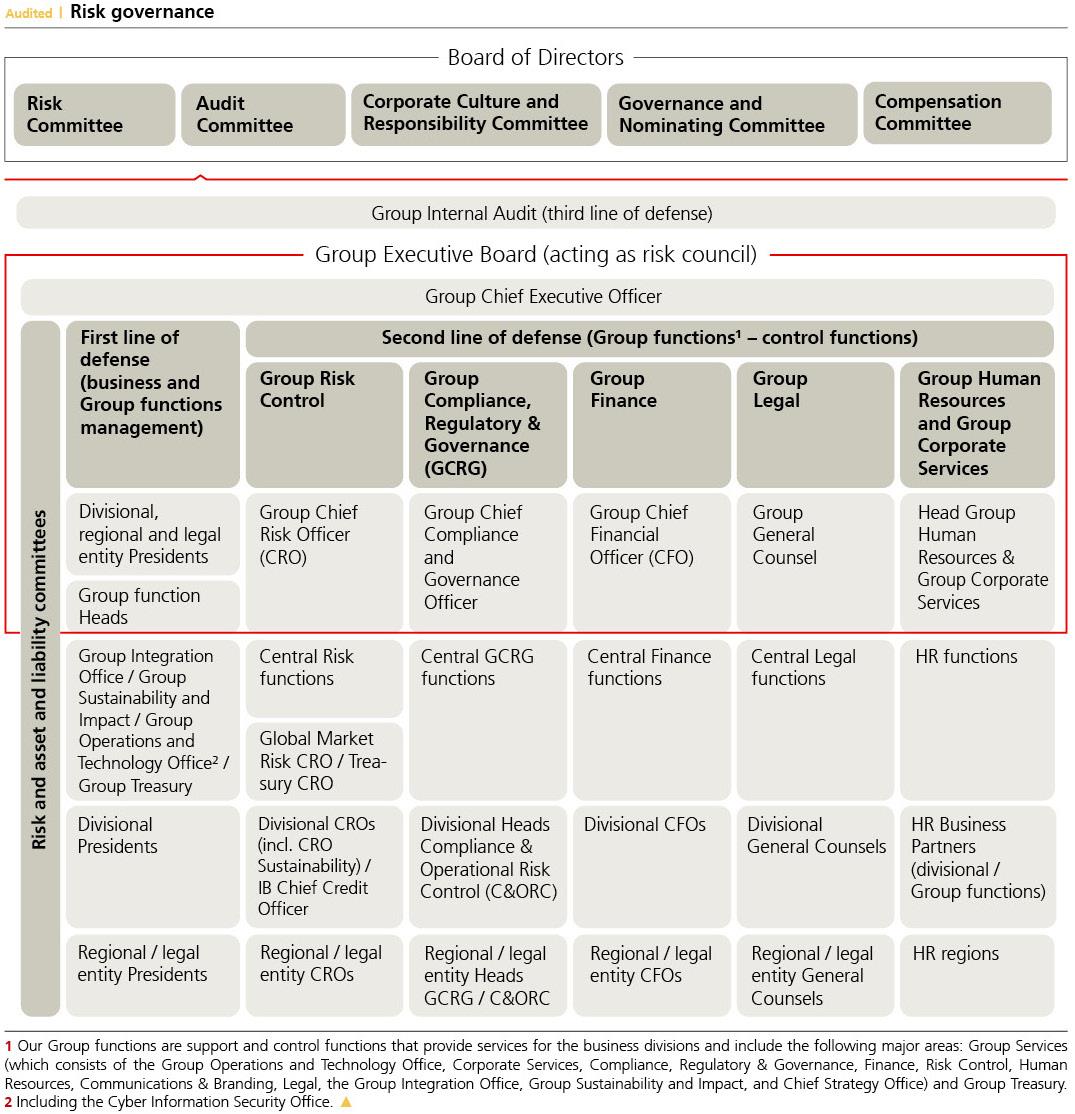
Annual Report 2023 |
Risk, capital, liquidity and funding, and
balance sheet | Risk management and control
102
Audited |
The Board of
Directors (the
BoD) approves
the risk
management and
control framework
of the Group,
including
the Group and
business division
overall risk
appetite. The
BoD is supported
by its Risk
Committee, which monitors
and
oversees the Group’s risk profile and
the implementation of the risk
framework approved by the BoD, and
approves the
Group’s risk appetite methodology. The
Corporate Culture and Responsibility Committee (the
CCRC) helps the
BoD meet
its
duty
to
safeguard
and
advance
UBS’s
reputation
for
responsible
and
sustainable
conduct,
reviewing
stakeholder
concerns and expectations pertaining
to UBS’s societal contribution
and corporate culture. The
Audit Committee assists
the
BoD
with
its
oversight
duty
relating
to
financial
reporting
and
internal
controls
over
financial
reporting,
and
the
effectiveness of whistleblowing procedures and the external and
internal audit functions.
The Group Executive Board (the
GEB) has overall responsibility for establishing
and implementing a risk management and
control framework in the Group, managing the risk profile
of the Group as a whole.
The
Group
CEO
has
responsibility
and
accountability
for
the
management
and
performance
of
the
Group,
has
risk
authority over
transactions, positions
and exposures,
and allocates
risk authority
delegated by
the BoD
to the
business
divisions and Group functions.
The business division Presidents and Group functional
heads are responsible for the operation and management
of their
business divisions and Group functions, including controlling the
risk appetite of the business divisions.
The regional Presidents ensure cross-divisional
collaboration in their regions
and are mandated to inform
the GEB about
any regional activities and issues that may give rise to actual
or potentially material regulatory or reputational concerns.
Annual Report 2023 |
Risk, capital, liquidity and funding, and
balance sheet | Risk management and control
103
The Group
Chief Risk
Officer (the
Group CRO)
is responsible
for developing
the Group’s
risk management
and control
framework (including risk
principles and risk appetite)
for credit, market,
country, treasury, model and
sustainability and
climate risks. This includes risk measurement and
aggregation, portfolio controls,
risk reporting,
and taking decisions on
transactions,
positions,
exposures,
portfolio
limits
and
allowances
in
accordance
with
the
risk
control
authorities
delegated to the Group CRO.
The Group
Chief Compliance
and Governance
Officer is
responsible for
developing the
Group’s risk
management and
control framework (including taxonomies and risk appetite) for non-financial risks, as well as implementing
independent
control frameworks for these risks.
The Group Chief Financial Officer (the Group CFO) is responsible for transparency
in assessing the financial performance
of the
Group and
the business
divisions, and
for managing
the Group’s
financial accounting,
controlling,
forecasting,
planning and reporting.
Additional responsibilities include managing
and controlling UBS’s
tax affairs, treasury
and capital
management,
including
regulatory
ratios,
asset
and
liability
management,
and
developing
UBS’s
inorganic
strategy
(mergers
and acquisitions) in collaboration with the GEB.
The
Group
Chief
Operations
and
Technology
Officer
is
responsible
for
driving
Group-wide
digitalization,
delivering
technology services,
infrastructure and
operations, including
cybersecurity and
information security,
for our
clients and
employees, and providing Group-wide data governance.
The Group General Counsel manages the Group’s legal affairs, ensuring effective and timely assessment of legal matters
impacting the Group or its businesses, and managing and
reporting all litigation matters.
The Head
Group Human Resources
& Group
Corporate Services
defines and
executes a
human resources
strategy aligned
to UBS’s
objectives, supplies real
estate infrastructure and
controls supply and
demand management activities
.
The Group
Integration Officer develops
UBS’s
integration
strategy
with
regard
to
Credit
Suisse
within
agreed
design
principles
and
in
accordance
with
UBS’s
strategy
and
coordinates
with
integration
teams
to
ensure
coherent
and
consistent execution of integration plans and milestones.
GIA independently
assesses the
soundness of
UBS’s risk
and control
culture and
reliability of
financial and
operational
information. GIA also assesses
the design, operating effectiveness
and sustainability of processes
to define strategy
and
risk appetite,
governance processes, risk
management, internal controls,
remediation activities and
processes to comply
with legal and regulatory requirements
and internal documents. The Head GIA reports to the Chairman
of the BoD. GIA
also has a functional reporting line to the BoD Audit Committee.
Some of these roles and responsibilities are replicated for significant entities
of the Group. Designated entity risk officers
oversee and control
financial and non-financial risks
for significant entities of
UBS as part of
the entity control
framework,
which complements the Group’s risk management and control
framework.
p
Risk appetite framework
We have a defined Group-level risk appetite, covering financial and non-financial risk types, via a complementary set of
qualitative and
quantitative risk
appetite statements.
This is
reviewed and
recalibrated
annually and
presented to
the
BoD for approval.
Our risk
appetite is
defined at
the aggregate
Group level
and reflects
the risk
that we
are willing
to accept
or wish
to
avoid. It is set via complementary qualitative and quantitative risk appetite statements defined at a firm-wide level and is
embedded throughout our business divisions and legal entities by
Group, business division and legal entity policies, limits
and authorities. Our risk appetite is reviewed and recalibrated annually, with the aim of ensuring that risk-taking at every
level of
the organization
is in
line with
our strategic
priorities, our
capital and
liquidity plans,
our
Pillars, Principles
and
Behaviors
, and minimum regulatory
requirements. The
“Risk appetite framework”
chart below shows the
key elements
of the framework, which is described in detail in this section.
Qualitative
risk
appetite
statements
aim
to
ensure
we
maintain
the
desired
risk
culture.
Quantitative
risk
appetite
objectives
are
designed
to
enhance
UBS’s
resilience
against
the
effects
of
potential
severe
adverse
economic
or
geopolitical events. These risk appetite objectives cover minimum capital and leverage ratios, solvency, earnings, liquidity
and
funding,
and
are
subject
to
periodic
review,
including
the
yearly
business
planning
process.
These
objectives
are
complemented by
a standardized
set of
quantitative firm
-wide non-financial
risk appetite
objectives established
at the
Group
and
business
division
levels.
Non-financial
risk
events
exceeding
predetermined
risk
tolerances,
expressed
as
percentages of UBS’s total operating income, must be escalated
as per the firm-wide escalation framework.
The quantitative
risk appetite
objectives are
supported by
a comprehensive
suite of
risk limits
set at
a portfolio
level to
monitor specific portfolios and to identify potential risk concentrations.
The status
of our
quantitative
risk appetite
objectives
is evaluated
each month
and reported
to the
BoD and
the GEB.
As our
risk appetite may
change over time, portfolio
limits and associated
approval authorities
are subject to periodic
reviews and
changes, particularly
in the context
of our annual
business planning
process.
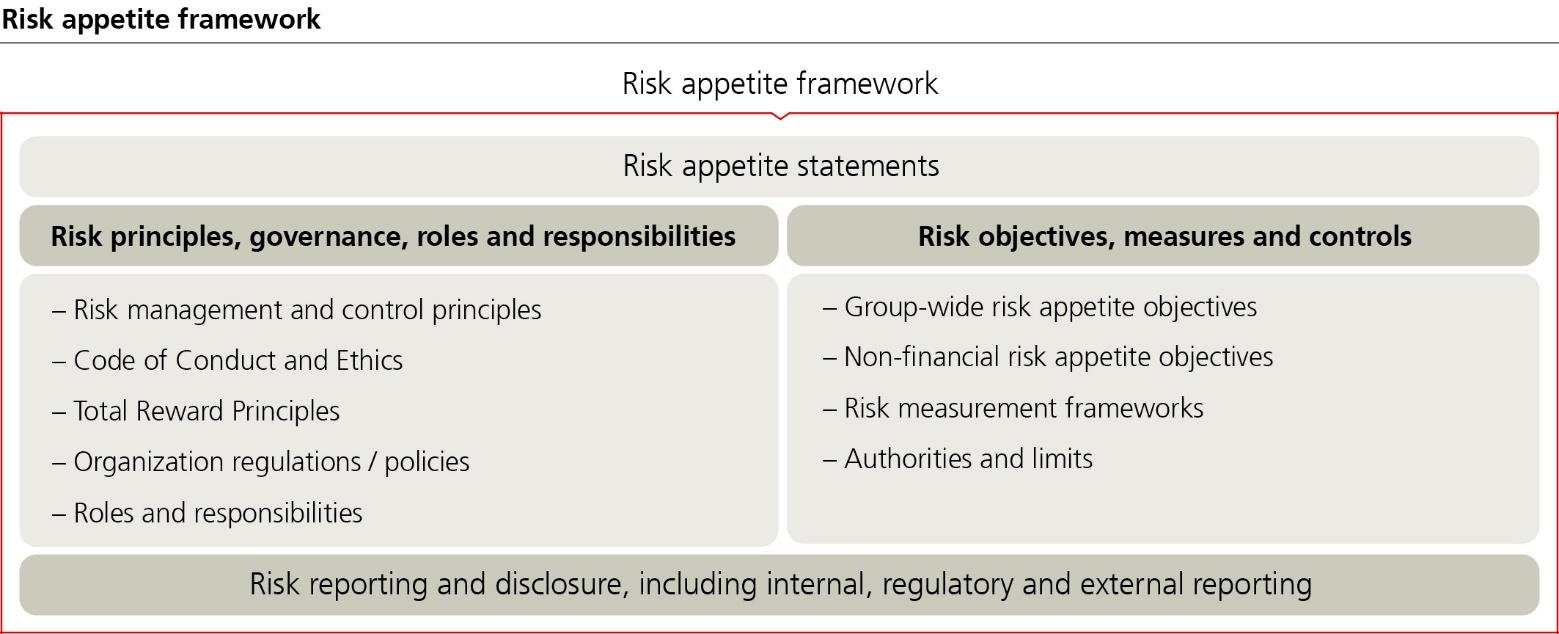
Annual Report 2023 |
Risk, capital, liquidity and funding, and
balance sheet | Risk management and control
104
Our risk
appetite framework
is governed
by a
single overarching policy
and conforms
to the
Financial Stability Board’s
Principles for an Effective Risk Appetite Framework.
The former UBS
risk appetite framework is applied to
the combined
UBS Group.
Risk principles and risk culture
Maintaining
a
strong
risk
culture
is a
prerequisite
for
success
in today’s
highly
complex
operating
environment
and a
source of sustainable competitive advantage.
Our risk appetite
framework combines
all the important
elements of our
risk culture,
expressed in our
Pillars, Principles
and
Behaviors
,
our
risk
management
and
control
principles,
our
Code
of
Conduct
and
Ethics,
and
our
Total
Reward
Principles. They
help to
create a
solid foundation
for promoting
risk awareness,
leading to
appropriate risk-taking
and
the establishing of robust
risk management and control processes. These
principles are supported by
a range of initiatives
covering employees at
all levels, for
example the
UBS House View
on Leadership
, which is
a set of
explicit expectations
that establishes consistent leadership standards across UBS, and our Principles of
Good Supervision, which establish clear
expectations of
managers and
employees regarding supervisory
responsibilities, specifically: to
take responsibility;
to know
and organize their business; to know their employees and what they do; to create a good risk culture; and to respond to
and resolve issues.
›
Refer to “Employees” in the “How we create value
for our stakeholders” section of this report for
more information about our
Pillars, Principles and Behaviors
›
Refer to the Code of Conduct and Ethics of
UBS at
ubs.com/code
Risk management and control principles
Protection of financial strength
Protecting UBS’s financial strength by controlling our risk
exposure and avoiding potential risk
concentrations at individual exposure levels,
at specific portfolio levels and at an aggregate firm-wide
level across all risk types.
Protection of reputation
Protecting our reputation through a sound risk culture characterized
by a holistic and integrated view of
risk, performance and reward, and through full compliance
with our standards and principles, particularly
our Code of Conduct and Ethics.
Business management accountability
Maintaining management accountability, whereby business management owns
all risks assumed
throughout the Group and is responsible for the continuous
and active management of all risk exposures
to provide for balanced risk and return.
Independent controls
Independent control functions that monitor the
effectiveness of the businesses’ risk management
and
oversee risk-taking activities.
Risk disclosure
Disclosure of risks to senior management, the BoD,
investors, regulators, credit rating agencies
and other
stakeholders with an appropriate level of comprehensiveness
and transparency.
Whistleblowing policies and procedures exist to
encourage an environment where staff are comfortable raising
concerns.
There
are
multiple channels
via which
individuals
may,
either
openly or
anonymously,
escalate
suspected
breaches
of
laws, regulations,
rules and other
legal requirements,
our Code of
Conduct and Ethics,
policies or relevant
professional
standards.
We
are
committed
to
ensuring
there
is
appropriate
training
and
communication
to
staff
and
legal
entity
representatives, including information about
new regulatory requirements.
Mandatory training programs
cover various compliance-related
and risk-related topics,
including operational risk
and anti-
money laundering. Additional specialized training is
provided depending on employees’ specific roles
and responsibilities,
e.g., credit risk and market risk training for those working
in trading areas.

Annual Report 2023 |
Risk, capital, liquidity and funding, and
balance sheet | Risk management and control
105
Quantitative risk appetite objectives
Our
quantitative
risk
appetite
objectives
aim
to
ensure
that
our
aggregate
risk
exposure
remains
within
desired
risk
capacity, based on capital
and business
plans. The
specific definition of
risk capacity
for each
objective is
aimed at
ensuring
we
have
sufficient
capital,
earnings,
funding
and
liquidity
to
protect
our
businesses
and
exceed
minimum
regulatory
requirements under a severe stress event. The risk appetite
objectives are evaluated during the annual business planning
process and approved by
the BoD. The comparison of
risk exposure with risk
capacity is a key consideration in
decisions
on potential adjustments to the business strategy,
risk profile,
and the level of capital returns to shareholders.
In the
annual
business
planning
process,
UBS’s
business
strategy
is reviewed
,
the
risk
profile
that
our
operations
and
activities
result
in
is assessed
,
and
that
risk
profile
is
stressed.
We
use
both
scenario-based
stress
tests
and
economic
capital
risk
measurement
techniques
to
assess
the
effects
of
severe
stress
events
at
a
firm-wide
level.
These
complementary frameworks capture exposures to material
risks across our business divisions and Group Items.
The BoD has approved the following risk appetite objectives
for the combined UBS Group.
›
Refer to “Risk measurement” in this section for
more information about our stress testing and economic capital
measures
Our risk
capacity is
underpinned by performance
targets and capital
guidance as per
our business
plan. When
determining
our risk capacity in
case of a severe stress event,
we estimate projected earnings under
stress, factoring in lower expected
income and
expenses. We
also consider
capital impacts
under stress
from deferred
tax assets,
pension plan
assets and
liabilities, and accruals for capital returns to shareholders.
Annual Report 2023 |
Risk, capital, liquidity and funding, and
balance sheet | Risk management and control
106
Risk appetite objectives define the aggregate risk exposure acceptable
at the firm-wide level, given our risk capacity. The
maximum acceptable risk
exposure is
supported by
a full set
of risk
limits, which
are cascaded to
businesses and portfolios.
These limits aim to ensure that our risks remain in line with
risk appetite.
Risk appetite statements at the business division level are derived from
the firm-wide risk appetite. They may also include
division-specific strategic goals
related to that
division’s activities and
risks. Risk
appetite statements are
also set
for certain
legal entities,
which must
be consistent
with the
firm-wide risk
appetite framework
and approved
in accordance
with
Group and legal entity regulations. Differences may exist that reflect the specific nature, size, complexity and regulations
applicable to the relevant legal entity.
Internal risk reporting
Comprehensive
and transparent
reporting of
risks is
central to
our risk
governance framework’s
control and
oversight
responsibilities and required by
our risk management
and control principles.
Accordingly, risks are reported at a
frequency
and level
of detail
commensurate
with the
extent
and
variability of
the
risk and
the
needs of
the various
governance
bodies, regulators and risk authority holders.
Since the
acquisition of
the
Credit Suisse
Group, the
Group Risk
Summary
report provides
a
monthly overview
of the
combined risk
profile across
UBS AG and
Credit Suisse
AG, covering
both financial
and non-financial
risks. The
report
recently also included the status of our risk appetite objectives
and the results of firm-wide stress testing. With respect to
financial risks, the
Group Risk Summary
includes a view
of aggregated risk
exposures, to the
extent metrics are
broadly
comparable. The Group Risk
Summary is distributed
internally to the BoD,
the GEB and senior
members of Risk Control
and GIA. In parallel, respective senior
management continues to be informed about
the two parent banks’ risks in more
detail via
the UBS AG
Risk Report
(formerly the
Group Risk
Report), the
Credit Suisse
AG Financial
Risk Report
and the
Credit Suisse AG Non-Financial Risk Report.
Monthly divisional
risk reports
are supplemented
with daily
or weekly
reports, at
various levels
of granularity,
covering
market and credit
risks for the
business divisions to
enable risk officers
and senior management
to monitor and
control
the Group’s risk profile.
Our internal risk
reporting covers financial and
non-financial risks and is
supported by risk
data and measurement systems
that
are
also
used
for
external
disclosure
and
regulatory
reporting.
Dedicated
units
within
Risk
Control
assume
responsibility for measurement,
analysis and reporting
of risk and for
overseeing the quality and integrity
of risk-related
data.
Our
risk
data
and
measurement
systems
are
subject
to
periodic
review
by
GIA,
following
a
risk-based
audit
approach.
Model risk management
Introduction
We rely
on models to
inform risk management
and control
decisions, to measure
risks or exposures,
value instruments
or positions, conduct
stress testing, assess
adequacy of
capital, and manage
clients’ assets and
our own assets.
Models
may also be
used to measure
and monitor compliance
with rules and
regulations, for
surveillance activities,
or to meet
financial or regulatory reporting requirements.
Model risk
is defined
as the
risk of
adverse consequences
(e.g., financial
losses or
reputational damage)
resulting from
incorrect or misused models.
Model governance framework
Our model governance
framework establishes requirements for
identifying, measuring, monitoring, reporting,
controlling
and mitigating model risk. All
the models that we use
are subject to governance and
controls throughout their life cycles,
with rigor,
depth and
frequency determined
by the
model’s materiality
and complexity.
This is designed
to ensure
that
risks arising from model use are identified, understood, managed, monitored, controlled
and reported on both a model-
specific and an
aggregated level. Before they can
be granted approval
for use, all
our models are independently
validated.
Once validated and approved for use,
a model is subject to ongoing model
monitoring and regular model confirmation,
ensuring that the model is only used if it continues
to be found fit for purpose. All models
are subject to periodic model
re-validation.
Annual Report 2023 |
Risk, capital, liquidity and funding, and
balance sheet | Risk management and control
107
Our
model
risk
governance
framework
follows
our
overarching
risk
governance
framework,
with
the
three
lines
of
defense (LoD) assigned as follows.
–
First LoD:
individuals responsible
for development,
maintenance and
appropriate use
of the
models, within
business
units and Group functions.
–
Second LoD: individuals responsible
for independent review of
and effective challenge to
the models,
the Model Risk
Management & Control function headed by the Chief Model
Risk Officer.
–
Third LoD: Group Internal Audit.
An important difference
as compared
with how LoD
are usually
defined in financial
and non-financial
risk is that
some
models are owned by traditionally second LoD functions,
such as Risk Control, Finance or Compliance.
Model risk appetite framework and statement
The model risk appetite framework sets out the
model risk appetite statement, defines the relevant
metrics and lays out
how appropriate adherence is assessed.
Model oversight
Model
oversight
committees
and
forums
ensure
that
model
risk
is
overseen
at
different
levels
of
the
organization,
appropriate model risk management and control
actions are taken and, where
necessary,
escalated to the next level.
The Group Model Governance Committee is our most
senior oversight and escalation body for
all models in scope of our
model governance framework. It is co-chaired by the Group CRO
and the Group CFO and is responsible for: (i) reviewing
and approving changes to the framework;
(ii) approving the model risk appetite statement;
(iii) overseeing adherence to
the UBS model risk governance framework; and (iv) monitoring
model risk at a firm-wide level.
Risk measurement
Audited |
We apply a
variety of methodologies
and measurements
to quantify the
risks of our
portfolios and potential
risk
concentrations. Risks that are
not fully reflected within standard
measures are subject to
additional controls, which may
include
preapproval
of
specific
transactions
and
the
application
of
specific
restrictions.
Models
to
quantify
risk
are
generally developed by dedicated units within control
functions and are subject to independent validation.
p
›
Refer to “Credit risk,” “Market risk” and “Non-financial
risk” in this section for more information about model
confirmation
procedures
The text below describes the
scenario-based stress testing and
economic capital measures
of UBS AG on a consolidated
basis
during
2023.
As
part
of
the
ongoing
integration
of
Credit
Suisse,
we
have
made
significant
progress
in
the
evaluation and alignment
of our stress
testing and economic
capital approaches and results.
We will continue
to integrate
our risk methodologies and measurements as Credit Suisse
portfolios migrate to UBS infrastructure.
Stress testing
We perform stress testing to
estimate losses that could
result from extreme yet plausible macroeconomic and
geopolitical
stress events to
identify, better understand and
manage our potential
vulnerabilities and risk
concentrations. Stress testing
has a
key
role
in our
limits
framework
at the
firm-wide,
business
division,
legal
entity
and portfolio
levels. Stress
test
results are regularly
reported to the
BoD and the
GEB. As described
in “Risk appetite
framework,” stress testing,
along
with economic capital measures, has a central role
in our risk appetite and business planning processes.
Our stress
testing framework
has three
pillars: (i) combined
stress tests;
(ii) an extensive
set of
portfolio-
and risk-type-
specific stress tests; and (iii) reverse stress testing.
The combined stress
testing (CST) framework
is scenario-based and
aims to quantify
overall firm-wide losses
that could
result
from
various
potential
global
systemic
events.
The
framework
captures
all
material
risks,
as
covered
in
“Risk
categories.” Scenarios
are forward-looking
and encompass
macroeconomic and
geopolitical stress
events calibrated
to
different
levels
of
severity.
We
implement
each
scenario
through
the
expected
evolution
of
market
indicators
and
economic variables under
that scenario
and then estimate
the overall loss
and capital
implications were the
scenario to
occur. Following the
existing UBS AG scenario
governance, at least
once a year,
the Risk Committee
approves the most
relevant
scenario,
known
as
the
binding
scenario,
for
use
as
the
main
scenario
for
regular
CST
reporting
and
for
monitoring
risk
exposure
against
our
minimum
capital,
earnings
and
leverage
ratio
objectives
in
our
risk
appetite
framework.
Annual Report 2023 |
Risk, capital, liquidity and funding, and
balance sheet | Risk management and control
108
We provide
detailed stress
loss analyses
to the
Swiss Financial
Market Supervisory
Authority (FINMA)
and regulators
of
our legal entities in accordance with their requirements.
Our Enterprise-wide Stress
Forum (the
ESF) aims
to ensure the
consistency and
adequacy of the
assumptions and
scenarios
used for
firm-wide
stress
measures.
As part
of its
responsibilities,
the ESF,
with input
from the
Think Tank,
a panel
of
senior representatives
from the
business divisions,
Risk Control
and Economic
Research, seeks
to ensure that
the set of
stress
scenarios
adequately
reflects
current
and
potential
developments
in
the
macroeconomic
and
geopolitical
environment, current and planned business activities,
and actual or potential risk
concentrations and vulnerabilities in our
portfolios.
Each
scenario
captures
a
wide
range
of macroeconomic
variables,
including
GDP,
equity prices,
interest
rates,
foreign
exchange
rates,
commodity
prices,
property
prices
and
unemployment.
We
use
assumed
changes
in
these
macroeconomic and market variables in each scenario to stress the key risk drivers of our portfolios. We also capture the
business risk resulting from lower fee, interest and trading income net of lower
expenses. These effects are measured for
all businesses and
material risk types
to calculate the
aggregate estimated effect
of the scenario on
profit or loss,
other
comprehensive income, risk-weighted assets, the leverage ratio denominator and, ultimately, capital and leverage
ratios.
The assumed
changes in
macroeconomic variables
are updated
periodically to
account for
changes in
the current
and
possible future market environment.
In 2023,
the binding
scenario for
CST was
the internal
stagflationary geopolitical
crisis scenario.
This scenario
assumes
that a geopolitical event leads
to economic regionalization and fears
of prolonged stagflation. Central banks signal
a firm
commitment
to
price
stability
and
continue
to
tighten
monetary
policy,
triggering
a
broad
rise
in
interest
rates
and
impacting economic activity and asset values.
As part of the CST framework, we routinely monitored three
additional stress scenarios throughout 2023:
–
The
global crisis
Combined with political, solvency and liquidity concerns, this results in a sharp sell-off
of emerging markets sovereign
debt and some emerging markets
default. The macroeconomic and market impacts
amplify concerns about peripheral
European sovereign debt, causing Greece and Cyprus to
default.
–
The
global depression
concerns
around
emerging
markets
sovereign
debt,
causing
several
large
emerging
markets
to
default.
Several
European
economies
also
default,
and
some
leave
the
Eurozone.
A
negative
feedback
loop
between
collapsing
demand,
declining
asset
values
and
commodity
prices,
and
disruption
in
the
banking
system
leads
to
a
deep
and
prolonged recession across the globe.
–
The
US
monetary
crisis
denominated assets,
sparking an
abrupt and
substantial depreciation
of the
US dollar.
The US
economy is
hit hard,
financial markets enter a period of high volatility and other industrialized countries replicate the cyclical pattern of the
US. Regional
inflation
trends
diverge
as the
US experiences
significant
inflationary
pressures
while
other
developed
markets experience deflation.
Portfolio-specific stress tests are measures tailored to the risks
of specific portfolios. Our portfolio stress loss measures are
derived
from
data
on
past
events,
but
also
include
forward-looking
elements
(e.g.,
we
derive
the
expected
market
movements in our liquidity-adjusted stress metric using a combination
of historical market behavior, based on an analysis
of historical events, and
forward-looking analysis, including consideration of defined scenarios that
have never occurred).
Results
of
portfolio-specific
stress
tests
may
be
subject
to
limits
to
explicitly
control
risk-taking
or
may
be
monitored
without limits to identify vulnerabilities.
Reverse stress testing starts from
a defined stress outcome (e.g.,
a specified loss amount, reputational damage, a
liquidity
shortfall
or
a
breach
of
minimum
capital
ratios)
and
works
backward
to
identify
macroeconomic
scenarios
and
/
or
idiosyncratic
events
that
could
result
in
such
an
outcome.
As
such,
reverse
stress
testing
is
intended
to
complement
scenario-based stress
tests by
assuming “what
if” outcomes
that could
extend beyond
the range
normally considered,
and thereby potentially challenge assumptions regarding
severity and plausibility.
We also routinely
analyze the effect of
increases or decreases in
interest rates and changes
in the structure of
yield curves.
Within Group Treasury, we
also perform stress testing
to determine the
optimal asset and liability
structure, enabling us
to maintain an appropriately balanced liquidity and funding position under various scenarios. These scenarios differ from
those
outlined
above,
because
they
focus
on
specific
situations
that
could
generate
liquidity
and
funding
stress,
as
opposed to the scenarios used in the CST framework,
which focus on the effect on profit or loss and capital.
›
Refer to “Credit risk” and “Market risk” in this section
for more information about stress loss measures
›
Refer to the “Capital, liquidity and funding,
and balance sheet” section of this report for more information
about stress testing
›
Refer to “Note 20 Expected credit loss measurement”
in the “Consolidated financial statements” section
of this report for more
information about scenarios used for expected
credit loss measurement
Economic capital measures
We
complement
the
scenario-based
CST
measures
with
economic capital
stress
measures
to calculate
and aggregate
risks using statistical techniques to derive stress events
at chosen confidence levels.
Annual Report 2023 |
Risk, capital, liquidity and funding, and
balance sheet | Risk management and control
109
This framework
is
used
to derive
a
loss
distribution,
considering
effects
on
both
income
and
expenses,
based
on
the
simulation of historically observed financial and economic risk factors in combination with the firm’s actual earnings and
relevant risk exposures. From that, we
determine earnings-at-risk (EaR), measuring the potential shortfall
in earnings (i.e.,
the deviation from forecast
earnings) at a 95%
confidence level and
evaluated over a
one-year horizon. EaR
is used for
the assessment of the earnings objectives in our risk appetite
framework.
We
extend
the
EaR
measure,
incorporating
the
effects
of
gains
and
losses
recognized
through
other
comprehensive
income, to
derive a
distribution of potential
effects of
stress events on
common equity tier 1
capital. From
this distribution,
we derive our capital-at-risk (CaR) buffer measure at
a 95% confidence level to assess our capital
and leverage ratio risk
appetite objectives, and derive our
CaR solvency measure at a
99.9% confidence level to
assess our solvency risk
appetite
objective.
We use the CaR solvency measure
as a basis for deriving the
contributions of the business divisions
to risk-based capital
(RBC). RBC measures the potential capital impairment from
an extreme stress event at a 99.9% confidence level.
Portfolio and position limits
UBS maintains
a comprehensive
set of
risk limits
across its
major risk
portfolios. These
portfolio limits
are set
based on
our risk appetite and periodically reviewed and adjusted
as part of the business planning process.
Firm-wide
stress and
statistical metrics
are complemented
by more
granular
portfolio
and position
limits, triggers
and
targets.
Combining
these
measures
provides
a
comprehensive
framework
for
control
of
the
key
risks
of
our
business
divisions, as well as significant legal entities.
UBS AG and Credit Suisse AG apply
limits to a variety of exposures
at the portfolio level, using statistical and
stress-based
measures, such as value-at-risk,
liquidity-adjusted stress, loan underwriting limits,
economic value sensitivity and portfolio
default simulations
for
loan books.
These are
complemented
with a
set of
controls
for net
interest income
sensitivity,
mark-to-market
losses
on
available-for-sale
portfolios,
and
the
effect
of
foreign
exchange
movements
on
capital
and
capital ratios.
Portfolio measures are
supplemented with counterparty-
and position-level controls.
Risk measures for position
controls
are
based
on
market
risk
sensitivities
and
counterparty-level
credit
risk
exposures.
Market
risk
sensitivities
include
sensitivities to changes in general market
risk factors (e.g., equity indices, foreign exchange
rates and interest rates) and
sensitivities
to
issuer-specific
factors
(e.g.,
changes
in
an
issuer’s
credit
spread
or default
risk).
We
monitor
numerous
market
and
treasury
risk
controls
on
a
daily
basis.
Counterparty
measures
capture
the
current
and
potential
future
exposure to an individual counterparty, considering collateral
and legally enforceable netting agreements.
Since the legal close of the acquisition of the Credit Suisse Group in June 2023,
UBS has implemented a set of combined
portfolio
limits
applied
to
UBS
Group
AG
to
oversee
the
aggregate
risk
profile,
while
UBS AG
and
Credit
Suisse
AG
continue to operate
under their existing
risk management
and limit frameworks
until the merger
of the two
entities in
the second
quarter of
2024. This
initial set
of combined
limits was
further reviewed
and extended
to cover
additional
main risk portfolios of the Group in January 2024.
›
Refer to “Credit risk” in this section for more information about
counterparty limits
›
Refer to “Risk appetite framework” in this section
for more information about the risk appetite framework
Risk concentrations
Audited |
Risk concentrations may exist where one or several positions within
or across different
risk categories could result
in significant losses relative
to UBS’s financial strength.
Identifying such risk concentrations
and assessing their potential
impact is a critical component of our risk management and
control process.
For financial risks, we consider a number of elements, such
as shared characteristics of positions, the size of the portfolio
and the sensitivity of positions to changes in the underlying risk factors. Also
important in our assessment is the liquidity
of the markets
where the positions
are traded, as
well as the
availability and effectiveness
of hedges or
other potential
risk-mitigating factors. This includes an
assessment of, for example, the
provider of the hedge and
market liquidity where
the hedge might be traded. Particular
attention is given to identification of
wrong-way risk and risk on risk.
Wrong-way
risk is defined as a positive correlation between the size of the exposure and the likelihood of a loss. Risk on risk is when
a position and its risk mitigation can be impacted by the same
event.
For non-financial risks, risk concentrations may result from, for example, a single operational risk issue that is large on its
own (i.e., it has
the potential to
produce a single high-impact
loss or a number
of losses that together
are high impact)
or related risk issues that may link together to create
a high impact.
Risk
concentrations
are
subject
to
increased
oversight
by
Group
Risk
Control
and
Group
Compliance,
Regulatory
&
Governance, and assessed
to determine whether they
should be reduced
or mitigated, depending on
the available means
to do
so. It is
possible that
material losses
could occur
on financial
or non-financial
risks, particularly
if the
correlations
that emerge in a stressed environment differ markedly from those
envisaged by risk models.
p
›
Refer to “Credit risk” and “Market risk” in this
section for more information about the composition
of our portfolios
›
Refer to the “Risk factors”
section of this report for more information
Annual Report 2023 |
Risk, capital, liquidity and funding, and
balance sheet | Risk management and control
110
Credit risk
Audited |
Main sources of credit risk
–
Global Wealth
Management
credit risk
arises
from collateralized
lending,
primarily
against securities,
private
equity
and hedge
fund interest,
investors’ uncalled
capital commitments,
residential and
commercial real
estate,
and other
real assets such as ships and aircraft, as well
as from derivatives trading. In addition,
risk also arises from its corporate
lending and other unsecured lending.
–
A substantial
portion
of lending
exposure arises
from Personal
& Corporate
Banking, which
offers mortgage
loans,
secured
mainly
by
owner-occupied
properties
and
income-producing
real
estate,
as
well
as
corporate
loans,
and
therefore depends on the performance of the Swiss economy and
real estate market.
–
The
Investment
Bank’s
credit
exposure
arises
mainly
from
lending,
derivatives
trading
and
securities
financing.
Derivatives trading and securities financing are
mainly investment grade. Loan underwriting activity
can be lower rated
and gives rise to temporary concentrated exposure.
–
Credit risk
within Non-core
and Legacy
relates to
large, less-liquid
structured financing
transactions,
including some
with residential
and commercial
real estate
collateral,
a
material corporate
loan
portfolio
and a
counterparty
credit
trading portfolio with lending against securities collateral
and derivatives.
p
Credit loss expense / release
Total
net
credit
loss
expenses
were
USD 1,037m
in
2023, reflecting
net
credit
loss
expenses
of USD
593m
related
to
stage 1
and
2 positions
and
net
credit
loss
expenses
of
USD 445m
related
to credit
-impaired
(stage 3
and
purchased
credit-impaired) positions. Expected credit
loss (ECL)
expenses of USD 593m
for the performing
loans were predominantly
attributable to the
initial recognition
of expected
credit loss
allowances and
provisions after
the date of
the acquisition
of the Credit Suisse
Group. Credit-impaired
net expenses amounted to
USD 445m, of which USD
325m was within the
Credit Suisse portfolio and USD 120m was within the
UBS portfolio. As per IFRS 9,
no ECL allowances
and provisions had
to be
recognized at the
acquisition date for credit-impaired exposures,
after the fair
valuation as per
the purchase price
allocation.
›
Refer to “Note 1 Summary of material accounting
policies,” “Note 10 Financial assets at amortized
cost and other positions in
scope of expected credit loss measurement” and “Note 20
Expected credit loss measurement” in the “Consolidated financial
statements” section of this report for more information about IFRS
9 and expected credit losses
Credit loss expense / (release)
Performing positions
Credit-impaired positions
USD m
Stages 1 and 2
Stage 3
Purchased
Total
For the year ended 31.12.23
Global Wealth Management
Personal & Corporate Banking
Asset Management
Investment Bank
Non-core and Legacy
Group Items
1
Total
For the year ended 31.12.22
Global Wealth Management
Personal & Corporate Banking
Asset Management
Investment Bank
Non-core and Legacy
Group Items
1
Total
For the year ended 31.12.21
Global Wealth Management
Personal & Corporate Banking
Asset Management
Investment Bank
Non-core and Legacy
Group Items
1
Total
1 Starting with the third quarter of 2023, Non-core and Legacy became a separate reportable segment and Group Functions has been renamed Group Items. Prior periods have been restated to reflect these changes.
Annual Report 2023 |
Risk, capital, liquidity and funding, and
balance sheet | Risk management and control
111
Audited |
Overview of measurement, monitoring and management
techniques
–
Credit risk
from transactions
with individual
counterparties
is based
on our
estimates of
probability of
default (PD),
exposure at default (EAD) and loss given default (LGD). Limits are established for individual counterparties and groups
of
related
counterparties
covering
banking
and
traded
products,
and
for
settlement
amounts.
Risk
authorities
are
approved by the Board of Directors and
are delegated to the Group CEO, the
Group Chief Risk Officer (the CRO)
and
divisional CROs, based on risk exposure amounts, internal credit rating
and potential for losses.
–
Limits apply not only to the current outstanding
amount but also to contingent commitments and the potential future
exposure of traded products.
–
The Investment Bank monitoring, measurement and limit framework distinguishes between
exposures intended to be
held to maturity (take-and-hold exposures) and those intended
for distribution or risk transfer (temporary exposures).
–
We use models
to derive portfolio
credit risk measures
of expected
loss, statistical loss
and stress loss
at Group-wide
and business division levels, and to establish portfolio limits.
–
Credit risk concentrations can arise if clients are engaged
in similar activities, located in the same geographical
region
or have
comparable economic
characteristics,
e.g., if
their ability
to meet
contractual obligations
would be
similarly
affected by changes in economic, political or other conditions. To avoid credit risk concentrations, we establish limits /
operational
controls
that
constrain
risk
concentrations
at
portfolio,
sub-portfolio
or
counterparty
levels
for
sector
exposure, country risk and specific product exposures.
p
Credit risk profile of the Group
The exposures
detailed in
this section
are based
on management’s
view of
credit risk,
which differs
in certain
respects
from the ECL measurement requirements
of IFRS Accounting Standards.
Internally,
we
put
credit
risk
exposures
into
two
broad
categories:
banking
products
and
traded
products.
Banking
products include drawn loans,
guarantees and loan commitments,
amounts due from banks,
balances at central banks,
and other
financial assets at
amortized cost. Traded
products include over-the-counter (OTC)
derivatives, exchange-traded
derivatives
(ETDs)
and
securities
financing
transactions
(SFTs),
consisting
of
securities
borrowing
and
lending,
and
repurchase and reverse repurchase agreements.
Annual Report 2023 |
Risk, capital, liquidity and funding, and
balance sheet | Risk management and control
112
Banking and traded products exposure in our business divisions and Group Items
31.12.23
USD m
Global
Wealth
Management
Personal &
Corporate
Banking
Asset
Management
Investment
Bank
Non-core
and Legacy
Group
Items
Total
Banking products
1,2
Gross exposure
of which: loans and advances to customers (on-balance sheet)
of which: guarantees and loan commitments (off-balance sheet)
Traded products
2,3,4
Gross exposure
of which: over-the-counter derivatives
of which: securities financing transactions
of which: exchange-traded derivatives
Other credit lines, gross
5
Total credit-impaired exposure, gross
1
of which: stage 3
of which: PCI
Total allowances and provisions for expected credit losses
of which: stage 1
of which: stage 2
of which: stage 3
of which: PCI
31.12.22
USD m
Global
Wealth
Management
Personal &
Corporate
Banking
Asset
Management
Investment
Bank
Non-core
and Legacy
Group
Items
Total
Banking products
1,2
Gross exposure
of which: loans and advances to customers (on-balance sheet)
of which: guarantees and loan commitments (off-balance sheet)
Traded products
2,3
Gross exposure
of which: over-the-counter derivatives
of which: securities financing transactions
of which: exchange-traded derivatives
Other credit lines, gross
5
Total credit-impaired exposure, gross
1
of which: stage 3
of which: PCI
Total allowances and provisions for expected credit losses
of which: stage 1
of which: stage 2
of which: stage 3
of which: PCI
1 IFRS 9 gross exposure
for banking products includes the following
financial assets in scope of expected
credit loss measurement: balances at central banks, amounts
due from banks, loans and advances to
customers,
other financial assets at amortized
cost, guarantees and irrevocable loan commitments.
2 Internal management view of
credit risk, which differs in
certain respects from IFRS Accounting
Standards.
3 As counterparty
risk for traded products is managed at
counterparty level, no further split between exposures in
the Investment Bank, Non-core and Legacy, and Group Items is
provided.
4 Credit Suisse traded products are presented
before reflection of the impac
t
of the purchase price
allocation performed under IFRS
3, Business Combinations,
following the acquisition of
the Credit Suisse
Group by UBS. The
acquisition date adjustment
is less
than USD 1bn and, if applied, would lead to a reduction in our reported traded products exposure.
5 Unconditionally revocable committed credit lines.
Banking products
›
Refer to “Note 1 Summary of material accounting
policies” in the “Consolidated financial statements”
section of this report for
more information about our accounting policy for allowances
and provisions for ECL
›
Refer to “Note 10 Financial assets at amortized
cost and other positions in scope of expected
credit loss measurement” and
“Note 20 Expected credit loss measurement” in the “Consolidated
financial statements” section of this report for more
information about ECL measurement requirements under IFRS
Accounting Standards
›
Refer to “Note 14 Other assets” in the “Consolidated
financial statements” section of this report for
more details
Annual Report 2023 |
Risk, capital, liquidity and funding, and
balance sheet | Risk management and control
113
Global Wealth Management
Gross banking products exposure within Global Wealth Management increased by USD 75bn
to USD 410bn in 2023 due
to the acquisition of the Credit Suisse Group
.
Our Global
Wealth
Management
loan portfolio
is mainly
secured
by securities
(Lombard
loans) and
by residential
real
estate. Most
of our
USD 182bn of
Lombard
loans, including
traded products
collateralized
by securities,
were
of high
quality,
with
93%
rated
as
investment
grade
based
on
our
internal
ratings.
Moreover,
Lombard
loans
are
typically
uncommitted, short-term in nature and can
be canceled immediately if
the collateral quality deteriorates and
margin calls
are not
met. Lending
values in
the Lombard
book are
derived by
applying discounts
to the
pledged collateral’s
market
value in
line with
a possible
adverse change
in market
value over
a given
close-out period
and confidence
level. Less-
liquid or more volatile collateral will typically have
larger haircuts.
In 2023, the Lombard book, including traded products,
increased by approximately 19% due to the
acquisition of the Credit Suisse Group
,
with no material losses recorded.
The mortgage
book (residential
and commercial
real estate)
increased by
approximately 31%
due to
the acquisition
of
the Credit Suisse Group, mainly driven by higher volumes of mortgage loans within the Swiss residential and commercial
real estate portfolios.
Other financing
represents
approximately 12% of
the total banking
products exposures and is
consolidated in a
corporate
and other portfolio that more
than doubled in 2023, mainly due
to the acquisition of the
Credit Suisse Group. Through
this acquisition,
Other financing now
includes ship, yacht
and export
financing totaling USD 10bn,
as well
as an expanded
corporate lending portfolio of USD 5bn.
›
Refer to “Lending secured by real estate” and “Lombard lending”
in this section for further information about these
types of
lending
Collateralization of Loans and advances to customers
1
Global Wealth Management
Personal & Corporate Banking
USD m, except where indicated
31.12.23
31.12.22
31.12.23
31.12.22
Secured by collateral
Residential real estate
Commercial / industrial real estate
Cash
Equity and debt instruments
Other collateral
2
Subject to guarantees
Uncollateralized and not subject to guarantees
Total loans and advances to customers, gross
Allowances
Total loans and advances to customers, net of allowances
Collateralized loans and advances to customers in % of total loans
and advances to customers, gross (%)
1 Collateral arrangements
generally incorporate a
range of collateral,
including cash, securities,
real estate and other
collateral. For
the purpose of this
disclosure, UBS applies
a risk-based approach
that generally
prioritizes collateral according to its liquidity profile. In the case of loan facilities with funded and unfunded
elements, the collateral is first allocated to the funded element. Credit Suisse applies a risk
-based approach
that generally prioritizes real estate collateral and prioritizes other collateral according to its liquidity profile. In the case of loan facilities with funded and unfunded elements, the collateral is proportionately allocated.
2 Includes but is not limited to life insurance contracts, rights in respect of subscription or capital
commitments from fund partners, inventory, gold and other
commodities.
Personal & Corporate Banking
Gross
banking
products
exposure
within
Personal
&
Corporate
Banking
increased
by
USD 245bn
to
USD 482bn
in
2023
due
to
the
acquisition
of
the
Credit
Suisse
Group.
As
illustrated
in
the
“Personal
&
Corporate
Banking:
distribution
of
banking
products
exposure
across
internal
UBS
ratings
and
loss
given
default
(LGD)
buckets”
table
below,
the majority was classified as
investment grade and a significant
portion of the exposure
is categorized in the
lowest LGD bucket, i.e., 0–25%.
As of
31 December 2023,
88% of
loans and
advances to
customers were
secured by
collateral, mainly
residential
and
commercial
property.
Of
the
total
unsecured
amount,
81%
related
to
cash-flow-based
lending
to
corporate
counterparties and 3% related to lending to public authorities.
Our Swiss
corporate
banking
products
take-and-hold
portfolio
exposure
was
USD 93bn
(CHF 78bn)
and
increased
by
USD 57bn
compared
with
2022
due
to
the
acquisition
of
the
Credit
Suisse
Group.
The
portfolio
consists
of
loans,
guarantees
and loan
commitments
to multi-national
and domestic
counterparties.
The small
and medium-sized
entity
(SME) portfolio,
in particular,
is well diversified
across industries.
However,
such companies are
reliant on
the domestic
economy and the economies to which they export, in particular
the EU and the US.
Our
commodity
trade
finance
portfolio
focuses
on
energy
and
base-metal
trading
companies,
where
the
related
commodity
price
risk
is hedged
to a
large
extent
by the
commodity
trader.
The
majority of
limits
in this
business
are
uncommitted, transactional
and short-term
in nature.
Our portfolio
size was
USD 11bn (CHF
9bn) as
of 31 December
2023, compared with USD 7bn (CHF 7bn) in
2022, due to the
acquisition of the Credit Suisse Group. A
considerable part
of the exposure correlates with commodity prices.
›
Refer to “Credit risk models” in this section for
more information about loss given default, rating
grades and rating agency
mappings
Annual Report 2023 |
Risk, capital, liquidity and funding, and
balance sheet | Risk management and control
114
Swiss mortgage loan portfolio
Our Swiss mortgage loan
portfolio secured by residential
and commercial real
estate in Switzerland continues
to be our
largest loan
portfolio. These
mortgage loans
(including loans
on self-used
commercial real
estate),
totaling USD 352bn
(CHF 297bn), mainly
originate from
Personal &
Corporate Banking,
but also
from Global
Wealth Management
Region
Switzerland.
As
illustrated
in
the
“Swiss
mortgages:
distribution
of
exposure
across
exposure
segments
and
loan-to-value
(LTV)
buckets”
table
below,
USD 262bn
(CHF 220bn)
of
these
mortgage
loans
related
to
residential
properties
that
the
borrower
was
either
occupying
or
renting
out,
with
full
recourse
to
the
borrower.
USD 70bn
(CHF 59bn)
related
to
income-producing real
estate. Of
the aggregate
amount of
Swiss residential
mortgages,
99.9% would
continue to
be
covered by the
real estate collateral
even if the
value assigned
to that collateral
were to decrease
20%, and more
than
99% would
remain covered
by the
real estate
collateral even
if the
value assigned
to that
collateral were
to decrease
30%.
Personal & Corporate Banking: distribution of banking products exposure across internal UBS ratings and loss given
default (LGD) buckets
1
USD m, except where indicated
31.12.23
31.12.22
LGD buckets
Weighted
average
LGD (%)
Weighted
average
LGD (%)
Internal UBS rating
2
Exposure
0–25%
26–50%
51–75%
76–100%
Exposure
Investment grade
293,090
184,710
83,321
19,583
5,477
25
123,358
28
Sub-investment grade
109,084
37,295
43,077
18,859
9,853
38
62,219
35
of which: 6−9
93,684
34,424
39,199
16,275
3,786
34
56,774
35
of which: 10−13
15,400
2,871
3,878
2,584
6,067
61
5,445
36
Defaulted / Credit-impaired
3,419
268
2,015
1,020
116
45
1,380
42
Banking products exposure
1
405,592
222,273
128,412
39,462
15,446
29
186,957
30
1 Excluding balances at central banks and Group Treasury reallocations and
for Credit Suisse including only loans and advances to customers and guarantees and loan commitments presented
before reflection of the
impact of the purchase price
allocation adjustments.
2 The ratings
of the major credit
rating agencies,
and their mapping to
our internal rating scale,
are shown in the “Internal
UBS rating scale and
mapping of
external ratings” table in this section.
Personal & Corporate Banking: loans uncollateralized and not subject to guarantees, by industry sector
31.12.23
31.12.22
USD m
%
USD m
%
Construction
452
1.3
172
1.3
Financial institutions
10,294
30.3
3,878
29.8
Hotels and restaurants
247
0.7
135
1.0
Manufacturing
5,092
15.0
1,715
13.2
Private households
5,429
16.0
1,473
11.3
Public authorities
861
2.5
416
3.2
Real estate and rentals
1,643
4.8
547
4.2
Retail and wholesale
4,555
13.4
2,230
17.1
Services
4,606
13.6
2,242
17.2
Other
784
2.3
226
1.7
Exposure, gross
33,963
100.0
13,034
100.0
Swiss mortgages: distribution of exposure across exposure segments and loan-to-value (LTV)
buckets
1
USD bn, except where indicated
31.12.23
31.12.22
2
LTV buckets
Exposure segment
≤30%
31–50%
51–60%
61–70%
71–80%
81–100%
>100%
Total
Total
Residential mortgages
Exposure
160.4
70.8
19.5
8.7
2.1
0.3
0.1
261.6
144.0
as a % of row total
61
27
7
3
1
0
0
100
100
Income-producing real estate
Exposure
46.0
18.1
4.0
1.5
0.2
0.0
0.1
70.0
21.9
as a % of row total
66
26
6
2
0
0
0
100
100
Corporates
Exposure
13.4
4.2
0.9
0.5
0.3
0.2
0.2
19.8
10.6
as a % of row total
68
21
5
2
1
1
1
100
100
Other segments
Exposure
0.8
0.3
0.1
0.0
0.0
0.0
0.0
1.1
1.0
as a % of row total
67
23
6
2
1
1
0
100
100
Mortgage-covered exposure
Exposure
220.4
93.4
24.5
10.7
2.5
0.4
0.5
352.3
177.5
as a % of total
63
27
7
3
1
0
0
100
100
Mortgage-covered exposure 31.12.22
2
Exposure
113.2
46.7
11.4
4.7
1.2
0.3
0.1
177.5
as a % of total
64
26
6
3
1
0
0
100
1 The amount of each mortgage loan is allocated across the LTV
buckets to indicate the portion at risk at the various
value levels shown; for example, a loan of 75 with an
LTV ratio of 75% (i.e.,
a collateral value of
100) would result in allocations of 30
in the less-than-or-equal-to-30% LTV
bucket, 20 in the 31–50%
bucket, 10 in the 51–60% bucket,
10 in the 61–70% bucket
and 5 in the 71–80% bucket.
2 Comparative
period has been restated to reflect a change in the measure used to disclose Swiss mortgages exposures.
Annual Report 2023 |
Risk, capital, liquidity and funding, and
balance sheet | Risk management and control
115
Investment Bank
The Investment
Bank’s lending
activities are
largely associated
with corporate
and non-bank
financial institutions.
The
business is broadly diversified across industry
sectors but concentrated in North America.
Gross banking products exposure
increased by USD 20bn to
USD 97bn in 2023 due
to the acquisition
of the Credit Suisse
Group. As illustrated in the “Investment Bank: distribution of banking products exposure across internal UBS ratings and
loss
given
default
(LGD)
buckets”
table
below,
banking
products
exposure
is
approximately
equally
split
between
investment grade and sub-investment grade and the vast
majority had an estimated LGD below 50%.
In
the
Investment
Bank,
mandated
temporary
loan
underwriting
exposure
as
of
the
end
of
2023
was
USD 2.1bn,
compared
with
USD 2.6bn
at
the
end
of
the
prior
year.
USD 50m
of
commitments
had
not
yet
been
distributed
as
originally
planned
as
of
31 December
2023.
Loan
underwriting
exposures
are
classified
as
held
for
trading,
with
fair
values reflecting market conditions at the end of 2023.
›
Refer to “Credit risk models” in this section for
more information about LGD, rating grades and rating agency
mappings
Investment Bank: distribution of banking products exposure across internal UBS ratings and loss given default (LGD)
buckets
1
USD m, except where indicated
31.12.23
31.12.22
LGD buckets
Weighted
average
LGD (%)
Weighted
average
LGD (%)
Internal UBS rating
2
Exposure
0–25%
26–50%
51–75%
76–100%
Exposure
Investment grade
28,309
5,570
16,658
2,849
3,232
40
15,878
37
Sub-investment grade
33,530
8,534
16,853
6,219
1,924
30
15,522
23
of which: 6−9
18,956
4,664
7,815
6,019
458
22
9,174
17
of which: 10−13
14,574
3,870
9,038
200
1,466
40
6,348
32
Defaulted / Credit-impaired
462
332
112
14
4
27
312
21
Banking products exposure
1
62,301
14,436
33,623
9,083
5,160
34
31,712
30
1 Excluding balances at central banks and Group Treasury reallocations and for Credit Suisse including only loans and advances
to customers and guarantees and loan commitments presented before reflection of the
impact of the purchase price
allocation adjustments.
2 The ratings
of the major credit rating
agencies, and their
mapping to our internal rating
scale, are shown
in the “Internal UBS
rating scale and mapping
of
external ratings” table in this section.
Investment Bank: banking products exposure, by geographical region
1
31.12.23
31.12.22
USD m
%
USD m
%
Asia Pacific
5,405
8.7
4,766
15.0
Latin America
791
1.3
1,209
3.8
Middle East and Africa
413
0.7
183
0.6
North America
40,542
65.1
15,409
48.6
Switzerland
168
0.3
461
1.5
Rest of Europe
14,983
24.0
9,684
30.5
Exposure
1
62,301
100.0
31,712
100.0
1 Excluding balances at central banks and Group Treasury reallocations and for Credit Suisse including only loans and advances
to customers and guarantees and loan commitments presented before reflection of the
impact of the purchase price allocation adjustments.
Investment Bank: banking products exposure, by industry sector
1
31.12.23
31.12.22
USD m
%
USD m
%
Banks
5,281
8.5
4,409
13.9
Chemicals
1,752
2.8
583
1.8
Electricity, gas, water supply
843
1.4
363
1.1
Financial institutions, excluding banks
17,543
28.2
14,587
46.0
Manufacturing
8,220
13.2
1,361
4.3
Mining
1,548
2.5
878
2.8
Public authorities
1,356
2.2
259
0.8
Real estate and construction
2,491
4.0
1,685
5.3
Retail and wholesale
5,667
9.1
1,654
5.2
Technology and communications
8,234
13.2
2,324
7.3
Transport and storage
1,160
1.9
499
1.6
Other
8,206
13.2
3,110
9.8
Exposure
1
62,301
100.0
31,712
100.0
1 Excluding balances at central banks and Group Treasury reallocations and for Credit Suisse including only loans and advance
s
to customers and guarantees and loan commitments presented before reflection of the
impact of the purchase price allocation adjustments.
Annual Report 2023 |
Risk, capital, liquidity and funding, and
balance sheet | Risk management and control
116
Non-core and Legacy
Gross banking
products exposure
in Non-core
and Legacy increased
by USD 49bn to
USD 50bn in 2023,
mainly due to
the acquisition of the Credit
Suisse Group.
This included positions and businesses
not aligned with the Group’s
strategy
and policies.
In Non-core and Legacy, mandated
temporary loan underwriting exposure as
of the end of 2023 was USD
1.0bn. These
commitments had not yet been distributed
as originally planned as of 31 December
2023. Loan underwriting exposures
are classified as held for trading, with fair values reflecting
market conditions at the end of 2023.
›
Refer to “Balance sheet assets” in the “Capital,
liquidity and funding, and balance sheet” section
of this report for more
information
›
Refer to “Our businesses” in the “Our strategy, business model and environment” section
of this report for more information
›
Refer to “Non-core and Legacy” in the “Financial and operating
performance”
section of this report for more information
Group Items
Gross
banking
products
exposure
within
Group
Items,
which
arises
primarily
in
connection
with
treasury
activities,
increased
by
USD 102bn
to
USD 139bn
in
2023,
primarily
due
to
the
acquisition
of
the
Credit
Suisse
Group
and
an
increase for UBS AG
from Group
Treasury
reflecting higher levels
of high-quality liquid assets
held, funding provided
to
Credit Suisse and an increase in sponsored
repo clearing.
›
Refer to “Balance sheet assets” in the “Capital,
liquidity and funding, and balance sheet” section
of this report for more
information
›
Refer to the “Group Items” section of this report for more information
Traded products
Audited |
Counterparty credit
risk (CCR)
arising from
traded products,
which include
OTC derivatives,
ETD exposures
and
SFTs,
originating in
the Investment
Bank, Non-core
and Legacy,
and Group
Treasury,
is generally
managed on
a close-
out basis.
This takes
into account
possible effects
of market
movements on
the exposure
and any
associated collateral
over the
time it
would take to
close out our
positions. Limits are
applied to the
potential future exposure per
counterparty,
with
the
size
of
the
limit
dependent
on
the
counterparty’s
creditworthiness
(as
determined
by
Risk
Control).
Limit
frameworks are also used to control overall exposure to specific sectors.
Such portfolio limits are monitored and reported
to senior management.
Trading in OTC derivatives
is conducted through central
counterparties where practicable.
Where central counterparties
are not used, we have clearly defined
policies and processes for trading on a
bilateral basis. Trading is typically conducted
under bilateral
International
Swaps
and Derivatives
Association
or similar
master
netting agreements,
which generally
allow for
close-out and
netting of
transactions in
case of
default, subject
to applicable
law. For
certain counterparties,
initial margin is taken to cover some or all
of the calculated close-out exposure. This is in addition to the
variation margin
taken to settle
changes in market
value of transactions.
For most major market
participant counterparties, we
use two-
way collateral agreements
under which either
party can be
required to provide
collateral in the
form of
cash or marketable
securities when the
exposure exceeds specified
levels. Non-cash collateral
typically consists of
well-rated government debt
or
other
collateral
acceptable
to
Risk
Control
and
permitted
by
applicable
regulations.
Regulations
on
margining
uncleared OTC derivatives
have generally expanded
the scope of
bilateral derivatives activity
subject to initial
margining
and
increased
the
amounts
of
initial
margin
received
from,
and
posted
to,
certain
bilateral
trading
counterparties,
resulting in lower close-out risk over time.
p
In
the
tables
below,
OTC
derivatives
exposures
are
generally
presented
as
net
positive
replacement
values
after
the
application
of
legally
enforceable
netting
agreements
and
the
deduction
of
cash
and
marketable
securities
held
as
collateral.
SFT
exposures
are
reported
taking
into
account
collateral
received,
and
ETD
exposures
take
into
account
collateral margin calls.
›
Refer to “Note 11 Derivative instruments” in the “Consolidated financial statements” section of this report for more information
about OTC derivatives settled through central counterparties
›
Refer to “Note 22 Offsetting financial assets and financial
liabilities” in the “Consolidated financial statements” section of this report
for more information about the effect of netting and collateral
arrangements on derivative exposures
Annual Report 2023 |
Risk, capital, liquidity and funding, and
balance sheet | Risk management and control
117
Investment Bank, Non-core and Legacy,
and Group Treasury:
traded products exposure
USD m
OTC derivatives
SFTs
ETDs
Total
Total
31.12.23
31.12.22
Total exposure, before deduction of credit valuation adjustments and hedges
12,400
23,044
12,186
47,630
34,370
Less: credit valuation adjustments and allowances
1
(24)
(1)
0
(24)
(35)
Less: credit protection bought (credit default swaps, notional)
(327)
0
0
(327)
(109)
Net exposure after credit valuation adjustments, allowances and hedges
12,049
23,044
12,186
47,279
34,226
1 Credit valuation adjustments and allowances are deducted only for UBS Group excluding Credit Suisse
Investment Bank, Non-core and Legacy,
and Group Treasury:
distribution of net OTC derivatives and SFT exposure
across internal UBS ratings and loss given default (LGD) buckets
USD m, except where indicated
31.12.23
31.12.22
LGD buckets
Weighted
average
LGD (%)
Weighted
average
LGD (%)
Internal UBS rating
1
Exposure
0–25%
26–50%
51–75%
76–100%
Exposure
Net OTC derivatives exposure
Investment grade
10,709
179
8,080
1,251
1,199
48
10,757
48
Sub-investment grade
1,341
57
504
330
451
65
318
72
of which: 6−9
1,081
39
372
221
449
69
285
76
of which: 10−12
37
16
17
3
1
33
28
41
of which: 13 and defaulted
223
3
115
106
0
50
5
23
Total net OTC derivatives exposure, after credit valuation adjustments
and hedges
12,049
235
8,584
1,580
1,650
50
11,075
49
Net SFT exposure
Investment grade
22,807
200
19,317
2,700
591
44
16,682
40
Sub-investment grade
238
0
51
96
91
71
373
71
Total net SFT exposure
23,044
200
19,367
2,795
681
45
17,055
41
1 The ratings of the major credit rating agencies, and
their mapping to our internal rating scale, are shown in the “Internal UBS rating
scale and mapping of external ratings” table in this section.
Investment Bank, Non-core and Legacy,
and Group Treasury:
net OTC derivatives and SFT exposure, by geographical
region
Net OTC derivatives exposure
Net SFT exposure
31.12.23
31.12.22
31.12.23
31.12.22
USD m
%
USD m
%
USD m
%
USD m
%
Asia Pacific
1,638
13.6
1,249
11.3
2,840
12.3
4,906
28.8
Latin America
349
2.9
117
1.1
67
0.3
34
0.2
Middle East and Africa
236
2.0
615
5.6
437
1.9
483
2.8
North America
4,555
37.8
2,200
19.9
3,243
14.1
3,177
18.6
Switzerland
1,029
8.5
1,055
9.5
3,939
17.1
466
2.7
Rest of Europe
4,243
35.2
5,839
52.7
12,517
54.3
7,988
46.8
Exposure
12,049
100.0
11,075
100.0
23,044
100.0
17,055
100.0
Investment Bank, Non-core and Legacy,
and Group Treasury:
net OTC derivatives and SFT exposure, by industry sector
Net OTC derivatives exposure
Net SFT exposure
31.12.23
31.12.22
31.12.23
31.12.22
USD m
%
USD m
%
USD m
%
USD m
%
Banks
1,829
15.2
1,288
11.6
3,008
13.1
869
5.1
Chemicals
19
0.2
71
0.6
0
0.0
0
0.0
Electricity, gas, water supply
116
1.0
118
1.1
0
0.0
0
0.0
Financial institutions, excluding banks
8,577
71.2
8,614
77.8
16,143
70.1
14,865
87.2
Manufacturing
51
0.4
97
0.9
0
0.0
0
0.0
Mining
17
0.1
20
0.2
0
0.0
0
0.0
Public authorities
993
8.2
655
5.9
3,890
16.9
1,320
7.7
Retail and wholesale
20
0.2
29
0.3
0
0.0
0
0.0
Transport, storage and communication
174
1.4
115
1.0
3
0.0
0
0.0
Other
255
2.1
69
0.6
0
0.0
0
0.0
Exposure
12,049
100.0
11,075
100.0
23,044
100.0
17,055
100.0
Annual Report 2023 |
Risk, capital, liquidity and funding, and
balance sheet | Risk management and control
118
Credit risk mitigation
Audited |
We
actively
manage
credit
risk
in
our
portfolios
by
taking
collateral
against
exposures
and
by
utilizing
credit
hedging.
p
Lending secured by real estate
Audited |
We
use
a
scoring
model
as
part
of
a
standardized
front-to-back
process
for
credit
decisions
on
originating
or
modifying Swiss mortgage loans. The model’s two key factors
are the LTV
ratio and an affordability calculation.
p
The calculation of affordability takes
into account interest payments, minimum amortization
requirements and potential
property maintenance costs
in relation to gross
income or rental
income for rental properties.
The imputed interest
rate
is set at 5% per annum,
independently of the current interest rate
environment.
For residential
properties
occupied
by the
borrower,
the maximum
LTV
for the
standard
approval
process
is 80%.
For
income-producing real
estate (IPRE),
the maximum
LTV allowed
within the
standard approval
process ranges
from 30–
75%, depending on the type and age of the property, and the
amount of renovation work needed.
Audited |
The value we assign to each property is based on the lowest
value determined from model-derived valuations, the
purchase price, an asset value for IPRE, and, in some cases,
an additional external valuation.
p
Separate models provided by
a market-leading external vendor
are used to derive
property valuations for owner-occupied
residential properties (ORPs) and
IPRE. We estimate
the current value of
an ORP using
regression models (hedonic models)
based on
statistical comparison against
current transaction data.
We derive
the value
of a
property from
the characteristics
of the
real estate
itself, as well
as those
of its
location. In
addition to
the initial
valuation, values
for ORPs
are updated
regularly over the lifetime of the
loan using region-specific real estate price
indices or hedonic valuation. The price
indices
are sourced from external
vendors and subject
to internal benchmarking. We
use these valuations
regularly to compute
indexed LTV for all ORPs. Portfolio-specific monitoring systems
consider these along with other risk measures (e.g.,
rating
and behavioral information) to identify higher-risk loans.
For IPRE, the capitalization
rate model is used
to determine the
property valuation by discounting
estimated sustainable
future
income
using
a
capitalization
rate
based
on
various
attributes.
These
attributes
consider
regional
and
specific
property characteristics, such as market and location data (e.g., vacancy rates), benchmarks (e.g., for running costs), and
certain
other
standardized
input
parameters
(e.g.,
property
condition).
Updated
information
regarding
rental
income
from IPRE is requested
from the client
at least once every
three years. Our portfolio-specific
monitoring system alerts
us
to changes in rental income and other risk measures (e.g., LTV, rating,
behavioral information).
To take market developments into account for these models, the external vendor regularly updates the parameters and /
or refines
the
architecture
for
each model.
Model
changes and
parameter
updates are
subject to
the
same validation
procedures as our internally developed models.
Audited |
We similarly apply
underwriting guidelines
for our
Global Wealth Management
Region Americas
mortgage loan
portfolio,
taking
into
account
loan
affordability
and
collateral
sufficiency.
LTV
standards
are
defined
for
the
various
mortgage types, such
as residential mortgages
or investment properties,
based on
associated risk factors,
such as
property
type, loan size, and
purpose. The maximum
LTV allowed within the
standard approval process
ranges from
–
%. In
addition to LTV, other credit risk
metrics, such as debt-to-income ratios, credit scores and required
client reserves, are also
part of our underwriting guidelines.
A risk limit framework is applied to
the Global Wealth Management Region Americas mortgage loan portfolio. Limits
are
set
to
govern
exposures
within
LTV
categories,
geographic
concentrations,
portfolio
growth
and
high-risk
mortgage
segments, such
as interest-only loans.
These limits
are monitored by
a specialized
credit risk
monitoring team and
reported
to senior
management. Supplementing
this limit
framework is
a real
estate lending
policy and
procedures framework,
set up to
govern real estate
lending activities. Quality
assurance and quality
control programs monitor
compliance with
mortgage underwriting and documentation requirements.
For our mortgage
loan portfolio
in the
Global Wealth
Management regions
of EMEA
and Asia
Pacific, we
apply global
underwriting guidelines with regional variations to allow for
regulatory and market differentials. As in other regions, the
underwriting guidelines
take
into account
affordability
and collateral
sufficiency. Affordability
is assessed
at a
stressed
interest
rate
using,
for
residential
real
estate,
the
borrowers’
sustainable
income
and
declared
liabilities,
and
for
commercial real estate
the quality and
sustainability of rental
income. For interest-only
loans, a declared
and evidenced
repayment strategy
must be in
place. The applicable
LTV for each
mortgage is based
on the quality
and liquidity
of the
property
and assessed
against
valuations
from bank-appointed
third-party
valuers.
Maximum
LTV
varies
from
% to
%, depending on the type
and location of the property, as well
as other factors. Collateral sufficiency is
often further
supported by personal guarantees
from related third parties. The
overall portfolio is centrally assessed
against a number
of stress scenarios to ensure that exposures remain within
predefined stress limits.
p
›
Refer to “Swiss mortgage loan portfolio” in this
section for more information about LTV in our Swiss mortgage portfolio
Annual Report 2023 |
Risk, capital, liquidity and funding, and
balance sheet | Risk management and control
119
Lombard lending
Audited |
Lombard loans are
secured by pledges of marketable
securities, guarantees and other
forms of collateral. Eligible
financial securities are
primarily liquid and actively
traded transferable securities
(such as bonds and
equities), and other
transferable securities, such as
approved structured
products for which regular
prices are available and
the issuer of the
security provides a market. To
a lesser degree, less-liquid collateral is also used.
We derive lending
values by applying
discounts (haircuts) to
the pledged collateral’s
market value. Haircuts
for marketable
securities are calculated to cover a possible adverse change in market value
over a given close-out period and confidence
level. Less-liquid or more volatile collateral will typically have
larger haircuts.
We assess
concentration
and correlation
risks across
collateral
posted at
a counterparty
level, and
at a
divisional level
across
counterparties.
We
also
perform
targeted
Group-wide
reviews
of
concentration.
Concentration
of
collateral
in
single securities,
issuers or
issuer groups,
industry sectors,
countries, regions
or currencies
may result
in higher
risk and
reduced
liquidity.
In
such
cases,
the
lending
value
of
the
collateral,
margin
call
and
close-out
levels
are
adjusted
accordingly.
p
Exposures and collateral
market values are
monitored daily,
with the aim
of ensuring
that the credit
exposure is
always
within the established risk tolerance. A shortfall occurs when the lending value drops below the exposure; if it exceeds a
defined trigger level, a margin call is initiated, requiring the client to provide additional collateral, reduce the exposure or
take other action
to bring exposure
in line with
the agreed
lending value of
the collateral.
If a shortfall
is not corrected
within the
required period,
a close-out
is initiated,
through which
collateral is
liquidated, open
derivative positions
are
closed and guarantees are called.
We
conduct
stress
testing
of
collateralized
exposures
to
simulate
market
events
that
reduce
collateral
market
value,
increase exposure
of traded
products, or
do both.
For certain
classes of
counterparties, limits
on such
calculated stress
exposures are applied and controlled at a counterparty level.
Also, portfolio limits are applied across certain businesses or
collateral types.
›
Refer to “Stress loss” in this section for more information
about our stress testing
Credit hedging
Audited |
We use single-name credit
default swaps (CDSs), credit-index
CDSs, structured hedging,
bespoke protection
and
other instruments to actively manage credit risk. The aim is to reduce concentrations of risk from specific counterparties,
sectors or portfolios and, for CCR, the profit
or loss effect arising from changes
in credit valuation adjustments.
We have
strict guidelines
with regard
to taking credit
hedges into account
for credit
risk mitigation purposes.
For example,
when
monitoring
exposures
against counterparty
limits,
we
do not
usually apply
certain
credit risk
mitigants,
such
as
proxy
hedges
(credit
protection
on
a
correlated
but
different
name)
or
credit-index
CDSs,
to
reduce
counterparty
exposures. Buying credit protection
also creates credit exposure
with regard to the protection
provider. We monitor and
limit exposures to
credit protection
providers, and also
monitor the effectiveness
of credit hedges
as part of
our overall
credit exposures to
the relevant counterparties,
which are typically
collateralized. For credit
protection purchased to
hedge
the lending portfolio, this includes monitoring mismatches
between the maturity of credit protection purchased and
the
maturity
of
the
associated
loan.
Such
mismatches
result
in
basis
risk
and
may
reduce
the
effectiveness
of
the
credit
protection. Mismatches are routinely reported to credit officers
and mitigating actions are taken when necessary.
p
›
Refer to “Note 11 Derivative instruments”
in the “Consolidated financial statements”
section of this report for more information
Mitigation of settlement risk
To
mitigate settlement
risk, we
reduce actual
settlement volumes
by using
multi-lateral and
bi-lateral agreements
with
counterparties, including
payment netting.
In relation to
the exchange of
cash or securities,
transactions can
be settled
on a delivery-versus-payment basis.
Foreign exchange transactions are our most
significant source of settlement risk. We
are a member of Continuous Linked
Settlement (CLS),
an industry
utility that
provides a multi
-lateral framework
to settle transactions
on a payment-versus-
payment
basis,
thus
reducing
foreign-exchange-related
settlement
risk
relative
to
the
volume
of
business.
However,
mitigation
of
settlement
risk
through
CLS
and
other
means
does
not
fully
eliminate
credit
risk
in
foreign
exchange
transactions resulting from changes in exchange rates prior to settlement, which is managed as
part of our overall credit
risk management of OTC derivatives.
Credit risk models
Basel III – A-IRB credit risk models
Audited |
We have developed tools and models to estimate future credit losses that may be implicit in our current
portfolio.
Exposures to individual counterparties are measured using three generally accepted parameters: PD, EAD and LGD. For a
given credit facility, the product of these three parameters results
in the expected loss (the EL). These parameters
are the
basis for the
majority of our
internal measures of
credit risk, and
key inputs for
regulatory capital
calculation under
the
advanced internal ratings-based (A
-IRB) approach of the
Basel III framework. We also
use models to derive the
portfolio
credit risk measures of EL, statistical loss and stress loss.
p
›
Refer to the 31 December 2023 Pillar 3 Report,
available under “Pillar 3 disclosures” at
ubs.com/investors,
for more information
about the regulatory capital calculation under the advanced
internal ratings-based approach
Annual Report 2023 |
Risk, capital, liquidity and funding, and
balance sheet | Risk management and control
120
Key features of our main credit risk models
1
Portfolio in scope
Major asset classes
Model
approach
Number of
main models
Main drivers
Number of
years of loss
data
Probability of default
Sovereigns and central banks
Central governments and
central banks, Corporates:
other lending
Scorecard
2
Political, institutional and economic indicators including
qualitative factors
>15
Banks and other financial
institutions
Banks & Securities dealer,
Corporates: other lending
Scorecard
8
Financial data including balance sheet ratios, profit
and
loss data and qualitative factors
>15
Funds
Corporates: other lending
Scorecard
7
Financial data and ratios constructed from it (such as net
asset value, volatility of returns), qualitative factors
>15
Large corporates and
internationals
Corporates: other lending
Scorecard,
market data
3
Financial data including balance sheet ratios and profit
and loss, market data and qualitative factors
>15
Enterprises in Switzerland
Corporates: other lending,
Retail: other retail
Scorecard
2
Financial data including balance sheet ratios and profit
and loss, behavioral data and qualitative factors
>20
Commodity traders
Corporates: specialized
lending
Scorecard
2
Financial data including balance sheet ratios and profit
and loss, as well as non-financial criteria. Volume,
liquidity and duration of financed commodity
transactions
>20
Ship finance
Corporates: specialized
lending
Scorecard
1
Freight rates, ship market
values, operational expenses
and group information
>20
Owner-occupied mortgages &
other wealth-management
financing
Retail: residential
mortgages, Corporates:
other lending
Scorecard
5
Behavioral data, affordability relative to income,
property
type, loan-to-value, assets and qualitative
factors
>10
Income producing real estate
mortgages
Retail: residential
mortgages, Corporates:
specialized lending
Scorecard
3
Loan-to-value, debt-service-coverage,
financial data (for
large corporates only), behavioral data and qualitative
factors
>20
Lombard lending and
concentrated equity based
lending (CEL)
Retail: other retail,
Corporates: other lending
(CEL)
Simulation
approach based
on historical
returns
3
Lending value ratio, collateral
asset class, historical asset
returns, counterparty factors
>10
Credit cards, consumer loans and
leases in Switzerland
Retail: qualifying revolving
retail and other retail,
Corporates: other lending
Scorecard
3
Client type and characteristics and behavioral data
>8
Other portfolios
Corporates: other lending,
Public sector entities and
Multilateral development
banks, Corporate:
specialized lending
Scorecard,
pooled rating
approach,
rating template
6
Financial data including balance sheet ratios and profit
and loss, market data and qualitative factors.
Separate
models for Commercial Real Estate loans, Debt REITs,
Mortgage originators, Public sector entities and
Multilateral development banks/Supranationals
>15
Loss given default
Investment Bank – all
counterparties
Across the asset classes
Statistical
model
4
Counterparty and facility specific, including industry
segment, region, collateral, seniority, legal
environment,
bankruptcy procedures and macro-economic factors
>20
Swiss corporate and mortgage
lending portfolios
Corporates: other lending,
Corporates: specialized
lending, Retail: residential
mortgages
Statistical
model
4
Collateral type and client segment, Loan-to-value,
time
since last valuation, location indicator
>10
Ship finance
Corporates: specialized
lending
Statistical
model
1
Loan-to-value of ship and financial collaterals
>20
International residential
mortgages & other wealth-
management financing
Retail: residential
mortgages, Retail: other
retail, Corporates: other
lending
Statistical
model
3
Loan-to-value, market value
shock
>10
Lombard lending and
concentrated equity based
lending (CEL)
Retail: other retail,
Corporates: other lending
(CEL)
Simulation
approach based
on historical
returns
3
Loan-to-value, collateral asset class and liquidity,
historical asset returns, counterparty factors
>10
Credit cards, consumer loans and
leases in Switzerland
Retail: qualifying revolving
retail and other retail,
Corporates: other lending
Statistical
model
3
Collateral, accrued interests, client & product
characteristics, changes in original payment
plan
>8
Exposure at default
Banking products
Across the asset classes
Statistical
model
11
Facility type and product type,
commitment type,
headroom, and client characteristics
>8
Traded products
Across the asset classes
Statistical
model
4
Product specific market drivers, e.g.
interest rates.
Separate models for OTC/ETD and SFT that generate
the
simulation of risk factors used for the credit exposure
measure
n/a
1 Table captures the model landscape of UBS Group AG,
which also includes the models that are only applied to Credit Suisse.
Annual Report 2023 |
Risk, capital, liquidity and funding, and
balance sheet | Risk management and control
121
Audited |
Internal UBS rating scale and mapping of external ratings
Internal UBS rating
1-year PD range in %
Description
Moody’s Investors
Service mapping
S&P mapping
Fitch mapping
0 and 1
0.00–0.02
Investment grade
Aaa
AAA
AAA
2
0.02–0.05
Aa1 to Aa3
AA+ to AA–
AA+ to AA–
3
0.05–0.12
A1 to A3
A+ to A–
A+ to A–
4
0.12–0.25
Baa1 to Baa2
BBB+ to BBB
BBB+ to BBB
5
0.25–0.50
Baa3
BBB–
BBB–
6
0.50–0.80
Sub-investment grade
Ba1
BB+
BB+
7
0.80–1.30
Ba2
BB
BB
8
1.30–2.10
Ba3
BB–
BB–
9
2.10–3.50
B1
B+
B+
10
3.50–6.00
B2
B
B
11
6.00–10.00
B3
B–
B–
12
10.00–17.00
Caa1 to Caa2
CCC+ to CCC
CCC+ to CCC
13
>17
Caa3 to C
CCC- to C
CCC- to C
Counterparty is in default
Default
Defaulted
D
D
p
Probability of default
Probability of default
(PD) estimates the likelihood
of a counterparty
defaulting on its
contractual obligations
over the next
12 months and is
assessed using
rating tools
tailored to
the various
categories of
counterparties. The
“Key features
of
our main
credit risk models”
table above
gives an
overview of
the approaches used
for our
main asset
classes and presents
the main drivers of the PD.
The ratings of major credit rating agencies, and their mapping to the UBS masterscale and internal PD bands, are shown
in the
“Internal UBS
rating scale
and mapping
of external
ratings” table
above. For
Moody’s and
S&P, the
mapping is
based on the
long-term average of
one-year default rates
available from these
rating agencies, with
Fitch ratings being
mapped to the equivalent
S&P ratings. For each
external rating category,
the average default rate
is compared with our
internal PD bands to derive a periodically reviewed mapping
to our internal rating scale.
Exposure at default
Exposure at
default (EAD)
is the
amount we
expect to
be owed
by a
counterparty at
the time
of possible
default. We
derive EAD from current exposure
to the counterparty and possible future exposure
development.
The EAD of an on-balance
sheet loan is its
notional amount,
while for off-balance
sheet commitments
that are not drawn,
credit conversion
factors (CCFs)
are used in order
to obtain an
expected on-balance
sheet amount.
For traded products,
we derive EAD
by modeling
the range of
possible exposure
outcomes at various
points in
time using a
simulation based on a scenario-consistent technique.
We assess the net amount that may be owed to
us or that we may
owe to
others, taking into
account the
effect of
market movements over
the potential
time it
would take
to close
out
positions.
We
assess
exposures
where
there
is
a
material
correlation
between
the
factors
driving
the
credit
quality
of
the
counterparty and those driving the
potential future value of our
traded products exposure (wrong-way risk), and
we have
established specific controls to mitigate such risks.
Loss given default
Loss
given
default
(LGD)
is
the
magnitude
of
the
likely
loss
if
there
is
a
default.
Our
LGD
estimates,
which
consider
downturn conditions, include
loss of principal,
interest and
other amounts less
recovered
amounts. We
determine LGD
based on the likely recovery
rate of claims against defaulted
counterparties, which depends on the
type of counterparty
and any credit mitigation due to collateral
or guarantees. Our estimates are supported
by internal loss data and external
information, where available. If we hold collateral, such as marketable securities or a mortgage on a property,
LTV ratios
are typically a key parameter in determining LGD. For risk-weighted asset (RWA) calculation, floors are applied to LGD in
line with regulation.
Expected loss
We use
the concept
of expected
loss to
quantify future
credit losses
that may
be implicit
in our
current portfolio.
The
expected loss for a given credit facility is a
product of the three components described above, i.e., PD, EAD and LGD. We
aggregate the expected loss for individual counterparties
to derive expected portfolio credit losses.
Annual Report 2023 |
Risk, capital, liquidity and funding, and
balance sheet | Risk management and control
122
IFRS 9 – ECL credit risk models
Expected credit loss
Expected credit loss (ECL) is defined as
the difference between
contractual cash flows and those UBS expects to
receive,
discounted at the effective interest rate (EIR) or contractual interest rate. For loan commitments and other credit facilities
in scope
of ECL
requirements, expected cash shortfalls
are determined by
considering expected future
drawdowns. Rather
than focusing on an
average through-the-cycle (TTC) expected annual loss, the purpose of
ECL is to estimate the
amount
of losses inherent in a portfolio based on current
conditions and future outlook (a point-in-time (PIT) measure),
whereby
such a
forecast
has to
include all
information available
without undue
cost and
effort,
and address
multiple scenarios
where there is perceived
non-linearity between changes in economic conditions and
their effect on credit losses. From
a
credit risk modeling
perspective, ECL parameters
are generally derivations
of the factors assessed
for regulatory Basel
III
EL.
Comparison of Basel III EL and IFRS 9 ECL credit risk models
The IFRS 9 ECL concept has a number
of key differences from
our Basel III credit risk
models, both in the loss estimation
process
and
the
result
thereof.
Most
notably,
regulatory
Basel III
EL
parameters
are
TTC
/ downturn
estimates,
which
might
include
a
margin
of
conservatism,
while
IFRS 9
ECL
parameters
are
typically
PIT,
reflecting
current
economic
conditions and future
outlook. The
table below summarizes
the main differences.
Stage 1 and 2
ECL expenses in
2023
were
USD 593m and
respective
allowances
and
provisions
as of
31 December
2023 were
USD 1,115m. This
included
ECL
allowances
and
provisions
of
USD 923m
related
to
positions
under
the
Basel III
advanced
internal
ratings-based
(A-IRB) approach. Basel III EL for non-defaulted
positions was USD 1,620m.
›
Refer to “Note 1 Summary of material accounting
policies” in the “Consolidated financial statements”
section of this report for
more information about our accounting policy for allowances
and provisions for ECL including key definitions
relevant for the ECL
calculation under IFRS 9
The table below shows the main differences between the
two expected loss measures.
Basel III EL (advanced internal
ratings-based approach)
IFRS 9 ECL
Scope
The Basel III A-IRB approach applies to most credit risk
exposures. It includes transactions measured at amortized
cost, at fair value through profit or loss and at fair value
through OCI, including loan commitments and
financial
guarantees.
The IFRS 9 ECL calculation mainly applies to financial
assets
measured at amortized cost and debt instruments
measured at fair
value through OCI, as well as loan commitments
and financial
guarantees not at fair value through profit or loss.
12-month versus
lifetime expected
loss
The Basel III A-IRB approach takes into account expected
losses resulting from expected default events occurring
within the next 12 months.
In the absence of a significant increase in credit risk
(an SICR), a
maximum 12-month ECL is recognized to reflect lifetime
cash
shortfalls that will result if a default event occurs
in the 12 months
after the reporting date (or a shorter period if the
expected lifetime
is less). Once an SICR event has occurred, a lifetime
ECL is
recognized considering expected default events
over the life of the
transaction.
Exposure at default
(EAD)
EAD is the amount we expect a counterparty
to owe us at
the time of a possible default. For banking products,
EAD
equals the book value as of the reporting date;
for traded
products, the vast majority of EAD is modeled. For
lending,
EAD is expected to remain constant over a 12-month
period.
For loan commitments, a credit conversion factor
is applied
to model expected future drawdowns over the
12-month
period, irrespective of the actual maturity of a particular
transaction. The credit conversion factor includes
downturn
adjustments.
EAD is generally calculated on the basis of the
cash flows that are
expected to be outstanding at the individual
points in time during
the life of the transaction.
For loan commitments, a credit
conversion factor is applied to model expected
future drawdowns
over the life of the transaction without including
downturn
assumptions and the prepayment factor. In both cases, the time
period is capped at 12 months, unless an
SICR has occurred.
Probability of
default
(PD)
PD estimates are determined on a through-the-cycle
(TTC)
basis. They represent historical average PDs, taking into
account observed losses over a prolonged historical
period,
and therefore are less sensitive to movements in the
underlying economy.
PD estimates will be determined on a point-in-time
(PIT) basis,
based on current conditions and incorporating forecasts
for future
economic conditions at the reporting date.
Loss given default
(LGD)
LGD includes prudential adjustments, such
as downturn LGD
assumptions and floors. Similar to PD, LGD
is determined on
a TTC basis.
LGD should reflect the losses that are reasonably expected
and
prudential adjustments should therefore not be applied.
Similar to
PD, LGD is determined on the basis of a PIT
approach.
Use of scenarios
n / a
Multiple forward-looking scenarios have to be taken
into account
to determine a probability-weighted ECL.
Further key aspects of credit risk models
Stress loss
We complement our statistical modeling approach with
scenario-based stress loss measures. Stress tests are run regularly
to monitor potential effects
of extreme, but nevertheless
plausible, events on our portfolios,
under which key credit
risk
parameters are assumed to deteriorate substantially.
Where we consider it appropriate,
we apply limits on this basis.
Stress scenarios and methodologies are tailored to portfolios’
natures, ranging from regionally focused to global systemic
events, and varying in time horizon.
›
Refer to “Stress testing” in this section for more information
about our stress testing framework
Annual Report 2023 |
Risk, capital, liquidity and funding, and
balance sheet | Risk management and control
123
Credit risk model confirmation
Our approach to
model confirmation involves
both quantitative methods,
such as monitoring compositional
changes in
portfolios and
results
of backtesting,
and qualitative
assessments,
such as
feedback
from
users on
model output
as a
practical
indicator
of
a
model’s
performance
and
reliability.
In
addition,
changes
in
market,
regulatory
and
business
practices are assessed.
Material changes
in portfolio
composition may
invalidate the
conceptual soundness
of a
model. We
therefore perform
regular analyses of the evolution of portfolios to identify
such changes in the structure and credit quality of portfolios.
›
Refer to “Model risk management” in this section
for more information
Backtesting
We monitor the performance
of models by backtesting
and benchmarking them, with
model outcomes compared
with
actual results, based
on our internal experience and
externally observed results. To
assess the predictive
power of credit
exposure models for
traded products, such
as OTC derivatives
and ETD products,
we statistically compare
predicted future
exposure distributions at different
forecast horizons with realized values.
For PD, we derive a predicted distribution of the number of defaults. The observed number of defaults is compared with
the upper tail of the predicted distribution. If the observed number
of defaults is higher than a given upper tail quantile,
we conclude
there is
evidence
that the
model may
underpredict
the number
of defaults.
Based on
historical
long-run
average
default rates
and, if
required, additional
margin
of conservatism
,
we
also
derive
PD calibration
targets
and a
lower boundary. As a general
rule, follow-up actions,
such as a recalibration of
the rating tool,
are defined if the portfolio
average PD lies below the derived lower boundary.
For LGD, backtesting statistically
tests whether the mean
difference between the observed
and predicted LGD is
zero. If
the test fails, there is evidence that
our predicted LGD is too low. In such
cases, and where these differences are
outside
expectations,
follow-up actions,
such as a recalibration of the models, are taken.
CCFs,
used
for
the
calculation
of
EAD
for
undrawn
facilities,
are
dependent
on
several
credit
facility
contractual
dimensions.
We
compare
the
predicted
amount
drawn
with
observed
historical
use
of
such
facilities
by
defaulted
counterparties. If
any statistically
significant deviation
is observed,
follow-up actions,
such as an
update of
the relevant
CCFs, are performed.
Changes to models and model parameters during the period
As
part
of
our
continuous
efforts
to
enhance
models
to
reflect
market
developments
and
newly
available
data,
we
updated several models in 2023.
In
Personal
&
Corporate
Banking
and
Global
Wealth
Management
for
UBS AG’s
models,
we
recalibrated
the
risk
parameters
for the
income-producing
real estate
mortgages
in Switzerland
and implemented
a
model
update
for the
Swiss corporate PD model. In
addition, we recalibrated the PD
and LGD models
for the commodity trade finance
business
within
Personal
&
Corporate
Banking
and
updated
the
LGD
model
for
corporate
clients
and
financial
institutions.
In
Global Wealth Management, we also implemented a model
update for the standard Lombard model.
In the Investment
Bank, new PD
models
for UBS AG for
banks, corporations,
insurance companies and
managed funds
went live. In addition, certain RWA multipliers were recalibrated
as a result of improvements to models.
Within Credit Suisse, updated models for
the Swiss income-producing real estate
portfolio (IPRE LGD, private client IPRE
PD and corporate client IPRE PD) were rolled out. In addition, dedicated A-IRB models
were introduced for the Swisscard
credit card
portfolio,
as well
as the
BANK-now
consumer
loans and
car leasing
portfolios,
which
had
previously
been
treated on a pooled basis.
Where required, changes to models and model parameters
were approved by FINMA before being made.
›
Refer to “Risk-weighted assets” in the “Capital,
liquidity and funding, and balance sheet” section
of this report for more
information about the effect of the changes to models
and model parameters on credit risk RWA
Future credit risk-related regulatory capital developments
In December
2017, the
Basel Committee
on Banking
Supervision (the
BCBS) announced
the finalization
of the
Basel III
framework.
In November
2023, the
Swiss
Federal
Council
published
the
national
implementation
of the
final
Basel III
standards,
which is expected to enter into force
by January 2025. The updated framework
makes a number of revisions
to the
internal ratings-based
(IRB) approaches,
namely: (i) removing
the option
of using
the A-IRB
approach for
certain
asset classes (including large and
medium-sized corporate clients, and
banks and other financial
institutions); (ii) placing
floors on certain
model inputs
under the
IRB approach,
e.g., PD and
LGD; and
(iii) introducing various
requirements
to
reduce RWA
variability (e.g.,
for LGD).
In addition,
revisions to
the credit
valuation adjustment
(CVA)
framework were
published
in
November
2023,
including
the
removal
of
the
advanced
CVA
approach.
UBS
has
a
close
dialogue
with
FINMA to discuss
in detail
the implementation
objectives and
prepare
for a
smooth transition
of the
capital regime
for
credit risk.
›
Refer to “Capital management objectives, planning
and activities” in the “Capital, liquidity and
funding, and balance sheet”
section of this report for more information about the development
of RWA
›
Refer to “Risk measurement” in this section for
more information about our approach to model confirmation
procedures
›
Refer to the “Regulatory and legal developments”
and “Risk factors” sections of this report for
more information
Annual Report 2023 |
Risk, capital, liquidity and funding, and
balance sheet | Risk management and control
124
Credit policies for distressed assets
Non-performing
Audited |
In line with the
regulatory definition,
we report a
claim as non-performing
when: (i) it is
more than 90
days past
due; (ii) it is subject to restructuring proceedings, where
preferential conditions concerning interest
rates, subordination,
tenor,
etc. have been granted in order to avoid default of the counterparty (forbearance);
(iii) the counterparty is subject
to
bankruptcy
/
enforced
liquidation
proceedings
in
any
form,
even
if
there
is
sufficient
collateral
to
cover
the
due
payment; or (iv) there is other evidence that payment
obligations will not be fully met without recourse to collateral.
Default and credit-impaired
UBS
uses
a
single
definition
of
default
for
classifying
assets
and
determining
the
PD
of
its
obligors
for
risk
modeling
purposes.
The
definition
of
default
is
based
on
quantitative
and
qualitative
criteria.
A
counterparty
is
classified
as
defaulted when
material payments
of interest,
principal or
fees are
overdue for
more than
90 days,
or more
than 180
days for certain exposures in
relation to loans to private
and commercial clients in Personal
& Corporate Banking and to
private clients
of Global
Wealth Management Region
Switzerland. UBS
does not
consider the general
90-day presumption
for default
recognition appropriate
for those
portfolios, given
the cure
rates, which
show that
strict application
of the
90-day criterion would
not accurately reflect the
inherent credit risk. Counterparties are also
classified as defaulted when:
bankruptcy,
insolvency
proceedings
or
enforced
liquidation
have
commenced;
obligations
have
been
restructured
on
preferential terms (forbearance);
or there is
other evidence that
payment obligations
will not
be fully
met without
recourse
to collateral. The latter may
be the case even
if, to date, all
contractual payments have been made
when due. If one
claim
against a counterparty is defaulted on, generally all claims against
the counterparty are treated
as defaulted.
An
instrument
is
classified
as
credit-impaired
if
the
counterparty
is
classified
as
defaulted
and
/
or
the
instrument
is
identified
as
purchased
credit-impaired
(PCI).
An
instrument
is
PCI
if
it
has
been
purchased
at
a
deep
discount
to
its
carrying amount following a risk event of the issuer or originated with a defaulted counterparty. Once a financial asset is
classified as defaulted / credit-impaired (except PCI),
it is reported as a stage 3 instrument
and remains as such unless all
past due
amounts have
been rectified,
additional
payments
have been
made on
time, the
position is
not classified
as
credit-restructured, and there is
general evidence of credit
recovery. A three-month probation
period is applied before
a
transfer back to stages 1 or 2 can be triggered. However,
most instruments remain in stage 3 for a longer period.
p
Forbearance (credit restructuring)
Audited |
If payment default is
imminent or default has
already occurred, we may grant
concessions to borrowers in
financial
difficulties that we would otherwise
not consider in the normal course
of business, such as offering
preferential interest
rates,
extending
maturity,
modifying
the
schedule
of
repayments,
debt
/
equity
swap,
subordination,
etc.
When
a
forbearance measure takes
place, each
case is
considered individually and
the exposure is
generally classified as
defaulted.
Forbearance
classification
remains
until the
loan
is repaid
or written
off,
non-preferential
conditions
are
granted
that
supersede the preferential conditions,
or the counterparty
has recovered and the
preferential conditions no longer
exceed
our risk tolerance.
Contractual
adjustments
when
there
is
no
evidence
of
imminent
payment
default,
or
where
changes
to
terms
and
conditions are within our usual risk tolerance, are not considered
to be forborne.
p
Loss history statistics
An
instrument
is
classified
as
credit-impaired
if
the
counterparty
has
defaulted.
This
also
includes
credit-impaired
exposures for which no loss
has occurred or for which
no allowance has been recognized (e.g.,
we expect to fully recover
the exposures via collateral held).
Coverage ratios are
calculated for
the core loan
portfolio by taking
ECL allowances
and provisions divided
by the
gross
carrying amount
of the
exposures. Core
loan exposure
is defined
as the
sum of
Loans and
advances to
customers and
Loans to financial advisors.
The total
combined on-
and off-balance
sheet coverage
ratio was
at 22 basis
points as
of 31 December
2023, 1 basis
point higher than on
31 December 2022. The combined
stage 1 and 2 ratio
of 11 basis points was
1 basis point higher
than on 31 December 2022;
the stage 3 ratio was
21%, 1 percentage point lower
than on 31 December 2022
and PCI
ratio was 7%.
›
The majority of the credit-impaired exposure relates to loans and advances
in our Swiss domestic business. Refer to
“Note 10
Financial assets at amortized cost and other positions
in scope of expected credit loss measurement” and “Note 20
Expected credit
loss measurement” in the “Consolidated financial statements”
section of this report for more information about ECL
measurement
and the calculation of the coverage ratio
›
Refer to “Note 14 Other assets”
in the “Consolidated financial statements” section
of this report for more details
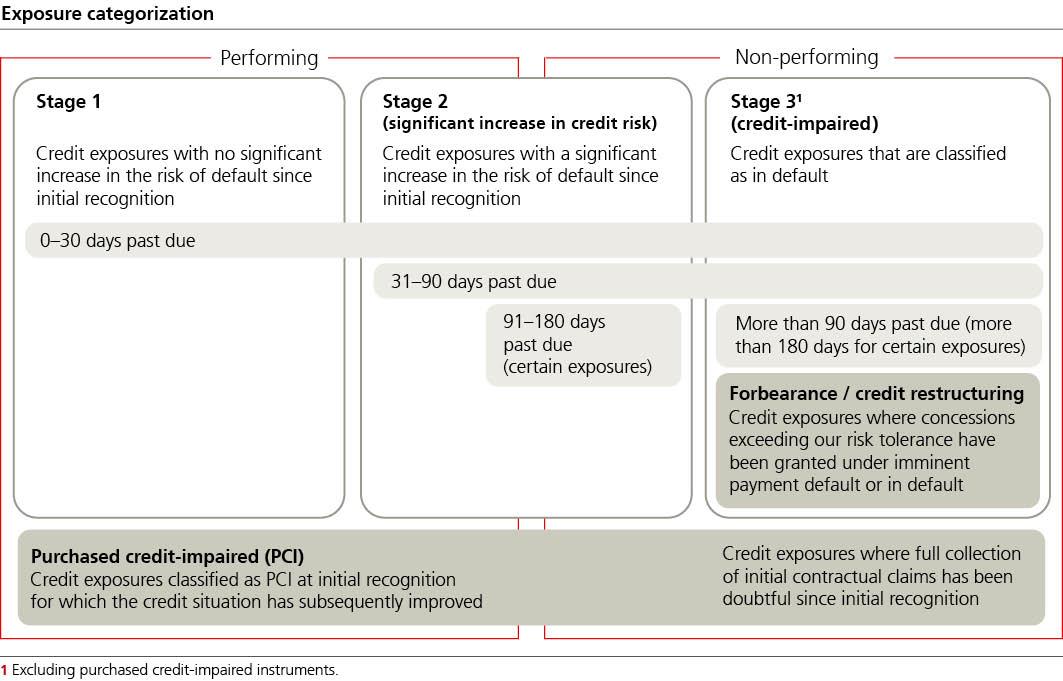
Annual Report 2023 |
Risk, capital, liquidity and funding, and
balance sheet | Risk management and control
125
Loss history statistics
USD m, except where indicated
31.12.23
31.12.22
31.12.21
31.12.20
31.12.19
Banking products, core exposure and off-balance sheet, gross
1
966,469
509,024
2
517,866
2
497,313
2
423,771
2
of which: amounts due from banks and loans and advances to customer
(gross)
662,715
402,801
414,099
396,049
340,003
Credit-impaired exposure, gross (stage 3 & PCI)
6,367
2,455
2,610
3,778
3,113
of which: credit-impaired amounts due from banks and loans
and advances to customer (stage 3 & PCI)
5,445
2,012
2,150
2,945
2,309
Non-performing amounts due from banks and loans and
advances to customer
5,806
2,333
2,387
3,176
2,466
ECL allowances and provisions for credit losses
3
2,261
1,091
1,165
1,468
1,029
of which: core loan exposure (all stages)
2,097
1,043
1,132
1,426
987
of which: amounts due from banks and loans and advances to customer
(all stages)
1,710
789
857
1,076
770
of which: amounts due from banks and loans and advances to customer
(stage 3 & PCI)
990
474
572
703
559
Write-offs (stage 3 & PCI)
93
95
137
356
142
of which: write-offs for amounts due from banks and loans
and advances to customer
78
74
118
348
122
Credit loss expense / (release)
4
1,037
29
(148)
694
78
Ratios
Credit-impaired amounts due from banks and loans and advances
to customer as a percentage of amounts due
from banks and loans and advances to customer (gross)
0.8
0.5
0.5
0.7
0.7
Non-performing amounts due from banks and loans and
advances to customer as a percentage of amounts due
from banks and loans and advances to customer (gross)
0.9
0.6
0.6
0.8
0.7
ECL allowances for amounts due from banks and loans and
advances to customer as a percentage of amounts
due from banks and loans and advances to customer (gross)
0.3
0.2
0.2
0.3
0.2
Write-offs as a percentage of average amounts due from banks and loans
and advances to customer (gross)
outstanding during the period
0.0
0.0
0.0
0.1
0.0
1 Includes amounts due from banks, core loan exposure (Loans and
advances to customers and Loans to financial advisors) and off-balance sheet
items defined as guarantees and loan commitments.
2 Comparatives
have been restated to include
amounts due from banks
3 Includes provisions for
ECL of guarantees
and loan commitments and
allowances for securities
financing transactions.
4 Includes credit loss expense
/
(release) for other financial assets at amortized cost, guarantees, loan commitments,
and securities financing transactions.
Annual Report 2023 |
Risk, capital, liquidity and funding, and
balance sheet | Risk management and control
126
Market risk
Audited |
Main sources of market risk
Market risks arise from both trading and non-trading
business activities.
–
Trading market risks are primarily in the Investment Bank, Non-core and Legacy and,
to a lesser extent, Global Wealth
Management. In the Investment Bank, these risks
are mainly connected with primary debt and equity underwriting,
as
well as securities and
derivatives trading for market-making and client
facilitation. In Non-core and Legacy market
risks
are
mainly from
structured
trades,
large
portfolios
of
loans
and securitized
products
and both
complex
and
simple
credit, interest
rate
and equity
derivative
transactions.
In Global
Wealth Management,
they are
from our
municipal
securities trading business.
–
Non-trading market
risks arise predominantly
in the form
of interest rate
and foreign exchange
risks connected
with
personal banking and lending in our wealth management
businesses, the Swiss business of our Personal & Corporate
Banking business division,
the Investment Bank’s lending business, and treasury
activities.
–
Group Treasury assumes market risks
in the process of
managing interest rate risk, structural foreign
exchange risk and
the Group’s liquidity and funding profile, including high-quality
liquid assets (HQLA).
–
Equity and
debt
investments
can
also give
rise to
market
risks, as
can
some aspects
of employee
benefits,
such
as
defined benefit pension schemes.
p
Audited |
Overview of measurement, monitoring and management techniques
–
Market
risk limits
are
set for
the Group,
the
business
divisions and
Group
Treasury
at granular
levels in
the various
business lines, reflecting the nature and magnitude of the
market risks.
–
Management value-at-risk (VaR) measures exposures under
the market risk framework, including trading market risks
and some
non-trading market risks.
Non-trading market risks
not included
in VaR
are also
covered in
the risks
controlled
by Market and Treasury Risk Control functions.
–
Our primary portfolio measures of market risk are liquidity-adjusted stress
loss and VaR. Both are subject to limits that
are approved by the Board of
Directors (the BoD). Market
risk measurement for Credit Suisse portfolios
can differ from
UBS Group excluding Credit Suisse, as set out below.
–
These measures are
complemented by
concentration and
granular limits for
general and specific
market risk factors.
Our trading businesses are subject
to multiple market risk limits, which
take into account the extent of
market liquidity
and volatility,
available
operational capacity,
valuation uncertainty,
and, for
our single-name
exposures, issuer
credit
quality.
–
Trading
market
risks
are
managed
at
portfolio
level.
As
risk
factor
sensitivities
change
due
to
new
transactions,
transaction expiries or changes
in market levels, risk
factors are dynamically
rehedged to remain
within limits. We
do
not generally seek to distinguish in the trading portfolio between
specific positions and associated hedges.
–
Issuer risk is controlled by limits applied at the business division level based on jump-to-zero measures, which estimate
maximum default exposure (the default event loss assuming
zero recovery).
–
Non-trading
foreign
exchange
risks
are
managed
under
market
risk
limits,
with
the
exception
of
Group
Treasury
management of consolidated capital activity.
Our CRO Treasury function applies a holistic risk framework, setting the appetite for treasury-related risk-taking activities
across the
Group.
Key element
s
of the
framework
include an
overarching
regulatory
(interest rate
risk in
the banking
book, IRRBB)
delta economic
value of equity
(EVE) target,
set by the
BoD. Limits are
also set by
the BoD to
balance the
effect of foreign
exchange movements
on our common
equity tier 1
(CET1) capital and
CET1 capital ratio.
Non-trading
interest rate and foreign exchange
risks are included in Group-wide statistical and stress-testing metrics, which
flow into
our risk appetite framework.
Equity and debt investments are
subject to a range
of risk controls, including preapproval of
new investments by business
management
and Risk
Control and
regular
monitoring
and reporting.
They are
also included
in Group-wide
statistical
and stress-testing metrics.
p
›
Refer to “Currency management” in the “Capital, liquidity
and funding, and balance sheet” section of
this report for more
information about Group Treasury’s management of foreign exchange risks
›
Refer to the “Capital, liquidity and funding,
and balance sheet” section of this report for more information
about the sensitivity
of our CET1 capital and CET1 capital ratio to currency
movements
Market risk stress loss
The
measurement
and
management
of
market
risks
include
an
extensive
set
of
stress
tests
and
scenario
analyses,
continuously evaluated to
ensure that losses
resulting from an
extreme yet plausible
event do
not exceed
our risk
appetite.
Annual Report 2023 |
Risk, capital, liquidity and funding, and
balance sheet | Risk management and control
127
Liquidity-adjusted stress
Liquidity-adjusted
stress
is
our
primary
stress
loss
measure
for
Group-wide
market
risk.
The
framework
captures
the
economic
losses
that
could
arise
under
specified
stress
scenarios.
Shocks
are
applied
to
positions
based
on
expected
market movements in the liquidity-adjusted holding periods
resulting from the specified scenario.
The holding periods used for
liquidity-adjusted stress are calibrated to reflect
the time needed to reduce
or hedge the risk
of
positions
in
each
major
risk
factor
in
a
stressed
environment.
We
apply
minimum
holding
periods,
regardless
of
observed liquidity levels, as identification of and reaction
to a crisis may not always be immediate.
The expected market movements are derived using historical market behavior (based on analysis of
historical events) and
forward-looking analysis including consideration of defined
scenarios that have not occurred in the past.
Stress-based limits apply at several
levels of the organizational hierarchy. Liquidity
-adjusted stress is also the core
market
risk component of our combined stress test framework and
therefore integral to our overall risk appetite framework.
›
Refer to “Risk appetite framework” in this
section for more information
›
Refer to “Stress testing” in this section for more information
about our stress-testing framework
Value-at-risk
VaR definition
Audited |
VaR
is a
statistical
measure
of market
risk, quantifying
the potential
market risk
losses over
a
set time
horizon
(holding period) at an established level of
confidence. VaR
assumes no change in the Group’s
trading positions over the
set time horizon.
We calculate VaR daily.
The profit or loss
distribution from which VaR
is estimated is
derived from our internally
developed
VaR model,
which simulates
returns over
the holding
period for
risk factors
our trading
positions are
sensitive to,
and
subsequently quantifies the profit
/ loss effect of
these risk factor returns
on our trading positions. Systematic
commodity,
credit,
equity,
foreign
exchange
rate
and
interest
rate
risk
factor
returns
are
based
on
a
pure
historical
simulation
approach. UBS Group excluding Credit Suisse uses
an unweighted five-year look-back window, and Credit Suisse uses
an
exponentially weighted two-year window. Modeling idiosyncratic and specific
risks for equity and credit
risk factors using
historical simulation
is challenging,
due to
the limited
availability of
continuous good
-quality historical
data. Wherever
possible, Credit Suisse uses historical simulation to model specific risk; however,
both UBS Group excluding Credit Suisse
and Credit Suisse rely upon
factor models to distinguish systematic and idiosyncratic
returns.
UBS Group excluding Credit
Suisse simulates idiosyncratic returns through a Monte Carlo simulation,
aggregating the sum of systematic and residual
returns
in
such
a
way
that
systematic
and
residual
risk
are
consistently
captured.
Credit
Suisse
uses
the
available
distribution of idiosyncratic
returns to determine
an extreme scenario
for a given
risk factor’s specific
risk. The resultant
Credit Suisse VaR
and extreme
scenario loss for
a given risk
factor are aggregated
using a zero
-correlation assumption.
Correlations among
risk factors
are implicitly
captured via
historical simulation
approaches. When
modeling risk
factor
returns,
we
consider
the
stationarity
properties
of
the
historical
time
series
of
risk
factor
changes.
Depending
on
the
stationarity properties of
the risk factors
within a given
factor class, the
factor returns are
modeled using absolute returns,
proportional or
logarithmic returns.
Risk factor return
distributions are
updated fortnightly for
UBS Group
excluding Credit
Suisse and weekly for Credit Suisse.
Risk factor
returns are
converted into
profit or
loss values
via sensitivities
and full
revaluation grids
sourced from
front-
office systems,
enabling us to
capture material non-linear
effects. Credit
Suisse uses full
revaluation models for
its financial
products that
are materially
sensitive to
the risks of
co-factor movements (e.g.,
basket options). Both
UBS Group
excluding
Credit Suisse and Credit Suisse use VaR
models for internal management purposes and
for determining market risk risk-
weighted assets (RWA),
although the two
use cases consider
different confidence levels
and time horizons.
For internal
management purposes, risk limits are established and exposures
measured using VaR at a
% confidence level for UBS
Group excluding Credit
Suisse and
% for Credit Suisse,
with a 1-day
holding period, aligned
to the way
we consider
the risks
associated with
our trading
activities. The
regulatory measure
of market
risk used to
underpin the market
risk
capital
requirements
under
Basel III
involves
a
measure
equivalent
to
a
%
confidence
level
using
a
10-day
holding
period. To calculate a 10-day holding period VaR, we use
10-day risk factor returns.
Additionally, the portfolio populations
for management and regulatory
VaR are slightly different.
The one for regulatory
VaR
meets
regulatory
requirements
for
inclusion
in
regulatory
VaR.
Management
VaR
includes
a
broader
range
of
positions. For
example, regulatory
VaR excludes
credit spread
risks from
the securitization
portfolio, which
are treated
instead under the securitization approach for regulatory
purposes.
We also
use stressed
VaR (SVaR)
for the
calculation of
market risk
RWA. SVaR
uses broadly
the same
methodology as
regulatory
VaR and
is calculated
using the
same
population,
holding
period (10-day)
and confidence
level (
%). For
SVaR, both UBS Group excluding Credit Suisse and Credit
Suisse identify the most significant one-year period of financial
stress from a historical
dataset covering the
period from 1 January 2007
to the present. SVaR
is computed at least
once
a week.
p
›
Refer to the 31 December 2023 Pillar 3 Report,
available under “Pillar 3 disclosures” at
ubs.com/investors,
for more information
about the regulatory capital calculation under the advanced
internal ratings-based approach
Annual Report 2023 |
Risk, capital, liquidity and funding, and
balance sheet | Risk management and control
128
Management VaR for the period
UBS Group excluding
Credit Suisse
continued to
maintain management
VaR at
low levels, with
average VaR
increasing
to USD 15m from USD 11m in 2023, mainly driven
by the Investment Bank’s Global Markets business.
Credit Suisse’s average management
VaR stood at
USD 29m as of
the end of 2023,
decreasing in the second
half of 2023
due to continued strategic migration of positions to UBS
and de-risking within Non-core and Legacy.
Audited |
Management value-at-risk (1-day, 95% confidence, 5 years of historical data) of our business divisions and Group
Items excluding Credit Suisse components by general market risk type
1
For the year ended 31.12.23
USD m
Equity
Interest
rates
Credit
spreads
Foreign
exchange
Commodities
Min.
Max.
Average
31.12.23
Total management VaR
Average (per business division and risk type)
Global Wealth Management
Personal & Corporate Banking
Asset Management
Investment Bank
Non-core and Legacy
Group Items
Diversification effect
2,3
(
6
)
(
7
)
(
1
)
(
5
)
(
4
)
(
1
)
For the year ended 31.12.22
USD m
Equity
Interest
rates
Credit
spreads
Foreign
exchange
Commodities
Min.
Max.
Average
31.12.22
Total management VaR
Average (per business division and risk type)
Global Wealth Management
Personal & Corporate Banking
Asset Management
Investment Bank
Group Functions (including Non-core and Legacy Portfolio)
Diversification effect
2,3
(
5
)
(
5
)
(
1
)
(
3
)
(
4
)
(
1
)
Management value-at-risk (1-day, 98% confidence, 2 years of historical data) of the Credit Suisse components of our
business divisions and Group Items by general market risk type
1,4
For the year ended 31.12.23
USD m
Equity
Interest
rates
Credit
spreads
Foreign
exchange
Commodities
Min.
Max.
Average
31.12.23
Total management VaR
Average (per business division and risk type)
Global Wealth Management
Personal & Corporate Banking
Asset Management
Investment Bank
Non-core and Legacy
5
Group Items
Diversification effect
2,3
(
7
)
(
1
)
(
1
)
(
9
)
1 Statistics at individual levels may not be summed to deduce the corresponding aggregate figures.
The minima and maxima for each level may occur on different
days, and, likewise, the value
-at-risk (VaR) for each
business line or risk type, being driven
by the extreme loss tail of the corresponding distribution of
simulated profits and losses for that business line
or risk type, may well be driven by
different days in the historical
time series, rendering invalid the simple summation of figures to arrive at the aggregate total.
2 The difference between the sum of the standalone VaR for the business divisions and Group Items and the total VaR.
3 As the minima and maxima for different business divisions and Group Items occur on different days, it is not meaningful to calculate a portfolio diversification effect.
4 In the second quarter of 2023, Credit Suisse
AG consolidated introduced
an enhanced approach
to measure management VaR
for individual risk types.
The enhanced approach
is applied to each
risk type using a
collection of risk
factors included within
the
respective risk type only, ignoring the cross-risk effects. This
change in the measurement approach for individual risk types particularly affected standalone management VaR
for equity risk and foreign exchange risk,
with no impact on the total management VaR.
5 Non-core and Legacy management VaR consists of exposures of the previously reported
Capital Release Unit (Credit Suisse) and Investment Bank (Credit Suisse).
p
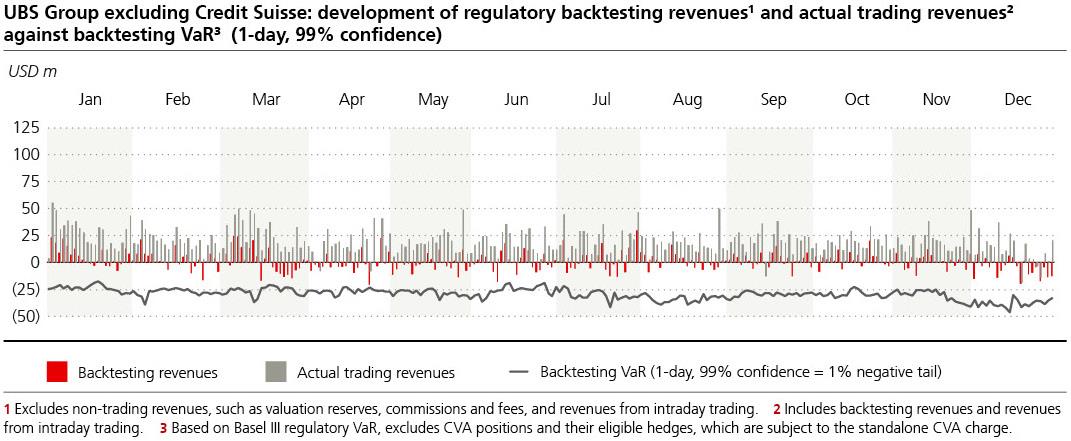
Annual Report 2023 |
Risk, capital, liquidity and funding, and
balance sheet | Risk management and control
129
VaR limitations
Audited |
Actual realized market risk losses may differ
from those implied by VaR
for a variety of reasons.
–
VaR is calibrated to a specified level of confidence and
may not indicate potential losses beyond this confidence
level.
–
The
1-day
time horizon
used
for
VaR
for
internal
management
purposes
(10-day
for
regulatory
VaR) may
not
fully
capture market risk of positions that cannot be closed out
or hedged within the specified period.
–
In
some
cases,
VaR
calculations
approximate
the
effect
of
changes
in
risk
factors
on
the
values
of
positions
and
portfolios.
–
Effects
of
extreme
market
movements
are
subject
to
estimation
errors,
which
may
result
from
non-linear
risk
sensitivities,
and
the
potential
for
actual
volatility
and
correlation
levels
to
differ
from
assumptions
implicit
in
VaR
calculations.
–
The choice of a
longer historical window means
sudden increases in market
volatility will tend not
to increase VaR as
quickly as
the use
of shorter
historical observation
periods, but
such increases
will affect
VaR for
a longer
period of
time. Similarly, after periods
of increased volatility, as markets
stabilize, VaR predictions will remain
more conservative
for a period of time influenced by the length of the historical
observation period.
SVaR is subject
to the limitations
noted for VaR
above, but the
use of one-year
datasets avoids the
smoothing effect of
longer datasets
used for VaR.
In addition,
the ability to
select a one-year
period outside of
recent market
history allows
for a
wider variety
of potential
loss events.
Therefore, although
the significant
period of
stress during
the 2007–2009
financial crisis is no
longer contained in the
look-back window used for
management and regulatory VaR,
SVaR continues
to use that data. This approach
aims to reduce the procyclicality of the regulatory capital
requirements for market risks.
We recognize
that no
single measure
can encompass
all
risks associated
with a
position or
portfolio. We
use a
set of
metrics
with
both
overlapping
and
complementary
characteristics
to
create
a
holistic
framework
that
aims
to
ensure
material completeness of risk
identification and measurement. As
a statistical aggregate
risk measure, VaR supplements
our comprehensive stress-testing framework.
We also have a framework to identify and quantify potential
risks not fully captured by our VaR model and refer
to such
risks as risks not in VaR. The framework underpins these potential
risks with additional regulatory capital.
p
Backtesting of VaR
VaR backtesting
is a performance
measurement process
in which a
1-day VaR
prediction is
compared with
the realized
1-day profit or loss
(P&L). We compute
backtesting VaR
using a 99% confidence
level and 1-day holding
period for the
regulatory VaR population. Since 99% VaR
at UBS is defined as a risk measure that operates on the lower tail of the P&L
distribution,
99% backtesting
VaR
is a
negative number.
Backtesting revenues
exclude non-trading
revenues,
such as
valuation reserves, fees and commissions,
and revenues from intraday trading, so
as to provide a like-for-like comparison.
A backtesting exception occurs when backtesting revenues
are lower than the previous day’s backtesting
VaR.
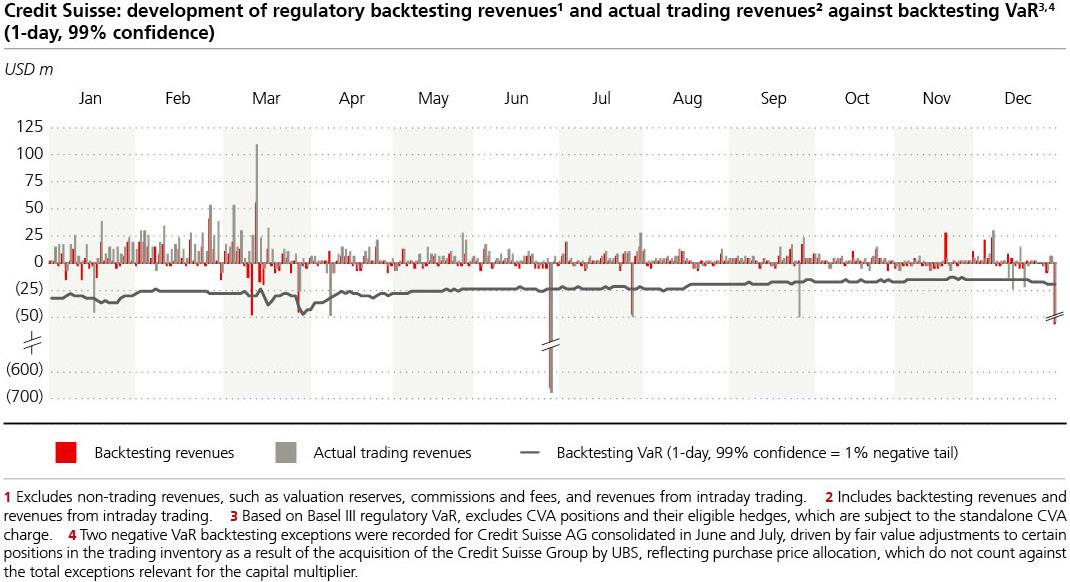
Annual Report 2023 |
Risk, capital, liquidity and funding, and
balance sheet | Risk management and control
130
Statistically, given the 99% confidence level,
two or three backtesting exceptions a
year can be expected. More than
four
exceptions could
indicate that
the VaR
model is not
performing appropriately,
as could too
few exceptions
over a
long
period. However,
as noted
for VaR
limitations above,
a sudden
increase (or
decrease) in
market volatility
relative to
the
volatility observed
in the look
-back window
could lead
to a
higher (or lower)
number of
exceptions. Therefore,
Group-
level backtesting exceptions
are investigated, as are
exceptional positive backtesting
revenues, with the
results reported
to senior business management and regulators.
For UBS
Group excluding
Credit Suisse,
the number
of negative
backtesting exceptions within
a 250-business-day
window
decreased to zero at
the end of 2023
from one at the
end of 2022. For Credit
Suisse,
the number of negative backtesting
exceptions within a 250-business-day window increased to three
at the end of 2023 from one at the end of 2022.
The Swiss Financial Market Supervisory Authority (FINMA) VaR multiplier derived from
backtesting exceptions for market
risk RWA was unchanged compared with 2022, at 3.0, for
both UBS Group excluding Credit Suisse and Credit Suisse.
VaR model confirmation
In addition
to the
for-regulatory-purposes
backtesting described
above, we
conduct extended
backtesting for
internal
model confirmation purposes. This includes observing model performance across the entire P&L distribution (not just the
tails) and at multiple levels within the business division hierarchies.
›
Refer to “Risk measurement” in this section for
more information about our approach to model confirmation
procedures
VaR model developments in 2023
Audited |
In the fourth quarter of
2023, we amended the
Credit Suisse credit
spread VaR
model by significantly enhancing
the coverage
of single-name-issuer
bond and
CDS spread
curves. Although
the model
change is considered
significant
from
a risk
management
perspective,
the quantitative
impact on
risk management
VaR
was not
material.
No material
changes were made to UBS Group excluding
Credit Suisse VaR
model in 2023.
p
Future market risk-related regulatory capital developments
In January 2019, the Basel Committee on Banking Supervision (the BCBS) published the final standards on the minimum
capital requirements
for market risk
(the Fundamental Review of
the Trading
Book). In December 2022,
the Swiss State
Secretariat for
International Finance changed
the expected
date on
which the
final Basel III
guidelines are
to enter
into
force,
from
1 July
2024
to
1 January
2025.
As
a
result,
the
Swiss
implementation
timeline
would
be
aligned
to
the
currently
expected
implementation
timeline
in
the
EU.
In
November
2023,
the
Swiss
Federal
Council
adopted
amendments to the Capital Adequacy Ordinance (the CAO) for banks
to incorporate the final Basel III standards adopted
by the BCBS in
Swiss law. The Federal Department of Finance (FDF)
will inform the Federal Council
again about the status
of international implementation by the end of July 2024.
Key elements of the revised market
risk framework include: (i) changes to the
internal model-based approach, including
changes to the model
approval and performance
measurement process; (ii) changes
to the standardized
approach with
the aim of
it being a
credible fallback method for
an internal model-based approach;
and (iii) a revised
boundary between
the
trading
book
and
the
banking
book.
UBS
maintains
a
close
dialogue
with
FINMA
to
discuss
the
implementation
objectives in more detail and to provide a smooth transition of the
capital regime for market risk.
Annual Report 2023 |
Risk, capital, liquidity and funding, and
balance sheet | Risk management and control
131
In September
2021, FINMA
mandated UBS
Group excluding
Credit Suisse
to hold
an RWA
add-on for
the omission
of
time decay in regulatory VaR
and SVaR. The add-on reflects the
outcome of discussions with FINMA, which
started in late
2019. The integration of time decay into the
regulatory VaR model for UBS Group excluding
Credit Suisse, which would
replace the add-on, went live in January 2024.
›
Refer to “Risk-weighted assets” in the “Capital,
liquidity and funding, and balance sheet” section
of this report for more
information about the development of RWA including the regulatory add-on
›
Refer to “Risk measurement” in this section for
more information about our approach to model confirmation
procedures
›
Refer to the “Regulatory and legal developments”
and “Risk factors” sections of this report for
more information
Interest rate risk in the banking book
Sources of interest rate risk in the banking book
Audited |
IRRBB arises
from
balance sheet
positions such
as amounts
due from
banks, Loans
and advances
to customers,
Financial assets at fair
value not held for
trading, Financial assets
measured at amortized
cost, Customer deposits,
Debt
issued measured at
amortized cost, and
derivatives, including those
subject to hedge
accounting. Fair value
changes to
these positions may affect
other comprehensive income
(OCI) or the income
statement, depending on
their accounting
treatment.
Our largest
banking book
interest rate
exposures arise
from customer
deposits and
lending products
in Global
Wealth
Management and Personal & Corporate Banking, as
well as from debt issuance, liquidity buffers and
interest rate hedges
in Group Treasury. The inherent interest rate risks stemming from Global Wealth Management and Personal & Corporate
Banking are generally
transferred to Group
Treasury, to manage
them centrally together
with our modeled
interest rate
duration assigned to equity, goodwill and real estate. This makes the netting
of interest rate risks across different sources
possible, while leaving
the originating businesses
with commercial margin and
volume management. The residual
interest
rate risk is mainly hedged with interest rate swaps, to the vast majority of which we apply hedge accounting. Short-term
exposures and HQLA classified as Financial assets
at fair value not held for trading
are hedged with derivatives accounted
for on a mark-to-market basis. Long-term fixed-rate debt
issued and HQLA hedged with external interest rate swaps are
designated in fair value hedge accounting relationships.
Risk management and governance
IRRBB is measured using several metrics, the most
relevant of which are the following.
–
EVE sensitivity
to yield
curve moves
is calculated
as changes
in the
present value
of future
cash flows
irrespective of
accounting treatment.
These yield curve
moves are also
the key
risk factors for
statistical and stress-based
measures,
e.g., VaR and stress scenarios, as well as the regulatory interest rate scenarios. These are measured and reported daily.
The regulatory IRRBB
EVE exposure is
the most adverse
regulatory interest rate scenario
that is netted
across currencies.
It excludes the sensitivity from additional tier 1 (AT1) capital instruments (as per
specific FINMA requirements) and the
modeled interest rate duration assigned to equity, goodwill
and real estate. UBS also applies granular internal interest
rate shock scenarios to its banking book positions to monitor its specific
risk profile.
–
Net
interest
income
(NII) sensitivities
to yield
curve
moves
are
calculated
as changes
of baseline
NII over
a
set time
horizon, which we
internally compute
by assuming interest
rates in all
currencies develop
according to their
market-
implied forward rates and assuming constant business volumes
and product mix and no specific management actions.
The sensitivities are measured and reported monthly.
We actively
manage IRRBB,
with the
aim of
reducing the
volatility of
NII subject
to limits
and triggers
for EVE
and NII
exposure at consolidated and significant legal entity levels.
The
Group
Asset
and
Liability
Committee
(the
ALCO)
and,
where
relevant,
ALCOs
at
a
legal
entity
level
perform
independent
oversight
over
the
management
of
IRRBB,
which
is
also
subject
to
Group
Internal
Audit
and
model
governance.
›
Refer to “Group Internal Audit” in the “Corporate
governance” section of this report and to
“Risk measurement” in this section for
more information
Key modeling assumptions
The cash
flows from
customer deposits
and lending
products used
in calculation
of EVE
sensitivity exclude
commercial
margins and
other spread
components, are
aggregated
by daily
time buckets
and are
discounted using
risk-free
rates.
Our external issuances are discounted using UBS’s senior debt curve,
and capital instruments are modeled to the first call
date. NII
sensitivity,
which includes
commercial margins,
is calculated
over a
one-year time
horizon, assuming
constant
balance sheet structure and volumes, and considers
embedded interest rate options.
The average repricing
maturity of non-maturing
deposits and
loans is
determined via
target replication
portfolios designed
to protect
product margins. Optimal
replicating portfolios are
determined at granular
currency- and product-specific
levels
by simulating and applying a real-world market rate
model to historically calibrated client rate and volume models.
We use
an econometric
prepayment model
to forecast
prepayment rates
on US
mortgage loans
in UBS
Bank USA
and
agency mortgage-backed securities (MBSs) held in various liquidity portfolios of UBS Americas Holding LLC
consolidated.
These
prepayment
rates
are
used
to
forecast
both
mortgage
loan
and
MBS
balances
under
various
macroeconomic
scenarios.
The
prepayment
model
is
used
for
a
variety
of
purposes,
including
risk
management
and
regulatory
stress
testing. Swiss mortgages and fixed-term deposits generally
do not carry similar optionality, due to prepayment and
early
redemption penalties.
p
Annual Report 2023 |
Risk, capital, liquidity and funding, and
balance sheet | Risk management and control
132
Effect of interest rate changes on shareholders’ equity and
CET1 capital
The “Accounting and
capital effect
of changes in
interest rates” table
below shows the
effects on shareholders’
equity
and CET1
capital of gains
and losses from
changes in interest
rates in
the main
banking book positions.
We use derivatives
to hedge
interest
rate risks
in the
banking book
and these
reflect changes
in interest
rates as
an immediate
fair value
gain or loss, recognized either in the income statement or through OCI.
Where hedged items are accrual accounted, we
aim to minimize accounting asymmetries by applying hedge
accounting to reflect the economic hedge relation
ship.
In a rising
rate scenario, we
would have an
initial decrease in
shareholders’ equity as
a result of
fair value losses
on our
derivatives recognized
in OCI,
while we would
expect higher
NII over time
as rates increase.
The effect
on CET1 capital
would be much lower, as gains and losses on interest
rate swaps designated as cash flow hedges are
not recognized for
regulatory capital purposes.
Accounting and capital effect of changes in interest rates
1
Recognition
Shareholders’ equity
CET1 capital
Timing
Income statement / OCI
Gains
Losses
Gains
Losses
Loans and deposits at amortized cost
2,3
Gradual
Income statement
l
l
l
l
Other financial assets and liabilities measured at amortized
cost
2
Gradual
Income statement
l
l
l
l
Debt issued measured at amortized cost
2,3
Gradual
Income statement
l
l
l
l
Receivables and payables from securities financing transactions
2
Gradual
Income statement
l
l
l
l
Financial assets at fair value not held for trading
Immediate
Income statement
l
l
l
l
Financial assets at fair value through other comprehensive income
Immediate
OCI
l
l
l
Derivatives designated as cash flow hedges
Immediate
OCI
4
l
l
Derivatives designated as fair value hedges
5
Immediate
Income statement
l
l
l
l
Derivatives transacted as economic hedges
Immediate
Income statement
l
l
l
l
1 Refer to the “Reconciliation
of equity under IFRS
Accounting Standards to Swiss SRB
common equity tier 1
capital” table in the “Capital,
liquidity and funding, and
balance sheet” section of
this report for more
information about the differences between shareholders’ equity
and CET1 capital.
2 For fixed-rate financial instruments,
changes in interest rates affect the income
statement when these instruments roll over and
reprice.
3 For hedge-accounted
items, a fair
value adjustment
is applied in
line with the
treatment of the
hedging derivatives.
4 Excluding hedge
ineffectiveness that is
recognized in the
income statement in
accordance with IFRS Accounting Standards.
5 The fair value of
the derivatives is offset by
the fair value adjustment of
the hedged items. Under
the fair value hedge program
applied to cross-currency swaps and
foreign currency debt, the foreign currency basis spread is excluded from the hedge designation and accounted for through OCI,
which is included in CET1.
Economic value of equity sensitivity
Audited |
The EVE sensitivity
in the banking
book to a
+1-basis-point parallel shift
in yield curves
was negative USD
m
as of 31 December 2023,
compared with negative
USD
m as of 31 December
2022. This excludes the
sensitivity of
USD
m from AT1
capital instruments (as per specific FINMA requirements)
in contrast to general BCBS guidance. The
exposure in
the banking
book of
the UBS
Group increased
in 2023,
due to
the acquisition
of the
Credit Suisse
Group
and interest rate risk hedges of the recent
AT1 capital instrument
issuances.
The majority of
our interest
rate risk in
the banking
book is a
reflection of
the net asset
duration that
we run to
offset
our modeled
sensitivity of
net USD
m (31 December
2022: USD
m) assigned
to our
equity,
goodwill and
real
estate, with the aim of generating a
stable NII contribution. Of this, USD
m and USD
m are attributable to the US
dollar and the Swiss franc portfolios, respectively
(31 December 2022: USD
m and USD
m, respectively).
In addition
to the
sensitivity mentioned
above, we
calculate the
six interest
rate shock
scenarios prescribed
by FINMA.
The “Parallel
up” scenario,
assuming all
positions were
fair valued,
was the
most severe
and would
have resulted
in a
change in EVE of negative USD
bn, or
%, of our tier 1 capital (31 December 2022: negative USD
bn, or
%),
which is well below the
% threshold as per the BCBS
supervisory outlier test for high levels
of interest rate risk in the
banking book.
The
immediate
effect
on our
tier 1
capital
in
the
“Parallel
up”
scenario
as
of 31
December
2023 would
have
been
a
decrease of USD
bn, or
% (31 December 2022: USD
bn, or
%), reflecting the fact that
the vast majority of
our banking book
is accrual accounted
or subject to
hedge accounting. The
“Parallel up” scenario
would subsequently
have a positive effect on NII, assuming a constant balance
sheet.
UBS also
applies
granular
internal
interest
rate
shock
scenarios
to
its
banking
book
positions
to
monitor
the
banking
book’s specific risk profile.
Annual Report 2023 |
Risk, capital, liquidity and funding, and
balance sheet | Risk management and control
133
Net interest income sensitivity
The main NII
sensitivity in the
banking book resides
in Global Wealth
Management and Personal
& Corporate
Banking.
We
assign a
target
duration
to our
investment
of equity
portfolio,
and
Group
Treasury
actively
manages
the
residual
IRRBB. This
sensitivity is
assessed using
a number
of scenarios
assuming parallel
and non-parallel
shifts in
yield curves,
with various
degrees
of
severity,
and we
have
set
and
monitor
thresholds
for
the
NII sensitivity
to
immediate
parallel
shocks of –200 and +200 basis points under the assumption
of constant balance sheet volume and structure.
p
›
Refer to the “Group performance”
section of this report for more information about sensitivity
to interest rate movements
Audited |
Interest rate risk – banking book
31.12.23
USD m
Effect on EVE
1
Effect on EVE
1
Scenarios
CHF
EUR
GBP
USD
Other
Total
Additional tier 1 (AT1) capital
instruments
Total
+1 bp
(
3.7
)
(
0.6
)
(
26.0
)
(
30.1
)
(
25.2
)
Parallel up
2
(
548.9
)
(
119.3
)
(
5,027.2
)
(
0.9
)
(
5,680.2
)
(
4,775.5
)
Parallel down
2
(
29.2
)
(
1,044.5
)
Steepener
3
(
305.3
)
(
13.1
)
(
11.9
)
(
1,037.0
)
(
33.8
)
(
1,401.1
)
(
1,307.6
)
Flattener
4
(
5.0
)
(
124.2
)
Short-term up
5
(
27.3
)
(
39.4
)
(
2,171.3
)
(
2,194.7
)
(
1,708.4
)
Short-term down
6
(
21.8
)
(
26.8
)
(
507.8
)
31.12.22
USD m
Effect on EVE
1
Effect on EVE
1
Scenarios
CHF
EUR
GBP
USD
Other
Total
Additional tier 1 (AT1) capital
instruments
Total
+1 bp
(
4.0
)
(
0.7
)
(
20.4
)
(
0.1
)
(
25.0
)
(
21.6
)
Parallel up
2
(
574.6
)
(
117.0
)
(
3,944.3
)
(
26.3
)
(
4,629.1
)
(
3,979.4
)
Parallel down
2
(
45.4
)
(
699.8
)
Steepener
3
(
257.0
)
(
92.8
)
(
28.2
)
(
1,027.4
)
(
3.3
)
(
1,408.7
)
(
46.8
)
(
1,455.5
)
Flattener
4
(
2.5
)
Short-term up
5
(
83.0
)
(
1,519.0
)
(
13.8
)
(
1,539.2
)
(
1,100.6
)
Short-term down
6
(
33.1
)
(
42.5
)
(
455.5
)
1 Economic value
of equity.
2 Rates across
all tenors move
by ±150 bps
for Swiss franc,
±200 bps for
euro and US
dollar, and
±250 bps for
pound sterling.
3 Short-term rates
decrease and long-term
rates
increase.
4 Short-term rates increase and long-term rates decrease.
5 Short-term rates increase more than long-term rates.
6 Short-term rates decrease more than long-term rates.
p
Other market risk exposures
Own credit
We are
exposed to changes
in UBS’s own
credit reflected
in the valuation
of financial liabilities
designated at fair
value
when UBS’s own credit risk
would be considered by market
participants, except for fully collateralized liabilities
or other
obligations for which it is established market practice
to not include an own-credit component.
›
Refer to “Note 21 Fair value measurement” in the “Consolidated
financial statements” section of this report for more information
about own credit
Structural foreign exchange risk
Upon consolidation,
assets and
liabilities held
in foreign
operations are
translated into
US dollars
at the
closing foreign
exchange rate on the
balance sheet date. Value changes (in US
dollars) of non-US dollar assets or
liabilities due to foreign
exchange
movements are recognized in OCI and
therefore affect
shareholders’ equity and CET1 capital.
Group
Treasury
uses
strategies
to
manage
this
foreign
currency
exposure,
including
matched
funding
of
assets
and
liabilities and net investment hedging.
›
Refer to the “Capital, liquidity and funding,
and balance sheet” section of this report for more information
about our exposure to
and management of structural foreign exchange risk
›
Refer to “Note 11 Derivative instruments”
in the “Consolidated financial statements” section
of this report for more information
about our hedges of net investments in foreign operations
Equity investments and investment fund units
Audited |
We make direct investments in a variety of entities and buy equity holdings in both listed and unlisted companies,
with
the
aim
of
supporting
our
business
activities
and
delivering
strategic
value
to
UBS.
This
includes
investments
in
exchange
and
clearing
house
memberships,
as
well
as
minority
investments
in
early-stage
fintechs
and
technology
companies via
UBS Next.
We
may also
make investments
in funds
that we
manage
in order
to fund
or seed
them
at
inception or to demonstrate that our interests align with those of investors. We also buy, and are sometimes required
by
agreement or regulation to buy,
securities and units from investment vehicles
that we have sold to clients.
Annual Report 2023 |
Risk, capital, liquidity and funding, and
balance sheet | Risk management and control
134
The
fair
value
of
equity
investments
tends
to
be
influenced
by
factors
specific
to
the
individual
investments.
Equity
investments are generally intended
to be held for the
medium or long term
and may be subject
to lock-up agreements.
For these reasons,
we generally do
not control these
exposures by using
market risk measures
applied to trading
activities.
However, such equity investments are subject to a different
range of controls, including preapproval of new investments
by business management
and Risk Control,
portfolio and concentration
limits, and regular
monitoring and reporting
to
senior management. They are
also included in our Group-wide
statistical and stress-testing metrics,
which flow into our
risk appetite framework.
As of
31 December 2023, we
held equity
investments and investment
fund units
totaling USD
bn, of
which USD
bn
was classified as Financial assets at fair value not held for
trading and USD
bn as Investments in associates
.
p
›
Refer to “Note 21 Fair value measurement” and “Note 29
Interests in subsidiaries and other entities”
in the “Consolidated
financial statements” section of this report for more information
›
Refer to “Note 1 Summary of material accounting
policies” in the “Consolidated financial statements”
section of this report for
more information about the classification of financial instruments
Debt investments
Audited |
Debt investments classified
as Financial assets
measured at
fair value through
other comprehensive
income as of
31 December 2023 were measured
at fair value with changes in fair
value recorded through
Equity,
and can broadly be
categorized as money market instruments and debt securities primarily held for statutory,
regulatory or liquidity reasons.
The risk control framework applied to
debt instruments classified as Financial assets measured at fair
value through other
comprehensive
income
depends
on
the
nature
of
the
instruments
and
the
purpose
for
which
we
hold
them.
Our
exposures may be included
in market risk limits or
be subject to specific monitoring
and interest rate sensitivity analysis.
They
are
also
included
in
our
Group-wide
statistical
and
stress-testing
metrics,
which
flow
into
our
risk
appetite
framework.
Debt instruments
classified
as Financial
assets
measured
at fair
value through
other
comprehensive
income
had a
fair
value of USD
bn as of 31 December 2023, compared with USD
bn as of 31 December 2022.
p
›
Refer to “Note 21 Fair value measurement” in the “Consolidated
financial statements”
section of this report for more information
›
Refer to “Economic value of equity sensitivity”
in this section for more information
›
Refer to “Note 1 Summary of material accounting
policies” in the “Consolidated financial statements”
section of this report for
more information about the classification of financial instruments
Pension risk
We provide a number of pension plans for past and current
employees, some classified as defined benefit pension plans
under IFRS Accounting Standards,
which can have a material effect
on our equity under IFRS Accounting Standards
and
CET1 capital.
Pension risk is the risk that defined benefit plans’ funded status
might decrease, negatively affecting our capital. This can
result from
falls in
the value
of a
plan’s assets
or in
the investment
returns, increases
in defined
benefit obligations,
or
combinations of the above.
Important risk factors affecting the fair
value of pension plans’ assets include equity
market returns, interest rates, bond
yields,
and
real
estate
prices.
Important
risk
factors
affecting
the
present
value
of
expected
future
benefit
payments
include high-grade bond yields, interest rates, inflation rates,
and life expectancy.
Pension
risk
is
included
in
our
Group-wide
statistical
and
stress-testing
metrics,
which
flow
into
our
risk
appetite
framework. The potential effects are thus captured in the
post-stress capital ratio calculations.
›
Refer to “Note 1 Summary of material accounting
policies” and “Note 27 Post-employment benefit plans”
in the “Consolidated
financial statements” section of this report for more information
about defined benefit plans
UBS own share exposure
Group Treasury
holds UBS Group AG shares
to hedge future share
delivery obligations related to employee
share-based
compensation awards, and also holds shares purchased under
the share repurchase program. In addition, the Investment
Bank holds
a limited
number of
UBS Group
AG shares,
primarily in
its capacity
as a
market-maker with
regard
to UBS
Group AG shares and related
derivatives, and to hedge certain issued structured debt
instruments.
›
Refer to “UBS shares” in the “Capital, liquidity and funding,
and balance sheet” section of this report for
more information
Annual Report 2023 |
Risk, capital, liquidity and funding, and
balance sheet | Risk management and control
135
Country risk
Country risk framework
Country risk includes all
country-specific events occurring in a
sovereign jurisdiction that may lead
to impairment of UBS’s
exposures. It
may take
the form
of: (i) sovereign
risk, which
is the
ability and
willingness of
a government
to honor
its
financial
commitments;
(ii) transfer
risk,
which
arises
if
a
counterparty
or
issuer
cannot
acquire
foreign
currencies
following a
moratorium by
a central
bank on
foreign exchange
transfers; or
(iii) “other” country
risk. “Other”
country
risk may manifest itself
through, on the
one hand, increased
and multiple counterparty
and issuer default risk
(systemic
risk)
and,
on
the
other
hand,
events
that
may
affect
a
country’s
standing,
such
as
adverse
shocks
affecting
political
stability or institutional and / or legal frameworks.
We assign
a country
rating to
each country,
which reflects
our view
of its
creditworthiness
and of
the probability
of a
country risk
event occurring.
Country ratings
are mapped
to statistically
derived
default probabilities,
described
under
“Probability of default” in this section.
We use this internal analysis
to set the credit ratings of
governments and central
banks, estimate
the probability
of a transfer
event occurring,
and establish
rules on how
aspects of country
risk should
be incorporated in counterparty ratings of non-sovereign
entities domiciled in the respective country.
Country ratings are also used
to define our risk appetite
regarding foreign countries. A country
risk limit (i.e., maximum
aggregate exposure) applies to exposures to counterparties
or issuers of securities and financial investments in the
given
foreign country. We may limit
the extension of credit, transactions
in traded products or positions
in securities based on
a country risk ceiling even if our exposure to a counterparty
is otherwise acceptable.
Our country risk framework differs across UBS Group, and
alignment is part of the ongoing integration of Credit
Suisse.
For internal measurement and
control of country risk,
we also consider the
financial effect of market
disruptions arising
prior to, during and
after a country
crisis. These may
take the form
of a severe deterioration
in a country’s
debt, equity
or other asset
markets, or a
sharp depreciation of
its currency. We
use stress testing
to assess potential
financial effects
of severe country or sovereign crises.
This involves the developing of plausible stress
scenarios for combined stress testing
and
the
identification
of
countries
that
may
potentially
be
subject
to
a
crisis
event,
determining
potential
losses
and
making assumptions
about
recovery
rates
depending
on
the
types
of credit
transactions
involved
and
their
economic
importance to the affected countries.
Country risk exposure
Country risk exposure measure
The presentation of country risk follows
our internal risk view, where
the basis for measuring exposures depends
on the
product category in which we classify the exposures.
In addition to the classification of exposures into
banking products
and traded products, covered in “Credit risk profile
of the Group” in this section,
for UBS Group excluding Credit Suisse
the
trading
inventory
is
also
shown.
Issuer
risk
on
securities
such
as
bonds
and
equities,
as
well
as
risk
relating
to
underlying reference assets for
derivative positions,
is classified under
trading inventory.
The trading inventory
is managed
on a net basis, and
the value of long
positions is netted against
that of short positions
with the same underlying
issuer.
Net
exposures
are,
however,
floored
at
zero
per
issuer
in
the
figures
presented
in
the
following
tables.
As
a
result,
potentially offsetting benefits of certain hedges and
short positions across issuers are
not recognized.
We do not recognize any expected recovery values when reporting country exposures as
exposure before hedges, except
for
risk-reducing
effects
of
master
netting
agreements
and
collateral
held
in
either
cash
or
portfolios
of
diversified
marketable
securities,
which
we
deduct
from
the
potential
exposure
values.
Within
banking
products
and
traded
products, risk-reducing effects of credit
protection are generally taken
into account on
a notional basis
when determining
the net of hedge exposures.
Country risk exposure allocation
In general, exposures
are shown against
the country of
domicile of the
contractual counterparty or
the issuer of
the
security.
For
some
counterparties
whose
economic
substance
in
terms
of
assets
or
source
of
revenues
is
primarily
located in a different country, the exposure is allocated to
the risk domicile of those assets or revenues.
In the case of derivatives,
we show the counterparty
’s risk potential exposure
against the counterparty’s
country of risk
(presented
within
traded
products).
In
addition,
risk
associated
with
an
instantaneous
fall
in
value
of
underlying
reference assets
to zero (assuming
no recovery) is
shown against the
country of risk
of the issuer
of the reference
asset
(presented within the trading
inventory for UBS Group excluding
Credit Suisse only). This approach
allows us to capture
both counterparty
and, where
applicable,
issuer elements
of risk
arising from
derivatives
and applies
comprehensively
for all derivatives,
including single-name
credit default
swaps (CDSs) and
other credit derivatives.
Annual Report 2023 |
Risk, capital, liquidity and funding, and
balance sheet | Risk management and control
136
CDSs are primarily
bought and
sold in
relation to
our trading
businesses, and,
to a
much lesser
degree, used
to hedge
credit
valuation
adjustments.
Holding
CDSs
for
credit
default
protection
does
not
necessarily
protect
the
buyer
of
protection against losses, as contracts only pay out under certain scenarios. The effectiveness of
our CDS protection as a
hedge
of
default
risk
is
influenced
by
several
factors,
including
the
contractual
terms
under
which
a
given
CDS
was
written. Generally, only
the occurrence of
credit events
as defined
by the
CDS contract’s terms
(which may
include, among
other
events,
failure
to
pay,
restructuring
or
bankruptcy)
results
in
payments
under
the
purchased
credit
protection
contracts.
For
CDS
contracts
on
sovereign
obligations,
repudiation
can
also
be
deemed
as
a
default
event.
The
determination
as to
whether
a
credit event
has occurred
is made
by the
relevant
International Swaps
and Derivatives
Association (ISDA) determination committees
(composed of various ISDA member
firms) based on the terms of
the CDS
and the facts and circumstances surrounding the event.
Top 20 country risk exposures
The table
below shows
our 20
largest country
exposures by product
type, excluding
our home
country, as of 31 December
2023 compared with 31 December 2022.
Compared with
the prior
year, our
net exposure
generally increased
due to
the acquisition
of the
Credit Suisse
Group.
The list of our top 20 countries remained broadly unchanged
,
with five new entries (Ireland, Spain, Brazil, Qatar
and the
Cayman Islands) at
the bottom
of the list,
with the exposure
to each of
those five
not exceeding
USD 4.0bn.
Based on
the
sovereign
rating
categories,
as
of
31 December
2023,
83%
of
our emerging
market
country
exposure
was
rated
investment grade, compared with 87% as of 31 December
2022.
Israel
As of
31 December 2023, our
direct country risk
exposure to Israel
was USD 439m, mainly
from lending and
collateralized
over-the-counter
derivates
exposure
within
the
Investment
Bank.
Our
direct
exposure
to
Gulf
Cooperation
Council
countries was
USD 6.8bn. We have
limited direct
exposure to Egypt,
Jordan and Lebanon,
and we
have no
direct exposure
to Iran, Iraq or Syria.
Russia
Our direct country risk exposure to Russia contributed USD 256m to our total emerging market exposure of USD 44.5bn
as
of
31 December
2023.
This
included
loans
and
trade
finance
exposures
in
Non-core
and
Legacy
and
Personal
&
Corporate Banking,
as well as aviation finance in Global Wealth Management
.
We
had
no
material
direct
country
risk
exposures
to
Belarus
or
to
Ukraine
as
of
31 December
2023
and
no
material
reliance on Russian, Belarusian or Ukrainian collateral.
Top
20 country risk net exposures, by product type
USD m
Total
Banking products
(loans, guarantees, loan
commitments)
Traded products
(counterparty risk from derivatives
and securities financing)
after master netting agreements
and net of collateral
Trading inventory
(securities and potential
benefits / remaining
exposure from derivatives)
Net of hedges
1
Net of hedges
1
Net of hedges
Net long per issuer
3
31.12.23
31.12.22
2
31.12.23
31.12.22
2
31.12.23
31.12.22
2
31.12.23
31.12.22
2
United States
303,410
138,933
234,226
81,875
35,853
27,559
33,331
29,499
United Kingdom
58,202
32,163
33,934
10,887
22,602
19,786
1,666
1,490
Germany
30,634
20,115
14,151
8,255
10,364
6,959
6,118
4,901
Luxembourg
26,161
3,423
25,034
2,717
959
280
169
427
Japan
20,354
22,221
14,338
13,251
5,446
8,559
571
410
Australia
14,972
8,895
8,168
1,365
4,765
5,834
2,038
1,696
France
14,740
10,641
4,844
2,056
5,444
3,980
4,453
4,605
Singapore
12,405
12,137
4,025
3,038
3,555
3,767
4,827
5,332
Canada
11,093
7,832
2,369
274
3,293
3,730
5,431
3,827
China
9,781
4,709
5,720
1,347
918
1,379
3,144
1,983
Netherlands
7,420
5,964
3,490
1,074
2,989
3,767
941
1,123
South Korea
6,139
3,896
1,147
388
1,764
1,042
3,228
2,466
Hong Kong SAR
4,602
3,666
2,636
938
959
1,843
1,007
885
Sweden
4,269
2,283
1,152
158
1,628
1,322
1,490
803
Italy
3,540
1,492
2,501
628
801
703
238
161
Ireland
3,525
199
3,068
48
388
113
69
38
Spain
3,431
1,032
2,456
630
649
201
325
200
Brazil
3,385
1,057
2,380
568
673
249
332
240
Qatar
2,627
641
2,296
96
28
97
302
448
Cayman Islands
2,425
436
1,958
100
315
170
152
166
Total top 20
4
543,115
281,735
369,892
129,693
103,391
91,340
69,832
60,700
1 Before deduction of IFRS 9 ECL allowances and provisions.
2 Comparative period has been restated to reflect a change in the measure used to disclose country risk exposures.
3 Trading inventory exposures are
for UBS Group excluding Credit Suisse only.
4 Excluding Switzerland and supranationals, global funds for UBS Group excluding Credit Suisse,
and shipping finance exposures for Credit Suisse.
Annual Report 2023 |
Risk, capital, liquidity and funding, and
balance sheet | Risk management and control
137
Emerging markets¹ net exposure², by internal UBS country rating category
USD m
31.12.23
31.12.22
3
Investment grade
36,851
21,996
Sub-investment grade
7,654
3,173
Total
44,505
25,169
1 We classify countries as emerging
markets based on per capita
GDP,
historical real GDP growth, alignment with
international institutions (such as BIS,
World Bank, IMF,
MSCI) and other factors.
2 Net of credit
hedges (for banking products and for
traded
products); net long per issuer (for trading inventory) for
UBS Group excluding Credit Suisse only. Before deduction of
IFRS 9 ECL allowances and provisions.
3 Comparative
period has been restated to reflect a change in the measure used to disclose country risk exposures.
Sustainability and climate risk
Managing sustainability and climate risk
is a key component of our corporate responsibility.
We define sustainability and
climate risk as the risk that UBS negatively impacts, or is impacted by, climate change, natural capital, human rights, and
other environmental, social
and governance (ESG)
matters. Sustainability and
climate risks may
manifest as credit,
market,
liquidity, business
and non-financial risks
for UBS,
resulting in
potential adverse financial,
liability and
reputational impacts.
Group Risk
Control is
responsible for
our firm-wide
sustainability and
climate risk
framework and
the management
of
exposure to sustainability and
climate (financial) risks on
an ongoing basis as
a second line of
defense, while our Group
Compliance,
Regulatory
&
Governance
function
monitors
the
adequacy
of
our
control
environment
for
non-financial
risks,
applying
independent
control
and
oversight.
We
manage
sustainability
and
climate
risk
under
a
dedicated
risk
management framework.
Our
firm-wide
sustainability
and
climate
risk
management
framework
and
related
policy
standards
and
guidelines
underpin our management practices
and control principles,
enabling us to
identify and manage
potential adverse impacts
on
the
climate,
the
environment
and
human
rights,
as
well
as
the
associated
risks
affecting
us
and
our
clients
while
supporting
the
transition
toward
a
net-zero
future.
Overseen
by
senior
management,
the
framework
applies
to
the
balance sheet, our own operations and
our supply chain. In 2023, we
worked to revise this framework and
our processes
across UBS, following the acquisition of the Credit Suisse Group.
Recognizing that
it is
imperative
to have
a consistent
approach to
managing
sustainability
and climate
risk across
the
combined
Group,
we
have
merged
the
sustainability
and
climate
risk
teams
under
the
Sustainability
CRO.
We
also
developed a
combined Group
policy for
sustainability and
climate risks,
including risk
appetite standards.
Furthermore,
we continued to
work toward consolidating our
sustainability and climate risk
metrics and quantitative approaches
across
the
combined
entity, while
enhancing
our
analytical
capabilities
and further
integrating
sustainability
and
climate
risk
considerations into traditional financial and non-financial risks, for
example, by enriching our risk
management processes
and reporting around nature-related risks.
The current inventory of quantitative
sustainability and climate risk
metrics, including exposure to
carbon-related assets,
climate-sensitive sectors and nature-related risks for UBS Group excluding Credit Suisse is disclosed in this section. UBS is
in the
process
of implementing
a
combined
and
aligned
sustainability-and-climate-risk
dataset
across UBS
Group
and
including Credit Suisse
AG. For this
reason, UBS will
publish UBS Group
and Credit Suisse
AG sustainability and
climate
risk metrics
required
pursuant
to FINMA
Circular
2016/1
“Disclosure
–
banks", Annex
5, in
a
supplement
to the
UBS
Group Annual Report
2023 and the
UBS Group Sustainability
Report 2023, in
line with the
publication timeline for
the
semi-annual Pillar 3 disclosures in the third quarter of 2024.
›
Refer to the UBS Group Sustainability Report 2023,
available under “Annual reporting” at
ubs.com/investors
, for more
information about our sustainability and climate
risk investment approach
›
Refer to “Sustainability and climate risk policy
framework”
in the Supplement to the UBS Group Sustainability Report
2023,
available under “Annual reporting” at
ubs.com/investors
, for more information
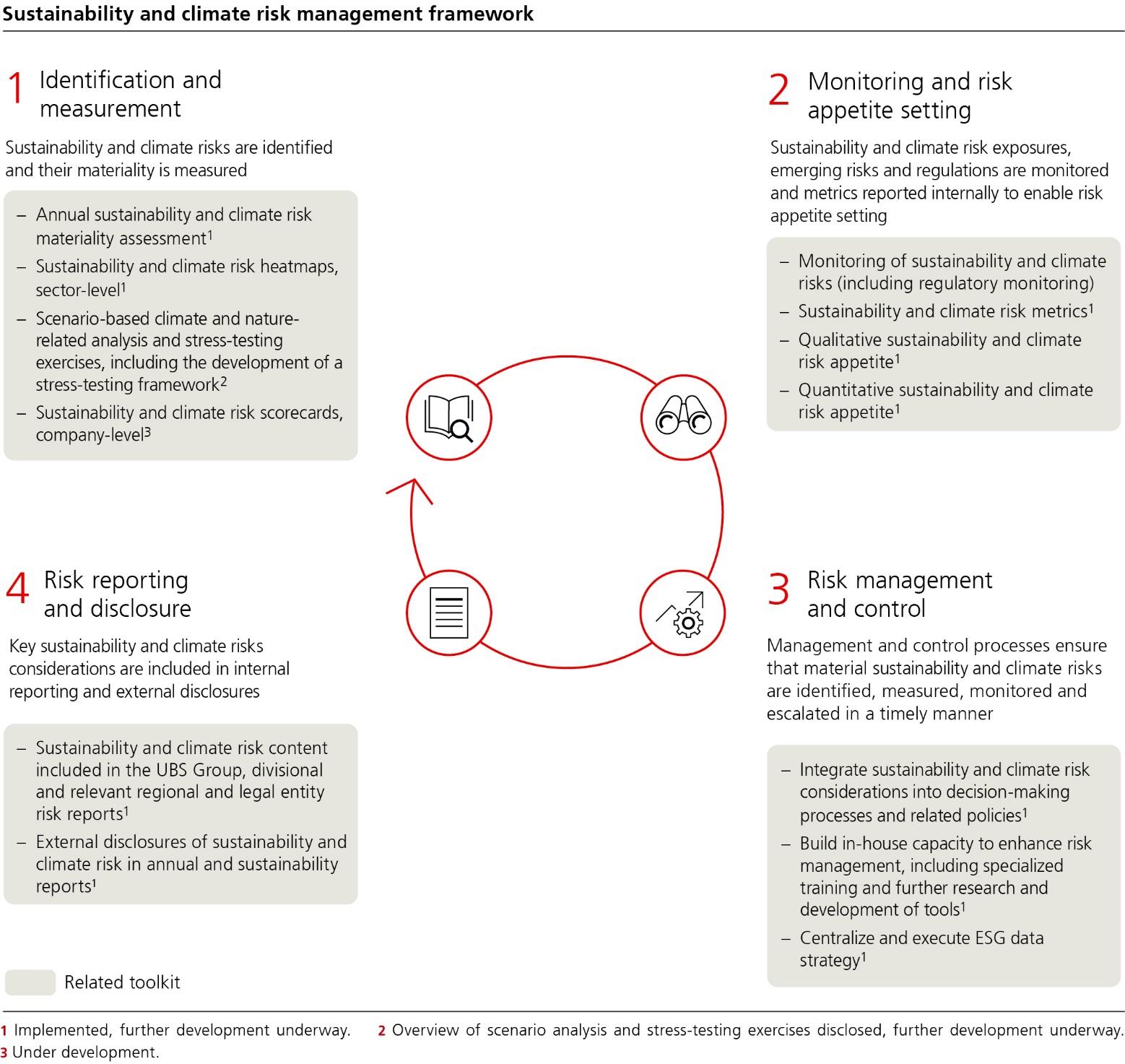
Annual Report 2023 |
Risk, capital, liquidity and funding, and
balance sheet | Risk management and control
138
Risk identification and measurement
On an annual
basis, an assessment of
the materiality of sustainability-
and climate-driven risks is
carried out in
accordance
with the ISO 14001 standard for environmental
management systems.
We aim
to identify
sustainability and
climate risks
at divisional
and cross-divisional
levels, both
through the
assessment
mentioned above and,
increasingly, by integrating
them into the
firm-wide traditional risk
identification and measurement
process. This approach is also applied to significant Group
entities under UBS Group AG.
Our
risk
identification
methodologies
collectively
define
UBS’s
materiality-driven
approach,
focus
areas
and
key
risk
drivers. The outputs of these efforts define our sustainability and climate
risk management strategy by:
–
identifying concentrations
of climate-
and nature-sensitive
exposures that may
make UBS vulnerable
to financial and
non-financial
risks,
enabling
prioritization
of
resources
toward
enhanced
risk
quantification
and
subsequent
management actions;
–
supporting the delivery
of a client-centric
business strategy, where
we assist clients
with their sustainability
transition
(e.g., low-carbon transition)
finance, identifying clients that
could benefit from sustainability-focus
UBS products and
services; and
–
providing
information
to
senior
management
to
support
more-informed
decision-making
on
sustainability-
and
climate-driven risks, along with
providing decision-useful information to stakeholders
through our external disclosures.
›
Refer to “Managing sustainability and climate risks”
in the UBS Group Sustainability Report 2023, available
under “Annual
reporting” at
ubs.com/investors
, for more information
Annual Report 2023 |
Risk, capital, liquidity and funding, and
balance sheet | Risk management and control
139
Transition risk
Climate-driven transition risk
s
arise from the
efforts to mitigate
the effects of
climate change. They
impact on our clients or on UBS itself through the
credit worthiness of our counterparties or the value
of collateral
we hold
. The financial impacts from climate transition risk could materialize
through three key
risk factors:
–
climate policies,
affecting operating expenses (e.g., carbon taxes), analyzed
both directly and indirectly;
–
low-carbon technologies and their potential for disruption,
affecting capital expenditure requirements and / or market
share due to low-cost competition; and
–
shifts in consumer or investor sentiment, affecting revenues
(shifts in consumer demand) or market-perceived value.
To
calculate
our
exposure
to
climate
transition
risks,
we
have
analyzed
economic
sectors
within
our
classification
taxonomy
with
a
view
to
define
s
egments
that
share
similar
characteristics
in
their
vulnerability
to
the
risk
factors
identified above
. The approach consists of grouping
companies into these segments under an adverse risk
scenario. This
scenario is defined as
an immediate and disorderly
approach toward meeting the
well-below-2˚C Paris goal over
the zero-
to-three-year
time
horizon
(reflecting
the
business
planning
horizon).
The
outcome
of
this
process
is
a
sector-level
transition risk heatmap,
where the
risk ratings ranging
from “Low” to
“High”, and
“climate-sensitive” include
the top
three ratings (Moderate, Moderately High and High).
The transition
risk
heatmap
shows that,
at the
end of
2023, UBS
Group
excluding
Credit Suisse
exposure
to climate-
sensitive sectors and related
activities was relatively stable.
Climate-driven transition-risk-sensitive exposure accounted for
12.1%
of
total
customer
lending
exposure
(up
from
11.7%
in
2022),
mainly
driven
by
an
increase
in
exposure
to
commercial real
estate in
Switzerland. This
risk exposure
can be associated
with the
passage of
the Climate
and Innovation
Act in
Switzerland and
the expected
zero-to-three-year impact
on energy-efficiency
rules in
the commercial
real estate
sector. A slight reduction in exposure can be observed in the
fossil fuels trading and mining conglomerates sectors.
›
Refer to “Managing sustainability and climate risks”
in the UBS Group Sustainability Report 2023, available
under “Annual
reporting” at
ubs.com/investors
, for more information
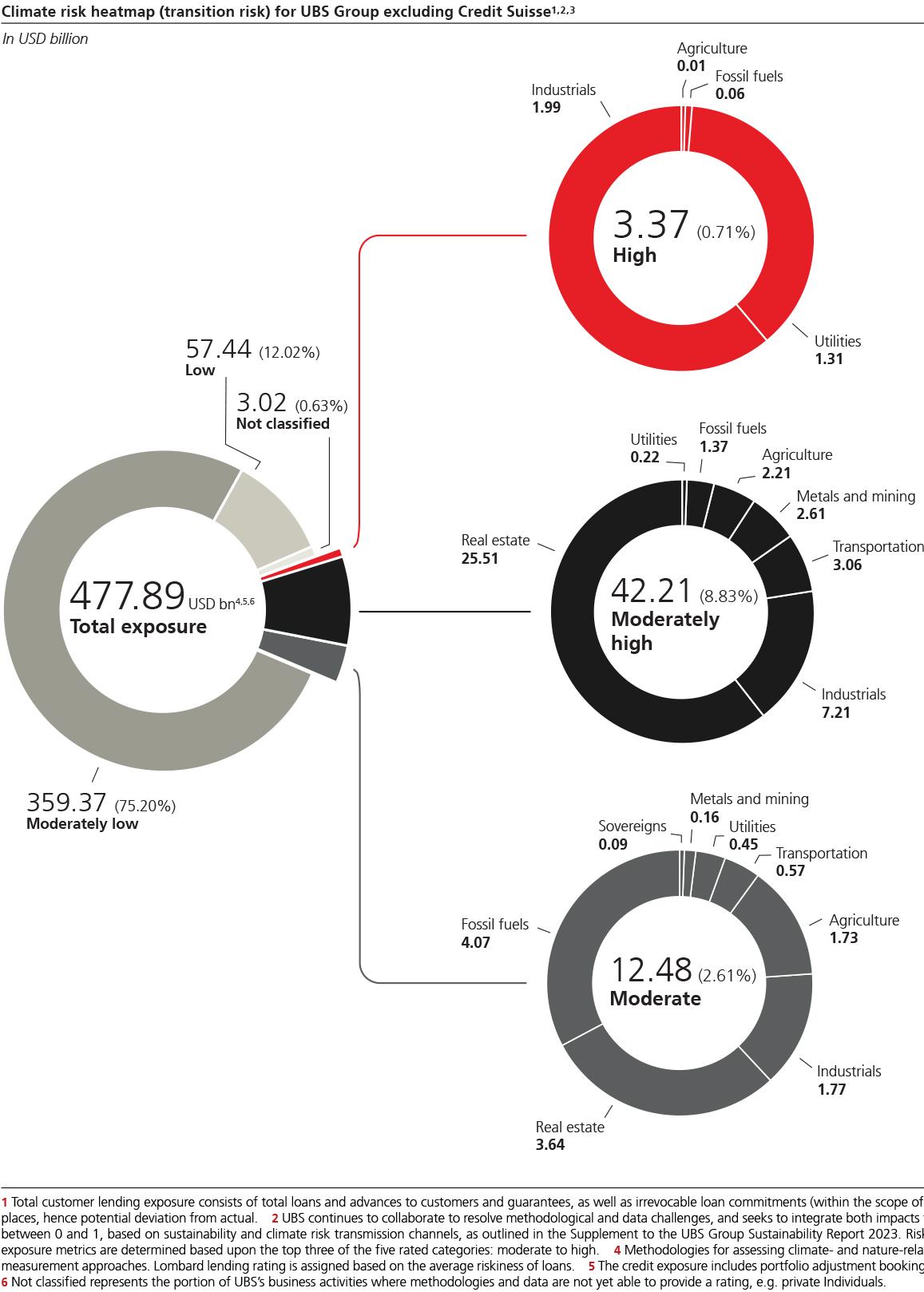
Annual Report 2023 |
Risk, capital, liquidity and funding, and
balance sheet | Risk management and control
140
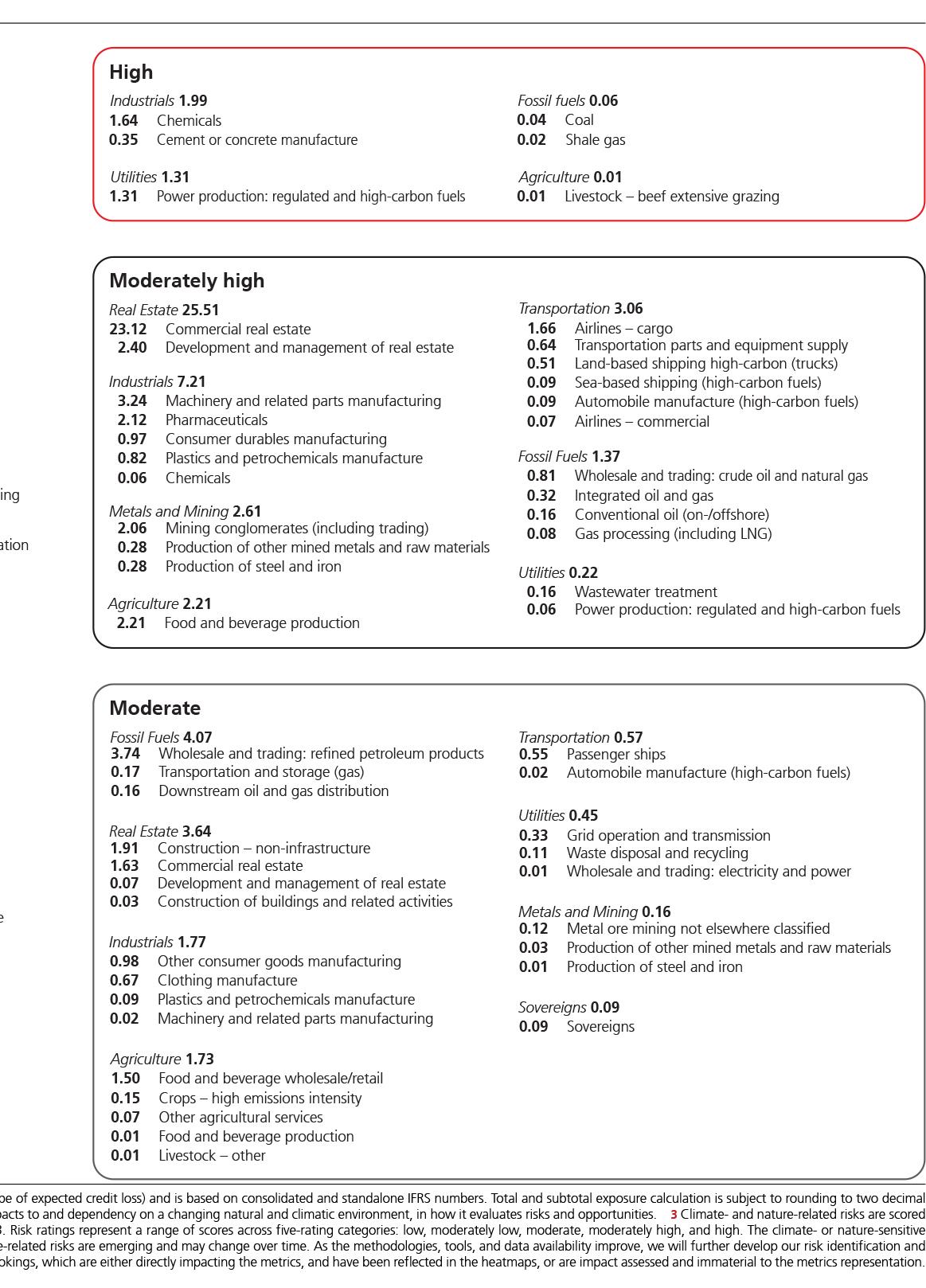
Annual Report 2023 |
Risk, capital, liquidity and funding, and
balance sheet | Risk management and control
141
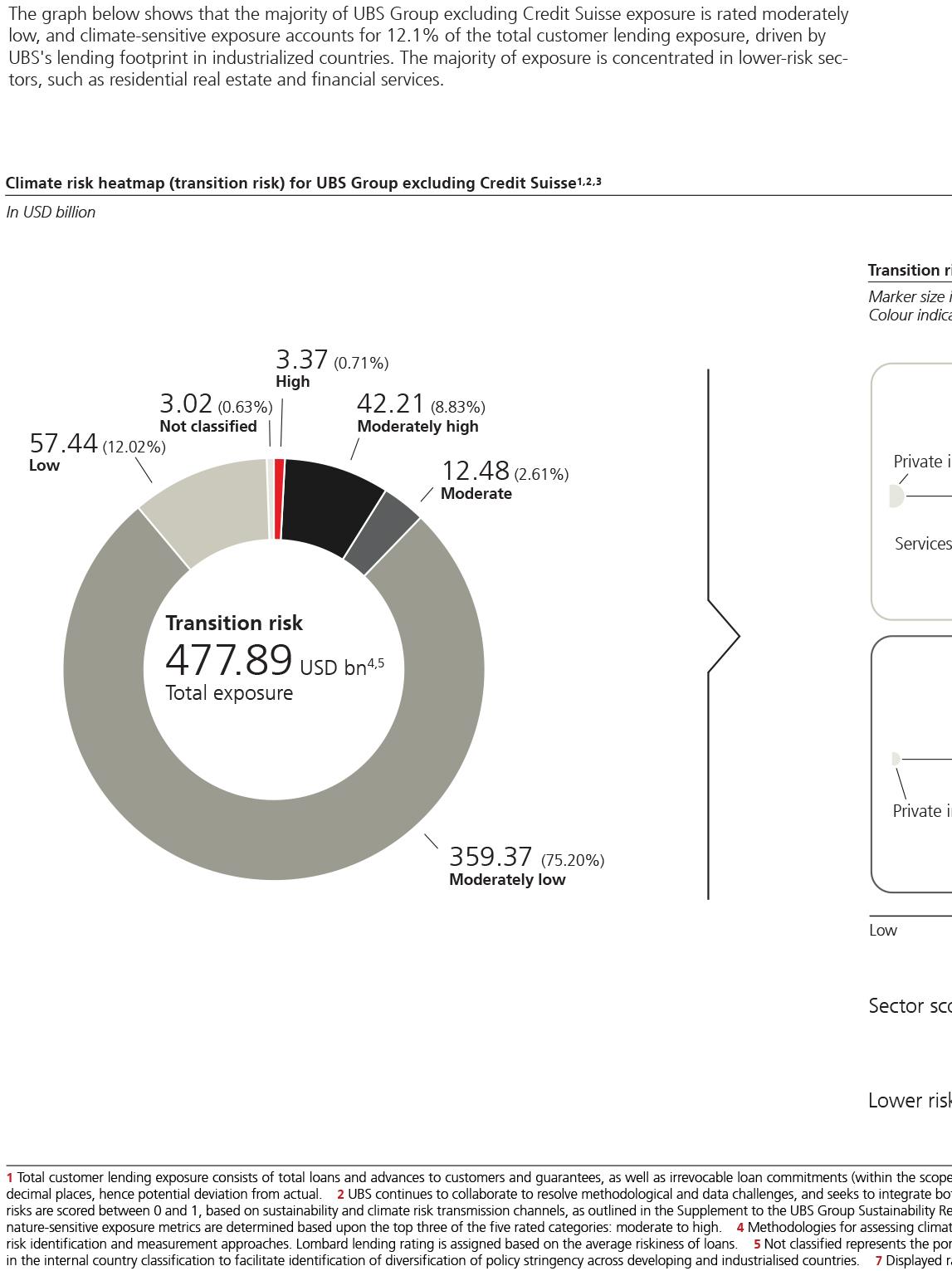
Annual Report 2023 |
Risk, capital, liquidity and funding, and
balance sheet | Risk management and control
142

Annual Report 2023 |
Risk, capital, liquidity and funding, and
balance sheet | Risk management and control
143
Annual Report 2023 |
Risk, capital, liquidity and funding, and
balance sheet | Risk management and control
144
Physical risk
Climate-driven physical risks arise
from acute hazards, which
are increasing in severity and
frequency, and chronic climate
risks arise
from an
incrementally changing
climate. These
effects may
include increased
temperature
and sea-level
rise,
and the
gradual changes
may affect
productivity and
property values
and increase
the severity
and frequency
of acute
hazards.
Our physical risk heatmap methodology groups together corporate counterparties based on
exposure to key physical risk
factors
(risk
segmentation),
by
rating
sectoral,
sub-sectoral
and
geographical
vulnerabilities
to
climate-driven
physical
risks. These
vulnerabilities were
identified using
a proprietary
in-house UBS
model. The
model, developed
in 2023,
is a
significant
advancement
from
the
historical
physical
risk
heatmapping
methodology
that
UBS
published
in
2021
and
2022. By leveraging
over a
billion data points,
UBS analyzed
cross-sector information
on asset-level data
(sub-company
level),
third-party
climate
hazard
ratings
through
geospatial
datasets,
and
academic
insights
into
how
hazards
and
production methods may
be aggravated or
complementary (transmission channels).
The analyses were
then quantitatively
aggregated
across assets,
transmission
channels (including
value chains)
and hazards
at a
sub-sector / country
or sub-
country level of granularity.
The refined heatmap methodology shows that
our physical risk vulnerability remained, on
average, moderately low year
on
year.
Given
UBS’s
business
profile,
the
key
drivers
for
UBS’s
climate-sensitive
lending
(physical
risk)
are
financial
intermediation
activities
and,
collectively,
the
services,
agriculture
and
transportation
sectors.
In
its
current
state,
the
model
takes
a
conservative
approach
in
its
key
assumptions,
limiting
full
incorporation
of
geographical
and
sectorial
sources of variability, which may either
further amplify or
mitigate financial vulnerability. We are committed to
addressing
these and other limitations
by continuously improving the modeling
approach in parallel with the
industry, as it continues
to standardize the disclosure of physical
climate risk data, integrates regionalized scientific
climate models, specializes in
its impact
on sectors
and assets,
and collaborates
with a
view to
more informed
decision-making. More
specifically,
in
2024 and
beyond, UBS
will seek
to expand
its use of
vendor data
through both
diversification and
refinement, further
address
the
limitations
presented
due
to
key
assumptions
in
the
model,
and
develop
approaches
to
address
data
limitations in
other types
of assets
(e.g., real
estate).
We
will also
explore
the link
between
the changing
climate
and
nature-related financial risks,
which may result in intensified
compounding vulnerabilities. Companies and
activities that
depend on natural
-capital assets
may be
adversely affected
by a
changing climate,
whose relationships
have proven
to
either reduce or augment ecosystem services like fresh
water or biodiversity.
The physical risk heatmap below
shows that, at the
end of 2023, UBS Group
excluding Credit Suisse exposure to climate-
sensitive sectors
was 9.7% (up
from 8.4%
in 2022).
This increase
was driven
by exposure
to the
services sector,
which
includes financial services activities in emerging markets. Most of the climate-sensitive physical risk exposure is located in
countries
that
have
high
adaptive
capacity
to
physical
risk
hazards,
which
is
an
important
aspect
to
consider
when
assessing the 9.7% exposure to physical risk.
›
Refer to “Managing sustainability and climate risks”
in the UBS Group Sustainability Report 2023, available
under “Annual
reporting” at
ubs.com/investors
, for more information
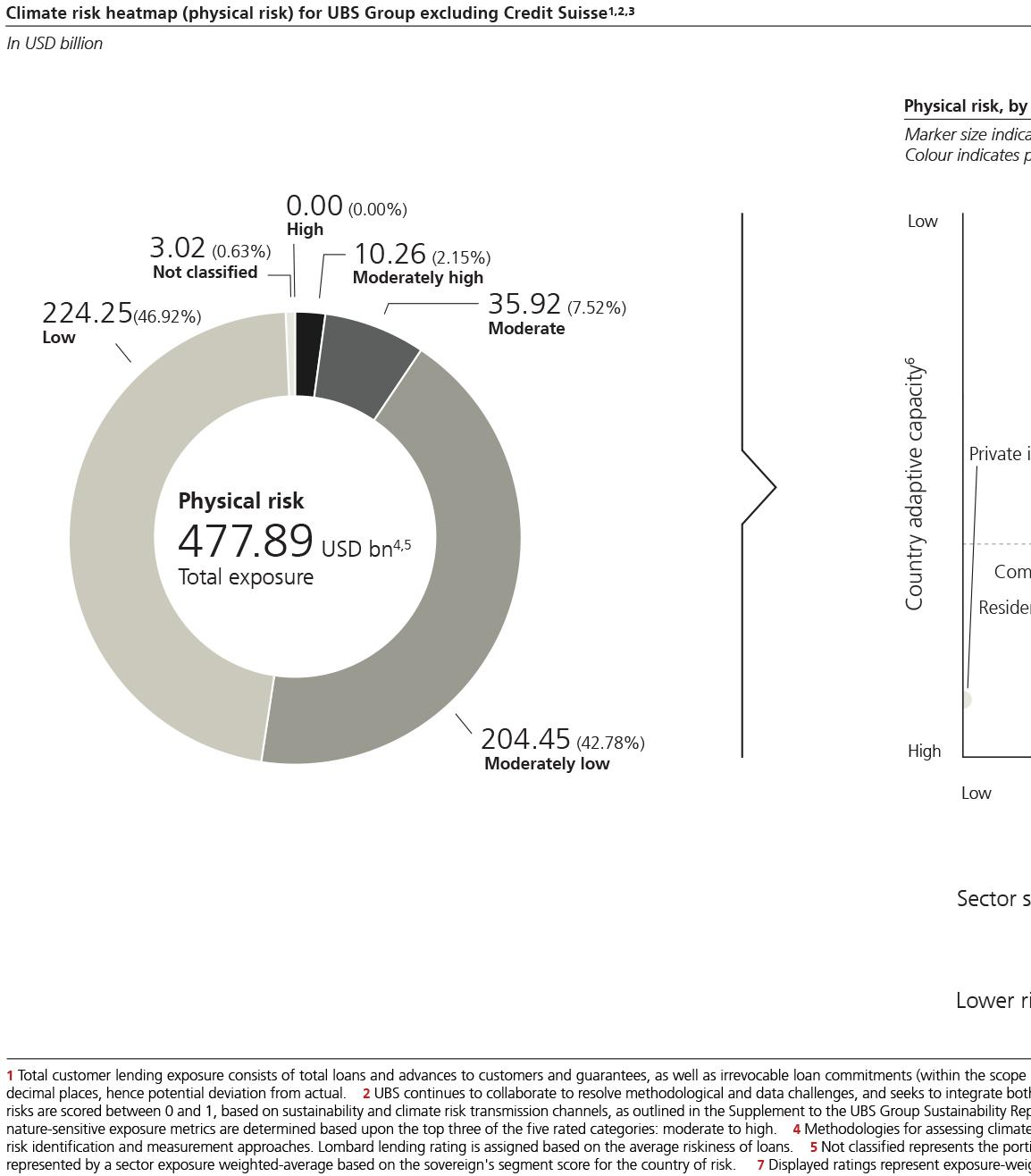
Annual Report 2023 |
Risk, capital, liquidity and funding, and
balance sheet | Risk management and control
145
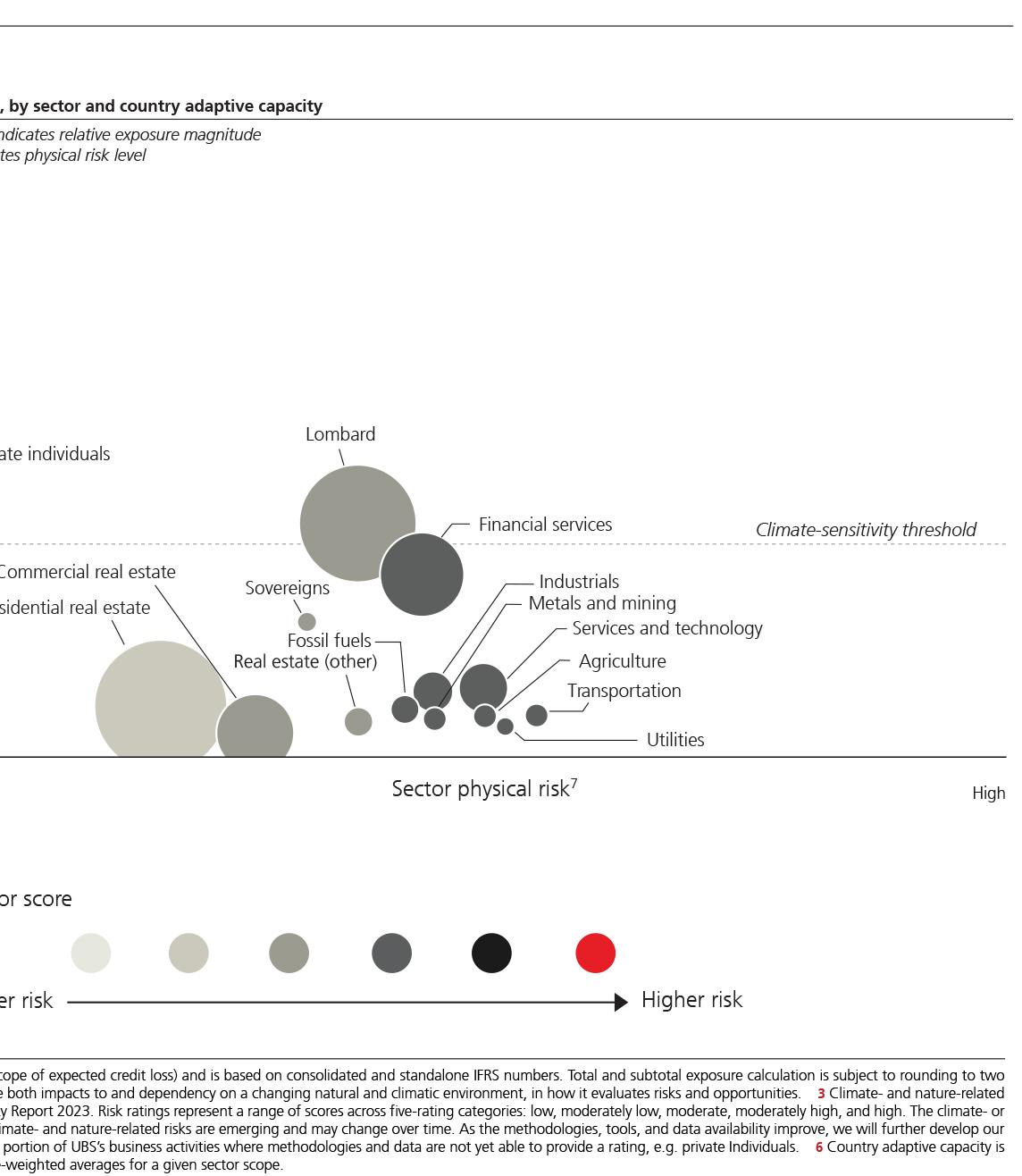
Annual Report 2023 |
Risk, capital, liquidity and funding, and
balance sheet | Risk management and control
146
Annual Report 2023 |
Risk, capital, liquidity and funding, and
balance sheet | Risk management and control
147
Nature-related risks
Nature-related
risks refer
to how
humans
and
organizations
depend
on and
impact
the
natural
environment.
Natural
resources are referred to as natural capital that, in combination, provides the ecosystem
services that benefit people and
the planet. Below we describe our understanding of
how UBS’s business model may depend on or
impact those services,
resulting in financial and non-financial risk for UBS.
Biodiversity
is presented
as a
function of
various natural
-capital assets
providing life
on earth
with a
range of
services
(ecosystem services), categorized
and rated for
its role in
the development
of medicines, technologies
and more. UBS‘s
development of
insights in
biodiversity, among
other nature-related
risks, is discussed
in the
context of
improving data
and methodology. Similar to the collaborative effort that
UBS has made on climate-related risks in earlier years,
we have
contributed
to
global
efforts
to
raise
awareness
of
and
exchange
knowledge
about
nature-related
risk
assessment
methodologies.
UBS
has
made
these
contributions
through
its
role
as
a
member
of
the
Taskforce
on
Nature-related
Financial Disclosures since 2021 and the United Nations
Environment Programme Finance Initiative (the UNEP FI) working
group
on
nature-related
risks
(since
2018).
As a
key
member
of
the
UNEP
FI
working
group,
UBS
has
supported
the
development of a methodology to assess
nature-related risks from both the
dependency and impact perspectives
to the
natural environment.
UBS took
part in
the collaborative
work to
develop the
Exploring
Natural
Capital Opportunities,
Risks and Exposure
toolkit (ENCORE), which has
been a central input
to UBS’s initial
nature-related risk analysis. The
UNEP
FI coordinated
this working
group in
partnership with
the World
Conservation Monitoring
Centre, Global
Canopy, the
Swiss State Secretariat for Economic Affairs and the Swiss
Federal Office for the Environment.
In 2022, we initially piloted
a quantification approach for
nature-related risks solely based
on dependency of our
clients
on the natural environment, using the ENCORE methodology. This approach enabled us to assess vulnerability to nature-
sensitive economic activities
by our clients,
which may drive
financial risks for
UBS, such as
reduced creditworthiness of
our clients or the value of companies’
debt or of equity posted as collateral
for lending activities. In 2023, we expanded
the definition of our “nature-sensitive metric” to now
include both dependencies and impacts on nature, its
assets, and
the ecosystem
services nature
provides to sustain
human activities.
Our methodology
assigns ratings on
the same scale
and granularity as
our climate-driven
sector-level heatmaps. As
in the case
of the climate-driven
heatmap assumptions,
UBS takes a conservative approach in assigning the overall nature-sensitive risk rating to each of the UBS industry codes.
The key assumption here is
driven by taking the higher
of the two values between
the ENCORE-defined impact and
the
dependency ratings.
Our enhanced
nature-related
risk heatmap
below
shows that
at the
end of
2023,
UBS Group
excluding
Credit Suisse
exposure
to
nature-sensitive
sectors
was
15.1%
(up
from
14.4%
in
2022)
of
our
total
customer
lending
exposure.
Sensitivity is
driven by
sectors that
either have
a high
impact or
a high
dependency on
the natural
environment. These
include metals and mining, utilities, and agriculture. Our business activities are concentrated in Lombard lending and the
financial
services
sector,
which
are
rated
as
relatively
low. A
strong
correlation
can
be
observed
between
climate
risk
sensitivity
(both
transition
risk
and
physical
risk)
and
nature-related
risks,
with
a
heightened
correlation
identified
in
climate-sensitive sectors.
›
Refer to “Managing sustainability and climate risks”
in the UBS Group Sustainability Report 2023, available
under “Annual
reporting” at
ubs.com/investors
, for more information

Annual Report 2023 |
Risk, capital, liquidity and funding, and
balance sheet | Risk management and control
148

Annual Report 2023 |
Risk, capital, liquidity and funding, and
balance sheet | Risk management and control
149
Annual Report 2023 |
Risk, capital, liquidity and funding, and
balance sheet | Risk management and control
150
Climate scenario analysis
We use scenario-based approaches to
assess our exposure to physical
and transition risks stemming
from climate change.
We have introduced a
series of assessments
performed through industry collaborations in
order to harmonize approaches
for addressing
methodological and
data gaps.
We have
performed top-down
balance sheet
stress testing
(across
pre-
acquisition UBS), as
well as a
targeted bottom-up analysis of
specific sector exposures covering
short-, medium- and
long-
term time horizons.
The work performed includes regulatory scenario
analysis and stress-test exercises, including
the Climate Risk Stress Test
of
the
European
Central
Bank,
which
is
used
to
assess
banks’
preparedness
for
dealing
with
financial
and
economic
shocks stemming from climate
risk; and the Bank of
England 2021 Climate Biennial
Exploratory Scenario: Financial risks
from climate change, which has
enabled UBS to assess management
actions in response to different scenario
results, as
well as perform counterparty-level analysis.
While these exercises showed mild losses
and low exposure to climate risk
for the entities in scope, the
analysis enabled
UBS to enhance climate risk
scenario analysis and stress testing, further
developing our capabilities for assessing risks
and
vulnerabilities from climate change.
In 2023,
we further
advanced our
capabilities surrounding
internal climate
risk scenario
analysis and
stress testing
for
UBS Group excluding Credit Suisse. We enhanced and refined
our climate risk scenarios, with a focus on both transition
and physical
risk projections
across 30
years. Furthermore,
we have
been developing
additional corresponding
climate
risk models
to amend
the
coverage
of
major risk
types
and have
enhanced consistent
modeling approaches
in the
context of real estate energy
performance and location-specific
physical risks.
For details on Credit Suisse’s approach
to climate scenario analysis, refer to the UBS Group Sustainability
Report 2023.
›
Refer to “Managing sustainability and climate risks”
in the UBS Group Sustainability Report 2023, available
under “Annual
reporting” at
ubs.com/investors
, for more information
›
Refer to “Entity-specific disclosures for Credit Suisse AG”
in the UBS Group Sustainability Report 2023, available under
“Annual
reporting” at
ubs.com/investors
, for more information
Monitoring and risk appetite setting
As a
part of
the sustainability
and climate
risk monitoring
process,
we have
developed
methodologies
and metrics
to
assess our
ongoing exposure to
carbon-related assets and
climate-sensitive sectors. In
developing our
metrics, we consider
the inputs and guidance
provided by standard-setting organizations, as
well as new or
enhanced regulatory requirements
for climate
disclosures. In
2023,
we continued
working on
methodologies covering climate
transition, physical
and nature-
related risk. Examples of such enhancements include issuer and traded risk products in our risk monitoring and reporting
capabilities.
We
have
newly
expanded
reporting
scopes
and
enhanced
methodologies,
which,
together
with
the
underlying metrics, are illustrated in the table below.
›
Refer to “Climate-related materiality assessment” in the UBS
Group Sustainability Report 2023, available under “Annual
reporting” at
ubs.com/investors
, for more information
The table below includes climate-
and nature-related risk metrics for UBS Group
excluding Credit Suisse and UBS AG on
standalone basis, as well as for UBS Switzerland AG and UBS Europe SE, both on a standalone basis.
Respective climate-
and nature-related risk metrics will be published for UBS Group and Credit Suisse AG
in a supplement to the UBS Group
Annual Report
2023 and
the UBS Group
Sustainability Report
2023, in
line with
the publication
timeline for
the semi-
annual Pillar 3 disclosures in the third quarter of 2024.
Carbon-related assets proportion of total customer lending exposure for
UBS Group excluding Credit Suisse decreased to
7.2%
in
2023
from
7.5%
in
2022.
In
2023,
the
share
of
climate-sensitive
sectors
for UBS
Group
excluding
Credit
Suisse was 12.1% for transition risk and 9.7 % for physical
risk of our total customer lending exposure.
The main driver for transition risk
was an increase in exposure to
commercial real estate in Switzerland. This risk exposure
was associated
with the
passing of
the Climate
and Innovation
Act in
Switzerland and
the expected
zero-to-three-year
impact on energy-efficiency rules in the commercial real
estate sector. The key driver for
physical risk was exposure to the
services sector, which includes
financial services activities in emerging markets. Most of the climate-sensitive physical risk
exposure was located in countries that have high levels of
capacity to adapt to physical risk hazards.
The
year-end
2023
exposure
to
nature-sensitive
sectors
of
the
UBS
Group
was
15.1%
of
the
total
customer
lending
exposure. For nature-related
risk, sensitivity was
driven by sectors
that either have
a high impact
or a high
dependency
on
the
natural
environment.
These
include
metals
and
mining,
utilities,
and
agriculture.
Our
business
activities
are
concentrated in Lombard
lending and the
financial services sector,
which are rated
as having relatively
low sensitivity to
nature risk. A
strong correlation can
be observed between
climate risk sensitivity
(both transition and
physical) and nature-
related risks, with a heightened correlation in climate-sensitive sectors.
Annual Report 2023 |
Risk, capital, liquidity and funding, and
balance sheet | Risk management and control
151
Risk management – climate- and nature-related metrics
For the year ended
% change from
31.12.23
31.12.22
31.12.21
31.12.22
Climate- and nature-related metrics (USD bn)
1, 2
Carbon-related assets UBS Group excluding Credit Suisse
1, 2, 3, 4, 5
34.2
33.6
36.0
1.7
Carbon-related assets proportion of total customer lending
exposure, gross (%)
1, 2, 3, 4, 5
7.2
7.5
7.8
Carbon-related assets: UBS AG (standalone)
1, 2, 3, 4, 5
8.5
8.6
9.9
(1.5)
Carbon-related assets: UBS Switzerland AG (standalone)
1, 2, 3, 4, 5
26.6
24.6
25.6
8.0
Carbon-related assets: UBS Europe SE (standalone)
1, 2, 3, 4, 5
0.0
0.0
0.0
(25.7)
Exposure to climate-sensitive sectors, transition risk UBS Group excluding Credit
Suisse
1, 2, 4, 5, 6
58.1
52.5
52.4
10.6
Climate-sensitive sectors, transition risk, proportion of total customer lending
exposure, gross (%)
1, 2, 4, 5, 6
12.1
11.7
11.4
Exposure to climate-sensitive sectors, transition risk: UBS AG (standalone)
1, 2, 4, 5, 6
9.9
9.2
9.6
7.8
Exposure to climate-sensitive sectors, transition risk: UBS Switzerland AG (standalone)
1, 2, 4, 5, 6
47.5
41.2
41.1
15.1
Exposure to climate-sensitive sectors, transition risk: UBS Europe SE (standalone)
1, 2, 4, 5, 6
0.0
0.0
0.0
(0.1)
Exposure to climate-sensitive sectors, transition risk: Traded products, UBS Group excluding Credit Suisse
1, 2, 4, 5, 6, 7
0.9
Exposure to climate-sensitive sectors, transition risk: Issuer risk, UBS Group
excluding Credit Suisse
1, 2, 4, 5, 6, 8
4.6
Exposure to climate-sensitive sectors, physical risk UBS Group excluding
Credit Suisse
1, 2, 4, 5, 6
46.2
38.0
36.7
21.4
Climate-sensitive sectors, physical risk, proportion of total customer lending
exposure, gross (%)
1, 2, 4, 5, 6
9.7
8.4
8.0
Exposure to climate-sensitive sectors, physical risk: UBS AG (standalone)
1, 2, 4, 5, 6
52.7
44.8
42.1
17.7
Exposure to climate-sensitive sectors, physical risk: UBS Switzerland AG (standalone)
1, 2, 4, 5, 6
15.7
14.8
16.0
5.8
Exposure to climate-sensitive sectors, physical risk: UBS Europe SE (standalone)
1, 2, 4, 5, 6
0.0
0.0
0.0
122.3
Exposure to climate-sensitive sectors, physical risk: Traded products, UBS Group excluding Credit Suisse
1, 2, 4, 5, 6, 7
7.2
Exposure to climate-sensitive sectors, physical risk: Issuer risk, UBS Group
excluding Credit Suisse
1, 2, 4, 5, 6, 8
15.7
Exposure to nature-related risks UBS Group excluding
Credit Suisse
1, 4, 5, 6, 9
72.0
64.6
67.3
11.4
Exposure to nature-related risks, proportion of total customer lending
exposure, gross (%)
1, 4, 5, 6, 9
15.1
14.4
14.7
Exposure to nature-related risks: UBS AG (standalone)
1, 4, 5, 6, 9
14.4
12.0
12.7
20.1
Exposure to nature-related risks: UBS Switzerland AG (standalone)
1, 4, 5, 6, 9
56.3
49.8
49.7
13.0
Exposure to nature-related risks: UBS Europe SE (standalone)
1, 4, 5, 6, 9
0.1
0.0
0.0
205.1
Exposure to nature-related risks: Traded products, UBS Group excluding Credit Suisse
1, 5, 7, 9
1.2
Exposure to nature-related risks: Issuer risk, UBS Group excluding
Credit Suisse
1, 5, 8, 9
3.5
1 Methodologies for assessing climate- and nature-related risks are emerging and may change over time. As the methodologies,
tools, and data availability improve, we will further
develop our risk identification and
measurement approaches. Lombard lending rating is assigned based on the average riskiness of loans.
2 Metrics are calculated and restated based on the 2023 methodology, across three years of reporting, 2021–
2023.
3 As defined by the Task
Force on Climate-related Financial Disclosures
(the TCFD), in its expanded definition
published in 2021, UBS defines carbon-related
assets through industry-identifying attributes of
the firm’s banking
book. UBS further includes the
four non-financial sectors addressed
by the TCFD, including,
but not limited to,
fossil fuel extraction, carbon-based
power generation, transportation
(air, sea,
rail,
and auto manufacture), metals production and mining, manufacturing industries, real estate development, chemicals, petrochemicals,
and pharmaceuticals, building and construction materials and activities, forestry,
agriculture, fishing, food and beverage production, as well as including trading companies that may trade any of the above (e.g., oil trading or agricultural commodity trading companies). This metric is agnostic of risk
rating, and therefore may include
exposures of companies that may
be already transitioning or adapting
their business models to climate
risks, unlike UBS
climate-sensitive-sectors methodology, which
takes a risk-
based approach to defining
material exposure to climate
impacts.
4 Total customer
lending exposure consists
of total loans and
advances to customers
and guarantees,
as well as irrevocable
loan commitments
(within the scope of expected credit loss) and is based on consolidated
and standalone IFRS numbers. The credit
exposure includes portfolio adjustment bookings, which are
either directly impacting the metrics, and
have been reflected in the heatmaps, or are impact assessed and immaterial to the metrics representation.
5 UBS continues to collaborate to resolve methodological and data challenges, and seeks to integrate both
impacts to and dependency on a changing natural and climatic environment in how it evaluates risks and opportunities.
6 Climate-
and nature-related risks are scored between 0 and 1, based on sustainability and
climate risk transmission channels, as
outlined in the Supplement to the UBS
Group Sustainability Report 2023. Risk ratings
represent a range of scores across
five-rating categories: low, moderately
low, moderate,
moderately high, and high. The climate-
or nature-sensitive exposure metrics are determined based upon the top three of the five rated categories: moderate to high.
7 Traded products are newly disclosed for 2023.
Risk exposures consist of receivables from securities financing transactions,
cash collateral receivables on derivative instruments
and financial assets measured at amortized cost.
8 Issuer risk, is newly disclosed for
2023. Risk exposures consist of high-quality liquid assets assets, debt securities, bonds and liquidity buffer
securities.
9 Nature-related risk metric methodology has been further strategically enhanced, as part of an
ongoing collaboration between UBS and UNEP FI.
The table
below presents a
view of UBS’s
risk profile and
year-on-year changes, when
compared with 2022,
within sectors
and across climate-
and nature-related
risks. It shows
UBS Group excluding
Credit Suisse’s total
exposure to and
trends
in each sector, followed by an exposure-weighted risk rating, the trend in the underlying quantitative
score year on year,
and, finally, the total absolute exposure, rated as
moderate,
moderately high or high, within that sector.
This is presented
for
all
three
risk
types.
Exposures
may
appear
under
one
or
more
of
the
risk
types
and,
therefore,
cannot
be
added
together; this is because the methodologies are distinct in their approach
and application.
Overall, UBS Group
excluding Credit
Suisse had
a moderate
or moderately
low outlook
across the
three risk
categories
as of the end of 2023. We found that most year-on-year fluctuations were
driven by an increase in lending and changes
in the risk profile relating to commercial real estate
activities, especially in Switzerland. The changes in the risk
profile can
be attributed to regulatory action in Switzerland regarding
climate policies.
Annual Report 2023 |
Risk, capital, liquidity and funding, and
balance sheet | Risk management and control
152
Risk exposures by sector for UBS Group excluding Credit Suisse
1, 2, 3, 4, 5
Transition risk
Physical risk
Nature-related risk
8
Sector / Sub-sector
2023
exposure
(USD bn)
2022–
2023
exposure
trend
6
Weighted
average
transition risk
rating 2023
7
2022–
2023
weighted
average
transition
risk trend
6
2023
transition
risk
climate-
sensitive
exposure
(USD
bn)
5
Weighted
average
physical risk
rating 2023
7
2022 risk-
rating
category
6
2023
physical
risk
climate-
sensitive
exposure
(USD
bn)
5
Weighted
average nature-
related risk
rating 2023
7
2022–
2023
weighted
average
nature-
related
risk trend
6
2023
nature-
related
risk
climate-
sensitive
exposure
(USD
bn)
5
Agriculture
Agriculture, fishing and forestry
0.30
↑
Moderate
→
0.23
Moderate
→
0.08
High
→
0.30
Food and beverage
3.72
↑
Moderately high
→
3.72
Moderate
→
2.08
Moderate
→
3.71
Financial services
Financial services
60.72
↑
Moderately low
↓
0.00
Moderate
→
17.47
Low
→
0.06
Fossil fuels
Downstream refining, distribution
0.25
↓
Moderately high
→
0.25
Moderate
→
0.16
Moderately high
→
0.24
Integrated oil and gas
0.32
↓
Moderately high
→
0.32
Moderately low
→
0.00
High
→
0.32
Midstream transport, storage
0.17
↑
Moderate
→
0.17
Moderate
→
0.17
Moderately low
→
0.00
Trading fossil fuels
4.55
↓
Moderately high
→
4.55
Moderate
→
0.57
Moderate
→
4.44
Upstream extraction
0.21
↑
High
→
0.21
Moderate
↓
0.18
High
→
0.21
Industrials
Cement or concrete manufacture
0.35
↑
High
→
0.35
Moderate
→
0.13
High
→
0.35
Chemicals manufacture
1.71
↑
High
→
1.71
Moderate
→
0.39
Moderately high
↓
1.71
Electronics manufacture
2.08
↑
Moderately low
→
0.00
Moderate
→
0.53
Moderate
→
0.82
Goods and apparel manufacture
2.63
↑
Moderately high
→
2.63
Moderate
→
1.58
Moderate
→
2.55
Machinery manufacturing
3.73
↑
Moderately high
→
3.26
Moderate
→
0.59
Moderately high
→
3.72
Pharmaceuticals manufacture
2.12
↑
Moderately high
→
2.12
Moderate
→
0.89
Moderate
→
2.10
Plastics and petrochemicals
manufacture
0.91
→
Moderately high
→
0.91
Moderate
→
0.28
Moderate
→
0.51
Metals and mining
Mining conglomerates (incl.
trading)
2.06
↓
Moderately high
→
2.06
Moderate
→
0.05
Moderate
→
2.06
Mining and quarrying
0.43
→
Moderate
→
0.12
Moderate
→
0.37
High
→
0.43
Production of metals
0.59
↑
Moderately high
→
0.59
Moderate
→
0.39
Moderately high
↓
0.25
Private lending
Lombard
122.76
↓
Moderately low
→
0.00
Moderately low
→
0.00
Low
→
0.00
Private lending, credit cards,
others
9
2.90
↓
Not classified
→
0.00
Not classified
→
0.00
Not classified
→
0.00
Real estate
Development and management
4.58
↓
Moderately high
→
4.40
Moderately low
→
0.42
Moderately high
→
4.58
Commercial real estate
55.09
↑
Moderate
→
24.75
Moderately low
→
2.87
Moderately low
→
26.71
Residential real estate
176.70
↑
Moderately low
→
0.00
Low
→
0.00
Low
→
0.00
Services and technology
Services and technology
19.10
↑
Moderately low
→
0.00
Moderate
→
11.24
Moderate
→
10.49
Sovereigns
Sovereigns
2.77
→
Moderate
→
0.09
Moderately low
→
0.04
Low
→
0.00
Transportation
Air transport
1.72
→
Moderately high
→
1.72
Moderate
→
1.58
Moderately high
→
1.72
Automotive
0.41
↑
Moderate
→
0.11
Moderate
→
0.36
Moderate
→
0.41
Rail freight
0.50
↑
Low
→
0.00
Moderate
→
0.39
Moderate
→
0.49
Road freight
0.51
→
Moderately high
→
0.51
Moderate
→
0.43
Moderately high
→
0.51
Transit
0.59
→
Moderately low
→
0.00
Moderate
→
0.54
Moderate
→
0.23
Transportation parts and
equipment supply
0.65
↑
Moderately high
→
0.65
Moderate
↓
0.34
Moderate
→
0.65
Water transport
0.64
↑
Moderately high
→
0.64
Moderate
→
0.64
Moderately high
→
0.64
Utilities
Power generation
1.73
→
High
→
1.71
Moderate
↓
1.36
Moderately high
→
1.73
Waste treatment
0.27
↑
Moderately high
↑
0.27
Moderate
→
0.05
Moderately low
↓
0.02
Not classified
9
0.12
↑
Not classified
→
0.00
Not classified
→
0.00
Not classified
→
0.00
Grand total
477.89
↑
Moderate
→
58.05
Moderately low
→
46.18
Moderately low
→
71.97
1 Methodologies for assessing climate- and nature-related risks are emerging and may change over time. As the methodologies,
tools, and data availability improve, we will further
develop our risk identification and
measurement approaches. Lombard lending rating is assigned based on the average riskiness of loans.
2 Metrics are calculated and restated based on the 2023 methodology, across three years of reporting, 2021–
2023.
3 Total customer
lending exposure consists
of total loans
and advances to
customers and guarantees,
as well as
irrevocable loan commitments
(within the scope
of expected credit
loss), and is
based on
consolidated and standalone IFRS Accounting Standards numbers. The credit exposure includes portfolio adjustment bookings, which are either directly impacting the metrics, and have been
reflected in the heatmaps,
or are impact assessed and
immaterial to the metrics
representation.
4 UBS continues to collaborate
to resolve methodological and
data challenges, and
seeks to integrate both
impacts to and dependency
on a
changing natural and climatic environment in how it evaluates risks and opportunities.
5 Climate- and nature-related risks are scored between 0 and 1,
based on sustainability and climate risk transmission channels,
as outlined in
the Supplement
to the
UBS Group
Sustainability Report
2023, available
under “Annual
reporting” at
ubs.com/investors.
Risk ratings
represent a
range of
scores across
five-rating categories:
low,
moderately low,
moderate, moderately
high, and high. The
climate- or nature-sensitive
exposure metrics are determined
based upon the top
three of the five
rated categories: moderate
to high.
6 As a
material
change in risk profile (discrete risk
score, weighted average per
sub-sector) is considered a >5%
shift up, or down, year
on year. Similarly,
for absolute exposure.
7 Displayed ratings represent
exposure-weighted
averages for a given sector scope.
8 Nature-related risk metric methodology has been further strategically enhanced, as part of an ongoing collaboration between UBS and UNEP FI.
9 Not classified represents the
portion of UBS’s business activities where methodologies and data are not yet able to provide a rating,
e.g., private individuals.
Annual Report 2023 |
Risk, capital, liquidity and funding, and
balance sheet | Risk management and control
153
Non-financial risk
Non-financial
risk
is
the
risk
of
undue
monetary
loss
and
/
or
non-monetary
adverse
consequences
resulting
from
inadequate or failed internal processes, people and / or systems, failure to comply with laws
and regulations and internal
policies and
procedures, or
external events
(deliberate, accidental
or natural)
that have
an impact
on UBS, its
clients or
its markets.
Key developments
We have identified nine non-financial risk themes as
being currently key to us. These are:
–
governance and legal structure integration;
–
financial and regulatory reporting;
–
operational resilience, stability and cybersecurity;
–
data life cycle;
–
investor protection and market interaction;
–
strategic growth initiatives and cross-divisional interaction
;
–
the evolving
nature of
anti-money laundering
(AML), know
your client
(KYC), sanctions,
anti-bribery and
corruption
(ABC), and fraud;
–
employee conduct, capacity and culture; and
–
environmental, social and governance (ESG) risks.
UBS
continues
to
actively
manage
the
non-financial
risks
emerging
from
the
acquisition
of
the
Credit
Suisse
Group,
including
the
current
operation
of
dual
corporate
structures,
and
the
scale,
pace
and
complexity
of
the
required
integration activities. These
activities continue to be
managed by the
program run by our
Group Integration Office.
The
integration of Credit Suisse
requires data to be
migrated into the UBS
environment and we
aim to ensure
that we have
robust controls to preserve data
integrity, quality and availability to mitigate
data migration risks and to meet
regulatory
expectations.
Through this period of change,
we place an increased focus on maintaining and enhancing our control environment and
continue
to
cooperate
with
regulators
in
relation
to
the
submission
and
execution
of
implementation
plans
to
meet
regulatory
expectations,
including
remediation
requirements
applicable
to
Credit
Suisse AG.
In
addition,
the
Group
is
closely monitoring non-financial risk indicators to detect
any potential for adverse impacts on the control environment.
There is an
increased risk
of cyber-related
operational disruption to
business activities
at our locations
and / or
those of
third-party suppliers due
to operating an
enlarged group of
entities. This is
combined with the
increasingly dynamic threat
environment,
which
is
intensified
by
current
geopolitical
factors
and
evidenced
by
the
increased
volumes
and
sophistication of cyberattacks against financial institutions
globally.
Cyberattacks on third-party vendors have affected our operations in the past and continue to be a source of residual risk
to our
business.
We
remain
on
heightened
alert
to respond
to
and
mitigate
elevated
cyber-
and
information-security
threats. During the first quarter
of 2023, a third-party vendor, ION XTP,
suffered a ransomware attack,
which resulted in
some disruption to our
exchange-traded derivatives clearing activities, although we
restored our services within
36 hours,
using an available alternative solution. Following a post-incident review, we are improving our frameworks for
managing
third parties that
support our
important business services
and are taking
actions to enhance
our cyber-risk assessments
and
controls
over
third-party
vendors.
We
continue
to
invest
in
improving
our
technology
infrastructure
and
information-security governance to improve our defense, detection
and response capabilities against cyberattacks.
In
addition,
we
are
working
to
enhance
our
operational
resilience
to
address
these
heightened
risks
and
to
meet
regulatory
deadlines
through
2026.
We
are
implementing
a
global
framework
designed
to
drive
enhancements
in
operational
resilience
across
all
business
divisions
and
relevant
jurisdictions,
as
well
as working
with
the
third
parties,
including
vendors,
that
are
of
critical
importance
to
our
operations
to
assess
their
operational
resilience
against
our
standards.
The increasing
interest in
data-driven advisory
processes, and
use of
artificial intelligence
(AI) and
machine learning,
is
opening up new questions related to the fairness of AI algorithms, data life-cycle management, data ethics, data privacy
and security,
and records
management.
In addition,
new risks
continue to
emerge, such
as those
that result
from the
demand from our
clients for
distributed ledger
technology, blockchain-based
assets and
cryptocurrencies; however,
we
currently have limited
exposure to such
risks, and relevant
control frameworks for
them are implemented
and reviewed
on a regular basis as they evolve.
Competition to find new business opportunities,
products and services across the financial services sector, both for
firms
and for customers, is
increasing,
particularly during periods of
market volatility and economic
uncertainty. Thus, suitability
risk,
product
selection,
cross-divisional
service
offerings,
quality
of
advice
and
price
transparency
remain
areas
of
heightened focus for UBS and for the industry as a whole.
Annual Report 2023 |
Risk, capital, liquidity and funding, and
balance sheet | Risk management and control
154
Evolving ESG regulations
and major legislation, such as the Consumer Duty regulation
in the United Kingdom, the Swiss
Financial Services
Act (FIDLEG)
in Switzerland,
Regulation Best
Interest (Reg
BI) in
the US
and the
Markets in
Financial
Instruments Directive II
(MiFID II) in
the EU, all
significantly affect
the industry and
have required adjustments
to control
processes.
Cross-border
risk
(including
unintended
permanent
establishment)
remains
an
area
of
regulatory
attention
for
global
financial institutions, including
a focus on
market access, such
as third-country market
access into
the European Economic
Area, and taxation of US persons.
We maintain a series of controls designed to
address these risks, and we are increasing
the number of controls that are automated.
Financial
crime,
including
money
laundering,
terrorist
financing,
sanctions
violations,
fraud,
bribery
and
corruption,
continues to present a
major risk, as technological
innovation and geopolitical
developments increase the
complexity of
doing business and heightened regulatory
attention continues. An effective financial crime
prevention program therefore
remains essential,
and we continue to
focus on strategic enhancements to
our global AML, KYC
and sanctions programs.
Money
laundering
and
financial
fraud
techniques
are
becoming
increasingly
sophisticated,
and
geopolitical
volatility
makes the sanctions
landscape more complex.
The extensive and continuously
evolving sanctions arising from
the Russia–
Ukraine war require constant attention to prevent
circumvention risks, while the conflicts in
the Middle East may increase
terrorist-financing risks.
Achieving fair
outcomes for
our clients,
upholding market
integrity and
cultivating
the highest
standards of
employee
conduct are of
critical importance
to us. We
maintain a conduct
risk framework
across our activities,
which is designed
to align
our
standards and
conduct with
these
objectives
and to
retain
momentum
on fostering
a
strong
culture.
On
5 January 2024, we integrated the UBS and
Credit Suisse conduct risk frameworks
to align our handling of conduct risk
across the firm.
In
September
2022,
the
US
Securities
and
Exchange
Commission
(the
SEC)
and
the
Commodity
Futures
Trading
Commission
(the
CFTC)
issued
settlement
orders
relating
to
communications
recordkeeping
requirements
in
our
US
broker-dealers
and our
registered
swap
dealers.
In response
to shortcomings
identified
in that
context,
we
continued
work on a global remediation program started in 2022.
Non-financial risk framework
We follow a Group-wide non-financial risk framework that establishes requirements for identifying, managing, assessing
and mitigating operational,
compliance and financial
crime risks to achieve
an agreed balance between
risk and return.
It is built on the following pillars:
–
classifying inherent risks through 19 non-financial risk taxonomies, which define
the universe of material non-financial
risks that can arise as a consequence of our business activities
and external factors;
–
performing
control
assurance
activities,
including
self-assessing
the
design
and
operating
effectiveness
of
controls,
first- and second-line-of-defense control reviews and
independent control testing;
–
defining
the
non-financial
risk
appetite
(including
a
financial
risk
appetite
statement
at
the
Group,
UBS AG
and
business
division
levels
for
non-financial
risk
events)
through
quantitative
metrics
and
thresholds
and
qualitative
measures, and assessing risk exposure against appetite;
–
assessing inherent
and residual risk
through risk
assessment processes and
determining whether additional
remediation
plans are required to address identified deficiencies;
and
–
proactively and sustainably remediating identified control deficiencies.
Divisional Presidents
are accountable
for the
effectiveness of
non-financial risk
management and
for the
robustness of
the front-to-back control
environment within their
business divisions, and
legal-entity-responsible executives are in
charge
of non-financial
risk management
within their
legal entities.
Group function
heads are
accountable for
supporting the
divisional Presidents and legal
-entity-responsible executives of
our legal entities in
the discharge of this
responsibility, by
confirming completeness
and effectiveness
of the control
environment and non-financial
risk management
within their
Group functions. Collectively,
divisional Presidents, central
Group function heads
and legal-entity-responsible executives
are in charge of implementing the non-financial risk framework
.
Compliance & Operational
Risk Control (C&ORC)
is responsible for
providing an independent
and objective view
of the
adequacy of non-financial risk management across
the Group, and ensuring that
compliance risk, financial crime risk and
operational risk are
understood, owned and
managed in accordance
with our risk
appetite. C&ORC business-
or function-
aligned
teams
sit
within
the
Group
Compliance,
Regulatory
&
Governance
function,
reporting
to
the
Group
Chief
Compliance and Governance Officer, who is a member
of the Group Executive Board.
The non-financial risk
framework forms the
common basis for
managing and assessing
compliance risk, financial
crime
risk
and
operational
risk,
and
there
are
additional
C&ORC
activities
intended
to
ensure
we
are
able
to
demonstrate
compliance with applicable laws, rules and regulations.
Annual Report 2023 |
Risk, capital, liquidity and funding, and
balance sheet | Risk management and control
155
Group Compliance,
Regulatory & Governance started working under
integrated governance in June 2023, and progress
has been made
with the rolling
out of the
non-financial risk framework methodology
and standards,
which will be
further
aligned during 2024. To date, a unified non-financial risk framework policy and selected related
guidance documents for
the combined organization have been rolled out, with
data, reporting and risk assessments being manually combined, or
presented separately, until systems and processes are fully
aligned.
In 2023, we successfully executed
on the framework enhancements
designed in 2022, with,
for example, several cycles
of risk appetite
assessments performed
on the basis
of the Group-wide
non-financial risk appetite
statements across all
taxonomies. We focused on improving effectiveness by simplifying and digitalizing
the non-financial risk framework and
respective processes.
All functions
within UBS
are required
to periodically
assess the
design and
operating effectiveness
of key
internal non-
financial risk
controls. The
output of
these reviews
supports the
assessment and
testing scope
of internal
controls over
financial reporting as required by the Sarbanes–Oxley Act,
Section 404 (SOX 404).
Key control deficiencies identified during the internal control and risk
assessment processes must be reported in the non-
financial
risk
inventory,
and
sustainable
remediation
must
be
defined
and
executed.
These
control
deficiencies
are
assigned to
owners at
senior management
level and
the remediation
progress is
reflected
in the
respective managers’
annual performance
measurement and
objectives. To
assist with
prioritizing the
most material
control deficiencies
and
measuring aggregated risk exposure, irrespective of origin, a
common rating methodology is applied across
all three lines
of defense, as well as by external audit.
Cybersecurity
Risk management and strategy
Cyber-
and information
security risk
is the
risk that
a
malicious
internal or
external act,
or a
failure
of IT
hardware
or
software,
or
human
error
may
have
a
material
impact
on
confidentiality,
integrity,
or
availability
of
UBS’s
data
or
information systems.
Cybersecurity is a key operational risk facing UBS
and we devote considerable resources to establishing
and maintaining
processes for assessing, identifying
and managing cybersecurity
risk through our global workforce
and cyber-operations
centers around the world.
›
Refer to “Risk governance” in this section
for information about our approach to risk management,
including our risk governance
framework
Governance
In line
with our
overall non-financial
risk management
framework,
we take
a cross-functional
approach to
addressing
cybersecurity
risk,
with
the
Group
Operations
and
Technology
Office
(GOTO),
business
divisions,
Group
Compliance,
Regulatory & Governance (GCRG), Group
Risk Control, Group Legal,
and Group Internal Audit all playing
key roles. Our
risk control framework follows the three-lines-of-defense model. GOTO establishes the policies and
procedures designed
to
safeguard
our
information
systems
and
the
information
those
systems
collect
and
process.
The
business
divisions,
together
with GOTO,
are
then responsible
for
implementing
those
policies
and
procedures
as part
of the
first line
of
defense.
Group
Compliance,
Regulatory
&
Governance
(GCRG)
leads
the
second
line
of
defense,
by
convening
and
consulting with additional
control functions to provide
independent oversight, and challenges
the first line’s
cybersecurity
framework and
implementation. As
the third
line of
defense, Group
Internal Audit
conducts independent
reviews and
validates the first-line and second-line processes and
functions.
The Cyber- and
Information Security
Committee (the
CIS-C) is the
primary decision-making
body with oversight
of and
accountability for the Group-wide cyber- and information security
(CIS) program. The committee is jointly chaired by the
Group
Chief Operations
and Technology
Officer and
the
Group
Chief Compliance
and Governance
Officer.
The
Head
Group Internal Audit
is a
standing guest. The
committee meets on
a monthly basis
and serves as
a platform for
interaction
across all
business divisions, Group
functions and the
three lines of
defense for the
identification and effective
governance
of CIS
strategy, risks
and regulatory obligations.
The CIS-C governance
structure is
intended to
streamline decision-making
and, where
necessary, escalation
to the
Board of
Directors (the
BoD) and
Group Executive
Board (GEB),
who maintain
overall responsibility for overseeing UBS.
Because Credit Suisse and
UBS still have separate
digital platforms, Credit Suisse
maintained much of its
pre-acquisition
cyber- and
information security
governance during
2023, but
was increasingly
aligned to
the UBS
CIS risk
governance
framework. Credit Suisse’s CIS program is led by the Credit Suisse Chief
Information Security Officer, who reports to the
Credit
Suisse
Chief
Technology
Officer
and
the
UBS
Group
Chief
Information
Security
Officer
(the
Group
CISO).
In
addition, the Credit Suisse Chief Technology Officer and Credit
Suisse Chief Operations Officer report to the Group Chief
Operations and Technology Officer.
›
Refer to “Cybersecurity governance” in
“Board of Directors” in the “Corporate governance”
section of this report for more
information
Annual Report 2023 |
Risk, capital, liquidity and funding, and
balance sheet | Risk management and control
156
Our cyber- and information security program
Our CIS program is led by the Group CISO, who
reports both to the Group Chief Operations and Technology Officer and
the
Group
Chief
Compliance
and
Governance
Officer.
The
CIS
program
is
designed
to
identify,
prevent,
detect
and
respond to CIS events, with the goal of
maintaining the integrity and availability of our technology infrastructure and the
confidentiality
and
integrity
of
our
information.
Our
Group
CISO,
senior
management
within
GOTO,
as
well
as
management
personnel overseeing
the CIS
program,
all have
substantial relevant
expertise
in the
areas
of cyber-
and
information security.
Our CIS program includes the following elements:
–
Threat intelligence:
cyber-threat
intelligence
team
analyzes
such
information
and
uses
it
to
enhance
existing
defense
capabilities,
to
respond to identified threats and to adjust our cybersecurity
strategy where needed.
–
Preventative and detection
controls:
include system hardening, firewalls, intrusion prevention
and detection systems, and other controls. External
network
connections are identified
and recorded in
an inventory. Access
rights are defined
for information assets,
and IT systems
and
applications
enforce
authentication.
We
maintain
access
controls
and
approval
processes
designed
to
prevent
unauthorized access.
–
Cyber-defense
and
incident
response
capabilities
:
The
Cybersecurity
Operations
Center
is responsible
for
providing
24/7/365
real-time
monitoring,
detection
and
response
capabilities
for
cybersecurity
threats
and
attacks.
Incidents
assessed
as
having
the
potential
to
adversely
affect
our
critical
operations
are
subject
to
mandatory
management
notification.
If
assessed
as
potentially
significant,
cybersecurity
and
data
incidents
are
managed
under
our
crisis
management framework.
–
Education and
training:
All UBS
staff, including
the external
workforce,
receive appropriate
CIS awareness
training,
commensurate with their roles and responsibilities.
–
Third-party risk:
and our ability to maintain our
business services. We follow a risk-based approach to
assess and mitigate cybersecurity
risks related to third parties. Third-party services
and processes are monitored and checked
on an ongoing basis, with
appropriate
supervision
from
the
CIS-C.
This
is
a
key
component
of
our
third-party
risk
management
program,
notwithstanding the
challenges we
face in
imposing the
same levels
of protection
to the
systems and
data of
third
parties that we rely on ourselves.
–
Monitoring
and
testing:
vulnerability assessments, penetration
and testing
engagements based
on specific
threat scenarios
that simulate
tactics,
techniques
and
procedures
that
might
be
used
against
our
systems,
as
mandated
by
our
policy
regulations.
This
includes testing
by internal
and external
red teams.
Actual security-related
events are
directly correlated
with threat
scenarios to monitor and
detect potential threats, such
as network-intrusion and malware-driven events.
Our deployed
security measures are designed with
the objective to isolate and
contain threats that are detected to
allow for effective
incident response and analysis.
Our cybersecurity assessment framework
Our cybersecurity
assessment
framework
includes internal
and external
cybersecurity
risk assessments
for applications
and bank processes
alongside a
structured risk
assessment process
of third-party
service providers.
These processes
are
designed, along with our security capabilities, to support
business objectives and priorities.
We
conduct
assessments
to
evaluate
and
test
our
cybersecurity
program,
and
provide
guidance
on
operating
and
improving
the
CIS
program,
including
the
design
and
operational
effectiveness
of
the
security
and
resiliency
of
our
information systems.
Our assessments,
along with
our threat
intelligence capabilities,
are used
to assess
and prioritize
programs to
improve our
security, our
incident response
capabilities and
our operational
resilience. As
the cyber-threat
landscape evolves at an increasing
pace, we seek to enhance
our cybersecurity controls to
meet developing threats. We
have
ongoing
programs
that
are
intended to
increase
our
cybersecurity
maturity
across
various
dimensions,
including
governance, identification,
protection and
detection, as
well as cyberattack
response and recovery,
and risk from
third-
party service providers.
We recognize
that we
will never
be able
to completely
eliminate the
risk of
a future
cyberattack, but,
by using
a risk-
based approach, we
work toward reducing
the likelihood of
a successful attack
and toward mitigation
of the potential
business impact of such an attack.
The BoD, its Risk Committee and the GEB receive regular presentations and reports throughout the year from our Group
Chief
Operations
and
Technology
Officer
and
our
Group
CISO
on
internal
and
external
cybersecurity
developments,
threats
and
risks.
In
addition,
on
a
quarterly
basis, the
BoD receives
reports
on
the
performance
of
cybersecurity
risk
appetite
metrics,
including
metrics
on
vulnerabilities
and
third-party
cybersecurity
risks
and
incidents,
and
is
notified
promptly if
a Board-level
cybersecurity risk
limit is
breached. The
Risk Committee
of the
BoD and
the GEB
also receive
regular updates on CIS strategy, risks and alignment with
regulatory requirements.
Annual Report 2023 |
Risk, capital, liquidity and funding, and
balance sheet | Risk management and control
157
Operational resilience and incident response
Our business
continuity and
resilience
framework
is designed
to limit
the disruption
cybersecurity events
cause to
our
business activities.
In accordance
with the
firm’s cyber-incident
response
framework,
the CIS-C,
including the
incident
response
team,
tracks,
documents,
responds
to
and
analyzes
cybersecurity
threats
and
incidents,
including
those
experienced by
the firm’s
third-party
service providers
that may
impact the
firm. Additionally,
we maintain
established
procedures
for responding
to, and
escalating, cybersecurity
and other
system availability
incidents. These
are
regularly
practiced, including tabletop exercises up to and
including the GEB and BoD levels.
Our cybersecurity and
data confidentiality contingency plans
include event playbooks and
escalation procedures designed
to support a structured
assessment of potential
incidents and timely
escalation and reporting
of incidents based
on the
assessed potential impact.
Incidents assessed to
have the potential to
adversely affect our
critical operations are
subject
to
mandatory
management
notification.
If
assessed
as
potentially
significant,
cybersecurity
and
data
incidents
are
managed
under
our
crisis
management
framework,
which
provides
pre-established
cross-functional
task
forces
to
manage the incident, ensure appropriate
and timely regulatory, market
and client communications and robust oversight
by management, with escalation frameworks to inform and
ensure oversight by the GEB and the BoD.
›
Refer to “Crisis management framework” in the
“Regulation and supervision” section of this
report for more information about
our crisis management framework
Advanced measurement approach model
The non-financial risk
framework outlined above
underpins the calculation
of regulatory capital
for operational
risk, which
enables us to quantify operational risk
and define effective risk-mitigating management
incentives as part of the related
operational risk capital allocation approach to the business divisions.
We
measure
Group
operational
risk
exposure
and
calculate
operational
risk
regulatory
capital
using
the
advanced
measurement
approach
(AMA)
in
accordance
with
Swiss
Financial
Market
Supervisory
Authority
(FINMA)
and
international requirements.
In 2023,
we introduced
an aggregation
of the
AMAs for
UBS AG and
Credit Suisse AG
to
report on total operational
-risk-related risk-weighted
assets (RWA) for the
UBS Group. The related
diversification effect,
agreed with FINMA, resulted in a USD 10bn reduction for
reported RWA from the second quarter of 2023 onward.
An
entity-specific
AMA
model
has
been
applied
for
UBS
Switzerland AG,
while
for
other
regulated
entities
the
basic
indicators or
standardized approaches
are adopted
for regulatory
capital in
agreement
with local
regulators. Also,
the
methodology of the UBS AMA is leveraged for entity-specific
internal capital adequacy assessment processes.
AMA model calibration and review
A
key
assumption
when
calibrating
data-driven
frequency
and
severity
distributions
is
that
historical
losses
form
a
reasonable proxy
for future
events. In
line with
regulatory
expectations, the
AMA methodology
utilizes both
historical
internal losses and external losses suffered by the broader
industry for model calibration purposes.
Initial model outputs driven by the loss
history are reviewed and adjusted to reflect fast-changing external developments,
such as
new regulations, geopolitical
change, volatile market
and economic
conditions, and internal
factors (e.g., changes
in busines
s
strategy
and control
framework
enhancements).
The
resulting baseline
data-driven
frequency
and severity
distributions
are
reviewed
by
subject
matter
experts
and
where
necessary
adjusted
based
on
a
review
of
qualitative
information about
the business
environment and
internal control
factors, as
well as
expert judgment,
with the
aim of
forecasting losses.
Our model is reviewed
regularly to maintain risk sensitivity
and recalibrated at least
annually.
Any changes to regulatory
capital
as
a
result
of
a
recalibration
or
methodology
changes
are
presented
to
FINMA
for
approval
prior
to
use
for
disclosure purposes.
The
Group-
and
entity-specific
AMA
models
are
subject
to
an
independent
validation
performed
by
Model
Risk
Management & Control in line with the Group’s model risk management
framework.
The AMA is expected to
be replaced by the
standardized approach for regulatory
capital determination purposes
in line
with the relevant Basel Committee for Banking Supervision Basel III capital regulations. UBS
is interacting closely with the
relevant Swiss authorities to discuss the implementation
details and related implementation timeline.
Annual Report 2023 |
Risk, capital, liquidity and funding, and
balance sheet
158
Capital, liquidity and funding, and balance sheet
Table of contents
159
159
160
163
167
168
170
170
170
171
172
173
173
173
173
177
179
180
180
Annual Report 2023 |
Risk, capital, liquidity and funding, and
balance sheet | Capital management
159
Capital management
Capital management objectives, planning and activities
Capital management objectives
Audited |
An adequate level of
common equity tier 1
(CET1) capital and total
loss-absorbing capacity (TLAC)
meeting both
internal assessment and regulatory requirements
is a prerequisite for conducting our
business activities.
p
We
are
therefore
committed
to
maintaining
a
strong
CET1
capital
and
TLAC
position
at
all
times,
in
order
to
meet
regulatory capital requirements and our target capital ratios,
and to support the growth of our businesses.
As of 31 December 2023,
our CET1 capital ratio
was 14.4% and
our CET1 leverage ratio
4.6%, each above our
capital
guidance
and
also
above
the
requirements
for
Swiss
systemically
relevant
banks
(SRBs)
and
the
Basel
Committee
on
Banking Supervision (the BCBS) requirements. We believe that our capital strength, consistent with our capital guidance,
is a source
of confidence for
our stakeholders, contributes
to our sound
credit ratings and
is one of
the foundations of
our success.
The BCBS announced the finalization
of the Basel III framework
in December 2017, and published
the final rules on the
minimum capital requirements
for market
risk from the
Fundamental Review
of the Trading
Book (the FRTB)
in January
2019. In November 2023,
the Swiss Federal Council adopted amendments
to the Capital Adequacy Ordinance (the
CAO)
for banks to
incorporate the final
Basel III standards adopted
by the BCBS
into Swiss
law. The amended
CAO will enter
into
force
on
1 January
2025.
The
final
degree
of
alignment
between
the
Swiss
implementation
and
those
in
other
jurisdictions
remains
uncertain
at
this
stage.
Although
EU
legislators
target
implementation
by
January
2025,
the
implementation
timelines
in
the
UK and
the
US have
been
delayed
until July
2025.
The
Swiss Federal
Department
of
Finance will inform the Swiss
Federal Council about the
status of international implementation
by the end of July
2024.
We
currently
estimate
that
the
revised
Basel III
framework,
including
the
FRTB,
will
lead
to
a
further
increase
in
risk-
weighted assets (RWA) of approximately USD 25bn,
of which USD 10bn is in
Non-core and Legacy. This estimate is
based
on
static
balances
and
on
our
current
understanding
of
the
relevant
standards
before
taking
into
account
mitigating
actions and not reflecting the impact of the
output floor, which is phased in over time.
It may change as a result of new
or
updated
regulatory
interpretations,
appropriate
conservatism
in
model
calibration,
the
implementation
of
Basel III
standards
into
national
law,
changes
in
business
growth,
market
conditions
and
other
factors.
The
core
business-led
reductions in
RWA, coupled
with the
run-down of
positions in
the Non-core
and Legacy
business division
during 2024
and 2025, are expected to more than offset the effects
of revised Basel III standards.
›
Refer to the “Our strategy” and “Targets, capital guidance and ambitions” sections of this
report for more information about our
capital and resource guidelines
›
Refer to “We may be unable to maintain our capital
strength” in the “Risk factors” section of this report for
more information
about capital ratio-related risks
Capital planning and activities
Audited
|
We
manage
our
balance
sheet,
RWA,
leverage
ratio
denominator
(LRD)
and
TLAC
ratio
levels
based
on
our
regulatory requirements,
within our internal limits and targets,
and our externally provided guidance. Our strategic focus
is on achieving an optimal attribution and use of financial resources
between our business divisions and Group Items, as
well as between our legal entities, while remaining within
the limits defined for the Group and allocated to the business
divisions
by
the
Board
of
Directors
(the
BoD).
These
resource
allocations,
in
turn,
affect
business
plans
and
earnings
projections, which are reflected
in our capital plans.
The annual strategic
planning process includes
a capital planning
component that
is key in
defining our capital
targets.
It is based on an attribution of Group RWA and LRD internal limits to
the business divisions.
Limits and targets
are established at
the Group and
business division levels,
and are approved
by the BoD
at least annually.
In the
target-setting process
we take
into account
the current
and potential
future TLAC
requirements, our
aggregate
risk exposure in terms of capital-at-risk and the effect
of expected accounting policy changes.
p
Monitoring is based on these internal limits and targets and provides indications if any changes are required. Any breach
of limits in place triggers a series of required remediating actions.
Group Treasury plans for and monitors consolidated TLAC information on an ongoing basis, reflecting business and legal
entity
requirements,
as
well
as
regulatory
developments
in
capital
regulations.
In
addition,
capital
planning
and
monitoring
are
performed
at
the
legal
entity
level
for
our
significant
subsidiaries
and
sub-groups
that
are
subject
to
prudential supervision and must meet capital and other
supervisory requirements.
›
Refer to “Capital and capital ratios of our significant
regulated subsidiaries” in this section for more information
›
Refer to “Economic capital measures”
in the
“Risk management and control” section of this report for
more information about
capital-at-risk
Annual Report 2023 |
Risk, capital, liquidity and funding, and
balance sheet | Capital management
160
Swiss SRB total loss-absorbing capacity framework
The disclosures
in this section
are provided
for UBS
Group AG on
a consolidated
basis and
focus on
key developments
during the reporting period and information in accordance
with the Basel III framework, as applicable to Swiss SRBs.
Additional regulatory
disclosures for
UBS Group AG
on a
consolidated basis
are provided
in our
31 December 2023 Pillar 3
Report.
The
Pillar 3
Report
also
includes
information
relating
to
our
significant
regulated
subsidiaries
and
sub-groups
(UBS AG consolidated, UBS AG standalone, UBS Switzerland AG standalone, UBS Europe SE consolidated,
UBS Americas
Holding LLC
consolidated,
Credit
Suisse
AG
consolidated,
Credit
Suisse
AG
standalone,
Credit
Suisse
(Schweiz)
AG
consolidated, Credit
Suisse (Schweiz)
AG standalone,
Credit Suisse
International standalone
and Credit
Suisse Holdings
(USA), Inc. consolidated)
as of 31 December 2023 and is available under “Pillar 3 disclosures
”
at
ubs.com/investors
.
Capital
and
other
regulatory
information
for
UBS AG
consolidated
in
accordance
with
the
Basel III
framework,
as
applicable to
Swiss SRBs,
is provided
in the
UBS AG consolidated Annual
Report 2023,
available under
“Annual reporting”
at
ubs.com/investors
.
Regulatory framework
The
Basel III
framework
came
into
effect
in
Switzerland
on
1 January
2013
and
is
embedded
in
the
Swiss
Capital
Adequacy Ordinance (the CAO). The CAO also includes
the too-big-to-fail (TBTF) provisions applicable to Swiss
SRBs.
Under the Swiss SRB framework, going and
gone concern requirements represent the Group’s
TLAC requirement. TLAC
encompasses regulatory
capital, such as
CET1, loss-absorbing
additional tier 1
(AT1) and tier 2
capital instruments,
and
liabilities
that
can
be
written
down
or
converted
into
equity
in
case
of
resolution
or
for
the
purpose
of
restructuring
measures.
RWA
calculations
are
based
on
the
applicable
rules
and
models
approved
by
the
Swiss
Financial
Market
Supervisory Authority (FINMA)
for the respective legal entities.
Capital and other instruments contributing to our total loss-absorbing
capacity
In addition to CET1 capital, the following instruments contribute
to our loss-absorbing capacity:
–
loss-absorbing
AT1 capital instruments
(high-
and low-trigger);
–
non-Basel III-compliant tier 2 capital instruments; and
–
TLAC-eligible senior unsecured debt instruments.
Under the Swiss SRB rules, going concern capital includes CET1 and high-trigger loss-absorbing AT1 capital instruments.
Our
existing
outstanding
low-trigger
loss-absorbing
AT1
capital
instruments
are
available
to
meet
the
going
concern
capital requirements
until their
first call date.
As of their
first call date,
these instruments
are eligible
to meet
the gone
concern requirements.
Outstanding
high-
and
low-trigger
loss-absorbing
tier 2
capital
instruments,
non-Basel III-compliant
tier 2
capital
instruments and
TLAC-eligible senior
unsecured debt
instruments are
eligible to meet
gone concern requirements
until
one year before maturity. A maximum of 25% of the gone concern requirements can be met with instruments that have
a remaining maturity
of between one
and two years
(i.e., are in
the last year
of eligibility). However,
once at least
75%
of the
gone concern
requirement
has been
met with
instruments that
have a
remaining maturity
of greater
than two
years, all instruments that have a remaining maturity of between one and two years remain eligible to be included in the
total gone concern capital.
›
Refer to “Bondholder information,” available at
ubs.com/investors,
unsecured debt instruments and key features and terms and
conditions of capital instruments
Annual Report 2023 |
Risk, capital, liquidity and funding, and
balance sheet | Capital management
161
Total loss-absorbing capacity and leverage ratio requirements
Going concern capital requirements
Under
the
Swiss
SRB
requirements,
total
going
concern
minimum
requirements
for
all
Swiss
SRBs
are
a
capital
ratio
requirement of 12.86% of RWA and a leverage ratio requirement
of 4.5%. In addition to these minimum requirements,
an add-on
reflecting the degree of
systemic importance is
applied, based on
market share and
LRD. The applicable
market
share and
LRD add-on
requirements
for UBS
were both
unchanged at
0.72% of
RWA and
0.25% of
LRD, resulting
in
add-ons of 1.44% of RWA
and 0.50% of LRD.
As a result of the
acquisition of the Credit Suisse Group,
the UBS Group
will be subject to higher TBTF capital requirements for market share and LRD after an appropriate transition period to be
agreed with FINMA. The phase-in of these increased
capital requirements will commence
from the end of 2025 and will
be completed by the beginning of 2030,
at the latest.
The
Swiss
countercyclical
capital
buffer,
at
a
maximum
level
of
2.5%
on
risk-weighted
positions
that
are
directly
or
indirectly backed
by residential
properties in Switzerland
,
increased our
minimum CET1
capital requirement
by 33 basis
points as
of 31 December 2023.
We also
continued to apply
countercyclical buffer requirements introduced
in other BCBS
member jurisdictions,
which
resulted
in an
additional
buffer
requirement
of 14 basis
points as
of 31 December
2023.
Overall,
countercyclical
capital
buffers
contributed
47 basis
points
to
our
minimum
CET1
capital
requirement
as
of
31 December 2023.
The
UBS going
concern requirements
include the
FINMA Pillar
2 capital
add-on
of USD 800m
related
to supply
chain
finance funds matter
at Credit Suisse. This
Pillar 2 capital add-on
results in an additional
CET1 capital ratio
requirement
of 15 basis points and an additional CET1 leverage ratio requirement
of 5 basis points as of 31 December 2023.
The
total
going
concern
capital
requirements
applicable
are
14.92%
of
RWA
(including
countercyclical
buffer
requirements) and
5.05% of
LRD. Furthermore,
of the
total going
concern capital
requirement of
14.92% of
RWA, at
least 10.62%
must be
met with
CET1 capital,
while a
maximum of
4.3% can
be met
with high-trigger
loss-absorbing
AT1 capital instruments
(and our existing
outstanding low-trigger
AT1 capital instruments,
which qualify until
their first
call date as mentioned above).
Similarly, of the total going
concern leverage ratio requirement of 5.05%, at least
3.55% must be met with
CET1 capital,
while
a
maximum
of
1.5%
can
be
met
with
high-trigger
loss-absorbing
AT1
capital
instruments
(and
our
existing
outstanding low-trigger AT1 capital instruments, which qualify until
their first call date as mentioned above).
Gone concern loss-absorbing capacity requirements
As an
internationally active
Swiss SRB,
UBS is
also subject
to gone
concern loss-absorbing
capacity requirements.
The
gone concern requirements also include add-ons for
market share and LRD.
In
November
2022, the
Swiss
Federal
Council
adopted
amendments
to
the
Banking
Act and
the
Banking
Ordinance,
which entered into force as of 1 January 2023.
The amendments replaced the resolvability discount on the gone concern
capital
requirements
for
systemically
important
banks
(SIBs),
including
UBS,
with
reduced
base
gone
concern
capital
requirements equivalent to 75% of the
total going concern requirements (excluding countercyclical
buffer requirements
and the Pillar 2 add-on). In addition, as of July 2024, FINMA will have the authority
to impose a surcharge of up to 25%
of the
total going
concern capital
requirements
(excluding countercyclical
buffer requirements
and the
Pillar 2
add-on)
based
on
obstacles
to
an
SIB’s
resolvability
identified
in
future
resolvability
assessments.
Our
total
gone
concern
requirements remained substantially unchanged in 2023.
Our
gone
concern
requirements
can
be
reduced
when
higher-quality
capital
instruments
(CET1
capital,
low-trigger
loss-absorbing AT1 or certain
low-trigger tier 2 capital
instruments)
are used to meet
gone concern requirements.
As of
31 December 2023, UBS did not use any higher-quality capital
instruments to fulfill gone concern requirements.
From 1 January 2022
onward, the gone
concern requirement after
potential reduction for
the use
of higher-quality capital
instruments has been floored at 10.0% and 3.75% for the
RWA- and LRD-based requirements, respectively.
In
this
report,
we
refer
to
the
RWA-based
gone
concern
requirements
as
gone
concern
loss-absorbing
capacity
requirements and the RWA-based gone concern ratio is
referred to as the gone concern loss-absorbing capacity ratio.
The table below provides the RWA- and LRD-based requirements
and information as of 31 December 2023.
Annual Report 2023 |
Risk, capital, liquidity and funding, and
balance sheet | Capital management
162
Swiss SRB going and gone concern requirements and information
As of 31.12.23
RWA
LRD
USD m, except where indicated
in %
in %
Required going concern capital
Total going concern capital
1
1
Common equity tier 1 capital
2
of which: minimum capital
of which: buffer capital
of which: countercyclical buffer
Maximum additional tier 1 capital
of which: additional tier 1 capital
of which: additional tier 1 buffer capital
Eligible going concern capital
Total going concern capital
Common equity tier 1 capital
Total loss-absorbing additional tier 1 capital
3
of which: high-trigger loss-absorbing additional tier 1 capital
of which: low-trigger loss-absorbing additional tier 1 capital
0.22
1,214
Required gone concern capital
Total gone concern loss-absorbing capacity
4,5,6
of which: base requirement including add-ons for market share and LRD
7
7
Eligible gone concern capital
Total gone concern loss-absorbing capacity
Total tier 2 capital
of which: non-Basel III-compliant tier 2 capital
TLAC-eligible senior unsecured debt
Total loss-absorbing capacity
Required total loss-absorbing capacity
Eligible total loss-absorbing capacity
Risk-weighted assets / leverage ratio denominator
Risk-weighted assets
Leverage ratio denominator
1 Includes applicable
add-ons of 1.59%
for risk-weighted assets
(RWA) and 0.55%
for leverage ratio
denominator (LRD), of
which 15 basis
points for RWA
and 5 basis
points for LRD
reflect the Swiss
Financial
Market Supervisory Authority (FINMA) Pillar 2 capital add-on
of USD 800m related to the supply chain finance funds matter at
Credit Suisse.
2 Our minimum CET1 leverage ratio requirement of 3.55%
consists of
a 1.5% base requirement, a 1.5% base buffer capital requirement, a 0.25% LRD add-on requirement, a 0.25% market share add-on requirement based
on our Swiss credit business and a 0.05% Pillar 2 capital add-
on related to the supply chain finance funds matter at Credit Suisse.
3 Includes outstanding low-trigger loss-absorbing additional tier 1 capital instruments, which are available under the Swiss systemically relevant
bank framework to meet the going concern requirements until their first call date. As of their first call date, these instruments are eligible to meet the gone concern requirements.
4 A maximum of 25% of the gone
concern requirements can be met with instruments that have a remaining maturity of between
one and two years. Once at least 75% of the minimum
gone concern requirement has been met with instruments that
have a remaining maturity of greater than two years, all instruments that have a remaining maturity of between one and two years remain eligible to be included in the total gone concern capital.
5 From 1 January
2023, the resolvability discount on
the gone concern capital requirements
for systemically important banks (SIBs)
has been replaced with reduced
base gone concern capital requirements
equivalent to 75% of the
total going concern requirements (excluding
countercyclical buffer requirements and the
Pillar 2 add-on).
6 As of July 2024, FINMA
will have the authority to impose
a surcharge of up to 25%
of the total going
concern capital requirements should obstacles to an SIB’s resolvability be identified in future
resolvability assessments.
7 Includes applicable add-ons of 1.08% for RWA and 0.38% for LRD.
Transitional purchase price allocation adjustments for
regulatory capital
As part
of the
acquisition of
the Credit
Suisse Group,
the assets
acquired and
liabilities assumed,
including contingent
liabilities, were recognized at fair value
as of the acquisition date in accordance with IFRS 3,
Business Combinations
. The
purchase price allocation (PPA)
fair value adjustments required
under IFRS 3 are recognized
as part of negative goodwill
and include
effects on
financial instruments
measured at
amortized cost,
such as
fair value
impacts from
interest rates
and own credit,
that are
expected to accrete
back to par
through the income
statement as the
instruments are
held to
maturity.
Similar
own-credit-related
effects
have
also
been
recognized
as
part
of
the
PPA
adjustments
on
financial
liabilities measured at fair
value. As agreed with
FINMA, a transitional CET1
capital treatment has been
applied for certain
of these fair
value adjustments, given
the substantially temporary nature of
the IFRS-3-accounting-driven effects. As such,
equity
reductions
under
IFRS
Accounting
Standards
of
USD 5.9bn
(pre-tax)
and
USD 5.0bn
(net
of
tax)
as
of
the
acquisition date have been
neutralized for CET1 capital
calculation purposes, of which
USD 1.0bn (net of tax)
relates to
own-credit-related fair
value adjustments.
The transitional treatment
is subject to linear
amortization and will reduce
to
nil by 30 June
2027. In 2023,
the amortization of
transitional CET1 PPA
adjustments
(interest rate
and own credit)
was
USD 0.7bn (net of tax).
Annual Report 2023 |
Risk, capital, liquidity and funding, and
balance sheet | Capital management
163
Total loss-absorbing capacity
Swiss SRB going and gone concern information
USD m, except where indicated
31.12.23
31.12.22
Eligible going concern capital
Total going concern capital
Total tier 1 capital
Common equity tier 1 capital
Total loss-absorbing additional tier 1 capital
of which: high-trigger loss-absorbing additional tier 1 capital
of which: low-trigger loss-absorbing additional tier 1 capital
Eligible gone concern capital
Total gone concern loss-absorbing capacity
Total tier 2 capital
of which: low-trigger loss-absorbing tier 2 capital
of which: non-Basel III-compliant tier 2 capital
TLAC-eligible senior unsecured debt
Total loss-absorbing capacity
Total loss-absorbing capacity
Risk-weighted assets / leverage ratio denominator
Risk-weighted assets
Leverage ratio denominator
Capital and loss-absorbing capacity ratios (%)
Going concern capital ratio
of which: common equity tier 1 capital ratio
Gone concern loss-absorbing capacity ratio
Total loss-absorbing capacity ratio
Leverage ratios (%)
Going concern leverage ratio
of which: common equity tier 1 leverage ratio
Gone concern leverage ratio
Total loss-absorbing capacity leverage ratio
Audited |
Reconciliation of equity under IFRS Accounting Standards to Swiss SRB common equity tier 1 capital
USD m
31.12.23
31.12.22
Total equity under IFRS Accounting Standards
Equity attributable to non-controlling interests
(
531
)
(
342
)
Defined benefit plans, net of tax
(
965
)
(
311
)
Deferred tax assets recognized for tax loss carry-forwards
(
3,039
)
(
4,077
)
Deferred tax assets for unused tax credits
(
97
)
Deferred tax assets on temporary differences, excess over threshold
(
64
)
Goodwill, net of tax
1
(
5,750
)
(
5,754
)
Intangible assets, net of tax
(
894
)
(
150
)
Compensation-related components (not recognized in net profit)
(
2,186
)
(
2,287
)
Expected losses on advanced internal ratings-based portfolio less provisions
(
713
)
(
471
)
Unrealized (gains) / losses from cash flow hedges, net of tax
Own credit related to (gains) / losses on financial liabilities
measured at fair value that existed at the balance sheet date, net of tax
(
523
)
Own credit related to (gains) / losses on derivative financial instruments
that existed at the balance sheet date
(
89
)
(
105
)
Prudential valuation adjustments
(
368
)
(
201
)
Accruals for dividends to shareholders
(
2,240
)
(
1,683
)
Transitional CET1 purchase price allocation adjustments, net of tax
Other
(
29
)
Total common equity tier 1 capital
1 Includes goodwill related to significant investments in financial institutions of USD
m as of 31 December 2023 (31 December 2022: USD
m) presented on the balance sheet line Investments in associates.
p
Annual Report 2023 |
Risk, capital, liquidity and funding, and
balance sheet | Capital management
164
Total loss-absorbing capacity and movement
Our total loss-absorbing capacity increased by USD 94.2bn
to USD 199.5bn as of 31 December 2023.
Going concern capital and movement
Audited
|
Our CET1
capital
mainly
consists
of: share
capital;
share premium,
which primarily
consists
of additional
paid-in capital
related to
shares issued;
and retained
earnings.
A detailed
reconciliation
of equity
under IFRS
Accounting
Standards to
CET1
capital is provided
in the
“Reconciliation of equity under IFRS
Accounting Standards to Swiss
SRB common equity
tier 1
capital” table.
Our CET1 capital increased by USD
bn to USD
bn as of 31 December 2023, predominantly due to an operating
profit before tax (excluding
negative goodwill) of USD
bn, the acquisition of the
Credit Suisse Group, which
resulted
in an increase of
USD
bn as of the
acquisition date (including transitional CET1
purchase price allocation adjustments
of USD
bn, net of tax), an increase in eligible
deferred tax assets on temporary
differences of USD
bn, primarily in
connection
with
our
business
planning
process
and
an
election
to
capitalize
compensation-related
costs
for
US
tax
purposes,
and
positive
effects
from
foreign
currency
translation
of
USD
bn,
partly
offset
by
dividend
accruals
of
USD
bn, current
tax expense
of USD
bn, share
repurchases of
USD
bn under
our share
repurchase programs,
amortization of
transitional CET1 PPA
adjustments (interest rate
and own
credit) of
USD
bn (net
of tax),
and an
increase
in compensation- and own shares-related components
of USD
bn.
›
Refer to “UBS shares” in this section for more information about
our share repurchase programs
Our loss-absorbing
AT1 capital
increased by
USD
bn to
USD
bn, mainly
reflecting two
issuances of
AT1 capital
instruments
of
USD
bn
and
positive
impacts
from
interest
rate
risk
hedge,
foreign
currency
translation
and
other
effects. These increases were partly
offset by USD
bn equivalent of AT1 capital instruments
that ceased to be eligible
as going concern capital when we issued notice of redemption
of the instruments during 2023.
p
AT1 capital
instruments
issued from
the
beginning
of the
fourth
quarter
of 2023
are currently
subject to
write-down
upon occurrence of
a trigger event
or a
viability event.
The notes provide,
however, that, following
approval of a
minimum
amount of
conversion capital by
UBS Group AG’s
shareholders at the
2024 Annual
General Meeting, upon
the occurrence
of a trigger event
or a viability
event, the notes will
be converted into
UBS Group AG ordinary
shares rather than
being
subject to a write-down.
Gone concern loss-absorbing capacity and movement
Audited |
Our total gone
concern loss-absorbing
capacity increased by USD
bn to USD
bn as of 31 December
2023
and included
USD
bn of TLAC-eligible
senior unsecured
debt.
p
The increase
of USD 60.1bn
mainly reflected
the acquisition
of the
Credit Suisse
Group,
as USD
53.6bn equivalent
of
TLAC-eligible
senior
unsecured
debt
instruments
originally
issued
by
the
Credit
Suisse
Group
were
assumed
as
gone
concern capital by the UBS Group, and new
issuances of USD 13.4bn equivalent of TLAC-eligible
senior unsecured debt
instruments.
The aforementioned increases
were partly
offset by
the redemption
of USD 6.0bn
equivalent of
TLAC-eligible
senior unsecured
debt
instruments,
amortization
of a
USD 0.8bn senior
unsecured
debt instrument
that ceased
to be
TLAC-eligible as
its residual
time to
maturity fell
below one
year, and
a partial
repurchase
of two
TLAC-eligible
senior
unsecured debt instruments under a
tender offer (in light of the
acquisition of the Credit Suisse Group,
UBS announced
on 22 March
2023 a
tender offer
to repurchase
two TLAC-eligible
senior unsecured
debt instruments,
both issued
on
17 March
2023,
with
an
initial
nominal
amount
totaling
EUR 2.8bn,
at
their
respective
re-offer
prices;
the
nominal
amounts of the two instruments bought back under the tender
offer totaled an equivalent of USD 0.8bn). In addition, a
USD 2.4bn low-trigger loss-absorbing tier 2 capital instrument ceased to be eligible as gone
concern capital as it had less
than one year to maturity.
Loss-absorbing capacity and leverage ratios
Our CET1
capital ratio
increased to
14.4% from
14.2%, reflecting
the aforementioned
increase in
CET1 capital,
partly
offset by a USD 226.9bn increase
in RWA.
Our CET1 leverage
ratio increased to
4.6% from 4.4%
due to the
increase in CET1
capital, partly offset
by a USD 666.9bn
increase in the LRD.
Our gone
concern loss-absorbing
capacity ratio
increased to
19.6% from
14.7%, due
to an
increase in
gone concern
loss-absorbing capacity of USD 60.1bn, partly offset by the
aforementioned increase in RWA.
Our gone concern leverage ratio increased to
6.3% from 4.6%, driven by the aforementioned
increase in gone concern
loss-absorbing capacity, partly offset by the increase in the
LRD.
Annual Report 2023 |
Risk, capital, liquidity and funding, and
balance sheet | Capital management
165
Swiss SRB total loss-absorbing capacity movement
USD m
Going concern capital
Swiss SRB
Common equity tier 1 capital as of 31.12.22
Operating profit before tax excluding negative goodwill
Current tax (expense) / benefit
Share repurchase program
Foreign currency translation effects, before tax
Compensation-
and own share-related capital components
Deferred tax assets on temporary differences
Accruals for proposed dividends to shareholders
CET1 capital acquired from Credit Suisse Group as of
the acquisition date
Transitional CET1 purchase price allocation adjustments as of the acquisition date, net of tax
Amortization of transitional CET1 purchase price allocation adjustments, net of
tax
Other
Common equity tier 1 capital as of 31.12.23
Loss-absorbing additional tier 1 capital as of 31.12.22
Issuance of high-trigger loss-absorbing additional tier 1 capital
Call of high-trigger loss-absorbing additional tier 1 capital
Interest rate risk hedge, foreign currency translation and other effects
Loss-absorbing additional tier 1 capital as of 31.12.23
Total going concern capital as of 31.12.22
Total going concern capital as of 31.12.23
Gone concern loss-absorbing capacity
Tier 2 capital as of 31.12.22
Debt no longer eligible as gone concern loss-absorbing capacity
due to residual tenor falling to below one year
Interest rate risk hedge, foreign currency translation and other effects
Tier 2 capital as of 31.12.23
TLAC-eligible senior unsecured debt as of 31.12.22
TLAC-eligible senior unsecured debt acquired from Credit Suisse
Issuance of TLAC-eligible senior unsecured debt
Call of TLAC-eligible senior unsecured debt
Debt no longer eligible as gone concern loss-absorbing capacity
due to residual tenor falling to below one year
Debt bought back under the tender offer
Interest rate risk hedge, foreign currency translation and other effects
TLAC-eligible senior unsecured debt as of 31.12.23
Total gone concern loss-absorbing capacity as of 31.12.22
Total gone concern loss-absorbing capacity as of 31.12.23
Total loss-absorbing capacity
Total loss-absorbing capacity as of 31.12.22
Total loss-absorbing capacity as of 31.12.23
Additional information
Active management of sensitivity to foreign exchange movements
Group
Treasury
is mandated
to
minimize
adverse
effects
from
changes
in
foreign
currency
rates
on our
CET1
capital
and / or
CET1
capital
ratio.
A
significant
portion
of
our
CET1
capital
and
RWA
is
denominated
in
Swiss
francs,
euro,
pounds sterling
and other
currencies. In order
to hedge
the CET1
capital ratio, CET1
capital needs
to have
foreign currency
exposure, leading to foreign currency
rates sensitivity of CET1 capital.
Consequently,
it is not possible to simultaneously
fully hedge CET1 capital and the
CET1 capital ratio. As the proportion
of
RWA
denominated
in
currencies
other
than
the
US
dollar
outweighs
CET1
capital
in
such
currencies,
a
significant
appreciation of the
US dollar against
such currencies could
benefit our capital
ratios, while a
significant depreciation
of
the US dollar against these currencies could adversely affect
our capital ratios.
The Group Asset and
Liability Committee, a
committee of the Group
Executive Board, has
mandated Group Treasury
to
adjust the
currency mix of
CET1 capital,
within limits set
by the
BoD, to
balance the
effect of foreign
exchange movements
on CET1 capital and
the CET1 capital ratio. Limits
are in place for
the sensitivity of both CET1
capital and the CET1 capital
ratio to an appreciation or depreciation of 10% in the value
of the US dollar against other currencies.
Annual Report 2023 |
Risk, capital, liquidity and funding, and
balance sheet | Capital management
166
Sensitivity to currency movements
Risk-weighted assets
We estimate that
a 10% depreciation
of the US dollar
against other currencies
would have increased
our RWA
by USD
24bn and
our
CET1
capital
by USD
2.6bn as
of 31
December
2023 (31
December
2022: USD
13bn and
USD
1.4bn,
respectively) and decreased our CET1 capital
ratio by 13 basis points (31 December 2022: 13 basis points).
Conversely,
a
10%
appreciation
of
the
US
dollar against
other
currencies
would
have
decreased
our
RWA
by
USD
21bn and our CET1 capital by USD 2.4bn (31
December 2022: USD 12bn and USD 1.3bn, respectively)
and increased
our CET1 capital ratio by 13 basis points (31
December 2022: 13 basis points).
Leverage ratio denominator
Our leverage ratio is also sensitive to
foreign exchange movements as a result of the currency mix of our capital
and LRD.
When adjusting the currency mix in capital,
potential effects on the going concern leverage
ratio are taken into account
and the sensitivity of the
going concern leverage ratio to
an appreciation or depreciation
of 10% in the value
of the US
dollar against other currencies is actively monitored.
We
estimate
that
a
10%
depreciation
of
the
US
dollar
against
other
currencies
would
have
increased
our
LRD
by
USD 114bn as of 31 December 2023 (31 December 2022: USD 63bn) and
decreased our CET1 leverage ratio by 15 basis
points (31
December 2022:
12 basis points).
Conversely, a
10% appreciation
of the
US dollar
against other
currencies
would have decreased our LRD by USD 103bn (31 December 2022: USD 57bn) and increased our CET1 leverage ratio by
15 basis points (31 December 2022: 12 basis points).
The aforementioned sensitivities
do not
consider foreign currency
translation effects related
to defined
benefit plans other
than those related to the currency translation of the net
equity of foreign operations.
Estimated effect on capital from litigation, regulatory and
similar matters subject to provisions and contingent liabilities
We have estimated the loss in capital that we could incur as a result of the risks associated with the matters described in
“Note 18 Provisions and contingent liabilities”
in the “Consolidated financial statements”
section of this report. We have
employed for
this purpose
the advanced
measurement
approach (AMA)
methodology
that we
use when
determining
the capital requirements associated with operational risks, based on a 99.9% confidence level over a 12-month horizon.
The methodology takes into consideration UBS and
industry experience for the AMA operational risk categories
to which
those matters correspond, as well
as the external environment
affecting risks of these
types, in isolation
from other areas.
On this
basis, we
estimate the
maximum loss
in capital
that we
could incur
over a
12-month period
as a
result of
our
risks associated with these operational risk categories
at USD 4.0bn as of 31 December 2023. This estimate is
not related
to and does
not take into account
any provisions recognized for any of
these matters and
does not constitute a
subjective
assessment of our actual exposure in any of these
matters.
›
Refer to “Non-financial risk” in the “Risk management
and control” section of this report for more information
›
Refer to “Note 18 Provisions and contingent liabilities”
in the “Consolidated financial statements”
section of this report for more
information
Capital and capital ratios of our significant regulated
subsidiaries
UBS
Group AG
is
a
holding
company
conducting
substantially
all
operations
through
UBS AG,
Credit
Suisse
AG
and
subsidiaries
thereof.
UBS Group
AG,
UBS AG
and
Credit
Suisse
AG
have
contributed
a
significant
portion
of
their
respective
capital
to,
and
provided
substantial
liquidity
to,
subsidiaries.
Many
of
these
subsidiaries
are
subject
to
regulations
requiring
compliance
with
minimum
capital,
liquidity
and
similar
requirements.
Regulatory
capital
components and
capital ratios
of our
significant regulated
subsidiaries determined
under the
regulatory
framework of
each subsidiary’s home jurisdiction are provided in the “Financial and regulatory
key figures for our significant regulated
subsidiaries and
sub-groups”
section of
this report.
Supervisory
authorities
generally
have discretion
to impose
higher
requirements,
or
to
otherwise
limit
the
activities
of
subsidiaries.
Supervisory
authorities
also
may
require
entities
to
measure capital and leverage ratios on a stressed basis,
and may limit the ability of the entity to engage in new activities
or take capital actions based on the results of those tests.
›
Refer to the 31 December 2023 Pillar 3 Report,
available under “Pillar 3 disclosures” at
ubs.com/investors,
for more capital and
other regulatory information about our significant regulated
subsidiaries and sub-groups
Joint liability of UBS AG and UBS Switzerland AG
In June
2015, upon the
transfer of the
Personal & Corporate
Banking and Global
Wealth Management businesses booked
in
Switzerland
from
UBS AG
to
UBS
Switzerland
AG,
UBS AG
and
UBS
Switzerland
AG
assumed
joint
liability
for
obligations
transferred
to UBS
Switzerland
AG and
existing
at
UBS AG,
respectively.
Under certain
circumstances,
the
Swiss
Banking
Act
and
FINMA’s
Banking
Insolvency
Ordinance
authorize
FINMA
to
modify,
extinguish
or
convert
to
common equity liabilities of a bank in connection with a reso
lution or insolvency of such bank.
The joint liability amounts have declined
as obligations matured, terminated or were novated following
the transfer date.
As
of
31 December
2023,
the
liability
of
UBS
Switzerland
AG
amounted
to
CHF 2.8bn
(USD 3.3bn),
a
decrease
of
CHF 1.2bn
(USD 1.0bn)
compared
with
31 December
2022.
The
respective
liability
of
UBS AG
has
been
substantially
extinguished.
Annual Report 2023 |
Risk, capital, liquidity and funding, and
balance sheet | Capital management
167
Risk-weighted assets
RWA development in 2023
During 2023, RWA increased
by USD 226.9bn to USD 546.5bn, primarily
due to a USD 237.7bn increase
resulting from
the acquisition
of the
Credit Suisse
Group. Excluding
that acquisition,
RWA decreased
by USD 10.8bn,
primarily driven
by
decreases
of
USD 19.0bn
due
to
asset
size
and
other
movements
and
USD 3.7bn
due
to
model
updates
and
methodology changes, partly offset by an increase
of USD 11.8bn due to currency effects.
›
Refer to the 31 December 2023 Pillar 3 Report,
available under “Pillar 3 disclosures” at
ubs.com/investors,
about RWA movements and definitions of RWA movement key drivers
Movement in risk-weighted assets, by key driver
USD bn
RWA as of
31.12.22
Currency
effects
Model updates
and
methodology
changes
Asset size and
other
1
of which:
Acquisition of
the Credit
Suisse Group
on 30.6.23
2
RWA as of
31.12.23
Credit and counterparty credit risk
3
Non-counterparty-related risk
4
Market risk
Operational risk
Total
1 Includes the Pillar 3 categories
“Asset size,”
“Credit quality of counterparties,”
“Acquisitions and
disposals” and “Other.
”
For more information, refer
to the 31 December 2023 Pillar
3 Report, available under
“Pillar 3 disclosures” at ubs.com/investors.
2 Reflects the RWA acquired from the Credit
Suisse Group as on 30 June 2023. Subsequent
changes in this portfolio in the second half
of 2023 are shown under currency
effects, model updates and
methodology changes or asset
size and other changes.
3 Includes settlement risk, credit
valuation adjustments, equity
and investments in funds
exposures in the banking
book, and
securitization exposures in the banking book.
4 Non-counterparty-related risk includes deferred tax assets recognized for temporary differences,
property, equipment, software and other items.
Credit and counterparty credit risk
Credit and counterparty credit
risk RWA increased
by USD 144.8bn to USD 345.3bn
as of 31 December 2023, primarily
due to a USD 152.4bn increase resulting from
the acquisition of the Credit Suisse Group
.
Excluding that
acquisition,
credit
and counterparty
credit
risk RWA
decreased
by USD
7.6bn,
driven
by a
USD 20.1bn
decrease related to asset size
and other movements, mainly
due to lower RWA in
Non-core and Legacy,
primarily driven
by an accelerated
roll-off arising from
our actions to
actively unwind the
portfolio, in addition
to the natural
roll-off, as
well as lower RWA from loans in Global Wealth
Management and Personal & Corporate
Banking. These decreases were
partly offset
by currency
effects
of USD 11.0bn
and an
increase of
USD 1.5bn from
model updates
and methodology
changes, driven by increases related
to various updates, most notably due
to updates for private equity
and hedge fund
financing trades,
as well as for derivatives
and securities financing transaction
models,
partly offset by decreases
related
to the recalibration of certain multipliers as a result of our improvements
to models.
›
Refer to “Credit risk” in the “Risk management and
control” section of this report for more information about credit and
counterparty credit risk developments
›
Refer to the 31 December 2023 Pillar 3 Report,
available under “Pillar 3 disclosures” at
ubs.com/investors,
about credit and counterparty credit risk developments
Non-counterparty-related risk
Non-counterparty-related
risk RWA increased
by USD 10.1bn, primarily
due to a
USD 6.7bn increase
resulting from
the
acquisition
of
the
Credit
Suisse
Group.
Excluding
that
acquisition,
non-counterparty-related
risk
RWA
increased
by
USD 3.4bn, mainly driven by higher RWA
from deferred taxes on temporary differences.
Market risk
Market risk RWA increased by
USD 7.9bn to USD 21.4bn as
of 31 December 2023, primarily
due to a
USD 9.5bn increase
resulting
from
the
acquisition
of
the
Credit
Suisse
Group.
Excluding
that
acquisition,
market
risk
RWA
decreased
by
USD 1.6bn,
driven by a
decrease of USD 1.4bn
from asset size
and other movements
and a
decrease of USD 0.2bn
related
to
ongoing
parameter
updates
of
the
value-at-risk
(VaR)
model.
FINMA
approved
the
integration
of
time
decay
into
regulatory VaR and stressed
VaR, which went live on 12
January 2024.
›
Refer to “Market risk” in the “Risk management
and control” section of this report for more information about
market risk
developments
›
Refer to the 31 December 2023 Pillar 3 Report,
available under “Pillar 3 disclosures” at
ubs.com/investors,
about market risk developments
Operational risk
Operational risk RWA increased by USD 64.0bn
to USD 145.4bn as of
31 December 2023, primarily due
to a USD 69.0bn
increase
resulting
from
the
acquisition
of
the
Credit
Suisse
Group.
The
aggregation
of
the
advanced
measurement
approach
(AMA)
model
considering
diversification
effects
resulted
in
a
USD 10.0bn
reduction
in
RWA,
of
which
USD 5.0bn was reflected
in the acquisition balance
of the Credit Suisse
Group and USD 5.0bn
was included as a
model
update.
›
Refer to “Advanced measurement approach model” in the
“Risk management and control” section of this report for more
information about the AMA model
Annual Report 2023 |
Risk, capital, liquidity and funding, and
balance sheet | Capital management
168
Outlook
We expect that model
updates will result in
an RWA increase of around USD 10bn in
2024 and 2025, primarily
as a result
of the
migration of Credit
Suisse portfolios
to UBS
models. The
extent and
timing of
RWA changes
may vary
as model
updates are completed and receive regulatory approval,
along with changes in
the composition of the
relevant portfolios.
In addition, we currently estimate that the revised
Basel III framework, including the Fundamental Review of the Trading
Book, will lead to a further increase
in RWA of approximately USD 25bn, of which
USD 10bn is in Non-core and Legacy.
This estimate is based
on static balances and
on our current
understanding of the relevant
standards before
taking into
account mitigating actions and not reflecting the impact of the
output floor, which is phased in over time. It may change
as
a
result
of
new
or
updated
regulatory
interpretations,
appropriate
conservatism
in
model
calibration,
the
implementation of Basel III standards into
national law, changes in business growth, market conditions
and other factors.
The core business-led
reductions in RWA,
coupled with the run-down
of positions in the
Non-core and Legacy
business
division, are expected to more than
offset the effects of model
updates and revised Basel III standards in
2024 and 2025.
Risk-weighted assets, by business division and Group Items
USD bn
Global Wealth
Management
Personal &
Corporate
Banking
Asset
Manage-
ment
Investment
Bank
Non-core and
Legacy
1
Group
Items
1
Total
RWA
31.12.23
Credit and counterparty credit risk
2
Non-counterparty-related risk
3
Market risk
Operational risk
Total
31.12.22
Credit and counterparty credit risk
2
Non-counterparty-related risk
3
Market risk
Operational risk
Total
31.12.23 vs 31.12.22
Credit and counterparty credit risk
2
Non-counterparty-related risk
3
Market risk
Operational risk
Total
1 Starting with the third quarter of 2023, Non-core and Legacy
represents a separate reportable segment and Group Functions has been renamed Group Items. Prior periods
have been revised to reflect these changes.
Operational Risk
RWA was
fully allocated
to Non-core
and Legacy
as of
31.12.2022.
2 Includes
settlement risk,
credit valuation
adjustments, equity
exposures in
the banking
book, investments
in funds
and
securitization exposures in the banking book.
3 Non-counterparty-related risk includes deferred tax assets recognized for temporary differences (31
December 2023: USD 16.4bn; 31 December 2022: USD 11.4bn),
as well as property, equipment, software and other items (31 December 2023: USD 18bn;
31 December 2022: USD 12.9bn).
Leverage ratio denominator
During 2023, the
LRD increased
by USD 666.9bn to
USD 1,695.4bn, primarily due
to a USD 644.4bn
increase resulting
from
the acquisition
of the
Credit
Suisse
Group.
Excluding
that acquisition,
the LRD
increased
by USD
53.8bn due
to
currency effects, partly offset
by USD 31.3bn due to asset size and other movements.
Movement in leverage ratio denominator, by key driver
USD bn
LRD as of
31.12.22
Currency
effects
Asset size and
other
of which: Acquisition of
the Credit Suisse Group
as on 30.6.23
1
LRD as of
31.12.23
On-balance sheet exposures (excluding derivatives and securities
financing transactions)
1
Derivatives
Securities financing transactions
Off-balance sheet items
Deduction items
Total
1 Reflects the LRD acquired from the Credit Suisse Group as at 30 June 2023. Subsequent changes in this portfolio in the second half of 2023 are shown under
currency effects or asset size and other changes.
Annual Report 2023 |
Risk, capital, liquidity and funding, and
balance sheet | Capital management
169
The LRD movements described below exclude currency
effects.
On-balance
sheet
exposures
(excluding
derivatives
and
securities
financing
transactions)
increased
by
USD 463.7bn,
primarily
due
to
a
USD 464.2bn
increase
resulting
from
the
acquisition
of
the
Credit
Suisse
Group.
Excluding
that
acquisition, on-balance sheet exposures decreased
by USD 0.5bn, mainly due to lower
lending balances, partly offset by
higher central bank balances and trading portfolio assets
.
Derivatives exposures increased by USD 37.7bn,
primarily due to a USD 48.8bn increase resulting from the acquisition of
the
Credit
Suisse
Group.
Excluding
that
acquisition,
derivative
exposures
decreased
by
USD 11.0bn,
mainly
reflecting
market-driven movements and lower trading volumes across
products.
Securities financing
transactions exposures
increased
by USD 65.5bn,
primarily due
to a
USD 63.5bn increase
resulting
from the acquisition
of the Credit
Suisse Group. Excluding
that acquisition,
security financing transactions
increased by
USD 2.0bn.
Off-balance sheet items exposures
increased by USD 43.0bn
,
primarily due to a
USD 64.6bn increase resulting
from the
acquisition
of
the
Credit
Suisse
Group.
Excluding
that
acquisition,
off-balance
sheet
items
exposures
decreased
by
USD 21.6bn,
mainly
due
to
a
decrease
in
loan
commitments
in
Non-core
and
Legacy,
following
the
accounting
reclassification of loan commitments from accrual to fair
value.
›
Refer to “Balance sheet and off-balance sheet” in this
section for more information about balance sheet
movements
Leverage ratio denominator by business division and Group Items
USD bn
Global Wealth
Management
Personal &
Corporate
Banking
Asset
Management
Investment
Bank
Non-core and
Legacy
1
Group Items
1
Total
31.12.23
On-balance sheet exposures
Derivatives
Securities financing transactions
Off-balance sheet items
Items deducted from Swiss SRB tier 1 capital
Total
31.12.22
On-balance sheet exposures
Derivatives
Securities financing transactions
Off-balance sheet items
Items deducted from Swiss SRB tier 1 capital
Total
31.12.23 vs. 31.12.22
On-balance sheet exposures
Derivatives
Securities financing transactions
Off-balance sheet items
Items deducted from Swiss SRB tier 1 capital
Total
1 Starting with the third quarter of 2023, Non-core and Legacy represents
a separate reportable segment and Group Functions has been renamed Group
Items. Prior periods have been revised to reflect these changes.
Annual Report 2023 |
Risk, capital, liquidity and funding, and
balance sheet | Liquidity and funding management
170
Liquidity and funding management
We
manage the
structural risks
of our
balance sheet,
including interest
rate
risk, structural
foreign
exchange
risk and
collateral risk,
as well
as liquidity
and funding
risk. This
section provides information
about liquidity
and funding
regulatory
requirements,
governance, management
(including sources
of liquidity
and funding),
contingency planning,
and stress
testing.
The
balances
disclosed
in
this
section
represent
year-end
positions,
unless
indicated
otherwise.
Intra-period
balances fluctuate in the ordinary course of business
and may differ from year-end positions.
Following the completion of the acquisition of the Credit Suisse Group, Credit Suisse became
part of the overall liquidity
and funding
management
of the
UBS Group.
Credit
Suisse
now
leverages
the
market
access
of UBS
and
engages
in
secured intercompany transactions to facilitate funding between
entities.
The UBS Group is managed
as an aggregate of
UBS AG and Credit Suisse AG.
The subsections on
liquidity and funding
stress testing and funding management describe the management implemented at UBS AG. The underlying frameworks
and models have
been materially aligned
and are subject
to further alignment
as the integration
progresses. For details
on the management of Credit Suisse AG, please refer
to the Credit Suisse AG Annual Report 2023.
Strategy, objectives and governance
Audited |
prudently managing
our internal
and regulatory
liquidity and
funding requirements.
We measure
liquidity and
funding
risk using internal
and regulatory
models and metrics.
We define
and implement
internal stress
testing across
different
time horizons,
scenarios and
currencies
to ensure
we have
sufficient liquidity
and funding,
while remaining
compliant
with
regulatory
requirements,
primarily
expressed
through
the
liquidity
coverage
ratio
(the
LCR)
and
the
net
stable
funding ratio (the NSFR).
Our liquidity and
funding strategy is
proposed by Group
Treasury
and approved by
the Group
Asset and Liability
Committee (the
Group ALCO),
which is a
committee of
the Group
Executive Board
(the GEB) that
is
overseen by the Risk Committee of the Board
of Directors (the BoD).
Liquidity and
funding limits
and other
indicators (including
early-warning indicators)
are set
at Group
and, where
appropriate, at
legal entity
and
business-division
levels.
Key
limits
(under
BoD authority)
and
indicators
linked to
these limits
are reviewed
and reconfirmed
at least
once a
year by
the BoD,
the GEB,
the Group
ALCO, the
Group
Chief Financial Officer, the Group Chief Risk Officer and the Group Treasurer,
taking into consideration the Group’s
business strategy and risk appetite. Treasury Risk Control provides independent oversight
over liquidity and funding
risk.
p
›
Refer to the “Corporate governance” and
“Risk management and control” sections of this report
for more information
Group
Treasury
monitors
and
oversees
the
implementation
and
execution
of
our
liquidity
and
funding
strategy
and
manages liquidity
and funding
risk within
the limits
and other
relevant indicators,
thereby adhering
to the
internal risk
appetite
and regulatory
requirements.
This
includes
close
control
of both
our
cash
and collateral,
including
our
high-
quality
liquid
assets
(HQLA),
and
centralizes
the
Group’s
access
to
wholesale
cash
markets
in
Group
Treasury.
To
complement our business-as-usual management, Group Treasury maintains a Contingency Funding Plan and contributes
to plans for recovery and resolution
to define procedures throughout the crisis continuum. Group Treasury reports on
the
Group’s liquidity and
funding status
and position, at
least monthly, to
the Group ALCO
and the Risk
Committee of
the
BoD.
Liquidity and funding stress testing
Audited |
survive a severe idiosyncratic
and market-wide liquidity and
funding stress event
without government support, allowing
for discrete management actions.
Group Treasury maintains a
diversified, high-quality pool of
unencumbered liquid assets under
Treasury control. The liquid
asset portfolio is
managed dynamically,
so as to
operate at
all times within
the internal
risk appetite and
other relevant
Group and subsidiary liquidity and funding requirements.
p
Our liquidity and funding stress testing covers two main stress scenarios: a combined
(market and idiosyncratic) scenario
and a structural market-wide scenario. We continuously refine stress-testing
assumptions.
›
Refer to “Risk measurement” in the “Risk management
and control” section of this report for more information about
stress
testing
›
Refer to “Liquidity and funding stress testing” in the
“Liquidity and funding management” section of
the Credit Suisse AG Annual
Report 2023 for more information about liquidity and funding
stress testing at Credit Suisse AG
Annual Report 2023 |
Risk, capital, liquidity and funding, and
balance sheet | Liquidity and funding management
171
Combined (market and idiosyncratic) scenario
In
this
scenario,
UBS
faces
the
consequences
of
both
a
severely
deteriorated
macroeconomic
and
financial
market
environment and
a UBS-specific
event, resulting
in an
acute loss
of liquidity
over a
relatively short
period of
time. This
scenario represents
severe
yet plausible
events
encompassing
both
market-wide
and idiosyncratic
elements,
in which,
however,
franchise client relationships are materially maintained.
The risk appetite objective of this stress test is to ensure that UBS keeps a
cumulative liquidity surplus on each day in the
three-month stress
horizon. The
liquidity gap
is assessed
by modeling
the stressed
liquidity value
of the
liquidity buffer
and stressed liquidity inflows and outflows under the scenario.
Structural market-wide scenario
In this scenario, UBS is subject
to a significant deterioration of
macroeconomic and financial
market conditions globally,
resulting in a requirement
for long-term funding to survive
the liquidity drain and support the
franchise of the business.
Macroeconomic shocks
result in
deteriorated financial
market conditions
over the
scenario horizon
of one
year.
UBS is
assumed to be affected equally relative
to other global financial institutions.
The risk appetite objective of this stress test is to
ensure that UBS maintains a positive cumulative behavioral liquidity gap
across the
3-month,
6-month,
9-month
and
12-month
tenors.
The
liquidity
gap
is assessed
by
modeling
the
stressed
liquidity value of the liquidity buffer, and stressed liquidity inflows and
outflows under the scenario.
Funding management
Audited |
well-balanced
and
diversified
liability
structure.
Our
funding
management
team
looks
to
create
the
optimal
liability
structure to finance our businesses
in a reliable and
cost-efficient manner. Our funding activities are planned by
analyzing
the overall liquidity and funding requirements,
taking into account the amount
of stable funding that would be
needed
to support ongoing business activities through periods
of difficult market conditions.
p
The funding
strategy
of UBS
Group AG
is set
annually
in the
Funding Plan
and is
reviewed
on an
ongoing
basis. The
Funding Plan is developed by Group Treasury and approved
by the Group ALCO.
›
Refer to “Balance sheet and off-balance sheet” in this
section for more information about the development
of our short- and
long-term debt during 2023
Global Wealth Management
and Personal
& Corporate
Banking provide
significant, cost-efficient
and stable
sources of
funding. These include deposits
and debt issued through the
Swiss central mortgage institutions and
UBS’s covered bond
programs,
which use a
portion of our
portfolio of Swiss
residential mortgages as
collateral to generate
long-term funding.
In addition,
we have
several short-,
medium- and
long-term funding
programs under
which we
issue senior unsecured
debt and structured
notes, as well
as short-term debt.
These programs enable
UBS to source
funding from institutional
and private
investors who are
active in
Europe, the
US and Asia
Pacific. Collectively,
these broad
product offerings
and
funding sources, together with the global scope of our business activities,
support our funding stability.
Internal funding and funds transfer pricing
We use our
global liquidity and funding
framework to govern the
liquidity management of our
branches and subsidiaries.
Group Treasury
meets demands for funding
by channeling funds from
entities generating surplus cash
to those in need
of financing, except in circumstances where
transfer restrictions exist.
Funding costs and benefits
are allocated to our
business divisions according to
our liquidity and
funding risk management
framework. Our
internal funds
transfer pricing
system aims
to incentivize
that we
have the
right balance
of assets
and
liabilities in currencies and tenors.
Credit ratings
Credit
ratings can
affect
the cost
and availability
of funding,
especially from
wholesale
unsecured
sources.
Our credit
ratings can
also influence
the performance of
some of
our businesses
and the
levels of
client and
counterparty confidence.
Rating agencies
take into
account a
range of
factors when
assessing creditworthiness
and setting
credit ratings.
These
include
the
company’s
strategy,
its
business
position
and
franchise
value,
stability
and
quality
of
earnings,
capital
adequacy,
risk
profile
and
management,
liquidity
management,
diversification
of
funding
sources,
asset
quality,
and
corporate governance. Credit ratings reflect the
opinions of the rating agencies and can change at any time.
In evaluating
our liquidity
and funding
requirements, we
consider the
potential effect
of a
reduction in
our long-term
credit ratings
and a
corresponding reduction
in short-term
ratings. If
our credit
ratings were
to be
downgraded, rating
trigger clauses could result in an immediate cash settlement or the
need to deliver additional collateral to counterparties
from contractual obligations
related to over-the-counter
(OTC) derivative
positions and other
obligations. Based
on our
credit ratings as of 31 December
2023, in the event of
a one-notch reduction in our
long-term credit ratings, we
would
have been required to
provide USD 0.5bn in cash or
other collateral. In the event
of a two-notch reduction, it
would have
been
USD 0.9bn
and
for
a
three-notch
downgrade
USD 1.4bn.
In
the
two-
and
three-notch
scenarios
the
collateral
requirements predominantly relate to OTC derivative positions.
Annual Report 2023 |
Risk, capital, liquidity and funding, and
balance sheet | Liquidity and funding management
172
In March 2023, following the announcement of the planned acquisition of the Credit
Suisse Group, rating agencies took
the following actions regarding UBS Group AG’s
ratings: S&P Global Ratings Europe Limited (S&P) placed its “A–”‘ Long-
term
Issuer
Credit
Rating
on
Negative
outlook,
Fitch
Ratings
Ireland
Limited
(Fitch)
placed
its
“A+”
Long-Term
Issuer
Default Rating (IDR) on Rating Watch Negative and Moody’s Investors Service Limited (Moody’s) changed the outlook on
its “A3” Long-term Issuer Default Rating to Negative. Upon the close of the acquisition in June 2023, Fitch downgraded
UBS Group’s Long-Term
IDR to A
from A+ and
changed the
outlook to Stable,
while Moody’s
changed the outlook
on
UBS Group’s Long-term IDR to Positive. In February 2024,
S&P affirmed their ratings and outlook for UBS Group.
›
Refer to “Liquidity and funding management are critical
to UBS’s ongoing performance” in the “Risk factors” section of this report
for more information
›
Refer to “Funding Management” in the “Liquidity
and funding management” section of the Credit Suisse AG
Annual Report 2023
for more information about funding management at
Credit Suisse AG
Contingency Funding Plan
Audited
|
sufficient liquidity to
meet payment obligations
in a
period of liquidity
and funding stress.
The plan
specifies the processes,
tools and responsibilities
that we have
available to effectively
manage liquidity and
funding through
these periods. Our
funding
diversification
and
global
scope
help
to
protect
our
liquidity
position
in
the
event
of
a
crisis. Our
contingent
funding sources include our HQLA portfolios, availabl
e
Central Bank eligible non-HQLA collateral for liquidity
facilities at
several
major
central
banks,
contingent
reductions
of
trading
portfolio
assets,
and
other
actions
available
to
the
management.
p
Liquidity coverage ratio
The LCR measures the
short-term resilience of a
bank’s liquidity profile by
assessing whether sufficient HQLA are
available
to meet expected net cash outflows from a significant
liquidity stress scenario, as defined by the relevant
regulator.
For UBS,
HQLA are
low-risk unencumbered
assets under
the control
of Group
Treasury that
are easily
and immediately
convertible into
cash at
little or
no loss
of value,
in order
to meet
liquidity needs.
Our HQLA
predominantly consist
of
assets that qualify as Level 1 in the LCR framework, including cash, central bank reserves and government bonds. Group
HQLA are held by UBS AG and its subsidiaries and
may include amounts that are available to meet funding
and collateral
needs in certain jurisdictions but are not readily
available for use by the Group as
a whole. These limitations are typically
the result of
local regulatory requirements,
including local LCR
and large exposure
requirements. Funds that
are effectively
restricted in
subsidiaries and
branches are
excluded from
the calculation
of Group
HQLA. On this
basis, USD 42.3bn
of
assets were excluded from our
daily average Group HQLA for
the fourth quarter of 2023. Amounts
held in excess of
local
liquidity requirements that are not subject to other restricti
ons are generally available for transfer within the Group.
Basel Committee on
Banking Supervision (BCBS) standards
require an LCR
of at least
100%. In a
period of financial stress,
the Swiss
Financial Market Supervisory
Authority (FINMA) may
allow banks
to use
their HQLA and
let their
LCR temporarily
fall below
the
minimum
threshold.
We
monitor
the
LCR
in
all
significant
currencies
in
order
to
manage
any
currency
mismatches between HQLA and the net expected cash outflows
in times of stress.
Our daily
average
LCR for
the
fourth
quarter
of 2023
was
215.7%, compared
with
163.7% in
the
fourth
quarter
of
2022, remaining above the prudential requirement communicated
by FINMA.
The movement
in the
average LCR was
primarily driven
by an
increase in
HQLA of
USD 177.0bn to USD 415.6bn,
primarily
related to Credit Suisse HQLA and higher cash available from debt issued and customer deposits in UBS Group excluding
Credit Suisse.
The increase
in HQLA
was partly
offset by
a USD 46.8bn
increase in
net cash
outflows to
USD 192.8bn,
largely
attributable
to
Credit
Suisse’s
net
cash
outflows
related
to
customer
deposits
and
credit
commitments.
These
outflows were partly offset by lower outflows from customer
deposits of UBS Group excluding Credit Suisse.
›
Refer to the 31 December 2023 Pillar 3 Report,
available under “Pillar 3 disclosures” at
ubs.com/investors,
for more information
about the LCR
›
Refer to the “Significant regulated subsidiary and
sub-group information” section of this report
for more information about the
LCR of UBS AG and UBS Switzerland AG
Liquidity coverage ratio
USD bn, except where indicated
Average 4Q23
1
Average 4Q22
1
High-quality liquid assets
415.6
238.6
Total net cash outflows
2
192.8
146.0
Liquidity coverage ratio (%)
3
215.7
163.7
1 Calculated based on an average of 63 data points in the
fourth quarter of 2023 and 63 data points in the fourth
quarter of 2022.
2 Represents the net cash outflows expected over a stress period
of 30 calendar
days.
3 Calculated after the application of haircuts and inflow and outflow rates, as well as,
where applicable, caps on Level 2 assets and cash inflows.
Annual Report 2023 |
Risk, capital, liquidity and funding, and
balance sheet | Liquidity and funding management
173
Too-big-to-fail liquidity requirements
The
too-big-to-fail
(TBTF)
liquidity
requirements
communicated
by
the
Swiss
Financial
Market
Supervisory
Authority
(FINMA) in the third
quarter of 2023
became effective on
1 January 2024. The
affected legal entities
of the UBS
Group
are compliant with these
requirements.
Net stable funding ratio
The NSFR framework
is intended to
limit overreliance on short-term
wholesale funding, to
encourage a better assessment
of
funding
risk
across
all
on-
and
off-balance
sheet
items
and
to
promote
funding
stability.
The
NSFR
has
two
components: available stable
funding (ASF),
as numerator,
and required stable funding (RSF), as denominator.
ASF is the
portion
of
capital
and
liabilities
expected
to
be
available
over
the
period
of
one
year.
RSF
is a
measure
of
the
stable
funding requirement
of assets
based on their
maturity,
encumbrance and
other characteristics,
as well as
the potential
for contingent calls on
funding liquidity from off-balance sheet exposures. The
BCBS NSFR regulatory framework requires
a ratio of at least 100%.
As
of
31 December
2023,
the
NSFR
increased
4.9 percentage
points
to
124.7%,
remaining
above
the
prudential
requirement communicated by FINMA.
Available stable
funding increased by
USD 365.0bn to
USD 926.4bn, predominantly driven
by the
acquisition of
the Credit
Suisse
Group,
mainly
reflecting
debt
issued,
customer
deposits
and
regulatory
capital.
The
increase
in
UBS
Group
excluding Credit Suisse was predominantly driven by higher
customer deposits and debt issued.
Required stable funding increased by USD 274.7bn to USD 743.2bn, substantially reflecting the acquisition
of the Credit
Suisse Group.
This
balance
predominantly
includes lending
assets
and, to
a lesser
extent,
trading portfolio
assets
and
derivative
balances.
Required
stable
funding
in
UBS
Group
excluding
Credit
Suisse
increased,
mainly
driven
by
higher
lending assets,
including currency effects, and higher trading portfolio
assets.
›
Refer to the 31 December 2023 Pillar 3 Report,
available under “Pillar 3 disclosures” at
ubs.com/investors,
for more information
about the NSFR
›
Refer to the “Significant regulated subsidiary and
sub-group information” section of this report
for more information about the
NSFR of UBS AG and UBS Switzerland AG
Net stable funding ratio
USD bn, except where indicated
31.12.23
31.12.22
Available stable funding (ASF)
926.4
Required stable funding (RSF)
743.2
Net stable funding ratio (%)
124.7
Balance sheet and off-balance sheet
The
balances
disclosed
in
this
section
represent
year-end
positions,
unless
indicated
otherwise.
Intra-period
balances
fluctuate in the ordinary course of business and may differ from year
-end positions. Refer to the “Consolidated financial
statements”
section
of
this
report
for
more
information
about
the
development
of
our
financial
position.
For
more
information about the effects
of the acquisition of the Credit
Suisse Group on our balance
sheet and off-balance sheet,
refer to “Note 2
Accounting for the
acquisition of the Credit
Suisse Group” in the
“Consolidated financial statements”
section of this report.
Balance sheet
Balance sheet assets
As
of
31 December
2023,
balance
sheet
assets
totaled
USD 1,717.2bn,
an
increase
of
USD 612.9bn
compared
with
31 December
2022,
which
was
mainly
driven
by
the
acquisition
of
the
Credit
Suisse
Group,
which
contributed
USD 604.1bn in June 2023.
Cash
and
balances
at
central
banks
increased
by
USD 144.7bn
to
USD 314.1bn.
The
acquisition
of
the
Credit
Suisse
Group in June 2023 contributed USD 93.0bn, mainly in balances with the Swiss National Bank (the SNB) and the Federal
Reserve.
Excluding the
effects
of that
acquisition,
balances
with central
banks increased
by USD
51.7bn during
2023,
driven by inflows
from higher customer
deposits,
lower lending and
net new issuances
of short-term debt
and debt issued
designated at fair
value, as well
as currency effects
.
These inflows were
partly offset by
repayment of funding
from the
SNB and other outflows.
Annual Report 2023 |
Risk, capital, liquidity and funding, and
balance sheet | Balance sheet and off-balance
sheet
174
Lending assets increased by USD 259.0bn
to USD 661.0bn, predominantly reflecting
the acquisition of the Credit Suisse
Group,
which
added
USD 260.8bn
in
June
2023.
Excluding
the
increase
from
the
addition
in
June,
Lending
assets
decreased by USD 1.8bn during 2023,
mainly reflecting net new loan outflows
of USD 37.0bn,
partly offset by currency
effects. Securities
financing transactions at
amortized cost
increased by
USD 31.2bn to USD 99.0bn,
of which
USD 26.2bn
related to
balances acquired
from the
Credit Suisse
Group in
June 2023.
Excluding the
effects
of that
acquisition, the
increase
mainly
reflects
net
new
excess
cash
reinvestment
trades.
Trading
assets
increased
by
USD 61.7bn
to
USD 169.6bn, including
USD 56.2bn reflecting
the acquisition
of the
Credit Suisse
Group in
June 2023.
Excluding the
additions from that acquisition, the increase mainly reflected higher inventory held to hedge client positions and market-
driven movements,
partly offset by the wind-down of the Credit Suisse business
in Non-Core and Legacy.
Derivatives
and
cash
collateral
receivables
on
derivative
instruments
increased
by
USD 41.1bn
to
USD 226.2bn.
The
increase related mainly to
the acquisition of
the Credit Suisse
Group, which added
USD 83.0bn in June
2023, including
USD 20.9bn
of cash
collateral
receivables.
Excluding
the effects
of that
acquisition,
balances decreased
by
USD 42bn,
mainly in
Derivatives
& Solutions
and Financing
in the
Investment
Bank, predominantly
reflecting
decreases in
foreign
exchange contracts, where the contracts in place
at the end of 2023 had lower fair values than the
contracts in place at
the end
of 2022,
as well
as decreases
in interest
rate contracts,
mainly reflecting
valuation effects
due to
decreases in
long-term interest rates.
In addition, the unwinding of the Credit Suisse
business in Non-core and Legacy contributed to
the decrease.
Other
financial
assets
measured
at
amortized
cost
increased
by
USD 12.2bn
to
USD 65.5bn,
mostly
related
to
the
acquisition
of the
Credit Suisse
Group,
which
added
USD 13.4bn,
reflecting
finance
lease
receivables,
as well
as cash
collateral provided
to exchanges
and clearing
houses to
secure securities
trading activity
through those
counterparties.
Other
financial
assets
measured
at
fair
value
increased
by
USD 44.3bn
to
USD 106.3bn.
Excluding
the
effects
of
the
acquisition of the Credit
Suisse Group, which added USD 54.2bn
in June 2023, balances decreased
by USD 9.9bn, mainly
reflecting the wind-down of
the Credit Suisse
business in Non-core and
Legacy, partly offset by
higher securities financing
transactions
measured
at
fair
value
in
Group
Treasury.
Non-financial
assets
increased
by
USD 15.3bn
to
USD 54.5bn,
mainly driven by positions acquired from the Credit
Suisse Group, which were USD 16.8bn as of the acquisition date and
mainly included
leased and
owned properties
and equipment,
investments in
associates, and
prepaid expenses,
as well
as physical holdings of precious metals.
Assets
As of
% change from
USD bn
31.12.23
31.12.22
31.12.22
Cash and balances at central banks
Lending
1
Securities financing transactions at amortized cost
Trading assets
Derivatives and cash collateral receivables on derivative instruments
Brokerage receivables
Other financial assets measured at amortized cost
Other financial assets measured at fair value
2
Non-financial assets
Total assets
of which: Credit Suisse
3
1 Consists of loans and advances to customers and amounts due from banks.
2 Consists of Financial assets at fair value not held for trading and Financial assets measured at fair value through other comprehensive
income.
3 Refer to "Note 2 Accounting for the acquisition of the Credit Suisse Group" in the "Consolidated financial statements" section of this
report for more information.
Asset encumbrance
The table below provides a breakdown of on- and off-balance sheet assets between encumbered assets, unencumbered
assets and assets that cannot be pledged as collateral.
Assets are presented as
Encumbered if they have
been pledged as collateral
against an existing liability
or are otherwise
not available for
securing additional funding.
Included within the
latter category are
assets protected under
client asset
segregation rules, financial
assets for unit-linked
investment contracts, and
assets held in
certain jurisdictions to
comply
with explicit minimum local asset maintenance requirements.
Assets
that
cannot
be
pledged
as
collateral
represent
assets
that
are
not
encumbered
but
by
their
nature
are
not
considered available to secure funding or meet collateral
needs.
All other
assets are
presented
as Unencumbered.
This
category
consists of
cash and
securities readily
realizable
in the
normal
course
of
business,
which
include
our
high-quality
liquid
assets
and
unencumbered
positions
in
our
trading
portfolio.
In
addition,
unencumbered
assets
include
loans
and
advances
to
customers
and
amounts
due
from
banks.
Unencumbered assets
that are
considered to
be available
to secure
funding at
the legal
entity level
may be
subject to
restrictions that limit the total amount of assets available
to the Group as a whole.
›
Refer to “Note 23 Restricted and transferred financial
assets”
in the “Consolidated financial statements” section
of this report for
more information
Annual Report 2023 |
Risk, capital, liquidity and funding, and
balance sheet | Balance sheet and off-balance
sheet
175
Asset encumbrance as of 31 December 2023
USD bn
Encumbered
Unencumbered
assets
Assets that
cannot be
pledged as
collateral
Total Group
Assets pledged
as collateral
Assets
otherwise
restricted and
not available to
secure funding
Balance sheet
Cash and balances at central banks
0.4
314.1
Amounts due from banks
2.9
0.1
21.2
Receivables from securities financing transactions measured at amortized
cost
99.0
99.0
Cash collateral receivables on derivative instruments
9.5
40.5
50.1
Loans and advances to customers
0.3
639.8
Other financial assets measured at amortized cost
1
4.7
9.7
65.5
Total financial assets measured at amortized cost
17.8
149.4
1,189.8
Financial assets at fair value held for trading
1
0.2
169.6
Derivative financial instruments
176.1
176.1
Brokerage receivables
21.0
21.0
Financial assets at fair value not held for trading
1
18.2
37.7
104.0
Total financial assets measured at fair value through profit or loss
18.4
234.8
470.8
Financial assets measured at fair value through other comprehensive income
1.8
2.2
Non-financial assets
0.0
28.6
54.5
Total balance sheet assets as of 31 December 2023
38.0
412.9
1,717.2
Total balance sheet assets as of 31 December 2022
27.3
302.5
1,104.4
Off-balance sheet
Fair value of securities accepted as collateral as of 31 December 2023
5.3
576.6
Fair value of securities accepted as collateral as of 31 December 2022
331.8
5.6
96.6
434.0
Total balance sheet assets and off-balance sheet securities accepted as collateral as of
31 December 2023
43.3
2
412.9
2,293.8
of which: Credit Suisse
134.3
7.0
401.0
129.1
671.3
Total balance sheet assets and off-balance sheet securities accepted as collateral as of
31 December 2022
409.3
33.0
2
302.5
1,538.4
1 Includes assets pledged
as collateral that
may be sold or
repledged by counterparties.
The respective amounts
are disclosed in “Note
23 Restricted and
transferred financial assets”
in the “Consolidated financial
statements” section of this report.
2 Includes high-quality liquid assets (31 December 2023:
443.0bn; 31 December 2022: 238.6bn).
3 Refer to "Note 2 Accounting for the acquisition of the Credit Suisse Group"
in the "Consolidated financial statements" section of this report for more information.
Balance sheet liabilities
Total liabilities as of 31 December 2023 were USD 1,630.6
bn, an increase of USD 583.5bn compared with 31 December
2022, which was mainly driven by the
acquisition of the Credit Suisse Group.
Short-term
borrowings
increased
by
USD 68.2bn
to
USD 109.5bn.
The
acquisition
of
the
Credit
Suisse
Group
added
USD 112.9bn
in June
2023,
including
USD 97.2bn
of funding
from
the
SNB.
Excluding
the
effects
of
the
addition
of
Credit Suisse balances, short-term borrowings decreased by USD 44.7bn, mainly driven by
the repayment of USD 56.5bn
of funding from the Swiss National Bank. This decrease
was partly offset by net new issuances of commercial paper
and
certificates
of deposit
in
Group
Treasury,
as
well
as
an
increase
in
funding
obtained
from
the
US
Federal
Home
Loan
Banks. Securities financing transactions at amortized cost increased by USD 10.2bn to
USD 14.4bn, mainly driven by the
acquisition of the Credit Suisse Group, which added USD
11.9bn in June 2023.
Customer deposits
increased by
USD 266.9bn to
USD 792.0bn. The
acquisition of
the Credit
Suisse Group
contributed
USD 183.1bn
in
June
2023.
Excluding
the
effects
of
that
acquisition,
the
increase
of
USD 83.8bn
was
mainly
due
to
currency
effects
of
approximately
USD 31.3bn
and
net
inflows
into
fixed-term
deposit
products
in
Global
Wealth
Management
and Personal
&
Corporate
Banking,
partly
offset
by
continued
shifts
into
money
market
funds
and
US-
government securities.
Debt issued
designated at
fair value
and long-term
debt issued
measured at
amortized cost
increased by
USD 169.0bn
to USD 327.6bn. The increase mainly related to the acquisition of
the Credit Suisse Group, which added USD 150.1bn to
the Group. Excluding the
effects of the
acquisition of the
Credit Suisse Group,
Debt issued designated
at fair value and
long-term debt issued measured at
amortized cost increased by USD 18.9bn, mainly reflecting
net new issuances of Debt
issued designated at fair
value in Derivatives &
Solutions, as well as
net new issuances of
senior unsecured debt, including
total loss-absorbing capacity (TLAC)-eligible instruments,
and loss-absorbing tier 1 capital instruments.
In
December
2023,
we
announced
our
intention
to
call
one
high-trigger
loss-absorbing
tier 1
capital
instrument
of
USD 2.5bn, which was redeemed in January 2024.
›
Refer to “Capital management” in this section for
more information
Annual Report 2023 |
Risk, capital, liquidity and funding, and
balance sheet | Balance sheet and off-balance
sheet
176
Derivatives and
cash collateral
payables on
derivative instruments
increased by
USD 42.4bn to
USD 233.8bn, including
USD 78.7bn recognized
in June
2023 with
the acquisition
of the
Credit Suisse
Group,
of which
USD 10.9bn was
cash
collateral payables. Excluding
that acquisition, balances
decreased by USD 36.3bn,
reflecting the same
drivers as on the
asset side.
Other financial
liabilities measured at
amortized cost
increased by USD 11.3bn
to USD 20.9bn. The
balances of
USD 8.0bn
added with
the acquisition
of Credit
Suisse Group
in June
2023 mainly
included accrued
expenses and
lease liabilities.
Excluding the effects of
that acquisition, balances increased
mainly due to higher
interest accruals. Non-financial liabilities
increased by USD 14.1bn to
USD 26.3bn. The increase mainly
related to the acquisition
of the Credit
Suisse Group, which
added USD 13.8bn in
June 2023, mainly
representing provisions and
contingent liabilities, compensation-related liabilities
and deferred tax liabilities.
Equity
Equity attributable to shareholders increased
by USD 29,232m to USD 86,108m
as of 31 December 2023.
The
increase
of
USD 29,232m
was
mainly
driven
by
total
comprehensive
income
attributable
to
shareholders
of
USD 28,836m,
reflecting
net
profit
of
USD 27,849m,
which
included
the
recognition
of
negative
goodwill
on
the
acquisition of
the Credit
Suisse Group of
USD 27,748m, and other
comprehensive income (OCI)
of USD 986m.
OCI mainly
included OCI related to foreign
currency translation of USD 1,456m,
cash flow hedge OCI of USD
1,275m and negative
OCI related to own
credit on financial liabilities designated
at fair value of
USD 1,769m. In addition, deferred share-based
compensation awards of USD 1,097m were expensed in
the income statement, increasing share premium.
Net treasury share activity increased equity by USD 745m. This was mainly due to
the consideration of USD 3,547m used
to acquire the Credit Suisse Group, largely
offset by share repurchases with an
acquisition cost of USD 1,279m under our
2022 share repurchase program and purchases
of USD 1,258m from the market to hedge
our share delivery obligations
related to employee share-based compensation awards.
These
increases
were
partly
offset
by
distributions
to
shareholders
of
USD 1,679m,
reflecting
a
dividend
payment
of
USD 0.55 per share.
In the second quarter of 2023, we canceled 62,548,000 shares purchased under our 2021 share repurchase program, as
approved
by
shareholders
at
the
2023
Annual
General
Meeting
(the
AGM).
The
cancellation
of
shares
resulted
in
reclassifications within equity but had no net effect on our total
equity attributable to shareholders.
At the 2023 AGM, the
shareholders also approved the
change of the share
capital currency of UBS
Group AG from the
Swiss franc to the US dollar. As a result,
the nominal value per share has changed
from CHF 0.10 to USD 0.10, resulting
in
a
reclassification
between
share
capital
and
capital
contribution
reserve
(presented
as
share
premium
in
the
consolidated financial statements). Total equity reported was
not affected by this change.
›
Refer to the “Group performance”
and “Consolidated financial statements”
sections of this report for more information about OCI
›
Refer to the “Reconciliation of equity under IFRS
Accounting Standards to Swiss SRB common equity tier
1 capital” table in this
section for more information about the effects of OCI on common
equity tier 1 capital
›
Refer to “UBS shares” in this section for more information about
our share repurchase programs
Liabilities and equity
As of
% change from
USD bn
31.12.23
31.12.22
31.12.22
Short-term borrowings
1,2
Securities financing transactions at amortized cost
Customer deposits
Debt issued designated at fair value and long-term debt issued measured
at amortized cost
2
Trading liabilities
Derivatives and cash collateral payables on derivative instruments
Brokerage payables
Other financial liabilities measured at amortized cost
Other financial liabilities designated at fair value
Non-financial liabilities
Total liabilities
of which: Credit Suisse
3
Share capital
Share premium
Treasury shares
Retained earnings
Other comprehensive income
4
Total equity attributable to shareholders
Equity attributable to non-controlling interests
Total equity
Total liabilities and equity
1 Consists of short-term debt issued measured at amortized cost and amounts due to banks, which includes amounts due to
central banks.
2 The classification of debt issued measured at amortized cost into short-
term and long-term is
based on original contractual
maturity and therefore long-term
debt also includes debt
with a remaining time
to maturity of less
than one year.
This classification does
not consider any
early
redemption features.
3 Excludes USD 57.5bn
of debt instruments previously
issued by Credit Suisse
Group AG (transferred
to UBS Group AG
as part of the
acquisition of the Credit
Suisse Group), USD 14.8bn
of
borrowings from UBS AG,
USD 3.4bn of fiduciary placements
where UBS Switzerland AG
acts as the fiduciary,
and other minor intercompany positions.
Refer to “Note 2
Accounting for the acquisition of
the Credit
Suisse Group” in
the “Consolidated financial
statements” section of
this report for
more information.
4 Excludes other comprehensive
income related to
defined benefit plans
and own credit,
which is recorded
directly in Retained earnings.
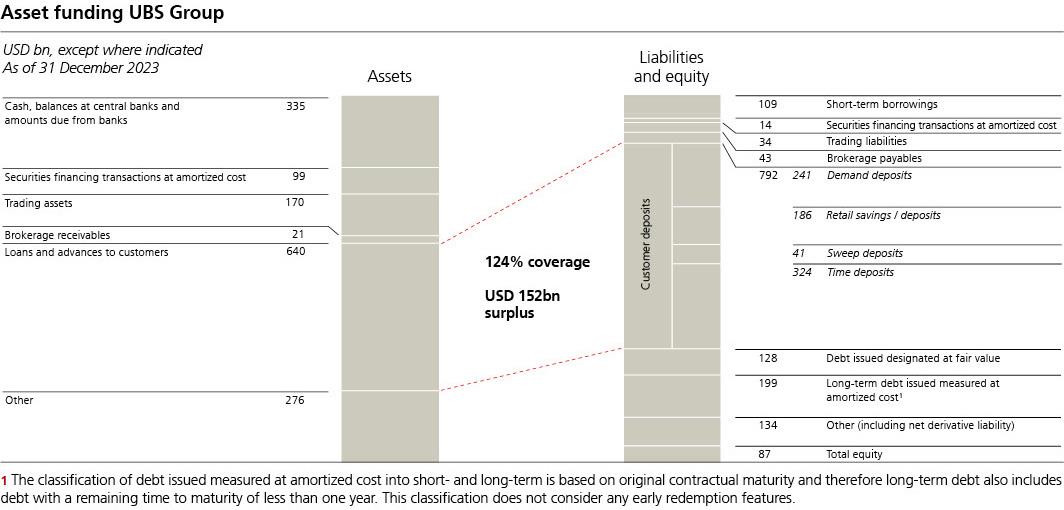
Annual Report 2023 |
Risk, capital, liquidity and funding, and
balance sheet | Balance sheet and off-balance
sheet
177
Liabilities by product and currency
USD equivalent
All currencies
of which: USD
of which: CHF
of which: EUR
USD bn
31.12.23
31.12.22
31.12.23
31.12.22
31.12.23
31.12.22
31.12.23
31.12.22
Short-term borrowings
109.5
41.3
49.2
23.3
41.5
3.8
8.3
4.4
of which: amounts due to banks
71.0
11.6
20.4
4.2
41.1
3.7
3.1
1.1
of which: short-term debt issued
1,2
38.5
29.7
28.8
19.0
0.3
0.1
5.2
3.3
Securities financing transactions at amortized cost
14.4
4.2
7.8
3.6
2.4
0.0
3.3
0.2
Customer deposits
792.0
525.1
311.8
226.6
328.0
198.5
80.6
53.6
of which: demand deposits
240.9
180.8
57.4
47.1
114.9
71.4
38.3
37.3
of which: retail savings / deposits
186.1
149.3
28.9
24.6
152.6
119.0
4.5
5.6
of which: sweep deposits
41.0
69.2
41.0
69.2
0.0
0.0
0.0
0.0
of which: time deposits
324.0
125.7
184.4
85.7
60.5
8.1
37.8
10.6
Debt issued designated at fair value and long-term debt issued measured
at amortized
cost
2
327.6
158.6
185.8
98.4
44.7
16.9
69.6
29.6
Trading liabilities
34.2
29.5
12.6
12.1
1.1
0.8
9.3
8.1
Derivatives and cash collateral payables on derivative instruments
233.8
191.3
181.0
160.4
9.9
3.8
26.7
15.8
Brokerage payables
42.5
45.1
31.5
32.3
0.7
0.4
2.4
3.2
Other financial liabilities measured at amortized cost
20.9
9.6
11.3
4.9
3.9
1.6
2.0
1.0
Other financial liabilities designated at fair value
29.5
30.2
6.8
11.4
0.1
0.1
3.5
3.8
Non-financial liabilities
26.3
12.3
13.2
4.7
4.2
1.5
4.4
2.9
Total liabilities
1,630.6
1,047.1
810.9
577.7
436.5
227.6
210.0
122.6
of which: Credit Suisse
3
475.7
176.8
185.5
66.6
1 Short-term debt issued consists of certificates
of deposit, commercial paper,
acceptances and promissory notes,
and other money market
paper.
2 The classification of debt
issued measured at amortized cost into
short-term and long-term is based on original contractual maturity and therefore long-term debt also includes debt with a remaining time to maturity of less than one year. This
classification does not consider any early
redemption features.
3 Refer to “Note 2 Accounting for the acquisition of the Credit Suisse Group” in the “Consolidated financial statements” section
of this report for more information.
Off-balance sheet
In the
normal course of
business,
we enter into
transactions where, pursuant
to IFRS Accounting
Standards,
the maximum
contractual
exposure
may
not
be
recognized
in
whole
or
in
part
on
our
balance
sheet.
These
transactions
include
derivative instruments, guarantees,
loan commitments and similar arrangements.
When we
incur an
obligation or
become entitled
to an
asset through
these arrangements,
we recognize
them on
the
balance sheet.
It should
be noted that
in certain
instances the amount
recognized on
the balance sheet
does not
represent
the full gain or loss potential inherent in such arrangements.
The
following
paragraphs
provide
more
information
about
certain
off-balance
sheet
arrangements.
Additional
off-
balance sheet
information is
primarily provided
in Notes 10, 11,
18, 20, 21h,
23 and 29
in the “Consolidated
financial
statements” section of this report
and in the 31 December
2023 Pillar 3 Report, available
under “Pillar 3 disclosures” at
ubs.com/investors.
Annual Report 2023 |
Risk, capital, liquidity and funding, and
balance sheet | Balance sheet and off-balance
sheet
178
Guarantees,
loan commitments and similar arrangements
In the normal
course of business,
we issue various
forms of guarantees, commitments
to extend credit, standby
and other
letters of credit
to support our clients, forward
starting transactions, note
issuance facilities,
and revolving underwriting
facilities.
With the
exception
of related
premiums,
generally
these
guarantees
and similar
obligations
are
kept
as off-
balance sheet items, unless a provision to cover probable
losses or expected credit losses is required.
Guarantees represent irrevocable assurances that, subject
to the satisfying of certain conditions, we will make
payments
if our clients fail
to fulfill their
obligations to third
parties. As of 31
December 2023, the
net exposure (i.e.,
gross values
less
sub-participations)
from
guarantees
and
similar
instruments
was
USD 43.9bn,
compared
with
USD 20.6bn
as
of
31 December 2022. The increase of USD 23.3bn was mainly driven
by the acquisition of the Credit Suisse Group and an
increase in sponsored repo
clearing in Group Treasury.
Fee income from issuing
guarantees compared with
total net fee
and commission income is insignificant for both 2023 and
2022.
We also
enter
into commitments
to extend
credit in
the
form of
credit
lines available
to secure
the
liquidity
needs of
clients. The
majority of
irrevocable loan
commitments range
in maturity
from one
month to
three years.
During 2023,
Irrevocable loan commitments increased by USD 51.6bn to USD 91.6bn and Committed unconditionally revocable credit
lines increased by USD 121.9bn to USD 163.3bn, with
both predominantly driven by the acquisition of
the Credit Suisse
Group.
Forward
starting
reverse
repurchase
agreements
increased
by
USD 14.6bn
to
USD 18.4bn,
mainly
reflecting
fluctuations in levels of business division activity in short-dated
securities financing transactions.
Off-balance sheet
As of
% change from
USD bn
31.12.23
31.12.22
31.12.22
Guarantees
1,2
Irrevocable loan commitments
1
Committed unconditionally revocable credit lines
Forward starting reverse repurchase agreements
1 Guarantees and irrevocable loan commitments are shown net of sub-participations.
2 Includes guarantees measured at fair value through profit or loss.
If customers
fail to
meet their
obligations, our
maximum exposure
to credit
risk is
generally the
contractual amount
of
these
instruments.
The
risk
is
similar
to
the
risk
involved
in
extending
loan
facilities
and
is
subject
to
the
same
risk
management and control
framework.
In 2023,
we recognized net
credit loss expenses
of USD 142m
related to irrevocable
loan commitments,
guarantees and
other credit
facilities in
the scope
of expected
credit loss
measurement, compared
with net credit loss releases
of USD 3m in 2022.
Provisions recognized for irrevocable loan commitments,
guarantees and
other
credit
facilities
in
the
scope
of
expected
credit
loss
measurement
were
USD 350m
as
of
31 December
2023,
compared with USD 201m as of 31 December 2022.
›
Refer to “Note 10 Financial
assets at
amortized
cost and
other positions
in scope
of expected
credit loss
measurement”
and “Note 20
Expected
credit loss
measurement”
in the “Consolidated
financial
statements”
section of this report for more information about
provisions for expected credit losses
For certain obligations, we enter
into partial sub-participations to mitigate
various risks from guarantees and
irrevocable
loan commitments. A sub-participation is an agreement by another party to take a share of the loss in the event that the
obligation
is
not
fulfilled
by
the
obligor
and,
where
applicable,
to
fund
a
part
of
the
credit
facility.
We
retain
the
contractual
relationship
with
the
obligor,
and the
sub-participant
has only
an
indirect
relationship. Generally,
we
only
enter into
sub-participation agreements
with banks
to which
we ascribe
a credit
rating equal
to or
better than
that of
the obligor.
We also provide representations, warranties and indemnifications
to third parties in the normal course of business.
Support provided to non-consolidated investment funds
In 2023, the
Group did
not provide material
support, financial or
otherwise, to unconsolidated
investment funds when
the Group was not contractually obligated to do so,
nor does it currently have an intention to
do so.
Clearing house and exchange memberships
We
are
a
member
of numerous
securities
and derivative
exchanges
and clearing
houses.
In connection
with some
of
these memberships, we may be required to pay
a share of the financial obligations of another member
who defaults,
or
we may be otherwise exposed to additional financial obligations. While the membership rules vary,
obligations generally
would arise only if the exchange or clearing house had exhausted its resources. We consider the probability of a material
loss due to such obligations to be remote.
Deposit insurance
Swiss banking
law and
the deposit
insurance system
require Swiss
banks and
securities dealers
to jointly
guarantee an
amount
of
up
to
CHF 8bn
for
privileged
client
deposits
in
the
event
that
a
Swiss
bank
or
securities
dealer
becomes
insolvent. As
of 31 December
2023, FINMA
estimates our
share in
the deposit
insurance system
to be
CHF 1.8bn.
This
represents a contingent payment
obligation and exposes us
to additional risk. As
of 31 December 2023,
we considered
the probability of a material loss from our obli
gations to be remote.
UBS is also
subject to, or
is a member
of, other deposit
protection schemes in
other countries.
However, no contingent
payment obligation existed as of 31 December 2023 from
any other material scheme.
Annual Report 2023 |
Risk, capital, liquidity and funding, and
balance sheet | Balance sheet and off-balance
sheet
179
Material cash requirements
The Group’s material cash requirements
as of 31 December 2023 are
represented by the
residual contractual maturities
for non-derivative and
non-trading financial
liabilities included
in the table
presented in
“Note 24b Maturity
analysis of
financial liabilities on an undiscounted basis”
in the “Consolidated financial statements”
section of this report. Included
in
the
table
are
debt
issued
designated
at
fair
value
(USD 149.8bn)
and
debt
issued
measured
at
amortized
cost
(USD 279.3bn). The amounts represent
estimated future interest and principal payments
on an undiscounted basis.
In the normal course
of business, we also
issue or enter into
various forms of guarantees,
loan commitments and
other
similar arrangements that may result in an outflow of cash in the future. The maturity profile of these obligations, which
are presented
off-balance sheet,
are included
in “Note 24b
Maturity analysis
of financial
liabilities on
an undiscounted
basis” in
the “Consolidated
financial statements”
section of
this report.
Refer to
“Guarantees, loan
commitments and
similar arrangements” in this section for more information.
Cash flows
As a global financial institution, our cash
flows are complex and often may bear little
relation to our net earnings and
net
assets.
Consequently,
we believe
that a
traditional cash
flow analysis
is less
meaningful
when evaluating
our liquidity
position
than
the
liquidity,
funding
and
capital
management
frameworks
and
measures
described
elsewhere
in
this
section.
›
Refer to “Liquidity and funding management” in
this section for more information
Cash and cash equivalents
As of 31 December 2023, cash
and cash equivalents totaled
USD 340.3bn, an increase
of USD 145.0bn compared
with
31 December
2022,
driven
by
net
cash
inflows
from
investing
and
operating
activities
and
positive
foreign
exchange
effects,
largely
reflecting
the
depreciation
of the
US dollar
against
the
Swiss
franc
in
2023. These
effects
were
partly
offset by net cash outflows used in financing activities
in amount of USD 58.3bn.
Operating activities
Net cash
inflows from operating
activities were USD 86.1bn
in 2023,
compared with USD 14.6bn
in 2022.
The net
change
in
operating
assets
and
liabilities
of
88.3bn
was
mainly
driven
by
a
USD 52.8bn
increase
in
customer
deposits,
a
USD 27.9bn decrease
in loans
and advances
to customers
and a
USD 9.9bn change
in financial
assets and
liabilities at
fair
value
not
held
for
trading
and
other
financial
assets
and
liabilities.
These
effects
were
partly
offset
by
smaller
movements in other operating assets and liabilities and adjustments to remove
the net impact of non-cash effects in the
balance sheet, such as foreign currency effects
.
Investing activities
Investing activities resulted
in a net
cash inflow of
USD 103.2bn in 2023,
compared with
a net outflow
of USD 12.4bn
in 2022, primarily
reflecting the
effect of
cash acquired
upon the acquisition
of the Credit
Suisse Group
in the amount
of USD 108.5bn,
partly offset by outflows from purchase
s
of debt securities measured at amortized cost of
USD 3.8bn.
Financing activities
Financing
activities
resulted in
a net
cash outflow
of USD 58.3bn
in 2023,
compared with
an outflow
of USD 9.1bn
in 2022,
mainly due
to the
repayment of
USD 56.5bn
of funding
from the
Swiss National
Bank,
net cash
used to
repurchase treasury
shares of USD 2.8bn and a
dividend distribution to shareholders of USD 1.7bn. These outflows
were partly offset by
net
issuance proceeds from short-term
debt measured at amortized
cost of USD 3.2bn and from debt
designated at fair value
and long-term
debt measured at
amortized cost
of USD 0.3bn.
›
Refer to “Primary financial statements and share information”
in the “Consolidated financial statements” section
of this report for
more information about cash flows
Statement of cash flows (condensed)
For the year ended
USD bn
31.12.23
31.12.22
Net cash flow from / (used in) operating activities
86.1
14.6
Net cash flow from / (used in) investing activities
103.2
(12.4)
Net cash flow from / (used in) financing activities
(58.3)
(9.1)
Effects of exchange rate differences on cash and cash equivalents
14.0
(5.7)
Net increase / (decrease) in cash and cash equivalents
145.0
(12.6)
Cash and cash equivalents at the end of the year
340.3
195.3
Annual Report 2023 |
Risk, capital, liquidity and funding, and
balance sheet | Currency management
180
Currency management
Strategy, objectives and governance
Group Treasury
focuses on three main areas of currency risk management: (i) currency-matched funding and investment
of non-US-dollar assets and liabilities; (ii) the sell-down of foreign currency IFRS Accounting Standards profits
and losses;
and
(iii) selective
hedging
of
anticipated
non-US-dollar
profits
and
losses
to
further
mitigate
the
effect
of
structural
imbalances in the balance sheet. Group Treasury
also manages structural currency composition across three scopes:
UBS
Group AG consolidated, UBS AG consolidated
and Credit Suisse AG consolidated.
Currency-matched funding and investment of non-US-dollar
assets and liabilities
For monetary
balance sheet
items and
other investments,
as far
as is
practical and
efficient, we
follow the
principle of
matching the currencies of
our assets and liabilities for
funding purposes. This avoids
profits and losses arising
from the
translation of non-US-dollar assets and liabilities.
UBS Group
AG consolidated
and UBS
AG consolidated
apply net
investment hedge
accounting to
non-US-dollar
core
investments, while Credit Suisse AG consolidated applies
it to its non-Swiss Franc core investments to balance the
effect
of foreign exchange movements on both common equity
tier 1 (CET1) capital and the CET1 capital ratio.
›
Refer to “Note 1 Summary of material accounting
policies” and “Note 26 Hedge accounting” in the
“Consolidated financial
statements”
section of this report for more information
›
Refer to “Capital management” in this section for
more information about our active management of
sensitivity to currency
movements and the effect thereof on our key ratios
Sell-down of non-US-dollar reported profits and losses
Income statement items
of group entities
with a
functional currency other
than the US
dollar are translated
into US dollars
at average
exchange rates.
To
reduce earnings
volatility on
the translation
of previously
recognized earnings
in foreign
currencies, Group Treasury
centralizes
the profits and losses (under IFRS Accounting Standards)
arising in UBS AG and its
branches and sells or buys the profit or loss for
US dollars on a monthly basis. UBS AG subsidiaries and
Credit Suisse AG
branches and subsidiaries
follow a similar
monthly sell-down
process into their
own functional currencies.
The retained
earnings in subsidiaries and branches with a functional currency other than the US
dollar are integrated and managed as
part of the UBS Group’s net investment hedge accounting
program.
Hedging of anticipated non-US-dollar profits and losses
The
Group
Asset
and
Liability
Committee
may
at
any
time
instruct
Group
Treasury
to
execute
hedges
to
protect
anticipated
future
profits
and
losses
in
foreign
currencies
against
possible
adverse
trends
of
foreign
exchange
rates.
Although intended to
hedge future earnings, these
transactions are accounted for
as open currency positions
and subject
to internal market risk limits for value-at-risk and stress loss
limits.
Dividend distribution
UBS Group AG declares
dividends in US dollars. Shareholders holding shares through SIX SIS AG will receive dividends in
Swiss francs, based on
a published exchange rate calculated up
to five decimal places,
on the day prior
to the ex-dividend
date. Shareholders holding shares
through DTC or Computershare will be
paid dividends in US dollars.
›
Refer to the UBS Group AG Standalone financial statements
and regulatory information for the year ended
31 December 2023 for
more information about the proposed dividend distribution of
UBS Group AG for the 2023 financial year
UBS shares
UBS Group AG shares
Audited |
USD
m, represented by
shares acquired under the
2021 share repurchase
program after 18 February 2022 were
canceled by means of
a capital
reduction, as
approved by shareholders
at the 2023
Annual General
Meeting (the AGM).
In the second quarter of 2023, the share capital currency of UBS Group AG was changed from the Swiss franc to the US
dollar, as
approved by
shareholders
at the 2023
AGM. As a
result, the
nominal value
per share has
changed from
CHF
to
USD
,
resulting
in
a
reclassification between
share
capital
and
capital
contribution reserve
(presented as
share
premium in
the consolidated
financial statements).
Annual Report 2023 |
Risk, capital, liquidity and funding, and
balance sheet | UBS shares
181
Each share carries one vote if entered into the share register as having the right to
vote, and also entitles the holder to a
proportionate share of distributed dividends.
All shares are fully paid up. As
the Articles of Association of UBS Group AG
indicate, there
are no other
classes of shares
and no preferential
rights for shareholders.
p
›
Refer to “Share information and earnings
per share” in the “Consolidated financial statements” section
of this report for more
information about the conversion of our share capital
currency in 2023, which was approved by shareholders at the 2023
AGM
›
Refer to the “Corporate governance”
section of this report for more information about UBS
shares
UBS Group share information
As of or for the year ended
% change from
31.12.23
31.12.22
31.12.22
Shares issued
3,462,087,722
3,524,635,722
(2)
Treasury shares
1
253,233,437
416,909,010
(39)
of which: related to share repurchase program 2021
62,548,000
of which: related to share repurchase program 2022
120,506,008
233,901,950
(48)
Shares outstanding
3,208,854,285
3,107,726,712
3
Basic earnings per share (USD)
2
8.83
2.34
278
Diluted earnings per share (USD)
2
8.45
2.25
276
Equity attributable to shareholders (USD m)
86,108
56,876
51
Less: goodwill and intangible assets (USD m)
7,515
6,267
20
Tangible equity attributable to shareholders (USD m)
78,593
50,609
55
Ordinary cash dividends per share (USD)
3,4
0.70
0.55
27
Total book value per share (USD)
26.83
18.30
47
Tangible book value per share (USD)
24.49
16.28
50
Share price (USD)
5
31.01
18.61
67
Market capitalization (USD m)
6
107,355
65,608
64
1 Based on a settlement date view.
2 Refer to “Share information and earnings per share” in the “Consolidated financial statements” section of this report for more information.
3 Dividends and / or distributions
out of the capital contribution reserve are normally approved and paid in the year subsequent to the reporting period.
4 Refer to “Statement of proposed appropriation of total profit and dividend distribution out of
total profit and
capital contribution reserve”
in the “UBS
Group AG standalone
financial statements”
section of the
UBS Group AG
Standalone financial statements
and regulatory information
for the year
ended
31 December 2023 report, available
under “Holding company and
significant regulated subsidiaries and
sub-groups” at ubs.com/investors,
for more information.
5 Represents the share price
as listed on the SIX
Swiss Exchange, translated to US dollars using the closing exchange rate as
of the respective date.
6 The calculation of market capitalization has been amended in the second
quarter of 2023 to reflect total shares
issued multiplied by the share
price at the end of
the period. The calculation
was previously based on
total shares outstanding multiplied
by the share price
at the end of the
period. Market capitalization has
been
increased by USD 7.8bn as of 31 December 2022 as a result.
Holding of UBS Group AG shares
Group Treasury
holds UBS Group AG shares
to hedge future share
delivery obligations related to employee
share-based
compensation awards, and also holds shares purchased under share repurchase programs. As of 31 December 2023, we
held a total of 253,233,437 treasury shares
(31 December 2022: 416,909,010).
Our 2021 share repurchase program was concluded on 29 March 2022 with the purchase of an additional 87.7m shares
in 2022 for an acquisition cost of USD 1,637m (CHF
1,516m). The 177.8m shares repurchased under this
program from
its inception until
18 February 2022
for a
total acquisition
cost of USD
3,022m (CHF 2,775m)
were canceled
by means
of
a
capital
reduction
in
2022,
as
approved
by
shareholders
at
the
2022
AGM.
The
remaining
62,548,000
shares
purchased under the 2021 program were canceled by means
of a capital reduction in 2023, as
approved by shareholders
at the 2023 AGM.
On 31 March
2022, we
commenced a
new, 2022 share
repurchase program
of up to
USD 6bn. Shares
acquired under
this program totaled 298.5m as of 31 December 2023 for a
total acquisition cost of USD 5,245m
(CHF 5,010m).
A total
of 178m shares
repurchased under
this program and
originally intended for
cancellation purposes
were repurposed for
the acquisition of
the Credit Suisse
Group and 176m
shares were transferred
to Credit Suisse
Group shareholders in
an
exchange of shares
as consideration for
the acquisition of
the Credit Suisse
Group. The remaining
121m shares,
with a
total acquisition
cost of USD 2,277m
(CHF 2,138m),
are intended to
be canceled by
means of
a capital
reduction, pending
approval by the shareholders at a future AGM.
A new, two-year share repurchase program of up
to USD 6bn was approved by shareholders at the 2023 AGM. We
have
temporarily
suspended
repurchases
under
the
share
repurchase
programs
due
to
the
acquisition
of
the
Credit
Suisse
Group, but we plan
to repurchase up to USD 1bn of
our shares in 2024, commencing
after the completion of the
merger
of UBS AG and Credit Suisse AG.
Treasury
shares
held
to
hedge
our
share
delivery
obligations
related
to
employee
share-based
compensation
awards
totaled 131m shares
as of 31 December
2023 (31 December 2022:
119m). Share delivery obligations
related to employee
share-based compensation
awards totaled
196m shares
as of
31 December 2023
(31 December 2022:
178m) and
are
calculated on the
basis of
undistributed notional
share awards,
taking applicable
performance conditions
into account.
Treasury
shares
held
are
delivered
to
employees
at
exercise
or
vesting.
As
of
31 December
2023,
up
to
122m
UBS Group AG
shares
(31 December
2022:
122m)
could
have
been
issued
out
of
conditional
capital
to
satisfy
share
delivery obligations of any future employee share option programs
or similar awards.
Annual Report 2023 |
Risk, capital, liquidity and funding, and
balance sheet | UBS shares
182
The Investment
Bank also
holds a
limited number
of UBS Group
AG shares,
primarily in
its capacity
as a
market-maker
with regard to UBS Group AG shares and related derivatives,
and to hedge certain issued structured debt instruments.
The
table
below
outlines
the
market
purchases
of
UBS Group
AG
shares
by
Group
Treasury.
It
does
not
include
the
activities of the Investment Bank.
Treasury
share purchases
Share repurchase programs
1
Other treasury shares purchased
2
Month of purchase
3
Number of shares
Average price
in USD
Remaining volume of
2022 share repurchase
program in USD m
at month-end
Number of shares
Average price in
USD
January 2023
28,143,000
20.66
1,453
February 2023
1,453
23,305,000
21.71
March 2023
35,343,000
19.73
755
3,820,000
21.64
April 2023
755
May 2023
755
June 2023
755
July 2023
755
August 2023
755
September 2023
755
October 2023
755
November 2023
755
16,401,362
25.92
December 2023
755
8,598,638
28.39
1 UBS has an active
share repurchase program
to buy back up
to USD 6bn of its
own shares over the
two-year period started in
March 2022 and ending
at the latest on 29
March 2024. The
share buybacks were
transacted in Swiss francs
on a separate trading
line on the SIX
Swiss Exchange. A
new, two-year share
repurchase program of up
to USD 6bn was
approved by shareholders at
the 2023 AGM. However,
we have
temporarily suspended repurchases under the share repurchase programs due to the acquisition of
the Credit Suisse Group.
2 This table excludes purchases for the purpose of hedging derivatives linked to UBS Group
AG shares and for
market-making in UBS
Group AG shares.
The table also
excludes UBS Group AG
shares purchased by post-employment
benefit funds for UBS
employees, which are
managed by a board
of UBS
management and employee representatives in accordance with Swiss law. UBS’s post-employment benefit funds purchased 509,075 UBS Group AG
shares during the year and held 13,478,820 UBS Group AG shares
as of 31 December 2023.
3 Based on the transaction date of the respective treasury share purchases.
Trading volumes
For the year ended
1,000 shares
31.12.23
31.12.22
31.12.21
SIX Swiss Exchange total
2,102,613
2,433,051
2,514,259
SIX Swiss Exchange daily average
8,377
9,579
9,899
New York Stock Exchange total
170,875
186,468
137,366
New York Stock Exchange daily average
684
743
545
Source: Reuters
Listing of UBS Group AG shares
UBS Group AG shares
are listed
on the SIX
Swiss Exchange
(SIX). They are
also listed on
the New York
Stock Exchange
(the NYSE)
as global
registered
shares. As
such, they
can be
traded and
transferred across
applicable borders,
without
the need for conversion, with identical shares traded
on different stock exchanges in different
currencies.
During 2023, the average daily trading volume of UBS Group AG shares was 8.4m
shares on SIX and 0.7m shares on the
NYSE. SIX is expected
to remain the
main venue for determining
the movement in
our share price, because
of the high
volume traded on this exchange.
During the hours in
which both SIX and
the NYSE are simultaneously
open for trading, price
differences between these
exchanges are likely
to be arbitraged
away by
professional market-makers.
Accordingly, the
share price will
typically be
similar between the
two exchanges when
considering the
prevailing US dollar
/ Swiss franc
exchange rate. When
SIX is
closed
for
trading,
globally
traded
volumes
will
typically
be
lower.
However,
the
specialist
firm
making
a
market
in
UBS Group AG
shares on
the NYSE is
required to
facilitate sufficient liquidity
and maintain
an orderly
market in
UBS Group
AG shares throughout normal NYSE trading hours.
Ticker symbols UBS Group AG
Security identification codes
Trading exchange
SIX / NYSE
Bloomberg
Reuters
ISIN
CH0244767585
SIX Swiss Exchange
UBSG
UBSG SW
UBSG.S
Valoren
24 476 758
New York Stock Exchange
UBS
UBS UN
UBS.N
CUSIP
CINS H42097 10 7
Annual Report 2023 |
Corporate governance and compensation
183
Corporate governance and
compensation
Management report
Audited information according to the Swiss law and applicable regulatory
requirements and guidance
Disclosures
provided
are
in
line
with
the
requirements
of
the
Swiss
Code
of
Obligations
(tables
containing
such
information are marked as “Audited” throughout this section),
as well as other applicable regulations and guidance.
Annual Report 2023 |
Corporate governance and compensation
| Corporate governance
184
Corporate governance
Table of contents
185
186
187
191
193
209
218
218
220
Annual Report 2023 |
Corporate governance and compensation
| Corporate governance
185
Corporate governance
UBS Group AG is subject to, and complies with, all relevant Swiss legal and regulatory requirements regarding
corporate
governance, including the
SIX Swiss Exchange’s Directive on
Information relating to Corporate Governance
(the SIX Swiss
Exchange Corporate Governance
Directive) and the
standards established in
the Swiss Code
of Best
Practice for Corporate
Governance.
Following a
revision of
the Swiss
Code of
Obligations that
entered into
force on
1 January
2023, the
correspondingly
amended Articles of Association of UBS Group AG (the
AoA) were approved by the Annual General Meeting (the
AGM)
on 5 April
2023. The
key amendments
of the
AoA are
amendment of
the threshold
to convene
extraordinary general
meetings, the introduction of the basis to hold hybrid and
virtual general meetings, and changes in connection
with the
external mandates of
the Board of
Directors (the BoD)
and the Group
Executive Board (the
GEB), as well
as compensation-
related changes and clarifications with regards to publications
and notices.
As a non-US company with shares listed on the New York Stock Exchange (the NYSE), UBS Group AG also complies with
all relevant corporate governance standards applicable to
foreign private issuers.
The Organization
Regulations of UBS
Group AG,
adopted by
the BoD
based on Art.
716b of
the Swiss
Code of
Obligations
and Art. 25 and 27 of the AoA, constitute UBS Group AG’s primary
corporate governance guidelines.
›
Refer to the Articles of Association of UBS Group AG
and to the Organization Regulations of UBS Group AG, available
at
ubs.com/governance
and
ubs.com/ubs-ag-governance,
›
The SIX Swiss Exchange Corporate Governance
Directive is available at
serag/downloads/regulation/listing/directives/dcg-en.pdf,
economiesuisse.ch/en/publications/swiss-code-best-practice-corporate-governance
nyseguide.srorules.com/listed-company-manual
Differences from corporate governance standards relevant
to US-listed companies
The NYSE standards on
corporate governance
require foreign private issuers
to disclose any significant
ways in which their
corporate governance
practices differ
from
those that
have
to
be
followed by
US
companies. The
key
differences are
discussed below.
Responsibility of the Audit Committee regarding independent
auditors
Our Audit Committee
is responsible
for the compensation,
retention and oversight
of independent
auditors. It
assesses the
performance and qualifications
of external auditors
and submits proposals for appointment,
reappointment or removal of
independent auditors
to
the
BoD.
As
required
by
the
Swiss
Code
of
Obligations, the
BoD
submits its
proposals for
a
shareholder
vote
at the
AGM. Under
NYSE standards
audit committees
are responsible
for appointing
independent
auditors.
Discussion of risk assessment and risk management policies by the
Risk Committee
As per
the
Organization
Regulations
of UBS
Group
AG, the
Risk Committee,
instead
of the
Audit
Committee,
as per
NYSE standards,
oversees our
risk principles
and risk
capacity on
behalf of
the BoD.
The Risk Committee
is responsible
for
monitoring
our
adherence
to
those
risk
principles
and
monitoring
whether
business
divisions
and
control
units
maintain appropriate systems of risk management and control.
Supervision of the internal audit function
Although under NYSE standards only audit
committees supervise internal audit functions, the Chairman of the BoD
(the
Chairman) and the Audit
Committee share the supervisory responsibility and authority with respect
to the
internal audit
function.
Responsibility of the Compensation Committee for performance
evaluations of senior management of UBS Group AG
In line with Swiss
law, our
Compensation Committee,
together with the BoD,
proposes for shareholder
approval at the
AGM
the
maximum
aggregate
amount
of
compensation
for
the
BoD,
the
maximum
aggregate
amount
of
fixed
compensation for the Group
Executive Board (the GEB) and
the aggregate amount of
variable compensation for the
GEB.
The members of the Compensation Committee are elected
by the AGM. Under NYSE standards it is the responsibility
of
compensation committees to
evaluate senior management’s performance
and to determine
and approve, as
a committee
or together with the other independent directors, the
compensation thereof.
Proxy statement reports of the Audit Committee and the
Compensation Committee
NYSE standards require the aforementioned committees to submit their reports directly to shareholders. However, under
Swiss law
all reports to
shareholders, including those
from the aforementioned
committees, are provided to
and approved
by the BoD, which has ultimate responsibility to the
shareholders.
Shareholder votes on equity compensation plans
NYSE standards
require
shareholder
approval
for the
establishing of
and material
revisions
to all
equity compensation
plans.
However,
as
per
Swiss
law,
the
BoD
approves
compensation
plans.
Shareholder
approval
is
only
mandatory
if
equity-based compensation
plans require
an increase
in capital.
No shareholder
approval is
required
if shares
for such
plans are purchased in the market.
›
Refer to
›
Refer to “Share capital structure” in this section for more information
about UBS Group AG’s capital
Annual Report 2023 |
Corporate governance and compensation
| Corporate governance
186
Group structure and shareholders
Operational Group structure
As of 31 December 2023,
the operational structure
of the UBS Group
is composed of the
Global Wealth Management,
Personal &
Corporate Banking,
Asset Management,
the Investment
Bank, and
Non-core and
Legacy business
divisions,
as well
as Group
functions.
After the
acquisition of
the Credit
Suisse Group
in June
2023, its
global divisions
(Wealth
Management
(Credit
Suisse),
the
Investment
Bank
(Credit
Suisse),
Swiss
Bank
(Credit
Suisse)
and
Asset
Management
(Credit Suisse)) were integrated into the Group.
›
Refer to the
›
Refer to
section of this report for more information
›
Refer to the
Listed and non-listed companies belonging to the
Group
The Group
includes a number
of consolidated entities,
of which only
UBS Group
AG shares
are listed.
All Credit
Suisse
Group AG shares were
exchanged for shares in UBS Group AG
in June 2023 based on a share exchange.
UBS Group AG’s registered office is at Bahnhofstrasse 45, CH-8001
Zurich, Switzerland. UBS Group AG shares are listed
on the SIX Swiss Exchange (ISIN CH0244767585) and on
the NYSE (CUSIP H42097107).
›
Refer to
Group AG’s market capitalization and shares held by Group entities
›
Refer to
more information about the significant subsidiaries of the
Group
Significant shareholders
General rules
Under the Swiss
Federal Act on Financial
Market Infrastructures and Market Conduct
in Securities and Derivatives
Trading
of 19 June 2015
(the FMIA), anyone
who directly,
indirectly or
acting in concert
with third parties,
acquires or
disposes
of shares in
a company listed
in Switzerland or
holds other purchase
or sale
positions relating to
such shares, and,
thereby,
directly,
indirectly
or
in
concert
with
third
parties
reaches,
falls
below
or
exceeds
one
of
the
following
percentage
thresholds: 3, 5,
10, 15, 20,
25, 33
1
⁄
3
, 50 or 66
2
⁄
3
% of the voting
rights in such
company,
regardless of
whether or not
such rights
may be
exercised,
must notify
the company
and the
Swiss stock
exchange on
which such
shares are
listed.
Nominee
companies
that
cannot
autonomously
decide
how voting
rights are
exercised
are
not required
to notify
the
company and such stock exchange if they reach,
exceed or fall below the aforementioned thresholds.
Shareholders subject to FMIA disclosure notifications
According to the
mandatory FMIA disclosure
notifications filed with UBS
Group AG and
SIX Swiss Exchange
(SIX), as of
31 December 2023, the following entities held more than 3% of the total voting rights of UBS Group AG: Norges Bank,
Oslo, which disclosed a holding of 4.79% on 4 December 2023; BlackRock Inc., New York,
which disclosed a holding of
5.01% on 30 November 2023;
and Artisan Partners Limited
Partnership, Milwaukee, which disclosed
a holding of 3.03%
on 29 March 2023.
In accordance with the FMIA, the aforementioned holdings are calculated in relation to
the voting rights associated with
the total
share
capital
of UBS
Group
AG entered
into the
commercial
register
at the
time of
the respective
disclosure
notification.
Information
on
disclosures
under
the
FMIA
is
available
at
ser-ag.com/en/resources/notifications-market-
participants/significant-shareholders.html.
Cross-shareholdings
UBS Group
AG has
no cross-shareholdings
where
reciprocal
ownership would
be in
excess of
5% of
capital or
voting
rights with any other company.
Annual Report 2023 |
Corporate governance and compensation
| Corporate governance
187
Share capital structure
Ordinary share capital
On 5 April 2023, the AGM approved the conversion of the share capital currency of UBS Group AG from the Swiss franc
to the US dollar.
To
obtain a Swiss franc nominal value per share
equaling USD 0.10 after the conversion, the AGM also
approved a CHF 25,896,416.16056
reduction of the
ordinary share capital,
and this
reduction resulted in
a corresponding
allocation to
the capital
contribution reserve
on UBS Group
AG’s standalone
financial statements.
At the
end of 2023,
UBS Group AG had 3,462,087,
722 issued shares with
a nominal value of USD 0.10
each, equating to a share
capital of
USD 346,208,772.20.
Under Swiss company
law, shareholders
must approve, in
a general meeting
of shareholders, any
increase or reduction
in the ordinary
share capital,
the creation of
conditional share capital
or the introduction
of a capital
band. In addition,
under the Swiss Banking Act, shareholders of a Swiss top holding company
of a financial group or of a Swiss bank must
approve, in a general meeting of shareholders, the introduction
of conversion capital or reserve capital.
In 2023,
the shareholders
of UBS
Group
AG were
asked to
approve
a reduction
of share
capital
by way
of canceling
62,548,000 registered shares repurchased under the 2021
share repurchase program.
In
2023,
the
shareholders
of
UBS
Group
AG
were
not
asked
to
approve
the
creation
of
conditional
capital
or
the
introduction of
conversion capital,
capital band
or reserve
capital. As
of the
date of
this report,
UBS Group
AG has
no
conversion capital, capital band or reserve capital.
No shares were
issued out of
UBS Group AG’s
existing conditional
capital in
2023, as there
were no employee
options
or stock appreciation rights outstanding.
Following the permanent write down
of Credit Suisse Group
AG’s additional tier 1 (AT1)
instruments in March 2023,
UBS
Group AG has
issued AT1
instruments with
terms that
provide for an
equity conversion
feature (instead
of the existing
write-down feature) as soon as
UBS Group AG has a minimum
amount of conversion capital in place.
In relation to AT1
instruments
with equity conversion
features,
the BoD will
propose
at the 2024
AGM that the
shareholders approve
the
introduction of conversion capital in a maximum amount
equivalent to 700 million shares.
›
Refer to
information about the conversion of the share capital currency
Distribution of UBS Group AG shares
As of 31 December 2023
Shareholders registered
Shares registered
Number of shares registered
Number
%
Number
% of shares issued
1–100
101–1,000
1,001–10,000
10,001–100,000
100,001–1,000,000
1,000,001–5,000,000
5,000,001–34,620,877 (1%)
1–2%
2–3%
3–4%
4–5%
Over 5%
1
Total shares registered
2
Shares not registered
3
Total
1 On 31 December 2023,
the US securities clearing
organization DTC (Cede &
Co.), New York,
was registered with 7.42%
of all UBS shares issued
and is not subject
to the 5% voting limit
as a securities clearing
organization.
2 Of the total shares registered, 115,991,129 shares did not carry voting rights.
3 Shares not entered in the UBS share register as of 31 December 2023.
Annual Report 2023 |
Corporate governance and compensation
| Corporate governance
188
Conditional share capital
At year-end 2023, the following conditional share
capital was available to UBS Group AG’s BoD.
–
A maximum of
USD 38,000,000 represented
by up to
380,000,000 fully paid
registered shares with
a nominal value
of USD 0.10
each, to
be issued
through the
voluntary or
mandatory exercise
of conversion
rights and
/ or
warrants
granted in
connection with the
issuance of bonds
or similar financial
instruments by UBS
Group AG
or another member
of
the
Group
on
national
or
international
capital
markets.
This
conditional
capital
allowance
was
approved
at
the
Extraordinary General
Meeting (the
EGM) held
on 26 November
2014, having
originally been
approved at
the AGM
of UBS AG on 14 April 2010. The BoD has not made use
of such allowance.
–
A
maximum
of
USD 12,170,583
represented
by
121,705,830
fully
paid
registered
shares
with
a
nominal
value
of
USD 0.10 each, to be issued
upon exercise of employee options
and stock appreciation rights issued to
employees and
members of the management and of
the BoD of UBS Group
AG and its subsidiaries. This conditional capital
allowance
was approved by the shareholders at the same EGM in 2014.
›
Refer to article 4a of the AoA for more information
about the terms and conditions of the
issue of shares out of existing
conditional capital. The AoA are available at
›
Refer to the
Conditional capital of UBS Group AG
As of 31 December 2023
Maximum number of shares to
be issued
Year approved by Extra-
ordinary General Meeting
% of shares issued
Employee equity participation plans
2014
Conversion rights / warrants granted in connection with bonds
2014
Total
Capital band, conversion capital and reserve capital
As of
31 December 2023,
UBS Group
AG had
not introduced
any capital
band, any
conversion capital
or any
reserve
capital.
›
Refer to “Ordinary share capital” in this section for more information
about
a proposal for the shareholders to approve the
introduction of conversion capital at the 2024 AGM
Changes in capital
In
accordance
with
IFRS
Accounting
Standards,
Group
equity
attributable
to
shareholders
was
USD 86.1bn
as
of
31 December 2023 (2022: USD 56.9bn; 2021: USD 60.7bn). The equity of UBS Group AG shareholders was represented
by
3,462,087,722
issued
shares
as
of
31 December
2023
(31 December
2022:
3,524,635,722;
31 December
2021:
3,702,422,995 shares).
›
Refer to
about changes in shareholders’ equity over the last three years
Ownership
Ownership of UBS Group AG
shares is widely spread. The tables
in this section provide information
about the distribution
of
UBS
Group
AG
shareholders
by
category
and
geographic
location.
This
information
relates
only
to
shareholders
registered in the UBS share register and cannot be assumed to be representative
of UBS Group AG’s entire investor base
or the
actual beneficial
ownership. Only
shareholders registered
in the
UBS share
register as
“shareholders with
voting
rights” are entitled to exercise voting rights.
›
Refer to
Annual Report 2023 |
Corporate governance and compensation
| Corporate governance
189
As of
31 December
2023, 1,319,163,728
UBS Group
AG shares
were registered
in the
UBS share
register and
carried
voting rights,
115,991,129
shares were
registered in
the UBS
share register
without voting
rights, and
2,026,932,865
shares were not registered
in the UBS share register.
As of the same date,
all such shares were
fully paid up and
eligible
for dividends. There
are no preferential
rights for shareholders,
and no other
classes of shares
have been issued
by UBS
Group AG.
Shareholders, legal entities and nominees: type and geographical distribution
Shareholders registered
As of 31 December 2023
Number
%
Individual shareholders
Legal entities
Nominees, fiduciaries
Total shares registered
253,020
100.0
Shares not registered
Total
Individual shareholders
Legal entities
Nominees
Total
Number
%
Number
%
Number
%
Number
%
Americas
of which: USA
Asia Pacific
Europe, Middle East and Africa
of which: Germany
of which: UK
of which: rest of Europe
of which: Middle East and Africa
Switzerland
Total shares registered
Shares not registered
Total
At year-end
2023, UBS
owned
253,233,437 UBS
Group
AG shares,
which corresponded
to 7.31%
of the
total share
capital of UBS Group AG.
At the same time, UBS had
acquisition positions relating to
273,216,729 voting rights of UBS
Group AG and
disposal positions relating
to 211,212,648 such
rights, corresponding
to 7.89% and 6.10%
of the total
voting rights
of UBS
Group AG,
respectively.
Of the
disposal positions,
196,620,932 related
to voting
rights on
shares
deliverable
in
respect
of
employee
awards.
The
calculation
methodology
for
the
acquisition
and
disposal
positions
is
based
on
the
Ordinance
of
the
Swiss
Financial
Market
Supervisory
Authority
on
Financial
Market
Infrastructures
and
Market
Conduct in
Securities and
Derivatives Trading,
which states
that all
future
potential share
delivery obligations,
irrespective of the contingent nature
of the delivery,
must be considered.
Employee share ownership
Employee share ownership is encouraged and made possible in a variety of ways. Our Equity Plus
Plan is a voluntary plan
that provides eligible employees with the opportunity
to purchase UBS Group AG shares
at market value and receive, at
no additional
cost, one
notional UBS
Group
AG share
for every
three shares
purchased.
Additional shares
vest after
a
maximum
of
three
years,
provided
the
employee
remains
employed
by
UBS
and
has
retained
the
purchased
shares
throughout the holding period. The Equity
Ownership Plan (the EOP) is a mandatory
deferral plan for all employees that
are subject
to deferral
requirements (regulatory
-driven or
total compensation
greater than
USD / CHF
300,000) but
do
not
receive
LTIP
awards.
EOP
recipients
receive
a
portion
of
their
deferred
performance
award
in
notional
shares
(or
notional
funds
for
employees
in
Investment
Areas
within
Asset
Management).
GEB
members
and
most
Managing
Directors reporting
to the
GEB and
their direct
reports at
MD level
1
(the LTIP) instead of the EOP.
Both the EOP and LTIP include employment conditions and malus conditions that allow the
firm
to
reduce
or
fully
forfeit
unvested
deferred
awards
under
certain
circumstances,
pursuant
to
performance
and
harmful acts
provisions. In
addition, forfeiture
is triggered
in cases
where employment
has been
terminated for
cause.
Underlining our emphasis on sustainable performance and risk
management, and to support delivering on our ambitious
integration
goals and business / financial targets, LTIP awards
will only vest if predetermined performance conditions are
met.
On 31 December
2023, UBS
employees held at
least 7.4%
of UBS shares
outstanding (including
approximately 5.36%
in unvested deferred notional shares from our compensation programs). These figures are based on known shareholding
information from employee
participation plans, personal
holdings with UBS and
selected individual retirement
plans. At
the end of 2023, at least 25.2% of all employees held UBS shares
through the firm’s employee share participation plans.
›
Refer to the
1
Annual Report 2023 |
Corporate governance and compensation
| Corporate governance
190
Trading restrictions in UBS shares
UBS
employees
with
regular
access
to
unpublished
price-sensitive
information
about
the
firm
are
subject
to
specific
restrictions in respect to UBS financial instruments, including, but not limited to, pre
-clearance requirements and regular
blackout periods. Such
UBS employees are
not permitted to
trade UBS financial
instruments in the
period starting from
the close of business in New York
on the seventh business day of the
final month of the financial quarter
of UBS Group
AG and ending on the day of the publication of the quarterly
financial results.
Shareholders, legal entities and nominees: type and geographical distribution (continued)
Shares registered
As of 31 December 2023
Number
%
Individual shareholders
Legal entities
Nominees, fiduciaries
Total shares registered
Shares not registered
Total
Individual shareholders
Legal entities
Nominees
Total
Number of shares
%
Number of shares
%
Number of shares
%
Number of shares
%
Americas
of which: USA
Asia Pacific
Europe, Middle East and Africa
of which: Germany
of which: UK
of which: rest of Europe
of which: Middle East and Africa
Switzerland
Total shares registered
Shares not registered
Total
Shares and participation certificates
UBS Group
AG has
a single
class of
shares, which
are
registered
shares in
the form
of uncertificated
securities (in
the
sense of
the Swiss
Code of
Obligations). Each
registered
share
has a
nominal value
of CHF 0.10
and carries
one vote,
subject to the restrictions set out under “Transferability,
voting rights and nominee registration” below.
We have no participation certificates outstanding.
UBS Group
AG shares
are listed
on the SIX
Swiss Exchange
and also
on the
NYSE as
global registered
shares. As
such,
they
can
be
traded
and
transferred
across
applicable
borders,
without
the
need
for
conversion,
with
identical
shares
traded on different stock exchanges in different currencies.
›
Refer to
Distributions to shareholders
The decision to pay a dividend
and the amount of any dividend
depend on a variety of factors, including
our profits, cash
flow generation and capital ratios.
At the
2024 AGM,
the BoD
is proposing
to shareholders
for approval
a dividend
of USD 0.70
per share
for the
2023
financial year. Shareholders whose shares are held through SIX SIS AG will receive dividends in Swiss francs, based on an
exchange rate published
on the day
prior to the
ex-dividend date. Shareholders
holding shares through
The Depository
Trust Company in New York or Computershare will be paid
dividends in US dollars.
In compliance with Swiss tax law, 50% of the dividend will be paid out of retained earnings and the balance will be paid
out
of
the
capital
contribution
reserve.
Dividends
paid
out
of
capital
contribution
reserves
are
not
subject
to
Swiss
withholding tax.
The portion
of the
dividend paid
out of
retained earnings
will be
subject to a
35% Swiss
withholding
tax. For US federal income tax purposes,
we expect that the dividend will be
paid out of current or accumulated earnings
and profits.
Provided that the proposed dividend distribution out of retained earnings and out of the capital contribution reserve will
be approved
at the
AGM on
24 April 2024,
the payment
of USD 0.70
(or the
Swiss franc
equivalent) per
share will
be
made on 3 May
2024 to
holders of
shares on the
record date
2 May 2024. The
shares will be
traded ex-dividend
as of
30 April 2024 and, accordingly, the last day on which the
shares may be traded with entitlement to receive the dividend
will be 29 April 2024.
In January
2023, the
BoD announced
a new
two-year share
repurchase program.
At the
2023 AGM,
the shareholders
authorized the BoD
to repurchase shares for
cancellation purposes in an
aggregate value of up
to USD 6bn until the
2025
AGM. Any shares repurchased under the program are intended to be
canceled by way of capital reduction, which will be
subject to
shareholder approval
at one
or several
subsequent AGMs.
In the
interim period,
the acquisition
and holding
of such
shares are
not subject
to the
10% threshold
for UBS
Group AG’s
own shares
within the
meaning of
Art. 659
para 2 of the Swiss Code of Obligations.
Annual Report 2023 |
Corporate governance and compensation
| Corporate governance
191
Looking ahead,
the 2022 share
repurchase program will
be concluded at the
end of its two-year
term by end of
March
2024, and the repurchased shares are intended to be canceled by means of a capital reduction, pending approval by the
shareholders
at
a
future
AGM.
In
2024,
we
plan
to
repurchase
up
to
USD 1bn
of
our
shares
commencing
after
the
completion of the merger of UBS AG and Credit Suisse
AG under the new 2023 share repurchase program approved
by
the shareholders at the 2023 AGM.
›
Refer to
the share repurchase programs
Transferability, voting rights and nominee registration
We
do
not
apply
any
restrictions
or
limitations
on
the
transferability
of
UBS
Group
AG
shares.
Voting
rights
may
be
exercised without any
restrictions by shareholders
entered into the
UBS share register
if they
expressly render a
declaration
of beneficial ownership according to the provisions
of the AoA.
We have special provisions for
the registration of nominees. Nominees
are entered in the UBS
share register with voting
rights up to
a total of
5% of all
issued UBS Group
AG shares if
they agree to
disclose, upon our request,
beneficial owners
holding 0.3% or
more of all
issued UBS Group
AG shares. An
exception to the
5% voting limit
rule is
in place for
securities
clearing organizations, such as The Depository Trust Company
in New York.
›
Refer to
Convertible bonds and options
As of
31 December
2023, there
were
no conditional
capital
securities
or convertible
bonds outstanding
requiring
the
issuance of new
shares. However, as
of the same
date, AT1
instruments issued by
UBS Group AG
in an
aggregate principal
amount of USD 3.5bn were outstanding, and such instruments have
terms that provide for an equity conversion feature
(instead of the
existing write-down
feature) as soon
as UBS Group
AG has a
minimum amount
of conversion capital
in
place.
›
Refer to the
capital instruments
As
of
31 December
2023,
there
were
no
employee
options
or
stock
appreciation
rights
outstanding.
Option-based
compensation plans
are sourced
by issuing
new shares
out of
UBS Group
AG’s conditional
capital. As
of 31 December
2023, UBS Group
AG had USD 12,170,583
in conditional share
capital available for
the issuance of
new shares for
this
purpose.
›
Refer to “
›
Refer to
more information about outstanding options and stock appreciation
rights
Shareholders’ participation rights
We are committed
to shareholder participation in
decision-making processes. Our online
voting platform offers
registered
shareholders a convenient
log-in and online voting
process. Registered
shareholders are
sent personal invitations
to the
general meetings. Together
with the invitation
materials, they
receive a
personal one-time
password and
a QR code
to
easily log into
the online voting
platform, where
they can enter
their voting instructions
or order
an admission card
for
the general meeting.
Shareholders
who
choose
not
to
receive
the
comprehensive
invitation
materials
are
informed
of
upcoming
general
meetings
by a
short
letter
containing
a
personal
one-time
password,
a
QR
code
for
online voting
and
a
reference
to
ubs.com/agm
,
where all information for the upcoming meeting is
available.
General meetings
offer shareholders
the opportunity
to raise
questions for the
BoD, the
GEB and internal
and external
auditors.
Voting rights, restrictions and representation
We place
no restrictions
on share
ownership and
voting rights.
However,
pursuant to
general principles
formulated by
the
BoD,
nominees,
which
normally
represent
a
large
number
of
individual
shareholders
and
may
hold
an
unlimited
number of
shares, have
voting rights
limited to
a maximum
of 5%
of all
issued UBS
Group AG
shares if
they agree
to
disclose, upon
our request,
beneficial owners
holding 0.3%
or more
of all
issued UBS
Group AG
shares. This
5% limit
has been implemented to avoid large shareholders being entered
in the UBS share register via nominee companies so as
to exercise
influence without
directly
registering
their shares
with UBS.
An exception
to the
5% voting
limit rule
is in
place for securities clearing organizations, such as The Depository
Trust
Company in New York.
Shareholders can
exercise voting
rights conferred
by shares
only if
they are
registered in
our share
register with
voting
rights. To register,
shareholders must confirm
that they have
acquired UBS Group
AG shares in their
own name and
for
their own account.
Annual Report 2023 |
Corporate governance and compensation
| Corporate governance
192
All shareholders registered with voting rights are entitled to participate in
general meetings. If they do not
wish to attend
in person, they may issue instructions
to support, reject or abstain for each individual
item on the meeting agenda, either
by giving instructions to an
independent proxy in accordance
with article 14 of the AoA
or by granting a written
power
of
attorney
to
a
third
person
of
their
choice
(which
does
not
need
to
be
a
shareholder)
to
vote
on
their
behalf.
Alternatively, registered
shareholders may issue their voting instructions to the independent
proxy electronically through
our online voting
platform. Nominee companies normally submit
the proxy material to
the beneficial owners and
forward
the collected votes to the independent proxy.
›
Refer to article 14 of the AoA, available
at
ubs.com/governance
, for more information about the issuing of
instructions to
independent voting right representatives
Statutory quorums
Motions are decided at a general meeting by a majority of the votes represented, excluding blank and invalid ballots. For
the approval of
certain specific issues, the
Swiss Code of Obligations
requires a positive
vote from a two-thirds
majority
of the
votes represented
at the given
general meeting
and from
a majority
of the
nominal value
of shares
represented
thereat. Such issues include creating shares with privileged voting rights, introducing restrictions
on the transferability of
registered shares, creating conditional capital or introducing a capital band or reserve
capital and restricting or excluding
shareholders’ preemptive rights.
The AoA also require a two-thirds majority of votes represented
for approval of any change to their provisions regarding
the number of BoD members, any decision to remove one-quarter or more of
the BoD members and any modification to
the provision establishing this qualified quorum.
Votes and elections are generally conducted electronically to ascertain the exact number of votes represented.
Voting by
a
show
of
hands
is
possible
if
a
clear
majority
is
predictable.
Shareholders
representing
at
least
3%
of
the
votes
represented may
request that
a vote or election
be carried out
electronically or by
written ballot. To
allow shareholders
to clearly express their views on all
individual topics, each agenda item is separately
put to a vote and BoD members are
elected on a person-by-person basis.
Convocation of general meetings of shareholders
The AGM
must be held
within six
months of
the close
of the
financial year
(i.e., 31 December).
In 2024, the
AGM will
take place on 24 April.
Extraordinary
general
meetings
(EGMs)
may
be
convened
whenever
the
BoD
or
the
auditors
consider
it
necessary.
Shareholders individually
or jointly
representing at
least 5%
of the
share capital
may at
any time,
including during
an
AGM, require, by way of a written statement, that
an EGM be convened to address a specific issue they put forward.
A
personal
invitation,
including
a
detailed
agenda,
is
made
available
to
every
registered
shareholder
at
least
20
days
ahead of each
scheduled general
meeting. The items
on the agenda
are also
published in
the Swiss Official
Gazette of
Commerce, as well as at
ubs.com/agm.
Placing of items on the agenda
Pursuant to the AoA, shareholders
individually or jointly representing
shares with an aggregate
minimum nominal value
of USD 62,500 may submit requests for items to be placed on the agenda for consideration
at the next general meeting
of shareholders or for motions relating to
agenda items to be included in the notice to convene the
general meeting.
In January of
each year,
the invitation to
submit such agenda
items or motions
relating to agenda
items is published
in
the Swiss Official
Gazette of Commerce
and at
ubs.com/agm.
to be placed on the agenda must include the actual motions to be put forward,
together with a short explanation. Such
requests must
be submitted
to the
BoD no later
than the
deadline published
by UBS
Group AG,
including a
statement
from the depository
bank confirming the
number of shares
held by the requesting
shareholder(s) and that
these shares
are blocked from
sale until
the end of
the general meeting
of shareholders. The
BoD formulates opinions
on such requests
from shareholders,
which are published together with the
motions from the BoD.
Registrations in the UBS share register
The UBS share register, where around 254,000
UBS Group AG shareholders are directly registered as
of 28 March 2024,
is
an
internal,
non-public
register
subject
to
statutory
confidentiality,
secrecy,
privacy
and
data
protection
regulations
protecting registered
shareholders.
In general,
third parties
and shareholders
have no
inspection rights
with regard
to
data related to other shareholders. Disclosure of such data is permitted only in specific and limited instances. In line with
the Swiss Federal Act on Data
Protection, the disclosure of personal data
as defined thereunder is only allowed
with the
consent of
the registered
shareholder and
in cases
where there
is an
overriding private
or public
interest or
if explicitly
provided for
by Swiss
law. The
Swiss Federal
Act on
Financial Market
Infrastructures and
Market Conduct
in Securities
and
Derivatives
Trading
contains
specific
reporting
duties,
such
as
in
relation
to
significant
shareholders
(refer
to
“Significant shareholders” in this section for more information).
Disclosure may also be required or requested by a court
of a
competent jurisdiction,
by any
regulatory body
that regulates
the conduct
of UBS
Group AG or
by other
statutory
provisions.
Annual Report 2023 |
Corporate governance and compensation
| Corporate governance
193
The general rules for entry into our
Swiss share register with voting rights are described in article 5
of our AoA. The same
rules
apply
to
our
US
transfer
agent
that
operates
the
US
share
register
for
all
UBS
Group
AG
shares
in
a
custodian
account in the US, where some 234,000 US
shareholders are indirectly registered via nominee companies as of
28 March
2024. In order to
determine the voting rights
of each shareholder,
our share register
generally closes two business
days
prior
to
a
general
meeting.
Our
independent
proxy
agent
processes
voting
instructions
from
shareholders
as
long
as
technically possible, generally also until two business days
before a general meeting. Such technical closure
of our share
register
facilitates
the
determination
of
the
actual
voting
rights
of
every
shareholder
that
issued
a
voting
instruction.
Irrespective
of
this
technical
closure,
shares
that
are
registered
in
our
share
register
are
never
immobilized
and
such
closure does not affect the tradability of such shares at any
time, irrespective of any issued voting instructions.
›
Refer to article 5 of our AoA, available at
ubs.com/governance
, for more information about the general rules for
entry into the
UBS share register
Board of Directors
The Board of Directors of UBS Group AG (the BoD), led by the Chairman, consists of between 6 and 12 members, as per
our AoA.
The BoD decides on the
strategy of the Group,
upon recommendation by
the Group Chief Executive
Officer (the Group
CEO), and
is responsible
for the
overall direction,
supervision and
control of
the Group
and its
management.
It is
also
responsible for supervising compliance with applicable laws, rules and regulations. The BoD exercises oversight over UBS
Group AG
and its
subsidiaries, and
is responsible
for establishing
a clear
Group governance framework
to provide
effective
steering and supervision of the Group, taking into account the material risks to which UBS Group AG and its subsidiaries
are exposed. The BoD has ultimate responsibility
for the success of the Group and
for delivering sustainable shareholder
value within a
framework of prudent
and effective controls.
It approves all
financial statements and
appoints and removes
all GEB members.
Members of the Board of Directors
At
the
AGM
on
5 April
2023,
Colm
Kelleher,
was
re-elected
as
Chairman
of
the
Board
and
Lukas
Gähwiler,
Jeremy
Anderson, Claudia
Böckstiegel, William
C. Dudley,
Patrick Firmenich,
Fred Hu,
Mark Hughes,
Nathalie Rachou,
Julie G.
Richardson, Dieter
Wemmer and
Jeanette Wong
were re
-elected as
members of
the BoD.
At that
same AGM,
Julie G.
Richardson,
Dieter
Wemmer
and Jeanette
Wong
were
re-elected
as members
of the
Compensation
Committee.
ADB
Altorfer Duss
& Beilstein
AG was
re-elected
as independent
proxy
agent. Following
their election,
the BoD
appointed
Lukas Gähwiler as Vice
Chairman and Jeremy Anderson as
Senior Independent Director of UBS
Group AG. On 12 January
2024, the BoD announced
that Dieter Wemmer
would not stand for
re-election at the
forthcoming AGM, after
serving
on the BoD for
eight years, and that Gail
Kelly would be nominated for
election to the BoD at
the same AGM. She served
as
the
Group
CEO
and
Managing
Director
for
two
banks
in
Australia,
St.
George
Bank
(2002
to
2007)
followed
by
Westpac Banking Corporation (2008 to 2015). Gail
Kelly acted as
Senior Global Advisor for UBS from 2016 to 2023.
Article 31
of our
AoA limits
the number
of mandates
that members
of the
BoD may
hold outside
UBS Group
to four
mandates in
listed companies
and five
additional mandates
in non-listed
companies.
Mandates
in companies
that are
controlled by us or that control
us are not subject to this
limitation. In addition, members of
the BoD may hold no more
than 10 mandates
at UBS’s request
and 10 mandates
in associations, charitable
organizations, foundations,
trusts, and
employee welfare foundations
without commercial purpose.
As of 31 December 2023,
no member of the
BoD reached
any of these thresholds.
The following biographies provide information about the BoD members who were in office after the 2023 AGM and the
Group Company Secretary. In
addition to information on
mandates, the biographies include
information on memberships
or other activities or functions, as required by the SIX Swiss Exchange
Corporate Governance Directive.
No member of
the BoD currently
carries out operational
management tasks within
the Group. All
members of the
BoD
are therefore
non-executive
members.
Except
for Lukas
Gähwiler, no
member
of the
BoD has
carried
out operational
management tasks within the Group over the past three
years.
As a result
of the acquisition
of the
Credit Suisse
Group in 2023,
to ensure compliance
with our governance
principles
and to
facilitate a
smooth integration
into UBS,
Lukas Gähwiler
was appointed
chairman of
the board
of Credit
Suisse
AG, Jeremy Anderson was appointed vice chairman of that
board and Mark Hughes a member of it.
Annual Report 2023 |
Corporate governance and compensation
| Corporate governance
194
Colm Kelleher
Chairman of the Board of Directors and non-executive member
of
the Board since 2022
–
Chairperson of the Corporate Culture and Responsibility Committee
since 2022
–
Chairperson of the Governance and Nominating
Committee since
2022
Nationality:
Year of birth:
Colm Kelleher was elected
Chairman of UBS in
April 2022. He served
as
President
of
Morgan
Stanley
until
retiring
from
that
firm
in
2019,
overseeing
both
the
Institutional
Securities
Business
and
Wealth
Management.
Before
that,
he
was
Co-President
and
then
President
of
Morgan Stanley Institutional
Securities. During the
global financial crisis,
he held the position of CFO and Co-Head Corporate Strategy from 2007
to 2009.
Mr.
Kelleher is
a well-respected
leader in
the financial
services
sector.
His
30-year
career
with
Morgan
Stanley
attests
to
his
solid
leadership experience
in banking
and excellent
relationships around
the
world. He has a deep understanding
of the global banking landscape
and
broad
banking
experience across
all
the
geographic regions
and
major
business areas in which UBS operates.
Professional experience
2016 – 2019
President,
Morgan Stanley, responsible for Institutional
Securities and Wealth Management
2011 – 2016
CEO of Morgan Stanley International, Morgan
Stanley
2013 – 2015
President, Institutional Securities, Morgan Stanley
2010 – 2012
Co-President, Institutional Securities, Morgan Stanley
2007 – 2009
CFO and Co-Head Corporate Strategy, Morgan Stanley
2006 – 2007
Head Global Capital Markets, Morgan Stanley
2004 – 2006
Co-Head Fixed Income, Europe, Morgan Stanley
1989 – 2004
Various roles, Morgan Stanley
Education
–
Master’s degree, modern history, the University of Oxford
–
Fellow of the Institute of Chartered Accountants in England
and
Wales
Listed company boards
–
Member of the Board of Norfolk Southern Corporation
(chair of the
risk and finance committee)
Other activities and functions
–
Chairman of the Board of Directors of UBS AG
–
Member of the Board of Directors of the Bretton Woods Committee
–
Member of the Board of the Swiss Finance Council
–
Member of the International Monetary Conference
–
Member of the Board of the Bank Policy Institute
–
Member of the Board of Americans for Oxford
–
Visiting Professor of Banking and Finance, Loughborough Business
School
–
Member of the European Financial Services Round Table
–
Member of the European Banking Group
–
Member of the International Advisory Council
of the China Securities
Regulatory Commission
–
Member of the Chief Executive’s Advisory Council (Hong
Kong)
Key competencies
–
Banking (wealth management, asset management, personal
and
corporate banking)
and insurance
–
Investment banking, capital markets
–
Finance, audit, accounting
–
Risk management, compliance and legal
Leadership experience
–
CEO, Chairman
Annual Report 2023 |
Corporate governance and compensation
| Corporate governance
195
Lukas Gähwiler
Vice Chairman and non-executive member of the
Board since 2022
–
Member of the Governance and Nominating Committee since 2023
–
Member of the Risk Committee since 2023
Nationality:
Year of birth:
Lukas
Gähwiler
brings
a
wealth
of
industry
experience
and
an
in-depth
understanding of UBS to the Board. He served as Chairman of the
Board of
UBS Switzerland
AG for
five years
and was
a member
of the
Group Executive
Board of
UBS and
President UBS
Switzerland from
2010 to
2016, responsible
for
the
private
clients,
wealth
management,
corporate
and
institutional
clients,
investment
banking,
and
asset
management
businesses
in
UBS’s
home market.
Before
joining
UBS, Mr. Gähwiler
worked
for Credit
Suisse
for
over twenty
years, his
last role
being Chief
Credit Officer,
Global Private
and
Corporate
Banking.
In
addition
to
his
leadership
and
industry
experience
across all
parts of the
banking business,
his strong
connections and network,
particularly in Switzerland, are instrumental for the firm.
Professional experience
2017 – 2022
Chairman of the Board of Directors of UBS Switzerland AG
2010 – 2016
Member of the Group Executive Board, UBS and President
UBS Switzerland
2003 – 2010
Chief Credit Officer, Global Private and Corporate Banking,
Credit Suisse
2002 – 2003
Head Credit Risk Management, Corporate Clients
Switzerland, Credit Suisse
1998 – 2001
Chief of Staff to CEO, Private and Corporate Clients,
Credit Suisse
1990 – 1998
Various senior front office roles in Corporate Clients in
Switzerland and North America, Credit Suisse
1981 – 1986
Client Advisor Retail and Wealth Management, St.Galler
Kantonalbank
Education
–
Advanced Management Program, Harvard Business School
–
MBA program, International Bankers School, New
York
–
Bachelor’s degree, business administration, University of Applied
Sciences, St. Gallen
Non-listed company boards
–
Vice Chairman of the Board of Directors of Pilatus Aircraft Ltd
–
Member of the Board of Directors of Ringier AG
Other activities and functions
–
Chairman of the Board of Directors of Credit Suisse AG
–
Vice Chairman of the Board of Directors of UBS AG
–
Member of the Board and Board Committee of economiesuisse
–
Chairman of the Employers Association of Banks in
Switzerland
–
Member of the Board of Directors of the Swiss Employers Association
–
Member of the Board of Directors and the Board of Directors
Committee of the Swiss Bankers Association
–
Member of the Board of the Swiss Finance Council
–
Member of the Board of Trustees of Avenir Suisse
Key competencies
–
Banking (wealth management, asset management, personal
and
corporate banking)
and insurance
–
Finance, audit, accounting
–
Risk management, compliance and legal
–
Human resources management, including compensation
Leadership experience
–
CEO, Chairman
Jeremy Anderson
Senior Independent Director since 2020
and non-executive
member of the Board since
2018
–
Member of the Governance and Nominating
Committee since 2019
–
Chairperson of the Audit Committee since 2018
Nationality:
Year of birth:
Jeremy Anderson is a financial services veteran, with more than 30 years’
experience working
in the
banking and
insurance sector
in an
advisory
capacity,
covering a broad
range of topics,
including strategy,
audit and
risk management,
technology-enabled transformation,
mergers, and
bank
restructuring. Before retiring from KPMG in
2017, he was its
Chairman of
Global Financial Services.
Mr. Anderson is also an IT
expert, having started
out
as
a
software
developer
in
the
early
1980s,
before
working
in
IT
consulting and developing a broad
knowledge of systems integration
and
IT outsourcing services,
as well as
software development.
He cemented
his
reputation as a
tech specialist by
becoming a
founding sponsor
of KPMG’s
Global Fintech Network in 2014.
Professional experience
2010 – 2017
Chairman of Global Financial Services, KPMG International
2008 – 2011
Head of Clients and Markets KPMG Europe, KPMG
International
2006 – 2011
Head of Financial Services KPMG Europe, KPMG
International
2004 – 2006
Head of Financial Services KPMG UK, KPMG International
2002 – 2004
Member of the Group Management Board and Head of
UK operations, Atos Origin SA
1985 – 2002
KPMG consulting UK, KPMG
1980 – 1985
Software developer, Triad
Computing Systems
Education
–
Bachelor’s degree, economics, University College London
Listed company boards
–
Member of the Board of Prudential plc (chair of the
risk committee)
Other activities and functions
–
Vice Chairman of the Board of Directors of Credit Suisse AG
–
Member of the Board of Directors of UBS AG
–
Trustee of the UK’s Productivity Leadership Group
Key competencies
–
Banking (wealth management, asset management, personal
and
corporate banking)
and insurance
–
Finance, audit, accounting
–
Risk management, compliance and legal
–
Technology,
cybersecurity
Leadership experience
–
Executive board leadership


Annual Report 2023 |
Corporate governance and compensation
| Corporate governance
196
Claudia Böckstiegel
Non-executive member of the Board since 2021
–
Member of the Corporate Culture and Responsibility Committee
since 2022
Nationality:
Year of birth:
Claudia
Böckstiegel
has
been
General
Counsel
and
a
member
of
the
Enlarged
Executive
Committee
of
Roche
Holding
AG
since
2020.
She
started
her
professional
career
as
an
attorney
in
private
practice
in
Germany,
then
joined
the
Swiss
pharmaceutical
company
Roche
in
Germany
in
2001
and
subsequently
held
various
global
management
positions in
the legal
sector in
Switzerland. Ms.
Böckstiegel brings
a wealth
of know-how
in a
highly regulated
sector.
Her responsibilities
at Roche
Holding AG
include a
broad
range of
additional
topics, such
as
safety,
health and environment,
patents, audit and
risk advisory, compliance,
and
sustainability.
Professional experience
2020 – date
General Counsel and member of the Enlarged Executive
Committee, Roche Holding AG
2016 – 2020
Head of Legal Diagnostics, F. Hoffmann-La Roche Ltd,
Basel, Switzerland, Roche Group
2010 – 2016
Head Legal Business, Roche Diagnostics International
Ltd,
Rotkreuz, Switzerland, Roche Group
2005 – 2010
Head Legal Business, Roche Diagnostics GmbH,
Mannheim, Germany, Roche Group
2001 – 2005
Legal Counsel, Roche Diagnostics GmbH,
Mannheim, Germany, Roche Group
1995 – 2001
Attorney (Partner), Philipp & Littig, Mannheim, Germany
1992 – 1995
Attorney (Associate), Dr. Hermann Büttner,
Karlsruhe, Germany
Education
–
Master’s degree, law, Universities of Mannheim and Heidelberg
–
Master of Laws (LL.M.), Georgetown University, Washington, DC
Listed company boards
–
Member of the Enlarged Executive Committee of Roche
Holding AG
Other activities and functions
–
Member of the Board of Directors of UBS AG
Key competencies
–
Finance, audit, accounting
–
Risk management, compliance and legal
–
Regulatory authority, central bank
–
Environmental, social and governance (ESG)
Leadership experience
–
Executive board leadership
William C. Dudley
Non-executive member of the Board since 2019
–
Member of the Corporate Culture and Responsibility Committee
since 2019
–
Member of the Risk Committee since 2019
Nationality:
Year of birth:
William C. Dudley served as
the President and CEO of the
Federal Reserve
Bank of New York for nine
years. He demonstrated
exceptional leadership
in monetary
policy and as
a top
regulator,
including during the
years of
the global financial crisis. During that period, his additional area
of focus
included
cultural
behavior
and
social
and
governance
topics
in
the
financial
services
industry.
He
also
served
as
the
Vice
Chairman
and
a
permanent member of the Federal Open Market Committee. Mr.
Dudley
brings a
wealth of
experience in
banking and
research thanks
to his
former
management positions at
Goldman Sachs
Group and
Morgan Guaranty
Trust.
Professional experience
2009 – 2018
President and CEO, Federal Reserve Bank of New York
2007 – 2009
Executive Vice President and Head Markets Group,
Federal Reserve Bank of New York
2006
Senior advisor (part-time), Goldman Sachs Group
2002 – 2005
Partner and Director US Economic Research Group,
Goldman Sachs Group
1996 – 2002
Managing Director and Director US Economic Research
Group, Goldman Sachs Group
1983 – 1996
Economist at Goldman Sachs Group, Morgan Guaranty
Trust Company,
and Board of Governors of the Federal
Reserve System
Education
–
Bachelor of Arts, New College of Florida
–
Doctorate, economics, University of California, Berkeley
Non-listed company boards
–
Member of the Board of Treliant LLC
–
Member of the Advisory Board of Suade Labs
Other activities and functions
–
Member of the Board of Directors of UBS AG
–
Senior Advisor to the Griswold Center for Economic
Policy Studies,
Princeton University
–
Member of the Group of Thirty
–
Member of the Council on Foreign Relations
–
Chairman of the Bretton Woods Committee Board of Directors
–
Member of the Board of the Council for Economic
Education
Key competencies
–
Investment banking, capital markets
–
Risk management, compliance and legal
–
Regulatory authority, central bank
–
Environmental, social and governance (ESG)
Leadership experience
–
CEO, Chairman


Annual Report 2023 |
Corporate governance and compensation
| Corporate governance
197
Patrick Firmenich
Non-executive member of the Board since 2021
–
Member of the Audit Committee since 2021
–
Member of the Corporate Culture and Responsibility Committee
since 2021
Nationality:
Year of birth:
Patrick Firmenich
was Chairman
of the
Board of
Firmenich International
SA, a privately owned
fragrances and flavorings company,
from 2016 to
2023 and its CEO
for 12 years.
In 2023, he became
Vice Chairman of dsm
firmenich,
a
listed
company.
He
has
demonstrated
his
entrepreneurial
leadership by
significantly advancing
the Firmenich
group’s global position
through organic
and
in-organic growth
and
succeeded in
transforming
the organization to continuously respond to client
needs and the market
environment.
He
developed an
ambitious sustainability
strategy for
the
group
to
lead
the
industry
in
health,
safety
and
environmental
performance. Before
joining Firmenich,
he
held
several positions
in the
legal
and
banking
sectors,
including
working
as
an
international
investment banking analyst.
Professional experience
2016 – 2023
Chairman of the Board of Firmenich International
SA
2014 – 2016
Vice Chairman of the Board, Firmenich International
SA
2002 – 2014
CEO, Firmenich SA, Geneva
2001 – 2002
Corporate Vice President, Special Operations,
Firmenich SA, Geneva
1997 – 2001
Vice President Fine Fragrance worldwide and Président
Directeur Général, Firmenich & Cie, Paris, and
Firmenich Inc, New York
1993 – 1997
Vice President Fine Fragrance North America,
Firmenich Inc, New York
1990 – 1993
Account Manager, Firmenich & Cie, Paris
1988 – 1989
Analyst, International Investment Banking,
Credit Suisse
First Boston
1988
Production administrator, Firmenich SA de CV, Mexico
1984 – 1986
Attorney, Business Law, Patry,
Junet, Simon & Le Fort,
Geneva
Education
–
Master’s degree, law, University of Geneva, admitted to the bar
in Geneva
–
MBA, INSEAD Fontainebleau
Listed company boards
–
Vice Chairman of the Board of dsm firmenich (chair of the
nomination
committee)
Other activities and functions
–
Member of the Board of Directors of UBS AG
–
Member of the Board of Directors of INSEAD and INSEAD World
Foundation
–
Member of the Advisory Council of the Swiss Board Institute
Key competencies
–
Finance, audit, accounting
–
Risk management, compliance and legal
–
Human resources management, including compensation
–
Environmental, social and governance (ESG)
Leadership experience
–
CEO, Chairman
Fred Hu
Non-executive member of the Board since 2018
–
Member of the Governance and Nominating
Committee since 2020
Nationality:
Year of birth:
Fred Hu has been the Chairman and CEO of Primavera Capital Group, an
Asia-based private investment firm focused on emerging technology and
innovative industries,
since founding
it in
2010. Prior
to that,
he was
a
partner and Chairman for Greater China at Goldman
Sachs. Mr. Hu has a
profound
understanding
of
China’s
economy
and
rapidly
developing
financial system, and a vast amount of
experience advising and investing
in leading
firms in
the tech,
consumer and
health-care sectors
in China
and
globally.
He
has
worked
at
the
IMF
and
advised
the
Chinese
government on economic policy.
Professional experience
2010 – date
Founder, Chairman and CEO,
Primavera Capital Group, China
2008 – 2010
Partner and Chairman of Greater China, Goldman Sachs
2004 – 2008
Partner and Co-Head, Investment Banking, China,
Goldman Sachs
2003 – 2004
Managing Director and Co-Head, Investment Banking,
China, Goldman Sachs
2000 – 2003
Managing Director and Chief Economist and Strategist,
Greater China, Goldman Sachs
Education
–
Master’s degree, engineering science, Tsinghua University
–
Master’s degree and doctorate, economics, Harvard University
Listed company boards
–
Non-executive Chairman of the Board of Yum China Holdings (chair
of the nomination and governance committee)
–
Member of the Board of ICBC (chair of the nomination
committee)
Non-listed company boards
–
Chairman of Primavera Capital Ltd
Other activities and functions
–
Member of the Board of Directors of UBS AG
–
Trustee of the China Medical Board
–
Co-Chairman of the Nature Conservancy Asia Pacific Council
–
Member of the Board of Trustees, the Institute for Advanced Study
–
Director and member of the Executive Committee of China
Venture
Capital and Private Equity Association Ltd
Key competencies
–
Investment banking, capital markets
–
Risk management, compliance and legal
–
Technology,
cybersecurity
–
Regulatory authority, central bank
Leadership experience
–
CEO, Chairman


Annual Report 2023 |
Corporate governance and compensation
| Corporate governance
198
Mark Hughes
Non-executive member of the Board since 2020
–
Chairperson of the Risk Committee since 2020
–
Member of the Corporate Culture and Responsibility Committee
since 2020
Nationality:
Year of birth:
Mark Hughes is a highly experienced professional in the financial services
sector, having spent more than 35 years working for RBC (the
Royal Bank
of Canada) in Canada, the US and
the UK. In his final role as Group
Chief
Risk Officer of RBC, he
was responsible for the strategic management of
risk on an enterprise-wide basis and oversaw all risk functions. During
his
career, Mr. Hughes has also
held senior
management positions
in the
front
office and key operational
roles. Currently, he is a
visiting lecturer at
Leeds
University and is chair of
the Global Risk Institute, bringing an
enormous
amount of experience as a risk specialist
to the Board of Directors of UBS.
Professional experience
2014 – 2018
Group Chief Risk Officer and member Group Executive
Committee, RBC
2013
Deputy Chief Risk Officer, RBC
2008 – 2013
COO, RBC Capital Markets, RBC
2001 – 2008
Head of Global Credit, RBC
1999 – 2001
Head of Debt Products, RBC
1998 – 1999
Senior Vice President and General Manager USA, RBC
1997 – 1998
Senior Vice President Financial Services, RBC
1982 – 1996
Various positions, RBC
Education
–
Bachelor of Laws (LL.B.), University of Leeds
–
MBA, finance, University of Manchester
Other activities and functions
–
Member of the Board of Directors of UBS AG
–
Member of the Board of Directors of UBS Americas Holding
LLC
–
Member of the Board of Directors of Credit Suisse AG
–
Chair of the Board of Directors of the Global Risk Institute
–
Senior advisor to McKinsey & Company
Key competencies
–
Banking (wealth management, asset management,
personal and corporate banking) and insurance
–
Investment banking, capital markets
–
Risk management, compliance and legal
–
Technology,
cybersecurity
Leadership experience
–
Executive board leadership
Nathalie Rachou
Non-executive member of the Board since 2020
–
Member of the Governance and Nominating
Committee since 2022
–
Member of the Risk Committee since 2020
Nationality:
Year of birth:
Nathalie Rachou is
a seasoned expert
in financial services,
having held a
number of banking positions, such as CEO
of Prime Brokerage and head
of a business line in
Capital Markets at Crédit
Agricole Indosuez in the
UK
and in France. In 1999, she founded a
London-based asset management
company that
merged with a
French asset
manager and
continued as a
senior
adviser
until
2020.
Alongside
these
roles,
Ms.
Rachou
brings
extensive experience from serving
as a board member
of Société Générale
for 12 years and is currently on the
boards of two other listed companies,
including the pan-European bourse, Euronext N.V.
Professional experience
2015 – 2020
Senior Advisor, Clartan Associés
(formerly Rouvier Associés), France
1999 – 2014
Founding partner and CEO,
Topiary Finance Ltd, UK
1996 – 1999
Head of Global Foreign Exchange and Currency Options,
Crédit Agricole Indosuez (formerly Banque Indosuez), UK
1991 – 1996
Corporate Secretary and Secretary to the
Board of Directors, Crédit Agricole Indosuez, France
1986 – 1991
COO, Carr Futures, France (owned by Banque Indosuez),
Crédit Agricole Indosuez, France
1983 – 1986
Head of Asset and Liability Management & Market Risks,
Crédit Agricole Indosuez, France
1978 – 1982
Position in Forex Exchange Sales, Crédit Agricole Indosuez,
France and UK
Education
–
Master’s degree, management, HEC Paris
–
MBA, INSEAD Fontainebleau
Listed company boards
–
Member of the Board of Euronext N.V.
(chair of the remuneration committee)
–
Member of the Board of Veolia Environnement SA
(chair of the audit committee)
Non-listed company boards
–
Member of the Board of the African Financial Institutions
Investment
Platform
Other activities and functions
–
Member of the Board of Directors of UBS AG
–
Member of the Board of Directors of Fondation Léopold Bellan
Key competencies
–
Banking (wealth management, asset management,
personal and corporate banking) and insurance
–
Investment banking, capital markets
–
Finance, audit, accounting
–
Risk management, compliance and legal

Annual Report 2023 |
Corporate governance and compensation
| Corporate governance
199
Julie G. Richardson
Non-executive member of the Board since 2017
–
Chairperson of the Compensation Committee since 2019
–
Member of the Risk Committee since 2017
Nationality:
Year of birth:
Julie G.
Richardson spent more
than 25 years
on Wall
Street as
a senior
investment banker with
a focus on
telecom, media and
technology. She
began
her career
at
Merrill
Lynch,
before
moving
to
JPMorgan
Chase,
where
she
headed
the
telecommunications,
media
and
technology
investment banking group. Later,
she moved into private equity,
as head
of
the
New
York
office
of
Providence
Equity
Partners. Throughout
her
career,
Ms. Richardson
has spent
significant time
with both
incumbent
and
new technology
companies, including
being a
board member
of a
digital
knowledge
management
company,
a
leading
cloud
monitoring
firm and a cyber insurance company.
Professional experience
2012 – 2014
Senior advisor, Providence Equity Partners, New York
2003 – 2012
Partner and Head of the New York office,
Providence Equity Partners, New York
1998 – 2003
Vice Chairman of the Investment Banking division
of
JPMorgan Chase & Co. and Head of its Global
Telecommunications, Media and Technology
group
1986 – 1998
Various positions
at Merrill Lynch, final position:
Managing Director Media and Communications
Investment Banking
Education
–
Bachelor’s degree, business administration, University of
Wisconsin–Madison
Listed company boards
–
Member of the Board of Yext (chair of the audit committee)
–
Member of the Board of Datadog (chair of the audit committee)
Non-listed company boards
–
Member of the Board of Fivetran
–
Member of the Board of Coalition, Inc.
–
Member of the Board of Checkout.com (stepped down
in January
2024)
Other activities and functions
–
Member of the Board of Directors of UBS AG
Key competencies
–
Investment banking, capital markets
–
Risk management, compliance and legal
–
Human resources management, including compensation
–
Technology,
cybersecurity
Dieter Wemmer
Non-executive member of the Board since 2016
–
Member of the Audit Committee since 2019
–
Member of the Compensation Committee since 2018
Nationality:
Year of
birth:
Dieter Wemmer began
his highly successful
career in the
insurance sector with
the Zurich Group in
1986, retiring in 2017
as CFO of Allianz.
As a long-serving
CFO of two large multi-national companies in the financial services sector, he
has
deep
experience
across
a
broad
range
of
highly
relevant
topics.
Mr.
Wemmer
brings
to
the
BoD
knowledge
covering
accounting,
finance
and
audit, including capital markets, investments and
risk management, as well as
asset management. His know-how
includes hands-on experience in
mergers
and
acquisitions,
and
management
of
large
organizations
with
a
focus
on
strategy.
Professional experience
2013 – 2017
CFO, Allianz SE
2012 – 2013
Member of the Board of Management, responsible for the
insurance business in France, Benelux, Italy, Greece and
Turkey and for the “Global Property & Casualty” Center of
Competence, Allianz SE
2007 – 2011
CFO, Zurich Insurance Group
2010 – 2011
Regional Chairman of Europe, Zurich Insurance Group
2004 – 2007
CEO of the Europe General Insurance business and
member of Zurich’s Group Executive Committee, Zurich
Insurance Group
2003 – 2004
COO of Europe General Insurance, Zurich Insurance Group
1999 – 2003
Head of Mergers and Acquisitions, Zurich Insurance Group
1997 – 1999
Head of Financial Controlling, Zurich Insurance Group
Education
–
Master’s degree and doctorate, mathematics, University
of Cologne
Listed company boards
–
Member of the Board of Ørsted A/S
(chair of the audit and risk committee)
Non-listed company boards
–
Chairman of Marco Capital Holdings Limited, Malta and subsidiaries
Other activities and functions
–
Member of the Board of Directors of UBS AG
Key competencies
–
Banking (wealth management, asset management,
personal and corporate banking) and insurance
–
Investment banking, capital markets
–
Finance, audit, accounting
–
Risk management, compliance and legal
Leadership experience
–
Executive board leadership


Annual Report 2023 |
Corporate governance and compensation
| Corporate governance
200
Jeanette Wong
Non-executive member of the Board since 2019
–
Member of the Compensation Committee since 2020
–
Member of the Audit Committee since 2019
Nationality:
Year of birth:
Jeanette
Wong
has
spent more
than 30
years working
in
the financial
sector in Singapore. She retired from DBS Group in 2019, where she was
Group Executive responsible for the institutional banking business,
a post
that
encompassed
corporate
banking,
global
transaction
services,
strategic advisory,
and mergers
and acquisitions.
Prior to
that, she
held
the position of CFO at
DBS Bank. During a 16-year
career with JPMorgan,
Ms. Wong helped
build up
its Asia
FX, Fixed
Income and
emerging markets
business. She
brings extensive
experience from
serving as
a member
of
the board of directors of two high-value listed companies.
Professional experience
2008 – 2019
Group Executive institutional banking business,
DBS Bank, Singapore
2003 – 2008
CFO, DBS Bank, Singapore
2003
Chief Administration Officer, DBS Bank, Singapore
1997 – 2002
Country Manager Singapore, JPMorgan, Singapore
1986 – 1997
Various roles in Global Markets and Emerging Markets
Sales and Trading business, Asia, JPMorgan, Singapore
1984 – 1986
Manager, Private Banking, Citibank, Singapore
1982 – 1984
Manager, Corporate Banking, Paribas, Singapore
Education
–
Bachelor’s degree, business administration, the National University
of Singapore
–
MBA, University of Chicago
Listed company boards
–
Member of the Board of Prudential plc
–
Member of the Board of Singapore Airlines Limited
Non-listed company boards
–
Member of the Board of GIC Pte Ltd
–
Member of the Board of Jurong Town Corporation
–
Member of the Board of PSA International
–
Member of the Board of Pavilion Capital Holdings Pte Ltd
Other activities and functions
–
Member of the Board of Directors of UBS AG
–
Chairman of the CareShield Life Council
–
Member of the Securities Industry Council
–
Member of the Board of Trustees of the National University
of Singapore
Key competencies
–
Banking (wealth management, asset management,
personal and corporate banking) and insurance
–
Investment banking, capital markets
–
Finance, audit, accounting
–
Environmental, social and governance (ESG)
Leadership experience
–
Executive board leadership
Markus Baumann
Group Company Secretary since 2017
Nationality:
Year of birth:
1963
Markus Baumann
joined UBS
in 1979
as a
banking apprentice
and has now been with the firm for more than 40 years.
He has
held
a
broad
range
of
leadership
roles
across
the
Group
in
Switzerland, the US
and Japan, including
COO EMEA for
Asset
Management and COO of Group Internal Audit. Since 2015, he
has supported the Chairmen of the Board of Directors
as Group
Company Secretary and Chief of Staff.
Professional experience
2017 – date
Group Company Secretary of UBS Group AG
and Company Secretary of UBS AG
2015 – 2016
Chief of Staff to the Chairman of the Board of
Directors, UBS
2006 – 2015
COO, Group Internal Audit, UBS
2005 – 2006
Head Global Reporting & Controlling,
Global Asset Management, UBS
2002 – 2004
Head Management Support CEO EMEA,
Global Asset Management, UBS
1998 – 2002
COO EMEA, Global Asset Management, UBS
1979 – 1997
Various positions, Union Bank of Switzerland
Education
–
Swiss Federal Diploma as a Business Analyst
–
MBA, INSEAD Fontainebleau
Other activities and functions
–
Chairman of the Board of Directors of the Savoy Baur en
Ville, Zurich
Annual Report 2023 |
Corporate governance and compensation
| Corporate governance
201
Elections and terms of office
Shareholders
annually
elect
each
member
of
the
BoD
individually,
as
well
as
the
Chairman
and
the
members
of
the
Compensation Committee, based on proposals from
the BoD.
As set
out in
the Organization
Regulations, BoD
members are
normally expected
to serve
for at
least three
years. BoD
members are limited to serving
for a maximum of 10 consecutive
terms of office; in exceptional
circumstances, the BoD
may extend that limit.
›
Refer to
Organizational principles and structure
Following each
AGM, the
BoD meets
to appoint
one or
more Vice
Chairmen, a
Senior Independent
Director,
the BoD
committee members (other than the Compensation Committee members, who are elected
by the shareholders) and the
respective
committee
Chairpersons.
At
the
same
meeting,
the
BoD
appoints
the
Group
Company
Secretary,
who,
pursuant to the Organization Regulations, acts as secretary
to the BoD and its committees.
Pursuant to the AoA and the Organization Regulations, the BoD meets as often as business requires, but it must meet at
least six times a year. The
presence of either the Chairman, one of
the Vice Chairmen or the Senior Independent Director,
as
well
as
the
majority
of
the
members
of
the
BoD,
is
required
to
pass
valid
BoD
resolutions.
In
2023,
a
majority
of
meetings were held in
person. During 2023,
a total of 33
BoD meetings were
held, 14 of which
were attended by GEB
members. The
average participation
in the
BoD meetings
was 99%.
In addition
to the
BoD meetings
attended by
GEB
members, the
Group CEO
regularly attended
some of
the meetings
of the
BoD without
the participation
of other
GEB
members.
The meetings had an average duration of 87
minutes.
The acquisition of the Credit Suisse Group led
to a significant increase in the number of ad
hoc calls and meetings.
In the
period leading up to the announcement,
to support the BoD’s decision making, and afterwards,
to provide oversight for
the integration of Credit Suisse,
28 extra meetings or calls were held.
In the second half of the year, the respective
tasks
were
folded
back
into
the
standard
meeting
cycle.
In
2023
the
BoD
held
a
total
of
61
meetings,
which
lasted
for
approximately 100 hours.
The BoD
held a two-day
strategy workshop,
which focused
on the
integration of
Credit Suisse,
included updates
from
each
business
division
and
region
and
focused
on
the
planning
for
the
first
90
days
after
the
legal
close
of
UBS’s
acquisition of the Credit Suisse Group.
Board of Directors
Members in 2023
Meeting attendance
without GEB
1
Meeting attendance
with GEB
2
Key responsibilities include:
Colm Kelleher, Chairman
19/19
100%
14/14
100%
The BoD has ultimate responsibility for the success
of the Group and for
delivering sustainable shareholder value within a framework
of prudent
and effective controls. It decides on the Group’s strategy and
the
necessary financial and human resources, upon recommendation
of the
Group CEO, and sets the Group’s values and standards to ensure that
the Group’s obligations to shareholders and other stakeholders
are met.
›
Refer to the Organization Regulations of UBS Group
AG,
available at
ubs.com/governance
, for more information
Lukas Gähwiler
19/19
100%
14/14
100%
Jeremy Anderson
19/19
100%
14/14
100%
Claudia Böckstiegel
19/19
100%
14/14
100%
William C. Dudley
19/19
100%
14/14
100%
Patrick Firmenich
19/19
100%
14/14
100%
Fred Hu
18/19
95%
14/14
100%
Mark Hughes
19/19
100%
14/14
100%
Nathalie Rachou
19/19
100%
14/14
100%
Julie G. Richardson
19/19
100%
14/14
100%
Dieter Wemmer
19/19
100%
14/14
100%
Jeanette Wong
19/19
100%
13/14
93%
1
2
At the
BoD meetings,
each committee
Chairperson provides
the BoD
with an
update on
current activities
of his
or her
committee
and
important
committee
issues.
We
also
continued
with
the
coordination
and
exchange
of
information
between UBS
Group AG
and its
significant group
entities. Joint
meetings between
the BoD
of UBS
Group AG
and the
boards
of
directors
of
the
significant
group
entities,
as
well
as
between
the
respective
chairs
of
the
risk
and
audit
committees, have
been held. As
in prior years,
an annual workshop
for non-executive
board members
of all significant
group entities was held and included representatives from the
Credit Suisse legal entities.
Annual Report 2023 |
Corporate governance and compensation
| Corporate governance
202
Performance assessment
In spring 2024, the BoD self-assessment was conducted in-house,
with an in-depth questionnaire, and it confirmed
that
the BoD
operated efficiently
and effectively.
Every third
year,
an external assessment
of the
effectiveness of
the BoD
is
performed.
The most
recent
external review
was conducted
in 2022
and concluded
that the
BoD and
its committees
operate
effectively,
in
line
with
best
practices,
and
meet
the
highest
standards
also
in
comparison
with
leading
international peers. The next external review will take place in 2025.
BoD committees
The
committees
listed
below
assist
the
BoD
in
fulfilling
its
responsibilities.
These
committees
and
their
charters
are
described
in
our
Organization
Regulations,
available
at
ubs.com/governance.
business requires,
but no
less than
four times
a year
in the
case of
the Audit
Committee, the
Risk Committee
and the
Compensation
Committee,
and
no
less
than
twice
a
year
in
the
case
of
the
Corporate
Culture
and
Responsibility
Committee (the CCRC)
and the Governance
and Nominating Committee.
Topics
of common interest
or affecting more
than one committee are discussed at joint committee
meetings.
During
2023,
a
total
of
10
joint
committee
meetings
were
held.
The
Audit
Committee
met
four
times
with
the
Risk
Committee
and
three
times
with
the
CCRC.
The
Risk
Committee
met
twice
with
the
CCRC
and
once
with
the
Compensation Committee.
Audit Committee
Throughout 2023,
the Audit
Committee consisted
of the
same four
independent BoD
members.
All Audit
Committee
members
have
accounting
or
related
financial
management
expertise
and,
in
compliance
with
the
rules
established
pursuant to
the 2002
US Sarbanes–Oxley
Act, at
least one
member qualifies
as a
financial expert.
The NYSE
standards
on
corporate
governance
and
Rule
10A-3
under
the
US
Securities
Exchange
Act
set
more
stringent
independence
requirements for members of audit committees
than for the other members of the BoD. Throughout 2023, all members
of the
Audit Committee
satisfied these
requirements, in
that they
did not receive,
directly or
indirectly,
any consulting,
advisory or
compensatory fees
from any
member of
the Group
other than
in their
capacity as
a BoD
member,
did not
hold, directly
or indirectly,
UBS Group
AG shares
in excess
of 5%
of the
outstanding capital
and did
not serve
on the
audit committees of more than two other public
companies.
During 2023, the
Audit Committee held
14 committee meetings,
with a participation
rate of 100%. The
meetings had
an average duration of approximately 120 minutes.
Additional attendees included the Group CFO, the Group Controller,
the Chief Accounting Officer, the
Head Group Internal Audit (GIA) and
the external auditors. The Chairman
of the BoD,
the
Vice
Chairman
and
the
Group
CEO
attended
most
meetings.
The
Chairperson
and
the
committee
continued
to
maintain regular contact with core supervisory authorities.
Audit Committee
Members in 2023
Meeting attendance
Key responsibilities include:
Jeremy Anderson (Chairperson)
14/14
100%
The function of the Audit Committee is to support
the BoD in fulfilling its oversight duty
relating
to financial reporting and internal controls over financial
reporting, the effectiveness of the
external and internal audit functions,
and the effectiveness of whistleblowing procedures.
Management is responsible for the preparation, presentation
and integrity of the financial
statements, while the external auditors
are responsible for auditing financial statements. The
Audit
Committee’s responsibility is one of oversight
and review.
›
Refer to the Organization Regulations of UBS Group
AG,
available at
ubs.com/governance
, for more information
Patrick Firmenich
14/14
100%
Dieter Wemmer
14/14
100%
Jeanette Wong
14/14
100%
.
Annual Report 2023 |
Corporate governance and compensation
| Corporate governance
203
Compensation Committee
Throughout 2023, the Compensation
Committee consisted of the same three
independent members.
In addition to the
key
responsibilities
indicated
in the
table
below,
the
Compensation
Committee
reviews
the
compensation
disclosures
included in this report.
During 2023, the Compensation Committee held eight meetings, with
a participation rate of 96%. The meetings had
an
average
duration of
approximately
95 minutes.
All meetings
in 2023
were held
in the
presence of
the Chairman,
the
respective Group CEOs and external advisors. In 2023, the
Chairperson met regularly with core supervisory authorities.
›
Refer to
Compensation Committee’s decision-making procedures
Compensation Committee
Members in 2023
Meeting attendance
1
Key responsibilities include:
Julie G. Richardson (Chairperson)
8/8
100%
The Compensation Committee is responsible for:
(i)
supporting the BoD
in its duties to set guidelines on compensation
and benefits;
(ii)
approving the total compensation for the Chairman
and the non-independent BoD
members;
(iii) proposing, upon proposal of the Chairman, financial
and non-financial performance targets
(iv) proposing, upon proposal of the Chairman, the Group CEO’s performance assessment
for
(v)
proposing, upon proposal of the Chairman, the total
compensation for the Group CEO for
approval by the BoD; and
(vi)
proposing, upon proposal of the Group CEO, the individual total
compensation for the other
›
Refer to the Organization Regulations of UBS Group
AG,
available at
ubs.com/governance
, for more information
Dieter Wemmer
8/8
100%
Jeanette Wong
7/8
88%
1
Additionally, the Compensation Committee held three ad hoc calls.
Corporate Culture and Responsibility Committee
Throughout
2023,
the
CCRC
consisted
of
the
same
five
independent
BoD
members.
The
Chairman
chaired
the
committee. Additional attendees included the
Group CEO, the Group
Chief Risk Officer,
the GEB Lead for Sustainability
and Impact, the Group General Counsel and the Chief Sustainability Officer.
During 2023, five meetings were held, with
a participation rate of 100%. The average duration of each
of the meetings was approximately 75 minutes.
Corporate Culture and Responsibility Committee
Members in 2023
Meeting attendance
Key responsibilities include:
Colm Kelleher (Chairperson)
5/5
100%
The CCRC supports the BoD in its duties to
safeguard and advance the Group’s reputation for
responsible and sustainable conduct. Its function
is forward-looking in that it monitors and reviews
societal trends and transformational developments
and assesses their potential relevance for the
Group.
In undertaking this assessment, it reviews stakeholder
concerns and expectations pertaining
to the
societal performance of UBS and to the development
of its corporate culture. The CCRC’s function
also encompasses the monitoring of the
current state and implementation of the programs
and
initiatives within the Group pertaining to corporate
culture and corporate responsibility, including
sustainability.
›
Refer to the Organization Regulations of UBS Group
AG,
available at
ubs.com/governance
, for more information
Claudia Böckstiegel
5/5
100%
William C. Dudley
5/5
100%
Patrick Firmenich
5/5
100%
Mark Hughes
5/5
100%
.
Annual Report 2023 |
Corporate governance and compensation
| Corporate governance
204
Governance and Nominating Committee
Before
the
2023
AGM,
the
Governance
and
Nominating
Committee,
chaired
by
the
Chairman,
consisted
of
four
independent members
and, after
the AGM,
the Vice
Chairman joined
the committee.
During 2023,
six meetings
were
held, with a
participation rate
of 100%. The
average duration
of each of
the meetings was
approximately 30
minutes.
The Group CEO attended meetings as appropriate
.
Governance and Nominating Committee
Members in 2023
Meeting attendance
1
Key responsibilities include:
Colm Kelleher (Chairperson)
6/6
100%
The function of the Governance and
Nominating Committee is to support the BoD in
fulfilling its
duty to establish best practices in corporate governance
across the Group, including conducting a
BoD assessment, establishing and maintaining
a process for appointing new BoD and GEB
members, as well as for the annual performance
assessment of the BoD.
›
Refer to the Organization Regulations of UBS Group
AG,
available at
ubs.com/governance
, for more information
Lukas Gähwiler
2
4/4
100%
Jeremy Anderson
6/6
100%
Fred Hu
6/6
100%
Nathalie Rachou
6/6
100%
1
Additionally, the Governance and Nominating Committee held one ad hoc call.
2
Risk Committee
In 2023,
the Risk
Committee consisted of
four independent members
before the AGM.
After the
AGM, the
Vice Chairman
joined the committee.
During 2023, the Risk
Committee held 10 committee
meetings, with a participation
rate of 100%.
The
average
duration
of
each
of
the
meetings
was
approximately
130
minutes.
The
Chairman
of
the
BoD,
the
Vice
Chairman, the Group
CEO, the Group
CFO, the Group
Chief Risk Officer,
the Group
Chief Operations and
Technology
Officer,
the
Group
Treasurer,
the
Group
Chief
Compliance
and Governance
Officer,
the
Group
General
Counsel,
the
Head GIA, and the external
auditors attended the meetings as required.
In 2023, the Chairperson and the
full committee
met with core supervisory authorities.
Risk Committee
Members in 2023
Meeting attendance
1
Key responsibilities include:
Mark Hughes (Chairperson)
10/10
100%
The function of the Risk Committee is to oversee
and support the BoD
in fulfilling its duty to set
and supervise an appropriate risk management
and control framework in the areas of:
(i)
financial and non-financial risks;
(ii)
balance sheet, treasury and capital management, including
funding,
›
Refer to the Organization Regulations of UBS Group
AG,
available at
ubs.com/governance
, for more information
Lukas Gähwiler
2
8/8
100%
William C. Dudley
10/10
100%
Nathalie Rachou
10/10
100%
Julie G. Richardson
10/10
100%
1
2
Lukas Gähwiler became a member of this committee after the 2023 AGM; indicated are his attended and total meetings.
Ad hoc committees
The Special Committee and
the Strategy Committee are two
ad hoc committees, which
have a standing composition
and
hold meetings as and when required.
In
2023,
the
Special
Committee
was
chaired
by
Jeremy
Anderson,
with
Colm
Kelleher,
Lukas
Gähwiler,
Claudia
Böckstiegel, Nathalie Rachou
and Julie G.
Richardson as its
members. Its primary
purpose is to
oversee activities
related
to
key
litigation
and
investigation
matters,
review
management’s
respective
proposals
and
provide
to
the
BoD
recommendations for decisions.
Additional attendees included
the Group CEO
and the Group General
Counsel.
During
2023, three meetings of the Special Committee were
held.
In 2023, the
Strategy Committee
was chaired
by Colm
Kelleher, with
William C.
Dudley, Fred
Hu, Julie
Richardson and
Dieter Wemmer as its members. Lukas Gähwiler became
a member of this committee after the 2023 AGM. The primary
purpose
of
this
committee
is
to
support
management
and
the
BoD
with
regard
to
the
assessment
of
strategic
considerations and
to prepare
decisions on
behalf of
the BoD.
During 2023,
two meetings
of the
Strategy Committee
were held early in the year in relation
to the acquisition of the Credit Suisse Group.
The Group CEO and other members
of the GEB and management participated in these meetings as
required.
Annual Report 2023 |
Corporate governance and compensation
| Corporate governance
205
Roles and responsibilities of the Chairman of the Board
of Directors
At the 2023 AGM, Colm Kelleher
was re-elected as the full-time
Chairman of the BoD. The Chairman coordinates
tasks
within the BoD, calls BoD meetings
and sets the meeting agendas. He presides over all
general meetings of shareholders,
chairs the
Governance and Nominating
Committee,
as well as
the CCRC,
and works
with the
committee Chairpersons
to coordinate
the work
of all
BoD committees.
Together
with the
Group CEO,
the Chairman
undertakes responsibility
for UBS’s reputation, and is responsible for effective communication with shareholders and other stakeholders, including
government officials,
regulators and public
organizations. This is
in addition
to establishing
and maintaining
close working
relationships with the Group CEO and other
GEB members, and providing advice and support
when appropriate.
›
Refer to
Principles and Behaviors
In 2023, the
Chairman met regularly with
core supervisory authorities of
all major locations where
UBS is active.
Meetings
with important supervisory authorities were scheduled on an ad
hoc or needs-driven basis.
Roles and responsibilities of the Vice Chairmen and the Senior
Independent Director
The BoD
appoints one
or more
Vice Chairmen
and a
Senior Independent
Director.
If the
BoD appoints
more than
one
Vice Chairman, at least one of them must be independent. Both
the Vice Chairman and the Senior Independent Director
support the Chairman with regard to his responsibilities and authorities and provide him
with advice. In conjunction with
the Chairman and the Governance and Nominating Committee, they facilitate
good Group-wide corporate governance,
as well as balanced leadership and control within
the Group, the BoD and the committees.
Lukas Gähwiler was
appointed as Vice
Chairman following the
2022 AGM. Jeremy
Anderson was re-appointed
the Senior
Independent Director and
has held that
post since 2020.
The Vice Chairman
is required to
lead meetings of
the BoD in
the temporary
absence of the
Chairman. Together
with the
Governance and
Nominating Committee,
either the
Senior
Independent
Director
or
the
Vice
Chairman
is
tasked
with
the
ongoing
monitoring
and
the
annual
evaluation
of
the
Chairman.
The
Vice
Chairman
also
represents
UBS
on
behalf
of
the
Chairman
in
meetings
with
internal
or
external
stakeholders. In
particular, Lukas
Gähwiler represents
UBS across
a broad
range of
associations and
industry bodies
in
Switzerland.
The
Senior
Independent
Director
enables
and
supports
communication
and
the
flow
of
information
among
the
independent BoD members.
At least twice
a year, he
organizes and
leads a meeting
of the independent
BoD members
without
the
participation
of
the
Chairman.
In
2023,
two
independent
BoD
meetings
were
held
with
an
average
participation rate of 95% and an average
duration of approximately 105 minutes. The
Senior Independent Director also
relays to the Chairman any issues or concerns raised by
the independent BoD members and acts as a point of
contact for
shareholders and stakeholders seeking discussions with an
independent BoD member
.
Important business connections of independent members
of the Board of Directors
As a
global
financial
services
provider
and
a
major
Swiss
bank,
we
enter
into
business
relationships
with
many
large
companies,
including some
in which
our BoD
members
have management
or independent
board
responsibilities.
The
Governance
and
Nominating
Committee
determines
in
each
instance
whether
the
nature
of
the
Group’s
business
relationship with such a company might compromise
our BoD members’ capacity to express independent
judgment.
Our
Organization
Regulations
require
three-quarters
of
the
BoD
members
to
be
independent.
For
this
purpose,
independence is determined in accordance with FINMA Circular 2017/1
“Corporate governance – banks” and the NYSE
rules.
In 2023, our BoD met the standards of the Organization Regulations for the percentage
of directors who are considered
independent
under
the
criteria
described
above.
No
current
BoD
member
has
either
an
employment
contract
or
a
significant
business
connection
to
UBS
or
any
of
its
subsidiaries.
No
BoD
member
currently
carries
out
operational
management
tasks
within
the
Group.
Except
for
the
Vice
Chairman,
no
BoD
member
has
carried
out
operational
management tasks within the Group over the past three
years.
All relationships and transactions with UBS Group AG’s independent BoD members are conducted in
the ordinary course
of business
and are
on the
same terms
as those
prevailing at
the time
for comparable
transactions with
non-affiliated
persons. All relationships and transactions with BoD members’
associated companies are conducted at arm’s length.
›
Refer to
Annual Report 2023 |
Corporate governance and compensation
| Corporate governance
206
Checks and balances: the Board of Directors and the
Group Executive Board
We
operate
under a
strict dual
board
structure,
as mandated
by Swiss
banking law.
The separation
of responsibilities
between the BoD and the GEB is clearly defined in the Organization Regulations. The BoD decides on the strategy of the
Group, upon
recommendations
by the
Group CEO,
and exercises
ultimate supervision
over management;
whereas the
GEB, headed by the
Group CEO, has
executive management responsibility.
The functions of
Chairman and Group
CEO
are assigned to
two different
people, leading to
a separation of
powers. This structure
establishes checks and
balances
and
preserves
the
institutional
independence
of
the
BoD
from
the
executive
management
of
the
Group,
for
which
responsibility is delegated to the GEB. No member
of one board may simultaneously be a member of
the other.
Supervision
and
control
of
the
GEB
remain
with
the
BoD.
The
authorities
and
responsibilities
of
the
two
bodies
are
governed by the AoA and the Organization Regulations.
Skills, expertise and training of the Board of Directors
The
BoD
is
well-diversified
and
composed
of
members
with
a
broad
spectrum
of
skills,
educational
backgrounds,
experience, and expertise
from a range
of sectors that
reflect the nature and
scope of
the firm’s business.
The Governance
and Nominating Committee
maintains a competencies
and experience matrix
to identify gaps
in the competencies
and
experiences
considered
most
relevant
to the
BoD,
taking
into
consideration
the
firm’s
business
exposure,
risk
profile,
strategy and geographic reach.
In
recent
years,
the
composition
of
the
BoD
has
been
systematically
shaped
along
the
identified
requirements.
The
appointment of
a new
Chairman and
Vice Chairman
in 2022,
as well as
the nomination
of Gail
Kelly in
January 2024,
were important elements
in this continuous
process. We maintain
and update a
list of potential
candidates for UBS Group
AG.
Key competencies
–
banking (wealth management, asset management, personal and
corporate banking) and insurance
–
investment banking, capital markets
–
finance, audit, accounting
–
risk management, compliance and legal
–
human resources management, including compensation
–
technology, cybersecurity
–
regulatory authority, central bank
–
environmental, social and governance (ESG)
Leadership experience
–
experience as a CEO or chairperson
–
executive board leadership experience (e.g., as CFO, chief
risk officer or COO of a listed company)
The
Governance
and
Nominating
Committee
reviews
these
categories
and
ratings
annually
to
confirm
that
the
BoD
continues to possess the most relevant experience and competencies
to perform its duties.
With regard
to the
composition of
the BoD
after the
2023 AGM, the
BoD members
thereof identified
all of
the target
competencies as being
their key competencies.
Particularly strong levels
of experience and
expertise existed in
these areas:
–
financial services
–
risk management, compliance and legal
–
finance, audit, accounting
Furthermore, 10
of the
12 BoD
members have
held or
currently hold
chairperson,
CEO or
other executive
board-level
leadership positions.
Moreover,
we
consider
the
continuous
education
of
our
BoD
members
to
be an
important
priority
and
support
their
attendance
to
various
training
sessions.
In
addition
to
a
comprehensive
induction
program
for
new
BoD
members,
continuous training and topical deep dives are part of
the BoD agenda.
Cybersecurity governance
Cybersecurity as one of the inherently
highest and most rapidly evolving non-financial
risks is a key focus for the BoD.
It
is primarily
covered
by the
Risk Committee
through
a
combination of
(i) regular
reporting
as part
of the
monthly
risk
reports
and quarterly
technology risk
updates,
and (ii)
dedicated
deep-dives
on specific
cybersecurity
topics,
including
summaries and
assessments of
actual cybersecurity
incidents in
the industry,
assessments of
the firm’s
security posture
and related continuous improvement
measures. In addition, the BoD members
receive periodic updates from
the Group
Chief Information Security Office on key cybersecurity threats and incidents across the globe and industries, and the Risk
Committee regularly organizes
education and training sessions,
including cyber exercises,
for all BoD members.
›
Refer to
governance framework
›
Refer to
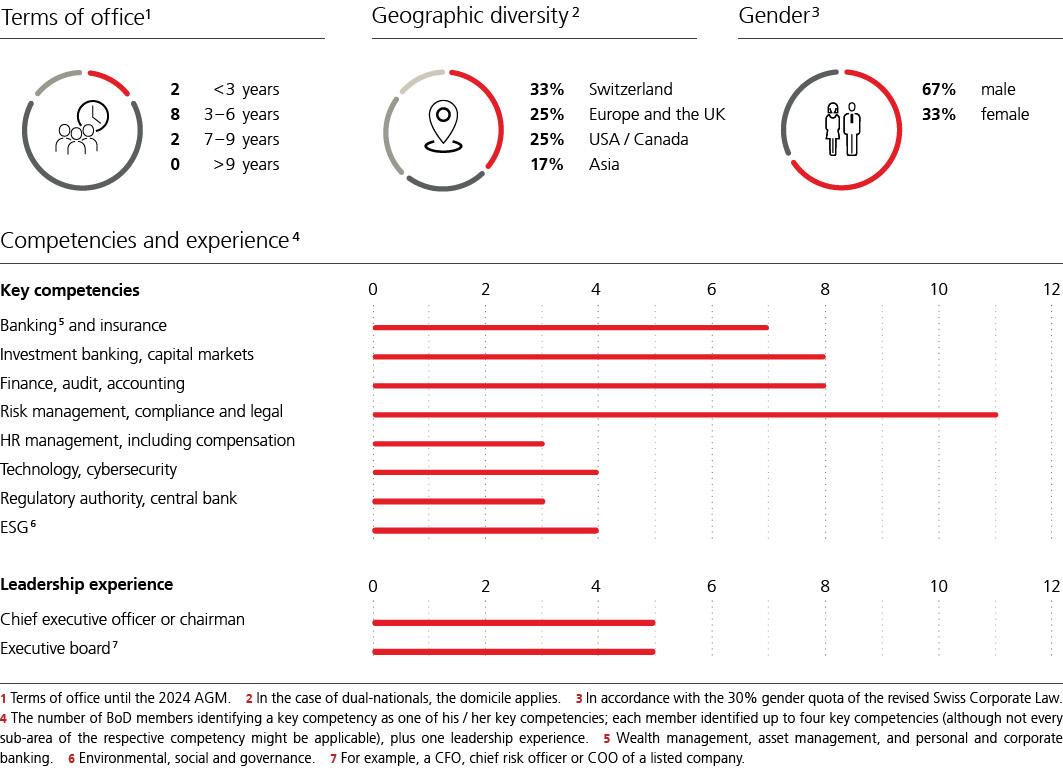
Annual Report 2023 |
Corporate governance and compensation
| Corporate governance
207
Succession planning
Succession planning is
one of the
key responsibilities of
both the BoD
and the GEB.
Across all divisions
and regions, an
inclusive talent
development and
succession planning
process is
in place
that aims
to foster
the personal
development
and Group-wide mobility
of our
employees. Although the
recruiting process for
BoD and
GEB members
takes into
account
a broad spectrum of factors, such as skills, backgrounds, experience and expertise, our approach with regard to diversity
considerations does not constitute
a diversity policy within the meaning
of the EU Directive
on Non-Financial Reporting,
and Swiss law does not require UBS to
maintain such a policy.
In 2022, the GEB launched several strategic initiatives with the close involvement of the BoD and with the aim of further
strengthening internal
succession planning
at UBS.
This included
the early
identification of
talents and
their systematic
development,
including
international
and
cross-divisional
rotations.
The
succession
plans
for
the
GEB
and
the
management layers below it are managed under the lead of the
Group CEO and are reviewed and approved
by the BoD.
Moreover in 2023, to cater to the
challenges posed by the acquisition of the Credit Suisse Group,
the composition of the
GEB was complemented with new members.
For the BoD, the Chairman leads a systematic
succession planning process as illustrated
in the chart below. Our strategy
and the business environment
constitute the main drivers
in our succession planning
process for new BoD
members, as
they
define
the
key
competencies
required
on
the
BoD.
Taking
the
diversity
and
the
tenure
of
the
existing
BoD
into
account,
the
Governance
and
Nominating
Committee
defines the
recruiting
profile
for
the
search.
Both external
and
internal sources
contribute to
identifying suitable
candidates. The
Chairman and
the members
of the
Governance and
Nominating Committee meet with potential
candidates and, with the support
of the full BoD,
nominations are submitted
to
the
AGM
for
approval.
New
BoD
members
follow
an
in-depth
onboarding
process
designed
to
enable
them
to
integrate efficiently and become effective
in their new role. Due to this succession
planning process, the composition of
the BoD is in line with the demanding requirements of a
leading global financial services firm.
The
smooth
and
effective
succession
at
the
GEB
level
and the
appointments
of internal
talent
as
new
GEB
members
demonstrates the strength of the
succession planning at UBS.
The BoD and the
GEB remain committed to the
continuous
focus on developing a high-quality bench of succession candidates
at all levels in the organization.
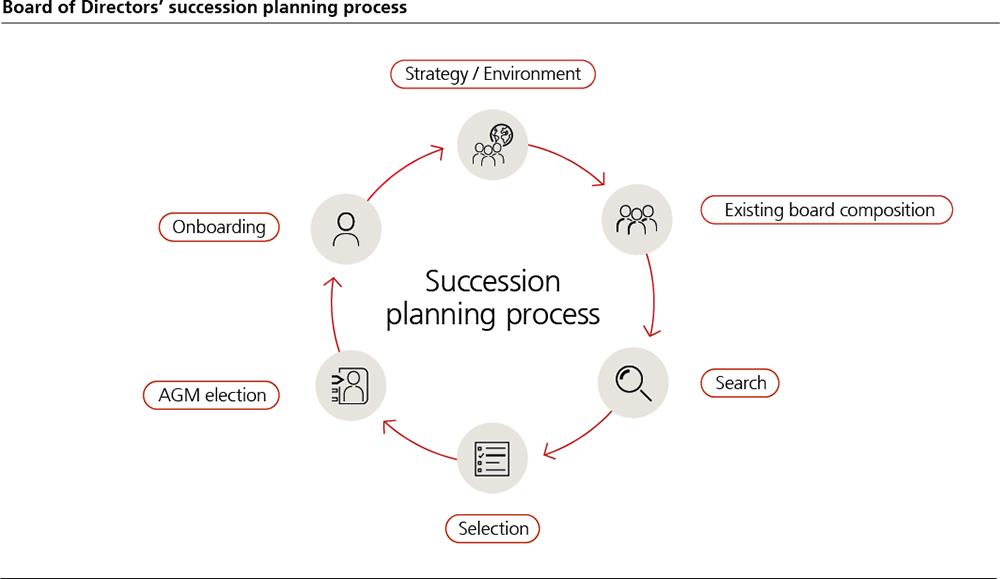
Annual Report 2023 |
Corporate governance and compensation
| Corporate governance
208
Information and control instruments with regard to
the Group Executive Board
The BoD is kept informed of the GEB’s activities
in various ways, including regular meetings
between the Chairman, the
Group CEO and GEB
members. The Group CEO
and other GEB members
also participate in BoD meetings
to update its
members on
all significant
issues. The
BoD receives
regular
comprehensive
reports
covering financial,
capital, funding,
liquidity,
regulatory,
compliance
and
legal
developments,
as
well
as
performance
against
plan
and
forecasts
for
the
remainder of the year. For important developments, BoD members are also updated by the GEB in between meetings. In
addition, the Chairman receives the meeting material and
minutes of the GEB meetings.
BoD members may request from other
BoD or GEB members any
information about matters concerning the
Group that
they require in order to fulfill
their duties. When these requests are
raised outside BoD meetings, such
requests must go
through the Group Company Secretary and be addressed to the
Chairman.
The BoD
is supported
in discharging
its governance
responsibilities by
GIA, which
independently assesses
whether risk
management, control and governance processes are designed
and operating sustainably and effectively.
The Head GIA reports
directly to the Chairman.
In addition, GIA has
a functional reporting
line to the Audit
Committee
in accordance
with its
responsibilities
as set
forth in
our Organization
Regulations.
The Audit
Committee
assesses the
independence and performance of GIA
and the effectiveness of
both the Head GIA
and GIA as an
organization, approves
GIA’s annual audit plan and objectives and monitors
GIA’s discharge of these objectives. The committee is also
in regular
contact with the Head GIA.
GIA issues
quarterly reports
that provide
an overview
of significant
audit results
and key
issues, as
well as
themes and
trends, based on results of individual audits, continuous risk assessment and issue assurance. The reports are provided to
the
Chairman,
the
members
of
the
Audit
and
the
Risk
Committees,
the
GEB
and
other
stakeholders.
The
Head
GIA
regularly updates the Chairman and the Audit Committee on GIA’s activities, processes, audit plan execution, resourcing
requirements and other
important developments. GIA
issues an annual
Activity Report, which
is provided
to the Chairman
and the Audit Committee to support their assessment
of GIA’s effectiveness.
›
Refer to
›
Refer to
the BoD
Annual Report 2023 |
Corporate governance and compensation
| Corporate governance
209
Group Executive Board
The BoD delegates the management of the business to the
Group Executive Board (the GEB).
Responsibilities, authorities and organizational principles
of the Group Executive Board
As of 31 December
2023, the GEB,
under the leadership
of the Group
CEO, consisted
of 16 members.
It has executive
management responsibility for the steering of the Group and its business, develops the strategies of the Group, business
divisions
and
Group
functions,
and
implements
the
BoD-approved
strategies.
The
GEB
is
also
the
risk
council
of
the
Group, with
overall responsibility
for establishing
and supervising
the implementation
of risk
management and
control
principles, as well as for managing the risk profile
of the Group, as determined by the BoD and the
Risk Committee.
In 2023, the GEB held a total of 57 meetings.
›
Refer to the Organization Regulations of UBS
Group AG, available at
ubs.com/governance
, for more information about the
authorities of the Group Executive Board
Changes to the Group Executive Board
On 29 March 2023, the
BoD
named Sergio P.
Ermotti as its new Group
CEO, effective 5 April
2023. The BoD made the
decision in
light of
UBS’s new
priorities following
its planned
acquisition of
the Credit
Suisse Group
.
Sergio P.
Ermotti
had been the
Group CEO from
2011 to 2020.
Ralph Hamers, who
had succeeded Sergio
P.
Ermotti in 2020,
agreed to
step down and remained at
UBS during a transition
period to ensure a successful
closure of the transaction and
a smooth
handover.
At the time of
his re-appointment as
Group CEO,
Sergio P.
Ermotti was Chairman
of Swiss Re and
remained
in that post until his resignation therefrom
on 30 April 2023 to facilitate an orderly transition
at Swiss Re.
On 24 April 2023, UBS announced that Christian Bluhm had agreed to remain in his role as
Group Chief Risk Officer and
member of the GEB for the foreseeable future, considering the planned acquisition of the Credit Suisse Group, therefore
delaying the handover to Damian Vogel that was originally
planned for 1 May 2023.
On 9 May 2023, UBS
Group AG announced a
new operating model and
changes to the GEB:
CEO of Credit Suisse
Group
AG,
Ulrich
Körner,
would
join
the
GEB
and
Todd
Tuckner
would
succeed
Sarah
Youngwood
as
Group
CFO;
both
appointments came into effect at
the close of the transaction on 12 June
2023. With immediate effect
on 9 May 2023,
Beatriz Martin
Jimenez was
named Head
Non-core and
Legacy and
President UBS Europe,
Middle East
and Africa,
Michelle
Bereaux was named Group Integration Officer, and Stefan Seiler was appointed Head
Group Human Resources & Group
Corporate Services.
On
24 January
2024,
UBS
announced
that
Suni
Harford
would
step
down,
and
Aleksandar
Ivanovic
was
appointed
President Asset Management effective 1 March 2024. It was also announced
that Beatriz Martin Jimenez would take on
the responsibility as GEB Lead for Sustainability and Impact
from Suni Harford,
effective 1 March 2024.
As a
result of the
acquisition of the
Credit Suisse
Group in 2023,
and to ensure
compliance with our
governance principles
and to
facilitate a smooth
integration into UBS,
in June
2023, Michelle Bereaux
and Stefan Seiler
were elected
as members
of the board of Credit Suisse AG.
The biographies below provide information about the
GEB members in office as of 31 December
2023. The biographies
of Ralph Hamers and
Sarah Youngwood can be found on
pages 187 and 192
of the UBS Group AG
Annual Report 2022,
available
under
“Annual
reporting”
at
ubs.com/investors
.
In
addition
to
information
on
mandates,
the
biographies
include
memberships
and
other
activities
or
functions,
as
required
by
the
SIX
Swiss
Exchange
Corporate
Governance
Directive.
In line
with Swiss
law, article
36 of
our AoA
limits the
number of
mandates that
GEB members
may hold
outside UBS
Group to
one mandate in
a listed company
and five
additional mandates in
non-listed companies. Mandates
in companies
that are controlled by UBS or that control UBS are
not subject to this limitation. In addition, GEB members
may not hold
more
than
10
mandates
at
one
time
at
the
request
of
the
company
and
more
than
eight
mandates
in
associations,
charitable
organizations,
foundations,
trusts
and
employee
welfare
foundations
without
commercial
purpose.
On
31 December 2023, no member of the GEB reached the
aforementioned thresholds.
Responsibilities and authorities of the Asset and Liability Committee
The Asset and Liability Committee of UBS
Group AG (the GALCO) is responsible for managing assets and liabilities in line
with the strategy,
risk appetite,
regulatory commitments
and the interests
of shareholders
and other
stakeholders. The
GALCO proposes the framework for capital management, capital allocation,
and liquidity and funding risk, and
proposes
limits and indicators for the Group to the BoD for approval.
It oversees the balance sheet management of the Group,
its
business divisions and Group functions. In 2023, the GALCO
held 10 meetings.
Management contracts
We
have
not
entered
into
management
contracts
with
any
companies
or
natural
persons
that
do
not
belong
to
the
Group.

Annual Report 2023 |
Corporate governance and compensation
| Corporate governance
210
Sergio P.
Ermotti
Group Chief Executive Officer,
member of the GEB from 2011 to
2020 and since April 2023
Nationality:
Year of birth:
Sergio P. Ermotti has been Group CEO of UBS Group
AG and President of
the Executive Board of
UBS AG since April
2023. He was also the
Group
CEO from 2011 to 2020. He re-joined UBS from
Swiss Re, where he was
Chairman of the Board of
Directors until April 2023. Prior to
joining UBS
in 2011, he was at UniCredit Group, where from
2007 to 2010 he served
as
Group
Deputy
Chief
Executive
Officer
and
Head
of
Corporate
&
Investment Banking and Private Banking, prior to that
he served as Head
of the Markets & Investment Banking Division. Between
1987 and 2004,
he
held
various
positions at
Merrill Lynch
&
Co.
in
the areas
of equity
derivatives
and
capital
markets.
He
became
Co-Head
of
Global
Equity
Markets
and
a
member
of
the
Executive
Management
Committee
for
Global Markets & Investment Banking in 2001.
Professional experience
2023 – date
Group CEO, UBS Group AG, and
President of the
Executive Board,
UBS AG
2021 – 2023
Chairman of the Board of Directors, Swiss Re
2020 – 2021
Member of the Board of Directors, Swiss Re
2011 – 2020
Group Chief Executive Officer, UBS
2011 – 2011
Chairman and CEO UBS Group Europe, Middle East and
Africa, and member of the Group Executive Board,
UBS
2007 – 2010
Group Deputy Chief Executive Officer and
Head Corporate & Investment Banking and Private
Banking, UniCredit
2005 – 2007
Head Markets & Investment Banking Division, UniCredit
1987 – 2004
Various senior management positions, Merrill Lynch & Co
Education
–
Swiss-certified banking expert
–
Advanced Management Programme, the University of Oxford
Listed company boards
–
Member of the Board of Ermenegildo Zegna N.V. (Lead Non-Executive
Director)
Non-listed company boards
–
Member of the Board of Società Editrice del Corriere del Ticino
SA
Other activities and functions
–
President of the Executive Board of
UBS AG
–
Member of the Board of Innosuisse,
the Swiss Innovation Agency
–
Member of Institut International D’Etudes Bancaires
–
Member of the WEF International Business Council
and Governor of
the Financial Services / Banking Community
–
Member of the MAS International Advisory Panel
–
Member of the Board of the Institute of International
Finance
–
Member of the Board of the Swiss-American Chamber of
Commerce
Michelle Bereaux
Group Integration Officer,
member of the GEB since May 2023
Nationality:
Year of birth:
Michelle Bereaux
was appointed Group
Integration Officer in
May 2023
and is responsible
for the development and
execution of our integration
strategy,
working
closely
with
all
GEB
members
and
integration
workstream leads. Ms.
Bereaux has been at
UBS for more
than 25 years
and has
held various
leadership roles
across the
firm. She
has served
as
both
COO
and
Head
HR
for
our
Investment
Bank, has
successfully led
multiple firm-wide cost
and transformation projects,
and, most recently,
served as COO and
UK Country Head of
Asset Management. She brings
both
a
wealth
of
transformation
experience
and
a
strong
legal,
HR,
investment
banking
and
asset
management
background
to
lead
our
integration efforts.
Professional experience
May 2023 – date
Group Integration Officer, UBS Group AG and UBS AG
2021 – 2023
Country Head UBS Asset Management UK and CEO
Asset Management UK Ltd
2020 – 2023
COO, UBS Asset Management
2018 – 2020
Head of Group Efficiency and Cost Management, UBS
Business Solutions AG
2015 – 2018
Non-Executive Director and Chairman Remuneration
Committee, UBS Limited
2011 – 2014
Global Head Human Resources, UBS Investment Bank
2011 – 2011
Global Strategic Projects at CEO Management Office,
UBS Investment Bank
2009 – 2010
Chief of Staff and Joint Global COO, UBS Investment
Bank
Education
–
Law, the University of Cambridge
–
Politics, Economics and Law, the University of Buckingham
Other activities and functions
–
Member of the Executive Board of
UBS AG
–
Member of the Board of Directors of Credit Suisse AG


Annual Report 2023 |
Corporate governance and compensation
| Corporate governance
211
Christian Bluhm
Group Chief Risk Officer, member of the GEB since 2016
Nationality:
Swiss and
German |
Year of birth:
Christian Bluhm
has been
Group Chief
Risk Officer
since 2016.
He held
several positions in
academia before starting
his banking career
in 1999
with Deutsche Bank
in credit risk
management, and
subsequently working
for Hypovereinsbank
and Credit
Suisse in
the same
area. Before
joining
UBS, he
used his
expertise and
skills as
Chief Risk
& Financial
Officer at
FMS Wertmanagement. Mr. Bluhm is responsible for the development of
the
Group’s
risk
management
and
control
framework
for
various
risk
categories and implementation of its independent
control frameworks.
Professional experience
2016 – date
Group Chief Risk Officer,
UBS Group AG, and Chief Risk
Officer,
UBS AG
2012 – 2015
Spokesman of the Executive Board,
FMS Wertmanagement
2010 – 2015
Chief Risk & Financial Officer, FMS Wertmanagement
2004 – 2009
Managing Director, Credit Risk Management (Switzerland
and Private Banking worldwide), Credit Suisse
2008 – 2009
Head Credit Risk Management Analytics & Instruments,
Credit Suisse
2004 – 2008
Head of Credit Portfolio Management, Credit Suisse
2001 – 2004
Head Structured Finance Analytics, Group Credit Portfolio
Management, Hypovereinsbank
Education
–
Master’s degree, mathematics and informatics, and doctorate,
mathematics, University of Erlangen-Nuremberg
Non-listed company boards
–
Chairman of the Board of Christian Bluhm Photography AG
Other activities and functions
–
Member of the Executive Board of
UBS AG
–
Member of the Foundation Board International
Financial Risk Institute
Mike Dargan
Group Chief Operations and Technology Officer, member of the
GEB since 2021
Nationality:
Year of birth:
Mike
Dargan
was
appointed
Group
Chief
Operations
and
Technology
Officer
in May
2023 and
is
responsible
for
delivering digital
platforms,
technology services,
infrastructure, and
operations, including
cyber and
information
security.
Previously,
he
was
Group
Chief
Digital
and
Information Officer (CDIO), after leading our Group Technology
function
since
joining
UBS
in
2016.
In
addition
to
this
remit,
he
was
also
GEB
sponsor
for
our
digital
assets
strategy
and
a
sponsor
of
artificial
intelligence and our agile transformation, which were
integrated into his
area of responsibility in 2023. Prior to joining UBS, he held various senior
roles
in
technology,
corporate
strategy
and
investment
banking
at
Standard Chartered Bank, Merrill Lynch, and Oliver Wyman.
Professional experience
May 2023 – date
Group Chief Operations and Technology Officer, UBS
Group AG, and Chief Operations and Technology
Officer, UBS AG
2021 – 2023
Group CDIO, UBS Group AG, and CDIO, UBS AG
2021 – date
President of the Executive Board,
UBS Business Solutions AG
2016 – 2021
Head Group Technology,
UBS
2015 – 2016
CIO for Corporate and Institutional Banking,
Standard Chartered Bank
2014 – 2015
Global Group Technology and Operations Head for
Global Markets, Wealth Management, Private Banking
and Securities Services, Group Technology and
Operations Engineering, Standard Chartered Bank
2013 – 2014
CIO for Financial Markets, Standard Chartered Bank
2009 – 2013
Global Head of Strategy and Corporate M&A, Global
Markets, Standard Chartered Bank
2005 – 2009
Head Corporate Strategy & M&A, EMEA and Pacific
Rim, Merrill Lynch
Education
–
Master’s degree, politics, philosophy and economics,
St. John’s College, the University of Oxford
Other activities and functions
–
Member of the Executive Board of
UBS AG
–
Member of the Board of Directors and President of the Executive
Board of UBS Business Solutions AG
–
Member of the Board of UBS Optimus Foundation


Annual Report 2023 |
Corporate governance and compensation
| Corporate governance
212
Suni Harford
President Asset Management, member of the GEB since 2019
(until 29 February 2024)
Nationality:
Year of birth:
Suni Harford
was appointed
President Asset
Management in
2019 and
stepped
down
in
February
2024.
She
was
the
Chair
of
UBS
Optimus
Foundation from 2019
to 2024. Ms.
Harford was
the UBS GEB
Lead for
Sustainability and Impact from 2021 to 2024. She started her Wall Street
career at
Merrill Lynch
& Co.,
in investment
banking, before
embarking
on a 24-year career at Citigroup Inc., the last
nine years of which she was
the Regional Head of Markets for
North America. Ms. Harford joined UBS
in 2017, bringing
with her a
broad experience from
across the
industry,
including
in
research,
client
coverage
and
risk
management,
and
successfully
led
UBS
Asset
Management’s
integrated
investments
capabilities, driving performance for its clients.
Professional experience
2019
–
Feb.
2024
President Asset Management, UBS Group AG
and UBS AG
2017 – 2019
Head of Investments, Asset Management, UBS
2008 – 2017
Regional Head of Markets for North Americas,
Citigroup Inc.
2004 – 2008
Global Head of Fixed Income Research, Citigroup Inc.
Education
–
Bachelor’s degree, physics and mathematics, Denison University, Ohio
–
MBA, Tuck School of Business, Dartmouth College, New Hampshire
Other activities and functions
–
Member of the Executive Board of
UBS AG
–
Chairman of the Board of Directors of UBS Asset Management
AG
–
Chair of the Board of UBS Optimus Foundation
–
Member of the Board of Directors of the Bob Woodruff Foundation
Naureen Hassan
President UBS Americas, member of the GEB since
October 2022
Nationality:
Year of birth:
1971
Naureen Hassan was appointed President UBS Americas and CEO of UBS
Americas Holding LLC in 2022.
She joined UBS from
the Federal Reserve
Bank of
New York,
where she
was COO
and First
Vice President.
After
starting
her
career
at
McKinsey
&
Company,
Ms.
Hassan
held
various
business
transformation,
strategy
and
operational
leadership
roles
at
Charles
Schwab
Corporation
and
was
a
member
of
that
company’s
Executive Committee.
Subsequently,
as
Chief Digital
Officer at
Morgan
Stanley Wealth
Management, she
led the
digital strategy
and executed
digital transformation
of the
wealth management
business to
grow the
business,
improve
client
experience
and
increase
financial
advisor
effectiveness and efficiency.
Professional experience
2022 – date
President UBS Americas, UBS Group AG and UBS AG,
and CEO, UBS Americas Holding LLC
2021 – 2022
First Vice President and COO, Federal Reserve
Bank of New York
2016 – 2020
Chief Digital Officer, Wealth Management,
Morgan Stanley
2014 – 2016
Executive Vice President, Investor Services, Charles
Schwab Corporation
2012 – 2014
Senior Vice President, Advisor Services Client Experience
& Strategic Integration, Charles Schwab Corporation
2010 – 2012
COO and Board Director, Charles Schwab Bank
2003 – 2010
Various senior positions,
Charles Schwab Corporation
Education
–
Bachelor’s degree, economics, Princeton University
–
Master’s degree, business administration, Stanford University
Graduate School of Business
Other activities and functions
–
Member of the Executive Board of
UBS AG
–
Member of the Board and CEO of UBS Americas Holding LLC
–
Member of the Board of the Securities Industry and Financial
Markets
Association (stepped down in January 2024)
–
Member of the Board of Governors of FINRA (as of
February 2024)
–
Member of the Board of Ownership Works
–
Member of the Board of the American Swiss Foundation
–
Member of the Board and Executive Committee of The
Partnership for
New York City


Annual Report 2023 |
Corporate governance and compensation
| Corporate governance
213
Robert Karofsky
President Investment Bank, member of the GEB since 2018
Nationality:
Year of birth:
1967
Robert Karofsky
was appointed
Co-President of
the Investment
Bank in
2018
and
reshaped
that
division,
realigning
efforts
around
clients’
evolving needs, focusing resources on
opportunities for profitable growth
and reinvesting in UBS’s digital transformation. He became sole
President
of the Investment
Bank in
2021 and
was President UBS
Securities LLC
from
2015 to 2021. Before joining UBS,
he acquired know-how in investment
banking as an analyst
and trader, working for various financial
institutions
such as
Morgan Stanley,
Deutsche Bank
and AllianceBernstein. He
then
became
Global
Head
of
Equities
at
UBS,
responsible
for
driving
UBS’s
growth strategy for equities globally.
Professional experience
2021 – date
President Investment Bank, UBS Group AG and UBS AG
2018 – 2021
Co-President Investment Bank, UBS
2015 – 2021
President UBS Securities LLC, UBS
2014 – 2018
Global Head Equities, UBS
2011 – 2014
Global Head of Equity Trading, AllianceBernstein
2008 – 2010
Co-Head of Global Equities, Deutsche Bank
2005 – 2008
Head of North American Equities, Deutsche Bank
Education
–
Bachelor’s degree, economics, Hobart and William
Smith Colleges,
New York
–
MBA, finance and statistics, University of Chicago’s
Booth School of
Business
Other activities and functions
–
Member of the Executive Board of
UBS AG
–
Member of the Board of UBS Americas Holding LLC
–
Member of the Board of UBS Optimus Foundation
Sabine Keller-Busse
President Personal & Corporate Banking and
President UBS Switzerland, member of the GEB since 2016
Nationality:
Year of birth:
Sabine
Keller-Busse
was
appointed
President
Personal
&
Corporate
Banking
and
President
UBS
Switzerland
in
2021,
heading
the
leading
universal
bank in
Switzerland. In
her
previous
role
as
Group
COO, she
oversaw
global
functions
such
as
technology,
operations,
human
resources and corporate services. She has been pivotal in driving
business
alignment, and digital and
cultural transformation, while also facilitating
business
growth as
President UBS
Europe,
Middle East
and
Africa.
Ms.
Keller-Busse
also
brings in-depth
experience regarding
financial market
infrastructure, having served on the Board of SIX Group for nine
years.
Professional experience
2021 – date
President Personal & Corporate Banking and
President UBS Switzerland, UBS Group AG
2021 – date
President of the Executive Board, UBS Switzerland AG
2019 – 2021
President UBS Europe, Middle East and Africa, UBS
2018 – 2021
Group COO of UBS and President of the Executive
Board, UBS Business Solutions AG
2016 – 2021
Member of the Executive Board of UBS AG
2014 – 2017
Group Head Human Resources, UBS
2010 – 2014
COO UBS Switzerland, UBS
Education
–
Master’s degree, economic sciences, University of St. Gallen
–
Ph.D., economic sciences (Dr. oec.), University of St. Gallen
Listed company boards
–
Member of the Board of Zurich Insurance Group
Other activities and functions
–
President of the Executive Board of UBS Switzerland AG
–
Chairwoman of the Foundation Board of the UBS Pension
Fund
–
Member of the Foundation Council of the UBS International
Center
of Economics in Society
–
Member of the Board and Board Committee of Zurich Chamber
of Commerce
–
Member of the Board of the University Hospital Zurich
Foundation
–
Member of the Board of Trustees of the Swiss Entrepreneurs
Foundation


Annual Report 2023 |
Corporate governance and compensation
| Corporate governance
214
Iqbal Khan
President Global Wealth Management, member of the GEB since
2019
Nationality:
Year of birth:
Iqbal Khan has been President
Global Wealth Management since
October
2022 and was
President UBS Europe,
Middle East and
Africa from 2021
to 2023. From
2019 until September
2022, he was
Co-President Global
Wealth Management.
Mr. Khan
joined Ernst
& Young
in 2001,
holding
numerous leadership positions and becoming a very young executive
and
a partner
of the
firm’s Swiss
arm; when
leaving Ernst &
Young,
he was
lead auditor of
UBS. In 2013,
he moved to
Credit Suisse,
holding senior
leadership positions as CFO
Private Banking &
Wealth Management and
later CEO International Wealth Management.
Professional experience
2022 – date
President Global Wealth Management, UBS Group AG
and UBS AG
2021 – May 2023
President UBS Europe, Middle East and Africa, UBS
2019 – 2022
Co-President Global Wealth Management, UBS
2015 – 2019
CEO International Wealth Management, Credit Suisse
2013 – 2015
CFO Private Banking & Wealth Management,
Credit Suisse
2011 – 2013
Managing Partner Assurance and Advisory Services –
Financial Services, Ernst & Young
2009 – 2011
Industry Lead Partner Banking and Capital Markets,
Switzerland and EMEA Private Banking, Ernst &
Young
2001 – 2009
Various positions in Ernst & Young
Education
–
Swiss Certified Public Accountant
–
Advanced Master of International Business Law degree
(LL.M.),
University of Zurich
Other activities and functions
–
Member of the Executive Board of
UBS AG
–
Member of the Board of UBS Optimus Foundation
Edmund Koh
President UBS Asia Pacific, member of the GEB since
2019
Nationality:
Year of birth:
Edmund
Koh
has
been
President
UBS
Asia
Pacific
since
2019.
He
is
a
financial sector
veteran, with
more than 30
years in
senior roles
in financial
services,
including
as
Head
Wealth
Management
Asia
Pacific,
Country
Head Singapore and Head Wealth
Management South-East Asia and
Asia
Pacific Hub for
UBS. He joined
UBS from Taiwan
-based Ta
Chong Bank,
where he served as President and
Director.
Before working for DBS Bank
in Singapore,
Mr.
Koh was
CEO for
Prudential Assurance and
Alverdine
Pte Ltd, both companies based in Singapore.
Professional experience
2019 – date
President UBS Asia Pacific, UBS Group AG and UBS AG
2016 – 2018
Head Wealth Management Asia Pacific, UBS
2012 – 2018
Country Head Singapore, UBS
2012 – 2015
Head Wealth Management South-East Asia and
Asia Pacific Hub, UBS
2008 – 2012
President and Director, Ta
Chong Bank, Taiwan
2001 – 2008
Managing Director and Regional Head, Consumer Banking
Group, DBS Bank, Singapore
Education
–
Bachelor’s degree, psychology, University of Toronto
Non-listed company boards
–
Member of the Board of Trustees of the Wealth Management
Institute, Singapore
–
Member of the Board of Next50 Limited, Singapore
–
Member of the Board of Medico Suites (S) Pte Ltd, Singapore
–
Member of the Board of Curbside Pte Ltd, Singapore
–
Member of the Board of the Philanthropy Asia Alliance Ltd,
Singapore
Other activities and functions
–
Member of the Executive Board of
UBS AG
–
Member of a sub-committee of the Singapore Ministry
of Finance’s Committee on the Future Economy
–
Member of the Financial Centre Advisory Panel of the
Monetary
Authority of Singapore
–
Council member of the Asian Bureau of Finance and
Economic
Research,
Singapore
–
Member of the Board of Trustee of the Cultural Matching Fund,
Singapore
–
Member of University of Toronto’s International Leadership
Council for Asia

Annual Report 2023 |
Corporate governance and compensation
| Corporate governance
215
Ulrich Körner
CEO of Credit Suisse AG, member of the GEB since
June 2023
Nationality:
Year of birth:
Ulrich Körner was
appointed CEO of
Credit Suisse AG
in June 2023,
when
the Credit Suisse Group AG was acquired by UBS Group AG. Prior to
the
acquisition, he was
CEO of Credit
Suisse Group AG.
Before that he
was
CEO Asset Management at Credit Suisse Group AG. From 2009 to 2020,
he held
various leadership
positions, such
as President
Asset Management,
President UBS
Europe, Middle
East and
Africa,
and Group
COO, at
UBS
Group AG
and was
a
member of
the Group
Executive Board.
With his
knowledge
of
both
organizations,
Mr.
Körner
will
be
responsible
for
ensuring
Credit
Suisse’s
operational
continuity
and
client
focus
while
supporting the integration process.
Professional experience
June 2023 – date
CEO of Credit Suisse AG, UBS Group AG
2022 – June 2023
Group CEO of Credit Suisse Group AG, Credit Suisse
2021 – 2022
CEO Asset Management, Credit Suisse
2019 – 2020
Senior Advisor to the Group CEO, UBS
2009 – 2020
Member of the Group Executive Board, UBS
2015 – 2019
President
Asset
Management
and
President
UBS
Europe, Middle East and Africa, UBS
2014 – 2015
CEO Global Asset Management, UBS
2011 – 2015
CEO UBS Group Europe, Middle East and Africa,
UBS
2009 – 2013
Group COO, UBS
2002 – 2009
Various senior management positions, Credit Suisse
Education
–
Master’s degree, economics, University of St. Gallen
–
Doctorate, economics, University of St. Gallen
Listed company boards
–
Vice President of the Board of Lyceum Alpinum Zuoz AG
Barbara Levi
Group General Counsel, member of the GEB since 2021
Nationality:
Year of birth:
Barbara
Levi
has
been
Group
General
Counsel
since
2021.
A
qualified
attorney-at-law,
she
has
been
admitted
to
the
Supreme
Court
of
the
United States, the New York State bar
and the bar of Milan,
Italy, and has
worked in several
law firms in
New York
and Milan. Ms.
Levi began her
corporate career
with Novartis
Group in
2004 and
worked there
for 16
years, holding a number
of senior legal
roles across Europe. Before
joining
UBS, she served
as Chief
Legal Officer
& External
Affairs at Rio
Tinto Group
and, before that, as General Counsel.
In both roles, she was a member
of
that company’s executive committee.
Professional experience
2021 – date
Group General Counsel, UBS Group AG, and General
Counsel, UBS AG
2021
Chief Legal Officer & External Affairs, Rio Tinto Group
2020 – 2021
Group General Counsel, Rio Tinto Group
2019
Group Legal Head, M&A and Strategic Transactions,
Novartis
2016 – 2019
Global General Counsel, Sandoz International GmbH,
Novartis
2014 – 2016
Global Legal Head, Product Strategy &
Commercialization, Novartis
2013 – 2014
Global Legal Head, TechOps, Primary Care and
Established Medicines, Novartis
2009 – 2013
Head of Legal & Compliance, Region Asia-Pacific,
Middle East, and African Countries, Region Group
Emerging Markets, Novartis
Education
–
Law degree, University of Milan
–
Master of Laws (LL.M.), banking, corporate and finance
law, Fordham
University School of Law, New York
Other activities and functions
–
Member of the Executive Board of
UBS AG
–
Member of the Board of Directors of the European General Counsel
Association
–
Member of the Legal Committee of the Swiss-American
Chamber of
Commerce

Annual Report 2023 |
Corporate governance and compensation
| Corporate governance
216
Beatriz Martin Jimenez
Head Non-core and Legacy and President UBS Europe, Middle East
and Africa,
member of the GEB since May 2023
Nationality:
Year of birth:
Beatriz
Martin
Jimenez
became Head
Non-core
and
Legacy,
as
well
as
President UBS Europe,
Middle East and Africa
of UBS Group AG,
in May
2023. She has also been
the UBS Chief Executive for the
UK since 2019.
Her previous UBS
roles included Group
Treasurer for UBS Group AG,
Chief
Transformation Officer for UBS Group
AG, COO for
UBS Investment Bank,
and Chief
of Staff
to the
CEO for
UBS Investment
Bank. Before
joining
UBS
in
2012,
Ms.
Martin
held
various
roles
in
fixed
income
sales
and
trading
at Morgan
Stanley and
Deutsche
Bank. With
her experience
in
markets, Ms.
Martin has
a deep
understanding of
the industry
and has
built
an
extensive
network
and
credentials
globally,
in
addition
to
her
restructuring
experience,
as
well
as
a
thorough
knowledge
of
our
Investment Bank.
Professional experience
2023 – date
Head Non-core and Legacy and President UBS Europe,
Middle East and Africa, UBS Group AG and UBS AG
2020 – June 2023
Group Treasurer,
UBS Group AG
2019 – date
UK Chief Executive, UBS AG London Branch
2022 – 2023
Chief Transformation Officer,
UBS Group AG
2015 – 2020
COO, UBS Investment Bank
2015 – 2019
UK COO, UBS AG London Branch and UBS Limited
2012 – 2015
Chief of Staff to CEO, UBS Investment Bank
1996 – 2012
Various positions in Global Markets, Morgan Stanley
and Deutsche Bank
Education
–
Masters in Business Administration, Universidad Autónoma de
Madrid,
Madrid
–
Erasmus Exchange programme, Hochschule für Bankwirtschaft,
Frankfurt
Non-listed company boards
–
Member of the Leadership Council, TheCityUK, London
(stepped
down in February 2024)
Other activities and functions
–
Member of the Executive Board of
UBS AG
–
Member of the Supervisory Board of UBS Europe SE
–
Member of the Advisory Board of the Frankfurt School
of Finance &
Management
Markus Ronner
Group Chief Compliance and Governance Officer,
member of the GEB since 2018
Nationality:
Year of birth:
Markus
Ronner
has
been
Group
Chief
Compliance
and
Governance
Officer since 2018.
He has been
with UBS for
more than 40
years and held
various positions
across the
firm, including
manager of
the Group-wide
too-big-to-fail program,
COO Wealth
Management &
Swiss Bank, Head
Products and Services of
Wealth Management & Swiss Bank,
COO Asset
Management, and Head Group Internal Audit. In his current
position, he
is responsible at the
Group level for the
control of all
non-financial risks,
governmental and regulatory
affairs, and
investigations and
governance
matters. From
2022 until
October 2023,
he served
as Chairman
of UBS
Switzerland AG, the leading Swiss universal bank.
Professional experience
2018 – date
Group Chief Compliance and Governance Officer, UBS
Group AG, and Chief Compliance and Governance
Officer UBS AG
2022 – Oct. 2023
Chairman of UBS Switzerland AG
2012 – 2018
Head Group Regulatory and Governance, UBS
2011 – 2013
Manager Group-wide too-big-to-fail program, UBS
2010 – 2011
COO Wealth Management & Swiss Bank, UBS
2009 – 2010
Head Products and Services of Wealth Management &
Swiss Bank, UBS
2007 – 2009
COO Asset Management, UBS
2001 – 2007
Head Group Internal Audit, UBS
Education
–
Swiss Banking Diploma
Other activities and functions
–
Member of the Executive Board of
UBS AG


Annual Report 2023 |
Corporate governance and compensation
| Corporate governance
217
Stefan Seiler
Head Group Human Resources & Group Corporate Services,
member of the GEB since May 2023
Nationality:
Year of birth:
Stefan Seiler has been Head
Group Human Resources & Group Corporate
Services of
UBS
Group AG
and UBS
AG since
May
2023. He
leads the
combined
Group
Human
Resources
and
Corporate
Services
function,
ensuring effective and
efficient alignment of
our people, real
estate and
vendor management strategies. He started
his career at the Swiss Military
Academy at ETH Zurich and,
after working for Credit Suisse from 2002 to
2006, he returned to the Swiss Military Academy as Department Head of
Leadership
and
Communication.
Mr.
Seiler
joined
UBS
in
2011
and
became Group Head HR in 2018 after gaining experience as Head HR for
Switzerland
and
Group
Functions,
as
well
as
Global
Head
Talent
and
Recruiting. During his career,
he has lived in Switzerland, the UK,
the US
and Singapore.
Professional experience
May 2023 – date
Head Group Human Resources & Group Corporate
Services, UBS Group AG and Head Human Resources &
Corporate Services, UBS AG
2018 – 2023
Group Head Human Resources, UBS
2016 – 2018
Global Head Talent & Recruiting, UBS
2014 – 2016
Head HR UBS Switzerland and Global Head HR Group
Control & CEO Functions, UBS
2012 – 2016
Head HR UBS Switzerland, UBS
2011 – 2012
Global Head HR Corporate Center, UBS
2010 – 2011
Visiting Professor, Nanyang Business School, Singapore
2006 – 2011
Department Head of Leadership and Communication,
Swiss Military Academy, ETH Zurich
2002 – 2006
Assessment specialist, HR Transformation Manager and
Global Lead for Human Capital Management
Implementation Group Functions, Credit Suisse, Zurich
and New York
Education
–
Master of Science (lic. Phil.), Educational Psychology, University of
Fribourg
–
PhD in Educational Psychology, University of Fribourg
Other activities and functions
–
Member of the Executive Board of
UBS AG
–
Member of the Foundation Board of the UBS Swiss Pension
Fund
–
Member of the Board of Directors of Credit Suisse AG
–
Member of the UBS Center for Economics in Society
at the University
of Zurich Foundation Council
–
Chairman of the Foundation Board of the Swiss Finance Institute
–
Member of the IMD Foundation Board
–
Adjunct Professor for Leadership and Strategic Human Resource
Management, Nanyang Technological University (NTU), Singapore
Todd
Tuckner
Group Chief Financial Officer, member of the GEB since May 2023
Nationality:
Year of birth:
Todd
Tuckner was
appointed to the GEB of UBS Group
AG in May 2023
and became Group CFO
after the acquisition of
the Credit Suisse Group
in June 2023.
He was previously CFO
and Head Business
Performance and
Risk
Management
for
our
Global
Wealth
Management
business.
Mr.
Tuckner joined UBS in 2004 after working for KPMG for
17 years and has
since held various leadership roles across the Group Finance function. He
brings both an
in-depth knowledge
of UBS and
experience across multiple
areas
of
finance,
including
tax,
controlling,
accounting,
reporting,
risk
management and business advisory.
Professional experience
June
2023
–
date
Group CFO, UBS Group AG and CFO, UBS AG
2020 – 2023
CFO and Head Business Performance and Risk
Management,
Global Wealth Management, UBS
2016 – 2021
Group Controller and Chief Accounting Officer, UBS
2012 – 2019
Group Finance COO, UBS
2009 – 2012
Group Head Tax & Accounting Policy,
UBS
2004 – 2009
Group Head Tax – Americas, UBS
1987 – 2004
Various management positions, KPMG LLP, New York
Education
–
Bachelor’s degree, economics, Princeton University
–
MBA, accounting, New York University
Other activities and functions
–
Member of the Executive Board of
UBS AG
Annual Report 2023 |
Corporate governance and compensation
| Corporate governance
218
Change of control and defense measures
Our Articles
of Association
(the
AoA) do
not
provide
any
measures
for
delaying,
deferring or
preventing
a change
of
control.
Duty to make an offer
Pursuant
to the
Swiss Federal Act on Financial
Market Infrastructures and
Market Conduct in Securities
and Derivatives
Trading of 19 June
2015, anyone who has acquired (whether directly,
indirectly or in concert with third parties)
more
than 33
1
⁄
3
% of
all voting
rights of
a company
listed in
Switzerland, whether
such rights
are exercisable
or not,
is
required to submit
a takeover offer
for all listed
shares outstanding. We
have not elected
to change or
opt out of
this rule.
Clauses on change of control
Neither the
terms regulating the
BoD members’
mandate nor any
employment contracts with
GEB members or
employees
holding key functions within the Group contain change
of control clauses.
All
employment
contracts
with
GEB
members
stipulate
a
notice
period
of
six
months.
During
the
notice
period,
GEB
members are
entitled to
their salaries
and the
continuation of
existing employment
benefits and
may be
eligible to
be
considered for a discretionary performance award based
on their contribution during their tenure.
In case
of a
change of
control, we
may, at
our discretion,
accelerate the
vesting of
and /
or relax
applicable forfeiture
provisions of employees’ awards.
›
Refer to the
Auditors
Audit is an
integral part of
corporate governance. While
safeguarding their
independence, the
external auditors closely
coordinate
their
work with
Group
Internal Audit
(GIA).
The
Audit Committee
and, ultimately,
the
BoD supervise
s
the
effectiveness of audit work.
›
Refer to
External independent auditors
The 2023 Annual General Meeting
(the AGM) re-elected Ernst
& Young Ltd (EY) as
auditors for the Group
for the 2023
financial year.
The audit of the Group encompasses the consolidated results of Credit Suisse AG and its subsidiaries from
the
date
of
its acquisition
on
12
June
2023.
EY
assumes
virtually
all
auditing
functions
according
to
laws, regulatory
requests and
the AoA.
Robert Jacob
is the EY
partner in
charge of
the overall
coordination of
the UBS
Group financial
and regulatory
audits and
the co-signing
partner of
the financial
audit. In
2020, Maurice
McCormick became
the lead
audit partner for the financial
statement audit and has an
incumbency limit of five years.
In 2021, Hannes Smit
became
the Lead Auditor
to the Swiss
Financial Market
Supervisory Authority (FINMA)
with an incumbency
limit of seven
years.
Daniel Martin has been the co-signing partner for the FINMA audit since 2019, with an incumbency limit of seven
years.
PricewaterhouseCoopers AG served
as auditors
for Credit
Suisse entities
for the
2023 financial
year. Following the
election
of auditors at the
2024 AGM, UBS
Group intends to
cause EY to
be appointed as
the auditors of
Credit Suisse AG and
its subsidiaries for the 2024 financial year.
During 2023, the Audit Committee held 14 meetings with the
external auditors.
Review of UBS Group AG audit engagement
Mazars has been appointed as auditors of UBS Europe SE, an indirect subsidiary of UBS Group AG, as EU rules require to
rotate its
external auditors in
the 2024
financial year.
In connection
with this
required
change, and
in consideration
of
governance best practices, the
BoD considered whether it would
propose to shareholders a rotation of
the Group auditor
concurrent
with the
change at
UBS Europe
SE. Under
the direction
of the
Audit Committee,
UBS conducted
a formal
review of the Group audit engagement including
soliciting proposals from potential auditors. In early
2022, based on the
results of this assessment, the BoD decided to retain
EY as the Group’s external auditors.
Audit effectiveness assessment
The Audit Committee
assesses the performance,
effectiveness and
independence of the
external auditors on an
annual
basis. The assessment is generally
based on interviews with senior
management and survey feedback
from stakeholders
across the Group. Assessment criteria include quality of service delivery, quality and competence of the audit team,
value
added
as
part
of
the
audit,
insightfulness,
and
the
overall
relationship
with
EY.
Based
on
its
own
analysis
and
the
assessment results, including
feedback received
as part of the
review of the
Group audit engagement
described above,
the Audit Committee concluded that EY’s audit has been effective.
Annual Report 2023 |
Corporate governance and compensation
| Corporate governance
219
Fees paid to external independent auditors
UBS Group AG and its subsidiaries (for 2023 including UBS AG and Credit Suisse AG) paid the following fees (including expenses) to
their external independent auditors.
For the year ended
USD m
31.12.23
31.12.22
1
Audit
Global audit fees
Additional services classified as audit (services required
by law or statute, including work of a non-recurring nature mandated by
regulators)
Total audit
Non-audit
Audit-related fees
of which: assurance and attestation services
of which: control and performance reports
of which: consultation concerning financial accounting and
reporting standards
Tax fees
All other fees
Total non-audit
1 As published in the Annual Report 2022 for UBS Group AG prior to the acquisition of the Credit Suisse Group.
Special auditors for potential capital increases
At the AGM
on 8 April 2021, BDO
AG was reappointed
as special auditors
for a three-year term
of office. Special
auditors
provide audit opinions in connection with potential
capital increases independently from
other auditors.
Services performed and fees
The Audit Committee
oversees all services
provided to
UBS by the
external auditors. For
services requiring
the approval
from
the
Audit
Committee,
a
preapproval
may
be
granted
either
for
a
specific
mandate
or
in
the
form
of
a
blanket
preapproval authorizing
a limited and
well-defined type and
scope of services.
The fees (including
expenses) paid to
EY
are set forth in the table above.
In addition, EY received USD 31m
in 2023 (USD 35m in 2022) for services performed on
behalf of our investment funds, many of which have independent
fund boards or trustees.
Audit work
includes all
services necessary
to perform
the
audit for
the Group
in accordance
with applicable
laws and
generally
accepted
auditing
standards,
as
well
as
other
assurance
services
that
conventionally
only
the
auditor
can
provide. These include statutory and regulatory audits, attestation
services and the review of documents to be filed with
regulatory
bodies.
The
additional
services
classified
as audit
in 2023
included
several
engagements
for
which
EY
was
mandated at the request of FINMA.
Audit-related
work
consists
of
assurance
and
related
services
traditionally
performed
by
auditors,
such
as
attestation
services related to financial reporting, internal control reviews and performance standard reviews, as well as consultation
concerning financial accounting and reporting standards.
Tax
work
involves
services
performed
by
professional
staff
in
EY’s
tax
division
and
includes
tax
compliance
and
tax
consultation with respect to our own affairs.
“Other” services are permitted services, which include technical
IT security control reviews and assessments.
Group Internal Audit
GIA performs the internal auditing role
for the Group. It is
an independent function that
provides expertise and insights
to confirm
controls
are
functioning correctly
and highlight
where
UBS needs
to better
manage current
and emerging
risks. In 2023,
after the
acquisition of the
Credit Suisse
Group,
GIA operated
with an average
headcount of 1,009
full-
time equivalent employees,
including Credit Suisse employees.
Annual Report 2023 |
Corporate governance and compensation
| Corporate governance
220
GIA supports
the BoD
in discharging
its governance
responsibilities by
taking a
dynamic approach
to audit,
issue assurance
and risk assessment, drawing attention to key risks in order
to drive action to prevent unexpected loss or damage to the
firm’s
reputation.
To
support
the
achievement
of
UBS’s
objectives,
GIA
independently,
objectively
and
systematically
assesses the:
(i)
soundness of the Group’s risk and control culture;
(ii)
reliability and integrity of financial and operational
information, including whether activities are properly,
accurately
and completely recorded, and the quality of underlying data
and models; and
(iii)
design, operating effectiveness and sustainability of:
–
processes to define strategy and risk appetite, as well as
the overall adherence to the approved strategy;
–
governance processes;
–
risk management, including whether risks are appropriately
identified and managed;
–
internal controls, specifically whether they are commensurate
with the risks taken;
–
remediation activities; and
–
processes
to
comply
with
legal
and
regulatory
requirements,
internal
policies,
and
the
Group’s
constitutional
documents and contracts.
Audit reports that include significant issues
are provided to the Group CEO,
relevant GEB members and other responsible
management. The Chairman,
the Audit Committee
and the Risk
Committee of
the BoD are
regularly informed
of such
issues.
In
addition,
GIA
provides
independent
assurance
on
the
effective
and
sustainable
remediation
of
control
deficiencies
within its mandate,
taking a prudent and
conservative risk-based approach
and assessing at
the issue level whether
the
root cause and the potential exposure for the firm have
been holistically and sustainably addressed. GIA also
cooperates
closely with risk control functions and internal and external
legal advisors on investigations into major control issues.
To ensure GIA’s
independence from
management, the
Head GIA reports
to the
Chairman of the
BoD and
to the Audit
Committee,
which
assesses
annually
whether
GIA
has
sufficient
resources
to
perform
its
function,
as
well
as
its
independence and performance. In the Audit Committee’s assessment, GIA is sufficiently resourced to fulfill
its mandate
and complete its
auditing objectives. GIA’s
role, position,
responsibilities and
accountability are set
out in
our Organization
Regulations and the
Charter for GIA,
available at
ubs.com/governance.
GIA has unrestricted
access to all
accounts, books,
records, systems, property
and personnel, and
must be provided
with all information
and data that
it needs to
fulfill its
auditing responsibilities. GIA also conducts special audits at the request of the
Audit Committee, or other BoD members,
committees or the Group CEO in consultation with the Audit
Committee.
GIA enhances the efficiency of its work through coordination
and close cooperation with the external auditors.
Information policy
We provide regular information to
our shareholders and to the wider financial community.
Financial reports for UBS Group AG are expected to be published
on the following dates:
First quarter 2024
7 May 2024
Second quarter 2024
31 July 2024
Third quarter 2024
30 October 2024
The annual general meetings of the shareholders of UBS
Group AG will take place on the following dates:
2024
24 April 2024
2025
11 April 2025
›
Refer to the corporate calendar available at
ubs.com/investors
dates, including the dates of the publication
of UBS AG’s financial reports
We meet with institutional investors worldwide throughout the year and regularly hold results presentations, attend and
present
at investor
conferences,
and, from
time to
time, host
investor days.
When appropriate,
investor meetings
are
hosted by
senior management and
are attended by
members of our
Investor Relations team.
We use
various technologies,
such as webcasting, audio links and cross-location videoconferencing,
to widen our audience and maintain contact with
shareholders globally.
Annual Report 2023 |
Corporate governance and compensation
| Corporate governance
221
We make our publications available to all shareholders simultaneously to provide them with equal access to our financial
information.
Our annual
and quarterly publications
are available
in a
fully digital
and .pdf
format at
ubs.com/investors
, under
“Financial
information.” We no longer provide
printed copies of our Annual
Report and our Compensation Report in
any language.
›
Refer to
ubs.com/investors
conference presentations
›
Refer to the
›
Refer to
Financial disclosure principles
We fully support
transparency and consistent
and informative disclosure.
We aim
to communicate our
strategy and results
in
a
manner
that
enables
stakeholders
to
gain
a
good
understanding
of
how
our
Group
operates,
what
our
growth
prospects are, and the
risks that our businesses and
our strategy entail. We
assess feedback from
analysts and investors
on a regular basis and, where appropriate, reflect this in our disclosures. To continue achieving these goals, we apply the
following principles in our financial reporting and
disclosure:
–
transparency
–
consistency
–
simplicity
–
relevance,
by
focusing
not
only
on
what
is
required
by
regulation
or
statute
but
also
on
what
is
relevant
to
our
stakeholders; and
–
best practice
We regard the continuous
improvement of our disclosures as an ongoing
commitment.
Financial reporting policies
We
report
our
Group’s
results
for
each
financial
quarter,
including
a
breakdown
of
results
by
business
division
and
disclosures or
key developments
relating to
risk management
and control,
capital, liquidity
and funding
management.
Each quarter,
we publish quarterly financial reports for UBS
Group AG, on the same day as the earnings releases.
The
consolidated
financial
statements
of
UBS
Group
AG
and
UBS
AG
are
prepared
in
accordance
with
International
Financial Reporting Standards as issued by the International Accounting
Standards Board.
›
Refer to
more information about the basis of accounting
We are committed to
maintaining the transparency
of our reported results
and allowing analysts
and investors to
make
meaningful comparisons
with prior
periods. If
there is a
major reorganization
of our
business divisions
or if changes
to
accounting standards or interpretations lead to a material change in
the Group’s reported results, our results are restated
for previous
periods as
required by
applicable
accounting
standards. These
restatements
show how
our results
would
have been reported on the new basis and provide clear
explanations of all relevant changes.
US disclosure requirements
As a
foreign private
issuer,
we must
file reports
and other
information, including
certain financial
reports, with
the US
Securities and Exchange Commission (the SEC) under the
US federal securities laws.
An evaluation of the
effectiveness of our
disclosure controls and
procedures (as defined
in Rule 13a–15e)
under the US
Securities Exchange Act of 1934 has been carried out, under the supervision of management,
including the Group CEO,
the Group CFO
and the Group
Controller and
Chief Accounting
Officer. Based on
that evaluation,
the Group
CEO and
the
Group
CFO
concluded
that
our
disclosure
controls
and
procedures
were
effective
as
of
31 December
2023.
No
significant
changes
have
been
made
to
our
internal
controls
or
to
other
factors
that
could
significantly
affect
these
controls
subsequent
to
the
date
of their
evaluation.
Management
has excluded
Credit
Suisse,
which
UBS
acquired
in
2023, from
the
scope of
its assessment
of internal
control
over financial
reporting,
as permitted
by SEC
guidance
for
acquired businesses.
›
Refer to the
Advisory vote
|
Compensation
Table of contents
223
227
231
233
240
248
255
258

Advisory vote
|
Compensation
Julie G. Richardson
Chairperson of the
Compensation Committee
of the Board of Directors
Dear Shareholders,
The
Board
of
Directors
(the
BoD) and
I
wish
to
thank
you
for
your
support
once
again
at
last
year’s
Annual
General
Meeting (the AGM) and for sharing your views on our compensation
practices over the past year.
Throughout 2023, the BoD Compensation Committee continued to
oversee the compensation process, aiming to ensure
that
reward
reflects
performance,
risk-taking
is
appropriate
and
employees’
interests
are
aligned
with
those
of
our
stakeholders. As
the Chairperson
of the
Compensation Committee,
I am
pleased to
present our
Compensation Report
for 2023.
A cornerstone year in terms of integrating Credit Suisse
while achieving underlying profitability
2023 was one of
the most defining
years in the firm’s
long history with the
acquisition of the Credit
Suisse Group. Our
accomplishments
and
achievements
in
2023
were
extensive.
Our
strategy,
focused
on
delivering
outstanding
client
services,
sustainable
profitability,
financial
strength
and
sound
risk
management,
supported
the
successful
navigation
through a period
of significant
change and uncertainty
.
The acquisition of
the Credit
Suisse Group further
expands our
market leading client franchise and creates
significant value for our shareholders.
–
We
were
called
on
to
acquire
the
Credit
Suisse
Group
and
have
subsequently
stabilized
their
client
franchise,
risk
management
and
operations.
We
have
further
grown
our
combined
franchise
through
new
client
acquisition
and
share-of-wallet gains, as well
as the continued success
of our client retention
and client win-back strategy.
Clients have
entrusted us with USD
77bn of net new
assets since the
closing of the acquisition
and have relied
on our advice in
a
challenging
geopolitical
environment.
We
have
made
significant
progress
with
the
integration,
strengthening
our
position as
a leading
global wealth
manager, including
completing
the acquisition
within three
months, making
key
management appointments and taking steps toward an
integrated and unified bank.
–
While focused
on the
intense work
of integrating
Credit Suisse,
we achieved
underlying profitability
at Group
level
despite the
challenging macroeconomic
environment marked
by global
concerns about
interest rates
and economic
growth.
We
stayed
close
to
our
clients,
helping
them
to
navigate
uncertainties
and
maintaining
their
trust
in
our
products and offerings.
–
We have formulated our
strategy and integration goals
for the next three year
s
and indicated what an
even stronger
UBS can sustainably
deliver in the
long term.
While there is
much to be
done, we have
set out the
course to successfully
deliver on our integration plans and have assembled the resources
and talent to make that happen.
We are optimistic about our future as we build an even stronger version of the UBS that
was called upon to stabilize the
Swiss financial system in March 2023 and one that all of
our key stakeholders can be proud of.
›
Refer to the “Acquisition and integration
of Credit Suisse” section of this report for further details about
our integration efforts
Executing an integrated one firm approach to performance,
promotion and compensation
–
We executed an integrated year-end process
with all employees subject to one
unified system leveraging the long-
standing
UBS
approach
to
performance,
promotion
and
compensation.
This
is
a
significant
milestone
for
our
combined firm, and is aimed at accelerating our cultural journey.
–
In terms
of aligning
the cultures
of the
two firms,
our performance
management
approach –
with its
focus on
impact and
outcomes,
consideration
of both
objectives
and behaviors
(reflecting
both
the
what and
the
how),
emphasis on
sustainable high
performance, and
the resulting
link to
compensation
decisions –
is paramount
to
employees understanding what matters most and working
together to deliver the firm’s strategic and integration
objectives.
–
In line with our existing commitment to fair pay and
diversity, equity and inclusion, we took great
care to support
fairness
and
equity
across
the
organization,
with
a
focus
on
like-for-like
outcomes
for
comparable
roles
and
performance across the Group.
–
In light of the ongoing
integration of Credit Suisse,
we also considered the
complexity of the
transaction, as well
as the
need
to retain
key
talent, support
pay
fairness
across
the
entire
organization
and stabilize
the
franchise
during the integration
period via our
compensation decisions. While
many of the
synergies of the
transaction relate
to rightsizing the overall headcount of
the company, the upside potential of
the transaction will not be realized
if
we cannot also retain the right talent throughout the organization
during the transition and thereafter.
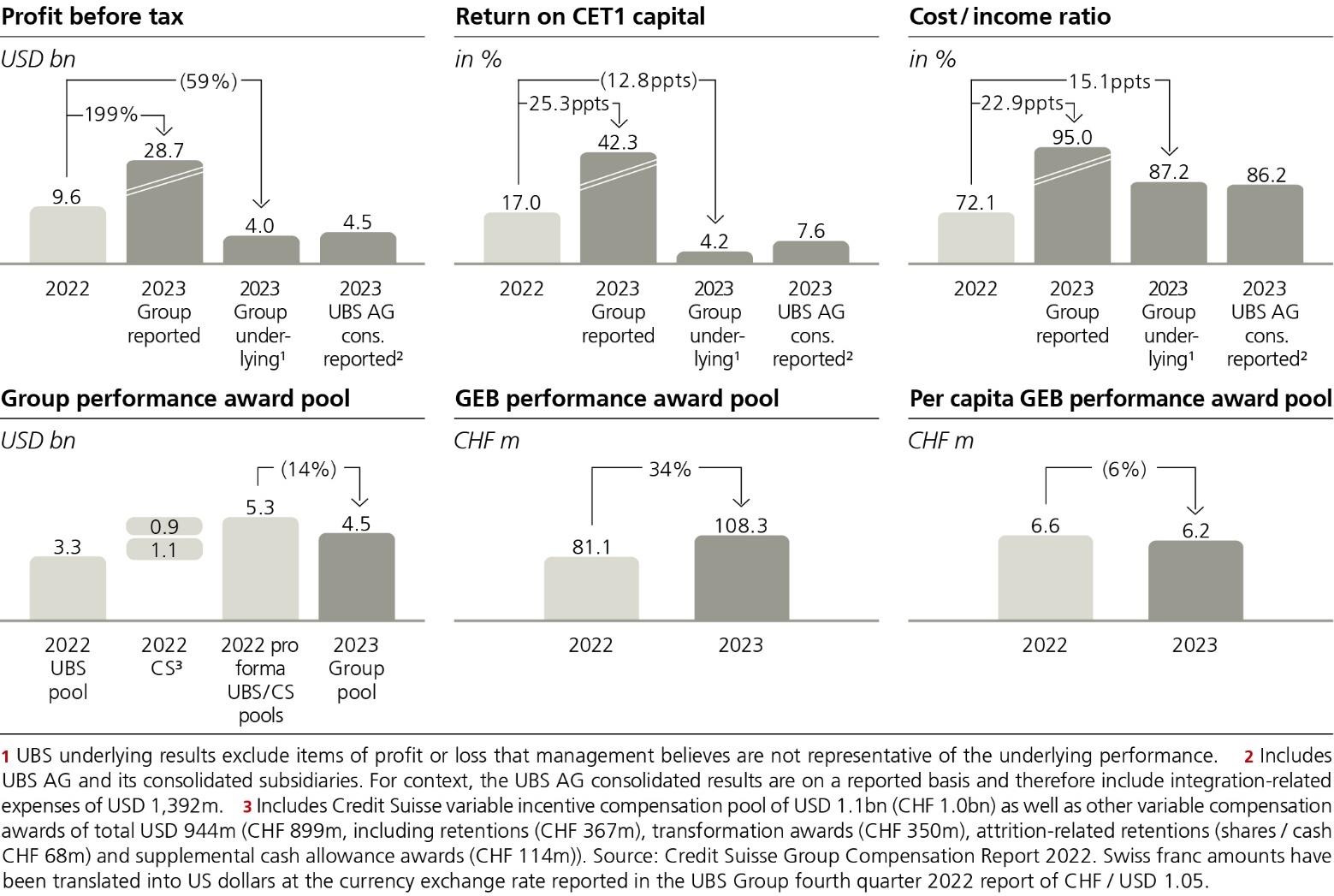
Advisory vote
|
Key acquisition-related accomplishments
In
2023,
we
made
tremendous
progress
with
the
integration
of
Credit
Suisse.
Following
the
announcement
of
the
acquisition
of
the
Credit
Suisse
Group,
we
focused
on
stabilizing
the
client
franchise,
managing
risks
and
bringing
operational stability to Credit Suisse. Key accomplishments include
the following.
–
Closing the transaction in three months.
–
Delivering an early repayment
of the Public Liquidity
Backstop and Emergency
Liquidity Assistance Plus and
returning
the Loss Protection Agreement.
–
Achieving around USD 4bn in exit rate gross cost savings (compared with full year 2022 for combined UBS and Credit
Suisse), as we
restructured our operations
and continued
to optimize our
cost base by
leveraging synergies between
the combined entities.
–
Accelerating the wind-down of Non-core and Legacy by reducing
risk-weighted assets by USD 12bn since finalizing its
perimeter in the second quarter of 2023, releasing over
USD 1.5bn of common equity tier 1 (CET1) capital.
–
Re-composing and augmenting the Group Executive Board (the
GEB) to successfully support the integration.
Financial Performance
Our performance in 2023 reflected
the costs from the integration of
Credit Suisse, the challenging operating
conditions
for the financial
industry, and
the uncertainty and
market volatility resulting
from continued
geopolitical tensions. On
a
consolidated basis,
reported profit
before tax
was USD 28,739m,
including USD 27,748m
of negative
goodwill related
to
the
acquisition,
as
well
as
integration-related
expenses
of
USD 4,478m,
and
negative
goodwill
related
pull
to
par
accretion and other purchase price allocation effects. On an underlying
basis, pre-tax profit for the combined businesses
was USD 3,963m.
›
Refer to the “Financial and operating performance”
section of this report for further details about the
Group and business
division performance
Advisory vote
|
Commitment to return capital to shareholders
Capital strength is a key
pillar of our strategy,
and we remain committed
to maintaining a balance sheet
for all seasons.
The year-end
CET1 capital ratio
was 14.4%, and
the CET1 leverage
ratio was 4.6%,
both in excess
of our guidance
of
~14%
and
>4.0%,
respectively.
For
2023,
the
Board
of
Directors
plans
to
propose
a
dividend
to
UBS
Group
AG
shareholders
of
USD 0.70
per
share.
We
remain
committed
to
progressive
dividends
and
are
accruing
for
a
mid-teen
percentage increase in the dividend per share for the 2024
financial year.
In 2023, we
bought back USD 1.3bn of
shares before we announced
the acquisition, at which
point we paused our
share
repurchases. In 2024,
we expect
to repurchase up
to USD 1bn of
shares, commencing
after the
merger of the
UBS AG
and Credit Suisse AG legal
entities,
which is expected before
the end of the second
quarter of the year. Our
ambition is
for share repurchases to exceed our pre-acquisition levels
by 2026.
2023 Group performance award pool
Over the past years, our performance award pool has consistently reflected our pay-for-performance philosophy and our
disciplined
approach
in
managing
compensation
over
business
cycles
and
in
alignment
to
shareholder
interests.
Accordingly, we
carefully assessed
the financial
results and
excluded both
the positive
and negative
one-time financial
impacts of the acquisition of the Credit Suisse Group.
The table below
provides more information on
the key factors
we considered for
the UBS sub-group
and the Credit Suisse
sub-group when
determining the performance
award pool.
Overall, it
was important to
balance like-for-like pay
outcomes
for comparable roles and performance to support the long-term
value creation of the integrated franchise.
2023 Group performance award pool development
UBS sub-group
–
Reflects our usual pay-for-performance approach beginning
with the financial results for the UBS sub-group.
–
In addition to financial business performance,
we regularly consider individual business-related
measures, risk and remediation
activities as well as competitive market considerations.
Credit Suisse
sub-group
–
Given the extraordinary circumstances, we were not able to
apply our usual process to determine the Credit Suisse
pool. We
considered other factors,
such as the need to retain key talent to support
realization of the value of our investment, support
pay
fairness across the entire organization and stabilize
the franchise during the integration period.
–
We also considered that 2022 compensation for the Credit Suisse
Group reflected a significantly reduced variable compensation
pool compared with 2021 awards including other variable
compensation.
We further
balanced our
performance
award pool
decisions
with specific
retention
awards delivered
in both
deferred
cash and
deferred
equity.
As in
most
merger
situations,
these retention
awards
were
a necessary
step to
support
the
protection of the client franchise,
risk management and operational stability. Furthermore, to
support our client win-back
strategy and promote
client growth,
we also
introduced a
client-acquisition and
retention award
for certain
producers,
which is fully deferred
and the final value
is linked to the
retention of client assets.
Retention efforts were
targeted and
limited
to
certain
client
roles
and
critical
roles
necessary
to
support
operational
stability.
Overall,
the
amounts
of
USD 736m are modest by industry
standards for an integration
of this magnitude. These
awards account for 3% of
our
total personnel expenses recognized in 2023.
The
UBS
compensation
framework
and
approach
provides
competitive
pay
for
performance,
further
supporting
operational
stability going
forward.
Our decisions
continue
to reflect
our diligent
approach
to considering
a balanced
allocation
of profit
between
shareholders
and
employees
over
the
cycle,
as well
as
supporting
strong
capital
returns,
including reflecting the appropriate risk awareness in our
business decisions.
Based on
the factors
above, the
2023 group
performance award
pool was
USD 4.5bn,
a reduction
of 14%
compared
with the pro forma
aggregate 2022 pool
of USD 5.3bn for
the combined entities (which
includes the UBS performance
award pool, the
Credit Suisse
variable incentive compensation
pool and other
variable compensation
awards related
to
the 2022 performance year).
The GEB pool
overall increased
by 34% to
CHF 108m,
which reflected
the changes in
GEB composition
to support the
merger, including the
addition of four
GEB members. The
GEB per capita
performance award decreased by
6% compared
with the previous year.
Separately,
we
are
also
grateful
for
certain
members
of
the
BoD
who
took
on
additional
board
roles
in
significant
subsidiary entities. These nominations
were critical to
providing strong governance
and oversight of the
newly acquired
subsidiaries, particularly
prior to
the merger
of these
legal entities
with their
UBS counterparts.
This approach
ensures
parent company board representation that otherwise would not have existed and promotes governance in line with UBS
Group AG’s governance principles.

Advisory vote
|
Continuity of our overall compensation framework
Following
a
comprehensive
annual
review,
we
confirmed
that
our
Total
Reward
Principles
and
overall
compensation
framework continue to be aligned with our purpose and remain relevant to the Group’s commitment to delivering long-
term shareholder value. It is imperative that
our pay approach equally recognizes
and supports the economic and cultural
integration of Credit Suisse to create long-term value for
the combined firm.
Overall, the compensation framework for all employees, including the GEB, remains broadly unchanged. With respect to
the equity component of our
deferred compensation plan, we have historically
granted the GEB equity with
performance
conditions and a payout that varies depending on the performance of
the company (the Long-Term Incentive Plan (LTIP)),
while other employees have received
shares with time vest requirements
only (the Equity Ownership Plan
(EOP)). During
the integration period, we
have expanded the
group that will receive
LTIP (in replacement
of EOP) to include
Managing
Directors (MDs) reporting to the GEB and their
direct reports at MD level. This will further
align the long-term focus of a
broader group of senior leaders with shareholders while supporting
appropriate risk taking and awareness.
Going forward,
we will
continue
to monitor
market
practice
and regulatory
developments
and, as
part of
our annual
review,
make
any
modifications
required
to
ensure
our
Total
Reward
Principles
and
compensation
framework
remain
aligned with the interests of our shareholders.
The 2024 Annual General Meeting
At the 2024 AGM on 24 April, we will seek your support
on the following compensation-related items:
–
the maximum aggregate amount of compensation for the BoD for the period from the 2024 AGM to the 2025 AGM;
–
the retroactive incremental amount of compensation for
the BoD for the period from the 2023 AGM to 2024 AGM
–
the maximum aggregate amount of fixed compensation
for the GEB for 2025;
–
the aggregate amount of variable compensation for the
GEB for 2023; and
–
shareholder endorsement in an advisory vote for this Compensation
Report.
On behalf
of the
Compensation Committee
and the
BoD, I thank
you again for
your feedback
and we respectfully
ask
for your continued support at the upcoming AGM.
Julie G. Richardson
Chairperson of the Compensation Committee of the
Board of Directors
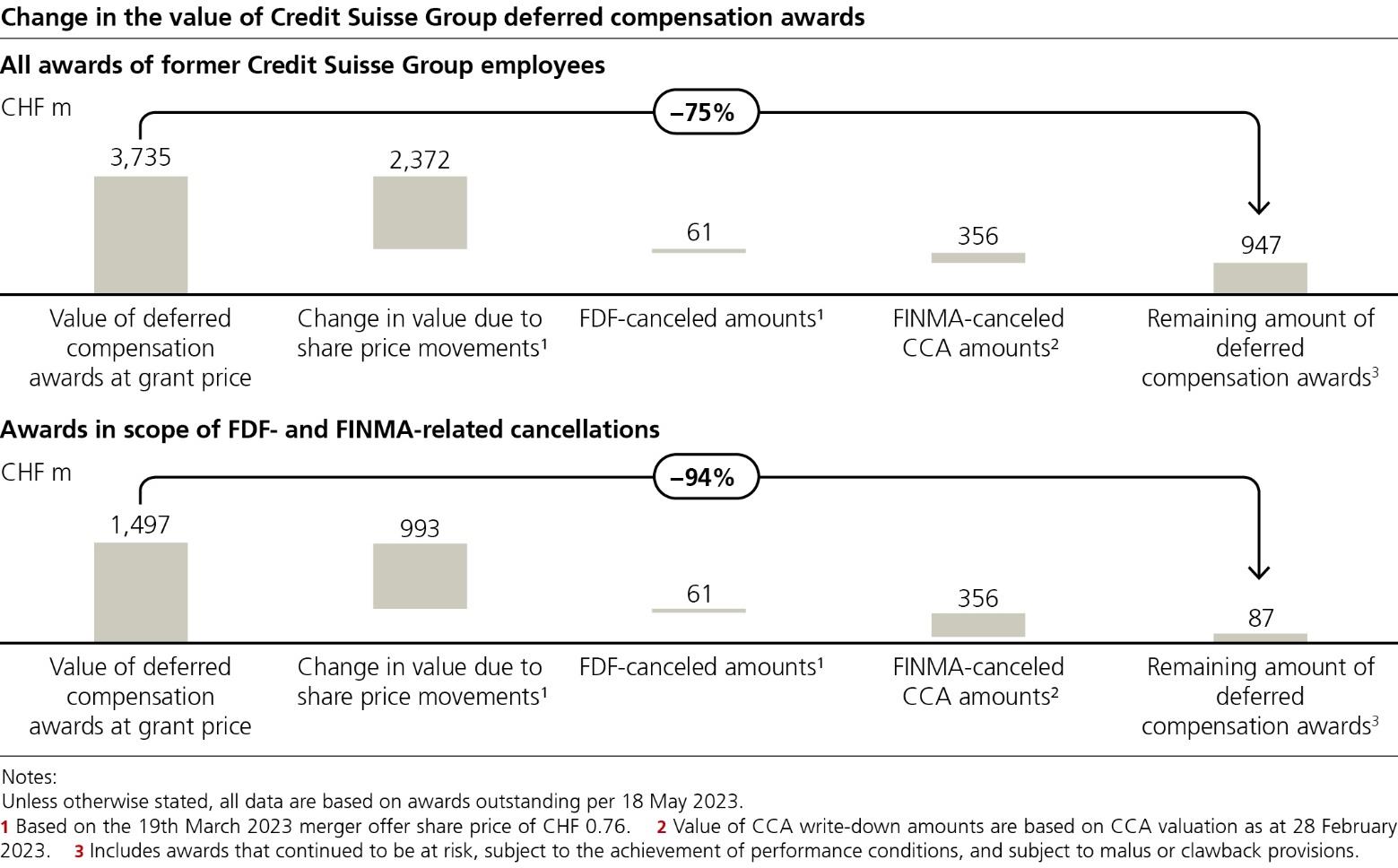
Advisory vote
|
2023 key compensation themes
The feedback that we
seek from our shareholders
about compensation-related
topics is very important
to us, as we
are
committed
to
maintaining
a
strong
link
between
the
interests
of
our
employees
and
those
of
our
shareholders.
We
continued
engaging
with
shareholders
during
2023
and
received
overall
positive
feedback
about
our
compensation framework.
The
below
summarizes
key
compensation
themes
for
2023
and
provides
answers
to
the
questions we most frequently receive
from shareholders.
Summary of 2023 key compensation themes / responses
to frequently asked questions
How did the failure of the Credit Suisse
Group impact deferred compensation
of Credit Suisse Group
employees?
On
19 March
2023,
we
announced
the
acquisition
of
the
Credit
Suisse
Group.
Until
that
date,
the
value
of
the
outstanding
deferred
compensation
of
Credit
Suisse
Group
employees
had
already
been
negatively
impacted
by
the
significant decline in the price of Credit Suisse Group shares.
Furthermore, on
23 May 2023,
the Federal
Department of
Finance (the
FDF) issued
an order
canceling or
reducing the
outstanding unvested
variable remuneration
for the
top levels
of management
of the
Credit Suisse
Group. In
addition,
the
Swiss
Financial
Market
Supervisory
Authority
(FINMA)
ordered
the
cancellation
of
outstanding
contingent
capital
awards (CCA) in line with the write-down of Credit Suisse
additional tier 1 (AT1) debt.
The following charts provide an overview of
the total change in the value
of Credit Suisse deferred compensation awards
in accordance with share price movements and the FDF-
and FINMA-canceled amounts.
–
Approximately CHF 2.8bn
(a decrease
of 75%
compared with
the initial
grant value)
of deferred
compensation was
lost by
Credit Suisse
Group employees.
After the
cancellations,
CHF 947m
remained outstanding
,
including awards
that continued to be at risk, subject to the achievement of performance conditions, and subject to malus or clawback
provisions.
–
Of the
CHF 2.8bn
mentioned above,
approximately CHF
1.4bn (a
decrease of
94% compared
with the
initial grant
value) of deferred compensation was lost by Credit Suisse Group employees impacted
by the FDF- and FINMA-related
cancellations, leaving a
remaining value of
CHF 87m
(including awards that
continued to be
at risk as
described above).
Overall,
these
reductions
of
CHF 2.8bn
in
the
value
of
deferred
compensation
demonstrate
the
impact
of
negative
business developments, risk events and share price movements.
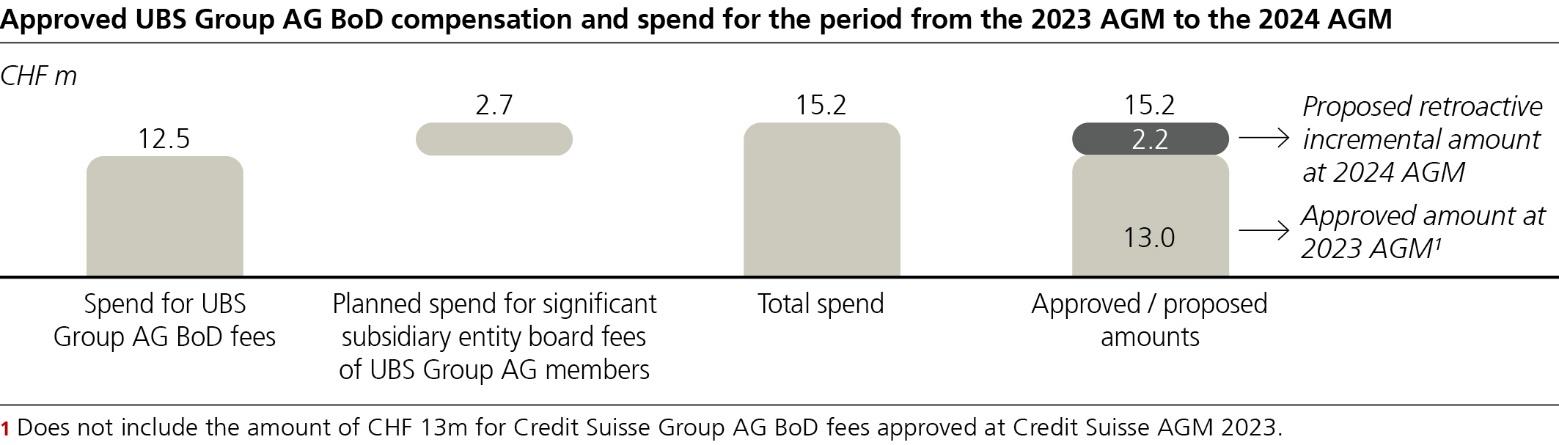
Advisory vote
|
What is the impact of the Federal Department of Finance
order on UBS?
On 11 August 2023, UBS voluntarily terminated the CHF 9bn
loss protection agreement (the LPA) and the
public liquidity
backstop
(the
PLB)
with
the
Swiss
National
Bank
of
up
to
CHF 100bn,
guaranteed
by
the
Swiss
government.
After
reviewing all assets covered
by the LPA since
the closing of the
transaction involving the acquisition
of the Credit
Suisse
Group
in
June
2023
and
taking
the
appropriate
fair
value
adjustments,
UBS
concluded
that
the
LPA
was
no
longer
required.
All loans
under the
PLB were
fully repaid
by the
Credit Suisse
Group as
of the
end of
May 2023
and Credit
Suisse AG
fully repaid outstanding Emergency Liquidity Assistance Plus loans on
10 August 2023.
Due to the
termination of
the LPA and
release of the
guarantee, the
implementation of the
UBS-related FDF
order was
no longer
required. Nevertheless,
our analysis
had confirmed
that the
key aspects
related to
the remuneration
system
requirements under the FDF order were already embedded in our Total Reward Principles
and compensation framework.
This relates in particular to consideration of both financial
and non-financial performance, including risk considerations.
Why is UBS seeking retroactive approval
for an incremental Board of
Directors compensation amount of
CHF 2.2m?
As a result
of the integration
of Credit Suisse,
in 2023
we expanded the
roles of certain
members of the
Board of Directors
of UBS
Group AG
(the BoD)
to take on
additional responsibilities in
the boards
of directors
of significant
subsidiary entities.
These nominations were and
remain critical to
providing strong governance and
oversight of the
subsidiaries, in a
manner
consistent and
in compliance
with UBS
Group
AG’s governance
principles, as
well as
to facilitating
the integration
of
Credit Suisse entities
into UBS. As the
integration
progresses, we will continue
to review the
composition of the
boards
of
directors
of
significant
entities.
Without
these
appointments,
UBS
would
not
have
had
parent
company
board
representation
on
these
significant
subsidiary
entities
and
would
have
had
difficulty
maintaining
legally
required
independent roles across all entities.
–
Lukas Gähwiler was appointed as chairman of Credit Suisse AG.
–
Jeremy Anderson
was
nominated
as vice
chairman
of Credit
Suisse
AG and
chair
of the
audit committee
of Credit
Suisse AG and, in addition, appointed as a member of the
board of directors of Credit Suisse International (UK).
–
Mark
Hughes
was
appointed
as
a
member
of
the
board
of
directors
of
Credit
Suisse
AG,
a
member
of
the
risk
committee of Credit Suisse AG and,
effective 1 December 2023, chair of the risk
committee of that board. In
addition,
Mr. Hughes was appointed as a member of the board
of directors of UBS Americas Holding LLC.
Considering
the
significant
increase
in
the
scope,
responsibility
and
complexity
of
their
mandate,
these
three
BoD
members will
be entitled
to receive
additional board
fees aligned
with other
non-executive
directors on
the respective
subsidiary entity boards.
Neither the acquisition of the Credit Suisse Group nor the appointments
to subsidiary board roles were anticipated when
the maximum amount
for BoD
fees of CHF
13m was submitted
at the
2023 Annual
General Meeting
(the AGM). As
a
result, while the spend for the BoD
of UBS Group AG is within the approved
amount, at the 2024 AGM we will
request
that the shareholders approve a
retroactive incremental amount of CHF 2.2m for
the period from the 2023 AGM to
the
2024 AGM to support the additional subsidiary board fees amount that exceeds the original approval at the 2023 AGM.
The payment of these subsidiary board fees is therefore subject
to shareholder approval.
As a reminder, shareholders of
UBS Group AG and Credit Suisse
Group AG had approved at
their respective 2023 AGM
an aggregate amount
for board
of director compensation
of combined
total CHF 26m.
The estimated
total BoD
spend
in the period
from the
2023 AGM
to the
2024 AGM
is CHF 18.1m,
of which
CHF 15.2m for
the Board
of Directors
of
UBS Group AG (as
shown in the chart
below) and the remaining
amount for the board of
directors of Credit Suisse
Group
AG (pre-merger
close) and
Credit Suisse
AG (post-merger
close). As
a result,
the overall
BoD spend
is CHF 7.9m
lower
compared with the combined approved aggregate amount.
Advisory vote
|
How did UBS adjust reported financial results
to calculate the Group and GEB performance
award pools as
well as the LTIP
2020/21 valuation?
The Compensation Committee determined to
use UBS
sub-group results as
the starting point
but made
adjustments to
exclude both
the positive
and negative
one-time financial
impacts of
the acquisition
of the Credit
Suisse Group.
The specific
adjustments include the impact of gains on the transaction, which means the negative goodwill,
or gain,
of USD 27.7bn
had no impact on
the Group and
GEB performance award pools or
the 2020 LTIP
achievement level. Other adjustments
relate to factors such as integration-
and acquisition-related
costs, increased CET1 capital requirements,
and the exclusion
of
certain
unplanned
one-off
items
that
would
otherwise
not
have
occurred,
including
higher
litigation
costs.
These
cumulative negative adjustments from reported results
reflect the rigorous internal review as well as the judgment of the
Compensation Committee. We have applied these adjustments in our considerations of pay and performance across the
Group, including for the
GEB, and, as
a net
result, the achievement level of
the 2020/21 LTIP
is below the
maximum of
100%.
What is the impact of the integration on outstanding
deferred compensation plans across both
entities?
After
the
acquisition,
the
outstanding
deferred
compensation
of
both
UBS
and
Credit
Suisse
employees
generally
continues to vest according to the original plan delivery
schedule and subject to applicable performance conditions.
UBS conducted a detailed review of Credit Suisse’s deferred compensation plans and aligned
the performance metrics to
those of UBS deferred compensation plans
where applicable. Furthermore, where applicable, share-based plans of Credit
Suisse were converted reflecting the merger conversion
rate,
to align with the Credit Suisse shareholder experience.
This approach underlines
our philosophy to align
the interests of employees
with those of shareholders.
Furthermore, it
demonstrates
a
consistent
treatment
of
employees
with
outstanding
deferred
compensation
awards
and
ultimately
supports operational stability and the economic and cultural
integration of Credit Suisse.
What retention activities have supported the
integration of Credit Suisse into
UBS?
Performance
management
and reward
play an
important
part in
supporting
the economic
and cultural
integration
of
Credit Suisse
into
UBS. We
have therefore
reviewed
our Total
Reward
Principles
and
confirmed that
they remain
fully
aligned with
our purpose
and support
our strategic
objectives.
In the
short-to-medium
term, they
also enable
UBS to
drive the economic and cultural integration of Credit Suisse
and the long-term value creation of the combined
firm.
Furthermore, we
have swiftly
implemented an
integrated performance
and reward
year-end process
for the
combined
firm,
which
supports
our
sustainable
high
performance
culture
and
reflects
our
well-established
approach
to
pay
for
performance.
The compensatio
n
decisions for
all employees
were
governed by
the
same Total
Reward Principles.
This
integrated
approach
supported
a
one-firm
employee
experience
and
our
emphasis
on
like-for-like
outcomes
for
comparable performance and roles.
To
support
operational
stability,
manage
risks
and
protect
the
client
franchise,
we
have
deployed
specific
additional
measures. Retention awards
were delivered in
both deferred cash
and deferred equity
awards. Furthermore, to
support
our client win-back strategy and promote
client growth, we also introduced
a client acquisition and retention
award for
certain producers, which
is fully deferred
and the final
value is linked
to the retention
of client assets.
Retention efforts
were targeted
and limited to
certain client roles
and critical roles
necessary to
support operational
stability. Overall, the
amounts of
USD 736m are
modest by
industry standards
for an
integration of
this magnitude.
These retention
awards
account for 3% of our total personnel expenses recognized
in 2023.
In addition,
we provided indications of 2023
incentive levels to a number of
Credit Suisse employees, primarily in
client-
facing roles,
to emphasize that
their compensation
going forward would
reflect appropriate levels
of pay
for performance.
The UBS compensation framework
and approach provides competitive pay
for performance, further supporting
stability
going
forward.
Beyond
financial
compensation-related
measures,
our
merger-related
activities
included
non-financial
aspects,
such as a broad-based communication approach with Credit
Suisse employees.
How did UBS support employees during the integration
process?
Supporting employee health
and well-being remained
a priority in
2023. Resources to
support holistic well-being
included
a range of programs,
benefits and workplace
resources, along with
a bespoke eLearning
curriculum that aimed
to help
our employees
manage their
health, foster
well-being, strengthen
their resilience
and support
the sustainability
of the
organization.
In
the
context
of
the
integration
of
Credit
Suisse,
we
expanded
our
offering
to
include
guidelines
and
instructor-led sessions on managing organizational change,
uncertainty and resilience.
In
2023,
we
announced
that
existing
social
plans
or
support
during
redundancy
at
UBS
and
Credit
Suisse
had
been
aligned globally (where applicable) to ensure that all employees
were treated equally.
As an example,
employees in the
Swiss labor market
affected by the
restructuring are entitled
to a program
with a key
focus on redeployment
within UBS, and
we have significantly
increased the budget
for education and
training. Outside
of the Swiss labor
market, we provide
severance payments that
are governed by
location-specific severance policies.
At
a minimum, we
offer severance
terms which comply
with the applicable
local laws. In
many locations,
we may provide
severance packages negotiated with our local social partners that go beyond these minimum legal requirements
or offer
additional time
in order
to find
a new
position. In
certain locations,
we may
also offer
redeployment support
from our
internal recruiters or via external outplacement firms for
employees affected by redundancies.
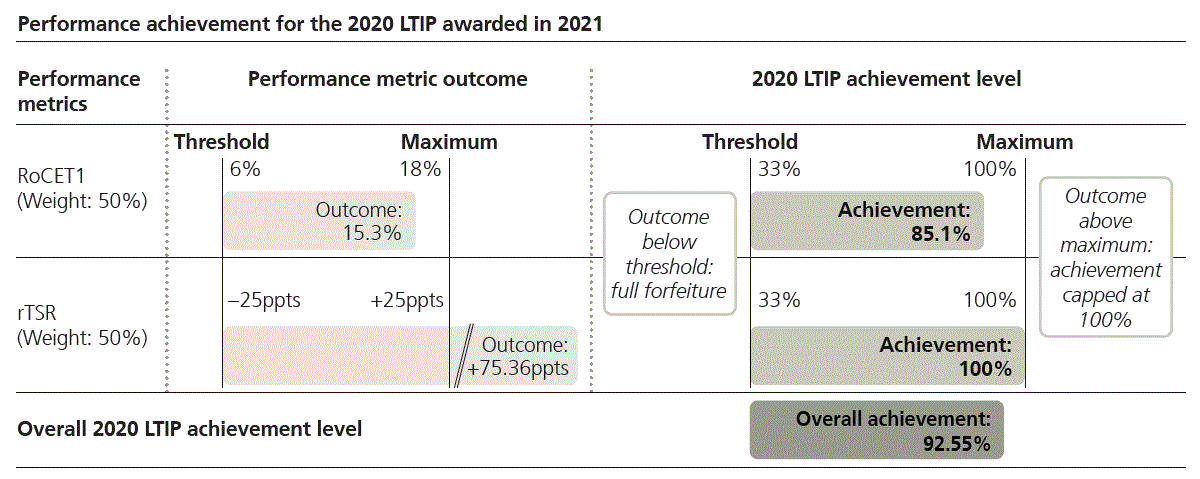
Advisory vote
|
Did UBS change the compensation framework for 2023?
We are convinced
that our compensation
framework remains best-in-class for
our industry. Therefore,
it remained broadly
unchanged for 2023. The
compensation approach reflects a substantial
deferral into equity-
and debt-based vehicles that
support alignment with
our shareholders and
debtholders. Furthermore,
the vesting
period over five
years remains one
of the longest in the industry,
providing for long employment and performance conditions.
For 2023, we
will award the
equity-aligned portion
of compensation
as part of
the Long-Term
Incentive Plan
(LTIP, as a
replacement for the EOP) for the GEB and Managing Directors (MDs) reporting to the GEB and their direct reports at MD
level. These
senior leaders
receive the
equity portion
of their
2023 performance
award in
LTIP to
support delivering
on
our ambitious integration goals and business
/ financial targets. This further mitigates
the need for a distinct integration
award typical for a transaction
of this nature.
What has changed in the 2023 LTIP
(awarded in 2024)?
We maintain
our overall
LTIP with
the same
two equally
weighted performance
metrics (reported
RoCET1 and
relative
Total Shareholder
Return (rTSR))
over a
three-year
performance period,
while making
adjustments to
the performance
range of the RoCET1 metric.
For the
2023 LTIP
award (granted
in 2024),
the reported
RoCET1 metric
reflects
the impact
of the
acquisition and
our
ambitious integration objectives,
as well as the communicated
financial ambitions over the cycle.
As a consequence,
we
continue
to
use
the
reported
basis
for
our
RoCET1
metric,
as
this
also
considers
the
underlying
business
results
and
integration costs.
For the
2023 performance
year, we
awarded the
LTIP at
a value
of 50% of
the maximum,
to further
align the maximum opportunity with the stretching nature
of our financial ambitions.
The maximum
reported RoCET1
of 10% corresponds
with a
100% payout aligned
with our stretch
target.
In contrast,
the minimum reported RoCET1 of 5% corresponds with a 33% payout aligned with sustainable results in the context
of
the integration. Below the threshold of 5% reported RoCET1,
the award is subject to full forfeiture.
The unchanged
rTSR performance
range of
±25 percentage
points of UBS
TSR compared
with a
peer group
index TSR
continues to demonstrate
our ambition of
delivering attractive
relative returns to
shareholders.
The peer group
consists
of all
listed Global
Systemically
Important Banks,
which were
independently defined
by the
Financial Stability
Board in
2023, and reflects
companies with a comparable risk profile and impact
on the global economy.
During the
integration period,
we have
expanded the
group that will
receive LTIP
to include
Managing Directors
(MDs)
reporting to the
GEB and their
direct reports at
MD level. We
will continue to
review the LTIP
design, including the
RoCET1
performance range, in consideration of our integration
progress and financial ambitions.
What is the achievement level of the LTIP
granted in 2021 for 2020 performance?
The deferred portion of
the performance award
granted in 2021 (for
the 2020 financial performance
year) to members
of the GEB and
selected senior management
was in part delivered
through the LTIP award.
The three-year performance
period
concluded
at
the
end
of
2023,
with
the
2020
LTIP
achieving
92.55%
of
the
maximum
opportunity
(of
up
to
100%).
As explained above, the
Compensation Committee made
certain adjustments to the
financial results used to
determine
the 2020
LTIP achievement
level. As
noted, if
the Compensation
Committee had
not made
these adjustments
but had
applied reported UBS Group AG financial results, the achievement
level would have been 100%.
We
believe
alignment
of
our
senior
leadership
with
our
shareholders
is
important
for
long-term
success.
Our
LTIP
is
designed to support alignment of
compensation with the execution of our
strategy, financial performance and long-term
growth.
Advisory vote
|
Say-on-pay
Say-on-pay votes at the AGM
In
line
with
the
Swiss
Code
of
Obligations,
we
seek
binding
shareholder
approval
for
the
aggregate
compensation
awarded to the Group Executive Board
(the GEB) and the Board of Directors (the BoD). Prospective
approval of the fixed
compensation
of
the
BoD
and
GEB
provides
the
firm
and
its
governing
bodies
with
the
certainty
needed
to
operate
effectively.
Retrospective approval of the
GEB’s variable compensation aligns
their compensation with performance
and
contribution.
The table
below outlines
our
compensation
proposals,
including
supporting rationales,
that we
plan to
submit to
the
2024 Annual General Meeting
(the AGM) for binding
votes,
in line with the
Swiss Code of Obligations
and our Articles
of Association.
These binding
votes on
compensation and
the advisory
vote on
our Compensation
Report reflect
our commitment
to
shareholders having their say on pay.
›
Refer to “Provisions of the Articles of Association related to
compensation” in the “Supplemental information”
section of this
report for more information
Audited |
Approved GEB fixed compensation and BoD compensation
At the 2022 AGM,
the shareholders approved a maximum aggregate fixed compensation amount
of CHF 33.0m for GEB
members
for
the
2023 performance
year.
This budget
reflects
base
salaries, role
-based
allowances
in response
to
EU
Capital
Requirements
Directive
V,
and
estimated
standard
contributions
to
retirement
benefit
plans,
as
well
as
other benefits.
The aggregate
fixed compensation
paid in
2023 to
GEB members
was below
the approved
amount for
2023.
At the
2023 AGM,
the shareholders
approved a
maximum aggregate
amount of
compensation of
CHF 13.0m for
the
members of the BoD for the period from the 2023 AGM to the 2024 AGM. At the 2024 AGM, we
will ask shareholders
to exceptionally
approve a
retroactive
incremental amount
of CHF 2.2m
of BoD
compensation for
the period
from the
2023 AGM to the 2024 AGM as outlined below.
p
›
Refer to “2023 total compensation for the
GEB members” in the “Compensation for GEB
members” section of this report
›
Refer to “Remuneration details and additional information
for BoD members” in the “Compensation
for the Board of Directors”
section of this report
Advisory vote
|
Compensation-related proposals for binding and advisory
votes at the 2024 AGM
Item
Approved at the 2023
AGM
BoD proposals for the
2024 AGM
Rationale
GEB variable
compensation
Shareholders approved
CHF 81,100,000 for the
2022 financial year
1,2,3
(vote “for”: 87.1%)
The BoD proposes an
aggregate amount of
variable compensation of
CHF 108,286,300 for the
members of the GEB for
the 2023 financial year.
In 2023, we added four GEB members to successfully support the integration. The
GEB performance award pool takes into
account the changes in GEB composition
and
reflects
the
significant
progress
in
the
integration,
including
bringing
operational stability to Credit Suisse
after the announcement of the
acquisition. It
also reflects that the
Group achieved underlying profitability following
the closing
of
the acquisition
and maintained
the Group’s
strong capital
position. On
a per
capita basis, the GEB performance award pool decreased by
6%.
GEB fixed
compensation
Shareholders approved
CHF 33,000,000 for the
2024 financial year
1,2,3
(vote “for”: 89.3%)
The BoD proposes a
maximum aggregate
amount of fixed
compensation of
CHF 33,000,000 for the
members of the GEB for
the 2025 financial year.
The proposed amount is
unchanged compared with last
year despite the increase
in the number of GEB members
in 2023. It further reflects unchanged
base salaries
for the Group CEO and other GEB members.
Besides the
base salaries,
the amount
also includes
estimated standard
contributions
to retirement
benefit plans,
as well
as other
benefits. The
proposed amount
provides
flexibility in
light
of
potential changes
of GEB
composition or
roles,
competitive
considerations as well as other factors (e.g., changes
in FX rates or benefits).
BoD
compensation
n. a.
The BoD proposes an
incremental amount of
compensation of
CHF 2,200,000 for the
members of the BoD for
the period from the 2023
AGM to the 2024 AGM.
As a
result of
the integration of
Credit Suisse, in
2023 we expanded
the roles
of
certain members of the Board of Directors of UBS Group AG to take on additional
responsibilities in
the boards
of
directors
of
significant subsidiary
entities. These
nominations
are
critical
to
providing
strong
governance
and
oversight
of
the
subsidiaries,
in
a
manner
consistent
and
in
compliance
with
UBS
Group
AG’s
governance
principles, as
well
as
to
facilitating
the
integration
of
Credit
Suisse
entities into UBS.
Neither
the
acquisition
of
the
Credit
Suisse
Group
nor
the
appointments
to
subsidiary board roles
were anticipated when the
maximum amount for BoD
fees
of CHF 13m was submitted at the 2023 AGM. As a result, while the spend for the
BoD
of
UBS
Group
AG
is
within
the
approved
amount,
we
propose
that
shareholders approve a retroactive incremental
amount of CHF 2.2m
for the period
from the 2023 AGM to the
2024 AGM to support the additional subsidiary board
fees amount that exceeds the original approval
at the 2023 AGM.
As a
reminder,
shareholders of
UBS Group
AG and
Credit Suisse
Group AG
had
approved at their respective 2023
AGM an aggregate amount
for board of director
compensation of combined total CHF
26m. The estimated total BoD
spend in the
period from the 2023 AGM to the 2024 AGM is CHF 18.1m, of which CHF 15.2m
for the
Board of
Directors of
UBS Group
AG and
the remaining
amount for
the
board of directors of Credit
Suisse Group AG (pre-merger close) and
Credit Suisse
AG
(post-merger
close).
As
a
result,
the
overall
BoD
spend
is
CHF
7.9m
lower
compared with the combined approved aggregate amount.
Shareholders approved
CHF 13,000,000 for the
period from the 2023
AGM to the 2024 AGM
1,2,4
(vote “for”: 88.0%)
The BoD proposes a
maximum aggregate
amount of compensation
of CHF 16,500,000 for the
members of the BoD for
the period from the 2024
AGM to the 2025 AGM.
The proposed amount reflects
all BoD fees, including
the total compensation
of the
Chairman and
the Vice
Chairman role,
as well
as
subsidiary fees
of certain
UBS
Group AG members for their
mandates in significant subsidiary
entities. The overall
amount
is
higher compared
with
the previous
period which
reflects the
fees to
certain BoD members for
their continued critical roles
in the board
of directors of
significant subsidiary
entities. It
also includes
a higher
fee for
the Chairman
to reflect
the
significantly
increased
scope,
responsibility
and
complexity
following
the
acquisition of
Credit Suisse.
The fees
for other
BoD members
including the
Vice
Chairman remain unchanged.
Advisory vote
on the
Compensation
Report
Shareholders approved the
UBS Group AG
Compensation Report
2022 in an advisory vote
(vote “for”: 85.6%)
The BoD proposes that the
UBS Group AG
Compensation Report
2023 be ratified in an
advisory vote.
Our Total
Reward Principles and
overall compensation framework
continue to
be
aligned
with
our
purpose
and
remain
relevant
to
the
Group’s
commitment
to
delivering
long-term
shareholder
value.
It
is
imperative
that
our
pay
approach
equally recognizes
and supports
the economic
and cultural
integration of
Credit
Suisse to create long-term value for the combined firm. Overall, the compensation
framework for all employees,
including the GEB, remains
broadly unchanged and
our decisions
continue to reflect
our diligent approach
to considering a
balanced
allocation of profit between shareholders and employees over the cycle, as well as
supporting
strong
capital
returns,
including
reflecting
the
appropriate
risk
awareness in our business decisions.
1
2
3
in “Group Executive Board” in the “Corporate governance” section of this report,
16 GEB members were in office on 31 December 2023 and twelve GEB members were in office on 31 December 2022.
4
members were in office on 31 December 2023 and on 31 December 2022.

Advisory vote
|
Compensation philosophy and governance
Our compensation philosophy
Total Reward Principles
Our Total Reward Principles provide a strong link to our strategic imperatives
and encourage employees to live our
strong
and inclusive
culture that
is grounded
in our
three keys
to success:
our Pillars,
Principles and
Behaviors. These
guiding
principles underpin our approach to compensation
and define our compensation framework. Following
a comprehensive
review in 2023, we
concluded that our
Total
Reward Principles and
compensation framework
are well aligned with
our
purpose and support our
strategic imperatives. This aims
to ensure that
the interests of our
employees are aligned
with
those of
our clients
and other
stakeholders. In
the short-to-medium
term, they
also enable
UBS to
drive the
economic
and cultural integration of Credit Suisse and the
long-term value creation of the combined firm.
Therefore, our compensation
approach supports our
capital strength and
risk management and
provides for simplification
and efficiency. It encourages employees to
focus on client centricity, connectivity and sustainable
impact in everything we
do.
Moreover,
we
reward
behaviors
that
help
build
and
protect
the
firm’s
reputation,
specifically
Accountability
with
integrity, Collaboration and Innovation.
Compensation for each employee is based on individual, team, business
division
and Group performance, within the context of the markets
in which we operate.
Total Reward Principles
Our
Total
Reward
Principles
apply
to
all
employees
globally
but
vary
in
certain
locations
according
to
local
legal
requirements,
regulations and practices.
The table below provides a summary of our
Total
Reward Principles.
Support our purpose and strategy
Our compensation approach supports the firm’s
purpose and strategy, fosters engagement among
employees and aligns their long-term interests
with those of clients and stakeholders.
Attract, retain and connect a diverse,
talented workforce
We embrace a culture of diversity, equity and inclusiveness. Pay at UBS is fair, reflects equal treatment and
is competitive. In this way, our investment in a connected workforce supports
the sustainability of the
organization.
Apply a pay-for-performance approach to
promote development and our ways of
working
The setting of clear objectives,
as well as a thorough evaluation of what was achieved
and how it was
achieved, combined with effective communication,
promotes clarity, accountability and establishes a
strong link between pay and performance. This
approach emphasizes our Behaviors, which are
Accountability with integrity, Collaboration and Innovation.
Reinforce sustainable growth and support
long-term value creation
Compensation is appropriately balanced between
fixed and variable elements and delivered over
an
adequate period to support our growth ambitions
and sustainable performance.
Support risk awareness and appropriate
risk-taking
Our compensation structure encourages employees
to have a focus on risk management and behave
consistently with the firm’s risk framework
and appetite, thereby anticipating and managing
risks
effectively to protect our capital and reputation.
Our Total Reward approach
At UBS,
we apply
a holistic
Total
Reward
approach,
generally
consisting
of fixed
compensation
(base
salary and
role-
based allowances, if applicable), performance awards,
pension contributions and benefits. Our Total Reward approach is
structured to support sustainable results and
growth ambitions.
For employees whose
total compensation exceeds
certain levels, performance
awards are delivered
in a combination
of
cash, deferred contingent capital awards and deferred
share-based awards.
A substantial portion of performance awards is deferred and vests over a five-year period (or longer for certain regulated
employees).
This
deferral
approach
supports
alignment
of
employee
and
investor
interests,
our
capital
base
and
the
creation of sustainable shareholder value.
›
Refer to “Compensation elements for all employees”
in the “Group compensation” section of this report for
more information
Advisory vote
|
Compensation governance
Board of Directors and Compensation Committee
The
Board
of
Directors
(the
BoD)
is
ultimately
responsible
for
approving
the
compensation
strategy
and
principles
proposed by the
Compensation Committee,
which determines compensation
-related matters
in line with the
principles
set forth in the Articles of Association (the AoA).
As determined in the
AoA and the firm’s
Organization Regulations, the Compensation Committee supports
the BoD with
its
duties
to
set
guidelines
on
compensation
and
benefits,
to
oversee
implementation
thereof,
to
approve
certain
compensation
and
to
scrutinize
executive
performance.
The
Compensation
Committee
consists
of
independent
BoD
members,
who are
elected annually
by shareholders
at the
Annual General
Meeting (the
AGM), and
is responsible
for
governance
and
oversight
of
our
compensation
process
and
practices.
This
includes
the
alignment
between
pay
and
performance, and ensuring that the compensation framework supports appropriate risk awareness and management, as
well as appropriate risk-taking.
In 2023, to additionally
support the connection between
the Compensation Committee
and the Risk Committee, the Compensation Committee
Chairperson was also a member of the Risk Committee.
Annually, and on behalf of the BoD, the Compensation
Committee:
–
reviews our Total Reward Principles;
–
approves key
features of
the compensation
framework and
plans for
the non-independent BoD
members and
members
of the Group Executive Board (the GEB);
–
reviews performance
award funding
throughout the
year and
proposes, upon
proposal of
the Group
CEO, the
final
annual Group performance award pool to the BoD for approval;
–
upon proposal of the Group CEO, reviews the performance
framework for the other GEB members;
–
upon proposal of
the Group
CEO, proposes the
performance assessments
and the
individual total
compensation for
the other GEB members for approval by the BoD;
–
upon proposal of the
Chairman, for the Group
CEO, proposes the financial and
non-financial performance targets and
objectives, the performance assessment and the total compensation
for approval by the BoD;
–
approves the total compensation for the Chairman and the
non-independent BoD members;
–
upon
proposal
of
the
Chairman,
proposes
the
remuneration
/
fee
framework
for
independent
BoD
members
for
approval by the BoD;
–
upon
proposal
of
the
Chairman
and
the
Group
CEO,
approves
the
remuneration
/
fee
frameworks
for
external
supervisory board members
of Significant Group
Entities and is
informed of remuneration
/ fee frameworks
for external
supervisory board members of Significant Regional Entities;
–
proposes to the
BoD for approval
the annual compensation
report and approves
other material public
disclosures on
UBS compensation matters;
and
–
proposes to
the
BoD, for
approval
by the
AGM, the
maximum aggregate
amounts
of BoD
compensation
and
GEB
fixed compensation and the aggregate amount of variable
compensation for the GEB.
The Compensation
Committee is
required to
meet at least
four times each
year. All
meetings in
2023 were
held in the
presence of the
Chairman, the
respective Group
CEOs and external
advisors. In addition,
three ad hoc
calls took place,
most of
which were
attended
by the
Chairman and
by external
advisors. Individuals,
including the
Chairman and
the
Group
CEO,
are
not
permitted
to
attend
a
meeting
or
participate
in
a
discussion
on
their
own
performance
and
compensation.
After
the
meetings,
the
Chairperson
of
the
Compensation
Committee
reports
to
the
BoD
on
the
Compensation
Committee’s activities
and discussions
and, if necessary,
submits proposals
for approval
by the
full BoD. Compensation
Committee
meeting
minutes
are
also
sent
to
all
members
of
the
BoD.
On
31 December
2023,
the
members
of
the
Compensation Committee were Julie G. Richardson (Chairperson),
Dieter Wemmer and Jeanette Wong.
›
Refer to “Board of Directors” in the “Corporate governance”
section of this report for more information
Advisory vote
|
External advisors
The Compensation Committee may
retain external advisors to
support it in
fulfilling its duties. In
2023, HCM International
Ltd.
(HCM)
provided
independent
advice
on
compensation
matters.
HCM
holds
no
other
mandates
with
UBS.
Additionally,
Willis Towers
Watson provided
the Compensation
Committee with
data on
market trends
and pay
levels.
Various subsidiaries of Willis
Towers Watson provide similar information to UBS’s
human resources department in
relation
to
compensation
for
employees,
including
advisory
services
and
secondments
to
UBS
on
benefits
and
year-end
compensation activities. Willis Towers
Watson holds no other compensation
-related mandates with UBS.
The Risk Committee’s role in compensation
The Risk Committee,
a committee of
the BoD, works
closely with the
Compensation Committee with the
goal of ensuring
that our compensation framework appropriately reflects
risk awareness and management, and
supports appropriate risk-
taking. It supervises and sets appropriate risk management and risk
control principles and is regularly briefed on how risk
is factored into the
compensation process. It
also monitors the involvement
of Group Risk Control
and Compliance and
Operational Risk in compensation and reviews risk-related
aspects of the compensation process.
›
Refer to
ubs.com/governance
Compensation Committee 2023 / 2024 key activities
and timeline
April
May
July
Sept
Oct¹
Nov
Dec¹
Jan
Mar
Strategy, policy and governance
Total Reward Principles
l
Integration-related compensation matters
l
l
l
l
l
l
l
l
Sustainability / ESG, pay fairness and diversity, equity & inclusion (DE&I) in the
compensation process
l
l
Compensation disclosure and stakeholder communication matters
l
l
l
AGM reward-related items
l
l
Compensation Committee governance
l
l
Annual compensation review
Accruals and full-year forecast of the performance award pool
funding
l
l
l
l
l
Performance targets and performance assessment of the Group CEO
and GEB members
l
l
l
l
Group CEO and GEB members’ salaries and individual performance
awards
l
l
Update on market practice, trends and peer group matters
l
l
l
Pay for performance, including governance on certain higher-paid employees, and formulaic
compensation arrangements
l
l
l
l
l
l
l
Board of Directors remuneration
l
l
l
l
Compensation framework
Compensation framework and deferred compensation matters
l
l
l
l
l
l
Risk and regulatory
Risk management in the compensation approach
l
l
l
l
Joint meeting with the BoD Risk Committee
l
Regulatory activities impacting employees and engagement
with regulators
l
l
l
l
l
1 The Compensation Committee held two meetings in October and December 2023.
Compensation governance
The table below provides an overview of compensation
governance by specific role.
Recipients
Compensation recommendations proposed by
Approved by
Chairman of the BoD and
Vice Chairman of the BoD
Compensation Committee
Compensation Committee
1
Other BoD members
Compensation Committee and Chairman of
the BoD
BoD
1
Group CEO
Compensation Committee and Chairman of
the BoD
BoD
1
Other GEB members
Compensation Committee and Group CEO
BoD
1
Key Risk Takers (KRTs)
/
senior employees
Respective GEB member and functional management
team
Individual compensation for KRTs and senior employees:
Group CEO
1
Advisory vote
|
Environmental, social and governance considerations
Environmental, social and governance objectives in
the compensation process
Our
compensation determination process
considers environmental,
social and
governance (ESG)
objectives in
objective
setting, performance
award pool funding,
performance
evaluation and
individual
compensation decisions.
ESG-related objectives
have been
embedded in
our Pillars
and Principles
since they
were established
in 2011.
In 2021,
we introduced explicit
sustainability objectives in
the non-financial goal
category of the
Group CEO and
GEB performance
scorecards.
In
2023,
we
further
enhanced
the
GEB
performance
scorecard
framework
by
establishing
separate
Environmental & Sustainability and People
& Governance categories. The objectives in
these categories are linked to our
sustainability priorities,
and their
progress is
measured via
robust quantitative
metrics and
qualitative criteria.
The table
below
provides
an
overview
of
our
metrics
and
progress
achieved
in
2023,
including
climate-related
goals
under
the
priority “Planet.”
Sustainability objectives
are assessed
for each
GEB member
on an
individual basis,
directly impacting
their respective performance assessments
and compensation decisions.
The
determination
of
the
Group
performance
award
pool
funding
also
takes
into
account
ESG
factors.
Aside
from
financial performance, an
assessment of progress
is made against
objectives linked to
our focus areas
of Planet, People
(including
progress
made
against
our
diversity
aspirations)
and
Partnerships,
alongside
other
key
non-financial
considerations.
Therefore,
ESG
is taken
into
consideration
when
the
Compensation
Committee
assesses
performance
and compensation
of each
GEB member.
Additionally, the
assessment impacts
the overall
performance award
pool for
the Group.
Going
forward,
we
will
continue
to
review
and
refine
the
role
of
ESG
considerations
in
our
performance
and
compensation
framework,
to
ensure
they
remain
aligned
to
our
strategic
priorities
and
the
sustainable
growth
of
shareholder value.
›
Refer to “GEB performance assessments”
in the “Compensation for GEB members” section
of this report for more information
about the GEB performance measurement process
›
Refer to “Our focus on sustainability and climate,”
“Employees” and “Society” in the “How
we create value for our stakeholders”
section of this report for more information
›
Refer to
ubs.com/gri
Fair and equitable pay
Pay equity and equal opportunity
are fundamental to
achieving our purpose. The
diversity of our employees
in terms of
experiences, perspectives and
backgrounds is critical
to our success. Factors
such as gender,
race, ethnicity or
part-time
status should not impact opportunities available to our employees
.
Fair and consistent
pay practices are
designed to ensure
that employees are
appropriately rewarded for their
contribution.
We
pay
for
performance,
and
we
take
pay
equity
seriously.
We
have
embedded
clear
commitments
in
our
global
compensation
policies
and
practices.
We
regularly
conduct
internal
reviews
and
independent
external
audits
on
pay
equity, and our
statistical analyses show a
differential between men and
women in similar roles
across our major locations
of less than 1%.
In 2020,
we completed
an equal
pay analysis
in Switzerland,
as required
by the
Swiss Federal
Act on
Gender Equality.
The results confirmed that
we are fully compliant
with Swiss equal pay
standards. Beginning in
2020, UBS was certified
(through 2023) by the EQUAL-SALARY Foundation for our HR practices,
including compensation,
in Switzerland, the US,
UK, the Hong Kong SAR and Singapore, covering
more than two-thirds of our global employee population. All
of our HR
policies
are
global,
and
we
apply
the
same
standards
across
all
locations.
Furthermore,
we
review
our
approach
and
policies
annually
to
support
our
continuous
improvement.
In
2023,
we
fully
integrated
former
Credit
Suisse
Group
employees into all of our fair pay practices and continued to monitor and improve our pay
equity position in our leading
countries.
We also aim to ensure that all
employees are paid at least a
living wage. We regularly assess employees’
salaries against
local living wages, using benchmarks defined by the Fair Wage Network. Excluding our US financial
advisor staff (as their
compensation is primarily based on a formulaic approach), our analysis in 2023 showed that employees’ salaries were at
or above the respective benchmarks.
Advisory vote
|
Our aspirations and progress
Following the acquisition of the Credit Suisse Group, our exposure
increased accordingly, so we reviewed our aspirations.
Amendments
that
arose
from
this
review
process
were
considered
by the
Group
Executive
Board and
the
UBS
Group
Board
of
Directors’
Corporate
Culture
and
Responsibility
Committee.
This
table
reflects
the
overall
outcomes
of
this
process with more detailed information provided in the UBS Group
Sustainability Report 2023.
Our priorities
Our aspirations or targets
Our progress in 2023
Planet, people,
partnerships
Sustainable investments.
1
Increased invested assets in sustainable investments
in UBS AG to
USD 292.3bn (compared with USD 266bn in 2022).
Planet
Following the acquisition of the Credit Suisse Group,
we
refined the UBS Group lending sector decarbonization
targets to reflect the activities of the combined
organization and evolving standards and methodologies.
2
Reduce emissions intensity associated with
UBS in-scope
lending by 2030 from 2021 levels for:
–
Swiss residential real estate by 45%;
–
Swiss commercial real estate by 48%;
–
power generation by 60%;
–
iron and steel by 27%; and
–
cement by 24%.
Reduce absolute financed emissions associated
with UBS
in-scope lending by 2030 from 2021 levels for:
–
fossil fuels by 70%.
Continue disclosing in-scope ship finance portfolios
according to the Poseidon Principles decarbonization
trajectories with the aim of aligning therewith.
3
Calculated progress against pathways for revised targets.
4
Changes in emissions intensity associated
with UBS in-scope lending (end
of 2022 vs. 2021 baseline):
–
Swiss residential real estate reduced by 6%;
–
Swiss commercial real estate increased by 2%;
–
power generation reduced by 13%;
–
iron and steel reduced by 4%; and
–
cement reduced by 1%.
Changes in absolute financed emissions
associated with UBS in-scope
lending (end of 2022 vs. 2021 baseline) for:
–
fossil fuels reduced by 29%.
In-scope ship finance portfolio remains below the
existing International
Maritime Organization (IMO 50) decarbonization
trajectory.
Aim, by 2030, to align 20% of UBS AG Asset
Management’s total assets under management
(AuM)
with net zero. This pre-acquisition UBS aspiration will be
reassessed in 2024.
5
Aligned 2.9% of UBS AG Asset Management’s
total AuM with net zero.
Minimize our scope 1 and 2 emissions through
energy
efficiencies and switching to more sustainable energy
sources. After which, procuring credible carbon removal
credits to neutralize any residual emissions down to zero
by 2025.
6
Reduced net GHG footprint for scope 1 and
2 emissions by 21% and
energy consumption by 8% (compared with 2022);
continued replacing
fossil fuel heating systems and monitored delivery of
contracted carbon
removal credits; achieved 96% renewable electricity coverage in line
with
RE100 despite challenging market conditions.
Offset historical emissions back to the year 2000
by
sourcing carbon offsets (by year-end 2021) and by
offsetting credit delivery and full retirement in registry (by
year-end 2025). The scope is UBS Group excluding Credit
Suisse.
Continued to follow up on credit delivery and retirement of
sourced
portfolio.
Engage with our greenhouse gas (GHG) key vendors,
for
100% of them to declare their emissions and set
net
zero-aligned goals by 2026, and reduce their scope 1 and
2 emissions in line with net-zero trajectories by 2035.
7
We invited the vendors that accounted for 67%
of our annual vendor
spend to disclose their environmental performance
through CDP’s Supply
Chain Program, with 70% of the invited vendors
completing their
disclosures in the CDP platform.
65% of GHG key vendors (defined as those
vendors that collectively
account for more than 50% of our estimated vendor
GHG emissions)
have declared their emissions on CDP and set net-zero-aligned
goals.
People
(aspirations)
By 2025, 30% of worldwide roles at Director level and
above held by women.
Increased to 29.5% (2022: 27.8%) of worldwide
roles at Director level
and above held by women.
By 2025, 26% of US roles at Director level and above
held by employees from ethnic minority backgrounds.
Increased to 25.1% (2022: 20.5%) of US roles at Director level
and
above held by employees from ethnic minority backgrounds.
By 2025, 26% of UK roles at Director level and above
held by employees from ethnic minority backgrounds.
Increased to 24.3% (2022: 23.4%) of UK roles at Director
level and
above held by employees from ethnic minority backgrounds.
By 2025, 4% of UK roles at Director level and above held
by black employees.
Stable at 2.1% (2022: 2.2%).
By 2025, 25% of Americas financial advisor
/ client
advisor roles held by women (UBS Group excluding Credit
Suisse).
Increased to 16.8% (2022: 16.6%).
By 2025, 18.8% of US financial advisor
/ client advisor
roles held by employees from racial / ethnic minority
backgrounds (UBS Group excluding Credit Suisse).
Decreased to 12.2% (2022: 12.4%).
Raise USD 1bn in donations to our client philanthropy
foundations and funds and reach 26.5 million
beneficiaries by 2025 (cumulative for 2021–2025).
Achieved a UBS Optimus network of foundations
donation volume of
USD 328.0m
in 2023, totaling USD 763.9m
since 2021 (both figures
include UBS matching contributions).
8
Reached 7 million beneficiaries in 2023
and 18.5 million beneficiaries
across our social impact activities since 2021.
Advisory vote
|
Partnerships
Continue to position UBS as a leading facilitator
of
discussion, debate and idea generation.
Delivered a variety of insights, including through interviews
with subject-
matter experts, individual research reports and comprehensive white
papers, via the UBS Sustainability and Impact
Institute, including key
publications
The Rise of the Impact Economy
Rethink, rebuild,
reimagine
.
Co-organized, with the Institute of International
Finance, the second
Wolfsberg Forum for Sustainable Finance.
Drive standards, research and development, and
product development.
Co-led financial-sector-specific working group of the
Taskforce on Nature-
related Financial Disclosures (the TNFD) and supported
the launch of the
TNFD framework.
Co-chaired the UNEP FI Principles for Responsible
Banking Nature working
group that developed initial guidance on nature target
setting for financial
institutions.
1
2
activities to our targets, it is important to note that progress towards our targets may not be linear and that the realization of our own targets and aspirations is dependent on various factors which are outside of our
direct influence.
We will
continue to
adjust our
approach in
line with
external developments
and evolving
best practices
for the
financial sector
and climate
science. Refer
to the
Supplement to
the UBS
Group
Sustainability Report 2023, available
under “Annual
reporting” at ubs.com/investors,
for more information about
parts of the value
chain within sectors covered
by metrics and targets.
Metrics are based on
gross
exposure, which includes total loans
and advances to customers,
fair value loans and guarantees,
and irrevocable loan commitments.
Exclusions from the scope of analysis
primarily include financial services,
credit
card and other exposure to
private individuals.
3
trajectories. The PP are
a framework for assessing and disclosing,
on an annual basis, the climate
alignment of in-scope ship finance portfolios
to the ambition of the International Maritime
Organization (the IMO),
including its 2023 Revised GHG Strategy
for GHG emissions from international
shipping to decrease to net
zero by or around 2050
(compared with 2008 levels).
4
Group Sustainability Report 2023, available under “Annual reporting” at ubs.com/investors,
for further information. The inherent one-year time lag between the as-of date of our lending exposure and the as-of date
of emissions can be explained by two
factors: corporations disclose their emissions
in annual reporting only a few months
after the end
of a financial year; and specialized
third-party data providers take
up to nine
months to collect disclosed
data and make
it available to data
users. Consequently,
the baselines for
our decarbonization targets are
calculated on year-end
2021 lending exposure and
2020 emissions data.
Our
2022 emissions actuals are based on year-end
2022 lending exposure and 2021 emissions
data. For asset financing (e.g.,
real estate, shipping) there is no
time lag, and exposure and emissions actuals refer
to the
same year.
5
below the carbon intensity
of the respective 2019
benchmark.
6
required for net zero (per the definition of a
“net-zero target” by the ESRS E1 Climate Change
per delegated act, adopted on 31 July 2023),
which is our ambition for 2050. In 2024,
we will be reviewing our 2025
scope 1 and 2 target for achievability
for the combined organization and alignment
with latest guidance.
7
with latest guidance. Our GHG key vendors are
those vendors that collectively account for more than 50% of our estimated
vendor GHG emissions.
8
are based on
unaudited management accounts
and information available
as of January
2024.
Audited financial statements
for UBS Optimus
network of foundations
entities are produced
and available
per local
market regulatory guideline.
Cautionary note:
organizations and regulators continue to provide new or revised guidance
and standards, as well as new or enhanced regulatory requirements for climate disclosures. Our disclosed
metrics are based upon data available
to us, including estimates and approximations
where actual or specific data is not
available. We intend
to update our disclosures to comply
with new guidance and regulatory requirements
as they become applicable
to UBS. Such updates may result in revisions to our disclosed metrics, our methodologies
and related disclosures, which may be substantial, as well as changes
to the metrics we disclose.
›
Refer to the UBS Group Sustainability Report 2023, available
under “Annual reporting“ at
ubs.com/investor
s, for more
information
Build a diverse, equitable and inclusive workplace
Increasing our
gender and
ethnic diversity
is a strategic
priority. We want
to support
and enable
more women
to build
long and satisfying careers with UBS,
and we are committed to
increasing the representation of women
at senior levels.
Equally, investing in attracting, supporting and advancing our ethnically diverse
employees is a key focus for
the firm. We
take
a
multi-pronged
approach,
examining
the
process,
culture
and
organization
design
elements
around
hiring,
promoting and
retaining women
and ethnic
minority background
employees at
all levels,
and senior
management are
accountable for driving change.
Efforts towards progressing
our aspirations are
considered in the
determination of the
annual performance award
pool
and included in the sustainability objectives under “People and Governance” and “Environmental and Sustainability”
for
the GEB, as outlined in the table above.
›
Refer to the “People and culture make the difference“ section
of the UBS Group AG Sustainability Report 2023,
available under
“Annual reporting” at
ubs.com/investors
, for more information about DE&I
Performance award pool funding
Our
compensation
philosophy
focuses
on
balancing
performance
with
appropriate
risk-taking,
retaining
talented
employees
and
shareholder
returns.
Our
overall
performance
award
pool
funding
percentage
decreases
as
financial
performance increases.
In years of strong
financial performance,
this prevents excessive
compensation and results
in an
increased proportion of profit before performance awards
being available for distribution to shareholders or
growing the
Group’s capital. In years where performance declines, the performance award pool will generally decrease; however, the
funding percentage may increase.

Advisory vote
|
Our
performance
award
pool
funding
framework
is
based
on
Group
and
business
division
performance,
including
achievements against
defined performance
measures. For
the
avoidance of
doubt,
we
have excluded
the
positive and
negative financial
impacts
generated by
the
acquisition of
the
Credit
Suisse
Group
(such
as
the
negative goodwill
of
USD 27.7bn) from
consideration
in our performance
award pool determination
process. In assessing
performance, we
also
consider relative performance versus
peers, market
competitiveness of our
pay position, as
well as
progress against our
strategic and integration objectives, including returns, risk-weighted assets and cost
efficiency. The Risk and
Compliance
functions support our holistic reflection
and consideration of the financial and non-financial impact (including
reputation)
of risk matters.
We further
consider the
firm’s risk
profile and
culture, the
extent to which
operational
risks and audit
issues
have been
identified
and resolved,
and the
success of
risk reduction
initiatives
including accountability
for significant
events.
The funding for Group functions is linked to
overall Group performance and also reflects
factors such as headcount and
workforce
location.
For
each
functional
area,
quantitative
and
qualitative
assessments
evaluate
service
quality,
risk
management and financial achievements.
Our decisions
regarding the
total Group
performance award
pool also
balance consideration
of financial
performance
with a
range of
factors,
including DE&I
and other
ESG metrics,
the impact
of litigation,
regulatory costs,
the effect
of
changes in financial accounting standards, capital returns and relative
total shareholder return.
In 2023, in light of the acquisition of the Credit Suisse Group,
we have also considered the complexity of the transaction
as well as the need to retain key talent and stabilize the franchise during the integration period. Furthermore, and in line
with our existing commitment
to fair pay and diversity,
equity and inclusion, we
took great care to support
fairness and
equity across the
organization,
with a focus
on like-for-like outcomes
for comparable
roles and performance
across the
Group. Overall,
this further supports our sustainable
high performance culture and reflects
our well-established approach
to pay
for performance.
As the
integration
progresses,
we may
consider further
adjustments
in the
future
to support
near-term targets and progress toward the completion of
the integration.
Before making its final proposal
to the BoD, the Compensation Committee
considers the Group CEO’s proposals and
can
apply a positive or negative adjustment to the performance
award pool.
›
Refer to “2023 Group performance outcomes” in the “Group
compensation” section of this report
›
Refer to the “Group performance” section of this report for
more information about our results

Advisory vote
|
Compensation for GEB members
GEB compensation framework
In 2023, the Compensation
Committee reviewed the
GEB compensation framework and
concluded that it remains
well
suited to
support the
alignment of
compensation with
the execution
of our strategy,
sustainable performance
and the
delivery of
our integration
goals. The
chart below
illustrates the
compensation elements,
pay mix
and key
features
for
GEB members. Of the annual performance award, 20% is paid in the form of cash and 80% is deferred over a period of
five years,
1
under the Deferred Contingent Capital Plan (the
DCCP).
›
Refer to “Our deferred compensation plans” in the “Group compensation”
section of this report for more information
›
Refer to the “Group Compensation” section of this report for
more information
›
Refer to “Regulated staff”
in the “Supplemental information” section of
this report for more information
Advisory vote
|
Pay-for-performance safeguards for GEB members
Performance
award caps
–
Cap on the total GEB performance award pool
(2.5% of profit before tax)
1
–
Caps on individual performance awards (for the
Group CEO capped at five times the annual fixed compensation
rate and at seven times
for
the other GEB members). Going forward, the
GEB, including the Group CEO, will be subject to
a cap of seven times their annual fixed
compensation rate.
–
Cap of 20% of performance award in cash
Delivery and
deferral
–
80% of performance awards are at risk of forfeiture
–
Long-term deferral over five years (or longer
for certain regulated GEB members)
–
Alignment with shareholders (through the LTIP) and bondholders (through the DCCP)
–
Final payout of equity-based LTIP award (50% of performance award) subject to absolute
and relative performance conditions (three-
year performance period)
Contract
terms
–
No severance terms
–
Notice period between six and twelve months
Other
safeguards
–
Share ownership requirements
–
No hedging allowed
–
GEB variable compensation subject to clawback
in line with US regulatory requirements
1
Effective 2 October
2023, we have
implemented a clawback
policy for current
and former
GEB members based
on the
US Securities
and Exchange
Commission (SEC)
requirement
for listed
companies on
US national
securities exchanges
/
associations.
This
clawback
policy
is
applied
if
UBS
is
required
to
prepare
an
accounting
restatement
of
financial
statements
due to
material
non-compliance
with
financial
reporting
requirements.
In
that
event,
UBS
would
consider
recovering the amount
of variable compensation
that exceeds the
amount that would
have been determined
based on
the restated financial
statements (the final
amount will be
determined at the
discretion of the
Compensation Committee).
GEB share ownership requirements
To
align the interests of GEB
members with those of our
shareholders and to demonstrate
personal commitment to the
firm, we require
all GEB members
including the Group
CEO to hold a
substantial number of
UBS shares. GEB
members
must reach their minimum shareholding requirements
within five years from their appointment and retain
it throughout
their tenure. The total number of UBS shares held by a GEB member consists of any vested or unvested shares,
including
privately held
shares. At
the end
of 2023,
all GEB
members met
their share
ownership requirements,
except for
those
appointed within the last three years,
who still have time to build up and meet the required
share ownership.
As of 31 December 2023, our GEB members held shares
with an aggregate value of approximately USD 388m.
Share ownership requirements
Group CEO
min. 1,000,000 shares
Must be built up within five years from their appointment
and retained throughout
their tenure
Other GEB members
min. 500,000 shares
GEB base salary and role-based allowance
Each GEB member
receives a fixed
base salary, which
is reviewed
annually by the
Compensation Committee.
The 2023
annual
base
salary
for
the
Group
CEO
role
was
CHF 2.5m
and
has
remained
unchanged
since
2011.
The
other
GEB
members each received a base salary of CHF 1.5m (or local
currency equivalent), also unchanged since 2011.
Regarding
the
fixed
compensation
of
the
former
members
of
the
Credit
Suisse
Executive
Board
(the
ExB),
after
the
acquisition
and
considering
the
change
in
roles
of
former
ExB
members,
we
have
reduced
their
fixed
compensation
following their
contractual notice
period to align
with UBS
fixed compensation
levels for
below Group
Executive Board
(GEB) employees. For the former CEO of Credit Suisse
Group AG, who became a GEB member after
the acquisition, the
fixed compensation was also reduced to align with UBS fixed
compensation levels for other GEB members.
Over the
course of
2023, two
GEB members
held a
UK Senior
Management Function
(an SMF)
role for
one of
our UK
entities and one
GEB member was
identified as a
UK-regulated Material Risk
Taker (an MRT).
In addition to
base salary,
a role-based allowance was part of their fixed compensation.
At the Annual General
Meeting (the AGM),
the shareholders are
asked to approve
the maximum aggregate
amount of
fixed compensation for GEB members for the following financial
year.
›
Refer to the “Supplemental information” section of this
report for more information about MRTs and SMFs
›
Refer to the “Say-on-pay” section of this report for
more information about the AGM vote on fixed compensation
for the GEB
Advisory vote
|
Caps on the GEB performance award pool
The size of
the GEB performance award
pool may not
exceed 2.5% of
the Group’s profit before tax.
This limits the overall
GEB compensation based on
the firm’s profitability.
For 2023, the total
GEB performance award
pool was CHF 108.3m
and below the 2.5% cap, when
applying profit before tax on an adjusted basis to
exclude both the positive and negative
one-time financial
impacts of
the Credit
Suisse acquisition
(as explained
in the
2023 key
compensation themes
section
of this
report). These
adjustments from
reported results
reflect the
rigorous internal
review as
well as
the judgment
of
the Compensation Committee.
In
line
with
the
individual
compensation
caps
on
the
proportion
of
fixed
pay
to
variable
pay
for
all
GEB
members
(introduced in 2013), the
Group CEO’s granted
performance award
(at communicated value) is
capped at five times
his
annual
fixed
compensation
rate.
Granted
performance
awards
(at
communicated
value)
of
other
GEB
members
are
capped at
seven times
their annual
fixed compensation
rate.
For 2023,
performance
awards (at
communicated
value)
granted to
all GEB
members including
the Group
CEO were,
on average,
3.8 times
their fixed
compensation (in
Swiss
franc terms, excluding one-time replacement
awards, benefits and contributions to
retirement plans). Going forward, the
GEB, including the Group CEO, will be subject to a cap of
seven times their annual fixed compensation rate.
›
Refer to “Performance award pool funding”
in the “Compensation philosophy and governance”
section of this report for more
information
GEB employment contracts
GEB members’ employment contracts
do not include severance
terms and are subject
to a notice period of
between six
and
twelve
months.
A
GEB
member
leaving
UBS
before
the
end
of
a
performance
year
may
be
considered
for
a
performance award. Such awards
are subject to approval by the BoD, and ultimately
by the shareholders at the AGM.
Benchmarking for GEB members
When
recommending
performance
awards
for
the
Group
CEO
and
the
other
GEB
members,
the
Compensation
Committee
reviews
the
respective
total
compensation
for
each
role
against
a
financial
industry
peer
group.
The
peer
group is selected
based on comparability
of their size,
business mix, geographic
presence and
the extent to
which they
compete with
us for
talent. The
Compensation Committee
considers our
peers’ strategies,
practices and
pay levels,
as
well
as
their
regulatory
environment;
it
also
periodically
reviews
other
firms’
pay
levels
or
practices,
including
both
financial and non-financial sector peers,
as applicable. The total
compensation for a GEB
member’s specific role considers
the compensation
paid by
our peers
for a
comparable role
and performance
within the
context of
our organizational
profile. The Compensation Committee periodically
reviews and approves the peer
group composition.
The table below presents the composition of our peer group as approved by the Compensation Committee for the 2023
performance year.
Bank of America
HSBC
Barclays
JPMorgan Chase
BlackRock
Julius Baer
BNP Paribas
Morgan Stanley
Citigroup
Standard Chartered
Deutsche Bank
State Street
Goldman Sachs
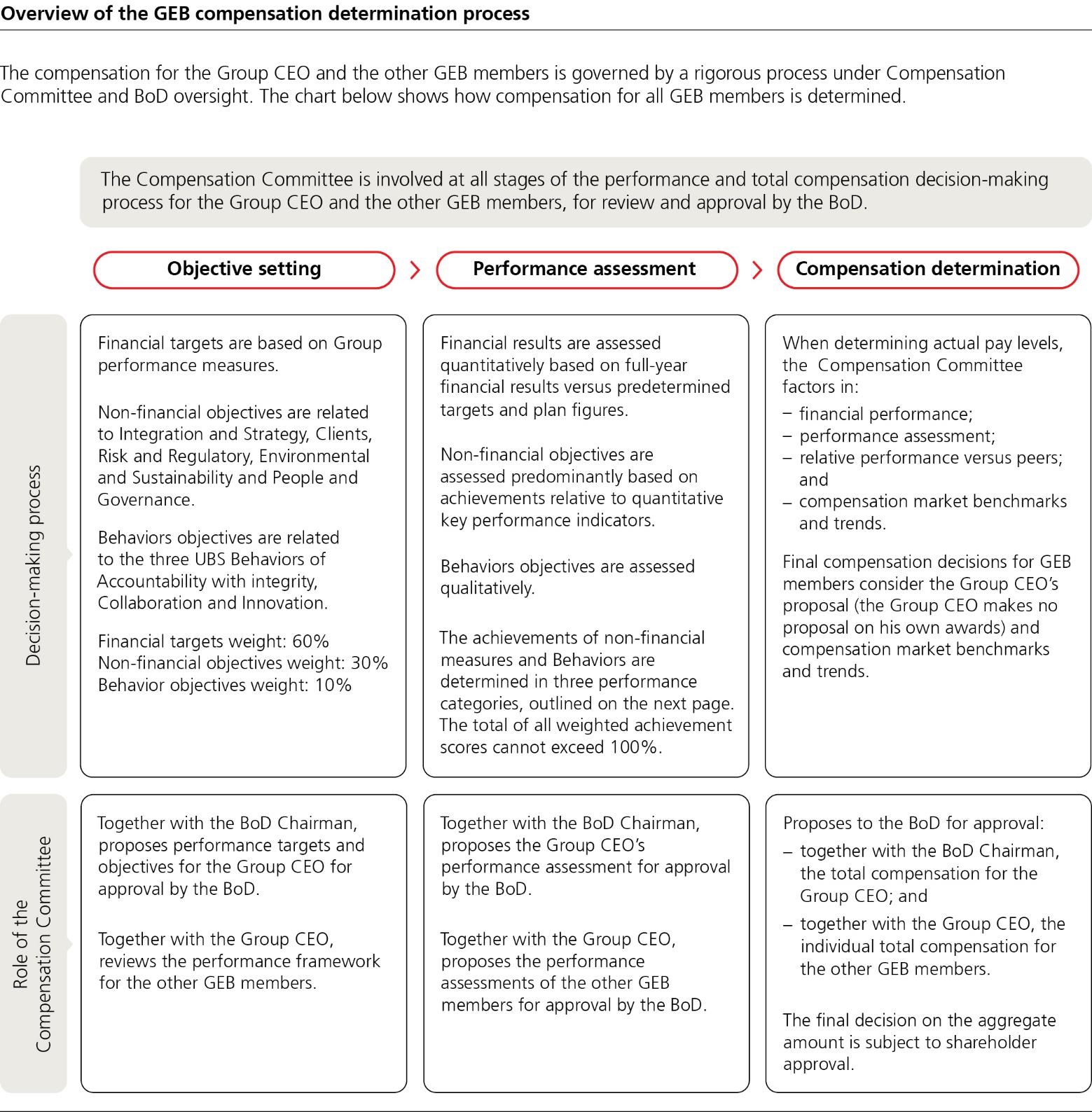
Advisory vote
|
GEB performance assessments
We
assess
each
GEB
member’s
performance
against
a
set
of
Group
financial
targets,
non-financial
objectives
and
Behaviors. For 2023,
we revised the non-financial objectives
to increase focus on
the integration. Specifically, we updated
and consolidated
the categories
to focus
on delivering
integration-
and strategy-related
initiatives, client
centricity,
risk
and
regulatory,
environmental
and
sustainability,
and
people-
and
governance-related
objectives.
This
approach
continues to foster a
focus on GEB priorities,
including delivering the integration objectives and
the success of the
Group,
and promotes strong individual accountability
.
The Compensation Committee exercises its judgment with respect to the
performance achieved relative to the prior year,
our
strategic
plan
and
our
competitors,
and
considers
the
Group
CEO’s
proposals.
The
Compensation
Committee’s
proposals are subject to approval by the BoD.
The
Compensation
Committee,
and
then
the
full
BoD,
follows
a
similar
process
for
the
Group
CEO,
except
that
the
proposal comes from the Chairman of the BoD.
Advisory vote
|
Overview of performance assessment measures
We
apply
a
range
of
quantitative
measures
to
assess
GEB
member
performance
against
financial
and
non-financial
objectives,
while
Behaviors
are
assessed
qualitatively.
The
table
below
provides
a
summary
of
the
main
metrics
and
measures used for 2023.
Financial measures
(60%)
–
Group profit before tax
–
Group cost / income ratio
–
Group return on CET1 capital
Non-
financial
measures
(30%)
Integration and Strategy
–
Progress on Group strategic and integration priorities
–
Delivery on division- / function-specific strategic
programs and initiatives
Clients
–
Foster delivery of the whole firm to our clients
–
Promoting collaboration across the combined organization
–
Delivery on specific key client initiatives
Risk and Regulatory
–
Operating within risk appetite
–
Progress on delivering on risk initiatives and regulatory commitments
Environmental and
Sustainability
–
Refer to the “Planet” and “Partnership”
sections in the ”Our aspirational goals and progress”
table in
the ”Environmental, Social and Governance considerations”
section of this report
People and Governance
–
Progress toward meeting 2025 ambitions
for female representation and for ethnic minority
representation (as per ESG disclosure)
–
People development, mobility, turnover and succession plan metrics
–
Employee listening / sentiment results and feedback
on engagement and culture
Behaviors
(10%)
Accountability with integrity
Qualitative assessment
against expected
Behaviors:
–
Responsible for what they say and do
–
Takes ownership and makes things happen
–
Steps up and acts when something is
not right
Collaboration
–
Trusts others and helps them to be successful
–
Delivers One UBS, together with their colleagues
–
Fosters a diverse, inclusive and equitable work
environment
Innovation
–
Challenges perspectives and looks at every
opportunity to improve
–
Actively seeks and provides feedback
–
Learns from every success and failure
Performance assessment categories
The table below presents the three performance categories for the assessment of the performance against non-financial
objectives
and
Behaviors.
The
achievement
score
represents
the
maximum
percentage,
and
the
Compensation
Committee may apply downward adjustments.
Non-financial measures
Needs focus
Good contribution
Excellent contribution
Achievement score: up to 33%
Achievement score: up to 66%
Achievement score: up to 100%
Behaviors
Needs focus
Expected behavior
Exemplary behavior
Achievement score: up to 33%
Achievement score: up to 66%
Achievement score: up to 100%
Advisory vote
|
2023 performance for the Group CEO
The
performance
award
for
the
Group
CEO
is
based
on
the
achievement
of
financial
performance
targets
and
non-
financial objectives and Behaviors, as described earlier in this section.
These objectives were set to reflect the strategic priorities
determined by the Chairman and the BoD.
›
Refer to “GEB compensation framework”
in this section of this report for more information
Performance assessment for the Group CEO
Sergio
Ermotti joined
UBS on
1 April
2023 and
took on
accountability
as Group
CEO on
5 April
2023. The
Board of
Directors
(the BoD)
recognizes
Mr. Ermotti’s
excellent
performance
in a
defining
year in
UBS’s history
and strong
progress
in delivering
on
integration priorities.
He
was
instrumental in
quickly
stabilizing the
client
franchise,
managing
risks,
and
bringing
operational stability
to
Credit Suisse
after the
announcement of
the
acquisition. He
successfully led
the
closing of
the
transaction in three months, the early
repayment of the Public Liquidity Backstop
and Emergency Liquidity Assistance
Plus
and the
termination
of the Loss
Protection
Agreement.
His vision,
drive and
ambition for
this transaction
have resulted
in an
ambitious
integration
plan.
Throughout
the year,
Mr. Ermotti
was an
extremely
effective
ambassador
internally
and externally
for the combined
firm and the significant
value we can
deliver in the
future for all
our stakeholders.
While the
2023 financial
results were
impacted by
the acquisition
of
the
Credit Suisse
Group, we
achieved underlying
profitability
following the
closing of the
acquisition and
maintained the
Group’s strong
capital position
with both the CET1
capital ratio
and the CET1
leverage ratio
in excess of
our guidance.
Our capital strength
enabled us
to buy back USD
1.3bn
of shares in
2023 and to propose
to the shareholders
a dividend of USD
0.70 per share,
a 27% increase
year-on-year.
The
BoD also
acknowledges
that
Mr. Ermotti
was
a
role model
in promoting
client
centricity.
He personally
remained
engaged with clients and focused the organization on serving clients and putting
them at the heart of everything we do.
This resulted in strong momentum with our clients as evidenced by positive net new money and net new deposits across
Global Wealth Management and Personal & Corporate Banking
since the closing of the acquisition in 2023.
Further,
Mr.
Ermotti
set
a
clear
tone
from
the
top
on
risk
culture
and
risk
management.
He
demonstrated
a
strong
oversight on
risk remediation
items including
addressing those
resulting from
the integration,
challenged appropriately
and kept the Group focused on adhering to our well
-established risk management and control principles.
Mr. Ermotti
swiftly and
successfully re-composed the
Group Executive
Board (the
GEB) to
effectively manage
the ambitious
integration
targets.
He
also
took
decisive
action
to
stabilize
the
organization
on
the
people
side
and
to
focus
on
maintaining operational
stability, protecting
the client
franchise and
managing risks.
In addition,
Mr. Ermotti
made it
a
priority
to
drive
cultural
aspects
into
the
combined
organization
by
personally
championing
the
Three
Keys
culture
program. He also continued to successfully progress on the Group’s sustainability strategy with its key focus areas Planet
(including
net
zero
commitments),
People
(including
progress
on
diversity,
equity
and
inclusion
ambitions)
and
Partnerships.
As explained above, the
Compensation Committee made
certain adjustments to the
financial results used to
determine
the Group CEO performance award for 2023. If
the Compensation Committee had not made these adjustments but had
applied reported
UBS Group AG
financial results,
i.e., including all
acquisition-related effects,
the achievement
level for
the Group PBT
and RoCET1 performance
measures would have
been 100% and
the weighted
assessment score across
all financial
performance measures would
have been
higher. This
would not have
been representative of
the achievements
versus the targets defined for the 2023 performance year prior to
the acquisition.
The table below illustrates the assessment criteria used to evaluate
the achievements of Mr. Ermotti in 2023.
Financial performance
Weight
Performance
measures
2023 Results
Achieve-
ment
1
Weighted
assess-
ment
2023 commentary
UBS Group
(underlying)
UBS AG
consolidated
(reported)
20%
Group PBT
USD 4.0bn
USD 4.5bn
79%
16%
–
Profit before tax declined and was below target as higher
operating expenses more than offset higher revenues,
primarily due to the operating loss incurred by
Credit Suisse
entities.
20%
Group C/I ratio
87.2%
86.2%
92%
2
18%
–
The cost / income ratio increased and was below its
performance target as higher operating expenses
was only
partly offset by an increase in total revenues.
20%
RoCET1
4.2%
7.6%
78%
16%
–
RoCET1 declined and was below its performance
target,
reflecting lower net profit due to operating loss incurred by
Credit Suisse entities and higher average CET1
capital.
1
2
percentage change of result versus plan is subtracted from the maximum
achievement level (100%).
Advisory vote
|
Performance assessment for the Group CEO (continued)
Non-financial performance and Behaviors
Weight
Performance
measures
Achieve-
ment
Weighted
assess-
ment
2023 commentary
30%
Non-financial
objectives
(Integration and
Strategy,
Clients, Risk and
Regulatory,
Environmental
and
Sustainability,
People and
Governance)
Excellent
contribution
27%
The evaluation of each non-financial objective
considers quantitative metrics that are assessed
against internal targets / plan.
–
Stabilized Credit Suisse, completed closure of the transaction
in three months, defined a
detailed integration plan and developed a comprehensive
strategic plan for the next three
years.
–
Delivered early voluntary termination of the Loss
Protection Agreement and the Public
Liquidity Backstop, repaid the Credit Suisse Emergency
Liquidity Assistance Plus loan.
–
Achieved underlying profitability following closing of
the acquisition, maintained a balance
sheet for all seasons and strong capital position.
–
Prioritized personal engagement with clients
to support stabilizing the client franchise,
building trust and confidence in the combined
firm.
–
Promoted a strong risk management and control culture across the combined
organization,
remained focused on risk remediation and made progress with the
litigation portfolio.
–
Effectively re-composed the GEB and managed leadership
transitions, supported strong
Group-wide senior leader succession and talent pipeline.
–
Championed the Three Keys Culture program to support
a successful long-term integration
of Credit Suisse.
–
Made progress on group diversity, equity and inclusion ambitions.
See ESG metrics and progress in separate table in this
report.
10%
Behaviors
(Accountability
with integrity,
Collaboration,
Innovation)
Exemplary
behavior
10%
The assessment of the Behavior objectives is qualitative
and has resulted in the following
summary assessment.
–
Acted as a role model for the UBS behaviors. Led
by example and demonstrated exemplary
accountability, decisiveness and determination to achieve strong and sustainable
short- and
long-term results.
–
Strengthened collaboration across the combined organization
to focus on client needs,
stabilize the franchise and progress with the ambitious
integration targets.
–
Continuously challenged the organization
to think differently about the business evolution,
accelerated the process of moving Artificial Intelligence
technology from experimentation to
implementation.
Total weighted assessment
(maximum 100%)
87%
The
BoD
approved
the
proposal
by
the
Compensation
Committee
to
grant
Mr.
Ermotti
a
performance
award
of
CHF 12.25m,
resulting
in
a
total
compensation
for
2023
of
CHF 14.1m
(excluding
benefits
and
contributions
to
his
retirement benefit plan).
Aligned with
the GEB
compensation framework, the
Group CEO’s
performance award will
be delivered
20% (CHF 2.45m)
in cash and the remaining 80%
(CHF 9.8m) subject to deferral and forfeiture provisions, as well as meeting performance
conditions over the next five years.
Advisory vote
|
2023 total compensation for the GEB members
At the 2024 AGM, shareholders
will vote on the
aggregate 2023 total variable compensation for
the GEB in Swiss francs.
The tables below provide the
awarded compensation for the Group CEO
and the GEB members in Swiss
francs and, for
reference,
the
total
amounts
in
US
dollars
for
comparability
with
financial
performance.
The
individual
variable
performance awards for each GEB member will only be
confirmed upon shareholder approval at the AGM.
›
Refer to “Deferred compensation” in the “Supplemental
information” section of this report for more information about
the
vesting of outstanding awards for GEB members
›
Refer to “Provisions of the Articles of Association related to
compensation” in the “Supplemental Information”
section of this
report for more information
Audited |
Total
compensation for GEB members
CHF, except where indicated
USD (for reference)
1
For the
year
Base salary
Contribution
to retirement
benefit plans
Benefits
2
Total fixed
compensa-
tion
Cash
3
Performance
award
under LTIP
4
Performance
award
under
DCCP
5
Total
variable
compensa-
tion
Total fixed
and vari-
able com-
pensation
6
Total fixed
compensa-
tion
Total
variable
compensa-
tion
Total fixed
and vari-
able com-
pensation
6
Highest Paid Executive (for 2023 Sergio
Ermotti and for 2022 Ralph Hamers
excluding replacement awards)
7
2023
1,875,000
186,240
84,078
2,145,317
2,450,000
6,125,000
3,675,000
12,250,000
14,395,317
2,368,204
13,522,709
15,890,913
2022
2,500,000
242,239
198,378
2,940,617
1,940,000
4,850,000
2,910,000
9,700,000
12,640,617
Aggregate of all GEB members (excluding replacement
awards)
7,8,9,10,11,12
2023
28,677,051
2,120,421
1,238,708
32,036,180
21,398,036
54,305,166
32,583,098
108,286,300
140,322,480
35,364,567
119,536,663
154,901,230
2022
23,318,410
1,796,872
693,473
25,808,756
16,220,000
40,550,000
24,330,000
81,100,000
106,908,756
1 Swiss franc amounts have been translated into US dollars
for reference at the 2023 performance award currency exchange rate of
CHF / USD 1.10389.
2 All benefits are valued at market price.
3 For GEB members
who are also MRTs or SMFs, the cash portion includes blocked
shares.
4 LTIP awards for performance year 2023 were awarded
at a value of 50.00% of maximum which reflects our best estimate of the value of the
award. The maximum number
of shares is determined by
dividing the awarded amount
by the estimated value
of the award at grant,
divided by CHF 24.435
or USD 27.936, the average
closing price of UBS shares
over the last ten trading days leading
up to and including the award
date in February.
5 The amounts reflect the
amount of the notional additional tier
1 (AT1) capital instrument excluding
future notional interest.
6 Excludes the portion related to the
legally required employer’s social security contributions for 2023 and 2022, which are estimated
at grant at CHF 7,291,554 and CHF 4,675,424,
respectively, of which CHF 897,679
and CHF 841,402,
respectively, are
for the highest-paid
GEB member (excluding
replacement awards).
The legally
required employees’ social
security contributions are
included in the
amounts shown in
the table
above, as appropriate.
7 The 2022 total compensation of Sarah
Youngwood, the former Group CFO,
including both the one-time replacement awards of
her compensation forfeited upon joining UBS as well as
her
compensation for the 2022 performance year,
amounts to a total of CHF 13,475,863
(which makes her the highest paid executive
for 2022 including replacement awards).
8 As stated in “Group Executive Board”
in the “Corporate governance”
section of this report,
16 GEB members were
in office on 31
December 2023 and twelve
GEB members were in
office on 31 December
2022.
9 Includes compensation paid
under
employment contracts during notice periods for
GEB members who stepped down during the
respective years.
10 Includes compensation for newly appointed
GEB members for their time in office
as GEB members
during the respective years.
11 Base salary may include role-based allowances in line with market practice in response to regulatory requirements.
12 For 2022, the one-time replacement awards of CHF 7,206,683
for Sarah Youngwood and CHF 65,229 for Naureen
Hassan are not included in the above table; including these, the 2022 total aggregate compensation of
all GEB members is CHF 114,180,668.
p
Total realized compensation for the Group CEO
The realized compensation for
the Group CEO reflects
the total amount paid
out in the year.
It includes the base
salary,
cash performance award payments, and all
deferred performance awards vested
in the year. As such, realized pay
is the
natural culmination of awards granted and approved by
shareholders in previous years.
To illustrate the
effect of our
long-term deferral
approach, which has
been in place
since 2012, we
disclose the annual
realized compensation of Mr. Ermotti,
including a comparison with his total awarded compensation.
Total
realized compensation vs awarded compensation for Sergio Ermotti
CHF
Realized
Awarded
For the year
Base salary
Cash award
2
Performance
award under
equity plans
2
Performance
award under
DCCP
2
Total realized
fixed and variable
compensation
Total awarded
fixed and variable
compensation
3
2023
1
1 Includes compensation for 9 months as Sergio Ermotti joined UBS in April 2023.
2 Excludes dividend / interest payments.
3 Excludes contributions to retirement benefit plans and benefits. Includes social security
contributions paid by Sergio Ermotti but excludes the portion related to the legally required social security contributions paid by UBS.
Advisory vote
|
Group compensation
Compensation elements for all employees
All elements
of pay
are
considered
when making
our compensation
decisions.
We
regularly review
our principles
and
compensation
framework
in
order
to
remain
competitive
and
aligned
with
stakeholders’
interests.
In
2023,
our
compensation
framework
remained
broadly
unchanged.
We
will
continue
to
review
our
approach
to
salaries
and
performance
awards,
considering market
developments,
our performance
and our
commitment
to deliver
sustainable
returns to shareholders.
Base salary and role-based allowance
Employees’ fixed compensation
(e.g., base salary) reflects
their level of skill, role
and experience, as well
as local market
practice. Base
salaries are
usually paid
monthly
or fortnightly,
in line
with local
market
practice. We
offer
competitive
base salaries that
reflect location, function and
role. Salary increases generally consider promotions,
skill set, performance
and overall responsibility.
In addition to base salary,
and as part of fixed
compensation, some employees
may receive a role-based allowance.
This
allowance
is
a
shift
in
the
compensation
mix
between
fixed
and
variable
compensation,
not
an
increase
in
total
compensation. It
reflects the
market value
of a
specific role and
is fixed,
non-forfeitable compensation.
Unlike salary,
a
role-based allowance is
paid only if
the employee is
in a
specific role.
Similar to previous
years, 2023 role-based
allowances
consisted of a cash portion and, where applicable, a blocked
UBS share award.
Pensions and benefits
We
provide
access
to
a
range
of
benefit
plans,
such
as
retirement
benefits
and
health
insurance,
aiming
to
provide
financial protection in
case of significant
life events,
and support
our employees’
well-being and
diverse needs. Retirement
and other benefits are set in the context of local
market practice and regularly reviewed
for competitiveness.
Pension plan
rules in
any one
location are
generally the
same for
all employees
in similar
circumstances, including
GEB
members and other management. Under
the Switzerland Pension Fund rules
of UBS legal entities,
there are no enhanced
or supplementary
pension contributions
for the
GEB. The
CEO of
Credit Suisse
AG, who
became a
GEB member
after
the legal close of the acquisition, participates in the Switzerland
Pension Fund for Credit Suisse legal entities.
Performance award
Most of our
employees are eligible for an
annual performance award.
The level of this
award, where applicable, generally
depends
on
the
firm’s
overall
performance,
the
employee’s
business
division,
team
and
individual
performance,
and
behavior,
reflecting
their
overall
contribution
to
the
firm’s
results.
These
awards
are
in
line
with
applicable
local
employment conditions and at the discretion of the
firm.
In
addition
to
the
firm’s
Pillars
and
Principles,
Behaviors
related
to
Accountability
with
integrity,
Collaboration
and
Innovation are
part of
the performance
management
approach. Therefore,
when assessing
performance,
we consider
not only what was achieved but also how it was achieved
.
Our deferred compensation plans
Underlining
our emphasis
on sustainable
performance
and risk
management,
and our
focus on
achieving
our growth
ambitions, we
deliver part
of our employees’
annual variable
compensation through
deferred compensation
plans.
We
believe that
our approach,
with a
single incentive
decision and
mandatory deferral
framework,
is transparent
and well
suited to implementing our compensation philosophy and delivering
sustainable performance. This aligns the interests of
our employees and shareholders and appropriately
links compensation to longer-term
sustainable performance.
Our
mandatory
deferral
approach
applies
to
all
employees
with
regulatory-driven
deferral
requirements
or
total
compensation
greater
than
USD /
CHF 300,000.
Certain
regulated
employees,
such
as Senior
Management
Functions
(SMFs) and Material Risk Takers
(MRTs), are subject to additional requirements (e.g., more
stringent deferral requirements
and additional
blocking periods). In
addition, SMFs and
MRTs receive 50%
of their
cash portion in
the form
of immediately
vested shares, which are blocked for 12 months after
grant.
The deferred
amount increases
at higher
marginal rates
in line with
the value
of the
performance award.
The effective
deferral rate therefore depends on the amount of the performance
award and the amount of total compensation.
We believe
our deferral
regime has
one of
the longest
vesting periods
in the
industry.
The weighted
average
deferral
period for
non-regulated
employees is
4.4 years
for GEB
members,
3.8 years
for MDs
receiving LTIP
and 3.5
years for
other
employees.
Additionally,
from
time
to
time,
we
may
utilize
alternative
deferred
compensation
arrangements
to
remain competitive in specific business areas.

Advisory vote
|
To further promote sustainable performance, all of our
deferred compensation plans include employment conditions and
malus conditions. These enable the firm to reduce or fully forfeit unvested deferred awards under certain
circumstances,
pursuant to performance and harmful acts provisions. In addition, forfeiture is triggered
in cases where employment has
been terminated for cause.
Upon vesting of
the notional share
awards, we fulfill
our share delivery
obligations by delivering
treasury shares purchased
in the market.
›
Refer to “Note 28 Employee benefits: variable
compensation” in the “Consolidated financial statements”
section of this report for
more information
›
Refer to the “Supplemental information” section of this
report for more information about MRTs and SMFs
Long-Term Incentive Plan
The Long-Term
Incentive Plan
(the LTIP
)
granted for
2023 performance
is a
mandatory deferral
plan for
GEB members
and Managing
Directors (MDs)
reporting to
the GEB
and their
direct reports
at MD
level.
1
the equity portion of their 2023 performance award in LTIP to support delivering on our ambitious integration goals and
business / financial targets. This
further mitigates the need for a distinct
integration award typical for a transaction of this
nature. For the
2023 performance year
,
we awarded the
LTIP
to 18 GEB members
and 940 MDs in
office during
2023,
at
a
value
of
50.0%
of
the
maximum,
to
further
align
the
maximum
opportunity
with
the
stretching
nature
of
our
financial ambitions.
The
performance
metrics
of
the
share-based
LTIP
awards
are
average
reported
return
on
CET1
capital
(RoCET1)
and
relative total shareholder
return (rTSR)
over a three-year
performance period
starting on 1 January
in the year
of grant.
Performance outcomes and actual payout levels will be disclosed
at the end of the performance period.
The three-year average
reported RoCET1 metric (50%
weighting) with a
performance range of
5% to 10% reflects
the
impact of the acquisition and our ambitious integration objectives, as well as the communicated financial ambitions over
the cycle:
–
the maximum reported RoCET1 of 10% corresponds with a
100% payout aligned with our stretch target;
–
the minimum reported RoCET1 of 5% corresponds with a 33% payout aligned with sustainable
results in the context
of the integration; and
–
the linear
payout between the
threshold and
maximum levels
supports our
focus on
delivering sustainable performance
without encouraging excessive risk-taking.
The rTSR performance metric
(50% weighting) over the
three-year period further aligns the
interests of employees with
those
of
shareholders.
This
metric
compares
the
total
shareholder
return
(the
TSR)
of
UBS
with
the
TSR
of
an
index
consisting of listed Global Systemically Important Banks (G-SIBs):
–
the maximum payout outcome is reached when
rTSR is 25 percentage points or more above the index,
to mitigate the
potential for excessive risk-taking;
–
there is zero payout if rTSR is 25 percentage points
or more below the index; and
–
the linear payout between the threshold and maximum levels further
supports appropriate risk-taking
This
G-SIBs
index
is
independently
determined
by
the
Financial
Stability
Board
(excluding
the
UBS
Group),
our
index
includes
all
publicly
traded
G-SIBs
and
reflects
companies
with
a
comparable
risk
profile
and
impact
on
the
global
economy. The index is equally weighted, calculated in Swiss francs and maintained by an independent index provider, so
as to ensure independence of the TSR calculation.
1
Excluding MDs in Asset Management Investment Areas who will continue to receive the Fund Ownership Plan (FOP) instead of the LTIP
Advisory vote
|
G-SIBs that are listed companies
1
Agricultural Bank of China
Goldman Sachs
Santander
Bank of America
Groupe Crédit Agricole
Société Générale
Bank of China
HSBC
Standard Chartered
Bank of Communications
ICBC
State Street
Bank of New York Mellon
ING
Sumitomo Mitsui FG
Barclays
JPMorgan Chase
Toronto-Dominion
BNP Paribas
Mitsubishi UFJ FG
Wells Fargo
China Construction Bank
Mizuho FG
Citigroup
Morgan Stanley
Deutsche Bank
Royal Bank of Canada
1
Dividend equivalents (granted where
applicable regulation permits) are
subject to the same terms
as the underlying LTIP
award.
LTIP awards
reflect the
long-term focus
of our
compensation framework.
The final
number of
shares as
determined at
the end
of the
three-year performance
period will
vest in
three equal
installments in
each of
the three
years following
the performance period for GEB members (i.e., years
3, 4 and 5 after grant) and will
cliff-vest for other award recipients
after the performance period (i.e., year three after
grant), although longer deferral periods may apply for
regulated GEB
and other regulated employees.
LTIP payout illustration
–
The final number of notional
shares vesting will vary based on
the achievement versus the
performance metrics.
–
Linear payout between threshold
and maximum performance.
–
Achievement levels are a
percentage of the maximum
opportunity of the LTIP and
cannot exceed 100%.
–
Full forfeiture for performance
below the predefined threshold
levels.
–
UK Senior Management Function
holders (SMFs) and UK Material
Risk Takers (UK MRTs)
are subject
to an additional non-financial
metric based on a conduct
assessment with a potential
downward adjustment of up to
100% of the entire award.
Performance metric:
average RoCET1 (50% of award)
Below threshold (<5%)
Threshold (5%) up to
maximum (<10%)
Maximum and above (>10%)
Full forfeiture
(payout 0%)
Partial vest
(payout between 33% and <100%)
Full vest
(payout 100%)
Performance metric
: rTSR vs G-SIBs index (50% of award)
Below threshold (<–25 ppts)
Threshold (–25 ppts) up to
maximum (+25 ppts)
Maximum and above (>+25 ppts)
Full forfeiture
(payout 0%)
Partial vest
(payout between 33% and <100%)
Full vest
(payout 100%)
Performance achievement of the 2020 LTIP granted in
2021
The 2020 LTIP was
granted in 2021 (for
2020 performance) at
a fair value of
65.9% of a maximum
of 100%. The final
performance
achieved is
92.55% of
a maximum
of 100%.
This achievement
reflects the
outcome of
the two
equally
weighted performance metrics,
RoCET1 and rTSR,
both measured over
the three-year performance period
from 1 January
2021 to 31 December 2023. The achievement
level of this 2020 LTIP award (granted in
2021) applies to 13 current GEB
members and 68 other plan participants.
We achieved
a three-year
average RoCET1
performance of
15.3% against
the performance
range of
6% to 18%,
and
an rTSR performance of +75.36 percentage points versus
the index of listed G-SIBs.
As explained above, the
Compensation Committee made
certain adjustments to the
financial results used to
determine
the 2020
LTIP achievement
level. As
noted, if
the Compensation
Committee had
not made
these adjustments
but had
applied reported
UBS Group AG
financial results,
i.e., including all
acquisition-related effects,
the achievement
level for
the RoCET1 metric would have been 100%.
For GEB members, the first of the three equal installments of the 2020 LTIP vests on 28 March 2024 and the second and
third installments will vest
in March 2025 and
2026; while for
selected senior management,
the 2020 LTIP cliff
vests on
28 March 2024 (later dates may apply for regulated employees).
Advisory vote
|
Equity Ownership Plan / Fund Ownership Plan
The
Equity
Ownership
Plan
(the
EOP)
is
the
deferred
compensation
plan
for
employees
that
are
subject
to
deferral
requirements
but
do
not
receive
LTIP
awards.
For
the
2023
performance
year,
we
granted
EOP
awards
to
4,661
employees.
Delivering sustainable results
is a
key objective for
UBS. Our EOP
creates a direct
link with
shareholder returns as
a notional
equity award
and has
no upward
leverage.
This approach
promotes growth
and sustainable
performance.
EOP awards
generally vest over three years.
In place of EOP, employees in investment areas within Asset Management
receive some or all of their EOP in the form of
notional funds (the Fund Ownership Plan (the FOP), previously named AM EOP) to align their compensation more closely
with industry standards. This plan is generally delivered
in cash and vests over three years.
›
Refer to “Vesting of outstanding awards granted in prior years subject
to performance metrics and thresholds” in the
“Supplemental information” section of this report for
more information
Deferred Contingent Capital Plan
The
Deferred
Contingent
Capital
Plan
(the
DCCP)
is a
key
component of
our
compensation
framework
and supports
alignment of the interests of our senior employees
with those of our stakeholders.
All employees subject to deferral requirements receive DCCP awards.
For the 2023 performance year, we granted
DCCP
awards to 5,562 employees.
The DCCP is consistent with
many of the features of
the loss-absorbing bonds that we issue
to investors and may be
paid
at vesting in
cash or, at
the discretion
of the firm,
as a perpetual,
marketable additional
tier 1 (AT1) capital
instrument.
Employees can elect to have their DCCP awards denominated
in Swiss francs or US dollars.
DCCP awards vest in full after five years (longer deferral periods may apply for regulated employees). DCCP awards bear
notional
interest
paid
annually
(except
as
limited
by
regulation
for
MRTs),
subject
to
review
and
confirmation
by
the
Compensation
Committee.
The
notional interest
rate
for grants
in 2024
was
4.6%
for
awards
denominated
in
Swiss
francs and
8.3% for
awards denominated
in US
dollars. These
interest rates
are based
on the
current market
rates for
similar AT1 capital instruments issued by the UBS Group.
Awards are
forfeited
if a
viability event
occurs (i.e.,
if FINMA
notifies the
firm that
the DCCP
awards must
be written
down
to
mitigate
the
risk
of
an
insolvency,
bankruptcy
or
failure
of
UBS)
or
if
the
firm
receives
a
commitment
of
extraordinary support
from the
public sector
that is
necessary to
prevent such
an event.
DCCP awards
are also
written
down for GEB
members if the Group’s
CET1 capital ratio falls
below 10% and
for all other employees
if it falls
below 7%.
In addition, GEB members forfeit 20% of DCCP awards for each loss-making year
during the vesting period. This means
100% of
the award
is subject
to risk
of forfeiture.
The forfeiture
features of
DCCP create
a strong alignment
with our
debt holders and support the sustainability of the firm.
Over the last five years, USD 1.97bn of DCCP awards have
been issued, contributing to the Group’s total loss-absorbing
capacity (TLAC). Therefore, DCCP awards not only support competitive pay but also provide a loss absorption buffer that
protects the
firm’s capital
position. The
following table
illustrates the
contribution of
the DCCP
to our
AT1 capital
and
the effect on our TLAC ratio.
›
Refer to the “Supplemental information” section of this
report for more information about performance award and personnel-
related expenses
›
Refer to the “Supplemental information” section of this
report for more information about longer vesting and clawback
periods
for MRTs and SMFs
Advisory vote
|
Contribution of the Deferred Contingent Capital Plan to our loss-absorbing capacity
1
USD m, except where indicated
31.12.23
31.12.22
Deferred Contingent Capital Plan (DCCP), eligible
as high-trigger loss-absorbing additional
tier 1 capital
1,935
1,794
DCCP contribution to the total loss-absorbing capacity
ratio (%)
0.4
0.6
1 Refer to “Bondholder information” at ubs.com/investors for more information about the capital instruments of UBS Group
AG and UBS AG both on a consolidated and a standalone basis.
Other variable compensation components
To
support hiring and retention, particularly at senior
levels, we may offer other compensation components
,
such as:
–
retention payments to key employees to induce them to stay, particularly during critical periods for the firm, such as a
sale or wind-down of a business;
–
on
a
limited
basis,
guarantees
that
may
be
required
to
attract
individuals
with
certain
skills
and
experience,
these
awards are fixed incentives subject to our standard deferral
rules and limited to the first full year of employment;
–
awards
granted to
employees hired
late in
the year
to replace
performance awards
that they
would have
earned at
their previous employer
but have foregone
by joining UBS, these
awards are generally
structured with the same
level
of deferral as for employees at a similar level at UBS; and
–
in exceptional cases,
sign-on awards
may be offered
to candidates to increase
the chances of them
accepting our offer.
These other variable compensation components
are subject to a comprehensive governance
process, which may involve
the Compensation Committee, depending on the amount
or type of such payments.
To
support
operational
stability,
manage
risks
and
protect
the
client
franchise,
we
have
deployed
specific
additional
measures. Retention awards
were delivered in
both deferred cash
and deferred equity
awards. Furthermore, to
support
our client win-back strategy and promote
client growth, we also introduced
a client acquisition and retention
award for
certain producers, which
is fully deferred
and the final
value is linked
to the retention
of client assets.
Retention efforts
were targeted
and limited to
certain client roles
and critical roles
necessary to
support operational
stability. Overall, the
amounts of
USD 736m are
modest by
industry standards
for an
integration of
this magnitude.
These retention
awards
account for 3% of our total personnel expenses recognized
in 2023.
Employees outside of
the GEB that
are made redundant
may receive severance
payments. Our severance
terms comply
with the applicable local laws (legally obligated severance). In certain locations, we may provide severance packages that
are negotiated with
our local social
partners and may
go beyond the
applicable minimum
legal requirements (standard
severance).
Such payments
are
governed
by
location-specific
severance
policies.
In
addition,
we
may
make
severance
payments that exceed legally obligated or standard severance payments where we believe these are aligned with market
practice
and
appropriate
under
the
circumstances
(supplemental
severance).
GEB
members
do
not
receive
severance
payments.
Replacement awards and forfeitures
In line with
industry practice, our
compensation framework
and plans include
provisions generally
requiring reduction
/
forfeiture of a terminated employee’s unvested or deferred awards. In particular, these provisions apply if the terminated
employee joins another financial services organization and /
or violates restrictive covenants, such as solicitation of clients
or employees.
Conversely, to attract
external top talent,
market practice dictates
that we consider
replacing their forfeited
compensation
from their
prior employer.
In select
situations and
based on
careful consideration,
we replace
the lost compensation
of
senior hires. The replacement
awards are subject to
UBS’s harmful acts provisions.
Their value is subject
to independent
review as part of the “Report of the statutory auditor on
the compensation report” to support the like-for-like
nature of
the replacement and
to confirm that these
awards do not represent
sign-on payments (i.e., there
are no “golden hellos”).
Based on a
thorough review of
available documentation, we aim
to mirror the
type, conditions and
timing of the
forfeited
compensation,
based
on
actual
facts
and
circumstances.
Replacement
awards
can
include
cash
payments
and
/
or
deferred awards,
including EOP share
awards and DCCP
awards. Where payments
are made in
cash, there is typically
a
clawback period if
the employee leaves
UBS voluntarily within
12 months of the
start of employment.
The replacement
awards do not exceed the
commercial or fair value
of the compensation actually
forfeited by the individual
and, in case
of GEB members, are
disclosed transparently. The total
2023 forfeitures of USD
1,903m of previously awarded
deferred
compensation offset the 2023 total sign-on payments, replace
ment payments and guarantees of USD 216m.
Advisory vote
|
Sign-on payments, replacement payments, guarantees and severance payments
Total 2023
of which: non-deferred
cash
of which: deferred
compensation
awards
Total 2022
Number of beneficiaries
USD m, except where indicated
2023
2022
Total sign-on payments
1
of which: Key Risk Takers
2
Total replacement payments
3
of which: Key Risk Takers
2
Total guarantees
4
of which: Key Risk Takers
2
Total severance payments
1,5
of which: Key Risk Takers
2
1 GEB members are
not eligible for sign-on
or severance payments.
Sign-on awards exclude
one-time payments for
junior associate hires into
the Investment Bank. Including
these, the total
sign-on payments are
USD 4m for 2023 and USD 1m for 2022. All one-time payments for junior associate hires are subject to a 12-month clawback condition.
2 Expenses for Key Risk Takers are full-year
amounts for individuals in office
on 31 December 2023. Key Risk Takers as defined by UBS, including all employees with a total compensation exceeding USD / CHF 2.5m
(Highly Paid Employees).
3 No GEB member received a replacement payment
in 2023. In 2022, amounts include replacement payments for two
GEB members. Total amounts include awards granted to employees hired late in the year to replace performance
awards that they would have earned
at their previous employers, but have foregone by joining UBS.
4 No GEB member received a guarantee in 2023 or 2022.
5 Includes legally obligated and standard severance payments, as well as payments in lieu
of notice.
Forfeitures
1
Total 2023
Total 2022
USD m, except where indicated
Total forfeitures
of which: former GEB members
of which: Key Risk Takers
2
1 For notional share awards (excluding Credit Suisse legacy plan awards), forfeitures are calculated as
units forfeited during the year, valued at the share price on 31 December 2023
(USD 30.90) for 2023. The 2022
data is valued using the share price on 31 December 2022 (USD 18.67). For LTIP
the forfeited units reflect the fair value awarded at grant. For the notional funds awarded to Asset Management employees
under the
AM EOP/FOP, this represents the forfeiture credits recognized in 2023 and 2022.
For the DCCP,
the fair value at grant of the forfeited awards during the year is reflected. Credit Suisse legacy awards (including Credit
Suisse notional fund awards)
are calculated using value at
grant and include the explicit
adjustments resulting from the
cancellation and reduction order
issued by the Federal Department of
Finance (FDF) of Switzerland.
The 2022 data excludes Credit Suisse
legacy award forfeitures. All values shown
exclude DCCP interest and CCA
coupon forfeitures. Numbers presented may differ
from the effect on the
income statement in accordance
with IFRS.
2 Key Risk Takers
as defined by UBS, including all employees with a total compensation exceeding
USD / CHF 2.5m (Highly Paid Employees) and excluding former
GEB members who forfeited awards in
2023 or 2022.
Employee share ownership
According
to
available
records
on
employee
shareholdings,
including
unvested
deferred
compensation,
as
of
31 December
2023,
employees
held
at
least
USD 7.9bn
of
UBS
shares
(of
which
approximately
USD 5.3bn
were
unvested), representing approximately
7.4% of our total shares issued.
The Equity Plus Plan is our
employee share purchase program.
It allows employees at
Executive Director level and
below
to voluntarily
invest up
to 30%
of their
base salary
and /
or regular
commission payments
to purchase
UBS shares.
In
addition
(where
offered),
eligible
employees
can
invest
up
to
35%
of
their
performance
award
under
the
program.
Participation in
the program
is capped
at USD
/ CHF
20,000 annually.
Eligible employees
may purchase
UBS shares
at
market price and
receive one additional
share for every
three shares purchased
through the program.
Additional shares
vest after a maximum
of three years, provided
the employee remains employed
by UBS and has
retained the purchased
shares throughout the holding period.
›
Refer to “Note 28 Employee benefits: variable
compensation” in the “Consolidated financial statements”
section of this report for
more information
Compensation for US financial advisors in Global Wealth
Management
In line with market practice for US wealth management businesses, the compensation for US financial advisors in Global
Wealth Management consists
of cash compensation
and deferred
compensation awards,
determined using a
formulaic
approach based on production.
The monthly
cash compensation
is determined
using an
overall percentage
rate for
each financial
advisor.
It reflects
a
percentage
of
the
compensable
production
that
each
financial
advisor
generates
during
that
month.
Compensable
production is generally based on
transaction revenue and investment
advisory fees and may reflect
further adjustments.
The
percentage
rate
generally
varies
based
on
the
level
of
the
production
and
firm
tenure,
supporting
growth
and
alignment with the investment strategy and goals of our
clients.
Financial
advisors
may
also
be
granted
annual
deferred
compensation.
These
amounts
generally
vest
over
a
six-year
period. The
annual deferred
compensation amount
reflects their
overall percentage
rate and
production,
as previously
outlined.
Cash compensation and deferred
compensation awards may
be reduced for,
among other things, errors,
negligence or
carelessness, or failure to comply with the firm’s rules, standards, practices and / or policies, and / or applicable laws and
regulations.
Financial
advisors
may
also
participate
in additional
programs
to
support
promoting
and developing
their
business
or
supporting the transition of client relationships where
appropriate.
Advisory vote
|
2023 Group performance outcomes
Performance
awards granted
for the 2023
performance year
The “Variable
compensation” table
below shows
the amount
of variable
compensation awarded
to employees
for the
2023 performance year, together with
the number
of beneficiaries for
each type of
award granted. In
the case
of deferred
awards,
the
final
amount
paid
to
an
employee
depends
on
performance
conditions
and
consideration
of
relevant
forfeiture
provisions.
The deferred
share
award
amount is
based on
the market
value of
these awards
on the
date of
grant.
Variable compensation
Expenses recognized
in the IFRS
Accounting
Standards income
statement
Expenses deferred to
future periods
3
Adjustments
3
Total
Number of beneficiaries
8
USD m, except where indicated
2023
2022
2023
2022
2023
2022
2023
2022
2023
2022
Non-deferred cash
4
4
Deferred compensation awards
of which: Equity Ownership Plan
5
5
of which: Deferred Contingent Capital Plan
of which: Long-Term Incentive Plan
5,6
5
of which: Fund Ownership Plan
Variable compensation – performance award pool
Variable compensation – financial advisors
1
Variable compensation – other
2
7
7
Total variable compensation
1 Financial
advisor compensation
consists of
cash and
deferred compensation
awards and
is based
on compensable
revenues and
firm tenure
using a
formulaic approach.
It also
includes expenses
related to
compensation commitments with financial advisors entered into at the time of recruitment that are subject to vesting requirements.
2 Consists of retention awards granted to Credit Suisse employees to support the
completion of the transaction and the
early phase of the integration,
replacement payments, forfeiture
credits, severance payments,
retention plan payments and interest expense
related to the Deferred Contingent
Capital Plan.
3 Estimates as of 31 December 2023 and 2022. Actual amounts to be expensed in future
periods may vary; e.g., due to forfeiture of awards.
4 Includes the 2023 cash bonus liability recognized as
of the date of the acquisition
of Credit Suisse, of
USD 351m, relating to pre-acquisition
service as well as currency
translation adjustments.
5 Represents estimated post-vesting
transfer restriction and permanent
forfeiture discounts.
6 Adjustments for
LTIP include
a difference of USD
53m between the estimated
amount to be expensed
under IFRS 2
and the communicated value
included in the performance
award pool.
7 Included in expenses deferred to future periods is an amount of USD 190m (2022: USD 146m) in interest
expense related to the Deferred Contingent Capital Plan. As the amount recognized as performance award
represents the present value of the award at the date it is granted to the employee,
this amount is excluded.
8 Excludes awards that are part of Variable compensation – other.
2023
performance award pool and expenses
The performance
award pool,
which includes
performance-based variable
awards for
2023, was
USD 4.5bn, reflecting
an increase of 38% compared with 2022 (or a
reduction of 14% compared with the
pro forma aggregate 2022 pool of
USD 5.3bn
for
the
combined
entities,
which
includes
the
UBS
performance
award
pool,
the
Credit
Suisse
variable
incentive
compensation
pool
and
other
variable
compensation
awards
related
to
the
2022
performance
year).
Performance award expenses for 2023 increased to
USD 4.0bn, mainly reflecting increased performance award expenses
accrued in the performance year as a result of the acquisition of
the Credit Suisse Group.
The “Performance award pool
and expenses” table below compares the performance
award pool with performance award
expenses.
Performance award pool and expenses
USD m, except where indicated
2023
2022
% change
Performance award pool
1
of which: expenses deferred to future periods and adjustments
2,3
Performance award expenses accrued in the performance year
Performance award expenses related to prior performance years
Total performance award expenses recognized for the year
4
1 Excluding employer-paid taxes and social
security.
2 Estimate as of the end of the performance year.
Actual amounts expensed in future periods may vary,
e.g., due to forfeiture of awards.
3 Refer to details in
the preceding "Variable
compensation" table for
more information.
4 Refer to
“Note 28 Employee
benefits: variable
compensation” in
the “Consolidated financial
statements” section of
this report for
more
information
Advisory vote
|
Compensation for the Board of Directors
Chairman of the BoD
Under the
leadership
of the
Chairman,
Colm Kelleher
,
the BoD
determines,
among
other things,
the
strategy
for the
Group,
based on recommendations by the Group CEO, exercises ultimate supervision over management and
appoints all
GEB members.
The Chairman leads
all general meetings
and BoD meetings
and works with
the committee Chairpersons
to coordinate
the work of all BoD committees.
Together with the Group CEO, the Chairman is responsible for effective communication
with
shareholders
and
stakeholders,
including
clients,
government
officials,
regulators
and
public
organizations.
The
Chairman works closely with the
Group CEO and other GEB members,
providing advice and support when
appropriate,
and
continues
to
strengthen
and
promote
our
culture
through
the
three
keys
to
success:
our
Pillars,
Principles
and
Behaviors.
As an independent
director, the Chairman’s
total compensation for
the period from
Annual General Meeting
(AGM) to
AGM consists of a
fixed fee without any variable
component, which is delivered 50%
in cash and 50%
in shares (blocked
for four years). For the current period, from the 2023 AGM to the 2024 AGM,
his fixed fee was CHF 4.7m and consisted
of a cash payment of CHF 2.35m
and a share component of CHF 2.35m, consisting of
96,173 UBS shares at CHF 24.435
per share. The share
component aligns the Chairman’s pay
with the Group’s long-term performance. The
Chairman does
not receive performance awards, severance payments or pension contributions in addition to his
fixed fee, but, given the
full-time nature of his role, he
is eligible for employee conditions
on UBS products and services.
Effective from the 2024
AGM,
we
will
increase
the
Chairman’s
annual
fixed
fee
to
CHF 5.5m,
to
reflect
the
significantly
increased
scope,
responsibility and complexity following the acquisition of
the Credit Suisse Group.
›
Refer to “Board of Directors” in the “Corporate governance”
section of this report for more information about the responsibilities
of the Chairman
Vice Chairman of the BoD
As the Vice Chairman of the BoD, Lukas Gähwiler leads the
BoD in the absence of the Chairman and,
together with the
Senior Independent Director, he also
supports the Chairman in all aspects
of corporate governance and oversight
across
the Group.
In particular,
he represents
UBS across
a broad
range of
associations and
industry bodies
in Switzerland.
In
2023, Lukas Gähwiler
took on additional
responsibilities as the
chairman of the
board of Credit
Suisse AG, a
subsidiary
of UBS Group AG.
This nomination is
critical to provide
strong governance and
oversight of the subsidiary,
in a manner
consistent and in
compliance with
UBS Group AG
governance principles,
and also to
facilitate the integration
of Credit
Suisse AG into UBS.
The Vice Chairman’s total
compensation for his
services in the UBS
Group AG Board
for the period from
AGM to AGM
consists of a fixed
fee without any variable
component, which is delivered
50% in cash and
50% in shares (blocked
for
four years). For
the current period,
from the 2023
AGM to the
2024 AGM, his
fixed fee was
CHF 1.5m, excluding benefits
and pension
fund contributions.
The fixed
fee consisted
of a
cash payment
of CHF 0.75m
and a
share component
of
CHF 0.75m, consisting of 30,693 UBS shares at CHF 24.435 per
share.
As a non-independent
director, Mr. Gähwiler
is entitled to
pension fund contributions.
Including these, his
total reward
for his service as Vice Chairman for the current period was
CHF 1,881,368.
Serving in a subsidiary board is a substantial increase in the scope, responsibility
and complexity of his mandate and was
urgently required to support the merger.
Therefore, Mr. Gähwiler will be entitled to receive
an additional board member
fee
aligned
with
his
role
as
Chairman
of
Credit
Suisse
AG
and
with
other
non-executive
directors
on
the
respective
subsidiary entities. The payment of
this subsidiary board fee is subject
to shareholder approval as part
of an incremental
amount at the 2024 AGM.
The Vice
Chairman’s fee
for his
services in
the Credit
Suisse AG
board for
the period
from AGM
to AGM
consists of
a
fixed fee without any variable component, which is delivered 100% in cash. For the current period, from the 2023 AGM
to the 2024 AGM, his total reward for his services as chairman
in the Credit Suisse AG board was CHF 1,000,000.
The Vice
Chairman is
not eligible
for performance
awards, severance
terms or
supplementary contributions
to pension
plans. The
pension contributions
and benefits
for the
Vice Chairman,
in his
capacity as
non-independent
director, are
consistent with all UBS employees and aligned with local
market practice.
›
Refer to “Board of Directors” in the “Corporate governance”
section of this report for more information about the responsibilities
of the Vice Chairman
›
Refer to “Say-on-pay” section of this report for more information
about compensation-related proposals at the AGM 2024
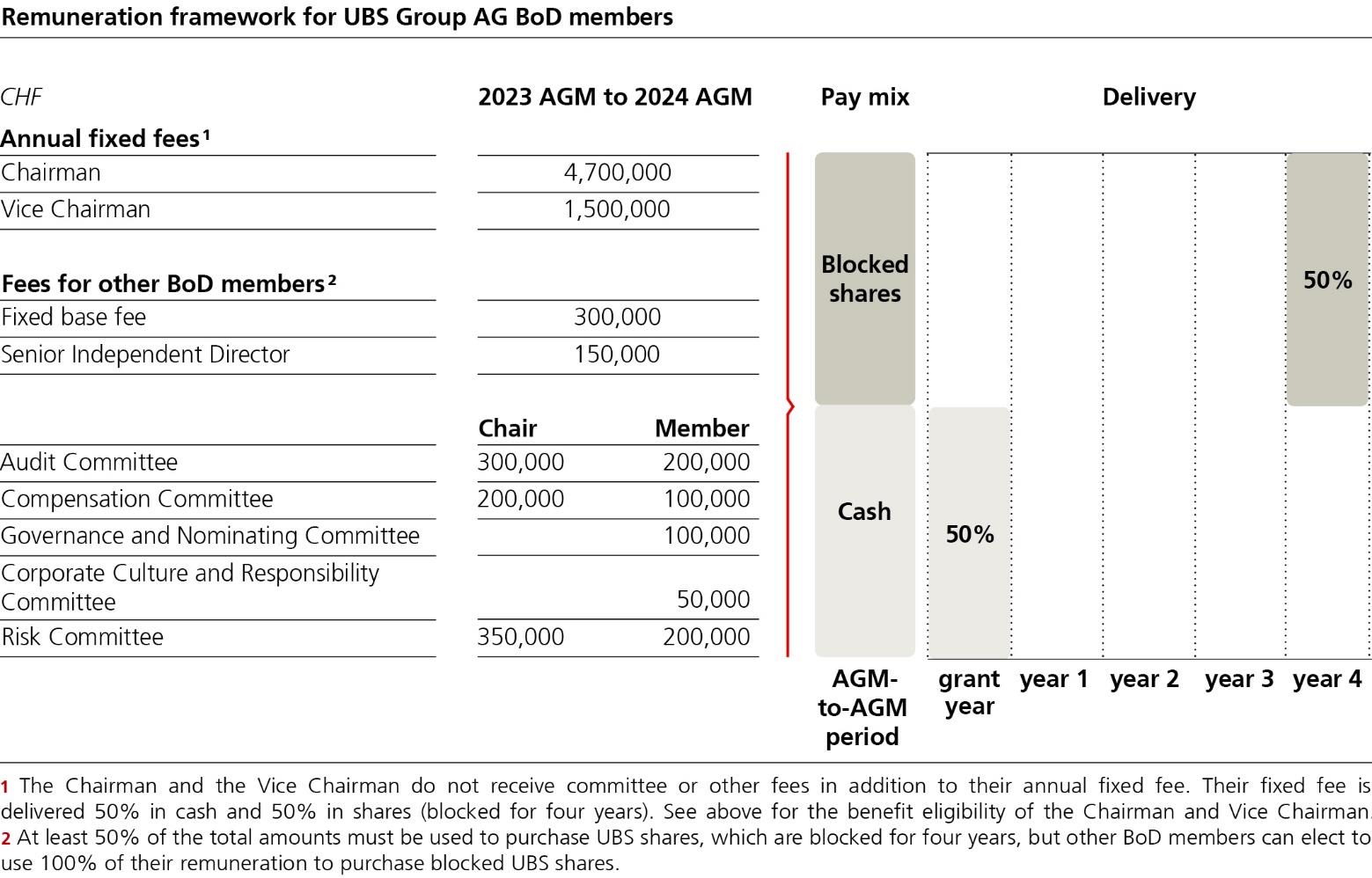
Advisory vote
|
Other BoD members
BoD
members,
except
the
Chairman
and
Vice
Chairman,
receive
fixed
fees
for
their
services
on
the
BoD
and
its
committees. These
fees are
unchanged from
the last
AGM-to-AGM period.
BoD members
do not
receive performance
awards, severance
payments, benefits
or pension
contributions (the
benefit eligibility
of the
Chairman and
that of
the
Vice Chairman are described above).
BoD members other
than the Chairman
and the Vice
Chairman must use
a minimum of
50% of their
fees to purchase
UBS shares, which
are blocked
for four years,
and they may
elect to use
up to 100%
of their fees
to purchase blocked
UBS shares. The number
of shares is calculated
based on the average
closing price of the
10 trading days leading
up to
and including the grant date.
In 2023,
in order
to facilitate
the integration
of Credit
Suisse into
UBS, two
independent BoD
members served
on the
boards of directors of subsidiaries. UBS Group AG Board members who have
additional roles on the boards of significant
subsidiary entities
receive respective
fees for
the significant
increase in the
scope, responsibility
and complexity
of their
mandates.
These fees are aligned with other non-executive directors of
the respective subsidiary entities. The payment of
these subsidiary board
fees
is subject to shareholder
approval as part
of an incremental
amount at the
2024 AGM. The
total
remuneration
of
other
UBS
Group
AG
members,
including
fees
from
subsidiaries,
is
summarized
in
the
“Remuneration details and additional information for BoD members”
table below.
At
each
AGM,
shareholders
are
invited
to
approve
the
aggregate
amount
of
BoD
remuneration,
including
the
compensation for the Chairman
and Vice Chairman, which
applies until the next
AGM. The chart
and the tables below
provide details on the fee structure for the BoD members.
Approval governance for BoD compensation
The
Chairperson
of
the
Compensation
Committee
proposes
and
the
Compensation
Committee
approves
the
compensation of the Chairman
and that of the
Vice Chairman annually for
the upcoming AGM-to-AGM
period, taking
into consideration fee or compensation
levels for comparable roles based
on our core financial industry peers
and other
relevant leading Swiss companies included in the Swiss
Market Index.
The fee
structure for
the other
BoD members
is reviewed
annually based on
the Chairman’s
proposal to
the Compensation
Committee, which in turn submits a proposal to the BoD for approval. In our regular review of the BoD
fee structure, we
concluded that our overall approach for BoD member
compensation remains appropriate and thus unchanged.
›
Refer to “Compensation Governance” in the
“Compensation philosophy and governance”
section of this report for more
information about the remuneration responsibilities of the BoD
and Compensation Committee
Advisory vote
|
Audited |
Remuneration details and additional information for BoD members
Period 2023 AGM to 2024 AGM
CHF, except where indicated
Name, function
1
Audit Committee
Compensation Committee
Corporate Culture and
Responsibility Committee
Governance and Nominating
Committee
Risk
Committee
Base fee
Committee
fee(s)
Additional
payments
2
Benefits
3
Total
4
Share
percentage
5
Number of
shares
6,7
Subsidiary
entity board
fees
8
Total
including
subsidiary
fees
Colm Kelleher,
Chairman
9
C
C
Lukas Gähwiler, Vice
Chairman
9
M
M
Jeremy Anderson, Senior
Independent Director
C
M
Claudia Böckstiegel, member
M
William C. Dudley, member
M
M
Patrick Firmenich, member
M
M
Fred Hu, member
M
Mark Hughes, member
M
C
Nathalie Rachou, member
M
M
Julie G. Richardson, member
C
M
Dieter Wemmer, member
M
M
Jeanette Wong, member
M
M
Aggregate of all BoD members 2023/2024
12,494,198
15,183,090
Aggregate of all BoD members 2023/2024 in USD (for reference)
10
13,792,316
16,760,560
Period 2022 AGM to 2023 AGM
CHF, except where indicated
Name, function
1
Audit
Committee
Compensation Committee
Corporate Culture and
Responsibility Committee
Governance and
Nominating Committee
Risk Committee
Base fee
Committee
fee(s)
Additional
payments
2
Benefits
3
Total
4
Share
percentage
5
Number of
shares
6,7
Subsidiary
entity board
fees
Total
including
subsidiary
fees
Colm Kelleher,
Chairman
9
C
C
Lukas Gähwiler, Vice
Chairman
9
Jeremy Anderson, Senior
Independent Director
C
M
Claudia Böckstiegel, member
M
William C. Dudley, member
M
M
Patrick Firmenich, member
M
M
Fred Hu, member
M
Mark Hughes, member
M
C
Nathalie Rachou, member
M
M
Julie G. Richardson, member
C
M
Dieter Wemmer, member
M
M
Jeanette Wong, member
M
M
Aggregate of all BoD members 2022/2023
Legend: C = Chairperson of the respective Committee, M = Member
of the respective Committee
1 Twelve BoD members were in
office on 31 December 2023 and on
31 December 2022.
2 These payments are associated with the
Senior Independent Director role.
3 For the period from the 2023
AGM to the
2024 AGM, benefits
amount is an estimate.
For the Vice
Chairman, the benefits
include the portion
related to UBS’s
contribution to the
statutory pension scheme.
4 Excludes UBS’s
portion related to
the legally
required social security contributions, which for the period from the 2023 AGM to the 2024 AGM (including the Chairman, Vice Chairman and UBS Group
AG members with a role in subsidiaries) is estimated at grant
at CHF 1,000,000 and which for the period from the 2022 AGM to the 2023 AGM was estimated at grant at CHF 731,329. The
legally required social security contributions paid by the independent BoD members are
included in the amounts shown in this table, as appropriate.
5 For the Chairman and Vice Chairman, fees are paid 50% in cash and 50% in blocked UBS shares. Other BoD members must use a minimum
of 50% of
their fees to purchase UBS shares, which are blocked for four years.
6 For 2023, UBS shares were valued at CHF 24.435 (average closing price of UBS shares over the last 10 trading days leading up to and including
the grant date). For 2022, UBS shares were valued at CHF 20.092 (average closing price of UBS shares over the last 10 trading days leading up to and including the grant date). These shares are blocked for four years.
7 Number of shares is reduced in case of the 100% election to deduct legally required
contributions. All remuneration payments are,
where applicable, subject to social security contributions and
/ or withholding tax.
8 The payment of the subsidiary board fees for the period 2023 AG
M
to 2024 AGM are subject to shareholder approval as part of an incremental
amount at the 2024 AGM.
9 The Chairman and the Vice Chairman
do not receive
committee fees in
addition to their
annual fixed fee.
10 Swiss franc
amounts have been
translated into
US dollars for
reference at the
2023 performance
award currency
exchange rate
of CHF /
USD 1.10389.
p
Advisory vote
|
Supplemental information
Fixed and variable compensation for GEB
members
Fixed and variable compensation for GEB members
1,2,3
Total for 2023
Not deferred
Deferred
4
Total for 2022
CHF m, except where indicated
Amount
%
Amount
%
Amount
%
Amount
Total compensation
Amount
5
Number of beneficiaries
Fixed compensation
5,6
Cash-based
Equity-based
Variable compensation
Cash
7
Long-Term Incentive Plan (LTIP)
8
Deferred Contingent Capital Plan (DCCP)
8
1 The figures include all GEB members in office during
the respective years.
2 Includes compensation paid under the employment contract
during the notice period for GEB members who stepped down
during the
respective years.
3 Includes compensation for
newly appointed GEB members
for their time in
office as a GEB
member during the respective
years.
4 Based on the
specific plan vesting and
reflecting the total
award value at grant, which may differ from the
expense recognized in the income statement in accordance with IFRS Accounting
Standards.
5 Excludes benefits and employer’s contributions
to retirement benefit
plans. Includes social security contributions paid by GEB members but excludes the portion related to the legally required social security contributions paid by UBS.
6 Includes base salary and role-based allowances,
rounded to the nearest million.
7 Includes allocation of vested but blocked shares, in line with the remuneration section of the UK
Prudential Regulation Authority Rulebook.
8 For the GEB members who are also
MRTs or SMFs, the awards do not include dividend and interest payments. Accordingly, the amounts reflect for the LTIP the fair value of the non-dividend-bearing awards and for
the DCCP the fair value of the granted
non-interest-bearing awards.
Regulated staff
Key Risk Takers
Key
Risk
Takers
(KRTs)
are
defined
as
those
employees
that,
by
the
nature
of
their
roles,
have
been
determined
to
materially set, commit
or control
significant amounts
of the firm’s
resources and
/ or exert
significant influence over
its
risk profile. This includes
employees working in front-office roles, logistics
and control functions. Identifying KRTs globally
is part of
our risk control
framework and
an important element
in ensuring we
incentivize only appropriate
risk-taking.
For 2023,
in addition
to GEB
members, 1,038
employees were
classified as
KRTs
throughout
the UBS
Group
globally,
including all
employees
with a
total compensation
exceeding
USD /
CHF 2.5m (Highly
Paid
Employees), who
may not
have been
identified as
KRTs
during the
performance year.
Compared with
2022, the
increase in
the number
of KRTs
has been driven by the inclusion of Credit Suisse
employees in the identification process.
In line
with regulatory
requirements, the
performance of
employees identified
as KRTs
during the
performance
year is
evaluated by the control functions. In addition,
KRTs’ performance awards are subject to a
mandatory deferral rate of at
least
50%,
regardless
of
whether
the
deferral
threshold
has
been
met
(excluding
KRTs
with
de
minimis
performance
awards below a predetermined threshold
where standard deferral
rates apply). Consistent with all other
employees, the
deferred portion of a KRT’s compensation is also subject
to forfeiture or reduction if the KRT commits harmful acts.
Fixed and variable compensation for Key Risk Takers
1
Total for 2023
Not deferred
Deferred
2
Total for 2022
3
USD m, except where indicated
Amount
%
Amount
%
Amount
%
Amount
Total compensation
Amount
Number of beneficiaries
Fixed compensation
4,5
Cash-based
Equity-based
Variable compensation
Cash
6
Long-Term Incentive Plan (LTIP) / Equity Ownership
Plan (EOP) / Fund Ownership Plan (FOP)
7
Deferred Contingent Capital Plan (DCCP)
7
1 Includes employees with a total compensation exceeding USD / CHF 2.5m (Highly Paid Employees), excludes payments made to individuals related to their time as GEB member.
2 Based on the specific plan vesting
and reflecting the total value at
grant, which may differ from the
expense recognized in the income statement
in accordance with IFRS Accounting Standards.
3 The 2022 data excludes
Credit Suisse.
4 Excludes
benefits and employer’s contributions to retirement benefits plan. Includes social
security contributions paid by KRTs but excludes the legally required social
security contributions paid by UBS.
5 Includes base salary
and role-based allowances.
6 Includes allocation of
vested but blocked
shares, in line
with regulatory requirements where
applicable.
7 KRTs who
are also MRTs
do not receive dividend
and interest payments.
Accordingly, the amounts for the EOP / LTIP
reflect the fair value of the non-dividend-bearing awards and for the DCCP the fair value of the granted
non-interest-bearing awards.
Advisory vote
|
Deferred compensation of the GEB and KRTs
The
table
below
shows
the
current
economic
value
of
unvested
outstanding
deferred
variable
compensation
awards
subject to ex post
adjustments. For share-based plans, the economic value is
determined based on the closing share price
on 31
December
2023. For
notional funds
,
it is
determined
using
the
latest
available
market
price
for
the
underlying
funds at year-end 2023, and for deferred cash plans, it is determined
based on the outstanding amount of cash owed to
award recipients.
Deferred compensation of the GEB and KRTs
1,2,3
USD m, except where indicated
Relating to awards
for 2023
4
Relating to
awards for prior
years
5
Total
of which: exposed to
ex post explicit and /
or implicit adjustments
Total deferred
compensation
year-end 2022
6
Total amount of
deferred compensation
paid out in 2023
7
GEB
Deferred Contingent Capital Plan
Equity Ownership Plan (including notional funds
and Credit Suisse legacy plans)
Long-Term Incentive Plan
KRTs
Deferred Contingent Capital Plan
Equity Ownership Plan (including notional funds)
Long-Term Incentive Plan
Credit Suisse legacy plans
n/a
Total GEB and KRTs
1 Based on the
specific plan vesting and
reflecting the economic
value of the outstanding
awards (grant value
for legacy Credit
Suisse notional funds), which
may differ from the
expense recognized in the
income
statement in accordance with IFRS.
Year-to-year reconciliations
would also need to
consider the impacts of
additional items including off-cycle
awards, FX movements,
population changes, and
dividend equivalent
reinvestments.
2
Refer to “Note 27
Employee benefits: variable
compensation” in the “Consolidated
financial statements” section of
this report for more
information.
3 GEB members and
KRTs who are
also
MRTs do not receive dividend and interest payments. Accordingly,
the amounts for the EOP / LTIP reflect the fair value of the
non-dividend-bearing awards and for the DCCP the fair value of the granted non-interest-
bearing awards.
4 Where applicable, amounts are translated into US dollars at the performance award currency exchange rate
.
LTIP values reflect the fair value
awarded at grant.
5 Takes into account the ex post
implicit adjustments, given the share
price movements since grant. Where
applicable, amounts are translated
from award currency into US
dollars using FX rates as of
31 December 2023. LTIP
values reflect the fair
value awarded at grant.
6 The 2022 data excludes Credit Suisse legacy awards.
7 Valued at distribution price and FX rate for all awards distributed
in 2023 (this excludes interests on DCCP).
The table below
shows the value
of actual ex
post explicit and
implicit adjustments to
outstanding deferred compensation
in the 2023 financial year for GEB members and KRTs.
Ex post adjustments
occur after
an award
has been
granted. Explicit
adjustments occur
when we
adjust compensation
by forfeiting deferred awards. Implicit adjustments are
unrelated to any action taken by the firm and occur as a result of
price movements that affect the value of an award.
GEB and KRTs
ex post explicit and implicit adjustments to deferred compensation
Ex post explicit adjustments
to unvested awards
1
Ex post implicit adjustments
to unvested awards
2
USD m
31.12.23
31.12.22
31.12.23
31.12.22
GEB
Deferred Contingent Capital Plan
Equity Ownership Plan (including notional funds and
Credit Suisse legacy
plans, if applicable)
Long-Term Incentive Plan
KRTs
Deferred Contingent Capital Plan
Equity Ownership Plan (including notional funds)
Long-Term Incentive Plan
Credit Suisse legacy plans
n/a
n/a
Total GEB and KRTs
1 For notional share awards (excluding
Credit Suisse legacy plan awards), ex post explicit
adjustments are calculated as units forfeited during the year,
valued at the share price on 31 December 2023
(USD 30.9) for
2023 (which may differ from the expense recognized in the income statement in accordance
with IFRS). The 2022 data is valued using
the share price on 31 December 2022 (USD 18.67). For
LTIP,
the forfeited units
reflect the fair value awarded at grant. For the
notional funds awarded to employees in investment areas within Asset Management
under the FOP, this
represents the forfeiture credits recognized in 2023 and 2022.
For DCCP,
the fair value at grant of the forfeited awards during the year is reflected. Credit Suisse legacy plan awards (including Credit Suisse notional fund awards) are calculated using value at grant
and include the
explicit adjustments resulting from
the cancellation and reduction
order issued by the
Federal Department
of Finance (FDF) of
Switzerland. The 2022
data excludes Credit Suisse
legacy award forfeitures.
All values
shown exclude DCCP interest and
CCA coupon forfeitures.
2 Ex post implicit adjustments
for UBS shares are calculated
based on the difference
between the weighted average
grant date fair value
and the share
price at year-end
while Credit Suisse legacy plans
are calculated based on comparing
the value at 31
December 2023 to the
value at 31 December
2022. The amount
for UBS notional funds is
calculated using the
mark-to-market change during 2023
and 2022. The 2022 data
excludes implicit adjustments related to
the Credit Suisse legacy awards.
For the GEB members
who were appointed to the GEB
during 2023, awards
have been fully reflected in the GEB categories.
Advisory vote
|
Material Risk Takers
For relevant EU- or
UK-regulated entities, we identify
individuals who are deemed
to be Material
Risk Takers (MRTs) based
on sectorial
and /
or local
regulatory requirements,
including the
respective EU
Commission Delegated
Regulation, the
fifth iteration of
the EU Capital
Requirements Directive (CRD V) and
equivalent UK requirements, as
applicable. This group
consists of senior management, risk takers, selected staff in control or
support functions and certain highly compensated
employees. For 2023, UBS identified 1,321 MRTs
in relation to its relevant EU or UK entities. The increase
in the number
of
MRTs
compared
with
last
year
has
been
driven
by
the
MRT
population
identified
in
relation
to
Credit
Suisse
legal
entities.
Subject to individual or legal-entity
level proportionality
considerations,
variable compensation
awarded to MRTs is subject
to additional deferral
and other requirements.
For CRD-relevant entities,
these include a minimum deferral
rate of 40% or
60% (depending
on role /
variable compensation
level) on
performance
awards and
delivery of
at least 50%
of any upfront
performance
award in UBS
shares that
are vested
but blocked
for 12 months
after grant.
Deferred awards
granted to
MRTs
under UBS’s deferred compensation plans for their performance in 2023 are
subject to 6- or
12-month blocking periods
post vesting
and do not pay
out dividends
or interest during
the deferral
period.
Additionally, MRTs
are subject
to a
maximum ratio
between fixed
and variable
pay. Across
EU locations,
the maximum
variable to fixed compensation ratio is set to 200%, based
on approval through relevant shareholder votes.
For UK-regulated MRTs, the maximum ratio was
set by UBS taking into
account the business activities and prudential and
conduct risks
of the
relevant legal
entities. In
addition, the
maximum ratios
were set
considering the
scenario that
the
relevant legal entities might exceed their financial objectives.
The maximum ratio for all UK-regulated MRTs
was approved by the compensation committees
of the relevant entities in
December 2023.
For up to seven years after
grant, performance awards granted to
MRTs are subject to clawback provisions,
which allow
the
firm
to
claim
repayment
of
both
the
upfront
and
the
vested
deferred
element
of
any
performance
award
if
an
individual is found to have contributed substantially to significant financial losses for
the Group or corporate structure in
scope, a material downward restatement of disclosed results,
or engaged in misconduct and / or failed to take expected
actions, thus contributing to significant reputational harm.
LTIP awards granted to
UK MRTs and SMFs
are subject to an
additional non-financial conduct-related
metric as required
by UK regulation.
UK Senior Managers and Certification Regime
The
Senior
Managers
and
Certification
Regime
(the
SMCR)
of
the
UK
Prudential
Regulation
Authority
and
Financial
Conduct Authority requires
that individuals with specified
responsibilities, performing
certain significant functions
and /
or those in certain other identified categories be designated
as SMFs.
Subject to de minimis and other compensation-related
considerations,
variable compensation
awards made to SMFs must
comply with specific requirements,
including longer deferral,
blocking and clawback periods.
The deferral period for SMFs
is seven years, with the deferred performance
awards vesting no faster than pro rata from years 3 to 7, except those that
have total compensation
below GBP 500,000 and variable incentive
accounting for less than 33% of total compensation,
for whom a five-year deferral period
(instead of a seven-year period) applies.
Such awards are also subject to a 12-month
blocking
period
post
vesting.
The
clawback
policy
for
SMFs
permits
clawback
for
up
to
10
years
from
the
date
of
performance award
grants (applicable if
an
individual is
subject to
an
investigation at
the end
of the
initial seven-year
clawback period).
All SMFs
are also
MRTs and,
as such, subject
to the same
prohibitions
on dividend
and interest
payments.
Control functions and Group Internal Audit
Our
control
functions
must
be
independent
in
order
to
monitor
risk
effectively.
Therefore,
their
compensation
is
determined separately from the
revenue areas that they
oversee, supervise or monitor.
Their performance award pool is
based not on the performance
of these businesses, but
on the performance of
the Group as a
whole. We also
consider
other
factors,
such
as
how
effectively
the
function
has
performed
and
our
market
position.
Decisions
on
individual
compensation for
the senior
managers of
the control
functions are
made by
the function
heads and
approved
by the
Group CEO. Decisions on individual compensation for the members of Group Internal Audit (GIA) are made by the Head
GIA and
approved
by
the
Chairman.
Following
a
proposal
by
the
Chairman,
total
compensation
for
the
Head
GIA is
approved by the Compensation Committee.
Advisory vote
|
2023 Group personnel expenses
The
number
of
personnel
employed
as
of
31 December
2023 increased
by
40,241
to
112,842
(full-time
equivalents)
compared with 31 December 2022.
The
table
below
shows
our
total
personnel
expenses
for
2023,
including
salaries,
pension
expenses,
social
security
contributions,
variable
compensation
and
other
personnel
costs.
Variable
compensation
includes
cash
performance
awards paid in 2024 for
the 2023 performance year, amortization of unvested deferred awards granted in previous years
and the cost of
deferred awards granted to employees that are eligible for
retirement in the context of the
compensation
framework at the date of grant.
The performance award
pool reflects the
value of performance
awards granted relating
to the 2023
performance year,
including awards
that are
paid out
immediately and
those that
are
deferred.
To
determine our
variable compensation
expenses,
the
following
adjustments
are
required
in
order
to
reconcile
the
performance
award
pool
to
the
expenses
recognized
in the Group’s Financial Statements prepared
in accordance with IFRS Accounting Standards
:
–
a reduction
for expenses
deferred to
future periods (amortization
of unvested
awards granted
in 2024 for
the 2023
performance year) and accounting adjustments;
and
–
an addition for the 2023 amortization of unvested deferred
awards granted in prior years.
As a large
part of compensation
consists of deferred
awards, the
amortization of
unvested deferred
awards granted
in
prior years
forms a
significant part
of the
IFRS Accounting
Standards
expenses in
both 2023
and 2024.
The expenses
related to prior performance years and total expenses recognized in 2023 include deferred compensation granted under
Credit Suisse
Group compensation
plans in
previous years,
which have
to be
expensed from
2023 onward
due to
the
integration of Credit Suisse into UBS.
›
Refer to “Note 7 Personnel expenses”
and “Note 28 Employee benefits: variable
compensation” in the “Consolidated financial
statements” section of this report for more information
Personnel expenses
Expenses recognized in the IFRS Accounting Standards
income statement
USD m
Related to the
performance year 2023
Related to prior
performance years
Total expenses
recognized in
2023
Total expenses
recognized in
2022
Total expenses
recognized in
2021
Salaries
1
Non-deferred cash
Deferred compensation awards
of which: Equity Ownership Plan
of which: Deferred Contingent Capital Plan
of which: Long-Term Incentive Plan
of which: Fund Ownership Plan
Variable compensation – performance awards
Variable compensation – financial advisors
2
Variable compensation – other
3
Total variable compensation
4
Contractors
Social security
Pension and other post-employment benefit plans
5
Other personnel expenses
Total personnel expenses
1 Includes role-based allowances.
2 Financial advisor compensation consists of cash
and deferred compensation awards and is
based on compensable revenues and firm
tenure using a formulaic approach. It
also
includes expenses related to compensation commitments with financial advisors entered into at the time of recruitment that are subject to vesting requirements.
3 Consists of existing deferred awards and retention
awards granted to
Credit Suisse employees as
well as replacement payments,
forfeiture credits, severance
payments, retention plan
payments and interest
expense related to the
Deferred Contingent Capital
Plan.
4 Refer to “Note 28 Employee benefits: variable
compensation” in the “Consolidated financial statements”
section of this report for more information.
5 Refer to “Note 27 Post-employment
benefit plans” in the
“Consolidated financial statements” section of this report for more information.
Advisory vote
|
Deferred compensation
Vesting of outstanding awards
granted in prior years subject to performance metrics
and thresholds
The tables
below show
the extent
to which
the performance
metrics and
thresholds for
awards granted
in prior
years
have been met and the related vesting in 2024.
Long-Term Incentive Plan (LTIP) 2019 (performance period 2020–2022)
Performance metrics
Performance achievement
1
Vesting
Return on common equity tier 1 capital
(RoCET1) and relative Total Shareholder
Return (rTSR)
The overall achievement level is 98% of
the maximum opportunity (of up to
100%), based on outcomes for rTSR
(weighted 50%) and RoCET1 (weighted
50%).
–
For GEB, the first and second installments vested
in 2023 and
2024, respectively, and the remaining tranche will vest in 2025
accordingly. As outlined in our 2019 Compensation Report, up to
CHF 7.3m, or 30%, of the 2019 LTIP awards at grant for GEB
members active in March 2017 continues to be
at risk and directly
linked to the final resolution of the French cross-border matter.
–
For other select senior management, the full
award vested in
2023.
1
maximum number of shares was determined by dividing the awarded amount
by the fair value of the award at the date of grant, divided
by CHF 12.919 or USD 13.141, the average closing price of UBS shares
over
the last ten trading days leading up to and including the grant date.
Long-Term Incentive Plan (LTIP) 2020 (performance period 2021–2023)
Performance metrics
Performance achievement
1
Vesting
Return on common equity tier 1 capital
(RoCET1) and relative Total Shareholder
Return (rTSR)
The overall achievement level is 92.55%
of the maximum opportunity (of up to
100%), based on outcomes for rTSR
(weighted 50%) and RoCET1 (weighted
50%).
–
For GEB, the first installment will vest in 2024
and the remaining
tranches will vest in 2025 and 2026 accordingly.
–
For other select senior management, the full
award will vest in
2024.
1
As disclosed in our Compensation Report 2020, LTIP
awards for the 2020 performance year were
awarded at a value of 65.90% of maximum,
which reflected our best estimate of the fair value
of the award. The
maximum number of shares was determined
by dividing the awarded amount by
the fair value of the award
at the date of grant, divided
by CHF 13.89 or USD 15.411, the average
closing price of UBS shares over
the last ten trading days leading up to and including the grant date.
›
Refer to “Performance achievement of the 2020
LTIP granted in 2021” in the “Group compensation” section of this report for more
information
The
below
EOP
and
DCCP
thresholds
have
been
set
to
support
the
sustainability
of
the
organization
and
represent
minimum performance levels to retain the awards.
Equity Ownership Plan (EOP) 2018 /
2019, EOP 2019 / 2020, EOP 2020 / 2021
and EOP 2021 / 2022
Thresholds
Threshold achievement
1
Vesting
Return on common equity tier 1 capital
(RoCET1) and divisional return on
attributed equity
The Group and divisional thresholds have
been satisfied.
The following installments vest in full:
–
for EOP 2018 / 2019, the third and final installment
for the GEB
members, and certain other employes
–
for EOP 2019 / 2020, the second installment for
SMFs
–
for EOP 2020 / 2021, the second installment
for all other
employees covered under the plan; and
–
for EOP 2021 / 2022, the first installment for
all other employees
covered under the plan.
1
Deferred Contingent Capital Plan (DCCP) 2018
/ 2019
Thresholds
Threshold achievement
1
Vesting
Common equity tier 1 (CET1) capital ratio,
viability event and, additionally for GEB,
Group profit before tax
The thresholds have been satisfied.
–
DCCP 2018 / 2019 vests in full.
1
Advisory vote
|
Outstanding Credit Suisse Group awards granted in prior years
subject to performance conditions
The tables
below show
the extent
to which
the performance
metrics and
thresholds
for awards
granted by
the Credit
Suisse Group in prior years have been met and the
related impact of the 2023 results.
As a
result of the
acquisition by UBS
Group AG of
Credit Suisse Group
AG, many of
the financial measurements
applicable
to legacy Credit
Suisse Group awards
are no longer
available or are
not fully
comparable to previous
performance periods,
therefore revised metrics have been adopted as set out
in the table below.
Performance Share Awards (PSA) 2016/2017, 2017/2018,
2018/2019, 2019/2020, 2020/2021,
2021/2022
Thresholds
Amended threshold
Threshold achievement
1
2023 impact
Under the legacy Credit Suisse Group
plan rules, negative adjustment if:
–
Credit Suisse Group AG has
negative RoE or
–
divisional pre-tax loss
Negative adjustment if reported UBS
Group AG return on CET1 capital
(RoCET1) is negative.
The amended threshold has been
satisfied.
No negative adjustment applied in
respect of PSAs outstanding on
31 December 2023.
1
Performance may be adjusted for disclosed items generally not representative of underlying business performance.
Strategic Delivery Plan Awards (SDP) 2021/2022
Thresholds
Amended threshold
Threshold achievement
1
2023 impact
Under the legacy Credit Suisse Group
plan rules, cancellation in full if either:
–
CET1 capital ratio is below a
statutory minimum on
31 December 2022, 2023 or 2024
–
Leverage ratio is below 3.7% on
31 December 2022, 2023 or 2024
Cancellation in full if reported UBS
Group AG CET1 ratio is less than 7%
on 31 December 2023 or 2024
The amended threshold has been
satisfied.
No cancellation of SDP awards based
on 2023 financial results.
1
Performance may be adjusted for disclosed items generally not representative of underlying business performance.
Transformation Awards share component 2022/23
Share price condition and
performance metrics
Amended threshold
Performance achievement
2023 impact
Under legacy Credit Suisse Group
plan rules:
–
Credit Suisse Group share price of
CHF 3.82 (on 31 December 2025)
–
Credit Suisse Group RoTE of
between 5% and 7.5% (FY 2025)
–
Credit Suisse Group cost base
between CHF 15bn threshold and
CHF 14bn (FY 2025)
–
Underlying UBS Group AG RoCET1
of 8% minimum (FY 2025)
–
UBS Group AG share price of
CHF 85.87 (on 31 December 2025)
Not applicable, share price condition
and performance metric only apply
for 2025.
No impact. Share price condition and
performance metric only apply for
2025.
All outstanding Contingent Capital Awards (CCAs)
granted in previous years
Thresholds / conditions
Threshold / conditions outcome
Vesting
Credit Suisse CET1 capital ratio, Credit
Suisse viability event, Credit Suisse
contingency event
Viability event triggered during 2023.
All outstanding CCAs were canceled on 16 May
2023.
Advisory vote
|
Audited |
Share ownership / entitlements of GEB members
1
Name, function
on
31 December
Number of
unvested
shares / at
risk
2
Number of
vested shares
Total number
of shares
Potentially
conferred
voting
rights in %
Sergio Ermotti, Group Chief Executive Officer
2023
2022
-
-
-
-
Ralph A.J.G. Hamers, former Group Chief Executive Officer
2023
-
-
-
-
2022
Michelle Bereaux, Group Integration Officer
2023
2022
-
-
-
-
Christian Bluhm, Group Chief Risk Officer
2023
2022
Mike Dargan, Group Chief Operations and Technology Officer
2023
2022
Suni Harford, President Asset Management
2023
2022
Naureen Hassan, President UBS Americas
2023
2022
Robert Karofsky, President Investment Bank
2023
2022
Sabine Keller-Busse, President Personal & Corporate Banking and President UBS Switzerland
2023
2022
Iqbal Khan, President Global Wealth Management
2023
2022
Edmund Koh, President UBS Asia Pacific
2023
2022
Ulrich Körner, CEO of Credit Suisse AG
2023
2022
-
-
-
-
Barbara Levi, Group General Counsel
2023
2022
Beatriz Martin Jimenez, Head Non-core and Legacy and
President UBS EMEA
2023
2022
-
-
-
-
Markus Ronner, Group Chief Compliance and Governance Officer
2023
2022
Stefan Seiler, Head Group Human Resources & Group Corporate Services
2023
2022
-
-
-
-
Todd Tuckner,
Group Chief Financial Officer
2023
2022
-
-
-
-
Sarah Youngwood, former Group Chief Financial Officer
2023
-
-
-
-
2022
Total
2023
2022
1 Includes all vested and unvested
shares of GEB members, including those held by
related parties. No options were held in 2023 and
2022 by any GEB member or
any of its related parties. Refer to “Note
27 Employee
benefits: variable compensation” in the “Consolidated financial statements” section
of this report for more information.
2 Includes shares granted under variable compensation
plans with forfeiture provisions. For
the 2019/20 and 2020/21 LTIP awards, the values reflect the final value. For all other LTIP awards, the values reflect the fair value awarded at grant. The actual number of shares vesting in the future will be calculated
under the terms of the plans. Refer to “Group compensation” in the “Compensation” section of this report for more information
about the plans.
p
Audited |
Total
of all vested and unvested shares of GEB members
1,2
Total
of which: vested
of which: vesting
2024
2025
2026
2027
2028
2029
Shares on 31 December 2023
2023
2024
2025
2026
2027
2028
Shares on 31 December 2022
1 Includes shares held by related parties.
2 Includes shares granted under variable compensation plans with forfeiture provisions. The actual number of shares vesting in the future will be calculated under the terms
of the plans. Refer to the “Group compensation” section of this report for more information.
p
Advisory vote
|
Audited |
Number of shares of BoD members
1
Name, function
on 31 December
Number of shares held
Voting rights in %
Colm Kelleher, Chairman
2023
2022
Lukas Gähwiler, Vice Chairman
2
2023
2022
Jeremy Anderson, Senior Independent Director
2023
2022
Claudia Böckstiegel, member
2023
2022
William C. Dudley, member
2023
2022
Patrick Firmenich, member
2023
2022
Fred Hu, member
2023
2022
Mark Hughes, member
2023
2022
Nathalie Rachou, member
2023
2022
Julie G. Richardson, member
2023
2022
Dieter Wemmer, member
2023
2022
Jeanette Wong, member
2023
2022
Total
2023
2022
1 Includes blocked and
unblocked shares held
by BoD members,
including those held by
related parties. No
options were granted in
2023 and 2022.
2 Includes 127,386 unvested
shares granted under
variable
compensation plans with forfeiture provisions as part of Lukas Gähwiler’s compensation for his executiv
e
roles previously held at UBS.
p
Audited |
Total
of all blocked and unblocked shares of BoD members
1
Total
of which:
unblocked
of which: blocked until
2024
2025
2026
2027
Shares on 31 December 2023
2
2023
2024
2025
2026
Shares on 31 December 2022
1 Includes shares held by related parties.
2 Includes 127,386 unvested shares granted under variable
compensation plans with forfeiture provisions as part of Lukas Gähwiler’s
compensation for his executive roles
previously held at UBS.
p
Audited |
Loans granted to GEB members
Pursuant to
article 38
of the
Articles of Association
of UBS
Group AG (the
AoA), GEB
members may
be granted
loans.
Such
loans
are
made
in
the
ordinary
course
of
business
on
substantially
the
same
terms
as
those
granted
to
other
employees,
including
interest
rates
and
collateral,
and
neither
involve
more
than
the
normal
risk
of
collectability
nor
contain any other unfavorable features
for the firm. The total amount of such
loans must not exceed CHF 20m
per GEB
member.
CHF, except where indicated
1
USD
(for reference)
Name, function
on 31 December
Loans
2,3,4
Loans
2,3,4
Ulrich Körner, CEO of Credit Suisse AG (highest loan in 2023)
2023
Christian Bluhm, Group Chief Risk Officer (highest loan
in 2022)
2022
Aggregate of all GEB members
2023
2022
1 Swiss franc and US dollar amounts disclosed represent local currency
amounts translated at the relevant year-end closing exchange rate.
2 All loans granted are secured loans.
3 Excludes two unused uncommitted
credit facilities in 2023 of CHF 11,840,766 (USD 14,067,847) that have been
granted to two GEB members. No unused uncommitted
credit facilities in 2022.
4 No loans have been granted to related parties of the
GEB members at conditions not customary in the market.
p
Advisory vote
|
Audited |
Loans granted to BoD members
Pursuant to
article 33
of the
AoA, loans
to independent
BoD members
are made
in the
ordinary course
of business
at
general market conditions.
The Vice Chairman, given
the full-time nature of
his role, may be
granted loans in
the ordinary
course of business on substantially the same terms as those granted
to employees, including interest rates and collateral.
Such loans neither involve more
than the normal risk of collectability
nor contain any other unfavorable
features for the
firm. The total amount of such loans must not exceed
CHF 20m per BoD member.
CHF, except where indicated
1
USD
(for reference)
on 31 December
Loans
2,3,4
Loans
2,3,4
Aggregate of all BoD members
2023
2022
1 Swiss franc and US dollar amounts
disclosed represent local currency amounts translated
at the relevant year-end
closing exchange rate.
2 All loans granted are secured
loans.
3 CHF 690,000 (USD 819,775)
for Claudia Böckstiegel (independent BoD member) in 2023 and no loans in 2022.
4 No loans have been granted to related parties of the BoD members at conditions not customary in the market.
p
Audited |
Compensation paid to former BoD and GEB members
1
The compensation and benefits in the table below relate to payments made
to former BoD and GEB members. Variable compensation paid to GEB members who stepped
down during
the respective years is included in the GEB performance award
pool (see table “Total compensation for GEB members“)
CHF, except where indicated
2, 4
USD
(for reference)
2
For the year
Compensation
Benefits
Total
Total
Former BoD members
2023
2022
Aggregate of all former GEB members
3
2023
2022
Aggregate of all former BoD and GEB members
2023
2022
1 Compensation or remuneration that is related to the former
members’ activity on the BoD or GEB or that
is not at market conditions.
2 Swiss franc and US dollar amounts disclosed
represent local currency amounts
translated at the relevant year-end closing exchange rate.
3 Includes benefit payments in 2023 for three former GEB
members and in 2022 to two former GEB members.
4 Excludes the portion related to the legally
required employer’s social security contributions for 2023 and 2022, however,
the legally required employees’ social security contributions are included in the amounts shown in the table above, as
appropriate.
p
Advisory vote
|
GEB and BoD member mandates outside the Group
In line with the Swiss Code of Obligations, we disclose the mandates of GEB and BoD
members outside of the Group in
the tables below. Further information on background and biographies, including mandates in UBS entities, are available
in the “Corporate governance”
section of this report.
Audited |
BoD member mandates outside the Group
Name, function
Mandates
Colm Kelleher, Chairman
–
Member of the Board of Norfolk Southern Corporation
(chair of the risk and finance committee)
–
Member of the Board of Directors of the Bretton Woods Committee
–
Member of the Board of the Swiss Finance Council
–
Member of the International Monetary Conference
–
Member of the Board of the Bank Policy Institute
–
Member of the Board of Americans for Oxford
–
Visiting Professor of Banking and Finance, Loughborough
Business School
–
Member of the European Financial Services Round
Table
–
Member of the European Banking Group
–
Member of the International Advisory
Council of the China Securities Regulatory Commission
–
Member of the Chief Executive’s Advisory Council
(Hong Kong)
Lukas Gähwiler, Vice Chairman
–
Vice Chairman of the Board of Directors of Pilatus Aircraft
Ltd
–
Member of the Board of Directors of Ringier AG
–
Member of the Board and Board Committee of economiesuisse
–
Chairman of the Employers Association of Banks
in Switzerland
–
Member of the Board of Directors of the Swiss Employers
Association
–
Member of the Board of Directors and the Board of Directors Committee
of the Swiss Bankers
Association
–
Member of the Board of the Swiss Finance Council
–
Member of the Board of Trustees of Avenir Suisse
Jeremy Anderson, Senior Independent Director
–
Member of the Board of Prudential plc (chair of
the risk committee)
–
Trustee of the UK’s Productivity Leadership Group
Claudia Böckstiegel, member
–
Member of the Enlarged Executive Committee
of Roche Holding AG
William C. Dudley, member
–
Member of the Board of Treliant LLC
–
Member of the Advisory Board of Suade Labs
–
Senior Advisor to the Griswold Center for
Economic Policy Studies, Princeton University
–
Member of the Group of Thirty
–
Member of the Council on Foreign Relations
–
Chairman of the Bretton Woods Committee Board of Directors
–
Member of the Board of the Council for Economic
Education
Patrick Firmenich, member
–
Vice Chairman of the Board of dsm firmenich
(chair of the nomination committee)
–
Member of the Board of Directors of INSEAD and INSEAD
World Foundation
–
Member of the Advisory Council of the Swiss
Board Institute
Fred Hu, member
–
Non-executive Chairman of the Board of Yum China Holdings (chair of the
nomination and
governance committee)
–
Member of the Board of ICBC (chair of the nomination
committee)
–
Chairman of Primavera Capital Ltd
–
Trustee of the China Medical Board
–
Co-Chairman of the Nature Conservancy Asia
Pacific Council
–
Member of the Board of Trustees, the Institute for Advanced Study
–
Director and member of the Executive Committee
of China Venture Capital and Private Equity
Association Ltd.
Mark Hughes, member
–
Chair of the Board of Directors of the Global Risk Institute
–
Senior advisor to McKinsey & Company
Nathalie Rachou, member
–
Member of the Board of Euronext N.V. (chair of the remuneration committee)
–
Member of the Board of Veolia Environnement SA (chair of the audit committee)
–
Member of the Board of the African Financial Institutions
Investment Platform
–
Member of the Board of Directors of Fondation Léopold
Bellan
Julie G. Richardson, member
–
Member of the Board of Yext (chair of the audit committee)
–
Member of the Board of Datadog (chair of the
audit committee)
–
Member of the Board of Fivetran
–
Member of the Board of Coalition, Inc.
–
Member of the Board of Checkout.com (stepped down
in January 2024)
Dieter Wemmer, member
–
Member of the Board of Ørsted A/S (chair of the
audit and risk committee)
–
Chairman of Marco Capital Holdings Limited, Malta
and subsidiaries
Jeanette Wong, member
–
Member of the Board of Prudential plc
–
Member of the Board of Singapore Airlines Limited
–
Member of the Board Risk Committee of GIC Pte
Ltd
–
Member of the Board of Jurong Town Corporation
–
Member of the Board of PSA International
–
Member of the Board of Pavilion Capital Holdings
Pte Ltd
–
Chairman of the CareShield Life Council
–
Member of the Securities Industry Council
–
Member of the Board of Trustees of the National University of Singapore
p
›
Refer to “Board of Directors” in the “Corporate governance”
section of this report for more information
Advisory vote
|
Audited |
GEB member mandates outside the Group
Name, function
Mandates
Sergio Ermotti, Group Chief Executive Officer
–
Member of the Board of Ermenegildo Zegna N.V. (Lead Non-Executive Director)
–
Member of the Board of Società Editrice del Corriere del
Ticino SA
–
Member of the Board of Innosuisse, the Swiss Innovation
Agency
–
Member of Institut International D’Etudes
Bancaires
–
Member of the WEF International Business
Council and Governor of the Financial
Services / Banking Community
–
Member of the MAS International Advisory
Panel
–
Member of the Board of the Institute of International
Finance
–
Member of the Board of the Swiss-American Chamber
of Commerce
Michelle Bereaux, Group Integration Officer
–
None
Christian Bluhm, Group Chief Risk Officer
–
Chairman of the Board of Christian Bluhm Photography
AG
–
Member of the Foundation Board International
Financial Risk Institute
Mike Dargan, Group Chief Digital and Information
Officer
–
None
Suni Harford, President Asset Management
–
Member of the Board of Directors of the Bob Woodruff Foundation
Naureen Hassan, President UBS Americas
–
Member of the Board of the Securities Industry
and Financial Markets Association
(stepped down in January 2024)
–
Member of the Board of Governors of FINRA
(as of 16 February 2024)
–
Member of the Board of Ownership Works
–
Member of the Board of the American Swiss Foundation
–
Member of the Board and Executive Committee of
The Partnership for New York
City
Robert Karofsky, President Investment Bank
–
None
Sabine Keller-Busse, President Personal & Corporate Banking and
President UBS Switzerland
–
Member of the Board of Zurich Insurance Group
–
Chairwoman of the Foundation Board of the UBS
Pension Fund
–
Member of the Foundation Council of the
UBS International Center
of Economics in Society
–
Member of the Board and Board Committee of Zurich
Chamber of Commerce
–
Member of the Board of the University Hospital
Zurich Foundation
–
Member of the Board of Trustees of the Swiss Entrepreneurs Foundation
Iqbal Khan, President Global Wealth Management
and
President EMEA
–
None
Edmund Koh, President Asia Pacific
–
Member of the Board of Trustees of the Wealth Management Institute, Singapore
–
Member of the Board of Next50 Limited, Singapore
–
Member of the Board of Medico Suites (S) Pte
Ltd, Singapore
–
Member of the Board of Curbside Pte Ltd, Singapore
–
Member of the Board of the Philanthropy Asia Alliance
Ltd., Singapore
–
Member of a sub-committee of the Singapore Ministry
of Finance’s Committee on
the Future Economy
–
Member of the Financial Centre Advisory Panel
of the Monetary Authority of
Singapore
–
Council member of the Asian Bureau of Finance
and Economic Research,
Singapore
–
Member of the Board of Trustee of the Cultural Matching Fund, Singapore
–
Member of University of Toronto’s International Leadership
Council for Asia
Ulrich Körner, CEO of Credit Suisse AG
–
Vice President of the Board of Lyceum Alpinum Zuoz AG
Barbara Levi, Group General Counsel
–
Member of the Board of Directors of the European General Counsel
Association
–
Member of the Legal Committee of the Swiss-American
Chamber of Commerce
Beatriz Martin Jimenez, Head Non-core and Legacy
and
President UBS EMEA
–
Member of the Advisory Board of the Frankfurt
School of Finance & Management
–
Member of the Leadership Council, TheCityUK,
London (stepped down in February
2024)
Markus Ronner, Group Chief Compliance and Governance Officer
–
None
Stefan Seiler,
Head Group Human Resources & Group Corporate Services
–
Member of the UBS Center for Economics in
Society at the University of Zurich
Foundation Council
–
Chairman of the Foundation Board of the Swiss Finance
Institute
–
Member of the IMD Foundation Board
–
Adjunct Professor for Leadership and Strategic Human
Resource Management,
Nanyang Technological University (NTU), Singapore
Todd Tuckner,
CFO
–
None
p
›
Refer to “Group Executive Board” in the “Corporate governance”
section of this report for more information
Advisory vote
|
Provisions of the Articles of Association related to compensation
Swiss say-on
-pay
provisions
give shareholders
of companies
listed
in Switzerland
significant
influence
over
board
and
management compensation. At UBS, this is achieved by means of an annual binding say-on-pay vote in accordance with
the following provisions of the AoA.
Say on pay
In line with article 43 of the AoA, the General Meeting approves
proposals from the BoD in relation
to:
a) the maximum aggregate amount of compensation
of the BoD for the period until the next AGM;
b) the maximum aggregate amount of fixed compensation
of the GEB for the following financial year; and
c) the aggregate amount of variable compensation
of the GEB for the preceding financial year.
The
BoD
may
submit
for
approval
by
the
General
Meeting
deviating
or
additional
proposals
relating
to
the
same
or
different periods. If the General Meeting does not approve a proposal from the BoD, the BoD will determine, taking into
account all relevant factors, the respective
(maximum) aggregate amount or (maximum) partial amounts
and submit the
amount(s) so determined for approval by the General Meeting. UBS Group
AG or companies controlled by it may pay or
grant compensation prior to approval by the General
Meeting, subject to subsequent approval.
Principles of compensation
In line
with articles
45 and
46 of
the AoA,
compensation of
the members
of the
BoD includes
base remuneration
and
may
include
other
compensation
elements
and
benefits.
Compensation
of
the
members
of
the
BoD
is
intended
to
recognize the responsibility and governance nature of their role, to attract and retain qualified individuals, and to ensure
alignment with shareholders’ interests.
Compensation
of
the
members
of
the
GEB
includes
fixed
and
variable
compensation
elements.
Fixed
compensation
includes the
base salary
and may
include other
compensation elements
and benefits.
Variable compensation
elements
are governed by
financial and non-financial performance measures
that take into
account the performance of
UBS Group
AG and
/ or
parts thereof,
targets
in relation
to the
market,
other companies
or comparable
benchmarks,
short-
and
long-term
strategic
objectives,
and
/
or
individual
targets.
The
BoD
or,
where
delegated
to
it,
the
Compensation
Committee, determines the
respective performance measures,
the overall and individual
performance targets, and
their
achievement.
The
BoD
or,
where
delegated
to
it,
the
Compensation
Committee,
aims
to
ensure
alignment
with
sustainable
performance
and
appropriate
risk-taking
through
adequate
deferrals,
forfeiture
conditions,
caps
on
compensation,
harmful acts
provisions and
similar means
with regard
to parts
of or
all of
the compensation.
Parts
of
variable compensation are subject to a multi-year vesting
period.
Additional amount for GEB members appointed after
the vote on the aggregate amount of compensation by the
AGM
In line
with article
46 of
the AoA
of UBS
Group AG, if
the maximum
aggregate amount of
compensation already approved
by the
General Meeting
is not
sufficient
to also
cover the
compensation of
a person
that becomes
a member
of or
is
being promoted within
the GEB
after the
General Meeting
has approved the
compensation, UBS
Group AG, or
companies
controlled by it, is authorized to pay or grant
each such GEB member a supplementary amount during the compensation
period(s) already approved. The
aggregate pool for
such supplementary amounts
per compensation period
cannot exceed
40% of the average of total annual compensation paid or
granted to the GEB during the previous three
years.
›
Refer to
ubs.com/governance
for more information
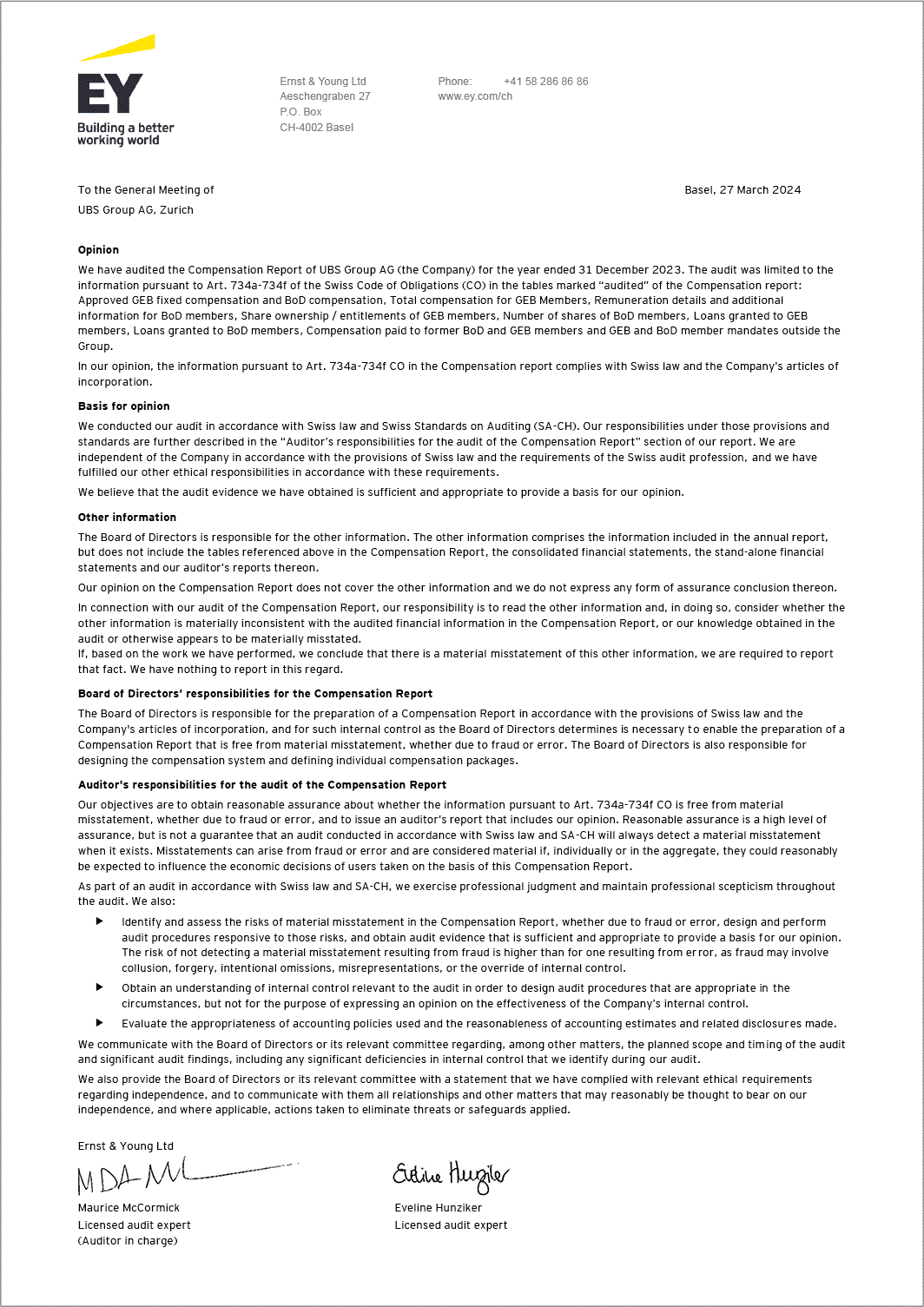
Advisory vote
|
Annual Report 2023 |
Financial statements | Consolidated financial
statements
271
Financial statements
Consolidated financial statements
Table of contents
272
272
273
275
282
282
282
283
284
285
287
289
291
291
1
308
2
314
3a
316
3b
317
317
4
317
5
318
6
318
7
319
8
319
9
322
322
10
326
11
328
12
328
13
330
14
331
15
331
16
332
17
332
18
345
19
346
346
20
358
21
372
22
373
23
376
24
379
25
379
26
382
27
390
28
394
29
398
30
399
31
400
32
401
33
402
34
402
35
Annual Report 2023 |
Financial statements | Consolidated financial
statements
272
Management’s report on internal control over financial
reporting
Management’s responsibility for internal control over financial reporting
The
Board
of
Directors
and
management
of
UBS
Group
AG
(UBS)
are
responsible
for
establishing
and
maintaining
adequate internal control over financial reporting. UBS’s internal control over financial reporting are designed to provide
reasonable
assurance regarding
the preparation
and fair
presentation
of published
financial
statements in
accordance
with IFRS Accounting Standards, as issued by
the International Accounting Standards Board (IASB). UBS’s internal
control
over financial reporting include those policies and procedures
that:
UBS’s internal control over financial reporting includes those policies
and procedures that:
–
pertain
to
the
maintenance
of
records
that,
in
reasonable
detail,
accurately
and
fairly
reflect
transactions
and
dispositions of assets;
–
provide reasonable assurance
that transactions are recorded
as necessary to permit preparation
and fair presentation
of financial statements,
and that receipts
and expenditures
of the company
are being made
only in accordance
with
authorizations of UBS management; and
–
provide reasonable assurance regarding
prevention or timely detection of unauthorized acquisition, use or disposition
of the company’s assets that could have a material effect
on the financial statements.
Because of its inherent
limitations,
internal control
over financial reporting
may not prevent or detect
misstatements. Also,
projections
of any evaluation
of effectiveness
to future periods
are subject
to the risk
that controls
may become
inadequate
because of changes
in conditions,
or that the degree
of compliance
with the policies
or procedures
may deteriorate.
Management’s
assessment of
internal control
over financial
reporting as
of 31 December
2023
UBS management
has assessed
the effectiveness
of UBS’s internal
control over financial
reporting as
of 31 December
2023
based on
the criteria
set forth
by the
Committee of
Sponsoring Organizations of
the Treadway
Commission (COSO) in
Internal Control – Integrated Framework (2013 Framework). Based on this
assessment, management believes that, as of
31 December
2023, UBS’s
internal
controls
over financial
reporting
were effective.
Management
has excluded
Credit Suisse,
which UBS acquired in 2023, from the scope
of its assessment of internal
control over financial
reporting, as permitted by
SEC guidance
for acquired
businesses.
The total
assets of
Credit Suisse
as of 31
December 2023
represented approximately
34% of
UBS total
assets as
of such
date, and
revenues associated with
Credit Suisse for
the period
from acquisition to
31 December 2023
represented approximately
19% of UBS revenues
for the year
ended 31 December
2023.
Credit Suisse material weaknesses
A material weakness is a deficiency or a combination of deficiencies in internal control
over financial reporting such that
there is a reasonable
possibility that a material
misstatement of a registrant’s
financial statements will
not be prevented
or detected on a timely basis.
Prior
to
the
acquisition
by
UBS,
Credit
Suisse
Group
AG
and
Credit
Suisse
AG
had
each
identified
certain
material
weaknesses
in
their
internal
controls
over
financial
reporting,
as
a
result
of
which
they
had
concluded
that,
as
of
31 December
2022,
Credit
Suisse
Group’s
and
Credit
Suisse
AG’s
internal
controls
over
financial
reporting
were
not
effective and, for the same
reasons, had reached the
same conclusion regarding the
situation as of 31 December
2021.
The material weaknesses
identified related to
the failure to
design and maintain
an effective risk
assessment process to
identify and analyze the risk of material misstatements in Credit Suisse financial statements and the failure to design and
maintain effective monitoring activities relating to (i) providing sufficient management oversight over the internal control
evaluation
process
to
support
the
company’s
internal
control
objectives;
(ii)
involving
appropriate
and
sufficient
management resources to support the risk assessment and monitoring
objectives; and (iii) assessing and communicating
the severity
of deficiencies
in a
timely manner
to those
parties responsible
for taking
corrective action.
These material
weaknesses contributed to an additional material weakness, as the Credit Suisse Group
management did not design and
maintain effective controls over the classification and presentation of the consolidated statement of cash flows under US
GAAP. Specifically,
certain control
activities over
the completeness
and the
classification and
presentation
of non-cash
items in
the consolidated
statement of
cash flows
were not
performed on
a timely
basis or
at the
appropriate level
of
precision. This material weakness
resulted in the revisions
to Credit Suisse Group’s consolidated
financial statements for
the three years ended 31 December 2021, as disclosed in its
2021 Annual Report.
›
Refer to “Material weaknesses in internal
control over financial reporting of the Credit Suisse Group” in the “Acquisition
and
integration of Credit Suisse” section of this report for additional
information about the material weaknesses at
Credit Suisse
The effectiveness of UBS’s internal control over financial reporting as of 31 December 2023 has been
audited by Ernst &
Young Ltd, UBS’s independent registered public accounting
firm, as stated in their
Report of the independent registered
public
accounting
firm
on
internal
control
over
financial
reporting,
effectiveness of UBS’s internal control over financial reporting
as of 31 December 2023.
Reports of the independent registered public accounting
firm included in this report
The accompanying reports of
the independent registered public accounting
firm on the
consolidated financial statements
Report of
the independent registered
public accounting firm
on the consolidated
financial statements and
internal control
over financial
reporting
reporting
of UBS Group
are included
in our filing
on 28 March
2024 with the
Securities and Exchange
Commission on
Form 20-F pursuant to US reporting obligations.
Annual Report 2023 |
Financial statements | Consolidated financial
statements
273

Annual Report 2023 |
Financial statements | Consolidated financial
statements
274
Annual Report 2023 |
Financial statements | Consolidated financial
statements
275

Annual Report 2023 |
Financial statements | Consolidated financial
statements
276
Annual Report 2023 |
Financial statements | Consolidated financial
statements
277
Annual Report 2023 |
Financial statements | Consolidated financial
statements
278
Annual Report 2023 |
Financial statements | Consolidated financial
statements
279
Annual Report 2023 |
Financial statements | Consolidated financial
statements
280
Annual Report 2023 |
Financial statements | Consolidated financial
statements
281
Annual Report 2023
| Consolidated financial statements | UBS
Group AG consolidated financial statements
282
UBS Group AG consolidated financial statements
Primary financial statements and share information
Audited |
Income statement
For the year ended
USD m
Note
31.12.23
31.12.22
31.12.21
Interest income from financial instruments measured at
amortized cost and fair value through
other comprehensive income
4
Interest expense from financial instruments measured at
amortized cost
4
(
28,216
)
(
6,564
)
(
3,259
)
Net interest income from financial instruments measured
at fair value through profit or loss and other
4
Net interest income
4
Other net income from financial instruments measured at
fair value through profit or loss
4
Fee and commission income
5
Fee and commission expense
5
(
2,195
)
(
1,823
)
(
1,985
)
Net fee and commission income
5
Other income
6
Total revenues
Negative goodwill
2
Credit loss expense / (release)
20
(
148
)
Personnel expenses
7
General and administrative expenses
8
Depreciation, amortization and impairment of non-financial
assets
12, 13
Operating expenses
Operating profit / (loss) before tax
Tax expense / (benefit)
9
Net profit / (loss)
Net profit / (loss) attributable to non-controlling interests
Net profit / (loss) attributable to shareholders
Earnings per share (USD)
Basic
Diluted
Annual Report 2023
| Consolidated financial statements | UBS
Group AG consolidated financial statements
283
Statement of comprehensive income
For the year ended
USD m
Note
31.12.23
31.12.22
31.12.21
Comprehensive income attributable to shareholders
Net profit / (loss)
Other comprehensive income that may be reclassified to the income
statement
Foreign currency translation
Foreign currency translation movements related to net assets of foreign operations, before tax
(
894
)
(
1,076
)
Effective portion of changes in fair value of hedging instruments
designated as net investment hedges, before tax
(
2,320
)
Foreign currency translation differences on foreign operations reclassified to the
income statement
(
2
)
Effective portion of changes in fair value of hedging instruments
designated as net investment hedges reclassified
to
the income statement
(
28
)
(
4
)
Income tax relating to foreign currency translations, including the effect of
net investment hedges
(
17
)
Subtotal foreign currency translation, net of tax
1
(
525
)
(
535
)
Financial assets measured at fair value through other comprehensive income
Net unrealized gains / (losses), before tax
(
440
)
(
203
)
Net realized (gains) / losses reclassified to the income statement
from equity
(
3
)
(
9
)
Reclassification of financial assets to Other financial assets measured
at amortized cost
2
Income tax relating to net unrealized gains / (losses)
(
3
)
Subtotal financial assets measured at fair value through other comprehensive
income, net of tax
(
157
)
Cash flow hedges of interest rate risk
26
Effective portion of changes in fair value of derivative instruments designated
as cash flow hedges, before tax
(
323
)
(
5,758
)
(
992
)
Net (gains) / losses reclassified to the income statement from
equity
(
159
)
(
1,073
)
Income tax relating to cash flow hedges
(
308
)
Subtotal cash flow hedges, net of tax
3
(
4,793
)
(
1,675
)
Cost of hedging
26
Cost of hedging, before tax
(
19
)
(
32
)
Income tax relating to cost of hedging
Subtotal cost of hedging, net of tax
(
19
)
(
26
)
Total other comprehensive income that may be reclassified to the income statement, net
of tax
(
5,267
)
(
2,393
)
Other comprehensive income that will not be reclassified to the income
statement
Defined benefit plans
27
Gains / (losses) on defined benefit plans, before tax
(
73
)
Income tax relating to defined benefit plans
(
70
)
(
7
)
Subtotal defined benefit plans, net of tax
(
10
)
(
5
)
Own credit on financial liabilities designated at fair value
21
Gains / (losses) from own credit on financial liabilities designated
at fair value, before tax
(
1,850
)
Income tax relating to own credit on financial liabilities designated
at fair value
(
71
)
Subtotal own credit on financial liabilities designated at
fair value, net of tax
(
1,769
)
4
Total other comprehensive income that will not be reclassified to the income statement,
net of tax
(
1,729
)
Total other comprehensive income
(
4,481
)
(
2,351
)
Total comprehensive income attributable to shareholders
Comprehensive income attributable to non-controlling
interests
Net profit / (loss)
Total other comprehensive income that will not be reclassified to the income statement,
net of tax
(
14
)
(
16
)
Total comprehensive income attributable to non-controlling interests
Total comprehensive income
Net profit / (loss)
Other comprehensive income
(
4,494
)
(
2,367
)
of which: other comprehensive income that may be reclassified
to the income statement
(
5,267
)
(
2,393
)
of which: other comprehensive income that will not be reclassified
to the income statement
(
1,723
)
Total comprehensive income
1 Mainly reflects a significant strengthening of the Swiss franc and the euro
against the US dollar.
2 Effective 1 April 2022, a portfolio of assets previously classified as Financial
assets measured at fair value through
other comprehensive income was reclassified to Other financial assets measured at amortized cost. Refer to Note 14a for more information.
3 Mainly reflects net losses on hedging instruments that were reclassified
from OCI to the income statement.
4 Mainly reflects a tightening of our own credit spreads.
Annual Report 2023
| Consolidated financial statements | UBS
Group AG consolidated financial statements
284
Balance sheet
USD m
Note
31.12.23
31.12.22
Assets
Cash and balances at central banks
Amounts due from banks
10
Receivables from securities financing transactions measured at amortized
cost
10, 22
Cash collateral receivables on derivative instruments
10, 22
Loans and advances to customers
10
Other financial assets measured at amortized cost
10, 14a
Total financial assets measured at amortized cost
Financial assets at fair value held for trading
21
of which: assets pledged as collateral that may be sold or repledged
by counterparties
Derivative financial instruments
11, 21, 22
Brokerage receivables
21
Financial assets at fair value not held for trading
21
Total financial assets measured at fair value through profit or loss
Financial assets measured at fair value through other comprehensive income
21
Investments in associates
29b
Property, equipment and software
12
Goodwill and intangible assets
13
Deferred tax assets
9
Other non-financial assets
14b
Total assets
of which: Credit Suisse
2
Liabilities
Amounts due to banks
Payables from securities financing transactions measured at amortized cost
22
Cash collateral payables on derivative instruments
22
Customer deposits
15
Debt issued measured at amortized cost
17
Other financial liabilities measured at amortized cost
19a
Total financial liabilities measured at amortized cost
Financial liabilities at fair value held for trading
21
Derivative financial instruments
11, 21, 22
Brokerage payables designated at fair value
21
Debt issued designated at fair value
16, 21
Other financial liabilities designated at fair value
19b, 21
Total financial liabilities measured at fair value through profit or loss
Provisions and contingent liabilities
18a
Other non-financial liabilities
19c
Total liabilities
of which: Credit Suisse
1
2
Equity
Share capital
Share premium
Treasury shares
(
4,796
)
(
6,874
)
Retained earnings
Other comprehensive income recognized directly in equity, net of tax
(
103
)
Equity attributable to shareholders
Equity attributable to non-controlling interests
Total equity
Total liabilities and equity
1 Excludes USD
bn of debt instruments previously issued by Credit Suisse Group AG (transferred to
UBS Group AG as part of the acquisition of the Credit Suisse Group), USD
bn of borrowings from UBS AG,
USD
bn of fiduciary placements where UBS Switzerland AG acts as the fiduciary, and other minor
intercompany positions.
Annual Report 2023
| Consolidated financial statements | UBS
Group AG consolidated financial statements
285
Statement of changes in equity
USD m
Share
capital
Share
premium
Treasury
shares
Retained
earnings
Balance as of 31 December 2020
(
4,068
)
Acquisition of treasury shares
(
3,521
)
2
Delivery of treasury shares under share-based compensation
plans
(
675
)
Other disposal of treasury shares
2
Cancellation of treasury shares related to the 2018–2021
share repurchase program
(
16
)
(
236
)
(
1,792
)
Share-based compensation expensed in the income statement
Tax (expense) / benefit
(
88
)
Dividends
(
651
)
3
(
651
)
3
Equity classified as obligation to purchase own shares
(
7
)
Translation effects recognized directly in retained earnings
Share of changes in retained earnings of associates and
joint ventures
New consolidations / (deconsolidations) and other increases
/ (decreases)
4
Total comprehensive income for the year
of which: net profit / (loss)
of which: OCI, net of tax
Balance as of 31 December 2021
(
4,675
)
Acquisition of treasury shares
(
6,262
)
2
Delivery of treasury shares under share-based compensation
plans
(
763
)
Other disposal of treasury shares
(
1
)
2
Cancellation of treasury shares related to the 2021
share repurchase program
(
18
)
(
1,502
)
(
1,502
)
Share-based compensation expensed in the income statement
Tax (expense) / benefit
Dividends
(
834
)
3
(
834
)
3
Equity classified as obligation to purchase own shares
(
15
)
Translation effects recognized directly in retained earnings
Share of changes in retained earnings of associates and
joint ventures
New consolidations / (deconsolidations) and other increases
/ (decreases)
Total comprehensive income for the year
of which: net profit / (loss)
of which: OCI, net of tax
Balance as of 31 December 2022
(
6,874
)
Purchase price consideration for Credit Suisse Group acquisition,
before consideration of share-based compensation
awards
5
Impact of share-based compensation awards from Credit Suisse
Group acquisition
5
Impact of the settlement of pre-existing relationships from
Credit Suisse Group acquisition
5
(
61
)
Acquisition of treasury shares
(
3,070
)
2
Delivery of treasury shares under share-based compensation
plans
(
858
)
Other disposal of treasury shares
2
Cancellation of treasury shares related to the 2021
share repurchase program
6
(
7
)
(
554
)
(
554
)
Share-based compensation expensed in the income statement
Tax (expense) / benefit
Dividends
(
839
)
3
(
839
)
3
Equity classified as obligation to purchase own shares
Translation effects recognized directly in retained earnings
Share of changes in retained earnings of associates and
joint ventures
(
1
)
Share capital currency change
(
49
)
New consolidations / (deconsolidations) and other increases
/ (decreases)
7
Total comprehensive income for the year
of which: net profit / (loss)
of which: OCI, net of tax
(
1,729
)
Balance as of 31 December 2023
(
4,796
)
1 Excludes other comprehensive income related to defined benefit plans and own credit, which is recorded directly in Retained
earnings.
2 Includes treasury shares acquired and disposed of by the Investment Bank
in its capacity as a market-maker with regard to UBS Group AG shares and related derivatives, and to hedge certain issued structured debt instruments. These acquisitions and disposals are reported based on the sum
of the net
monthly movements.
3 Reflects
the payment
of an ordinary
cash dividend
of USD
, 2021:
USD
) per dividend-bearing
share. Swiss
tax law
requires Switzerland-domiciled
companies with shares listed
on a Swiss stock
exchange to pay
no more than
% of dividends from
capital contribution reserves,
with the remainder required
to be paid from
retained earnings.
4 Includes the
effects related to the launch of UBS’s
operational partnership entity with Sumitomo
Mitsui Trust Holdings,
Inc. in 2021.
5 Refer to Note 2 for more
information.
6 Reflects the cancellation of
purchased under UBS’s 2021 share repurchase program as approved by shareholders at the 2023 Annual General Meeting. Swiss tax law requires Switzerland-domiciled companies with shares listed on a Swiss stock
exchange to reduce capital contribution reserves
by at least
% of the total capital reduction
amount exceeding the nominal
value upon cancellation of
the shares.
7 Includes an increase of USD
m related to
the issuance of high-trigger loss-absorbing additional tier
1 capital with an equity conversion feature.
8 Includes an increase of USD
m in the second quarter of 2023 due
to the acquisition of the Credit Suisse
Group.
Annual Report 2023
| Consolidated financial statements | UBS
Group AG consolidated financial statements
286
Other comprehensive
income recognized
directly in equity,
net of tax
1
of which:
foreign currency
translation
of which:
financial assets at
fair value through OCI
of which:
cash flow
hedges
Total equity
attributable to
shareholders
Non-controlling
interests
Total equity
(
3,521
)
(
3,521
)
(
88
)
(
88
)
(
1,301
)
(
4
)
(
1,305
)
(
7
)
(
7
)
(
18
)
(
18
)
(
2,393
)
(
535
)
(
157
)
(
1,675
)
(
2,393
)
(
535
)
(
157
)
(
1,675
)
(
2,351
)
(
16
)
(
2,367
)
(
7
)
(
6,262
)
(
6,262
)
(
1,668
)
(
9
)
(
1,677
)
(
15
)
(
15
)
(
69
)
(
69
)
(
3
)
(
3
)
(
7
)
(
3
)
(
5,267
)
(
525
)
(
4,793
)
(
5,267
)
(
525
)
(
4,793
)
(
4,481
)
(
14
)
(
4,494
)
(
103
)
(
4
)
(
4,234
)
(
61
)
(
61
)
(
3,070
)
(
3,070
)
(
1,679
)
(
4
)
(
1,683
)
(
150
)
(
150
)
(
1
)
(
1
)
8
(
1
)
(
3,109
)
Annual Report 2023
| Consolidated financial statements | UBS
Group AG consolidated financial statements
287
Share information and earnings per share
Ordinary share capital
As of 31 December 2023, UBS Group AG had
In the
second quarter
of 2023,
the share
capital currency
of UBS
Group AG
was changed
from the
Swiss franc
to the
US dollar,
as approved
by shareholders at
the 2023 Annual
General Meeting (the
AGM). As a
result, the nominal
value
per
share
has
changed
from
CHF
,
resulting
in
a
reclassification
between
share
capital
and
capital
contribution reserve (presented as share premium in the consolidated financial statements) and leading to a
share capital
of USD
. Shares issued decreased by
m in 2023,
as the
shares
acquired
under
the
2021 share
repurchase
program
were
canceled
by means
of a
capital
reduction,
as
approved by shareholders at the 2023
AGM.
Conditional share capital
As of
31 December 2023,
the following
conditional share
capital was
available to
the Board
of Directors
(the BoD)
of
UBS Group AG.
–
A maximum of
USD
of USD
granted in
connection with the
issuance of bonds
or similar financial
instruments by UBS
Group AG
or another member
of
the
Group
on
national
or
international
capital
markets.
This
conditional
capital
allowance
was
approved
at
the
Extraordinary General
Meeting (the
EGM) held
on 26 November
2014, having
originally been
approved at
the AGM
of UBS AG on 14 April 2010. The BoD has not made use
of such allowance.
–
A
maximum
of
USD
USD
members of the management and of
the BoD of UBS Group
AG and its subsidiaries. This conditional capital
allowance
was approved by the shareholders at the same EGM in 2014.
Capital band, conversion capital and reserve capital
As of
31 December
2023, UBS
Group AG
had not
introduced
any capital
band, any
conversion capital
or any
reserve
capital.
Annual Report 2023
| Consolidated financial statements | UBS
Group AG consolidated financial statements
288
Share repurchase programs
In February
2021, UBS
initiated a
share repurchase
program of
up to
CHF
bn which
concluded on
29 March 2022.
A
total of
m (CHF
m)
were
canceled
by
means
of
a
capital
reduction
in
2022,
as
approved
by
shareholders
at
the
2022
AGM.
Remaining
m (CHF
m) were
canceled by means of a capital reduction in the second quarter of 2023, as approved by shareholders
at the 2023 AGM.
In March 2022, UBS commenced a new two-year share repurchase program of up to USD
bn. Under this program, UBS
repurchased
m shares
in 2023
for a
total acquisition
cost
of USD
m (CHF
m).
A total
of
m shares
repurchased
under
the
2022
program
and
originally
intended
for
cancellation
purposes
were
repurposed
for
the
acquisition
of
the
Credit
Suisse
Group
and
m
shares
were
transferred
to
Credit
Suisse
Group
shareholders
in
an
exchange
of
shares
as
consideration
for
the
acquisition
of
the
Credit
Suisse
Group.
UBS
also
intends
to
cancel
the
remaining shares
purchased under the 2022 program by means of a capital reduction, pending approval by shareholders
at a future AGM.
A new, two-year share
repurchase program of up to
USD
bn was approved by
shareholders at the 2023 AGM.
However,
repurchases under the share
repurchase programs were temporarily
suspended due to the
acquisition of the Credit
Suisse
Group.
As of or for the year ended
31.12.23
31.12.22
31.12.21
Shares outstanding
Shares issued
Balance at the beginning of the year
Shares canceled
(
62,548,000
)
1
(
177,787,273
)
2
(
156,632,400
)
3
Balance at the end of the year
Treasury shares
Balance at the beginning of the year
Acquisitions
Disposals
(
64,270,031
)
(
67,497,138
)
(
62,299,449
)
Cancellation of second trading line treasury shares
(
62,548,000
)
1
(
177,787,273
)
2
(
156,632,400
)
3
Shares transferred to Credit Suisse Group shareholders as consideration
for the acquisition of the Credit Suisse
Group
4
(
175,649,481
)
Balance at the end of the year
Shares outstanding
Basic and diluted earnings (USD m)
Net profit / (loss) attributable to shareholders for basic
EPS
Less: (profit) / loss on own equity derivative contracts
Net profit / (loss) attributable to shareholders for diluted
EPS
Weighted average shares outstanding
Weighted average shares outstanding for basic EPS
5
Effect of dilutive potential shares resulting from notional
employee shares, in-the-money options and warrants
outstanding
6
Weighted average shares outstanding for diluted EPS
Earnings per share (USD)
Basic
Diluted
Potentially dilutive instruments
7
Employee share-based compensation awards
Other equity derivative contracts
Total
1 Reflects the
cancellation of shares
purchased under UBS’s
2021 share repurchase
program as approved
by shareholders at
the 2023 Annual
General Meeting
(the AGM).
2 Reflects the
cancellation of shares
purchased under UBS’s
2021 share
repurchase program
as approved by
shareholders at the
2022 AGM.
3 Reflects the
cancellation of
shares purchased under
UBS’s 2018–2021
share repurchase program
as
approved by shareholders at the 2021 AGM.
4 Refer to Note 2 for more information.
5 The weighted average shares outstanding
for basic EPS are calculated by taking
the number of shares at the beginning of
the period, adjusted by the number of shares acquired or issued during the period, multiplied
by a time-weighted factor for the period outstanding. As a result, balances are affected by the timing
of acquisitions and
issuances during the period.
6 The weighted average number of shares for notional
employee awards with performance conditions reflects all potentially dilutive shares
that are expected to vest under the terms of
the awards.
7 Reflects potential shares that could dilute basic earnings per share in the future, but were
not dilutive for the periods presented.
Annual Report 2023
| Consolidated financial statements | UBS
Group AG consolidated financial statements
289
Statement of cash flows
For the year ended
USD m
31.12.23
31.12.22
31.12.21
Cash flow from / (used in) operating activities
Net profit / (loss)
Non-cash items included in net profit and other adjustments:
Depreciation, amortization and impairment of non-financial
assets
Credit loss expense / (release)
(
148
)
Share of net (profits) / loss of associates and joint ventures and
impairment related to associates
(
32
)
(
105
)
Deferred tax expense / (benefit)
(
694
)
Net loss / (gain) from investing activities
(
102
)
(
1,470
)
(
230
)
Net loss / (gain) from financing activities
(
16,587
)
Negative goodwill
1
(
27,748
)
Other net adjustments
2
(
15,175
)
Net change in operating assets and liabilities:
2,3
Amounts due from banks and amounts due to banks
(
1,088
)
Receivables from securities financing transactions measured at amortized
cost
(
3,503
)
(
1,565
)
Payables from securities financing transactions measured at amortized cost
(
2,014
)
(
1,247
)
(
751
)
Cash collateral on derivative instruments
(
3,312
)
Loans and advances to customers
(
27,460
)
Customer deposits
(
8,692
)
Financial assets and liabilities at fair value held for trading and derivative financial
instruments
(
10,516
)
Brokerage receivables and payables
(
5,962
)
Financial assets at fair value not held for trading and other financial assets
and liabilities
Provisions and other non-financial assets and liabilities
Income taxes paid, net of refunds
(
1,852
)
(
1,582
)
(
1,134
)
Net cash flow from / (used in) operating activities
4
Cash flow from / (used in) investing activities
Cash and cash equivalents acquired upon the acquisition of the
Credit Suisse Group
1
Purchase of subsidiaries, associates and intangible assets
(
4
)
(
3
)
(
1
)
Disposal of subsidiaries, associates and intangible assets
Purchase of property, equipment and software
(
1,685
)
(
1,643
)
(
1,841
)
Disposal of property, equipment and software
Net (purchase) / redemption of financial assets measured
at fair value through other comprehensive income
(
699
)
(
750
)
Purchase of debt securities measured at amortized cost
(
14,244
)
(
30,792
)
(
4,922
)
Disposal and redemption of debt securities measured at amortized
cost
Net cash flow from / (used in) investing activities
(
12,447
)
(
2,119
)
Statement of cash flows (continued)
Annual Report 2023
| Consolidated financial statements | UBS
Group AG consolidated financial statements
290
Statement of cash flows (continued)
Table
continues below.
For the year ended
USD m
31.12.23
31.12.22
31.12.21
Cash flow from / (used in) financing activities
Repayment of Swiss National Bank funding
(
56,516
)
Net issuance (repayment) of short-term debt measured at amortized
cost
(
12,249
)
(
3,093
)
Net movements in treasury shares and own equity derivative
activity
(
2,779
)
(
6,006
)
(
3,341
)
Distributions paid on UBS shares
(
1,679
)
(
1,668
)
(
1,301
)
Issuance of debt designated at fair value and long-term debt measured
at amortized cost
Repayment of debt designated at fair value and long-term debt measured
at amortized cost
(
109,471
)
(
67,670
)
(
79,909
)
Net cash flows from other financing activities
(
721
)
(
617
)
(
282
)
Net cash flow from / (used in) financing activities
(
58,262
)
(
9,094
)
Total cash flow
Cash and cash equivalents at the beginning of the year
Net cash flow from / (used in) operating, investing and financing
activities
(
6,895
)
Effects of exchange rate differences on cash and cash equivalents
2
(
5,659
)
(
5,307
)
Cash and cash equivalents at the end of the year
5
of which: cash and balances at central banks
6
of which: amounts due from banks
6
of which: money market paper
6,7
Additional information
Net cash flow from / (used in) operating activities includes:
Interest received in cash
Interest paid in cash
Dividends on equity investments, investment funds and associates
received in cash
8
1 Consideration for the
acquisition of the Credit Suisse
Group was non-cash in
entirety and included UBS‘s ordinary
shares of USD
m. Refer to Note
2 for more information about
the acquisition of the Credit
Suisse Group.
2 Foreign currency translation and foreign exchange effects on operating
assets and liabilities and on cash and cash equivalents are presented within the Other net adjustments
line. Does not include
foreign currency hedge effects related to foreign exchange swaps.
3 Effective from 2023, UBS has refined the presentation in
the statement of cash flows and now presents cash flows
from Loans and advances to
customers, Customer deposits,
Receivables from securities
financing transactions measured
at amortized cost
and Payables
from securities financing
transactions measured at
amortized cost as
separate lines.
The
presentation change has had no effect
on Net cash flows from /
(used in) operating activities.
Prior periods have been aligned with
this change in presentation.
4 Includes cash receipts from
the sale of loans and
loan commitments of USD
m within the Non-core and Legacy business division.
5 USD
m, USD
m and USD
m of Cash and cash equivalents (mainly reflected in Amounts due from
banks) were
restricted as of
31 December 2023, 31 December
2022 and 31 December
2021, respectively.
Refer to Note
23 for more
information. Cash and
cash equivalents
as of 31
December 2023 includes
USD
m
related to Credit Suisse.
6 Includes only balances with an original maturity of three
months or less.
7 Money market paper is included in
the balance sheet under Financial assets at fair
value not held for trading
(31 December 2023:
USD
m; 31
December 2022:
USD
m; 31
December 2021:
USD
m), Other financial
assets measured
at amortized
cost (31 December
2023: USD
m; 31
December 2022:
USD
m; 31 December 2021: USD
m) and Financial assets at fair value held for trading (31
December 2023: USD
m; 31 December 2022: USD
m; 31 December 2021: USD
m).
8 Includes dividends
received from associates reported within Net cash flow from / (used in) investing activities.
Changes in liabilities arising from financing activities
USD m
Debt issued
measured at
amortized cost
of which:
short-term
1
of which:
long-term
2
Debt issued
designated at fair
value
Swiss
National Bank
funding
3
Over-the-
counter debt
instruments
4
Total
Balance as of 1 January 2022
Cash flows
(
14,333
)
(
12,249
)
(
2,084
)
(
253
)
(
804
)
Non-cash changes
(
10,201
)
(
1,173
)
(
9,028
)
(
13,944
)
(
190
)
(
24,335
)
of which: foreign currency translation
(
3,526
)
(
1,173
)
(
2,353
)
(
1,394
)
(
115
)
(
5,035
)
of which: fair value changes
(
12,550
)
(
75
)
(
12,625
)
of which: hedge accounting and other effects
(
6,675
)
(
6,675
)
(
6,675
)
Balance as of 31 December 2022
Changes arising upon the acquisition of the Credit
Suisse Group
5
Cash flows
(
520
)
(
56,516
)
(
1,109
)
(
53,083
)
Non-cash changes
of which: foreign currency translation
(
99
)
of which: fair value changes
of which: hedge accounting and other effects
(
27
)
(
25
)
Balance as of 31 December 2023
of which: Credit Suisse
5
1 Debt with an original contractual maturity of less than one year.
2 Debt with an original maturity greater than or equal to one year. The classification of debt issued into short-term and long-term does not consider
any early redemption features.
3 Included in balance sheet line Amounts due to banks.
4 Included in balance sheet line Other financial liabilities designated at fair value.
5 Refer to Note 2 for more information
about the acquisition of the Credit Suisse Group.
Annual Report 2023
| Consolidated financial statements | UBS
Group AG consolidated financial statements
291
Notes to the UBS Group AG consolidated financial
statements
Note 1
Summary of material accounting policies
The following table provides an overview of information included in this Note.
292
a)
292
292
1)
293
2)
293
a.
293
b.
297
c.
297
d.
297
e.
297
f.
298
g.
298
h.
298
i.
298
303
3)
303
4)
304
5)
304
6)
305
7)
305
8)
305
9)
assets
306
10)
306
11)
307
12)
307
b)
307
c)
Annual Report 2023
| Consolidated financial statements | UBS
Group AG consolidated financial statements
292
Note 1
Summary of material accounting policies (continued)
a) Material accounting policies
This Note describes
the material accounting
policies applied in
the preparation
of the consolidated
financial statements
(the Financial
Statements) of
UBS Group AG
and its
subsidiaries (UBS
or the
Group). On
21 March
2024, the
Financial
Statements were authorized for issue by the
UBS Group AG Board of Directors
(the BoD).
Basis of accounting
The
Financial
Statements
have
been
prepared
in
accordance
with
IFRS
Accounting
Standards,
as
issued
by
the
International Accounting Standards Board (the IASB),
and are presented in US dollars.
Disclosures marked as audited in the “Risk, capital, liquidity
and funding, and balance sheet” section of this report form
an integral part of the Financial Statements. These disclosures relate to requirements under IFRS 7,
Financial Instruments:
Disclosures
, and IAS 1,
Presentation of Financial Statements
, and are not repeated in this section.
The
accounting
policies
described
in
this
Note
have
been
applied
consistently
in
all
years
presented
unless
otherwise
stated in Note 1b.
Critical accounting estimates and judgments
Preparation of these Financial Statements under
IFRS Accounting Standards requires management to apply
judgment and make estimates and assumptions that
affect reported amounts of assets, liabilities,
income and expenses, and disclosure
of contingent assets and liabilities,
and may involve significant uncertainty
at the
time they are
made. Such estimates
and assumptions are
based on the best
available information. UBS regularly
reassesses such estimates and
assumptions, which
encompass historical
experience, expectations
of the
future and
other pertinent
factors, to
determine their
continuing relevance
based on
current conditions,
updating them as necessary. Changes in those
estimates and assumptions may have a significant effect on
the Financial Statements. Furthermore, actual results
may differ significantly from UBS’s estimates, which could result in
significant losses to the Group, beyond what was anticipated
or provided for.
The
following
areas
contain
estimation
uncertainty
or
require
critical
judgment
and
have
a
significant
effect
on
amounts
recognized
in
the
Financial
Statements:
–
provisional amounts of identifiable assets acquired and liabilities assumed for the acquisition of the Credit Suisse Group (refer to item 1 in this Note and
to Note 2);
–
expected credit loss measurement (refer to item 2g in this Note
and to Note 20);
–
fair value measurement (refer to item 2f in this Note
and to Note 21);
–
income taxes (refer to item 6 in this Note and to Note
9);
–
provisions and contingent liabilities (refer to item 10 in this
Note and to Note 18);
–
post-employment benefit plans (refer to item 5 in
this Note and to Note 27);
–
goodwill (refer to item 9 in this Note and to Note
13); and
–
consolidation of structured entities (refer to item 1 in this Note
and to Note 29).
1) Consolidation and business combinations
Consolidation
The Financial
Statements include
the financial
statements of
the parent
company (UBS
Group AG) and
its subsidiaries,
presented as a
single economic entity; intercompany
transactions and balances
have been eliminated.
UBS consolidates
all entities that
it controls,
including structured
entities (SEs),
which is the
case when
it has:
(i) power over
the relevant
activities of the
entity;
(ii) exposure to
the entity‘s variable
returns;
and (iii) the ability
to use its
power to affect
its own
returns.
Consideration is given to all
facts and circumstances to determine whether the Group
has power over another entity, i.e.,
the current ability to direct the relevant activities of an entity when
decisions about those activities need to be made.
Subsidiaries,
including
SEs,
are
consolidated
from the
date
when
control
is gained
and deconsolidated
from
the
date
when control ceases. Control, or the lack thereof, is reassessed if facts and circumstances
indicate that there is a change
to one or more elements required to establish that control
is present.
›
Refer to Note 29 for more information
Critical accounting estimates and judgments
Each individual entity is assessed for consolidation in line with the aforementioned consolidation principles. The assessment of control
can be complex and
requires
the use of significant judgment,
in particular in determining
whether UBS has power over the
entity. As the nature and extent of UBS’s involvement
is unique for
each entity,
there is
no uniform consolidation
outcome by entity.
Certain entities within
a class may
be consolidated while
others may not.
When carrying
out the consolidation
assessment, judgment
is exercised considering
all the relevant
facts and
circumstances, including
the nature
and activities
of the investee, as well as the substance of
voting and similar rights.
›
Refer to Note 29 for more information
Annual Report 2023
| Consolidated financial statements | UBS
Group AG consolidated financial statements
293
Note 1
Summary of material accounting policies (continued)
Business combinations
Business combinations are accounted
for using the acquisition method,
as prescribed by IFRS
3,
Business Combinations
.
Under this method, any excess of the acquisition-date amounts of
the identifiable net assets acquired over the fair value
of the consideration
transferred results
in negative
goodwill that
is recognized
in the income
statement on
the date
of
the acquisition, with transaction costs expensed as
incurred. Provisional amounts of identifiable assets acquired, liabilities
assumed
and
purchase
consideration
determined
as
of
the
acquisition
date
may
be
subject
to
adjustments
within
a
maximum of one year from the acquisition date (referred
to in this report as measurement period adjustments).
The amount of non-controlling
interests, if any,
is measured at
the non-controlling interest’s
proportionate share of
the
acquiree’s identifiable net assets.
Critical accounting estimates and judgments
When complete information about all relevant facts and circumstances of the acquisition date is not practically available to UBS at the time when the initial
acquisition accounting
was applied
in the
period of
acquisition, the
amounts that
form part
of the business
combination accounting
are considered provisional
and subject to further measurement
period adjustments if new
information about facts and circumstances
existing on the date of the
acquisition is obtained
within one year from the acquisition date. In addition, the use of valuation techniques,
modeling assumptions and estimates of unobservable
market inputs
in
determining fair
values require
significant judgment
and could
affect
the provisional
amounts of
identifiable assets
acquired,
liabilities assumed
and
purchase consideration, thereby affecting the resulting goodwill
/ negative goodwill arising from the business combination.
›
Refer to Note 2 for more information relating to
the acquisition of the Credit Suisse Group
2) Financial instruments
a. Recognition
UBS generally recognizes financial instruments when
it becomes a party to contractual provisions of an instrument.
However,
UBS
does
not recognize
assets
received
in
transfers
that
do
not
qualify
for
derecognition
by
the
transferor
(applying
derecognition
principles
under
IFRS
Accounting
Standards
as
described
in
item
2e
below).
UBS
applies
settlement date accounting to all standard purchases
and sales of non-derivative financial instruments.
UBS may act in a
fiduciary capacity, which results in it holding or
placing assets on behalf of individuals, trusts, retirement
benefit plans
and other
institutions. Unless
these items
meet the
definition of
an asset
and the
recognition criteria
are
satisfied,
they
are
not
recognized
on
UBS’s
balance
sheet
and
the
related
income
is
excluded
from
the
Financial
Statements.
Client cash balances associated with derivatives clearing
and execution services are not recognized on the
balance sheet
if,
through
contractual
agreement,
regulation
or
practice,
UBS
neither
obtains
benefits
from
nor
controls
such
cash
balances.
b. Classification, measurement and presentation
Financial assets
Where the contractual
terms of a debt
instrument result in cash
flows that are
solely payments of principal and
interest
(SPPI) on
the principal
amount outstanding,
the debt
instrument is
classified as
measured at
amortized cost
if it is
held
within a business model that has an objective of holding financial assets to collect contractual cash flows, or at fair value
through other
comprehensive income
(FVOCI) if it
is held within
a business model
with the objective
of both collecting
contractual cash flows and selling financial assets.
All other
financial
assets
are measured
at fair
value
through
profit or
loss (FVTPL),
including those
held for
trading
or
those managed on a fair value basis, except for derivatives designated in certain hedge accounting relationships
(refer to
item 2j in this Note for more information).
Business model assessment and contractual cash flow characteristics
UBS
determines
the
nature
of
a
business
model
by
considering
the
way
financial
assets
are
managed
to
achieve
a
particular business objective at the time an asset is recognized.
In assessing whether contractual cash flows are SPPI, the Group considers whether the contractual terms of the financial
asset
contain
a
term
that
could
change
the
timing
or
amount
of
contractual
cash
flows
arising
over
the
life
of
the
instrument. This assessment includes contractual
cash flows that may vary
due to environmental, social and governance
(ESG) triggers.
Annual Report 2023
| Consolidated financial statements | UBS
Group AG consolidated financial statements
294
Note 1
Summary of material accounting policies (continued)
Financial liabilities
Financial liabilities measured at amortized cost
Debt issued
measured
at
amortized
cost
contain
contractual
provisions
under
which
the
principal
amounts
would
be
written
down
upon
either
a
specified
common equity tier 1
(CET1) ratio breach or
a determination by
the Swiss Financial Market
Supervisory Authority (FINMA)
that a viability
event has occurred.
Such contractual
provisions are
not derivatives, as
the underlying
is deemed to
be a
non-financial
variable
specific
to a
party
to the
contract.
Issuances
after
November
2023 include
a
contractual
equity
conversion feature with the
same triggers, i.e., a CET1
ratio breach or FINMA
viability event. When the
debt is issued in
US dollars, these conversion features are classified as equity and
are accounted for in
Share premium
amortized cost debt host.
When the legal bail-in mechanism for write-down
or conversion into equity does not form part
of the contractual terms
of issued debt instruments,
it does not affect the accounting classification of these
instruments as debt or equity.
If a debt were to be written down or converted into equity in a future period, it would be partially or fully derecognized,
with
the
difference
between
its
carrying
amount
and
the
fair
value
of
any
equity
issued
recognized
in
the
income
statement.
Financial liabilities measured at fair value through profit or
loss
UBS designates certain issued debt instruments as financial liabilities at fair value through profit or loss, on the basis that
such financial instruments
include embedded
derivatives that
are not
closely related
and which significantly
impact the
cash flows of the instrument and
/ or are managed on a
fair value basis (refer to
the table below for more information).
Financial instruments
including embedded
derivatives arise
predominantly from
the issuance
of certain
structured debt
instruments.
Measurement and presentation
After initial recognition, UBS classifies, measures and presents its financial assets and liabilities in accordance with IFRS 9,
as described in the table below.
Classification, measurement and presentation
of financial assets
Financial assets classification
Significant items included
Measurement and presentation
Measured at
amortized cost
This classification includes:
–
cash and balances at central banks;
–
amounts due from banks;
–
receivables from securities financing transactions;
–
cash collateral receivables on derivative
instruments;
–
residential and commercial mortgages;
–
corporate loans;
–
secured loans, including Lombard loans, and
unsecured loans;
–
loans to financial advisors;
and
–
debt securities held as high-quality liquid
assets
(HQLA).
Measured at amortized cost using the effective interest
method less allowances for expected credit losses
(ECL)
(refer to items 2d and 2g in this Note for more information).
The following items are recognized in the income
statement:
–
interest income, which is accounted for in accordance
with item 2d in this Note;
–
ECL and reversals; and
–
foreign exchange (FX) translation gains and losses.
When a financial asset at amortized cost is derecognized,
the gain or loss is recognized in the income statement.
For amounts arising from settlement of certain derivatives,
see below in this table.
Measured at
FVOCI
Debt
instruments
measured at
FVOCI
This classification primarily includes debt securities
held as HQLA.
Measured at fair value,
with unrealized gains and losses
reported in
Other comprehensive income
, net of applicable
income taxes, until such investments are derecognized.
Upon derecognition, any accumulated balances in
Other
comprehensive income
statement and reported within
Other income.
The following items, which are determined on the
same
basis as for financial assets measured at amortized
cost, are
recognized in the income statement:
–
interest income, which is accounted for in accordance
with item 2d in this Note;
–
ECL and reversals; and
–
FX translation gains and losses.
Annual Report 2023
| Consolidated financial statements | UBS
Group AG consolidated financial statements
295
Note 1
Summary of material accounting policies (continued)
Classification, measurement and presentation
of financial assets
Financial assets classification
Significant items included
Measurement and presentation
Measured at
FVTPL
Held for
trading
Financial assets held for trading include:
–
all derivatives with a positive replacement value,
except
those that are designated and effective hedging
instruments; and
–
other financial assets acquired principally for the
purpose of selling or repurchasing in the near term, or
that are part of a portfolio of identified financial
instruments that are managed together and for
which
there is evidence of a recent actual pattern of short-
term profit taking. Included in this category are debt
instruments (including those in the form of
securities,
money market paper,
and traded corporate and bank
loans) and equity instruments.
Measured at fair value,
with changes recognized in the
income statement.
Derivative assets (including derivatives that
are designated
and effective hedging instruments) are generally
presented as
Derivative financial instruments
, except those
exchange-traded derivatives (ETD) and over-the-counter
(OTC)-cleared derivatives that are legally settled on
a daily
basis or economically net settled on a daily basis,
which
are presented within
Cash collateral receivables on
derivative instruments.
Changes in fair value, initial transaction costs,
dividends
and gains and losses arising on disposal or redemption
are
recognized in
Other net income from financial
instruments measured at fair value through
profit or loss
,
except interest income on instruments other than
derivatives (refer to item 2d in this Note), interest on
derivatives designated as hedging instruments
in hedges
of interest rate risk and forward points on certain short-
and long-duration FX contracts acting as economic
hedges, which are reported in
Net interest income.
Changes in the fair value of derivatives that
are
designated and effective hedging instruments are
presented either in the income statement or
Other
comprehensive income
, depending on the type of hedge
relationship (refer to item 2j in this Note for more
information).
Mandatorily
measured at
FVTPL – Other
Financial assets mandatorily measured at FVTPL that
are
not held for trading include:
–
certain structured instruments, certain commercial
loans, and receivables from securities financing
transactions that are managed on a fair value basis;
–
loans managed on a fair value basis,
including those
hedged with credit derivatives;
–
certain debt securities held as HQLA and managed
on a
fair value basis;
–
certain investment fund holdings and assets
held to
hedge delivery obligations related to cash-settled
employee compensation plans;
–
brokerage receivables, for which contractual cash flows
do not meet the SPPI criterion because the aggregate
balance is accounted for as a single unit of
account,
with interest being calculated on the individual
components;
–
auction rate securities, for which contractual cash
flows
do not meet the SPPI criterion because interest may
be
reset at rates that contain leverage;
–
equity instruments;
and
–
assets held under unit-linked investment contracts.
Annual Report 2023
| Consolidated financial statements | UBS
Group AG consolidated financial statements
296
Note 1
Summary of material accounting policies (continued)
Classification, measurement and presentation
of financial liabilities
Financial liabilities classification
Significant items included
Measurement and presentation
Measured at amortized cost
This classification includes:
–
demand and time deposits;
–
retail savings / deposits;
–
sweep deposits;
–
payables
from securities financing transactions;
–
non-structured debt issued;
–
subordinated debt;
–
commercial paper and certificates of deposit; and
–
cash collateral payables on derivative instruments.
Measured at amortized cost using the effective interest
method.
When a financial liability at amortized cost is
derecognized, the gain or loss is recognized in the income
statement.
Interest income generated from client deposits
derecognized pursuant to certain deposit sweep
programs
is presented within
Net interest income from financial
instruments measured at fair value through
profit or loss
and other
.
Measured at
FVTPL
Held for trading
Financial liabilities held for trading include:
–
all derivatives with a negative replacement value
(including certain loan commitments),
except those
that are designated and effective hedging
instruments; and
–
obligations to deliver financial instruments,
such as
debt and equity instruments, that UBS has
sold to
third parties but does not own (short positions).
Measurement and presentation of financial liabilities
classified at FVTPL follow the same principles
as for
financial assets classified at FVTPL, except that
the amount
of change in the fair value of a financial liability
designated at FVTPL that is attributable to changes
in
UBS’s own credit risk is presented in
Other comprehensive
income
Retained earnings
reclassified to the income statement.
Derivative liabilities (including derivatives that
are
designated and effective hedging instruments)
are
generally presented as
Derivative financial instruments
,
except those exchange-traded and OTC-cleared
derivatives that are legally settled on a daily basis
or
economically net settled on a daily basis, which
are
presented within
Cash collateral payables on derivative
instruments.
Designated at
FVTPL
Financial liabilities designated at FVTPL include:
–
issued hybrid debt instruments,
primarily equity-
linked, credit-linked and rates-linked bonds or notes;
–
issued debt instruments managed on a fair
value
basis;
–
certain payables from securities financing
transactions;
–
amounts due under unit-linked investment
contracts,
the cash flows of which are linked to financial
assets
measured at FVTPL and eliminate an accounting
mismatch;
and
–
brokerage payables, which arise in conjunction with
brokerage receivables and are measured at FVTPL to
achieve measurement consistency.
Annual Report 2023
| Consolidated financial statements | UBS
Group AG consolidated financial statements
297
Note 1
Summary of material accounting policies (continued)
c. Loan commitments and financial guarantees
Loan
commitments
are
arrangements
to
provide
credit
under
defined
terms
and
conditions.
Irrevocable
loan
commitments
are
classified
as:
(i) derivative
loan
commitments
measured
at
fair
value
through
profit
or
loss;
(ii) loan
commitments
designated
at
fair
value
through
profit
or
loss;
or
(iii) loan
commitments
not
measured
at
fair
value.
Financial guarantee contracts are
contracts that require
UBS to make specified payments
to reimburse the holder
for an
incurred loss
because a
specified debtor
fails to
make payments
when due
in accordance
with the terms
of a specified
debt instrument.
d. Interest income and expense
Interest
income
and
expense
are
recognized
in
the
income
statement
based
on
the
effective
interest
method.
When
calculating the effective interest rate (the EIR) for financial instruments (other than
credit-impaired financial instruments),
UBS estimates future cash flows considering all contractual terms of the
instrument, but not expected credit losses, with
the EIR applied to the gross carrying amount of the
financial asset or the amortized cost of a financial liability.
However,
when a
financial asset
becomes credit
impaired after
initial recognition,
interest
income is
determined by
applying the
EIR to
the
amortized
cost
of
the
instrument,
which
represents
the
gross
carrying
amount
adjusted
for
any
credit
loss
allowance.
Upfront fees, including fees on loan commitments not measured at fair value where a loan is expected to be issued, and
direct costs are
included within the
initial measurement
of a financial
instrument measured
at amortized
cost or FVOCI
and recognized over the expected life of the instrument
as part of its EIR.
Fees related
to loan
commitments where
no loan
is expected
to be
issued, as
well as
loan syndication
fees where
UBS
does not retain a
portion of the
syndicated loan or where
UBS does retain a
portion of the
syndicated loan at the
same
effective
yield
for
comparable
risk
as
other
participants,
are
included
in
Net
fee
and
commission
income
recognized over the life of the commitment or when syndication
occurs.
›
Refer to item 3 in this Note for more information
Interest
income
on
financial
assets,
excluding
derivatives,
is
included
in
interest
income
when
positive
and
in
interest
expense
when
negative.
Similarly,
interest
expense
on
financial
liabilities,
excluding
derivatives,
is
included
in
interest
expense, except when interest rates are negative,
in which case it is included in interest income.
›
Refer to item 2b in this Note and Note 4
for more information
e. Derecognition
Financial assets
UBS derecognizes a transferred financial
asset, or a
portion of a
financial asset, if the
purchaser has obtained substantially
all the risks and rewards of the asset or a significant part of the risks and
rewards combined with a practical ability to sell
or pledge the asset.
Where
financial
assets
have
been
pledged
as
collateral
or
in
similar
arrangements,
they
are
considered
to
have
been
transferred
if the
counterparty
has received
the contractual
rights to
the
cash flows
of the
pledged assets,
as
may be
evidenced
by,
for
example,
the
counterparty’s
right to
sell or
repledge
the
assets.
In
transfers
where
control
over
the
financial asset is retained,
UBS continues to recognize
the asset to the extent
of its continuing involvement,
determined
by the extent to which it is exposed to changes in the value
of the transferred asset following the transfer.
›
Refer to Note 23 for more information
Financial liabilities
UBS
derecognizes
a
financial
liability
when
it
is
extinguished,
i.e.,
when
the
obligation
specified
in
the
contract
is
discharged, canceled or expires. When an existing financial liability is exchanged for a new one from the same lender on
substantially
different
terms,
or
the
terms
of
an
existing
liability
are
substantially
modified,
the
original
liability
is
derecognized
and
a
new
liability
recognized
with
any
difference
in
the
respective
carrying
amounts
recorded
in
the
income statement.
Certain OTC derivative
contracts and most
exchange-traded futures and option
contracts cleared through central
clearing
counterparties
and exchanges are
considered to be
settled on a
daily basis, as
the payment or
receipt of a
variation margin
on a daily basis represents a legal or economic settlement,
which results in derecognition of the associated derivatives.
›
Refer to Note 22 for more information
f. Fair value of financial instruments
UBS accounts for a significant portion
of its assets and liabilities at fair
value. Fair value is the price on
the measurement
date that would be
received for the sale of
an asset or paid
to transfer a liability
in an orderly transaction between market
participants in the principal market, or in the most advantageous
market in the absence of a principal market.
›
Refer to Note 21 for more information
Annual Report 2023
| Consolidated financial statements | UBS
Group AG consolidated financial statements
298
Note 1
Summary of material accounting policies (continued)
Critical accounting estimates and judgments
The use of valuation techniques, modeling assumptions and estimates of
unobservable market inputs in the fair valuation of
financial instruments requires
significant
judgment
and
could
affect
the
amount
of
gain
or
loss
recorded
for
a
particular
position.
Valuation
techniques
that
rely
more
heavily
on
unobservable inputs
and sophisticated
models inherently
require a
higher level
of judgment
and may
require adjustment
to reflect
factors that
market
participants would consider in estimating fair value,
such as close-out costs, which are presented in Note 21d.
UBS‘s governance framework over fair value measurement is described in Note 21b,
and UBS provides a sensitivity analysis of
the estimated effects arising
from changing significant unobservable inputs in
Level 3 financial instruments to reasonably possible
alternative assumptions in Note 21f.
›
Refer to Note 21 for more information
g. Allowances and provisions for expected credit losses
ECL are
recognized for
financial assets
measured at
amortized cost,
financial assets
measured at
FVOCI, fee
and lease
receivables,
financial
guarantees,
and
loan
commitments
not
measured
at
fair
value.
ECL
are
also
recognized
on
the
undrawn portion of comm
itted unconditionally revocable
credit lines, which
include UBS’s credit
card limits and
master
credit facilities, as UBS is exposed to credit risk because the borrower has the ability to draw down funds before UBS can
take credit risk mitigation actions.
Recognition of expected credit losses
ECL are recognized on the following basis.
–
Stage 1 instruments: Maximum 12-month ECL
are recognized from initial
recognition, reflecting the portion
of lifetime
ECL that would result
if a default occurs
in the 12 months
after the reporting date,
weighted by the risk
of a default
occurring.
–
Stage 2 instruments: Lifetime ECL are
recognized if a significant
increase in credit risk
(an SICR) is observed
subsequent
to
the
instrument’s
initial
recognition,
reflecting
lifetime
cash
shortfalls
that
would
result
from
all
possible
default
events over the
expected life
of a financial
instrument, weighted
by the risk
of a default
occurring. When
an SICR is
no longer observed, the instrument will move back to stage
1.
–
Stage 3 instruments:
Lifetime ECL
are always
recognized for
credit-impaired financial
instruments, as
determined by
the occurrence
of one
or more
loss events,
by estimating
expected cash
flows based
on a
chosen recovery
strategy.
Credit-impaired exposures
may include
positions for
which no
allowance has
been recognized,
for example
because
they are expected to be fully recoverable through collateral
held.
–
Changes in lifetime ECL since initial recognition are also
recognized for assets that are purchased credit impaired (PCI).
PCI financial
instruments include
those that
are purchased
at a
deep discount
or newly
originated with
a defaulted
counterparty;
they remain a separate category until derecognition.
Consistent with
the requirements
of IFRS 3
and IFRS 9,
immediately after
the application
of the
acquisition method
to
the business combination, acquired
financial instruments carried at
amortized cost or FVOCI
that are not deemed credit
impaired are
classified as stage 1
financial instruments and
a maximum
12-month ECL is
recognized, resulting in
a carrying
amount of the respective financial instruments below their acquisition
-date fair value.
All or part
of a financial
asset is written
off if it
is deemed uncollectible
or forgiven. Write-offs
reduce the principal
amount
of a claim
and are charged against
related allowances for credit
losses. Recoveries, in part or
in full, of
amounts previously
written off are generally credited to
Credit loss expense / (release)
.
ECL are recognized in the income statement in
Credit loss expense / (release)
. A corresponding ECL allowance is reported
as a decrease
in the carrying
amount of financial
assets measured at
amortized cost on
the balance sheet.
For financial
assets that
are measured
at FVOCI,
the carrying
amount is
not reduced,
but an
accumulated
amount is
recognized in
Other comprehensive
income
. For
off-balance sheet
financial instruments
and other
credit lines,
provisions for
ECL are
presented in
Provisions.
Default and credit impairment
UBS applies
a
single
definition
of default
for
credit
risk
management
purposes,
regulatory
reporting
and
ECL,
with
a
counterparty classified as defaulted based on quantitative
and qualitative criteria.
›
Refer to the “Risk management and control” section of this
report for more information
Annual Report 2023
| Consolidated financial statements | UBS
Group AG consolidated financial statements
299
Note 1
Summary of material accounting policies (continued)
Measurement of expected credit losses
IFRS 9 ECL reflect
an unbiased, probability
-weighted estimate
based on loss
expectations resulting
from default
events.
The method
used to
calculate ECL
applies the
following principal
factors: probability
of default
(PD), loss
given default
(LGD) and
exposure
at default
(EAD). Parameters
are generally
determined on
an individual
financial asset
level. Based
on the materiality of
the portfolio, for
credit card
exposures and personal
account overdrafts
in Switzerland, a portfolio
approach is applied that
derives an average PD
and LGD for
the entire portfolio. PDs
and LGDs used in
the ECL calculation
are point-in-time(PIT)-based
for key
portfolios and
consider both
current conditions
and expected
cyclical changes.
For
material portfolios, PDs
and LGDs are determined
for different scenarios, whereas EAD projections are
treated as scenario
independent.
For the purpose
of determining the
ECL-relevant parameters,
UBS leverages its
Basel III advanced internal
ratings-based
(A-IRB) models that
are also used
in determining expected loss
(EL) and risk-weighted assets
under the Basel III framework
and
Pillar 2
stress
loss
models.
Adjustments
have
been
made
to
these
models
and
IFRS
9-related
models
have
been
developed that consider the complexity, structure and risk profile of relevant portfolios
and take account of the fact that
PDs and LGDs
used in the
ECL calculation are PIT-based,
as opposed to
the corresponding Basel III through-the-cycle (TTC)
parameters. All models that
are relevant for
measuring expected credit losses
are subject to
UBS’s model validation
and
oversight processes.
Probability of default:
PD represents the probability
of a default over a
specified time period. A 12-month
PD represents
the probability of default determined for the next 12 months and a lifetime PD represents
the probability of default over
the remaining lifetime
of the instrument.
PIT PDs are
derived from TTC
PDs and scenario
forecasts. The modeling
is region,
industry and
client segment
specific and considers
both macroeconomic
scenario dependencies
and client-idiosyncratic
information.
Exposure at default:
EAD represents an estimate of
the exposure to credit
risk at the time
of a potential default occurring,
considering expected repayments, interest payments and accruals,
discounted at the EIR. Future drawdowns on facilities
are considered through
a credit conversion
factor (a CCF)
that is reflective
of historical
drawdown and default
patterns
and the characteristics of the respective portfolios.
Loss given default:
LGD represents an estimate
of the loss at the time of a potential
default occurring,
taking into account
expected
future
cash
flows
from
collateral
and
other
credit
enhancements,
or
expected
payouts
from
bankruptcy
proceedings
for unsecured claims
and, where applicable,
time to realization
of collateral and
the seniority of
claims. LGD is
commonly expressed
as a percentage
of EAD.
Estimation of expected credit losses
Number of scenarios and estimation of scenario weights
Determination
of probability-weighted
ECL requires evaluating
a range of
diverse and
relevant future economic
conditions,
especially
with a view to
modeling the
non-linear effect
of assumptions
about macroeconomic
factors on the
estimate.
To
accommodate
this
requirement,
UBS
uses
different
economic
scenarios
in
the
ECL
calculation.
Each
scenario
is
represented by
a specific
scenario
narrative,
which
is relevant
considering
the exposure
of key
portfolios to
economic
risks, and for
which a set
of consistent macroeconomic variables
is determined. The
estimation of the
appropriate weights
for
these
scenarios
is
predominantly
judgment
based.
The
assessment
is
based
on
a
holistic
review
of
the
prevailing
economic or
political conditions,
which
may exhibit
different
levels of
uncertainty.
It takes
into account
the impact
of
changes in the nature and severity of the underlying scenario
narratives and the projected economic variables.
The determined weights constitute
the probabilities that
the respective set of
macroeconomic conditions will
occur and
not that the chosen particular narratives with the related
macroeconomic variables will materialize.
Macroeconomic and other factors
The range
of macroeconomic,
market and
other factors
that is
modeled as
part of
the scenario
determination is
wide,
and historical information
is used to support
the identification of
the key factors.
As the forecast
horizon increases, the
availability of
information decreases,
requiring an
increase
in judgment.
For cycle-sensitive
PD and
LGD determination
purposes, UBS projects the relevant economic factors for
a period of three years
before reverting, over a specified period,
to cycle-neutral PD and LGD for longer-term
projections.
Factors relevant
for ECL
calculation vary
by type
of exposure.
Regional and
client-segment characteristics
are generally
taken into account, with specific focus on Switzerland and
the US, considering UBS’s key ECL-relevant portfolios.
For UBS, the following forward-looking macroeconomic variables represent the most relevant factors for ECL calculation:
–
gross domestic product (GDP)
growth rates, given their significant effect on borrowers’ performance;
–
unemployment rates, given their significant effect on private
clients’ ability to meet contractual obligations;
–
house price indices, given their significant effect on mortgage
collateral valuations;
–
interest rates, given their significant effect on counterparties’
abilities to service debt;
–
consumer price
indices, given
their overall
relevance for
companies’ performance,
private clients’
purchasing power
and economic stability; and
–
equity indices, given that they are an important factor
in UBS’s corporate rating tools.
Annual Report 2023
| Consolidated financial statements | UBS
Group AG consolidated financial statements
300
Note 1
Summary of material accounting policies (continued)
Scenario generation, review process and governance
A team of economists,
which is part of
Group Risk Control,
develops the forward
-looking macroeconomic assumptions
with involvement from a broad range
of experts.
The scenarios,
their weights
and the
key macroeconomic
and other
factors are
subject to
a critical
assessment by
the
IFRS 9 Scenario
Sounding Sessions
and ECL
Management
Forum, which
include senior
management
from Group
Risk
and Group
Finance. Important
aspects for
the review
include whether
there may
be particular
credit risk
concerns that
may not be capable
of being addressed systematically
and require post-model adjustments
for stage allocation and
ECL
allowance.
The
Group
Model
Governance
Committee
(the
GMGC),
as
the
highest
authority
under
UBS’s
model
governance
framework, ratifies the decisions taken by the ECL Management
Forum.
›
Refer to Note 20 for more information
ECL measurement period
The period
for which
lifetime ECL
are determined
is based
on the maximum
contractual period
that UBS
is exposed
to
credit
risk,
taking
into
account
contractual
extension,
termination
and
prepayment
options.
For
irrevocable
loan
commitments and
financial guarantee
contracts, the
measurement period
represents
the maximum
contractual period
for which UBS has an obligation to extend credit.
Additionally, some financial instruments include both an on-demand loan and a revocable undrawn commitment, where
the
contractual
cancellation
right does
not
limit UBS’s
exposure to
credit
risk to
the
contractual
notice period,
as the
client has
the ability
to draw
down funds
before UBS
can take
risk-mitigating actions.
In such
cases UBS
is required
to
estimate the
period over
which it is
exposed to
credit risk.
This applies to
UBS’s credit
card limits, which
do not
have a
defined contractual maturity date, are
callable on demand
and where the drawn
and undrawn components are
managed
as one exposure. The exposure arising from
UBS’s credit card limits is not significant
and is managed at a portfolio level,
with credit actions triggered when balances
are past due. An ECL
measurement period of seven years is
applied for credit
card limits, capped at 12 months for stage 1 balances,
as a proxy for the period that UBS is exposed to credit
risk.
Customary master credit
agreements in the
Swiss corporate market
also include
on-demand loans and
revocable undrawn
commitments.
For
smaller
commercial
facilities,
a
risk-based
monitoring
(RbM)
approach
is
in
place
that
highlights
negative
trends
as
risk
events,
at
an
individual
facility
level,
based
on
a
combination
of
continuously
updated
risk
indicators. The risk
events trigger additional
credit reviews by
a risk officer,
enabling informed credit decisions
to be taken.
Larger corporate facilities are not subject to RbM, but are reviewed
at least annually through a formal credit review. UBS
has assessed these credit risk management practices and
considers both the RbM approach and formal credit reviews
as
substantive
credit
reviews
resulting
in
a
re-origination
of
the
given
facility.
Following
this,
a
12-month
measurement
period from the
reporting date is
used for both
types of facilities
as an appropriate
proxy of the
period over which
UBS
is exposed to
credit risk, with 12
months also used
as a look-back period
for assessing an SICR,
always from the
respective
reporting date.
Significant increase in credit risk
Financial instruments subject
to ECL are
monitored on an
ongoing basis. To
determine whether the
recognition of a
maximum 12
-month ECL
continues to
be appropriate,
an assessment
is
made as
to whether
an SICR
has occurred
since initial recognition of the financial instrument, applying both
quantitative and qualitative factors.
Primarily, UBS
assesses changes
in an
instrument’s risk
of default
on a
quantitative basis
by comparing
the annualized
forward-looking and scenario-weighted lifetime PD of an
instrument determined at two different dates:
–
at the reporting date; and
–
at inception of the instrument.
If, based on UBS’s
quantitative modeling, an
increase exceeds a
set threshold, an
SICR is deemed
to have occurred
and
the instrument is transferred to stage 2 with lifetime ECL
recognized.
The threshold
applied varies
depending on
the original
credit quality
of the
borrower, with
a higher
SICR threshold
set
for those
instruments with
a low
PD at
inception. The
SICR assessment
based on
PD changes
is made
at an
individual
financial asset
level. A
high-level overview
of the
SICR trigger,
which is
a multiple
of the
annualized remaining
lifetime
PIT
PD expressed
in rating
downgrades,
is provided
in the
“SICR thresholds”
table
below. The
actual
SICR
thresholds
applied are defined on a more granular level by interpolating
between the values shown in the table.
Annual Report 2023
| Consolidated financial statements | UBS
Group AG consolidated financial statements
301
Note 1
Summary of material accounting policies (continued)
SICR thresholds
Internal rating at origination
of the instrument
Rating downgrades /
SICR trigger
0–3
3
4–8
2
9–13
1
›
Refer to the “Risk management and control” section of this
report for more details about UBS’s internal rating system
Irrespective of
the SICR
assessment based
on default
probabilities, credit
risk is
generally deemed
to have
significantly
increased for an instrument if contractual payments
are more than 30 days past due. For certain
less material portfolios,
specifically the Swiss
credit card portfolio, the
30-day past due
criterion is used
as the primary
indicator of an
SICR. Where
instruments are trans
ferred to stage 2
due to the
30-day past due
criterion, a minimum
period of six
months is applied
before a
transfer back
to stage 1 can
be triggered,
where applicable.
For instruments
in Personal &
Corporate Banking
and Global
Wealth Management
Region Switzerland
that
are between
90 and
180
days past
due but
have not
been
reclassified to stage 3, a one-year period is applied before
a transfer back to stage 1 can be triggered.
Additionally,
based
on
individual
counterparty-specific
indicators,
external
market
indicators
of
credit
risk
or
general
economic conditions, counterparties may be moved to a watch list, which is used as a secondary qualitative indicator for
an
SICR.
Exception
management
is
further
applied,
allowing
for
individual
and
collective
adjustments
on
exposures
sharing the same credit risk characteristics to take account
of specific situations that are not otherwise fully reflected.
In general, the overall SICR determination process does not
apply to Lombard loans, securities financing transactions and
certain
other
asset-based
lending
transactions,
because
of
the
risk
management
practices
adopted,
including
daily
monitoring processes
with strict
margining. If
margin calls
are not
satisfied, a
position is
closed out
and classified
as a
stage 3 position. In exceptional cases, an individual adjustment and a transfer into stage 2 may be made to take account
of specific facts.
Credit risk
officers are
responsible for
the identification
of an
SICR, which
for accounting
purposes is
in some
respects
different
from
internal
credit
risk
management
processes.
This
difference
mainly
arises
because
ECL
accounting
requirements are instrument-specific, such that
a borrower can have
multiple exposures allocated to different stages,
and
maturing loans in stage 2 will migrate to stage 1 upon renewal irrespective of the actual credit risk at that time.
Under a
risk-based
approach,
a
holistic
counterparty
credit
assessment
and
the
absolute
level
of
risk
at
any
given
date
will
determine what risk-mitigating actions may be warranted.
›
Refer to the “Risk management and control” section of this
report for more information
Critical accounting estimates and judgments
The calculation of ECL requires
management to apply significant
judgment and make estimates
and assumptions that can
result in significant changes to
the
timing and the amount of ECL recognized.
Determination of a significant increase in
credit risk
IFRS 9
does not
include a
definition of
what constitutes
an SICR,
with UBS’s
assessment considering
qualitative and
quantitative criteria.
An IFRS 9
ECL
Management Forum has been established to
review and challenge the SICR results.
Scenarios, scenario weights and macroeconomic
variables
ECL reflect an unbiased
and probability-weighted amount,
which UBS determines
by evaluating a range
of possible outcomes.
Management selects forward-
looking
scenarios
that
include
relevant macroeconomic
variables
and
management’s assumptions
around
future
economic
conditions.
IFRS
9
Scenario
Sounding Sessions,
in addition to the IFRS 9 ECL Management Forum,
are in place to derive,
review and challenge the scenario selection and weights,
and
to determine whether any additional post-model
adjustments are required that may significantly affect ECL.
ECL measurement period
Lifetime ECL are generally
determined based upon
the contractual maturity
of the transaction, which
significantly affects ECL. For
credit card limits and
Swiss
callable master credit facilities, judgment is
required, as UBS must determine the period
over which it is exposed to credit risk.
A seven-year period is applied
for credit card limits, capped at 12 months for stage 1
positions, and a 12-month period applied for
master credit facilities.
Modeling and post-model adjustments
A number of
complex models have
been developed or
modified to calculate
ECL, with additional
post-model adjustments required
that may significantly
affect ECL. The models are governed
by UBS’s model validation controls and
approved by the GMGC.
The post-model adjustments are approved by the
ECL
Management Forum and endorsed by the
GMGC.
A sensitivity analysis covering key macroeconomic
variables, scenario weights and SICR trigger
points on ECL measurement is provided in Note 20f.
›
Refer to Note 20 for more information
Annual Report 2023
| Consolidated financial statements | UBS
Group AG consolidated financial statements
302
Note 1
Summary of material accounting policies (continued)
h. Restructured and modified financial assets
When payment default
is expected,
or where default
has already occurred,
UBS may grant
concessions to borrowers
in
financial difficulties
that it
would not
consider in
the normal
course of
its business,
such as
preferential
interest
rates,
extension of maturity,
modifying the schedule of repayments, debt / equity
swap, subordination, etc.
›
Refer to the “Risk management and control” section of this
report for more information
Modifications result in an alteration of future contractual cash flows and can occur within UBS’s normal risk tolerance or
as part
of a
credit restructuring
where a
counterparty
is in
financial
difficulties. The
restructuring
or modification
of a
financial asset
could lead
to
a
substantial change
in
the
terms
and conditions,
resulting
in
the
original
financial
asset
being
derecognized
and
a
new
financial
asset
being
recognized.
Where
the
modification
does
not
result
in
a
derecognition, any difference between
the modified contractual cash
flows discounted at the
original EIR and
the existing
gross carrying amount of the given financial asset is recognized
in the income statement as a modification gain or loss.
i. Offsetting
UBS presents
financial assets
and liabilities
on its
balance sheet
net if
(i) it has
a legally
enforceable
right to
set off
the
recognized
amounts
and
(ii) it
intends
either
to
settle
on
a
net
basis
or
to
realize
the
asset
and
settle
the
liability
simultaneously.
Netted
positions
include,
for
example,
certain
derivatives
and
repurchase
and
reverse
repurchase
transactions with various counterparties, exchanges and clearing
houses.
In
assessing
whether
UBS
intends
to
either
settle
on
a
net
basis,
or
to
realize
the
asset
and
settle
the
liability
simultaneously, emphasis is
placed on the effectiveness
of operational settlement
mechanics in eliminating
substantially
all credit and liquidity exposure between the counterparties. This condition precludes offsetting
on the balance sheet for
substantial
amounts
of
UBS’s
financial
assets
and
liabilities,
even
though
they
may
be
subject
to
enforceable
netting
arrangements. Repurchase arrangements
and securities financing transactions
are presented net
only to the extent
that
the settlement
mechanism
eliminates, or
results in
insignificant, credit
and liquidity
risk, and
processes the
receivables
and payables in a single settlement process or cycle.
›
Refer to Note 22
for more information
j. Hedge accounting
The
Group
applies
hedge
accounting
requirements
of
IFRS 9
where
the
criteria
for
documentation
and
hedge
effectiveness
are
met. If
a hedge
relationship
no longer
meets the
criteria for
hedge accounting,
hedge
accounting is
discontinued. Voluntary discontinuation
of hedge accounting is not permitted under IFRS 9.
Fair value hedges of interest rate risk related to
debt instruments and loan assets
The
fair
value
change
of
the
hedged
item
attributable
to
a
hedged
risk
is reflected
as
an
adjustment
to
the
carrying
amount
of
the
hedged
item
and
recognized
in
the
income
statement
along
with
the
change
in
the
fair
value
of
the
hedging instrument.
Fair value hedges of FX risk related to debt instruments
The fair value change of the hedged item attributable
to the hedged risk is reflected
in the measurement of the hedged
item and
recognized
in the
income statement
along with
the change
in the
fair value
of the
hedging instrument.
The
foreign currency basis spread of cross-currency swaps designated as
hedging derivatives is excluded from the
designation
and accounted
for
as a
cost of
hedging with
amounts
deferred
in
Other
comprehensive
income
Equity
.
These
amounts are released to the income
statement over the term of the hedged item.
Discontinuation of fair value hedges
Discontinuations for reasons
other than
derecognition of the
hedged item result
in an
adjustment to the
carrying amount,
which
is
amortized
to
the
income
statement
over
the
remaining
life
of
the
hedged
item
using
the
effective
interest
method. If the hedged item is derecognized, the unamortized fair value adjustment or deferred
cost of hedging amount
is recognized immediately in the income statement
as part of any derecognition gain or loss.
Cash flow hedges of forecast transactions
Fair value gains or
losses associated with the
effective portion of derivatives designated as
cash flow hedges for cash
flow
repricing
risk are
recognized
initially
in
Other
comprehensive
income
Equity
Interest
income
from financial
instruments measured
at amortized
cost and
fair value
through other
comprehensive income
Interest
expense
from
financial
instruments
measured
at
amortized
cost
affect profit
or loss, including
discontinued hedges
for which forecast
cash flows are
expected to
occur.
If the
forecast
transactions
are
no
longer
expected
to occur,
the
deferred
gains
or
losses
are
immediately
reclassified
to the
income
statement.
Hedges of net investments in foreign operations
Gains or losses
on the hedging
instrument relating
to the
effective portion
of a
hedge are
recognized directly
in
Other
comprehensive income
Equity
, while any gains
or losses relating to
the ineffective and
/ or undesignated portion
(for example, the
interest element of
a forward contract) are
recognized in the
income statement. Upon
disposal or partial
disposal of the foreign
operation, the cumulative
value of any
such gains or losses
recognized in
Equity
the entity
is reclassified to
Other income
.
Annual Report 2023
| Consolidated financial statements | UBS
Group AG consolidated financial statements
303
Note 1
Summary of material accounting policies (continued)
Interest Rate Benchmark Reform
UBS continued
hedge accounting during
the period of
uncertainty before existing interest
rate benchmarks were
replaced
with alternative
risk-free interest rates. During
this period, UBS
assumed
that the
current benchmark rates
would continue
to exist,
such that
forecast transactions
were considered
highly probable
and hedge
relationships remain,
with little
or
no
consequential
impact
on
the
financial
statements.
Upon
replacement
of
existing
interest
rate
benchmarks
by
alternative risk-free
interest
rates, UBS
applied the
requirements
of
Amendments to
IFRS 9, IAS 39,
IFRS 7, IFRS
4 and
IFRS 16 (Interest Rate Benchmark Reform – Phase 2)
,
where applicable
.
›
Refer to Note 26 for more information
3) Fee and commission income and expenses
UBS earns
fee income
from the
diverse range
of services
it provides
to its
clients. Fee
income can
be divided
into two
broad
categories:
fees
earned from
services
that
are
provided
over
a
certain
period
of time,
such
as
management
of
clients’ assets, custody services
and certain advisory
services; and fees
earned from PIT services,
such as underwriting fees,
deal-contingent merger and acquisitions
fees, and brokerage fees (e.g.,
securities and derivatives execution
and clearing).
UBS recognizes
fees earned
from
PIT
services
when
it has
fully
provided
the
service
to the
client.
Where
the contract
requires services to be provided
over time, income is recognized on a systematic
basis over the life of the agreement.
Consideration
received
is allocated
to the
separately
identifiable performance
obligations
in a
contract.
Owing to
the
nature of UBS’s business, contracts that
include multiple performance obligations are
typically those that are considered
to include a
series of similar
performance obligations
fulfilled over time
with the
same pattern of
transfer to the
client,
e.g.,
management
of
client
assets
and
custodial
services.
As
a
consequence,
UBS
is
not
required
to
apply
significant
judgment in allocating the consideration received across
the various performance obligations.
PIT services
are generally
for a
fixed price
or dependent
on deal size,
e.g., a
fixed number
of basis
points of trade
size,
where the amount of revenue is known when the performance obligation is met. Fixed-over-time fees are recognized on
a straight-line
basis over
the performance period.
Custodial and asset
management fees
can be
variable through
reference
to
the
size
of
the
customer
portfolio.
However,
they
are
generally
billed
on
a
monthly
or
quarterly
basis
once
the
customer’s
portfolio
size
is
known
or
known
with
near
certainty
and
therefore
also
recognized
ratably
over
the
performance period. UBS
does not recognize performance
fees related to management
of clients’ assets or
fees related
to contingencies beyond UBS’s control until such uncertainties
are resolved.
UBS’s
fees
are
generally
earned
from
short-term
contracts.
As
a
result,
UBS’s
contracts
do
not
include
a
financing
component or
result in
the recognition
of significant
receivables or
prepayment assets.
Furthermore, due
to the
short-
term nature of such contracts, UBS
has not capitalized any material
costs to obtain or fulfill a contract
or generated any
significant contract assets or liabilities.
UBS presents expenses primarily in line with their nature in the income statement, differentiating between expenses that
are directly attributable
to the satisfaction
of specific performance
obligations associated with
the generation of
revenues,
which
are
generally
presented
within
Total
revenues
Fee
and
commission
expense
,
and
those
that
are
related
to
personnel, general and administrative expenses, or depreciation and amortization,
which are presented within
Operating
expenses
. For derivatives execution and
clearing services (where UBS
acts as an agent), UBS
only records its specific fees
in
the
income
statement,
with fees
payable
to
other
parties
not
recognized
as
an
expense
but
instead
directly
offset
against the associated income collected from the given client.
›
Refer to Note 5 for more information, including the
disaggregation of revenues
4) Share-based and other deferred compensation plans
UBS recognizes
expenses for
deferred
compensation awards
over the
period that
the employee
is required
to provide
service to
become entitled
to the
award. Where
the service
period is
shortened, for
example in
the case
of employees
affected by restructuring programs or mutually agreed termination provisions, recognition of such expense is accelerated
to the
termination date.
Where no
future service
is required,
such as
for employees
who are
eligible for
retirement
or
who
have
met
certain
age
and
length-of-service
criteria,
the
services
are
presumed
to
have
been
received
and
compensation expense is
recognized over the
performance year or,
in the case of
off-cycle awards,
immediately on the
grant date.
Share-based compensation plans
Share-based compensation
expense is measured
by reference
to the fair value
of the equity
instruments on the
date of
grant, taking
into account
the terms
and conditions
inherent
in the
award, including,
where
relevant, dividend
rights,
transfer restrictions in effect beyond the vesting
date, market conditions, and non-vesting conditions.
For equity-settled awards,
fair value is
not remeasured unless the
terms of the award
are modified such that
there is an
incremental
increase
in
value.
Expenses
are
recognized,
on
a
per-tranche
basis,
over
the
service
period
based
on
an
estimate of
the number
of instruments
expected to
vest and
are adjusted
to reflect
the actual
outcomes of
service or
performance conditions.
Annual Report 2023
| Consolidated financial statements | UBS
Group AG consolidated financial statements
304
Note 1
Summary of material accounting policies (continued)
For equity-settled
awards, forfeiture
events resulting
from a
breach of
a non-vesting
condition (i.e.,
one that
does not
relate to a service or performance condition) do not result
in any adjustment to the share-based compensation
expense.
For cash-settled
share-based
awards,
fair
value
is remeasured
at
each
reporting
date,
so that
the
cumulative
expense
recognized equals the cash distributed.
Other deferred compensation plans
Compensation
expense
for
other
deferred
compensation
plans
is
recognized
on
a
per-tranche
or
straight-line
basis,
depending on
the nature
of the
plan. The
amount recognized
is measured
based on
the present
value of
the amount
expected to be paid under the
plan and is remeasured at each reporting date, so
that the cumulative expense recognized
equals the cash or the fair value of respective financial
instruments distributed.
›
Refer to Note 28 for more information
5) Post-employment benefit plans
Defined benefit plans
Defined benefit plans specify an amount of benefit
that an employee will receive, which usually depends on one or
more
factors,
such as age,
years of service
and compensation.
The defined benefit
liability recognized
in the balance
sheet is
the present value of the
defined benefit obligation,
measured using the projected
unit credit method, less the
fair value
of the
plan’s assets
at
the
balance
sheet
date,
with changes
resulting
from
remeasurements
recorded
immediately
in
Other comprehensive income
. If the fair value of the plan’s assets is higher than the present value of the defined benefit
obligation, the recognition of
the resulting net asset is limited
to the present value of
economic benefits available in the
form of
refunds from
the plan
or reductions
in future
contributions to
the plan.
Calculation of
the net
defined benefit
obligation or
asset takes
into account
the specific
features of
each plan,
including risk
sharing between
employee and
employer, and
is calculated periodically by independent qualified actuaries.
Critical accounting estimates and judgments
The net defined benefit
liability or asset at
the balance sheet date
and the related personnel
expense depend on the
expected future benefits to
be provided,
determined
using
a
number
of
economic
and
demographic assumptions.
A
range
of
assumptions
could
be
applied,
and
different
assumptions could
significantly alter the defined
benefit liability or asset and
pension expense recognized. The most
significant assumptions include life expectancy,
discount
rate, expected
salary increases,
pension increases
and interest
credits on
retirement savings
account balances. Sensitivity
analysis for
reasonable possible
movements in each significant assumption for
UBS‘s post-employment obligations is
provided in Note 27.
›
Refer to Note 27
for more information
Defined contribution plans
A
defined
contribution
plan
pays
fixed
contributions
into
a
separate
entity
from
which
post-employment
and
other
benefits are paid. UBS has no legal or constructive
obligation to pay further amounts if the plan does
not hold sufficient
assets to pay
employees the benefits
relating to employee service
in the current
and prior periods.
Compensation expense
is recognized when
the employees have
rendered services
in exchange for
contributions. This
is generally in the
year of
contribution. Prepaid
contributions are
recognized as
an asset to
the extent that
a cash refund
or a reduction
in future
payments is available.
6) Income taxes
UBS is subject to the income
tax laws of Switzerland and those
of the non-Swiss jurisdictions in which
UBS has business
operations.
The Group’s provision for income taxes is composed of current and deferred taxes. Current income taxes represent taxes
to be paid or refunded for the current period or previous periods
.
Deferred tax assets
(DTAs) and
deferred tax liabilities
(DTLs) are
recognized for
temporary differences between
the carrying
amounts and
tax bases
of assets
and liabilities
that will
result in
deductible
or taxable
amounts,
respectively
in future
periods. DTAs may also arise
from other sources, including unused
tax losses and unused tax
credits. DTAs and DTLs are
measured using
the applicable
tax rates
and laws
that
have been
enacted
or substantively
enacted
by the
end of
the
reporting period and that will be in effect when such differences
are expected to reverse.
DTAs are recognized
only to the extent
it is probable
that sufficient taxable
profits will be
available against which
these
differences can
be used
.
When an
entity
or tax
group has
a history
of recent
losses, DTAs
are only
recognized
to the
extent that there are sufficient taxable temporary differences or there is convincing other evidence that sufficient taxable
profit will be available against which the unused tax losses
can be utilized.
Deferred and current tax
assets and liabilities are
offset when: (i) they arise
in the same tax
reporting group; (ii) they relate
to the
same tax
authority; (iii) the
legal right
to offset
exists; and
(iv) with respect
to current
taxes they
are intended
to
be settled net or realized simultaneously.
Annual Report 2023
| Consolidated financial statements | UBS
Group AG consolidated financial statements
305
Note 1
Summary of material accounting policies (continued)
Current and deferred taxes are recognized as income tax benefit or expense
in the income statement, except for current
and deferred taxes recognized in relation to: (i)
the acquisition of a subsidiary (for which
such amounts would affect the
amount of
goodwill arising
from the
acquisition); (ii) gains
and losses
on the
sale of
treasury shares
(for which
the tax
effects
are
recognized
directly
in
Equity
);
(iii) unrealized
gains
or
losses
on
financial
instruments
that
are
classified
at
FVOCI; (iv) changes in fair value
of derivative instruments designated as
cash flow hedges; (v) remeasurements of defined
benefit plans; or
(vi) certain foreign
currency translations
of foreign operations.
Amounts relating
to points (iii)
through
(vi) above are recognized in
Other comprehensive income
Equity
.
UBS
reflects
the
potential
effect
of
uncertain
tax
positions
for
which
acceptance
by
the
relevant
tax
authority
is
not
considered probable by
adjusting current or deferred
taxes, as applicable, using
either the most
likely amount or
expected
value methods,
depending on which
method is
deemed a better
predictor of the
basis on which,
and extent
to which,
the uncertainty will be resolved.
Critical accounting estimates and judgments
Tax
laws are complex, and judgment and interpretations about the application of such laws are required when accounting for income taxes. UBS considers
the performance of
its businesses and
the accuracy of
historical forecasts and
other factors when
evaluating the
recoverability of its
DTAs, including
the
remaining tax loss carry-forward period, and its
assessment of expected future taxable profits in
the forecast period used for recognizing DTAs.
Estimating
future profitability and business plan forecasts is inherently subjective
and is particularly sensitive to future economic,
market and other conditions.
Forecasts are reviewed
annually, but adjustments may
be made at
other times, if
required. If recent losses
have been incurred,
convincing evidence
is required
to prove
there is
sufficient future
profitability given that
the value of
UBS’s DTAs
may be affected,
with effects
primarily recognized through
the income
statement.
In addition, judgment is required
to assess the expected value
of uncertain tax positions and
the related probabilities, including
interpretation of tax laws,
the resolution of any income tax-related appeals and litigation.
›
Refer to Note 9 for more information
7) Investments in associates
Interests in entities where UBS
has significant influence over
the financial and
operating policies of these
entities but does
not have
control are
classified as
investments in
associates and
accounted for
under the
equity method
of accounting.
Typically,
UBS has
significant influence
when it
holds,
or has
the ability to
hold,
between 20%
and 50%
of an
entity’s
voting rights. Investments in associates are initially recognized at cost, and the
carrying amount is increased or decreased
after the date of acquisition to recognize the Group’s share of the investee’s
comprehensive income and any impairment
losses. The net
investment in an
associate is impaired
if there is
objective evidence of
a loss event
and the carrying
amount
of the investment in the associate exceeds its recoverable
amount.
›
Refer to Note 29 for more information
8) Property, equipment and software
Property,
equipment and
software
development costs are capitalized
only when the costs can be measured
reliably and it is probable
that future economic
benefits
will
arise.
Depreciation
of
property,
equipment
and
software
begins
when
they
are
available
for
use
and
is
calculated on a straight-line basis over an asset’s estimated
useful life.
Property,
equipment
and
software
are
generally
tested
for
impairment
at
the
appropriate
cash-generating
unit
level,
alongside goodwill and intangible assets as
described in item 9 in this Note.
An impairment charge is recognized for
such
assets
if
the
recoverable
amount
is
below
its
carrying
amount.
The
recoverable
amounts
of
such
assets,
other
than
property that has a
market price, are
generally determined using
a replacement cost
approach that reflects
the amount
that would be currently required by a market participant to replace the service capacity of the asset. If such assets are no
longer used, they are tested individually for impairment.
›
Refer to Note 12 for more information
9) Goodwill and other separately identifiable intangible
assets
Goodwill represents
the
excess
of
the
consideration over
the
fair
value
of
identifiable assets,
liabilities and
contingent
liabilities
acquired that
arises in
a business
combination.
Goodwill
is not
amortized
but is
assessed
for impairment
at the
end
of each reporting period,
or when indicators of impairment exist.
UBS tests goodwill for impairment
annually,
irrespective
of whether there
is any
indication of impairment.
An
impairment
charge
is recognized
in
the
income
statement
if the
carrying amount exceeds the recoverable amount of a
cash-generating unit.
Negative goodwill, generally determined based on the difference between the (provisional) fair
values for the identifiable
assets
acquired
and
liabilities
assumed
and
consideration
transferred,
is
recognized
in
the
income
statement
on
the
acquisition date.
Annual Report 2023
| Consolidated financial statements | UBS
Group AG consolidated financial statements
306
Note 1
Summary of material accounting policies (continued)
Separately from goodwill, UBS recognizes identifiable intangible assets acquired in a business combination that were not
previously recognized
in the
financial statements
of the
acquiree. Amortization
of these
intangible assets
is recognized
on a straight
-line basis
over their
estimated useful
life. These
assets are
tested for
impairment at
the appropriate
cash-
generating-unit level.
Critical accounting estimates and judgments
UBS‘s methodology for
goodwill impairment testing is
based on a
model that is
most sensitive to
the following key
assumptions:
(i) forecasts of earnings
available to shareholders (typically estimated
on a discrete basis for years
one to three but could extend
up to five years, as permitted
under IFRS Accounting
Standards, in order to reflect facts and circumstances specific to a cash-generating
unit);
(ii) changes in the discount rates; and (iii) changes in
the long-term
growth rate.
Earnings available to
shareholders are estimated on the
basis of forecast results, which
are part of the business
plan approved by the BoD.
The discount rates
and
growth
rates
are
determined
using
external
information,
and
also
considering
inputs
from
both
internal and
external
analysts
and
the
view
of
management.
The key
assumptions used
to determine
the recoverable
amounts of
each cash-generating
unit are
tested for
sensitivity by
applying reasonably
possible
changes to those assumptions.
›
Refer to Notes 3 and 13 for more information
10) Provisions and contingent liabilities
Provisions are
liabilities of
uncertain timing or
amount, and
are generally recognized
in accordance
with IAS 37,
Provisions,
Contingent Liabilities
and Contingent
Assets
, when:
(i) UBS has
a present
obligation as
a result
of a
past event;
(ii) it is
probable that an outflow of resources will be required to
settle the obligation; and (iii) a reliable estimate of the amount
of the obligation can be made.
The majority of UBS’s provisions relate to litigation, regulatory and similar matters, restructuring, and employee benefits.
Restructuring provisions
are generally
recognized as
a consequence
of management
agreeing to
materially change
the
scope of the
business or
the manner
in which it
is conducted,
including changes
in management
structures. Provisions
for employee benefits relate mainly
to service anniversaries and sabbatical
leave, and are recognized in
accordance with
measurement principles
set out
in item 4
in this
Note. In
addition, UBS
presents expected
credit loss allowances
within
Provisions
with this presentational approach, fair value of
loans commitments and financial guarantees acquired through a
business
combination is also presented in
Provisions
.
IAS 37 provisions
are measured considering
the best
estimate of
the consideration
required to
settle the
present obligation
at the balance sheet date.
When conditions required to recognize a provision are not met, a contingent liability is disclosed, unless the likelihood of
an outflow
of resources
is remote.
Contingent liabilities
are also
disclosed for
possible obligations
that arise
from past
events,
the existence of which will be confirmed only by uncertain future
events not wholly within the control of UBS.
Contingent
liabilities,
more
specifically
in
relation
to
litigations,
recognized
in
a
business
combination
are
initially
measured at fair value. Subsequently, they are measured at the higher
of the initial fair value and the amount that would
be recognized in accordance with the requirements for provisions
outlined above, until the contingency is resolved.
Critical accounting estimates and judgments
Recognition of provisions often involves significant judgment in assessing the existence of an obligation that results from past events and in
estimating the
probability, the timing and the amount of any outflows of resources. This is particularly the case for litigation, regulatory and similar matters, which, due to
their nature, are subject to many uncertainties,
making their outcome difficult to predict.
The amount of
any provision recognized
is sensitive to
the assumptions used,
and there could
be a wide
range of possible
outcomes for any
particular matter.
Management regularly
reviews all
the available
information regarding
such matters,
including legal advice,
to assess
whether the
recognition criteria for
provisions have been satisfied and to determine the
timing and the amount of any potential outflows.
›
Refer to item 1 in this Note, Note 2
and Note 18 for more information
11) Foreign currency translation
Transactions
denominated in a foreign currency
are translated into the functional
currency of the reporting entity
at the
spot exchange
rate
on the
date of
the transaction.
At the
balance sheet
date, all
monetary
assets, including
those at
FVOCI, and
monetary
liabilities
denominated
in foreign
currency
are
translated
into
the functional
currency
using the
closing exchange rate. Translation
differences are
reported in
Other net income from
financial instruments measured
at
fair value through profit or loss
.
Annual Report 2023
| Consolidated financial statements | UBS
Group AG consolidated financial statements
307
Note 1
Summary of material accounting policies (continued)
Non-monetary items measured at historical cost are translated
at the exchange rate on the date of the transaction.
Upon consolidation,
assets and
liabilities
of foreign
operations
are translated
into US dollars,
UBS’s presentation
currency,
at
the closing exchange
rate on the balance
sheet date, and income
and expense items
and other comprehensive
income are
translated at
the average rate for
the period. The
resulting foreign
currency translation
differences are
recognized in
Equity
and reclassified
to the income
statement
when UBS
disposes of,
partially or
in its entirety,
the foreign
operation
and UBS no
longer controls
the foreign operation.
Share
capital issued,
share premium
and treasury shares
held are translated
at the historic
average rate, with
the difference
between the historic
average rate and
the spot rate realized
upon repayment of
share capital or
disposal of treasury
shares
reported
as
Share
premium.
Other
comprehensive
income
and financial assets
measured at FVOCI
are translated
at the closing exchange
rate as of the balance
sheet dates, with
any
translation
effects adjusted
through
Retained earnings
.
›
Refer to Note 33 for more information
12) UBS Group AG shares held (treasury shares)
UBS Group AG
shares held
by the Group,
including those purchased
as part of
market-making activities,
are presented
in
Equity
Treasury
shares
Equity
The difference between the proceeds
from sales of treasury shares
and their weighted average cost (net of tax, if
any) is
reported as
Share premium
.
b) Changes in accounting policies, comparability and
other adjustments
New or amended accounting standards
IFRS 17
, Insurance Contracts
Effective
from
1 January
2023,
UBS
has
adopted
IFRS
17,
Insurance
Contracts
,
which
sets
out
the
accounting
requirements for contractual rights
and obligations that
arise from insurance contracts
issued and reinsurance contracts
held. The adoption has had no material effect on the Group’s financial
statements.
Amendments to IAS 12
, Income Taxes
In May 2023, the IASB issued amendments
to IAS 12,
Income Taxes
, in relation to top-up taxes on income
under Global
Anti-Base Erosion
Rules that
is imposed under
legislation that
has been enacted
or substantively
enacted to
implement
the Pillar Two model rules published by the Organisation
for Economic Co-operation and Development.
Certain countries in
which the Group
operates had enacted
such legislation by
31 December 2023, including
Switzerland,
which introduced a tax with effect from 1 January 2024
that is expected to be a qualified domestic minimum
top-up tax,
and
other
countries
(including
Germany,
France
and
Italy)
also
introduced
top-up
taxes
in
respect
of
a
non-domestic
group’s worldwide operations
with effect from
1 January 2025. Moreover,
it is expected
that other countries
will enact
such legislation in 2024.
The amendments to IAS
12 introduced an exception,
whereby deferred tax
assets and deferred tax
liabilities should not
be
recognized
or
disclosed
in
respect
of
top-up
taxes,
which
has
been
applied
for
the
purposes
of
these
financial
statements.
An assessment was
performed of the
Group’s potential
exposure to top-up
taxes under legislation
that was enacted
or
substantively
enacted
to
implement
the
Pillar
Two
model
rules
by
31 December
2023,
reflecting
country-by-country
reporting and, also, the corporate tax
expenses of Group entities for
recent years and those expected in
future years. This
assessment indicated that the Group’s profits
in future years are expected to be almost
entirely earned in countries with
corporate
tax
expenses
that
are
at
a
tax
rate
of
15%
or
more
and
will
not,
therefore,
be
subject
to
top-up
taxes.
Consequently, the Group is
not expected to have a material
annual exposure to top-up taxes
for future years under
this
legislation.
c) IFRS Accounting Standards and Interpretations
to be adopted in 2024 and later and other changes
Other amendments to IFRS Accounting Standards
The IASB has issued
a number of
minor amendments to
IFRS Accounting Standards,
effective from
1 January 2024 and
later.
These amendments are not expected to have a significant
effect on the Group when they
are adopted.
Annual Report 2023
| Consolidated financial statements | UBS
Group AG consolidated financial statements
308
Note 2 Accounting for the acquisition of the Credit
Suisse Group
The transaction
On 12 June
2023, UBS Group AG
acquired Credit
Suisse Group
AG, succeeding
by operation
of Swiss
law to
all assets
and liabilities
of Credit
Suisse Group AG,
and became
the direct
or indirect
shareholder of
all of
the former
direct and
indirect subsidiaries of Credit Suisse Group AG (the Transaction).
The acquisition followed a request from the Swiss Federal Department of Finance, the Swiss
National Bank and the Swiss
Financial Market Supervisory
Authority (FINMA) to
both firms
to duly
consider the Transaction
in order to
restore necessary
confidence in the stability of
the Swiss economy and banking
system and to serve the
best interests of the shareholders
and stakeholders of UBS and Credit Suisse. The firms subsequently entered into a
merger agreement on 19 March 2023.
Upon the
completion
of the
Transaction,
each
outstanding
registered
Credit
Suisse
Group AG
share
converted
to the
right to
receive, subject
to the
payment of
certain fees
to the
Credit Suisse
Depositary in
the case
of Credit
Suisse American
depositary
shares,
a
merger
consideration
consisting
of
Group AG shareholders received
% of the outstanding
UBS Group AG shares on the acquisition
date, with a purchase
price of USD
bn.
Accounting principles: conversion from US GAAP
to IFRS Accounting Standards of the Credit Suisse Group
and IFRS 3 purchase price allocation
The acquisition of the Credit Suisse Group constitutes a business combination under IFRS 3,
Business Combinations
, and
is required to be accounted for by applying the acquisition method
of accounting.
As part of the
acquisition method of accounting, the
assets and liabilities of
the Credit Suisse Group have
been converted
from US
generally accepted
accounting principles
(GAAP) to
IFRS Accounting
Standards. The
most material
conversion
impact arose
from
the
different
derivative
netting rules,
resulting
in an
increase
in
Total assets
bn,
with no
impact on
Equity
. Other conversion
adjustments arose
from the
removal of the
Swiss pension
surplus and the
different
methods used to calculate expected credit losses.
›
Refer to Note 20 for more information about the expected
credit losses recognized as an additional measurement adjustment
following the acquisition date
Remeasurement of assets, liabilities and off-balance
sheet arrangements at the acquisition date as part of
the IFRS 3 purchase price allocation
Financial instruments
The financial
assets and
liabilities of
the Credit
Suisse Group
have been
remeasured
to fair
value as
of the
acquisition
date,
resulting
in
the
provisional
fair
values
disclosed
below,
with
negative
fair
value
adjustments
of
USD
bn,
including USD
bn recognized
on financial
instruments that
are classified
at fair
value through
profit or
loss and
fair
value
adjustments
of
USD
bn
recognized
on
financial
instruments
at
amortized
cost
and
off-balance
sheet
commitments and guarantees. Fair
value adjustments on financial instruments
measured at fair value
on the acquisition
date were
primarily driven by
a change in
management’s view
of the principal
and most advantageous
markets and to
reflect additional liquidity adjustments.
In
particular,
material
fair
value
adjustments
have
been
made
regarding
the
Credit
Suisse
Group
lending
portfolio,
including
mortgages
and
corporate
lending, to
bring
the
financial
instruments
from
amortized
cost
to
fair
value.
Fair
value adjustments applied to amortized-cost financial instruments
and lending arrangements that are fair
valued through
profit or
loss will
generally
accrete to
par over
their expected
lives through
Interest income
from financial
instruments
measured at amortized cost and fair value through other
comprehensive income
,
Fee and commission income
Other
net
income
from
financial
instruments
measured
at
fair
value
through
profit
or
loss
instruments continue to be held.
›
Refer to Note 21 for more information
Adjustments have
also been
made to
other asset
and liability
categories, with
new intangible
assets of
USD
bn and
additional litigation provisions and contingent liabilities
of USD
bn recognized as detailed below. Furthermore, Credit
Suisse Group goodwill has been derecognized, the fair value of its internally generated software has been marked down
in consideration of how market participants would value acquired software,
and its real estate held and leased has been
revalued.
With the acquisition
date of 12 June
2023, for convenience
the Credit Suisse
Group was consolidated
from 31 May 2023,
as the impact
of transactions and
activities in the
period from 31 May
2023 to 12 June
2023 on the
consolidated financial
statements was not material.
Annual Report 2023
| Consolidated financial statements | UBS
Group AG consolidated financial statements
309
Note 2 Accounting for the acquisition of the Credit
Suisse Group (continued)
Intangible assets
Included in
Intangible assets
bn for core
deposits and customer
relationship intangibles,
which
were recognized as part of the acquisition of
the Credit Suisse Group. These assets were not previously recognized in the
financial statements of the Credit Suisse
Group. The fair value of
the core deposits intangible asset was
determined using
the after-tax cost
savings method under
the income approach.
After-tax cost savings
were estimated
by comparing the
cost of the
existing deposits
(including the
cost of
maintaining them)
to the
cost of
obtaining alternative
funds from
a
mix
of
diversified
funding
sources
available
to
market
participants.
The
core
deposits
intangible
asset
represents
the
present value of the after-tax cost savings expected
to be realized over the remaining useful
life of the deposits. The fair
value of
the customer
relationship intangible
asset was
determined using
the multi-period
excess earnings
method (an
income-based
valuation
methodology),
by
discounting
estimated
after-tax
excess
earnings
attributable
to
existing
customer relationships over
their remaining useful
lives. Both intangible asset
valuations include assumptions
consistent
with
how
a
market
participant
would
estimate
fair
values,
such
as
growth
and
attrition
rates
and
projected
fee
and
interest income, as well as related costs to
service the relationships and deposits, and discount rates.
Also
included
in
Intangible
assets
bn,
which
represent
the
right
to
perform specified mortgage-servicing activities on
behalf of third parties, generating income through
servicing fees. The
MSRs were valued using a discounted cash flow model.
Additional provisions and contingent liabilities
Included in
Provisions and contingent liabilities
bn for additional litigation provisions and contingent
liabilities,
which includes USD
bn for litigation provisions, in addition to
the existing USD
bn provision previously recorded by
the
Credit
Suisse
Group
to
reflect
management’s
assessment
of
the
associated
probability,
timing
and
amount
considering
new
information,
and
USD
bn
contingent
liabilities
for
certain
obligations
in
respect
of
litigation,
regulatory
and
similar
matters
identified
in
the
purchase
price
allocation.
The
timing
and
actual
amount
of
outflows
associated with litigation
matters are
uncertain. UBS has
continued to assess
the development
of these obligations
and
the amount and timing
of potential outflows. The
USD
bn contingent liabilities reflects an
increase of USD
bn from
the previously
reported
USD
bn, with
an additional
USD
m increase
in litigation
provisions recognized,
following
publication of the UBS Group fourth quarter
report as detailed in the table on the following page.
In addition, UBS
has also recognized
USD
bn for fair
value adjustments on
acquired loan commitments
and guarantees
recognized
under IFRS
Accounting
Standards
as a
consequence
of the
acquisition,
of which
USD
bn
is included
in
Provisions and contingent liabilities
bn is included as fair value loan commitments within
Derivative financial
instruments
commitments.
›
Refer to “IFRS 3 measurement period adjustments
in the third and fourth quarters of 2023 for
the acquisition of the Credit Suisse
Group” in this Note
›
Refer to Note 18 for more information
Determination of the purchase price consideration
Measure
Credit Suisse Group ordinary shares outstanding, 12
June 2023
Number of shares (m)
Exchange ratio (1 to 22.48)
Ratio
UBS ordinary shares
Number of shares (m)
UBS ordinary share price
CHF
Purchase price consideration, before consideration of share-based compensation
awards
CHF m
Purchase price consideration, before consideration of share-based compensation awards
using an exchange rate of 1.10
1
USD m
Impact of share-based compensation awards
2
USD m
Purchase price consideration, after consideration of share-based compensation awards
USD m
Settlement of pre-existing relationships
USD m
Provisional purchase price consideration, after consideration of pre-existing relationships
USD m
Net cash and cash equivalents acquired with the Credit Suisse
Group (included in cash flows from investing activities)
USD m
of which: cash and balances at central banks
USD m
of which: amounts due from banks
USD m
of which: money market paper
USD m
1 The purchase
price consideration is
reflected as a
reduction to treasury
shares of the
Group at their
weighted average cost,
with the difference
between the fair
value of UBS
shares on the
closing date and the
weighted average cost of treasury shares
in the UBS Group balance sheet
on the closing date taken
as an adjustment to share premium.
As of 12 June 2023,
this resulted in a total purchase
price of approximately
USD
bn, based on the UBS
Group AG share price
on 12 June 2023
and before considering the
effect of pre-existing relationships.
2 Represents the value
of share-based compensation awards
outstanding to
Credit Suisse employees attributable to the service period completed on the date of acquisition.
Annual Report 2023
| Consolidated financial statements | UBS
Group AG consolidated financial statements
310
Note 2 Accounting for the acquisition of the Credit
Suisse Group (continued)
IFRS 3 measurement period adjustments for the acquisition
of the Credit Suisse Group
The
acquisition
of
Credit
Suisse AG
was
made
without
the
ordinary
due
diligence
procedures
and
outside
the
conventional time frame for
an acquisition of
this scale and nature.
As such, complete
information about all relevant
facts
and circumstances
of the
acquisition date
were not
practically available
to UBS
at the
time when
the initial
acquisition
accounting was
applied for
the purpose
of the
UBS Group
second quarter
2023 report,
third quarter
2023 report
and
fourth quarter 2023
report.
Due to the complexity
and size of the
transaction and the
integration process, it
is possible
that
new
information
about
relevant
facts
and
circumstances
of
the
acquisition
date
becomes
available
to
the
management after the
date of issuance of these
financial statements. Consequently,
the amounts that form
part of the
business
combination
accounting
are
considered
provisional
and
may
be
subject
to
further
measurement
period
adjustments
if new
information
about
the facts
and circumstances
existing
on the
date of
the acquisition
is obtained
within one year from the acquisition date.
In the second half of
2023, in light of the
additional information
about circumstances
existing on the acquisition
date that
became
available
to
the
management, IFRS
3
measurement period
adjustments were
made
in
Non-core
and
Legacy,
reflecting additional decisions to sell acquired loans and
off-balance sheet loan commitments.
In addition, further IFRS 3
measurement period
adjustments have been
made to the acquisition
date fair value of
certain loans
and off-balance sheet
loan commitments following
a detailed
review in Non-core and Legacy, Personal & Corporate
Banking and Global Wealth
Management,
and to litigation
contingent liabilities
in Non-core
and Legacy.
Additionally, several presentational changes resulted in a reclassification of financial assets reported at fair value not held
for trading
to financial
assets at
fair value
held for
trading in
the acquisition
date balance
sheet to
align with
presentational
approaches followed by the UBS Group.
Previously reported financial information has been revised
for these effects as set out in the table below.
Annual Report 2023
| Consolidated financial statements | UBS
Group AG consolidated financial statements
311
Note 2 Accounting for the acquisition of the Credit
Suisse Group (continued)
Effect of measurement period and presentation adjustments on
the acquisition date balance sheet
The table
below sets
out the
identifiable net
assets attributable
to the
acquisition of
the Credit
Suisse Group
as of
the
acquisition
date
and
includes
the
effects
of
adjustments
on
the
acquisition
date
balance
sheet
made
during
the
measurement period and detailed below.
USD m
Purchase price consideration, after consideration of share-based compensation awards
Credit Suisse Group net identifiable assets on the acquisition
date
Assets
As previously
reported in the
second quarter 2023
report
Measurement period
adjustments
Reference
number
Revised
Cash and balances at central banks
Amounts due from banks
Receivables from securities financing transactions measured at amortized
cost
Cash collateral receivables on derivative instruments
Loans and advances to customers
(
14,620
)
2, 4
Other financial assets measured at amortized cost
(
12
)
2
Total financial assets measured at amortized cost
1
(
14,632
)
Financial assets at fair value held for trading
2, 3
Derivative financial instruments
Brokerage receivables
Financial assets at fair value not held for trading
(
7,106
)
3
Total financial assets measured at fair value through profit or loss
Financial assets measured at fair value through other comprehensive income
1
Investments in associates
(
88
)
Property, equipment and software
Intangible assets
Deferred tax assets
Other non-financial assets
Total assets
(
579
)
Liabilities
Amounts due to banks
Payables from securities financing transactions measured at amortized cost
Cash collateral payables on derivative instruments
Customer deposits
Debt issued measured at amortized cost
Other financial liabilities measured at amortized cost
Total financial liabilities measured at amortized cost
Financial liabilities at fair value held for trading
Derivative financial instruments
2
Brokerage payables designated at fair value
Debt issued designated at fair value
Other financial liabilities designated at fair value
Total financial liabilities measured at fair value through profit or loss
Provisions and contingent liabilities
(
1,107
)
2, 4
Other non-financial liabilities
Total liabilities
Non-controlling interests
(
285
)
(
285
)
Fair value of net assets acquired
(
1,177
)
Settlement of pre-existing relationships
Provisional negative goodwill resulting from the acquisition
(
1,177
)
1 Refer to Note 10 for information about credit quality of financial assets, including purchased credit-impaired
positions.
Annual Report 2023
| Consolidated financial statements | UBS
Group AG consolidated financial statements
312
Note 2 Accounting for the acquisition of the Credit
Suisse Group (continued)
The table below provides details of the measurement
period adjustments shown above.
Reference
Measurement period adjustment
2
The application of measurement period adjustments
to the accounting for the acquisition of the
Credit Suisse Group resulted in the
following classification and measurement changes
in accordance with IFRS 9 in 2023, with respective
application in the acquisition date
balance sheet:
–
USD
bn of loans and advances to customers
and USD
m of other financial assets measured at amortized
cost in Non-core and
Legacy previously reported in the UBS Group second quarter
2023 report as accounted for on an amortized-cost
basis were
reclassified in the UBS Group third and fourth quarter 2023
reports to financial assets measured at fair value held
for trading;
–
USD
bn notional value of loan commitments and
a corresponding USD
bn fair value, previously not subject to ongoing
remeasurement at fair value, were reclassified to derivative loan
commitments measured at fair value through profit or loss in the
UBS
Group third quarter 2023 report; and
–
USD
bn of derivative liabilities decreased, with
a corresponding decrease of USD
bn in financial assets measured at fair value
held for trading in the acquisition date balance
sheet, in the UBS Group fourth quarter 2023 report.
As a consequence of the classification and
measurement adjustments, USD
bn of stage 1 and 2 expected credit losses
have been
reversed from the income statement and, accordingly, a USD
bn increase in net profit recognized in the second quarter of
2023.
Additionally, interest income of USD
bn for the quarter ended 30 September
2023 (USD
bn for the quarter ended 30 June 2023)
was reclassified from
Interest income from financial instruments
measured at amortized cost and fair value
through other
comprehensive income
Net interest income from financial instruments
measured at fair value through profit or loss
and other
, with
no impact on
Net interest income
.
3
A reclassification of USD
bn of financial assets reported at fair value not
held for trading to financial assets at fair value
held for
trading was performed in the fourth quarter of
2023 to align with the presentation approach followed
by the UBS Group.
4
After the publication of the UBS Group fourth quarter
2023 report and following the completion
of detailed assessments and reviews of
acquisition date fair values, several measurement
period adjustments were approved by management,
mainly resulting in the following
changes:
–
a USD
bn decrease in the fair value for loans and advances
to customers measured at amortized cost
as of 31 May 2023 mainly
following individual counterparty credit assessments;
and
–
a USD
bn increase in provisions and contingent liabilities related
to litigation recognized in accordance with IFRS 3 as of
31 May
2023 following further comprehensive reviews, including
of additional information, which impact
the assessment of possible and
probable outcomes as of the acquisition date. USD
bn of the USD
bn increase relates to contingent liabilities, with the
remaining USD
m from litigation provisions.
These changes have resulted in a net USD
bn reduction to negative goodwill resulting from the
acquisition compared with the
amount originally published in the UBS Group second
quarter 2023 report.
Determination of negative goodwill
The acquisition of the
Credit Suisse Group on 12 June
2023 resulted in provisional negative goodwill
of USD
bn. This
negative
goodwill
represents
the
difference
between
the
fair
values
for
the
identifiable
assets
acquired
and
liabilities
assumed,
except
for
amounts
related
to leases
and
employee
benefits,
which
have
been
determined
by applying
the
requirements in IFRS 16 and IAS 19, respectively,
and consideration transferred.
The USD
bn provisional negative
goodwill is USD
bn lower than the
previously reported USD
bn provisional
negative
goodwill
following
further
measurement
period
adjustments
concluded
after
publication
of
the
UBS
Group
fourth quarter 2023 report as detailed in the table above.
The negative goodwill
has been recognized
as of
the acquisition
date in
the income
statement on
a separate line,
Negative
goodwill
. The pre-tax gain arising
from negative goodwill on
the acquisition of the
Credit Suisse Group did not
result in
any tax expense.
Acquisition-related costs to effect the acquisition
UBS incurred
certain acquisition-related
costs to
effect
the acquisition.
These consisted
primarily of
advisory,
legal and
consulting
fees.
These
costs
were
expensed
as
incurred.
In
2023,
a
total
of
USD
bn
was
included
in
General
and
administrative expenses
Derecognition of loans and loan commitments
During the second half of 2023, the Group recognized gains on the early termination and natural roll-off, accelerated by
actions
to
actively
unwind
the
portfolio
in
Non-core
and
Legacy
on
loans
and
loan
commitments
of
USD
bn
and
USD
bn, respectively.
Pro forma financial information
From the
date of acquisition
until 31 December
2023, the Credit
Suisse Group
contributed USD
bn of net
revenues
and an
overall net
loss of
USD
bn to
the net
profit
of the
UBS Group.
For illustration
purposes, the
pro
forma net
revenues and net
loss for the
UBS Group for
the year ended
31 December 2023 if
the business combination
had taken
place on 1 January 2023 are estimated as USD
bn and USD
bn, respectively.
Annual Report 2023
| Consolidated financial statements | UBS
Group AG consolidated financial statements
313
Note 2 Accounting for the acquisition of the Credit
Suisse Group (continued)
This pro forma
information is based
on the actual
annual results of
the consolidated UBS
Group, as reported
(including
Credit Suisse for the seven months since the acquisition), and the Credit Suisse
US GAAP results for the first five months
of 2023,
adjusted for
the estimated
effect of
conversion to
IFRS Accounting
Standards and
the effects
from purchase
price allocation adjustments under IFRS 3,
Business Combinations
.
The pro forma net
revenues and net
loss exclude the
impact from negative goodwill
recognized from the
acquisition of
the Credit
Suisse Group
of USD
bn and
certain items
recognized by
the Credit
Suisse Group
in 2023
prior
to the
acquisition date, including a gain from the write-down of additional tier 1 (AT1) capital notes of USD
bn, a goodwill
impairment charge, mostly related to Wealth Management (Credit Suisse),
of USD
bn and a gain from the reversal of
contingent
compensation
award
accruals
of
USD
bn.
These
items
are
considered
non-recurring
and
therefore
not
representative of the normal course of business.
The pro forma net revenues and net loss do not purport to represent what UBS’s actual results of
operations would have
been had
the transaction occurred
on the
date indicated, nor
are they
necessarily indicative of
future results of
operations.
The
pro forma
net
revenues
and net
loss also
do not
consider
any
potential impacts
of current
market
conditions on
revenues, assets or liabilities.
Nor do they reflect
expense efficiencies, asset dispositions
or business reorganizations that
are or
may be contemplated,
or any
cost or revenue
synergies, including further
potential restructuring actions,
associated
with the acquisition of the Credit Suisse Group.
Segment reporting – integration of UBS’s and Credit Suisse’s
businesses and establishment of Non-core and
Legacy
Prior to the
third quarter of
2023, UBS’s businesses
were organized globally
into four business
divisions (Global Wealth
Management,
Personal
&
Corporate
Banking,
Asset
Management
and
the
Investment
Bank),
each
qualifying
as
a
reportable
segment,
and
Group
Functions.
Credit
Suisse’s
businesses
were
organized
globally
into
five
reportable
segments
(Wealth
Management
(Credit
Suisse),
Swiss
Bank (Credit
Suisse),
Asset
Management
(Credit
Suisse),
the
Investment Bank (Credit Suisse) and the Capital Release
Unit (Credit Suisse)), and the Corporate Center (Credit Suisse).
As the
integration
of
the
UBS
and
Credit
Suisse
businesses
continues,
beginning
with
the
third
quarter
of
2023, the
Group
reports
five
business
divisions,
each
of
which
qualify
as
a
reportable
segment:
Global
Wealth
Management,
Personal & Corporate Banking, Asset Management, the Investment
Bank, and Non-core and Legacy.
Non-core and Legacy includes positions and businesses not aligned with the Group’s strategy and policies. Those consist
of
the
assets
and
liabilities
reported
as
part
of
the
former
Capital
Release
Unit
(Credit
Suisse)
and
certain
assets
and
liabilities of the
former Investment
Bank (Credit Suisse),
Wealth Management
(Credit Suisse), Swiss
Bank (Credit Suisse)
and Asset Management (Credit Suisse) divisions, as well as of the former Corporate Center (Credit Suisse). Also included
are the remaining
assets and liabilities
of UBS’s
Non-core and
Legacy Portfolio,
previously reported
in Group Functions,
and smaller amounts of assets
and liabilities of UBS’s
business divisions that have
been assessed as not
strategic in light
of the acquisition of the Credit Suisse Group.
Group Functions has been renamed Group Items and excludes UBS’s former Non-core
and Legacy Portfolio and includes
certain of the assets and liabilities of the former Corporate
Center (Credit Suisse).
The
above
reflects
how
financial
information
is
presented
effective
from
the
third
quarter
of
2023
in
the
internal
management reports to the Group Executive
Board, which is considered the
“chief operating decision-maker”
pursuant
to IFRS 8,
Operating Segments
.
Information for prior periods has been revised and presents
Non-core and Legacy separately from Group Items.
As UBS
executes its
integration plans,
the expectation
is that
allocation methodologies
for profit
and loss
and balance
sheet to the business divisions and into Group Items will
continue to be reviewed and refined.
›
Refer to Note 3 for more information
›
Refer to the “Acquisition and integration
of Credit Suisse” section and the “Our businesses”
section for more information about
Non-core and Legacy and other changes in the composition
of reportable segments in 2023
Annual Report 2023
| Consolidated financial statements | UBS
Group AG consolidated financial statements
314
Note 2 Accounting for the acquisition of the Credit
Suisse Group (continued)
Pre-existing relationships
As of 12 June 2023, UBS had the following pre-existing
relationships with the Credit Suisse Group.
USD m
Cash collateral receivables on derivative instruments
Derivative financial instruments
Debt instruments issued by the Credit Suisse Group and held
by UBS
Total assets
Cash collateral payables on derivative instruments
Derivative financial instruments
Total liabilities
Treasury shares
(
61
)
Total equity
(
61
)
Total net pre-existing relationships
Such balances are eliminated in the consolidated financial
statements.
Retention awards
of approximately
USD
bn were
offered to
selected employees
of the
Credit Suisse
Group prior
to
the acquisition date to support the completion of the transaction and the early
phase of integration. These awards were
contingent
on
the
completion
of
the
acquisition
and
are
delivered
%
in
cash
(in
general
vesting
completion of
the acquisition)
and
% in
shares (in
general vesting
on the
first anniversary
of the
completion of
the
acquisition).
Vesting
periods
are
longer
for
certain
regulated
employees.
Expenses
associated
with
these
awards
are
recognized between the date of acquisition and the applicable
vesting dates and were USD
bn in 2023.
Note 3a
Segment reporting
UBS’s businesses are
organized globally into
five business divisions:
Global Wealth
Management, Personal
& Corporate
Banking, Asset
Management, the
Investment Bank,
and Non-core
and Legacy.
All five
business divisions are
supported
by Group
Items and qualify
as reportable
segments for
the purpose
of segment reporting.
Together
with Group
Items,
the five business divisions reflect the management structure
of the Group.
–
Global Wealth
Management
ranges from investment
management to estate
planning and corporate
finance advice, in
addition to specific
wealth
management and banking products and services.
–
Personal
&
Corporate
Banking
retirement, financing,
investments and
strategic transactions,
in Switzerland,
through its
branch network
and digital
channels.
–
Asset Management
across
all
major
traditional
and
alternative
asset
classes,
as
well
as
advisory
support
to
institutions,
wholesale
intermediaries and wealth management clients.
–
The
Investment Bank
to
help
them
raise
capital,
grow
their
businesses,
invest
and
manage
risks.
Its
offering
includes
research,
advisory
services, facilitating clients raising debt
and equity from the public
and private markets and capital
markets, cash and
derivatives trading across equities and fixed income, and
financing.
–
Non-core and
Legacy
consist of the assets and
liabilities that prior to the acquisition
were reported as part of the
Capital Release Unit (Credit
Suisse) and
certain assets
and liabilities
of the
Investment Bank
(Credit Suisse),
Wealth Management
(Credit Suisse),
Swiss Bank (Credit Suisse) and Asset Management (Credit
Suisse) divisions, as well as of the Corporate
Center (Credit
Suisse).
Also
included
are
the
remaining
assets
and
liabilities
of
UBS’s
Non-core
and
Legacy
Portfolio,
previously
reported in
Group Functions
(now renamed
to Group
Items), and
smaller amounts
of assets
and liabilities
of UBS’s
business divisions that have been assessed as not strategic
in light of the acquisition of the Credit Suisse Group.
–
Our Group functions are
support and control functions
that provide services to
the Group. Virtually
all costs incurred
by the support and control functions are allocated to
the business divisions, leaving a residual amount that we refer to
as
Group Items
(which
consists
of
the
Group
Operations
and
Technology
Office,
Corporate
Services,
Compliance,
Regulatory
&
Governance,
Finance,
Risk
Control,
Human
Resources,
Communications
&
Branding,
Legal,
the
Group
Integration
Office, Group Sustainability and Impact,
and Chief Strategy Office) and Group Treasury.
Financial information about
the five business divisions
and Group Items
is presented separately
in internal management
reports to the
Group Executive
Board (the GEB),
which is considered
the “chief
operating decision-maker”
pursuant to
IFRS 8,
Operating Segments
.
Annual Report 2023
| Consolidated financial statements | UBS
Group AG consolidated financial statements
315
Note 3a
Segment reporting (continued)
UBS’s
internal
accounting
policies,
which
include
management
accounting
policies
and
service
level
agreements,
determine
the
revenues
and
expenses
directly
attributable
to
each
reportable
segment.
Transactions
between
the
reportable segments are carried out at internally agreed rates and are
reflected in the operating results of the reportable
segments.
Revenue-sharing
agreements
are
used
to
allocate
external
client
revenues
to
reportable
segments
where
several
reportable
segments
are
involved
in
the
value
creation
chain.
Total
intersegment
revenues
for
the
Group
are
immaterial, as the majority of the
revenues are allocated across the segments by
means of revenue-sharing agreements.
Interest
income
earned
from
managing
UBS’s
consolidated
equity
is
allocated
to
the
reportable
segments
based
on
average attributed equity and currency composition. Assets and
liabilities of the reportable segments are funded
through
and invested with Group functions, and the net interest
margin is reflected in the results of each reportable segment.
Segment
assets
are
based
on
a
third-party
view
and
do
not
include
intercompany
balances.
This
view
is
in
line
with
internal
reporting
to
the
GEB.
If
one
operating
segment
is
involved
in
an
external
transaction
together
with
another
operating segment
or Group
function, additional
criteria are
considered to
determine the
segment that
will report
the
associated
assets.
This
will
include
a
consideration
of
which
segment’s
business
needs
are
being
addressed
by
the
transaction
and
which
segment
is
providing
the
funding
and
/
or
resources.
Allocation
of
liabilities
follows
the
same
principles.
Non-current assets
disclosed
for segment
reporting purposes
represent assets
that are
expected to
be recovered
more
than
12
months
after
the
reporting
date,
excluding
financial
instruments,
deferred
tax
assets
and
post-employment
benefits.
USD m
Global
Wealth
Management
Personal &
Corporate
Banking
Asset
Management
Investment
Bank
Non-core and
Legacy
1
Group Items
1
Negative
goodwill
2
UBS
For the year ended 31 December 2023
Total revenues
(
833
)
Negative goodwill
Credit loss expense / (release)
Operating expenses
Operating profit / (loss) before tax
(
44
)
(
4,741
)
(
1,279
)
Tax expense / (benefit)
Net profit / (loss)
Additional information
Total assets
Additions to non-current assets
of which Credit Suisse
3
USD m
Global
Wealth
Management
Personal &
Corporate
Banking
Asset
Management
Investment
Bank
Non-core and
Legacy
1
Group Items
1
UBS
For the year ended 31 December 2022
Total revenues
4
(
622
)
Credit loss expense / (release)
(
12
)
Operating expenses
(
12
)
Operating profit / (loss) before tax
(
611
)
Tax expense / (benefit)
Net profit / (loss)
Additional information
Total assets
Additions to non-current assets
USD m
Global
Wealth
Management
Personal &
Corporate
Banking
Asset
Management
Investment
Bank
Non-core and
Legacy
1
Group Items
1
UBS
For the year ended 31 December 2021
Total revenues
(
419
)
Credit loss expense / (release)
(
29
)
(
86
)
(
34
)
(
148
)
Operating expenses
Operating profit / (loss) before tax
(
79
)
(
611
)
Tax expense / (benefit)
Net profit / (loss)
Additional information
Total assets
5
Additions to non-current assets
1 As of or for the year ended 31 December 2023, Non-core and Legacy (previously reported within Group Functions) became a separate reportable segment and Group Functions has been renamed Group Items. Prior
periods have been revised to reflect these changes.
2 Negative goodwill arising from the acquisition of the Credit Suisse Group is not allocated to the business divisions, as it relates to the Group. For further details,
refer to Note 2.
3 Non-current assets acquired
with the Credit Suisse Group are
included in additions to non-current
assets. Refer to Note
2 for more information about
the acquisition of the Credit Suisse
Group.
4 Includes an USD
m gain in Asset
Management related to the
sale of UBS‘s shareholding
in Mitsubishi Corp.-UBS
Realty Inc.
5 During 2022, UBS
refined the methodology applied
to allocate balance sheet
resources from Group Items to the business divisions, with prospective effect. If the new methodology had been applied as of 31 December 2021, balance sheet assets allocated to business divisions would have been
USD
bn higher, of which USD
bn would have related to the Investment Bank.
Annual Report 2023
| Consolidated financial statements | UBS
Group AG consolidated financial statements
316
Note 3b
Segment reporting by geographic location
The operating
regions shown
in the
table below
correspond to
the regional
management structure
of the
Group. The
geographic analysis of non-current assets is based on the
location of the entity in which the given assets are recorded.
The
allocation
of
total
revenues
by
geographical
region
for
the
Credit
Suisse
sub-group
is
not
available
on
the
same
allocation basis as
for the UBS
Group for 2023
and the
cost to develop
this information would
be excessive, therefore,
as
permitted
under
IFRS
8,
the
respective
information
is
not
disclosed.
UBS
AG
and
Credit
Suisse
AG
disclose
total
revenues by geographical region in their annual reports
according to their respective allocation methodologies.
›
Refer to “UBS AG consolidated financial information”
in the “Consolidated financial statements”
section of the UBS AG Annual
Report 2023 for more information on total revenues by geographical
region for UBS AG
›
Refer to the Credit Suisse AG consolidated financial
statements, available under “Annual reports” at
credit-suisse.com/about-
us/en/investor-relations.html
, for more information on total revenues by geographical
region for Credit Suisse AG
Total non-current assets
31.12.23
31.12.22
31.12.21
USD bn
Share %
USD bn
Share %
USD bn
Share %
Americas
1
Asia Pacific
Europe, Middle East and Africa (excluding Switzerland)
Switzerland
Global
Total
1 Predominantly related to the USA.
Annual Report 2023
| Consolidated financial statements | UBS
Group AG consolidated financial statements
317
Income statement notes
Note 4
Net interest
income and other
net income from
financial instruments
measured at fair
value through
profit or loss
For the year ended
USD m
31.12.23
31.12.22
31.12.21
Net interest income from financial instruments measured
at fair value through profit or loss and other
Other net income from financial instruments measured
at fair value through profit or loss
1
Total net income from financial instruments measured at fair value through profit or loss and
other
Net interest income
Interest income from loans and deposits
2
Interest income from securities financing transactions measured
at amortized cost
3
Interest income from other financial instruments measured
at amortized cost
Interest income from debt instruments measured at fair
value through other comprehensive income
Interest resulting from derivative instruments designated as cash
flow hedges
(
2,064
)
Total interest income from financial instruments measured at amortized cost and fair
value through other comprehensive income
Interest expense on loans and deposits
4
Interest expense on securities financing transactions measured
at amortized cost
5
Interest expense on debt issued
Interest expense on lease liabilities
Total interest expense from financial instruments measured at amortized cost
Total net interest income from financial instruments measured at amortized cost and fair
value through other comprehensive income
Total net interest income from financial instruments measured at fair value through profit or loss
and other
Total net interest income
1 Includes net losses
from financial liabilities designated
at fair value of
USD
m (net gains of
USD
m in 2022 and
net losses of USD
m in 2021). This
complementary “of which”
information for
financial liabilities designated at fair value excludes fair value changes on hedges related to financial liabilities designated at fair value, and foreign currency translation effects arising from translating foreign currency
transactions into the
respective functional currency,
both of which
are reported within
Other net income
from financial instruments
measured at fair
value through profit
or loss. Net
gains / (losses)
from financial
liabilities designated at fair
value included net losses
of
m (net gains of
USD
m and net losses
of USD
m in 2022 and
2021, respectively) from financial
liabilities related to unit-linked
investment
notes issued by UBS’s Asset
Management business. These
gains / (losses) are fully offset within
Other net income from financial instruments
measured at fair value through profit
or loss by the fair value change
on
the financial assets hedging the unit-linked investment contracts, which are
not disclosed as part of Net gains / (losses) from financial liabilities designated at fair value.
2 Consists of interest income from cash and
balances at central
banks, amounts
due from banks
and customers,
and cash collateral
receivables on
derivative instruments,
as well
as negative interest
on amounts due
to banks,
customer deposits,
and cash
collateral payables on derivative instruments.
3 Includes negative interest, including fees, on payables from securities financing transactions measured at amortized cost.
4 Consists of interest expense on amounts
due to banks, cash collateral payables
on derivative instruments, and
customer deposits, as well as negative
interest on cash and balances at central banks,
amounts due from banks, and cash collateral
receivables
on derivative instruments.
5 Includes negative interest, including fees, on receivables from securities financing transactions
measured at amortized cost.
Total
combined
net
interest
income
and other
net
income
from
financial
instruments
measured
at
fair
value
through
profit or
loss increased
by USD
m to
USD
m, mainly
driven by
the consolidation
of USD
m of
Credit
Suisse revenues,
and included
USD
m of
accretion
from purchase
price allocation
(PPA)
adjustments on
financial
instruments
and
other
effects.
Accretion
from
PPA
adjustments
is
included
within
Interest
income
from
loans
and
deposits.
Note 5
Net fee and commission income
For the year ended
USD m
31.12.23
31.12.22
31.12.21
Underwriting fees
M&A and corporate finance fees
Brokerage fees
Investment fund fees
Portfolio management and related services
Other
Total fee and commission income
1
of which: recurring
of which: transaction-based
of which: performance-based
Fee and commission expense
Net fee and commission income
1 For the
year ended 31 December
2023, reflects third-party
fee and commission
income of USD
m for Global
Wealth Management, USD
m for Personal
& Corporate Banking,
USD
m for Asset
Management, USD
m for the Investment
Bank, negative USD
m for Group Items
and USD
m for Non-core and
Legacy (for the year
ended 31 December 2022: USD
m for Global Wealth
Management,
USD
m for Personal
& Corporate
Banking, USD
m for Asset
Management, USD
m for the
Investment Bank, USD
m for Group
Items and USD
m for Non-core
and Legacy; for
the year ended
31 December 2021: USD
m for Global Wealth Management, USD
m for Personal & Corporate
Banking, USD
m for Asset Management, USD
m for the Investment Bank, USD
m for Group
Items and USD
m for Non-core and Legacy). For the year ended 31 December 2023, Non-core and Legacy (previously reported within Group Functions)
represents a separate reportable segment and Group Functions
has been renamed Group Items. Prior periods have been revised to reflect these changes.
Annual Report 2023
| Consolidated financial statements | UBS
Group AG consolidated financial statements
318
Note 5
Net fee and commission income (continued)
Total net fee and commission income increased by USD
m to USD
m, largely attributable to
the consolidation of USD
m of Credit Suisse revenues.
Included
in
Other
m
of
accretion
of
purchase
price
allocation
(PPA)
adjustments
on
financial
instruments
measured at amortized cost, including
off-balance sheet positions and
other related effects, arising from
the acquisition
of the
Credit Suisse
Group. Accretion
of PPA
adjustments on
financial instruments is
accelerated when the
related financial
instrument is terminated or disposed of before its contractual
maturity.
Note 6
Other income
For the year ended
USD m
31.12.23
31.12.22
31.12.21
Associates, joint ventures and subsidiaries
Net gains / (losses) from acquisitions and disposals of
subsidiaries
1
(
11
)
Net gains / (losses) from disposals of investments in associates
and joint ventures
2
Share of net profits of associates and joint ventures
(
348
)
3
Total
(
319
)
Net gains / (losses) from disposals of financial assets measured
at fair value through other comprehensive income
(
1
)
Income from properties
4
Net gains / (losses) from properties held for sale
5
Other
6
7
8
9
Total other income
1 Includes foreign exchange gains / (losses) reclassified from other comprehensive income
related to the disposal or closure of foreign operations.
Refer to Note 30 for more information about UBS’s
acquisitions and
disposals of subsidiaries and
businesses.
2 Includes an USD
m gain related to the
sale of UBS’s
shareholding in Mitsubishi Corp.-UBS
Realty Inc.
3 Includes a USD
m share of proportionate
impairment
losses reflected in the SIX Group profit and loss, of which USD
m reported in Personal and Corporate Banking and USD
m reported in Global Wealth Management.
4 Includes rent received from third parties.
5 Mainly relates to
the sale of a
property in Basel.
6 Includes gains of
USD
m related to the
repurchase of UBS‘s own
debt instruments (compared
with gains of USD
m in 2022 and
losses of USD
m in
2021).
7 Includes USD
m of mortgage servicing rights fee income
from the Credit Suisse Group.
8 Mainly relates to a portion
of the total USD
m gain on the sale of UBS’s
domestic wealth management
business in Spain of USD
m (with the remaining amount disclosed
within Net gains / (losses) from
acquisitions and disposals of subsidiaries),
income of USD
m related to a legacy litigation
settlement and a
legacy bankruptcy claim, and gains of USD
m related to the repurchase of UBS’s own debt instruments (compared with losses of USD
m in 2021).
9 Includes a gain of USD
m from the sale of UBS’s domestic
wealth management business in Austria.
Note 7
Personnel expenses
For the year ended
USD m
31.12.23
31.12.22
31.12.21
Salaries
1
Variable compensation
2
of which: performance awards
of which: financial advisors
3
of which: other
Contractors
Social security
Post-employment benefit plans
4
of which: defined benefit plans
of which: defined contribution plans
Other personnel expenses
Total personnel expenses
1 Includes role-based
allowances.
2 Refer to Note
28 for more
information.
3 Consists of
cash and deferred
compensation awards
and is based
on compensable
revenues and firm
tenure using
a formulaic
approach. It also
includes expenses
related to compensation
commitments with
financial advisors
entered into
at the time
of recruitment
that are subject
to vesting requirements.
4 Refer to
Note 27 for
more
information. Includes curtailment gains
of USD
m for the year ended
31 December 2023 (for
the year ended 31
December 2022: USD
m; for the year
ended 31 December 2021:
USD
m), which represent a
reduction in the defined benefit obligation related to the Swiss pension plans resulting from a decrease in headcount following restructuring activities.
Personnel expenses increased
by USD
m to
USD
m, mainly
due to
the consolidation of
Credit Suisse expenses
of
USD
m,
and
included
integration-related
expenses
of
USD
m
covering
post-employment
benefit
plans,
awards granted
to employees
to support retention
and operational
stability,
severance expenses,
and the
alignment of
Credit Suisse processes to the UBS variable
compensation framework.
Annual Report 2023
| Consolidated financial statements | UBS
Group AG consolidated financial statements
319
Note 8
General and administrative expenses
For the year ended
USD m
31.12.23
31.12.22
31.12.21
Outsourcing costs
Technology costs
Consulting, legal and audit fees
Real estate and logistics costs
Market data services
Marketing and communication
Travel and entertainment
Litigation, regulatory and similar matters
1
Other
2
Total general and administrative expenses
1 Reflects the net increase, including
recoveries from third parties, in
provisions for litigation, regulatory and
similar matters recognized in the income statement.
Refer to Note 18 for more information.
2 Includes
USD
m attributable to setting up a provision related to onerous contracts.
General
and
administrative
expenses
increased
by
USD
m
to
USD
m,
largely
due
to
the
consolidation
of
Credit
Suisse
expenses
of
USD
m,
and
included
total
integration-related
expenses
of
USD
m,
mainly
from
higher consulting and
real estate costs, as
well as acquisition-related costs
of USD
m, also mainly
related to consulting
fees.
Note 9
Income taxes
For the year ended
USD m
31.12.23
31.12.22
31.12.21
Tax expense / (benefit)
Swiss
Current
Deferred
(
15
)
Total Swiss
Non-Swiss
Current
Deferred
(
846
)
Total non-Swiss
(
162
)
Total income tax expense / (benefit) recognized in the income statement
Income tax recognized in the income statement
The Swiss current tax expenses related to taxable profits
of UBS Switzerland AG and other Swiss entities.
The Swiss deferred tax expenses primarily related to the amortization of deferred tax assets (DTAs), as deductions related
to temporary differences were made against profits.
The non-Swiss
current tax
expenses related
to expenses
of USD
m in
respect of
US corporate
alternative minimum
tax (CAMT) and USD
m in respect of other taxable profits of non-Swiss subsidiaries
and branches.
The non-Swiss net deferred tax
benefit primarily related to a
benefit of USD
m in respect of
remeasurements of DTAs,
which
included
USD
m
in
respect
of
net
upward
revaluations
of
DTAs
for
certain
entities
in
connection
with
the
Group’s business planning process and USD
m in respect of an increase in DTAs that resulted from an increase in the
expected value of future tax deductions for deferred compensation awards due to an increase in the Group’s share price
during the year.
In addition, the
net deferred tax
benefit also included
a benefit of
USD
m in respect
of the recognition
of DTAs
for
tax
credits carried
forward
in respect
of CAMT,
which
was
partly
offset
by a
net
deferred
tax expense
of
USD
m.
The low effective
tax rate for
the year of
% primarily reflected
that the negative
goodwill gain that
was recorded in
the income statement
did not result
in any tax
expense, as well
as the aforementioned tax
benefit of USD
m in respect
of the remeasurement
of DTAs. However,
these benefits
were partly offset
by the impact
of operating losses
that were
incurred by certain entities,
reflecting integration-related
expenses and restructuring costs,
that did not result
in any tax
benefits because they cannot
be offset with profits
of other group entities and
they did not result in
any DTA recognition.
If further
such operating
losses are
incurred in
2024, the
Group’s tax
expense for
the year
may be
significantly higher
than the Group’s structural rate of
%, but the Group’s effective tax rate
is expected to decrease towards the structural
rate in subsequent years, as such losses decrease.
Annual Report 2023
| Consolidated financial statements | UBS
Group AG consolidated financial statements
320
Note 9
Income taxes (continued)
For the year ended
USD m
31.12.23
31.12.22
31.12.21
Operating profit / (loss) before tax
of which: Swiss
of which: non-Swiss
(
3,561
)
Income taxes at Swiss tax rate of
% for 2023,
% for 2022 and
% for 2021
Increase / (decrease) resulting from:
Non-Swiss tax rates differing from Swiss tax rate
(
224
)
Tax effects of losses not recognized
Previously unrecognized tax losses now utilized
(
401
)
(
217
)
(
179
)
Non-taxable and lower-taxed income
1
(
5,730
)
(
335
)
(
278
)
Non-deductible expenses and additional taxable income
Adjustments related to prior years, current tax
(
87
)
(
41
)
(
40
)
Adjustments related to prior years, deferred tax
(
1
)
(
10
)
Change in deferred tax recognition
(
1,288
)
(
217
)
(
342
)
Adjustments to deferred tax balances arising from changes
in tax rates
(
5
)
Other items
Income tax expense / (benefit)
1 The reconciling item for non-taxable and lower-taxed
income for 2023 primarily reflects that the negative goodwill gain that
was recorded in the income statement in relation to
the acquisition of Credit Suisse did
not result in any tax expense.
The components of
operating profit before tax,
and the differences between
income tax expense
reflected in the
financial
statements and the amounts calculated at the Swiss tax rate,
are provided in the table above and explained
below.
Component
Description
Non-Swiss tax rates
differing from the
Swiss tax rate
To the extent that Group profits or losses arise outside Switzerland, the applicable local tax
rate may differ from the Swiss
tax rate. This item reflects, for such profits, an adjustment
from the tax expense that would arise at the
Swiss tax rate to
the tax expense that would arise at the applicable
local tax rate. Similarly, it reflects, for such losses, an adjustment from
the tax benefit that would arise at the Swiss tax
rate to the tax benefit that would arise
at the applicable local tax rate.
Tax effects of losses
not recognized
This item relates to tax losses of entities arising in the
year that are not recognized as DTAs and where no tax benefit arises
in relation to those losses. Therefore, the tax benefit calculated
by applying the local tax rate to those losses
as described
above is reversed.
Previously
unrecognized tax losses
now utilized
This item relates to taxable profits of the year that are offset by tax losses
of previous years for which no DTAs were
previously recorded. Consequently, no current tax or deferred tax expense arises in relation to those taxable
profits and
the tax expense calculated by applying the local
tax rate on those profits is reversed.
Non-taxable and lower-
taxed income
This item relates to tax deductions for the year in
respect of permanent differences. These include deductions in
respect of
profits that are either not taxable or are taxable at a lower rate
of tax than the local tax rate. They also
include deductions
made for tax purposes, which are not reflected in the
accounts.
Non-deductible
expenses and
additional taxable
income
This item relates to additional taxable income for
the year in respect of permanent differences. These include
income that
is recognized for tax purposes by an entity but is
not included in its profit that is reported in the financial
statements, as
well as expenses for the year that are non-deductible
(e.g., client entertainment costs are not deductible
in certain
locations).
Adjustments related to
prior years,
current tax
This item relates to adjustments to current tax expense for
prior years (e.g., if the tax payable for a year is
agreed with the
tax authorities in an amount that differs from the amount
previously reflected in the financial statements).
Adjustments related to
prior years,
deferred
tax
This item relates to adjustments to deferred tax positions
recognized in prior years (e.g., if a tax loss
for a year is fully
recognized and the amount of the tax loss agreed with
the tax authorities is expected to differ from the
amount previously
recognized as DTAs in the accounts).
Change in deferred tax
recognition
This item relates to changes in DTAs, including changes in DTAs previously recognized resulting from reassessments of
expected future taxable profits. It also includes changes
in temporary differences in the year, for which deferred tax is not
recognized.
Adjustments to
deferred tax balances
arising from changes in
tax rates
This item relates to remeasurements of DTAs and liabilities recognized due to changes
in tax rates. These have the effect
of changing the future tax saving that is expected from tax
losses or deductible tax differences and therefore the amount
of DTAs recognized or, alternatively,
changing the tax cost of additional taxable
income from taxable temporary
differences and therefore the deferred tax liability.
Other items
Other items include other differences between profits or losses
at the local tax rate and the actual local tax
expense or
benefit, including movements in provisions for uncertain
positions in relation to the current year and other items.
Income tax recognized directly in equity
A net tax expense of USD
m was recognized in
Other comprehensive income
m) and
a net tax benefit of USD
m was recognized in
Share premium
(2022: net benefit of USD
m).
Annual Report 2023
| Consolidated financial statements | UBS
Group AG consolidated financial statements
321
Note 9
Income taxes (continued)
Deferred tax assets and liabilities
The Group has gross
DTAs, valuation
allowances and recognized
DTAs related
to tax loss carry-forwards
and deductible
temporary differences, as well as deferred tax liabilities in respect of taxable temporary differences, as shown in
the table
below.
The valuation
allowances reflect
DTAs
that were
not recognized
because, as
of the
last remeasurement
period,
management
did not
consider
it probable
that
there
would be
sufficient
future
taxable
profits
available
to utilize
the
related tax loss carry-forwards and deductible
temporary differences.
The recognition of DTAs is
supported by forecasts of taxable
profits for the entities concerned.
In addition, tax planning
opportunities are available that would
result in additional future taxable
income and these would be
utilized, if necessary.
Deferred tax
liabilities are recognized
in respect of
investments in subsidiaries,
branches and associates,
and interests in
joint arrangements, except
to the extent that
the Group can control the
timing of the reversal
of the associated taxable
temporary difference and it is probable that such will not reverse in the foreseeable
future. However, as of 31 December
2023, this exception was not considered to apply to any
taxable temporary differences.
USD m
31.12.23
31.12.22
Deferred tax assets
1
Gross
Valuation
allowance
Recognized
Gross
Valuation
allowance
Recognized
Tax loss carry-forwards
(
16,078
)
(
8,720
)
Unused tax credits
Temporary differences
(
3,564
)
(
414
)
of which: related to real estate costs capitalized for US
tax
purposes
of which: related to compensation and benefits
(
471
)
(
175
)
of which: related to cash flow hedges
(
139
)
of which: other
(
2,954
)
(
238
)
Total deferred tax assets
(
19,642
)
2
(
9,134
)
2
of which: related to the US
of which: related to other locations
Deferred tax liabilities
Total deferred tax liabilities
1 After offset of DTLs, as applicable.
2 As of 31 December 2023, the Group recognized DTAs of USD
m (31 December 2022: USD
m) in respect of entities that incurred losses in either
the current or preceding
year.
In general, US federal tax losses incurred prior
to 31 December 2017 can be carried
forward for 20 years. US federal tax
losses incurred after that date
can be carried forward indefinitely,
although the utilization of such
losses is limited to
80%
of the
entity’s future
year taxable
profits. UK
tax losses
can also
be carried
forward indefinitely;
they can
shelter up
to
either 25% or 50%
of future year taxable
profits, depending on when
the tax losses
arose. The amounts of
US tax loss
carry-forwards that
are included
in the table
below are
based on their
amount for
federal tax
purposes rather
than for
state and local tax purposes.
Unrecognized tax loss carry-forwards
USD m
31.12.23
31.12.22
Within 1 year
From 2 to 5 years
From 6 to 10 years
From 11 to 20 years
No expiry
Total
of which: related to the US
1
of which: related to the UK
of which: related to other locations
1 Related to UBS AG’s US branch.
Annual Report 2023
| Consolidated financial statements | UBS
Group AG consolidated financial statements
322
Balance sheet notes
Note 10
Financial assets at amortized cost and other positions in
scope of expected credit loss measurement
The tables
below provide
information about
financial instruments
and certain
credit
lines that
are
subject to
expected
credit loss
(ECL) requirements
.
UBS’s ECL
disclosure segments
,
or “ECL
segments” are
aggregated portfolios
based on
shared
risk characteristics
and on
the same
or similar
rating methods
applied. The
key segments
are
presented
in the
table below.
›
Refer to Note 20 for more information about expected
credit loss measurement
Segment
Segment description
Description of credit risk sensitivity
Business division
Private clients with
mortgages
Lending to private clients secured by
owner-occupied real estate and
personal account overdrafts of those
clients
Sensitive to the Swiss GDP, interest rate
environment, unemployment levels, real
estate collateral values and other regional
aspects
–
Personal & Corporate Banking
–
Global Wealth Management
Real estate financing
Rental or income-producing real estate
financing to private and corporate
clients secured by real estate
Sensitive to Swiss GDP, unemployment
levels, the interest rate environment, real
estate collateral values and other regional
aspects
–
Personal & Corporate Banking
–
Global Wealth Management
–
Investment Bank
Large corporate clients
Lending to large corporate and multi-
national clients
Sensitive to GDP developments,
unemployment levels, CDS indices,
seasonality, business cycles and collateral
values (diverse collateral, including real
estate and other collateral types)
–
Personal & Corporate Banking
–
Investment Bank
–
Global Wealth Management
–
Non-core and Legacy
SME clients
Lending to small and medium-sized
corporate clients
Sensitive to GDP developments,
unemployment levels, the interest rate
environment and, to some extent,
seasonality, business cycles and collateral
values (diverse collateral, including real
estate and other collateral types)
–
Personal & Corporate Banking
Lombard
Loans secured by pledges of marketable
securities, guarantees and other forms
of collateral (including concentration in
hedge funds, private equity and unlisted
equities), as well as unsecured recourse
lending
Sensitive to equity and debt markets (e.g.,
changes in collateral values)
–
Global Wealth Management
–
Non-core and Legacy
Credit cards
Credit card solutions in Switzerland and
the US
Sensitive to unemployment levels
–
Personal & Corporate Banking
–
Global Wealth Management
Commodity trade
finance
Working capital financing of commodity
traders, generally extended on a self-
liquidating transactional basis
Sensitive primarily to the strength of
individual transaction structures and
collateral values (price volatility of
commodities), as the primary source for
debt service is directly linked to the
shipments financed
–
Personal & Corporate Banking
Consumer financing
Consumer loans and car leasing
Sensitive to unemployment levels
–
Personal & Corporate Banking
Ship financing
Ship financing mainly includes bulk
carriers, oil tankers, containers and
liquefied natural gas carriers
Sensitive to real GDP, earnings of tankers
and earnings of bulk carriers
–
Global Wealth Management
–
Non-core and Legacy
Aircraft financing
Corporate aircraft financing
Sensitive to collateral values
–
Global Wealth Management
–
Non-core and Legacy
Financial intermediaries
and hedge funds
Lending to financial institutions and
pension funds, including exposures to
broker-dealers and clearing houses
Sensitive to GDP development, CDS
indices, the interest rate environment,
price and volatility risks in financial
markets, regulatory and political risk,
and
collateral values (diverse collateral,
including real estate and other collateral
types)
–
Personal & Corporate Banking
–
Investment Bank
–
Global Wealth Management
–
Non-core and Legacy
›
Refer to Note 20f for more details regarding sensitivity
Annual Report 2023
| Consolidated financial statements | UBS
Group AG consolidated financial statements
323
Note 10
Financial assets at amortized cost and other positions in
scope of expected credit loss measurement
(continued)
The tables
below provide
ECL exposure
and ECL
allowance and
provision
information about
financial instruments
and
certain non-financial instruments that are
subject to ECLs.
USD m
31.12.23
Carrying amount
1
ECL allowances
Financial instruments measured at amortized cost
Total
Stage 1
Stage 2
Stage 3
PCI
Total
Stage 1
Stage 2
Stage 3
PCI
Cash and balances at central banks
(
48
)
(
26
)
(
22
)
Amounts due from banks
(
12
)
(
6
)
(
1
)
(
5
)
Receivables from securities financing transactions measured at
amortized cost
(
2
)
(
2
)
Cash collateral receivables on derivative instruments
Loans and advances to customers
(
1,698
)
(
423
)
(
289
)
(
862
)
(
123
)
of which: Private clients with mortgages
(
209
)
(
62
)
(
97
)
(
39
)
(
11
)
of which: Real estate financing
(
103
)
(
41
)
(
31
)
(
21
)
(
11
)
of which: Large corporate clients
(
575
)
(
105
)
(
70
)
(
312
)
(
89
)
of which: SME clients
(
402
)
(
71
)
(
42
)
(
277
)
(
13
)
of which: Lombard
(
41
)
(
13
)
(
11
)
(
17
)
of which: Credit cards
(
42
)
(
6
)
(
11
)
(
24
)
of which: Commodity trade finance
(
130
)
(
18
)
(
1
)
(
111
)
of which: Ship / aircraft financing
(
51
)
(
48
)
(
3
)
(
1
)
of which: Consumer financing
(
59
)
(
22
)
(
17
)
(
20
)
Other financial assets measured at amortized cost
(
151
)
(
41
)
(
10
)
(
94
)
(
5
)
of which: Loans to financial advisors
(
49
)
(
4
)
(
1
)
(
44
)
Total financial assets measured at amortized cost
(
1,911
)
(
473
)
(
326
)
(
956
)
(
156
)
Financial assets measured at fair value through other comprehensive
income
Total on-balance sheet financial assets in scope of ECL requirements
(
1,911
)
(
473
)
(
326
)
(
956
)
(
156
)
of which: Credit Suisse
2
(
855
)
(
277
)
(
109
)
(
314
)
(
156
)
Total exposure
ECL provisions
Off-balance sheet (in scope of ECL)
Total
Stage 1
Stage 2
Stage 3
PCI
Total
Stage 1
Stage 2
Stage 3
PCI
Guarantees
(
73
)
(
28
)
(
22
)
(
23
)
of which: Large corporate clients
(
31
)
(
11
)
(
13
)
(
7
)
of which: SME clients
(
14
)
(
4
)
(
5
)
(
5
)
of which: Financial intermediaries and hedge funds
(
12
)
(
8
)
(
3
)
of which: Lombard
(
1
)
(
1
)
of which: Commodity trade finance
(
1
)
(
1
)
Irrevocable loan commitments
(
178
)
(
117
)
(
51
)
(
14
)
of which: Large corporate clients
(
149
)
(
94
)
(
41
)
(
12
)
(
2
)
Forward starting reverse repurchase and securities borrowing
agreements
Unconditionally revocable loan commitments
(
95
)
(
78
)
(
17
)
of which: Real estate financing
(
14
)
(
11
)
(
3
)
of which: Large corporate clients
(
23
)
(
17
)
(
6
)
of which: SME clients
(
38
)
(
33
)
(
5
)
of which: Lombard
of which: Credit cards
(
10
)
(
8
)
(
2
)
Irrevocable committed prolongation of existing loans
(
4
)
(
4
)
Total off-balance sheet financial instruments and other credit lines
(
350
)
(
226
)
(
90
)
(
37
)
Total allowances and provisions
(
2,261
)
(
700
)
(
416
)
(
993
)
(
153
)
of which: Credit Suisse
2
(
1,018
)
(
392
)
(
143
)
(
330
)
(
153
)
1 The carrying amount of financial assets measured at amortized cost represents the total gross exposure net of the respective ECL
allowances.
2
Refer to Note 2 for more information about the acquisition of the
Credit Suisse Group.
Annual Report 2023
| Consolidated financial statements | UBS
Group AG consolidated financial statements
324
Note 10
Financial assets at amortized cost and other positions in
scope of expected credit loss measurement
(continued)
USD m
31.12.22
Carrying amount
1
ECL allowances
Financial instruments measured at amortized cost
Total
Stage 1
Stage 2
Stage 3
Total
Stage 1
Stage 2
Stage 3
Cash and balances at central banks
(
12
)
(
12
)
Amounts due from banks
(
6
)
(
5
)
(
1
)
Receivables from securities financing transactions measured at amortized
cost
(
2
)
(
2
)
Cash collateral receivables on derivative instruments
Loans and advances to customers
(
783
)
(
129
)
(
180
)
(
474
)
of which: Private clients with mortgages
(
161
)
(
27
)
(
107
)
(
28
)
of which: Real estate financing
(
41
)
(
17
)
(
23
)
of which: Large corporate clients
(
130
)
(
24
)
(
14
)
(
92
)
of which: SME clients
(
251
)
(
26
)
(
22
)
(
203
)
of which: Lombard
(
26
)
(
9
)
(
17
)
of which: Credit cards
(
36
)
(
7
)
(
10
)
(
19
)
of which: Commodity trade finance
(
96
)
(
6
)
(
90
)
Other financial assets measured at amortized cost
(
86
)
(
17
)
(
6
)
(
63
)
of which: Loans to financial advisors
(
59
)
(
7
)
(
2
)
(
51
)
Total financial assets measured at amortized cost
(
889
)
(
154
)
(
199
)
(
537
)
Financial assets measured at fair value through other comprehensive income
Total on-balance sheet financial assets within the scope of ECL requirements
(
889
)
(
154
)
(
199
)
(
537
)
Total exposure
ECL provisions
Off-balance sheet (within the scope of ECL)
Total
Stage 1
Stage 2
Stage 3
Total
Stage 1
Stage 2
Stage 3
Guarantees
(
48
)
(
13
)
(
9
)
(
26
)
of which: Large corporate clients
(
26
)
(
2
)
(
3
)
(
21
)
of which: SME clients
(
5
)
(
1
)
(
1
)
(
3
)
of which: Financial intermediaries and hedge funds
(
12
)
(
8
)
(
4
)
of which: Lombard
(
1
)
(
1
)
of which: Commodity trade finance
(
1
)
(
1
)
Irrevocable loan commitments
(
111
)
(
59
)
(
52
)
of which: Large corporate clients
(
93
)
(
49
)
(
45
)
Forward starting reverse repurchase and securities borrowing agreements
Committed unconditionally revocable credit lines
(
40
)
(
32
)
(
8
)
of which: Real estate financing
(
6
)
(
6
)
of which: Large corporate clients
(
4
)
(
1
)
(
2
)
of which: SME clients
(
19
)
(
16
)
(
3
)
of which: Lombard
of which: Credit cards
(
7
)
(
5
)
(
2
)
of which: Commodity trade finance
Irrevocable committed prolongation of existing loans
(
2
)
(
2
)
Total off-balance sheet financial instruments and credit lines
(
201
)
(
106
)
(
69
)
(
26
)
Total allowances and provisions
(
1,091
)
(
259
)
(
267
)
(
564
)
1 The carrying amount of financial assets measured at amortized cost represents the total gross exposure net of the respective
ECL allowances.
Annual Report 2023
| Consolidated financial statements | UBS
Group AG consolidated financial statements
325
Note 10
Financial assets at amortized cost and other positions in
scope of expected credit loss measurement
(continued)
Coverage ratios are
calculated for
the core loan
portfolio by taking
ECL allowances
and provisions
divided by the
gross
carrying amount
of the
exposures. Core
loan exposure
is defined
as the
sum of
Loans and
advances to
customers
Loans to financial advisors
.
These ratios are influenced by the following key factors:
–
Lombard loans are generally secured with marketable securities in portfolios that are, as a rule, highly diversified,
with
strict lending policies that are intended to ensure that
credit risk is minimal under most circumstances;
–
mortgage loans
to private
clients and real
estate financing
are controlled
by conservative
eligibility criteria,
including
low loan-to-value ratios and strong debt service capabilities;
–
the amount of unsecured retail lending (including credit cards and
consumer financing)
is not material;
–
lending in Switzerland includes government-backed COVID-19 loans;
–
contractual
maturities
in
the
loan portfolio,
which
are
a
factor
in the
calculation
of
ECLs, are
generally
short,
with
Lombard lending
typically having
average
contractual
maturities of
12 months
or less,
real estate
lending generally
between two
and three
years in
Switzerland,
with long
dated maturities
in the
US, and
corporate lending
between
one and two years with related loan commitments up to
four years; and
–
write-offs of
ECL allowances against
the gross
loan balances
when all
or part
of a
financial asset
is deemed
uncollectible
or forgiven, reduces the coverage ratios.
The total combined on- and off-balance sheet coverage ratio was
higher than
on 31 December
2022. The
combined stage 1
and 2 ratio
of
31 December 2022;
the stage 3
ratio was
%,
ratio was
%.
31.12.23
Gross carrying amount (USD m)
ECL coverage (bps)
On-balance sheet
Total
Stage 1
Stage 2
Stage 3
PCI
Total
Stage 1
Stage 2
Stage 1&2
Stage 3
PCI
Private clients with mortgages
Real estate financing
Total real estate lending
Large corporate clients
SME clients
Total corporate lending
Lombard
Credit cards
Commodity trade finance
Ship / aircraft financing
Consumer financing
Other loans and advances to customers
Loans to financial advisors
Total other lending
Total
1
Gross exposure (USD m)
ECL coverage (bps)
Off-balance sheet
Total
Stage 1
Stage 2
Stage 3
PCI
Total
Stage 1
Stage 2
Stage 1&2
Stage 3
PCI
Private clients with mortgages
Real estate financing
Total real estate lending
Large corporate clients
SME clients
Total corporate lending
Lombard
Credit cards
Commodity trade finance
Ship / aircraft financing
Consumer financing
Financial intermediaries and hedge funds
Other off-balance sheet commitments
Total other lending
Total
2
Total on- and off-balance sheet
3
1 Includes Loans and advances
to customers and Loans
to financial advisors,
which are presented on
the balance sheet line Other
financial assets measured
at amortized cost.
2 Excludes Forward
starting reverse
repurchase and securities borrowing agreements.
3 Includes on-balance sheet exposure, gross and off-balance sheet exposure (notional) and the related
ECL coverage ratio (bps).
Annual Report 2023
| Consolidated financial statements | UBS
Group AG consolidated financial statements
326
Note 10
Financial assets at amortized cost and other positions in
scope of expected credit loss measurement
(continued)
31.12.22
Gross carrying amount (USD m)
ECL coverage (bps)
On-balance sheet
Total
Stage 1
Stage 2
Stage 3
Total
Stage 1
Stage 2
Stage 1&2
Stage 3
Private clients with mortgages
Real estate financing
Total real estate lending
Large corporate clients
SME clients
Total corporate lending
Lombard
Credit cards
Commodity trade finance
Other loans and advances to customers
Loans to financial advisors
Total other lending
Total
1
Gross exposure (USD m)
ECL coverage (bps)
Off-balance sheet
Total
Stage 1
Stage 2
Stage 3
Total
Stage 1
Stage 2
Stage 1&2
Stage 3
Private clients with mortgages
Real estate financing
Total real estate lending
Large corporate clients
SME clients
Total corporate lending
Lombard
Credit cards
Commodity trade finance
Financial intermediaries and hedge funds
Other off-balance sheet commitments
Total other lending
Total
2
Total on- and off-balance sheet
3
1 Includes Loans
and advances to
customers and Loans
to financial advisors,
which are presented
on the balance
sheet line Other
financial assets measured
at amortized cost.
2 Excludes Forward
starting reverse
repurchase and securities borrowing agreements.
3 Includes on-balance sheet exposure, gross and off-balance sheet exposure (notional) and the related
ECL coverage ratio (bps).
Note 11
Derivative instruments
Overview
Over-the-counter (OTC) derivative
contracts are usually traded under a standardized International Swaps
and Derivatives
Association (ISDA) master
agreement or other
recognized local industry-standard
master agreements
between UBS and
its counterparties. Terms are negotiated directly with counterparties and the contracts have industry-standard settlement
mechanisms prescribed by ISDA
or similar industry-standard solutions. Other
OTC derivatives are cleared through
clearing
houses, in particular interest rate swaps with LCH,
where a settled-to-market method has been generally adopted, under
which
cash
collateral
exchanged
on
a
daily
basis
is
considered
to
legally
settle
the
market
value
of
the
derivatives.
Regulators
in
various
jurisdictions
have
introduced
rules
requiring
the
payment
and
collection
of
initial
and
variation
margins on certain OTC derivative contracts, which may
have a bearing on price and other relevant terms
.
Exchange-traded derivatives (ETD) are standardized in terms of their amounts and
settlement dates, and are bought and
sold
on
regulated
exchanges.
Exchanges
offer
the
benefits
of
pricing
transparency,
standardized
daily
settlement
of
changes in value and, consequently, reduced credit risk.
Most
of
the
Group’s
derivative
transactions
relate
to
sales
and
market-making
activity.
Sales
activities
include
the
structuring and marketing of derivative products to customers to enable them to take, transfer, modify or reduce current
or expected
risks. Market
-making aims
to directly
support the
facilitation and
execution
of client
activity, and
involves
quoting
bid
and
offer
prices
to
other
market
participants
with
the
aim
of
generating
revenues
based
on
spread
and
volume. The Group also uses various derivative instruments
for hedging purposes.
›
Refer to Notes 16 and 21 for more information about
derivative instruments
›
Refer to Note 26 for more information about derivatives
designated in hedge accounting relationships
Annual Report 2023
| Consolidated financial statements | UBS
Group AG consolidated financial statements
327
Note 11
Derivative instruments (continued)
Risks of derivative instruments
The
derivative
financial
assets
shown
on
the
balance
sheet
can
be
an
important
component
of
the
Group’s
credit
exposure; however, the positive replacement values related to a respective counterparty are rarely an adequate reflection
of the
Group’s credit
exposure in
its derivatives
business with
that counterparty.
This is
generally the
case because,
on
the one hand, replacement values can increase over time (potential future exposure), while, on the other hand,
exposure
may be mitigated
by entering
into master
netting agreements
and bilateral
collateral arrangements.
Both the exposure
measures used
internally by
the Group to
control credit
risk and the
capital requirements
imposed by
regulators reflect
these additional factors.
›
Refer to Note 22 for more information about derivative
financial assets and liabilities after consideration
of netting potential
permitted under enforceable netting arrangements
›
Refer to the “Risk management and control” section of this
report for more information about the risks arising from derivative
instruments
Derivative instruments
31.12.23
31.12.22
USD bn
Derivative
financial
assets
Derivative
financial
liabilities
Notional
amounts related
to derivative
financial assets
and liabilities
1,2
Other
notional
amounts
1,3
Derivative
financial
assets
Derivative
financial
liabilities
Notional
amounts related
to derivative
financial assets
and liabilities
1,2
Other
notional
amounts
1,3
Interest rate
of which: forwards (OTC)
4
of which: swaps (OTC)
of which: options (OTC)
of which: futures (ETD)
of which: options (ETD)
Credit derivatives
of which: credit default swaps (OTC)
of which: total return swaps (OTC)
Foreign exchange
of which: forwards (OTC)
of which: swaps (OTC)
of which: options (OTC)
Equity / index
of which: swaps (OTC)
of which: options (OTC)
of which: futures (ETD)
of which: options (ETD)
of which: client-cleared transactions (ETD)
Commodities
of which: swaps (OTC)
of which: options (OTC)
of which: futures (ETD)
of which: forwards (ETD)
of which: client-cleared transactions (ETD)
Other
5
Total derivative instruments,
based on netting under IFRS Accounting Standards
6
of which: Credit Suisse
7
1 In cases where derivative financial instruments
are presented on a net basis on the balance
sheet, the respective notional amounts of the netted derivative
financial instruments are still presented on a gross basis.
2 Notional amounts of client-cleared ETD and OTC transactions through central clearing counterparties are not disclosed, as they have
significantly different risk profile.
3 Other notional amounts relate to derivatives
that are cleared through either
a central counterparty or an
exchange and settled on a
daily basis (except for
OTC derivatives settled through collateralized-to-market arrangements, which are presented under
Derivative
financial assets and Derivative financial liabilities). The fair value of these derivatives is presented on the balance sheet net of the corresponding cash margin under Cash collateral receivables on derivative instruments
and Cash collateral payables on derivative instruments and was not material for any of the periods presented.
4 Includes certain forward starting repurchase and reverse repurchase agreements that are classified as
measured at fair value through profit or
loss and are recognized within derivative
instruments.
5 Includes mainly derivative loan commitments
measured at FVTPL, as well as unsettled
purchases and sales of non-
derivative financial instruments
for which the
changes in the
fair value between
trade date and
settlement date are
recognized as derivative
financial instruments.
6 Derivative financial
assets and liabilities
are
presented net on
the balance sheet
if UBS has
the unconditional and
legally enforceable right
to offset the
recognized amounts,
both in the
normal course of
business and in
the event of
default, bankruptcy or
insolvency of
the entity
and all
of the
counterparties, and
intends either
to settle
on a
net basis
or to
realize the
asset and
settle the
liability simultaneously.
Refer to
Note 22
for more
information on
netting
arrangements.
7 Refer to Note 2 for more information about the acquisition of the Credit Suisse Group.
Annual Report 2023
| Consolidated financial statements | UBS
Group AG consolidated financial statements
328
Note 11
Derivative instruments (continued)
On
a
notional
amount
basis,
approximately
%
of
OTC
interest
rate
contracts
held
as
of
31 December
2023
(31 December 2022:
%) mature
within one year,
% (31 December 2022:
%) within one to
five years and
%
(31 December 2022:
%) after five years.
Notional amounts of interest rate contracts cleared through either a central counterparty
or an exchange that are legally
settled or economically
net settled on a
daily basis are
presented under
Other notional amounts
are categorized into maturity
buckets on the basis
of contractual maturities of
the cleared underlying derivative
contracts.
Other notional
amounts related
to interest
rate contracts
increased by
USD
trn compared
with 31 December
2022,
mainly reflecting the
acquisition
of the Credit
Suisse Group and lower
compression activity, partly offset
by lower business
volume primarily due to the unwinding of Credit Suisse business.
Note 12
Property, equipment and software
At historical cost less accumulated depreciation
USD m
Owned
properties and
equipment
1
Leased
properties and
equipment
2
Software
Projects in
progress
2023
3
2022
3
Historical cost
Balance at the beginning of the year
Balance recognized upon the acquisition of the Credit Suisse
Group
4
Additions
Disposals / write-offs
5
(
428
)
(
67
)
(
1,295
)
(
1,791
)
(
501
)
Reclassifications
(
1,923
)
(
1,223
)
Foreign currency translation
(
319
)
Balance at the end of the year
Accumulated depreciation
Balance at the beginning of the year
Depreciation
Impairment
6
Disposals / write-offs
5
(
420
)
(
66
)
(
1,296
)
(
1,783
)
(
497
)
Reclassifications
(
761
)
Foreign currency translation
(
164
)
Balance at the end of the year
Net book value
Net book value at the beginning of the year
Net book value at the end of the year
7
of which: Credit Suisse
4
1 Includes leasehold
improvements and IT
hardware.
2 Represents right-of-use
assets recognized by UBS
as lessee. UBS
predominantly enters into
lease contracts, or
contracts that include
lease components,
in
relation to real estate, including offices, retail branches and sales offices. The total cash outflow for leases during 2023 was USD
m (2022: USD
m). Interest expense on lease liabilities is included within Interest
expense from financial instruments
measured at amortized cost
and Lease liabilities are
included within Other financial
liabilities measured at
amortized cost. Refer to
Notes 4 and 19a,
respectively. There
were no
material gains or losses arising from sale-and-leaseback transactions in 2023
and in 2022.
3 The total reclassification amount for the respective periods
represents net reclassifications from / to Other non-financial
assets.
4
Refer to Note 2 for more information about the acquisition of the Credit Suisse Group.
5
Includes write-offs of fully depreciated assets.
6 Impairment charges recorded in 2023 generally relate to assets
that are no longer used, for which the recoverable amount based on a
value-in-use approach was determined to be zero of which USD
m for Global Wealth Management, USD
m for Personal & Corporate Banking,
USD
m for Asset Management, USD
m for Group Items and USD
m for Non-core and Legacy.
7 Consists of USD
m related to software and USD
m related to Owned properties and equipment.
Note 13
Goodwill and intangible assets
Introduction
UBS performs an impairment test on its goodwill assets
on an annual basis or when indicators of impairment exist.
UBS considers Asset Management,
as reported in Note 3a,
as a separate cash-generating unit (a CGU),
as that is the level
at which the performance of investment (and the
related goodwill) is reviewed and assessed by management. Given that
a significant amount of goodwill in Global Wealth Management relates to the acquisition of PaineWebber Group, Inc. in
2000, which
mainly affected
the Americas
portion of
the business,
this goodwill
remains separately
monitored by
the
Americas,
despite
the
formation
of
Global
Wealth
Management
in
2018.
Therefore,
goodwill
for
Global
Wealth
Management
is
separately
considered
for
impairment
at
the
level
of
two
CGUs:
Americas;
and
Switzerland
and
International (consisting of EMEA, Asia Pacific and Global).
The impairment
test is
performed for
each CGU
to which
goodwill is
allocated by
comparing the
recoverable amount
with the carrying amount of the respective CGU. UBS determines
the recoverable amount of the respective CGUs
based
on their value in use. An impairment charge is recognized
if the carrying amount exceeds the recoverable amount.
The acquisition
of the
Credit Suisse
Group in
2023 resulted
in negative
goodwill,
which was
recognized in
the income
statement on
the date of
the acquisition. No
goodwill related to
the acquisition of
the Credit
Suisse Group
was recognized
on the balance sheet.
›
Refer to Note 2 for more information about the acquisition
of the Credit Suisse Group
Annual Report 2023
| Consolidated financial statements | UBS
Group AG consolidated financial statements
329
Note 13
Goodwill and intangible assets (continued)
As
of
31 December
2023,
total
goodwill
recognized
on
the
balance
sheet
was
USD
bn,
of
which
USD
bn
was
carried by
the Global
Wealth Management
Americas CGU,
USD
bn was
carried by
the Global
Wealth Management
Switzerland and International CGU, and USD
bn was carried by Asset Management. Based on the impairment testing
methodology described
below, UBS
concluded that
the goodwill
balances as
of 31 December
2023 allocated
to these
CGUs were not impaired. For each
of the CGUs, the recoverable amount
substantially exceeded the carrying value
as of
31 December
2023
and
there
was
no
indication
of
a
significant
risk
of
goodwill
impairment
based
on
the
testing
performed as of 31 December 2023.
Methodology for goodwill impairment testing
The recoverable
amounts are
determined using
a discounted
cash flow
model, which
has been
adapted to
use inputs
that consider features of
the banking business and its
regulatory environment.
The recoverable amount of
a CGU is the
sum of
the discounted
earnings attributable
to shareholders
from the
first three
forecast years
and the
terminal value,
adjusted for the effect of the capital
assumed to be needed over the next
three years and to support growth beyond that
period. The
terminal value,
which covers
all periods
beyond the
third year,
is calculated
on the
basis of
the forecast
of
the third-year
profit, the
discount rate
and the
long-term growth
rate, as well
as the
implied perpetual
capital growth.
For
the
Global
Wealth
Management
Americas
CGU,
the
methodology
is
consistently
applied,
however,
the
forecast
period was extended from three to five years (with a
terminal value thereafter) in 2023 to provide for the CGU’s specific
planning
assumptions,
namely
the
ongoing
investments
in
the
core
banking
infrastructure
in
the
US
to
enhance
the
product capabilities and offerings in this market
in the mid-term. The extension of the forecast
period from three to five
years did not trigger,
defer or avoid an impairment of goodwill as of 31
December 2023.
The carrying amount for each
CGU is determined by reference
to the Group’s equity attribution
framework. Within this
framework,
UBS
attributes
equity
to
the
businesses
on
the
basis
of
their
risk-weighted
assets
and
leverage
ratio
denominator (both
metrics include
resource allocations
from Group
Items to the
business divisions),
their goodwill
and
their
intangible
assets,
as
well
as
attributed
equity
related
to
certain
common
equity
tier 1
deduction
items.
The
framework
is
primarily
used
for
the
purpose
of
measuring
the
performance
of
the
businesses
and
includes
certain
management assumptions. Attributed equity
is equal to
the capital a
CGU requires to
conduct its business
and is currently
considered a reasonable
approximation of the
carrying amount of
the CGUs. The
attributed equity methodology
is also
applied in the
business planning process,
the inputs from
which are used
in calculating the
recoverable amounts
of the
respective CGU.
Assumptions
Valuation parameters
used within the Group’s
impairment test model
are linked to
external market information, where
applicable. The
model used
to determine
the recoverable
amount is
most sensitive
to changes
in the
forecast earnings
available to shareholders in years one to three, to changes in the discount rates and to changes in the long-term growth
rate. The applied
long-term growth
rate is based
on long-term economic
growth rates for
different regions
worldwide.
Earnings available
to
shareholders
are
estimated
on
the
basis of
forecast
results,
which
are
part
of the
business
plan
approved by the Board of Directors.
The
discount
rates
are
determined
by
applying
a
capital
asset
pricing
model-based
approach,
as
well
as
considering
quantitative and qualitative inputs from both internal and external analysts and the view of management. They also take
into account
regional differences
in risk-free
rates at
the level of
the individual
CGUs. In line
with discount
rates, long-
term growth rates are determined at the regional level based
on nominal GDP growth rate forecasts.
Key
assumptions
used
to
determine
the
recoverable
amounts
of
each
CGU
are
tested
for
sensitivity
by
applying
a
reasonably possible change to
those assumptions. Forecast earnings available
to shareholders were changed by
%, the
discount rates
were changed by
points. Under all scenarios,
reasonably possible changes
in key assumptions did
not result in an
impairment of goodwill
or
intangible
assets
reported
by
Global
Wealth
Management
Americas,
Global
Wealth
Management
Switzerland
and
International, and Asset Management.
If the estimated earnings
and other assumptions in future periods
deviate from the current outlook,
the value of goodwill
attributable to
Global Wealth
Management Americas,
Global Wealth
Management
Switzerland and
International, and
Asset Management may become impaired in the
future, giving rise to losses
in the income statement. Recognition of any
impairment of
goodwill would
reduce IFRS
Accounting Standards
equity and
net profit.
It would
not affect
cash flows
and,
as
goodwill
is
required
to
be
deducted
from
capital
under
the
Basel III
capital
framework,
no
effect
would
be
expected on the Group’s capital ratios.
Discount and growth rates
Discount rates
Growth rates
In %
31.12.23
31.12.22
31.12.23
31.12.22
Global Wealth Management Americas
Global Wealth Management Switzerland and International
Asset Management
Annual Report 2023
| Consolidated financial statements | UBS
Group AG consolidated financial statements
330
Note 13
Goodwill and intangible assets (continued)
USD m
Goodwill
Intangible
assets
1
2023
2022
Historical cost
Balance at the beginning of the year
Acquisition of the Credit Suisse Group
2
Additions
Disposals
3
(
10
)
(
30
)
(
40
)
(
22
)
Foreign currency translation
(
76
)
Balance at the end of the year
Accumulated amortization and impairment
Balance at the beginning of the year
Amortization
Impairment / (reversal of impairment)
(
1
)
Disposals
3
(
30
)
(
30
)
Foreign currency translation
(
11
)
Balance at the end of the year
Net book value at the end of the year
of which: Global Wealth Management Americas
of which: Global Wealth Management Switzerland and International
of which: Personal & Corporate Banking
of which: Asset Management
of which: Investment Bank
of which: Non-core and Legacy
1 Intangible assets
mainly include customer
relationships, core
deposits, contractual
rights and the
fully amortized branch
network intangible asset
recognized in connection
with the acquisition
of PaineWebber
Group, Inc. in 2000.
2 Refer to Note 2 for more information about the acquisition of the Credit Suisse Group.
3 Reflects the derecognition of goodwill allocated to business and intangible assets held by entities
that have been disposed of. Refer to Note 30 for more information.
The table below presents estimated aggregated
amortization expenses for intangible assets.
USD m
Intangible assets
Estimated aggregated amortization expenses for:
2024
2025
2026
2027
2028
Thereafter
Not amortized due to indefinite useful life
Total
Note 14
Other assets
a) Other financial assets measured at amortized cost
USD m
31.12.23
31.12.22
Debt securities
Loans to financial advisors
Fee- and commission-related receivables
Finance lease receivables
Settlement and clearing accounts
Accrued interest income
Other
1
Total other financial assets measured at amortized cost
2
1 Predominantly includes cash collateral provided to exchanges and clearing houses to secure securities trading activity through those counterparties.
2 Refer to Note 2 for more information about the acquisition of
the Credit Suisse Group.
Effective from 1 April 2022, UBS
has reclassified a portfolio of
financial assets from
Financial assets measured at fair
value
through other comprehensive income
with a fair value of USD
bn (the Portfolio) to
Other financial assets measured at
amortized cost
.
Annual Report 2023
| Consolidated financial statements | UBS
Group AG consolidated financial statements
331
Note 14
Other assets (continued)
The Portfolio’s cumulative fair value losses of USD
m pre-tax and USD
m post-tax, previously recognized in
Other
comprehensive
income
,
have
been
removed
from
equity
and
adjusted
against
the
value
of
the
assets
on
the
reclassification date, so that
the Portfolio is measured
as if the assets
had always been classified
at amortized cost, with
a value
of USD
bn as
on 1
April 2022.
The reclassification
had no
effect on
the income
statement. The
reclassified
Portfolio
is
made
up
of
high-quality
liquid
assets,
primarily
US
government
treasuries
and
US
government
agency
mortgage-backed securities, held
and separately managed
by UBS Bank
USA. The accounting
reclassification has arisen
as a direct result
of the transformation
of UBS’s Global
Wealth Management Americas
business, which has significantly
impacted UBS Bank
USA. This includes initiatives
approved by the
Group Executive Board to
significantly grow and extend
the business,
as disclosed
on 1 February
2022 during
UBS’s fourth
quarter
2021 earnings
presentation.
Over the
two
years preceding the reclassification date, UBS Bank USA’s deposit base grew
by more than 100% generating substantial
cash balances, with a number of new products being launched,
including new deposit types that are longer in duration,
additional lending and a broader range of customer
segments targeted. Following the commencement of these activities
and the announcement
made in the
first quarter of
2022, the Portfolio
is no longer
held in a
business model to
collect
the contractual
cash flows
and sell
the assets
but
is instead
solely held
to collect
the contractual
cash flows
until the
assets mature, requiring a reclassification of the Portfolio
in line with IFRS 9 with effect from 1 April 2022.
b) Other non-financial assets
USD m
31.12.23
31.12.22
Precious metals and other physical commodities
Deposits and collateral provided in connection with litigation,
regulatory and similar matters
1
Prepaid expenses
Current tax assets
VAT,
withholding tax and other tax receivables
Properties and other non-current assets held for sale
Other
Total other non-financial assets
of which: Credit Suisse
2
1 Refer to Note 18 for more information.
2 Refer to Note 2 for more information about the acquisition of the Credit Suisse Group.
Note 15
Customer deposits
USD m
31.12.23
31.12.22
Demand deposits
Retail savings / deposits
Sweep deposits
Time deposits
1
Total customer deposits
of which: Credit Suisse
2
1 Includes customer deposits in UBS AG Jersey Branch and Credit
Suisse AG Guernsey Branch placed by UBS Switzerland AG
on behalf of its clients.
2 Refer to Note 2 for more information about the acquisition
of
the Credit Suisse Group.
Customer deposits increased
mainly due to the
acquisition of Credit
Suisse, net inflows
into time deposit
products, and
positive foreign currency
effects, partly offset
by continued shifts
into money market
funds and US-government
securities.
In addition, customers continued to shift funds from demand and
sweep deposits into time deposits.
Note 16
Debt issued designated at fair value
USD m
31.12.23
31.12.22
Issued debt instruments
Equity-linked
1
Rates-linked
Credit-linked
Fixed-rate
Commodity-linked
Other
of which: debt that contributes to total loss-absorbing capacity
Total debt issued designated at fair value
2
of which: issued by UBS AG standalone with original maturity greater
than one year
3
of which: issued by Credit Suisse AG standalone with original maturity
greater than one year
3
of which: issued by Credit Suisse International standalone
with original maturity greater than one year
3
1 Includes investment fund
unit-linked instruments
issued.
2 Of which Credit
Suisse: USD
bn as of 31
December 2023.
3 Based on original
contractual maturity without
considering any early
redemption
features. As of 31 December 2023,
% of the balance was unsecured in UBS AG
standalone (31 December 2022:
%), 100% was unsecured in Credit Suisse AG
standalone and
% was unsecured in Credit
Suisse AG International.
Annual Report 2023
| Consolidated financial statements | UBS
Group AG consolidated financial statements
332
Note 17
Debt issued measured at amortized cost
USD m
31.12.23
31.12.22
Short-term debt
1
of which: Credit Suisse
Senior unsecured debt
of which: contributes to total loss-absorbing capacity (TLAC)
of which: issued by UBS AG standalone with original maturity greater
than one year
of which: issued by Credit Suisse AG standalone with original maturity
greater than one year
Covered bonds
Subordinated debt
of which: eligible as high-trigger loss-absorbing additional
tier 1 capital instruments
of which: eligible as low-trigger loss-absorbing additional
tier 1 capital instruments
of which: eligible as low-trigger loss-absorbing tier 2 capital
instruments
of which: eligible as non-Basel III-compliant tier 2 capital
instruments
Debt issued through the Swiss central mortgage institutions
Other long-term debt
Long-term debt
2
of which: Credit Suisse
3
Total debt issued measured at amortized cost
4,5
1 Debt with an original contractual maturity
of less than one year,
includes mainly certificates of deposit and
commercial paper.
2 Debt with an original contractual
maturity greater than or equal to one
year. The
classification of debt
issued into short-term
and long-term does
not consider any
early redemption features.
3 Refer to Note
2 for more
information about the
acquisition of the
Credit Suisse Group.
4 Net of
bifurcated embedded derivatives, the
fair value of which was
not material for the periods
presented.
5 Except for Covered bonds,
Debt issued through the Swiss central
mortgage institutions and Other long-term
debt,
% of the balance was unsecured as of 31 December 2023.
The Group uses
interest rate and
foreign exchange
derivatives to manage
the risks inherent
in certain debt instruments
held at amortized
cost. In some
cases, the Group
applies hedge
accounting for interest
rate risk as
discussed in item
2j
in Note 1a and Note 26. As a result of applying hedge accounting, the
life-to-date adjustment to the carrying amount of
debt issued
was a
decrease
of USD
bn as
of 31
December 2023
and a
decrease
of USD
bn as
of 31
December
2022, reflecting changes in fair value due to
interest rate movements.
Subordinated debt consists
of unsecured debt
obligations that are
contractually subordinated
in right of
payment to all
other present
and future
non-subordinated
obligations
of the
respective issuing
entity.
Materially
all the
subordinated
debt instruments outstanding as of 31 December 2023 pay
a fixed rate of interest.
›
Refer to Note 24 for maturity information
Note 18
Provisions and contingent liabilities
a) Provisions
The table below presents an overview of total provisions
and contingent liabilities.
USD m
31.12.23
31.12.22
Provisions related to expected credit losses (IFRS 9,
Financial Instruments
)
1
Provisions related to Credit Suisse loan commitments (IFRS
3,
Business Combinations
)
2
Provisions related to litigation, regulatory and similar matters
(IAS 37,
Provisions, Contingent Liabilities and Contingent Assets
)
Acquisition-related contingent liabilities (IFRS 3,
Business Combinations
)
2
Restructuring, real-estate and other provisions (IAS 37,
)
Total provisions and contingent liabilities
of which: Credit Suisse
2
1 Refer to Note 10 for more information.
2 Refer to Note 2 for more information about the acquisition of the Credit Suisse Group.
The
table
below
presents
additional
information
for
provisions
under
IAS
37,
Provisions,
Contingent
Liabilities
and
Contingent Assets
.
USD m
Litigation,
regulatory and
similar matters
1
Restructuring
2
Real estate
3
Other
4
Total 2023
Balance at the beginning of the year
Provisions recognized upon the acquisition of the Credit
Suisse Group
5
Increase in provisions recognized in the income statement
Release of provisions recognized in the income statement
(
97
)
(
129
)
(
1
)
(
137
)
(
365
)
Provisions used in conformity with designated purpose
(
2,344
)
(
370
)
(
15
)
(
29
)
(
2,759
)
Foreign currency translation and other movements
Balance at the end of the year
of which: Credit Suisse
5
1 Consists of provisions for losses resulting from legal, liability and compliance risks.
2 Consists of USD
m of provisions for onerous contracts related to real estate as of 31 December 2023 (31 December 2022:
USD
m) and
USD
m of
personnel-related restructuring
provisions as
of 31
December 2023
(31 December
2022: USD
m).
3 Mainly includes
provisions for
reinstatement costs
with respect
to leased
properties.
4 Mainly includes provisions related to onerous contracts and employee benefits.
5 Refer to Note 2 for more information about the acquisition of the Credit Suisse Group.
Annual Report 2023
| Consolidated financial statements | UBS
Group AG consolidated financial statements
333
Note 18
Provisions and contingent liabilities (continued)
Restructuring provisions relate to onerous contracts for property and personnel-related provisions.
Onerous contracts for
property are recognized when UBS is committed
to pay for non-lease components, such
as utilities, service charges, taxes
and maintenance,
when a
property
is vacated
or not
fully recovered
from sub-tenants
.
Personnel-related
restructuring
provisions are
generally used
within a
short period
of time.
The level
of personnel-related
provisions can
change when
natural
staff
attrition
reduces
the
number
of
people
affected
by
a
restructuring
event,
and
therefore
results
in
lower
estimated costs.
Other provisions mainly include
provisions related to onerous
contracts,
employee benefits and operational
risks.
Onerous
contracts are
recognized for
certain contractual
arrangements where
the costs
exceed the
economic benefits
expected
to be received.
Information about provisions
and contingent liabilities
in respect of
litigation, regulatory
and similar matters,
as a class,
is included in Note 18b. There are no material contingent
liabilities associated with the other classes of provisions.
b) Litigation, regulatory and similar matters
The Group operates in a legal and regulatory environment
that exposes it to significant litigation and similar risks
arising
from disputes and regulatory proceedings. As a result, UBS (which for purposes of this Note may refer to
UBS Group AG
and/or
one
or
more
of
its
subsidiaries,
as
applicable)
is
involved
in
various
disputes
and
legal
proceedings,
including
litigation, arbitration, and regulatory and criminal investigations
.
Such matters
are subject
to many uncertainties,
and the outcome
and the timing
of resolution
are often difficult
to predict,
particularly
in the
earlier stages
of a
case. There
are also
situations
where the
Group may
enter into
a settlement
agreement.
This may
occur in
order to
avoid the
expense, management
distraction
or reputational
implications
of continuing
to contest
liability, even
for those matters
for which the Group
believes it should
be exonerated.
The uncertainties
inherent in all
such
matters
affect the
amount and
timing of
any potential
outflows
for both
matters
with respect
to which
provisions
have been
established and other contingent liabilities.
The Group makes provisions for such matters brought against it when, in the
opinion
of management
after seeking
legal
advice,
it is
more likely
than not
that the
Group
has a
present
legal
or constructive
obligation as a result of past
events, it is probable that an
outflow of resources will be required, and the amount
can be
reliably estimated.
Where these factors are otherwise
satisfied, a provision
may be established for claims
that have not yet
been
asserted
against
the Group,
but are
nevertheless
expected
to be,
based
on the
Group’s
experience
with similar
asserted
claims. If any
of those
conditions is not
met, such matters
result in contingent
liabilities. If the
amount of an
obligation
cannot be
reliably estimated,
a liability
exists that
is not recognized
even if an
outflow of
resources is
probable. Accordingly,
no provision
is established even
if the
potential outflow of
resources with
respect to
such matters
could be
significant.
Developments relating to
a
matter that
occur after
the relevant
reporting period,
but prior
to the
issuance of
financial
statements,
which
affect
management’s
assessment
of
the
provision
for
such
matter
(because,
for
example,
the
developments
provide evidence
of conditions
that existed
at the end
of the reporting
period), are
adjusting events
after the
reporting period
under IAS 10
and must be recognized
in the financial
statements for
the reporting
period.
Specific
litigation,
regulatory
and
other
matters
are
described
below,
including
all
such
matters
that
management
considers
to
be
material
and
others
that
management
believes
to
be
of
significance
to
the
Group
due
to
potential
financial, reputational and other effects. The amount of damages claimed, the
size of a transaction or other information
is provided where available and appropriate in order to assist users in
considering the magnitude of potential exposures.
In the case of certain matters below, we
state that we have established a provision,
and for the other matters, we make
no such statement.
When we
make this statement
and we
expect disclosure
of the
amount of a
provision to prejudice
seriously our position with other parties in the matter because it would reveal
what UBS believes to be the probable and
reliably estimable
outflow, we
do not
disclose that
amount. In
some cases
we are
subject to
confidentiality obligations
that preclude
such disclosure.
With respect
to the
matters
for which
we do
not state
whether
we have
established a
provision, either: (a) we have
not established a provision;
or (b) we have established
a provision but expect disclosure
of
that fact
to prejudice
seriously our
position with
other parties
in the
matter because
it would
reveal the
fact that
UBS
believes an outflow of resources to be probable and reliably estimable.
With respect to certain litigation, regulatory and similar matters for which we have established provisions, we are able to
estimate the expected
timing of outflows.
However, the aggregate
amount of the
expected outflows for
those matters
for which
we are
able to
estimate expected
timing is
immaterial relative
to our
current and
expected levels
of liquidity
over the relevant time periods.
The aggregate amount provisioned for litigation, regulatory and similar matters
as a class is disclosed in the “Provisions”
table in Note 18a
above. It is not practicable to
provide an aggregate estimate of liability
for our litigation, regulatory and
similar matters as a class of contingent liabilities beyond what has been identified as a consequence of the acquisition of
Credit Suisse
as set
out below.
Doing so
would
require UBS
to provide
speculative
legal assessments
as to
claims and
proceedings that involve
unique fact patterns
or novel legal
theories, that have
not yet been
initiated or are
at early stages
of adjudication,
or as
to which
alleged
damages
have
not
been
quantified
by the
claimants.
Although
UBS therefore
cannot provide a
numerical estimate of
the future losses
that could arise from
litigation, regulatory and
similar matters,
UBS believes that the aggregate amount of possible future losses from this class
that are more than remote substantially
exceeds the level of current provisions.
Annual Report 2023
| Consolidated financial statements | UBS
Group AG consolidated financial statements
334
Note 18
Provisions and contingent liabilities (continued)
Litigation, regulatory and
similar matters may also
result in non-monetary
penalties and consequences.
A guilty plea to,
or conviction
of, a
crime could
have material
consequences for
UBS. Resolution
of regulatory
proceedings may
require
UBS to obtain waivers of regulatory disqualifications to maintain certain operations,
may entitle regulatory authorities to
limit,
suspend
or
terminate
licenses
and
regulatory
authorizations,
and
may
permit
financial
market
utilities
to
limit,
suspend or terminate UBS’s participation in
such utilities. Failure to obtain such waivers,
or any limitation, suspension or
termination of licenses, authorizations or participations, could
have material consequences for UBS.
The risk of loss associated with
litigation, regulatory and similar matters
is a component of operational
risk for purposes
of determining capital requirements. Information concerning our capital requirements and the calculation of operational
risk for this purpose is included in the “Capital, liquidity
and funding, and balance sheet”
section of this report.
Matters related
to Credit Suisse
entities are
separately described
herein. The
amounts shown
in the table
below reflect
the provisions
recorded
under
IFRS
Accounting Standards
accounting
principles.
In
connection with
the
acquisition
of
Credit
Suisse,
UBS
Group
AG
additionally
has
reflected
in
its
purchase
accounting
under
IFRS
3
a
further
valuation
adjustment
of
USD
bn
reflecting
an
updated
estimate
of
outflows
relating
to
contingent
liabilities
for
all
present
obligations included
in the
scope of
the acquisition
at fair
value upon
closing,
even if
it is
not probable
that they
will
result in an
outflow of resources,
significantly decreasing
the recognition threshold
for litigation liabilities
beyond those
that generally apply under IFRS Accounting Standards and
US GAAP.
Provisions used
in conformity
with designated
purpose include
USD
bn recorded
in Non-core
and Legacy
from the
settlement
of
the
action
by
the
DOJ
under
the
Financial
Institutions
Reform,
Recovery
and
Enforcement
Act
of
1989
related to UBS’s issuance, underwriting and sale of US residential
mortgage-backed securities in 2006 and 2007.
Provisions for litigation, regulatory and similar matters
by business division and in Group Items
1
USD m
Global Wealth
Management
Personal &
Corporate
Banking
Asset
Management
Investment
Bank
Non-core
and Legacy
2
Group Items
2
Total 2023
Balance at the beginning of the year
Provisions recognized upon the acquisition of the Credit
Suisse Group
3
Increase in provisions recognized in the income statement
Release of provisions recognized in the income statement
(
8
)
(
10
)
(
3
)
(
48
)
(
29
)
(
97
)
Provisions used in conformity with designated purpose
(
199
)
(
1
)
(
106
)
(
2,036
)
(
1
)
(
2,344
)
Foreign currency translation and other movements
(
1
)
Balance at the end of the year
of which: Credit Suisse
3
1 Provisions, if any,
for the matters described in items A2, B8
and B10 of this Note are recorded in Global
Wealth Management; provisions, if
any, for the matters described
in items B1, B2, B3, B4, B5, B6,
B7, B9,
B11 and B12 of this Note are recorded in Non-core and Legacy; provisions, if any, for the matters described in items B13 and B14 of this Note are recorded in Group Items. Provisions, if any, for the matters described
in items A1 and A4
of this Note are allocated between Global
Wealth Management and Personal & Corporate Banking; and provisions, if any, for the matters
described in item A3 are allocated
between the Investment
Bank and Group
Items.
2 Starting with
the third quarter
of 2023, Non-core
and Legacy represents
a separate reportable
segment and Group
Functions has been
renamed Group Items.
Prior periods have
been
revised to reflect these changes.
3 Refer to Note 2 for more information about the acquisition of the Credit Suisse Group.
A. Litigation, regulatory and similar matters involving
UBS AG and subsidiaries
1. Inquiries regarding cross-border wealth management businesses
Tax and regulatory authorities in a number of
countries have made inquiries,
served requests for information or
examined
employees located in their
respective jurisdictions
relating to the
cross-border wealth
management services provided
by
UBS and other financial institutions.
Since 2013, UBS (France) S.A., UBS AG and certain former employees have been under investigation in
France in relation
to UBS’s cross-border business with French clients. In connection with this
investigation, the investigating judges ordered
UBS AG to provide bail (“
caution
”) of EUR
bn.
In 2019, the court
of first instance
returned a verdict
finding UBS AG guilty
of unlawful solicitation
of clients on French
territory
and aggravated
laundering of
the proceeds
of tax
fraud, and
UBS (France)
S.A. guilty
of aiding
and abetting
unlawful solicitation
and of
laundering the
proceeds of
tax fraud.
The court
imposed fines
aggregating
EUR
bn on
UBS AG and UBS (France) S.A. and awarded
EUR
m of civil damages to the French
state. A trial in the Paris Court of
Appeal took place in March 2021. In
December 2021, the Court of Appeal found UBS
AG guilty of unlawful solicitation
and aggravated laundering of the proceeds of tax fraud. The court ordered a fine of EUR
m, the confiscation of EUR
bn, and
awarded
civil damages
to the
French state
of EUR
m. UBS
appealed the
decision to
the French
Supreme
Court.
The
Supreme
Court
rendered
its
judgment
on
15
November
2023.
It
upheld
the
Court
of
Appeal‘s
decision
regarding unlawful solicitation and
aggravated laundering of the proceeds
of tax fraud, but overturned the confiscation
of EUR
bn, the penalty
of EUR
m and the
EUR
m of civil
damages awarded
to the
French state.
The case
has
been remanded to
the Court of
Appeal for
a retrial regarding these
overturned elements. The
French state has
reimbursed
the EUR
m of civil damages to UBS AG.
Annual Report 2023
| Consolidated financial statements | UBS
Group AG consolidated financial statements
335
Note 18
Provisions and contingent liabilities (continued)
Our balance sheet
at 31 December
2023 reflected a
provision in
an amount
that UBS believes
to be appropriate
under
the applicable accounting standard. As in the case of other matters
for which we have established provisions, the future
outflow
of
resources
in
respect
of
such
matters
cannot
be
determined
with
certainty
based
on
currently
available
information and accordingly may ultimately
prove to be substantially greater
(or may be less) than the provision that
we
have recognized.
2. Madoff
In relation to the Bernard L. Madoff Investment Securities LLC (BMIS) investment
fraud, UBS AG, UBS (Luxembourg) S.A.
(now UBS Europe SE, Luxembourg branch) and certain other UBS
subsidiaries have been subject to inquiries by a
number
of regulators,
including the
Swiss Financial Market
Supervisory Authority
(FINMA) and the
Luxembourg Commission
de
Surveillance du
Secteur Financier.
Those inquiries
concerned two
third-party funds
established under
Luxembourg law,
substantially all assets of which
were with BMIS,
as well as certain
funds established in offshore
jurisdictions with either
direct or
indirect exposure
to BMIS. These
funds faced severe
losses, and the
Luxembourg funds
are in
liquidation. The
documentation
establishing
both
funds
identifies
UBS
entities
in
various
roles,
including
custodian,
administrator,
manager,
distributor and promoter,
and indicates that UBS employees serve as board
members.
In 2009 and 2010,
the liquidators of
the two Luxembourg
funds filed claims
against UBS entities,
non-UBS entities and
certain individuals,
including
current and
former
UBS employees,
seeking amounts
totaling approximately
EUR
bn,
which includes amounts that the funds may be held liable
to pay the trustee for the liquidation of BMIS (BMIS Trustee).
A large number of alleged beneficiaries have filed claims against UBS entities (and non-UBS entities) for purported losses
relating to the Madoff fraud. The majority of these
cases have been filed in Luxembourg, where decisions that the claims
in
eight
test
cases
were
inadmissible
have
been
affirmed
by
the
Luxembourg
Court
of
Appeal,
and
the
Luxembourg
Supreme Court has dismissed a further appeal in one of
the test cases.
In the US, the BMIS Trustee
filed claims against UBS entities, among others, in
relation to the two Luxembourg funds and
one of the offshore funds. The total amount
claimed against all defendants in these
actions was not less than USD
bn.
In 2014,
the
US Supreme
Court rejected
the BMIS
Trustee’s
motion for
leave to
appeal decisions
dismissing all
claims
except
those
for
the
recovery
of
approximately
USD
m
of
payments
alleged
to
be
fraudulent
conveyances
and
preference payments. In 2016, the
bankruptcy court dismissed these claims
against the UBS entities. In
2019, the Court
of Appeals reversed
the dismissal of the
BMIS Trustee’s remaining claims,
and the US
Supreme Court subsequently denied
a petition
seeking review
of the
Court of
Appeals’ decision.
The case
has been
remanded to
the Bankruptcy
Court for
further proceedings.
3. Foreign exchange, LIBOR and benchmark rates, and other
trading practices
Foreign
exchange-related
regulatory
matters:
concerning
possible
manipulation
of
foreign
exchange
markets
and
precious
metals
prices.
As
a
result
of
these
investigations,
UBS
entered
into
resolutions
with
Swiss,
US
and
United
Kingdom
regulators
and
the
European
Commission.
UBS
was
granted
conditional
immunity
by
the
Antitrust
Division
of
the
DOJ
and
by
authorities
in
other
jurisdictions in
connection
with potential
competition
law
violations relating
to foreign
exchange and
precious
metals
businesses.
Foreign exchange-related civil litigation:
jurisdictions
against
UBS
and
other
banks
on
behalf
of
putative
classes
of
persons
who
engaged
in
foreign
currency
transactions with any of
the defendant banks. UBS has resolved
US federal court class actions
relating to foreign currency
transactions with
the defendant
banks and
persons who
transacted in
foreign exchange
futures contracts
and options
on such
futures
under
a
settlement
agreement
that
provides for
UBS to
pay
an aggregate
of USD
m and
provide
cooperation to the
settlement classes. Certain
class members have
excluded themselves
from that settlement
and have
filed individual
actions in
US and
English courts
against
UBS and
other banks,
alleging violations
of US
and European
competition laws and unjust enrichment. UBS and the other
banks have resolved those individual matters.
In 2015, a
putative class
action was
filed in federal
court against
UBS and numerous
other banks
on behalf of
persons
and businesses
in the US
who directly
purchased foreign
currency from
the defendants
and alleged
co-conspirators for
their own end use.
In 2022, the
court denied plaintiffs’
motion for class certification.
In March 2023, the
court granted
defendants’ summary judgment motion, dismissing the case.
Plaintiffs have appealed.
LIBOR
and
other
benchmark-related
regulatory
matters:
regarding potential improper attempts by UBS,
among others, to manipulate LIBOR and
other benchmark rates at certain
times.
UBS
reached
settlements
or
otherwise
concluded
investigations
relating
to
benchmark
interest
rates
with
the
investigating
authorities.
UBS
was
granted
conditional
leniency
or
conditional
immunity
from
authorities
in
certain
jurisdictions, including the
Antitrust Division of the
DOJ and the Swiss
Competition Commission (WEKO),
in connection
with
potential
antitrust
or
competition
law
violations
related
to
certain
rates.
However,
UBS
has
not
reached
a
final
settlement with WEKO, as the Secretariat of WEKO has asserted
that UBS does not qualify for full immunity.
Annual Report 2023
| Consolidated financial statements | UBS
Group AG consolidated financial statements
336
Note 18
Provisions and contingent liabilities (continued)
LIBOR and other
benchmark-related civil litigation:
the federal
courts in
New York
against UBS
and numerous
other banks
on behalf
of parties
who transacted
in certain
interest rate benchmark-based derivatives.
Also pending in
the US and
in other jurisdictions are
a number of other
actions
asserting losses related
to various products
whose interest
rates were
linked to LIBOR
and other benchmarks,
including
adjustable
rate
mortgages,
preferred
and
debt
securities,
bonds
pledged
as
collateral,
loans,
depository
accounts,
investments
and
other
interest-bearing
instruments.
The
complaints
allege
manipulation,
through
various
means,
of
certain benchmark interest rates, including USD LIBOR, Euroyen TIBOR, Yen LIBOR, EURIBOR, CHF LIBOR, GBP LIBOR and
seek unspecified compensatory and other damages under
varying legal theories.
USD LIBOR class and individual
actions in the US:
In 2013 and 2015,
the district court in
the USD LIBOR actions dismissed,
in whole or in part, certain
plaintiffs’ antitrust claims, federal racketeering
claims, Commodity Exchange Act claims,
and
state common
law claims,
and again
dismissed the
antitrust claims
in 2016
following
an appeal.
In 2021,
the Second
Circuit affirmed
the district
court’s dismissal
in part
and reversed
in part
and remanded
to the
district court
for further
proceedings. The
Second Circuit,
among other
things, held
that there
was personal
jurisdiction over
UBS and
other foreign
defendants. Separately, in
2018, the Second
Circuit reversed in part
the district court’s
2015 decision dismissing
certain
individual plaintiffs’ claims and
certain of these actions
are now proceeding. In
2018, the district court denied
plaintiffs’
motions for class
certification in
the USD class
actions for
claims pending against
UBS, and plaintiffs
sought permission
to appeal that
ruling to the
Second Circuit. The Second
Circuit denied the
petition to appeal. In
2020, an individual action
was
filed
in
the
Northern
District
of
California
against
UBS
and
numerous
other
banks
alleging
that
the
defendants
conspired
to
fix
the
interest
rate
used
as
the
basis
for
loans
to
consumers
by
jointly
setting
the
USD LIBOR
rate
and
monopolized
the
market
for
LIBOR-based
consumer
loans
and
credit
cards.
In
September
2022,
the
court
granted
defendants’ motion to
dismiss the complaint
in its entirety, while
allowing plaintiffs the
opportunity to file an
amended
complaint.
Plaintiffs
filed
an
amended
complaint
in
October
2022,
and
defendants
moved
to
dismiss
the
amended
complaint.
In
October
2023,
the
court
dismissed
the
amended
complaint
with
prejudice.
In
January
2024,
plaintiffs
appealed the
dismissal to
the
Ninth Circuit
Court of
Appeals.
Defendants
filed their
response
to the
appeal
in
March
2024.
Other benchmark class actions in the US:
Yen
LIBOR
/
Euroyen
TIBOR
–
In
2017,
the
court
dismissed
one
Yen
LIBOR
/
Euroyen
TIBOR
action
in
its
entirety
on
standing grounds.
In 2020,
the appeals court
reversed the
dismissal and,
subsequently,
plaintiffs in
that action filed
an
amended complaint focused
on Yen
LIBOR. In 2022, the
court granted UBS’s motion
for reconsideration and
dismissed
the
case
against
UBS.
The
dismissal
of
the
case
against
UBS
could be
appealed
following
the
disposition
of
the
case
against the remaining defendant in the district court.
CHF LIBOR
filed an amended
complaint, and
the court granted
a renewed motion
to dismiss in
2019. Plaintiffs appealed.
In 2021,
the Second Circuit granted the parties’ joint motion
to vacate the dismissal and remand the case
for further proceedings.
Plaintiffs filed a third amended
complaint in November 2022
and defendants moved
to dismiss the amended
complaint
in January 2023.
EURIBOR
for lack of personal jurisdiction. Plaintiffs have appealed.
GBP LIBOR
Government bonds:
on behalf
of persons
who participated
in markets
for US
Treasury securities
since 2007.
A consolidated
complaint was
filed in 2017 in the US District Court for the Southern District of New York alleging that
the banks colluded with respect
to, and
manipulated prices
of, US
Treasury securities
sold at
auction and
in the
secondary market
and asserting
claims
under the
antitrust
laws and
for
unjust
enrichment.
Defendants’
motions to
dismiss
the
consolidated
complaint
were
granted in 2021.
Plaintiffs filed an
amended complaint, which defendants
moved to dismiss
later in 2021.
In March 2022,
the court granted defendants’
motion to dismiss that
complaint, and in February
2024, the Second Circuit
affirmed the
district
court’s
dismissal.
Similar
class
actions
have
been
filed
concerning
European
government
bonds
and
other
government bonds.
In 2021,
the European
Commission
issued a
decision finding
that UBS
and six
other
banks breached
European
Union
antitrust rules in 2007–2011 relating
to European government bonds. The
European Commission fined UBS
EUR
m.
UBS is appealing the amount of the fine.
With respect to
additional matters
and jurisdictions
not encompassed
by the
settlements and
orders referred
to above,
our balance
sheet at
31 December
2023 reflected
a provision
in an amount
that UBS
believes to
be appropriate
under
the applicable accounting standard. As in the case of other matters
for which we have established provisions, the future
outflow
of
resources
in
respect
of
such
matters
cannot
be
determined
with
certainty
based
on
currently
available
information and accordingly may ultimately
prove to be substantially greater
(or may be less) than the provision that
we
have recognized.
Annual Report 2023
| Consolidated financial statements | UBS
Group AG consolidated financial statements
337
Note 18
Provisions and contingent liabilities (continued)
4. Swiss retrocessions
The Federal Supreme Court of Switzerland
ruled in 2012, in a test case
against UBS, that distribution fees paid
to a firm
for distributing third-party and intra-group investment funds and structured products must be disclosed and surrendered
to clients who have entered
into a discretionary mandate
agreement with the firm,
absent a valid waiver.
FINMA issued
a supervisory note to
all Swiss banks
in response to
the Supreme
Court decision. UBS
has met the FINMA
requirements
and has notified all potentially affected clients.
The Supreme Court decision has resulted, and continues to result, in a number of client requests for
UBS to disclose and
potentially
surrender
retrocessions.
Client
requests
are
assessed
on
a
case-by-case
basis.
Considerations
taken
into
account when assessing these cases include, among other things, the existence of a discretionary
mandate and whether
or not the client documentation contained a valid waiver
with respect to distribution fees.
Our
balance
sheet
at
31
December
2023 reflected
a
provision
with
respect
to
matters
described
in
this
item
4
in
an
amount that UBS
believes to be
appropriate under the
applicable accounting standard. The
ultimate exposure will
depend
on client requests and
the resolution thereof, factors that are
difficult to predict and
assess. Hence, as in the
case of other
matters for which
we have established
provisions, the future
outflow of resources
in respect of
such matters cannot
be
determined
with
certainty
based
on
currently
available
information
and
accordingly
may
ultimately
prove
to
be
substantially greater (or may be less) than the provision that
we have recognized.
B. Litigation regulatory and similar matters involving
Credit Suisse entities
1. Mortgage-related matters
Government and regulatory related matters
:
DOJ RMBS settlement
(CSS LLC) and
its current
and former US
subsidiaries and
US affiliates
reached a
settlement with the
US Department
of
Justice (DOJ) related to its legacy
Residential Mortgage-Backed Securities (RMBS) business, a business
conducted through
2007. The
settlement resolved potential
civil claims
by the
DOJ related
to certain
of those
Credit Suisse
entities’ packaging,
marketing, structuring, arrangement, underwriting,
issuance and sale of RMBS.
Pursuant to the terms of
the settlement
a civil monetary penalty
was paid to the
DOJ in January 2017.
The settlement also required
the Credit Suisse
entities to
provide certain levels of consumer relief measures, including affordable housing payments
and loan forgiveness, and the
DOJ and Credit Suisse
agreed to the appointment of
an independent monitor to oversee
the completion of the
consumer
relief
requirements
of the
settlement.
Credit
Suisse continues
to evaluate
its approach
toward
satisfying its
remaining
consumer relief obligations, and Credit Suisse currently anticipates that it will take much longer than the five-year period
provided in
the settlement
to satisfy
in full
its obligations
in respect
of these
consumer relief
measures,
subject to
risk
appetite and market
conditions. Credit Suisse
expects to incur
costs in relation
to satisfying those
obligations. The amount
of consumer
relief Credit
Suisse must
provide also
increases after
2021 pursuant
to the
original settlement
by
% per
annum of the outstanding amount
due until these obligations are
settled. The monitor publishes reports
periodically on
these consumer relief matters.
Civil litigation:
Repurchase litigations
various
civil
litigation
matters
related
to
their
roles
as
issuer,
sponsor,
depositor,
underwriter
and/or
servicer
of
RMBS
transactions. These cases currently
include repurchase actions by
RMBS trusts and/or trustees,
in which plaintiffs
generally
allege breached
representations and
warranties in
respect of
mortgage loans
and failure
to repurchase
such mortgage
loans as required
under the applicable
agreements. The amounts
disclosed below do
not reflect actual
realized plaintiff
losses to date or
anticipated future litigation exposure. Unless
otherwise stated, these amounts reflect
the original unpaid
principal
balance
amounts
as
alleged
in
these
actions
and
do
not
include
any
reduction
in
principal
amounts
since
issuance.
DLJ
Mortgage
Capital,
Inc.
(DLJ)
is
a
defendant
in
New
York
state
court
in:
(i)
one
action
brought
by
Asset
Backed
Securities Corporation Home Equity Loan Trust, Series 2006-HE7, in which plaintiff alleges damages of not
less than USD
m in
an amended
complaint filed
in August
2019; in
January 2020,
DLJ filed
a motion
to dismiss,
which the
court
granted in part and
denied in part
in December 2023,
dismissing with prejudice all
notice-based claims; in February
2024,
the parties
filed notices
of appeal;
(ii) one
action brought
by Home Equity
Asset Trust,
Series 2006-8,
in which plaintiff
alleges damages of
not less than
USD
m; (iii) one
action brought by
Home Equity Asset
Trust 2007-1, in
which plaintiff
alleges
damages
of
not
less
than
USD
m;
in
December
2018,
the
court
denied
DLJ’s
motion
for
partial
summary
judgment in this
action, which
was affirmed
on appeal; in
March 2022,
the New York
State Court of
Appeals reversed
the decision and ordered
that DLJ’s motion
for partial summary
judgment be granted;
a non-jury trial in
the action was
held between January and February 2023, and a decision is pending; (iv) one action brought by Home Equity Asset
Trust
2007-2, in
which plaintiff alleges
damages of not
less than
USD
m; and (v)
one action
brought by CSMC
Asset-Backed
Trust 2007-NC1, in which no damages amount is alleged.
These actions are at various procedural stages.
DLJ was
also
a
defendant
in one
action
brought
by Home
Equity Asset
Trust Series
2007-3,
in which
plaintiff
alleged
damages of not less
than USD
m. In March
2022, DLJ and
the plaintiff executed
an agreement to settle
this action.
In November 2023,
the Minnesota
state court approved
the settlement through
a trust instruction
proceeding brought
by the trustee
of the plaintiff
trust. The New
York state court
dismissed the underlying
action with prejudice
in January
2024.
Annual Report 2023
| Consolidated financial statements | UBS
Group AG consolidated financial statements
338
Note 18
Provisions and contingent liabilities (continued)
2. Tax and securities law matters
In May
2014, Credit
Suisse AG
entered
into settlement
agreements
with several
US regulators
regarding
its US
cross-
border matters.
As part of
the agreements,
Credit Suisse
AG, among other
things, engaged
an independent
corporate
monitor that
reports to
the New
York
State Department
of Financial
Services. As
of July
2018, the
monitor concluded
both
his
review
and
his
assignment.
Credit
Suisse
AG
continues
to
report
to
and
cooperate
with
US
authorities
in
accordance with Credit Suisse AG’s obligations under
the agreements, including by conducting a review
of cross-border
services
provided
by
Credit
Suisse’s
Switzerland-based
Israel
Desk.
Most
recently,
Credit
Suisse
AG
has
provided
information to US authorities
regarding potentially undeclared US assets held
by clients at Credit Suisse
AG since the May
2014
plea.
Credit
Suisse
AG
continues
to
cooperate
with
the
authorities.
In
March
2023,
the
US
Senate
Finance
Committee issued
a report
criticizing Credit
Suisse AG’s
history regarding
US tax
compliance. The
report
called on
the
DOJ to investigate Credit Suisse AG’s compliance with
the 2014 plea.
In February
2021, a
qui tam
complaint was
filed in
the Eastern
District of
Virginia, alleging
that Credit
Suisse AG
had
violated the False Claims Act by
failing to disclose all US accounts at
the time of the 2014 plea, which
allegedly allowed
Credit Suisse AG to pay a criminal fine in 2014 that
was purportedly lower than it should have been. The
DOJ moved to
dismiss the
case, and
the Court
summarily dismissed
the suit.
The case
is now
on appeal
with the
US Federal
Court of
Appeals for the Fourth Circuit.
3. Rates-related matters
Regulatory matters
: Regulatory authorities
in a number
of jurisdictions, including
the US, UK, EU
and Switzerland, have
for an extended period
of time been conducting
investigations into the
setting of LIBOR
and other reference
rates with
respect to a number of currencies, as well as the pricing of certain related derivatives. These ongoing investigations have
included information requests
from regulators
regarding LIBOR-setting
practices and reviews
of the activities
of various
financial
institutions,
including
Credit
Suisse
Group
AG,
which
was
a
member
of
three
LIBOR
rate-setting
panels
(US
Dollar LIBOR, Swiss Franc LIBOR and Euro LIBOR).
Credit Suisse is cooperating fully with these investigations.
Regulatory authorities in a number of jurisdictions, including WEKO, the European Commission (Commission), the South
African Competition Commission and
the Brazilian Competition Authority
have been conducting investigations
into the
trading activities,
information sharing
and the
setting of
benchmark rates
in the foreign
exchange (including
electronic
trading) markets. Credit Suisse continues to cooperate with
ongoing investigations.
Credit Suisse Group
AG, Credit Suisse AG
and Credit Suisse
Securities (Europe) Limited
(CSSEL) received a
Statement of
Objections and a
Supplemental Statement of Objections
from the Commission in
July 2018 and
March 2021, respectively,
alleging that Credit
Suisse entities engaged in
anticompetitive practices in connection
with their foreign
exchange trading
business. In December 2021, the Commission issued a
formal decision imposing a fine of EUR
m. In February 2022,
Credit Suisse appealed this decision to the EU General Court.
The reference rates
investigations have also
included information requests
from regulators concerning
supranational, sub-
sovereign and agency
(SSA) bonds and
commodities markets.
Credit Suisse Group
AG and CSSEL
received a Statement
of Objections
from the
Commission in
December 2018,
alleging that
Credit Suisse
entities engaged
in anticompetitive
practices in
connection with
their SSA
bonds trading
business. In
April 2021,
the Commission
issued a
formal decision
imposing a fine of EUR
m. In July 2021, Credit Suisse appealed this decision to the
EU General Court.
Civil litigation:
USD LIBOR
litigation –
Beginning in 2011,
certain Credit Suisse
entities were
named in various
putative class
and individual
lawsuits
filed
in
the
US,
alleging
banks
on
the
US
dollar
LIBOR
panel
manipulated
US
dollar
LIBOR
to
benefit
their
reputation and increase
profits. All remaining
matters have been
consolidated for pre-trial
purposes into a
multi-district
litigation in the US District Court for the Southern District
of New York (SDNY).
In a series of rulings between 2013 and 2019
on motions to dismiss, the SDNY (i) narrowed the claims
against the Credit
Suisse entities
and the
other defendants (dismissing
antitrust, Racketeer Influenced
and Corrupt
Organizations Act (RICO),
Commodity
Exchange
Act,
and
state
law
claims),
(ii)
narrowed
the
set
of
plaintiffs
who
may
bring
claims,
and
(iii)
narrowed the set of defendants in the LIBOR actions (including the dismissal of
several Credit Suisse entities from various
cases on personal jurisdiction and statute of limitation grounds). After a
number of putative class and individual plaintiffs
appealed
the
dismissal
of their
antitrust
claims
to the
United States
Court
of
Appeals
for
the
Second
Circuit
(Second
Circuit),
in
December
2021,
the
Second
Circuit
affirmed
in
part
and
reversed
in
part
the
district
court’s
decision
and
remanded the case to the SDNY.
Separately, in May 2017, the
plaintiffs in three putative
class actions moved for class
certification. In February 2018,
the
SDNY denied certification in two
of the actions and
granted certification over a single
antitrust claim in an
action brought
by over-the-counter purchasers of LIBOR-linked derivatives.
Annual Report 2023
| Consolidated financial statements | UBS
Group AG consolidated financial statements
339
Note 18
Provisions and contingent liabilities (continued)
USD
ICE
LIBOR
litigation
certain of its affiliates, were named
in a civil action in
the US District Court for the
Northern District of California, alleging
that panel
banks manipulated
ICE LIBOR
to profit
from variable
interest loans
and credit
cards. In
December 2021,
the
court denied plaintiffs’
motion for preliminary
and permanent
injunctions to enjoin
panel banks from
continuing to
set
LIBOR or automatically setting
the benchmark to zero
each day, and in September
2022, the court granted
defendants’
motions to dismiss.
In October 2022,
plaintiffs filed an
amended complaint. In
November 2022, defendants
filed a motion
to dismiss the amended complaint. In October 2023, the court dismissed
the amended complaint with prejudice without
leave to amend. Plaintiffs have appealed.
CHF LIBOR litigation
Group AG,
were named
in a
civil putative
class action
lawsuit filed
in the
SDNY, alleging
manipulation
of Swiss
franc
LIBOR to benefit defendants’ trading positions. After defendants’ motion to dismiss
for lack of subject matter jurisdiction
was granted and
plaintiffs successfully appealed, in
July 2022, Credit
Suisse entered into
an agreement to
settle all claims.
In February and
September 2023,
respectively,
the court
entered
orders granting
preliminary
and final
approval
to the
agreement to settle all claims.
Foreign exchange litigation
–
in civil lawsuits relating to the alleged manipulation of foreign exchange
rates.
Credit Suisse AG,
together with
other financial
institutions, was named
in a consolidated
putative class action
in Israel,
which made allegations
similar to the
consolidated class action.
In April 2022,
Credit Suisse entered
into an agreement
to settle all claims. The settlement remains subject to court
approval.
Treasury markets litigation
a number
of putative civil
class action complaints
in the US
relating to
the US treasury
markets. These complaints
generally
alleged that the defendants
colluded to manipulate
US treasury auctions, as well
as the pricing of
US treasury securities
in the
when-issued market, with
impacts upon
related futures
and options,
and that
certain of
the defendants
participated
in
a
group
boycott
to
prevent
the
emergence
of
anonymous
all-to-all
trading
in
the
secondary
market
for
treasury
securities. In
March 2022, the
SDNY granted
defendants’ motion
to dismiss
and dismissed with
prejudice all
claims against
the defendants,
and in February 2024, the Second Circuit affirmed the
district court’s dismissal.
SSA bonds litigation
named in two Canadian
putative class actions, which allege
that defendants conspired to fix
the prices of SSA
bonds sold
to and purchased from investors
in the secondary market.
One putative class action
was dismissed against Credit
Suisse
in February 2020. In October 2022,
in the second action, Credit
Suisse entered into an agreement to settle
all claims. The
settlement remains subject to court approval.
Credit default swap auction litigation –
In June 2021, Credit Suisse Group AG and affiliates, along with
other banks and
entities, were
named in
a putative
class action
complaint
filed in
the US
District Court
for the
District of
New Mexico
alleging manipulation of
credit default
swap (CDS)
final auction prices.
In April
2022, defendants filed
a motion
to dismiss.
In June 2023, the
court granted in part and
denied in part defendants’
motion to dismiss.
In November 2023, defendants
filed a motion
to enforce the previous
CDS settlement with
the SDNY. In
January 2024, the
SDNY ruled that, to
the extent
claims
in
the
New
Mexico
action
arise
from
conduct
prior
to
30
June
2014,
those
claims
are
barred
by
the
SDNY
settlement. In February 2024, the plaintiffs filed a notice of
appeal of the SDNY decision.
4. OTC trading cases
Interest rate
swaps litigation:
named in
a consolidated putative
civil class
action complaint
and complaints
filed by
individual plaintiffs relating
to interest
rate swaps, alleging that dealer defendants conspired with trading platforms to prevent the development of interest rate
swap exchanges.
The
individual
lawsuits
were
brought
by TeraExchange
LLC, a
swap execution
facility,
and affiliates;
Javelin Capital Markets
LLC, a swap execution
facility,
and an affiliate;
and trueEX LLC, a
swap execution facility,
which
claim to have suffered
lost profits as a result
of defendants’ alleged conspiracy.
All interest rate swap
actions have been
consolidated in a multi-district litigation in the SDNY.
Defendants moved to dismiss the putative class and
individual actions, and the SDNY granted in
part and denied in part
these motions.
In February 2019, class plaintiffs in the consolidated multi-district litigation filed a motion for class certification. In March
2019, class plaintiffs filed a fourth
amended consolidated class action complaint.
In January 2022, Credit Suisse entered
into an agreement to settle all class action
claims. The settlement remains subject to
court approval. In December 2023,
the SDNY denied the motion for class certification. In January 2024, class plaintiffs filed a petition for
leave to appeal the
denial of class certification.
Annual Report 2023
| Consolidated financial statements | UBS
Group AG consolidated financial statements
340
Note 18
Provisions and contingent liabilities (continued)
Credit default swaps
litigation
: In June
2017, Credit Suisse Group
AG and affiliates,
along with other
financial institutions,
were named in a
civil action filed
in the SDNY by
Tera Group, Inc. and
related entities (Tera), alleging
violations of antitrust
law in
connection with
the allegation
that CDS
dealers conspired
to block
Tera’s electronic
CDS trading
platform from
successfully entering the
market. In July
2019, the SDNY
granted in
part and
denied in
part defendants’ motion
to dismiss.
In January
2020, plaintiffs
filed an
amended complaint.
In April
2020, defendants
filed a
motion to
dismiss. In
August
2023, the court granted the motion, dismissing all claims
with prejudice. Plaintiffs have appealed.
Stock
loan
litigation
:
Credit
Suisse
Group
AG
and
certain
of
its
affiliates,
as
well
as
other
financial
institutions,
were
originally named in a number of civil lawsuits in the SDNY, certain of which are brought by class action plaintiffs alleging
that the defendants
conspired to keep
stock-loan trading in
an over-the-counter market and
collectively boycotted certain
trading platforms that sought to enter the market, and certain of which are brought by trading platforms that sought to
enter the market alleging
that the defendants collectively
boycotted the platforms. In
January 2022, Credit Suisse
entered
into an
agreement
to settle
all class
action claims.
In February
2022, the
court
entered
an order
granting
preliminary
approval to the agreement to settle all class action claims. The
settlement remains subject to final court approval.
In October 2021, in
a consolidated civil
litigation brought in
the SDNY by entities
that developed a
trading platform for
stock loans that sought
to enter the
market, alleging that
the defendants collectively
boycotted the platform,
the court
granted defendants’
motion to dismiss.
In October 2021,
plaintiffs filed a
notice of appeal.
In March 2023,
the Second
Circuit affirmed the decision granting defendants’ motion to dismiss.
Odd-lot corporate bond litigation:
In April 2020, CSS LLC and other financial
institutions were named in a putative class
action complaint
filed in
the SDNY,
alleging a
conspiracy among
the financial
institutions to
boycott electronic
trading
platforms
and
fix
prices
in
the
secondary
market
for
odd-lot
corporate
bonds.
In
October
2021,
the
SDNY
granted
defendants’ motion to dismiss. Plaintiffs have appealed.
5. ATA litigation
Since November 2014,
a series of
lawsuits have
been filed against
a number of
banks, including Credit
Suisse AG and,
in two instances, Credit Suisse AG,
New York Branch, in the US District Court for
the Eastern District of
New York (EDNY)
and
the
SDNY
alleging
claims
under
the
United
States
Anti-Terrorism
Act
(ATA)
and
the
Justice
Against
Sponsors
of
Terrorism
Act. The plaintiffs in each of
these lawsuits are, or are relatives of, victims
of various terrorist attacks in Iraq and
allege
a
conspiracy
and/or
aiding
and
abetting
based
on
allegations
that
various
international
financial
institutions,
including the defendants,
agreed to alter, falsify or omit
information from payment messages
that involved Iranian
parties
for
the
express
purpose
of
concealing
the
Iranian
parties’
financial
activities
and
transactions
from
detection
by
US
authorities. The lawsuits
allege that
this conduct has
made it possible
for Iran to
transfer funds to
Hezbollah and
other
terrorist organizations actively engaged in harming US
military personnel and civilians. In January
2023, the United States
Court of Appeals for the Second Circuit affirmed
a September 2019 ruling by the EDNY granting defendants’ motion to
dismiss the first filed
lawsuit. In October
2023, the United
States Supreme
Court denied plaintiffs’
petition for a
writ of
certiorari. In February 2024, plaintiffs
filed a motion to vacate
the judgment in the first
filed lawsuit. Of the other
seven
cases, four
are stayed,
including one
that was
dismissed as
to Credit
Suisse and
most of
the bank
defendants prior
to
entry of the
stay,
and in three
plaintiffs have filed
amended complaints,
including two
that were
dismissed prior to
the
court allowing plaintiffs to replead.
6. Customer account matters
Several clients have claimed that a former relationship
manager in Switzerland had exceeded his investment authority
in
the
management
of their
portfolios,
resulting
in
excessive
concentrations
of certain
exposures
and
investment
losses.
Credit Suisse
AG is investigating
the claims,
as well as
transactions among
the clients.
Credit Suisse
AG filed a
criminal
complaint
against
the
former
relationship
manager
with
the
Geneva
Prosecutor’s
Office
upon
which
the
prosecutor
initiated a
criminal investigation.
Several
clients of
the former
relationship manager
also filed
criminal complaints
with
the Geneva Prosecutor’s Office. In February 2018, the former relationship manager was sentenced to five years in prison
by
the
Geneva
criminal
court
for
fraud,
forgery
and
criminal
mismanagement
and
ordered
to
pay
damages
of
approximately USD
m. Several parties
appealed the judgment.
In June 2019,
the Criminal Court
of Appeals of
Geneva
ruled in the appeal
of the judgment against the
former relationship manager, upholding the main findings of the Geneva
criminal court.
Several parties
appealed the
decision to
the Swiss
Federal Supreme
Court. In
February 2020,
the Swiss
Federal Supreme Court rendered its judgment on the
appeals, substantially confirming the findings of
the Criminal Court
of Appeals of Geneva.
Civil lawsuits have
been initiated
against Credit Suisse
AG and/or certain
affiliates in
various jurisdictions,
based on the
findings established in the criminal proceedings against the
former relationship manager.
Annual Report 2023
| Consolidated financial statements | UBS
Group AG consolidated financial statements
341
Note 18
Provisions and contingent liabilities (continued)
In Singapore,
in the
civil lawsuit
brought against
Credit Suisse
Trust Limited,
a Credit
Suisse AG
affiliate, in
May 2023,
the Singapore International Commercial Court issued a first instance judgment finding for the plaintiffs
and directing the
parties’
experts
to agree
on the
amount of
the
damages
award
according to
the
calculation
method and
parameters
adopted
by
the
court.
As the
parties’
experts
were
unable
to
agree
on
the
amount
of
the
damages,
following
court
directions, the parties filed their proposed
draft orders with supporting documents in August
2023. In September 2023,
the court
ruled that
the damages
under its
May 2023
judgment are
USD
m, excluding
post-judgment
interest.
This figure does
not exclude
potential overlap with
the Bermuda proceedings
against Credit Suisse
Life (Bermuda)
Ltd.,
which are
currently being
appealed. The
court ordered
the parties
to ensure
that there
shall be
no double
recovery in
relation to this award
and any sum recovered
in the Bermuda proceedings.
Credit Suisse Trust Limited
has appealed the
judgment and has
applied for a
stay of execution
pending that appeal.
In November
2023, the court
granted a
stay of
execution of its
May 2023 judgment pending
appeal on the condition
that damages awarded and
post-judgment interest
accrued are paid into court deposit within
In Bermuda, in
the civil lawsuit
brought against
Credit Suisse
Life (Bermuda) Ltd.,
a Credit Suisse
AG affiliate, trial
took
place in the Supreme Court of Bermuda in
November and December 2021. The Supreme Court of Bermuda issued a
first
instance judgment in March 2022, finding for the plaintiff. In May
2022, the Supreme Court of Bermuda issued an order
awarding damages of USD
m to the
plaintiff. In May 2022,
Credit Suisse Life (Bermuda)
Ltd. appealed the decision
to the
Bermuda Court of
Appeal. In
July 2022, the
Supreme Court of
Bermuda granted a
stay of
execution of its
judgment
pending
appeal
on
the
condition
that
damages
awarded
were
paid
into
an
escrow
account
within
condition was satisfied. In June 2023, the Bermuda Court of Appeal issued its judgment
confirming the award issued by
the Supreme Court
of Bermuda and upholding
the Supreme Court
of Bermuda’s finding that
Credit Suisse Life (Bermuda)
Ltd. had
breached
its contractual
and fiduciary
duties,
but overturning
the
Supreme
Court
of Bermuda’s
finding
that
Credit Suisse Life (Bermuda) Ltd. had made fraudulent misrepresentations. In July 2023, Credit Suisse Life (Bermuda) Ltd.
filed its
notice of
motion for
leave to
appeal to
the Judicial
Committee
of the
Privy
Council and
applied
for a
stay
of
execution of the Bermuda Court of Appeal’s judgment pending the outcome of the appeal to the Judicial Committee
of
the Privy
Council on
the condition
that the
damages awarded
remain within
the escrow
account and
that interest
be
added to the escrow account
calculated at the Bermuda statutory
rate of
%. A hearing on the applications
for leave
to appeal and stay of execution took
place in December 2023. Further, in
December 2023, USD
m was released from
the escrow account and
paid to plaintiffs. In
February 2024, the Bermuda
Court of Appeal granted
leave to appeal and
ordered that the current
stay shall continue pending
determination of the appeal
to the Judicial Committee
of the Privy
Council until
and unless
the plaintiffs provide
a top
tier bank guarantee
for the
remaining judgment debt
of USD
m
plus interest.
In Switzerland,
civil lawsuits
have commenced
against Credit
Suisse AG
in the
Court of
First Instance
of Geneva,
with
statements of claim served in March 2023.
7. Mozambique matter
Credit
Suisse
has
been
subject
to
investigations
by
regulatory
and
enforcement
authorities,
as
well
as
civil
litigation,
regarding certain Credit Suisse
entities’ arrangement of loan financing to Mozambique state enterprises, Proindicus
S.A.
and Empresa Moçambicana de Atum S.A. (EMATUM), a
distribution to private investors of loan participation notes (LPN)
related to
the EMATUM
financing in
September 2013,
and certain
Credit Suisse
entities’ subsequent
role in
arranging
the exchange of
those LPNs for
Eurobonds issued
by the Republic
of Mozambique.
In 2019, three
former Credit
Suisse
employees pleaded guilty in the EDNY to accepting improper personal benefits in
connection with financing transactions
carried out with two Mozambique state enterprises.
In October 2021, Credit Suisse reached settlements
with the DOJ, the US Securities and
Exchange Commission (SEC), the
UK Financial
Conduct Authority
(FCA) and
FINMA to
resolve inquiries
by these
agencies, including
findings that
Credit
Suisse failed to appropriately
organize and conduct
its business with due
skill and care,
and manage risks. Credit
Suisse
Group AG entered into a three-year Deferred Prosecution Agreement (DPA) with
the DOJ in connection with the criminal
information
charging
Credit
Suisse Group
AG with
conspiracy
to commit
wire
fraud
and consented
to the
entry
of a
Cease and Desist Order by the
SEC. Under the terms of the
DPA, UBS Group AG (as
successor to Credit Suisse Group AG)
must continue
compliance enhancement
and remediation
efforts agreed
by Credit
Suisse, report
to the
DOJ on
those
efforts for
three years
and undertake
additional measures
as outlined
in the
DPA. If
the DPA’s
conditions are
complied
with,
the
charges
will
be
dismissed
at
the
end
of
the
DPA’s
three-year
term.
In
addition,
CSSEL
entered
into
a
Plea
Agreement and pleaded guilty to one count of conspiracy to
violate the US federal wire fraud statute. CSSEL is bound by
the same
compliance, remediation
and reporting
obligations under
the DPA.
The total
monetary sanctions
paid to
the
DOJ and
SEC,
taking
into
account
various
credits
and
offsets, was
approximately
USD
m.
Under
the
terms
of the
resolution
with the
DOJ, Credit
Suisse also
paid
USD
m in
restitution
to eligible
investors in
the
2016 Eurobonds
issued by the Republic of Mozambique.
In connection with the resolution with the FCA, Credit Suisse paid a penalty of approximately USD
m and, further to
an agreement with the FCA, forgave USD
m of debt owed to Credit Suisse by Mozambique.
Annual Report 2023
| Consolidated financial statements | UBS
Group AG consolidated financial statements
342
Note 18
Provisions and contingent liabilities (continued)
The FINMA
decree concluding
its enforcement
proceeding,
ordered the
bank to
remediate
certain deficiencies.
Credit
Suisse’s implementation of
the measures required
under the FINMA
decree has been
reviewed by an
independent third
party
appointed
by
FINMA,
which
review
recommends
some
enhancements
to
the
measures
that
Credit
Suisse
has
implemented. FINMA also arranged for certain existing transactions to be reviewed
by the same independent third party
on the basis of specific risk criteria, and required enhanced
disclosure of certain sovereign transactions.
In February 2019, certain Credit Suisse entities, three former employees and
several other unrelated entities were sued in
the
English
High
Court
by the
Republic
of Mozambique
seeking
a
declaration
that
the
sovereign
guarantee
issued in
connection with
the ProIndicus
loan syndication
was void,
and damages.
Credit Suisse
entities subsequently
filed cross
claims against
several entities
controlled by
Privinvest Holding SAL
(Privinvest) that
acted as
the project
contractor, Iskandar
Safa, the owner of Privinvest, and several Mozambique officials. In addition, several of
the banks that participated in the
ProIndicus loan syndicate brought claims against Credit Suisse entities seeking a declaration that Credit Suisse is liable to
compensate them for
alleged losses suffered
as a
result of any
invalidity of the
sovereign guarantee or
damages stemming
from the alleged loss.
In September 2023, Credit
Suisse, the Republic of
Mozambique, and certain
of the lenders in the
ProIndicus syndicate
entered into
a settlement
agreement that,
with the
subsequent settlement
with Privinvest
entities
referred to below, resolved all claims involving Credit Suisse
entities in the English High Court.
In February 2022, Privinvest and Iskandar Safa brought a defamation claim in a Lebanese court against CSSEL and Credit
Suisse Group AG and in November 2022, a
Privinvest employee who was the lead negotiator
on behalf of the Privinvest
entities in
relation to
the Mozambique
transactions,
also brought
a defamation
claim in
the same
court against
those
entities. In November 2023, UBS Group AG
(as successor to Credit Suisse Group AG),
the Credit Suisse entities, Privinvest
and Iskandar Safa entered into an agreement to settle
all claims among them in the English High Court and in Lebanon.
8. Cross-border private banking matters
Credit Suisse
offices in
various locations,
including the
UK, the
Netherlands, France
and Belgium,
have been
contacted
by regulatory
and law enforcement
authorities that
are seeking
records and
information concerning
investigations into
Credit Suisse’s historical private banking
services on a
cross-border basis and in part
through its local branches
and banks.
Credit
Suisse
has
conducted
a
review
of
these
issues,
the
UK
and
French
aspects
of
which
have
been
closed,
and
is
continuing to cooperate with the authorities.
9. ETN-related litigation
XIV litigation:
Since March
2018, three
class action
complaints were
filed in
the SDNY
on behalf
of a
putative class
of
purchasers of VelocityShares
Daily Inverse VIX Short Term
Exchange Traded
Notes linked to the S&P 500 VIX Short-Term
Futures Index
due December
4, 2030
(XIV ETNs).
In August
2018, plaintiffs
filed a
consolidated amended
class action
complaint, naming
Credit Suisse
Group
AG and
certain affiliates
and executives,
which asserts
claims for
violations of
Sections 9(a)(4), 9(f), 10(b) and 20(a) of the US
Securities Exchange Act of 1934 and Rule 10b-5 thereunder and Sections
11 and
15 of
the US
Securities Act
of 1933
and alleges
that the
defendants are responsible
for losses
to investors
following
a decline in the value of XIV ETNs in February
2018. Defendants moved to dismiss the amended
complaint in November
2018.
In
September
2019,
the
SDNY
granted
defendants’
motion
to
dismiss
and
dismissed
with
prejudice
all
claims
against the defendants.
In October 2019,
plaintiffs filed
a notice of
appeal. In April
2021, the Second
Circuit issued
an
order affirming in part and vacating in part the
SDNY’s September 2019 decision granting defendants’ motion to dismiss
with prejudice.
In July
2022, plaintiffs
filed a
motion for
class certification.
In March
2023, the
court denied
plaintiffs’
motion to
certify two
of their
three alleged
classes and
granted plaintiffs’
motion to
certify their
third alleged
class. In
March
2023,
defendants
moved
for
reconsideration
and
filed
a
petition
for
permission
to
appeal
the
court’s
class
certification decision to
the Second Circuit. In
April 2023, plaintiffs filed
a motion seeking
leave to amend
their complaint.
In May 2023, plaintiffs filed
a renewed motion for class
certification, which defendants have
opposed. In January 2024,
the
court
issued
an
order
denying
plaintiffs’
motion
to
amend.
In
March
2024,
the
court
denied
plaintiffs’
renewed
motion to certify two of the three alleged classes, without prejudice, and denied defendants’ motion for reconsideration
on the certification of the third alleged class.
DGAZ litigation:
In January 2022, Credit Suisse
AG was named in a class
action complaint filed in the
SDNY brought on
behalf of
a putative
class of
short sellers
of VelocityShares
3x Inverse
Natural Gas
Exchange Traded
Notes linked
to the
S&P GSCI Natural Gas Index ER due February 9, 2032 (DGAZ ETNs). The complaint
asserts claims for violations of Section
10(b) of the US Securities Exchange Act of 1934 and Rule
10b-5 thereunder and alleges that Credit Suisse is responsible
for losses
suffered by
short
sellers following
a June
2020 announcement
that Credit
Suisse would
delist and
suspend
further issuances of
the DGAZ ETNs.
In July 2022,
Credit Suisse AG
filed a motion
to dismiss. In
March 2023, the
court
granted Credit Suisse
AG’s motion to
dismiss. In May
2023, the court
entered an order
dismissing the case
with prejudice.
In February 2024, the Second Circuit affirmed the district court’s
dismissal.
Annual Report 2023
| Consolidated financial statements | UBS
Group AG consolidated financial statements
343
Note 18
Provisions and contingent liabilities (continued)
10. Bulgarian former clients matter
Credit Suisse AG has been
responding to an investigation by
the Swiss Office of the
Attorney General (SOAG) concerning
the
diligence
and
controls
applied
to
a
historical
relationship
with
Bulgarian
former
clients
who
are
alleged
to
have
laundered funds through Credit Suisse AG
accounts. In December 2020,
the SOAG brought charges
against Credit Suisse
AG and
other parties.
Credit
Suisse AG
believes its
diligence and
controls complied
with applicable
legal requirements
and intends
to defend
itself vigorously.
The trial
in the
Swiss Federal
Criminal
Court took
place in
the first
quarter
of
2022. In
June 2022, Credit
Suisse AG
was convicted in
the Swiss
Federal Criminal Court
of certain
historical organizational
inadequacies in its anti-money laundering framework and ordered
to pay a fine of CHF
m. In addition, the court seized
certain client assets in
the amount of approximately CHF
m and ordered Credit Suisse AG to
pay a compensatory claim
in the
amount
of approximately
CHF
m. In
July 2022,
Credit
Suisse
AG appealed
the decision
to the
Swiss
Federal
Court of Appeals.
11. SCFF
Credit
Suisse
has
received
requests
for
documents
and
information
in
connection
with
inquiries,
investigations,
enforcement
and other
actions relating
to the
supply chain
finance funds
(SCFF) matter
by FINMA,
the FCA
and other
regulatory and
governmental agencies.
The Luxembourg
Commission de
Surveillance du
Secteur Financier
is reviewing
the matter and has commissioned a report from
a third party.
Credit Suisse is cooperating with these authorities.
In February 2023, FINMA announced
the conclusion of its enforcement
proceedings against Credit Suisse
in connection
with the SCFF matter. In its order, FINMA reported that Credit Suisse had seriously breached
applicable Swiss supervisory
laws in
this context
with regard
to risk
management
and appropriate
operational structures.
While FINMA
recognized
that
Credit
Suisse
has
already
taken
extensive
organizational
measures
based
on
its
own
investigation
into
the
SCFF
matter, particularly to strengthen
its governance and control
processes, and FINMA is
supportive of these measures, the
regulator
has
ordered
certain
additional
remedial
measures.
These
include
a
requirement
that
the
most
important
(approximately
) business
relationships
must be
reviewed periodically
and holistically
at the
Credit Suisse
Executive
Board level, in
particular for counterparty
risks, and that
Credit Suisse must
set up
a document defining
the responsibilities
of approximately
Separate from
the enforcement
proceeding regarding
Credit Suisse,
FINMA has
opened four
enforcement proceedings
against former managers of Credit Suisse.
In
May
2023,
FINMA
opened
an
enforcement
proceeding
against
Credit
Suisse
in
order
to
confirm
compliance
with
supervisory requirements in response to inquiries from FINMA’s
enforcement division in the SCFF matter.
The Attorney General of the Canton of Zurich has initiated a criminal procedure in connection with the SCFF matter and
several fund investors have joined the procedure as interested parties. In such procedure, while certain former and active
Credit Suisse
employees, among
others, have
been named
as accused
persons, Credit
Suisse itself
is not a
party to the
procedure.
Certain civil actions have
been filed by fund
investors and other
parties against Credit
Suisse and/or certain officers
and
directors in
various jurisdictions,
which make
allegations including
mis-selling and
breaches of
duties of
care, diligence
and other fiduciary duties.
12. Archegos
Credit
Suisse has
received
requests
for documents
and information
in connection
with inquiries,
investigations
and/or
actions relating
to Credit
Suisse’s
relationship
with
Archegos
Capital
Management
(Archegos),
including
from
FINMA
(assisted by
a third
party appointed
by FINMA),
the DOJ,
the SEC,
the US
Federal Reserve,
the US
Commodity Futures
Trading
Commission
(CFTC),
the
US
Senate
Banking
Committee,
the
Prudential
Regulation
Authority
(PRA),
the
FCA,
COMCO, the
Hong Kong
Competition
Commission
and other
regulatory
and governmental
agencies.
Credit
Suisse
is
cooperating with the authorities in these matters.
In
July
2023,
the
US
Federal
Reserve
and
the
PRA
announced
resolutions
of
their
investigations
of
Credit
Suisse’s
relationship with
Archegos. UBS
Group AG,
Credit Suisse
AG, Credit Suisse
Holdings (USA)
Inc., and
Credit Suisse
AG,
New York Branch entered into an Order to Cease and Desist with the Board of Governors of the Federal Reserve System.
Under the
terms of
the order,
Credit Suisse
paid a
civil money
penalty of
USD
m and
agreed to
undertake certain
remedial
measures
relating
to
counterparty
credit
risk
management,
liquidity
risk
management
and
non-financial
risk
management, as well as enhancements to board oversight
and governance.
CSI and CSSEL entered into a settlement agreement with the PRA providing for the resolution of the PRA’s investigation,
following which the
PRA published a Final
Notice imposing a
financial penalty of GBP
m on CSI
and CSSEL for breaches
of various of the PRA’s Fundamental Rules.
Annual Report 2023
| Consolidated financial statements | UBS
Group AG consolidated financial statements
344
Note 18
Provisions and contingent liabilities (continued)
FINMA also entered a decree dated 14 July 2023 announcing the conclusion of its enforcement proceeding, finding that
Credit Suisse had
seriously violated
financial market
law in connection
with its business
relationship with Archegos
and
ordering remedial measures
directed at Credit
Suisse AG and
UBS Group AG,
as the legal
successor to Credit
Suisse Group
AG. These include
a requirement that
UBS Group
AG apply its
restrictions on its
own positions relating
to individual clients
throughout
the
financial
group,
as
well
as
adjustments
to
the
compensation
system
of
the
entire
financial
group
to
provide
for
bonus
allocation
criteria
that
take
into
account
risk
appetite.
FINMA
also
announced
it
has
opened
enforcement proceedings against a former Credit Suisse
manager in connection with this matter.
Civil actions
relating to
Credit Suisse’s
relationship with
Archegos have
been filed
against Credit
Suisse and/or
certain
officers and directors, including claims for breaches of fiduciary
duties.
13. Credit Suisse financial disclosures
Credit
Suisse
Group
AG
and
certain
directors,
officers
and
executives
have
been
named
in
securities
class
action
complaints pending in the
SDNY.
These complaints, filed on
behalf of purchasers
of Credit Suisse shares,
additional tier
1
capital
notes
(“AT1
notes”),
and
other
securities
in
2023,
allege
that
defendants
made
misleading
statements
regarding: (i) customer outflows in late 2022; (ii) the adequacy of Credit Suisse’s financial reporting controls; and (iii) the
adequacy of
Credit
Suisse’s
risk management
processes,
and include
allegations
relating
to Credit
Suisse Group
AG’s
merger with
UBS Group
AG. Many
of the
actions have
been consolidated,
and a
motion to
dismiss has
been filed
and
remains pending. One additional
action, filed in October
2023, has been stayed pending
a determination on whether
it
should be consolidated with the earlier actions.
Credit
Suisse
has
received
requests
for
documents
and
information
from
regulatory
and
governmental
agencies
in
connection with
inquiries, investigations and/or
actions relating
to these
matters, as
well as
for other
statements regarding
Credit Suisse’s
financial
condition, including
from the
SEC, the
DOJ and
FINMA. Credit
Suisse is
cooperating
with the
authorities in these matters.
14. Merger-related litigation
Certain Credit Suisse
Group AG affiliates
and certain directors,
officers and executives
have been named
in class action
complaints pending
in the
SDNY.
One complaint,
brought on
behalf of
Credit Suisse
shareholders, alleges
breaches of
fiduciary duty under Swiss law and civil
RICO claims under United States federal law. In February 2024, the court
granted
defendants’ motions to
dismiss the
civil RICO claims
and conditionally dismissed
the Swiss law
claims pending defendants’
acceptance
of
jurisdiction
in
Switzerland.
In
March
2024,
having
received
consents
to
Swiss
jurisdiction
from
all
defendants served
with the
complaint, the
court
dismissed
the Swiss
law claims
against those
defendants.
Additional
complaints,
brought
on
behalf
of
holders
of
Credit
Suisse
additional
tier
1
capital
notes
(“AT1
noteholders”)
allege
breaches of fiduciary duty
under Swiss law,
arising from a series
of scandals and misconduct, which
led to Credit Suisse
Group AG’s merger with UBS Group AG, causing losses to shareholders and AT1 noteholders. The motion to dismiss the
first
of
these
complaints
was
granted
in
March
2024
on
the
basis
that
Switzerland
and
not
New
York
is
the
most
appropriate forum for litigation.
Annual Report 2023
| Consolidated financial statements | UBS
Group AG consolidated financial statements
345
Note 19
Other liabilities
a) Other financial liabilities measured at amortized
cost
USD m
31.12.23
31.12.22
Other accrued expenses
Accrued interest expenses
Settlement and clearing accounts
Lease liabilities
Other
Total other financial liabilities measured at amortized cost
of which: Credit Suisse
1
1 Refer to Note 2 for more information about the acquisition of the Credit Suisse Group.
b) Other financial liabilities designated at fair value
USD m
31.12.23
31.12.22
Financial liabilities related to unit-linked investment contracts
Securities financing transactions
Over-the-counter debt instruments and other
Total other financial liabilities designated at fair value
of which: Credit Suisse
1
1 Refer to Note 2 for more information about the acquisition of the Credit Suisse Group.
c) Other non-financial liabilities
USD m
31.12.23
31.12.22
Compensation-related liabilities
of which: Deferred Contingent Capital Plan
of which: financial advisor compensation plans
of which: other compensation plans
of which: net defined benefit liability
of which: other compensation-related liabilities
1
Current tax liabilities
Deferred tax liabilities
VAT,
withholding tax and other tax payables
Deferred income
Other
Total other non-financial liabilities
of which: Credit Suisse
2
1
Includes liabilities for payroll taxes and untaken vacation.
2 Refer to Note 2 for more information about the acquisition of the Credit Suisse Group.
Annual Report 2023
| Consolidated financial statements | UBS
Group AG consolidated financial statements
346
Additional information
Note 20
Expected credit loss measurement
a) Expected credit losses in the period
Total net credit loss
expenses were
USD
m in 2023,
reflecting net
credit loss
expenses of
USD
m related
to stage 1
and 2
positions
and net
credit loss
expenses
of USD
m related
to credit-impaired
(stage 3
and purchased
credit-impaired)
positions. Expected credit loss (ECL) expenses of USD
m for performing loans were
predominantly attributable to the
initial recognition of ECL
allowances and provisions after
the date
of the
acquisition of the
Credit Suisse Group.
Credit-
impaired net
expenses amounted
to USD
m, of which
USD
m was within
the Credit
Suisse portfolio
and USD
m
was within the
UBS portfolio.
As per IFRS 9, no
ECL allowances
and provisions
had to be recognized
at acquisition
date for
credit-impaired
exposures, after
the fair valuation
as per the purchase
price allocation.
›
Refer to Note 20b for more information regarding changes to ECL
models, scenarios, scenario weights and the post-model
adjustments and to Note 20c for more information
regarding the development of ECL allowances and provisions
Credit loss expense / (release)
Performing positions
Credit-impaired positions
USD m
Stages 1 and 2
Stage 3
Purchased
Total
For the year ended 31.12.23
Global Wealth Management
Personal & Corporate Banking
Asset Management
(
1
)
Investment Bank
Non-core and Legacy
Group Items
1
Total
For the year ended 31.12.22
Global Wealth Management
(
5
)
Personal & Corporate Banking
Asset Management
Investment Bank
(
18
)
(
12
)
Non-core and Legacy
Group Items
1
Total
For the year ended 31.12.21
Global Wealth Management
(
28
)
(
1
)
(
29
)
Personal & Corporate Banking
(
62
)
(
24
)
(
86
)
Asset Management
Investment Bank
(
34
)
(
34
)
Non-core and Legacy
Group Items
1
Total
(
123
)
(
25
)
(
148
)
1 Starting with the third quarter of 2023, Non-core and Legacy became a separate reportable segment and Group Functions has been renamed Group Items. Prior periods have been restated to reflect these changes.
b) Changes to
ECL models, scenarios,
scenario weights
and key inputs
Refer to Note 1a for
information about the principles governing ECL models, scenarios, scenario weights and
key inputs
applied.
Governance
Comprehensive
cross-functional
and cross-divisional
governance
processes are
in place
and are
used to
discuss and
approve
scenario updates and weights,
to assess whether
significant increases in credit
risk resulted in
stage transfers, to
review
model outputs
and to reach conclusions
regarding post-model
adjustments.
Model changes
During 2023, the model review and
enhancement process led to adjustments
of the probability of default (PD),
loss given
default (LGD) and credit
conversion factor
(CCF) models, resulting
in a USD
m increase in ECL allowances.
This included
an increase
of USD
m in
Global Wealth Management
related to
Large corporate clients
m increase
in
Personal & Corporate
Banking related
to lending to
Large corporate
clients
SME clients
.
Scenario and
key input updates
During 2023, the scenarios and related macroeconomic
factors were updated from those applied
at the end of 2022 by
considering
the
prevailing
economic
and
political
conditions
and
uncertainty.
The
review
focused
on
events
that
significantly changed the economic
outlook during the year:
the inflation outlook and economic
growth in Europe,
and
rising global
interest rates
due to
central banks
adopting more
restrictive monetary
policies. ECLs
for Credit
Suisse AG
positions were
calculated based on
Credit Suisse
AG’s models, including
the same scenario
and scenario weight
inputs
as for UBS’s existing business activity.
Annual Report 2023
| Consolidated financial statements | UBS
Group AG consolidated financial statements
347
Note 20
Expected credit loss measurement (continued)
Baseline
scenario
: the
projections
of the
baseline scenario,
which are
aligned
to the
economic and
market assumptions
used
for
UBS’s
business
planning
purposes,
are
broadly
in
line
with
external
benchmarks,
such
as
those
from
Bloomberg
Consensus, Oxford
Economics and
the International
Monetary Fund World
Economic Outlook.
The expectation
for 2024 is
that global
growth slows
down under
the weight of
monetary policy
tightening and
continued pressure
on real purchasing
power due
to high, though
falling, inflation,
and fading
fiscal support.
Unemployment
rates are
forecast to
increase slightly
from their
2023 levels.
Interest rates
are expected
to remain high,
given the persistence
of inflationary
pressures, leading
to
a less optimistic
outlook for house
prices worldwide,
including Switzerland.
Mild debt crisis scenario
: The first hypothetical downside scenario is the mild debt crisis scenario. At the beginning of the
second quarter
of 2023,
UBS replaced
the global
crisis scenario
applied
at the
end of
2022 and
at the
end of
the first
quarter
of 2023 with the mild debt crisis
scenario. Economic,
market and political
developments suggested
that the scenario suite
should be rebalanced by reintroducing
a mild downside scenario. The mild debt crisis scenario
covers similar risks, but the
assumptions
are milder
than the
global
crisis
scenario.
Therefore,
the scenario
shocks
are less
severe.
It assumes
that political,
solvency and liquidity concerns cause a
sell-off of sovereign debt in
emerging markets and the peripheral Eurozone. The
global economy
and financial
markets are
negatively
affected,
and central
banks are
assumed to
ease their
monetary policy.
Stagflationary geopolitical crisis scenario
:
The second
downside scenario is
aligned with
the 2024
Group binding
stress
scenario and was updated in 2023
to reflect expected risks, resulting in minimal changes.
Geopolitical tensions cause an
escalation
of security
concerns
and undermine
globalization.
The ensuing
economic
regionalization
leads
to a
surge
in global
commodity prices and further disruptions of supply chains and raises the specter of
prolonged stagflation. Central banks
are forced
to further
tighten monetary policy
to contain
inflationary pressures. The severe
interest rate and
house price
assumptions in the scenario had a substantive impact on model-based ECL allowances
for loans secured by mortgages in
Switzerland and the
US. These
effects were
partly offset by
post-model adjustment releases related to
loans secured by
mortgages. Refer
to the section
below on “Scenario
weights and post-model
adjustments” for
more details.
Asset price
inflation scenario
:
The upside
scenario is
based on
positive developments, such
as an
easing of
geopolitical
tensions across
the globe
and a rebound
in Chinese
economic growth.
A combination
of lower commodity
prices, effective
monetary
policies
and easing
supply chain
disruptions
helps to
reduce inflation.
Improved
consumer
and business
sentiment
lead to
a global
economic rebound,
enabling central
banks to
normalize interest
rates, which
causes asset
prices to
increase
significantly.
The table below details the key assumptions for the four scenarios applied
as of 31 December 2023.
Scenario weights and post-model adjustments
The scenario weights did not change during 2023, but the
scenario suite was adjusted in the second quarter of 2023
to
replace one of the two severe downside scenarios with a mild
downside scenario. The mild debt crisis, developed in early
2023, was introduced in the
scenario suite with the same
weight as the more severe
global crisis scenario, i.e.,
%, to
balance a somewhat
more optimistic
outlook with milder
scenario assumptions. The
weights were
kept unchanged for
the stagflationary
geopolitical crisis,
baseline and
asset price
inflation scenarios,
i.e.,
%,
% and
%, respectively.
The weights are shown in the table below.
However, unquantifiable risks continue to be relevant, as the
geopolitical risks remained high in 2023, and the
impact on
the world economy from
escalations with unforeseeable consequences could be
severe. In the near
term, this uncertainty
relates
primarily
to
developments
in
the
Russia–Ukraine
and
Middle
East
conflicts.
Models,
which
are
based
on
supportable
statistical
information
from
past
experiences
regarding
interdependencies
of
macroeconomic
factors
and
their implications for credit risk portfolios, cannot comprehensively reflect such extraordinary events, such as a pandemic
or a
fundamental change
in the
world political
order. Rather
than creating
multiple additional
scenarios to
attempt to
gauge these
risks and
applying model
parameters that
lack supportable
information and
cannot be
robustly validated,
management continued to also apply post-model adjustments.
Total
stage
1 and
2
allowances
and
provisions
were
USD
m
as
of
31 December
2023
and
included
post-model
adjustments of USD
m (31 December 2022:
USD
m). Overlays
are to
cover for uncertainty
levels and
are materially
unchanged, including
the geopolitical
situation, for
Credit Suisse
models that
may not
comprehensively reflect
market
events and to align model outputs for Credit Suisse with those
of UBS for dedicated segments.
Economic scenarios and weights applied
Assigned weights in %
ECL scenario
31.12.23
31.12.22
Asset price inflation
Baseline
Mild debt crisis
Stagflationary geopolitical crisis
Global crisis
Annual Report 2023
| Consolidated financial statements | UBS
Group AG consolidated financial statements
348
Note 20
Expected credit loss measurement (continued)
Scenario assumptions
One year
Three years cumulative
31.12.23
Asset price
inflation
Baseline
Mild debt
crisis
Stagflationary
geopolitical
crisis
Asset price
inflation
Baseline
Mild debt
crisis
Stagflationary
geopolitical
crisis
Real GDP growth (% change)
United States
(
1.6
)
(
4.8
)
(
4.4
)
Eurozone
(
1.7
)
(
5.6
)
(
0.1
)
(
5.7
)
Switzerland
(
1.2
)
(
4.8
)
(
4.9
)
Consumer price index (% change)
United States
(
0.1
)
Eurozone
(
0.2
)
Switzerland
(
0.4
)
Unemployment rate (end-of-period level, %)
United States
Eurozone
Switzerland
Fixed income: 10-year government bonds (change in yields, basis points)
USD
(
82
)
(
215
)
(
78
)
(
155
)
EUR
(
90
)
(
185
)
(
78
)
(
140
)
CHF
(
41
)
(
73
)
(
34
)
(
28
)
Equity indices (% change)
S&P 500
(
26.6
)
(
51.5
)
(
12.2
)
(
45.6
)
EuroStoxx 50
(
26.4
)
(
51.6
)
(
16.6
)
(
47.2
)
SPI
(
24.5
)
(
51.6
)
(
11.2
)
(
47.2
)
Swiss real estate (% change)
Single-Family Homes
(
1.5
)
(
4.4
)
(
18.5
)
(
3.0
)
(
28.6
)
Other real estate (% change)
United States (S&P / Case–Shiller)
(
8.6
)
(
20.0
)
(
5.2
)
(
30.2
)
Eurozone (House Price Index)
(
5.9
)
(
8.4
)
(
5.2
)
(
12.9
)
Scenario assumptions
One year
Three years cumulative
31.12.22
Asset price
inflation
Baseline
Stagflationary
geopolitical
crisis
Global
crisis
Asset price
inflation
Baseline
Stagflationary
geopolitical
crisis
Global
crisis
Real GDP growth (% change)
United States
(
0.3
)
(
4.8
)
(
6.4
)
(
4.4
)
(
1.8
)
Eurozone
(
5.6
)
(
8.5
)
(
5.7
)
(
8.3
)
Switzerland
(
4.8
)
(
6.7
)
(
4.9
)
(
3.7
)
Consumer price index (% change)
United States
(
0.5
)
Eurozone
(
0.7
)
(
0.7
)
Switzerland
(
1.8
)
(
1.6
)
Unemployment rate (end-of-period level, %)
United States
Eurozone
Switzerland
Fixed income: 10-year government bonds (change in yields, basis points)
USD
(
6
)
(
326
)
(
13
)
(
291
)
EUR
(
271
)
(
247
)
CHF
(
210
)
(
160
)
Equity indices (% change)
S&P 500
(
51.5
)
(
50.0
)
(
45.6
)
(
27.9
)
EuroStoxx 50
(
51.6
)
(
50.0
)
(
47.2
)
(
39.3
)
SPI
(
51.6
)
(
46.0
)
(
47.2
)
(
32.9
)
Swiss real estate (% change)
Single-Family Homes
(
16.7
)
(
19.9
)
(
32.9
)
(
23.9
)
Other real estate (% change)
United States (S&P / Case–Shiller)
(
4.5
)
(
12.8
)
(
19.3
)
(
0.6
)
(
35.8
)
(
32.7
)
Eurozone (House Price Index)
(
2.7
)
(
8.4
)
(
8.9
)
(
14.7
)
(
17.5
)
Annual Report 2023
| Consolidated financial statements | UBS
Group AG consolidated financial statements
349
Note 20
Expected credit loss measurement (continued)
c) Development of ECL allowances and provisions
The ECL allowances and provisions recognized
in the period are impacted by a variety
of factors, such as:
–
the effect of selecting and updating forward-looking scenarios
and the respective weights;
–
origination of new instruments during the period;
–
the effect of
passage of
time (lower residual
lifetime PD and
the effect of
discount unwind) as
the ECL on
an instrument
for the remaining lifetime decreases (all other factors remaining
the same);
–
derecognition of instruments in the period;
–
change in individual asset quality of instruments;
–
movements
from
a
maximum
12-month
ECL to
the
recognition
of lifetime
ECL (and
vice versa)
following transfers
between stages 1 and 2;
–
movements from stages 1 and 2 to stage 3 (credit-impaired status)
when default has become certain and PD increases
to 100% (or vice versa);
–
changes in models or updates to model parameters;
–
write-off; and
–
foreign exchange translations for assets denominated in
foreign currencies.
The
table
below
explains
the
changes
in
the
ECL
allowances
and
provisions
for
on-
and
off-balance
sheet
financial
instruments and credit lines within the scope of ECL requirements between the beginning and the end of
the period due
to the factors listed above.
Development of ECL allowances and
provisions
USD m
Total
Stage 1
Stage 2
Stage 3
PCI
Balance as of 31 December 2022
(
1,091
)
(
259
)
(
267
)
(
564
)
Acquisition of Credit Suisse AG portfolios
(
541
)
(
541
)
Net movement from new and derecognized transactions
1
(
2
)
of which: Private clients with mortgages
(
4
)
(
7
)
of which: Real estate financing
(
2
)
of which: Large corporate clients
of which: SME clients
(
2
)
(
2
)
of which: Other
(
1
)
(
1
)
Remeasurements with stage transfers
2
(
507
)
(
149
)
(
400
)
of which: Private clients with mortgages
(
12
)
(
3
)
(
12
)
of which: Real estate financing
(
35
)
(
27
)
(
16
)
of which: Large corporate clients
(
223
)
(
21
)
(
220
)
of which: SME clients
(
167
)
(
59
)
(
115
)
of which: Other
(
69
)
(
39
)
(
38
)
(
1
)
Remeasurements without stage transfers
3
(
67
)
of which: Private clients with mortgages
(
3
)
(
11
)
of which: Real estate financing
(
1
)
(
1
)
(
9
)
of which: Large corporate clients
(
42
)
(
18
)
(
1
)
(
8
)
(
16
)
of which: SME clients
(
11
)
of which: Other
(
7
)
(
8
)
(
18
)
(
20
)
(
37
)
(
15
)
(
22
)
(
7
)
(
8
)
Model changes
4
(
22
)
(
14
)
(
8
)
Movements with profit or loss impact
5
(
1,037
)
(
457
)
(
136
)
(
378
)
(
67
)
Movements without profit or loss impact (write-off, FX and other)
6
(
132
)
(
13
)
(
50
)
(
86
)
Balance as of 31 December 2023
(
2,261
)
(
700
)
(
416
)
(
993
)
(
153
)
1 Represents the
increase and decrease
in allowances and
provisions resulting from
financial instruments (including
guarantees and facilities)
that were newly
originated, purchased or
renewed and from
the final
derecognition of loans
or facilities on
their maturity
date or earlier.
2 Represents the
remeasurement between 12-month
and lifetime ECL
due to stage
transfers.
3 Represents the
change in allowances
and
provisions related to changes in model inputs or assumptions, including changes in forward-looking macroeconomic conditions, changes in the exposure
profile, PD and LGD changes, and unwinding of the time value.
4 Represents the change in the allowances and provisions related to changes in
models and methodologies.
5 Includes ECL movements from new and derecognized transactions, remeasurement changes, and model
and methodology changes.
6 Represents the decrease in allowances and
provisions resulting from write-offs of the ECL allowance
against the gross carrying amount when all or
part of a financial asset is deemed
uncollectible or forgiven and movements in foreign exchange rates.
Annual Report 2023
| Consolidated financial statements | UBS
Group AG consolidated financial statements
350
Note 20
Expected credit loss measurement (continued)
Movements
with
profit
or
loss
impact:
USD
m:
–
Acquisition of Credit Suisse AG portfolios:
Expected credit
loss (ECL)
expenses of
USD
m for performing
loans were
attributable to the initial recognition
of ECL stage 1 allowances and provisions as of the date of the
acquisition of the
Credit Suisse
Group.
–
Net movement from
new and derecognized
transactions
m and stage
2 releases
of
USD
m:
Stage
1
expenses
are
mainly
driven
by
expenses
on
the
corporate
lending
portfolios,
partly
offset
by
releases
on
the
real
estate
portfolios.
Stage
2
releases
are
predominately
driven
by
the
real
estate
and
corporate
lending portfolios.
–
Remeasurements with stage
transfers
m expenses in
stage 2, following
a number of
corporate and
real
estate
lending
credit
reviews
and
transfer
to
stage
2
for
the
Credit
Suisse
AG
portfolio
after
the
date
of
the
acquisition.
–
Model changes
: refer to Note 20b for more information.
Movements without profit or loss impact
: Stages 1 and 2 allowances decreased by USD
m, almost entirely driven by FX.
Stage 3 and PCI
allowances increased by
USD
m, driven by FX
and other movements
of USD
m, partly offset by
net write-offs of USD
m.
Development of ECL allowances and
provisions
USD m
Total
Stage 1
Stage 2
Stage 3
Balance as of 31 December 2021
(
1,165
)
(
282
)
(
220
)
(
662
)
Net movement from new and derecognized transactions
1
(
7
)
(
21
)
(
2
)
of which: Private clients with mortgages
(
6
)
(
6
)
of which: Real estate financing
(
3
)
(
5
)
of which: Large corporate clients
(
1
)
(
2
)
of which: SME clients
(
1
)
(
1
)
of which: Other
(
6
)
(
8
)
(
2
)
Remeasurements with stage transfers
2
(
65
)
(
39
)
(
46
)
of which: Private clients with mortgages
(
10
)
(
12
)
of which: Real estate financing
(
1
)
of which: Large corporate clients
(
33
)
(
28
)
(
21
)
of which: SME clients
(
23
)
(
2
)
(
22
)
of which: Other
(
6
)
(
4
)
(
3
)
(
1
)
Remeasurements without stage transfers
3
(
8
)
(
27
)
of which: Private clients with mortgages
(
12
)
(
18
)
of which: Real estate financing
of which: Large corporate clients
(
11
)
of which: SME clients
(
6
)
(
10
)
(
9
)
of which: Other
(
15
)
(
12
)
(
8
)
(
8
)
(
8
)
(
3
)
(
1
)
(
6
)
Model changes
4
Movements with profit or loss impact
5
(
29
)
(
49
)
Movements without profit or loss impact (write-off, FX and other)
6
Balance as of 31 December 2022
(
1,091
)
(
259
)
(
267
)
(
564
)
1 Represents the
increase and decrease
in allowances
and provisions resulting
from financial instruments
(including guarantees and
facilities) that were
newly originated, purchased
or renewed and
from the final
derecognition of loans or facilities on
their maturity date or earlier.
2 Represents the remeasurement between 12-month and lifetime
ECL due to stage transfers.
3 Represents the change in allowances and provisions
related to
changes in
model inputs
or assumptions,
including changes
in forward-looking
macroeconomic
conditions,
changes in
the exposure
profile,
PD and
LGD changes,
and unwinding
of the
time value.
4 Represents the change in the allowances and provisions related to changes in models and methodologies.
5 Includes ECL movements from new and derecognized transactions, remeasurement changes, and model
and methodology changes.
6 Represents the decrease in allowances
and provisions resulting from write-offs
of the ECL allowance against
the gross carrying amount when all
or part of a financial asset
is deemed
uncollectible or forgiven and movements in foreign exchange rates.
Annual Report 2023
| Consolidated financial statements | UBS
Group AG consolidated financial statements
351
Note 20
Expected credit loss measurement (continued)
As explained in Note 1a, the assessment of a significant increase in credit risk (an
SICR) considers a number of qualitative
and quantitative
factors to
determine whether
a stage
transfer between
stage 1 and
stage 2 is
required,
although the
primary assessment considers changes
in PD based on
rating analyses and economic
outlook. Additionally, UBS takes into
consideration counterparties
that have
moved to
a credit
watch list
and those
with payments
that are
at least
30 days
past due.
ECL stage 2 (“significant deterioration
in credit risk”) allowances / provisions as of 31 December
2023 – classification by trigger
USD m
Stage 2
of which:
PD layer
of which:
watch list
of which:
≥30 days
past due
On- and off-balance sheet
(
416
)
(
221
)
(
123
)
(
71
)
of which: Private clients with mortgages
(
97
)
(
69
)
(
5
)
(
22
)
of which: Real estate financing
(
35
)
(
23
)
(
2
)
(
10
)
of which: Large corporate clients
(
133
)
(
54
)
(
77
)
(
2
)
of which: SME clients
(
60
)
(
27
)
(
24
)
(
10
)
of which: Lombard
(
11
)
(
11
)
of which: Financial intermediaries and hedge funds
(
5
)
(
4
)
(
1
)
of which: Loans to financial advisors
(
1
)
(
1
)
of which: Credit cards
(
13
)
(
13
)
of which: Consumer financing
(
19
)
(
9
)
(
11
)
of which: Commodity trade finance
(
1
)
(
1
)
of which: Other
(
40
)
(
36
)
(
4
)
(
1
)
As per
IFRS,
the
Credit
Suisse
acquisition
date
in
June
2023 represented
the
benchmark
for
determining
“significant
deterioration of credit risk” for Credit Suisse exposures, and accordingly,
UBS did only recognize stage 1 ECL allowances
and provisions for performing loans at acquisition date.
As of 31 December 2023, stage 2 allowances and provisions for
Credit Suisse exposures were
largely driven by prolonged and re-confirmed
affiliation to the credit watchlist.
d) Maximum exposure to credit risk
The
tables
below
provide
the
Group’s
maximum
exposure
to
credit
risk
for
financial
instruments
subject
to
ECL
requirements
and
the
respective
collateral
and
other
credit
enhancements
mitigating
credit
risk
for
these
classes
of
financial instruments.
The maximum exposure
to credit risk
includes the carrying
amounts of financial
instruments recognized on
the balance
sheet subject to credit risk
and the notional amounts for off-balance sheet
arrangements. Where information is available,
collateral is presented at fair
value. For other collateral, such as
real estate, a reasonable alternative
value is used. Credit
enhancements,
such
as
credit
derivative
contracts
and
guarantees,
are
included
at
their
notional
amounts.
Both
are
capped at
the maximum
exposure to
credit risk
for which
they serve
as security.
The “Risk
management
and control”
section of this
report describes
management’s view
of credit
risk and
the related
exposures, which can
differ in
certain
respects from the requirements of IFRS Accounting Standards.
Annual Report 2023
| Consolidated financial statements | UBS
Group AG consolidated financial statements
352
Note 20
Expected credit loss measurement (continued)
Maximum exposure to credit risk
31.12.23
Collateral
1,2
Credit enhancements
1
Exposure to
credit risk
after collateral
and credit
enhancements
USD bn
Maximum
exposure to
credit risk
Cash
collateral
received
Collateralized
by equity
and debt
instruments
Secured by
real estate
Other
collateral
3
Netting
Credit
derivative
contracts
Guarantees
and sub-
participations
Financial assets measured at
amortized cost on the balance sheet
Cash and balances at central banks
Amounts due from banks
4
Receivables from securities financing transactions
measured at amortized cost
Cash collateral receivables on derivative instruments
5,6
Loans and advances to customers
Other financial assets measured at amortized cost
Total financial assets measured at amortized cost
Financial assets measured at fair value
through other comprehensive income – debt
Total maximum exposure to credit risk
reflected on the balance sheet within the scope of ECL
of which: Credit Suisse
7
Guarantees
8
Irrevocable loan commitments
Forward starting reverse repurchase and securities
borrowing agreements
Committed unconditionally revocable credit lines
Total maximum exposure to credit risk not
reflected on the balance sheet within the scope of ECL
of which: Credit Suisse
7
31.12.22
Collateral
1,2
Credit enhancements
1
Exposure to
credit risk
after collateral
and credit
enhancements
USD bn
Maximum
exposure to
credit risk
Cash
collateral
received
Collateralized
by equity
and debt
instruments
Secured by
real estate
Other
collateral
3
Netting
Credit
derivative
contracts
Guarantees
and sub-
participations
Financial assets measured at
amortized cost on the balance sheet
Cash and balances at central banks
Amounts due from banks
4
Receivables from securities financing transactions
measured at amortized cost
Cash collateral receivables on derivative instruments
5,6
Loans and advances to customers
Other financial assets measured at amortized cost
Total financial assets measured at amortized cost
Financial assets measured at fair value
through other comprehensive income – debt
Total maximum exposure to credit risk
reflected on the balance sheet within the scope of ECL
Guarantees
8
Irrevocable loan commitments
Forward starting reverse repurchase and securities
borrowing agreements
Committed unconditionally revocable credit lines
Total maximum exposure to credit risk not
reflected on the balance sheet within the scope of ECL
1 Of which: USD
m for 31 December 2023
(31 December 2022: USD
m) relates to total credit-impaired
financial assets measured at amortized
cost and USD
m for 31 December 2023
(31 December
2022: USD
m) to total off-balance sheet financial instruments and
credit lines for credit-impaired positions.
2 Collateral arrangements generally incorporate
a range of collateral, including cash, equity
and debt
instruments, real estate and other
collateral. For the purpose
of this disclosure, UBS applies
a risk-based approach that generally
prioritizes collateral according to its
liquidity profile. In the case
of loan facilities with
funded and unfunded elements, the collateral is first allocated to the funded element. Credit Suisse applies a risk-based approach that generally prioritizes real estate collateral and prioritizes other collateral according
to its liquidity profile. In the case of loan facilities with funded and
unfunded elements, the collateral is proportionally allocated.
3 Includes but is not limited to life insurance contracts, rights in respect of subscription
or capital commitments from fund partners, leasing
items, mortgage loans, inventory,
gold and other commodities.
4 Amounts due from banks include amounts held
with third-party banks on behalf of clients.
The
credit risk associated with these balances may be borne by those clients.
5 Included within Cash collateral receivables on derivative instruments are
margin balances due from exchanges or clearing houses. Some of
these margin balances
reflect amounts transferred
on behalf of
clients who retain
the associated credit
risk.
6 The amount shown
in the “Netting”
column represents the netting
potential not recognized
on the
balance sheet. Refer to Note 22 for more information.
7 Refer to Note 2 for more information about the
acquisition of the Credit Suisse Group.
8 Guarantees collateralized by equity and debt
instruments include
certain overnight repurchase
and reverse
repurchase transactions
where UBS
acts as
a sponsoring
member for
eligible clients
when clearing
through the
Fixed Income Clearing
Corporation (FICC).
As part
of this
arrangement, UBS guarantees
FICC for prompt and
full payment and performance
of the clients‘ respective
obligations under the
FICC rules. The
Group minimizes its liability
under these guarantees
by obtaining a
security interest in the cash or high-quality securities collateral that the clients place with the clearing house; therefore,
the risk of loss is expected to be remote.
Annual Report 2023
| Consolidated financial statements | UBS
Group AG consolidated financial statements
353
Note 20
Expected credit loss measurement (continued)
e) Financial assets subject to credit risk by rating category
The table below shows
the credit quality
and the maximum
exposure to credit
risk based on the
Group’s internal credit
rating system and year-end stage classification. Under IFRS 9, the
credit risk rating reflects the Group’s assessment of the
probability of default of individual counterparties,
prior to substitutions. The amounts presented are gross of impairment
allowances.
›
Refer to the “Risk management and control” section of this
report for more details regarding the Group’s internal grading system
Financial assets subject to credit risk by rating
category
USD m
31.12.23
Rating category
1
0–1
2–3
4–5
6–8
9–13
Credit-
impaired
(defaulted)
Total gross
carrying
amount
ECL
allowances
Net carrying
amount
(maximum
exposure to
credit risk)
Financial assets measured at amortized cost
Cash and balances at central banks
(
48
)
of which: stage 1
of which: stage 2
(
26
)
of which: PCI
(
22
)
Amounts due from banks
(
12
)
of which: stage 1
(
6
)
of which: stage 2
(
1
)
of which: PCI
(
5
)
Receivables from securities financing transactions
(
2
)
of which: stage 1
(
2
)
Cash collateral receivables on derivative instruments
of which: stage 1
Loans and advances to customers
(
1,698
)
of which: stage 1
(
423
)
of which: stage 2
(
289
)
of which: stage 3
(
862
)
of which: PCI
(
123
)
Other financial assets measured at amortized cost
(
151
)
of which: stage 1
(
41
)
of which: stage 2
(
10
)
of which: stage 3
(
94
)
of which: PCI
(
5
)
Total financial assets measured at amortized cost
(
1,911
)
On-balance sheet financial instruments
Financial assets measured at FVOCI – debt instruments
Total on-balance sheet financial instruments
(
1,911
)
1 Refer to the “Internal UBS rating scale and mapping of external ratings” table in the “Risk management and
control” section of this report for more information on rating categories.
Off-balance sheet positions subject to expected
credit loss by rating category
USD m
31.12.23
Rating category
1
0–1
2–3
4–5
6–8
9–13
Credit-
impaired
(defaulted)
Total carrying
amount
(maximum
exposure to
credit risk)
ECL provision
Off-balance sheet financial instruments
Guarantees
(
73
)
of which: stage 1
(
28
)
of which: stage 2
(
22
)
of which: stage 3
(
23
)
of which: PCI
Irrevocable loan commitments
(
178
)
of which: stage 1
(
117
)
of which: stage 2
(
51
)
of which: stage 3
(
14
)
of which: PCI
Forward starting reverse repurchase and securities borrowing agreements
Total off-balance sheet financial instruments
(
251
)
Credit lines
Committed unconditionally revocable credit lines
(
95
)
of which: stage 1
(
78
)
of which: stage 2
(
17
)
of which: stage 3
Irrevocable committed prolongation of existing loans
(
4
)
of which: stage 1
(
4
)
of which: stage 2
of which: stage 3
Total credit lines
(
99
)
1 Refer to the “Internal UBS rating scale and mapping of external ratings” table in the “Risk management and
control” section of this report for more information on rating categories.
Annual Report 2023
| Consolidated financial statements | UBS
Group AG consolidated financial statements
354
Note 20
Expected credit loss measurement (continued)
Financial assets subject to credit risk by rating
category
USD m
31.12.22
Rating category
1
0–1
2–3
4–5
6–8
9–13
Credit-
impaired
(defaulted)
Total gross
carrying
amount
ECL
allowances
Net carrying
amount
(maximum
exposure to
credit risk)
Financial assets measured at amortized cost
Cash and balances at central banks
(
12
)
of which: stage 1
of which: stage 2
(
12
)
Amounts due from banks
(
6
)
of which: stage 1
(
5
)
of which: stage 2
(
1
)
of which: stage 3
Receivables from securities financing transactions
measured at amortized cost
(
2
)
of which: stage 1
(
2
)
Cash collateral receivables on derivative instruments
of which: stage 1
Loans and advances to customers
(
783
)
of which: stage 1
(
129
)
of which: stage 2
(
180
)
of which: stage 3
(
474
)
Other financial assets measured at amortized cost
(
86
)
of which: stage 1
(
17
)
of which: stage 2
(
6
)
of which: stage 3
(
63
)
Total financial assets measured at amortized cost
(
889
)
On-balance sheet financial instruments
Financial assets measured at FVOCI – debt instruments
Total on-balance sheet financial instruments
(
889
)
1 Refer to the “Internal UBS rating scale and mapping of external ratings” table in the “Risk management and
control” section of this report for more information on rating categories.
Off-balance sheet positions subject to expected
credit loss by rating category
USD m
31.12.22
Rating category
1
0–1
2–3
4–5
6–8
9–13
Credit-
impaired
(defaulted)
Total off-
balance sheet
exposure
(maximum
exposure to
credit risk)
ECL provisions
Off-balance sheet financial instruments
Guarantees
(
48
)
of which: stage 1
(
13
)
of which: stage 2
(
9
)
of which: stage 3
(
26
)
Irrevocable loan commitments
(
111
)
of which: stage 1
(
59
)
of which: stage 2
(
52
)
of which: stage 3
Forward starting reverse repurchase and securities borrowing agreements
Total off-balance sheet financial instruments
(
159
)
Credit lines
Committed unconditionally revocable credit lines
(
40
)
of which: stage 1
(
32
)
of which: stage 2
(
8
)
of which: stage 3
Irrevocable committed prolongation of existing loans
(
2
)
of which: stage 1
(
2
)
of which: stage 2
of which: stage 3
Total credit lines
(
42
)
1 Refer to the “Internal UBS rating scale and mapping of external ratings” table in the “Risk management and
control” section of this report for more information on rating categories.
Annual Report 2023
| Consolidated financial statements | UBS
Group AG consolidated financial statements
355
Note 20
Expected credit loss measurement (continued)
f) Sensitivity information
As outlined in Note 1a, ECL estimates involve significant uncertainties
at the time they are made.
ECL models
The models applied to determine point-in-time PD and LGD rely on market and statistical data, which has been found
to
correlate
well
with
historically
observed
defaults
in sufficiently
homogeneous
segments.
The risk
sensitivities
for
each of the ECL reporting segments to such factors are summarized
in Note 10.
Sustainability and climate risk
Sustainability
and
climate
risk
may
negatively
affect
clients
or
portfolios
due
to
direct
or
indirect
transition
costs,
or
exposure to physical risks in locations likely to be impacted
by climate change. Such effects could lead to a deterioration
in credit worthiness, which in turn would have an impact
on ECLs.
While
some
macroeconomic
indicators
used
in
the
current
PD
models
could
be
influenced
by
climate
change,
UBS
currently does not use a specific sustainability and climate risk scenario in addition to the typically four general economic
scenarios
applied
to
derive
the
weighted-average
ECL.
The
rationale
for
the
approach
at
this
point
in
time
is
the
significance of model risks and challenges in calibration
and probability weight assessment given the paucity
of data.
Instead,
UBS
focuses
on
the
process
of
vetting
clients
and
business
transactions
and
takes
individual
actions,
where
transition risk is deemed to
be a significant driver of
a counterparty’s credit worthiness.
This review process may
lead to
a downward revision of the counterparty
’s credit rating, or the adoption of
risk mitigating actions, and hence
affect the
individual contribution to ECLs.
At the
portfolio
level,
UBS
has started
to
use
stress
loss assumptions
to assess
the
extent
to which
sustainability
and
climate risk may affect the
quality of the loans extended
to small and medium-sized entities,
large corporate clients and
financial institutions. Initial
tests were based
on a set of
assumptions presented by
external parties (such
as the Bank
of
England) and complemented by internally derived climate pathway scenarios. Such analysis undertaken during 2022
and
reassessed during
2023 concluded
that the
counterparties are
not expected
to be
significantly impacted
by physical
or
transition risks, mainly as there are no material risk concentrations in high-risk sectors. The analysis of the corporate loan
book has also shown that
any potential significant impacts
from transition costs or
physical risks would materialize
over
a time horizon that exceeds in most cases the contractual lifetime of the underlying
assets. Based on current information
on regulatory developments, this
would also apply to
the portfolio of private clients’
mortgages and real estate financing,
given the long lead times for investments in upgrading housing
stock.
As a result of the aforementioned factors, it was assessed that the magnitude of any impact of sustainability and climate
risk on
the weighted
-average
ECL would
not be
material
as of
31 December
2023. Therefore,
no specific
post-model
adjustment was made in this regard.
›
Refer to “Sustainability and climate risk” in
the “Risk management and control” section of this
report
›
Refer to “Our focus on sustainability and climate”
in the “Our strategy, business model and environment”
section of this report
›
Refer to “UBS AG consolidated supplemental disclosures
required under SEC regulations” for the maturity profile of UBS’s core
loan book
Forward-looking scenarios
Depending on
the scenario
selection and
related
macroeconomic
assumptions for
the risk
factors, the
components of
the
relevant
weighted-average
ECL
change.
This
is
particularly
relevant
for
interest
rates,
which
can
move
in
both
directions under
a given
growth assumption
,
e.g., low
growth with
high interest
rates in
a stagflation
scenario, versus
low growth and falling
interest rates
in a recession. Management
generally looks for scenario
narratives that reflect
the
key risk drivers of a given credit portfolio.
As forecasting
models are complex,
due to
the combination of
multiple factors, simple
what-if analyses involving
a change
of individual parameters
do not necessarily provide
realistic information on
the exposure of
segments to changes
in the
macroeconomy.
Portfolio-specific
analyses
based
on
their
key
risk
factors
would
also
not
be
meaningful,
as
potential
compensatory effects in other
segments would be ignored. The table
below indicates some sensitivities to ECLs,
if a key
macroeconomic
variable
for
the
forecasting
period
is
amended
across
all
scenarios
with
all
other
factors
remaining
unchanged.
Annual Report 2023
| Consolidated financial statements | UBS
Group AG consolidated financial statements
356
Note 20
Expected credit loss measurement (continued)
Potential effect on stage 1 and stage 2 positions
from changing key parameters as of 31 December
2023
USD m
100% Baseline
100%
Stagflationary
geopolitical crisis
100% Mild debt
crisis
Weighted average
Change in key parameters
Fixed income: Government bonds (absolute change)
–0.50%
(
7
)
(
164
)
(
7
)
(
21
)
+0.50%
+1.00%
Unemployment rate (absolute change)
–1.00%
(
6
)
(
144
)
(
8
)
(
22
)
–0.50%
(
3
)
(
77
)
(
4
)
(
12
)
+0.50%
+1.00%
Real GDP growth (relative change)
–2.00%
–1.00%
+1.00%
(
20
)
(
37
)
(
35
)
(
26
)
+2.00%
(
39
)
(
71
)
(
63
)
(
50
)
House Price Index (relative change)
–5.00%
–2.50%
+2.50%
(
7
)
(
105
)
(
9
)
(
20
)
+5.00%
(
11
)
(
204
)
(
19
)
(
38
)
Equity (S&P500, EuroStoxx, SMI) (relative change)
–10.00%
–5.00%
+5.00%
(
2
)
(
5
)
(
3
)
(
2
)
+10.00%
(
3
)
(
8
)
(
5
)
(
4
)
Sensitivities
can
be
more
meaningfully
assessed
in
the
context
of
coherent
scenarios
with
consistently
developed
macroeconomic
factors.
The
table
above
outlines
favorable
and
unfavorable
effects,
based
on
reasonably
possible
alternative changes
to the
economic conditions for
stage 1 and
stage 2 positions.
The ECL
impact is
calculated for
material
portfolios and disclosed for each scenario.
Changes to these timelines may have an effect on ECLs:
depending on the cycle, a longer or shorter forecasting
horizon
will lead to different annualized lifetime PD and average LGD estimations. This is currently not deemed to be
material for
UBS, as a large
proportion of loans,
including mortgages in
Switzerland, have maturities
that are within the
forecasting
horizon.
Scenario weights and stage allocation
Potential effect on stage 1 and stage 2 positions
from changing scenario weights or moving
to an ECL lifetime calculation as of 31 December
2023
Actual ECL allowances
and provisions,
including staging (as
per Note 10)
Pro forma ECL
allowances and
provisions, assuming
all positions being
subject to lifetime ECL
Scenarios
Weighted average
100% Baseline
100% Stagflationary
geopolitical crisis
100% Mild debt crisis
Weighted average
USD m, except where indicated
Segmentation
Private clients with mortgages
(
161
)
(
66
)
(
816
)
(
81
)
(
409
)
Real estate financing
(
88
)
(
53
)
(
293
)
(
49
)
(
196
)
Large corporate clients
(
368
)
(
282
)
(
533
)
(
419
)
(
645
)
SME clients
(
188
)
(
158
)
(
274
)
(
226
)
(
296
)
Ship financing
(
48
)
(
46
)
(
50
)
(
49
)
(
125
)
Consumer financing / credit cards
(
74
)
(
71
)
(
81
)
(
75
)
(
186
)
Other segments
(
189
)
(
157
)
(
269
)
(
197
)
(
368
)
Total
(
1,115
)
(
832
)
(
2,317
)
(
1,095
)
(
2,225
)
Annual Report 2023
| Consolidated financial statements | UBS
Group AG consolidated financial statements
357
Note 20
Expected credit loss measurement (continued)
Potential effect on stage 1 and stage 2 positions
from changing scenario weights or moving
to an ECL lifetime calculation as of 31 December
2022
Actual ECL
allowances and
provisions,
including staging
(as per Note 9)
Pro forma ECL
allowances and
provisions,
assuming all
positions being
subject to lifetime
ECL
Scenarios
Weighted average
100% Baseline
100% Asset price
inflation
100%
Stagflationary
geopolitical crisis
100% Global crisis
Weighted average
USD m, except where indicated
Segmentation
Private clients with mortgages
(
136
)
(
25
)
(
13
)
(
523
)
(
184
)
(
473
)
Real estate financing
(
43
)
(
26
)
(
22
)
(
176
)
(
30
)
(
126
)
Large corporate clients
(
136
)
(
97
)
(
84
)
(
199
)
(
174
)
(
235
)
SME clients
(
86
)
(
67
)
(
66
)
(
162
)
(
97
)
(
153
)
Other segments
(
125
)
(
114
)
(
111
)
(
145
)
(
153
)
(
281
)
Total
(
526
)
(
329
)
(
295
)
(
1,204
)
(
638
)
(
1,267
)
Scenario weights
ECL is sensitive to changing scenario weights, in particular if narratives and parameters are
selected that are not close to
the baseline scenario, highlighting the non-linearity of credit
losses.
As shown
in the
table
above,
the
ECLs for
stage 1
and stage
2 positions
would
have
been
USD
m (31
December
2022: USD
m) instead
of USD
m (31 December
2022: USD
m) if
ECLs had
been determined
solely on
the
baseline scenario
. The weighted-average ECL therefore amounted
to
% (31 December 2022:
%) of the baseline
value. The effects of weighting each of the four scenarios 100%
are shown in the table above.
Stage allocation and SICR
The determination of
what constitutes an
SICR is based
on management judgment,
as explained in
Note 1a. Changing
the SICR trigger will have a direct effect on ECLs, as more or
fewer positions would be subject to lifetime ECLs under any
scenario.
The
relevance
of the
SICR trigger
on overall
ECL is
demonstrated
in the
table
above
with the
indication that
the
ECL
allowances and provisions for stage 1 and stage 2
positions would have been USD
m, if all non-impaired positions
across the portfolio
had been measured
for lifetime ECLs
irrespective of their
actual SICR status.
This amount compares
with actual stage 1 and 2 allowances and provisions of USD
m as of 31 December 2023.
Maturity profile
The maturity
profile
is an
important driver
in ECLs,
in particular
for transactions
in stage
2. A
transfer of
a transaction
into
stage 2
may
therefore
have
a
significant
effect
on
ECLs.
The
current
maturity
profile
of
most
lending
books
is
relatively short.
Lending to
large corporate
clients is
generally between
one and
two years,
with related
loan commitments
up to
four
years. Real estate lending is generally between two and three years in Switzerland,
with long dated maturities in the US.
Lombard-lending
contracts
typically
have
average
contractual
maturities
of
12
months
or
less,
and
include
callable
features.
A significant portion
of our lending
to SME clients
and Real estate
financing is documented
under multi-purpose
credit
agreements, which
allow for
various forms
of utilization
but are
unconditionally cancelable
by UBS
at any
time: (i) for
drawings under such agreements with a fixed
maturity, the respective term is applied for ECL
calculations, or a maximum
of 12 months in stage 1; (ii) for unused credit lines
and all drawings that have no fixed maturity (e.g.,
current accounts),
UBS generally applies a 12-month maturity from the reporting date, given the credit review policies, which require either
continuous monitoring of key indicators and behavioral patterns for smaller positions or an annual formal review for any
other limit. The ECLs for these products are sensitive to
shortening or extending the maturity assumption.
Annual Report 2023
| Consolidated financial statements | UBS
Group AG consolidated financial statements
358
Note 21
Fair value measurement
a) Valuation principles
All financial and non-financial
assets and liabilities
measured or disclosed
at fair value
are categorized into
one of three
fair
value
hierarchy
levels
in
accordance
with
IFRS
Accounting
Standards.
The
fair
value
hierarchy
is
based
on
the
transparency
of inputs
to the
valuation of
an asset
or liability
as of
the measurement
date. In
certain cases,
the inputs
used to measure fair value may fall within different
levels of the fair value hierarchy.
For disclosure purposes, the level in
the hierarchy within which an instrument is classified in its entirety is based on the lowest level input
that is significant to
the position’s fair value measurement:
–
Level 1 – quoted prices (unadjusted) in active markets
for identical assets and liabilities;
–
Level 2 – valuation techniques for which all significant inputs
are, or are based on, observable market data;
or
–
Level 3 – valuation techniques for which significant inputs
are not based on observable market data.
Fair values are determined using quoted
prices in active markets for
identical assets or liabilities, where available.
Where
the
market
for
a
financial
instrument
or
non-financial
asset
or
liability
is
not
active,
fair
value
is
established
using
a
valuation
technique,
including
pricing
models.
Valuation
adjustments
may
be
made
to
allow
for
additional
factors,
including model, liquidity, credit
and funding risks, which are
not explicitly captured within
the valuation technique, but
which would nevertheless
be considered by
market participants
when establishing a
price. The limitations
inherent in a
particular valuation technique
are considered in
the determination of
the classification of
an asset or
liability within the
fair value hierarchy. Generally, the unit of account for a financial instrument is the individual instrument, and UBS applies
valuation
adjustments
at
an
individual
instrument
level,
consistent
with
that
unit
of
account.
However,
if
certain
conditions
are
met,
UBS
may
estimate
the
fair
value
of
a
portfolio
of
financial
assets
and
liabilities
with
substantially
similar and offsetting risk exposures on the basis of the
net open risks.
›
Refer to Note 21d for more information
b) Valuation governance
UBS’s
fair
value
measurement
and
model
governance
framework
includes
numerous
controls
and
other
procedural
safeguards that
are intended
to maximize
the quality
of fair
value measurements
reported
in the
financial statements.
New products and
valuation techniques
must be reviewed
and approved
by key stakeholders
from the
risk and finance
control functions. Responsibility
for the ongoing measurement
of financial and non-financial
instruments at fair value
is
with the business divisions.
Fair
value
estimates
are
validated
by
the
risk
and
finance
control
functions,
which
are
independent
of
the
business
divisions. Independent price verification is performed by Finance through benchmarking the business divisions’ fair
value
estimates
with
observable
market
prices
and
other
independent
sources.
A
governance
framework
and
associated
controls are
in place
in order
to monitor
the quality
of third-party
pricing sources
where
used. For
instruments
where
valuation models are used to
determine fair value, independent
valuation and model control
groups within Finance and
Risk Control evaluate
UBS’s models on
a regular basis, including
valuation and model input
parameters, as well
as pricing.
As a result
of the valuation
controls employed, valuation
adjustments may be
made to the
business divisions’ estimates
of fair value to align with independent market data
and the relevant accounting standard.
›
Refer to Note 21d for more information
Annual Report 2023
| Consolidated financial statements | UBS
Group AG consolidated financial statements
359
Note 21
Fair value measurement (continued)
c) Fair value hierarchy
The table
below provides the
fair value
hierarchy classification of
financial and non-financial
assets and
liabilities measured
at
fair
value.
The
narrative
that
follows
describes
valuation
techniques
used
in
measuring
their
fair
value
of
different
product types
(including significant
valuation inputs
and assumptions
used), and
the factors
considered in
determining
their classification within the fair value hierarchy.
During
2023,
and
for
Credit
Suisse
for
the
period
between
the
acquisition
date
and
31
December
2023,
assets
and
liabilities that were transferred from Level 2
to Level 1, or from Level 1 to Level 2,
and were held for the entire reporting
period were not material.
Level 3 assets increased
by USD 26.5bn as
of 31 December 2023,
compared to 31 December
2022, following
the acquisition of
the Credit
Suisse Group, including
the reclassification of
financial assets from
amortized
cost to fair value through profit or loss in the
second half of 2023 (with retrospective adjustment
of the acquisition date
balance sheet), mainly
reflecting USD
bn of traded
loans, including USD
bn of securitized
lending facilities, a
USD
bn
loan with securitization collateral and USD
bn of revolving loan facilities, that were deemed unobservable.
Further, in the fourth quarter
of 2023, UBS prospectively amended
its approach to testing for
observability as part of an
accounting methodology
alignment following
the acquisition
of the
Credit Suisse
Group. This
methodological change
enhances UBS’s assessment
of sensitivities to
unobservable valuation
parameters. Application
of the new
methodology
as of 31 December 2022 would have
resulted in USD
bn lower Level 3 liabilities (as of
31 December 2023 the balance
of affected liabilities in Level 3 was USD
bn), with an offsetting impact to Level 2 liabilities.
In addition, the levelling of USD
bn of financial assets at fair value held for trading (loans) from the Credit Suisse sub-
group
was
finalized
in
compliance
with
the
new
aligned
methodology.
This
has
been
reflected
retrospectively
to
the
acquisition balance sheet date of 31 May
2023, resulting in a USD
bn increase in Level 3 Financial assets at
fair value
held
for
trading
(loans)
and
a
USD
m
increase
in
Level 3
Derivative
financial
liabilities
as
of
31
May
2023,
with
an
offsetting effect in Level 2 assets and liabilities, respectively.
Determination of fair values from quoted market
prices or valuation techniques
1
31.12.23
31.12.22
USD m
Level 1
Level 2
Level 3
Total
Level 1
Level 2
Level 3
Total
Financial assets measured at fair value on a recurring basis
Financial assets at fair value held for trading
of which: Equity instruments
of which: Government bills / bonds
of which: Investment fund units
of which: Corporate and municipal bonds
of which: Loans
of which: Asset-backed securities
Derivative financial instruments
of which: Foreign exchange
of which: Interest rate
of which: Equity / index
of which: Credit
of which: Commodities
Brokerage receivables
Financial assets at fair value not held for trading
of which: Financial assets for unit-linked investment contracts
of which: Corporate and municipal bonds
of which: Government bills / bonds
of which: Loans
of which: Securities financing transactions
of which: Asset-backed securities
of which: Auction rate securities
of which: Investment fund units
of which: Equity instruments
2
Financial assets measured at fair value through other comprehensive income on
a recurring basis
Financial assets measured at fair value through other comprehensive
income
of which: Commercial paper and certificates of deposit
of which: Corporate and municipal bonds
Non-financial assets measured at fair value on a recurring basis
Precious metals and other physical commodities
Non-financial assets measured at fair value on a non-recurring basis
Other non-financial assets
3
Total assets measured at fair value
of which: Credit Suisse
4
Annual Report 2023
| Consolidated financial statements | UBS
Group AG consolidated financial statements
360
Note 21
Fair value measurement (continued)
Determination of fair values from quoted market
prices or valuation techniques (continued)
1
31.12.23
31.12.22
USD m
Level 1
Level 2
Level 3
Total
Level 1
Level 2
Level 3
Total
Financial liabilities measured at fair value on a recurring basis
Financial liabilities at fair value held for trading
of which: Equity instruments
of which: Corporate and municipal bonds
of which: Government bills / bonds
of which: Investment fund units
Derivative financial instruments
of which: Foreign exchange
of which: Interest rate
of which: Equity / index
of which: Credit
of which: Commodities
of which: Loan commitments measured at FVTPL
Financial liabilities designated at fair value on a recurring basis
Brokerage payables designated at fair value
Debt issued designated at fair value
Other financial liabilities designated at fair value
of which: Financial liabilities related to unit-linked investment contracts
of which: Securities financing transactions
of which: Over-the-counter debt instruments and other
Total liabilities measured at fair value
of which: Credit Suisse
4
1 Bifurcated embedded derivatives are presented on the same balance sheet lines
as their host contracts and are not included in this table. The fair value of these derivatives was not
material for the periods presented.
2 Includes a USD
bn investment in Pfandbriefbank schweizerischer Hypothekarinstitute
AG. UBS holds
% of the entity’s voting
rights but cannot exercise significant influence
given the governance structure of
the entity.
3 Other non-financial assets primarily consist of properties and other non-current assets held for sale, which are measured at
the lower of their net carrying amount or fair value less costs to sell.
4 Refer
to Note 2 for more information about the acquisition of the Credit Suisse Group.
Valuation techniques
UBS uses widely
recognized valuation techniques for determining the
fair value of financial
and non-financial instruments
that are
not actively
traded and
quoted. The
most frequently
applied valuation
techniques include
discounted value
of
expected cash flows, relative value and option pricing
methodologies.
Discounted
value
of
expected
cash
flows
is
a
valuation
technique
that
measures
fair
value
using
estimated
expected
future cash flows from
assets or liabilities and
then discounts these
cash flows using a
discount rate or discount
margin
that
reflects
the
credit and
/ or
funding spreads
required
by the
market
for
instruments with
similar
risk and
liquidity
profiles to
produce
a present
value. When
using such
valuation
techniques,
expected
future cash
flows are
estimated
using an observed
or implied
market price
for the future
cash flows or
by using
industry-standard cash
flow projection
models.
The
discount
factors
within
the
calculation
are
generated
using
industry-standard
yield
curve
modeling
techniques and models.
Relative
value models
measure fair
value based
on the
market prices
of equivalent
or comparable
assets or
liabilities,
making
adjustments
for differences
between the
characteristics
of the observed
instrument and
the instrument
being valued.
Option
pricing
models
incorporate
assumptions
regarding
the
behavior
of
future
price
movements
of
an
underlying
referenced
asset
or
assets
to
generate
a
probability-weighted
future
expected
payoff
for
the
option.
The
resulting
probability-weighted expected
payoff is
then discounted
using discount
factors generated
from industry-standard
yield
curve modeling
techniques and
models. The
option pricing
model may
be implemented
using a
closed-form analytical
formula or other mathematical techniques (e.g., binomial tree
or Monte Carlo simulation).
Where available, valuation techniques use
market-observable assumptions and inputs. If
such data is not
available, inputs
may be derived
by reference
to similar assets
in active markets,
from recent prices
for comparable
transactions or
from
other observable market data.
In such cases,
the inputs selected are
based on historical
experience and practice for
similar
or analogous
instruments, derivation of
input levels
based on
similar products
with observable price
levels, and
knowledge
of current market conditions and valuation approaches.
Annual Report 2023
| Consolidated financial statements | UBS
Group AG consolidated financial statements
361
Note 21
Fair value measurement (continued)
For
more
complex
instruments,
fair
values
may
be
estimated
using
a
combination
of
observed
transaction
prices,
consensus pricing services and relevant
quotes. Consideration is given
to the nature of
the quotes (e.g., indicative
or firm)
and the relationship
of recently evidenced
market activity to
the prices provided by
consensus pricing services.
UBS also
uses internally developed models,
which are typically based on
valuation methods and techniques recognized
as standard
within the industry. Assumptions
and inputs used in
valuation techniques include
benchmark interest rate
curves, credit
and funding
spreads
used in
estimating
discount
rates, bond
and equity
prices, equity
index prices,
foreign
exchange
rates, levels of market volatility and correlation. Refer to Note
21e for more information. The discount curves used by the
Group incorporate the funding and credit characteristics
of the instruments to which they are applied.
Financial instruments excluding derivatives: valuation and classification in the fair value hierarchy
Product
Valuation and classification in the fair value hierarchy
Government bills
and bonds
Valuation
–
Generally valued using prices obtained directly
from the market.
–
Instruments
not
priced
directly
using
active-market data
are
valued
using
discounted
cash
flow
valuation techniques that incorporate market
data for similar government instruments.
Fair value hierarchy
–
Generally traded
in active
markets with
prices that
can be
obtained directly
from these
markets,
resulting in
classification as
Level 1, while
the remaining
positions are
classified as
Level 2 and
Level 3.
Corporate and
municipal bonds
Valuation
–
Generally valued using prices obtained directly
from the market for the security, or
similar securities,
adjusted for seniority, maturity and liquidity.
–
When
prices
are
not
available,
instruments
are
valued
using
discounted
cash
flow
valuation
techniques incorporating the credit spread of
the issuer or similar issuers.
–
For convertible
bonds without
directly comparable
prices, issuances
may be
priced using
a convertible
bond model.
Fair value hierarchy
–
Generally classified as
Level 1 or
Level 2, depending on
the depth
of trading
activity behind
price
sources.
–
Level 3 instruments have no suitable pricing information
available.
Traded loans and
loans measured at
fair value
Valuation
–
Valued directly using
market prices that
reflect recent transactions
or quoted dealer
prices, where
available.
–
Where no
market price
data
is available,
loans are
valued by
relative value
benchmarking using
pricing derived from
debt instruments
in comparable entities
or different products
in the same
entity,
or by using a
credit default swap
valuation technique,
which requires inputs
for credit spreads,
credit
recovery rates and interest rates.
–
Securitization lending
facilities are
valued using
a
discounted cashflow
analysis that
incorporates
adjustments for any bespoke
features of the loan
and collateral. Recently originated
commercial real
estate loans are measured using a securitization
approach based on rating agency guidelines.
Fair value hierarchy
–
Instruments with suitably deep and liquid pricing
information are classified as Level 2.
–
Positions requiring the use of valuation techniques, or for
which the price sources have insufficient
trading depth, are classified as Level 3.
Investment fund
units
Valuation
–
Predominantly exchange-traded,
with readily
available quoted
prices in
liquid markets.
Where market
prices are not available, fair value may be measured
using net asset values (NAVs).
Fair value hierarchy
–
Listed units
are classified
as Level 1,
provided there
is sufficient
trading activity
to justify
active-market
classification, while other positions are classified
as Level 2.
–
Positions for which NAVs are not available,
or where the unit or underlying investments are
illiquid
are classified as Level 3.
Asset-backed
securities (ABS)
Valuation
–
For liquid securities, the valuation process will use trade and
price data, updated for movements in
market levels
between the
time of
trading and
the time
of valuation.
Less liquid
instruments are
measured using discounted expected cash flows incorporating price data for instruments or indices
with similar risk profiles.
Fair value hierarchy
–
Residential mortgage-backed securities,
commercial mortgage-backed securities and other ABS are
generally
classified
as
Level 2.
However,
if
significant
inputs
are
unobservable,
or
if
market
or
fundamental data is not available, they
are classified as Level 3.
Auction rate
securities (ARS)
Valuation
–
ARS are valued utilizing a discounted cash flow methodology. The model captures interest rate
risk
emanating
from
the
note
coupon,
credit
risk
attributable
to
the
underlying
closed-end
fund
investments,
liquidity
risk
as
a
function
of
the
level
of
trading
volume
in
these
positions,
and
extension risk,
as ARS are perpetual instruments
that require an assumption
regarding their maturity
or issuer redemption date.
Fair value hierarchy
–
Granular and liquid
pricing information is
generally not available
for ARS. As
a result, these securities
are classified as Level 3.
Equity instruments
Valuation
–
Listed equity instruments are generally valued
using prices obtained directly from the market.
–
Unlisted equity holdings, including private
equity positions, are initially
marked at their transaction
price and are
revalued when reliable
evidence of
price movement becomes
available or when
the
position is deemed to be impaired.
Fair value hierarchy
–
The majority of equity securities are actively traded on public stock exchanges where quoted prices
are readily and regularly available, resulting
in Level 1 classification.
–
Equity securities less actively traded will be
classified as Level 2 and illiquid positions
as Level 3.
Financial assets for
unit-linked
investment
contracts
Valuation
–
The majority of assets are listed on exchanges
and fair values are determined using quoted
prices.
Fair value hierarchy
–
Most assets are classified as Level 1 if actively traded
or Level 2 if trading is not active.
–
Instruments for which prices are not readily available
are classified as Level 3.
Annual Report 2023
| Consolidated financial statements | UBS
Group AG consolidated financial statements
362
Note 21
Fair value measurement (continued)
Product
Valuation and classification in the fair value hierarchy
Securities
financing
transactions
Valuation
–
These instruments
are valued
using discounted expected
cash flow
techniques. The
discount rate
applied is based on funding curves that are relevant
to the collateral eligibility terms.
Fair value hierarchy
–
Collateral
funding
curves
for
these
instruments
are
generally
observable
and,
as
a
result,
these
positions are classified as Level 2.
–
Where the
collateral terms are
non-standard, the
funding curve
may be
considered unobservable
and these positions are classified as Level 3.
Brokerage
receivables and
payables
Valuation
–
Fair value is determined based on the value of
the underlying balances.
Fair value hierarchy
–
Due to their on-demand nature, these receivables
and payables are deemed as Level 2.
Financial liabilities
related to unit-
linked investment
contracts
Valuation
–
The fair values of investment contract liabilities are determined by reference to the fair value of the
corresponding assets.
Fair value hierarchy
–
The liabilities themselves are
not actively traded
but are mainly
referenced to instruments that
are
actively traded and are therefore classified
as Level 2.
Precious metals
and other physical
commodities
Valuation
–
Physical assets are valued using the spot rate
observed in the relevant market.
Fair value hierarchy
–
Generally traded
in active
markets with
prices that
can be
obtained directly
from these
markets,
resulting in classification as Level 1.
Debt issued
designated at fair
value
Valuation
–
The risk management and
the valuation approaches for these
instruments are closely aligned with
the equivalent derivatives
business and the
underlying risk, and
the valuation techniques
used for
this component are the same as the relevant
valuation techniques described below.
Fair value hierarchy
–
The observability is closely aligned with the equivalent
derivatives business and the underlying risk.
Commercial paper
and certificates of
deposit
Valuation
–
Generally valued using
discounted cash flow valuation
techniques incorporating the spread
of the
issuer or similar issuers over the underlying currency
risk-free curve.
Fair value hierarchy
–
Due to the
short-dated nature of
the positions and
liquid underlying
pricing inputs they
are generally
classified as Level 2.
Derivative instruments: valuation and classification
in the fair value hierarchy
The curves used
for discounting expected cash
flows in the
valuation of collateralized
derivatives reflect the funding
terms
associated with the relevant collateral arrangement for the instrument
being valued. These collateral arrangements differ
across
counterparties
with
respect
to
the
eligible
currency
and
interest
terms
of
the
collateral.
The
majority
of
collateralized derivatives are
measured using a discount
curve based on funding rates
derived from overnight interest
in
the cheapest eligible currency for the respective
counterparty collateral agreement.
Uncollateralized and
partially collateralized
derivatives are
discounted using
the alternative
reference rate
(the ARR)
(or
equivalent)
curve
for
the
currency
of the
instrument. As
described
in Note
21d, the
fair
value
of uncollateralized
and
partially collateralized
derivatives
is then
adjusted
by credit
valuation
adjustments
(CVAs),
debit valuation
adjustments
(DVAs) and
funding valuation
adjustments (FVA
s), as
applicable,
to reflect
an estimation
of the
effect
of counterparty
credit risk, UBS’s own credit
risk, and funding costs and benefits.
›
Refer to Note 11 for more information about derivative
instruments
Derivative product
Valuation and classification in the fair value hierarchy
Interest rate
contracts
Valuation
–
Interest rate
swap contracts
are valued
by estimating
future interest
cash flows
and discounting
those
cash flows using a rate
that reflects the appropriate funding rate for
the position being measured.
The yield curves used to estimate
future index levels and discount
rates are generated using market-
standard yield
curve models
using interest
rates associated
with
current market
activity. The
key
inputs to the models are interest rate swap rates, forward rate agreement rates, short-term interest
rate futures prices, basis swap spreads and
inflation swap rates.
–
Interest rate option contracts are valued using various market-standard option models,
using inputs
that include interest rate yield curves, inflation
curves, volatilities and correlations.
–
When the maturity of an interest rate swap or option
contract exceeds the term for which standard
market
quotes
are
observable
for
a
significant
input
parameter,
the
contracts
are
valued
by
extrapolation from the last observable point using standard assumptions
or by reference to another
observable comparable input parameter to represent
a suitable proxy for that portion of the term.
Fair value hierarchy
–
The majority of
interest rate swaps
are classified as
Level 2, as the
standard market contracts
that
form the inputs for yield curve models are generally
traded in active and observable markets.
–
Options are generally treated as Level 2, as the
calibration process enables the model output to be
validated to active-market
levels. Models calibrated
in this way are
then used to revalue
the portfolio
of both standard options and more exotic
products.
–
Interest rate
swap
or
option contracts
are
classified as
Level 3 when
the terms
exceed standard
market-observable quotes.
–
Exotic options
for which
appropriate volatility
or
correlation input
levels cannot
be implied
from
observable market data are classified as Level 3.
Annual Report 2023
| Consolidated financial statements | UBS
Group AG consolidated financial statements
363
Note 21
Fair value measurement (continued)
Derivative product
Valuation and classification in the fair value hierarchy
Credit derivative
contracts
Valuation
–
Credit
derivative contracts
are
valued using
industry-standard models
based primarily
on
market
credit spreads, upfront pricing points and implied recovery rates. Where a derivative credit
spread is
not directly available, it may be derived from
the price of the reference cash bond.
–
Asset-backed
credit
derivatives
are
valued
using
a
valuation
technique
similar
to
that
of
the
underlying security
with an
adjustment to reflect
the funding differences
between cash
and synthetic
form.
Fair value hierarchy
–
Single-entity and
portfolio credit
derivative contracts
are classified
as Level 2 when
credit spreads
and
recovery rates are
determined from actively
traded observable market
data. Where the
underlying
reference name(s) are not actively traded and the correlation cannot be directly
mapped to actively
traded tranche instruments, these contracts
are classified as Level 3.
–
Asset-backed credit derivatives
follow the characteristics
of the underlying
security and are therefore
distributed across Level 2 and Level 3.
Foreign exchange
contracts
Valuation
–
Open spot foreign
exchange (FX) contracts
are valued using the
FX spot rate observed
in the market.
–
Forward FX contracts are valued using
the FX spot rate adjusted for forward
pricing points observed
from standard market-based sources.
–
Over-the-counter
(OTC)
FX
option
contracts
are
valued
using
market-standard
option
valuation
models. The models used for shorter-dated options (i.e.,
maturities of five years or less)
tend to be
different than those
used for longer-dated
options because
the models needed
for longer-dated
OTC
FX contracts require additional consideration
of interest rate and FX rate interdependency.
–
The valuation for multi-dimensional
FX options uses a
multi-local volatility model,
which is calibrated
to the observed FX volatilities for all relevant
FX pairs.
Fair value hierarchy
–
The markets for FX spot and FX forward pricing points are both actively traded and observable and
therefore such FX contracts are generally classified
as Level 2.
–
A significant
proportion of OTC
FX option
contracts are classified
as Level 2
as inputs
are derived
mostly from standard market contracts traded
in active and observable markets.
Equity / index
contracts
Valuation
–
Equity
forward
contracts
have
a
single
stock
or
index
underlying and
are
valued
using
market-
standard models. The key inputs
to the models are stock prices,
estimated dividend rates and
equity
funding rates (which
are implied from
prices of forward
contracts observed
in the market).
Estimated
cash flows are
then discounted
using market-standard
discounted cash flow
models using a
rate that
reflects
the
appropriate funding
rate
for
that
portion
of
the
portfolio. When
no
market
data
is
available
for
the
instrument maturity,
they are
valued
by
extrapolation of
available
data,
use
of
historical dividend data, or use of data for
a related equity.
–
Equity option contracts are valued
using market-standard models that estimate the equity
forward
level as
described for
equity forward
contracts and
incorporate inputs
for stock
volatility and
for
correlation
between
stocks
within
a
basket.
The
probability-weighted
expected
option
payoff
generated is then
discounted using market-standard discounted
cash flow models
applying a rate
that reflects the appropriate funding rate for that
portion of the portfolio. When volatility, forward
or correlation inputs
are not available,
they are valued
using extrapolation
of available data,
historical
dividend, correlation or volatility data,
or the equivalent data for a related equity.
Fair value hierarchy
–
As inputs
are derived
mostly from
standard market
contracts traded
in active
and observable
markets,
a significant proportion of equity forward contracts
are classified as Level 2.
–
Equity option positions for which
inputs are derived from standard
market contracts traded in
active
and observable markets are also classified as Level 2. Level 3 positions are those for which volatility,
forward or correlation inputs are not observable.
Commodity
contracts
Valuation
–
Commodity
forward
and
swap
contracts
are
measured
using
market-standard
models
that
use
market forward levels on standard instruments.
–
Commodity option contracts are measured using market-standard option models that estimate the
commodity forward
level as
described for
commodity forward
and swap
contracts, incorporating
inputs for the volatility of the underlying index or commodity. For commodity
options on baskets of
commodities or bespoke
commodity indices,
the valuation technique
also incorporates inputs
for the
correlation between different commodities or
commodity indices.
Fair value hierarchy
–
Individual commodity
contracts are
typically classified
as Level 2,
because active
forward and
volatility
market data is available.
Loan commitments
measured at FVTPL
Valuation
–
Valued directly using
market prices that
reflect recent transactions
or quoted dealer
prices, where
available.
–
Where
no
market
price
data
is
available,
loan
commitments
are
valued
by
relative
value
benchmarking
using
pricing
derived
from
debt
instruments
in
comparable
entities
or
different
products in the
same entity, or
by using a
credit default swap valuation
technique, which requires
inputs for credit spreads, credit recovery rates
and interest rates.
Fair value hierarchy
–
Instruments with suitably deep and liquid pricing
information are classified as Level 2.
–
Positions requiring the use of valuation techniques, or for
which the price sources have insufficient
trading depth, are classified as Level 3.
Annual Report 2023
| Consolidated financial statements | UBS
Group AG consolidated financial statements
364
Note 21
Fair value measurement (continued)
d) Valuation adjustments and other items
The output
of a
valuation technique
is always
an estimate of
a fair
value that
cannot be
measured with complete
certainty.
As a result,
valuations are adjusted where appropriate
and when such
factors would be
considered by market participants
in estimating fair value, to reflect close-out costs, credit exposure, model-driven valuation uncertainty,
funding costs and
benefits, trading restrictions and other factors.
Deferred day-1 profit or loss reserves
For new
transactions where
the valuation
technique used
to measure
fair value
requires
significant inputs
that are
not
based on observable market data, the financial instrument is initially recognized at the transaction price. The transaction
price may differ from the fair value obtained using
a valuation technique, where any such difference
is deferred and not
initially recognized in the income statement.
Deferred day-1 profit or loss
is generally released into
Other net income from financial
instruments measured at fair value
through profit
or loss
the transaction is closed out.
The
table
below
summarizes
the
changes
in
deferred
day-1
profit
or
loss
reserves
during
the
respective
period.
In
accordance with IFRS, no
day-1 profit or loss
reserves were recognized on
positions acquired with the Credit
Suisse Group
and no significant new positions were originated between
the acquisition date and 31 December 2023.
Deferred day-1 profit or loss reserves
USD m
2023
2022
2021
Reserve balance at the beginning of the year
Profit / (loss) deferred on new transactions
(Profit) / loss recognized in the income statement
(
278
)
(
295
)
(
308
)
Foreign currency translation
(
2
)
Reserve balance at the end of the year
Own credit
Own
credit
risk
is
reflected
in
the
valuation
of
UBS’s
fair
value
option
liabilities
where
this
component
is
considered
relevant for valuation purposes by UBS’s counterparties
and other market participants.
Changes in
the fair
value of
financial liabilities
designated at
fair value
through profit
or loss
related to
own credit
are
recognized
in
Other
comprehensive
income
Retained
earnings,
with
no
reclassification
to
the
income
statement
in
future
periods.
statement, as the Group does not hedge changes in own
credit.
Own credit is estimated using own credit adjustment (OCA) curves, which incorporate observable market data,
including
market-observed secondary prices for UBS’s debt
and debt curves of peers. In the
table below, the change in unrealized
own credit
consists of
changes in
fair value
that are
attributable to
the change
in UBS’s
credit spreads,
as well
as the
effect of changes in
fair values attributable
to factors other
than credit spreads,
such as redemptions,
effects from time
decay and
changes in
interest and
other market
rates. Realized
own credit
is recognized
when an
instrument with
an
associated
unrealized
OCA
is
repurchased
prior
to
the
contractual
maturity
date.
Life-to-date
amounts
reflect
the
cumulative unrealized change since initial recognition.
›
Refer to Note 16 for more information about debt
issued designated at fair value
Own credit adjustments on financial liabilities
designated at fair value
Included in Other comprehensive income
For the year ended
USD m
31.12.23
31.12.22
31.12.21
Recognized during the period:
Realized gain / (loss)
(
14
)
Unrealized gain / (loss)
(
1,858
)
Total gain / (loss), before tax
(
1,850
)
USD m
31.12.23
31.12.22
31.12.21
Recognized on the balance sheet as of the end of the period:
Unrealized life-to-date gain / (loss)
(
1,287
)
(
315
)
of which: debt issued designated at fair value
(
1,297
)
(
347
)
of which: other financial liabilities designated at fair value
Own credit
adjustments on
financial liabilities designated
at fair
value includes
a life-to-date loss
of USD
m attributable
to Credit Suisse.
Annual Report 2023
| Consolidated financial statements | UBS
Group AG consolidated financial statements
365
Note 21
Fair value measurement (continued)
Credit valuation adjustments
In
order
to
measure
the
fair
value
of
OTC
derivative
instruments,
including
funded
derivative
instruments
that
are
classified as
Financial assets at
fair value
not held
for trading,
inherent
in
these
instruments.
This
amount
represents
the
estimated
fair
value
of
protection
required
to
hedge
the
counterparty credit risk of
such instruments. A CVA
is determined for each counterparty,
considering all exposures with
that counterparty,
and is dependent on the expected future
value of exposures, default probabilities
and recovery rates,
applicable collateral or netting arrangements, break
clauses, funding spreads, and other contractual
factors.
Funding valuation adjustments
FVAs
reflect
the
costs
and
benefits
of
funding
associated
with
uncollateralized
and
partially
collateralized
derivative
receivables and payables
and are calculated
as the valuation effect
from moving the
discounting of the uncollateralized
derivative cash flows from the ARR to OCA using the CVA
framework, including the probability of counterparty
default.
An FVA is also applied to collateralized
derivative assets in cases where the collateral
cannot be sold or repledged.
Debit valuation adjustments
A DVA is estimated to incorporate own credit in the valuation of derivatives where an FVA is not already recognized. The
DVA calculation
is effectively consistent with
the CVA framework,
being determined for each counterparty,
considering
all exposures
with that
counterparty
and taking
into account
collateral
netting agreements,
expected
future
mark-to-
market movements and UBS’s credit default spreads.
Other valuation adjustments
Instruments that are measured as
part of a
portfolio of combined long
and short positions
are valued at mid-market levels
to ensure consistent valuation
of the long- and
short-component risks. A liquidity
valuation adjustment is then
made to
the overall
net long
or short
exposure to
move the
fair value
to bid
or offer
as appropriate,
reflecting current
levels of
market
liquidity.
The bid–offer
spreads
used in
the calculation
of this
valuation adjustment
are
obtained from
market
transactions and other relevant sources and
are updated periodically.
Uncertainties
associated
with
the
use of
model-based
valuations
are
incorporated
into the
measurement
of fair
value
through the use
of model reserves. These
reserves reflect the amounts
that the Group
estimates should be deducted
from
valuations produced directly
by models to incorporate
uncertainties in the relevant
modeling assumptions, in the
model
and market inputs used,
or in the calibration
of the model output
to adjust for known
model deficiencies. In arriving
at
these estimates,
the Group
considers a
range of
market practices,
including how
it believes
market participants
would
assess these uncertainties. Model reserves
are reassessed periodically in light
of data from market
transactions, consensus
pricing services and other relevant sources.
Other valuation adjustment reserves on the
balance sheet
As of
USD m
31.12.23
31.12.22
31.12.21
Credit valuation adjustments
1
(
145
)
(
33
)
(
44
)
Funding and debit valuation adjustments
(
116
)
(
46
)
(
47
)
Other valuation adjustments
(
2,654
)
(
839
)
(
913
)
of which: liquidity
(
2,051
)
(
311
)
(
341
)
of which: model uncertainty
(
603
)
(
529
)
(
571
)
1 Amount does not include reserves against defaulted counterparties.
Credit valuation adjustments and Funding
and debit valuation adjustments include USD
m and USD
m respectively,
attributable
to the
Credit Suisse
Group.
Liquidity
and
model uncertainty
adjustments
in Credit
Suisse
amount
to USD
m and USD
m, respectively.
e) Level 3 instruments: valuation techniques and inputs
The table below presents
material Level 3 assets
and liabilities, together
with the valuation techniques
used to measure
fair value,
the inputs
used in
a given
valuation technique
that are
considered significant
as of
31 December 2023
and
unobservable, and a range of values for those unobservable inputs.
The range of
values represents the highest-
and lowest-level inputs used
in the valuation
techniques. Therefore, the range
does not
reflect the level
of uncertainty regarding
a particular
input or
an assessment
of the reasonableness
of the
Group’s
estimates and assumptions, but rather the different underlying characteristics of the relevant assets and liabilities held by
the Group. The ranges will therefore vary
from period to period and parameter to parameter
based on characteristics of
the instruments held at each balance sheet date. Furthermore, the ranges of unobservable inputs may
differ across other
financial institutions, reflecting the diversity of the products
in each firm’s inventory.
Annual Report 2023
| Consolidated financial statements | UBS
Group AG consolidated financial statements
366
Note 21
Fair value measurement (continued)
Valuation techniques and inputs used in the fair value measurement
of Level 3 assets and liabilities
Fair value
Significant
unobservable
input(s)
1
Range of inputs
Assets
Liabilities
Valuation
technique(s)
31.12.23
31.12.22
USD bn
31.12.23
31.12.22
31.12.23
31.12.22
low
high
weighted
average
2
low
high
weighted
average
2
unit
1
Financial assets and liabilities at fair value held for trading and Financial assets at fair
value not held for trading
Corporate and municipal
bonds
Relative value to
market comparable
Bond price equivalent
points
Discounted expected
cash flows
Discount margin
basis
points
Traded loans, loans
measured at fair value,
loan commitments and
guarantees
Relative value to
market comparable
Loan price equivalent
points
Discounted expected
cash flows
Credit spread
basis
points
Market comparable
and securitization
model
Credit spread
basis
points
Option model
Gap risk
%
Auction rate securities
Discounted expected
cash flows
Credit spread
basis
points
Investment fund units
3
Relative value to
market comparable
Net asset value
Equity instruments
3
Relative value to
market comparable
Price
Debt issued designated at
fair value
4
Other financial liabilities
designated at fair value
Discounted expected
cash flows
Funding spread
basis
points
Derivative financial instruments
Interest rate
Option model
Volatility of interest
rates
basis
points
Volatility of inflation
%
IR-to-IR correlation
%
Credit
Discounted expected
cash flows
Credit spreads
basis
points
Credit correlation
%
Credit volatility
%
Bond price equivalent
points
Recovery rates
%
Option model
Credit spreads
basis
points
Equity / index
Option model
Equity dividend yields
%
Volatility of equity
stocks, equity and
other indices
%
Equity-to-FX
correlation
(
40
)
(
29
)
%
Equity-to-equity
correlation
(
50
)
(
25
)
%
Loan commitments
measured at FVTPL
Relative value to
market comparable
Loan price equivalent
points
1 The ranges of significant
unobservable inputs are represented in
points, percentages and basis
points. Points are a
percentage of par (e.g., 100
points would be 100% of par).
2 Weighted averages are provided
for most non-derivative financial
instruments and were calculated
by weighting inputs based on
the fair values of the
respective instruments. Weighted
averages are not provided
for inputs related to Other
financial
liabilities designated at
fair value
and Derivative
financial instruments,
as this would
not be meaningful.
3 The
range of
inputs is not
disclosed, as there
is a dispersion
of values
given the diverse
nature of
the
investments.
4 Debt issued designated at fair value primarily consists of UBS structured
notes, which include variable maturity notes with various
equity and foreign exchange underlying risks, as well as rates
-linked
and credit-linked notes,
all of which have embedded
derivative parameters that are
considered to be unobservable.
The equivalent derivat
ive instrument parameters for debt
issued or embedded derivatives
for over-
the-counter debt instruments are presented in the respective derivative financial instruments lines in this table.
Annual Report 2023
| Consolidated financial statements | UBS
Group AG consolidated financial statements
367
Note 21
Fair value measurement (continued)
Significant unobservable inputs in Level 3 positions
This section
discusses the
significant unobservable
inputs used
in the valuation
of Level 3
instruments and
assesses the
potential effect that
a change
in each
unobservable input in
isolation may
have on
a fair value
measurement. Relationships
between observable and unobservable inputs have not
been included in the summary below.
Input
Description
Bond price
equivalent
–
Where market prices are
not available for a
bond, fair value is
measured by comparison with observable pricing data
from
similar instruments. Factors considered when selecting comparable instruments include credit quality, maturity and industry
of the issuer. Fair value may be measured either by a direct price comparison or
by conversion of an instrument price into a
yield (either as an outright yield or as a spread
to the relevant benchmark rate).
–
For corporate and municipal bonds, the
range represents the range of prices
from reference issuances used in determining
fair value. Bonds priced
at 0 are distressed
to the point that
no recovery is
expected, while prices
significantly in excess
of 100
or
par relate
to inflation-linked
or structured
issuances that
pay a
coupon in
excess of
the market
benchmark as
of the
measurement date.
–
For credit derivatives, the bond price range
represents the range of prices used for
reference instruments, which are typically
converted to an equivalent yield or credit
spread as part of the valuation process.
Loan price
equivalent
–
Where market prices are
not available for a
traded loan or a
loan commitment, fair value is
measured by comparison with
observable pricing data for similar instruments. Factors considered when selecting comparable instruments include industry
segment,
collateral
quality,
maturity
and
issuer-specific
covenants.
Fair
value
may
be
measured either
by
a
direct
price
comparison or
by conversion
of an
instrument price
into a
yield. The
range represents
the range
of prices
derived from
reference issuances of a similar credit quality used to measure fair value for loans classified as Level 3. Loans priced at 0
are
distressed to the
point that no
recovery is expected,
while a current
price of
100 represents a
loan that is
expected to be
repaid in full.
Credit spread
–
Valuation models for many credit derivatives
and other credit sensitive products require
an input for the credit spread, which
is a reflection of the
credit quality of the
associated referenced underlying.
The credit spread of
a particular security is quoted
in relation
to the
yield on
a benchmark
security or
reference rate,
typically either
US Treasury
or ARR,
and is
generally expressed
in terms of
basis points.
An increase /
(decrease) in
credit spread will
increase /
(decrease) the value
of credit protection
offered
by credit default swaps
and other credit
derivative products. The
income statement effect
from such changes
depends on the
nature and direction
of the positions
held. Credit spreads
may be negative
where the asset
is more creditworthy
than the
benchmark against which the spread is calculated. A wider credit spread represents decreasing creditworthiness. The range
represents a diverse set of underlyings, with
the lower end of the
range representing credits of the highest quality and
the
upper end of the range representing greater
levels of credit risk.
Discount margin
–
The discount margin (DM) spread represents the discount rates applied to present
value cash flows of an asset to reflect the
market return required
for uncertainty in
the estimated cash
flows. DM spreads
are a rate
or rates applied
on top of
a floating
index (e.g., Secured Overnight Financing Rate
(SOFR)) to discount expected cash flows.
Generally, a decrease / (increase) in
the DM in isolation would result in a higher
/ (lower) fair value.
–
The high
end of
the range
relates to
securities that
are priced
low within
the market
relative to
the expected
cash flow
schedule. This indicates that the market is pricing
an increased risk of credit loss into the security
that is greater than what is
being captured by
the expected cash flow
generation process. The low
ends of the
ranges are typical
of funding rates
on
better-quality instruments.
Funding spread
–
Structured financing transactions
are valued using synthetic
funding curves that best
represent the assets that
are pledged as
collateral for the transactions.
They are not representative
of where UBS can fund
itself on an unsecured
basis but provide an
estimate of where UBS
can source and deploy
secured funding with counterparties
for a given type
of collateral. The funding
spreads are expressed in terms of basis points,
and if funding spreads widen, this increases the
effect of discounting.
–
A small proportion of structured debt instruments and non-structured fixed-rate bonds within financial liabilities designated
at fair value had an exposure to funding
spreads that was longer in duration than the
actively traded market.
Volatility
–
Volatility measures
the variability
of future prices
for a particular
instrument and
is generally expressed
as a percentage,
where
a higher number reflects a more volatile
instrument, for which future price
movements are more likely to occur.
Volatility is a
key input into
option models, where it
is used to derive
a probability-based distribution of future
prices for the underlying
instrument. The
effect
of
volatility on
individual positions
within
the portfolio
is driven
primarily by
whether the
option
contract is a long or short position. In most cases, the fair value of an
option increases as a result of an increase in volatility
and is reduced
by a decrease
in volatility. Generally, volatility used
in the measurement of
fair value is
derived from active-
market option prices (referred to as
implied volatility). A key feature of
implied volatility is the volatility “smile”
or “skew,”
which represents the effect of pricing options
of different option strikes at different implied
volatility levels.
–
Volatilities of low interest rates
tend to be much higher
than volatilities of high
interest rates. In addition,
different currencies
may have significantly different implied volatilities.
Recovery Rate
–
The projected recovery rate
reflects the estimated recovery that
will be realized given
expected defaults, it is
an analogous
pricing input for corporate or sovereign credits. Reduction in recovery rates will result in lower expected cash flows into the
structure upon the default of
the instruments. In general, a significant increase /
(decrease) in the recovery rate in
isolation
would result in significantly higher / (lower) fair value for the respective underlying cash security. The impact of a
change in
recovery rate on a credit derivative
position will depend on whether
credit protection has been
bought or sold. Recovery rate
is ultimately driven by the value recoverable from collateral held after default occurs relative to the outstanding exposure at
that point.
Gap risk
–
Gap risk
is a
risk of
unexpected large
declines in
the underlying
collateral values
occurring between
collateral settlement
dates. Gap
risk is
a significant
unobservable input
for structures
that exhibit
market risk
to significant
price moves
in the
reference asset, generally related to certain financing
or principal protection trade features. In
general, for assets / (liabilities)
with a significant unobservable
input of gap risk,
an increase in gap
risk in isolation would
decrease / (increase) the
fair value.
Annual Report 2023
| Consolidated financial statements | UBS
Group AG consolidated financial statements
368
Note 21
Fair value measurement (continued)
Input
Description
Correlation
–
Correlation measures the
interrelationship between
the movements of
two variables. It is
expressed as a percentage
between
–100%
and
+100%,
where
+100%
represents
perfectly
correlated
variables
(meaning
a
movement
of
one
variable
is
associated with a movement of the other variable in the same direction) and –100% implies that
the variables are inversely
correlated
(meaning
a
movement of
one
variable
is
associated
with
a
movement of
the
other
variable
in
the
opposite
direction). The effect of correlation
on the measurement of
fair value depends on the
specific terms of the instruments
being
valued, reflecting the range of different payoff
features within such instruments.
Equity dividend
yields
–
The derivation of a forward price
for an individual stock or index is
important for measuring fair value for forward or swap
contracts and for measuring fair
value using option pricing models.
The relationship between the
current stock price and the
forward price is based on a combination
of expected future dividend levels
and payment timings, and, to a lesser
extent, the
relevant funding
rates applicable
to the stock
in question.
Dividend yields
are generally
expressed as
an annualized
percentage
of the share price, with
the lowest limit of 0% representing a
stock that is not expected to
pay any dividend. The dividend
yield and timing represent
the most significant parameter in
determining fair value for instruments
that are sensitive to
an
equity forward price.
f) Level 3 instruments: sensitivity to changes in unobservable
input assumptions
The table below summarizes
those financial assets and
liabilities classified as Level
3 for which a
change in one or
more
of
the
unobservable
inputs
to
reflect
reasonably
possible
favorable
and
unfavorable
alternative
assumptions
would
change fair value significantly, and the estimated effect thereof. The table below does not represent the estimated effect
of stress
scenarios.
Interdependencies
between
Level 1,
2 and
3 parameters
have not
been
incorporated
in the
table.
Furthermore, direct
interrelationships between
the Level 3 parameters
discussed below
are not
a significant element
of
the valuation uncertainty.
Sensitivity data is estimated
using a number of techniques,
including the estimation
of price dispersion among
different
market participants, variation
in modeling approaches
and reasonably possible
changes to assumptions
used within the
fair value
measurement process.
The sensitivity
ranges are
not always
symmetrical around
the fair
values, as the
inputs
used in valuations are not always precisely in the middle
of the favorable and unfavorable range.
Sensitivity data
is determined at
a product or
parameter level
and then aggregated
assuming no diversification
benefit.
Diversification would
incorporate estimated
correlations across
different sensitivity
results and,
as such,
would result
in
an
overall
sensitivity
that
would
be
less
than
the
sum
of
the
individual
component
sensitivities.
However,
the
Group
believes that the diversification benefit is not significant to
this analysis.
The increase in
Traded loans sensitivity to
favorable and unfavorable changes
is due to
an increase in
Level 3 loan
balances
from Credit
Suisse including,
securitization warehouse
facilities, a
loan with
securitization collateral
and revolving
loan
facilities that are deemed unobservable.
Sensitivity of fair value measurements to changes
in unobservable input assumptions
1
31.12.23
31.12.22
USD m
Favorable
changes
Unfavorable
changes
Favorable
changes
Unfavorable
changes
Traded loans, loans measured at fair value and guarantees
2
(
600
)
2
(
12
)
Securities financing transactions
(
32
)
(
37
)
Auction rate securities
(
21
)
(
46
)
Asset-backed securities
(
36
)
(
27
)
Equity instruments
(
413
)
(
161
)
Investment fund units
(
137
)
(
21
)
Loan commitments measured at FVTPL
(
343
)
Interest rate derivatives, net
(
103
)
(
12
)
Credit derivatives, net
(
131
)
(
4
)
Foreign exchange derivatives, net
(
4
)
(
5
)
Equity / index derivatives, net
(
443
)
(
330
)
Other
(
276
)
(
41
)
Total
(
2,538
)
(
696
)
of which: Credit Suisse
3
(
1,890
)
1 Sensitivity of
issued and
over-the-counter debt
instruments is
reported with
the equivalent
derivative or
Other.
2 Sensitivity increased
due to
a traded
loan L3 balance
increase (see
note 21(c)) and
includes
refinements applied in estimating valuation uncertainty across various parameters.
3 Refer to Note 2 for more information about the acquisition of the Credit Suisse Group.
g) Level 3 instruments: movements during the period
The table
below presents additional information about
material Level 3 assets and
liabilities measured at fair
value on
a
recurring basis.
Level 3 assets
and liabilities
may be hedged
with instruments
classified as
Level 1 or Level
2 in the fair
value
hierarchy,
and, as
a result,
realized
and unrealized
gains and
losses included
in the
table may
not include
the effect
of related
hedging activity. Furthermore,
the realized and unrealized gains and losses presented in the table are not limited solely to
those arising
from Level 3 inputs,
as valuations
are generally
derived from
both observable
and unobservable
parameters.
Annual Report 2023
| Consolidated financial statements | UBS
Group AG consolidated financial statements
369
Note 21
Fair value measurement (continued)
As noted
above, Level 3
assets overall
increased following
the acquisition
of the
Credit Suisse
Group, mainly
reflecting
acquired
traded
loans
that
were
deemed
unobservable
and,
to
a
lesser
extent,
also
reflecting
the
aligning
UBS’s
accounting methodology for testing unobservable inputs.
Assets and liabilities
transferred into
or out of
Level 3 are
presented as if
those assets
or liabilities had
been transferred
at the beginning of the year.
Movements of Level 3 instruments
USD bn
Balance
at the
beginning
of the
period
Credit
Suisse
Level 3
assets and
liabilities
acquired
1
Net gains /
losses
included in
compre-
hensive
income
2
of which:
related to
instruments
held at the
end of the
period
Purchases
Sales
Issuances
Settlements
Transfers
into
Level 3
Transfers
out of
Level 3
Foreign
currency
translation
Balance
at the
end
of the
period
For the twelve months ended 31 December 2023
3
Financial assets at fair value held for
trading
(
0.9
)
(
0.5
)
(
4.5
)
(
5.6
)
(
1.1
)
of which: Equity instruments
(
0.1
)
(
0.0
)
(
0.2
)
(
0.1
)
of which: Corporate and municipal
bonds
(
0.2
)
(
0.1
)
(
0.8
)
(
0.0
)
of which: Loans
(
0.7
)
(
0.4
)
(
2.7
)
(
5.6
)
(
0.8
)
Derivative financial instruments –
assets
(
0.2
)
(
0.1
)
(
0.0
)
(
0.8
)
(
0.7
)
of which: Interest rate
(
0.0
)
(
0.0
)
(
0.3
)
(
0.2
)
(
0.0
)
of which: Equity / index
(
0.1
)
(
0.2
)
(
0.3
)
of which: Credit
(
0.1
)
(
0.0
)
(
0.2
)
(
0.0
)
Financial assets at fair value not held
for trading
(
2.2
)
(
0.0
)
(
0.3
)
of which: Loans
(
0.4
)
(
0.0
)
(
0.0
)
(
0.2
)
of which: Auction rate securities
(
0.1
)
of which: Equity instruments
(
0.0
)
(
0.1
)
(
0.4
)
(
0.0
)
Derivative financial instruments –
liabilities
(
0.4
)
(
0.0
)
(
2.0
)
(
0.7
)
of which: Interest rate
(
0.0
)
(
0.0
)
(
0.1
)
(
0.2
)
of which: Equity / index
(
0.0
)
(
0.0
)
(
0.9
)
(
0.3
)
of which: Credit
(
0.1
)
(
0.1
)
of which: Loan commitments
measured at FVTPL
(
0.6
)
(
0.5
)
(
0.5
)
(
0.0
)
Debt issued designated at fair value
(
5.1
)
(
4.5
)
Other financial liabilities designated at
fair value
(
0.0
)
(
0.2
)
(
0.1
)
For the twelve months ended 31 December 2022
Financial assets at fair value held for
trading
(
0.3
)
(
0.3
)
(
1.8
)
(
0.3
)
(
0.0
)
of which: Investment fund units
(
0.0
)
(
0.0
)
(
0.0
)
(
0.0
)
(
0.0
)
of which: Corporate and municipal
bonds
(
0.0
)
(
0.0
)
(
0.6
)
(
0.0
)
(
0.0
)
of which: Loans
(
0.1
)
(
0.1
)
(
1.1
)
(
0.2
)
Derivative financial instruments –
assets
(
0.7
)
(
0.0
)
(
0.0
)
of which: Interest rate
(
0.2
)
(
0.1
)
(
0.0
)
of which: Equity / index
(
0.3
)
(
0.0
)
(
0.0
)
of which: Credit
(
0.1
)
(
0.2
)
Financial assets at fair value not held
for trading
(
1.2
)
(
0.0
)
(
0.3
)
(
0.0
)
of which: Loans
(
0.0
)
(
0.0
)
(
0.4
)
(
0.3
)
(
0.0
)
of which: Auction rate securities
(
0.3
)
of which: Equity instruments
(
0.1
)
(
0.0
)
Derivative financial instruments –
liabilities
(
0.8
)
(
0.4
)
(
0.9
)
(
0.2
)
(
0.1
)
of which: Interest rate
(
0.3
)
(
0.0
)
(
0.0
)
(
0.0
)
(
0.0
)
of which: Equity / index
(
0.4
)
(
0.3
)
(
0.7
)
(
0.2
)
(
0.0
)
of which: Credit
(
0.1
)
(
0.0
)
(
0.1
)
(
0.0
)
(
0.0
)
Debt issued designated at fair value
(
2.2
)
(
1.8
)
(
3.1
)
(
3.4
)
(
0.3
)
Other financial liabilities designated at
fair value
(
0.1
)
(
0.1
)
(
0.1
)
(
0.0
)
(
0.0
)
1 Refer to Note 2
for more information about
the acquisition of the
Credit Suisse Group.
2 Net gains /
losses included in comprehensive
income are recognized in
Net interest income and
Other net income from
financial instruments measured at fair
value through profit or loss
in the Income statement, and
also in Gains / (losses)
from own credit on financial
liabilities designated at fair value,
before tax in the Statement
of
comprehensive income.
3 Total Level 3 assets as
of 31 December 2023 were USD
bn (31 December 2022: USD
bn). Total Level 3 liabilities as of
31 December 2023 were USD
bn (31 December 2022:
USD
bn).
Annual Report 2023
| Consolidated financial statements | UBS
Group AG consolidated financial statements
370
Note 21
Fair value measurement (continued)
h) Maximum exposure to credit risk for financial instruments
measured at fair value
The tables below
provide the
Group’s maximum exposure
to credit risk
for financial instruments
measured at
fair value
and
the
respective
collateral
and
other
credit
enhancements
mitigating
credit
risk
for
these
classes
of
financial
instruments.
The maximum exposure
to credit risk
includes the carrying
amounts of financial
instruments recognized on
the balance
sheet subject to credit risk
and the notional amounts for off-balance sheet
arrangements. Where information is available,
collateral is presented at fair
value. For other collateral, such as
real estate, a reasonable alternative
value is used. Credit
enhancements,
such
as
credit
derivative
contracts
and
guarantees,
are
included
at
their
notional
amounts.
Both
are
capped at
the maximum
exposure to
credit risk
for which
they serve
as security.
The “Risk
management
and control”
section of this
report describes
management’s view
of credit
risk and the
related exposures,
which can differ
in certain
respects from the requirements of IFRS Accounting Standards.
Maximum exposure to credit risk
31.12.23
Maximum
exposure to
credit risk
Collateral
Credit enhancements
Exposure to
credit risk
after collateral
and credit
enhancements
USD bn
Cash
collateral
received
Collateralized
by equity and
debt
instruments
Secured by
real estate
Other
collateral
Netting
Credit
derivative
contracts
Guarantees
and sub-
participations
Financial assets measured at
fair value on the balance sheet
1
Financial assets at fair value
held for trading – debt instruments
2,3
Derivative financial instruments
4
Brokerage receivables
Financial assets at fair value not
held for trading – debt instruments
5
Total financial assets measured at fair value
of which: Credit Suisse
6
Guarantees
31.12.22
Maximum
exposure to
credit risk
Collateral
Credit enhancements
Exposure to
credit risk
after collateral
and credit
enhancements
USD bn
Cash
collateral
received
Collateralized
by equity and
debt
instruments
Secured by
real estate
Other
collateral
Netting
Credit
derivative
contracts
Guarantees
and sub-
participations
Financial assets measured at
fair value on the balance sheet
1
Financial assets at fair value
held for trading – debt instruments
2,3
Derivative financial instruments
4
Brokerage receivables
Financial assets at fair value not
held for trading – debt instruments
5
Total financial assets measured at fair value
Guarantees
1 The maximum exposure to
loss is generally equal to
the carrying amount and subject to
change over time with market
movements.
2 For the purpose of
this disclosure, collateral and
credit enhancements were
not considered as these positions are generally managed under the market risk framework.
3 Does not include investment fund units.
4 The amount shown in the “Netting” column represents the netting potential
not recognized
on the
balance sheet.
Refer to
Note 22 for
more information.
5 Does not
include unit-linked
investment contracts
and investment
fund units.
Financial assets
at fair
value not
held for
trading
collateralized by equity and debt instruments
consisted of structured loans and reverse
repurchase and securities borrowing agreements.
6 Refer to Note 2 for more information
about the acquisition of the
Credit
Suisse Group.
Annual Report 2023
| Consolidated financial statements | UBS
Group AG consolidated financial statements
371
Note 21
Fair value measurement (continued)
i) Financial instruments not measured at fair value
The table below provides the estimated fair values of financial
instruments not measured at fair value.
Financial instruments not measured at fair value
31.12.23
31.12.22
Carrying
amount
Fair value
Carrying
amount
Fair value
USD bn
Total
Carrying
amount
approximates
fair value
1
Level 1
Level 2
Level 3
Total
Total
Carrying
amount
approximates
fair value
1
Level 1
Level 2
Level 3
Total
Assets
Cash and balances at central banks
Amounts due from banks
Receivables from securities financing
transactions measured at amortized cost
Cash collateral receivables on derivative
instruments
Loans and advances to customers
Other financial assets measured at amortized
cost
Liabilities
Amounts due to banks
Payables from securities financing
transactions measured at amortized cost
Cash collateral payables on derivative
instruments
Customer deposits
Debt issued measured at amortized cost
Other financial liabilities measured at
amortized cost
2
1 Includes certain financial instruments where the carrying
amount is a reasonable approximation of the
fair value due to the instruments’ short-term
nature (instruments that are receivable or
payable on demand or
with a remaining maturity (excluding the effects of callable features) of three months or less).
2 Excludes lease liabilities.
The fair values
included in the
table above have
been calculated for
disclosure purposes
only.
The valuation techniques
and assumptions described below relate
only to the fair value
of UBS’s financial instruments
not measured at fair
value.
Other institutions
may use
different
methods and
assumptions for
their fair
value estimations,
and therefore
such fair
value disclosures cannot necessarily be compared from one financial institution to another. The following principles were
applied when determining fair value estimates for financial
instruments not measured at fair value.
–
For financial
instruments
with remaining
maturities greater
than three
months, the
fair value
was determined
from
quoted market prices, if available.
–
Where quoted market prices were
not available, the fair values were estimated
by discounting contractual cash flows
using current
market
interest
rates
or appropriate
yield curves
for
instruments
with
similar credit
risk and
maturity.
These estimates generally include adjustments for counterparty
credit risk or UBS’s own credit.
–
For short-term financial instruments with
remaining maturities of three months
or less, the carrying amount, which
is
net of credit loss allowances, is generally considered a reasonable
estimate of fair value.
Annual Report 2023
| Consolidated financial statements | UBS
Group AG consolidated financial statements
372
Note 22
Offsetting financial assets and financial liabilities
UBS enters into netting agreements
with counterparties to manage
the credit risks associated
primarily with repurchase
and
reverse
repurchase
transactions,
securities
borrowing
and
lending,
over-the-counter
derivatives,
and
exchange-
traded
derivatives.
These
netting agreements
and
similar
arrangements
generally
enable
the
counterparties
to
set
off
liabilities against available assets received in the
ordinary course of business and / or in the
event that the counterparties
to the transaction are unable to fulfill their contractual
obligations.
The tables below
provide a summary
of financial assets
and financial liabilities
subject to offsetting,
enforceable master
netting
arrangements
and
similar
agreements,
as
well
as
financial
collateral
received
or
pledged
to
mitigate
credit
exposures for these financial instruments.
The
Group
engages
in
a
variety
of
counterparty
credit
risk
mitigation
strategies
in
addition
to
netting
and
collateral
arrangements. Therefore, the net
amounts presented in the
tables below do not purport
to represent their actual
credit
risk exposure.
Financial assets subject to offsetting, enforceable
master netting arrangements and similar
agreements
Assets subject to netting arrangements
Netting recognized on the balance sheet
Netting potential not recognized on
the balance sheet
3
Assets not
subject to netting
arrangements
4
Total assets
As of 31.12.23, USD bn
Gross assets
before netting
Netting with
gross liabilities
2
Net assets
recognized
on the
balance
sheet
Financial
liabilities
Collateral
received
Assets after
consideration
of
netting
potential
Assets
recognized
on the
balance
sheet
Total assets
after
consideration
of netting
potential
Total assets
recognized
on the
balance
sheet
Receivables from securities financing
transactions measured at amortized cost
(
12.7
)
(
1.5
)
(
79.2
)
Derivative financial instruments
(
3.3
)
(
133.0
)
(
29.8
)
Cash collateral receivables on
derivative instruments
1
(
29.7
)
(
3.2
)
Financial assets at fair value
not held for trading
(
92.6
)
(
2.0
)
(
35.3
)
of which: reverse
repurchase agreements
(
92.6
)
(
2.0
)
(
34.1
)
Total assets
(
108.6
)
(
166.2
)
(
147.4
)
As of 31.12.22, USD bn
Receivables from securities financing
transactions measured at amortized cost
(
11.1
)
(
3.0
)
(
46.4
)
Derivative financial instruments
(
2.5
)
(
110.9
)
(
28.5
)
Cash collateral receivables on
derivative instruments
1
(
20.9
)
(
1.9
)
Financial assets at fair value
not held for trading
(
76.8
)
(
1.5
)
(
7.3
)
of which: reverse
repurchase agreements
(
76.8
)
(
1.5
)
(
6.1
)
Total assets
(
90.4
)
(
136.3
)
(
84.1
)
1 The net
amount of Cash collateral
receivables on derivative
instruments recognized on
the balance sheet includes
certain OTC
derivatives that are
net settled on
a daily basis either
legally or in substance
under
IAS 32 principles and exchange-traded
derivatives that are economically
settled on a daily basis.
2 The logic of
the table results in amounts
presented in the “Netting
with gross liabilities” column corresponding
directly to the amounts presented in the “Netting with gross
assets” column in the liabilities table presented below.
Netting in this column for reverse repurchase agreements presented within
the lines “Receivables
from securities financing transactions
measured at amortized cost”
and “Financial assets at
fair value not
held for trading”
taken together corresponds
to the amounts presented
for repurchase agreements
in the
“Payables from securities financing transactions measured at amortized cost” and “Other financial liabilities designated at fair value” lines
in the liabilities table presented below.
3 For the purpose of this disclosure,
the amounts of financial instruments and cash collateral presented have been capped so as not to exceed the net amount of financial assets presented on the balance sheet; i.e., over-collateralization, where
it exists,
is not reflected in the table.
4 Includes assets not subject to enforceable netting arrangements and other out-of-scope items.
Annual Report 2023
| Consolidated financial statements | UBS
Group AG consolidated financial statements
373
Note 22
Offsetting financial assets and financial liabilities (continued)
Financial liabilities subject to offsetting, enforceable
master netting arrangements and similar
agreements
Liabilities subject to netting arrangements
Netting recognized on the balance sheet
Netting potential not recognized
on the balance sheet
3
Liabilities not
subject
to netting
arrangements
4
Total liabilities
As of 31.12.23, USD bn
Gross
liabilities
before
netting
Netting with
gross assets
2
Net
liabilities
recognized
on the
balance
sheet
Financial
assets
Collateral
pledged
Liabilities
after
consideration
of netting
potential
Liabilities
recognized
on the
balance
sheet
Total
liabilities
after
consideration
of netting
potential
Total
liabilities
recognized
on the
balance
sheet
Payables from securities financing
transactions measured at amortized cost
(
12.5
)
(
0.8
)
(
11.8
)
Derivative financial instruments
(
3.3
)
(
133.0
)
(
35.0
)
Cash collateral payables on
derivative instruments
1
(
23.2
)
(
3.2
)
Other financial liabilities
designated at fair value
(
92.8
)
(
2.7
)
(
4.8
)
of which: repurchase agreements
(
92.8
)
(
2.7
)
(
4.5
)
Total liabilities
(
108.6
)
(
159.7
)
(
54.8
)
As of 31.12.22, USD bn
Payables from securities financing
transactions measured at amortized cost
(
11.1
)
(
1.3
)
(
1.8
)
Derivative financial instruments
(
2.5
)
(
110.9
)
(
26.2
)
Cash collateral payables on
derivative instruments
1
(
20.0
)
(
1.9
)
Other financial liabilities
designated at fair value
(
76.9
)
(
3.2
)
(
12.4
)
of which: repurchase agreements
(
76.9
)
(
3.2
)
(
12.1
)
Total liabilities
(
90.4
)
(
135.3
)
(
42.3
)
1 The net amount of Cash collateral payables on derivative instruments recognized on the balance sheet includes certain OTC derivatives that are net settled on a daily basis either legally or in substance under IAS 32
principles and exchange-traded derivatives that are economically settled on
a daily basis.
2 The logic of the table results
in amounts presented in the “Netting with
gross assets” column corresponding to the amounts
presented in the “Netting with gross
liabilities” column in the assets table presented
above. Netting in this column for repurchase agreements
presented within the lines “Payables from securities financing transactions
measured at amortized
cost” and “Other
financial liabilities designated
at fair value”
taken together
corresponds to the
amounts presented for
reverse repurchase agreements
in the “Receivables
from securities
financing transactions measured at amortized cost”
and “Financial assets at fair value not held
for trading” lines in the assets
table presented above.
3 For the purpose of this
disclosure, the amounts of financial
instruments and cash collateral presented have been capped so as not to exceed the net amount of financial liabilities presented on the balance sheet;
i.e., over-collateralization, where it exists,
is not reflected in the
table.
4 Includes liabilities not subject to enforceable netting arrangements and other out-of-scope items.
Note 23
Restricted and transferred financial assets
This Note
provides information
about restricted
financial assets
(Note 23a),
transfers of
financial assets
(Note 23b
and
23c) and financial assets that are received
as collateral with the right to resell or repledge
these assets (Note 23d).
a) Restricted financial assets
Restricted
financial
assets
consist
of
assets
pledged
as
collateral
against
an existing
liability
or contingent
liability
and
other assets that are otherwise explicitly restricted
such that they cannot be used to secure
funding.
Financial
assets
pledged
as
collateral
mainly
include
pledged
mortgage
loans,
which
serve
as
collateral
for
existing
liabilities against the Swiss National Bank (the
SNB) in relation to the Emergency Liquidity Assistance facility,
against loans
from
Swiss
mortgage
institutions
and
US
Federal
Home
Loan
Banks,
and
in
connection
with
the
issuance
of
covered
bonds. Of
these pledged
mortgage
loans, approximately
USD
bn as
of 31
December 2023
could be
withdrawn
or
used
for
future
liabilities
or
covered
bond
issuances
without
breaching
existing
collateral
requirements
(31
December
2022: approximately
USD
bn). Existing
liabilities in
relation to
the Emergency
Liquidity Assistance
facility against
the
SNB were USD
bn as of 31
December 2023 (31 December 2022:
USD
bn). Liabilities against Swiss
central mortgage
institutions
and
US
Federal
Home
Loan
Banks,
and
for
existing
covered
bond
issuances
were
USD
bn
as
of
31
December 2023 (31 December 2022: USD
bn).
Other financial assets
are pledged as
collateral in relation
to securities lending
transactions and in
repurchase transactions,
which are generally
entered into under standard
market agreements. For securities
lending, the cash
received as collateral
may
be
more
or
less
than
the
fair
value
of
the
securities
loaned,
depending
on
the
nature
of
the
transaction.
For
repurchase agreements,
the fair
value of
the collateral
sold under
an agreement
to repurchase
is generally
in excess
of
the cash borrowed.
Annual Report 2023
| Consolidated financial statements | UBS
Group AG consolidated financial statements
374
Note 23
Restricted and transferred financial assets (continued)
Other restricted financial
assets include assets
protected under client
asset segregation rules,
assets held under
unit-linked
investment contracts to back related liabilities to the policy holders and assets held in certain jurisdictions to comply with
explicit minimum local asset
maintenance requirements. The carrying amount
of the liabilities associated
with these other
restricted financial
assets
is generally
equal to
the carrying
amount of
the assets,
with the
exception of
assets held
to
comply with local asset maintenance requirements, for
which the associated liabilities are greater.
Restricted financial assets
USD m
31.12.23
31.12.22
Restricted
financial assets
of which: assets
pledged as
collateral that
may be sold or
repledged by
counterparties
Restricted
financial assets
of which: assets
pledged as
collateral that
may be sold or
repledged by
counterparties
Financial assets pledged as collateral
Cash and balances at central banks
1
Financial assets at fair value held for trading
Loans and advances to customers
Financial assets at fair value not held for trading
Debt securities classified as Other financial assets measured
at amortized cost
Total financial assets pledged as collateral
Other restricted financial assets
Amounts due from banks
Financial assets at fair value held for trading
Cash collateral receivables on derivative instruments
Loans and advances to customers
Other financial assets measured at amortized cost
2
Financial assets at fair value not held for trading
Financial assets measured at fair value through other comprehensive
income
Other
Total other restricted financial assets
Total financial assets pledged and other restricted financial assets
3
4
1 Assets pledged to the depositor protection
system in Switzerland following new requirements
that became effective in 2023.
2 Predominantly includes cash collateral
provided to exchanges and clearing
houses
to secure securities trading activity through those counterparties.
3 Does not include assets placed with central banks related to
undrawn credit lines and for payment, clearing and settlement purposes
(31 December
2023: USD
bn; 31 December 2022: USD
bn).
4 Refer to Note 2 for more information about the acquisition of the Credit Suisse Group.
In
addition
to
the
table
above,
USD
bn
were
placed
at
central
banks
to
meet
local
statutory
minimum
reserve
requirements as of 31 December 2023 (31
December 2022: USD
bn).
In addition to restrictions
on financial assets, UBS Group AG and
its subsidiaries are, in
certain cases, subject to
regulatory
requirements
that
affect
the
transfer
of
dividends
and
capital
within
the
Group,
as
well
as
intercompany
lending.
Supervisory authorities
also may
require entities
to measure
capital and
leverage ratios
on a
stressed basis,
such as
the
Federal
Reserve
Board’s
Comprehensive
Capital
Analysis
and
Review
(CCAR)
process,
which
may
limit
the
relevant
subsidiaries’ ability to make distributions of capital based
on the results of those tests.
Supervisory
authorities
generally
have
discretion
to
impose
higher
requirements
or
to
otherwise
limit
the
activities
of
subsidiaries.
Non-regulated subsidiaries are generally
not subject to such requirements and transfer
restrictions. However, restrictions
can
also
be
the
result
of
different
legal,
regulatory,
contractual,
entity-
or
country-specific
arrangements
and
/
or
requirements.
›
Refer to the “Financial and regulatory key figures for our significant
regulated subsidiaries and sub-groups” section of this report
for financial information about significant regulated subsidiaries
of the Group
Annual Report 2023
| Consolidated financial statements | UBS
Group AG consolidated financial statements
375
Note 23
Restricted and transferred financial assets (continued)
b) Transferred financial assets that are not derecognized
in their entirety
The
table
below
presents
information
for
financial
assets
that
have
been
transferred
but
are
subject
to
continued
recognition in full, as well as recognized
liabilities associated with those transferred assets.
Transferred financial assets subject to continued recognition in full
USD m
31.12.23
31.12.22
Carrying amount
of transferred
assets
Carrying amount of
associated liabilities
recognized
on balance sheet
Carrying amount
of transferred
assets
Carrying amount of
associated liabilities
recognized
on balance sheet
Financial assets at fair value held for trading that may be sold or repledged
by counterparties
Financial assets at fair value not held for trading that may be sold or repledged
by
counterparties
Debt securities classified as Other financial assets measured
at amortized cost that may be
sold or repledged by counterparties
Total financial assets transferred
1
1 Refer to Note 2 for more information about the acquisition of the Credit Suisse Group.
Transactions
in which
financial assets
are transferred
but continue
to be
recognized
in their
entirety on
UBS’s balance
sheet include
securities lending
and repurchase
agreements,
as well
as other
financial asset
transfers. Repurchase
and
securities lending
arrangements are, for
the most
part, conducted
under standard market
agreements and are
undertaken
with counterparties subject to UBS’s normal credit risk
control processes.
›
Refer to Note 1a item 2e for more information about repurchase
and securities lending agreements
Financial assets at
fair value held
for trading that
may be sold
or repledged
by counterparties
include securities lending
and
repurchase
agreements
in
exchange
for
cash
received,
securities
lending
agreements
in
exchange
for
securities
received and other financial asset transfers.
For
securities
lending
and
repurchase
agreements,
a
haircut
of
between
%
and
%
is
generally
applied
to
the
transferred
assets,
which
results
in
associated
liabilities
having
a
carrying
amount
below
the
carrying
amount
of
the
transferred assets. The counterparties to the associated liabilities
included in the table above have full recourse to UBS.
In securities
lending arrangements
entered into
in exchange
for the
receipt of
other securities
as collateral,
neither the
securities received nor the obligation
to return them are recognized
on UBS’s balance sheet,
as the risks and rewards of
ownership are not
transferred to
UBS. In cases
where such
financial assets
received are
subsequently sold
or repledged
in another transaction,
this is not considered to be a transfer of financial
assets.
Other financial asset transfers primarily include
securities transferred to collateralize derivative transactions, for which the
carrying amount
of associated liabilities
is not
included in
the table above,
because those replacement
values are
managed
on a
portfolio basis
across counterparties
and product
types, and
therefore there
is no
direct relationship
between the
specific collateral pledged and the associated liability.
Transferred financial assets that are not subject
to derecognition in full but remain on the balance
sheet to the extent of
the Group’s continuing involvement were not material
as of 31 December 2023 and as of 31 December 2022.
Annual Report 2023
| Consolidated financial statements | UBS
Group AG consolidated financial statements
376
Note 23
Restricted and transferred financial assets (continued)
c) Transferred financial assets that are derecognized
in their entirety with continuing involvement
Continuing involvement in
a transferred and
fully derecognized financial
asset may result from
contractual provisions in
the particular transfer
agreement or from
a separate
agreement, with the
counterparty or
a third party,
entered into
in
connection with the transfer.
The fair value and carrying amount of UBS’s continuing involvement from transferred positions as of 31 December 2023
and 31 December 2022 was not material. Life-to-date losses reported in prior periods primarily relate to legacy positions
in securitization vehicles that have been fully marked
down, with no remaining exposure to loss.
d) Off-balance sheet assets received
The table below presents assets received from third parties that can be sold or repledged and that are not recognized on
the balance sheet but that are held as collateral, including
amounts that have been sold or repledged.
Off-balance sheet assets received
USD m
31.12.23
31.12.22
Fair value of assets
received that can be
sold or repledged
of which: sold
2
Fair value of assets
received that can be
sold or repledged
of which: sold
2
Fair value of assets received that can be sold or repledged
1
of which: Credit Suisse
3
1 Includes securities received as initial margin from its clients that UBS is required to remit to central counterparties,
brokers and deposit banks through its exchange-traded derivative
clearing and execution services.
2 Does not include off-balance sheet securities (31 December
2023: USD
bn; 31 December 2022: USD
bn) placed with central banks related to undrawn
credit lines and for payment, clearing and settlement
purposes for which there are no associated liabilities or contingent liabilities.
3 Refer to Note 2 for more information about the acquisition of the Credit Suisse Group.
Note 24
Maturity analysis of assets and liabilities
a) Maturity analysis of carrying amounts of assets and
liabilities
The table
below provides
an analysis
of carrying
amounts of
balance sheet
assets and
liabilities, as
well as
off-balance
sheet
exposures
by
residual
contractual
maturity
as
of
the
reporting
date.
The
residual
contractual
maturity
of
assets
includes the effect
of callable features.
The residual contractual
maturity of liabilities and
off-balance sheet exposures
is
based on the earliest date on which a third party
could require UBS to pay.
Derivative financial instruments
and financial assets
and liabilities at
fair value held for
trading are presented
in the
Due
within 1 month
Assets held to hedge unit-linked investment contracts
(presented within
Financial assets at fair value not
held for trading
)
are
presented
in
the
Due within
1
month
under unit-linked investment contracts (presented within
Other financial liabilities designated at fair value
).
Other financial assets
and liabilities with
no contractual maturity, such
as equity securities,
are presented in
the
Perpetual /
Not applicable
counterparty
of the
instrument
is entitled
to
give.
Where
there
is no
contractual
notice
period,
undated
or perpetual
contracts are presented in the
Perpetual / Not applicable
Non-financial assets
and liabilities
with no
contractual maturity
are generally
included in
the
Perpetual /
Not applicable
column.
Annual Report 2023
| Consolidated financial statements | UBS
Group AG consolidated financial statements
377
Note 24
Maturity analysis of assets and liabilities (continued)
31.12.23
USD bn
Due within
1 month
Due between
1 and 3
months
Due between
3 and 12
months
Due between
1 and 2 years
Due between
2 and 5 years
Due over
5 years
Perpetual /
Not
applicable
Total
Assets
Total financial assets measured at amortized cost
Amounts due from banks
Loans and advances to customers
Other financial assets measured at amortized cost
Total financial assets measured at fair value through profit or
loss
Financial assets at fair value not held for trading
Financial assets measured at fair value through other
comprehensive income
Total non-financial assets
Total assets
of which: Credit Suisse
Liabilities
Total financial liabilities measured at amortized cost
Customer deposits
Debt issued measured at amortized cost
of which: non-subordinated
of which: subordinated
Total financial liabilities measured at fair value through
profit or loss
1
Debt issued designated at fair value
Total non-financial liabilities
Total liabilities
of which: Credit Suisse
Guarantees, loan commitments and forward starting transactions
2
Irrevocable loan commitments
Guarantees
Forward starting reverse repurchase and securities borrowing
agreements
Irrevocable committed prolongation of existing loans
Total
of which: Credit Suisse
31.12.22
USD bn
Due within
1 month
Due between
1 and 3
months
Due between
3 and 12
months
Due between
1 and 2 years
Due between
2 and 5 years
Due over
5 years
Perpetual /
Not
applicable
Total
Assets
Total financial assets measured at amortized cost
Amounts due from banks
Loans and advances to customers
Other financial assets measured at amortized cost
Total financial assets measured at fair value through profit or
loss
Financial assets at fair value not held for trading
Financial assets measured at fair value through other
comprehensive income
Total non-financial assets
Total assets
Liabilities
Total financial liabilities measured at amortized cost
Customer deposits
Debt issued measured at amortized cost
of which: non-subordinated
of which: subordinated
Total financial liabilities measured at fair value through
profit or loss
1
Debt issued designated at fair value
Total non-financial liabilities
Total liabilities
Guarantees, loan commitments and forward starting transactions
2
Irrevocable loan commitments
Guarantees
Forward starting reverse repurchase and securities borrowing
agreements
Irrevocable committed prolongation of existing loans
Total
1 As of 31 December
2023 and 31 December 2022,
the contractual redemption amount
at maturity of debt
issued designated at fair value
through profit or loss and
other financial liabilities measured at
fair value
through profit or loss
was not materially
different from the carrying
amount.
2 The notional
amounts associated with
derivative loan commitments,
as well as
forward starting repurchase
and reverse repurchase
agreements, measured at
fair value through
profit or loss
are presented together
with notional amounts
related to derivative
instruments and have
been excluded from
the table above.
Refer to Note
11 for more
information.
Annual Report 2023
| Consolidated financial statements | UBS
Group AG consolidated financial statements
378
Note 24
Maturity analysis of assets and liabilities (continued)
b) Maturity analysis of financial liabilities on an undiscounted
basis
The table below provides
an analysis of financial
liabilities on an undiscounted
basis, including all
cash flows relating
to
principal and
future interest
payments. The
residual contractual
maturities for
non-derivative and
non-trading financial
liabilities are
based on
the earliest
date on
which UBS
could be
contractually required
to pay.
Derivative positions
and
trading liabilities,
predominantly made
up of short
sale transactions,
are presented
in the
Due within 1
month
,
as this provides a conservative reflection of the nature of these trading activities. The residual contractual
maturities may
extend over significantly longer periods.
31.12.23
USD bn
Due within
1 month
Due between
1 and 3
months
Due between
3 and 12
months
Due between
1 and 2 years
Due between
2 and 5 years
Due over
5 years
Perpetual /
Not
applicable
Total
Financial liabilities recognized on balance sheet
1
Amounts due to banks
Payables from securities financing transactions
Cash collateral payables on derivative instruments
Customer deposits
Debt issued measured at amortized cost
2
Other financial liabilities measured at amortized cost
Total financial liabilities measured at amortized cost
Financial liabilities at fair value held for trading
3,4
Derivative financial instruments
3,5
Brokerage payables designated at fair value
Debt issued designated at fair value
6
Other financial liabilities designated at fair value
Total financial liabilities measured at fair value through
profit or loss
Total
Guarantees, loan commitments and forward starting transactions
Irrevocable loan commitments
7
Guarantees
Forward starting reverse repurchase and securities
borrowing agreements
7
Irrevocable committed prolongation of existing loans
Total
31.12.22
USD bn
Due within
1 month
Due between
1 and 3
months
Due between
3 and 12
months
Due between
1 and 2 years
Due between
2 and 5 years
Due over
5 years
Perpetual /
Not
applicable
Total
Financial liabilities recognized on balance sheet
1
Amounts due to banks
Payables from securities financing transactions
Cash collateral payables on derivative instruments
Customer deposits
Debt issued measured at amortized cost
2
Other financial liabilities measured at amortized cost
Total financial liabilities measured at amortized cost
Financial liabilities at fair value held for trading
3,4
Derivative financial instruments
3,5
Brokerage payables designated at fair value
Debt issued designated at fair value
6
Other financial liabilities designated at fair value
Total financial liabilities measured at fair value through
profit or loss
Total
Guarantees, loan commitments and forward starting transactions
Irrevocable loan commitments
7
Guarantees
Forward starting reverse repurchase and securities
borrowing agreements
7
Irrevocable committed prolongation of existing loans
Total
1 Except for financial liabilities at
fair value held for trading
and derivative financial instruments (see
footnote 3), the amounts presented
generally represent undiscounted cash
flows of future interest and
principal
payments.
2 The time-bucket Perpetual / Not applicable
includes perpetual loss-absorbing additional tier 1 capital instruments.
3 Carrying amount is fair value. Management believes that this best represents
the
cash flows that would have to be paid if
these positions had to be settled or closed out.
4 Contractual maturities of financial liabilities at fair value held
for trading are: USD
bn due within 1 month (31 December
2022: USD
bn), USD
bn due between 1 month and 1 year (31 December 2022: USD
bn) and USD
bn due between 1 and 5 years (31 December 2022: USD
bn).
5 Includes USD
m (31 December
2022: USD
m) related to
fair values
of derivative
loan commitments and
forward starting
reverse repurchase
agreements classified
as derivatives,
presented within
“Due within
1 month”. The
full contractual
committed amount of USD
bn (31 December
2022: USD
bn) is presented in
Note 11 under
notional amounts.
6 Future interest payments
on variable-rate liabilities
are determined by
reference to the
applicable interest rate prevailing as of the reporting date. Future principal payments that are variable are determined by reference to the conditions existing at the relevant reporting date.
7 Excludes derivative loan
commitments and forward starting reverse repurchase agreements measured at fair value (see footnote 5).
Annual Report 2023
| Consolidated financial statements | UBS
Group AG consolidated financial statements
379
Note 25
Interest rate benchmark reform
During 2023, the
Group largely
completed the
transition of the
USD London Interbank
Offered Rate
(LIBOR) contracts.
The transition of the largest remaining non-derivative exposure, the US mortgage portfolio of approximately USD
bn as
of
31 December
2022,
was
substantially
completed,
with
these
contracts
automatically
converting
to
term
Secured
Overnight Financing
Rate (SOFR)
from their
next interest
rate reset
date following
the cessation
of the
respective USD
LIBOR rates, i.e.,
30 June 2023. Corporate loans
granted by the Investment
Bank and the
Investment Bank (Credit Suisse),
as well as Wealth Management (Credit Suisse),
have now also been transitioned to alternative
rates, with approximately
USD
bn (predominantly attributable to positions acquired through the acquisition of the
Credit Suisse Group) relying on
synthetic LIBOR rates. The Group will continue to
focus on the transition of the remaining synthetic LIBOR rate exposures
to alternative rates in 2024.
In August 2022, to
facilitate the transition of
derivatives linked to the
USD LIBOR Swap Rate,
the Group adhered to
the
June 2022
Benchmark Module
of the
ISDA 2021
Fallbacks Protocol
on the
USD LIBOR
Swap Rate.
As of
31 December
2023, the transition of these USD LIBOR-linked derivatives had been
materially accomplished.
The
table
below
sets
out
the
contracts
that
remained
as
of
31
December
2022.
No
contracts
are
included
as
of
31 December 2023 given transition has largely completed as noted
above.
31.12.22
1
Measure
USD LIBOR
benchmark rates
Carrying value of non-derivative financial instruments
Total non-derivative financial assets
USD m
2
Total non-derivative financial liabilities
USD m
3
Trade count of derivative financial instruments
Total derivative financial instruments
Trade count
4
Off-balance sheet exposures
Total irrevocable loan commitments
USD m
5
1 As of 31 December 2022,
non-USD balances and trade
counts were minimal.
2 Includes USD
bn of loans related to
revolving multi-currency credit lines,
where IBOR transition efforts
are complete, except
for
USD LIBOR. The remaining balances
as of 31 December 2022 primarily
related to US mortgages and corporate
lending.
3 Relates to floating-rate notes
that per their contractual terms can
reset to rates linked
to
LIBOR, with transition dependent upon the actions of respective issuers.
4 Includes approximately
30 June 2023. No
further contractual fixing is
required for these contracts.
5 Includes approximately USD
bn of loan commitments that
can be drawn in different
currencies; however,
only USD LIBOR transition
efforts remained open as of 31 December 2022.
In
addition,
as
of
31 December
2023
the
Group
had
approximately
USD
bn
equivalent
of
yen-
and
US
dollar-
denominated publicly
issued benchmark
bonds that,
per current
contractual terms,
if not called
on their respective
call
dates,
would
reset
based
directly
on
JPY
LIBOR
and
USD
LIBOR,
respectively.
Furthermore,
certain
benchmark
bonds
publicly issued
by the
Group reference
rates indirectly
derived from
IBORs, if
they are
not called on
their respective
call
dates.
Confirmation
of
interest
rate
calculation
mechanics
will
be
communicated
in
advance
of
any
rate
resets,
if
applicable.
Note 26
Hedge accounting
Derivatives designated in hedge accounting relationships
The Group applies hedge
accounting to interest rate risk
and foreign exchange risk,
including structural foreign exchange
risk related to net investments in foreign
operations.
›
Refer to “Market risk” in the “Risk management
and control” section of this report for more information about
how risks arise
and how they are managed by the Group
Hedging instruments and hedged risk
Interest rate swaps are
designated in fair
value hedges or
cash flow hedges
of interest rate risk
arising solely
from changes
in benchmark
interest
rates. Fair
value changes
arising from
such risk
are usually
the largest
component of
the overall
change in the fair value of the hedged position in transaction
currency.
Cross-currency
swaps
are
designated
as
fair
value
hedges
of
foreign
exchange
risk.
Foreign
exchange
forwards
and
foreign exchange swaps
are mainly designated
as hedges of
structural foreign exchange
risk related to
net investments
in foreign operations. In both cases the hedged risk arises solely from
changes in the spot foreign exchange rate.
The notional of the designated hedging instruments matches the
notional of the hedged items, except when
the interest
rate
swaps
are
designated
in
cash
flow
hedges
after
the
trade
date,
in
which
case
the
hedge
ratio
designated
is
determined based on the swap sensitivity.
Annual Report 2023
| Consolidated financial statements | UBS
Group AG consolidated financial statements
380
Note 26
Hedge accounting (continued)
Hedged items and hedge designation
Fair value hedges of interest rate risk related to
debt instruments and loan assets
Fair
value
hedges
of
interest
rate
risk
related
to
debt
instruments
and
loan
assets
involve
swapping
fixed
cash
flows
associated with loans to customers
(including long-term fixed-rate
mortgage loans in Swiss francs),
debt securities held,
customer deposits,
or debt
issued to
floating cash
flows by
entering into
interest
rate swaps
that either
pay fixed
and
receive floating cash flows or that
receive fixed and pay floating cash
flows. The floating future cash flows
are based on
the
following
benchmark
rates:
Secured
Overnight
Financing
Rate
(SOFR),
Effective
Federal
Funds
Rate
(EFFR),
Swiss
Average
Rate
Overnight
(SARON),
Euro
Interbank
Offered
Rate
(EURIBOR),
Euro
Short-Term
Rate
(ESTR),
Sterling
Overnight
Index
Average
(SONIA),
AUD
London
Interbank
Offered
Rate
(AUD
LIBOR),
Tokyo
Overnight
Average
Rate
(TONA), Singapore Overnight Rate Average
(SORA) and Norwegian Krona Overnight Index Swap (NOK OIS).
Cash flow hedges of forecast transactions
The Group hedges forecast cash flows on non-trading financial assets and liabilities that bear interest
at variable rates or
are expected
to be refinanced
or reinvested
in the future,
due to movements
in future
market rates.
The amounts and
timing of future
cash flows, representing both
principal and interest flows,
are projected on the
basis of contractual
terms
and
other
relevant
factors,
including
estimates
of
prepayments
and
defaults.
The
aggregate
principal
balances
and
interest cash
flows across
all portfolios
over time
form the
basis for identifying
the non-trading
interest rate
risk of the
Group, which is
hedged with
interest rate swaps,
the maximum maturity
of which is
15 years. Cash
flow forecasts
and
risk exposures
are monitored
and adjusted
on an
ongoing basis,
and consequently
additional hedging
instruments are
traded and designated, or are terminated resulting
in a hedge discontinuance.
Fair value hedges of foreign exchange risk related to issued
debt instruments
Debt instruments denominated in currencies other than the US dollar are designated in fair value hedges of spot foreign
exchange
risk,
in
addition
to
and
separate
from
the
fair
value
hedges
of
interest
rate
risk.
Cross-currency
swaps
economically
convert
debt
instruments
denominated
in
currencies
other
than
the
US
dollar
to
US
dollars.
The
hedge
designations also
involve intragroup
debt
instruments that
are
eliminated upon
consolidation
but FX
gains and
losses
impact consolidated profit or loss.
Hedges of net investments in foreign operations
The
Group
applies
hedge
accounting
for
certain
net
investments
in
foreign
operations,
which
include
subsidiaries,
branches and associates. Upon maturity of hedging instruments, typically one to three months, the hedge relationship is
terminated and new designations are made
to reflect any changes in the net investments
in foreign operations.
Economic relationship between hedged item and hedging
instrument
The economic relationship
between the
hedged item and
the hedging
instrument is
determined based
on a qualitative
analysis
of
their
critical
terms.
In
cases
where
hedge
designation
takes
place
after
the
trade
date
of
the
hedging
instrument, a quantitative
analysis of the
possible behavior of
the hedging
derivative and the
hedged item
during their
respective terms is also performed.
Sources of hedge ineffectiveness
In
hedges
of
interest
rate
risk,
hedge
ineffectiveness
can
arise
from
mismatches
of
critical
terms
and
/
or
the
use
of
different curves to
discount the hedged item and
instrument, or from entering
into a hedge relationship
after the trade
date of the hedging derivative.
In hedges of foreign
exchange risk related
to debt issued, hedge
ineffectiveness can arise
due to the discounting
of the
hedging instruments and
undesignated risk components and
lack of such
discounting and risk
components in the
hedged
items.
In hedges of net investments in foreign operations, ineffectiveness is unlikely unless the hedged net assets fall below the
designated hedged amount.
The exceptions are
hedges where the
hedging currency is
not the same
as the currency
of
the foreign operation, where the currency basis may cause ineffectiveness.
Hedge ineffectiveness from financial instruments
measured at fair value through profit or loss
is recognized in
Other net
income from financial instruments measured at fair value
through profit or loss.
Derivatives not designated in hedge accounting relationships
Non-hedge-accounted
derivatives
are
mandatorily
held
for
trading
with
all
fair
value
movements
taken
to
Other
net
income from financial instruments
measured at fair value through
profit or loss
, even when held as an
economic hedge
or to
facilitate client
clearing. The
one exception
relates to
forward points
on certain
short- and
long-duration foreign
exchange contracts acting as economic hedges, which are
reported in
Net interest income.
Annual Report 2023
| Consolidated financial statements | UBS
Group AG consolidated financial statements
381
Note 26
Hedge accounting (continued)
All hedges: designated hedging instruments
and hedge ineffectiveness
As of or for the year ended
31.12.23
Carrying amount
USD m
Notional
amount
Derivative
financial
assets
Derivative
financial
liabilities
Changes in
fair value of
hedging
instruments
1
Changes in
fair value of
hedged
items
1
Hedge
ineffectiveness
recognized in the
income statement
Interest rate risk
Fair value hedges
(
2,311
)
(
36
)
Cash flow hedges
(
337
)
Foreign exchange risk
Fair value hedges
2
(
151
)
(
19
)
Hedges of net investments in foreign operations
(
2,317
)
As of or for the year ended
31.12.22
Carrying amount
USD m
Notional
amount
Derivative
financial
assets
Derivative
financial
liabilities
Changes in
fair value of
hedging
instruments
1
Changes in
fair value of
hedged
items
1
Hedge
ineffectiveness
recognized in the
income statement
Interest rate risk
Fair value hedges
(
5,195
)
(
27
)
Cash flow hedges
(
5,813
)
(
53
)
Foreign exchange risk
Fair value hedges
2
(
1,088
)
Hedges of net investments in foreign operations
(
337
)
(
1
)
1 Amounts used
as the basis
for recognizing hedge
ineffectiveness for the
period.
2 The foreign
currency basis spread
of cross-currency
swaps designated as
hedging derivatives is
excluded from the
hedge
accounting designation and accounted for as a cost of hedging with amounts deferred in Other comprehensive income within Equity.
Fair value hedges: designated hedged items
recognized on balance sheet
1
USD m
31.12.23
31.12.22
Interest rate
risk
FX risk
Interest rate
risk
FX risk
Loans and advances to customers
Carrying amount of designated loans
of which: accumulated amount of fair value hedge adjustment
(
1,249
)
of which: accumulated amount of fair value hedge adjustment subject
to amortization attributable to the portion of the
portfolio that ceased to be part of hedge accounting
(
179
)
(
51
)
Other financial assets measured at amortized cost – debt securities
Carrying amount of designated debt securities
(
109
)
(
180
)
Customer deposits
Carrying amount of customer deposits
Debt issued measured at amortized cost
Carrying amount of designated debt issued
(
2,976
)
(
6,057
)
1
In addition, as of 31 December 2023 UBS
designated in fair value hedges of FX risk
USD
bn of intragroup debt instruments which are
not recognized on consolidated balance sheet but
FX gains and losses on
these instruments impact consolidated profit or loss. No such designations were in place as of 31 December 2022.
Fair value hedges: profile of the timing of the
nominal amount of the hedging instrument
31.12.23
USD bn
Due within
1 month
Due between
1 and 3 months
Due between
3 and 12 months
Due between
1 and 5 years
Due after
5 years
Total
Interest rate swaps
Cross-currency swaps
31.12.22
USD bn
Due within
1 month
Due between
1 and 3 months
Due between
3 and 12 months
Due between
1 and 5 years
Due after
5 years
Total
Interest rate swaps
Cross-currency swaps
Cash flow hedge reserve on a pre-tax basis
USD m
31.12.23
31.12.22
Amounts related to hedge relationships for which hedge
accounting continues to be applied
(
2,319
)
(
4,692
)
Amounts related to hedge relationships for which hedge
accounting is no longer applied
(
1,487
)
(
540
)
Total other comprehensive income recognized directly in equity related to cash flow hedges, on a pre-tax basis
(
3,806
)
(
5,232
)
Annual Report 2023
| Consolidated financial statements | UBS
Group AG consolidated financial statements
382
Note 26
Hedge accounting (continued)
Foreign currency translation reserve on a pre-tax basis
USD m
31.12.23
31.12.22
Amounts related to hedge relationships for which hedge
accounting continues to be applied
(
2,063
)
Amounts related to hedge relationships for which hedge
accounting is no longer applied
Total other comprehensive income recognized directly in equity related to hedging instruments
designated as net investment hedges, on a pre-tax
basis
(
1,798
)
Interest rate benchmark reform
In 2023, the Group
applied the relief
provided by
Interest Rate Benchmark
Reform
(Amendments to IFRS 9,
IAS 39 and
IFRS 7)
, published by
the International Accounting
Standards Board
in September 2019,
to its hedges
in US dollars
and
Singapore dollars
until they
transitioned to
alternative reference
rate (ARR)
designations
in May
2023 and
June 2023,
respectively.
The transition
of fair
value hedges
took place
following the
IBOR transition
for swaps
with LCH
(formerly
the London Clearing House), with hedge relationships
continuing in accordance with
Interest Rate Benchmark Reform –
Phase 2 (Amendments
to IFRS 9,
IAS 39, IFRS
7, IFRS
4 and IFRS
16)
. Cash flow
hedge relationships
were discontinued
and replaced with new ARR designations in May
2023.
As of 31 December 2023,
there were no hedge
relationships where the designated
risk is LIBOR and
maturing after the
cessation date of
the applicable interest
rate benchmarks. The
table below provides
details on the
hedging instruments
in such hedge relationships as of 31 December 2022.
Hedges of net investments in foreign operations are not
affected by the amendments.
›
Refer to Note 1a item 2j for more information
about the relief provided by the amendments to IFRS
9 and IFRS 7 related to
interest rate benchmark reform
›
Refer to Note 25 for more information about the transition
progress
Hedging instruments referencing LIBOR
31.12.22
Carrying amount
USD m
Notional
amount
Derivative
financial
assets
Derivative
financial
liabilities
Interest rate risk
Fair value hedges
Cash flow hedges
Note 27
Post-employment benefit plans
a) Defined benefit plans
UBS has established
defined benefit
plans for its
employees in various
jurisdictions in
accordance with
local regulations
and practices.
The major
plans are
in Switzerland,
the UK,
the US
and Germany.
The level
of benefits
depends on
the
specific plan rules.
Swiss pension plans
The Swiss pension
plans consist of
the UBS Swiss
plan and the
Credit Suisse Swiss plan,
covering employees of UBS
Group
AG in Switzerland and employees of
companies in Switzerland that have close economic
or financial ties with UBS
Group
AG, and exceed the minimum benefit requirements under Swiss pension
law. The Swiss plans offer retirement,
disability
and survivor
benefits and
are governed
by Pension
Foundation Boards.
The responsibilities
of these
boards are
defined
by Swiss pension
law and the
plan rules. The
UBS Swiss
plan covers contributions
for all salary
levels. The Credit
Suisse
Swiss plan
covers contributions
up to
a salary
of CHF
), and
contributions above
that salary
go
into the Credit Suisse
Swiss 1e plan, which
is accounted for under
IFRS Accounting Standards
as a defined contribution
plan.
Savings
contributions
to
the
Swiss
plans
are
paid
by
both
the
employer
and
the
employee.
For
the
UBS
Swiss
plan,
depending on the
age of the
employee, UBS pays
a savings contribution
that ranges between
% and
% of the
contributory base salary
and between
% and
% of the contributory
variable compensation. Employees
can choose
the level
of savings
contributions paid
by them,
which vary
between
% and
% of
the contributory
base salary
and
between
%
and
%
of
the
contributory
variable
compensation,
depending
on
age
and
choice
of
savings
contribution
category.
For
the
Credit
Suisse
Swiss
plan,
depending
on
the
age
of
the
employee,
UBS
pays
a
savings
contribution that ranges between
% and
% of the contributory base salary and
% of the contributory variable
compensation. Employees
can choose
the level
of savings
contributions paid
by them,
which vary
between
% and
% of the contributory base salary
and between
% and
% of the contributory variable
compensation, depending
on age and choice of savings
contribution category. UBS also pays
risk contributions that are
used to fund disability and
survivor benefits.
Annual Report 2023
| Consolidated financial statements | UBS
Group AG consolidated financial statements
383
Note 27
Post-employment benefit plans (continued)
The plans offer to members at the
normal retirement age of
lump sum payment. Participants
can choose to draw
early retirement benefits starting
from the age of
, but they can
also continue employment
and remain active
members of
the plan until
the age of
. Employees can
make additional
purchases of benefits to fund early retirement benefits.
The pension amount
payable to a
participant is calculated
by applying a conversion
rate to the
accumulated balance of
the
participant’s
retirement
savings
account
at
the
retirement
date.
The
balance
is
based
on
credited
vested
benefits
transferred
from
previous
employers,
purchases
of
benefits,
employee
and
employer
contributions
made
to
the
participant’s
retirement
savings
account,
and
interest
accrued.
The
annual
interest
rate
credited
to
participants
is
determined by the Pension Foundation Boards at the
end of each year.
Although the Swiss plans are
based on a defined contribution
promise under Swiss pension
law, they are accounted for
as defined benefit plans
under IFRS Accounting
Standards, primarily because
of the obligation to
accrue interest on
the
participants’ retirement savings accounts and the payment of
lifetime pension benefits.
Actuarial valuations in accordance
with Swiss pension law
are performed regularly. Should an
underfunded situation on
this basis occur, the
Pension Foundation Board of the respective
plan is required to
take the necessary measures to
ensure
that full funding can
be expected to
be restored within
a maximum period
of
significantly
underfunded
on
a
Swiss
pension
law
basis,
additional
employer
and
employee
contributions
could
be
required. In this situation, the risk is shared between employer and employees, and the employer is
not legally obliged to
cover more than
% of the
additional contributions required.
As of 31 December
2023, the technical funding
ratio in
accordance with Swiss
pension law was
% at
% technical interest
rate for the
UBS Swiss plan
and
% at
% technical
interest
rate
for
the
Credit
Suisse
Swiss
plan
(UBS
Swiss
plan
31
December
2022:
% at
%
technical interest rate).
The investment strategies of the
Swiss plans comply with Swiss pension
law, including the rules and regulations
relating
to diversification
of plan assets,
and are derived
from the
risk budget defined
by the Pension
Foundation Boards
based
on regularly
performed
asset and
liability management
analyses. The
Pension Foundation
Boards strive
for a
medium-
and long-term balance between assets and liabilities.
As of 31 December
2023, the Swiss
plans were in
surplus situations on
an IFRS Accounting
Standards measurement basis,
as the fair value of the plan assets exceeded the defined benefit obligation (DBO) by USD
m for the UBS Swiss plan
and USD
m for the Credit Suisse
Swiss plan (UBS Swiss plan 31 December
2022: USD
m, Credit Suisse Swiss
plan 31 May 2023: USD
m). However, a surplus
is only recognized on
the balance sheet
to the extent that
it does
not
exceed
the
estimated
future
economic
benefit,
which
equals
the
difference
between
the
present
value
of
the
estimated
future
net
service
cost
and
the
present
value
of
the
estimated
future
employer
contributions.
As
of
both
31 December 2023 and 31 December 2022, the
estimated future economic benefit of the UBS
Swiss plan was zero and
hence no net defined benefit asset was recognized on the balance sheet;
as of 31 December 2023 a net defined benefit
asset of USD
m was recognized
by UBS for
prepaid contributions held
at the Credit
Suisse Swiss plan
(31 May 2023:
USD
m).
The regular employer
contributions in
2024 are estimated
at USD
m for the
UBS Swiss
plan and USD
m for the
Credit Suisse Swiss plan.
Changes to the Credit Suisse Swiss pension plan
In December
2023, the
Pension Foundation
Board
of the
Credit
Suisse
Swiss plan
decided to
align the
Swiss
pension
scheme to
that of
the UBS
Swiss plan,
effective
as of
1 January
2027. On
that date,
the Credit
Suisse Swiss
plan
will
adopt the plan rules
of the UBS Swiss
plan. The Credit
Suisse Swiss 1e plan
will remain in
place as of this
date, but will
be closed for further
contributions. In accordance with IFRS Accounting
Standards, these decisions and related mitigating
measures led to an increase in UBS’s pension obligations in Switzerland resulting in a one-time pre-tax loss of USD
m
(CHF
m) and
an offsetting
gain in
other comprehensive
income
in the
fourth
quarter
of 2023
with
no impact
on
equity and CET1 capital.
UK pension plans
UBS maintains two major
pension plans in the
UK. The UBS UK
plan is a career
-average revalued earnings scheme,
and
the Credit
Suisse UK
plan is
a final
salary pension
scheme.
In both
plans benefits
increase
automatically based
on UK
price inflation,
subject to
defined caps.
The normal
retirement
age for
most participants
is
. The
plans provide
guaranteed lifetime
pension benefits
to participants
upon retirement.
The UK
plans have
been closed
to new
entrants
for more than 20 years and participants are no longer accruing benefits for current
or future service. Instead, employees
participate in the UK defined contribution plans.
The governance responsibility for each UK plan
lies jointly with the Pension Trustee Board
of the respective plan and UBS.
Both plans
invest in
diversified
portfolios of
financial
assets.
The
UBS UK
plan
assets
include
swaps to
hedge
the
risk
between expected and actual longevity.
Annual Report 2023
| Consolidated financial statements | UBS
Group AG consolidated financial statements
384
Note 27
Post-employment benefit plans (continued)
In 2019, UBS and the UBS UK
Pension Trustee Board entered an
arrangement whereby a collateral pool
was established
to provide security for
the UBS UK
pension fund. The
value of the collateral
pool as of
31
December 2023 was USD
m
(31
December 2022: USD
m) and includes
corporate bonds, government-related debt
instruments and other
financial
assets. The
arrangement provides
the Pension
Trustee Board
dedicated access
to a
pool of
assets in
the event
of UBS’s
insolvency or not paying a required funding contribution.
The
employer
contributions
to the
UBS UK
plan reflect
agreed-upon
funding
contributions,
determined
based
on the
most recent
actuarial valuation
using assumptions
agreed by
the Pension
Trustee
Board and
UBS. In
2023, UBS
made
funding contributions
of USD
m to
the UBS
UK plan
(2022: USD
m). The
employer contributions
in 2024
are estimated
at USD
m for the UBS UK plan, subject to regular funding reviews during
the year.
No contributions
were paid
to the
Credit Suisse
UK plan
in 2023
or are
planned for
2024. The
trustees of
the
Credit
Suisse UK
Pension Fund
have agreed
to meet
the cost
of the
active members’
contributions
into the
Credit Suisse
UK
defined
contribution
plan
from
the
pension
assets
of
the
Credit
Suisse
UK
defined
benefit
plan,
which
amounted
to
USD
m in 2023, and such payments are expected to continue
in 2024.
US defined benefit plans
There are
two main
UBS US
pension plans
and two
main Credit
Suisse US
defined benefit
plans, each
of which
has a
normal retirement age of
. All main plans
were closed to new entrants more than
20 years ago. Since
they closed, new
employees have participated in defined contribution plans.
One of
the
UBS defined
benefit
plans
is a
contribution-based
plan
in which
each
participant accrues
a
percentage
of
salary in a retirement
savings account. The
retirement savings account
is credited annually with
interest based on
a rate
that is linked to the average yield on one-year US government bonds. For the other UBS defined benefit plan, retirement
benefits accrue based on the
career-average earnings of each individual
plan participant. Former employees with
vested
benefits can take
a lump sum
payment
or a lifetime
annuity. In one
of the Credit
Suisse defined
benefit plans, benefits
are accrued based on
compensation and credited service. The other
Credit Suisse defined benefit plan
provides unfunded
health-care benefits for eligible retired employees.
As required under
applicable pension
laws, the
pension plans
have fiduciaries
who, together
with UBS, are
responsible
for the governance
of the plans. Each
plan’s fiduciaries are
responsible for the
investment decisions with
respect to the
plan assets.
The plan assets of the funded plans are invested in diversified
portfolios of financial assets.
The
employer
contributions
in 2024
are
estimated
at
USD
m for
the
UBS
US plans
and at
USD
m for
the
Credit
Suisse US plans.
German pension plans
There are two major unfunded UBS defined
benefit plans in Germany.
The normal retirement age
is
paid directly by UBS. In the larger of
the two plans each participant accrues
a percentage of salary in a retirement savings
account. The accumulated account balance
of the participant is credited
on an annual basis with guaranteed
interest at
a rate of
%. The plan has been closed to new
entrants, and all participants younger than the age of 55
as of June 2021
no
longer
accrue
benefits.
In
the
other
plan,
amounts
are
accrued
annually
based
on
employee
elections
related
to
variable compensation. For this plan, the accumulated account balance is credited on an annual basis with a guaranteed
interest rate of
% for amounts accrued before 2010, of
% for amounts accrued from 2010 to 2017, and of
% for
amounts accrued after
2017. Both plans are
subject to German
pension law,
whereby the
responsibility to pay
pension
benefits when they are due resides entirely with UBS. A portion of the pension payments is directly increased in line with
price inflation.
In
June
2021,
UBS
implemented
a
new
funded
pension
plan
with
interest
credited
to
participants
equal
to
actual
investment returns
with a
guaranteed
minimum of
%. The
plan was
implemented retrospectively
for new
hires since
June 2018 and for all eligible active participants younger
than 55 from July 2021. Each participant accrues
a percentage
of salary in a retirement savings account.
The employer contributions in 2024 are estimated at USD
m for the UBS German plans.
There are no major Credit Suisse defined benefit plans in
Germany.
Financial information by plan
The tables
below provide
an analysis
of the
movement
in the
net asset
/ liability
recognized
on the
balance sheet
for
defined benefit plans, as well as an analysis of amounts recognized
in net profit and in
Other comprehensive income
.
Annual Report 2023
| Consolidated financial statements | UBS
Group AG consolidated financial statements
385
Note 27
Post-employment benefit plans (continued)
Defined benefit plans
USD m
Swiss plans
UK plans
US and German plans
Total
31.12.23
1
31.12.22
31.12.23
1
31.12.22
31.12.23
1
31.12.22
31.12.23
1
31.12.22
Defined benefit obligation at the beginning of the year
Defined benefit obligation recognized upon the acquisition
of the Credit Suisse Group
Current service cost
Interest expense
Plan participant contributions
Remeasurements
(
4,151
)
(
1,474
)
(
267
)
(
5,891
)
of which: actuarial (gains) / losses due to changes in demographic
assumptions
(
79
)
(
6
)
(
2
)
(
5
)
(
2
)
of which: actuarial (gains) / losses due to changes in financial
assumptions
(
4,666
)
(
1,575
)
(
279
)
(
6,520
)
of which: experience (gains) / losses
2
(
12
)
Past service cost related to plan amendments
Curtailments
(
29
)
(
20
)
(
29
)
(
20
)
Benefit payments
(
2,309
)
(
1,454
)
(
125
)
(
123
)
(
177
)
(
111
)
(
2,611
)
(
1,687
)
Termination benefits
Other movements
(
5
)
(
5
)
Foreign currency translation
(
513
)
(
408
)
(
28
)
(
949
)
Defined benefit obligation at the end of the year
of which: amounts owed to active members
of which: amounts owed to deferred members
of which: amounts owed to retirees
of which: funded plans
of which: unfunded plans
Fair value of plan assets at the beginning of the year
Fair value of plan assets recognized upon the acquisition of the Credit Suisse Group
Return on plan assets excluding interest income
(
3,248
)
(
1,312
)
(
223
)
(
4,782
)
Interest income
Employer contributions
Plan participant contributions
Benefit payments
(
2,309
)
(
1,454
)
(
125
)
(
123
)
(
177
)
(
111
)
(
2,611
)
(
1,687
)
Administration expenses, taxes and premiums paid
(
19
)
(
12
)
(
1
)
(
6
)
(
3
)
(
27
)
(
16
)
Other movements
(
2
)
(
2
)
Foreign currency translation
(
567
)
(
450
)
(
1,017
)
Fair value of plan assets at the end of the year
Surplus / (deficit)
(
519
)
(
335
)
Asset ceiling effect at the beginning of the year
Asset ceiling effect recognized upon the acquisition of
the Credit Suisse Group
Interest expense on asset ceiling effect
Asset ceiling effect excluding interest expense and foreign currency
translation on
asset ceiling effect
(
3,336
)
(
3,336
)
Foreign currency translation
(
54
)
(
54
)
Asset ceiling effect at the end of the year
Net defined benefit asset / (liability) of major plans
(
519
)
(
335
)
(
14
)
Net defined benefit asset / (liability) of remaining plans
(
173
)
(
100
)
Total net defined benefit asset / (liability)
(
114
)
of which: Net defined benefit asset
of which: Net defined benefit liability
3
(
795
)
(
469
)
1 Including Credit Suisse
from 31 May 2023.
2 Experience (gains) /
losses are a component
of actuarial remeasurements of
the defined benefit obligation
and reflect the effects
of differences between the
previous
actuarial assumptions and what has actually occurred.
3 Refer to Note 19c.
Annual Report 2023
| Consolidated financial statements | UBS
Group AG consolidated financial statements
386
Note 27
Post-employment benefit plans (continued)
Income statement – expenses related to defined benefit plans
1
USD m
Swiss plans
UK plans
US and German plans
Total
For the year ended
31.12.23
2
31.12.22
31.12.23
2
31.12.22
31.12.23
2
31.12.22
31.12.23
2
31.12.22
Current service cost
Interest expense related to defined benefit obligation
Interest income related to plan assets
(
916
)
(
485
)
(
173
)
(
70
)
(
70
)
(
31
)
(
1,159
)
(
586
)
Interest expense on asset ceiling effect
Administration expenses, taxes and premiums paid
Past service cost related to plan amendments
Curtailments
(
29
)
(
20
)
(
29
)
(
20
)
Termination benefits
Other movements
(
2
)
(
2
)
Net periodic expenses recognized in net profit for major plans
(
32
)
(
3
)
Net periodic expenses recognized in net profit for remaining plans
3
Total net periodic expenses recognized in net profit
1 Refer to Note 7.
2 Including Credit Suisse from 31 May 2023.
3 Includes differences between actual and estimated performance award accruals.
Other comprehensive income – gains / (losses) on defined benefit plans
USD m
Swiss plans
UK plans
US and German plans
Total
For the year ended
31.12.23
1
31.12.22
31.12.23
1
31.12.22
31.12.23
1
31.12.22
31.12.23
1
31.12.22
Remeasurement of defined benefit obligation
(
4,446
)
(
195
)
(
37
)
(
4,678
)
of which: change in discount rate assumption
(
3,278
)
(
165
)
(
51
)
(
3,495
)
of which: change in rate of pension increase assumption
(
5
)
of which: change in rate of interest credit on retirement savings
assumption
(
718
)
(
9
)
(
82
)
(
800
)
of which: change in life expectancy
(
1
)
of which: change in other actuarial assumptions
(
162
)
(
33
)
(
152
)
of which: experience gains / (losses)
2
(
1,484
)
(
512
)
(
146
)
(
107
)
(
11
)
(
1,619
)
(
631
)
Return on plan assets excluding interest income
(
3,248
)
(
1,312
)
(
223
)
(
4,782
)
Asset ceiling effect excluding interest expense and foreign currency
translation
(
1,189
)
(
1,189
)
Total gains / (losses) recognized in other comprehensive income for major plans
(
285
)
(
41
)
(
80
)
Total gains / (losses) recognized in other comprehensive income for remaining plans
(
2
)
Total gains / (losses) recognized in other comprehensive income
3
(
73
)
1 Including Credit
Suisse from 31
May 2023.
2 Experience (gains) /
losses are a
component of actuarial remeasurements
of the defined
benefit obligation and
reflect the effects
of differences between
the previous
actuarial assumptions and what has actually occurred.
3 Refer to the “Statement of comprehensive income.”
The table below provides information about the duration
of the DBO and the timing for expected benefit payments.
Swiss plans
UK plans
US and German plans
31.12.23
31.12.22
31.12.23
31.12.22
31.12.23
31.12.22
Duration of the defined benefit obligation (in years)
1
Maturity analysis of benefits expected to be paid
USD m
Benefits expected to be paid within 12 months
Benefits expected to be paid between 1 and 3 years
Benefits expected to be paid between 3 and 6 years
Benefits expected to be paid between 6 and 11 years
Benefits expected to be paid between 11 and 16 years
Benefits expected to be paid in more than 16 years
1 The duration of the defined benefit obligation represents a weighted average across UBS and
Credit Suisse plans.
Actuarial assumptions
The
actuarial
assumptions
used
for
the
defined
benefit
plans
are
based on
the
economic
conditions
prevailing
in the
jurisdiction in
which they
are
offered.
Changes in
the defined
benefit obligation
are
most sensitive
to changes
in the
discount rate. The discount
rate is based on
the yield of high-quality
corporate bonds quoted
in an active market
in the
currency of the
respective plan. A decrease
in the discount curve
increases the DBO. UBS
regularly reviews
the actuarial
assumptions used in calculating the DBO to determine their
continuing relevance.
›
Refer to Note 1a item 5 for a description
of the accounting policy for defined benefit plans
Annual Report 2023
| Consolidated financial statements | UBS
Group AG consolidated financial statements
387
Note 27
Post-employment benefit plans (continued)
The tables below show the significant actuarial assumptions
used in calculating the DBO at the end of the year.
Significant actuarial assumptions of
defined benefit plans
1
Swiss plans
UK plans
US plans
German plans
In %
31.12.23
31.12.22
31.12.23
31.12.22
31.12.23
31.12.22
31.12.23
31.12.22
Discount rate
Rate of pension increase
Rate of interest credit on retirement savings
2
2
1 Represents weighted average across UBS and Credit Suisse plans.
2 Only applicable to one of the UBS US pension plans.
Mortality tables and life expectancies for
major plans
Life expectancy at age 65 for a male member currently
aged 65
aged 45
Country
Mortality table
31.12.23
31.12.22
31.12.23
31.12.22
Switzerland
BVG 2020 G with CMI 2022 projections
1
UK
S3PA with CMI 2022 projections
2
3
3
USA
Pri-2012 with MP-2021 projection scale
Germany
Dr. K. Heubeck 2018 G
Life expectancy at age 65 for a female member currently
aged 65
aged 45
Country
Mortality table
31.12.23
31.12.22
31.12.23
31.12.22
Switzerland
BVG 2020 G with CMI 2022 projections
1
UK
S3PA with CMI 2022 projections
2
4
4
USA
Pri-2012 with MP-2021 projection scale
Germany
Dr. K. Heubeck 2018 G
1 In 2022, BVG 2020 G
with CMI 2021 projections was
used.
2 In 2022, S3PA
with CMI 2021 projections was
used.
3 UK Credit Suisse plan male
aged 65:
Suisse plan female aged 65:
Sensitivity analysis of significant actuarial assumptions
The table
below presents
a sensitivity
analysis for
each significant
actuarial assumption,
showing how
the DBO
would
have been affected
by changes in
the relevant
actuarial assumption that
were reasonably
possible at the
balance sheet
date.
Unforeseen
circumstances
may
arise,
which
could
result
in
variations
that
are
outside
the
range
of
alternatives
deemed
reasonably
possible.
Caution
should
be
used
in
extrapolating
the
sensitivities
below
on
the
DBO,
as
the
sensitivities may not be linear.
Sensitivity analysis of significant actuarial
assumptions
1
Increase / (decrease) in defined benefit obligation
Swiss plans
UK plans
US and German plans
USD m
31.12.23
31.12.22
31.12.23
31.12.22
31.12.23
31.12.22
Discount rate
Increase by 50 basis points
(
2,365
)
(
1,128
)
(
243
)
(
141
)
(
91
)
(
51
)
Decrease by 50 basis points
Rate of pension increase
Increase by 50 basis points
Decrease by 50 basis points
–
2
–
2
(
189
)
(
118
)
(
9
)
(
3
)
Rate of interest credit on retirement savings
Increase by 50 basis points
–
3
–
3
Decrease by 50 basis points
(
334
)
(
178
)
–
3
–
3
(
8
)
(
8
)
Life expectancy
Increase in longevity by one additional year
1 The sensitivity analyses are based on a change in one
assumption while holding all other assumptions constant, so that interdependencies between
the assumptions are excluded.
2 As the assumed rate of pension
increase was
% as of 31 December 2023 and as
of 31 December 2022, a downward change
in assumption is not applicable.
3 As the UK plans do not provide interest
credits on retirement savings, a change
in
assumption is not applicable.
Annual Report 2023
| Consolidated financial statements | UBS
Group AG consolidated financial statements
388
Note 27
Post-employment benefit plans (continued)
Fair value of plan assets
The tables below
provide information
about the composition
and fair value
of plan assets
of the major
defined benefit
plans.
Composition and fair value of plan assets
Swiss defined benefit plans
31.12.23
31.12.22
Fair value
Plan asset
allocation %
Fair value
Plan asset
allocation %
USD m
Quoted
in an active
market
Other
Total
Quoted
in an active
market
Other
Total
Cash and cash equivalents
Equity securities
Bonds
Real estate / property
Domestic
Foreign
Investment funds
Equity
Domestic
Foreign
Bonds
1
Domestic, AAA to BBB–
Domestic, below BBB–
Foreign, AAA to BBB–
Foreign, below BBB–
Real estate
Domestic
Foreign
Other
Other investments
Total fair value of plan assets
31.12.23
31.12.22
Total fair value of plan assets
of which:
2
Bank accounts at UBS
UBS debt instruments
UBS shares
Securities lent to UBS
3
Property occupied by UBS
Derivative financial instruments, counterparty UBS
3
1 The bond credit ratings
are primarily based on S&P’s
credit ratings. Ratings AAA to
BBB– and below BBB– represent investment
grade and non-investment grade
ratings, respectively.
In cases where credit ratings
from other rating agencies
were used, these were
converted to the equivalent
rating in S&P’s
rating classification.
2 Bank accounts at UBS
encompass accounts in the name
of the Swiss pension funds.
The other
positions disclosed in the table encompass both direct investments in UBS instruments and
indirect investments, i.e., those made through funds that the pension fund invests in.
3 Securities lent to UBS and derivative
financial instruments are presented
gross of any collateral.
Securities lent to UBS
were fully covered by
collateral as of 31
December 2023 and
31 December 2022. Net
of collateral, derivative
financial instruments
amounted to negative USD
m as of 31 December 2023 (31 December 2022: negative USD
m).
Annual Report 2023
| Consolidated financial statements | UBS
Group AG consolidated financial statements
389
Note 27
Post-employment benefit plans (continued)
Composition and fair value of plan assets
(continued)
UK defined benefit plans
31.12.23
31.12.22
Fair value
Plan asset
allocation %
Fair value
Plan asset
allocation %
USD m
Quoted
in an active
market
Other
Total
Quoted
in an active
market
Other
Total
Cash and cash equivalents
Bonds
1
Domestic, AAA to BBB–
Domestic, below BBB–
Foreign, AAA to BBB–
Foreign, below BBB–
Investment funds
Equity
Domestic
Foreign
Bonds
1
Domestic, AAA to BBB–
Domestic, below BBB–
Foreign, AAA to BBB–
Foreign, below BBB–
Real estate
Domestic
Foreign
Other
(
280
)
(
280
)
(
11
)
Repurchase agreements
(
947
)
(
947
)
(
22
)
(
612
)
(
612
)
(
25
)
Other investments
Total fair value of plan assets
1 The bond credit ratings
are primarily based on S&P’s
credit ratings. Ratings AAA to
BBB– and below BBB– represent investment
grade and non-investment grade
ratings, respectively.
In cases where credit ratings
from other rating agencies were used, these were converted to the equivalent rating in S&P’s
rating classification.
US and German defined benefit plans
31.12.23
31.12.22
Fair value
Plan asset
allocation %
Fair value
Plan asset
allocation %
USD m
Quoted
in an active
market
Other
Total
Quoted
in an active
market
Other
Total
Cash and cash equivalents
Equity
Domestic
Foreign
Bonds
1
Domestic, AAA to BBB–
Domestic, below BBB–
Foreign, AAA to BBB–
Foreign, below BBB–
Investment funds
Equity
Domestic
Foreign
Bonds
1
Domestic, AAA to BBB–
Domestic, below BBB–
Foreign, AAA to BBB–
Foreign, below BBB–
Real estate
Domestic
Foreign
Other
Other investments
(
8
)
(
3
)
Total fair value of plan assets
1 The bond credit ratings
are primarily based on S&P’s
credit ratings. Ratings AAA to
BBB– and below BBB– represent investment
grade and non-investment grade
ratings, respectively.
In cases where credit ratings
from other rating agencies were used, these were converted to the equivalent rating in S&P’s
rating classification.
Annual Report 2023
| Consolidated financial statements | UBS
Group AG consolidated financial statements
390
Note 27
Post-employment benefit plans (continued)
b) Defined contribution plans
UBS sponsors several defined contribution
plans, with the most significant
plans in the US and the
UK. UBS’s obligation
is limited to its contributions
made in accordance
with each plan, which
may include direct
contributions and matching
contributions. Employer contributions
to defined contribution
plans are recognized
as an expense
and were
USD
m
for the UBS plans and USD
m for the Credit Suisse plans in 2023 (2022:
USD
m for the UBS plans).
›
Refer to Note 7 for more information
c) Related-party disclosure
UBS is
the principal
provider of
banking services
for the
pension funds
of UBS
and Credit
Suisse in
Switzerland. In
this
capacity,
UBS is engaged
to execute
most of the
pension funds’
banking activities.
These activities
can include, but
are
not limited to, trading,
securities lending and borrowing and derivative
transactions. The non-Swiss pension funds do
not
have a similar banking relationship with UBS.
During 2023, UBS received USD
m in fees for banking services from the
major UBS
plans and
USD
m from
the major
Credit Suisse
plans (2022:
USD
m from
the major
UBS plans).
As of
31
December 2023,
the major
UBS plans
held USD
m in
UBS shares
and major
Credit Suisse
plans held
USD
m
(31
December 2022: Major UBS plans held USD
m).
›
Refer to the “Composition and fair value of
plan assets” table in Note 27a for more information
about fair value of investments in
UBS instruments held by the Swiss pension funds
Note 28
Employee benefits: variable compensation
a) Plans offered
The Group
has several
share-based and
other deferred
compensation plans
that align
the interests
of Group
Executive
Board (GEB) members and other employees with
the interests of investors.
Share-based awards are granted
in the form of
notional shares and, where
permitted, carry a dividend
equivalent that may be
paid in notional shares or cash. Awards are settled by delivering UBS shares at vesting, except in jurisdictions
where this is not
permitted for legal or tax reasons.
Deferred
compensation
awards
are
generally
forfeitable
upon,
among
other
circumstances,
voluntary
termination
of
employment with UBS. These compensation plans are also designed to meet
regulatory requirements and include special
provisions for regulated employees.
The most significant deferred compensation plans
are described below.
›
Refer to Note 1a
item 4 for a description of the accounting
policy related to share-based and other deferred compensation plans
Mandatory deferred compensation plans
Long-Term Incentive Plan
The Long-Term
Incentive Plan
(LTIP)
is a
mandatory deferred
share-based
compensation plan
for senior
leaders of
the
Group (i.e., GEB members and selected senior management).
The number of notional shares delivered at vesting depends on two equally
weighted performance metrics over a three-
year
performance
period:
return
on
common
equity
tier 1
(CET1)
capital
and
relative
total
shareholder
return,
which
compares
the
total
shareholder
return
(TSR)
of
UBS
with
the
TSR
of
an
index
consisting
of
listed
Global
Systemically
Important
Banks as
determined
by the
Financial Stability
Board
(excluding
UBS). The
final number
of shares
vest
over
three
years
following the
performance
period for
GEB
members,
and cliff-vest
in
the
year
following the
performance
period for selected senior management.
Equity Ownership Plan / Fund Ownership Plan
The Equity Ownership Plan
(EOP) is the deferred
share-based compensation
plan for employees outside
of the GEB that
are subject to deferral requirements.
EOP awards generally vest over three
years.
Certain Asset
Management employees
receive some
or all of
their EOP
in the form
of notional
funds (Fund
Ownership
Plan or FOP, previously
named AM EOP).
This plan is
generally delivered in
cash and vests
over three years.
The amount
delivered depends on the value of the underlying investment
funds at the time of vesting.
Deferred Contingent Capital Plan
The
Deferred
Contingent
Capital
Plan
(DCCP)
is
a
deferred
compensation
plan
for
all
employees
who
are
subject
to
deferral requirements.
Such employees
are
awarded
notional additional
tier 1 (AT1)
capital instruments,
which, at
the
discretion of UBS, can be settled in cash or a perpetual, marketable AT1 capital instrument. DCCP awards generally
bear
notional
interest
paid
annually
(except
for
certain
regulated
employees)
and
vest
in
full
after
five
years.
Awards
are
forfeited if a
viability event occurs
(i.e., if FINMA
notifies the firm
that the DCCP
awards must be written
down to mitigate
the risk of insolvency,
bankruptcy or failure
of UBS) or
if the firm
receives a commitment
of extraordinary
support from
the public
sector that
is necessary
to prevent
such an
event. DCCP
awards are
also written
down if
the Group’s
CET1
capital ratio falls below
a defined threshold. In addition,
GEB members forfeit
% of DCCP awards
for each loss-making
year during the vesting period.
Annual Report 2023
| Consolidated financial statements | UBS
Group AG consolidated financial statements
391
Note 28
Employee benefits: variable compensation
(continued)
Deferred compensation plans awarded to employees of Credit
Suisse
Awards granted in connection with the acquisition
Retention awards were offered to selected employees of the Credit Suisse Group prior to the acquisition date to support
the completion of the transaction
and the early phase of
integration. These awards were
contingent on the completion
of the acquisition and are delivered
% in cash (in general vesting
% in shares (in
general vesting on the
first anniversary of the
completion of the acquisition).
Vesting periods are longer
for certain regulated employees.
Existing compensation plans offered to employees of Credit Suisse
before the acquisition
Credit Suisse offered
a range of compensation plans to its
employees. Generally,
outstanding deferred awards
continue
to vest according
to their original
terms. Awards
referenced to
shares of Credit
Suisse Group were
converted into units
over
UBS Group
shares
according
to the
exchange
ratio
applied
to
the
merger
transaction
(1
share
in
UBS for
shares in Credit Suisse).
Unvested awards
that contributed to
compensation expenses in
2023 and
continue to be
expensed over
the future service
period include upfront cash awards, share awards and
other deferred awards settled in cash. These awards were
granted
for the main purpose of employee retention.
Upfront
cash
awards
are
subject
to
repayment
(clawback)
by
the
employee
in
the
event
of
voluntary
resignation,
termination for
cause or
other specified
events within
three years
from the
grant date.
The expense
is recognized
over
the three-year service period according to the clawback
provisions.
Share awards that were granted as
part of the annual performance incentive
typically vest over three years with
one third
of the award vesting on each of the three anniversaries of the
grant date.
Financial advisor variable compensation
In line with market practice for US wealth management businesses, the compensation for US financial advisors in Global
Wealth Management
consists of cash
compensation and deferred
compensation awards, determined
using a formulaic
approach based on production.
Cash
compensation
reflects
a
percentage
of
the
compensable
production
that
each
financial
advisor
generates.
Compensable production is generally based on transaction revenue and investment advisory fees and may reflect further
adjustments. The percentage rate generally varies based
on the level of the production and firm tenure.
Financial
advisors
may
also
be
granted
annual
deferred
compensation.
These
amounts
generally
vest
over
a
six-year
period. The annual deferred compensation amount reflects
the overall percentage rate and production.
Cash compensation and
deferred compensation awards
may be reduced
for, among other
things, errors, negligence
or
carelessness, or failure to comply with the firm’s rules, standards, practices and / or policies, and / or applicable laws and
regulations.
Financial
advisors
may
also
participate
in
additional
programs
to
support
promoting
and
developing
their
business
or
supporting the transition of
client relationships where appropriate. Financial
advisor compensation also includes
expenses
related to compensation commitments with financial advisors
entered into at the time of recruitment that are
subject to
vesting requirements.
Share delivery obligations
Share delivery obligations related to employee
share-based compensation awards were
m shares as of 31 December
2023 (31 December 2022:
m shares). Share delivery obligations are calculated on the basis of undistributed notional
share awards, taking applicable performance conditions into
account.
As of 31 December 2023, UBS held
m treasury shares (31 December 2022:
m) that were available to satisfy
share
delivery obligations.
Annual Report 2023
| Consolidated financial statements | UBS
Group AG consolidated financial statements
392
Note 28
Employee benefits: variable compensation
(continued)
b) Effect on the income statement
Effect on the income statement for the financial year and
future periods
The table
below provides
information about
compensation
expenses related
to total
variable compensation
that were
recognized in the financial year ended
31 December 2023, as well as
expenses that were deferred and will be
recognized
in the income statement
for 2024 and later.
Deferred expenses related
to compensation plans granted
to employees of
Credit Suisse
in 2023 and
earlier years
are presented
under
Variable
compensation –
other
. The expense
recognized in
2023 associated with these awards was USD
m for retention awards granted
in connection with the acquisition and
USD
m for outstanding deferred compensation
plans that existed on the date of acquisition.
The majority
of expenses
deferred
to 2024
and later
that are
related to
the 2023
performance year
pertain to
awards
granted in February 2024.
The total unamortized compensation expense for unvested share-based awards granted up to
31 December 2023 will be recognized in future
periods over a weighted average period of
Variable compensation
Expenses recognized in 2023
Expenses deferred to 2024 and later
1
USD m
Related to the
2023
performance
year
Related to prior
performance
years
Total
Related to the
2023
performance
year
Related to prior
performance
years
Total
Non-deferred cash
(
52
)
Deferred compensation awards
of which: Equity Ownership Plan
of which: Deferred Contingent Capital Plan
of which: Long-Term Incentive Plan
of which: Fund Ownership Plan
Variable compensation – performance awards
Variable compensation – financial advisors
2
of which: non-deferred cash
(
4
)
of which: deferred share-based awards
of which: deferred cash-based awards
of which: compensation commitments with recruited financial
advisors
Variable compensation – other
3
Total variable compensation
4
1 Estimate as
of 31 December 2023.
Actual amounts to
be expensed in
future periods may
vary; e.g., due
to forfeiture of
awards.
2 Financial advisor compensation
consists of cash
and deferred compensation
awards and is based on
compensable revenues and firm tenure
using a formulaic approach. It
also includes expenses related to
compensation commitments with financial advisors
entered into at the time
of recruitment
that are subject to vesting requirements.
3 Consists of existing deferred awards
and retention awards granted
to Credit Suisse employees as well
as replacement payments, forfeiture credits,
severance payments,
retention plan payments and
interest expense related to
the Deferred Contingent Capital
Plan.
4 Includes USD
m in expenses related
to share-based compensation (performance
awards: USD
m; other
variable compensation: USD
m; financial advisor compensation:
USD
m). A further USD
m in expenses related
to share-based compensation
was recognized within other
expense categories included in
Note 7 (salaries: USD
m related to role-based
allowances; social security:
USD
m; other personnel expenses:
USD
m related to the
Equity Plus Plan). Total
personnel expense related to
share-based equity-
settled compensation excluding social security was USD
m.
Annual Report 2023
| Consolidated financial statements | UBS
Group AG consolidated financial statements
393
Note 28
Employee benefits: variable compensation
(continued)
Variable compensation (continued)
Expenses recognized in 2022
Expenses deferred to 2023 and later
1
USD m
Related to the
2022
performance
year
Related to prior
performance
years
Total
Related to the
2022
performance
year
Related to prior
performance
years
Total
Non-deferred cash
(
16
)
Deferred compensation awards
of which: Equity Ownership Plan
of which: Deferred Contingent Capital Plan
of which: Long-Term Incentive Plan
of which: Fund Ownership Plan
Variable compensation – performance awards
Variable compensation – financial advisors
2
of which: non-deferred cash
of which: deferred share-based awards
of which: deferred cash-based awards
of which: compensation commitments with recruited financial
advisors
Variable compensation – other
3
Total variable compensation
4
1 Estimate as
of 31 December
2022. Actual amounts
to be expensed
in future periods
may vary; e.g.,
due to forfeiture
of awards.
2 Financial advisor compensation
consists of cash
and deferred compensation
awards and is based on
compensable revenues and firm tenure
using a formulaic approach. It
also includes expenses related to
compensation commitments with financial advisors entered
into at the time of
recruitment
that are subject to vesting requirements.
3 Consists of replacement payments, forfeiture credits,
severance payments, retention plan payments
and interest expense related to the Deferred Contingent Capital Plan.
4 Includes USD
m in expenses related to share-based compensation (performance awards: USD
m; other variable compensation: USD
m; financial advisor compensation: USD
m). A further USD
m in
expenses related to
share-based compensation
was recognized
within other
expense categories
included in
Note 7 (salaries:
USD
m related to
role-based allowances;
social security:
USD
m; other
personnel
expenses: USD
m related to the Equity Plus Plan). Total personnel expense related to share-based equity-settled
compensation excluding social security was USD
m.
Variable compensation (continued)
Expenses recognized in 2021
Expenses deferred to 2022 and later
1
USD m
Related to the
2021
performance
year
Related to prior
performance
years
Total
Related to the
2021
performance
year
Related to prior
performance
years
Total
Non-deferred cash
(
10
)
Deferred compensation awards
of which: Equity Ownership Plan
of which: Deferred Contingent Capital Plan
of which: Long-Term Incentive Plan
of which: Fund Ownership Plan
Variable compensation – performance awards
Variable compensation – financial advisors
2
of which: non-deferred cash
(
6
)
of which: deferred share-based awards
of which: deferred cash-based awards
of which: compensation commitments with recruited financial
advisors
Variable compensation – other
3
Total variable compensation
4
1 Estimate as of 31
December 2021. Actual amounts
expensed may vary; e.g.,
due to forfeiture of
awards.
2 Financial advisor compensation
consists of cash and
deferred compensation awards and
is based on
compensable revenues and firm tenure using
a formulaic approach. It also includes
expenses related to compensation commitments
with financial advisors entered into
at the time of recruitment that
are subject to
vesting requirements.
3 Consists
of replacement
payments, forfeiture
credits, severance
payments, retention
plan payments
and interest
expense related
to the
Deferred Contingent
Capital Plan.
4 Includes
USD
m in expenses related to share-based compensation
(performance awards: USD
m; other variable compensation: USD
m; financial advisor compensation: USD
m). A further USD
m in expenses
related to share-based
compensation was
recognized within
other expense categories
included in Note
7 (salaries: USD
m related to
role-based allowances;
social security: USD
m; other personnel
expenses:
USD
m related to the Equity Plus Plan). Total personnel expense related to share-based equity-settled
compensation excluding social security was USD
m.
Annual Report 2023
| Consolidated financial statements | UBS
Group AG consolidated financial statements
394
Note 28
Employee benefits: variable compensation
(continued)
c) Outstanding share-based compensation awards
Share and performance share awards
Movements in outstanding share-based awards
to employees during 2023 and 2022 are provided
in the table below.
Movements in outstanding share-based compensation
awards
Number of shares
2023
Weighted average
grant date fair value
(USD)
Number of shares
2022
Weighted average
grant date fair value
(USD)
Outstanding, at the beginning of the year
Share obligations assumed at merger date
Awarded during the year
Distributed during the year
(
54,365,846
)
(
54,639,882
)
Forfeited during the year
(
7,076,202
)
(
6,235,249
)
Outstanding, at the end of the year
of which: shares vested for accounting purposes
The
total
carrying
amount
of
the
liability
related
to
cash-settled
share-based
awards
as
of
31 December
2023
and
31 December 2022 was USD
m and USD
m, respectively.
d) Valuation
UBS share awards
UBS measures compensation expense
based on the average market
price of UBS shares
on the grant date as quoted
on
the SIX
Swiss Exchange,
taking into
consideration post-vesting
sale and
hedge restrictions,
non-vesting conditions
and
market conditions, where
applicable. The fair
value of
the share awards subject
to post-vesting sale
and hedge restrictions
is discounted on
the basis of
the duration of
the post-vesting restriction
and is referenced
to the cost
of purchasing
an
at-the-money European
put option
for the
term of
the transfer
restriction. The
grant date
fair value
of notional
shares
without dividend
entitlements also
includes a
deduction for
the present
value of
future
expected dividends
to be
paid
between the grant date and distribution.
Note 29
Interests in subsidiaries and other entities
a) Interests in subsidiaries
UBS defines its significant subsidiaries as those entities that, either individually or
in aggregate, contribute significantly to
the Group’s
financial position
or results
of operations,
based on
a number
of criteria,
including the
subsidiaries’ equity
and contribution
to the
Group’s total
assets and
profit
or loss
before
tax, in
accordance
with the
requirements
set by
IFRS 12, Swiss regulations and the rules of the US Securities
and Exchange Commission (the SEC).
Individually significant subsidiaries
The
two
tables
below
list
the
Group’s
individually
significant
subsidiaries
as
of
31 December
2023.
Unless
otherwise
stated, the subsidiaries listed below have
share capital consisting solely of ordinary shares held
entirely by the Group,
and
the proportion of ownership interest
held is equal to the voting rights held by the Group.
The country
where the
respective registered
office is
located is
also the
principal place
of business.
UBS AG and
Credit
Suisse AG operate
through a global
branch network and
a significant proportion
of their business
activity is conducted
outside Switzerland, including in the UK,
the US, Singapore, the Hong Kong SAR
and other countries. UBS Europe SE has
branches and offices in a number
of EU Member States, including Germany,
France, Italy, Luxembourg and Spain.
Share
capital is provided in the currency of the legally registered
office.
Individually significant subsidiaries
of UBS Group AG as of 31 December 2023
Company
Registered office
Share capital in million
Equity interest accumulated in %
USD
1
CHF
CHF
CHF
1 UBS Business Solutions AG holds subsidiaries in China, India, Israel and Poland.
Annual Report 2023
| Consolidated financial statements | UBS
Group AG consolidated financial statements
395
Note 29
Interests in subsidiaries and other entities
(continued)
Individually significant subsidiaries
of UBS AG as of 31 December 2023
1
Company
Registered office
Primary business
Share capital in million
Equity interest accumulated in %
USD
2
USD
CHF
USD
EUR
USD
USD
3
CHF
1 Includes direct
and indirect subsidiaries
of UBS AG.
2 Consists of common
share capital of
USD
.
3 Consists of common
share capital of
USD
.
Individually significant subsidiaries
of Credit Suisse AG as of 31 December 2023
Company
Registered office
Primary business
Share capital in million
Equity interest accumulated in %
USD
1
CHF
USD
1 UBS Group AG owns the remaining 2.4%.
Other subsidiaries
The
table
below
lists
other
direct
and
indirect
subsidiaries
of
UBS AG
and
Credit
Suisse
AG
that
are
not
individually
significant but contribute to the Group’s
total assets and aggregated
profit before tax thresholds
and are thus disclosed
in accordance with requirements
set by the SEC.
Other subsidiaries of UBS AG and Credit Suisse
AG as of 31 December 2023
Company
Registered office
Primary business
Share capital in million
Equity interest
accumulated in %
BRL
CHF
HKD
GBP
USD
EUR
CHF
USD
JPY
USD
USD
USD
USD
GBP
USD
CHF
EUR
AUD
1
HKD
JPY
JPY
1 Includes a nominal amount relating to redeemable preference shares.
Consolidated structured entities
Consolidated
structured
entities
(SEs)
include
certain
investment
funds,
securitization
vehicles
and
client
investment
vehicles. UBS has no individually significant subsidiaries that
are SEs.
In
2023
and
2022,
the
Group
did
not
enter
into
any
contractual
obligation
that
could
require
the
Group
to
provide
financial
support
to
consolidated
SEs.
In
addition,
the
Group
did
not
provide
support,
financial
or
otherwise,
to
a
consolidated
SE
when
the
Group
was
not
contractually
obligated
to
do
so,
nor
does
the
Group
currently
have
any
intention to do so in
the future. Furthermore, the
Group did not provide
support, financial or otherwise,
to a previously
unconsolidated SE that resulted in the Group controlling
the SE during the reporting period.
Annual Report 2023
| Consolidated financial statements | UBS
Group AG consolidated financial statements
396
Note 29
Interests in subsidiaries and other entities
(continued)
b) Interests in associates and joint ventures
As of 31 December
2023 and 31 December
2022, no associate
or joint venture
was individually
material to the
Group.
Also, there were no
significant restrictions on the
ability of associates or
joint ventures to transfer
funds to UBS Group AG
or its
subsidiaries as
cash dividends
or to
repay
loans or
advances made.
There
were no
quoted market
prices for
any
associates or joint ventures of the Group.
Investments in associates and joint ventures
USD m
2023
2022
Carrying amount at the beginning of the year
Additions
Acquisition of the Credit Suisse Group
Reclassifications
(
33
)
(
44
)
Share of comprehensive income
(
365
)
(
41
)
of which: share of net profit / (loss)
1
(
348
)
of which: share of other comprehensive income
2
(
17
)
(
73
)
Share of changes in retained earnings
(
1
)
Dividends received
(
90
)
(
31
)
Foreign currency translation
(
30
)
Carrying amount at the end of the year
of which: associates
of which: SIX Group AG, Zurich
of which: other associates
of which: joint ventures
1 For 2023, consists of negative USD
m from associates, partly offset by USD
m from joint ventures (for 2022, consists of
USD
m from associates and USD
m from joint ventures).
2 For 2023, consists of
negative USD
m from associates (for 2022, consists of negative USD
m from associates).
c) Unconsolidated structured entities
UBS is considered
to sponsor another
entity if, in
addition to
ongoing involvement
with that
entity,
it had a
key role
in
establishing that entity or in
bringing together relevant
counterparties for a transaction facilitated
by that entity.
During
2023, the
Group sponsored
the creation
of various SEs
and interacted
with a
number of
non-sponsored SEs,
including
securitization vehicles, client vehicles
and certain investment funds,
that UBS did
not consolidate as of
31 December 2023
because it did not control them.
Interests in unconsolidated structured entities
The table below presents the Group’s interests in and maximum exposure to loss
from unconsolidated SEs, as well as the
total assets held by the SEs in which UBS had an interest
as of year-end, except for investment funds sponsored
by third
parties, for which the carrying amount of UBS’s interest
as of year-end has been disclosed.
As a
consequence of the
acquisition of the
Credit Suisse Group
and the
resulting increase in
interests in
structured entities,
interests
in
client
vehicles
sponsored
by
UBS
are
presented
separately
to
other
vehicles
sponsored
by third
parties,
to
clearly
distinguish
the
different
types
of
entities
that
UBS
is
involved
with.
Further,
bonds
issued
by
US
government-
sponsored
entities
included
within
Group
Treasury’s
HQLA
portfolio
have
been
excluded
given
UBS
does
not
absorb
significant
risk
and
third-party
funding
vehicles
of
large
multi-nationals
have
been
excluded
as
they
are
no
longer
considered structured entities. Prior periods have been restated
to reflect these changes.
The increase
in interests
held in
structured entities
primarily relates
to financial
assets at
fair value
in the
Non-core and
Legacy business division.
Sponsored unconsolidated structured entities in which UBS did
not have an interest at year-end
During 2023 and
2022,
the Group
did not earn
material income
from sponsored
unconsolidated SEs
in which UBS
did
not have an interest at year-end.
During 2023 and 2022, UBS and third parties did not transfer any assets into sponsored securitization vehicles created in
those years.
UBS and
third parties
transferred assets,
alongside deposits
and debt
issuances (which
are assets
from the
perspective
of
the
vehicle),
of
USD
bn
and
USD
bn,
respectively,
into
sponsored
client
vehicles
created
in
2023
(2022:
USD
bn
and
USD
bn,
respectively).
For
sponsored
investment
funds,
transfers
arose
during
the
period
as
investors invested and redeemed
positions, thereby changing
the overall size of the
funds, which, when combined
with
market movements, resulted in a total closing net asset value
of USD
bn (31 December 2022: USD
bn).
Annual Report 2023
| Consolidated financial statements | UBS
Group AG consolidated financial statements
397
Note 29
Interests in subsidiaries and other entities
(continued)
Interests in unconsolidated structured entities
31.12.23
USD m, except where indicated
Securitization
vehicles
1
Client
vehicles sponsored
by UBS
2
Investment
funds
Other vehicles
sponsored by third
parties
3
Total
Maximum
exposure to loss
4
Financial assets at fair value held for trading
Derivative financial instruments
Loans and advances to customers
Financial assets at fair value not held for trading
Financial assets measured at fair value through other
comprehensive income
Other financial assets measured at amortized cost
Total assets
Derivative financial instruments
Total liabilities
Assets held by the unconsolidated structured entities in
which UBS had an interest (USD bn)
5
6
7
8
31.12.22
USD m, except where indicated
Securitization
vehicles
1,2
Client
vehicles sponsored
by UBS
2
Investment
funds
Other vehicles
sponsored by third
parties
3
Total
Maximum
exposure to loss
4
Financial assets at fair value held for trading
Derivative financial instruments
Loans and advances to customers
Financial assets at fair value not held for trading
Financial assets measured at fair value through other
comprehensive income
Other financial assets measured at amortized cost
Total assets
Derivative financial instruments
Total liabilities
Assets held by the unconsolidated structured entities in
which UBS had an interest (USD bn)
5
6
7
1 Includes loans with a high
LTV and
credit-impaired loans to pre-securitization
warehouse structured entities managed
by third parties, as
well as securities issued by
securitization structured entities sponsored
by
both UBS and third parties.
2 Client vehicles sponsored by UBS are structured entities that do not qualify as a securitization in line with regulatory requirements and are not considered an investment fund. Effective
from 31 December 2023, bonds
issued by US government-sponsored
entities included in Group
Treasury‘s HQLA
and interests in third-party
funding vehicles of large
multi-nationals have been excluded,
with prior
periods restated.
The restatement
resulted in
a decrease
in interests
in securitization
vehicles of
USD
m and
a decrease
in interests
in client
vehicles of
USD
m as
of 31 December
2022. There
was a
corresponding decrease in assets held by securitization vehicles in which
UBS has an interest of USD
bn and a decrease in assets held by client
vehicles in which UBS has an interest of USD
bn as of 31 December
2022.
3 Other vehicles sponsored
by third parties
are structured entities
that do not
qualify as a
securitization in line
with regulatory requirements
and are not
considered an investment
fund. Interests in
other
vehicles sponsored by third parties included loans
with a high LTV
and credit-impaired loans provided
to third-party structured entities.
4 For the purpose of this
disclosure, maximum exposure to
loss amounts do
not consider the risk-reducing effects of collateral or other credit enhancements.
5 Represents the principal amount outstanding.
6 Represents the market value of total assets.
7 Represents the net asset value
of the investment funds sponsored by UBS and the carrying amount of UBS’s interests in the investment
funds not sponsored by UBS.
8 Represents the carrying amount of UBS's interest in other vehicles sponsored
by third parties.
The Group retains or purchases
interests in unconsolidated SEs
in the form of direct investments,
financing, guarantees,
letters of
credit and
derivatives,
as well
as through
management
contracts. The
Group’s maximum
exposure to
loss is
generally equal to the carrying amount of
the Group’s interest in the given SE, with
this subject to change over time with
market movements.
Guarantees, letters of
credit and
credit derivatives
are an
exception, with the
given contract’s
notional
amount, adjusted for losses already incurred, representing the
maximum loss that the Group is exposed to.
The
maximum
exposure
to
loss
disclosed
in
the
table
above
does
not
reflect
the
Group’s
risk
management
activities,
including
effects
from
financial
instruments
that
may
be
used
to
economically
hedge
risks
inherent
in
the
given
unconsolidated SE or risk-reducing effects of collateral or
other credit enhancements.
In
2023
and
2022,
the
Group
did
not
provide
support,
financial
or
otherwise,
to
any
unconsolidated
SE
when
not
contractually obligated to do so, nor does the Group currently
have any intention to do so in the future.
In 2023
and 2022,
income and
expenses from
interests in
unconsolidated SEs
primarily resulted
from mark-to-market
movements
recognized
in
Other
net
income from
financial
instruments
measured
at
fair
value
through
profit or
loss
,
which were generally hedged with
other financial instruments, as well
as fee and commission income
received from UBS-
sponsored funds.
Interests in securitization vehicles
As
of
31 December
2023
and
31 December
2022,
the
Group
held
interests,
both
retained
and
acquired,
in
various
securitization vehicles
that relate to
financing, underwriting, secondary
market and
derivative trading activities.
In addition
to the interests disclosed in the table above, the Group manages the assets of certain securitization vehicles and receives
fees
based,
in
whole
or
in
part,
on
the
asset
value
of
the
vehicles.
Interest
in
such
vehicles,
acquired
as
part
of
the
acquisition of the Credit Suisse Group, is not represented by the on-balance sheet fee receivable but rather by the future
exposure
to variable
fees. The
total assets
of such
vehicles
were
USD
bn as
of 31
December
2023, and
have
been
excluded from the table above.
Annual Report 2023
| Consolidated financial statements | UBS
Group AG consolidated financial statements
398
Note 29
Interests in subsidiaries and other entities
(continued)
The numbers outlined in the table above may differ from the securitization
positions presented in the 31 December
2023
Pillar 3
Report,
available
under “Pillar
3 disclosures”
at
ubs.com/investors
, for
the following
reasons:
(i) exclusion
of synthetic
securitizations
transacted
with entities
that are
not SEs
and transactions
in which
the Group
did not
have an
interest
because
it did
not absorb
any risk;
(ii) a
different
measurement
basis
in certain
cases
(e.g.,
IFRS Accounting
Standards
carrying
amount
within
the table
above compared
with net
exposure
amount at
default
for Pillar
3 disclosures);
and (iii)
different
classification
of vehicles
viewed as sponsored
by the Group
versus sponsored
by third parties.
›
Refer to the 31 December 2023 Pillar 3 Report,
available under “Pillar 3 disclosures” at
ubs.com/investors
,
for more information
Interests in client vehicles sponsored by UBS
UBS-sponsored
client
vehicles
are
established
predominantly
for
clients
to
gain
exposure
to
specific
assets
or
risk
exposures. Such vehicles
may enter into derivative
agreements,
with UBS or a
third party,
to align the cash flows
of the
entity with the investor’s intended investment objective,
or to introduce other desired risk exposures
.
As of 31 December 2023
and 31 December 2022,
the Group retained interests
in client vehicles sponsored
by UBS that
relate to financing, secondary market and derivative
trading activities,
and to hedge structured product offerings.
Interests in investment funds
Investment funds have a collective
investment objective, and are
either passively managed, so
that any decision-making
does not have a substantive effect
on variability,
or are actively managed and investors
or their governing bodies do not
have substantive voting or similar rights.
The Group holds
interests in a
number of investment
funds,
primarily resulting from
seed investments or
in order to
hedge
structured product offerings.
In addition to
the interests disclosed
in the table
above, the
Group manages the
assets of
various pooled investment funds and receives fees based, in whole or in part, on the net asset value of the fund and / or
the performance of the fund. The specific fee structure is determined based on various market
factors and considers the
fund’s nature and the
jurisdiction of incorporation,
as well as fee
schedules negotiated with
clients. These fee contracts
represent an interest in the fund, as they align the Group’s exposure with investors, providing a
variable return based on
the performance
of the
entity. Depending
on the
structure of
the fund,
these fees
may be
collected directly
from the
fund’s assets and / or from
the investors. Any amounts
due are collected on a
regular basis and are generally
backed by
the fund’s assets.
Therefore, interest
in such funds
is not represented
by the on-balance
sheet fee receivable
but rather
by
the
future
exposure
to
variable
fees.
The
total
assets
of
such
funds
were
USD
bn
and
USD
bn
as
of
31 December 2023 and 31 December
2022, respectively, and have
been excluded from the
table above. The Group
did
not have any material exposure to loss from these interests
as of 31 December 2023 or as of 31 December 2022.
Interests in other vehicles sponsored by third parties
Interests in other vehicles sponsored by third parties
include loans with a high LTV
and credit-impaired loans provided to
third-party structured entities acquired
as part of the acquisition of the Credit
Suisse Group.
Note 30
Changes in organization and acquisitions and disposals
of subsidiaries and businesses
Acquisitions of subsidiaries and businesses
Acquisition of Credit Suisse Group
On 12 June
2023, UBS Group
AG acquired
Credit Suisse
Group AG, succeeding
by operation
of Swiss law
to all assets
and liabilities
of Credit
Suisse Group
AG, and
became the
direct or
indirect shareholder
of all
of the
former direct
and
indirect subsidiaries of Credit Suisse Group AG.
›
Refer to the “Acquisition and integration
of Credit Suisse” section of this report and Note 2 for
more information
Disposals of subsidiaries and businesses
Sale of UBS Hana Asset Management Co., Ltd.
In the
fourth quarter
of 2023,
UBS completed
the sale
of its
% stake
in UBS
Hana Asset
Management Co.,
Ltd. to
Hana
Securities.
Upon
completion
of
the
sale,
UBS
recorded
a
pre-tax
gain
of
USD
m
(net
of
a
foreign
currency
translation loss) in Asset Management which was recognized
in
Other income
.
Changes in organization
Legal structure integration
In December 2023, the Board of Directors of UBS Group AG approved the merger of UBS AG and Credit Suisse AG, and
both entities entered into a
definitive merger agreement. The completion of
the merger is subject to
regulatory approvals
and is expected to occur by the end of the second quarter
of 2024.
UBS also expects to complete the transition to
a single US intermediate holding company
in the second quarter of 2024
and the planned merger of UBS Switzerland AG and Credit
Suisse (Schweiz) AG in the third quarter of 2024.
Annual Report 2023
| Consolidated financial statements | UBS
Group AG consolidated financial statements
399
Note
31
Related parties
Related parties of the Group are:
–
associates (entities that are under the significant influence
of the Group);
–
joint ventures (entities in which UBS shares control with another
party);
–
post-employment benefit plans for the benefit of UBS employees;
–
key management personnel and close family members of
key management personnel; and
–
entities over which key management personnel or their
close family members have solely or jointly a direct
or indirect
significant influence.
Key management personnel are those persons having authority
and responsibility for planning, directing, and controlling
the activities of
the Group,
directly or indirectly.
The Group considers
the members
of the Board
of Directors
(the BoD)
and the Group Executive Board (the
GEB) to constitute key management personnel.
a) Remuneration of key management personnel
The
Vice Chairman
of the
BoD
has a
specific
management
employment
contract
and receives
pension
benefits
upon
retirement. Total
remuneration of the
Chairman and the
Vice Chairman of the
BoD and all GEB
members is included
in
the table below.
Remuneration of key management
personnel
USD m, except where indicated
31.12.23
31.12.22
31.12.21
Base salaries and other cash payments
1
Incentive awards – cash
2
Annual incentive award under DCCP
Employer’s contributions to retirement benefit plans
Benefits in kind, fringe benefits (at market value)
Share-based compensation
3
Total
Total (CHF m)
4
1 May include role-based allowances in line
with market practice and regulatory requirements.
2 The cash portion may also include
blocked shares in line with regulatory
requirements.
3 Compensation expense
is based on the
share price on grant
date taking into account
performance conditions. Refer
to Note 28 for
more information. For
GEB members, share-based
compensation for 2023, 2022
and 2021 was
entirely
composed of LTIP awards. For
the Chairman of the BoD the share-based compensation for 2023, 2022 and 2021 was entirely composed of UBS shares.
4 Swiss franc amounts disclosed represent the respective US
dollar amounts translated at the applicable performance award currency exchange rates (2023: USD /
CHF
; 2022: USD / CHF
; 2021: USD / CHF
).
The independent members of the BoD, including the Chairman, do not have
employment or service contracts with UBS,
and thus are not entitled to benefits upon
termination of their service on the BoD.
Payments to these individuals for their
services as independent
members of the
BoD amounted
to USD
m (CHF
m) in 2023,
USD
m (CHF
m)
in 2022 and USD
m (CHF
m) in 2021.
b) Equity holdings of key management personnel
Equity holdings of key management personnel
1
31.12.23
31.12.22
Number of UBS Group AG shares held by members of the
BoD, GEB and parties closely linked to them
2
1 No options were held in 2023 and 2022 by non-independent members
of the BoD and any GEB member or any of its related
parties.
2 Excludes shares granted under variable
compensation plans with forfeiture
provisions.
Of the share totals above, no shares were held by close family members of key management personnel on 31 December
2023 and 31 December 2022.
No shares were held
by entities that
are directly or indirectly controlled or
jointly controlled
by
key
management
personnel
or
their
close
family
members
on
31 December
2023
and
31 December
2022.
As
of
31 December
2023, no
member
of the
BoD or
GEB was
the beneficial
owner of
more
than 1%
of the
shares
in UBS
Group AG.
c) Loans, advances, mortgages and deposit balances
with key management personnel
The non-independent member
s
of the BoD
and GEB members
are granted
loans, fixed advances
and mortgages in
the
ordinary
course
of
business
on
substantially
the
same
terms
and
conditions
that
are
available
to
other
employees,
including interest rates and
collateral, and neither
involve more than the
normal risk of
collectability nor contain
any other
unfavorable features for the firm. Independent BoD members are granted loans and mortgages in the ordinary course of
business at general market conditions.
Outstanding balances with key management personnel
were as follows.
Annual Report 2023
| Consolidated financial statements | UBS
Group AG consolidated financial statements
400
Note 31
Related parties (continued)
Loans, advances and mortgages to key management
personnel
1
USD m, except where indicated
2023
2022
Balance at the beginning of the year
Balance at the end of the year
2
Balance at the end of the year (CHF m)
2,3
1 All loans are secured loans.
2 There were USD
m (CHF
m) unused uncommitted credit facilities as of 31 December 2023 and no unused uncommitted credit facilities as of 31 December 2022.
3 Swiss franc
amounts disclosed represent the respective US dollar amounts translated at the relevant year-end
closing exchange rate.
In
addition,
there
were
USD
m
(CHF
m)
outstanding
deposit
balances
with
key
management
personnel
as
of
31 December 2023.
d) Other related-party transactions with entities controlled
by key management personnel
In 2023
and 2022,
UBS did
not enter
into transactions
with entities,
over whom
UBS’s key
management personnel
or
their close
family members
have solely
or jointly
a direct
or indirect
significant influence
and as
of 31 December
2023,
31 December
2022
and
31 December
2021,
there
were
no
outstanding
balances
related
to
such
transactions.
Furthermore, in
2023 and
2022, such
entities did
not sell any
goods or
provide any
services to
UBS, and
therefore
did
not receive
any fees from
UBS. UBS also
did not provide
services to such
entities in 2023
and 2022, and
therefore
also
received no fees.
e) Transactions with associates and joint ventures
Loans to and outstanding receivables from associates
and joint ventures
USD m
2023
2022
Carrying amount at the beginning of the year
Additions
Reductions
(
796
)
(
438
)
Foreign currency translation
Carrying amount at the end of the year
of which: unsecured loans and receivables
Other transactions with associates and
joint ventures
As of or for the year ended
USD m
31.12.23
31.12.22
Payments to associates and joint ventures for goods and services
received
Fees received for services provided to associates and joint ventures
Liabilities to associates and joint ventures
Commitments and contingent liabilities to associates
and joint ventures
›
Refer to Note 29 for an overview of investments
in associates and joint ventures
Note 32
Invested assets and net new money
The
following
disclosures
provide
a
breakdown
of
UBS’s
invested
assets
and
a
presentation
of
their
development,
including net new money,
as required by the Swiss Financial Market
Supervisory Authority (FINMA).
Invested assets
Invested assets
consist of
all client
assets managed
by or
deposited with
UBS for
investment purposes.
Invested assets
include managed
fund assets,
managed institutional
assets, discretionary
and advisory
wealth management
portfolios,
fiduciary deposits, time deposits, savings accounts, and
wealth management securities or brokerage
accounts. All assets
held
for
purely
transactional
purposes
and
custody-only
assets,
including
corporate
client
assets
held
for
cash
management and
transactional purposes,
are
excluded from
invested assets,
as the
Group only
administers
the assets
and does not offer
advice on how they
should be invested. Also
excluded are non-bankable
assets (e.g., art collections)
and deposits from third-party banks for
funding or trading purposes.
Discretionary assets
are defined
as client
assets that
UBS decides
how to
invest. Other
invested assets
are those
where
the client ultimately
decides how the
assets are invested.
When a single
product is created
in one business
division and
sold
in another,
it is
counted
in
both
the
business
division
managing
the
investment
and the
one
distributing
it. This
results
in
double
counting
within
UBS’s
total
invested
assets
and
net
new
money,
as
both
business
divisions
are
independently providing a service to their respective clients,
and both add value and generate revenue.
Annual Report 2023
| Consolidated financial statements | UBS
Group AG consolidated financial statements
401
Note 32
Invested assets and net new money (continued)
Net new money
Net new money in a reporting period is the amount
of invested assets entrusted to UBS by new and existing
clients, less
those withdrawn by existing clients and clients who terminated
relationships with UBS.
Net new
money is
calculated using the
direct method,
under which
inflows and
outflows to
/ from
invested assets are
determined at
the client level,
based on transactions.
Interest and dividend
income from
invested assets
are not counted
as
net new money inflows.
Market and currency
movements,
as well as fees, commissions
and interest on loans
charged,
are
excluded from net new money,
as are effects resulting
from any acquisition or divestment
of a UBS subsidiary or business.
Reclassifications between invested
assets
and
custody-only assets
as
a
result of
a
change
in
service level
delivered are
generally treated as net new
money flows.
However, where the change in
service level directly results from an externally
imposed regulation or a
strategic decision by UBS to
exit a
market or specific service offering,
the one-time net
effect is
reported as
Other effects
.
The Investment Bank does not track
invested assets and net new money. However,
when a client is transferred from the
Investment Bank
to another
business division,
this may
produce net
new money
even though
the client’s
assets
were
already with UBS.
In 2023
UBS has
changed its
accounting policy
for net
new money
and invested
assets to
include its
share of
net new
money and
invested assets
from associates,
to better
reflect the
business strategy
and aligned
with the
equity method
accounting applied to
these entities. Comparative
figures in the tables
below have been
restated to reflect
this change,
resulting in an increase to
invested assets as of
31 December 2022 of
USD
bn and an increase
to net new money
for
2022 of USD
bn, all relating to Asset Management.
Invested assets and net new money
As of or for the year ended
USD bn
31.12.23
31.12.22
1
Fund assets managed by UBS
Discretionary assets
Other invested assets
Total invested assets
2
of which: double counts
Net new money
2
1 Comparative figures have been restated to include net new money and invested assets from associates.
2 Includes double counts.
Development of invested assets
USD bn
2023
2022
1
Total invested assets at the beginning of the year
2
Net new money
Market movements
3
(
596
)
Foreign currency translation
(
74
)
Other effects
(
40
)
of which: acquisitions / (divestments)
(
19
)
of which: Credit Suisse acquisition
Total invested assets at the end of the year
2
1 Comparative figures have been restated to include net new money and invested assets from associates.
2 Includes double counts.
3 Includes interest and dividend income.
Note 33
Currency translation rates
The following table shows
the rates of the
main currencies used to
translate the financial information of
UBS’s operations
with a functional currency other than the US dollar
into US dollars.
Closing exchange rate
Average rate
1
As of
For the year ended
31.12.23
31.12.22
31.12.23
31.12.22
31.12.21
1 CHF
1 EUR
1 GBP
100 JPY
1 Monthly income statement items of
operations with a functional currency
other than the US dollar
are translated into US dollars
using month-end rates.
Disclosed average rates for
a year represent an average
of
twelve month-end rates, weighted according to the income and expense volumes of all operations
of the Group with the same functional currency for each month. Accordingly, the weighted average
rates for the full
year 2023 consider income and expenses from
Credit Suisse’s operations
generated since UBS’s acquisition
of the Credit Suisse Group.
Weighted average rates for
individual business divisions may deviate from
the
weighted average rates for the Group.
Annual Report 2023
| Consolidated financial statements | UBS
Group AG consolidated financial statements
402
Note 34
Events after the reporting period
Adjustment made within the IFRS 3 measurement period
after publication of the fourth quarter 2023 report
The acquisition
of the
Credit
Suisse Group
in the
second
quarter
of 2023
resulted
in provisional
negative goodwill
of
USD
bn. Following the publication
of the unaudited fourth
quarter 2023 report on 6 February
2024, UBS has refined
its acquisition-date fair value estimates in accordance with the 12-month measurement period requirements provided by
IFRS 3,
Business
Combinations. This
has resulted
in an
adjustment of
USD
bn, decreasing
the negative
goodwill to
USD
bn. As a result, 2023 operating profit before tax and 2023 net profit
attributable to shareholders decreased by
USD
bn, basic
earnings per
share decreased
by USD
USD
.
›
Refer to Note 2 for more information
Non-adjusting post balance sheet events
On
22
March
2024,
Credit
Suisse
(Schweiz)
AG
repaid
loans
drawn
under
the
Emergency
Liquidity
Assistance
(ELA)
facility, reducing
the amount of loans outstanding under the ELA
from CHF
bn to CHF
bn as of that date.
In March 2024, Credit Suisse has entered into
agreements with entities and funds managed by affiliates of Apollo Global
Management
(collectively,
Apollo)
and
Atlas
SP
Partners
(Atlas)
to
conclude
the
investment
management
agreement
under
which
Atlas
has
managed
Credit
Suisse’s
retained
portfolio
of
assets
of
its
former
securitized
products
group
(SPG). Following this
agreement, the
assets previously
managed by Atlas
will be
managed in Non-core
and Legacy. The
parties have also
agreed to
conclude the transition
services agreement
under which
Credit Suisse
has provided
services
to Atlas. In
addition, Credit
Suisse AG
has entered
into an
agreement to
transfer to
Apollo approximately
USD
bn of
senior secured
asset-based
financing.
As part
of the
loan transfer,
Credit Suisse
AG will
extend a
one-year
USD
m
swingline facility to
the borrowers under
the transferred financing
facilities. UBS Group
expects to recognize
a net gain
in the
first quarter
of 2024
of around
USD
bn from
the conclusion
of the
investment management
agreement and
assignment of the loan facilities.
Note 35
Main differences between IFRS Accounting Standards
and Swiss GAAP
The consolidated
financial statements
of UBS
Group AG
are
prepared
in accordance
with IFRS
Accounting Standards.
The Swiss Financial
Market Supervisory Authority (FINMA) requires financial
groups presenting financial statements under
IFRS Accounting Standards
to provide a
narrative explanation of
the main differences between
IFRS Accounting Standards
and Swiss
generally accepted
accounting principles
(GAAP)
(the FINMA
Accounting Ordinance,
FINMA Circular
2020/1
“Accounting – banks”
and the Banking
Ordinance (the
BO)). Included in
this Note are
the significant differences
in the
recognition and
measurement between
IFRS Accounting
Standards and
the provisions
of the
BO and
the guidelines
of
FINMA governing true and fair view financial statement reporting
pursuant to Art. 25 to Art. 42 of the BO.
1. Consolidation
Under
IFRS
Accounting
Standards,
all
entities
that
are
controlled
by the
holding
entity
are
consolidated.
Under
Swiss
GAAP,
controlled entities
deemed immaterial to a
group or those
held only temporarily are
exempt from consolidation,
but
instead
are
recorded
as
participations
accounted
for
under
the
equity
method
of
accounting
or
as
financial
investments measured at the lower of cost or market
value.
2. Classification and measurement of financial assets
Under
IFRS
Accounting
Standards,
debt
instruments
are
measured
at
amortized
cost,
fair
value
through
other
comprehensive
income
(FVOCI)
or
fair
value
through
profit
or
loss
(FVTPL),
depending
on
the
nature
of
the
business
model within which the
particular asset is
held and the characteristics
of the contractual cash
flows of the
asset. Equity
instruments are accounted for
at FVTPL by
UBS. Under Swiss GAAP, trading assets and derivatives are
measured at FVTPL,
in
line with
IFRS
Accounting
Standards.
However,
non-trading
debt
instruments
are
generally
measured
at
amortized
cost, even
when the
assets are
managed on
a fair
value basis.
In addition,
the measurement
of financial
assets in
the
form of securities
depends on the nature
of the asset:
debt instruments not
held to maturity,
i.e., instruments available
for sale, and equity instruments with no permanent
holding intent, are classified as
Financial investments
at the lower of
(amortized) cost or market
value. Market value adjustments
up to the original
cost amount and realized
gains or
losses upon
disposal
of the
investment are
recorded
in the
income statement
as
Other income
from
ordinary
activities.
Equity
instruments
with
a
permanent
holding
intent
are
classified
as
participations
in
Non-consolidated
investments
in
subsidiaries
and
other
participations
recorded in the
income statement as
Impairment of investments
in non-consolidated subsidiaries
and other participations.
Reversals of impairments up to the original cost amount and realized gains or losses upon disposal of the investment are
recorded as
Extraordinary income / Extraordinary expenses
.
Annual Report 2023
| Consolidated financial statements | UBS
Group AG consolidated financial statements
403
Note 35
Main differences between IFRS Accounting Standards
and Swiss GAAP (continued)
3. Fair value option applied to financial liabilities
Under IFRS
Accounting Standards,
UBS applies
the fair
value option
to certain
financial liabilities
not held
for trading.
Instruments for which the fair value option is applied are accounted for at FVTPL. The
amount of change in the fair value
attributable to
changes in
UBS’s own
credit is presented
in
Other comprehensive
income
Retained earnings
.
The fair value option is applied primarily to issued structured
debt instruments, certain non-structured
debt instruments,
certain payables under repurchase agreements and cash collateral on securities lending agreements, amounts due under
unit-linked investment contracts, and brokerage
payables.
Under Swiss
GAAP, the
fair value
option can
only be
applied to
structured debt
instruments consisting
of a
debt host
contract and
one or
more embedded
derivatives that
do not
relate to
own equity.
Furthermore, unrealized
changes in
fair value
attributable to
changes in
UBS’s own
credit are
not recognized,
whereas realized
own credit
is recognized
in
Net trading income
.
4. Allowances and provisions for credit losses
Swiss GAAP permit use
of IFRS Accounting Standards for
accounting for allowances and
provisions for credit losses based
on an expected credit loss (ECL) model. UBS has chosen to
apply the IFRS 9 ECL approach to those exposures
that are in
the ECL scope of both frameworks, IFRS Accounting Standards
and Swiss GAAP.
For the small residual
exposures within the scope
of Swiss GAAP ECL
requirements, which are
not subject to ECL
under
IFRS Accounting Standards due to classification differences,
UBS applies alternative approaches.
–
For exposures for which Pillar 1 internal ratings-based models are applied to measure credit risk, ECL is determined by
the regulatory expected loss (EL), with an
add-on for scaling up to the
residual maturity of exposures maturing beyond
the next
12 months,
as appropriate.
For detailed
information on
regulatory EL,
refer to
the “Risk
management and
control”
section of this report.
–
For exposures
for which
the Pillar 1
standardized approach
is used to
measure credit
risk, ECL
is determined
using a
portfolio approach
that derives
a conservative
probability of
default (PD)
and a
conservative loss
given default
(LGD)
for the entire portfolio.
5. Hedge accounting
Under IFRS Accounting
Standards, when cash
flow hedge accounting is
applied, the fair value
gain or loss
on the effective
portion of
a derivative
designated
as a
cash flow
hedge
is recognized
initially in
equity and
reclassified
to the
income
statement when
certain conditions
are met.
When fair
value hedge
accounting is
applied, the
fair value
change of
the
hedged item attributable to the hedged risk is reflected in the measurement of the hedged item and is recognized in the
income statement
along with
the change
in the
fair value
of the
hedging derivative.
Under Swiss
GAAP,
the effective
portion of the fair value change of a derivative
instrument designated as a cash flow
or as a fair value hedge is deferred
on the balance sheet as
Other assets
Other liabilities
. The carrying amount of the hedged item designated in fair value
hedges is not adjusted for fair value changes attributable
to the hedged risk.
6. Business combinations, goodwill and intangible assets
Under IFRS Accounting Standards,
business combinations are accounted for using
the acquisition method, as prescribed
by
IFRS
3,
Business
Combinations
.
Goodwill
and
intangible
assets
with
indefinite
useful
lives
acquired
in
a
business
combination
are
not
amortized
but
tested
annually
for
impairment.
Negative
goodwill
is
recognized
in
the
income
statement.
Under
Swiss
GAAP,
assets
and
liabilities
acquired
in
a
business
combination
are
generally
recorded
at
market
value.
Goodwill and intangible assets
with indefinite useful lives are
amortized over a period not exceeding
five years, unless a
longer
useful
life,
which
may
not
exceed
impairment.
If
acquisition-date
amounts
of
the
net
assets
acquired
exceed
the
market
value
of
the
consideration
transferred,
incremental
provisions
are
recognized
for
expected
cash
outflows
related
to
taking
over
control
of
the
business, e.g. for expected restructuring. Any remaining
negative goodwill is recognized in the income statement.
7. Post-employment benefit plans
Swiss GAAP
permit the
use of
IFRS Accounting
Standards
or Swiss
accounting standards
for post-employment
benefit
plans, with the election made on a plan-by-plan basis.
Annual Report 2023
| Consolidated financial statements | UBS
Group AG consolidated financial statements
404
Note 35
Main differences between IFRS Accounting Standards
and Swiss GAAP (continued)
UBS has elected to
apply IAS 19 for the
non-Swiss defined benefit
plans in the UBS AG
standalone financial statements
and Swiss
GAAP (FER 16)
for the
Swiss pension
plan in
the UBS AG
and the
UBS Switzerland
AG standalone
financial
statements. The
requirements of
Swiss GAAP
are better
aligned with
the specific
nature of
Swiss pension
plans, which
are hybrid in
that they combine
elements of defined
contribution and
defined benefit
plans, but are
treated as defined
benefit plans
under IFRS
Accounting Standards
.
Key differences
between
Swiss GAAP
and IFRS
Accounting Standards
include
the
treatment
of
dynamic
elements,
such
as
future
salary
increases
and
future
interest
credits
on
retirement
savings, which are not considered under the
static method used in accordance with
Swiss GAAP. Also, the discount rate
used to determine the defined
benefit obligation in accordance with
IFRS Accounting Standards is based
on the yield of
high-quality corporate bonds of the market in the respective pension plan country. The discount rate used in accordance
with Swiss GAAP (i.e., the technical interest rate) is determined by the Pension Foundation Board based on the expected
returns of the Board’s investment strategy.
For defined benefit plans, IFRS Accounting Standards
require the full defined benefit obligation net of the
plan assets to
be
recorded
on
the
balance
sheet
subject
to
the
asset
ceiling
rules,
with
changes
resulting
from
remeasurements
recognized
directly
in
equity.
However,
for
non-Swiss
defined
benefit
plans
for
which
IFRS
Accounting
Standards
are
elected, changes
due to
remeasurements are
recognized
in the
income
statement
of UBS
AG standalone
under
Swiss
GAAP.
Swiss GAAP require
employer contributions
to the pension
fund to be
recognized as personnel
expenses in the
income
statement. Swiss GAAP
also require an
assessment of whether,
based on
the pension fund’s
financial statements prepared
in accordance
with Swiss
accounting standards
(FER 26),
an economic
benefit to,
or obligation
of, the
employer arises
from
the
pension
fund
that
is
recognized
in
the
balance
sheet
when
conditions
are
met.
Conditions
for
recording
a
pension asset
or liability
would be
met if,
for example,
an employer
contribution reserve
is available or
the employer
is
required to contribute to the reduction of a pension deficit
(on an FER 26 basis).
8. Leasing
Under
IFRS
Accounting
Standards,
a
single
lease
accounting
model
applies
that
requires
UBS
to
record
a
right-of-use
(RoU) asset
and a
corresponding lease
liability on
the balance
sheet when
UBS is
a lessee
in a
lease arrangement.
The
RoU asset
and the
lease liability
are recognized
when
UBS acquires
control of
the physical
use of
the asset.
The lease
liability
is
measured
based
on
the
present
value
of
the
lease
payments
over
the
lease
term,
discounted
using
UBS’s
unsecured borrowing
rate. The
RoU asset
is recorded
at an
amount equal
to the
lease liability
but is
adjusted for
rent
prepayments, initial direct costs, any
costs to refurbish the leased
asset and / or lease
incentives received. The RoU asset
is depreciated over the shorter of the lease term or the
useful life of the underlying asset.
Under
Swiss
GAAP,
leases
that
transfer
substantially
all
the
risks
and
rewards,
but
not
necessarily
legal
title
in
the
underlying assets, are
classified as finance
leases. All other
leases are
classified as operating
leases. Whereas finance
leases
are
recognized
on
the
balance
sheet
and
measured
in
line
with
IFRS
Accounting
Standards,
operating
leases
are
not
recognized on
the balance
sheet, with
payments recognized
as
General and
administrative
expenses
basis over the lease term, which commences with control of the physical use of the asset. Lease incentives are treated as
a reduction of rental expense and recognized on a consistent
basis over the lease term.
9. Netting of derivative assets and liabilities
Under IFRS Accounting Standards
,
derivative assets, derivative liabilities
and related cash collateral
not settled to market
are
reported
on
a
gross
basis
unless
the
restrictive
netting
requirements
under
IFRS
Accounting
Standards
are
met:
(i) existence
of
master
netting
agreements
and
related
collateral
arrangements
that
are
unconditional
and
legally
enforceable,
in both
the normal
course of
business and
the event
of default,
bankruptcy
or insolvency
of UBS
and its
counterparties;
and
(ii) UBS’s
intention
to
either
settle
on
a
net
basis
or
to
realize
the
asset
and
settle
the
liability
simultaneously. Under Swiss GAAP,
derivative assets, derivative liabilities and related cash collateral not settled to
market
are
generally
reported
on
a
net
basis,
provided
the
master
netting
and
the
related
collateral
agreements
are
legally
enforceable in the event of default, bankruptcy
or insolvency of UBS’s counterparties.
10. Negative interest
Under IFRS Accounting
Standards, negative
interest income
arising on a
financial asset
does not meet
the definition
of
interest
income
and,
therefore,
negative
interest
on
financial
assets
and
negative
interest
on
financial
liabilities
are
presented
within interest
expense and
interest
income,
respectively.
Under Swiss
GAAP,
negative interest
on financial
assets is presented
within interest income and
negative interest on financial
liabilities is presented within
interest expense.
11. Extraordinary income and expense
Certain non-recurring
and non-operating
income and expense
items, such as
negative goodwill realized
gains or losses
from the
disposal of participations,
fixed and intangible
assets, and reversals
of impairments of
participations and
fixed
assets, are
classified
as extraordinary
items under
Swiss
GAAP.
This
distinction
is not
available
under IFRS
Accounting
Standards.
p
Annual Report 2023
| Significant regulated subsidiary and
sub-group information
405
Significant regulated subsidiary
and sub-group information
Financial and regulatory key figures for our significant regulated
subsidiaries and sub-groups
UBS AG
(consolidated)
UBS AG
(standalone)
UBS Switzerland AG
(standalone)
UBS Europe SE
(consolidated)
UBS Americas Holding
LLC
(consolidated)
All values in million, except where indicated
USD
USD
CHF
EUR
USD
Financial and regulatory requirements
IFRS Accounting Standards
Swiss SRB rules
Swiss GAAP
Swiss SRB rules
(phase-in)
Swiss GAAP
Swiss SRB rules
IFRS Accounting
Standards
EU regulatory rules
US GAAP
US Basel III rules
As of or for the year ended
31.12.23
31.12.22
31.12.23
31.12.22
31.12.23
31.12.22
31.12.23
31.12.22
1
31.12.23
31.12.22
2
Financial information
3
Income statement
Total operating income
4
33,532
34,886
13,832
15,759
9,655
8,760
1,180
1,158
13,045
13,575
Total operating expenses
29,011
25,927
12,040
8,505
5,816
5,458
885
794
12,964
13,015
Operating profit / (loss) before tax
4,521
8,960
1,792
7,253
3,839
3,302
295
364
81
560
Net profit / (loss)
3,315
7,116
1,515
7,157
3,133
2,707
213
262
(110)
(153)
Balance sheet
Total assets
1,156,016
1,105,436
558,527
504,767
314,231
315,657
46,981
47,978
194,258
201,777
Total liabilities
1,100,448
1,048,496
505,650
447,406
298,305
300,164
42,894
44,360
169,319
176,973
Total equity
55,569
56,940
52,877
57,361
15,926
15,493
4,087
3,617
24,939
24,804
Capital
5
Common equity tier 1 capital
2,625
2,441
14,081
10,536
Additional tier 1 capital
600
600
2,837
5,082
Total going concern capital / Tier 1 capital
3,225
3,041
16,919
15,618
Tier 2 capital
202
131
Total capital
3,225
3,041
17,120
15,749
Total gone concern loss-absorbing capacity
6
2,130
6
7,400
7
7,400
7
Total loss-absorbing capacity
5,747
5,171
24,319
7
23,018
7
Risk-weighted assets and leverage
ratio denominator
5
Risk-weighted assets
12,382
10,726
73,096
70,324
Leverage ratio denominator
45,079
41,818
184,015
193,837
Supplementary leverage ratio denominator
208,242
214,543
Capital and leverage ratios (%)
5
Common equity tier 1 capital ratio
Going concern capital ratio / Tier 1 capital ratio
Total capital ratio
Total loss-absorbing capacity ratio
Tier 1 leverage ratio
Supplementary tier 1 leverage ratio
Going concern leverage ratio
Total loss-absorbing capacity leverage ratio
Gone concern capital coverage ratio
Liquidity coverage ratio
5
High-quality liquid assets (bn)
254.5
130.0
101.6
76.3
88.9
18.9
20.6
28.0
26.3
Net cash outflows (bn)
134.3
50.4
53.6
53.6
62.4
12.8
13.1
18.9
18.3
Liquidity coverage ratio (%)
189.7
260.2
8
191.2
142.5
9
142.4
148.7
158.7
147.7
143.5
Net stable funding ratio
5
Total available stable funding (bn)
602.6
279.8
254.4
222.7
221.7
13.9
13.7
107.9
10
Total required stable funding (bn)
503.8
304.9
280.2
166.1
162.3
10.6
7.9
81.7
10
Net stable funding ratio (%)
119.6
91.7
11
90.8
134.1
11
136.6
131.5
172.8
132.1
10
Other
Joint and several liability between UBS AG and
UBS Switzerland AG (bn)
12
3
4
1 Comparative figures have been restated to align
with the regulatory reports as submitted to the European
Central Bank (the ECB).
2 Comparative information has been aligned with UBS
Americas Holding LLC’s
final 2022 audited financial
statements, which included
an increase in provisions
related to US residential
mortgage-backed securities litigation.
3 The financial information
disclosed does not represent
financial
statements under the respective GAAP / IFRS Accounting Standards.
4 The total operating income includes
credit loss expense or release.
5 Refer to the 31 December 2023 Pillar 3 Report, available under
“Pillar
3 disclosures” at
ubs.com/investors,
for more information.
6 Consists of
positions that meet
the conditions
laid down in
Art. 72a–b of
the Capital Requirements
Regulation (CRR) II with
regard to contractual,
structural or legal subordination.
7 Consists of eligible long-term
debt that meets the
conditions specified in 12 CFR 252.162
of the final TLAC
rules. Total
loss-absorbing capacity is the
sum of tier 1 capital
and
eligible long-term debt.
8 In the fourth
quarter of 2023,
the liquidity coverage
ratio (the LCR)
of UBS AG was
260.2%, remaining above
the prudential requirements
communicated by FINMA.
9 In the fourth
quarter of 2023, the LCR of UBS Switzerland AG, which is a Swiss SRB, was 142.5%, remaining above the prudential requirement communicated by FINMA in connection with the Swiss Emergency Plan.
10 The net
stable funding ratio requirement became effective as of 1 July 2021 and related disclosures
came into effect in the second quarter of 2023.
11 In accordance with Art. 17h para. 3 and 4 of the Liquidity Ordinance,
UBS AG standalone is required to maintain a minimum
NSFR of at least 80% without taking into
account excess funding of UBS Switzerland AG and
100% after taking into account such excess funding.
12 Refer
to the “Capital, liquidity and funding, and balance sheet” section
of our Annual Report 2023 for more information about the
joint and several liability. Under certain circumstances, the Swiss Banking Act and FINMA’s
Banking Insolvency Ordinance authorize FINMA to modify, extinguish or convert to common equity liabilities
of a bank in connection with a resolution or insolvency of such bank.
Annual Report 2023
| Significant regulated subsidiary and
sub-group information
406
UBS Group AG is a
holding company and conducts
substantially all of its
operations through UBS
AG, Credit Suisse
AG
and subsidiaries
thereof. UBS Group
AG, UBS
AG and
Credit Suisse
AG have
contributed a
significant portion
of their
respective
capital
to,
and
provide
substantial
liquidity
to,
such
subsidiaries.
Many
of
these
subsidiaries
are
subject
to
regulations
requiring
compliance
with
minimum
capital,
liquidity
and
similar
requirements.
The
table
in
this
section
summarizes
the regulatory capital components and capital ratios of our significant regulated subsidiaries and sub-groups
determined under the regulatory framework of each
subsidiary’s or sub-group’s home jurisdiction.
›
Refer to “Capital and capital ratios of our significant
regulated subsidiaries” in the “Capital, liquidity and
funding, and balance
sheet” section of this report for more information
›
Refer to “Note 23 Restricted and transferred financial
assets” in the “Consolidated financial statements”
section of this report for
more information
Supervisory
authorities
generally
have
discretion
to
impose
higher
requirements
or
to
otherwise
limit
the
activities
of
subsidiaries. Supervisory
authorities also
may require
entities to
measure capital
and leverage
ratios on
a stressed
basis
and may limit the
ability of an entity
to engage in new activities
or take capital actions based
on the results of those
tests.
In June
2023, the
Federal Reserve
Board released
the results
of its
2023 Dodd–Frank
Act Stress
Test (DFAST).
UBS’s US
intermediate
holding
company,
UBS
Americas
Holding
LLC,
and
Credit
Suisse’s
intermediate
holding,
Credit
Suisse
Holdings
(USA),
Inc.,
exceeded
the
minimum capital
requirements
under
the
severely
adverse
scenario.
Following
the
completion of the annual
DFAST and the Comprehensive Capital
Analysis and Review (CCAR),
UBS Americas Holding LLC
was assigned
a stress
capital buffer (an
SCB) of
9.1% (previously 4.8%)
under the
SCB rule
as of
1 October 2023,
resulting
in a total common equity tier 1 (CET1) capital requirement of 13.6%. Credit Suisse Holdings (USA), Inc. was assigned an
SCB of 7.2% (previously 9.0%), resulting in a total CET1 capital
requirement of 11.7%.
Additional information on the
above entities is
provided in the 31 December 2023
Pillar 3 report, which is
available under
“Pillar 3 disclosures” at
ubs.com/investors
.
Annual Report 2023
| Significant regulated subsidiary and
sub-group information
407
Credit Suisse AG
(consolidated)
Credit Suisse AG
(standalone)
Credit Suisse
(Schweiz) AG
(consolidated)
Credit Suisse
(Schweiz) AG
(standalone)
Credit Suisse
International
(standalone)
Credit Suisse
Holdings (USA), Inc.
(consolidated)
All values in million, except where
indicated
CHF
CHF
CHF
CHF
USD
USD
Financial and regulatory requirements
US GAAP
Swiss SRB rules
Swiss GAAP
Swiss SRB rules
(phase-in)
1
US GAAP
Swiss SRB rules
Swiss GAAP
Swiss SRB rules
1
IFRS Accounting
Standards
UK regulatory rules
US GAAP
US Basel III rules
As of or for the year ended
31.12.23
31.12.22
31.12.23
31.12.22
31.12.23
31.12.22
31.12.23
31.12.22
31.12.23
31.12.22
31.12.23
31.12.22
2
Financial information
3
Income statement
Total operating income
4
18,862
15,198
4,166
5,726
3,806
4,455
1,397
2,327
2,113
3,895
Total operating expenses
22,122
18,529
11,678
18,714
3,146
3,025
3,133
2,658
5,400
10,455
Operating profit / (loss) before tax
(3,260)
(3,331)
(7,512)
(12,988)
660
1,430
(1,736)
(331)
(3,369)
(6,543)
Net profit / (loss)
(4,041)
(7,273)
10,126
(12,565)
596
1,191
(1,793)
(685)
(3,354)
(9,063)
Balance sheet
Total assets
452,507
530,039
257,935
378,363
227,143
215,407
122,259
182,672
28,202
57,452
Total liabilities
414,391
481,563
231,554
362,108
216,018
202,478
107,296
164,768
18,341
44,245
Total equity
38,116
48,476
26,381
16,255
11,125
12,929
14,963
17,904
9,861
13,207
Capital
5
Common equity tier 1 capital
38,187
40,987
33,346
32,262
11,051
12,492
10,396
11,724
12,688
14,609
9,387
12,405
Additional tier 1 capital
458
13,856
458
13,891
3,100
3,100
3,100
3,100
1,200
1,200
522
523
Total going concern capital / Tier 1
capital
38,646
54,843
33,805
46,153
14,151
15,592
13,496
14,824
13,888
15,809
9,909
12,928
Tier 2 capital
0
3
78
109
Total capital
13,888
15,812
9,987
13,037
Total gone concern loss-absorbing
capacity
38,284
42,930
38,216
43,139
9,040
10,000
9,066
10,000
4,586
4,586
3,000
3,500
Total loss-absorbing capacity
76,930
97,773
72,021
89,292
23,191
25,592
22,562
24,824
18,474
20,398
12,909
16,428
Risk-weighted assets and
leverage ratio denominator
5
Risk-weighted assets
181,690
249,953
182,772
263,844
83,254
88,602
82,611
88,949
35,438
60,646
12,979
44,632
Leverage ratio denominator
524,968
653,551
288,610
456,691
253,818
243,946
251,692
242,288
78,135
126,360
29,484
65,298
Supplementary leverage ratio
denominator
34,370
78,593
Capital and leverage ratios (%)
5
Common equity tier 1 capital ratio
21.0
16.4
18.2
12.2
13.3
14.1
12.6
13.2
35.8
24.1
72.3
27.8
Going concern capital ratio / Tier 1
capital ratio
21.3
21.9
18.5
17.5
17.0
17.6
16.3
16.7
39.2
26.1
76.4
29.0
Total capital ratio
39.2
26.1
77.0
29.2
Total loss-absorbing capacity ratio
42.3
39.1
27.9
28.9
27.3
27.9
52.1
33.6
23.1
7.8
Tier 1 leverage ratio
17.8
12.5
33.6
19.8
Supplementary tier 1 leverage ratio
28.8
16.4
Going concern leverage ratio
7.4
8.4
11.7
10.1
5.6
6.4
5.4
6.1
Total loss-absorbing capacity leverage
ratio
14.7
15.0
9.1
10.5
9.0
10.2
23.6
16.1
10.2
5.4
Gone concern capital coverage ratio
143.4
130.7
Liquidity coverage ratio
5
High-quality liquid assets (bn)
142.6
120.0
67.3
50.1
52.1
32.4
52.0
32.4
15.4
25.5
12.6
17.4
Net cash outflows (bn)
53.8
81.2
17.1
40.2
34.4
27.4
34.9
27.8
6.0
16.6
6.6
11.9
Liquidity coverage ratio (%)
265.1
6
147.7
393.6
7
124.6
151.3
8
118.2
149.3
9
116.6
280.3
150.4
195.1
150.1
Net stable funding ratio
5
Total available stable funding (bn)
287.1
342.8
160.3
207.5
128.5
151.2
126.8
149.4
30.4
49.3
15.3
Total required stable funding (bn)
213.1
289.3
121.6
224.0
118.7
126.2
116.7
123.2
24.2
38.7
8.6
Net stable funding ratio (%)
134.7
118.5
131.8
10
92.6
10
108.3
119.8
108.7
10
121.3
10
125.6
127.5
179.1
Other
Joint and several liability between Credit
Suisse AG standalone and Credit Suisse
(Schweiz) AG standalone (bn)
11
0.5
0.6
1 Swiss GAAP statutory accounting rules
for banks allow the use of certain
US GAAP accounting rules,
such as current expected credit loss
(the CECL) requirements.
2 Comparative information has been
aligned
with Credit Suisse Holdings (USA), Inc. standalone’s final second quarter of 2023 financial statements.
3 The financial information disclosed does not represent financial statements under the respective GAAP / IFRS
Accounting Standards.
4 The total operating income includes credit loss expense or release.
5 Refer to the 31 December 2023 Pillar 3 Report, available under “Pillar 3 disclosures” at ubs.com/investors,
for more
information.
6 In the fourth quarter of 2023, the liquidity coverage ratio (the LCR) of Credit Suisse AG consolidated was
265.1%, remaining above the prudential requirements communicated by FINMA.
7 In the
fourth quarter of
2023, the LCR
of Credit Suisse
AG standalone was
393.6%, remaining above
the prudential requirements
communicated by FINMA.
8 In the
fourth quarter of
2023, the LCR
of Credit Suisse
(Schweiz) AG consolidated was
151.3%, remaining above the
prudential requirements communicated by FINMA.
9 In the fourth quarter
of 2023, the LCR of
Credit Suisse (Schweiz) AG
standalone was 149.3%,
remaining above the prudential requirements communicated by FINMA.
10 Based on Art. 17h para. 3 and 4 of the Liquidity Ordinance, Credit Suisse AG standalone is allowed to fulfill the minimum NSFR of 100%
by taking into consideration any excess funding of Credit Suisse (Schweiz) AG standalone, and Credit Suisse AG standalone has an NSFR requirement of
at least 80% without taking into consideration any such excess
funding. Credit Suisse (Schweiz) AG must always fulfill the NSFR of at least 100% on a standalone basis.
11 The liabilities were fully collateralized through cash deposits from Credit Suisse AG.
Annual Report 2023 |
Additional regulatory information
408
Additional regulatory
information
Table of contents
409
409
409
409
409
410
410
410
411
411
411
413
415
415
416
416
416
es
Annual Report 2023 |
Additional regulatory information | UBS Group
AG consolidated supplemental disclosures
required under SEC regulations
409
UBS Group AG consolidated supplemental disclosures
required under SEC regulations
A – Introduction
The following pages
contain supplemental UBS Group
AG disclosures that are required under
US Securities and
Exchange
Commission
(SEC)
regulations.
UBS
Group
AG’s consolidated
financial
statements
have
been
prepared
in
accordance
with
IFRS
Accounting
Standards
as
issued
by
the
International
Accounting
Standards
Board
(the
IASB)
and
are
denominated in US dollars.
On 12 June
2023, UBS Group
AG acquired
Credit Suisse
Group AG, succeeding
by operation
of Swiss law
to all assets
and liabilities
of Credit
Suisse Group
AG, and
became the
direct or
indirect shareholder
of all
of the
former direct
and
indirect
subsidiaries
of
Credit
Suisse
Group
AG.
The
acquisition
of
the
Credit
Suisse
Group
constitutes
a
business
combination under
IFRS 3,
Business Combinations, and
is required
to be
accounted for
by applying
the acquisition method
of accounting.
With the
acquisition date
of 12
June 2023,
for convenience
the Credit
Suisse Group
was consolidated
from 31 May 2023, as the impact of transactions and activities
in the period from 31 May 2023 to 12 June 2023 on the
consolidated financial statements was not material.
›
Refer to “Note 2 Accounting for the acquisition
of the Credit Suisse Group” in the “Consolidated financial
statements” section of
this report for more information
B – Selected financial data
Selected information
As of or for the year ended
31.12.23
31.12.22
31.12.21
Ordinary cash dividends declared per share (CHF)
1,2
Ordinary cash dividends declared per share (USD)
1,2
1 Dividends and / or distributions out of the capital contribution reserve are normally approved and paid in the year subsequent to the reporting period. Beginning in 2020, dividends have been declared in US dollars.
The Swiss franc equivalent amount for the 2023 dividend will be determined after the Annual General Meeting using the exchange rate
applicable on that date and is therefore not provided in this table.
2 Refer to
“Statement of proposed appropriation of total
profit and dividend distribution out
of total profit and capital contribution
reserve” in the “UBS Group AG
standalone financial statements” section of the
UBS Group
AG
Standalone
financial
statements
and
regulatory
information
for
the
year
ended
31
December
2023
report,
available
under
“Holding
company
and
significant
regulated
subsidiaries
and
sub-groups”
at
ubs.com/investors, for more information.
Dividends received from investments in subsidiaries
In 2023,
UBS Group AG
received dividends of
USD 6,269m (2022: USD 4,373m;
2021: USD 4,672m) from
its subsidiaries.
This includes
dividends received
from
its Credit
Suisse subsidiaries
since the
acquisition of
Credit
Suisse Group
AG on
12 June 2023. Dividends
disclosed have been
translated to US
dollars from the
functional currency
of the entity
paying
the dividend, using the closing exchange rate of the month
the dividend was received.
Annual Report 2023 |
Additional regulatory information | UBS Group
AG consolidated supplemental disclosures
required under SEC regulations
410
Balance sheet data
USD m
31.12.23
31.12.22
31.12.21
Assets
Cash and balances at central banks
Amounts due from banks
Receivables from securities financing transactions at amortized cost
Cash collateral receivables on derivative instruments
Loans and advances to customers
Other financial assets measured at amortized cost
65,498
53,264
26,209
Total financial assets measured at amortized cost
Financial assets at fair value held for trading
of which: assets pledged as collateral that may be sold or repledged
by counterparties
Derivative financial instruments
Brokerage receivables
Financial assets at fair value not held for trading
Total financial assets measured at fair value through profit or loss
Financial assets measured at fair value through other comprehensive income
Investments in associates
Property, equipment and software
Goodwill and intangible assets
Deferred tax assets
Other non-financial assets
Total assets
Liabilities
Amounts due to banks
70,962
11,596
13,101
Payables from securities financing transactions at amortized cost
14,394
4,202
5,533
Cash collateral payables on derivative instruments
41,582
36,436
31,798
Customer deposits
792,029
525,051
542,007
Debt issued measured at amortized cost
237,817
114,621
139,155
Other financial liabilities measured at amortized cost
20,851
9,575
9,001
Total financial liabilities measured at amortized cost
1,177,633
701,481
740,595
Financial liabilities at fair value held for trading
34,159
29,515
31,688
Derivative financial instruments
192,181
154,906
121,309
Brokerage payables designated at fair value
42,522
45,085
44,045
Debt issued designated at fair value
128,289
73,638
73,799
Other financial liabilities designated at fair value
29,484
30,237
30,074
Total financial liabilities measured at fair value through profit or loss
426,635
333,381
300,916
Provisions
12,250
3,243
3,518
Other non-financial liabilities
14,089
9,040
11,151
Total liabilities
1,630,607
1,047,146
1,056,180
Equity attributable to shareholders
86,108
56,876
60,662
Equity attributable to non-controlling interests
531
342
340
Total equity
86,639
57,218
61,002
Total liabilities and equity
1,717,246
1,104,364
1,117,182
C – Information about the company
Property, plant and equipment
As of 31
December 2023, UBS operated
in about 923
business and banking locations worldwide,
of which approximately
38% were in Switzerland,
39%
in the Americas, 12% in the rest of Europe, the
Middle East and Africa, and 11% in Asia
Pacific. Of
the business
and banking
locations in
Switzerland,
23% were
owned directly
by UBS,
with the
remainder,
along with most of UBS’s offices outside Switzerland, being held under commercial leases. These premises are subject to
continuous maintenance
and upgrading
and are considered
suitable and
adequate for
current and anticipated
operations.
Annual Report 2023 |
Additional regulatory information | UBS Group
AG consolidated supplemental disclosures
required under SEC regulations
411
D – Information required by Subpart 1400 of Regulation
S-K
Selected statistical information
The tables
below set
forth selected
statistical information
regarding
the Group’s
banking operations
extracted from
its
financial statements. Unless otherwise
indicated, average balances for
the years ended
31 December 2023, 31 December
2022
and
31 December
2021
are
calculated
from
monthly
data.
From
31 May
2023
to
31 December
2023,
the
calculation includes
the effect
of the acquisition
of the
Credit Suisse
Group. Unless
otherwise indicated, the
distinction
between domestic (Swiss) and foreign (non-Swiss)
is generally based on the booking location.
Average balances and interest rates
The tables below set forth average interest-earning assets and average interest-bearing liabilities, along with the average
yield, for 2023, 2022
and 2021. Refer to
“Note 4 Net interest
income and other net
income from financial
instruments
measured at fair value through profit
or loss” in the “Consolidated financial
statements” section of this report for
more
information about interest income and interest
expense.
For the year ended
31.12.23
31.12.22
31.12.21
USD m, except where indicated
Average
balance
Interest
income
Average
yield (%)
Average
balance
Interest
income
Average
yield (%)
Average
balance
Interest
income
Average
yield (%)
Assets
Balances at central banks
Domestic
Foreign
Amounts due from banks
Domestic
Foreign
Receivables from securities financing transactions measured
at amortized cost
1
Domestic
Foreign
Loans and advances to customers
Domestic
Foreign
Financial assets at fair value
1,2
Domestic
Foreign
Other interest-earning assets
Domestic
Foreign
Total interest-earning assets
3
Net interest income on swaps
Interest income on off-balance sheet securities and other
Interest income and average interest-earning assets
4
4
4
Non-interest-earning assets
5
Total average assets
1 Reverse repurchase agreements are presented on a gross basis and therefore, for the purpose of this disclosure, do not reflect the effect of netting permitted
under IFRS Accounting Standards.
2 Includes financial
assets at fair
value held for
trading, financial assets
at fair value
not held for
trading, financial assets
at fair value
through other comprehensive
income and brokerage
receivables.
3 Non-taxable positions
and
amounts were not material for the years presented.
4 For the purpose of this disclosure, negative interest income on assets is presented as a reduction to interest income, while in the consolidated income statement
negative interest
income on
assets is
presented as
interest expense.
Refer to
“Note 4
Net interest
income and
other net
income from
financial instruments
measured at
fair value
through profit
or loss“
in the
“Consolidated financial statements” section of this report for more information.
5 Mainly includes derivative financial instruments, equity instruments at fair value held for trading and financial assets for unit-linked
investment contracts.
Annual Report 2023 |
Additional regulatory information | UBS Group
AG consolidated supplemental disclosures
required under SEC regulations
412
Average balances and interest rates (continued)
For the year ended
31.12.23
31.12.22
31.12.21
USD m, except where indicated
Average
balance
Interest
expense
Average
interest
rate (%)
Average
balance
Interest
expense
Average
interest
rate (%)
Average
balance
Interest
expense
Average
interest
rate (%)
Liabilities and equity
Amounts due to banks
Domestic
Foreign
Payables from securities financing transactions measured at
amortized cost
1
Domestic
Foreign
Customer deposits
Domestic
of which: demand deposits
of which: savings and sweep deposits
of which: time deposits
Foreign
of which: demand deposits
of which: savings and sweep deposits
of which: time deposits
Commercial paper
Domestic
Foreign
Other short-term debt issued measured at amortized cost
Domestic
Foreign
Long-term debt issued measured at amortized cost
Domestic
Foreign
Financial liabilities at fair value (excluding debt issued
designated at fair value)
1,2
Domestic
Foreign
Debt issued designated at fair value
Domestic
Foreign
Other interest-bearing liabilities
Domestic
Foreign
Total interest-bearing liabilities
Swap interest on hedged debt issued and other swaps
Interest expense on off-balance sheet securities and other
Interest expense and average interest-bearing liabilities
3
3
3
Non-interest-bearing liabilities
4
Total liabilities
Total equity
Total average liabilities and equity
Net interest income
Net yield on interest-earning assets
1 Repurchase agreements are presented on a gross basis and therefore, for the
purpose of this disclosure, do not reflect the effect of netting permitted under IFRS Accounting Standards.
2 Includes financial liabilities
at fair value held for trading, other financial liabilities designated at fair value and
brokerage payables designated at fair value.
3 For the purpose of this disclosure, negative interest expense on liabilities is presented
as a reduction to interest expense, while
in the consolidated income statement negative interest income on
liabilities is presented as interest income.
Refer to “Note 4 Net interest income and other net income from
financial instruments measured at fair value
through profit or loss“ in the “Consolidated
financial statements” section of this report
for more information.
4 Mainly includes derivative financial instruments,
equity
instruments at fair value held for trading and financial liabilities related to unit-linked investment
contracts.
The percentage of total average interest-earning assets attributable
to foreign activities was 57% for 2023 (2022: 61%;
2021: 60%).
The
percentage
of total
average
interest-bearing
liabilities
attributable
to foreign
activities
was
56% for
2023 (2022: 60%;
2021: 59%). All
assets and liabilities
are translated into
US dollars
at uniform
month-end rates. Interest
income and expense are translated at monthly average
rates.
Average rates earned
and paid on
assets and liabilities
can change from
period to period,
based on the
changes in interest
rates in
general, but
are also
affected by
changes in
the currency
mix included
in the
assets and
liabilities. Tax-exempt
income is
not recorded
on a
tax-equivalent basis.
For all
three years
presented, tax-exempt
income is
considered to
be
insignificant, and the effect from such income is therefore
negligible.
Annual Report 2023 |
Additional regulatory information | UBS Group
AG consolidated supplemental disclosures
required under SEC regulations
413
Analysis of changes in interest income and expense
The tables below
provide information,
by categories of
interest-earning assets and
interest-bearing liabilities,
about the
changes in
interest income
and expense
due to
changes in
volume and
interest rates
for the
year ended
31 December
2023 compared with the year ended 31 December 2022, and for the year ended 31 December 2022 compared with the
year
ended 31 December
2021. The
change in
average volume
represents
the change
in the
current
average balance
compared to
the average
balance from
the prior year
with respect
to the average
rate of the
prior year.
The change
in
average rate represents the
difference between the net
change in interest
income and expense
and the change
in average
volume.
2023 compared with 2022
2022 compared with 2021
Increase / (decrease)
due to changes in
1
Increase / (decrease)
due to changes in
USD m
Average
volume
Average
interest rate
Net
change
Average
volume
Average
interest rate
Net
change
Interest income from interest-earning assets
Balances at central banks
Domestic
Foreign
Amounts due from banks
Domestic
Foreign
Receivables from securities financing transactions measured at amortized
cost
Domestic
Foreign
Loans and advances to customers
Domestic
Foreign
Financial assets at fair value
Domestic
Foreign
Other interest-earning assets
Domestic
Foreign
Interest income
Domestic
Foreign
Total interest income from interest-earning assets
Net interest income on swaps
Interest income on off-balance sheet securities and other
Total interest income
1 In 2023, the Swiss franc and the euro strengthened significantly against the US dollar.
This effect is included within the variances disclosed in this table.
Annual Report 2023 |
Additional regulatory information | UBS Group
AG consolidated supplemental disclosures
required under SEC regulations
414
Analysis of changes in interest income and expense
(continued)
2023 compared with 2022
2022 compared with 2021
Increase / (decrease)
due to changes in
1
Increase / (decrease)
due to changes in
USD m
Average
volume
Average
interest rate
Net
change
Average
volume
Average
interest rate
Net
change
Interest expense on interest-bearing liabilities
Amounts due to banks
Domestic
Foreign
Payables from securities financing transactions measured at amortized cost
Domestic
Foreign
Customer deposits
Domestic
of which: demand deposits
of which: savings and sweep deposits
of which: time deposits
Foreign
of which: demand deposits
of which: savings and sweep deposits
of which: time deposits
Commercial paper
Domestic
Foreign
Other short-term debt issued measured at amortized cost
Domestic
Foreign
Long-term debt issued measured at amortized cost
Domestic
Foreign
Financial liabilities at fair value (excluding debt issued designated
at fair value)
Domestic
Foreign
Debt issued designated at fair value
Domestic
Foreign
Other interest-bearing liabilities
Domestic
Foreign
Interest expense
Domestic
Foreign
Total interest expense on interest-bearing liabilities
Swap interest on hedged debt issued and other swaps
Interest expense on off-balance sheet securities and other
Total interest expense
1 In 2023, the Swiss franc and the euro strengthened significantly against the US dollar.
This effect is included within the variances disclosed in this table.
Annual Report 2023 |
Additional regulatory information | UBS Group
AG consolidated supplemental disclosures
required under SEC regulations
415
Deposits
The table below analyzes average deposits and
average rates on each deposit category for the
years ended 31 December
2023, 31 December 2022 and 31 December 2021.
For the purpose of this
disclosure, foreign deposits represent deposits
from
depositors
who
are
based
outside
of
Switzerland.
Deposits
by
foreign
depositors
in
domestic
offices
were
USD 92,784m as of 31 December 2023 (31 December
2022: USD 59,744m;
31 December 2021: USD 77,011m).
31.12.23
31.12.22
31.12.21
USD m, except where indicated
Due to banks
Domestic
Demand deposits
Time deposits
Total domestic
Foreign
Demand deposits
Time deposits
Total foreign
Total due to banks
1
Customer deposits
Domestic
Demand deposits
Savings and sweep deposits
Time deposits
Total domestic
Foreign
Demand deposits
Savings and sweep deposits
Time deposits
Total foreign
Total customer deposits
1 For the
purpose of this
table, the distinction
between foreign and
domestic deposits is
based on the
domicile of the
depositor,
while foreign and
domestic deposits disclosed
in previous tables
are based on
the
booking location.
Uninsured deposits
From the
combined total
of Due
to banks
and Customer
deposits as
of 31 December
2023, total
estimated uninsured
deposits were
USD 670bn (31
December
2022: USD 362bn;
31 December
2021: USD
392bn). Uninsured
deposits are
deposits
that
are
in
excess
of
local
deposit
insurance
or
protection
scheme
limits
in
the
key
locations
in
which
UBS
operates, calculated based
on the
respective local regulations, as
well as deposits
in uninsured accounts.
The main deposit
insurance schemes applicable to
UBS deposits are the
Swiss depositor protection scheme
in Switzerland (which protects
applicable
deposits
up
to
a
maximum
of
CHF 100,000
per
client
and
per
bank
or
securities
firm),
the
Compensation
Scheme
of
German
Banks
in
combination
with
the
Deposit
Protection
Fund
of
the
Association
of
German
Banks
in
Germany (which protects applicable deposits up to a maximum of EUR 5m per client and
EUR 50m per business) and the
Federal
Deposit Insurance
Corporation (the
FDIC) scheme
in the
Americas (which
protects
applicable
deposits up
to a
maximum of USD 250,000 per depositor,
per insured bank, for each account ownership category).
The table below presents the maturity of
estimated uninsured time deposits as of 31 December 2023. Where a
depositor
holds multiple accounts that
in aggregate are in excess
of a deposit insurance
or protection limit, the
insured amount is
first allocated to the account with the shortest time to
maturity.
USD m
1
Within 3 months
270,332
3 to 6 months
36,505
6 to 12 months
30,923
Over 12 months
14,441
Total uninsured time deposits as of 31 December 2023
352,202
1 Amounts are estimated based on the methodologies defined in each local jurisdiction. As of 31 December 2023, there were no
US time deposits subject to the FDIC scheme that were in excess of the FDIC insurance
limit.
Annual Report 2023 |
Additional regulatory information | UBS Group
AG consolidated supplemental disclosures
required under SEC regulations
416
Investments in debt instruments
The table below presents the
carrying amount and weighted
average yield of debt
instruments presented within Financial
assets measured
at fair
value through
other comprehensive
income and
Other financial
assets
measured
at amortized
cost on the balance sheet by contractual maturity bucket. The yield for each
range of maturities is calculated by dividing
the annualized interest
income by the average
balance of the investment
per contractual maturity
bucket. The maturity
information presented
does not consider
any early
redemption features,
and debt
instruments without
fixed maturities
are not included.
Within 1 year
1 to 5 years
5 to 10 years
Over 10 years
USD m, except where indicated
Carrying
amount
Yield (%)
Carrying
amount
Yield (%)
Carrying
amount
Yield (%)
Carrying
amount
Yield (%)
Total carrying
amount
Debt instruments measured at fair value through
other comprehensive income
Government bills / bonds
Corporate and other
Subtotal as of 31 December 2023
Debt securities measured at amortized cost
Asset-backed securities
Government bills / bonds
Corporate and other
Subtotal as of 31 December 2023
Total as of 31 December 2023
Loan portfolio
The
table
below
provides
the
maturity
profile
of
UBS’s
core
loan
portfolio
as
of
31 December
2023.
The
contractual
maturity
is
based
on
carrying
amounts
and
includes
the
effect
of
callable
features.
For
loans
due
after
one
year,
a
breakdown between fixed and adjustable or floating
interest rates is also provided.
USD m
31.12.23
Within 1 year
1 to 5 years
5 to 15 years
Over 15 years
Total
of which: over 1 year
Fixed rate
Adjustable or
floating rate
Private clients with mortgages
Real estate financing
Large corporate clients
SME clients
Lombard
Credit cards
Commodity trade finance
Ship / aircraft financing
Consumer financing
Other loans and advances to customers
Loans to financial advisors
Total
Allowance for credit losses
For the
years ended
31 December 2023,
31 December 2022
and 31 December
2021, the
ratio of
net charge-offs
(i.e.,
write-offs
of
expected
credit
loss
allowances
to
gross
carrying
amount
of
the
average
loans
outstanding)
during
the
period was not material for
UBS’s core loan portfolio,
both on an overall basis
and on an individual loan
category basis.
Total
write-offs for 31 December 2023 were USD 93m (31 December 2022: USD 95m; 31 December
2021: USD 137m).
Refer to the coverage ratio tables in “Note
10 Financial assets at amortized cost and other positions in
scope of expected
credit loss measurement” in
the “Consolidated financial
statements” section of
this report for the
ratio of expected
credit
loss allowances to total loans outstanding at each period end.
Annual Report 2023 |
Appendix
417
Appendix
Alternative performance measures
Alternative performance measures
An alternative
performance measure (an
APM) is
a financial
measure of
historical or
future financial
performance, financial
position
or
cash
flows
other
than
a
financial
measure
defined
or
specified
in
the
applicable
recognized
accounting
standards
or
in
other
applicable
regulations.
A
number
of
APMs
are
reported
in
the
discussion
of
the
financial
and
operating performance
of the
external reports
(annual, quarterly
and other
reports). APMs
are used
to provide
a more
complete picture of operating performance and
to reflect management’s view of
the fundamental drivers of the business
results.
A
definition
of
each
APM,
the
method
used
to
calculate
it
and
the
information
content
are
presented
in
alphabetical order
in the table
below. These
APMs may
qualify as non-GAAP
measures as
defined by US
Securities and
Exchange Commission (SEC) regulations.
APM label
Calculation
Information content
Active Digital Banking clients in
Corporate & Institutional Clients (%)
– Personal & Corporate Banking
Calculated as the average number of active
clients for
each month in the relevant period divided by the
average number of total clients. “Clients” refers
to
the number of unique business relationships or legal
entities operated by Corporate & Institutional
Clients,
excluding clients that do not have an account,
mono-
product clients and clients that have defaulted on
loans or credit facilities. At the end of each month,
any client that has logged on at least once in
that
month is determined to be “active” (a log-in
time
stamp is allocated to all business relationship numbers
or per legal entity in a digital banking contract).
This measure provides information about the
proportion of active Digital Banking clients in the total
number of UBS clients (within the aforementioned
meaning) which are serviced by Corporate &
Institutional Clients.
Active Digital Banking clients in
Personal Banking (%)
– Personal & Corporate Banking
Calculated as the average number of active
clients for
each month in the relevant period divided by the
average number of total clients. “Clients” refers
to
the number of unique business relationships operated
by Personal Banking, excluding persons
under the age
of 15, clients who do not have a private account,
clients domiciled outside Switzerland and clients
who
have defaulted on loans or credit facilities. At the
end
of each month, any client that has logged on
at least
once in that month is determined to be “active”
(a
log-in time stamp is allocated to all business
relationship numbers in a digital banking contract).
This measure provides information about the
proportion of active Digital Banking clients in the total
number of UBS clients (within the aforementioned
meaning) who are serviced by Personal Banking.
Active Mobile Banking clients in
Personal Banking (%)
– Personal & Corporate Banking
Calculated as the average number of active
clients for
each month in the relevant period divided by the
average number of total clients. “Clients” refers
to
the number of unique business relationships operated
by Personal Banking, excluding persons
under the age
of 15, clients who do not have a private account,
clients domiciled outside Switzerland and clients
who
have defaulted on loans or credit facilities. At the
end
of each month, any client that has logged on
via the
mobile app at least once in that month is determined
to be “active” (a log-in time stamp is allocated
to all
business relationship numbers in a digital banking
contract).
This measure provides information about the
proportion of active Mobile Banking clients in the
total number of UBS clients (within the
aforementioned meaning) who are serviced by
Personal Banking.
Cost / income ratio (%)
Calculated as operating expenses divided by
total
revenues.
This measure provides information about the
efficiency of the business by comparing operating
expenses with gross income.
Fee and trading income for Corporate
&
Institutional Clients (USD and CHF)
– Personal & Corporate Banking
Calculated as the total of recurring net fee and
transaction-based income for Corporate &
Institutional Clients.
This measure provides information about the amount
of fee and trading income for Corporate
&
Institutional Clients.
Annual Report 2023 |
Appendix
418
APM label
Calculation
Information content
Fee-generating assets (USD)
– Global Wealth Management
Calculated as the sum of discretionary and
nondiscretionary wealth management portfolios
(mandate volume) and assets where generated
revenues are predominantly of a recurring nature, i.e.,
mainly investment, mutual, hedge and private-market
funds where we have a distribution agreement,
including client commitments into closed-ended
private-market funds from the date that recurring
fees are charged. Assets related to our Global
Financial Intermediaries business are excluded, as
are
assets of sanctioned clients.
This measure provides information about the volume
of invested assets that create a revenue stream,
whether as a result of the nature of the contractual
relationship with clients or through the fee structure
of the asset. An increase in the level of fee-generating
assets results in an increase in the associated revenue
stream. Assets of sanctioned clients are excluded from
fee-generating assets.
Fee-pool-comparable revenues (USD)
– the Investment Bank
Calculated as the total of revenues from: merger-and-
acquisition-related transactions; Equity Capital
Markets,
excluding derivatives; Leveraged Capital
Markets, excluding the impact of mark-to-market
movements on loan portfolios; and Debt
Capital
Markets, excluding revenues related to debt
underwriting of UBS instruments.
This measure provides information about the amount
of revenues in the Investment Bank that are
comparable with the relevant global fee pools.
Gross margin on invested assets (bps)
– Asset Management
Calculated as total revenues (annualized as applicable)
divided by average invested assets.
This measure provides information about the total
revenues of the business in relation to invested assets.
Impaired loan portfolio as a percentage
of total loan portfolio, gross (%)
– Global Wealth Management,
Personal & Corporate Banking
Calculated as impaired loan portfolio divided by
total
gross loan portfolio.
This measure provides information about the
proportion of impaired loan portfolio in the total gross
loan portfolio.
Integration-related expenses (USD)
Generally include costs of internal staff
and
contractors substantially dedicated to integration
activities, retention awards, redundancy costs,
incremental expenses from the shortening of useful
lives of property, equipment and software, and
impairment charges relating to these assets.
Classification as integration-related expenses does
not
affect the timing of recognition and measurement of
those expenses or the presentation thereof in the
income statement. Integration-related expenses
incurred by Credit Suisse also included expenses
associated with restructuring programs that existed
prior to the acquisition.
This measure provides information about expenses
that are temporary, incremental and directly related to
the integration of Credit Suisse into UBS.
Invested assets (USD and CHF)
– Global Wealth Management,
Personal & Corporate Banking,
Asset Management
Calculated as the sum of managed fund
assets,
managed institutional assets, discretionary and
advisory wealth management portfolios, fiduciary
deposits, time deposits, savings accounts,
and wealth
management securities or brokerage accounts.
This measure provides information about the volume
of client assets managed by or deposited with
UBS for
investment purposes.
Investment products for Personal
Banking (USD and CHF)
– Personal & Corporate Banking
Calculated as the sum of investment funds
(including
UBS Vitainvest third-pillar pension funds, as
well as
money market funds), mandates and third-party life
insurance operated in Personal Banking.
This measure provides information about the volume
of investment funds (including UBS Vitainvest
third-
pillar pension funds, as well as money
market funds),
mandates and third-party life insurance operated in
Personal Banking.
Net interest margin (bps)
– Personal & Corporate Banking
Calculated as net interest income (annualized
as
applicable) divided by average loans.
This measure provides information about the
profitability of the business by calculating the
difference between the price charged for lending and
the cost of funding, relative to loan value.
Net new assets (USD)
– Global Wealth Management
Calculated as the net amount of inflows and
outflows
of invested assets (as defined in UBS policy) recorded
during a specific period, plus interest and dividends.
Excluded from the calculation are movements due to
market performance, foreign exchange translation,
fees, and the effects on invested assets of strategic
decisions by UBS to exit markets or services.
This measure provides information about the
development of invested assets during a
specific
period as a result of net new asset flows, plus the
effect of interest and dividends.
Net new assets growth rate (%)
– Global Wealth Management
Calculated as the net amount of inflows and
outflows
of invested assets (as defined in UBS policy) recorded
during a specific period (annualized as applicable),
plus interest and dividends, divided by total invested
assets at the beginning of the period.
This measure provides information about the growth
of invested assets during a specific period
as a result
of net new asset flows.
Net new fee-generating assets (USD)
– Global Wealth Management
Calculated as the net amount of fee-generating
asset
inflows and outflows, including dividend
and interest
inflows into mandates and outflows from mandate
fees paid by clients during a specific period.
Excluded
from the calculation are the effects on fee-generating
assets of strategic decisions by UBS to exit
markets or
services.
This measure provides information about the
development of fee-generating assets during
a
specific period as a result of net flows, excluding
movements due to market performance and
foreign
exchange translation, as well as the effects on fee-
generating assets of strategic decisions by UBS
to exit
markets or services.
Annual Report 2023 |
Appendix
419
APM label
Calculation
Information content
Net new investment products for
Personal Banking (USD and CHF)
– Personal & Corporate Banking
Calculated as the net amount of inflows and
outflows
of investment products during a specific period.
This measure provides information about the
development of investment products during a specific
period as a result of net new investment product
flows.
Net new money (USD)
– Global Wealth Management,
Asset Management
Calculated as the net amount of inflows and
outflows
of invested assets (as defined in UBS policy) recorded
during a specific period. Excluded from the calculation
are movements due to market performance, foreign
exchange translation, dividends, interest and fees,
as
well as the effects on invested assets of strategic
decisions by UBS to exit markets
or services. Net new
money is not measured for Personal & Corporate
Banking.
This measure provides information about the
development of invested assets during a
specific
period as a result of net new money flows.
Net new money growth rate (%)
– Global Wealth Management
Calculated as the net amount of inflows and
outflows
of invested assets (as defined in UBS policy) recorded
during a specific period (annualized as applicable)
divided by total invested assets at the beginning
of
the period.
This measure provides information about the growth
of invested assets during a specific period
as a result
of net new money flows.
Net profit growth (%)
Calculated as the change in net profit attributable
to
shareholders from continuing operations between
current and comparison periods divided by net profit
attributable to shareholders from continuing
operations of the comparison period.
This measure provides information about profit
growth since the comparison period.
Operating expenses (underlying)
(USD)
Calculated by adjusting operating expenses
as
reported in accordance with IFRS Accounting
Standards for items that management believes
are
not representative of the underlying performance of
the businesses.
›
Refer to the “Group performance” section of this
report for more information
This measure provides information about the amount
of operating expenses, while excluding items
that
management believes are not representative of the
underlying performance of the businesses.
Operating profit / (loss) before tax
(underlying) (USD)
Calculated by adjusting operating profit / (loss) before
tax as reported in accordance with IFRS Accounting
Standards for items that management believes
are
not representative of the underlying performance of
the businesses.
›
Refer to the “Group performance” section of this
report for more information
This measure provides information about the amount
of operating profit / (loss) before tax, while excluding
items that management believes are not
representative of the underlying performance of the
businesses.
Pre-tax profit growth (%)
– Global Wealth Management,
Personal & Corporate Banking,
Asset Management,
the Investment Bank
Calculated as the change in net profit before tax
attributable to shareholders from continuing
operations between current and comparison periods
divided by net profit before tax attributable to
shareholders from continuing operations of the
comparison period.
This measure provides information about pre-tax
profit growth since the comparison period.
Pre-tax profit growth (underlying) (%)
– Global Wealth Management,
Personal & Corporate Banking,
Asset Management,
the Investment Bank
Calculated as the change in net profit before tax
attributable to shareholders from continuing
operations between current and comparison periods
divided by net profit before tax attributable to
shareholders from continuing operations of the
comparison period. Net profit before tax attributable
to shareholders from continuing operations excludes
items that management believes are not
representative of the underlying performance of the
businesses and also excludes related tax impact.
This measure provides information about pre-tax
profit growth since the comparison period, while
excluding items that management believes
are not
representative of the underlying performance of the
businesses.
Recurring net fee income
(USD and CHF)
– Global Wealth Management,
Personal & Corporate Banking
Calculated as the total of fees for services provided
on
an ongoing basis, such as portfolio management
fees,
asset-based investment fund fees and custody
fees,
which are generated on client assets, and
administrative fees for accounts.
This measure provides information about the amount
of recurring net fee income.
Return on attributed equity
1
Calculated as annualized business division
operating
profit before tax divided by average attributed equity.
This measure provides information about the
profitability of the business divisions in relation to
attributed equity.
Return on common equity tier 1
capital
1
Calculated as annualized net profit attributable to
shareholders divided by average common equity
tier 1
capital.
This measure provides information about the
profitability of the business in relation to common
equity tier 1 capital.
Return on equity
1
Calculated as annualized net profit attributable to
shareholders divided by average equity attributable
to
shareholders.
This measure provides information about the
profitability of the business in relation to equity.
Return on leverage ratio denominator,
gross
1
Calculated as annualized total revenues divided by
average leverage ratio denominator.
This measure provides information about the revenues
of the business in relation to the leverage ratio
denominator.
Annual Report 2023 |
Appendix
420
APM label
Calculation
Information content
Return on tangible equity
1
Calculated as annualized net profit attributable to
shareholders divided by average equity attributable
to
shareholders less average goodwill and intangible
assets.
This measure provides information about the
profitability of the business in relation to tangible
equity.
Tangible book value per share
(USD)
Calculated as equity attributable to shareholders less
goodwill and intangible assets divided by the
number
of shares outstanding.
This measure provides information about tangible net
assets on a per-share basis.
Total book value per share
(USD)
Calculated as equity attributable to shareholders
divided by the number of shares outstanding.
This measure provides information about net assets
on a per-share basis.
Total revenues (underlying)
(USD)
Calculated by adjusting total revenues as reported in
accordance with IFRS Accounting Standards for items
that management believes are not representative of
the underlying performance of the businesses.
›
Refer to the “Group performance” section of this
report for more information
This measure provides information about the amount
of total revenues, while excluding items that
management believes are not representative of the
underlying performance of the businesses.
Transaction-based income
(USD and CHF)
– Global Wealth Management,
Personal & Corporate Banking
Calculated as the total of the non-recurring portion
of
net fee and commission income, mainly composed
of
brokerage and transaction-based investment fund
fees, and credit card fees, as well as fees for payment
and foreign-exchange transactions, together with
other net income from financial instruments
measured at fair value through profit or loss.
This measure provides information about the amount
of the non-recurring portion of net fee and
commission income, together with other net
income
from financial instruments measured at fair value
through profit or loss.
Underlying cost / income ratio (%)
Calculated as underlying operating expenses
(as
defined above) divided by underlying total
revenues
(as defined above).
This measure provides information about the
efficiency of the business by comparing operating
expenses with total revenues, while excluding items
that management believes are not representative of
the underlying performance of the businesses.
Underlying net profit growth (%)
Calculated as the change in net profit attributable
to
shareholders from continuing operations between
current and comparison periods divided by net profit
attributable to shareholders from continuing
operations of the comparison period.
Net profit
attributable to shareholders from continuing
operations excludes items that management
believes
are not representative of the underlying performance
of the businesses and also excludes related tax
impact.
This measure provides information about profit
growth since the comparison period, while excluding
items that management believes are not
representative of the underlying performance of the
businesses.
Underlying return on common equity
tier 1 capital
1
Calculated as annualized net profit attributable to
shareholders divided by average common equity
tier 1
capital. Net profit attributable to shareholders
excludes items that management believes
are not
representative of the underlying performance of the
businesses and also excludes related tax impact.
This measure provides information about the
profitability of the business in relation to common
equity tier 1 capital, while excluding items that
management believes are not representative of the
underlying performance of the businesses.
Underlying return on tangible equity
1
(%)
Calculated as annualized net profit attributable to
shareholders divided by average equity attributable
to
shareholders less average goodwill and intangible
assets. Net profit attributable to shareholders excludes
items that management believes are not
representative of the underlying performance of the
businesses and also excludes related tax impact.
This measure provides information about the
profitability of the business in relation to tangible
equity, while excluding items that management
believes are not representative of the underlying
performance of the businesses.
1
Profit or loss information for 2023 includes seven months (June to December 2023, inclusive) of Credit Suisse data for the return measures.
This is a general list of the APMs used in our
financial reporting. Not all of the APMs
listed above may appear in
this particular report.
Annual Report 2023 |
Appendix
421
Information related to underlying return on common equity tier 1 (CET1) capital and underlying return on tangible
equity (%)
As of or for the year ended
USD m
31.12.23
31.12.22
Underlying operating profit / (loss) before tax
Underlying tax expense / (benefit)
NCI
Underlying net profit / (loss)
Underlying net profit / (loss), annualized
Tangible equity
Average tangible equity
CET1 capital
Average CET1 capital
Underlying return on tangible equity (%)
Underlying return on common equity tier 1 capital
Annual Report 2023 |
Appendix
422
Abbreviations frequently used in our financial reports
A
ABS
asset-backed securities
AG
Aktiengesellschaft
AGM
Annual General Meeting of
shareholders
A-IRB
advanced internal ratings-
based
AIV
alternative investment
vehicle
ALCO
Asset and Liability
Committee
AMA
advanced measurement
approach
AML
anti-money laundering
AoA
Articles of Association
APM
alternative performance
measure
ARR
alternative reference rate
ARS
auction rate securities
ASF
available stable funding
AT1
additional tier 1
AuM
assets under management
B
BCBS
Basel Committee on
Banking Supervision
BIS
Bank for International
Settlements
BoD
Board of Directors
C
CAO
Capital Adequacy
Ordinance
CCAR
Comprehensive Capital
Analysis and Review
CCF
credit conversion factor
CCP
central counterparty
CCR
counterparty credit risk
CCRC
Corporate Culture and
Responsibility Committee
CDS
credit default swap
CEA
Commodity Exchange Act
CEO
Chief Executive Officer
CET1
common equity tier 1
CFO
Chief Financial Officer
CGU
cash-generating unit
CHF
Swiss franc
CIO
Chief Investment Office
C&ORC
Compliance & Operational
Risk Control
CRM
credit risk mitigation (credit
risk) or comprehensive risk
measure (market risk)
CST
combined stress test
CUSIP
Committee on Uniform
Security Identification
Procedures
CVA
credit valuation adjustment
D
DBO
defined benefit obligation
DCCP
Deferred Contingent
Capital Plan
DE&I
diversity, equity and
inclusion
DFAST
Dodd–Frank Act Stress Test
DM
discount margin
DOJ
US Department of Justice
DTA
deferred tax asset
DVA
debit valuation adjustment
E
EAD
exposure at default
EB
Executive Board
EC
European Commission
ECB
European Central Bank
ECL
expected credit loss
EGM
Extraordinary General
Meeting of shareholders
EIR
effective interest rate
EL
expected loss
EMEA
Europe, Middle East and
Africa
EOP
Equity Ownership Plan
EPS
earnings per share
ESG
environmental, social and
governance
ESR
environmental and social
risk
ETD
exchange-traded derivatives
ETF
exchange-traded fund
EU
European Union
EUR
euro
EURIBOR
Euro Interbank Offered Rate
EVE
economic value of equity
EY
Ernst & Young Ltd
F
FA
financial advisor
FCA
UK Financial Conduct
Authority
FDIC
Federal Deposit Insurance
Corporation
FINMA
Swiss Financial Market
Supervisory Authority
FMIA
Swiss Financial Market
Infrastructure Act
FSB
Financial Stability Board
FTA
Swiss Federal Tax
Administration
FVA
funding valuation
adjustment
FVOCI
fair value through other
comprehensive income
FVTPL
fair value through profit or
loss
FX
foreign exchange
G
GAAP
generally accepted
accounting principles
GBP
pound sterling
GCRG
Group Compliance,
Regulatory & Governance
GDP
gross domestic product
GEB
Group Executive Board
GHG
greenhouse gas
GIA
Group Internal Audit
GRI
Global Reporting Initiative
G-SIB
global systemically
important bank
H
HQLA
high-quality liquid assets
I
IAS
International Accounting
Standards
IASB
International Accounting
Standards Board
IBOR
interbank offered rate
IFRIC
International Financial
Reporting Interpretations
Committee
IFRS
Accounting Standards
Accounting
issued by the IASB
Standards
IRB
internal ratings-based
IRRBB
interest rate risk in the
banking book
ISDA
International Swaps and
Derivatives Association
ISIN
International Securities
Identification Number
Annual Report 2023 |
Appendix
423
Abbreviations frequently used in our financial reports (continued)
K
KRT
Key Risk Taker
L
LAS
liquidity-adjusted stress
LCR
liquidity coverage ratio
LGD
loss given default
LIBOR
London Interbank Offered
Rate
LLC
limited liability company
LoD
lines of defense
LRD
leverage ratio denominator
LTIP
Long-Term
Incentive Plan
LTV
loan-to-value
M
M&A
mergers and acquisitions
MRT
Material Risk Taker
N
NII
net interest income
NSFR
net stable funding ratio
NYSE
New York Stock Exchange
O
OCA
own credit adjustment
OCI
other comprehensive
income
OECD
Organisation for Economic
Co-operation and
Development
OTC
over-the-counter
P
PCI
purchased credit impaired
PD
probability of default
PIT
point in time
PPA
purchase price allocation
P&L
profit or loss
Q
QCCP
Qualifying central
counterparty
R
RBC
risk-based capital
RbM
risk-based monitoring
REIT
real estate investment trust
RMBS
residential mortgage-
backed securities
RniV
risks not in VaR
RoCET1
return on CET1 capital
RoU
right-of-use
rTSR
relative total shareholder
return
RWA
risk-weighted assets
S
SA
standardized approach or
société anonyme
SA-CCR
standardized approach for
counterparty credit risk
SAR
Special Administrative
Region of the People’s
Republic of China
SDG
Sustainable Development
Goal
SEC
US Securities and Exchange
Commission
SFT
securities financing
transaction
SI
sustainable investing or
sustainable investment
SIBOR
Singapore Interbank
Offered Rate
SICR
significant increase in credit
risk
SIX
SIX Swiss Exchange
SME
small and medium-sized
entities
SMF
Senior Management
Function
SNB
Swiss National Bank
SOR
Singapore Swap Offer Rate
SPPI
solely payments of principal
and interest
SRB
systemically relevant bank
SRM
specific risk measure
SVaR
stressed value-at-risk
T
TBTF
too big to fail
TCFD
Task
Force on Climate-
related Financial Disclosures
TIBOR
Tokyo
Interbank Offered
Rate
TLAC
total loss-absorbing capacity
TTC
through the cycle
U
USD
US dollar
V
VaR
value-at-risk
VAT
value added tax
This is a general list of the abbreviations frequently used in our financial reporting. Not all of
the listed abbreviations may
appear in this particular report.
Annual Report 2023 |
Appendix
424
Information sources
Reporting publications
Annual publications
UBS Group Annual
Report
: Published in
English,
this report provides
descriptions of: the
Group strategy and
performance;
the strategy
and performance
of the
business divisions
and Group Items;
risk, treasury
and capital
management; corporate
governance; the
compensation
framework,
including information
about compensation
for the
Board of
Directors
and
the Group Executive Board members; and financial information,
including the financial statements.
“Auszug
aus
dem
Geschäftsbericht
”:
This
publication
provides
a
German
translation
of
selected
sections
of
the
UBS
Group Annual Report.
Compensation Report
: This report discusses the
compensation framework and provides information about compensation
for
the
Board
of
Directors
and
the
Group
Executive
Board
members.
It
is
available
in
English
and
German
(
“Vergütungsbericht
”) and represents a component of the UBS Group Annual
Report.
Sustainability
Report
:
Published
in
English,
the
Sustainability
Report
provides
disclosures
on
environmental,
social
and
governance topics related to the UBS Group. It also provides
certain disclosures related to diversity, equity and inclusion.
Quarterly publications
Quarterly
financial
report
:
This
report
provides
an
update
on
performance
and
strategy
(where
applicable)
for
the
respective quarter. It is available in English.
The
annual and
quarterly
publications
are
available
in
.pdf
and
online
formats
at
ubs.com/investors
,
under
“Financial
information.”
Starting
with
the
Annual
Report
2022,
printed
copies,
in
any
language,
of the
aforementioned
annual
publications are no longer provided.
Other information
Website
The “Investor Relations”
website at
ubs.com/investors
releases;
financial
information,
including
results-related
filings
with
the
US
Securities
and
Exchange
Commission
(the
SEC); information for
shareholders, including
UBS share
price charts,
as well as
data and dividend
information, and
for
bondholders; the corporate calendar; and presentations by management for investors and
financial analysts. Information
is available online in English, with some information also
available in German.
Results presentations
Quarterly
results
presentations
are
webcast
live.
Recordings
of
most
presentations
can
be
downloaded
from
ubs.com/presentations
.
Messaging service
Email
alerts
to
news
about
UBS
can
be
subscribed
for
under
“UBS
News
Alert”
at
ubs.com/global/en/investor-
relations/contact/investor-services.html
. Messages are sent in English, German, French or Italian, with an option to select
theme preferences for such alerts.
Form 20-F and other submissions to the US Securities
and Exchange Commission
UBS files
periodic
reports
with
and submits
other
information
to
the
SEC.
Principal
among
these
filings
is the
annual
report on Form 20-F, filed pursuant to
the US Securities Exchange Act of 1934.
The filing of Form 20-F is structured
as a
wraparound document.
Most sections
of the
filing can
be satisfied
by referring
to the
UBS Group AG
Annual Report.
However, there is
a small
amount of
additional information in
Form 20-F that
is not
presented elsewhere and
is particularly
targeted at readers in the US.
Readers are encouraged to refer to this additional
disclosure. Any document that filed with
the SEC is available on the SEC’s website:
sec.gov
. Refer to
ubs.com/investors
Annual Report 2023 |
Appendix
425
Cautionary statement
regarding forward-looking statements
|
not limited to management’s
outlook for UBS’s financial performance,
statements relating to the
anticipated effect of transactions
and strategic initiatives on
UBS’s
business and
future
development and
goals
or
intentions to
achieve climate,
sustainability and
other social
objectives. While
these
forward-looking
statements represent
UBS’s judgments,
expectations and
objectives concerning the
matters described,
a number
of risks,
uncertainties and
other important
factors could cause actual developments and results to differ materially from UBS’s expectations. In particular,
terrorist activity and conflicts
in the Middle East,
as well as the continuing Russia–Ukraine
war, may have significant impacts on global markets,
exacerbate global inflationary pressures, and slow
global growth.
In addition,
the ongoing
conflicts may
continue to
cause significant
population displacement,
and lead
to shortages
of vital
commodities, including
energy
shortages and food insecurity outside the areas immediately involved in armed conflict. Governmental responses to the armed conflicts, including, with
respect
to the Russia–Ukraine war, coordinated successive
sets of sanctions on
Russia and Belarus,
and Russian and Belarusian
entities and nationals, and
the uncertainty
as to whether
the ongoing conflicts will
widen and intensify,
may continue to
have significant adverse effects
on the market and
macroeconomic conditions,
including in
ways that
cannot be
anticipated. UBS’s
acquisition of
the Credit
Suisse Group
has materially
changed our
outlook and
strategic direction
and
introduced new operational challenges. The integration
of the Credit Suisse entities into the UBS structure is expected
to take between three and five years and
presents significant
risks, including
the risks that
UBS Group AG
may be unable
to achieve
the cost reductions
and other benefits
contemplated by
the transaction.
This creates significantly greater uncertainty about forward-looking statements. Other factors that may affect our performance and ability to achieve our plans,
outlook and other objectives also
include, but are not limited to:
(i) the degree to which UBS is successful
in the execution of its
strategic plans, including its cost
reduction and efficiency initiatives
and its ability to manage
its levels of risk-weighted
assets (RWA) and leverage ratio
denominator (LRD), liquidity
coverage ratio
and other financial resources,
including changes in RWA assets
and liabilities arising from higher
market volatility and the size
of the combined Group; (ii) the
degree to which UBS is successful in implementing changes to its businesses to meet changing market, regulatory
and other conditions, including as a result of
the acquisition of the Credit Suisse
Group; (iii) increased inflation and interest rate
volatility in major markets; (iv) developments in the macroeconomic climate
and in the markets in
which UBS operates or
to which it is
exposed, including movements
in securities prices or liquidity, credit spreads, currency
exchange rates,
deterioration or slow recovery in residential and commercial real estate markets, the effects of economic conditions, including increasing inflationary pressures,
market developments, increasing geopolitical tensions, and changes to national trade policies on the financial position or creditworthiness of
UBS’s clients and
counterparties, as well as on client sentiment and levels of activity; (v) changes in the availability of capital and funding, including
any adverse changes in UBS’s
credit spreads and credit ratings of UBS, Credit Suisse, sovereign issuers, structured credit products or
credit-related exposures, as well as availability and cost of
funding to
meet requirements
for debt
eligible for
total loss-absorbing
capacity (TLAC),
in particular
in light
of the
acquisition of
the Credit
Suisse Group;
(vi) changes in central
bank policies or
the implementation
of financial legislation
and regulation in
Switzerland, the
US, the UK,
the EU and
other financial
centers
that have imposed, or resulted
in, or may do so
in the future, more stringent
or entity-specific capital,
TLAC, leverage ratio, net
stable funding ratio, liquidity
and
funding
requirements,
heightened
operational
resilience
requirements,
incremental
tax
requirements,
additional
levies,
limitations
on
permitted
activities,
constraints on remuneration, constraints
on transfers of capital
and liquidity and sharing of
operational costs across the
Group or other measures, and the
effect
these will
or would
have on
UBS’s business
activities; (vii) UBS’s
ability to
successfully implement
resolvability and
related regulatory requirements
and the
potential
need to make further changes to the
legal structure or booking model of
UBS in response to legal and regulatory requirements
and any additional requirements
due to its acquisition of the Credit Suisse Group, or other developments; (viii) UBS’s ability to maintain and improve its systems and controls for complying
with
sanctions in a timely
manner and for the detection
and prevention of money
laundering to meet evolving
regulatory requirements and expectations,
in particular
in current geopolitical turmoil;
(ix) the uncertainty arising from domestic
stresses in certain major economies;
(x) changes in UBS’s competitive
position, including
whether differences in regulatory capital and other requirements among the major financial centers adversely affect UBS’s ability to
compete in certain lines of
business; (xi) changes in the standards of conduct applicable to our businesses that may result from new regulations or new enforcement of existing standards,
including measures to impose new and enhanced duties when interacting with customers and in the execution and handling of customer transactions; (xii) the
liability to which UBS may be exposed, or possible
constraints or sanctions that regulatory authorities
might impose on UBS, due to litigation, contractual
claims
and regulatory
investigations, including the
potential for
disqualification from
certain businesses, potentially
large fines
or monetary
penalties, or
the loss
of
licenses or privileges as
a result of
regulatory or other governmental sanctions, as
well as the effect
that litigation, regulatory and similar
matters have on the
operational risk component of our RWA, including as a result of
its acquisition of the Credit Suisse Group, as well as
the amount of capital available for return
to shareholders; (xiii) the effects on UBS’s business, in particular cross-border
banking, of sanctions, tax or regulatory developments and of possible changes in
UBS’s policies
and practices;
(xiv) UBS’s ability
to retain
and attract
the employees
necessary to
generate revenues
and to
manage, support
and control
its
businesses, which may be
affected by competitive factors;
(xv) changes in accounting
or tax standards or
policies, and determinations
or interpretations affecting
the
recognition
of
gain
or
loss,
the
valuation
of
goodwill,
the
recognition
of
deferred
tax
assets
and
other matters;
(xvi) UBS’s ability
to
implement new
technologies and business methods, including digital services and technologies, and ability to successfully compete with both existing
and new financial service
providers, some of which may not be
regulated to the same extent; (xvii) limitations on the
effectiveness of UBS’s internal processes for risk management, risk
control, measurement and modeling,
and of financial models
generally; (xviii) the occurrence of
operational failures, such as
fraud, misconduct, unauthorized
trading, financial crime, cyberattacks,
data leakage and systems failures,
the risk of which is increased
with cyberattack threats from both
nation states and non-
nation-state actors targeting
financial institutions; (xix) restrictions
on the ability of UBS
Group AG and UBS AG
to make payments or
distributions, including due
to restrictions on the ability of
its subsidiaries to make loans or distributions, directly
or indirectly,
or, in
the case of financial difficulties, due to
the exercise by
FINMA or the regulators of UBS’s operations in other countries of their broad statutory powers in relation
to protective measures, restructuring and liquidation
proceedings; (xx) the degree to which
changes in regulation, capital or
legal structure, financial results or
other factors may affect UBS’s ability
to maintain its
stated capital return objective;
(xxi) uncertainty over the scope
of actions that may
be required by UBS, governments
and others for UBS to
achieve goals relating
to climate, environmental and social matters, as well as the evolving
nature of underlying science and industry and the possibility of conflict
between different
governmental standards and regulatory regimes; (xxii) the ability of UBS to
access capital markets; (xxiii) the ability of UBS to successfully
recover from a disaster
or other
business continuity
problem due
to a
hurricane, flood,
earthquake, terrorist
attack, war,
conflict (e.g.,
the Russia–Ukraine
war), pandemic,
security
breach, cyberattack, power
loss, telecommunications failure or
other natural or
man-made event, including
the ability to
function remotely during
long-term
disruptions such as the COVID-19 (coronavirus) pandemic; (xxiv) the level
of success in the absorption of Credit Suisse, in the integration of the two groups
and
their businesses, and in the execution of the planned strategy regarding cost reduction and divestment of any non-core assets, the existing assets and liabilities
of Credit Suisse, the level
of resulting impairments and write-downs, the effect of
the consummation of the integration on the operational results,
share price
and credit
rating of UBS
– delays,
difficulties, or
failure in
closing the transaction
may cause market
disruption and challenges
for UBS
to maintain
business,
contractual and operational relationships;
and (xxv) the effect that these or other
factors or unanticipated events,
including media reports and speculations,
may
have on our
reputation and the
additional consequences that this
may have on
our business and
performance. The sequence in
which the factors
above are
presented is not indicative of their likelihood of occurrence or the potential magnitude of their consequences.
Our business and financial performance could be
affected by other factors identified in our past and
future filings and reports, including those filed with the
US Securities and Exchange Commission (the SEC).
More detailed information about those factors is set forth in documents furnished by UBS and filings made by UBS with
the SEC, including the UBS Group AG
and UBS AG Annual Reports
on Form 20- F for the year
ended 31 December 2023. UBS
is not under any obligation
to (and expressly disclaims any
obligation to)
update or alter its forward-looking statements, whether
as a result of new information, future events, or otherwise.
Rounding |
disclosed in text and tables are
calculated on the basis of unrounded
figures. Absolute changes between reporting periods disclosed in
the text, which can be
derived from numbers presented in related tables, are calculated on
a rounded basis.
Tables |
available as of the relevant date or for the relevant period. Zero values generally indicate that the respective figure is zero on an actual or rounded basis.
Values
that are zero on a rounded basis can be either negative
or positive on an actual basis.
Websites |
of any such websites into this report.

UBS Group AG
P.O. Box
CH-8098 Zurich
ubs.com
TABLE OF CONTENTS
Note 30 ToNote 3A To The Financial Statements (Note 1a, 8) To The FinancialNote 1B To The Financial Statements (Note 23 ToNote 29 To The Financial Statements (Note 17 To The Financial Statements (Note 19 To The Financial Statements (Note 31 To The Financial Statements (Item 4. Information on The CompanyItem 4. B.2. Geographic Breakdown Of Total Revenues Of Ubs Group Ag ConsolidatedItem 10. Additional InformationItem 19. ExhibitsNote 1 Summary Of Material Accounting PoliciesNote 1 Summary Of Material Accounting Policies (continued)Item 2J in This Note For More Information)Item and Recognized in The Income Statement Along with The Change in The Fair Value Of The Hedging Instrument. TheNote 2 Accounting For The Acquisition Of The Credit Suisse GroupNote 2 Accounting For The Acquisition Of The Credit Suisse Group (continued)Note 3A Segment ReportingNote 3A Segment Reporting (continued)Note 3B Segment Reporting By Geographic LocationNote 4 Net Interest Income and Other Net Income From Financial Instruments Measured At Fair Value Through Profit Or LossNote 4 Net Interest Income and Other Net Income From Financial Instruments Measured At Fair Value ThroughNote 5 Net Fee and Commission IncomeNote 5 Net Fee and Commission Income (continued)Note 6 Other IncomeNote 7 Personnel ExpensesNote 8 General and Administrative ExpensesNote 9 Income TaxesNote 9 Income Taxes (continued)Note 10 Financial Assets At Amortized Cost and Other Positions in Scope Of Expected Credit Loss MeasurementNote 11 Derivative InstrumentsNote 11 Derivative Instruments (continued)Note 12 Property, Equipment and SoftwareNote 13 Goodwill and Intangible AssetsNote 13 Goodwill and Intangible Assets (continued)Note 14 Other AssetsNote 14 Other Assets (continued)Note 15 Customer DepositsNote 16 Debt Issued Designated At Fair ValueNote 17 Debt Issued Measured At Amortized CostNote 18 Provisions and Contingent LiabilitiesNote 18 Provisions and Contingent Liabilities (continued)Note 19 Other LiabilitiesNote 20 Expected Credit Loss MeasurementNote 20 Expected Credit Loss Measurement (continued)Note 21 Fair Value MeasurementNote 21 Fair Value Measurement (continued)Note 22 Offsetting Financial Assets and Financial LiabilitiesNote 22 Offsetting Financial Assets and Financial Liabilities (continued)Note 23 Restricted and Transferred Financial AssetsNote 23 Restricted and Transferred Financial Assets (continued)Note 24 Maturity Analysis Of Assets and LiabilitiesNote 24 Maturity Analysis Of Assets and Liabilities (continued)Note 25 Interest Rate Benchmark ReformNote 26 Hedge AccountingNote 26 Hedge Accounting (continued)Note 27 Post-employment Benefit PlansNote 27 Post-employment Benefit Plans (continued)Note 28 Employee Benefits: Variable CompensationNote 28 Employee Benefits: Variable Compensation (continued)Note 7 (salaries: UsdNote 29 Interests in Subsidiaries and Other EntitiesNote 29 Interests in Subsidiaries and Other Entities (continued)Note 30 Changes in Organization and Acquisitions and Disposals Of Subsidiaries and BusinessesNote 31 Related Parties (continued)Note 32 Invested Assets and Net New MoneyNote 32 Invested Assets and Net New Money (continued)Note 33 Currency Translation RatesNote 34 Events After The Reporting PeriodNote 35 Main Differences Between Ifrs Accounting Standards and Swiss GaapNote 35 Main Differences Between Ifrs Accounting Standards and Swiss Gaap (continued)