|
|
|
|
|
|
|
|
|
|
|
|
|
|
|
|
|
|
|
|
|
|
|
|
|
|
|
|
|
|
|
|
|
|
|
|
|
|
|
|
|
|
|
|
|
|
|
|
|
|
|
|
|
UNITED STATES
SECURITIES AND EXCHANGE COMMISSION
Washington, D.C. 20549
FORM 10-K
| [ X ] | ANNUAL REPORT PURSUANT TO SECTION 13 OR 15 (d) OF THE SECURITIES EXCHANGE ACT OF 1934 |
| For the fiscal year ended December 31, 2018 | |
| [ ] | TRANSITION REPORT PURSUANT TO SECTION 13 OR 15 (d) OF THE SECURITIES EXCHANGE ACT OF 1934 |
| For the transition period ____________________ to _____________________ |
Commission File Number 001-12690
UMH Properties, Inc.
(Exact name of registrant as specified in its charter)
| Maryland | 22-1890929 | |
|
(State or other jurisdiction of incorporation or organization) |
(I.R.S. Employer identification number) |
| 3499 Route 9, Suite 3C, Freehold, New Jersey | 07728 | |
| (Address of principal executive offices) | (Zip code) |
Registrant’s telephone number, including area code (732) 577-9997
Securities registered pursuant to Section 12(b) of the Act:
Common Stock $.10 par value-New York Stock Exchange
8.0% Series B Cumulative Redeemable Preferred Stock $.10 par value per share, $25 liquidation value per share – New York Stock Exchange
6.75% Series C Cumulative Redeemable Preferred Stock $.10 par value per share, $25 liquidation value per share – New York Stock Exchange
6.375% Series D Cumulative Redeemable Preferred Stock $.10 par value per share, $25 liquidation value per share – New York Stock Exchange
Securities registered pursuant to Section 12(g) of the Act: None
Indicate by check mark if the registrant is a well-known seasoned issuer, as defined in Rule 405 of the Securities Act. [ ] Yes [X] No
Indicate by check mark if the registrant is not required to file reports pursuant to Section 13 or Section 15(d) of the Act. [ ] Yes [X] No
Indicate by check mark whether the registrant (1) has filed all reports required to be filed by Section 13 or 15(d) of the Securities Exchange Act of 1934 during the preceding 12 months (or for such shorter period that the registrant was required to file such reports), and (2) has been subject to such filing requirements for the past 90 days. [X] Yes [ ] No
Indicate by check mark whether the registrant has submitted electronically every Interactive Data File required to be submitted pursuant to Rule 405 of Regulation S-T (§232.405 of this chapter) during the preceding 12 months (or for such shorter period that the registrant was required to submit such files). [X] Yes [ ] No
Indicate by check if disclosure of delinquent filers pursuant to Item 405 of Regulation S-K is not contained herein, and will not be contained, to the best of registrant’s knowledge, in definitive proxy or information statements incorporated by reference in Part III of this Form 10-K or any amendment to this Form 10-K [X].
Indicate by check mark whether the registrant is a large accelerated filer, an accelerated filer, a non-accelerated filer, a smaller reporting company, or an emerging growth company. See the definitions of “large accelerated filer,” “accelerated filer,” “smaller reporting company,” and “emerging growth company” in Rule 12b-2 of the Exchange Act.
| Large accelerated filer | [ ] | Accelerated filer | [X] | ||||
| Non-accelerated filer | [ ] | Smaller reporting company | [ ] | ||||
| Emerging growth company | [ ] |
If an emerging growth company, indicate by check mark if the registrant has elected not to use the extended transition period for complying with any new or revised financial accounting standards provided pursuant to Section 13(a) of the Exchange Act. [ ]
Indicate by check mark whether the registrant is a shell company (as defined in Rule 12b-2 of the Act). [ ] Yes [X] No
Based upon the assumption that directors and executive officers of the registrant are not affiliates of the registrant, the aggregate market value of the voting stock of the registrant held by nonaffiliates of the registrant at June 30, 2018 was $566,368,474. Presuming that such directors and executive officers are affiliates of the registrant, the aggregate market value of the voting stock of the registrant held by nonaffiliates of the registrant at June 30, 2018 was $521,546,735.
The number of shares outstanding of issuer’s common stock as of February 28, 2019 was 38,778,069 shares.
Documents Incorporated by Reference:
-Part III incorporates certain information by reference from the Registrant’s definitive proxy statement for the 2019 annual meeting of stockholders, which will be filed no later than 120 days after the close of the Registrant’s fiscal year ended December 31, 2018.
-Exhibits incorporated by reference are listed in Part IV; Item 15 (a) (3).
TABLE OF CONTENTS
| - 2 - |
General Development of Business
UMH Properties, Inc. (“UMH”), together with its predecessors and consolidated subsidiaries, are referred to herein as “we”, “us”, “our”, or “the Company”, unless the context requires otherwise.
UMH is a self-administered and self-managed qualified real estate investment trust (“REIT”) under Sections 856-860 of the Internal Revenue Code (the “Code”). The Company had elected REIT status effective January 1, 1992 and intends to maintain its qualification as a REIT in the future. As a qualified REIT, with limited exceptions, the Company will not be taxed under Federal and certain state income tax laws at the corporate level on taxable income that it distributes to its shareholders. For special tax provisions applicable to REITs, refer to Sections 856-860 of the Code.
The Company was incorporated in the state of New Jersey in 1968. On September 29, 2003, the Company changed its state of incorporation from New Jersey to Maryland by merging with and into a Maryland corporation.
Narrative Description of Business
The Company’s primary business is the ownership and operation of manufactured home communities – leasing manufactured homesites to private manufactured home owners. The Company also leases homes to residents, and through its wholly-owned taxable REIT subsidiary, UMH Sales and Finance, Inc. (“S&F”), conducts manufactured home sales in its communities.
As of December 31, 2018, the Company owns and operates 118 manufactured home communities containing approximately 21,500 developed homesites. These communities are located in New Jersey, New York, Ohio, Pennsylvania, Tennessee, Indiana, Michigan and Maryland.
A manufactured home community is designed to accommodate detached, single-family manufactured homes. These manufactured homes are produced off-site by manufacturers and installed on sites within the communities. These homes may be improved with the addition of features constructed on-site, including garages, screened rooms and carports. Manufactured homes are available in a variety of designs and floor plans, offering many amenities and custom options. Each manufactured home owner leases the site on which the home is located from the Company. The Company owns the underlying land, utility connections, streets, lighting, driveways, common area amenities and other capital improvements and are responsible for enforcement of community guidelines and maintenance.
Manufactured homes are accepted by the public as a viable and economically attractive alternative to common stick-built single-family housing. The affordability of the modern manufactured home makes it a very attractive housing alternative. Depending on the region of the country, construction cost per square foot for a new manufactured home averages anywhere from 10 to 50 percent less than a comparable site-built home, excluding the cost of land. This is due to a number of factors, including volume purchase discounts and inventory control of construction materials and control of all aspects of the construction process, which is generally a more efficient and stream-lined process as compared to a site-built home.
Modern residential land lease communities are similar to typical residential subdivisions containing central entrances, paved well-lit streets, curbs and gutters. Generally, modern manufactured home communities contain buildings for recreation, green areas, and other common area facilities, all of which are the property of the community owner. In addition to such general improvements, certain manufactured home communities include recreational improvements such as swimming pools, tennis courts and playgrounds. Municipal water and sewer services are available in some manufactured home communities, while other communities supply these facilities on-site.
Typically, our leases are on an annual or month-to-month basis, renewable upon the consent of both parties. The community manager interviews prospective residents, collects rent and finance payments, ensures compliance with community regulations, maintains public areas and community facilities and is responsible for the overall appearance of the community. The homeowner is responsible for the maintenance of the home and leased site. As a result, our capital expenditures tend to be less significant relative to multi-family rental apartments. Manufactured home communities produce predictable income streams and provide protection from inflation due to the ability to annually increase rents.
| - 3 - |
Many of our communities compete with other manufactured home community properties located in the same or nearby markets that are owned and operated by other companies in our business. We generally monitor the rental rates and other terms being offered by our competitors and consider this information as a factor in determining our own rental rates. In addition to competing with other manufactured home community properties, our communities also compete with alternative forms of housing (such as apartments and single-family homes).
In connection with the operation of its communities, UMH also leases homes to prospective tenants. As of December 31, 2018, UMH owned a total of 6,500 rental homes, representing approximately 30% of its developed homesites. These rental homes are owned by the Company and rented to residents. The Company engages in the rental of manufactured homes primarily in areas where the communities have existing vacancies. The rental homes produce income from both the home and the site which might otherwise be non-income producing. The Company sells the rental homes when the opportunity arises.
Inherent in the operation of a manufactured home community is the development, redevelopment, and expansion of our communities. The Company sells and finances the sale of manufactured homes in our communities through S&F. S&F was established to potentially enhance the value of our communities. The home sales business is operated like other homebuilders with sales centers, model homes, an inventory of completed homes and the ability to supply custom designed homes based upon the requirements of the new homeowners.
Investment and Other Policies
The Company may invest in improved and unimproved real property and may develop unimproved real property. Such properties may be located throughout the United States, but the Company has concentrated on the Northeast and Midwest. Since 2010, we have tripled the size of our property portfolio from 28 communities with approximately 6,800 developed homesites to 118 communities with over 21,500 developed homesites. We are focused on acquiring communities with significant upside potential and leveraging our expertise to build long-term capital appreciation.
The Company seeks to finance acquisitions with the most appropriate available source of capital, including purchase money mortgages or other financing, which may be first liens, wraparound mortgages or subordinated indebtedness, sales of investments, and issuance of additional equity securities. In connection with its ongoing activities, the Company may issue notes, mortgages or other senior securities. The Company intends to use both secured and unsecured lines of credit.
The Company may issue securities for property; however, this has not occurred to date. The Company may repurchase or reacquire its shares from time to time if, in the opinion of the Board of Directors, such acquisition is advantageous to the Company. No shares were repurchased or reacquired during 2018 and, as of December 31, 2018, the Company does not own any of its own shares.
The Company also owns a portfolio of marketable REIT securities, which the Company generally limits to no more than approximately 15% of its undepreciated assets (which is the Company’s total assets excluding accumulated depreciation). These liquid real estate holdings provide diversification, additional liquidity and income, and serves as a proxy for real estate when more favorable risk adjusted returns are not available. The Company, from time to time, may purchase these securities on margin when the interest and dividend yields exceed the cost of funds. As of December 31, 2018, the Company had borrowings of $31,975,086 under its margin line at 2.75% interest. The REIT securities portfolio is subject to risk arising from adverse changes in market rates and prices, primarily interest rate risk and market price risk relating to equity securities. From time to time, the Company may use derivative instruments to mitigate interest rate risk; however, this has not occurred during any periods presented. At December 31, 2018 and 2017, the Company had $99,595,736 and $132,964,276, respectively, of marketable securities. Included in these securities are Preferred Stock of $3,399,558 and $5,377,522 at December 31, 2018 and 2017, respectively. The realized net gain on marketable securities for the year ended December 31, 2018 and 2017 amounted to $20,107 and $1,747,528, respectively. The unrealized net gain (loss) on marketable securities at December 31, 2018 and 2017 amounted to $(40,155,814) and $11,519,582, respectively.
| - 4 - |
Regulations, Insurance and Property Maintenance and Improvement
Manufactured home communities are subject to various laws, ordinances and regulations, including regulations relating to recreational facilities such as swimming pools, clubhouses and other common areas, and regulations relating to operating water and wastewater treatment facilities at several of our communities. We believe that each community has all material operating permits and approvals.
Our properties are insured against risks that may cause property damage and business interruption including events such as fire, business interruption, general liability and if applicable, flood. Our insurance policies contain deductible requirements, coverage limits and particular exclusions. It is the policy of the Company to maintain adequate insurance coverage on all of our properties; and, in the opinion of management, all of our properties are adequately insured. We also obtain title insurance insuring fee title to the properties in an aggregate amount which we believe to be adequate.
It is the policy of the Company to properly maintain, modernize, expand and make improvements to its properties when required. The Company anticipates that renovation expenditures with respect to its present properties during 2019 will be approximately $16 million.
Executive Officers
The following table sets forth information with respect to the executive officers of the Company as of December 31, 2018:
| Name | Age | Position | ||
| Eugene W. Landy | 85 | Chairman of the Board of Directors and Founder | ||
| Samuel A. Landy | 58 | President and Chief Executive Officer | ||
| Anna T. Chew | 60 | Vice President, Chief Financial and Accounting Officer and Treasurer | ||
| Craig Koster | 43 | General Counsel and Secretary | ||
| Brett Taft | 29 | Vice President |
Number of Employees
As of February 28, 2019, the Company had approximately 380 employees, including Officers. During the year, the Company hires approximately 50 part-time and full-time temporary employees as grounds keepers, lifeguards, and for emergency repairs.
Available Information
Additional information about the Company can be found on the Company’s website which is located at www.umh.reit . Information contained on or hyperlinked from our website is not incorporated by reference into and should not be considered part of this Annual Report on Form 10-K or our other filings with the Securities and Exchange Commission (“SEC”). The Company makes available, free of charge, on or through its website, annual reports on Form 10-K, quarterly reports on Form 10-Q, current reports on Form 8-K and amendments to those reports filed or furnished pursuant to Section 13(a) or 15(d) of the Securities Exchange Act of 1934, as amended, as soon as reasonably practicable after we electronically file such material with, or furnish it to, the SEC. The SEC maintains an Internet site (http://www.sec.gov) that contains reports, proxy and information statements, and other information regarding issuers that file electronically with the SEC.
| - 5 - |
Our business faces many risks. The following risk factors may not be the only risks we face but address what we believe may be the material risks concerning our business at this time. If any of the risks discussed in this report were to occur, our business, prospects, financial condition, results of operation and our ability to service our debt and make distributions to our shareholders could be materially and adversely affected and the market price per share of our stock could decline significantly. Some statements in this report, including statements in the following risk factors, constitute forward-looking statements. Please refer to the section entitled “Cautionary Statement Regarding Forward-Looking Statements.”
General economic conditions and the concentration of our properties in New Jersey, New York, Ohio, Pennsylvania, Tennessee, Indiana, Michigan and Maryland may affect our ability to generate sufficient revenue. The market and economic conditions in our current markets may significantly affect manufactured home occupancy or rental rates. Occupancy and rental rates, in turn, may significantly affect our revenues, and if our communities do not generate revenues sufficient to meet our operating expenses, including debt service and capital expenditures, our cash flow and ability to pay or refinance our debt obligations could be adversely affected. As a result of the geographic concentration of our properties in New Jersey, New York, Ohio, Pennsylvania, Tennessee, Indiana, Michigan and Maryland, we are exposed to the risks of downturns in the local economy or other local real estate market conditions which could adversely affect occupancy rates, rental rates, and property values in these markets.
Other factors that may affect general economic conditions or local real estate conditions include:
| ● | the national and local economic climate, including that of the energy-market dependent Marcellus and Utica Shale regions, may be adversely impacted by, among other factors, plant closings, and industry slowdowns; | ||
| ● | local real estate market conditions such as the oversupply of manufactured homesites or a reduction in demand for manufactured homesites in an area; | ||
| ● | the number of repossessed homes in a particular market; | ||
| ● | the lack of an established dealer network; | ||
| ● | the rental market which may limit the extent to which rents may be increased to meet increased expenses without decreasing occupancy rates; | ||
| ● | the safety, convenience and attractiveness of our properties and the neighborhoods where they are located; | ||
| ● | zoning or other regulatory restrictions; | ||
| ● | competition from other available manufactured home communities and alternative forms of housing (such as apartment buildings and single-family homes); | ||
| ● | our ability to provide adequate management, maintenance and insurance; | ||
| ● | increased operating costs, including insurance premiums, real estate taxes and utilities; and | ||
| ● | the enactment of rent control laws or laws taxing the owners of manufactured homes. |
| - 6 - |
Our income would also be adversely affected if tenants were unable to pay rent or if sites were unable to be rented on favorable terms. If we were unable to promptly relet or renew the leases for a significant number of sites, or if the rental rates upon such renewal or reletting were significantly lower than expected rates, then our business and results of operations could be adversely affected. In addition, certain expenditures associated with each property (such as real estate taxes and maintenance costs) generally are not reduced when circumstances cause a reduction in income from the property.
We may be unable to compete with our larger competitors for acquisitions, which may increase prices for communities. The real estate business is highly competitive. We compete for manufactured home community investments with numerous other real estate entities, such as individuals, corporations, REITs and other enterprises engaged in real estate activities. In many cases, the competing concerns may be larger and better financed than we are, making it difficult for us to secure new manufactured home community investments. Competition among private and institutional purchasers of manufactured home community investments has resulted in increases in the purchase price paid for manufactured home communities and consequently higher fixed costs. To the extent we are unable to effectively compete in the marketplace, our business may be adversely affected.
We may not be able to integrate or finance our acquisitions and our acquisitions may not perform as expected. We acquire and intend to continue to acquire manufactured home communities on a select basis. Our acquisition activities and their success are subject to risks, including the following:
| ● | if we enter into an acquisition agreement for a property, it is usually subject to customary conditions to closing, including completion of due diligence investigations to our satisfaction, which may not be satisfied; | ||
| ● | we may be unable to finance acquisitions on favorable terms; | ||
| ● | acquired properties may fail to perform as expected; | ||
| ● | the actual costs of repositioning or redeveloping acquired properties may be higher than our estimates; | ||
| ● | acquired properties may be located in new markets where we face risks associated with a lack of market knowledge or understanding of the local economy, lack of business relationships in the area and unfamiliarity with local governmental and permitting procedures; and | ||
| ● | we may be unable to quickly and efficiently integrate new acquisitions, particularly acquisitions of portfolios of properties, into our existing operations. |
If any of the above were to occur, our business and results of operations could be adversely affected.
In addition, we may acquire properties subject to liabilities and without any recourse, or with only limited recourse, with respect to unknown liabilities. As a result, if a liability were to be asserted against us based upon ownership of those properties, we might have to pay substantial sums to settle it, which could adversely affect our cash flow.
We may be unable to accurately estimate and anticipate costs and timing associated with expansion activities. We periodically consider expansion of communities. Our expansion activities are subject to risks such as: construction costs exceeding original estimates, construction and lease-up interruptions resulting in increased construction costs, and lower than anticipated occupancy and rental rates causing a property to be unprofitable or less profitable than prior to the expansion.
We may be unable to sell properties when appropriate because real estate investments are illiquid. Real estate investments generally cannot be sold quickly and, therefore, will tend to limit our ability to vary our property portfolio promptly in response to changes in economic or other conditions. In addition, the Code limits our ability to sell our properties. The inability to respond promptly to changes in the performance of our property portfolio could adversely affect our financial condition and ability to service our debt and make distributions to our stockholders.
| - 7 - |
Our ability to sell manufactured homes may be affected by various factors, which may in turn adversely affect our profitability. S&F operates in the manufactured home market offering homes for sale to tenants and prospective tenants of our communities. The market for the sale of manufactured homes may be adversely affected by the following factors:
| ● | downturns in economic conditions which adversely impact the housing market; | ||
| ● | an oversupply of, or a reduced demand for, manufactured homes; | ||
| ● | the ability of manufactured home manufacturers to adapt to change in the economic climate and the availability of units from these manufacturers; | ||
| ● | the difficulty facing potential purchasers in obtaining affordable financing as a result of heightened lending criteria; and | ||
| ● | an increase or decrease in the rate of manufactured home repossessions which provide aggressively priced competition to new manufactured home sales. |
Any of the above listed factors could adversely impact our rate of manufactured home sales, which would result in a decrease in profitability.
Licensing laws and compliance could affect our profitability. We are subject to the Secure and Fair Enforcement for Mortgage Licensing Act of 2008 (“SAFE Act”), which requires that we obtain appropriate licenses pursuant to the Nationwide Mortgage Licensing System & Registry in each state where we conduct business. There are extensive federal and state requirements mandated by the SAFE Act and other laws pertaining to financing, including the Dodd-Frank Wall Street Reform and Consumer Protection Act (“Dodd-Frank Act”), and there can be no assurance that we will obtain or renew our SAFE Act licenses, which could result in fees and penalties and have an adverse impact on our ability to continue with our home financing activities.
Costs associated with taxes and regulatory compliance may reduce our revenue. We are subject to significant regulation that inhibits our activities and may increase our costs. Local zoning and use laws, environmental statutes and other governmental requirements may restrict expansion, rehabilitation and reconstruction activities. These regulations may prevent us from taking advantage of economic opportunities. Legislation such as the Americans with Disabilities Act may require us to modify our properties at a substantial cost and noncompliance could result in the imposition of fines or an award of damages to private litigants. Future legislation may impose additional requirements. We cannot predict what requirements may be enacted or amended or what costs we will incur to comply with such requirements. Costs resulting from changes in real estate laws, income taxes, service or other taxes may adversely affect our funds from operations and our ability to pay or refinance our debt. Similarly, changes in laws increasing the potential liability for environmental conditions existing on properties or increasing the restrictions on discharges or other conditions may result in significant unanticipated expenditures, which would adversely affect our business and results of operations.
Laws and regulations also govern the provision of utility services. Such laws regulate, for example, how and to what extent owners or operators of property can charge renters for provision of utilities. Such laws can also regulate the operations and performance of utility systems and may impose fines and penalties on real property owners or operators who fail to comply with these requirements. The laws and regulations may also require capital investment to maintain compliance.
Rent control legislation may harm our ability to increase rents. State and local rent control laws in certain jurisdictions may limit our ability to increase rents and to recover increases in operating expenses and the costs of capital improvements. Currently, rent control affects only two of our manufactured home communities, both of which are in New Jersey, and has resulted in slower growth of earnings from these properties. However, we may purchase additional properties in markets that are either subject to rent control or in which rent-limiting legislation exists or may be enacted.
| - 8 - |
Environmental liabilities could affect our profitability. Under various federal, state and local laws, ordinances and regulations, an owner or operator of real estate is liable for the costs of removal or remediation of certain hazardous substances at, on, under or in such property, as well as certain other potential costs relating to hazardous or toxic substances. Such laws often impose such liability without regard to whether the owner knew of, or was responsible for, the presence of such hazardous substances. A conveyance of the property, therefore, does not relieve the owner or operator from liability. As a current or former owner and operator of real estate, we may be required by law to investigate and clean up hazardous substances released at or from the properties we currently own or operate or have in the past owned or operated. We may also be liable to the government or to third parties for property damage, investigation costs and cleanup costs. In addition, some environmental laws create a lien on the contaminated site in favor of the government for damages and costs the government incurs in connection with the contamination. Contamination may adversely affect our ability to sell or lease real estate or to borrow using the real estate as collateral. Persons who arrange for the disposal or treatment of hazardous substances also may be liable for the costs of removal or remediation of such substances at a disposal or treatment facility owned or operated by another person. In addition, certain environmental laws impose liability for the management and disposal of asbestos-containing materials and for the release of such materials into the air. These laws may provide for third parties to seek recovery from owners or operators of real properties for personal injury associated with asbestos-containing materials. In connection with the ownership, operation, management, and development of real properties, we may be considered an owner or operator of such properties and, therefore, are potentially liable for removal or remediation costs, and also may be liable for governmental fines and injuries to persons and property. When we arrange for the treatment or disposal of hazardous substances at landfills or other facilities owned by other persons, we may be liable for the removal or remediation costs at such facilities. We are not aware of any environmental liabilities relating to our investment properties which would have a material adverse effect on our business, assets, or results of operations. However, we cannot assure you that environmental liabilities will not arise in the future and that such liabilities will not have a material adverse effect on our business, assets or results of operation.
Of the 118 manufactured home communities we currently operate, forty-five have their own wastewater treatment facility or water distribution system, or both. At these locations, we are subject to compliance with monthly, quarterly and yearly testing for contaminants as outlined by the individual state’s Department of Environmental Protection Agencies. Currently, we are not subject to radon or asbestos monitoring requirements.
Additionally, in connection with the management of the properties or upon acquisition or financing of a property, the Company authorizes the preparation of Phase I or similar environmental reports (which involves general inspections without soil sampling or ground water analysis) completed by independent environmental consultants. Based upon such environmental reports and the Company’s ongoing review of its properties, as of the date of this Annual Report, the Company is not aware of any environmental condition with respect to any of its properties which it believes would be reasonably likely to have a material adverse effect on its financial condition and/or results of operations. However, these reports cannot reflect conditions arising after the studies were completed, and no assurances can be given that existing environmental studies reveal all environmental liabilities, that any prior owner or operator of a property or neighboring owner or operator did not create any material environmental condition not known to us, or that a material environmental condition does not otherwise exist as to any one or more properties.
S ome of our properties are subject to potential natural or other disasters. Certain of our manufactured home communities are located in areas that may be subject to natural disasters, including our manufactured home communities in flood plains or in areas that may be adversely affected by tornados, as well as our manufactured home communities in coastal regions that may be adversely affected by increases in sea levels or in the frequency or severity of hurricanes, tropical storms or other severe weather conditions. The occurrence of natural disasters may delay redevelopment or development projects, increase investment costs to repair or replace damaged properties, increase future property insurance costs and negatively impact the tenant demand for lease space. To the extent insurance is unavailable to us or is unavailable on acceptable terms, or our insurance is not adequate to cover losses from these events, our financial condition and results of operations could be adversely affected.
Actions by our competitors may decrease or prevent increases in the occupancy and rental rates of our properties which could adversely affect our business. We compete with other owners and operators of manufactured home community properties, some of which own properties similar to ours in the same submarkets in which our properties are located. The number of competitive manufactured home community properties in a particular area could have a material adverse effect on our ability to attract tenants, lease sites and maintain or increase rents charged at our properties or at any newly acquired properties. In addition, other forms of multi-family residential properties, such as private and federally funded or assisted multi-family housing projects and single-family housing, provide housing alternatives to potential tenants of manufactured home communities. If our competitors offer housing at rental rates below current market rates or below the rental rates we currently charge our tenants, we may lose potential tenants, and we may be pressured to reduce our rental rates below those we currently charge in order to retain tenants when our tenants’ leases expire. As a result, our financial condition, cash flow, cash available for distribution, and ability to satisfy our debt service obligations could be materially adversely affected.
| - 9 - |
Losses in excess of our insurance coverage or uninsured losses could adversely affect our cash flow. We generally maintain insurance policies related to our business, including casualty, general liability and other policies covering business operations, employees and assets. However, we may be required to bear all losses that are not adequately covered by insurance. In addition, there are certain losses that are not generally insured because it is not economically feasible to insure against them, including losses due to riots, acts of war or other catastrophic events. If an uninsured loss or a loss in excess of insured limits occurs with respect to one or more of our properties, then we could lose the capital we invested in the properties, as well as the anticipated profits and cash flow from the properties and, in the case of debt which is with recourse to us, we would remain obligated for any mortgage debt or other financial obligations related to the properties. Although we believe that our insurance programs are adequate, no assurance can be given that we will not incur losses in excess of its insurance coverage, or that we will be able to obtain insurance in the future at acceptable levels and reasonable cost.
Our investments are concentrated in the manufactured housing/residential sector and our business would be adversely affected by an economic downturn in that sector. Our investments in real estate assets are primarily concentrated in the manufactured housing/residential sector. This concentration may expose us to the risk of economic downturns in this sector to a greater extent than if our business activities included a more significant portion of other sectors of the real estate industry.
We face risks generally associated with our debt . We finance a portion of our investments in properties and marketable securities through debt. We are subject to the risks normally associated with debt financing, including the risk that our cash flow will be insufficient to meet required payments of principal and interest. In addition, debt creates other risks, including:
| ● | rising interest rates on our variable rate debt; | ||
| ● | inability to repay or refinance existing debt as it matures, which may result in forced disposition of assets on disadvantageous terms; | ||
| ● | refinancing terms less favorable than the terms of existing debt; and | ||
| ● | failure to meet required payments of principal and/or interest. |
We mortgage our properties, which subjects us to the risk of foreclosure in the event of non-payment. We mortgage many of our properties to secure payment of indebtedness. If we are unable to meet mortgage payments, then the property could be foreclosed upon or transferred to the mortgagee with a consequent loss of income and asset value. A foreclosure of one or more of our properties could adversely affect our financial condition, results of operations, cash flow, ability to service debt and make distributions and the market price of our preferred and common stock and any other securities we issue.
We face risks related to “balloon payments” and refinancings. Certain of our mortgages will have significant outstanding principal balances on their maturity dates, commonly known as “balloon payments.” There can be no assurance that we will be able to refinance the debt on favorable terms or at all. To the extent we cannot refinance debt on favorable terms or at all, we may be forced to dispose of properties on disadvantageous terms or pay higher interest rates, either of which would have an adverse impact on our financial performance and ability to service debt and make distributions.
| - 10 - |
We face risks associated with our dependence on external sources of capital . In order to qualify as a REIT, we are required each year to distribute to our stockholders at least 90% of our REIT taxable income, and we are subject to tax on our income to the extent it is not distributed. Because of this distribution requirement, we may not be able to fund all future capital needs from cash retained from operations. As a result, to fund capital needs, we rely on third-party sources of capital, which we may not be able to obtain on favorable terms, if at all. Our access to third-party sources of capital depends upon a number of factors, including (i) general market conditions; (ii) the market’s perception of our growth potential; (iii) our current and potential future earnings and cash distributions; and (iv) the market price of our preferred and common stock. Additional debt financing may substantially increase our debt-to-total capitalization ratio. Additional equity issuance may dilute the holdings of our current stockholders.
We may become more highly leveraged, resulting in increased risk of default on our obligations and an increase in debt service requirements which could adversely affect our financial condition and results of operations and our ability to pay distributions. We have incurred, and may continue to incur, indebtedness in furtherance of our activities. Our governing documents do not limit the amount of indebtedness we may incur. Accordingly, our Board of Directors may vote to incur additional debt and would do so, for example, if it were necessary to maintain our status as a REIT. We could therefore become more highly leveraged, resulting in an increased risk of default on our obligations and in an increase in debt service requirements, which could adversely affect our financial condition and results of operations and our ability to pay distributions to stockholders.
Fluctuations in interest rates could materially affect our financial results. Because a portion of our debt bears interest at variable rates, increases in interest rates could materially increase our interest expense. If the United States Federal Reserve increases short-term interest rates, this may have a significant upward impact on shorter-term interest rates, including the interest rates that our variable rate debt is based upon. Potential future increases in interest rates and credit spreads may increase our interest expense and therefore negatively affect our financial condition and results of operations, and reduce our access to the debt or equity capital markets.
We may be adversely affected by changes in the London Inter-bank Offered Rate (“LIBOR”) or the method in which LIBOR is determined. A portion of our debt bears interest at variable rates based on LIBOR for deposits of U.S. dollars. LIBOR and certain other interest “benchmarks” may be subject to regulatory guidance and/or reform that could cause interest rates under our current or future debt agreements to perform differently than in the past or cause other unanticipated consequences. The United Kingdom’s Financial Conduct Authority, which regulates LIBOR, has announced that it intends to stop encouraging or requiring banks to submit LIBOR rates after 2021, and it is unclear if LIBOR will cease to exist or if new methods of calculating LIBOR will evolve. If LIBOR ceases to exist or if the methods of calculating LIBOR change from their current form, interest rates on our current or future indebtedness may be adversely affected.
Covenants in our credit agreements could limit our flexibility and adversely affect our financial condition . The terms of our various credit agreements and other indebtedness require us to comply with a number of customary financial and other covenants, such as maintaining debt service coverage and leverage ratios and maintaining insurance coverage. These covenants may limit our flexibility in our operations, and breaches of these covenants could result in defaults under the instruments governing the applicable indebtedness even if we had satisfied our payment obligations. If we were to default under our credit agreements, our financial condition would be adversely affected.
A change in the United States government policy with regard to Fannie Mae and Freddie Mac could impact our financial condition. Fannie Mae and Freddie Mac are a major source of financing for the manufactured housing real estate sector. We depend frequently on Fannie Mae and Freddie Mac to finance growth by purchasing or guaranteeing manufactured housing community loans. We do not know when or if Fannie Mae or Freddie Mac will restrict their support of lending to our real estate sector or to us in particular. A decision by the government to eliminate Fannie Mae or Freddie Mac, or reduce their acquisitions or guarantees of our mortgage loans, may adversely affect interest rates, capital availability and our ability to refinance our existing mortgage obligations as they come due and obtain additional long-term financing for the acquisition of additional communities on favorable terms or at all.
| - 11 - |
We face risks associated with the financing of home sales to customers in our manufactured home communities. To produce new rental revenue and to upgrade our communities, we sell homes to customers in our communities at competitive prices and finance these home sales through S&F. We allow banks and outside finance companies the first opportunity to finance these sales. We are subject to the following risks in financing these homes:
| ● | the borrowers may default on these loans and not be able to make debt service payments or pay principal when due; | ||
| ● | the default rates may be higher than we anticipate; | ||
| ● | demand for consumer financing may not be as great as we anticipate or may decline; | ||
| ● | the value of property securing the installment notes receivable may be less than the amounts owed; and | ||
| ● | interest rates payable on the installment notes receivable may be lower than our cost of funds. |
Additionally, there are many regulations pertaining to our home sales and financing activities. There are significant consumer protection laws and the regulatory framework may change in a manner which may adversely affect our operating results. The regulatory environment and associated consumer finance laws create a risk of greater liability from our home sales and financing activities and could subject us to additional litigation. We are also dependent on licenses granted by state and other regulatory authorities, which may be withdrawn or which may not be renewed and which could have an adverse impact on our ability to continue with our home sales and financing activities.
Risks Related to our Status as a REIT
If our leases are not respected as true leases for federal income tax purposes, we would fail to qualify as a REIT. To qualify as a REIT, we must, among other things, satisfy two gross income tests, under which specified percentages of our gross income must be certain types of passive income, such as rent. For the rent paid pursuant to our leases to qualify for purposes of the gross income tests, the leases must be respected as true leases for federal income tax purposes and not be treated as service contracts, joint ventures or some other type of arrangement. We believe that our leases will be respected as true leases for federal income tax purposes. However, there can be no assurance that the Internal Revenue Service (“IRS”) will agree with this view. If the leases are not respected as true leases for federal income tax purposes, we would not be able to satisfy either of the two gross income tests applicable to REITs, and we could lose our REIT status.
Failure to make required distributions would subject us to additional tax. In order to qualify as a REIT, we must, among other requirements, distribute, each year, to our stockholders at least 90% of our taxable income, excluding net capital gains. To the extent that we satisfy the 90% distribution requirement, but distribute less than 100% of our taxable income, we will be subject to federal corporate income tax on our undistributed income. In addition, we will incur a 4% nondeductible excise tax on the amount, if any, by which our distributions (or deemed distributions) in any year are less than the sum of:
| ● | 85% of our ordinary income for that year; | ||
| ● | 95% of our capital gain net earnings for that year; and | ||
| ● | 100% of our undistributed taxable income from prior years. |
To the extent we pay out in excess of 100% of our taxable income for any tax year, we may be able to carry forward such excess to subsequent years to reduce our required distributions for purposes of the 4% nondeductible excise tax in such subsequent years. We intend to pay out our income to our stockholders in a manner intended to satisfy the 90% distribution requirement. Differences in timing between the recognition of income and the related cash receipts or the effect of required debt amortization payments could require us to borrow money or sell assets to pay out enough of our taxable income to satisfy the 90% distribution requirement and to avoid corporate income tax.
| - 12 - |
We may not have sufficient cash available from operations to pay distributions to our stockholders, and, therefore, distributions may be made from borrowings. The actual amount and timing of distributions to our stockholders will be determined by our Board of Directors in its discretion and typically will depend on the amount of cash available for distribution, which will depend on items such as current and projected cash requirements, limitations on distributions imposed by law on our financing arrangements and tax considerations. As a result, we may not have sufficient cash available from operations to pay distributions as required to maintain our status as a REIT. Therefore, we may need to borrow funds to make sufficient cash distributions in order to maintain our status as a REIT, which may cause us to incur additional interest expense as a result of an increase in borrowed funds for the purpose of paying distributions.
We may be required to pay a penalty tax upon the sale of a property. The federal income tax provisions applicable to REITs provide that any gain realized by a REIT on the sale of property held as inventory or other property held primarily for sale to customers in the ordinary course of business is treated as income from a “prohibited transaction” that is subject to a 100% penalty tax. Under current law, unless a sale of real property qualifies for a safe harbor, the question of whether the sale of real estate or other property constitutes the sale of property held primarily for sale to customers is generally a question of the facts and circumstances regarding a particular transaction. We intend that we and our subsidiaries will hold the interests in the real estate for investment with a view to long-term appreciation, engage in the business of acquiring and owning real estate, and make occasional sales as are consistent with our investment objectives. We do not intend to engage in prohibited transactions. We cannot assure you, however, that we will only make sales that satisfy the requirements of the safe harbors or that the IRS will not successfully assert that one or more of such sales are prohibited transactions.
We may be adversely affected if we fail to qualify as a REIT . If we fail to qualify as a REIT, we will not be allowed to deduct distributions to shareholders in computing our taxable income and will be subject to federal income tax at regular corporate rates and possibly increased state and local taxes. In addition, we might be barred from qualification as a REIT for the four years following the year of disqualification. The additional tax incurred at regular corporate rates would reduce significantly the cash flow available for distribution to shareholders and for debt service. Furthermore, we would no longer be required to make any distributions to our shareholders as a condition to REIT qualification. Any distributions to shareholders would be taxable as ordinary income to the extent of our current and accumulated earnings and profits, although such dividend distributions to non-corporate shareholders would be subject to a top federal income tax rate of 20% (and potentially a Medicare tax of 3.8%), provided applicable requirements of the Code are satisfied. Furthermore, corporate shareholders may be eligible for the dividends received deduction on the distributions, subject to limitations under the Code. Additionally, if we fail to qualify as a REIT, non-corporate stockholders would no longer be able to deduct up to 20% of our dividends (other than capital gain dividends and dividends treated as qualified dividend income), as would otherwise generally be permitted for taxable years beginning after December 31, 2017 and before January 1, 2026.
To qualify as a REIT, we must comply with certain highly technical and complex requirements . We cannot be certain we have complied, and will always be able to comply, with the requirements to qualify as a REIT because there are few judicial and administrative interpretations of these provisions. In addition, facts and circumstances that may be beyond our control may affect our ability to continue to qualify as a REIT. We cannot assure you that new legislation, regulations, administrative interpretations or court decisions will not change the tax laws significantly with respect to our qualification as a REIT or with respect to the Federal income tax consequences of qualification. We believe that we have qualified as a REIT since our inception and intend to continue to qualify as a REIT. However, we cannot assure you that we are so qualified or will remain so qualified.
There is a risk of changes in the tax law applicable to REITs . Because the IRS, the United States Treasury Department and Congress frequently review federal income tax legislation, we cannot predict whether, when or to what extent new federal tax laws, regulations, interpretations or rulings will be adopted. Numerous changes to the U.S. federal income tax laws are proposed on a regular basis. Any of such legislative action may prospectively or retroactively modify our tax treatment and, therefore, may adversely affect taxation of us and/or our investors. Additionally, the REIT rules are constantly under review by persons involved in the legislative process and by the IRS and the U.S. Treasury Department, which may result in revisions to regulations and interpretations in addition to statutory changes. If enacted, certain proposed changes could have an adverse impact on our business and financial results. Importantly, legislation has been proposed in several states specifically taxing REITs. If such legislation were to be enacted, our income from such states would be adversely impacted.
| - 13 - |
The act popularly known as the Tax Cuts and Jobs Act of 2017 (the “Tax Act”), has significantly changed the U.S. federal income taxation of U.S. businesses and their owners, including REITs and their shareholders. Changes made by the Tax Act that could affect us and our shareholders include:
| ● | temporarily reducing individual U.S. federal income tax rates on ordinary income; the highest individual U.S. federal income tax rate has been reduced from 39.6% to 37% for taxable years beginning after December 31, 2017 and before January 1, 2026; | ||
| ● | permanently eliminating the progressive corporate tax rate structure, with a maximum corporate tax rate of 35%, and replacing it with a flat corporate tax rate of 21%; | ||
| ● | permitting a deduction for certain pass-through business income, including dividends received by our shareholders from us that are not designated by us as capital gain dividends or qualified dividend income, which will allow individuals, trusts, and estates to deduct up to 20% of such amounts for taxable years beginning after December 31, 2017 and before January 1, 2026; | ||
| ● | reducing the highest rate of withholding with respect to our distributions to non-U.S. stockholders that are treated as attributable to gains from the sale or exchange of U.S. real property interests from 35% to 21%; | ||
| ● | limiting our deduction for net operating losses to 80% of REIT taxable income (prior to the application of the dividends paid deduction); | ||
| ● | generally limiting the deduction for net business interest expense in excess of 30% of a business’s adjusted taxable income except for taxpayers that engage in certain real estate businesses and elect out of this rule (provided that such electing taxpayers must use an alternative depreciation system for certain property); and | ||
| ● | eliminating the corporate alternative minimum tax. |
Many of these changes are effective immediately, without any transition periods or grandfathering for existing transactions. The Tax Act is unclear in many respects and could be subject to potential amendments and technical corrections, as well as interpretations and implementing regulations by the United States Treasury Department and the IRS, any of which could lessen or increase certain adverse impacts of the Tax Act. Some technical corrections, proposed regulations and final regulations have already been promulgated, some of which specifically address REITs. It is unclear how these U.S. federal income tax changes will affect state and local taxation in various states and localities, which often use federal taxable income as a starting point for computing state and local tax liabilities.
While some of the changes made by the Tax Act may adversely affect us, other changes may be beneficial on a going forward basis. We continue to work with our tax advisors and auditors to determine the full impact that the recent tax legislation as a whole will have on us. You are urged to consult with your tax advisor with respect to the status of legislative, regulatory, judicial or administrative developments and proposals and their potential effect on an investment in our securities.
We may be unable to comply with the strict income distribution requirements applicable to REITs . To maintain qualification as a REIT under the Code, a REIT must annually distribute to its stockholders at least 90% of its REIT taxable income, excluding the dividends paid deduction and net capital gains. This requirement limits our ability to accumulate capital. We may not have sufficient cash or other liquid assets to meet the distribution requirements. Difficulties in meeting the distribution requirements might arise due to competing demands for our funds or to timing differences between tax reporting and cash receipts and disbursements, because income may have to be reported before cash is received, because expenses may have to be paid before a deduction is allowed, because deductions may be disallowed or limited or because the IRS may make a determination that adjusts reported income. In those situations, we might be required to borrow funds or sell properties on adverse terms in order to meet the distribution requirements and interest and penalties could apply which could adversely affect our financial condition. If we fail to make a required distribution, we could cease to be taxed as a REIT.
| - 14 - |
If we were considered to have actually or constructively paid a “preferential dividend” to certain of our stockholders, our status as a REIT could be adversely affected . In order to qualify as a REIT, we must distribute annually to our stockholders at least 90% of our REIT taxable income (which does not equal net income as calculated in accordance with accounting principles generally accepted in the United States of America (“GAAP”)), determined without regard to the deduction for dividends paid and excluding net capital gain. For distributions to be counted as satisfying the annual distribution requirements for REITs, and to provide us with a REIT level tax deduction, the distributions for REIT years beginning prior to January 1, 2015 must not be “preferential dividends.” A dividend is not a preferential dividend if the distribution is pro rata among all outstanding shares of stock within a particular class, and in accordance with the preferences among different classes of stock as set forth in a REIT’s organizational documents. There is no de minimis exception with respect to preferential dividends; therefore, if the IRS were to take the position that we inadvertently paid a preferential dividend, for a REIT year beginning prior to January 1, 2015, we may be deemed to have failed the 90% distribution test, and our status as a REIT could be terminated for the year in which such determination is made if we were unable to cure such failure. While we believe that our operations have been structured in such a manner that we will not be treated as inadvertently having paid preferential dividends for a REIT year beginning prior to January 1, 2015, we can provide no assurance to this effect.
Notwithstanding our status as a REIT, we are subject to various federal, state and local taxes on our income and property . For example, we will be taxed at regular corporate rates on any undistributed taxable income, including undistributed net capital gains; provided, however, that properly designated undistributed capital gains will effectively avoid taxation at the stockholder level. We may be subject to other Federal income taxes and may also have to pay some state income or franchise taxes because not all states treat REITs in the same manner as they are treated for Federal income tax purposes.
We may not be able to obtain adequate cash to fund our business. Our business requires access to adequate cash to finance our operations, distributions, capital expenditures, debt service obligations, development and redevelopment costs and property acquisition costs, if any. We expect to generate the cash to be used for these purposes primarily with operating cash flow, borrowings under secured and unsecured loans, proceeds from sales of strategically identified assets and, when market conditions permit, through the issuance of debt and equity securities from time to time. We may not be able to generate sufficient cash to fund our business, particularly if we are unable to renew leases, lease vacant space or re-lease space as leases expire according to our expectations.
We are dependent on key personnel. Our executive and other senior officers have a significant role in our success. Our ability to retain our management group or to attract suitable replacements should any members of the management group leave is dependent on the competitive nature of the employment market. The loss of services from key members of the management group or a limitation in their availability could adversely affect our financial condition and cash flow. Further, such a loss could be negatively perceived in the capital markets.
We may amend our business policies without stockholder approval . Our Board of Directors determines our growth, investment, financing, capitalization, borrowing, REIT status, operations and distributions policies. Although our Board of Directors has no present intention to change or reverse any of these policies, they may be amended or revised without notice to stockholders. Accordingly, stockholders may not have control over changes in our policies. We cannot assure you that changes in our policies will serve fully the interests of all stockholders.
The market value of our preferred and common stock could decrease based on our performance and market perception and conditions . The market value of our preferred and common stock may be based primarily upon the market’s perception of our growth potential and current and future cash dividends, and may be secondarily based upon the real estate market value of our underlying assets. The market price of our preferred and common stock is influenced by their respective distributions relative to market interest rates. Rising interest rates may lead potential buyers of our stock to expect a higher distribution rate, which would adversely affect the market price of our stock. In addition, rising interest rates would result in increased expense, thereby adversely affecting cash flow and our ability to service our indebtedness and pay distributions.
| - 15 - |
There are restrictions on the transfer of our capital stock . To maintain our qualification as a REIT under the Code, no more than 50% in value of our outstanding capital stock may be owned, actually or by attribution, by five or fewer individuals, as defined in the Code to also include certain entities, during the last half of a taxable year. Accordingly, our charter contains provisions restricting the transfer of our capital stock. These restrictions may discourage a tender offer or other transaction, or a change in management or of control of us that might involve a premium price for our common stock or preferred stock or that our shareholders otherwise believe to be in their best interests, and may result in the transfer of shares acquired in excess of the restrictions to a trust for the benefit of a charitable beneficiary and, as a result, the forfeiture by the acquirer of the benefits of owning the additional shares.
Our earnings are dependent, in part, upon the performance of our investment portfolio . As permitted by the Code, we invest in and own securities of other REITs, which we generally limit to no more than approximately 15% of our undepreciated assets. To the extent that the value of those investments declines or those investments do not provide a return, our earnings and cash flow could be adversely affected.
We are subject to restrictions that may impede our ability to effect a change in control . Certain provisions contained in our charter and bylaws and certain provisions of Maryland law may have the effect of discouraging a third party from making an acquisition proposal for us and thereby inhibit a change in control. These provisions include the following:
| ● | Our charter provides for three classes of directors with the term of office of one class expiring each year, commonly referred to as a “staggered board.” By preventing common stockholders from voting on the election of more than one class of directors at any annual meeting of stockholders, this provision may have the effect of keeping the current members of our Board of Directors in control for a longer period of time than stockholders may desire. | ||
| ● | Our charter generally limits any holder from acquiring more than 9.8% (in value or in number, whichever is more restrictive) of our outstanding equity stock (defined as all of our classes of capital stock, except our excess stock). While this provision is intended to assure our ability to remain a qualified REIT for Federal income tax purposes, the ownership limit may also limit the opportunity for stockholders to receive a premium for their shares of common stock that might otherwise exist if an investor was attempting to assemble a block of shares in excess of 9.8% of the outstanding shares of equity stock or otherwise effect a change in control. | ||
| ● | The request of stockholders entitled to cast at least a majority of all votes entitled to be cast at such meeting is necessary for stockholders to call a special meeting. We also require advance notice by common stockholders for the nomination of directors or proposals of business to be considered at a meeting of stockholders. | ||
| ● | Our Board of Directors may authorize and cause us to issue securities without shareholder approval. Under our charter, the board has the power to classify and reclassify any of our unissued shares of capital stock into shares of capital stock with such preferences, rights, powers and restrictions as the Board of Directors may determine. | ||
| ● | “Business combination” provisions that provide that, unless exempted, a Maryland corporation may not engage in certain business combinations, including mergers, dispositions of 10 percent or more of its assets, certain issuances of shares of stock and other specified transactions, with an “interested shareholder” or an affiliate of an interested shareholder for five years after the most recent date on which the interested shareholder became an interested shareholder, and thereafter unless specified criteria are met. An interested shareholder is defined generally as any person who beneficially owns 10% or more of the voting power of our shares or an affiliate thereof or an affiliate or associate of ours who was the beneficial owner, directly or indirectly, of 10% or more of the voting power of our then outstanding voting stock at any time within the two-year period immediately prior to the date in question. In our charter, we have expressly elected that the Maryland Business Combination Act not govern or apply to any transaction with our affiliated company, Monmouth Real Estate Investment Corporation (“MREIC”), a Maryland corporation. |
| - 16 - |
| ● | The duties of directors of a Maryland corporation do not require them to, among other things (a) accept, recommend or respond to any proposal by a person seeking to acquire control of the corporation, (b) authorize the corporation to redeem any rights under, or modify or render inapplicable, any shareholders rights plan, (c) make a determination under the Maryland Business Combination Act or the Maryland Control Share Acquisition Act to exempt any person or transaction from the requirements of those provisions, or (d) act or fail to act solely because of the effect of the act or failure to act may have on an acquisition or potential acquisition of control of the corporation or the amount or type of consideration that may be offered or paid to the shareholders in an acquisition. |
We cannot assure you that we will be able to pay distributions regularly. Our ability to pay distributions in the future is dependent on our ability to operate profitably and to generate cash from our operations and the operations of our subsidiaries and is subject to limitations under our financing arrangements and Maryland law. Under the Maryland General Corporation Law, (“MGCL”), a Maryland corporation generally may not make a distribution if, after giving effect to the distribution, the corporation would not be able to pay its debts as the debts became due in the usual course of business, or the corporation’s total assets would be less than the sum of its total liabilities plus, unless the charter permits otherwise, the amount that would be needed if the corporation were to be dissolved at the time of the distribution to satisfy the preferential rights upon dissolution of stockholders whose preferential rights on dissolution are superior to those receiving the distribution. Accordingly, we cannot guarantee that we will be able to pay distributions on a regular quarterly basis in the future.
Dividends on our capital stock do not qualify for the reduced tax rates available for some dividends. Income from “qualified dividends” payable to U.S. stockholders that are individuals, trusts and estates are generally subject to tax at preferential rates. Dividends payable by REITs, however, generally are not eligible for the preferential tax rates applicable to qualified dividend income. Although these rules do not adversely affect our taxation or the dividends payable by us, to the extent that the preferential rates continue to apply to regular corporate qualified dividends, investors who are individuals, trusts and estates may perceive an investment in us to be relatively less attractive than an investment in the stock of a non-REIT corporation that pays dividends, which could materially and adversely affect the value of the shares of, and per share trading price of, our capital stock. It should be noted that the recently enacted Tax Act provides for a deduction from income for individuals, trusts and estates up to 20% of certain REIT dividends, which reduces the effective tax rate on such dividends below the effective tax rate on interest, though the deduction is generally not as favorable as the preferential rate on qualified dividends. The deduction for certain REIT dividends, unlike the favorable rate for qualified dividends, expires after 2025.
We are subject to risks arising from litigation. We may become involved in litigation. Litigation can be costly, and the results of litigation are often difficult to predict. We may not have adequate insurance coverage or contractual protection to cover costs and liability in the event we are sued, and to the extent we resort to litigation to enforce our rights, we may incur significant costs and ultimately be unsuccessful or unable to recover amounts we believe are owed to us. We may have little or no control of the timing of litigation, which presents challenges to our strategic planning.
Future terrorist attacks and military conflicts could have a material adverse effect on general economic conditions, consumer confidence and market liquidity. Among other things, it is possible that interest rates may be affected by these events. An increase in interest rates may increase our costs of borrowing, leading to a reduction in our earnings. Terrorist acts affecting our properties could also result in significant damages to, or loss of, our properties. Additionally, we may be unable to obtain adequate insurance coverage on acceptable economic terms for losses resulting from acts of terrorism. Our lenders may require that we carry terrorism insurance even if we do not believe this insurance is necessary or cost effective. Should an act of terrorism result in an uninsured loss or a loss in excess of insured limits, we could lose capital invested in a property, as well as the anticipated future revenues from a property, while remaining obligated for any mortgage indebtedness or other financial obligations related to the property. Any loss of these types would adversely affect our financial condition.
| - 17 - |
Disruptions in the financial markets could affect our ability to obtain financing on reasonable terms and have other adverse effects on us and the market price of our capital stock. Over the last several years, the U.S. stock and credit markets have experienced significant price volatility, dislocations and liquidity disruptions, which have caused market prices of many stocks and debt securities to fluctuate substantially and the spreads on prospective debt financing to widen considerably. Continued uncertainty in the stock and credit markets may negatively impact our ability to access additional financing at reasonable terms, which may negatively affect our ability to acquire properties and otherwise pursue our investment strategy. A prolonged downturn in the stock or credit markets may cause us to seek alternative sources of potentially less attractive financing, and may require us to adjust our investment strategy accordingly. These types of events in the stock and credit markets may make it more difficult or costly for us to raise capital through the issuance of the common stock, preferred stock or debt securities. The potential disruptions in the financial markets may have a material adverse effect on the market value of the common stock and preferred stock, or the economy in general. In addition, the national and local economic climate, including that of the energy-market dependent Marcellus and Utica Shale regions, may be adversely impacted by, among other factors, plant closings and industry slowdowns, which may have a material adverse effect on the return we receive on our properties and investments, as well as other unknown adverse effects on us.
We may be adversely impacted by volatility in foreign financial markets. During the last few years, the financial crisis in Europe (including financial difficulties at several large European banks) has led to increased price volatility, dislocations and liquidity disruptions. Adding to the European credit crisis, in June 2016, voters in the United Kingdom elected to withdraw from the European Union in a national referendum. The referendum has created significant uncertainty about the future relationship between the United Kingdom and the European Union and has continued to have a material adverse effect on global economic conditions and the stability of global financial markets and could significantly reduce global market liquidity and restrict the ability of key market participants to operate in certain financial markets.
We face risks relating to cybersecurity attacks which could adversely affect our business, cause loss of confidential information and disrupt operations. We rely extensively on information technology to process transactions and manage our business. In the ordinary course of our business, we collect and store sensitive data, including our business information and that of our tenants, clients, vendors and employees on our network. This data is hosted on internal, as well as external, computer systems. Our external systems are hosted by third-party service providers that may have access to such information in connection with providing necessary information technology and security and other business services to us. This information may include personally identifiable information such as social security numbers, banking information and credit card information. We employ a number of measures to prevent, detect and mitigate potential breaches or disclosure of this confidential information. We also maintain cyber risk insurance to provide some coverage for certain risks arising out of data and network breaches. While we continue to improve our cybersecurity and take measures to protect our business, we and our third-party service providers may be vulnerable to attacks by hackers (including through malware, ransomware, computer viruses, and email phishing schemes) or breached due to employee error, malfeasance, fire, flood or other physical event, or other disruptions. Any such breach or disruption could compromise the confidential information of our employees, customers and vendors to the extent such information exists on our systems or on the systems of third-party providers. Such an incident could result in potential liability, damage our reputation, cause a loss of confidence and disrupt and affect our business operations and result in lawsuits against us.
We face risks relating to expanding use of social media mediums. The use of social media could cause us to suffer brand damage or information leakage. Negative posts or comments about us or our properties on any social networking website could damage our, or our properties’ reputations. In addition, employees or others might disclose non-public sensitive information relating to our business through external media channels. The continuing evolution of social media may present us with new challenges and risks. The considerable increase in the use of social media over recent years has greatly expanded the potential scope and scale, and increased the rapidity of the dissemination of negative publicity that could be generated by negative posts and comments.
Item 1B – Unresolved Staff Comments
None.
| - 18 - |
UMH Properties, Inc. is engaged in the ownership and operation of manufactured home communities located in New Jersey, New York, Ohio, Pennsylvania, Tennessee, Indiana, Michigan and Maryland. As of December 31, 2018, the Company owns 118 manufactured home communities containing approximately 21,500 developed sites. The rents collectible from the land ultimately depend on the value of the home and land. Therefore, fewer but more expensive homes can actually produce the same or greater rents. There is a long-term trend toward larger manufactured homes. Manufactured home communities designed for older manufactured homes must be modified to accommodate modern, wider and longer manufactured homes. These changes may decrease the number of homes that may be accommodated in a manufactured home community. For this reason, the number of developed sites operated by the Company is subject to change, and the number of developed sites listed is always an approximate number. The following table sets forth certain information concerning the Company’s real estate investments as of December 31, 2018.
| Number of | Occupancy | Occupancy | Approximate | |||||||||||||||||||||
| Developed | Percentage | Percentage | Acreage | Additional | Monthly Rent Per | |||||||||||||||||||
| Name of Community | Sites | at 12/31/18 | at 12/31/17 | Developed | Acreage | Site at 12/31/18 | ||||||||||||||||||
| Allentown | 434 | 89 | % | 90 | % | 76 | -0- | $ | 477 | |||||||||||||||
| 4912 Raleigh-Millington Road | ||||||||||||||||||||||||
| Memphis, TN 38128 | ||||||||||||||||||||||||
| Arbor Estates | 230 | 93 | % | 94 | % | 31 | -0- | $ | 690 | |||||||||||||||
| 1081 North Easton Road | ||||||||||||||||||||||||
| Doylestown, PA 18902 | ||||||||||||||||||||||||
| Auburn Estates | 42 | 90 | % | 100 | % | 13 | -0- | $ | 402 | |||||||||||||||
| 919 Hostetler Road | ||||||||||||||||||||||||
| Orrville, OH 44667 | ||||||||||||||||||||||||
| Birchwood Farms | 143 | 90 | % | 83 | % | 28 | -0- | $ | 440 | |||||||||||||||
| 8057 Birchwood Drive | ||||||||||||||||||||||||
| Birch Run, MI 48415 | ||||||||||||||||||||||||
| Boardwalk | 195 | 97 | % | 95 | % | 45 | -0- | $ | 367 | |||||||||||||||
| 2105 Osolo Road | ||||||||||||||||||||||||
| Elkhart, IN 46514 | ||||||||||||||||||||||||
| Broadmore Estates | 390 | 91 | % | 89 | % | 93 | 19 | $ | 442 | |||||||||||||||
| 148 Broadmore Estates | ||||||||||||||||||||||||
| Goshen, IN 46528 | ||||||||||||||||||||||||
| Brookside Village | 170 | 79 | % | 81 | % | 37 | 2 | $ | 435 | |||||||||||||||
| 107 Skyline Drive | ||||||||||||||||||||||||
| Berwick, PA 18603 | ||||||||||||||||||||||||
| Brookview Village | 140 | 91 | % | 90 | % | 52 | 22 | $ | 516 | |||||||||||||||
| 2025 Route 9N, Lot 137 | ||||||||||||||||||||||||
| Greenfield Center, NY 12833 | ||||||||||||||||||||||||
| Camelot Village | 95 | 78 | % | N/A | 32 | 50 | $ | 311 | ||||||||||||||||
| 2700 West 38 th Street | ||||||||||||||||||||||||
| Anderson, IN 46013 | ||||||||||||||||||||||||
| Candlewick Court | 211 | 61 | % | 67 | % | 40 | -0- | $ | 456 | |||||||||||||||
| 1800 Candlewick Drive | ||||||||||||||||||||||||
| Owosso, MI 48867 | ||||||||||||||||||||||||
| - 19 - |
| Number of | Occupancy | Occupancy | Approximate | |||||||||||||||||||||
| Developed | Percentage | Percentage | Acreage | Additional | Monthly Rent Per | |||||||||||||||||||
| Name of Community | Sites | at 12/31/18 | at 12/31/17 | Developed | Acreage | Site at 12/31/18 | ||||||||||||||||||
| Carsons | 131 | 71 | % | 75 | % | 14 | 4 | $ | 394 | |||||||||||||||
| 649 North Franklin St. Lot 116 | ||||||||||||||||||||||||
| Chambersburg, PA 17201 | ||||||||||||||||||||||||
| Catalina | 463 | 54 | % | 54 | % | 75 | 26 | $ | 412 | |||||||||||||||
| 6501 Germantown Road | ||||||||||||||||||||||||
| Middletown, OH 45042 | ||||||||||||||||||||||||
| Cedarcrest Village | 283 | 96 | % | 96 | % | 71 | 30 | $ | 599 | |||||||||||||||
| 1976 North East Avenue | ||||||||||||||||||||||||
| Vineland, NJ 08360 | ||||||||||||||||||||||||
| Chambersburg I & II | 99 | 75 | % | 77 | % | 11 | -0- | $ | 391 | |||||||||||||||
| 5368 Philadelphia Ave Lot 34 | ||||||||||||||||||||||||
| Chambersburg, PA 17201 | ||||||||||||||||||||||||
| Chelsea | 84 | 98 | % | 93 | % | 12 | -0- | $ | 452 | |||||||||||||||
| 459 Chelsea Lane | ||||||||||||||||||||||||
| Sayre, PA 18840 | ||||||||||||||||||||||||
| Cinnamon Woods | 58 | 98 | % | 92 | % | 10 | 67 | $ | 495 | |||||||||||||||
| 70 Curry Avenue | ||||||||||||||||||||||||
| Conowingo, MD 21918 | ||||||||||||||||||||||||
| City View | 57 | 93 | % | 93 | % | 20 | 2 | $ | 323 | |||||||||||||||
| 110 Fort Granville Lot C5 | ||||||||||||||||||||||||
| Lewistown, PA 17044 | ||||||||||||||||||||||||
| Clinton Mobile Home Resort | 116 | 99 | % | 98 | % | 23 | 1 | $ | 405 | |||||||||||||||
| 60 N State Route 101 | ||||||||||||||||||||||||
| Tiffin, OH 44883 | ||||||||||||||||||||||||
| Collingwood | 102 | 88 | % | 86 | % | 20 | -0- | $ | 448 | |||||||||||||||
| 358 Chambers Road Lot 001 | ||||||||||||||||||||||||
| Horseheads, NY 14845 | ||||||||||||||||||||||||
| Colonial Heights | 159 | 75 | % | 78 | % | 31 | 1 | $ | 321 | |||||||||||||||
| 917 Two Ridge Road | ||||||||||||||||||||||||
| Wintersville, OH 43953 | ||||||||||||||||||||||||
| Countryside Estates | 160 | 83 | % | 76 | % | 36 | 28 | $ | 340 | |||||||||||||||
| 1500 East Fuson Road | ||||||||||||||||||||||||
| Muncie, IN 47302 | ||||||||||||||||||||||||
| Countryside Estates | 143 | 92 | % | 90 | % | 27 | -0- | $ | 336 | |||||||||||||||
| 6605 State Route 5 | ||||||||||||||||||||||||
| Ravenna, OH 44266 | ||||||||||||||||||||||||
| Countryside Village | 349 | 97 | % | 95 | % | 89 | 63 | $ | 372 | |||||||||||||||
| 200 Early Road | ||||||||||||||||||||||||
| Columbia, TN 38401 | ||||||||||||||||||||||||
| Cranberry Village | 187 | 94 | % | 94 | % | 36 | -0- | $ | 593 | |||||||||||||||
| 100 Treesdale Drive | ||||||||||||||||||||||||
| Cranberry Township, PA 16066 | ||||||||||||||||||||||||
| - 20 - |
| Number of | Occupancy | Occupancy | Approximate | |||||||||||||||||||||
| Developed | Percentage | Percentage | Acreage | Additional | Monthly Rent Per | |||||||||||||||||||
| Name of Community | Sites | at 12/31/18 | at 12/31/17 | Developed | Acreage | Site at 12/31/18 | ||||||||||||||||||
| Crestview | 98 | 82 | % | 75 | % | 19 | -0- | $ | 415 | |||||||||||||||
| Wolcott Hollow Rd & Route 220 | ||||||||||||||||||||||||
| Athens, PA 18810 | ||||||||||||||||||||||||
| Cross Keys Village | 132 | 83 | % | 84 | % | 21 | 2 | $ | 445 | |||||||||||||||
| 259 Brown Swiss Circle | ||||||||||||||||||||||||
| Duncansville, PA 16635 | ||||||||||||||||||||||||
| Crossroads Village | 34 | 71 | % | 61 | % | 9 | -0- | $ | 370 | |||||||||||||||
| 549 Chicory Lane | ||||||||||||||||||||||||
| Mount Pleasant, PA 15666 | ||||||||||||||||||||||||
| Dallas Mobile Home Community | 145 | 77 | % | 79 | % | 21 | -0- | $ | 261 | |||||||||||||||
| 1104 N 4 th Street | ||||||||||||||||||||||||
| Toronto, OH 43964 | ||||||||||||||||||||||||
| Deer Meadows | 98 | 91 | % | 90 | % | 22 | 8 | $ | 314 | |||||||||||||||
| 1291 Springfield Road | ||||||||||||||||||||||||
| New Springfield, OH 44443 | ||||||||||||||||||||||||
| D & R Village | 235 | 91 | % | 90 | % | 44 | -0- | $ | 584 | |||||||||||||||
| 430 Route 146 Lot 65A | ||||||||||||||||||||||||
| Clifton Park, NY 12065 | ||||||||||||||||||||||||
| Evergreen Estates | 55 | 100 | % | 96 | % | 10 | 3 | $ | 344 | |||||||||||||||
| 425 Medina Street | ||||||||||||||||||||||||
| Lodi, OH 44254 | ||||||||||||||||||||||||
| Evergreen Manor | 68 | 75 | % | 75 | % | 7 | -0- | $ | 340 | |||||||||||||||
| 26041 Aurora Avenue | ||||||||||||||||||||||||
| Bedford, OH 44146 | ||||||||||||||||||||||||
| Evergreen Village | 50 | 98 | % | 94 | % | 10 | 4 | $ | 359 | |||||||||||||||
| 9249 State Route 44 | ||||||||||||||||||||||||
| Mantua, OH 44255 | ||||||||||||||||||||||||
| Fairview Manor | 317 | 95 | % | 95 | % | 66 | 132 | $ | 643 | |||||||||||||||
| 2110 Mays Landing Road | ||||||||||||||||||||||||
| Millville, NJ 08332 | ||||||||||||||||||||||||
| Forest Creek | 167 | 98 | % | 98 | % | 37 | -0- | $ | 469 | |||||||||||||||
| 855 E. Mishawaka Road | ||||||||||||||||||||||||
| Elkhart, IN 46517 | ||||||||||||||||||||||||
| Forest Park Village | 246 | 91 | % | 85 | % | 79 | -0- | $ | 526 | |||||||||||||||
| 102 Holly Drive | ||||||||||||||||||||||||
| Cranberry Township, PA 16066 | ||||||||||||||||||||||||
| Fox Chapel Village | 121 | 66 | % | 72 | % | 23 | 2 | $ | 352 | |||||||||||||||
| 7 Greene Drive | ||||||||||||||||||||||||
| Cheswick, PA 15024 | ||||||||||||||||||||||||
| Frieden Manor | 193 | 87 | % | 91 | % | 42 | 22 | $ | 466 | |||||||||||||||
| 102 Frieden Manor | ||||||||||||||||||||||||
| Schuylkill Haven, PA 17972 | ||||||||||||||||||||||||
| - 21 - |
| Number of | Occupancy | Occupancy | Approximate | |||||||||||||||||||||
| Developed | Percentage | Percentage | Acreage | Additional | Monthly Rent Per | |||||||||||||||||||
| Name of Community | Sites | at 12/31/18 | at 12/31/17 | Developed | Acreage | Site at 12/31/18 | ||||||||||||||||||
| Green Acres | 24 | 100 | % | 100 | % | 6 | -0- | $ | 415 | |||||||||||||||
| 4496 Sycamore Grove Road | ||||||||||||||||||||||||
| Chambersburg, PA 17201 | ||||||||||||||||||||||||
| Gregory Courts | 39 | 77 | % | 82 | % | 9 | -0- | $ | 628 | |||||||||||||||
| 1 Mark Lane | ||||||||||||||||||||||||
| Honey Brook, PA 19344 | ||||||||||||||||||||||||
| Hayden Heights | 115 | 100 | % | 99 | % | 19 | -0- | $ | 381 | |||||||||||||||
| 5501 Cosgray Road | ||||||||||||||||||||||||
| Dublin, OH 43016 | ||||||||||||||||||||||||
| Heather Highlands | 407 | 70 | % | 68 | % | 79 | -0- | $ | 438 | |||||||||||||||
| 109 Main Street | ||||||||||||||||||||||||
| Inkerman, PA 18640 | ||||||||||||||||||||||||
| High View Acres | 156 | 80 | % | 79 | % | 43 | -0- | $ | 369 | |||||||||||||||
| 399 Blue Jay Lane | ||||||||||||||||||||||||
| Apollo, PA 15613 | ||||||||||||||||||||||||
| Highland | 246 | 94 | % | 90 | % | 42 | -0- | $ | 382 | |||||||||||||||
| 1875 Osolo Road | ||||||||||||||||||||||||
| Elkhart, IN 46514 | ||||||||||||||||||||||||
| Highland Estates | 318 | 97 | % | 97 | % | 98 | 65 | $ | 569 | |||||||||||||||
| 60 Old Route 22 | ||||||||||||||||||||||||
| Kutztown, PA 19530 | ||||||||||||||||||||||||
| Hillcrest Crossing | 198 | 55 | % | 49 | % | 60 | 16 | $ | 312 | |||||||||||||||
| 100 Lorraine Drive | ||||||||||||||||||||||||
| Lower Burrell, PA 15068 | ||||||||||||||||||||||||
| Hillcrest Estates | 222 | 77 | % | 66 | % | 46 | 45 | $ | 425 | |||||||||||||||
| 14200 Industrial Parkway | ||||||||||||||||||||||||
| Marysville, OH 43040 | ||||||||||||||||||||||||
| Hillside Estates | 90 | 80 | % | 83 | % | 29 | 20 | $ | 344 | |||||||||||||||
| Snyder Avenue | ||||||||||||||||||||||||
| Greensburg, PA 15601 | ||||||||||||||||||||||||
| Holiday Village | 266 | 98 | % | 95 | % | 36 | 29 | $ | 510 | |||||||||||||||
| 201 Grizzard Avenue | ||||||||||||||||||||||||
| Nashville, TN 37207 | ||||||||||||||||||||||||
| Holiday Village | 326 | 76 | % | 79 | % | 53 | 2 | $ | 456 | |||||||||||||||
| 1350 Co Road 3 | ||||||||||||||||||||||||
| Elkhart, IN 46514 | ||||||||||||||||||||||||
| Holly Acres Estates | 153 | 90 | % | 90 | % | 30 | 9 | $ | 371 | |||||||||||||||
| 7240 Holly Dale Drive | ||||||||||||||||||||||||
| Erie, PA 16509 | ||||||||||||||||||||||||
| Hudson Estates | 159 | 95 | % | 88 | % | 19 | -0- | $ | 299 | |||||||||||||||
| 100 Keenan Road | ||||||||||||||||||||||||
| Peninsula, OH 44264 | ||||||||||||||||||||||||
| - 22 - |
| Number of | Occupancy | Occupancy | Approximate | |||||||||||||||||||||
| Developed | Percentage | Percentage | Acreage | Additional | Monthly Rent Per | |||||||||||||||||||
| Name of Community | Sites | at 12/31/18 | at 12/31/17 | Developed | Acreage | Site at 12/31/18 | ||||||||||||||||||
| Huntingdon Pointe | 67 | 91 | % | 94 | % | 42 | 7 | $ | 285 | |||||||||||||||
| 240 Tee Drive | ||||||||||||||||||||||||
| Tarrs, PA 15688 | ||||||||||||||||||||||||
| Independence Park | 92 | 91 | % | 93 | % | 36 | 15 | $ | 372 | |||||||||||||||
| 355 Route 30 | ||||||||||||||||||||||||
| Clinton, PA 15026 | ||||||||||||||||||||||||
| Kinnebrook | 249 | 96 | % | 95 | % | 66 | 8 | $ | 584 | |||||||||||||||
| 351 State Route 17B | ||||||||||||||||||||||||
| Monticello, NY 12701 | ||||||||||||||||||||||||
| Lake Sherman Village | 237 | 91 | % | 94 | % | 54 | 43 | $ | 436 | |||||||||||||||
| 7227 Beth Avenue, SW | ||||||||||||||||||||||||
| Navarre, OH 44662 | ||||||||||||||||||||||||
| Lakeview Meadows | 81 | 86 | % | 65 | % | 21 | 32 | $ | 349 | |||||||||||||||
| 11900 Duff Road, Lot 58 | ||||||||||||||||||||||||
| Lakeview, OH 43331 | ||||||||||||||||||||||||
| Laurel Woods | 207 | 79 | % | 78 | % | 43 | -0- | $ | 395 | |||||||||||||||
| 1943 St. Joseph Street | ||||||||||||||||||||||||
| Cresson, PA 16630 | ||||||||||||||||||||||||
| Little Chippewa | 62 | 79 | % | 89 | % | 13 | -0- | $ | 332 | |||||||||||||||
| 11563 Back Massillon Road | ||||||||||||||||||||||||
| Orrville, OH 44667 | ||||||||||||||||||||||||
| Maple Manor | 316 | 78 | % | 77 | % | 71 | -0- | $ | 390 | |||||||||||||||
| 18 Williams Street | ||||||||||||||||||||||||
| Taylor, PA 18517 | ||||||||||||||||||||||||
| Marysville Estates | 305 | 55 | % | 49 | % | 58 | -0- | $ | 383 | |||||||||||||||
| 548 North Main Street | ||||||||||||||||||||||||
| Marysville, OH 43040 | ||||||||||||||||||||||||
| Meadowood | 122 | 91 | % | 89 | % | 20 | -0- | $ | 397 | |||||||||||||||
| 9555 Struthers Road | ||||||||||||||||||||||||
| New Middletown, OH 44442 | ||||||||||||||||||||||||
| Meadows | 335 | 61 | % | 52 | % | 61 | -0- | $ | 389 | |||||||||||||||
| 11 Meadows | ||||||||||||||||||||||||
| Nappanee, IN 46550 | ||||||||||||||||||||||||
| Meadows of Perrysburg | 191 | 87 | % | N/A | 39 | 16 | $ | 403 | ||||||||||||||||
| 27484 Oregon Road | ||||||||||||||||||||||||
| Perrysburg, OH 43551 | ||||||||||||||||||||||||
| Melrose Village | 293 | 90 | % | 91 | % | 71 | -0- | $ | 343 | |||||||||||||||
| 4400 Melrose Drive, Lot 301 | ||||||||||||||||||||||||
| Wooster, OH 44691 | ||||||||||||||||||||||||
| Melrose West | 29 | 97 | % | 97 | % | 27 | 3 | $ | 376 | |||||||||||||||
| 4455 Cleveland Road | ||||||||||||||||||||||||
| Wooster, OH 44691 | ||||||||||||||||||||||||
| - 23 - |
| Number of | Occupancy | Occupancy | Approximate | |||||||||||||||||||||
| Developed | Percentage | Percentage | Acreage | Additional | Monthly Rent Per | |||||||||||||||||||
| Name of Community | Sites | at 12/31/18 | at 12/31/17 | Developed | Acreage | Site at 12/31/18 | ||||||||||||||||||
| Memphis Blues (1) | 39 | 100 | % | 17 | % | 22 | -0- | $ | 411 | |||||||||||||||
| 1401 Memphis Blues Avenue | ||||||||||||||||||||||||
| Memphis, TN 38127 | ||||||||||||||||||||||||
| Monroe Valley | 44 | 86 | % | 98 | % | 11 | -0- | $ | 500 | |||||||||||||||
| 15 Old State Road | ||||||||||||||||||||||||
| Jonestown, PA 17038 | ||||||||||||||||||||||||
| Moosic Heights | 151 | 92 | % | 87 | % | 35 | -0- | $ | 412 | |||||||||||||||
| 118 1st Street | ||||||||||||||||||||||||
| Avoca, PA 18641 | ||||||||||||||||||||||||
| Mount Pleasant Village | 115 | 93 | % | 95 | % | 19 | -0- | $ | 317 | |||||||||||||||
| 549 Chicory Lane | ||||||||||||||||||||||||
| Mount Pleasant, PA 15666 | ||||||||||||||||||||||||
| Mountaintop | 39 | 95 | % | 97 | % | 11 | 2 | $ | 580 | |||||||||||||||
| Mountain Top Lane | ||||||||||||||||||||||||
| Narvon, PA 17555 | ||||||||||||||||||||||||
| Mountain View (2) | -0- | N/A | N/A | -0- | 220 | $ | -0- | |||||||||||||||||
| Van Dyke Street | ||||||||||||||||||||||||
| Coxsackie, NY 12501 | ||||||||||||||||||||||||
| Oak Ridge Estates | 205 | 99 | % | 98 | % | 40 | -0- | $ | 462 | |||||||||||||||
| 1201 Country Road 15 (Apt B) | ||||||||||||||||||||||||
| Elkhart, IN 46514 | ||||||||||||||||||||||||
| Oakwood Lake Village | 79 | 73 | % | 82 | % | 40 | -0- | $ | 438 | |||||||||||||||
| 308 Gruver Lake | ||||||||||||||||||||||||
| Tunkhannock, PA 18657 | ||||||||||||||||||||||||
| Olmsted Falls | 125 | 93 | % | 92 | % | 15 | -0- | $ | 402 | |||||||||||||||
| 26875 Bagley Road | ||||||||||||||||||||||||
| Olmsted Township, OH 44138 | ||||||||||||||||||||||||
| Oxford Village | 224 | 99 | % | 97 | % | 59 | 2 | $ | 666 | |||||||||||||||
| 2 Dolinger Drive | ||||||||||||||||||||||||
| West Grove, PA 19390 | ||||||||||||||||||||||||
| Parke Place | 364 | 95 | % | 84 | % | 79 | 30 | $ | 371 | |||||||||||||||
| 2331 Osolo Road | ||||||||||||||||||||||||
| Elkhart, IN 46514 | ||||||||||||||||||||||||
| Perrysburg Estates | 133 | 67 | % | N/A | 24 | 9 | $ | 369 | ||||||||||||||||
| 23720 Lime City Road | ||||||||||||||||||||||||
| Perrysburg, OH 43551 | ||||||||||||||||||||||||
| Pikewood Manor | 488 | 66 | % | N/A | 86 | 31 | $ | 458 | ||||||||||||||||
| 1780 Lorain Boulevard | ||||||||||||||||||||||||
| Elylria, OH 44035 | ||||||||||||||||||||||||
| Pine Ridge Village/Pine Manor | 194 | 83 | % | 95 | % | 50 | 30 | $ | 513 | |||||||||||||||
| 100 Oriole Drive | ||||||||||||||||||||||||
| Carlisle, PA 17013 | ||||||||||||||||||||||||
| - 24 - |
| Number of | Occupancy | Occupancy | Approximate | |||||||||||||||||||||
| Developed | Percentage | Percentage | Acreage | Additional | Monthly Rent Per | |||||||||||||||||||
| Name of Community | Sites | at 12/31/18 | at 12/31/17 | Developed | Acreage | Site at 12/31/18 | ||||||||||||||||||
| Pine Valley Estates | 212 | 67 | % | 68 | % | 38 | -0- | $ | 376 | |||||||||||||||
| 1283 Sugar Hollow Road | ||||||||||||||||||||||||
| Apollo, PA 15613 | ||||||||||||||||||||||||
| Pleasant View Estates | 110 | 71 | % | 74 | % | 21 | 9 | $ | 382 | |||||||||||||||
| 6020 Fort Jenkins Lane | ||||||||||||||||||||||||
| Bloomsburg, PA 17815 | ||||||||||||||||||||||||
| Port Royal Village | 473 | 55 | % | 59 | % | 101 | -0- | $ | 458 | |||||||||||||||
| 485 Patterson Lane | ||||||||||||||||||||||||
| Belle Vernon, PA 15012 | ||||||||||||||||||||||||
| Redbud Estates | 579 | 90 | % | N/A | 128 | 20 | $ | 274 | ||||||||||||||||
| 1800 West 38 th Street | ||||||||||||||||||||||||
| Anderson, IN 46013 | ||||||||||||||||||||||||
| River Valley Estates | 232 | 75 | % | 75 | % | 60 | -0- | $ | 375 | |||||||||||||||
| 2066 Victory Road | ||||||||||||||||||||||||
| Marion, OH 43302 | ||||||||||||||||||||||||
| Rolling Hills Estates | 90 | 96 | % | 91 | % | 31 | 1 | $ | 369 | |||||||||||||||
| 14 Tip Top Circle | ||||||||||||||||||||||||
| Carlisle, PA 17015 | ||||||||||||||||||||||||
| Rostraver Estates | 66 | 80 | % | 92 | % | 17 | 66 | $ | 432 | |||||||||||||||
| 1198 Rostraver Road | ||||||||||||||||||||||||
| Belle Vernon, PA 15012 | ||||||||||||||||||||||||
| Sandy Valley Estates | 364 | 70 | % | 67 | % | 102 | 10 | $ | 400 | |||||||||||||||
| 11461 State Route 800 N.E. | ||||||||||||||||||||||||
| Magnolia, OH 44643 | ||||||||||||||||||||||||
| Shady Hills | 212 | 87 | % | 93 | % | 25 | -0- | $ | 484 | |||||||||||||||
| 1508 Dickerson Pike #L1 | ||||||||||||||||||||||||
| Nashville, TN 37207 | ||||||||||||||||||||||||
| Somerset Estates/Whispering Pines | 249 | 78 | % | 78 | % | 74 | 24 | $ | 372/$441 | |||||||||||||||
| 1873 Husband Road | ||||||||||||||||||||||||
| Somerset, PA 15501 | ||||||||||||||||||||||||
| Southern Terrace | 118 | 100 | % | 99 | % | 26 | 4 | $ | 340 | |||||||||||||||
| 1229 State Route 164 | ||||||||||||||||||||||||
| Columbiana, OH 44408 | ||||||||||||||||||||||||
| Southwind Village (3) | 250 | 97 | % | 98 | % | 36 | -0- | $ | 569 | |||||||||||||||
| 435 E. Veterans Highway | ||||||||||||||||||||||||
| Jackson, NJ 08527 | ||||||||||||||||||||||||
| Spreading Oaks Village | 148 | 89 | % | 85 | % | 37 | 24 | $ | 396 | |||||||||||||||
| 7140-29 Selby Road | ||||||||||||||||||||||||
| Athens, OH 45701 | ||||||||||||||||||||||||
| Springfield Meadows | 124 | 90 | % | 82 | % | 43 | 77 | $ | 348 | |||||||||||||||
| 4100 Troy Road | ||||||||||||||||||||||||
| Springfield, OH 45502 | ||||||||||||||||||||||||
| - 25 - |
| Number of | Occupancy | Occupancy | Approximate | |||||||||||||||||||||
| Developed | Percentage | Percentage | Acreage | Additional | Monthly Rent Per | |||||||||||||||||||
| Name of Community | Sites | at 12/31/18 | at 12/31/17 | Developed | Acreage | Site at 12/31/18 | ||||||||||||||||||
| Suburban Estates | 200 | 91 | % | 92 | % | 36 | -0- | $ | 413 | |||||||||||||||
| 33 Maruca Drive | ||||||||||||||||||||||||
| Greensburg, PA 15601 | ||||||||||||||||||||||||
| Summit Estates | 141 | 93 | % | 93 | % | 25 | 1 | $ | 346 | |||||||||||||||
| 3305 Summit Road | ||||||||||||||||||||||||
| Ravenna, OH 44266 | ||||||||||||||||||||||||
| Summit Village | 82 | 74 | % | N/A | 25 | 33 | $ | 235 | ||||||||||||||||
| 246 North 500 East | ||||||||||||||||||||||||
| Marion, IN 46952 | ||||||||||||||||||||||||
| Sunny Acres | 207 | 93 | % | 92 | % | 55 | 3 | $ | 384 | |||||||||||||||
| 272 Nicole Lane | ||||||||||||||||||||||||
| Somerset, PA 15501 | ||||||||||||||||||||||||
| Sunnyside | 64 | 88 | % | 83 | % | 8 | -0- | $ | 660 | |||||||||||||||
| 2901 West Ridge Pike | ||||||||||||||||||||||||
| Eagleville, PA 19403 | ||||||||||||||||||||||||
| Trailmont | 129 | 93 | % | 94 | % | 32 | -0- | $ | 526 | |||||||||||||||
| 122 Hillcrest Road | ||||||||||||||||||||||||
| Goodlettsville, TN 37072 | ||||||||||||||||||||||||
| Twin Oaks I & II | 141 | 96 | % | 96 | % | 21 | -0- | $ | 487 | |||||||||||||||
| 27216 Cook Road Lot 1-A | ||||||||||||||||||||||||
| Olmsted Township, OH 44138 | ||||||||||||||||||||||||
| Twin Pines | 241 | 83 | % | 83 | % | 48 | 2 | $ | 431 | |||||||||||||||
| 2011 West Wilden Avenue | ||||||||||||||||||||||||
| Goshen, IN 46528 | ||||||||||||||||||||||||
| Valley High | 74 | 84 | % | 85 | % | 13 | 16 | $ | 354 | |||||||||||||||
| 229 Fieldstone Lane | ||||||||||||||||||||||||
| Ruffs Dale, PA 15679 | ||||||||||||||||||||||||
| Valley Hills | 271 | 92 | % | 94 | % | 66 | 67 | $ | 341 | |||||||||||||||
| 4364 Sandy Lake Road | ||||||||||||||||||||||||
| Ravenna, OH 44266 | ||||||||||||||||||||||||
| Valley Stream | 143 | 73 | % | 66 | % | 37 | 6 | $ | 331 | |||||||||||||||
| 60 Valley Stream | ||||||||||||||||||||||||
| Mountaintop, PA 18707 | ||||||||||||||||||||||||
| Valley View I | 104 | 97 | % | 91 | % | 19 | -0- | $ | 503 | |||||||||||||||
| 1 Sunflower Drive | ||||||||||||||||||||||||
| Ephrata, PA 17522 | ||||||||||||||||||||||||
| Valley View II | 43 | 100 | % | 100 | % | 7 | -0- | $ | 525 | |||||||||||||||
| 1 Sunflower Drive | ||||||||||||||||||||||||
| Ephrata, PA 17522 | ||||||||||||||||||||||||
| Valley View – Honey Brook | 147 | 89 | % | 88 | % | 28 | 13 | $ | 615 | |||||||||||||||
| 1 Mark Lane | ||||||||||||||||||||||||
| Honey Brook, PA 19344 | ||||||||||||||||||||||||
| - 26 - |
| Number of | Occupancy | Occupancy | Approximate | |||||||||||||||||||||
| Developed | Percentage | Percentage | Acreage | Additional | Monthly Rent Per | |||||||||||||||||||
| Name of Community | Sites | at 12/31/18 | at 12/31/17 | Developed | Acreage | Site at 12/31/18 | ||||||||||||||||||
| Voyager Estates | 259 | 61 | % | 58 | % | 72 | 20 | $ | 358 | |||||||||||||||
| 1002 Satellite Drive | ||||||||||||||||||||||||
| West Newton, PA 15089 | ||||||||||||||||||||||||
| Waterfalls Village | 198 | 77 | % | 80 | % | 35 | -0- | $ | 565 | |||||||||||||||
| 3450 Howard Road Lot 21 | ||||||||||||||||||||||||
| Hamburg, NY 14075 | ||||||||||||||||||||||||
| Wayside | 84 | 77 | % | 75 | % | 16 | 5 | $ | 300 | |||||||||||||||
| 1000 Garfield Avenue | ||||||||||||||||||||||||
| Bellefontaine, OH 43331 | ||||||||||||||||||||||||
| Weatherly Estates | 270 | 97 | % | 96 | % | 41 | -0- | $ | 474 | |||||||||||||||
| 271 Weatherly Drive | ||||||||||||||||||||||||
| Lebanon, TN 37087 | ||||||||||||||||||||||||
| Wellington Estates | 206 | 53 | % | 56 | % | 46 | 1 | $ | 289 | |||||||||||||||
| 58 Tanner Street | ||||||||||||||||||||||||
| Export, PA 15632 | ||||||||||||||||||||||||
| Woodland Manor | 148 | 63 | % | 58 | % | 77 | -0- | $ | 374 | |||||||||||||||
| 338 County Route 11, Lot 165 | ||||||||||||||||||||||||
| West Monroe, NY 13167 | ||||||||||||||||||||||||
| Woodlawn Village (3) | 156 | 92 | % | 92 | % | 14 | -0- | $ | 673 | |||||||||||||||
| 265 Route 35 | ||||||||||||||||||||||||
| Eatontown, NJ 07724 | ||||||||||||||||||||||||
| Woods Edge | 597 | 52 | % | 54 | % | 151 | 50 | $ | 382 | |||||||||||||||
| 1670 East 650 North | ||||||||||||||||||||||||
| West Lafayette, IN 47906 | ||||||||||||||||||||||||
| Wood Valley | 160 | 56 | % | 55 | % | 31 | 56 | $ | 325 | |||||||||||||||
| 2 West Street | ||||||||||||||||||||||||
| Caledonia, OH 43314 | ||||||||||||||||||||||||
| Worthington Arms | 224 | 84 | % | 83 | % | 36 | -0- | $ | 546 | |||||||||||||||
| 5277 Columbus Pike | ||||||||||||||||||||||||
| Lewis Center, OH 43035 | ||||||||||||||||||||||||
| Youngstown Estates | 89 | 64 | % | 61 | % | 14 | 59 | $ | 350 | |||||||||||||||
| 999 Balmer Road | ||||||||||||||||||||||||
| Youngstown, NY 14174 | ||||||||||||||||||||||||
| Total | 21,510 | 82.0 | % | 81.4 | % (4) | 4,706 | 1,689 | $ | 435 | (5) | ||||||||||||||
| (1) | Community was closed due to an unusual flooding throughout the region in May 2011. We are currently working on the redevelopment of this community. |
| (2) | We are currently seeking site plan approvals for approximately 220 sites for this property. |
| (3) | Community subject to local rent control laws. |
| (4) | Does not include sites at Memphis Blues. |
| (5) | Weighted average monthly rent per site. |
| - 27 - |
The Company also has approximately 2,100 additional sites at its properties in various stages of engineering/construction. Due to the difficulties involved in the approval and construction process, it is difficult to predict the number of sites which will be completed in a given year.
Significant Properties
The Company operates manufactured home properties with an approximate cost of $881,456,000. These properties consist of 118 separate manufactured home communities and related improvements. No single community constitutes more than 10% of the total assets of the Company. Our larger properties consist of: Woods Edge with 597 developed sites, Redbud Estates with 579 developed sites, Pikewood Manor with 488 developed sites, Port Royal Village with 473 developed sites, and Catalina with 463 developed sites.
Mortgages on Properties
The Company has mortgages on many of its properties. The maturity dates of these mortgages range from the years 2019 to 2028, with a weighted average term of 6.3 years. Interest on these mortgages are at fixed rates ranging from 3.71% to 6.5%. The weighted average interest rate on our mortgages, not including the effect of unamortized debt issuance costs, was approximately 4.3% and 4.2% at December 31, 2018 and 2017, respectively. The aggregate balances of these mortgages, net of unamortized debt issuance costs, total $331,093,063 and $304,895,117 at December 31, 2018 and 2017, respectively. (For additional information, see Part IV, Item 15(a) (1) (vi), Note 5 of the Notes to Consolidated Financial Statements – Loans and Mortgages Payable).
The Company is subject to claims and litigation in the ordinary course of business. For additional information about legal proceedings, see Part IV, Item 15(a)(1)(vi), Note 12 of the Notes to Consolidated Financial Statements – Commitments, Contingencies and Legal Matters.
Item 4 – Mine Safety Disclosures
Not Applicable.
Item 5 – Market for Registrant’s Common Equity, Related Stockholder Matters and Issuer Purchases of Equity Securities
Market Information
The Company’s common and preferred shares are traded on the New York Stock Exchange (“NYSE”), under the symbol “UMH” , “UMHPRB”, “UMHPRC” and “UMHPRD”.
Shareholder Information
As of February 28, 2019, there were approximately 1,002 registered shareholders of the Company’s common stock based on the number of record owners.
Recent Sales of Unregistered Securities
None.
Issuer Purchases of Equity Securities
On January 15, 2019, the Board of Directors reaffirmed its Share Repurchase Program (the “Repurchase Program”) that authorizes the Company to purchase up to $25,000,000 in the aggregate of the Company’s common stock. The Repurchase Program was originally created in June 2008 and is intended to be implemented through purchases made from time to time using a variety of methods, which may include open market purchases, privately negotiated transactions or block trades, or by any combination of such methods, in accordance with applicable insider trading and other securities laws and regulations. The size, scope and timing of any purchases will be based on business, market and other conditions and factors, including price, regulatory and contractual requirements or consents, and capital availability. The Repurchase Program does not require the Company to acquire any particular amount of common stock, and the Repurchase Program may be suspended, modified or discontinued at any time at the Company’s discretion without prior notice. There have been no purchases under the Repurchase Program to date.
| - 28 - |
Securities Authorized for Issuance Under Equity Compensation Plans
On June 13, 2013, the shareholders approved and ratified the Company’s 2013 Stock Option and Stock Award Plan (the “2013 Plan”) authorizing the grant to officers and key employees of options to purchase up to 3,000,000 shares of common stock. The 2013 Plan replaced the Company’s 2003 Stock Option and Award Plan, as amended, which, pursuant to its terms, terminated in 2013. The outstanding options under the 2003 Stock Option and Award Plan, as amended, remain outstanding until exercised, forfeited or expired. See Note 6 of the Notes to the Consolidated Financial Statements for a description of the plans. On June 14, 2018, the shareholders approved and ratified an amendment and restatement (and renaming) of the Company’s Amended and Restated 2013 Incentive Award Plan (formerly 2013 Stock Option and Stock Award Plan). The amendment and restatement made two substantive changes: (1) provide an additional 2,000,000 common shares for future grant of option awards, restricted stock awards, or other stock-based awards; and (2) allow for the issuance of other stock-based awards. See Item 12 – Security Ownership of Certain Beneficial Owners and Management and Related Matters for a table of beneficial ownership of the Company’s common stock.
The following table summarizes information, as of December 31, 2018, relating to equity compensation plans of the Company (including individual compensation arrangements) pursuant to which equity securities of the Company are authorized for issuance:
| Plan Category |
Number
of Securities to be Issued Upon
Exercise of Outstanding Options, Warrants and Rights (a) |
Weighted Average Exercise Price of Outstanding Options, Warrants and Rights | Number of Securities Remaining Available for Future Issuance under Equity Compensation Plans (excluding Securities reflected in column (a)) | |||||||||
|
Equity Compensation Plans
Approved by Security Holders |
2,252,600 | $ | 12.09 | 1,961,500 | ||||||||
|
Equity Compensation
Plans not
Approved by Security Holders |
N/A |
N/A |
N/A |
|||||||||
| Total | 2,252,600 | $ | 12.09 | 1,961,500 | ||||||||
Comparative Stock Performance
The following line graph compares the total return of the Company’s common stock for the last five years to the FTSE NAREIT All REITs Index published by the National Association of Real Estate Investment Trusts (“NAREIT”) and to the S&P 500 Index for the same period. The graph assumes a $100 investment in our common stock and in each of the indexes listed below on December 31, 2013 and the reinvestment of all dividends. The total return reflects stock price appreciation and dividend reinvestment for all three comparative indices. The information herein has been obtained from sources believed to be reliable, but neither its accuracy nor its completeness is guaranteed. Our stock performance shown in the graph below is not indicative of future stock performance.
| - 29 - |
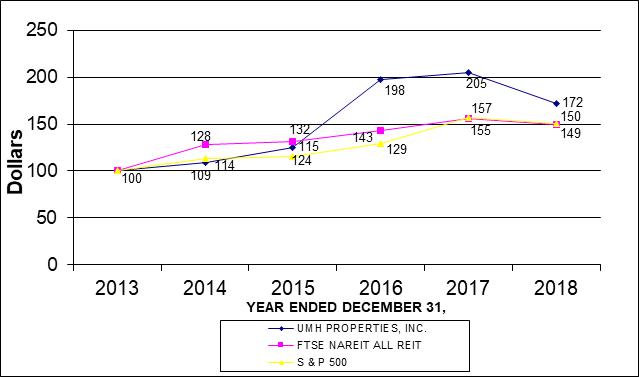
| - 30 - |
Item 6 – Selected Financial Data
The following table sets forth selected financial and other information for the Company as of and for each of the years in the five year period ended December 31, 2018. The historical financial data has been derived from our historical financial statements. This following information should be read in conjunction with “Management’s Discussion and Analysis of Financial Condition and Results of Operations,” and the Consolidated Financial Statements and Notes thereto included elsewhere herein.
| 2018 | 2017 (1) | 2016 (1) | 2015 (1) | 2014 (1) | ||||||||||||||||
| Operating Data: | ||||||||||||||||||||
| Rental and Related Income | $ | 113,832,660 | $ | 101,801,425 | $ | 90,679,557 | $ | 74,762,548 | $ | 63,886,010 | ||||||||||
| Sales of Manufactured Homes | 15,754,033 | 10,846,494 | 8,534,272 | 6,754,123 | 7,545,923 | |||||||||||||||
| Total Income | 129,586,693 | 112,647,919 | 99,213,829 | 81,516,671 | 71,431,933 | |||||||||||||||
| Community Operating Expenses | 52,948,510 | 47,846,565 | 42,638,333 | 37,049,462 | 33,592,327 | |||||||||||||||
| Community NOI (2) | 60,884,150 | 53,954,860 | 48,041,224 | 37,713,086 | 30,293,683 | |||||||||||||||
| Total Expenses | 111,009,550 | 96,616,337 | 83,255,514 | 72,076,546 | 64,521,158 | |||||||||||||||
| Interest Income | 2,254,690 | 2,006,880 | 1,584,585 | 1,819,567 | 2,098,974 | |||||||||||||||
| Dividend Income | 10,367,155 | 8,134,898 | 6,636,126 | 4,399,181 | 4,065,986 | |||||||||||||||
| Gain on Sales of Marketable Securities, net | 20,107 | 1,747,528 | 2,285,301 | 204,230 | 1,542,589 | |||||||||||||||
| Decrease in Fair Value of Marketable Securities (3) | (51,675,396 | ) | -0- | -0- | -0- | -0- | ||||||||||||||
| Interest Expense | 16,038,585 | 15,876,972 | 15,432,364 | 14,074,446 | 10,716,722 | |||||||||||||||
| Net Income (Loss) | (36,215,571 | ) | 12,668,034 | 11,534,559 | 2,144,205 | 4,237,803 | ||||||||||||||
| Net Loss Attributable to Common Shareholders | (56,531,515 | ) | (7,679,265 | ) | (2,568,873 | ) | (6,122,993 | ) | (3,318,785 | ) | ||||||||||
| Net Loss Attributable to Common Shareholders Per Share | ||||||||||||||||||||
| Basic and Diluted | (1.53 | ) | (0.24 | ) | (0.10 | ) | (0.24 | ) | (0.15 | ) | ||||||||||
| Cash Flow Data: | ||||||||||||||||||||
| Net Cash Provided (Used) by: | ||||||||||||||||||||
| Operating Activities | $ | 40,175,186 | $ | 40,857,424 | $ | 29,203,209 | $ | 29,646,963 | $ | 24,749,768 | ||||||||||
| Investing Activities | (137,603,160 | ) | (152,919,761 | ) | (77,567,390 | ) | (148,674,626 | ) | (56,033,767 | ) | ||||||||||
| Financing Activities | 82,314,136 | 130,604,097 | 45,894,673 | 121,419,519 | 32,174,955 | |||||||||||||||
| Balance Sheet Data: | ||||||||||||||||||||
| Total Investment Property | $ | 881,456,088 | $ | 764,438,633 | $ | 640,216,767 | $ | 577,709,074 | $ | 448,164,459 | ||||||||||
| Total Assets | 878,985,924 | 823,881,326 | 680,444,818 | 600,317,390 | 476,040,197 | |||||||||||||||
|
Mortgages
Payable, net of
unamortized debt issuance costs |
331,093,063 | 304,895,117 | 293,025,592 | 283,049,802 | 180,752,425 | |||||||||||||||
| Loans Payable, net of unamortized debt issuance costs | 107,985,353 | 84,704,487 | 58,285,385 | 57,862,206 | 77,128,880 | |||||||||||||||
|
Series
A 8.25% Cumulative
Redeemable Preferred Stock |
-0- | -0- | 91,595,000 | 91,595,000 | 91,595,000 | |||||||||||||||
|
Series
B 8.0% Cumulative
Redeemable Preferred Stock |
95,030,000 | 95,030,000 | 95,030,000 | 45,030,000 | -0- | |||||||||||||||
|
Series
C 6.75% Cumulative
Redeemable Preferred Stock |
143,750,000 | 143,750,000 | -0- | -0- | -0- | |||||||||||||||
|
Series
D 6.375% Cumulative
Redeemable Preferred Stock |
50,000,000 | -0- | -0- | -0- | -0- | |||||||||||||||
| Total Shareholders’ Equity | 424,698,040 | 421,215,464 | 317,031,967 | 246,238,425 | 208,827,105 | |||||||||||||||
| Other Information: | ||||||||||||||||||||
| Average Number of Shares Outstanding | ||||||||||||||||||||
| Basic and Diluted | 36,871,322 | 32,675,650 | 27,808,895 | 25,932,626 | 22,496,103 | |||||||||||||||
| Funds from Operations (2) | $ | (24,709,177 | ) | $ | 19,959,411 | $ | 20,647,390 | $ | 12,834,786 | $ | 11,837,322 | |||||||||
| Core Funds from Operations (2) | $ | 26,966,219 | $ | 23,461,898 | $ | 20,731,742 | $ | 14,267,036 | $ | 12,320,844 | ||||||||||
| Normalized Funds from Operations (2) | $ | 27,471,112 | $ | 21,714,370 | $ | 18,446,441 | $ | 14,187,806 | $ | 10,778,255 | ||||||||||
| Cash Dividends Per Common Share | $ | 0.72 | $ | 0.72 | $ | 0.72 | $ | 0.72 | $ | 0.72 | ||||||||||
| (1) | Financial information has been revised to reflect certain reclassifications in prior periods to conform to the current period presentation. | |
| (2) | Refer to Item 7, Supplemental Measures, contained in this Form 10-K for information regarding the presentation of community NOI, and for the presentation and reconciliation of funds from operations, core funds from operations and normalized funds from operations to net loss attributable to common shareholders. | |
| (3) | Represents change in unrealized gain (loss) in marketable securities which is included in the Consolidated Statements of Income (Loss) in accordance with ASU 2016-01. |
| - 31 - |
Item 7 – Management’s Discussion and Analysis of Financial Condition and Results of Operations
Cautionary Statement Regarding Forward-Looking Statements
Statements contained in this Form 10-K, that are not historical facts are forward-looking statements within the meaning of Section 27A of the Securities Act of 1933, as amended (the “Securities Act”), and Section 21E of the Securities Exchange Act of 1934, as amended (the “Exchange Act”). Forward-looking statements provide our current expectations or forecasts of future events. Forward-looking statements include statements about the Company’s expectations, beliefs, intentions, plans, objectives, goals, strategies, future events, performance and underlying assumptions and other statements that are not historical facts. Forward-looking statements can be identified by their use of forward-looking words, such as “may,” “will,” “anticipate,” “expect,” “believe,” “intend,” “plan,” “should,” “seek” or comparable terms, or the negative use of those words, but the absence of these words does not necessarily mean that a statement is not forward-looking.
The forward-looking statements are based on our beliefs, assumptions and expectations of our future performance, taking into account all information currently available to us. Forward-looking statements are not predictions of future events. These beliefs, assumptions and expectations can change as a result of many possible events or factors, not all of which are known to us. Some of these factors are described below and under the headings “Business”, “Risk Factors” and “Management’s Discussion and Analysis of Financial Condition and Results of Operations”. These and other risks, uncertainties and factors could cause our actual results to differ materially from those included in any forward-looking statements we make. Any forward-looking statement speaks only as of the date on which it is made. New risks and uncertainties arise over time, and it is not possible for us to predict those events or how they may affect us. Except as required by law, we are not obligated to, and do not intend to, update or revise any forward-looking statements, whether as a result of new information, future events or otherwise. Important factors that could cause actual results to differ materially from our expectations include, among others:
| ● | changes in the real estate market conditions and general economic conditions; | |
| ● | the inherent risks associated with owning real estate, including local real estate market conditions, governing laws and regulations affecting manufactured housing communities and illiquidity of real estate investments; | |
| ● | increased competition in the geographic areas in which we own and operate manufactured housing communities; | |
| ● | our ability to continue to identify, negotiate and acquire manufactured housing communities and/or vacant land which may be developed into manufactured housing communities on terms favorable to us; | |
| ● | our ability to maintain rental rates and occupancy levels; | |
| ● | changes in market rates of interest; | |
| ● | our ability to repay debt financing obligations; | |
| ● | our ability to refinance amounts outstanding under our credit facilities at maturity on terms favorable to us; | |
| ● | our ability to comply with certain debt covenants; | |
| ● | our ability to integrate acquired properties and operations into existing operations; | |
| ● | the availability of other debt and equity financing alternatives; | |
| ● | continued ability to access the debt or equity markets; | |
| ● | the loss of any member of our management team; | |
| ● | our ability to maintain internal controls and processes to ensure all transactions are accounted for properly, all relevant disclosures and filings are timely made in accordance with all rules and regulations, and any potential fraud or embezzlement is thwarted or detected; | |
| ● | the ability of manufactured home buyers to obtain financing; | |
| ● | the level of repossessions by manufactured home lenders; |
| - 32 - |
| ● | market conditions affecting our investment securities; | |
| ● | changes in federal or state tax rules or regulations that could have adverse tax consequences; | |
| ● | our ability to qualify as a REIT for federal income tax purposes; and | |
| ● | those risks and uncertainties referenced under the heading “Risk Factors” contained in this Form 10-K and the Company’s filings with the Securities and Exchange Commission. |
You should not place undue reliance on these forward-looking statements, as events described or implied in such statements may not occur. The forward-looking statements contained in this Form 10-K speak only as of the date hereof and the Company expressly disclaims any obligation to publicly update or revise any forward-looking statements whether as a result of new information, future events, or otherwise.
2018 Accomplishments
During 2018, UMH has made substantial progress on multiple fronts – generating solid operating results, achieving strong growth and improving our financial position. We have:
| ● | Generated a 12% increase in Normalized FFO per share; | |
| ● | Increased Rental and Related Income by 12%; | |
| ● | Increased Community Net Operating Income (“NOI”) by 13%; | |
| ● | Improved our Operating Expense ratio by 50 basis points to 46.5%; | |
| ● | Increased Same Property NOI by 7%; | |
| ● | Increased Same Property Occupancy by 40 basis points from 82.6% to 83.0%; | |
| ● | Increased home sales by 45%; | |
| ● | Acquired 6 communities containing approximately 1,600 homesites for a total cost of $59.1 million, bringing our total property portfolio to 118 manufactured home communities with approximately 21,500 developed homesites; | |
| ● | Increased our rental home portfolio by 905 homes to approximately 6,500 total rental homes, representing an increase of 16%; | |
| ● | Expanded and extended our existing unsecured revolving credit facility, increasing the available borrowings and reducing interest costs. | |
| ● | Issued 2,000,000 shares of a new 6.375% Series D Cumulative Redeemable Preferred Stock, for net proceeds after deducting the underwriting discount and other estimated offering expenses, of approximately $48 million; and | |
| ● | Raised $35.1 million through our Dividend Reinvestment and Stock Purchase Plan. |
Overview
The following discussion and analysis of the consolidated financial condition and results of operations should be read in conjunction with “Selected Financial Data” and the historical Consolidated Financial Statements and Notes thereto included elsewhere in this Form 10-K.
The Company is a self-administered, self-managed, REIT with headquarters in Freehold, New Jersey. The Company’s primary business is the ownership and operation of manufactured home communities, which includes leasing manufactured home spaces on an annual or month-to-month basis to residential manufactured home owners. The Company also leases homes to residents and, through its taxable REIT subsidiary, S&F, sells and finances homes to residents and prospective residents of our communities.
Our communities are located in New Jersey, New York, Ohio, Pennsylvania, Tennessee, Indiana, Michigan and Maryland. UMH has continued to execute our growth strategy of purchasing well-located communities in our target markets, including the energy-rich Marcellus and Utica Shale regions. During the year ended December 31, 2018, we purchased six manufactured home communities, for an aggregate purchase price of $59,093,000. These acquisitions added approximately 1,600 developed homesites to our portfolio, bringing our total to 118 communities containing approximately 21,500 developed homesites.
| - 33 - |
The Company earns income from the operation of its manufactured home communities, leasing of manufactured homesites, the rental of manufactured homes, the sale and finance of manufactured homes, the brokering of home sales, and from appreciation in the values of the manufactured home communities and vacant land owned by the Company. Management views the Company as a single segment based on its method of internal reporting in addition to its allocation of capital and resources. The Company also invests in securities of other REITs which the Company generally limits to no more than approximately 15% of its undepreciated assets.
Occupancy in our properties, as well as our ability to increase rental rates, directly affects revenues. In 2018, total income increased 15.0% from the prior year and Community NOI (as defined below) increased 12.8% from the prior year, primarily due to the acquisition and rental programs in 2017 and 2018. Overall occupancy increased from 81.4% at December 31, 2017 to 82.0% at December 31, 2018. Same property occupancy, which includes communities owned and operated as of January 1, 2017, increased from 82.6% at December 31, 2017 to 83.0% at December 31, 2018. Overall occupancy includes communities acquired in 2018 at a weighted average occupancy of 80%.
Sales of manufactured homes performed exceptionally well during 2018, increasing by 45% year-over-year. Demand for housing remains healthy, due to improvements in the economy, sustained wage and job growth and still favorable interest rates. Conventional single-family home prices continue their rise supported by low inventories and increasing sales. As household formation strengthens and for-sale inventory remains limited, a large share of housing demand will be looking at alternative forms of housing. Our property type offers substantial comparative value that should result in increased demand.
The macro-economic environment and current housing fundamentals continue to favor home rentals. The inability to satisfy down payment requirements, more stringent credit terms, and steadily increasing home prices continue to create hurdles for would-be homebuyers. Rental homes in a manufactured home community allow the resident to obtain the efficiencies of factory-built housing and the amenities of community living for less than the cost of other forms of affordable housing. We continue to see increased demand for rental homes. During 2018, our portfolio of rental homes increased by 905 homes. Occupied rental homes represent approximately 34.1% of total occupied sites. Occupancy in rental homes continues to be strong and is at 92.3% as of December 31, 2018. We compare favorably with other types of rental housing, including apartments, and we will continue to allocate capital to rental home purchases, as demand dictates.
The Company holds a portfolio of marketable securities of other REITs with a fair value of $99,595,736 at December 31, 2018, representing 9.3% of our undepreciated assets (total assets excluding accumulated depreciation). The Company generally limits its marketable securities investments to no more than approximately 15% of its undepreciated assets. The REIT securities portfolio provides the Company with additional diversification, liquidity and income, and serves as a proxy for real estate when more favorable risk adjusted returns are not available. As of December 31, 2018, the Company’s portfolio consisted of 3% REIT preferred stocks and 97% REIT common stocks.
The Company invests in these REIT securities and, from time to time, may use margin debt when an adequate yield spread can be obtained. As of December 31, 2018, the Company has borrowings of $31,975,086 under its margin line at 2.75% interest. The Company’s weighted average yield on the securities portfolio was approximately 7.3% at December 31, 2018. The Company realized a net gain of $20,107 on sale of securities in 2018 as compared to a net gain of $1,747,528 during 2017. At December 31, 2018, the Company had unrealized losses of $(40,155,814) in its REIT securities portfolio. The dividends received from our securities investments continue to meet our expectations. It is our intent to hold these securities for investment on a long-term basis.
The Company continues to strengthen its balance sheet. During 2018, the Company raised approximately $35.1 million in new capital through the Dividend Reinvestment and Stock Purchase Plan (“DRIP”). The Company also reduced its cost of capital in 2018 by issuing 2,000,000 shares of a new 6.375% Series D Cumulative Redeemable Preferred Stock (“Series D Preferred Stock”) for net proceeds of $48.2 million.
At December 31, 2018, the Company had approximately $7.4 million in cash and cash equivalents and $25 million available on our credit facility, with an additional $50 million potentially available pursuant to an accordion feature. We also had $18.6 million available on our revolving lines of credit for the financing of home sales and the purchase of inventory. In addition, we held approximately $99.6 million in marketable REIT securities encumbered by $32.0 million in margin loans. In general, the Company may borrow up to 50% of the value of the marketable securities.
| - 34 - |
The Company intends to continue to increase its real estate investments. Our business plan includes acquiring communities that yield in excess of our cost of funds and then making physical improvements, including adding rental homes onto otherwise vacant sites. In 2017 and 2018, we have added a total of seventeen manufactured home communities to our portfolio, encompassing approximately 3,600 developed sites. These manufactured home communities were acquired with an average occupancy rate of 71%. The Company will utilize the rental home program to increase occupancy rates and improve operating results at these communities. There is no guarantee that any additional opportunities will materialize or that the Company will be able to take advantage of such opportunities. The growth of our real estate portfolio depends on the availability of suitable properties which meet the Company’s investment criteria and appropriate financing. Competition in the market areas in which the Company operates is significant and affects acquisitions, occupancy levels, rental rates and operating expenses of certain properties.
See PART I, Item 1- Business and Item 1A – Risk Factors for a more complete discussion of the economic and industry-wide factors relevant to the Company, the Company’s lines of business and principal products and services, and the opportunities, challenges and risks on which the Company is focused.
Acquisitions
| Community | Date of Acquisition | State | Number of Sites | Purchase Price | Number of Acres | Occupancy at Acquisition | ||||||||||||||||||
| Acquisitions in 2018 | ||||||||||||||||||||||||
|
Redbud
Estates and
Camelot Village |
May 30, 2018 | IN | 669 | $ | 20,500,000 | 231 | 91 | % | ||||||||||||||||
| Summit Village | August 31, 2018 | IN | 134 | 3,500,000 | 58 | 60 | % | |||||||||||||||||
| Pikewood Manor | November 30, 2018 | OH | 488 | 23,000,000 | 117 | 67 | % | |||||||||||||||||
|
Perrysburg
Estates and
Meadows of Perrysburg |
December 19, 2018 | OH | 324 | 12,093,000 | 88 | 79 | % | |||||||||||||||||
| Total 2018 | 1,615 | $ | 59,093,000 | 449 | 79 | % | ||||||||||||||||||
| Acquisitions in 2017 | ||||||||||||||||||||||||
| Hillcrest Estates and Marysville Estates | January 20, 2017 | OH | 532 | $ | 9,588,000 | 149 | 57 | % | ||||||||||||||||
| Boardwalk and Parke Place | January 20, 2017 | IN | 559 | 24,437,000 | 155 | 77 | % | |||||||||||||||||
| Hillcrest Crossing | January 24, 2017 | PA | 200 | 2,485,000 | 78 | 40 | % | |||||||||||||||||
| Cinnamon Woods | May 31, 2017 | MD | 63 | 4,000,000 | 79 | 92 | % | |||||||||||||||||
| Pennsylvania 5 Community Portfolio | December 22, 2017 | PA | 643 | 22,780,000 | 141 | 72 | % | |||||||||||||||||
| Total 2017 | 1,997 | $ | 63,290,000 | 602 | 67 | % | ||||||||||||||||||
| - 35 - |
Supplemental Measures
In addition to the results reported in accordance with GAAP, management’s discussion and analysis of financial condition and results of operations include certain non-GAAP financial measures that in management’s view of the business we believe are meaningful as they allow the investor the ability to understand key operating details of our business both with and without regard to certain accounting conventions or items that may not always be indicative of recurring annual cash flow of the portfolio. These non-GAAP financial measures as determined and presented by us may not be comparable to related or similarly titled measures reported by other companies, and include Community Net Operating Income (“Community NOI”), Funds from Operations Attributable to Common Shareholders (“FFO”), Core Funds from Operations Attributable to Common Shareholders (“Core FFO”) and Normalized Funds from Operations Attributable to Common Shareholders (“Normalized FFO”).
We define Community NOI as rental and related income less community operating expenses such as real estate taxes, repairs and maintenance, community salaries, utilities, insurance and other expenses. We believe that Community NOI is helpful to investors and analysts as a direct measure of the actual operating results of our manufactured home communities, rather than our Company overall. Community NOI should not be considered a substitute for the reported results prepared in accordance with GAAP. Community NOI should not be considered as an alternative to net income (loss) as an indicator of our financial performance, or to cash flows as a measure of liquidity; nor is it indicative of funds available for our cash needs, including our ability to make cash distributions.
The Company’s Community NOI is calculated as follows:
| 2018 | 2017 | 2016 | 2015 | 2014 | ||||||||||||||||
| Rental and Related Income | $ | 113,832,660 | $ | 101,801,425 | $ | 90,679,557 | $ | 74,762,548 | $ | 63,886,010 | ||||||||||
| Community Operating Expenses | (52,948,510 | ) | (47,846,565 | ) | (42,638,333 | ) | (37,049,462 | ) | (33,592,327 | ) | ||||||||||
| Community NOI | $ | 60,884,150 | $ | 53,954,860 | $ | 48,041,224 | $ | 37,713,086 | $ | 30,293,683 | ||||||||||
We also assess and measure our overall operating results based upon an industry performance measure referred to as FFO, which management believes is a useful indicator of our operating performance. FFO is used by industry analysts and investors as a supplemental operating performance measure of a REIT. FFO, as defined by NAREIT, represents net income (loss) attributable to common shareholders, as defined by GAAP, excluding extraordinary items, as defined under GAAP, gains or losses from sales of previously depreciated real estate assets, impairment charges related to depreciable real estate assets, plus certain non-cash items such as real estate asset depreciation and amortization. NAREIT created FFO as a non-GAAP supplemental measure of REIT operating performance. We define Core FFO as FFO , excluding acquisition costs, costs of early extinguishment of debt, change in the fair value of marketable securities and costs associated with the redemption of preferred stock. We define Normalized FFO as Core FFO excluding gains and losses realized on securities investments and certain non-recurring charges. FFO, Core FFO and Normalized FFO should be considered as supplemental measures of operating performance used by REITs. FFO, Core FFO and Normalized FFO exclude historical cost depreciation as an expense and may facilitate the comparison of REITs which have a different cost basis. The items excluded from FFO, Core FFO and Normalized FFO are significant components in understanding the Company’s financial performance.
FFO, Core FFO and Normalized FFO (i) do not represent Cash Flow from Operations as defined by GAAP; (ii) should not be considered as an alternative to net income (loss) as a measure of operating performance or to cash flows from operating, investing and financing activities; and (iii) are not alternatives to cash flow as a measure of liquidity. FFO, Core FFO and Normalized FFO, as calculated by the Company, may not be comparable to similarly titled measures reported by other REITs.
| - 36 - |
The Company’s FFO, Core FFO and Normalized FFO attributable to common shareholders are calculated as follows:
| 2018 | 2017 | 2016 | 2015 | 2014 | ||||||||||||||||
|
Net
Loss Attributable
to Common Shareholders |
$ | (56,531,515 | ) | $ | (7,679,265 | ) | $ | (2,568,873 | ) | $ | (6,122,993 | ) | $ | (3,318,785 | ) | |||||
| Depreciation Expense | 31,691,209 | 27,557,746 | 23,214,100 | 18,877,511 | 15,163,420 | |||||||||||||||
|
(Gain)
Loss on Sales of
Depreciable Assets |
131,129 | 80,930 | 2,163 | 80,268 | (7,313 | ) | ||||||||||||||
| FFO Attributable to Common Shareholders | (24,709,177 | ) | 19,959,411 | 20,647,390 | 12,834,786 | 11,837,322 | ||||||||||||||
| Adjustments: | ||||||||||||||||||||
| Acquisition Costs | -0- | -0- | 79,231 | 957,219 | 483,522 | |||||||||||||||
| Early Extinguishment of Debt (1) | -0- | -0- | 5,121 | 475,031 | -0- | |||||||||||||||
| Decrease in Fair Value of Marketable Securities (4) | 51,675,396 | -0- | -0- | -0- | -0- | |||||||||||||||
| Redemption of Preferred Stock | -0- | 3,502,487 | -0- | -0- | -0- | |||||||||||||||
| Core FFO Attributable to Common Shareholders | 26,966,219 | 23,461,898 | 20,731,742 | 14,267,036 | 12,320,844 | |||||||||||||||
| Adjustments: | ||||||||||||||||||||
| Gain on Sales of Marketable Securities, net | (20,107 | ) | (1,747,528 | ) | (2,285,301 | ) | (204,230 | ) | (1,542,589 | ) | ||||||||||
| Non- Recurring Other Expense (2) | 525,000 | -0- | -0- | -0- | -0- | |||||||||||||||
| Settlement of Memphis Mobile | ||||||||||||||||||||
| City Litigation (3) | -0- | -0- | -0- | 125,000 | -0- | |||||||||||||||
| Normalized FFO Attributable to Common Shareholders | $ | 27,471,112 | $ | 21,714,370 | $ | 18,446,441 | $ | 14,187,806 | $ | 10,778,255 | ||||||||||
| (1) | Included in Interest Expense on the Consolidated Statements of Income (Loss). | |
| (2) | Consists of one- time payroll expenditure. | |
| (3) | Included in Community Operating Expenses on the Consolidated Statements of Income (Loss). | |
| (4) | Represents change in unrealized gain (loss) in marketable securities which is included in the Consolidated Statements of Income (Loss) in accordance with ASU 2016-01. |
Results of Operations
2018 vs. 2017
Rental and related income increased from $101,801,425 for the year ended December 31, 2017 to $113,832,660 for the year ended December 31, 2018, or 12%. This increase was due to the acquisitions during 2017 and 2018, as well as an increase in rental rates, same property occupancy and additional rental homes. During 2018, the Company raised rental rates by 3% to 4% at most communities. Rent increases vary depending on overall market conditions and demand. Occupancy, as well as the ability to increase rental rates, directly affects revenues. The Company has been acquiring communities with vacant sites that can potentially be occupied and earn income in the future. Overall occupancy has increased from to 81.4% at December 31, 2017 to 82.0% at December 31, 2018. Overall occupancy includes communities acquired in 2018 and 2017, which had a weighted average occupancy of 79% and 67%, respectively, at the time of acquisition. Same property occupancy has increased from 82.6% at December 31, 2017 to 83.0% at December 31, 2018. The same property occupancy rate is exclusive of the sites at Memphis Blues, which is under redevelopment due to a flood in 2011. Demand for rental homes continues to be strong. As of December 31, 2018, we had approximately 6,500 rental homes with an occupancy of 92.3%. We continue to evaluate the demand for rental homes and will invest in additional homes as demand dictates. Vacant sites allow for future revenue growth.
| - 37 - |
Community operating expenses increased from $47,846,565 for the year ended December 31, 2017 to $52,948,510 for the year ended December 31, 2018, or 11%. This increase was due to the acquisitions during 2017 and 2018.
Community NOI increased from $53,954,860 for the year ended December 31, 2017 to $60,884,150 for the year ended December 31, 2018, or 13%. This increase was primarily due to the acquisitions during 2017 and 2018 and an increase in rental rates, occupancy and rental homes. The Operating Expense Ratio (defined as Community Operating Expenses divided by Rental and Related Income) also improved from 47.0% for the year ended December 31, 2017 to 46.5% for the year ended December 31, 2018. Many acquisitions have deferred maintenance requiring higher than normal expenditures in the first few years of ownership. Because most of the community expenses are fixed costs, as occupancy rates continue to increase, these expense ratios will continue to improve. Because of the Company’s ability to increase its rental rates annually, increasing costs due to inflation and changing prices have generally not had a material effect on revenues and income from continuing operations.
Sales of manufactured homes increased from $10,846,494 for the year ended December 31, 2017 to $15,754,033 for the year ended December 31, 2018, or 45%. The total number of homes sold was 295 homes in 2018 as compared to 222 homes in 2017. There were 125 new homes sold in 2018 as compared to 74 in 2017. The Company’s average sales price was $53,404 and $48,858 for the years ended December 31, 2018 and 2017, respectively. Cost of sales of manufactured homes increased from $8,471,190 for the year ended December 31, 2017 to $11,715,987 for the year ended December 31, 2018, or 38%. The gross profit percentage was 26% and 22% for 2018 and 2017, respectively. Selling expenses increased from $3,095,155 for the year ended December 31, 2107 to $3,774,425 for the year ended December 31, 2018, or 22%. Gain (Loss) from the sales operations (defined as sales of manufactured homes less cost of sales of manufactured homes less selling expenses less interest on the financing of inventory) decreased from a loss $1,147,501 for the year ended December 31, 2017 to a gain of $75,064 for the year ended December 31, 2018, an improvement of 107%. The gain on sales include selling expenses of approximately $3.8 million for the year ended December 31, 2018. Many of these costs, such as rent, salaries, and to an extent, advertising and promotion, are fixed. Although sales of manufactured homes have not yet returned to pre-recession levels, the Company has experienced three consecutive years of double-digit sales growth. The Company is encouraged by our sales operations’ return to profitability. The U.S. homeownership rate was 64.8% in the fourth quarter of 2018, according to the U.S. Census. This is down from 69.2% at its peak at the end of 2004. The conventional single-family housing market has strengthened, and conventional home prices continue their rise. The inherent affordability of our property type becomes more and more apparent which should result in increased demand. The Company continues to be optimistic about future sales and rental prospects given the fundamental need for affordable housing. The Company believes that sales of new homes produce new rental revenue and is an investment in the upgrading of our communities.
General and Administrative Expenses increased from $9,645,681 for the year ended December 31, 2017 to $10,879,419 for the year ended December 31, 2018, or 13%. This increase was primarily due to an increase in personnel and personnel costs, as headcount, wages and incentive compensation increased in connection with the Company’s growth, and an increase in non-cash stock compensation expense. Stock compensation expense increased from $1,314,491 for the year ended December 31, 2017 to $1,613,110 for the year ended December 31, 2018. These increases were primarily due to an increase in the weighted-average fair value of options granted from $1.81 per share for the year ended December 31, 2017 to $2.05 per share for the year ended December 31, 2018. Additionally, the Founder and Chairman of the Board was granted a discretionary stock option award of 100,000 shares, as well as 1,000 shares of restricted stock. Although these awards are usually recognized over the vesting period, the entire compensation cost of approximately $210,000 was recognized at the time of grant since he is of retirement age. Additionally, for the year ended December 31, 2018, there was a one-time payroll expenditure of $525,000 for two employees. General and Administrative expenses without this one-time payroll expenditure as a percentage of gross revenue (Total Income plus Interest, Dividend and Other Income) remains in line at 7.3% and 7.8% at December 31, 2018 and 2017, respectively.
Depreciation expense increased from $27,557,746 for the year ended December 31, 2017 to $31,691,209 for the year ended December 31, 2018, or 15%. This increase was primarily due to the acquisitions and the increase in rental homes during 2017 and 2018.
Interest income increased from $2,006,880 for the year ended December 31, 2017 to $2,254,690 for the year ended December 31, 2018, or 12%. This increase was primarily due to an increase in the average balance of notes receivable from $21.2 million for the year ended December 31, 2017 to $26.9 million for the year ended December 31, 2018.
| - 38 - |
Dividend income increased from $8,134,898 for the year ended December 31, 2017 to $10,367,155 for the year ended December 31, 2018, or 27%. This increase was due to an increase in the cost of securities from $121.4 million for the year ended December 31, 2017 to $139.8 million for the year ended December 31, 2018. The dividends received from our securities investments were at a weighted average yield of 7.3% and 7.4% as of December 31, 2018 and 2017, respectively, and continue to meet our expectations. It is the Company’s intent to hold these marketable securities long-term.
Realized gain on sales of marketable securities, net consists of the following:
| Year Ended December 31, | ||||||||
| 2018 | 2017 | |||||||
| Gross realized gains | $ | 20,107 | $ | 1,749,034 | ||||
| Gross realized losses | -0- | (1,506 | ) | |||||
| Total Gain on Sales of Marketable Securities, net | $ | 20,107 | $ | 1,747,528 | ||||
The Company had an accumulated net unrealized loss on its securities portfolio of $(40,155,814) as of December 31, 2018.
Decrease in Fair Value of Marketable Securities decreased from of $0 for the year ended December 31, 2017 to a loss of $51,675,396 for the year ended December 31, 2018. On January 1, 2018, the Company adopted ASU 2016-01, which requires changes in the fair value of our marketable securities to be recorded in current period earnings. Previously, changes in the fair value of marketable securities were recognized in “Accumulated Other Comprehensive Income” on our Consolidated Balance Sheets. As a result, on January 1, 2018 the Company recorded an increase to beginning undistributed income (accumulated deficit) of $11,519,582 to recognize the unrealized gains previously recorded in “Accumulated Other Comprehensive Income” on our Consolidated Balance Sheets. As of December 31, 2018, the Company had total net unrealized losses of $40,155,814 in its REIT securities portfolio.
Other income decreased from $705,048 at December 31, 2017 to $410,444 at December 31, 2018. This decrease is mainly due to an upfront oil and gas bonus payment in 2017 of $251,680 that the Company received at one of its communities.
Interest expense, including amortization of financing costs, remained relatively stable for the year ended December 31, 2018 as compared to the year ended December 31, 2017. During the year, we obtained 2 new mortgage loans, and assumed 2 loans in conjunction with acquisitions, totaling $33 million. The average balance of mortgages payable was approximately $318 million during 2018 as compared to approximately $299 million during 2017. The weighted average interest rate on its mortgages, not including the effect of unamortized debt issuance costs, was 4.3% at December 31, 2018 as compared to 4.2% at December 31, 2017.
2017 vs. 2016
Rental and related income increased from $90,679,557 for the year ended December 31, 2016 to $101,801,425 for the year ended December 31, 2017, or 12%. This increase was due to the acquisitions during 2016 and 2017, as well as an increase in rental rates, same property occupancy and additional rental homes. During 2017, the Company raised rental rates by 3% to 4% at most communities. Rent increases vary depending on overall market conditions and demand. Occupancy, as well as the ability to increase rental rates, directly affects revenues. The Company has been acquiring communities with vacant sites that can potentially be occupied and earn income in the future. Overall occupancy has increased from 81.0% at December 31, 2016 to 81.4% at December 31, 2017. Overall occupancy includes communities acquired in 2017 and 2016, which had a weighted average occupancy of 67% and 74%, respectively, at the time of acquisition. Same property occupancy has increased from 81.2% at December 31, 2016 to 82.7% at December 31, 2017. The overall and same property occupancy rates is exclusive of the sites at Memphis Blues, which is under redevelopment due to a flood in 2011. Demand for rental homes continues to be strong. As of December 31, 2017, we had approximately 5,600 rental homes with an occupancy of 93.0%. We continue to evaluate the demand for rental homes and will invest in additional homes as demand dictates. Vacant sites allow for future revenue growth.
| - 39 - |
Community operating expenses increased from $42,638,333 for the year ended December 31, 2016 to $47,846,565 for the year ended December 31, 2017, or 12%. This increase was due to the acquisitions during 2016 and 2017.
Community NOI increased from $48,041,224 for the year ended December 31, 2016 to $53,954,860 for the year ended December 31, 2017, or 12%. This increase was primarily due to the acquisitions during 2016 and 2017 and an increase in rental rates, occupancy and rental homes. The Operating Expense Ratio (defined as Community Operating Expenses divided by Rental and Related Income) was 47.0% for both the years ended December 31, 2017 and 2016. Many acquisitions have deferred maintenance requiring higher than normal expenditures in the first few years of ownership. Because most of the community expenses are fixed costs, as occupancy rates continue to increase, these expense ratios will continue to improve. Because of the Company’s ability to increase its rental rates annually, increasing costs due to inflation and changing prices have generally not had a material effect on revenues and income from continuing operations.
Sales of manufactured homes increased from $8,534,272 for the year ended December 31, 2016 to $10,846,494 for the year ended December 31, 2017, or 27%. The total number of homes sold was 222 homes in 2017 as compared to 170 homes in 2016. There were 74 new homes sold in 2017 as compared to 61 in 2016. The Company’s average sales price was $48,858 and $50,202 for the years ended December 31, 2017 and 2016, respectively. Cost of sales of manufactured homes increased from $6,466,520 for the year ended December 31, 2016 to $8,471,190 for the year ended December 31, 2017, or 31%. The gross profit percentage was 22% and 24% for 2017 and 2016, respectively. Selling expenses remained relatively stable at $3,095,155 for the year ended December 31, 2017 as compared to $2,852,405 for the year ended December 31, 2016. Loss from the sales operations (defined as sales of manufactured homes less cost of sales of manufactured homes less selling expenses less interest on the financing of inventory) decreased from $1,444,076 for the year ended December 31, 2016 to $1,147,501 for the year ended December 31, 2017, an improvement of 21%. The losses on sales include selling expenses of approximately $3.1 million for the year ended December 31, 2017. Many of these costs, such as rent, salaries, and to an extent, advertising and promotion, are fixed. Sales of manufactured homes have not yet returned to pre-recession levels. The U.S. homeownership rate was 64.2% in the fourth quarter of 2017, according to the U.S. Census. This is down from 69.2% at its peak at the end of 2004. The conventional single-family housing market has strengthened and conventional home prices continue their rise. The inherent affordability of our property type becomes more and more apparent which should result in increased demand. The Company continues to be optimistic about future sales and rental prospects given the fundamental need for affordable housing. The Company believes that sales of new homes produce new rental revenue and is an investment in the upgrading of our communities.
General and Administrative Expenses increased from $8,004,925 for the year ended December 31, 2016 to $9,645,681 for the year ended December 31, 2017, or 21%. This increase was primarily due to an increase in personnel and personnel costs, as headcount increased in connection with the Company’s growth, and an increase in non-cash stock compensation expense. Stock compensation expense increased from $1,064,678 for the year ended December 31, 2016 to $1,314,491 for the year ended December 31, 2017. These increases were primarily due to the increase in our stock price during the year, which increased the fair value of options granted. The weighted-average fair value of options granted increased from $0.81 per share for the year ended December 31, 2016 to $1.81 for the year ended December 31, 2017. Additionally, the Founder and Chairman of the Board was granted a discretionary stock option award of 100,000 shares, as well as 1,100 shares of restricted stock. Although these awards are usually recognized over the vesting period, the entire compensation cost of approximately $201,000 was recognized at the time of grant since he is of retirement age. General and Administrative expenses as a percentage of gross revenue (Total Income plus Interest, Dividend and Other Income) remains in line at 7.8% and 7.4% at December 31, 2017 and 2016, respectively.
Acquisition Costs amounted to $-0- for the year ended December 31, 2017 and $79,231 for the year ended December 31, 2016. As a result of the adoption of Accounting Standards Update 2017-01 “Business Combinations (Topic 805) Clarifying the Definition of a Business” prospectively as of January 1, 2017, we account for our property acquisitions as acquisitions of assets and no longer account for our property acquisitions as business combinations. In an acquisition of assets, certain acquisition costs are capitalized to real estate investments as part of the purchase price as opposed to being expensed as Acquisition Costs under the previous accounting treatment for business combinations.
| - 40 - |
Depreciation expense increased from $23,214,100 for the year ended December 31, 2016 to $27,557,746 for the year ended December 31, 2017, or 19%. This increase was primarily due to the acquisitions and the increase in rental homes during 2016 and 2017.
Interest income increased from $1,584,585 for the year ended December 31, 2016 to $2,006,880 for the year ended December 31, 2017, or 27%. This increase was primarily due to an increase in the average balance of notes receivable from $18.3 million for the year ended December 31, 2016 to $21.2 million for the year ended December 31, 2017.
Dividend income increased from $6,636,126 for the year ended December 31, 2016 to $8,134,898 for the year ended December 31, 2017, or 23%. This increase was due to an increase in the average balance of securities from $91.9 million for the year ended December 31, 2016 to $120.9 million for the year ended December 31, 2017. The dividends received from our securities investments were at a weighted average yield of 7.4% and 6.8% as of December 31, 2017 and 2016, respectively.
Realized gain on sales of marketable securities, net consists of the following:
| Year Ended December 31, | ||||||||
| 2017 | 2016 | |||||||
| Gross realized gains | $ | 1,749,034 | $ | 2,287,454 | ||||
| Gross realized losses | (1,506 | ) | (2,153 | ) | ||||
| Total Gain on Sales of Marketable Securities, net | $ | 1,747,528 | $ | 2,285,301 | ||||
The Company had an accumulated net unrealized gain on its securities portfolio of $11,519,582 as of December 31, 2017.
Other income increased from $504,759 at December 31, 2016 to $705,048 at December 31, 2017. The increase is mainly due to an upfront oil and gas bonus payment of $251,680 that the Company received at one of its communities.
Interest expense remained relatively stable for the year ended December 31, 2017 as compared to the year ended December 31, 2016. During the year, we obtained 3 new mortgage loans, and assumed 1 loan in conjunction with an acquisition, totaling $47 million. The average balance of mortgages payable was approximately $299 million during 2017 as compared to approximately $288 million during 2016. The weighted average interest rate on its mortgages, not including the effect of unamortized debt issuance costs, was 4.2% at December 31, 2017 as compared to 4.3% at December 31, 2016.
Liquidity and Capital Resources
The Company operates as a REIT deriving its income primarily from real estate rental operations. The Company’s principal liquidity demands have historically been, and are expected to continue to be, payments of expenses relating to real estate operations, acquisitions, capital improvements, development and expansions of properties, debt service, purchases of manufactured homes, investment in debt and equity securities of other REITs, financing of manufactured home sales and distribution requirements. The Company’s ability to generate cash adequate to meet these demands is dependent primarily on income from its real estate investments and securities portfolio, the sale of real estate investments and securities, financing and refinancing of mortgage debt, leveraging of real estate investments, availability of bank borrowings, proceeds from the DRIP, and access to the capital markets.
The Company intends to operate its existing properties from the cash flows generated by the properties. However, the Company’s expenses are affected by various factors, including inflation. Increases in operating expenses raise the breakeven point for a property and, to the extent that they cannot be passed on through higher rents, reduce the amount of available cash flow which can adversely affect the market value of the property.
| - 41 - |
The Company continues to strengthen its capital and liquidity positions. The Company has a DRIP in which participants can purchase stock from the Company at a price of approximately 95% of market. During 2018, amounts received, including dividends reinvested of $5.1 million, totaled $35.1 million. The Company also issued 2,000,000 shares of its Series D Preferred Stock in an underwritten registered public offering, raising net proceeds of approximately $48 million.
On November 29, 2018, the Company entered into a First Amendment to Amended and Restated Credit Agreement to expand and extend its existing unsecured revolving credit facility. The Facility is syndicated with two banks led by BMO Capital Markets Corp., as sole lead arranger and sole book runner, with Bank of Montreal as administrative agent, and includes JPMorgan Chase Bank, N.A. as the sole syndication agent. The Amendment provides for an increase from $50 million in available borrowings to $75 million in available borrowings with a $50 million accordion feature, bringing the total potential availability up to $125 million, subject to certain conditions including obtaining commitments from additional lenders. The Amendment also extends the maturity date of the Facility from March 27, 2020 to November 29, 2022, with a one-year extension available at the Company’s option, subject to certain conditions including payment of an extension fee. Availability under the Facility is limited to 60% of the value of the unencumbered communities which the Company has placed in the Facility’s unencumbered asset pool. The Amendment increased the value of the Borrowing Base communities by reducing the capitalization rate applied to the Net Operating Income generated by the communities in the Borrowing Base from 7.5% to 7.0%. As of December 31, 2018, $25 million was available on this credit facility.
The Company has the ability to finance home sales, inventory purchases and rental home purchases. The Company has a $10 million revolving line of credit for the financing of homes, of which $4 million was utilized at December 31, 2018, and revolving credit facilities totaling $28.5 million to finance inventory purchases, of which $15.9 million was utilized at December 31, 2018.
As of December 31, 2018, the Company had $7.4 million of cash and cash equivalents and marketable securities of $99.6 million encumbered by $32.0 million in margin loans. The Company owns 118 communities of which 45 are unencumbered. The Company’s marketable securities and non-mortgaged properties provide us with additional liquidity. The Company believes that cash on hand, funds generated from operations, the DRIP and capital market, the funds available on the lines of credit, together with the ability to finance and refinance its properties will provide sufficient funds to adequately meet its obligations over the next several years.
The Company’s focus is on real estate investments. The Company has historically financed purchases of real estate primarily through mortgages. During 2018, total investment property increased 15% or $117 million. The Company made acquisitions of six manufactured home communities totaling approximately 1,600 developed sites at an aggregate purchase price of $59.1 million. These acquisitions were funded through new mortgages, the use of our unsecured credit facility and the issuance of preferred stock. See Note 3 of the Notes to Consolidated Financial Statements for additional information on our acquisitions and Note 5 of the Notes to Consolidated Financial Statements for related debt transactions. The Company continues to evaluate acquisition opportunities. The funds for these acquisitions may come from bank borrowings, proceeds from the DRIP, and private placements or public offerings of common or preferred stock. To the extent that funds or appropriate properties are not available, fewer acquisitions will be made.
The Company also invests in rental homes and as of December 31, 2018 the Company owned approximately 6,500 rental homes, or approximately 30% of our total homesites. During 2018, our rental home portfolio increased by 905 homes or $37.6 million. The Company markets these rental homes for sale to existing residents. The Company estimates that in 2019 it will purchase approximately 800 manufactured homes to use as rental units for a total cost, including setup, of approximately $36 million. Rental home rates on new homes range from $700-$1,200 per month, including lot rent, depending on size, location and market conditions. During 2018, the Company also invested approximately $17 million in other improvements to our communities.
| - 42 - |
Additionally, the Company invests in marketable debt and equity securities of other REITs. The REIT securities portfolio provides the Company with additional liquidity and income and serves as a proxy for real estate when more favorable risk adjusted returns are not available. The Company generally limits its marketable securities investments to no more than approximately 15% of its undepreciated assets. During 2018, the securities portfolio decreased 25% or $33.4 million primarily due to a net unrealized loss of $51.7 million and sales of securities with a cost of $249,000, offset by purchases of $18.6 million. The Company recognized gains on sales of securities of approximately $20,000 in addition to the dividend income earned of $10.4 million. The Company from time to time may purchase these securities on margin when there is an adequate yield spread. At December 31, 2018, $32.0 million was outstanding on the margin loan at a 2.75% interest rate.
The following table summarizes cash flow activity for the years ended December 31, 2018, 2017 and 2016:
| 2018 | 2017 | 2016 | ||||||||||
| Net Cash Provided by Operating Activities | $ | 40,175,186 | $ | 40,857,424 | $ | 29,203,209 | ||||||
| Net Cash Used in Investing Activities | (137,603,160 | ) | (152,919,761 | ) | (77,567,391 | ) | ||||||
| Net Cash Provided by Financing Activities | 82,314,136 | 130,604,097 | 45,894,673 | |||||||||
|
Net
Increase (Decrease) in Cash, Cash
Equivalents and Restricted Cash |
$ | (15,113,838 | ) | $ | 18,541,760 | $ | (2,469,509 | ) | ||||
Net cash provided by operating activities remained relatively stable from 2017 to 2018. Net cash provided by operating activities increased by $12.0 million in 2017. This increase was primarily due to increased income from operations generated from acquisitions and increased rental homes and a smaller increase in inventory purchases.
Net cash used in investing activities decreased by $15.3 million in 2018 primarily due to a decrease in acquisitions of manufactured home communities and a decrease in purchases of REIT securities. Net cash used in investing activities increased by $75.4 million in 2017 primarily due to an increase in acquisitions of manufactured home communities and an increase in our REIT securities portfolio.
Net cash provided by financing activities decreased by $48.3 million in 2018 to $82.3 million. The Company received $35.1 million, including dividends reinvested, through the DRIP, and issued 2,000,000 shares of its Series D Preferred Stock in an underwritten registered public offering, raising net proceeds of approximately $48 million. During 2018, the Company also distributed to our common shareholders a total of $26.6 million, including dividends reinvested. It is anticipated, although no assurances can be given, that the level of participation in the DRIP in 2019 will be comparable to 2018. In addition, the Company also paid $20.0 million in preferred dividends.
Net cash provided by financing activities increased by $84.7 million in 2017 to $130.6 million. The Company received $60.4 million, including dividends reinvested, through the DRIP, issued 1,400,000 shares of its common stock in a registered direct placement, raising net proceeds of $22.5 million, and issued 5,750,000 shares of its Series C Preferred Stock in an underwritten registered public offering, raising net proceeds of approximately $139 million. $91.6 million of the net proceeds from the issuance of the Series C Preferred Stock was used to redeem all of the 3,663,800 outstanding shares of the Series A Preferred Stock. During 2017, the Company also distributed to our common shareholders a total of $23.6 million, including dividends reinvested. In addition, the Company also paid $16.7 million in preferred dividends.
Cash flows were primarily used for purchases of manufactured home communities, capital improvements, payment of dividends, purchases of marketable securities, purchase of inventory and rental homes, loans to customers for the sales of manufactured homes, and expansion of existing communities. The Company meets maturing mortgage obligations by using a combination of cash flow and refinancing. The dividend payments were primarily made from cash flow from operations.
Cash flows used for capital improvements include amounts needed to meet environmental and regulatory requirements in connection with the manufactured home communities that provide water or sewer service. Excluding expansions and rental home purchases, the Company is budgeting approximately $16 million in capital improvements for 2019.
| - 43 - |
The Company’s significant commitments and contractual obligations relate to its mortgages and loans payable, acquisitions of manufactured home communities, retirement benefits, and the lease on its corporate offices as described in Note 8 to the Consolidated Financial Statements.
The Company has 1,700 acres of undeveloped land which it could develop over the next several years. The Company continues to analyze the best use of its vacant land.
As of December 31, 2018, the Company had total assets of $879.0 million and total liabilities of $454.3 million. Our net debt (net of cash and cash equivalents) to total market capitalization as of December 31, 2018 and 2017 was approximately 37% and 32%, respectively. Our net debt, less securities (net of cash and cash equivalents and marketable securities) to total market capitalization as of December 30, 2018 and 2017 was approximately 28% and 20%, respectively.
The Company believes that it has the ability to meet its obligations and to generate funds for new investments.
Off-Balance Sheet Arrangements and Contractual Obligations
The Company has not executed any material off-balance sheet arrangements.
The following is a summary of the Company’s contractual obligations as of December 31, 2018:
|
Contractual Obligations |
Total |
Less
than
1 year |
1-3 years |
3-5 years |
More
than
5 years |
|||||||||||||||
| Mortgages Payable | $ | 334,411,425 | $ | 21,140,538 | $ | 29,313,422 | $ | 75,069,454 | $ | 208,888,011 | ||||||||||
| Interest on Mortgages Payable | 80,803,848 | 14,374,283 | 26,182,408 | 21,435,598 | 18,811,559 | |||||||||||||||
| Loans Payable | 108,417,479 | 19,767,278 | 4,593,603 | 51,699,576 | 32,357,022 | |||||||||||||||
| Interest on Loans Payable | 15,009,023 | 4,445,004 | 5,977,278 | 3,704,610 | 882,131 | |||||||||||||||
| Operating Lease Obligations | 729,740 | 214,800 | 441,100 | 73,840 | -0- | |||||||||||||||
| Purchase of Properties | 45,287,000 | 45,287,000 | -0- | -0- | -0- | |||||||||||||||
| Retirement Benefits | 450,000 | -0- | -0- | -0- | 450,000 | |||||||||||||||
| Total | $ | 585,108,515 | $ | 105,228,903 | $ | 66,507,811 | $ | 151,983,078 | $ | 261,388,723 | ||||||||||
Mortgages payable represents the principal amounts outstanding based on scheduled payments. The interest on these mortgages are at fixed rates ranging from 3.71% to 6.5%. The weighted average interest rate, not including the effect of unamortized debt issuance costs, was approximately 4.3% at December 31, 2018. As of December 31, 2018, the weighted average loan maturity of the mortgage payable is 6.3 years.
Loans payable represents $50,000,000 outstanding on the Company’s unsecured line of credit with an interest rate ranging from LIBOR plus 1.75% to 2.50% or Prime plus 0.75% to 1.50%, based on the Company’s overall leverage (interest rate of 4.05% as of December 31, 2018); $31,975,086 outstanding on its margin line with an interest rate of 2.75% at December 31, 2018; $15,928,350 outstanding on the Company’s revolving credit agreements to finance inventory with interest rates ranging from prime with a minimum of 6% to Prime plus 2% with a minimum of 8% after 18 months (weighted average interest rate of 7.04% as of December 31, 2018); $373,499 loans outstanding for the finance of rental homes with an interest rate of 6.99% at December 31, 2018; $3,779,477 outstanding on its commercial term loan with an interest rate of 4.625% at December 31, 2018; $4,000,000 outstanding on the Company’s revolving line of credit secured by eligible notes receivables with an interest rate of prime plus 50 basis points (interest rate of 5.50 % as of December 31, 2018); and $2,361,066 outstanding on its automotive loans with a weighted average interest rate of 4.43%.
| - 44 - |
Operating lease obligations represent a lease with a related party for the Company’s corporate offices. On May 1, 2015, the Company renewed this lease for additional space and for an additional seven-year term with monthly lease payments of $14,900 through April 30, 2020 and $15,300 through April 30, 2022. On July 1, 2017, the Company entered into a lease for additional office space adjacent to its existing corporate office space requiring monthly lease payments of $1,275 through April 30, 2020 and $1,310 through April 30, 2022. On February 14, 2018, the Company entered into a lease for additional office space adjacent to its existing corporate office space requiring monthly lease payments of $1,800 through April 30, 2020 and $1,850 through April 30, 2022. The Company is also responsible for its proportionate share of real estate taxes and common area maintenance. Mr. Eugene W. Landy, the Founder and Chairman of the Board of the Company, owns a 24% interest in the entity that is the landlord of the property where the Company’s corporate office space is located. Management believes that the aforesaid rent is no more than what the Company would pay for comparable space elsewhere.
Purchase of Properties represents the total purchase price of two communities under contract, one in Ohio and one in Michigan, totaling 1,187 developed home sites.
Retirement benefits of $450,000 represent the total future amount to be paid, on an undiscounted basis, relating to the Company’s Founder and Chairman. These benefits are based upon his specific employment agreement. The agreement does not require the Company to separately fund the obligation and therefore will be paid from the general assets of the Company. The Company has accrued these benefits on a present value basis over the term of the agreement (See Note 8 of the Notes to Consolidated Financial Statements).
Critical Accounting Policies and Estimates
The discussion and analysis of the Company’s financial condition and results of operations are based upon the Company’s consolidated financial statements, which have been prepared in accordance with GAAP. The preparation of these consolidated financial statements requires management to make estimates and judgments that affect the reported amounts of assets and liabilities, revenues and expenses, and related disclosure of contingent assets and liabilities at the date of the Company’s consolidated financial statements. Actual results may differ from these estimates under different assumptions or conditions.
Significant accounting policies are defined as those that involve significant judgment and potentially could result in materially different results under different assumptions and conditions. Management believes the following critical accounting policies are affected by our more significant judgments and estimates used in the preparation of the Company’s consolidated financial statements. For a detailed description of these and other accounting policies, see Note 2 of the Notes to Consolidated Financial Statements included in this Form 10-K.
Real Estate Investments
The Company applies Financial Accounting Standards Board (“FASB”) Accounting Standards Codification (“ASC”) 360-10, Property, Plant & Equipment (“ASC 360-10”) to measure impairment in real estate investments. Rental properties are individually evaluated for impairment when conditions exist which may indicate that it is probable that the sum of expected future cash flows (on an undiscounted basis without interest) from a rental property is less than the carrying value under its historical net cost basis. These expected future cash flows consider factors such as future operating income, trends and prospects as well as the effects of leasing demand, competition and other factors. Upon determination that an other than temporary impairment has occurred, rental properties are reduced to their fair value. For properties to be disposed of, an impairment loss is recognized when the fair value of the property, less the estimated cost to sell, is less than the carrying amount of the property measured at the time there is a commitment to sell the property and/or it is actively being marketed for sale. A property to be disposed of is reported at the lower of its carrying amount or its estimated fair value, less its cost to sell. Subsequent to the date that a property is held for disposition, depreciation expense is not recorded.
Upon acquisition of a property, the Company applies ASC 805, Business Combinations (“ASC 805”) and allocates the purchase price of the property based upon the fair value of the assets acquired, which generally consist of land, site and land improvements, buildings and improvements and rental homes. The Company allocates the purchase price of an acquired property generally determined by internal evaluation as well as third-party appraisal of the property obtained in conjunction with the purchase.
| - 45 - |
In January 2017, the FASB issued Accounting Standards Update (“ASU”) 2017-01, “Business Combinations (Topic 805), Clarifying the Definition of a Business”. ASU 2017-01 seeks to clarify the definition of a business with the objective of adding guidance to assist entities with evaluating whether transactions should be accounted for as acquisitions (or disposals) of assets or businesses. The definition of a business affects many areas of accounting including acquisitions, disposals, intangible assets and consolidation. The adoption of ASU 2017-01 is effective for annual periods beginning after December 15, 2017, including interim periods within those periods. The amendments should be applied prospectively on or after the effective dates. Early adoption is permitted. The Company adopted this standard effective January 1, 2017, on a prospective basis. The Company evaluated its acquisitions and has determined that its acquisitions of manufactured home communities during 2017 and 2018 should be accounted for as acquisitions of assets. As such, transaction costs, such as broker fees, transfer taxes, legal, accounting, valuation, and other professional and consulting fees, related to acquisitions are capitalized as part of the cost of the acquisitions, which is then subject to a purchase price allocation based on relative fair value. Prior to the adoption of ASU 2017-01, the Company’s acquisitions were considered an acquisition of a business and therefore, the acquisition costs were expensed.
The Company conducted a comprehensive review of all real estate asset classes in accordance with ASC 360-10-35-21, which indicates that asset values should be analyzed whenever events or changes in circumstances indicate that the carrying value of a property may not be fully recoverable. The process entailed the analysis of property for instances where the net book value exceeds the estimated fair value. In accordance with ASC 360-10-35-17, an impairment loss shall be recognized if the carrying amount of a long-lived asset is not recoverable and exceeds its fair value. The Company utilizes the experience and knowledge of its internal valuation team to derive certain assumptions used to determine an operating property’s cash flow. Such assumptions include lease-up rates, rental rates, rental growth rates, and capital expenditures. The Company reviewed its operating properties in light of the requirements of ASC 360-10 and determined that, as of December 31, 2018, the undiscounted cash flows over the holding period for these properties were in excess of their carrying values and, therefore, no impairment charges were required.
Marketable Securities
Investments in marketable securities consist of marketable common and preferred stock securities of other REITs, which the Company generally limits to no more than approximately 15% of its undepreciated assets. These marketable securities are all publicly-traded and purchased on the open market, through private transactions or through dividend reinvestment plans. The Company normally holds REIT securities on a long-term basis and has the ability and intent to hold securities to recovery, therefore as of December 31, 2018 and 2017, gains or losses on the sale of securities are based on average cost and are accounted for on a trade date basis.
On January 1, 2018, the Company adopted ASU 2016-01, “Financial Instruments – Overall: Recognition and Measurement of Financial Assets and Financial Liabilities”. ASU 2016-01 requires changes in the fair value of our marketable securities to be recorded in current period earnings. Previously, changes in the fair value of marketable securities were recognized in “Accumulated Other Comprehensive Income” on our Consolidated Balance Sheets. As a result, on January 1, 2018 the Company recorded an increase to beginning undistributed income (accumulated deficit) of $11,519,582 to recognize the unrealized gains previously recorded in “Accumulated Other Comprehensive Income” on our Consolidated Balance Sheets. Subsequent changes in the fair value of the Company’s marketable securities are recorded in “Other Investment Income (Loss), net” on our Consolidated Statements of Income (Loss). See “Recently Adopted Accounting Pronouncements” below for additional information regarding the adoption of this ASU.
Other
Estimates are used when accounting for the allowance for doubtful accounts for our rents and loans receivable, potentially excess and obsolete inventory and contingent liabilities, among others. These estimates are susceptible to change and actual results could differ from these estimates. The effects of changes in these estimates are recognized in the period they are determined.
Recent Accounting Pronouncements
See Note 2 of the Notes to Consolidated Financial Statements.
| - 46 - |
Item 7A – Quantitative and Qualitative Disclosures about Market Risk
Market risk is the risk of loss from adverse changes in market prices and interest rates. The Company’s principal market risk exposure is interest rate risk. The Company’s future income, cash flows and fair values relevant to financial instruments are dependent upon prevalent market interest rates. Many factors, including governmental monetary and tax policies, domestic and international economic and political considerations and other factors that are beyond the Company’s control contribute to interest rate risk. The Company mitigates this risk by maintaining prudent amounts of leverage, minimizing capital costs and interest expense while continuously evaluating all available debt and equity resources and following established risk management policies and procedures, which may include the periodic use of derivatives. The Company’s primary strategy in entering into derivative contracts is to minimize the variability that changes in interest rates could have on its future cash flows. The Company generally employs derivative instruments that effectively convert a portion of its variable rate debt to fixed rate debt. The Company does not enter into derivative instruments for speculative purposes.
The following table sets forth information as of December 31, 2018, concerning the Company’s mortgages and loans payable, including principal cash flow by scheduled maturity, weighted average interest rates and estimated fair value.
| Mortgages Payable | Loans Payable | |||||||||||||||
| Weighted Average | Weighted Average | |||||||||||||||
|
Carrying Value |
Interest Rate |
Carrying Value |
Interest Rate |
|||||||||||||
| 2019 | $ | 2,364,577 | 5.74 | % | $ | 19,767,278 | 6.58 | % | ||||||||
| 2020 | 11,739,329 | 5.94 | % | 4,215,285 | 5.48 | % | ||||||||||
| 2021 | 2,157,664 | 6.50 | % | 378,318 | 4.79 | % | ||||||||||
| 2022 | 20,420,083 | 4.42 | % | 51,130,884 | 4.06 | % | ||||||||||
| 2023 | 61,227,236 | 4.34 | % | 568,692 | 4.69 | % | ||||||||||
| Thereafter | 236,502,536 | 4.06 | % | 32,357,022 | 2.78 | % | ||||||||||
| Total | $ | 334,411,425 | 4.29 | % (1) | $ | 108,417,479 | 4.20 | % (1) | ||||||||
| Estimated Fair Value | $ | 332,131,000 | $ | 108,417,000 | ||||||||||||
(1) Weighted average interest rate, not including the effect of unamortized debt issuance costs. The weighted average interest rate, including the effect of unamortized debt issuance costs, at December 31, 2018 was 4.33% for mortgages payable and 4.21% for loans payable.
All mortgage loans are at fixed rates. The Company has approximately $19.9 million in variable rate loans payable. If short-term interest rates increased or decreased by 1%, interest expense would have increased or decreased by approximately $199,000.
The Company invests in equity securities of other REITs and is primarily exposed to market price risk from adverse changes in market rates and conditions. The Company generally limits its marketable securities investments to no more than approximately 15% of its undepreciated assets. All securities are carried at fair value.
| - 47 - |
Item 8 – Financial Statements and Supplementary Data
The financial statements and supplementary data listed in Part IV, Item 15(a)(1) are incorporated herein by reference and filed as part of this report.
The following is the Unaudited Selected Quarterly Financial Data:
SELECTED QUARTERLY FINANCIAL DATA (UNAUDITED)
THREE MONTHS ENDED
| 2018 | March 31 | June 30 | September 30 | December 31 | ||||||||||||
| Total Income | $ | 29,795,964 | $ | 32,098,550 | $ | 33,447,114 | $ | 34,245,065 | ||||||||
| Total Expenses | 25,492,249 | 27,761,189 | 28,436,258 | 29,319,854 | ||||||||||||
| Other Income (Expense) | (26,496,347 | ) | 15,799,550 | (11,332,720 | ) | (32,632,068 | ) | |||||||||
| Net Income (Loss) from continuing operations | (22,208,337 | ) | 20,071,984 | (6,349,343 | ) | (27,729,875 | ) | |||||||||
| Net Income (Loss) Attributable to Common Shareholders | (27,154,510 | ) | 14,948,727 | (11,472,600 | ) | (32,943,132 | ) | |||||||||
|
Net
Income (Loss) Attributable to Common
Shareholders per Share – |
||||||||||||||||
| Basic and Diluted | (0.76 | ) | 0.41 | (0.31 | ) | (0.87 | ) | |||||||||
| 2017 | March 31 | June 30 | September 30 | December 31 | ||||||||||||
| Total Income | $ | 26,448,549 | $ | 28,817,848 | $ | 28,684,937 | $ | 28,696,585 | ||||||||
| Total Expenses | 22,485,487 | 24,858,243 | 24,704,729 | 24,567,878 | ||||||||||||
| Other Income (Expense) | (1,653,136 | ) | (383,472 | ) | (699,309 | ) | (546,701 | ) | ||||||||
| Net Income from continuing operations | 2,285,546 | 3,589,871 | 3,262,001 | 3,530,616 | ||||||||||||
| Net Loss Attributable to Common Shareholders | (1,504,201 | ) | (199,876 | ) | (5,179,423 | ) | (795,765 | ) | ||||||||
|
Net
Loss Attributable to Common
Shareholders per Share – |
||||||||||||||||
| Basic and Diluted | (0.05 | ) | (0.01 | ) | (0.15 | ) | (0.03 | ) | ||||||||
Item 9 – Changes in and Disagreements with Accountants on Accounting and Financial Disclosure
There were no changes in, or any disagreements with, the Company’s independent registered public accounting firm on accounting principles and practices or financial disclosure during the years ended December 31, 2018 and 2017.
Item 9A – Controls and Procedures
Disclosure Controls and Procedures
Management, with the participation of the Chief Executive Officer and Chief Financial Officer, has evaluated the effectiveness of our disclosure controls and procedures (as defined in Securities Exchange Act of 1934 Rule 13a-15(e) and 15d-15(e)) as of the end of the period covered by this report. Based on that evaluation, our Chief Executive Officer and Chief Financial Officer concluded that our disclosure controls and procedures were effective to give reasonable assurances to the timely collection, evaluation and disclosure of information that would potentially be subject to disclosure under the Securities Exchange Act of 1934, as amended, and the rules and regulations promulgated thereunder as of December 31, 2018.
| - 48 - |
Internal Control over Financial Reporting
(a) Management’s Annual Report on Internal Control over Financial Reporting
Management of the Company is responsible for establishing and maintaining effective internal control over financial reporting (as defined in Rules 13a-15(f) and 15d-15(f) under the Exchange Act). The Company’s internal control system was designed to provide reasonable assurance regarding the reliability of financial reporting and the preparation of consolidated financial statements for external purposes in accordance with GAAP. Because of its inherent limitations, including the possibility of collusion or improper management override of controls, internal control over financial reporting may not prevent or detect misstatements. Also, projections of any evaluation of effectiveness to future periods are subject to the risk that controls may become inadequate because of changes in conditions, or that the degree of compliance with the policies or procedures may deteriorate.
Management assessed the Company’s internal control over financial reporting as of December 31, 2018. This assessment was based on criteria for effective internal control over financial reporting established in Internal Control — Integrated Framework issued by the Committee of Sponsoring Organizations of the Treadway Commission (“COSO”) (2013 framework). Based on this assessment, management has concluded that the Company’s internal control over financial reporting was effective as of December 31, 2018.
PKF O’Connor Davies, LLP, the Company’s independent registered public accounting firm, has issued their report on their audit of the Company’s internal control over financial reporting, a copy of which is included herein.
| - 49 - |
(b) Attestation Report of the Independent Registered Public Accounting Firm
Report of Independent Registered Public Accounting Firm
To the Board of Directors and Shareholders of
UMH Properties, Inc.
Opinion on Internal Control over Financial Reporting
We have audited UMH Properties, Inc.’s (the “Company”) internal control over financial reporting as of December 31, 2018, based on criteria established in Internal Control–Integrated Framework (2013) issued by the Committee of Sponsoring Organizations of the Treadway Commission (COSO). In our opinion, the Company maintained, in all material respects, effective internal control over financial reporting as of December 31, 2018, based on criteria established in Internal Control–Integrated Framework (2013) issued by COSO.
We have also audited, in accordance with the standards of the Public Company Accounting Oversight Board (United States) (“PCAOB”), the consolidated balance sheets of the Company as of December 31, 2018 and 2017, and the related consolidated statements of income (loss), comprehensive income (loss), shareholders’ equity and cash flows for each of the three years in the period ended December 31, 2018, and our report dated March 7, 2019, expressed an unqualified opinion thereon.
Basis for Opinion
The Company’s management is responsible for maintaining effective internal control over financial reporting, and for its assessment of the effectiveness of internal control over financial reporting, included in the accompanying Management’s Annual Report on Internal Control. Our responsibility is to express an opinion on the Company’s internal control over financial reporting based on our audit. We are a public accounting firm registered with the PCAOB and are required to be independent with respect to the Company in accordance with the U.S. federal securities laws and the applicable rules and regulations of the Securities and Exchange Commission and the PCAOB.
We conducted our audit in accordance with the standards of the PCAOB. Those standards require that we plan and perform the audit to obtain reasonable assurance about whether effective internal control over financial reporting was maintained in all material respects. Our audit of internal control over financial reporting included obtaining an understanding of internal control over financial reporting, assessing the risk that a material weakness exists, and testing and evaluating the design and operating effectiveness of internal control based on the assessed risk. Our audit also included performing such other procedures as we considered necessary in the circumstances. We believe that our audit provides a reasonable basis for our opinion.
Definition and Limitations of Internal Control over Financial Reporting
A company’s internal control over financial reporting is a process designed to provide reasonable assurance regarding the reliability of financial reporting and the preparation of financial statements for external purposes in accordance with generally accepted accounting principles. A company’s internal control over financial reporting includes those policies and procedures that (1) pertain to the maintenance of records that, in reasonable detail, accurately and fairly reflect the transactions and dispositions of the assets of the company; (2) provide reasonable assurance that transactions are recorded as necessary to permit preparation of financial statements in accordance with generally accepted accounting principles, and that receipts and expenditures of the company are being made only in accordance with authorizations of management and directors of the company; and (3) provide reasonable assurance regarding prevention or timely detection of unauthorized acquisition, use, or disposition of the company’s assets that could have a material effect on the financial statements.
Because of its inherent limitations, internal control over financial reporting may not prevent or detect misstatements. Also, projections of any evaluation of effectiveness to future periods are subject to the risk that controls may become inadequate because of changes in conditions, or that the degree of compliance with the policies or procedures may deteriorate.
| /s/ PKF O’Connor Davies, LLP |
March 7, 2019
New York, New York
| - 50 - |
(c) Changes in Internal Control over Financial Reporting
There have been no changes to our internal control over financial reporting during the quarter ended December 31, 2018 that have materially affected, or are reasonably likely to materially affect, our internal controls over financial reporting.
None.
Item 10 – Directors, Executive Officers and Corporate Governance
The information required by this item is incorporated herein by reference to the definitive proxy statement for the Company’s 2019 annual meeting of stockholders to be filed with the SEC pursuant to Regulation 14A and the information included under the caption “Executive Officers” in Part I hereof, in accordance with General Instruction G(3) to Form 10-K.
Item 11 – Executive Compensation
The information required by this item is incorporated herein by reference to the definitive proxy statement for the Company’s 2019 annual meeting of stockholders to be filed with the SEC pursuant to Regulation 14A, in accordance with General Instruction G(3) to Form 10-K.
Item 12 – Security Ownership of Certain Beneficial Owners and Management and Related Stockholder Matters
The information required by this item is incorporated herein by reference to the definitive proxy statement for the Company’s 2019 annual meeting of stockholders to be filed with the SEC pursuant to Regulation 14A, in accordance with General Instruction G(3) to Form 10-K.
Item 13 – Certain Relationships and Related Transactions, and Director Independence
The information required by this item is incorporated herein by reference to the definitive proxy statement for the Company’s 2019 annual meeting of stockholders to be filed with the SEC pursuant to Regulation 14A, in accordance with General Instruction G(3) to Form 10-K.
Item 14 – Principal Accounting Fees and Services
The information required by this item is incorporated herein by reference to the definitive proxy statement for the Company’s 2019 annual meeting of stockholders to be filed with the SEC pursuant to Regulation 14A, in accordance with General Instruction G(3) to Form 10-K.
| - 51 - |
Item 15 – Exhibits, Financial Statement Schedules
| Page(s) | |||
| (a) (1) | The following Financial Statements are filed as part of this report. | ||
| (i) | Report of Independent Registered Public Accounting Firm | 57 | |
| (ii) | Consolidated Balance Sheets as of December 31, 2018 and 2017 | 58-59 | |
| (iii) | Consolidated Statements of Income (Loss) for the years ended December 31, 2018, 2017 and 2016 |
60-61 |
|
| (iv) |
62 |
||
| (v) | Consolidated Statements of Shareholders’ Equity for the years ended December 31, 2018, 2017 and 2016 |
63-64 |
|
| (vi) |
Consolidated Statements of Cash Flows for the years ended December 31, 2018, 2017 and 2016 |
65 |
|
| (vi) | Notes to Consolidated Financial Statements | 66-98 | |
| (a) (2) | The following Financial Statement Schedule is filed as part of this report: | ||
| (i) | Schedule III – Real Estate and Accumulated Depreciation as of December 31, 2018 | 99-108 |
All other schedules are omitted for the reason that they are not required, are not applicable, or the required information is set forth in the consolidated financial statements or notes thereto.
| - 52 - |
(a) (3) The Exhibits set forth in the following index of Exhibits are filed as part of this Report.
| - 53 - |
| - 54 - |
| - 55 - |
|
Exhibit No. |
Description |
|
| (101) | Interactive Data File | |
| 101.INS | ++ | XBRL Instance Document |
| 101.SCH | ++ | XBRL Taxonomy Extension Schema Document |
| 101.CAL | ++ | XBRL Taxonomy Extension Calculation Document |
| 101.LAB | ++ | XBRL Taxonomy Extension Label Linkbase Document |
| 101.PRE | ++ | XBRL Taxonomy Extension Presentation Linkbase Document |
| 101.DEF | ++ | XBRL Taxonomy Extension Definition Linkbase Document |
| * | Filed herewith. | |
| + | Denotes a management contract or compensatory plan or arrangement. | |
| ++ | Pursuant to Rule 406T of Regulation S-T, this interactive date file is deemed not “filed” or part of a registration statement or prospectus for purposes of Section 11 or 12 of the Securities Act, is deemed not “filed” for purposes of Section 18 of the Exchange Act, and otherwise is not subject to liability under these sections. |
Not applicable.
| - 56 - |
REPORT OF INDEPENDENT REGISTERED PUBLIC ACCOUNTING FIRM
To the Board of Directors and Shareholders of
UMH Properties, Inc.
Opinion on the Financial Statements
We have audited the accompanying consolidated balance sheets of UMH Properties, Inc. and subsidiaries (the “Company”) as of December 31, 2018 and 2017, and the related consolidated statements of income (loss), comprehensive income (loss), shareholders’ equity, and cash flows for each of the three years in the in the period ended December 31, 2018, and the related notes and schedule listed in the Index at Item 15(a)(2)(i) (collectively referred to as the “financial statements”). In our opinion, the financial statements present fairly, in all material respects, the financial position of the Company as of December 31, 2018 and 2017, and the results of its operations and its cash flows for each of the three years in the period ended December 31, 2018, in conformity with accounting principles generally accepted in the United States of America.
We have also audited, in accordance with the standards of the Public Company Accounting Oversight Board (United States) (“PCAOB”), the Company’s internal control over financial reporting as of December 31, 2018, based on criteria established in Internal Control–Integrated Framework (2013) issued by the Committee of Sponsoring Organizations of the Treadway Commission (COSO), and our report dated March 7, 2019, expressed an unqualified opinion.
Adoption of New Accounting Standard
As discussed in Note 2 to the financial statements, the Company changed its method of accounting for investments in equity securities in the year ended December 31, 2018 due to the adoption of ASU No. 2016-01, Recognition and Measurement of Financial Assets and Financial Liabilities.
Basis for Opinion
These financial statements are the responsibility of the Company’s management. Our responsibility is to express an opinion on the Company’s financial statements based on our audits. We are a public accounting firm registered with the PCAOB and are required to be independent with respect to the Company in accordance with the U.S. federal securities laws and the applicable rules and regulations of the Securities and Exchange Commission and the PCAOB.
We conducted our audits in accordance with the standards of the PCAOB. Those standards require that we plan and perform the audit to obtain reasonable assurance about whether the financial statements are free of material misstatement, whether due to error or fraud. Our audits included performing procedures to assess the risks of material misstatement of the financial statements, whether due to error or fraud, and performing procedures that respond to those risks. Such procedures included examining, on a test basis, evidence regarding the amounts and disclosures in the financial statements. Our audits also included evaluating the accounting principles used and significant estimates made by management, as well as evaluating the overall presentation of the financial statements. We believe that our audits provide a reasonable basis for our opinion.
| /s/ PKF O’Connor Davies, LLP |
We have served as the Company’s auditor since 2008.
March 7, 2019
New York, New York
| - 57 - |
UMH PROPERTIES, INC. AND SUBSIDIARIES
AS OF DECEMBER 31, 2018 and 2017
| 2018 | 2017 | |||||||
| -ASSETS- | ||||||||
| Investment Property and Equipment | ||||||||
| Land | $ | 68,154,110 | $ | 61,239,644 | ||||
| Site and Land Improvements | 533,547,154 | 463,242,075 | ||||||
| Buildings and Improvements | 25,156,183 | 22,963,926 | ||||||
| Rental Homes and Accessories | 254,598,641 | 216,992,988 | ||||||
| Total Investment Property | 881,456,088 | 764,438,633 | ||||||
| Equipment and Vehicles | 18,791,688 | 16,874,760 | ||||||
| Total Investment Property and Equipment | 900,247,776 | 781,313,393 | ||||||
| Accumulated Depreciation | (197,208,363 | ) | (166,444,512 | ) | ||||
| Net Investment Property and Equipment | 703,039,413 | 614,868,881 | ||||||
| Other Assets | ||||||||
| Cash and Cash Equivalents | 7,433,470 | 23,242,090 | ||||||
| Marketable Securities at Fair Value | 99,595,736 | 132,964,276 | ||||||
| Inventory of Manufactured Homes | 23,703,322 | 17,569,365 | ||||||
| Notes and Other Receivables, net | 31,493,555 | 25,451,053 | ||||||
| Prepaid Expenses and Other Assets | 4,279,403 | 3,457,083 | ||||||
| Land Development Costs | 9,441,025 | 6,328,578 | ||||||
| Total Other Assets | 175,946,511 | 209,012,445 | ||||||
| TOTAL ASSETS | $ | 878,985,924 | $ | 823,881,326 | ||||
See Accompanying Notes to Consolidated Financial Statements
| - 58 - |
UMH PROPERTIES, INC. AND SUBSIDIARIES
CONSOLIDATED BALANCE SHEETS (CONTINUED)
AS OF DECEMBER 31, 2018 and 2017
| 2018 | 2017 | |||||||
| - LIABILITIES AND SHAREHOLDERS’ EQUITY - | ||||||||
| LIABILITIES: | ||||||||
| Mortgages Payable, net of unamortized debt issuance costs | $ | 331,093,063 | $ | 304,895,117 | ||||
| Other Liabilities: | ||||||||
| Accounts Payable | 3,873,445 | 2,960,739 | ||||||
| Loans Payable, net of unamortized debt issuance costs | 107,985,353 | 84,704,487 | ||||||
| Accrued Liabilities and Deposits | 5,493,862 | 4,977,886 | ||||||
| Tenant Security Deposits | 5,842,161 | 5,127,633 | ||||||
| Total Other Liabilities | 123,194,821 | 97,770,745 | ||||||
| Total Liabilities | 454,287,884 | 402,665,862 | ||||||
| Commitments and Contingencies | ||||||||
| Shareholders’ Equity: | ||||||||
|
Series
B – 8.0% Cumulative Redeemable Preferred
Stock, par value $0.10 per share, 4,000,000 shares authorized; 3,801,200 shares issued and outstanding as of December 31, 2018 and 2017 |
95,030,000 | 95,030,000 | ||||||
|
Series
C – 6.75% Cumulative Redeemable Preferred
Stock, par value $0.10 per share, 5,750,000 shares authorized, issued and outstanding as of December 31, 2018 and 2017 |
143,750,000 | 143,750,000 | ||||||
|
Series
D – 6.375% Cumulative Redeemable Preferred
Stock, par value $0.10 per share, 2,300,000 shares authorized; 2,000,000 and -0- shares issued and outstanding as of December 31, 2018 and 2017, respectively |
50,000,000 | -0- | ||||||
| Common Stock - $0.10 par value per share,111,363,800 and 113,663,800 shares authorized; 38,320,414 and 35,488,068 shares issued and outstanding as of December 31, 2018 and 2017, respectively | 3,832,041 | 3,548,807 | ||||||
|
Excess
Stock - $0.10 par value per share, 3,000,000 shares
authorized; no shares issued or outstanding as of December 31, 2018 and 2017 |
-0- | -0- | ||||||
| Additional Paid-In Capital | 157,449,781 | 168,034,868 | ||||||
| Accumulated Other Comprehensive Income | -0- | 11,519,582 | ||||||
| Undistributed Income (Accumulated Deficit) | (25,363,782 | ) | (667,793 | ) | ||||
| Total Shareholders’ Equity | 424,698,040 | 421,215,464 | ||||||
| TOTAL LIABILITIES AND SHAREHOLDERS’ EQUITY | $ | 878,985,924 | $ | 823,881,326 | ||||
See Accompanying Notes to Consolidated Financial Statements
| - 59 - |
UMH PROPERTIES, INC. AND SUBSIDIARIES
CONSOLIDATED STATEMENTS OF INCOME (LOSS)
FOR THE YEARS ENDED DECEMBER 31, 2018, 2017 and 2016
| 2018 | 2017 | 2016 | ||||||||||
| INCOME: | ||||||||||||
| Rental and Related Income | $ | 113,832,660 | $ | 101,801,425 | $ | 90,679,557 | ||||||
| Sales of Manufactured Homes | 15,754,033 | 10,846,494 | 8,534,272 | |||||||||
| Total Income | 129,586,693 | 112,647,919 | 99,213,829 | |||||||||
| EXPENSES: | ||||||||||||
| Community Operating Expenses | 52,948,510 | 47,846,565 | 42,638,333 | |||||||||
| Cost of Sales of Manufactured Homes | 11,715,987 | 8,471,190 | 6,466,520 | |||||||||
| Selling Expenses | 3,774,425 | 3,095,155 | 2,852,405 | |||||||||
| General and Administrative Expenses | 10,879,419 | 9,645,681 | 8,004,925 | |||||||||
| Acquisition Costs | -0- | -0- | 79,231 | |||||||||
| Depreciation Expense | 31,691,209 | 27,557,746 | 23,214,100 | |||||||||
| Total Expenses | 111,009,550 | 96,616,337 | 83,255,514 | |||||||||
| OTHER INCOME (EXPENSE): | ||||||||||||
| Interest Income | 2,254,690 | 2,006,880 | 1,584,585 | |||||||||
| Dividend Income | 10,367,155 | 8,134,898 | 6,636,126 | |||||||||
| Gain on Sales of Marketable Securities, net | 20,107 | 1,747,528 | 2,285,301 | |||||||||
| Decrease in Fair Value of Marketable Securities | (51,675,396 | ) | -0- | -0- | ||||||||
| Other Income | 410,444 | 705,048 | 504,759 | |||||||||
| Interest Expense | (16,038,585 | ) | (15,876,972 | ) | (15,432,364 | ) | ||||||
|
Total Other Income (Expense) |
(54,661,585 | ) | (3,282,618 | ) | (4,421,593 | ) | ||||||
|
Income
(Loss) Before Loss on Sales of
Investment Property and Equipment |
(36,084,442 | ) | 12,748,964 | 11,536,722 | ||||||||
|
Loss
on Sales of Investment Property
and Equipment |
(131,129 | ) | (80,930 | ) | (2,163 | ) | ||||||
| Net Income (Loss) | (36,215,571 | ) | 12,668,034 | 11,534,559 | ||||||||
| Less: Preferred Dividends | (20,315,944 | ) | (16,844,812 | ) | (14,103,432 | ) | ||||||
| Less: Redemption of Preferred Stock | -0- | (3,502,487 | ) | -0- | ||||||||
| Net Loss Attributable to Common Shareholders | $ | (56,531,515 | ) | $ | (7,679,265 | ) | $ | (2,568,873 | ) | |||
See Accompanying Notes to Consolidated Financial Statements
| - 60 - |
UMH PROPERTIES, INC. AND SUBSIDIARIES
CONSOLIDATED STATEMENTS OF INCOME (LOSS) (CONTINUED)
FOR THE YEARS ENDED DECEMBER 31, 2018, 2017 and 2016
| 2018 | 2017 | 2016 | ||||||||||
| Basic and Diluted Income (Loss) Per Share: | ||||||||||||
| Net Income (Loss) | $ | (0.98 | ) | $ | 0.39 | $ | 0.41 | |||||
| Less: Preferred Dividends | (0.55 | ) | (0.52 | ) | (0.51 | ) | ||||||
| Less: Redemption of Preferred Stock | -0- | (0.11 | ) | -0- | ||||||||
| Net Loss Attributable to Common Shareholders | $ | (1.53 | ) | $ | (0.24 | ) | $ | (0.10 | ) | |||
| Weighted Average Common Shares Outstanding: | ||||||||||||
| Basic and Diluted | 36,871,322 | 32,675,650 | 27,808,895 | |||||||||
See Accompanying Notes to Consolidated Financial Statements
| - 61 - |
UMH PROPERTIES, INC. AND SUBSIDIARIES
CONSOLIDATED STATEMENTS OF COMPREHENSIVE INCOME (LOSS)
FOR THE YEARS ENDED DECEMBER 31, 2018, 2017 and 2016
| 2018 | 2017 | 2016 | ||||||||||
| Net Income (Loss) | $ | (36,215,571 | ) | $ | 12,668,034 | $ | 11,534,559 | |||||
| Other Comprehensive Income (Loss): | ||||||||||||
| Unrealized Holding Gains (Losses) Arising During the Year | -0- | (3,450,061 | ) | 21,057,498 | ||||||||
| Reclassification Adjustment for Net Gains Realized in Income | -0- | (1,747,528 | ) | (2,285,301 | ) | |||||||
| Change in Fair Value of Interest Rate Swap Agreements | -0- | 3,983 | (2,283 | ) | ||||||||
| Comprehensive Income (Loss) | (36,215,571 | ) | 7,474,428 | 30,304,473 | ||||||||
| Less: Preferred Dividends | (20,315,944 | ) | (16,844,812 | ) | (14,103,432 | ) | ||||||
| Less: Redemption of Preferred Stock | -0- | (3,502,487 | ) | -0- | ||||||||
| Comprehensive Income (Loss) Attributable to Common Shareholders | $ | (56,531,515 | ) | $ | (12,872,871 | ) | $ | 16,201,041 | ||||
See Accompanying Notes to the Consolidated Financial Statements
| - 62 - |
UMH PROPERTIES, INC. AND SUBSIDIARIES
CONSOLIDATED STATEMENTS OF SHAREHOLDERS’ EQUITY
FOR THE YEARS ENDED DECEMBER 31, 2018, 2017 and 2016
| Common Stock | Preferred | Preferred | Preferred | |||||||||||||||||
| Issued and Outstanding | Stock | Stock | Stock | |||||||||||||||||
| Number | Amount | Series A | Series B | Series C | ||||||||||||||||
| Balance December 31, 2015 | 27,086,838 | $ | 2,708,684 | $ | 91,595,000 | $ | 45,030,000 | $ | -0- | |||||||||||
| Common Stock Issued with the DRIP* | 1,966,133 | 196,613 | -0- | -0- | -0- | |||||||||||||||
| Common Stock Issued through Restricted Stock Awards | 60,500 | 6,050 | -0- | -0- | -0- | |||||||||||||||
| Common Stock Issued through Stock Options | 277,500 | 27,750 | -0- | -0- | -0- | |||||||||||||||
| Cancellation of Shares due to Restricted Stock Forfeitures | (2,160 | ) | (216 | ) | -0- | -0- | -0- | |||||||||||||
| Preferred Stock Issued through Registered Direct Placement, net | -0- | -0- | -0- | 50,000,000 | -0- | |||||||||||||||
| Distributions | -0- | -0- | -0- | -0- | -0- | |||||||||||||||
| Stock Compensation Expense | -0- | -0- | -0- | -0- | -0- | |||||||||||||||
| Net Income | -0- | -0- | -0- | -0- | -0- | |||||||||||||||
| Unrealized Net Holding Gain on Securities Available for Sale Net of Reclassification Adjustment | -0- | -0- | -0- | -0- | -0- | |||||||||||||||
| Interest Rate Swaps | -0- | -0- | -0- | -0- | -0- | |||||||||||||||
| Balance December 31, 2016 | 29,388,811 | 2,938,881 | 91,595,000 | 95,030,000 | -0- | |||||||||||||||
| Common Stock Issued with the DRIP* | 4,095,357 | 409,536 | -0- | -0- | -0- | |||||||||||||||
| Common Stock Issued through Restricted Stock Awards | 56,000 | 5,600 | -0- | -0- | -0- | |||||||||||||||
| Common Stock Issued through Stock Options | 547,900 | 54,790 | -0- | -0- | -0- | |||||||||||||||
| Common Stock Issued through Registered Direct Placement, net | 1,400,000 | 140,000 | -0- | -0- | -0- | |||||||||||||||
| Preferred Stock Issued through Underwritten Registered Public Offering, net | -0- | -0- | -0- | -0- | 143,750,000 | |||||||||||||||
| Preferred Stock Called for Redemption | -0- | -0- | (91,595,000 | ) | -0- | -0- | ||||||||||||||
| Distributions | -0- | -0- | -0- | -0- | -0- | |||||||||||||||
| Stock Compensation Expense | -0- | -0- | -0- | -0- | -0- | |||||||||||||||
| Net Income | -0- | -0- | -0- | -0- | -0- | |||||||||||||||
| Unrealized Net Holding Gain on Securities Available for Sale, Net of Reclassification Adjustment | -0- | -0- | -0- | -0- | -0- | |||||||||||||||
| Interest Rate Swaps | -0- | -0- | -0- | -0- | -0- | |||||||||||||||
| Balance December 31, 2017 | 35,488,068 | 3,548,807 | -0- | 95,030,000 | 143,750,000 | |||||||||||||||
| Unrealized Net Holding Gain on Securities Available for Sale, Net of Reclassification Adjustment (See Note 2) | -0- | -0- | -0- | -0- | -0- | |||||||||||||||
| Common Stock Issued with the DRIP* | 2,654,846 | 265,484 | -0- | -0- | -0- | |||||||||||||||
| Common Stock Issued through Restricted Stock Awards | 49,000 | 4,900 | -0- | -0- | -0- | |||||||||||||||
| Common Stock Issued through Stock Options | 128,500 | 12,850 | -0- | -0- | -0- | |||||||||||||||
| Preferred Stock Issued through Underwritten Registered Public Offering, net | -0- | -0- | -0- | -0- | -0- | |||||||||||||||
| Distributions | -0- | -0- | -0- | -0- | -0- | |||||||||||||||
| Stock Compensation Expense | -0- | -0- | -0- | -0- | -0- | |||||||||||||||
| Net Income (Loss) | -0- | -0- | -0- | -0- | -0- | |||||||||||||||
| Balance December 31, 2018 | 38,320,414 | $ | 3,832,041 | $ | -0- | $ | 95,030,000 | $ | 143,750,000 | |||||||||||
*Dividend Reinvestment and Stock Purchase Plan
See Accompanying Notes to Consolidated Financial Statements
| - 63 - |
UMH PROPERTIES, INC. AND SUBSIDIARIES
CONSOLIDATED STATEMENTS OF SHAREHOLDERS’ EQUITY, CONTINUED
FOR THE YEARS ENDED DECEMBER 31, 2018, 2017 and 2016
|
Preferred Stock |
Additional Paid-In |
Accumulated Other Comprehensive |
Undistributed Income (Accumulated |
Total Shareholders’ | ||||||||||||||||
| Series D | Capital | Income (Loss) | Deficit) | Equity | ||||||||||||||||
| Balance December 31, 2015 | $ | -0- | $ | 109,629,260 | $ | (2,056,726 | ) | $ | (667,793 | ) | $ | 246,238,425 | ||||||||
| Common Stock Issued with the DRIP* | -0- | 22,204,332 | -0- | -0- | 22,400,945 | |||||||||||||||
| Common Stock Issued through Restricted Stock Awards | -0- | (6,050 | ) | -0- | -0- | -0- | ||||||||||||||
| Common Stock Issued through Stock Options | -0- | 2,457,310 | -0- | -0- | 2,485,060 | |||||||||||||||
| Cancellation of Shares Due to Restricted Stock Forfeitures | -0- | 216 | -0- | -0- | -0- | |||||||||||||||
| Preferred Stock Issued through Registered Direct Placement, net | -0- | (879,147 | ) | -0- | -0- | 49,120,853 | ||||||||||||||
| Distributions | -0- | (23,047,908 | ) | -0- | (11,534,559 | ) | (34,582,467 | ) | ||||||||||||
| Stock Compensation Expense | -0- | 1,064,678 | -0- | -0- | 1,064,678 | |||||||||||||||
| Net Income | -0- | -0- | -0- | 11,534,559 | 11,534,559 | |||||||||||||||
| Unrealized Net Holding Gain on Securities Available for Sale Net of Reclassification Adjustment | -0- | -0- | 18,772,197 | -0- | 18,772,197 | |||||||||||||||
| Interest Rate Swaps | -0- | -0- | (2,283 | ) | -0- | (2,283 | ) | |||||||||||||
| Balance December 31, 2016 | -0- | 111,422,691 | 16,713,188 | (667,793 | ) | 317,031,967 | ||||||||||||||
| Common Stock Issued with the DRIP* | -0- | 59,955,654 | -0- | -0- | 60,365,190 | |||||||||||||||
| Common Stock Issued through Restricted Stock Awards | -0- | (5,600 | ) | -0- | -0- | -0- | ||||||||||||||
| Common Stock Issued through Stock Options | -0- | 5,380,844 | -0- | -0- | 5,435,634 | |||||||||||||||
| Common Stock Issued through Registered Direct Placement, net | -0- | 22,378,238 | -0- | -0- | 22,518,238 | |||||||||||||||
| Preferred Stock Issued through Underwritten Registered Public Offering, net | -0- | (4,774,153 | ) | -0- | -0- | 138,975,847 | ||||||||||||||
| Preferred Stock Called for Redemption | -0- | 3,488,159 | -0- | (3,488,159 | ) | (91,595,000 | ) | |||||||||||||
| Distributions | -0- | (31,125,456 | ) | -0- | (9,179,875 | ) | (40,305,331 | ) | ||||||||||||
| Stock Compensation Expense | -0- | 1,314,491 | -0- | -0- | 1,314,491 | |||||||||||||||
| Net Income | -0- | -0- | -0- | 12,668,034 | 12,668,034 | |||||||||||||||
| Unrealized Net Holding Gain on Securities Available for Sale, Net of Reclassification Adjustment | -0- | -0- | (5,197,589 | ) | -0- | (5,197,589 | ) | |||||||||||||
| Interest Rate Swaps | -0- | -0- | 3,983 | -0- | 3,983 | |||||||||||||||
| Balance December 31, 2017 | -0- | 168,034,868 | 11,519,582 | (667,793 | ) | 421,215,464 | ||||||||||||||
| Unrealized Net Holding Gain on Securities Available for Sale, Net of Reclassification Adjustment (See Note 2) | -0- | (11,519,582 | ) | 11,519,582 | -0- | |||||||||||||||
| Common Stock Issued with the DRIP* | -0- | 34,848,229 | -0- | -0- | 35,113,713 | |||||||||||||||
| Common Stock Issued through Restricted Stock Awards | -0- | (4,900 | ) | -0- | -0- | -0- | ||||||||||||||
| Common Stock Issued through Stock Options | -0- | 1,372,150 | -0- | -0- | 1,385,000 | |||||||||||||||
| Preferred Stock Issued through Underwritten Registered Public Offering, net | 50,000,000 | (1,752,720 | ) | -0- | -0- | 48,247,280 | ||||||||||||||
| Distributions | -0- | (46,660,956 | ) | -0- | -0- | (46,660,956 | ) | |||||||||||||
| Stock Compensation Expense | -0- | 1,613,110 | -0- | -0- | 1,613,110 | |||||||||||||||
| Net Income (Loss) | -0- | -0- | -0- | (36,215,571 | ) | (36,215,571 | ) | |||||||||||||
| Balance December 31, 2018 | $ | 50,000,000 | $ | 157,449,781 | $ | -0- | $ | (25,363,782 | ) | $ | 424,698,040 | |||||||||
*Dividend Reinvestment and Stock Purchase Plan.
See Accompanying Notes to Consolidated Financial Statements
| - 64 - |
UMH PROPERTIES, INC. AND SUBSIDIARIES
CONSOLIDATED STATEMENTS OF CASH FLOWS
FOR THE YEARS ENDED DECEMBER 31, 2018, 2017 and 2016
| 2018 | 2017 | 2016 | ||||||||||
| CASH FLOWS FROM OPERATING ACTIVITIES: | ||||||||||||
| Net Income (Loss) | $ | (36,215,571 | ) | $ | 12,668,034 | $ | 11,534,559 | |||||
| Non-cash items included in Net Income (Loss): | ||||||||||||
| Depreciation | 31,691,209 | 27,557,746 | 23,214,100 | |||||||||
| Amortization of Financing Costs | 625,445 | 660,910 | 733,485 | |||||||||
| Stock Compensation Expense | 1,613,110 | 1,314,491 | 1,064,678 | |||||||||
| Provision for Uncollectible Notes and Other Receivables | 1,231,112 | 1,273,535 | 909,397 | |||||||||
| Gain on Sales of Marketable Securities, net | (20,107 | ) | (1,747,528 | ) | (2,285,301 | ) | ||||||
| Decrease in Fair Value of Marketable Securities | 51,675,396 | -0- | -0- | |||||||||
| Loss on Sales of Investment Property and Equipment | 131,129 | 80,930 | 2,163 | |||||||||
| Changes in Operating Assets and Liabilities: | ||||||||||||
| Inventory of Manufactured Homes | (6,133,957 | ) | (144,791 | ) | (3,113,164 | ) | ||||||
| Notes and Other Receivables, net of Notes Acquired with Acquisitions | (6,438,252 | ) | (2,331,386 | ) | (1,204,014 | ) | ||||||
| Prepaid Expenses and Other Assets | (127,538 | ) | 557,116 | (585,328 | ) | |||||||
| Accounts Payable | 912,706 | (1,298 | ) | 145,747 | ||||||||
| Accrued Liabilities and Deposits | 515,976 | 161,727 | (1,878,718 | ) | ||||||||
| Tenant Security Deposits | 714,528 | 807,938 | 665,605 | |||||||||
| Net Cash Provided by Operating Activities | 40,175,186 | 40,857,424 | 29,203,209 | |||||||||
| CASH FLOWS FROM INVESTING ACTIVITIES: | ||||||||||||
| Purchase of Manufactured Home Communities, net of mortgages assumed | (55,880,468 | ) | (61,669,247 | ) | (4,081,798 | ) | ||||||
| Purchase of Investment Property and Equipment | (52,970,053 | ) | (62,009,984 | ) | (58,184,812 | ) | ||||||
| Proceeds from Sales of Investment Property and Equipment | 2,754,508 | 2,299,670 | 1,114,503 | |||||||||
| Additions to Land Development Costs | (13,220,398 | ) | (3,881,035 | ) | (3,728,869 | ) | ||||||
| Purchase of Marketable Securities | (18,555,424 | ) | (45,075,311 | ) | (27,518,151 | ) | ||||||
| Proceeds from Sales of Marketable Securities | 268,675 | 17,416,146 | 14,831,737 | |||||||||
| Net Cash Used in Investing Activities | (137,603,160 | ) | (152,919,761 | ) | (77,567,390 | ) | ||||||
| CASH FLOWS FROM FINANCING ACTIVITIES: | ||||||||||||
| Proceeds from Mortgages, net of mortgages assumed | 28,192,000 | 44,420,000 | 31,804,000 | |||||||||
| Net Proceeds from Short Term Borrowings | 23,651,656 | 26,401,635 | 406,935 | |||||||||
| Principal Payments of Mortgages and Loans | (6,865,631 | ) | (34,970,645 | ) | (25,072,315 | ) | ||||||
| Financing Costs on Debt | (748,926 | ) | (641,471 | ) | (668,338 | ) | ||||||
| Proceeds from Issuance of Preferred Stock, net of offering costs | 48,247,280 | 138,975,847 | 49,120,853 | |||||||||
| Redemption of 8.25% Series A Preferred Stock | -0- | (91,595,000 | ) | -0- | ||||||||
| Proceeds from Registered Direct Placement of Common Stock, net of offering costs | -0- | 22,518,238 | -0- | |||||||||
| Proceeds from Issuance of Common Stock in the DRIP, net of Dividend Reinvestments | 30,038,166 | 57,506,016 | 20,012,393 | |||||||||
| Proceeds from Exercise of Stock Options | 1,385,000 | 5,435,634 | 2,485,060 | |||||||||
| Preferred Dividends Paid | (20,050,319 | ) | (16,665,934 | ) | (14,563,645 | ) | ||||||
| Common Dividends Paid, net of Dividend Reinvestments | (21,535,090 | ) | (20,780,223 | ) | (17,630,270 | ) | ||||||
| Net Cash Provided by Financing Activities | 82,314,136 | 130,604,097 | 45,894,673 | |||||||||
| Net Increase (Decrease) in Cash, Cash Equivalents and Restricted Cash | (15,113,838 | ) | 18,541,760 | (2,469,509 | ) | |||||||
| Cash, Cash Equivalents and Restricted Cash at Beginning of Year | 27,891,249 | 9,349,489 | 11,818,998 | |||||||||
| CASH, CASH EQUIVALENTS AND RESTRICTED CASH AT END OF YEAR | $ | 12,777,411 | $ | 27,891,249 | $ | 9,349,489 | ||||||
See Accompanying Notes to Consolidated Financial Statements
| - 65 - |
UMH PROPERTIES, INC. AND SUBSIDIARIES
NOTES TO CONSOLIDATED FINANCIAL STATEMENTS
DECEMBER 31, 2018 and 2017
NOTE 1 – ORGANIZATION
UMH Properties, Inc., a Maryland corporation, and its subsidiaries (the “Company”) operates as a real estate investment trust (“REIT”) deriving its income primarily from real estate rental operations. The Company, through its wholly-owned taxable subsidiary, UMH Sales and Finance, Inc. (“S&F”), also sells manufactured homes to residents and prospective residents in our communities. Inherent in the operations of manufactured home communities are site vacancies. S&F was established to fill these vacancies and enhance the value of the communities. The Company also owns a portfolio of REIT securities which the Company generally limits to no more than approximately 15% of its undepreciated assets (which is the Company’s total assets excluding accumulated depreciation). Management views the Company as a single segment based on its method of internal reporting in addition to its allocation of capital and resources.
NOTE 2 – SUMMARY OF SIGNIFICANT ACCOUNTING POLICIES
Description of the Business
As of December 31, 2018, the Company owns and operates 118 manufactured home communities containing approximately 21,500 developed sites. These communities are located in New Jersey, New York, Ohio, Pennsylvania, Tennessee, Indiana, Michigan and Maryland.
These manufactured home communities are listed by trade names as follows:
| MANUFACTURED HOME COMMUNITY | LOCATION | |
| Allentown | Memphis, Tennessee | |
| Arbor Estates | Doylestown, Pennsylvania | |
| Auburn Estates | Orrville, Ohio | |
| Birchwood Farms | Birch Run, Michigan | |
| Boardwalk | Elkhart, Indiana | |
| Broadmore Estates | Goshen, Indiana | |
| Brookside Village | Berwick, Pennsylvania | |
| Brookview Village | Greenfield Center, New York | |
| Camelot Village | Anderson, Indiana | |
| Candlewick Court | Owosso, Michigan | |
| Carsons | Chambersburg, Pennsylvania | |
| Catalina | Middletown, Ohio | |
| Cedarcrest Village | Vineland, New Jersey | |
| Chambersburg I & II | Chambersburg, Pennsylvania | |
| Chelsea | Sayre, Pennsylvania | |
| Cinnamon Woods | Conowingo, Maryland | |
| City View | Lewistown, Pennsylvania | |
| Clinton Mobile Home Resort | Tiffin, Ohio | |
| Collingwood | Horseheads, New York | |
| Colonial Heights | Wintersville, Ohio | |
| Countryside Estates | Muncie, Indiana | |
| Countryside Estates | Ravenna, Ohio | |
| Countryside Village | Columbia, Tennessee | |
| Cranberry Village | Cranberry Township, Pennsylvania | |
| Crestview | Athens, Pennsylvania | |
| Cross Keys Village | Duncansville, Pennsylvania | |
| Crossroads Village | Mount Pleasant, Pennsylvania | |
| Dallas Mobile Home Community | Toronto, Ohio | |
| Deer Meadows | New Springfield, Ohio | |
| D & R Village | Clifton Park, New York |
| - 66 - |
| MANUFACTURED HOME COMMUNITY | LOCATION | |
| Evergreen Estates | Lodi, Ohio | |
| Evergreen Manor | Bedford, Ohio | |
| Evergreen Village | Mantua, Ohio | |
| Fairview Manor | Millville, New Jersey | |
| Forest Creek | Elkhart, Indiana | |
| Forest Park Village | Cranberry Township, Pennsylvania | |
| Fox Chapel Village | Cheswick, Pennsylvania | |
| Frieden Manor | Schuylkill Haven, Pennsylvania | |
| Green Acres | Chambersburg, Pennsylvania | |
| Gregory Courts | Honey Brook, Pennsylvania | |
| Hayden Heights | Dublin, Ohio | |
| Heather Highlands | Inkerman, Pennsylvania | |
| High View Acres | Apollo, Pennsylvania | |
| Highland | Elkhart, Indiana | |
| Highland Estates | Kutztown, Pennsylvania | |
| Hillcrest Crossing | Lower Burrell, Pennsylvania | |
| Hillcrest Estates | Marysville, Ohio | |
| Hillside Estates | Greensburg, Pennsylvania | |
| Holiday Village | Nashville, Tennessee | |
| Holiday Village | Elkhart, Indiana | |
| Holly Acres Estates | Erie, Pennsylvania | |
| Hudson Estates | Peninsula, Ohio | |
| Huntingdon Pointe | Tarrs, Pennsylvania | |
| Independence Park | Clinton, Pennsylvania | |
| Kinnebrook | Monticello, New York | |
| Lake Sherman Village | Navarre, Ohio | |
| Lakeview Meadows | Lakeview, Ohio | |
| Laurel Woods | Cresson, Pennsylvania | |
| Little Chippewa | Orrville, Ohio | |
| Maple Manor | Taylor, Pennsylvania | |
| Marysville Estates | Marysville, Ohio | |
| Meadowood | New Middletown, Ohio | |
| Meadows | Nappanee, Indiana | |
| Meadows of Perrysburg | Perrysburg, Ohio | |
| Melrose Village | Wooster, Ohio | |
| Melrose West | Wooster, Ohio | |
| Memphis Blues | Memphis, Tennessee | |
| Monroe Valley | Jonestown, Pennsylvania | |
| Moosic Heights | Avoca, Pennsylvania | |
| Mount Pleasant Village | Mount Pleasant, Pennsylvania | |
| Mountaintop | Narvon, Pennsylvania | |
| Oak Ridge Estates | Elkhart, Indiana | |
| Oakwood Lake Village | Tunkhannock, Pennsylvania | |
| Olmsted Falls | Olmsted Township, Ohio | |
| Oxford Village | West Grove, Pennsylvania | |
| Parke Place | Elkhart, Indiana | |
| Perrysburg Estates | Perrysburg, Ohio | |
| Pikewood Manor | Elyria, Ohio | |
| Pine Ridge Village/Pine Manor | Carlisle, Pennsylvania | |
| Pine Valley Estates | Apollo, Pennsylvania | |
| Pleasant View Estates | Bloomsburg, Pennsylvania | |
| Port Royal Village | Belle Vernon, Pennsylvania | |
| Redbud Estates | Anderson, Indiana | |
| River Valley Estates | Marion, Ohio | |
| Rolling Hills Estates | Carlisle, Pennsylvania | |
| Rostraver Estates | Belle Vernon, Pennsylvania |
| - 67 - |
| MANUFACTURED HOME COMMUNITY | LOCATION | |
| Sandy Valley Estates | Magnolia, Ohio | |
| Shady Hills | Nashville, Tennessee | |
| Somerset Estates/Whispering Pines | Somerset, Pennsylvania | |
| Southern Terrace | Columbiana, Ohio | |
| Southwind Village | Jackson, New Jersey | |
| Spreading Oaks Village | Athens, Ohio | |
| Springfield Meadows | Springfield, Ohio | |
| Suburban Estates | Greensburg, Pennsylvania | |
| Summit Estates | Ravenna, Ohio | |
| Summit Village | Marion, Indiana | |
| Sunny Acres | Somerset, Pennsylvania | |
| Sunnyside | Eagleville, Pennsylvania | |
| Trailmont | Goodlettsville, Tennessee | |
| Twin Oaks I & II | Olmsted Township, Ohio | |
| Twin Pines | Goshen, Indiana | |
| Valley High | Ruffs Dale, Pennsylvania | |
| Valley Hills | Ravenna, Ohio | |
| Valley Stream | Mountaintop, Pennsylvania | |
| Valley View I | Ephrata, Pennsylvania | |
| Valley View II | Ephrata, Pennsylvania | |
| Valley View Honeybrook | Honey Brook, Pennsylvania | |
| Voyager Estates | West Newton, Pennsylvania | |
| Waterfalls Village | Hamburg, New York | |
| Wayside | Bellefontaine, Ohio | |
| Weatherly Estates | Lebanon, Tennessee | |
| Wellington Estates | Export, Pennsylvania | |
| Woodland Manor | West Monroe, New York | |
| Woodlawn Village | Eatontown, New Jersey | |
| Woods Edge | West Lafayette, Indiana | |
| Wood Valley | Caledonia, Ohio | |
| Worthington Arms | Lewis Center, Ohio | |
| Youngstown Estates | Youngstown, New York |
Basis of Presentation and Principles of Consolidation
The Company prepares its financial statements under the accrual basis of accounting, in conformity with accounting principles generally accepted in the United States of America (“GAAP”). The Company’s subsidiaries are all 100% wholly-owned. The consolidated financial statements of the Company include all of these subsidiaries. All intercompany transactions and balances have been eliminated in consolidation. The Company does not have a majority or minority interest in any other company, either consolidated or unconsolidated.
Use of Estimates
In preparing the consolidated financial statements in accordance with GAAP, management is required to make estimates and assumptions that affect the reported amounts of assets and liabilities, as well as contingent assets and liabilities as of the dates of the consolidated balance sheets and revenue and expenses for the years then ended. These estimates and assumptions include the allowance for doubtful accounts, valuation of inventory, depreciation, valuation of securities, reserves and accruals, and stock compensation expense. Actual results could differ from these estimates and assumptions.
Investment Property and Equipment and Depreciation
Property and equipment are carried at cost less accumulated depreciation. Depreciation for Sites and Buildings is computed principally on the straight-line method over the estimated useful lives of the assets (ranging from 15 to 27.5 years). Depreciation of Improvements to Sites and Buildings, Rental Homes and Equipment and Vehicles is computed principally on the straight-line method over the estimated useful lives of the assets (ranging from 3 to 27.5 years). Land Development Costs are not depreciated until they are put in use, at which time they are capitalized as Site and Land Improvements. Interest Expense pertaining to Land Development Costs are capitalized. Maintenance and Repairs are charged to expense as incurred and improvements are capitalized. The costs and related accumulated depreciation of property sold or otherwise disposed of are removed from the financial statements and any gain or loss is reflected in the current year’s results of operations.
| - 68 - |
The Company applies Financial Accounting Standards Board (“FASB”) Accounting Standards Codification (“ASC”) 360-10, Property, Plant & Equipment (“ASC 360-10”) to measure impairment in real estate investments. Rental properties are individually evaluated for impairment when conditions exist which may indicate that it is probable that the sum of expected future cash flows (on an undiscounted basis without interest) from a rental property is less than the carrying value under its historical net cost basis. These expected future cash flows consider factors such as future operating income, trends and prospects as well as the effects of leasing demand, competition and other factors. Upon determination that an other than temporary impairment has occurred, rental properties are reduced to their fair value. For properties to be disposed of, an impairment loss is recognized when the fair value of the property, less the estimated cost to sell, is less than the carrying amount of the property measured at the time there is a commitment to sell the property and/or it is actively being marketed for sale. A property to be disposed of is reported at the lower of its carrying amount or its estimated fair value, less its cost to sell. Subsequent to the date that a property is held for disposition, depreciation expense is not recorded.
The Company conducted a comprehensive review of all real estate asset classes in accordance with ASC 360-10-35-21. The process entailed the analysis of property for instances where the net book value exceeded the estimated fair value. The Company utilizes the experience and knowledge of its internal valuation team to derive certain assumptions used to determine an operating property’s cash flow. Such assumptions include lease-up rates, rental rates, rental growth rates, and capital expenditures. The Company reviewed its operating properties in light of the requirements of ASC 360-10 and determined that, as of December 31, 2018, the undiscounted cash flows over the expected holding period for these properties were in excess of their carrying values and, therefore, no impairment charges were required.
Acquisitions
The Company accounts for acquisitions in accordance with ASC 805, Business Combinations (“ASC 805”) and allocates the purchase price of the property based upon the fair value of the assets acquired, which generally consist of land, site and land improvements, buildings and improvements and rental homes. The Company allocates the purchase price of an acquired property generally determined by internal evaluation as well as third-party appraisal of the property obtained in conjunction with the purchase.
Effective January 1, 2017, the Company adopted Accounting Standards Update (“ASU”) 2017-01, “Business Combinations (Topic 805), Clarifying the Definition of a Business”. The Company evaluated its acquisitions and has determined that its acquisitions of manufactured home communities during 2017 should be accounted for as acquisitions of assets. As such, transaction costs, such as broker fees, transfer taxes, legal, accounting, valuation, and other professional and consulting fees, related to acquisitions are capitalized as part of the cost of the acquisitions, which is then subject to a purchase price allocation based on relative fair value. See “Recently Adopted Accounting Pronouncements” below for additional information regarding the adoption of this ASU.
Cash and Cash Equivalents
Cash and cash equivalents include all cash and investments with an original maturity of three months or less. The Company maintains its cash in bank accounts in amounts that may exceed federally insured limits. The Company has not experienced any losses in these accounts in the past. The fair value of cash and cash equivalents approximates their current carrying amounts since all such items are short-term in nature.
Marketable Securities
Investments in marketable securities consist of marketable common and preferred stock securities of other REITs, which the Company generally limits to no more than approximately 15% of its undepreciated assets. These marketable securities are all publicly-traded and purchased on the open market, through private transactions or through dividend reinvestment plans. The Company normally holds REIT securities on a long-term basis and has the ability and intent to hold securities to recovery, therefore as of December 31, 2018 and 2017, gains or losses on the sale of securities are based on average cost and are accounted for on a trade date basis.
| - 69 - |
On January 1, 2018, the Company adopted ASU 2016-01, “Financial Instruments – Overall: Recognition and Measurement of Financial Assets and Financial Liabilities”. ASU 2016-01 requires changes in the fair value of our marketable securities to be recorded in current period earnings. Previously, changes in the fair value of marketable securities were recognized in “Accumulated Other Comprehensive Income” on our Consolidated Balance Sheets. As a result, on January 1, 2018 the Company recorded an increase to beginning undistributed income (accumulated deficit) of $11,519,582 to recognize the unrealized gains previously recorded in “Accumulated Other Comprehensive Income” on our Consolidated Balance Sheets. Subsequent changes in the fair value of the Company’s marketable securities are recorded in “Other Investment Income (Loss), net” on our Consolidated Statements of Income (Loss). See “Recently Adopted Accounting Pronouncements” below for additional information regarding the adoption of this ASU.
Inventory of Manufactured Homes
Inventory of manufactured homes is valued at the lower of cost or net realizable value and is determined by the specific identification method. All inventory is considered finished goods.
Accounts and Notes Receivables
The Company’s accounts, notes and other receivables are stated at their outstanding balance reduced by an allowance for uncollectible accounts. The Company evaluates the recoverability of its receivables whenever events occur or there are changes in circumstances such that management believes it is probable that it will be unable to collect all amounts due according to the contractual terms of the notes receivable or lease agreements. The collectability of notes receivable is measured based on the present value of the expected future cash flow discounted at the notes receivable effective interest rate or the fair value of the collateral if the notes receivable is collateral dependent. Total notes receivables at December 31, 2018 and 2017 was $29,773,009 and $24,066,567, respectively. At December 31, 2018 and 2017, the reserves for uncollectible accounts, notes and other receivables were $1,088,137 and $1,206,767, respectively. For the years ended December 31, 2018, 2017 and 2016, the provisions for uncollectible notes and other receivables were $1,231,112, $1,273,535 and $909,397, respectively. Charge-offs and other adjustments related to repossessed homes for the years ended December 31, 2018, 2017 and 2016 amounted to $1,349,742, $1,205,050 and $811,530, respectively.
The Company’s notes receivable primarily consists of installment loans collateralized by manufactured homes with principal and interest payable monthly. The average interest rate on these loans is approximately 8.3% and the average maturity is approximately 5 years.
Unamortized Financing Costs
Costs incurred in connection with obtaining mortgages and other financings and refinancings are deferred and presented in the consolidated balance sheet as a direct deduction from the carrying amount of that debt liability. These costs are amortized on a straight-line basis over the term of the related obligations, and included as a component of interest expense. Unamortized costs are charged to expense upon prepayment of the obligation. Upon amendment of the line of credit or refinancing of mortgage debt, unamortized deferred financing fees are accounted for in accordance with ASC 470-50-40, Modifications and Extinguishments. As of December 31, 2018 and 2017, accumulated amortization amounted to $4,372,307 and $3,746,862, respectively. The Company estimates that aggregate amortization expense will be approximately $706,000 for 2019, $649,000 for 2020, $726,000 for 2021, $489,000 for 2022 and $400,000 for 2023.
Derivative Instruments and Hedging Activities
In the normal course of business, the Company is exposed to financial market risks, including interest rate risk on our variable rate debt. We attempt to limit these risks by following established risk management policies, procedures and strategies, including the use of derivative financial instruments. The Company’s primary strategy in entering into derivative contracts is to minimize the variability that changes in interest rates could have on its future cash flows. The Company generally employs derivative instruments that effectively convert a portion of its variable rate debt to fixed rate debt. The Company does not enter into derivative instruments for speculative purposes. The Company had entered into various interest rate swap agreements that have had the effect of fixing interest rates relative to specific mortgage loans. As of December 31, 2018 and 2017, these agreements have expired and the Company no longer had any interest rate swap agreements in effect.
| - 70 - |
Revenue Recognition
The Company derives its income primarily from the rental of manufactured homesites. The Company also owns approximately 6,500 rental units which are rented to residents. Rental and related income is recognized on the accrual basis over the term of the lease, which is typically one year or less.
Sale of manufactured homes is recognized on the full accrual basis when certain criteria are met. These criteria include the following: (a) initial and continuing payment by the buyer must be adequate: (b) the receivable, if any, is not subject to future subordination; (c) the benefits and risks of ownership are substantially transferred to the buyer; and (d) the Company does not have a substantial continued involvement with the home after the sale. Alternatively, when the foregoing criteria are not met, the Company recognizes gains by the installment method. Interest income on loans receivable is not accrued when, in the opinion of management, the collection of such interest appears doubtful.
Net Income (Loss) Per Share
Basic net income (loss) per share is calculated by dividing net income (loss) by the weighted average number of common shares outstanding during the period (36,871,322, 32,675,650 and 27,808,895 in 2018, 2017 and 2016, respectively). Diluted net income (loss) per share is calculated by dividing net income (loss) by the weighted average number of common shares outstanding plus the weighted average number of net shares that would be issued upon exercise of stock options pursuant to the treasury stock method. For the years ended December 31, 2018, 2017 and 2016, employee stock options to purchase 2,252,600, 1,778,100 and 1,760,000, respectively, shares of common stock were excluded from the computation of Diluted Net Income (Loss) per Share as their effect would be anti-dilutive.
Stock Compensation Plan
The Company accounts for awards of stock, stock options and restricted stock in accordance with ASC 718-10, Compensation-Stock Compensation. ASC 718-10 requires that compensation cost for all stock awards be calculated and amortized over the service period (generally equal to the vesting period). The compensation cost for stock option grants is determined using option pricing models, intended to estimate the fair value of the awards at the grant date less estimated forfeitures. The compensation expense for restricted stock is recognized based on the fair value of the restricted stock awards less estimated forfeitures. The fair value of restricted stock awards is equal to the fair value of the Company’s stock on the grant date. Compensation costs, which is included in General and Administrative Expenses, of $1,613,110, $1,314,491 and $1,064,678 have been recognized in 2018, 2017 and 2016, respectively. During 2018, 2017 and 2016, compensation costs included a one-time charge of $209,617, $200,907 and $312,400, respectively, for restricted stock and stock option grants awarded to one participant who is of retirement age and therefore the entire amount of measured compensation cost has been recognized at grant date. Included in Note 6 to these consolidated financial statements are the assumptions and methodology used to calculate the fair value of stock options and restricted stock awards.
Income Tax
The Company has elected to be taxed as a REIT under the applicable provisions of Sections 856 to 860 of the Internal Revenue Code. Under such provisions, the Company will not be taxed on that portion of its income which is distributed to shareholders, provided it distributes at least 90% of its taxable income, has at least 75% of its assets in real estate or cash-type investments and meets certain other requirements for qualification as a REIT. The Company has and intends to continue to distribute all of its income currently, and therefore no provision has been made for income or excise taxes. If the Company fails to qualify as a REIT in any taxable year, it will be subject to federal income taxes at regular corporate rates and may not be able to qualify as a REIT for four subsequent taxable years. The Company is also subject to certain state and local income, excise or franchise taxes. In addition, the Company has a taxable REIT Subsidiary (“TRS”) which is subject to federal and state income taxes at regular corporate tax rates (See Note 11).
| - 71 - |
The Company follows the provisions of ASC Topic 740, Income Taxes, that, among other things, defines a recognition threshold and measurement attribute for the financial statement recognition and measurement of a tax position taken or expected to be taken in a tax return. ASC Topic 740 also provides guidance on de-recognition, classification, interest and penalties, accounting in interim periods, disclosure, and transition. Based on its evaluation, the Company determined that it has no uncertain tax positions and no unrecognized tax benefits as of December 31, 2018. The Company records interest and penalties relating to unrecognized tax benefits, if any, as interest expense. As of December 31, 2018, the tax years 2015 through and including 2018 remain open to examination by the Internal Revenue Service. There are currently no federal tax examinations in progress.
Comprehensive Income (Loss)
Comprehensive income (loss) is comprised of net income and other comprehensive income (loss). Other comprehensive income (loss) consists of the change in unrealized gains or losses on marketable securities through December 31, 2017 and the change in the fair value of derivatives.
Reclassifications
Certain amounts in the consolidated financial statements for the prior years have been reclassified to conform to the financial statement presentation for the current year.
Recently Adopted Accounting Pronouncements
Adopted 2018
In May 2017, the FASB issued ASU No. 2017-09, “Compensation - Stock Compensation (Topic 718): Scope of Modification Accounting.” ASU 2017-09 clarifies which changes to the terms or conditions of a share based payment award are subject to the guidance on modification accounting under FASB Accounting Standards Codification Topic 718. Entities would apply the modification accounting guidance unless the value, vesting requirements and classification of a share based payment award are the same immediately before and after a change to the terms or conditions of the award. ASU No. 2017-09 is effective for fiscal years beginning after December 15, 2017, including interim periods within those fiscal years. The Company adopted this standard effective January 1, 2018, and it did not have a material impact on our financial position, results of operations or cash flows.
In February 2017, the FASB issued ASU No. 2017-05, “Other Income-Gains and Losses from the Derecognition of Nonfinancial Assets.” ASU 2017-05 provides guidance for recognizing gains and losses from the transfer of nonfinancial assets and in-substance non-financial assets in contracts with non-customers, unless other specific guidance applies. The standard requires a company to derecognize nonfinancial assets once it transfers control of a distinct nonfinancial asset or distinct in substance nonfinancial asset. Additionally, when a company transfers its controlling interest in a nonfinancial asset, but retains a noncontrolling ownership interest, the company is required to measure any non-controlling interest it receives or retains at fair value. The guidance requires companies to recognize a full gain or loss on the transaction. As a result of the new guidance, the guidance specific to real estate sales in ASC 360-20 is eliminated. As such, sales and partial sales of real estate assets is now subject to the same derecognition model as all other nonfinancial assets. The guidance is effective for annual periods beginning after December 15, 2017, including interim periods within that reporting period. The Company adopted this standard effective January 1, 2018, and it did not have a material impact on our financial position, results of operations or cash flows.
In November 2016, the FASB issued ASU 2016-18 “Statement of Cash Flows (Topic 230): Restricted Cash.” ASU 2016-18 requires inclusion of restricted cash and restricted cash equivalents with cash and cash equivalents when reconciling the beginning of period and end of period total amounts shown on the statement of cash flows. The guidance is effective for annual periods beginning after December 15, 2017, including interim periods within that reporting period. The Company adopted this standard effective January 1, 2018. The Company’s restricted cash consists of amounts primarily held in deposit for tax, insurance and repair escrows held by lenders in accordance with certain debt agreements. Restricted cash is included in Prepaid Expenses and Other Assets on the Consolidated Balance Sheets. Previously, changes in restricted cash are reported on the Consolidated Statements of Cash Flows as operating, investing or financing activities based on the nature of the underlying activity.
| - 72 - |
The following table reconciles beginning of period and end of period balances of cash, cash equivalents and restricted cash for the periods shown:
| 12/31/18 | 12/31/17 | 12/31/16 | ||||||||||
| Cash and Cash Equivalents | $ | 7,433,470 | $ | 23,242,090 | $ | 4,216,592 | ||||||
| Restricted Cash | 5,343,941 | 4,649,159 | 5,132,897 | |||||||||
| Cash, Cash Equivalents And Restricted Cash | $ | 12,777,411 | $ | 27,891,249 | $ | 9,349,489 | ||||||
In August 2016, the FASB issued ASU No. 2016-15, “Statement of Cash Flows (Topic 230), Classification of Certain Cash Receipts and Cash Payments.” ASU 2016-15 makes eight targeted changes to how cash receipts and cash payments are presented and classified in the statement of cash flows. ASU 2016-15 is effective for annual reporting periods, including interim reporting periods within those periods, beginning after December 15, 2017. Early adoption is permitted. The Company adopted this standard effective January 1, 2018, and it did not have a material impact on our financial position, results of operations or cash flows.
In January 2016, the FASB issued ASU 2016-01, “Financial Instruments – Overall: Recognition and Measurement of Financial Assets and Financial Liabilities.” ASU 2016-01 requires equity investments (except those accounted for under the equity method of accounting, or those that result in consolidation of the investee) to be measured at fair value with changes in fair value recognized in net income, requires public business entities to use the exit price notion when measuring the fair value of financial instruments for disclosure purposes, requires separate presentation of financial assets and financial liabilities by measurement category and form of financial asset, and eliminates the requirement for public business entities to disclose the method(s) and significant assumptions used to estimate the fair value that is required to be disclosed for financial instruments measured at amortized cost. ASU 2016-01 is effective for annual reporting periods, including interim reporting periods within those periods, beginning after December 15, 2017. The Company adopted this standard effective January 1, 2018. The Company previously classified its marketable securities as available-for-sale and carried at fair value with unrealized holding gains and losses excluded from earnings and reported as a separate component of Shareholders’ Equity until realized. The change in the unrealized net holding gains (losses) was reflected in the Company’s Comprehensive Income (Loss). As a result of adoption, these securities will continue to be measured at fair value; however, the change in the unrealized net holding gains and losses is now recognized through net income. As of January 1, 2018, unrealized net holding gains of $11,519,582 were reclassed to beginning undistributed income (accumulated deficit) to recognize the unrealized gains previously recorded in “accumulated other comprehensive income” on our consolidated balance sheets. For the year ended December 31, 2018, the Company recorded a $51,675,396 decrease in the fair value of these marketable securities, which is included in “Other Investment Income (Loss), net” on our Consolidated Statements of Income (Loss).
In May 2014, the FASB issued ASU 2014-09 “Revenue from Contracts with Customers (Topic 606)” (ASC 606). The objective of this amendment is to establish a single comprehensive model for entities to use in accounting for revenue arising from contracts with customers and will supersede most of the existing revenue recognition guidance, including industry-specific guidance. The core principle is that a company should recognize revenue to depict the transfer of promised goods or services to customers in an amount that reflects the consideration to which the entity expects to be entitled in exchange for those goods or services. In applying this amendment, companies will perform a five-step analysis of transactions to determine when and how revenue is recognized. This amendment applies to all contracts with customers except those that are within the scope of other topics in the FASB ASC. An entity should apply the amendments using either the full retrospective approach or retrospectively with a cumulative effect of initially applying the amendments recognized at the date of initial application. In July 2015, the FASB issued ASU 2015-14 which deferred the effective date of ASU 2014-09 by one year to annual reporting periods beginning after December 15, 2017, including interim periods within that reporting period. The Company adopted this standard effective January 1, 2018. For transactions in the scope of ASU 2014-09, we recognize revenue when control of goods or services transfers to the customer, in the amount that we expect to receive for the transfer of goods or provision of services. The adoption of ASU 2014-09 did not result in any change to our accounting policies for revenue recognition. Accordingly, retrospective application to prior periods or a cumulative catch-up adjustment was unnecessary.
| - 73 - |
Our primary source of revenue is generated from lease agreements for our sites and homes. Resident leases are generally for one-year or month-to-month terms, and are renewable by mutual agreement from us and the resident, or in some cases, as provided by jurisdictional statute. The lease component of these agreements is accounted for under ASC 840 “Leases.” The non-lease components of our lease agreements consist primarily of utility reimbursements, which are accounted for with the site lease as a single lease under ASC 840.
Prior to the adoption of ASC 606, sales of manufactured homes was recognized under ASC 605 “Revenue Recognition” since these homes are not permanent fixtures or improvements to the underlying real estate. In accordance with the core principle of ASC 606, we recognize revenue from home sales at the time of closing when control of the home transfers to the customer. After closing of the sale transaction, we have no remaining performance obligation.
Interest income is primarily from notes receivables for the previous sales of manufactured homes. Interest income on these receivables is accrued based on the unpaid principal balances of the underlying loans on a level yield basis over the life of the loans. Interest income is not in the scope of ASC 606.
Dividend income and gain on sales of marketable securities, net are from our investments in marketable securities and are presented separately but are not in the scope of ASC 606.
Other income primarily consists of brokerage commissions for arranging for the sale of a home by a third party, service and marketing agreements with cable providers, and in 2017 included an upfront oil and gas bonus payment. This income is recognized when the transactions are completed and our performance obligations have been fulfilled.
As of December 31, 2018 and 2017, the Company had notes receivable of $29,773,009 and $24,066,567, respectively. Notes receivables are presented as a component of Notes and Other Receivables, net on our Consolidated Balance Sheets. These receivables represent balances owed to us for previously completed performance obligations for sales of manufactured homes. Due to the nature of our revenue from contacts with customers, we do not have material contract assets or liabilities that fall under the scope of ASC 606.
Other Recent Accounting Pronouncements
In August 2018, the Securities and Exchange Commission adopted the final rule under SEC Release No. 33-10532, “Disclosure Update and Simplification”, amending certain disclosure requirements that were redundant, duplicative, overlapping, outdated or superseded. In addition, the amendments expanded the disclosure requirements on the analysis of stockholders’ equity for interim financial statements. Under the amendments, an analysis of changes in each caption of stockholders’ equity presented in the balance sheet must be provided in a note or separate statement. The analysis should present a reconciliation of the beginning balance to the ending balance of each period for which a statement of comprehensive income is required to be filed. The Company anticipates its first presentation of changes in stockholders’ equity will be included in its Form 10-Q for the quarter ending March 31, 2019.
In June 2016, the FASB issued ASU No. 2016-13, “Financial Instruments – Credit Losses (Topic 326): Measurement of Credit Losses on Financial Instruments.” ASU 2016-13 requires that entities use a new forward looking “expected loss” model that generally will result in the earlier recognition of allowance for credit losses. The measurement of expected credit losses is based upon historical experience, current conditions, and reasonable and supportable forecasts that affect the collectability of the reported amount. ASU No. 2016-13 is effective for annual reporting periods, including interim reporting periods within those periods, beginning after December 15, 2019. The Company is currently evaluating the potential impact this standard may have on the consolidated financial statements.
| - 74 - |
In February 2016, the FASB issued ASU 2016-02, “Leases.” ASU 2016-02 amends the existing accounting standards for lease accounting, including requiring lessees to recognize most leases on their balance sheets as a right-of-use asset and a corresponding liability. ASU 2016-02 also makes targeted changes to lessor accounting. The standard requires a modified retrospective transition approach for all leases existing at, or entered into after, the date of initial application, with an option to use certain transition relief. ASU 2016-02 will be effective for annual reporting periods beginning after December 15, 2018. In July 2018, the FASB issued ASU No. 2018-10, “Codification Improvements to Topic 842, Leases”, which included amendments to clarify certain aspects of the new lease standard. In July 2018, the FASB also issued ASU No. 2018-11, “Leases (Topic 842) – Target Improvements.” ASU No. 2018-11 provides a new transition method and a practical expedient to separating contract components as required by ASU 2016-02. Under ASU 2018-11, an entity applying the new lease accounting standard may record a cumulative adjustment to the opening balance of undistributed income (accumulated deficit) in the period of adoption, instead of having to restate comparative results, as initially required. Additionally, ASU No. 2018-11 provide lessors with a practical expedient, by class of underlying asset, to not separate non-lease components from the associated lease component and, instead, to account for those components as a single component if the non-lease components otherwise would be accounted for under the new revenue guidance if both 1. the timing and pattern of transfer of the non-lease component(s) and associated lease component are the same (instead of the timing and pattern of revenue recognition, as proposed); and 2. the lease component, if accounted for separately, would be classified as an operating lease. In December 2018, the FASB issued ASU 2018-20, “Leases (Topic 842) – Narrow-Scope Improvements for Lessors.” ASU 2018-20 allow lessors to make an accounting policy election not to evaluate whether sales taxes and similar taxes imposed by a governmental authority on a specific lease revenue-producing transaction are the primary obligation of the lessor as owner of the underlying leased asset. The amendments also require a lessor to exclude lessor costs paid directly by a lessee to third parties on the lessor’s behalf from variable payments and include lessor costs that are paid by the lessor and reimbursed by the lessee in the measurement of variable lease revenue and the associated expense. In addition, the amendments clarify that when lessors allocate variable payments to lease and non-lease components they are required to follow the recognition guidance in the new lease standard for the lease component and other applicable guidance, such as the new revenue standard, for the non-lease component.
The Company adopted this standard effective January 1, 2019, and it is not expected to have a material impact on our financial position, results of operations or cash flows. Our primary source of revenue is generated from lease agreements for our sites and homes, where we are the lessor. The non-lease components of our lease agreements consist primarily of utility reimbursements. We have elected the lessor practical expedient to combine the lease and non-lease components. We are the lessee in other arrangements, primarily for our corporate office and a ground lease at one community. For leases with a term greater than one year, right-of-use assets and corresponding liabilities will be included on the Consolidated Balance Sheet. The right-of-use asset and corresponding lease liabilities are measured as the estimated present value of minimum lease payments at the commencement of the lease agreement and discounted by our borrowing rate. As of January 1, 2019, we expect to recognize right-of-use assets and corresponding lease liabilities of $2.0 million to $4.0 million. Additionally, for all leases, we have elected the package of practical expedients, which permits the Company not to reassess expired or existing contracts containing a lease, the lease classification for expired or existing contracts, and measurement of initial direct costs for any existing leases.
Management does not believe that any other recently issued, but not yet effective accounting pronouncements, if adopted, would have a material effect on the accompanying Consolidated Financial Statements.
NOTE 3 – INVESTMENT PROPERTY AND EQUIPMENT
Acquisitions in 2018
On May 30, 2018, the Company acquired two manufactured home communities, Camelot Village and Redbud Estates, located in Anderson, Indiana, for approximately $20,500,000. These all-age communities contain a total of 669 developed homesites that are situated on approximately 231 total acres. At the date of acquisition, the average occupancy for these communities was approximately 91%. In conjunction with this acquisition, the Company drew down $20 million on its unsecured line of credit. On July 13, 2018, the Company obtained a 10-year, $13,442,000 mortgage on these properties with an interest rate of 4.27% and a 30-year amortization (see Note 5).
On August 31, 2018, the Company acquired Summit Village, a manufactured home community located in Marion, Indiana, for approximately $3,500,000. This all-age community contains a total of 134 developed homesites that are situated on approximately 58 total acres. At the date of acquisition, the occupancy for this community was approximately 60%. This acquisition was funded by a drawdown from the Company’s margin line.
On November 30, 2018, the Company acquired Pikewood Manor, a manufactured home community located in Elyria, Indiana, for approximately $23,000,000. This all-age community contains a total of 488 developed homesites that are situated on approximately 117 total acres. At the date of acquisition, the average occupancy for this community was approximately 67%. In conjunction with this acquisition, the Company obtained a 10-year, $14,750,000 mortgage with an interest rate of 5.0% and a 25-year amortization (see Note 5).
| - 75 - |
On December 19, 2018, the Company acquired two manufactured home communities, Perrysburg Estates and Meadows of Perrysburg, located in Perrysburg, Ohio, for approximately $12,093,000. These all-age communities contain a total of 324 developed homesites that are situated on approximately 88 total acres. At the date of acquisition, the average occupancy for these communities was approximately 79%. In conjunction with this acquisition, the Company assumed two mortgages of approximately $4,624,000 on these properties (see Note 5).
Acquisitions in 2017
On January 20, 2017, the Company acquired two manufactured home communities, Hillcrest Estates and Marysville Estates, located in Ohio, for approximately $9,588,000. These all-age communities contain a total of 532 developed homesites that are situated on approximately 149 total acres. At the date of acquisition, the average occupancy for these communities was approximately 57%.
On January 20, 2017, the Company also acquired two manufactured home communities located in Indiana for approximately $24,437,000. This acquisition consists of Boardwalk, an age restricted community containing 195 homesites, and Parke Place, an all-age community containing 364 homesites. These communities are situated on approximately 155 total acres. At the date of acquisition, the average occupancy for these communities was approximately 77%. In conjunction with this acquisition, the Company obtained a 10-year, $14,250,000 mortgage with an interest rate of 4.56% and a 30-year amortization (See Note 5).
On January 24, 2017, the Company acquired Hillcrest Crossing, a manufactured home community located in Pennsylvania, for approximately $2,485,000. This all-age community contains a total of 200 developed homesites that are situated on approximately 78 total acres. At the date of acquisition, the occupancy for this community was approximately 40%.
On May 31, 2017, the Company acquired Cinnamon Woods, a manufactured home community located in Maryland, for $4,000,000. This age restricted community contains a total of 63 developed homesites that are situated on approximately 79 total acres, of which approximately 61 acres are available for expansion. At the date of acquisition, the occupancy for this community was approximately 92%.
On December 22, 2017, the Company acquired five communities located in Pennsylvania for approximately $22,780,000. This acquisition consists of three all-age communities and two age-restricted communities containing a total of 643 developed homesites. These communities are situated on approximately 141 acres. At the date of acquisition, the average occupancy for these communities was approximately 72%. In conjunction with this acquisition, the Company assumed a mortgage loan with a balance of approximately $2,418,000. The interest rate on this mortgage is fixed at 6.35%. This mortgage matures on January 1, 2023 (See Note 5).
The Company has evaluated these acquisitions and has determined that they should be accounted for as acquisitions of assets. As such, we have allocated the total cash consideration, including transaction costs of approximately $829,000, to the individual assets acquired on a relative fair value basis. The following table summarizes our purchase price allocation for the assets acquired for the years ended December 31, 2018 and 2017, respectively:
| 2018 Acquisitions | 2017 Acquisitions | |||||||
| Assets Acquired: | ||||||||
| Land | $ | 6,463,100 | $ | 13,601,000 | ||||
| Depreciable Property | 53,206,300 | 46,416,000 | ||||||
| Notes Receivable and Other | 835,400 | 4,070,000 | ||||||
| Total Assets Acquired | $ | 60,504,800 | $ | 64,087,000 | ||||
| - 76 - |
Total Income, Community Net Operating Income (“Community NOI”)* and Net Income (Loss) for communities acquired in 2018 and 2017, which are included in our Consolidated Statements of Income (Loss) for the years ended December 31, 2018 and 2017, are as follows:
| 2018 Acquisitions | 2017 Acquisitions | |||||||||||
| 2018 | 2018 | 2017 | ||||||||||
| Total Income | $ | 1,634,307 | $ | 8,618,471 | $ | 4,732,307 | ||||||
| Community NOI * | $ | 932,017 | $ | 4,572,510 | $ | 2,398,652 | ||||||
| Net Income (Loss) | $ | (311,227 | ) | $ | 394,179 | $ | 211,468 | |||||
*Community NOI is defined as rental and related income less community operating expenses.
See Note 5 for additional information relating to Loans and Mortgages Payable and Note 16 for the Unaudited Pro Forma Financial Information relating to these acquisitions.
Accumulated Depreciation
The following is a summary of accumulated depreciation by major classes of assets:
| December 31, 2018 | December 31, 2017 | |||||||
| Site and Land Improvements | $ | 132,121,312 | $ | 114,617,282 | ||||
| Buildings and Improvements | 6,689,648 | 5,779,146 | ||||||
| Rental Homes and Accessories | 44,337,715 | 33,621,420 | ||||||
| Equipment and Vehicles | 14,059,688 | 12,426,664 | ||||||
| Total Accumulated Depreciation | $ | 197,208,363 | $ | 166,444,512 | ||||
Other
Many oil and gas companies compete for the opportunity to acquire sub surface mineral rights, including oil and gas. Successful bidders pay an upfront purchase price (“bonus payment”). In May 2017, the Company received a bonus payment of $251,680 for the right to allow a company to extract oil and gas at one of its communities. The bonus payment is not refundable and the Company has no further obligations related to it. Therefore, this bonus payment received by the Company is considered earned by the Company and has been recorded as Other Income in the accompanying Consolidated Statements of Income (Loss). In addition to this upfront bonus payment, the Company entered into an agreement (“Lease”) whereby the oil and gas company may remove the oil and gas from the property, provided that it pays the Company an 18% royalty fee based on the amount of the oil and gas removed. The term of the Lease is for five years.
NOTE 4 – MARKETABLE SECURITIES
The Company’s marketable securities primarily consist of common and preferred stock of other REITs. The Company does not own more than 10% of the outstanding shares of any of these securities, nor does it have controlling financial interest. The Company generally limits its investment in marketable securities to no more than approximately 15% of its undepreciated assets. The REIT securities portfolio provides the Company with additional liquidity and additional income and serves as a proxy for real estate when more favorable risk adjusted returns are not available.
| - 77 - |
The following is a listing of marketable securities at December 31, 2018:
| Interest | Number | Market | ||||||||||||||||||
| Series | Rate | of Shares | Cost | Value | ||||||||||||||||
| Equity Securities: | ||||||||||||||||||||
| Preferred Stock: | ||||||||||||||||||||
| CBL & Associates Properties, Inc. | D | 7.375 | % | 2,000 | $ | 50,269 | $ | 21,160 | ||||||||||||
| CBL & Associates Properties, Inc. | E | 6.625 | % | 62,724 | 1,487,145 | 599,641 | ||||||||||||||
| Cedar Realty Trust, Inc. | B | 7.250 | % | 8,111 | 188,005 | 187,023 | ||||||||||||||
| Cedar Realty Trust, Inc. | C | 6.500 | % | 20,000 | 494,407 | 379,600 | ||||||||||||||
| Colony Capital Inc. | I | 7.150 | % | 20,000 | 500,000 | 369,000 | ||||||||||||||
| Investors Real Estate Trust | C | 6.625 | % | 20,000 | 500,000 | 461,684 | ||||||||||||||
| Pennsylvania Real Estate Investment Trust | B | 7.375 | % | 40,000 | 1,000,000 | 654,400 | ||||||||||||||
| Pennsylvania Real Estate Investment Trust | D | 6.875 | % | 20,000 | 498,207 | 310,800 | ||||||||||||||
| Urstadt Biddle Properties, Inc. | G | 6.750 | % | 5,000 | 125,000 | 123,750 | ||||||||||||||
| Urstadt Biddle Properties, Inc. | H | 6.250 | % | 12,500 | 312,500 | 292,500 | ||||||||||||||
| Total Preferred Stock | 5,155,533 | 3,399,558 | ||||||||||||||||||
| Common Stock: | ||||||||||||||||||||
| CBL & Associates Properties, Inc. | 1,600,000 | 16,692,139 | 3,072,000 | |||||||||||||||||
| Franklin Street Properties Corporation | 220,000 | 2,219,219 | 1,370,600 | |||||||||||||||||
| Government Properties Income Trust | 2,246,000 | 36,418,264 | 15,430,020 | |||||||||||||||||
| Industrial Logistics Properties Trust | 502,258 | 9,951,185 | 9,879,415 | |||||||||||||||||
| Kimco Realty Corporation | 910,000 | 17,052,180 | 13,331,500 | |||||||||||||||||
| Monmouth Real Estate Investment Corporation (1) | 2,446,054 | 22,292,408 | 30,331,065 | |||||||||||||||||
| Pennsylvania Real Estate Investment Trust | 210,000 | 2,226,089 | 1,247,400 | |||||||||||||||||
| Senior Housing Properties Trust | 170,911 | 2,919,572 | 2,003,078 | |||||||||||||||||
| Tanger Factory Outlet | 180,000 | 4,228,627 | 3,639,600 | |||||||||||||||||
| Urstadt Biddle Properties, Inc. | 100,000 | 2,048,516 | 1,922,000 | |||||||||||||||||
| Vereit, Inc. | 1,410,000 | 12,058,590 | 10,081,500 | |||||||||||||||||
| Washington Prime Group | 800,000 | 6,489,228 | 3,888,000 | |||||||||||||||||
| Total Common Stock | 134,596,017 | 96,196,178 | ||||||||||||||||||
| Total Marketable Securities | $ | 139,751,550 | $ | 99,595,736 | ||||||||||||||||
(1) Related entity – See Note 8.
| - 78 - |
The following is a listing of marketable securities at December 31, 2017:
| Interest | Number | Market | ||||||||||||||||||
| Series | Rate | of Shares | Cost | Value | ||||||||||||||||
| Equity Securities: | ||||||||||||||||||||
| Preferred Stock: | ||||||||||||||||||||
| CBL & Associates Properties, Inc. | D | 7.375 | % | 2,000 | $ | 50,269 | $ | 43,720 | ||||||||||||
| CBL & Associates Properties, Inc. | E | 6.625 | % | 62,724 | 1,487,145 | 1,383,064 | ||||||||||||||
| Cedar Realty Trust, Inc. | B | 7.250 | % | 18,269 | 422,544 | 458,755 | ||||||||||||||
| Cedar Realty Trust, Inc. | C | 6.500 | % | 20,000 | 494,407 | 500,800 | ||||||||||||||
| Colony Northstar, Inc. | I | 7.150 | % | 20,000 | 500,000 | 503,600 | ||||||||||||||
| Investors Real Estate Trust | C | 6.625 | % | 20,000 | 500,000 | 520,308 | ||||||||||||||
| Pennsylvania Real Estate Investment Trust | B | 7.375 | % | 40,000 | 1,000,000 | 1,007,200 | ||||||||||||||
| Pennsylvania Real Estate Investment Trust | D | 6.875 | % | 20,000 | 498,207 | 502,200 | ||||||||||||||
| Urstadt Biddle Properties, Inc. | G | 6.750 | % | 5,000 | 125,000 | 131,000 | ||||||||||||||
| Urstadt Biddle Properties, Inc. | H | 6.250 | % | 12,500 | 312,500 | 326,875 | ||||||||||||||
| Total Preferred Stock | 5,390,072 | 5,377,522 | ||||||||||||||||||
| Common Stock: | ||||||||||||||||||||
| CBL & Associates Properties, Inc. | 1,500,000 | 16,157,749 | 8,490,000 | |||||||||||||||||
| Franklin Street Properties Corporation | 150,000 | 1,659,118 | 1,611,000 | |||||||||||||||||
| Government Properties Income Trust | 1,020,000 | 19,430,983 | 18,910,800 | |||||||||||||||||
| Kimco Realty Corporation | 750,000 | 14,475,908 | 13,612,500 | |||||||||||||||||
| Monmouth Real Estate Investment Corporation (1) | 2,335,930 | 20,698,562 | 41,579,558 | |||||||||||||||||
| Pennsylvania Real Estate Investment Trust | 150,000 | 1,602,636 | 1,783,500 | |||||||||||||||||
| Select Income Real Estate Investment Trust | 775,000 | 18,649,691 | 19,475,750 | |||||||||||||||||
| Senior Housing Properties Trust | 160,911 | 2,739,069 | 3,081,446 | |||||||||||||||||
| Tanger Factory Outlet | 120,000 | 2,941,621 | 3,181,200 | |||||||||||||||||
| Urstadt Biddle Properties, Inc. | 100,000 | 2,048,516 | 2,174,000 | |||||||||||||||||
| Vereit, Inc. | 1,300,000 | 11,253,514 | 10,127,000 | |||||||||||||||||
| Washington Prime Group | 500,000 | 4,397,255 | 3,560,000 | |||||||||||||||||
| Total Common Stock | 116,054,622 | 127,586,754 | ||||||||||||||||||
| Total Marketable Securities | $ | 121,444,694 | $ | 132,964,276 | ||||||||||||||||
(1) Related entity – See Note 8.
On January 1, 2018, the Company adopted ASU 2016-01, which requires changes in the fair value of our marketable securities to be recorded in current period earnings. Previously, changes in the fair value of marketable securities were recognized in “Accumulated Other Comprehensive Income” on our Consolidated Balance Sheets. As a result, on January 1, 2018 the Company recorded an increase to beginning undistributed income (accumulated deficit) of $11,519,582 to recognize the unrealized gains previously recorded in “Accumulated Other Comprehensive Income” on our Consolidated Balance Sheets. Subsequent changes in the fair value of the Company’s marketable securities is recorded in “Other Investment Income (Loss), net” on our Consolidated Statements of Income (Loss).
The Company normally holds REIT securities long term and has the ability and intent to hold securities to recovery. As of December 31, 2018, 2017 and 2016, the securities portfolio had net unrealized holding gains (losses) of $(40,155,814), $11,519,582 and $16,717,171, respectively.
| - 79 - |
During the years ended December 31, 2018, 2017 and 2016, the Company received proceeds of $268,675, $17,416,146 and $14,831,737, on sales or redemptions of marketable securities, respectively. The Company recorded the following Gain (Loss) on Sale of Securities, net:
| 2018 | 2017 | 2016 | ||||||||||
| Gross realized gains | $ | 20,107 | $ | 1,749,034 | $ | 2,287,454 | ||||||
| Gross realized losses | -0- | (1,506 | ) | (2,153 | ) | |||||||
| Total Gain on Sales of Marketable Securities, net | $ | 20,107 | $ | 1,747,528 | $ | 2,285,301 | ||||||
The Company had margin loan balances of $31,975,086 and $37,157,467 at December 31, 2018 and 2017, respectively, which were collateralized by the Company’s securities portfolio.
NOTE 5 – LOANS AND MORTGAGES PAYABLE
Loans Payable
The Company may purchase securities on margin. The interest rates charged on the margin loans at December 31, 2018 and 2017 was 2.75% and 2.0%, respectively. These margin loans are due on demand. At December 31, 2018 and 2017, the margin loans amounted to $31,975,086 and $37,157,467, respectively, and are collateralized by the Company’s securities portfolio. The Company must maintain a coverage ratio of approximately 2 times.
The Company has revolving credit agreements totaling $28,500,000 with 21 st Mortgage Corporation (“21 st Mortgage”), Customers Bank and Northpoint Commercial Finance to finance inventory purchases. Interest rates on these agreements range from prime with a minimum of 6% to LIBOR plus 7.75% after 2 years. As of December 31, 2018 and 2017, the total amount outstanding on these lines was $15,928,350 and $2,239,315, respectively, with a weighted average interest rate of 7.04% and 6.74%, respectively.
In June 2017, the Company entered into an amended and restated revolving line of credit with OceanFirst Bank (“OceanFirst Line”), secured by the Company’s eligible notes receivable. The maximum availability on the OceanFirst Line is $10 million. Interest was reduced from prime plus 50 basis points to prime plus 25 basis points. The new maturity date is June 1, 2020. As of December 31, 2018 and 2017, the amount outstanding on this revolving line of credit was $4 million, and the interest rate was 5.50% and 4.75%, respectively.
The Company has an agreement with 21 st Mortgage to finance the Company’s purchase of rental units. These loans are at an interest rate of 6.99%, with an origination fee of 2% on new units and 3% on existing units. These loans will have a 10 year term from the date of the borrowing. The amount outstanding on this loan was $373,499 and $421,930, as of December 31, 2018 and 2017, respectively.
The Company has a $4,000,000 loan from Two River Community Bank, secured by 1,000,000 shares of Monmouth Real Estate Investment Corporation common stock. This loan is at an interest rate of 4.625%, with interest only payments through October 2017, and matures on October 30, 2019. The amount outstanding on this loan was $3,779,477 and $3,969,329 as of December 31, 2018 and 2017, respectively. The Company also has $2,361,066 in automotive loans with a weighted average interest rate of 4.43%.
Unsecured Line of Credit
On November 29, 2018, UMH Properties, Inc. (“UMH” or the “Company”) entered into a First Amendment to Amended and Restated Credit Agreement (the “Amendment”) to expand and extend its existing unsecured revolving credit facility (the “Facility”). The Facility is syndicated with two banks led by BMO Capital Markets Corp. (“BMO”), as sole lead arranger and sole book runner, with Bank of Montreal as administrative agent, and includes JPMorgan Chase Bank, N.A. (“J.P. Morgan”) as the sole syndication agent. The Amendment provides for an increase from $50 million in available borrowings to $75 million in available borrowings with a $50 million accordion feature, bringing the total potential availability up to $125 million, subject to certain conditions including obtaining commitments from additional lenders. The Amendment also extends the maturity date of the Facility from March 27, 2020 to November 29, 2022, with a one-year extension available at the Company’s option, subject to certain conditions including payment of an extension fee. Availability under the Facility is limited to 60% of the value of the unencumbered communities which the Company has placed in the Facility’s unencumbered asset pool (“Borrowing Base”). The Amendment increased the value of the Borrowing Base communities by reducing the capitalization rate applied to the Net Operating Income (“NOI”) generated by the communities in the Borrowing Base from 7.5% to 7.0%.
| - 80 - |
Interest rates on borrowings are based on the Company’s overall leverage ratio and decreased from LIBOR plus 1.75% to 2.50% or BMO’s prime lending rate plus 0.75% to 1.50%, at the Company’s option, to LIBOR plus 1.50% to 2.20%, or BMO’s prime lending rate plus 0.50% to 1.20%. Based on the Company’s current leverage ratio, borrowings under the Facility will bear interest at LIBOR plus 1.60% or at BMO’s prime lending rate plus 0.60%.
As of December 31, 2018 and 2017, the amount outstanding under this Facility was $50 million and $35 million, respectively.
The aggregate principal payments of all loans payable, including the Credit Facility, are scheduled as follows:
| Year Ended December 31, | ||||
| 2019 | $ | 19,767,278 | ||
| 2020 | 4,215,285 | |||
| 2021 | 378,318 | |||
| 2022 | 51,130,884 | |||
| 2023 | 568,692 | |||
| Thereafter | 32,357,022 | |||
| Total Loans Payable | 108,417,479 | |||
| Unamortized Debt Issuance Costs | (432,126 | ) | ||
| Total Loans Payable, net of Unamortized Debt Issuance Costs | $ | 107,985,353 | ||
Mortgages Payable
Mortgages Payable represents the principal amounts outstanding, net of unamortized debt issuance costs. Interest is payable on these mortgages at fixed rates ranging from 3.71% to 6.5%. The weighted average interest rate was 4.3% as of December 31, 2018 and December 31, 2017, respectively, including the effect of unamortized debt issuance costs. The weighted average interest rate as of December 31, 2018 was 4.3%, compared to 4.2% as of December 31, 2017, not including the effect of unamortized debt issuance costs. The weighted average loan maturity of the Mortgage Notes Payable was 6.3 years at December 31, 2018 and 6.9 years at December 31, 2017.
| - 81 - |
The following is a summary of mortgages payable at December 31, 2018 and 2017:
| At December 31, 2018 | Balance at December 31, | |||||||||||||
| Property | Due Date | Interest Rate | 2018 | 2017 | ||||||||||
| Allentown | 10/01/25 | 4.06 | % | $ | 13,133,031 | $ | 13,390,559 | |||||||
| Brookview Village | 04/01/25 | 3.92 | % | 2,722,314 | 2,778,698 | |||||||||
| Candlewick Court | 09/01/25 | 4.10 | % | 4,383,031 | 4,468,826 | |||||||||
| Catalina | 08/19/25 | 4.20 | % | 5,318,941 | 5,533,771 | |||||||||
| Cedarcrest Village | 04/01/25 | 3.71 | % | 11,772,098 | 12,024,840 | |||||||||
| Clinton Mobile Home Resort | 10/01/25 | 4.06 | % | 3,446,832 | 3,514,421 | |||||||||
| Cranberry Village | 04/01/25 | 3.92 | % | 7,466,333 | 7,620,974 | |||||||||
| D & R Village | 03/01/25 | 3.85 | % | 7,526,804 | 7,685,346 | |||||||||
| Fairview Manor | 11/01/26 | 3.85 | % | 15,710,739 | 16,010,749 | |||||||||
| Forest Park Village | 09/01/25 | 4.10 | % | 8,172,870 | 8,332,848 | |||||||||
| Hayden Heights | 04/01/25 | 3.92 | % | 2,051,518 | 2,094,009 | |||||||||
| Heather Highlands | 08/28/18 | Prime + 1.0 | % | -0- | 16,606 | |||||||||
| Highland Estates | 06/01/27 | 4.12 | % | 16,353,252 | 16,640,165 | |||||||||
| Holiday Village | 09/01/25 | 4.10 | % | 7,777,408 | 7,929,646 | |||||||||
| Holiday Village- IN | 11/01/25 | 3.96 | % | 8,349,008 | 8,514,837 | |||||||||
| Holly Acres Estates | 10/05/21 | 6.50 | % | 2,157,664 | 2,194,312 | |||||||||
| Kinnebrook Village | 04/01/25 | 3.92 | % | 3,966,082 | 4,048,226 | |||||||||
| Lake Sherman Village | 09/01/25 | 4.10 | % | 5,404,640 | 5,510,432 | |||||||||
| Meadows of Perrysburg | 10/06/23 | 5.413 | % | 3,002,368 | -0- | |||||||||
| Olmsted Falls | 04/01/25 | 3.98 | % | 2,051,221 | 2,093,269 | |||||||||
| Oxford Village | 01/01/20 | 5.94 | % | 6,526,306 | 6,751,511 | |||||||||
| Perrysburg Estates | 09/06/25 | 4.98 | % | 1,615,470 | -0- | |||||||||
| Pikewood Manor | 11/29/28 | 5.00 | % | 14,722,561 | -0- | |||||||||
| Shady Hills | 04/01/25 | 3.92 | % | 4,891,221 | 4,992,527 | |||||||||
| Somerset Estates and Whispering Pines | 02/26/19 | 4.89 | % | 31,555 | 217,770 | |||||||||
| Springfield Meadows | 10/06/25 | 4.83 | % | 3,088,505 | 3,141,199 | |||||||||
| Suburban Estates | 10/01/25 | 4.06 | % | 5,475,710 | 5,583,084 | |||||||||
| Sunny Acres | 10/01/25 | 4.06 | % | 6,095,121 | 6,214,642 | |||||||||
| Southwind Village | 01/01/20 | 5.94 | % | 5,213,023 | 5,392,911 | |||||||||
| Trailmont | 04/01/25 | 3.92 | % | 3,260,814 | 3,328,351 | |||||||||
| Twin Oaks | 12/01/19 | 5.75 | % | 2,333,022 | 2,415,894 | |||||||||
| Valley Hills | 06/01/26 | 4.32 | % | 3,348,290 | 3,408,438 | |||||||||
| Waterfalls | 06/01/26 | 4.38 | % | 4,558,525 | 4,639,515 | |||||||||
| Weatherly Estates | 04/01/25 | 3.92 | % | 7,956,386 | 8,121,177 | |||||||||
| Wellington Estates | 01/01/23 | 6.35 | % | 2,367,059 | 2,414,621 | |||||||||
| Woods Edge | 01/07/26 | 4.30 | % | 6,476,902 | 6,728,792 | |||||||||
| Worthington Arms | 09/01/25 | 4.10 | % | 9,163,406 | 9,342,775 | |||||||||
| Various (2 properties) | 02/01/27 | 4.56 | % | 13,821,208 | 14,049,088 | |||||||||
| Various (2 properties) | 08/01/28 | 4.27 | % | 13,353,881 | -0- | |||||||||
| Various (4 properties) | 07/01/23 | 4.975 | % | 7,926,365 | 8,079,960 | |||||||||
| Various (5 properties) | 01/01/22 | 4.25 | % | 13,412,679 | 13,749,838 | |||||||||
| Various (5 properties) | 12/06/22 | 4.75 | % | 7,007,404 | 7,154,380 | |||||||||
| Various (6 properties) | 08/01/27 | 4.18 | % | 13,068,415 | 13,296,207 | |||||||||
| Various (13 properties) | 03/01/23 | 4.065 | % | 47,931,443 | 49,035,572 | |||||||||
| Total Mortgages Payable | 334,411,425 | 308,460,786 | ||||||||||||
| Unamortized Debt Issuance Costs | (3,318,362 | ) | (3,565,669 | ) | ||||||||||
| Total Mortgages Payable, net of Unamortized Debt Issuance Costs | $ | 331,093,063 | $ | 304,895,117 | ||||||||||
| - 82 - |
At December 31, 2018 and 2017, mortgages were collateralized by real property with a carrying value of $614,306,362 and $538,249,737, respectively, before accumulated depreciation and amortization. Interest costs amounting to $1,036,307, $500,859 and $359,906 were capitalized during 2018, 2017 and 2016, respectively, in connection with the Company’s expansion program.
Recent Transactions
During the year ended December 31, 2018
On July 13, 2018, the Company obtained a $13,442,000 Federal Home Loan Mortgage Corporation (“Freddie Mac”) mortgage through Wells Fargo Bank, N.A. (“Wells Fargo”) on Camelot Village and Redbud Estates. This mortgage is at a fixed rate of 4.27% and matures on August 1, 2028. Principal repayments are based on a 30-year amortization schedule.
On November 30, 2018, the Company obtained a $14,750,000 mortgage on Pikewood Manor from OceanFirst Bank. This mortgage is at a fixed rate of 5.0% and matures on November 29, 2028. The interest rate will be reset after five years to the weekly average yield on U.S. Treasury Securities plus 2.25%. Principal repayments are based on a 25-year amortization schedule.
On December 18, 2018, the Company assumed a mortgage loan with a balance of approximately $3,000,000, in conjunction with its acquisition of Meadows of Perrysburg. The interest rate on this mortgage is fixed at 5.4125%. This mortgage matures on October 6, 2023.
On December 18, 2018, the Company assumed a mortgage loan with a balance of approximately $1,600,000, in conjunction with its acquisition of Perrysburg Estates. The interest rate on this mortgage is fixed at 4.98%. This mortgage matures on September 6, 2025.
During the year ended December 31, 2017
On January 20, 2017, the Company obtained a $14,250,000 Freddie Mac mortgage through Wells Fargo on Boardwalk and Parke Place in connection with the Company’s acquisition of these communities. This mortgage is at a fixed rate of 4.56% and matures on February 1, 2027. Principal repayments are based on a 30-year amortization schedule.
On May 31, 2017, the Company obtained a $16,800,000 Freddie Mac mortgage through Wells Fargo on Highland Estates. This mortgage is at a fixed rate of 4.12% and matures on June 1, 2027. Principal repayments are based on a 30-year amortization schedule. Proceeds from this mortgage was used to repay the existing $9,000,000 mortgage with an interest rate of 6.175%.
On August 28, 2017, the Company obtained a $13,370,000 mortgage loan on six communities from Sun National Bank. This mortgage is at a fixed rate of 4.18% and matures on August 1, 2027. Principal repayments are based on a 30-year amortization schedule. Proceeds from this mortgage was used to repay the existing $10,000,000 mortgage, secured by eleven communities with an interest rate of LIBOR plus 3%, which was fixed at 3.89% with an interest rate swap.
On December 22, 2017, the Company assumed a mortgage loan with a balance of approximately $2,418,000, in conjunction with its acquisition of Wellington Estates. The interest rate on this mortgage is fixed at 6.35%. This mortgage matures on January 1, 2023.
| - 83 - |
The aggregate principal payments of all mortgages payable are scheduled as follows:
| Year Ended December 31, | ||||
| 2019 | $ | 21,140,538 | ||
| 2020 | 7,307,273 | |||
| 2021 | 22,006,149 | |||
| 2022 | 13,894,653 | |||
| 2023 | 61,174,801 | |||
| Thereafter | 208,888,011 | |||
| Total | $ | 334,411,425 | ||
NOTE 6 – STOCK COMPENSATION PLAN
On June 13, 2013, the shareholders approved and ratified the Company’s 2013 Stock Option and Stock Award Plan (the “2013 Plan”) authorizing the grant of stock options or restricted stock awards to directors, officers and key employees of options to purchase up to 3,000,000 shares of common stock. The 2013 Plan replaced the Company’s 2003 Stock Option Plan (the “2003 Plan”), which, pursuant to its terms, terminated in 2013. The outstanding options under the 2003 Stock Option and Award Plan, as amended, remain outstanding until exercised, forfeited or expired.
On June 14, 2018, the shareholders approved and ratified an amendment and restatement (and renaming) of the Company’s Amended and Restated 2013 Incentive Award Plan (formerly 2013 Stock Option and Stock Award Plan). The amendment and restatement made two substantive changes: (1) provide an additional 2,000,000 common shares for future grant of option awards, restricted stock awards, or other stock-based awards; and (2) allow for the issuance of other stock-based awards.
The Compensation Committee has the exclusive authority to administer and construe the 2013 Plan and shall determine, among other things: persons eligible for awards and who shall receive them; the terms and conditions of the awards; the time or times and conditions subject to which awards may become vested, deliverable, exercisable, or as to which any may apply, be accelerated or lapse; and amend or modify the terms and conditions of an award with the consent of the participant.
Generally, the term of any stock option may not be more than 10 years from the date of grant. The option price may not be below the fair market value at date of grant. If and to the extent that an award made under the 2013 Plan is forfeited, terminated, expires or is canceled unexercised, the number of shares associated with the forfeited, terminated, expired or canceled portion of the award shall again become available for additional awards under the 2013 Plan.
The Company accounts for stock options and restricted stock in accordance with ASC 718-10, Compensation-Stock Compensation. ASC 718-10 requires that compensation cost for all stock awards be calculated and amortized over the service period (generally equal to the vesting period).
Stock Options
During the year ended December 31, 2018, forty employees were granted options to purchase a total of 605,000 shares. During the year ended December 31, 2017, thirty-four employees were granted options to purchase a total of 576,000 shares. During the year ended December 31, 2016, thirty-four employees were granted options to purchase a total of 527,000 shares. The fair value of these options for the years ended December 31, 2018, 2017 and 2016 was approximately $1,243,000, $1,042,000 and $425,000, respectively, based on assumptions noted below and is being amortized over the 1-year vesting period. The remaining unamortized stock option expense was $318,552 as of December 31, 2018, which will be expensed in 2019.
| - 84 - |
The Company calculates the fair value of each option grant on the grant date using the Black-Scholes option-pricing model which requires the Company to provide certain inputs, as follows:
| ● | The assumed dividend yield is based on the Company’s expectation of an annual dividend rate for regular dividends over the estimated life of the option. | |
| ● | Expected volatility is based on the historical volatility of the Company’s stock over a period relevant to the related stock option grant. | |
| ● | The risk-free interest rate utilized is the interest rate on U.S. Government Bonds and Notes having the same life as the estimated life of the Company’s option awards. | |
| ● | Expected life of the options granted is estimated based on historical data reflecting actual hold periods. | |
| ● | Estimated forfeiture is based on historical data reflecting actual forfeitures. |
The fair value of each option grant is estimated on the date of grant using the Black-Scholes option pricing model with the following weighted average assumptions used for grants in the following years:
| 2018 | 2017 | 2016 | ||||||||||
| Dividend yield | 4.79 | % | 5.80 | % | 7.32 | % | ||||||
| Expected volatility | 25.78 | % | 26.30 | % | 26.30 | % | ||||||
| Risk-free interest rate | 2.74 | % | 2.37 | % | 1.49 | % | ||||||
| Expected lives | 10 | 10 | 8 | |||||||||
| Estimated forfeitures | -0- | -0- | -0- | |||||||||
During the year ended December 31, 2018, options to eight employees to purchase a total of 128,500 shares were exercised. During the year ended December 31, 2017, options to twenty seven employees to purchase a total of 547,900 shares were exercised. During the year ended December 31, 2016, options to twenty employees to purchase a total of 277,500 shares were exercised. During the year ended December 31, 2018, options to one employee to purchase a total of 2,000 shares were forfeited. During the year ended December 31, 2017, options to one employee to purchase a total of 10,000 shares were forfeited. During the year ended December 31, 2016, options to one employee to purchase a total of 50,000 shares expired.
A summary of the status of the Company’s stock option plans as of December 31, 2018, 2017 and 2016 and changes during the years then ended are as follows:
| 2018 | 2017 | 2016 | ||||||||||||||||||||||
| Weighted- | Weighted- | Weighted- | ||||||||||||||||||||||
| Average | Average | Average | ||||||||||||||||||||||
| Exercise | Exercise | Exercise | ||||||||||||||||||||||
| Shares | Price | Shares | Price | Shares | Price | |||||||||||||||||||
| Outstanding at beginning of year | 1,778,100 | $ | 11.60 | 1,760,000 | $ | 9.97 | 1,560,500 | $ | 9.92 | |||||||||||||||
| Granted | 605,000 | 13.26 | 576,000 | 14.96 | 527,000 | 9.77 | ||||||||||||||||||
| Exercised | (128,500 | ) | 10.78 | (547,900 | ) | 9.92 | (277,500 | ) | 8.96 | |||||||||||||||
| Forfeited | (2,000 | ) | 12.41 | (10,000 | ) | 9.77 | -0- | -0- | ||||||||||||||||
| Expired | -0- | -0- | -0- | -0- | (50,000 | ) | 11.97 | |||||||||||||||||
| Outstanding at end of year | 2,252,600 | 12.09 | 1,778,100 | 11.60 | 1,760,000 | 9.97 | ||||||||||||||||||
| Options exercisable at end of year | 1,647,600 | 1,202,100 | 1,233,000 | |||||||||||||||||||||
| Weighted average fair value of options granted during the year | $ | 2.05 | $ | 1.81 | $ | 0.81 | ||||||||||||||||||
| - 85 - |
The following is a summary of stock options outstanding as of December 31, 2018:
| Date of Grant | Number of Employees | Number of Shares | Option Price | Expiration Date | ||||||||
| 07/05/11 | 3 | 22,000 | 11.16 | 07/05/19 | ||||||||
| 08/29/12 | 6 | 44,000 | 11.29 | 08/29/20 | ||||||||
| 06/26/13 | 10 | 228,600 | 10.08 | 06/26/21 | ||||||||
| 06/11/14 | 9 | 151,000 | 9.85 | 06/11/22 | ||||||||
| 06/24/15 | 11 | 268,000 | 9.82 | 06/24/23 | ||||||||
| 04/05/16 | 19 | 369,000 | 9.77 | 04/05/24 | ||||||||
| 01/19/17 | 2 | 60,000 | 14.25 | 01/19/27 | ||||||||
| 04/04/17 | 32 | 505,000 | 15.04 | 04/04/27 | ||||||||
| 04/02/18 | 40 | 540,000 | * | 13.09 | 04/02/28 | |||||||
| 07/09/18 | 4 | 40,000 | * | 15.75 | 07/09/28 | |||||||
| 12/10/18 | 1 | 25,000 | * | 12.94 | 12/10/28 | |||||||
| 2,252,600 | ||||||||||||
* Unexercisable
The aggregate intrinsic value is calculated as the difference between the exercise price of the underlying awards and the quoted price of the Company’s common stock for the options that were in-the-money. The aggregate intrinsic value of options outstanding as of December 31, 2018, 2017 and 2016 was $2,047,176, $5,935,112 and $8,939,488, respectively, of which $2,047,176, $5,896,112 and $6,156,928 relate to options exercisable. The intrinsic value of options exercised in 2018, 2017 and 2016 was $509,770, $3,030,119 and $1,018,730, respectively, determined as of the date of option exercise. The weighted average remaining contractual term of the above options was 7.9, 6.8 and 5.6 years as of December 31, 2018, 2017 and 2016, respectively. For the years ended December 31, 2018, 2017 and 2016, amounts charged to stock compensation expense relating to stock option grants, which is included in General and Administrative Expenses, totaled $1,115,395, $928,977 and $463,864, respectively.
Restricted Stock
On April 2, 2018, the Company awarded a total of 45,000 shares of restricted stock to two participants, pursuant to their employment agreements. During 2018, the Company also awarded 2,000 shares of restricted stock to our ten directors as additional directors’ fees. On April 4, 2017, the Company awarded 45,000 shares of restricted stock to two participants. On September 27, 2017, the Company awarded 11,000 shares of restricted stock to our ten directors as additional directors’ fees. On April 5, 2016, the Company awarded 40,500 shares of restricted stock to two participants. On September 14, 2016, the Company awarded 20,000 shares of restricted stock to one participant. The grant date fair value of restricted stock grants awarded to participants was $616,200, $845,870 and $627,085 for the years ended December 31, 2018, 2017 and 2016, respectively. These grants primarily vest in equal installments over five years. As of December 31, 2018, there remained a total of $1,296,604 of unrecognized restricted stock compensation related to outstanding non-vested restricted stock grants awarded and outstanding at that date. Restricted stock compensation is expected to be expensed over a remaining weighted average period of 3.4 years. For the years ended December 31, 2018, 2017 and 2016, amounts charged to stock compensation expense related to restricted stock grants, which is included in General and Administrative Expenses, totaled $497,715, $385,514 and $600,814, respectively.
| - 86 - |
A summary of the status of the Company’s non-vested restricted stock awards as of December 31, 2018, 2017 and 2016, and changes during the year ended December 31, 2018, 2017 and 2016 are presented below:
| 2018 | 2017 | 2016 | ||||||||||||||||||||||
| Weighted- | Weighted- | Weighted- | ||||||||||||||||||||||
| Average | Average | Average | ||||||||||||||||||||||
| Grant Date | Grant Date | Grant Date | ||||||||||||||||||||||
| Shares | Fair Value | Shares | Fair Value | Shares | Fair Value | |||||||||||||||||||
| Non-vested at beginning of year | 146,953 | $ | 11.98 | 133,315 | $ | 10.04 | 121,242 | $ | 9.83 | |||||||||||||||
| Granted | 47,000 | 13.11 | 56,000 | 15.10 | 60,500 | 10.37 | ||||||||||||||||||
| Dividend Reinvested Shares | 8,378 | 13.37 | 6,867 | 14.83 | 8,430 | 10.82 | ||||||||||||||||||
| Forfeited | -0- | -0- | -0- | -0- | (2,160 | ) | 9.83 | |||||||||||||||||
| Vested | (41,827 | ) | 11.76 | (49,229 | ) | 10.67 | (54,697 | ) | 10.07 | |||||||||||||||
| Non-vested at end of year | 160,504 | $ | 12.44 | 146,953 | $ | 11.98 | 133,315 | $ | 10.04 | |||||||||||||||
Other Stock-Based Awards
Effective June 20, 2018, a portion of our quarterly directors’ fee was paid with our unrestricted common stock. During 2018, 2,000 unrestricted shares of common stock were granted with a weighted average fair value on the grant date of $15.13 per share.
As of December 31, 2018, there were 1,961,500 shares available for grant as stock options, restricted stock or other stock-based awards under the 2013 Plan.
NOTE 7 – 401(k) PLAN
All full-time employees who are over 21 years old are eligible for the Company’s 401(k) Plan (“Plan”). Under this Plan, an employee may elect to defer his/her compensation, subject to certain maximum amounts, and have it contributed to the Plan. Employer contributions to the Plan are at the discretion of the Company. During 2018, 2017 and 2016, the Company made matching contributions to the Plan of up to 100% of the first 3% of employee salary and 50% of the next 2% of employee salary. The total expense relating to the Plan, including matching contributions amounted to $343,959, $330,020 and $245,057 in 2018, 2017 and 2016, respectively.
NOTE 8 – RELATED PARTY TRANSACTIONS AND OTHER MATTERS
Transactions with Monmouth Real Estate Investment Corporation
There are five Directors of the Company who are also Directors and shareholders of Monmouth Real Estate Investment Corporation (“MREIC”). The Company holds common stock of MREIC in its securities portfolio. As of December 31, 2018, the Company owns a total of 2,446,054 shares of MREIC common stock, representing 2.6% of the total shares outstanding at December 31, 2018 (See Note 4). The Company shares 1 officer (Chairman of the Board) with MREIC.
Employment Agreements and Compensation
The Company has three year employment agreements with Mr. Eugene W. Landy, Mr. Samuel A. Landy and Ms. Anna T. Chew. The agreements provide for base compensation aggregating approximating $1.4 million. In addition, the agreements call for incentive bonuses, and an extension of services and severance payments upon certain future events, such as a change in control.
| - 87 - |
Other Matters
Mr. Eugene W. Landy, the Founder and Chairman of the Board of the Company, owns a 24% interest in the entity that is the landlord of the property where the Company’s corporate office space is located. The Company is also responsible for its proportionate share of real estate taxes and common area maintenance. On May 1, 2015, the Company renewed this lease for additional space and an additional seven-year term with monthly lease payments of $14,900 through April 30, 2020 and $15,300 through April 30, 2022. On July 1, 2017, the Company entered into a lease for additional office space adjacent to its existing corporate office space requiring monthly lease payments of $1,275 through April 30, 2020 and $1,310 through April 30, 2022. On February 14, 2018, the Company entered into a lease for additional office space adjacent to its existing corporate office space requiring monthly lease payments of $1,800 through April 30, 2020 and $1,850 through April 30, 2022. Management believes that the aforesaid rents are no more than what the Company would pay for comparable space elsewhere.
NOTE 9 – SHAREHOLDERS’ EQUITY
Common Stock
The Company has a Dividend Reinvestment and Stock Purchase Plan (“DRIP”), as amended. Under the terms of the DRIP, shareholders who participate may reinvest all or part of their dividends in additional shares of the Company at a discounted price (approximately 95% of market value) directly from the Company, from authorized but unissued shares of the Company common stock. Shareholders may also purchase additional shares at this discounted price by making optional cash payments monthly. Optional cash payments must be not less than $500 per payment nor more than $1,000 unless a request for waiver has been accepted by the Company.
Amounts received in connection with the DRIP for the years ended December 31, 2018, 2017 and 2016 were as follows:
| 2018 | 2017 | 2016 | ||||||||||
| Amounts Received | $ | 35,113,713 | $ | 60,365,190 | $ | 22,400,945 | ||||||
| Less: Dividends Reinvested | (5,075,547 | ) | (2,859,174 | ) | (2,388,552 | ) | ||||||
| Amounts Received, net | $ | 30,038,166 | $ | 57,506,016 | $ | 20,012,393 | ||||||
| Number of Shares Issued | 2,654,846 | 4,095,357 | 1,966,133 | |||||||||
On June 5, 2017, the Company issued and sold 1,400,000 shares of its Common Stock in a registered direct placement at a sale price of $16.60 per share. The Company received net proceeds from the offering after expenses of approximately $22.5 million and used the net proceeds for general corporate purposes, which included purchase of manufactured homes for sale or lease to customers, expansion of its existing communities, acquisitions of additional properties and repayment of indebtedness on a short-term basis.
Preferred Stock
8.25% Series A Cumulative Redeemable Preferred Stock
On August 31, 2017, the Company redeemed all 3,663,800 issued and outstanding shares of its 8.25% Series A Cumulative Redeemable Preferred Stock, Liquidation Preference $25.00 per share (“Series A Preferred Stock”) at a redemption price of $25.00 per share, totaling $91,595,000. Unpaid dividends on the Series A Preferred Stock accruing for the period from June 1, 2017 through the redemption date, totaling $1,889,147 (or $0.515625 per share) were paid on September 15, 2017 to holders of record as of the August 15, 2017 record date previously established by the Company’s Board of Directors and accordingly such dividends were not included in the redemption price. The Company recognized a deemed dividend of $3,502,000 on the Consolidated Statement of Income for the year ended December 31, 2017, which represents the difference between the redemption value and the carrying value net of original deferred issuance costs.
8.0% Series B Cumulative Redeemable Preferred Stock
On October 20, 2015, the Company issued and sold 1,801,200 shares of its 8.0% Series B Cumulative Redeemable Preferred Stock (“Series B Preferred Stock”) in a registered direct placement at a sale price of $25.00 per share. The Company received net proceeds from the offering of approximately $43 million, after deducting offering related expenses. Dividends on the Series B Preferred Stock are cumulative from October 20, 2015 at an annual rate of $2.00 per share and will be payable quarterly in arrears at March 15, June 15, September 15, and December 15. The first quarterly dividend payment date for the Series B Preferred Stock was payable March 15, 2016 and was for the dividend period from October 20, 2015 to February 29, 2016. A portion of the dividend to be paid on March 15, 2016, covering the period October 20, 2015 to December 31, 2016, amounting to $710,610 is included in the computation of net loss attributable to common shareholders in the accompanying consolidated financial statements for the year ended December 31, 2016.
| - 88 - |
The Series B Preferred Stock, par value $0.10, has no maturity and will remain outstanding indefinitely unless redeemed or otherwise repurchased. Except in limited circumstances relating to the Company’s qualification as a REIT, and as described below, the Series B Preferred Stock is not redeemable prior to October 20, 2020. On and after October 20, 2020, the Series B Preferred Stock will be redeemable at the Company’s option for cash, in whole or, from time to time, in part, at a price per share equal to $25.00, plus all accrued and unpaid dividends (whether or not declared) to the date of redemption.
Upon the occurrence of a Delisting Event or Change of Control, as defined in the Prospectus of the Preferred Offering, each holder of the Series B Preferred Stock will have the right to convert all or part of the shares of the Series B Preferred Stock held, unless the Company elects to redeem the Series B Preferred Stock.
Holders of the Series B Preferred Stock generally have no voting rights, except if the Company fails to pay dividends for six or more quarterly periods, whether or not consecutive, or with respect to certain specified events.
In conjunction with the issuance of the Company’s Series B Preferred Stock, the Company filed with the Maryland State Department of Assessments and Taxation (the “Maryland SDAT”), an amendment to the Company’s charter to increase the authorized number of shares of the Company’s common stock by 22,000,000 shares. As a result of this amendment, the Company’s total authorized shares were increased from 48,663,800 shares (classified as 42,000,000 shares of common stock, 3,663,800 shares of 8.25% Series A Cumulative Redeemable Preferred Stock and 3,000,000 shares of excess stock) to 70,663,800 shares (classified as 64,000,000 shares of common stock, 3,663,800 shares of 8.25% Series A Cumulative Redeemable Preferred Stock and 3,000,000 shares of excess stock). Immediately following this amendment, the Company filed with the Maryland SDAT Articles Supplementary setting forth the rights, preferences and terms of the Series B Preferred Stock and reclassifying 2,000,000 shares of Common Stock as shares of Series B Preferred Stock. After the reclassification, the Company’s authorized stock consisted of 62,000,000 shares of common stock, 3,663,800 shares of 8.25% Series A Cumulative Redeemable Preferred Stock, 2,000,000 shares of 8% Series B Cumulative Redeemable Preferred Stock and 3,000,000 shares of excess stock.
On April 5, 2016, the Company issued an additional 2,000,000 shares of its Series B Preferred Stock in a registered direct placement at a sale price of $25.50 per share, including accrued dividends. The Company received net proceeds from the offering after expenses of approximately $49.1 million and used the net proceeds for general corporate purposes, which included purchase of manufactured homes for sale or lease to customers, expansion of its existing communities, acquisitions of additional properties and repayment of indebtedness on a short-term basis.
In conjunction with the issuance of the Company’s Series B Preferred Stock, on April 4, 2016, the Company filed with the Maryland SDAT an amendment to the Company’s charter to increase the authorized number of shares of the Company’s common stock by 11,000,000 shares. As a result of this amendment, the Company’s total authorized shares were increased from 70,663,800 shares (classified as 62,000,000 shares of common stock, 3,663,800 shares of Series A Preferred stock, 2,000,000 shares of Series B Preferred stock and 3,000,000 shares of excess stock) to 81,663,800 shares (classified as 73,000,000 shares of common stock, 3,663,800 shares of Series A Preferred stock, 2,000,000 shares of Series B Preferred stock and 3,000,000 shares of excess stock). Immediately following this amendment, the Company filed with the Maryland SDAT Articles Supplementary reclassifying 2,000,000 shares of Common Stock as shares of Series B Preferred stock. After the reclassification, the Company’s authorized stock consisted of 71,000,000 shares of common stock, 3,663,800 shares of Series A Preferred stock, 4,000,000 shares of Series B Preferred stock and 3,000,000 shares of excess stock.
On August 11, 2016, the Company filed with the Maryland SDAT a further amendment to the Company’s charter to increase the authorized number of shares of the Company’s common stock by 4,000,000 shares. As a result of this amendment, the Company’s total authorized shares were increased from 81,663,800 shares (classified as 71,000,000 shares of common stock, 3,663,800 shares of Series A Preferred stock, 4,000,000 shares of Series B Preferred stock and 3,000,000 shares of excess stock) to 85,663,800 shares (classified as 75,000,000 shares of common stock, 3,663,800 shares of Series A Preferred stock, 4,000,000 shares of Series B Preferred stock and 3,000,000 shares of excess stock). Additionally, on June 2, 2017, the Company filed with the Maryland SDAT a further amendment to the Company’s charter to increase the authorized number of shares of the Company’s common stock by 10,000,000 shares
| - 89 - |
6.75% Series C Cumulative Redeemable Preferred Stock
On July 26, 2017, the Company issued 5,000,000 shares of its new 6.75% Series C Cumulative Redeemable Preferred Stock, Liquidation Preference $25.00 per share (“Series C Preferred Stock”) at an offering price of $25.00 per share in an underwritten registered public offering. The Company received net proceeds from the sale of these 5,000,000 shares, after deducting the underwriting discount and other estimated offering expenses, of approximately $120,800,000. On August 2, 2017, the Company issued an additional 750,000 shares of Series C Preferred Stock pursuant to the underwriters’ exercise of their overallotment option and received additional net proceeds of approximately $18,200,000.
The Company used a portion of the net proceeds from the sale of Series C Preferred Stock to redeem all of the 3,663,800 outstanding shares of our Series A Preferred Stock. The balance of the offering proceeds will be used for general corporate purposes, which may include purchase of manufactured homes for sale or lease to customers, expansion of our existing communities, potential acquisitions of additional properties and possible repayment of indebtedness on a short-term basis.
Dividends on the Series C Preferred shares are cumulative from July 26, 2017 at an annual rate of $1.6875 per share and will be payable quarterly in arrears on March 15, June 15, September 15, and December 15. The first quarterly dividend on the Series C Preferred was payable September 15, 2017 and amounted to $970,312 or $0.16875 per share for the dividend period from July 26, 2017 to August 31, 2017.
The Series C Preferred Stock, par value $0.10 per share, has no maturity and will remain outstanding indefinitely unless redeemed or otherwise repurchased. Except in limited circumstances relating to the Company’s qualification as a REIT, and as described below, the Series C Preferred Stock is not redeemable prior to July 26, 2022. On and after July 26, 2022, the Series C Preferred Stock will be redeemable at the Company’s option for cash, in whole or, from time to time, in part, at a price per share equal to $25.00, plus all accrued and unpaid dividends (whether or not declared) to the date of redemption. The Series C Preferred Stock ranks on a parity with the Company’s Series B Preferred Stock with respect to dividend rights and rights upon liquidation, dissolution or winding up.
Upon the occurrence of a Delisting Event or Change of Control, each as defined in the Prospectus pursuant to which the shares of Series C Preferred Stock were offered, each holder of the Series C Preferred Stock will have the right to convert all or part of the shares of the Series C Preferred Stock held into common stock of the Company, unless the Company elects to redeem the Series C Preferred Stock.
Holders of the Series C Preferred Stock generally have no voting rights, except if the Company fails to pay dividends for nine or more quarterly periods, whether or not consecutive, or with respect to certain specified events.
In conjunction with the issuance of the Company’s Series C Preferred, the Company filed with the Maryland SDAT, an amendment to the Company’s charter to increase the authorized number of shares of the Company’s common stock by 30,750,000 shares. As a result of this amendment, the Company’s total authorized shares were increased from 95,663,800 shares (classified as 85,000,000 shares of Common Stock, 3,663,800 shares of Series A Preferred, 4,000,000 shares of Series B Preferred and 3,000,000 shares of excess stock) to 126,413,800 shares (classified as 115,750,000 shares of Common Stock, 3,663,800 shares of Series A Preferred, 4,000,000 shares of Series B Preferred and 3,000,000 shares of excess stock). Immediately following this amendment, the Company filed with the Maryland SDAT Articles Supplementary setting forth the rights, preferences and terms of the Series C Preferred and reclassifying 5,750,000 shares of Common Stock as shares of Series C Preferred. After the reclassification, the Company’s authorized stock consisted of 110,000,000 shares of Common Stock, 3,663,800 shares of Series A Preferred, 4,000,000 shares of Series B Preferred, 5,750,000 shares of Series C Preferred and 3,000,000 shares of excess stock. Additionally, upon the redemption on August 31, 2017 of all 3,663,800 outstanding shares of the Series A Preferred, the authorized shares of Series A Preferred automatically converted to authorized Common Stock, which increased our authorized Common Stock to 113,663,800 shares.
| - 90 - |
6.375% Series D Cumulative Redeemable Preferred Stock
On January 22, 2018, the Company issued 2,000,000 shares of its new 6.375% Series D Cumulative Redeemable Preferred Stock, Liquidation Preference $25.00 Per Share (“Series D Preferred”) at an offering price of $25.00 per share in an underwritten registered public offering. The Company received net proceeds from the sale of these 2,000,000 shares, after deducting the underwriting discount and other estimated offering expenses, of approximately $48.2 million and has used and plans to use the net proceeds of the offering for general corporate purposes, which includes the purchase of manufactured homes for sale or lease to customers, expansion of its existing communities, potential acquisitions of additional properties and possible repayment of indebtedness on a short-term basis.
Dividends on the Series D Preferred shares are cumulative from January 22, 2018 and are payable quarterly in arrears on March 15, June 15, September 15, and December 15 at an annual rate of $1.59375 per share. On September 17, 2018, the Company paid $796,876 in dividends or $0.3984375 per share for the period from June 1, 2018 through August 31, 2018 to holders of record as of the close of business on August 15, 2018 of our Series D Preferred. Total dividends paid to our Series D Preferred shareholders for the nine months ended September 30, 2018 amounted to $1,947,918.
The Series D Preferred, par value $0.10 per share, has no maturity and will remain outstanding indefinitely unless redeemed or otherwise repurchased. Except in limited circumstances relating to the Company’s qualification as a REIT, and as described below, the Series D Preferred is not redeemable prior to January 22, 2023. On and after January 22, 2023, the Series D Preferred will be redeemable at the Company’s option for cash, in whole or, from time to time, in part, at a price per share equal to $25.00, plus all accrued and unpaid dividends (whether or not declared) to the date of redemption. The Series D Preferred shares rank on a parity with the Company’s Series B Preferred shares and the Company’s Series C Preferred shares with respect to dividend rights and rights upon liquidation, dissolution or winding up.
Upon the occurrence of a Delisting Event or Change of Control, each as defined in the Prospectus pursuant to which the shares of Series D Preferred were offered, each holder of the Series D Preferred will have the right to convert all or part of the shares of the Series D Preferred held into common stock of the Company, unless the Company elects to redeem the Series D Preferred.
Holders of the Series D Preferred generally have no voting rights, except if the Company fails to pay dividends for nine or more quarterly periods, whether or not consecutive, or with respect to certain specified events.
In conjunction with the issuance of the Company’s Series D Preferred, the Company filed with the Maryland SDAT Articles Supplementary setting forth the rights, preferences and terms of the Series D Preferred shares and reclassifying 2,300,000 shares of Common Stock as shares of Series D Preferred. After the reclassification, the Company’s authorized stock consists of 111,363,800 shares of Common Stock, 4,000,000 shares of Series B Preferred, 5,750,000 shares of Series C Preferred, 2,300,000 shares of Series D Preferred and 3,000,000 shares of excess stock.
Issuer Purchases of Equity Securities
On January 15, 2019, the Board of Directors reaffirmed its Share Repurchase Program (the “Repurchase Program”) that authorizes the Company to purchase up to $25,000,000 in the aggregate of the Company’s common stock. The Repurchase Program was originally created in June 2008 and is intended to be implemented through purchases made from time to time using a variety of methods, which may include open market purchases, privately negotiated transactions or block trades, or by any combination of such methods, in accordance with applicable insider trading and other securities laws and regulations. The size, scope and timing of any purchases will be based on business, market and other conditions and factors, including price, regulatory and contractual requirements or consents, and capital availability. The Repurchase Program does not require the Company to acquire any particular amount of common stock, and the Repurchase Program may be suspended, modified or discontinued at any time at the Company’s discretion without prior notice. There have been no purchases under the Repurchase Program to date.
| - 91 - |
NOTE 10 – DISTRIBUTIONS
Common Stock
The following cash distributions, including dividends reinvested, were paid to common shareholders during the three years ended December 31, 2018, 2017 and 2016:
| 2018 | 2017 | 2016 | ||||||||||||||||||||||
| Quarter Ended | Amount | Per Share | Amount | Per Share | Amount | Per Share | ||||||||||||||||||
| March 31 | $ | 6,492,774 | $ | 0.18 | $ | 5,416,827 | $ | 0.18 | $ | 4,879,009 | $ | 0.18 | ||||||||||||
| June 30 | 6,600,506 | 0.18 | 5,700,036 | 0.18 | 4,903,286 | 0.18 | ||||||||||||||||||
| September 30 | 6,693,069 | 0.18 | 6,188,961 | 0.18 | 5,031,818 | 0.18 | ||||||||||||||||||
| December 31 | 6,824,288 | 0.18 | 6,333,573 | 0.18 | 5,204,709 | 0.18 | ||||||||||||||||||
| $ | 26,610,637 | $ | 0.72 | $ | 23,639,397 | $ | 0.72 | $ | 20,018,822 | $ | 0.72 | |||||||||||||
These amounts do not include the discount on shares purchased through the Company’s DRIP.
On January 15, 2019, the Company declared a cash dividend of $0.18 per share to be paid on March 15, 2019 to shareholders of record as of the close of business on February 15, 2019.
Preferred Stock
The following dividends were paid to holders of our Series A Preferred Stock during the year ended December 31, 2017 and 2016:
| Declaration Date | Record Date | Payment Date | Dividend | Dividend per Share | ||||||||
| 1/19/2017 | 2/15/2017 | 3/15/2017 | $ | 1,889,147 | $ | 0.515625 | ||||||
| 4/3/2017 | 5/15/2017 | 6/15/2017 | 1,889,147 | 0.515625 | ||||||||
| 7/3/2017 | 8/15/2017 | 9/15/2017 | 1,889,147 | 0.515625 | ||||||||
| $ | 5,667,441 | $ | 1.546875 | |||||||||
| 1/15/2016 | 2/16/2016 | 3/15/2016 | $ | 1,889,147 | $ | 0.515625 | ||||||
| 4/4/2016 | 5/16/2016 | 6/15/2016 | 1,889,147 | 0.515625 | ||||||||
| 7/1/2016 | 8/15/2016 | 9/15/2016 | 1,889,147 | 0.515625 | ||||||||
| 10/3/2016 | 11/17/2016 | 12/15/2016 | 1,889,147 | 0.515625 | ||||||||
| $ | 7,556,588 | $ | 2.0625 | |||||||||
| - 92 - |
The following dividends were paid to holders of our Series B Preferred Stock during the year ended December 31, 2018, 2017 and 2016:
| Declaration Date | Record Date | Payment Date | Dividend | Dividend per Share | ||||||||
| 1/15/2018 | 2/15/2018 | 3/15/2018 | $ | 1,900,600 | $ | 0.50 | ||||||
| 4/1/2018 | 5/15/2018 | 6/15/2018 | 1,900,600 | 0.50 | ||||||||
| 7/1/2018 | 8/15/2018 | 9/17/2018 | 1,900,600 | 0.50 | ||||||||
| 10/1/2018 | 11/15/2018 | 12/17/2018 | 1,900,600 | 0.50 | ||||||||
| $ | 7,602,400 | $ | 2.00 | |||||||||
| 1/19/2017 | 2/15/2017 | 3/15/2017 | $ | 1,900,600 | $ | 0.50 | ||||||
| 4/3/2017 | 5/15/2017 | 6/15/2017 | 1,900,600 | 0.50 | ||||||||
| 7/3/2017 | 8/15/2017 | 9/15/2017 | 1,900,600 | 0.50 | ||||||||
| 10/2/2017 | 11/15/2017 | 12/15/2017 | 1,900,600 | 0.50 | ||||||||
| $ | 7,602,400 | $ | 2.00 | |||||||||
| 1/15/2016 | 2/16/2016 | 3/15/2016 | $ | 1,305,257 | $ | 0.72466 | ||||||
| 4/4/2016 | 5/16/2016 | 6/15/2016 | 1,900,600 | 0.50 | ||||||||
| 7/1/2016 | 8/15/2016 | 9/15/2016 | 1,900,600 | 0.50 | ||||||||
| 10/3/2016 | 11/17/2016 | 12/15/2016 | 1,900,600 | 0.50 | ||||||||
| $ | 7,007,057 | $ | 2.22466 | |||||||||
On January 15, 2019, the Board of Directors declared a quarterly dividend of $0.50 per share for the period from December 1, 2018 through February 28, 2019, on the Company’s Series B Preferred Stock payable March 15, 2019 to shareholders of record as of the close of business on February 15, 2019.
The following dividends were paid to holders of our Series C Preferred Stock during the year ended December 31, 2018 and 2017:
| Declaration Date | Record Date | Payment Date | Dividend | Dividend per Share | ||||||||
| 1/15/2018 | 2/15/2018 | 3/15/2018 | $ | 2,425,781 | $ | 0.421875 | ||||||
| 4/1/2018 | 5/15/2018 | 6/15/2018 | 2,425,781 | 0.421875 | ||||||||
| 7/1/2018 | 8/15/2018 | 9/17/2018 | 2,425,781 | 0.421875 | ||||||||
| 10/1/2018 | 11/15/2018 | 12/17/2018 | 2,425,781 | 0.421875 | ||||||||
| $ | 9,703,124 | $ | 1.68750 | |||||||||
| 7/3/2017 | 8/15/2017 | 9/15/2017 | $ | 970,313 | $ | 0.168750 | ||||||
| 10/2/2017 | 11/15/2017 | 12/15/2017 | 2,425,781 | 0.421875 | ||||||||
| $ | 3,396,094 | $ | 0.590625 | |||||||||
| - 93 - |
On January 15, 2019, the Board of Directors declared a quarterly dividend of $0.421875 per share for the period from December 1, 2018 through February 28, 2019, on the Company’s Series C Preferred Stock payable March 15, 2019 to shareholders of record as of the close of business on February 15, 2019.
The following dividends were paid to holders of our Series D Preferred Stock during the year ended December 31, 2018:
| Declaration Date | Record Date | Payment Date | Dividend | Dividend per Share | ||||||||
| 1/15/2018 | 2/15/2018 | 3/15/2018 | $ | 354,166 | $ | 0.1770830 | ||||||
| 4/1/2018 | 5/15/2018 | 6/15/2018 | 796,876 | 0.3984375 | ||||||||
| 7/1/2018 | 8/15/2018 | 9/17/2018 | 796,876 | 0.3984375 | ||||||||
| 10/1/2018 | 11/15/2018 | 12/17/2018 | 796,876 | 0.3984375 | ||||||||
| $ | 2,744,794 | $ | 1.372397 | |||||||||
On January 15, 2019, the Board of Directors declared a quarterly dividend of $0.3984375 per share for the period from December 1, 2018 through February 28, 2019, on the Company’s Series D Preferred Stock payable March 15, 2019 to shareholders of record as of the close of business on February 15, 2019.
NOTE 11 – FEDERAL INCOME TAXES
Characterization of Distributions
The following table characterizes the distributions paid per common share for the years ended December 31, 2018, 2017 and 2016:
| 2018 | 2017 | 2016 | ||||||||||||||||||||||
| Amount | Percent | Amount | Percent | Amount | Percent | |||||||||||||||||||
| Ordinary income | $ | 0.00000 | 0.00 | % | $ | 0.00000 | 0.00 | % | $ | 0.09549 | 13.26 | % | ||||||||||||
| Capital gains | 0.00000 | 0.00 | % | 0.00000 | 0.00 | % | 0.01425 | 1.98 | % | |||||||||||||||
| Return of capital | 0.72000 | 100.00 | % | 0.72000 | 100.00 | % | 0.61026 | 84.76 | % | |||||||||||||||
| $ | 0.72 | 100 | % | $ | 0.72 | 100 | % | $ | 0.72 | 100 | % | |||||||||||||
For the year ended December 31, 2017, total distributions paid by the Company for its Series A Preferred Stock, amounted to $5,667,441 or $1.546875 per share (for income tax purposes, $0.494148 characterized as ordinary income, $0.138204 characterized as capital gains and $0.914523 characterized as return of capital). For the year ended December 31, 2016, total distributions paid by the Company for its Series A Preferred Stock, amounted to $7,556,588 or $2.0625 per share (for income tax purposes, $1.79472 characterized as ordinary income and $0.26778 characterized as capital gains).
For the year ended December 31, 2018, total distributions paid by the Company for its Series B preferred stock, amounted to $7,602,400 or $2.00 per share (for income tax purposes, $1.288868 characterized as ordinary income and $0.711132 characterized as return of capital). For the year ended December 31, 2017, total distributions paid by the Company for its Series B preferred stock, amounted to $7,602,400 or $2.00 per share (for income tax purposes, $0.638896 characterized as ordinary income, $0.178688 characterized as capital gains and $1.182416 characterized as return of capital).
For the year ended December 31, 2018, total distributions paid by the Company for its Series C preferred stock, amounted to $9,703,124 or $1.68750 per share (for income tax purposes, $1.087484 characterized as ordinary income and $0.600016 characterized as return of capital). For the year ended December 31, 2017, total distributions paid by the Company for its Series C preferred stock, amounted to $3,396,094 or $0.590625 per share (for income tax purposes, $0.188674 characterized as ordinary income, $0.052769 characterized as capital gains and $0.349182 characterized as return of capital).
| - 94 - |
For the year ended December 31, 2018, total distributions paid by the Company for its Series D preferred stock, amounted to $2,744,794 or $1.372397 per share (for income tax purposes, $0.884419 characterized as ordinary income and $0.487978 characterized as return of capital).
In addition to the above, taxable income from non-REIT activities conducted by S&F, a Taxable REIT Subsidiary (“TRS”), is subject to federal, state and local income taxes. Deferred income taxes pertaining to S&F are accounted for using the asset and liability method. Under this method, deferred income taxes are recognized for temporary differences between the financial reporting bases of assets and liabilities and their respective tax bases and for operating loss and tax credit carryforwards based on enacted tax rates expected to be in effect when such amounts are realized or settled. However, deferred tax assets are recognized only to the extent that it is more likely than not that they will be realized based on consideration of available evidence, including tax planning strategies and other factors. For the years ended December 31, 2018, 2017 and 2016, S&F had operating losses for financial reporting purposes of $1,203,926, $2,066,587 and $2,307,104, respectively. Therefore, a valuation allowance has been established against any deferred tax assets relating to S&F. For the years ended December 31, 2018, 2017 and 2016, S&F recorded $8,000, $0 and $5,000, respectively, in federal, state and franchise taxes.
NOTE 12 – COMMITMENTS, CONTINGENCIES AND LEGAL MATTERS
The Company is subject to claims and litigation in the ordinary course of business. Management does not believe that any such claim or litigation will have a material adverse effect on the business, assets, or results of operations of the Company.
The Company entered into a contract to purchase two communities for a purchase price of approximately $45,287,000. This acquisition is expected to close in the second or third quarter of 2019.
Included in the Company’s Community Operating Expenses for the year ended December 31, 2016 is $125,000 for the settlement of the Memphis Mobile City lawsuit. The Company is redeveloping this community and completed Phase I in 2017. Once fully developed, the community will contain a total of 144 developed homesites.
In November 2013, the Company entered into an agreement with 21st Mortgage under which 21st Mortgage can provide financing for home purchasers in the Company’s communities. The Company does not receive referral fees or other cash compensation under the agreement. If 21st Mortgage makes loans to purchasers and those purchasers default on their loans and 21st Mortgage repossesses the homes securing such loans, the Company has agreed to purchase from 21st Mortgage each such repossessed home for a price equal to 80% to 95% of the amount under each such loan, subject to certain adjustments. This agreement may be terminated by either party with 30 days written notice. As of December 31, 2018, the total loan balance was approximately $2.9 million. Additionally, 21st Mortgage previously made loans to purchasers in certain communities we acquired. In conjunction with these acquisitions, the Company has agreed to purchase from 21st Mortgage each repossessed home, if those purchasers default on their loans. The purchase price ranges from 55% to 100% of the amount under each such loan, subject to certain adjustments. As of December 31, 2018, the total loan balance was approximately $3.1 million. Although this agreement is still active, this program is not being utilized by the Company’s new customers as a source of financing.
S&F entered into a Chattel Loan Origination, Sale and Servicing Agreement (“COP Program”) with Triad Financial Services, effective January 1, 2016. Neither the Company, nor S&F, receive referral fees or other cash compensation under the agreement. Customer loan applications are initially submitted to Triad for consideration by Triad’s portfolio of outside lenders. If a loan application does not meet the criteria for outside financing, the application is then considered for financing under the COP Program. If the loan is approved under the COP Program, then it is originated by Triad, assigned to S&F and then assigned by S&F to the Company. Included in Notes and Other Receivables is approximately $16,365,000 of loans that the Company acquired under the COP Program as of December 31, 2018.
| - 95 - |
NOTE 13 - FAIR VALUE MEASUREMENTS
The Company follows ASC 825, Fair Value Measurements, for financial assets and liabilities recognized at fair value on a recurring basis. The Company measures certain financial assets and liabilities at fair value on a recurring basis, including marketable securities. The fair value of these certain financial assets and liabilities was determined using the following inputs at December 31, 2018 and 2017:
| Fair Value Measurements at Reporting Date Using | ||||||||||||||||
| Total |
Quoted Prices in Active Markets for Identical Assets (Level 1) |
Significant Other Observable Inputs (Level 2) |
Significant Unobservable Inputs (Level 3) |
|||||||||||||
| December 31, 2018: | ||||||||||||||||
| Equity Securities - Preferred Stock | $ | 3,399,558 | $ | 3,399,558 | $ | -0- | $ | -0- | ||||||||
| Equity Securities - Common Stock | 96,196,178 | 96,196,178 | -0- | -0- | ||||||||||||
| Total | $ | 99,595,736 | $ | 99,595,736 | $ | -0- | $ | -0- | ||||||||
| December 31, 2017: | ||||||||||||||||
| Equity Securities - Preferred Stock | $ | 5,377,522 | $ | 5,377,522 | $ | -0- | $ | -0- | ||||||||
| Equity Securities - Common Stock | 127,586,754 | 127,586,754 | -0- | -0- | ||||||||||||
| Total | $ | 132,964,276 | $ | 132,964,276 | $ | -0- | $ | -0- | ||||||||
In addition to the Company’s investment in Marketable Securities at Fair Value, the Company is required to disclose certain information about fair values of its other financial instruments, as defined in ASC 825-10, Financial Instruments. Estimates of fair value are made at a specific point in time, based upon, where available, relevant market prices and information about the financial instrument. Such estimates do not include any premium or discount that could result from offering for sale at one time the Company’s entire holdings of a particular financial instrument. All of the Company’s marketable securities have quoted market prices. However, for a portion of the Company’s other financial instruments, no quoted market value exists. Therefore, estimates of fair value are necessarily based on a number of significant assumptions (many of which involve events outside the control of management). Such assumptions include assessments of current economic conditions, perceived risks associated with these financial instruments and their counterparties, future expected loss experience and other factors. Given the uncertainties surrounding these assumptions, the reported fair values represent estimates only and, therefore, cannot be compared to the historical accounting model. Use of different assumptions or methodologies is likely to result in significantly different fair value estimates.
The fair value of cash and cash equivalents and notes receivables approximates their current carrying amounts since all such items are short-term in nature. The fair value of marketable securities is primarily based upon quoted market values. The fair value of variable rate mortgages payable and loans payable approximate their current carrying amounts since such amounts payable are at approximately a weighted average current market rate of interest. The estimated fair value of fixed rate mortgage notes payable is based on discounting the future cash flows at a year-end risk adjusted borrowing rate currently available to the Company for issuance of debt with similar terms and remaining maturities. These fair value measurements fall within level 2 of the fair value hierarchy. As of December 31, 2018, the fair and carrying value of fixed rate mortgages payable amounted to $332,130,838 and $334,411,425, respectively. As of December 31, 2017, the fair and carrying value of fixed rate mortgages payable amounted to $303,741,677 and $308,444,180, respectively. Prior to 2017, if the Company acquired a property that was considered an acquisition of a business, the Company was required to fair value all of the acquired assets and liabilities, including intangible assets and liabilities (See Note 1). Those fair value measurements fell within level 3 of the fair value hierarchy.
NOTE 14 – SUPPLEMENTAL CASH FLOW INFORMATION
Cash paid for interest during the years ended December 31, 2018, 2017 and 2016 was $16,439,700, $15,656,251 and $15,058,016, respectively.
During the years ended December 31, 2018 and 2017, the Company assumed mortgages totaling $4,624,300 and $2,418,198, respectively for the acquisition of communities.
| - 96 - |
During the years ended December 31, 2018, 2017 and 2016, land development costs of $10,107,951, $7,832,450 and $170,925, respectively were transferred to investment property and equipment and placed in service.
During the years ended December 31, 2018, 2017 and 2016, the Company had dividend reinvestments of $5,075,547, $2,859,174 and $2,388,552, respectively which required no cash transfers.
NOTE 15 – SUBSEQUENT EVENTS
Management has evaluated subsequent events for disclosure and/or recognition in the financial statements through the date that the financial statements were issued.
NOTE 16 – PRO FORMA FINANCIAL INFORMATION (UNAUDITED)
The following unaudited pro forma condensed financial information reflects the 2018 and 2017 acquisitions that have closed. This information has been prepared utilizing the historical financial statements of the Company and the effect of additional revenue and expenses from the properties acquired during 2018 and 2017 assuming that the acquisitions had occurred as of January 1, 2017, after giving effect to certain adjustments including (a) rental and related income; (b) community operating expenses; (c) interest expense resulting from the assumed increase in mortgages and loans payable related to the new acquisitions and (d) depreciation expense related to the new acquisitions. The unaudited pro forma condensed financial information is not indicative of the results of operations that would have been achieved had the acquisitions reflected herein been consummated on the dates indicated or that will be achieved in the future.
| For the years ended December 31, | ||||||||
| 2018 | 2017 | |||||||
| Rental and Related Income | $ | 118,499,000 | $ | 111,003,000 | ||||
| Community Operating Expenses | 54,216,000 | 51,149,000 | ||||||
| Net Loss Attributable to Common Shareholders | (56,890,000 | ) | (8,362,000 | ) | ||||
| Net Loss Attributable to Common Shareholders per Share: | ||||||||
| Basic and Diluted | (1.54 | ) | (0.26 | ) | ||||
| - 97 - |
NOTE 17 – SELECTED QUARTERLY FINANCIAL DATA (UNAUDITED)
SELECTED QUARTERLY FINANCIAL DATA (UNAUDITED)
THREE MONTHS ENDED
| 2018 | March 31 | June 30 | September 30 | December 31 | ||||||||||||
| Total Income | $ | 29,795,964 | $ | 32,098,550 | $ | 33,447,114 | $ | 34,245,065 | ||||||||
| Total Expenses | 25,492,249 | 27,761,189 | 28,436,258 | 29,319,854 | ||||||||||||
| Other Income (Expense) | (26,496,347 | ) | 15,799,550 | (11,332,720 | ) | (32,632,068 | ) | |||||||||
| Net Income (Loss) from continuing operations | (22,208,337 | ) | 20,071,984 | (6,349,343 | ) | (27,729,875 | ) | |||||||||
| Net Income (Loss) Attributable To Common Shareholders | (27,154,510 | ) | 14,948,727 | (11,472,600 | ) | (32,943,132 | ) | |||||||||
| Net Income (Loss) Attributable to Common Shareholders per Share – | ||||||||||||||||
| Basic and Diluted | (0.76 | ) | 0.41 | (0.31 | ) | (0.87 | ) | |||||||||
| 2017 | March 31 | June 30 | September 30 | December 31 | ||||||||||||
| Total Income | $ | 26,448,549 | $ | 28,817,848 | $ | 28,684,937 | $ | 28,696,585 | ||||||||
| Total Expenses | 22,485,487 | 24,858,243 | 24,704,729 | 24,567,878 | ||||||||||||
| Other Income (Expense) | (1,653,136 | ) | (383,472 | ) | (699,309 | ) | (546,701 | ) | ||||||||
| Net Income from continuing operations | 2,285,546 | 3,589,871 | 3,262,001 | 3,530,616 | ||||||||||||
| Net Loss Attributable to Common Shareholders | (1,504,201 | ) | (199,876 | ) | (5,179,423 | ) | (795,765 | ) | ||||||||
| Net Loss Attributable to Common Shareholders per Share – | ||||||||||||||||
| Basic and Diluted | (0.05 | ) | (0.01 | ) | (0.15 | ) | (0.03 | ) | ||||||||
| - 98 - |
UMH PROPERTIES, INC.
SCHEDULE III
REAL ESTATE AND ACCUMULATED DEPRECIATION
DECEMBER 31, 2018
| Column A | Column B | Column C | Column D | ||||||||||||||||
| Description | Initial Cost | ||||||||||||||||||
| Site, Land | |||||||||||||||||||
| & Building | |||||||||||||||||||
| Improvements | Capitalization | ||||||||||||||||||
| Name | Location | Encumbrances | Land | and Rental Homes | Subsequent to Acquisition | ||||||||||||||
| Allentown | Memphis, TN | $ | 13,133,031 | $ | 250,000 | $ | 2,569,101 | $ | 10,831,942 | ||||||||||
| Arbor Estates | Doylestown, PA | (1) | 2,650,000 | 8,266,000 | 1,602,825 | ||||||||||||||
| Auburn Estates | Orrville, OH | (4) | 114,000 | 1,174,000 | 543,446 | ||||||||||||||
| Birchwood Farms | Birch Run, MI | (1) | 70,000 | 2,797,000 | 3,391,201 | ||||||||||||||
| Boardwalk | Elkhart, IN | 13,821,208 | (6) | 1,796,000 | 4,767,792 | (52,763 | ) | ||||||||||||
| Broadmore Estates | Goshen, IN | 47,931,444 | (1) | 1,120,000 | 11,136,000 | 9,666,155 | |||||||||||||
| Brookside | Berwick, PA | (3) | 372,000 | 4,776,000 | 2,359,676 | ||||||||||||||
| Brookview | Greenfield Ctr, NY | 2,722,314 | 37,500 | 232,547 | 7,917,752 | ||||||||||||||
| Camelot Village | Anderson, IN | (7) | 824,000 | 2,479,800 | 306,825 | ||||||||||||||
| Candlewick Court | Owosso, MI | 4,383,031 | 159,200 | 7,087,221 | 3,844,480 | ||||||||||||||
| Carsons | Chambersburg, PA | -0- | 176,000 | 2,411,000 | 1,243,813 | ||||||||||||||
| Catalina | Middletown, OH | 5,318,941 | 1,008,000 | 11,734,640 | 4,484,348 | ||||||||||||||
| Cedarcrest Village | Vineland, NJ | 11,772,098 | 320,000 | 1,866,323 | 2,779,464 | ||||||||||||||
| Chambersburg | Chambersburg, PA | -0- | 108,000 | 2,397,000 | 632,313 | ||||||||||||||
| Chelsea | Sayre, PA | (2) | 124,000 | 2,049,000 | 1,522,493 | ||||||||||||||
| Cinnamon Woods | Conowingo, MD | -0- | 1,884,000 | 2,116,000 | 237,063 | ||||||||||||||
| City View | Lewistown, PA | -0- | 137,000 | 613,000 | 1,380,464 | ||||||||||||||
| Clinton | Tiffin, OH | 3,446,832 | 142,000 | 3,301,800 | 335,425 | ||||||||||||||
| Collingwood | Horseheads, NY | -0- | 196,000 | 2,317,500 | 1,657,063 | ||||||||||||||
| Colonial Heights | Wintersville, OH | (1) | 67,000 | 2,383,000 | 4,593,810 | ||||||||||||||
| Countryside Estates | Muncie, IN | -0- | 174,000 | 1,926,000 | 3,987,985 | ||||||||||||||
| Countryside Estates | Ravenna, OH | -0- | 205,000 | 2,895,997 | 4,636,557 | ||||||||||||||
| Countryside Village | Columbia, TN | -0- | 394,000 | 6,916,500 | 8,944,748 | ||||||||||||||
| Cranberry | Cranberry Twp, PA | 7,466,333 | 181,930 | 1,922,931 | 4,174,783 | ||||||||||||||
| Crestview | Athens, PA | -0- | 188,000 | 2,258,000 | 1,882,996 | ||||||||||||||
| Cross Keys | Duncansville, PA | -0- | 60,774 | 378,093 | 3,924,145 | ||||||||||||||
| Crossroads Village | Mount Pleasant, PA | -0- | 183,000 | 1,403,400 | 67,848 | ||||||||||||||
| D&R | Clifton Park, NY | 7,526,804 | 391,724 | 704,021 | 3,270,304 | ||||||||||||||
| Dallas Mobile Home | Toronto,OH | -0- | 275,600 | 2,728,503 | 1,876,192 | ||||||||||||||
| Deer Meadows | New Springfield,OH | -0- | 226,000 | 2,299,275 | 2,566,163 | ||||||||||||||
| Evergreen Estates | Lodi,OH | -0- | 99,000 | 1,121,300 | 466,101 | ||||||||||||||
| Evergreen Manor | Bedford, OH | -0- | 49,000 | 2,372,258 | 1,108,091 | ||||||||||||||
| Evergreen Village | Mantua, OH | -0- | 105,000 | 1,277,001 | 903,348 | ||||||||||||||
| Fairview Manor | Millville, NJ | 15,710,739 | 216,000 | 1,166,517 | 9,993,787 | ||||||||||||||
| Forest Creek | Elkhart, IN | (1) | 440,000 | 7,004,000 | 1,781,776 | ||||||||||||||
| Forest Park | Cranberry Twp, PA | 8,172,870 | 75,000 | 977,225 | 8,094,900 | ||||||||||||||
| Fox Chapel Village | Cheswick, PA | -0- | 372,000 | 4,081,700 | 640,702 | ||||||||||||||
| Frieden Manor | Schuylkill Haven, PA | 13,068,415 | (2) | 643,000 | 5,293,500 | 2,334,370 | |||||||||||||
| Green Acres | Chambersburg, PA | -0- | 63,000 | 584,000 | 111,538 | ||||||||||||||
| Gregory Courts | Honey Brook, PA | (1) | 370,000 | 1,220,000 | 497,919 | ||||||||||||||
| Hayden Heights | Dublin,OH | 2,051,518 | 248,100 | 2,147,700 | 698,384 | ||||||||||||||
| Heather Highlands | Inkerman, PA | -0- | 572,500 | 2,151,569 | 11,567,292 | ||||||||||||||
| High View Acres | Apollo, PA | -0- | 825,000 | 4,263,500 | 156,053 | ||||||||||||||
| Highland | Elkhart, IN | (1) | 510,000 | 7,084,000 | 4,672,942 | ||||||||||||||
| Highland Estates | Kutztown, PA | 16,353,252 | 145,000 | 1,695,041 | 12,280,519 | ||||||||||||||
| Hillcrest Crossing | Lower Burrell, PA | -0- | 961,000 | 1,463,825 | 3,463,057 | ||||||||||||||
| Hillcrest Estates | Marysville, OH | -0- | 1,277,000 | 3,033,500 | 1,999,860 | ||||||||||||||
| Hillside Estates | Greensburg,PA | (5) | 483,600 | 2,678,525 | 2,290,513 | ||||||||||||||
| Holiday Village | Nashville, TN | 7,777,408 | 1,632,000 | 5,618,000 | 6,923,774 | ||||||||||||||
| Holiday Village | Elkhart, IN | 8,349,008 | 490,600 | 13,808,269 | 5,053,122 | ||||||||||||||
| Holly Acres | Erie, PA | 2,157,664 | 194,000 | 3,591,000 | 795,309 | ||||||||||||||
| Hudson Estates | Peninsula, OH | -0- | 141,000 | 3,515,878 | 5,189,298 | ||||||||||||||
| - 99 - |
UMH PROPERTIES, INC.
SCHEDULE III
REAL ESTATE AND ACCUMULATED DEPRECIATION
DECEMBER 31, 2018
| Column A | Column B | Column C | Column D | ||||||||||||||||
| Description | Initial Cost | ||||||||||||||||||
| Site, Land | |||||||||||||||||||
| & Building | |||||||||||||||||||
| Improvements | Capitalization | ||||||||||||||||||
| Name | Location | Encumbrances | Land | and Rental Homes | Subsequent to Acquisition | ||||||||||||||
| Huntingdon Pointe | Tarrs, PA | $ | -0- | $ | 399,000 | $ | 865,450 | $ | 1,543,265 | ||||||||||
| Independence Park | Clinton, PA | 7,926,365 | (5) | 686,400 | 2,783,633 | 2,836,351 | |||||||||||||
| Kinnebrook | Monticello, NY | 3,966,082 | 235,600 | 1,402,572 | 14,068,534 | ||||||||||||||
| Lake Sherman | Navarre, OH | 5,404,640 | 290,000 | 1,457,673 | 10,414,673 | ||||||||||||||
| Lakeview Meadows | Lakeview, OH | -0- | 574,000 | 1,103,600 | 1,664,314 | ||||||||||||||
| Laurel Woods | Cresson, PA | -0- | 432,700 | 2,070,426 | 4,072,417 | ||||||||||||||
| Little Chippewa | Orrville, OH | (4) | 113,000 | 1,135,000 | 1,895,702 | ||||||||||||||
| Maple Manor | Taylor, PA | 13,412,679 | (3) | 674,000 | 9,432,800 | 5,761,225 | |||||||||||||
| Marysville Estates | Marysville, OH | -0- | 810,000 | 4,555,800 | 2,472,458 | ||||||||||||||
| Meadowood | New Middletown, OH | (1) | 152,000 | 3,191,000 | 3,388,490 | ||||||||||||||
| Meadows | Nappanee, IN | -0- | 548,600 | 6,720,900 | 4,666,623 | ||||||||||||||
| Meadows of Perrysburg | Perrysburg, OH | 3,002,368 | 2,146,000 | 5,541,184 | 221,029 | ||||||||||||||
| Melrose Village | Wooster, OH | 7,007,404 | (4) | 767,000 | 5,429,000 | 4,962,517 | |||||||||||||
| Melrose West | Wooster, OH | (4) | 94,000 | 1,040,000 | 58,858 | ||||||||||||||
| Memphis Blues | Memphis, TN | -0- | 78,435 | 810,477 | 5,505,291 | ||||||||||||||
| Monroe Valley | Jonestown, PA | (2) | 114,000 | 994,000 | 447,621 | ||||||||||||||
| Moosic Heights | Avoca, PA | (3) | 330,000 | 3,794,100 | 2,909,537 | ||||||||||||||
| Mount Pleasant Village | Mount Pleasant, PA | -0- | 280,000 | 3,501,600 | 805,019 | ||||||||||||||
| Mountaintop | Narvon, PA | (2) | 134,000 | 1,665,000 | 606,928 | ||||||||||||||
| Oak Ridge | Elkhart, IN | (1) | 500,000 | 7,524,000 | 2,003,904 | ||||||||||||||
| Oakwood Lake | Tunkhannock, PA | (3) | 379,000 | 1,639,000 | 892,401 | ||||||||||||||
| Olmsted Falls | Olmsted Township, OH | 2,051,221 | 569,000 | 3,031,000 | 1,762,146 | ||||||||||||||
| Oxford | West Grove, PA | 6,526,306 | 175,000 | 990,515 | 2,474,849 | ||||||||||||||
| Parke Place | Elkhart, IN | (6) | 4,317,000 | 10,340,950 | 4,178,437 | ||||||||||||||
| Perrysburg Estates | Perrysburg, OH | 1,615,470 | 399,000 | 4,047,152 | 72,261 | ||||||||||||||
| Pikewood Manor | Elyria, OH | 14,722,561 | 1,053,000 | 22,067,668 | 474,536 | ||||||||||||||
| Pine Ridge/Pine Manor | Carlisle, PA | -0- | 37,540 | 198,321 | 9,649,277 | ||||||||||||||
| Pine Valley | Apollo, PA | -0- | 670,000 | 1,336,600 | 5,597,054 | ||||||||||||||
| Pleasant View | Bloomsburg, PA | (3) | 282,000 | 2,174,800 | 1,535,569 | ||||||||||||||
| Port Royal | Belle Vernon, PA | -0- | 150,000 | 2,491,796 | 12,566,769 | ||||||||||||||
| Redbud Estates | Anderson, IN | 13,353,880 | (7) | 1,739,000 | 15,090,530 | 1,152,432 | |||||||||||||
| River Valley | Marion, OH | -0- | 236,000 | 785,293 | 6,772,137 | ||||||||||||||
| Rolling Hills Estates | Carlisle, PA | -0- | 301,000 | 1,419,013 | 1,593,092 | ||||||||||||||
| Rostraver Estates | Belle Veron, PA | (5) | 813,600 | 2,203,506 | 2,051,995 | ||||||||||||||
| Sandy Valley | Magnolia, OH | -0- | 270,000 | 1,941,430 | 8,763,519 | ||||||||||||||
| Shady Hills | Nashville, TN | 4,891,221 | 337,000 | 3,379,000 | 4,271,425 | ||||||||||||||
| Somerset/Whispering | Somerset, PA | 31,555 | 1,485,000 | 2,050,400 | 7,614,819 | ||||||||||||||
| Southern Terrace | Columbiana, OH | (1) | 63,000 | 3,387,000 | 518,360 | ||||||||||||||
| Southwind | Jackson, NJ | 5,213,023 | 100,095 | 602,820 | 2,762,659 | ||||||||||||||
| Spreading Oaks | Athens, OH | -0- | 67,000 | 1,326,800 | 3,466,223 | ||||||||||||||
| Springfield Meadows | Springfield, OH | 3,088,505 | 1,230,000 | 3,092,706 | 715,410 | ||||||||||||||
| Suburban Estates | Greensburg, PA | 5,475,710 | 299,000 | 5,837,272 | 2,940,987 | ||||||||||||||
| Summit Estates | Ravenna, OH | -0- | 198,000 | 2,779,260 | 3,468,173 | ||||||||||||||
| Summit Village | Marion, IN | -0- | 522,000 | 2,820,930 | 183,943 | ||||||||||||||
| Sunny Acres | Somerset, PA | 6,095,121 | 287,000 | 6,113,528 | 2,157,506 | ||||||||||||||
| Sunnyside | Eagleville, PA | (1) | 450,000 | 2,674,000 | 458,164 | ||||||||||||||
| Trailmont | Goodlettsville, TN | 3,260,814 | 411,000 | 1,867,000 | 3,622,958 | ||||||||||||||
| Twin Oaks | Olmsted Township, OH | 2,333,022 | 823,000 | 3,527,000 | 2,059,563 | ||||||||||||||
| Twin Pines | Goshen, IN | (1) | 650,000 | 6,307,000 | 3,900,683 | ||||||||||||||
| Valley High | Ruffs Dale, PA | (5) | 284,000 | 2,266,750 | 1,398,477 | ||||||||||||||
| Valley Hills | Ravenna, OH | 3,348,290 | 996,000 | 6,542,178 | 7,197,765 | ||||||||||||||
| Valley Stream | Mountaintop, PA | -0- | 323,000 | 3,190,550 | 728,395 | ||||||||||||||
| Valley View HB | Honeybrook, PA | (1) | 1,380,000 | 5,348,000 | 1,686,339 | ||||||||||||||
| Valley View I | Ephrata, PA | (2) | 191,000 | 4,359,000 | 1,332,367 | ||||||||||||||
| Valley View II | Ephrata, PA | (2) | 72,000 | 1,746,000 | 6,555 | ||||||||||||||
| Voyager Estates | West Newton, PA | -0- | 742,000 | 3,142,725 | 2,595,400 | ||||||||||||||
| Waterfalls | Hamburg, NY | 4,558,525 | 424,000 | 3,812,000 | 3,838,817 | ||||||||||||||
| Wayside | Bellefontaine, OH | -0- | 196,000 | 1,080,050 | 576,742 | ||||||||||||||
| - 100 - |
UMH PROPERTIES, INC.
SCHEDULE III
REAL ESTATE AND ACCUMULATED DEPRECIATION
DECEMBER 31, 2018
| Column A | Column B | Column C | Column D | |||||||||||||
| Description | Initial Cost | |||||||||||||||
| Site, Land | ||||||||||||||||
| & Building | Capitalization | |||||||||||||||
| Improvements | Subsequent to | |||||||||||||||
| Name | Location | Encumbrances | Land | and Rental Homes | Acquisition | |||||||||||
| Weatherly Estates | Lebanon, TN | $ | 7,956,386 | $ | 1,184,000 | $ | 4,034,480 | $4,407,917 | ||||||||
| Wellington Estates | Export, PA | 2,367,059 | 896,000 | 6,179,000 | 336,258 | |||||||||||
| Wood Valley | Caledonia, OH | -0- | 260,000 | 1,753,206 | 4,585,697 | |||||||||||
| Woodland Manor | West Monroe, NY | -0- | 77,000 | 841,000 | 3,316,606 | |||||||||||
| Woodlawn | Eatontown, NJ | -0- | 157,421 | 280,749 | 1,517,426 | |||||||||||
| Woods Edge | West Lafayette, IN | 6,476,902 | 1,808,100 | 13,321,318 | 3,940,627 | |||||||||||
| Worthington Arms | Lewis Center, OH | 9,163,406 | 436,800 | 12,705,530 | 2,366,871 | |||||||||||
| Youngstown Estates | Youngstown, NY | (4) | 269,000 | 1,606,000 | 1,235,090 | |||||||||||
| $ | 334,411,425 | $ | 61,114,819 | $ | 428,804,793 | $384,681,623 | ||||||||||
| - 101 - |
UMH PROPERTIES, INC.
SCHEDULE III
REAL ESTATE AND ACCUMULATED DEPRECIATION
DECEMBER 31, 2018
| Column A | Column E (8) (9) | Column F | ||||||||||||||||
| Description | Gross Amount at Which Carried at 12/31/18 | |||||||||||||||||
| Site, Land | ||||||||||||||||||
| & Building | ||||||||||||||||||
| Improvements | ||||||||||||||||||
| Name | Location | Land | and Rental Homes | Total | Accumulated Depreciation | |||||||||||||
| Allentown | Memphis, TN | $ | 480,000 | $ | 13,171,043 | $ | 13,651,043 | $ | 6,061,532 | |||||||||
| Arbor Estates | Doylestown, PA | 2,650,000 | 9,868,825 | 12,518,825 | 1,961,510 | |||||||||||||
| Auburn Estates | Orrville, OH | 114,000 | 1,717,446 | 1,831,446 | 294,948 | |||||||||||||
| Birchwood Farms | Birch Run, MI | 70,000 | 6,188,201 | 6,258,201 | 1,106,577 | |||||||||||||
| Boardwalk | Elkhart, IN | 1,796,000 | 4,715,029 | 6,511,029 | 342,529 | |||||||||||||
| Broadmore Estates | Goshen, IN | 1,120,000 | 20,802,155 | 21,922,155 | 3,913,331 | |||||||||||||
| Brookside | Berwick, PA | 372,000 | 7,135,676 | 7,507,676 | 1,642,483 | |||||||||||||
| Brookview | Greenfield Ctr, NY | 122,865 | 8,064,934 | 8,187,799 | 2,605,919 | |||||||||||||
| Camelot Village | Anderson, IN | 828,100 | 2,782,525 | 3,610,625 | 56,255 | |||||||||||||
| Candlewick Court | Owosso, MI | 159,200 | 10,931,701 | 11,090,901 | 1,386,022 | |||||||||||||
| Carsons | Chambersburg, PA | 176,000 | 3,654,813 | 3,830,813 | 723,884 | |||||||||||||
| Catalina | Middletown, OH | 1,008,000 | 16,218,988 | 17,226,988 | 2,087,498 | |||||||||||||
| Cedarcrest Village | Vineland, NJ | 408,206 | 4,557,581 | 4,965,787 | 2,878,861 | |||||||||||||
| Chambersburg | Chambersburg, PA | 118,264 | 3,019,049 | 3,137,313 | 651,987 | |||||||||||||
| Chelsea | Sayre, PA | 124,000 | 3,571,493 | 3,695,493 | 630,684 | |||||||||||||
| Cinnamon Woods | Conowingo, MD | 1,884,000 | 2,353,063 | 4,237,063 | 143,918 | |||||||||||||
| City View | Lewistown, PA | 137,000 | 1,993,464 | 2,130,464 | 399,586 | |||||||||||||
| Clinton | Tiffin, OH | 142,000 | 3,637,225 | 3,779,225 | 932,453 | |||||||||||||
| Collingwood | Horseheads, NY | 196,000 | 3,974,563 | 4,170,563 | 782,316 | |||||||||||||
| Colonial Heights | Wintersville, OH | 67,000 | 6,976,810 | 7,043,810 | 1,318,442 | |||||||||||||
| Countryside Estates | Muncie, IN | 174,000 | 5,913,985 | 6,087,985 | 985,711 | |||||||||||||
| Countryside Estates | Ravenna, OH | 205,000 | 7,532,554 | 7,737,554 | 989,768 | |||||||||||||
| Countryside Village | Columbia, TN | 609,000 | 15,646,248 | 16,255,248 | 3,559,995 | |||||||||||||
| Cranberry | Cranberry Twp, PA | 181,930 | 6,097,714 | 6,279,644 | 3,055,333 | |||||||||||||
| Crestview | Athens, PA | 361,500 | 3,967,496 | 4,328,996 | 690,843 | |||||||||||||
| Cross Keys | Duncansville, PA | 60,774 | 4,302,238 | 4,363,012 | 1,421,552 | |||||||||||||
| Crossroads Village | Mount Pleasant, PA | 183,000 | 1,471,247 | 1,654,247 | 66,486 | |||||||||||||
| D&R | Clifton Park, NY | 391,724 | 3,974,325 | 4,366,049 | 2,158,380 | |||||||||||||
| Dallas Mobile Home | Toronto,OH | 275,600 | 4,604,695 | 4,880,295 | 622,630 | |||||||||||||
| Deer Meadows | New Springfield,OH | 226,000 | 4,865,438 | 5,091,438 | 648,893 | |||||||||||||
| Evergreen Estates | Lodi,OH | 119,000 | 1,567,401 | 1,686,401 | 250,816 | |||||||||||||
| Evergreen Manor | Bedford, OH | 49,000 | 3,480,349 | 3,529,349 | 503,807 | |||||||||||||
| Evergreen Village | Mantua, OH | 105,000 | 2,180,349 | 2,285,349 | 339,636 | |||||||||||||
| Fairview Manor | Millville, NJ | 2,534,892 | 8,841,412 | 11,376,304 | 5,287,479 | |||||||||||||
| Forest Creek | Elkhart, IN | 440,000 | 8,785,776 | 9,225,776 | 2,117,501 | |||||||||||||
| Forest Park | Cranberry Twp, PA | 75,000 | 9,072,125 | 9,147,125 | 3,470,969 | |||||||||||||
| Fox Chapel Village | Cheswick, PA | 372,000 | 4,722,402 | 5,094,402 | 194,191 | |||||||||||||
| Frieden Manor | Schuylkill Haven, PA | 643,000 | 7,627,870 | 8,270,870 | 1,634,960 | |||||||||||||
| Green Acres | Chambersburg, PA | 63,000 | 695,538 | 758,538 | 151,664 | |||||||||||||
| Gregory Courts | Honey Brook, PA | 370,000 | 1,717,919 | 2,087,919 | 343,737 | |||||||||||||
| Hayden Heights | Dublin,OH | 248,100 | 2,846,084 | 3,094,184 | 454,361 | |||||||||||||
| Heather Highlands | Inkerman, PA | 572,500 | 13,718,861 | 14,291,361 | 5,490,732 | |||||||||||||
| High View Acres | Apollo, PA | 825,000 | 4,419,553 | 5,244,553 | 173,866 | |||||||||||||
| Highland | Elkhart, IN | 510,000 | 11,756,942 | 12,266,942 | 2,224,591 | |||||||||||||
| Highland Estates | Kutztown, PA | 404,239 | 13,716,321 | 14,120,560 | 7,137,391 | |||||||||||||
| Hillcrest Crossing | Lower Burrell, PA | 961,000 | 4,926,882 | 5,887,882 | 275,828 | |||||||||||||
| Hillcrest Estates | Marysville, OH | 1,277,000 | 5,033,360 | 6,310,360 | 297,160 | |||||||||||||
| Hillside Estates | Greensburg,PA | 483,600 | 4,969,038 | 5,452,638 | 665,360 | |||||||||||||
| Holiday Village | Nashville, TN | 1,632,000 | 12,541,774 | 14,173,774 | 2,294,271 | |||||||||||||
| Holiday Village | Elkhart, IN | 490,600 | 18,861,391 | 19,351,991 | 2,163,511 | |||||||||||||
| Holly Acres | Erie, PA | 194,000 | 4,386,309 | 4,580,309 | 581,544 | |||||||||||||
| Hudson Estates | Peninsula, OH | 141,000 | 8,705,176 | 8,846,176 | 1,165,368 | |||||||||||||
| - 102 - |
UMH PROPERTIES, INC.
SCHEDULE III
REAL ESTATE AND ACCUMULATED DEPRECIATION
DECEMBER 31, 2018
| Column A | Column E (8) (9) | Column F | ||||||||||||||||
| Description | Gross Amount at Which Carried at 12/31/18 | |||||||||||||||||
| Site, Land | ||||||||||||||||||
| & Building | ||||||||||||||||||
| Improvements | ||||||||||||||||||
| Name | Location | Land | and Rental Homes | Total | Accumulated Depreciation | |||||||||||||
| Huntingdon Pointe | Tarrs, PA | $ | 399,000 | $ | 2,408,715 | $ | 2,807,715 | $ | 185,100 | |||||||||
| Independence Park | Clinton, PA | 686,400 | 5,619,984 | 6,306,384 | 737,027 | |||||||||||||
| Kinnebrook | Monticello, NY | 352,972 | 15,353,733 | 15,706,705 | 5,423,713 | |||||||||||||
| Lake Sherman | Navarre, OH | 290,000 | 11,872,345 | 12,162,345 | 4,309,552 | |||||||||||||
| Lakeview Meadows | Lakeview, OH | 725,663 | 2,616,252 | 3,341,915 | 185,129 | |||||||||||||
| Laurel Woods | Cresson, PA | 432,700 | 6,142,843 | 6,575,543 | 2,273,762 | |||||||||||||
| Little Chippewa | Orrville, OH | 113,000 | 3,030,702 | 3,143,702 | 391,452 | |||||||||||||
| Maple Manor | Taylor, PA | 674,000 | 15,194,025 | 15,868,025 | 3,595,183 | |||||||||||||
| Marysville Estates | Marysville, OH | 817,668 | 7,020,590 | 7,838,258 | 433,409 | |||||||||||||
| Meadowood | New Middletown, OH | 152,000 | 6,579,490 | 6,731,490 | 1,235,754 | |||||||||||||
| Meadows | Nappanee, IN | 548,600 | 11,387,523 | 11,936,123 | 1,216,687 | |||||||||||||
| Meadows of Perrysburg | Perrysburg, OH | 2,176,529 | 5,731,685 | 7,908,214 | 17,592 | |||||||||||||
| Melrose Village | Wooster, OH | 767,000 | 10,391,517 | 11,158,517 | 1,642,618 | |||||||||||||
| Melrose West | Wooster, OH | 94,000 | 1,098,858 | 1,192,858 | 200,866 | |||||||||||||
| Memphis Blues | Memphis, TN | 335,935 | 6,058,268 | 6,394,203 | 1,578,693 | |||||||||||||
| Monroe Valley | Jonestown, PA | 114,000 | 1,441,621 | 1,555,621 | 304,954 | |||||||||||||
| Moosic Heights | Avoca, PA | 330,000 | 6,703,637 | 7,033,637 | 1,430,738 | |||||||||||||
| Mount Pleasant Village | Mount Pleasant, PA | 280,000 | 4,306,619 | 4,586,619 | 180,327 | |||||||||||||
| Mountaintop | Narvon, PA | 134,000 | 2,271,928 | 2,405,928 | 492,869 | |||||||||||||
| Oak Ridge | Elkhart, IN | 500,000 | 9,527,904 | 10,027,904 | 2,227,654 | |||||||||||||
| Oakwood Lake | Tunkhannock, PA | 379,000 | 2,531,401 | 2,910,401 | 637,805 | |||||||||||||
| Olmsted Falls | Olmsted Township, OH | 569,000 | 4,793,146 | 5,362,146 | 894,819 | |||||||||||||
| Oxford | West Grove, PA | 155,000 | 3,485,364 | 3,640,364 | 2,110,778 | |||||||||||||
| Parke Place | Elkhart, IN | 4,317,000 | 14,519,387 | 18,836,387 | 1,002,185 | |||||||||||||
| Perrysburg Estates | Perrysburg, OH | 403,000 | 4,115,413 | 4,518,413 | 15,486 | |||||||||||||
| Pikewood Manor | Elyria, OH | 1,071,000 | 22,524,204 | 23,595,204 | 77,936 | |||||||||||||
| Pine Ridge/Pine Manor | Carlisle, PA | 145,473 | 9,739,665 | 9,885,138 | 3,425,498 | |||||||||||||
| Pine Valley | Apollo, PA | 732,089 | 6,871,565 | 7,603,654 | 2,913,131 | |||||||||||||
| Pleasant View | Bloomsburg, PA | 282,000 | 3,710,369 | 3,992,369 | 846,983 | |||||||||||||
| Port Royal | Belle Vernon, PA | 505,000 | 14,703,565 | 15,208,565 | 6,960,757 | |||||||||||||
| Redbud Estates | Anderson, IN | 1,752,567 | 16,229,396 | 17,981,963 | 337,387 | |||||||||||||
| River Valley | Marion, OH | 236,000 | 7,557,430 | 7,793,430 | 3,620,481 | |||||||||||||
| Rolling Hills Estates | Carlisle, PA | 301,000 | 3,012,105 | 3,313,105 | 759,610 | |||||||||||||
| Rostraver Estates | Belle Veron, PA | 813,600 | 4,255,501 | 5,069,101 | 603,977 | |||||||||||||
| Sandy Valley | Magnolia, OH | 270,000 | 10,704,949 | 10,974,949 | 4,932,016 | |||||||||||||
| Shady Hills | Nashville, TN | 337,000 | 7,650,425 | 7,987,425 | 1,637,067 | |||||||||||||
| Somerset/Whispering | Somerset, PA | 1,488,600 | 9,661,619 | 11,150,219 | 3,504,553 | |||||||||||||
| Southern Terrace | Columbiana, OH | 63,000 | 3,905,360 | 3,968,360 | 853,752 | |||||||||||||
| Southwind | Jackson, NJ | 100,095 | 3,365,479 | 3,465,574 | 2,044,387 | |||||||||||||
| Spreading Oaks | Athens, OH | 67,000 | 4,793,023 | 4,860,023 | 1,847,482 | |||||||||||||
| Springfield Meadows | Springfield, OH | 1,230,000 | 3,808,116 | 5,038,116 | 264,955 | |||||||||||||
| Suburban Estates | Greensburg, PA | 299,000 | 8,778,259 | 9,077,259 | 2,183,939 | |||||||||||||
| Summit Estates | Ravenna, OH | 198,000 | 6,247,433 | 6,445,433 | 822,706 | |||||||||||||
| Summit Village | Marion, IN | 522,000 | 3,004,873 | 3,526,873 | 70,085 | |||||||||||||
| Sunny Acres | Somerset, PA | 287,000 | 8,271,034 | 8,558,034 | 2,137,312 | |||||||||||||
| Sunnyside | Eagleville, PA | 450,000 | 3,132,164 | 3,582,164 | 610,935 | |||||||||||||
| Trailmont | Goodlettsville, TN | 411,000 | 5,489,958 | 5,900,958 | 1,215,962 | |||||||||||||
| Twin Oaks | Olmsted Township, OH | 998,000 | 5,411,563 | 6,409,563 | 1,117,091 | |||||||||||||
| Twin Pines | Goshen, IN | 650,000 | 10,207,683 | 10,857,683 | 1,999,012 | |||||||||||||
| Valley High | Ruffs Dale, PA | 284,000 | 3,665,227 | 3,949,227 | 529,572 | |||||||||||||
| Valley Hills | Ravenna, OH | 996,000 | 13,739,943 | 14,735,943 | 2,043,849 | |||||||||||||
| Valley Stream | Mountaintop, PA | 323,000 | 3,918,945 | 4,241,945 | 501,340 | |||||||||||||
| Valley View HB | Honeybrook, PA | 1,380,000 | 7,034,339 | 8,414,339 | 1,508,178 | |||||||||||||
| - 103 - |
UMH PROPERTIES, INC.
SCHEDULE III
REAL ESTATE AND ACCUMULATED DEPRECIATION
DECEMBER 31, 2018
| Column A | Column E (8) (9) | Column F | ||||||||||||||||
| Description | Gross Amount at Which Carried at 12/31/18 | |||||||||||||||||
| Site, Land | ||||||||||||||||||
| & Building | ||||||||||||||||||
| Improvements | ||||||||||||||||||
| Name | Location | Land | and Rental Homes | Total | Accumulated Depreciation | |||||||||||||
| Valley View I | Ephrata, PA | $ | 279,632 | $ | 5,602,735 | $ | 5,882,367 | $ | 1,225,431 | |||||||||
| Valley View II | Ephrata, PA | 72,000 | 1,752,555 | 1,824,555 | 408,958 | |||||||||||||
| Voyager Estates | West Newton, PA | 742,000 | 5,738,125 | 6,480,125 | 669,843 | |||||||||||||
| Waterfalls | Hamburg, NY | 424,000 | 7,650,817 | 8,074,817 | 3,949,840 | |||||||||||||
| Wayside | Bellefontaine, OH | 261,372 | 1,591,420 | 1,852,792 | 122,455 | |||||||||||||
| Weatherly Estates | Lebanon, TN | 1,184,000 | 8,442,397 | 9,626,397 | 3,317,864 | |||||||||||||
| Wellington Estates | Export, PA | 896,000 | 6,515,258 | 7,411,258 | 305,556 | |||||||||||||
| Wood Valley | Caledonia, OH | 260,000 | 6,338,903 | 6,598,903 | 2,971,523 | |||||||||||||
| Woodland Manor | West Monroe, NY | 77,000 | 4,157,606 | 4,234,606 | 1,166,127 | |||||||||||||
| Woodlawn | Eatontown, NJ | 135,421 | 1,820,175 | 1,955,596 | 868,194 | |||||||||||||
| Woods Edge | West Lafayette, IN | 1,808,100 | 17,261,945 | 19,070,045 | 1,970,822 | |||||||||||||
| Worthington Arms | Lewis Center, OH | 436,800 | 15,072,401 | 15,509,201 | 1,782,822 | |||||||||||||
| Youngstown Estates | Youngstown, NY | 269,000 | 2,841,090 | 3,110,090 | 406,123 | |||||||||||||
| $ | 65,935,310 | $ | 808,665,925 | $ | 874,601,235 | $ | 182,598,732 | |||||||||||
| - 104 - |
UMH PROPERTIES, INC.
SCHEDULE III
REAL ESTATE AND ACCUMULATED DEPRECIATION
DECEMBER 31, 2018
| Column A | Column G | Column H | Column I | |||||||||
| Description | ||||||||||||
| Name | Location |
Date
of
Construction |
Date
Acquired |
Depreciable
Life |
||||||||
| Allentown | Memphis, TN | prior to 1980 | 1986 | 5 to 27.5 | ||||||||
| Arbor Estates | Doylestown, PA | 1959 | 2013 | 5 to 27.5 | ||||||||
| Auburn Estates | Orrville, OH | 1971/1985/1995 | 2013 | 5 to 27.5 | ||||||||
| Birchwood Farms | Birch Run, MI | 1976-1977 | 2013 | 5 to 27.5 | ||||||||
| Boardwalk | Elkhart, IN | 1995-1996 | 2017 | 5 to 27.5 | ||||||||
| Broadmore Estates | Goshen, IN | 1950/1990 | 2013 | 5 to 27.5 | ||||||||
| Brookside | Berwick, PA | 1973-1976 | 2010 | 5 to 27.5 | ||||||||
| Brookview | Greenfield Ctr, NY | prior to 1970 | 1977 | 5 to 27.5 | ||||||||
| Camelot Village | Anderson, IN | 1998 | 2018 | 5 to 27.5 | ||||||||
| Candlewick Court | Owosso, MI | 1975 | 2015 | 5 to 27.5 | ||||||||
| Carsons | Chambersburg, PA | 1963 | 2012 | 5 to 27.5 | ||||||||
| Catalina | Middletown, OH | 1968-1976 | 2015 | 5 to 27.5 | ||||||||
| Cedarcrest Village | Vineland, NJ | 1973 | 1986 | 5 to 27.5 | ||||||||
| Chambersburg | Chambersburg, PA | 1955 | 2012 | 5 to 27.5 | ||||||||
| Chelsea | Sayre, PA | 1972 | 2012 | 5 to 27.5 | ||||||||
| Cinnamon Woods | Conowingo, MD | 2005 | 2017 | 5 to 27.5 | ||||||||
| City View | Lewistown, PA | prior to 1980 | 2011 | 5 to 27.5 | ||||||||
| Clinton | Tiffin, OH | 1968/1987 | 2011 | 5 to 27.5 | ||||||||
| Collingwood | Horseheads, NY | 1970 | 2012 | 5 to 27.5 | ||||||||
| Colonial Heights | Wintersville, OH | 1972 | 2012 | 5 to 27.5 | ||||||||
| Countryside Estates | Muncie, IN | 1996 | 2012 | 5 to 27.5 | ||||||||
| Countryside Estates | Ravenna, OH | 1972 | 2014 | 5 to 27.5 | ||||||||
| Countryside Village | Columbia, TN | 1988/1992 | 2011 | 5 to 27.5 | ||||||||
| Cranberry | Cranberry Twp, PA | 1974 | 1986 | 5 to 27.5 | ||||||||
| Crestview | Athens, PA | 1964 | 2012 | 5 to 27.5 | ||||||||
| Cross Keys | Duncansville, PA | 1961 | 1979 | 5 to 27.5 | ||||||||
| Crossroads Village | Mount Pleasant, PA | 1955/2004 | 2017 | 5 to 27.5 | ||||||||
| D&R | Clifton Park, NY | 1972 | 1978 | 5 to 27.5 | ||||||||
| Dallas Mobile Home | Toronto,OH | 1950-1957 | 2014 | 5 to 27.5 | ||||||||
| Deer Meadows | New Springfield,OH | 1973 | 2014 | 5 to 27.5 | ||||||||
| Evergreen Estates | Lodi,OH | 1965 | 2014 | 5 to 27.5 | ||||||||
| Evergreen Manor | Bedford, OH | 1960 | 2014 | 5 to 27.5 | ||||||||
| Evergreen Village | Mantua, OH | 1960 | 2014 | 5 to 27.5 | ||||||||
| Fairview Manor | Millville, NJ | prior to 1980 | 1985 | 5 to 27.5 | ||||||||
| Forest Creek | Elkhart, IN | 1996-1997 | 2013 | 5 to 27.5 | ||||||||
| Forest Park | Cranberry Twp, PA | prior to 1980 | 1982 | 5 to 27.5 | ||||||||
| Fox Chapel Village | Cheswick, PA | 1975 | 2017 | 5 to 27.5 | ||||||||
| Frieden Manor | Schuylkill Haven, PA | 1969 | 2012 | 5 to 27.5 | ||||||||
| Green Acres | Chambersburg, PA | 1978 | 2012 | 5 to 27.5 | ||||||||
| Gregory Courts | Honey Brook, PA | 1970 | 2013 | 5 to 27.5 | ||||||||
| Hayden Heights | Dublin,OH | 1973 | 2014 | 5 to 27.5 | ||||||||
| Heather Highlands | Inkerman, PA | 1970 | 1992 | 5 to 27.5 | ||||||||
| High View Acres | Apollo, PA | 1984 | 2017 | 5 to 27.5 | ||||||||
| Highland | Elkhart, IN | 1969 | 2013 | 5 to 27.5 | ||||||||
| Highland Estates | Kutztown, PA | 1971 | 1979 | 5 to 27.5 | ||||||||
| Hillcrest Crossing | Lower Burrell, PA | 1971 | 2017 | 5 to 27.5 | ||||||||
| Hillcrest Estates | Marysville, OH | 1995 | 2017 | 5 to 27.5 | ||||||||
| Hillside Estates | Greensburg,PA | 1980 | 2014 | 5 to 27.5 | ||||||||
| Holiday Village | Nashville, TN | 1967 | 2013 | 5 to 27.5 | ||||||||
| Holiday Village | Elkhart, IN | 1966 | 2015 | 5 to 27.5 | ||||||||
| Holly Acres | Erie, PA | 1977/2007 | 2015 | 5 to 27.5 | ||||||||
| Hudson Estates | Peninsula, OH | 1956 | 2014 | 5 to 27.5 | ||||||||
| Huntingdon Pointe | Tarrs, PA | 2000 | 2015 | 5 to 27.5 | ||||||||
| - 105 - |
UMH PROPERTIES, INC.
SCHEDULE III
REAL ESTATE AND ACCUMULATED DEPRECIATION
DECEMBER 31, 2018
| Column A | Column G | Column H | Column I | |||||||||
| Description | ||||||||||||
| Name | Location |
Date
of
Construction |
Date
Acquired |
Depreciable
Life |
||||||||
| Independence Park | Clinton, PA | 1987 | 2014 | 5 to 27.5 | ||||||||
| Kinnebrook | Monticello, NY | 1972 | 1988 | 5 to 27.5 | ||||||||
| Lake Sherman | Navarre, OH | prior to 1980 | 1987 | 5 to 27.5 | ||||||||
| Lakeview Meadows | Lakeview, OH | 1995 | 2016 | 5 to 27.5 | ||||||||
| Laurel Woods | Cresson, PA | prior to 1980 | 2001 | 5 to 27.5 | ||||||||
| Little Chippewa | Orrville, OH | 1968 | 2013 | 5 to 27.5 | ||||||||
| Maple Manor | Taylor, PA | 1972 | 2010 | 5 to 27.5 | ||||||||
| Marysville Estates | Marysville, OH | 1960s to 2015 | 2017 | 5 to 27.5 | ||||||||
| Meadowood | New Middletown, OH | 1957 | 2012 | 5 to 27.5 | ||||||||
| Meadows | Nappanee, IN | 1965-1973 | 2015 | 5 to 27.5 | ||||||||
| Meadows of Perrysburg | Perrysburg, OH | 1998 | 2018 | 5 to 27.5 | ||||||||
| Melrose Village | Wooster, OH | 1970-1978 | 2013 | 5 to 27.5 | ||||||||
| Melrose West | Wooster, OH | 1995 | 2013 | 5 to 27.5 | ||||||||
| Memphis Blues | Memphis, TN | 1955 | 1985 | 5 to 27.5 | ||||||||
| Monroe Valley | Jonestown, PA | 1969 | 2012 | 5 to 27.5 | ||||||||
| Moosic Heights | Avoca, PA | 1972 | 2010 | 5 to 27.5 | ||||||||
| Mount Pleasant Village | Mount Pleasant, PA | 1977-1986 | 2017 | 5 to 27.5 | ||||||||
| Mountaintop | Narvon, PA | 1972 | 2012 | 5 to 27.5 | ||||||||
| Oak Ridge | Elkhart, IN | 1990 | 2013 | 5 to 27.5 | ||||||||
| Oakwood Lake | Tunkhannock, PA | 1972 | 2010 | 5 to 27.5 | ||||||||
| Olmsted Falls | Olmsted Township, OH | 1953/1970 | 2012 | 5 to 27.5 | ||||||||
| Oxford | West Grove, PA | 1971 | 1974 | 5 to 27.5 | ||||||||
| Parke Place | Elkhart, IN | 1995-1996 | 2017 | 5 to 27.5 | ||||||||
| Perrysburg Estates | Perrysburg, OH | 1972 | 2018 | 5 to 27.5 | ||||||||
| Pikewood Manor | Elyria, OH | 1962 | 2018 | 5 to 27.5 | ||||||||
| Pine Ridge/Pine Manor | Carlisle, PA | 1961 | 1969 | 5 to 27.5 | ||||||||
| Pine Valley | Apollo, PA | prior to 1980 | 1995 | 5 to 27.5 | ||||||||
| Pleasant View | Bloomsburg, PA | 1960’s | 2010 | 5 to 27.5 | ||||||||
| Port Royal | Belle Vernon, PA | 1973 | 1983 | 5 to 27.5 | ||||||||
| Redbud Estates | Anderson, IN | 1966/1998/2003 | 2018 | 5 to 27.5 | ||||||||
| River Valley | Marion, OH | 1950 | 1986 | 5 to 27.5 | ||||||||
| Rolling Hills Estates | Carlisle, PA | 1972-1975 | 2013 | 5 to 27.5 | ||||||||
| Rostraver Estates | Belle Veron, PA | 1970 | 2014 | 5 to 27.5 | ||||||||
| Sandy Valley | Magnolia, OH | prior to 1980 | 1985 | 5 to 27.5 | ||||||||
| Shady Hills | Nashville, TN | 1954 | 2011 | 5 to 27.5 | ||||||||
| Somerset/Whispering | Somerset, PA | prior to 1980 | 2004 | 5 to 27.5 | ||||||||
| Southern Terrace | Columbiana, OH | 1983 | 2012 | 5 to 27.5 | ||||||||
| Southwind | Jackson, NJ | 1969 | 1969 | 5 to 27.5 | ||||||||
| Spreading Oaks | Athens, OH | prior to 1980 | 1996 | 5 to 27.5 | ||||||||
| Springfield Meadows | Springfield, OH | 1970 | 2016 | 5 to 27.5 | ||||||||
| Suburban Estates | Greensburg, PA | 1968/1980 | 2010 | 5 to 27.5 | ||||||||
| Summit Estates | Ravenna, OH | 1969 | 2014 | 5 to 27.5 | ||||||||
| Summit Village | Marion, IN | 2000 | 2018 | 5 to 27.5 | ||||||||
| Sunny Acres | Somerset, PA | 1970 | 2010 | 5 to 27.5 | ||||||||
| Sunnyside | Eagleville, PA | 1960 | 2013 | 5 to 27.5 | ||||||||
| Trailmont | Goodlettsville, TN | 1964 | 2011 | 5 to 27.5 | ||||||||
| Twin Oaks | Olmsted Township, OH | 1952/1997 | 2012 | 5 to 27.5 | ||||||||
| Twin Pines | Goshen, IN | 1956/1990 | 2013 | 5 to 27.5 | ||||||||
| Valley High | Ruffs Dale, PA | 1974 | 2014 | 5 to 27.5 | ||||||||
| Valley Hills | Ravenna, OH | 1960-1970 | 2014 | 5 to 27.5 | ||||||||
| Valley Stream | Mountaintop, PA | 1970 | 2015 | 5 to 27.5 | ||||||||
| Valley View HB | Honeybrook, PA | 1970 | 2013 | 5 to 27.5 | ||||||||
| Valley View I | Ephrata, PA | 1961 | 2012 | 5 to 27.5 | ||||||||
| Valley View II | Ephrata, PA | 1999 | 2012 | 5 to 27.5 | ||||||||
| Voyager Estates | West Newton, PA | 1968 | 2015 | 5 to 27.5 | ||||||||
| Waterfalls | Hamburg, NY | prior to 1980 | 1997 | 5 to 27.5 | ||||||||
| - 106 - |
UMH PROPERTIES, INC.
SCHEDULE III
REAL ESTATE AND ACCUMULATED DEPRECIATION
DECEMBER 31, 2018
| Column A | Column G | Column H | Column I | |||||||||
| Description | ||||||||||||
| Name | Location |
Date
of
Construction |
Date
Acquired |
Depreciable
Life |
||||||||
| Wayside | Bellefontaine, OH | 1960’s | 2016 | 5 to 27.5 | ||||||||
| Weatherly Estates | Lebanon, TN | 1997 | 2006 | 5 to 27.5 | ||||||||
| Wellington Estate | Export, PA | 1970 /1996 | 2017 | 5 to 27.5 | ||||||||
| Wood Valley | Caledonia, OH | prior to 1980 | 1996 | 5 to 27.5 | ||||||||
| Woodland Manor | West Monroe, NY | prior to 1980 | 2003 | 5 to 27.5 | ||||||||
| Woodlawn | Eatontown, NJ | 1964 | 1978 | 5 to 27.5 | ||||||||
| Woods Edge | West Lafayette, IN | 1974 | 2015 | 5 to 27.5 | ||||||||
| Worthington Arms | Lewis Center, OH | 1968 | 2015 | 5 to 27.5 | ||||||||
| Youngstown Estates | Youngstown, NY | 1963 | 2013 | 5 to 27.5 | ||||||||
| - 107 - |
UMH PROPERTIES, INC.
SCHEDULE III
REAL ESTATE AND ACCUMULATED DEPRECIATION
DECEMBER 31, 2018
| (1) | Represents one mortgage note payable secured by thirteen properties. |
| (2) | Represents one mortgage note payable secured by six properties. |
| (3) | Represents one mortgage note payable secured by five properties. |
| (4) | Represents one mortgage note payable secured by five properties. |
| (5) | Represents one mortgage note payable secured by four properties. |
| (6) | Represents one mortgage note payable secured by two properties. |
| (7) | Represents one mortgage note payable secured by two properties. |
| (8) | Reconciliation |
| /------- FIXED ASSETS-------/ | ||||||||||||
| 12/31/18 | 12/31/17 | 12/31/16 | ||||||||||
| Balance – Beginning of Year | $ | 758,487,025 | $ | 636,576,955 | $ | 574,283,574 | ||||||
| Additions: | ||||||||||||
| Acquisitions | 58,730,264 | 59,308,067 | 7,276,356 | |||||||||
| Improvements | 61,102,376 | 65,458,396 | 56,417,927 | |||||||||
| Total Additions | 119,832,640 | 124,766,463 | 63,694,283 | |||||||||
| Deletions | (3,718,430 | ) | (2,856,393 | ) | (1,400,902 | ) | ||||||
| Balance – End of Year | $ | 874,601,235 | $ | 758,487,025 | $ | 636,576,955 | ||||||
| /------- ACCUMULATED DEPRECIATION -------/ | ||||||||||||
| 12/31/18 | 12/31/17 | 12/31/16 | ||||||||||
| Balance – Beginning of Year | $ | 153,591,917 | $ | 128,780,501 | $ | 107,453,972 | ||||||
| Additions: | ||||||||||||
| Depreciation | 335,356,545 | 25,307,453 | 21,625,264 | |||||||||
| Total Additions | 335,356,545 | 25,307,453 | 21,625,264 | |||||||||
| Deletions | (834,104 | ) | (496,037 | ) | (298,735 | ) | ||||||
| Balance – End of Year | $ | 182,598,732 | $ | 153,591,917 | $ | 128,780,501 | ||||||
| (9) | The aggregate cost for Federal tax purposes approximates historical cost. |
| - 108 - |
Pursuant to the requirements of Section 13 or 15(d) of the Securities and Exchange Act of 1934, as amended, the Registrant has duly caused this report to be signed on its behalf by the undersigned, thereunto duly authorized.
| UMH PROPERTIES, INC. |
| BY: | /s/ Samuel A. Landy | |
| SAMUEL A. LANDY | ||
|
President, Chief Executive Officer and Director (Principal Executive Officer) |
||
| BY: | /s/ Anna T. Chew | |
| ANNA T. CHEW | ||
|
Vice President, Chief Financial and Accounting Officer, Treasurer and Director (Principal Financial and Accounting Officer) |
| Dated: | March 7, 2019 |
Pursuant to the requirements of the Securities and Exchange Act of 1934, as amended, this report has been duly signed below by the following persons on behalf of the Registrant and in the capacities and on the dates indicated.
| Title | Date | |||
| /s/ Eugene W. Landy | Chairman of the Board | March 7, 2019 | ||
| EUGENE W. LANDY | ||||
| /s/ Samuel A. Landy | President, Chief Executive Officer and Director | March 7, 2019 | ||
| SAMUEL A. LANDY | ||||
| /s/ Anna T. Chew |
Vice President, |
March 7, 2019 | ||
| ANNA T. CHEW | Chief Financial and Accounting Officer, Treasurer and Director | |||
| /s/ Jeffrey A. Carus | Director | March 7, 2019 | ||
| JEFFREY A. CARUS | ||||
| /s/ Matthew Hirsch | Director | March 7, 2019 | ||
| MATTHEW HIRSCH | ||||
| /s/ Michael P. Landy | Director | March 7, 2019 | ||
| MICHAEL P. LANDY | ||||
| /s/ Stuart Levy | Director | March 7, 2019 | ||
| STUART LEVY | ||||
| /s/ James E. Mitchell | Director | March 7, 2019 | ||
| JAMES E. MITCHELL | ||||
| /s/ Kenneth K. Quigley, Jr. | Director | March 7, 2019 | ||
| KENNETH K. QUIGLEY | ||||
| /s/ Stephen B. Wolgin | Director | March 7, 2019 | ||
| STEPHEN B. WOLGIN |
| - 109 - |