UNITED PARCEL SERVICE INC
10-Ks and 10-Qs
|
|
|
|
|
|
|
|
|
|
|
|
|
|
|
|
|
|
|
|
|
|
|
|
|
|
|
|
|
|
|
|
|
|
|
|
|
|
|
|
|
|
|
|
|
|
|
|
|
|
|
|
|
|
|
|
UNITED STATES
SECURITIES AND EXCHANGE COMMISSION
Washington, D.C. 20549
Form
10-K
(Mark One)
|
|
ANNUAL REPORT PURSUANT TO SECTION 13 OR 15(d) OF THE SECURITIES EXCHANGE ACT OF 1934 | ||||
For the fiscal year ended
December 31, 2020
or
|
|
TRANSITION REPORT PURSUANT TO SECTION 13 OR 15(d) OF THE SECURITIES EXCHANGE ACT OF 1934 | ||||
For the transition period from to
Commission file number
001-15451
____________________________________

(Exact name of registrant as specified in its charter)
|
|
|
|||||||
|
(State or Other Jurisdiction of
Incorporation or Organization) |
(I.R.S. Employer
Identification No.) |
|||||||
(Address of Principal Executive Offices) (Zip Code)
(
404
)
828-6000
(Registrant’s telephone number, including area code)
_______________________________
Securities registered pursuant to Section 12(b) of the Act:
| Title of Each Class | Trading Symbol | Name of Each Exchange on Which Registered | ||||||
|
|
|
|
||||||
|
|
|
|
||||||
|
|
|
|
||||||
|
|
|
|
||||||
|
|
|
|
||||||
_________________________________
Securities registered pursuant to Section 12(g) of the Act:
Class A common stock, par value $.01 per share
(Title of Class)
Indicate by check mark if the registrant is a well-known seasoned issuer, as defined in Rule 405 of the Securities Act.
Yes
x
No
¨
Indicate by check mark if the registrant is not required to file reports pursuant to Section 13 or Section 15(d) of the Exchange Act. Yes
¨
No
x
Indicate by check mark whether the registrant: (1) has filed all reports required to be filed by Section 13 or 15(d) of the Securities Exchange Act of 1934 during the preceding 12 months (or for such shorter period that the registrant was required to file such reports), and (2) has been subject to such filing requirements for the past 90 days.
Yes
x
No
¨
Indicate by check mark whether the registrant has submitted electronically every Interactive Data File required to be submitted pursuant to Rule 405 of Regulation S-T (Section 232.405 of this chapter) during the preceding 12 months (or for such shorter period that the registrant was required to submit such files).
Yes
x
No
¨
Indicate by check mark whether the registrant is a large accelerated filer, an accelerated filer, a non-accelerated filer, a smaller reporting company, or an emerging growth company. See definitions of “ large accelerated filer”, “accelerated filer”, “smaller reporting company,” and "emerging growth company" in Rule 12b-2 of the Exchange Act.
|
|
x |
Accelerated filer
¨
|
Non-accelerated filer
¨
|
Smaller reporting company |
|
Emerging growth company |
|
||||||||||||||||||||||||||||
If an emerging growth company, indicate by check mark if the registrant has elected not to use the extended transition period for complying with any new or revised financial accounting standards provided pursuant to Section 13(a) of the Exchange Act.
¨
Indicate by check mark whether the registrant has filed a report on and attestation to its management's assessment of the effectiveness of its internal control over financial reporting under Section 404(b) of the Sarbanes-Oxley Act (15 U.S.C. 7262(b)) by the registered public accounting firm that prepared or issued its audit report.
x
Indicate by check mark whether the registrant is a shell company (as defined in Rule 12b-2 of the Exchange Act). Yes
☐
No
x
The aggregate market value of the class B common stock held by non-affiliates of the registrant was $
78,510,244,191
as of June 30, 2020. The registrant’s class A common stock is not listed on a national securities exchange or traded in an organized over-the-counter market, but each share of the registrant’s class A common stock is convertible into one share of the registrant’s class B common stock.
As of February 5, 2021, there were
147,531,933
outstanding shares of class A common stock and
719,506,596
outstanding shares of class B common stock.
DOCUMENTS INCORPORATED BY REFERENCE
UNITED PARCEL SERVICE, INC.
ANNUAL REPORT ON FORM 10-K
TABLE OF CONTENTS
| PART I | ||||||||
| Item 1. | ||||||||
| Item 1A. | ||||||||
| Item 1B. | ||||||||
| Item 2. | ||||||||
| Item 3. | ||||||||
| Item 4. | ||||||||
| PART II | ||||||||
| Item 5. | ||||||||
| Item 6. |
Selected Financial Data
|
|||||||
| Item 7. | ||||||||
| Item 7A. | ||||||||
| Item 8. | ||||||||
| Item 9. | ||||||||
| Item 9A. | ||||||||
| Item 9B. | ||||||||
| PART III | ||||||||
| Item 10. | ||||||||
| Item 11. | ||||||||
| Item 12. | ||||||||
| Item 13. | ||||||||
| Item 14. | ||||||||
| PART IV | ||||||||
| Item 15. | ||||||||
| Item 16. | ||||||||
PART I
Cautionary Statement About Forward-Looking Statements
This report and our other filings with the Securities and Exchange Commission (“SEC”) contain and in the future may contain “forward-looking statements” within the meaning of the Private Securities Litigation Reform Act of 1995. Statements other than those of current or historical fact, and all statements accompanied by terms such as “will,” “believe,” “project,” “expect,” “estimate,” “assume,” “intend,” “anticipate,” “target,” “plan” and similar terms, are intended to be forward-looking statements. Forward-looking statements are made subject to the safe harbor provisions of the federal securities laws pursuant to Section 27A of the Securities Act of 1933 and Section 21E of the Securities Exchange Act of 1934.
From time to time, we also include written or oral forward-looking statements in other publicly disclosed materials. Such statements relate to our intent, belief and current expectations about our strategic direction, prospects and future results, and give our current expectations or forecasts of future events; they do not relate strictly to historical or current facts. Management believes that these forward-looking statements are reasonable as and when made. However, caution should be taken not to place undue reliance on any such forward-looking statements because such statements speak only as of the date when made.
Forward-looking statements are subject to certain risks and uncertainties that could cause actual results to differ materially from our historical experience and our present expectations or anticipated results. These risks and uncertainties include, but are not limited to, those described in Part I, “Item 1A. Risk Factors” and elsewhere in this report and may also be described from time to time in our future reports filed with the SEC. You should consider the limitations on, and risks associated with, forward-looking statements and not unduly rely on the accuracy of predictions contained in such forward-looking statements. We do not undertake any obligation to update forward-looking statements to reflect events, circumstances, changes in expectations or the occurrence of unanticipated events after the date of those statements.
Item 1.
Business
Overview
United Parcel Service, Inc. (“UPS”), founded in 1907, is the world’s largest package delivery company and a premier provider of global supply chain management solutions. We offer a broad range of industry-leading products and services through our extensive presence in North America; Europe; the Indian sub-continent, Middle East and Africa (“ISMEA”); Asia Pacific and Latin America. Our services include transportation, distribution, contract logistics, ground freight, ocean freight, air freight, customs brokerage and insurance.
We operate one of the largest airlines in the world, as well as the world’s largest fleet of alternative fuel vehicles. We deliver packages each business day for approximately 1.7 million shipping customers to 11.8 million delivery customers in over 220 countries and territories. In 2020, we delivered an average of 24.7 million packages per day, totaling 6.3 billion during the year. Total revenue in 2020 was $84.6 billion.
Strategy
Our business sits at the intersection of major economic and societal trends, such as rapid urbanization and e-commerce growth. As we look ahead, we recognize that our customers are changing, our competitors are changing, and the rate of change is accelerating. We are guided by our strategy,
Customer First, People Led, Innovation Driven
, as we transform nearly every aspect of our business.
Customer First
is about reducing the friction of doing business. We seek to help our customers seize new opportunities, compete, and succeed by delivering the capabilities that they tell us matter the most; speed and ease. We believe that our best opportunities are captured in, and we are focusing on, our three strategic growth initiatives: small- and medium-sized businesses (“SMBs”), healthcare and international markets. We seek to grow in these areas by providing the best digital experience powered by our global smart logistics network. We will measure our success in this area through improvements in our net promoter score.
People Led
specifically focuses on how likely an employee is to recommend UPS employment to a friend or family member. We know successful outcomes are built from a strong culture, so we are striving to make UPS a great place to work. Through our transformation initiatives, we are creating fewer but more impactful jobs. We are also enhancing the employee value proposition to align with evolving market practices.
We will measure our success on this strategic initiative through the employee experience.
1
Innovation Driven
is designed to optimize the volume that flows through our network, to focus on increasing value share and drive business growth from higher-yielding opportunities in our target markets. In the United States, our aim is to improve revenue mix and lower our cost to serve in the U.S. Domestic Package segment. Within the International Package and Supply Chain & Freight segments, our focus is on growing operating profit. We will measure our success on this strategic initiative through our returns on invested capital and operating margins.
Competitive Strengths
Our competitive strengths include:
An Efficient Multimodal Network.
We believe that our integrated global air and ground network is the most extensive in the industry. We provide all types of package services (air, ground, domestic, international, commercial and residential) through a single pickup and delivery network. Our sophisticated engineering systems allow us to optimize network efficiency and asset utilization.
Global Presence.
We serve more than 220 countries and territories. We have a significant presence in all of the world’s major economies, allowing us to effectively and efficiently operate globally.
Cutting-Edge Technology.
We are a global leader in developing technology that helps our customers enhance their shipping and logistics business processes to lower costs, improve service and increase efficiency. We offer a variety of online tools that enable our customers to integrate UPS functionality into their own websites, deepening our customer relationships. These tools allow customers to send, manage and track their shipments, and also to provide their customers with better information services.
A Broad Portfolio of Services.
Our portfolio of services helps customers choose their most appropriate delivery option. Increasingly, our customers benefit from UPS business solutions that integrate our services beyond package delivery. For example, supply chain services – such as freight forwarding, truckload brokerage, customs brokerage, order fulfillment and returns management – help improve the efficiency of our customers’ entire supply chain management process.
Customer Relationships.
We focus on building and maintaining long-term customer relationships. Providing value-added services beyond package delivery, and cross-selling small package and supply chain services across our customer base, are important retention tools and growth mechanisms for us.
Brand Equity.
We have built a leading and trusted brand that stands for quality, reliability and service innovation. Our vehicles and the professional courtesy of our drivers are major contributors to our brand equity.
Distinctive Culture.
We believe that the dedication of our employees comes in large part from our distinctive “employee-owner” culture. Our founders believed that employee stock ownership was a vital foundation for successful business, and the employee stock ownership tradition dates back to our first stock ownership program in 1927.
Financial Strength.
Our financial strength allows us to generate value for our shareowners by investing in technology, transportation equipment, facilities and employee development; pursuing strategic opportunities that facilitate our growth and maintaining a strong credit rating that gives us flexibility in running the business.
Products and Services; Reporting Segments
We have three reporting segments: U.S. Domestic Package, International Package and Supply Chain & Freight. U.S. Domestic Package and International Package are together referred to as our global small package operations.
Global Small Package
Our global small package operations provide time-definite delivery services for express letters, documents, packages and palletized freight via air and ground services. These services are supported by numerous shipping, visibility and billing technologies. For example, our Digital Access Program makes it easier for SMBs to use our services by embedding our shipping solutions directly into leading e-commerce platforms.
All services (air, ground, domestic, international, commercial and residential) are managed through a single, global smart logistics network. We combine all packages within our network, unless dictated by specific service commitments. This enables us to efficiently pick up customers’ shipments for any services at a scheduled time each day. Our integrated network provides unique operational and capital efficiencies that have a lower environmental impact than single service network designs.
2
We offer same-day pickup of air and ground packages seven days a week. Our global network offers approximately 150,000 entry points where customers can tender packages to us at locations and times convenient to them. This includes UPS drivers who can accept packages, UPS drop boxes, UPS Access Point locations, The UPS Store locations, authorized shipping outlets and commercial counters, alliance locations and customer centers attached to UPS facilities. Our UPS Access Point network includes local small businesses, national retailers and self-serve lockers. This network allows consumers to ship or redirect packages to an alternate delivery location or to drop off pre-labeled packages, including returns. We have expanded the UPS Access Point network to approximately 21,000 locations within the U.S. and 40,000 globally.
We offer a portfolio of returns services in more than 140 countries. These services are driven by the continued growth of online and mobile shopping that has increased our customers’ need for efficient and reliable returns, and is designed to promote efficiency and a friction-free consumer experience. This portfolio provides a range of cost-effective label and digital returns options and a broad network of consumer drop points. We also offer a selection of returns technologies, such as UPS Returns Manager, that promote systems integration, increase customer ease of use and visibility of inbound merchandise. These technologies help reduce costs and improve efficiency in our customers' reverse logistics processes.
Our global air operations are based in Louisville, Kentucky, and are supported by air hubs across the United States and internationally. We operate international air hubs in Germany, China, Hong Kong, Canada and Florida (for Latin America and the Caribbean). This network design enables cost-effective package processing in our most technology-enabled facilities, which allows us to use fewer, larger and more fuel-efficient aircraft.
U.S. Domestic Package
We are a leader in time-definite, guaranteed small package delivery services in the United States. We offer a full spectrum of U.S. domestic guaranteed air and ground package transportation services. Our U.S. ground fleet serves all business and residential zip codes in the contiguous United States.
•
Our air portfolio offers time specific, same day, next day, two day and three day delivery alternatives.
•
Our ground network enables customers to ship using our day-definite guaranteed ground service. We deliver more ground packages in the U.S. than any other carrier, with average daily package volume of more than 17 million, most within one to three business days.
•
UPS SurePost provides residential ground service for customers with non-urgent, lightweight residential shipments. UPS SurePost combines the consistency and reliability of the UPS ground network, with final delivery often provided by the U.S. Postal Service.
During 2020, as a component of our strategic initiatives focused on SMBs and to increase speed and ease for our customers, we successfully completed our weekend expansion, enabling broader market coverage. We are the only carrier that provides both commercial and residential pickup and delivery services on Saturdays as a general service offering. We also improved ground transit times between millions of zip codes in the most populous U.S. markets and expanded our Digital Access Program by connecting UPS directly to more e-commerce platforms, improving access to our network.
International Package
International Package consists of our small package operations in Europe, Asia Pacific, Canada, Latin America and ISMEA. We offer a wide selection of guaranteed day- and time-definite international shipping services, including more guaranteed time-definite express options than any other carrier.
For international package shipments that do not require express services, UPS Worldwide Expedited offers a reliable, deferred, guaranteed day-definite service option. For cross-border ground package delivery, we offer UPS Standard delivery services within Europe, between the U.S. and Canada, and between the U.S. and Mexico. UPS Worldwide Express Freight is a premium international service for urgent, palletized shipments over 150 pounds.
Europe is our largest region outside of the U.S. and, in 2020, accounted for approximately half of our international package segment revenue. We continue to make major European infrastructure investments to meet growing demand for our services and to improve transit times across the region. Customers can now reach more than 80% of Europe's population within two business days using UPS Standard.
We serve more than 40 Asia Pacific countries and territories through more than two dozen alliances with local delivery companies that supplement our owned operations.
3
International high growth markets are one of our strategic imperatives. Since 2017, we have doubled our air capacity to Dubai. The introduction of a direct flight from the U.S. has improved time-in-transit to key destinations in ISMEA for shippers throughout the U.S., Canada and Latin America. In India, we are investing in our network to improve transit times and extend pickup times, allowing businesses to gain faster access to markets in Europe and the United States.
Supply Chain & Freight
Supply Chain & Freight consists of our forwarding, truckload brokerage, logistics and distribution, UPS Freight, UPS Capital and other businesses. Supply chain complexity creates demand for a global service offering that incorporates transportation, distribution and international trade and brokerage services, with complementary financial and information services. Many companies see value in outsourcing non-core logistics activity. With increased competition and growth opportunities in new markets, businesses require flexible and responsive supply chains to support their strategies. We meet this demand by offering a broad array of supply chain services in more than 200 countries and territories.
Forwarding
We are one of the largest U.S. domestic air freight carriers and among the top air freight forwarders globally. We offer a portfolio of guaranteed and non-guaranteed global air freight services. Additionally, as one of the world’s leading non-vessel operating common carriers, we provide ocean freight full-container load, less-than-container load and multimodal transportation services between most major ports around the world.
Truckload Brokerage
We provide truckload brokerage services in the U.S. and Europe through our Coyote-branded subsidiaries. Access to the UPS fleet, combined with a broad third-party carrier network, creates customized capacity solutions for all markets and customers. Coyote customers can also access UPS services such as air freight, customs brokerage and global freight forwarding.
Logistics & Distribution
Our Logistics & Distribution business provides value-added fulfillment and transportation management services. We leverage a network of more than 1,000 facilities in over 100 countries to ensure products and parts are in the right place at the right time. We operate both multi-client and dedicated facilities across our network, many of which are strategically located near UPS air and ground transportation hubs to support rapid delivery to consumer and business markets.
Each of our U.S. distribution centers can be designated as a Foreign Trade Zone ("FTZ"), allowing businesses the opportunity to defer or reduce tariff burdens on imported and exported goods. We also have multiple FTZ-compliant facilities in Europe and Asia.
Healthcare logistics is one of our strategic growth initiatives. UPS Healthcare offers world-class technology, deep expertise and the most sophisticated suite of services in the industry. With a strategic focus on serving the unique, priority-handling needs of healthcare and life sciences customers, we have increased our cold-chain logistics capabilities to support the rapid deployment of COVID-19 vaccines both in the U.S. and internationally. During 2020, we added nearly 2.6 million square feet of capacity and now have approximately ten million square feet of healthcare-licensed warehousing in 82 facilities across fifteen countries. These facilities are climate controlled and offer validated coolers and freezers for products requiring strict temperature-controlled environments.
UPS Freight
UPS Freight offers regional, inter-regional and long-haul less-than-truckload ("LTL") services in all 50 states, Canada, Puerto Rico, Guam, the U.S. Virgin Islands and Mexico. UPS Freight also provides dedicated contract carriage truckload services. User-friendly shipping, visibility and billing technology offerings, including UPS WorldShip, Quantum View and UPS Billing Center, allow customers to create electronic bills of lading, monitor shipment progress and reconcile shipping charges.
On January 24, 2021, we entered into a definitive agreement to divest our UPS Freight business. This will allow us to be even more focused on the core parts of our business that drive the greatest value for our shareholders. The transaction, which is subject to customary closing conditions and regulatory approvals, is expected to close during the second quarter of 2021. For additional information, see note 4 to the audited, consolidated financial statements.
4
Customs Brokerage
We are among the world’s largest customs brokers, as measured by both the number of shipments processed annually and by the number of dedicated brokerage employees worldwide. In addition to customs clearance services, we provide product classification, trade management, duty drawback and consulting services.
UPS Capital
UPS Capital offers integrated supply chain insurance solutions for in-transit goods to both small and large businesses. Supply chain protection services are available in 19 countries and territories. UPS Capital also offers insured transportation of high value goods.
Human Capital
Our success is dependent upon our people, working together with a common purpose. We have approximately 543,000 employees (excluding temporary seasonal employees), of which 458,000 are in the U.S. and 85,000 are located internationally. Our global workforce includes approximately 93,000 management employees (43% of whom are part-time) and 450,000 hourly employees (51% of whom are part-time). More than three-quarters of our U.S. employees are represented by unions, primarily those employees handling or transporting packages. In addition, approximately 3,000 of our pilots are represented by the Independent Pilots Association.
We believe that UPS employees are among the most motivated, highest-performing people in the industry and provide us with a meaningful competitive advantage. To assist with employee recruitment and retention, we continue to review the competitiveness of our employee value proposition, including benefits and pay, the range of continuous training, talent development and promotional opportunities. For additional information on the importance of our human capital efforts, see "Risk Factors - Business and Operating Risks - Failure to attract or retain qualified employees could materially adversely affect us".
Oversight and management
We believe in creating an inclusive and equitable environment that represents a broad spectrum of backgrounds, cultures and stakeholders. By leveraging diversity with respect to gender, age, ethnicity, skills and other factors, and creating inclusive environments, we can improve organizational effectiveness, cultivate innovation and drive growth.
Our Board of Directors and Board committees provide oversight on human capital matters through a variety of methods and processes. These include regular updates and discussion around human capital transformation efforts, technology initiatives impacting the workforce, health and safety matters, employee survey results related to culture and other matters, hiring and retention, employee demographics, labor relations and contract negotiations, compensation and benefits, succession planning and employee training initiatives. We believe the Board’s oversight of these matters helps identify and mitigate exposure to labor and human capital management risks, and is part of the broader framework that guides how we attract, retain and develop a workforce that aligns with our values and strategies.
In addition, in 2020 we created the role of Chief Diversity, Equity and Inclusion Officer, a new position on the company's Executive Leadership Team, reporting directly to our Chief Executive Officer. The creation of this role is a significant step forward for UPS to further develop a more inclusive and equitable environment.
Transformation
As we expand and enter new markets, and seek to capture new opportunities and pursue growth, we need employees to grow and innovate along with us. We believe that transforming the UPS employee experience is foundational to our success. This requires a thoughtful balance between the culture we have cultivated over the years and new approaches to lead our business into the future.
We are investing in capabilities that will transform our business, including investments in employee opportunities to support growth. We are providing further training for 40,000 management employees on professionalism and performance as well as unconscious bias and diversity and inclusion to ensure our actions match our values.
Additional information on our human capital efforts is contained in our annual sustainability report, which describes our activities that support our commitment to acting responsibly and contributing to society. This report is available at
www.sustainability.ups.com
.
5
Collective bargaining
We bargain in good faith with the unions that represent our employees. We frequently engage union leaders at the national level and at local chapters throughout the United States. We participate in works councils and associations outside the U.S., which allows us to respond to emerging regional issues. This work helps our operations to build and maintain productive relationships with our employees. For additional information regarding employees employed under collective bargaining agreements, see note 7 to the audited, consolidated financial statements.
Employee health and safety
We are committed to industry-leading employee health, safety and wellness programs across our growing workforce. We develop a culture of health and safety by:
•
investing in safety training and audits;
•
promoting wellness practices which mitigate risk; and
•
offering benefits designed to keep employees safe in the workplace and beyond.
Our local health and safety committees coach employees on UPS’s safety processes and are able to share best practices across work groups. Our safety methods and procedures are increasingly focused on the variables associated with residential delivery environments, which have become more common with the growth in e-commerce. We monitor our performance in this area through various measurable targets including lost time injury frequency and the number of recorded auto accidents.
Customers
Building and maintaining long-term customer relationships is a competitive strength of UPS. In 2020, we served 1.7 million shipping customers and more than 11.8 million delivery customers daily. For the year ended December 31, 2020, one customer, Amazon.com, Inc. and its affiliates, represented approximately 13.3% of our consolidated revenues, substantially all of which was within our U.S. Domestic Package segment. For additional information on our customers, see “Risk Factors - Business and Operating Risks - Changes in our relationships with any of our significant customers, including the loss or reduction in business from one or more of them, could have a material adverse effect on us” and note 14 to the audited, consolidated financial statements.
Competition
We offer a broad array of transportation and logistics services and compete with many local, regional, national and international logistics providers as well as national postal services. We believe our strategy, network and competitive strengths position us well to compete in the marketplace. For additional information on our competitive environment, see "Risk Factors - Business and Operating Risks - Our industry is rapidly evolving. We expect to continue to face significant competition, which could materially adversely affect us".
Government Regulation
We are subject to numerous laws and regulations in the countries in which we operate. Continued compliance with increasingly stringent laws, regulations and policies in the U.S. and in the other countries in which we operate may result in materially increased costs, or we could be subject to substantial fines or possible revocation of our authority to conduct our operations.
Air Operations
The U.S. Department of Transportation (“DOT”), the Federal Aviation Administration (“FAA”) and the U.S. Department of Homeland Security, through the Transportation Security Administration (“TSA”), have primary regulatory authority over our air transportation services.
6
The DOT’s authority primarily relates to economic aspects of air transportation, such as operations, authority, insurance requirements, pricing, non-competitive practices, interlocking relations and cooperative agreements. The DOT also regulates international routes, fares, rates and practices and is authorized to investigate and take action against discriminatory treatment of U.S. air carriers abroad. International operating rights for U.S. airlines are usually subject to bilateral agreements between the U.S. and foreign governments or, in the absence of such agreements, by principles of reciprocity. We are also subject to current and potential aviation regulations imposed by governments in other countries in which we operate, including registration and license requirements and security regulations. We have international route operating rights granted by the DOT and we may apply for additional authorities when those operating rights are available and are required for the efficient operation of our international network. The efficiency and flexibility of our international air transportation network is subject to DOT and foreign government regulations and operating restrictions.
The FAA’s authority primarily relates to safety aspects of air transportation, including certification, aircraft operating procedures, transportation of hazardous materials, record keeping standards and maintenance activities and personnel. In addition, we are subject to non-U.S. government regulation of aviation rights involving non-U.S. jurisdictions and non-U.S. customs regulation.
UPS's aircraft maintenance programs and procedures, including aircraft inspection and repair at periodic intervals, are approved for all aircraft under FAA regulations. The future cost of repairs pursuant to these programs may fluctuate according to aircraft condition, age and the enactment of additional FAA regulatory requirements.
The TSA regulates various security aspects of air cargo transportation. Our airport and off-airport locations, as well as our personnel, facilities and procedures involved in air cargo transportation must comply with TSA regulations.
Our airline, along with a number of other U.S. domestic airlines, participates in the Civil Reserve Air Fleet (“CRAF”) program. Our participation in the CRAF program allows the U.S. Department of Defense (“DOD”) to requisition specified UPS aircraft for military use during a national defense emergency. The DOD is required to compensate us for any use of aircraft under the CRAF program. In addition, participation in CRAF entitles us to bid for other U.S. Government opportunities including small package and air freight.
Ground Operations
Our ground transportation of packages in the U.S. is subject to regulation by the DOT and its agency, the Federal Motor Carrier Safety Administration (the “FMCSA”). Ground transportation also falls under state jurisdiction with respect to the regulation of operations, safety and insurance. Our ground transportation of hazardous materials in the U.S. is subject to regulation by the DOT's Pipeline and Hazardous Materials Safety Administration. We also must comply with safety and fitness regulations promulgated by the FMCSA, including those relating to drug and alcohol testing and hours of service for drivers. Ground transportation of packages outside of the U.S. is subject to similar regulatory schemes in the countries in which we transport those packages.
The Postal Reorganization Act of 1970 created the U.S. Postal Service as an independent establishment of the executive branch of the federal government, and created the Postal Rate Commission, an independent agency, to recommend postal rates. The Postal Accountability and Enhancement Act of 2006 amended the 1970 Act to give the re-named Postal Regulatory Commission revised oversight authority over many aspects of the U.S. Postal Service, including postal rates, product offerings and service standards. We sometimes participate in proceedings before the Postal Regulatory Commission in an attempt to secure fair postal rates for competitive services.
Our ground operations are also subject to compliance with various cargo-security and transportation regulations issued by the U.S. Department of Homeland Security, including regulation by the TSA in the U.S., and similar regulations issued by foreign governments in other countries.
Customs
We are subject to the customs laws regarding the import and export of shipments in the countries in which we operate, including those related to the filing of documents on behalf of client importers and exporters. Our activities in the U.S., including customs brokerage and freight forwarding, are subject to regulation by the Bureau of Customs and Border Protection, the TSA, the U.S. Federal Maritime Commission and the DOT. Our international operations are subject to similar regulatory structures in their respective jurisdictions.
For additional information, see “Risk Factors – Business and Operating Risks – Increased security requirements impose substantial costs on us and we could be the target of an attack or have a security breach, which could materially adversely affect us”.
7
Environmental
We are subject to federal, state and local environmental laws and regulations across all of our operations. These laws and regulations cover a variety of processes, including, but not limited to: properly storing, handling and disposing of waste materials; appropriately managing waste water and storm water; monitoring and maintaining the integrity of underground storage tanks; complying with laws regarding clean air, including those governing emissions; protecting against and appropriately responding to spills and releases and communicating the presence of reportable quantities of hazardous materials to local responders. We maintain site- and activity-specific environmental compliance and pollution prevention programs to address our environmental responsibilities and remain compliant. In addition, we maintain numerous programs which seek to minimize waste and prevent pollution within our operations.
Pursuant to the Federal Aviation Act, the FAA, with the assistance of the Environmental Protection Agency is authorized to establish standards governing aircraft noise. Our aircraft fleet is in compliance with current noise standards of the federal aviation regulations. Our international operations are also subject to noise regulations in certain other countries in which we operate.
For additional information, see “Risk Factors – Regulatory and Legal Risks – Increasingly stringent regulations related to climate change could materially increase our operating costs”.
Communications and Data Protection
Because of our extensive use of radio and other communication facilities in our aircraft and ground transportation operations, we are subject to the Federal Communications Act of 1934, as amended. In addition, the Federal Communications Commission regulates and licenses our activities pertaining to satellite communications. There has recently been increased regulatory and enforcement focus on data protection in the U.S. (at both the state and federal level) and in other countries.
For additional information, see “Risk Factors – Business and Operating Risks – A significant data breach or information technology system disruption could materially adversely affect us”.
For additional information on governmental regulations and their potential impact on us generally, see “Risk Factors – Regulatory and Legal Risks”.
Where You Can Find More Information
We maintain a website at
www.ups.com
. Our annual report on Form 10-K, quarterly reports on Form 10-Q, current reports on Form 8-K and any amendments to those reports filed with or furnished to the SEC pursuant to Section 13(a) of the Securities Exchange Act of 1934 are made available free of charge through our investor relations website at
www.investors.ups.com
under the heading "Financials - SEC Filings" as soon as reasonably practical after we electronically file or furnish the reports to the SEC. We have a written Code of Business Conduct that applies to all of our directors, officers and employees, including our principal executive and financial officers. It is available under the heading "ESG - Governance Documents" on our investor relations website. In the event that we make changes in, or provide waivers from, the provisions of the Code of Business Conduct that the SEC requires us to disclose, we intend to disclose these events within four business days following the date of the amendment or waiver in that section of our investor relations website.
Our Corporate Governance Guidelines and the Charters for our Audit Committee, Compensation Committee, Executive Committee, Risk Committee and Nominating and Corporate Governance Committee are also available under the heading "ESG- Governance Documents" on our investor relations website.
Our sustainability report, which describes our activities that support our commitment to acting responsibly and contributing to society, is available at
www.sustainability.ups.com
.
We provide the addresses to our internet sites solely for information. We do not intend for any addresses to be active links or to otherwise incorporate the contents of any website into this or any other report we file with the SEC.
8
Item 1A.
Risk Factors
Our business, financial condition and results of operations are subject to numerous risks and uncertainties. In connection with any investment decision, you should carefully consider the following risk factors, which may have materially affected or could materially affect us, including impacting our business, financial condition, results of operations, stock price or credit rating, as well as our reputation. You should read these risk factors in conjunction with “Management’s Discussion and Analysis of Financial Condition and Results of Operations” in Item 7 and our Consolidated Financial Statements and related notes in Item 8. These risks are not the only ones we face. We could also be affected by other events, factors or uncertainties that are unknown to us, or that we do not currently consider to be material risks.
Business and Operating Risks
The outbreak and spread of the novel strain of coronavirus COVID-19 has had a significant impact on us, as well as on the operations, financial performance and liquidity of many of our customers. We are unable to predict the full extent to which the coronavirus will continue to adversely impact us.
The COVID-19 pandemic resulted in, and is expected to continue to result in, a substantial curtailment of business activities (including the decrease in demand for a broad variety of goods and services), weakened economic conditions, supply chain disruptions, significant economic uncertainty and volatility in the financial markets, both in the United States and abroad. The pandemic has significantly impacted, and is expected to continue to significantly impact us, and has had, and is expected to continue to have, a material adverse impact on the operations, financial performance and liquidity of many of our customers.
Because the ongoing severity, magnitude and duration of the COVID-19 pandemic and its economic consequences are uncertain, rapidly changing and difficult to predict, the future impact on our operations, financial condition and liquidity remains uncertain and difficult to predict. The impact of the pandemic will depend on evolving factors, many of which are not within our control, and to which we may not be able to effectively respond. These risks include, but are not limited to: a significant reduction in revenue due to curtailment of business from our customers; a significant increase in our expenses or a reduction in our operating margins due to long-term changes in the mix of our products and services; effects from governmental, business and individuals’ actions that have been and continue to be taken in response to the pandemic (including restrictions on travel and transportation and workforce pressures); reductions in operating effectiveness due to employees working remotely; unavailability of personnel; the delay or cancellation of capital projects and related delays in, or loss of, expected benefits therefrom; limited access to liquidity; increased volatility and pricing in the capital and commercial paper markets; further disruption of our global supply chains; an impairment in the fair value of our assets; an increase in our pension funding obligations; and the effect of the pandemic on the credit-worthiness of our customers. Further, the COVID-19 pandemic, and the volatile regional and global economic conditions stemming from it, could also precipitate or aggravate risk factors that we identify herein or affect our operations and financial performance in a manner that is not presently known to us or that we currently do not consider material. The occurrence or continuation of any of the foregoing could have a material adverse effect on us.
Changes in general economic conditions, in the U.S. and internationally, may adversely affect us.
We conduct operations in over 220 countries and territories. Our operations are subject to cyclicality affecting national and international economies in general, as well as the local economic environments in which we operate. The factors that result in general economic changes are beyond our control, and it may be difficult for us to adjust our business model to mitigate the impact of these factors. In particular, we are affected by levels of industrial production, consumer spending and retail activity and we could be materially affected by adverse developments in these aspects of the economy, including without limitation the impact of the ongoing COVID-19 pandemic. In addition, there remains substantial economic uncertainty arising from the United Kingdom’s departure from the European Union. The U.K. and the E.U. continue to negotiate their future relationship, which could take several years to finalize. The outcome of these negotiations could result in, among other things, transportation delays, increased costs, fewer goods being transported globally, additional volatility in currency exchange rates and further regulations relating to, among other things, trade, aviation and the transport of goods. Changes in general economic conditions, or our inability to accurately forecast these changes, could materially adversely affect us.
9
Our industry is rapidly evolving. We expect to continue to face significant competition, which could materially adversely affect us.
Our industry is rapidly evolving, including in response to demand for faster deliveries and increased visibility into shipments. We expect to continue to face significant competition on a local, regional, national and international basis. Current competitors include the postal services of the U.S. and other nations, various motor carriers, express companies, freight forwarders, air couriers, large transportation and e-commerce companies that are making significant investments in their capabilities, and start ups and other companies that combine technologies with crowdsourcing to focus on local market needs, some of whom are currently our customers. Competition may also come from other sources in the future, including as new technologies are developed. Competitors have cost and organizational structures that differ from ours and from time to time may offer services or pricing terms that we may not be willing or able to offer. Additionally, to sustain the level of services and value that we deliver to our customers, from time to time we may raise prices and our customers may not be willing to accept these higher prices. If we are unable to timely and appropriately respond to competitive pressures, we could be materially adversely affected.
Continued transportation industry consolidation may further increase competition. As a result of consolidation, competitors may increase their market share, improve their financial capacity and strengthen their competitive positions. Business combinations could also result in competitors providing a wider variety of services and products at competitive prices, which could materially adversely affect us.
Changes in our relationships with any of our significant customers, including the loss or reduction in business from one or more of them, could have a material adverse effect on us.
For the year ended December 31, 2020, business from one customer, Amazon.com, Inc. and its affiliates, accounted for 13.3% of our consolidated revenues. Some of our other significant customers can account for a relatively significant portion of our revenues in a particular quarter or year. Customer impact on our revenue is based on factors such as: product launches; e-commerce or other industry trends, including those related to the fourth quarter holiday season; business combinations and the overall growth of a customer's underlying business; as well as any disruptions to their businesses. These customers could choose to divert all or a portion of their business with us to one of our competitors, demand pricing concessions for our services, require us to provide enhanced services that increase our costs, or develop their own shipping and distribution capabilities. In addition, certain of our significant customer contracts include termination rights of either party upon the occurrence of certain events or without cause upon advance notice to the other party. If all or a portion of our business relationships with one or more significant customers were to terminate, significantly change or be canceled, this could materially adversely affect us.
Failure to attract or retain qualified employees could materially adversely affect us.
We maintain a large workforce, and necessarily depend on the skills and continued service of our employees, including our experienced management team. We also regularly hire a large number of part-time and seasonal workers. We must be able to attract, engage, develop and retain a large and diverse global workforce, while controlling related labor costs and maintaining an environment that supports our core values. Our ability to control labor costs is subject to numerous factors, including turnover, training costs, regulatory changes, market pressures, unemployment levels and healthcare and other benefit costs. If we are unable to hire, properly train and retain qualified employees, we could experience higher employment costs, reduced sales, further increased workers' compensation and automobile liability claims, regulatory noncompliance, losses of customers and diminution of our brand value or company culture, which could materially adversely affect us.
In addition, our strategic initiatives, including transformation, have and may in the future lead to the creation of fewer, more impactful jobs as we strive to lower our cost to serve. Our inability to continue to retain experienced and motivated employees may also materially adversely affect us.
Increased security requirements impose substantial costs on us and we could be the target of an attack or have a security breach, which could materially adversely affect us.
As a result of concerns about global terrorism and homeland security, governments around the world have adopted or may adopt stricter security requirements that will result in increased operating costs for businesses in the transportation industry. These requirements may change periodically as a result of regulatory and legislative requirements and in response to evolving threats. We cannot determine the effect that any new requirements will have on our cost structure or our operating results, and new rules or other future security requirements may increase our operating costs and reduce operating efficiencies. Regardless of our compliance with security requirements or the steps we take to secure our facilities or fleet, we could also be the target of an attack or security breaches could occur, which could materially adversely affect us.
10
Strikes, work stoppages and slowdowns by our employees could materially adversely affect us.
Many of our U.S. employees are employed under a national master agreement and various supplemental agreements with local unions affiliated with the International Brotherhood of Teamsters ("the Teamsters"). Our airline pilots, airline mechanics, ground mechanics and certain other employees are employed under other collective bargaining agreements. In addition, some of our international employees are employed under collective bargaining or similar agreements. Strikes, work stoppages or slowdowns by our employees could adversely affect our ability to meet our customers' needs. As a result, customers may reduce their business or stop doing business with us if they believe that such actions or threatened actions may adversely affect our ability to provide services. We may permanently lose customers if we are unable to provide uninterrupted service, and this could materially adversely affect us. The terms of future collective bargaining agreements also may affect our competitive position and results of operations.
Failure to maintain our brand image and corporate reputation could materially adversely affect us.
Our success depends in part on our ability to maintain the image of the UPS brand and our reputation for providing excellent service to our customers. Service quality issues, actual or perceived, even when false or unfounded, could tarnish the image of our brand and may cause customers to use other companies. Also, adverse publicity surrounding labor relations, environmental concerns, security matters, political activities and similar matters, or attempts to connect our company to such issues, either in the U.S. or other countries in which we operate, could negatively affect our overall reputation and use of our services by customers. Social media accelerates and amplifies the scope of negative publicity, and makes responding to negative claims more difficult. Damage to our reputation and loss of brand equity could reduce demand for our services and thus have a material adverse effect on us, and could require additional resources to rebuild our reputation and restore the value of our brand.
A significant data breach or information technology system disruption could materially adversely affect us.
We rely heavily on information technology networks and systems, including the internet and a number of internally-developed systems and applications, to manage or support a wide variety of important business processes and activities throughout our operations. For example, we rely on information technology to receive package level information in advance of physical receipt of packages, to track items that move through our delivery systems, to efficiently plan deliveries, to execute billing processes, and to track and report financial and operational data. Our franchise locations and businesses we have acquired also are reliant on the use of information technology systems to manage their business processes and activities.
In addition, the provision of service to our customers and the operation of our networks and systems involve the collection, storage and transmission of significant amounts of proprietary information and sensitive or confidential data, including personal information of customers, employees and others. To conduct our operations, we regularly move data across national borders, and consequently we are subject to a variety of continuously evolving and developing laws and regulations in the U.S. and abroad regarding privacy, data protection and data security. The scope of the laws that may be applicable to us is often uncertain and may be conflicting, particularly with respect to foreign laws. For example, the E.U. has enacted the General Data Protection Regulation, which greatly increases the jurisdictional reach of E.U. law and adds a broad array of requirements for handling personal data, including the public disclosure of significant data breaches. Other countries have also enacted or are enacting data localization laws that require data to stay within their borders. These evolving compliance and operational requirements impose significant costs that are likely to increase over time.
Information technology systems (ours, as well as those of our franchisees, acquired businesses, and third-party service providers) are susceptible to damage, disruptions or shutdowns due to programming errors, defects or other vulnerabilities, power outages, hardware failures, computer viruses, cyber-attacks, ransomware attacks, malware attacks, theft, misconduct by employees or other insiders, telecommunications failures, misuse, human errors or other catastrophic events. Hackers, foreign governments, cyber-terrorists and cyber-criminals, acting individually or in coordinated groups, may launch distributed denial of service attacks or other coordinated attacks that may cause service outages, gain inappropriate or block legitimate access to systems or information, or result in other interruptions in our business. In addition, the foregoing breaches in security could expose us, our customers and franchisees, or the individuals affected, to a risk of loss, disclosure or misuse of proprietary information and sensitive or confidential data, including personally identifiable information. The techniques used to obtain unauthorized access, disable or degrade service or sabotage systems change frequently, may be difficult to detect and often are not recognized until launched against a target. As a result, we may be unable to anticipate these techniques or to implement adequate measures to prevent any of the events described above.
11
We also depend on and interact with the information technology networks and systems of third-parties for many aspects of our business operations, including our customers, franchisees and service providers such as cloud service providers and third-party delivery services. These third parties may have access to information we maintain about our company, operations, customers, employees and vendors, or operating systems that are critical to or can significantly impact our business operations. Like us, these third parties are subject to risks imposed by data breaches and information technology systems disruptions like those described above, and other events or actions that could damage, disrupt or close down their networks or systems. Security processes, protocols and standards that we have implemented and contractual provisions requiring security measures that we may have sought to impose on such third-parties may not be sufficient or effective at preventing such events. These events could result in unauthorized access to, or disruptions or denials of access to, misuse or disclosure of, information or systems that are important to our business, including proprietary information, sensitive or confidential data, and other information about our operations, customers, employees and suppliers, including personal information.
Any of these events that impact our information technology networks or systems, or those of acquired businesses, franchisees, customers, service providers or other third-parties, could result in disruptions in our operations, the loss of existing or potential customers, damage to our brand and reputation, regulatory scrutiny, and litigation and potential liability for us. Among other consequences, our customers’ confidence in our ability to protect data and systems and to provide services consistent with their expectations could be impacted, further disrupting our operations. Similarly, an actual or alleged failure to comply with applicable U.S. or foreign data protection regulations or other data protection standards may expose us to litigation, fines, sanctions or other penalties.
We have invested and continue to invest in technology security initiatives, information technology risk management and disaster recovery plans. The cost and operational consequences of implementing, maintaining and enhancing further data or system protection measures could increase significantly to overcome increasingly intense, complex and sophisticated global cyber threats. Despite our best efforts, we are not fully insulated from data breaches and system disruptions. Although to date we are unaware of a data breach or system disruption, including a cyber-attack, that has been material to us, we cannot provide any assurances that such events and impacts will not be material in the future, and our efforts to deter, identify, mitigate and/or eliminate future breaches may require significant additional effort and expense and may not be successful.
Severe weather or other natural or manmade disasters could materially adversely affect us.
Severe weather conditions or other natural or manmade disasters, including storms, floods, fires, earthquakes, epidemics, pandemics, conflicts, unrest, or terrorist attacks, have in the past and may in the future disrupt our business and result in decreased revenues. Customers may reduce shipments, or our costs to operate our business may increase, either of which could have a material adverse effect on us. Any such event affecting one of our major facilities could result in a significant interruption in or disruption of our business.
Economic, political, or social developments and other risks associated with international operations could materially adversely affect us.
We have significant international operations. As a result, we are continually exposed to changing economic, political and social developments that are beyond our control. Emerging markets are typically more volatile than those in the developed world, and any broad-based downturn in these markets could reduce our revenues and adversely affect our business, financial condition and results of operations. We are subject to many laws governing our international operations, including those that prohibit improper payments to government officials and commercial customers, govern our environmental impact or labor matters, and restrict where we can do business, our shipments to certain countries and the information that we can provide to non-U.S. governments. Our failure to manage and anticipate these and other risks associated with our international operations could materially adversely affect us.
Changes in markets and our business plans have resulted, and may in the future result, in substantial write-downs of the carrying value of our assets, thereby reducing our net income.
Our regular review of the carrying value of our assets, changes in business strategy, government regulations, and economic or market conditions have resulted from time to time, and may in the future result, in substantial impairments of our intangible, fixed or other assets. For example, in connection with our entry into a definitive agreement to divest our UPS Freight business, we recognized a $629 million after-tax impairment charge as of December 31, 2020. In addition, we have been and may be required in the future to recognize increased depreciation and amortization charges if we determine that the useful lives of our fixed assets or intangible assets are shorter than we originally estimated. Such changes have in the past, and may in the future, reduce our net income.
12
Insurance and claims expense could materially affect us.
We have a combination of both self-insurance and high-deductible insurance programs for the risks arising out of the services we provide and the nature of our global operations, including claims exposure resulting from cargo loss, personal injury, property damage, aircraft and related liabilities, business interruption and workers' compensation. Self-insured workers' compensation, automobile and general liabilities are determined using actuarial estimates of the aggregate liability for claims incurred and an estimate of incurred but not reported claims, on an undiscounted basis. Our accruals for insurance reserves reflect certain actuarial assumptions and management judgments, which are subject to a high degree of variability. If the number or severity of claims for which we are retaining risk continues to increase, which has occurred in recent periods, our financial condition and results of operations could be materially adversely affected. If we lose our ability to self-insure these risks, our insurance cost could materially increase and we may find it difficult to obtain adequate levels of insurance coverage.
Our inability to effectively integrate any acquired operations and realize the anticipated benefits of any acquisitions, joint ventures, strategic alliances or dispositions could materially adversely affect us.
As part of our business strategy, we may acquire businesses and form joint ventures or strategic alliances, or may dispose of operations. Whether we realize the anticipated benefits from these transactions will depend, in part, upon the successful integration between the businesses involved, the performance of the underlying operations, capabilities or technologies and the management of the acquired operations. Accordingly, our financial results could be materially adversely affected by our failure to effectively integrate the acquired operations, unanticipated performance issues or transaction-related charges.
Financial Risks
We are exposed to the effects of changing fuel and energy prices, including gasoline, diesel and jet fuel, and interruptions in supplies of these commodities.
Changing fuel and energy costs have a significant impact on our operations. We require significant quantities of fuel for our aircraft and delivery vehicles and are exposed to the risks associated with variations in the market price for petroleum products, including gasoline, diesel and jet fuel. We mitigate our exposure to changing fuel prices through our indexed fuel surcharges and we utilize hedging transactions from time to time. If we are unable to maintain or increase our fuel surcharges, higher fuel costs could adversely impact our operating results. Even if we are able to offset changes in fuel costs with surcharges, high fuel surcharges may result in a shift from our higher-yielding products to lower-yielding products or an overall reduction in volume. There can also be no assurance that hedging transactions will be effective to protect us from changes in fuel prices. Moreover, we could experience a disruption in energy supplies as a result of war, weather-related events or natural disasters, actions by producers or other factors beyond our control, which could have a material adverse effect on us.
Changes in exchange rates or interest rates may have a material adverse effect on us.
We conduct business across the globe with a significant portion of our revenue derived from operations outside the United States. Our operations in international markets are affected by changes in the exchange rates for local currencies, in particular the Euro, British Pound Sterling, Canadian Dollar, Chinese Renminbi and Hong Kong Dollar.
We are exposed to changes in interest rates, primarily on our short-term debt and that portion of our long-term debt that carries floating interest rates. The impact of a 100-basis-point change in interest rates affecting our debt is discussed in Part II, “Item 7A - Quantitative and Qualitative Disclosures about Market Risk” section of this report. Additionally, changes in interest rates impact the valuation of our pension and postretirement benefit obligations and the related benefit cost recognized in the statements of consolidated income. The impact of changes in interest rates on our pension and postretirement benefit obligations and costs is discussed further in Part I, "Item 7 - Critical Accounting Policies and Estimates" section of this report.
We monitor and manage our exposures to changes in currency exchange rates and interest rates, and use derivative instruments to mitigate the impact of changes in these rates on our financial condition and results of operations; however, changes in exchange rates and interest rates cannot always be predicted or hedged and may have a material adverse effect on us
.
13
The proposed phase out of the London Interbank Offer Rate ("LIBOR") could have a material adverse effect on us.
Certain of our debt and other financial instruments have interest rates tied to LIBOR. The Chief Executive of the United Kingdom Financial Conduct Authority (“FCA”), which regulates LIBOR, has announced that the FCA will no longer persuade or compel banks to submit rates for the calculation of LIBOR after 2021. However, the ICE Benchmark Administration, in its capacity as administrator of U.S. Dollar LIBOR, has announced that it intends to extend publication of certain U.S. Dollar LIBOR rates to June 2023. Notwithstanding this possible extension, a joint statement by key regulatory authorities calls on banks to cease entering into new contracts that use U.S. Dollar LIBOR as a reference rate after 2021.
At this time, it is not possible to predict the effect any discontinuance, modification or other reforms to LIBOR, or the establishment of alternative reference rates, may have on our cost of capital. Any further changes or reforms to the determination or supervision of LIBOR may result in a sudden or prolonged increase or decrease in reported LIBOR, which could have an adverse impact on extensions of credit held by us and could have a material adverse effect on us.
We are required to make significant capital and other investments in our business, of which a significant portion is tied to projected volume levels.
We require significant capital investments in our business consisting of aircraft, vehicles, technology, facilities and sorting and other types of equipment. In addition to forecasting our capital investment requirements, we adjust other elements of our operations and cost structure in response to economic conditions. These investments support both our existing business and anticipated growth. Forecasting projected volume involves many factors which are subject to uncertainty, such as general economic trends, changes in governmental regulation and competition. If we do not accurately forecast our future capital investment needs, we could have excess capacity or insufficient capacity, either of which would negatively affect our revenues and profitability.
Employee health and retiree health and pension benefit costs represent a significant expense to us; further cost increases could materially adversely affect us.
Our expenses relating to employee health and retiree health and pension benefits are significant. In recent years, we have experienced significant increases in some of these costs, largely as a result of economic factors beyond our control, including, in particular, ongoing increases in healthcare costs in excess of the rate of inflation and historically low discount rates that we use to value our company-sponsored benefit plan obligations. Continually increasing healthcare costs, volatility in investment returns and discount rates, as well as changes in laws, regulations and assumptions used to calculate retiree health and pension benefit expenses, may adversely affect our business, financial condition, or results of operations, and may require significant contributions to our benefit plans. Our national master agreement with the Teamsters includes provisions that are designed to mitigate certain healthcare expenses, but there can be no assurance that our efforts will be successful or that the failure or success of these efforts will not materially adversely affect us.
We participate in a number of trustee-managed multiemployer pension and health and welfare plans for employees covered under collective bargaining agreements. As part of the overall collective bargaining process for wage and benefit levels, we have agreed to contribute certain amounts to the multiemployer benefit plans during the contract period. The multiemployer benefit plans set benefit levels and are responsible for benefit delivery to participants. Future contribution amounts to multiemployer benefit plans will be determined only through collective bargaining, and we have no additional legal or constructive obligation to increase contributions beyond the agreed-upon amounts. However, in future collective bargaining negotiations, we could agree to make significantly higher future contributions to improve the funded status of one or more of these plans. The funded status of these multiemployer plans is impacted by various factors, including investment performance, healthcare inflation, changes in demographics and changes in participant benefit levels. At this time, we are unable to determine the amount of additional future contributions, if any, or whether any material adverse effect on us could result from our participation in these plans.
In addition to our on-going multiemployer pension plan obligations, we may have an obligation to pay significant coordinating benefits that were earned by UPS employees in the Central States Pension Fund (the "CSPF"). For additional information on our potential liabilities related to the CSPF, see note 6 to the audited, consolidated financial statements.
We may have significant additional tax liabilities.
We are subject to income taxes in the U.S. and many foreign jurisdictions. Significant judgment is required in determining our worldwide provision for income taxes. In the course of our business, there are many transactions and calculations where the ultimate tax determination is uncertain.
14
We are regularly under audit by tax authorities in different jurisdictions. Economic and political pressures to increase tax revenue in various jurisdictions may make resolving tax disputes more difficult. Although we believe our tax estimates are reasonable, the final determination of tax audits and any related litigation in the jurisdictions where we are subject to taxation could be materially different from our historical income tax provisions and accruals. In addition, changes in U.S. federal and state or international tax laws applicable to corporate multinationals, other fundamental law changes currently being considered by many countries, and changes in taxing jurisdictions’ administrative interpretations, decisions, policies and positions may materially adversely impact our tax expense and cash flows.
Regulatory and Legal Risks
Increasingly complex and stringent laws, regulations and policies could materially increase our operating costs.
We are subject to complex and stringent aviation, transportation, environmental, security, labor, employment, safety, privacy and data protection and other governmental laws, regulations and policies, both in the U.S. and in other countries in which we operate. In addition, we are impacted by laws, regulations and policies that affect global trade, including tariff and trade policies, export requirements, taxes, monetary policies and other restrictions and charges. Recently, trade discussions between the U.S. and various of its trading partners have been fluid, and existing and future trade agreements are, and are expected to continue to be, subject to a number of uncertainties, including the imposition of new tariffs or adjustments and changes to the products covered by existing tariffs. The impact of new laws, regulations and policies or decisions or interpretations by authorities applying those laws and regulations, cannot be predicted. Compliance with any new laws, regulations or policies may increase our operating costs or require significant capital expenditures. Any failure to comply with applicable laws, regulations or policies in the U.S. or in any of the other countries in which we operate could result in substantial fines or possible revocation of our authority to conduct our operations, which could adversely affect us.
Increasingly stringent regulations related to climate change could materially increase our operating costs.
Regulation of greenhouse gas ("GHG") emissions exposes our transportation and logistics businesses to potentially significant new taxes, fees and other costs. Compliance with such regulation, and any increased or additional regulation, or the associated costs is further complicated by the fact that various countries and regions are following different approaches to the regulation of climate change.
For example, in 2009, the European Commission approved the extension to the airline industry of the E.U. Emissions Trading Scheme (“ETS”) for GHG emissions. Under this decision, all of our flights operating within the E.U. are covered by the ETS requirements, and we are required annually to purchase emission allowances in an amount exceeding the number of free allowances allocated to us under the ETS. Similarly, in 2016, the International Civil Aviation Organization (“ICAO”) passed a resolution adopting the Carbon Offsetting and Reduction Scheme for International Aviation (“CORSIA”), which is a global, market-based emissions offset program to encourage carbon-neutral growth beyond 2020. A pilot phase is scheduled to begin in 2021 in which countries may voluntarily participate, and full mandatory participation is scheduled to begin in 2027. ICAO continues to develop details regarding implementation, but compliance with CORSIA will increase our operating costs.
In the U.S., Congress in the past several years has considered various bills that would regulate GHG emissions, but these bills so far have not received sufficient Congressional support for enactment. Nevertheless, some form of federal climate change legislation is possible in the future. Even in the absence of such legislation, the Environmental Protection Agency could determine to regulate GHG emissions, especially aircraft or diesel engine emissions, and this could impose substantial costs on us.
In addition, the impact that the recent re-entry into the Paris climate accord may have on future U.S. policy regarding GHG emissions, on CORSIA and on other GHG regulation is uncertain. The extent to which other countries implement that accord could also have an adverse direct or indirect effect on us.
Potential costs to us of increased regulation regarding GHG emissions in the U.S. or abroad, especially aircraft or diesel engine emissions, include an increase in the cost of the fuel and other energy we purchase and capital costs associated with updating or replacing our aircraft or vehicles prematurely. We cannot predict the impact any future regulation would have on our cost structure or our operating results. It is possible that such regulation could significantly increase our operating costs and that we may not be willing or able to pass such costs along to our customers. Moreover, even without such regulation, increased awareness and any adverse publicity in the global marketplace about the GHGs emitted by companies in the airline and transportation industries could harm our reputation and reduce customer demand for our services, especially our air services.
15
We may be subject to various claims and lawsuits that could result in significant expenditures.
The nature of our business exposes us to the potential for various claims and litigation related to labor and employment, personal injury, property damage, business practices, environmental liability and other matters. Any material litigation or a catastrophic accident or series of accidents could result in significant expenditures and have a material adverse effect on us.
Item 1B.
Unresolved Staff Comments
None.
Information About Our Executive Officers
For information about our executive officers, see Part III, "Item 10. Directors, Executive Officers and Corporate Governance".
16
Item 2.
Properties
Operating Facilities
We own our corporate headquarters in Atlanta, Georgia, our UPS Supply Chain Solutions headquarters, located in Alpharetta, Georgia and our information technology headquarters, located in Parsippany, New Jersey. Our primary information technology operations are consolidated in an owned facility in New Jersey and we own a backup facility in Georgia.
We own or lease over 1,000 package operating facilities in the U.S., with approximately 81 million square feet of floor space. These facilities have vehicles and drivers stationed for the pickup and delivery of packages, and capacity to sort and transfer packages. Our larger facilities also service our vehicles and equipment, and employ specialized mechanical equipment for the sorting and handling of packages. We own or lease approximately 800 facilities that support our international package operations, with approximately 23 million square feet of floor space.
Our aircraft are operated in a hub and spoke pattern in the U.S., with our principal air hub, Worldport, located in Louisville, Kentucky. Our major air hub in Europe is located in Germany, and in Asia we operate two major air hubs in China and one in Hong Kong.
We own or lease more than 500 facilities, with approximately 40 million square feet of floor space, which support our freight forwarding and logistics operations. We own and operate a logistics campus consisting of approximately 4 million square feet in Louisville, Kentucky. In addition, we own or lease approximately 200 UPS Freight service centers with approximately 6 million square feet of floor space which are classified as held for sale in the consolidated balance sheet as of December 31, 2020. For additional information see note 4 to the audited, consolidated financial statements.
17
Fleet
Aircraft
The following table shows information about our aircraft fleet as of December 31, 2020:
| Description | Owned & Finance Leases |
Operating Leases &
Charters From Others |
On Order | Under Option | |||||||||||||||||||
| Boeing 757-200 | 75 | — | — | — | |||||||||||||||||||
| Boeing 767-300 | 69 | — | 3 | — | |||||||||||||||||||
| Boeing 767-300BCF | 4 | — | — | — | |||||||||||||||||||
| Boeing 767-300BDSF | 4 | — | — | ||||||||||||||||||||
| Airbus A300-600 | 52 | — | — | — | |||||||||||||||||||
| Boeing MD-11 | 40 | — | 2 | — | |||||||||||||||||||
| Boeing 747-400F | 11 | — | — | — | |||||||||||||||||||
| Boeing 747-400BCF | 2 | — | — | — | |||||||||||||||||||
| Boeing 747-8F | 20 | — | 8 | — | |||||||||||||||||||
| Other | — | 311 | — | — | |||||||||||||||||||
| Total | 277 | 311 | 13 | — | |||||||||||||||||||
Vehicles
We operate a global ground fleet of approximately 127,000 package cars, vans, tractors and motorcycles, of which approximately 5,700 tractors used in our UPS Freight operations are classified as held for sale in the consolidated balance sheet as of December 31, 2020.
Our ground support fleet consists of 38,000 pieces of equipment designed specifically to support our aircraft fleet, ranging from non-powered container dollies and racks to powered aircraft main deck loaders and cargo tractors. We also have 58,000 containers used to transport cargo in our aircraft.
Item 3.
Legal Proceedings
See note 6 to the audited, consolidated financial statements for a discussion of pension related matters and note 10 to the audited, consolidated financial statements for a discussion of judicial proceedings and other matters arising from the conduct of our business activities.
Item 4.
Mine Safety Disclosures
Not applicable.
18
PART II
Item 5.
Market for Registrant’s Common Equity, Related Stockholder Matters and Issuer Purchases of Equity Securities
Our class A common stock is not listed on a national securities exchange or traded in an organized over-the-counter market, but each share of our class A common stock is convertible into one share of our class B common stock. Our class B common stock is listed on the New York Stock Exchange under the symbol “UPS”.
As of February 8, 2021, there were 159,333 and 19,412 shareowners of record of class A and class B common stock, respectively.
Our practice has been to pay dividends on a quarterly basis. The declaration of dividends is subject to the discretion of the Board of Directors and will depend on various factors, including our net income, financial condition, cash requirements, future prospects and other relevant factors.
On February 10, 2021, our Board declared a dividend of $1.02 per share, which is payable on March 10, 2021 to shareowners of record on February 22, 2021.
In May 2016, the Board of Directors approved a share repurchase authorization of $8.0 billion for shares of class A and class B common stock. In the first quarter of 2020, our share repurchases totaled approximately $217 million. On April 28, 2020, we announced our intention to suspend share repurchases under our stock repurchase program. There were no repurchases of class A or class B common stock during the last nine months of 2020 and we do not currently anticipate any share repurchases in 2021. As of December 31, 2020, we had $2.1 billion available under our share repurchase authorization.
For additional information on our share repurchase activities, see note 12 to the audited, consolidated financial statements.
19
Shareowner Return Performance Graph
The following performance graph and related information shall not be deemed “soliciting material” or to be “filed” with the SEC, nor shall such information be incorporated by reference into any future filing under the Securities Act of 1933 or Securities Exchange Act of 1934, each as amended, except to the extent that the Company specifically incorporates such information by reference into such filing.
The following graph shows a five-year comparison of cumulative total shareowners’ returns for our class B common stock, the Standard & Poor’s 500 Index and the Dow Jones Transportation Average. The comparison of the total cumulative return on investment, which is the change in the stock price plus reinvested dividends for each of the quarterly periods, assumes that $100 was invested on December 31, 2015 in the Standard & Poor’s 500 Index, the Dow Jones Transportation Average and our class B common stock.
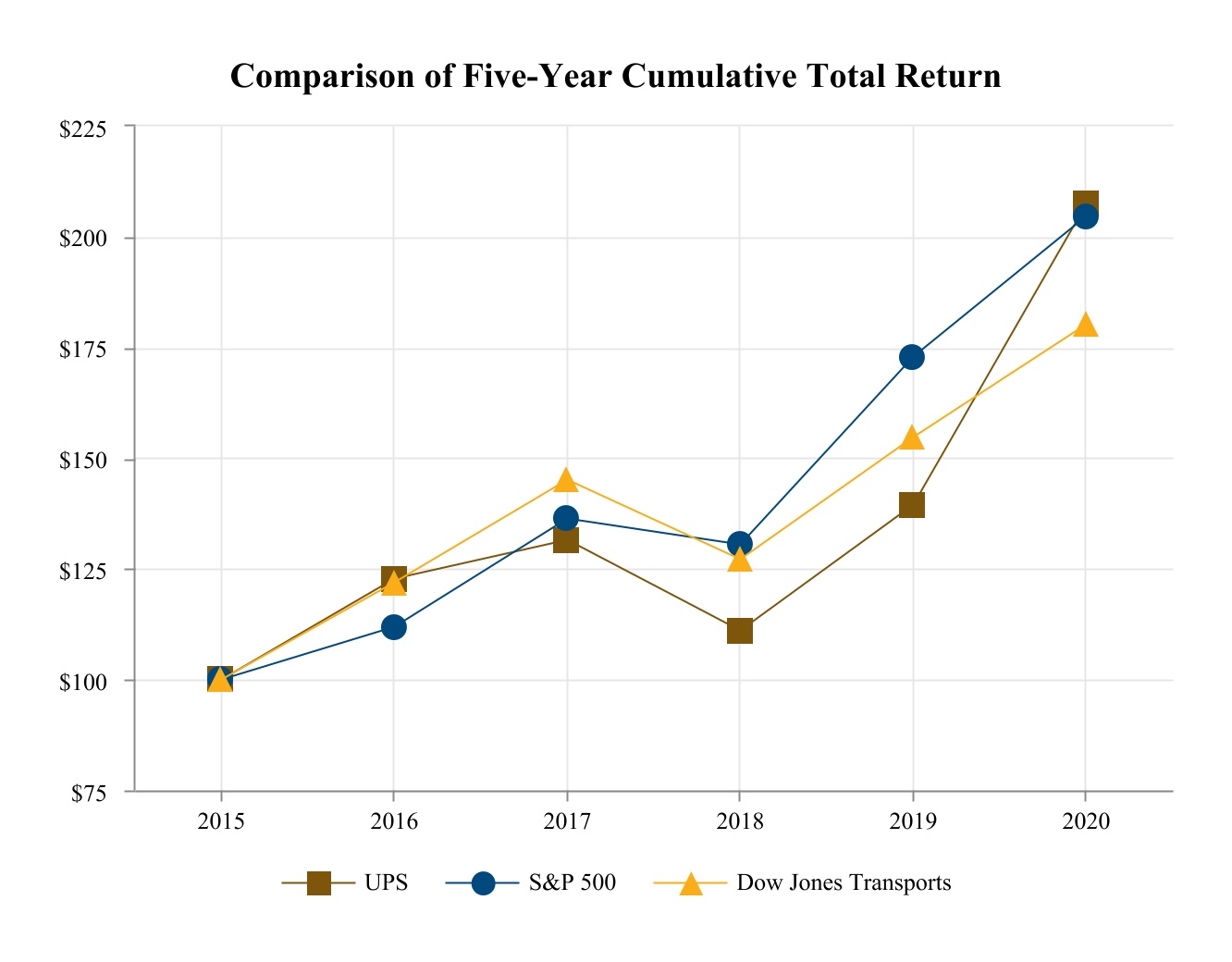
| 12/31/2015 | 12/31/2016 | 12/31/2017 | 12/31/2018 | 12/31/2019 | 12/31/2020 | ||||||||||||||||||||||||||||||
| United Parcel Service, Inc. | $ | 100.00 | $ | 122.71 | $ | 131.47 | $ | 111.12 | $ | 139.45 | $ | 207.36 | |||||||||||||||||||||||
| Standard & Poor’s 500 Index | $ | 100.00 | $ | 111.95 | $ | 136.38 | $ | 130.40 | $ | 172.92 | $ | 204.72 | |||||||||||||||||||||||
| Dow Jones Transportation Average | $ | 100.00 | $ | 121.86 | $ | 145.04 | $ | 127.15 | $ | 154.68 | $ | 180.23 | |||||||||||||||||||||||
For information regarding our equity compensation plans, see Item 12 of this report.
20
Item 6. Selected Financial Data
The following table sets forth selected financial data for each of the five years in the period ended December 31, 2020 (in millions, except per share amounts). This financial data should be read together with our consolidated financial statements and related notes, Management’s Discussion and Analysis of Financial Condition and Results of Operations, including the
Supplemental Information - Items Affecting Comparability
section, and other financial data appearing elsewhere in this report.
| Years Ended December 31, | |||||||||||||||||||||||||||||
| 2020 | 2019 | 2018 | 2017 | 2016 | |||||||||||||||||||||||||
| Selected Income Statement Data | |||||||||||||||||||||||||||||
| Revenue: | |||||||||||||||||||||||||||||
| U.S. Domestic Package | $ | 53,499 | $ | 46,493 | $ | 43,593 | $ | 40,761 | $ | 38,284 | |||||||||||||||||||
| International Package | 15,945 | 14,220 | 14,442 | 13,342 | 12,346 | ||||||||||||||||||||||||
| Supply Chain & Freight | 15,184 | 13,381 | 13,826 | 12,482 | 10,980 | ||||||||||||||||||||||||
| Total Revenue | 84,628 | 74,094 | 71,861 | 66,585 | 61,610 | ||||||||||||||||||||||||
| Operating Expenses: | |||||||||||||||||||||||||||||
| Compensation and benefits | 44,529 | 38,908 | 37,235 | 34,577 | 32,534 | ||||||||||||||||||||||||
| Other | 32,415 | 27,388 | 27,602 | 24,479 | 21,388 | ||||||||||||||||||||||||
| Total Operating Expenses | 76,944 | 66,296 | 64,837 | 59,056 | 53,922 | ||||||||||||||||||||||||
| Operating Profit: | |||||||||||||||||||||||||||||
| U.S. Domestic Package | 3,891 | 4,164 | 3,643 | 4,303 | 4,628 | ||||||||||||||||||||||||
| International Package | 3,436 | 2,657 | 2,529 | 2,429 | 2,417 | ||||||||||||||||||||||||
| Supply Chain & Freight | 357 | 977 | 852 | 797 | 643 | ||||||||||||||||||||||||
| Total Operating Profit | 7,684 | 7,798 | 7,024 | 7,529 | 7,688 | ||||||||||||||||||||||||
| Other Income and (Expense): | |||||||||||||||||||||||||||||
| Investment income (expense) and other | (5,139) | (1,493) | (400) | 61 | (2,186) | ||||||||||||||||||||||||
| Interest expense | (701) | (653) | (605) | (453) | (381) | ||||||||||||||||||||||||
| Income Before Income Taxes | 1,844 | 5,652 | 6,019 | 7,137 | 5,121 | ||||||||||||||||||||||||
| Income Tax Expense | 501 | 1,212 | 1,228 | 2,232 | 1,699 | ||||||||||||||||||||||||
| Net Income | $ | 1,343 | $ | 4,440 | $ | 4,791 | $ | 4,905 | $ | 3,422 | |||||||||||||||||||
| Per Share Amounts: | |||||||||||||||||||||||||||||
| Basic Earnings Per Share | $ | 1.55 | $ | 5.14 | $ | 5.53 | $ | 5.63 | $ | 3.88 | |||||||||||||||||||
| Diluted Earnings Per Share | $ | 1.54 | $ | 5.11 | $ | 5.51 | $ | 5.61 | $ | 3.86 | |||||||||||||||||||
| Dividends Declared Per Share | $ | 4.04 | $ | 3.84 | $ | 3.64 | $ | 3.32 | $ | 3.12 | |||||||||||||||||||
| Weighted Average Shares Outstanding: | |||||||||||||||||||||||||||||
| Basic | 867 | 864 | 866 | 871 | 883 | ||||||||||||||||||||||||
| Diluted | 871 | 869 | 870 | 875 | 887 | ||||||||||||||||||||||||
| As of December 31, | |||||||||||||||||||||||||||||
| 2020 | 2019 | 2018 | 2017 | 2016 | |||||||||||||||||||||||||
| Selected Balance Sheet Data: | |||||||||||||||||||||||||||||
| Cash and marketable securities | $ | 6,316 | $ | 5,741 | $ | 5,035 | $ | 4,069 | $ | 4,567 | |||||||||||||||||||
| Total assets | 62,408 | 57,857 | 50,016 | 45,574 | 40,545 | ||||||||||||||||||||||||
| Long-term debt and finance leases | 22,031 | 21,818 | 19,931 | 20,278 | 12,394 | ||||||||||||||||||||||||
| Shareowners’ equity | 669 | 3,283 | 3,037 | 1,024 | 430 | ||||||||||||||||||||||||
21
Item 7.
Management’s Discussion and Analysis of Financial Condition and Results of Operations
Overview
As described above, during 2020 we began implementing our
Customer First, People Led, Innovation Driven
strategy, as we seek to transform nearly every aspect of our business, improve our financial performance, provide the best customer experience and benefit our shareowners. We focused on, among other things, enhancing the capabilities that we believe our customers value the most; speed and ease of access to our services. We completed enhancements to our U.S. ground network to improve time-in-transit and continued to deploy our digital access program into e-commerce platforms.
Beginning in the first quarter of 2020, unexpected business shutdowns and government restrictions implemented in many countries in response to the COVID-19 pandemic have significantly impacted the mix of demand for our services. In our global small package business, business-to-business activity has declined, while we continue to experience a significant increase in the level of business-to-consumer shipping, which we partially attribute to the capability enhancements described above. While business-to-business activity began to recover in the latter part of 2020, we believe that the market shift towards e-commerce will persist, with a continuing high level of residential deliveries that may continue to increase demand, but also drive higher operating costs. The pandemic also resulted in a reduction in global air cargo capacity. This caused market rates in the industry to increase and we experienced increased demand for our services.
On January 24, 2021, we entered into a definitive agreement to divest our UPS Freight business. This will allow us to be even more focused on the core parts of our business that drive the greatest value for our shareholders. The transaction, which is subject to customary closing conditions and regulatory approvals, is expected to close during the second quarter of 2021. We expect this divestiture to result in an improvement to our operating margin and return on invested capital.
We believe that we are well positioned for long-term growth, however we cannot reasonably estimate the duration or severity of the COVID-19 pandemic or the timing and extent of the anticipated economic recovery, and the resulting impacts on our business results or liquidity. For additional information on these risks and uncertainties, see Part I, "Item 1A. Risk Factors" of this report.
Highlights of our results for the years ended December 31, 2020 and 2019, which are discussed in more detail in the sections that follow, include:
| Year Ended December 31, | Change | ||||||||||||||||||||||
| 2020 | 2019 | $ | % | ||||||||||||||||||||
| Revenue (in millions) | $ | 84,628 | $ | 74,094 | $ | 10,534 | 14.2 | % | |||||||||||||||
| Operating Expenses (in millions) | 76,944 | 66,296 | 10,648 | 16.1 | % | ||||||||||||||||||
| Operating Profit (in millions) | $ | 7,684 | $ | 7,798 | $ | (114) | (1.5) | % | |||||||||||||||
| Operating Margin | 9.1 | % | 10.5 | % | |||||||||||||||||||
| Net Income (in millions) | $ | 1,343 | $ | 4,440 | $ | (3,097) | (69.8) | % | |||||||||||||||
| Basic Earnings Per Share | $ | 1.55 | $ | 5.14 | $ | (3.59) | (69.8) | % | |||||||||||||||
| Diluted Earnings Per Share | $ | 1.54 | $ | 5.11 | $ | (3.57) | (69.9) | % | |||||||||||||||
| Operating Days | 255 | 253 | |||||||||||||||||||||
| Average Daily Package Volume (in thousands) | 24,676 | 21,880 | 12.8 | % | |||||||||||||||||||
| Average Revenue Per Piece | $ | 10.94 | $ | 10.87 | $ | 0.07 | 0.6 | % | |||||||||||||||
•
Revenue increased in all segments.
•
Average daily package volume increased due to increases in business-to-consumer shipping.
•
Operating expenses increased due to volume growth.
22
UNITED PARCEL SERVICE, INC. AND SUBSIDIARIES
MANAGEMENT'S DISCUSSION AND ANALYSIS OF FINANCIAL CONDITION AND
RESULTS OF OPERATIONS
•
Operating profit and operating margin were relatively flat, and included goodwill and other asset impairment charges of $686 million related to the anticipated divestiture of UPS Freight.
•
We reported net income of $1.3 billion and diluted earnings per share of $1.54. Adjusted diluted earnings per share was $8.23 after adjusting for the after-tax impacts of:
◦
goodwill and other asset impairment charges of $629 million or $0.72 per share;
◦
transformation strategy costs of $265 million or $0.31 per share; and
◦
pension mark-to-market losses recognized outside of a 10% corridor of $4.9 billion or $5.66 per share.
In the U.S. Domestic Package segment, volume and revenue growth was highest in our residential ground products. The increase in residential delivery volume drove increases in headcount, delivery stops per day, average daily miles driven and average daily union labor hours, all of which increased expense and compressed operating margins as described below. Operating expenses also increased as a result of the investments we made to improve our ground network.
The International Package segment experienced volume and revenue growth, driven by strong outbound demand from Asia as well as growth from e-commerce within Europe. Residential delivery volume growth drove an increase in third-party pickup and delivery expense.
In the Supply Chain & Freight segment, growth was primarily driven by our Forwarding and mail services businesses. The Forwarding business benefited from strong outbound demand from Asia and the implementation of capacity surcharges as COVID-19 led to reduced capacity in the air cargo market. Mail services benefited from the increase in e-commerce activity and favorable changes in shipment characteristics. We also experienced growth in demand for our healthcare logistics and distribution solutions, partly driven by the impacts of the COVID-19 pandemic.
2019 compared to 2018
See
Item 7. Management's Discussion and Analysis of Financial Condition and Results of Operations
of the Company's Annual Report on Form 10-K for the year ended December 31, 2019 filed with the Securities and Exchange Commission on February 20, 2020.
23
UNITED PARCEL SERVICE, INC. AND SUBSIDIARIES
MANAGEMENT'S DISCUSSION AND ANALYSIS OF FINANCIAL CONDITION AND
RESULTS OF OPERATIONS
Supplemental Information - Items Affecting Comparability
We supplement the reporting of our financial information determined under generally accepted accounting principles in the United States ("GAAP") with certain non-GAAP financial measures including "adjusted" compensation and benefits, operating expenses, operating profit, operating margin, other income and (expense), income before income taxes, income tax expense, effective tax rate, net income and earnings per share. Adjusted financial measures may exclude the impact of period over period exchange rate changes and hedging activities, amounts related to mark-to-market gains or losses, restructuring costs, including transformation strategy costs, and costs related to certain legal contingencies and expenses, as described below. We believe that these adjusted financial measures provide additional meaningful information to assist users of our financial statements in understanding our financial results and cash flows and assessing our ongoing performance. We believe these adjusted financial measures are important indicators of our recurring results of operations because they exclude items that may not be indicative of, or are unrelated to, our underlying operations, and may provide a useful baseline for analyzing trends in our underlying businesses. Additionally, these adjusted financial measures are used internally by management for business unit operating performance analysis, business unit resource allocation and in connection with incentive compensation award determination.
Adjusted financial measures should be considered in addition to, and not as an alternative for, our reported results prepared in accordance with GAAP. Our adjusted financial measures do not represent a comprehensive basis of accounting. Therefore, our adjusted financial measures may not be comparable to similarly titled measures reported by other companies.
Year over year comparisons of our financial results are affected by the following (in millions):
| Year Ended December 31, | |||||||||||
| Non-GAAP Adjustments | 2020 | 2019 | |||||||||
| Operating Expenses: | |||||||||||
| Transformation Strategy Costs | $ | 348 | $ | 255 | |||||||
| Goodwill and Other Asset Impairment Charges | 686 | — | |||||||||
| Legal Contingencies and Expenses | — | 97 | |||||||||
| Total Adjustments to Operating Expenses | $ | 1,034 | $ | 352 | |||||||
| Other Income and (Expense): | |||||||||||
| Defined Benefit Plans Mark-to-Market Charges | $ | 6,484 | $ | 2,387 | |||||||
| Total Adjustments to Other Income and (Expense) | $ | 6,484 | $ | 2,387 | |||||||
| Total Adjustments to Income Before Income Taxes | $ | 7,518 | $ | 2,739 | |||||||
| Income Tax Benefit from Defined Benefit Plans Mark-to-Market Charges | $ | (1,555) | $ | (571) | |||||||
| Income Tax Benefit from Transformation Strategy Costs | (83) | (59) | |||||||||
| Income Tax Benefit from Goodwill and Other Asset Impairment Charges | (57) | — | |||||||||
| Income Tax Benefit from Legal Contingencies and Expenses | — | (6) | |||||||||
| Total Adjustments to Income Tax Expense | $ | (1,695) | $ | (636) | |||||||
| Total Adjustments to Net Income | $ | 5,823 | $ | 2,103 | |||||||
These items have been excluded from comparisons of "adjusted" compensation and benefits, operating expenses, operating profit, operating margin, other income and (expense), income tax expense and effective tax rate in the discussion that follows. The income tax benefit from restructuring and other costs, legal contingencies and expenses and mark-to-market charges are calculated by multiplying the statutory tax rates applicable in each tax jurisdiction, including the U.S. federal jurisdiction and various U.S. state and non-U.S. jurisdictions, by the tax-deductible adjustments. The blended average of the effective tax rates in 2020 and 2019 was 22.5% and 23.2%, respectively.
24
UNITED PARCEL SERVICE, INC. AND SUBSIDIARIES
MANAGEMENT'S DISCUSSION AND ANALYSIS OF FINANCIAL CONDITION AND
RESULTS OF OPERATIONS
Impact of Changes in Foreign Currency Exchange Rates and Hedging Activities
We supplement the reporting of our revenue, revenue per piece and operating profit with non-GAAP measures that exclude the period over period impact of foreign currency exchange rate changes and hedging activities.
Currency-neutral revenue, revenue per piece and operating profit are calculated by dividing current period reported U.S. dollar revenue, revenue per piece and operating profit by the current period average exchange rates to derive current period local currency revenue, revenue per piece and operating profit. The derived amounts are then multiplied by the average foreign currency exchange rates used to translate the comparable results for each month in the prior year period (including the period over period impact of foreign currency hedging activities). The difference between the current period reported U.S. dollar revenue, revenue per piece and operating profit and the derived current period U.S. dollar revenue, revenue per piece and operating profit is the period over period impact of currency fluctuations.
Restructuring and Other Charges
We supplement the presentation of our operating profit, operating margin, income before income taxes, net income and earnings per share with similar non-GAAP measures that exclude the impact of charges related to restructuring activities, including transformation strategy costs and asset impairments. For more information regarding transformation strategy costs, see note 18 to the audited, consolidated financial statements. For more information regarding asset impairments, see note 4 to the audited, consolidated financial statements.
Costs Related to Certain Legal Contingencies and Expenses
We supplement the presentation of our operating profit, operating margin, income before income taxes, net income and earnings per share with similar non-GAAP measures that exclude the impact of costs related to certain legal contingencies and expenses.
Defined Benefit Plans Mark-to-Market Charges
We recognize changes in the fair value of plan assets and net actuarial gains and losses in excess of a 10% corridor for our pension and postretirement defined benefit plans immediately as part of other pension income (expense). We supplement the presentation of our income before income taxes, net income and earnings per share with non-GAAP measures that exclude the impact of gains and losses recognized in excess of the 10% corridor and the related income tax effects. We believe excluding these mark-to-market impacts provides important supplemental information by removing the volatility associated with short-term changes in market interest rates, equity values and similar factors.
This adjusted net periodic benefit cost ($641 million in 2020 and $754 million in 2019) utilizes the expected return on plan assets (7.70% in 2020 and 7.68% in 2019) and the discount rate used to determine net periodic benefit cost (3.55% in 2020 and 4.45% in 2019). The unadjusted net periodic benefit cost reflects the actual return on plan assets (12.54% in 2020 and 17.57% in 2019) and the discount rate used to measure the projected benefit obligation at the December 31st measurement date (2.87% in 2020 and 3.55% in 2019).
We recognized pre-tax mark-to-market losses outside of a 10% corridor related to the remeasurement of our pension and postretirement defined benefit plans' assets and liabilities in "Other Income and (Expense)" of $6.5 and $2.4 billion for 2020 and 2019, respectively. In 2019, we refined the bond matching approach used to determine the discount rate for our U.S. pension and postretirement plans by implementing advances in technology and modeling techniques discussed in note 6 to the audited, consolidated financial statements.
25
UNITED PARCEL SERVICE, INC. AND SUBSIDIARIES
MANAGEMENT'S DISCUSSION AND ANALYSIS OF FINANCIAL CONDITION AND
RESULTS OF OPERATIONS
The table below shows the amounts associated with each component of the pre-tax mark-to-market loss, as well as the weighted-average actuarial assumptions used to determine our net periodic benefit cost, for each year:
| Year Ended December 31, | ||||||||||||||
| Components of mark-to-market gain (loss) (in millions): | 2020 | 2019 | ||||||||||||
| Discount rates | $ | (6,540) | $ | (5,670) | ||||||||||
| Return on assets | 2,390 | 3,850 | ||||||||||||
| Demographic and other assumption changes | (381) | (24) | ||||||||||||
| Coordinating benefits attributable to the Central States Pension Fund | (1,953) | (543) | ||||||||||||
| Total mark-to-market gain (loss) | $ | (6,484) | $ | (2,387) | ||||||||||
| Year Ended December 31, | ||||||||||||||
| Weighted-average actuarial assumptions used to determine net periodic benefit cost: | 2020 | 2019 | ||||||||||||
| Expected rate of return on plan assets | 7.70 | % | 7.68 | % | ||||||||||
| Actual rate of return on plan assets | 12.54 | % | 17.57 | % | ||||||||||
| Discount rate used for net periodic benefit cost | 3.55 | % | 4.45 | % | ||||||||||
| Discount rate at measurement date | 2.87 | % | 3.55 | % | ||||||||||
The pre-tax mark-to-market losses for the years ended December 31, 2020 and 2019 were comprised of the following:
2020 - $6.5 billion pre-tax mark-to-market loss:
•
Discount Rates
($6.5 billion pre-tax loss):
The weighted-average discount rate for our pension and postretirement medical plans decreased from 3.55% as of December 31, 2019 to 2.87% as of December 31, 2020, primarily due to a decline in U.S. treasury yields that was slightly offset by an increase in credit spreads on AA-rated corporate bonds.
•
Return on Assets
($2.4 billion pre-tax gain): In 2020, the actual rate of return on plan assets was higher than our expected rate of return, primarily due to strong global equity and U.S. bond market performance.
•
Demographic and Other Assumption Changes
($381 million pre-tax loss): This represents the difference between actual and estimated participant data and demographic factors, including items such as healthcare cost trends, compensation rate increases and rates of termination, retirement and mortality.
•
Coordinating benefits attributable to the Central States Pension Fund
($2.0 billion pre-tax loss): This represents our current best estimate of additional potential coordinating benefits that may be required to be paid related to the Central States Pension Fund.
2019 - $2.4 billion pre-tax mark-to-market loss:
•
Discount Rates
($5.7 billion pre-tax loss):
The weighted-average discount rate for our pension and postretirement medical plans decreased from 4.45% as of December 31, 2018 to 3.55% as of December 31, 2019, primarily due to a decline in U.S. treasury yields and a decrease in credit spreads on AA-rated corporate bonds in 2019. This was partially offset by a refinement to the bond matching approach used to determine the discount rate for our U.S. pension and postretirement plans as described in note 6 to the audited, consolidated financial statements.
•
Return on Assets
($3.9 billion pre-tax gain): In 2019, the actual rate of return on plan assets was higher than our expected rate of return, primarily due to strong global equity and U.S. bond market performance.
•
Demographic and Other Assumption Changes
($24 million pre-tax loss): This represented the difference between actual and estimated participant data and demographic factors, including items such as healthcare cost trends, compensation rate increases and rates of termination, retirement and mortality.
•
Coordinating benefits attributable to the Central States Pension Fund
($543 million pre-tax loss): This represented our then-best estimate of additional potential coordinating benefits that may be required to be paid related to the Central States Pension Fund.
26
UNITED PARCEL SERVICE, INC. AND SUBSIDIARIES
MANAGEMENT'S DISCUSSION AND ANALYSIS OF FINANCIAL CONDITION AND
RESULTS OF OPERATIONS
Expense Allocations
Certain operating expenses are allocated between our reporting segments using activity-based costing methods. These activity-based costing methods require us to make estimates that impact the amount of each expense category that is attributed to each segment. Changes in these estimates would directly impact the amount of expense allocated to each segment, and therefore the operating profit of each reporting segment. Our allocation methodologies are refined periodically, as necessary, to reflect changes in our businesses. Beginning in 2020, we updated our cost allocation methodology for the Ground with Freight Pricing ("GFP") product. The cost associated with GFP that is allocated from the U.S. Domestic Package segment to UPS Freight, within the Supply Chain & Freight segment, was adjusted to better reflect operational activities associated with this product. This change in methodology had only an immaterial impact on the expense allocated to UPS Freight for 2020. There were no significant changes in our expense allocation methodologies during 2019 or 2018.
27
UNITED PARCEL SERVICE, INC. AND SUBSIDIARIES
MANAGEMENT'S DISCUSSION AND ANALYSIS OF FINANCIAL CONDITION AND
RESULTS OF OPERATIONS
U.S. Domestic Package Operations
| Year Ended December 31, | Change | ||||||||||||||||||||||
| 2020 | 2019 | $ | % | ||||||||||||||||||||
| Average Daily Package Volume (in thousands): | |||||||||||||||||||||||
| Next Day Air | 1,987 | 1,889 | 5.2 | % | |||||||||||||||||||
| Deferred | 1,783 | 1,622 | 9.9 | % | |||||||||||||||||||
| Ground | 17,371 | 15,176 | 14.5 | % | |||||||||||||||||||
| Total Average Daily Package Volume | 21,141 | 18,687 | 13.1 | % | |||||||||||||||||||
| Average Revenue Per Piece: | |||||||||||||||||||||||
| Next Day Air | $ | 16.82 | $ | 17.74 | $ | (0.92) | (5.2) | % | |||||||||||||||
| Deferred | 12.46 | 12.62 | (0.16) | (1.3) | % | ||||||||||||||||||
| Ground | 8.87 | 8.55 | 0.32 | 3.7 | % | ||||||||||||||||||
| Total Average Revenue Per Piece | $ | 9.92 | $ | 9.83 | $ | 0.09 | 0.9 | % | |||||||||||||||
| Operating Days in Period | 255 | 253 | |||||||||||||||||||||
| Revenue (in millions): | |||||||||||||||||||||||
| Next Day Air | $ | 8,522 | $ | 8,479 | $ | 43 | 0.5 | % | |||||||||||||||
| Deferred | 5,665 | 5,180 | 485 | 9.4 | % | ||||||||||||||||||
| Ground | 39,312 | 32,834 | 6,478 | 19.7 | % | ||||||||||||||||||
| Total Revenue | $ | 53,499 | $ | 46,493 | $ | 7,006 | 15.1 | % | |||||||||||||||
| Operating Expenses (in millions): | |||||||||||||||||||||||
| Operating Expenses | $ | 49,608 | $ | 42,329 | $ | 7,279 | 17.2 | % | |||||||||||||||
| Transformation Strategy Costs | (237) | (108) | (129) | 119.4 | % | ||||||||||||||||||
| Legal Contingencies and Expenses | — | (97) | 97 | N/M | |||||||||||||||||||
| Adjusted Operating Expenses | $ | 49,371 | $ | 42,124 | $ | 7,247 | 17.2 | % | |||||||||||||||
| Operating Profit (in millions) and Operating Margin: | |||||||||||||||||||||||
| Operating Profit | $ | 3,891 | $ | 4,164 | $ | (273) | (6.6) | % | |||||||||||||||
| Adjusted Operating Profit | $ | 4,128 | $ | 4,369 | $ | (241) | (5.5) | % | |||||||||||||||
| Operating Margin | 7.3 | % | 9.0 | % | |||||||||||||||||||
| Adjusted Operating Margin | 7.7 | % | 9.4 | % | |||||||||||||||||||
Revenue
The change in total revenue was due to the following:
| Revenue Change Drivers: | Volume |
Rates /
Product Mix |
Fuel
Surcharges |
Total Revenue
Change |
|||||||||||||||||||
| 2020 vs. 2019 | 14.0 | % | 1.8 | % | (0.7) | % | 15.1 | % | |||||||||||||||
28
UNITED PARCEL SERVICE, INC. AND SUBSIDIARIES
MANAGEMENT'S DISCUSSION AND ANALYSIS OF FINANCIAL CONDITION AND
RESULTS OF OPERATIONS
Volume
2020 compared to 2019
Volume increased across all products, with growth strongest in residential ground services. Volume growth was primarily driven by business-to-consumer e-commerce, which grew by approximately 33%, partly due to the impact of the COVID-19 pandemic. We also benefited from the impact of two additional operating days in 2020. Volume growth was led by our largest customer, Amazon, with growth stronger in the first half of the year. We also experienced growth from SMBs, as well as other large customers. Volume from SMBs grew 14.8% for the year, with growth accelerating in the second half of the year as a result of our investments to improve both time-in-transit and our digital access platform.
Business-to-consumer shipments represented approximately 64% of total average daily volume for the year compared to approximately 54% in 2019. We believe that the COVID-19 pandemic has accelerated a change in consumer behavior, speeding up what we believe will be a long-term market shift towards e-commerce. Business-to-business shipments decreased 10% for the year, primarily in our ground products, as many businesses experienced disruption and periods of closure due to the pandemic. Business-to-business activity began to recover in the latter part of 2020.
Average daily volume increased in both our Next Day Air and Deferred products, driven by increased residential demand as a result of the growth in e-commerce. This was slightly offset by declines in business-to-business shipments, primarily as a result of COVID-19, as well as continued declines in Second Day Letter volume due to ongoing shifts in customer preferences.
Residential Ground and SurePost average daily volumes increased by 35% and 39%, respectively for the year, driven by changes in customer mix and the growth in e-commerce activity. Ground commercial average daily volume declined, as many businesses temporarily closed or operated on a limited basis as a result of COVID-19.
Rates and Product Mix
2020 compared to 2019
Overall revenue per piece increased due to changes in base rates, customer and product mix and residential surcharges that went into effect in October 2020, partially offset by declines in fuel surcharges. Rates for UPS ground and UPS air services increased an average net 4.9% in December 2019. SurePost rates increased effective October 2020.
Revenue per piece for our Next Day Air and Deferred products decreased primarily due to shifts in customer and product mix, lower fuel surcharges and a decrease in average billable weight per piece. Revenue per piece for our Ground products increased primarily due to the shift in customer mix, with a significant increase in SMB volume, and higher residential surcharges. These benefits were partially offset by shifts in product mix, lower fuel surcharges and a decrease in average billable weight per piece.
Fuel Surcharges
We apply a fuel surcharge on our domestic air and ground services. The air fuel surcharge is based on the U.S. Department of Energy’s (“DOE”) Gulf Coast spot price for a gallon of kerosene-type jet fuel, while the ground fuel surcharge is based on the DOE’s On-Highway Diesel Fuel Price. Based on published rates, the average fuel surcharge rates for domestic Air and Ground products were as follows:
| Year Ended December 31, | % Point Change | ||||||||||||||||
| 2020 | 2019 | 2020 vs. 2019 | |||||||||||||||
| Next Day Air / Deferred | 3.9 | % | 7.3 | % | (3.4) | % | |||||||||||
| Ground | 6.6 | % | 7.2 | % | (0.6) | % | |||||||||||
While fluctuations in fuel surcharges can be significant from period to period, fuel surcharges represent one of the many individual components of our pricing structure that impact our overall revenue and yield. Additional components include the mix of products sold, the base price and any additional charges or discounts on these services.
Total domestic fuel surcharge revenue decreased by $344 million for the year as a result of lower fuel surcharge indices, partially offset by increases in volume and shifts in product mix.
29
UNITED PARCEL SERVICE, INC. AND SUBSIDIARIES
MANAGEMENT'S DISCUSSION AND ANALYSIS OF FINANCIAL CONDITION AND
RESULTS OF OPERATIONS
Operating Expenses
2020 compared to 2019
Operating expenses, and operating expenses excluding the impact of transformation strategy costs and legal contingencies and expenses, increased largely due to higher pickup and delivery costs (up $4.2 billion). In addition, the costs of operating our domestic integrated air and ground network increased $1.4 billion, costs of package sorting increased $927 million and other indirect operating costs increased $744 million. The overall increase in expense was driven by several factors:
•
Employee compensation and benefit costs increased $5.0 billion, largely resulting from:
◦
residential volume growth that negatively impacted our delivery density, driving an increase in package delivery stops per day and in average daily miles driven. This drove an increase in average daily union labor hours of 14.1%;
◦
union pay rate increases;
◦
growth in the overall size of the workforce; and
◦
acceleration of certain previously-issued incentive compensation awards for certain non-executive employees that resulted in additional expense of approximately $104 million.
We also incurred higher employee benefit expenses due to additional headcount, contractual contribution rate increases to union multiemployer plans, and higher service costs for our company-sponsored pension and postretirement plans, primarily driven by lower discount rates used to measure the projected benefit obligations of these plans. Workers' compensation expense increased $114 million as a result of additional hours, medical and wage inflation and claims experience.
•
Higher third-party transportation costs were driven by increased SurePost volume and utilization of outside carriers as part of our improvements to time-in-transit within our U.S. ground network.
•
We incurred lower fuel costs for the year, driven by lower prices for jet fuel, diesel and gasoline that were partially offset by increased usage as a result of volume growth and higher average daily miles driven.
Total cost per piece, and adjusted cost per piece excluding the year over year impact of transformation strategy costs and legal contingencies and expenses, increased 2.8% as a result of the factors described above.
Operating Profit and Margin
2020 compared to 2019
As a result of the factors described above, operating profit decreased $273 million, with operating margins decreasing 170 basis points to 7.3%. Excluding the year over year impact of transformation strategy costs and legal contingencies and expenses, adjusted operating profit decreased $241 million, with operating margins decreasing 170 basis points to 7.7%.
30
UNITED PARCEL SERVICE, INC. AND SUBSIDIARIES
MANAGEMENT'S DISCUSSION AND ANALYSIS OF FINANCIAL CONDITION AND
RESULTS OF OPERATIONS
International Package Operations
| Year Ended December 31, | Change | ||||||||||||||||||||||
| 2020 | 2019 | $ | % | ||||||||||||||||||||
| Average Daily Package Volume (in thousands): | |||||||||||||||||||||||
| Domestic | 1,863 | 1,721 | 8.3 | % | |||||||||||||||||||
| Export | 1,672 | 1,472 | 13.6 | % | |||||||||||||||||||
| Total Average Daily Package Volume | 3,535 | 3,193 | 10.7 | % | |||||||||||||||||||
| Average Revenue Per Piece: | |||||||||||||||||||||||
| Domestic | $ | 6.65 | $ | 6.51 | $ | 0.14 | 2.2 | % | |||||||||||||||
| Export | 28.52 | 29.10 | (0.58) | (2.0) | % | ||||||||||||||||||
| Total Average Revenue Per Piece | $ | 16.99 | $ | 16.93 | $ | 0.06 | 0.4 | % | |||||||||||||||
| Operating Days in Period | 255 | 253 | |||||||||||||||||||||
| Revenue (in millions): | |||||||||||||||||||||||
| Domestic | $ | 3,160 | $ | 2,836 | $ | 324 | 11.4 | % | |||||||||||||||
| Export | 12,159 | 10,837 | 1,322 | 12.2 | % | ||||||||||||||||||
| Cargo & Other | 626 | 547 | 79 | 14.4 | % | ||||||||||||||||||
| Total Revenue | $ | 15,945 | $ | 14,220 | $ | 1,725 | 12.1 | % | |||||||||||||||
| Operating Expenses (in millions): | |||||||||||||||||||||||
| Operating Expenses | $ | 12,509 | $ | 11,563 | $ | 946 | 8.2 | % | |||||||||||||||
| Transformation Strategy Costs | (96) | (122) | 26 | (21.3) | % | ||||||||||||||||||
| Adjusted Operating Expenses | $ | 12,413 | $ | 11,441 | $ | 972 | 8.5 | % | |||||||||||||||
| Operating Profit (in millions) and Operating Margin: | |||||||||||||||||||||||
| Operating Profit | $ | 3,436 | $ | 2,657 | $ | 779 | 29.3 | % | |||||||||||||||
| Adjusted Operating Profit | $ | 3,532 | $ | 2,779 | $ | 753 | 27.1 | % | |||||||||||||||
| Operating Margin | 21.5 | % | 18.7 | % | |||||||||||||||||||
| Adjusted Operating Margin | 22.2 | % | 19.5 | % | |||||||||||||||||||
| Currency Translation Benefit / (Cost)—(in millions)*: | |||||||||||||||||||||||
| Revenue | $ | 129 | |||||||||||||||||||||
| Operating Expenses | (59) | ||||||||||||||||||||||
| Operating Profit | $ | 70 | |||||||||||||||||||||
| * | Net of currency hedging; amount represents the change compared to the prior year. | ||||
Revenue
The change in total revenue was due to the following:
| Revenue Change Drivers: | Volume |
Rates /
Product Mix |
Fuel
Surcharges |
Currency |
Total Revenue
Change |
||||||||||||||||||||||||
| 2020 vs. 2019 | 11.6 | % | 1.5 | % | (1.9) | % | 0.9 | % | 12.1 | % | |||||||||||||||||||
31
UNITED PARCEL SERVICE, INC. AND SUBSIDIARIES
MANAGEMENT'S DISCUSSION AND ANALYSIS OF FINANCIAL CONDITION AND
RESULTS OF OPERATIONS
Volume
2020 compared to 2019
Average daily volume increased for both domestic and export products. Business-to-consumer volume increased as the COVID-19 pandemic drove growth in e-commerce. Business-to-business volume declined as the pandemic negatively impacted business operations globally, however we experienced a slight increase in volumes in the fourth quarter.
Average daily volume growth was driven primarily by strong demand from the retail and technology sectors due to the increase in e-commerce activity. This was partially offset by lower volumes in manufacturing and other sectors as COVID-19 caused a decline in commercial activity.
Export volume increased across most major trade lanes, driven by Europe and Asia. Europe export volume growth was highest on the Europe to U.S. trade lane, with intra-Europe volumes also growing significantly. Asia export volume growth was strongest on the Asia to U.S. trade lane. We experienced volume growth from both our large customers and SMBs, with SMB growth accelerating during the second half of the year. Our premium products saw volume growth, primarily driven by our Worldwide Express product, however growth was stronger in our non-premium products, such as World Wide Expedited and Transborder Standard due to shifts in customer preference for these products.
Domestic volume increased in many of our markets, driven by growth in Canada and several European countries that was primarily due to residential volume growth resulting from the increase in e-commerce.
Rates and Product Mix
2020 compared to 2019
Rate changes for shipments originating outside the U.S. are made throughout the year and vary by geographic market. In response to market capacity constraints resulting from the COVID-19 pandemic, we implemented surcharges on certain lanes during the year. In December 2019, we implemented an average 4.9% net increase in base and accessorial rates for international shipments originating in the United States.
Total revenue per piece increased 0.4% as a result of changes in customer and product mix, the impact of demand surcharges and currency movements, which were largely offset by a decline in fuel surcharges. Excluding the impact of currency, revenue per piece decreased 0.5%.
Domestic revenue per piece increased 2.2% due to changes in customer and product mix, demand surcharges and currency movements that were partially offset by a decline in fuel surcharges. Excluding the impact of currency, revenue per piece increased 1.2%.
Export revenue per piece decreased 2.0% primarily due to a decline in fuel surcharges that were partially offset by changes in demand surcharges. Excluding the impact of currency, revenue per piece decreased 2.8%.
Fuel Surcharges
We apply fuel surcharges on our international air and ground services. The fuel surcharge for international air services originating inside or outside the U.S. is largely indexed to the DOE's Gulf Coast spot price for a gallon of kerosene-type jet fuel. The fuel surcharges for ground services originating outside the U.S. are indexed to fuel prices in the region or country where the shipment originates.
While fluctuations can be significant from period to period, fuel surcharges represent one of the many individual components of our pricing structure that impact our overall revenue and yield. Additional components include the mix of services sold, the base price and extra service charges and the pricing discounts offered. Total international fuel surcharge revenue decreased by $263 million in 2020 as a result of declines in fuel surcharge indices, partially offset by volume growth and changes in customer and product mix.
32
UNITED PARCEL SERVICE, INC. AND SUBSIDIARIES
MANAGEMENT'S DISCUSSION AND ANALYSIS OF FINANCIAL CONDITION AND
RESULTS OF OPERATIONS
Operating Expenses
2020 compared to 2019
Operating expenses, and operating expenses excluding the year over year impact of
transformation strategy costs,
increased in 2020. Pickup and delivery costs increased $540 million due to volume growth and an increase in residential deliveries that drove additional third-party pickup and delivery expense.
The costs of operating our integrated international air and ground network increased $66 million, as increased block hours were partially offset by lower fuel prices.
In addition to variability in usage and market prices, the manner in which we purchase fuel also influences the net impact of costs on our results. The majority of our contracts for fuel purchases utilize index-based pricing formulas plus or minus a fixed locational/supplier differential. While many of the indices are aligned, each index may fluctuate at a different pace, driving variability in the prices paid for fuel. Because of this, our operating results may be affected should the market price of fuel suddenly change by a significant amount or change by amounts that do not result in an adjustment in our fuel surcharges, which can significantly affect our earnings either positively or negatively in the short-term.
The remaining increase in operating expenses in 2020 was due to package sorting and other indirect operating costs.
Operating Profit and Margin
2020 compared to 2019
As a result of the factors described above, operating profit increased $779 million, with operating margin increasing 280 basis points to 21.5%. Excluding the year over year impact of
transformation strategy costs
, adjusted operating profit increased for the year, with operating margin increasing 270 basis points to 22.2%.
33
UNITED PARCEL SERVICE, INC. AND SUBSIDIARIES
MANAGEMENT'S DISCUSSION AND ANALYSIS OF FINANCIAL CONDITION AND
RESULTS OF OPERATIONS
Supply Chain & Freight Operations
| Year Ended December 31, | Change | ||||||||||||||||||||||
| 2020 | 2019 | $ | % | ||||||||||||||||||||
| Freight LTL Statistics: | |||||||||||||||||||||||
| Revenue (in millions) | $ | 2,566 | $ | 2,679 | $ | (113) | (4.2) | % | |||||||||||||||
| Revenue Per Hundredweight | $ | 27.46 | $ | 26.54 | $ | 0.92 | 3.5 | % | |||||||||||||||
| Shipments (in thousands) | 8,847 | 9,281 | (4.7) | % | |||||||||||||||||||
| Shipments Per Day (in thousands) | 34.8 | 36.7 | (5.2) | % | |||||||||||||||||||
| Gross Weight Hauled (in millions of lbs) | 9,343 | 10,096 | (7.5) | % | |||||||||||||||||||
| Weight Per Shipment (in lbs) | 1,056 | 1,088 | (2.9) | % | |||||||||||||||||||
| Operating Days in Period | 254 | 253 | |||||||||||||||||||||
| Revenue (in millions): | |||||||||||||||||||||||
| Forwarding | $ | 6,975 | $ | 5,867 | $ | 1,108 | 18.9 | % | |||||||||||||||
| Logistics | 4,073 | 3,435 | 638 | 18.6 | % | ||||||||||||||||||
| Freight | 3,149 | 3,265 | (116) | (3.6) | % | ||||||||||||||||||
| Other | 987 | 814 | 173 | 21.3 | % | ||||||||||||||||||
| Total Revenue | $ | 15,184 | $ | 13,381 | $ | 1,803 | 13.5 | % | |||||||||||||||
| Operating Expenses (in millions): | |||||||||||||||||||||||
| Operating Expenses | $ | 14,827 | $ | 12,404 | $ | 2,423 | 19.5 | % | |||||||||||||||
| Transformation Strategy Costs | (15) | (25) | 10 | (40.0) | % | ||||||||||||||||||
| Goodwill and Other Asset Impairment Charges | (686) | — | (686) | N/M | |||||||||||||||||||
| Adjusted Operating Expenses | $ | 14,126 | $ | 12,379 | $ | 1,747 | 14.1 | % | |||||||||||||||
| Operating Profit (in millions) and Operating Margins: | |||||||||||||||||||||||
| Operating Profit | $ | 357 | $ | 977 | $ | (620) | (63.5) | % | |||||||||||||||
| Adjusted Operating Profit | $ | 1,058 | $ | 1,002 | $ | 56 | 5.6 | % | |||||||||||||||
| Operating Margin | 2.4 | % | 7.3 | % | |||||||||||||||||||
| Adjusted Operating Margin | 7.0 | % | 7.5 | % | |||||||||||||||||||
| Currency Translation Benefit / (Cost)—(in millions)*: | |||||||||||||||||||||||
| Revenue | $ | (92) | |||||||||||||||||||||
| Operating Expenses | 90 | ||||||||||||||||||||||
| Operating Profit | $ | (2) | |||||||||||||||||||||
| * | Amount represents the change compared to the prior year. | ||||
| Year Ended December 31, | Change | |||||||||||||||||||||||||
| 2020 | 2019 | $ | % | |||||||||||||||||||||||
| Transformation Strategy Costs (in millions): | ||||||||||||||||||||||||||
| Forwarding | $ | 8 | $ | 12 | $ | (4) | (33.3) | % | ||||||||||||||||||
| Logistics | 6 | 13 | (7) | (53.8) | % | |||||||||||||||||||||
| Freight | 1 | — | 1 | N/M | ||||||||||||||||||||||
| Total Transformation Strategy Costs | $ | 15 | $ | 25 | $ | (10) | (40.0) | % | ||||||||||||||||||
In January 2021, we entered into a definitive agreement to sell our UPS Freight business. As of December 31, 2020, we classified certain assets and liabilities of UPS Freight as held for sale in the consolidated balance sheet. Upon classification as held for sale, we recognized a total impairment charge of $686 million within Other expenses in the statements of consolidated income. This was comprised of a goodwill impairment charge of $494 million and a valuation allowance to adjust the carrying value of the disposal group to fair value less cost to sell of $192 million. See note 4 to the audited, consolidated financial statements for additional information.
34
UNITED PARCEL SERVICE, INC. AND SUBSIDIARIES
MANAGEMENT'S DISCUSSION AND ANALYSIS OF FINANCIAL CONDITION AND
RESULTS OF OPERATIONS
Revenue
2020 compared to 2019
Total revenue in the Supply Chain & Freight segment increased $1.8 billion. The impact of the COVID-19 pandemic varied within the segment. Our LTL business faced excess capacity and reduced demand in the first half of the year before market conditions began to improve. Conversely, our international air freight forwarding business benefited from demand for personal protective equipment out of Asia as well as increases in market rates caused by a sharp decline in passenger aircraft cargo capacity. Our Logistics business experienced increased demand from the healthcare and retail sectors, while activity in other sectors declined.
Overall Forwarding revenue increased for the year. In our international air freight business, revenue grew as a result of higher market rates, capacity surcharges and strong demand in Asia. Ocean freight forwarding revenue increased due to Asia-export volume growth in the second half of the year. Revenue in our truckload brokerage business increased as volume levels recovered in the third and fourth quarters. Higher demand, together with capacity constraints in the truckload brokerage market, drove rate increases.
Within Logistics, revenue in our mail services business increased as a result of e-commerce growth, which also led to a favorable shift in product characteristics. In addition, we implemented a peak surcharge in mail services in the fourth quarter which contributed to the overall increase in revenue. In the healthcare sector, we experienced growth in demand for our healthcare logistics and distribution solutions, partly driven by the impacts of the COVID-19 pandemic.
UPS Freight revenue declined due to volume and tonnage declines in our LTL business driven by overall market conditions, as well as volume optimization initiatives that resulted in an increase in revenue per hundredweight. Revenue from the Ground with Freight Pricing product grew as volume levels increased in the second half of the year.
Revenue from the other businesses within the segment increased, driven by growth within UPS Customer Solutions, as well as additional volume from service contracts with the U.S. Postal Service.
Operating Expenses
2020 compared to 2019
Total operating expenses for the segment, and operating expenses excluding the year over year impact of restructuring and other costs, increased in 2020.
Forwarding operating expenses increased $1.1 billion, largely due to higher market rates and additional charter flights out of Asia which increased purchased transportation expense for international air freight. This increase was slightly offset by declines in tonnage and volume. In truckload brokerage, volume growth and higher market rates also contributed to the increase in purchased transportation expense. Other expenses decreased slightly as a result of ongoing cost management initiatives.
Logistics operating expenses increased $582 million, driven by higher purchased transportation expense in mail services as a result of volume growth and carrier rate increases, as well as volume growth in the healthcare sector.
UPS Freight operating expenses increased $607 million, due primarily to an impairment charge of $686 million in respect of goodwill and assets held for sale as a result of entering into an agreement to divest our UPS Freight business. We expect this divestiture to be completed in the second quarter of 2021.
Operating Profit and Margin
2020 compared to 2019
As a result of the factors described above, total operating profit for the Supply Chain & Freight segment decreased $620 million. Excluding the year over year impact of restructuring and other costs, adjusted operating profit increased $56 million. Operating margin decreased 490 basis points to 2.4%, while adjusted operating margin decreased 50 basis points to 7.0%.
35
UNITED PARCEL SERVICE, INC. AND SUBSIDIARIES
MANAGEMENT'S DISCUSSION AND ANALYSIS OF FINANCIAL CONDITION AND
RESULTS OF OPERATIONS
Consolidated Operating Expenses
| Year Ended December 31, | Change | ||||||||||||||||||||||
| 2020 | 2019 | $ | % | ||||||||||||||||||||
| Operating Expenses (in millions): | |||||||||||||||||||||||
| Compensation and benefits | $ | 44,529 | $ | 38,908 | $ | 5,621 | 14.4 | % | |||||||||||||||
| Transformation strategy costs | (211) | (166) | (45) | 27.1 | % | ||||||||||||||||||
| Adjusted Compensation and benefits | 44,318 | 38,742 | 5,576 | 14.4 | % | ||||||||||||||||||
| Repairs and maintenance | 2,365 | 1,838 | 527 | 28.7 | % | ||||||||||||||||||
| Depreciation and amortization | 2,698 | 2,360 | 338 | 14.3 | % | ||||||||||||||||||
| Purchased transportation | 15,631 | 12,590 | 3,041 | 24.2 | % | ||||||||||||||||||
| Fuel | 2,582 | 3,289 | (707) | (21.5) | % | ||||||||||||||||||
| Other occupancy | 1,539 | 1,392 | 147 | 10.6 | % | ||||||||||||||||||
| Other expenses | 7,600 | 5,919 | 1,681 | 28.4 | % | ||||||||||||||||||
| Total Other expenses | 32,415 | 27,388 | 5,027 | 18.4 | % | ||||||||||||||||||
| Other Transformation strategy costs | (137) | (89) | (48) | 53.9 | % | ||||||||||||||||||
| Legal contingencies and expenses | — | (97) | 97 | (100.0) | % | ||||||||||||||||||
| Goodwill and other asset impairment charges | (686) | — | (686) | N/M | |||||||||||||||||||
| Adjusted Total Other expenses | $ | 31,592 | $ | 27,202 | $ | 4,390 | 16.1 | % | |||||||||||||||
| Total Operating Expenses | $ | 76,944 | $ | 66,296 | $ | 10,648 | 16.1 | % | |||||||||||||||
| Adjusted Total Operating Expenses | $ | 75,910 | $ | 65,944 | $ | 9,966 | 15.1 | % | |||||||||||||||
| Currency Translation Benefit - (in millions)* | $ | 31 | |||||||||||||||||||||
|
*Amount represents the change in currency translation compared to the prior year.
|
|||||||||||||||||||||||
| Year Ended December 31, | Change | ||||||||||||||||||||||
| 2020 | 2019 | $ | % | ||||||||||||||||||||
| Adjustments to Operating Expenses (in millions): | |||||||||||||||||||||||
| Transformation strategy costs: | |||||||||||||||||||||||
| Compensation | $ | 34 | $ | 21 | $ | 13 | 61.9 | % | |||||||||||||||
| Benefits | 177 | 145 | 32 | 22.1 | % | ||||||||||||||||||
| Depreciation and amortization | — | 3 | (3) | (100.0) | % | ||||||||||||||||||
| Other occupancy | 8 | 8 | — | — | % | ||||||||||||||||||
| Other expenses | 129 | 78 | 51 | 65.4 | % | ||||||||||||||||||
| Total Transformation strategy costs | $ | 348 | $ | 255 | $ | 93 | 36.5 | % | |||||||||||||||
| Legal contingencies and expenses: | |||||||||||||||||||||||
| Other expenses | $ | — | $ | 97 | $ | (97) | (100.0) | % | |||||||||||||||
| Goodwill and other asset impairment charges: | |||||||||||||||||||||||
| Other expenses | $ | 686 | $ | — | $ | 686 | N/M | ||||||||||||||||
| Total Adjustments to Operating Expenses | $ | 1,034 | $ | 352 | $ | 682 | 193.8 | % | |||||||||||||||
36
UNITED PARCEL SERVICE, INC. AND SUBSIDIARIES
MANAGEMENT'S DISCUSSION AND ANALYSIS OF FINANCIAL CONDITION AND
RESULTS OF OPERATIONS
Compensation and Benefits
2020 compared to 2019
Total compensation and benefits, and total compensation and benefits excluding the year over year impact of transformation strategy costs, increased in 2020.
Total compensation costs, and total compensation costs excluding the year over year impact of transformation strategy costs, increased $3.1 billion or 13.3%, primarily as a result of:
•
U.S. Domestic labor costs increased as a result of residential volume growth, driving a 21.5% increase in package delivery stops per day. This drove additional headcount and an increase in average daily union hours of 14.1%. Contractual union wage increases also contributed to the increase in compensation for hourly employees.
•
Management compensation expense increased due to salary increases, higher incentive compensation, including the acceleration of certain previously-issued incentive compensation awards, and growth in the overall size of the workforce.
Benefits costs, and benefits costs excluding the year over year impact of transformation strategy costs, increased $2.5 billion as a result of:
•
Health and welfare costs increased $558 million, driven by increased contributions to multiemployer plans resulting from growth in the workforce and contractually-mandated contribution rate increases.
•
Pension and postretirement benefits increased $798 million. Higher service costs for company-sponsored plans were driven by a reduction in discount rates and an increase in participating employees. Contributions to multiemployer plans increased as a result of contractually-mandated contribution increases and an overall increase in the size of the workforce.
•
Vacation, excused absence, payroll taxes and other expenses increased $587 million, primarily driven by salary increases and growth in the overall size of the workforce.
•
Workers' compensation expense increased $517 million due to an increase in total hours worked, wage and medical cost inflation and unfavorable claims trends.
Repairs and Maintenance
2020 compared to 2019
The increase in repairs and maintenance expense was driven by additional aircraft engine maintenance cost, primarily due to the replacement of parts on our A300-600 fleet, as well as an increase in routine repairs to buildings and facilities and maintenance of our other transportation equipment.
Depreciation and Amortization
2020 compared to 2019
Depreciation and amortization expense increased as a result of additional investments in facility automation and capacity expansion projects, increases in the size of our vehicle and aircraft fleets and investments in internally developed software.
Purchased Transportation
2020 compared to 2019
The increase in purchased transportation expense charged to us by third-party air, rail, ocean and truck carriers was primarily driven by:
•
U.S. Domestic Package expense increased $1.2 billion due to investments to improve time-in-transit in our U.S. ground network, an increase in SurePost volume that drove approximately $480 million of incremental third-party transportation expense and volume growth in our other products.
37
UNITED PARCEL SERVICE, INC. AND SUBSIDIARIES
MANAGEMENT'S DISCUSSION AND ANALYSIS OF FINANCIAL CONDITION AND
RESULTS OF OPERATIONS
•
Forwarding and Logistics expense increased $1.5 billion due to increased market rates in our international air freight business, as well as volume growth and rate increases in our mail services and truckload brokerage businesses. The rate increases in our international air freight and truckload brokerage businesses were primarily driven by market capacity constraints.
•
International Package expense increased $521 million primarily due to volume increases in Asia and Europe that drove higher third-party pickup and delivery cost, as well as additional charter flights originating from Asia.
Fuel
2020 compared to 2019
The decrease in fuel expense was driven by lower prices for jet fuel, diesel and gasoline. These decreases were partially offset by higher consumption due to increases in aircraft block hours and miles driven as a result of increased volume, as well as the impact of higher alternative fuel tax credits in 2019.
Other Occupancy
2020 compared to 2019
The increase in other occupancy expense, and other occupancy expense excluding the year over year impact of transformation strategy costs, was driven by additional operating facilities coming into service, rent and property tax increases and ongoing facility maintenance.
Other Expenses
2020 compared to 2019
Other expenses, and other expenses excluding the year over year impact of transformation strategy costs, legal contingencies and expenses and goodwill and other asset impairment charges, increased as a result of:
•
Other operational expenses, including vehicle and equipment rentals, increased $385 million driven by volume growth. This included cleaning and other safety supplies related to COVID-19 amounting to $89 million.
•
Professional fees increased $139 million, primarily related to information technology and other business support services.
•
Self-insured automobile liability claims increased $125 million as a result of higher average daily miles driven in our U.S. Domestic business and unfavorable claims experience.
•
Other increases included reserves for certain tax positions and contingencies, payment processing fees, recruitment costs, telecommunications costs, information technology expenses and allowances for credit losses and other bad debt expense.
38
UNITED PARCEL SERVICE, INC. AND SUBSIDIARIES
MANAGEMENT'S DISCUSSION AND ANALYSIS OF FINANCIAL CONDITION AND
RESULTS OF OPERATIONS
Other Income and (Expense)
The following table sets forth investment income (expense) and other and interest expense for the years ended December 31, 2020 and 2019 (in millions):
| Year Ended December 31, | Change | ||||||||||||||||||||||
| 2020 | 2019 | $ | % | ||||||||||||||||||||
| Investment Income (Expense) and Other | $ | (5,139) | $ | (1,493) | $ | (3,646) | N/M | ||||||||||||||||
| Defined Benefit Plans Mark-to-Market Charges | 6,484 | 2,387 | 4,097 | 171.6 | % | ||||||||||||||||||
| Adjusted Investment Income (Expense) and Other | $ | 1,345 | $ | 894 | $ | 451 | 50.4 | % | |||||||||||||||
| Interest Expense | (701) | (653) | (48) | 7.4 | % | ||||||||||||||||||
| Total Other Income and (Expense) | $ | (5,840) | $ | (2,146) | $ | (3,694) | 172.1 | % | |||||||||||||||
| Adjusted Other Income and (Expense) | $ | 644 | $ | 241 | $ | 403 | 167.2 | % | |||||||||||||||
Investment Income (Expense) and Other
2020 compared to 2019
Investment and other expense for the year increased $3.6 billion, which included a $4.1 billion increase in defined benefit plans mark-to-market charges. Excluding the impact of these mark-to-market charges, adjusted investment and other income increased $451 million for the year, primarily due to an increase in other pension income, which includes expected investment returns on pension assets, net of interest cost on projected benefit obligations and prior service costs. Expected returns on plan assets increased as a result of a higher asset base due to positive asset returns in 2019 and discretionary contributions made in 2020. Pension interest cost decreased due to the impact of lower year end discount rates, partially offset by ongoing plan growth and an increase in the projected benefit obligation as a result of the 2019 year end measurement of our plans. Investment income decreased due to lower yields on higher average invested asset balances and impairments of certain non-current investments, partially offset by foreign currency gains.
Interest Expense
2020 compared to 2019
Interest expense increased as a result of higher average outstanding debt balances and lower capitalization of interest, partially offset by lower effective interest rates on floating rate debt and commercial paper balances.
39
UNITED PARCEL SERVICE, INC. AND SUBSIDIARIES
MANAGEMENT'S DISCUSSION AND ANALYSIS OF FINANCIAL CONDITION AND
RESULTS OF OPERATIONS
Income Tax Expense
The following table sets forth income tax expense and our effective tax rate for the years ended December 31, 2020 and 2019 (in millions):
| Year Ended December 31, | Change | ||||||||||||||||||||||
| 2020 | 2019 | $ | % | ||||||||||||||||||||
| Income Tax Expense: | $ | 501 | $ | 1,212 | $ | (711) | (58.7) | % | |||||||||||||||
| Income Tax Impact of: | |||||||||||||||||||||||
| Defined Benefit Plans Mark-to-Market Charges | 1,555 | 571 | 984 | 172.3 | % | ||||||||||||||||||
| Transformation Strategy Costs | 83 | 59 | 24 | 40.7 | % | ||||||||||||||||||
| Goodwill and Other Asset Impairment Charges | 57 | — | 57 | N/M | |||||||||||||||||||
| Legal Contingencies and Expenses | — | 6 | (6) | N/M | |||||||||||||||||||
| Adjusted Income Tax Expense | $ | 2,196 | $ | 1,848 | $ | 348 | 18.8 | % | |||||||||||||||
| Effective Tax Rate | 27.2 | % | 21.4 | % | |||||||||||||||||||
| Adjusted Effective Tax Rate | 23.5 | % | 22.0 | % | |||||||||||||||||||
For additional information on income tax expense and our effective tax rate, see note 15 to the audited, consolidated financial statements.
40
UNITED PARCEL SERVICE, INC. AND SUBSIDIARIES
MANAGEMENT'S DISCUSSION AND ANALYSIS OF FINANCIAL CONDITION AND
RESULTS OF OPERATIONS
Liquidity and Capital Resources
As of December 31, 2020, we had $6.3 billion in cash, cash equivalents and marketable securities. We believe that these positions, expected cash from operations, access to commercial paper programs and capital markets and other available liquidity options will be adequate to fund our operating requirements, planned capital expenditures and pension contributions, transformation strategy costs, debt obligations and planned shareowner returns. We regularly evaluate opportunities to optimize our capital structure, including through issuances of debt to refinance existing debt and to fund operations. We have currently suspended share repurchases under our stock repurchase program.
Cash Flows From Operating Activities
The following is a summary of the significant sources (uses) of cash from operating activities (in millions):
| 2020 | 2019 | ||||||||||
| Net income | $ | 1,343 | $ | 4,440 | |||||||
|
Non-cash operating activities
(a)
|
11,181 | 6,405 | |||||||||
| Pension and postretirement benefit plan contributions (company-sponsored plans) | (3,125) | (2,362) | |||||||||
| Hedge margin receivables and payables | (507) | 171 | |||||||||
| Income tax receivables and payables | 205 | 599 | |||||||||
| Changes in working capital and other non-current assets and liabilities | 1,383 | (634) | |||||||||
| Other operating activities | (21) | 20 | |||||||||
| Net cash from operating activities | $ | 10,459 | $ | 8,639 | |||||||
(a) Represents depreciation and amortization, gains and losses on derivative transactions and foreign currency exchange, deferred income taxes, allowances for expected credit losses, amortization of operating lease assets, pension and postretirement benefit expense, stock compensation expense, changes in casualty self-insurance reserves, goodwill and other asset impairment charges and other non-cash items.
Net cash from operating activities increased $1.8 billion for the year, driven by the following:
•
Total contributions to our company-sponsored pension and U.S. postretirement medical benefit plans were $3.1 billion during 2020 compared to $2.4 billion in 2019. We made discretionary contributions of $2.8 billion to our three primary, company-sponsored U.S. pension plans during 2020 compared to $2.0 billion in 2019.
•
Our net hedge margin collateral decreased by $678 million due to the change in net fair value of derivative contracts used in our currency and interest rate hedging programs.
•
Cash payments for income taxes were $1.1 billion and $514 million for 2020 and 2019, respectively, with changes driven by the timing of deductions related to pension contributions, depreciation and employer payroll taxes.
•
Favorable changes in working capital were driven by the deferral of approximately $1.1 billion of employer payroll taxes under the Coronavirus Aid, Relief and Economic Security (CARES) Act that was signed into law on March 27, 2020, as well as changes in incentive compensation plan payouts. These benefits were partially offset by an increase in working capital demand as a result of business growth.
As part of our ongoing efforts to improve our working capital efficiency, certain financial institutions offer a voluntary Supply Chain Finance ("SCF") program to certain of our suppliers. We agree commercial terms with our suppliers, including prices, quantities and payment terms, regardless of whether the supplier elects to participate in the SCF program. Suppliers issue invoices to us based on the agreed-upon contractual terms. Then, if they are participating in the SCF program, our suppliers, at their sole discretion, determine which invoices, if any, to sell to the financial institutions. Our suppliers’ voluntary inclusion of invoices in the SCF program has no bearing on our payment terms. No guarantees are provided by us under the SCF program. We have no economic interest in a supplier’s decision to participate, and we have no direct financial relationship with the financial institutions, as it relates to the SCF program.
41
UNITED PARCEL SERVICE, INC. AND SUBSIDIARIES
MANAGEMENT'S DISCUSSION AND ANALYSIS OF FINANCIAL CONDITION AND
RESULTS OF OPERATIONS
Amounts due to our suppliers that participate in the SCF program are included in accounts payable in our consolidated balance sheets. We have been informed by the participating financial institutions that as of December 31, 2020 and 2019, suppliers sold them $639 and $268 million, respectively, of our outstanding payment obligations. Amounts due to suppliers that participate in the SCF program may be reflected in cash flows from operating activities or cash flows from investing activities in our consolidated statements of cash flows. The amount settled through the SCF program was approximately $1.8 billion for the year ended December 31, 2020.
As of December 31, 2020, our total worldwide holdings of cash, cash equivalents and marketable securities were $6.3 billion, of which approximately $3.0 billion was held by foreign subsidiaries. The amount of cash, cash equivalents and marketable securities held by our U.S. and foreign subsidiaries fluctuates throughout the year due to a variety of factors, including the timing of cash receipts and disbursements in the normal course of business. Cash provided by operating activities in the U.S. continues to be our primary source of funds to finance domestic operating needs, capital expenditures, share repurchases, pension contributions and dividend payments to shareowners. All cash, cash equivalents and marketable securities held by foreign subsidiaries are generally available for distribution to the U.S. without any U.S. federal income taxes. Any such distributions may be subject to foreign withholding and U.S. state taxes. When amounts earned by foreign subsidiaries are expected to be indefinitely reinvested, no accrual for taxes is provided.
42
UNITED PARCEL SERVICE, INC. AND SUBSIDIARIES
MANAGEMENT'S DISCUSSION AND ANALYSIS OF FINANCIAL CONDITION AND
RESULTS OF OPERATIONS
Cash Flows From Investing Activities
Our primary sources (uses) of cash for investing activities were as follows (amounts in millions):
| 2020 | 2019 | ||||||||||
| Net cash used in investing activities | $ | (5,283) | $ | (6,061) | |||||||
| Capital Expenditures: | |||||||||||
| Buildings, facilities and plant equipment | $ | (2,460) | $ | (2,729) | |||||||
| Aircraft and parts | (1,145) | (1,890) | |||||||||
| Vehicles | (1,002) | (987) | |||||||||
| Information technology | (805) | (774) | |||||||||
|
Total Capital Expenditures
(1)
:
|
$ | (5,412) | $ | (6,380) | |||||||
| Capital Expenditures as a % of revenue | 6.4 | % | 8.6 | % | |||||||
| Other Investing Activities: | |||||||||||
| Proceeds from disposals of property, plant and equipment | $ | 40 | $ | 65 | |||||||
| Net change in finance receivables | $ | 44 | $ | 13 | |||||||
| Net (purchases), sales and maturities of marketable securities | $ | 106 | $ | 322 | |||||||
| Cash paid for business acquisitions, net of cash and cash equivalents acquired | $ | (20) | $ | (6) | |||||||
| Other investing activities | $ | (41) | $ | (75) | |||||||
(1)
In addition to capital expenditures of $5.4 and $6.4 billion in 2020 and 2019, respectively, there were capital expenditures relating to principal repayments of finance lease obligations of $192 and $140 million. These are included in cash flows from financing activities.
We have commitments for the purchase of aircraft, vehicles, equipment and real estate to provide for the replacement of existing capacity and anticipated future growth. Future capital spending for anticipated growth and replacement assets will depend on a variety of factors, including economic and industry conditions. Our current investment program anticipates maintenance of buildings, facilities and plant equipment, as well as investments in technology initiatives and additional network capabilities. We currently expect that our capital expenditures will be approximately $4.0 billion in 2021.
In 2020, capital expenditures on buildings, facilities and plant equipment decreased in our global small package business, as we reduced spending on facility automation and capacity expansion projects. Capital spending on aircraft decreased due to reductions in contract deposits on open aircraft orders and in final payments associated with the delivery of aircraft.
Proceeds from the disposal of property, plant and equipment were largely attributable to sales of international property in 2020 and 2019. The net change in finance receivables was primarily due to reductions in outstanding balances within our finance portfolios. Purchases and sales of marketable securities are largely determined by liquidity needs and the periodic rebalancing of investment types, and will fluctuate from period to period.
Cash paid for business acquisitions in 2020 related to the acquisition of area franchise rights for The UPS Store. In 2019, we also acquired area franchise rights for The UPS Store, as well as made immaterial acquisitions in our International Small Package and Healthcare Logistics business units. Other investing activities were impacted by changes in our non-current investments, purchase contract deposits and various other items.
We anticipate that the divestiture of UPS Freight will be completed in the second quarter of 2021. We intend to use the proceeds from this divestiture to repay outstanding debt.
43
UNITED PARCEL SERVICE, INC. AND SUBSIDIARIES
MANAGEMENT'S DISCUSSION AND ANALYSIS OF FINANCIAL CONDITION AND
RESULTS OF OPERATIONS
Cash Flows From Financing Activities
Our primary sources (uses) of cash for financing activities were as follows (amounts in millions, except per share data):
| 2020 | 2019 | ||||||||||
| Net cash used in financing activities | $ | (4,517) | $ | (1,727) | |||||||
| Share Repurchases: | |||||||||||
| Cash expended for shares repurchased | $ | (224) | $ | (1,004) | |||||||
| Number of shares repurchased | (2.1) | (9.1) | |||||||||
| Shares outstanding at period end | 865 | 857 | |||||||||
| Percent increase (decrease) in shares outstanding | 0.9 | % | (0.1) | % | |||||||
| Dividends: | |||||||||||
| Dividends declared per share | $ | 4.04 | $ | 3.84 | |||||||
| Cash expended for dividend payments | $ | (3,374) | $ | (3,194) | |||||||
| Borrowings: | |||||||||||
| Net borrowings (repayments) of debt principal | $ | (851) | $ | 2,419 | |||||||
| Other Financing Activities: | |||||||||||
| Cash received for common stock issuances | $ | 285 | $ | 218 | |||||||
| Other financing activities | $ | (353) | $ | (166) | |||||||
| Capitalization: | |||||||||||
| Total debt outstanding at year end | $ | 24,654 | $ | 25,238 | |||||||
| Total shareowners’ equity at year end | 669 | 3,283 | |||||||||
| Total capitalization | $ | 25,323 | $ | 28,521 | |||||||
We repurchased a total of 2.1 million shares of class A and class B common stock for $217 million in 2020; substantially all of those purchases were in the first quarter of 2020. As previously disclosed, we have suspended share repurchases under our stock repurchase program. We repurchased 9.1 million shares for $1.0 billion throughout 2019 ($224 million and $1.0 billion in repurchases for 2020 and 2019, respectively, are reported on the statement of cash flows due to the timing of settlements). For additional information on our share repurchase activities, see note 12 to the audited, consolidated financial statements.
For the years ended December 31, 2020 and 2019, dividends reported within shareowners' equity include $178 and $147 million, respectively, of non-cash dividends that were settled in shares of class A common stock.
The declaration of dividends is subject to the discretion of the Board of Directors and depends on various factors, including our net income, financial condition, cash requirements, future prospects and other relevant factors. We expect to continue the practice of paying regular cash dividends. In February 2021, we increased our quarterly dividend payment from $1.01 to $1.02 per share.
44
UNITED PARCEL SERVICE, INC. AND SUBSIDIARIES
MANAGEMENT'S DISCUSSION AND ANALYSIS OF FINANCIAL CONDITION AND
RESULTS OF OPERATIONS
Issuances of debt in 2020 and 2019 consisted of borrowings under our commercial paper program and issuances of fixed-rate senior notes as follows (in millions):
| Principal Amount in USD | |||||
| 2020 | |||||
| Fixed-rate senior notes: | |||||
| 3.900% senior notes | $ | 1,000 | |||
| 4.450% senior notes | 750 | ||||
| 5.200% senior notes | 500 | ||||
| 5.300% senior notes | 1,250 | ||||
| Total | $ | 3,500 | |||
| Principal Amount in USD | |||||
| 2019 | |||||
| Fixed-rate senior notes: | |||||
| 2.200% senior notes | $ | 400 | |||
| 2.500% senior notes | 400 | ||||
| 3.400% senior notes (multiple issuances) | 1,450 | ||||
| 4.250% senior notes | 750 | ||||
| Total | $ | 3,000 | |||
Repayments of debt in 2020 included our $424 million 8.375% debentures that matured in April 2020 and our €500 million floating rate senior notes that matured in July 2020. We also paid down commercial paper and made scheduled principal payments on our finance lease obligations. Repayments of debt in 2019 included fixed-rate senior notes in the amount of $1.0 billion, commercial paper and scheduled principal payments on our finance lease obligations.
We consider the overall fixed and floating interest rate mix of our portfolio and the related overall cost of borrowing when planning for future issuances and non-scheduled repayments of debt. We have $2.6 billion of senior notes that mature in 2021. We do not currently intend to refinance this debt when it becomes due.
The amount of commercial paper outstanding fluctuates throughout the year based on daily liquidity needs. The following is a summary of our commercial paper program (in millions):
| Functional currency outstanding balance at year end | Outstanding balance at year end ($) | Average balance outstanding | Average balance outstanding ($) | Average interest rate | |||||||||||||||||||||||||
| 2020 | |||||||||||||||||||||||||||||
| USD | $ | 15 | $ | 15 | $ | 1,426 | $ | 1,426 | 0.78 | % | |||||||||||||||||||
| EUR | € | — | $ | — | € | 432 | $ | 493 | (0.39) | % | |||||||||||||||||||
| Total | $ | 15 | |||||||||||||||||||||||||||
| Functional currency outstanding balance at year end | Outstanding balance at year end ($) | Average balance outstanding | Average balance outstanding ($) | Average interest rate | |||||||||||||||||||||||||
| 2019 | |||||||||||||||||||||||||||||
| USD | $ | 2,172 | $ | 2,172 | $ | 1,665 | $ | 1,665 | 2.24 | % | |||||||||||||||||||
| EUR | € | 949 | $ | 1,062 | € | 903 | $ | 1,011 | (0.39) | % | |||||||||||||||||||
| Total | $ | 3,234 | |||||||||||||||||||||||||||
The variation in cash received from common stock issuances was primarily due to the number of stock option exercises by employees in 2020 and 2019.
45
UNITED PARCEL SERVICE, INC. AND SUBSIDIARIES
MANAGEMENT'S DISCUSSION AND ANALYSIS OF FINANCIAL CONDITION AND
RESULTS OF OPERATIONS
Other financing activities includes cash used to repurchase shares from employees sold to satisfy tax withholding obligations on vested stock awards of $340 and $180 million in 2020 and 2019, respectively. The increase in cash used was driven by changes in the vesting schedule for certain of our awards. Net cash inflows from premium payments and settlements of capped call options for the purchase of UPS class B shares were $0 and $21 million in 2020 and 2019, respectively.
Sources of Credit
See note 9 to the audited, consolidated financial statements for a discussion of our available credit and debt covenants.
Guarantees and Other Off-Balance Sheet Financing Arrangements
Except as disclosed in note 9 to the audited, consolidated financial statements, we do not have guarantees or other off-balance sheet financing arrangements, including variable interest entities, which we believe could have a material impact on financial condition or liquidity.
Contractual Commitments
We have contractual obligations and commitments in the form of finance leases, operating leases, debt obligations, purchase commitments and certain other liabilities. We intend to satisfy these obligations primarily through the use of cash flows from operations. The following table summarizes the expected cash outflow to satisfy our contractual obligations and commitments as of December 31, 2020 (in millions):
| Commitment Type | 2021 | 2022 | 2023 | 2024 | 2025 | After 2025 | Total | ||||||||||||||||||||||||||||||||||
| Finance Leases | $ | 69 | $ | 64 | $ | 50 | $ | 30 | $ | 27 | $ | 188 | $ | 428 | |||||||||||||||||||||||||||
|
Operating Leases
(1)
|
815 | 557 | 458 | 335 | 259 | 1,468 | 3,892 | ||||||||||||||||||||||||||||||||||
| Debt Principal | 2,568 | 2,001 | 2,360 | 1,485 | 1,860 | 14,198 | 24,472 | ||||||||||||||||||||||||||||||||||
| Debt Interest | 754 | 725 | 671 | 633 | 638 | 7,703 | 11,124 | ||||||||||||||||||||||||||||||||||
| Purchase Commitments | 2,730 | 1,415 | 404 | 201 | 60 | 1 | 4,811 | ||||||||||||||||||||||||||||||||||
| Tax Act Repatriation Liability | — | — | 13 | 49 | 61 | — | 123 | ||||||||||||||||||||||||||||||||||
| Pension Funding | 252 | — | — | — | — | — | 252 | ||||||||||||||||||||||||||||||||||
| Total | $ | 7,188 | $ | 4,762 | $ | 3,956 | $ | 2,733 | $ | 2,905 | $ | 23,558 | $ | 45,102 | |||||||||||||||||||||||||||
(1)
Operating lease commitments for 2021 include $184 million of committed leases that have not yet commenced.
Our finance lease obligations relate primarily to leases on aircraft and real estate. Finance leases and operating leases are discussed further in note 11 to the audited, consolidated financial statements. Purchase commitments, as well as our debt principal obligations, are discussed further in note 9 to the audited, consolidated financial statements. The amount of interest on our debt was calculated as the contractual interest payments due on our fixed-rate debt and variable rate debt based on interest rates as of December 31, 2020. The calculations of debt interest take into account the effect of any interest rate swap agreements. For debt denominated in a foreign currency, the U.S. Dollar equivalent principal amount of the debt at the end of the year was used as the basis to calculate future interest payments.
Purchase commitments represent contractual agreements to purchase assets, goods or services that are legally binding, including contracts for aircraft, construction of new or expanded facilities and orders for technology equipment and vehicles. As of December 31, 2020, we had firm commitments to purchase three new Boeing 767-300 aircraft to be delivered in 2021 and 8 new Boeing 747-8F aircraft to be delivered between 2021 and 2022. We also had a firm commitment to purchase two Boeing MD-11 aircraft to be delivered in 2021. We paid a deposit equal to the full purchase price for these MD-11 aircraft in December 2019; therefore these aircraft are not included in the commitment table above.
In December 2017, the United States enacted into law the Tax Act, requiring a one-time transition tax on certain unrepatriated earnings of foreign subsidiaries. We elected to pay the tax over eight years based on an installment schedule outlined in the Tax Act and, as required, have reflected our remaining transition tax due by year as a contractual obligation.
46
UNITED PARCEL SERVICE, INC. AND SUBSIDIARIES
MANAGEMENT'S DISCUSSION AND ANALYSIS OF FINANCIAL CONDITION AND
RESULTS OF OPERATIONS
There are no anticipated required minimum cash contributions to our qualified U.S. pension plans (these plans are discussed further in note 6 to the audited, consolidated financial statements). The amount of any minimum funding requirement, as applicable, for these plans could change significantly in future periods depending on many factors, including future plan asset returns, discount rates, other actuarial assumptions and changes to pension plan funding regulations. A decline in discount rates or a sustained significant decline in equity or bond returns could result in our U.S. pension plans being subject to significantly higher minimum funding requirements. Actual contributions made in future years could materially differ and consequently required minimum contributions beyond 2021 cannot be reasonably estimated.
As discussed in note 7 to the audited, consolidated financial statements, we are not currently subject to any minimum contributions or surcharges with respect to the multiemployer pension and health and welfare plans in which we participate. Contribution rates to these multiemployer pension and health and welfare plans are established through the collective bargaining process. As we are not subject to any minimum contribution levels, we have not included any amounts in the contractual commitments table with respect to these multiemployer plans.
The table above does not include approximately $398 million of liabilities for uncertain tax positions because we are uncertain if or when such amounts will ultimately be settled in cash. Uncertain tax positions are further discussed in note 15 to the audited, consolidated financial statements.
As of December 31, 2020, we had outstanding letters of credit totaling approximately $1.4 billion issued in connection with our self-insurance reserves and other routine business requirements. We also issue surety bonds as an alternative to letters of credit in certain instances, and as of December 31, 2020, we had $1.3 billion of surety bonds written. As of December 31, 2020, we had unfunded loan commitments totaling $52 million associated with UPS Capital.
We believe that funds from operations and borrowing programs will provide adequate sources of liquidity and capital resources to meet our expected long-term needs for the operation of our business, including anticipated capital expenditures, transformation strategy costs and pension contributions for the foreseeable future.
Contingencies
See note 6 to the audited, consolidated financial statements for a discussion of pension related matters and note 10 to the audited, consolidated financial statements for a discussion of judicial proceedings and other matters arising from the conduct of our business activities.
Collective Bargaining Agreements
Status of Collective Bargaining Agreements
See note 7 to the audited, consolidated financial statements for a discussion of the status of collective bargaining agreements.
Multiemployer Benefit Plans
We contribute to a number of multiemployer pension and health and welfare plans under the terms of collective bargaining agreements that cover our union represented employees. Our current collective bargaining agreements set forth the annual contribution increases allotted to the plans that we participate in, and we are in compliance with these contribution rates. These limitations will remain in effect throughout the terms of the existing collective bargaining agreements.
New Accounting Pronouncements
Recently Adopted Accounting Standards
See note 1 to the audited, consolidated financial statements for a discussion of recently adopted accounting standards.
Accounting Standards Issued But Not Yet Effective
See note 1 to the audited, consolidated financial statements for a discussion of accounting standards issued, but not yet effective.
47
UNITED PARCEL SERVICE, INC. AND SUBSIDIARIES
MANAGEMENT'S DISCUSSION AND ANALYSIS OF FINANCIAL CONDITION AND
RESULTS OF OPERATIONS
Rate Adjustments
We announced various adjustments to our peak surcharges during the fourth quarter as follows:
•
Effective October 25, 2020, surcharges applied to China and Hong Kong origin international shipments increased.
•
Effective November 1, 2020, surcharges for certain Europe origin shipments increased.
•
Effective November 8, 2020, surcharges increased for China Mainland, Hong Kong Special Administrative Region, Australia, New Zealand and other Asia origin shipments and a surcharge was applied to international shipments from Korea.
•
Effective November 15, 2020, surcharges for certain Europe origin shipments increased.
•
Effective December 27, 2020, surcharges for shipments from China Mainland and Hong Kong Special Administrative Region to the U.S. decreased.
•
Effective January 17, 2021, updated surcharges were applied to U.S. shipments.
The following changes took effect on December 27, 2020:
•
The rates for UPS Ground, UPS Air and International services increased by an average net 4.9%.
•
UPS Air Freight rates within and between the U.S., Canada and Puerto Rico increased an average net 4.8%.
•
Rates for all UPS SurePost services increased.
Additionally, effective January 10, 2021, an additional handling charge was applied to any package with a combined length plus girth exceeding 105 inches. Effective April 11, 2021, additional handling and large package surcharge rates for non-Hundredweight service packages will differ by zone and effective July 11, 2021, additional handling and large package surcharge rates for Hundredweight Service packages will differ by zone.
48
UNITED PARCEL SERVICE, INC. AND SUBSIDIARIES
MANAGEMENT'S DISCUSSION AND ANALYSIS OF FINANCIAL CONDITION AND
RESULTS OF OPERATIONS
Critical Accounting Estimates
This discussion and analysis of our financial condition and results of operations are based on our consolidated financial statements, which are prepared in accordance with GAAP. As indicated in note 1 to the audited, consolidated financial statements, the amounts of assets, liabilities, revenue and expenses reported in our financial statements are affected by estimates and judgments that are necessary to comply with GAAP. We base our estimates on prior experience, current trends, various other assumptions and third-party input that we consider reasonable to our circumstances. Actual results could differ materially from our estimates, which would affect the related amounts reported in our consolidated financial statements. While estimates and judgments are applied in arriving at many reported amounts, we believe that the following critical accounting policies involve a higher degree of judgment and complexity.
Contingencies
As discussed in note 10 to the audited, consolidated financial statements, we are involved in various legal proceedings and subject to various contingencies. The events that may impact our contingent liabilities are often unique and generally are not predictable. At the time a contingency is identified, we consider all relevant facts as part of our evaluation. We record a liability for a loss when the loss is probable of occurring and reasonably estimable. Events may arise that were not anticipated and the outcome of a contingency may result in a loss to us that differs from our previously estimated liability. This difference could be material. Income taxes and self-insurance are discussed below. Except as disclosed in note 10 to the audited, consolidated financial statements, other contingent losses that were probable and estimable were not material to our financial position or results of operations as of, or for the year ended, December 31, 2020. In addition, we have certain contingent liabilities that have not been recognized as of, or for the year ended, December 31, 2020, because a loss was not reasonably estimable.
Goodwill and Intangible Asset Impairments
We test goodwill and indefinite-lived intangible assets for impairment on an annual basis as of July 1st and between annual tests if an event occurs or circumstances change that would indicate that it is more likely than not that the carrying amount may be impaired. We assess goodwill for impairment at the reporting unit level, initially evaluating qualitative factors to determine if it is more likely than not that the fair value of a reporting unit is less than its carrying amount. If the qualitative assessment is not conclusive, we calculate the fair value of a reporting unit to test goodwill for impairment. If the carrying amount of a reporting unit exceeds the reporting unit’s fair value, we record the excess amount as goodwill impairment, not to exceed the total amount of goodwill allocated to the reporting unit. Our reporting units are set out in note 8 to the audited, consolidated financial statements.
We primarily determine the fair value of our reporting units using a discounted cash flow (“DCF”) model and supplement this with observable valuation multiples for comparable companies, as appropriate. The completion of the DCF model requires that we make a number of significant assumptions to produce an estimate of future cash flows. These assumptions include projections of future revenue, costs, capital expenditures, working capital and our cost of capital. We are also required to make assumptions relating to our overall business and operating strategy, and the regulatory and market environment. The projections that we use in our DCF model are updated annually and will change over time based on the historical performance and changing business conditions for each of our reporting units.
The determination of whether goodwill is impaired involves a significant level of judgment in these assumptions, and changes in our forecasts, business strategy, government regulations, or economic or market conditions could significantly impact these judgments, potentially decreasing the fair value of one or more reporting units. Any resulting impairment charges could have a material impact on our results of operations.
We recognized a goodwill impairment charge of $494 million for our UPS Freight reporting unit in 2020 in conjunction with our evaluation of assets held for sale, which is discussed in note 4 to the audited, consolidated financial statements. Based on the most recent tests, the fair value of our remaining reporting units exceeds their carrying value. None of our reporting units incurred any goodwill impairment charges in 2019.
49
UNITED PARCEL SERVICE, INC. AND SUBSIDIARIES
MANAGEMENT'S DISCUSSION AND ANALYSIS OF FINANCIAL CONDITION AND
RESULTS OF OPERATIONS
A trade name with a carrying value of $200 million and licenses with a carrying value of $5 million as of December 31, 2020 are considered to be indefinite-lived intangibles. We determined that the income approach, specifically the relief from royalty method, is the most appropriate valuation method to estimate the fair value of the trade name. This valuation approach requires that we make a number of assumptions to estimate fair value. These assumptions include projections of future revenues, market royalty rates, tax rates, discount rates and other relevant variables. The projections we use in the model are updated annually and will change over time based on the historical performance and changing business conditions. If the carrying value of the trade name exceeds its estimated fair value, an impairment charge would be recognized for the excess amount.
All of our remaining intangible assets are deemed to be finite-lived and are amortized over their estimated useful lives. Impairment tests for these assets are only performed when a triggering event occurs that indicates that the carrying value of the intangible may not be recoverable based on its undiscounted future cash flows. If the carrying amount of the intangible is determined not to be recoverable, a write-down to fair value is recorded. Fair values are estimated using a DCF model. If impairment indicators are present, the resulting impairment charges could have a material impact on our results of operations. See note 8 to the audited, consolidated financial statements for details of finite-lived intangible asset impairments.
Self-Insurance Accruals
We self-insure costs associated with workers’ compensation claims, automobile liability, health and welfare and general business liabilities, up to certain limits. Insurance reserves are based on third-party actuarial estimates, which incorporate historical loss experience and judgments about the present and expected cost per claim. Trends in actual experience are a significant factor in the determination of our reserves.
Workers’ compensation, automobile liability and general liability insurance claims may take several years to completely settle. Consequently, actuarial estimates are required to project the ultimate cost that will be incurred to fully resolve a claim. A number of factors can affect the actual cost of a claim, including the severity and length of time the claim remains open, trends in healthcare costs, the results of any related litigation and changes in legislation. Furthermore, claims may emerge in a future year for events that occurred in a prior year at a rate that differs from actuarial projections. All of these factors can result in revisions to actuarial projections and produce a material difference between estimated and actual operating results. Based on our historical experience, in 2019 we changed our self-insurance reserves from the central estimate to the low end of the actuarial range of losses. We believe our estimated reserves for such claims are adequate; actual experience in claim frequency and/or severity could materially differ from our estimates and affect our results of operations. For additional information on our self-insurance reserves, refer to note 1 of the audited, consolidated financial statements.
We sponsor a number of health and welfare insurance plans for our employees. Liabilities and expenses related to these plans are based on estimates of, among other things, the number of employees and eligible dependents covered under the plans, global health events, anticipated medical usage by participants and overall trends in medical costs and inflation. We believe our estimates are reasonable/appropriate. Actual experience may differ from these estimates and, therefore, produce a material difference between estimated and actual operating results.
Pension and Other Postretirement Medical Benefits
Our pension and other postretirement medical benefit costs are calculated using various actuarial assumptions and methodologies. These assumptions include discount rates, healthcare cost trend rates, inflation, compensation increases, expected returns on plan assets, mortality rates, regulatory requirements and other factors. The assumptions utilized in recording the obligations under our plans represent our best estimates, and we believe that they are reasonable, based on information as to historical experience and performance as well as other factors that might cause future expectations to differ from past trends.
Differences in actual experience or changes in assumptions may affect our pension and other postretirement obligations and future expenses. The primary factors contributing to actuarial gains and losses each year are (1) changes in the discount rate used to value pension and postretirement benefit obligations as of the measurement date, (2) differences between the expected and the actual return on plan assets, (3) changes in demographic assumptions including mortality, (4) participant experience different from demographic assumptions and (5) changes in coordinating benefits with plans not sponsored by UPS. In 2019, we refined the bond matching approach used to determine the discount rate for our U.S. pension and postretirement plans by implementing advances in technology and modeling techniques as discussed in note 6 to the audited, consolidated financial statements.
50
UNITED PARCEL SERVICE, INC. AND SUBSIDIARIES
MANAGEMENT'S DISCUSSION AND ANALYSIS OF FINANCIAL CONDITION AND
RESULTS OF OPERATIONS
We recognize changes in the fair value of plan assets and net actuarial gains or losses in excess of a corridor (defined as 10% of the greater of the fair value of plan assets or the plans' projected benefit obligations) in pension expense annually at December 31st each year. The remaining components of pension expense (herein referred to as "ongoing net periodic benefit cost"), primarily service and interest costs and the expected return on plan assets, are reported on a quarterly basis.
The following sensitivity analysis shows the impact of a 25 basis point change in the assumed discount rate and return on assets for our pension and postretirement benefit plans, and the resulting increase (decrease) on our obligations and expense as of, and for the year ended, December 31, 2020 (in millions):
| Pension Plans |
25 Basis Point
Increase |
25 Basis Point
Decrease |
|||||||||
| Discount Rate: | |||||||||||
| Effect on ongoing net periodic benefit cost | $ | (41) | $ | 42 | |||||||
| Effect on net periodic benefit cost for amounts recognized outside the 10% corridor | (2,434) | 2,618 | |||||||||
| Effect on projected benefit obligation | (2,761) | 2,942 | |||||||||
| Return on Assets: | |||||||||||
|
Effect on ongoing net periodic benefit cost
(1)
|
(118) | 118 | |||||||||
|
Effect on net periodic benefit cost for amounts recognized outside the 10% corridor
(2)
|
(115) | 115 | |||||||||
| Postretirement Medical Plans | |||||||||||
| Discount Rate: | |||||||||||
| Effect on ongoing net periodic benefit cost | 3 | (3) | |||||||||
| Effect on net periodic benefit cost for amounts recognized outside the 10% corridor | (54) | 64 | |||||||||
| Effect on accumulated postretirement benefit obligation | (60) | 71 | |||||||||
| Healthcare Cost Trend Rate: | |||||||||||
| Effect on ongoing net periodic benefit cost | 1 | (1) | |||||||||
| Effect on net periodic benefit cost for amounts recognized outside the 10% corridor | 13 | (14) | |||||||||
| Effect on accumulated postretirement benefit obligation | 14 | (16) | |||||||||
(1)
Amount calculated based on 25 basis point increase / decrease in the expected return on assets.
(2)
Amount calculated based on 25 basis point increase / decrease in the actual return on assets.
Refer to note 6 to the audited, consolidated financial statements for information on our potential liability for coordinating benefits related to the Central States Pension Fund.
Depreciation, Residual Value and Impairment of Fixed Assets
As of December 31, 2020, we had $32.3 billion of net fixed assets, the most significant category of which is aircraft. In accounting for fixed assets, we make estimates of the expected useful lives and residual values. We review long-lived assets for impairment at either the individual asset level or the asset group for which the lowest level of independent cash flows can be identified. Impairment reviews occur when circumstances indicate the carrying amount of an asset or asset group may not be recoverable based on undiscounted future cash flows. The circumstances that would indicate potential impairment may include, but are not limited to, a significant change in the extent to which an asset is utilized and operating or cash flow losses associated with the use of the asset. If the carrying amount of the asset is determined not to be recoverable, a write-down to fair value is recorded. Fair values are determined based on quoted market values, discounted cash flows or external appraisals, as appropriate. There were no material impairment charges on our fixed assets during 2020 or 2019.
51
UNITED PARCEL SERVICE, INC. AND SUBSIDIARIES
MANAGEMENT'S DISCUSSION AND ANALYSIS OF FINANCIAL CONDITION AND
RESULTS OF OPERATIONS
In estimating the lives and expected residual values of aircraft, we rely upon actual experience with the same or similar aircraft types. Revisions to these estimates could be caused by changes to our maintenance programs, changes in the utilization of the aircraft, governmental regulations on aging aircraft and changing market prices of new and used aircraft of the same or similar types. We periodically evaluate these estimates and assumptions, and adjust them as necessary. Adjustments are accounted for on a prospective basis through depreciation expense. In estimating cash flows, we project future volume levels for our different air products in all geographic regions in which we do business. Adverse changes in these volume forecasts, or a shortfall of our actual volume compared with our projections, could result in our current aircraft capacity exceeding current or projected demand. This situation could lead to an excess of a particular aircraft, resulting in an impairment charge or a reduction of the expected useful life of an aircraft that may result in increased depreciation expense.
We evaluate the useful lives of our property, plant and equipment based on our usage, maintenance and replacement policies, and taking into account physical and economic factors that may affect the useful lives of the assets. See note 1 to the audited, consolidated financial statements for a discussion of our accounting policies for long-lived assets.
Fair Value Measurements
In the normal course of business, we hold and issue financial instruments that contain elements of market risk, including derivatives, marketable securities, finance receivables, pension assets, other investments and debt. Certain of these financial instruments are required to be recorded at fair value, principally derivatives, marketable securities, pension assets and certain other investments. Fair values are based on listed market prices, when such prices are available. To the extent that listed market prices are not available, fair value is determined based on other relevant factors, including dealer price quotations. If listed market prices or other relevant factors are not available, inputs are developed from unobservable data reflecting our own assumptions and include situations where there is little or no market activity for the asset or liability. Certain financial instruments, including over-the-counter derivative instruments, are valued using pricing models that consider, among other factors, contractual and market prices, correlations, time value, credit spreads and yield curve volatility factors. Changes in the fixed income, foreign currency exchange and commodity markets will impact our estimates of fair value in the future, potentially affecting our results of operations. A quantitative sensitivity analysis of our exposure to changes in commodity prices, foreign currency exchange rates and interest rates is presented in the “Quantitative and Qualitative Disclosures about Market Risk” section of this report.
Certain non-financial assets and liabilities are measured at fair value on a nonrecurring basis, including property, plant, and equipment, goodwill and intangible assets. These assets are not measured at fair value on a recurring basis; however, they are subject to fair value adjustments in certain circumstances, such as when there is evidence of an impairment or when an asset or disposal group is classified as held for sale.
For business acquisitions, we allocate the fair value of purchase consideration to the tangible assets acquired, liabilities assumed and intangible assets acquired based on their estimated fair values. The excess of the fair value of purchase consideration over the fair values of these identifiable assets and liabilities is recorded as goodwill. Such valuations require management to make significant estimates and assumptions, especially with respect to intangible assets. Significant estimates in valuing certain intangible assets include, but are not limited to, future expected cash flows from acquired customers, technology and trade names from a market participant perspective, useful lives and discount rates. Management’s estimates of fair value are based upon assumptions believed to be reasonable, but which are inherently uncertain and unpredictable. As a result, actual results may differ from estimates. During the measurement period, which is one year from the acquisition date, we may record adjustments to the assets acquired and liabilities assumed, with the corresponding offset to goodwill. Upon the conclusion of the measurement period, any subsequent adjustments are recorded to earnings.
Income Taxes
We make certain estimates and judgments in determining income tax expense for financial statement purposes. These estimates and judgments occur in the calculation of income by legal entity and jurisdiction, tax credits, benefits and deductions, and in the calculation of deferred tax assets and liabilities, which arise from differences in the timing of recognition of revenue and expense for tax and financial statement purposes, as well as tax, interest and penalties related to uncertain tax positions. Significant changes to these estimates may result in an increase or decrease to our tax provision in a subsequent period.
52
UNITED PARCEL SERVICE, INC. AND SUBSIDIARIES
MANAGEMENT'S DISCUSSION AND ANALYSIS OF FINANCIAL CONDITION AND
RESULTS OF OPERATIONS
We assess the likelihood that we will be able to recover our deferred tax assets. If recovery is not likely, we must increase our provision for taxes by recording a valuation allowance against the deferred tax assets that we estimate will not ultimately be recoverable. We believe that we will ultimately recover a substantial majority of the deferred tax assets recorded on our consolidated balance sheets. However, should there be a change in our ability to recover our deferred tax assets, our tax provision would increase in the period in which we determined that the recovery was not likely.
The calculation of our tax liabilities involves dealing with uncertainties in the application of complex tax regulations. We recognize liabilities for uncertain tax positions based on a two-step process. The first step is to evaluate the tax position for recognition by determining if the weight of available evidence indicates that it is more likely than not that the position will be sustained on audit, including resolution of related appeals or litigation processes, if any. Once it is determined that the position meets the recognition threshold, the second step requires us to estimate and measure the largest amount of tax benefit that is more likely than not to be realized upon ultimate settlement. The difference between the amount of recognizable tax benefit and the total amount of tax benefit from positions filed or to be filed with the tax authorities is recorded as a liability for uncertain tax benefits. It is inherently difficult and subjective to estimate such amounts, as we have to determine the probability of various possible outcomes. We reevaluate uncertain tax positions on a quarterly basis. This evaluation is based on factors including, but not limited to, changes in facts or circumstances, changes in tax law, effectively settled issues under audit and new audit activity. Such a change in recognition or measurement could result in the recognition of a tax benefit or an additional charge to the tax provision.
53
UNITED PARCEL SERVICE, INC. AND SUBSIDIARIES
MANAGEMENT'S DISCUSSION AND ANALYSIS OF FINANCIAL CONDITION AND
RESULTS OF OPERATIONS
Item 7A.
Quantitative and Qualitative Disclosures about Market Risk
We are exposed to market risk from changes in certain commodity prices, foreign currency exchange rates, interest rates and equity prices. All of these market risks arise in the normal course of business, as we do not engage in speculative trading activities. In order to manage the risk arising from these exposures, we may utilize a variety of commodity, foreign currency exchange rate and interest rate forward contracts, options and swaps. A discussion of our accounting policies for derivative instruments and further disclosures are provided in note 1 to the audited, consolidated financial statements.
Commodity Price Risk
We are exposed to changes in the prices of refined fuels, principally jet-A, diesel and unleaded gasoline, as well as changes in the price of natural gas and other alternative fuels. Currently, the fuel surcharges that we apply to our domestic and international package and LTL services are the primary means of reducing the risk of adverse fuel price changes. In order to mitigate the impact of fuel surcharges imposed on us by outside carriers, we regularly adjust the rates we charge for our freight brokerage, inter-modal and truckload services. The majority of our contracts for fuel purchases utilize index-based pricing formulas plus or minus a fixed locational/supplier differential. While many of the indices are aligned, each index may fluctuate at a different pace, driving variability in the prices paid for fuel. Because of this, our operating results may be affected should the market price of fuel suddenly change by a significant amount or change by amounts that do not result in an adjustment in our fuel surcharges, which can significantly affect our results either positively or negatively in the short-term. As of December 31, 2020 and 2019, we had no commodity contracts outstanding.
Foreign Currency Exchange Rate Risk
We have foreign currency risks related to our revenue, operating expenses and financing transactions in currencies other than the local currencies in which we operate. We are exposed to currency risk from the potential changes in functional currency values of our foreign currency-denominated assets, liabilities and cash flows. Our most significant foreign currency exposures relate to the Euro, British Pound Sterling, Canadian Dollar, Chinese Renminbi and Hong Kong Dollar. We use forward contracts as well as a combination of purchased and written options to hedge forecasted cash flow currency exposures. These derivative instruments generally cover forecasted foreign currency exposures for periods of 12 to 48 months. We also utilize forward contracts to hedge portions of our anticipated cash settlements of intercompany transactions and interest payments on certain debt subject to foreign currency remeasurement.
Interest Rate Risk
We have issued debt instruments, including debt associated with finance leases, that accrue expense at fixed and floating rates of interest. We use a combination of interest rate swaps as part of our program to manage the fixed and floating interest rate mix of our total debt portfolio and related overall cost of borrowing. The notional amount, interest payment and maturity dates of the swaps match the terms of the associated debt. We also utilize forward starting swaps and similar instruments to lock in all or a portion of the borrowing cost of anticipated debt issuances. Our floating-rate debt and interest rate swaps subject us to risk resulting from changes in short-term interest rates. For a discussion of the risks associated with the anticipated cessation of LIBOR, see Part I, "Item 1A. Risk Factors - Financial Risks - The proposed phase out of the London Interbank Offer Rate ("LIBOR") could have a material adverse effect on us".
We also are subject to interest rate risk with respect to our pension and postretirement benefit obligations, as changes in interest rates will effectively increase or decrease our liabilities associated with these benefit plans, which also results in changes to the amount of pension and postretirement benefit expense recognized in future periods.
We have investments in debt securities, as well as cash-equivalent instruments, some of which accrue income at variable rates of interest. Additionally, we hold a portfolio of finance receivables that accrue income at fixed and floating rates of interest.
54
UNITED PARCEL SERVICE, INC. AND SUBSIDIARIES
MANAGEMENT'S DISCUSSION AND ANALYSIS OF FINANCIAL CONDITION AND
RESULTS OF OPERATIONS
Sensitivity Analysis
The following analysis provides quantitative information regarding our exposure to foreign currency exchange risk, interest rate risk and equity price risk embedded in our existing financial instruments. We utilize valuation models to evaluate the sensitivity of the fair value of financial instruments with exposure to market risk that assume instantaneous, parallel shifts in exchange rates, interest rate yield curves and commodity and equity prices. For options and instruments with non-linear returns, models appropriate to the instrument are utilized to determine the impact of market shifts.
There are certain limitations inherent in the sensitivity analyses presented, primarily due to the assumption that foreign currency exchange rates change in a parallel fashion and that interest rates change instantaneously. In addition, the analyses are unable to reflect the complex market reactions that normally would arise from the market shifts modeled. While this is our best estimate of the impact of the specified interest rate scenarios, these estimates should not be viewed as forecasts. We adjust the fixed and floating interest rate mix of our interest rate sensitive assets and liabilities in response to changes in market conditions. Additionally, changes in the fair value of foreign currency derivatives and commodity derivatives are offset by changes in the cash flows of the underlying hedged foreign currency and commodity transactions.
|
Shock-Test Result
As of December 31, |
|||||||||||
| (in millions) | 2020 | 2019 | |||||||||
| Change in Fair Value: | |||||||||||
|
Currency Derivatives
(1)
|
$ | (809) | $ | (786) | |||||||
| Change in Annual Interest Expense: | |||||||||||
|
Variable Rate Debt
(2)
|
$ | 26 | $ | 64 | |||||||
|
Interest Rate Derivatives
(2)
|
$ | 33 | $ | 37 | |||||||
(1)
The potential change in fair value from a hypothetical 10% weakening of the U.S. Dollar against local currency exchange rates across all maturities.
(2)
The potential change in annual interest expense resulting from a hypothetical 100 basis point increase in short-term interest rates, applied to our variable rate debt and swap instruments (excluding hedges of anticipated debt issuances).
The sensitivity of our pension and postretirement benefit obligations to changes in interest rates is quantified in “Critical Accounting Estimates”. The sensitivity in the fair value and interest income of our finance receivables and marketable securities due to changes in interest rates was not material as of December 31, 2020 or 2019.
55
Item 8.
Financial Statements and Supplementary Data
Table of Contents
56
Report of Independent Registered Public Accounting Firm
To the Shareowners and Board of Directors of
United Parcel Service, Inc.
Atlanta, Georgia
Opinion on the Financial Statements
We have audited the accompanying consolidated balance sheets of United Parcel Service, Inc. and subsidiaries (the "Company") as of December 31, 2020 and 2019, the related consolidated statements of income, comprehensive income, and cash flows, for each of the three years in the period ended December 31, 2020, and the related notes (collectively referred to as the "financial statements"). In our opinion, the financial statements present fairly, in all material respects, the financial position of the Company as of December 31, 2020 and 2019, and the results of its operations and its cash flows for each of the three years in the period ended December 31, 2020, in conformity with accounting principles generally accepted in the United States of America.
We have also audited, in accordance with the standards of the Public Company Accounting Oversight Board (United States) (PCAOB), the Company's internal control over financial reporting as of December 31, 2020, based on criteria established in
Internal Control — Integrated Framework (2013)
issued by the Committee of Sponsoring Organizations of the Treadway Commission and our report dated February 22, 2021, expressed an unqualified opinion on the Company's internal control over financial reporting.
Change in Accounting Principle
As discussed in Note 1 to the financial statements, the Company changed its method of accounting for leases due to the adoption of Financial Accounting Standards Board Accounting Standards Update 2016-02,
Leases (Topic 842)
. This change has been applied on a modified retrospective basis effective on January 1, 2019.
Basis for Opinion
These financial statements are the responsibility of the Company's management. Our responsibility is to express an opinion on the Company's financial statements based on our audits. We are a public accounting firm registered with the PCAOB and are required to be independent with respect to the Company in accordance with the U.S. federal securities laws and the applicable rules and regulations of the Securities and Exchange Commission and the PCAOB.
We conducted our audits in accordance with the standards of the PCAOB. Those standards require that we plan and perform the audit to obtain reasonable assurance about whether the financial statements are free of material misstatement, whether due to error or fraud. Our audits included performing procedures to assess the risks of material misstatement of the financial statements, whether due to error or fraud, and performing procedures that respond to those risks. Such procedures included examining, on a test basis, evidence regarding the amounts and disclosures in the financial statements. Our audits also included evaluating the accounting principles used and significant estimates made by management, as well as evaluating the overall presentation of the financial statements. We believe that our audits provide a reasonable basis for our opinion.
Critical Audit Matters
The critical audit matters communicated below are matters arising from the current-period audit of the financial statements that were communicated or required to be communicated to the audit committee and that (1) relate to accounts or disclosures that are material to the financial statements and (2) involved our especially challenging, subjective, or complex judgments. The communication of critical audit matters does not alter in any way our opinion on the financial statements, taken as a whole, and we are not, by communicating the critical audit matters below, providing separate opinions on the critical audit matters or on the accounts or disclosures to which they relate.
57
Central States Pension Fund coordinating benefit obligation assumptions - Refer to Note 6, Company-Sponsored Employee Benefit Plans (Actuarial Assumptions - Central States Pension Fund), to the financial statements
Critical Audit Matter Description
The Company was a contributing employer to the Central States Pension Fund (“CSPF”) until 2007 when it withdrew and fully funded its allocable share of unvested benefits. The Company agreed to provide coordinating benefits in the UPS/IBT Full Time Employee Pension Plan (“UPS/IBT Plan”) to CSPF participants whose last employer was the Company and who had not retired as of January 1, 2008 (the “UPS Transfer Group”) if the CSPF were to lawfully reduce benefits consistent with the terms of its withdrawal agreement with the Company. The CSPF has asserted that, absent legislative reform, it will become insolvent in 2025. If the CSPF were to become insolvent consistent with that assertion, the Company may be required to provide coordinating benefits through the UPS/IBT Plan to the UPS Transfer Group.
Under accounting standards generally accepted in the United States of America (“GAAP”), the Company is required to determine its best estimate of the eventual outcome of this matter and is prohibited from anticipating potential changes in law in making that best estimate. The Company considered potential outcomes based on the existing legislative framework, including the eventual insolvency of the CSPF or an approved application to reduce benefits under the U.S. Multiemployer Pension Reform Act (“MPRA”). Due to the passage of time and further deterioration of the CSPF’s funded status, the Company believes the trustees of the CSPF (the “Trustees”) can no longer submit and implement another benefit reduction plan under MPRA. As such, the Company developed a deterministic cash flow projection that reflects updated estimated CSPF cash flows and investment earnings, the lack of legislative action, and the projected financial assistance to the CSPF from the Pension Benefit Guaranty Corporation (“PBGC”) to fund the PBGC’s guaranteed benefit levels.
As a result, at the December 31, 2020 measurement date, the best estimate of the Company’s projected benefit obligation for coordinating benefits that may be required to be directly provided by the UPS/IBT Plan to the UPS Transfer Group increased by $2.9 billion. At the December 31, 2020 measurement date, the total obligation for the CSPF coordinating benefits was $5.5 billion.
The assumptions require significant management judgment and the following audit considerations:
1.
Auditing management’s assumption related to the level of financial assistance that CSPF may receive from the PBGC based on enacted law is subjective.
2.
Auditing the actuarial assumptions used to estimate the timing and present value of future CSPF cash flows is challenging because the underlying data is limited to information made publicly available by the CSPF.
3.
Auditing the sufficiency of the Company’s disclosure of this matter in the footnotes to the financial statements is challenging due to the number of uncertainties associated with the obligation.
How the Critical Audit Matter Was Addressed in the Audit
Our audit procedures to address the Company’s assumptions used to measure its obligation to pay for CSPF coordinating benefits to the UPS Transfer Group (the “Coordinating Benefits”) included the following, among others:
•
We tested the effectiveness of controls over Coordinating Benefits assumptions, including those over the determination of the accounting model, the key legal position relevant to the level of financial assistance guaranteed by the PBGC based upon enacted law, the other actuarial assumptions used to project the Coordinating Benefits obligation; and the related financial statement disclosures.
•
With the assistance of professionals in our firm having expertise in pension accounting, we evaluated the Company’s conclusions regarding the accounting model applied to the Coordinating Benefits obligation.
•
With the assistance of our actuarial specialists, we tested the underlying data and actuarial model used by management to estimate the obligation to provide Coordinating Benefits, including consideration of (1) the discount rate; (2) the projected contributions and benefit payments, including PBGC contributions to the CSPF and (3) the expected return on CSPF assets. Further, because the data used by management is limited to publicly available CSPF information, we considered whether other available sources of data may yield a more precise estimate.
•
We compared the Company’s footnote disclosure relating to this matter to the information communicated between management and the Company’s audit committee to evaluate whether significant uncertainties had been omitted from the disclosure.
58
Valuation of U.S. hedge fund, risk parity, private debt, private equity and real estate investments - Refer to Note 6, Company-Sponsored Employee Benefit Plans (Fair Value Measurements), to the financial statements
Critical Audit Matter Description
The Company’s U.S. pension and postretirement medical benefit plans (the “U.S. Plans”) held hedge fund, risk parity, private debt, private equity and real estate investments valued at $7.9 billion as of December 31, 2020.
The Company determines the reported values of the U.S. Plans’ investments in hedge, risk parity, private debt, private equity and real estate funds primarily based on the estimated net asset value (“NAV”) of the fund. In order to estimate NAV, the Company evaluates audited and unaudited financial reports from fund managers, and makes adjustments, as appropriate, for investment activity between the date of the financial reports and December 31st. These investments are not actively traded, and their values can only be estimated using these subjective assumptions.
Auditing the estimated NAV of these hedge fund, risk parity, private debt, private equity and real estate investments requires a high degree of auditor judgment and subjectivity to evaluate the completeness, reliability and relevance of the inputs used by management.
How the Critical Audit Matter Was Addressed in the Audit
Our audit procedures related to the inputs used by management to estimate the NAV of the U.S. Plans’ hedge fund, risk parity, private debt, private equity and real estate investments included the following, among others:
•
We tested the effectiveness of controls, including those related to the reliability of values reported by fund managers, the relevance of asset class benchmark returns, and the completeness and accuracy of unobservable inputs related to the underlying assets of the funds.
•
For certain investments, we confirmed directly with the respective fund manager its preliminary estimate of the fund’s NAV as of December 31, 2020.
•
For certain investments, we inquired of management to understand year over year changes in the fund manager's estimate of NAV and compared the fund's return on investment to other available qualitative and quantitative information relevant to the fund.
•
We evaluated the Company’s historical ability to accurately estimate NAV for these funds by comparing each fund’s recorded valuation as of its prior fiscal year end to the NAV per the audited fund financial statements (which are received in arrears of the Company’s reporting timetable).
Revenue - Refer to Note 2, Revenue Recognition, to the financial statements
Critical Audit Matter Description
Approximately 82 percent of the Company’s revenues are from its global small package operations that provide time-definite delivery services for express letters, documents, small packages and palletized freight via air and ground services. The Company’s global small package revenues are comprised of a significant volume of low-dollar transactions sourced from systems that were primarily developed by the Company. The processing of transactions, including the recording of them, is highly automated and based on contractual terms with the Company’s customers.
Auditing global small package revenue required a significant extent of effort and the involvement of professionals with expertise in information technology (“IT”) necessary for us to identify, test, and evaluate the Company’s systems, software applications, and automated controls.
59
How the Critical Audit Matter Was Addressed in the Audit
Our audit procedures related to the Company’s systems to process global small package revenue transactions included the following, among others:
•
With the assistance of our IT specialists, we:
–
Identified the significant systems used to process global small package revenue transactions and tested the effectiveness of the general IT controls over each of these systems, including testing of user access controls, change management controls, and IT operations controls.
–
Tested the effectiveness of system interface controls and automated controls within the global small package revenue stream, as well as the controls designed to ensure the accuracy and completeness of revenue.
•
We tested the effectiveness of controls over the relevant global small package revenue business processes, including those in place to reconcile the various systems to the Company’s general ledger.
•
We performed analytical procedures to evaluate the Company’s recorded revenue and evaluate trends.
•
For a sample of customers, we read the Company’s contract with the customer and evaluated the Company’s pattern of revenue recognition for the customer. In addition, we evaluated the accuracy of the Company’s recorded global small package revenue for a sample of customer invoices.
/s/ Deloitte & Touche LLP
Atlanta, Georgia
February 22, 2021
We have served as the Company's auditor since 1969.
60
UNITED PARCEL SERVICE, INC. AND SUBSIDIARIES
CONSOLIDATED BALANCE SHEETS
(In millions)
| December 31, | |||||||||||
| 2020 | 2019 | ||||||||||
| ASSETS | |||||||||||
| Current Assets: | |||||||||||
| Cash and cash equivalents | $ |
|
$ |
|
|||||||
| Marketable securities |
|
|
|||||||||
| Accounts receivable |
|
|
|||||||||
| Less: Allowance for credit losses |
(
|
(
|
|||||||||
| Accounts receivable, net |
|
|
|||||||||
| Assets held for sale |
|
|
|||||||||
| Other current assets |
|
|
|||||||||
| Total Current Assets |
|
|
|||||||||
| Property, Plant and Equipment, Net |
|
|
|||||||||
| Operating Lease Right-Of-Use Assets |
|
|
|||||||||
| Goodwill |
|
|
|||||||||
| Intangible Assets, Net |
|
|
|||||||||
| Investments and Restricted Cash |
|
|
|||||||||
| Deferred Income Tax Assets |
|
|
|||||||||
| Other Non-Current Assets |
|
|
|||||||||
| Total Assets | $ |
|
$ |
|
|||||||
| LIABILITIES AND SHAREOWNERS’ EQUITY | |||||||||||
| Current Liabilities: | |||||||||||
| Current maturities of long-term debt, commercial paper and finance leases | $ |
|
$ |
|
|||||||
| Current maturities of operating leases |
|
|
|||||||||
| Accounts payable |
|
|
|||||||||
| Accrued wages and withholdings |
|
|
|||||||||
| Self-insurance reserves |
|
|
|||||||||
| Accrued group welfare and retirement plan contributions |
|
|
|||||||||
| Liabilities to be disposed of |
|
|
|||||||||
| Other current liabilities |
|
|
|||||||||
| Total Current Liabilities |
|
|
|||||||||
| Long-Term Debt and Finance Leases |
|
|
|||||||||
| Non-Current Operating Leases |
|
|
|||||||||
| Pension and Postretirement Benefit Obligations |
|
|
|||||||||
| Deferred Income Tax Liabilities |
|
|
|||||||||
| Other Non-Current Liabilities |
|
|
|||||||||
| Shareowners’ Equity: | |||||||||||
|
Class A common stock (
|
|
|
|||||||||
|
Class B common stock (
|
|
|
|||||||||
| Additional paid-in capital |
|
|
|||||||||
| Retained earnings |
|
|
|||||||||
| Accumulated other comprehensive loss |
(
|
(
|
|||||||||
| Deferred compensation obligations |
|
|
|||||||||
|
Less: Treasury stock (
|
(
|
(
|
|||||||||
| Total Equity for Controlling Interests |
|
|
|||||||||
| Noncontrolling Interests |
|
|
|||||||||
| Total Shareowners’ Equity |
|
|
|||||||||
| Total Liabilities and Shareowners’ Equity | $ |
|
$ |
|
|||||||
See notes to audited, consolidated financial statements.
61
UNITED PARCEL SERVICE, INC. AND SUBSIDIARIES
STATEMENTS OF CONSOLIDATED INCOME
(In millions, except per share amounts)
| Years Ended December 31, | |||||||||||||||||
| 2020 | 2019 | 2018 | |||||||||||||||
| Revenue | $ |
|
$ |
|
$ |
|
|||||||||||
| Operating Expenses: | |||||||||||||||||
| Compensation and benefits |
|
|
|
||||||||||||||
| Repairs and maintenance |
|
|
|
||||||||||||||
| Depreciation and amortization |
|
|
|
||||||||||||||
| Purchased transportation |
|
|
|
||||||||||||||
| Fuel |
|
|
|
||||||||||||||
| Other occupancy |
|
|
|
||||||||||||||
| Other expenses |
|
|
|
||||||||||||||
| Total Operating Expenses |
|
|
|
||||||||||||||
| Operating Profit |
|
|
|
||||||||||||||
| Other Income and (Expense): | |||||||||||||||||
| Investment income (expense) and other |
(
|
(
|
(
|
||||||||||||||
| Interest expense |
(
|
(
|
(
|
||||||||||||||
| Total Other Income and (Expense) |
(
|
(
|
(
|
||||||||||||||
| Income Before Income Taxes |
|
|
|
||||||||||||||
| Income Tax Expense |
|
|
|
||||||||||||||
| Net Income | $ |
|
$ |
|
$ |
|
|||||||||||
| Basic Earnings Per Share | $ |
|
$ |
|
$ |
|
|||||||||||
| Diluted Earnings Per Share | $ |
|
$ |
|
$ |
|
|||||||||||
STATEMENTS OF CONSOLIDATED COMPREHENSIVE INCOME (LOSS)
(In millions)
| Years Ended December 31, | |||||||||||||||||
| 2020 | 2019 | 2018 | |||||||||||||||
| Net Income | $ |
|
$ |
|
$ |
|
|||||||||||
| Change in foreign currency translation adjustment, net of tax |
|
|
(
|
||||||||||||||
| Change in unrealized gain (loss) on marketable securities, net of tax |
|
|
|
||||||||||||||
| Change in unrealized gain (loss) on cash flow hedges, net of tax |
(
|
|
|
||||||||||||||
| Change in unrecognized pension and postretirement benefit costs, net of tax |
(
|
(
|
|
||||||||||||||
| Comprehensive Income (Loss) | $ |
|
$ |
|
$ |
|
|||||||||||
See notes to audited, consolidated financial statements.
62
UNITED PARCEL SERVICE, INC. AND SUBSIDIARIES
STATEMENTS OF CONSOLIDATED CASH FLOWS
(In millions)
| Years Ended December 31, | |||||||||||||||||
| 2020 | 2019 | 2018 | |||||||||||||||
| Cash Flows From Operating Activities: | |||||||||||||||||
| Net income | $ |
|
$ |
|
$ |
|
|||||||||||
| Adjustments to reconcile net income to net cash from operating activities: | |||||||||||||||||
| Depreciation and amortization |
|
|
|
||||||||||||||
| Pension and postretirement benefit expense |
|
|
|
||||||||||||||
| Pension and postretirement benefit contributions |
(
|
(
|
(
|
||||||||||||||
| Self-insurance reserves |
|
(
|
(
|
||||||||||||||
| Deferred tax (benefit) expense |
(
|
|
|
||||||||||||||
| Stock compensation expense |
|
|
|
||||||||||||||
| Other (gains) losses |
|
|
|
||||||||||||||
| Changes in assets and liabilities, net of effects of business acquisitions: | |||||||||||||||||
| Accounts receivable |
(
|
(
|
(
|
||||||||||||||
| Other assets |
|
|
|
||||||||||||||
| Accounts payable |
|
|
|
||||||||||||||
| Accrued wages and withholdings |
|
(
|
|
||||||||||||||
| Other liabilities |
(
|
|
|
||||||||||||||
| Other operating activities |
(
|
|
|
||||||||||||||
|
Net cash from operating activities
|
|
|
|
||||||||||||||
| Cash Flows From Investing Activities: | |||||||||||||||||
| Capital expenditures |
(
|
(
|
(
|
||||||||||||||
| Proceeds from disposals of property, plant and equipment |
|
|
|
||||||||||||||
| Purchases of marketable securities |
(
|
(
|
(
|
||||||||||||||
| Sales and maturities of marketable securities |
|
|
|
||||||||||||||
| Net change in finance receivables |
|
|
|
||||||||||||||
| Cash paid for business acquisitions, net of cash and cash equivalents acquired |
(
|
(
|
(
|
||||||||||||||
| Other investing activities |
(
|
(
|
|
||||||||||||||
| Net cash (used in) investing activities |
(
|
(
|
(
|
||||||||||||||
| Cash Flows From Financing Activities: | |||||||||||||||||
| Net change in short-term debt |
(
|
|
|
||||||||||||||
| Proceeds from long-term borrowings |
|
|
|
||||||||||||||
| Repayments of long-term borrowings |
(
|
(
|
(
|
||||||||||||||
| Purchases of common stock |
(
|
(
|
(
|
||||||||||||||
| Issuances of common stock |
|
|
|
||||||||||||||
| Dividends |
(
|
(
|
(
|
||||||||||||||
| Other financing activities |
(
|
(
|
(
|
||||||||||||||
| Net cash (used in) financing activities |
(
|
(
|
(
|
||||||||||||||
| Effect Of Exchange Rate Changes On Cash, Cash Equivalents and Restricted Cash |
|
|
(
|
||||||||||||||
| Net Increase (Decrease) In Cash, Cash Equivalents and Restricted Cash |
|
|
|
||||||||||||||
| Cash, Cash Equivalents and Restricted Cash: | |||||||||||||||||
| Beginning of period |
|
|
|
||||||||||||||
| End of period | $ |
|
$ |
|
$ |
|
|||||||||||
| Cash Paid During The Period For: | |||||||||||||||||
| Interest (net of amount capitalized) | $ |
|
$ |
|
$ |
|
|||||||||||
| Income taxes (net of refunds and overpayments) | $ |
|
$ |
|
$ |
|
|||||||||||
See notes to audited, consolidated financial statements.
63
UNITED PARCEL SERVICE, INC. AND SUBSIDIARIES
NOTES TO CONSOLIDATED FINANCIAL STATEMENTS
NOTE 1.
SUMMARY OF ACCOUNTING POLICIES
Basis of Financial Statements and Business Activities
The accompanying consolidated financial statements have been prepared in accordance with accounting principles generally accepted in the United States (“GAAP”), and include the accounts of United Parcel Service, Inc., and all of its consolidated subsidiaries (collectively “UPS” or the “Company”). All intercompany balances and transactions have been eliminated.
We provide transportation services, primarily domestic and international letter and package delivery. Through our Supply Chain & Freight subsidiaries, we are also a global provider of transportation, logistics and financial services.
Use of Estimates
The preparation of our consolidated financial statements requires the use of estimates and assumptions that affect the reported amounts of assets and liabilities, the reported amounts of revenues and expenses and the disclosure of contingencies. Estimates have been prepared on the basis of the most current and best information, and actual results could differ materially from those estimates. In particular, a number of estimates have been and will continue to be affected by the ongoing COVID-19 pandemic. The severity, magnitude and duration of the pandemic, and the resulting economic consequences, remain uncertain, rapidly changing and difficult to predict. As a result, our accounting estimates and assumptions may change over time.
Revenue Recognition
U.S. Domestic and International Package Operations:
Revenue is recognized over time as we perform the services in the contract.
Forwarding:
Freight forwarding revenue and the expense related to the transportation of freight are recognized over time as we perform the services. Truckload brokerage revenue and related transportation costs are recognized over time as we perform the services. Customs brokerage revenue is recognized upon completing documents necessary for customs entry purposes.
Logistics & Distribution:
In our Logistics & Distribution business we have a right to consideration from customers in an amount that corresponds directly with the value to the customers of our performance completed to date, and as such we recognize revenue in the amount to which we have a right to invoice the customer.
UPS Freight:
Revenue is recognized over time as we perform the services in the contract.
Financial Services:
Income on loans and direct finance leases is recognized on the effective interest method. Accrual of interest income is suspended at the earlier of the time at which collection of an account becomes doubtful or the account becomes 90 days delinquent. Income on operating leases is recognized on the straight-line method over the terms of the underlying leases.
Refer to note 2 for further discussion of our revenue recognition policies.
Cash and Cash Equivalents
Cash and cash equivalents consist of highly liquid investments that are readily convertible into cash. We consider securities with maturities of three months or less, when purchased, to be cash equivalents. The carrying amount of these securities approximates fair value because of the short-term maturity of these instruments.
64
UNITED PARCEL SERVICE, INC. AND SUBSIDIARIES
NOTES TO CONSOLIDATED FINANCIAL STATEMENTS
Investments
Debt securities are either classified as trading or available-for-sale securities and are carried at fair value. Unrealized gains and losses on trading securities are reported as Investment income (expense) and other on the statements of consolidated income. Unrealized gains and losses on available-for-sale securities are reported as accumulated other comprehensive income (“AOCI”), a separate component of shareowners’ equity. The amortized cost of debt securities is adjusted for amortization of premiums and accretion of discounts to maturity. Such amortization and accretion is included in Investment income (expense) and other, along with interest and dividends. The cost of securities sold is based on the specific identification method; realized gains and losses resulting from such sales are included in Investment income (expense) and other.
We periodically review our available-for-sale investments for indications of other-than-temporary impairment considering many factors, including the extent and duration to which a security’s fair value has been less than its cost, overall economic and market conditions and the financial condition and specific prospects for the issuer. Impairment of available-for-sale securities results in a charge to income when a market decline below cost is other-than-temporary.
Inventories
Fuel and other materials and supplies inventories are recognized as inventory when purchased, and then charged to expense when used in our operations. Jet fuel, diesel and unleaded gasoline inventories are valued at the lower of average cost or net realizable value. Total inventories were $
620
and $
511
million as of December 31, 2020 and 2019, respectively, and are included in “Other current assets” in the consolidated balance sheets.
Property, Plant and Equipment
Property, plant and equipment are carried at cost. We evaluate the useful lives of our property, plant and equipment based on our usage, maintenance and replacement policies, and taking into account physical and economic factors that may affect the useful lives of the assets.
Depreciation and amortization are provided by the straight-line method over the estimated useful lives of the assets, which are as follows:
•
Aircraft:
12
to
40
years
•
Buildings:
10
to
40
years
•
Leasehold Improvements: lesser of asset useful life or lease term
•
Plant Equipment:
3
to
20
years
•
Technology Equipment:
3
to
10
years
•
Vehicles:
5
to
15
years
For substantially all of our aircraft, the costs of major airframe and engine overhauls, as well as routine maintenance and repairs, are charged to expense as incurred.
Interest incurred during the construction period of certain property, plant and equipment is capitalized until the underlying assets are placed in service, at which time amortization of the capitalized interest begins, straight-line, over the estimated useful lives of the related assets. Capitalized interest was $
87
and $
91
million in 2020 and 2019, respectively.
We review long-lived assets for impairment when circumstances indicate the carrying amount of an asset may not be recoverable based on its undiscounted future cash flows. If the carrying amount of the asset is determined not to be recoverable, a write-down to fair value is recorded. Fair values are determined based on quoted market values, discounted cash flows or external appraisals, as appropriate. We review long-lived assets for impairment at the individual asset level or the asset group for which the lowest level of independent cash flows can be identified.
65
UNITED PARCEL SERVICE, INC. AND SUBSIDIARIES
NOTES TO CONSOLIDATED FINANCIAL STATEMENTS
Goodwill and Intangible Assets
Costs of purchased businesses in excess of net identifiable assets acquired (goodwill), and indefinite-lived intangible assets are tested for impairment at least annually, unless changes in circumstances indicate an impairment may have occurred sooner. We are required to test goodwill on a reporting unit basis. A reporting unit is the operating segment unless, for businesses within that operating segment, discrete financial information is prepared and regularly reviewed by management, in which case such a component business is the reporting unit.
In assessing goodwill for impairment, we initially evaluate qualitative factors to determine if it is more likely than not that the fair value of a reporting unit is less than its carrying amount. We consider several factors, including macroeconomic conditions, industry and market conditions, overall financial performance of the reporting unit, changes in management, strategy or customers and relevant reporting unit-specific events such as a change in the carrying amount of net assets, a more likely than not expectation of selling or disposing of all, or a portion of, a reporting unit, and the testing for recoverability of a significant asset group within a reporting unit. If this qualitative assessment results in a conclusion that it is more likely than not that the fair value of a reporting unit exceeds the carrying value, then no further testing is performed for that reporting unit.
If the qualitative assessment is not conclusive, we calculate the fair value of a reporting unit to test goodwill for impairment. If the carrying amount of a reporting unit exceeds the reporting unit’s fair value, we record the excess amount as goodwill impairment, not to exceed the total amount of goodwill allocated to the reporting unit. We primarily determine the fair value of our reporting units using a discounted cash flow model and supplement this with observable valuation multiples for comparable companies, as appropriate.
A trade name with a carrying value of $
200
million and licenses with a carrying value of $
5
million as of December 31, 2020 are considered to be indefinite-lived intangibles, and therefore are not amortized. We determined that the income approach, specifically the relief from royalty method, is the most appropriate valuation method to estimate the fair value of the trade name. The estimated fair value of the trade name is compared to the carrying value of the asset. If the carrying value of the trade name exceeds its estimated fair value, an impairment charge is recognized for the amount by which the carrying amount of the asset exceeds its fair value.
Finite-lived intangible assets, including trademarks, licenses, patents, customer lists, non-compete agreements and franchise rights are amortized on a straight-line basis over the estimated useful lives of the assets, which range from
2
to
22
years. Capitalized software is generally amortized over
7
years.
Assets Held for Sale
We classify long-lived assets or disposal groups as held for sale in the period when all of the following conditions have been met:
•
we have approved and committed to a plan to sell the assets or disposal group;
•
the asset or disposal group is available for immediate sale in its present condition;
•
an active program to locate a buyer and other actions required to complete the sale have been initiated;
•
the sale of the asset or disposal group is probable and expected to be completed within one year;
•
the asset or disposal group is being actively marketed for sale at a price that is reasonable in relation to its current fair value; and
•
it is unlikely that significant changes to the plan will be made or that the plan will be withdrawn.
We initially measure a long-lived asset or disposal group that is classified as held for sale at the lower of its carrying value or fair value less any costs to sell and recognize any loss in the period in which the held for sale criteria are met. Gains are not recognized until the date of sale. We cease depreciation and amortization of a long-lived asset, or assets within a disposal group, upon their designation as held for sale and subsequently assess fair value less any costs to sell at each reporting period until the asset or disposal group is no longer classified as held for sale.
Self-Insurance Accruals
We self-insure costs associated with workers’ compensation claims, automobile liability, health and welfare and general business liabilities, up to certain limits. Insurance reserves are established for estimates of the loss that we will ultimately incur on reported claims, as well as estimates of claims that have been incurred but not yet reported. The expected ultimate cost for claims incurred is estimated based upon historical loss experience and judgments about the present and expected levels of cost per claim. Trends in actual experience are a significant factor in the determination of our reserves.
66
UNITED PARCEL SERVICE, INC. AND SUBSIDIARIES
NOTES TO CONSOLIDATED FINANCIAL STATEMENTS
Workers’ compensation, automobile liability and general liability insurance claims may take several years to completely settle. Consequently, actuarial estimates are required to project the ultimate cost that will be incurred to fully resolve a claim. A number of factors can affect the actual cost of a claim, including the length of time the claim remains open, trends in healthcare costs, the results of any related litigation and with respect to workers’ compensation claims, changes in legislation. Furthermore, claims may emerge in a future year for events that occurred in a prior year at a rate that differs from actuarial projections. All of these factors can result in revisions to actuarial projections and produce a material difference between estimated and actual operating results. Based on our historical experience, in 2019 we changed our self-insurance reserves from the central estimate to the low end of the actuarial range of losses. The principal result of this change was a decrease in expense of $
94
million and an increase in net income of $
72
million, or $
0.08
per share on a basic and diluted basis. We believe our estimated reserves for such claims are adequate, but actual experience in claim frequency and/or severity could materially differ from our estimates and affect our results of operations.
We sponsor a number of health and welfare insurance plans for our employees. These liabilities and related expenses are based on estimates of the number of employees and eligible dependents covered under the plans, anticipated medical usage by participants and overall trends in medical costs and inflation.
Pension and Postretirement Benefits
We incur certain employment-related expenses associated with pension and postretirement medical benefits. These pension and postretirement medical benefit costs for company-sponsored defined benefit plans are calculated using various actuarial assumptions and methodologies, including discount rates, expected returns on plan assets, healthcare cost trend rates, inflation, compensation increase rates, mortality rates and coordination of benefits with plans not sponsored by UPS. Actuarial assumptions are reviewed on an annual basis, unless circumstances require an interim remeasurement of any of our plans.
We recognize changes in the fair value of plan assets and net actuarial gains or losses in excess of a corridor (defined as
10
% of the greater of the fair value of plan assets or the plan's projected benefit obligation) in Investment income (expense) and other annually at December 31st each year. The remaining components of pension expense, primarily service and interest costs and the expected return on plan assets, are recorded on a quarterly basis.
For eligible employees hired after July 1, 2016, UPS contributes annually to a defined contribution plan. We recognize expense for the required contribution quarterly, and we recognize a liability for any contributions due and unpaid within Other current liabilities.
We participate in a number of trustee-managed multiemployer pension and health and welfare plans for employees covered under collective bargaining agreements. Our contributions to these plans are determined in accordance with the respective collective bargaining agreements. We recognize expense for the contractually required contribution for each period, and we recognize a liability for any contributions due and unpaid within Other current liabilities.
Income Taxes
Income taxes are accounted for on an asset and liability approach that requires the recognition of deferred tax assets and liabilities for the expected future tax consequences of events that have been recognized in our consolidated financial statements or tax returns. In estimating future tax consequences, we generally consider all expected future events other than proposed changes in the tax law or rates. Valuation allowances are provided if it is more likely than not that a deferred tax asset will not be realized.
We recognize liabilities for uncertain tax positions based on a two-step process. The first step is to evaluate the tax position for recognition by determining if the weight of available evidence indicates that it is more likely than not that the position will be sustained on audit, including resolution of related appeals or litigation processes, if any. Once it is determined that the position meets the recognition threshold, the second step requires us to estimate and measure the largest amount of tax benefit that is more likely than not to be realized upon ultimate settlement. The difference between the amount of recognizable tax benefit and the total amount of tax benefit from positions filed or to be filed with the tax authorities is recorded as a liability for uncertain tax benefits. It is inherently difficult and subjective to estimate such amounts, as we have to determine the probability of various possible outcomes. We reevaluate uncertain tax positions on a quarterly basis. This evaluation is based on factors including, but not limited to, changes in facts or circumstances, changes in tax law, effectively settled issues under audit and new audit activity. Such a change in recognition or measurement could result in the recognition of a tax benefit or an additional charge to the tax provision.
67
UNITED PARCEL SERVICE, INC. AND SUBSIDIARIES
NOTES TO CONSOLIDATED FINANCIAL STATEMENTS
Foreign Currency Translation and Remeasurement
We translate the results of operations of our foreign subsidiaries using average exchange rates during each period, whereas balance sheet accounts are translated using exchange rates at the end of each period. Balance sheet currency translation adjustments are recorded in AOCI. Pre-tax foreign currency transaction gains (losses) from remeasurement, net of hedging, included in Investment income (expense) and other were $
9
, $(
6
) and $(
19
) million in 2020, 2019 and 2018, respectively.
Stock-Based Compensation
All share-based awards to employees are measured based on their fair values and expensed over the period during which an employee is required to provide service in exchange for the award (the vesting period), less estimated forfeitures. We have issued employee share-based awards under the UPS Incentive Compensation Plan that are subject to specific vesting conditions, including service conditions, where the awards cliff vest or vest ratably over a one, three, or five year period (the "nominal vesting period”) or at the date the employee retires (as defined by the plan), if earlier. Compensation cost is generally recognized immediately for awards granted to retirement-eligible employees, or over the period from the grant date to the date retirement eligibility is achieved, if that is expected to occur during the nominal vesting period. We estimate forfeiture rates based on historical rates of forfeitures for awards with similar characteristics, historical rates of employee turnover and the nature and terms of the vesting conditions of the awards. We reevaluate our forfeiture rates on an annual basis.
Fair Value Measurements
Our financial assets and liabilities measured at fair value on a recurring basis have been categorized based upon a fair value hierarchy. Level 1 inputs utilize quoted prices in active markets for identical assets or liabilities. Level 2 inputs are based on other observable market data, such as quoted prices for similar assets and liabilities, and inputs other than quoted prices that are observable, such as interest rates and yield curves. Level 3 inputs are developed from unobservable data reflecting our own assumptions, and include situations where there is little or no market activity for the asset or liability.
Certain non-financial assets and liabilities are measured at fair value on a nonrecurring basis, including property, plant, and equipment, goodwill and intangible assets. These assets are subject to fair value adjustments in certain circumstances, such as when there is evidence of an impairment. A general description of the valuation methodologies used for assets and liabilities measured at fair value, including the general classification of such assets and liabilities pursuant to the valuation hierarchy, is included in each footnote with fair value measurements present.
For acquisitions, we allocate the fair value of purchase consideration to the tangible assets acquired, liabilities assumed and intangible assets acquired based on their estimated fair values. The excess of the fair value of purchase consideration over the fair values of these identifiable assets and liabilities is recorded as goodwill. During the measurement period, which is one year from the acquisition date, we may record adjustments to the assets acquired and liabilities assumed, with the corresponding offset to goodwill. Upon the conclusion of the measurement period, any subsequent adjustments are recorded to earnings.
Derivative Instruments
We recognize all derivative instruments as assets or liabilities in the consolidated balance sheets at fair value. The accounting for changes in the fair value of a derivative instrument depends on whether it has been designated and qualifies as part of a hedging relationship and, further, on the type of hedging relationship. For those derivative instruments that are designated and qualify as hedging instruments, we designate the derivative as a cash flow hedge, a fair value hedge or a hedge of a net investment in a foreign operation based upon the exposure being hedged.
A cash flow hedge refers to hedging the exposure to variability in expected future cash flows that is attributable to a particular risk. For derivative instruments that are designated and qualify as cash flow hedges, the gain or loss on the derivative instrument is reported as a component of AOCI, and reclassified into earnings in the period during which the hedged transaction affects earnings.
68
UNITED PARCEL SERVICE, INC. AND SUBSIDIARIES
NOTES TO CONSOLIDATED FINANCIAL STATEMENTS
A fair value hedge refers to hedging the exposure to changes in the fair value of an existing asset or liability that is attributable to a particular risk. For derivative instruments that are designated and qualify as fair value hedges, the gain or loss on the derivative instrument is recognized during the current period, as well as the offsetting gain or loss on the hedged item.
A net investment hedge refers to the use of cross currency swaps, forward contracts or foreign currency denominated debt to hedge portions of net investments in foreign operations. For instruments that meet the hedge accounting requirements, the net gains or losses attributable to changes in spot exchange rates are recorded in the foreign currency translation adjustment within AOCI, and are recorded in the income statement when the hedged item affects earnings.
Adoption of New Accounting Standards
In February 2016, the FASB issued Accounting Standards Update ("ASU") 2016-02, Leases (Topic 842), which requires lessees to recognize a right-of-use asset and lease obligation on their balance sheet for all leases with terms beyond twelve months. The new standard also requires enhanced disclosures that provide more transparency and information to financial statement users about lease portfolios. Effective January 1, 2019, we adopted the requirements of this ASU using the modified retrospective approach. We elected the transition package of practical expedients permitted within the standard. As a result, we did not reassess initial direct costs, lease classification, or whether our contracts contain or are leases. We also made an accounting policy election to not recognize right-of-use assets and liabilities for leases with an original lease term of twelve months or less, unless the leases include options to renew or purchase the underlying asset that are reasonably certain to be exercised.
The adoption on January 1, 2019 resulted in the recognition of right-of-use assets for operating leases of approximately $
2.7
billion and operating lease liabilities of approximately $
2.7
billion. The consolidated financial statements for the years ended December 31, 2020 and 2019 are presented under the new standard, while earlier periods presented have not been adjusted and continue to be reported in accordance with the previous standard. See note 11 for additional disclosures required by this ASU.
In June 2016, the FASB issued an ASU introducing an expected credit loss methodology for the measurement of financial assets not accounted for at fair value. The methodology replaced the probable, incurred loss model for those assets. We adopted this standard on January 1, 2020 by updating our process for calculating our allowance for credit losses to include reasonable and supportable forecasts that could affect expected collectability. In 2020, we increased our allowance for credit losses by $
45
million based upon our current forecasts that reflect ongoing economic uncertainty resulting from the COVID-19 pandemic.
In January 2017, the FASB issued an ASU to simplify the accounting for goodwill impairment by eliminating the requirement to calculate the implied fair value of goodwill using a hypothetical purchase price allocation. Under this ASU, goodwill impairment is the amount by which a reporting unit’s carrying value exceeds its fair value, not to exceed the carrying amount of goodwill. We adopted this standard on January 1, 2020, applying the simplified approach to calculate the goodwill impairment charge of $
494
million that we recorded in conjunction with the pending divestiture of UPS Freight.
In March 2017, the FASB issued an ASU requiring the premium on callable debt securities to be amortized to the earliest call date. We adopted this standard on January 1, 2019. It did not have a material impact on our consolidated financial position, results of operations or cash flows.
In August 2017, the FASB issued an ASU to enhance recognition of the economic results of hedging activities in the financial statements. In addition, the update made certain targeted improvements to simplify the application of hedge accounting guidance and increase transparency regarding the scope and results of hedging activities. We adopted this standard on January 1, 2019. It did not have a material impact on our consolidated financial position, results of operations or cash flows but did require additional disclosures. See note 17 for disclosures required by this ASU.
In February 2018, the FASB issued an ASU that allows a reclassification from AOCI to retained earnings for stranded tax effects resulting from the Tax Act. Effective January 1, 2018, we early adopted this ASU and elected to reclassify the income tax effects of the Tax Act from AOCI to retained earnings. This resulted in a $
735
million increase to retained earnings and a $
735
million decrease to AOCI. Our current accounting policy for releasing income tax effects from other comprehensive income is based on a portfolio approach.
In December 2019, the FASB issued an ASU to simplify the accounting for income taxes. The update removes certain exceptions to the general income tax principles. Effective October 1, 2020, we early adopted this ASU. It did not have a material impact on our consolidated financial position, results of operations or cash flows.
69
UNITED PARCEL SERVICE, INC. AND SUBSIDIARIES
NOTES TO CONSOLIDATED FINANCIAL STATEMENTS
In March 2020, the FASB issued ASU 2020-04, Reference Rate Reform (Topic 848), to temporarily ease the potential burden in accounting for reference rate reform. The standard provides optional expedients and exceptions for applying GAAP to contracts, hedging relationships and other transactions affected by reference rate reform. The guidance was effective upon issuance and generally can be applied through December 31, 2022. We are evaluating the potential impacts of reference rate reform on our various contractual positions to determine whether we may apply any of the practical expedients set forth in this standard.
Other accounting pronouncements adopted during the periods covered by the consolidated financial statements did not have a material impact on our consolidated financial position, results of operations or cash flows.
Accounting Standards Issued But Not Yet Effective
Accounting pronouncements issued, but not effective until after December 31, 2020, are not expected to have a material impact on our consolidated financial position, results of operations or cash flows.
70
UNITED PARCEL SERVICE, INC. AND SUBSIDIARIES
NOTES TO CONSOLIDATED FINANCIAL STATEMENTS
NOTE 2.
REVENUE RECOGNITION
Revenue Recognition
Substantially all of our revenues are from contracts associated with the pickup, transportation and delivery of packages and freight (“transportation services”), whether carried out by or arranged by UPS, either domestically or internationally, which generally occurs over a short period of time. Additionally, we provide value-added logistics services to customers, both domestically and internationally, through our global network of company-owned and leased distribution centers and field stocking locations.
Disaggregation of Revenue
| Year Ended December 31, | |||||||||||||||||
| 2020 | 2019 | 2018 | |||||||||||||||
| Revenue: | |||||||||||||||||
| Next Day Air | $ |
|
$ |
|
$ |
|
|||||||||||
| Deferred |
|
|
|
||||||||||||||
| Ground |
|
|
|
||||||||||||||
| U.S. Domestic Package | $ |
|
$ |
|
$ |
|
|||||||||||
| Domestic | $ |
|
$ |
|
$ |
|
|||||||||||
| Export |
|
|
|
||||||||||||||
| Cargo & Other |
|
|
|
||||||||||||||
| International Package | $ |
|
$ |
|
$ |
|
|||||||||||
| Forwarding | $ |
|
$ |
|
$ |
|
|||||||||||
| Logistics |
|
|
|
||||||||||||||
| Freight |
|
|
|
||||||||||||||
| Other |
|
|
|
||||||||||||||
| Supply Chain & Freight | $ |
|
$ |
|
$ |
|
|||||||||||
| Consolidated revenue | $ |
|
$ |
|
$ |
|
|||||||||||
We account for a contract when both parties have approved the contract and are committed to perform their obligations, the rights of the parties are identified, payment terms are identified, the contract has commercial substance and collectability of consideration is probable.
Performance Obligations
A performance obligation is a promise in a contract to transfer a distinct good or service to the customer, and is the basis of revenue recognition in accordance with GAAP. To determine the proper revenue recognition method for contracts, we evaluate whether two or more contracts should be combined and accounted for as a single contract, and whether the combined or single contract should be accounted for as more than one performance obligation. This evaluation requires judgment, and the decision to combine a group of contracts or separate the combined or single contract into multiple performance obligations could change the amount of revenue and profit recorded in a given period. Within most of our contracts, the customer contracts with us to provide distinct services, such as transportation services. The vast majority of our contracts with customers for transportation services include only one performance obligation; the transportation services themselves. However, if a contract is separated into more than one performance obligation, we allocate the total transaction price to each performance obligation based on the estimated relative standalone selling prices of the promised goods or services underlying each performance obligation. We frequently sell standard transportation services with observable standalone sales prices. In these instances, the observable standalone sales are used to determine the standalone selling price.
71
UNITED PARCEL SERVICE, INC. AND SUBSIDIARIES
NOTES TO CONSOLIDATED FINANCIAL STATEMENTS
In certain business units, such as Logistics, we sell customized, customer-specific solutions in which we integrate a complex set of tasks and components into a single capability (even if that single capability results in the delivery of multiple units). Hence, the entire contract is accounted for as one performance obligation. In these cases we typically use the expected cost plus a margin approach to estimate the standalone selling price of each performance obligation.
Satisfaction of Performance Obligations
We generally recognize revenue over time as we perform the services in the contract because of the continuous transfer of control to the customer. Our customers receive the benefit of our services as the goods are transported from one location to another. Further, if we were unable to complete delivery to the final location, another entity would not need to reperform the transportation service already performed.
As control transfers over time, revenue is recognized based on the extent of progress towards completion of the performance obligation. The selection of the method to measure progress towards completion requires judgment and is based on the nature of the products or services to be provided. We use the cost-to-cost measure of progress for our package delivery contracts because it best depicts the transfer of control to the customer which occurs as we incur costs on our contracts. Under the cost-to-cost measure of progress, the extent of progress towards completion is measured based on the ratio of costs incurred to date to the total estimated costs at completion of the performance obligation. Revenues, including ancillary or accessorial fees and reductions for estimated customer incentives, are recorded proportionally as costs are incurred. Costs to fulfill include labor and other direct costs and an allocation of indirect costs. For our freight and freight forwarding contracts, an output method of progress based on time-in-transit is utilized as the timing of costs incurred does not best depict the transfer of control to the customer. In our Logistics business we have a right to consideration from customers in an amount that corresponds directly with the value to the customers of our performance completed to date, and as such, we recognize revenue in the amount to which we have a right to invoice the customer.
Variable Consideration
It is common for our contracts to contain customer incentives, guaranteed service refunds or other provisions that can either increase or decrease the transaction price. These variable amounts are generally dependent upon achievement of certain incentive tiers or performance metrics. We estimate variable consideration at the most likely amount to which we expect to be entitled. We include estimated amounts of revenue, which may be reduced by incentives or other contract provisions, in the transaction price to the extent it is probable that a significant reversal of cumulative revenue recognized will not occur when the uncertainty associated with the variable consideration is resolved. Our estimates of variable consideration and determination of whether to include estimated amounts in the transaction price are based on an assessment of anticipated customer spending and all information (historical, current and forecasted) that is reasonably available to us.
Contract Modifications
Contracts are often modified to account for changes in the rates we charge our customers or to add additional distinct services. We consider contract modifications to exist when the modification either creates new, or changes the existing, enforceable rights and obligations. Contract modifications that add additional distinct goods or services are treated as separate contracts. Contract modifications that do not add distinct goods or services typically change the price of existing services. These contract modifications are accounted for prospectively as the remaining performance obligations are distinct.
Payment Terms
Under the typical payment terms of our customer contracts, the customer pays at periodic intervals, which are generally seven days within our U.S. Domestic Package business, for shipments included on invoices received. Invoices are generated each week on the week-ending day, which is Saturday for the majority of our U.S. Domestic Package business, but could be another day depending on the business unit or the specific agreement with the customer. It is not customary business practice to extend payment terms past 90 days, and as such, we do not have a practice of including a significant financing component within our contracts with customers.
72
UNITED PARCEL SERVICE, INC. AND SUBSIDIARIES
NOTES TO CONSOLIDATED FINANCIAL STATEMENTS
Principal vs. Agent Considerations
In our transportation businesses, we utilize independent contractors and third-party carriers in the performance of some transportation services. GAAP requires us to evaluate, using a control model, whether our businesses themselves promise to transfer services to the customer (as the principal) or to arrange for services to be provided by another party (as the agent). Based on our evaluation of the control model, we determined that all of our major businesses act as the principal rather than the agent within their revenue arrangements. Revenue and the associated purchased transportation costs are both reported on a gross basis within our statements of consolidated income.
Accounts Receivable, Net
Accounts receivable, net, include amounts billed and currently due from customers. The amounts due are stated at their net estimated realizable value. Losses on accounts receivable are recognized when reasonable and supportable forecasts affect the expected collectability. This requires us to make our best estimate of the current expected losses inherent in our accounts receivable at each balance sheet date. These estimates require consideration of historical loss experience, adjusted for current conditions, forwarding-looking indicators, trends in customer payment frequency, and judgments about the probable effects of relevant observable data, including present and future economic conditions and the financial health of specific customers and market sectors. Our risk management process includes standards and policies for reviewing major account exposures and concentrations of risk.
We increased our allowance for expected credit losses by $
45
million during 2020 based upon current forecasts that anticipate a slight decline in the economic outlook. Our allowance for credit losses as of December 31, 2020 and 2019 was $
138
and $
93
million, respectively. Amounts for credit losses charged to expense before recoveries during the twelve months ended December 31, 2020 and 2019 were $
254
and $
194
million, respectively.
Contract Assets and Liabilities
Contract assets include billed and unbilled amounts resulting from in-transit packages, as we have an unconditional right to payment only once all performance obligations have been completed (i.e. packages have been delivered), and our right to payment is not solely based on the passage of time. Amounts may not exceed their net realizable value. Contract assets are generally classified as current and the full balance is converted each quarter based on the short-term nature of the transactions.
Contract liabilities consist of advance payments and billings in excess of revenue as well as deferred revenue. Advance payments and billings in excess of revenue represent payments received from our customers that will be earned over the contract term. Deferred revenue represents the amount of consideration due from customers related to in-transit shipments that has not yet been recognized as revenue based on our selected measure of progress. We classify advance payments and billings in excess of revenue as either current or long-term, depending on the period over which the advance payment will be earned. We classify deferred revenue as current based on the timing of when we expect to recognize revenue, which typically occurs within a short window after period-end. The full balance of deferred revenue is converted each quarter based on the short-term nature of the transactions. Our contract assets and liabilities are reported in a net position on a contract-by-contract basis at the end of each reporting period. In order to determine revenue recognized in the period from contract liabilities, we first allocate revenue to the individual contract liability balance outstanding at the beginning of the period until the revenue exceeds that deferred revenue balance.
Contract assets related to in-transit packages were $
279
and $
272
million as of December 31, 2020 and 2019, respectively, net of deferred revenue related to in-transit packages of $
279
and $
264
million as of December 31, 2020 and 2019, respectively. Contract assets are included within "Other current assets" in the consolidated balance sheets. Short-term contract liabilities related to advance payments from customers were $
21
and $
7
million as of December 31, 2020 and 2019, respectively. Short-term contract liabilities are included within "Other current liabilities" in the consolidated balance sheets. Long-term contract liabilities related to advance payments from customers were $
26
million as of both December 31, 2020 and 2019. Long-term contract liabilities are included within "Other Non-Current Liabilities" in the consolidated balance sheets.
73
UNITED PARCEL SERVICE, INC. AND SUBSIDIARIES
NOTES TO CONSOLIDATED FINANCIAL STATEMENTS
NOTE 3.
INVESTMENTS AND RESTRICTED CASH
| Cost |
Unrealized
Gains |
Unrealized
Losses |
Estimated
Fair Value |
||||||||||||||||||||
| 2020 | |||||||||||||||||||||||
| Current trading marketable securities: | |||||||||||||||||||||||
| Corporate debt securities | $ |
|
$ |
|
$ |
|
$ |
|
|||||||||||||||
| Equity securities |
|
|
|
|
|||||||||||||||||||
| Total trading marketable securities |
|
|
|
|
|||||||||||||||||||
| Current available-for-sale marketable securities: | |||||||||||||||||||||||
| U.S. government and agency debt securities |
|
|
|
|
|||||||||||||||||||
| Mortgage and asset-backed debt securities |
|
|
|
|
|||||||||||||||||||
| Corporate debt securities |
|
|
|
|
|||||||||||||||||||
| Non-U.S. government debt securities |
|
|
|
|
|||||||||||||||||||
| Total available-for-sale marketable securities |
|
|
|
|
|||||||||||||||||||
| Total current marketable securities | $ |
|
$ |
|
$ |
|
$ |
|
|||||||||||||||
| Cost |
Unrealized
Gains |
Unrealized
Losses |
Estimated
Fair Value |
||||||||||||||||||||
| 2019 | |||||||||||||||||||||||
| Current trading marketable securities: | |||||||||||||||||||||||
| Corporate debt securities | $ |
|
$ |
|
$ |
|
$ |
|
|||||||||||||||
| Equity securities |
|
|
|
|
|||||||||||||||||||
| Total trading marketable securities |
|
|
|
|
|||||||||||||||||||
| Current available-for-sale marketable securities: | |||||||||||||||||||||||
| U.S. government and agency debt securities |
|
|
|
|
|||||||||||||||||||
| Mortgage and asset-backed debt securities |
|
|
|
|
|||||||||||||||||||
| Corporate debt securities |
|
|
|
|
|||||||||||||||||||
| Non-U.S. government debt securities |
|
|
|
|
|||||||||||||||||||
| Total available-for-sale marketable securities |
|
|
|
|
|||||||||||||||||||
| Total current marketable securities | $ |
|
$ |
|
$ |
|
$ |
|
|||||||||||||||
Total current marketable securities that were pledged as collateral for our self-insurance requirements had an estimated fair value of $
404
and $
389
million as of December 31, 2020 and 2019, respectively.
The gross realized gains on sales of available-for-sale marketable securities totaled $
5
and $
8
million in 2020 and 2019, respectively. There were
no
gross realized gains on sales of available-for-sale marketable securities in 2018. The gross realized losses on sales of available-for-sale marketable securities totaled $
0
, $
2
and $
4
million in 2020, 2019 and 2018, respectively.
There were
no
material impairment losses recognized on marketable securities during 2020, 2019 or 2018.
74
UNITED PARCEL SERVICE, INC. AND SUBSIDIARIES
NOTES TO CONSOLIDATED FINANCIAL STATEMENTS
Investment Impairments
We have concluded that no material impairment losses existed as of December 31, 2020. In making this determination, we considered the financial condition and prospects of each issuer, the magnitude of the losses compared with the cost, the probability that we will be unable to collect all amounts due according to the contractual terms of the security, the credit rating of the security and our ability and intent to hold these investments until the anticipated recovery in market value occurs.
Unrealized Losses
The following table presents the age of gross unrealized losses and fair value by investment category for all securities in a loss position as of December 31, 2020 (in millions):
| Less Than 12 Months | 12 Months or More | Total | |||||||||||||||||||||||||||||||||
| Fair Value | Unrealized Losses | Fair Value | Unrealized Losses | Fair Value | Unrealized Losses | ||||||||||||||||||||||||||||||
| U.S. government and agency debt securities | $ |
|
$ |
|
$ |
|
$ |
|
$ |
|
$ |
|
|||||||||||||||||||||||
| Mortgage and asset-backed debt securities |
|
|
|
|
|
|
|||||||||||||||||||||||||||||
| Corporate debt securities |
|
|
|
|
|
|
|||||||||||||||||||||||||||||
| Non-U.S. government debt securities |
|
|
|
|
|
|
|||||||||||||||||||||||||||||
| Total marketable securities | $ |
|
$ |
|
$ |
|
$ |
|
$ |
|
$ |
|
|||||||||||||||||||||||
The unrealized losses for the U.S. government and agency debt securities, mortgage and asset-backed debt securities, and corporate debt securities are primarily due to changes in market interest rates. We have both the intent and ability to hold these securities for the time necessary to recover the cost basis.
Maturity Information
The amortized cost and estimated fair value of marketable securities as of December 31, 2020, by contractual maturity, are shown below (in millions). Actual maturities may differ from contractual maturities because the issuers of the securities may have the right to prepay obligations with or without prepayment penalties.
| Cost |
Estimated
Fair Value |
||||||||||
| Due in one year or less | $ |
|
$ |
|
|||||||
| Due after one year through three years |
|
|
|||||||||
| Due after three years through five years |
|
|
|||||||||
| Due after five years |
|
|
|||||||||
|
|
|
||||||||||
| Equity securities |
|
|
|||||||||
| $ |
|
$ |
|
||||||||
Non-Current Investments and Restricted Cash
We previously held various marketable securities and cash equivalents as collateral under an escrow agreement to guarantee our self-insurance obligations which were reflected in "Cash, Cash Equivalents and Restricted Cash" in the statements of consolidated cash flows. In 2019 we fully liquidated our investment balance associated with this agreement and pledged the required collateral with a surety bond. For additional information on surety bonds written as of December 31, 2020, see note 9.
75
UNITED PARCEL SERVICE, INC. AND SUBSIDIARIES
NOTES TO CONSOLIDATED FINANCIAL STATEMENTS
We held a $
23
and $
21
million investment in a variable life insurance policy to fund benefits for the UPS Excess Coordinating Benefit Plan as of December 31, 2020 and 2019, respectively. The change in investment fair value is recognized in "Investment income (expense) and other" in the statements of consolidated income. Additionally, we held escrowed cash related to the acquisition and disposition of certain assets of $
2
and $
3
million as of December 31, 2020 and 2019, respectively. These amounts are classified as “Investments and Restricted Cash” in the consolidated balance sheets.
A reconciliation of cash and cash equivalents and restricted cash from the consolidated balance sheets to the statements of consolidated cash flows is shown below (in millions):
| December 31, 2020 | December 31, 2019 | December 31, 2018 | |||||||||||||||
| Cash and cash equivalents | $ |
|
$ |
|
$ |
|
|||||||||||
| Restricted cash |
|
|
|
||||||||||||||
| Total cash, cash equivalents and restricted cash | $ |
|
$ |
|
$ |
|
|||||||||||
Fair Value Measurements
Marketable securities valued utilizing Level 1 inputs include active exchange-traded equity securities and equity index funds, and most U.S. government debt securities, as these securities all have quoted prices in active markets. Marketable securities valued utilizing Level 2 inputs include asset-backed securities, corporate bonds and municipal bonds. These securities are valued using market corroborated pricing, matrix pricing or other models that utilize observable inputs such as yield curves.
76
UNITED PARCEL SERVICE, INC. AND SUBSIDIARIES
NOTES TO CONSOLIDATED FINANCIAL STATEMENTS
|
Quoted Prices in
Active Markets for Identical Assets (Level 1) |
Significant Other Observable
Inputs (Level 2) |
Significant
Unobservable Inputs (Level 3) |
Total | ||||||||||||||||||||
| 2020 | |||||||||||||||||||||||
| Marketable Securities: | |||||||||||||||||||||||
| U.S. government and agency debt securities | $ |
|
$ |
|
$ |
|
$ |
|
|||||||||||||||
| Mortgage and asset-backed debt securities |
|
|
|
|
|||||||||||||||||||
| Corporate debt securities |
|
|
|
|
|||||||||||||||||||
| Equity securities |
|
|
|
|
|||||||||||||||||||
| Non-U.S. government debt securities |
|
|
|
|
|||||||||||||||||||
| Total marketable securities |
|
|
|
|
|||||||||||||||||||
| Other non-current investments |
|
|
|
|
|||||||||||||||||||
| Total | $ |
|
$ |
|
$ |
|
$ |
|
|||||||||||||||
|
Quoted Prices in
Active Markets for Identical Assets (Level 1) |
Significant Other
Observable Inputs (Level 2) |
Significant
Unobservable Inputs (Level 3) |
Total | ||||||||||||||||||||
| 2019 | |||||||||||||||||||||||
| Marketable Securities: | |||||||||||||||||||||||
| U.S. government and agency debt securities | $ |
|
$ |
|
$ |
|
$ |
|
|||||||||||||||
| Mortgage and asset-backed debt securities |
|
|
|
|
|||||||||||||||||||
| Corporate debt securities |
|
|
|
|
|||||||||||||||||||
| Equity securities |
|
|
|
|
|||||||||||||||||||
| Non-U.S. government debt securities |
|
|
|
|
|||||||||||||||||||
| Total marketable securities |
|
|
|
|
|||||||||||||||||||
| Other non-current investments |
|
|
|
|
|||||||||||||||||||
| Total | $ |
|
$ |
|
$ |
|
$ |
|
|||||||||||||||
77
UNITED PARCEL SERVICE, INC. AND SUBSIDIARIES
NOTES TO CONSOLIDATED FINANCIAL STATEMENTS
NOTE 4.
ASSETS HELD FOR SALE
On January 24, 2021, we entered into a definitive agreement to divest our UPS Freight business to TFI International Inc. for $
800
million, subject to working capital and other adjustments.
The following table summarizes the carrying values of the assets and liabilities classified as held for sale in our consolidated balance sheet as of December 31, 2020 (in millions):
| 2020 | |||||
| Assets: | |||||
| Accounts receivable, net | $ |
|
|||
| Other current assets |
|
||||
| Property, plant and equipment, net |
|
||||
| Other non-current assets |
|
||||
| Total assets |
|
||||
| Valuation allowance |
(
|
||||
| Total assets held for sale | $ |
|
|||
| Liabilities: | |||||
| Accounts payable | $ |
|
|||
| Other current liabilities |
|
||||
| Other non-current liabilities |
|
||||
| Total liabilities to be disposed of | $ |
|
|||
| Net assets held for sale | $ |
|
|||
Self-insurance reserves for the UPS Freight business and obligations for benefits earned within UPS-sponsored pension and postretirement medical benefit plans will be retained by us at closing and are not included in the amounts presented above.
Upon classification as held for sale, we recognized a total impairment charge of $
686
million within Other expenses in the statements of consolidated income. This was comprised of a goodwill impairment charge of $
494
million and a valuation allowance to adjust the carrying value of the disposal group to fair value less cost to sell of $
192
million.
We expect the transaction, which is subject to customary closing conditions and regulatory approvals, to close during the second quarter of 2021.
78
UNITED PARCEL SERVICE, INC. AND SUBSIDIARIES
NOTES TO CONSOLIDATED FINANCIAL STATEMENTS
NOTE 5.
PROPERTY, PLANT AND EQUIPMENT
Property, plant and equipment, including both owned assets as well as assets subject to finance leases, consists of the following as of December 31, 2020 and 2019 (in millions):
| 2020 | 2019 | ||||||||||
| Vehicles | $ |
|
$ |
|
|||||||
| Aircraft |
|
|
|||||||||
| Land |
|
|
|||||||||
| Buildings |
|
|
|||||||||
| Building and leasehold improvements |
|
|
|||||||||
| Plant equipment |
|
|
|||||||||
| Technology equipment |
|
|
|||||||||
| Construction-in-progress |
|
|
|||||||||
|
|
|
||||||||||
| Less: Accumulated depreciation and amortization |
(
|
(
|
|||||||||
| Property, Plant and Equipment, Net | $ |
|
$ |
|
|||||||
Property, plant and equipment purchased on account was
$
319
and $
372
million as of December 31, 2020 and 2019, respectively.
We continually monitor our aircraft fleet utilization in light of current and projected volume levels, aviation fuel prices and other factors. Additionally, we monitor all other property, plant and equipment categories for any indicators that the carrying value of the assets may not be recoverable. There were
no
material impairment charges during the years ended December 31, 2020 or 2019.
79
UNITED PARCEL SERVICE, INC. AND SUBSIDIARIES
NOTES TO CONSOLIDATED FINANCIAL STATEMENTS
NOTE 6.
COMPANY-SPONSORED EMPLOYEE BENEFIT PLANS
We sponsor various retirement and pension plans, including defined benefit and defined contribution plans which cover our employees worldwide.
U.S. Pension Benefits
In the U.S. we maintain the following single-employer defined benefit pension plans: the UPS Retirement Plan, the UPS Pension Plan, the UPS/IBT Full-Time Employee Pension Plan and the UPS Excess Coordinating Benefit Plan, a non-qualified plan.
The UPS Retirement Plan is noncontributory and includes substantially all eligible employees of participating domestic subsidiaries hired prior to July 1, 2016 who are not members of a collective bargaining unit, as well as certain employees covered by a collective bargaining agreement. This plan generally provides for retirement benefits based on average compensation earned by employees prior to retirement. Benefits payable under this plan are subject to maximum compensation limits and the annual benefit limits for a tax-qualified defined benefit plan as prescribed by the Internal Revenue Service (“IRS”).
The UPS Pension Plan is noncontributory and includes certain eligible employees of participating domestic subsidiaries and members of collective bargaining units that elect to participate in the plan. This plan generally provides for retirement benefits based on service credits earned by employees prior to retirement.
The UPS/IBT Full-Time Employee Pension Plan is noncontributory and includes employees that were previously members of the Central States Pension Fund ("CSPF"), a multiemployer pension plan, in addition to other eligible employees who are covered under certain collective bargaining agreements. This plan generally provides for retirement benefits based on service credits earned by employees prior to retirement.
The UPS Excess Coordinating Benefit Plan is a non-qualified plan that provides benefits to certain participants in the UPS Retirement Plan, hired prior to July 1, 2016, for amounts that exceed the benefit limits described above.
In the year ended December 31, 2017, we amended the UPS Retirement Plan and the UPS Excess Coordinating Benefit Plan to cease accruals of additional benefits for future service and compensation for non-union participants effective January 1, 2023.
During the fourth quarter of 2019, certain former U.S. employees were offered the option to receive a one-time payment of their vested pension benefit. Approximately
18,800
former employees accepted this option, accelerating $
820
million in benefit payments during 2019 while reducing the number of participants who are due future payments from U.S. pension plans. As the cost of these settlements did not exceed the plans' service cost and interest cost for the year, the impact of the settlement was not recognized in earnings.
On January 24, 2021, we entered into a definitive agreement to divest our UPS Freight business as discussed in note 4. Upon closing, our U.S. pension and postretirement plans may be subject to remeasurement of plan assets and pension benefit obligations.
International Pension Benefits
We also sponsor various defined benefit plans covering certain of our international employees. The majority of our international obligations are for defined benefit plans in Canada and the United Kingdom. In addition, many of our international employees are covered by government-sponsored retirement and pension plans. We are not directly responsible for providing benefits to participants of government-sponsored plans.
80
UNITED PARCEL SERVICE, INC. AND SUBSIDIARIES
NOTES TO CONSOLIDATED FINANCIAL STATEMENTS
U.S. Postretirement Medical Benefits
We also sponsor postretirement medical plans in the U.S. that provide healthcare benefits to our non-union retirees, as well as select union retirees who meet certain eligibility requirements and who are not otherwise covered by multiemployer plans. Generally, this includes employees with at least
10
years of service who have reached age
55
and employees who are eligible for postretirement medical benefits from a Company-sponsored plan pursuant to collective bargaining agreements. We have the right to modify or terminate certain of these plans. These benefits have been provided to certain retirees on a noncontributory basis; however, in many cases, retirees are required to contribute all or a portion of the total cost of the coverage.
Defined Contribution Plans
We sponsor a defined contribution plan for employees not covered under collective bargaining agreements, and several smaller defined contribution plans for certain employees covered under collective bargaining agreements. We match, in shares of UPS common stock or cash, a portion of the participating employees’ contributions. Matching contributions charged to expense were $
139
, $
130
and $
127
million for 2020, 2019 and 2018, respectively.
In addition to current benefits under the UPS 401(k) Savings Plan, non-union employees hired after July 1, 2016, receive a retirement contribution. UPS contributes
3
% to
8
% of eligible pay to the UPS 401(k) Savings Plan based on years of vesting service and business unit. Contributions under this plan are subject to maximum compensation and contribution limits for a tax-qualified defined contribution plan as prescribed by the IRS. Contributions charged to expense were $
84
, $
67
and $
28
million for 2020, 2019 and 2018 respectively.
Effective June 23, 2017, the Company amended the UPS 401(k) Savings Plan so that non-union employees who currently participate in the UPS Retirement Plan will, in addition to current benefits under the UPS 401(k) Savings Plan, earn a retirement contribution beginning January 1, 2023. UPS will contribute
5
% to
8
% of eligible compensation to the UPS 401(k) Savings Plan based on years of vesting service. The amendment also provides for transition contributions for certain participants. There was
no
impact to the statements of consolidated income for 2020, 2019 and 2018 as a result of this change.
The UPS Restoration Savings Plan is a non-qualified plan that provides benefits to certain participants in the UPS 401(k) Savings Plan for amounts that exceed the benefit limits described above.
Contributions are also made to defined contribution money purchase plans under certain collective bargaining agreements. Amounts charged to expense were $
107
, $
97
and $
92
million for 2020, 2019 and 2018, respectively.
Net Periodic Benefit Cost
Information about net periodic benefit cost for the company-sponsored pension and postretirement defined benefit plans is as follows (in millions):
| U.S. Pension Benefits |
U.S. Postretirement
Medical Benefits |
International
Pension Benefits |
|||||||||||||||||||||||||||||||||||||||||||||||||||
| 2020 | 2019 | 2018 | 2020 | 2019 | 2018 | 2020 | 2019 | 2018 | |||||||||||||||||||||||||||||||||||||||||||||
| Net Periodic Benefit Cost: | |||||||||||||||||||||||||||||||||||||||||||||||||||||
| Service cost | $ |
|
$ |
|
$ |
|
$ |
|
$ |
|
$ |
|
$ |
|
$ |
|
$ |
|
|||||||||||||||||||||||||||||||||||
| Interest cost |
|
|
|
|
|
|
|
|
|
||||||||||||||||||||||||||||||||||||||||||||
| Expected return on plan assets |
(
|
(
|
(
|
(
|
(
|
(
|
(
|
(
|
(
|
||||||||||||||||||||||||||||||||||||||||||||
| Amortization of prior service cost |
|
|
|
|
|
|
|
|
|
||||||||||||||||||||||||||||||||||||||||||||
| Actuarial (gain) loss |
|
|
|
|
|
|
|
|
|
||||||||||||||||||||||||||||||||||||||||||||
| Curtailment and settlement loss |
|
|
|
|
|
|
|
|
|
||||||||||||||||||||||||||||||||||||||||||||
| Net periodic benefit cost | $ |
|
$ |
|
$ |
|
$ |
|
$ |
|
$ |
|
$ |
|
$ |
|
$ |
|
|||||||||||||||||||||||||||||||||||
81
UNITED PARCEL SERVICE, INC. AND SUBSIDIARIES
NOTES TO CONSOLIDATED FINANCIAL STATEMENTS
Actuarial Assumptions
The table below provides the weighted-average actuarial assumptions used to determine the net periodic benefit cost:
| U.S. Pension Benefits |
U.S. Postretirement
Medical Benefits |
International
Pension Benefits |
|||||||||||||||||||||||||||||||||||||||||||||||||||
| 2020 | 2019 | 2018 | 2020 | 2019 | 2018 | 2020 | 2019 | 2018 | |||||||||||||||||||||||||||||||||||||||||||||
| Service cost discount rate |
|
% |
|
% |
|
% |
|
% |
|
% |
|
% |
|
% |
|
% |
|
% | |||||||||||||||||||||||||||||||||||
| Interest cost discount rate |
|
% |
|
% |
|
% |
|
% |
|
% |
|
% |
|
% |
|
% |
|
% | |||||||||||||||||||||||||||||||||||
| Rate of compensation increase |
|
% |
|
% |
|
% | N/A | N/A | N/A |
|
% |
|
% |
|
% | ||||||||||||||||||||||||||||||||||||||
| Expected return on plan assets |
|
% |
|
% |
|
% |
|
% |
|
% |
|
% |
|
% |
|
% |
|
% | |||||||||||||||||||||||||||||||||||
| Cash balance interest credit rate |
|
% |
|
% |
|
% | N/A | N/A | N/A |
|
% |
|
% |
|
% | ||||||||||||||||||||||||||||||||||||||
The table below provides the weighted-average actuarial assumptions used to determine the benefit obligations of our plans:
| U.S. Pension Benefits |
U.S. Postretirement
Medical Benefits |
International
Pension Benefits |
|||||||||||||||||||||||||||||||||
| 2020 | 2019 | 2020 | 2019 | 2020 | 2019 | ||||||||||||||||||||||||||||||
| Discount rate |
|
% |
|
% |
|
% |
|
% |
|
% |
|
% | |||||||||||||||||||||||
| Rate of compensation increase |
|
% |
|
% | N/A | N/A |
|
% |
|
% | |||||||||||||||||||||||||
| Cash balance interest credit rate |
|
% |
|
% | N/A | N/A |
|
% |
|
% | |||||||||||||||||||||||||
A discount rate is used to determine the present value of our future benefit obligations. To determine the discount rate for our U.S. pension and postretirement benefit plans, we use a bond matching approach to select specific bonds that would satisfy our projected benefit payments. We believe the bond matching approach reflects the process we would employ to settle our pension and postretirement benefit obligations. In 2019, we refined the bond matching approach used to determine the discount rate for our U.S. pension and postretirement plans. Following a routine, periodic review of their standard bond matching tool which we reference to support discount rates, our external consultants refined their model to reflect the increased availability of longer duration high-quality corporate bonds, changes in the content and sources of available data and improvements in computational capabilities. We believe these refinements enhance the simulation of bond portfolios that match the plans' expected cash flows and result in a better estimate of the plan discount rates. These refinements resulted in an increase of approximately 10 basis points in the discount rates used to measure our plans, decreasing the total projected benefit obligation in our consolidated balance sheet at the December 31, 2019 measurement date by approximately $
900
million and the resulting pre-tax mark-to-market charge within Other income and (expense) in our statements of consolidated income by approximately $
810
million, and increasing net income by $
616
million, or $
0.71
per share on a basic and diluted basis. For our international plans, the discount rate is determined by matching the expected cash flows of the plan, where available, or of a sample plan of similar duration, to a yield curve based on long-term, high quality fixed income debt instruments available as of the measurement date. These assumptions are updated each measurement date, which is typically annually.
As of December 31, 2020, the impact of each basis point change in the discount rate on the projected benefit obligation of our pension and postretirement medical benefit plans is as follows (in millions):
| Increase (Decrease) in the Projected Benefit Obligation | |||||||||||
| Pension Benefits | Postretirement Medical Benefits | ||||||||||
| One basis point increase in discount rate | $ |
(
|
$ |
(
|
|||||||
| One basis point decrease in discount rate |
|
|
|||||||||
The Society of Actuaries ("SOA") published mortality tables and improvement scales are used in developing the best estimate of mortality for our U.S. plans. In October 2020, the SOA published an updated improvement scale which reduced expected mortality improvements from previously published improvement scales. Based on our perspective of future longevity, we updated the mortality assumptions to incorporate the improvement scale for purposes of measuring pension and other postretirement benefit obligations.
82
UNITED PARCEL SERVICE, INC. AND SUBSIDIARIES
NOTES TO CONSOLIDATED FINANCIAL STATEMENTS
Assumptions for the expected return on plan assets are used to determine a component of net periodic benefit cost for the year. The assumption for our U.S. plans is developed using a long-term projection of returns for each asset class. Our asset allocation targets are reviewed and, if necessary, updated taking into consideration plan changes, funded status and actual performance. The expected return for each asset class is a function of passive, long-term capital market assumptions and excess returns generated from active management. The capital market assumptions used are provided by independent investment advisors, while excess return assumptions are supported by historical performance, fund mandates and investment expectations.
For plans outside the U.S., consideration is given to local market expectations of long-term returns. Strategic asset allocations are determined by plan, based on the nature of liabilities and considering the demographic composition of the plan participants.
Actuarial Assumptions - Central States Pension Fund
UPS was a contributing employer to the CSPF until 2007 when we withdrew from the CSPF and fully funded our allocable share of unfunded vested benefits by paying a $
6.1
billion withdrawal liability. Under a collective bargaining agreement with the International Brotherhood of Teamsters (“IBT”), UPS agreed to provide coordinating benefits in the UPS/IBT Full Time Employee Pension Plan (“UPS/IBT Plan”) for UPS participants whose last employer was UPS and who had not retired as of January 1, 2008 (“the UPS Transfer Group”) in the event that benefits are lawfully reduced by the CSPF in the future consistent with the terms of our withdrawal agreement with the CSPF.
Under our withdrawal agreement with the CSPF, benefits to the UPS Transfer Group cannot be reduced without our consent and can only be reduced in accordance with applicable law.
In 2014, Congress passed the Multiemployer Pension Reform Act (“MPRA”). This change in law for the first time permitted multiemployer pension plans to reduce benefit payments to retirees, subject to specific guidelines in the statute and government approval. In 2015, the CSPF submitted a proposed pension benefit reduction plan to the U.S. Department of the Treasury (“Treasury”). In 2016, Treasury rejected the proposed plan submitted by the CSPF. In 2018, Congress established a Joint Select Committee to develop a recommendation to improve the solvency of multiemployer plans and the Pension Benefit Guaranty Corporation (“PBGC”) before a November 30, 2018 deadline. While the Committee’s efforts failed to meet its deadline, the Committee made significant progress towards finding solutions that would address the long term solvency of multiemployer pension plans. In 2019, the U.S. House of Representatives passed the Rehabilitation for Multiemployer Pensions Act of 2019 to provide assistance to critical and declining multiemployer pension plans. Additionally, in 2020, the U.S. House of Representatives passed two versions of the Health and Economic Recovery Omnibus Emergency Solutions Act ("HEROES Act"), which would provide financial support to those same plans. These bills remain with the U.S. Senate for consideration. UPS continues to work with all stakeholders, including legislators and regulators, to implement an acceptable solution.
The CSPF has said that it believes a legislative solution to its funded status is necessary or that it will become insolvent in 2025. We expect that the CSPF will continue to explore options to avoid insolvency. Numerous factors could affect the CSPF’s funded status and UPS’s potential obligation to pay coordinating benefits under the UPS/IBT Plan, including whether the CSPF submits a revised benefit reduction plan under MPRA and the terms thereof, or whether it otherwise seeks federal government assistance, as well as the terms of any applicable legislation, the extent to which benefits are paid by the PBGC and our ability to successfully defend legal positions we may take in the future under the MPRA, including the suspension ordering provisions, our withdrawal agreement and other applicable law.
We account for the potential obligation to pay coordinating benefits to the UPS Transfer Group under Accounting Standards Codification Topic 715- Compensation- Retirement Benefits (“ASC 715”), which requires us to provide a best estimate of various actuarial assumptions, including the eventual outcome of this matter, in measuring our pension benefit obligation at the December 31st measurement date. While we currently believe the most likely outcome to this matter and the broader systemic problems facing multiemployer pension plans is intervention by the federal government, ASC 715 does not permit anticipation of changes in law in making a best estimate of pension liabilities. As such, our best estimate in accordance with ASC 715 at the December 31, 2020 measurement date is that the CSPF can no longer submit and implement another benefit reduction plan under the MPRA.
83
UNITED PARCEL SERVICE, INC. AND SUBSIDIARIES
NOTES TO CONSOLIDATED FINANCIAL STATEMENTS
We developed our best estimate using a deterministic cash flow projection that reflects updated estimated CSPF cash flows and investment earnings, the lack of legislative action, payment of guaranteed benefits by the PBGC and the absence of a benefit reduction plan under MPRA having been filed by the CSPF. As a result, at the December 31, 2020 measurement date, the best estimate of our projected benefit obligation for coordinating benefits that may be required to be directly provided by the UPS/IBT Plan to the UPS Transfer Group increased by $
2.3
billion. Since 2018, we have recorded $4.9 billion for coordinating benefits that the UPS/IBT Plan may be required to pay. At the December 31, 2020 measurement date, discount rate changes increased this liability to $
5.5
billion.
The future value of this estimate will be influenced by a number of factors, including the terms and timing of any benefit reduction plan under MPRA, changes in our discount rate, rate of return on assets and other actuarial assumptions, the ability of the PBGC to sustain its commitments, as well as potential solutions resulting from federal government intervention. Any such event may result in a decrease or an increase in the best estimate of our projected benefit obligation. If a future change in law occurs, it may be a significant event requiring an interim remeasurement of the UPS/IBT Plan at the date the law is enacted. We will continue to assess the impact of these uncertainties on our projected benefit obligation in accordance with ASC 715.
Other Actuarial Assumptions
Healthcare cost trends are used to project future postretirement medical benefits payable from our plans. For 2020 U.S. plan obligations, future postretirement medical benefit costs were forecasted assuming an initial annual rate of increase of
6.5
%, decreasing to
4.5
% by the year 2029 and with consistent annual increases at that ultimate level thereafter.
Funded Status
The following table discloses the funded status of our plans and the amounts recognized in our consolidated balance sheets as of December 31 (in millions):
| U.S. Pension Benefits |
U.S. Postretirement
Medical Benefits |
International
Pension Benefits |
|||||||||||||||||||||||||||||||||
| 2020 | 2019 | 2020 | 2019 | 2020 | 2019 | ||||||||||||||||||||||||||||||
| Funded Status: | |||||||||||||||||||||||||||||||||||
| Fair value of plan assets | $ |
|
$ |
|
$ |
|
$ |
|
$ |
|
$ |
|
|||||||||||||||||||||||
| Benefit obligation |
(
|
(
|
(
|
(
|
(
|
(
|
|||||||||||||||||||||||||||||
| Funded status | $ |
(
|
$ |
(
|
$ |
(
|
$ |
(
|
$ |
(
|
$ |
(
|
|||||||||||||||||||||||
| Funded Status Recognized in our Balance Sheet: | |||||||||||||||||||||||||||||||||||
| Other non-current assets | $ |
|
$ |
|
$ |
|
$ |
|
$ |
|
$ |
|
|||||||||||||||||||||||
| Other current liabilities |
(
|
(
|
(
|
(
|
(
|
(
|
|||||||||||||||||||||||||||||
| Pension and postretirement benefit obligations |
(
|
(
|
(
|
(
|
(
|
(
|
|||||||||||||||||||||||||||||
| Net liability | $ |
(
|
$ |
(
|
$ |
(
|
$ |
(
|
$ |
(
|
$ |
(
|
|||||||||||||||||||||||
| Amounts Recognized in AOCI: | |||||||||||||||||||||||||||||||||||
| Unrecognized net prior service cost | $ |
(
|
$ |
(
|
$ |
(
|
$ |
(
|
$ |
(
|
$ |
(
|
|||||||||||||||||||||||
| Unrecognized net actuarial gain (loss) |
(
|
(
|
(
|
(
|
(
|
(
|
|||||||||||||||||||||||||||||
| Gross unrecognized cost |
(
|
(
|
(
|
(
|
(
|
(
|
|||||||||||||||||||||||||||||
| Deferred tax assets (liabilities) |
|
|
|
|
|
|
|||||||||||||||||||||||||||||
| Net unrecognized cost | $ |
(
|
$ |
(
|
$ |
(
|
$ |
(
|
$ |
(
|
$ |
(
|
|||||||||||||||||||||||
The accumulated benefit obligation for our pension plans as of the measurement dates in 2020 and 2019 was $
66.9
and $
55.0
billion, respectively. The accumulated benefit obligation for our postretirement medical benefit plans as of the measurement dates in 2020 and 2019 was $
2.8
and $
2.6
billion, respectively.
Benefit payments under the pension plans include $
26
and $
27
million paid from employer assets in 2020 and 2019, respectively. Benefit payments (net of participant contributions) under the postretirement medical benefit plans include $
77
and $
82
million paid from employer assets in 2020 and 2019, respectively. Such benefit payments from employer assets are also categorized as employer contributions.
84
UNITED PARCEL SERVICE, INC. AND SUBSIDIARIES
NOTES TO CONSOLIDATED FINANCIAL STATEMENTS
As of December 31, 2020 and 2019, the projected benefit obligation, the accumulated benefit obligation and the fair value of plan assets for pension plans with benefit obligations in excess of plan assets were as follows (in millions):
|
Projected Benefit Obligation
Exceeds the Fair Value of Plan Assets |
Accumulated Benefit Obligation
Exceeds the Fair Value of Plan Assets |
||||||||||||||||||||||
| 2020 | 2019 | 2020 | 2019 | ||||||||||||||||||||
| U.S. Pension Benefits: | |||||||||||||||||||||||
| Projected benefit obligation | $ |
|
$ |
|
$ |
|
$ |
|
|||||||||||||||
| Accumulated benefit obligation |
|
|
|
|
|||||||||||||||||||
| Fair value of plan assets |
|
|
|
|
|||||||||||||||||||
| International Pension Benefits: | |||||||||||||||||||||||
| Projected benefit obligation | $ |
|
$ |
|
$ |
|
$ |
|
|||||||||||||||
| Accumulated benefit obligation |
|
|
|
|
|||||||||||||||||||
| Fair value of plan assets |
|
|
|
|
|||||||||||||||||||
The accumulated postretirement benefit obligation presented in the funded status table exceeds plan assets for all U.S. postretirement medical benefit plans.
85
UNITED PARCEL SERVICE, INC. AND SUBSIDIARIES
NOTES TO CONSOLIDATED FINANCIAL STATEMENTS
Benefit Obligations and Fair Value of Plan Assets
| U.S. Pension Benefits |
U.S. Postretirement
Medical Benefits |
International
Pension Benefits |
|||||||||||||||||||||||||||||||||
| 2020 | 2019 | 2020 | 2019 | 2020 | 2019 | ||||||||||||||||||||||||||||||
| Benefit Obligations: | |||||||||||||||||||||||||||||||||||
| Projected benefit obligation at beginning of year | $ |
|
$ |
|
$ |
|
$ |
|
$ |
|
$ |
|
|||||||||||||||||||||||
| Service cost |
|
|
|
|
|
|
|||||||||||||||||||||||||||||
| Interest cost |
|
|
|
|
|
|
|||||||||||||||||||||||||||||
| Gross benefits paid |
(
|
(
|
(
|
(
|
(
|
(
|
|||||||||||||||||||||||||||||
| Plan participants’ contributions |
|
|
|
|
|
|
|||||||||||||||||||||||||||||
| Plan amendments |
|
|
|
|
|
|
|||||||||||||||||||||||||||||
| Actuarial (gain)/loss |
|
|
|
|
|
|
|||||||||||||||||||||||||||||
| Foreign currency exchange rate changes |
|
|
|
|
|
|
|||||||||||||||||||||||||||||
| Curtailments and settlements |
|
|
|
|
(
|
(
|
|||||||||||||||||||||||||||||
| Other |
|
|
|
|
|
|
|||||||||||||||||||||||||||||
| Projected benefit obligation at end of year | $ |
|
$ |
|
$ |
|
$ |
|
$ |
|
$ |
|
|||||||||||||||||||||||
| U.S. Pension Benefits |
U.S. Postretirement
Medical Benefits |
International
Pension Benefits |
|||||||||||||||||||||||||||||||||
| 2020 | 2019 | 2020 | 2019 | 2020 | 2019 | ||||||||||||||||||||||||||||||
| Fair Value of Plan Assets: | |||||||||||||||||||||||||||||||||||
| Fair value of plan assets at beginning of year | $ |
|
$ |
|
$ |
|
$ |
|
$ |
|
$ |
|
|||||||||||||||||||||||
| Actual return on plan assets |
|
|
(
|
(
|
|
|
|||||||||||||||||||||||||||||
| Employer contributions |
|
|
|
|
|
|
|||||||||||||||||||||||||||||
| Plan participants’ contributions |
|
|
|
|
|
|
|||||||||||||||||||||||||||||
| Gross benefits paid |
(
|
(
|
(
|
(
|
(
|
(
|
|||||||||||||||||||||||||||||
| Foreign currency exchange rate changes |
|
|
|
|
|
|
|||||||||||||||||||||||||||||
| Curtailments and settlements |
|
|
|
|
(
|
(
|
|||||||||||||||||||||||||||||
| Other |
|
|
|
|
|
|
|||||||||||||||||||||||||||||
| Fair value of plan assets at end of year | $ |
|
$ |
|
$ |
|
$ |
|
$ |
|
$ |
|
|||||||||||||||||||||||
2020 - $
10.1
billion pre-tax actuarial loss related to benefit obligation:
•
Discount Rates
($
7.3
billion pre-tax loss): The weighted-average discount rate for our pension and postretirement medical plans decreased from
3.55
% as of December 31, 2019 to
2.87
% as of December 31, 2020, primarily due to a decline in U.S. treasury yields that was slightly offset by an increase in credit spreads on AA-rated corporate bonds.
•
Coordinating benefits attributable to the Central States Pension Fund
($
2.3
billion pre-tax loss): This represents our current best estimate of additional potential coordinating benefits that may be required to be paid related to the Central States Pension Fund before taking into account the impact of the change in discount rates.
•
Demographic and Assumption Changes
($
513
million pre-tax loss): This represents the difference between actual and estimated participant data and demographic factors, including items such as healthcare cost trends, compensation changes, rates of termination, retirement, mortality and other changes.
86
UNITED PARCEL SERVICE, INC. AND SUBSIDIARIES
NOTES TO CONSOLIDATED FINANCIAL STATEMENTS
2019 - $
8.0
billion pre-tax actuarial loss related to benefit obligation:
•
Discount Rates
($
7.5
billion pre-tax loss): The weighted-average discount rate for our pension and postretirement medical plans decreased from
4.45
% as of December 31, 2018 to
3.55
% as of December 31, 2019, primarily due to both a decline in U.S. treasury yields and a decrease in credit spreads on AA-rated corporate bonds. This was partially offset by a refinement to the bond matching approach used to determine the discount rate for our U.S. pension and postretirement plans discussed above.
•
Coordinating benefits attributable to the Central States Pension Fund
($
603
million pre-tax loss): This represents our current best estimate of additional potential coordinating benefits that may be required to be paid related to the Central States Pension Fund before taking into account the impact of the change in discount rates.
•
Demographic and Assumption Changes
($
40
million pre-tax gain): This represents the difference between actual and estimated participant data and demographic factors, including items such as healthcare cost trends, compensation changes, rates of termination, retirement, mortality and other changes.
Pension and Postretirement Plan Assets
Under the governance of plan trustees, the Investment Committee establishes investment guidelines and strategies and regularly monitors the performance of investments and investment managers. The investment guidelines address items such as establishing appropriate governance provisions; defining investment objectives; determining strategic asset allocation; monitoring and reporting the investments on a regular basis; appointing/dismissing investment managers, custodians, consultants and advisors; risk management; determining/defining the mandates for investment managers; rebalancing of assets and determining investment restrictions/prohibited investments.
Plan assets are invested in accordance with applicable laws and regulations. The primary long-term investment objective for pension assets is to provide for a reasonable amount of long-term growth of capital given prudent levels of risk exposure while minimizing permanent loss of capital. To meet this objective, investment managers are engaged to actively manage assets within the guidelines and strategies set forth by the Investment Committee. Active managers are monitored regularly and their performance is compared to applicable benchmarks.
Fair Value Measurements
Plan assets valued utilizing Level 1 inputs include equity investments, corporate debt instruments and U.S. government securities. Fair values were determined by closing prices for those securities traded on national stock exchanges, while securities traded in the over-the-counter market and listed securities for which no sale was reported on the valuation date are valued at the mean between the last reported bid and ask prices.
Level 2 assets include certain bonds that are valued based on yields currently available on comparable securities of other issues with similar credit ratings; mortgage-backed securities that are valued based on cash flow and yield models using acceptable modeling and pricing conventions; and certain investments that are pooled with other investments in a commingled fund. We value our investments in commingled funds by taking the percentage ownership of the underlying assets, each of which has a readily determinable fair value.
Fair value estimates for certain investments are based on unobservable inputs that are not corroborated by observable market data and are thus classified as Level 3.
87
UNITED PARCEL SERVICE, INC. AND SUBSIDIARIES
NOTES TO CONSOLIDATED FINANCIAL STATEMENTS
Investments that do not have a readily determinable fair value, and which provide a net asset value ("NAV") or its equivalent developed consistent with FASB measurement principles, are valued using NAV as a practical expedient. These investments are not classified in Levels 1, 2, or 3 of the fair value hierarchy but instead included within the subtotals by asset category. Such investments include hedge funds, risk parity funds, real estate investments, private debt and private equity funds. Investments in hedge funds and risk parity funds are valued using the reported NAV as of December 31st. Real estate investments, private debt and private equity funds are valued at NAV per the most recent partnership audited financial reports, and adjusted, as appropriate, for investment activity between the date of the financial reports and December 31st. Due to the inherent limitations in obtaining a readily determinable fair value measurement for alternative investments, the fair values reported may differ from the values that would have been used had readily available market information for the alternative investments existed. These investments are described further below:
•
Hedge Funds:
Plan assets are invested in hedge funds that pursue multiple strategies to diversify risk and reduce volatility. Most of these hedge funds allow redemptions either quarterly or semi-annually after a two to three month notice period, while others allow for redemption after only a brief notification period with no restriction on redemption frequency. No unfunded commitments existed with respect to hedge funds as of December 31, 2020.
•
Risk Parity Funds:
Plan assets are invested in risk parity strategies in order to provide diversification and balance risk/return objectives. These strategies reflect a multi-asset class balanced risk approach generally consisting of equity, interest rates, credit and commodities. These funds allow for monthly redemptions with only a brief notification period. No unfunded commitments existed with respect to risk parity funds as of December 31, 2020.
•
Real Estate, Private Debt and Private Equity Funds:
Plan assets are invested in limited partnership interests in various private equity, private debt and real estate funds. Limited provision exists for the redemption of these interests by the limited partners that invest in these funds until the end of the term of the partnerships, typically ranging between
10
and
15
years from the date of inception. An active secondary market exists for similar partnership interests, although no particular value (discount or premium) can be guaranteed. As of December 31, 2020, unfunded commitments to such limited partnerships totaling approximately $
3.3
billion are expected to be contributed over the remaining investment period, typically ranging between
and
six years
.
88
UNITED PARCEL SERVICE, INC. AND SUBSIDIARIES
NOTES TO CONSOLIDATED FINANCIAL STATEMENTS
The fair values of U.S. and international pension and postretirement benefit plan assets by asset category as of December 31, 2020 are presented below (in millions), as well as the percentage that each category comprises of our total plan assets and the respective target allocations:
|
Total
Assets
(1)
|
Level 1 | Level 2 | Level 3 |
Percentage of
Plan Assets |
Target
Allocation |
||||||||||||||||||||||||||||||
| Asset Category (U.S. Plans): | |||||||||||||||||||||||||||||||||||
| Cash and cash equivalents | $ |
|
$ |
|
$ |
|
$ |
|
|
% |
|
||||||||||||||||||||||||
| Equity Securities: | |||||||||||||||||||||||||||||||||||
| U.S. Large Cap |
|
|
|
|
|||||||||||||||||||||||||||||||
| U.S. Small Cap |
|
|
|
|
|||||||||||||||||||||||||||||||
| Emerging Markets |
|
|
|
|
|||||||||||||||||||||||||||||||
| Global Equity |
|
|
|
|
|||||||||||||||||||||||||||||||
| International Equity |
|
|
|
|
|||||||||||||||||||||||||||||||
| Total Equity Securities |
|
|
|
|
|
|
|||||||||||||||||||||||||||||
| Fixed Income Securities: | |||||||||||||||||||||||||||||||||||
| U.S. Government Securities |
|
|
|
|
|||||||||||||||||||||||||||||||
| Corporate Bonds |
|
|
|
|
|||||||||||||||||||||||||||||||
| Global Bonds |
|
|
|
|
|||||||||||||||||||||||||||||||
| Municipal Bonds |
|
|
|
|
|||||||||||||||||||||||||||||||
| Total Fixed Income Securities |
|
|
|
|
|
|
|||||||||||||||||||||||||||||
| Other Investments: | |||||||||||||||||||||||||||||||||||
| Hedge Funds |
|
|
|
|
|
|
|||||||||||||||||||||||||||||
| Private Equity |
|
|
|
|
|
|
|||||||||||||||||||||||||||||
| Private Debt |
|
|
|
|
|
|
|||||||||||||||||||||||||||||
| Real Estate |
|
|
|
|
|
|
|||||||||||||||||||||||||||||
|
Structured Products
(2)
|
|
|
|
|
|
|
|||||||||||||||||||||||||||||
| Risk Parity Funds |
|
|
|
|
|
|
|||||||||||||||||||||||||||||
| Total U.S. Plan Assets | $ |
|
$ |
|
$ |
|
$ |
|
|
% | |||||||||||||||||||||||||
| Asset Category (International Plans): | |||||||||||||||||||||||||||||||||||
| Cash and cash equivalents | $ |
|
$ |
|
$ |
|
|
|
|
||||||||||||||||||||||||||
| Equity Securities: | |||||||||||||||||||||||||||||||||||
| Local Markets Equity |
|
|
|
|
|||||||||||||||||||||||||||||||
| U.S. Equity |
|
|
|
|
|||||||||||||||||||||||||||||||
| Emerging Markets |
|
|
|
|
|||||||||||||||||||||||||||||||
| International / Global Equity |
|
|
|
|
|||||||||||||||||||||||||||||||
| Total Equity Securities |
|
|
|
|
|
|
|||||||||||||||||||||||||||||
| Fixed Income Securities: | |||||||||||||||||||||||||||||||||||
| Local Government Bonds |
|
|
|
|
|||||||||||||||||||||||||||||||
| Corporate Bonds |
|
|
|
|
|||||||||||||||||||||||||||||||
| Global Bonds |
|
|
|
|
|||||||||||||||||||||||||||||||
| Total Fixed Income Securities |
|
|
|
|
|
|
|||||||||||||||||||||||||||||
| Other Investments: | |||||||||||||||||||||||||||||||||||
| Real Estate |
|
|
|
|
|
|
|||||||||||||||||||||||||||||
| Other |
|
|
|
|
|
|
|||||||||||||||||||||||||||||
| Total International Plan Assets | $ |
|
$ |
|
$ |
|
$ |
|
|
% | |||||||||||||||||||||||||
| Total Plan Assets | $ |
|
$ |
|
$ |
|
$ |
|
|||||||||||||||||||||||||||
(1)
Certain investments that are measured at fair value using the NAV per share (or its equivalent) practical expedient have not been classified in the fair value hierarchy but are included in the category totals.
(2)
Represents mortgage and asset-backed securities.
89
UNITED PARCEL SERVICE, INC. AND SUBSIDIARIES
NOTES TO CONSOLIDATED FINANCIAL STATEMENTS
The fair values of U.S. and international pension and postretirement benefit plan assets by asset category as of December 31, 2019 are presented below (in millions), as well as the percentage that each category comprises of our total plan assets and the respective target allocations:
|
Total
Assets
(1)
|
Level 1 | Level 2 | Level 3 |
Percentage of
Plan Assets |
Target
Allocation |
||||||||||||||||||||||||||||||
| Asset Category (U.S. Plans): | |||||||||||||||||||||||||||||||||||
| Cash and cash equivalents | $ |
|
$ |
|
$ |
|
$ |
|
|
% |
|
||||||||||||||||||||||||
| Equity Securities: | |||||||||||||||||||||||||||||||||||
| U.S. Large Cap |
|
|
|
|
|||||||||||||||||||||||||||||||
| U.S. Small Cap |
|
|
|
|
|||||||||||||||||||||||||||||||
| Emerging Markets |
|
|
|
|
|||||||||||||||||||||||||||||||
| Global Equity |
|
|
|
|
|||||||||||||||||||||||||||||||
| International Equity |
|
|
|
|
|||||||||||||||||||||||||||||||
| Total Equity Securities |
|
|
|
|
|
|
|||||||||||||||||||||||||||||
| Fixed Income Securities: | |||||||||||||||||||||||||||||||||||
| U.S. Government Securities |
|
|
|
|
|||||||||||||||||||||||||||||||
| Corporate Bonds |
|
|
|
|
|||||||||||||||||||||||||||||||
| Global Bonds |
|
|
|
|
|||||||||||||||||||||||||||||||
| Municipal Bonds |
|
|
|
|
|||||||||||||||||||||||||||||||
| Total Fixed Income Securities |
|
|
|
|
|
|
|||||||||||||||||||||||||||||
| Other Investments: | |||||||||||||||||||||||||||||||||||
| Hedge Funds |
|
|
|
|
|
|
|||||||||||||||||||||||||||||
| Private Equity |
|
|
|
|
|
|
|||||||||||||||||||||||||||||
| Private Debt |
|
|
|
|
|
|
|||||||||||||||||||||||||||||
| Real Estate |
|
|
|
|
|
|
|||||||||||||||||||||||||||||
|
Structured Products
(2)
|
|
|
|
|
|
|
|||||||||||||||||||||||||||||
| Risk Parity Funds |
|
|
|
|
|
|
|||||||||||||||||||||||||||||
| Total U.S. Plan Assets | $ |
|
$ |
|
$ |
|
$ |
|
|
% | |||||||||||||||||||||||||
| Asset Category (International Plans): | |||||||||||||||||||||||||||||||||||
| Cash and cash equivalents | $ |
|
$ |
|
$ |
|
|
|
|
||||||||||||||||||||||||||
| Equity Securities: | |||||||||||||||||||||||||||||||||||
| Local Markets Equity |
|
|
|
|
|||||||||||||||||||||||||||||||
| U.S. Equity |
|
|
|
|
|||||||||||||||||||||||||||||||
| Emerging Markets |
|
|
|
|
|||||||||||||||||||||||||||||||
| International / Global Equity |
|
|
|
|
|||||||||||||||||||||||||||||||
| Total Equity Securities |
|
|
|
|
|
|
|||||||||||||||||||||||||||||
| Fixed Income Securities: | |||||||||||||||||||||||||||||||||||
| Local Government Bonds |
|
|
|
|
|||||||||||||||||||||||||||||||
| Corporate Bonds |
|
|
|
|
|||||||||||||||||||||||||||||||
| Global Bonds |
|
|
|
|
|||||||||||||||||||||||||||||||
| Total Fixed Income Securities |
|
|
|
|
|
|
|||||||||||||||||||||||||||||
| Other Investments: | |||||||||||||||||||||||||||||||||||
| Real Estate |
|
|
|
|
|
|
|||||||||||||||||||||||||||||
| Other |
|
|
|
|
|
|
|||||||||||||||||||||||||||||
| Total International Plan Assets | $ |
|
$ |
|
$ |
|
$ |
|
|
% | |||||||||||||||||||||||||
| Total Plan Assets | $ |
|
$ |
|
$ |
|
$ |
|
|||||||||||||||||||||||||||
(1)
Certain investments that are measured at fair value using the NAV per share (or its equivalent) practical expedient have not been classified in the fair value hierarchy but are included in the category totals.
90
UNITED PARCEL SERVICE, INC. AND SUBSIDIARIES
NOTES TO CONSOLIDATED FINANCIAL STATEMENTS
The following table presents the changes in the Level 3 instruments measured on a recurring basis for the years ended December 31, 2020 and 2019 (in millions):
| Corporate Bonds | Other | Total | |||||||||||||||
| Balance on January 1, 2019 | $ |
|
$ |
|
$ |
|
|||||||||||
| Actual Return on Assets: | |||||||||||||||||
| Assets Held at End of Year |
|
|
|
||||||||||||||
| Assets Sold During the Year |
(
|
|
(
|
||||||||||||||
| Purchases |
|
|
|
||||||||||||||
| Sales |
(
|
|
(
|
||||||||||||||
| Transfers Into (Out of) Level 3 |
|
|
|
||||||||||||||
| Balance on December 31, 2019 | $ |
|
$ |
|
$ |
|
|||||||||||
| Actual Return on Assets: | |||||||||||||||||
| Assets Held at End of Year |
|
|
|
||||||||||||||
| Assets Sold During the Year |
(
|
|
(
|
||||||||||||||
| Purchases |
|
|
|
||||||||||||||
| Sales |
(
|
(
|
(
|
||||||||||||||
| Transfers Into (Out of) Level 3 |
|
|
|
||||||||||||||
| Balance on December 31, 2020 | $ |
|
$ |
|
$ |
|
|||||||||||
There were
no
shares of UPS class A or B common stock directly held in plan assets as of December 31, 2020 or 2019.
Expected Cash Flows
|
U.S.
Pension Benefits |
U.S. Postretirement
Medical Benefits |
International Pension Benefits | |||||||||||||||
| Expected Employer Contributions: | |||||||||||||||||
| 2021 to plan trusts | $ |
|
$ |
|
$ |
|
|||||||||||
| 2021 to plan participants |
|
|
|
||||||||||||||
| Expected Benefit Payments: | |||||||||||||||||
| 2021 | $ |
|
$ |
|
$ |
|
|||||||||||
| 2022 |
|
|
|
||||||||||||||
| 2023 |
|
|
|
||||||||||||||
| 2024 |
|
|
|
||||||||||||||
| 2025 |
|
|
|
||||||||||||||
| 2026 - 2030 |
|
|
|
||||||||||||||
Our funding policy for U.S. plans is to contribute amounts annually that are at least equal to the amounts required by applicable laws and regulations, or to directly fund payments to plan participants, as applicable. International plans will be funded in accordance with local regulations. Additional discretionary contributions may be made when deemed appropriate to meet the long-term obligations of the plans. Expected benefit payments for pensions will be primarily paid from plan trusts. Expected benefit payments for postretirement medical benefits will be paid from plan trusts and corporate assets.
91
UNITED PARCEL SERVICE, INC. AND SUBSIDIARIES
NOTES TO CONSOLIDATED FINANCIAL STATEMENTS
NOTE 7.
MULTIEMPLOYER EMPLOYEE BENEFIT PLANS
We contribute to a number of multiemployer defined benefit plans under the terms of collective bargaining agreements that cover our union-represented employees. These plans generally provide for retirement, death and/or termination benefits for eligible employees within the applicable collective bargaining units, based on specific eligibility/participation requirements, vesting periods and benefit formulas. The risks of participating in multiemployer plans are different from single-employer plans in the following respects:
•
Assets contributed to a multiemployer plan by one employer may be used to provide benefits to employees of other participating employers.
•
If we negotiate to cease participating in a multiemployer plan, we may be required to pay that plan an amount based on our allocable share of its underfunded status, referred to as a "withdrawal liability". However, cessation of participation in a multiemployer plan and subsequent payment of any withdrawal liability is subject to the collective bargaining process.
•
If any of the multiemployer pension plans in which we participate enter critical status, and our contributions are not sufficient to satisfy any rehabilitation plan funding schedule, we could be required under the Pension Protection Act of 2006 to make additional surcharge contributions to the multiemployer pension plan in the amount of five to ten percent of the existing contributions required by our labor agreement. Such surcharges would cease upon the ratification of a new collective bargaining agreement, and could not recur unless a plan re-entered critical status at a later date.
The discussion that follows sets forth the financial impact on our results of operations and cash flows for 2020, 2019 and 2018, from our participation in multiemployer benefit plans. As part of the overall collective bargaining process for wage and benefit levels, we have agreed to contribute certain amounts to the multiemployer benefit plans during the contract period. The multiemployer benefit plans set benefit levels and are responsible for benefit delivery to participants. Future contribution amounts to multiemployer benefit plans are determined only through collective bargaining, and we have no additional legal or constructive obligation to increase contributions beyond the agreed-upon amounts (except potential surcharges under the Pension Protection Act of 2006 described above).
The number of employees covered by our multiemployer pension plans has increased with the growth in our business. There have been no other significant changes that affect the comparability of 2020, 2019 and 2018 contributions. We recognize expense for the contractually-required contribution for each period, and we recognize a liability for any contributions due and unpaid at the end of a reporting period.
Status of Collective Bargaining Agreements
As of December 31, 2020, we had approximately
327,000
employees employed under a national master agreement and various supplemental agreements with local unions affiliated with the Teamsters, of which approximately
11,000
are employees of UPS Freight. These agreements run through July 31, 2023.
We have approximately
3,000
pilots who are employed under a collective bargaining agreement with the Independent Pilots Association ("IPA"). This collective bargaining agreement becomes amendable September 1, 2023.
We have approximately
1,600
airline mechanics who are covered by a collective bargaining agreement with Teamsters Local 2727 which becomes amendable November 1, 2023. In addition, approximately
3,400
of our auto and maintenance mechanics who are not employed under agreements with the Teamsters are employed under collective bargaining agreements with the International Association of Machinists and Aerospace Workers ("IAM"). The collective bargaining agreement with the IAM runs through July 31, 2024.
92
UNITED PARCEL SERVICE, INC. AND SUBSIDIARIES
NOTES TO CONSOLIDATED FINANCIAL STATEMENTS
Multiemployer Pension Plans
The following table outlines our participation in multiemployer pension plans for 2020, 2019 and 2018, and sets forth our calendar year contributions and accruals for each plan. The “EIN/Pension Plan Number” column provides the Employer Identification Number (“EIN”) and the three-digit plan number. The most recent Pension Protection Act zone status available in 2020 and 2019 relates to the plans’ two most recent fiscal year ends. The zone status is based on information that we received from the plans’ administrators and is certified by each plan’s actuary. Plans certified in the red zone are generally less than
65
% funded; plans certified in the orange zone are both less than
80
% funded and have an accumulated funding deficiency, or are expected to have a deficiency in any of the next
plan years; plans certified in the yellow zone are less than
80
% funded; and plans certified in the green zone are at least
80
% funded. The “FIP/RP Status Pending/Implemented” column indicates whether a financial improvement plan (“FIP”) for yellow/orange zone plans, or a rehabilitation plan (“RP”) for red zone plans, is either pending or has been implemented. As of December 31, 2020, all plans that have either a FIP or RP requirement have had the respective plan implemented.
Our collectively-bargained contributions satisfy the requirements of all implemented FIPs and RPs and do not currently require the payment of any surcharges. In addition, minimum contributions outside of the agreed upon contractual rates are not required. For the plans detailed in the following table, the expiration date of the associated collective bargaining agreements is July 31, 2023, with the exception of the IAM National Pension Fund / National Pension Plan, which has a July 31, 2024 expiration date. For all plans detailed in the following table, we provided more than
5
% of the total plan contributions from all employers for 2020, 2019 and 2018 (as disclosed in the annual filing with the Department of Labor for each respective plan).
Certain plans have been aggregated in the “All Other Multiemployer Pension Plans” line in the following table, as the contributions to each of these individual plans are not material.
|
EIN / Pension
Plan Number |
Pension
Protection Act Zone Status |
FIP / RP Status
Pending / Implemented |
(in millions)
UPS Contributions and Accruals |
Surcharge Imposed | ||||||||||||||||||||||||||||||||||||||||||||||
| Pension Fund | 2020 | 2019 | 2020 | 2019 | 2018 | |||||||||||||||||||||||||||||||||||||||||||||
| Central Pennsylvania Teamsters Defined Benefit Plan |
|
|
|
No |
|
$ |
|
$ |
|
$ |
|
|
||||||||||||||||||||||||||||||||||||||
| Employer-Teamsters Local Nos. 175 & 505 Pension Trust Fund |
|
|
|
Yes |
|
|
|
|
|
|||||||||||||||||||||||||||||||||||||||||
| Hagerstown Motor Carriers and Teamsters Pension Fund |
|
|
|
Yes |
|
|
|
|
|
|||||||||||||||||||||||||||||||||||||||||
| I.A.M. National Pension Fund / National Pension Plan |
|
|
|
Yes |
|
|
|
|
|
|||||||||||||||||||||||||||||||||||||||||
| International Brotherhood of Teamsters Union Local No. 710 Pension Fund |
|
|
|
No |
|
|
|
|
|
|||||||||||||||||||||||||||||||||||||||||
| Local 705, International Brotherhood of Teamsters Pension Plan |
|
|
|
Yes |
|
|
|
|
|
|||||||||||||||||||||||||||||||||||||||||
| Local 804 I.B.T. & Local 447 I.A.M.—UPS Multiemployer Retirement Plan |
|
|
|
Yes |
|
|
|
|
|
|||||||||||||||||||||||||||||||||||||||||
| Milwaukee Drivers Pension Trust Fund |
|
|
|
No |
|
|
|
|
|
|||||||||||||||||||||||||||||||||||||||||
| New England Teamsters & Trucking Industry Pension Fund |
|
|
|
Yes |
|
|
|
|
|
|||||||||||||||||||||||||||||||||||||||||
| New York State Teamsters Conference Pension and Retirement Fund |
|
|
|
Yes |
|
|
|
|
|
|||||||||||||||||||||||||||||||||||||||||
| Teamster Pension Fund of Philadelphia and Vicinity |
|
|
|
Yes |
|
|
|
|
|
|||||||||||||||||||||||||||||||||||||||||
| Teamsters Joint Council No. 83 of Virginia Pension Fund |
|
|
|
No |
|
|
|
|
|
|||||||||||||||||||||||||||||||||||||||||
| Teamsters Local 639—Employers Pension Trust |
|
|
|
No |
|
|
|
|
|
|||||||||||||||||||||||||||||||||||||||||
| Teamsters Negotiated Pension Plan |
|
|
|
No |
|
|
|
|
|
|||||||||||||||||||||||||||||||||||||||||
| Truck Drivers and Helpers Local Union No. 355 Retirement Pension Plan |
|
|
|
No |
|
|
|
|
|
|||||||||||||||||||||||||||||||||||||||||
| United Parcel Service, Inc.—Local 177, I.B.T. Multiemployer Retirement Plan |
|
|
|
Yes |
|
|
|
|
|
|||||||||||||||||||||||||||||||||||||||||
| Western Conference of Teamsters Pension Plan |
|
|
|
No |
|
|
|
|
|
|||||||||||||||||||||||||||||||||||||||||
| Western Pennsylvania Teamsters and Employers Pension Fund |
|
|
|
Yes |
|
|
|
|
|
|||||||||||||||||||||||||||||||||||||||||
| All Other Multiemployer Pension Plans |
|
|
|
|||||||||||||||||||||||||||||||||||||||||||||||
| Total Contributions | $ |
|
$ |
|
$ |
|
||||||||||||||||||||||||||||||||||||||||||||
93
UNITED PARCEL SERVICE, INC. AND SUBSIDIARIES
NOTES TO CONSOLIDATED FINANCIAL STATEMENTS
Agreement with the New England Teamsters and Trucking Industry Pension Fund
In 2012, we reached an agreement with the New England Teamsters and Trucking Industry Pension Fund ("NETTI Fund"), a multiemployer pension plan in which UPS is a participant, to restructure the pension liabilities for approximately
10,200
UPS employees represented by the Teamsters. As of December 31, 2020 and 2019, we had $
837
and $
845
million, respectively, recognized in "Other Non-Current Liabilities" as well as $
7
million as of December 31, 2020 and 2019 recorded in "Other current liabilities" in our consolidated balance sheets, representing the remaining balance of the NETTI Fund withdrawal liability. This liability is payable in equal monthly installments over a remaining term of approximately
42
years. Based on the borrowing rates currently available to us for long-term financing of a similar maturity, the fair value of the NETTI Fund withdrawal liability as of December 31, 2020 and 2019 was $
1.0
billion and $
929
million, respectively. We utilized Level 2 inputs in the fair value hierarchy of valuation techniques to determine the fair value of this liability.
Multiemployer Health and Welfare Plans
We also contribute to a number of multiemployer health and welfare plans covering both active and retired employees. Healthcare benefits are provided to participants who meet certain eligibility requirements as covered under the applicable collective bargaining unit. The following table sets forth our calendar year plan contributions and accruals. Certain plans have been aggregated in the “All Other Multiemployer Health and Welfare Plans” line, as the contributions to each of these individual plans are not material.
|
(in millions)
UPS Contributions and Accruals |
|||||||||||||||||
| Health and Welfare Fund | 2020 | 2019 | 2018 | ||||||||||||||
| Bay Area Delivery Drivers | $ |
|
$ |
|
$ |
|
|||||||||||
| Central Pennsylvania Teamsters Health & Pension Fund |
|
|
|
||||||||||||||
| Central States, South East & South West Areas Health and Welfare Fund |
|
|
|
||||||||||||||
| Delta Health Systems—East Bay Drayage Drivers |
|
|
|
||||||||||||||
| Joint Council #83 Health & Welfare Fund |
|
|
|
||||||||||||||
| Local 804 Welfare Trust Fund |
|
|
|
||||||||||||||
| Milwaukee Drivers Pension Trust Fund—Milwaukee Drivers Health and Welfare Trust Fund |
|
|
|
||||||||||||||
| New York State Teamsters Health & Hospital Fund |
|
|
|
||||||||||||||
| Northern California General Teamsters (DELTA) |
|
|
|
||||||||||||||
| Northern New England Benefit Trust |
|
|
|
||||||||||||||
| Oregon / Teamster Employers Trust |
|
|
|
||||||||||||||
| Teamsters 170 Health & Welfare Fund |
|
|
|
||||||||||||||
| Teamsters Benefit Trust |
|
|
|
||||||||||||||
| Teamsters Local 251 Health & Insurance Plan |
|
|
|
||||||||||||||
| Teamsters Local 638 Health Fund |
|
|
|
||||||||||||||
| Teamsters Local 639—Employers Health & Pension Trust Funds |
|
|
|
||||||||||||||
| Teamsters Local 671 Health Services & Insurance Plan |
|
|
|
||||||||||||||
| Teamsters Union 25 Health Services & Insurance Plan |
|
|
|
||||||||||||||
| Teamsters Western Region & Local 177 Health Care Plan |
|
|
|
||||||||||||||
| Truck Drivers and Helpers Local 355 Baltimore Area Health & Welfare Fund |
|
|
|
||||||||||||||
| Utah-Idaho Teamsters Security Fund |
|
|
|
||||||||||||||
| Washington Teamsters Welfare Trust |
|
|
|
||||||||||||||
| All Other Multiemployer Health and Welfare Plans |
|
|
|
||||||||||||||
| Total Contributions | $ |
|
$ |
|
$ |
|
|||||||||||
94
UNITED PARCEL SERVICE, INC. AND SUBSIDIARIES
NOTES TO CONSOLIDATED FINANCIAL STATEMENTS
NOTE 8.
GOODWILL AND INTANGIBLE ASSETS
The following table indicates the allocation of goodwill by segment (in millions):
|
U.S. Domestic
Package |
International
Package |
Supply Chain &
Freight |
Consolidated | ||||||||||||||||||||
| Balance on January 1, 2019 | $ |
|
$ |
|
$ |
|
$ |
|
|||||||||||||||
| Acquired |
|
|
|
|
|||||||||||||||||||
| Currency / Other |
|
(
|
|
(
|
|||||||||||||||||||
| Balance on December 31, 2019 | $ |
|
$ |
|
$ |
|
$ |
|
|||||||||||||||
| Acquired |
|
|
|
|
|||||||||||||||||||
| Impairments |
|
|
(
|
(
|
|||||||||||||||||||
| Currency / Other |
|
|
|
|
|||||||||||||||||||
| Balance on December 31, 2020 | $ |
|
$ |
|
$ |
|
$ |
|
|||||||||||||||
2020 Goodwill Activity
As of December 31, 2020 we classified our UPS Freight reporting unit as held for sale, which resulted in a goodwill impairment charge of $
494
million for the Supply Chain & Freight segment.
The remaining change in goodwill for both the Supply Chain & Freight and International Package segments was due to immaterial purchase accounting adjustments and the impact of changes in the value of the U.S. Dollar on the translation of non-U.S. Dollar goodwill balances.
2019 Goodwill Activity
The change in goodwill acquired for the International Package segment was due to our January 2019 acquisition of Transmodal Services Private Limited in India. The goodwill acquired in the Supply Chain & Freight segment was primarily due to our July 2019 acquisitions by Marken in Europe.
The remaining change in goodwill for the International Package segment was due to immaterial purchase accounting adjustments and the impact of changes in the value of the U.S. Dollar on the translation of non-U.S. Dollar goodwill balances.
Goodwill Impairment
We completed our annual goodwill impairment evaluation as of July 1st on a reporting unit basis. Except as discussed below, no triggering events were identified for the periods presented that required an interim impairment test.
U.S. Domestic Package is our largest reporting segment and reporting unit. In our International Package reporting segment, we have the following reporting units: Europe, Asia, Americas and ISMEA. In our Supply Chain & Freight reporting segment we have the following reporting units: Forwarding, Logistics, UPS Mail Innovations, UPS Freight, The UPS Store, UPS Capital, Marken and Coyote.
In assessing goodwill for impairment, we initially evaluate qualitative factors to determine if it is more likely than not that the fair value of a reporting unit is less than its carrying amount. If the qualitative assessment is not conclusive, we calculate the fair value of a reporting unit to test goodwill for impairment. We primarily determine the fair value of our reporting units using a discounted cash flow model, and supplement this with observable valuation multiples for comparable companies, as applicable. A comparison of the fair value of the reporting unit with its aggregate carrying value, including goodwill, is performed. If the carrying amount of a reporting unit exceeds its fair value, we record the excess amount as goodwill impairment, not to exceed the total amount of goodwill allocated to the reporting unit.
In 2020, we utilized a qualitative assessment to determine that it was more likely than not that the reporting unit fair value exceeded the carrying value for U.S. Domestic Package, Europe Package, Asia Package, Americas Package, ISMEA Package, The UPS Store and UPS Capital. For the remaining reporting units owned at the annual goodwill impairment testing date, we utilized the quantitative process to test goodwill for impairment.
95
UNITED PARCEL SERVICE, INC. AND SUBSIDIARIES
NOTES TO CONSOLIDATED FINANCIAL STATEMENTS
In the fourth quarter of 2020, we determined that our UPS Freight reporting unit should be classified as held for sale. Accordingly, we tested goodwill for impairment as of December 31, 2020, and determined that the fair value of the reporting unit had decreased. A goodwill impairment charge of $
494
million, representing the remaining goodwill balance for UPS Freight, is included within Other expenses in the statements of consolidated income. We did
no
t record any goodwill impairment charges in 2019 or 2018. Cumulatively, our Supply Chain & Freight segment has recorded $
1.1
billion of goodwill impairment charges, while our International and U.S. Domestic Package segments have
no
t recorded any goodwill impairment charges. For additional information on the pending divestiture of UPS Freight, see note 4.
Intangible Assets
The following is a summary of intangible assets as of December 31, 2020 and 2019 (in millions):
|
Gross Carrying
Amount |
Accumulated
Amortization |
Net Carrying
Value |
Weighted-Average
Amortization Period (in years) |
||||||||||||||||||||
| December 31, 2020 | |||||||||||||||||||||||
| Capitalized software | $ |
|
$ |
(
|
$ |
|
|
||||||||||||||||
| Licenses |
|
(
|
|
|
|||||||||||||||||||
| Franchise rights |
|
(
|
|
|
|||||||||||||||||||
| Customer relationships |
|
(
|
|
|
|||||||||||||||||||
| Trade name |
|
|
|
N/M | |||||||||||||||||||
| Trademarks, patents and other |
|
(
|
|
|
|||||||||||||||||||
| Total Intangible Assets | $ |
|
$ |
(
|
$ |
|
|
||||||||||||||||
| December 31, 2019 | |||||||||||||||||||||||
| Capitalized software | $ |
|
$ |
(
|
$ |
|
|||||||||||||||||
| Licenses |
|
(
|
|
||||||||||||||||||||
| Franchise rights |
|
(
|
|
||||||||||||||||||||
| Customer relationships |
|
(
|
|
||||||||||||||||||||
| Trade name |
|
|
|
||||||||||||||||||||
| Trademarks, patents and other |
|
(
|
|
||||||||||||||||||||
| Total Intangible Assets | $ |
|
$ |
(
|
$ |
|
|||||||||||||||||
A trade name and licenses with carrying values of $
200
and $
5
million, respectively, as of December 31, 2020 are deemed to be indefinite-lived intangible assets, and therefore are not amortized. Impairment tests for indefinite-lived intangible assets are performed on an annual basis. All of our other recorded intangible assets are deemed to be finite-lived intangibles, and are amortized over their estimated useful lives. Impairment tests for these intangible assets are only performed when a triggering event occurs that may indicate that the carrying value of the intangible may not be recoverable. Impairments of finite-lived intangible assets were $
13
and $
2
million in 2020 and 2019, respectively.
96
UNITED PARCEL SERVICE, INC. AND SUBSIDIARIES
NOTES TO CONSOLIDATED FINANCIAL STATEMENTS
NOTE 9.
DEBT AND FINANCING ARRANGEMENTS
| Principal | Carrying Value | ||||||||||||||||||||||
| Amount | Maturity | 2020 | 2019 | ||||||||||||||||||||
| Commercial paper | $ |
|
2021 | $ |
|
$ |
|
||||||||||||||||
| Fixed-rate senior notes: | |||||||||||||||||||||||
|
|
|
2021 |
|
|
|||||||||||||||||||
|
|
|
2021 |
|
|
|||||||||||||||||||
|
|
|
2022 |
|
|
|||||||||||||||||||
|
|
|
2022 |
|
|
|||||||||||||||||||
|
|
|
2023 |
|
|
|||||||||||||||||||
|
|
|
2024 |
|
|
|||||||||||||||||||
|
|
|
2024 |
|
|
|||||||||||||||||||
|
|
|
2025 |
|
|
|||||||||||||||||||
|
|
|
2026 |
|
|
|||||||||||||||||||
|
|
|
2027 |
|
|
|||||||||||||||||||
|
|
|
2029 |
|
|
|||||||||||||||||||
|
|
|
2029 |
|
|
|||||||||||||||||||
|
|
|
2030 |
|
|
|||||||||||||||||||
|
|
|
2038 |
|
|
|||||||||||||||||||
|
|
|
2040 |
|
|
|||||||||||||||||||
|
|
|
2040 |
|
|
|||||||||||||||||||
|
|
|
2042 |
|
|
|||||||||||||||||||
|
|
|
2046 |
|
|
|||||||||||||||||||
|
|
|
2047 |
|
|
|||||||||||||||||||
|
|
|
2049 |
|
|
|||||||||||||||||||
|
|
|
2049 |
|
|
|||||||||||||||||||
|
|
|
2050 |
|
|
|||||||||||||||||||
| Floating-rate senior notes: | |||||||||||||||||||||||
| Floating-rate senior notes |
|
2021 |
|
|
|||||||||||||||||||
| Floating-rate senior notes |
|
2022 |
|
|
|||||||||||||||||||
| Floating-rate senior notes |
|
2023 |
|
|
|||||||||||||||||||
| Floating-rate senior notes |
|
2049-2067 |
|
|
|||||||||||||||||||
| 8.375% Debentures: | |||||||||||||||||||||||
|
|
|
2020 |
|
|
|||||||||||||||||||
|
|
|
2030 |
|
|
|||||||||||||||||||
| Pound Sterling Notes: | |||||||||||||||||||||||
|
|
|
2031 |
|
|
|||||||||||||||||||
|
|
|
2050 |
|
|
|||||||||||||||||||
| Euro Senior Notes: | |||||||||||||||||||||||
|
|
|
2023 |
|
|
|||||||||||||||||||
|
|
|
2025 |
|
|
|||||||||||||||||||
|
|
|
2028 |
|
|
|||||||||||||||||||
|
|
|
2032 |
|
|
|||||||||||||||||||
| Floating-rate senior notes |
|
2020 |
|
|
|||||||||||||||||||
| Canadian senior notes: | |||||||||||||||||||||||
|
|
|
2024 |
|
|
|||||||||||||||||||
| Finance lease obligations |
|
2021 – 2159 |
|
|
|||||||||||||||||||
| Facility notes and bonds |
|
2029 – 2045 |
|
|
|||||||||||||||||||
| Other debt |
|
2021 – 2025 |
|
|
|||||||||||||||||||
| Total debt | $ |
|
|
|
|||||||||||||||||||
| Less: current maturities |
(
|
(
|
|||||||||||||||||||||
| Long-term debt | $ |
|
$ |
|
|||||||||||||||||||
97
UNITED PARCEL SERVICE, INC. AND SUBSIDIARIES
NOTES TO CONSOLIDATED FINANCIAL STATEMENTS
Commercial Paper
We are authorized to borrow up to $
10.0
billion under a U.S. commercial paper program and €
5.0
billion (in a variety of currencies) under a European commercial paper program. As of December 31, 2020 we had U.S. commercial paper outstanding of $
15
million with an average interest rate of
0.17
% and we had
no
outstanding balances under our European commercial paper program. As of December 31, 2020, we have classified the entire commercial paper balance as a current liability on our consolidated balance sheets. The amount of commercial paper outstanding under these programs in 2021 is expected to fluctuate.
Debt Repayments
On July 15, 2020 our Euro floating-rate senior notes with a principal balance of €
500
million ($
566
million) matured and were repaid in full. On April 1, 2020, our 8.375% senior notes with a principal balance of $
424
million matured and were repaid in full.
Debt Issuances
On March 24, 2020 we issued four series of notes, in the following principal amounts: $
1.0
billion, $
750
million, $
500
million and $
1.25
billion. These notes bear interest at
3.90
%,
4.45
%,
5.20
% and
5.30
%, respectively, and will mature on April 1, 2025, April 1, 2030, April 1, 2040 and April 1, 2050, respectively. Interest on the notes is payable semi-annually, beginning October 2020. Each series of notes is callable at our option at a redemption price equal to the greater of 100% of the principal amount, or the sum of the present values of scheduled payments of principal and interest, plus accrued and unpaid interest.
In such event, the present values of scheduled principal and interest payments are discounted to the redemption date on a semi-annual basis at the discount rate of the Treasury Rate plus 50 basis points, and are determined as follows:
•
On the
3.90
% notes, payments from the redemption date until one month prior to maturity
•
On the
4.45
% notes, payments from the redemption date until three months prior to maturity
•
On the
5.20
% and
5.30
% notes, payments from the redemption date until six months prior to maturity
Fixed-Rate Senior Notes
All of our fixed-rate notes pay interest semi-annually, and allow for redemption by UPS at any time by paying the greater of the principal amount or a “make-whole” amount, plus accrued interest. We subsequently entered into interest rate swaps on several of these notes, which effectively converted the fixed interest rates on the notes to variable LIBOR-based interest rates.
The average interest rate payable on the notes where fixed interest rates were swapped to variable-based interest rates, including the impact of the interest rate swaps, for 2020 and 2019 were as follows:
| Principal | Average Effective Interest Rate | ||||||||||||||||||||||
| Value | Maturity | 2020 | 2019 | ||||||||||||||||||||
|
|
$ |
|
2019 |
|
% |
|
% | ||||||||||||||||
|
|
|
2021 |
|
% |
|
% | |||||||||||||||||
|
|
|
2022 |
|
% |
|
% | |||||||||||||||||
The
8.375
% debentures consist of
two
separate tranches, as follows:
•
$
276
million of the debentures have a maturity of April 1, 2030. These debentures have an
8.375
% interest rate until April 1, 2020, and, thereafter, the interest rate will be
7.62
% for the final
10
years. These debentures are redeemable in whole or in part at our option at any time. The redemption price is equal to the greater of
100
% of the principal amount and accrued interest, or the sum of the present values of the remaining scheduled payments of principal and interest thereon discounted to the date of redemption (at a benchmark treasury yield plus five basis points) plus accrued interest.
•
$
424
million of the debentures matured and were paid in full on April 1, 2020. These debentures were not subject to redemption prior to maturity.
98
UNITED PARCEL SERVICE, INC. AND SUBSIDIARIES
NOTES TO CONSOLIDATED FINANCIAL STATEMENTS
Interest is payable semi-annually in April and October for both tranches and neither tranche is subject to sinking fund requirements. We subsequently entered into interest rate swaps on the 2020 debentures, which effectively converted the fixed interest rates on the debentures to variable LIBOR-based interest rates. The average interest rate payable on the 2020 debentures, including the impact of the interest rate swaps, for 2020 and 2019 was
6.66
% and
7.20
%, respectively.
Floating-Rate Senior Notes
The floating-rate senior notes, with principal amounts totaling $
1.0
billion, bear interest at either one or three-month LIBOR, less a spread ranging from
30
to
45
basis points. The average interest rate for 2020 and 2019 was
0.40
% and
2.05
%, respectively. These notes are callable at various times after
30
years at a stated percentage of par value, and putable by the note holders at various times after
one year
at a stated percentage of par value. The notes have maturities ranging from 2049 through 2067. We classified the floating-rate senior notes that are putable by the note holder as long-term liabilities in our consolidated balance sheets, due to our intent and ability to refinance the debt if the put option is exercised by the note holder.
The remaining three floating-rate senior notes in the principal amounts of $
350
, $
400
and $
500
million, bear interest at three-month LIBOR, plus a spread ranging from
15
to
45
basis points. The average interest rate for 2020 and 2019 was
1.29
% and
2.82
%, respectively. These notes are not callable. The notes have maturities ranging from 2021 through 2023.
Finance Lease Obligations
We have certain property, plant and equipment subject to finance leases. For additional information on finance lease obligations, see note 11.
Facility Notes and Bonds
We have entered into agreements with certain municipalities or related entities to finance the construction of, or improvements to, facilities that support our operations in the United States. These facilities are located around airport properties in Louisville, Kentucky; Dallas, Texas; and Philadelphia, Pennsylvania. Under these arrangements, we enter into a lease or loan agreement that covers the debt service obligations on the bonds issued by these entities, as follows:
•
Bonds with a principal balance of $
149
million issued by the Louisville Regional Airport Authority associated with our Worldport facility in Louisville, Kentucky. The bonds, which are due in January 2029, bear interest at a variable rate, and the average interest rates for 2020 and 2019 were
0.50
% and
1.49
%, respectively.
•
Bonds with a principal balance of $
42
million and due in November 2036 issued by the Louisville Regional Airport Authority associated with our air freight facility in Louisville, Kentucky. The bonds bear interest at a variable rate, and the average interest rates for 2020 and 2019 were
0.56
% and
1.49
%, respectively.
•
Bonds with a principal balance of $
29
million issued by the Dallas / Fort Worth International Airport Facility Improvement Corporation associated with our Dallas, Texas airport facilities. The bonds are due in May 2032 and bear interest at a variable rate, however the variable cash flows on the obligation have been swapped to a fixed
5.11
%.
•
Bonds with a principal balance of $
100
million issued by the Delaware County, Pennsylvania Industrial Development Authority associated with our Philadelphia, Pennsylvania airport facilities. These bonds, which are due September 2045, bear interest at a variable rate. The average interest rate for 2020 and 2019 was
0.62
% and
1.48
%, respectively.
Pound Sterling Notes
The Pound Sterling notes consist of
two
separate tranches, as follows:
•
Notes with a principal amount of £
66
million accrue interest at a
5.50
% fixed rate, and are due in February 2031. These notes are not callable.
•
Notes with a principal amount of £
455
million accrue interest at a
5.125
% fixed rate, and are due in February 2050. These notes are callable at our option at a redemption price equal to the greater of 100% of the principal amount plus accrued interest, or the sum of the present values of the remaining scheduled payments of principal and interest thereon discounted to the date of redemption at a benchmark U.K. government bond yield plus 15 basis points, plus accrued interest.
99
UNITED PARCEL SERVICE, INC. AND SUBSIDIARIES
NOTES TO CONSOLIDATED FINANCIAL STATEMENTS
Canadian Dollar Senior Notes
The Canadian Dollar notes consist of a single series, as follows:
•
Notes in the principal amount of C$
750
million, which bear interest at a
2.125
% fixed interest rate and mature in May 2024. Interest on the notes is payable semi-annually. The notes are callable at our option, in whole or in part, at the Government of Canada yield plus
21.5
basis points and on or after the par call date, at par value.
Euro Senior Notes
The Euro notes consist of three separate issuances, as follows:
•
Notes in the principal amount of €
500
million accrue interest at a
1.00
% fixed rate and are due in November 2028. Interest is payable annually on the notes. These notes are callable at our option at a redemption price equal to the greater of
100
% of the principal amount, or the sum of the present values of the remaining scheduled payments of principal and interest thereon discounted to the date of redemption at a benchmark comparable German government bond yield plus
15
basis points, plus accrued interest.
•
Notes with a principal amount of €
700
million accrue interest at a
1.625
% fixed rate and are due in November 2025. Interest is payable annually on the notes. These notes are callable at our option at a redemption price equal to the greater of
100
% of the principal amount, or the sum of the present values of the remaining scheduled payments of principal and interest thereon discounted to the date of redemption at a benchmark German government bond yield plus
20
basis points, plus accrued interest.
•
Notes with principal amounts of €
700
million and €
500
million accrue interest at
0.375
% and
1.50
% fixed rates, respectively, and are due in November 2023 and November 2032, respectively. Interest on these notes is payable annually. The notes are callable at our option at a redemption price equal to the greater of
100
% of the principal amount, or the sum of the present values of the remaining scheduled payments of principal and interest thereon discounted to the date of redemption at a benchmark comparable government bond yield plus
10
and
20
basis points, respectively, plus accrued interest.
Contractual Commitments
The following table sets forth the aggregate annual principal payments due under our long-term debt and the aggregate amounts expected to be spent for purchase commitments (in millions):
| Year | Debt Principal |
Purchase
Commitments |
|||||||||
| 2021 | $ |
|
$ |
|
|||||||
| 2022 |
|
|
|||||||||
| 2023 |
|
|
|||||||||
| 2024 |
|
|
|||||||||
| 2025 |
|
|
|||||||||
| After 2025 |
|
|
|||||||||
| Total | $ |
|
$ |
|
|||||||
As of December 31, 2020, we had outstanding letters of credit totaling approximately $
1.4
billion issued in connection with our self-insurance reserves and other routine business requirements. We also issue surety bonds as an alternative to letters of credit in certain instances, and as of December 31, 2020, we had $
1.3
billion of surety bonds written.
Sources of Credit
We maintain
two
credit agreements with a consortium of banks. The first of these agreements provides revolving credit facilities of $
2.0
billion, and expires on December 7, 2021. Amounts outstanding under this agreement bear interest at a periodic fixed rate equal to LIBOR for the applicable interest period and currency denomination, plus a margin of 0.875%. Alternatively, a fluctuating rate of interest equal to the highest of (1) the rate of interest last quoted by The Wall Street Journal as the prime rate in the United States; (2) the Federal Funds effective rate plus
0.50
%; or (3) LIBOR for a one-month interest period plus
1.0
%, may be used at our discretion.
100
UNITED PARCEL SERVICE, INC. AND SUBSIDIARIES
NOTES TO CONSOLIDATED FINANCIAL STATEMENTS
The second agreement provides revolving credit facilities of $
2.5
billion, and expires on December 11, 2023. Amounts outstanding under this facility bear interest at a periodic fixed rate equal to LIBOR for the applicable interest period and currency denomination, plus an applicable margin. Alternatively, a fluctuating rate of interest equal to the highest of (1) the rate of interest last quoted by The Wall Street Journal as the prime rate in the United States; (2) the Federal Funds effective rate plus
0.50
%; and (3) LIBOR for a one month interest period plus
1.00
%, plus an applicable margin, may be used at our discretion.
The applicable margin for advances bearing interest based on LIBOR is a percentage determined by quotations from Markit Group Ltd. for our one-year credit default swap spread, subject to a minimum rate of
0.10
% and a maximum rate of
0.75
% per annum. The rate is interpolated for a period of time from the date of determination of such credit default swap spread in connection with a new interest period until the latest maturity date of the facility then in effect (but not less than a period of one year).
The applicable margin for advances bearing interest based on the prime rate is
1.00
% below the applicable margin for LIBOR advances (but not lower than
0
%). We are also able to request advances under these facilities based on competitive bids for the applicable interest rate. There were
no
amounts outstanding under these facilities as of December 31, 2020.
Debt Covenants
Our existing debt instruments and credit facilities subject us to certain financial covenants. As of December 31, 2020 and for all prior periods presented, we have satisfied these financial covenants. These covenants limit the amount of secured indebtedness that we may incur, and limit the amount of attributable debt in sale-leaseback transactions, to
10
% of net tangible assets. As of December 31, 2020,
10
% of net tangible assets is equivalent to $
4.0
billion; however, we have no covered sale-leaseback transactions or secured indebtedness outstanding. We do not expect these covenants to have a material impact on our financial condition or liquidity.
Fair Value of Debt
Based on the borrowing rates currently available to us for long-term debt with similar terms and maturities, the fair value of long-term debt, including current maturities, is approximately $
28.3
and $
26.9
billion as of December 31, 2020 and 2019, respectively. We utilized Level 2 inputs in the fair value hierarchy of valuation techniques to determine the fair value of all of our debt instruments.
101
UNITED PARCEL SERVICE, INC. AND SUBSIDIARIES
NOTES TO CONSOLIDATED FINANCIAL STATEMENTS
NOTE 10.
LEGAL PROCEEDINGS AND CONTINGENCIES
We are involved in a number of judicial proceedings and other matters arising from the conduct of our business.
Although there can be no assurance as to the ultimate outcome, we have generally denied, or believe we have meritorious defenses and will deny, liability in all pending matters, including (except as otherwise noted herein) the matters described below, and we intend to vigorously defend each matter. We accrue amounts associated with legal proceedings when and to the extent a loss becomes probable and can be reasonably estimated. The actual costs of resolving legal proceedings may be substantially higher or lower than the amounts accrued on those claims.
For matters as to which we are not able to estimate a possible loss or range of losses, we are not able to determine whether any such loss will have a material impact on our operations or financial condition. For these matters, we have described the reasons that we are unable to estimate a possible loss or range of losses.
Judicial Proceedings
We are a defendant in a number of lawsuits filed in state and federal courts containing various class action allegations under state wage-and-hour laws. At this time, we do not believe that any loss associated with any such matter will have a material impact on our operations or financial condition. One of these matters, Hughes v. UPS Supply Chain Solutions, Inc. and United Parcel Service, Inc. had previously been certified as a class action in Kentucky state court. In the second quarter of 2019, the court granted our motion for judgment on the pleadings related to the wage-and-hour claims. The plaintiffs have appealed this decision.
Other Matters
In October 2015, the Department of Justice ("DOJ") informed us of an industry-wide inquiry into the transportation of mail under the United States Postal Service ("USPS") International Commercial Air contracts. In October 2017, we received a Civil Investigative Demand seeking certain information relating to our contracts. The DOJ has indicated it is investigating potential violations of the False Claims Act or other statutes. We are cooperating with the DOJ. An immaterial accrual with respect to this matter is included in our consolidated balance sheets. We do not believe that any loss from this matter would have a material impact on our operations or financial condition, although we are unable to predict what action, if any, might be taken in the future by any government authorities as a result of their investigation.
In August 2016, Spain’s National Markets and Competition Commission (“CNMC”) announced an investigation into
10
companies in the commercial delivery and parcel industry, including UPS, related to alleged nonaggression agreements to allocate customers. In May 2017, UPS received a Statement of Objections issued by the CNMC. In July 2017, UPS received a Proposed Decision from the CNMC. On March 8, 2018, the CNMC adopted a final decision, finding an infringement and imposing an immaterial fine on UPS. UPS appealed the decision and in September 2018, obtained a suspension of the implementation of the decision (including payment of the fine). The appeal is pending. We do not believe that any loss from this matter would have a material impact on our operations or financial condition. We are vigorously defending ourselves and believe that we have a number of meritorious legal defenses. There are also unresolved questions of law and fact that could be important to the ultimate resolution of this matter.
In May 2020, the Environmental Protection Agency (“EPA”) sent us an information request related to hazardous waste regulatory compliance at certain of our facilities. The EPA indicated that it was investigating potential recordkeeping violations of the Resource Conservation and Recovery Act at those facilities. We have settled this matter with the payment of an immaterial amount.
We are a party in various other matters that arose in the normal course of business. We do not believe that the eventual resolution of these other matters (either individually or in the aggregate), including any reasonably possible losses in excess of current accruals, will have a material impact on our operations or financial condition.
102
UNITED PARCEL SERVICE, INC. AND SUBSIDIARIES
NOTES TO CONSOLIDATED FINANCIAL STATEMENTS
NOTE 11.
LEASES
We recognize a right-of-use ("ROU") asset and lease obligation for all leases. Some of our leases contain both lease and non-lease components, which we have elected to treat as a single lease component. We have also elected not to recognize leases that have an original lease term, including reasonably certain renewal or purchase options, of twelve months or less in our consolidated balance sheets for all classes of underlying assets. Lease costs for short-term leases are recognized on a straight-line basis over the lease term. We elected the package of transition practical expedients for existing contracts, which allowed us to carry forward our historical assessments of whether contracts are, or contain, leases, lease classification and determination of initial direct costs.
We lease property and equipment under finance and operating leases. We have finance and operating leases for package centers, airport facilities, warehouses, office space, aircraft, aircraft engines, information technology equipment (primarily mainframes, servers and copiers), vehicles and various other equipment used in operating our business. Certain leases for real estate and aircraft contain options to purchase, extend or terminate the lease. Determining the lease term and amount of lease payments to include in the calculation of the ROU asset and lease obligation for leases containing options requires the use of judgment to determine whether the exercise of an option is reasonably certain and whether the optional period and payments should be included in the calculation of the associated ROU asset and lease obligation. In making this determination, we consider all relevant economic factors that would compel us to exercise or not exercise an option.
When our leases contain future payments that are dependent on an index or rate, such as the consumer price index, we initially measure the lease obligation and ROU asset using the index or rate at the commencement date. In subsequent periods, lease payments dependent on an index or rate are not remeasured. Rather, changes to payments due to a change in an index or rate are recognized in our statements of consolidated income in the period of the change.
When available, we use the rate implicit in the lease to discount lease payments; however, the rate implicit in the lease is not readily determinable for substantially all of our leases. For these leases, we use an estimate of our incremental borrowing rate to discount lease payments based on information available at lease commencement. The incremental borrowing rate is derived using multiple inputs including our credit rating, the impact of full collateralization, lease term and denominated currency. The remaining lease terms vary from
1
month to
140
years.
Aircraft
In addition to the aircraft that we own, we have leases for
338
aircraft. Of these leased aircraft,
27
are classified as finance leases,
17
are classified as operating leases and the remaining
294
are classified as short-term leases. A majority of the obligations associated with the aircraft classified as finance leases have been legally defeased. Most of our long-term aircraft operating leases are operated by a third party to handle package and cargo volume in geographic regions where, due to government regulations, we are restricted from operating an airline.
In order to meet customers' needs, we charter aircraft to handle package and cargo volume on certain international trade lanes and domestic routes. Due to the nature of these agreements, primarily being that either party can cancel the agreement with short notice, we have classified these as short-term leases. Additionally, the lease payments associated with these charter agreements are variable in nature based on the number of hours flown.
Real Estate
We have operating and finance leases for package centers, airport facilities, warehouses, office space and expansion facilities utilized during peak shipping periods. Many of our leases contain charges for common area maintenance or other expenses that are updated based on landlord estimates. Due to this variability, the cash flows associated with these charges are not included in the minimum lease payments used in determining the ROU asset and associated lease obligation.
Some of our real estate leases contain options to renew or extend the lease or terminate the lease before the expiration date. These options are factored into the determination of the lease term and lease payments when their exercise is considered to be reasonably certain.
We also enter into real estate leases that contain lease incentives, such as tenant improvement allowances or move-in allowances, that are received or receivable at lease commencement. These incentives reduce lease payments for classification purposes and reduce the initial ROU asset. When lease incentives are receivable at lease commencement, they also reduce the initial lease obligation.
103
UNITED PARCEL SERVICE, INC. AND SUBSIDIARIES
NOTES TO CONSOLIDATED FINANCIAL STATEMENTS
From time to time, we enter into leases with the intention of purchasing the property, either through purchase options with a fixed price or a purchase agreement negotiated contemporaneously with the lease agreement. We classify these leases as finance leases and include the purchase date and purchase price in the determination of the lease term and lease payments, respectively, when the option to exercise or purchase is reasonably certain.
Transportation equipment and other equipment
We enter into both long-term and short-term leases for transportation equipment to supplement our capacity or meet contractual demands. Some of these assets are leased on a month-to-month basis and the leases can be terminated without penalty. The lease term for these types of leases is determined by the length of the underlying customer contract or based on the judgment of the business unit. We also enter into multi-year leases for trailers to increase capacity during periods of high demand, which are typically only used for 90-120 days during the year. These leases are treated as short-term as the cumulative right-of-use is less than 12 months over the term of the contract.
The remainder of our leases are primarily related to equipment used in our air operations, vehicles required to meet capacity needs during periods of higher demand for our shipping services, technology equipment and office equipment used in our facilities.
Some of our transportation and technology equipment leases require us to make additional lease payments based on the underlying usage of the assets. Due to the variable nature of these costs, these are expensed as incurred and are not included in the ROU asset and associated lease obligation.
The components of lease expense for the years ended December 31, 2020 and 2019 were as follows (in millions):
| 2020 | 2019 | ||||||||||
| Operating lease costs | $ |
|
$ |
|
|||||||
| Finance lease costs: | |||||||||||
| Amortization of assets | $ |
|
$ |
|
|||||||
| Interest on lease liabilities |
|
|
|||||||||
| Total finance lease costs |
|
|
|||||||||
| Variable lease costs |
|
|
|||||||||
| Short-term lease costs |
|
|
|||||||||
| Total lease costs | $ |
|
$ |
|
|||||||
We perform impairment assessments for our ROU assets when events or changes in circumstances indicate that their carrying values may not be recoverable. In addition to the lease costs disclosed in the table above, impairment charges for ROU assets were $
17
million in 2020. We did
no
t record any impairment charges in 2019 or 2018. Rent expense related to our operating leases was $
959
million for 2018.
104
UNITED PARCEL SERVICE, INC. AND SUBSIDIARIES
NOTES TO CONSOLIDATED FINANCIAL STATEMENTS
| 2020 | 2019 | ||||||||||
| Operating Leases: | |||||||||||
| Operating lease right-of-use assets | $ |
|
$ |
|
|||||||
| Current maturities of operating leases | $ |
|
$ |
|
|||||||
| Non-current operating leases |
|
|
|||||||||
| Total operating lease obligations | $ |
|
$ |
|
|||||||
| Finance Leases: | |||||||||||
| Property, plant and equipment, net | $ |
|
$ |
|
|||||||
| Current maturities of long-term debt, commercial paper and finance leases | $ |
|
$ |
|
|||||||
| Long-term debt and finance leases |
|
|
|||||||||
| Total finance lease obligations | $ |
|
$ |
|
|||||||
| Weighted average remaining lease term (in years): | |||||||||||
| Operating leases |
|
|
|||||||||
| Finance leases |
|
|
|||||||||
| Weighted average discount rate: | |||||||||||
| Operating leases |
|
% |
|
% | |||||||
| Finance leases |
|
% |
|
% | |||||||
| 2020 | 2019 | ||||||||||
| Cash paid for amounts included in measurement of obligations: | |||||||||||
| Operating cash flows from operating leases | $ |
|
$ |
|
|||||||
| Operating cash flows from finance leases |
|
|
|||||||||
| Financing cash flows from finance leases |
|
|
|||||||||
| Right-of-use assets obtained in exchange for lease obligations: | |||||||||||
| Operating leases | $ |
|
$ |
|
|||||||
| Finance leases | $ |
|
$ |
|
|||||||
105
UNITED PARCEL SERVICE, INC. AND SUBSIDIARIES
NOTES TO CONSOLIDATED FINANCIAL STATEMENTS
| Finance Leases | Operating Leases | ||||||||||
| 2021 | $ |
|
$ |
|
|||||||
| 2022 |
|
|
|||||||||
| 2023 |
|
|
|||||||||
| 2024 |
|
|
|||||||||
| 2025 |
|
|
|||||||||
| Thereafter |
|
|
|||||||||
| Total lease payments |
|
|
|||||||||
| Less: Imputed interest |
(
|
(
|
|||||||||
| Total lease obligations |
|
|
|||||||||
| Less: Current obligations |
(
|
(
|
|||||||||
| Long-term lease obligations | $ |
|
$ |
|
|||||||
As of December 31, 2020, we have additional leases which have not commenced of $
184
million. These leases will commence in 2021 and 2022 when we are granted access to the property, such as when leasehold improvements are completed by the lessor or a certificate of occupancy is obtained.
106
UNITED PARCEL SERVICE, INC. AND SUBSIDIARIES
NOTES TO CONSOLIDATED FINANCIAL STATEMENTS
NOTE 12.
SHAREOWNERS' EQUITY
Capital Stock, Additional Paid-In Capital, Retained Earnings and Non-Controlling Minority Interests
We maintain
two
classes of common stock, which are distinguished from each other by their respective voting rights. Class A shares of UPS are entitled to
10
votes per share, whereas class B shares are entitled to
one
vote per share. Class A shares are primarily held by UPS employees and retirees, as well as trusts and descendants of the Company's founders, and these shares are fully convertible into class B shares at any time. Class B shares are publicly traded on the New York Stock Exchange ("NYSE") under the symbol “UPS”. Class A and B shares both have a $
0.01
par value, and as of December 31, 2020, there were
4.6
billion class A shares and
5.6
billion class B shares authorized to be issued. Additionally, there are
200
million preferred shares authorized to be issued, with a par value of $
0.01
per share. As of December 31, 2020,
no
preferred shares had been issued.
The following is a rollforward of our common stock, additional paid-in capital, retained earnings and non-controlling minority interests accounts for the years ended December 31, 2020, 2019 and 2018 (in millions, except per share amounts):
| 2020 | 2019 | 2018 | |||||||||||||||||||||||||||||||||
| Shares | Dollars | Shares | Dollars | Shares | Dollars | ||||||||||||||||||||||||||||||
| Class A Common Stock: | |||||||||||||||||||||||||||||||||||
| Balance at beginning of year |
|
$ |
|
|
$ |
|
|
$ |
|
||||||||||||||||||||||||||
| Common stock purchases |
|
|
(
|
|
(
|
|
|||||||||||||||||||||||||||||
| Stock award plans |
|
|
|
|
|
|
|||||||||||||||||||||||||||||
| Common stock issuances |
|
|
|
|
|
|
|||||||||||||||||||||||||||||
| Conversions of class A to class B common stock |
(
|
|
(
|
|
(
|
|
|||||||||||||||||||||||||||||
| Class A shares issued at end of year |
|
$ |
|
|
$ |
|
|
$ |
|
||||||||||||||||||||||||||
| Class B Common Stock: | |||||||||||||||||||||||||||||||||||
| Balance at beginning of year |
|
$ |
|
|
$ |
|
|
$ |
|
||||||||||||||||||||||||||
| Common stock purchases |
(
|
|
(
|
|
(
|
|
|||||||||||||||||||||||||||||
| Conversions of class A to class B common stock |
|
|
|
|
|
|
|||||||||||||||||||||||||||||
| Class B shares issued at end of year |
|
$ |
|
|
$ |
|
|
$ |
|
||||||||||||||||||||||||||
| Additional Paid-In Capital: | |||||||||||||||||||||||||||||||||||
| Balance at beginning of year | $ |
|
$ |
|
$ |
|
|||||||||||||||||||||||||||||
| Stock award plans |
|
|
|
||||||||||||||||||||||||||||||||
| Common stock purchases |
(
|
(
|
(
|
||||||||||||||||||||||||||||||||
| Common stock issuances |
|
|
|
||||||||||||||||||||||||||||||||
| Option premiums received (paid) |
|
|
|
||||||||||||||||||||||||||||||||
| Balance at end of year | $ |
|
$ |
|
$ |
|
|||||||||||||||||||||||||||||
| Retained Earnings: | |||||||||||||||||||||||||||||||||||
| Balance at beginning of year | $ |
|
$ |
|
$ |
|
|||||||||||||||||||||||||||||
| Net income attributable to controlling interests |
|
|
|
||||||||||||||||||||||||||||||||
|
Dividends ($
|
(
|
(
|
(
|
||||||||||||||||||||||||||||||||
| Common stock purchases |
|
|
(
|
||||||||||||||||||||||||||||||||
| Reclassification from AOCI pursuant to the early adoption of ASU 2018-02 |
|
|
|
||||||||||||||||||||||||||||||||
| Other |
|
|
(
|
||||||||||||||||||||||||||||||||
| Balance at end of year | $ |
|
$ |
|
$ |
|
|||||||||||||||||||||||||||||
| Non-Controlling Interests: | |||||||||||||||||||||||||||||||||||
| Balance at beginning of year | $ |
|
$ |
|
$ |
|
|||||||||||||||||||||||||||||
| Change in non-controlling interests |
(
|
|
(
|
||||||||||||||||||||||||||||||||
| Balance at end of year | $ |
|
$ |
|
$ |
|
|||||||||||||||||||||||||||||
(1)
The dividend per share amount is the same for both class A and class B common stock. Dividends include $
178
, $
147
and $
178
million for 2020, 2019 and 2018, respectively, that were settled in shares of class A common stock.
107
UNITED PARCEL SERVICE, INC. AND SUBSIDIARIES
NOTES TO CONSOLIDATED FINANCIAL STATEMENTS
In May 2016, the Board of Directors approved a share repurchase authorization of $
8.0
billion for shares of class A and class B common stock, which has no expiration date. As of December 31, 2020, we had $
2.1
billion of this share repurchase authorization available.
Share repurchases may be in the form of accelerated share repurchase programs, open market purchases or other methods we deem appropriate. The timing of share repurchases will depend upon market conditions. Unless terminated earlier by the Board, the program will expire when we have purchased all shares authorized for repurchase under the program. On April 28, 2020, we announced our intention to suspend stock repurchases.
For the years ended December 31, 2020, 2019 and 2018, we repurchased a total of
2.1
,
9.1
and
8.9
million shares of class A and class B common stock for $
217
million, $
1.0
and $
1.0
billion, respectively ($
224
million, $
1.0
and $
1.0
billion in repurchases for 2020, 2019 and 2018, respectively, are reported on the statements of consolidated cash flows due to the timing of settlements).
In order to lower the average cost of acquiring shares in our ongoing share repurchase program, we periodically enter into structured repurchase agreements involving the use of capped call options for the purchase of UPS class B shares. We pay a fixed sum of cash upon execution of each agreement in exchange for the right to receive either a predetermined amount of cash or stock. Upon expiration of each agreement, if the closing market price of our common stock is above the predetermined price, we will have our initial investment returned with a premium in either cash or shares (at our election). If the closing market price of our common stock is at or below the pre-determined price, we will receive the number of shares specified in the agreement. We received net premiums of $
21
and $
34
million during the years ended December 31, 2019 and 2018, respectively, related to entering into and settling capped call options for the purchase of class B shares. As of December 31, 2020, we had
no
capped call options outstanding, nor did we enter into any of these structured repurchase agreements during the year.
Movements in additional paid-in capital in respect of stock award plans comprise accruals for unvested awards, offset by adjustments for awards that vest during the period. The movement year over year was driven by changes in the vesting schedule for certain of our awards.
108
UNITED PARCEL SERVICE, INC. AND SUBSIDIARIES
NOTES TO CONSOLIDATED FINANCIAL STATEMENTS
Accumulated Other Comprehensive Income (Loss)
We recognize activity in AOCI for foreign currency translation adjustments, unrealized holding gains and losses on available-for-sale securities, unrealized gains and losses from derivatives that qualify as hedges of cash flows and unrecognized pension and postretirement benefit costs.
The activity in AOCI for the years ended December 31, 2020, 2019 and 2018 was as follows (in millions):
| 2020 | 2019 | 2018 | |||||||||||||||
| Foreign Currency Translation Gain (Loss), Net of Tax: | |||||||||||||||||
| Balance at beginning of year | $ |
(
|
$ |
(
|
$ |
(
|
|||||||||||
|
Translation adjustment (net of tax effect of $(
|
|
|
(
|
||||||||||||||
| Reclassification to retained earnings pursuant to the early adoption of ASU 2018-02 |
|
|
(
|
||||||||||||||
| Balance at end of year | $ |
(
|
$ |
(
|
$ |
(
|
|||||||||||
| Unrealized Gain (Loss) on Marketable Securities, Net of Tax: | |||||||||||||||||
| Balance at beginning of year | $ |
|
$ |
(
|
$ |
(
|
|||||||||||
|
Current period changes in fair value (net of tax effect of $
|
|
|
(
|
||||||||||||||
|
Reclassification to earnings (net of tax effect of $(
|
(
|
(
|
|
||||||||||||||
| Balance at end of year | $ |
|
$ |
|
$ |
(
|
|||||||||||
| Unrealized Gain (Loss) on Cash Flow Hedges, Net of Tax: | |||||||||||||||||
| Balance at beginning of year | $ |
|
$ |
|
$ |
(
|
|||||||||||
|
Current period changes in fair value (net of tax effect of $(
|
(
|
|
|
||||||||||||||
|
Reclassification to earnings (net of tax effect of $(
|
(
|
(
|
|
||||||||||||||
| Reclassification to retained earnings pursuant to the early adoption of ASU 2018-02 |
|
|
(
|
||||||||||||||
| Balance at end of year | $ |
(
|
$ |
|
$ |
|
|||||||||||
| Unrecognized Pension and Postretirement Benefit Costs, Net of Tax: | |||||||||||||||||
| Balance at beginning of year | $ |
(
|
$ |
(
|
$ |
(
|
|||||||||||
|
Net actuarial gain (loss) and prior service cost resulting from remeasurements of plan assets and liabilities (net of tax effect of $(
|
(
|
(
|
(
|
||||||||||||||
|
Reclassification to earnings (net of tax effect of $
|
|
|
|
||||||||||||||
| Reclassification to retained earnings pursuant to the early adoption of ASU 2018-02 |
|
|
(
|
||||||||||||||
| Balance at end of year | $ |
(
|
$ |
(
|
$ |
(
|
|||||||||||
| Accumulated other comprehensive income (loss) at end of year | $ |
(
|
$ |
(
|
$ |
(
|
|||||||||||
109
UNITED PARCEL SERVICE, INC. AND SUBSIDIARIES
NOTES TO CONSOLIDATED FINANCIAL STATEMENTS
Detail of the gains (losses) reclassified from AOCI to the statements of consolidated income for the years ended December 31, 2020, 2019 and 2018 was as follows (in millions):
| Amount Reclassified from AOCI | Affected Line Item in the Income Statement | ||||||||||||||||||||||
| 2020 | 2019 | 2018 | |||||||||||||||||||||
| Unrealized Gain (Loss) on Marketable Securities: | |||||||||||||||||||||||
| Realized gain (loss) on sale of securities | $ |
|
$ |
|
$ |
(
|
Investment income (expense) and other | ||||||||||||||||
| Income tax (expense) benefit |
(
|
(
|
|
Income tax expense | |||||||||||||||||||
| Impact on net income |
|
|
(
|
Net income | |||||||||||||||||||
| Unrealized Gain (Loss) on Cash Flow Hedges: | |||||||||||||||||||||||
| Interest rate contracts |
(
|
(
|
(
|
Interest expense | |||||||||||||||||||
| Foreign currency exchange contracts |
|
|
(
|
Revenue | |||||||||||||||||||
| Income tax (expense) benefit |
(
|
(
|
|
Income tax expense | |||||||||||||||||||
| Impact on net income |
|
|
(
|
Net income | |||||||||||||||||||
| Unrecognized Pension and Postretirement Benefit Costs: | |||||||||||||||||||||||
| Prior service costs |
(
|
(
|
(
|
Investment income (expense) and other | |||||||||||||||||||
| Remeasurement of benefit obligation |
(
|
(
|
(
|
Investment income (expense) and other | |||||||||||||||||||
| Income tax (expense) benefit |
|
|
|
Income tax expense | |||||||||||||||||||
| Impact on net income |
(
|
(
|
(
|
Net income | |||||||||||||||||||
| Total amount reclassified for the year | $ |
(
|
$ |
(
|
$ |
(
|
Net income | ||||||||||||||||
Deferred Compensation Obligations and Treasury Stock
We maintain a deferred compensation plan whereby certain employees were previously able to elect to defer the gains on stock option exercises by deferring the shares received upon exercise into a rabbi trust. The shares held in this trust are classified as treasury stock, and the liability to participating employees is classified as “Deferred compensation obligations” in the shareowners’ equity section of the consolidated balance sheets. The number of shares needed to settle the liability for deferred
compensation obligations is included in the denominator in both the basic and diluted earnings per share calculations. Employees
are generally no longer able to defer the gains from stock options exercised subsequent to December 31, 2004.
Activity in the deferred compensation program for the years ended December 31, 2020, 2019 and 2018 is as follows (in millions):
| 2020 | 2019 | 2018 | |||||||||||||||||||||||||||||||||
| Shares | Dollars | Shares | Dollars | Shares | Dollars | ||||||||||||||||||||||||||||||
| Deferred Compensation Obligations: | |||||||||||||||||||||||||||||||||||
| Balance at beginning of year | $ |
|
$ |
|
$ |
|
|||||||||||||||||||||||||||||
| Reinvested dividends |
|
|
|
||||||||||||||||||||||||||||||||
| Benefit payments |
(
|
(
|
(
|
||||||||||||||||||||||||||||||||
| Balance at end of year | $ |
|
$ |
|
$ |
|
|||||||||||||||||||||||||||||
| Treasury Stock: | |||||||||||||||||||||||||||||||||||
| Balance at beginning of year |
|
$ |
(
|
(
|
$ |
(
|
(
|
$ |
(
|
||||||||||||||||||||||||||
| Reinvested dividends |
|
(
|
|
(
|
|
(
|
|||||||||||||||||||||||||||||
| Benefit payments |
|
|
|
|
|
|
|||||||||||||||||||||||||||||
| Balance at end of year |
|
$ |
(
|
|
$ |
(
|
(
|
$ |
(
|
||||||||||||||||||||||||||
110
UNITED PARCEL SERVICE, INC. AND SUBSIDIARIES
NOTES TO CONSOLIDATED FINANCIAL STATEMENTS
NOTE 13.
STOCK - BASED COMPENSATION
The UPS Incentive Compensation Plan permits the grant of non-qualified and incentive stock options, stock appreciation rights, restricted stock and stock units, and restricted performance shares and units to eligible employees. On May 14, 2018, our shareholders approved our 2018 Omnibus Incentive Compensation Plan under which we are authorized to issue an additional
26
million shares. Each share issued in the form of restricted stock units and restricted performance units (collectively referred to as "Restricted Units"), stock options and other permitted awards reduces the share reserve by
one
share. We had
7
million
shares available to be issued under the UPS Incentive Compensation Plan as of December 31, 2020.
The primary compensation programs offered under the UPS Incentive Compensation Plan include the UPS Management Incentive Award program, the UPS Long-Term Incentive Performance Award program and the UPS Stock Option program. These awards are discussed in the following paragraphs. We also match a portion of participating employees’ contributions to the UPS 401(k) Savings Plan in shares of UPS class A common stock. The total expense recognized in our statements of consolidated income under all stock compensation programs was $
796
, $
915
and $
634
million during 2020, 2019 and 2018, respectively. The associated income tax benefit recognized in our statements of consolidated income was $
210
, $
216
and $
186
million during 2020, 2019 and 2018, respectively. The cash income tax benefit received from the exercise of stock options and conversion of Restricted Units to class A shares was $
272
, $
148
and $
175
million during 2020, 2019 and 2018, respectively.
Management Incentive Award Program ("MIP")
Non-executive management earning the right to receive MIP awards is determined annually by the Salary Committee, which is comprised of executive officers of UPS. Awards granted to executive officers are determined annually by the Compensation Committee of the UPS Board of Directors. Our MIP provides, with certain exceptions, that one-half to two-thirds of the annual award will be made in Restricted Units, depending upon the level of management involved. The remaining one-third to one-half of the award is electable in the form of cash or unrestricted shares of class A common stock, and is fully vested at the time of grant. Upon conversion, Restricted Units result in the issuance of an equivalent number of UPS class A common shares after required tax withholdings.
Except in the case of death, Restricted Units granted under the MIP prior to 2019 previously vested over a
five-year
period with approximately
20
% of the award vesting and converting to class A shares at the anniversary of each grant date. The grant value, less estimated forfeitures, was expensed on a straight-line basis over the requisite service period except in the case of death, disability or retirement, in which case immediate expensing occurred. On November 3, 2020, the Compensation Committee of the UPS Board of Directors approved an acceleration of the
five-year
vesting period for all outstanding Restricted Units granted to non-executive management under the MIP prior to 2019. These Restricted Units became fully vested as of December 31, 2020, however, conversion to class A shares will continue to occur over a
five-year
period. The elimination of the future service requirement for these awards resulted in the recognition of an additional $
133
million of stock compensation expense for the year, of which approximately $
104
million was recorded in U.S. Domestic Package.
Beginning with the MIP grant in the first quarter of 2019, Restricted Units vest one year following the grant date, except in the case of death, disability or retirement, in which case immediate vesting occurs. The grant value is expensed on a straight-line basis, less estimated forfeitures, over the requisite service period except in the case of death, disability or retirement, in which case immediate expensing occurs.
All Restricted Units granted are subject to early cancellation or vesting under certain conditions. Dividends earned on Restricted Units are reinvested in additional Restricted Units at each dividend payable date until they have fully vested.
As of December 31, 2020, we had the following outstanding Restricted Units, including reinvested dividends, granted under the MIP:
|
Restricted Units
(in thousands) |
Weighted-Average
Grant Date Fair Value |
Weighted-Average Remaining Contractual Term (in years) |
Aggregate Intrinsic
Value (in millions) |
||||||||||||||||||||
| Non-vested as of January 1, 2020 |
|
$ |
|
||||||||||||||||||||
| Vested |
(
|
|
|||||||||||||||||||||
| Granted |
|
|
|||||||||||||||||||||
| Reinvested Dividends |
|
N/A | |||||||||||||||||||||
| Forfeited / Expired |
(
|
|
|||||||||||||||||||||
| Non-vested as of December 31, 2020 |
|
$ |
|
|
$ |
|
|||||||||||||||||
111
UNITED PARCEL SERVICE, INC. AND SUBSIDIARIES
NOTES TO CONSOLIDATED FINANCIAL STATEMENTS
The fair value of each Restricted Unit is the NYSE closing price of class B common stock on the date of grant. The weighted-average grant date fair value of Restricted Units granted during 2020, 2019 and 2018 was $
102.54
, $
108.78
and $
110.95
, respectively. The total fair value of Restricted Units vested was $
827
, $
457
and $
596
million in 2020, 2019 and 2018, respectively. As of December 31, 2020, there was $
37
million of total unrecognized compensation cost related to non-vested Restricted Units. That cost is expected to be recognized over a weighted-average period of
eight months
.
Long-Term Incentive Performance Award Program ("LTIP")
We award Restricted Units under the LTIP to certain eligible management employees. These Restricted Units generally vest at the end of a
three-year
performance period except in the case of death, disability or retirement, in which case immediate vesting occurs on a prorated basis. The number of Restricted Units earned is based on the achievement of the performance targets established on the grant date.
For awards granted prior to 2020, the performance targets are equally weighted among consolidated operating return on
invested capital ("ROIC"), growth in currency-constant consolidated revenue and total shareholder return ("RTSR") relative to a
peer group of companies. For the two-thirds of the award related to ROIC and growth in currency-constant consolidated revenue, we recognize the grant date fair value of these Restricted Units, less estimated forfeitures, as compensation expense ratably over the vesting period, based on the number of awards expected to be earned. The remaining one-third of the award related to RTSR is valued using a Monte Carlo model. We recognize the grant date fair value of this portion of the award, less estimated forfeitures, as compensation expense ratably over the vesting period.
Beginning with the LTIP grant in 2020, the performance targets are equally weighted between adjusted earnings per share and adjusted cumulative free cash flow. The final number of Restricted Units earned will then be subject to adjustment based on RTSR relative to the companies within the Standard & Poor's 500 Index. We determine the grant date fair value of the Restricted Units using a Monte Carlo model and recognize compensation expense, less estimated forfeitures, ratably over the vesting period based on the number of awards expected to be earned.
For the 2020 award, the LTIP will be subdivided into two measurement periods. The first measurement period will evaluate the achievement of performance targets for the year 2020. The second measurement period will evaluate the achievement of performance targets for the years 2021 through 2022. The performance targets for the second measurement period will be determined at a future date.
The weighted-average assumptions used in our Monte Carlo models for each award year were as follows:
| 2020 | 2019 | 2018 | |||||||||||||||
| Risk-free interest rate |
|
% |
|
% |
|
% | |||||||||||
| Expected volatility |
|
% |
|
% |
|
% | |||||||||||
| Weighted-average fair value of units granted | $ |
|
$ |
|
$ |
|
|||||||||||
| Share payout |
|
% |
|
% |
|
% | |||||||||||
There is no expected dividend yield as units earn dividend equivalents.
|
Restricted Units
(in thousands) |
Weighted-Average
Grant Date Fair Value |
Weighted-Average Remaining
Contractual Term (in years) |
Aggregate Intrinsic
Value (in millions) |
||||||||||||||||||||
| Non-vested as of January 1, 2020 |
|
$ |
|
||||||||||||||||||||
| Vested |
(
|
|
|||||||||||||||||||||
| Granted |
|
|
|||||||||||||||||||||
| Reinvested Dividends |
|
N/A | |||||||||||||||||||||
| Forfeited / Expired |
(
|
|
|||||||||||||||||||||
| Non-vested as of December 31, 2020 |
|
$ |
|
|
$ |
|
|||||||||||||||||
112
UNITED PARCEL SERVICE, INC. AND SUBSIDIARIES
NOTES TO CONSOLIDATED FINANCIAL STATEMENTS
The fair value of each Restricted Unit is the NYSE closing price of class B common stock on the date of grant. The weighted-average grant date fair value of Restricted Units granted during 2020, 2019 and 2018 was $
92.76
, $
107.30
and $
111.42
, respectively. The total fair value of Restricted Units vested was $
112
, $
71
and $
97
million in 2020, 2019 and 2018, respectively. As of December 31, 2020, there was $
31
million of total unrecognized compensation cost related to non-vested Restricted Units. That cost is expected to be recognized over a weighted-average period of
one year
.
Non-qualified Stock Options
We maintain stock option plans under which options are granted to purchase shares of UPS class A common stock. Stock options granted in connection with the UPS Incentive Compensation Plan must have an exercise price at least equal to the NYSE closing price of UPS class B common stock on the date the option is granted.
We grant non-qualified stock options to a limited group of eligible senior management employees annually, in which the value granted is determined as a percentage of salary. Options granted generally vest over a
-year period with approximately
20
% of the award vesting at each anniversary of the grant date except in the case of death, disability or retirement, in which case immediate vesting occurs. The options granted expire 10 years after the date of the grant. Option holders may exercise their options via the payment of cash or class A common stock and new class A shares are issued upon exercise.
|
Options
(in thousands) |
Weighted-Average
Exercise Price |
Weighted-Average Remaining
Contractual Term (in years) |
Aggregate Intrinsic
Value (in millions) |
||||||||||||||||||||
| Outstanding at January 1, 2020 |
|
$ |
|
||||||||||||||||||||
| Exercised |
(
|
|
|||||||||||||||||||||
| Granted |
|
|
|||||||||||||||||||||
| Forfeited / Expired |
|
|
|||||||||||||||||||||
| Outstanding at December 31, 2020 |
|
$ |
|
|
$ |
|
|||||||||||||||||
| Options Vested and Expected to Vest |
|
$ |
|
|
$ |
|
|||||||||||||||||
| Exercisable at December 31, 2020 |
|
$ |
|
|
$ |
|
|||||||||||||||||
The fair value of each option grant is estimated using the Black-Scholes option pricing model. The weighted-average assumptions used by year, and the calculated weighted-average fair values of options, are as follows:
| 2020 | 2019 | 2018 | |||||||||||||||
| Expected dividend yield |
|
% |
|
% |
|
% | |||||||||||
| Risk-free interest rate |
|
% |
|
% |
|
% | |||||||||||
| Expected life in years |
|
|
|
||||||||||||||
| Expected volatility |
|
% |
|
% |
|
% | |||||||||||
| Weighted-average fair value of options granted | $ |
|
$ |
|
$ |
|
|||||||||||
The expected dividend yield is based on the recent historical dividend yields for our stock, taking into account changes in dividend policy. The risk-free interest rate is based on the term structure of interest rates at the time of the option grant. The expected life represents an estimate of the period of time options are expected to remain outstanding, and we have relied upon a combination of the observed exercise behavior of our prior grants with similar characteristics, the vesting schedule of the grants and an index of peer companies with similar grant characteristics in estimating this variable. Expected volatilities are based on the historical returns on our stock and the implied volatility of our publicly-traded options.
We received cash of $
28
, $
7
and $
12
million during 2020, 2019 and 2018, respectively, from option holders resulting from the exercise of stock options. The total intrinsic value of options exercised during 2020, 2019 and 2018 was $
17
, $
5
and $
6
million, respectively. As of December 31, 2020, there was $
3
million of total unrecognized compensation cost related to non-vested options. That cost is expected to be recognized over a weighted-average period of
three years
and five months.
113
UNITED PARCEL SERVICE, INC. AND SUBSIDIARIES
NOTES TO CONSOLIDATED FINANCIAL STATEMENTS
The following table summarizes information about stock options outstanding and exercisable as of December 31, 2020:
| Options Outstanding | Options Exercisable | ||||||||||||||||||||||||||||
| Exercise Price Range |
Options
(in thousands) |
Weighted-Average
Remaining Contractual Term (in years) |
Weighted-Average
Exercise Price |
Options
(in thousands) |
Weighted-Average
Exercise Price |
||||||||||||||||||||||||
| $65.01 - $80.00 |
|
|
$ |
|
|
$ |
|
||||||||||||||||||||||
| $80.01 - $95.00 |
|
|
|
|
|
||||||||||||||||||||||||
| $95.01 - $110.00 |
|
|
|
|
|
||||||||||||||||||||||||
| $110.01 - $125.00 |
|
|
|
|
|
||||||||||||||||||||||||
|
|
|
$ |
|
|
$ |
|
|||||||||||||||||||||||
Discounted Employee Stock Purchase Plan
We maintain an employee stock purchase plan for all eligible employees. Under this plan, shares of UPS class A common stock may be purchased at quarterly intervals at
95
% of the NYSE closing price of UPS class B common stock on the last day of each quarterly period. Employees purchased
0.9
,
1.0
and
0.9
million shares at average prices of $
110.92
, $
102.11
and $
105.53
per share, during 2020, 2019 and 2018, respectively. This plan is not considered to be compensatory, and therefore no compensation cost is measured for the employees’ purchase rights.
114
UNITED PARCEL SERVICE, INC. AND SUBSIDIARIES
NOTES TO CONSOLIDATED FINANCIAL STATEMENTS
NOTE 14.
SEGMENT AND GEOGRAPHIC INFORMATION
We report our operations in
three
reporting segments: U.S. Domestic Package, International Package and Supply Chain & Freight. Package operations represent our most significant business and are broken down into regional operations around the world. Regional operations managers are responsible for both domestic and export products within their geographic area.
U.S. Domestic Package
U.S. Domestic Package operations include the time-definite delivery of letters, documents and packages throughout the United States.
International Package
International Package operations include delivery to more than
220
countries and territories worldwide, including shipments wholly outside the United States, as well as shipments with either origin or destination outside the United States. Our International Package reporting segment includes our operations in Europe, Asia, Americas and ISMEA.
Supply Chain & Freight
Supply Chain & Freight includes our Forwarding, Logistics, Coyote, Marken, UPS Mail Innovations, UPS Freight and other aggregated business units. Our Forwarding, Logistics and UPS Mail Innovations units provide services in more than
200
countries and territories worldwide and include international air and ocean freight forwarding, customs brokerage, distribution and post-sales services, mail and consulting services. UPS Freight offers a variety of less-than-truckload and truckload services to customers in North America. On January 24, 2021, we entered into a definitive agreement to sell our UPS Freight business as discussed in note 4. Coyote offers truckload brokerage services primarily in the United States. Marken is a global provider of supply chain solutions to the healthcare and life sciences industry, specializing in clinical trials logistics. Other aggregated business units within this segment include The UPS Store and UPS Capital.
In evaluating financial performance, we focus on operating profit as a segment’s measure of profit or loss. Operating profit is before investment income (expense) and other, interest expense and income tax expense. Certain expenses are allocated between the segments using activity-based costing methods as described in Part I, "Item 7. Supplemental Information - Items Affecting Comparability" section of Management's Discussion and Analysis. As we operate an integrated, global multimodal network, we evaluate many of our capital expenditure decisions at a network level. Accordingly, expenditures on property, plant and equipment by segment are not presented. Unallocated assets are comprised primarily of cash, marketable securities and certain investment partnerships. In 2018, we changed the segment allocation methodology for certain shared assets. All prior periods have been recast to reflect this change in methodology.
115
UNITED PARCEL SERVICE, INC. AND SUBSIDIARIES
NOTES TO CONSOLIDATED FINANCIAL STATEMENTS
Segment information for the years ended December 31, 2020, 2019 and 2018 is as follows (in millions):
| 2020 | 2019 | 2018 | |||||||||||||||
| Revenue: | |||||||||||||||||
| U.S. Domestic Package | $ |
|
$ |
|
$ |
|
|||||||||||
| International Package |
|
|
|
||||||||||||||
| Supply Chain & Freight |
|
|
|
||||||||||||||
| Consolidated revenue | $ |
|
$ |
|
$ |
|
|||||||||||
| Operating Profit: | |||||||||||||||||
| U.S. Domestic Package | $ |
|
$ |
|
$ |
|
|||||||||||
| International Package |
|
|
|
||||||||||||||
| Supply Chain & Freight |
|
|
|
||||||||||||||
| Consolidated operating profit | $ |
|
$ |
|
$ |
|
|||||||||||
| Assets: | |||||||||||||||||
| U.S. Domestic Package | $ |
|
$ |
|
$ |
|
|||||||||||
| International Package |
|
|
|
||||||||||||||
|
Supply Chain & Freight
(1)
|
|
|
|
||||||||||||||
| Unallocated |
|
|
|
||||||||||||||
| Consolidated assets | $ |
|
$ |
|
$ |
|
|||||||||||
| Depreciation and Amortization Expense: | |||||||||||||||||
| U.S. Domestic Package | $ |
|
$ |
|
$ |
|
|||||||||||
| International Package |
|
|
|
||||||||||||||
| Supply Chain & Freight |
|
|
|
||||||||||||||
| Consolidated depreciation and amortization expense | $ |
|
$ |
|
$ |
|
|||||||||||
(1)
Includes $
1.2
billion of assets held for sale related to the UPS Freight divestiture.
Revenue by product type for the years ended December 31, 2020, 2019 and 2018 is as follows (in millions):
| 2020 | 2019 | 2018 | |||||||||||||||
| U.S. Domestic Package: | |||||||||||||||||
| Next Day Air | $ |
|
$ |
|
$ |
|
|||||||||||
| Deferred |
|
|
|
||||||||||||||
| Ground |
|
|
|
||||||||||||||
| Total U.S. Domestic Package |
|
|
|
||||||||||||||
| International Package: | |||||||||||||||||
| Domestic |
|
|
|
||||||||||||||
| Export |
|
|
|
||||||||||||||
| Cargo |
|
|
|
||||||||||||||
| Total International Package |
|
|
|
||||||||||||||
| Supply Chain & Freight: | |||||||||||||||||
| Forwarding |
|
|
|
||||||||||||||
| Logistics |
|
|
|
||||||||||||||
| Freight |
|
|
|
||||||||||||||
| Other |
|
|
|
||||||||||||||
| Total Supply Chain & Freight |
|
|
|
||||||||||||||
| Consolidated revenue | $ |
|
$ |
|
$ |
|
|||||||||||
116
UNITED PARCEL SERVICE, INC. AND SUBSIDIARIES
NOTES TO CONSOLIDATED FINANCIAL STATEMENTS
Geographic information for the years ended December 31, 2020, 2019 and 2018 is as follows (in millions):
| 2020 | 2019 | 2018 | |||||||||||||||
| United States: | |||||||||||||||||
| Revenue | $ |
|
$ |
|
$ |
|
|||||||||||
| Long-lived assets | $ |
|
$ |
|
$ |
|
|||||||||||
| International: | |||||||||||||||||
| Revenue | $ |
|
$ |
|
$ |
|
|||||||||||
| Long-lived assets | $ |
|
$ |
|
$ |
|
|||||||||||
| Consolidated: | |||||||||||||||||
| Revenue | $ |
|
$ |
|
$ |
|
|||||||||||
| Long-lived assets | $ |
|
$ |
|
$ |
|
|||||||||||
Long-lived assets include property, plant and equipment, pension and postretirement benefit assets, long-term investments, goodwill and intangible assets.
117
UNITED PARCEL SERVICE, INC. AND SUBSIDIARIES
NOTES TO CONSOLIDATED FINANCIAL STATEMENTS
NOTE 15.
INCOME TAXES
The income tax expense (benefit) for the years ended December 31, 2020, 2019 and 2018 consists of the following (in millions):
| 2020 | 2019 | 2018 | |||||||||||||||
| Current: | |||||||||||||||||
| U.S. Federal | $ |
|
$ |
|
$ |
|
|||||||||||
| U.S. State and Local |
|
|
|
||||||||||||||
| Non-U.S. |
|
|
|
||||||||||||||
| Total Current |
|
|
|
||||||||||||||
| Deferred: | |||||||||||||||||
| U.S. Federal |
(
|
|
|
||||||||||||||
| U.S. State and Local |
(
|
(
|
|
||||||||||||||
| Non-U.S. |
|
(
|
|
||||||||||||||
| Total Deferred |
(
|
|
|
||||||||||||||
| Total Income Tax Expense | $ |
|
$ |
|
$ |
|
|||||||||||
Income before income taxes includes the following components (in millions):
| 2020 | 2019 | 2018 | |||||||||||||||
| United States | $ |
(
|
$ |
|
$ |
|
|||||||||||
| Non-U.S. |
|
|
|
||||||||||||||
| Total Income Before Income Taxes: | $ |
|
$ |
|
$ |
|
|||||||||||
A reconciliation of the statutory federal income tax rate to the effective income tax rate for the years ended December 31, 2020, 2019 and 2018 consists of the following:
| 2020 | 2019 | 2018 | |||||||||||||||
| Statutory U.S. federal income tax rate |
|
% |
|
% |
|
% | |||||||||||
|
U.S. state and local income taxes (net of federal benefit)
(1)
|
(
|
|
|
||||||||||||||
| Non-U.S. tax rate differential |
|
|
|
||||||||||||||
| U.S. federal tax credits |
(
|
(
|
(
|
||||||||||||||
| Goodwill and other asset impairments |
|
|
|
||||||||||||||
| Net uncertain tax positions |
|
|
(
|
||||||||||||||
| Non-U.S. valuation allowance release |
|
(
|
|
||||||||||||||
| Other |
|
|
(
|
||||||||||||||
| Effective income tax rate |
|
% |
|
% |
|
% | |||||||||||
(1)
The 2020 state tax impact to the effective tax rate is negative due to the favorable proportion of state tax credits in comparison to pretax income.
Our effective tax rate is affected by recurring factors, such as statutory tax rates in the jurisdictions in which we operate and the relative amounts of taxable income we earn in those jurisdictions. It is also affected by discrete items that may occur in any given year, but may not be consistent from year to year.
Our effective tax rate was
27.2
% in 2020, compared with
21.4
% in 2019 and
20.4
% in 2018, primarily due to the effects of the aforementioned recurring factors and the following discrete tax items.
118
UNITED PARCEL SERVICE, INC. AND SUBSIDIARIES
NOTES TO CONSOLIDATED FINANCIAL STATEMENTS
2020 Discrete Items
In the fourth quarter of 2020, we recognized an income tax benefit of $
1.6
billion related to pre-tax mark-to-market losses of $
6.5
billion on our pension and postretirement defined benefit plans. This income tax benefit was generated at a higher average tax rate than the 2020 U.S. federal statutory tax rate because it included the effect of U.S. state and local and foreign taxes.
We recorded pre-tax transformation strategy costs of $
348
million during the year ended December 31, 2020. As a result, we recorded an additional income tax benefit of $
83
million. This income tax benefit was generated at a higher average tax rate than the 2020 U.S. federal statutory tax rate due to the effect of U.S. state and local and foreign taxes.
We recorded goodwill and other asset impairment charges of $
686
million during the year ended December 31, 2020. As a result, we recorded an additional income tax benefit of $
57
million. This income tax benefit was generated at a lower average tax rate than the U.S. federal statutory tax rate due to the portion of the costs related to goodwill impairment, which is not deductible for tax purposes.
The recognition of excess tax benefits and deficiencies related to share-based compensation in income tax expense resulted in a net tax benefit of $
28
million and reduced our effective tax rate by
1.5
% during the year ended December 31, 2020.
Our 2020 effective tax rate was also unfavorably impacted by new uncertain tax positions.
2019 Discrete Items
In the fourth quarter of 2019, we recognized an income tax benefit of $
571
million related to pre-tax mark-to-market losses of $
2.4
billion on our pension and postretirement defined benefit plans. This income tax benefit was generated at a higher average tax rate than the 2019 U.S. federal statutory tax rate because it included the effect of U.S. state and local and foreign taxes.
We recorded pre-tax transformation strategy costs of $
255
million during the year ended December 31, 2019. As a result, we recorded an additional income tax benefit of $
59
million. This income tax benefit was generated at a higher average tax rate than the 2019 U.S. federal statutory tax rate due to the effect of U.S. state and local and foreign taxes.
Legal contingencies and expenses of $
97
million were accrued during 2019 in respect of certain legal proceedings for which we recorded an additional income tax benefit of $
6
million. This income tax benefit was generated at a lower average tax rate than the U.S. federal statutory tax rate due to the portion of the accrual related to penalties, which are not deductible for tax purposes.
As of December 31, 2018, we maintained a valuation allowance against certain deferred tax assets, primarily related to foreign net operating loss carryforwards. As of each reporting date, we consider new evidence, both positive and negative, that could affect the future realization of deferred tax assets. During 2019, we determined that there was sufficient positive evidence to conclude that it was more likely than not that the deferred tax assets related to certain foreign net operating loss carryforwards would be realized. This conclusion was primarily related to achieving cumulative three-year income and anticipated future earnings within the relevant jurisdiction. Accordingly, we reversed the related valuation allowance and recognized a discrete tax benefit of approximately $
68
million.
Other factors that impacted our 2019 effective tax rate include favorable tax provisions enacted in the Taxpayer Certainty and Disaster Tax Relief Act of 2019.
2018 Discrete Items
In the fourth quarter of 2018, we recognized an income tax benefit of $
390
million related to pre-tax mark-to-market losses of $
1.6
billion on our pension and postretirement defined benefit plans. This income tax benefit was generated at a higher average tax rate than the 2018 U.S. federal statutory tax rate because it included the effect of U.S. state and local and foreign taxes.
We recorded pre-tax transformation strategy costs of $
360
million during the year ended December 31, 2018. As a result, we recorded an additional income tax benefit of $
87
million. This income tax benefit was generated at a higher average tax rate than the 2018 U.S. federal statutory tax rate due to the effect of U.S. state and local and foreign taxes.
119
UNITED PARCEL SERVICE, INC. AND SUBSIDIARIES
NOTES TO CONSOLIDATED FINANCIAL STATEMENTS
The recognition of excess tax benefits and deficiencies related to share-based compensation in income tax expense resulted in a net tax benefit of $
38
million and reduced our effective tax rate by
0.6
% during the year ended December 31, 2018.
Other factors that impacted our 2018 effective tax rate include favorable resolutions of uncertain tax positions, favorable U.S. state and local tax law changes, favorable tax provisions enacted in the Bipartisan Budget Act of 2018 and discrete tax credits associated with the filing of our 2017 U.S. federal income tax return.
Other Items
Beginning in 2012, we were granted a tax incentive for certain of our non-U.S. operations, which is effective through December 31, 2021. The tax incentive is conditional upon our meeting specific employment and investment thresholds. The impact of this tax incentive decreased non-U.S. tax expense by $
35
, $
27
and $
27
million (increased diluted earnings per share by $
0.04
, $
0.03
and $
0.03
) for 2020, 2019 and 2018, respectively.
Deferred income tax assets and liabilities are comprised of the following as of December 31, 2020 and 2019 (in millions):
| 2020 | 2019 | ||||||||||
| Fixed assets and capitalized software | $ |
(
|
$ |
(
|
|||||||
| Operating lease right-of-use assets |
(
|
(
|
|||||||||
| Other |
(
|
(
|
|||||||||
| Deferred tax liabilities |
(
|
(
|
|||||||||
| Pension and postretirement benefits |
|
|
|||||||||
| Loss and credit carryforwards |
|
|
|||||||||
| Insurance reserves |
|
|
|||||||||
| Stock compensation |
|
|
|||||||||
| Accrued employee compensation |
|
|
|||||||||
| Operating lease liabilities |
|
|
|||||||||
| Other |
|
|
|||||||||
| Deferred tax assets |
|
|
|||||||||
| Deferred tax assets valuation allowance |
(
|
(
|
|||||||||
| Deferred tax asset (net of valuation allowance) |
|
|
|||||||||
| Net deferred tax asset (liability) | $ |
|
$ |
(
|
|||||||
| Amounts recognized in the consolidated balance sheets: | |||||||||||
| Deferred tax assets | $ |
|
$ |
|
|||||||
| Deferred tax liabilities |
(
|
(
|
|||||||||
| Net deferred tax asset (liability) | $ |
|
$ |
(
|
|||||||
The valuation allowance changed by $
34
, $(
58
) and $(
14
) million during the years ended December 31, 2020, 2019 and 2018, respectively.
We have a U.S. federal capital loss carryforward of $
38
million as of December 31, 2020, $
15
million of which expires on December 31, 2021 and the remainder of which expires on December 31, 2025.
Further, we have U.S. state and local operating loss and credit carryforwards as follows (in millions):
| 2020 | 2019 | ||||||||||
| U.S. state and local operating loss carryforwards | $ |
|
$ |
|
|||||||
| U.S. state and local credit carryforwards | $ |
|
$ |
|
|||||||
120
UNITED PARCEL SERVICE, INC. AND SUBSIDIARIES
NOTES TO CONSOLIDATED FINANCIAL STATEMENTS
The U.S. state and local operating loss carryforwards and credits can be carried forward for periods ranging from one year to indefinitely. We also have non-U.S. loss carryforwards of $
716
million as of December 31, 2020, the majority of which may be carried forward indefinitely. As indicated in the table above, we have established a valuation allowance for certain U.S. federal, state and non-U.S. carryforwards and outside basis differences due to the uncertainty resulting from a lack of previous taxable income within the applicable tax jurisdictions and other limitations.
Undistributed earnings and profits ("E&P") of our foreign subsidiaries amounted to $
5.6
billion as of December 31, 2020. Currently, $
1.4
billion of the undistributed E&P of our foreign subsidiaries is considered to be indefinitely reinvested and, accordingly, no deferred income taxes have been provided thereon. Upon distribution of those earnings in the form of dividends or otherwise, we would be subject to U.S. state and local taxes and withholding taxes payable in various jurisdictions. Determination of the amount of unrecognized deferred income tax liability is not practicable because of the complexities associated with its hypothetical calculation.
The following table summarizes the activity related to our uncertain tax positions (in millions):
| Tax | Interest | Penalties | |||||||||||||||
| Balance at January 1, 2018 | $ |
|
$ |
|
$ |
|
|||||||||||
| Additions for tax positions of the current year |
|
|
|
||||||||||||||
| Additions for tax positions of prior years |
|
|
|
||||||||||||||
| Reductions for tax positions of prior years for: | |||||||||||||||||
| Changes based on facts and circumstances |
(
|
(
|
(
|
||||||||||||||
| Settlements during the period |
(
|
(
|
|
||||||||||||||
| Lapses of applicable statute of limitations |
(
|
|
|
||||||||||||||
| Balance as of December 31, 2018 |
|
|
|
||||||||||||||
| Additions for tax positions of the current year |
|
|
|
||||||||||||||
| Additions for tax positions of prior years |
|
|
|
||||||||||||||
| Reductions for tax positions of prior years for: | |||||||||||||||||
| Changes based on facts and circumstances |
(
|
(
|
(
|
||||||||||||||
| Settlements during the period |
(
|
(
|
|
||||||||||||||
| Lapses of applicable statute of limitations |
(
|
|
|
||||||||||||||
| Balance as of December 31, 2019 |
|
|
|
||||||||||||||
| Additions for tax positions of the current year |
|
|
|
||||||||||||||
| Additions for tax positions of prior years |
|
|
|
||||||||||||||
| Reductions for tax positions of prior years for: | |||||||||||||||||
| Changes based on facts and circumstances |
(
|
(
|
(
|
||||||||||||||
| Settlements during the period |
|
(
|
|
||||||||||||||
| Lapses of applicable statute of limitations |
|
|
|
||||||||||||||
| Balance as of December 31, 2020 | $ |
|
$ |
|
$ |
|
|||||||||||
The total amount of gross uncertain tax positions as of December 31, 2020, 2019 and 2018 that, if recognized, would affect the effective tax rate was $
332
, $
171
and $
165
million, respectively. Our continuing policy is to recognize interest and penalties associated with income tax matters as a component of income tax expense.
We file income tax returns in the U.S. federal jurisdiction, most U.S. state and local jurisdictions, and many non-U.S. jurisdictions. We have substantially resolved all U.S. federal income tax matters for tax years prior to 2016.
121
UNITED PARCEL SERVICE, INC. AND SUBSIDIARIES
NOTES TO CONSOLIDATED FINANCIAL STATEMENTS
NOTE 16.
EARNINGS PER SHARE
The earnings per share amounts are the same for class A and class B common shares as the holders of each class are legally entitled to equal per share distributions whether through dividends or in liquidation.
| 2020 | 2019 | 2018 | |||||||||||||||
| Numerator: | |||||||||||||||||
| Net income attributable to common shareowners | $ |
|
$ |
|
$ |
|
|||||||||||
| Denominator: | |||||||||||||||||
| Weighted-average shares |
|
|
|
||||||||||||||
| Deferred compensation obligations |
|
|
|
||||||||||||||
| Vested portion of restricted shares |
|
|
|
||||||||||||||
| Denominator for basic earnings per share |
|
|
|
||||||||||||||
| Effect of Dilutive Securities: | |||||||||||||||||
| Restricted performance units |
|
|
|
||||||||||||||
| Denominator for diluted earnings per share |
|
|
|
||||||||||||||
| Basic Earnings Per Share | $ |
|
$ |
|
$ |
|
|||||||||||
| Diluted Earnings Per Share | $ |
|
$ |
|
$ |
|
|||||||||||
Diluted earnings per share for the years ended December 31, 2020, 2019 and 2018 exclude the effect of
0.6
,
0.5
and
0.2
million shares, respectively, of common stock that may be issued upon the exercise of employee stock options because such effect would be antidilutive.
122
UNITED PARCEL SERVICE, INC. AND SUBSIDIARIES
NOTES TO CONSOLIDATED FINANCIAL STATEMENTS
NOTE 17.
DERIVATIVE INSTRUMENTS AND RISK MANAGEMENT
Risk Management Policies
Changes in fuel prices, interest rates and foreign currency exchange rates impact our results of operations and we actively monitor these exposures. To manage the impact of these exposures, we may enter into a variety of derivative financial instruments. Our objective is to manage, where it is deemed appropriate to do so, fluctuations in earnings and cash flows associated with changes in foreign currency exchange rates, commodity prices and interest rates. It is our policy and practice to use derivative financial instruments only to the extent necessary to manage exposures. As we use price sensitive instruments to hedge a certain portion of our existing and anticipated transactions, we expect that any loss in value from those instruments generally would be offset by increases in the value of those hedged transactions. We do not hold or issue derivative financial instruments for trading or speculative purposes.
Credit Risk Management
The forward contracts, swaps and options discussed below contain an element of risk that the counterparties may be unable to meet the terms of the agreements; however, we seek to minimize such risk exposures for these instruments by limiting the counterparties to banks and financial institutions that meet established credit guidelines and by monitoring counterparties to prevent concentrations of credit risk with any single counterparty.
We have agreements with all of our active counterparties (covering the majority of our derivative positions) containing early termination rights and/or zero threshold bilateral collateral provisions whereby cash is required based on the net fair value of derivatives associated with those counterparties.
As of December 31, 2020 and 2019, we held cash collateral of $
146
and $
495
million, respectively, under these agreements. This collateral is included in Cash and cash equivalents in the consolidated balance sheets and its use by UPS is not restricted. As of December 31, 2020, $
158
million of collateral was required to be posted with our counterparties. As of December 31, 2019,
no
collateral was required to be posted with our counterparties.
Events such as a counterparty credit rating downgrade (depending on the ultimate rating level) could also allow us to take additional protective measures such as the early termination of trades. Alternatively, we could be required to provide additional collateral or terminate transactions with certain counterparties in the event of a downgrade of our credit rating. The amount of collateral required would be determined by the net fair value of the associated derivatives with each counterparty. We have not historically incurred, and do not expect to incur in the future, any losses as a result of counterparty default.
As of December 31, 2020, there were
no
instruments in a net liability position that were not covered by the zero threshold bilateral collateral provisions.
Types of Hedges
Commodity Risk Management
Currently, the fuel surcharges that we apply to our domestic and international package and LTL services are the primary means of reducing the risk of adverse fuel price changes on our business. In order to mitigate the impact of fuel surcharges imposed on us by outside carriers, we regularly adjust the rates we charge for our freight brokerage, inter-modal and truckload services.
Foreign Currency Risk Management
To protect against the reduction in value of forecasted foreign currency cash flows from our international package business, we maintain a foreign currency cash flow hedging program. Our most significant foreign currency exposures relate to the Euro, British Pound Sterling, Canadian Dollar, Chinese Renminbi and Hong Kong Dollar. We hedge portions of our forecasted revenue denominated in foreign currencies with forward contracts. We normally designate and account for these contracts as cash flow hedges of anticipated foreign currency denominated revenue and, therefore, the resulting gains and losses from these hedges are recognized as a component of international package revenue when the underlying sales transactions occur.
We also hedge portions of our anticipated cash settlements of intercompany transactions and interest payments on certain debt subject to foreign currency remeasurement using foreign currency forward contracts. We normally designate and account for these contracts as cash flow hedges of forecasted foreign currency denominated transactions; therefore, the resulting gains and losses from these hedges are recognized as a component of Investment income (expense) and other when the underlying transactions are subject to currency remeasurement.
123
UNITED PARCEL SERVICE, INC. AND SUBSIDIARIES
NOTES TO CONSOLIDATED FINANCIAL STATEMENTS
We hedge our net investment in certain foreign operations with foreign currency denominated debt instruments. The use of foreign denominated debt as the hedging instrument allows the debt to be remeasured to foreign currency translation adjustment within AOCI to offset the translation risk from those investments. Balances in the cumulative translation adjustment accounts remain until the sale or substantially complete liquidation of the foreign entity, upon which they are recognized as a component of Investment income (expense) and other.
Interest Rate Risk Management
Our indebtedness under our various financing arrangements creates interest rate risk. We use a combination of derivative instruments as part of our program to manage the fixed and floating interest rate mix of our total debt portfolio and related overall cost of borrowing. Interest rate swaps allow us to maintain a target range of floating-rate debt within our capital structure. The notional amount, interest payment date and maturity date of the swaps match the terms of the associated debt being hedged.
We have designated and account for the majority of our interest rate swaps that convert fixed-rate interest payments into floating-rate interest payments as fair value hedges of the associated debt instruments. Therefore, the gains and losses resulting from fair value adjustments to the interest rate swaps and fair value adjustments to the associated debt instruments are recorded to interest expense in the period in which the gains and losses occur. We have designated and account for interest rate swaps that convert floating-rate interest payments into fixed-rate interest payments as cash flow hedges of the forecasted payment obligations. The gains and losses resulting from fair value adjustments to these interest rate swaps are recorded to AOCI.
We periodically hedge the forecasted fixed-coupon interest payments associated with anticipated debt offerings by using forward starting interest rate swaps, interest rate locks or similar derivatives. These agreements effectively lock a portion of our interest rate exposure between the time the agreement is entered into and the date when the debt offering is completed, thereby mitigating the impact of interest rate changes on future interest expense. These derivatives are settled commensurate with the issuance of the debt, and any gain or loss upon settlement is amortized as an adjustment to the effective interest yield on the debt.
Outstanding Positions
The notional amounts of our outstanding derivative positions were as follows as of December 31, 2020 and 2019 (in millions):
| 2020 | 2019 | ||||||||||||||||
| Currency hedges: | |||||||||||||||||
| Euro | EUR |
|
|
||||||||||||||
| British Pound Sterling | GBP |
|
|
||||||||||||||
| Canadian Dollar | CAD |
|
|
||||||||||||||
| Hong Kong Dollar | HKD |
|
|
||||||||||||||
| Interest rate hedges: | |||||||||||||||||
| Fixed to Floating Interest Rate Swaps | USD |
|
|
||||||||||||||
| Floating to Fixed Interest Rate Swaps | USD |
|
|
||||||||||||||
As of December 31, 2020 and 2019, we had
no
outstanding commodity hedge positions.
124
UNITED PARCEL SERVICE, INC. AND SUBSIDIARIES
NOTES TO CONSOLIDATED FINANCIAL STATEMENTS
Balance Sheet Recognition
The following table indicates the location in the consolidated balance sheets where our derivative assets and liabilities have been recognized, the fair value hierarchy level applicable to each derivative type and the related fair values of those derivatives.
We have master netting arrangements with substantially all of our counterparties giving us the right of offset for our derivative positions. However, we have not elected to offset the fair value positions of our derivative contracts recorded in the consolidated balance sheets. The columns labeled "Net Amounts if Right of Offset had been Applied" indicate the potential net fair value positions by type of contract and location in the consolidated balance sheets had we elected to apply the right of offset as of December 31, 2020 and December 31, 2019 (in millions):
| Fair Value Hierarchy Level | Gross Amounts Presented in Consolidated Balance Sheets | Net Amounts if Right of Offset had been Applied | ||||||||||||||||||||||||||||||||||||
| Asset Derivatives | Balance Sheet Location | 2020 | 2019 | 2020 | 2019 | |||||||||||||||||||||||||||||||||
| Derivatives designated as hedges: | ||||||||||||||||||||||||||||||||||||||
| Foreign currency exchange contracts | Other current assets | Level 2 | $ |
|
$ |
|
$ |
|
$ |
|
||||||||||||||||||||||||||||
| Interest rate contracts | Other current assets | Level 2 |
|
|
|
|
||||||||||||||||||||||||||||||||
| Foreign currency exchange contracts | Other non-current assets | Level 2 |
|
|
|
|
||||||||||||||||||||||||||||||||
| Interest rate contracts | Other non-current assets | Level 2 |
|
|
|
|
||||||||||||||||||||||||||||||||
| Derivatives not designated as hedges: | ||||||||||||||||||||||||||||||||||||||
| Foreign currency exchange contracts | Other current assets | Level 2 |
|
|
|
|
||||||||||||||||||||||||||||||||
| Interest rate contracts | Other non-current assets | Level 2 |
|
|
|
|
||||||||||||||||||||||||||||||||
| Total Asset Derivatives | $ |
|
$ |
|
$ |
|
$ |
|
||||||||||||||||||||||||||||||
| Fair Value Hierarchy Level | Gross Amounts Presented in Consolidated Balance Sheets | Net Amounts if Right of Offset had been Applied | ||||||||||||||||||||||||||||||||||||
| Liability Derivatives | Balance Sheet Location | 2020 | 2019 | 2020 | 2019 | |||||||||||||||||||||||||||||||||
| Derivatives designated as hedges: | ||||||||||||||||||||||||||||||||||||||
| Foreign currency exchange contracts | Other current liabilities | Level 2 | $ |
|
$ |
|
$ |
|
$ |
|
||||||||||||||||||||||||||||
| Foreign currency exchange contracts | Other non-current liabilities | Level 2 |
|
|
|
|
||||||||||||||||||||||||||||||||
| Interest rate contracts | Other non-current liabilities | Level 2 |
|
|
|
|
||||||||||||||||||||||||||||||||
| Derivatives not designated as hedges: | ||||||||||||||||||||||||||||||||||||||
| Foreign currency exchange contracts | Other current liabilities | Level 2 |
|
|
|
|
||||||||||||||||||||||||||||||||
| Interest rate contracts | Other current liabilities |
|
|
|
|
|||||||||||||||||||||||||||||||||
| Interest rate contracts | Other non-current liabilities | Level 2 |
|
|
|
|
||||||||||||||||||||||||||||||||
| Total Liability Derivatives | $ |
|
$ |
|
$ |
|
$ |
|
||||||||||||||||||||||||||||||
Our foreign currency exchange, interest rate and investment market price derivatives are largely comprised of over-the-counter derivatives, which are primarily valued using pricing models that rely on market observable inputs such as yield curves, currency exchange rates and investment forward prices; therefore, these derivatives are classified as Level 2. As of December 31, 2020 and 2019 we did
no
t have any derivatives that were classified as Level 1 (valued using quoted prices in active markets for identical assets) or Level 3 (valued using significant unobservable inputs).
125
UNITED PARCEL SERVICE, INC. AND SUBSIDIARIES
NOTES TO CONSOLIDATED FINANCIAL STATEMENTS
Balance Sheet Location of Hedged Item in Fair Value Hedges
| 2020 | 2019 | |||||||||||||||||||||||||
| Line Item in the Consolidated Balance Sheets in Which the Hedged Item is Included | Carrying Amount of Hedged Liabilities | Cumulative Amount of Fair Value Hedge Adjustments | Carrying Amount of Hedged Liabilities | Cumulative Amount of Fair Value Hedge Adjustments | ||||||||||||||||||||||
| Long-Term Debt and Finance Leases | $ |
|
$ |
|
$ |
|
$ |
|
||||||||||||||||||
The cumulative amount of fair value hedging losses remaining for any hedged assets and liabilities for which hedge accounting has been discontinued as of December 31, 2020 is $
7
million. These amounts will be recognized over the next
10
years.
Income Statement and AOCI Recognition
|
|
2020 | 2019 | ||||||||||||||||||||||||||||||||||||
| Location and Amount of Gain (Loss) Recognized in Income on Fair Value and Cash Flow Hedging Relationships | Revenue | Interest Expense | Investment Income and Other | Revenue | Interest Expense | Investment Income and Other | ||||||||||||||||||||||||||||||||
| Gain or (loss) on fair value hedging relationships: | ||||||||||||||||||||||||||||||||||||||
| Interest Contracts: | ||||||||||||||||||||||||||||||||||||||
| Hedged items | $ |
|
$ |
(
|
$ |
|
$ |
|
$ |
(
|
$ |
|
||||||||||||||||||||||||||
| Derivatives designated as hedging instruments |
|
|
|
|
|
|
||||||||||||||||||||||||||||||||
| Gain or (loss) on cash flow hedging relationships: | ||||||||||||||||||||||||||||||||||||||
| Interest Contracts: | ||||||||||||||||||||||||||||||||||||||
| Amount of gain or (loss) reclassified from accumulated other comprehensive income |
|
(
|
|
|
(
|
|
||||||||||||||||||||||||||||||||
| Foreign Currency Exchange Contracts: | ||||||||||||||||||||||||||||||||||||||
| Amount of gain or (loss) reclassified from accumulated other comprehensive income |
|
|
|
|
|
|
||||||||||||||||||||||||||||||||
| Total amounts of income and expense line items presented in the statement of income in which the effects of fair value or cash flow hedges are recorded | $ |
|
$ |
(
|
$ |
|
$ |
|
$ |
(
|
$ |
|
||||||||||||||||||||||||||
126
UNITED PARCEL SERVICE, INC. AND SUBSIDIARIES
NOTES TO CONSOLIDATED FINANCIAL STATEMENTS
The following table indicates the amount of gains and (losses) that have been recognized in AOCI for the years ended December 31, 2020 and 2019 for those derivatives designated as cash flow hedges (in millions):
| Derivative Instruments in Cash Flow Hedging Relationships | Amount of Gain (Loss) Recognized in AOCI on Derivatives | |||||||||||||
| 2020 | 2019 | |||||||||||||
| Interest rate contracts | $ |
|
$ |
|
||||||||||
| Foreign currency exchange contracts |
(
|
|
||||||||||||
| Total | $ |
(
|
$ |
|
||||||||||
As of December 31, 2020, there were $
11
million of pre-tax gains related to cash flow hedges deferred in AOCI that are expected to be reclassified to income over the 12 month period ending December 31, 2021. The actual amounts that will be reclassified to income over the next 12 months will vary from this amount as a result of changes in market conditions. The maximum term over which we are hedging exposures to the variability of cash flows is approximately
12
years.
| Non-derivative Instruments in Net Investment Hedging Relationships | Amount of Gain (Loss) Recognized in AOCI on Debt | |||||||||||||
| 2020 | 2019 | |||||||||||||
| Foreign denominated debt | $ |
(
|
$ |
|
||||||||||
| Total | $ |
(
|
$ |
|
||||||||||
Additionally, we maintain interest rate swaps, foreign currency exchange forwards and investment market price forward contracts that are not designated as hedges. The interest rate swap contracts are intended to provide an economic hedge of portions of our outstanding debt. The foreign currency exchange forward contracts are intended to provide an economic offset to foreign currency remeasurement and settlement risk for certain assets and liabilities in our consolidated balance sheets. The investment market price forward contracts are intended to provide an economic offset to fair value fluctuations of certain investments in marketable securities.
We also periodically terminate interest rate swaps and foreign currency exchange forward contracts by entering into offsetting swap and foreign currency positions with different counterparties. As part of this process, we de-designate our original swap and foreign currency exchange contracts. These transactions provide an economic offset that effectively eliminates the effects of changes in market valuation.
The following is a summary of the amounts recorded in the statements of consolidated income related to fair value changes and settlements of these interest rate swaps, foreign currency forward and investment market price forward contracts not designated as hedges for the years ended December 31, 2020 and 2019 (in millions):
|
Derivative Instruments Not Designated in
Hedging Relationships |
Location of Gain
(Loss) Recognized in Income |
Amount of Gain (Loss) Recognized in Income | ||||||||||||||||||
| 2020 | 2019 | |||||||||||||||||||
| Interest rate contracts | Interest expense | $ |
(
|
$ |
(
|
|||||||||||||||
| Foreign currency exchange contracts | Investment income and other |
|
(
|
|||||||||||||||||
| Total | $ |
|
$ |
(
|
||||||||||||||||
127
UNITED PARCEL SERVICE, INC. AND SUBSIDIARIES
NOTES TO CONSOLIDATED FINANCIAL STATEMENTS
NOTE 18.
TRANSFORMATION STRATEGY COSTS
In the first quarter of 2018, we launched the first phase of a multi-year, enterprise-wide transformation strategy impacting our organization. Over the next several years additional phases will be implemented. The program includes investments, as well as changes in processes and technology, that impact global direct and indirect operating costs.
| Transformation Strategy Costs | 2020 | 2019 | 2018 | |||||||||||||||||
| Compensation and benefits | $ |
|
$ |
|
$ |
|
||||||||||||||
| Total other expenses |
|
|
|
|||||||||||||||||
| Total Transformation Strategy Costs | $ |
|
$ |
|
$ |
|
||||||||||||||
| Income Tax Benefit from Transformation Strategy Costs |
(
|
(
|
(
|
|||||||||||||||||
| After-Tax Transformation Strategy Costs | $ |
|
$ |
|
$ |
|
||||||||||||||
128
UNITED PARCEL SERVICE, INC. AND SUBSIDIARIES
NOTES TO CONSOLIDATED FINANCIAL STATEMENTS
NOTE 19.
QUARTERLY INFORMATION (UNAUDITED)
Our segment revenue, segment operating profit, other income and (expense), net income (loss), basic and diluted earnings (loss) per share on a quarterly basis are presented below (in millions, except per share amounts):
| First Quarter | Second Quarter | Third Quarter | Fourth Quarter | ||||||||||||||||||||||||||||||||||||||||||||
| 2020 | 2019 | 2020 | 2019 | 2020 | 2019 | 2020 | 2019 | ||||||||||||||||||||||||||||||||||||||||
| Revenue: | |||||||||||||||||||||||||||||||||||||||||||||||
| U.S. Domestic Package | $ |
|
$ |
|
$ |
|
$ |
|
$ |
|
$ |
|
$ |
|
$ |
|
|||||||||||||||||||||||||||||||
| International Package |
|
|
|
|
|
|
|
|
|||||||||||||||||||||||||||||||||||||||
| Supply Chain & Freight |
|
|
|
|
|
|
|
|
|||||||||||||||||||||||||||||||||||||||
| Total revenue |
|
|
|
|
|
|
|
|
|||||||||||||||||||||||||||||||||||||||
| Operating Profit (Loss): | |||||||||||||||||||||||||||||||||||||||||||||||
| U.S. Domestic Package |
|
|
|
|
|
|
|
|
|||||||||||||||||||||||||||||||||||||||
| International Package |
|
|
|
|
|
|
|
|
|||||||||||||||||||||||||||||||||||||||
| Supply Chain & Freight |
|
|
|
|
|
|
(
|
|
|||||||||||||||||||||||||||||||||||||||
| Total operating profit |
|
|
|
|
|
|
|
|
|||||||||||||||||||||||||||||||||||||||
| Total Other Income and (Expense) | $ |
|
$ |
|
$ |
|
$ |
|
$ |
|
$ |
|
$ |
(
|
$ |
(
|
|||||||||||||||||||||||||||||||
| Net Income (Loss) | $ |
|
$ |
|
$ |
|
$ |
|
$ |
|
$ |
|
$ |
(
|
$ |
(
|
|||||||||||||||||||||||||||||||
| Net Income (Loss) Per Share: | |||||||||||||||||||||||||||||||||||||||||||||||
| Basic Earnings (Loss) Per Share | $ |
|
$ |
|
$ |
|
$ |
|
$ |
|
$ |
|
$ |
(
|
$ |
(
|
|||||||||||||||||||||||||||||||
| Diluted Earnings (Loss) Per Share | $ |
|
$ |
|
$ |
|
$ |
|
$ |
|
$ |
|
$ |
(
|
$ |
(
|
|||||||||||||||||||||||||||||||
Our quarterly results were impacted by restructuring and other costs, legal contingencies and expenses and defined benefit plans mark-to-market charges. The table below presents the impact on operating profit and other income and (expense) for each period (in millions, except per share amounts):
| First Quarter | Second Quarter | Third Quarter | Fourth Quarter | ||||||||||||||||||||||||||||||||||||||||||||
| 2020 | 2019 | 2020 | 2019 | 2020 | 2019 | 2020 | 2019 | ||||||||||||||||||||||||||||||||||||||||
| Impact to Operating Profit | |||||||||||||||||||||||||||||||||||||||||||||||
| Restructuring & Other - Employee Benefits | $ |
|
$ |
|
$ |
|
$ |
|
$ |
|
$ |
|
$ |
|
$ |
|
|||||||||||||||||||||||||||||||
| Restructuring & Other - Other Costs |
|
|
|
|
|
|
|
|
|||||||||||||||||||||||||||||||||||||||
| Restructuring & Other - Impairment Charges |
|
|
|
|
|
|
|
|
|||||||||||||||||||||||||||||||||||||||
| Legal Contingencies and Expenses |
|
|
|
|
|
|
|
|
|||||||||||||||||||||||||||||||||||||||
| Allocation of Matters Impacting Operating Profit to Segments | |||||||||||||||||||||||||||||||||||||||||||||||
| U.S. Domestic Package | $ |
|
$ |
|
$ |
|
$ |
|
$ |
|
$ |
|
$ |
|
$ |
|
|||||||||||||||||||||||||||||||
| International Package |
|
|
|
|
|
|
|
|
|||||||||||||||||||||||||||||||||||||||
| Supply Chain & Freight |
|
|
|
|
|
|
|
|
|||||||||||||||||||||||||||||||||||||||
| Impact to Other Income and (Expense) | |||||||||||||||||||||||||||||||||||||||||||||||
| Defined Benefit Plans Mark-to-Market Charges | $ |
|
$ |
|
$ |
|
$ |
|
$ |
|
$ |
|
$ |
|
$ |
|
|||||||||||||||||||||||||||||||
129
UNITED PARCEL SERVICE, INC. AND SUBSIDIARIES
NOTES TO CONSOLIDATED FINANCIAL STATEMENTS
NOTE 20.
SUBSEQUENT EVENTS
On January 24, 2021, we entered into a definitive agreement to divest our UPS Freight business to TFI International Inc. for $
800
million, subject to working capital and other adjustments. This agreement provides for the continuation of certain pension and postretirement benefits within UPS-sponsored plans that we estimate will require us to record an additional pre-tax expense when we close on the UPS Freight divestiture and amend the impacted plans. Upon closing, we also anticipate recording a pre-tax curtailment gain resulting from the acceleration of prior service credits. We currently anticipate that a favorable impact from reducing future benefit accruals for UPS Freight employees will be offset by net losses recorded in AOCI. The divestiture of UPS Freight may require an interim measurement of certain of our U.S. pension and postretirement benefit plans. We expect to record the impacts discussed herein by the second quarter of 2021.
As of December 31, 2020, UPS Freight was classified as held for sale in the consolidated balance sheet. For additional information, see note 4.
130
Item 9.
Changes in and Disagreements with Accountants on Accounting and Financial Disclosure
None.
Item 9A.
Controls and Procedures
Evaluation of Disclosure Controls and Procedures:
As of the end of the period covered by this report, management, including our Principal Executive Officer and Principal Financial Officer, evaluated the effectiveness of the design and operation of our disclosure controls and procedures. Based upon, and as of the date of, the evaluation, our Principal Executive Officer and Principal Financial Officer concluded that the disclosure controls and procedures were effective to ensure that information required to be disclosed in the reports we file and submit under the Exchange Act is recorded, processed, summarized and reported as and when required and is accumulated and communicated to our management, including our Principal Executive Officer and Principal Financial Officer, as appropriate to allow timely decisions regarding required disclosure.
Changes in Internal Control Over Financial Reporting:
There were no changes in our internal control over financial reporting during the quarter ended December 31, 2020 that have materially affected, or are reasonably likely to materially affect, our internal control over financial reporting. We have not experienced any material impact to our internal controls over financial reporting despite the fact that more of our employees are working remotely during the COVID-19 pandemic. We have enhanced our oversight and monitoring during the close and reporting process and we are continually monitoring and assessing the effects of the COVID-19 situation on our internal controls to minimize the impact on their design and operating effectiveness.
Management’s Report on Internal Control Over Financial Reporting:
UPS management is responsible for establishing and maintaining adequate internal control over financial reporting for United Parcel Service, Inc. and its subsidiaries (the “Company”). Based on the criteria for effective internal control over financial reporting established in
Internal Control-Integrated Framework (2013)
issued by the Committee of Sponsoring Organizations of the Treadway Commission, management has assessed our internal control over financial reporting as effective as of December 31, 2020. The independent registered public accounting firm of Deloitte & Touche LLP, as auditors of the consolidated balance sheets of United Parcel Service, Inc. and its subsidiaries as of December 31, 2020 and the related statements of consolidated income, consolidated comprehensive income and consolidated cash flows for the year ended December 31, 2020, has issued an attestation report on our internal control over financial reporting, which is included herein.
131
Report of Independent Registered Public Accounting Firm
To the Shareowners and Board of Directors of
United Parcel Service, Inc.
Atlanta, Georgia
Opinion on Internal Control over Financial Reporting
We have audited the internal control over financial reporting of United Parcel Service, Inc. and subsidiaries (the “Company”) as of December 31, 2020, based on criteria established in
Internal Control — Integrated Framework (2013)
issued by the Committee of Sponsoring Organizations of the Treadway Commission (“COSO”). In our opinion, the Company maintained, in all material respects, effective internal control over financial reporting as of December 31, 2020, based on criteria established in
Internal Control — Integrated Framework (2013)
issued by COSO.
We have also audited, in accordance with the standards of the Public Company Accounting Oversight Board (United States) (“PCAOB”), the consolidated financial statements as of and for the year ended December 31, 2020, of the Company and our report dated February 22, 2021, expressed an unqualified opinion on those financial statements.
Basis for Opinion
The Company’s management is responsible for maintaining effective internal control over financial reporting and for its assessment of the effectiveness of internal control over financial reporting, included in the accompanying Management’s Report on Internal Control over Financial Reporting. Our responsibility is to express an opinion on the Company’s internal control over financial reporting based on our audit. We are a public accounting firm registered with the PCAOB and are required to be independent with respect to the Company in accordance with the U.S. federal securities laws and the applicable rules and regulations of the Securities and Exchange Commission and the PCAOB.
We conducted our audit in accordance with the standards of the PCAOB. Those standards require that we plan and perform the audit to obtain reasonable assurance about whether effective internal control over financial reporting was maintained in all material respects. Our audit included obtaining an understanding of internal control over financial reporting, assessing the risk that a material weakness exists, testing and evaluating the design and operating effectiveness of internal control based on the assessed risk, and performing such other procedures as we considered necessary in the circumstances. We believe that our audit provides a reasonable basis for our opinion.
Definition and Limitations of Internal Control over Financial Reporting
A company’s internal control over financial reporting is a process designed to provide reasonable assurance regarding the reliability of financial reporting and the preparation of financial statements for external purposes in accordance with generally accepted accounting principles. A company’s internal control over financial reporting includes those policies and procedures that (1) pertain to the maintenance of records that, in reasonable detail, accurately and fairly reflect the transactions and dispositions of the assets of the company; (2) provide reasonable assurance that transactions are recorded as necessary to permit preparation of financial statements in accordance with generally accepted accounting principles, and that receipts and expenditures of the company are being made only in accordance with authorizations of management and directors of the company; and (3) provide reasonable assurance regarding prevention or timely detection of unauthorized acquisition, use, or disposition of the company’s assets that could have a material effect on the financial statements.
Because of its inherent limitations, internal control over financial reporting may not prevent or detect misstatements. Also, projections of any evaluation of effectiveness to future periods are subject to the risk that controls may become inadequate because of changes in conditions, or that the degree of compliance with the policies or procedures may deteriorate.
/s/ Deloitte & Touche LLP
Atlanta, Georgia
February 22, 2021
132
Item 9B.
Other Information
None.
PART III
133
Item 10.
Directors, Executive Officers and Corporate Governance
Information about our Executive Officers
| Name and Office | Age | Principal Occupation and Employment For the Last Five Years | ||||||||||||
|
Carol B.Tomé
Chief Executive Officer
|
64 | Chief Executive Officer (2020 - present), Chief Financial Officer, The Home Depot, Inc. (2001 - 2019). | ||||||||||||
|
Norman M. Brothers, Jr.
Chief Legal and Compliance Officer and Corporate Secretary |
53 | Chief Legal and Compliance Officer and Corporate Secretary (2020 - present), Senior Vice President, General Counsel and Corporate Secretary (2016 - 2020), Corporate Legal Department Manager (2014 - 2016). | ||||||||||||
|
Nando Cesarone
President, U.S. Operations |
49 | President, U.S. Operations (2020 - present), President, UPS International (2018 - 2020), Europe Region Manager (2016 - 2018), Asia Pacific Region Manager (2013 - 2016). | ||||||||||||
|
Darrell Ford
Chief Human Resources Officer |
56 | Chief Human Resources Officer (2021 - present), Chief Human Resources Officer, DuPont (2018 - 2020), Chief Human Resources Officer, Xerox Corporation ( 2015 - 2018). | ||||||||||||
|
Philippe Gilbert
President, UPS Supply Chain Solutions |
56 | President, UPS Supply Chain Solutions (2019 - present), Regional CEO, Americas, DB Schenker Logistics (2015 - 2018), Regional CEO, West Europe, DB Schenker Logistics (2013 - 2015). | ||||||||||||
|
Kate M. Gutmann
Chief Sales and Solutions Officer, Executive VP, UPS Healthcare and Life Sciences Unit |
52 | Chief Sales and Solutions Officer, Executive VP, UPS Healthcare and Life Sciences Unit (2020 - present), Chief Sales and Solutions Officer; Senior Vice President The UPS Store and UPS Capital (2017 - 2019) Senior Vice President, Worldwide Sales and Solutions (2014 - 2017). | ||||||||||||
|
Laura Lane
Chief Corporate Affairs, Communications and Sustainability Officer |
54 | Chief Corporate Affairs, Communications and Sustainability Officer (2020 - present), Chief Corporate Affairs and Communications Officer (August 2020 - October 2020), President, Global Public Affairs (2011 - 2020). | ||||||||||||
|
Brian Newman
Chief Financial Officer and Treasurer
|
52 | Chief Financial Officer and Treasurer (2019 - present), Executive Vice President, Finance and Operations, Latin America, PepsiCo, Inc. (2017 - 2019), Executive Vice President, Global Operations, PepsiCo, Inc. (2015 - 2017), Global Head of e-Commerce, PepsiCo, Inc. (2014 - 2015). | ||||||||||||
|
Juan R. Perez
Chief Information and Engineering Officer
|
54 | Chief Information and Engineering Officer (2017 - present), Chief Information Officer (2016 - 2017), Vice President, Information Services (2011 - 2016). | ||||||||||||
|
Scott A. Price
President, UPS International |
58 | President, UPS International (2020 - present), Chief Strategy and Transformation Officer (2017 - 2020), Executive Vice President of Global Leverage, Walmart International, Walmart Stores, Inc. (2017), Chief Administrative Officer and Executive Vice President, Walmart International, Walmart Stores Inc. (2016 - 2017), Chief Executive Officer and President of Walmart Asia Pte. Ltd. (2014 - 2016). | ||||||||||||
|
Charlene Thomas
Chief Diversity, Equity and Inclusion Officer
|
53 | Chief Diversity, Equity and Inclusion Officer (2021 - present), Chief Human Resources Officer (2019 - 2020), President, Human Capital Transformation (March 2019 - July 2019), West Region Manager (2018 - 2019), North Atlantic District Manager (2018 - 2018), Mid-South District Manager (2016-2018), West-OPS Package Operations Manager (March 2016 - August 2016), U.S. Operations Training Staff Manager (2015-2016). | ||||||||||||
|
Kevin Warren
Chief Marketing Officer |
58 | Chief Marketing Officer (2018 - present), Executive Vice President and Chief Commercial Officer, Xerox Corp. (2017 - 2018), President, Commercial Business Group, Xerox Corp. (2016 - 2017), President, Industrial, Retail and Hospitality Business Group, Xerox Corp. (2015 - 2016), President of Strategic Growth Initiatives, Xerox Corp. (2014 - 2015). | ||||||||||||
134
Information about our directors will be presented under the caption “Our Board of Directors" in our definitive proxy statement for our meeting of shareowners to be held on May 13, 2021 (the “Proxy Statement”) and is incorporated herein by reference.
Information about our Audit Committee will be presented under the caption “Our Board of Directors - Committees of the Board of Directors” and "Audit Committee Matters" in our Proxy Statement and is incorporated herein by reference.
Information about our Code of Business Conduct is presented under the caption “Where You Can Find More Information” in Part I, Item 1 of this report.
Item 11.
Executive Compensation
Information about our board and executive compensation will be presented under the captions “Our Board of Directors - Director Compensation" and "Executive Compensation" in our Proxy Statement and is incorporated herein by reference.
Item 12.
Security Ownership of Certain Beneficial Owners and Management and Related Stockholder Matters
Information about security ownership will be presented under the caption “Ownership of Our Securities - Securities Ownership of Certain Beneficial Owners and Management” in our Proxy Statement and is incorporated herein by reference.
Information about our equity compensation plans will be presented under the caption “Executive Compensation - Equity Compensation Plans” in our Proxy Statement and is incorporated herein by reference.
Item 13.
Certain Relationships and Related Transactions, and Director Independence
Information about transactions with related persons will be presented under the caption “Corporate Governance - Conflicts of Interest and Related Person Transactions” in our Proxy Statement and is incorporated herein by reference.
Information about director independence will be presented under the caption “Corporate Governance - Director Independence” in our Proxy Statement and is incorporated herein by reference.
Item 14.
Principal Accountant Fees and Services
Information about aggregate fees billed to us by our principal accountant will be presented under the caption “Audit Committee Matters - Principal Accounting Firm Fees” in our Proxy Statement and is incorporated herein by reference.
135
PART IV
Item 15.
Exhibits and Financial Statement Schedules
(a)
Documents filed as a part of this report:
1.
Financial Statements
.
See Item 8 for the financial statements filed with this report.
2.
Financial Statement Schedules
.
None.
3.
Exhibits
.
See the Exhibit Index below for a list of the exhibits incorporated by reference into or filed with this report.
(b)
Exhibits Required To Be Filed
See Item 15(a)1 above.
(c)
Financial Statement Schedules Required To Be Filed
See Item 15(a) 2 above.
Item 16.
Form 10-K Summary
None.
136
EXHIBIT INDEX
|
Exhibit
No. |
Description | |||||||
| 3.1 | — | |||||||
| 3.2 | — | |||||||
| 4.1 | — | |||||||
| 4.2 | — | |||||||
| 4.3 | — | |||||||
| 4.4 | — | |||||||
| 4.5 | — | |||||||
| 4.6 | — | |||||||
| 4.7 | — | |||||||
| 4.8 | — | |||||||
| 4.9 | — | |||||||
| 4.10 | — | |||||||
| 4.11 | — | |||||||
| 4.12 | — | |||||||
| 4.13 | — | |||||||
| 4.14 | — | |||||||
| 4.15 | — | |||||||
| 4.16 | — | |||||||
| 4.17 | — | |||||||
| 4.18 | — | |||||||
| 4.19 | — | |||||||
| 4.20 | — | |||||||
137
| 4.21 | — | |||||||
| 4.22 | — | |||||||
| 4.23 | — | |||||||
| 4.24 | — | |||||||
| 4.25 | — | |||||||
| 4.26 | — | |||||||
| 4.27 | — | |||||||
| 4.28 | — | |||||||
| 4.29 | — | |||||||
| 4.30 | — | |||||||
| 4.31 | — | |||||||
| 4.32 | — | |||||||
| 4.33 | — | |||||||
| 4.34 | — | |||||||
| 4.35 | — | |||||||
| 4.36 | — | |||||||
| 4.37 | — | |||||||
| 4.38 | — | |||||||
| 4.39 | — | |||||||
| 4.40 | — | |||||||
| 4.41 | — | |||||||
| 4.42 | — | |||||||
| 10.1 | — | |||||||
| 10.1(a) | — | |||||||
138
| 10.1(b) | — | |||||||
| 10.2 | — | |||||||
| 10.3 | — | |||||||
| 10.4 | — | |||||||
| 10.4(a) | — | |||||||
| 10.5 | — | |||||||
| 10.5(a) | — | |||||||
| 10.5(b) | — | |||||||
| 10.5(c) | — | |||||||
| 10.5(d) | — | |||||||
| 10.5(e) | — | |||||||
| 10.6 | — | |||||||
| 10.6(a) | — | |||||||
| 10.7 | — | |||||||
| 10.8 | — | |||||||
| 10.8(a) | — | |||||||
| 10.8(b) | — | |||||||
| 10.8(c) | — | |||||||
| 10.9 | — | |||||||
| 10.10 | — | |||||||
| 10.11 | — | |||||||
| 10.12 | — | |||||||
| 10.13 | — |
|
||||||
| 10.14 | — |
|
||||||
139
| 10.15 | — |
UPS Long-Term Incentive Performance Program Amended and Restated Terms and Conditions effective as of February 13, 2020 (incorporated by reference to Exhibit 10.16 to Form 10-K for the year ended December 31, 2019). *
.
|
||||||
| 10.16 | — | |||||||
| 10.17 | — | |||||||
| 10.18 | — | |||||||
| 10.19 | — | |||||||
| 10.20 | — | |||||||
| 10.21 | — | |||||||
| 10.22 | — | |||||||
| 10.23 | — | |||||||
| 21 | — | |||||||
| 23 | — | |||||||
| 31.1 | — | |||||||
| 31.2 | — | |||||||
| 32.1 | — | |||||||
| 32.2 | — | |||||||
| 101 | — | The following financial information from the Annual Report on Form 10-K for the year ended December 31, 2020, formatted in Inline XBRL (Extensible Business Reporting Language): (i) the Consolidated Balance Sheets, (ii) the Consolidated Statements of Income, (iii) the Consolidated Statements of Comprehensive Income (Loss), (iv) the Consolidated Statements of Cash Flows and (v) the Notes to the Consolidated Financial Statements. | ||||||
| 104 | — | Cover Page Interactive Data File - The cover page from this Annual Report on Form 10-K for the year ended December 31, 2020 is formatted in iXBRL (included as Exhibit 101). | ||||||
__________________________
| (1) | Filed in paper format. | ||||
|
*
|
Management contract or compensatory plan or arrangement. | ||||
140
SIGNATURES
Pursuant to the requirements of Section 13 or 15(d) of the Securities Exchange Act of 1934, United Parcel Service, Inc. has duly caused this report to be signed on its behalf by the undersigned, thereunto duly authorized.
| UNITED PARCEL SERVICE, INC. | ||||||||
| (REGISTRANT) | ||||||||
| By: |
/S/ CAROL B. TOMÉ
|
|||||||
| Carol B. Tomé | ||||||||
| Chief Executive Officer (Principal Executive Officer) | ||||||||
Date: February 22, 2021
Pursuant to the requirements of the Securities Exchange Act of 1934, this report has been signed below by the following persons on behalf of the Registrant and in the capacities and on the dates indicated.
| Signature | Title | Date | ||||||||||||
| /S/ CAROL B. TOMÉ | Chief Executive Officer | February 22, 2021 | ||||||||||||
| Carol B. Tomé | (Principal Executive Officer) | |||||||||||||
| /S/ BRIAN O. NEWMAN | Senior Vice President, Chief Financial Officer and Treasurer | February 22, 2021 | ||||||||||||
| Brian O. Newman | (Principal Financial Officer) | |||||||||||||
| /S/ RODNEY C. ADKINS | Director | February 22, 2021 | ||||||||||||
| Rodney C. Adkins | ||||||||||||||
| /S/ EVA C. BORATTO | Director | February 22, 2021 | ||||||||||||
| Eva C. Boratto | ||||||||||||||
| /S/ MICHAEL J. BURNS | Director | February 22, 2021 | ||||||||||||
| Michael J. Burns | ||||||||||||||
| /S/ WAYNE M. HEWETT | Director | February 22, 2021 | ||||||||||||
| Wayne M. Hewett | ||||||||||||||
| /S/ ANGELA HWANG | Director | February 22, 2021 | ||||||||||||
| Angela Hwang | ||||||||||||||
| /S/ KATE E. JOHNSON | Director | February 22, 2021 | ||||||||||||
| Kate E. Johnson | ||||||||||||||
| /S/ WILLIAM R. JOHNSON | Director | February 22, 2021 | ||||||||||||
| William R. Johnson | ||||||||||||||
| /S/ ANN M. LIVERMORE | Director | February 22, 2021 | ||||||||||||
| Ann M. Livermore | ||||||||||||||
| /S/ RUDY H.P. MARKHAM | Director | February 22, 2021 | ||||||||||||
| Rudy H.P. Markham | ||||||||||||||
| /S/ FRANCK J. MOISON | Director | February 22, 2021 | ||||||||||||
| Franck J. Moison | ||||||||||||||
| /S/ CLARK T. RANDT, JR. | Director | February 22, 2021 | ||||||||||||
| Clark T. Randt, Jr. | ||||||||||||||
| /S/ CHRISTIANA SMITH SHI | Director | February 22, 2021 | ||||||||||||
| Christiana Smith Shi | ||||||||||||||
| /S/ RUSSELL STOKES | Director | February 22, 2021 | ||||||||||||
| Russell Stokes | ||||||||||||||
| /S/ KEVIN M. WARSH | Director | February 22, 2021 | ||||||||||||
| Kevin M. Warsh | ||||||||||||||
141
TABLE OF CONTENTS
Part IItem 1. BusinessItem 1A. Risk FactorsItem 1B. Unresolved Staff CommentsItem 2. PropertiesItem 3. Legal ProceedingsItem 4. Mine Safety DisclosuresPart IIItem 5. Market For Registrant S Common Equity, Related Stockholder Matters and Issuer Purchases Of Equity SecuritiesItem 6. Selected Financial DataItem 7. Management S Discussion and Analysis Of Financial Condition and Results Of OperationsItem 7. Management's Discussion and Analysis Of Financial Condition and Results Of OperationsItem 7A. Quantitative and Qualitative Disclosures About Market RiskItem 8. Financial Statements and Supplementary DataNote 1. Summary Of Accounting PoliciesNote 2. Revenue RecognitionNote 3. Investments and Restricted CashNote 4. Assets Held For SaleNote 5. Property, Plant and EquipmentNote 6. Company-sponsored Employee Benefit PlansNote 7. Multiemployer Employee Benefit PlansNote 8. Goodwill and Intangible AssetsNote 9. Debt and Financing ArrangementsNote 10. Legal Proceedings and ContingenciesNote 11. LeasesNote 12. Shareowners' EquityNote 13. Stock - Based CompensationNote 14. Segment and Geographic InformationNote 15. Income TaxesNote 16. Earnings Per ShareNote 17. Derivative Instruments and Risk ManagementNote 18. Transformation Strategy CostsNote 19. Quarterly Information (unaudited)Note 20. Subsequent EventsItem 9. Changes in and Disagreements with Accountants on Accounting and Financial DisclosureItem 9A. Controls and ProceduresItem 9B. Other InformationPart IIIItem 10. Directors, Executive Officers and Corporate GovernanceItem 11. Executive CompensationItem 12. Security Ownership Of Certain Beneficial Owners and Management and Related Stockholder MattersItem 13. Certain Relationships and Related Transactions, and Director IndependenceItem 14. Principal Accountant Fees and ServicesPart IVItem 15. Exhibits and Financial Statement SchedulesItem 16. Form 10-k Summary