VIRIDIAN THERAPEUTICS, INC.\DE
10-Ks and 10-Qs
|
|
|
|
|
|
|
|
|
|
|
|
|
|
|
|
|
|
|
|
|
|
|
|
|
|
|
|
|
|
|
|
|
|
|
|
|
|
|
|
|
|
|
|
|
|
|
UNITED STATES
SECURITIES AND EXCHANGE COMMISSION
Washington, D.C. 20549
____________________________________________
FORM
10-K
____________________________________________
(Mark One)
x
ANNUAL REPORT PURSUANT TO SECTION 13 OR 15(d) OF THE SECURITIES EXCHANGE ACT OF 1934
For the fiscal year ended
December 31, 2019
or
o
TRANSITION REPORT PURSUANT TO SECTION 13 OR 15(d) OF THE SECURITIES EXCHANGE ACT OF 1934
For the transition period from to
Commission file number 001-36483
____________________________________________
Miragen Therapeutics, Inc.
(Exact name of registrant as specified in its charter)
____________________________________________
|
Delaware
(State or other jurisdiction of
incorporation or organization)
|
|
47-1187261
(I.R.S. Employer
Identification No.)
|
6200 Lookout Road, Boulder, CO 80301
(Address of principal executive offices)
Registrant’s telephone number, including area code: (720) 643-5200
Securities registered pursuant to Section 12(b) of the Act:
|
Title of each class
|
Trading Symbol(s)
|
Name of each exchange on which registered
|
|
Common Stock, $0.01 par value
|
MGEN
|
The Nasdaq Capital Market
|
Securities registered pursuant to section 12(g) of the Act: None
____________________________________________
Indicate by check mark if the registrant is a well-known seasoned issuer, as defined in Rule 405 of the Securities Act. Yes
o
No
x
Indicate by check mark if the registrant is not required to file reports pursuant to Section 13 or Section 15(d) of the Act. Yes
o
No
x
Indicate by check mark whether the registrant (1) has filed all reports required to be filed by Section 13 or 15(d) of the Securities Exchange Act of 1934 during the preceding 12 months (or for such shorter period that the registrant was required to file such reports), and (2) has been subject to such filing requirements for the past 90 days.
Yes
x
No
o
Indicate by check mark whether the registrant has submitted electronically every Interactive Data File required to be submitted pursuant to Rule 405 of Regulation S-T (§232.405 of this chapter) during the preceding 12 months (or for such shorter period that the registrant was required to submit such files).
Yes
x
No
o
Indicate by check mark whether the registrant is a large accelerated filer, an accelerated filer, a non-accelerated filer, a smaller reporting company, or an emerging growth company. See the definitions of “large accelerated filer,” “accelerated filer,” “smaller reporting company,” and “emerging growth company” in Rule 12b-2 of the Exchange Act.
|
Large accelerated filer
o
|
Accelerated filer
x
|
|
|
Non-accelerated filer
o
|
Smaller reporting company
x
|
|
|
Emerging growth company
o
|
||
If an emerging growth company, indicate by check mark if the registrant has elected not to use the extended transition period for complying with any new or revised financial accounting standards provided pursuant to Section 13(a) of the Exchange Act.
o
1
Indicate by check mark whether the registrant is shell company (as defined in Rule 12b-2 of the Act). Yes
o
No
x
The aggregate market value of the voting stock held by non-affiliates of the registrant, based upon the closing sale price of the registrant’s Common Stock on
June 28, 2019
, as reported on The Nasdaq Capital Market, was
$56.5 million
. Shares of Common Stock held by each executive officer and director and by each person who owns 10% or more of the outstanding Common Stock have been excluded in that such persons may be deemed to be affiliates. This determination of affiliate status is not necessarily a conclusive determination for other purposes.
As of
March 2, 2020
, there were
53,066,099
shares of the registrant’s Common Stock outstanding.
DOCUMENTS INCORPORATED BY REFERENCE
Portions of the registrant’s Proxy Statement for the 2020 Annual Meeting of Shareholders are incorporated herein by reference in Part III of this Annual Report on Form 10-K to the extent stated herein. Such proxy statement will be filed with the Securities and Exchange Commission within 120 days of the registrants’ fiscal year ended December 31, 2019, provided that if such Proxy Statement is not filed within such period, such information will be included in an amendment to this Form 10-K to be filed within such 120-day period.
2
MIRAGEN THERAPEUTICS, INC.
INDEX
|
Page No.
|
||
|
PART I
|
||
|
PART II
|
|
|
|
PART III
|
||
|
PART IV
|
|
|
3
FORWARD-LOOKING STATEMENTS
This
Annual Report
on Form
10-K
, or this
Annual Report
, contains forward-looking statements that involve substantial risks and uncertainties for purposes of the safe harbor provided by the Private Securities Litigation Reform Act of 1995. All statements contained in this
Annual Report
, other than statements of historical fact, including statements regarding our strategy, future operations, future financial position, liquidity, future revenue, projected expenses, results of operations, expectations concerning the timing and our ability to report data from ongoing and planned non-clinical studies and clinical trials, prospects, plans and objectives of management are forward-looking statements. The words “believe,” “may,” “will,” “estimate,” “continue,” “anticipate,” “intend,” “plan,” “expect,” “predict,” “potential,” “opportunity,” “goals,” or “should,” and similar expressions are intended to identify forward-looking statements. Such statements are based on management’s current expectations and involve risks and uncertainties. Actual results and performance could differ materially from those projected in the forward-looking statements as a result of many factors. Unless otherwise mentioned or unless the context requires otherwise, all references in this
Annual Report
, to “miRagen,” “company,” “we,” “us” and “our” or similar references refer to Miragen Therapeutics, Inc., and our consolidated subsidiaries.
We have based these forward-looking statements largely on our current expectations and projections about future events and trends that we believe may affect our financial condition, results of operations, business strategy, short-term and long-term business operations and objectives, and financial needs. These forward-looking statements are subject to a number of risks, uncertainties, and assumptions, including those described in Part I, Item 1A, “Risk Factors” in this
Annual Report
, and under a similar heading in any other periodic or current report we may file with the Securities and Exchange Commission, or SEC, in the future. Moreover, we operate in a very competitive and rapidly changing environment. New risks emerge from time to time. It is not possible for our management to predict all risks, nor can we assess the impact of all factors on our business or the extent to which any factor, or combination of factors, may cause actual results to differ materially from those contained in any forward-looking statements we may make. In light of these risks, uncertainties and assumptions, the future events and trends discussed in this
Annual Report
, may not occur and actual results could differ materially and adversely from those anticipated or implied in the forward-looking statements.
We undertake no obligation to revise or publicly release the results of any revision to these forward-looking statements, except as required by law. Given these risks and uncertainties, readers are cautioned not to place undue reliance on such forward-looking statements. All forward-looking statements are qualified in their entirety by this cautionary statement.
You should also read carefully the factors described in the “Risk Factors” section of this Annual Report on Form 10-K to better understand the risks and uncertainties inherent in our business and underlying any forward-looking statements. You are advised to consult any further disclosures we make on related subjects in our Quarterly Reports on Form 10-Q, Current Reports on Form 8-K and our website.
4
PART I
ITEM 1. BUSINESS
Company Overview
We are a clinical-stage biopharmaceutical company discovering and developing proprietary RNA-targeted therapies with a specific focus on microRNAs and their role in diseases where there is a high unmet medical need. We have three clinical stage product candidates: cobomarsen, remlarsen, and MRG-110. We are developing cobomarsen for the treatment of patients with certain cancers that have elevated microRNA-155, or miR-155, including cutaneous T-cell lymphoma, or CTCL, and adult T-cell leukemia/lymphoma, or ATLL. Cobomarsen is an inhibitor of miR-155, which is found at abnormally high levels in malignant cells of several blood cancers. We are also developing remlarsen and MRG-229, which are product candidates being developed for the potential treatment of patients with pathological fibrosis, including idiopathic pulmonary fibrosis, or IPF. These product candidates are replacements for miR-29, which is found at abnormally low levels in a number of pathological fibrotic conditions, including cutaneous, cardiac, renal, hepatic, pulmonary and ocular fibrosis, as well as in systemic sclerosis. MRG-110, an inhibitor of microRNA-92, or miR-92, is our product candidate for the treatment of heart failure, wound healing, and other ischemic disease.
We believe our experience in microRNA biology and chemistry, drug discovery, bioinformatics, translational medicine, and drug development allows us to identify and develop microRNA-targeted drugs that are designed to regulate gene pathways to return diseased tissues to a healthy state. We believe that our drug discovery and development strategy will enable us to progress our product candidates from preclinical discovery to confirmation of mechanism of action in humans quickly and efficiently. The elements of this strategy include identification of mechanistic biomarkers, in early-stage clinical trials to assess target engagement in humans, as well as monitoring outcomes in these early-stage clinical trials to help guide later clinical development.
The following table summarizes our product candidate pipeline:
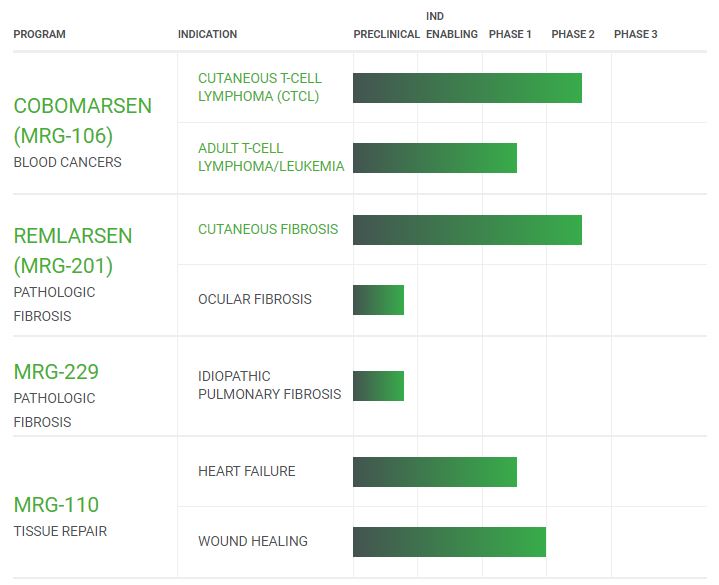
Anticipated Milestones
|
•
|
Report preclinical safety and efficacy data for MRG-229 in IPF (Q2-2020)
|
5
|
•
|
Meet with FDA to explore a potential expedited clinical development path for cobomarsen in ATLL (Q3-2020)
|
|
•
|
Report topline data from Phase 2 clinical trial of cobomarsen in CTCL (Q3-2020)
|
|
•
|
Report primary endpoint data from Phase 2 trial of remlarsen in cutaneous fibrosis (2H-2020)
|
Our Strategy
We seek to use our expertise and understanding of microRNA biology, oligonucleotide chemistry and product development to create novel products that have the potential to transform the treatment of patients with serious diseases. The key components of our strategy are as follows:
|
•
|
Continue to develop cobomarsen for blood cancers where the disease process appears to be correlated with an increase in miR-155 levels, focusing on CTCL and
ATLL
.
Cobomarsen is currently in development for CTCL and ATLL. Our global Phase 2 clinical trial, SOLAR, is ongoing, though enrollment has been stopped to allow for interim data analysis. This study is assessing the potential benefit and safety of cobomarsen in patients with mycosis fungoides, or
MF
, the most common type of
CTCL
. In addition to CTCL, we are also developing cobomarsen in ATLL, an indication where the disease process appears to correlate with an increase in
miR-155
levels, the target of cobomarsen. In January 2020, we announced interim efficacy and safety data from the ATLL arm of our ongoing Phase 1 clinical trial of cobomarsen.
|
|
•
|
Continue to develop remlarsen and MRG-229 for pathological fibrosis, focusing on the development of MRG-229 in IPF.
Remlarsen is our most advanced product candidate in fibrosis, which is currently being evaluated in a Phase 2 clinical trial assessing its safety, tolerability, and activity in the potential prevention or reduction of keloid formation in patients with a history of keloid scars, a form of pathological scarring. In December 2019, we reported interim data from this clinical trial, which suggest that remlarsen was generally safe and well tolerated, treatment had no reported negative effect on healing, and initial volume reductions in treated keloids compared to placebo in a subset of patients were observed. In addition, we are developing MRG-229 for IPF. We believe that the clinical profile of MRG-229 in our preclinical studies positions this product candidate as a potentially differentiated approach to the treatment of IPF.
|
|
•
|
Utilize rare disease development pathways at the U.S. Food and Drug Administration, or FDA, and comparable programs at foreign regulatory agencies to accelerate progression to late-stage development and early approval.
For many of our programs, we intend to focus on rare and genetic diseases where RNA modulation may produce clinical benefit, so that we can potentially take advantage of regulatory programs intended to expedite drug development. In 2017, the FDA granted orphan drug designation to cobomarsen for the treatment of MF and the European Commission granted orphan medicinal product designation to cobomarsen for the treatment of CTCL. We plan to apply for orphan drug designation, fast track, breakthrough therapy designation, and/or priority review when available to potentially streamline clinical development and decrease time to commercialization.
|
|
•
|
Collaborate with biotechnology and pharmaceutical companies to develop additional product candidates.
We intend to seek out collaborations for the development of compounds in our pipeline for certain disease areas where the costs would exceed our resources or in other areas where we believe that leveraging a partner’s expertise or resources will allow us to accelerate development timelines.
|
|
•
|
Use our in-house research and translational expertise to further develop our product candidate pipeline.
Our in-house research team investigates microRNAs that have been identified as potential therapeutic targets through internal efforts and academic collaborations. We then seek to establish evidence that modulation of the microRNAs’ activity may provide benefit in pathological conditions or diseases in which the microRNA is implicated. We believe that this internal research and expertise could provide a foundation to develop product candidates for the treatment of a variety of diseases.
|
Our Product Candidates
Cobomarsen
Cobomarsen is currently being evaluated for
miR-155
elevated hematological malignancies, including ATLL and CTCL. Cobomarsen is an inhibitor of
miR-155
. Data reported in the scientific literature identifies
miR-155
as a cancer-causing microRNA, or oncomiR. There are several types of cancer in which high levels of miR-155 have been observed, including, among others,
CTCL
, certain virally-induced lymphomas such as ATLL, which is caused by the human T-lymphotropic virus type 1, or
HTLV-1
, subsets of diffuse large B-cell lymphoma, or DLBCL, chronic lymphocytic leukemia, or CLL, and other types of cancer. Based on this literature,
miR-155
is implicated in regulating the expression of a number of validated cancer-related genes, including Bruton’s tyrosine kinase, or BTK, and nuclear factor kappa-light-chain-enhancer of activated B-cells, or NF-κB. In certain B-cell lymphomas, improvement of clinical outcomes has been associated with normalization of
miR-155
levels, while poor prognosis,
6
resistance to treatment, and recurrence of the disease are associated with elevated levels of
miR-155
. In addition to playing a role in B-cell malignancies,
miR-155
is elevated in another group of malignant white blood cells, called T-cells, found in skin lesions of patients with MF. We screened a library of locked nucleic acid, or LNA, modified oligonucleotides and identified cobomarsen as having what we believed was the best potential efficacy and drug-like properties, including improved pharmacodynamics in human T-cell and B-cell lymphoma cell lines. We retain worldwide rights for cobomarsen.
Adult T-cell Leukemia/Lymphoma
ATLL is a blood cell malignancy that develops in a subset of patients after prolonged infection with
HTLV-1
. Literature suggests that the infection with
HTLV-1
as well as the subsequent malignancies may be associated with elevation in the expression of
miR-155
, the target of cobomarsen. ATLL is typified by abnormalities in blood counts, enlarged lymph nodes, and frequent opportunistic infections. The disease presents in indolent and aggressive forms, but the most common and lethal include the aggressive acute, or leukemic, form and the lymphomatous version. These two manifestations lack good treatment options, and once the diagnosis is made, average life expectancy with standard treatment regimens is approximately four to eight months for the acute leukemic form and approximately 10 months for the lymphomatous variety.
In January 2020, we announced initial efficacy and safety data from the ATLL arm of our ongoing Phase 1 clinical trial of cobomarsen. In the trial, six patients with an aggressive subtype of ATLL who at study entry had persistent residual disease after chemotherapy or other therapy had a median survival time from diagnosis of 26 months with three patients still on treatment in October 2019. In the clinical trial, disease stabilization was marked by an observed decrease in biomarkers of tumor cell activation and proliferation, providing evidence of the biological mechanism of cobomarsen on disease stabilization. One patient experienced two serious adverse events deemed possibly related to the study drug and discontinued treatment. The observed safety profile of cobomarsen in ATLL through October 17, 2019 appeared to be generally safe and well tolerated with chronic dosing.
Based on these interim results, we are focusing our cobomarsen expansion indication efforts on ATLL and will request a meeting with the FDA to explore a potential expedited development pathway for cobomarsen in ATLL. We expect to have this meeting with the FDA in the third quarter of 2020.
Cutaneous T-Cell Lymphoma
Our global Phase 2 clinical trial, called SOLAR, is evaluating cobomarsen in patients with MF, the most common type of CTCL.
MF is a slow growing form of cancer that has been associated with elevated miR-155. This disease occurs when certain types of T-cells become cancerous. These malignant T-cells then form specific types of skin lesions. Although the skin is involved, the skin cells themselves are not cancerous. According to the National Institutes of Health, or NIH, MF usually occurs in adults over age 50, although the disease may occur at any age.
We believe the total population of patients with CTCL in the United States and Canada is approximately 30,000. The Lymphoma Research Foundation estimated the prevalence of MF to be 16,000-20,000 cases in the United States, with 3,000 new diagnoses of MF each year. According to the Leukemia and Lymphoma Society, or LLS, in a 2014 publication, approximately 70% to 80% of patients are diagnosed with early-stage MF that impacts mostly the skin. In these patients, the disease typically has a slow progression, but is accompanied by considerable morbidity and quality of life detriments such as severe itchiness, pain, frequent infections of skin lesions, and disfiguration due to widespread tumors and plaques. The five-year survival rate for newly diagnosed patients with CTCL is approximately 90%. As CTCL progresses, the cancer may involve the lymph nodes, blood, and internal organs. The five-year survival rate in later stage patients with CTCL (stages IIB, III, IV) is approximately 20-60% depending on the stage.
There are currently no curative therapies for CTCL, and concurrent and consecutive treatments, many with significant adverse effects, tend to be given until loss of response. We believe there is a need for new and improved therapies in CTCL to treat the disease and reduce symptoms, such as itchiness and painful skin lesions, and to prolong survival in patients with aggressive disease.
There is no universally accepted standard of care, or SOC, for treatment of MF. Treatment is dependent on stage of disease and responsiveness to previous therapy and is divided into skin-directed therapy and systemic treatments. For certain patients with advanced disease, allogeneic stem cell transplantation may offer prolonged survival, but the five-year survival rate is approximately 50%.
In our Phase 1 clinical trial of cobomarsen treating MF patients, we enrolled patients with mild/moderate to severe MF (stages I-III), without blood or node involvement. In the first part of the Phase 1 clinical trial, six patients were treated with 75 mg cobomarsen per dose injected directly into tumors. All tumors showed a response as measured by the Composite Assessment of Index Lesion
7
Severity, or CAILS, score and decreased tumor cell clones. In addition, analysis of injected tumors also indicated an increased expression of several direct targets of miR-155, suggesting that the drug may be inhibiting its intended molecular target. The intra-tumoral administration was safe and well tolerated. In the second part of the Phase 1 clinical trial, cohorts were dosed by multiple systemic routes of administration, including subcutaneous injection, or SQ injection, intravenous infusion, or IV infusion, and intravenous bolus injection, or
IV bolus
. Efficacy and tolerability were assessed at doses of 300 mg, 600 mg and 900 mg for SQ injection and IV infusion and at 300 mg for
IV bolus
. Based on the modified Severity Weighted Assessment Tool, or mSWAT score, which is a measurement of the severity of skin disease over a patient’s entire body, 33 of 36 patients (92%) showed improvements in mSWAT scores. These improvements in mSWAT scores were observed as early as 17 days after a patient’s first dose (the first post-treatment assessment), with the greatest improvement in mSWAT scores seen after one or more months of dosing. Responses were durable, with 77% of the 13 patients that achieved a partial response (all doses tested) maintaining a response for at least four consecutive months, or ORR4, based on mSWAT. Additionally, five of eight patients (63%) receiving 300 mg IV infusion, which was the dose selected for the Phase 2 SOLAR clinical trial, achieved a 50% or greater mSWAT score reduction and four (50%) maintained the response for at least four consecutive months. Cobomarsen treatment by SQ injection or
IV bolus
routes of administration was generally safe and well tolerated.
In April 2019, we advanced cobomarsen into the global Phase 2 SOLAR clinical trial in patients with MF. SOLAR is an open-label, randomized, controller, parallel group study designed to evaluate the safety and efficacy of 300 mg of cobomarsen, given by IV infusion, versus Zolinza (vorinostat) as an active control. SOLAR is designed to enroll patients with moderate to severe MF (stages Ib-III), without node or blood involvement.
In December 2019, we announced plans to stop the enrollment of new patients in SOLAR and conduct and interim analysis. This analysis will provide top line, controlled data to assess the observed benefit of cobomarsen based on disease response in the skin in comparison to vorinostat. A total of 37 patients have been enrolled and will continue to be evaluated for safety and clinical response. We are amending the SOLAR protocol to change the planned futility analysis to an interim analysis after the last patient enrolled has completed approximately six months of treatment and follow up. We plan to assess the rate of an objective response only in the skin, that is durable for four months, defined as 50% or greater improvement in the severity of a patient’s skin disease over the entire body as measured by mSWAT. This change from assessing overall response to skin response was driven by the fact that patients allowed into the study only have skin disease and are verified not to have blood, nodes, or visceral involvement at study entry. Improvements in skin disease are thus intended to reflect efficacy of the drug whereas progression in skin disease reflect lack of efficacy. Follow up analysis for blood, nodes or visceral disease may be conducted based on the results obtained using mSWAT.
We believe that evaluation of data from this set of patients could provide important evidence regarding the safety and efficacy of cobomarsen for the treatment of CTCL in a shorter period of time and require fewer resources. We believe that obtaining controlled clinical data from this cohort of patients may allow for a better assessment of the clinical potential of cobomarsen as compared to data from our Phase 1 trial. We intend for this controlled clinical data to form the basis of determining what additional clinical investigation of cobomarsen in CTCL is warranted, if any, and what would be required to potentially obtain regulatory approval. Topline data from this trial is expected to be announced in the third quarter of 2020.
microRNA-29 Mimics, including Remlarsen and MRG-229
We are developing miR-29 mimics, or replacements, for miR-29, a microRNA that is found at abnormally low levels in a number of pathological fibrotic conditions. Our lead miR-29 mimics are remlarsen and MRG-229. Remlarsen is our most advanced product candidate in fibrosis and is intended for local or compartmental applications. Remlarsen is currently being evaluated in a Phase 2 clinical trial assessing its safety, tolerability, and activity in the potential prevention or reduction of keloid formation in patients with a history of keloid scars, a form of pathological scarring. In December 2019, we reported interim data from this clinical trial, which suggests that remlarsen was generally safe and well tolerated, no negative effect on healing was reported, and initial reductions in keloid volume from remlarsen-treated wounds compared to placebo-treated wounds were observed in a subset of patients. Based on these data, we decided to continue our analysis of patient data at the one-year primary endpoint of the study and expect to report data in the second half of 2020.
We are also evaluating remlarsen in ocular fibrotic indications, such as corneal injury and keratitis. In April 2019, we presented data in pre-clinical studies testing remlarsen for its ability to penetrate the injured cornea and reduce fibrosis after an injury. Topical administration of remlarsen to an injured rat cornea resulted in faster healing of the cornea and reduced scarring/hazing. Remlarsen has also been in in vitro studies to regulate miR-29 pharmacodynamic biomarkers in the cornea. With this data, we expect to seek a collaboration partner for remlarsen.
In addition, we are developing MRG-229 for IPF. MRG-229 is a second-generation miR-29 mimic, which can be administered systemically. We believe that the preclinical efficacy and preliminary nonclinical safety profile of MRG-229 positions this product
8
candidate as a potentially differentiated approach to the treatment of IPF. In October 2019, we announced the first preclinical efficacy results for MRG-229. Specifically, second generation, targeted miR-29 mimics appeared to show antifibrotic activity in normal human lung fibroblasts, or NHLFs, and human precision cut lung slices. MRG-229, a stabilized, conjugated miR-29 mimic, was also observed to block fibrosis in bleomycin-induced pulmonary fibrosis in mice, with increased potency as compared to first generation miR-29 mimics. MRG-229 appeared to demonstrate activity by both intravenous and subcutaneous routes of administration. We expect to report additional preclinical safety and efficacy data during the second quarter of 2020. This program is supported by a grant in collaboration with the NIH and Yale University.
We initially discovered the role of miR-29 in pathological cardiac fibrosis. Since this initial discovery, miR-29 has been implicated in pathological fibrosis in multiple organs including the skin, eye, lung, liver, tendon, muscle, and kidney. miR-29 is understood by the scientific community to play a role in the regulation of certain processes that contribute to fibrosis, including the initiation and maintenance of fibrosis through transforming growth factor beta, or TGF-ß, signaling and the deposition of the components that make up fibrotic tissue, including collagen and extracellular matrix, or ECM, proteins. Furthermore, both fibrotic ECM and TGF-ß are believed to down-regulate miR-29 levels, leading to continuously increased TGF-ß expression and uncontrolled ECM production. miR-29 levels are abnormally low in multiple fibrotic indications, and lower levels of miR-29 are correlated with increased severity of fibrosis. As such, we believe that increasing the levels of
miR-29 by administration of a miR-29 mimic could be beneficial in the treatment of several pathological fibrotic conditions. Although various fibrotic indications are potentially distinct, they share a number of features, including the activation of the cells that initiate the deposition of fibrotic tissue or fibroblast activation, excessive deposition of collagen and other fibrosis-associated pathways, and resulting organ dysfunction. We believe the signaling pathways and genes regulated by miR-29 might be shared among multiple fibrotic indications and that increasing miR-29-like activity may provide potential benefit in any of these.
To demonstrate mechanistic proof-of-concept and as a potential initial indication, we initially focused on skin fibrosis. We believe data derived from skin fibrosis trials may also facilitate development of a product candidate intended for the treatment of patients who suffer from IPF, ocular fibrosis, tendon fibrosis, and other major organ pathological fibrosis.
Pathological Fibrosis
Fibrosis describes the development of fibrous connective tissue as a response to injury or damage. Fibrosis may refer to the deposition of connective tissue that occurs as part of normal healing or to the excess tissue deposition that occurs as a disease process. When fibrosis occurs in response to injury, the term “scarring” is used. Pathological fibrosis can occur in many tissues of the body, either as a primary event or as a result of inflammation or damage. In every case, regardless of the trigger, collagen build up occurs, which can result in scarring of vital organs such as the skin, lung, liver, eye, kidney, tendon, muscle, and heart, leading to irreparable damage and eventual organ failure. We believe there is a significant need for additional clinical therapeutic approaches to treating pathological fibrosis.
9
Below is a description of several types of pathological fibrosis for which we may seek to develop a product candidate based on a replacement for miR-29:
|
Type of Pathological Fibrosis
|
|
Description
|
|
|
Skin Fibrosis
|
|
Ÿ
|
Scarring is a result of an overproduction of collagen in a healing wound. Scarring may continue to thicken for up to six months or may overgrow the site of the wound, even after the wound has healed.
|
|
|
|
Ÿ
|
Hypertrophic scars and keloids are abnormal wound responses and represent an excessive connective tissue response to skin trauma, inflammation, surgery, or burns.
|
|
|
|
Ÿ
|
Hypertrophic scars and keloids are characterized by local fibroblast proliferation and overproduction of collagen. Both hypertrophic scars and keloids are diseases that tend to be painful and itchy, restrict mobility, and are resistant to treatment.
|
|
Pulmonary Fibrosis
|
|
Ÿ
|
Pulmonary fibrosis, also known as lung fibrosis, is caused by accumulation of scar tissue surrounding the air sacs (interstitial space) in the lung. As a result, the lung tissue becomes stiff and loses the ability to expand. The scar tissue also prevents normal transport of oxygen. The result is a progressive respiratory failure, with symptoms that include persistent cough, chest pain, difficulty breathing and fatigue. Pulmonary fibrosis leads to cardiac failure and death. Pulmonary fibrosis may occur as a secondary condition in various other diseases, but in many cases the underlying cause is not clear and is referred to as “idiopathic” pulmonary fibrosis or IPF.
|
|
|
|
Ÿ
|
IPF is a chronic, progressive lung disease which ultimately leads to death in many of the patients. This condition causes scar tissue to build up in the lungs, which makes the lungs unable to transport oxygen into the bloodstream effectively.
|
|
Liver Fibrosis
|
|
Ÿ
|
Liver fibrosis refers to the scar tissue and nodules that replace liver tissue and disrupt liver function. Major causes of liver fibrosis are alcohol consumption, chronic hepatitis B virus infection, hepatitis C virus infection, and metabolic disorders, including non-alcoholic fatty liver disease and non-alcoholic steatohepatitis. Liver fibrosis is a major global problem driven by increasing rates of obesity and diabetes.
|
|
Eye Fibrosis
|
|
Ÿ
|
Infection or inflammation of the eye results in impairment of visual function. Chronic inflammation can ultimately lead to fibrosis.
|
|
|
|
Ÿ
|
Eye fibrosis diseases include retinal fibrosis (such as diabetic retinopathy, diabetic vitreoretinopathy, age macular degeneration), corneal fibrosis (such as post-traumatic or infections corneal fibrosis and Fuch’s endothelial corneal dystrophy), and other indications (such as prevention of fibrosis complications in glaucoma trabeculotomy).
|
Remlarsen Clinical Development
In 2017, we announced the data from a single-center, Phase 1, double-blind, placebo-controlled, single and multiple dose-escalation clinical trial for remlarsen that enrolled 54 healthy volunteers. In the trial, we observed mechanistic proof-of-concept for remlarsen, based on a statistically-significant reduction in fibroplasia, or scar tissue deposition, with no adverse effects on incisional wound healing when remlarsen was given locally by intradermal injection.
In July 2018, we announced the initiation of a Phase 2 double-blind, randomized clinical trial of remlarsen, which is designed to treat fibrotic diseases, in patients with a predisposition for keloid formation. This clinical trial is designed to assess the safety, tolerability, and activity of remlarsen in the prevention or reduction of keloid formation in patients with a history of keloids. Keloids are a common condition that is disfiguring and can be painful, itchy, and emotionally troubling to those that experience them. They are typically smooth, hard, benign growths that form when scar tissue grows excessively. Enrollment has been completed, and 14 patients who were historically predisposed to keloid formation after trauma to the skin have been dosed and are being followed at multiple clinical sites in the United States. Patients received small, matching excisional wounds that were sutured and then injected with either remlarsen or placebo. In this design, patients are serving as their own control, which increases the statistical power of the clinical trial. The lesions will be observed for up to 12 months to determine the presence or absence of keloid formation. In December 2019, we reported interim data from this clinical trial, which suggests that remlarsen was generally safe and well tolerated, no negative effect on healing was reported, and initial reductions in keloid volume from remlarsen-treated wounds compared to placebo-treated wounds were observed in a subset of patients. Based on this data, we have decided to continue our analysis of patient data at the one-year primary endpoint of the study and expect to report data in the second half of 2020. With this data, we expect to seek a collaboration partner for remlarsen.
10
In October 2018, we announced data from our preclinical studies investigating the antifibrotic effects of remlarsen in corneal ulceration of rats. We believe the results obtained in the study suggest that topical application of remlarsen may be an effective treatment to preserve vision in patients suffering from multiple conditions resulting in corneal scarring, which remains one of the leading causes of blindness worldwide.
MRG-110
MRG-110 is an inhibitor of miR-92, a microRNA expressed in endothelial cells, which has been observed in preclinical studies to be a regulator of new blood vessel creation and other wound healing processes. We believe that MRG-110 may have the potential to be used for the treatment of heart failure and other conditions where patients may benefit from increased vascular flow and accelerated healing, such as complicated lacerations in high risk patients or burns.
We have completed two Phase 1 clinical trials in normal human volunteers. A single and multiple ascending dose study with intradermal administration and a single ascending dose study with systemic administration were completed in 2019. A total of 65 subjects were exposed for up to three weeks. MRG-110 was observed to be generally safe and well tolerated, with no evidence of unwanted distal angiogenesis, acute inflammatory toxicities, or significant abnormalities in liver, kidney, or blood, with no injection site reactions.
We have historically developed MRG-110 under a license and collaboration agreement, or the Servier Collaboration Agreement, with Les Laboratoires Servier and Institut de Recherches Servier, or collectively, Servier. In August 2019, Servier terminated the Servier Collaboration Agreement effective in February 2020. As a result, we regained rights to MRG-110 in all indications and all territories globally, including rights in the US and Japan, which we already controlled under the Servier Collaboration Agreement. We have completed two Phase 1 clinical trials of MRG-110 and plan to continue to explore potential collaborations to support the future development of MRG-110.
Chronic Heart Failure Physiopathology
The imbalance between oxygen demand and supply to cardiomyocytes, or cells in the heart responsible for pumping blood, plays an important role in the pathophysiology of heart failure. CHF is associated with a decrease of myocardial blood flow that begins at the early stages of the heart failure. The preservation of the small blood vessels of the heart is able to increase blood flow in case of increased demand. In CHF, this coronary flow reserve was shown to be reduced secondary to capillary dysfunction and a decrease in density of these vessels, limiting oxygen supply to cardiomyocytes. Analysis of heart tissue from patients suffering from CHF revealed a reduction of coronary microvascular density. Sixty percent of cases of CHF patients with reduced ejection fraction, or HFrEF, have an ischemic origin. Progressive loss of cardiomyocytes and increase in fibrosis decrease capillary density. Compensatory elongation and hypertrophy of remaining cardiomyocytes further increase capillary length and inter-capillary distance reducing oxygenation.
CHF is one of the leading causes of mortality and morbidity in the world. The prognosis remains poor with 45-60% mortality five years after diagnosis. Quality of life in patients is impaired, from mild to severe limitations in daily life. To date, SOC treatment slows down the progression of disease by inhibiting the neuro-hormonal activation and reducing vascular bed congestion. Coronary revascularization, with percutaneous coronary intervention or coronary arterial bypass grafting, have been shown to improve patient prognosis when the obstruction is located in the epicardial coronaries but is generally of no benefit in cases when the flow is limited downstream in the microcirculatory network. We believe that new reparative/regenerative solutions are needed for improving patient cardiac function that could consequently make a difference in daily quality of life with a further reduction in morbidity and mortality. The restoration of the microcirculation appears to be a potentially innovative therapeutic way to improve cardiac function.
MRG-110 was observed to reduce infarct size in multiple preclinical models of acute myocardial infarction, leading to an improved cardiac function. The cardioprotective effects were correlated with reduced cell death, reduced inflammation, and improved neovascularization of the affected myocardium. Similarly, improved vascularization and cardiac function were observed after MRG-110 treatment in a porcine model of heart failure induced by chronic myocardial ischemia.
Cutaneous wounds
In preclinical studies, we observed MRG-110 accelerating wound healing in normal, healthy farm pigs. In induced excisional wounds in healthy pigs, MRG-110 appeared to result in increased perfusion, measured by laser Doppler imaging on Day 14, and more rapid wound closure compared to wounds in control animals treated similarly with vehicle control or SOC. Within the dermal portion of the wound bed, there was a dose dependent increase in granulation tissue and in vascularization on day 49, five weeks after the last dose, in the wounds treated with MRG-110 compared with SOC-treated wounds. We believe the effects on wound
11
healing seen in animal models support further evaluation of MRG-110 for its potential to improve wound healing by increasing revascularization and granulation tissue formation, and ultimately wound closure in acute settings. The potential indications include acceleration and improvement of wound healing in indications such as burns, skin flaps, grafts, or laparotomy or sternotomy incisions in patients with high risk of poor wound closure.
Background on microRNAs
microRNAs are transcribed from the genome and unlike messenger RNA, or mRNA, they do not encode proteins. microRNAs function by preventing the translation of mRNAs into proteins and/or by triggering degradation of these mRNAs. Studies have shown that gene regulation by microRNAs is often not a decisive on and off switch but a subtle function that fine-tunes cellular phenotypes and becomes more pronounced during stress or disease conditions. microRNAs were first discovered in 1993 and have since been found in nearly every biological system examined since that time. They are highly conserved across species, demonstrating their importance to biological functions and cellular processes. According to the Sanger Institute, over 2,000 microRNAs have been identified in humans.
A body of evidence has shown that inappropriate levels of particular microRNAs are directly linked to a range of serious diseases, many of which are poorly served by existing therapies. microRNAs can affect the balance of protein expression and serve as “command and control” nodes that directly coordinate multiple critical systems simultaneously. This effect on systems biology is a naturally occurring homeostatic process that becomes disrupted in certain disease states. As a result, developing microRNA-based therapeutics is fundamentally different from the single-protein, single-target approach that is the foundation of traditional small and large molecule drugs.
Our Approach to Drug Discovery and Development
Our research and development strategy is designed to accelerate timelines and reduce development risk. The goal of our translational medicine strategy is to progress rapidly to first-in-human trials once we have adequately established mechanistic proof-of-concept, consisting of pharmacokinetics, pharmacodynamics, safety, and manufacturability of the product candidate in preclinical studies. Programs that progress into human trials are designed to be accompanied by a validated set of pharmacodynamic biomarkers that allow us to verify the mechanism of drug action in humans and to potentially stratify and enrich the study population. Through this approach, we seek to reduce the risk of our programs by quantifying target engagement and identifying the likely efficacious dose prior to progression to Phase 2 clinical trials.
Discovery
Although there are over 2,000 identified human microRNAs, not all of them have been shown to be causal in disease. Our approach to drug discovery and development begins with the identification of potentially pathological microRNAs.
We apply three general approaches to the identification of potentially pathological, or disease-causing, microRNAs: (i) profiling of microRNA expression in diseased tissue versus normal tissue to identify microRNAs that are found at abnormally high or low levels; (ii) identification of microRNAs that are located within genes (typically in non-protein coding segments) of validated disease-relevant genes and thus simultaneously expressed with the disease associated gene; and (iii) evaluation of microRNAs that are predicted to directly modulate the expression of specific, disease-relevant genes.
We believe that the microRNA inhibitor candidates face lower delivery hurdles compared to microRNA mimics and have better drug-like properties in regard to affinity for their targets, stability, drug distribution, and pharmacodynamics. To improve their therapeutic potential, we chemically modify these compounds with changes such as LNA substitution of the ribose sugar in many of the nucleosides, and deoxyribonucleoside, or DNA, substitution of other nucleosides.
In conditions where a deficit in microRNA expression has been identified as disease causing, microRNA replacements, which are modified, often double-stranded RNA structures that are recognized by the RNA-induced silencing complex, can serve as chemically-synthesized replacements for microRNAs.
Historically, the delivery of double-stranded RNAs, such as microRNA mimics, or replacements, has been a significant hurdle to overcome for drug development because these molecules are very rapidly degraded and because uptake into cells can be inefficient. To prevent the rapid degradation of our microRNA mimics, we have used chemical modification of the nucleotides and inter-nucleotide bonds that make them resistant to the enzymes that normally degrade natural nucleic acids. Our delivery approach for double-stranded microRNA replacements is to append a conjugate to the molecule to enhance cellular uptake. The selection of the conjugate is dependent upon the intended therapeutic use. We have deployed hydrophobic conjugates, such as cholesterol, that are able to improve pharmacokinetics and allow for enhanced cellular uptake. We are also exploring a range of conjugates that help
12
in targeting specific tissues and cells. Our strategy with microRNA replacements has centered on opportunities for efficient delivery of the molecules with an emphasis on local and topical applications, such as injections in the skin or eye. For organs where topical or local applications are not feasible, such as the liver or lung, we have employed conjugates that have demonstrated successful delivery after systemic administration.
Development
Our approach to translational medicine is focused on rapidly testing the molecular hypothesis in human cell lines and animal models to demonstrate safety and measure pharmacokinetics and pharmacodynamics, and finally designing and conducting small, efficient, and targeted human Phase 1 clinical trials. We typically select an initial indication that is genetically defined or is a rare disease where abnormal levels of a microRNA have been implicated. These early-stage Phase 1 clinical trials are designed to test the mechanistic relevance and develop mechanistic proof-of-concept in humans in a setting that provides the opportunity to develop a biomarker toolkit for a mechanism of action that we believe has broader disease relevance.
The mechanistic proof-of-concept studies are designed to provide relevant information that helps to reduce development risks in humans. Our aim is to demonstrate that the expression levels of the microRNA could potentially serve as a diagnostic indicator that allows for better patient selection for later clinical trials and in additional indications. At the same time, we seek to confirm molecular activity of the drug.
By measuring the pharmacodynamics of target engagement, we are able to show that the product candidate effectively enters the appropriate cell and binds to its intended target. This process is particularly important for oligonucleotide drugs. We can also measure the effects on gene expression downstream of the intended target that create a plausible link between target engagement and a mechanism of disease.
Exploratory endpoints can provide us with verification of the pharmacodynamic effects of the drug based on biomarker readouts and morphological alterations. This translational strategy allows us to answer many questions about the drug target pair and provides improved confidence that the molecular basis of drug action is relevant in humans. Having built confidence in the drug mechanism and demonstrated an acceptable safety profile, later-stage clinical trials will be designed to establish appropriate dose and therapeutic efficacy.
Strategic Collaborations and License Agreements
Strategic Alliance and Collaboration with Servier
In October 2011, we entered into the Servier Collaboration Agreement with Servier for the research, development, and commercialization of RNA-targeting therapeutics in cardiovascular disease. Under the Servier Collaboration Agreement, we granted Servier an exclusive license to research, develop, manufacture, and commercialize RNA-targeting therapeutics for certain microRNA targets in the cardiovascular field.
In accordance with the terms of the Servier Collaboration Agreement and based on the notice we received from Servier in August 2019, the Servier Collaboration Agreement was terminated in February 2020. As a result, we regained rights to MRG-110 in all indications and all territories globally, including rights in the United States and Japan, which we already controlled under the Servier Collaboration Agreement. We are currently evaluating development strategies for MRG-110, which may include seeking new development and licensing collaborators. Any future development of MRG-110 is subject to the availability of sufficient capital resources to continue such development, including possible collaboration agreements
During the years ended
December 31, 2019
and
2018
, we recognized revenue under the Servier Collaboration Agreement of
$4.3 million
and
$7.4 million
, respectively.
License Agreement with the University of Texas
As of
December 31, 2019
, we had
one
exclusive patent license agreement, or the UT License Agreement, with the Board of Regents of The University of Texas System, or the University of Texas. Under the UT License Agreement, the University of Texas granted us exclusive and nonexclusive licenses to certain patent and technology rights. At the time the UT License Agreement was entered into, the University of Texas was a minority stockholder.
In consideration of rights granted by the University of Texas, we are required to: (i) pay a nonrefundable up-front license documentation fee in the amount of
$10 thousand
; (ii) pay an annual license maintenance fee in the amount of
$10 thousand
starting one year from the date of the agreement; (iii) reimburse the University of Texas for actual costs incurred in conjunction with the
13
filing, prosecution, enforcement, and maintenance of patent rights prior to the effective date; and (iv) bear all future costs of and manage the filing, prosecution, enforcement, and maintenance of patent rights. During the
years ended
December 31, 2019
and
2018
, we incurred immaterial up-front fees and immaterial maintenance fees, which were recorded as research and development expense. All costs related to the filing, prosecution, and maintenance of patent and technology rights are recorded as general and administrative expense when incurred.
Under the terms of the UT License Agreement, we may be obligated to make the following future milestone payments for each licensed product candidate: (i) up to approximately
$0.6 million
upon the initiation of defined clinical trials; (ii)
$2.0 million
upon regulatory approval in the United States; and (iii)
$0.5 million
per region upon regulatory approval in other specified regions. Additionally, if we or any of our sublicensees successfully commercialize any product candidate subject to the UT License Agreement, we are responsible for royalty payments in the low-single digits based upon net sales of such licensed products and payments at a percentage in the mid-teens of any sublicense income, subject to specified exceptions. The University of Texas’s right to these royalty payments will expire upon the expiration of the last patent claim subject to the UT License Agreement. During the
year ended
December 31, 2019
, we
did not incur
any expenses related to milestone payments. During the
year ended
December 31, 2018
, we incurred
$0.1 million
of expenses for milestone payments.
The license term extends on a product-by-product and country-by-country basis until the expiration of the last to expire of the licensed patents that covers such product in such country. Upon expiration of the royalty payment obligation, we will have a fully paid license in such country. We may also terminate the UT License Agreement for convenience upon a specified number of days’ prior notice to the University of Texas. The University of Texas also has the right to earlier terminate the UT License Agreement after a defined date under specified circumstances where we have effectively abandoned our research and development efforts or have no sales. The UT License Agreement will terminate under customary termination provisions including automatic termination upon our bankruptcy or insolvency, upon notice of an uncured material breach, and upon mutual written consent. All charges incurred under the UT License Agreement have been expensed to date due to the uncertainty as to future economic benefit from the acquired rights.
License Agreement with Roche Innovation Center Copenhagen A/S (formerly Santaris Pharma A/S)
We are party to a license agreement with Santaris Pharma A/S, which subsequently changed its name to Roche Innovation Center Copenhagen A/S, or RICC, which was acquired by F. Hoffmann-La Roche Ltd, or Roche, in 2014. The agreement was entered into in June 2010, amended in October 2011, amended and restated in December 2012, and further amended in August 2019, or the RICC License Agreement. At the time the RICC License Agreement was entered into, Roche was a minority stockholder.
Under the RICC License Agreement, we received exclusive and nonexclusive licenses from RICC to use specified technology of RICC, or the RICC Technology, for specified uses including research, development, and commercialization of pharmaceutical products using this technology worldwide. Under the RICC License Agreement, we have the right to develop and commercialize the RICC Technology directed to four specified targets and the option to obtain exclusive product licenses for up to six additional targets. The acquisition of Santaris Pharma A/S by Roche was considered a change-of-control under the RICC License Agreement, and as such, certain terms and conditions of the RICC License Agreement changed, as contemplated and in accordance with the RICC License Agreement. These changes primarily relate to milestone payments reflected in the disclosures below. If we exercise our option to obtain additional product licenses or to replace the target families, we will be required to make additional payments to RICC.
Under the terms of the RICC License Agreement, milestone payments were previously decreased by a specified percentage as a result of the change of control by RICC referenced above. We are obligated to make milestone payments for each licensed product of up to
$5.2 million
, which is inclusive of a potential product license option fee. Certain of these milestones will be increased by a specified percentage if we undergo a change of control as defined under the RICC License Agreement. If we grant a third party a sublicense to the RICC Technology, we are required to remit to Roche up to a specified percentage of the up-front and milestone and other specified payments that we receive under its sublicense, and if such sublicense covers use of the RICC Technology in the United States or the entire European Union, or
EU
, we will not have any further obligation to pay the fixed milestone payments noted above.
During the
years ended
December 31, 2019
and 2018, we incurred
$0.1 million
and
$0.7 million
, respectively, of expense related to a milestone reached under the RICC License Agreement, which is included in research and development expense in our
consolidated
statements of operations and comprehensive loss.
If we or our sublicensee successfully commercializes any product candidate subject to the RICC License Agreements, then RICC is entitled to royalty payments in the mid-single digits on the net sales of such product, provided that if such net sales are made by a sublicensee under the RICC License Agreement, RICC is entitled to royalty payments equal to the lesser of a percentage in
14
the mid-single digits on the net sales of such product or a specified percentage of the royalties paid to us by such sublicensee, subject to specified restrictions. We are obligated to make any such royalty payments until the later of: (i) a specified anniversary of the first commercial sale of the applicable product or (ii) the expiration of the last valid patent claim licensed by RICC under the RICC License Agreement underlying such product. Upon the occurrence of specified events, the royalty owed to RICC will be decreased by a specified percentage.
The RICC License Agreement will terminate upon the latest of the expiration of all of RICC’s royalty rights, the termination of the last miRagen target or the expiration of its right to obtain a product license for a new target under the RICC License Agreement. We may also terminate the RICC License Agreement for convenience upon a specified number of days’ prior notice to RICC, subject to specified terms and conditions. Either party may terminate the RICC License Agreement upon an uncured material breach by the other party and RICC may terminate the RICC License Agreement upon the occurrence of other specified events immediately or after such event is not cured within a specified number of days, as applicable.
All charges incurred under the RICC License Agreement have been expensed to date due to the uncertainty as to future economic benefit from the acquired rights.
During the
year ended
December 31, 2019
, we made
no
payments to RICC for raw materials to be used in our drug manufacturing process. During the
year ended
December 31, 2018
, we made
$0.3 million
in payments to RICC for raw materials.
Subcontract Agreement with Yale University
We are party to a subcontract agreement that began in October 2014 and a subaward agreement that began in March 2015, or the Yale Agreements, with Yale University, or Yale, which were subsequently amended. Under the Yale Agreements, we are providing specified services regarding the development of a proprietary compound that targets miR-29 in the indication of IPF. Yale entered into the Yale Agreements in connection with a grant that Yale received from the NIH for the development of a miR-29 mimic as a potential therapy for pulmonary fibrosis.
In consideration of our services under the Yale Agreements, Yale has agreed to reimburse us up to a specified amount over five years, subject to the availability of funds under the grant and continued eligibility. Under the terms of the Yale Agreements, we retain all rights to any and all intellectual property developed solely by us in connection with the Yale Agreements. Yale has also agreed to provide us with an exclusive option to negotiate in good faith for an exclusive, royalty-bearing license from Yale for any intellectual property developed by Yale or jointly by the parties under the Yale Agreements. Yale is responsible for filing, prosecuting, and maintaining foreign and domestic patent applications and patents on all inventions jointly developed by the parties under the Yale Agreements. Through
December 31, 2019
, we received
$0.9 million
under the Yale Agreements.
The Yale Agreements terminate automatically on the date that Yale delivers its final research report to the NIH under the terms of the grant underlying the Yale Agreements. Each party may also terminate the Yale Agreements upon a specified number of days’ notice in the event that the NIH’s grant funding is reduced or terminated or upon material breach by the other party.
License Agreements with the t2cure GmbH
We are party to a license and collaboration agreement, or the t2cure Agreement, that began in October 2010 with t2cure GmbH, or t2cure, which was subsequently amended. Under the t2cure Agreement, we received a worldwide, royalty bearing, and exclusive license to specified patent and technology rights relating to miR-92.
In consideration of rights granted by t2cure, we paid an up-front fee of
$46 thousand
and we are obligated to: (i) pay an annual license maintenance fee in the amount of
€3 thousand
($3 thousand as of
December 31, 2019
) and (ii) reimburse t2cure for costs incurred in conjunction with the filing, prosecution, enforcement, and maintenance of patent rights.
Under the terms of the t2cure Agreement, we are obligated to make the following future milestone payments for each licensed product, as defined in the t2cure Agreement: (i) up to approximately
$0.7 million
upon the initiation of certain defined clinical trials; (ii)
$2.5 million
upon regulatory approval in the United States; and (iii) up to
$1.5 million
per region upon regulatory approval in the
EU
or Japan. Additionally, if we or any of our sublicensees successfully commercializes any product candidate subject to the t2cure Agreement, we are responsible for royalty payments equal to percentages in the low-single digits upon net sales of licensed products, and under specified circumstances, sublicense fees equal to a percentage in the low twenties of sublicense income received by us. We are obligated to make any such royalty payment until the later of: (i) the tenth anniversary of the first commercial sale of the applicable product or (ii) the expiration of the last valid claim to a patent licensed by t2cure under the t2cure Agreement covering such product. If such patent claims expire prior to the end of the
ten
-year term, then the royalty owed to t2cure
15
will be decreased by a specified percentage. We also have the right to decrease our royalty payments by a specified percentage for royalties paid to third parties for licenses to certain third-party intellectual property.
The license term extends on a country-by-country basis until the later of: (i) the tenth anniversary of the first commercial sale of a licensed product in a country, and (ii) the expiration of the last to expire valid claim that claims such licensed product in such country. Upon expiration of the royalty payment obligation, we will have a fully paid license in such country. We have the right to terminate the t2cure Agreement at will, on a country-by-country basis, after 60 days’ written notice. The t2cure Agreement will also automatically terminate upon our bankruptcy or insolvency or upon notice of an uncured material breach.
All charges incurred under the t2cure Agreement have been expensed to date, due to the uncertainty as to future economic benefit from the acquired rights.
License Agreement with The Brigham and Women’s Hospital
We were party to an exclusive patent license agreement, or the BWH License Agreement, with The Brigham and Women’s Hospital, or BWH. The BWH License Agreement began in May 2016 and provided us with an exclusive, worldwide license, including a right to sublicense, to specified patent rights and a nonexclusive, worldwide license, including a right to sublicense, to specified technology rights of BWH, each related to certain microRNAs believed to be involved in various neurodegenerative disorders.
In December 2019, we delivered notice of termination to BWH of the BWH License Agreement, effective March 8, 2020. Per the terms of the BWH License Agreement, we are responsible to pay to BWH any unreimbursed, accrued, or due patent costs due to BWH as of the termination date. Upon termination of the BWH License Agreement, we ceased all use of any licensed patent rights under the BWH License Agreement.
Manufacturing
We do not own or operate clinical or commercial manufacturing facilities for the production of cobomarsen, remlarsen, MRG-110, or other product candidates that we develop, nor do we have plans to develop our own manufacturing operations in the foreseeable future. We currently depend on third-party contract manufacturers for all of our required raw materials, active pharmaceutical ingredients, and finished product candidates for our clinical trials. We do not have any current contractual arrangements for the manufacture of commercial supplies of cobomarsen, remlarsen, MRG-110, or any other product candidates that we develop. We currently employ internal resources and third-party consultants to manage our manufacturing contractors.
Sales and Marketing
We have not yet defined our sales, marketing, or product distribution strategy for cobomarsen, remlarsen, MRG-110, or any of our other product candidates because our product candidates are still in preclinical or early-stage clinical development. Our commercial strategy may include the use of strategic partners, distributors, a contract sale force, or the establishment of our own commercial and specialty sales force. We plan to further evaluate these alternatives as we approach approval for one of our product candidates.
Intellectual Property
We are actively building an intellectual property portfolio around our clinical-stage product candidates and discovery programs. A key component of this portfolio strategy is to seek patent protection in the United States and in major market countries that we consider important to the development of our business worldwide. As of
December 31, 2019
, we have a portfolio of 298 patents and applications of which 216 are issued or allowed and 82 are pending applications. This portfolio includes methods of use and composition patents, and patent applications on our four lead product candidates, cobomarsen, remlarsen, MRG-229, and MRG-110. Our success depends in part on our ability to obtain and maintain proprietary protection for our product candidates and other discoveries, inventions, trade secrets and know-how that are critical to our business operations. Our success also depends in part on our ability to operate without infringing the proprietary rights of others, and in part, on our ability to prevent others from infringing our proprietary rights. A comprehensive discussion on risks relating to intellectual property is provided under “
Risk Factors
” under the subsection “
Risks Related to our Intellectual Property.
”
We have filed patent applications directed to compositions of matter and methods of use covering cobomarsen in the United States and under the Patent Cooperation Treaty, or PCT, to access foreign countries. A U.S. patent application issued as U.S. 9,771,585 on September 26, 2017, which will expire in June of 2036 if we continue to pay the maintenance fees and annuities when due, with the possibility of Patent Term Extension that may be granted by the USPTO due to administrative delays in the FDA. We also filed an U.S. application directed to compositions of matter through the PCT, as U.S. 15/714,671, and this application issued
16
as U.S. 9,994,852 on June 12, 2018, which will expire in June of 2036 if we continue to pay the maintenance fees and annuities when due. Prior to the issue of this application, we filed a continuation application in May 2018 as U.S. 15/976,333, and this application issued as US 10,316,318 on June 11, 2019. Prior to the issue of this application, we filed a continuation application in April 2019 as US 16/382,883, and this application is currently pending.
We expect these pending applications will issue as U.S. patents in the next one to three years, with a projected expiration year of 2036 if we continue to pay the maintenance fees and annuities when due, with the possibility of additional terms from the USPTO prosecution delays and from patent term extensions that may be granted due to administrative delays in the FDA. We also have pending applications that cover methods of use of cobomarsen and related compositions. Collectively, these applications, if they issue, would have patent expirations from 2036 if we continue to pay the maintenance fees and annuities when due, not including any possible additional terms for patent term adjustments or patent term extensions. We do not know if any patent will issue from any of these applications and, if any issue, we do not know whether the issued patents will provide significant proprietary protection or commercial advantage against our competitors or generics. Even if they are issued, our patents may be circumvented, challenged, opposed, and found to be invalid or unenforceable.
We have filed patent applications directed to compositions of matter and methods of use covering MRG-110 in the U.S. and under the PCT, to access foreign countries. A patent directed to compositions of matter and methods of use of MRG-110 issued as U.S. 9,803,202, on October 31, 2017, and will expire in June 2033 if we continue to pay the maintenance fees and annuities when due, with the possibility of Patent Term Extension that may be granted by the USPTO due to administrative delays in the FDA. We also have issued patents and pending applications that cover various therapeutic uses and generic compositions of matter comprising MRG-110. Collectively, these patents and patent applications, if they issue, would have patent expirations ranging from 2028 to 2036 if we continue to pay the maintenance fees and annuities when due, not including any possible additional terms for patent term adjustments or patent term extensions. We do not know if any patent will issue from any of the pending applications and, if any issue, we do not know whether the issued patents will provide significant proprietary protection or commercial advantage against our competitors or generics. Even if they are issued, our patents may be circumvented, challenged, opposed, and found to be invalid or unenforceable.
We have filed patent applications directed to compositions of matter and methods of use covering remlarsen in the United States and under the PCT to access foreign countries. A U.S. patent application issued as U.S. 9,376,681 on June 28, 2016, which will expire in September of 2035 if we continue to pay the maintenance fees and annuities when due, with the possibility of Patent Term Extension that may be granted by the USPTO due to administrative delays in the FDA. Prior to the issue of this application, we filed a continuation application in June 2016 also directed to compositions of matter in the United States, as U.S. 15/175,636, and this application issued as U.S. 9,994,847 on June 12, 2018, which will expire in September of 2035, if we continue to pay the maintenance fees and annuities when due. Prior to the issue of this application, we filed a continuation application in June 2018, as U.S. 16/002,845, and this application is currently pending. We also have issued patents and pending applications that cover various therapeutic uses and generic compositions comprising remlarsen. Collectively, these patents and patent applications, if they issue, would have patent expirations ranging from 2028 to 2035 if we continue to pay the maintenance fees and annuities when due, not including any possible additional terms for patent term adjustments or patent term extensions. We do not know if any patent will issue from any of the pending applications and, if any issue, we do not know whether the issued patents will provide significant proprietary protection or commercial advantage against our competitors or generics. Even if they are issued, our patents may be circumvented, challenged, opposed, and found to be invalid or unenforceable.
For our earlier stage product candidates, we have filed compositions of matter and methods of use patent applications in the United States, and under the PCT to access foreign countries.
In addition to patent protection, we seek to rely on trade secret protection, trademark protection and know-how to expand our proprietary position around our chemistry, technology and other discoveries and inventions that we consider important to our business. We also seek to protect our intellectual property in part by entering into confidentiality agreements with our employees, consultants, scientific advisors, clinical investigators, and other contractors and also by requiring our employees, commercial contractors, and certain consultants and investigators, to enter into invention assignment agreements that grant us ownership of any discoveries or inventions made by them. Further, we seek trademark protection in the United States and internationally where available and when we deem appropriate. We have obtained registrations for the miRagen trademark, which we use in connection with our pharmaceutical research and development services as well as our clinical-stage product candidates. We currently have such registrations for miRagen in the United States, Canada, Japan, and the
EU
.
Competition
The biotechnology and pharmaceutical industries are characterized by intense and rapidly changing competition to develop new technologies and proprietary products. Our clinical and preclinical product candidates may address multiple markets. Ultimately,
17
the diseases our product candidates target for which we may receive marketing authorization will determine our competition. We believe that for most or all of our product development programs, there will be one or more competing programs under development by other companies. Any products that we may commercialize will have to compete with existing therapies and new therapies that may become available in the future. We face potential competition from many different sources, including larger and better-funded biotechnology and pharmaceutical companies. In many cases, the companies with competing programs will have access to greater resources and expertise than we do and may be more advanced in those programs.
We believe that our current and future competition for resources and eventually for customers can be grouped into three broad categories:
|
•
|
companies working to develop microRNA-targeted products, including Regulus Therapeutics Inc. and InteRNA Technologies B.V.;
|
|
•
|
companies working to develop other types of oligonucleotide therapeutic products, including Ionis Pharmaceuticals, Inc., Alnylam Pharmaceuticals, Inc., Arrowhead Pharmaceuticals, Inc., Dicerna Pharmaceuticals, Inc., STELLAS Life Sciences Group, Inc., Silence Therapeutics AG, and Translate Bio, Inc.; and
|
|
•
|
companies with marketed products and development programs for therapeutics that treat the same diseases for which we may also be developing potential treatments.
|
The following companies have therapeutics marketed or in development for CTCL: Argenx, Bristol-Myers Squibb Company, Celgene Corporation, Helsinn Group, innate Pharma, Kyowa Hakko Kirin, Merck & Co., Inc., Mylan Pharmaceuticals Inc., Novartis International AG, Spectrum Pharmaceuticals, Inc., Seattle Genetics, Inc., Takeda Pharmaceutical Company Ltd, and Valeant Pharmaceuticals International, Inc.
The following companies have marketed therapeutics for pulmonary fibrosis: Boehringer Ingelheim GmbH, F. Hoffmann-La Roche Ltd.
We believe that the key competitive factors that will affect the success of any of our product candidates, if commercialized, are likely to be their efficacy, safety, convenience, price, and the availability of reimbursement from government and other third-party payors relative to such competing products. Our commercial opportunity could be reduced or eliminated if our competitors have products that are superior in one or more of these categories.
Government Regulation
FDA Drug Approval Process
In the United States, pharmaceutical products are subject to extensive regulation by the FDA. The Federal Food, Drug, and Cosmetic Act, and other federal and state statutes and regulations, govern, among other things, the research, development, testing, manufacture, storage, recordkeeping, approval, labeling, promotion and marketing, distribution, post-approval monitoring and reporting, sampling, and import and export of pharmaceutical products. Failure to comply with applicable U.S. requirements at any time during the product development process may subject a company to a variety of administrative or judicial sanctions, such as imposition of clinical hold, FDA refusal to approve pending new drug applications, or NDAs, warning or untitled letters, withdrawal of approval, product recalls, product seizures, total or partial suspension of production or distribution, injunctions, fines, civil penalties, and criminal prosecution.
We cannot market a drug product candidate in the United States until the drug has received FDA approval. The steps required before a drug may be marketed in the United States generally include the following:
|
•
|
completion of extensive preclinical laboratory tests, animal studies, and formulation studies in accordance with the FDA’s good laboratory practices, or GLP, regulations;
|
|
•
|
approval by an independent institutional review board, or IRB, at each clinical site before each trial may be initiated at that site;
|
|
•
|
submission to the FDA of an investigational new drug application, or IND, for human clinical testing, which must become effective before human clinical trials may begin;
|
18
|
•
|
performance of adequate and well-controlled human clinical trials in accordance with good clinical practice, or GCP, requirements to establish the safety and efficacy of the drug for each proposed indication;
|
|
•
|
submission to the FDA of an NDA after completion of all pivotal clinical trials;
|
|
•
|
satisfactory completion of an FDA advisory committee review, if applicable
|
|
•
|
satisfactory completion of an FDA pre-approval inspection of the manufacturing facility or facilities at which the active pharmaceutical ingredient, or API, and finished drug product are produced and tested to assess compliance with current good manufacturing practices, or cGMPs; and
|
|
•
|
FDA review and approval of the NDA prior to any commercial marketing or sale of the drug in the United States.
|
Satisfaction of FDA pre-market approval requirements typically takes many years, and the actual time required may vary substantially based upon the type, complexity, and novelty of the product or disease.
Preclinical tests include laboratory evaluation of product chemistry, formulation, and toxicity, as well as animal trials to assess the characteristics and potential safety and efficacy of the product. The conduct of the preclinical tests must comply with federal regulations and requirements, including GLP. An IND sponsor must submit the results of preclinical testing to the FDA as part of an IND along with other information, including information about product chemistry, manufacturing and controls, and a proposed clinical trial protocol. Long-term preclinical tests, such as animal tests of reproductive toxicity and carcinogenicity, may continue after the IND is submitted.
A 30-day waiting period after the submission of each IND is required prior to the commencement of clinical testing in humans. If the FDA has neither commented on nor questioned the IND within this 30-day period, the clinical trial proposed in the IND may begin if all other requirements, including IRB review and approval, have been met. If the FDA raises concerns or questions about the conduct of the trial, such as whether human research subjects will be exposed to an unreasonable health risk, the IND sponsor and the FDA must resolve any outstanding FDA concerns or questions before clinical trials can proceed.
Clinical trials involve the administration of the investigational new drug to healthy volunteers or patients under the supervision of a qualified investigator. Clinical trials must be conducted in compliance with federal regulations, including GCP requirements, which include the requirement that all research subjects provide their informed consent in writing for their participation in any clinical trial. Clinical trials are conducted under protocols detailing the objectives of the trial, the parameters to be used in monitoring safety, and the effectiveness criteria to be evaluated. Each protocol and any subsequent protocol amendments must be submitted to the FDA as part of the IND.
The FDA may order the temporary or permanent discontinuation of a clinical trial at any time, or impose other sanctions, if it believes that the clinical trial either is not being conducted in accordance with FDA requirements or presents an unacceptable risk to the clinical trial participants. The study protocol and informed consent information for participants in clinical trials must also be submitted to an IRB for approval at each site at which the clinical trial will be conducted. An IRB may also require the clinical trial at the site to be halted, either temporarily or permanently, for failure to comply with the IRB’s requirements or may impose other conditions. Information about certain clinical trials must be submitted within specific timeframes to the NIH for public dissemination on their
www.clinicaltrials.gov
website.
Clinical trials to support NDAs for marketing approval are typically conducted in three sequential phases, but the phases may overlap. In Phase 1, the initial introduction of the drug into healthy human subjects or patients, the drug is tested to assess pharmacological actions, side effects associated with increasing doses and, if possible, early evidence of effectiveness. Phase 2 usually involves trials in a limited patient population to study metabolism of the drug, pharmacokinetics, the effectiveness of the drug for a particular indication, dosage tolerance and optimum dosage, and to identify common adverse effects and safety risks. If a compound demonstrates evidence of effectiveness and an acceptable safety profile in Phase 2 evaluations, Phase 3 clinical trials, also called pivotal trials, are undertaken to obtain the additional information about clinical efficacy and safety in a larger number of patients, typically at geographically dispersed clinical trial sites, to permit the FDA to evaluate the overall benefit-risk relationship of the drug and to provide adequate information for the labeling of the drug. In most cases, the FDA requires two adequate and well controlled Phase 3 clinical trials to demonstrate the efficacy of the drug. A single clinical trial with other confirmatory evidence may be sufficient in rare instances where the study is a large multicenter trial demonstrating internal consistency and a statistically very persuasive finding of a clinically meaningful effect on mortality, irreversible morbidity, or prevention of a disease with a potentially serious outcome, and confirmation of the result in a second trial would be practically or ethically impossible.
19
After completion of the required clinical testing, an NDA is prepared and submitted to the FDA. FDA approval of the NDA is required before marketing of the product may begin in the United States. The NDA must include the results of all preclinical, clinical, and other testing, and a compilation of data relating to the product’s pharmacology, chemistry, manufacture, and controls. The cost of preparing and submitting an NDA is substantial. The submission of most NDAs is additionally subject to a substantial application user fee, and the sponsor of an approved NDA is also subject to annual program fees. These fees are typically increased annually. Under the Prescription Drug User Fee Act, or PDUFA, guidelines that are currently in effect, the FDA has a goal of ten months from the date of “filing” of a standard NDA for a new molecular entity to review and act on the submission. This review typically takes twelve months from the date the NDA is submitted to FDA because the FDA has 60 days from its receipt of an NDA to determine whether the application will be accepted for filing based on the agency’s threshold determination that it is sufficiently complete to permit substantive review. Once the submission is accepted for filing, the FDA begins an in-depth review. The FDA may request additional information rather than accept an NDA for filing. In this event, the application must be resubmitted with the additional information. The resubmitted application is also subject to review before the FDA accepts it for filing. The FDA reviews an NDA to determine, among other things, whether the drug is safe and effective and whether the facility in which it is manufactured, processed, packaged, or held meets standards designed to assure the product’s continued safety, quality, and purity.
The FDA may also refer applications for novel drug products, or drug products that present difficult questions of safety or efficacy, to an advisory committee, which is typically a panel that includes clinicians and other experts, for review, evaluation, and a recommendation as to whether the application should be approved. The FDA is not bound by the recommendation of an advisory committee, but it generally follows such recommendations. Before approving an NDA, the FDA will typically inspect one or more clinical sites to assure compliance with GCPs. Additionally, the FDA will inspect the facility or the facilities at which the drug is manufactured. The FDA will not approve the product unless compliance with cGMPs is satisfactory and the NDA contains data that provide substantial evidence that the drug is safe and effective in the indication studied.
After the FDA evaluates the NDA and the manufacturing facilities, it issues either an approval letter or a complete response letter. A complete response letter generally outlines the deficiencies in the submission and may require substantial additional testing, or information, in order for the FDA to reconsider the application. If, or when, those deficiencies have been addressed to the FDA’s satisfaction in a resubmission of the NDA, the FDA will issue an approval letter. The FDA has committed to reviewing such resubmissions in two or six months depending on the type of information included.
An approval letter authorizes commercial marketing of the drug with specific prescribing information for specific indications. Even if the FDA approves a product, it may limit the approved indications for use of the product, require that contraindications, warnings, or precautions be included in the product labeling, require that post-approval studies, including Phase 4 clinical trials, be conducted to further assess a drug’s safety after approval, require testing and surveillance programs to monitor the product after commercialization, or impose other conditions, including distribution and use restrictions or other risk management mechanisms under a Risk Evaluation and Mitigation Strategy, or REMS, to ensure that the benefits of the drug outweigh the potential risks.
A REMS can include a medication guide, a communication plan for healthcare professionals and elements to assure safe use, such as special training and certification requirements for individuals who prescribe or dispense the drug, requirements that patients enroll in a registry, and other measures that the FDA deems necessary to assure the safe use of the drug. The requirement for a REMS can materially affect the potential market and profitability of the drug. The FDA may prevent or limit further marketing of a product based on the results of post-marketing studies or surveillance programs. Once granted, product approvals may be withdrawn if compliance with regulatory standards is not maintained or problems are identified following initial marketing.
Changes to some of the conditions established in an approved application, including changes in indications, labeling, or manufacturing processes or facilities, require submission and FDA approval of a new NDA or NDA supplement before the change can be implemented. An NDA supplement for a new indication typically requires clinical data similar to that in the original application, and the FDA uses the same procedures and actions in reviewing NDA supplements as it does in reviewing NDAs. Such supplements are typically reviewed within 10 months of receipt by the FDA.
Orphan Drug Designation
Under the Orphan Drug Act, the FDA may grant orphan designation to a drug or biologic intended to treat a rare disease or condition, which is a disease or condition that affects fewer than 200,000 individuals in the United States, or more than 200,000 individuals in the United States for which there is no reasonable expectation that the cost of developing and making available in the United States a drug or biologic for this type of disease or condition will be recovered from sales in the United States for that drug or biologic. Orphan drug designation must be requested before submitting an NDA or a biological license application, or BLA. After the FDA grants orphan drug designation, the generic identity of the therapeutic agent and its potential orphan use are disclosed
20
publicly by the FDA. The orphan drug designation does not convey any advantage in, or shorten the duration of, the regulatory review or approval process.
If a product that has orphan drug designation subsequently receives the first FDA approval for the disease for which it has such designation, the product is entitled to orphan drug exclusive approval (or exclusivity), which means that the FDA may not approve any other applications, including a full NDA or BLA, to market the same product for the same indication for seven years, except in limited circumstances, such as a showing of clinical superiority to the product with orphan drug exclusivity. Orphan drug exclusivity does not prevent FDA from approving a different drug or biologic for the same disease or condition, or the same drug or biologic for a different disease or condition. Among the other benefits of orphan drug designation are tax credits for certain research and a waiver of the application fee.
A designated orphan drug may not receive orphan drug exclusivity if it is approved for a use that is broader than the indication for which it received orphan designation. In addition, exclusive marketing rights in the United States may be lost if the FDA later determines that the request for designation was materially defective or if the manufacturer is unable to assure sufficient quantities of the product to meet the needs of patients with the rare disease or condition.
Expedited Development and Review Programs
The FDA has a Fast Track program that is intended to expedite or facilitate the process for development and review of new drug products that meet certain criteria. Specifically, new drug products are eligible for Fast Track designation if they are intended to treat a serious or life-threatening disease or condition and demonstrate the potential to address unmet medical needs for the disease or condition. Fast Track designation applies to the combination of the product and the specific indication for which it is being studied. The sponsor of a new drug may request that the FDA designate the drug as a Fast Track product at any time during the clinical development of the product. For a Fast Track-designated product, the FDA may consider for review sections of the marketing application on a rolling basis before the complete application is submitted. If the sponsor provides a schedule for the submission of the sections of the application, the FDA agrees to accept sections of the application and determines that the schedule is acceptable, and the sponsor pays any required user fees upon submission of the first section of the application.
Any product submitted to the FDA for marketing, including under a Fast Track program, may be eligible for other types of FDA programs intended to expedite development and review, such as priority review and accelerated approval. Any product is eligible for priority review if it has the potential to provide safe and effective therapy where no satisfactory alternative therapy exists or a significant improvement in the treatment, diagnosis, or prevention of a disease compared to marketed products. The FDA will attempt to direct additional resources to the evaluation of an application for a new drug product designated for priority review in an effort to facilitate the review. Additionally, a product may be eligible for accelerated approval. Drug products studied for their safety and effectiveness in treating serious or life-threatening illnesses and that provide meaningful therapeutic benefit over existing treatments may be eligible for accelerated approval, which means that they may be approved on the basis of adequate and well-controlled clinical trials establishing that the product has an effect on a surrogate endpoint that is reasonably likely to predict a clinical benefit, or on the basis of an effect on a clinical endpoint other than survival or irreversible morbidity or mortality or other clinical benefit, taking into account the severity, rarity, or prevalence of the condition and the availability or lack of alternative treatments. As a condition of approval, the FDA may require that a sponsor of a drug product subject to accelerated approval perform adequate and well-controlled post-marketing clinical trials. In addition, the FDA currently requires, as a condition for accelerated approval, pre-approval of promotional materials, which could adversely impact the timing of the commercial launch of the product.
In addition, the Breakthrough Therapy Designation is intended to expedite the development and review of products that treat serious or life-threatening diseases or conditions. A breakthrough therapy is defined as a drug that is intended, alone or in combination with one or more other drugs, to treat a serious or life-threatening disease or condition, where preliminary clinical evidence indicates that the drug may demonstrate substantial improvement over existing therapies on one or more clinically significant endpoints, such as substantial treatment effects observed early in clinical development. The designation includes all of the features of Fast Track designation, as well as more intensive FDA interaction and guidance. The Breakthrough Therapy Designation is distinct from both accelerated approval and priority review, but these can also be granted to the same product candidate if the relevant criteria are met. The FDA must take certain actions, such as holding timely meetings and providing advice, intended to expedite the development and review of an application for approval of a breakthrough therapy. Requests for breakthrough therapy designation will be reviewed within 60 days of receipt, and the FDA will either grant or deny the request.
Fast Track designation, priority review, accelerated approval, and breakthrough therapy designation do not change the standards for approval but may expedite the development or approval process by allowing for approval based on a surrogate endpoint likely to predict clinical benefit of the underlying drug, rather than through a direct measure of clinical benefit. Even if we receive one
21
of these designations for our product candidates, the FDA may later decide that our product candidates no longer meet the conditions for qualification. In addition, these designations may not provide us with a material commercial advantage.
Post-Approval Requirements
Once an NDA is approved, a product may be subject to certain post-approval requirements. For instance, the FDA closely regulates the post-approval marketing and promotion of drugs, including standards and regulations for direct-to-consumer advertising, off-label promotion, industry-sponsored scientific and educational activities, and promotional activities involving the internet and social media. Drugs may be marketed only for the approved indications and in accordance with the provisions of the approved labeling.
Adverse event reporting and submission of periodic reports is required following FDA approval of an NDA. The FDA also may require post-approval testing, known as Phase 4 testing, REMS, surveillance to monitor the effects of an approved product, or restrictions on the distribution or use of the product. In addition, quality control, drug manufacture, packaging, and labeling procedures must continue to conform to cGMPs after approval. Drug manufacturers and certain of their subcontractors are required to register their establishments with the FDA and certain state agencies. Registration with the FDA subjects entities to periodic unannounced inspections by the FDA, during which the agency inspects manufacturing facilities to assess compliance with cGMPs. Accordingly, manufacturers must continue to expend time, money, and effort in the areas of production and quality control to maintain compliance with cGMPs. Later discovery of previously unknown problems with a product, including adverse events of unanticipated severity or frequency, or failure to comply with regulatory requirements may result in mandatory revisions to the approved labeling to add new safety information, imposition of post-market studies or clinical trials to assess new safety risks, or imposition of distribution or other restrictions under a REMS program. Other potential consequences include, among other things:
|
•
|
restrictions on the marketing or manufacturing of the product, complete withdrawal of the product from the market, or product recalls;
|
|
•
|
fines, warning letters, or holds on post-approval clinical trials;
|
|
•
|
refusal of the FDA to approve pending applications or supplements to approved applications or suspension or revocation of product approvals;
|
|
•
|
product seizure or detention, or refusal to permit the import or export of products, or injunctions or the imposition of civil or criminal penalties.
|
The FDA strictly regulates marketing, labeling, advertising, and promotion of products that are placed on the market. Drugs may be promoted only for the approved indications and in accordance with the provisions of the approved label. The FDA and other agencies actively enforce the laws and regulations prohibiting the promotion of off-label uses, and a company that is found to have improperly promoted off-label uses may be subject to significant liability.
Foreign Regulation
In order to market any product outside of the United States, we would need to comply with numerous and varying regulatory requirements of other countries and jurisdictions regarding quality, safety, and efficacy and governing, among other things, clinical trials, marketing authorization, commercial sales, and distribution of our products. Whether or not we obtain FDA approval for a product, we would need to obtain the necessary approvals by the comparable foreign regulatory authorities before we can commence clinical trials or marketing of the product in foreign countries and jurisdictions.
Some countries outside of the United States have a similar process that requires the submission of a clinical trial application, or CTA, much like the IND prior to the commencement of human clinical trials. In Europe, for example, a CTA must be submitted to each country’s national health authority and an independent ethics committee, much like the FDA and IRB, respectively. Once the CTA is approved in accordance with a country’s requirements, a clinical trial may proceed in that country. To obtain regulatory approval to commercialize a new drug under
EU
regulatory systems, we must submit a marketing authorization application, or MAA. The MAA is similar to the NDA, with the exception of, among other things, country-specific document requirements.
Other Regulations
Although we currently do not have any products on the market, our current and future business operations may be subject to additional healthcare regulation and enforcement by the federal government and by authorities in the states and foreign jurisdictions in which we conduct our business. Such laws or regulations include, without limitation, state, federal, and foreign anti-kickback,
22
fraud and abuse, false claims, privacy and security, price reporting, and physician sunshine laws or regulations. Some of our pre-commercial activities are subject to some of these laws.
The federal Anti-Kickback Statute makes it illegal for any person or entity, including a prescription drug manufacturer or a party acting on its behalf, to knowingly and willfully, directly or indirectly, solicit, receive, offer, or pay any remuneration that is intended to induce the referral of business, including the purchase, order, lease of any good, facility, item or service for which payment may be made under a federal healthcare program, such as Medicare or Medicaid. The term “remuneration” has been broadly interpreted to include anything of value. The Anti-Kickback Statute has been interpreted to apply to arrangements between pharmaceutical manufacturers on one hand and prescribers, purchasers, formulary managers, and beneficiaries on the other. Although there are a number of statutory exceptions and regulatory safe harbors protecting some common activities from prosecution, the exceptions and safe harbors are drawn narrowly. Practices that involve remuneration that may be alleged to be intended to induce prescribing, purchases, or recommendations may be subject to scrutiny if they do not qualify for an exception or safe harbor. Failure to meet all of the requirements of a particular applicable statutory exception or regulatory safe harbor does not make the conduct per se illegal under the Anti-Kickback Statute. Instead, the legality of the arrangement will be evaluated on a case-by-case basis based on a cumulative review of all its facts and circumstances. Several courts have interpreted the statute’s intent requirement to mean that if any one purpose of an arrangement involving remuneration is to induce referrals of federal healthcare covered business, the Anti-Kickback Statute has been violated. In addition, a person or entity does not need to have actual knowledge of the statute or specific intent to violate it in order to have committed a violation. Violations of this law are punishable by up to five years in prison, and can also result in criminal fines, civil money penalties, and exclusion from participation in federal healthcare programs. Moreover, a claim including items or services resulting from a violation of the federal Anti-Kickback Statute constitutes a false or fraudulent claim for purposes of the federal civil False Claims Act.
The federal civil False Claims Act prohibits, among other things, any person or entity from knowingly presenting, or causing to be presented, for payment to, or approval by, federal programs, including Medicare and Medicaid, claims for items or services, including drugs, that are false or fraudulent or not provided as claimed. Persons and entities can be held liable under these laws if they are deemed to “cause” the submission of false or fraudulent claims by, for example, providing inaccurate billing or coding information to customers or promoting a product off-label. In addition, our future activities relating to the reporting of wholesaler or estimated retail prices for our products, the reporting of prices used to calculate Medicaid rebate information and other information affecting federal, state, and third-party reimbursement for our products, and the sale and marketing of our products are subject to scrutiny under this law. Penalties for federal civil False Claims Act violations may include up to three times the actual damages sustained by the government, plus mandatory civil penalties for each separate false claim, the potential for exclusion from participation in federal healthcare programs, and, although the federal False Claims Act is a civil statute, False Claims Act violations may also implicate various federal criminal statutes.
The Health Insurance Portability and Accountability Act of 1996, or HIPAA, created additional federal criminal statutes that prohibit, among other actions, knowingly and willfully executing, or attempting to execute, a scheme to defraud any healthcare benefit program, including private third-party payors, knowingly and willfully embezzling or stealing from a healthcare benefit program, willfully obstructing a criminal investigation of a healthcare offense, and knowingly and willfully falsifying, concealing, or covering up a material fact or making any materially false, fictitious or fraudulent statement in connection with the delivery of or payment for healthcare benefits, items, or services. Like the federal Anti-Kickback Statute, a person or entity does not need to have actual knowledge of the statute or specific intent to violate it in order to have committed a violation.
The civil monetary penalties statute imposes penalties against any person or entity that, among other things, is determined to have presented or caused to be presented a claim to a federal health program that the person knows or should know is for an item or service that was not provided as claimed or is false or fraudulent.
Also, many states have similar fraud and abuse statutes or regulations that may be broader in scope and may apply regardless of payor, in addition to items and services reimbursed under Medicaid and other state programs. Additionally, to the extent that any of our products are sold in a foreign country, we may be subject to similar foreign laws.
HIPAA, as amended by the Health Information Technology for Economic and Clinical Health Act, or HITECH, and their implementing regulations, mandates, among other things, the adoption of uniform standards for the electronic exchange of information in common healthcare transactions, as well as standards relating to the privacy and security of individually identifiable health information, which require the adoption of administrative, physical, and technical safeguards to protect such information. Among other things, HITECH makes HIPAA’s security standards directly applicable to business associates, defined as independent contractors or agents of covered entities that create, receive, or obtain protected health information in connection with providing a service for or on behalf of a covered entity. HITECH also increased the civil and criminal penalties that may be imposed against covered entities and business associates and gave state attorneys general new authority to file civil actions for damages or injunctions in federal courts to enforce the federal HIPAA laws and seek attorney’s fees and costs associated with pursuing federal civil actions.
23
In addition, certain state laws govern the privacy and security of health information in certain circumstances, some of which are more stringent than HIPAA, and many of which differ from each other in significant ways and may not have the same effect, thus complicating compliance efforts. Failure to comply with these laws, where applicable, can result in the imposition of significant civil and/or criminal penalties.
The Physician Payments Sunshine Act imposes, among other things, annual reporting requirements for covered manufacturers for certain payments and other transfers of value provided to physicians, as defined under such law, and teaching hospitals, as well as certain ownership and investment interests held by physicians and their immediate family members. Failure to submit timely, accurately, and completely the required information for all payments and transfers of value and ownership or investment interests may result in civil monetary penalties. Certain states also mandate implementation of compliance programs, impose restrictions on drug manufacturer marketing practices, and/or require the tracking and reporting of gifts, compensation, and other remuneration to physicians or drug pricing, and certain states and localities require the registration of pharmaceutical sales representatives.
If we intend to commercialize products that could be reimbursed under a federal healthcare program and other governmental healthcare programs, we would develop a comprehensive compliance program that establishes internal control to facilitate adherence to the rules and program requirements to which we will or may become subject. Although the development and implementation of compliance programs designed to establish internal control and facilitate compliance can mitigate the risk of investigation, prosecution, and penalties assessed for violations of these laws, the risks cannot be entirely eliminated.
Foreign data protection laws, including, without limitation, the
EU
’s General Data Protection Regulation, or GDPR, and
EU
member state data protection legislation, also apply to health-related and other personal data that we process, including, without limitation, personal data relating to clinical trial participants in the
EU
. The United Kingdom and Switzerland have also adopted data protection laws and regulations. The GDPR and implementing EU member state laws impose significant obligations on controllers and processors of personal data, including, among other things, standards relating to the privacy and security of personal data, which require the adoption of administrative, physical, and technical safeguards to protect such information. These laws also include, without limitation, requirements for establishing an appropriate legal basis for processing personal data, transparency requirements related to communications with data subjects regarding the processing of their personal data, notification requirements to individuals about the processing of their personal data, an individual data rights regime, mandatory data breach notifications, limitations on the retention of personal data, increased requirements pertaining to health data, and strict rules and restrictions on the transfer of personal data outside of the EU, including to the United States. These laws also impose obligations and required contractual provisions to be included in contracts between companies subject to the GDPR and their third-party processors that relate to the processing of personal data. The GDPR allows EU member states to make additional laws and regulations further limiting the processing of genetic, biometric or health data. Failure to comply with these laws, where applicable, can result in the imposition of significant regulatory fines and penalties. Additionally, other countries have passed or are considering passing laws requiring local data residency and imposing cross-border data transfer restrictions. Further, since the United Kingdom’s vote in favor of exiting the EU (often referred to as “Brexit”), there has been uncertainty with regard to data protection regulation in the United Kingdom. In particular, it is unclear whether the United Kingdom will enact data protection legislation equivalent to the GDPR and how data transfers to and from the United Kingdom will be regulated.
If our operations are found to be in violation of any of such laws or any other governmental regulations that apply to us, we may be subject to penalties, including, without limitation, significant administrative, regulatory, civil and criminal penalties, damages, fines, disgorgement, contractual damages, reputational harm, diminished profits and future earnings, imprisonment, additional reporting requirements and/or oversight if we become subject to a corporate integrity agreement or similar agreement to resolve allegations of non-compliance with these laws, the curtailment or restructuring of our operations, and exclusion from participation in federal and state healthcare programs, any of which could adversely affect our ability to operate our business and our financial results. These laws or governmental regulations could require us or our collaborators to incur additional costs to achieve compliance, limit our competitiveness, necessitate the acceptance of more onerous obligations in our contracts, restrict our ability to use, store, transfer, and process data, impact our or our collaborators’ ability to process or use data in order to support the provision of our products or services, affect our or our collaborators’ ability to offer our products and services in certain locations, or cause regulators to reject, limit, or disrupt our clinical trial activities.
Health Reform
In the United States and foreign jurisdictions, there have been a number of legislative and regulatory changes to healthcare systems that could affect our future results of operations. There have been and continue to be a number of initiatives at the U.S. federal and state levels that seek to reduce healthcare costs.
In particular, the Patient Protection and Affordable Care Act, as amended by the Health Care and Education Reconciliation Act, or the Affordable Care Act, has had a significant impact on the healthcare industry. The Affordable Care Act was designed to
24
expand coverage for the uninsured while at the same time containing overall healthcare costs. With regard to pharmaceutical products, among other things, the Affordable Care Act revised the definition of “average manufacturer price” for calculating and reporting Medicaid drug rebates on outpatient prescription drug prices and imposed a significant annual fee on companies that manufacture or import certain branded prescription drug products.
There remain judicial and Congressional challenges to certain aspects of the Affordable Care Act. In January 2017, Congress voted to adopt a budget resolution for fiscal year 2017, or the Budget Resolution, that authorizes the implementation of legislation that would repeal portions of the Affordable Care Act. Further, on January 20, 2017, an Executive Order was signed, directing federal agencies with authorities and responsibilities under the Affordable Care Act to waive, defer, grant exemptions from, or delay the implementation of any provision of the Affordable Care Act that would impose a fiscal or regulatory burden on states, individuals, healthcare providers, health insurers, or manufacturers of pharmaceuticals or medical devices. Congress also has considered subsequent legislation to repeal or replace elements of the Affordable Care Act. While Congress has not passed comprehensive repeal legislation, several bills affecting the implementation of certain taxes under the Affordable Care Act have been signed into law. The legislation informally titled the Tax Cuts and Jobs Act of 2017, or the Tax Act, included a provision which repealed, effective January 1, 2019, the tax-based shared responsibility payment imposed by the Affordable Care Act on certain individuals who fail to maintain qualifying health coverage for all or part of a year that is commonly referred to as the “individual mandate.” Additionally, the 2020 federal spending package permanently eliminated, effective January 1, 2020, the Affordable Care Act-mandated “Cadillac” tax on high-cost employer-sponsored health coverage and medical device tax and, effective January 1, 2021, also eliminates the health insurer tax. On December 14, 2018, a Texas U.S. District Court Judge ruled that the Affordable Care Act is unconstitutional in its entirety because the “individual mandate” was repealed by Congress as part of the Tax Act. Additionally, on December 18, 2019, the U.S. Court of Appeals for the 5th Circuit upheld the District Court ruling that the individual mandate was unconstitutional and remanded the case back to the District Court to determine whether the remaining provisions of the Affordable Care Act are invalid as well. It is unclear how this decision, future decisions, subsequent appeals, and other efforts to repeal and replace the Affordable Care Act will impact the Affordable Care Act. In the coming years, additional legislative and regulatory changes could be made to governmental health programs that could significantly impact pharmaceutical companies and the success of its product candidates.
In addition, other legislative changes have been proposed and adopted since the Affordable Care Act was enacted. In August 2011, the President signed into law the Budget Control Act of 2011, which, among other things, created the Joint Select Committee on Deficit Reduction to recommend to Congress proposals in spending reductions. The Joint Select Committee did not achieve a targeted deficit reduction of at least $1.2 trillion for the years 2013 through 2021, triggering the legislation’s automatic reduction to several government programs. These included reductions to Medicare payments to providers of 2% per fiscal year, which went into effect on April 1, 2013, and, due to subsequent legislative amendments to the statute, will stay in effect through 2029 unless additional Congressional action is taken. Additionally, in January 2013, the American Taxpayer Relief Act of 2012 was signed into law, which, among other things, further reduced Medicare payments to several providers and increased the statute of limitations period for the government to recover overpayments to providers from three to five years.
Moreover, the Drug Supply Chain Security Act imposes obligations on manufacturers of pharmaceutical products, among others, related to product tracking and tracing. Among its requirements, manufacturers need to provide certain information regarding the drug product to individuals and entities to which product ownership is transferred, label drug product with a product identifier, and keep certain records regarding the drug product. The transfer of information to subsequent product owners by manufacturers will eventually be required to be done electronically. Manufacturers will also be required to verify that purchasers of the manufacturers’ products are appropriately licensed. Further, manufacturers will have drug product investigation, quarantine, disposition, and notification responsibilities related to counterfeit, diverted, stolen, and intentionally adulterated products, as well as products that are the subject of fraudulent transactions or which are otherwise unfit for distribution such that they would be reasonably likely to result in serious health consequences or death.
Further, there has been increasing legislative and enforcement interest in the United States with respect to specialty drug pricing practices. Specifically, there have been recent U.S. Congressional inquiries and proposed bills designed to, among other things, bring more transparency to drug pricing, reduce the cost of prescription drugs under Medicare, review the relationship between pricing and manufacturer patient programs, and reform government program reimbursement methodologies for drugs. In addition, the Trump administration’s budget proposal for fiscal year 2021 includes a $135 billion allowance to support legislative proposals seeking to reduce drug prices, increase competition, lower out-of-pocket drug costs for patients, and increase patient access to lower-cost generic and biosimilar drugs. In addition, the Trump administration released a “Blueprint” to lower drug prices and reduce out of pocket costs of drugs that contains additional proposals to increase manufacturer competition, increase the negotiating power of certain federal healthcare programs, incentivize manufacturers to lower the list price of their products, and reduce the out of pocket costs of drug products paid by consumers. The Department of Health and Human Services has started soliciting feedback on some of these measures and, at the same time, is implementing others under its existing authority. At the state level, legislatures have increasingly passed legislation and implemented regulations designed to control pharmaceutical and biological
25
product pricing, including price or patient reimbursement constraints, discounts, restrictions on certain product access and marketing cost disclosure and transparency measures, and, in some cases, designed to encourage importation from other countries and bulk purchasing.
Coverage and Reimbursement
Sales of our product candidates, once approved, will depend, in part, on the extent to which the costs of our products will be covered by third-party payors, such as government health programs, private health insurers and managed care organizations. Third-party payors generally decide which drugs they will cover and establish certain reimbursement levels for such drugs. In particular, in the United States, private health insurers and other third-party payors often provide reimbursement for products and services based on the level at which the government (through the Medicare or Medicaid programs) provides reimbursement for such treatments. Patients who are prescribed treatments for their conditions and providers performing the prescribed services generally rely on third-party payors to reimburse all or part of the associated healthcare costs. Patients are unlikely to use products unless coverage is provided and reimbursement is adequate to cover a significant portion of the cost of such products. Sales of our product candidates, and any future product candidates, will therefore depend substantially on the extent to which the costs of our product candidates, and any future product candidates, will be paid by third-party payors. Additionally, the market for our product candidates, and any future product candidates, will depend significantly on access to third-party payors’ formularies without prior authorization, step therapy, or other limitations such as approved lists of treatments for which third-party payors provide coverage and reimbursement. Additionally, coverage and reimbursement for therapeutic products can differ significantly from payor to payor. One third-party payor’s decision to cover a particular medical product or service does not ensure that other payors will also provide coverage for the medical product or service or will provide coverage at an adequate reimbursement rate. As a result, the coverage determination process will require us to provide scientific and clinical support for the use of our products to each payor separately and will be a costly and time-consuming process.
Third-party payors are developing increasingly sophisticated methods of controlling healthcare costs and increasingly challenging the prices charged for medical products and services. Additionally, the containment of healthcare costs has become a priority of federal and state governments and the prices of drugs have been a focus in this effort. The U.S. government, state legislatures and foreign governments have shown significant interest in implementing cost-containment programs, including price controls and transparency requirements, restrictions on reimbursement and requirements for substitution of generic products. Adoption of price controls and cost-containment measures, and adoption of more restrictive policies in jurisdictions with existing controls and measures, could limit our net revenue and results. If these third-party payors do not consider our products to be cost-effective compared to other therapies, they may not cover our products once approved as a benefit under their plans or, if they do, the level of reimbursement may not be sufficient to allow us to sell our products on a profitable basis. Decreases in third-party reimbursement for our products once approved or a decision by a third-party payor to not cover our products could reduce or eliminate utilization of our products and have an adverse effect on our sales, results of operations and financial condition. In addition, state and federal healthcare reform measures have been and will be adopted in the future, any of which could limit the amounts that federal and state governments will pay for healthcare products and services, which could result in reduced demand for our products once approved or additional pricing pressures.
Employees
As of
December 31, 2019
, we employed
46
employees, of which
45
were full-time employees. We have never had a work stoppage, and none of our employees is represented by a labor organization or under any collective bargaining arrangements. We consider our employee relations to be good.
Corporate Information
We were founded in New York as a Delaware limited liability company in January 2010 under the name Myeloma Health LLC. Signal Genetics LLC was formed as a Delaware limited liability company in December 2010. Effective January 1, 2011, substantially all of the member interests in Myeloma Health LLC were exchanged for member interests in Signal Genetics LLC and Myeloma Health LLC became a subsidiary of Signal Genetics LLC. Immediately prior to the pricing of our initial public offering, on June 17, 2014, Signal Genetics LLC converted from a Delaware limited liability company to a Delaware corporation, or the Corporate Conversion. In connection with the Corporate Conversion, each unit of Signal Genetics LLC was converted into a share of our common stock, the members of Signal Genetics LLC became our stockholders and we succeeded to the business of Signal Genetics LLC and its consolidated subsidiaries. On February 13, 2017, we acquired a privately-held company named Miragen Therapeutics, Inc. and, immediately following the acquisition, we changed our name to “Miragen Therapeutics, Inc.” Our common stock began trading on The Nasdaq Capital Market under the ticker symbol “MGEN” on February 14, 2017.
26
Our principal executive office is located at 6200 Lookout Road, Boulder, CO 80301, and our telephone number is (720) 643-5200. Our corporate website address is
www.miragen.com
. Our Annual Reports on Form 10-K, Quarterly Reports on Form 10-Q, Current Reports on Form 8-K, and amendments to reports filed pursuant to Sections 13(a) and 15(d) of the Securities Exchange Act of 1934, as amended, or the
Exchange Act
, will be made available free of charge on our website as soon as reasonably practicable after we electronically file such material with, or furnish it to, the U.S. Securities and Exchange Commission, or the SEC. The contents of our website are not incorporated into this Annual Report and our reference to the URL for our website is intended to be an inactive textual reference only.
This Annual Report contains references to our trademarks and to trademarks belonging to other entities. Solely for convenience, trademarks and trade names referred to in this Annual Report, including logos, artwork, and other visual displays, may appear without the ® or TM symbols, but such references are not intended to indicate, in any way, that we will not assert, to the fullest extent under applicable law, our rights or the rights of the applicable licensor to these trademarks and trade names. We do not intend our use or display of other companies’ trade names or trademarks to imply a relationship with, or endorsement or sponsorship of us by, any other company.
ITEM 1A. RISK FACTORS
Our business, financial condition, and operating results may be affected by a number of factors, whether currently known or unknown, including but not limited to those described below. Any one or more of such factors could directly or indirectly cause our actual results of operations and financial condition to vary materially from past or anticipated future results of operations and financial condition. Any of these factors, in whole or in part, could materially and adversely affect our business, financial condition, results of operations, and stock price. The following information should be read in conjunction with Part I, Item 2, “Management’s Discussion and Analysis of Financial Condition and Results of Operations” and the
consolidated
financial statements and related notes in Part I, Item 1, “Financial Statements” of this
Annual Report
.
Risks Related to Our Financial Condition and Capital Requirements
We will need to raise additional capital, and if we are unable to do so when needed, we will not be able to continue as a going concern.
This
Annual
Report includes disclosures regarding our management’s assessment of our ability to continue as a going concern. As of
December 31, 2019
, we had
$26.8 million
of cash, cash equivalents, and short-term investments, and we had
$7.7 million
of outstanding debt principal obligations under our note payable to Silicon Valley Bank. Based on our current operating plan, we believe our current resources, after giving effect to the proceeds received in sales of our common stock subsequent to
December 31, 2019
and through the date of this
Annual
Report, will be sufficient to fund our operations and allow us to meet our liquidity needs
into the third quarter of 2021
. As a result, we will need to raise additional capital to fund our operations and service our debt obligations. If we are unable to raise additional capital when needed, we will not be able to continue as a going concern.
Developing our product candidates requires a substantial amount of capital. We expect our research and development expenses to increase in connection with our ongoing activities, particularly as we advance our product candidates through clinical trials. We will need to raise additional capital to fund our operations and such funding may not be available to us on acceptable terms, or at all.
We do not currently have any products approved for sale and do not generate any revenue from product sales. Accordingly, we expect to rely primarily on equity and/or debt financings to fund our continued operations. Our ability to raise additional funds will depend, in part, on the success of our preclinical studies and clinical trials and other product development activities, regulatory events, our ability to identify and enter into licensing or other strategic arrangements, and other events or conditions that may affect our value or prospects, as well as factors related to financial, economic and market conditions, many of which are beyond our control. There can be no assurances that sufficient funds will be available to us when required or on acceptable terms, if at all. If we are unable to raise additional capital when required or on acceptable terms, we may be required to:
|
•
|
significantly delay, scale back, or discontinue the development or commercialization of our product candidates;
|
|
•
|
seek strategic alliances, or amend existing alliances, for research and development programs at an earlier stage than otherwise would be desirable or that we otherwise would have sought to develop independently, or on terms that are less favorable than might otherwise be available in the future;
|
|
•
|
dispose of technology assets, or relinquish or license on unfavorable terms, our rights to technologies or any of our product candidates that we otherwise would seek to develop or commercialize ourselves;
|
27
|
•
|
pursue the sale of our company to a third party at a price that may result in a loss on investment for our stockholders; or
|
|
•
|
file for bankruptcy or cease operations altogether.
|
For instance, in 2019 we began implementing two phases of a cost restructuring plan to streamline the organization, reduce costs, and direct resources to advance cobomarsen and miR-29 mimics, including remlarsen and MRG-229, while reducing investments in new discovery research. The restructuring plan identified approximately 44 positions for elimination, or approximately 50% of our total workforce, primarily associated with research and development and corresponding project, general, and administrative support.
If we are unable to raise additional capital, we may be forced to undergo additional restructuring efforts or cease some or all of our operations altogether.
Any of these events could have a material adverse effect on our business, operating results, and prospects.
Additionally, any capital raising efforts are subject to significant risks and contingencies, as described in more detail under the risk factor titled “
Raising additional capital may cause dilution to our stockholders, restrict our operations, or require us to relinquish rights.
”
In the past, our management has concluded that, due to our need for additional capital and the uncertainties surrounding our ability to raise such funding, substantial doubt existed as to our ability to continue as a going concern, and our management may make a similar determination in the future.
In the past, our management has concluded that, due to our need for additional capital and the uncertainties surrounding our ability to raise such funding, substantial doubt existed as to our ability to continue as a going concern. Though our management has not made such a conclusion as of December 31, 2019, we cannot predict whether our management will make a similar determination regarding our ability to continue as a going concern in the future. Changing circumstances may cause us to consume capital significantly faster or slower than we currently anticipate. If, in the future, we are delayed in completing or are unable to complete additional funding and/or a strategic transaction, we may discontinue our development activities or operations, but there are no assurances that these actions would be sufficient to allow us to continue to operate as a going concern. Therefore, even if we resolve this uncertainty, our independent registered public accountants and/or management could conclude that uncertainty as to our ability to continue as a going concern could exist at a future date.
We have historically incurred losses, have a limited operating history on which to assess our business, and anticipate that we will continue to incur significant losses for the foreseeable future.
We are a clinical-stage biopharmaceutical company with a limited operating history. We have historically incurred net losses. During the
years ended
December 31, 2019
and
2018
, net loss was
$41.9 million
and
$32.7 million
, respectively. As of
December 31, 2019
, we had an accumulated deficit of
$168.2 million
.
As of
December 31, 2019
, we had cash and cash equivalents of
$24.8 million
and short-term investments of
$2.0 million
. In March 2017, we entered into an at the market issuance Common Stock Sales Agreement, or the ATM Agreement, with Cowen and Company, LLC, or Cowen, under which we may offer and sell, from time to time, at our sole discretion, shares of our common stock having an aggregate offering price of up to $50.0 million through Cowen as our sales agent. Through
March 13, 2020
, we had sold, pursuant to the terms of the ATM Agreement,
1,871,386
shares of our common stock for aggregate net proceeds of approximately
$11.0 million
after deducting initial expenses for executing the “at the market offering” and commissions to Cowen as sales agent. In February 2018, we entered into an underwriting agreement, or the 2018 Underwriting Agreement, with Jefferies LLC, Evercore Group L.L.C., and Deutsche Bank Securities Inc., as representatives of the several underwriters, relating to our 2018 public offering. Pursuant to the 2018 Underwriting Agreement, in February 2018 we sold
7,414,996
shares of our common stock, which resulted in net proceeds of approximately
$37.9 million
after deducting underwriting commissions and discounts and other offering expenses payable by us. In
August 2018
, we entered into a Common Stock Purchase Agreement, or the LLS Stock Purchase Agreement, with the Leukemia and Lymphoma Society, or LLS, for the sale of up to
$5.0 million
of shares of our common stock, or the LLS Offering, to LLS and its affiliates under the LLS Purchase Agreement. In October 2019, the LLS Stock Purchase Agreement was assigned by LLS to LLS TAP. Through
March 13, 2020
, we had issued an aggregate of
757,351
shares of our common stock to LLS and its affiliates in the LLS Offering, for aggregate net proceeds of approximately
$1.4 million
, after deducting expenses incurred in connection with the LLS Offering. As a result of the modifications of the SOLAR trial we announced in December 2019, we do not anticipate meeting the milestones under the LLS Stock Purchase Agreement and as such, do not expect we will receive the remaining proceeds available under the LLS Stock Purchase Agreement unless the agreement is amended, which we can provide no assurances will occur.
28
In December 2019, we entered into a Common Stock Purchase Agreement, or the Aspire Agreement, with Aspire Capital Fund, LLC, an Illinois limited liability company, or Aspire Capital. Pursuant to this agreement, we may issue up to
$20.0 million
of shares of our common stock from time to time. Through
March 13, 2020
, we had issued an aggregate of
4,757,544
shares of common stock under the Aspire Agreement, which amount includes (i)
959,079
shares of common stock issued to Aspire Capital as consideration for its commitment to purchase shares of our common stock under the Aspire Agreement, (ii)
1,598,465
shares of common stock issued to Aspire Capital for an aggregate sale price of
$1.0 million
as an initial purchase under the Aspire Agreement, or the Initial Purchase Shares, and (iii)
2,200,000
shares of common stock issued to Aspire Capital for an aggregate sale price of
$4.1 million
as purchase shares under the terms of the Aspire Agreement.
In February 2020, we entered into an underwriting agreement, or the 2020 Underwriting Agreement with Oppenheimer & Co. Inc., as sole underwriter, or the Underwriter, relating to our 2020 public offering, or the 2020 Public Offering. Pursuant to the 2020 Underwriting Agreement, the Underwriter purchased
15,000,000
shares of our common stock and warrants to purchase
7,500,000
shares of our common stock. Each whole warrant has an exercise price of
$1.10
per share, was exercisable immediately and expires on the fifth anniversary of the date of issuance. Though the shares of common stock and warrants were sold together as a fixed combination, each consisting of one share of our common stock and one-half warrant, with each whole warrant exercisable to purchase one whole share of our common stock, the shares of our common stock and warrants were issued separately and were immediately separable upon issuance. The combined price to the public in the 2020 Public Offering for each share of common stock and accompanying one-half warrant was
$1.00
, which resulted in approximately
$14.0 million
of net proceeds to us after deducting underwriting commissions and discounts and other estimated offering expenses payable by us and excluding the proceeds, if any, from the exercise of the warrants.
We believe that we have sufficient capital, after giving effect to the proceeds received in sales of our common stock subsequent to
December 31, 2019
and through the date of this Annual Report, to fund our operations in the normal course of business in order to meet our liquidity needs
into the third quarter of 2021
. We will continue to require substantial additional capital to continue our preclinical and clinical development and potential commercialization activities. Accordingly, we will need to raise substantial additional capital to continue to fund our operations. The amount and timing of our future funding requirements will depend on many factors, including the pace and results of our clinical development efforts. Failure to raise capital as and when needed, on favorable terms or at all, would have a negative impact on our financial condition and our ability to develop our product candidates. Changing circumstances may cause us to consume capital significantly faster or slower than we currently anticipate. If we are unable to acquire additional capital or resources, we will be required to modify our operational plans to complete future milestones.
For instance, in 2019 we began implementing two phases of a cost restructuring plan to streamline the organization, reduce costs, and direct resources to advance cobomarsen and miR-29 mimics, including remlarsen and MRG-229, while reducing investments in new discovery research. The restructuring plan identified approximately 44 positions for elimination, or approximately 50% of our total workforce, primarily associated with research and development and corresponding project, general, and administrative support.
We have based these estimates on assumptions that may prove to be wrong, and we could exhaust our available financial resources sooner than we currently anticipate. We may be forced to reduce our operating expenses and raise additional funds to meet our working capital needs, principally through the additional sales of our securities or debt financings or entering into strategic collaborations.
We have devoted substantially all of our financial resources to identify, acquire, and develop our product candidates, including conducting clinical trials and providing general and administrative support for our operations. To date, we have financed our operations primarily through the sale of equity securities and convertible promissory notes. The amount of our future net losses will depend, in part, on the rate of our future expenditures and our ability to obtain funding through equity or debt financings, strategic collaborations, or grants. Biopharmaceutical product development is a highly speculative undertaking and involves a substantial degree of risk. We expect our losses to increase as our product candidates enter more advanced clinical trials. It may be several years, if ever, before we complete pivotal clinical trials or have a product candidate approved for commercialization. We expect to invest significant funds into the research and development of our current product candidates to determine the potential to advance these product candidates to regulatory approval.
If we obtain regulatory approval to market a product candidate, our future revenue will depend upon the size of any markets in which our product candidates may receive approval, and our ability to achieve sufficient market acceptance, pricing, coverage and adequate reimbursement from third-party payors, and adequate market share for our product candidates in those markets. Even if we obtain adequate market share for our product candidates, because the potential markets in which our product candidates may ultimately receive regulatory approval could be very small, we may never become profitable despite obtaining such market share and acceptance of our products.
29
We expect to continue to incur significant expenses and increasing operating losses for the foreseeable future and our expenses will increase substantially if and as we:
|
•
|
continue the clinical development of our product candidates;
|
|
•
|
continue efforts to discover and develop new product candidates;
|
|
•
|
continue the manufacturing of our product candidates or increase volumes manufactured by third parties;
|
|
•
|
advance our programs into larger, more expensive clinical trials;
|
|
•
|
initiate additional preclinical studies or clinical trials for our product candidates;
|
|
•
|
seek regulatory and marketing approvals and reimbursement for our product candidates;
|
|
•
|
establish a sales, marketing, and distribution infrastructure to commercialize any products for which we may obtain marketing approval and market for ourselves;
|
|
•
|
seek to identify, assess, acquire, and/or develop other product candidates;
|
|
•
|
make milestone, royalty, or other payments under third-party license agreements;
|
|
•
|
seek to maintain, protect, and expand our intellectual property portfolio;
|
|
•
|
seek to attract and retain skilled personnel; and
|
|
•
|
experience any delays or encounter issues with the development and potential for regulatory approval of our clinical and product candidates such as safety issues, manufacturing delays, clinical trial accrual delays, longer follow-up for planned studies or trials, additional major studies or trials, or supportive trials necessary to support marketing approval.
|
Further, the net losses we incur may fluctuate significantly from quarter to quarter and year to year, such that a period-to-period comparison of our results of operations may not be a good indication of our future performance.
We have never generated any revenue from product sales and may never be profitable.
We have no products approved for commercialization and have never generated any revenue from product sales. Our ability to generate revenue and achieve profitability depends on our ability, alone or with strategic collaborators, to successfully complete the development of, and obtain the regulatory and marketing approvals necessary to commercialize one or more of our product candidates. We do not anticipate generating revenue from product sales for the foreseeable future. Our ability to generate future revenue from product sales depends heavily on our success in many areas, including but not limited to:
|
•
|
completing research and development of our product candidates;
|
|
•
|
obtaining regulatory and marketing approvals for our product candidates;
|
|
•
|
manufacturing product candidates and establishing and maintaining supply and manufacturing relationships with third parties that are commercially feasible, meet regulatory requirements and our supply needs in sufficient quantities to meet market demand for our product candidates, if approved;
|
|
•
|
marketing, launching, and commercializing product candidates for which we obtain regulatory and marketing approval, either directly or with a collaborator or distributor;
|
|
•
|
gaining market acceptance of our product candidates as treatment options;
|
|
•
|
addressing any competing products;
|
|
•
|
protecting and enforcing our intellectual property rights, including patents, trade secrets, and know-how;
|
|
•
|
negotiating favorable terms in any collaboration, licensing, or other arrangements into which we may enter;
|
30
|
•
|
obtaining coverage and adequate reimbursement from third party payors and maintaining pricing for our product candidates that supports profitability; and
|
|
•
|
attracting, hiring, and retaining qualified personnel.
|
Even if one or more of the product candidates that we develop is approved for commercial sale, we anticipate incurring significant costs associated with commercializing any approved product candidate. Portions of our current pipeline of product candidates have been in-licensed from third parties, which make the commercial sale of such in-licensed products potentially subject to additional royalty and milestone payments to such third parties. We will also have to develop or acquire manufacturing capabilities or continue to contract with contract manufacturers in order to continue development and potential commercialization of our product candidates. For instance, if the costs of manufacturing our drug product are not commercially feasible, we will need to develop or procure our drug product in a commercially feasible manner in order to successfully commercialize any future approved product, if any. Additionally, if we are not able to generate revenue from the sale of any approved products, we may never become profitable.
Raising additional capital may cause dilution to our stockholders, restrict our operations, or require us to relinquish rights.
Until such time, if ever, as we can generate substantial revenue from the sale of our product candidates, we expect to finance our cash needs through a combination of equity offerings, debt financings and license and development agreements. To the extent that we raise additional capital through the sale of equity securities or convertible debt securities, the ownership interest of our stockholders will be diluted, and the terms of these securities may include liquidation or other preferences that adversely affect your rights as a common stockholder. Debt financing and preferred equity financing, if available, may involve agreements that include covenants limiting or restricting our ability to take specific actions, such as incurring additional debt, making capital expenditures or declaring dividends.
If we raise additional funds through collaborations, strategic alliances or marketing, distribution or licensing arrangements with third parties, we may be required to relinquish valuable rights to our research programs or product candidates or grant licenses on terms that may not be favorable to us. If we are unable to raise additional funds through equity or debt financings or other arrangements with third parties when needed, we may be required to delay, limit, reduce or terminate our product development or future commercialization efforts or grant rights to third parties to develop and market product candidates that we would otherwise prefer to develop and market ourselves.
To the extent that we raise additional capital through the sale of equity, including pursuant to any sales under the ATM Agreement, the Aspire Agreement, the LLS Stock Purchase Agreement, convertible debt or other securities convertible into equity, the ownership interest of our stockholders will be diluted, and the terms of these new securities may include liquidation or other preferences that adversely affect the rights of our stockholders. For instance, through
March 13, 2020
, we had sold (i) pursuant to the terms of the ATM Agreement, approximately
1,871,386
shares of our common stock for aggregate net proceeds of approximately
$11.0 million
, (ii) pursuant to the Aspire Agreement approximately
3,798,465
shares of our common stock for aggregate net proceeds of approximately
$4.9 million
, and (iii) pursuant to the LLS Stock Purchase Agreement approximately
757,351
shares of our common stock for aggregate net proceeds of approximately
$1.4 million
. After giving effect to these sales, we anticipate that we will continue to make sales of our common stock under the ATM Agreement and the Aspire Agreement from time to time into the foreseeable future, and we may sell shares of our common stock of up to
$38.6 million
and up to
$14.9 million
in additional aggregate value under the ATM Agreement and Aspire Agreement, respectively. As a result of the modifications of the SOLAR trial we announced in December 2019, we do not anticipate meeting the milestones under the LLS Stock Purchase Agreement and as such, do not expect we will receive the remaining $3.5 million in proceeds available under the LLS Stock Purchase Agreement unless the agreement is amended, which we can provide no assurances will occur. Sales under the ATM Agreement, the Aspire Agreement, or the LLS Stock Purchase Agreement dilute the ownership interest of our stockholders and may cause the price per share of our common stock to decrease.
In connection with our 2020 Public Offering and in accordance with the terms of the 2020 Underwriting Agreement, we issued warrants to purchase up to
7,500,000
shares of our common stock. The warrants issued in the 2020 Public Offering, if exercised, will dilute the ownership interest of our stockholders and may cause the price per share of our common stock to decrease.
Debt financing, if available, would likely involve agreements that include covenants limiting or restricting our ability to take specific actions, such as incurring additional debt, making capital expenditures, making additional product acquisitions, or declaring dividends. For instance, our loan and security agreement with Silicon Valley Bank limits our ability to enter into an asset sale, enter into any change of control, incur additional indebtedness, pay any dividends, or enter into specified transactions with our affiliates. If we raise additional funds through strategic collaborations or licensing arrangements with third parties, we may have
31
to relinquish valuable rights to our product candidates or future revenue streams or grant licenses on terms that are not favorable to us. We cannot be assured that we will be able to obtain additional funding if and when necessary to fund our entire portfolio of product candidates to meet our projected plans. If we are unable to obtain funding on a timely basis, we may be required to delay or discontinue one or more of our development programs or the commercialization of any product candidates or be unable to expand our operations or otherwise capitalize on potential business opportunities, which could materially harm our business, financial condition, and results of operations.
We have also historically received funds directly or indirectly from state and federal government grants for research and development. The grants have been, and any future government grants and contracts we may receive may be, subject to the risks and contingencies set forth below under the risk factor titled “
Reliance on government funding for our programs may add uncertainty to our research and commercialization efforts with respect to those programs that are tied to such funding and may impose requirements that limit our ability to take specified actions, increase the costs of commercialization and production of product candidates developed under those programs and subject us to potential financial penalties, which could materially and adversely affect our business, financial condition, and results of operations.
” Although we might apply for government contracts and grants in the future, we cannot be certain that we will be successful in obtaining additional grants for any product candidates or programs.
Risks Related to the Development of Our Product Candidates
Clinical trials are costly, time consuming, and inherently risky, and we may fail to demonstrate safety and efficacy to the satisfaction of applicable regulatory authorities.
Clinical development is expensive, time consuming, and involves significant risk. We cannot guarantee that any clinical trials will be conducted as planned or completed on schedule, if at all. A failure of one or more clinical trials can occur at any stage of development. Events that may prevent successful or timely completion of clinical development include but are not limited to:
|
•
|
inability to generate satisfactory preclinical, toxicology, or other in vivo or in vitro data or diagnostics to support the initiation or continuation of clinical trials;
|
|
•
|
delays in reaching agreement on acceptable terms with CROs and clinical trial sites, the terms of which can be subject to extensive negotiation and may vary significantly among different CROs and clinical trial sites;
|
|
•
|
delays in obtaining required approvals from institutional review boards or independent ethics committees at each clinical trial site;
|
|
•
|
failure to permit the conduct of a clinical trial by regulatory authorities;
|
|
•
|
delays in recruiting eligible patients and/or subjects in our clinical trials;
|
|
•
|
failure by clinical sites or CROs or other third parties to adhere to clinical trial requirements;
|
|
•
|
failure by our clinical sites, CROs or other third parties to perform in accordance with the good clinical practices requirements of the FDA or applicable foreign regulatory guidelines;
|
|
•
|
patients and/or subjects dropping out of our clinical trials;
|
|
•
|
adverse events or tolerability or animal toxicology issues significant enough for the FDA or other regulatory agencies to put any or all clinical trials on hold;
|
|
•
|
occurrence of adverse events associated with our product candidates;
|
|
•
|
changes in regulatory requirements and guidance that require amending or submitting new clinical protocols;
|
|
•
|
the cost of clinical trials of our product candidates, including manufacturing costs;
|
|
•
|
negative or inconclusive results from our clinical trials, which may result in our deciding, or regulators requiring us, to conduct additional clinical trials or abandon development programs in other ongoing or planned indications for a product candidate; and
|
32
|
•
|
delays in reaching agreement on acceptable terms with third-party manufacturers and the time to manufacture sufficient quantities of our product candidates acceptable for use in clinical trials.
|
Any inability to successfully complete clinical development and obtain regulatory approval for our product candidates could result in additional costs to us or impair our ability to generate revenue. In addition, if we make manufacturing or formulation changes to our product candidates, we may need to conduct additional non-clinical studies and the results obtained from studying such new formulation may not be consistent with previous results obtained. Clinical trial delays could also shorten any periods during which our products have patent protection and may allow competitors to develop and bring products to market before we do, which could impair our ability to successfully commercialize our product candidates and may harm our business and results of operations.
The approach we are taking to discover and develop novel therapeutics that target microRNAs is unproven and may never lead to marketable products.
The scientific discoveries that form the basis for our efforts to discover and develop our product candidates are relatively recent. To date, neither we nor any other company has received regulatory approval to market therapeutics utilizing microRNA-targeted molecules. The scientific evidence to support the feasibility of developing drugs based on these discoveries is both preliminary and limited. Successful development of microRNA-targeted therapeutic products by us will require solving a number of issues, including providing suitable methods of stabilizing the therapeutic product and delivering it into target cells in the human body. In addition, any product candidates that we develop may not demonstrate in patients or subjects the chemical and pharmacological properties ascribed to them in laboratory and preclinical trials, and they may interact with human biological systems in unforeseen, ineffective, or even harmful ways. For instance, our clinical and preclinical data to date has not been fully validated and we have no way of knowing if, after validation, our clinical trial data will be complete and consistent. If we do not successfully develop and commercialize product candidates based upon this technological approach, we may not become profitable and the value of our capital stock may decline.
Further, our focus on microRNA technology for developing product candidates as opposed to multiple, more proven technologies for drug development, increases the risk associated with our business. If we are not successful in developing an approved product using microRNA technology, we may not be able to identify and successfully implement an alternative product development strategy. In addition, work by other companies pursuing similar technologies may encounter setbacks and difficulties that regulators and investors may attribute to our product candidates, whether appropriately or not.
Our microRNA-targeted therapeutic product candidates are based on a relatively novel technology, which makes it unusually difficult to predict the time and cost of development and the time and cost, or likelihood, of subsequently obtaining regulatory approval. To date, no microRNA-targeted therapeutics have been approved for marketing in the United States.
We have concentrated our research and development efforts to date on a limited number of product candidates based on our microRNA-targeted therapeutic platform and identifying our initial targeted disease indications. Our future success depends on our successful development of viable product candidates. Only three of our product candidates, cobomarsen, remlarsen, and MRG-110, are in clinical development, and the remainder of our product candidates are in preclinical development. There can be no assurance that we will not experience problems or delays in developing our product candidates and that such problems or delays will not cause unanticipated costs, or that any such development problems can be solved. For instance, in December 2019, we decided to cease enrollment in our SOLAR trial, and we no longer believe the results of the SOLAR trial, due to the smaller number of patients than originally planned, would allow for accelerated approval in the United States. We cannot predict if we will encounter similar delays in the development of our other product candidates in the future.
Additionally, the FDA, the European Medicines Agency, and other regulatory authorities, have relatively limited experience with microRNA-targeted therapeutics. No regulatory authority has granted approval to anyone, including us, to market or commercialize microRNA-targeted therapeutics, which may increase the complexity, uncertainty, and length of the regulatory review and approval process for our product candidates. If our product candidates fail to prove to be safe and effective, and commercially viable, our product candidate pipeline would have little, if any, value, which would have a material adverse effect on our business, financial condition, or results of operations.
The clinical trial, product approval, and manufacturing requirements of the FDA, the European Medicines Agency, and other regulatory authorities, and the criteria these regulators use to evaluate the safety and efficacy of a product candidate, vary substantially according to the type, complexity, novelty, and intended use of the product candidate. The regulatory review and approval process for novel product candidates such as microRNA-targeted therapeutics can be more expensive and take longer than for other, better known or more extensively studied product candidates. It is difficult to determine how long it will take or how much it will cost to obtain regulatory approvals for our product candidates in either the United States or the European Union,
33
or
EU
, or from other countries or regions of the world, or how long it will take to commercialize our product candidates, even if approved for marketing. Approvals by one regulatory agency may not be indicative of the likelihood of approval by other regulatory bodies. Delay or failure to obtain, or unexpected costs in obtaining, the regulatory approval necessary to bring a potential product candidate to market could decrease our ability to generate sufficient product revenue, and our business, financial condition, results of operations, and prospects may be harmed.
Our product candidates may cause undesirable side effects or have other properties that could delay or prevent their regulatory approval, limit the commercial viability of an approved label, or result in significant negative consequences following marketing approval, if any.
Undesirable side effects caused by our product candidates could cause us or regulatory authorities to interrupt, delay, or terminate clinical trials. They additionally may result in a delay of regulatory approval by the FDA or comparable foreign authorities, or, even in the instance that an affected product candidate is approved, may result in a restrictive drug label.
Our cobomarsen, remlarsen, and MRG-110 product candidates have been studied in only a limited number of patients with a confirmed diagnosis or healthy volunteers. Through the most recent clinical data release date in July 2019, the most common non-serious adverse events (occurring in ≥10% of subjects) in patients with MF, regardless of whether they were thought to be due to cobomarsen, were neutropenia, fatigue, arthralgia, injection site pain, pruritus, dry skin, nausea, diarrhea, constipation, headache, upper respiratory tract infection, nasal congestion, back pain, oropharyngeal pain, and tumor flare. Self-limited grade 3, 4 adverse events, probably or possibly related to cobomarsen included laboratory abnormalities (neutropenia, leukopenia, lymphopenia, hypokalemia, increase transaminases), pruritus, rash, tumor flare, tumor pain, and erythema. At the highest dose administered in ATLL patients, which is no longer utilized, a single episode of localized edema, exfoliative erythroderma (generalized skin scaling) in one subject, was noted as serious related adverse events. We may experience a higher rate or severity of adverse events and comparable or higher rates of discontinuation of trial participants in our future clinical trials. There is no guarantee that additional or more severe side effects will not be identified during ongoing or future clinical trials of our product candidates for current and other indications. Undesirable side effects and negative results for other indications may negatively impact the development and potential for approval of our product candidates for their proposed indications.
Additionally, even if one or more of our product candidates receives marketing approval, and we or others later identify undesirable side effects caused by such products, potentially significant negative consequences could result, including but not limited to:
|
•
|
regulatory authorities may withdraw approvals of such products;
|
|
•
|
regulatory authorities may require additional warnings on the drug label;
|
|
•
|
we may be required to create a Risk Evaluation and Mitigation Strategy, which could include a medication guide outlining the risks of such side effects for distribution to patients, a communication plan for healthcare providers, and/or other elements to assure safe use;
|
|
•
|
we could be sued and held liable for harm caused to patients or subjects; and
|
|
•
|
our reputation may suffer.
|
Any of these events could prevent us from achieving or maintaining market acceptance of a product candidate, even if approved, and could significantly harm our business, results of operations, and prospects.
Our product development program may not uncover all possible adverse events that patients or subjects who take our product candidates may experience. The number of patients or subjects exposed to our product candidates and the average exposure time in the clinical development program may be inadequate to detect rare adverse events that may only be detected once the product is administered to more patients or subjects and for greater periods of time.
Clinical trials by their nature utilize a sample of the potential patient population. However, with a limited number of subjects and limited duration of exposure, we cannot be fully assured that rare and severe side effects of our product candidates will be uncovered. Such rare and severe side effects may only be uncovered with a significantly larger number of patients or subjects exposed to the drug. If such safety problems occur or are identified after our product candidates reach the market, the FDA may require that we amend the labeling of the product or recall the product or may even withdraw approval for the product.
34
Our microRNA-targeted therapeutic approach is novel. Negative public opinion and increased regulatory scrutiny of microRNA or other nucleic acid-based therapies may damage public perception of the safety of our product candidates and adversely affect our ability to conduct our business or obtain regulatory approvals for our product candidates.
MicroRNA therapy remains a novel technology, with no microRNA-targeted therapeutic product approved to date in the United States. Public perception may be influenced by claims that microRNA therapy is unsafe, and microRNA therapy may not gain the acceptance of the public or the medical community. In particular, our success will depend upon physicians who specialize in the treatment of the diseases targeted by our product candidates, prescribing therapies that involve the use of our product candidates in lieu of, or in addition to, existing therapies with which they are familiar and for which greater clinical data may be available. More restrictive government regulations or negative public opinion regarding microRNA or other nucleic acid-based therapeutics could have an adverse effect on our business, financial condition, or results of operations and may delay or impair the development and commercialization of our product candidates or demand for any products we may develop. Serious adverse events, or
SAEs
, in microRNA clinical trials for our competitors’ products, even if not ultimately attributable to the relevant product candidates, and the resulting publicity, could result in increased government regulation, unfavorable public perception, potential regulatory delays in the testing or approval of our product candidates, stricter labeling requirements for those product candidates that are approved, and a decrease in demand for any such product candidates. For instance, in June 2016, the FDA placed a regulatory hold on the clinical trial of a microRNA- or nucleic acid-focused biopharmaceutical company with a microRNA-targeted product candidate for the treatment of hepatitis C virus due to
SAEs
in that trial. This company also voluntarily halted a Phase 1 clinical trial in patients with kidney disease due to unexpected toxicity issues in July 2018. Another microRNA-focused biopharmaceutical company also voluntarily halted an ongoing Phase 1 clinical trial for a microRNA-targeted therapy for multiple cancers in September 2016 due to multiple immune-related serious adverse events. We cannot predict what effect, if any, these clinical holds will have on the government and public perception of our product candidates.
We are heavily dependent on the success of our product candidates, which are in the early stages of clinical development. Some of our product candidates have produced results only in non-clinical settings, or for other indications than those for which we contemplate conducting development and seeking FDA approval, and we cannot give any assurance that we will generate data for any of our product candidates sufficiently supportive to receive regulatory approval in our planned indications, which will be required before they can be commercialized.
We have invested substantially all of our effort and financial resources to identify, acquire, and develop our portfolio of product candidates. Our future success is dependent on our ability to successfully further develop, obtain regulatory approval for, and commercialize one or more product candidates. We currently generate no revenue from sales of any products, and we may never be able to develop or commercialize a product candidate.
We currently have multiple product candidates in clinical development. Of these product candidates, cobomarsen has been predominantly administered in patients with MF. This is only one of the multiple indications for which we plan to develop this product candidate. Additionally, our clinical and preclinical data to date is not validated, and we have no way of knowing if after validation our clinical trial data will be complete and consistent. There can be no assurance that the data that we develop for our product candidates in our planned indications will be sufficiently supportive to obtain regulatory approval.
In December 2019, we decided to cease enrollment in our SOLAR trial, and we no longer believe that results from the SOLAR clinical trial, based on a smaller number of patients than originally planned, could potentially allow us to apply for accelerated approval in the United States. As a result, we cannot guarantee if we will be able to raise sufficient capital necessary to complete a Phase 3 clinical trial of cobomarsen or when, if ever, we will be able to seek approval of cobomarsen.
In addition, none of our other product candidates have advanced into a pivotal clinical trial for our proposed indications, and it may be years before any such clinical trial is initiated and completed, if at all. We are not permitted to market or promote any of our product candidates before it receives regulatory approval from the FDA or comparable foreign regulatory authorities, and we may never receive such regulatory approval for any of our product candidates. We cannot be certain that any of our product candidates will be successful in clinical trials or receive regulatory approval. Further, our product candidates may not receive regulatory approval even if they are successful in clinical trials. If we do not receive regulatory approvals for our product candidates, we may not be able to continue our operations.
Product development involves a lengthy and expensive process with an uncertain outcome, and results of earlier preclinical studies and clinical trials may not be predictive of future clinical trial results.
Clinical testing is expensive and generally takes many years to complete, and the outcome is inherently uncertain. Failure can occur at any time during the clinical trial process. Additionally, microRNAs are a new class of drug target and as such may have some potentially unknown risks from both an efficacy and safety perspective. The results of preclinical studies and early clinical
35
trials of our product candidates may not be predictive of the results of larger, later-stage controlled clinical trials. Product candidates that have shown promising results in early-stage clinical trials may still suffer significant setbacks in subsequent clinical trials. Our clinical trials to date have been conducted on a small number of patients or healthy volunteers in limited numbers of clinical sites for a limited number of indications. We will have to conduct larger, well-controlled trials in our proposed indications to verify the results obtained to date and to support any regulatory submissions for further clinical development. A number of companies in the biopharmaceutical industry have suffered significant setbacks in advanced clinical trials due to lack of efficacy or adverse safety profiles despite promising results in earlier, smaller clinical trials. For instance, in June 2016, the FDA placed a regulatory hold on the clinical trial of a microRNA-focused biopharmaceutical company with a microRNA product candidate for the treatment of hepatitis C virus due to
SAEs
in that trial. This company also voluntarily halted a Phase 1 clinical trial in patients with kidney disease due to unexpected toxicity issues in July 2018. Another microRNA-focused biopharmaceutical company also voluntarily halted an ongoing Phase 1 clinical trial for a microRNA therapy for multiple cancers in September 2016 due to multiple immune-related severe adverse events. Moreover, clinical data are often susceptible to varying interpretations and analyses. We do not know whether any Phase 2, Phase 3, or other clinical trials we are conducting or may conduct will demonstrate consistent or adequate efficacy and safety with respect to the proposed indication for use sufficient to receive regulatory approval or market our drug candidates.
We may use our financial and human resources to pursue a particular research program or product candidate and fail to capitalize on programs or product candidates that may be more profitable or for which there is a greater likelihood of success.
Because we have limited financial and human resources, we may forego or delay pursuit of opportunities with some programs or product candidates or for other indications that later prove to have greater commercial potential. Our resource allocation decisions may cause us to fail to capitalize on viable commercial products or more profitable market opportunities. Our spending on current and future research and development programs and future product candidates for specific indications may not yield any commercially viable products. We may also enter into additional strategic collaboration agreements to develop and commercialize some of our programs and potential product candidates in indications with potentially large commercial markets. If we do not accurately evaluate the commercial potential or target market for a particular product candidate, we may relinquish valuable rights to that product candidate through strategic collaborations, licensing, or other royalty arrangements in cases in which it would have been more advantageous for us to retain sole development and commercialization rights to such product candidate, or we may allocate internal resources to a product candidate in a therapeutic area in which it would have been more advantageous to enter into a collaboration arrangement.
We may find it difficult to enroll patients or subjects in our clinical trials, in part due to the limited number of patients or subjects who have the diseases for which our product candidates are being studied. We cannot predict if we will continue to have difficulty enrolling patients or subjects in our current or future clinical trials. Difficulty in enrolling patients or subjects could delay or prevent clinical trials of our product candidates.
Identifying and qualifying patients or subjects to participate in clinical trials of our product candidates is essential to our success. The timing of our clinical trials depends in part on the rate at which we can recruit patients or subjects to participate in clinical trials of our product candidates, and we may experience delays in our clinical trials if we encounter difficulties in enrollment.
The eligibility criteria of our planned clinical trials may further limit the available eligible trial participants as we expect to require that patients or subjects have specific characteristics that we can measure or meet the criteria to assure their conditions are appropriate for inclusion in our clinical trials. For instance, prior to ending enrollment in our SOLAR trial in 2019, we planned to enroll approximately 65 patients per treatment group in the SOLAR trial of cobomarsen in patients with MF. Due in part to enrollment delays, we decided to end enrollment in the SOLAR trial by the end of 2019. We cannot guarantee that we will not encounter similar enrollment delays in future clinical trials. Accordingly, we may not be able to identify, recruit, and enroll a sufficient number of patients or subjects to complete our clinical trials in a timely manner because of the perceived risks and benefits of the product candidate under study, the availability and efficacy of competing therapies and clinical trials, the option for patients to choose alternate existing approved therapies, and the willingness of physicians to participate in our planned clinical trials. If patients or subjects are unwilling to participate in our clinical trials for any reason, the timeline for conducting trials and obtaining regulatory approval of our product candidates may be delayed.
If we experience delays in the completion of, or termination of, any clinical trials of our product candidates, the commercial prospects of our product candidates could be harmed, and our ability to generate product revenue from any of these product candidates could be delayed or prevented. In addition, any delays in completing our clinical trials would likely increase our overall costs, impair product candidate development, and jeopardize our ability to obtain regulatory approval relative to our current plans. Any of these occurrences may harm our business, financial condition, and prospects significantly.
36
We may face potential product liability, and, if successful claims are brought against us, we may incur substantial liability and costs. If the use or misuse of our approved products, if any, or product candidates harm patients or subjects, or is perceived to harm patients or subjects even when such harm is unrelated to our approved products, if any, or product candidates, our regulatory approvals, if any, could be revoked or otherwise negatively impacted, and we could be subject to costly and damaging product liability claims. If we are unable to obtain adequate insurance or are required to pay for liabilities resulting from a claim excluded from, or beyond the limits of, our insurance coverage, a material liability claim could adversely affect our financial condition.
The use or misuse of our product candidates in clinical trials and the sale of any products for which we may obtain marketing approval exposes us to the risk of potential product liability claims. There is a risk that our product candidates may induce adverse events. If we cannot successfully defend against product liability claims, we could incur substantial liability and costs. Some of our microRNA-targeted therapeutic candidates have shown adverse events in clinical trials, including nausea, diarrhea, fatigue, headache, upper respiratory infection, injection site erythema, neutropenia, elevated aspartate aminotransferase, creatine kinase levels, itchiness, among others. In almost all cases, these events were mild to moderate and self-limited. There is a risk that our future product candidates may induce similar or more severe adverse events. Patients with the diseases targeted by our product candidates may already be in severe and advanced stages of disease and have both known and unknown significant preexisting and potentially life-threatening health risks. During the course of treatment, patients may suffer adverse events, including death, for reasons that may or may not be related to our product candidates. Such events could subject us to costly litigation, require us to pay substantial amounts of money to injured patients, delay, negatively impact, or end our opportunity to receive or maintain regulatory approval to market our products, or require us to suspend or abandon our commercialization efforts. Even in a circumstance in which an adverse event is unrelated to our product candidates, the investigation into the circumstance may be time-consuming or inconclusive. These investigations may delay our regulatory approval process or impact and limit the type of regulatory approvals our product candidates receive or maintain.
As a result of these factors, a product liability claim, even if successfully defended, could have a material adverse effect on our business, financial condition, or results of operations.
Although we have product liability insurance, which covers our clinical trials in the United States, for up to $5.0 million per occurrence, up to an aggregate limit of $5.0 million, our insurance may be insufficient to reimburse us for any expenses or losses we may suffer. We will also likely be required to increase our product liability insurance coverage for the advanced clinical trials that we plan to initiate. If we obtain marketing approval for any of our product candidates, we will need to expand our insurance coverage to include the sale of commercial products. There is no way to know if we will be able to continue to obtain product liability coverage and obtain expanded coverage, if we require it, in sufficient amounts to protect us against losses due to liability, on acceptable terms, or at all. We may not have sufficient resources to pay for any liabilities resulting from a claim excluded from, or beyond the limits of, our insurance coverage. Where we have provided indemnities in favor of third parties under our agreements with them, there is also a risk that these third parties could incur liability and bring a claim under such indemnities. An individual may bring a product liability claim against us alleging that one of our product candidates causes, or is claimed to have caused, an injury or is found to be unsuitable for consumer use. Any such product liability claims may include allegations of defects in manufacturing, defects in design, failure to warn of dangers inherent in the product, negligence, strict liability, and a breach of warranties. Claims could also be asserted under state consumer protection acts. Any product liability claim brought against us, with or without merit, could result in:
|
•
|
withdrawal of clinical trial volunteers, investigators, patients or subjects, or trial sites, or limitations on approved indications;
|
|
•
|
the inability to commercialize, or if commercialized, decreased demand for, our product candidates;
|
|
•
|
if commercialized, product recalls, labeling, marketing or promotional restrictions, or the need for product modification;
|
|
•
|
initiation of investigations by regulators;
|
|
•
|
loss of revenue;
|
|
•
|
substantial costs of litigation, including monetary awards to patients or other claimants;
|
|
•
|
liabilities that substantially exceed our product liability insurance, which we would then be required to pay ourselves;
|
|
•
|
an increase in our product liability insurance rates or the inability to maintain insurance coverage in the future on acceptable terms, if at all;
|
37
|
•
|
the diversion of management’s attention from our business; and
|
|
•
|
damage to our reputation and the reputation of our products and our technology.
|
Product liability claims may subject us to the foregoing and other risks, which could have a material adverse effect on our business, financial condition, or results of operations.
We may not be able to develop or identify a technology that can effectively deliver our product candidates to the intended diseased cells or tissues, and any failure in such delivery technology could adversely affect and delay the development of any or all of our other product candidates.
In connection with our clinical trials of cobomarsen, remlarsen, and MRG-110, we have used various routes of administration, including intravenous, intralesional, subcutaneous, and intradermal injections. While we have observed in our clinical trials that some or all of these routes of administration may be effective in delivering adequate levels of our product candidates to produce a therapeutic response, we cannot guarantee that this will be the case in any current or future clinical trials of our product candidates. If we fail to develop effective routes of delivery to the target diseased cells or tissues, such failure could adversely affect and delay the development of our product candidates.
Risks Related to Regulatory Approval of Our Product Candidates and Other Legal Compliance Matters
A potential breakthrough therapy designation by the FDA for our product candidates may not lead to a faster development or regulatory review or approval process, and it does not increase the likelihood that our product candidates will receive marketing approval.
We may seek a breakthrough therapy designation from the FDA for some of our product candidates. A breakthrough therapy is defined as a drug or biological product that is intended, alone or in combination with one or more other drugs, to treat a serious or life-threatening disease or condition, and for which preliminary clinical evidence indicates that the drug or biological product may demonstrate substantial improvement over existing therapies on one or more clinically significant endpoints. For drugs or biological products that have been designated as breakthrough therapies, interaction and communication between the FDA and the sponsor of the trial can help to identify the most efficient path for clinical development while minimizing the number of patients placed in ineffective control regimens. Drugs designated as breakthrough therapies by the FDA could also be eligible for priority review.
Designation as a breakthrough therapy is within the discretion of the FDA. Accordingly, even if we believe that one of our product candidates meets the criteria for designation as a breakthrough therapy, the FDA may disagree and instead determine not to make such designation. In any event, the receipt of a breakthrough therapy designation for a product candidate may not result in a faster development process, review, or approval compared to drugs considered for approval under conventional FDA procedures and does not assure ultimate approval by the FDA. In addition, even if one of our product candidates is designated as a breakthrough therapy, the FDA may later decide that the product candidate no longer meets the conditions for designation and the designation may be rescinded.
We may seek Fast Track designation for one or more of our product candidates, but we might not receive such designation, and even if we do, such designation may not actually lead to a faster development or regulatory review or approval process.
If a product candidate is intended for the treatment of a serious condition and nonclinical or clinical data demonstrate the potential to address unmet medical need for this condition, a product sponsor may apply for FDA Fast Track designation. If we seek Fast Track designation for a product candidate, we may not receive it from the FDA. However, even if we receive Fast Track designation, Fast Track designation does not ensure that we will receive marketing approval in any particular timeframe or at all. We may not experience a faster development or regulatory review or approval process with Fast Track designation compared to conventional FDA procedures. In addition, the FDA may withdraw Fast Track designation if it believes that the designation is no longer supported by data from our clinical development program. Fast Track designation alone does not guarantee qualification for the FDA’s priority review procedures.
We may attempt to obtain accelerated approval of our product candidates. If we are unable to obtain accelerated approval, we may be required to conduct clinical trials beyond those that we contemplate, or the size and duration of our pivotal clinical trials could be greater than currently planned, which could increase the expense of obtaining, reduce the likelihood of obtaining, and/or delay the timing of obtaining necessary marketing approvals. Even if we receive accelerated approval from the FDA, the FDA may require that we conduct confirmatory trials to verify clinical benefit. If our confirmatory trials do not verify
38
clinical benefit, or if we do not comply with rigorous post-approval requirements, the FDA may seek to withdraw accelerated approval.
We may seek accelerated approval for our product candidates, including cobomarsen. The FDA may grant accelerated approval to a product designed to treat a serious or life-threatening condition that provides meaningful therapeutic advantage over available therapies and demonstrates an effect on a surrogate endpoint or intermediate clinical endpoint that is reasonably likely to predict clinical benefit. The FDA considers a clinical benefit to be a positive therapeutic effect that is clinically meaningful in the context of a given disease. If granted, accelerated approval may be contingent on the sponsor’s agreement to conduct, in a diligent manner, additional post-approval confirmatory studies to verify and describe the drug’s predicted effect on irreversible morbidity or mortality or other clinical benefit. The FDA may require that any such confirmatory study be initiated or substantially underway prior to the submission of an application for accelerated approval. If such post-approval studies fail to confirm the drug’s clinical benefits relative to its risks, the FDA may withdraw its approval of the drug. If we choose to pursue accelerated approval, there can be no assurance that the FDA will agree that our proposed primary endpoint is an appropriate surrogate endpoint. Similarly, there can be no assurance that after subsequent FDA feedback that we will continue to pursue accelerated approval or any other form of expedited development, review, or approval, even if we initially decide to do so. Furthermore, if we submit an application for accelerated approval, there can be no assurance that such application will be accepted or that approval will be granted on a timely basis, or at all. The FDA also could require us to conduct further studies or trials prior to considering our application or granting approval of any type. We might not be able to fulfill the FDA’s requirements in a timely manner, which would cause delays, or approval might not be granted because our submission is deemed incomplete by the FDA. A failure to obtain accelerated approval or any other form of expedited development, review or approval for a product candidate would result in a longer time period to commercialize such product candidate, could increase the cost of development of such product candidate, and could harm our competitive position in the marketplace.
Even if we receive accelerated approval from the FDA, we will be subject to rigorous post-approval requirements, including submission to the FDA of all promotional materials prior to their dissemination. The FDA may require us to conduct a confirmatory study to verify the predicted clinical benefit. The FDA could withdraw accelerated approval for multiple reasons, including our failure to conduct any required post-approval study with due diligence, or the inability of such study to confirm the predicted clinical benefit.
A failure to obtain accelerated approval or any other form of expedited review or approval for a product candidate could result in a longer time period prior to commercializing such product candidate, increase the cost of development of such product candidate, and harm our competitive position in the marketplace.
Even if we obtain regulatory approval for a product candidate, we will remain subject to ongoing regulatory requirements.
If any of our product candidates are approved, we will be subject to ongoing regulatory requirements with respect to manufacturing, labeling, packaging, storage, advertising, promotion, sampling, record-keeping, conduct of post-marketing clinical trials, and submission of safety, efficacy, and other post-approval information, including both federal and state requirements in the United States, and requirements of comparable foreign regulatory authorities.
Manufacturers and manufacturers’ facilities are required to continuously comply with FDA and comparable foreign requirements, including ensuring that quality control and manufacturing procedures conform to current Good Manufacturing Practices, or cGMPs, regulations, and corresponding foreign regulatory manufacturing requirements. As such, we and our contract manufacturers will be subject to continual review and inspections to assess compliance with cGMPs and adherence to commitments made in any new drug application or marketing authorization application.
Any regulatory approvals that we receive for our product candidates may be subject to limitations on the approved indicated uses for which the product may be marketed or to the conditions of approval, or contain requirements for potentially costly post-marketing testing, including Phase 4 clinical trials, and surveillance to monitor the safety and efficacy of the marketed product. We will be required to report adverse reactions and production problems, if any, to the FDA and comparable foreign regulatory authorities. Any new legislation could result in delays in product development or commercialization, or increased costs to assure compliance. If our original marketing approval for a product candidate was granted accelerated approval by the FDA, we could be required to conduct a successful post-marketing clinical trial in order to confirm the clinical benefit of our products. An unsuccessful post-marketing clinical trial or failure to complete such a trial could result in the withdrawal of marketing approval.
If a regulatory agency discovers previously unknown problems with a product, such as adverse events of unanticipated severity or frequency, or problems with the facility where the product is manufactured, or disagrees with the promotion, marketing or labeling of a product, the regulatory agency may impose restrictions on that product or us, including requiring withdrawal of the
39
product from the market. If we fail to comply with applicable regulatory requirements, a regulatory agency or enforcement authority may, among other things:
|
•
|
issue warning letters;
|
|
•
|
impose civil or criminal penalties;
|
|
•
|
suspend or withdraw regulatory approval;
|
|
•
|
suspend any of our ongoing clinical trials;
|
|
•
|
refuse to approve pending applications or supplements to approved applications submitted by us;
|
|
•
|
impose restrictions on our operations, including closing our contract manufacturers’ facilities; or
|
|
•
|
require a product recall.
|
Any government investigation of alleged violations of law would be expected to require us to expend significant time and resources in response and could generate adverse publicity. Any failure to comply with ongoing regulatory requirements may significantly and adversely affect our ability to develop and commercialize our products, and the value of the company and our operating results would be adversely affected.
Moreover, the FDA strictly regulates the promotional claims that may be made about drug products. In particular, a product may not be promoted for uses that are not approved by the FDA as reflected in the product’s approved labeling. The FDA and other agencies actively enforce the laws and regulations prohibiting the promotion of off-label uses, and a company that is found to have improperly promoted off-label uses may be subject to significant civil, criminal, and administrative penalties.
In addition, if we were able to obtain accelerated approval of any of our drug candidates, the FDA may require us to conduct a confirmatory study to verify the predicted clinical benefit. Other regulatory authorities outside of the United States, may have similar requirements. The results from the confirmatory study may not support the clinical benefit, which could result in the approval being withdrawn. While operating under accelerated approval, we will be subject to certain restrictions that we would not be subject to upon receiving regular approval.
Healthcare legislative reform measures may have a material adverse effect on our business, financial condition, or results of operations.
In the United States, there have been and continue to be a number of legislative initiatives to contain healthcare costs. For example, in March 2010, the Affordable Care Act was passed, which was intended to substantially change the way healthcare is financed by both governmental and private insurers, and significantly impact the U.S. pharmaceutical industry. The Affordable Care Act, among other things, addresses a new methodology by which rebates owed by manufacturers under the Medicaid Drug Rebate Program are calculated for drugs that are inhaled, infused, instilled, implanted, or injected, increases the minimum Medicaid rebates owed by manufacturers under the Medicaid Drug Rebate Program and extends the rebate program to individuals enrolled in Medicaid managed care organizations, establishes annual fees and taxes on manufacturers of specified branded prescription drugs, and promotes a new Medicare Part D coverage gap discount program.
There remain Congressional, executive branch, judicial, and regulatory challenges to the Affordable Care Act, and both Congress and President Trump have delayed implementation or effectively repealed some of the Affordable Care Act’s requirements through legislation, Executive Orders, failures to fund, and other actions. For example, the Tax Act included a provision which repealed, effective January 1, 2019, the tax-based shared responsibility payment imposed by the Affordable Care Act on certain individuals who fail to maintain qualifying health coverage for all or part of a year that is commonly referred to as the “individual mandate.” Additionally, the 2020 federal spending package permanently eliminated, effective January 1, 2020, the Affordable Care Act-mandated “Cadillac” tax on high-cost employer-sponsored health coverage and medical device tax and, effective January 1, 2021, also eliminates the health insurer tax. Further, on December 14, 2018, a Texas U.S. District Court Judge ruled that the Affordable Care Act is unconstitutional in its entirety because the “individual mandate” was repealed by Congress as part of the Tax Act. On December 18, 2019, the U.S. Court of Appeals for the 5th Circuit upheld the District Court ruling that the individual mandate was unconstitutional and remanded the case back to the District Court to determine whether the remaining provisions of the Affordable Care Act are invalid as well. It is unclear how this decision, future decisions, subsequent appeals, and other efforts to repeal and replace the Affordable Care Act will impact the Affordable Care Act and our business.
40
In addition, other legislative changes have been proposed and adopted in the United States since the Affordable Care Act was enacted, and we expect that additional state and federal healthcare reform measures will be adopted in the future, any of which could limit the amounts that federal and state governments will pay for healthcare products and services, which could result in reduced demand or lower pricing for our product candidates or additional pricing pressures.
We may be subject, directly or indirectly, to foreign, federal, and state healthcare fraud and abuse laws, false claims laws, and health information privacy and security laws. If we are unable to comply, or have not fully complied, with such laws, we could face substantial penalties, sanctions, or other liability.
Our operations may be subject to various foreign, federal, and state fraud and abuse laws, including, without limitation, the federal Anti-Kickback Statute, the federal False Claims Act, and Physician Payments Sunshine Act, the European Union’s General Data Protection Regulation, or the GDPR, and other regulations. These laws may impact, among other things, our relationships with healthcare professionals and our proposed sales, marketing, and education programs. In addition, we may be subject to patient privacy regulation by both the federal government and the states in which we conduct our business. The laws that may affect our ability to operate include:
|
•
|
the federal Anti-Kickback Statute, which prohibits, among other things, persons from knowingly and willfully soliciting, receiving, offering, or paying remuneration, directly or indirectly, to induce, or in return for, the purchase or recommendation of an item or service reimbursable under a federal healthcare program, such as the Medicare and Medicaid programs;
|
|
•
|
federal civil and criminal false claims laws, including the federal False Claims Act which can be enforced by individuals through civil whistleblower or qui tams actions, and civil monetary penalties laws, which prohibit, among other things, individuals or entities from knowingly presenting, or causing to be presented, claims for payment from Medicare, Medicaid, or other third-party payors that are false or fraudulent;
|
|
•
|
the Health Insurance Portability and Accountability Act of 1996, or HIPAA, which created new federal criminal statutes that prohibit, among other things, executing a scheme to defraud any healthcare benefit program and making false statements relating to healthcare matters;
|
|
•
|
HIPAA, as amended by the Health Information Technology for Economic and Clinical Health Act, and their implementing regulations, which imposes specified obligations, including mandatory contractual terms, with respect to safeguarding the privacy, security, and transmission of individually identifiable health information without the appropriate authorization, on entities subject to the law, such as certain healthcare providers, health plans, and healthcare clearinghouses, known as covered entities, and their respective business associates, individuals, and entities that perform services for them that involve the creation, use, maintenance, or disclosure of individually identifiable health information;
|
|
•
|
the federal Physician Payments Sunshine Act under the Affordable Care Act which requires manufacturers of drugs, devices, biologics, and medical supplies, with certain exceptions, to report annually to the Center for Medicare and Medicaid Services, or CMS, information related to payments and other transfers of value to physicians, other healthcare providers, and teaching hospitals, and ownership and investment interests held by physicians and other healthcare providers, as well as their immediate family members and applicable group purchasing organizations;
|
|
•
|
the GDPR and other EU member state data protection legislation as well as that of the United Kingdom, which requires data controllers and processors, to adopt administrative, physical, and technical safeguards designed to protect personal data, including health-related data, including mandatory contractual terms with third-party providers, requirements for establishing an appropriate legal basis for processing personal data, transparency requirements related to communications with data subjects regarding the processing of their personal data, standards for obtaining consent from individuals to process their personal data, notification requirements to individuals about the processing of their personal data, an individual data rights regime, mandatory data breach notifications, limitations on the retention of personal data, increased requirements pertaining to health data, and strict rules and restrictions on the transfer of personal data outside of the EU, including to the United States; and
|
|
•
|
state law equivalents of each of the above federal laws, such as anti-kickback and false claims laws that may apply to items or services reimbursed by any third-party payor, including governmental and private payors, to comply with the pharmaceutical industry’s voluntary compliance guidelines and the relevant compliance guidance promulgated by the federal government, or otherwise restrict payments that may be made to healthcare providers and other potential referral sources; state laws that require drug manufacturers to report information related to payments and other transfers of value to physicians and other healthcare providers, marketing expenditures or drug pricing; state and local laws that require
|
41
the registration of pharmaceutical sales representatives; and state laws governing the privacy and security of health information in specified circumstances, many of which differ from each other in significant ways and may not have the same effect, thus complicating compliance efforts.
Because of the breadth of these laws and the narrowness of the statutory exceptions and regulatory safe harbors available, it is possible that some of our business activities could be subject to challenge under one or more of such laws. In addition, recent healthcare reform legislation has strengthened these laws. For example, the Affordable Care Act, among other things, amends the intent requirement of the federal Anti-Kickback Statute and criminal healthcare fraud statutes, such that a person or entity no longer needs to have actual knowledge of the statute or specific intent to violate the law in order to have committed a violation. Moreover, the Affordable Care Act provides that the government may assert that a claim including items or services resulting from a violation of the federal Anti-Kickback Statute constitutes a false or fraudulent claim for purposes of the federal False Claims Act.
If our operations are found to be in violation of any of the laws described above or any other governmental regulations that apply to us, we may be subject to penalties, including significant civil, criminal, and administrative penalties, disgorgement, damages, fines, contractual damages, reputational harm, diminished profits and future earnings, exclusion from participation in government healthcare programs, such as Medicare and Medicaid, imprisonment, additional reporting requirements and/or oversight if we become subject to a corporate integrity agreement or similar agreement to resolve allegations of non-compliance with these laws, and the curtailment or restructuring of our operations, any of which could adversely affect our ability to operate our business and our results of operations.
Reliance on government funding for our programs may add uncertainty to our research and commercialization efforts with respect to those programs that are tied to such funding and may impose requirements that limit our ability to take specified actions, increase the costs of commercialization and production of product candidates developed under those programs and subject us to potential financial penalties, which could materially and adversely affect our business, financial condition, and results of operations.
During the course of our development of our product candidates, we have been funded in part through federal and state grants, including but not limited to the funding we received from Yale University pursuant to a subcontract agreement with Yale University. In addition to the funding we have received to date, we have applied and intend to continue to apply for federal and state grants to receive additional funding in the future. Contracts and grants funded by the U.S. government, state governments and their related agencies include provisions that reflect the government’s substantial rights and remedies, many of which are not typically found in commercial contracts, including powers of the government to:
|
•
|
require repayment of all or a portion of the grant proceeds, in specified cases with interest, in the event we violate specified covenants pertaining to various matters that include a failure to achieve;
|
|
•
|
specify milestones or terms relating to use of grant proceeds, or to comply with specified laws;
|
|
•
|
terminate agreements, in whole or in part, for any reason or no reason;
|
|
•
|
reduce or modify the government’s obligations under such agreements without the consent of the other party;
|
|
•
|
claim rights, including intellectual property rights, in products and data developed under such agreements;
|
|
•
|
audit contract related costs and fees, including allocated indirect costs;
|
|
•
|
suspend the contractor or grantee from receiving new contracts pending resolution of alleged violations of procurement laws or regulations;
|
|
•
|
impose U.S. manufacturing requirements for products that embody inventions conceived or first reduced to practice under such agreements;
|
|
•
|
impose qualifications for the engagement of manufacturers, suppliers, and other contractors as well as other criteria for reimbursements;
|
|
•
|
suspend or debar the contractor or grantee from doing future business with the government;
|
|
•
|
control and potentially prohibit the export of products;
|
42
|
•
|
pursue criminal or civil remedies under the federal False Claims Act, False Statements Act, and similar remedy provisions specific to government agreements; and
|
|
•
|
limit the government’s financial liability to amounts appropriated by the U.S. Congress on a fiscal year basis, thereby leaving some uncertainty about the future availability of funding for a program even after we have been funded for an initial period.
|
In addition to those powers set forth above, the government funding we may receive could also impose requirements to make payments based upon sales of our products, if any, in the future.
We may not have the right to prohibit the U.S. government from using specified technologies developed by it, and we may not be able to prohibit third-party companies, including our competitors, from using those technologies in providing products and services to the U.S. government. The U.S. government generally takes the position that we have the right to royalty-free use of technologies that are developed under U.S. government contracts. These and other provisions of government grants may also apply to intellectual property we license now or in the future.
In addition, government contracts and grants normally contain additional requirements that may increase our costs of doing business, reduce our profits, and expose us to liability for failure to comply with these terms and conditions. These requirements include, for example:
|
•
|
specialized accounting systems unique to government contracts and grants;
|
|
•
|
mandatory financial audits and potential liability for price adjustments or recoupment of government funds after such funds have been spent;
|
|
•
|
public disclosures of some contract and grant information, which may enable competitors to gain insights into our research program; and
|
|
•
|
mandatory socioeconomic compliance requirements, including labor standards, non-discrimination and affirmative action programs, and environmental compliance requirements.
|
If we fail to maintain compliance with any such requirements that may apply to us now or in the future, we may be subject to potential liability and to termination of our contracts.
If we fail to comply with environmental, health and safety laws and regulations, we could become subject to fines or penalties or incur costs that could have a material adverse effect on our business, financial condition, or results of operations.
Our research and development activities and our third-party manufacturers’ and suppliers’ activities involve the controlled storage, use, and disposal of hazardous materials, including the components of our product candidates and other hazardous compounds. We and our manufacturers and suppliers are subject to laws and regulations governing the use, manufacture, storage, handling, and disposal of these hazardous materials. In some cases, these hazardous materials and various wastes resulting from their use are stored at our and our manufacturers’ facilities pending their use and disposal. We cannot eliminate the risk of contamination, which could cause an interruption of our commercialization efforts, research and development efforts, and business operations, and cause environmental damage resulting in costly clean-up and liabilities under applicable laws and regulations governing the use, storage, handling, and disposal of these materials and specified waste products. Although we believe that the safety procedures utilized by us and our third-party manufacturers for handling and disposing of these materials generally comply with the standards prescribed by these laws and regulations, we cannot guarantee that this is the case or eliminate the risk of accidental contamination or injury from these materials. In such an event, we may be held liable for any resulting damages and such liability could exceed our resources, and state or federal or other applicable authorities may curtail our use of specified materials and/or interrupt our business operations. Furthermore, environmental laws and regulations are complex, change frequently, and have tended to become more stringent. We cannot predict the impact of such changes and cannot be certain of our future compliance. We do not currently carry biological or hazardous waste insurance coverage.
Failure to comply with existing or future laws and regulations related to privacy or data security could lead to government enforcement actions (which could include civil or criminal fines or penalties), private litigation, other liabilities, and/or adverse publicity. Compliance or the failure to comply with such laws could increase the costs of our products and services, could limit their use or adoption, and could otherwise negatively affect our operating results and business.
43
Regulation of data processing is evolving, as federal, state, and foreign governments continue to adopt new, or modify existing, laws and regulations addressing data privacy and security, and the collection, processing, storage, transfer, and use of data. We and our collaborators may be subject to current, new, or modified federal, state, and foreign data protection laws and regulations (e.g., laws and regulations that address data privacy and data security, including, without limitation, health data). These new or proposed laws and regulations are subject to differing interpretations and may be inconsistent among jurisdictions, and guidance on implementation and compliance practices are often updated or otherwise revised, which adds to the complexity of processing personal data. These and other requirements could require us or our collaborators to incur additional costs to achieve compliance, limit our competitiveness, necessitate the acceptance of more onerous obligations in our contracts, restrict our ability to use, store, transfer, and process data, impact our or our collaborators’ ability to process or use data in order to support the provision of our products or services, affect our or our partners’ ability to offer our products and services or operate in certain locations, cause regulators to reject, limit, or disrupt our clinical trial activities, result in increased expenses, reduce overall demand for our products and services and make it more difficult to meet expectations of or commitments to customers or collaborators.
In the United States, numerous federal and state laws and regulations, including state data breach notification laws, state information privacy laws (e.g., the California Consumer Privacy Act of 2018, or CCPA), state health information privacy laws, and federal and state consumer protection laws and regulations (e.g., Section 5 of the Federal Trade Commission Act), that govern the collection, use, disclosure, and protection of health-related and other personal information could apply to our operations or the operations of our collaborators. In addition, we may obtain health information from third parties (including research institutions from which we may obtain clinical trial data) that are subject to privacy and security requirements under HIPAA. Depending on the facts and circumstances, we could be subject to civil and criminal penalties, including if we knowingly obtain, use, or disclose individually identifiable health information maintained by a HIPAA-covered entity in a manner that is not authorized or permitted by HIPAA.
The CCPA became effective on January 1, 2020. The CCPA gives California residents expanded rights to access and delete their personal information, opt out of certain personal information sharing and receive detailed information about how their personal information is used by requiring covered companies to provide new disclosures to California consumers (broadly defined as all California residents) and provide such consumers new ways to opt-out of certain sales of personal information. The CCPA provides for civil penalties for violations, as well as a private right of action and statutory damages for data breaches that is expected to increase class action data breach litigation. Although there are limited exemptions for clinical trial data, the CCPA’s implementation standards and enforcement practices are likely to remain uncertain for the foreseeable future, the CCPA may increase our compliance costs and potential liability. Many similar privacy laws have been proposed at the federal level and in other states.
Foreign data protection laws, including, without limitation, the EU’s GDPR that took effect in May 2018, and member state data protection legislation, may also apply to health-related and other personal information that we process, including, without limitation, personal data relating to clinical trial participants in the EU and the United Kingdom. These laws impose strict obligations on the ability to process health-related and other personal information of data subjects in the EU and the United Kingdom, including, among other things, standards relating to the privacy and security of personal data, which require the adoption of administrative, physical and technical safeguards designed to protect such information. These laws may affect our use, collection, analysis, and transfer (including cross-border transfer) of such personal information. These laws include several requirements relating to transparency requirements related to communications with data subjects regarding the processing of their personal data, obtaining the consent of the individuals to whom the personal data relates, limitations on data processing, establishing a legal basis for processing, notification of data processing obligations or security incidents to appropriate data protection authorities or data subjects, the security and confidentiality of the personal data and various rights that data subjects may exercise.
The GDPR prohibits the transfer, without an appropriate legal basis, of personal data to countries outside of the European Economic Area, or EEA, such as the United States, which are not considered by the European Commission to provide an adequate level of data protection. Switzerland has adopted similar restrictions. Although there are legal mechanisms to allow for the transfer of personal data from the EEA and Switzerland to the United States, uncertainty about compliance with
EU
data protection laws remains and such mechanisms may not be available or applicable with respect to the personal data processing activities necessary to research, develop, and market our products and services. For example, ongoing legal challenges in Europe to the mechanisms allowing companies to transfer personal data from the EEA to the United States could result in further limitations on the ability to transfer personal data across borders, particularly if governments are unable or unwilling to reach new or maintain existing agreements that support cross-border data transfers, such as the
EU
-U.S. and Swiss-U.S. Privacy Shield framework. Additionally, other countries have passed or are considering passing laws requiring local data residency and/or restricting the international transfer of data.
Under the GDPR, regulators may impose substantial fines and penalties for non-compliance. Companies that violate the GDPR can face fines of up to the greater of 20 million Euros or 4% of their worldwide annual turnover (revenue). The GDPR has increased our responsibility and liability in relation to personal data that we process, requiring us to put in place additional mechanisms to ensure compliance with the GDPR and other EU and international data protection rules.
44
Failure to comply with U.S. and foreign data protection laws and regulations could result in government investigations and enforcement actions (which could include civil or criminal penalties, fines, or sanctions), private litigation, and/or adverse publicity and could negatively affect our operating results and business. Moreover, patients or subjects about whom we or our collaborators obtain information, as well as the providers who share this information with us, may contractually limit our ability to use and disclose the information. Claims that we have violated individuals’ privacy rights or failed to comply with data protection laws even if we are not found liable, could be expensive and time-consuming to defend and could result in adverse publicity that could harm our business.
Any of these matters could materially adversely affect our business, financial condition, or operational results.
Risks Related to Our Intellectual Property
We may not be successful in obtaining or maintaining necessary rights to microRNA targets, product compounds and processes for our development pipeline through acquisitions and in-licenses.
Presently, we have rights to the intellectual property, through licenses from third parties and under patents and patent applications that we own, to modulate only a subset of the known microRNA targets. Because our programs may involve a range of microRNA targets, including targets that require the use of proprietary rights held by third parties, the growth of our business will likely depend in part on our ability to acquire, in-license, or use these proprietary rights. In addition, our product candidates may require specific formulations to work effectively and efficiently and these rights may be held by others. We may be unable to acquire or in-license any compositions, methods of use, processes, or other third-party intellectual property rights from third parties that we identify. The licensing and acquisition of third-party intellectual property rights is a competitive area, and a number of more established companies are also pursuing strategies to license or acquire third-party intellectual property rights that we may consider attractive. These established companies may have a competitive advantage over us due to their size, cash resources, and greater clinical development and commercialization capabilities.
For example, we have previously collaborated and may continue to collaborate with U.S. and foreign academic institutions to accelerate our preclinical research or development under written agreements with these institutions. Typically, these institutions provide an option to negotiate a license to any of the institution’s rights in technology resulting from the collaboration. Regardless of such right of first negotiation for intellectual property, we may be unable to negotiate a license within the specified time frame or under terms that are acceptable to it. If we are unable to do so, the institution may offer the intellectual property rights to other parties, potentially blocking our ability to pursue our program.
In addition, companies that perceive us to be a competitor may be unwilling to assign or license rights to us. We also may be unable to license or acquire third-party intellectual property rights on terms that would allow us to make an appropriate return on our investment. If we are unable to successfully obtain rights to third-party intellectual property rights, our business, financial condition, and prospects for growth could suffer.
We intend to rely on patent rights for our product candidates and any future product candidates. If we are unable to obtain or maintain exclusivity from the combination of these approaches, we may not be able to compete effectively in our markets.
We rely or will rely upon a combination of patents, trade secret protection, and confidentiality agreements to protect the intellectual property related to our technologies and product candidates. Our success depends in large part on our and our licensors’ ability to obtain regulatory exclusivity and maintain patent and other intellectual property protection in the United States and in other countries with respect to our proprietary technologies and product candidates.
We have sought to protect our proprietary position by filing patent applications in the United States and abroad related to our technologies and product candidates that are important to our business. This process is expensive and time consuming, and we may not be able to file and prosecute all necessary or desirable patent applications at a reasonable cost or in a timely manner. It is also possible that we will fail to identify patentable aspects of our research and development output before it is too late to obtain patent protection.
The patent position of biotechnology and pharmaceutical companies generally is highly uncertain and involves complex legal and factual questions for which legal principles remain unsolved. The patent applications that we own or in-license may fail to result in issued patents with claims that cover our product candidates in the United States or in other foreign countries. There is no assurance that all potentially relevant prior art relating to our patents and patent applications has been found, which can invalidate a patent or prevent a patent from issuing from a pending patent application. Even if patents do successfully issue, and even if such patents cover our product candidates, third parties may challenge their validity, enforceability, or scope, which may result in such
45
patents being narrowed, found unenforceable, or invalidated. Furthermore, even if they are unchallenged, our patents and patent applications may not adequately protect our intellectual property, provide exclusivity for our product candidates, or prevent others from designing around our claims. Any of these outcomes could impair our ability to prevent competition from third parties, which may have an adverse impact on our business.
We, independently or together with our licensors, have filed several patent applications covering various aspects of our product candidates. We cannot offer any assurances about which, if any, patents will issue, the breadth of any such patent, or whether any issued patents will be found invalid and unenforceable or will be threatened by third parties. Any successful opposition to these patents or any other patents owned by or licensed to us after patent issuance could deprive us of rights necessary for the successful commercialization of any product candidates that we may develop. Further, if we encounter delays in regulatory approvals, the period of time during which we could market a product candidate under patent protection could be reduced.
If we cannot obtain and maintain effective protection of exclusivity from our regulatory efforts and intellectual property rights, including patent protection or data exclusivity, for our product candidates, we may not be able to compete effectively, and our business and results of operations would be harmed.
We may not have sufficient patent term protections for our product candidates to effectively protect our business.
Patents have a limited term. In the United States, the statutory expiration of a patent is generally 20 years after it is filed. Additional patent terms may be available through a patent term adjustment process, resulting from the United States Patent and Trademark Office, or USPTO, delays during prosecution. Although various extensions may be available, the life of a patent, and the protection it affords, is limited. Even if patents covering our product candidates are obtained, once the patent life has expired for a product candidate, we may be open to competition from generic medications.
Patent term extensions under the Hatch-Waxman Act in the United States and under supplementary protection certificates in Europe may be available to extend the patent or data exclusivity terms of our product candidates. We will likely rely on patent term extensions, and we cannot provide any assurances that any such patent term extensions will be obtained and, if so, for how long. As a result, we may not be able to maintain exclusivity for our product candidates for an extended period after regulatory approval, if any, which would negatively impact our business, financial condition, results of operations, and prospects. If we do not have sufficient patent terms or regulatory exclusivity to protect our product candidates, our business and results of operations will be adversely affected.
Changes in U.S. patent law could diminish the value of patents in general, thereby impairing our ability to protect our products, and recent patent reform legislation could increase the uncertainties and costs surrounding the prosecution of our patent applications and the enforcement or defense of our issued patents.
As is the case with other biotechnology and pharmaceutical companies, our success is heavily dependent on patents. Obtaining and enforcing patents in the biotechnology industry involve both technological and legal complexity, and is therefore costly, time-consuming, and inherently uncertain. In addition, the United States has recently enacted and is currently implementing wide-ranging patent reform legislation. Recent U.S. Supreme Court rulings have narrowed the scope of patent protection available in specified circumstances and weakened the rights of patent owners in specified situations. In addition to increasing uncertainty with regard to our ability to obtain patents in the future, this combination of events has created uncertainty with respect to the value of patents, once obtained. Depending on decisions by the U.S. Congress, the federal courts, and the USPTO, the laws and regulations governing patents could change in unpredictable ways that would weaken our ability to obtain new patents or to enforce our existing patents and patents that we might obtain in the future.
The USPTO has issued subject matter eligibility guidance to patent examiners instructing USPTO examiners on the ramifications of the Supreme Court rulings in
Mayo Collaborative Services v. Prometheus Laboratories, Inc.
and
Association for Molecular Pathology v. Myriad Genetics, Inc.,
and applied the Myriad ruling to natural products and principles including all naturally occurring nucleic acids. In addition, the USPTO continues to provide updates to its guidance and this is a developing area. The USPTO guidance may make it impossible for us to pursue similar patent claims in patent applications we may prosecute in the future.
Our patent portfolio contains claims of various types and scope, including chemically modified mimics, inhibitors, as well as methods of medical treatment. The presence of varying claims in our patent portfolio significantly reduces, but may not eliminate, our exposure to potential validity challenges.
For our U.S. patent applications containing a claim not entitled to priority before March 16, 2013, there is a greater level of uncertainty in the patent law. On September 16, 2011, the Leahy-Smith America Invents Act, or the Leahy-Smith Act, was signed into law. The Leahy-Smith Act includes a number of significant changes to U.S. patent law. These include provisions that affect
46
the way patent applications will be prosecuted and may also affect patent litigation. The USPTO has promulgated regulations and developed procedures to govern administration of the Leahy-Smith Act, and many of the substantive changes to patent law associated with the Leahy-Smith Act, and in particular, the first to file provisions, did not come into effect until March 16, 2013. Accordingly, it is not yet clear what, if any, impact the Leahy-Smith Act will have on the operation of our business. However, the Leahy-Smith Act and its implementation could increase the uncertainties and costs surrounding the prosecution of our patent applications and the enforcement or defense of our issued patents, all of which could have a material adverse effect on our business, financial condition, or results of operations.
An important change introduced by the Leahy-Smith Act is that, as of March 16, 2013, the United States transitioned to a “first-to-file” system for deciding which party should be granted a patent when two or more patent applications are filed by different parties claiming the same invention. This will require us to be cognizant going forward of the time from invention to filing of a patent application. Furthermore, our ability to obtain and maintain valid and enforceable patents depends on whether the differences between our technology and the prior art allow our technology to be patentable over the prior art. Since patent applications in the United States and most other countries are confidential for a period of time after filing, we cannot be certain that we were the first to either: (i) file any patent application related to our product candidates or (ii) invent any of the inventions claimed in our patents or patent applications.
Among some of the other changes introduced by the Leahy-Smith Act are changes that limit where a patentee may file a patent infringement suit and new procedures providing opportunities for third parties to challenge any issued patent in the USPTO. Included in these new procedures is a process known as Inter Partes Review, or IPR, which has been generally used by many third parties over the past four years to invalidate patents. The IPR process is not limited to patents filed after the Leahy-Smith Act was enacted and would therefore be available to a third party seeking to invalidate any of our U.S. patents, even those filed before March 16, 2013. Because of a lower evidentiary standard in USPTO proceedings compared to the evidentiary standard in U.S. federal court necessary to invalidate a patent claim, a third party could potentially provide evidence in a USPTO proceeding sufficient for the USPTO to hold a claim invalid even though the same evidence would be insufficient to invalidate the claim if first presented in a district court action. Accordingly, a third party may attempt to use the USPTO procedures to invalidate our patent claims that would not have been invalidated if first challenged by the third party as a defendant in a district court action. Additionally, the rights of review and appeal for IPR decisions is an area of law that is still developing.
If we are unable to maintain effective proprietary rights for our product candidates or any future product candidates, we may not be able to compete effectively in our proposed markets.
In addition to the protection afforded by patents, we rely on trade secret protection and confidentiality agreements to protect proprietary know-how that is not patentable or that we elect not to patent, processes for which patents are difficult to enforce and any other elements of our product candidate discovery and development processes that involve proprietary know-how, information, or technology that is not covered by patents. However, trade secrets can be difficult to protect. We seek to protect our proprietary technology and processes, in part, by entering into confidentiality agreements with our employees, consultants, scientific advisors, and contractors. We also seek to preserve the integrity and confidentiality of our data and trade secrets by maintaining physical security of our premises and physical and electronic security of our information technology systems. While we have confidence in these individuals, organizations, and systems, agreements or security measures may be breached, and we may not have adequate remedies for any breach. In addition, our trade secrets may otherwise become known or be independently discovered by competitors.
Although we expect all of our employees and consultants to assign their inventions to us, and all of our employees, consultants, advisors, and any third parties who have access to our proprietary know-how, information, or technology to enter into confidentiality agreements, we cannot provide any assurances that all such agreements have been duly executed, or that our trade secrets and other confidential proprietary information will not be disclosed, or that competitors will not otherwise gain access to our trade secrets or independently develop substantially equivalent information and techniques. Misappropriation or unauthorized disclosure of our trade secrets could impair our competitive position and may have a material adverse effect on our business, financial condition, or results of operations. Additionally, if the steps taken to maintain our trade secrets are deemed inadequate, we may have insufficient recourse against third parties for misappropriating the trade secret.
Third-party claims of intellectual property infringement may prevent or delay our development and commercialization efforts.
Our commercial success depends in part on our ability to develop, manufacture, market, and sell our product candidates and use our proprietary technology without infringing the patent rights of third parties. Numerous third-party U.S. and non-U.S. issued patents and pending applications exist in the area of microRNA. We are aware of U.S. and foreign patents and pending patent applications owned by third parties that cover therapeutic uses of microRNA replacements and inhibitors. From time to time, we may also monitor these patents and patent applications. We may in the future pursue available proceedings in the U.S. and foreign patent offices to challenge the validity of these patents and patent applications. In addition, or alternatively, we may consider
47
whether to seek to negotiate a license of rights to technology covered by one or more of such patents and patent applications. If any patents or patent applications cover our product candidates or technologies, we may not be free to manufacture or market our product candidates, including cobomarsen, remlarsen, or MRG-110, as planned, absent such a license, which may not be available to us on commercially reasonable terms, or at all.
It is also possible that we have failed to identify relevant third-party patents or applications. For example, applications filed before November 29, 2000 remain confidential until patents issue and applications filed after that date that will not be filed outside the United States can elect to remain confidential until patents issue. Moreover, it is difficult for industry participants, including us, to identify all third-party patent rights that may be relevant to our product candidates and technologies because patent searching is imperfect due to differences in terminology among patents, incomplete databases, and the difficulty in assessing the meaning of patent claims. We may fail to identify relevant patents or patent applications or may identify pending patent applications of potential interest but incorrectly predict the likelihood that such patent applications may issue with claims of relevance to our technology. In addition, we may be unaware of one or more issued patents that would be infringed by the manufacture, sale, or use of a current or future product candidate, or we may incorrectly conclude that a third-party patent is invalid, unenforceable, or not infringed by our activities. Additionally, pending patent applications that have been published can, subject to specified limitations, be later amended in a manner that could cover our technologies, our product candidates, or the use of our product candidates.
There have been many lawsuits and other proceedings involving patent and other intellectual property rights in the biotechnology and pharmaceutical industries, including patent infringement lawsuits in federal courts, and interferences, oppositions, inter partes reviews, post-grant reviews, and reexamination proceedings before the USPTO and corresponding foreign patent offices. Numerous U.S. and foreign-issued patents and pending patent applications, which are owned by third parties, exist in the fields in which we are developing product candidates. As the biotechnology and pharmaceutical industries expand and more patents are issued, the risk increases that our product candidates may be subject to claims of infringement of the patent rights of third parties.
Parties making claims against us may obtain injunctive or other equitable relief, which could effectively block our ability to further develop and commercialize one or more of our product candidates. Defense of these claims, regardless of their merit, would involve substantial litigation expense and would be a substantial diversion of employee resources from our business. In the event of a successful claim of infringement against us, we may have to pay substantial damages, including treble damages and attorneys’ fees for willful infringement, pay royalties, redesign our infringing products, or obtain one or more licenses from third parties, which may be impossible or require substantial time and monetary expenditure.
We may not be successful in meeting our obligations under our existing license agreements necessary to maintain our product candidate licenses in effect. In addition, if required in order to commercialize our product candidates, we may be unsuccessful in obtaining or maintaining necessary rights to our product candidates through acquisitions and in-licenses.
We currently have rights to the intellectual property, through licenses from third parties and under patents that we do not own, to develop and commercialize our product candidates. Because our programs may require the use of proprietary rights held by third parties, the growth of our business will likely depend in part on our ability to maintain in effect these proprietary rights. Any termination of license agreements with third parties with respect to our product candidates would be expected to negatively impact our business prospects.
We may be unable to acquire or in-license any compositions, methods of use, processes, or other third-party intellectual property rights from third parties that we identify as necessary for our product candidates. The licensing and acquisition of third-party intellectual property rights is a competitive area, and a number of more established companies are also pursuing strategies to license or acquire third-party intellectual property rights that we may consider attractive. These established companies may have a competitive advantage over us due to their size, cash resources, and greater clinical development and commercialization capabilities. In addition, companies that perceive us to be a competitor may be unwilling to assign or license rights to us. Even if we are able to license or acquire third-party intellectual property rights that are necessary for our product candidates, there can be no assurance that they will be available on favorable terms.
We collaborate with U.S. and foreign academic institutions to identify product candidates, accelerate our research, and conduct development. Typically, these institutions have provided us with an option to negotiate an exclusive license to any of the institution’s rights in the patents or other intellectual property resulting from the collaboration. Regardless of such option, we may be unable to negotiate a license within the specified timeframe or under terms that are acceptable to us. If we are unable to do so, the institution may offer the intellectual property rights to other parties, potentially blocking our ability to pursue a program of interest to us.
48
If we are unable to successfully obtain and maintain rights to required third-party intellectual property, we may have to abandon development of that product candidate or pay additional amounts to the third party, and our business and financial condition could suffer.
The patent protection and patent prosecution for some of our product candidates is dependent on third parties.
While we normally seek and gain the right to fully prosecute the patents relating to our product candidates, there may be times when patents relating to our product candidates are controlled by our licensors. For instance, under our agreement with RICC, we have negotiated the right to direct RICC’s representatives with regard to specific patent matters, but these representatives still are responsible for the prosecution of patents and patent applications licensed to us under the agreement. If RICC or any of our future licensors fail to appropriately follow our instructions with regard to the prosecution and maintenance of patent protection for patents covering any of our product candidates, our ability to develop and commercialize those product candidates may be adversely affected, and we may not be able to prevent competitors from making, using, importing, and selling competing products. In addition, even where we now have the right to control patent prosecution of patents and patent applications we have licensed from third parties, we may still be adversely affected or prejudiced by actions or inactions of our licensors in effect from actions prior to us assuming control over patent prosecution.
If we fail to comply with obligations in the agreements under which we license intellectual property and other rights from third parties or otherwise experience disruptions to our business relationships with our licensors, we could lose license rights that are important to our business.
We are a party to a number of intellectual property license and supply agreements that are important to our business and expect to enter into additional license agreements in the future. Our existing agreements impose, and we expect that future license agreements will impose, various diligence, milestone payments, royalties, purchasing, and other obligations on us. If we fail to comply with our obligations under these agreements, or we are subject to a bankruptcy, our agreements may be subject to termination by the licensor, in which event we would not be able to develop, manufacture, or market products covered by the license or subject to supply commitments.
We may be involved in lawsuits to protect or enforce our patents or the patents of our licensors, which could be expensive, time consuming, and unsuccessful.
Competitors may infringe our patents or the patents of our licensors. If we or one of our licensing partners were to initiate legal proceedings against a third party to enforce a patent covering one of our product candidates, the defendant could counterclaim that the patent covering our product candidate is invalid and/or unenforceable. In patent litigation in the United States, defendant counterclaims alleging invalidity and/or unenforceability are commonplace. Grounds for a validity challenge could be an alleged failure to meet any of several statutory requirements, including lack of novelty, obviousness, written description, clarity, or non-enablement. Grounds for an unenforceability assertion could be an allegation that someone connected with prosecution of the patent withheld relevant information from the USPTO, or made a misleading statement, during prosecution. The outcome following legal assertions of invalidity and unenforceability is unpredictable.
Interference proceedings provoked by third parties or brought by us or declared by the USPTO may be necessary to determine the priority of inventions with respect to our patents or patent applications or those of our licensors. An unfavorable outcome could require us to cease using the related technology or to attempt to license rights to us from the prevailing party. Our business could be harmed if the prevailing party does not offer us a license on commercially reasonable terms. Our defense of litigation or interference proceedings may fail and, even if successful, may result in substantial costs and distract our management and other employees. In addition, the uncertainties associated with litigation could have a material adverse effect on our ability to raise the funds necessary to continue our clinical trials, continue our research programs, license necessary technology from third parties, or enter into development partnerships that would help us bring our product candidates to market.
Furthermore, because of the substantial amount of discovery required in connection with intellectual property litigation, there is a risk that some of our confidential information could be compromised by disclosure during this type of litigation. There could also be public announcements of the results of hearings, motions, or other interim proceedings or developments. If securities analysts or investors perceive these results to be negative, it could have a material adverse effect on the price of our common stock.
We may be subject to claims that our employees, consultants, or independent contractors have wrongfully used or disclosed confidential information of third parties or that our employees have wrongfully used or disclosed alleged trade secrets of their former employers.
49
We employ individuals who were previously employed at universities or other biotechnology or pharmaceutical companies, including our competitors or potential competitors. Although we have written agreements and make every effort to ensure that our employees, consultants, and independent contractors do not use the proprietary information or intellectual property rights of others in their work for us, we may in the future be subject to any claims that our employees, consultants, or independent contractors have wrongfully used or disclosed confidential information of third parties. Litigation may be necessary to defend against these claims. If we fail in defending any such claims, in addition to paying monetary damages, we may lose valuable intellectual property rights or personnel, which could adversely impact our business. Even if we are successful in defending against such claims, litigation could result in substantial costs and be a distraction to management and other employees.
We may not be able to protect our intellectual property rights throughout the world.
Filing, prosecuting, and defending patents on product candidates in all countries throughout the world would be prohibitively expensive, and our intellectual property rights in some countries outside the United States can be less extensive than those in the United States. In addition, the laws of some foreign countries do not protect intellectual property rights to the same extent as federal and state laws in the United States. Competitors may use our technologies in jurisdictions where we have not obtained patent protection to develop our own products and may also export infringing products to territories where we have patent protection, but enforcement is not as strong as that in the United States.
These products may compete with our products and our patents or other intellectual property rights may not be effective or sufficient to prevent them from competing.
Many companies have encountered significant problems in protecting and defending intellectual property rights in foreign jurisdictions. The legal systems of some countries, particularly some developing countries, do not favor the enforcement of patents, trade secrets, and other intellectual property protection, particularly those relating to biotechnology products, which could make it difficult for us to stop the infringement of our patents or marketing of competing products in violation of our proprietary rights generally.
Proceedings to enforce our patent rights in foreign jurisdictions, whether or not successful, could result in substantial costs and divert our efforts and attention from other aspects of our business, could put our patents at risk of being invalidated or interpreted narrowly and our patent applications at risk of not issuing, and could provoke third parties to assert claims against us. We may not prevail in any lawsuits that we initiate, and the damages or other remedies awarded, if any, may not be commercially meaningful. Accordingly, our efforts to enforce our intellectual property rights around the world may be inadequate to obtain a significant commercial advantage from the intellectual property that we develop or license.
Risks Related to Our Reliance on Third Parties
We rely on third parties to conduct our clinical trials, manufacture our product candidates, and perform other services. If these third parties do not successfully perform and comply with regulatory requirements, we may not be able to successfully complete clinical development, obtain regulatory approval, or commercialize our product candidates and our business could be substantially harmed.
We have relied upon and plan to continue to rely upon third-party CROs to conduct, monitor, and manage our ongoing clinical programs. We rely on these parties for execution of clinical trials, and we manage and control only some aspects of their activities. We remain responsible for ensuring that each of our trials is conducted in accordance with the applicable protocol, legal, regulatory, and scientific standards, and our reliance on the CROs does not relieve us of our regulatory responsibilities. We and our CROs and other vendors are required to comply with all applicable laws, regulations, and guidelines, including those required by the FDA and comparable foreign regulatory authorities for all of our product candidates in clinical development. If we or any of our CROs or vendors fail to comply with applicable laws, regulations, and guidelines, the results generated in our clinical trials may be deemed unreliable, and the FDA or comparable foreign regulatory authorities may require us to perform additional clinical trials before approving our marketing applications. We cannot be assured that our CROs and other vendors will meet these requirements, or that upon inspection by any regulatory authority, such regulatory authority will determine that efforts, including any of our clinical trials, comply with applicable requirements. Our failure to comply with these laws, regulations, and guidelines may require us to repeat clinical trials, which would be costly and delay the regulatory approval process.
If any of our relationships with these third-party CROs terminate, we may not be able to enter into arrangements with alternative CROs in a timely manner or do so on commercially reasonable terms. In addition, our CROs may not prioritize our clinical trials relative to those of other customers, and any turnover in personnel or delays in the allocation of CRO employees by the CRO may negatively affect our clinical trials. If CROs do not successfully carry out their contractual duties or obligations or meet expected deadlines, our clinical trials may be delayed or terminated, and we may not be able to meet our current plans with respect to our
50
product candidates. Additionally, regional disruptions, including natural disasters or health emergencies (such as novel viruses or pandemics), could significantly disrupt the timing of clinical trials. CROs may also involve higher costs than anticipated, which could negatively affect our financial condition and operations.
In addition, we do not currently have, nor do we currently plan to establish, the capability to manufacture product candidates for use in the conduct of our clinical trials, and we lack the resources and the capability to manufacture any of our product candidates on a clinical or commercial scale without the use of third-party manufacturers. We plan to rely on third-party manufacturers and their responsibilities will include purchasing from third-party suppliers the materials necessary to produce our product candidates for our clinical trials and regulatory approval. There are expected to be a limited number of suppliers for the active ingredients and other materials that we expect to use to manufacture our product candidates, and we may not be able to identify alternative suppliers to prevent a possible disruption of the manufacture of our product candidates for our clinical trials, and, if approved, ultimately for commercial sale. Although we generally do not expect to begin a clinical trial unless we believe we have a sufficient supply of a product candidate to complete the trial, any significant delay or discontinuity in the supply of a product candidate, or the active ingredient or other material components in the manufacture of the product candidate, could delay completion of our clinical trials and potential timing for regulatory approval of our product candidates, which would harm our business and results of operations.
We rely and expect to continue to rely on third parties to manufacture our clinical product supplies, and we intend to rely on third parties to produce and process our product candidates, if approved, and our commercialization of any of our product candidates could be stopped, delayed, or made less profitable if those third parties fail to obtain approval of government regulators, fail to provide us with sufficient quantities of drug product, or fail to do so at acceptable quality levels or prices.
We do not currently have, nor do we currently plan to develop, the infrastructure or capability internally to manufacture our clinical supplies for use in the conduct of our clinical trials, and we lack the resources and the capability to manufacture any of our product candidates on a clinical or commercial scale. We currently rely on outside vendors to manufacture our clinical supplies of our product candidates and plan to continue relying on third parties to manufacture our product candidates on a commercial scale, if approved.
We do not yet have sufficient information to reliably estimate the cost of the commercial manufacturing of our product candidates and our current cost to manufacture our drug products may not be commercially feasible. Additionally, the actual cost to manufacture our product candidates could materially and adversely affect the commercial viability of our product candidates. As a result, we may never be able to develop a commercially viable product.
In addition, our reliance on third-party manufacturers exposes us to the following additional risks:
|
•
|
We may be unable to identify manufacturers on acceptable terms or at all.
|
|
•
|
Our third-party manufacturers might be unable to timely formulate and manufacture our product or produce the quantity and quality required to meet our clinical and commercial needs, if any.
|
|
•
|
Contract manufacturers may not be able to execute our manufacturing procedures appropriately.
|
|
•
|
Our future third-party manufacturers may not perform as agreed or may not remain in the contract manufacturing business for the time required to supply our clinical trials or to successfully produce, store, and distribute our products.
|
|
•
|
Manufacturers are subject to ongoing periodic unannounced inspection by the FDA and some state agencies to ensure strict compliance with cGMPs and other government regulations and corresponding foreign standards. We do not have control over third-party manufacturers’ compliance with these regulations and standards.
|
|
•
|
We may not own, or may have to share, the intellectual property rights to any improvements made by our third-party manufacturers in the manufacturing process for our product candidates.
|
|
•
|
Our third-party manufacturers could breach or terminate their agreement with us.
|
|
•
|
Labor disputes or shortages, including from the effects of health emergencies (such as novel viruses or pandemics) and natural disasters.
|
Each of these risks could delay our clinical trials, as well as the approval, if any, of our product candidates by the FDA, or the commercialization of our product candidates, or could result in higher costs, or could deprive us of potential product revenue. In
51
addition, we rely on third parties to perform release testing on our product candidates prior to delivery to patients. If these tests are not appropriately conducted and test data are not reliable, patients could be put at risk of serious harm and could result in product liability suits.
The manufacture of medical products is complex and requires significant expertise and capital investment, including the development of advanced manufacturing techniques and process controls. Manufacturers of medical products often encounter difficulties in production, particularly in scaling up and validating initial production and absence of contamination. These problems include difficulties with production costs and yields, quality control, including stability of the product, quality assurance testing, operator error, shortages of qualified personnel, as well as compliance with strictly enforced federal, state, and foreign regulations. Furthermore, if contaminants are discovered in our supply of our product candidates or in the manufacturing facilities, such manufacturing facilities may need to be closed for an extended period of time to investigate and remedy the contamination. We cannot be assured that any stability or other issues relating to the manufacture of our product candidates will not occur in the future. Additionally, our manufacturers may experience manufacturing difficulties due to resource constraints or as a result of labor disputes, shortages, including from the effects of heath emergencies (such as novel viruses or pandemics) and natural disasters,
or unstable political environments. If our manufacturers were to encounter any of these difficulties, or otherwise fail to comply with their contractual obligations, our ability to provide our product candidates to patients or subjects in clinical trials would be jeopardized. Any delay or interruption in the supply of clinical trial supplies could delay the completion of clinical trials, increase the costs associated with maintaining clinical trial programs and, depending upon the period of delay, require us to commence new clinical trials at additional expense or terminate clinical trials completely.
Our business could be adversely affected by the effects of health epidemics, including the recent COVID-19 outbreak, in regions where we or third parties on which we rely have clinical trial sites or other business operations. We have a clinical trial sites in countries that have been directly affected by COVID-19 and depend on third party manufacturing operations for various stages of our supply chain. In addition, if COVID-19 becomes a worldwide pandemic, it could materially affect our operations globally.
Our business could be adversely affected by health epidemics in regions where we have significant manufacturing facilities, concentrations of clinical trial sites or other business operations.
If the recent COVID-19 outbreak continues to spread, we may need to limit operations or implement limitations, including work-from-home policies. There is a risk that other countries or regions may be less effective at containing COVID-19, or it may be more difficult to contain if the outbreak reaches a larger population or broader geography, in which case the risks described herein could be elevated significantly.
In particular, third party manufacturing of our drug product candidates and suppliers of the materials used in the production of our drug product candidates may be impacted by restrictions resulting from the coronavirus outbreak which may disrupt our supply chain or limit our ability to manufacture drug product candidates for our clinical trials.
In addition, our clinical trials may be affected by the COVID-19 outbreak. Site initiation, patient enrollment, distribution of drug product candidates, study monitoring, and data cleaning may be delayed due to changes in hospital policies, local regulations, and/or prioritization of hospital resources toward the COVID-19 outbreak. If COVID-19 continues to spread, some patients and clinical investigators may not be able to comply with clinical trial protocols. For example, quarantines may impede patient movement, affect sponsor access to study sites, or interrupt healthcare services, and we may be unable to obtain samples necessary for testing.
The ultimate impact of the COVID-19 outbreak or a similar health epidemic is highly uncertain and subject to change. We do not yet know the full extent of potential delays or impacts on our business, our clinical trials, healthcare systems or the global economy as a whole. However, these effects could have a material impact on our operations, and we will continue to monitor the COVID-19 situation closely.
We may be unable to realize the potential benefits of any collaboration.
Even if we are successful in entering into a collaboration with respect to the development and/or commercialization of one or more product candidates, there is no guarantee that the collaboration will be successful. Collaborations may pose a number of risks, including:
|
•
|
collaborators often have significant discretion in determining the efforts and resources that they will apply to the collaboration and may not commit sufficient resources to the development, marketing, or commercialization of the product or products that are subject to the collaboration;
|
52
|
•
|
collaborators may not perform their obligations as expected;
|
|
•
|
any such collaboration may significantly limit our share of potential future profits from the associated program and may require us to relinquish potentially valuable rights to our current product candidates, potential products, proprietary technologies, or grant licenses on terms that are not favorable to us;
|
|
•
|
collaborators may cease to devote resources to the development or commercialization of our product candidates if the collaborators view our product candidates as competitive with their own products or product candidates;
|
|
•
|
disagreements with collaborators, including disagreements over proprietary rights, contract interpretation, or the course of development, might cause delays or termination of the development or commercialization of product candidates, and might result in legal proceedings, which would be time consuming, distracting, and expensive;
|
|
•
|
collaborators may be impacted by changes in their strategic focus or available funding, or business combinations involving them, which could cause them to divert resources away from the collaboration;
|
|
•
|
collaborators may infringe the intellectual property rights of third parties, which may expose us to litigation and potential liability;
|
|
•
|
the collaborations may not result in us achieving revenue to justify such transactions; and
|
|
•
|
collaborations may be terminated and, if terminated, may result in a need for us to raise additional capital to pursue further development or commercialization of the applicable product candidate.
|
As a result, a collaboration may not result in the successful development or commercialization of our product candidates.
For instance, in October 2011, we entered into the Servier Collaboration Agreement with Servier for the research, development, and commercialization of RNA-targeting therapeutics in cardiovascular disease, which was subsequently amended. In August 2019, Servier terminated the Servier Collaboration Agreement effective in February 2020. As a result, no product candidate will ever be successfully commercialized under the Servier Collaboration Agreement. While we regained all global rights to MRG-110 in all indications as a result of the termination of the Servier Collaboration Agreement, we cannot guarantee that we will be able to continue development of MRG-110 without finding a new collaborator in the future. Any future collaboration regarding MRG-110 may be on substantially worse commercial terms than those offered by Servier or we may not be successful in entering into any future collaborations regarding MRG-110. As a result, we cannot guarantee when, if ever, we will be able to further develop MRG-110 following termination of the Servier Collaboration Agreement.
We enter into various contracts in the normal course of our business in which we indemnify the other party to the contract. In the event we have to perform under these indemnification provisions, we could have a material adverse effect on our business, financial condition, and results of operations.
In the normal course of business, we periodically enter into academic, commercial, service, collaboration, licensing, consulting, and other agreements that contain indemnification provisions. With respect to our academic and other research agreements, we typically indemnify the institution and related parties from losses arising from claims relating to the products, processes, or services made, used, sold, or performed pursuant to the agreements for which we have secured licenses, and from claims arising from our or our sublicensees’ exercise of rights under the agreement. With respect to our collaboration agreements, we indemnify our collaborators from any third-party product liability claims that could result from the production, use, or consumption of the product, as well as for alleged infringements of any patent or other intellectual property right by a third party. With respect to consultants, we indemnify them from claims arising from the good faith performance of their services.
Should our obligation under an indemnification provision exceed applicable insurance coverage or if we were denied insurance coverage, our business, financial condition, and results of operations could be adversely affected. Similarly, if we are relying on a collaborator to indemnify us and the collaborator is denied insurance coverage or the indemnification obligation exceeds the applicable insurance coverage, and if the collaborator does not have other assets available to indemnify us, our business, financial condition, and results of operations could be adversely affected.
53
Risks Related to Commercialization of Our Product Candidates
We currently have limited marketing and sales experience. If we are unable to establish sales and marketing capabilities or enter into agreements with third parties to market and sell our product candidates, we may be unable to generate any revenue.
Although some of our employees may have been employed at companies that have launched pharmaceutical products in the past, we have no experience selling and marketing our product candidates and we currently have no marketing or sales organization. To successfully commercialize any products that may result from our development programs, we will need to find one or more collaborators to commercialize our products or invest in and develop these capabilities, either on our own or with others, which would be expensive, difficult, and time consuming. Any failure or delay in entering into agreements with third parties to market or sell our product candidates or in the timely development of our internal commercialization capabilities could adversely impact the potential for the launch and success of our products.
If commercialization collaborators do not commit sufficient resources to commercialize our future products and we are unable to develop the necessary marketing and sales capabilities on our own, we will be unable to generate sufficient product revenue to sustain or grow our business. We may be competing with companies that currently have extensive and well-funded marketing and sales operations, particularly in the markets our product candidates are intended to address. Without appropriate capabilities, whether directly or through third-party collaborators, we may be unable to compete successfully against these more established companies.
We may attempt to form collaborations in the future with respect to our product candidates, but we may not be able to do so, which may cause us to alter our development and commercialization plans.
We may attempt to form strategic collaborations, create joint ventures, or enter into licensing arrangements with third parties with respect to our programs that we believe will complement or augment our existing business. We may face significant competition in seeking appropriate strategic collaborators, and the negotiation process to secure appropriate terms is time consuming and complex. We may not be successful in our efforts to establish such a strategic collaboration for any product candidates and programs on terms that are acceptable to us, or at all. This may be because our product candidates and programs may be deemed to be at too early of a stage of development for collaborative effort, our research and development pipeline may be viewed as insufficient, the competitive or intellectual property landscape may be viewed as too intense or risky, and/or third parties may not view our product candidates and programs as having sufficient potential for commercialization, including the likelihood of an adequate safety and efficacy profile.
Even if we are able to successfully enter into a collaboration regarding the development or commercialization of our product candidates, we cannot guarantee that such a collaboration will be successful. For instance, in October 2011, we entered into the Servier Collaboration Agreement with Servier for the research, development, and commercialization of RNA-targeting therapeutics in cardiovascular disease, which was subsequently amended. In August 2019, Servier terminated the Servier Collaboration Agreement effective in February 2020. As a result, no product candidate will ever be successfully commercialized under the Servier Collaboration Agreement. While we regained all global rights to MRG-110 in all indications as a result of the termination of the Servier Collaboration Agreement, we cannot guarantee that we will be able to continue development of MRG-110 without finding a new collaborator in the future. Any future collaboration regarding MRG-110 may be on substantially worse commercial terms than those offered by Servier or we may not be successful in entering into any future collaborations regarding MRG-110. As a result, we cannot guarantee when, if ever, we will be able to further develop MRG-110 following termination of the Servier Collaboration Agreement.
Any delays in identifying suitable collaborators and entering into agreements to develop and/or commercialize our product candidates could delay the development or commercialization of our product candidates, which may reduce their competitiveness even if they reach the market. Absent a strategic collaborator, we would need to undertake development and/or commercialization activities at our own expense. If we elect to fund and undertake development and/or commercialization activities on our own, we may need to obtain additional expertise and additional capital, which may not be available to us on acceptable terms or at all. If we are unable to do so, we may not be able to develop our product candidates or bring them to market and our business may be materially and adversely affected.
If the market opportunities for our product candidates are smaller than we believe they are, we may not meet our revenue expectations and, assuming approval of a product candidate, our business may suffer. Because the patient populations in the market for our product candidates may be small, we must be able to successfully identify patients and acquire a significant market share to achieve profitability and growth.
54
Given the small number of patients who have the diseases that we are targeting, our eligible patient population and pricing estimates may differ significantly from the actual market addressable by our product candidates. For instance, the lead indication of cobomarsen is MF. The estimated prevalence of MF is 16,000 to 20,000 cases in the United States, only a subset of which may benefit from treatment with cobomarsen. Our projections of both the number of people who have this disease, as well as the subset of people with this disease who have the potential to benefit from treatment with our product candidates, are based on our beliefs and estimates. These estimates have been derived from a variety of sources, including the scientific literature, patient foundations, or market research, and may prove to be incorrect. Further, new studies may change the estimated incidence or prevalence of these diseases. The number of patients may turn out to be lower than expected. Additionally, while we believe that the data in our Phase 1 clinical trials for cobomarsen, remlarsen, and MRG-110 are supportive of application to other indications, there can be no assurance that our clinical trials in those indications will support efficacy of our product candidates in such expanded indications. Likewise, the potentially addressable patient population for each of our product candidates may be limited or may not be amenable to treatment with our product candidates, and new patients may become increasingly difficult to identify or gain access to, which would adversely affect our business, financial condition, results of operations and prospects.
We face substantial competition and our competitors may discover, develop, or commercialize products faster or more successfully than us.
The development and commercialization of new drug products is highly competitive. We face competition from major pharmaceutical companies, specialty pharmaceutical companies, biotechnology companies, universities, and other research institutions worldwide with respect to cobomarsen, remlarsen, MRG-110, and the other product candidates that we may seek to develop or commercialize in the future. We are aware that the following companies have therapeutics marketed or in development for CTCL: Argenx, Bristol-Myers Squibb Company, Celgene Corporation, Helsinn Group, innate Pharma, Kyowa Hakko Kirin, Merck & Co., Inc., Mylan Pharmaceuticals Inc., Novartis International AG, Spectrum Pharmaceuticals, Inc., Seattle Genetics, Inc., Takeda Pharmaceutical Company Ltd, and Valeant Pharmaceuticals International, Inc. We are also aware that several companies have marketed therapeutics for pulmonary fibrosis, including Boehringer Ingelheim GmbH and F. Hoffmann-La Roche Ltd. Our competitors may succeed in developing, acquiring, or licensing technologies and drug products that are more effective or less costly than cobomarsen, remlarsen, MRG-110, or any other product candidates that we are currently developing or that we may develop, which could render our product candidates obsolete and noncompetitive.
In addition to the competition we face from alternative therapies for the diseases we intend to target with our product candidates, we are aware of several companies that are also working specifically to develop microRNA-targeted therapeutics, including Regulus Therapeutics, Inc., and InteRNA Technologies, B.V. Further, there are several companies working to develop other types of oligonucleotide therapeutic products, including Ionis Pharmaceuticals, Inc., Alnylam Pharmaceuticals, Inc., Arrowhead Pharmaceuticals, Inc., Dicerna Pharmaceuticals, Inc., STELLAS Life Sciences Group, Inc., Silence Therapeutics AG, and Translate Bio, Inc. Many of our competitors have substantially greater financial, technical, and other resources, such as larger research and development staff and experienced marketing and manufacturing organizations. Third-party payors, including governmental and private insurers, may also encourage the use of generic products. For example, if cobomarsen, remlarsen, or MRG-110 is approved, it may be priced at a significant premium over other competitive products. This may make it difficult for cobomarsen, remlarsen, MRG-110, or any other future products to compete with these products.
If our competitors obtain marketing approval from the FDA or comparable foreign regulatory authorities for their product candidates more rapidly than us, it could result in our competitors establishing a strong market position before we are able to enter the market.
Many of our competitors have materially greater name recognition and financial, manufacturing, marketing, research, and drug development resources than we do. Additional mergers and acquisitions in the biotechnology and pharmaceutical industries may result in even more resources being concentrated in our competitors. Large pharmaceutical companies in particular have extensive expertise in preclinical and clinical testing and in obtaining regulatory approvals for drugs. In addition, academic institutions, government agencies, and other public and private organizations conducting research may seek patent protection with respect to potentially competitive products or technologies. These organizations may also establish exclusive collaborative or licensing relationships with our competitors. Failure of cobomarsen, remlarsen, MRG-110, or other product candidates to effectively compete against established treatment options or in the future with new products currently in development would harm our business, financial condition, results of operations, and prospects.
The commercial success of any of our current or future product candidates will depend upon the degree of market acceptance by physicians, patients, third-party payors, and others in the medical community.
Even with the approvals from the FDA and comparable foreign regulatory authorities, the commercial success of our products will depend in part on the healthcare providers, patients, and third-party payors accepting our product candidates as medically useful, cost-effective, and safe. Any product that we bring to the market may not gain market acceptance by physicians, patients,
55
and third-party payors. The degree of market acceptance of any of our products will depend on a number of factors, including but not limited to:
|
•
|
the efficacy of the product as demonstrated in clinical trials and potential advantages over competing treatments;
|
|
•
|
the prevalence and severity of the disease and any side effects;
|
|
•
|
the clinical indications for which approval is granted, including any limitations or warnings contained in a product’s approved labeling;
|
|
•
|
the convenience and ease of administration;
|
|
•
|
the cost of treatment;
|
|
•
|
the willingness of the patients and physicians to accept these therapies;
|
|
•
|
the perceived ratio of risk and benefit of these therapies by physicians and the willingness of physicians to recommend these therapies to patients based on such risks and benefits;
|
|
•
|
the marketing, sales, and distribution support for the product;
|
|
•
|
the publicity concerning our products or competing products and treatments; and
|
|
•
|
the pricing and availability of third-party payor coverage and adequate reimbursement.
|
Even if a product displays a favorable efficacy and safety profile upon approval, market acceptance of the product remains uncertain. Efforts to educate the medical community and third-party payors on the benefits of the products may require significant investment and resources and may never be successful. If our products fail to achieve an adequate level of acceptance by physicians, patients, third-party payors, and other healthcare providers, we will not be able to generate sufficient revenue to become or remain profitable.
We may not be successful in any efforts to identify, license, discover, develop, or commercialize additional product candidates.
Although a substantial amount of our effort will focus on the continued clinical testing, potential approval, and commercialization of our existing product candidates, the success of our business is also expected to depend in part upon our ability to identify, license, discover, develop, or commercialize additional product candidates. Research programs to identify new product candidates require substantial technical, financial, and human resources. We may focus our efforts and resources on potential programs or product candidates that ultimately prove to be unsuccessful. Our research programs or licensing efforts may fail to yield additional product candidates for clinical development and commercialization for a number of reasons, including but not limited to the following:
|
•
|
our research or business development methodology or search criteria and process may be unsuccessful in identifying potential product candidates;
|
|
•
|
we may not be able or willing to assemble sufficient resources to acquire or discover additional product candidates;
|
|
•
|
our product candidates may not succeed in preclinical or clinical testing;
|
|
•
|
our potential product candidates may be shown to have harmful side effects or may have other characteristics that may make the products unmarketable or unlikely to receive marketing approval;
|
|
•
|
competitors may develop alternatives that render our product candidates obsolete or less attractive;
|
|
•
|
product candidates we develop may be covered by third parties’ patents or other exclusive rights;
|
|
•
|
the market for a product candidate may change during our program so that such a product may become unreasonable to continue to develop;
|
|
•
|
a product candidate may not be capable of being produced in commercial quantities at an acceptable cost, or at all; and
|
56
|
•
|
a product candidate may not be accepted as safe and effective by patients, the medical community, or third-party payors.
|
If any of these events occur, we may be forced to abandon our development efforts for a program or programs, or we may not be able to identify, license, discover, develop, or commercialize additional product candidates, which would have a material adverse effect on our business, financial condition, or results of operations and could potentially cause us to cease operations.
Failure to obtain or maintain adequate reimbursement or insurance coverage for our products, if any, could limit our ability to market those products and decrease our ability to generate revenue.
The pricing, as well as the coverage, and reimbursement of our approved products, if any, must be sufficient to support our commercial efforts and other development programs, and the availability of coverage and adequacy of reimbursement by third-party payors, including government healthcare programs, health maintenance organizations, private insurers, and other healthcare management organizations, are essential for most patients to be able to afford expensive treatments. Sales of our approved products, if any, will depend substantially, both domestically and abroad, on the extent to which the costs of our approved products, if any, will be paid for or reimbursed by third-party payors. If coverage and reimbursement are not available, or are available only in limited amounts, we may have to subsidize or provide products for free, or we may not be able to successfully commercialize our products.
In addition, there is significant uncertainty related to the insurance coverage and reimbursement for newly-approved products. In the United States, the principal decisions about coverage and reimbursement for new drugs are typically made by CMS, which is an agency within the U.S. Department of Health and Human Services that decides whether and to what extent a new drug will be covered and reimbursed under Medicare. Private third-party payors tend to follow the coverage and reimbursement policies established by CMS to a substantial degree, but also have their own methods and approval process apart from Medicare determinations. It is difficult to predict what CMS will decide with respect to reimbursement for novel product candidates and what reimbursement codes our product candidates may receive if approved.
Outside the United States, international operations are generally subject to extensive governmental price controls and other price-restrictive regulations, and we believe the increasing emphasis on cost-containment initiatives in Europe, Canada, and other countries has and will continue to put pressure on the pricing and usage of products. In many countries, the prices of products are subject to varying price control mechanisms as part of national health systems. Price controls or other changes in pricing regulation could restrict the amount that we are able to charge for our products, if any. Accordingly, in markets outside the United States, the potential revenue may be insufficient to generate commercially reasonable revenue and profits.
Moreover, increasing efforts by third-party payors in the United States and abroad to limit or reduce healthcare costs may result in restrictions on coverage and the level of reimbursement for new products and, as a result, they may not cover or provide adequate payment for our products. Further, there has been increasing legislative and enforcement interest in the United States with respect to specialty drug pricing practices. Specifically, there have been several recent U.S. Congressional inquiries and proposed and enacted federal and state legislation designed to, among other things, bring more transparency to drug pricing, review the relationship between pricing and manufacturer patient programs, reduce the cost of drugs under Medicare, and reform government program reimbursement methodologies for drugs. At the federal level, the Trump administration’s budget proposal for fiscal year 2021 includes a $135 billion allowance to support legislative proposals seeking to reduce drug prices, increase competition, lower out-of-pocket drug costs for patients, and increase patient access to lower-cost generic and biosimilar drugs. In addition, the Trump administration released a “Blueprint” to lower drug prices and reduce out of pocket costs of drugs that contains additional proposals to increase manufacturer competition, increase the negotiating power of certain federal healthcare programs, incentivize manufacturers to lower the list price of their products, and reduce the out of pocket costs of drug products paid by consumers. The Department of Health and Human Services has started soliciting feedback on some of these measures and, at the same time, is implementing others under its existing authority. At the state level, legislatures have increasingly passed legislation and implemented regulations designed to control pharmaceutical and biological product pricing, including price or patient reimbursement constraints, discounts, restrictions on certain product access and marketing cost disclosure and transparency measures, and, in some cases, designed to encourage importation from other countries and bulk purchasing.
We expect to experience pricing pressures in connection with products due to the increasing trend toward managed healthcare, including the increasing influence of health maintenance organizations and additional legislative changes. The downward pressure on healthcare costs in general, particularly prescription drugs, has increased and is expected to continue to increase in the future. As a result, profitability of our products, if any, may be more difficult to achieve even if they receive regulatory approval.
57
Risks Related to Our Business Operations
Our future success depends in part on our ability to retain our president and chief executive officer and to attract, retain, and motivate other qualified personnel.
We are highly dependent on William S. Marshall, Ph.D., our president and chief executive officer, the loss of whose services may adversely impact the achievement of our objectives. Dr. Marshall could leave our employment at any time, as he is an “at will” employee. Recruiting and retaining other qualified employees, consultants, and advisors for our business, including scientific and technical personnel, will also be critical to our success. There is currently a shortage of highly qualified personnel in our industry, which is likely to continue. Additionally, this shortage of highly qualified personnel is particularly acute in the area where we are located. As a result, competition for personnel is intense and the turnover rate can be high. We may not be able to attract and retain personnel on acceptable terms given the competition among numerous pharmaceutical and biotechnology companies for individuals with similar skill sets. In addition, failure to succeed in development and commercialization of our product candidates may make it more challenging to recruit and retain qualified personnel. The inability to recruit and retain qualified personnel, or the loss of the services of Dr. Marshall, may impede the progress of our research, development, and commercialization objectives and would negatively impact our ability to succeed in our product development strategy.
We will need to expand our organization and we may experience difficulties in managing this growth, which could disrupt our operations.
As our development and commercialization plans and strategies develop, we expect to need additional managerial, operational, sales, marketing, financial, legal, and other resources. Our management may need to divert a disproportionate amount of our attention away from our day-to-day activities and devote a substantial amount of time to managing these growth activities. We may not be able to effectively manage the expansion of our operations, which may result in weaknesses in our infrastructure, operational mistakes, loss of business opportunities, loss of employees, and reduced productivity among remaining employees. Our expected growth could require significant capital expenditures and may divert financial resources from other projects, such as the development of additional product candidates. If our management is unable to effectively manage our growth, our expenses may increase more than expected, our ability to generate and/or grow revenue could be reduced and we may not be able to implement our business strategy. Our future financial performance and our ability to commercialize product candidates and compete effectively will depend, in part, on our ability to effectively manage any future growth.
If we do not effectively manage changes in our operations, our business may be harmed; we have taken substantial restructuring charges in the past and we may need to take material restructuring charges in the future.
The expansion of our business, as well as business contractions and other changes in our business requirements, have in the past, and may in the future, require that we adjust our business and cost structures by incurring restructuring charges. Restructuring activities involve reductions in our workforce at some locations and closure of certain facilities. All of these changes have in the past placed, and may in the future place, considerable strain on our research and development activities and financial and management control systems and resources, including decision support, accounting management, information systems and facilities. If we do not effectively manage our financial and management controls, reporting systems, and procedures to manage our employees, our business could be harmed.
For instance, in 2019 we began implementing two phases of a cost restructuring plan to streamline the organization, reduce costs, and direct resources to advance cobomarsen and miR-29 mimics, including remlarsen and MRG-229, while reducing investments in new discovery research. The restructuring plan identified approximately 44 positions for elimination, or approximately 50% of our total workforce, primarily associated with research and development and corresponding project, general, and administrative support.
Through December 31, 2019, we had recorded approximately $2.0 million in restructuring expense and expect to incur another $0.2 million during the first half of 2020.
We may be required to incur additional charges in the future to align our operations and cost structures with global economic conditions, market demands, cost competitiveness, and our clinical development activities. If we are required to incur additional restructuring charges in the future, our operating results, financial condition, and cash flows could be adversely impacted. Additionally, there are other potential risks associated with our restructuring that could adversely affect us, such as delays encountered with the finalization and implementation of the restructuring activities, work stoppages, and the failure to achieve targeted cost savings.
58
Failure in our information technology and storage systems or those of third parties upon whom we rely could significantly disrupt the operation of our business and adversely impact our financial condition.
Our ability to execute our business plan and maintain operations depends on the continued and uninterrupted performance of our information technology, or IT, systems or those of third parties upon whom we rely. IT systems are vulnerable to risks and damages from a variety of sources, including telecommunications or network failures, malicious human acts, and natural disasters (such as a tornado, an earthquake or a fire). Moreover, despite network security and back-up measures, some of our and our vendors’ servers are potentially vulnerable to physical or electronic break-ins, including cyber-attacks, computer viruses, and similar disruptive problems. The techniques used by criminal elements to attack computer systems are sophisticated, change frequently, and may originate from less regulated and remote areas of the world. As a result, we may not be able to address these techniques proactively or implement adequate preventative measures. If the IT systems are compromised, we could be subject to fines, damages, litigation, and enforcement actions, and we could lose trade secrets, the occurrence of which could harm our business. Despite precautionary measures designed to prevent unanticipated problems that could affect the IT systems, sustained or repeated system failures that interrupt our ability to generate and maintain data could adversely affect our ability to operate our business. In addition, the failure of our systems, maintenance problems, upgrading or transitioning to new platforms, or a breach in security could result in delays and reduce efficiency in our operations. Remediation of such problems could result in significant, unplanned capital investments.
Furthermore, parties in our supply chain may be operating from single sites, increasing their vulnerability to natural disasters or other sudden, unforeseen, and severe adverse events. If such an event were to affect our supply chain, it could have a material adverse effect on our business.
A network or data security incident may allow unauthorized access to our network or data, which could result in a material disruption of our clinical trials, harm our reputation, harm our business, create additional liability and adversely impact our financial results or operational results.
Increasingly, we are subject to a wide variety of threats on our information networks and systems and those of our service providers or collaborators. In addition to threats from natural disasters, telecommunications and electrical failures, traditional computer hackers, malicious code (such as malware, viruses, worms and ransomware), employee error, theft or misuse, password spraying, phishing and distributed denial‑of‑service, or DDOS, attacks, we now also face threats from sophisticated nation‑state and nation‑state supported actors who engage in attacks (including advanced persistent threat intrusions) that add to the risks to our internal networks, our third‑party service providers, our collaborators and the information that they store and process. Despite significant efforts to create security barriers to safeguard against such threats, it is virtually impossible for us to entirely mitigate these risks. The security measures we have integrated into our internal networks and systems, which are designed to detect unauthorized activity and prevent or minimize security incidents or breaches, may not function as expected or may not be sufficient to protect our internal networks and platform against certain threats. In addition, techniques used to obtain unauthorized access to networks in which data is stored or through which data is transmitted change frequently and generally are not recognized until launched against a target. As a result, we may be unable to anticipate these techniques or implement adequate preventative measures to prevent an electronic intrusion.
In addition, security incidents or breaches or those of our current or future collaborators or third‑party service providers could result in a risk of loss or unauthorized access to or disclosure of the information we process. This, in turn, could require notification under applicable data privacy regulations or contracts, and could lead to litigation, governmental audits, investigations, fines, penalties and other possible liability, damage our relationships with our collaborators, trigger indemnification and other contractual obligations, cause us to incur investigation, mitigation and remediation expenses, and have a negative impact on our ability to conduct clinical trials. For example, the loss of clinical trial data for our product candidates could result in delays in our regulatory approval efforts and significantly increase our costs to recover or reproduce the data.
We may not have adequate insurance coverage for security incidents or breaches or information system failures. The successful assertion of one or more large claims against us that exceeds our available insurance coverage or results in changes to our insurance policies (including premium increases or the imposition of large deductible or co-insurance requirements), could have an adverse effect on our business. In addition, we cannot be sure that any existing insurance coverage and coverage for errors and omissions will continue to be available on acceptable terms or that our insurers will not deny coverage as to any future claim.
Any failure or perceived failure by us or any collaborators, service providers or others to comply with our privacy, confidentiality, data security or similar obligations to third parties, or any data security incidents or other security breaches that result in the unauthorized access, acquisition or disclosure of sensitive information (including, without limitation personally identifiable information), may result in governmental investigations, enforcement actions, regulatory fines, litigation, or public statements
59
against us, could cause third parties to lose trust in us or result in claims against us. Any of these events could cause harm to our reputation, business, financial condition or operational results.
Our ability to use net operating loss carryforwards and certain other tax attributes to offset future taxable income or taxes may be limited.
Our net operating loss, or NOL, carryforwards could expire unused and be unavailable to offset future income tax liabilities because of their limited duration or because of restrictions under U.S. tax law. Our NOLs generated in tax years ending on or prior to December 31, 2017 are only permitted to be carried forward for 20 years under applicable U.S. tax law. Under the Tax Act, our federal NOLs generated in tax years ending after December 31, 2017 may be carried forward indefinitely, but the deductibility of federal NOLs generated in tax years beginning after December 31, 2017 is limited. It is uncertain if and to what extent various states will conform to the Tax Act.
In addition, under Sections 382 and 383 of the Internal Revenue Code of 1986, as amended, or the Code, and corresponding provisions of state law, if a corporation undergoes an “ownership change,” which is generally defined as a greater than 50% change, by value, in its equity ownership over a three-year period, the corporation’s ability to use its pre-change NOL carryforwards and other pre-change tax attributes to offset its post-change income or taxes may be limited. Our most recent analysis of possible ownership changes was completed for certain tax periods ending through February 13, 2017, the date of a merger between us, then named Signal Genetics, Inc., and a private corporation, then called Miragen Therapeutics, Inc., or Private miRagen, in which our wholly owned subsidiary was merged with and into Private miRagen. Immediately following this transaction, we completed a short-form merger with Private miRagen in which we were the surviving corporation and changed our name to Miragen Therapeutics, Inc. These transactions are referred to herein as the Merger. The Merger resulted in an ownership change for us and, accordingly, our NOL and tax credit carryforwards are subject to limitation. It is possible that we have in the past undergone and may in the future undergo, additional ownership changes besides the Merger, that could result in additional limitations on our NOL and tax credit carryforwards. In addition, at the state level, there may be periods during which the use of net operating losses is suspended or otherwise limited, which could accelerate or permanently increase state taxes owed.
Consequently, even if we achieve profitability, we may not be able to utilize a material portion of our NOL carryforwards and certain other tax attributes, which could have a material adverse effect on cash flow and results of operations.
Changes in tax laws or regulations that are applied adversely to us or our customers may have a material adverse effect on our business, cash flow, financial condition or results of operations.
New income, sales, use or other tax laws, statutes, rules, regulations or ordinances could be enacted at any time, which could adversely affect our business operations and financial performance. Further, existing tax laws, statutes, rules, regulations or ordinances could be interpreted, changed, modified or applied adversely to us. For example, the Tax Act enacted many significant changes to the U.S. tax laws. Future guidance from the Internal Revenue Service and other tax authorities with respect to the Tax Act may affect us, and certain aspects of the Tax Act could be repealed or modified in future legislation. In addition, it is uncertain if and to what extent various states will conform to the Tax Act or any newly enacted federal tax legislation. Changes in corporate tax rates, the realization of net deferred tax assets relating to our operations, the taxation of foreign earnings, and the deductibility of expenses under the Tax Act or future reform legislation could have a material impact on the value of our deferred tax assets, could result in significant one-time charges, and could increase our future U.S. tax expense.
Our effective tax rate may fluctuate, and we may incur obligations in tax jurisdictions in excess of accrued amounts.
We are subject to taxation in numerous U.S. states and territories and non-U.S. jurisdictions. As a result, our effective tax rate is derived from a combination of applicable tax rates in the various places that we operate. In preparing our financial statements, we estimate the amount of tax that will become payable in each of such places. Nevertheless, our effective tax rate may be different than experienced in the past due to numerous factors including the results of examinations and audits of our tax filings, our inability to secure or sustain acceptable agreements with tax authorities, changes in accounting for income taxes, and changes in tax laws. Any of these factors could cause us to experience an effective tax rate significantly different from previous periods or our current expectations and may result in tax obligations in excess of amounts accrued in our financial statements.
Risks Related to Ownership of our Common Stock
The market price of our common stock has historically been volatile, and the market price of our common stock may drop in the future.
60
The market price of our common stock has been, and may continue to be, subject to significant fluctuations. Market prices for securities of early-stage pharmaceutical, biotechnology, and other life sciences companies have historically been particularly volatile. Some of the factors that may cause the market price of our common stock to fluctuate include:
|
•
|
our ability to obtain regulatory approvals for cobomarsen, remlarsen, MRG-110, or other product candidates, and delays or failures to obtain such approvals;
|
|
•
|
failure of any of our product candidates, if approved, to achieve commercial success;
|
|
•
|
failure to maintain our existing third-party license and supply agreements;
|
|
•
|
changes in laws or regulations applicable to our product candidates;
|
|
•
|
any inability to obtain adequate supply of our product candidates or the inability to do so at acceptable prices;
|
|
•
|
adverse regulatory authority decisions;
|
|
•
|
introduction of new products, services, or technologies by our competitors;
|
|
•
|
failure to meet or exceed financial and development projections we may provide to the public and the investment community;
|
|
•
|
the perception of the pharmaceutical industry by the public, legislatures, regulators, and the investment community;
|
|
•
|
announcements of significant acquisitions, strategic collaborations, joint ventures, or capital commitments by us or our competitors;
|
|
•
|
disputes or other developments relating to proprietary rights, including patents, litigation matters, and our ability to obtain patent protection for our technologies;
|
|
•
|
additions or departures of key personnel;
|
|
•
|
significant lawsuits, including patent or stockholder litigation;
|
|
•
|
if securities or industry analysts do not publish research or reports about our business, or if they issue an adverse or misleading opinion regarding our business and stock;
|
|
•
|
changes in the market valuations of similar companies;
|
|
•
|
general market or macroeconomic conditions;
|
|
•
|
sales of our common stock by us or our stockholders in the future;
|
|
•
|
trading volume of our common stock;
|
|
•
|
announcements by commercial partners or competitors of new commercial products, clinical progress or the lack thereof, significant contracts, commercial relationships, or capital commitments;
|
|
•
|
adverse publicity relating to microRNA-targeted therapeutics generally, including with respect to other products and potential products in such markets;
|
|
•
|
the introduction of technological innovations or new therapies that compete with our potential products;
|
|
•
|
changes in the structure of health care payment systems; and
|
|
•
|
period-to-period fluctuations in our financial results.
|
61
Moreover, the capital markets in general have experienced substantial volatility that has often been unrelated to the operating performance of individual companies. These broad market fluctuations may also adversely affect the trading price of our common stock.
In the past, following periods of volatility in the market price of a company’s securities, stockholders have often instituted class action securities litigation against those companies. Such litigation, if instituted, could result in substantial costs and diversion of management attention and resources, which could significantly harm our profitability and reputation.
Our failure to meet the continued listing requirements of The Nasdaq Capital Market could result in a delisting of our common stock.
Our common stock is currently listed on The Nasdaq Capital Market. To maintain the listing of our common stock on The Nasdaq Capital Market, we are required to meet certain listing requirements, including, among others, a minimum bid price of $1.00 per share.
If we fail to satisfy the continued listing requirements of The Nasdaq Capital Market, such as the corporate governance requirements or the minimum closing bid price requirement, The Nasdaq Capital Market may take steps to delist our common stock, which could have a materially adverse effect on our ability to raise additional funds as well as the price and liquidity of our common stock. Such a delisting would likely have a negative effect on the price of our common stock and would impair our stockholders’ ability to sell or purchase our common stock when they wish to do so. In the event of a delisting, we can provide no assurance that any action taken by us to restore compliance with listing requirements would allow our common stock to become listed again, stabilize the market price or improve the liquidity of our common stock, prevent our common stock from dropping below the Nasdaq minimum bid price requirement, or prevent future non-compliance with The Nasdaq Capital Market’s listing requirements.
On October 28, 2019, we received a letter from the Listing Qualifications Department of The Nasdaq Stock Market LLC, or Nasdaq, notifying us that the listing of our common stock was not in compliance with Nasdaq Listing Rule 5550(a)(2) for continued listing on The Nasdaq Capital Market, as the minimum bid price of our listed securities was less than $1.00 per share for the previous 30 consecutive business days. Under Nasdaq Listing Rule 5810(c)(3)(A), we have a period of 180 calendar days, or until April 27, 2020, to regain compliance with the rule. To regain compliance, during this 180-day compliance period, the minimum bid price of our listed securities must close at $1.00 per share or more for a minimum of 10 consecutive business days.
In the event that we do not regain compliance with the Nasdaq Listing Rules prior to the expiration of the 180-day compliance period, we may be eligible for additional time to regain compliance pursuant to Nasdaq Listing Rule 5810(c)(3)(A)(ii) by meeting the continued listing requirement for market value of publicly held shares and all other applicable standards for initial listing on The Nasdaq Capital Market, with the exception of the minimum bid price requirement. In addition, we would need to provide written notice to Nasdaq of our intention to cure the minimum bid price deficiency during the second compliance period by effecting a reverse stock split, if necessary. As part of its review process, the Nasdaq staff will make a determination of whether it believes we will be able to cure this deficiency. Should the Nasdaq staff conclude that we will not be able to cure the deficiency, or should we determine not to make the required representation, Nasdaq will provide notice that our shares of common stock will be subject to delisting.
If we do not regain compliance within the allotted compliance period(s), including any extensions that may be granted by Nasdaq, Nasdaq will provide notice that our shares of common stock will be subject to delisting. At such time, we may appeal the delisting determination to a hearings panel pursuant to the procedures set forth in the applicable Nasdaq Listing Rules. We intend to actively monitor the minimum bid price of our listed securities and, as appropriate, will consider available options to resolve the deficiencies and regain compliance with the Nasdaq Listing Rules, including effecting a reverse stock split.
There can be no assurance that we will be successful in maintaining the listing of our common stock on The Nasdaq Capital Market. This could impair the liquidity and market price of our common stock. In addition, the delisting of our common stock from a national exchange could have a material adverse effect on our access to capital markets, and any limitation on market liquidity or reduction in the price of our common stock as a result of that delisting could adversely affect our ability to raise capital on terms acceptable to us, or at all.
We incur costs and demands upon management as a result of complying with the laws and regulations affecting public companies.
We incur significant legal, accounting, and other expenses associated with public-company reporting requirements. We also incur costs associated with corporate governance requirements, including requirements under the Sarbanes-Oxley Act, as well as rules implemented by the SEC and The Nasdaq Stock Market LLC, or Nasdaq. These rules and regulations increase our legal and
62
financial compliance costs and make some activities more time-consuming and costly. These rules and regulations may also make it difficult and expensive for us to obtain directors’ and officers’ liability insurance. As a result, it may be more difficult for us to attract and retain qualified individuals to serve on our board of directors or as our executive officers, which may adversely affect investor confidence and could cause our business or stock price to suffer.
From June 2014 to December 31, 2019, we qualified as an “emerging growth company” as defined in the Jumpstart Our Business Startups Act of 2012, or the JOBS Act. As of January 1, 2020, we no longer qualified as emerging growth company.
While we were an “emerging growth company,” we were allowed certain exemptions from various reporting requirements that are applicable to public companies that are not “emerging growth companies” including, but not limited to, not being required to comply with the auditor attestation requirements of Section 404 of the Sarbanes-Oxley Act of 2002, or the Sarbanes-Oxley Act, reduced disclosure obligations regarding executive compensation and financial statements in our periodic reports and proxy statements, and exemptions from the requirements of holding a nonbinding advisory vote to approve executive compensation and shareholder approval of any golden parachute payments not previously approved. Because we are no longer an emerging growth company, we will incur significant additional costs associated with compliance with reporting requirements applicable to non-emerging growth companies.
Anti-takeover provisions in our charter documents and under Delaware law and the terms of some of our contracts could make an acquisition of us more difficult and may prevent attempts by our stockholders to replace or remove our management.
Provisions in our certificate of incorporation and bylaws may delay or prevent an acquisition or a change in management. These provisions include a prohibition on actions by written consent of our stockholders and the ability of our board of directors to issue preferred stock without stockholder approval. In addition, because we are incorporated in Delaware, we are governed by the provisions of Section 203 of the Delaware General Corporate Law, which prohibits stockholders owning in excess of 15% of our outstanding voting stock from merging or combining with us. Although we believe these provisions collectively will provide for an opportunity to receive higher bids by requiring potential acquirers to negotiate with our board of directors, they would apply even if the offer may be considered beneficial by some stockholders. In addition, these provisions may frustrate or prevent any attempts by our stockholders to replace or remove then current management by making it more difficult for stockholders to replace members of the board of directors, which is responsible for appointing the members of management.
In addition, the provisions of our warrants issued in connection with the 2020 Public Offering may delay or prevent a change in control of our company. For example, under such warrants, each warrantholder has the right to demand that we redeem the warrant for a cash amount equal to the Black-Scholes value of a portion of the warrant upon the occurrence of specified events, including a merger, an asset sale or any other change of control transaction. A takeover of us may trigger the requirement that we redeem the warrants, which could make it more costly for a potential acquirer to engage in a business combination transaction with us.
Our bylaws provide that the Court of Chancery of the State of Delaware is the exclusive forum for substantially all disputes between us and our stockholders, which could limit our stockholders’ ability to obtain a favorable judicial forum for disputes with us or our directors, officers, or other employees.
Our bylaws provide that the Court of Chancery of the State of Delaware is the sole and exclusive forum for any derivative action or proceeding brought on our behalf, any action asserting a breach of fiduciary duty owed by any of our directors, officers, or other employees to us or our stockholders, any action asserting a claim against us arising pursuant to any provisions of the Delaware General Corporation Law, our certificate of incorporation or our bylaws, or any action asserting a claim against us that is governed by the internal affairs doctrine. While these choice of forum provisions do not apply to suits brought to enforce a duty or liability created by the Securities Act, the Exchange Act, or any other claim for which the federal courts have exclusive jurisdiction, the choice of forum provision may limit a stockholder’s ability to bring a claim in a judicial forum that it finds favorable for disputes with us or our directors, officers, or other employees, which may discourage such lawsuits against our and our directors, officers, and other employees. If a court were to find the choice of forum provision contained in the bylaws to be inapplicable or unenforceable in an action, we may incur additional costs associated with resolving such action in other jurisdictions.
We do not anticipate that we will pay any cash dividends in the foreseeable future.
The current expectation is that we will retain our future earnings, if any, to fund the development and growth of our business. As a result, capital appreciation, if any, of our common stock will be your sole source of gain, if any, for the foreseeable future.
Historically, there has not been an active trading market for our common stock, and we cannot guarantee an active market for our common stock will be sustained in the future. As a result, our stockholders may not be able to resell their shares of common stock for a profit, if at all.
63
An active trading market for our common stock has yet to develop, and even if an active market for our common stock were to develop, it may not be sustained. If an active market for our common stock is not sustained, it may be difficult for our stockholders to sell their shares at an attractive price or at all.
Future sales of shares by existing stockholders could cause our stock price to decline.
If our stockholders sell, or indicate an intention to sell, substantial amounts of our common stock in the public market after legal restrictions on resale lapse, the trading price of our common stock could decline. In addition, shares of our common stock that are subject to our outstanding options will become eligible for sale in the public market to the extent permitted by the provisions of various vesting agreements and Rules 144 and 701 under the Securities Act of 1933, as amended.
Future sales and issuances of equity and debt could result in additional dilution to our stockholders.
We expect that we will need significant additional capital to fund our current and future operations, including to complete potential clinical trials for our product candidates. To raise capital, we may sell common stock, convertible securities or other equity securities in one or more transactions at prices and in a manner we determine from time to time. As a result, our stockholders may experience additional dilution, which could cause our stock price to fall.
For instance, in March 2017, we entered into the ATM Agreement with Cowen, under which we may offer and sell, from time to time, at our sole discretion, shares of our common stock having an aggregate offering price of up to
$50.0 million
through Cowen as our sales agent. Through
March 13, 2019
, we had sold, pursuant to the terms of the ATM Agreement, approximately
1,871,386
shares of our common stock for aggregate net proceeds of approximately
$11.0 million
after deducting initial expenses for executing the “at the market offering” and commissions to Cowen as sales agent.
In February 2018, we entered into the 2018 Underwriting Agreement with Jefferies LLC, Evercore Group L.L.C., and Deutsche Bank Securities Inc., as representatives of the several underwriters. Pursuant to the 2018 Underwriting Agreement, in February 2018 we sold
7,414,996
shares of our common stock, which resulted in net proceeds of approximately
$37.9 million
after deducting underwriting commissions and discounts and other offering expenses payable by us.
In
August 2018
, we entered into the LLS Stock Purchase Agreement with LLS, which was later assigned to LLS TAP, for the sale of up to
$5.0 million
of shares of our common stock to LLS and its affiliates under the LLS Purchase Agreement. Through March 13, 2020, we had issued an aggregate of
757,351
shares of our common stock to LLS and its affiliates in the LLS Offering, for aggregate net proceeds of approximately
$1.4 million
, after deducting expenses incurred in connection with the LLS Offering. As a result of the modifications of the SOLAR trial we announced in December 2019, we do not anticipate meeting the milestones under the LLS Stock Purchase Agreement and as such, do not expect we will receive the remaining proceeds available under the LLS Stock Purchase Agreement unless the agreement is amended, which we can provide no assurances will occur.
In December 2019, we entered into the Aspire Agreement with Aspire Capital. Pursuant to this agreement, we may issue up to
$20.0 million
of shares of our common stock from time to time. Through
March 13, 2019
, we had issued an aggregate of
4,757,544
shares of common stock under the Aspire Agreement, which amount includes approximately (i)
959,079
shares of common stock issued to Aspire Capital as consideration for its commitment to purchase shares of our common stock under the Aspire Agreement, (ii)
1,598,465
shares of common stock issued to Aspire Capital for an aggregate sale price of
$1.0 million
as an initial purchase under the Aspire Agreement, or the Initial Purchase Shares, and (iii)
2,200,000
shares of common stock issued to Aspire Capital for an aggregate sale price of
$4.1 million
as purchase shares under the terms of the Aspire Agreement.
In February 2020, we entered into the 2020 Underwriting Agreement with the Underwriter. Pursuant to the 2020 Underwriting Agreement, the Underwriter purchased
15,000,000
shares of our common stock and warrants to purchase
7,500,000
shares of our common stock. Each whole warrant has an exercise price of
$1.10
per share, was exercisable immediately and expires on the fifth anniversary of the date of issuance. Though the shares of common stock and warrants were sold together as a fixed combination, each consisting of one share of our common stock and one-half warrant, with each whole warrant exercisable to purchase one whole share of our common stock, the shares of our common stock and warrants were issued separately and were immediately separable upon issuance. The combined price to the public in the 2020 Public Offering for each share of common stock and accompanying one-half warrant was
$1.00
, which resulted in approximately
$14.0 million
of net proceeds to us after deducting underwriting commissions and discounts and other estimated offering expenses payable by us and excluding the proceeds, if any, from the exercise of the warrants. If the warrants are exercised in the future, our stockholders may experience additional dilution, which could cause our stock price to fall.
64
In addition, pursuant to our equity incentive plans, we may grant equity awards and issue additional shares of our common stock to our employees, directors and consultants, and the number of shares of our common stock reserved for future issuance under certain of these plans will be subject to automatic annual increases in accordance with the terms of the plans. To the extent that new options are granted and exercised, or we issue additional shares of common stock in the future, our stockholders may experience additional dilution, which could cause our stock price to fall.
Our principal stockholders own a significant percentage of our stock and will be able to exert significant control over matters subject to stockholder approval.
Our directors, officers, 5% stockholders, and their affiliates currently beneficially own a substantial portion of our outstanding voting stock. Therefore, these stockholders have the ability and may continue to have the ability to influence us through this ownership position. These stockholders may be able to determine some or all matters requiring stockholder approval. For example, these stockholders, acting together, may be able to control elections of directors, amendments of organizational documents, or approval of any merger, sale of assets, or other major corporate transaction. This may prevent or discourage unsolicited acquisition proposals or offers for our common stock that you may believe are in your best interest as one of our stockholders.
If equity research analysts do not publish research or reports, or publish unfavorable research or reports, about us, our business, or our market, our stock price and trading volume could decline.
The trading market for our common stock is influenced by the research and reports that equity research analysts publish about us and our business. Equity research analysts may elect not to provide research coverage of our common stock and such lack of research coverage may adversely affect the market price of our common stock. In the event we do have equity research analyst coverage, we will not have any control over the analysts or the content and opinions included in their reports. The price of our common stock could decline if one or more equity research analysts downgrade our stock or issue other unfavorable commentary or research. If one or more equity research analysts ceases coverage of us or fails to publish reports on us regularly, demand for our common stock could decrease, which in turn could cause our stock price or trading volume to decline.
If we fail to maintain proper and effective internal controls, our ability to produce accurate financial statements on a timely basis could be impaired, investors may lose confidence in the accuracy and completeness of our financial reports and the market price of our common stock may be negatively affected.
We are subject to the reporting requirements of the Exchange Act, the Sarbanes-Oxley Act, and the rules and regulations of Nasdaq. The Sarbanes-Oxley Act requires, among other things, that we maintain effective disclosure controls and procedures and internal control over financial reporting. We must perform system and process evaluation and testing of our internal control over financial reporting to allow management to report on the effectiveness of our internal controls over financial reporting in our annual report filing for that year, as required by Section 404 of the Sarbanes-Oxley Act. This requires that we incur substantial professional fees and internal costs to expand our accounting and finance functions and that we expend significant management efforts. We may experience difficulty in meeting these reporting requirements in a timely manner for each period.
Pursuant to Section 404(b) of the Sarbanes-Oxley Act, we are required to include in our Annual Reports on Form 10-K for the fiscal year ended December 31, 2019, and each following fiscal year in which we are an accelerated filer, an attestation report as to the effectiveness of our internal control over financial reporting that is issued by our independent registered public accounting firm unless another exemption to the attestation requirement is available to us.
As we are required to include an attestation report in our Annual Reports on Form 10-K, we cannot guarantee that such an audit would not uncover a material weakness in our internal controls or a combination of significant deficiencies that could result in the conclusion that we have a material weakness in our internal controls because our independent registered public accounting firm has not yet attested as to the effectiveness of our internal control over financial reporting. Under rules of the SEC, a material weakness is defined as a deficiency, or a combination of deficiencies, in internal control over financial reporting such that there is a reasonable possibility that a material misstatement of a company’s annual or interim financial statements will not be prevented or detected on a timely basis. We cannot assure you that material weaknesses will not be identified in the future whether or not we are subject to the attestation requirements under Section 404(b) of the Sarbanes-Oxley Act.
We may discover weaknesses in our system of internal financial and accounting controls and procedures that could result in a material misstatement of our financial statements. Our internal control over financial reporting will not prevent or detect all errors and all fraud. A control system, no matter how well designed and operated, can provide only reasonable, not absolute, assurance that the control system’s objectives will be met. Because of the inherent limitations in all control systems, no evaluation of controls can provide absolute assurance that misstatements due to error or fraud will not occur or that all control issues and instances of fraud will be detected.
65
If we are not able to comply with the requirements of Section 404 of the Sarbanes-Oxley Act, or if we are unable to maintain proper and effective internal controls, it could result in a material misstatement of our financial statements that would not be prevented or detected on a timely basis, which could require a restatement, cause us to be subject to sanctions or investigations by Nasdaq, the SEC, or other regulatory authorities, cause investors to lose confidence in our financial information, or cause our stock price to decline.
As a public company, we incur significant legal, accounting, insurance, and other expenses that we did not incur as a private company, and our management and other personnel have and will need to continue to devote a substantial amount of time to compliance initiatives resulting from operating as a public company. We also anticipate that these costs and compliance initiatives will increase in 2020 and other future periods as a result of ceasing to be an “emerging growth company,” as defined in the JOBS Act.
ITEM 1B. UNRESOLVED STAFF COMMENTS
None.
ITEM 2. PROPERTIES
We lease 27,128 square feet of office and laboratory space in Boulder, Colorado under a lease that expires in December 2020, subject to two three-year renewal options prior to the expiration, and that includes rent escalation clauses through the lease term. We believe that this space is suitable for our current needs.
ITEM 3. LEGAL PROCEEDINGS
From time to time, we may be involved in legal proceedings in the ordinary course of business. We are currently not a party to any legal proceedings that we believe would have a material adverse effect on our business, financial condition, or results of operations.
ITEM 4. MINE SAFETY DISCLOSURES
Not applicable.
66
PART II
ITEM 5. MARKET FOR REGISTRANT’S COMMON EQUITY, RELATED STOCKHOLDER MATTERS AND ISSUER PURCHASES OF EQUITY SECURITIES
Our common stock is traded on The Nasdaq Capital Market under the symbol MGEN.
Holders
As of
February 28, 2020
, we had
18
registered holders of record of our common stock. A substantially greater number of holders of our common stock are in “street name” or beneficial holders, whose shares of record are held by banks, brokers, other financial institutions, and registered clearing agencies.
Dividend Policy
We historically have not, and do not anticipate in the future, paying dividends on our common stock. We currently intend to retain all of our future earnings, as applicable, to finance the growth and development of our business. In addition to legal restrictions under applicable law, we are subject to certain dividend-related limitations under our loan and security agreement with Silicon Valley Bank. Subject to these limitations, any future determination as to the payment of cash dividends on our common stock will be at our board of directors’ discretion and will depend on our financial condition, operating results, capital requirements and other factors that our board of directors considers to be relevant.
ITEM 6. SELECTED FINANCIAL DATA
Not applicable.
ITEM 7. MANAGEMENT’S DISCUSSION AND ANALYSIS OF FINANCIAL CONDITION AND RESULTS OF OPERATIONS
The following discussion and analysis should be read together with our
consolidated
financial statements and the related notes thereto appearing elsewhere in this
Annual Report
. This discussion and other parts of this report contain forward-looking statements reflecting our current expectations that involve risks and uncertainties, such as our plans, objectives, expectations, intentions, and beliefs. See “Forward-Looking Statements” for a discussion of the uncertainties, risks, and assumptions associated with these statements. Actual results and the timing of events could differ materially from those discussed in these forward-looking statements. Factors that could cause or contribute to such differences include, but are not limited to, those discussed in the section entitled “Risk Factors” included elsewhere in this
Annual Report
.
All references to
2019
and
2018
refer to calendar
years ended December 31, 2019
and
2018
, respectively.
Overview
We are a clinical-stage biopharmaceutical company discovering and developing proprietary RNA-targeted therapies with a specific focus on microRNAs and their role in diseases where there is a high unmet medical need. We have three clinical stage product candidates: cobomarsen, remlarsen, and MRG-110. We are developing cobomarsen for the treatment of patients with certain cancers that have elevated miR-155, including CTCL and ATLL. Cobomarsen is an inhibitor of miR-155, which is found at abnormally high levels in malignant cells of several blood cancers. We are also developing remlarsen and MRG-229, which are product candidates being developed for the potential treatment of patients with pathological fibrosis, including IPF. These product candidates are replacements for miR-29, which is found at abnormally low levels in a number of pathological fibrotic conditions, including cutaneous, cardiac, renal, hepatic, pulmonary and ocular fibrosis, as well as in systemic sclerosis. MRG-110, an inhibitor of miR-92, is our product candidate for the treatment of heart failure, wound healing, and other ischemic disease.
We believe our experience in microRNA biology and chemistry, drug discovery, bioinformatics, translational medicine, and drug development allows us to identify and develop microRNA-targeted drugs that are designed to regulate gene pathways to return diseased tissues to a healthy state. We believe that our drug discovery and development strategy will enable us to progress our product candidates from preclinical discovery to confirmation of mechanism of action in humans quickly and efficiently. The elements of this strategy include identification of mechanistic biomarkers, in early-stage clinical trials to assess target engagement in humans, as well as monitoring outcomes in these early-stage clinical trials to help guide later clinical development.
67
Recent Developments and Anticipated Milestones
Cobomarsen is currently being evaluated for the potential treatment of patients with miR-155 elevated hematological malignancies, including CTCL and ATLL.
|
•
|
Cutaneous T-Cell Lymphoma:
In December 2019, we announced plans to stop the enrollment of new patients in the SOLAR trial and conduct an analysis of topline clinical response. This analysis will provide controlled data to assess the benefit of cobomarsen based on disease response in the skin in comparison to vorinostat. A total of 37 patients have been enrolled and will continue to be evaluated for safety and clinical response in the coming months. We plan to assess the rate of an objective response in the skin, that is durable for four months, defined as 50% or greater improvement in the severity of a patient’s skin disease over the entire body (mSWAT). This change from assessing overall response to skin response was driven by the fact that patients allowed into the study only have skin disease and are verified not to have blood, nodes, or visceral involvement at study entry. Improvements in skin disease are thus intended to reflect efficacy of the drug whereas progression in skin disease reflect lack of efficacy. Follow up analysis for blood, nodes or visceral disease may be conducted based on the results obtained using mSWAT. We believe that obtaining controlled clinical data from this cohort of patients may allow for a better assessment of the clinical potential of cobomarsen as compared to data from the Phase 1 trial. We intend for this controlled clinical data to form the basis of determining what additional clinical investigation of cobomarsen in CTCL is warranted, if any, and what would be required to potentially obtain regulatory approval. Topline data from this amended trial is expected to be announced in the third quarter of 2020.
|
|
•
|
Adult T-Cell Leukemia/Lymphoma:
In January 2020, we announced positive data for cobomarsen in ATLL patients with residual disease from this first-in-human Phase 1 clinical trial. In this trial, cobomarsen was observed to improve disease stabilization and reduce cellular proliferation and activation biomarker expression associated with ATLL cellular proliferation and activation in patients with persistent residual disease after chemotherapy and other therapies. Based on these results, we announced that we are focusing our cobomarsen expansion indication efforts on ATLL and expect to meet with the FDA in the third quarter of 2020 to explore a potential expedited development path for cobomarsen in ATLL.
|
Remlarsen and MRG-229 are miR-29 mimics, or replacements for miR-29, a microRNA that is found at abnormally low levels in a number of pathologic fibrotic conditions.
|
•
|
Cutaneous Fibrosis (Remlarsen):
During the fourth quarter of 2019, we reported interim data from a Phase 2 clinical trial assessing remlarsen for safety, tolerability, and activity in the potential prevention or reduction of keloid formation in patients with a history of keloid scars, a form of pathological scarring. These data suggest that remlarsen was generally safe and well tolerated and treatment had no negative effect on healing reported. In addition, we observed initial volume reductions in treated keloids compared to placebo in a subset of patients. Based on these data, we decided to continue our analysis of patient data at the one-year primary endpoint of the clinical trial. With these data, we may seek a collaboration partner for the future development of remlarsen.
|
|
•
|
Ocular Fibrosis (Remlarsen):
We are also evaluating remlarsen in ocular fibrotic indications, such as corneal injury and keratitis. In April 2019, we presented data in preclinical studies testing ability of remlarsen to penetrate injured corneas and reduce fibrosis after a corneal injury. Topical administration of remlarsen to an injured rat cornea resulted in faster healing of the cornea and reduced scarring/hazing. Remlarsen has also been observed in in vitro studies to regulate miR-29 pharmacodynamic biomarkers in the cornea.
|
|
•
|
Idiopathic Pulmonary Fibrosis (MRG-229):
In December 2019, we announced that our preclinical pipeline development efforts will be primarily focused on the development of MRG-229 as a potential treatment for patients with IPF. We believe that the efficacy and safety profile of MRG-229 positions it as a potentially differentiated approach for IPF. This program is supported in part by a grant in collaboration with the National Institutes of Health and Yale University. We expect to report additional preclinical safety and efficacy data for MRG-229 during the second quarter of 2020.
|
MRG-110 is an inhibitor of miR-92, a microRNA expressed in endothelial cells, which has been observed in preclinical studies to be a regulator of new blood vessel creation and other wound healing processes.
|
•
|
Tissue Repair:
During the fourth quarter of 2019, we announced data from two Phase 1 clinical trials of MRG-110 in normal human volunteers, in which administration of MRG-110 was observed to increase angiogenesis, as demonstrated by increased perfusion and histological markers of neoangiogenesis, as well as reduce alpha-smooth muscle actin (α-SMA) expression, which has been shown to correlate with activation of myofibroblasts. A total of 65 subjects were exposed for up to three weeks. MRG-110 was shown to be generally safe and well tolerated, with no evidence of unwanted distal angiogenesis, acute inflammatory toxicities, or significant abnormalities in liver, kidney, or blood, and no injection site
|
68
reactions. We believe that MRG-110 may have the potential to be used for the treatment of heart failure and other conditions where patients may benefit from increased vascular flow and accelerated healing in indications such as burns, skin flaps, grafts, or laparotomy or sternotomy incisions in patients with high risk of poor wound closure.
Cost Restructuring Plan
In 2019 we began implementing two phases of a cost restructuring plan to streamline the organization, reduce costs, and direct resources to advance cobomarsen and miR-29 mimics, including remlarsen and MRG-229, while reducing investments in new discovery research. The restructuring plan identified approximately 44 positions for elimination, or approximately 50% of our total workforce, primarily associated with research and development and corresponding project, general, and administrative support.
Through December 31, 2019, we had recorded approximately $2.0 million in restructuring expense and expect to incur another $0.2 million during the first half of 2020.
Financial Operations Overview
Revenue
Our revenue consists primarily of up-front payments for licenses, milestone payments, and payments for other research and development services earned under the Servier Collaboration Agreement. We also recognize revenue for amounts received or receivable under certain grants we have been awarded.
In August 2019, Servier terminated the Servier Collaboration Agreement effective in February 2020. We completed certain activities under the Servier Collaboration Agreement through the effective termination date in February 2020, which included finalizing two Phase 1 clinical trials of MRG-110, for which we previously reported data. The activities eligible for reimbursement under the Servier Collaboration Agreement are considered a research and development performance obligation and revenue is recognized through the termination date.
In the future, we may generate revenue from a combination of license fees and other up-front payments, payments for research and development services, milestone payments, product sales, and royalties in connection with strategic alliances. We expect that any revenue we generate will fluctuate from quarter to quarter as a result of the timing of our achievement of preclinical, clinical, regulatory, and commercialization milestones, the timing and amount of payments relating to such milestones, and the extent to which any of our products are approved and successfully commercialized by us or our strategic alliance collaborators, if any. If our strategic alliance collaborators do not elect or otherwise agree to fund our development costs pursuant to our strategic alliance agreements, or we or our strategic alliance collaborators, if any, fail to develop product candidates in a timely manner or to obtain regulatory approval for them, then our ability to generate future revenue, and our results of operations and financial position would be adversely affected.
Research and development expenses
Research and development expenses consist of costs incurred for the research and development of our therapeutic programs and product candidates, which include:
|
•
|
employee-related expenses, including salaries, severance, retention, benefits, insurance, and share-based compensation expense;
|
|
•
|
expenses incurred under agreements with contract research organizations, or CROs, investigative sites that conduct our clinical trials, and other clinical trial-related vendors, and consultants;
|
|
•
|
the costs of acquiring, developing, and manufacturing and testing clinical and preclinical materials, including costs incurred under agreements with contract manufacturing organizations, or CMOs;
|
|
•
|
costs associated with non-clinical activities and regulatory operations;
|
|
•
|
license fees and milestone payments related to the acquisition and retention of certain licensed technology and intellectual property rights; and
|
|
•
|
facilities, depreciation, market research, and other expenses, which include allocated expenses for rent and maintenance of facilities, depreciation of leasehold improvements and equipment, and laboratory supplies.
|
69
We make non-refundable advance payments for goods and services that will be used in future research and development activities. These payments are recorded as expense in the period in which we receive or take ownership of the goods or when the services are performed.
We record up-front and milestone payments to acquire and retain contractual rights to in-licensed technology and intellectual property rights as research and development expenses when incurred if there is uncertainty in our receiving future economic benefit from the acquired contractual rights. We consider future economic benefits from acquired contractual rights to licensed technology to be uncertain until such a drug candidate is approved by the FDA, or when other significant risk factors are abated.
We expect our research and development expenses to increase for the foreseeable future as we continue to conduct our ongoing clinical trials, initiate new clinical trials, and advance our preclinical research programs. The process of conducting clinical trials and preclinical studies necessary to obtain regulatory approval is costly and time consuming. We, or our strategic alliance collaborators, if any, may never succeed in achieving marketing approval for any of our product candidates. The probability of success for each product candidate may be affected by numerous factors, including clinical data, preclinical data, competition, manufacturability, and commercial viability of our product candidates.
Successful development of future product candidates is highly uncertain and may not result in approved products. Completion dates and completion costs can vary significantly for each future product candidate and are difficult to predict. We anticipate we will make determinations as to which programs to pursue and how much funding to direct to each program on an ongoing basis in response to our ability to maintain or enter into new strategic alliances with respect to each program or potential product candidate, the scientific and clinical success of each future product candidate, and ongoing assessments as to each future product candidate’s commercial potential. We will need to raise additional capital and may seek additional strategic alliances in the future in order to advance our various programs.
General and administrative expenses
General and administrative expenses consist primarily of salaries and related benefits, including share-based compensation, related to our finance, accounting, human resources, legal, business development, and other support functions, professional fees for auditing, tax, and legal services, as well as insurance, board of director compensation, and other administrative expenses.
Other income (expense)
Other income (expense) consists primarily of interest income and expense, and various income or expense items of a non-recurring nature. We earn interest income from interest-bearing accounts, money market funds, and short-term investments. Interest expense is comprised of interest incurred under our note payable.
Critical Accounting Policies and Estimates
This discussion and analysis of financial condition and results of operations is based on our
consolidated
financial statements, which have been prepared in accordance with U.S. generally accepted accounting principles, or U.S. GAAP. The preparation of financial statements requires us to make estimates and judgments that affect the reported amounts of assets, liabilities, and expenses. On an ongoing basis, we evaluate these estimates and judgments. We base our estimates on historical experience and on various assumptions that we believe to be reasonable under the circumstances. These estimates and assumptions form the basis for making judgments about the carrying values of assets and liabilities and the recording of expenses that are not readily apparent from other sources. Actual results may differ materially from these estimates. We believe that the accounting policy discussed below is critical to understanding our historical and future performance, as this policy relates to the more significant areas involving our judgments and estimates.
Clinical Trial and Preclinical Study Accruals
We make estimates of our accrued expenses as of each balance sheet date in our
consolidated
financial statements based on certain facts and circumstances at that time. Our accrued expenses for preclinical studies and clinical trials are based on estimates of costs incurred for services provided by external service providers and for other trial-related activities. The timing and amount of expenses we incur though our external service providers depend on a number of factors, such as site initiation, patient screening, enrollment, delivery of reports, and other events. In accruing for these activities, we obtain information from various sources and estimate the level of effort or expense allocated to each period. Adjustments to our research and development expenses may be necessary in future periods as our estimates change.
70
Results of Operations
Comparison of the
Year Ended December 31, 2019
and
2018
|
Year Ended
December 31, |
|||||||
|
2019
|
2018
|
||||||
|
(in thousands)
|
|||||||
|
Revenue
|
$
|
4,461
|
|
$
|
8,386
|
|
|
|
Research and development expenses
|
34,794
|
|
30,421
|
|
|||
|
General and administrative expenses
|
11,646
|
|
11,049
|
|
|||
|
Other income, net
|
106
|
|
381
|
|
|||
|
Net loss
|
$
|
(41,873
|
)
|
$
|
(32,703
|
)
|
|
Revenue
Revenue was
$4.5 million
during the
year ended December 31, 2019
, compared to
$8.4 million
during the
year ended December 31, 2018
. The decrease in revenue was due primarily to a
€3.0 million
(or
$3.7 million
) development milestone payment earned and received under the Servier Collaboration Agreement during the
year ended December 31, 2018
, which did not recur in 2019. Also impacting revenue was a decrease in grant revenue of
$0.9 million
and an increase of
$0.6 million
in research and development and other activities reimbursable to us under the Servier Collaboration Agreement during the
year ended December 31, 2019
, compared to the
year ended December 31, 2018
.
Research and Development Expenses
Research and development expenses were
$34.8 million
during the
year ended December 31, 2019
, compared to
$30.4 million
during the
year ended December 31, 2018
. The
increase
in research and development expenses of
$4.4 million
in 2019 was driven primarily by:
|
•
|
increased clinical development and related manufacturing expenses of $3.4 million, primarily related to expenses incurred in connection with the clinical development of cobomarsen;
|
|
•
|
increased personnel-related costs of $2.5 million, including restructuring costs, share-based compensation charges, consulting and contract labor costs; partially offset by
|
|
•
|
decreased technology license fees of $0.8 million, primarily related to a milestone payment under one of our license agreements related to the initiation of clinical development of MRG-110 during 2018 that did not recur in 2019; and
|
|
•
|
decreased other miscellaneous expenses of $0.3 million associated with the reduction in headcount, travel, and other research activities.
|
General and Administrative Expenses
General and administrative expenses were
$11.6 million
during the
year ended December 31, 2019
, compared to
$11.0 million
during the
year ended December 31, 2018
. During 2019, the Company’s general and administrative costs increased as compared to 2018 primarily due to increased personnel-related, including restructuring costs, and increased legal expense.
Liquidity and Capital Resources
We have funded our operations to date principally through proceeds received from the sale of our common stock and other equity securities, debt financings, and from amounts received under the Servier Collaboration Agreement. As of
December 31, 2019
, we had
$26.8 million
in cash, cash equivalents, and short-term investments. Based on our current operating plans, we believe that our cash, cash equivalents, and short-term investments, after giving effect to the proceeds received in sales of our common stock subsequent to
December 31, 2019
and through the date of this Annual Report, will be sufficient to fund our operations for the period one year following the issuance of the accompanying
consolidated
financial statements in this
Annual
Report. We expect that our current cash, cash-equivalents, and short-term investments will be sufficient to fund our current operations
into the third quarter of 2021
.
71
In March 2017, we entered into the ATM Agreement with Cowen, under which we may offer and sell, from time to time, at our sole discretion, shares of our common stock having an aggregate offering price of up to $50.0 million through Cowen as our sales agent. Cumulative net proceeds received from the sale of
1,871,386
shares of our common stock through
March 13, 2020
were approximately
$11.0 million
, after giving effect to commissions to Cowen as sales agent and initial expenses for executing the “at the market offering.”
In February 2018, we entered into the 2018 Underwriting Agreement with Jefferies LLC, Evercore Group L.L.C., and Deutsche Bank Securities Inc., as representatives of the several underwriters. Pursuant to the 2018 Underwriting Agreement, in February 2018 we sold
7,414,996
shares of our common stock, which resulted in net proceeds of approximately
$37.9 million
after deducting underwriting commissions and discounts and other offering expenses payable by us.
In August 2018, we and LLS entered into the LLS Stock Purchase Agreement for the sale of up to $5.0 million of shares of our common stock to LLS and its affiliates in the Offering. In October 2019, the LLS Stock Purchase Agreement was assigned to LLS TAP. Under the terms of the LLS Stock Purchase Agreement, we may raise up to approximately $5.0 million in gross proceeds by selling shares of our common stock to LLS and its affiliates, including LLS TAP, in up to five separate closings upon the achievement of specified development milestones. At the initial closing in August 2018, we issued
150,987
shares of our common stock to LLS under the LLS Stock Purchase Agreement for net proceeds of
$0.9 million
. Subsequently, on October 31, 2019, the Company issued
606,364
shares of common stock to LLS TAP for net proceeds of
$0.5 million
in a subsequent closing. The Company has received net proceeds of
$1.4 million
, in the aggregate to date under the LLS Stock Purchase Agreement. The price per share of our common stock to be sold in any subsequent closing will be equal to the average of the volume weighted-average prices of a share of our common stock on the Nasdaq Capital Market for the three trading days beginning with the first trading day after the date of achievement of the relevant milestone for each such closing. Each closing is subject to our achievement of specified operational milestones under the LLS Stock Purchase Agreement and other customary closing conditions, provided, however, that each such closing must be completed prior to December 31, 2021. As a result of the modifications of the SOLAR trial we announced in December 2019, we do not anticipate meeting the milestones under the LLS Stock Purchase Agreement and as such, do not expect we will receive the remaining proceeds available under the LLS Stock Purchase Agreement unless the agreement is amended, which we can provide no assurances will occur.
In December 2019, we entered into the Aspire Agreement with Aspire Capital, which provides that, subject to the terms, conditions, and limitations set forth therein, Aspire Capital is committed to purchase up to an aggregate of
$20.0 million
of shares of our common stock over the 30-month term of the Aspire Agreement. Upon execution of the Aspire Agreement, we sold to Aspire Capital
1,598,465
shares of common stock at
$0.63
per share for proceeds of
$1.0 million
as the Initial Purchase Shares. In January 2020, we sold to Aspire Capital
2,200,000
shares our common stock at a weighted-average price of
$1.84
per share for proceeds of
$4.1 million
. After giving effect to these sales, we may sell an additional
$14.9 million
to Aspire Capital. Under the Aspire Agreement, we have the right, in our sole discretion, on any trading day selected by us, and within certain specified limitations, to present Aspire Capital with a purchase notice, directing Aspire Capital (as principal) to purchase up to
200,000
shares of our common stock per business day, up to
$20.0 million
of our common stock, in the aggregate and inclusive of the Initial Purchase Shares, at a per share price equal to the lesser of (i) the lowest sale price of our common stock on the purchase date or (ii) the average of the three lowest closing sale prices for our common stock during the 10 consecutive business days ending on the business day immediately preceding the purchase date. We also have the right to require Aspire Capital to purchase up to an additional 30% of the trading volume of the shares for the next business day at a purchase price, or the VWAP Purchase Price, equal to the lesser of: (i) the closing sale price of the shares on the purchase date, or (ii) ninety-seven percent (97%) of the next business day’s volume weighted average price, or each such purchase, a VWAP Purchase. We have the right, in our sole discretion, to determine a maximum number of shares and set a minimum market price threshold for each VWAP Purchase. We can only require a VWAP Purchase if we have also submitted a regular purchase on the notice date for the VWAP Purchase. There are no limits on the number of VWAP purchases that we may require. In consideration for entering into the Aspire Agreement, concurrently with the execution of the Aspire Agreement, we issued to Aspire Capital
959,079
shares of our common stock.
In February 2020, we entered into the 2020 Underwriting Agreement with the Underwriter. Pursuant to the 2020 Underwriting Agreement, the Underwriter purchased
15,000,000
shares of our common stock and warrants to purchase
7,500,000
shares of our common stock. Each whole warrant has an exercise price of
$1.10
per share, was exercisable immediately and expires on the fifth anniversary of the date of issuance. Though the shares of common stock and warrants were sold together as a fixed combination, each consisting of one share of our common stock and one-half warrant, with each whole warrant exercisable to purchase one whole share of our common stock, the shares of our common stock and warrants were issued separately and were immediately separable upon issuance. The combined price to the public in the 2020 Public Offering for each share of common stock and accompanying one-half warrant was
$1.00
, which resulted in approximately
$14.0 million
of net proceeds to us after deducting underwriting commissions and discounts and other estimated offering expenses payable by us and excluding the proceeds, if any, from the exercise of the warrants.
72
We have no products approved for commercial sale and have not generated any revenue from product sales. Since our inception and through
December 31, 2019
, we have generated an accumulated deficit of
$168.2 million
. Substantially all of our operating losses resulted from expenses incurred in connection with our research and development programs and from general and administrative costs associated with our operations.
Cost Restructuring Plan
In 2019 we began implementing two phases of a cost restructuring plan to streamline the organization, reduce costs, and direct resources to advance cobomarsen and miR-29 mimics, including remlarsen and MRG-229, while reducing investments in new discovery research. The restructuring plan identified approximately 44 positions for elimination, or approximately 50% of our total workforce, primarily associated with research and development and corresponding project, general, and administrative support.
Through December 31, 2019, we had recorded approximately $2.0 million in restructuring expense and expect to incur another $0.2 million during the first half of 2020.
We will continue to require substantial additional capital to continue our clinical development and potential commercialization activities. Accordingly, we will need substantial additional capital to continue to fund our operations. The amount and timing of future funding requirements will depend on many factors, including the pace and results of our clinical development efforts, equity financings, securing additional license and collaboration agreements, and issuing debt or other financing vehicles. Our ability to secure capital is dependent upon a number of factors, including success in developing our technology and product candidates. Failure to raise capital as and when needed, on favorable terms or at all, would have a negative impact on our financial condition and our ability to develop our product candidates. Changing circumstances may cause us to consume capital significantly faster or slower than we currently anticipate. If we are unable to acquire additional capital or resources, we will be required to modify our operational plans to complete future milestones. We have based these estimates on assumptions that may prove to be wrong, and we could exhaust our available financial resources sooner than we currently anticipate. We may be forced to reduce our operating expenses and raise additional funds to meet our working capital needs, principally through the additional sales of our securities or debt financings or entering into strategic collaborations.
We expect to incur significant expenses and increased operating losses for at least the next several years as we continue the clinical development of, and seek regulatory approval for, our product candidates. We expect that our operating losses will fluctuate significantly from quarter to quarter and year to year due to timing of clinical development programs and efforts to achieve regulatory approval.
If we raise additional funds through the issuance of debt, the obligations related to such debt could be senior to rights of holders of our capital stock and could contain covenants that may restrict our operations. Should additional capital not be available to us in the near term, or not be available on acceptable terms, we may be unable to realize value from our assets and discharge our liabilities in the normal course of business, which may, among other alternatives, cause us to further delay, substantially reduce, or discontinue operational activities to conserve our cash resources.
Summarized cash flows for the
year ended December 31, 2019
and
2018
are as follows:
|
Year Ended
December 31, |
|||||||
|
2019
|
2018
|
||||||
|
(in thousands)
|
|||||||
|
Net cash provided by (used in):
|
|||||||
|
Operating activities
|
$
|
(36,056
|
)
|
$
|
(26,844
|
)
|
|
|
Investing activities
|
28,226
|
|
(29,907
|
)
|
|||
|
Financing activities
|
70
|
|
41,916
|
|
|||
|
Total
|
$
|
(7,760
|
)
|
$
|
(14,835
|
)
|
|
Operating Activities
Net cash used in operating activities was
$36.1 million
for the
year ended December 31, 2019
, compared to
$26.8 million
for the
year ended December 31, 2018
. The $9.3 million increase in 2019 was primarily the result of a
$9.2 million
increase
in net loss and a
$0.3 million
increase in payments of current liabilities and receipts associated with accounts receivable and prepaid expenses
73
and other assets, offset by a
$0.3 million
increase in share-based compensation expense during the
year ended December 31, 2019
compared to the
year ended December 31, 2018
.
Investing Activities
Net cash provided by investing activities was
$28.2 million
during the
year ended December 31, 2019
compared to net cash used in investing activities of
$29.9 million
during the
year ended December 31, 2018
. The change in cash flow from investing activities was driven primarily by a
$29.8 million
decrease in purchases of short-term investments and a
$28.0 million
increase in the maturities of short-term investments during
2019
during the
year ended December 31, 2019
compared to the
year ended December 31, 2018
.
Financing Activities
Net cash provided by financing activities was
$0.1 million
for the
year ended December 31, 2019
, compared to
$41.9 million
during the
year ended December 31, 2018
. During the
year ended December 31, 2018
, we received net proceeds from the sale of our common stock in a public offering of $37.9 million. During the
year ended December 31, 2019
, we received less in net proceeds from other sales of common stock by $1.4 million compared to the same period in 2018, and we made higher payments of principal of notes payable by $2.3 million compared to the same period in 2018.
Contractual Obligations and Commitments
As of
December 31, 2019
, we had no material commitments other than the liabilities reflected and commitments disclosed in our
consolidated
financial statements.
Off-Balance Sheet Arrangements
We have not entered into any off-balance sheet arrangements and do not have any holdings in variable interest entities.
ITEM 7A. QUANTITATIVE AND QUALITATIVE DISCLOSURES ABOUT MARKET RISK
Not applicable.
ITEM 8. FINANCIAL STATEMENTS AND SUPPLEMENTARY DATA
The financial statements and supplemental data required by this item are set forth at the pages indicated in Part IV, Item 15(a)(1) of this Annual Report.
ITEM 9. CHANGES IN AND DISAGREEMENTS WITH ACCOUNTANTS ON ACCOUNTING AND FINANCIAL DISCLOSURE
Not applicable.
ITEM 9A. CONTROLS AND PROCEDURES
Evaluation of Disclosure Controls and Procedures
We maintain disclosure controls and procedures that are designed to ensure that information required to be disclosed in the reports that we file under the
Exchange Act
, is recorded, processed, summarized, and reported within the time periods specified in the rules and forms of the SEC, and that such information is accumulated and communicated to our management, including our principal executive officer and principal financial officer, to allow timely decisions regarding required disclosures. In designing and evaluating the disclosure controls and procedures, management recognizes that any controls and procedures, no matter how well designed and operated, can provide only reasonable assurance of achieving the desired control objectives, and management is required to apply its judgment in evaluating the cost-benefit relationship of possible controls and procedures. Under the supervision and with the participation of our principal executive officer, principal financial officer, and other senior management personnel, we evaluated the effectiveness of the design and operation of our disclosure controls and procedures (as defined in Rules 13a-15(e) and 15d-15(e) under the Exchange Act) as of the end of the period covered by this Annual Report on Form 10-K. Based on this evaluation, our principal executive officer and principal financial officer have concluded that our disclosure controls and procedures were effective as of the end of the period covered by this
Annual Report
on Form 10-K.
74
Management’s Report on Internal Control Over Financial Reporting
Internal control over financial reporting refers to the process designed by, or under the supervision of, our principal officer and principal financial officer, and effected by our board of directors, management and other personnel, to provide reasonable assurance regarding the reliability of financial reporting and the preparation of financial statements for external purposes in accordance with generally accepted accounting principles, and includes those policies and procedures that: (1) pertain to the maintenance of records that in reasonable detail accurately and fairly reflect the transactions and dispositions of our assets, (2) provide reasonable assurance that transactions are recorded as necessary to permit preparation of financial statements in accordance with generally accepted accounting principles, and that our receipts and expenditures are being made only in accordance with authorizations of our management and directors, and (3) provide reasonable assurance regarding prevention or timely detection of unauthorized acquisition, use or disposition of the company’s assets that could have a material effect on the financial statements.
Internal control over financial reporting cannot provide absolute assurance of achieving financial reporting objectives because of its inherent limitations. Internal control over financial reporting is a process that involves human diligence and compliance and is subject to lapses in judgment and breakdowns resulting from human failures. Internal control over financial reporting also can be circumvented by collusion or improper management override. Because of such limitations, there is a risk that material misstatements may not be prevented or detected on a timely basis by internal control over financial reporting. However, these inherent limitations are known features of the financial reporting process. Therefore, it is possible to design into the process safeguards to reduce, though not eliminate, this risk.
Management is responsible for establishing and maintaining adequate internal control over our financial reporting, as such term is defined in Rule 13a-15(f) under the Exchange Act. Under the supervision and with the participation of our management, including our principal executive officer and principal financial officer, we conducted an evaluation of the effectiveness of our internal control over financial reporting as of the end of the period covered by this
Annual Report
on Form 10-K. Management used the framework set forth in the report entitled “Internal Control — Integrated Framework (2013 Framework)” published by the Committee of Sponsoring Organizations of the Treadway Commission to evaluate the effectiveness of our internal control over financial reporting. Based on its evaluation, management concluded that our internal control over financial reporting was effective at a reasonable level of assurance as of
December 31, 2019
, the end of our most recent fiscal year.
Our independent registered public accounting firm, KPMG LLP, has audited the effectiveness of our internal control over financial reporting as of
December 31, 2019
, which accompanies this
Annual Report
.
Changes in Internal Control Over Financial Reporting
There have been no changes in our internal control over financial reporting that occurred during our most recent fiscal quarter that have materially affected, or are reasonably likely to materially effect, our internal control over financial reporting.
ITEM 9B. OTHER INFORMATION
Not applicable.
75
PART III
ITEM 10. DIRECTORS, EXECUTIVE OFFICERS, AND CORPORATE GOVERNANCE
The information required by this Item 10 will be set forth under the headings “Proposal 1 - Election of Directors,” “Executive Officers,” “Information Regarding the Board of Directors and Corporate Governance” and “Section 16(a) Beneficial Ownership Reporting Compliance” in our definitive proxy statement for our 2020 annual meeting of stockholders, or the proxy statement, which will be filed with the SEC within 120 days after December 31, 2019, and is incorporated herein by reference.
We have adopted a written code of business conduct and ethics that applies to our directors, officers, and employees, including our principal executive officer, principal financial officer, principal accounting officer or controller, or persons performing similar functions. A current copy of the code is posted on our website, which is located at
www.miragen.com
. If we make any substantive amendments to, or grant any waivers from, the code of business conduct and ethics for any officer or director, we will disclose the nature of such amendment or waiver on our website or in a Current Report on Form 8-K.
ITEM 11. EXECUTIVE COMPENSATION
The information required by this Item 11 will be set forth under the headings “Executive Compensation” and “Information Regarding the Board of Directors and Corporate Governance” in our proxy statement and is incorporated herein by reference.
ITEM 12. SECURITY OWNERSHIP OF CERTAIN BENEFICIAL OWNERS AND MANAGEMENT AND RELATED STOCKHOLDER MATTERS
The information required by this Item 12 will be set forth under the headings “Security Ownership of Certain Beneficial Owners and Management” and “Securities Authorized for Issuance under the Equity Compensation Plans” in the proxy statement and is incorporated herein by reference.
ITEM 13. CERTAIN RELATIONSHIPS AND RELATED TRANSACTIONS AND DIRECTOR INDEPENDENCE
The information required by this Item 13 will be set forth under the headings “Information Regarding the Board of Directors and Corporate Governance” and “Transactions with Related Persons” in the proxy statement and is incorporated herein by reference.
ITEM 14. PRINCIPAL ACCOUNTING FEES AND SERVICES
The information required by this Item 14 will be set forth under the proposal with the heading “Ratification of Selection of Independent Registered Public Accounting Firm” in the proxy statement and is incorporated herein by reference.
76
PART IV
ITEM 15. EXHIBITS, FINANCIAL STATEMENT SCHEDULES
(a)(1) Financial Statements
The financial statements required by this item are submitted in a separate section beginning on page F-1 of this Annual Report.
(a)(2) Financial Statement Schedules
Financial statement schedules have been omitted because they are either not required, not applicable, or the information is otherwise included.
(a)(3) Exhibits
See Exhibit Index, which is incorporated herein by reference.
ITEM 16. FORM 10-K SUMMARY
None.
ITEM 6. EXHIBITS
The exhibits listed in the Exhibit Index are required by Item 601 of Regulation S-K. The SEC file number for all items incorporated by reference herein from reports on Forms 10-K, 10-Q, and 8-K is 001-36483.
|
Incorporated by Reference
|
||||||
|
Exhibit
Number
|
Description of Exhibit
|
Form
|
Filing Date
|
Number
|
Filed Herewith
|
|
|
10-Q
|
08/14/2014
|
3.1
|
||||
|
S-4
|
12/02/2016
|
3.3
|
||||
|
8-K
|
02/13/2017
|
3.1
|
||||
|
8-K
|
02/13/2017
|
3.2
|
||||
|
10-Q
|
08/15/2016
|
3.1
|
||||
|
8-K
|
02/13/2017
|
3.3
|
||||
|
8-K
|
02/13/2017
|
3.4
|
||||
|
S-1
|
03/19/2014
|
4.1
|
||||
|
10-K
|
03/14/2019
|
4.2
|
||||
|
8-K
|
11/15/2017
|
10.2
|
||||
|
8-K
|
02/07/2020
|
4.1
|
||||
|
Ÿ
|
||||||
|
S-1
|
03/19/2014
|
10.14
|
||||
|
S-4
|
12/02/2016
|
10.32
|
||||
|
S-4
|
12/02/2016
|
10.37
|
||||
77
|
S-4
|
12/02/2016
|
10.38
|
||||
|
10-Q
|
05/11/2017
|
10.12
|
||||
|
S-4
|
12/02/2016
|
10.48
|
||||
|
S-4
|
12/02/2016
|
10.49
|
||||
|
S-4
|
12/02/2016
|
10.39
|
||||
|
10-Q
|
05/11/2017
|
10.13
|
||||
|
S-4
|
12/02/2016
|
10.33
|
||||
|
S-4
|
12/02/2016
|
10.34
|
||||
|
Ÿ
|
||||||
|
S-4
|
12/02/2016
|
10.36
|
||||
|
S-4
|
12/02/2016
|
10.40
|
||||
|
S-4
|
12/02/2016
|
10.40.1
|
||||
|
S-4
|
12/02/2016
|
10.40.2
|
||||
|
Ÿ
|
||||||
|
S-4
|
12/02/2016
|
10.41
|
||||
|
S-4
|
12/02/2016
|
10.43
|
||||
|
S-4
|
12/02/2016
|
10.43.1
|
||||
|
S-4
|
12/02/2016
|
10.44
|
||||
|
10-Q
|
11/08/2019
|
10.3
|
||||
|
S-4
|
12/02/2016
|
10.45
|
||||
|
S-4
|
12/02/2016
|
10.45.1
|
||||
|
S-4
|
12/02/2016
|
10.45.2
|
||||
78
|
S-4
|
12/02/2016
|
10.45.3
|
||||
|
S-4
|
12/02/2016
|
10.45.4
|
||||
|
10-Q
|
08/11/2017
|
10.1
|
||||
|
10-Q
|
11/09/2017
|
10.1
|
||||
|
10-K
|
05/09/2018
|
10.1
|
||||
|
10-K
|
03/14/2019
|
10.17.8
|
||||
|
S-4
|
12/02/2016
|
10.51
|
||||
|
10-Q/A
|
06/07/2017
|
10.14
|
||||
|
10-Q
|
11/09/2017
|
10.2
|
||||
|
10-Q
|
08/08/2018
|
10.2
|
||||
|
10-Q
|
08/08/2018
|
10.3
|
||||
|
10-Q
|
05/09/2019
|
10.1
|
||||
|
10-Q
|
11/08/2019
|
10.1
|
||||
|
S-4
|
12/02/2016
|
10.47
|
||||
|
S-4
|
01/04/2017
|
10.47.1
|
||||
79
|
8-K
|
11/15/2017
|
10.1
|
||||
|
8-K
|
03/31/2017
|
10.1
|
||||
|
10-Q
|
11/07/2018
|
10.2
|
||||
|
8-K
|
10/31/2019
|
10.1
|
||||
|
8-K
|
12/11/2019
|
10.1
|
||||
|
8-K
|
12/11/2019
|
4.1
|
||||
|
Ÿ
|
||||||
|
Ÿ
|
||||||
|
Ÿ
|
||||||
|
Ÿ
|
||||||
|
Ÿ
|
||||||
|
Ÿ
|
||||||
|
101.INS**
|
XBRL Instance Document
|
Ÿ
|
||||
|
101.SCH**
|
XBRL Taxonomy Extension Schema Document
|
Ÿ
|
||||
|
101.CAL**
|
XBRL Taxonomy Extension Calculation Linkbase Document
|
Ÿ
|
||||
|
101.DEF**
|
XBRL Taxonomy Extension Definition Linkbase Document
|
Ÿ
|
||||
|
101.LAB**
|
XBRL Taxonomy Extension Label Linkbase Document
|
Ÿ
|
||||
|
101.PRE**
|
XBRL Taxonomy Extension Presentation Linkbase Document
|
Ÿ
|
||||
____________________
|
^
|
Certain portions of the exhibit, identified by the mark, “[*]”, have been omitted because such portions contained information that is both (i) not material and (ii) would likely cause competitive harm if publicly disclosed.
|
|
*
|
This certification is being furnished pursuant to 18 U.S.C. Section 1350 and is not being filed for purposes of Section 18 of the Securities Exchange Act of 1934, as amended, and is not to be incorporated by reference into any filing of the Registrant, whether made before or after the date hereof.
|
|
**
|
In accordance with Rule 406T of Regulation S-T, the Interactive Data Files in Exhibit 101 are deemed not filed or part of a registration statement or prospectus for purposes of Sections 11 or 12 of the Securities Act of 1933, as amended, are deemed not filed for purposes of Section 18 of the Exchange Act of 1934, as amended, and otherwise are not subject to liability under these sections.
|
80
MIRAGEN THERAPEUTICS, INC.
INDEX TO
CONSOLIDATED
FINANCIAL STATEMENTS
F-1
Report of Independent Registered Public Accounting Firm
To the Stockholders and Board of Directors Miragen Therapeutics, Inc.:
Opinion on the Consolidated Financial Statements
We have audited the accompanying consolidated balance sheets of Miragen Therapeutics, Inc. and subsidiaries (the Company) as of December 31, 2019 and 2018, the related consolidated statements of operations and comprehensive loss, changes in stockholders’ equity, and cash flows for each of the years in the three-year period ended December 31, 2019, and the related notes (collectively, the consolidated financial statements). In our opinion, the consolidated financial statements present fairly, in all material respects, the financial position of the Company as of December 31, 2019 and 2018, and the results of its operations and its cash flows for each of the years in the three-year period ended December 31, 2019, in conformity with U.S. generally accepted accounting principles.
We also have audited, in accordance with the standards of the Public Company Accounting Oversight Board (United States) (PCAOB), the Company’s internal control over financial reporting as of December 31, 2019, based on criteria established in
Internal Control - Integrated Framework (2013)
issued by the Committee of Sponsoring Organizations of the Treadway Commission,” and our report dated
March 12, 2020
expressed an unqualified opinion on the effectiveness of the Company’s internal control over financial reporting.
Change in Accounting Principle
As discussed in note 2 to the consolidated financial statements, the Company has changed its method of accounting for revenue as of January 1, 2019 due to the adoption of ASC Topic 606,
Revenue from Contracts with Customers.
Basis for Opinion
These consolidated financial statements are the responsibility of the Company’s management. Our responsibility is to express an opinion on these consolidated financial statements based on our audits. We are a public accounting firm registered with the PCAOB and are required to be independent with respect to the Company in accordance with the U.S. federal securities laws and the applicable rules and regulations of the Securities and Exchange Commission and the PCAOB.
We conducted our audits in accordance with the standards of the PCAOB. Those standards require that we plan and perform the audit to obtain reasonable assurance about whether the consolidated financial statements are free of material misstatement, whether due to error or fraud. Our audits included performing procedures to assess the risks of material misstatement of the consolidated financial statements, whether due to error or fraud, and performing procedures that respond to those risks. Such procedures included examining, on a test basis, evidence regarding the amounts and disclosures in the consolidated financial statements. Our audits also included evaluating the accounting principles used and significant estimates made by management, as well as evaluating the overall presentation of the consolidated financial statements. We believe that our audits provide a reasonable basis for our opinion.
/s/ KPMG LLP
We have served as the Company’s auditor since 2009. Boulder, Colorado
March 12, 2020
F-2
Report of Independent Registered Public Accounting Firm
To the Stockholders and Board of Directors Miragen Therapeutics, Inc.:
Opinion on the Internal Control Over Financial Reporting
We have audited Miragen Therapeutics, Inc. and subsidiaries (the Company) internal control over financial reporting as of December 31, 2019, based on the criteria established in
Internal Control - Integrated Framework
(2013) issued by the Committee of Sponsoring Organizations of the Treadway Commission. In our opinion, the Company maintained, in all material respects, effective internal control over financial reporting as of December 31, 2019, based on the criteria established in
Internal Control - Integrated Framework
(2013) issued by the Committee of Sponsoring Organizations of the Treadway Commission.
We have also audited in accordance with the standards of the Public Company Oversight Board (United States) (PCAOB), the consolidated balance sheets of the Company as of December 31, 2019 and 2018, the related consolidated statements of operations and comprehensive loss, changes in stockholders’ equity, and cash flows for each of the years in the three-year period ended December 31, 2019, and the related notes (collectively, the consolidated financial statements), and our report dated
March 12, 2020
expressed an unqualified opinion on those consolidated financial statements.
Basis for Opinion
The Company’s management is responsible for maintaining effective internal control over financial reporting and for its assessment of the effectiveness of internal control over financial reporting, included in the accompanying Management’s Report on Internal Controls over Financial Reporting. Our responsibility is to express an opinion on the Company’s internal control over financial reporting based on our audit. We are a public accounting firm registered with the PCAOB and are required to be independent with respect to the Company in accordance with the U.S. federal securities laws and the applicable rules and regulations of the Securities and Exchange Commission and the PCAOB.
We conducted our audits in accordance with the standards of the PCAOB. Those standards require that we plan and perform the audit to obtain reasonable assurance about whether effective control over financial reporting was maintained in all material respects. Our audit of internal control over financial reporting included obtaining an understanding of internal control over financial reporting, assessing the risk that a material weakness exists, and testing and evaluating design and operating effectiveness of internal control based on the assessed risk. Our audits also included performing such other procedures as we considered necessary in the circumstances. We believe that our audits provide a reasonable basis for our opinion.
Definition and Limitations of Internal Control Over Financial Reporting
A company’s internal control over financial reporting is a process designed to provide reasonable assurance regarding the reliability of financial reporting and the preparation of financial statements for external purposes in accordance with generally accepted accounting principles. A company’s internal control over financial reporting includes those policies and procedures that (1) pertain to maintenance of records that, in reasonable detail, accurately and fairly reflect the transactions and dispositions of the assets of the Company; (2) provide reasonable assurance that transactions are recorded as necessary to permit preparation of financial statements in accordance with generally accepted accounting principles, and that receipts and expenditures of the Company are being made only in accordance with authorizations of management and directors of the Company; and (3) provide reasonable assurance regarding prevention or timely detection of unauthorized acquisition, use or disposition of the Company’s assets that could have a material effect on financial statements.
Because of inherent limitation, internal control over financial reporting may not prevent or detect misstatements. Also, projections of any evaluation of effectiveness to future periods are subject to the risk that controls may become inadequate because of changes in conditions, or that the degree of compliance with the policies or procedures may deteriorate.
/s/ KPMG LLP
Boulder, Colorado
March 12, 2020
F-3
MIRAGEN THERAPEUTICS, INC.
CONSOLIDATED
BALANCE SHEETS
(in thousands, except share and per share data)
|
December 31,
|
|||||||
|
2019
|
2018
|
||||||
|
Assets
|
|||||||
|
Current assets:
|
|||||||
|
Cash and cash equivalents
|
$
|
24,846
|
|
$
|
32,606
|
|
|
|
Short-term investments
|
1,999
|
|
29,875
|
|
|||
|
Accounts receivable
|
108
|
|
24
|
|
|||
|
Prepaid expenses and other current assets
|
2,786
|
|
2,865
|
|
|||
|
Total current assets
|
29,739
|
|
65,370
|
|
|||
|
Property and equipment, net
|
523
|
|
727
|
|
|||
|
Other assets
|
—
|
|
50
|
|
|||
|
Total assets
|
$
|
30,262
|
|
$
|
66,147
|
|
|
|
Liabilities and Stockholders’ Equity
|
|||||||
|
Current liabilities:
|
|||||||
|
Accounts payable
|
$
|
1,096
|
|
$
|
571
|
|
|
|
Accrued liabilities
|
5,108
|
|
3,868
|
|
|||
|
Current portion of note payable
|
3,976
|
|
2,294
|
|
|||
|
Total current liabilities
|
10,180
|
|
6,733
|
|
|||
|
Note payable, net of current portion
|
4,328
|
|
8,004
|
|
|||
|
Other liabilities
|
—
|
|
66
|
|
|||
|
Total liabilities
|
14,508
|
|
14,803
|
|
|||
|
Commitments and contingencies
|
|
|
|||||
|
Stockholders’ equity:
|
|||||||
|
Common stock, $0.01 par value; 100,000,000 shares authorized; 34,861,876 and 30,839,463 shares issued and outstanding at December 31, 2019 and 2018, respectively
|
349
|
|
308
|
|
|||
|
Additional paid-in capital
|
183,574
|
|
177,335
|
|
|||
|
Accumulated other comprehensive loss
|
—
|
|
(3
|
)
|
|||
|
Accumulated deficit
|
(168,169
|
)
|
(126,296
|
)
|
|||
|
Total stockholders’ equity
|
15,754
|
|
51,344
|
|
|||
|
Total liabilities and stockholders’ equity
|
$
|
30,262
|
|
$
|
66,147
|
|
|
See accompanying notes to these
consolidated
financial statements.
F-4
MIRAGEN THERAPEUTICS, INC.
CONSOLIDATED
STATEMENTS OF OPERATIONS AND COMPREHENSIVE LOSS
(in thousands, except share and per share data)
|
Year Ended
December 31, |
||||||||
|
2019
|
2018
|
|||||||
|
Revenue:
|
||||||||
|
Collaboration revenue
|
$
|
4,308
|
|
$
|
7,373
|
|
||
|
Grant revenue
|
153
|
|
1,013
|
|
||||
|
Total revenue
|
4,461
|
|
8,386
|
|
||||
|
Operating expenses:
|
||||||||
|
Research and development
|
34,794
|
|
30,421
|
|
||||
|
General and administrative
|
11,646
|
|
11,049
|
|
||||
|
Total operating expenses
|
46,440
|
|
41,470
|
|
||||
|
Loss from operations
|
(41,979
|
)
|
(33,084
|
)
|
||||
|
Other income (expense):
|
||||||||
|
Interest and other income
|
941
|
|
1,254
|
|
||||
|
Interest and other expense
|
(835
|
)
|
(873
|
)
|
||||
|
Net loss
|
(41,873
|
)
|
(32,703
|
)
|
||||
|
Change in unrealized gain (loss) on investments
|
3
|
|
(3
|
)
|
||||
|
Comprehensive loss
|
$
|
(41,870
|
)
|
$
|
(32,706
|
)
|
||
|
Net loss
|
$
|
(41,873
|
)
|
$
|
(32,703
|
)
|
||
|
Net loss per share, basic and diluted
|
$
|
(1.34
|
)
|
$
|
(1.10
|
)
|
||
|
Weighted-average shares used to compute basic and diluted net loss per share
|
31,336,409
|
|
29,600,332
|
|
||||
See accompanying notes to these
consolidated
financial statements.
F-5
MIRAGEN THERAPEUTICS, INC.
CONSOLIDATED
STATEMENTS OF CHANGES IN STOCKHOLDERS’ EQUITY
(in thousands, except share data)
|
Common Stock
|
Additional
Paid-in Capital |
Accumulated Other Comprehensive Gain (Loss)
|
Accumulated
Deficit |
Total
Stockholders’ Equity |
|||||||||||||||||||
|
Shares
|
Amount
|
||||||||||||||||||||||
|
Balance as of Balance at December 31, 2017
|
22,568,006
|
|
$
|
226
|
|
$
|
131,877
|
|
$
|
—
|
|
$
|
(93,593
|
)
|
$
|
38,510
|
|
||||||
|
Issuance of common stock in a public offering, net of issuance costs
|
7,414,996
|
|
74
|
|
37,771
|
|
—
|
|
—
|
|
37,845
|
|
|||||||||||
|
Issuance of common stock under the 2017 ATM, net of issuance costs
|
372,852
|
|
4
|
|
2,653
|
|
—
|
|
—
|
|
2,657
|
|
|||||||||||
|
Issuance of common stock pursuant to a 2018 stock purchase agreement, net of issuance costs
|
150,987
|
|
2
|
|
933
|
|
—
|
|
—
|
|
935
|
|
|||||||||||
|
Shares issued for cash upon the exercise of stock options under an equity incentive plan
|
280,178
|
|
2
|
|
180
|
|
—
|
|
—
|
|
182
|
|
|||||||||||
|
Issuance of common stock for cash under employee stock purchase plan
|
52,444
|
|
—
|
|
242
|
|
—
|
|
—
|
|
242
|
|
|||||||||||
|
Share-based compensation expense
|
—
|
|
—
|
|
3,679
|
|
—
|
|
—
|
|
3,679
|
|
|||||||||||
|
Change in unrealized loss on investments
|
(3
|
)
|
(3
|
)
|
|||||||||||||||||||
|
Net loss
|
—
|
|
—
|
|
—
|
|
—
|
|
(32,703
|
)
|
(32,703
|
)
|
|||||||||||
|
Balance as of December 31, 2018
|
30,839,463
|
|
308
|
|
177,335
|
|
(3
|
)
|
(126,296
|
)
|
51,344
|
|
|||||||||||
|
Issuance of common stock pursuant to a 2019 stock purchase agreement, net of issuance costs
|
2,557,544
|
|
26
|
|
864
|
|
—
|
|
—
|
|
890
|
|
|||||||||||
|
Issuance of common stock under the 2017 ATM, net of issuance costs
|
658,000
|
|
7
|
|
751
|
|
—
|
|
—
|
|
758
|
|
|||||||||||
|
Issuance of common stock pursuant to a 2018 stock purchase agreement, net of issuance costs
|
606,364
|
|
6
|
|
477
|
|
—
|
|
—
|
|
483
|
|
|||||||||||
|
Shares issued for cash upon the exercise of stock options under an equity incentive plan
|
144,252
|
|
1
|
|
86
|
|
—
|
|
—
|
|
87
|
|
|||||||||||
|
Issuance of common stock for cash under employee stock purchase plan
|
56,253
|
|
1
|
|
109
|
|
—
|
|
—
|
|
110
|
|
|||||||||||
|
Share-based compensation expense
|
—
|
|
—
|
|
3,970
|
|
—
|
|
—
|
|
3,970
|
|
|||||||||||
|
Reclassification of warrant liability from equity
|
—
|
|
—
|
|
(18
|
)
|
—
|
|
—
|
|
(18
|
)
|
|||||||||||
|
Change in unrealized gain on investments
|
—
|
|
—
|
|
—
|
|
3
|
|
—
|
|
3
|
|
|||||||||||
|
Net loss
|
—
|
|
—
|
|
—
|
|
—
|
|
(41,873
|
)
|
(41,873
|
)
|
|||||||||||
|
Balance as of December 31, 2019
|
34,861,876
|
|
$
|
349
|
|
$
|
183,574
|
|
$
|
—
|
|
$
|
(168,169
|
)
|
$
|
15,754
|
|
||||||
See accompanying notes to these
consolidated
financial statements.
F-6
MIRAGEN THERAPEUTICS, INC.
CONSOLIDATED
STATEMENTS OF CASH FLOWS
(in thousands)
|
Year Ended
December 31, |
|||||||
|
2019
|
2018
|
||||||
|
Cash flows from operating activities:
|
|||||||
|
Net loss
|
$
|
(41,873
|
)
|
$
|
(32,703
|
)
|
|
|
Adjustments to reconcile net loss to net cash used in operating activities:
|
|||||||
|
Share-based compensation expense
|
3,970
|
|
3,679
|
|
|||
|
Non-cash interest expense
|
340
|
|
376
|
|
|||
|
Depreciation and amortization
|
288
|
|
281
|
|
|||
|
Amortization of premiums and discounts on available-for-sale securities
|
(432
|
)
|
(416
|
)
|
|||
|
Changes in operating assets and liabilities:
|
|||||||
|
Accounts receivable
|
(84
|
)
|
1,432
|
|
|||
|
Prepaid expenses and other assets
|
126
|
|
51
|
|
|||
|
Accounts payable
|
525
|
|
(335
|
)
|
|||
|
Accrued and other liabilities
|
1,084
|
|
791
|
|
|||
|
Net cash used in operating activities
|
(36,056
|
)
|
(26,844
|
)
|
|||
|
Cash flows from investing activities:
|
|||||||
|
Purchases of short-term investments
|
(32,690
|
)
|
(62,462
|
)
|
|||
|
Maturities of short-term investments
|
61,000
|
|
33,000
|
|
|||
|
Purchases of property and equipment
|
(84
|
)
|
(445
|
)
|
|||
|
Net cash provided by (used in) investing activities
|
28,226
|
|
(29,907
|
)
|
|||
|
Cash flows from financing activities:
|
|||||||
|
Payments of principal on note payable
|
(2,333
|
)
|
—
|
|
|||
|
Proceeds from the sale of common stock
|
2,283
|
|
44,529
|
|
|||
|
Payment of issuance costs associated with the sale of common stock
|
(77
|
)
|
(3,037
|
)
|
|||
|
Proceeds from stock purchases under employee stock purchase plan
|
110
|
|
242
|
|
|||
|
Proceeds from the exercise of stock options
|
87
|
|
182
|
|
|||
|
Net cash provided by financing activities
|
70
|
|
41,916
|
|
|||
|
Net decrease in cash and cash equivalents
|
(7,760
|
)
|
(14,835
|
)
|
|||
|
Cash and cash equivalents at beginning of period
|
32,606
|
|
47,441
|
|
|||
|
Cash and cash equivalents at end of period
|
$
|
24,846
|
|
$
|
32,606
|
|
|
|
Supplemental disclosure of cash flow information
|
|||||||
|
Cash paid for interest
|
$
|
511
|
|
$
|
489
|
|
|
|
Supplemental disclosure of non-cash investing and financing activities
|
|||||||
|
Change in unrealized gain (loss) on investments
|
$
|
3
|
|
$
|
(3
|
)
|
|
|
Amortization of public offering costs
|
$
|
3
|
|
$
|
55
|
|
|
See accompanying notes to these
consolidated
financial statements.
F-7
MIRAGEN THERAPEUTICS, INC.
NOTES TO
CONSOLIDATED
FINANCIAL STATEMENTS
1. DESCRIPTION OF BUSINESS
Miragen Therapeutics, Inc., a Delaware corporation (the “Company” or “miRagen”), is a clinical-stage biopharmaceutical company discovering and developing proprietary RNA-targeted therapies with a specific focus on microRNAs and their role in diseases where there is a high unmet medical need. The Company has three clinical stage product candidates: cobomarsen, remlarsen, and MRG-110. The Company is developing cobomarsen for the treatment of patients with certain cancers that have elevated microRNA-155, including cutaneous T-cell lymphoma and adult T-cell leukemia/lymphoma. Cobomarsen is an inhibitor of microRNA-155, which is found at abnormally high levels in malignant cells of several blood cancers. The Company is also developing remlarsen and MRG-229, which are product candidates being developed for the treatment of patients with pathological fibrosis, including idiopathic pulmonary fibrosis. These product candidates are replacements for microRNA-29 (“miR-29”), which is found at abnormally low levels in a number of pathological fibrotic conditions, including cutaneous, cardiac, renal, hepatic, pulmonary and ocular fibrosis, as well as in systemic sclerosis. MRG-110, an inhibitor of microRNA-92, is the Company’s product candidate for the treatment of heart failure, wound healing, and other ischemic disease.
The Company believes its experience in microRNA biology and chemistry, drug discovery, bioinformatics, translational medicine, and drug development allows it to identify and develop microRNA-targeted drugs that are designed to regulate gene pathways to return diseased tissues to a healthy state. The Company believes its drug discovery and development strategy will enable it to progress its product candidates from preclinical discovery to confirmation of mechanism of action in humans quickly and efficiently. The elements of this strategy include identification of mechanistic biomarkers, in early-stage clinical trials to assess target engagement in humans, as well as monitoring outcomes in these early-stage clinical trials to help guide later clinical development.
Liquidity
The Company has funded its operations to date principally through proceeds received from the sale of the Company’s common stock (“Common Stock”) and other equity securities, debt financings, up-front milestones, and reimbursements received under a license and collaboration agreement. Since its inception and through
December 31, 2019
, the Company has generated an accumulated deficit of
$168.2 million
. As of
December 31, 2019
, the Company had approximately
$26.8 million
in cash, cash equivalents, and short-term investments. Based on its current operating plans, management believes that the Company’s cash, cash equivalents, and short-term investments, after giving effect to the proceeds received in sales of Common Stock subsequent to
December 31, 2019
and through the date of these consolidated financial statements, will be sufficient to fund the Company’s operations
into the third quarter of 2021
.
The Company will continue to require additional capital beyond
the third quarter of 2021
to continue its operations. The amount and timing of future funding requirements will depend on many factors, including the pace and results of the Company’s clinical development efforts, equity financings, entering into license and collaboration agreements, and issuing debt or other financing vehicles. The Company’s ability to secure additional capital is dependent upon a number of factors, some of which are outside of the Company’s control, including success in developing its technology and drug product candidates, operational performance, and market conditions.
2. SUMMARY OF SIGNIFICANT ACCOUNTING POLICIES
Basis of Presentation
The accompanying
consolidated
financial statements include the accounts of the Company and its wholly-owned subsidiaries, miRagen Therapeutics Europe Limited and miRagen Therapeutics S.à.r.l., each of which were formed for the sole purpose of submitting regulatory filings in Europe. The Company’s subsidiaries have no employees or operations.
The
consolidated
financial statements have been prepared in accordance with U.S. generally accepted accounting principles (“U.S. GAAP”) and include all adjustments necessary for the fair presentation of the Company’s financial position, results of operations, and cash flows for the periods presented. All significant intercompany balances have been eliminated in consolidation. The Company’s management performed an evaluation of its activities through the date of filing of these financial statements and concluded that there are no subsequent events requiring disclosure, other than as disclosed.
F-8
Going Concern
At each reporting period, the Company evaluates whether there are conditions or events that raise substantial doubt about the Company’s ability to continue as a going concern within one year after the date that the financial statements are issued. The Company is required to make certain additional disclosures if it concludes substantial doubt exists and it is not alleviated by the Company’s plans or when its plans alleviate substantial doubt about the Company’s ability to continue as a going concern.
The Company’s evaluation entails, among other things, analyzing the results of the Company’s clinical development efforts, license and collaboration agreements as well as the entity’s current financial condition including conditional and unconditional obligations anticipated within a year, and related liquidity sources at the date the financial statements are issued. This is reflected in the Company’s prospective operating budgets and forecasts and compared to the current cash and cash equivalent balance.
Use of Estimates
The Company’s
consolidated
financial statements are prepared in accordance with U.S. GAAP, which requires it to make estimates and assumptions that affect the reported amounts of assets and liabilities and disclosure of contingent assets and contingent liabilities at the date of the financial statements and the reported amounts of revenue and expenses during the reporting period. Although these estimates are based on the Company’s knowledge of current events and actions it may take in the future, actual results may ultimately differ from these estimates and assumptions.
Revenue Recognition
Effective January 1, 2019, the Company adopted the provisions set forth in the Financial Accounting Standards Board (“FASB”) Accounting Standards Codification (“ASC”) Topic 606,
Revenue from Contracts with Customers
(“ASC 606”), using the modified retrospective transition method. Under this method, there was no cumulative effect of initially applying ASC 606 to all contracts as of the date of the adoption.
The Company enters into collaboration agreements and certain other agreements that are within the scope of ASC 606, under which the Company licenses, may license, or grants an option to license rights to certain of the Company’s product candidates and performs research and development services in connection with such agreements. The terms of these agreements typically include payment of one or more of the following: non-refundable, up-front fees; reimbursement of research and development costs; developmental, clinical, regulatory, and commercial sales milestone payments; and royalties on net sales of licensed products.
In Accordance with ASC 606, the Company recognizes revenue when its customer obtains control of promised goods or services, in an amount that reflects the consideration which the Company expects to receive in exchange for those goods or services.
To determine the appropriate amount of revenue to be recognized, for agreements within the scope of ASC 606, the Company performs the following five steps: (i) identification of the goods or services within the contract; (ii) determination of whether the promised goods or services are performance obligations, including whether they are distinct within the terms of the contract; (iii) measurement of the transaction price, including the constraint on variable consideration; (iv) allocation of the transaction price to the identified performance obligations; and (v) recognition of revenue when (or as) the Company satisfies each performance obligation. The Company only applies the five-step model to contracts when it is probable that the Company will collect consideration it is entitled to in exchange for the goods or services it transfers to the customer.
The promised goods or services in the Company’s agreements typically consist of a license, or option to license, rights to the Company’s intellectual property or research and development services. Performance obligations are promises in a contract to transfer a distinct good or service to the customer and are considered distinct when (i) the customer can benefit from the good or service on its own or together with other readily available resources and (ii) the promised good or service is separately identifiable from other promises in the contract. In assessing whether promised goods or services are distinct, the Company considers factors such as the stage of development of the underlying intellectual property, the capabilities of the customer to develop the intellectual property on its own or whether the required expertise is readily available, and whether the goods or services are integral or dependent to other goods or services in the contract.
The Company estimates the transaction price based on the amount expected to be received for transferring the promised goods or services in the contract. The consideration may include fixed consideration or variable consideration. At the inception of each agreement that includes variable consideration, the Company evaluates the amount of potential payment and the likelihood that the payments will be received. The Company utilizes either the most likely amount method or expected value method to estimate the amount expected to be received based on which method best predicts the amount expected to be received. The amount of variable consideration that is included in the transaction price may be constrained and is included in the transaction price only to
F-9
the extent that it is probable that a significant reversal in the amount of the cumulative revenue recognized will not occur in a future period.
The Company’s contracts often include development and regulatory milestone payments that are assessed under the most likely amount method and constrained if it is probable that a significant revenue reversal would occur. Milestone payments that are not within the Company’s control or the licensee’s control, such as regulatory approvals, are not considered probable of being achieved until those approvals are received. At the end of each reporting period, the Company re-evaluates the probability of achievement of such development and clinical milestones and any related constraint, and if necessary, adjusts its estimate of the overall transaction price. Any such adjustments are recorded on a cumulative catch-up basis, which would affect collaboration and other research and development revenue in the period of adjustment.
For agreements that include sales-based royalties, including milestone payments based on the level of sales, and the license is deemed to be the predominant item to which the royalties relate, the Company recognizes revenue at the later of (i) when the related sales occur, or (ii) when the performance obligation to which some or all of the royalty has been allocated has been satisfied (or partially satisfied). To date, the Company has not recognized any royalty revenue resulting from any of the Company’s collaboration or strategic alliance agreements.
The Company allocates the transaction price based on the estimated standalone selling price. The Company must develop assumptions that require judgment to determine the stand-alone selling price for each performance obligation identified in the contract. The Company utilizes key assumptions to determine the stand-alone selling price, which may include other comparable transactions, pricing considered in negotiating the transaction, and the estimated costs. Variable consideration is allocated specifically to one or more performance obligations in a contract when the terms of the variable consideration relate to the satisfaction of the performance obligation and the resulting amounts allocated are consistent with the amounts the Company would expect to receive for the satisfaction of each performance obligation.
The consideration allocated to each performance obligation is recognized as revenue when control is transferred for the related goods or services. For performance obligations which consist of licenses and other promises, the Company utilizes judgment to assess the nature of the combined performance obligation to determine whether the combined performance obligation is satisfied over time or at a point in time and, if over time, the appropriate method of measuring progress. The Company evaluates the measure of progress each reporting period and, if necessary, adjusts the measure of performance and related revenue recognition.
The Company receives payments from its customers based on billing schedules established in each contract. Up-front payments and fees are recorded as deferred revenue upon receipt or when due until the Company performs its obligations under these arrangements. Amounts are recorded as accounts receivable when the Company’s right to consideration is unconditional.
Research and Development
Research and development costs are expensed as incurred in performing research and development activities. The costs include employee-related expense including salaries, benefits, share-based compensation, restructuring charges, fees for acquiring and maintaining licenses under third-party license agreements, consulting fees, market research, costs of research and development activities conducted by third parties on the Company’s behalf, costs to manufacture or have manufactured clinical trial materials, laboratory supplies, depreciation, and facilities and overhead costs. The Company records research and development expense in the period in which the Company receives or takes ownership of the applicable goods or when the applicable services are performed. In circumstances where amounts have been paid in excess of costs incurred, the Company records a prepaid expense.
The Company records up-front and milestone payments to acquire and retain contractual rights to licensed technology as research and development expenses when incurred if there is uncertainty in the Company receiving future economic benefit from the acquired contractual rights. The Company considers future economic benefits from acquired contractual rights to licensed technology to be uncertain until such a drug candidate is approved for sale by the U.S. Food and Drug Administration or when other significant risk factors are abated.
Clinical Trial and Preclinical Study Accruals
The Company makes estimates of accrued expenses as of each balance sheet date in its
consolidated
financial statements based on certain facts and circumstances at that time. The Company’s accrued expenses for clinical trials and preclinical studies are based on estimates of costs incurred for services provided by clinical research organizations, manufacturing organizations, and other providers. Payments under the Company’s agreements with external service providers depend on a number of factors, such as site initiation, patient screening, enrollment, delivery of reports, and other events. In accruing for these activities, the Company
F-10
obtains information from various sources and estimates the level of effort or expense allocated to each period. Adjustments to the Company’s research and development expenses may be necessary in future periods as its estimates change.
Restructuring and Other Charges
The Company accounts for exit or disposal activities in accordance with FASB ASC Topic 420,
Exit or Disposal Cost Obligations
(
“
ASC 420
”
). A business restructuring is defined as an exit or disposal activity that includes, but is not limited to, a program that is planned and controlled by management and materially changes either the scope of a business or the manner in which that business is conducted. Business restructuring charges include (i) one-time termination benefits related to employee separations, (ii) contract termination costs, and (iii) other related costs associated with exit or disposal activities including. In 2019, t
he Company implemented two phases of a restructuring plan
to streamline the organization, reduce costs, and direct resources to advance the Company’s primary operating goals.
The Company recognizes and measures a liability for one-time termination benefits, for which no future service is required, once the plan of termination meets all of the following criteria for an established communication date: (i) management commits to a plan of termination, (ii) the plan identifies the number of employees to be terminated and their job classifications or functions, locations and the expected completion date, (iii) the plan establishes the terms of the benefit arrangement, and (iv) it is unlikely that significant changes to the plan will be made or the plan will be withdrawn. For one-time termination benefits for which future service is required, a liability is measured at the communication date based on its value as of the termination date and recognized ratably over the future service period. The Company recognizes and measures a liability for other related costs in the period in which the liability is incurred.
Share-Based Compensation
The Company accounts for share-based compensation expense related to stock options granted to employees and members of its board of directors under its 2008 Equity Incentive Plan (the “2008 Plan”) and under its 2016 Equity Incentive Plan (the “2016 Plan”) by estimating the fair value of each stock option or award on the date of grant using the Black-Scholes option pricing model. The Company recognizes share-based compensation expense on a straight-line basis over the vesting term.
The Company adopted ASU 2018-07 on January 1, 2019. Prior to 2019, the Company determined the value of Common Stock options issued to non-employees (other than members of its board of directors) using the Black-Scholes option pricing model and adjusting the value of such awards to current fair value each reporting period until the awards were vested or a performance commitment had otherwise been reached. After adoption of ASU 2018-07, non-employee stock options are valued at the award’s inception using grant-date fair value, in the same manner of stock options granted to employees. Any outstanding and partially vested non-employee stock option shares were remeasured on January 1, 2019. The adoption of this standard had an immaterial impact on the Company’s
consolidated
financial statements.
Cash and Cash Equivalents
All highly-liquid investments that have maturities of 90 days or less at the date of purchase are classified as cash equivalents. Cash equivalents are reported at cost, which approximates fair value due to the short maturities of these instruments.
Investments
The Company has designated its investments as available-for-sale securities and accounts for them at their respective fair values. The securities are classified as short-term or long-term based on the nature of the securities and their availability to meet current operating requirements. Securities that are readily available for use in current operations are classified as short-term available-for-sale securities and are reported as a component of current assets in the accompanying
consolidated
balance sheets.
Securities that are classified as available-for-sale are measured at fair value, including accrued interest, with temporary unrealized gains and losses reported as a component of stockholders’ equity until their disposition. The Company reviews available-for-sale securities at the end of each period to determine whether they remain available-for-sale based on its then current intent. The cost of securities sold is based on the specific identification method.
The securities are subject to a periodic impairment review. An impairment charge would occur when a decline in the fair value of the investments below the cost basis is judged to be other-than-temporary.
As of
December 31, 2019
, the Company’s short-term available-for-sale securities had an amortized cost of
$2.0 million
and fair value of
$2.0 million
. As of
December 31, 2018
, the Company’s short-term available-for-sale securities had an amortized cost of
F-11
$29.9 million
, fair value of
$29.9 million
, and an unrealized
loss
of
$3 thousand
. The Company had no long-term investments as of
December 31, 2019
or
December 31, 2018
.
Fair Value Measurements
The following tables present information about the Company’s financial assets and liabilities that have been measured at fair value and indicate the fair value of the hierarchy of the valuation inputs utilized to determine such fair value. In general, fair values determined by Level 1 inputs utilize quoted prices (unadjusted) in active markets for identical assets or liabilities. Fair value determined by Level 2 inputs utilize observable inputs other than Level 1 prices, such as quoted prices, for similar assets or liabilities, quoted market prices in markets that are not active, or other inputs that are observable or can be corroborated by observable market data for substantially the full term of the related assets or liabilities. Fair values determined by Level 3 inputs are unobservable data points for the asset or liability, and include situations where there is little, if any, market activity for the asset or liability.
|
December 31, 2019
|
December 31, 2018
|
||||||||||||||
|
Level 1
|
Level 3
|
Level 1
|
Level 3
|
||||||||||||
|
(in thousands)
|
|||||||||||||||
|
Assets:
|
|||||||||||||||
|
Money market funds (included in cash and cash equivalents)
(1)
|
$
|
25,263
|
|
$
|
—
|
|
$
|
32,936
|
|
$
|
—
|
|
|||
|
U.S. treasury securities (included in short-term investments)
|
1,999
|
|
—
|
|
29,875
|
|
—
|
|
|||||||
|
Total assets
|
$
|
27,262
|
|
$
|
—
|
|
$
|
62,811
|
|
$
|
—
|
|
|||
|
Liabilities:
|
|||||||||||||||
|
Common Stock warrants (included in accrued and other liabilities) (2)
|
$
|
—
|
|
$
|
100
|
|
$
|
—
|
|
$
|
82
|
|
|||
____________________
|
(1)
|
Amounts presented for each period above differ from cash and cash equivalents reported in the
consolidated
balance sheets due to uninvested cash balances and outstanding disbursements and deposits.
|
|
(2)
|
The change in the balance was due to changes in fair value. This adjustment was reflected in interest expense and other related expenses.
|
Fair Value of Financial Instruments
Certain of the Company’s financial instruments are not measured at fair value on a recurring basis but are recorded at amounts that approximate their fair value due to the short-term nature of their maturities, such as cash and cash equivalents, accounts receivable, accounts payable, and accrued expenses. The carrying amount of the Company’s note payable approximates its fair value (a Level 2 fair value measurement), reflecting interest rates currently available to the Company.
The Company accounts for warrants to purchase its stock pursuant to ASC Topic 470, Debt, and ASC Topic 480,
Distinguishing Liabilities from Equity
, and classifies warrants for Common Stock as liabilities or equity. The warrants classified as liabilities are reported at their estimated fair value and any changes in fair value are reflected in interest expense and other related expenses. The warrants classified as equity are reported at their estimated fair value with no subsequent remeasurement.
Concentrations of Credit Risk
Financial instruments that potentially subject the Company to concentrations of credit risk consist primarily of cash equivalents, which include short-term investments that have maturities of less than three months. The Company maintains deposits in federally insured financial institutions in excess of federally insured limits. The Company has not experienced any losses in such accounts. The Company invests its excess cash primarily in deposits and money market funds held with one financial institution.
Property and Equipment
The Company carries its property and equipment at cost, less accumulated depreciation and amortization. Depreciation is computed using the straight-line method over the estimated useful lives of the assets, generally
three
to
five years
. Leasehold improvements are amortized over the shorter of the life of the lease (including any renewal periods that are deemed to be reasonably assured) or
F-12
the estimated useful life of the assets. Construction in progress is not depreciated until placed in service. Repairs and maintenance costs are expensed as incurred and expenditures for major improvements are capitalized.
Impairment of Long-Lived Assets
The Company assesses the carrying amount of its property and equipment whenever events or changes in circumstances indicate the carrying amount of such assets may not be recoverable.
No
impairment charges were recorded during the
years ended December 31, 2019
and
2018
.
Net Loss per Share
Basic net loss per share is calculated by dividing the net loss by the weighted average number of shares of Common Stock outstanding during the period without consideration of Common Stock equivalents. Since the Company was in a loss position for all periods presented, diluted net loss per share is the same as basic net loss per share for all periods, as the inclusion of all potential common shares outstanding is antidilutive.
Comprehensive Loss
Comprehensive loss
is comprised of net loss and adjustments for the change in unrealized gains and losses on investments. Unrealized accumulated comprehensive gains or losses are reflected as a separate component in the statement of stockholders’ equity. The Company had an accumulated other comprehensive
loss
of
$3 thousand
as of
December 31, 2018
, and
no
unrealized gain or loss as of December 31, 2019. The Company had
no
realized gains or losses during the
years ended December 31, 2019
and
2018
.
Income Taxes
The Company accounts for income taxes by using an asset and liability method of accounting for deferred income taxes. Deferred tax assets and liabilities are recognized for the future tax consequences attributable to differences between the financial statement carrying amounts of existing assets and liabilities and their respective tax bases. A valuation allowance is recorded to the extent it is more likely than not that a deferred tax asset will not be realized. Deferred tax assets and liabilities are measured using enacted tax rates expected to apply to taxable income in the years in which those temporary differences are expected to be recovered or settled. The effect on deferred tax assets and liabilities of a change in tax rates is recognized in operations in the period that includes the enactment date.
The Company’s significant deferred tax assets are for net operating loss carryforwards, tax credits, accruals and reserves, and capitalized start-up costs. The Company has provided a valuation allowance for its entire net deferred tax assets since inception as, due to its history of operating losses, the Company has concluded that it is more likely than not that its deferred tax assets will not be realized.
The Company has no unrecognized tax benefits. The Company classifies interest and penalties arising from the underpayment of income taxes in the
consolidated
statements of operations and comprehensive loss as general and administrative expenses.
No
such expenses have been recognized during the
years ended December 31, 2019
and
2018
.
The legislation informally titled the Tax Cuts and Jobs Act of 2017 (“Tax Act”) was signed into law on December 22, 2017. The Tax Act includes significant changes to the U.S. corporate income tax system, including: (i) a federal corporate rate reduction from 35% to 21%; (ii) limitations on the deductibility of interest expense and executive compensation; (iii) elimination of the corporate alternative minimum tax (“AMT”) and a change in how existing AMT credits can be realized; (iv) change in the rules related to uses and limitations of net operating loss carryforwards created in tax years beginning after December 31, 2017; (v) reduction of the orphan drug credit from 50% to 25%; and (vi) transition of U.S. international taxation from a worldwide tax system to a territorial tax system. The Tax Act did not have a material impact on the Company’s
consolidated
financial statements primarily due to the valuation allowance recorded against its net deferred tax assets.
Segment Information
The Company operates in
one
operating segment and, accordingly, no segment disclosures have been presented herein. All equipment, leasehold improvements, and other fixed assets are physically located within the United States and all agreements with the Company’s partners are denominated in U.S. dollars, except where noted.
F-13
Recent Accounting Pronouncements – Adopted
Revenue Recognition
In May 2014, the FASB issued Accounting Standards Update
(
“
ASU”) No. 2014-09
, Revenue from Contracts with Customers (Accounting Standards Codification Topic 606)
, and has issued a number of clarifying ASUs subsequently, all of which outline a single comprehensive model for entities to use in accounting for revenue arising from contracts with customers and supersedes most current revenue recognition guidance, including industry-specific guidance. The core principle of the revenue model is that “an entity recognizes revenue to depict the transfer of promised goods or services to customers in an amount that reflects the consideration to which the entity expects to be entitled in exchange for those goods or services.” The standard provides enhancements to the quality and consistency of how revenue is reported by companies, while also improving comparability in the financial statements of companies reporting using International Financial Reporting Standards or U.S. GAAP. The new standard requires enhanced revenue disclosures, provides guidance for transactions that were not previously addressed comprehensively, and improves guidance for multiple-element arrangements.
Effective January 1, 2019, the Company adopted ASC 606 using the modified retrospective method approach, which consists of applying and recognizing the cumulative effect of ASC 606 at the date of initial application and providing certain additional disclosures defined per ASC 606. As part of this adoption, the Company completed its assessment of the Servier Collaboration Agreement under ASC 606. The adoption of ASC 606 did not have a material impact on the Company’s
consolidated
financial statements, and it did not result in a cumulative adjustment of initially applying ASC 606 to all contracts as of the date of the adoption.
Share-based Compensation
In June 2018, the FASB issued ASU No. 2018-07,
Compensation
—
Stock Compensation (Topic 718): Improvements to Non-employee Share-Based Payment Accounting
, which simplifies the accounting for share-based payments to non-employees by aligning it with the accounting for share-based payments to employees, with specified exceptions. The Company adopted this standard on January 1, 2019. The adoption of this standard did not have a material impact on the Company’s
consolidated
financial statements.
Recent Accounting Pronouncements – Not Yet Adopted
Leases
In February 2016, the FASB issued ASU No. 2016-02
, Leases (Topic
842)
and subsequent amendments to the initial guidance: ASU No. 2017-13, ASU No. 2018-10, and ASU No. 2018-11 (collectively, “Topic 842”). The Company adopted Topic 842 on January 1, 2020 using a modified retrospective approach. The Company’s building operating lease commitments are subject to the new standard, which will result in an operating lease liability of
$0.3 million
and a right-of-use asset of
$0.3 million
, with no material effect on the
consolidated
statements of operations and comprehensive loss.
3. RESTRUCTURING PLAN
In 2019, the Company began implementing two phases of a cost restructuring plan to streamline the organization, reduce costs, and direct resources to advance cobomarsen and miR-29 mimics, including remlarsen, while reducing investments in new discovery research. The restructuring plan identified approximately
44
positions for elimination, or approximately
50%
of our total workforce, primarily associated with research and development and corresponding project, general, and administrative support, and other costs related to these areas. At
December 31, 2019
, the Company had recorded approximately
$2.0 million
in restructuring expense and expects to incur another
$0.2 million
during the first half of 2020
.
Of the
$2.0 million
in restructuring charges recorded during the
year ended
December 31, 2019
,
$1.7 million
was recorded in research and development expenses and
$0.3 million
in general and administrative expenses on the
consolidated
statements of operations and comprehensive loss. The majority of the restructuring expense related to severance and retention transactions.
F-14
The following table summarizes the Company’s accrued restructuring liability balance and associated activity (in thousands):
|
December 31, 2018
|
Additions
|
Cash Payments
|
December 31, 2019
|
||||||||||||
|
Retention
|
$
|
—
|
|
$
|
1,013
|
|
$
|
(78
|
)
|
$
|
935
|
|
|||
|
Severance and severance-related expenses
|
—
|
|
1,021
|
|
(441
|
)
|
580
|
|
|||||||
|
Total restructuring liability
|
$
|
—
|
|
$
|
2,034
|
|
$
|
(519
|
)
|
$
|
1,515
|
|
|||
4. STRATEGIC ALLIANCE AND COLLABORATION WITH SERVIER
In October 2011, the Company entered into a license and collaboration agreement (the “Servier Collaboration Agreement”) with Les Laboratoires Servier and Institut de Recherches Servier (collectively, “Servier”) for the research, development, and commercialization of RNA-targeting therapeutics in cardiovascular disease. Under the Servier Collaboration Agreement, the Company granted Servier an exclusive license to research, develop, manufacture, and commercialize RNA-targeting therapeutics for certain microRNA targets in the cardiovascular field.
In August 2019, Servier terminated the Servier Collaboration Agreement effective in February 2020. During the period from receipt of notice from Servier in August 2019 and termination in February 2020, the Company completed certain activities under its development plan with Servier, which included finalizing the two Phase 1 clinical trials of MRG-110. The activities for which the Company is eligible for reimbursement under the Servier Collaboration Agreement are considered a research and development performance obligation and revenue are recognized in accordance with ASC 606 through the termination date.
Accounting Analysis
The Company evaluated the Servier Collaboration Agreement in accordance with the provisions in ASC 606. The Company has accounted for amendments to the Servier Collaboration Agreement as modifications to the original contract and not as separate contracts. The Company combined the amendments with the original agreement due to the modifications not resulting in increased promised goods or services that were distinct, and the price of the contract did not increase by an amount of consideration that reflects the Company’s standalone selling prices.
The Company identified the following performance obligations under the Servier Collaboration Agreement: (i) up-front license fee for a multiple-year research collaboration, under which it jointly performed agreed upon research activities directed to the identification and characterization of named targets and oligonucleotides in the cardiovascular field (the “Research Collaboration”); (ii) research and development activities; (iii) transfer of materials; (iv) developmental, clinical, regulatory, and commercial sales milestone payments; and (v) royalties on net sales of licensed products. The Company acts as a principal as it controls the goods or services prior to transfer to the customer. The Company performed the research and development activities specified in the contracts and controlled the laboratories and resources that performed the research and development activities.
The Company concluded that the up-front license fees were not distinct from the Research Collaboration as Servier cannot obtain the benefit of the license without the Research Collaboration. This performance obligation represented the licensing of Company‑owned intellectual property related to the Company’s knowledge of microRNA therapeutics for certain specific diseases, together with research activities that were interdependent with licensed intellectual property to determine feasibility of commercialization.
As of January 1, 2019, the date of the initial application of ASC 606 by the Company, the remaining total transaction price associated with the Servier Collaboration Agreement was determined to be approximately
$3.1 million
consisting of maximum reimbursements of development costs under the development plan. During February 2019, the Joint Steering Committee approved an additional
$1.0 million
of development plan activities. As of January 1, 2019, the Company identified up to
$60.4 million
in development and regulatory milestones under the Servier Collaboration agreement, and the Company had recognized
$7.5 million
in milestone revenue through the initial application date. The Company utilizes the most likely amount method to estimate any development and regulatory milestone payments to be received. The Company considered the stage of development and the risks associated with the remaining development required to achieve these milestones, as well as whether the achievement of the milestones is outside the control of the Company. The Company determined that the remaining milestone payments were fully constrained, as a result of the uncertainty whether the milestones would be achieved by
December 31, 2019
. The Company also determined that any commercial milestones and sales-based royalties will be recognized when the related sales occur and, therefore, these payments have also been excluded from the transaction price. The Company re-evaluates the transaction price at the end of each reporting period and as uncertain events are resolved or other changes in circumstances occur. As of
December 31, 2019
, no adjustments to the transaction price were noted.
F-15
The transaction price was allocated to the performance obligations based on the relative estimated standalone selling prices of each performance obligation or, in the case of certain variable consideration, to one or more performance obligations. Research and development activities are priced generally at the standard labor rates for the respective activity and transfer of materials are generally priced at cost. Milestone payments are individually negotiated and because of the unique nature of each milestone, there are no comparable transactions to compare to; therefore, the negotiated amounts of the milestones in the agreement are the standalone selling price.
Amounts incurred and billable, but not billed to Servier, for research and related intellectual property activities totaled
$0.3 million
and
$0.5 million
as of
December 31, 2019
and
December 31, 2018
, respectively. These amounts are included in prepaid expenses and other current assets in the Company’s
consolidated
balance sheets. As of
December 31, 2019
and 2018, the Company had
no
accounts receivable balances outstanding for Servier research and related intellectual property activities. The amounts recognized in 2019 under ASC 606 did not differ from what the Company would have recognized under ASC 605.
Collaboration revenue under the Servier Collaboration Agreement consisted of the following:
|
Year Ended
December 31, |
|||||||
|
2019
|
2018
|
||||||
|
(in thousands)
|
|||||||
|
Milestone payments
|
$
|
—
|
|
$
|
3,690
|
|
|
|
Research and development reimbursable costs
|
4,308
|
|
3,683
|
|
|||
|
Total collaboration revenue
|
$
|
4,308
|
|
$
|
7,373
|
|
|
5. PROPERTY AND EQUIPMENT
Property and equipment, net, consisted of the following:
|
December 31,
|
|||||||
|
2019
|
2018
|
||||||
|
(in thousands)
|
|||||||
|
Lab equipment
|
$
|
2,507
|
|
$
|
2,489
|
|
|
|
Leasehold improvements
|
741
|
|
741
|
|
|||
|
Computer hardware and software
|
457
|
|
428
|
|
|||
|
Furniture and fixtures
|
166
|
|
159
|
|
|||
|
Property and equipment, gross
|
3,871
|
|
3,817
|
|
|||
|
Less: accumulated depreciation and amortization
|
(3,348
|
)
|
(3,090
|
)
|
|||
|
Property and equipment, net
|
$
|
523
|
|
$
|
727
|
|
|
During the
years ended
December 31, 2019
and
2018
, depreciation and amortization expense was
$0.3 million
. Depreciation and amortization expense is recorded primarily in research and development expense on the
consolidated
statements of operations and comprehensive loss.
F-16
6. ACCRUED LIABILITIES
Accrued liabilities consisted of the following:
|
December 31,
|
|||||||
|
2019
|
2018
|
||||||
|
(in thousands)
|
|||||||
|
Accrued outsourced clinical trials and preclinical studies
|
$
|
2,259
|
|
$
|
1,129
|
|
|
|
Restructuring liability
|
1,515
|
|
—
|
|
|||
|
Accrued employee compensation and related taxes
|
508
|
|
1,704
|
|
|||
|
Accrued legal fees and expenses
|
284
|
|
376
|
|
|||
|
Accrued other professional service fees
|
254
|
|
246
|
|
|||
|
Value of liability-classified stock purchase warrants
|
100
|
|
82
|
|
|||
|
Deferred and accrued facility lease obligations
|
66
|
|
124
|
|
|||
|
Accrued equipment and lab materials
|
1
|
|
33
|
|
|||
|
Other accrued liabilities
|
121
|
|
174
|
|
|||
|
Total accrued liabilities
|
$
|
5,108
|
|
$
|
3,868
|
|
|
7. NOTES PAYABLE
2017 Silicon Valley Bank Loan Agreement
In November 2017, the Company entered into a loan and security agreement with Silicon Valley Bank (the “2017 SVB Loan Agreement”). Upon entry into the 2017 SVB Loan Agreement, the Company borrowed
$10.0 million
with a
30
-month payment period following an
18
-month interest-only payment period ending in November 2021. Amounts outstanding bear interest at the prime rate (
4.75%
and
5.50%
at
December 31, 2019
and
December 31, 2018
, respectively), with a final payment fee equal to
$0.9 million
due upon maturity. As of
December 31, 2019
, no additional amounts are available under the 2017 SVB Loan Agreement.
The Company may elect to prepay prior to maturity all or any portion of the outstanding principal amounts under the 2017 SVB Loan Agreement, subject to a prepayment charge, depending on the date of prepayment or upon the occurrence of an event of default in which the Company’s obligations to repay the outstanding principal is accelerated. The Company’s obligations under the 2017 SVB Loan Agreement are secured by a first-priority security interest, right, and title in all business assets, excluding the Company’s intellectual property, which is subject to a negative pledge.
The 2017 SVB Loan Agreement includes customary representations, warranties, and covenants (affirmative and negative), including restrictive covenants that limit the Company’s ability to: encumber or dispose of the collateral securing the loan; change the business of the Company; transfer a material portion of the Company’s assets; acquire other businesses; and merge or consolidate with or into any other business organization; incur additional indebtedness; declare or pay any cash dividend or make a cash distribution on any class of stock or other equity interest; enter into specified material transactions with Company affiliates; make non-ordinary course payments or enter into any amendment regarding subordinated debt of the Company; or become an “investment company” under the Investment Company Act of 1940, as amended; in each case subject to specified exceptions.
The 2017 SVB Loan Agreement also includes standard events of default, including payment defaults; breaches of covenants following any applicable cure period; material breaches of representations or warranties; the occurrence of a material adverse change (as defined in the 2017 SVB Loan Agreement); events relating to bankruptcy or insolvency; breaches of material third-party agreements; the occurrence of an unsatisfied material judgment against the Company; and specified governmental actions against the Company, including specified actions by the U.S. Food and Drug Administration. Upon the occurrence of an event of default, Silicon Valley Bank may declare all outstanding obligations immediately due and payable, including a prepayment charge, and take such other actions as are set forth in the 2017 SVB Loan Agreement. Upon the occurrence of an event of default, at the Silicon Valley Bank’s discretion, interest on the 2017 SVB Loan Agreement will accrue at
5.0%
above the rate that is otherwise applicable thereto until the earlier of the repayment of the Company’s obligations under the 2017 SVB Loan Agreement or the cure of such event of default.
F-17
Amounts outstanding under the 2017 SVB Loan Agreement were as follows:
|
December 31,
|
|||||||
|
2019
|
2018
|
||||||
|
(in thousands)
|
|||||||
|
Principal amount outstanding
|
$
|
7,667
|
|
$
|
10,000
|
|
|
|
Unamortized debt discount
|
(32
|
)
|
(69
|
)
|
|||
|
Accreted final payment fee
|
669
|
|
367
|
|
|||
|
Total note payable
|
8,304
|
|
10,298
|
|
|||
|
Less: current maturities
|
(3,976
|
)
|
(2,294
|
)
|
|||
|
Note payable, net of current portion
|
$
|
4,328
|
|
$
|
8,004
|
|
|
Future annual minimum principal payments under the 2017 SVB Loan Agreement as of
December 31, 2019
for the respective calendar years are as follows (in thousands):
|
2020
|
$
|
4,000
|
|
|
2021
|
3,667
|
|
|
|
Total
|
$
|
7,667
|
|
8. COMMITMENTS AND CONTINGENCIES
Indemnification Agreements
The Company has entered into indemnification agreements with each of its directors and officers whereby it has agreed to indemnify such persons for certain events or occurrences while the individual is, or was, serving as a director, officer, employee, or other agent of the Company. The maximum potential amount of future payments the Company could be required to make under these indemnification agreements is unlimited.
Employment Agreements
The Company has entered into agreements with its executives and the majority of its employees that provide for base salary, severance, eligibility for bonuses, and other generally available benefits. The agreements provide that the Company may terminate the employment of its employees, including executives, at any time, with or without cause.
If an employee under an employment agreement is terminated without cause, as defined in the employment agreements, or an employee under an employment agreement resigns for good reason, as defined in the employment agreements, then the employee under the employment agreement is entitled to receive, upon the execution of a release agreement, a severance package consisting of
one
or more of the following provisions: (i) the equivalent of up to
12 months
of the employee’s base salary in effect immediately prior to date of termination; (ii) acceleration of vesting of the equivalent of up to
12 months
of vesting of the executive’s outstanding unvested stock options or other equity awards that were outstanding as of the effective date of the executive’s employment agreement; and (iii) up to
12 months
of continued health coverage.
If an executive is terminated without cause or resigns for good reason within
one month
prior to or
12 months
following a change of control, as defined in the employment agreements, the executive is entitled to receive, upon the execution of a release agreement, a severance package consisting of: (i) the equivalent of
12 months
of the executive’s base salary in effect immediately prior to date of termination; (ii) the vesting in full of the executive’s then-outstanding stock options or other equity awards subject to time-based vesting; and (iii)
12 months
of continued health coverage. Solely in the case of the Company’s Chief Executive Officer, if such termination occurs
one month
before or
12 months
following a change of control, then, upon the execution of a release agreement, the executive is entitled to: (i) the equivalent of
24 months
of the executive’s base salary in effect immediately prior to the date of termination; (ii) the vesting in full of the executive’s outstanding stock options or other equity awards subject to time-based vesting; and (iii)
12 months
of continued health coverage.
License Agreement with the University of Texas
As of
December 31, 2019
, the Company had
one
exclusive patent license agreement (the “UT License Agreement”) with the Board of Regents of The University of Texas System (the “University of Texas”). Under the UT License Agreement, the University of
F-18
Texas granted the Company exclusive and nonexclusive licenses to certain patent and technology rights. At the time the UT License Agreement was entered into, the University of Texas was a minority stockholder of the Company.
In consideration of rights granted by the University of Texas, the Company is required to: (i) pay a nonrefundable up-front license documentation fee in the amount of
$10 thousand
; (ii) pay an annual license maintenance fee in the amount of
$10 thousand
starting one year from the date of the agreement; (iii) reimburse the University of Texas for actual costs incurred in conjunction with the filing, prosecution, enforcement, and maintenance of patent rights prior to the effective date; and (iv) bear all future costs of and manage the filing, prosecution, enforcement, and maintenance of patent rights. During the
years ended
December 31, 2019
and
2018
, the Company incurred immaterial up-front and maintenance fees, which were recorded as research and development
expense. All costs related to the filing, prosecution, and maintenance of patent and technology rights are recorded as general and administrative expense when incurred.
Under the terms of the UT License Agreement, the Company may be obligated to make the following future milestone payments for each licensed product candidate: (i) up to approximately
$0.6 million
upon the initiation of defined clinical trials; (ii)
$2.0 million
upon regulatory approval in the United States; and (iii)
$0.5 million
per region upon regulatory approval in other specified regions. Additionally, if the Company or any of its sublicensees successfully commercializes any product candidate subject to the UT License Agreement, it is responsible for royalty payments in the low-single digits based upon net sales of such licensed products and payments at a percentage in the mid-teens of any sublicense income, subject to specified exceptions. The University of Texas’s right to these royalty payments will expire upon the expiration of the last patent claim subject to the UT License Agreement. During the
year ended
December 31, 2019
, the Company
did not incur
any milestone payments. During the
year ended
December 31, 2018
, the Company incurred
$0.1 million
in milestone payments.
The license term extends on a product-by-product and country-by-country basis until the expiration of the last to expire of the licensed patents that covers such product in such country. Upon expiration of the royalty payment obligation, the Company will have a fully-paid license in such country. The Company may also terminate each UT License Agreement for convenience upon a specified number of days’ prior notice to the University of Texas. The University of Texas also has the right to earlier terminate the UT License Agreement after a defined date under specified circumstances where the Company has effectively abandoned its research and development efforts or has no sales. The UT License Agreement will terminate under customary termination provisions including automatic termination upon the Company’s bankruptcy or insolvency, upon notice of an uncured material breach, and upon mutual written consent. All charges incurred under the UT License Agreement have been expensed to date due to the uncertainty as to future economic benefit from the acquired rights.
License Agreement with Roche Innovation Center Copenhagen A/S (formerly Santaris Pharma A/S)
The Company is party to a license agreement with Santaris Pharma A/S, which subsequently changed its name to Roche Innovation Center Copenhagen A/S (“RICC”), which was acquired by F. Hoffmann-La Roche Ltd (“Roche”), in 2014. The agreement was entered into in June 2010, was amended in October 2011, amended and restated in December 2012, and further amended in August 2019 (the “RICC License Agreement”). At the time the RICC License Agreement was entered into, Roche was a minority stockholder of the Company.
Under the RICC License Agreement, the Company has received exclusive and nonexclusive licenses from RICC to use specified technology of RICC (the “RICC Technology”) for specified uses, including research, development, and commercialization of pharmaceutical products using this technology worldwide. Under the RICC License Agreement, the Company has the right to develop and commercialize the RICC Technology directed to four specified targets and the option to obtain exclusive product licenses for up to six additional targets. The acquisition of Santaris Pharma A/S by Roche was considered a change of control under the RICC License Agreement, and as such, certain terms and conditions of the RICC License Agreement changed, as contemplated and in accordance with the RICC License Agreement. These changes primarily relate to milestone payments reflected in the disclosures below. If the Company exercises its option to obtain additional product licenses or to replace the target families, it will be required to make additional payments to RICC.
Under the terms of the RICC License Agreement, milestone payments were previously decreased by a specified percentage as a result of the change of control by RICC referenced above. The Company is obligated to make milestone payments for each licensed product of up to
$5.2 million
, which is inclusive of a potential product license option fee. Certain of these milestones will be increased by a specified percentage if the Company undergoes a change of control as defined under the RICC License Agreement. If the Company grants a third party a sublicense to the RICC Technology, it is required to remit to Roche up to a specified percentage of the up-front, milestone, and other specified payments it receives under its sublicense, and if such sublicense covers use of the RICC Technology in the United States or the entire European Union, the Company will not have any further obligation to pay the fixed milestone payments noted above.
F-19
During the
years ended
December 31, 2019
and
2018
, the Company incurred
$0.1 million
and
$0.7 million
, respectively, of expense related to a milestone reached under the RICC License Agreement, which is included in research and development expense in the Company’s
consolidated
statements of operations and comprehensive loss.
If the Company or its sublicensee successfully commercializes any product candidate subject to the RICC License Agreements, then RICC is entitled to royalty payments in the mid-single digits on the net sales of such product, provided that if such net sales are made by a sublicensee under the RICC License Agreement, RICC is entitled to royalty payments equal to the lesser of a percentage in the mid-single digits on the net sales of such product or a specified percentage of the royalties paid to the Company by such sublicensee, subject to specified restrictions. The Company is obligated to make any such royalty payments until the later of: (i) a specified anniversary of the first commercial sale of the applicable product or (ii) the expiration of the last valid patent claim licensed by RICC under the RICC License Agreement underlying such product. Upon the occurrence of specified events, the royalty owed to RICC will be decreased by a specified percentage.
The RICC License Agreement will terminate upon the latest of the expiration of all of RICC’s royalty rights, the termination of the last miRagen target, or the expiration of its right to obtain a product license for a new target under the RICC License Agreement. The Company may also terminate the RICC License Agreement for convenience upon a specified number of days’ prior notice to RICC, subject to specified terms and conditions. Either party may terminate the RICC License Agreement upon an uncured material breach by the other party and RICC may terminate the RICC License Agreement upon the occurrence of other specified events immediately or after such event is not cured within a specified number of days, as applicable.
All charges incurred under the RICC License Agreement have been expensed to date due to the uncertainty as to future economic benefit from the acquired rights.
During the
year ended
December 31, 2019
, the Company made
no
payments to RICC for raw materials to be used in its drug manufacturing process. During the
year ended
December 31, 2018
, the Company made
$0.3 million
in payments to RICC for raw materials.
Subcontract Agreement with Yale University
The Company is party to a subcontract agreement that began in October 2014 and a subaward agreement that began in March 2015 (the “Yale Agreements”) with Yale University (“Yale”), which were subsequently amended. Under the Yale Agreements, the Company is providing specified services regarding the development of a proprietary compound that targets miR-29 in the indication of idiopathic pulmonary fibrosis. Yale entered into the Yale Agreements in connection with a grant that Yale received from the National Institutes of Health (“NIH”) for the development of a miR-29 mimic as a potential therapy for pulmonary fibrosis.
In consideration of the Company’s services under the Yale Agreements, Yale has agreed to reimburse the Company up to a specified amount over
five years
, subject to the availability of funds under the grant and continued eligibility. Under the terms of the Yale Agreements, the Company retains all rights to any and all intellectual property developed solely by the Company in connection with the Yale Agreements. Yale has also agreed to provide the Company with an exclusive option to negotiate in good faith for an exclusive, royalty-bearing license from Yale for any intellectual property developed by Yale or jointly by the parties under the Yale Agreements. Yale is responsible for filing, prosecuting, and maintaining foreign and domestic patent applications and patents on all inventions jointly developed by the parties under the Yale Agreements. Through
December 31, 2019
, the Company received
$0.9 million
under the Yale Agreements.
The Yale Agreements terminate automatically on the date that Yale delivers its final research report to the NIH under the terms of the grant underlying the Yale Agreements. Each party may also terminate the Yale Agreements upon a specified number of days’ notice in the event that the NIH’s grant funding is reduced or terminated or upon material breach by the other party.
License Agreements with the t2cure GmbH
The Company is party to a license and collaboration agreement (the “t2cure Agreement”) that began in October 2010 with t2cure GmbH (“t2cure”), which was subsequently amended. Under the t2cure Agreement, the Company received a worldwide, royalty-bearing, and exclusive license to specified patent and technology rights relating to microRNA-92.
In consideration of rights granted by t2cure, the Company paid an up-front fee of
$46 thousand
and the Company is obligated to: (i) pay an annual license maintenance fee in the amount of
€3 thousand
(
$3 thousand
as of
December 31, 2019
); and (ii) reimburse t2cure for costs incurred in conjunction with the filing, prosecution, enforcement, and maintenance of patent rights.
F-20
Under the terms of the t2cure Agreement, the Company is obligated to make the following future milestone payments for each licensed product, as defined in the t2cure Agreement: (i) up to approximately
$0.7 million
upon the initiation of certain defined clinical trials; (ii)
$2.5 million
upon regulatory approval in the United States; and (iii) up to
$1.5 million
per region upon regulatory approval in the European Union or Japan. Additionally, if the Company or any of its sublicensees successfully commercialize any product candidate subject to the t2cure Agreement, it is responsible for royalty payments equal to percentages in the low-single digits upon net sales of licensed products, and under specified circumstances, sublicense fees equal to a percentage in the low twenties of sublicense income received by it. The Company is obligated to make any such royalty payment until the later of: (i) the tenth anniversary of the first commercial sale of the applicable product or (ii) the expiration of the last valid claim to a patent licensed by t2cure under the t2cure Agreement covering such product. If such patent claims expire prior to the end of the
ten
-year term, then the royalty owed to t2cure will be decreased by a specified percentage. The Company also has the right to decrease its royalty payments by a specified percentage for royalties paid to third parties for licenses to certain third-party intellectual property.
The license term extends on a country-by-country basis until the later of: (i) the tenth anniversary of the first commercial sale of a licensed product in a country and (ii) the expiration of the last to expire valid claim that claims such licensed product in such country. Upon expiration of the royalty payment obligation, the Company will have a fully-paid license in such country. The Company has the right to terminate the t2cure Agreement at will, on a country-by-country basis, after
60
days’ written notice. The t2cure Agreement will also automatically terminate upon the Company’s bankruptcy or insolvency or upon notice of an uncured material breach.
All charges incurred under the t2cure Agreement have been expensed to date, due to the uncertainty as to future economic benefit from the acquired rights.
License Agreement with The Brigham and Women’s Hospital
The Company was party to an exclusive patent license agreement (the “BWH License Agreement”) with The Brigham and Women’s Hospital (“BWH”). The BWH License Agreement began in May 2016 and provided the Company with an exclusive, worldwide license, including a right to sublicense, to specified patent rights and a nonexclusive, worldwide license, including a right to sublicense, to specified technology rights of BWH, each related to certain microRNAs believed to be involved in various neurodegenerative disorders.
In December 2019, the Company delivered notice of termination to BWH of the BWH License Agreement, effective March 8, 2020. Per the terms of the BWH License Agreement, the Company is responsible to pay to BWH any unreimbursed, accrued or due patent costs due to BWH as of the termination date. Upon termination of the BWH License Agreement, the Company ceased all use of any licensed patent rights under the BWH License Agreement.
Facility Lease
The Company is party to a multi-year, noncancelable lease agreement that began in December 2010 for its current office and lab space. In January 2020, the agreement was subsequently amended to extend the term through December 2020. The lease agreement includes rent escalation clauses through the lease term and a Company option to extend the lease term for up to
two
terms of
three years
each. Minimum base lease payments, including the impact of tenant improvement allowances, under the operating lease are recognized on a straight-line basis over the full term of the lease.
During the
years ended
December 31, 2019
and
2018
, rent expense was
$0.3 million
. The Company is also required to pay for operating expenses related to the leased space, which were
$0.3 million
for the
years ended
December 31, 2019
and
2018
. Future annual minimum payments under the lease as of
December 31, 2019
are
$0.3 million
through December 31, 2020.
9. CAPITAL STOCK
Common Stock
The Company is authorized to issue
105,000,000
shares of its stock, of which
100,000,000
shares have been designated as Common Stock and
5,000,000
shares have been designated as preferred stock with a par value of
$0.01
per share. The number of authorized shares of Common Stock may be increased or decreased by the affirmative vote of the holders of a majority of the Company’s stock who are entitled to vote. Each share of Common Stock is entitled to
one
vote. The holders of Common Stock are entitled to receive dividends when and as declared or paid by its board of directors.
F-21
Common Stock Purchase Agreement - Aspire Capital Fund, LLC
In December 2019, the Company entered into a common stock purchase agreement (“the Aspire Stock Purchase Agreement”), with Aspire Capital Fund, LLC (“Aspire Capital”), which provides that, subject to the terms, conditions, and limitations set forth therein, Aspire Capital is committed to purchase up to an aggregate of
$20.0 million
of shares of Common Stock over the
30
-month term of the Aspire Stock Purchase Agreement. Upon execution of the Aspire Stock Purchase Agreement, the Company sold to Aspire Capital
1,598,465
shares of Common Stock at
$0.63
per share for proceeds of
$1.0 million
(the “Initial Purchase Shares”). As consideration for entering into the Purchase Agreement, concurrently with the execution of the Purchase Agreement and the Initial Purchase Shares, the Company issued to
959,079
shares of Common Stock to Aspire Capital as a non-refundable commitment fee, for a total issuance of
2,557,544
shares.
In January 2020, the Company sold to Aspire Capital
2,200,000
shares Common Stock at a weighted-average price of
$1.84
per share for proceeds of
$4.1 million
. As of
March 13, 2020
, the Company may sell an additional
$14.9 million
of shares of Common Stock to Aspire Capital. Under the Aspire Stock Purchase Agreement, the Company has the right, in its sole discretion, on any trading day selected by it, and within certain specified limitations, to present Aspire Capital with a purchase notice, directing Aspire Capital (as principal) to purchase up to
200,000
shares of Common Stock per business day at a per share price equal to the lesser of (i) the lowest sale price of Common Stock on the purchase date or (ii) the average of the
three
lowest closing sale prices for the Common Stock during the
10
consecutive business days ending on the business day immediately preceding the purchase date. The Company also has the right to require Aspire Capital to purchase up to an additional
30%
of the trading volume of the shares for the next business day at a purchase price (the “VWAP Purchase Price”), equal to the lesser of: (i) the closing sale price of the shares on the purchase date, or (ii) ninety-seven percent (
97%
) of the next business day’s volume weighted average price (each such purchase, a “VWAP Purchase”). The Company shall have the right, in its sole discretion, to determine a maximum number of shares and set a minimum market price threshold for each VWAP Purchase. The Company can only require a VWAP Purchase if the Company has also submitted a regular purchase on the notice date for the VWAP Purchase. There are no limits on the number of VWAP purchases that the Company may require.
The Aspire Stock Purchase Agreement may be terminated by us at any time, at the Company’s discretion, without any cost to the Company. There are no limitations on use of proceeds, financial or business covenants, restrictions on future financings, rights of first refusal, participation rights, penalties or liquidated damages in the Aspire Stock Purchase Agreement.
Common Stock Purchase Agreement - The Leukemia & Lymphoma Society, Inc.
In
August 2018
, the Company and The Leukemia & Lymphoma Society, Inc. (“LLS”) entered into a Common Stock Purchase Agreement (the “LLS Stock Purchase Agreement”), which was subsequently assigned to LLS TAP miRagen, LLC (“LLS TAP”) pursuant to an Assignment and Assumption Agreement, effective October 28, 2019 (the “Assignment Agreement”), for the sale of up to
$5.0 million
of shares of Common Stock to LLS and its affiliates in a private placement (the “Offering”). Under the terms of the LLS Stock Purchase Agreement, the Company may raise up to approximately
$5.0 million
in gross proceeds by selling shares of Common Stock to LLS and its affiliates in up to
five
separate closings. The initial closing of the Offering was held on
August 6, 2018
. At the initial closing, the Company issued
150,987
shares of Common Stock at a price per share equal to $
6.62
. On October 31, 2019, the Company issued an additional
606,364
shares of Common Stock to LLS TAP at a price per share of approximately
$0.82
. The Company has received aggregate net proceeds of approximately
$1.4 million
after expenses incurred in connection with the Offering. The price per share of Common Stock to be sold in any subsequent closing will be equal to the average of the volume weighted-average prices of a share of Common Stock on the Nasdaq Capital Market for the
three
trading days beginning with the first trading day after the date of achievement of the relevant milestone for each such closing. Each closing is subject to the Company’s achievement of specified operational milestones under the LLS Stock Purchase Agreement and other customary closing conditions, provided, however, that each such closing must be completed prior to December 31, 2021. Based on the modifications to its Phase 2 clinical trial of cobomarsen in CTCL in December 2019, the Company does not anticipate it will achieve any of the remaining milestones under the LLS Stock Purchase Agreement.
Common Stock Sales Agreement
In
March 2017
, the Company entered into a Common Stock Sales Agreement (the “ATM Agreement”) with Cowen and Company, LLC (“Cowen”) under which the Company may offer and sell, from time to time at its sole discretion, shares of its Common Stock having an aggregate offering price of up to
$50.0 million
through Cowen as its sales agent in an “at the market” offering.
Cowen may sell the Common Stock by any method permitted by law deemed to be an “at the market offering” as defined in Rule 415 of the Securities Act of 1933, as amended, including without limitation sales made by means of ordinary brokers’ transactions on The Nasdaq Capital Market or otherwise at market prices prevailing at the time of sale, in block transactions, or as otherwise directed by the Company. Cowen will use commercially-reasonable efforts to sell the Common Stock from time to time, based
F-22
upon instructions from the Company (including any price, time, or size limits or other customary parameters or conditions the Company may impose). The Company will pay Cowen a commission equal to
3.0%
of the gross sales proceeds of any Common Stock sold through Cowen under the ATM Agreement. The Company also has provided Cowen with customary indemnification rights.
The Company is not obligated to make any sales of Common Stock under the ATM Agreement. The offering of shares of Common Stock pursuant to the ATM Agreement will terminate upon the earlier of: (i) the sale of all Common Stock subject to the ATM Agreement or (ii) termination of the ATM Agreement in accordance with its terms.
During the
year ended December 31, 2019
, the Company sold, pursuant to the terms of the ATM Agreement,
658,000
shares of Common Stock, at a weighted average price of
$1.19
per share, for aggregate net proceeds of approximately
$0.8 million
, including commissions to Cowen as sales agent. Since
March 2017
and through
December 31, 2019
, the Company sold, pursuant to the terms of the ATM Agreement, an aggregate of
1,871,386
shares of Common Stock, at a weighted average price of
$6.09
per share, for aggregate net proceeds of approximately
$11.0 million
, including initial expenses for executing the “at the market offering” and commissions to Cowen as sales agent.
Common Stock Public Offerings
In February 2018, the Company entered into an underwriting agreement relating to a public offering of its Common Stock, pursuant to which the Company sold
7,414,996
shares of Common Stock at a price of
$5.50
per share, which resulted in net proceeds of approximately
$37.9 million
after deducting underwriting commissions and discounts and other offering expenses payable by the Company.
In February 2020, the Company entered into an underwriting agreement with Oppenheimer & Co. Inc. (“Oppenheimer”) as the underwriter relating to a public offering of Common Stock, pursuant to which Oppenheimer purchased
15,000,000
shares of Common Stock and warrants to purchase
7,500,000
shares of Common Stock. Each whole warrant has an exercise price of
$1.10
per share, was exercisable immediately, and expires on the fifth anniversary of the date of issuance. The shares of common stock and warrants were sold together as a fixed combination, each consisting of
one
share of Common Stock and one-half warrant, with each whole warrant exercisable to purchase
one
whole share of Common Stock, but were issued separately and were immediately separable upon issuance. The combined price to the public in the offering for each share of Common Stock and accompanying half warrant was
$1.00
, which resulted in approximately
$14.0 million
of net proceeds to the Company after deducting underwriting commissions and discounts and other estimated offering expenses payable by the Company and excluding.
Series Preferred
As of
December 31, 2019
, the Company had
no
shares of preferred stock outstanding and had not designated any class or series of preferred stock. Under the Company’s amended and restated certificate of incorporation, the Company’s board of directors has the authority to designate and issue up to
5,000,000
shares of preferred stock, at its discretion, in one or more classes or series and to fix the powers, preferences and rights, and the qualifications, limitations, or restrictions thereof, including dividend rights, conversion rights, voting rights, terms of redemption, and liquidation preferences, without further vote or action by the Company’s stockholders.
F-23
10. WARRANTS
As of
December 31, 2019
, the Company had
46,522
Common Stock warrants outstanding at a weighted average exercise price of
$17.93
. A summary of outstanding Common Stock purchase warrants as of
December 31, 2019
is as follows:
|
Number of Underlying Shares
|
Exercise Price
|
Expiration Date
|
||
|
10,707
|
$52.50
|
2020
|
||
|
11,718
|
$8.53
|
2025
|
||
|
24,097
|
$7.15
|
2024
|
||
|
46,522
|
||||
Stock purchase warrant activity is as follows:
|
Common Stock Warrants
|
||||||
|
Number
|
Weighted Average Exercise Price
|
|||||
|
Outstanding at December 31, 2018
|
49,349
|
|
$
|
27.65
|
|
|
|
Expired
|
(2,827
|
)
|
$
|
187.50
|
|
|
|
Outstanding at December 31, 2019
|
46,522
|
|
$
|
17.93
|
|
|
11. SHARE-BASED COMPENSATION
Equity Incentive Plans
As of
December 31, 2019
, there were
1,305,678
options outstanding and no remaining equity awards available for future issuances under the 2008 Plan. All awards granted under the 2008 Plan that, after February 13, 2017, expire or terminate for any reason prior to exercise or settlement, are forfeited, or are reacquired, withheld, or not issued to satisfy a tax withholding obligation or to satisfy the exercise price of a stock award, will become available for grant under the 2016 Plan in accordance with its terms.
The 2016 Plan provides for the grant of incentive stock options, nonstatutory stock options, stock appreciation rights, restricted stock awards, restricted stock unit awards, other stock awards, and performance awards that may be settled in cash, stock, or other property. All employees and non-employee directors are eligible to participate in the 2016 Plan and may receive all types of awards other than incentive stock options. Incentive stock options may be granted under the 2016 Plan only to employees (including officers) and employees of the Company’s affiliates.
The aggregate number of shares of Common Stock that may be issued under the 2016 Plan will not exceed
4,182,404
shares, which number is the sum of: (i)
1,681,294
shares, plus (ii) the number of shares subject to outstanding stock awards that were granted under the 2008 Plan, that, from and after February 13, 2017, expire or terminate for any reason prior to exercise or settlement, are forfeited because of the failure to meet a contingency or condition required to vest such shares, or are reacquired, withheld, or not issued to satisfy a tax withholding obligation in connection with an award or to satisfy the purchase price or exercise price of a stock award, if any, as such shares become available from time to time, plus (iii) shares from automatic increases to the share reserve, as described in more detail below. In accordance with the 2016 Plan, the share reserve will automatically increase on January 1 of each year, for a period of not more than
ten years
, commencing on January 1 of the year following the year in which the effective date of the 2016 Plan occurs, and ending on (and including) January 1, 2026, in an amount equal to
4%
of the shares of Common Stock outstanding on December 31 of the preceding calendar year; however, the board of directors or compensation committee may act prior to January 1 of a given year to provide that there will be no January 1 increase in the share reserve for such year or that the increase in the share reserve for such year will be a lesser number of shares of Common Stock than would otherwise occur pursuant to the automatic increase. On
January 1, 2020
, the share reserve automatically increased by
1,394,475
shares. Cumulative increases to the share reserve through
January 1, 2020
consisted of
3,530,773
shares. As of
December 31, 2019
, there were outstanding stock options to purchase
2,190,922
shares of Common Stock and
1,826,218
shares of Common Stock available for issuance pursuant to the terms under the 2016 Plan.
Options granted under the 2008 Plan and the 2016 Plan have an exercise price equal to the market value of the Common Stock at the date of grant and expire
ten
years from the date of grant. Generally, options vest
25%
on the first anniversary of the vesting commencement date and
75%
ratably in equal monthly installments over the remaining
36 months
. The Company has also granted options that vest in equal monthly or quarterly amounts over periods up to
48 months
.
F-24
A summary of Common Stock option activity is as follows:
|
Number of Options
(in thousands) |
Weighted Average Exercise Price
|
Weighted Average Remaining Contractual Term
(years) |
Aggregate Intrinsic Value
(in thousands) |
|||||||||
|
Outstanding at December 31, 2017
|
2,863
|
|
$
|
4.85
|
|
|||||||
|
Granted
|
1,108
|
|
$
|
7.37
|
|
|||||||
|
Exercised
|
(280
|
)
|
$
|
0.65
|
|
|||||||
|
Forfeited or expired
|
(164
|
)
|
$
|
9.52
|
|
|||||||
|
Outstanding at December 31, 2018
|
3,527
|
|
$
|
5.76
|
|
|||||||
|
Granted
|
1,078
|
|
$
|
2.89
|
|
|||||||
|
Exercised
|
(143
|
)
|
$
|
0.60
|
|
|||||||
|
Forfeited or expired
|
(965
|
)
|
$
|
5.39
|
|
|||||||
|
Outstanding at December 31, 2019
|
3,497
|
|
$
|
5.19
|
|
5.91
|
$
|
—
|
|
|||
|
Vested or expected to vest at December 31, 2019
|
3,497
|
|
$
|
5.19
|
|
5.91
|
$
|
—
|
|
|||
|
Exercisable as of December 31, 2019
|
2,388
|
|
$
|
5.06
|
|
4.68
|
$
|
—
|
|
|||
|
Vested as of December 31, 2019
|
2,388
|
|
$
|
5.06
|
|
4.68
|
$
|
—
|
|
|||
The total intrinsic value of stock options exercised during the
year ended December 31, 2019
and
2018
was
$0.1 million
and
$1.6 million
, respectively. Cash received from the exercise of stock options during the
year ended December 31, 2019
and
2018
was approximately
$0.1 million
and
$0.2 million
, respectively.
Fair Value Assumptions
The Company uses the Black-Scholes option pricing model to estimate the fair value of stock options granted under its equity compensation plans. The Black-Scholes model requires inputs for risk-free interest rate, dividend yield, volatility, and expected lives of the options. Because the Company has a limited history of stock purchase and sale activity, expected volatility is based on historical data from public companies that are similar to the Company in size and nature of operations. The Company will continue to use similar entity volatility information until its historical volatility is relevant to measure expected volatility for option grants. The Company accounts for forfeitures as they occur. The risk-free rate for periods within the contractual life of each option is based on the U.S. Treasury yield curve in effect at the time of the grant for a period commensurate with the expected term of the grant. The expected term (without regard to forfeitures) for options granted represents the period of time that options granted are expected to be outstanding and is derived from the contractual terms of the options granted and expected option-exercise behaviors. The fair value of the underlying Common Stock is based on the closing price of the Common Stock on The Nasdaq Capital Market at the date of grant.
Stock Options Granted
The weighted-average grant-date fair value of options granted to the Company’s employees and members of its board of directors during the
years ended December 31, 2019
and
2018
was
$2.31
and
$5.41
, respectively. The fair value was determined by the Black-Scholes option pricing model using the following weighted-average assumptions:
|
Year Ended
December 31, |
|||||||
|
2019
|
2018
|
||||||
|
Expected term, in years
|
6.35
|
|
6.35
|
|
|||
|
Expected volatility
|
98.8
|
%
|
85.2
|
%
|
|||
|
Risk-free interest rate
|
2.5
|
%
|
2.6
|
%
|
|||
|
Expected dividend yield
|
—
|
%
|
—
|
%
|
|||
|
Weighted-average exercise price
|
$
|
2.97
|
|
$
|
7.37
|
|
|
F-25
Employee Stock Purchase Plan
The 2016 Employee Stock Purchase Plan (“ESPP”) allows qualified employees to purchase shares of Common Stock at a price equal to
85%
of the lower of: (i) the closing price at the beginning of the offering period or (ii) the closing price at the end of the offering period. The Company expects that a new
6
-month offering period will begin each August 22 and February 22. As of
December 31, 2019
, the Company had
622,346
shares available for issuance and
121,890
shares had been issued under the ESPP.
Share-Based Compensation Expense
Share-based compensation related to all equity awards issued pursuant to the 2008 Plan and 2016 Plan and for estimated shares to be issued under the ESPP for the purchase periods active during each respective period is included in the
consolidated
statements of operations and comprehensive loss as follows:
|
Year Ended
December 31, |
|||||||
|
2019
|
2018
|
||||||
|
(in thousands)
|
|||||||
|
Research and development
|
$
|
1,677
|
|
$
|
1,286
|
|
|
|
General and administrative
|
2,293
|
|
2,393
|
|
|||
|
Total share-based compensation expense
|
$
|
3,970
|
|
$
|
3,679
|
|
|
As of
December 31, 2019
, the Company had
$4.4 million
of total unrecognized employee and non-employee share-based compensation costs, which the Company expects to recognize over a weighted-average remaining period of
2.09
years.
12. NET LOSS PER SHARE
Basic net loss per share is computed by dividing the net loss available to common stockholders by the weighted-average number of Common Stock outstanding. Diluted net loss per share is computed similarly to basic net loss per share except that the denominator is increased to include the number of additional shares of Common Stock that would have been outstanding if the potential shares of Common Stock had been issued and if the additional shares of Common Stock were dilutive. Diluted net loss per share is the same as basic net loss per share of Common Stock, as the effects of potentially dilutive securities are antidilutive.
Potentially dilutive securities include the following:
|
December 31,
|
|||||
|
2019
|
2018
|
||||
|
(in thousands)
|
|||||
|
Options to purchase Common Stock
|
3,497
|
|
3,527
|
|
|
|
Warrants to purchase Common Stock
|
47
|
|
49
|
|
|
|
Total
|
3,544
|
|
3,576
|
|
|
F-26
13. INCOME TAXES
Deferred tax assets and liabilities are measured using enacted tax rates expected to apply to taxable income in the years in which those temporary differences are expected to reverse.
Since its inception, the Company has incurred net taxable losses, and accordingly, no current provision for income taxes has been recorded. This amount differs from the amount computed by applying the U.S. federal income tax rate of
21.0%
to pretax loss due to the provision of a valuation allowance to the extent of the Company’s net deferred tax asset, as well as to state income taxes and nondeductible expenses.
The effective income tax rate of the provision for income taxes differs from the federal statutory rate as follows:
|
Year Ended December 31,
|
|||||
|
2019
|
2018
|
||||
|
Federal statutory income tax rate
|
21.0
|
%
|
21.0
|
%
|
|
|
Federal and state tax credits
|
10.1
|
|
10.3
|
|
|
|
State income taxes, net of federal benefit
|
3.7
|
|
3.0
|
|
|
|
Change in valuation allowance
|
(31.3
|
)
|
(32.5
|
)
|
|
|
Other permanent items
|
(3.9
|
)
|
(1.0
|
)
|
|
|
Change in tax rate
|
—
|
|
(0.7
|
)
|
|
|
Other, net
|
0.4
|
|
(0.1
|
)
|
|
|
Effective income tax rate
|
—
|
%
|
—
|
%
|
|
The tax effects of temporary differences that give rise to significant portions of the deferred income tax assets and liabilities are presented below:
|
Year Ended December 31,
|
|||||||
|
2019
|
2018
|
||||||
|
(in thousands)
|
|||||||
|
Net operating loss carryforwards
|
$
|
32,792
|
|
$
|
24,137
|
|
|
|
Tax credits
|
10,812
|
|
6,571
|
|
|||
|
Accruals and reserves
|
829
|
|
854
|
|
|||
|
Stock-based expense
|
1,202
|
|
876
|
|
|||
|
Start-up costs
|
605
|
|
698
|
|
|||
|
Gross deferred tax assets
|
46,240
|
|
33,136
|
|
|||
|
Valuation allowance
|
(46,240
|
)
|
(33,136
|
)
|
|||
|
Net deferred tax assets
|
$
|
—
|
|
$
|
—
|
|
|
At
December 31, 2019
, the Company had approximately
$133.0 million
and
$10.8 million
of net operating loss and research and experimentation tax carryforwards, respectively, which will begin to expire in
2029
. In addition, the realization of net operating losses to offset potential future taxable income and related income taxes that would otherwise be due is subject to annual limitations under Sections 382 and 383 of the Internal Revenue Code of 1986, as amended (the “Code”), and similar state provisions, which may result in the expiration of additional net operating losses before future utilization as a result of ownership changes. As a result of these ownership change provisions, the Company estimated an aggregate limitation on the utilization of net operating loss carryforwards of
$4.6 million
. In addition to the limitation of net operating losses of
$4.6 million
, approximately
$2.8 million
of research and development tax credits were derecognized with the inability of the Company to ever realize a benefit from those credits in the future.
As of
December 31, 2019
and
2018
, the Company’s net deferred tax assets before valuation allowance was
$46.2 million
and
$33.1 million
, respectively. In assessing the realizability of its deferred tax assets, the Company considers whether it is more likely than not that some portion or all of its deferred tax assets will not be realized. The ultimate realization of deferred tax assets is dependent upon the generation of future taxable income during the periods in which those temporary differences become deductible. The Company considers the scheduled reversal of deferred tax liabilities, projected future taxable income, and tax planning strategies in making this assessment. As the Company does not have any historical taxable income or projections of future taxable
F-27
income over the periods in which the deferred tax assets are deductible, and after consideration of its history of operating losses, the Company does not believe it is more likely than not that it will realize the benefits of its net deferred tax assets, and accordingly, has established a valuation allowance equal to
100%
of its net deferred tax assets at
December 31, 2019
and
2018
. The change in valuation allowance was an increase of
$13.1 million
in
2019
and an increase of
$10.6 million
in
2018
.
The Company has concluded that there were no significant uncertain tax positions relevant to the jurisdictions where it is required to file income tax returns requiring recognition in the consolidated financial statements for the years ended
2019
and
2018
. As of
December 31, 2019
and
2018
, the Company had no accrued interest related to uncertain tax positions.
The Company’s federal and state returns for
2014
through
2019
remain open to examination by tax authorities.
14. SELECTED QUARTERLY FINANCIAL DATA (UNAUDITED)
The tables below summarize the Company’s unaudited quarterly operating results for the year ended
December 31, 2019
:
|
For the Quarters Ended
|
|||||||||||||||||
|
March
|
June
|
September
|
December
|
||||||||||||||
|
(unaudited, in thousands)
|
|||||||||||||||||
|
Revenue
|
$
|
372
|
|
$
|
2,514
|
|
$
|
695
|
|
$
|
880
|
|
|||||
|
Research and development expenses
|
(8,751
|
)
|
(8,599
|
)
|
(9,027
|
)
|
(1)
|
(8,417
|
)
|
(2
|
)
|
||||||
|
General and administrative expenses
|
(3,357
|
)
|
(2,857
|
)
|
(2,898
|
)
|
(1)
|
(2,534
|
)
|
(2
|
)
|
||||||
|
Other income (expense), net
|
107
|
|
46
|
|
—
|
|
(47
|
)
|
|||||||||
|
Net loss
|
$
|
(11,629
|
)
|
$
|
(8,896
|
)
|
$
|
(11,230
|
)
|
$
|
(10,118
|
)
|
|||||
|
Comprehensive loss
|
$
|
(11,624
|
)
|
$
|
(8,887
|
)
|
$
|
(11,238
|
)
|
$
|
(10,121
|
)
|
|||||
|
Net loss per share, basic and diluted
|
$
|
(0.38
|
)
|
$
|
(0.29
|
)
|
$
|
(0.36
|
)
|
$
|
(0.31
|
)
|
|||||
____________________
|
(1)
|
Restructuring charges of
$1.1 million
were recorded during the quarter, of which
$0.9 million
was recorded in research and development expenses and
$0.2 million
recorded in general and administrative expenses.
|
|
(2)
|
Restructuring charges of
$0.9 million
were recorded during the quarter, of which
$0.8 million
was recorded in research and development expenses and
$0.1 million
recorded in general and administrative expenses.
|
The tables below summarize the Company’s unaudited quarterly operating results for the year ended
December 31, 2018
:
|
For the Quarters Ended
|
||||||||||||||||
|
March
|
June
|
September
|
December
|
|||||||||||||
|
(unaudited, in thousands)
|
||||||||||||||||
|
Revenue
|
$
|
4,784
|
|
$
|
2,182
|
|
$
|
944
|
|
$
|
476
|
|
||||
|
Research and development expenses
|
(6,413
|
)
|
(8,375
|
)
|
(7,399
|
)
|
(8,234
|
)
|
||||||||
|
General and administrative expenses
|
(2,990
|
)
|
(2,668
|
)
|
(2,696
|
)
|
(2,695
|
)
|
||||||||
|
Other income (expense), net
|
(42
|
)
|
147
|
|
140
|
|
136
|
|
||||||||
|
Net loss
|
$
|
(4,661
|
)
|
$
|
(8,714
|
)
|
$
|
(9,011
|
)
|
$
|
(10,317
|
)
|
||||
|
Comprehensive loss
|
$
|
(4,661
|
)
|
$
|
(8,710
|
)
|
$
|
(9,021
|
)
|
$
|
(10,314
|
)
|
||||
|
Net loss per share, basic and diluted
|
$
|
(0.18
|
)
|
$
|
(0.29
|
)
|
$
|
(0.29
|
)
|
$
|
(0.33
|
)
|
||||
F-28
SIGNATURES
Pursuant to the requirements of Section 13 or 15(d) of the Securities Exchange Act of 1934, the registrant has duly caused this report to be signed on its behalf by the undersigned, thereunto duly authorized.
|
|
|
MIRAGEN THERAPEUTICS, INC.
|
|
|
|
|
|
|
|
Date: March 13, 2020
|
By:
|
/s/ William S. Marshall
|
|
|
William S. Marshall, Ph.D.
|
|||
|
Chief Executive Officer
|
|||
|
(Principal Executive Officer)
|
|||
|
Date: March 13, 2020
|
|
By:
|
/s/ Jason A. Leverone
|
|
|
|
|
Jason A. Leverone
|
|
|
|
|
Chief Financial Officer
|
|
(Principal Financial Officer; Principal Accounting Officer)
|
|||
KNOW ALL PERSONS BY THESE PRESENTS, that each person whose signature appears below constitutes and appoints William S. Marshall and Jason A. Leverone, and each of them, as his or her attorneys-in-fact, with the power of substitution, for him or her in any and all capacities, to sign any amendments to this Annual Report on Form 10-K, and to file the same, with exhibits thereto and other documents in connection therewith with the Securities and Exchange Commission, hereby ratifying and confirming all that said attorneys-in-fact, and each of them, or his substitute or substitutes may do or cause to be done by virtue hereof.
Pursuant to the requirements of the Securities Exchange Act of l934, this report has been signed below by the following persons on behalf of the registrant and in the capacities and on the dates indicated.
|
Signature
|
Title
|
Date
|
||
|
|
|
|
||
|
/s/ William S. Marshall
|
President, Chief Executive Officer, and Director
|
March 13, 2020
|
||
|
William S. Marshall, Ph.D.
|
(Principal Executive Officer)
|
|
||
|
|
|
|
||
|
/s/ Jason A. Leverone
|
Chief Financial Officer, Treasurer, and Secretary
|
March 13, 2020
|
||
|
Jason A. Leverone
|
(Principal Financial Officer; Principal Accounting Officer)
|
|
||
|
/s/ Jeffrey S. Hatfield
|
Chairman of the Board
|
March 13, 2020
|
||
|
Jeffrey S. Hatfield
|
|
|
||
|
/s/ Christopher Bowden
|
Director
|
March 13, 2020
|
||
|
Christopher Bowden, M.D.
|
|
|
||
|
|
|
|
||
|
/s/ Thomas E. Hughes
|
Director
|
March 13, 2020
|
||
|
Thomas E. Hughes, Ph.D.
|
|
|
||
|
/s/ Kevin Koch
|
Director
|
March 13, 2020
|
||
|
Kevin Koch, Ph.D.
|
|
|
||
|
/s/ Arlene M. Morris
|
Director
|
March 13, 2020
|
||
|
Arlene M. Morris
|
|
|
||
|
/s/ Joseph L. Turner
|
Director
|
March 13, 2020
|
||
|
Joseph L. Turner
|
|
|
||
TABLE OF CONTENTS
Part IItem 1. BusinessItem 1A. Risk FactorsItem 1B. Unresolved Staff CommentsItem 2. PropertiesItem 3. Legal ProceedingsItem 4. Mine Safety DisclosuresPart IIItem 5. Market For Registrant S Common Equity, Related Stockholder Matters and Issuer Purchases Of Equity SecuritiesItem 6. Selected Financial DataItem 7. Management S Discussion and Analysis Of Financial Condition and Results Of OperationsItem 7A. Quantitative and Qualitative Disclosures About Market RiskItem 8. Financial Statements and Supplementary DataItem 9. Changes in and Disagreements with Accountants on Accounting and Financial DisclosureItem 9A. Controls and ProceduresItem 9B. Other InformationPart IIIItem 10. Directors, Executive Officers, and Corporate GovernanceItem 11. Executive CompensationItem 12. Security Ownership Of Certain Beneficial Owners and Management and Related Stockholder MattersItem 13. Certain Relationships and Related Transactions and Director IndependenceItem 14. Principal Accounting Fees and ServicesPart IVItem 15. Exhibits, Financial Statement SchedulesItem 16. Form 10-k SummaryItem 6. Exhibits