WELLS FARGO & COMPANY/MN
10-Ks and 10-Qs
|
|
|
|
|
|
|
|
|
|
|
|
|
|
|
|
|
|
|
|
|
|
|
|
|
|
|
|
|
|
|
|
|
|
|
|
|
|
|
|
|
|
|
|
|
|
|
|
|
|
|
|
|
UNITED STATES
SECURITIES AND EXCHANGE COMMISSION
Washington, D.C. 20549
FORM 10‑Q
QUARTERLY REPORT PURSUANT TO SECTION 13 OR 15(d) OF
THE SECURITIES EXCHANGE ACT OF 1934
For the quarterly period ended
March 31, 2015
Commission file number 001-2979
WELLS FARGO & COMPANY
(Exact name of registrant as specified in its charter)
|
Delaware
|
No. 41-0449260
|
|
|
(State of incorporation)
|
(I.R.S. Employer Identification No.)
|
|
420 Montgomery Street, San Francisco, California 94163
(Address of principal executive offices) (Zip Code)
Registrant’s telephone number, including area code:
1-866-249-3302
Indicate by check mark whether the registrant (1) has filed all reports required to be filed by Section 13 or 15(d) of the Securities Exchange Act of 1934 during the preceding 12 months (or for such shorter period that the registrant was required to file such reports), and (2) has been subject to such filing requirements for the past 90 days.
|
Yes
þ
|
No
o
|
|
Indicate by check mark whether the registrant has submitted electronically and posted on its corporate Web site, if any, every Interactive Data File required to be submitted and posted pursuant to Rule 405 of Regulation S-T during the preceding 12 months (or for such shorter period that the registrant was required to submit and post such files).
|
Yes
þ
|
No
o
|
|
Indicate by check mark whether the registrant is a large accelerated filer, an accelerated filer, a non‑accelerated filer, or a smaller reporting company. See the definitions of “large accelerated filer,” “accelerated filer” and “smaller reporting company” in Rule 12b-2 of the Exchange Act.
|
Large accelerated filer
þ
|
Accelerated filer
o
|
|||
|
Non‑accelerated filer
o
(Do not check if a smaller reporting company)
|
Smaller reporting company
o
|
|||
Indicate by check mark whether the registrant is a shell company (as defined in Rule 12b-2 of the Exchange Act).
|
Yes
o
|
No
þ
|
|
Indicate the number of shares outstanding of each of the issuer’s classes of common stock, as of the latest practicable date.
|
Shares Outstanding
|
||
|
April 30, 2015
|
||
|
Common stock, $1-2/3 par value
|
5,149,204,973
|
|
|
FORM 10-Q
|
|||||
|
CROSS-REFERENCE INDEX
|
|||||
|
PART I
|
Financial Information
|
|
|||
|
Item 1.
|
Financial Statements
|
Page
|
|||
|
|
Consolidated Statement of Income
|
||||
|
|
Consolidated Statement of Comprehensive Income
|
||||
|
|
Consolidated Balance Sheet
|
||||
|
|
Consolidated Statement of Changes in Equity
|
||||
|
|
Consolidated Statement of Cash Flows
|
||||
|
|
Notes to Financial Statements
|
|
|||
|
|
1
|
|
—
|
Summary of Significant Accounting Policies
|
|
|
|
2
|
|
—
|
Business Combinations
|
|
|
|
3
|
|
—
|
Federal Funds Sold, Securities Purchased under Resale Agreements and Other Short-Term Investments
|
|
|
|
4
|
|
—
|
Investment Securities
|
|
|
|
5
|
|
—
|
Loans and Allowance for Credit Losses
|
|
|
|
6
|
|
—
|
Other Assets
|
|
|
|
7
|
|
—
|
Securitizations and Variable Interest Entities
|
|
|
|
8
|
|
—
|
Mortgage Banking Activities
|
|
|
|
9
|
|
—
|
Intangible Assets
|
|
|
|
10
|
|
—
|
Guarantees, Pledged Assets and Collateral
|
|
|
|
11
|
|
—
|
Legal Actions
|
|
|
|
12
|
|
—
|
Derivatives
|
|
|
|
13
|
|
—
|
Fair Values of Assets and Liabilities
|
|
|
|
14
|
|
—
|
Preferred Stock
|
|
|
|
15
|
|
—
|
Employee Benefits
|
|
|
|
16
|
|
—
|
Earnings Per Common Share
|
|
|
|
17
|
|
—
|
Other Comprehensive Income
|
|
|
|
18
|
|
—
|
Operating Segments
|
|
|
|
19
|
|
—
|
Regulatory and Agency Capital Requirements
|
|
|
Item 2.
|
Management’s Discussion and Analysis of Financial Condition and Results of Operations (Financial Review)
|
|
|||
|
|
Summary Financial Data
|
||||
|
|
Overview
|
||||
|
|
Earnings Performance
|
||||
|
|
Balance Sheet Analysis
|
||||
|
|
Off-Balance Sheet Arrangements
|
||||
|
|
Risk Management
|
||||
|
|
Capital Management
|
||||
|
|
Regulatory Reform
|
||||
|
|
Critical Accounting Policies
|
||||
|
|
Current Accounting Developments
|
||||
|
|
Forward-Looking Statements
|
||||
|
|
Risk Factors
|
||||
|
|
Glossary of Acronyms
|
||||
|
Item 3.
|
Quantitative and Qualitative Disclosures About Market Risk
|
||||
|
Item 4.
|
Controls and Procedures
|
||||
|
PART II
|
Other Information
|
|
|||
|
Item 1.
|
Legal Proceedings
|
||||
|
Item 1A.
|
Risk Factors
|
||||
|
Item 2.
|
Unregistered Sales of Equity Securities and Use of Proceeds
|
||||
|
Item 6.
|
Exhibits
|
||||
|
Signature
|
|||||
|
Exhibit Index
|
|||||
1
FINANCIAL REVIEW
|
Summary Financial Data
|
|||||||||||||||
|
|
% Change
|
||||||||||||||
|
Quarter ended
|
Mar 31, 2015 from
|
||||||||||||||
|
($ in millions, except per share amounts)
|
Mar 31,
2015 |
|
Dec 31,
2014 |
|
Mar 31,
2014 |
|
Dec 31,
2014 |
|
Mar 31,
2014 |
|
|||||
|
For the Period
|
|||||||||||||||
|
Wells Fargo net income
|
$
|
5,804
|
|
5,709
|
|
5,893
|
|
2
|
%
|
(2
|
)
|
||||
|
Wells Fargo net income applicable to common stock
|
5,461
|
|
5,382
|
|
5,607
|
|
1
|
|
(3
|
)
|
|||||
|
Diluted earnings per common share
|
1.04
|
|
1.02
|
|
1.05
|
|
2
|
|
(1
|
)
|
|||||
|
Profitability ratios (annualized):
|
|||||||||||||||
|
Wells Fargo net income to average assets (ROA)
|
1.38
|
%
|
1.36
|
|
1.57
|
|
1
|
|
(12
|
)
|
|||||
|
Wells Fargo net income applicable to common stock to average Wells Fargo common stockholders' equity (ROE)
|
13.17
|
|
12.84
|
|
14.35
|
|
3
|
|
(8
|
)
|
|||||
|
Efficiency ratio (1)
|
58.8
|
|
59.0
|
|
57.9
|
|
—
|
|
2
|
|
|||||
|
Total revenue
|
21,278
|
|
21,443
|
|
20,625
|
|
(1
|
)
|
3
|
|
|||||
|
Pre-tax pre-provision profit (PTPP) (2)
|
8,771
|
|
8,796
|
|
8,677
|
|
—
|
|
1
|
|
|||||
|
Dividends declared per common share
|
0.35
|
|
0.35
|
|
0.30
|
|
—
|
|
17
|
|
|||||
|
Average common shares outstanding
|
5,160.4
|
|
5,192.5
|
|
5,262.8
|
|
(1
|
)
|
(2
|
)
|
|||||
|
Diluted average common shares outstanding
|
5,243.6
|
|
5,279.2
|
|
5,353.3
|
|
(1
|
)
|
(2
|
)
|
|||||
|
Average loans
|
$
|
863,261
|
|
849,429
|
|
823,790
|
|
2
|
|
5
|
|
||||
|
Average assets
|
1,707,798
|
|
1,663,760
|
|
1,525,905
|
|
3
|
|
12
|
|
|||||
|
Average core deposits (3)
|
1,063,234
|
|
1,035,999
|
|
973,801
|
|
3
|
|
9
|
|
|||||
|
Average retail core deposits (4)
|
731,413
|
|
714,572
|
|
690,643
|
|
2
|
|
6
|
|
|||||
|
Net interest margin
|
2.95
|
%
|
3.04
|
|
3.20
|
|
(3
|
)
|
(8
|
)
|
|||||
|
At Period End
|
|||||||||||||||
|
Investment securities
|
$
|
324,736
|
|
312,925
|
|
270,327
|
|
4
|
|
20
|
|
||||
|
Loans
|
861,231
|
|
862,551
|
|
826,443
|
|
—
|
|
4
|
|
|||||
|
Allowance for loan losses
|
12,176
|
|
12,319
|
|
13,695
|
|
(1
|
)
|
(11
|
)
|
|||||
|
Goodwill
|
25,705
|
|
25,705
|
|
25,637
|
|
—
|
|
—
|
|
|||||
|
Assets
|
1,737,737
|
|
1,687,155
|
|
1,546,707
|
|
3
|
|
12
|
|
|||||
|
Core deposits (3)
|
1,086,993
|
|
1,054,348
|
|
994,185
|
|
3
|
|
9
|
|
|||||
|
Wells Fargo stockholders' equity
|
188,796
|
|
184,394
|
|
175,654
|
|
2
|
|
7
|
|
|||||
|
Total equity
|
189,964
|
|
185,262
|
|
176,469
|
|
3
|
|
8
|
|
|||||
|
Tier 1 capital (5)
|
158,787
|
|
154,666
|
|
147,549
|
|
3
|
|
8
|
|
|||||
|
Total capital (5)
|
196,204
|
|
192,940
|
|
183,559
|
|
2
|
|
7
|
|
|||||
|
Capital ratios (5):
|
|||||||||||||||
|
Total equity to assets
|
10.93
|
%
|
10.98
|
|
11.41
|
|
—
|
|
(4
|
)
|
|||||
|
Risk-based capital:
|
|||||||||||||||
|
Tier 1 capital
|
12.20
|
|
12.45
|
|
12.63
|
|
(2
|
)
|
(3
|
)
|
|||||
|
Total capital
|
15.08
|
|
15.53
|
|
15.71
|
|
(3
|
)
|
(4
|
)
|
|||||
|
Tier 1 leverage
|
9.48
|
|
9.45
|
|
9.84
|
|
—
|
|
(4
|
)
|
|||||
|
Common Equity Tier 1
|
10.69
|
|
11.04
|
|
11.36
|
|
(3
|
)
|
(6
|
)
|
|||||
|
Common shares outstanding
|
5,162.9
|
|
5,170.3
|
|
5,265.7
|
|
—
|
|
(2
|
)
|
|||||
|
Book value per common share
|
$
|
32.70
|
|
32.19
|
|
30.48
|
|
2
|
|
7
|
|
||||
|
Common stock price:
|
|||||||||||||||
|
High
|
56.29
|
|
55.95
|
|
49.97
|
|
1
|
|
13
|
|
|||||
|
Low
|
50.42
|
|
46.44
|
|
44.17
|
|
9
|
|
14
|
|
|||||
|
Period end
|
54.40
|
|
54.82
|
|
49.74
|
|
(1
|
)
|
9
|
|
|||||
|
Team members (active, full-time equivalent)
|
266,000
|
|
264,500
|
|
265,300
|
|
1
|
|
—
|
|
|||||
|
(1)
|
The efficiency ratio is noninterest expense divided by total revenue (net interest income and noninterest income).
|
|
(2)
|
Pre-tax pre-provision profit (PTPP) is total revenue less noninterest expense. Management believes that PTPP is a useful financial measure because it enables investors and others to assess the Company's ability to generate capital to cover credit losses through a credit cycle.
|
|
(3)
|
Core deposits are noninterest-bearing deposits, interest-bearing checking, savings certificates, certain market rate and other savings, and certain foreign deposits (Eurodollar sweep balances).
|
|
(4)
|
Retail core deposits are total core deposits excluding Wholesale Banking core deposits and retail mortgage escrow deposits.
|
|
(5)
|
See the "Capital Management" section and Note 19 (Regulatory and Agency Capital Requirements) to Financial Statements in this Report for additional information.
|
2
This Quarterly Report, including the Financial Review and the Financial Statements and related Notes, contains forward-looking statements, which may include forecasts of our financial results and condition, expectations for our operations and business, and our assumptions for those forecasts and expectations. Do not unduly rely on forward-looking statements. Actual results may differ materially from our forward-looking statements due to several factors. Factors that could cause our actual results to differ materially from our forward-looking statements are described in this Report, including in the “Forward-Looking Statements” section, and the “Risk Factors” and “Regulation and Supervision” sections of our Annual Report on Form 10-K for the year ended December 31,
2014
(
2014
Form 10-K).
When we refer to “Wells Fargo,” “the Company,” “we,” “our” or “us” in this Report, we mean Wells Fargo & Company and Subsidiaries (consolidated). When we refer to the “Parent,” we mean Wells Fargo & Company. See the Glossary of Acronyms for terms used throughout this Report.
Financial Review
Overview
Wells Fargo & Company is a nationwide, diversified, community-based financial services company with $1.7 trillion in assets. Founded in 1852 and headquartered in San Francisco, we provide banking, insurance, investments, mortgage, and consumer and commercial finance through more than 8,700 locations, 12,500 ATMs, the internet (wellsfargo.com) and mobile banking, and we have offices in 36 countries to support customers who conduct business in the global economy. With approximately 266,000 active, full-time equivalent team members, we serve one in three households in the United States and rank No. 29 on
Fortune’s
2014 rankings of America’s largest corporations. We ranked fourth in assets and first in the market value of our common stock among all U.S. banks at
March 31, 2015
.
We use our
Vision and Values
to guide us toward growth and success. Our vision is to satisfy all our customers’ financial needs, help them succeed financially, be recognized as the premier financial services company in our markets and be one of America’s great companies. Important to our strategy to achieve this vision is to increase the number of our products our customers utilize and to offer them all of the financial products that fulfill their financial needs. We aspire to create deep and enduring relationships with our customers by discovering their needs and delivering the most relevant products, services, advice, and guidance.
We have six primary values, which are based on our vision and provide the foundation for everything we do. First, we value and support our people as a competitive advantage and strive to attract, develop, retain and motivate the most talented people we can find. Second, we strive for the highest ethical standards with our team members, our customers, our communities and our shareholders. Third, with respect to our customers, we strive to base our decisions and actions on what is right for them in everything we do. Fourth, for team members we strive to build and sustain a diverse and inclusive culture – one where they feel valued and respected for who they are as well as for the skills and experiences they bring to our company. Fifth, we also look to each of our team members to be leaders in establishing, sharing and communicating our vision. Sixth, we strive to make risk management a competitive advantage by working hard to ensure that appropriate controls are in place to reduce risks to our customers, maintain and increase our competitive market position, and protect Wells Fargo’s long-term safety, soundness and reputation.
Financial Performance
Wells Fargo net income was
$5.8 billion
in
first
quarter
2015
with diluted earnings per share (EPS) of $
1.04
, compared with
$5.9 billion
and
$1.05
, respectively, from a year ago. Our solid
earnings reflected the benefit of our diversified business model and our continued focus on serving the needs of our customers.
Compared with a year ago:
|
•
|
revenue grew 3% as a result of increases in both net interest income and noninterest income;
|
|
•
|
our loans increased $34.8 billion, or 4%, even with the planned runoff in our non-strategic/liquidating portfolios, and our core loan portfolio grew by $54.2 billion, or 7%;
|
|
•
|
our liquidating portfolio declined $19.4 billion and was only 7% of our total loans, down from 9% a year ago;
|
|
•
|
our deposit franchise continued to generate strong customer and balance growth, with total deposits reaching a record $1.2 trillion, up $102.1 billion, or 9%, and we grew the number of primary consumer checking customers by 5.7%;
|
|
•
|
our credit performance continued to be very strong with total net charge-offs down $117 million, or 14%, and represented only 33 basis points (annualized) of average loans; and
|
|
•
|
we continued to maintain our solid customer relationships across our company, with Retail Banking cross-sell of 6.13 products per household (February 2015); Wholesale Banking cross-sell of 7.2 products (December 2014); and Wealth, Brokerage and Retirement cross-sell of 10.44 products (February 2015).
|
Our balance sheet continued to strengthen in
first
quarter
2015
as we increased our liquidity position, generated core loan and deposit growth, experienced continued improvement in credit quality and maintained strong capital levels. We have been able to grow our loans on a year-over-year basis for 15 consecutive quarters (for the past 12 quarters year-over-year loan growth has been 3% or greater) despite the planned runoff from our non-strategic/liquidating portfolios. Our non-strategic/liquidating loan portfolios decreased $2.2 billion during the quarter and our core loan portfolio increased $914 million. Our investment securities increased by $11.8 billion during the quarter, driven primarily by our purchases of U.S. Treasuries, federal agency mortgage-backed securities (MBS) and municipal securities.
Deposit growth remained strong with period-end deposits up
$28.4 billion
, or
2%
, from December 31,
2014
. This increase reflected solid growth across both our commercial and consumer businesses. Our average deposit cost was 9 basis points, consistent with fourth quarter 2014 and down 2 basis points from a year ago. We successfully grew our primary consumer checking customers by 5.7% and primary business checking customers by 5.5% from a year ago (February 2015 compared with February 2014). Our ability to consistently grow primary checking customers is important to our results because these customers have more interactions with us, have higher cross-sell and are more than twice as profitable as non-primary customers.
3
Overview
(continued)
Credit Quality
Credit quality remained strong in
first
quarter 2015 as losses remained at historically low levels, nonperforming assets (NPAs) continued to decline, and we continued to originate high quality loans, reflecting our long-term risk focus. Net charge-offs were
$708 million
, or
0.33%
(annualized) of average loans, in
first
quarter 2015, compared with
$825 million
a year ago (
0.41%
), a 14% year-over-year decrease in credit losses. Our commercial portfolio net charge-offs were
$44 million
, or 4 basis points of average commercial loans. Net consumer credit losses declined to 60 basis points in
first
quarter 2015 from 75 basis points in first quarter 2014. Our commercial real estate portfolios were in a net recovery position for the ninth consecutive quarter, reflecting our conservative risk discipline and improved market conditions. Losses on our consumer real estate portfolios declined $156 million from a year ago, down 43%, which included a $46 million decline in losses in our core 1-4 family first mortgage portfolio. The lower consumer loss levels reflected the benefit of the improving economy and our continued focus on originating high quality loans. Approximately 61% of the consumer first mortgage portfolio was originated after 2008, when more stringent underwriting standards were implemented.
Our provision for credit losses reflected a release from the allowance for credit losses of $100 million in first quarter 2015, which was $400 million less than what we released a year ago. Future allowance levels may increase or decrease based on a variety of factors, including loan growth, portfolio performance and general economic conditions.
In addition to lower net charge-offs and provision expense, NPAs also improved and were down $618 million, or 4%, from
December 31, 2014
, the tenth consecutive quarter of decline. Nonaccrual loans declined $338 million from the prior quarter while foreclosed assets were down $280 million.
Capital
Our financial performance in first quarter 2015 resulted in strong capital generation, which increased total equity to
$190.0 billion
at
March 31, 2015
, up
$4.7 billion
from the prior quarter. We continued to reduce our common share count through the repurchase of 48.4 million common shares in the quarter.
We also entered into a $750 million forward repurchase contract in January 2015 with an unrelated third party that settled in April 2015 for 14.0 million shares. In addition, we entered into another $750 million forward repurchase contract with an unrelated third party in April 2015 that is expected to settle before August 2015 for approximately 14 million shares.
We expect to reduce our common shares outstanding through share repurchases throughout the remainder of 2015. In March 2015, the Federal Reserve Board (FRB) announced no objection to our 2015 Capital Plan (the Plan) under the Comprehensive Capital Analysis and Review (CCAR) of the nation's largest banks. The Plan included a proposed increase to our quarterly dividend rate by 7% to $0.375 per common share for second quarter 2015, which was approved by our Board of Directors on April 28, 2015. This result again demonstrates the benefit of our diversified business model and conservative risk discipline, which have positioned us well to return more capital to shareholders while maintaining strong capital levels.
We believe an important measure of our capital strength is the estimated Common Equity Tier 1 ratio under Basel III, using the Advanced Approach, fully phased-in, which increased to
10.48%
at March 31, 2015.
Our regulatory capital ratios under Basel III (Standardized Approach with Transition Requirements) were strong with a total risk-based capital ratio of
15.08%
, Tier 1 risk-based capital ratio of
12.20%
and Tier 1 leverage ratio of
9.48%
at
March 31, 2015
. See the “Capital Management” section in this Report for more information regarding our capital, including the calculation of common equity for regulatory purposes.
4
|
Earnings Performance
|
Wells Fargo net income for first quarter 2015 was
$5.8 billion
(
$1.04
diluted earnings per common share), compared with
$5.9 billion
(
$1.05
diluted per share) for first quarter 2014. Our first quarter 2015 earnings reflected strong execution of our business strategy as we continued to satisfy our customers' financial needs. We generated diversified sources of revenue across many of our businesses and grew loans and deposits.
Revenue, the sum of net interest income and noninterest income, was
$21.3 billion
in first quarter 2015, compared with
$20.6 billion
in first quarter 2014. Our diversified sources of revenue generated by our businesses continued to be balanced between net interest income and noninterest income. The increase in revenue for first quarter 2015 compared with the same period in 2014 was primarily due to an increase in net interest income, reflecting increases in interest income from loans and trading assets. In first quarter 2015, net interest income of
$11.0 billion
represented
52%
of revenue, compared with
$10.6 billion
(
51%
) in the same period in 2014.
Noninterest income was
$10.3 billion
in first quarter 2015, representing
48%
of revenue, compared with
$10.0 billion
(
49%
) in first quarter 2014. The increase was driven predominantly by higher trust and investment fees and card fees, as well as net gains on debt securities, partially offset by lower net gains from equity investments.
Noninterest expense was
$12.5 billion
in first quarter 2015, compared with
$11.9 billion
in first quarter 2014. The increase in noninterest expense in first quarter 2015, compared with first quarter 2014, reflected higher personnel expense, including higher commission and incentive compensation. Noninterest expense as a percentage of revenue (efficiency ratio) was
58.8%
in first quarter 2015 compared with
57.9%
in first quarter 2014.
Net Interest Income
Net interest income is the interest earned on debt securities, loans (including yield-related loan fees) and other interest-earning assets minus the interest paid on deposits, short-term borrowings and long-term debt. The net interest margin is the average yield on earning assets minus the average interest rate paid for deposits and our other sources of funding. Net interest income and the net interest margin are presented on a taxable-equivalent basis in Table 1 to consistently reflect income from taxable and tax-exempt loans and securities based on a 35% federal statutory tax rate.
While the Company believes that it has the ability to increase net interest income over time, net interest income and the net interest margin in any one period can be significantly affected by a variety of factors including the mix and overall size of our earning assets portfolio and the cost of funding those assets. In addition, some sources of interest income, such as resolutions from purchased credit-impaired (PCI) loans, loan prepayment fees and collection of interest on nonaccrual loans, can vary from period to period. Net interest income growth has been challenged during the prolonged low interest rate environment as higher yielding loans and securities runoff have been replaced with lower yielding assets. The pace of this repricing has slowed in recent quarters.
Net interest income on a taxable-equivalent basis was
$11.2 billion
in the first quarter of 2015, up from
$10.8 billion
for the same period a year ago. The net interest margin was
2.95%
for the first quarter of 2015, down from
3.20%
in the same period a year ago. The increase in net interest income in the first quarter of 2015 from the same period a year ago was largely driven by growth in earning assets, including growth in short-term investments, investment securities, commercial and industrial loans, and trading assets, which offset a decrease in earning asset yields. Lower funding expense, due to an increase in noninterest bearing funding sources and reduced deposit and long-term debt costs, also contributed to higher net interest income. The decline in net interest margin in first quarter of 2015, compared with the same period a year ago was primarily driven by higher funding balances, including customer-driven deposit growth and actions we took in 2014 in response to increased regulatory liquidity expectations which raised long- term debt and term deposits. This growth in funding increased cash and federal funds sold and other short-term investments which are dilutive to net interest margin although essentially neutral to net interest income.
Average earning assets increased
$169.9 billion
in first quarter 2015 from a year ago, as average investment securities increased
$49.5 billion
and average federal funds sold and other short-term investments increased
$62.4 billion
for the same period, respectively. In addition, average loans increased
$39.5 billion
in first quarter 2015, compared with the same period a year ago.
Core deposits are an important low-cost source of funding and affect both net interest income and the net interest margin. Core deposits include noninterest-bearing deposits, interest-bearing checking, savings certificates, market rate and other savings, and certain foreign deposits (Eurodollar sweep balances). Average core deposits rose to
$1.1 trillion
in first quarter 2015, compared with
$973.8 billion
in first quarter 2014, and funded
123%
of average loans compared with
118%
a year ago. Average core deposits decreased to
69%
of average earning assets in first quarter 2015, compared with
71%
a year ago. The cost of these deposits has continued to decline due to a sustained low interest rate environment and a shift in our deposit mix from higher cost certificates of deposit to lower yielding checking and savings products. About 97% of our average core deposits are in checking and savings deposits, one of the highest industry percentages.
5
|
Table 1: Average Balances, Yields and Rates Paid (Taxable-Equivalent Basis) (1)(2)
|
||||||||||||||||||||
|
|
Quarter ended March 31,
|
|||||||||||||||||||
|
|
|
|
2015
|
|
|
|
2014
|
|
||||||||||||
|
(in millions)
|
Average
balance
|
|
Yields/
rates
|
|
Interest
income/
expense
|
|
Average
balance
|
|
Yields/
rates
|
|
Interest
income/
expense
|
|
||||||||
|
Earning assets
|
||||||||||||||||||||
|
Federal funds sold, securities purchased under
resale agreements and other short-term investments
|
$
|
275,731
|
|
0.28
|
%
|
$
|
190
|
|
213,284
|
|
0.27
|
%
|
$
|
144
|
|
|||||
|
Trading assets
|
62,977
|
|
2.88
|
|
453
|
|
48,231
|
|
3.17
|
|
381
|
|
||||||||
|
Investment securities (3):
|
||||||||||||||||||||
|
Available-for-sale securities:
|
||||||||||||||||||||
|
Securities of U.S. Treasury and federal agencies
|
26,163
|
|
1.55
|
|
100
|
|
6,572
|
|
1.68
|
|
28
|
|
||||||||
|
Securities of U.S. states and political subdivisions
|
44,948
|
|
4.20
|
|
472
|
|
42,600
|
|
4.37
|
|
465
|
|
||||||||
|
Mortgage-backed securities:
|
||||||||||||||||||||
|
Federal agencies
|
102,193
|
|
2.76
|
|
706
|
|
117,641
|
|
2.94
|
|
864
|
|
||||||||
|
Residential and commercial
|
23,938
|
|
5.71
|
|
342
|
|
28,035
|
|
6.12
|
|
429
|
|
||||||||
|
Total mortgage-backed securities
|
126,131
|
|
3.32
|
|
1,048
|
|
145,676
|
|
3.55
|
|
1,293
|
|
||||||||
|
Other debt and equity securities
|
47,051
|
|
3.43
|
|
400
|
|
49,156
|
|
3.59
|
|
438
|
|
||||||||
|
Total available-for-sale securities
|
244,293
|
|
3.32
|
|
2,020
|
|
244,004
|
|
3.65
|
|
2,224
|
|
||||||||
|
Held-to-maturity securities:
|
||||||||||||||||||||
|
Securities of U.S. Treasury and federal agencies
|
42,869
|
|
2.21
|
|
234
|
|
1,104
|
|
2.18
|
|
6
|
|
||||||||
|
Securities of U.S. states and political subdivisions
|
1,948
|
|
5.16
|
|
25
|
|
—
|
|
—
|
|
—
|
|
||||||||
|
Federal agency mortgage-backed securities
|
11,318
|
|
1.87
|
|
53
|
|
6,162
|
|
3.11
|
|
48
|
|
||||||||
|
Other debt securities
|
6,792
|
|
1.72
|
|
29
|
|
6,414
|
|
1.86
|
|
29
|
|
||||||||
|
Total held-to-maturity securities
|
62,927
|
|
2.19
|
|
341
|
|
13,680
|
|
2.45
|
|
83
|
|
||||||||
|
Total investment securities
|
307,220
|
|
3.08
|
|
2,361
|
|
257,684
|
|
3.59
|
|
2,307
|
|
||||||||
|
Mortgages held for sale (4)
|
19,583
|
|
3.61
|
|
177
|
|
16,556
|
|
4.11
|
|
170
|
|
||||||||
|
Loans held for sale (4)
|
700
|
|
2.67
|
|
5
|
|
111
|
|
6.28
|
|
2
|
|
||||||||
|
Loans:
|
|
|
|
|
|
|
||||||||||||||
|
Commercial:
|
|
|
|
|
|
|
||||||||||||||
|
Commercial and industrial - U.S.
|
227,682
|
|
3.28
|
|
1,844
|
|
193,865
|
|
3.43
|
|
1,641
|
|
||||||||
|
Commercial and industrial - Non U.S.
|
45,062
|
|
1.88
|
|
209
|
|
42,181
|
|
1.92
|
|
200
|
|
||||||||
|
Real estate mortgage
|
111,497
|
|
3.57
|
|
981
|
|
112,824
|
|
3.56
|
|
990
|
|
||||||||
|
Real estate construction
|
19,492
|
|
3.52
|
|
169
|
|
17,071
|
|
4.38
|
|
184
|
|
||||||||
|
Lease financing
|
12,319
|
|
4.95
|
|
152
|
|
12,262
|
|
6.12
|
|
188
|
|
||||||||
|
Total commercial
|
416,052
|
|
3.26
|
|
3,355
|
|
378,203
|
|
3.43
|
|
3,203
|
|
||||||||
|
Consumer:
|
|
|
|
|
|
|||||||||||||||
|
Real estate 1-4 family first mortgage
|
265,823
|
|
4.13
|
|
2,741
|
|
259,488
|
|
4.17
|
|
2,705
|
|
||||||||
|
Real estate 1-4 family junior lien mortgage
|
58,880
|
|
4.27
|
|
621
|
|
65,014
|
|
4.30
|
|
692
|
|
||||||||
|
Credit card
|
30,380
|
|
11.78
|
|
883
|
|
26,283
|
|
12.32
|
|
798
|
|
||||||||
|
Automobile
|
56,004
|
|
5.95
|
|
821
|
|
51,794
|
|
6.50
|
|
831
|
|
||||||||
|
Other revolving credit and installment
|
36,122
|
|
6.01
|
|
535
|
|
43,008
|
|
5.00
|
|
531
|
|
||||||||
|
Total consumer
|
447,209
|
|
5.05
|
|
5,601
|
|
445,587
|
|
5.02
|
|
5,557
|
|
||||||||
|
Total loans (4)
|
863,261
|
|
4.19
|
|
8,956
|
|
823,790
|
|
4.29
|
|
8,760
|
|
||||||||
|
Other
|
4,730
|
|
5.41
|
|
63
|
|
4,655
|
|
5.72
|
|
66
|
|
||||||||
|
Total earning assets
|
$
|
1,534,202
|
|
3.21
|
%
|
$
|
12,205
|
|
1,364,311
|
|
3.49
|
%
|
$
|
11,830
|
|
|||||
|
Funding sources
|
||||||||||||||||||||
|
Deposits:
|
|
|
|
|
|
|
||||||||||||||
|
Interest-bearing checking
|
$
|
39,155
|
|
0.05
|
%
|
$
|
5
|
|
36,799
|
|
0.07
|
%
|
$
|
6
|
|
|||||
|
Market rate and other savings
|
613,413
|
|
0.06
|
|
97
|
|
579,044
|
|
0.07
|
|
105
|
|
||||||||
|
Savings certificates
|
34,608
|
|
0.75
|
|
64
|
|
40,535
|
|
0.89
|
|
89
|
|
||||||||
|
Other time deposits
|
56,549
|
|
0.39
|
|
56
|
|
45,822
|
|
0.42
|
|
48
|
|
||||||||
|
Deposits in foreign offices
|
105,537
|
|
0.14
|
|
36
|
|
91,050
|
|
0.14
|
|
31
|
|
||||||||
|
Total interest-bearing deposits
|
849,262
|
|
0.12
|
|
258
|
|
793,250
|
|
0.14
|
|
279
|
|
||||||||
|
Short-term borrowings
|
71,712
|
|
0.11
|
|
18
|
|
54,502
|
|
0.09
|
|
13
|
|
||||||||
|
Long-term debt
|
183,763
|
|
1.32
|
|
604
|
|
153,793
|
|
1.62
|
|
619
|
|
||||||||
|
Other liabilities
|
16,894
|
|
2.30
|
|
97
|
|
12,859
|
|
2.72
|
|
87
|
|
||||||||
|
Total interest-bearing liabilities
|
1,121,631
|
|
0.35
|
|
977
|
|
1,014,404
|
|
0.40
|
|
998
|
|
||||||||
|
Portion of noninterest-bearing funding sources
|
412,571
|
|
|
|
—
|
|
349,907
|
|
—
|
|
—
|
|
||||||||
|
Total funding sources
|
$
|
1,534,202
|
|
0.26
|
|
977
|
|
1,364,311
|
|
0.29
|
|
998
|
|
|||||||
|
Net interest margin and net interest income on
a taxable-equivalent basis (5)
|
2.95
|
%
|
$
|
11,228
|
|
3.20
|
%
|
$
|
10,832
|
|
||||||||||
|
Noninterest-earning assets
|
|
|
|
|
|
|
||||||||||||||
|
Cash and due from banks
|
$
|
17,059
|
|
|
|
16,363
|
|
|
|
|||||||||||
|
Goodwill
|
25,705
|
|
|
|
25,637
|
|
|
|
||||||||||||
|
Other
|
130,832
|
|
119,594
|
|
||||||||||||||||
|
Total noninterest-earning assets
|
$
|
173,596
|
|
161,594
|
|
|||||||||||||||
|
Noninterest-bearing funding sources
|
|
|||||||||||||||||||
|
Deposits
|
$
|
325,531
|
|
284,069
|
|
|||||||||||||||
|
Other liabilities
|
71,988
|
|
52,955
|
|
||||||||||||||||
|
Total equity
|
188,648
|
|
174,477
|
|
||||||||||||||||
|
Noninterest-bearing funding sources used to fund earning assets
|
(412,571
|
)
|
(349,907
|
)
|
||||||||||||||||
|
Net noninterest-bearing funding sources
|
$
|
173,596
|
|
161,594
|
|
|||||||||||||||
|
Total assets
|
$
|
1,707,798
|
|
1,525,905
|
|
|||||||||||||||
|
(1)
|
Our average prime rate was
3.25%
for the quarters ended
March 31, 2015
and
2014
. The average three-month London Interbank Offered Rate (LIBOR) was
0.26%
and
0.24%
for the quarters ended
March 31, 2015
and
2014
, respectively.
|
|
(2)
|
Yield/rates and amounts include the effects of hedge and risk management activities associated with the respective asset and liability categories.
|
|
(3)
|
Yields and rates are based on interest income/expense amounts for the period, annualized based on the accrual basis for the respective accounts. The average balance amounts represent amortized cost for the periods presented.
|
|
(4)
|
Nonaccrual loans and related income are included in their respective loan categories.
|
|
(5)
|
Includes taxable-equivalent adjustments of
$242 million
and
$217 million
for the quarters ended
March 31, 2015
and
2014
, respectively, primarily related to tax-exempt income on certain loans and securities. The federal statutory tax rate utilized was 35% for the periods presented.
|
6
Earnings Performance (
continued
)
|
Noninterest Income
|
||||||||||
|
Table 2: Noninterest Income
|
||||||||||
|
Quarter ended Mar 31,
|
||||||||||
|
(in millions)
|
2015
|
|
2014
|
|
% Change
|
|
||||
|
Service charges on deposit accounts
|
$
|
1,215
|
|
1,215
|
|
—
|
%
|
|||
|
Trust and investment fees:
|
||||||||||
|
Brokerage advisory, commissions and other fees
|
2,380
|
|
2,241
|
|
6
|
|
||||
|
Trust and investment management
|
852
|
|
844
|
|
1
|
|
||||
|
Investment banking
|
445
|
|
327
|
|
36
|
|
||||
|
Total trust and investment fees
|
3,677
|
|
3,412
|
|
8
|
|
||||
|
Card fees
|
871
|
|
784
|
|
11
|
|
||||
|
Other fees:
|
|
|||||||||
|
Charges and fees on loans
|
309
|
|
367
|
|
(16
|
)
|
||||
|
Merchant processing fees
|
187
|
|
172
|
|
9
|
|
||||
|
Cash network fees
|
125
|
|
120
|
|
4
|
|
||||
|
Commercial real estate brokerage commissions
|
129
|
|
72
|
|
79
|
|
||||
|
Letters of credit fees
|
88
|
|
96
|
|
(8
|
)
|
||||
|
All other fees
|
240
|
|
220
|
|
9
|
|
||||
|
Total other fees
|
1,078
|
|
|
1,047
|
|
3
|
|
|||
|
Mortgage banking:
|
|
|||||||||
|
Servicing income, net
|
523
|
|
938
|
|
(44
|
)
|
||||
|
Net gains on mortgage loan origination/sales activities
|
1,024
|
|
572
|
|
79
|
|
||||
|
Total mortgage banking
|
1,547
|
|
|
1,510
|
|
2
|
|
|||
|
Insurance
|
430
|
|
432
|
|
—
|
|
||||
|
Net gains from trading activities
|
408
|
|
432
|
|
(6
|
)
|
||||
|
Net gains on debt securities
|
278
|
|
83
|
|
235
|
|
||||
|
Net gains from equity investments
|
370
|
|
847
|
|
(56
|
)
|
||||
|
Lease income
|
132
|
|
133
|
|
(1
|
)
|
||||
|
Life insurance investment income
|
145
|
|
132
|
|
10
|
|
||||
|
All other
|
141
|
|
(17
|
)
|
NM
|
|
||||
|
Total
|
$
|
10,292
|
|
|
10,010
|
|
3
|
|
||
NM - Not meaningful
Noninterest income of
$10.3 billion
represented
48%
of revenue for
first
quarter
2015
, compared with $10.0 billion, or
49%
for
first
quarter
2014
. The increase in noninterest income reflected growth in many of our businesses, including credit and debit cards, commercial banking, commercial real estate, corporate banking, investment banking, principal investments, asset-backed finance, real estate capital markets, wealth management and retail brokerage.
Service charges on deposit accounts was
$1.2 billion
in
first
quarter
2015
, unchanged from
first
quarter
2014
. Lower overdraft fees driven by changes implemented in early October 2014 designed to provide customers with more real time information were offset by higher fees from new commercial product sales and commercial product re-pricing.
Brokerage advisory, commissions and other fees are received for providing services to full-service and discount brokerage customers. Income from these brokerage-related activities include asset-based fees, which are based on the market value of the customer’s assets, and transactional commissions based on the number and size of transactions executed at the customer’s direction. These fees increased to
$2.4 billion
in
first
quarter
2015
from
$2.2 billion
for the same period in
2014
. The increase in brokerage income was predominantly due to higher asset-based fees as a result of higher market values and growth in assets under management. Retail brokerage client assets totaled $1.44 trillion at
March 31, 2015
, up 4% from $1.38 trillion at
March 31, 2014
.
We earn trust and investment management fees from managing and administering assets, including mutual funds, corporate trust, personal trust, employee benefit trust and agency assets. Trust and investment management fees are largely based on a tiered scale relative to the market value of the assets under management or administration. These fees increased to
$852 million
in
first
quarter
2015
from $844 million for the same period in
2014
, with growth primarily due to higher market values. At
March 31, 2015
, these assets totaled $2.5 trillion, an increase from $2.4 trillion at
March 31, 2014
.
We earn investment banking fees from underwriting debt and equity securities, arranging loan syndications, and performing other related advisory services. Investment banking fees increased to
$445 million
in
first
quarter
2015
from $327 million for the same period in
2014
, driven by advisory services and broad based equity and debt origination performance in an active domestic market.
Card fees were
$871 million
in
first
quarter
2015
, compared with $784 million from the same period a year ago. The increase was primarily due to account growth and increased purchase activity.
Other fees of
$1.1 billion
in
first
quarter
2015
increased
$31 million
compared with the same period a year ago as increases in commercial real estate brokerage commissions and merchant processing fees more than offset a decline in charges and fees on loans. Charges and fees on loans decreased to
$309 million
in
first
quarter
2015
compared with
$367 million
7
for the same period a year ago primarily due to the phase out of the direct deposit advance product during the first half of 2014. Commercial real estate brokerage commissions increased by
$57 million
in
first
quarter
2015
compared with the same period a year ago, driven by increased sales and other property-related activities including financing and advisory services.
Mortgage banking noninterest income, consisting of net servicing income and net gains on loan origination/sales activities, totaled
$1.5 billion
in
first
quarter
2015
, unchanged from
first
quarter
2014
.
In addition to servicing fees, net mortgage loan servicing income includes amortization of commercial mortgage servicing rights (MSRs), changes in the fair value of residential MSRs during the period, as well as changes in the value of derivatives (economic hedges) used to hedge the residential MSRs. Net servicing income for
first
quarter
2015
included a
$108 million
net MSR valuation gain (
$773 million
decrease in the fair value of the MSRs and a
$881 million
hedge gain) and for
first
quarter
2014
included a $407 million net MSR valuation gain ($441 million decrease in the fair value of the MSRs offset by an $848 million hedge gain). The decrease in net MSR valuation gains in
first
quarter
2015
, compared with the same period in
2014
, was primarily attributable to MSR valuation adjustments in first quarter 2015 that reflected higher prepayment expectations due to the reduction in FHA mortgage insurance premiums as well as overall lower actual prepayments in first quarter of 2014.
Our portfolio of residential and commercial loans serviced for others was
$1.84 trillion
at
March 31, 2015
, and $1.86 trillion at
December 31, 2014
. At
March 31, 2015
, the ratio of combined residential and commercial MSRs to related loans serviced for others was
0.71%
, compared with 0.75% at
December 31, 2014
. See the “Risk Management – Mortgage Banking Interest Rate and Market Risk” section of this Report for additional information regarding our MSRs risks and hedging approach.
Net gains on mortgage loan origination/sale activities were
$1.0 billion
in
first
quarter
2015
, up from
$572 million
for the same period a year ago. The increase in
first
quarter
2015
, compared with the same period a year ago, was primarily driven by increased origination volumes and margins. Mortgage loan originations were
$49.0 billion
for
first
quarter
2015
, of which
45%
were for home purchases, compared with $36 billion and 66% for the same period a year ago. The year-over-year increase was primarily driven by lower mortgage interest rates. Mortgage applications were
$93 billion
in
first
quarter
2015
compared with $60 billion for the same period a year ago. The real estate 1-4 family first mortgage unclosed pipeline was
$44 billion
at
March 31, 2015
, its highest level since June 30, 2013, compared with $27 billion at
March 31, 2014
. For additional information about our mortgage banking activities and results, see the “Risk Management – Mortgage Banking Interest Rate and Market Risk” section and Note 8 (Mortgage Banking Activities) and Note 13 (Fair Values of Assets and Liabilities) to Financial Statements in this Report.
Net gains on mortgage loan origination/sales activities include adjustments to the mortgage repurchase liability. Mortgage loans are repurchased from third parties based on standard representations and warranties, and early payment default clauses in mortgage sale contracts. For the
first
quarter of
2015
, we released a net
$16 million
from the repurchase liability, compared with a provision of $6 million for the
first
quarter of
2014
. For additional information about mortgage loan repurchases, see the “Risk Management – Credit Risk Management – Liability for Mortgage Loan Repurchase Losses” section and Note 8 (Mortgage Banking Activities) to Financial Statements in this Report.
We engage in trading activities primarily to accommodate the investment activities of our customers, execute economic hedging to manage certain of our balance sheet risks and for a very limited amount of proprietary trading for our own account. Net gains from trading activities, which reflect unrealized changes in fair value of our trading positions and realized gains and losses, were
$408 million
in
first
quarter
2015
compared with
$432 million
for the same period a year ago. The
first
quarter year-over-year decrease was primarily driven by lower customer accommodation trading within our capital markets business partly offset by higher deferred compensation gains (offset in employee benefits expense).
Net gains from trading activities do not include interest and dividend income and expense on trading securities. Those amounts are reported within interest income from trading assets and other interest expense from trading liabilities. Interest and fees related to proprietary trading are reported in their corresponding income statement line items. Proprietary trading activities are not significant to our client-focused business model. For additional information about proprietary and other trading, see the “Risk Management – Asset and Liability Management – Market Risk – Trading Activities” section in this Report.
Net gains on debt and equity securities totaled
$648 million
for
first
quarter
2015
and
$930 million
for
first
quarter
2014
, net of other-than-temporary impairment (OTTI) write-downs of
$73 million
and
$135 million
for
first
quarter
2015
and
2014
, respectively. The decrease in net gains on debt and equity securities was primarily due to lower net gains from equity investments as our portfolio benefited from strong public and private equity markets in first quarter 2014.
All other income was
$141 million
in
first
quarter
2015
, compared with
$(17) million
for the same period a year ago. All other income includes ineffectiveness recognized on derivatives that qualify for hedge accounting, losses on low income housing tax credit investments, foreign currency adjustments, and income from investments accounted for under the equity method of accounting, any of which can cause decreases and net losses in other income. Higher other income for
first
quarter
2015
, compared with the same period a year ago, reflected higher income from equity method investments and larger ineffectiveness gains on derivatives that qualify for hedge accounting.
8
Earnings Performance (
continued
)
|
Noninterest Expense
|
|||||||||
|
Table 3: Noninterest Expense
|
|||||||||
|
Quarter ended Mar 31,
|
|||||||||
|
(in millions)
|
2015
|
|
2014
|
|
% Change
|
|
|||
|
Salaries
|
$
|
3,851
|
|
3,728
|
|
3
|
%
|
||
|
Commission and incentive compensation
|
2,685
|
|
2,416
|
|
11
|
|
|||
|
Employee benefits
|
1,477
|
|
1,372
|
|
8
|
|
|||
|
Equipment
|
494
|
|
490
|
|
1
|
|
|||
|
Net occupancy
|
723
|
|
742
|
|
(3
|
)
|
|||
|
Core deposit and other intangibles
|
312
|
|
341
|
|
(9
|
)
|
|||
|
FDIC and other deposit assessments
|
248
|
|
243
|
|
2
|
|
|||
|
Outside professional services
|
548
|
|
559
|
|
(2
|
)
|
|||
|
Operating losses
|
295
|
|
159
|
|
86
|
|
|||
|
Outside data processing
|
253
|
|
241
|
|
5
|
|
|||
|
Contract services
|
225
|
|
234
|
|
(4
|
)
|
|||
|
Travel and entertainment
|
158
|
|
219
|
|
(28
|
)
|
|||
|
Postage, stationery and supplies
|
171
|
|
191
|
|
(11
|
)
|
|||
|
Advertising and promotion
|
118
|
|
118
|
|
—
|
|
|||
|
Foreclosed assets
|
135
|
|
132
|
|
2
|
|
|||
|
Telecommunications
|
111
|
|
114
|
|
(2
|
)
|
|||
|
Insurance
|
140
|
|
125
|
|
12
|
|
|||
|
Operating leases
|
62
|
|
50
|
|
25
|
|
|||
|
All other
|
501
|
|
474
|
|
6
|
|
|||
|
Total
|
$
|
12,507
|
|
11,948
|
|
5
|
|
||
Noninterest expense was $12.5 billion in first quarter 2015, up 5% from $11.9 billion in the same period a year ago, driven predominantly by higher personnel expenses ($8.0 billion, up from $7.5 billion a year ago) and higher operating losses ($295 million, up from $159 million a year ago). These increases were partially offset by lower travel and entertainment expense ($158 million, down from $219 million a year ago).
Personnel expenses, which include salaries, commissions, incentive compensation and employee benefits, were up $497 million, or 7%, in first quarter 2015 compared with the same quarter last year, largely due to higher revenue-related compensation, annual salary increases, higher deferred compensation (offset in trading income) and other benefits.
Operating losses were up $136 million, or 86%, in first quarter 2015 compared with the same period a year ago, primarily reflecting higher litigation accruals.
Travel and entertainment expenses were down $61 million, or 28%, in first quarter 2015 compared with the same period in 2014, primarily driven by travel expense reduction initiatives.
The efficiency ratio was 58.8% in first quarter 2015, compared with 57.9% in first quarter 2014. The Company expects to operate within its targeted efficiency ratio range of 55 to 59% for full year 2015.
Income Tax Expense
Our effective tax rate was 28.2% and 27.9% for first quarter 2015 and 2014, respectively. The effective tax rates for first quarter 2015 and 2014 reflected $359 million and $423 million, respectively, of discrete tax benefits primarily from reductions in reserves for uncertain tax positions due to audit resolutions of prior period matters with U.S. federal and state taxing authorities. Absent additional discrete tax benefits in 2015, we expect the effective income tax rate for full year 2015 to be higher than the effective tax rate for first quarter 2015.
9
Operating Segment Results
We are organized for management reporting purposes into three operating segments: Community Banking; Wholesale Banking; and Wealth, Brokerage and Retirement. These segments are defined by product type and customer segment and their results are based on our management accounting process, for which there is no comprehensive, authoritative financial accounting
guidance equivalent to generally accepted accounting principles (GAAP). Table 4 and the following discussion present our results by operating segment. For additional description of our operating segments, including additional financial information and the underlying management accounting process, see Note 18 (Operating Segments) to Financial Statements in this Report.
|
Table 4: Operating Segment Results – Highlights
|
|||||||||||||||||||||||||||||||
|
(income/expense in millions,
|
Community Banking
|
Wholesale Banking
|
Wealth, Brokerage
and Retirement
|
Other (1)
|
Consolidated
Company
|
||||||||||||||||||||||||||
|
average balances in billions)
|
2015
|
|
2014
|
|
2015
|
|
2014
|
|
2015
|
|
2014
|
|
2015
|
|
2014
|
|
2015
|
|
2014
|
|
|||||||||||
|
Quarter ended March 31,
|
|||||||||||||||||||||||||||||||
|
Revenue
|
$
|
12,784
|
|
12,593
|
|
5,912
|
|
5,580
|
|
3,733
|
|
3,468
|
|
(1,151
|
)
|
(1,016
|
)
|
21,278
|
|
20,625
|
|
||||||||||
|
Provision (reversal of provision) for credit losses
|
617
|
|
419
|
|
(6
|
)
|
(93
|
)
|
(3
|
)
|
(8
|
)
|
—
|
|
7
|
|
608
|
|
325
|
|
|||||||||||
|
Noninterest expense
|
7,064
|
|
6,774
|
|
3,409
|
|
3,215
|
|
2,831
|
|
2,711
|
|
(797
|
)
|
(752
|
)
|
12,507
|
|
11,948
|
|
|||||||||||
|
Net income (loss)
|
3,665
|
|
3,844
|
|
1,797
|
|
1,742
|
|
561
|
|
475
|
|
(219
|
)
|
(168
|
)
|
5,804
|
|
5,893
|
|
|||||||||||
|
Average loans
|
$
|
506.4
|
|
505.0
|
|
337.6
|
|
301.9
|
|
56.9
|
|
50.0
|
|
(37.6
|
)
|
(33.1
|
)
|
863.3
|
|
823.8
|
|
||||||||||
|
Average core deposits
|
668.9
|
|
626.5
|
|
303.4
|
|
259.0
|
|
161.4
|
|
156.0
|
|
(70.5
|
)
|
(67.7
|
)
|
1,063.2
|
|
973.8
|
|
|||||||||||
|
(1)
|
Includes corporate items not specific to a business segment and the elimination of certain items that are included in more than one business segment, substantially all of which represents products and services for wealth management customers provided in Community Banking stores.
|
Cross-sell
Our cross-sell strategy is to increase the number of products our customers use by offering them all of the financial products that satisfy their financial needs. We track our cross-sell activities based on whether the customer is a retail banking household or has a wholesale banking relationship. For additional information regarding our cross-sell metrics, see the "Earnings Performance – Operating Segments – Cross-sell" section in our 2014 Form 10-K.
Operating Segment Results
The following discussion provides a description of each of our operating segments, including cross-sell metrics and financial results.
Community Banking
offers a complete line of diversified financial products and services for consumers and small businesses including checking and savings accounts, credit and debit cards, and auto, student, and small business lending. These products also include investment, insurance and trust services in 39 states and D.C., and mortgage and home equity loans in all 50 states and D.C. through its Regional Banking and Wells Fargo Home Lending business units. The Community Banking segment also includes the results of our Corporate Treasury activities net of allocations in support of the other operating segments and results of investments in our affiliated venture capital partnerships. Our retail banking household cross-sell was 6.13 products per household in February 2015, compared with 6.17 in February 2014. The February 2015 retail banking household cross-sell ratio includes the impact of the sale of government guaranteed student loans in fourth quarter 2014. Our goal of eight products per retail banking household equates to approximately one-half of our estimate of potential demand for an average U.S. household. We believe there is continued opportunity to earn more business from our customers as we build lifelong relationships with them. Our approach is needs-based – some customers will benefit from more than eight products, some may need less, but on average our goal is to have eight products per retail banking household. In February 2015, one of every four of our retail banking households had eight or more of our products. Table 4a provides additional financial information for Community Banking.
10
Earnings Performance (
continued
)
|
Table 4a - Community Banking
|
|||||||||
|
Quarter ended March 31,
|
|||||||||
|
(in millions, except average balances which are in billions)
|
2015
|
|
2014
|
|
% Change
|
|
|||
|
Net interest income
|
$
|
7,561
|
|
7,275
|
|
4
|
%
|
||
|
Noninterest income:
|
|||||||||
|
Service charges on deposit accounts
|
772
|
|
817
|
|
(6
|
)
|
|||
|
Trust and investment fees:
|
|
||||||||
|
Brokerage advisory, commissions and other fees
|
506
|
|
433
|
|
17
|
|
|||
|
Trust and investment management
|
214
|
|
199
|
|
8
|
|
|||
|
Investment banking (1)
|
(36
|
)
|
(7
|
)
|
414
|
|
|||
|
Total trust and investment fees
|
684
|
|
625
|
|
9
|
|
|||
|
Card fees
|
802
|
|
721
|
|
11
|
|
|||
|
Other fees
|
551
|
|
593
|
|
(7
|
)
|
|||
|
Mortgage banking
|
1,435
|
|
1,424
|
|
1
|
|
|||
|
Insurance
|
31
|
|
32
|
|
(3
|
)
|
|||
|
Net gains from trading activities
|
83
|
|
36
|
|
131
|
|
|||
|
Net gains on debt securities
|
206
|
|
10
|
|
NM
|
|
|||
|
Net gains from equity investments (2)
|
290
|
|
755
|
|
(62
|
)
|
|||
|
Other income of the segment
|
369
|
|
305
|
|
21
|
|
|||
|
Total noninterest income
|
5,223
|
|
5,318
|
|
(2
|
)
|
|||
|
|
|||||||||
|
Total revenue
|
12,784
|
|
12,593
|
|
2
|
|
|||
|
|
|||||||||
|
Provision for credit losses
|
617
|
|
419
|
|
47
|
|
|||
|
Noninterest expense:
|
|
||||||||
|
Personnel expense
|
4,548
|
|
4,259
|
|
7
|
|
|||
|
Equipment
|
436
|
|
420
|
|
4
|
|
|||
|
Net occupancy
|
534
|
|
555
|
|
(4
|
)
|
|||
|
Core deposit and other intangibles
|
146
|
|
158
|
|
(8
|
)
|
|||
|
FDIC and other deposit assessments
|
147
|
|
152
|
|
(3
|
)
|
|||
|
Outside professional services
|
207
|
|
224
|
|
(8
|
)
|
|||
|
Operating losses
|
230
|
|
119
|
|
93
|
|
|||
|
Other expense of the segment
|
816
|
|
887
|
|
(8
|
)
|
|||
|
Total noninterest expense
|
7,064
|
|
6,774
|
|
4
|
|
|||
|
Income before income tax expense and noncontrolling interests
|
5,103
|
|
5,400
|
|
(6
|
)
|
|||
|
Income tax expense
|
1,364
|
|
1,376
|
|
(1
|
)
|
|||
|
Net income from noncontrolling interests (3)
|
74
|
|
180
|
|
(59
|
)
|
|||
|
Net income
|
$
|
3,665
|
|
3,844
|
|
(5
|
)
|
||
|
Average loans
|
$
|
506.4
|
|
505.0
|
|
—
|
|
||
|
Average core deposits
|
668.9
|
|
626.5
|
|
7
|
|
|||
NM - Not meaningful
|
(1)
|
Represents syndication and underwriting fees paid to Wells Fargo Securities which are offset in our Wholesale Banking segment.
|
|
(2)
|
Predominantly represents gains resulting from venture capital investments.
|
|
(3)
|
Reflects results attributable to noncontrolling interests primarily associated with the Company’s consolidated merchant services joint venture and venture capital investments.
|
Community Banking reported net income of $3.7 billion in first quarter 2015, down $179 million, or 5%, from first quarter 2014. Revenue of $12.8 billion increased $191 million, or 2%, from a year ago primarily due to higher net interest income, gains on sale of debt securities, and higher card fees and trust and investment fees, partially offset by lower gains on equity investments and lower service charges on deposit accounts. Average core deposits increased $42.4 billion, or 7%, from first quarter 2014. Primary consumer checking customers as of February 2015 (customers who actively use their checking account with transactions such as debit card purchases, online bill payments, and direct deposit) were up 5.7% from February 2014. Noninterest expense increased $290 million, or 4%, from first quarter 2014, driven by higher personnel expenses and operating losses, partially offset by lower travel, occupancy, and
other expenses. Net charge-offs decreased $172 million from first quarter 2014 primarily due to credit improvement in consumer real estate loan portfolios. The provision for credit losses was $198 million higher than first quarter 2014 as the improvement in net charge-offs was more than offset by a lower allowance release.
Wholesale Banking
provides financial solutions to businesses across the United States and globally with annual sales generally in excess of $20 million. Products and business segments include Middle Market Commercial Banking, Government and Institutional Banking, Corporate Banking, Commercial Real Estate, Treasury Management, Wells Fargo Capital Finance, Insurance, International, Real Estate Capital Markets, Commercial Mortgage Servicing, Corporate Trust, Equipment
11
Finance, Wells Fargo Securities, Principal Investments, Asset Backed Finance, and Asset Management. Wholesale Banking cross-sell was 7.2 products per relationship in first quarter 2015, consistent with the first quarter of 2014. Table 4b provides additional financial information for Wholesale Banking.
|
Table 4b - Wholesale Banking
|
|||||||||
|
Quarter ended March 31,
|
|||||||||
|
(in millions, except average balances which are in billions)
|
2015
|
|
2014
|
|
% Change
|
|
|||
|
Net interest income
|
$
|
2,921
|
|
2,891
|
|
1
|
%
|
||
|
Noninterest income:
|
|||||||||
|
Service charges on deposit accounts
|
443
|
|
398
|
|
11
|
|
|||
|
Trust and investment fees:
|
|
||||||||
|
Brokerage advisory, commissions and other fees
|
85
|
|
76
|
|
12
|
|
|||
|
Trust and investment management
|
453
|
|
460
|
|
(2
|
)
|
|||
|
Investment banking
|
484
|
|
337
|
|
44
|
|
|||
|
Total trust and investment fees
|
1,022
|
|
873
|
|
17
|
|
|||
|
Card fees
|
69
|
|
62
|
|
11
|
|
|||
|
Other fees
|
526
|
|
453
|
|
16
|
|
|||
|
Mortgage banking
|
113
|
|
86
|
|
31
|
|
|||
|
Insurance
|
344
|
|
361
|
|
(5
|
)
|
|||
|
Net gains from trading activities
|
283
|
|
360
|
|
(21
|
)
|
|||
|
Net gains on debt securities
|
61
|
|
69
|
|
(12
|
)
|
|||
|
Net gains from equity investments
|
77
|
|
88
|
|
(13
|
)
|
|||
|
Other income of the segment
|
53
|
|
(61
|
)
|
NM
|
|
|||
|
Total noninterest income
|
2,991
|
|
2,689
|
|
11
|
|
|||
|
|
|||||||||
|
Total revenue
|
5,912
|
|
5,580
|
|
6
|
|
|||
|
|
|||||||||
|
Reversal of provision for credit losses
|
(6
|
)
|
(93
|
)
|
(94
|
)
|
|||
|
Noninterest expense:
|
|
||||||||
|
Personnel expense
|
1,951
|
|
1,790
|
|
9
|
|
|||
|
Equipment
|
47
|
|
60
|
|
(22
|
)
|
|||
|
Net occupancy
|
113
|
|
111
|
|
2
|
|
|||
|
Core deposit and other intangibles
|
85
|
|
96
|
|
(11
|
)
|
|||
|
FDIC and other deposit assessments
|
79
|
|
70
|
|
13
|
|
|||
|
Outside professional services
|
236
|
|
243
|
|
(3
|
)
|
|||
|
Operating losses
|
37
|
|
19
|
|
95
|
|
|||
|
Other expense of the segment
|
861
|
|
826
|
|
4
|
|
|||
|
Total noninterest expense
|
3,409
|
|
3,215
|
|
6
|
|
|||
|
Income before income tax expense and noncontrolling interests
|
2,509
|
|
2,458
|
|
2
|
|
|||
|
Income tax expense
|
706
|
|
714
|
|
(1
|
)
|
|||
|
Net income from noncontrolling interests
|
6
|
|
2
|
|
200
|
|
|||
|
Net income
|
$
|
1,797
|
|
1,742
|
|
3
|
|
||
|
Average loans
|
$
|
337.6
|
|
301.9
|
|
12
|
|
||
|
Average core deposits
|
303.4
|
|
259.0
|
|
17
|
|
|||
NM - Not meaningful
Wholesale Banking reported net income of $1.8 billion, up $55 million, or 3%, from first quarter 2014 driven by revenue growth. Revenue grew $332 million, or 6%, from first quarter 2014 on both increased net interest income and noninterest income. Net interest income increased $30 million, or 1%, driven by loan and other earning asset growth. Noninterest income increased $302 million, or 11%, on increased investment banking, commercial real estate brokerage, treasury management, foreign exchange and loan fees, and improved mortgage banking activity and earnings on nonmarketable equity investments. Average loans of $337.6 billion increased $35.7 billion, or 12%, from first quarter 2014, driven by growth in asset backed finance, capital
finance, commercial banking, commercial real estate, corporate banking, equipment finance, government and institutional banking and real estate capital markets. Average core deposits of $303.4 billion increased $44.4 billion, or 17%, from first quarter 2014 reflecting continued strong customer liquidity. Noninterest expense increased $194 million, or 6%, from first quarter 2014 due primarily to higher personnel expenses related to growth initiatives, compliance, and regulatory requirements. The provision for credit losses increased $87 million from first quarter 2014 due primarily to lower recoveries.
12
Earnings Performance (
continued
)
Wealth, Brokerage and Retirement
provides a full range of financial advisory services to clients using a planning approach to meet each client's financial needs. Wealth Management provides affluent and high net worth clients with a complete range of wealth management solutions, including financial planning, private banking, credit, investment management and fiduciary services. Abbot Downing, a Wells Fargo business, provides comprehensive wealth management services to ultra-high net worth families and individuals as well as endowments and foundations. Brokerage serves customers' advisory, brokerage and financial needs as part of one of the largest full-service
brokerage firms in the United States. Retirement is a national leader in providing retirement and trust services (including 401(k) and pension plan record keeping) for institutional clients and reinsurance services for the life insurance industry. Wealth, Brokerage and Retirement cross-sell was 10.44 products per retail banking household in February 2015, up from 10.42 a year ago. Table 4c provides additional financial information for Wealth, Brokerage and Retirement.
|
Table 4c - Wealth, Brokerage and Retirement
|
|||||||||
|
Quarter ended March 31,
|
|||||||||
|
(in millions, except average balances which are in billions)
|
2015
|
|
2014
|
|
% Change
|
|
|||
|
Net interest income
|
$
|
861
|
|
768
|
|
12
|
%
|
||
|
Noninterest income:
|
|||||||||
|
Service charges on deposit accounts
|
4
|
|
4
|
|
—
|
|
|||
|
Trust and investment fees:
|
|||||||||
|
Brokerage advisory, commissions and other fees
|
2,294
|
|
2,164
|
|
6
|
|
|||
|
Trust and investment management
|
407
|
|
392
|
|
4
|
|
|||
|
Investment banking (1)
|
(3
|
)
|
(3
|
)
|
—
|
|
|||
|
Total trust and investment fees
|
2,698
|
|
2,553
|
|
6
|
|
|||
|
Card fees
|
1
|
|
1
|
|
—
|
|
|||
|
Other fees
|
4
|
|
4
|
|
—
|
|
|||
|
Mortgage banking
|
(2
|
)
|
(1
|
)
|
100
|
|
|||
|
Insurance
|
55
|
|
39
|
|
41
|
|
|||
|
Net gains from trading activities
|
42
|
|
36
|
|
17
|
|
|||
|
Net gains on debt securities
|
11
|
|
4
|
|
175
|
|
|||
|
Net gains from equity investments
|
3
|
|
4
|
|
(25
|
)
|
|||
|
Other income of the segment
|
56
|
|
56
|
|
—
|
|
|||
|
Total noninterest income
|
2,872
|
|
2,700
|
|
6
|
|
|||
|
Total revenue
|
3,733
|
|
3,468
|
|
8
|
|
|||
|
Reversal of provision for credit losses
|
(3
|
)
|
(8
|
)
|
(63
|
)
|
|||
|
Noninterest expense:
|
|||||||||
|
Personnel expense
|
1,932
|
|
1,847
|
|
5
|
|
|||
|
Equipment
|
12
|
|
11
|
|
9
|
|
|||
|
Net occupancy
|
105
|
|
103
|
|
2
|
|
|||
|
Core deposit and other intangibles
|
81
|
|
87
|
|
(7
|
)
|
|||
|
FDIC and other deposit assessments
|
37
|
|
35
|
|
6
|
|
|||
|
Outside professional services
|
112
|
|
100
|
|
12
|
|
|||
|
Operating losses
|
30
|
|
24
|
|
25
|
|
|||
|
Other expense of the segment
|
522
|
|
504
|
|
4
|
|
|||
|
Total noninterest expense
|
2,831
|
|
2,711
|
|
4
|
|
|||
|
Income before income tax expense and noncontrolling interests
|
905
|
|
765
|
|
18
|
|
|||
|
Income tax expense
|
344
|
|
290
|
|
19
|
|
|||
|
Net income from noncontrolling interests
|
—
|
|
—
|
|
—
|
|
|||
|
Net income
|
$
|
561
|
|
475
|
|
18
|
|
||
|
Average loans
|
$
|
56.9
|
|
50.0
|
|
14
|
|
||
|
Average core deposits
|
161.4
|
|
156.0
|
|
3
|
|
|||
|
(1)
|
Represents syndication and underwriting fees paid to Wells Fargo Securities which are offset in our Wholesale Banking segment.
|
Wealth, Brokerage and Retirement reported net income of $561 million in first quarter 2015, up 18% from first quarter 2014 driven by higher net interest income and noninterest income. Revenue of $3.7 billion in first quarter 2015 was up 8% from first quarter 2014, predominantly due to strong growth in asset-based
fees and higher net interest income primarily driven by growth in investment and loan portfolios. Noninterest expense increased 4% from first quarter 2014, primarily due to brokerage volume-based expenses and higher other expenses. Total provision for credit losses increased $5 million from first quarter 2014.
13
|
Balance Sheet Analysis
|
At
March 31, 2015
, our assets totaled
$1.7 trillion
, up
$50.6 billion
from
December 31, 2014
. The predominant areas of asset growth were in federal funds sold and other short-term investments, which increased
$32.9 billion
, investment securities, which increased
$11.8 billion
, and mortgages held for sale, which increased
$4.1 billion
. Deposit growth of
$28.4 billion
, an increase in short-term borrowings of
$14.2 billion
, and total equity growth of
$4.7 billion
from
December 31, 2014
, were the predominant sources that funded our asset growth in
first quarter 2015
. Equity growth benefited from
$3.6 billion
in
earnings net of dividends paid. The strength of our business model produced solid earnings and continued internal capital generation.
The following discussion provides additional information about the major components of our balance sheet. Information regarding our capital and changes in our asset mix is included in the “Earnings Performance – Net Interest Income” and “Capital Management” sections and Note 19 (Regulatory and Agency Capital Requirements) to Financial Statements in this Report.
|
Investment Securities
|
||||||||||||||||||
|
Table 5: Investment Securities – Summary
|
||||||||||||||||||
|
March 31, 2015
|
December 31, 2014
|
|||||||||||||||||
|
(in millions)
|
Amortized Cost
|
|
Net
unrealized
gain
|
|
Fair value
|
|
Amortized Cost
|
|
Net
unrealized
gain
|
|
Fair value
|
|
||||||
|
Available-for-sale securities:
|
||||||||||||||||||
|
Debt securities
|
$
|
247,757
|
|
6,342
|
|
254,099
|
|
247,747
|
|
6,019
|
|
253,766
|
|
|||||
|
Marketable equity securities
|
1,919
|
|
1,585
|
|
3,504
|
|
1,906
|
|
1,770
|
|
3,676
|
|
||||||
|
Total available-for-sale securities
|
249,676
|
|
7,927
|
|
257,603
|
|
249,653
|
|
7,789
|
|
257,442
|
|
||||||
|
Held-to-maturity debt securities
|
67,133
|
|
1,648
|
|
68,781
|
|
55,483
|
|
876
|
|
56,359
|
|
||||||
|
Total investment securities (1)
|
$
|
316,809
|
|
9,575
|
|
326,384
|
|
305,136
|
|
8,665
|
|
313,801
|
|
|||||
|
(1)
|
Available-for-sale securities are carried on the balance sheet at fair value. Held-to-maturity securities are carried on the balance sheet at amortized cost.
|
Table 5 presents a summary of our investment securities portfolio, which increased
$11.8 billion
from
December 31, 2014
, predominantly due to purchases of U.S. Treasury securities and Federal agency mortgage-backed securities. The total net unrealized gains on available-for-sale securities were
$7.9 billion
at
March 31, 2015
, up from
$7.8 billion
at
December 31, 2014
, due primarily to a decrease in long-term interest rates. For a discussion of our investment management objectives and practices, see the "Balance Sheet Analysis" section of our 2014 Form 10-K. Also, see the “Risk Management - Asset/Liability Management” section in this Report for information on our use of investments to manage liquidity and interest rate risk.
We analyze securities for other-than-temporary impairment (OTTI) quarterly or more often if a potential loss-triggering event occurs. Of the
$73 million
in OTTI write-downs recognized in earnings in
first quarter 2015
,
$31 million
related to debt securities and
$42 million
related to nonmarketable equity investments, which are included in other assets. For a discussion of our OTTI accounting policies and underlying considerations and analysis see Note 1 (Summary of Significant Accounting Policies) to Financial Statements in our
2014
Form 10-K and Note 4 (Investment Securities) to Financial Statements in this Report.
At
March 31, 2015
, investment securities included
$49.5 billion
of municipal bonds, of which
92.1%
were rated “A-” or better based predominantly on external and, in some cases, internal ratings. Additionally, some of the securities in our total municipal bond portfolio are guaranteed against loss by bond insurers. These guaranteed bonds are substantially all investment grade and were generally underwritten in accordance with our own investment standards prior to the determination to purchase, without relying on the bond insurer’s guarantee in
making the investment decision. Our municipal bond holdings are monitored as part of our ongoing impairment analysis.
The weighted-average expected maturity of debt securities available-for-sale was
6.0
years at
March 31, 2015
. Because
50%
of this portfolio is MBS, the expected remaining maturity is shorter than the remaining contractual maturity because borrowers generally have the right to prepay obligations before the underlying mortgages mature. The estimated effects of a 200 basis point increase or decrease in interest rates on the fair value and the expected remaining maturity of the MBS available-for-sale portfolio are shown in Table 6.
|
Table 6: Mortgage-Backed Securities
|
||||||||
|
(in billions)
|
Fair value
|
|
Net unrealized gain (loss)
|
|
Expected remaining maturity
(in years)
|
|||
|
At March 31, 2015
|
||||||||
|
Actual
|
$
|
127.9
|
|
4.5
|
|
3.9
|
||
|
Assuming a 200 basis point:
|
||||||||
|
Increase in interest rates
|
118.0
|
|
(5.4
|
)
|
6.0
|
|||
|
Decrease in interest rates
|
131.0
|
|
7.6
|
|
2.4
|
|||
The weighted-average expected maturity of debt securities held-to-maturity was
6.2
years at
March 31, 2015
. See Note 4 (Investment Securities) to Financial Statements in this Report for a summary of investment securities
by security type.
14
Balance Sheet Analysis (
continued
)
Loan Portfolio
Total loans were
$861.2 billion
at
March 31, 2015
, down
$1.3 billion
from
December 31, 2014
. Table 7 provides a summary of total outstanding loans by non-strategic/liquidating and core loan portfolios. The decrease in the non-strategic/liquidating portfolios was
$2.2 billion
. Loans in the core portfolio grew
$914 million
from
December 31, 2014
, primarily due to growth in real estate construction loans within the commercial loan portfolio segment.
Additional information on the non-strategic and liquidating loan portfolios is included in Table 12 in the “Risk Management – Credit Risk Management” section in this Report.
|
Table 7: Loan Portfolios
|
|||||||||||||||||||
|
March 31, 2015
|
December 31, 2014
|
||||||||||||||||||
|
(in millions)
|
Core
|
|
Liquidating
|
|
Total
|
|
Core
|
|
Liquidating
|
|
Total
|
|
|||||||
|
Commercial
|
$
|
414,600
|
|
699
|
|
415,299
|
|
413,701
|
|
1,125
|
|
414,826
|
|
||||||
|
Consumer
|
388,077
|
|
57,855
|
|
445,932
|
|
388,062
|
|
59,663
|
|
447,725
|
|
|||||||
|
Total loans
|
$
|
802,677
|
|
58,554
|
|
861,231
|
|
801,763
|
|
60,788
|
|
862,551
|
|
||||||
|
Change from prior quarter-end
|
$
|
914
|
|
(2,234
|
)
|
(1,320
|
)
|
25,972
|
|
(2,304
|
)
|
23,668
|
|
||||||
A discussion of average loan balances and a comparative detail of average loan balances is included in Table 1 under “Earnings Performance – Net Interest Income” earlier in this Report. Additional information on total loans outstanding by portfolio segment and class of financing receivable is included in the “Risk Management – Credit Risk Management” section in this Report. Period-end balances and other loan related information are in Note 5 (Loans and Allowance for Credit Losses) to Financial Statements in this Report.
Table 8 shows contractual loan maturities for loan categories normally not subject to regular periodic principal reduction and distribution of loans in those categories to changes in interest rates.
|
Table 8: Maturities for Selected Commercial Loan Categories
|
|||||||||||||||||||||||||
|
March 31, 2015
|
December 31, 2014
|
||||||||||||||||||||||||
|
(in millions)
|
Within
one
year
|
|
After one
year
through
five years
|
|
After
five
years
|
|
Total
|
|
Within
one
year
|
|
After one
year
through
five years
|
|
After
five
years
|
|
Total
|
|
|||||||||
|
Selected loan maturities:
|
|||||||||||||||||||||||||
|
Commercial and industrial
|
$
|
73,576
|
|
175,072
|
|
22,440
|
|
271,088
|
|
76,216
|
|
172,801
|
|
22,778
|
|
271,795
|
|
||||||||
|
Real estate mortgage
|
17,458
|
|
60,473
|
|
33,917
|
|
111,848
|
|
17,485
|
|
61,092
|
|
33,419
|
|
111,996
|
|
|||||||||
|
Real estate construction
|
6,641
|
|
12,021
|
|
1,319
|
|
19,981
|
|
6,079
|
|
11,312
|
|
1,337
|
|
18,728
|
|
|||||||||
|
Total selected loans
|
$
|
97,675
|
|
247,566
|
|
57,676
|
|
402,917
|
|
99,780
|
|
245,205
|
|
57,534
|
|
402,519
|
|
||||||||
|
Distribution of loans to changes in interest
rates:
|
|||||||||||||||||||||||||
|
Loans at fixed interest rates
|
$
|
15,942
|
|
26,049
|
|
20,919
|
|
62,910
|
|
15,574
|
|
25,429
|
|
20,002
|
|
61,005
|
|
||||||||
|
Loans at floating/variable interest rates
|
81,733
|
|
221,517
|
|
36,757
|
|
340,007
|
|
84,206
|
|
219,776
|
|
37,532
|
|
341,514
|
|
|||||||||
|
Total selected loans
|
$
|
97,675
|
|
247,566
|
|
57,676
|
|
402,917
|
|
99,780
|
|
245,205
|
|
57,534
|
|
402,519
|
|
||||||||
15
Deposits
Deposits totaled $1.2 trillion at both March 31, 2015, and December 31, 2014. Table 9 provides additional information regarding deposits. Deposit growth of $28.4 billion from December 31, 2014, reflected continued customer-driven growth as well as liquidity-related issuances of term deposits. Information regarding the impact of deposits on net interest
income and a comparison of average deposit balances is provided in “Earnings Performance – Net Interest Income” and Table 1 earlier in this Report. Total core deposits were $1.1 trillion at March 31, 2015, and December 31, 2014. Core deposits were up $32.6 billion from December 31, 2014.
|
Table 9: Deposits
|
||||||||||||||||
|
($ in millions)
|
Mar 31,
2015 |
|
% of
total
deposits
|
|
Dec 31,
2014 |
|
% of
total deposits |
|
%
% Change
|
|
||||||
|
Noninterest-bearing
|
$
|
335,858
|
|
28
|
%
|
$
|
321,962
|
|
27
|
%
|
4
|
|
||||
|
Interest-bearing checking
|
41,165
|
|
3
|
|
41,713
|
|
4
|
|
(1
|
)
|
||||||
|
Market rate and other savings
|
606,741
|
|
51
|
|
585,530
|
|
50
|
|
4
|
|
||||||
|
Savings certificates
|
33,494
|
|
3
|
|
35,354
|
|
3
|
|
(5
|
)
|
||||||
|
Foreign deposits (1)
|
69,735
|
|
6
|
|
69,789
|
|
6
|
|
—
|
|
||||||
|
Core deposits
|
1,086,993
|
|
91
|
|
1,054,348
|
|
90
|
|
3
|
|
||||||
|
Other time and savings deposits
|
73,303
|
|
6
|
|
76,322
|
|
7
|
|
(4
|
)
|
||||||
|
Other foreign deposits
|
36,367
|
|
3
|
|
37,640
|
|
3
|
|
(3
|
)
|
||||||
|
Total deposits
|
$
|
1,196,663
|
|
100
|
%
|
$
|
1,168,310
|
|
100
|
%
|
2
|
|
||||
|
(1)
|
Reflects Eurodollar sweep balances included in core deposits.
|
Fair Value of Financial Instruments
We use fair value measurements to record fair value adjustments to certain financial instruments and to determine fair value disclosures. See our
2014
Form 10-K for a description of our critical accounting policy related to fair value of financial instruments and a discussion of our fair value measurement techniques.
Table 10 presents the summary of the fair value of financial instruments recorded at fair value on a recurring basis, and the amounts measured using significant Level 3 inputs (excluding derivative netting adjustments). The fair value of the remaining assets and liabilities were measured using valuation methodologies involving market-based or market-derived information (collectively Level 1 and 2 measurements).
|
Table 10: Fair Value Level 3 Summary
|
||||||||||||
|
March 31, 2015
|
December 31, 2014
|
|||||||||||
|
($ in billions)
|
Total
balance
|
|
Level 3 (1)
|
|
Total
balance
|
|
Level 3 (1)
|
|
||||
|
Assets carried
at fair value
|
$
|
380.6
|
|
30.4
|
|
378.1
|
|
32.3
|
|
|||
|
As a percentage
of total assets
|
22
|
%
|
2
|
|
22
|
|
2
|
|
||||
|
Liabilities carried
at fair value
|
$
|
38.2
|
|
2.1
|
|
34.9
|
|
2.3
|
|
|||
|
As a percentage of
total liabilities
|
2
|
%
|
*
|
|
2
|
|
*
|
|
||||
* Less than 1%.
(1) Excludes derivative netting adjustments.
See Note 13 (Fair Values of Assets and Liabilities) to Financial Statements in this Report for additional information on fair value measurements and a description of the the Level 1, 2 and 3 fair value hierarchy.
Equity
Total equity was
$190.0 billion
at
March 31, 2015
compared with
$185.3 billion
at
December 31, 2014
. The increase was predominantly driven by a
$3.6 billion
increase in retained earnings from earnings net of dividends paid, and a
$2.8 billion
increase in preferred stock, partially offset by a net reduction in common stock due to repurchases.
16
|
Off-Balance Sheet Arrangements
|
In the ordinary course of business, we engage in financial transactions that are not recorded on the balance sheet, or may be recorded on the balance sheet in amounts that are different from the full contract or notional amount of the transaction. Our off-balance sheet arrangements include commitments to lend and purchase securities, transactions with unconsolidated entities, guarantees, derivatives, and other commitments.
These transactions are designed to (1) meet the financial needs of customers, (2) manage our credit, market or liquidity risks, and/or
(3) diversify our funding sources.
Commitments to Lend and Purchase Securities
We enter into commitments to lend funds to customers, which are usually at a stated interest rate, if funded, and for specific purposes and time periods. When we make commitments, we are exposed to credit risk. However, the maximum credit risk for these commitments will generally be lower than the contractual amount because a significant portion of these commitments are expected to expire without being used by the customer. For more information on lending commitments, see Note 5 (Loans and Allowance for Credit Losses) to Financial Statements in this Report. We also enter into commitments to purchase securities under resale agreements. For more information on commitments to purchase securities under resale agreements, see Note 3 (Federal Funds Sold, Securities Purchased under Resale Agreements and Other Short-Term Investments) to Financial Statements in this Report.
Transactions with Unconsolidated Entities
We routinely enter into various types of on- and off-balance sheet transactions with special purpose entities (SPEs), which are corporations, trusts or partnerships that are established for a limited purpose. Generally, SPEs are formed in connection with securitization transactions. For more information on securitizations, including sales proceeds and cash flows from securitizations, see Note 7 (Securitizations and Variable Interest Entities) to Financial Statements in this Report.
Guarantees and Certain Contingent Arrangements
Guarantees are contracts that contingently require us to make payments to a guaranteed party based on an event or a change in an underlying asset, liability, rate or index. Guarantees are generally in the form of standby letters of credit, securities lending and other indemnifications, written put options, recourse obligations and other types of guarantee arrangements.
For more information on guarantees and certain contingent arrangements, see Note 10 (Guarantees, Pledged Assets and Collateral) to Financial Statements in this Report.
Derivatives
We primarily use derivatives to manage exposure to market risk, including interest rate risk, credit risk and foreign currency risk, and to assist customers with their risk management objectives. Derivatives are recorded on the balance sheet at fair value and volume can be measured in terms of the notional amount, which is generally not exchanged, but is used only as the basis on which interest and other payments are determined. The notional amount is not recorded on the balance sheet and is not, when viewed in isolation, a meaningful measure of the risk profile of the instruments.
For more information on derivatives, see Note 12 (Derivatives) to Financial Statements in this Report.
Other Commitments
We also have other off-balance sheet transactions, including obligations to make rental payments under noncancelable operating leases and commitments to purchase certain debt and equity securities. Our operating lease obligations are discussed in Note 7 (Premises, Equipment, Lease Commitments and Other Assets) to Financial Statements in our
2014
Form 10-K. For more information on commitments to purchase debt and equity securities, see the “Off-Balance Sheet Arrangements” section in our
2014
Form 10-K.
17
|
Risk Management
|
Financial institutions must manage a variety of business risks that can significantly affect their financial performance. Among the key risks that we must manage are operational risks, credit risks, and asset/liability management risks, which include interest rate,
market, and liquidity and funding risks. Our risk culture is strongly rooted in our
Vision and Values
, and in order to succeed in our mission of satisfying all our customers’ financial needs and helping them succeed financially, our business practices and operating model must support prudent risk management practices.
For more information about how we manage these risks, see the “Risk Management” section in our 2014 Form 10-K. The discussion that follows provides an update regarding these risks.
Operational Risk Management
Operational risk is the risk of loss resulting from inadequate or failed internal controls and processes, people and systems, or resulting from external events. These losses may be caused by events such as fraud, breaches of customer privacy, business disruptions, inappropriate employee behavior, vendors that do not perform their responsibilities and regulatory fines and penalties.
Information security is a significant operational risk for financial institutions such as Wells Fargo, and includes the risk of losses resulting from cyber attacks. Wells Fargo and other financial institutions continue to be the target of various evolving and adaptive cyber attacks, including malware and denial-of-service, as part of an effort to disrupt the operations of financial institutions, potentially test their cybersecurity capabilities, or obtain confidential, proprietary or other information. Wells Fargo has not experienced any material losses relating to these or other cyber attacks. Addressing cybersecurity risks is a priority for Wells Fargo, and we continue to develop and enhance our controls, processes and systems in order to protect our networks, computers, software and data from attack, damage or unauthorized access. We are also proactively involved in industry cybersecurity efforts and working with other parties, including our third-party service providers and governmental agencies, to continue to enhance defenses and improve resiliency to cybersecurity threats. See the “Risk Factors” section in our 2014 Form 10-K for additional information regarding the risks associated with a failure or breach of our operational or security systems or infrastructure, including as a result of cyber attacks.
18
Credit Risk Management
We define credit risk as the risk of loss associated with a borrower or counterparty default (failure to meet obligations in accordance with agreed upon terms). Credit risk exists with many of our assets and exposures such as debt security holdings, certain derivatives, and loans. The following discussion focuses on our loan portfolios, which represent the largest component of assets on our balance sheet for which we have credit risk. Table 11 presents our total loans outstanding by portfolio segment and class of financing receivable.
|
Table 11: Total Loans Outstanding by Portfolio Segment and Class of Financing Receivable
|
||||||
|
(in millions)
|
Mar 31, 2015
|
|
Dec 31, 2014
|
|
||
|
Commercial:
|
||||||
|
Commercial and industrial
|
$
|
271,088
|
|
271,795
|
|
|
|
Real estate mortgage
|
111,848
|
|
111,996
|
|
||
|
Real estate construction
|
19,981
|
|
18,728
|
|
||
|
Lease financing
|
12,382
|
|
12,307
|
|
||
|
Total commercial
|
415,299
|
|
414,826
|
|
||
|
Consumer:
|
||||||
|
Real estate 1-4 family first mortgage
|
265,213
|
|
265,386
|
|
||
|
Real estate 1-4 family junior lien mortgage
|
57,839
|
|
59,717
|
|
||
|
Credit card
|
30,078
|
|
31,119
|
|
||
|
Automobile
|
56,339
|
|
55,740
|
|
||
|
Other revolving credit and installment
|
36,463
|
|
35,763
|
|
||
|
Total consumer
|
445,932
|
|
447,725
|
|
||
|
Total loans
|
$
|
861,231
|
|
862,551
|
|
|
We manage our credit risk by establishing what we believe are sound credit policies for underwriting new business, while monitoring and reviewing the performance of our existing loan portfolios. We employ various credit risk management and monitoring activities to mitigate risks associated with multiple risk factors affecting loans we hold, could acquire or originate including:
|
•
|
Loan concentrations and related credit quality
|
|
•
|
Counterparty credit risk
|
|
•
|
Economic and market conditions
|
|
•
|
Legislative or regulatory mandates
|
|
•
|
Changes in interest rates
|
|
•
|
Merger and acquisition activities
|
|
•
|
Reputation risk
|
Our credit risk management oversight process is governed centrally, but provides for decentralized management and accountability by our lines of business. Our overall credit process includes comprehensive credit policies, disciplined credit underwriting, frequent and detailed risk measurement and modeling, extensive credit training programs, and a continual loan review and audit process.
A key to our credit risk management is adherence to a well-controlled underwriting process, which we believe is appropriate for the needs of our customers as well as investors who purchase the loans or securities collateralized by the loans.
19
Credit Quality Overview
Credit quality continued to improve during
first quarter 2015
due in part to improving economic conditions, in particular the housing market, as well as our proactive credit risk management activities. In particular:
|
•
|
Nonaccrual loans totaled
$2.2 billion
at both March 31, 2015, and December 31, 2014, in our commercial portfolio and decreased to
$10.3 billion
in our consumer portfolio at
March 31, 2015
, compared with
$10.6 billion
at
December 31, 2014
. Nonaccrual loans represented
1.45%
of total loans at
March 31, 2015
, compared with
1.49%
at
December 31, 2014
.
|
|
•
|
Net charge-offs (annualized) as a percentage of average total loans improved to
0.33%
in
first quarter 2015
, compared with
0.41%
for the same period a year ago. Net charge-offs (annualized) as a percentage of our average commercial and consumer portfolios were
0.04%
and
0.60%
in
first quarter 2015
, respectively, compared with
0.01%
and
0.75%
, respectively, in
first
quarter
2014
.
|
|
•
|
Loans that are not government insured/guaranteed and 90 days or more past due and still accruing were
$74 million
and
$767 million
in our commercial and consumer portfolios, respectively, at
March 31, 2015
, compared with
$47 million
and
$873 million
at
December 31, 2014
.
|
Various economic indicators such as home prices influenced our evaluation of the allowance and provision for credit losses. Accordingly:
|
•
|
Our provision for credit losses was
$608 million
in
first quarter 2015
, compared with
$325 million
for the same period a year ago.
|
|
•
|
The allowance for credit losses decreased to
$13.0 billion
, or
1.51%
of total loans, at
March 31, 2015
from
$13.2 billion
, or
1.53%
, at
December 31, 2014
.
|
Additional information on our loan portfolios and our credit quality trends follows.
Non-Strategic and Liquidating Loan Portfolios
We continually evaluate and, when appropriate, modify our credit policies to address appropriate levels of risk. We may designate certain portfolios and loan products as non-strategic or liquidating after which we cease their continued origination and actively work to limit losses and reduce our exposures.
Table 12 identifies our non-strategic and liquidating loan portfolios. They consist primarily of the Pick-a-Pay mortgage portfolio and PCI loans acquired from Wachovia, certain portfolios from legacy Wells Fargo Home Equity and Wells Fargo Financial, and our Education Finance government guaranteed student loan portfolio. The total balance of our non-strategic and liquidating loan portfolios has decreased
69%
since the merger with Wachovia at December 31, 2008, and decreased
4%
from the end of
2014
.
Additional information regarding the liquidating PCI and Pick-a-Pay loan portfolios is provided in the discussion of loan portfolios that follows.
|
Table 12: Non-Strategic and Liquidating Loan Portfolios
|
|||||||||
|
Outstanding balance
|
|||||||||
|
Mar 31,
|
|
December 31,
|
|||||||
|
(in millions)
|
2015
|
|
2014
|
|
2008
|
|
|||
|
Commercial:
|
|||||||||
|
Legacy Wachovia commercial and industrial and commercial real estate PCI loans (1)
|
$
|
699
|
|
1,125
|
|
18,704
|
|
||
|
Total commercial
|
699
|
|
1,125
|
|
18,704
|
|
|||
|
Consumer:
|
|||||||||
|
Pick-a-Pay mortgage (1)(2)
|
43,745
|
|
45,002
|
|
95,315
|
|
|||
|
Legacy Wells Fargo Financial debt consolidation (3)
|
11,067
|
|
11,417
|
|
25,299
|
|
|||
|
Liquidating home equity
|
2,744
|
|
2,910
|
|
10,309
|
|
|||
|
Legacy Wachovia other PCI loans (1)
|
276
|
|
300
|
|
2,478
|
|
|||
|
Legacy Wells Fargo Financial indirect auto (3)
|
23
|
|
34
|
|
18,221
|
|
|||
|
Education Finance - government insured
|
—
|
|
—
|
|
20,465
|
|
|||
|
Total consumer
|
57,855
|
|
59,663
|
|
172,087
|
|
|||
|
Total non-strategic and liquidating loan portfolios
|
$
|
58,554
|
|
60,788
|
|
190,791
|
|
||
|
(1)
|
Net of purchase accounting adjustments related to PCI loans.
|
|
(2)
|
Includes PCI loans of
$21.0 billion
,
$21.5 billion
and
$37.6 billion
at
March 31, 2015
and
December 31, 2014
and 2008, respectively.
|
|
(3)
|
When we refer to “legacy Wells Fargo,” we mean Wells Fargo excluding Wachovia Corporation (Wachovia).
|
20
Risk Management - Credit Risk Management (
continued
)
PURCHASED CREDIT-IMPAIRED (PCI) LOANS
Loans acquired with evidence of credit deterioration since their origination and where it is probable that we will not collect all contractually required principal and interest payments are PCI loans. A nonaccretable difference is established for PCI loans to absorb losses expected on the contractual amounts of those loans in excess of the fair value recorded at the date of acquisition. Amounts absorbed by the nonaccretable difference do not affect the income statement or the allowance for credit losses. Substantially all of our PCI loans were acquired in the Wachovia acquisition on December 31, 2008. PCI loans are recorded at fair value at the date of acquisition, and the historical allowance for credit losses related to these loans is not carried over. The carrying value of PCI loans totaled
$22.4 billion
at
March 31, 2015
, down from
$23.3 billion
and
$58.8 billion
at
December 31, 2014
and 2008, respectively, and
$2.9 billion
in nonaccretable difference remains at
March 31, 2015
, to absorb losses on PCI loans. Such loans are considered to be accruing due to the existence of the accretable yield and not based on consideration given to contractual interest payments.
Since December 31, 2008, we have released over
$10.5 billion
in nonaccretable difference, including
$8.6 billion
transferred from the nonaccretable difference to the accretable yield and
$1.9 billion
released to income through loan resolutions. Also, we have provided
$1.7 billion
for losses on certain PCI loans or pools of PCI loans that have had credit-related decreases to cash flows expected to be collected. Through
March 31, 2015
, cumulative losses on PCI loans were
$8.8 billion
lower than our December 31, 2008 initial expectation of $41.0 billion.
For additional information on PCI loans, see the “Risk Management - Credit Risk Management - Purchased Credit-Impaired Loans” section and Note 1 (Summary of Significant Accounting Policies) to Financial Statements in our 2014 Form 10-K, and Note 5 (Loans and Allowance for Credit Losses) to Financial Statements in this Report.
21
Significant Loan Portfolio Reviews
Measuring and monitoring our credit risk is an ongoing process that tracks delinquencies, collateral values, FICO scores, economic trends by geographic areas, loan-level risk grading for certain portfolios (typically commercial) and other indications of credit risk. Our credit risk monitoring process is designed to enable early identification of developing risk and to support our determination of an appropriate allowance for credit losses. The following discussion provides additional characteristics and analysis of our significant portfolios. See Note 5 (Loans and Allowance for Credit Losses) to Financial Statements in this Report for more analysis and credit metric information for each of the following portfolios.
COMMERCIAL AND INDUSTRIAL LOANS AND LEASE FINANCING
For purposes of portfolio risk management, we aggregate commercial and industrial loans and lease financing according to market segmentation and standard industry codes. We generally subject commercial and industrial loans and lease financing to individual risk assessment using our internal borrower and collateral quality ratings. Our ratings are aligned to regulatory definitions of pass and criticized categories with criticized divided between special mention, substandard, doubtful and loss categories.
The commercial and industrial loans and lease financing portfolio totaled
$283.5 billion
, or
33%
of total loans, at
March 31, 2015
. The annualized net charge-off rate for this portfolio was
0.09%
in
first quarter 2015
compared with
0.12%
in fourth quarter 2014, and
0.08%
in
first quarter 2014
. At
March 31, 2015
,
0.24%
of this portfolio was nonaccruing, compared with
0.20%
at
December 31, 2014
. In addition,
$16.6 billion
of this portfolio was
rated as criticized in accordance with regulatory guidance at
March 31, 2015
, compared with
$16.7 billion
at
December 31, 2014
.
A majority of our commercial and industrial loans and lease financing portfolio is secured by short-term assets, such as accounts receivable, inventory and securities, as well as long-lived assets, such as equipment and other business assets. Generally, the collateral securing this portfolio represents a secondary source of repayment.
Table 13 provides a breakout of commercial and industrial loans and lease financing by industry, and includes
$45.6 billion
of foreign loans at
March 31, 2015
, that were reported in a separate foreign loan class in prior periods. Foreign loans totaled
$15.7 billion
within the investor category,
$16.7 billion
within the financial institutions category and
$1.5 billion
within the oil and gas category.
The investors category includes loans to special purpose vehicles (SPVs) formed by sponsoring entities to invest in financial assets backed predominantly by commercial and residential real estate or corporate cash flow, and are repaid from the asset cash flows or the sale of assets by the SPV. We limit loan amounts to a percentage of the value of the underlying assets, as determined by us, based primarily on analysis of underlying credit risk and other factors such as asset duration and ongoing performance.
The
$16.7 billion
of foreign loans in the financial institutions category were primarily originated by our Global Financial Institutions (GFI) business. We provide financial institutions with a variety of relationship focused products and services, including loans supporting short-term trade finance and working capital needs.
Slightly more than half of our oil and gas loans were to businesses in the exploration and production (E&P) sector. Most of these E&P loans are secured by oil and/or gas reserves and have underlying borrowing base arrangements which include regular (typically semi-annual) “redeterminations” that consider refinements to borrowing structure and prices used to determine borrowing limits. The remainder of the oil and gas loans were to midstream and services and equipment companies.
|
Table 13: Commercial and Industrial Loans and Lease Financing by Industry (1)
|
|||||||||||
|
March 31, 2015
|
|||||||||||
|
(in millions)
|
Nonaccrual
loans
|
|
Total
portfolio
|
|
(2)
|
% of
total
loans
|
|
||||
|
Investors
|
$
|
27
|
|
40,555
|
|
5
|
%
|
||||
|
Financial institutions
|
24
|
|
34,985
|
|
4
|
|
|||||
|
Oil and gas
|
96
|
|
18,475
|
|
2
|
|
|||||
|
Food and beverage
|
13
|
|
14,328
|
|
2
|
|
|||||
|
Cyclical retailers
|
20
|
|
13,908
|
|
2
|
|
|||||
|
Healthcare
|
27
|
|
13,741
|
|
2
|
|
|||||
|
Industrial equipment
|
6
|
|
13,372
|
|
1
|
|
|||||
|
Real estate lessor
|
4
|
|
12,043
|
|
1
|
|
|||||
|
Public administration
|
10
|
|
8,386
|
|
1
|
|
|||||
|
Technology
|
33
|
|
7,815
|
|
1
|
|
|||||
|
Transportation
|
18
|
|
7,279
|
|
1
|
|
|||||
|
Business services
|
25
|
|
6,880
|
|
1
|
|
|||||
|
Other
|
383
|
|
91,703
|
|
(3)
|
10
|
|
||||
|
Total
|
$
|
686
|
|
283,470
|
|
33
|
%
|
||||
|
(1)
|
Industry categories are based on the North American Industry Classification System and the amounts reported include foreign loans. See Note 5 (Loans and Allowance for Credit Losses) to Financial Statements in this Report for a breakout of commercial foreign loans.
|
|
(2)
|
Includes
$69 million
PCI loans, which are considered to be accruing due to the existence of the accretable yield and not based on consideration given to contractual interest payments.
|
|
(3)
|
No other single industry had total loans in excess of
$6.1 billion
.
|
22
Risk Management - Credit Risk Management (
continued
)
COMMERCIAL REAL ESTATE (CRE)
We generally subject CRE loans to individual risk assessment using our internal borrower and collateral quality ratings. Our ratings are aligned to regulatory definitions of pass and criticized categories with criticized divided between special mention, substandard, doubtful and loss categories. The CRE portfolio, which included
$5.4 billion
of foreign CRE loans, totaled
$131.8 billion
, or
15%
, of total loans at
March 31, 2015
, and consisted of
$111.8 billion
of mortgage loans and
$20.0 billion
of construction loans.
On April 10, 2015, we announced an agreement to purchase approximately
$9 billion
of commercial real estate mortgage loans from GE Capital. This portfolio consists of performing loans primarily in the United States, the United Kingdom and Canada. We also agreed to provide
$4 billion
of secured financing to Blackstone Mortgage Trust for its purchase of a commercial mortgage portfolio. We expect the loan purchase and financing transactions to be completed in a series of closings during second and third quarter 2015.
Table 14 summarizes CRE loans by state and property type with the related nonaccrual totals. The portfolio is diversified both geographically and by property type. The largest geographic concentrations of combined CRE loans are in California and Texas which represented
28%
and
8%
of the total CRE portfolio, respectively. By property type, the largest concentrations are office buildings at
27%
and apartments at
14%
of the portfolio. CRE nonaccrual loans totaled
1.1%
of the CRE outstanding balance at
March 31, 2015
, compared with
1.3%
at
December 31, 2014
. At
March 31, 2015
, we had
$7.2 billion
of criticized CRE mortgage loans, compared with
$7.9 billion
at
December 31, 2014
, and
$872 million
of criticized CRE construction loans, down from
$949 million
at
December 31, 2014
.
At
March 31, 2015
, the recorded investment in PCI CRE loans totaled
$1.0 billion
, down from $12.3 billion when acquired at December 31, 2008, reflecting principal payments, loan resolutions and write-downs.
|
Table 14: CRE Loans by State and Property Type
|
|||||||||||||||||||||||||||
|
March 31, 2015
|
|||||||||||||||||||||||||||
|
Real estate mortgage
|
Real estate construction
|
Total
|
|||||||||||||||||||||||||
|
(in millions)
|
Nonaccrual
loans
|
|
Total
portfolio
|
|
(1)
|
Nonaccrual
loans
|
|
Total
portfolio
|
|
(1)
|
Nonaccrual
loans
|
|
Total
portfolio
|
|
(1)
|
% of
total
loans
|
|
||||||||||
|
By state:
|
|||||||||||||||||||||||||||
|
California
|
$
|
344
|
|
33,059
|
|
17
|
|
3,703
|
|
361
|
|
36,762
|
|
4
|
%
|
||||||||||||
|
Texas
|
90
|
|
8,074
|
|
1
|
|
1,977
|
|
91
|
|
10,051
|
|
1
|
|
|||||||||||||
|
Florida
|
149
|
|
7,837
|
|
7
|
|
1,964
|
|
156
|
|
9,801
|
|
1
|
|
|||||||||||||
|
New York
|
35
|
|
6,463
|
|
15
|
|
1,504
|
|
50
|
|
7,967
|
|
1
|
|
|||||||||||||
|
North Carolina
|
86
|
|
3,841
|
|
8
|
|
899
|
|
94
|
|
4,740
|
|
1
|
|
|||||||||||||
|
Washington
|
35
|
|
3,579
|
|
—
|
|
682
|
|
35
|
|
4,261
|
|
*
|
||||||||||||||
|
Arizona
|
70
|
|
3,611
|
|
1
|
|
451
|
|
71
|
|
4,062
|
|
*
|
||||||||||||||
|
Georgia
|
93
|
|
3,133
|
|
24
|
|
435
|
|
117
|
|
3,568
|
|
*
|
||||||||||||||
|
Virginia
|
15
|
|
2,298
|
|
3
|
|
1,101
|
|
18
|
|
3,399
|
|
*
|
||||||||||||||
|
New Jersey
|
38
|
|
2,477
|
|
1
|
|
807
|
|
39
|
|
3,284
|
|
*
|
||||||||||||||
|
Other
|
369
|
|
37,476
|
|
105
|
|
6,458
|
|
474
|
|
43,934
|
|
(2)
|
5
|
|
||||||||||||
|
Total
|
$
|
1,324
|
|
111,848
|
|
182
|
|
19,981
|
|
1,506
|
|
131,829
|
|
15
|
%
|
||||||||||||
|
By property:
|
|||||||||||||||||||||||||||
|
Office buildings
|
$
|
357
|
|
33,197
|
|
1
|
|
2,532
|
|
358
|
|
35,729
|
|
4
|
%
|
||||||||||||
|
Apartments
|
42
|
|
12,012
|
|
4
|
|
7,004
|
|
46
|
|
19,016
|
|
2
|
|
|||||||||||||
|
Industrial/warehouse
|
232
|
|
12,197
|
|
—
|
|
1,209
|
|
232
|
|
13,406
|
|
2
|
|
|||||||||||||
|
Retail (excluding shopping center)
|
165
|
|
12,280
|
|
—
|
|
798
|
|
165
|
|
13,078
|
|
2
|
|
|||||||||||||
|
Real estate - other
|
155
|
|
11,227
|
|
—
|
|
379
|
|
155
|
|
11,606
|
|
1
|
|
|||||||||||||
|
Shopping center
|
67
|
|
8,896
|
|
—
|
|
1,129
|
|
67
|
|
10,025
|
|
1
|
|
|||||||||||||
|
Hotel/motel
|
49
|
|
8,407
|
|
—
|
|
993
|
|
49
|
|
9,400
|
|
1
|
|
|||||||||||||
|
Institutional
|
56
|
|
3,153
|
|
—
|
|
540
|
|
56
|
|
3,693
|
|
*
|
||||||||||||||
|
1-4 Family structure
|
—
|
|
418
|
|
31
|
|
2,109
|
|
31
|
|
2,527
|
|
*
|
||||||||||||||
|
Agriculture
|
33
|
|
2,353
|
|
—
|
|
18
|
|
33
|
|
2,371
|
|
*
|
||||||||||||||
|
Other
|
168
|
|
7,708
|
|
146
|
|
3,270
|
|
314
|
|
10,978
|
|
1
|
|
|||||||||||||
|
Total
|
$
|
1,324
|
|
111,848
|
|
182
|
|
19,981
|
|
1,506
|
|
131,829
|
|
15
|
%
|
||||||||||||
|
*
|
Less than 1%.
|
|
(1)
|
Includes a total of
$1.0 billion
PCI loans, consisting of
$886 million
of real estate mortgage and
$123 million
of real estate construction, which are considered to be accruing due to the existence of the accretable yield and not based on consideration given to contractual interest payments.
|
|
(2)
|
Includes 40 states; no state had loans in excess of
$3.2 billion
.
|
23
FOREIGN LOANS AND COUNTRY RISK EXPOSURE
We classify loans for financial statement and certain regulatory purposes as foreign primarily based on whether the borrower’s primary address is outside of the United States. At
March 31, 2015
, foreign loans totaled $51.6
billion, representing approximately 6% of our total consolidated loans outstanding, compared with $50.6
billion, or approximately 6% of total consolidated loans outstanding, at
December 31, 2014
. Foreign loans were approximately
3% of our consolidated total assets at
March 31, 2015
and at
December 31, 2014
.
Our foreign country risk monitoring process incorporates frequent dialogue with our financial institution customers, counterparties and regulatory agencies, enhanced by centralized monitoring of macroeconomic and capital markets conditions in the respective countries. We establish exposure limits for each country through a centralized oversight process based on customer needs, and in consideration of relevant economic, political, social, legal, and transfer risks. We monitor exposures closely and adjust our country limits in response to changing conditions.
We evaluate our individual country risk exposure on an ultimate country of risk basis, which is normally based on the country of residence of the guarantor or collateral location, and is different from the reporting based on the borrower’s primary
address. Our largest single foreign country exposure on an ultimate risk basis at
March 31, 2015
, was the United Kingdom, which totaled $20.9
billion, or approximately 1% of our total assets, and included $4.3
billion of sovereign claims. Our United Kingdom sovereign claims arise predominantly from deposits we have placed with the Bank of England pursuant to regulatory requirements in support of our London branch.
We conduct periodic stress tests of our significant country risk exposures, analyzing the direct and indirect impacts on the risk of loss from various macroeconomic and capital markets scenarios. We do not have significant exposure to foreign country risks because our foreign portfolio is relatively small.
However, we have identified exposure to increased loss from U.S. borrowers associated with the potential impact of a regional or worldwide economic downturn on the U.S. economy. We mitigate these potential impacts on the risk of loss through our normal risk management processes which include active monitoring and, if necessary, the application of aggressive loss mitigation strategies.
Table 15
provides information regarding our top 20 exposures by country (excluding the U.S.) and our Eurozone exposure, on an ultimate risk basis.
|
Table 15: Select Country Exposures
|
|||||||||||||||||||||||||||
|
Lending (1)
|
Securities (2)
|
Derivatives and other (3)
|
Total exposure
|
||||||||||||||||||||||||
|
(in millions)
|
Sovereign
|
|
Non-
sovereign
|
|
Sovereign
|
|
Non-
sovereign
|
|
Sovereign
|
|
Non-
sovereign
|
|
Sovereign
|
|
Non-
sovereign (4)
|
|
Total
|
|
|||||||||
|
March 31, 2015
|
|||||||||||||||||||||||||||
|
Top 20 country exposures:
|
|||||||||||||||||||||||||||
|
United Kingdom
|
$
|
4,305
|
|
10,211
|
|
—
|
|
3,370
|
|
—
|
|
3,031
|
|
4,305
|
|
16,612
|
|
20,917
|
|
||||||||
|
Canada
|
—
|
|
9,604
|
|
—
|
|
1,250
|
|
—
|
|
568
|
|
—
|
|
11,422
|
|
11,422
|
|
|||||||||
|
Cayman Islands
|
—
|
|
2,744
|
|
—
|
|
—
|
|
—
|
|
36
|
|
—
|
|
2,780
|
|
2,780
|
|
|||||||||
|
Brazil
|
—
|
|
2,642
|
|
1
|
|
15
|
|
—
|
|
4
|
|
1
|
|
2,661
|
|
2,662
|
|
|||||||||
|
Netherlands
|
—
|
|
2,253
|
|
—
|
|
261
|
|
—
|
|
54
|
|
—
|
|
2,568
|
|
2,568
|
|
|||||||||
|
Ireland
|
50
|
|
2,131
|
|
—
|
|
158
|
|
—
|
|
106
|
|
50
|
|
2,395
|
|
2,445
|
|
|||||||||
|
China
|
—
|
|
2,246
|
|
—
|
|
148
|
|
11
|
|
24
|
|
11
|
|
2,418
|
|
2,429
|
|
|||||||||
|
Bermuda
|
—
|
|
2,279
|
|
—
|
|
59
|
|
—
|
|
25
|
|
—
|
|
2,363
|
|
2,363
|
|
|||||||||
|
Germany
|
24
|
|
1,334
|
|
—
|
|
600
|
|
—
|
|
142
|
|
24
|
|
2,076
|
|
2,100
|
|
|||||||||
|
France
|
—
|
|
427
|
|
—
|
|
1,101
|
|
—
|
|
537
|
|
—
|
|
2,065
|
|
2,065
|
|
|||||||||
|
Turkey
|
—
|
|
1,669
|
|
—
|
|
—
|
|
—
|
|
1
|
|
—
|
|
1,670
|
|
1,670
|
|
|||||||||
|
Luxembourg
|
—
|
|
1,542
|
|
—
|
|
100
|
|
—
|
|
19
|
|
—
|
|
1,661
|
|
1,661
|
|
|||||||||
|
India
|
—
|
|
1,520
|
|
—
|
|
134
|
|
—
|
|
—
|
|
—
|
|
1,654
|
|
1,654
|
|
|||||||||
|
Switzerland
|
—
|
|
1,042
|
|
—
|
|
372
|
|
—
|
|
97
|
|
—
|
|
1,511
|
|
1,511
|
|
|||||||||
|
Mexico
|
—
|
|
1,244
|
|
—
|
|
41
|
|
—
|
|
133
|
|
—
|
|
1,418
|
|
1,418
|
|
|||||||||
|
Australia
|
16
|
|
651
|
|
—
|
|
565
|
|
—
|
|
86
|
|
16
|
|
1,302
|
|
1,318
|
|
|||||||||
|
Chile
|
—
|
|
1,169
|
|
—
|
|
67
|
|
—
|
|
45
|
|
—
|
|
1,281
|
|
1,281
|
|
|||||||||
|
Guernsey
|
—
|
|
768
|
|
—
|
|
—
|
|
—
|
|
—
|
|
—
|
|
768
|
|
768
|
|
|||||||||
|
Spain
|
—
|
|
616
|
|
—
|
|
58
|
|
—
|
|
9
|
|
—
|
|
683
|
|
683
|
|
|||||||||
|
Colombia
|
21
|
|
642
|
|
—
|
|
6
|
|
—
|
|
4
|
|
21
|
|
652
|
|
673
|
|
|||||||||
|
Total top 20 country exposures
|
$
|
4,416
|
|
46,734
|
|
1
|
|
8,305
|
|
11
|
|
4,921
|
|
4,428
|
|
59,960
|
|
64,388
|
|
||||||||
|
Eurozone exposure:
|
|||||||||||||||||||||||||||
|
Eurozone countries included in Top 20 above (5)
|
$
|
74
|
|
8,303
|
|
—
|
|
2,278
|
|
—
|
|
867
|
|
74
|
|
11,448
|
|
11,522
|
|
||||||||
|
Austria
|
—
|
|
458
|
|
—
|
|
1
|
|
—
|
|
3
|
|
—
|
|
462
|
|
462
|
|
|||||||||
|
Italy
|
—
|
|
139
|
|
—
|
|
93
|
|
—
|
|
18
|
|
—
|
|
250
|
|
250
|
|
|||||||||
|
Belgium
|
—
|
|
93
|
|
—
|
|
16
|
|
—
|
|
12
|
|
—
|
|
121
|
|
121
|
|
|||||||||
|
Other Eurozone exposure (6)
|
18
|
|
34
|
|
—
|
|
33
|
|
—
|
|
4
|
|
18
|
|
71
|
|
89
|
|
|||||||||
|
Total Eurozone exposure
|
$
|
92
|
|
9,027
|
|
—
|
|
2,421
|
|
—
|
|
904
|
|
92
|
|
12,352
|
|
12,444
|
|
||||||||
|
(1)
|
Lending exposure includes funded loans and unfunded commitments, leveraged leases, and money market placements presented on a gross basis prior to the deduction of impairment allowance and collateral received under the terms of the credit agreements. For the countries listed above, includes $46 million in PCI loans, predominantly to customers in the Netherlands and Germany, and $1.8 billion in defeased leases secured largely by U.S. Treasury and government agency securities, or government guaranteed.
|
|
(2)
|
Represents exposure on debt and equity securities of foreign issuers.
|
|
(3)
|
Represents counterparty exposure on foreign exchange and derivative contracts, and securities resale and lending agreements. This exposure is presented net of counterparty netting adjustments and reduced by the amount of cash collateral. It includes credit default swaps (CDS) predominantly used to manage our U.S. and London-based cash credit trading businesses, which sometimes results in selling and purchasing protection on the identical reference entity. Generally, we do not use market instruments such as CDS to hedge the credit risk of our investment or loan positions, although we do use them to manage risk in our trading businesses. At
March 31, 2015
, the gross notional amount of our CDS sold that reference assets in the Top 20 or Eurozone countries was $3.0 billion, which was offset by the notional amount of CDS purchased of $3.0 billion. We did not have any CDS purchased or sold that reference pools of assets that contain sovereign debt or where the reference asset was solely the sovereign debt of a foreign country.
|
|
(4)
|
For countries presented in the table, total non-sovereign exposure comprises $19.0 billion exposure to financial institutions and $41.9 billion to non-financial corporations at
March 31, 2015
.
|
|
(5)
|
Consists of exposure to Netherlands, Ireland, Germany, France, Luxembourg and Spain included in Top 20.
|
|
(6)
|
Includes non-sovereign exposure to Portugal and Greece in the amount of $53 million and $7 million, respectively, and less than $1 million to Cyprus. We had no sovereign debt exposure to these countries at
March 31, 2015
.
|
24
Risk Management - Credit Risk Management (
continued
)
REAL ESTATE 1-4 FAMILY FIRST AND JUNIOR LIEN MORTGAGE LOANS
Our real estate 1-4 family first and junior lien mortgage loans primarily include loans we have made to customers and retained as part of our asset/liability management strategy. These loans, as presented in Table 16, include the Pick-a-Pay portfolio acquired from Wachovia which is discussed later
in this Report. These loans also include other purchased loans and loans included on our balance sheet as a result of consolidation of variable interest entities (VIEs).
|
Table 16: Real Estate 1-4 Family First and Junior Lien Mortgage Loans
|
|||||||||||||
|
March 31, 2015
|
December 31, 2014
|
||||||||||||
|
(in millions)
|
Balance
|
|
% of
portfolio
|
|
Balance
|
|
% of
portfolio
|
|
|||||
|
Real estate 1-4 family first mortgage
|
|||||||||||||
|
Core portfolio
|
$
|
210,288
|
|
65
|
%
|
$
|
208,852
|
|
64
|
%
|
|||
|
Non-strategic and liquidating loan portfolios:
|
|||||||||||||
|
Pick-a-Pay mortgage
|
43,745
|
|
14
|
|
45,002
|
|
14
|
|
|||||
|
PCI and liquidating first mortgage
|
11,180
|
|
3
|
|
11,532
|
|
4
|
|
|||||
|
Total non-strategic and liquidating loan portfolios
|
54,925
|
|
17
|
|
56,534
|
|
18
|
|
|||||
|
Total real estate 1-4 family first mortgage loans
|
265,213
|
|
82
|
|
265,386
|
|
82
|
|
|||||
|
Real estate 1-4 family junior lien mortgage
|
|||||||||||||
|
Core portfolio
|
54,941
|
|
17
|
|
56,631
|
|
17
|
|
|||||
|
Non-strategic and liquidating loan portfolios
|
2,898
|
|
1
|
|
3,086
|
|
1
|
|
|||||
|
Total real estate 1-4 family junior lien mortgage loans
|
57,839
|
|
18
|
|
59,717
|
|
18
|
|
|||||
|
Total real estate 1-4 family mortgage loans
|
$
|
323,052
|
|
100
|
%
|
$
|
325,103
|
|
100
|
%
|
|||
The real estate 1-4 family mortgage loan portfolio includes some loans with adjustable-rate features and some with an interest-only feature as part of the loan terms. Interest-only loans were approximately 11% and 12% of total loans at
March 31, 2015
and
December 31, 2014
, respectively. We believe we have manageable adjustable-rate mortgage (ARM) reset risk across our owned mortgage loan portfolios. We do not offer option ARM products, nor do we offer variable-rate mortgage products with fixed payment amounts, commonly referred to within the financial services industry as negative amortizing mortgage loans. The option ARMs we do have are included in the Pick-a-Pay portfolio which was acquired from Wachovia and are part of our liquidating loan portfolios. Since our acquisition of the Pick-a-Pay loan portfolio at the end of 2008, the option payment portion of the portfolio has reduced from 86% to 40% at
March 31, 2015
, as a result of our modification activities and customers exercising their option to convert to fixed payments. For more information, see the “Pick-a-Pay Portfolio” section in this Report.
We continue to modify real estate 1-4 family mortgage loans to assist homeowners and other borrowers experiencing financial difficulties. For more information on our participation in the U.S. Treasury’s Making Home Affordable (MHA) programs, see the “Risk Management – Credit Risk Management – Real Estate 1-4 Family First and Junior Lien Mortgage Loans” section in our 2014 Form 10-K.
Part of our credit monitoring includes tracking delinquency, FICO scores and loan/combined loan to collateral values (LTV/CLTV) on the entire real estate 1-4 family mortgage loan portfolio. These credit risk indicators, which exclude government insured/guaranteed loans, continued to improve in first quarter 2015 on the non-PCI mortgage portfolio. Loans 30 days or more delinquent at
March 31, 2015
, totaled $9.3 billion, or 3%, of total non-PCI mortgages, compared with $10.2 billion, or 3%, at
December 31, 2014
. Loans with FICO scores lower than 640 totaled $25.2 billion at
March 31, 2015
, or 8% of total non-PCI mortgages, compared with $25.8 billion, or 9%, at
December 31, 2014
. Mortgages with a LTV/CLTV greater than 100% totaled $19.4 billion at
March 31, 2015
, or 6% of total non-PCI
mortgages, compared with $20.3 billion, or 7%, at
December 31, 2014
. Information regarding credit quality indicators, including PCI credit quality indicators, can be found in Note 5 (Loans and Allowance for Credit Losses) to Financial Statements in this Report.
Real estate 1-4 family first and junior lien mortgage loans by state are presented in Table 17. Our real estate 1-4 family mortgage loans to borrowers in California represented approximately 13% of total loans at
March 31, 2015
, located mostly within the larger metropolitan areas, with no single California metropolitan area consisting of more than 4% of total loans. We monitor changes in real estate values and underlying economic or market conditions for all geographic areas of our real estate 1-4 family mortgage portfolio as part of our credit risk management process. Our underwriting and periodic review of loans secured by residential real estate collateral includes appraisals or estimates from automated valuation models (AVMs) to support property values. Additional information about AVMs and our policy for their use can be found in Note 5 (Loans and Allowance for Credit Losses) to Financial Statements in this Report and the “Risk Management – Credit Risk Management – Real Estate 1-4 Family First and Junior Lien Mortgage Loans” section in our 2014 Form 10-K.
25
|
Table 17: Real Estate 1-4 Family First and Junior Lien Mortgage Loans by State
|
||||||||||||
|
March 31, 2015
|
||||||||||||
|
(in millions)
|
Real estate
1-4 family
first
mortgage
|
|
Real estate
1-4 family
junior lien
mortgage
|
|
Total real
estate 1-4
family
mortgage
|
|
% of
total
loans
|
|
||||
|
Real estate 1-4 family loans (excluding PCI):
|
||||||||||||
|
California
|
$
|
81,434
|
|
16,027
|
|
97,461
|
|
11
|
%
|
|||
|
New York
|
17,979
|
|
2,586
|
|
20,565
|
|
2
|
|
||||
|
Florida
|
14,124
|
|
5,275
|
|
19,399
|
|
2
|
|
||||
|
New Jersey
|
11,024
|
|
4,723
|
|
15,747
|
|
2
|
|
||||
|
Virginia
|
6,982
|
|
3,209
|
|
10,191
|
|
1
|
|
||||
|
Texas
|
7,945
|
|
846
|
|
8,791
|
|
1
|
|
||||
|
Pennsylvania
|
5,762
|
|
2,900
|
|
8,662
|
|
1
|
|
||||
|
North Carolina
|
5,926
|
|
2,552
|
|
8,478
|
|
1
|
|
||||
|
Washington
|
6,036
|
|
1,423
|
|
7,459
|
|
1
|
|
||||
|
Other (2)
|
61,260
|
|
18,210
|
|
79,470
|
|
10
|
|
||||
|
Government insured/
guaranteed loans (3)
|
25,518
|
|
—
|
|
25,518
|
|
3
|
|
||||
|
Total
|
$
|
243,990
|
|
57,751
|
|
301,741
|
|
35
|
%
|
|||
|
Real estate 1-4
family PCI loans:
|
||||||||||||
|
California
|
$
|
14,703
|
|
23
|
|
14,726
|
|
2
|
%
|
|||
|
Florida
|
1,560
|
|
14
|
|
1,574
|
|
*
|
|||||
|
New Jersey
|
753
|
|
13
|
|
766
|
|
*
|
|||||
|
Other (1)
|
4,207
|
|
38
|
|
4,245
|
|
1
|
|
||||
|
Total
|
$
|
21,223
|
|
88
|
|
21,311
|
|
3
|
%
|
|||
|
Total
|
$
|
265,213
|
|
57,839
|
|
323,052
|
|
38
|
%
|
|||
|
*
|
Less than 1%.
|
|
(1)
|
Consists of 45 states; no state had loans in excess of $512 million.
|
|
(2)
|
Consists of 41 states; no state had loans in excess of $7.2 billion.
|
|
(3)
|
Represents loans whose repayments are predominantly insured by the Federal Housing Administration (FHA) or guaranteed by the Department of Veterans Affairs (VA).
|
26
Risk Management - Credit Risk Management (
continued
)
First Lien Mortgage Portfolio
The credit performance associated with our real estate 1-4 family first lien mortgage portfolio continued to improve in first quarter 2015, as measured through net charge-offs and nonaccrual loans. Net charge-offs (annualized) as a percentage of average total loans improved to 0.13% in first quarter 2015, compared with 0.27% in first quarter 2014. Nonaccrual loans were $8.3 billion at
March 31, 2015
, compared with $8.6 billion at
December 31, 2014
. Improvement in the credit performance was driven by both an improving
economic and housing environment and declining balances in non-strategic and liquidating loans, which have been replaced with higher quality assets originated after 2008 utilizing tighter underwriting standards. Real estate 1-4 family first lien mortgage loans originated after 2008 have resulted in minimal losses to date and were approximately 61% of our total real estate 1-4 family first lien mortgage portfolio as of
March 31, 2015
. First lien mortgage portfolios by state are presented in Table 18.
|
Table 18: First Lien Mortgage Portfolios Performance (1)
|
||||||||||||||||
|
Outstanding balance
|
% of loans two payments or more past due
|
Loss (recovery) rate (annualized) quarter ended
|
||||||||||||||
|
Mar 31,
|
|
Dec 31,
|
|
Mar 31,
|
|
Dec 31,
|
Mar 31,
|
Dec 31,
|
Sep 30,
|
|
Jun 30,
|
Mar 31,
|
||||
|
(in millions)
|
2015
|
|
2014
|
|
2015
|
|
2014
|
2015
|
2014
|
2014
|
|
2014
|
2014
|
|||
|
Core portfolio:
|
||||||||||||||||
|
California
|
$
|
68,063
|
|
67,038
|
|
0.74
|
%
|
0.83
|
—
|
0.01
|
—
|
|
0.01
|
0.04
|
||
|
New York
|
16,623
|
|
16,102
|
|
1.94
|
|
1.97
|
0.04
|
0.06
|
0.09
|
|
0.09
|
0.17
|
|||
|
Florida
|
10,929
|
|
10,991
|
|
3.42
|
|
3.78
|
0.05
|
0.04
|
0.10
|
|
0.12
|
0.26
|
|||
|
New Jersey
|
9,258
|
|
9,203
|
|
3.92
|
|
3.95
|
0.19
|
0.21
|
0.25
|
|
0.33
|
0.46
|
|||
|
Texas
|
6,630
|
|
6,646
|
|
1.22
|
|
1.48
|
0.01
|
0.01
|
(0.02
|
)
|
0.01
|
0.02
|
|||
|
Other
|
73,267
|
|
72,604
|
|
2.10
|
|
2.34
|
0.15
|
0.12
|
0.14
|
|
0.16
|
0.31
|
|||
|
Total
|
184,770
|
|
182,584
|
|
1.72
|
|
1.89
|
0.08
|
0.07
|
0.08
|
|
0.10
|
0.20
|
|||
|
Government insured/guaranteed loans
|
25,518
|
|
26,268
|
|
||||||||||||
|
Total core portfolio including government insured/guaranteed loans
|
210,288
|
|
208,852
|
|
1.72
|
|
1.89
|
0.08
|
0.07
|
0.08
|
|
0.10
|
0.20
|
|||
|
Non-strategic and liquidating portfolios
|
33,702
|
|
34,822
|
|
14.42
|
|
15.55
|
0.58
|
0.62
|
0.83
|
|
0.99
|
0.93
|
|||
|
Total first lien mortgages
|
$
|
243,990
|
|
243,674
|
|
3.68
|
%
|
4.08
|
0.16
|
0.16
|
0.21
|
|
0.26
|
0.34
|
||
|
(1)
|
Excludes PCI loans because their losses were generally reflected in PCI accounting adjustments at the date of acquisition.
|
Our total real estate 1-4 family first lien mortgage portfolio decreased $173 million in first quarter 2015 as a result of runoff in our real estate 1-4 family first lien mortgage non-strategic and liquidating portfolios. Excluding this runoff, our core real estate 1-4 family first lien mortgage portfolio increased $1.4 billion, as we retained $11.2 billion in non-conforming originations, primarily consisting of loans that exceed conventional conforming loan amount limits established by federal government-sponsored entities (GSEs), in first quarter 2015.
27
Pick‑a‑Pay Portfolio
The Pick-a-Pay portfolio was one of the consumer residential first mortgage portfolios we acquired from Wachovia and a majority of the portfolio was identified as PCI loans.
The Pick-a-Pay portfolio includes loans that offer payment options (Pick-a-Pay option payment loans), and also includes loans that were originated without the option payment feature, loans that no longer offer the option feature as a result of our modification efforts since the acquisition, and loans where the customer voluntarily converted to a fixed-rate product. The Pick-a-Pay portfolio is included in the consumer real estate 1-4 family
first mortgage class of loans throughout this Report. Table 19
provides balances by types of loans as of
March 31, 2015
, as a result of modification efforts, compared to the types of loans included in the portfolio at acquisition.
Total adjusted unpaid principal balance of PCI Pick-a-Pay loans was
$25.8 billion
at
March 31, 2015
, compared with $61.0 billion at acquisition. Primarily due to modification efforts, the adjusted unpaid principal balance of option payment PCI loans has declined to 15% of the total Pick-a-Pay portfolio at
March 31, 2015
, compared with 51% at acquisition.
|
Table 19: Pick-a-Pay Portfolio - Comparison to Acquisition Date
|
||||||||||||||||||||
|
December 31,
|
||||||||||||||||||||
|
March 31, 2015
|
2014
|
2008
|
||||||||||||||||||
|
(in millions)
|
Adjusted
unpaid
principal
balance (1)
|
|
% of
total
|
|
Adjusted
unpaid
principal
balance (1)
|
|
% of
total
|
|
Adjusted
unpaid
principal
balance (1)
|
|
% of
total
|
|
||||||||
|
Option payment loans
|
$
|
19,446
|
|
40
|
%
|
$
|
20,258
|
|
41
|
%
|
$
|
99,937
|
|
86
|
%
|
|||||
|
Non-option payment adjustable-rate
and fixed-rate loans
|
6,525
|
|
14
|
|
6,776
|
|
14
|
|
15,763
|
|
14
|
|
||||||||
|
Full-term loan modifications
|
22,407
|
|
46
|
|
22,674
|
|
45
|
|
—
|
|
—
|
|
||||||||
|
Total adjusted unpaid principal balance
|
$
|
48,378
|
|
100
|
%
|
$
|
49,708
|
|
100
|
%
|
$
|
115,700
|
|
100
|
%
|
|||||
|
Total carrying value
|
$
|
43,745
|
|
45,002
|
|
95,315
|
|
|||||||||||||
|
(1)
|
Adjusted unpaid principal balance includes write-downs taken on loans where severe delinquency (normally 180 days) or other indications of severe borrower financial stress exist that indicate there will be a loss of contractually due amounts upon final resolution of the loan.
|
Table 20 reflects the geographic distribution of the Pick-a-Pay portfolio broken out between PCI loans and all other loans. The LTV ratio is a useful metric in evaluating future real estate 1-4 family first mortgage loan performance, including potential charge-offs. Because PCI loans were initially recorded at fair value, including write-downs for expected credit losses, the ratio of the carrying value to the current collateral value will be lower compared with the LTV based on the adjusted unpaid principal balance. For informational purposes, we have included both ratios for PCI loans in the following table.
28
Risk Management - Credit Risk Management (
continued
)
|
Table 20: Pick-a-Pay Portfolio (1)
|
||||||||||||||||||||
|
March 31, 2015
|
||||||||||||||||||||
|
PCI loans
|
All other loans
|
|||||||||||||||||||
|
(in millions)
|
Adjusted
unpaid
principal
balance (2)
|
|
Current
LTV
ratio (3)
|
|
Carrying
value (4)
|
|
Ratio of
carrying
value to
current
value (5)
|
|
Carrying
value (4)
|
|
Ratio of
carrying
value to
current
value (5)
|
|
||||||||
|
California
|
$
|
17,901
|
|
76
|
%
|
$
|
14,690
|
|
61
|
%
|
$
|
11,037
|
|
56
|
%
|
|||||
|
Florida
|
2,047
|
|
86
|
|
1,525
|
|
61
|
|
2,286
|
|
70
|
|
||||||||
|
New Jersey
|
863
|
|
82
|
|
727
|
|
64
|
|
1,482
|
|
70
|
|
||||||||
|
New York
|
557
|
|
77
|
|
494
|
|
62
|
|
699
|
|
68
|
|
||||||||
|
Texas
|
227
|
|
62
|
|
208
|
|
56
|
|
888
|
|
49
|
|
||||||||
|
Other states
|
4,156
|
|
82
|
|
3,391
|
|
65
|
|
6,318
|
|
68
|
|
||||||||
|
Total Pick-a-Pay loans
|
$
|
25,751
|
|
77
|
|
$
|
21,035
|
|
61
|
|
$
|
22,710
|
|
62
|
|
|||||
|
(1)
|
The individual states shown in this table represent the top five states based on the total net carrying value of the Pick-a-Pay loans at the beginning of 2015.
|
|
(2)
|
Adjusted unpaid principal balance includes write-downs taken on loans where severe delinquency (normally 180 days) or other indications of severe borrower financial stress exist that indicate there will be a loss of contractually due amounts upon final resolution of the loan.
|
|
(3)
|
The current LTV ratio is calculated as the adjusted unpaid principal balance divided by the collateral value. Collateral values are generally determined using automated valuation models (AVM) and are updated quarterly. AVMs are computer-based tools used to estimate market values of homes based on processing large volumes of market data including market comparables and price trends for local market areas.
|
|
(4)
|
Carrying value, which does not reflect the allowance for loan losses, includes remaining purchase accounting adjustments, which, for PCI loans may include the nonaccretable difference and the accretable yield and, for all other loans, an adjustment to mark the loans to a market yield at date of merger less any subsequent charge-offs.
|
|
(5)
|
The ratio of carrying value to current value is calculated as the carrying value divided by the collateral value.
|
In
first
quarter
2015
, we completed nearly 1,000 proprietary and Home Affordability Modification Program (HAMP) Pick-a-Pay loan modifications. We have completed nearly 130,000 modifications since the Wachovia acquisition, resulting in $6.1 billion of principal forgiveness to our Pick-a-Pay customers. There remains $19 million of conditional forgiveness that can be earned by borrowers through performance over a three-year period.
Due to better than expected performance observed on the PCI portion of the Pick-a-Pay portfolio compared with the original acquisition estimates, we have reclassified $6.0 billion from the nonaccretable difference to the accretable yield since acquisition. Our cash flows expected to be collected have been favorably affected by lower expected defaults and losses as a result of observed and forecasted economic strengthening, particularly in housing prices, and our loan modification efforts. These factors are expected to reduce the frequency and severity of defaults and keep these loans performing for a longer period, thus increasing future principal and interest cash flows. The resulting increase in the accretable yield will be realized over the remaining life of the portfolio, which is estimated to have a weighted-average remaining life of approximately 11.5 years at
March 31, 2015
. The weighted average remaining life decreased slightly from
December 31, 2014
due to the passage of time. The accretable yield percentage at
March 31, 2015
, was 6.21%, up from 6.15% at the end of 2014 due to favorable changes in the expected timing and composition of cash flows resulting from improving credit and prepayment expectations. Fluctuations in the accretable yield are driven by changes in interest rate indices for variable rate PCI loans, prepayment assumptions, and expected principal and interest payments over the estimated life of the portfolio, which will be affected by the pace and degree of improvements in the U.S. economy and housing markets and projected lifetime performance resulting from loan modification activity. Changes in the projected timing of cash flow events, including loan liquidations, modifications and short sales, can also affect the accretable yield and the estimated weighted-average life of the portfolio.
The predominant portion of our PCI loans is included in the Pick-a-Pay portfolio. For further information on the judgment involved in estimating expected cash flows for PCI loans, see the “Critical Accounting Policies – Purchased Credit-Impaired Loans” section and Note 1 (Summary of Significant Accounting Policies) to Financial Statements in our 2014 Form 10-K.
For further information on the Pick-a-Pay portfolio, including recast risk, deferral of interest and loan modifications, see the "Risk Management - Credit Risk Management - Pick-a-Pay Portfolio" section in our 2014 Form 10-K.
29
Junior Lien Mortgage Portfolio
The junior lien mortgage portfolio consists of residential mortgage lines and loans that are subordinate in rights to an existing lien on the same property. It is not unusual for these lines and loans to have draw periods, interest only payments, balloon payments, adjustable rates and similar features. The majority of our junior lien loan products are amortizing payment loans with fixed interest rates and repayment periods between five to 30 years.
We continuously monitor the credit performance of our junior lien mortgage portfolio for trends and factors that influence the frequency and severity of loss. We have observed that the severity of loss for junior lien mortgages is high and generally not affected by whether we or a third party own or service the related first mortgage, but the frequency of delinquency is typically lower when we own or service the first lien mortgage. In general, we have limited information available on the delinquency status of the third party owned or serviced senior lien where we also hold a junior lien. To capture this inherent loss content, we use the experience of our junior lien mortgages behind delinquent first liens that are owned or serviced by us adjusted for any observed differences in delinquency and loss rates associated with junior lien mortgages behind third party first mortgages. We incorporate this inherent loss content into our allowance for loan losses. Our allowance process for junior liens ensures appropriate consideration of the relative difference in loss experience for junior liens behind first lien mortgage loans we own or service, compared with those behind first lien mortgage loans owned or serviced by third
parties. In addition, our allowance process for junior liens that are current, but are in their revolving period, appropriately reflects the inherent loss where the borrower is delinquent on the corresponding first lien mortgage loans.
We monitor the number of borrowers paying the minimum amount due on a monthly basis. In March
2015
, approximately
95%
of our borrowers with a junior lien mortgage outstanding balance paid the minimum amount due or more, including approximately
45%
who paid only the minimum amount due.
Table 21 shows the credit attributes of the core and liquidating junior lien mortgage portfolios and lists the top five states by outstanding balance for the core portfolio. Loans to California borrowers represent the largest state concentration in each of these portfolios. The decrease in outstanding balances since
December 31, 2014
, predominantly reflects loan paydowns. As of
March 31, 2015
,
20%
of the outstanding balance of the junior lien mortgage portfolio was associated with loans that had a combined loan to value (CLTV) ratio in excess of 100%. Of those junior liens with a CLTV ratio in excess of 100%,
2.69%
were two payments or more past due. CLTV means the ratio of the total loan balance of first mortgages and junior lien mortgages (including unused line amounts for credit line products) to property collateral value. The unsecured portion (the outstanding amount that was in excess of the most recent property collateral value) of the outstanding balances of these loans totaled
8%
of the junior lien mortgage portfolio at
March 31, 2015
.
|
Table 21: Junior Lien Mortgage Portfolios (1)
|
||||||||||||||||||||||||||
|
Outstanding balance
|
% of loans
two payments
or more past due
|
Loss rate
(annualized)
quarter ended
|
||||||||||||||||||||||||
|
(in millions)
|
Mar 31,
2015 |
|
Dec 31,
2014 |
|
Mar 31,
2015 |
|
Dec 31,
2014 |
Mar 31,
2015 |
|
Dec 31,
2014 |
|
Sep 30,
2014 |
|
Jun 30,
2014 |
|
Mar 31,
2014 |
|
|||||||||
|
Core portfolio
|
||||||||||||||||||||||||||
|
California
|
$
|
15,048
|
|
15,535
|
|
1.98
|
%
|
2.07
|
0.30
|
|
0.33
|
|
0.44
|
|
0.47
|
|
0.67
|
|
||||||||
|
Florida
|
5,148
|
|
5,283
|
|
2.75
|
|
2.96
|
1.10
|
|
1.22
|
|
1.29
|
|
1.23
|
|
1.86
|
|
|||||||||
|
New Jersey
|
4,618
|
|
4,705
|
|
3.17
|
|
3.43
|
1.15
|
|
1.37
|
|
1.38
|
|
1.45
|
|
1.49
|
|
|||||||||
|
Virginia
|
3,081
|
|
3,160
|
|
1.93
|
|
2.18
|
1.05
|
|
1.03
|
|
0.59
|
|
0.86
|
|
0.87
|
|
|||||||||
|
Pennsylvania
|
2,869
|
|
2,942
|
|
2.45
|
|
2.72
|
1.18
|
|
1.15
|
|
1.04
|
|
1.24
|
|
1.01
|
|
|||||||||
|
Other
|
24,177
|
|
25,006
|
|
2.06
|
|
2.20
|
0.84
|
|
0.78
|
|
0.83
|
|
1.05
|
|
1.15
|
|
|||||||||
|
Total
|
54,941
|
|
56,631
|
|
2.21
|
|
2.36
|
0.77
|
|
0.77
|
|
0.81
|
|
0.94
|
|
1.09
|
|
|||||||||
|
Liquidating portfolio
|
2,810
|
|
2,985
|
|
4.35
|
|
4.77
|
2.43
|
|
2.92
|
|
2.61
|
|
2.46
|
|
2.94
|
|
|||||||||
|
Total core and
liquidating portfolios
|
$
|
57,751
|
|
59,616
|
|
2.31
|
%
|
2.49
|
0.85
|
|
0.88
|
|
0.90
|
|
1.02
|
|
1.20
|
|
||||||||
|
(1)
|
Excludes PCI loans because their losses were generally reflected in PCI accounting adjustments at the date of acquisition.
|
30
Risk Management - Credit Risk Management (
continued
)
Our junior lien, as well as first lien, lines of credit products generally have a draw period of 10 years (with some up to 15 or 20 years) with variable interest rate and payment options during the draw period of (1) interest only or (2) 1.5% of outstanding principal balance plus accrued interest. During the draw period, the borrower has the option of converting all or a portion of the line from a variable interest rate to a fixed rate with terms including interest-only payments for a fixed period between three to seven years or a fully amortizing payment with a fixed period between five to 30 years. At the end of the draw period, a line of credit generally converts to an amortizing payment schedule with repayment terms of up to 30 years based on the balance at time of conversion. Certain lines and loans have been structured with a balloon payment, which requires full repayment of the outstanding balance at the end of the term period. The conversion of lines or loans to fully amortizing or balloon payoff may result in a significant payment increase, which can affect some borrowers’ ability to repay the outstanding balance.
The lines that enter their amortization period may experience higher delinquencies and higher loss rates than the
ones in their draw or term period. We have considered this increased inherent risk in our allowance for credit loss estimate.
In anticipation of our borrowers reaching the end of their contractual commitment, we have created a program to inform, educate and help these borrowers transition from interest-only to fully-amortizing payments or full repayment. We monitor the performance of the borrowers moving through the program in an effort to refine our ongoing program strategy.
Table 22 reflects the outstanding balance of our portfolio of junior lien lines and loans and senior lien lines segregated into scheduled end of draw or end of term periods and products that are currently amortizing, or in balloon repayment status. It excludes real estate 1-4 family first lien line reverse mortgages,
which total
$2.3 billion
, because they are predominantly insured by the FHA, and it excludes PCI loans, which total
$117 million
, because their losses were generally reflected in our nonaccretable difference established at the date of acquisition.
|
Table 22: Junior Lien Mortgage Line and Loan and Senior Lien Mortgage Line Portfolios Payment Schedule
|
||||||||||||||||||||||||
|
Scheduled end of draw / term
|
||||||||||||||||||||||||
|
(in millions)
|
Outstanding balance
March 31, 2015
|
|
Remainder
of 2015
|
|
2016
|
|
2017
|
|
2018
|
|
2019
|
|
2020 and
thereafter (1)
|
|
Amortizing
|
|
||||||||
|
Junior residential lines
|
$
|
51,114
|
|
4,019
|
|
6,073
|
|
6,396
|
|
3,460
|
|
1,348
|
|
24,568
|
|
5,250
|
|
|||||||
|
Junior loans (2)
|
6,637
|
|
53
|
|
86
|
|
96
|
|
10
|
|
7
|
|
1,111
|
|
5,274
|
|
||||||||
|
Total junior lien (3)(4)
|
57,751
|
|
4,072
|
|
6,159
|
|
6,492
|
|
3,470
|
|
1,355
|
|
25,679
|
|
10,524
|
|
||||||||
|
First lien lines
|
16,811
|
|
875
|
|
881
|
|
901
|
|
1,026
|
|
451
|
|
11,393
|
|
1,284
|
|
||||||||
|
Total (3)(4)
|
$
|
74,562
|
|
4,947
|
|
7,040
|
|
7,393
|
|
4,496
|
|
1,806
|
|
37,072
|
|
11,808
|
|
|||||||
|
% of portfolios
|
100
|
%
|
7
|
%
|
9
|
%
|
10
|
%
|
6
|
%
|
2
|
%
|
50
|
%
|
16
|
%
|
||||||||
|
(1)
|
The annual scheduled end of draw or term ranges from $1.7 billion to $9.7 billion and averages $5.3 billion per year for 2020 and thereafter. Loans that convert in 2025 and thereafter have draw periods that generally extend to 15 or 20 years.
|
|
(2)
|
Junior loans within the term period predominantly represent principal and interest products that require a balloon payment upon the end of the loan term. Amortizing junior loans include $59 million of balloon loans that have reached end of term and are now past due.
|
|
(3)
|
Lines in their draw period are predominantly interest-only. The unfunded credit commitments for junior and first lien lines totaled
$69.7 billion
at
March 31, 2015
.
|
|
(4)
|
Includes scheduled end-of-term balloon payments totaling $331 million, $358 million, $472 million, $501 million, $432 million and $1.9 billion for 2015, 2016, 2017, 2018, 2019, and 2020 and thereafter, respectively. Amortizing lines include $151 million of end-of-term balloon payments, which are past due. At
March 31, 2015
, $420 million, or 6% of outstanding lines of credit that are amortizing, are 30 or more days past due compared to $1.1 billion, or 2% for lines in their draw period.
|
CREDIT CARDS
Our credit card portfolio totaled
$30.1 billion
at
March 31, 2015
, which represented
3%
of our total outstanding loans. The net charge-off rate (annualized) for our credit card portfolio was
3.19%
for
first quarter 2015
, compared with
3.57%
for
first quarter 2014
.
AUTOMOBILE
Our automobile portfolio, predominantly composed of indirect loans, totaled
$56.3 billion
at
March 31, 2015
. The net charge-off rate (annualized) for our automobile portfolio was
0.73%
for
first quarter 2015
, compared with
0.70%
for
first quarter 2014
.
OTHER REVOLVING CREDIT AND INSTALLMENT
Other revolving credit and installment loans totaled
$36.5 billion
at
March 31, 2015
, and primarily included student and security-based loans. Student loans totaled $12.2 billion at
March 31, 2015
. The net charge-off rate (annualized) for other revolving credit and installment loans was
1.32%
for
first quarter 2015
, compared with
1.29%
for
first quarter 2014
.
31
NONPERFORMING ASSETS (NONACCRUAL LOANS AND FORECLOSED ASSETS)
Table 23 summarizes nonperforming assets (NPAs) for each of the last four quarters. We generally place loans on nonaccrual status when:
|
•
|
the full and timely collection of interest or principal becomes uncertain (generally based on an assessment of the borrower’s financial condition and the adequacy of collateral, if any);
|
|
•
|
they are 90 days (120 days with respect to real estate 1-4 family first and junior lien mortgages) past due for interest or principal, unless both well-secured and in the process of collection;
|
|
•
|
part of the principal balance has been charged off (including loans discharged in bankruptcy);
|
|
•
|
for junior lien mortgages, we have evidence that the related first lien mortgage may be 120 days past due or in the process of foreclosure regardless of the junior lien delinquency status; or
|
|
•
|
performing consumer loans are discharged in bankruptcy, regardless of their delinquency status.
|
|
Table 23: Nonperforming Assets (Nonaccrual Loans and Foreclosed Assets)
|
||||||||||||||||||||||||||||
|
March 31, 2015
|
December 31, 2014
|
September 30, 2014
|
June 30, 2014
|
|||||||||||||||||||||||||
|
($ in millions)
|
Balance
|
|
% of
total
loans
|
|
Balance
|
|
% of
total
loans
|
|
Balance
|
|
% of
total
loans
|
|
Balance
|
|
% of
total
loans
|
|
||||||||||||
|
Nonaccrual loans:
|
||||||||||||||||||||||||||||
|
Commercial:
|
||||||||||||||||||||||||||||
|
Commercial and industrial
|
$
|
663
|
|
0.24
|
%
|
$
|
538
|
|
0.20
|
%
|
$
|
614
|
|
0.24
|
%
|
$
|
724
|
|
0.29
|
%
|
||||||||
|
Real estate mortgage
|
1,324
|
|
1.18
|
|
1,490
|
|
1.33
|
|
1,636
|
|
1.46
|
|
1,805
|
|
1.59
|
|
||||||||||||
|
Real estate construction
|
182
|
|
0.91
|
|
187
|
|
1.00
|
|
217
|
|
1.20
|
|
239
|
|
1.38
|
|
||||||||||||
|
Lease financing
|
23
|
|
0.19
|
|
24
|
|
0.20
|
|
27
|
|
0.22
|
|
29
|
|
0.24
|
|
||||||||||||
|
Total commercial (1)
|
2,192
|
|
0.53
|
|
2,239
|
|
0.54
|
|
2,494
|
|
0.63
|
|
2,797
|
|
0.71
|
|
||||||||||||
|
Consumer:
|
||||||||||||||||||||||||||||
|
Real estate 1-4 family first mortgage (2)
|
8,345
|
|
3.15
|
|
8,583
|
|
3.23
|
|
8,785
|
|
3.34
|
|
9,026
|
|
3.47
|
|
||||||||||||
|
Real estate 1-4 family junior lien mortgage
|
1,798
|
|
3.11
|
|
1,848
|
|
3.09
|
|
1,903
|
|
3.13
|
|
1,965
|
|
3.14
|
|
||||||||||||
|
Automobile
|
133
|
|
0.24
|
|
137
|
|
0.25
|
|
143
|
|
0.26
|
|
150
|
|
0.28
|
|
||||||||||||
|
Other revolving credit and installment
|
42
|
|
0.12
|
|
41
|
|
0.11
|
|
40
|
|
0.11
|
|
34
|
|
0.10
|
|
||||||||||||
|
Total consumer
|
10,318
|
|
2.31
|
|
10,609
|
|
2.37
|
|
10,871
|
|
2.46
|
|
11,175
|
|
2.55
|
|
||||||||||||
|
Total nonaccrual loans (3)(4)(5)
|
12,510
|
|
1.45
|
|
12,848
|
|
1.49
|
|
13,365
|
|
1.59
|
|
13,972
|
|
1.69
|
|
||||||||||||
|
Foreclosed assets:
|
||||||||||||||||||||||||||||
|
Government insured/guaranteed (6)
|
772
|
|
982
|
|
1,140
|
|
1,257
|
|
||||||||||||||||||||
|
Non-government insured/guaranteed
|
1,557
|
|
1,627
|
|
1,691
|
|
1,748
|
|
||||||||||||||||||||
|
Total foreclosed assets
|
2,329
|
|
2,609
|
|
2,831
|
|
3,005
|
|
||||||||||||||||||||
|
Total nonperforming assets
|
$
|
14,839
|
|
1.72
|
%
|
$
|
15,457
|
|
1.79
|
%
|
$
|
16,196
|
|
1.93
|
%
|
$
|
16,977
|
|
2.05
|
%
|
||||||||
|
Change in NPAs from prior quarter
|
$
|
(618
|
)
|
(739
|
)
|
(781
|
)
|
(1,095
|
)
|
|||||||||||||||||||
|
(1)
|
Includes LHFS of
$1 million
at
March 31, 2015
,
December 31, 2014
,
September 30, 2014
and
June 30, 2014
.
|
|
(2)
|
Includes MHFS of
$144 million
,
$177 million
,
$182 million
, and
$238 million
at
March 31, 2015
and
December 31,
September 30,
and
June 30, 2014
, respectively.
|
|
(3)
|
Excludes PCI loans because they continue to earn interest income from accretable yield, independent of performance in accordance with their contractual terms.
|
|
(4)
|
Real estate 1-4 family mortgage loans predominantly insured by the FHA or guaranteed by the VA and student loans predominantly guaranteed by agencies on behalf of the U.S. Department of Education under the Federal Family Education Loan Program are not placed on nonaccrual status because they are insured or guaranteed.
|
|
(5)
|
See Note 5 (Loans and Allowance for Credit Losses) to Financial Statements in this Report for further information on impaired loans.
|
|
(6)
|
Consistent with regulatory reporting requirements, foreclosed real estate resulting from government insured/guaranteed loans are classified as nonperforming. Both principal and interest related to these foreclosed real estate assets are collectible because the loans were predominantly insured by the FHA or guaranteed by the VA. Foreclosure of certain government guaranteed residential real estate mortgage loans that meet criteria specified by Accounting Standards Update (ASU) 2014-14,
Classification of Certain Government-Guaranteed Mortgage Loans Upon Foreclosure
, effective as of January 1, 2014 are excluded from this table and included in Accounts Receivable in Other Assets. For more information on ASU 2014-14 and the classification of certain government-guaranteed mortgage loans upon foreclosure, see Note 1 (Summary of Significant Accounting Policies) to Financial Statements in our 2014 Form 10-K.
|
32
Risk Management - Credit Risk Management (
continued
)
Table 24 provides an analysis of the changes in nonaccrual loans.
|
Table 24: Analysis of Changes in Nonaccrual Loans
|
|||||||||||||||
|
Quarter ended
|
|||||||||||||||
|
(in millions)
|
Mar 31,
2015 |
|
Dec 31,
2014 |
|
Sep 30,
2014 |
|
Jun 30,
2014 |
|
Mar 31,
2014 |
|
|||||
|
Commercial nonaccrual loans
|
|||||||||||||||
|
Balance, beginning of period
|
$
|
2,239
|
|
2,494
|
|
2,798
|
|
3,027
|
|
3,475
|
|
||||
|
Inflows
|
496
|
|
410
|
|
342
|
|
433
|
|
367
|
|
|||||
|
Outflows:
|
|||||||||||||||
|
Returned to accruing
|
(67
|
)
|
(64
|
)
|
(37
|
)
|
(81
|
)
|
(98
|
)
|
|||||
|
Foreclosures
|
(24
|
)
|
(45
|
)
|
(18
|
)
|
(32
|
)
|
(79
|
)
|
|||||
|
Charge-offs
|
(107
|
)
|
(141
|
)
|
(124
|
)
|
(120
|
)
|
(116
|
)
|
|||||
|
Payments, sales and other (1)
|
(345
|
)
|
(415
|
)
|
(467
|
)
|
(429
|
)
|
(522
|
)
|
|||||
|
Total outflows
|
(543
|
)
|
(665
|
)
|
(646
|
)
|
(662
|
)
|
(815
|
)
|
|||||
|
Balance, end of period
|
2,192
|
|
|
2,239
|
|
|
2,494
|
|
|
2,798
|
|
|
3,027
|
|
|
|
Consumer nonaccrual loans
|
|||||||||||||||
|
Balance, beginning of period
|
10,609
|
|
10,871
|
|
11,174
|
|
11,623
|
|
12,193
|
|
|||||
|
Inflows
|
1,341
|
|
1,454
|
|
1,529
|
|
1,673
|
|
1,650
|
|
|||||
|
Outflows:
|
|||||||||||||||
|
Returned to accruing
|
(686
|
)
|
(678
|
)
|
(817
|
)
|
(1,107
|
)
|
(1,104
|
)
|
|||||
|
Foreclosures
|
(111
|
)
|
(114
|
)
|
(148
|
)
|
(132
|
)
|
(146
|
)
|
|||||
|
Charge-offs
|
(265
|
)
|
(278
|
)
|
(289
|
)
|
(348
|
)
|
(400
|
)
|
|||||
|
Payments, sales and other (1)
|
(570
|
)
|
(646
|
)
|
(578
|
)
|
(535
|
)
|
(570
|
)
|
|||||
|
Total outflows
|
(1,632
|
)
|
(1,716
|
)
|
(1,832
|
)
|
(2,122
|
)
|
(2,220
|
)
|
|||||
|
Balance, end of period
|
10,318
|
|
|
10,609
|
|
|
10,871
|
|
|
11,174
|
|
|
11,623
|
|
|
|
Total nonaccrual loans
|
$
|
12,510
|
|
12,848
|
|
13,365
|
|
13,972
|
|
14,650
|
|
||||
|
(1)
|
Other outflows include the effects of VIE deconsolidations and adjustments for loans carried at fair value.
|
Typically, changes to nonaccrual loans period-over-period represent inflows for loans that are placed on nonaccrual status in accordance with our policy, offset by reductions for loans that are paid down, charged off, sold, foreclosed, or are no longer classified as nonaccrual as a result of continued performance and an improvement in the borrower’s financial condition and loan repayment capabilities. Also, reductions can come from borrower repayments even if the loan remains on nonaccrual.
While nonaccrual loans are not free of loss content, we believe exposure to loss is significantly mitigated by the following factors at
March 31, 2015
:
|
•
|
98%
of total commercial nonaccrual loans and
99%
of total consumer nonaccrual loans are secured. Of the consumer nonaccrual loans,
98%
are secured by real estate and
72%
have a combined LTV (CLTV) ratio of 80% or less.
|
|
•
|
losses of
$458 million
and
$3.5 billion
have already been recognized on
28%
of commercial nonaccrual loans and
52%
of consumer nonaccrual loans, respectively. Generally, when a consumer real estate loan is 120 days past due (except when required earlier by guidance issued by bank regulatory agencies), we transfer it to nonaccrual status. When the loan reaches 180 days past due, or is discharged in bankruptcy, it is our policy to write these loans down to net realizable value (fair value of collateral less estimated costs to sell), except for modifications in their trial period that are not written down as long as trial payments are made on time. Thereafter, we
|
reevaluate each loan regularly and record additional write-downs if needed.
|
•
|
71%
of commercial nonaccrual loans were current on interest.
|
|
•
|
the risk of loss of all nonaccrual loans has been considered and we believe is adequately covered by the allowance for loan losses.
|
|
•
|
$2.1 billion
of consumer loans discharged in bankruptcy and classified as nonaccrual were 60 days or less past due, of which
$1.9 billion
were current.
|
We continue to work with our customers experiencing financial difficulty to determine if they can qualify for a loan modification so that they can stay in their homes. Under both our proprietary modification programs and the MHA programs, customers may be required to provide updated documentation, and some programs require completion of payment during trial periods to demonstrate sustained performance before the loan can be removed from nonaccrual status. In addition, for loans in foreclosure in certain states, including New York and New Jersey, the foreclosure timeline has significantly increased due to backlogs in an already complex process. Therefore, some loans may remain on nonaccrual status for a long period.
Table 25 provides a summary of foreclosed assets and an analysis of changes in foreclosed assets.
33
|
Table 25: Foreclosed Assets
|
|||||||||||||||
|
(in millions)
|
Mar 31,
2015 |
|
Dec 31,
2014 |
|
Sep 30,
2014 |
|
Jun 30,
2014 |
|
Mar 31,
2014 |
|
|||||
|
Summary by loan segment
|
|||||||||||||||
|
Government insured/guaranteed
|
$
|
772
|
|
982
|
|
1,140
|
|
1,257
|
|
1,609
|
|
||||
|
PCI loans:
|
|||||||||||||||
|
Commercial
|
329
|
|
352
|
|
394
|
|
457
|
|
461
|
|
|||||
|
Consumer
|
197
|
|
212
|
|
214
|
|
208
|
|
177
|
|
|||||
|
Total PCI loans
|
526
|
|
564
|
|
608
|
|
665
|
|
638
|
|
|||||
|
All other loans:
|
|||||||||||||||
|
Commercial
|
548
|
|
565
|
|
579
|
|
634
|
|
736
|
|
|||||
|
Consumer
|
483
|
|
498
|
|
504
|
|
449
|
|
439
|
|
|||||
|
Total all other loans
|
1,031
|
|
1,063
|
|
1,083
|
|
1,083
|
|
1,175
|
|
|||||
|
Total foreclosed assets
|
$
|
2,329
|
|
2,609
|
|
2,831
|
|
3,005
|
|
3,422
|
|
||||
|
Analysis of changes in foreclosed assets
|
|||||||||||||||
|
Balance, beginning of period
|
$
|
2,609
|
|
2,831
|
|
3,005
|
|
3,422
|
|
3,937
|
|
||||
|
Net change in government insured/guaranteed (1)
|
(210
|
)
|
(158
|
)
|
(117
|
)
|
(352
|
)
|
(484
|
)
|
|||||
|
Additions to foreclosed assets (2)
|
356
|
|
362
|
|
364
|
|
421
|
|
448
|
|
|||||
|
Reductions:
|
|||||||||||||||
|
Sales
|
(451
|
)
|
(462
|
)
|
(421
|
)
|
(493
|
)
|
(490
|
)
|
|||||
|
Write-downs and gains (losses) on sales
|
25
|
|
36
|
|
—
|
|
7
|
|
11
|
|
|||||
|
Total reductions
|
(426
|
)
|
(426
|
)
|
(421
|
)
|
(486
|
)
|
(479
|
)
|
|||||
|
Balance, end of period
|
$
|
2,329
|
|
2,609
|
|
2,831
|
|
3,005
|
|
3,422
|
|
||||
|
(1)
|
Foreclosed government insured/guaranteed loans are temporarily transferred to and held by us as servicer, until reimbursement is received from FHA or VA. The net change in government insured/guaranteed foreclosed assets is made up of inflows from mortgages held for investment and MHFS, and outflows when we are reimbursed by FHA/VA. Transfers from government insured/guaranteed loans to foreclosed assets amounted to
$49 million
,
$45 million
,
$41 million
,
$43 million
and
$62 million
for the quarters ended
March 31, 2015
and
December 31,
September 30,
June 30,
and
March 31, 2014
, respectively.
|
|
(2)
|
Predominantly include loans moved into foreclosure from nonaccrual status, PCI loans transitioned directly to foreclosed assets and repossessed automobiles.
|
Foreclosed assets at
March 31, 2015
, included
$1.4 billion
of foreclosed residential real estate that had collateralized commercial and consumer loans, of which
54%
is predominantly FHA insured or VA guaranteed and expected to have minimal or no loss content. The remaining foreclosed assets balance of
$900 million
has been written down to estimated net realizable value. Foreclosed assets at
March 31, 2015
, decreased slightly, compared with
December 31, 2014
. Of the
$2.3 billion
in foreclosed assets at
March 31, 2015
,
33%
have been in the foreclosed assets portfolio one year or less.
34
Risk Management - Credit Risk Management (
continued
)
|
Table 26: Troubled Debt Restructurings (TDRs)
|
|||||||||||||||
|
(in millions)
|
Mar 31,
2015 |
|
|
Dec 31,
2014 |
|
|
Sep 30,
2014 |
|
|
Jun 30,
2014 |
|
|
Mar 31,
2014 |
|
|
|
Commercial TDRs
|
|||||||||||||||
|
Commercial and industrial
|
$
|
779
|
|
724
|
|
836
|
|
950
|
|
1,088
|
|
||||
|
Real estate mortgage
|
1,838
|
|
1,880
|
|
2,034
|
|
2,179
|
|
2,233
|
|
|||||
|
Real estate construction
|
247
|
|
314
|
|
328
|
|
391
|
|
454
|
|
|||||
|
Lease financing
|
2
|
|
2
|
|
3
|
|
5
|
|
6
|
|
|||||
|
Total commercial TDRs
|
2,866
|
|
2,920
|
|
3,201
|
|
3,525
|
|
3,781
|
|
|||||
|
Consumer TDRs
|
|||||||||||||||
|
Real estate 1-4 family first mortgage
|
18,003
|
|
18,226
|
|
18,366
|
|
18,582
|
|
19,043
|
|
|||||
|
Real estate 1-4 family junior lien mortgage
|
2,424
|
|
2,437
|
|
2,464
|
|
2,463
|
|
2,460
|
|
|||||
|
Credit Card
|
326
|
|
338
|
|
358
|
|
379
|
|
399
|
|
|||||
|
Automobile
|
124
|
|
127
|
|
135
|
|
151
|
|
169
|
|
|||||
|
Other revolving credit and installment
|
54
|
|
49
|
|
45
|
|
38
|
|
34
|
|
|||||
|
Trial modifications
|
432
|
|
452
|
|
473
|
|
469
|
|
593
|
|
|||||
|
Total consumer TDRs (1)
|
21,363
|
|
21,629
|
|
21,841
|
|
22,082
|
|
22,698
|
|
|||||
|
Total TDRs
|
$
|
24,229
|
|
24,549
|
|
25,042
|
|
25,607
|
|
26,479
|
|
||||
|
TDRs on nonaccrual status
|
$
|
6,982
|
|
7,104
|
|
7,313
|
|
7,638
|
|
7,774
|
|
||||
|
TDRs on accrual status (1)
|
17,247
|
|
17,445
|
|
17,729
|
|
17,969
|
|
18,705
|
|
|||||
|
Total TDRs
|
$
|
24,229
|
|
24,549
|
|
25,042
|
|
25,607
|
|
26,479
|
|
||||
|
(1)
|
TDR loans include $2.1 billion, $2.1 billion, $2.1 billion, $2.2 billion, and $2.6 billion at March 31, 2015, and December 31, September 30, June 30, and March 31, 2014, respectively, of government insured/guaranteed loans that are predominantly insured by the FHA or guaranteed by the VA and accruing.
|
Table 26 provides information regarding the recorded investment of loans modified in TDRs.
The allowance for loan losses for TDRs was $3.4 billion and $3.6 billion at
March 31, 2015
and
December 31, 2014
,
respectively. See
Note 5 (Loans and Allowance for Credit Losses) to Financial Statements in this Report for additional information regarding TDRs. In those situations where principal is forgiven, the entire amount of such forgiveness is immediately charged off to the extent not done so prior to the modification. We sometimes delay the timing on the repayment of a portion of principal (principal forbearance) and charge off the amount of forbearance if that amount is not considered fully collectible.
For more information on our nonaccrual policies when a restructuring is involved, see the "Risk Management - Credit Risk Management - Troubled Debt Restructurings (TDRs)" section of our 2014 Form 10-K.
Table 27 provides an analysis of the changes in TDRs. Loans modified more than once are reported as TDR inflows only in the period they are first modified.
Other than resolutions such as foreclosures, sales and transfers to held for sale, we may remove loans held for investment from TDR classification, but only if they have been refinanced or restructured at market terms and qualify as a new loan.
35
|
Table 27: Analysis of Changes in TDRs
|
|||||||||||||||
|
Quarter ended
|
|||||||||||||||
|
(in millions)
|
Mar 31,
2015 |
|
Dec 31,
2014 |
|
Sep 30,
2014 |
|
Jun 30,
2014 |
|
Mar 31,
2014 |
|
|||||
|
Commercial TDRs
|
|||||||||||||||
|
Balance, beginning of quarter
|
$
|
2,920
|
|
3,201
|
|
3,525
|
|
3,781
|
|
3,765
|
|
||||
|
Inflows (1)
|
310
|
|
232
|
|
208
|
|
276
|
|
442
|
|
|||||
|
Outflows
|
|||||||||||||||
|
Charge-offs
|
(26
|
)
|
(62
|
)
|
(42
|
)
|
(28
|
)
|
(23
|
)
|
|||||
|
Foreclosures
|
(11
|
)
|
(27
|
)
|
(12
|
)
|
(8
|
)
|
(3
|
)
|
|||||
|
Payments, sales and other (2)
|
(327
|
)
|
(424
|
)
|
(478
|
)
|
(496
|
)
|
(400
|
)
|
|||||
|
Balance, end of quarter
|
2,866
|
|
2,920
|
|
3,201
|
|
3,525
|
|
3,781
|
|
|||||
|
Consumer TDRs
|
|||||||||||||||
|
Balance, beginning of quarter
|
21,629
|
|
21,841
|
|
22,082
|
|
22,698
|
|
22,696
|
|
|||||
|
Inflows (1)
|
755
|
|
957
|
|
946
|
|
1,003
|
|
1,104
|
|
|||||
|
Outflows
|
|||||||||||||||
|
Charge-offs
|
(88
|
)
|
(99
|
)
|
(120
|
)
|
(139
|
)
|
(157
|
)
|
|||||
|
Foreclosures
|
(245
|
)
|
(252
|
)
|
(303
|
)
|
(283
|
)
|
(325
|
)
|
|||||
|
Payments, sales and other (2)
|
(668
|
)
|
(797
|
)
|
(768
|
)
|
(1,073
|
)
|
(563
|
)
|
|||||
|
Net change in trial modifications (3)
|
(20
|
)
|
(21
|
)
|
4
|
|
(124
|
)
|
(57
|
)
|
|||||
|
Balance, end of quarter
|
21,363
|
|
21,629
|
|
21,841
|
|
22,082
|
|
22,698
|
|
|||||
|
Total TDRs
|
$
|
24,229
|
|
24,549
|
|
25,042
|
|
25,607
|
|
26,479
|
|
||||
|
(1)
|
Inflows include loans that both modify and resolve within the period as well as advances on loans that modified in a prior period.
|
|
(2)
|
Other outflows include normal amortization/accretion of loan basis adjustments and loans transferred to held-for-sale. It also includes $1 million of loans refinanced or restructured as new loans and removed from TDR classification for the quarter ended March 31, 2014. No loans were removed from TDR classification for the quarters ended March 31, 2015, and December 31, September 30 and June 30, 2014, as a result of being refinanced or restructured as new loans.
|
|
(3)
|
Net change in trial modifications includes: inflows of new TDRs entering the trial payment period, net of outflows for modifications that either (i) successfully perform and enter into a permanent modification, or (ii) did not successfully perform according to the terms of the trial period plan and are subsequently charged-off, foreclosed upon or otherwise resolved. Our experience is that substantially all of the mortgages that enter a trial payment period program are successful in completing the program requirements.
|
36
Risk Management - Credit Risk Management (
continued
)
LOANS 90 DAYS OR MORE PAST DUE AND STILL ACCRUING
Loans 90 days or more past due as to interest or principal are still accruing if they are (1) well-secured and in the process of collection or (2) real estate 1-4 family mortgage loans or consumer loans exempt under regulatory rules from being classified as nonaccrual until later delinquency, usually 120 days past due. PCI loans are not included in past due and still accruing loans even though they are 90 days or more contractually past due. These PCI loans are considered to be accruing because they continue to earn interest from accretable yield, independent of performance in accordance with their contractual terms.
Excluding insured/guaranteed loans, loans 90 days or more past due and still accruing at
March 31, 2015
, were down
$79 million
, or
9%
, from
December 31, 2014
, due to payoffs, modifications and other loss mitigation activities, declines in non-strategic and liquidating portfolios, and credit stabilization.
Loans 90 days or more past due and still accruing whose repayments are predominantly insured by the FHA or guaranteed by the VA for mortgages and the U.S. Department of Education for student loans under the Federal Family Education Loan Program (FFELP) were
$15.5 billion
at
March 31, 2015
, down from
$16.9 billion
at
December 31, 2014
, due to seasonally lower delinquencies.
Table 28 reflects non-PCI loans 90 days or more past due and still accruing by class for loans not government insured/guaranteed. For additional information on delinquencies by loan class, see Note 5 (Loans and Allowance for Credit Losses) to Financial Statements in this Report.
|
Table 28: Loans 90 Days or More Past Due and Still Accruing
|
|||||||||||||||
|
(in millions)
|
Mar 31, 2015
|
|
Dec 31, 2014
|
|
Sep 30, 2014
|
|
Jun 30, 2014
|
|
Mar 31, 2014
|
|
|||||
|
Loans 90 days or more past due and still accruing:
|
|||||||||||||||
|
Total (excluding PCI (1)):
|
$
|
16,344
|
|
17,810
|
|
18,295
|
|
18,582
|
|
21,215
|
|
||||
|
Less: FHA insured/VA guaranteed (2)(3)
|
15,453
|
|
16,827
|
|
16,628
|
|
16,978
|
|
19,405
|
|
|||||
|
Less: Student loans guaranteed under the FFELP (4)
|
50
|
|
63
|
|
721
|
|
707
|
|
860
|
|
|||||
|
Total, not government insured/guaranteed
|
$
|
841
|
|
920
|
|
946
|
|
897
|
|
950
|
|
||||
|
By segment and class, not government insured/guaranteed:
Commercial:
|
|||||||||||||||
|
Commercial and industrial
|
$
|
31
|
|
31
|
|
35
|
|
52
|
|
12
|
|
||||
|
Real estate mortgage
|
43
|
|
16
|
|
37
|
|
53
|
|
13
|
|
|||||
|
Real estate construction
|
—
|
|
—
|
|
18
|
|
16
|
|
69
|
|
|||||
|
Total commercial
|
74
|
|
|
47
|
|
|
90
|
|
|
121
|
|
|
94
|
|
|
|
Consumer:
|
|||||||||||||||
|
Real estate 1-4 family first mortgage (3)
|
221
|
|
260
|
|
327
|
|
311
|
|
333
|
|
|||||
|
Real estate 1-4 family junior lien mortgage (3)
|
55
|
|
83
|
|
78
|
|
70
|
|
88
|
|
|||||
|
Credit card
|
352
|
|
364
|
|
302
|
|
266
|
|
308
|
|
|||||
|
Automobile
|
47
|
|
73
|
|
64
|
|
48
|
|
41
|
|
|||||
|
Other revolving credit and installment
|
92
|
|
93
|
|
85
|
|
81
|
|
86
|
|
|||||
|
Total consumer
|
767
|
|
873
|
|
|
856
|
|
|
776
|
|
|
856
|
|
||
|
Total, not government insured/guaranteed
|
$
|
841
|
|
920
|
|
|
946
|
|
|
897
|
|
|
950
|
|
|
|
(1)
|
PCI loans totaled
$3.6 billion
,
$3.7 billion
,
$4.0 billion
,
$4.0 billion
, and
$4.3 billion
at
March 31, 2015
and
December 31,
September 30,
June 30,
and
March 31,
2014
, respectively.
|
|
(2)
|
Represents loans whose repayments are predominantly insured by the FHA or guaranteed by the VA.
|
|
(3)
|
Includes mortgages held for sale 90 days or more past due and still accruing.
|
|
(4)
|
Represents loans whose repayments are predominantly guaranteed by agencies on behalf of the U.S. Department of Education under the FFELP. In fourth quarter 2014, substantially all government guaranteed loans were sold.
|
37
|
NET CHARGE-OFFS
|
||||||||||||||||||||||||||||||||||
|
Table 29: Net Charge-offs
|
||||||||||||||||||||||||||||||||||
|
Quarter ended
|
||||||||||||||||||||||||||||||||||
|
Mar 31, 2015
|
Dec 31, 2014
|
Sep 30, 2014
|
Jun 30, 2014
|
Mar 31, 2014
|
||||||||||||||||||||||||||||||
|
($ in millions)
|
Net loan
charge-
offs
|
|
% of
avg.
loans
(1)
|
|
Net loan
charge-
offs
|
|
% of
avg.
loans (1)
|
|
Net loan
charge
offs
|
|
% of avg. loans (1)
|
|
Net loan
charge-offs
|
|
% of
avg. loans (1)
|
|
Net loan
charge-offs
|
|
% of
avg.
loans (1)
|
|
||||||||||||||
|
Commercial:
|
||||||||||||||||||||||||||||||||||
|
Commercial and industrial
|
$
|
64
|
|
0.10
|
%
|
$
|
82
|
|
0.12
|
%
|
$
|
67
|
|
0.11
|
%
|
$
|
60
|
|
0.10
|
%
|
$
|
49
|
|
0.08
|
%
|
|||||||||
|
Real estate mortgage
|
(11
|
)
|
(0.04
|
)
|
(25
|
)
|
(0.09
|
)
|
(37
|
)
|
(0.13
|
)
|
(10
|
)
|
(0.04
|
)
|
(22
|
)
|
(0.08
|
)
|
||||||||||||||
|
Real estate construction
|
(9
|
)
|
(0.19
|
)
|
(26
|
)
|
(0.56
|
)
|
(58
|
)
|
(1.27
|
)
|
(20
|
)
|
(0.47
|
)
|
(23
|
)
|
(0.54
|
)
|
||||||||||||||
|
Lease financing
|
—
|
|
—
|
|
1
|
|
0.05
|
|
4
|
|
0.10
|
|
1
|
|
0.05
|
|
1
|
|
0.03
|
|
||||||||||||||
|
Total commercial
|
44
|
|
0.04
|
|
32
|
|
0.03
|
|
(24
|
)
|
(0.02
|
)
|
31
|
|
0.03
|
|
5
|
|
0.01
|
|
||||||||||||||
|
Consumer:
|
||||||||||||||||||||||||||||||||||
|
Real estate 1-4 family
first mortgage
|
83
|
|
0.13
|
|
88
|
|
0.13
|
|
114
|
|
0.17
|
|
137
|
|
0.21
|
|
170
|
|
0.27
|
|
||||||||||||||
|
Real estate 1-4 family
junior lien mortgage
|
123
|
|
0.85
|
|
134
|
|
0.88
|
|
140
|
|
0.90
|
|
160
|
|
1.02
|
|
192
|
|
1.19
|
|
||||||||||||||
|
Credit card
|
239
|
|
3.19
|
|
221
|
|
2.97
|
|
201
|
|
2.87
|
|
211
|
|
3.20
|
|
231
|
|
3.57
|
|
||||||||||||||
|
Automobile
|
101
|
|
0.73
|
|
132
|
|
0.94
|
|
112
|
|
0.81
|
|
46
|
|
0.35
|
|
90
|
|
0.70
|
|
||||||||||||||
|
Other revolving credit and
installment
|
118
|
|
1.32
|
|
128
|
|
1.45
|
|
125
|
|
1.46
|
|
132
|
|
1.22
|
|
137
|
|
1.29
|
|
||||||||||||||
|
Total consumer
|
664
|
|
0.60
|
|
703
|
|
0.63
|
|
692
|
|
0.62
|
|
686
|
|
0.62
|
|
820
|
|
0.75
|
|
||||||||||||||
|
Total
|
$
|
708
|
|
0.33
|
%
|
$
|
735
|
|
0.34
|
%
|
$
|
668
|
|
0.32
|
%
|
$
|
717
|
|
0.35
|
%
|
$
|
825
|
|
0.41
|
%
|
|||||||||
|
(1)
|
Quarterly net charge-offs (recoveries) as a percentage of average respective loans are annualized.
|
Table 29 presents net charge-offs for first quarter 2015 and the previous four quarters. Net charge-offs in first quarter 2015 were
$708 million
(
0.33%
of average total loans outstanding) compared with
$825 million
(
0.41%
) in first quarter 2014.
Due to higher dollar amounts associated with individual commercial and industrial and CRE loans, loss recognition tends to be irregular and varies more, compared with consumer loan portfolios. We continued to have improvement in our residential real estate secured portfolios.
ALLOWANCE FOR CREDIT LOSSES
The allowance for credit losses, which consists of the allowance for loan losses and the allowance for unfunded credit commitments, is management’s estimate of credit losses inherent in the loan portfolio and unfunded credit commitments at the balance sheet date, excluding loans carried at fair value. The detail of the changes in the allowance for credit losses by portfolio segment (including charge-offs and recoveries by loan class) is in Note 5 (Loans and Allowance for Credit Losses) to Financial Statements in this Report.
We apply a disciplined process and methodology to establish our allowance for credit losses each quarter. This process takes into consideration many factors, including historical and forecasted loss trends, loan-level credit quality ratings and loan grade-specific characteristics. The process involves subjective and complex judgments. In addition, we review a variety of credit metrics and trends. These credit metrics and trends, however, do not solely determine the amount of the allowance as we use several analytical tools. Our estimation approach for the commercial portfolio reflects the estimated probability of default in accordance with the borrower’s financial strength, and the severity of loss in the event of default, considering the quality of any underlying collateral. Probability of default and severity at the time of default are statistically derived through historical observations of defaults and losses after default within each
credit risk rating. Our estimation approach for the consumer portfolio uses forecasted losses that represent our best estimate of inherent loss based on historical experience, quantitative and other mathematical techniques over the loss emergence period. For additional information on our allowance for credit losses, see the “Critical Accounting Policies – Allowance for Credit Losses” section in our
2014
Form 10-K and Note 5 (Loans and Allowance for Credit Losses) to Financial Statements in this Report.
Table 30 presents the allocation of the allowance for credit losses by loan segment and class for the most recent quarter end and last four year ends.
38
Risk Management - Credit Risk Management (
continued
)
|
Table 30: Allocation of the Allowance for Credit Losses (ACL)
|
||||||||||||||||||||||||||||||||||
|
March 31, 2015
|
December 31, 2014
|
December 31, 2013
|
December 31, 2012
|
December 31, 2011
|
||||||||||||||||||||||||||||||
|
(in millions)
|
ACL
|
|
Loans
as %
of total
loans
|
|
ACL
|
|
Loans
as %
of total
loans
|
|
ACL
|
|
Loans
as %
of total
loans
|
|
ACL
|
|
Loans
as %
of total
loans
|
|
ACL
|
|
Loans
as %
of total
loans
|
|
||||||||||||||
|
Commercial:
|
||||||||||||||||||||||||||||||||||
|
Commercial and industrial
|
$
|
3,610
|
|
32
|
%
|
$
|
3,506
|
|
32
|
%
|
$
|
3,040
|
|
29
|
%
|
$
|
2,789
|
|
28
|
%
|
$
|
2,810
|
|
27
|
%
|
|||||||||
|
Real estate mortgage
|
1,388
|
|
13
|
|
1,576
|
|
13
|
|
2,157
|
|
14
|
|
2,284
|
|
13
|
|
2,570
|
|
14
|
|
||||||||||||||
|
Real estate construction
|
1,158
|
|
2
|
|
1,097
|
|
2
|
|
775
|
|
2
|
|
552
|
|
2
|
|
893
|
|
2
|
|
||||||||||||||
|
Lease financing
|
177
|
|
1
|
|
198
|
|
1
|
|
131
|
|
1
|
|
89
|
|
2
|
|
85
|
|
2
|
|
||||||||||||||
|
Total commercial
|
6,333
|
|
48
|
|
6,377
|
|
48
|
|
6,103
|
|
46
|
|
5,714
|
|
45
|
|
6,358
|
|
45
|
|
||||||||||||||
|
Consumer:
|
||||||||||||||||||||||||||||||||||
|
Real estate 1-4 family first mortgage
|
2,583
|
|
31
|
|
2,878
|
|
31
|
|
4,087
|
|
32
|
|
6,100
|
|
31
|
|
6,934
|
|
30
|
|
||||||||||||||
|
Real estate 1-4 family
junior lien mortgage
|
1,673
|
|
7
|
|
1,566
|
|
7
|
|
2,534
|
|
8
|
|
3,462
|
|
10
|
|
3,897
|
|
11
|
|
||||||||||||||
|
Credit card
|
1,274
|
|
3
|
|
1,271
|
|
4
|
|
1,224
|
|
3
|
|
1,234
|
|
3
|
|
1,294
|
|
3
|
|
||||||||||||||
|
Automobile
|
548
|
|
7
|
|
516
|
|
6
|
|
475
|
|
6
|
|
417
|
|
6
|
|
555
|
|
6
|
|
||||||||||||||
|
Other revolving credit and installment
|
602
|
|
4
|
|
561
|
|
4
|
|
548
|
|
5
|
|
550
|
|
5
|
|
630
|
|
5
|
|
||||||||||||||
|
Total consumer
|
6,680
|
|
52
|
|
6,792
|
|
52
|
|
8,868
|
|
54
|
|
11,763
|
|
55
|
|
13,310
|
|
55
|
|
||||||||||||||
|
Total
|
$
|
13,013
|
|
100
|
%
|
$
|
13,169
|
|
100
|
%
|
$
|
14,971
|
|
100
|
%
|
$
|
17,477
|
|
100
|
%
|
$
|
19,668
|
|
100
|
%
|
|||||||||
|
March 31, 2015
|
December 31, 2014
|
December 31, 2013
|
December 31, 2012
|
December 31, 2011
|
||||||||||||||||||||||||||||||
|
Components:
|
||||||||||||||||||||||||||||||||||
|
Allowance for loan losses
|
$
|
12,176
|
12,319
|
14,502
|
17,060
|
19,372
|
||||||||||||||||||||||||||||
|
Allowance for unfunded
credit commitments
|
837
|
850
|
469
|
417
|
296
|
|||||||||||||||||||||||||||||
|
Allowance for credit losses
|
$
|
13,013
|
13,169
|
14,971
|
17,477
|
19,668
|
||||||||||||||||||||||||||||
|
Allowance for loan losses as a percentage of total loans
|
1.41
|
%
|
1.43
|
1.76
|
2.13
|
2.52
|
||||||||||||||||||||||||||||
|
Allowance for loan losses as a percentage of total net charge-offs (1)
|
424
|
418
|
322
|
189
|
171
|
|||||||||||||||||||||||||||||
|
Allowance for credit losses as a percentage of total loans
|
1.51
|
1.53
|
1.82
|
2.19
|
2.56
|
|||||||||||||||||||||||||||||
|
Allowance for credit losses as a percentage of total nonaccrual loans
|
104
|
103
|
96
|
85
|
92
|
|||||||||||||||||||||||||||||
|
(1)
|
Total net charge-offs are annualized for quarter ended
March 31, 2015
.
|
In addition to the allowance for credit losses, there was $2.9 billion at March 31, 2015, and December 31, 2014, of nonaccretable difference to absorb losses for PCI loans. The allowance for credit losses is lower than otherwise would have been required without PCI loan accounting. As a result of PCI loans, certain ratios of the Company may not be directly comparable with credit-related metrics for other financial institutions. For additional information on PCI loans, see the “Risk Management – Credit Risk Management – Purchased Credit-Impaired Loans” section and Note 5 (Loans and Allowance for Credit Losses) to Financial Statements in this Report.
The ratio of the allowance for credit losses to total nonaccrual loans may fluctuate significantly from period to period due to such factors as the mix of loan types in the portfolio, borrower credit strength and the value and marketability of collateral. Over one-half of nonaccrual loans were real estate 1-4 family first and junior lien mortgage loans at March 31, 2015.
The allowance for credit losses declined in first quarter 2015, which reflected continued credit improvement, particularly in residential real estate portfolios and primarily associated with continued improvement in the housing market. Total provision
for credit losses was $608 million in first quarter 2015, compared with $325 million in first quarter 2014.
We believe the allowance for credit losses of $13.0 billion at March 31, 2015, was appropriate to cover credit losses inherent in the loan portfolio, including unfunded credit commitments, at that date. The allowance for credit losses is subject to change and reflects existing factors as of the date of determination, including economic or market conditions and ongoing internal and external examination processes. Due to the sensitivity of the allowance for credit losses to changes in the economic and business environment, it is possible that we will incur incremental credit losses not anticipated as of the balance sheet date. Future allowance levels may increase or decrease based on a variety of factors, including loan growth, portfolio performance and general economic conditions. Our process for determining the allowance for credit losses is discussed in the “Critical Accounting Policies – Allowance for Credit Losses” section and Note 1 (Summary of Significant Accounting Policies) to Financial Statements in our 2014 Form 10-K.
39
LIABILITY FOR MORTGAGE LOAN REPURCHASE LOSSES
In connection with our sales and securitization of residential mortgage loans to various parties, we have established a mortgage repurchase liability, initially at fair value, related to various representations and warranties that reflect management’s estimate of losses for loans for which we could have a repurchase obligation, whether or not we currently service those loans, based on a combination of factors. Our mortgage repurchase liability estimation process also incorporates a forecast of repurchase demands associated with mortgage insurance rescission activity.
Because we retain the servicing for most of the mortgage loans we sell or securitize, we believe the quality of our residential mortgage loan servicing portfolio provides helpful information in evaluating our repurchase liability. Of the $1.7 trillion in the residential mortgage loan servicing portfolio at
March 31, 2015
,
95% was current and less than 2% was subprime at origination. Our combined delinquency and foreclosure rate on this portfolio was 5.05% at
March 31, 2015
, compared with 5.79% at
December 31, 2014
. Three percent of this portfolio is private label securitizations for which we originated the loans and therefore have some repurchase risk.
The overall level of unresolved repurchase demands and mortgage insurance rescissions outstanding at
March 31, 2015
, was down from a year ago both in number of outstanding loans and in total dollar balances as we continued to work through the new demands and mortgage insurance rescissions.
Table 31 provides the number of unresolved repurchase demands and mortgage insurance rescissions.
|
Table 31: Unresolved Repurchase Demands and Mortgage Insurance Rescissions
|
|||||||||||||||||||||||||||
|
Government
sponsored entities
|
Private
|
Mortgage insurance
rescissions with no demand (1)
|
Total
|
||||||||||||||||||||||||
|
($ in millions)
|
Number of
loans
|
|
Original loan
balance (2)
|
|
Number of
loans
|
|
Original loan
balance (2)
|
|
Number of
loans
|
|
Original loan
balance (2)
|
|
Number of
loans
|
|
Original loan
balance (2)
|
|
|||||||||||
|
2015
|
|||||||||||||||||||||||||||
|
March 31,
|
526
|
|
$
|
118
|
|
161
|
|
$
|
29
|
|
108
|
|
$
|
28
|
|
795
|
|
$
|
175
|
|
|||||||
|
2014
|
|||||||||||||||||||||||||||
|
December 31,
|
546
|
|
118
|
|
173
|
|
34
|
|
120
|
|
31
|
|
839
|
|
183
|
|
|||||||||||
|
September 30,
|
426
|
|
93
|
|
322
|
|
75
|
|
233
|
|
52
|
|
981
|
|
220
|
|
|||||||||||
|
June 30,
|
678
|
|
149
|
|
362
|
|
80
|
|
305
|
|
66
|
|
1,345
|
|
295
|
|
|||||||||||
|
March 31,
|
599
|
|
126
|
|
391
|
|
89
|
|
409
|
|
90
|
|
1,399
|
|
305
|
|
|||||||||||
|
(1)
|
As part of our representations and warranties in our loan sales contracts, we typically represent to GSEs and private investors that certain loans have mortgage insurance to the extent there are loans that have loan to value ratios in excess of 80% that require mortgage insurance. If the mortgage insurance is rescinded by the mortgage insurer due to a claim of breach of a contractual representation or warranty, the lack of insurance may result in a repurchase demand from an investor. Similar to repurchase demands, we evaluate mortgage insurance rescission notices for validity and appeal for reinstatement if the rescission was not based on a contractual breach. When investor demands are received due to lack of mortgage insurance, they are reported as unresolved repurchase demands based on the applicable investor category for the loan (GSE or private).
|
|
(2)
|
While the original loan balances related to these demands are presented above, the establishment of the repurchase liability is based on a combination of factors, such as our appeals success rates, reimbursement by correspondent and other third party originators, and projected loss severity, which is driven by the difference between the current loan balance and the estimated collateral value less costs to sell the property.
|
Table 32 summarizes the changes in our mortgage repurchase liability.
|
Table 32: Changes in Mortgage Repurchase Liability
|
|||||||||||||||
|
Quarter ended
|
|||||||||||||||
|
(in millions)
|
Mar 31,
2015 |
|
Dec 31,
2014 |
|
Sep 30,
2014 |
|
Jun 30,
2014 |
|
Mar 31,
2014 |
|
|||||
|
Balance, beginning of period
|
$
|
615
|
|
669
|
|
766
|
|
799
|
|
899
|
|
||||
|
Provision for repurchase losses:
|
|||||||||||||||
|
Loan sales
|
10
|
|
10
|
|
12
|
|
12
|
|
10
|
|
|||||
|
Change in estimate (1)
|
(26
|
)
|
(49
|
)
|
(93
|
)
|
(38
|
)
|
(4
|
)
|
|||||
|
Total additions (reductions)
|
(16
|
)
|
(39
|
)
|
(81
|
)
|
(26
|
)
|
6
|
|
|||||
|
Losses
|
(13
|
)
|
(15
|
)
|
(16
|
)
|
(7
|
)
|
(106
|
)
|
|||||
|
Balance, end of period
|
$
|
586
|
|
615
|
|
669
|
|
766
|
|
799
|
|
||||
|
(1)
|
Results from changes in investor demand, mortgage insurer practices, credit and the financial stability of correspondent lenders.
|
Our liability for mortgage repurchases, included in “Accrued expenses and other liabilities” in our consolidated balance sheet, represents our best estimate of the probable loss that we expect to incur for various representations and warranties in the contractual provisions of our sales of mortgage loans. The liability was
$586 million
at
March 31, 2015
and
$799 million
at
March 31, 2014
. In first quarter
2015
, we released
$16 million
, which increased net gains on mortgage loan origination/sales activities, compared with a provision of
$6 million
in first quarter
2014
. The release in first quarter
2015
was primarily due
to a re-estimation of our liability based on recently observed trends.
Total losses charged to the repurchase liability were
$13 million
in first quarter
2015
, compared with
$106 million
a year ago. The higher losses charged in first quarter 2014 were primarily attributable to settlements with two private investors.
Because of the uncertainty in the various estimates underlying the mortgage repurchase liability, there is a range of losses in excess of the recorded mortgage repurchase liability that are reasonably possible. The estimate of the range of possible loss
40
Risk Management - Credit Risk Management (
continued
)
for representations and warranties does not represent a probable loss, and is based on currently available information, significant judgment, and a number of assumptions that are subject to change. The high end of this range of reasonably possible losses in excess of our recorded liability was $936 million at
March 31, 2015
, and was determined based upon modifying the assumptions (particularly to assume significant changes in investor repurchase demand practices) used in our best estimate of probable loss to reflect what we believe to be the high end of reasonably possible adverse assumptions.
For additional information on our repurchase liability, see the “Risk Management –Credit Risk Management –Liability For Mortgage Loan Repurchase Losses” section in our
2014
Form 10-K and Note 8 (Mortgage Banking Activities) to Financial Statements in this Report.
RISKS RELATING TO SERVICING ACTIVITIES
In addition to servicing loans in our portfolio, we act as servicer and/or master servicer of residential mortgage loans included in GSE-guaranteed mortgage securitizations, GNMA-guaranteed mortgage securitizations of FHA-insured/VA-guaranteed mortgages and private label mortgage securitizations, as well as for unsecuritized loans owned by institutional investors.
In connection with our servicing activities we have entered into various settlements with federal and state regulators to resolve certain alleged servicing issues and practices. In general, these settlements required us to provide customers with loan modification relief, refinancing relief, and foreclosure prevention and assistance, as well as imposed certain monetary penalties on us.
In particular, on February 28, 2013, we entered into amendments to an April 2011 Consent Order with both the Office of the Comptroller of the Currency (OCC) and the FRB, which effectively ceased the Independent Foreclosure Review program created by such Consent Order and replaced it with an accelerated remediation commitment to provide foreclosure prevention actions on $1.2 billion of residential mortgage loans, subject to a process to be administered by the OCC and the FRB. During 2014, we believe we reported sufficient foreclosure prevention actions to the monitor of the accelerated remediation process to meet the $1.2 billion commitment, but are awaiting confirmation of the monitor's approval by the OCC.
For additional information about the risks and various settlements related to our servicing activities, see “Risk Management - Credit Risk Management - Risks Relating to Servicing Activities” in our 2014 Form 10-K.
41
Asset/Liability Management
Asset/liability management involves evaluating, monitoring and managing interest rate risk, market risk, liquidity and funding. Primary oversight of interest rate risk and market risk resides with the Finance Committee of our Board of Directors (Board), which oversees the administration and effectiveness of financial risk management policies and processes used to assess and manage these risks. Primary oversight of liquidity and funding resides with the Risk Committee of the Board. At the management level we utilize a Corporate Asset/Liability Management Committee (Corporate ALCO), which consists of senior financial, risk, and business executives, to oversee these risks and report on them periodically to the Board’s Finance Committee and Risk Committee as appropriate. Each of our principal lines of business has its own asset/liability management committee and process linked to the Corporate ALCO process. As discussed in more detail for trading activities below, we employ separate management level oversight specific to market risk. Market risk, in its broadest sense, refers to the possibility that losses will result from the impact of adverse changes in market rates and prices on our trading and non-trading portfolios and financial instruments.
INTEREST RATE RISK
Interest rate risk, which potentially can have a significant earnings impact, is an integral part of being a financial intermediary. We are subject to interest rate risk because:
|
•
|
assets and liabilities may mature or reprice at different times (for example, if assets reprice faster than liabilities and interest rates are generally falling, earnings will initially decline);
|
|
•
|
assets and liabilities may reprice at the same time but by different amounts (for example, when the general level of interest rates is falling, we may reduce rates paid on checking and savings deposit accounts by an amount that is less than the general decline in market interest rates);
|
|
•
|
short-term and long-term market interest rates may change by different amounts (for example, the shape of the yield curve may affect new loan yields and funding costs differently);
|
|
•
|
the remaining maturity of various assets or liabilities may shorten or lengthen as interest rates change (for example, if long-term mortgage interest rates decline sharply, MBS held in the investment securities portfolio may prepay significantly earlier than anticipated, which could reduce portfolio income); or
|
|
•
|
interest rates may also have a direct or indirect effect on loan demand, collateral values, credit losses, mortgage origination volume, the fair value of MSRs and other financial instruments, the value of the pension liability and other items affecting earnings.
|
We assess interest rate risk by comparing outcomes under various earnings simulations using many interest rate scenarios that differ in the direction of interest rate changes, the degree of change over time, the speed of change and the projected shape of the yield curve. These simulations require assumptions regarding how changes in interest rates and related market conditions could influence drivers of earnings and balance sheet composition such as loan origination demand, prepayment speeds, deposit balances and mix, as well as pricing strategies.
Our risk measures include both net interest income sensitivity and interest rate sensitive noninterest income and expense impacts. We refer to the combination of these exposures as interest rate sensitive earnings. In general, the Company is
positioned to benefit from higher interest rates. Currently, our profile is such that net interest income will benefit from higher interest rates as our assets reprice faster and to a greater degree than our liabilities, and, in response to lower market rates, our assets will reprice downward and to a greater degree than our liabilities. Our interest rate sensitive noninterest income and expense is largely driven by mortgage activity, and tends to move in the opposite direction of our net interest income. So, in response to higher interest rates, mortgage activity, primarily refinancing activity, generally declines. And in response to lower rates, mortgage activity generally increases. Mortgage results in our simulations are also impacted by the valuation of MSRs and related hedge positions. See the “Risk Management – Mortgage Banking Interest Rate and Market Risk” section in this Report for more information.
The degree to which these sensitivities offset each other is dependent upon the timing and magnitude of changes in interest rates, and the slope of the yield curve. During a transition to a higher or lower interest rate environment, a reduction or increase in interest-sensitive earnings from the mortgage banking business could occur quickly, while the benefit or detriment from balance sheet repricing could take more time to develop. For example, our lower rate scenarios (scenario 1 and scenario 2) in the following table initially measure a decline in long-term interest rates versus our most likely scenario. Although the performance in these rate scenarios contain initial benefit from increased mortgage banking activity, the result is lower earnings relative to the most likely scenario over time given pressure on net interest income. The higher rate scenarios (scenario 3 and scenario 4) measure the impact of varying degrees of rising short-term and long-term interest rates over the course of the forecast horizon relative to the most likely scenario, both resulting in positive earnings sensitivity.
As of March 31, 2015, our most recent simulations estimate earnings at risk over the next 24 months under a range of both lower and higher interest rates. The results of the simulations are summarized in Table 33, indicating cumulative net income after tax earnings sensitivity relative to the most likely earnings plan over the 24 month horizon (a positive range indicates a beneficial earnings sensitivity measurement relative to the most likely earnings plan and a negative range indicates a detrimental earnings sensitivity relative to the most likely earnings plan).
42
Asset/Liability Management (
continued
)
|
Table 33: Earnings Sensitivity Over 24 Month Horizon Relative to Most Likely Earnings Plan
|
||||||||
|
Most
|
|
Lower rates
|
Higher rates
|
|||||
|
likely
|
|
Scenario 1
|
Scenario 2
|
Scenario 3
|
Scenario 4
|
|||
|
Ending rates:
|
||||||||
|
Federal funds
|
2.10
|
%
|
0.25
|
1.87
|
2.36
|
5.00
|
||
|
10-year treasury (1)
|
3.68
|
|
1.80
|
3.18
|
4.18
|
5.95
|
||
|
Earnings relative to most likely
|
N/A
|
|
(2)-(3)%
|
(1)-(2)
|
0 - 5
|
>5
|
||
|
(1)
|
U.S. Constant Maturity Treasury Rate
|
We use the investment securities portfolio and exchange-traded and over-the-counter (OTC) interest rate derivatives to hedge our interest rate exposures. See the “Balance Sheet Analysis – Investment Securities” section in this Report for more information on the use of the available-for-sale and held-to-maturity securities portfolios. The notional or contractual amount, credit risk amount and fair value of the derivatives used to hedge our interest rate risk exposures as of March 31, 2015,
and December 31, 2014, are presented in Note 12 (Derivatives) to Financial Statements in this Report. We use derivatives for asset/liability management in two main ways:
|
•
|
to convert the cash flows from selected asset and/or liability instruments/portfolios including a major portion of our long-term debt, from fixed-rate payments to floating-rate payments, or vice versa; and
|
|
•
|
to economically hedge our mortgage origination pipeline, funded mortgage loans and MSRs using interest rate swaps, swaptions, futures, forwards and options.
|
MORTAGE BANKING INTEREST RATE AND MARKET RISK
We originate, fund and service mortgage loans, which subjects us to various risks, including credit, liquidity and interest rate risks. For a discussion of mortgage banking interest rate and market risk, see pages 87-89 of our 2014 Form 10-K.
While our hedging activities are designed to balance our mortgage banking interest rate risks, the financial instruments we use may not perfectly correlate with the values and income being hedged. For example, the change in the value of ARM production held for sale from changes in mortgage interest rates may or may not be fully offset by Treasury and LIBOR index-based financial instruments used as economic hedges for such ARMs. Additionally, hedge-carry income on our economic hedges for the MSRs may not continue if the spread between short-term and long-term rates decreases, we shift composition of the hedge to more interest rate swaps, or there are other changes in the market for mortgage forwards that affect the implied carry.
The total carrying value of our residential and commercial MSRs was $13.0 billion at March 31, 2015, and $14.0 billion at December 31, 2014. The weighted-average note rate on our portfolio of loans serviced for others was 4.43% at March 31, 2015, and 4.45% at December 31, 2014. The carrying value of our total MSRs represented 0.71% of mortgage loans serviced for others at March 31, 2015, and 0.75% at December 31, 2014.
MARKET RISK - TRADING ACTIVITIES
The Finance Committee of our Board of Directors reviews the acceptable market risk appetite for our trading activities. We engage in trading activities primarily to accommodate the investment and risk management activities of our customers (which involves transactions that are recorded as trading assets and liabilities on our balance sheet), to execute economic hedging to manage certain balance sheet risks and, to a very limited degree, for proprietary trading for our own account. These activities primarily occur within our Wholesale businesses and to a lesser extent other divisions of the Company. All of our trading assets and liabilities, including securities, foreign exchange transactions, commodity transactions, and derivatives are carried at fair value. Income earned related to these trading activities include net interest income and changes in fair value related to trading assets and liabilities. Net interest income earned on trading assets and liabilities is reflected in the interest income and interest expense components of our income statement. Changes in fair value of trading assets and liabilities are reflected in net gains on trading activities, a component of noninterest income in our income statement.
Table 34 presents total revenue from trading activities.
|
Table 34: Income from Trading Activities
|
|||||||
|
Quarter ended March 31,
|
|||||||
|
(in millions)
|
2015
|
|
2014
|
|
|||
|
Interest income (1)
|
$
|
445
|
|
374
|
|
||
|
Less: Interest expense (2)
|
97
|
|
87
|
|
|||
|
Net interest income
|
348
|
|
287
|
|
|||
|
Noninterest income:
|
|||||||
|
Net gains from trading activities (3):
|
|||||||
|
Customer accommodation
|
297
|
|
360
|
|
|||
|
Economic hedges and other (4)
|
111
|
|
66
|
|
|||
|
Proprietary trading
|
—
|
|
6
|
|
|||
|
Total net trading gains
|
408
|
|
432
|
|
|||
|
Total trading-related net interest and noninterest income
|
$
|
756
|
|
719
|
|
||
|
(1)
|
Represents interest and dividend income earned on trading securities.
|
|
(2)
|
Represents interest and dividend expense incurred on trading securities we have sold but have not yet purchased.
|
|
(3)
|
Represents realized gains (losses) from our trading activity and unrealized gains (losses) due to changes in fair value of our trading positions, attributable to the type of business activity.
|
|
(4)
|
Excludes economic hedging of mortgage banking and asset/liability management activities, for which hedge results (realized and unrealized) are reported with the respective hedged activities.
|
Customer accommodation
Customer accommodation activities are conducted to help customers manage their investment and risk management needs. We engage in market-making activities or act as an intermediary to purchase or sell financial instruments in anticipation of or in response to customer needs. This category also includes positions we use to manage our exposure to customer transactions.
For the majority of our customer accommodation trading, we serve as intermediary between buyer and seller. For example, we may purchase or sell a derivative to a customer who wants to manage interest rate risk exposure. We typically enter into offsetting derivative or security positions with a separate counterparty or exchange to manage our exposure to the derivative with our customer. We earn income on this activity based on the transaction price difference between the customer and offsetting derivative or security positions, which is reflected in the fair value changes of the positions recorded in net gains on trading activities.
43
Customer accommodation trading also includes net gains related to market-making activities in which we take positions to facilitate customer order flow. For example, we may own securities recorded as trading assets (long positions) or sold securities we have not yet purchased, recorded as trading liabilities (short positions), typically on a short-term basis, to facilitate support of buying and selling demand from our customers. As a market maker in these securities, we earn income due to: (1) the difference between the price paid or received for the purchase and sale of the security (bid-ask spread), (2) the net interest income, and (3) the change in fair value of the long or short positions during the short-term period held on our balance sheet. Additionally, we may enter into separate derivative or security positions to manage our exposure related to our long or short security positions. Income earned on this type of market-making activity is reflected in the fair value changes of these positions recorded in net gains on trading activities.
Economic hedges and other
Economic hedges in trading are not designated in a hedge accounting relationship and exclude economic hedging related to our asset/liability risk management and substantially all mortgage banking risk management activities. Economic hedging activities include the use of trading securities to economically hedge risk exposures related to non-trading activities or derivatives to hedge risk exposures related to trading assets or trading liabilities. Economic hedges are unrelated to our customer accommodation activities. Other activities include financial assets held for investment purposes that we elected to carry at fair value with changes in fair value recorded to earnings in order to mitigate accounting measurement mismatches or avoid embedded derivative accounting complexities.
Proprietary trading
Proprietary trading
consists of security or derivative positions executed for our own account based upon market expectations or to benefit from price differences between financial instruments and markets. Proprietary trading activity has been substantially restricted by the Dodd-Frank Act provisions known as the “Volcker Rule.” Accordingly, we reduced and have exited certain business activities in anticipation of the rule’s compliance date. As discussed within this section and the noninterest income section of our financial results, proprietary trading activity is insignificant to our business and financial results. For more details on the Volcker Rule, see the “Regulatory Reform” section in our 2014 Form 10-K.
Daily Trading-Related Revenue
Table 35 provides information on the distribution of daily trading-related revenues for the Company’s trading portfolio. This trading-related revenue is defined as the change in value of the trading assets and trading liabilities, trading-related net interest income, and trading-related intra-day gains and losses. Net trading-related revenue does not include activity related to long-term positions held for economic hedging purposes, period-end adjustments, and other activity not representative of daily price changes driven by market factors.
44
Asset/Liability Management (
continued
)
Table 35: Distribution of Daily Trading-Related Revenues
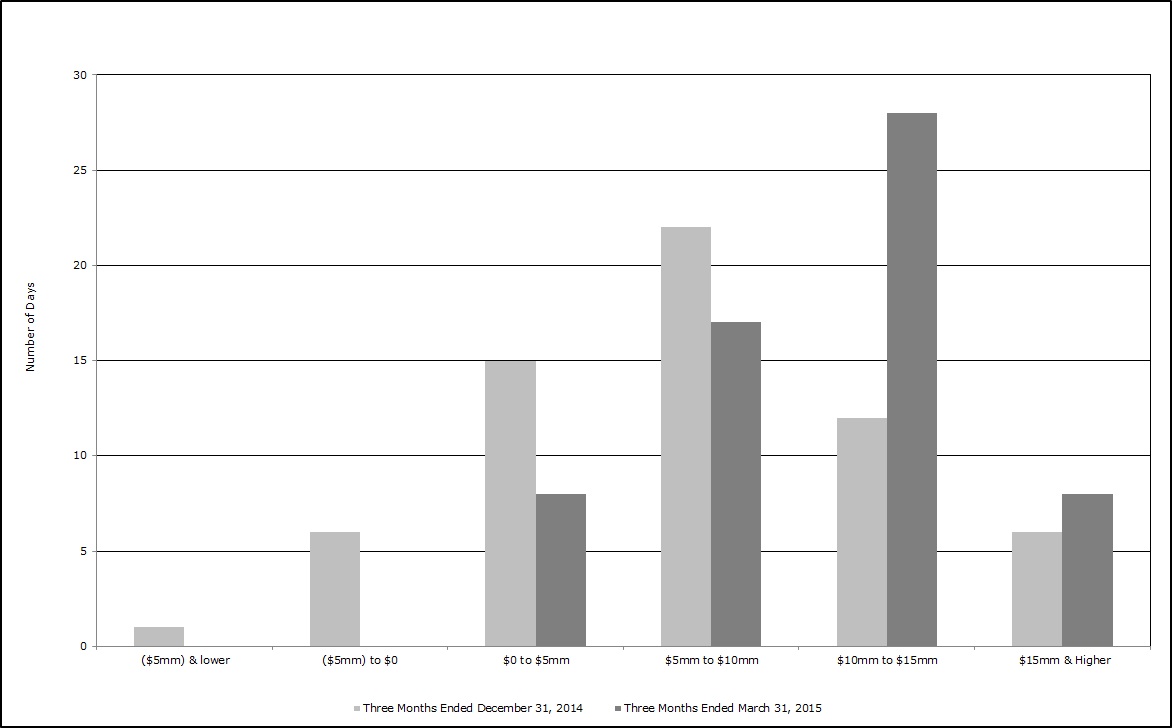
Market risk
is the risk of adverse changes in the fair value of the trading portfolios and financial instruments held by the Company due to changes in market risk factors such as interest rates, credit spreads, foreign exchange rates, equity, and commodity prices. Market risk is intrinsic to the Company’s sales and trading, market making, investing, and risk management activities.
The Company uses Value-at-Risk (VaR) metrics complemented with sensitivity analysis and stress testing in measuring and monitoring market risk. These market risk measures are monitored at both the business unit level and at aggregated levels on a daily basis. Our corporate market risk management function aggregates and monitors all exposures to ensure risk measures are within our established risk appetite. Changes to the market risk profile are analyzed and reported on a daily basis. The Company monitors various market risk exposure measures from a variety of perspectives, which include line of business, product, risk type, and legal entity.
VaR
is a statistical risk measure used to estimate the potential loss from adverse moves in the financial markets. The VaR measures assume that historical changes in market values (historical simulation analysis) are representative of the potential future outcomes and measure the expected loss over a given time interval (for example, 1 day or 10 days) within a given confidence level. Our historical simulation analysis approach uses historical observations of daily changes of each of the market risk factors from each trading day in the previous 12 months. The risk drivers of each market risk exposure are updated on a daily basis. We measure and report VaR for 1-day and 10-day holding periods at a 99% confidence level. This means that we would expect to incur single day losses greater than predicted by VaR estimates for the
measured positions one time in every 100 trading days. We treat data from all historical periods as equally relevant and consider using data for the previous 12 months as appropriate for determining VaR. We believe using a 12-month look back period helps ensure the Company’s VaR is responsive to current market conditions.
VaR measurement between different financial institutions is not readily comparable due to modeling and assumption differences from company to company. VaR measures are more useful when interpreted as an indication of trends rather than an absolute measure to be compared across financial institutions.
VaR models are subject to limitations which include, but are not limited to, the use of historical changes in market factors that may not accurately reflect future changes in market factors, and the inability to predict market liquidity in extreme market conditions. All limitations such as model inputs, model assumptions, and calculation methodology risk are monitored by the Corporate Market Risk Group and the Corporate Model Risk Group.
The VaR models measure exposure to the following categories:
|
•
|
credit risk – exposures from corporate credit spreads, asset-backed security spreads, and mortgage prepayments.
|
|
•
|
interest rate risk – exposures from changes in the level, slope, and curvature of interest rate curves and the volatility of interest rates.
|
|
•
|
equity risk – exposures to changes in equity prices and volatilities of single name, index, and basket exposures.
|
|
•
|
commodity risk – exposures to changes in commodity prices and volatilities.
|
45
|
•
|
foreign exchange risk
– exposures to changes in foreign exchange rates and volatilities.
|
VaR is the primary market risk management measure for the assets and liabilities classified as trading and is used as a supplemental analysis tool to monitor exposures classified as available for sale (AFS) and other exposures that we carry at fair value.
Trading VaR is the measure used to provide insight into the market risk exhibited by the Company’s trading positions. The Company calculates Trading VaR for risk management purposes
to establish line of business and Company-wide risk limits. Trading VaR is calculated based on all trading positions classified as trading assets or trading liabilities on our balance sheet.
Table 36 shows the results of the Company’s Trading General VaR by risk category. As presented in the table, average Trading General VaR was $18 million for the quarter ended March 31, 2015, compared with $21 million for the quarter ended December 31, 2014. The decrease was primarily driven by changes in portfolio composition.
|
Table 36: Trading 1-Day 99% General VaR Risk Category
|
||||||||||||||||||||||||
|
Quarter ended
|
||||||||||||||||||||||||
|
March 31, 2015
|
December 31, 2014
|
|||||||||||||||||||||||
|
(in millions)
|
Period
end
|
|
Average
|
|
Low
|
|
High
|
|
Period
end
|
|
Average
|
|
Low
|
|
High
|
|
||||||||
|
Company Trading General VaR Risk Categories
|
||||||||||||||||||||||||
|
Credit
|
$
|
14
|
|
11
|
|
7
|
|
19
|
|
10
|
|
14
|
|
10
|
|
19
|
|
|||||||
|
Interest rate
|
20
|
|
15
|
|
6
|
|
28
|
|
24
|
|
27
|
|
19
|
|
37
|
|
||||||||
|
Equity
|
9
|
|
10
|
|
8
|
|
11
|
|
9
|
|
8
|
|
6
|
|
12
|
|
||||||||
|
Commodity
|
1
|
|
1
|
|
—
|
|
2
|
|
1
|
|
1
|
|
1
|
|
2
|
|
||||||||
|
Foreign exchange
|
1
|
|
1
|
|
—
|
|
1
|
|
1
|
|
1
|
|
—
|
|
1
|
|
||||||||
|
Diversification benefit (1)
|
(27
|
)
|
(20
|
)
|
(23
|
)
|
(30
|
)
|
||||||||||||||||
|
Company Trading General VaR
|
$
|
18
|
|
18
|
|
22
|
|
21
|
|
|||||||||||||||
|
(1)
|
The period-end VaR was less than the sum of the VaR components described above, which is due to portfolio diversification. The diversification effect arises because the risks are not perfectly correlated causing a portfolio of positions to usually be less risky than the sum of the risks of the positions alone. The diversification benefit is not meaningful for low and high metrics since they may occur on different days.
|
Sensitivity Analysis
Given the inherent limitations of the VaR models, the Company uses other measures, including sensitivity analysis, to measure and monitor risk. Sensitivity analysis is the measure of exposure to a single risk factor, such as a 0.01% increase in interest rates or a 1% increase in equity prices. We conduct and monitor sensitivity on interest rates, credit spreads, volatility, equity, commodity, and foreign exchange exposure. Sensitivity analysis complements VaR as it provides an indication of risk relative to each factor irrespective of historical market moves.
Stress Testing
While VaR captures the risk of loss due to adverse changes in markets using recent historical market data, stress testing captures the Company’s exposure to extreme but low probability market movements. Stress scenarios estimate the risk of losses based on management’s assumptions of abnormal but severe market movements such as severe credit spread widening or a large decline in equity prices. These scenarios assume that the market moves happen instantaneously and no repositioning or hedging activity takes place to mitigate losses as events unfold (a conservative approach since experience demonstrates otherwise).
An inventory of scenarios is maintained representing both historical and hypothetical stress events that affect a broad range of market risk factors with varying degrees of correlation and differing time horizons. Hypothetical scenarios assess the impact of large movements in financial variables on portfolio values. Typical examples include a 100 basis point increase across the yield curve or a 10% decline in stock market indexes. Historical scenarios utilize an event-driven approach: the stress scenarios are based on plausible but rare events, and the analysis addresses how these events might affect the risk factors relevant to a portfolio.
The Company’s stress testing framework is also used in calculating results in support of the Federal Reserve Board’s Comprehensive Capital Analysis & Review (CCAR) and internal stress tests. Stress scenarios are regularly reviewed and updated to address potential market events or concerns. For more detail on the CCAR process, see the “Capital Management” section in this Report.
Regulatory Market Risk Capital
is based on U.S. regulatory agency risk-based capital regulations that are based on the Basel Committee Capital Accord of the Basel Committee on Banking Supervision. Prior to January 1, 2013, U.S. banking regulators’ market risk capital requirements were subject to Basel I and thereafter based on Basel 2.5. Effective January 1, 2014, the Company must calculate regulatory capital based on the Basel III market risk capital rule, which integrated Basel 2.5, and requires banking organizations with significant trading activities to adjust their capital requirements to better account for the market risks of those activities based on comprehensive and risk sensitive methods and models. The market risk capital rule is intended to cover the risk of loss in value of covered positions due to changes in market conditions.
Composition of Material Portfolio of Covered Positions
The market risk capital rule substantially modified the determination of market risk risk-weighted assets (RWAs), and implemented a more risk-sensitive methodology for the risks inherent in certain “covered” trading positions. The positions that are “covered” by the market risk capital rule are generally a subset of our trading assets and trading liabilities, specifically those held by the Company for the purpose of short-term resale or with the intent of benefiting from actual or expected short-term price movements, or to lock in arbitrage profits. Positions excluded from market risk regulatory capital treatment are subject to the
46
Asset/Liability Management (
continued
)
credit risk capital rules applicable to the “non-covered” trading positions.
The material portfolio of the Company’s “covered” positions is predominantly concentrated in the trading assets and trading liabilities managed within Wholesale Banking where the substantial portion of market risk capital is required. Wholesale Banking engages in the fixed income, traded credit, foreign exchange, equities, and commodities markets businesses. Other business segments hold small additional trading positions covered under the market risk capital rule.
Regulatory Market Risk Capital Components
The capital required for market risk on the Company’s “covered” positions is determined by internally developed models or standardized specific risk charges. The market risk regulatory capital models are subject to internal model risk management and validation. The models are continuously monitored and enhanced in response to changes in market conditions, improvements in system capabilities, and changes in the Company’s market risk exposure. The Company is required to obtain and has received prior written approval from its regulators before using its
internally developed models to calculate the market risk capital charge.
Basel III prescribes various VaR measures in the determination of regulatory capital and RWAs. The Company uses the same VaR models for both market risk management purposes as well as regulatory capital calculations. For regulatory purposes, we use the following metrics to determine the Company’s market risk capital requirements:
General VaR
measures the risk of broad market movements such as changes in the level of credit spreads, interest rates, equity prices, commodity prices, and foreign exchange rates. General VaR uses historical simulation analysis based on 99% confidence level and a 10-day time horizon.
Table 37 shows the General VaR measure categorized by major risk categories. Average 10-day Company Regulatory General VaR was $20 million for the quarter ended March 31, 2015, compared with $36 million for the quarter ended December 31, 2014. The decrease was primarily driven by changes in portfolio composition.
|
Table 37: Regulatory 10-Day 99% General VaR by Risk Category
|
||||||||||||||||||||||||
|
Quarter ended
|
||||||||||||||||||||||||
|
March 31, 2015
|
December 31, 2014
|
|||||||||||||||||||||||
|
(in millions)
|
Period
end
|
|
Average
|
|
Low
|
|
High
|
|
Period
end
|
|
Average
|
|
Low
|
|
High
|
|
||||||||
|
Wholesale Regulatory General VaR Risk Categories
|
||||||||||||||||||||||||
|
Credit
|
$
|
30
|
|
33
|
|
23
|
|
42
|
|
34
|
|
45
|
|
34
|
|
52
|
|
|||||||
|
Interest rate
|
56
|
|
50
|
|
26
|
|
94
|
|
66
|
|
68
|
|
48
|
|
96
|
|
||||||||
|
Equity
|
11
|
|
10
|
|
4
|
|
19
|
|
9
|
|
10
|
|
4
|
|
16
|
|
||||||||
|
Commodity
|
2
|
|
2
|
|
1
|
|
4
|
|
3
|
|
3
|
|
1
|
|
7
|
|
||||||||
|
Foreign exchange
|
7
|
|
4
|
|
1
|
|
7
|
|
4
|
|
3
|
|
1
|
|
11
|
|
||||||||
|
Diversification benefit (1)
|
(87
|
)
|
(79
|
)
|
(81
|
)
|
(92
|
)
|
||||||||||||||||
|
Wholesale Regulatory General VaR
|
$
|
19
|
|
20
|
|
12
|
|
43
|
|
35
|
|
37
|
|
22
|
|
54
|
|
|||||||
|
Company Regulatory General VaR
|
19
|
|
20
|
|
11
|
|
43
|
|
35
|
|
36
|
|
23
|
|
54
|
|
||||||||
|
(1)
|
The period-end VaR was less than the sum of the VaR components described above, which is due to portfolio diversification. The diversification benefit arises because the risks are not perfectly correlated causing a portfolio of positions to usually be less risky than the sum of the risks of the positions alone. The diversification benefit is not meaningful for low and high metrics since they may occur on different days.
|
Specific Risk
measures the risk of loss that could result from factors other than broad market movements, or name-specific market risk. Specific Risk uses Monte Carlo simulation analysis based on a 99% confidence level and a 10-day time horizon.
Total VaR
(as presented in Table 38) is composed of General VaR and Specific Risk and uses the previous 12 months of historical market data to comply with regulatory requirements.
Total Stressed VaR
(as presented in Table 38) uses a historical period of significant financial stress over a continuous 12 month period using historically available market data and is composed of Stressed General VaR and Stressed Specific Risk. Total Stressed VaR uses the same methodology and models as Total VaR.
Incremental Risk Charge
according to the market risk capital rule, must capture losses due to both issuer default and migration risk at the 99.9% confidence level over the one-year capital horizon under the assumption of constant level of risk or a constant position assumption. The model covers all non-securitized credit-sensitive products.
The Company calculates Incremental Risk by generating a portfolio loss distribution using Monte Carlo simulation, which assumes numerous scenarios, where an assumption is made that the portfolio’s composition remains constant for a one-year time horizon. Individual issuer credit grade migration and issuer default risk is modeled through generation of the issuer’s credit rating transition based upon statistical modeling. Correlation between credit grade migration and default is captured by a multifactor proprietary model which takes into account industry classifications as well as regional effects. Additionally, the impact of market and issuer specific concentrations is reflected in the modeling framework by assignment of a higher charge for portfolios that have increasing concentrations in particular issuers or sectors. Lastly, the model captures product basis risk; that is, it reflects the material disparity between a position and its hedge.
Table 38 provides information on Total VaR, Total Stressed VaR and the Incremental Risk Charge results for the quarter ended March 31, 2015. For the Incremental Risk Charge, the required capital for market risk at quarter end equals the quarter end results.
47
|
Table 38: Market Risk Regulatory Capital Modeled Components
|
||||||||||||||||||
|
Quarter ended March 31, 2015
|
March 31, 2015
|
|||||||||||||||||
|
(in millions)
|
Average
|
|
Low
|
|
High
|
|
Quarter end
|
|
Risk-
based capital (1) |
|
Risk-
weighted assets (1) |
|
||||||
|
Total VaR
|
$
|
49
|
|
44
|
|
58
|
|
53
|
|
147
|
|
1,836
|
|
|||||
|
Total Stressed VaR
|
347
|
|
255
|
|
543
|
|
301
|
|
1,041
|
|
13,009
|
|
||||||
|
Incremental Risk Charge
|
347
|
|
296
|
|
402
|
|
378
|
|
378
|
|
4,731
|
|
||||||
|
(1)
|
Results represent the risk-based capital and RWAs based on the VaR and Incremental Risk Charge models.
|
Securitized Products Charge
Basel III requires a separate market risk capital charge for positions classified as a securitization or re-securitization. The primary criteria for classification as a securitization are whether there is a transfer of risk and whether the credit risk associated with the underlying exposures has been separated into at least two tranches reflecting different levels of seniority. Covered trading securitizations positions include consumer and commercial asset-backed securities (ABS), commercial mortgage-backed securities (CMBS), residential mortgage-backed securities (RMBS), and collateralized loan and other debt obligations (CLO/CDO) positions. The securitization capital requirements are the greater of the capital requirements of the net long or short exposure, and are capped at the maximum loss that could be incurred on any given transaction.
Table 39 shows the aggregate net fair market value of securities and derivative securitization positions by exposure type that meet the regulatory definition of a covered trading securitization position at
March 31, 2015, and December 31, 2014.
|
Table 39: Covered Securitization Positions by Exposure Type (Market Value)
|
||||||||||||
|
(in millions)
|
ABS
|
|
CMBS
|
|
RMBS
|
|
CLO/CDO
|
|
||||
|
March 31, 2015
|
||||||||||||
|
Securitization exposure:
|
||||||||||||
|
Securities
|
$
|
620
|
|
673
|
|
839
|
|
510
|
|
|||
|
Derivatives
|
6
|
|
7
|
|
20
|
|
(31
|
)
|
||||
|
Total
|
$
|
626
|
|
680
|
|
859
|
|
479
|
|
|||
|
December 31, 2014
|
||||||||||||
|
Securitization exposure:
|
||||||||||||
|
Securities
|
$
|
752
|
|
709
|
|
689
|
|
553
|
|
|||
|
Derivatives
|
(1
|
)
|
5
|
|
23
|
|
(31
|
)
|
||||
|
Total
|
$
|
751
|
|
714
|
|
712
|
|
522
|
|
|||
SECURITIZATION DUE DILIGENCE AND RISK MONITORING
The market risk capital rule requires that the Company conduct due diligence on the risk of each position within three days of the purchase of a securitization position. The Company’s due diligence on the creditworthiness of each position provides an understanding of the features that would materially affect the performance of a securitization or re-securitization. The due diligence analysis is performed again on a quarterly basis for each
securitization and re-securitization position.
The Company uses an automated solution to track the due diligence associated with securitization activity.
The Company aims to manage the risks associated with securitization and re-securitization positions through the use of offsetting positions and portfolio diversification.
Standardized Specific Risk Charge
For debt and equity positions that are not evaluated by the approved internal specific risk models, a regulatory prescribed standard specific risk charge is applied. The standard specific risk add-on for sovereign entities, public sector entities, and depository institutions is based on the Organization for Economic Co-operation and Development (OECD) country risk classifications (CRC) and the remaining contractual maturity of the position. These risk add-ons for debt positions range from 0.25% to 12%. The add-on for corporate debt is based on creditworthiness and the remaining contractual maturity of the position. All other types of debt positions are subject to an 8% add-on. The standard specific risk add-on for equity positions is generally 8%.
Comprehensive Risk Charge / Correlation Trading
The market risk capital rule requires capital for correlation trading positions. The Company's remaining correlation trading exposure covered under the market risk capital rule matured in fourth quarter 2014.
Table 40 summarizes the market risk-based capital requirements charge and market RWAs in accordance with the Basel III market risk capital rule as of March 31, 2015, and as of December 31, 2014. The market RWAs are calculated as the sum of the components in the table below.
48
Asset/Liability Management (
continued
)
|
Table 40: Market Risk Regulatory Capital and RWAs
|
||||||||||||
|
March 31, 2015
|
December 31, 2014
|
|||||||||||
|
(in millions)
|
Risk-
based
capital
|
|
Risk-
weighted
assets
|
|
Risk-
based
capital
|
|
Risk-
weighted
assets
|
|
||||
|
Total VaR
|
$
|
147
|
|
1,836
|
|
146
|
|
1,822
|
|
|||
|
Total Stressed VaR
|
1,041
|
|
13,009
|
|
1,469
|
|
18,359
|
|
||||
|
Incremental Risk Charge
|
378
|
|
4,731
|
|
345
|
|
4,317
|
|
||||
|
Securitized Products Charge
|
713
|
|
8,916
|
|
766
|
|
9,577
|
|
||||
|
Standardized Specific Risk Charge
|
1,499
|
|
18,736
|
|
1,177
|
|
14,709
|
|
||||
|
De minimis Charges (positions not included in models)
|
29
|
|
361
|
|
66
|
|
829
|
|
||||
|
Total
|
$
|
3,807
|
|
47,589
|
|
3,969
|
|
49,613
|
|
|||
RWA Rollforward
Table 41
depicts the changes in the market risk regulatory capital and RWAs under Basel III for the first quarter of
2015.
|
Table 41: Analysis of Changes in Market Risk Regulatory Capital and RWAs
|
||||||
|
(in millions)
|
Risk-
based
capital
|
|
Risk-
weighted
assets
|
|
||
|
Balance, December 31, 2014
|
3,969
|
|
49,613
|
|
||
|
Total VaR
|
1
|
|
14
|
|
||
|
Total Stressed VaR
|
(428
|
)
|
(5,350
|
)
|
||
|
Incremental Risk Charge
|
33
|
|
414
|
|
||
|
Securitized Products Charge
|
(53
|
)
|
(661
|
)
|
||
|
Standardized Specific Risk Charge
|
322
|
|
4,027
|
|
||
|
De minimis Charges
|
(37
|
)
|
(468
|
)
|
||
|
Balance, March 31, 2015
|
$
|
3,807
|
|
47,589
|
|
|
All changes to market risk regulatory capital and RWAs in the quarter ended March 31, 2015, were associated with changes in positions due to normal trading activity.
49
VaR
Backtesting
The market risk capital rule requires backtesting as one form of validation of the VaR model. Backtesting is a comparison of the daily VaR estimate with the actual clean profit and loss (clean P&L) as defined by the market risk capital rule. Clean P&L is the change in the value of the Company’s covered trading positions that would have occurred had previous end-of-day covered trading positions remained unchanged (therefore, excluding fees, commissions, net interest income, and intraday trading gains and losses). The backtesting analysis compares the daily Total VaR for each of the trading days in the preceding 12 months with the net clean P&L. Clean P&L does not include credit adjustments and other activity not representative of daily price changes driven by market risk factors. The clean P&L measure of revenue is used to evaluate the performance of the Total VaR and is not comparable to our actual daily trading net revenues, as reported elsewhere in this Report.
Any observed clean P&L loss in excess of the Total VaR is considered a market risk regulatory capital backtesting exception.
The actual number of exceptions (that is, the number of business days for which the clean P&L losses exceed the corresponding 1-day, 99% Total VaR measure) over the preceding 12 months is used to determine the capital multiplier for the capital calculation. The number of actual backtesting exceptions is dependent on current market performance relative to historic market volatility. This capital multiplier increases from a minimum of three to a maximum of four, depending on the number of exceptions. No backtesting exceptions occurred over the preceding 12 months. Backtesting is also performed at granular levels within the Company with sub-portfolio results provided to federal regulators.
Table 42 shows daily Total VaR (1-day, 99%) used for regulatory market risk capital backtesting for the 12 months ended March 31, 2015. The Company’s average Total VaR for first quarter 2015 was $20 million with a low of $18 million and a high of $22 million.
Table 42: Daily Total 1-Day 99% VaR Measure (Rolling 12 Months)

Market Risk Governance
The Finance Committee of our Board has primary oversight over market risk-taking activities of the Company and reviews the acceptable market risk appetite. The Corporate Risk Group’s Market Risk Committee, which reports to the Finance Committee of the Board, is responsible for governance and oversight over market risk-taking activities across the Company as well as the establishment of market risk appetite and associated limits. The Corporate Market Risk Group, which is part of the Corporate Risk Group, administers and monitors compliance with the requirements established by the Market Risk Committee. The Corporate Market Risk Group has oversight responsibilities in identifying, measuring and monitoring the Company’s market risk. The group is responsible for developing corporate market risk policy, creating quantitative market risk models, establishing independent risk limits, calculating and analyzing market risk capital, and reporting aggregated and line-of-business market risk information. Limits are regularly reviewed to ensure they remain relevant and within
the market risk appetite for the Company. An automated limits-monitoring system enables a daily comprehensive review of multiple limits mandated across businesses. Limits are set with inner boundaries that will be periodically breached to promote an ongoing dialogue of risk exposure within the Company. Each line of business that exposes the Company to market risk has direct responsibility for managing market risk in accordance with defined risk tolerances and approved market risk mandates and hedging strategies. We measure and monitor market risk for both management and regulatory capital purposes.
Model Risk Management
The market risk capital models are governed by our Corporate Model Risk Committee (CMoR) policies and procedures, which include model validation. The purpose of model validation includes ensuring the model is appropriate for its intended use and that appropriate controls exist to help mitigate the risk of invalid results. Model validation assesses the adequacy and appropriateness of the model,
50
Asset/Liability Management (
continued
)
including reviewing its key components such as inputs, processing components, logic or theory, output results and supporting model documentation. Validation also includes ensuring significant unobservable model inputs are appropriate given observable market transactions or other market data within the same or similar asset classes. This ensures modeled approaches are appropriate given similar product valuation techniques and are in line with their intended purpose. The Corporate Model Risk group provides oversight of model validation and assessment processes.
All internal valuation models are subject to ongoing review by business-unit-level management, and all models are subject to additional oversight by a corporate-level risk management department. Corporate oversight responsibilities include evaluating the adequacy of business unit risk management programs, maintaining company-wide model validation policies and standards, and reporting the results of these activities to management.
MARKET RISK - EQUITY INVESTMENTS
We are directly and indirectly affected by changes in the equity markets. We make and manage direct equity investments in start-up businesses, emerging growth companies, management buy-outs, acquisitions and corporate recapitalizations. We also invest in non-affiliated funds that make similar private equity investments. These private equity investments are made within capital allocations approved by management and the Board. The Board’s policy is to review business developments, key risks and historical returns for the private equity investment portfolio at least annually. Management reviews these investments at least quarterly and assesses them for possible OTTI. For nonmarketable investments, the analysis is based on facts and circumstances of each individual investment and the expectations for that investment’s cash flows and capital needs, the viability of its business model and our exit strategy. Nonmarketable investments include private equity investments accounted for under the cost method, equity method and fair value option.
As part of our business to support our customers, we trade public equities, listed/OTC equity derivatives and convertible bonds. We have parameters that govern these activities. We also have marketable equity securities in the available-for-sale securities portfolio, including securities relating to our venture capital activities. We manage these investments within capital risk limits approved by management and the Board and monitored by Corporate ALCO. Gains and losses on these securities are recognized in net income when realized and periodically include OTTI charges.
Changes in equity market prices may also indirectly affect our net income by (1) the value of third party assets under management and, hence, fee income, (2) borrowers whose ability to repay principal and/or interest may be affected by the stock market, or (3) brokerage activity, related commission income and other business activities. Each business line monitors and manages these indirect risks.
Table 43 provides information regarding our marketable and nonmarketable equity investments as of March 31, 2015, and December 31, 2014.
|
Table 43: Nonmarketable and Marketable Equity Investments
|
||||||
|
Mar 31,
|
|
Dec 31,
|
|
|||
|
(in millions)
|
2015
|
|
2014
|
|
||
|
Nonmarketable equity investments:
|
||||||
|
Cost method:
|
||||||
|
Private equity and other
|
$
|
2,187
|
|
2,300
|
|
|
|
Federal bank stock
|
4,725
|
|
4,733
|
|
||
|
Total cost method
|
6,912
|
|
7,033
|
|
||
|
Equity method:
|
||||||
|
LIHTC investments (1)
|
7,464
|
|
7,278
|
|
||
|
Private equity and other
|
5,121
|
|
5,132
|
|
||
|
Total equity method
|
12,585
|
|
12,410
|
|
||
|
Fair value (2)
|
2,549
|
|
2,512
|
|
||
|
Total nonmarketable equity investments (3)
|
$
|
22,046
|
|
21,955
|
|
|
|
Marketable equity securities:
|
||||||
|
Cost
|
$
|
1,919
|
|
1,906
|
|
|
|
Net unrealized gains
|
1,585
|
|
1,770
|
|
||
|
Total marketable equity securities (4)
|
$
|
3,504
|
|
3,676
|
|
|
|
(1)
|
Represents low income housing tax credit investments.
|
|
(2)
|
Represents nonmarketable equity investments for which we have elected the fair value option. See Note 6 (Other Assets) and Note 13 (Fair Values of Assets and Liabilities) to Financial Statements in this Report for additional information.
|
|
(3)
|
Included in other assets on the balance sheet. See Note 6 (Other Assets) to Financial Statements in this Report for additional information.
|
|
(4)
|
Included in available-for-sale securities. See Note 4 (Investment Securities) to Financial Statements in this Report for additional information.
|
51
LIQUIDITY AND FUNDING
The objective of effective liquidity management is to ensure that we can meet customer loan requests, customer deposit maturities/withdrawals and other cash commitments efficiently under both normal operating conditions and under periods of Wells Fargo-specific and/or market stress. To achieve this objective, the Board of Directors establishes liquidity guidelines that require sufficient asset-based liquidity to cover potential funding requirements and to avoid over-dependence on volatile, less reliable funding markets. These guidelines are monitored on a monthly basis by the Corporate ALCO and on a quarterly basis by the Board of Directors. These guidelines are established and monitored for both the consolidated company and for the Parent on a stand-alone basis to ensure that the Parent is a source of strength for its regulated, deposit-taking banking subsidiaries.
We maintain liquidity in the form of cash, cash equivalents and unencumbered high-quality, liquid securities. These assets
make up our primary sources of liquidity, which are presented in Table 44. Our cash is primarily on deposit with the Federal Reserve. Securities included as part of our primary sources of liquidity are comprised of U.S. Treasury and federal agency debt, and mortgage-backed securities issued by federal agencies within our investment securities portfolio. We believe these securities provide quick sources of liquidity through sales or by pledging to obtain financing, regardless of market conditions. Some of these securities are within the held-to-maturity portion of our investment securities portfolio and as such are not intended for sale but may be pledged to obtain financing. Some of the legal entities within our consolidated group of companies are subject to various regulatory, tax, legal and other restrictions that can limit the transferability of their funds. We believe we maintain adequate liquidity at these entities in consideration of such funds transfer restrictions.
|
Table 44: Primary Sources of Liquidity
|
|||||||||||||||||||
|
March 31, 2015
|
December 31, 2014
|
||||||||||||||||||
|
(in millions)
|
Total
|
|
Encumbered
|
|
Unencumbered
|
|
Total
|
|
Encumbered
|
|
Unencumbered
|
|
|||||||
|
Interest-earning deposits
|
$
|
250,354
|
|
—
|
|
250,354
|
|
$
|
219,220
|
|
—
|
|
219,220
|
|
|||||
|
Securities of U.S. Treasury and federal agencies (1)
|
75,707
|
|
3,361
|
|
72,346
|
|
67,352
|
|
856
|
|
66,496
|
|
|||||||
|
Mortgage-backed securities of federal agencies (2)
|
117,689
|
|
67,059
|
|
50,630
|
|
115,730
|
|
80,324
|
|
35,406
|
|
|||||||
|
Total
|
$
|
443,750
|
|
70,420
|
|
373,330
|
|
$
|
402,302
|
|
81,180
|
|
321,122
|
|
|||||
|
(1)
|
Included in encumbered securities at
December 31, 2014
, were securities with a fair value of
$152 million
which were purchased in December 2014, but settled in January 2015.
|
|
(2)
|
Included in encumbered securities at
March 31, 2015
, were securities with a fair value of
$291 million
, which were purchased in March 2015, but settled in April 2015. Included in encumbered securities at
December 31, 2014
, were securities with a fair value of
$5 million
, which were purchased in December 2014, but settled in January 2015.
|
In addition to our primary sources of liquidity shown in Table 44, liquidity is also available through the sale or financing of other securities including trading and/or available-for-sale securities, as well as through the sale, securitization or financing of loans, to the extent such securities and loans are not encumbered. In addition, other securities in our held-to-maturity portfolio, to the extent not encumbered, may be pledged to obtain financing.
Core customer deposits have historically provided a sizeable source of relatively stable and low-cost funds. At
March 31, 2015
, core deposits were
126%
of total loans compared with
122%
at
December 31, 2014
. Additional funding is provided by long-term debt, other foreign deposits, and short-term borrowings.
Table 45 shows selected information for short-term borrowings, which generally mature in less than 30 days.
52
Asset/Liability Management (
continued
)
|
Table 45: Short-Term Borrowings
|
|||||||||||||||
|
Quarter ended
|
|||||||||||||||
|
(in millions)
|
Mar 31
2015 |
|
Dec 31,
2014 |
|
Sep 30,
2014 |
|
Jun 30,
2014 |
|
Mar 31,
2014 |
|
|||||
|
Balance, period end
|
|||||||||||||||
|
Federal funds purchased and securities sold under agreements to repurchase
|
$
|
64,400
|
|
51,052
|
|
48,164
|
|
45,379
|
|
39,254
|
|
||||
|
Commercial paper
|
3,552
|
|
2,456
|
|
4,365
|
|
4,261
|
|
6,070
|
|
|||||
|
Other short-term borrowings
|
9,745
|
|
10,010
|
|
10,398
|
|
12,209
|
|
11,737
|
|
|||||
|
Total
|
$
|
77,697
|
|
63,518
|
|
62,927
|
|
61,849
|
|
57,061
|
|
||||
|
Average daily balance for period
|
|||||||||||||||
|
Federal funds purchased and securities sold under agreements to repurchase
|
$
|
58,881
|
|
51,509
|
|
47,088
|
|
42,233
|
|
37,711
|
|
||||
|
Commercial paper
|
3,040
|
|
3,511
|
|
4,587
|
|
5,221
|
|
5,713
|
|
|||||
|
Other short-term borrowings
|
9,791
|
|
9,656
|
|
10,610
|
|
11,391
|
|
11,078
|
|
|||||
|
Total
|
$
|
71,712
|
|
64,676
|
|
62,285
|
|
58,845
|
|
54,502
|
|
||||
|
Maximum month-end balance for period
|
|||||||||||||||
|
Federal funds purchased and securities sold under agreements to repurchase (1)
|
$
|
66,943
|
|
51,052
|
|
48,164
|
|
45,379
|
|
39,589
|
|
||||
|
Commercial paper (2)
|
3,552
|
|
3,740
|
|
4,665
|
|
5,175
|
|
6,070
|
|
|||||
|
Other short-term borrowings (3)
|
10,068
|
|
10,010
|
|
10,990
|
|
12,209
|
|
11,737
|
|
|||||
|
(1)
|
Highest month-end balance in each of the last five quarters was in
February
2015 and December, September, June and February 2014.
|
|
(2)
|
Highest month-end balance in each of the last five quarters was in
March
2015 and November, July, April and March 2014.
|
|
(3)
|
Highest month-end balance in each of the last five quarters was in
February
2015 and December, July, June and March 2014.
|
We access domestic and international capital markets for long-term funding (generally greater than one year) through issuances of registered debt securities, private placements and asset-backed secured funding. Investors in the long-term capital markets, as well as other market participants, generally will consider, among other factors, a company’s debt rating in making investment decisions. Rating agencies base their ratings on many quantitative and qualitative factors, including capital adequacy, liquidity, asset quality, business mix, the level and quality of earnings, and rating agency assumptions regarding the probability and extent of federal financial assistance or support for certain large financial institutions. Adverse changes in these factors could result in a reduction of our credit rating; however, our debt securities do not contain credit rating covenants.
In light of industry changes and regulatory developments related to the Title II Orderly Liquidation Authority of the Dodd-Frank Act, rating agencies have proposed changes to various aspects of their ratings methodologies. Moody’s Investors Service (Moody's) has recently adopted a new global bank rating methodology, which considers how each type of creditor would be affected in any bank failure. As a result of this new methodology, certain of our ratings have been placed under review for possible upgrade, including Wells Fargo Bank, N.A.'s deposit rating as well as its senior and subordinated debt ratings. At the Parent level, Moody's rating for our non-cumulative preferred stock is likewise under review for possible upgrade. Standard and Poor’s Ratings Services (S&P) is continuing its reassessment of whether to incorporate the likelihood of extraordinary government support into the ratings of eight bank holding companies, including the Parent. S&P has indicated that this reassessment will be finalized sometime in 2015. In addition, S&P has issued a proposal to incorporate into its bank-level rating methodology an assessment of additional capital available to absorb losses to reduce default risk. Both the Parent and Wells Fargo Bank, N.A. remain among the top-rated financial firms in the U.S.
See the “Risk Factors” section in our 2014 Form 10-K for additional information on the potential impact a credit rating downgrade would have on our liquidity and operations, as well as Note 12 (Derivatives) to Financial Statements in this Report for information regarding additional collateral and funding obligations required for certain derivative instruments in the event our credit ratings were to fall below investment grade.
The credit ratings of the Parent and Wells Fargo Bank, N.A. as of
March 31, 2015
, are presented in Table 46.
53
|
Table 46: Credit Ratings as of March 31, 2015
|
|||||||
|
Wells Fargo & Company
|
Wells Fargo Bank, N.A.
|
||||||
|
Senior debt
|
Short-term
borrowings
|
Long-term
deposits
|
Short-term
borrowings
|
||||
|
Moody's
|
A2
|
P-1
|
Aa3
|
P-1
|
|||
|
S&P
|
A+
|
A-1
|
AA-
|
A-1+
|
|||
|
Fitch Ratings, Inc.
|
AA-
|
F1+
|
AA
|
F1+
|
|||
|
DBRS
|
AA
|
R-1*
|
AA**
|
R-1**
|
|||
|
* middle **high
|
|||||||
On September 3, 2014, the FRB, OCC and FDIC issued a final rule that implements a quantitative liquidity requirement consistent with the liquidity coverage ratio (LCR) established by the Basel Committee on Banking Supervision (BCBS). The rule requires banking institutions, such as Wells Fargo, to hold high-quality liquid assets, such as central bank reserves and government and corporate debt that can be converted easily and quickly into cash, in an amount equal to or greater than its projected net cash outflows during a 30-day stress period. The final LCR rule will be phased-in beginning January 1, 2015, and requires full compliance with a minimum 100% LCR by January 1, 2017. The FRB also recently finalized rules imposing enhanced liquidity management standards on large bank holding companies (BHC) such as Wells Fargo. We continue to analyze these rules and other regulatory proposals that may affect liquidity risk management to determine the level of operational or compliance impact to Wells Fargo. For additional information see the “Capital Management” and “Regulatory Reform” sections in this Report and in our 2014 Form 10-K.
Parent
Under SEC rules, our Parent is classified as a “well-known seasoned issuer,” which allows it to file a registration statement that does not have a limit on issuance capacity. In May 2014, the Parent filed a registration statement with the SEC for the issuance of senior and subordinated notes, preferred stock and other securities. The Parent’s ability to issue debt and other securities under this registration statement is limited by the debt issuance authority granted by the Board. The Parent is currently authorized by the Board to issue
$60 billion
in outstanding short-term debt and
$170 billion
in outstanding long-term debt. At
March 31, 2015
, the Parent had available
$38.4 billion
in short-term debt issuance authority and
$64.7 billion
in long-term debt issuance authority. The Parent’s debt issuance authority granted by the Board includes short-term and long-term debt issued to affiliates. During
first quarter 2015
, the Parent issued
$5.3 billion
of senior notes, of which
all
but $20 million were registered with the SEC. In addition, in April and May of 2015, the Parent issued
$3.5 billion
of senior notes, of which $2.3 billion were registered with the SEC.
The Parent’s proceeds from securities issued were used for general corporate purposes, and, unless otherwise specified in the applicable prospectus or prospectus supplement, we expect the proceeds from securities issued in the future will be used for the same purposes. Depending on market conditions, we may purchase our outstanding debt securities from time to time in privately negotiated or open market transactions, by tender offer, or otherwise.
Table 47 provides information regarding the Parent’s medium-term note (MTN) programs, which are covered by the long-term debt issuance authority granted by the Board. The Parent may issue senior and subordinated debt securities under Series N & O, and the European and Australian programmes. Under Series K, the Parent may issue senior debt securities linked
to one or more indices or bearing interest at a fixed or floating rate.
|
Table 47: Medium-Term Note (MTN) Programs
|
||||||||||||
|
March 31, 2015
|
||||||||||||
|
(in billions)
|
Date
established
|
Debt
issuance
authority
|
|
Available
for
issuance
|
|
|||||||
|
MTN program:
|
||||||||||||
|
Series N & O (1) (2)
|
May 2014
|
(2)
|
|
(2)
|
|
|||||||
|
Series K (1) (3)
|
April 2010
|
$
|
25.0
|
|
$
|
21.7
|
|
|||||
|
European (4) (5)
|
December 2009
|
25.0
|
|
12.0
|
|
|||||||
|
European (4) (6)
|
August 2013
|
10.0
|
|
9.2
|
|
|||||||
|
Australian (4) (7)
|
June 2005
|
AUD
|
10.0
|
|
7.8
|
|
||||||
|
(1)
|
SEC registered.
|
|
(2)
|
The Parent can issue an indeterminate amount of debt securities, subject to the long-term debt issuance authority granted by the Board described above.
|
|
(3)
|
As amended in April 2012 and March 2015.
|
|
(4)
|
Not registered with the SEC. May not be offered in the United States without applicable exemptions from registration.
|
|
(5)
|
As amended in April 2012, April 2013, April 2014 and March 2015. For securities to be admitted to listing on the Official List of the United Kingdom Financial Conduct Authority and to trade on the Regulated Market of the London Stock Exchange.
|
|
(6)
|
As amended in May 2014 and April 2015, for securities that will not be admitted to listing, trading and/or quotation by any stock exchange or quotation system, or will be admitted to listing, trading and/or quotation by a stock exchange or quotation system that is not considered to be a regulated market.
|
|
(7)
|
As amended in October 2005, March 2010 and September 2013.
|
Wells Fargo Bank, N.A.
Wells Fargo Bank, N.A. is authorized by its board of directors to issue
$100 billion
in outstanding short-term debt and
$125 billion
in outstanding long-term debt. At
March 31, 2015
, Wells Fargo Bank, N.A. had available
$100 billion
in short-term debt issuance authority and
$65.3 billion
in long-term debt issuance authority. In April 2015, Wells Fargo Bank, N.A. replaced its existing bank note program with a
$100 billion
bank note program under which, subject to any other debt outstanding under the limits described above, it may issue
$50 billion
in outstanding short-term senior notes and
$50 billion
in outstanding long-term senior or subordinated notes. At
March 31, 2015
, Wells Fargo Bank, N.A. had remaining issuance capacity under the prior bank note program of
$50 billion
in short-term senior notes and
$33.5 billion
in long-term senior or subordinated notes. In addition, during
first quarter 2015
, Wells Fargo Bank, N.A. had outstanding advances of
$34.1 billion
across the Federal Home Loan Bank System.
Wells Fargo Canada Corporation
In February 2014, Wells Fargo Canada Corporation (WFCC), an indirect wholly owned Canadian subsidiary of the Parent, qualified with the Canadian provincial securities commissions a base shelf prospectus for the distribution from time to time in Canada of up to
$7.0 billion
Canadian dollars (CAD) in medium-term notes. At
March 31, 2015
, CAD
$7.0 billion
still remained available for future issuance under this prospectus. All medium-term notes issued by WFCC are unconditionally guaranteed by the Parent.
54
Asset/Liability Management (
continued
)
FEDERAL HOME LOAN BANK MEMBERSHIP
The Federal Home Loan Banks (the FHLBs) are a group of cooperatives that lending institutions use to finance housing and economic development in local communities. We are a member of the FHLBs based in Dallas, Des Moines and San Francisco. Each member of the FHLBs is required to maintain a minimum investment in capital stock of the applicable FHLB. The board of directors of each FHLB can increase the minimum investment requirements in the event it has concluded that additional capital is required to allow it to meet its own regulatory capital requirements. Any increase in the minimum investment requirements outside of specified ranges requires the approval of the Federal Housing Finance Board. Because the extent of any obligation to increase our investment in any of the FHLBs depends entirely upon the occurrence of a future event, potential future payments to the FHLBs are not determinable.
55
|
Capital Management
|
We have an active program for managing capital through a comprehensive process for assessing the Company’s overall capital adequacy. Our objective is to maintain capital at an amount commensurate with our risk profile and risk tolerance objectives, and to meet both regulatory and market expectations. Our potential sources of capital primarily include retention of earnings net of dividends, as well as issuances of common and preferred stock. Retained earnings increased
$3.6 billion
from
December 31, 2014
, predominantly from Wells Fargo net income of
$5.8 billion
, less common and preferred stock dividends of
$2.2 billion
. During
first
quarter
2015
, we issued
41.0 million
shares of common stock. We also issued 2 million Depositary Shares, each representing 1/25
th
interest in a share of the Company’s newly issued 5.875% Fixed-to-Floating Rate Non-Cumulative Perpetual Class A Preferred Stock, Series U, for an aggregate public offering price of $2.0 billion. During
first
quarter
2015
, we repurchased
48.4 million
shares of common stock in open market transactions, private transactions and from employee benefit plans, at a cost of
$2.6 billion
.
We also entered into a $750 million forward repurchase contract in January 2015 with an unrelated third party that settled in April 2015 for 14.0 million shares. In addition, we entered into another $750 million forward repurchase contract with an unrelated third party in April 2015 that is expected to settle before August 2015 for approximately 14 million shares.
For additional information about our forward repurchase agreements, see Note 1 (Summary of Significant Accounting Policies) to Financial Statements in this Report.
Regulatory Capital Guidelines
The Company and each of our insured depository institutions are subject to various regulatory capital adequacy requirements administered by the FRB and the OCC. Risk-based capital (RBC) guidelines establish a risk-adjusted ratio relating capital to different categories of assets and off-balance sheet exposures. At
March 31, 2015
, the Company and each of our insured depository institutions were “well-capitalized” under applicable regulatory capital adequacy guidelines. See Note 19 (Regulatory and Agency Capital Requirements) to Financial Statements in this Report for additional information. Also see the "Capital Management" section in our 2014 Form 10-K for background and history of the various regulatory capital adequacy rules, minimum regulatory requirements and transition periods we follow.
In December 2010, the Basel Committee on Banking Supervision (BCBS) finalized a set of revised international guidelines for determining regulatory capital known as “Basel III.” These guidelines were developed in response to the 2008 financial crisis and were intended to address many of the weaknesses identified in the previous Basel standards, as well as in the banking sector that contributed to the crisis including excessive leverage, inadequate and low quality capital and insufficient liquidity buffers.
In July 2013, federal banking regulators approved final and interim final rules to implement the BCBS Basel III capital guidelines for U.S. banking organizations. These final capital rules, among other things:
|
•
|
implement in the United States the Basel III regulatory capital reforms including those that revise the definition of capital, increase minimum capital ratios, and introduce a minimum Common Equity Tier 1 (CET1) ratio of 4.5% and a capital conservation buffer of 2.5% (for a total minimum CET1 ratio of 7.0%) and a potential countercyclical buffer of
|
up to 2.5%, which would be imposed by regulators at their discretion if it is determined that a period of excessive credit growth is contributing to an increase in systemic risk;
|
•
|
require a Tier 1 capital to average total consolidated assets ratio of 4% and introduce, for large and internationally active bank holding companies (BHCs), a Tier 1 supplementary leverage ratio of 3% that incorporates off-balance sheet exposures;
|
|
•
|
revise Basel I rules for calculating RWAs to enhance risk sensitivity under a standardized approach;
|
|
•
|
modify the existing Basel II advanced approaches rules for calculating RWAs to implement Basel III;
|
|
•
|
deduct certain assets from CET1, such as deferred tax assets that could not be realized through net operating loss carry- backs, significant investments in non-consolidated financial entities, and MSRs, to the extent any one category exceeds 10% of CET1 or all such items, in the aggregate, exceed 15% of CET1;
|
|
•
|
eliminate the accumulated other comprehensive income or loss filter that applies under RBC rules over a five-year phase-in period beginning in 2014; and
|
|
•
|
comply with the Dodd-Frank Act provision prohibiting the reliance on external credit ratings.
|
We were required to comply with the final Basel III capital rules beginning January 2014, with certain provisions subject to phase-in periods. The Basel III capital rules are scheduled to be fully phased in by January 1, 2022. Based on the final capital rules, we estimate that our CET1 ratio under the final Basel III capital rules using the Advanced Approach (fully phased-in) exceeded the minimum of 7.0% by
348
basis points at
March 31, 2015
.
In March 2015, the FRB and OCC announced that the Company and its national subsidiary banks may exit the parallel run phase and begin using the Basel III Advanced Approaches capital framework to determine risk-based capital requirements starting in second quarter 2015. Consistent with the Collins Amendment to the Dodd-Frank Act, banking organizations that have completed their parallel run process and have been approved by the FRB to use the Advanced Approach methodology to determine applicable minimum risk-weighted capital ratios and additional buffers, must use the higher of their RWAs as calculated under (i) the Advanced Approach rules, and (ii) from January 1, 2014, to December 31, 2014, the general risk-based capital rules (General Approach) and, commencing on January 1, 2015, and thereafter, the risk weightings under the Standardized Approach rules. The Standardized and General Approaches each apply assigned risk weights to broad risk categories; however, many of the risk categories and/or weights were changed by Basel III for the Standardized Approach and will generally result in higher risk-weighted assets than from those prescribed for the General Approach. We will be subject to the lower of our CET1 ratio calculated under the Standardized Approach and under the Advanced Approach in the assessment of our capital adequacy. Currently the CET1 ratio is lower using management’s estimate of RWAs determined under the Advanced Approach but the amount of RWAs determined under the Standardized and Advanced Approaches has been converging.
In April 2014, federal banking regulators finalized a rule that enhances supplementary leverage ratio requirements for BHCs, like Wells Fargo, and their insured depository institutions. The supplementary leverage ratio consists of Tier 1 capital under
56
Capital Management (
continued
)
Basel III divided by the Company’s total leverage exposure. Total leverage exposure consists of the total average on-balance sheet assets, plus off-balance sheet exposures, such as undrawn commitments and derivative exposures, less amounts permitted to be deducted for Tier 1 capital. The rule, which becomes effective on January 1, 2018, will require a covered BHC to maintain a supplementary leverage ratio of at least 5% to avoid restrictions on capital distributions and discretionary bonus payments. The rule will also require that all of our insured depository institutions maintain a supplementary leverage ratio of 6% in order to be considered well capitalized. In September 2014, federal banking regulators finalized additional changes to the supplementary leverage ratio requirements to implement revisions to the Basel III leverage framework finalized by the BCBS in January 2014. These additional changes, among other things, modify the methodology for including off-balance sheet items, including credit derivatives, repo-style transactions and lines of credit, in the denominator of the supplementary leverage ratio, and will become effective on January 1, 2018. The supplementary leverage ratio is required to be publicly disclosed beginning first quarter 2015. At March 31, 2015, our estimated supplementary leverage ratio for the Company was 8.0% assuming full phase-in of the Basel III Advanced Approach capital framework. Based on our review, our current leverage levels would exceed the applicable requirements for each of our insured depository institutions as well. In addition, as discussed in the “Risk Management - Asset/Liability Management - Liquidity and Funding” section in this Report, a final rule regarding the U.S. implementation of the Basel III LCR was issued by the FRB, OCC and FDIC in September 2014.
The FRB has also indicated that it is in the process of considering new rules to address the amount of equity and unsecured debt a company must hold to facilitate its orderly liquidation, often referred to as Total Loss Absorbing Capacity (TLAC). In November 2014, the Financial Stability Board (FSB) issued policy proposals on TLAC for public consultation. Under the FSB’s TLAC proposal, global systemically important banks (G-SIBs) would be required to hold loss absorbing equity and unsecured debt of 16-20% of RWAs, with at least 33% of this total being unsecured debt rather than equity. The FRB will likely propose related rules sometime after the FSB’s public consultation on the TLAC proposal ends.
In addition, in December 2014, the FRB proposed rules to implement an additional CET1 capital surcharge on those U.S. banking organizations, such as the Company, that have been designated by the FSB as G-SIBs. The G-SIB surcharge would be in addition to the minimum Basel III 7.0% CET1 requirement. Under the FRB proposal, a G-SIB would calculate its surcharge under two methods and use the higher of the two surcharges. The first method would consider the G-SIB’s size, interconnectedness, cross-jurisdictional activity, substitutability, and complexity, consistent with a methodology developed by the BCBS and FSB. The second would use similar inputs, but would replace substitutability with use of short-term wholesale funding and would generally result in higher surcharges than the BCBS methodology. Under the FRB proposal, estimated surcharges for G-SIBs would range from 1.0 to 4.5 percent of a firm’s RWAs. The G-SIB surcharge would be phased in beginning on January 1, 2016 and become fully effective on January 1, 2019. The FSB, in an updated listing published in November 2014 based on year-end 2013 data, identified the Company as one of the 30 G-SIBs.
Capital Planning and Stress Testing
Our planned long-term capital structure is designed to meet regulatory and market expectations. We believe that our long-term targeted capital structure enables us to invest in and grow our business, satisfy our customers' financial needs in varying environments, access markets, and maintain flexibility to return capital to our shareholders. Our long-term targeted capital structure also considers capital levels sufficient to exceed Basel III capital requirements including the U.S. G-SIB proposal. Accordingly, based on the final Basel III capital rules under the higher of the Standardized or Advanced Approaches RWAs, we currently target a long-term CET1 capital ratio at or in excess of 10%, which assumes a 2% surcharge under the U.S. G-SIB proposal. Our capital targets are subject to change based on various factors, including changes to the regulatory capital framework and expectations for large banks promulgated by bank regulatory agencies, planned capital actions, changes in our risk profile and other factors.
Under the FRB’s capital plan rule, large BHCs are required to submit capital plans annually for review to determine if the FRB has any objections before making any capital distributions. The rule requires updates to capital plans in the event of material changes in a BHC’s risk profile, including as a result of any significant acquisitions. The FRB assesses the overall financial condition, risk profile, and capital adequacy of BHCs while considering both quantitative and qualitative factors when evaluating capital plans.
Our 2015 CCAR, which was submitted on January 2, 2015, included a comprehensive capital plan supported by an assessment of expected uses and sources of capital over a given planning horizon under a range of expected and stress scenarios, similar to the process the FRB used to conduct the CCAR in 2014. As part of the 2015 CCAR, the FRB also generated a supervisory stress test, which assumed a sharp decline in the economy and significant decline in asset pricing using the information provided by the Company to estimate performance. The FRB reviewed the supervisory stress results both as required under the Dodd-Frank Act using a common set of capital actions for all large BHCs and by taking into account the Company’s proposed capital actions. The FRB published its supervisory stress test results as required under the Dodd-Frank Act on March 5, 2015. On March 11, 2015, the FRB notified us that it did not object to our capital plan included in the 2015 CCAR. The capital plan included an increase in our second quarter 2015 common stock dividend rate to $0.375 per share, which was approved by the Board on April 28, 2015.
In addition to CCAR, federal banking regulators also require stress tests to evaluate whether an institution has sufficient capital to continue to operate during periods of adverse economic and financial conditions. These stress testing requirements set forth the timing and type of stress test activities large BHCs and banks must undertake as well as rules governing stress testing controls, oversight and disclosure requirements. The FRB recently finalized rules amending the existing capital plan and stress testing rules to move the start date of capital plan and stress testing cycles to the first and third quarters of each year beginning in 2016 and to limit a large BHC’s ability to make capital distributions to the extent its actual capital issuances were less than amounts indicated in its capital plan. We currently must submit a mid-cycle stress test based on first quarter data and scenarios developed by the Company.
57
Securities Repurchases
From time to time the Board authorizes the Company to repurchase shares of our common stock. Although we announce when the Board authorizes share repurchases, we typically do not give any public notice before we repurchase our shares. Future stock repurchases may be private or open-market repurchases, including block transactions, accelerated or delayed block transactions, forward transactions, and similar transactions. Additionally, we may enter into plans to purchase stock that satisfy the conditions of Rule 10b5-1 of the Securities Exchange Act of 1934. Various factors determine the amount and timing of our share repurchases, including our capital requirements, the number of shares we expect to issue for employee benefit plans and acquisitions, market conditions (including the trading price of our stock), and regulatory and legal considerations, including the FRB’s response to our capital plan and to changes in our risk profile.
In March 2014, the Board authorized the repurchase of 350 million shares of our common stock. At
March 31, 2015
, we had remaining authority to repurchase approximately
192 million
shares, subject to regulatory and legal conditions. For more information about share repurchases during first quarter
2015
, see Part II, Item 2 in this Report.
Historically, our policy has been to repurchase shares under the “safe harbor” conditions of Rule 10b-18 of the Securities Exchange Act of 1934 including a limitation on the daily volume of repurchases. Rule 10b-18 imposes an additional daily volume limitation on share repurchases during a pending merger or acquisition in which shares of our stock will constitute some or all of the consideration. Our management may determine that during a pending stock merger or acquisition when the safe harbor would otherwise be available, it is in our best interest to repurchase shares in excess of this additional daily volume limitation. In such cases, we intend to repurchase shares in compliance with the other conditions of the safe harbor, including the standing daily volume limitation that applies whether or not there is a pending stock merger or acquisition.
In connection with our participation in the Capital Purchase Program (CPP), a part of the Troubled Asset Relief Program (TARP), we issued to the U.S. Treasury Department warrants to purchase 110,261,688 shares of our common stock with an original exercise price of $34.01 per share expiring on October 28, 2018. The terms of the warrants require the exercise price to be adjusted under certain circumstances when the Company’s quarterly common stock dividend exceeds $0.34 per share, which began occurring in second quarter 2014. Accordingly, with each quarterly common stock dividend above $0.34 per share, we must calculate whether an adjustment to the exercise price is required by the terms of the warrants, including whether certain minimum thresholds have been met to trigger an adjustment, and notify the holders of any such change. The Board authorized the repurchase by the Company of up to $1 billion of the warrants. At
March 31, 2015
, there were 37,805,954 warrants outstanding, exercisable at $33.984 per share, and
$452 million
of unused warrant repurchase authority. Depending on market conditions, we may purchase from time to time additional warrants in privately negotiated or open market transactions, by tender offer or otherwise.
Risk-Based Capital and Risk-Weighted Assets
Table 48 and Table 49 provide information regarding the composition of and change in our risk-based capital, respectively, under Basel III Standardized Approach with Transition Requirements at
March 31, 2015
, and Basel III General Approach at
December 31, 2014
.
58
Capital Management (
continued
)
|
Table 48: Risk-Based Capital Components Under Basel III
|
|||||||
|
Standardized
Approach (1)
|
|
General
Approach (1) |
|
||||
|
Mar 31,
|
|
Dec 31,
|
|
||||
|
(in billions)
|
2015
|
|
2014
|
|
|||
|
Total equity
|
$
|
190.0
|
|
185.3
|
|
||
|
Noncontrolling interests
|
(1.2
|
)
|
(0.9
|
)
|
|||
|
Total Wells Fargo stockholders' equity
|
188.8
|
|
184.4
|
|
|||
|
Adjustments:
|
|||||||
|
Preferred stock
|
(20.0
|
)
|
(18.0
|
)
|
|||
|
Cumulative other comprehensive income (2)
|
(1.9
|
)
|
(2.6
|
)
|
|||
|
Goodwill and other intangible assets (2)(3)
|
(26.9
|
)
|
(26.3
|
)
|
|||
|
Investment in certain subsidiaries and other
|
(0.8
|
)
|
(0.4
|
)
|
|||
|
Common Equity Tier 1 (1)(4)
|
(A)
|
139.2
|
|
137.1
|
|
||
|
Preferred stock
|
20.0
|
|
18.0
|
|
|||
|
Qualifying hybrid securities and noncontrolling interests
|
—
|
|
—
|
|
|||
|
Other
|
(0.4
|
)
|
(0.4
|
)
|
|||
|
Total Tier 1 capital
|
158.8
|
|
154.7
|
|
|||
|
Long-term debt and other instruments qualifying as Tier 2
|
24.4
|
|
25.0
|
|
|||
|
Qualifying allowance for credit losses
|
13.0
|
|
13.2
|
|
|||
|
Other
|
—
|
|
—
|
|
|||
|
Total Tier 2 capital
|
37.4
|
|
38.2
|
|
|||
|
Total qualifying capital
|
(B)
|
$
|
196.2
|
|
192.9
|
|
|
|
Risk-Weighted Assets (RWAs) (5):
|
|||||||
|
Credit risk
|
$
|
1,253.9
|
|
1,192.9
|
|
||
|
Market risk
|
47.6
|
|
49.6
|
|
|||
|
Total RWAs
|
(C)
|
$
|
1,301.5
|
|
1,242.5
|
|
|
|
Capital Ratios:
|
|||||||
|
Common Equity Tier 1 to total RWAs
|
(A)/(C)
|
10.69
|
%
|
11.04
|
|
||
|
Total capital to total RWAs
|
(B)/(C)
|
15.08
|
|
15.53
|
|
||
|
(1)
|
Basel III revises the definition of capital, increases minimum capital ratios, and introduces a minimum Common Equity Tier 1 (CET1) ratio. These changes are being fully phased in effective January 1, 2014, through the end of 2021. The capital ratios were determined using the Basel III definition of capital and the Basel III Standardized Approach RWAs with Transition Requirements as of March 31, 2015 and the general risk-based capital rules (General Approach) RWAs for 2014. See Table 51 in this section for a summary of changes in RWAs from
December 31, 2014
, to
March 31, 2015
.
|
|
(2)
|
Under transition provisions to Basel III, cumulative other comprehensive income (previously deducted under Basel I) is included in CET1 over a specified phase-in period. In addition, certain intangible assets includable in CET1 are phased out over a specified period.
|
|
(3)
|
Goodwill and other intangible assets are net of any associated deferred tax liabilities.
|
|
(4)
|
CET1 (formerly Tier 1 common equity under Basel I) is a non-GAAP financial measure that is used by investors, analysts and bank regulatory agencies to assess the capital position of financial services companies. Management reviews CET1 along with other measures of capital as part of its financial analyses and has included this non-GAAP financial information, and the corresponding reconciliation to total equity, because of current interest in such information on the part of market participants.
|
|
(5)
|
Under the regulatory guidelines for risk-based capital, on-balance sheet assets and credit equivalent amounts of derivatives and off-balance sheet items are assigned to one of several broad risk categories according to the obligor, or, if relevant, the guarantor or the nature of any collateral. The aggregate dollar amount in each risk category is then multiplied by the risk weight associated with that category. The resulting weighted values from each of the risk categories are aggregated for determining total RWAs. The risk weights and categories were changed by Basel III for the Standardized Approach and will generally result in higher RWAs than result from the General Approach risk weights and categories. See Table 50 in this section for a more detailed summary of the components of RWAs.
|
59
|
Table 49: Analysis of Changes in Capital Under Basel III
|
||||
|
(in billions)
|
||||
|
Common Equity Tier 1 at December 31, 2014
|
$
|
137.1
|
|
|
|
Net income
|
5.5
|
|
||
|
Common stock dividends
|
(1.8
|
)
|
||
|
Common stock issued, repurchased, and stock compensation-related items
|
(1.5
|
)
|
||
|
Goodwill and other intangible assets (net of any associated deferred tax liabilities)
|
(0.6
|
)
|
||
|
Other
|
0.5
|
|
||
|
Change in Common Equity Tier 1
|
2.1
|
|
||
|
Common Equity Tier 1 at March 31, 2015
|
$
|
139.2
|
|
|
|
Tier 1 capital at December 31, 2014
|
$
|
154.7
|
|
|
|
Change in Common Equity Tier 1
|
2.1
|
|
||
|
Issuance of noncumulative perpetual preferred
|
2.0
|
|
||
|
Change in Tier 1 capital
|
4.1
|
|
||
|
Tier 1 capital at March 31, 2015
|
(A)
|
$
|
158.8
|
|
|
Tier 2 capital at December 31, 2014
|
$
|
38.2
|
|
|
|
Change in long-term debt and other instruments qualifying as Tier 2
|
(0.6
|
)
|
||
|
Change in qualifying allowance for credit losses
|
(0.2
|
)
|
||
|
Other
|
—
|
|
||
|
Change in Tier 2 capital
|
(0.8
|
)
|
||
|
Tier 2 capital at March 31, 2015
|
(B)
|
37.4
|
|
|
|
Total qualifying capital
|
(A) + (B)
|
$
|
196.2
|
|
Table 50 presents information on the components of RWAs included within our regulatory capital ratios.
RWAs as of December 31, 2014 were determined under the Basel III General
Approach, and RWAs as of
March 31, 2015
reflect the transition to the Basel III Standardized Approach with Transition Requirements.
|
Table 50: RWAs Under Basel III
|
||||||
|
Standardized
Approach (1) |
|
General
Approach |
|
|||
|
Mar 31,
|
|
Dec 31,
|
|
|||
|
(in billions)
|
2015
|
|
2014
|
|
||
|
Credit risk RWAs
|
||||||
|
On-balance sheet
|
||||||
|
Investment securities
|
$
|
103.3
|
|
85.5
|
|
|
|
Securities financing transactions (2)
|
21.2
|
|
12.4
|
|
||
|
Loans (3)
|
754.7
|
|
726.0
|
|
||
|
Other
|
118.7
|
|
112.6
|
|
||
|
Off-balance sheet
|
||||||
|
Commitments and guarantees (4)
|
182.4
|
|
218.9
|
|
||
|
Derivatives
|
26.7
|
|
10.3
|
|
||
|
Other
|
46.9
|
|
27.2
|
|
||
|
Total credit risk RWAs
|
1,253.9
|
|
1,192.9
|
|
||
|
Market risk RWAs — On-balance sheet (5)
|
47.6
|
|
49.6
|
|
||
|
Total RWAs
|
$
|
1,301.5
|
|
1,242.5
|
|
|
|
(1)
|
Determined using Basel III Standardized Approach with Transition Requirements.
|
|
(2)
|
Represents federal funds sold and securities purchased under resale agreements.
|
|
(3)
|
Represents loans held for sale and loans held for investment.
|
|
(4)
|
Predominantly includes financial standby letters of credit and other unused commitments.
|
|
(5)
|
Represents regulatory 'covered' positions within trading assets and liabilities.
|
60
Capital Management (
continued
)
Table 51
presents changes in RWAs for the first quarter of 2015.
Effective January 1, 2015, we commenced transitioning RWAs from the Basel III General Approach to the Standardized Approach with Transition Requirements under final rules adopted by federal banking regulators in July 2013.
|
Table 51: Analysis of Changes in RWAs
|
||||
|
(in billions)
|
||||
|
Basel III General Approach RWAs at December 31, 2014
|
$
|
1,242.5
|
|
|
|
Effect of changes in rules
|
52.3
|
|
||
|
Basel III Standardized Approach RWAs at December 31, 2014
|
1,294.8
|
|
||
|
Net change in credit risk RWAs
|
||||
|
On-balance sheet
|
||||
|
Investment securities
|
0.3
|
|
||
|
Securities financing transactions
|
9.0
|
|
||
|
Loans
|
(3.3
|
)
|
||
|
Other
|
(1.1
|
)
|
||
|
Off-balance sheet
|
||||
|
Commitments and guarantees
|
(2.3
|
)
|
||
|
Derivatives
|
1.3
|
|
||
|
Other
|
4.8
|
|
||
|
Total change in credit risk RWAs
|
8.7
|
|
||
|
Net change in market risk RWAs — On-balance sheet
|
(2.0
|
)
|
||
|
Total change in RWAs
|
6.7
|
|
||
|
Basel III Standardized Approach RWAs at March 31, 2015
|
$
|
1,301.5
|
|
|
Table 52 provides information regarding our CET1 calculation as estimated under Basel III using the Advanced Approach, fully phased-in method.
|
Table 52: Common Equity Tier 1 Under Basel III (Advanced Approach, Fully Phased-In) (1)(2)
|
||||
|
(in billions)
|
March 31, 2015
|
|||
|
Common Equity Tier 1 (transition amount) under Basel III
|
$
|
139.2
|
|
|
|
Adjustments from transition amount to fully phased-in Basel III (3):
|
||||
|
Cumulative other comprehensive income
|
1.9
|
|
||
|
Other
|
(2.1
|
)
|
||
|
Total adjustments
|
(0.2
|
)
|
||
|
Common Equity Tier 1 (fully phased-in) under Basel III
|
(C)
|
$
|
139.0
|
|
|
Total RWAs anticipated under Basel III (4)
|
(D)
|
$
|
1,326.3
|
|
|
Common Equity Tier 1 to total RWAs anticipated under Basel III (Advanced Approach, fully phased-in)
|
(C)/(D)
|
10.48
|
%
|
|
|
(1)
|
CET1 is a non-GAAP financial measure that is used by investors, analysts and bank regulatory agencies to assess the capital position of financial services companies. Management reviews CET1 along with other measures of capital as part of its financial analyses and has included this non-GAAP financial information, and the corresponding reconciliation to total equity, because of current interest in such information on the part of market participants.
|
|
(2)
|
The Basel III CET1 and RWAs are estimated based on the Basel III capital rules adopted July 2, 2013, by the FRB. The rules establish a new comprehensive capital framework for U.S. banking organizations that implement the Basel III capital framework and certain provisions of the Dodd-Frank Act. The rules are being fully phased in effective January 1, 2014, through the end of 2021.
|
|
(3)
|
Assumes cumulative other comprehensive income is fully phased in and certain other intangible assets are fully phased out under Basel III capital rules.
|
|
(4)
|
The final Basel III capital rules provide for two capital frameworks: the Standardized Approach intended to replace Basel I, and the Advanced Approach applicable to certain institutions. Under the final rules, we will be subject to the lower of our CET1 ratio calculated under the Standardized Approach and under the Advanced Approach in the assessment of our capital adequacy. While the amount of RWAs determined under the Standardized and Advanced Approaches has been converging, the amount of RWAs as of
March 31, 2015
, was based on the Advanced Approach, which was higher than RWAs under the Standardized Approach, and thus resulted in a lower CET1 ratio compared with the Standardized Approach. Basel III capital rules adopted by the Federal Reserve Board incorporate different classification of assets, with risk weights based on Wells Fargo's internal models, along with adjustments to address a combination of credit/counterparty, operational and market risks, and other Basel III elements.
|
61
|
Regulatory Reform
|
Since the enactment of the Dodd-Frank Act in 2010, the U.S. financial services industry has been subject to a significant increase in regulation and regulatory oversight initiatives.
This increased regulation and oversight has substantially changed how most U.S. financial services companies conduct business and has increased their regulatory compliance costs.
For a discussion of the significant regulations and regulatory oversight initiatives that have affected or may affect our business, we refer you to the “Regulatory Reform” and “Risk Factors” sections of our 2014 Form 10-K.
|
Critical Accounting Policies
|
Our significant accounting policies (see Note 1 (Summary of Significant Accounting Policies) to Financial Statements in our 2014 Form 10-K) are fundamental to understanding our results of operations and financial condition because they require that we use estimates and assumptions that may affect the value of our assets or liabilities and financial results. Five of these policies are critical because they require management to make difficult, subjective and complex judgments about matters that are inherently uncertain and because it is likely that materially different amounts would be reported under different conditions or using different assumptions. These policies govern:
|
•
|
the allowance for credit losses;
|
|
•
|
PCI loans;
|
|
•
|
the valuation of residential MSRs;
|
|
•
|
the fair valuation of financial instruments; and
|
|
•
|
income taxes.
|
Management and the Board's Audit and Examination Committee have reviewed and approved these critical accounting policies. These policies are described further in the “Financial Review – Critical Accounting Policies” section and Note 1 (Summary of Significant Accounting Policies) to Financial Statements in our 2014 Form 10-K.
62
|
Current Accounting Developments
|
The following table provides accounting pronouncements applicable to us that have been issued by the FASB but are not yet effective.
|
Standard
|
Description
|
Effective date and financial statement impact
|
||
|
Accounting Standards Update (ASU or Update) 2015-07 - Fair Value Measurement (Topic 820):
Disclosures for Investments in Certain Entities that Calculate Net Asset Value per Share (or Its Equivalent)
|
The Update eliminates the disclosure requirement to categorize investments within the fair value hierarchy that are measured at fair value using net asset value as a practical expedient.
|
The guidance is effective for us in first quarter 2016 with retrospective application. Early adoption is permitted. The Update will not affect our consolidated financial statements as it impacts only the fair value disclosure requirements for certain investments.
|
||
|
ASU 2015-03 - Interest - Imputation of Interest (Subtopic 835-30):
Simplifying the Presentation of Debt Issuance Costs
|
The Update changes the balance sheet presentation for debt issuance costs. Under the new guidance, debt issuance costs should be reported as a deduction from debt liabilities rather than as a deferred charge classified as an asset.
|
The Update is effective for us in first quarter 2016 with retrospective application. Early adoption is permitted. We are evaluating the impact this Update will have on our consolidated financial statements.
|
||
|
ASU 2015-02 - Consolidation (Topic 810):
Amendments to the Consolidation Analysis
|
The Update primarily amends the criteria companies use to evaluate whether they should consolidate certain variable interest entities that have fee arrangements and the criteria used to determine whether partnerships and similar entities are variable interest entities. The Update also excludes certain money market funds from the consolidation guidance.
|
The changes are effective for us in first quarter 2016 with early adoption permitted. We are evaluating the impact the Update will have on our consolidated financial statements.
|
||
|
ASU 2015-01 - Income Statement - Extraordinary and Unusual Items (Subtopic 225-20):
Simplifying Income Statement Presentation by Eliminating the Concept of Extraordinary Items
|
The Update removes the concept of extraordinary items from GAAP and eliminates the requirement for extraordinary items to be separately presented in the statement of income.
|
The Update is effective for us in first quarter 2016 with prospective or retrospective application. Early adoption is permitted. The Update will not have a material impact on our consolidated financial statements.
|
||
|
ASU 2014-16 - Derivatives and Hedging (Topic 815):
Determining Whether the Host Contract in a Hybrid Financial Instrument Issued in the Form of a Share is More Akin to Debt or Equity
|
The Update clarifies that the nature of host contracts in hybrid financial instruments that are issued in share form should be determined based on the entire instrument, including the embedded derivative.
|
The Update is effective for us in first quarter 2016 with retrospective application. The Update will not have a material impact on our consolidated financial statements.
|
||
|
ASU 2014-13 - Consolidation (Topic 810):
Measuring the Financial Assets and the Financial Liabilities of a Consolidated Collateralized Financing Entity
|
The Update provides a measurement alternative to companies that consolidate collateralized financing entities (CFEs), such as collateralized debt obligation and collateralized loan obligation structures. Under the new guidance, companies can measure both the financial assets and financial liabilities of a CFE using the more observable fair value of the financial assets or of the financial liabilities.
|
These changes are effective for us in first quarter 2016 with early adoption permitted at the beginning of an annual period. The guidance can be applied either retrospectively or by a modified retrospective approach. The Update will not have a material impact on our consolidated financial statements.
|
||
63
|
Standard
|
Description
|
Effective date and financial statement impact
|
||
|
ASU 2014-12 - Compensation - Stock Compensation (Topic 718):
Accounting for Share-Based Payments When the Terms of an Award Provide That a Performance Target Could Be Achieved After the Requisite Service Period
|
The Update provides accounting guidance for employee share-based payment awards with specific performance targets. The Update clarifies that performance targets should be treated as performance conditions if the targets affect vesting and could be achieved after the requisite service period.
|
The Update is effective for us in first quarter 2016 with early adoption permitted and can be applied prospectively or retrospectively. The Update will not have a material impact on our consolidated financial statements.
|
||
|
ASU 2014-09 -
Revenue from Contracts With Customers (Topic 606)
|
The Update modifies the guidance companies use to recognize revenue from contracts with customers for transfers of goods or services and transfers of nonfinancial assets, unless those contracts are within the scope of other standards. The guidance also requires new qualitative and quantitative disclosures, including information about contract balances and performance obligations.
|
The Update is effective for us in first quarter 2017 with retrospective application to prior periods presented or as a cumulative effect adjustment in the period of adoption. The FASB has proposed deferring the effective date by one year. We are evaluating the impact the Update will have on our consolidated financial statements.
|
||
|
Forward-Looking Statements
|
This document contains “forward-looking statements” within the meaning of the Private Securities Litigation Reform Act of 1995. In addition, we may make forward-looking statements in our other documents filed or furnished with the SEC, and our management may make forward-looking statements orally to analysts, investors, representatives of the media and others. Forward-looking statements can be identified by words such as “anticipates,” “intends,” “plans,” “seeks,” “believes,” “estimates,” “expects,” “target,” “projects,” “outlook,” “forecast,” “will,” “may,” “could,” “should,” “can” and similar references to future periods. In particular, forward-looking statements include, but are not limited to, statements we make about: (i) the future operating or financial performance of the Company, including our outlook for future growth; (ii) our noninterest expense and efficiency ratio; (iii) future credit quality and performance, including our expectations regarding future loan losses and allowance levels; (iv) the appropriateness of the allowance for credit losses; (v) our expectations regarding net interest income and net interest margin; (vi) loan growth or the reduction or mitigation of risk in our loan portfolios; (vii) future capital levels or targets and our estimated Common Equity Tier 1 ratio under Basel III capital standards; (viii) the performance of our mortgage business and any related exposures; (ix) the expected outcome and impact of legal, regulatory and legislative developments, as well as our expectations regarding compliance therewith; (x) future common stock dividends, common share repurchases and other uses of capital; (xi) our targeted range for return on assets and return on equity; (xii) the outcome of contingencies, such as legal proceedings; and (xiii) the Company’s plans, objectives and strategies.
Forward-looking statements are not based on historical facts but instead represent our current expectations and assumptions regarding our business, the economy and other future conditions. Because forward-looking statements relate to the future, they are subject to inherent uncertainties, risks and changes in circumstances that are difficult to predict. Our actual results may differ materially from those contemplated by the forward-looking
statements. We caution you, therefore, against relying on any of these forward-looking statements. They are neither statements of historical fact nor guarantees or assurances of future performance. While there is no assurance that any list of risks and uncertainties or risk factors is complete, important factors that could cause actual results to differ materially from those in the forward-looking statements include the following, without limitation:
|
•
|
current and future economic and market conditions, including the effects of declines in housing prices, high unemployment rates, U.S. fiscal debt, budget and tax matters, geopolitical matters, and the overall slowdown in global economic growth;
|
|
•
|
our capital and liquidity requirements (including under regulatory capital standards, such as the Basel III capital standards) and our ability to generate capital internally or raise capital on favorable terms;
|
|
•
|
financial services reform and other current, pending or future legislation or regulation that could have a negative effect on our revenue and businesses, including the Dodd-Frank Act and other legislation and regulation relating to bank products and services;
|
|
•
|
the extent of our success in our loan modification efforts, as well as the effects of regulatory requirements or guidance regarding loan modifications;
|
|
•
|
the amount of mortgage loan repurchase demands that we receive and our ability to satisfy any such demands without having to repurchase loans related thereto or otherwise indemnify or reimburse third parties, and the credit quality of or losses on such repurchased mortgage loans;
|
|
•
|
negative effects relating to our mortgage servicing and foreclosure practices, as well as changes in industry standards or practices, regulatory or judicial requirements, penalties or fines, increased servicing and other costs or obligations, including loan modification requirements, or delays or moratoriums on foreclosures;
|
64
Forward-Looking Statements (
continued
)
|
•
|
our ability to realize our efficiency ratio target as part of our expense management initiatives, including as a result of business and economic cyclicality, seasonality, changes in our business composition and operating environment, growth in our businesses and/or acquisitions, and unexpected expenses relating to, among other things, litigation and regulatory matters;
|
|
•
|
the effect of the current low interest rate environment or changes in interest rates on our net interest income, net interest margin and our mortgage originations, mortgage servicing rights and mortgages held for sale;
|
|
•
|
a recurrence of significant turbulence or disruption in the capital or financial markets, which could result in, among other things, reduced investor demand for mortgage loans, a reduction in the availability of funding or increased funding costs, and declines in asset values and/or recognition of other-than-temporary impairment on securities held in our investment securities portfolio;
|
|
•
|
the effect of a fall in stock market prices on our investment banking business and our fee income from our brokerage, asset and wealth management businesses;
|
|
•
|
reputational damage from negative publicity, protests, fines, penalties and other negative consequences from regulatory violations and legal actions;
|
|
•
|
a failure in or breach of our operational or security systems or infrastructure, or those of our third party vendors or other service providers, including as a result of cyber attacks;
|
|
•
|
the effect of changes in the level of checking or savings account deposits on our funding costs and net interest margin;
|
|
•
|
fiscal and monetary policies of the Federal Reserve Board; and
|
|
•
|
the other risk factors and uncertainties described under “Risk Factors” in our Annual Report on Form 10-K for the year ended December 31, 2014.
|
In addition to the above factors, we also caution that the amount and timing of any future common stock dividends or repurchases will depend on the earnings, cash requirements and financial condition of the Company, market conditions, capital requirements (including under Basel capital standards), common stock issuance requirements, applicable law and regulations (including federal securities laws and federal banking regulations), and other factors deemed relevant by the Company’s Board of Directors, and may be subject to regulatory approval or conditions.
For more information about factors that could cause actual results to differ materially from our expectations, refer to our reports filed with the Securities and Exchange Commission, including the discussion under “Risk Factors” in our Annual Report on Form 10-K for the year ended December 31, 2014, as filed with the Securities and Exchange Commission and available on its website at www.sec.gov.
Any forward-looking statement made by us speaks only as of the date on which it is made. Factors or events that could cause our actual results to differ may emerge from time to time, and it is not possible for us to predict all of them. We undertake no obligation to publicly update any forward-looking statement, whether as a result of new information, future developments or otherwise, except as may be required by law.
|
Risk Factors
|
An investment in the Company involves risk, including the possibility that the value of the investment could fall substantially and that dividends or other distributions on the investment could be reduced or eliminated. For a discussion of risk factors that could adversely affect our financial results and condition, and the value of, and return on, an investment in the Company, we refer you to the “Risk Factors” section of our 2014 Form 10-K.
65
Controls and Procedures
|
Disclosure Controls and Procedures
|
The Company’s management evaluated the effectiveness, as of
March 31, 2015
, of the Company’s disclosure controls and procedures. The Company’s chief executive officer and chief financial officer participated in the evaluation. Based on this evaluation, the Company’s chief executive officer and chief financial officer concluded that the Company’s disclosure controls and procedures were effective as of
March 31, 2015
.
|
Internal Control Over Financial Reporting
|
Internal control over financial reporting is defined in Rule 13a-15(f) promulgated under the Securities Exchange Act of 1934 as a process designed by, or under the supervision of, the Company’s principal executive and principal financial officers and effected by the Company’s Board, management and other personnel, to provide reasonable assurance regarding the reliability of financial reporting and the preparation of financial statements for external purposes in accordance with U.S. generally accepted accounting principles (GAAP) and includes those policies and procedures that:
|
•
|
pertain to the maintenance of records that in reasonable detail accurately and fairly reflect the transactions and dispositions of assets of the Company;
|
|
•
|
provide reasonable assurance that transactions are recorded as necessary to permit preparation of financial statements in accordance with GAAP, and that receipts and expenditures of the Company are being made only in accordance with authorizations of management and directors of the Company; and
|
|
•
|
provide reasonable assurance regarding prevention or timely detection of unauthorized acquisition, use or disposition of the Company’s assets that could have a material effect on the financial statements.
|
Because of its inherent limitations, internal control over financial reporting may not prevent or detect misstatements. Projections of any evaluation of effectiveness to future periods are subject to the risk that controls may become inadequate because of changes in conditions, or that the degree of compliance with the policies or procedures may deteriorate. No change occurred during
first
quarter
2015
that has materially affected, or is reasonably likely to materially affect, the Company’s internal control over financial reporting.
66
|
Wells Fargo & Company and Subsidiaries
|
||||||
|
Consolidated Statement of Income (Unaudited)
|
||||||
|
Quarter ended March 31,
|
||||||
|
(in millions, except per share amounts)
|
2015
|
|
2014
|
|
||
|
Interest income
|
||||||
|
Trading assets
|
$
|
445
|
|
374
|
|
|
|
Investment securities
|
2,144
|
|
2,110
|
|
||
|
Mortgages held for sale
|
177
|
|
170
|
|
||
|
Loans held for sale
|
5
|
|
2
|
|
||
|
Loans
|
8,938
|
|
8,746
|
|
||
|
Other interest income
|
254
|
|
210
|
|
||
|
Total interest income
|
11,963
|
|
11,612
|
|
||
|
Interest expense
|
||||||
|
Deposits
|
258
|
|
279
|
|
||
|
Short-term borrowings
|
18
|
|
12
|
|
||
|
Long-term debt
|
604
|
|
619
|
|
||
|
Other interest expense
|
97
|
|
87
|
|
||
|
Total interest expense
|
977
|
|
997
|
|
||
|
Net interest income
|
10,986
|
|
|
10,615
|
|
|
|
Provision for credit losses
|
608
|
|
325
|
|
||
|
Net interest income after provision for credit losses
|
10,378
|
|
10,290
|
|
||
|
Noninterest income
|
||||||
|
Service charges on deposit accounts
|
1,215
|
|
1,215
|
|
||
|
Trust and investment fees
|
3,677
|
|
3,412
|
|
||
|
Card fees
|
871
|
|
784
|
|
||
|
Other fees
|
1,078
|
|
1,047
|
|
||
|
Mortgage banking
|
1,547
|
|
1,510
|
|
||
|
Insurance
|
430
|
|
432
|
|
||
|
Net gains from trading activities
|
408
|
|
432
|
|
||
|
Net gains on debt securities (1)
|
278
|
|
83
|
|
||
|
Net gains from equity investments (2)
|
370
|
|
847
|
|
||
|
Lease income
|
132
|
|
133
|
|
||
|
Other
|
286
|
|
115
|
|
||
|
Total noninterest income
|
10,292
|
|
10,010
|
|
||
|
Noninterest expense
|
||||||
|
Salaries
|
3,851
|
|
3,728
|
|
||
|
Commission and incentive compensation
|
2,685
|
|
2,416
|
|
||
|
Employee benefits
|
1,477
|
|
1,372
|
|
||
|
Equipment
|
494
|
|
490
|
|
||
|
Net occupancy
|
723
|
|
742
|
|
||
|
Core deposit and other intangibles
|
312
|
|
341
|
|
||
|
FDIC and other deposit assessments
|
248
|
|
243
|
|
||
|
Other
|
2,717
|
|
2,616
|
|
||
|
Total noninterest expense
|
12,507
|
|
11,948
|
|
||
|
Income before income tax expense
|
8,163
|
|
|
8,352
|
|
|
|
Income tax expense
|
2,279
|
|
2,277
|
|
||
|
Net income before noncontrolling interests
|
5,884
|
|
|
6,075
|
|
|
|
Less: Net income from noncontrolling interests
|
80
|
|
182
|
|
||
|
Wells Fargo net income
|
$
|
5,804
|
|
|
5,893
|
|
|
Less: Preferred stock dividends and other
|
343
|
|
286
|
|
||
|
Wells Fargo net income applicable to common stock
|
$
|
5,461
|
|
5,607
|
|
|
|
Per share information
|
||||||
|
Earnings per common share
|
$
|
1.06
|
|
1.07
|
|
|
|
Diluted earnings per common share
|
1.04
|
|
1.05
|
|
||
|
Dividends declared per common share
|
0.35
|
|
0.30
|
|
||
|
Average common shares outstanding
|
5,160.4
|
|
5,262.8
|
|
||
|
Diluted average common shares outstanding
|
5,243.6
|
|
5,353.3
|
|
||
|
(1)
|
Total other-than-temporary impairment (OTTI) losses (reversal of losses) were
$(6) million
and
$(14) million
for
first quarter 2015
and
2014
, respectively. Of total OTTI, losses of
$31 million
and
$7 million
were recognized in earnings, and reversal of losses of
$(37) million
and
$(21) million
were recognized as non-credit-related OTTI in other comprehensive income for
first quarter 2015
and
2014
, respectively.
|
|
(2)
|
Includes OTTI losses of
$42 million
and
$128 million
for
first quarter 2015
and
2014
, respectively.
|
The accompanying notes are an integral part of these statements.
67
|
Wells Fargo & Company and Subsidiaries
|
|||||||
|
Consolidated Statement of Comprehensive Income (Unaudited)
|
|||||||
|
Quarter ended March 31,
|
|||||||
|
(in millions)
|
2015
|
|
2014
|
|
|||
|
Wells Fargo net income
|
$
|
5,804
|
|
5,893
|
|
||
|
Other comprehensive income, before tax:
|
|||||||
|
Investment securities:
|
|||||||
|
Net unrealized gains arising during the period
|
393
|
|
2,725
|
|
|||
|
Reclassification of net gains to net income
|
(300
|
)
|
(394
|
)
|
|||
|
Derivatives and hedging activities:
|
|||||||
|
Net unrealized gains arising during the period
|
952
|
|
44
|
|
|||
|
Reclassification of net gains on cash flow hedges to net income
|
(234
|
)
|
(106
|
)
|
|||
|
Defined benefit plans adjustments:
|
|||||||
|
Net actuarial losses arising during the period
|
(11
|
)
|
—
|
|
|||
|
Amortization of net actuarial loss, settlements and other to net income
|
43
|
|
18
|
|
|||
|
Foreign currency translation adjustments:
|
|||||||
|
Net unrealized losses arising during the period
|
(55
|
)
|
(17
|
)
|
|||
|
Reclassification of net losses to net income
|
—
|
|
6
|
|
|||
|
Other comprehensive income, before tax
|
788
|
|
2,276
|
|
|||
|
Income tax expense related to other comprehensive income
|
(228
|
)
|
(831
|
)
|
|||
|
Other comprehensive income, net of tax
|
560
|
|
1,445
|
|
|||
|
Less: Other comprehensive income from noncontrolling interests
|
301
|
|
79
|
|
|||
|
Wells Fargo other comprehensive income, net of tax
|
259
|
|
1,366
|
|
|||
|
Wells Fargo comprehensive income
|
6,063
|
|
7,259
|
|
|||
|
Comprehensive income from noncontrolling interests
|
381
|
|
261
|
|
|||
|
Total comprehensive income
|
$
|
6,444
|
|
7,520
|
|
||
The accompanying notes are an integral part of these statements.
68
|
Wells Fargo & Company and Subsidiaries
|
||||||
|
Consolidated Balance Sheet
|
||||||
|
(in millions, except shares)
|
Mar 31,
2015 |
|
Dec 31
2014 |
|
||
|
Assets
|
(Unaudited)
|
|
||||
|
Cash and due from banks
|
$
|
19,793
|
|
19,571
|
|
|
|
Federal funds sold, securities purchased under resale agreements and other short-term investments
|
291,317
|
|
258,429
|
|
||
|
Trading assets
|
79,278
|
|
78,255
|
|
||
|
Investment securities:
|
||||||
|
Available-for-sale, at fair value
|
257,603
|
|
257,442
|
|
||
|
Held-to-maturity, at cost (fair value $68,781 and $56,359)
|
67,133
|
|
55,483
|
|
||
|
Mortgages held for sale (includes $19,015 and $15,565 carried at fair value) (1)
|
23,606
|
|
19,536
|
|
||
|
Loans held for sale (includes $1 and $1 carried at fair value) (1)
|
681
|
|
722
|
|
||
|
Loans (includes $5,730 and $5,788 carried at fair value) (1)
|
861,231
|
|
862,551
|
|
||
|
Allowance for loan losses
|
(12,176
|
)
|
(12,319
|
)
|
||
|
Net loans
|
849,055
|
|
850,232
|
|
||
|
Mortgage servicing rights:
|
||||||
|
Measured at fair value
|
11,739
|
|
12,738
|
|
||
|
Amortized
|
1,252
|
|
1,242
|
|
||
|
Premises and equipment, net
|
8,696
|
|
8,743
|
|
||
|
Goodwill
|
25,705
|
|
25,705
|
|
||
|
Other assets (includes $2,549 and $2,512 carried at fair value) (1)
|
101,879
|
|
99,057
|
|
||
|
Total assets (2)
|
$
|
1,737,737
|
|
1,687,155
|
|
|
|
Liabilities
|
||||||
|
Noninterest-bearing deposits
|
$
|
335,858
|
|
321,963
|
|
|
|
Interest-bearing deposits
|
860,805
|
|
846,347
|
|
||
|
Total deposits
|
1,196,663
|
|
1,168,310
|
|
||
|
Short-term borrowings
|
77,697
|
|
63,518
|
|
||
|
Accrued expenses and other liabilities
|
90,121
|
|
86,122
|
|
||
|
Long-term debt
|
183,292
|
|
183,943
|
|
||
|
Total liabilities (3)
|
1,547,773
|
|
1,501,893
|
|
||
|
Equity
|
||||||
|
Wells Fargo stockholders' equity:
|
||||||
|
Preferred stock
|
21,998
|
|
19,213
|
|
||
|
Common stock – $1-2/3 par value, authorized 9,000,000,000 shares; issued 5,481,811,474 and 5,481,811,474 shares
|
9,136
|
|
9,136
|
|
||
|
Additional paid-in capital
|
59,980
|
|
60,537
|
|
||
|
Retained earnings
|
110,676
|
|
107,040
|
|
||
|
Cumulative other comprehensive income
|
3,777
|
|
3,518
|
|
||
|
Treasury stock – 318,869,849 shares and 311,462,276 shares
|
(14,556
|
)
|
(13,690
|
)
|
||
|
Unearned ESOP shares
|
(2,215
|
)
|
(1,360
|
)
|
||
|
Total Wells Fargo stockholders' equity
|
188,796
|
|
184,394
|
|
||
|
Noncontrolling interests
|
1,168
|
|
868
|
|
||
|
Total equity
|
189,964
|
|
185,262
|
|
||
|
Total liabilities and equity
|
$
|
1,737,737
|
|
1,687,155
|
|
|
|
(1)
|
Parenthetical amounts represent assets and liabilities for which we have elected the fair value option.
|
|
(2)
|
Our consolidated assets at March 31, 2015, and December 31, 2014, include the following assets of certain variable interest entities (VIEs) that can only be used to settle the liabilities of those VIEs: Cash and due from banks,
$155 million
and
$117 million
; Investment securities,
$749 million
and
$875 million
; Net loans,
$4.8 billion
and
$4.5 billion
; Other assets,
$314 million
and
$316 million
, and Total assets,
$6.0 billion
and
5.8 billion
, respectively.
|
|
(3)
|
Our consolidated liabilities at March 31, 2015, and December 31, 2014, include the following VIE liabilities for which the VIE creditors do not have recourse to Wells Fargo: Accrued expenses and other liabilities,
$48 million
and
$49 million
; Long-term debt,
$1.6 billion
and
$1.6 billion
; and Total liabilities,
$1.6 billion
and
$1.7 billion
, respectively.
|
The accompanying notes are an integral part of these statements.
69
|
Wells Fargo & Company and Subsidiaries
|
|||||||||||||
|
Consolidated Statement of Changes in Equity (Unaudited)
|
|||||||||||||
|
Preferred stock
|
Common stock
|
||||||||||||
|
(in millions, except shares)
|
Shares
|
|
Amount
|
|
Shares
|
|
Amount
|
|
|||||
|
Balance January 1, 2014
|
10,881,195
|
|
$
|
16,267
|
|
5,257,162,705
|
|
$
|
9,136
|
|
|||
|
Net income
|
|||||||||||||
|
Other comprehensive income, net of tax
|
|||||||||||||
|
Noncontrolling interests
|
|||||||||||||
|
Common stock issued
|
35,873,142
|
|
|||||||||||
|
Common stock repurchased
|
(33,500,073
|
)
|
|||||||||||
|
Preferred stock issued to ESOP
|
1,217,000
|
|
1,217
|
|
|||||||||
|
Preferred stock released by ESOP
|
|||||||||||||
|
Preferred stock converted to common shares
|
(305,336
|
)
|
(305
|
)
|
6,190,932
|
|
|||||||
|
Common stock warrants repurchased/exercised
|
|||||||||||||
|
Preferred stock issued
|
|
|
|
|
|||||||||
|
Common stock dividends
|
|||||||||||||
|
Preferred stock dividends
|
|||||||||||||
|
Tax benefit from stock incentive compensation
|
|||||||||||||
|
Stock incentive compensation expense
|
|||||||||||||
|
Net change in deferred compensation and related plans
|
|||||||||||||
|
Net change
|
911,664
|
|
|
912
|
|
|
8,564,001
|
|
|
—
|
|
||
|
Balance March 31, 2014
|
11,792,859
|
|
|
$
|
17,179
|
|
|
5,265,726,706
|
|
|
$
|
9,136
|
|
|
Balance January 1, 2015
|
11,138,818
|
|
$
|
19,213
|
|
5,170,349,198
|
|
$
|
9,136
|
|
|||
|
Net income
|
|||||||||||||
|
Other comprehensive income, net of tax
|
|||||||||||||
|
Noncontrolling interests
|
|||||||||||||
|
Common stock issued
|
40,259,205
|
|
|||||||||||
|
Common stock repurchased (1)
|
(48,426,207
|
)
|
|||||||||||
|
Preferred stock issued to ESOP
|
826,598
|
|
826
|
|
|||||||||
|
Preferred stock released by ESOP
|
|||||||||||||
|
Preferred stock converted to common shares
|
(41,313
|
)
|
(41
|
)
|
759,429
|
|
|||||||
|
Common stock warrants repurchased/exercised
|
|||||||||||||
|
Preferred stock issued
|
80,000
|
|
2,000
|
|
|||||||||
|
Common stock dividends
|
|||||||||||||
|
Preferred stock dividends
|
|||||||||||||
|
Tax benefit from stock incentive compensation
|
|||||||||||||
|
Stock incentive compensation expense
|
|||||||||||||
|
Net change in deferred compensation and related plans
|
|||||||||||||
|
Net change
|
865,285
|
|
|
2,785
|
|
|
(7,407,573
|
)
|
|
—
|
|
||
|
Balance March 31, 2015
|
12,004,103
|
|
|
$
|
21,998
|
|
|
5,162,941,625
|
|
|
$
|
9,136
|
|
|
(1)
|
For the first three months of
2015
, includes
$750 million
related to a private forward repurchase transaction entered into in first quarter
2015
that settled in second quarter
2015
for
14.0 million
shares of common stock.
|
The accompanying notes are an integral part of these statements.
70
|
|
|
|
|
Wells Fargo stockholders' equity
|
|
|
||||||||||||||||
|
Additional
paid-in
capital
|
|
Retained
earnings
|
|
Cumulative
other
comprehensive
income
|
|
Treasury
stock
|
|
Unearned
ESOP
shares
|
|
Total
Wells Fargo
stockholders'
equity
|
|
Noncontrolling
interests
|
|
Total
equity
|
|
|||||||
|
60,296
|
|
92,361
|
|
1,386
|
|
(8,104
|
)
|
(1,200
|
)
|
170,142
|
|
866
|
|
171,008
|
|
|||||||
|
5,893
|
|
5,893
|
|
182
|
|
6,075
|
|
|||||||||||||||
|
1,366
|
|
1,366
|
|
79
|
|
1,445
|
|
|||||||||||||||
|
(1
|
)
|
(1
|
)
|
(312
|
)
|
(313
|
)
|
|||||||||||||||
|
(185
|
)
|
|
|
1,179
|
|
994
|
|
994
|
|
|||||||||||||
|
500
|
|
(1,525
|
)
|
(1,025
|
)
|
(1,025
|
)
|
|||||||||||||||
|
108
|
|
(1,325
|
)
|
—
|
|
—
|
|
|||||||||||||||
|
(27
|
)
|
332
|
|
305
|
|
305
|
|
|||||||||||||||
|
75
|
|
230
|
|
—
|
|
—
|
|
|||||||||||||||
|
|
|
—
|
|
—
|
|
|||||||||||||||||
|
|
|
—
|
|
—
|
|
|||||||||||||||||
|
22
|
|
(1,601
|
)
|
(1,579
|
)
|
(1,579
|
)
|
|||||||||||||||
|
(285
|
)
|
(285
|
)
|
(285
|
)
|
|||||||||||||||||
|
269
|
|
269
|
|
269
|
|
|||||||||||||||||
|
374
|
|
374
|
|
374
|
|
|||||||||||||||||
|
(813
|
)
|
14
|
|
(799
|
)
|
(799
|
)
|
|||||||||||||||
|
322
|
|
|
4,007
|
|
|
1,366
|
|
|
(102
|
)
|
|
(993
|
)
|
|
5,512
|
|
|
(51
|
)
|
|
5,461
|
|
|
60,618
|
|
|
96,368
|
|
|
2,752
|
|
|
(8,206
|
)
|
|
(2,193
|
)
|
|
175,654
|
|
|
815
|
|
|
176,469
|
|
|
60,537
|
|
107,040
|
|
3,518
|
|
(13,690
|
)
|
(1,360
|
)
|
184,394
|
|
868
|
|
185,262
|
|
|||||||
|
5,804
|
|
5,804
|
|
80
|
|
5,884
|
|
|||||||||||||||
|
259
|
|
259
|
|
301
|
|
560
|
|
|||||||||||||||
|
1
|
|
1
|
|
(81
|
)
|
(80
|
)
|
|||||||||||||||
|
(342
|
)
|
1,669
|
|
1,327
|
|
1,327
|
|
|||||||||||||||
|
|
|
(2,592
|
)
|
(2,592
|
)
|
(2,592
|
)
|
|||||||||||||||
|
74
|
|
(900
|
)
|
—
|
|
—
|
|
|||||||||||||||
|
(4
|
)
|
45
|
|
41
|
|
41
|
|
|||||||||||||||
|
7
|
|
34
|
|
—
|
|
—
|
|
|||||||||||||||
|
(8
|
)
|
(8
|
)
|
(8
|
)
|
|||||||||||||||||
|
(3
|
)
|
1,997
|
|
1,997
|
|
|||||||||||||||||
|
19
|
|
(1,824
|
)
|
(1,805
|
)
|
(1,805
|
)
|
|||||||||||||||
|
(344
|
)
|
(344
|
)
|
(344
|
)
|
|||||||||||||||||
|
354
|
|
354
|
|
354
|
|
|||||||||||||||||
|
376
|
|
376
|
|
376
|
|
|||||||||||||||||
|
(1,031
|
)
|
23
|
|
(1,008
|
)
|
(1,008
|
)
|
|||||||||||||||
|
(557
|
)
|
|
3,636
|
|
|
259
|
|
|
(866
|
)
|
|
(855
|
)
|
|
4,402
|
|
|
300
|
|
|
4,702
|
|
|
59,980
|
|
|
110,676
|
|
|
3,777
|
|
|
(14,556
|
)
|
|
(2,215
|
)
|
|
188,796
|
|
|
1,168
|
|
|
189,964
|
|
71
|
Wells Fargo & Company and Subsidiaries
|
||||||
|
Consolidated Statement of Cash Flows (Unaudited)
|
||||||
|
Quarter ended March 31,
|
||||||
|
(in millions)
|
2015
|
|
2014
|
|
||
|
Cash flows from operating activities:
|
||||||
|
Net income before noncontrolling interests
|
$
|
5,884
|
|
6,075
|
|
|
|
Adjustments to reconcile net income to net cash provided by operating activities:
|
|
|
||||
|
Provision for credit losses
|
608
|
|
325
|
|
||
|
Changes in fair value of MSRs, MHFS and LHFS carried at fair value
|
725
|
|
410
|
|
||
|
Depreciation, amortization and accretion
|
727
|
|
571
|
|
||
|
Other net gains
|
(2,301
|
)
|
(351
|
)
|
||
|
Stock-based compensation
|
708
|
|
692
|
|
||
|
Excess tax benefits related to stock incentive compensation
|
(354
|
)
|
(269
|
)
|
||
|
Originations of MHFS
|
(41,628
|
)
|
(29,798
|
)
|
||
|
Proceeds from sales of and principal collected on mortgages originated for sale
|
31,266
|
|
26,480
|
|
||
|
Proceeds from sales of and principal collected on LHFS
|
6
|
|
121
|
|
||
|
Purchases of LHFS
|
(23
|
)
|
(96
|
)
|
||
|
Net change in:
|
|
|
||||
|
Trading assets
|
5,777
|
|
4,190
|
|
||
|
Deferred income taxes
|
(435
|
)
|
408
|
|
||
|
Accrued interest receivable
|
(300
|
)
|
(139
|
)
|
||
|
Accrued interest payable
|
76
|
|
221
|
|
||
|
Other assets
|
(2,053
|
)
|
(3,545
|
)
|
||
|
Other accrued expenses and liabilities
|
3,832
|
|
(2,454
|
)
|
||
|
Net cash provided by operating activities
|
2,515
|
|
2,841
|
|
||
|
Cash flows from investing activities:
|
||||||
|
Net change in:
|
|
|
||||
|
Federal funds sold, securities purchased under resale agreements and other short-term investments
|
(33,026
|
)
|
(8,878
|
)
|
||
|
Available-for-sale securities:
|
||||||
|
Sales proceeds
|
4,230
|
|
877
|
|
||
|
Prepayments and maturities
|
7,004
|
|
7,709
|
|
||
|
Purchases
|
(14,634
|
)
|
(6,178
|
)
|
||
|
Held-to-maturity securities:
|
||||||
|
Paydowns and maturities
|
1,204
|
|
1,566
|
|
||
|
Purchases
|
(8,068
|
)
|
(7,276
|
)
|
||
|
Nonmarketable equity investments:
|
||||||
|
Sales proceeds
|
598
|
|
943
|
|
||
|
Purchases
|
(281
|
)
|
(945
|
)
|
||
|
Loans:
|
||||||
|
Loans originated by banking subsidiaries, net of principal collected
|
(2,584
|
)
|
(10,628
|
)
|
||
|
Proceeds from sales (including participations) of loans held for investment
|
2,596
|
|
3,592
|
|
||
|
Purchases (including participations) of loans
|
(1,109
|
)
|
(1,189
|
)
|
||
|
Principal collected on nonbank entities’ loans
|
2,328
|
|
3,266
|
|
||
|
Loans originated by nonbank entities
|
(2,223
|
)
|
(2,936
|
)
|
||
|
Proceeds from sales of foreclosed assets and short sales
|
1,874
|
|
2,212
|
|
||
|
Net cash from purchases and sales of MSRs
|
(21
|
)
|
(40
|
)
|
||
|
Other, net
|
(812
|
)
|
(320
|
)
|
||
|
Net cash used by investing activities
|
(42,924
|
)
|
(18,225
|
)
|
||
|
Cash flows from financing activities:
|
||||||
|
Net change in:
|
|
|
|
|
||
|
Deposits
|
28,591
|
|
15,399
|
|
||
|
Short-term borrowings
|
14,174
|
|
3,808
|
|
||
|
Long-term debt:
|
|
|
||||
|
Proceeds from issuance
|
5,286
|
|
3,110
|
|
||
|
Repayment
|
(5,640
|
)
|
(4,214
|
)
|
||
|
Preferred stock:
|
|
|
||||
|
Proceeds from issuance
|
1,997
|
|
—
|
|
||
|
Cash dividends paid
|
(364
|
)
|
(352
|
)
|
||
|
Common stock:
|
|
|
||||
|
Proceeds from issuance
|
614
|
|
617
|
|
||
|
Repurchased
|
(2,592
|
)
|
(1,025
|
)
|
||
|
Cash dividends paid
|
(1,762
|
)
|
(1,545
|
)
|
||
|
Excess tax benefits related to stock incentive compensation
|
354
|
|
269
|
|
||
|
Net change in noncontrolling interests
|
(47
|
)
|
(923
|
)
|
||
|
Other, net
|
20
|
|
52
|
|
||
|
Net cash provided by financing activities
|
40,631
|
|
15,196
|
|
||
|
Net change in cash and due from banks
|
222
|
|
(188
|
)
|
||
|
Cash and due from banks at beginning of period
|
19,571
|
|
19,919
|
|
||
|
Cash and due from banks at end of period
|
$
|
19,793
|
|
19,731
|
|
|
|
Supplemental cash flow disclosures:
|
||||||
|
Cash paid for interest
|
$
|
901
|
|
776
|
|
|
|
Cash paid for income taxes
|
352
|
|
81
|
|
||
The accompanying notes are an integral part of these statements. See Note 1 (Summary of Significant Accounting Policies) for noncash activities.
72
See the Glossary of Acronyms at the end of this Report for terms used throughout the Financial Statements and related Notes.
|
Note 1:
Summary of Significant Accounting Policies
|
Wells Fargo & Company is a diversified financial services company. We provide banking, insurance, trust and investments, mortgage banking, investment banking, retail banking, brokerage, and consumer and commercial finance through banking stores, the internet and other distribution channels to consumers, businesses and institutions in all 50 states, the District of Columbia, and in foreign countries. When we refer to “Wells Fargo,” “the Company,” “we,” “our” or “us,” we mean Wells Fargo & Company and Subsidiaries (consolidated). Wells Fargo & Company (the Parent) is a financial holding company and a bank holding company. We also hold a majority interest in a real estate investment trust, which has publicly traded preferred stock outstanding.
Our accounting and reporting policies conform with U.S. generally accepted accounting principles (GAAP) and practices in the financial services industry. For discussion of our significant accounting policies, see Note 1 (Summary of Significant Accounting Policies) in our Annual Report on Form 10-K for the year ended December 31, 2014 (2014 Form 10-K). There were no material changes to these policies in first quarter 2015. To prepare the financial statements in conformity with GAAP, management must make estimates based on assumptions about future economic and market conditions (for example, unemployment, market liquidity, real estate prices, etc.) that affect the reported amounts of assets and liabilities at the date of the financial statements and income and expenses during the reporting period and the related disclosures. Although our estimates contemplate current conditions and how we expect them to change in the future, it is reasonably possible that actual conditions could be worse than anticipated in those estimates, which could materially affect our results of operations and financial condition. Management has made significant estimates in several areas, including allowance for credit losses and purchased credit-impaired (PCI) loans (Note 5 (Loans and Allowance for Credit Losses)), valuations of residential mortgage servicing rights (MSRs) (Note 7 (Securitizations and Variable Interest Entities) and Note 8 (Mortgage Banking Activities)) and financial instruments (Note 13 (Fair Values of Assets and Liabilities)), and income taxes. Actual results could differ from those estimates.
These unaudited interim financial statements reflect all adjustments that are, in the opinion of management, necessary for a fair statement of the results for the periods presented. These adjustments are of a normal recurring nature, unless otherwise disclosed in this Form 10-Q. The results of operations in the interim financial statements do not necessarily indicate the results that may be expected for the full year. The interim financial information should be read in conjunction with our 2014 Form 10-K.
Accounting Standards Adopted in 2015
In first quarter 2015, we adopted the following new accounting guidance:
|
•
|
A
ccounting Standards Update (ASU or Update) 2014-11,
Transfers and Servicing (Topic 860): Repurchase-to-Maturity Transactions, Repurchase Financings, and Disclosures
;
|
|
•
|
ASU 2014-08,
Presentation of Financial Statements (Topic 205) and Property, Plant, and Equipment (Topic 360): Reporting Discontinued Operations and Disclosures of Disposals of Components of an Entity
; and
|
|
•
|
ASU 2014-01,
Investments - Equity Method and Joint Ventures (Topic 323): Accounting for Investments in Qualified Affordable Housing Projects
.
|
ASU 2014-11
requires repurchase-to-maturity transactions to be accounted for as secured borrowings versus sales. The guidance also requires separate accounting for transfers of financial assets that are executed contemporaneously with repurchase agreements. The Update also includes new disclosures for transfers accounted for as sales and for repurchase agreements and similar arrangements, such as classes of collateral pledged for gross obligations and the remaining contractual maturity of repurchase agreements. We adopted the accounting changes in first quarter 2015 with no impact to our consolidated financial statements or disclosures. The collateral and remaining contractual maturity disclosures for repurchase and similar agreements are required in second quarter 2015.
ASU 2014-08
changes the definition and reporting requirements for discontinued operations. Under the new guidance, an entity’s disposal of a component or group of components must be reported in discontinued operations if the disposal is a strategic shift that has or will have a significant effect on the entity’s operations and financial results. We adopted these changes in first quarter 2015 with prospective application. This Update did not have a material impact on our consolidated financial statements.
ASU 2014-01
amends the accounting guidance for investments in affordable housing projects that qualify for the low-income housing tax credits. The Update requires incremental disclosures for all entities that invest in qualified affordable housing projects. Additionally companies may make an accounting election to amortize the cost of their investments in proportion to the tax benefits received if certain criteria are met and present the amortization as a component of income tax expense. We adopted the new disclosure requirements in first quarter 2015 (see Note 6 (Other Assets)) and will continue our previous accounting for these investments rather than make the alternative election to amortize the initial cost of the investments in proportion to the tax benefits received.
Private Share Repurchases
From time to time we enter into private forward repurchase transactions
with unrelated third parties to complement our open-market common stock repurchase strategies, to allow us to manage our share repurchases in a manner consistent with our capital plans, currently submitted under the 2015 Comprehensive Capital Analysis and Review (CCAR), and to provide an economic benefit to the Company.
Our payments to the counterparties for these contracts are recorded in permanent equity in the quarter paid and are not subject to re-measurement. The classification of the up-front payments as permanent equity assures that we have appropriate repurchase timing consistent with our 2015 Capital Plan, which
73
contemplated a fixed dollar amount available per quarter for share repurchases pursuant to Federal Reserve Board (FRB) supervisory guidance. In return, the counterparty agrees to deliver a variable number of shares based on a per share discount to the volume-weighted average stock price over the contract period. There are no scenarios where the contracts would not either physically settle in shares or allow us to choose the settlement method. Our total number of outstanding shares of common stock is not reduced until settlement of the private share repurchase contract.
In January 2015, we entered into a
$750 million
private forward repurchase contract with an unrelated third party. This contract settled in April 2015 for
14.0 million
shares of common stock. We did not have any unsettled private share repurchase contracts at
March 31, 2014
.
SUPPLEMENTAL CASH FLOW INFORMATION
Significant noncash activities are presented below.
|
Quarter ended March 31,
|
||||||
|
(in millions)
|
2015
|
|
2014
|
|
||
|
Trading assets retained from securitization of MHFS
|
$
|
6,874
|
|
5,348
|
|
|
|
Transfers from loans to MHFS
|
2,202
|
|
2,602
|
|
||
|
Transfers from loans to foreclosed and other assets
|
911
|
|
1,216
|
|
||
|
Transfers from available-for-sale to held-to-maturity securities
|
4,972
|
|
—
|
|
||
SUBSEQUENT EVENTS
We have evaluated the effects of events that have occurred subsequent to
March 31, 2015
, and there have been no material events that would require recognition in our
first quarter 2015
consolidated financial statements or disclosure in the Notes to the consolidated financial statements.
74
|
Note 2:
Business Combinations
|
We regularly explore opportunities to acquire financial services companies and businesses. Generally, we do not make a public announcement about an acquisition opportunity until a definitive agreement has been signed. For information on additional contingent consideration related to acquisitions, which is considered to be a guarantee, see Note 10 (Guarantees, Pledged Assets and Collateral).
We completed
no
acquisitions during first quarter 2015 and had
no
business combinations pending as of
March 31, 2015
.
|
Note 3:
Federal Funds Sold, Securities Purchased under Resale Agreements and Other
Short-Term Investments
|
The following table provides the detail of federal funds sold, securities purchased under short-term resale agreements
(generally less than one year) and other short-term investments. The majority of interest-earning deposits at
March 31, 2015
and
December 31, 2014
, were held at the Federal Reserve.
|
(in millions)
|
Mar 31,
2015 |
|
Dec 31
2014 |
|
||
|
Federal funds sold and securities purchased under resale agreements
|
$
|
40,161
|
|
36,856
|
|
|
|
Interest-earning deposits
|
250,354
|
|
219,220
|
|
||
|
Other short-term investments
|
802
|
|
2,353
|
|
||
|
Total
|
$
|
291,317
|
|
258,429
|
|
|
As part of maintaining our memberships in certain clearing organizations, we are required to stand ready to provide liquidity meant to sustain market clearing activity in the event unforeseen events occur or are deemed likely to occur. This includes commitments we have entered into to purchase securities under resale agreements from a central clearing organization that, at its option, require us to provide funding under such agreements. We do not have any outstanding amounts funded, and the amount of our unfunded contractual commitment was
$1.9 billion
and
$2.6 billion
as of
March 31, 2015
and
December 31, 2014
, respectively.
We have classified
securities purchased under long-term resale agreements (generally one year or more), which totaled
$14.8 billion
and
$14.9 billion
at
March 31, 2015
and
December 31, 2014
, respectively, in loans. For additional information on the collateral we receive from other entities under resale agreements and securities borrowings, see the “Offsetting of Resale and Repurchase Agreements and Securities Borrowing and Lending Agreements” section of Note 10 (Guarantees, Pledged Assets and Collateral).
75
|
|
The following table provides the amortized cost and fair value by major categories of available-for-sale securities, which are carried at fair value, and held-to-maturity debt securities, which are
carried at amortized cost. The net unrealized gains (losses) for available-for-sale securities are reported on an after-tax basis as a component of cumulative OCI.
|
(in millions)
|
Amortized Cost
|
|
Gross
unrealized
gains
|
|
Gross
unrealized
losses
|
|
Fair
value
|
|
||||
|
March 31, 2015
|
||||||||||||
|
Available-for-sale securities:
|
||||||||||||
|
Securities of U.S. Treasury and federal agencies
|
$
|
29,782
|
|
282
|
|
(33
|
)
|
30,031
|
|
|||
|
Securities of U.S. states and political subdivisions
|
46,973
|
|
1,342
|
|
(935
|
)
|
47,380
|
|
||||
|
Mortgage-backed securities:
|
||||||||||||
|
Federal agencies
|
100,222
|
|
3,256
|
|
(261
|
)
|
103,217
|
|
||||
|
Residential
|
7,790
|
|
951
|
|
(18
|
)
|
8,723
|
|
||||
|
Commercial
|
15,415
|
|
627
|
|
(53
|
)
|
15,989
|
|
||||
|
Total mortgage-backed securities
|
123,427
|
|
4,834
|
|
(332
|
)
|
127,929
|
|
||||
|
Corporate debt securities
|
14,508
|
|
767
|
|
(142
|
)
|
15,133
|
|
||||
|
Collateralized loan and other debt obligations
(1)
|
27,352
|
|
448
|
|
(78
|
)
|
27,722
|
|
||||
|
Other
(2)
|
5,715
|
|
213
|
|
(24
|
)
|
5,904
|
|
||||
|
Total debt securities
|
247,757
|
|
7,886
|
|
(1,544
|
)
|
254,099
|
|
||||
|
Marketable equity securities:
|
||||||||||||
|
Perpetual preferred securities
|
1,601
|
|
163
|
|
(72
|
)
|
1,692
|
|
||||
|
Other marketable equity securities
|
318
|
|
1,495
|
|
(1
|
)
|
1,812
|
|
||||
|
Total marketable equity securities
|
1,919
|
|
1,658
|
|
(73
|
)
|
3,504
|
|
||||
|
Total available-for-sale securities
|
249,676
|
|
9,544
|
|
(1,617
|
)
|
257,603
|
|
||||
|
Held-to-maturity securities:
|
||||||||||||
|
Securities of U.S. Treasury and federal agencies
|
44,244
|
|
1,441
|
|
(9
|
)
|
45,676
|
|
||||
|
Securities of U.S. states and political subdivisions
|
2,092
|
|
30
|
|
(1
|
)
|
2,121
|
|
||||
|
Federal agency mortgage-backed securities
|
14,311
|
|
182
|
|
(21
|
)
|
14,472
|
|
||||
|
Collateralized loans and other debt obligations
(1)
|
1,404
|
|
1
|
|
(2
|
)
|
1,403
|
|
||||
|
Other
(2)
|
5,082
|
|
27
|
|
—
|
|
5,109
|
|
||||
|
Total held-to-maturity securities
|
67,133
|
|
1,681
|
|
(33
|
)
|
68,781
|
|
||||
|
Total
|
$
|
316,809
|
|
11,225
|
|
(1,650
|
)
|
326,384
|
|
|||
|
December 31, 2014
|
||||||||||||
|
Available-for-sale securities:
|
||||||||||||
|
Securities of U.S. Treasury and federal agencies
|
$
|
25,898
|
|
44
|
|
(138
|
)
|
25,804
|
|
|||
|
Securities of U.S. states and political subdivisions
|
43,939
|
|
1,504
|
|
(499
|
)
|
44,944
|
|
||||
|
Mortgage-backed securities:
|
||||||||||||
|
Federal agencies
|
107,850
|
|
2,990
|
|
(751
|
)
|
110,089
|
|
||||
|
Residential
|
8,213
|
|
1,080
|
|
(24
|
)
|
9,269
|
|
||||
|
Commercial
|
16,248
|
|
803
|
|
(57
|
)
|
16,994
|
|
||||
|
Total mortgage-backed securities
|
132,311
|
|
4,873
|
|
(832
|
)
|
136,352
|
|
||||
|
Corporate debt securities
|
14,211
|
|
745
|
|
(170
|
)
|
14,786
|
|
||||
|
Collateralized loan and other debt obligations (1)
|
25,137
|
|
408
|
|
(184
|
)
|
25,361
|
|
||||
|
Other (2)
|
6,251
|
|
295
|
|
(27
|
)
|
6,519
|
|
||||
|
Total debt securities
|
247,747
|
|
7,869
|
|
(1,850
|
)
|
253,766
|
|
||||
|
Marketable equity securities:
|
||||||||||||
|
Perpetual preferred securities
|
1,622
|
|
148
|
|
(70
|
)
|
1,700
|
|
||||
|
Other marketable equity securities
|
284
|
|
1,694
|
|
(2
|
)
|
1,976
|
|
||||
|
Total marketable equity securities
|
1,906
|
|
1,842
|
|
(72
|
)
|
3,676
|
|
||||
|
Total available-for-sale securities
|
249,653
|
|
9,711
|
|
(1,922
|
)
|
257,442
|
|
||||
|
Held-to-maturity securities:
|
||||||||||||
|
Securities of U.S. Treasury and federal agencies
|
40,886
|
|
670
|
|
(8
|
)
|
41,548
|
|
||||
|
Securities of U.S. states and political subdivisions
|
1,962
|
|
27
|
|
—
|
|
1,989
|
|
||||
|
Federal agency mortgage-backed securities
|
5,476
|
|
165
|
|
—
|
|
5,641
|
|
||||
|
Collateralized loans and other debt obligations (1)
|
1,404
|
|
—
|
|
(13
|
)
|
1,391
|
|
||||
|
Other (2)
|
5,755
|
|
35
|
|
—
|
|
5,790
|
|
||||
|
Total held-to-maturity securities
|
55,483
|
|
897
|
|
(21
|
)
|
56,359
|
|
||||
|
Total
|
$
|
305,136
|
|
10,608
|
|
(1,943
|
)
|
313,801
|
|
|||
|
(1)
|
The available-for-sale portfolio includes collateralized debt obligations (CDOs) with a cost basis and fair value of
$363 million
and
$487 million
, respectively, at
March 31, 2015
, and
$364 million
and
$500 million
, respectively, at
December 31, 2014
. The held-to-maturity portfolio only includes collateralized loan obligations.
|
|
(2)
|
The “Other” category of available-for-sale securities mostly includes asset-backed securities collateralized by credit cards, student loans, home equity loans and auto leases or loans and cash. Included in the “Other” category of held-to-maturity securities are asset-backed securities collateralized by auto leases or loans and cash with both a cost basis and fair value of
$3.1 billion
at
March 31, 2015
, and
$3.8 billion
at
December 31, 2014
. Also included in the “Other” category of held-to-maturity securities are asset-backed securities collateralized by dealer floorplan loans with a cost basis of
$1.9 billion
and fair value of
$2.0 billion
at both
March 31, 2015
and
December 31, 2014
.
|
76
Note 4: Investment Securities (
continued
)
Gross Unrealized Losses and Fair Value
The following table shows the gross unrealized losses and fair value of securities in the investment securities portfolio by length of time that individual securities in each category have been in a continuous loss position. Debt securities on which we have taken credit-related OTTI write-downs are categorized as being “less
than 12 months” or “12 months or more” in a continuous loss position based on the point in time that the fair value declined to below the cost basis and not the period of time since the credit-related OTTI write-down.
|
|
Less than 12 months
|
12 months or more
|
Total
|
|||||||||||||||
|
(in millions)
|
Gross
unrealized
losses
|
|
Fair
value
|
|
Gross
unrealized
losses
|
|
Fair
value
|
|
Gross
unrealized
losses
|
|
Fair
value
|
|
||||||
|
March 31, 2015
|
|
|
|
|
|
|
||||||||||||
|
Available-for-sale securities:
|
|
|
|
|
|
|
||||||||||||
|
Securities of U.S. Treasury and federal agencies
|
$
|
(7
|
)
|
1,722
|
|
(26
|
)
|
4,013
|
|
(33
|
)
|
5,735
|
|
|||||
|
Securities of U.S. states and political subdivisions
|
(579
|
)
|
17,860
|
|
(356
|
)
|
3,685
|
|
(935
|
)
|
21,545
|
|
||||||
|
Mortgage-backed securities:
|
|
|
||||||||||||||||
|
Federal agencies
|
(73
|
)
|
14,416
|
|
(188
|
)
|
11,410
|
|
(261
|
)
|
25,826
|
|
||||||
|
Residential
|
(12
|
)
|
919
|
|
(6
|
)
|
260
|
|
(18
|
)
|
1,179
|
|
||||||
|
Commercial
|
(11
|
)
|
2,312
|
|
(42
|
)
|
1,490
|
|
(53
|
)
|
3,802
|
|
||||||
|
Total mortgage-backed securities
|
(96
|
)
|
17,647
|
|
(236
|
)
|
13,160
|
|
(332
|
)
|
30,807
|
|
||||||
|
Corporate debt securities
|
(91
|
)
|
1,464
|
|
(51
|
)
|
723
|
|
(142
|
)
|
2,187
|
|
||||||
|
Collateralized loan and other debt obligations
|
(17
|
)
|
6,079
|
|
(61
|
)
|
3,949
|
|
(78
|
)
|
10,028
|
|
||||||
|
Other
|
(20
|
)
|
843
|
|
(4
|
)
|
239
|
|
(24
|
)
|
1,082
|
|
||||||
|
Total debt securities
|
(810
|
)
|
45,615
|
|
(734
|
)
|
25,769
|
|
(1,544
|
)
|
71,384
|
|
||||||
|
Marketable equity securities:
|
|
|
||||||||||||||||
|
Perpetual preferred securities
|
(3
|
)
|
82
|
|
(69
|
)
|
615
|
|
(72
|
)
|
697
|
|
||||||
|
Other marketable equity securities
|
(1
|
)
|
16
|
|
—
|
|
—
|
|
(1
|
)
|
16
|
|
||||||
|
Total marketable equity securities
|
(4
|
)
|
98
|
|
(69
|
)
|
615
|
|
(73
|
)
|
713
|
|
||||||
|
Total available-for-sale securities
|
(814
|
)
|
45,713
|
|
(803
|
)
|
26,384
|
|
(1,617
|
)
|
72,097
|
|
||||||
|
Held-to-maturity securities:
|
|
|
||||||||||||||||
|
Securities of U.S. Treasury and federal agencies
|
(9
|
)
|
1,529
|
|
—
|
|
—
|
|
(9
|
)
|
1,529
|
|
||||||
|
Securities of U.S. states and political subdivisions
|
(1
|
)
|
298
|
|
—
|
|
—
|
|
(1
|
)
|
298
|
|
||||||
|
Federal agency mortgage-backed securities
|
(21
|
)
|
8,100
|
|
—
|
|
—
|
|
(21
|
)
|
8,100
|
|
||||||
|
Collateralized loan and other debt obligations
|
(2
|
)
|
1,229
|
|
—
|
|
—
|
|
(2
|
)
|
1,229
|
|
||||||
|
Total held-to-maturity securities
|
(33
|
)
|
11,156
|
|
—
|
|
—
|
|
(33
|
)
|
11,156
|
|
||||||
|
Total
|
$
|
(847
|
)
|
56,869
|
|
(803
|
)
|
26,384
|
|
(1,650
|
)
|
83,253
|
|
|||||
|
December 31, 2014
|
|
|
|
|
|
|
||||||||||||
|
Available-for-sale securities:
|
|
|
|
|
|
|
||||||||||||
|
Securities of U.S. Treasury and federal agencies
|
$
|
(16
|
)
|
7,138
|
|
(122
|
)
|
5,719
|
|
(138
|
)
|
12,857
|
|
|||||
|
Securities of U.S. states and political subdivisions
|
(198
|
)
|
10,228
|
|
(301
|
)
|
3,725
|
|
(499
|
)
|
13,953
|
|
||||||
|
Mortgage-backed securities:
|
||||||||||||||||||
|
Federal agencies
|
(16
|
)
|
1,706
|
|
(735
|
)
|
37,854
|
|
(751
|
)
|
39,560
|
|
||||||
|
Residential
|
(18
|
)
|
946
|
|
(6
|
)
|
144
|
|
(24
|
)
|
1,090
|
|
||||||
|
Commercial
|
(9
|
)
|
2,202
|
|
(48
|
)
|
1,532
|
|
(57
|
)
|
3,734
|
|
||||||
|
Total mortgage-backed securities
|
(43
|
)
|
4,854
|
|
(789
|
)
|
39,530
|
|
(832
|
)
|
44,384
|
|
||||||
|
Corporate debt securities
|
(102
|
)
|
1,674
|
|
(68
|
)
|
1,265
|
|
(170
|
)
|
2,939
|
|
||||||
|
Collateralized loan and other debt obligations
|
(99
|
)
|
12,755
|
|
(85
|
)
|
3,958
|
|
(184
|
)
|
16,713
|
|
||||||
|
Other
|
(23
|
)
|
708
|
|
(4
|
)
|
277
|
|
(27
|
)
|
985
|
|
||||||
|
Total debt securities
|
(481
|
)
|
37,357
|
|
(1,369
|
)
|
54,474
|
|
(1,850
|
)
|
91,831
|
|
||||||
|
Marketable equity securities:
|
||||||||||||||||||
|
Perpetual preferred securities
|
(2
|
)
|
92
|
|
(68
|
)
|
633
|
|
(70
|
)
|
725
|
|
||||||
|
Other marketable equity securities
|
(2
|
)
|
41
|
|
—
|
|
—
|
|
(2
|
)
|
41
|
|
||||||
|
Total marketable equity securities
|
(4
|
)
|
133
|
|
(68
|
)
|
633
|
|
(72
|
)
|
766
|
|
||||||
|
Total available-for-sale securities
|
(485
|
)
|
37,490
|
|
(1,437
|
)
|
55,107
|
|
(1,922
|
)
|
92,597
|
|
||||||
|
Held-to-maturity securities:
|
||||||||||||||||||
|
Securities of U.S. Treasury and federal agencies
|
(8
|
)
|
1,889
|
|
—
|
|
—
|
|
(8
|
)
|
1,889
|
|
||||||
|
Collateralized loan and other debt obligations
|
(13
|
)
|
1,391
|
|
—
|
|
—
|
|
(13
|
)
|
1,391
|
|
||||||
|
Total held-to-maturity securities
|
(21
|
)
|
3,280
|
|
—
|
|
—
|
|
(21
|
)
|
3,280
|
|
||||||
|
Total
|
$
|
(506
|
)
|
40,770
|
|
(1,437
|
)
|
55,107
|
|
(1,943
|
)
|
95,877
|
|
|||||
77
We have assessed each security with gross unrealized losses included in the previous table for credit impairment. As part of that assessment we evaluated and concluded that we do not intend to sell any of the securities and that it is more likely than not that we will not be required to sell prior to recovery of the amortized cost basis. For debt securities, we evaluate, where necessary, whether credit impairment exists by comparing the present value of the expected cash flows to the securities’ amortized cost basis. For equity securities, we consider numerous factors in determining whether impairment exists, including our intent and ability to hold the securities for a period of time sufficient to recover the cost basis of the securities.
For descriptions of the factors we consider when analyzing securities for impairment, see Note 1 (Summary of Significant Accounting Policies) and Note 5 (Investment Securities) to Financial Statements in our
2014
Form 10-K. There have been no material changes to our methodologies for assessing impairment in the first
three
months of
2015
.
The following table shows the gross unrealized losses and fair value of debt and perpetual preferred investment securities by those rated investment grade and those rated less than investment grade, according to their lowest credit rating by
Standard & Poor’s Rating Services (S&P) or Moody’s Investors Service (Moody’s). Credit ratings express opinions about the credit quality of a security. Securities rated investment grade, that is those rated BBB- or higher by S&P or Baa3 or higher by Moody’s, are generally considered by the rating agencies and market participants to be low credit risk. Conversely, securities rated below investment grade, labeled as “speculative grade” by the rating agencies, are considered to be distinctively higher credit risk than investment grade securities. We have also included securities not rated by S&P or Moody’s in the table below based on our internal credit grade of the securities (used for credit risk management purposes) equivalent to the credit rating assigned by major credit agencies. The unrealized losses and fair value of unrated securities categorized as investment grade based on internal credit grades were
$25 million
and
$2.1 billion
, respectively, at
March 31, 2015
, and
$25 million
and
$1.6 billion
, respectively, at
December 31, 2014
. If an internal credit grade was not assigned, we categorized the security as non-investment grade.
|
|
Investment grade
|
Non-investment grade
|
||||||||||
|
(in millions)
|
Gross
unrealized
losses
|
|
Fair
value
|
|
Gross
unrealized
losses
|
|
Fair
value
|
|
||||
|
March 31, 2015
|
|
|
|
|
||||||||
|
Available-for-sale securities:
|
|
|
|
|
||||||||
|
Securities of U.S. Treasury and federal agencies
|
$
|
(33
|
)
|
5,735
|
|
—
|
|
—
|
|
|||
|
Securities of U.S. states and political subdivisions
|
(895
|
)
|
21,229
|
|
(40
|
)
|
316
|
|
||||
|
Mortgage-backed securities:
|
||||||||||||
|
Federal agencies
|
(261
|
)
|
25,826
|
|
—
|
|
—
|
|
||||
|
Residential
|
(1
|
)
|
134
|
|
(17
|
)
|
1,045
|
|
||||
|
Commercial
|
(25
|
)
|
3,423
|
|
(28
|
)
|
379
|
|
||||
|
Total mortgage-backed securities
|
(287
|
)
|
29,383
|
|
(45
|
)
|
1,424
|
|
||||
|
Corporate debt securities
|
(16
|
)
|
1,186
|
|
(126
|
)
|
1,001
|
|
||||
|
Collateralized loan and other debt obligations
|
(68
|
)
|
9,947
|
|
(10
|
)
|
81
|
|
||||
|
Other
|
(20
|
)
|
847
|
|
(4
|
)
|
235
|
|
||||
|
Total debt securities
|
(1,319
|
)
|
68,327
|
|
(225
|
)
|
3,057
|
|
||||
|
Perpetual preferred securities
|
(72
|
)
|
697
|
|
—
|
|
—
|
|
||||
|
Total available-for-sale securities
|
(1,391
|
)
|
69,024
|
|
(225
|
)
|
3,057
|
|
||||
|
Held-to-maturity securities:
|
||||||||||||
|
Securities of U.S. Treasury and federal agencies
|
(9
|
)
|
1,529
|
|
—
|
|
—
|
|
||||
|
Securities of U.S. states and political subdivisions
|
(1
|
)
|
298
|
|
—
|
|
—
|
|
||||
|
Federal agency mortgage-backed securities
|
(21
|
)
|
8,100
|
|
—
|
|
—
|
|
||||
|
Collateralized loan and other debt obligations
|
(2
|
)
|
1,229
|
|
—
|
|
—
|
|
||||
|
Total held-to-maturity securities
|
(33
|
)
|
11,156
|
|
—
|
|
—
|
|
||||
|
Total
|
$
|
(1,424
|
)
|
80,180
|
|
(225
|
)
|
3,057
|
|
|||
|
December 31, 2014
|
|
|
|
|
||||||||
|
Available-for-sale securities:
|
|
|
|
|
||||||||
|
Securities of U.S. Treasury and federal agencies
|
$
|
(138
|
)
|
12,857
|
|
—
|
|
—
|
|
|||
|
Securities of U.S. states and political subdivisions
|
(459
|
)
|
13,600
|
|
(40
|
)
|
353
|
|
||||
|
Mortgage-backed securities:
|
||||||||||||
|
Federal agencies
|
(751
|
)
|
39,560
|
|
—
|
|
—
|
|
||||
|
Residential
|
—
|
|
139
|
|
(24
|
)
|
951
|
|
||||
|
Commercial
|
(24
|
)
|
3,366
|
|
(33
|
)
|
368
|
|
||||
|
Total mortgage-backed securities
|
(775
|
)
|
43,065
|
|
(57
|
)
|
1,319
|
|
||||
|
Corporate debt securities
|
(39
|
)
|
1,807
|
|
(131
|
)
|
1,132
|
|
||||
|
Collateralized loan and other debt obligations
|
(172
|
)
|
16,609
|
|
(12
|
)
|
104
|
|
||||
|
Other
|
(23
|
)
|
782
|
|
(4
|
)
|
203
|
|
||||
|
Total debt securities
|
(1,606
|
)
|
88,720
|
|
(244
|
)
|
3,111
|
|
||||
|
Perpetual preferred securities
|
(70
|
)
|
725
|
|
—
|
|
—
|
|
||||
|
Total available-for-sale securities
|
(1,676
|
)
|
89,445
|
|
(244
|
)
|
3,111
|
|
||||
|
Held-to-maturity securities:
|
||||||||||||
|
Securities of U.S. Treasury and federal agencies
|
(8
|
)
|
1,889
|
|
—
|
|
—
|
|
||||
|
Collateralized loan and other debt obligations
|
(13
|
)
|
1,391
|
|
—
|
|
—
|
|
||||
|
Total held-to-maturity securities
|
(21
|
)
|
3,280
|
|
—
|
|
—
|
|
||||
|
Total
|
$
|
(1,697
|
)
|
92,725
|
|
(244
|
)
|
3,111
|
|
|||
78
Note 4: Investment Securities (
continued
)
Contractual Maturities
The following table shows the remaining contractual maturities and contractual weighted-average yields (taxable-equivalent basis) of available-for-sale debt securities. The remaining contractual principal maturities for MBS do not consider
prepayments. Remaining expected maturities will differ from contractual maturities because borrowers may have the right to prepay obligations before the underlying mortgages mature.
|
|
|
Remaining contractual maturity
|
||||||||||||||||||||||||||||||||
|
|
Total
|
|
|
|
Within one year
|
After one year
through five years
|
After five years
through ten years
|
After ten years
|
||||||||||||||||||||||||||
|
(in millions)
|
amount
|
|
Yield
|
|
Amount
|
|
Yield
|
|
Amount
|
|
Yield
|
|
Amount
|
|
Yield
|
|
Amount
|
|
Yield
|
|
||||||||||||||
|
March 31, 2015
|
|
|
|
|
|
|
|
|
|
|||||||||||||||||||||||||
|
Available-for-sale securities
(1)
:
|
|
|
|
|
|
|
|
|
|
|
||||||||||||||||||||||||
|
Securities of U.S. Treasury and federal agencies
|
$
|
30,031
|
|
1.47
|
%
|
$
|
56
|
|
1.09
|
%
|
$
|
26,702
|
|
1.42
|
%
|
$
|
3,273
|
|
1.85
|
%
|
$
|
—
|
|
—
|
%
|
|||||||||
|
Securities of U.S. states and political subdivisions
|
47,380
|
|
5.72
|
|
3,820
|
|
1.71
|
|
6,469
|
|
2.26
|
|
3,179
|
|
5.21
|
|
33,912
|
|
6.87
|
|
||||||||||||||
|
Mortgage-backed securities:
|
|
|||||||||||||||||||||||||||||||||
|
Federal agencies
|
103,217
|
|
3.27
|
|
—
|
|
—
|
|
399
|
|
1.94
|
|
712
|
|
3.99
|
|
102,106
|
|
3.27
|
|
||||||||||||||
|
Residential
|
8,723
|
|
4.52
|
|
—
|
|
—
|
|
14
|
|
5.10
|
|
72
|
|
5.64
|
|
8,637
|
|
4.51
|
|
||||||||||||||
|
Commercial
|
15,989
|
|
5.23
|
|
—
|
|
—
|
|
60
|
|
2.63
|
|
—
|
|
—
|
|
15,929
|
|
5.24
|
|
||||||||||||||
|
Total mortgage-backed securities
|
127,929
|
|
3.60
|
|
—
|
|
—
|
|
473
|
|
2.12
|
|
784
|
|
4.14
|
|
126,672
|
|
3.60
|
|
||||||||||||||
|
Corporate debt securities
|
15,133
|
|
4.89
|
|
675
|
|
4.09
|
|
7,923
|
|
4.61
|
|
5,163
|
|
5.21
|
|
1,372
|
|
5.71
|
|
||||||||||||||
|
Collateralized loan and other debt obligations
|
27,722
|
|
1.91
|
|
—
|
|
—
|
|
857
|
|
0.75
|
|
10,765
|
|
1.79
|
|
16,100
|
|
2.05
|
|
||||||||||||||
|
Other
|
5,904
|
|
1.80
|
|
275
|
|
1.53
|
|
1,277
|
|
2.59
|
|
945
|
|
1.24
|
|
3,407
|
|
1.68
|
|
||||||||||||||
|
Total available-for-sale debt securities at fair value
|
$
|
254,099
|
|
3.59
|
%
|
$
|
4,826
|
|
2.03
|
%
|
$
|
43,701
|
|
2.15
|
%
|
$
|
24,109
|
|
3.04
|
%
|
$
|
181,463
|
|
4.05
|
%
|
|||||||||
|
December 31, 2014
|
|
|
||||||||||||||||||||||||||||||||
|
Available-for-sale securities (1):
|
|
|
`
|
|||||||||||||||||||||||||||||||
|
Securities of U.S. Treasury and federal agencies
|
$
|
25,804
|
|
1.49
|
%
|
$
|
181
|
|
1.47
|
%
|
$
|
22,348
|
|
1.44
|
%
|
$
|
3,275
|
|
1.83
|
%
|
$
|
—
|
|
—
|
%
|
|||||||||
|
Securities of U.S. states and political subdivisions
|
44,944
|
|
5.66
|
|
3,568
|
|
1.71
|
|
7,050
|
|
2.19
|
|
3,235
|
|
5.13
|
|
31,091
|
|
6.96
|
|
||||||||||||||
|
Mortgage-backed securities:
|
|
|||||||||||||||||||||||||||||||||
|
Federal agencies
|
110,089
|
|
3.27
|
|
—
|
|
—
|
|
276
|
|
2.86
|
|
1,011
|
|
3.38
|
|
108,802
|
|
3.27
|
|
||||||||||||||
|
Residential
|
9,269
|
|
4.50
|
|
—
|
|
—
|
|
9
|
|
4.81
|
|
83
|
|
5.63
|
|
9,177
|
|
4.49
|
|
||||||||||||||
|
Commercial
|
16,994
|
|
5.16
|
|
1
|
|
0.28
|
|
62
|
|
2.71
|
|
5
|
|
1.30
|
|
16,926
|
|
5.17
|
|
||||||||||||||
|
Total mortgage-backed securities
|
136,352
|
|
3.59
|
|
1
|
|
0.28
|
|
347
|
|
2.88
|
|
1,099
|
|
3.54
|
|
134,905
|
|
3.59
|
|
||||||||||||||
|
Corporate debt securities
|
14,786
|
|
4.90
|
|
600
|
|
4.32
|
|
7,634
|
|
4.54
|
|
5,209
|
|
5.30
|
|
1,343
|
|
5.70
|
|
||||||||||||||
|
Collateralized loan and other debt obligations
|
25,361
|
|
1.83
|
|
23
|
|
1.95
|
|
944
|
|
0.71
|
|
8,472
|
|
1.67
|
|
15,922
|
|
1.99
|
|
||||||||||||||
|
Other
|
6,519
|
|
1.79
|
|
274
|
|
1.55
|
|
1,452
|
|
2.56
|
|
1,020
|
|
1.32
|
|
3,773
|
|
1.64
|
|
||||||||||||||
|
Total available-for-sale debt securities at fair value
|
$
|
253,766
|
|
3.60
|
%
|
$
|
4,647
|
|
2.03
|
%
|
$
|
39,775
|
|
2.20
|
%
|
$
|
22,310
|
|
3.12
|
%
|
$
|
187,034
|
|
3.99
|
%
|
|||||||||
|
(1)
|
Weighted-average yields displayed by maturity bucket are weighted based on fair value and predominantly represent contractual coupon rates without effect for any related hedging derivatives.
|
79
The following table shows the amortized cost and weighted-average yields of held-to-maturity debt securities by contractual maturity.
|
|
|
Remaining contractual maturity
|
||||||||||||||||||||||||||||||||
|
|
Total
|
|
|
|
Within one year
|
After one year
through five years
|
After five years
through ten years
|
After ten years
|
||||||||||||||||||||||||||
|
(in millions)
|
amount
|
|
Yield
|
|
Amount
|
|
Yield
|
|
Amount
|
|
Yield
|
|
Amount
|
|
Yield
|
|
Amount
|
|
Yield
|
|
||||||||||||||
|
March 31, 2015
|
||||||||||||||||||||||||||||||||||
|
Held-to-maturity securities
(1)
:
|
||||||||||||||||||||||||||||||||||
|
Amortized cost:
|
||||||||||||||||||||||||||||||||||
|
Securities of U.S. Treasury and federal agencies
|
$
|
44,244
|
|
2.12
|
%
|
$
|
—
|
|
—
|
%
|
$
|
—
|
|
—
|
%
|
$
|
44,244
|
|
2.12
|
%
|
$
|
—
|
|
—
|
%
|
|||||||||
|
Securities of U.S. states and political subdivisions
|
2,092
|
|
5.70
|
|
—
|
|
—
|
|
—
|
|
—
|
|
65
|
|
7.70
|
|
2,027
|
|
5.64
|
|
||||||||||||||
|
Federal agency mortgage-backed securities
|
14,311
|
|
3.47
|
|
—
|
|
—
|
|
—
|
|
—
|
|
—
|
|
—
|
|
14,311
|
|
3.47
|
|
||||||||||||||
|
Collateralized loan and other debt obligations
|
1,404
|
|
1.97
|
|
—
|
|
—
|
|
—
|
|
—
|
|
—
|
|
—
|
|
1,404
|
|
1.97
|
|
||||||||||||||
|
Other
|
5,082
|
|
1.56
|
|
200
|
|
1.62
|
|
3,553
|
|
1.62
|
|
1,329
|
|
1.40
|
|
—
|
|
—
|
|
||||||||||||||
|
Total held-to-maturity debt securities at amortized cost
|
$
|
67,133
|
|
2.47
|
%
|
$
|
200
|
|
1.62
|
%
|
$
|
3,553
|
|
1.62
|
%
|
$
|
45,638
|
|
2.11
|
%
|
$
|
17,742
|
|
3.60
|
%
|
|||||||||
|
December 31, 2014
|
||||||||||||||||||||||||||||||||||
|
Held-to-maturity securities (1):
|
||||||||||||||||||||||||||||||||||
|
Amortized cost:
|
||||||||||||||||||||||||||||||||||
|
Securities of U.S. Treasury and federal agencies
|
$
|
40,886
|
|
2.12
|
%
|
$
|
—
|
|
—
|
%
|
$
|
—
|
|
—
|
%
|
$
|
40,886
|
|
2.12
|
%
|
$
|
—
|
|
—
|
%
|
|||||||||
|
Securities of U.S. states and political subdivisions
|
1,962
|
|
5.60
|
|
—
|
|
—
|
|
—
|
|
—
|
|
9
|
|
6.60
|
|
1,953
|
|
5.59
|
|
||||||||||||||
|
Federal agency mortgage-backed securities
|
5,476
|
|
3.89
|
|
—
|
|
—
|
|
—
|
|
—
|
|
—
|
|
—
|
|
5,476
|
|
3.89
|
|
||||||||||||||
|
Collateralized loan and other debt obligations
|
1,404
|
|
1.96
|
|
—
|
|
—
|
|
—
|
|
—
|
|
—
|
|
—
|
|
1,404
|
|
1.96
|
|
||||||||||||||
|
Other
|
5,755
|
|
1.64
|
|
192
|
|
1.61
|
|
4,214
|
|
1.72
|
|
1,349
|
|
1.41
|
|
—
|
|
—
|
|
||||||||||||||
|
Total held-to-maturity debt securities at amortized cost
|
$
|
55,483
|
|
2.37
|
%
|
$
|
192
|
|
1.61
|
%
|
$
|
4,214
|
|
1.72
|
%
|
$
|
42,244
|
|
2.10
|
%
|
$
|
8,833
|
|
3.96
|
%
|
|||||||||
|
(1)
|
Weighted-average yields displayed by maturity bucket are weighted based on amortized cost and predominantly represent contractual coupon rates.
|
The following table shows the fair value of held-to-maturity debt securities by contractual maturity.
|
|
|
|
Remaining contractual maturity
|
||||||||||||||||
|
|
Total
|
|
Within one year
|
|
After one year
through five years
|
|
After five years
through ten years
|
|
After ten years
|
|
|||||||||
|
(in millions)
|
amount
|
|
Amount
|
|
Amount
|
|
Amount
|
|
Amount
|
|
|||||||||
|
March 31, 2015
|
|
|
|
|
|
||||||||||||||
|
Held-to-maturity securities:
|
|
|
|
|
|
||||||||||||||
|
Fair value:
|
|
|
|
|
|
||||||||||||||
|
Securities of U.S. Treasury and federal agencies
|
$
|
45,676
|
|
$
|
—
|
|
$
|
—
|
|
$
|
45,676
|
|
$
|
—
|
|
||||
|
Securities of U.S. states and political subdivisions
|
2,121
|
|
—
|
|
—
|
|
67
|
|
2,054
|
|
|||||||||
|
Federal agency mortgage-backed securities
|
14,472
|
|
—
|
|
—
|
|
—
|
|
14,472
|
|
|||||||||
|
Collateralized loan and other debt obligations
|
1,403
|
|
—
|
|
—
|
|
—
|
|
1,403
|
|
|||||||||
|
Other
|
5,109
|
|
201
|
|
3,574
|
|
1,334
|
|
—
|
|
|||||||||
|
Total held-to-maturity debt securities at fair value
|
$
|
68,781
|
|
$
|
201
|
|
$
|
3,574
|
|
$
|
47,077
|
|
$
|
17,929
|
|
||||
|
December 31, 2014
|
|
||||||||||||||||||
|
Held-to-maturity securities:
|
|
||||||||||||||||||
|
Fair value:
|
|
||||||||||||||||||
|
Securities of U.S. Treasury and federal agencies
|
$
|
41,548
|
|
$
|
—
|
|
$
|
—
|
|
$
|
41,548
|
|
$
|
—
|
|
||||
|
Securities of U.S. states and political subdivisions
|
1,989
|
|
—
|
|
—
|
|
9
|
|
1,980
|
|
|||||||||
|
Federal agency mortgage-backed securities
|
5,641
|
|
—
|
|
—
|
|
—
|
|
5,641
|
|
|||||||||
|
Collateralized loan and other debt obligations
|
1,391
|
|
—
|
|
—
|
|
—
|
|
1,391
|
|
|||||||||
|
Other
|
5,790
|
|
193
|
|
4,239
|
|
1,358
|
|
—
|
|
|||||||||
|
Total held-to-maturity debt securities at fair value
|
$
|
56,359
|
|
$
|
193
|
|
$
|
4,239
|
|
$
|
42,915
|
|
$
|
9,012
|
|
||||
80
Realized Gains and Losses
The following table shows the gross realized gains and losses on sales and OTTI write-downs related to the available-for-sale securities
portfolio, which includes marketable equity securities,
as well as net realized gains and losses on nonmarketable equity investments (see Note 6 (Other Assets)).
|
|
Quarter ended March 31,
|
|||||
|
(in millions)
|
2015
|
|
2014
|
|
||
|
Gross realized gains
|
$
|
348
|
|
391
|
|
|
|
Gross realized losses
|
(20
|
)
|
(3
|
)
|
||
|
OTTI write-downs
|
(31
|
)
|
(9
|
)
|
||
|
Net realized gains from available-for-sale securities
|
297
|
|
379
|
|
||
|
Net realized gains from nonmarketable equity investments
|
351
|
|
551
|
|
||
|
Net realized gains from debt securities and equity investments
|
$
|
648
|
|
930
|
|
|
Other-Than-Temporary Impairment
The following table shows the detail of total OTTI write-downs included in earnings for available-for-sale debt securities, marketable equity securities and nonmarketable equity investments. There were
no
OTTI write-downs on held-to-maturity securities during first quarter
2015
and
2014
.
|
Quarter ended March 31,
|
||||||
|
(in millions)
|
2015
|
|
2014
|
|
||
|
OTTI write-downs included in earnings
|
|
|
|
|
||
|
Debt securities:
|
|
|
||||
|
Securities of U.S. states and political subdivisions
|
$
|
16
|
|
—
|
|
|
|
Mortgage-backed securities:
|
||||||
|
Residential
|
15
|
|
5
|
|
||
|
Commercial
|
—
|
|
2
|
|
||
|
Total debt securities
|
31
|
|
7
|
|
||
|
Equity securities:
|
||||||
|
Marketable equity securities:
|
||||||
|
Other marketable equity securities
|
—
|
|
2
|
|
||
|
Total marketable equity securities
|
—
|
|
2
|
|
||
|
Total investment securities
|
31
|
|
9
|
|
||
|
Nonmarketable equity investments
|
42
|
|
126
|
|
||
|
Total OTTI write-downs included in earnings
|
$
|
73
|
|
135
|
|
|
81
Other-Than-Temporarily Impaired Debt Securities
The following table shows the detail of OTTI write-downs on available-for-sale debt securities
included in earnings and the related changes in OCI for the same securities.
|
|
Quarter ended March 31,
|
|||||
|
(in millions)
|
2015
|
|
2014
|
|
||
|
OTTI on debt securities
|
|
|
|
|
||
|
Recorded as part of gross realized losses:
|
|
|
|
|
||
|
Credit-related OTTI
|
$
|
20
|
|
7
|
|
|
|
Intent-to-sell OTTI
|
11
|
|
—
|
|
||
|
Total recorded as part of gross realized losses
|
31
|
|
7
|
|
||
|
Changes to OCI for losses (reversal of losses) in non-credit-related OTTI (1):
|
||||||
|
Securities of U.S. states and political subdivisions
|
(1
|
)
|
—
|
|
||
|
Residential mortgage-backed securities
|
(21
|
)
|
(9
|
)
|
||
|
Commercial mortgage-backed securities
|
(15
|
)
|
(12
|
)
|
||
|
Total changes to OCI for non-credit-related OTTI
|
(37
|
)
|
(21
|
)
|
||
|
Total OTTI losses (reversal of losses) recorded on debt securities
|
$
|
(6
|
)
|
(14
|
)
|
|
|
(1)
|
Represents amounts recorded to OCI for impairment, due to factors other than credit, on debt securities that have also had credit-related OTTI write-downs during the period. Increases represent initial or subsequent non-credit-related OTTI on debt securities. Decreases represent partial to full reversal of impairment due to recoveries in the fair value of securities due to non-credit factors.
|
The following table presents a rollforward of the OTTI credit loss that has been recognized in earnings as a write-down of available-for-sale debt securities we still own (referred to as "credit-impaired" debt securities) and do not intend to sell. Recognized credit loss represents the difference between the present value of expected future cash flows discounted using the security’s current effective interest rate and the amortized cost basis of the security prior to considering credit loss.
|
|
Quarter ended March 31,
|
|||||
|
(in millions)
|
2015
|
|
2014
|
|
||
|
Credit loss recognized, beginning of year
|
$
|
1,025
|
|
1,171
|
|
|
|
Additions:
|
||||||
|
For securities with previous credit impairments
|
20
|
|
7
|
|
||
|
Total additions
|
20
|
|
7
|
|
||
|
Reductions:
|
||||||
|
For securities sold, matured, or intended/required to be sold
|
(14
|
)
|
(29
|
)
|
||
|
For recoveries of previous credit impairments (1)
|
(2
|
)
|
(6
|
)
|
||
|
Total reductions
|
(16
|
)
|
(35
|
)
|
||
|
Credit loss recognized, end of year
|
$
|
1,029
|
|
1,143
|
|
|
|
(1)
|
Recoveries of previous credit impairments result from increases in expected cash flows subsequent to credit loss recognition. Such recoveries are reflected prospectively as interest yield adjustments using the effective interest method.
|
82
|
|
The following table presents total loans outstanding by portfolio segment and class of financing receivable. Outstanding balances include a total net reduction of
$4.2 billion
and
$4.5 billion
at
March 31, 2015
, and
December 31, 2014
, respectively, for
unearned income, net deferred loan fees, and unamortized discounts and premiums.
|
(in millions)
|
Mar 31,
2015 |
|
Dec 31,
2014 |
|
||
|
Commercial:
|
|
|
|
|
||
|
Commercial and industrial
|
$
|
271,088
|
|
271,795
|
|
|
|
Real estate mortgage
|
111,848
|
|
111,996
|
|
||
|
Real estate construction
|
19,981
|
|
18,728
|
|
||
|
Lease financing
|
12,382
|
|
12,307
|
|
||
|
Total commercial
|
415,299
|
|
414,826
|
|
||
|
Consumer:
|
||||||
|
Real estate 1-4 family first mortgage
|
265,213
|
|
265,386
|
|
||
|
Real estate 1-4 family junior lien mortgage
|
57,839
|
|
59,717
|
|
||
|
Credit card
|
30,078
|
|
31,119
|
|
||
|
Automobile
|
56,339
|
|
55,740
|
|
||
|
Other revolving credit and installment
|
36,463
|
|
35,763
|
|
||
|
Total consumer
|
445,932
|
|
447,725
|
|
||
|
Total loans
|
$
|
861,231
|
|
862,551
|
|
|
Our foreign loans are reported by respective class of financing receivable in the table above. Substantially all of our foreign loan portfolio is commercial loans. Loans are classified as foreign primarily based on whether the borrower’s primary
address is outside of the United States. The following table presents total commercial foreign loans outstanding by class of financing receivable.
|
(in millions)
|
Mar 31,
2015 |
|
Dec 31,
2014 |
|
||
|
Commercial foreign loans:
|
||||||
|
Commercial and industrial
|
$
|
45,325
|
|
44,707
|
|
|
|
Real estate mortgage
|
5,171
|
|
4,776
|
|
||
|
Real estate construction
|
241
|
|
218
|
|
||
|
Lease financing
|
307
|
|
336
|
|
||
|
Total commercial foreign loans
|
$
|
51,044
|
|
50,037
|
|
|
Loan Purchases, Sales, and Transfers
The following table summarizes the proceeds paid or received for purchases and sales of loans and transfers from loans held for investment to mortgages/loans held for sale at lower of cost or fair value. This loan activity primarily includes loans purchased and sales of whole loan or participating interests, whereby we
receive or transfer a portion of a loan after origination. The table excludes PCI loans and loans recorded at fair value, including loans originated for sale because their loan activity normally does not impact the allowance for credit losses.
|
Quarter ended March 31,
|
||||||||||||||||||
|
|
2015
|
2014
|
||||||||||||||||
|
(in millions)
|
Commercial
|
|
Consumer
|
|
Total
|
|
Commercial
|
|
Consumer
|
|
Total
|
|
||||||
|
Purchases (1)
|
$
|
1,091
|
|
—
|
|
1,091
|
|
1,014
|
|
168
|
|
1,182
|
|
|||||
|
Sales
|
(206
|
)
|
(29
|
)
|
(235
|
)
|
(1,641
|
)
|
(50
|
)
|
(1,691
|
)
|
||||||
|
Transfers to MHFS/LHFS (1)
|
(7
|
)
|
(2
|
)
|
(9
|
)
|
(35
|
)
|
(5
|
)
|
(40
|
)
|
||||||
|
(1)
|
The “Purchases” and “Transfers to MHFS/LHFS" categories exclude activity in government insured/guaranteed real estate 1-4 family first mortgage loans. As servicer, we are able to buy delinquent insured/guaranteed loans out of the Government National Mortgage Association (GNMA) pools. These loans are predominantly insured by the Federal Housing Administration (FHA) or guaranteed by the Department of Veterans Affairs (VA). Accordingly, these loans have limited impact on the allowance for loan losses. On a net basis, such purchases net of transfers to MHFS were
$1.1 billion
and
$1.5 billion
for first quarter 2015 and 2014, respectively.
|
83
Commitments to Lend
A commitment to lend is a legally binding agreement to lend funds to a customer, usually at a stated interest rate, if funded, and for specific purposes and time periods.
We generally require a fee to extend such commitments. Certain commitments are subject to loan agreements with covenants regarding the financial performance of the customer or borrowing base formulas on an ongoing basis that must be met before we are required to fund the commitment. We may reduce or cancel consumer commitments, including home equity lines and credit card lines, in accordance with the contracts and applicable law.
We may, as a representative for other lenders, advance funds or provide for the issuance of letters of credit under syndicated loan or letter of credit agreements. Any advances are generally repaid in less than a week and would normally require default of both the customer and another lender to expose us to loss. These temporary advance arrangements totaled approximately
$89 billion
at
March 31, 2015
and
$87 billion
at
December 31, 2014
.
We issue commercial letters of credit to assist customers in purchasing goods or services, typically for international trade. At
March 31, 2015
, and
December 31, 2014
, we had
$1.0 billion
and
$1.2 billion
, respectively, of outstanding issued commercial letters of credit.
We also originate multipurpose lending commitments under which borrowers have the option to draw on the facility for different purposes in one of several forms, including a standby letter of credit. See Note 10 (Guarantees, Pledged Assets and Collateral) for additional information on standby letters of credit.
When we make commitments, we are exposed to credit risk. The maximum credit risk for these commitments will generally be lower than the contractual amount because a significant portion of these commitments are expected to expire without being used by the customer. In addition, we manage the potential risk in commitments to lend by limiting the total amount of commitments, both by individual customer and in total, by monitoring the size and maturity structure of these commitments
and by applying the same credit standards for these commitments as for all of our credit activities.
For loans and commitments to lend,
we generally require collateral or a guarantee. We may require various types of collateral, including commercial and consumer real estate, autos, other short-term liquid assets such as accounts receivable or inventory and long-lived assets, such as equipment and other business assets. Collateral requirements for each loan or commitment may vary based on the loan product and our assessment of a customer’s credit risk according to the specific credit underwriting, including credit terms and structure.
The contractual amount of our unfunded credit commitments, including unissued standby and commercial letters of credit, is summarized by portfolio segment and class of financing receivable in the following table. The table excludes the standby and commercial letters of credit and temporary advance arrangements described above.
|
(in millions)
|
Mar 31,
2015 |
|
Dec 31,
2014 |
|
||
|
Commercial:
|
|
|
|
|
||
|
Commercial and industrial
|
$
|
280,803
|
|
278,093
|
|
|
|
Real estate mortgage
|
6,359
|
|
6,134
|
|
||
|
Real estate construction
|
15,692
|
|
15,587
|
|
||
|
Lease financing
|
3
|
|
3
|
|
||
|
Total commercial
|
302,857
|
|
299,817
|
|
||
|
Consumer:
|
||||||
|
Real estate 1-4 family first mortgage
|
37,487
|
|
32,055
|
|
||
|
Real estate 1-4 family
junior lien mortgage
|
45,196
|
|
45,492
|
|
||
|
Credit card
|
96,437
|
|
95,062
|
|
||
|
Other revolving credit and installment
|
25,635
|
|
24,816
|
|
||
|
Total consumer
|
204,755
|
|
197,425
|
|
||
|
Total unfunded
credit commitments
|
$
|
507,612
|
|
497,242
|
|
|
84
Note 5: Loans and Allowance for Credit Losses (
continued
)
Allowance for Credit Losses
The allowance for credit losses consists of the allowance for loan losses and the allowance for unfunded credit commitments. Changes in the allowance for credit losses were:
|
|
Three months ended March 31,
|
||||
|
(in millions)
|
2015
|
|
2014
|
|
|
|
Balance, beginning of period
|
13,169
|
|
14,971
|
|
|
|
Provision for credit losses
|
608
|
|
325
|
|
|
|
Interest income on certain impaired loans (1)
|
(52
|
)
|
(56
|
)
|
|
|
Loan charge-offs:
|
|||||
|
Commercial:
|
|||||
|
Commercial and industrial
|
(133
|
)
|
(163
|
)
|
|
|
Real estate mortgage
|
(23
|
)
|
(20
|
)
|
|
|
Real estate construction
|
(1
|
)
|
(1
|
)
|
|
|
Lease financing
|
(3
|
)
|
(4
|
)
|
|
|
Total commercial
|
(160
|
)
|
(188
|
)
|
|
|
Consumer:
|
|||||
|
Real estate 1-4 family first mortgage
|
(130
|
)
|
(223
|
)
|
|
|
Real estate 1-4 family junior lien mortgage
|
(179
|
)
|
(249
|
)
|
|
|
Credit card
|
(278
|
)
|
(267
|
)
|
|
|
Automobile
|
(195
|
)
|
(180
|
)
|
|
|
Other revolving credit and installment
|
(154
|
)
|
(177
|
)
|
|
|
Total consumer
|
(936
|
)
|
(1,096
|
)
|
|
|
Total loan charge-offs
|
(1,096
|
)
|
(1,284
|
)
|
|
|
Loan recoveries:
|
|||||
|
Commercial:
|
|||||
|
Commercial and industrial
|
69
|
|
114
|
|
|
|
Real estate mortgage
|
34
|
|
42
|
|
|
|
Real estate construction
|
10
|
|
24
|
|
|
|
Lease financing
|
3
|
|
3
|
|
|
|
Total commercial
|
116
|
|
183
|
|
|
|
Consumer:
|
|||||
|
Real estate 1-4 family first mortgage
|
47
|
|
53
|
|
|
|
Real estate 1-4 family junior lien mortgage
|
56
|
|
57
|
|
|
|
Credit card
|
39
|
|
36
|
|
|
|
Automobile
|
94
|
|
90
|
|
|
|
Other revolving credit and installment
|
36
|
|
40
|
|
|
|
Total consumer
|
272
|
|
276
|
|
|
|
Total loan recoveries
|
388
|
|
459
|
|
|
|
Net loan charge-offs (2)
|
(708
|
)
|
(825
|
)
|
|
|
Allowances related to business combinations/other
|
(4
|
)
|
(1
|
)
|
|
|
Balance, end of period
|
13,013
|
|
14,414
|
|
|
|
Components:
|
|||||
|
Allowance for loan losses
|
12,176
|
|
13,695
|
|
|
|
Allowance for unfunded credit commitments
|
837
|
|
719
|
|
|
|
Allowance for credit losses (3)
|
13,013
|
|
14,414
|
|
|
|
Net loan charge-offs (annualized) as a percentage of average total loans (2)
|
0.33
|
|
0.41
|
|
|
|
Allowance for loan losses as a percentage of total loans (3)
|
1.41
|
|
1.66
|
|
|
|
Allowance for credit losses as a percentage of total loans (3)
|
1.51
|
|
1.74
|
|
|
|
(1)
|
Certain impaired loans with an allowance calculated by discounting expected cash flows using the loan’s effective interest rate over the remaining life of the loan recognize reductions in the allowance as interest income.
|
|
(2)
|
For PCI loans, charge-offs are only recorded to the extent that losses exceed the purchase accounting estimates.
|
|
(3)
|
The allowance for credit losses includes
$9 million
and
$21 million
at
March 31, 2015
and
2014
, respectively, related to PCI loans acquired from Wachovia. Loans acquired from Wachovia are included in total loans net of related purchase accounting net write-downs.
|
85
The following table summarizes the activity in the allowance for credit losses by our commercial and consumer portfolio segments.
|
|
|
|
|
|
2015
|
|
|
|
|
|
2014
|
|
||||||
|
(in millions)
|
Commercial
|
|
Consumer
|
|
Total
|
|
Commercial
|
|
Consumer
|
|
Total
|
|
||||||
|
Quarter ended March 31,
|
|
|
|
|
|
|
||||||||||||
|
Balance, beginning of period
|
$
|
6,377
|
|
6,792
|
|
13,169
|
|
6,103
|
|
8,868
|
|
14,971
|
|
|||||
|
Provision for credit losses
|
9
|
|
599
|
|
608
|
|
263
|
|
62
|
|
325
|
|
||||||
|
Interest income on certain impaired loans
|
(5
|
)
|
(47
|
)
|
(52
|
)
|
(6
|
)
|
(50
|
)
|
(56
|
)
|
||||||
|
Loan charge-offs
|
(160
|
)
|
(936
|
)
|
(1,096
|
)
|
(188
|
)
|
(1,096
|
)
|
(1,284
|
)
|
||||||
|
Loan recoveries
|
116
|
|
272
|
|
388
|
|
183
|
|
276
|
|
459
|
|
||||||
|
Net loan charge-offs
|
(44
|
)
|
(664
|
)
|
(708
|
)
|
(5
|
)
|
(820
|
)
|
(825
|
)
|
||||||
|
Allowance related to business combinations/other
|
(4
|
)
|
—
|
|
(4
|
)
|
(1
|
)
|
—
|
|
(1
|
)
|
||||||
|
Balance, end of period
|
$
|
6,333
|
|
6,680
|
|
13,013
|
|
6,354
|
|
8,060
|
|
14,414
|
|
|||||
The following table disaggregates our allowance for credit losses and recorded investment in loans by impairment methodology.
|
|
Allowance for credit losses
|
Recorded investment in loans
|
||||||||||||||||
|
(in millions)
|
Commercial
|
|
Consumer
|
|
Total
|
|
Commercial
|
|
Consumer
|
|
Total
|
|
||||||
|
March 31, 2015
|
||||||||||||||||||
|
Collectively evaluated (1)
|
$
|
5,550
|
|
3,705
|
|
9,255
|
|
410,519
|
|
403,241
|
|
813,760
|
|
|||||
|
Individually evaluated (2)
|
774
|
|
2,975
|
|
3,749
|
|
3,702
|
|
21,380
|
|
25,082
|
|
||||||
|
PCI (3)
|
9
|
|
—
|
|
9
|
|
1,078
|
|
21,311
|
|
22,389
|
|
||||||
|
Total
|
$
|
6,333
|
|
6,680
|
|
13,013
|
|
415,299
|
|
445,932
|
|
861,231
|
|
|||||
|
December 31, 2014
|
||||||||||||||||||
|
Collectively evaluated (1)
|
$
|
5,482
|
|
3,706
|
|
9,188
|
|
409,560
|
|
404,263
|
|
813,823
|
|
|||||
|
Individually evaluated (2)
|
884
|
|
3,086
|
|
3,970
|
|
3,759
|
|
21,649
|
|
25,408
|
|
||||||
|
PCI (3)
|
11
|
|
—
|
|
11
|
|
1,507
|
|
21,813
|
|
23,320
|
|
||||||
|
Total
|
$
|
6,377
|
|
6,792
|
|
13,169
|
|
414,826
|
|
447,725
|
|
862,551
|
|
|||||
|
(1)
|
Represents loans collectively evaluated for impairment in accordance with Accounting Standards Codification (ASC) 450-20,
Loss Contingencies
(formerly FAS 5), and pursuant to amendments by ASU 2010-20 regarding allowance for non-impaired loans.
|
|
(2)
|
Represents loans individually evaluated for impairment in accordance with ASC 310-10,
Receivables
(formerly FAS 114), and pursuant to amendments by ASU 2010-20 regarding allowance for impaired loans.
|
|
(3)
|
Represents the allowance and related loan carrying value determined in accordance with ASC 310-30
, Receivables – Loans and Debt Securities Acquired with Deteriorated Credit Quality
(formerly SOP 03-3) and pursuant to amendments by ASU 2010-20 regarding allowance for PCI loans.
|
Credit Quality
We monitor credit quality by evaluating various attributes and utilize such information in our evaluation of the appropriateness of the allowance for credit losses.
The following sections provide the credit quality indicators we most closely monitor.
The credit quality indicators are generally based on
information as of our financial statement date, with the exception of updated Fair Isaac Corporation (FICO) scores and updated loan-to-value (LTV)/combined LTV (CLTV), which are obtained at least quarterly. Generally, these indicators are updated in the second month of each quarter, with updates no older than December 31, 2014.
See the “Purchased Credit-Impaired Loans” section of this Note for credit quality information on our PCI portfolio.
COMMERCIAL CREDIT QUALITY INDICATORS
In addition to monitoring commercial loan concentration risk, we manage a consistent process for assessing commercial loan credit quality. Generally, commercial loans are subject to individual risk assessment using our internal borrower and collateral quality ratings. Our ratings are aligned to Pass and Criticized categories. The Criticized category includes Special Mention, Substandard, and Doubtful categories which are defined by bank regulatory agencies.
The following table provides a breakdown of outstanding commercial loans by risk category. Of the
$7.5 billion
in criticized commercial real estate (CRE) loans at
March 31, 2015
,
$1.5 billion
has been placed on nonaccrual status and written down to net realizable collateral value. CRE loans
have a high level of monitoring in place to manage these assets and mitigate loss exposure.
86
Note 5: Loans and Allowance for Credit Losses (
continued
)
|
(in millions)
|
Commercial
and
industrial
|
|
Real
estate
mortgage
|
|
Real
estate
construction
|
|
Lease
financing
|
|
Total
|
|
|||||
|
March 31, 2015
|
|||||||||||||||
|
By risk category:
|
|||||||||||||||
|
Pass
|
$
|
254,884
|
|
104,252
|
|
19,025
|
|
11,956
|
|
390,117
|
|
||||
|
Criticized
|
16,135
|
|
6,710
|
|
833
|
|
426
|
|
24,104
|
|
|||||
|
Total commercial loans (excluding PCI)
|
271,019
|
|
110,962
|
|
19,858
|
|
12,382
|
|
414,221
|
|
|||||
|
Total commercial PCI loans (carrying value)
|
69
|
|
886
|
|
123
|
|
—
|
|
1,078
|
|
|||||
|
Total commercial loans
|
$
|
271,088
|
|
111,848
|
|
19,981
|
|
12,382
|
|
415,299
|
|
||||
|
December 31, 2014
|
|||||||||||||||
|
By risk category:
|
|||||||||||||||
|
Pass
|
$
|
255,611
|
|
103,319
|
|
17,661
|
|
11,723
|
|
388,314
|
|
||||
|
Criticized
|
16,109
|
|
7,416
|
|
896
|
|
584
|
|
25,005
|
|
|||||
|
Total commercial loans (excluding PCI)
|
271,720
|
|
110,735
|
|
18,557
|
|
12,307
|
|
413,319
|
|
|||||
|
Total commercial PCI loans (carrying value)
|
75
|
|
1,261
|
|
171
|
|
—
|
|
1,507
|
|
|||||
|
Total commercial loans
|
$
|
271,795
|
|
111,996
|
|
18,728
|
|
12,307
|
|
414,826
|
|
||||
The following table provides past due information for commercial loans, which we monitor as part of our credit risk management practices.
|
(in millions)
|
Commercial
and
industrial
|
|
Real
estate
mortgage
|
|
Real
estate
construction
|
|
Lease
financing
|
|
Total
|
|
|||||
|
March 31, 2015
|
|||||||||||||||
|
By delinquency status:
|
|||||||||||||||
|
Current-29 DPD and still accruing
|
$
|
269,892
|
|
109,300
|
|
19,666
|
|
12,334
|
|
411,192
|
|
||||
|
30-89 DPD and still accruing
|
433
|
|
295
|
|
10
|
|
25
|
|
763
|
|
|||||
|
90+ DPD and still accruing
|
31
|
|
43
|
|
—
|
|
—
|
|
74
|
|
|||||
|
Nonaccrual loans
|
663
|
|
1,324
|
|
182
|
|
23
|
|
2,192
|
|
|||||
|
Total commercial loans (excluding PCI)
|
271,019
|
|
110,962
|
|
19,858
|
|
12,382
|
|
414,221
|
|
|||||
|
Total commercial PCI loans (carrying value)
|
69
|
|
886
|
|
123
|
|
—
|
|
1,078
|
|
|||||
|
Total commercial loans
|
$
|
271,088
|
|
111,848
|
|
19,981
|
|
12,382
|
|
415,299
|
|
||||
|
December 31, 2014
|
|||||||||||||||
|
By delinquency status:
|
|||||||||||||||
|
Current-29 DPD and still accruing
|
$
|
270,624
|
|
109,032
|
|
18,345
|
|
12,251
|
|
410,252
|
|
||||
|
30-89 DPD and still accruing
|
527
|
|
197
|
|
25
|
|
32
|
|
781
|
|
|||||
|
90+ DPD and still accruing
|
31
|
|
16
|
|
—
|
|
—
|
|
47
|
|
|||||
|
Nonaccrual loans
|
538
|
|
1,490
|
|
187
|
|
24
|
|
2,239
|
|
|||||
|
Total commercial loans (excluding PCI)
|
271,720
|
|
110,735
|
|
18,557
|
|
12,307
|
|
413,319
|
|
|||||
|
Total commercial PCI loans (carrying value)
|
75
|
|
1,261
|
|
171
|
|
—
|
|
1,507
|
|
|||||
|
Total commercial loans
|
$
|
271,795
|
|
111,996
|
|
18,728
|
|
12,307
|
|
414,826
|
|
||||
87
CONSUMER CREDIT QUALITY INDICATORS
We have various classes of consumer loans that present unique risks. Loan delinquency, FICO credit scores and LTV for loan types are common credit quality indicators that we monitor and utilize in our evaluation of the appropriateness of the allowance for credit losses for the consumer portfolio segment.
Many of our loss estimation techniques used for the allowance for credit losses rely on delinquency-based models; therefore, delinquency is an important indicator of credit quality and the establishment of our allowance for credit losses. The following table provides the outstanding balances of our consumer portfolio by delinquency status.
|
(in millions)
|
Real estate
1-4 family
first
mortgage
|
|
Real estate
1-4 family
junior lien
mortgage
|
|
Credit
card
|
|
Automobile
|
|
Other
revolving
credit and
installment
|
|
Total
|
|
||||||
|
March 31, 2015
|
||||||||||||||||||
|
By delinquency status:
|
||||||||||||||||||
|
Current-29 DPD
|
$
|
210,505
|
|
56,460
|
|
29,401
|
|
55,340
|
|
36,085
|
|
387,791
|
|
|||||
|
30-59 DPD
|
2,065
|
|
337
|
|
188
|
|
792
|
|
169
|
|
3,551
|
|
||||||
|
60-89 DPD
|
852
|
|
198
|
|
137
|
|
150
|
|
95
|
|
1,432
|
|
||||||
|
90-119 DPD
|
417
|
|
116
|
|
124
|
|
51
|
|
81
|
|
789
|
|
||||||
|
120-179 DPD
|
511
|
|
170
|
|
227
|
|
5
|
|
18
|
|
931
|
|
||||||
|
180+ DPD
|
4,122
|
|
470
|
|
1
|
|
1
|
|
15
|
|
4,609
|
|
||||||
|
Government insured/guaranteed loans (1)
|
25,518
|
|
—
|
|
—
|
|
—
|
|
—
|
|
25,518
|
|
||||||
|
Total consumer loans (excluding PCI)
|
243,990
|
|
57,751
|
|
30,078
|
|
56,339
|
|
36,463
|
|
424,621
|
|
||||||
|
Total consumer PCI loans (carrying value)
|
21,223
|
|
88
|
|
—
|
|
—
|
|
—
|
|
21,311
|
|
||||||
|
Total consumer loans
|
$
|
265,213
|
|
57,839
|
|
30,078
|
|
56,339
|
|
36,463
|
|
445,932
|
|
|||||
|
December 31, 2014
|
||||||||||||||||||
|
By delinquency status:
|
||||||||||||||||||
|
Current-29 DPD
|
$
|
208,642
|
|
58,182
|
|
30,356
|
|
54,365
|
|
35,356
|
|
386,901
|
|
|||||
|
30-59 DPD
|
2,415
|
|
398
|
|
239
|
|
1,056
|
|
180
|
|
4,288
|
|
||||||
|
60-89 DPD
|
993
|
|
220
|
|
160
|
|
235
|
|
111
|
|
1,719
|
|
||||||
|
90-119 DPD
|
488
|
|
158
|
|
136
|
|
78
|
|
82
|
|
942
|
|
||||||
|
120-179 DPD
|
610
|
|
194
|
|
227
|
|
5
|
|
21
|
|
1,057
|
|
||||||
|
180+ DPD
|
4,258
|
|
464
|
|
1
|
|
1
|
|
13
|
|
4,737
|
|
||||||
|
Government insured/guaranteed loans (1)
|
26,268
|
|
—
|
|
—
|
|
—
|
|
—
|
|
26,268
|
|
||||||
|
Total consumer loans (excluding PCI)
|
243,674
|
|
59,616
|
|
31,119
|
|
55,740
|
|
35,763
|
|
425,912
|
|
||||||
|
Total consumer PCI loans (carrying value)
|
21,712
|
|
101
|
|
—
|
|
—
|
|
—
|
|
21,813
|
|
||||||
|
Total consumer loans
|
$
|
265,386
|
|
59,717
|
|
31,119
|
|
55,740
|
|
35,763
|
|
447,725
|
|
|||||
|
(1)
|
Represents loans whose repayments are predominantly insured by the FHA or guaranteed by the VA and student loans whose repayments are predominantly guaranteed by agencies on behalf of the U.S. Department of Education under the Federal Family Education Loan Program (FFELP). Loans insured/guaranteed by the FHA/VA and 90+ DPD totaled
$15.0 billion
at
March 31, 2015
, compared with
$16.2 billion
at
December 31, 2014
.
|
Of the
$6.3 billion
of consumer loans not government insured/guaranteed that are 90 days or more past due at
March 31, 2015
,
$767 million
was accruing, compared with
$6.7 billion
past due and
$873 million
accruing at
December 31, 2014
.
Real estate 1-4 family first mortgage loans 180 days or more past due totaled
$4.1 billion
, or
1.7%
of total first mortgages (excluding PCI), at
March 31, 2015
,
compared with
$4.3 billion
, or
1.7%
, at
December 31, 2014
.
The following table provides a breakdown of our consumer portfolio by updated FICO. We obtain FICO scores at loan origination and the scores are updated at least quarterly. The majority of our portfolio is underwritten with a FICO score of 680 and above. FICO is not available for certain loan types and may not be obtained if we deem it unnecessary due to strong collateral and other borrower attributes, primarily security-based loans of
$6.1 billion
at
March 31, 2015
, and
$5.9 billion
at
December 31, 2014
.
88
Note 5: Loans and Allowance for Credit Losses (
continued
)
|
(in millions)
|
Real estate
1-4 family
first
mortgage
|
|
Real estate
1-4 family
junior lien
mortgage
|
|
Credit
card
|
|
Automobile
|
|
Other
revolving
credit and
installment
|
|
Total
|
|
||||||
|
March 31, 2015
|
||||||||||||||||||
|
By updated FICO:
|
||||||||||||||||||
|
< 600
|
$
|
10,734
|
|
3,902
|
|
2,744
|
|
8,814
|
|
929
|
|
27,123
|
|
|||||
|
600-639
|
7,790
|
|
2,732
|
|
2,582
|
|
6,256
|
|
1,048
|
|
20,408
|
|
||||||
|
640-679
|
13,725
|
|
5,169
|
|
4,800
|
|
9,477
|
|
2,372
|
|
35,543
|
|
||||||
|
680-719
|
24,563
|
|
8,673
|
|
6,087
|
|
10,181
|
|
4,344
|
|
53,848
|
|
||||||
|
720-759
|
35,288
|
|
11,884
|
|
6,203
|
|
7,606
|
|
5,840
|
|
66,821
|
|
||||||
|
760-799
|
82,421
|
|
17,151
|
|
4,938
|
|
7,254
|
|
7,810
|
|
119,574
|
|
||||||
|
800+
|
41,069
|
|
7,352
|
|
2,498
|
|
6,226
|
|
6,008
|
|
63,153
|
|
||||||
|
No FICO available
|
2,882
|
|
888
|
|
226
|
|
525
|
|
2,045
|
|
6,566
|
|
||||||
|
FICO not required
|
—
|
|
—
|
|
—
|
|
—
|
|
6,067
|
|
6,067
|
|
||||||
|
Government insured/guaranteed loans (1)
|
25,518
|
|
—
|
|
—
|
|
—
|
|
—
|
|
25,518
|
|
||||||
|
Total consumer loans (excluding PCI)
|
243,990
|
|
57,751
|
|
30,078
|
|
56,339
|
|
36,463
|
|
424,621
|
|
||||||
|
Total consumer PCI loans (carrying value)
|
21,223
|
|
88
|
|
—
|
|
—
|
|
—
|
|
21,311
|
|
||||||
|
Total consumer loans
|
$
|
265,213
|
|
57,839
|
|
30,078
|
|
56,339
|
|
36,463
|
|
445,932
|
|
|||||
|
December 31, 2014
|
|
|
||||||||||||||||
|
By updated FICO:
|
|
|||||||||||||||||
|
< 600
|
$
|
11,166
|
|
4,001
|
|
2,639
|
|
8,825
|
|
894
|
|
27,525
|
|
|||||
|
600-639
|
7,866
|
|
2,794
|
|
2,588
|
|
6,236
|
|
1,058
|
|
20,542
|
|
||||||
|
640-679
|
13,894
|
|
5,324
|
|
4,931
|
|
9,352
|
|
2,366
|
|
35,867
|
|
||||||
|
680-719
|
24,412
|
|
8,970
|
|
6,285
|
|
9,994
|
|
4,389
|
|
54,050
|
|
||||||
|
720-759
|
35,490
|
|
12,171
|
|
6,407
|
|
7,475
|
|
5,896
|
|
67,439
|
|
||||||
|
760-799
|
82,123
|
|
17,897
|
|
5,234
|
|
7,315
|
|
7,673
|
|
120,242
|
|
||||||
|
800+
|
39,219
|
|
7,581
|
|
2,758
|
|
6,184
|
|
5,819
|
|
61,561
|
|
||||||
|
No FICO available
|
3,236
|
|
878
|
|
277
|
|
359
|
|
1,814
|
|
6,564
|
|
||||||
|
FICO not required
|
—
|
|
—
|
|
—
|
|
—
|
|
5,854
|
|
5,854
|
|
||||||
|
Government insured/guaranteed loans (1)
|
26,268
|
|
—
|
|
—
|
|
—
|
|
—
|
|
26,268
|
|
||||||
|
Total consumer loans (excluding PCI)
|
243,674
|
|
59,616
|
|
31,119
|
|
55,740
|
|
35,763
|
|
425,912
|
|
||||||
|
Total consumer PCI loans (carrying value)
|
21,712
|
|
101
|
|
—
|
|
—
|
|
—
|
|
21,813
|
|
||||||
|
Total consumer loans
|
$
|
265,386
|
|
59,717
|
|
31,119
|
|
55,740
|
|
35,763
|
|
447,725
|
|
|||||
|
(1)
|
Represents loans whose repayments are predominantly insured by the FHA or guaranteed by the VA and student loans whose repayments are predominantly guaranteed by agencies on behalf of the U.S. Department of Education under FFELP.
|
LTV refers to the ratio comparing the loan’s unpaid principal balance to the property’s collateral value. CLTV refers to the combination of first mortgage and junior lien mortgage (including unused line amounts for credit line products) ratios. LTVs and CLTVs are updated quarterly
using a cascade approach which first uses values provided by automated valuation models (AVMs) for the property. If an AVM is not available, then the value is estimated using the original appraised value adjusted by the change in Home Price Index (HPI) for the property location. If an HPI is not available, the original appraised value is used.
The HPI value is normally the only method considered for high value properties, generally with an original value of
$1 million
or more, as the AVM values have proven less accurate for these properties.
The following table shows the most updated LTV and CLTV distribution of the real estate 1-4 family first and junior lien mortgage loan portfolios.
We consider the trends in residential real estate markets as we monitor credit risk and establish our allowance for credit losses. In the event of a default, any loss should be limited to the portion of the loan amount in excess of the net realizable value of the underlying real estate collateral value. Certain loans do not have an LTV or CLTV primarily due to industry data availability and portfolios acquired from or serviced by other institutions.
89
|
|
March 31, 2015
|
December 31, 2014
|
||||||||||||||||
|
(in millions)
|
Real estate
1-4 family
first
mortgage
by LTV
|
|
Real estate
1-4 family
junior lien
mortgage
by CLTV
|
|
Total
|
|
Real estate
1-4 family
first
mortgage
by LTV
|
|
Real estate
1-4 family
junior lien
mortgage
by CLTV
|
|
Total
|
|
||||||
|
By LTV/CLTV:
|
|
|
|
|
|
|
|
|
|
|
|
|
||||||
|
0-60%
|
$
|
95,988
|
|
14,717
|
|
110,705
|
|
95,719
|
|
15,603
|
|
111,322
|
|
|||||
|
60.01-80%
|
87,147
|
|
17,427
|
|
104,574
|
|
86,112
|
|
17,651
|
|
103,763
|
|
||||||
|
80.01-100%
|
25,544
|
|
13,833
|
|
39,377
|
|
25,170
|
|
14,004
|
|
39,174
|
|
||||||
|
100.01-120% (1)
|
5,908
|
|
7,023
|
|
12,931
|
|
6,133
|
|
7,254
|
|
13,387
|
|
||||||
|
> 120% (1)
|
2,682
|
|
3,784
|
|
6,466
|
|
2,856
|
|
4,058
|
|
6,914
|
|
||||||
|
No LTV/CLTV available
|
1,203
|
|
967
|
|
2,170
|
|
1,416
|
|
1,046
|
|
2,462
|
|
||||||
|
Government insured/guaranteed loans (2)
|
25,518
|
|
—
|
|
25,518
|
|
26,268
|
|
—
|
|
26,268
|
|
||||||
|
Total consumer loans (excluding PCI)
|
243,990
|
|
57,751
|
|
301,741
|
|
243,674
|
|
59,616
|
|
303,290
|
|
||||||
|
Total consumer PCI loans (carrying value)
|
21,223
|
|
88
|
|
21,311
|
|
21,712
|
|
101
|
|
21,813
|
|
||||||
|
Total consumer loans
|
$
|
265,213
|
|
57,839
|
|
323,052
|
|
265,386
|
|
59,717
|
|
325,103
|
|
|||||
|
(1)
|
Reflects total loan balances with LTV/CLTV amounts in excess of 100%. In the event of default, the loss content would generally be limited to only the amount in excess of 100% LTV/CLTV.
|
|
(2)
|
Represents loans whose repayments are predominantly insured by the FHA or guaranteed by the VA.
|
NONACCRUAL LOANS
The following table provides loans on nonaccrual status. PCI loans are excluded from this table because they continue to earn interest from
accretable yield, independent of performance in accordance with their contractual terms.
|
(in millions)
|
Mar 31,
2015 |
|
Dec 31,
2014 |
|
||
|
Commercial:
|
|
|
||||
|
Commercial and industrial
|
$
|
663
|
|
538
|
|
|
|
Real estate mortgage
|
1,324
|
|
1,490
|
|
||
|
Real estate construction
|
182
|
|
187
|
|
||
|
Lease financing
|
23
|
|
24
|
|
||
|
Total commercial (1)
|
2,192
|
|
2,239
|
|
||
|
Consumer:
|
||||||
|
Real estate 1-4 family first mortgage (2)
|
8,345
|
|
8,583
|
|
||
|
Real estate 1-4 family junior lien mortgage
|
1,798
|
|
1,848
|
|
||
|
Automobile
|
133
|
|
137
|
|
||
|
Other revolving credit and installment
|
42
|
|
41
|
|
||
|
Total consumer
|
10,318
|
|
10,609
|
|
||
|
Total nonaccrual loans
(excluding PCI)
|
$
|
12,510
|
|
12,848
|
|
|
|
(1)
|
Includes LHFS of
$1 million
at both
March 31, 2015
and
December 31, 2014
.
|
|
(2)
|
Includes MHFS of
$144 million
and
$177 million
at
March 31, 2015
, and
December 31, 2014
, respectively.
|
LOANS IN PROCESS OF FORECLOSURE
Our recorded investment in consumer mortgage loans collateralized by residential real estate property that are in process of foreclosure was
$12.4 billion
and
$12.7 billion
at March 31, 2015 and December 31, 2014, respectively, which included
$6.5 billion
and
$6.6 billion
, respectively, of loans that are government insured/guaranteed. We commence the foreclosure process on consumer real estate loans when a borrower becomes 120 days delinquent in accordance with Consumer Finance Protection Bureau Guidelines. Foreclosure procedures and timelines vary depending on whether the property address resides in a judicial or non-judicial state. Judicial states require the foreclosure to be processed through the state’s courts while non-judicial states are processed without court intervention. Foreclosure timelines vary according to state law.
90
Note 5: Loans and Allowance for Credit Losses (
continued
)
LOANS 90 DAYS OR MORE PAST DUE AND STILL ACCRUING
Certain loans 90 days or more past due as to interest or principal are still accruing, because they are (1) well-secured and in the process of collection or (2) real estate 1‑4 family mortgage loans or consumer loans exempt under regulatory rules from being classified as nonaccrual until later delinquency, usually
120 days
past due. PCI loans of
$3.6 billion
at
March 31, 2015
, and
$3.7 billion
at
December 31, 2014
, are not included in these past due and still accruing loans even though they are 90 days or more contractually past due. These PCI loans are considered to be accruing
because they continue to earn interest from accretable yield, independent of performance in accordance with their contractual terms.
The following table shows non-PCI loans 90 days or more past due and still accruing by class for loans not government insured/guaranteed.
|
(in millions)
|
Mar 31, 2015
|
|
Dec 31, 2014
|
|
||
|
Loans 90 days or more past due and still accruing:
|
||||||
|
Total (excluding PCI):
|
$
|
16,344
|
|
17,810
|
|
|
|
Less: FHA insured/guaranteed by the VA (1)(2)
|
15,453
|
|
16,827
|
|
||
|
Less: Student loans guaranteed under the FFELP (3)
|
50
|
|
63
|
|
||
|
Total, not government insured/guaranteed
|
$
|
841
|
|
920
|
|
|
|
By segment and class, not government insured/guaranteed:
|
||||||
|
Commercial:
|
||||||
|
Commercial and industrial
|
$
|
31
|
|
31
|
|
|
|
Real estate mortgage
|
43
|
|
16
|
|
||
|
Real estate construction
|
—
|
|
—
|
|
||
|
Total commercial
|
74
|
|
47
|
|
||
|
Consumer:
|
||||||
|
Real estate 1-4 family first mortgage (2)
|
221
|
|
260
|
|
||
|
Real estate 1-4 family junior lien mortgage (2)
|
55
|
|
83
|
|
||
|
Credit card
|
352
|
|
364
|
|
||
|
Automobile
|
47
|
|
73
|
|
||
|
Other revolving credit and installment
|
92
|
|
93
|
|
||
|
Total consumer
|
767
|
|
873
|
|
||
|
Total, not government insured/guaranteed
|
$
|
841
|
|
920
|
|
|
|
(1)
|
Represents loans whose repayments are predominantly insured by the FHA or guaranteed by the VA.
|
|
(2)
|
Includes mortgage loans held for sale 90 days or more past due and still accruing.
|
|
(3)
|
Represents loans whose repayments are predominantly guaranteed by agencies on behalf of the U.S. Department of Education under the FFELP.
|
91
IMPAIRED LOANS
The table below summarizes key information for impaired loans. Our impaired loans predominantly include loans on nonaccrual status in the commercial portfolio segment and loans modified in a TDR, whether on accrual or nonaccrual status. These impaired loans generally have estimated losses which are included in the allowance for credit losses. We have impaired loans with no allowance for credit losses when loss content has been previously recognized through charge-offs and we do not anticipate additional charge-offs or losses, or certain loans are currently performing in accordance with their terms
and for which no loss has been estimated.
Impaired loans exclude PCI loans. The table below includes trial modifications that totaled
$432 million
at
March 31, 2015
, and
$452 million
at
December 31, 2014
.
For additional information on our impaired loans and allowance for credit losses, see Note 1 (Summary of Significant Accounting Policies) in our 2014 Form 10-K.
|
|
|
|
Recorded investment
|
|
||||||||
|
(in millions)
|
Unpaid
principal
balance (1)
|
|
Impaired
loans
|
|
Impaired loans
with related
allowance for
credit losses
|
|
Related
allowance for
credit losses
|
|
||||
|
March 31, 2015
|
|
|
|
|
|
|
|
|
||||
|
Commercial:
|
|
|
|
|
||||||||
|
Commercial and industrial
|
$
|
1,727
|
|
1,071
|
|
899
|
|
234
|
|
|||
|
Real estate mortgage
|
3,008
|
|
2,349
|
|
2,279
|
|
486
|
|
||||
|
Real estate construction
|
433
|
|
258
|
|
238
|
|
47
|
|
||||
|
Lease financing
|
33
|
|
24
|
|
24
|
|
7
|
|
||||
|
Total commercial
|
5,201
|
|
3,702
|
|
3,440
|
|
774
|
|
||||
|
Consumer:
|
||||||||||||
|
Real estate 1-4 family first mortgage
|
21,007
|
|
18,347
|
|
12,119
|
|
2,218
|
|
||||
|
Real estate 1-4 family junior lien mortgage
|
2,835
|
|
2,529
|
|
1,980
|
|
648
|
|
||||
|
Credit card
|
326
|
|
326
|
|
326
|
|
95
|
|
||||
|
Automobile
|
188
|
|
123
|
|
48
|
|
7
|
|
||||
|
Other revolving credit and installment
|
62
|
|
55
|
|
46
|
|
7
|
|
||||
|
Total consumer (2)
|
24,418
|
|
21,380
|
|
14,519
|
|
2,975
|
|
||||
|
Total impaired loans (excluding PCI)
|
$
|
29,619
|
|
25,082
|
|
17,959
|
|
3,749
|
|
|||
|
December 31, 2014
|
|
|
|
|
||||||||
|
Commercial:
|
|
|
|
|
||||||||
|
Commercial and industrial
|
$
|
1,524
|
|
926
|
|
757
|
|
240
|
|
|||
|
Real estate mortgage
|
3,190
|
|
2,483
|
|
2,405
|
|
591
|
|
||||
|
Real estate construction
|
491
|
|
331
|
|
308
|
|
45
|
|
||||
|
Lease financing
|
33
|
|
19
|
|
19
|
|
8
|
|
||||
|
Total commercial
|
5,238
|
|
3,759
|
|
3,489
|
|
884
|
|
||||
|
Consumer:
|
||||||||||||
|
Real estate 1-4 family first mortgage
|
21,324
|
|
18,600
|
|
12,433
|
|
2,322
|
|
||||
|
Real estate 1-4 family junior lien mortgage
|
3,094
|
|
2,534
|
|
2,009
|
|
653
|
|
||||
|
Credit card
|
338
|
|
338
|
|
338
|
|
98
|
|
||||
|
Automobile
|
190
|
|
127
|
|
55
|
|
8
|
|
||||
|
Other revolving credit and installment
|
60
|
|
50
|
|
42
|
|
5
|
|
||||
|
Total consumer (2)
|
25,006
|
|
21,649
|
|
14,877
|
|
3,086
|
|
||||
|
Total impaired loans (excluding PCI)
|
$
|
30,244
|
|
25,408
|
|
18,366
|
|
3,970
|
|
|||
|
(1)
|
Excludes the unpaid principal balance for loans that have been fully charged off or otherwise have zero recorded investment.
|
|
(2)
|
Periods ended March 31, 2015 and December 31, 2014 each include the recorded investment of
$2.1 billion
of government insured/guaranteed loans that are predominantly insured by the FHA or guaranteed by the VA and generally do not have an allowance.
|
92
Note 5: Loans and Allowance for Credit Losses (
continued
)
Commitments to lend additional funds on loans whose terms have been modified in a TDR
amounted to
$310 million
and
$341 million
at
March 31, 2015
and
December 31, 2014
, respectively.
The following tables provide the average recorded investment in impaired loans and the amount of interest income recognized on impaired loans by portfolio segment and class.
|
|
Quarter ended March 31,
|
||||||||||||
|
|
2015
|
2014
|
|||||||||||
|
(in millions)
|
Average
recorded
investment
|
|
Recognized
interest
income
|
|
Average
recorded
investment
|
|
Recognized
interest
income
|
|
|||||
|
Commercial:
|
|
|
|
|
|||||||||
|
Commercial and industrial
|
$
|
1,000
|
|
20
|
|
1,282
|
|
21
|
|
||||
|
Real estate mortgage
|
2,421
|
|
43
|
|
3,237
|
|
29
|
|
|||||
|
Real estate construction
|
291
|
|
4
|
|
575
|
|
7
|
|
|||||
|
Lease financing
|
21
|
|
—
|
|
33
|
|
—
|
|
|||||
|
Total commercial
|
3,733
|
|
67
|
|
5,127
|
|
57
|
|
|||||
|
Consumer:
|
|||||||||||||
|
Real estate 1-4 family first mortgage
|
18,486
|
|
231
|
|
19,479
|
|
237
|
|
|||||
|
Real estate 1-4 family junior lien mortgage
|
2,522
|
|
35
|
|
2,557
|
|
35
|
|
|||||
|
Credit card
|
332
|
|
10
|
|
415
|
|
12
|
|
|||||
|
Automobile
|
126
|
|
4
|
|
179
|
|
7
|
|
|||||
|
Other revolving credit and installment
|
45
|
|
1
|
|
35
|
|
1
|
|
|||||
|
Total consumer
|
21,511
|
|
281
|
|
22,665
|
|
292
|
|
|||||
|
Total impaired loans (excluding PCI)
|
$
|
25,244
|
|
348
|
|
27,792
|
|
349
|
|
||||
|
Interest income:
|
|
|
|
|
|||||||||
|
Cash basis of accounting
|
|
$
|
108
|
|
|
99
|
|
||||||
|
Other (1)
|
|
240
|
|
|
250
|
|
|||||||
|
Total interest income
|
|
$
|
348
|
|
|
349
|
|
||||||
|
(1)
|
Includes interest recognized on accruing TDRs, interest recognized related to certain impaired loans which have an allowance calculated using discounting, and amortization of purchase accounting adjustments related to certain impaired loans.
|
TROUBLED DEBT RESTRUCTURINGS (TDRs)
When, for economic or legal reasons related to a borrower’s financial difficulties, we grant a concession for other than an insignificant period of time to a borrower that we would not otherwise consider, the related loan is classified as a TDR. We do not consider any loans modified through a loan resolution such as foreclosure or short sale to be a TDR.
We may require some consumer borrowers experiencing financial difficulty to make trial payments generally for a period of three to four months, according to the terms of a planned permanent modification, to determine if they can perform according to those terms. These arrangements represent trial modifications, which we classify and account for as TDRs. While loans are in trial payment programs, their original terms are not considered modified and they continue to advance through delinquency status and accrue interest according to their original terms. The planned modifications for these arrangements predominantly involve interest rate reductions or other interest rate concessions; however, the exact concession type and resulting financial effect are usually not finalized and do not take effect until the loan is permanently modified. The trial period terms are developed in accordance with our proprietary programs or the U.S. Treasury’s Making Home Affordable programs for real estate 1-4 family first lien (i.e. Home Affordable Modification Program – HAMP) and junior lien (i.e. Second Lien Modification Program – 2MP) mortgage loans.
At
March 31, 2015
, the loans in trial modification period were
$139 million
under HAMP,
$36 million
under 2MP and
$257 million
under proprietary programs, compared with
$149 million
,
$34 million
and
$269 million
at
December 31, 2014
, respectively. Trial modifications with a recorded investment of
$155 million
at
March 31, 2015
, and
$167 million
at
December 31, 2014
, were accruing loans and
$277 million
and
$285 million
, respectively, were nonaccruing loans. Our experience is that substantially all of the mortgages that enter a trial payment period program are successful in completing the program requirements and are then permanently modified at the end of the trial period. Our allowance process considers the impact of those modifications that are probable to occur.
The following table summarizes our TDR modifications for the periods presented by primary modification type and includes the financial effects of these modifications. For those loans that modify more than once, the table reflects each modification that occurred during the period. Loans that both modify and resolve within the period, as well as changes in recorded investment during the period for loans modified in prior periods, are not included in the table.
93
|
Primary modification type (1)
|
Financial effects of modifications
|
|||||||||||||||||||||
|
(in millions)
|
Principal (2)
|
|
Interest
rate
reduction
|
|
Other
concessions (3)
|
|
Total
|
|
Charge-
offs (4)
|
|
Weighted
average
interest
rate
reduction
|
|
Recorded
investment
related to
interest rate
reduction (5)
|
|
||||||||
|
Quarter ended March 31, 2015
|
||||||||||||||||||||||
|
Commercial:
|
||||||||||||||||||||||
|
Commercial and industrial
|
$
|
—
|
|
10
|
|
224
|
|
234
|
|
2
|
|
0.76
|
%
|
$
|
10
|
|
||||||
|
Real estate mortgage
|
—
|
|
21
|
|
309
|
|
330
|
|
1
|
|
1.35
|
|
21
|
|
||||||||
|
Real estate construction
|
11
|
|
1
|
|
44
|
|
56
|
|
—
|
|
0.17
|
|
1
|
|
||||||||
|
Total commercial
|
11
|
|
32
|
|
577
|
|
620
|
|
3
|
|
1.14
|
|
32
|
|
||||||||
|
Consumer:
|
||||||||||||||||||||||
|
Real estate 1-4 family first mortgage
|
104
|
|
83
|
|
516
|
|
703
|
|
15
|
|
2.46
|
|
165
|
|
||||||||
|
Real estate 1-4 family junior lien mortgage
|
7
|
|
20
|
|
51
|
|
78
|
|
12
|
|
3.18
|
|
27
|
|
||||||||
|
Credit card
|
—
|
|
45
|
|
—
|
|
45
|
|
—
|
|
11.29
|
|
44
|
|
||||||||
|
Automobile
|
1
|
|
1
|
|
27
|
|
29
|
|
10
|
|
9.06
|
|
1
|
|
||||||||
|
Other revolving credit and installment
|
—
|
|
5
|
|
2
|
|
7
|
|
—
|
|
5.82
|
|
5
|
|
||||||||
|
Trial modifications (6)
|
—
|
|
—
|
|
(2
|
)
|
(2
|
)
|
—
|
|
—
|
|
—
|
|
||||||||
|
Total consumer
|
112
|
|
154
|
|
594
|
|
860
|
|
37
|
|
4.27
|
|
242
|
|
||||||||
|
Total
|
$
|
123
|
|
186
|
|
1,171
|
|
1,480
|
|
40
|
|
3.90
|
%
|
$
|
274
|
|
||||||
|
Quarter ended March 31, 2014
|
||||||||||||||||||||||
|
Commercial:
|
||||||||||||||||||||||
|
Commercial and industrial
|
$
|
—
|
|
13
|
|
265
|
|
278
|
|
11
|
|
3.06
|
%
|
$
|
13
|
|
||||||
|
Real estate mortgage
|
3
|
|
39
|
|
294
|
|
336
|
|
—
|
|
1.29
|
|
39
|
|
||||||||
|
Real estate construction
|
—
|
|
1
|
|
143
|
|
144
|
|
—
|
|
1.49
|
|
1
|
|
||||||||
|
Total commercial
|
3
|
|
53
|
|
702
|
|
758
|
|
11
|
|
1.71
|
|
53
|
|
||||||||
|
Consumer:
|
||||||||||||||||||||||
|
Real estate 1-4 family first mortgage
|
173
|
|
108
|
|
757
|
|
1,038
|
|
32
|
|
2.73
|
|
246
|
|
||||||||
|
Real estate 1-4 family junior lien mortgage
|
18
|
|
34
|
|
63
|
|
115
|
|
18
|
|
3.24
|
|
50
|
|
||||||||
|
Credit card
|
—
|
|
36
|
|
—
|
|
36
|
|
—
|
|
10.12
|
|
36
|
|
||||||||
|
Automobile
|
1
|
|
1
|
|
23
|
|
25
|
|
10
|
|
9.58
|
|
1
|
|
||||||||
|
Other revolving credit and installment
|
—
|
|
1
|
|
1
|
|
2
|
|
—
|
|
4.90
|
|
1
|
|
||||||||
|
Trial modifications (6)
|
—
|
|
—
|
|
(29
|
)
|
(29
|
)
|
—
|
|
—
|
|
—
|
|
||||||||
|
Total consumer
|
192
|
|
180
|
|
815
|
|
1,187
|
|
60
|
|
3.63
|
|
334
|
|
||||||||
|
Total
|
$
|
195
|
|
233
|
|
1,517
|
|
1,945
|
|
71
|
|
3.37
|
%
|
$
|
387
|
|
||||||
|
(1)
|
Amounts represent the recorded investment in loans after recognizing the effects of the TDR, if any. TDRs may have multiple types of concessions, but are presented only once in the first modification type based on the order presented in the table above. The reported amounts include loans remodified of
$522 million
and
$612 million
, for quarters ended
March 31, 2015
and
2014
.
|
|
(2)
|
Principal modifications include principal forgiveness at the time of the modification, contingent principal forgiveness granted over the life of the loan based on borrower performance, and principal that has been legally separated and deferred to the end of the loan, with a zero percent contractual interest rate.
|
|
(3)
|
Other concessions include loan renewals, term extensions and other interest and noninterest adjustments, but exclude modifications that also forgive principal and/or reduce the contractual interest rate.
|
|
(4)
|
Charge-offs include write-downs of the investment in the loan in the period it is contractually modified. The amount of charge-off will differ from the modification terms if the loan has been charged down prior to the modification based on our policies. In addition, there may be cases where we have a charge-off/down with no legal principal modification. Modifications resulted in legally forgiving principal (actual, contingent or deferred) of
$26 million
and
$48 million
for the quarters ended
March 31, 2015
and
2014
, respectively.
|
|
(5)
|
Reflects the effect of reduced interest rates on loans with principal or interest rate reduction primary modification type.
|
|
(6)
|
Trial modifications are granted a delay in payments due under the original terms during the trial payment period. However, these loans continue to advance through delinquency status and accrue interest according to their original terms. Any subsequent permanent modification generally includes interest rate related concessions; however, the exact concession type and resulting financial effect are usually not known until the loan is permanently modified. Trial modifications for the period are presented net of previously reported trial modifications that became permanent in the current period.
|
94
Note 5: Loans and Allowance for Credit Losses (
continued
)
The table below summarizes permanent modification TDRs that have defaulted in the current period within 12 months of their permanent modification date. We are reporting these defaulted TDRs based on a payment default definition of
90 days
past due for the commercial portfolio segment and
60 days
past due for the consumer portfolio segment.
|
|
Recorded investment of defaults
|
|||||
|
|
Quarter ended March 31,
|
|||||
|
(in millions)
|
2015
|
|
2014
|
|
||
|
Commercial:
|
|
|
||||
|
Commercial and industrial
|
$
|
8
|
|
14
|
|
|
|
Real estate mortgage
|
23
|
|
42
|
|
||
|
Real estate construction
|
1
|
|
3
|
|
||
|
Total commercial
|
32
|
|
59
|
|
||
|
Consumer:
|
||||||
|
Real estate 1-4 family first mortgage
|
52
|
|
79
|
|
||
|
Real estate 1-4 family junior lien mortgage
|
4
|
|
7
|
|
||
|
Credit card
|
13
|
|
13
|
|
||
|
Automobile
|
3
|
|
4
|
|
||
|
Other revolving credit and installment
|
1
|
|
—
|
|
||
|
Total consumer
|
73
|
|
103
|
|
||
|
Total
|
$
|
105
|
|
162
|
|
|
Purchased Credit-Impaired Loans
Substantially all of our PCI loans were acquired from Wachovia on December 31, 2008, at which time we acquired commercial and consumer loans with a carrying value of
$18.7 billion
and
$40.1 billion
, respectively. The unpaid principal balance on December 31, 2008 was
$98.2 billion
for the total of commercial and consumer PCI loans. The following table presents PCI loans net of any remaining purchase accounting adjustments. Real estate 1-4 family first mortgage PCI loans are predominantly Pick-a-Pay loans.
|
(in millions)
|
Mar 31,
2015 |
|
Dec 31,
2014 |
|
||
|
Commercial:
|
|
|
||||
|
Commercial and industrial
|
$
|
69
|
|
75
|
|
|
|
Real estate mortgage
|
886
|
|
1,261
|
|
||
|
Real estate construction
|
123
|
|
171
|
|
||
|
Total commercial
|
1,078
|
|
1,507
|
|
||
|
Consumer:
|
||||||
|
Real estate 1-4 family first mortgage
|
21,223
|
|
21,712
|
|
||
|
Real estate 1-4 family junior lien mortgage
|
88
|
|
101
|
|
||
|
Total consumer
|
21,311
|
|
21,813
|
|
||
|
Total PCI loans (carrying value)
|
$
|
22,389
|
|
23,320
|
|
|
|
Total PCI loans (unpaid principal balance)
|
$
|
31,596
|
|
32,924
|
|
|
95
ACCRETABLE YIELD
The excess of cash flows expected to be collected over the carrying value of PCI loans is referred to as the accretable yield and is recognized in interest income using an effective yield method over the remaining life of the loan, or pools of loans. The accretable yield is affected by:
|
•
|
changes in interest rate indices for variable rate PCI loans – expected future cash flows are based on the variable rates in effect at the time of the regular evaluations of cash flows expected to be collected;
|
|
•
|
changes in prepayment assumptions – prepayments affect the estimated life of PCI loans which may change the amount of interest income, and possibly principal, expected to be collected; and
|
|
•
|
changes in the expected principal and interest payments over the estimated life – updates to expected cash flows are driven by the credit outlook and actions taken with borrowers. Changes in expected future cash flows from loan modifications are included in the regular evaluations of cash flows expected to be collected.
|
The change in the accretable yield related to PCI loans since the merger with Wachovia is presented in the following table.
|
(in millions)
|
|
|
|
|
Balance, December 31, 2008
|
$
|
10,447
|
|
|
Addition of accretable yield due to acquisitions
|
132
|
|
|
|
Accretion into interest income (1)
|
(12,783
|
)
|
|
|
Accretion into noninterest income due to sales (2)
|
(430
|
)
|
|
|
Reclassification from nonaccretable difference for loans with improving credit-related cash flows
|
8,568
|
|
|
|
Changes in expected cash flows that do not affect nonaccretable difference (3)
|
11,856
|
|
|
|
Balance, December 31, 2014
|
17,790
|
|
|
|
Addition of accretable yield due to acquisitions
|
—
|
|
|
|
Accretion into interest income (1)
|
(398
|
)
|
|
|
Accretion into noninterest income due to sales (2)
|
(28
|
)
|
|
|
Reclassification from nonaccretable difference for loans with improving credit-related cash flows
|
22
|
|
|
|
Changes in expected cash flows that do not affect nonaccretable difference (3)
|
(61
|
)
|
|
|
Balance, March 31, 2015
|
$
|
17,325
|
|
|
(1)
|
Includes accretable yield released as a result of settlements with borrowers, which is included in interest income.
|
|
(2)
|
Includes accretable yield released as a result of sales to third parties, which is included in noninterest income.
|
|
(3)
|
Represents changes in cash flows expected to be collected due to the impact of modifications, changes in prepayment assumptions, changes in interest rates on variable rate PCI loans and sales to third parties.
|
96
Note 5: Loans and Allowance for Credit Losses (
continued
)
PCI ALLOWANCE
Based on our regular evaluation of estimates of cash flows expected to be collected, we may establish an allowance for a PCI loan or pool of loans, with a charge to income
though the provision for losses. The following table summarizes the changes in allowance for PCI loan losses since the merger with Wachovia.
|
(in millions)
|
Commercial
|
|
Pick-a-Pay
|
|
Other
consumer
|
|
Total
|
|
||||
|
December 31, 2008
|
$
|
—
|
|
—
|
|
—
|
|
—
|
|
|||
|
Provision for loan losses
|
1,629
|
|
—
|
|
104
|
|
1,733
|
|
||||
|
Charge-offs
|
(1,618
|
)
|
—
|
|
(104
|
)
|
(1,722
|
)
|
||||
|
Balance, December 31, 2014
|
11
|
|
—
|
|
—
|
|
11
|
|
||||
|
Provision for loan losses
|
5
|
|
—
|
|
—
|
|
5
|
|
||||
|
Charge-offs
|
(7
|
)
|
—
|
|
—
|
|
(7
|
)
|
||||
|
Balance, March 31, 2015
|
$
|
9
|
|
—
|
|
—
|
|
9
|
|
|||
COMMERCIAL PCI CREDIT QUALITY INDICATORS
The following table provides a breakdown of commercial PCI loans by risk category.
|
(in millions)
|
Commercial
and
industrial
|
|
Real
estate
mortgage
|
|
Real
estate
construction
|
|
Total
|
|
||||
|
March 31, 2015
|
||||||||||||
|
By risk category:
|
||||||||||||
|
Pass
|
$
|
13
|
|
407
|
|
84
|
|
504
|
|
|||
|
Criticized
|
56
|
|
479
|
|
39
|
|
574
|
|
||||
|
Total commercial PCI loans
|
$
|
69
|
|
886
|
|
|
123
|
|
|
1,078
|
|
|
|
December 31, 2014
|
||||||||||||
|
By risk category:
|
||||||||||||
|
Pass
|
$
|
21
|
|
783
|
|
118
|
|
922
|
|
|||
|
Criticized
|
54
|
|
478
|
|
53
|
|
585
|
|
||||
|
Total commercial PCI loans
|
$
|
75
|
|
1,261
|
|
171
|
|
1,507
|
|
|||
97
The following table provides past due information for commercial PCI loans.
|
(in millions)
|
Commercial
and
industrial
|
|
Real
estate
mortgage
|
|
Real
estate
construction
|
|
Total
|
|
||||
|
March 31, 2015
|
||||||||||||
|
By delinquency status:
|
||||||||||||
|
Current-29 DPD and still accruing
|
$
|
69
|
|
811
|
|
114
|
|
994
|
|
|||
|
30-89 DPD and still accruing
|
—
|
|
9
|
|
—
|
|
9
|
|
||||
|
90+ DPD and still accruing
|
—
|
|
66
|
|
9
|
|
75
|
|
||||
|
Total commercial PCI loans
|
$
|
69
|
|
886
|
|
123
|
|
1,078
|
|
|||
|
December 31, 2014
|
||||||||||||
|
By delinquency status:
|
||||||||||||
|
Current-29 DPD and still accruing
|
$
|
75
|
|
1,135
|
|
161
|
|
1,371
|
|
|||
|
30-89 DPD and still accruing
|
—
|
|
48
|
|
5
|
|
53
|
|
||||
|
90+ DPD and still accruing
|
—
|
|
78
|
|
5
|
|
83
|
|
||||
|
Total commercial PCI loans
|
$
|
75
|
|
1,261
|
|
171
|
|
1,507
|
|
|||
CONSUMER PCI CREDIT QUALITY INDICATORS
Our consumer PCI loans were aggregated into several pools of loans at acquisition. Below, we have provided credit quality indicators based on the unpaid principal balance (adjusted for write-downs) of the individual loans included in the pool, but we have not
allocated the remaining purchase accounting adjustments, which were established at a pool level. The following table provides the delinquency status of consumer PCI loans.
|
|
March 31, 2015
|
December 31, 2014
|
||||||||||||||||
|
(in millions)
|
Real estate
1-4 family
first
mortgage
|
|
Real estate
1-4 family
junior lien
mortgage
|
|
Total
|
|
Real estate
1-4 family
first
mortgage
|
|
Real estate
1-4 family
junior lien
mortgage
|
|
Total
|
|
||||||
|
By delinquency status:
|
|
|
|
|
|
|
||||||||||||
|
Current-29 DPD and still accruing
|
$
|
19,187
|
|
226
|
|
19,413
|
|
19,236
|
|
168
|
|
19,404
|
|
|||||
|
30-59 DPD and still accruing
|
1,782
|
|
7
|
|
1,789
|
|
1,987
|
|
7
|
|
1,994
|
|
||||||
|
60-89 DPD and still accruing
|
863
|
|
3
|
|
866
|
|
1,051
|
|
3
|
|
1,054
|
|
||||||
|
90-119 DPD and still accruing
|
364
|
|
3
|
|
367
|
|
402
|
|
2
|
|
404
|
|
||||||
|
120-179 DPD and still accruing
|
378
|
|
2
|
|
380
|
|
440
|
|
3
|
|
443
|
|
||||||
|
180+ DPD and still accruing
|
3,596
|
|
18
|
|
3,614
|
|
3,654
|
|
83
|
|
3,737
|
|
||||||
|
Total consumer PCI loans (adjusted unpaid principal balance)
|
$
|
26,170
|
|
259
|
|
26,429
|
|
26,770
|
|
266
|
|
27,036
|
|
|||||
|
Total consumer PCI loans (carrying value)
|
$
|
21,223
|
|
88
|
|
21,311
|
|
21,712
|
|
101
|
|
21,813
|
|
|||||
98
The following table provides FICO scores for
consumer PCI loans.
|
|
March 31, 2015
|
December 31, 2014
|
||||||||||||||||
|
(in millions)
|
Real estate
1-4 family
first
mortgage
|
|
Real estate
1-4 family
junior lien
mortgage
|
|
Total
|
|
Real estate
1-4 family
first
mortgage
|
|
Real estate
1-4 family
junior lien
mortgage
|
|
Total
|
|
||||||
|
By FICO:
|
|
|
|
|||||||||||||||
|
< 600
|
$
|
7,398
|
|
74
|
|
7,472
|
|
7,708
|
|
75
|
|
7,783
|
|
|||||
|
600-639
|
5,267
|
|
45
|
|
5,312
|
|
5,416
|
|
53
|
|
5,469
|
|
||||||
|
640-679
|
6,552
|
|
60
|
|
6,612
|
|
6,718
|
|
69
|
|
6,787
|
|
||||||
|
680-719
|
4,083
|
|
42
|
|
4,125
|
|
4,008
|
|
39
|
|
4,047
|
|
||||||
|
720-759
|
1,706
|
|
19
|
|
1,725
|
|
1,728
|
|
13
|
|
1,741
|
|
||||||
|
760-799
|
850
|
|
9
|
|
859
|
|
875
|
|
6
|
|
881
|
|
||||||
|
800+
|
220
|
|
1
|
|
221
|
|
220
|
|
1
|
|
221
|
|
||||||
|
No FICO available
|
94
|
|
9
|
|
103
|
|
97
|
|
10
|
|
107
|
|
||||||
|
Total consumer PCI loans (adjusted unpaid principal balance)
|
$
|
26,170
|
|
259
|
|
26,429
|
|
26,770
|
|
266
|
|
27,036
|
|
|||||
|
Total consumer PCI loans (carrying value)
|
$
|
21,223
|
|
88
|
|
21,311
|
|
21,712
|
|
101
|
|
21,813
|
|
|||||
The following table shows the distribution of consumer PCI
loans by LTV for real estate 1-4 family first mortgages and by
CLTV for real estate 1-4 family junior lien mortgages.
|
|
March 31, 2015
|
December 31, 2014
|
||||||||||||||||
|
(in millions)
|
Real estate
1-4 family
first
mortgage
by LTV
|
|
Real estate
1-4 family
junior lien
mortgage
by CLTV
|
|
Total
|
|
Real estate
1-4 family
first
mortgage
by LTV
|
|
Real estate
1-4 family
junior lien
mortgage
by CLTV
|
|
Total
|
|
||||||
|
By LTV/CLTV:
|
|
|
|
|
|
|
||||||||||||
|
0-60%
|
$
|
4,541
|
|
28
|
|
4,569
|
|
4,309
|
|
34
|
|
4,343
|
|
|||||
|
60.01-80%
|
11,204
|
|
72
|
|
11,276
|
|
11,264
|
|
71
|
|
11,335
|
|
||||||
|
80.01-100%
|
7,302
|
|
89
|
|
7,391
|
|
7,751
|
|
92
|
|
7,843
|
|
||||||
|
100.01-120% (1)
|
2,242
|
|
43
|
|
2,285
|
|
2,437
|
|
44
|
|
2,481
|
|
||||||
|
> 120% (1)
|
875
|
|
25
|
|
900
|
|
1,000
|
|
24
|
|
1,024
|
|
||||||
|
No LTV/CLTV available
|
6
|
|
2
|
|
8
|
|
9
|
|
1
|
|
10
|
|
||||||
|
Total consumer PCI loans (adjusted unpaid principal balance)
|
$
|
26,170
|
|
259
|
|
26,429
|
|
26,770
|
|
266
|
|
27,036
|
|
|||||
|
Total consumer PCI loans (carrying value)
|
$
|
21,223
|
|
88
|
|
21,311
|
|
21,712
|
|
101
|
|
21,813
|
|
|||||
|
(1)
|
Reflects total loan balances with LTV/CLTV amounts in excess of 100%. In the event of default, the loss content would generally be limited to only the amount in excess of 100% LTV/CLTV.
|
99
|
Note 6:
Other Assets
|
The components of other assets were:
|
(in millions)
|
Mar 31,
2015 |
|
Dec 31,
2014 |
|
||
|
Nonmarketable equity investments:
|
|
|
||||
|
Cost method:
|
|
|
||||
|
Private equity and other
|
$
|
2,187
|
|
2,300
|
|
|
|
Federal bank stock
|
4,725
|
|
4,733
|
|
||
|
Total cost method
|
6,912
|
|
7,033
|
|
||
|
Equity method:
|
||||||
|
LIHTC investments (1)
|
7,464
|
|
7,278
|
|
||
|
Private equity and other
|
5,121
|
|
5,132
|
|
||
|
Total equity method
|
12,585
|
|
12,410
|
|
||
|
Fair value (2)
|
2,549
|
|
2,512
|
|
||
|
Total nonmarketable equity investments
|
22,046
|
|
21,955
|
|
||
|
Corporate/bank-owned life insurance
|
19,050
|
|
18,982
|
|
||
|
Accounts receivable (3)
|
30,600
|
|
27,151
|
|
||
|
Interest receivable
|
5,095
|
|
4,871
|
|
||
|
Core deposit intangibles
|
3,305
|
|
3,561
|
|
||
|
Customer relationship and other amortized intangibles
|
800
|
|
857
|
|
||
|
Foreclosed assets:
|
|
|
||||
|
Residential real estate:
|
|
|
||||
|
Government insured/guaranteed (3)
|
772
|
|
982
|
|
||
|
Non-government insured/guaranteed
|
646
|
|
671
|
|
||
|
Non-residential real estate
|
911
|
|
956
|
|
||
|
Operating lease assets
|
3,277
|
|
2,714
|
|
||
|
Due from customers on acceptances
|
222
|
|
201
|
|
||
|
Other (4)
|
15,155
|
|
16,156
|
|
||
|
Total other assets
|
$
|
101,879
|
|
99,057
|
|
|
|
(1)
|
Represents low income housing tax credit investments.
|
|
(2)
|
Represents nonmarketable equity investments for which we have elected the fair value option. See Note 13 (Fair Values of Assets and Liabilities) for additional information.
|
|
(3)
|
Certain government-guaranteed residential real estate mortgage loans upon foreclosure are included in Accounts receivable effective January 1, 2014. Both principal and interest related to these foreclosed real estate assets are collectible because the loans were predominantly insured by the FHA or guaranteed by the VA. For more information on ASU 2014-14 and the classification of certain government-guaranteed mortgage loans upon foreclosure, see Note 1 (Summary of Significant Accounting Policies) to Financial Statements in our 2014 10-K.
|
|
(4)
|
Includes derivatives designated as hedging instruments, derivatives not designated as hedging instruments, and derivative loan commitments, which are carried at fair value. See Note 12 (Derivatives) for additional information.
|
Income (expense) related to nonmarketable equity investments was:
|
|
Quarter ended Mar 31,
|
|||||
|
(in millions)
|
2015
|
|
2014
|
|
||
|
Net realized gains from nonmarketable equity investments
|
$
|
351
|
|
551
|
|
|
|
All other
|
(148
|
)
|
(223
|
)
|
||
|
Total
|
$
|
203
|
|
328
|
|
|
Low Income Housing Tax Credit Investments
We invest in affordable housing projects that qualify for the low income housing tax credit, which is designed to promote private development of low income housing. These investments generate a return primarily through realization of federal tax credits.
Total low income housing tax credit (LIHTC) investments were
$7.5 billion
and
$7.3 billion
at
March 31, 2015
and
December 31, 2014
, respectively. In
first quarter 2015
we recognized pre-tax losses of
$178 million
related to our LIHTC investments. We also recognized total tax benefits of
$276 million
, which included tax credits of
$209 million
recorded in income taxes. We are periodically required to provide additional financial support during the investment period. Our liability for these unfunded commitments was
$2.7 billion
at
March 31, 2015
, of which predominantly all is expected to be paid over the next
three
years. This liability is included in Long-term debt.
100
|
|
Involvement with SPEs
In the normal course of business, we enter into various types of on- and off-balance sheet transactions with special purpose entities (SPEs), which are corporations, trusts or partnerships that are established for a limited purpose. Generally, SPEs are formed in connection with securitization transactions and are considered variable interest entities (VIEs). For further description of our involvement with SPEs, see Note 8 (Securitizations and Variable Interest Entities) to Financial Statements in our 2014 Form 10-K.
We have segregated our involvement with VIEs between those VIEs which we consolidate, those which we do not
consolidate and those for which we account for the transfers of financial assets as secured borrowings. Secured borrowings are transactions involving transfers of our financial assets to third parties that are accounted for as financings with the assets pledged as collateral. Accordingly, the transferred assets remain recognized on our balance sheet. Subsequent tables within this Note further segregate these transactions by structure type.
The following table provides the classifications of assets and liabilities in our
balance sheet for our transactions with VIEs.
|
(in millions)
|
VIEs that we
do not
consolidate
|
|
VIEs
that we
consolidate
|
|
Transfers that
we account
for as secured
borrowings
|
Total
|
|
|||||
|
March 31, 2015
|
||||||||||||
|
Cash
|
$
|
—
|
|
155
|
|
36
|
|
191
|
|
|||
|
Trading assets
|
1,741
|
|
—
|
|
204
|
|
1,945
|
|
||||
|
Investment securities
(1)
|
16,624
|
|
749
|
|
3,612
|
|
20,985
|
|
||||
|
Loans
|
12,415
|
|
4,830
|
|
5,032
|
|
22,277
|
|
||||
|
Mortgage servicing rights
|
11,589
|
|
—
|
|
—
|
|
11,589
|
|
||||
|
Other assets
|
7,607
|
|
314
|
|
42
|
|
7,963
|
|
||||
|
Total assets
|
49,976
|
|
6,048
|
|
8,926
|
|
64,950
|
|
||||
|
Short-term borrowings
|
—
|
|
—
|
|
2,513
|
|
2,513
|
|
||||
|
Accrued expenses and other liabilities
|
825
|
|
48
|
|
(2)
|
1
|
|
874
|
|
|||
|
Long-term debt
|
2,690
|
|
1,562
|
|
(2)
|
4,764
|
|
9,016
|
|
|||
|
Total liabilities
|
3,515
|
|
1,610
|
|
7,278
|
|
12,403
|
|
||||
|
Noncontrolling interests
|
—
|
|
111
|
|
—
|
|
111
|
|
||||
|
Net assets
|
$
|
46,461
|
|
4,327
|
|
1,648
|
|
52,436
|
|
|||
|
December 31, 2014
|
||||||||||||
|
Cash
|
$
|
—
|
|
117
|
|
4
|
|
121
|
|
|||
|
Trading assets
|
2,165
|
|
—
|
|
204
|
|
2,369
|
|
||||
|
Investment securities (1)
|
18,271
|
|
875
|
|
4,592
|
|
23,738
|
|
||||
|
Loans
|
13,195
|
|
4,509
|
|
5,280
|
|
22,984
|
|
||||
|
Mortgage servicing rights
|
12,562
|
|
—
|
|
—
|
|
12,562
|
|
||||
|
Other assets
|
7,456
|
|
316
|
|
52
|
|
7,824
|
|
||||
|
Total assets
|
53,649
|
|
5,817
|
|
10,132
|
|
69,598
|
|
||||
|
Short-term borrowings
|
—
|
|
—
|
|
3,141
|
|
3,141
|
|
||||
|
Accrued expenses and other liabilities
|
848
|
|
49
|
|
(2)
|
1
|
|
898
|
|
|||
|
Long-term debt
|
2,585
|
|
1,628
|
|
(2)
|
4,990
|
|
9,203
|
|
|||
|
Total liabilities
|
3,433
|
|
1,677
|
|
8,132
|
|
13,242
|
|
||||
|
Noncontrolling interests
|
—
|
|
103
|
|
—
|
|
103
|
|
||||
|
Net assets
|
$
|
50,216
|
|
4,037
|
|
2,000
|
|
56,253
|
|
|||
|
(1)
|
Excludes certain debt securities related to loans serviced for the Federal National Mortgage Association (FNMA), Federal Home Loan Mortgage Corporation (FHLMC) and GNMA.
|
|
(2)
|
There were
no
VIE liabilities with recourse to the general credit of Wells Fargo for the periods presented.
|
Transactions with Unconsolidated VIEs
Our transactions with VIEs include securitizations of residential mortgage loans, CRE loans, student loans, auto loans and leases and dealer floorplan loans; investment and financing activities involving collateralized debt obligations (CDOs) backed by asset-backed and CRE securities, collateralized loan obligations (CLOs) backed by corporate loans, and other types of structured financing. We have various forms of involvement with VIEs, including servicing, holding senior or subordinated interests,
entering into liquidity arrangements, credit default swaps and other derivative contracts. Involvements with these unconsolidated VIEs are recorded on our balance sheet primarily in trading assets, investment securities, loans, MSRs, other assets and other liabilities, as appropriate.
The following tables provide a summary of unconsolidated VIEs with which we have significant continuing involvement, but we are not the primary beneficiary. We do not consider our continuing involvement in an unconsolidated VIE to be
101
significant when it relates to third-party sponsored VIEs for which we were not the transferor
(unless we are servicer and have other significant forms of involvement)
or if we were the sponsor only or sponsor and servicer but do not have any other forms of significant involvement.
Significant continuing involvement includes transactions where we were the sponsor or transferor and have other significant forms of involvement. Sponsorship includes transactions with unconsolidated VIEs where we solely or materially participated in the initial design or structuring of the entity or marketing of the transaction to investors. When we transfer assets to a VIE and account for the transfer as a sale, we are considered the transferor. We consider investments in securities (other than those held temporarily in trading), loans,
guarantees, liquidity agreements, written options and servicing of collateral to be other forms of involvement that may be significant. We have excluded certain transactions with unconsolidated VIEs from the balances presented in the following table where we have determined that our continuing involvement is not significant due to the temporary nature and size of our variable interests, because we were not the transferor or because we were not involved in the design of the unconsolidated VIEs. We also exclude from the table secured borrowing transactions with unconsolidated VIEs (for information on these transactions, see the Transactions with Consolidated VIEs and Secured Borrowings section in this Note).
|
Carrying value - asset (liability)
|
|||||||||||||||||||
|
(in millions)
|
Total
VIE
assets
|
|
Debt and
equity
interests (1)
|
|
Servicing
assets
|
|
Derivatives
|
|
Other
commitments
and
guarantees
|
|
Net
assets
|
|
|||||||
|
March 31, 2015
|
|||||||||||||||||||
|
Residential mortgage loan securitizations:
|
|||||||||||||||||||
|
Conforming (2)
|
$
|
1,244,678
|
|
2,870
|
|
10,716
|
|
—
|
|
(562
|
)
|
13,024
|
|
||||||
|
Other/nonconforming
|
30,561
|
|
1,530
|
|
195
|
|
—
|
|
(7
|
)
|
1,718
|
|
|||||||
|
Commercial mortgage securitizations
|
192,361
|
|
7,442
|
|
660
|
|
250
|
|
(23
|
)
|
8,329
|
|
|||||||
|
Collateralized debt obligations:
|
|||||||||||||||||||
|
Debt securities
|
4,628
|
|
6
|
|
—
|
|
160
|
|
(102
|
)
|
64
|
|
|||||||
|
Loans (3)
|
5,105
|
|
4,981
|
|
—
|
|
—
|
|
—
|
|
4,981
|
|
|||||||
|
Asset-based finance structures
|
17,341
|
|
11,881
|
|
—
|
|
(75
|
)
|
—
|
|
11,806
|
|
|||||||
|
Tax credit structures
|
23,688
|
|
8,007
|
|
—
|
|
—
|
|
(2,690
|
)
|
5,317
|
|
|||||||
|
Collateralized loan obligations
|
1,672
|
|
488
|
|
—
|
|
—
|
|
—
|
|
488
|
|
|||||||
|
Investment funds
|
2,149
|
|
49
|
|
—
|
|
—
|
|
—
|
|
49
|
|
|||||||
|
Other (4)
|
12,300
|
|
696
|
|
18
|
|
(23
|
)
|
(6
|
)
|
685
|
|
|||||||
|
Total
|
$
|
1,534,483
|
|
37,950
|
|
11,589
|
|
312
|
|
(3,390
|
)
|
46,461
|
|
||||||
|
Maximum exposure to loss
|
|||||||||||||||||||
|
Debt and
equity
interests (1)
|
|
Servicing
assets
|
|
Derivatives
|
|
Other
commitments
and
guarantees
|
|
Total
exposure
|
|
||||||||||
|
Residential mortgage loan securitizations:
|
|||||||||||||||||||
|
Conforming
|
$
|
2,870
|
|
10,716
|
|
—
|
|
2,215
|
|
15,801
|
|
||||||||
|
Other/nonconforming
|
1,530
|
|
195
|
|
—
|
|
347
|
|
2,072
|
|
|||||||||
|
Commercial mortgage securitizations
|
7,442
|
|
660
|
|
250
|
|
6,209
|
|
14,561
|
|
|||||||||
|
Collateralized debt obligations:
|
|||||||||||||||||||
|
Debt securities
|
6
|
|
—
|
|
160
|
|
102
|
|
268
|
|
|||||||||
|
Loans (3)
|
4,981
|
|
—
|
|
—
|
|
—
|
|
4,981
|
|
|||||||||
|
Asset-based finance structures
|
11,881
|
|
—
|
|
91
|
|
658
|
|
12,630
|
|
|||||||||
|
Tax credit structures
|
8,007
|
|
—
|
|
—
|
|
774
|
|
8,781
|
|
|||||||||
|
Collateralized loan obligations
|
488
|
|
—
|
|
—
|
|
—
|
|
488
|
|
|||||||||
|
Investment funds
|
49
|
|
—
|
|
—
|
|
—
|
|
49
|
|
|||||||||
|
Other (4)
|
696
|
|
18
|
|
122
|
|
157
|
|
993
|
|
|||||||||
|
Total
|
$
|
37,950
|
|
11,589
|
|
623
|
|
10,462
|
|
60,624
|
|
||||||||
(continued on following page)
102
Note 7: Securitizations and Variable Interest Entities (
continued
)
(continued from previous page)
|
Carrying value - asset (liability)
|
|||||||||||||||||||
|
(in millions)
|
Total
VIE
assets
|
|
Debt and
equity
interests (1)
|
|
Servicing
assets
|
|
Derivatives
|
|
Other
commitments
and
guarantees
|
|
Net
assets
|
|
|||||||
|
December 31, 2014
|
|||||||||||||||||||
|
Residential mortgage loan securitizations:
|
|||||||||||||||||||
|
Conforming (2)
|
$
|
1,268,200
|
|
2,846
|
|
11,684
|
|
—
|
|
(581
|
)
|
13,949
|
|
||||||
|
Other/nonconforming
|
32,213
|
|
1,644
|
|
209
|
|
—
|
|
(8
|
)
|
1,845
|
|
|||||||
|
Commercial mortgage securitizations
|
196,510
|
|
8,756
|
|
650
|
|
251
|
|
(32
|
)
|
9,625
|
|
|||||||
|
Collateralized debt obligations:
|
|||||||||||||||||||
|
Debt securities
|
5,039
|
|
11
|
|
—
|
|
163
|
|
(105
|
)
|
69
|
|
|||||||
|
Loans (3)
|
5,347
|
|
5,221
|
|
—
|
|
—
|
|
—
|
|
5,221
|
|
|||||||
|
Asset-based finance structures
|
18,954
|
|
13,044
|
|
—
|
|
(71
|
)
|
—
|
|
12,973
|
|
|||||||
|
Tax credit structures
|
22,859
|
|
7,809
|
|
—
|
|
—
|
|
(2,585
|
)
|
5,224
|
|
|||||||
|
Collateralized loan obligations
|
1,251
|
|
518
|
|
—
|
|
—
|
|
—
|
|
518
|
|
|||||||
|
Investment funds
|
2,764
|
|
49
|
|
—
|
|
—
|
|
—
|
|
49
|
|
|||||||
|
Other (4)
|
12,912
|
|
747
|
|
19
|
|
(18
|
)
|
(5
|
)
|
743
|
|
|||||||
|
Total
|
$
|
1,566,049
|
|
40,645
|
|
12,562
|
|
325
|
|
(3,316
|
)
|
50,216
|
|
||||||
|
Maximum exposure to loss
|
|||||||||||||||||||
|
Debt and
equity
interests (1)
|
|
Servicing
assets
|
|
Derivatives
|
|
Other
commitments
and
guarantees
|
|
Total
exposure
|
|
||||||||||
|
Residential mortgage loan securitizations:
|
|||||||||||||||||||
|
Conforming
|
$
|
2,846
|
|
11,684
|
|
—
|
|
2,507
|
|
17,037
|
|
||||||||
|
Other/nonconforming
|
1,644
|
|
209
|
|
—
|
|
345
|
|
2,198
|
|
|||||||||
|
Commercial mortgage securitizations
|
8,756
|
|
650
|
|
251
|
|
5,715
|
|
15,372
|
|
|||||||||
|
Collateralized debt obligations:
|
|||||||||||||||||||
|
Debt securities
|
11
|
|
—
|
|
163
|
|
105
|
|
279
|
|
|||||||||
|
Loans (3)
|
5,221
|
|
—
|
|
—
|
|
—
|
|
5,221
|
|
|||||||||
|
Asset-based finance structures
|
13,044
|
|
—
|
|
89
|
|
656
|
|
13,789
|
|
|||||||||
|
Tax credit structures
|
7,809
|
|
—
|
|
—
|
|
725
|
|
8,534
|
|
|||||||||
|
Collateralized loan obligations
|
518
|
|
—
|
|
—
|
|
38
|
|
556
|
|
|||||||||
|
Investment funds
|
49
|
|
—
|
|
—
|
|
—
|
|
49
|
|
|||||||||
|
Other (4)
|
747
|
|
19
|
|
150
|
|
156
|
|
1,072
|
|
|||||||||
|
Total
|
$
|
40,645
|
|
12,562
|
|
653
|
|
10,247
|
|
64,107
|
|
||||||||
|
(1)
|
Includes total equity interests of
$8.2 billion
and
$8.1 billion
at
March 31, 2015
, and
December 31, 2014
, respectively. Also includes debt interests in the form of both loans and securities. Excludes certain debt securities held related to loans serviced for FNMA, FHLMC and GNMA.
|
|
(2)
|
Excludes assets and related liabilities with a recorded carrying value on our balance sheet of
$1.1 billion
and
$1.7 billion
at
March 31, 2015
, and
December 31, 2014
, respectively, for certain delinquent loans that are eligible for repurchase primarily from GNMA loan securitizations. The recorded carrying value represents the amount that would be payable if the Company was to exercise the repurchase option. The carrying amounts are excluded from the table because the loans eligible for repurchase do not represent interests in the VIEs.
|
|
(3)
|
Represents senior loans to trusts that are collateralized by asset-backed securities. The trusts invest primarily in senior tranches from a diversified pool of primarily U.S. asset securitizations, of which all are current and
71%
and
70%
were rated as investment grade by the primary rating agencies at
March 31, 2015
, and
December 31, 2014
, respectively. These senior loans are accounted for at amortized cost and are subject to the Company’s allowance and credit charge-off policies.
|
|
(4)
|
Includes structured financing and credit-linked note structures. Also contains investments in auction rate securities (ARS) issued by VIEs that we do not sponsor and, accordingly, are unable to obtain the total assets of the entity.
|
103
In the two preceding tables, “Total VIE assets” represents the remaining principal balance of assets held by unconsolidated VIEs using the most current information available. For VIEs that obtain exposure to assets synthetically through derivative instruments, the remaining notional amount of the derivative is included in the asset balance. “Carrying value” is the amount in our consolidated balance sheet related to our involvement with the unconsolidated VIEs. “Maximum exposure to loss” from our involvement with off-balance sheet entities, which is a required disclosure under GAAP, is determined as the carrying value of our involvement with off-balance sheet (unconsolidated) VIEs plus the remaining undrawn liquidity and lending commitments, the notional amount of net written derivative contracts, and generally the notional amount of, or stressed loss estimate for, other commitments and guarantees. It represents estimated loss that would be incurred under severe, hypothetical circumstances, for which we believe the possibility is extremely remote, such as where the value of our interests and any associated collateral declines to zero, without any consideration of recovery or offset from any economic hedges. Accordingly, this required disclosure is not an indication of expected loss.
For complete descriptions of our types of transactions with unconsolidated VIEs with which we have a significant continuing involvement, but we are not the primary beneficiary, see Note 8 (Securitizations and Variable Interest Entities) to Financial Statements in our 2014 Form 10-K.
OTHER TRANSACTIONS WITH VIEs
Auction rate securities (ARS) are debt instruments with long-term maturities, which re-price more frequently, and preferred equities with no maturity. At
March 31, 2015
, we held in our available-for-sale
securities portfolio
$541 million
of ARS issued by VIEs compared with
$567 million
at
December 31, 2014
. We acquired the ARS pursuant to agreements entered into in 2008 and 2009.
We do not consolidate the VIEs that issued the ARS because we do not have power over the activities of the VIEs.
TRUST PREFERRED SECURITIES
VIEs that we wholly own issue debt securities or preferred equity to third party investors. All of the proceeds of the issuance are invested in debt securities or preferred equity that we issue to the VIEs. The VIEs’ operations and cash flows relate only to the issuance, administration and repayment of the securities held by third parties. We do not consolidate these VIEs because the sole assets of the VIEs are receivables from us, even though we own all of the voting equity shares of the VIEs, have fully guaranteed the obligations of the VIEs and may have the right to redeem the third party securities under certain circumstances. In our consolidated balance sheet at
March 31, 2015
, and
December 31, 2014
, we reported the debt securities issued to the VIEs as long-term junior subordinated debt with a carrying value of
$2.2 billion
and
$2.1 billion
, respectively, and the preferred equity securities issued to the VIEs as preferred stock with a carrying value of
$2.5 billion
at both dates. These amounts are in addition to the involvements in these VIEs included in the preceding table.
Loan Sales and Securitization Activity
We periodically transfer consumer and CRE loans and other types of financial assets in securitization and whole loan sale transactions. We typically retain the servicing rights from these sales and may continue to hold other beneficial interests in the transferred financial assets. We may also provide liquidity to investors in the beneficial interests and credit enhancements in the form of standby letters of credit. Through these transfers we may be exposed to liability under limited amounts of recourse as well as standard representations and warranties we make to purchasers and issuers.
The following table presents the cash flows for our transfers accounted for as sales.
104
Note 7: Securitizations and Variable Interest Entities (
continued
)
|
2015
|
2014
|
|||||||||||
|
(in millions)
|
Mortgage
loans
|
|
Other
financial
assets
|
|
Mortgage
loans
|
|
Other
financial
assets
|
|
||||
|
Quarter ended March 31,
|
||||||||||||
|
Proceeds from securitizations and whole loan sales
|
$
|
41,909
|
|
21
|
|
37,614
|
|
—
|
|
|||
|
Fees from servicing rights retained
|
935
|
|
2
|
|
1,028
|
|
2
|
|
||||
|
Cash flows from other interests held (1)
|
266
|
|
12
|
|
293
|
|
21
|
|
||||
|
Repurchases of assets/loss reimbursements (2):
|
||||||||||||
|
Non-agency securitizations and whole loan transactions
|
6
|
|
—
|
|
3
|
|
—
|
|
||||
|
Agency securitizations (3)
|
62
|
|
—
|
|
76
|
|
—
|
|
||||
|
Servicing advances, net of repayments
|
$
|
(100
|
)
|
—
|
|
(273
|
)
|
—
|
|
|||
|
(1)
|
Cash flows from other interests held include principal and interest payments received on retained bonds and excess cash flows received on interest-only strips.
|
|
(2)
|
Consists of cash paid to repurchase loans from investors and cash paid to investors to reimburse them for losses on individual loans that are already liquidated. In addition, during first quarter 2014 we paid
$78 million
to third-party investors to settle repurchase liabilities on pools of loans. There were
no
first quarter 2015 loan pool settlements.
|
|
(3)
|
Represent loans repurchased from GNMA, FNMA, and FHLMC under representation and warranty provisions included in our loan sales contracts. First quarter 2015 and 2014 exclude $
3.3 billion
and $
4.1 billion
, respectively, in delinquent insured/guaranteed loans that we service and have exercised our option to purchase out of GNMA pools. These loans are predominantly insured by the FHA or guaranteed by the VA.
|
In
first quarter 2015
and
2014
, we recognized net gains of
$111 million
and
$29 million
, respectively, from transfers accounted for as sales of financial assets. These net gains primarily relate to commercial mortgage securitizations and residential mortgage securitizations where the loans were not already carried at fair value.
Sales with continuing involvement during first quarter
2015
and
2014
predominantly related to securitizations of residential mortgages that are sold to the government-sponsored entities (GSEs), including FNMA, FHLMC and GNMA (conforming residential mortgage securitizations). During first quarter
2015
and
2014
,
we transferred
$39.5 billion
and
$33.6 billion
respectively, in fair value of residential mortgages to unconsolidated VIEs and third-party investors and recorded the transfers as sales. Substantially all of these transfers did not result in a gain or loss because the loans were already carried at fair value. In connection with all of these transfers, in first quarter
2015
we recorded a
$308 million
servicing asset,
measured at fair value using a Level 3 measurement technique, securities of
$517 million
, classified as Level 2, and a
$10 million
liability for repurchase losses which reflects management’s estimate of probable losses related to various representations and warranties for the loans transferred, initially measured at fair value. In first quarter
2014
, we recorded a
$289 million
servicing asset and a
$10 million
liability.
We used the following key weighted-average assumptions to measure residential mortgage servicing rights at the date of securitization:
|
Residential mortgage
servicing rights
|
||||||
|
2015
|
|
2014
|
|
|||
|
Quarter ended March 31,
|
||||||
|
Prepayment speed (1)
|
13.0
|
%
|
12.1
|
|
||
|
Discount rate
|
7.5
|
|
7.8
|
|
||
|
Cost to service ($ per loan) (2)
|
$
|
237
|
|
230
|
|
|
|
(1)
|
The prepayment speed assumption for residential mortgage servicing rights includes a blend of prepayment speeds and default rates. Prepayment speed assumptions are influenced by mortgage interest rate inputs as well as our estimation of drivers of borrower behavior.
|
|
(2)
|
Includes costs to service and unreimbursed foreclosure costs, which can vary period to period depending on the mix of modified government-guaranteed loans sold to GNMA.
|
During
first quarter 2015
and
2014
, we transferred
$3.2 billion
and
$1.3 billion
, respectively, in fair value of commercial mortgages to unconsolidated VIEs and third-party investors and recorded the transfers as sales, which resulted in a gain of
$77 million
and
$24 million
for the same periods, respectively, because the loans were carried at lower of cost or market value (LOCOM). In connection with these transfers, in
first quarter 2015
, we recorded a servicing asset of
$50 million
, initially measured at fair value using a Level 3 measurement technique. In
first quarter 2014
, we recorded a servicing asset of
$3 million
, using a Level 3 measurement technique.
105
Retained Interests from Unconsolidated VIEs
The following table provides key economic assumptions and the sensitivity of the current fair value of residential mortgage servicing rights and other retained interests to immediate adverse changes in those assumptions. “Other interests held” relate predominantly to residential and commercial mortgage loan securitizations. Residential mortgage-backed securities retained in securitizations issued through GSEs, such as FNMA, FHLMC and GNMA, are excluded from the table because these securities have a
remote risk of credit loss due to the GSE guarantee. These
securities also have economic characteristics similar to GSE mortgage-backed securities that we purchase, which are not included in the table. Subordinated interests include only those bonds whose credit rating was below AAA by a major rating agency at issuance. Senior interests include only those bonds whose credit rating was AAA by a major rating agency at issuance. The information presented excludes trading positions held in inventory.
|
Other interests held
|
||||||||||||||||
|
Residential
mortgage
servicing
rights (1)
|
|
Interest-only
strips
|
|
Consumer
|
|
Commercial (2)
|
||||||||||
|
($ in millions, except cost to service amounts)
|
Subordinated
bonds
|
|
Subordinated
bonds
|
|
Senior
bonds
|
|
||||||||||
|
Fair value of interests held at March 31, 2015
|
$
|
11,739
|
|
122
|
|
36
|
|
295
|
|
555
|
|
|||||
|
Expected weighted-average life (in years)
|
5.4
|
|
3.8
|
|
5.3
|
|
2.7
|
|
6.0
|
|
||||||
|
Key economic assumptions:
|
|
|
|
|
|
|
||||||||||
|
Prepayment speed assumption (3)
|
13.2
|
%
|
12.0
|
|
8.1
|
|
|
|
||||||||
|
Decrease in fair value from:
|
|
|
|
|
|
|
||||||||||
|
10% adverse change
|
$
|
715
|
|
2
|
|
—
|
|
|
|
|||||||
|
25% adverse change
|
1,695
|
|
6
|
|
—
|
|
|
|
||||||||
|
Discount rate assumption
|
7.4
|
%
|
15.4
|
|
3.6
|
|
4.4
|
|
2.4
|
|
||||||
|
Decrease in fair value from:
|
|
|
|
|
|
|
||||||||||
|
100 basis point increase
|
$
|
563
|
|
3
|
|
2
|
|
7
|
|
28
|
|
|||||
|
200 basis point increase
|
1,072
|
|
5
|
|
3
|
|
14
|
|
55
|
|
||||||
|
Cost to service assumption ($ per loan)
|
174
|
|
|
|
|
|
|
|||||||||
|
Decrease in fair value from:
|
|
|
|
|
|
|
||||||||||
|
10% adverse change
|
559
|
|
|
|
|
|
|
|||||||||
|
25% adverse change
|
1,397
|
|
|
|
|
|
|
|||||||||
|
Credit loss assumption
|
|
|
0.3
|
%
|
3.9
|
|
—
|
|
||||||||
|
Decrease in fair value from:
|
|
|
|
|
|
|
||||||||||
|
10% higher losses
|
|
|
$
|
—
|
|
1
|
|
—
|
|
|||||||
|
25% higher losses
|
|
|
—
|
|
7
|
|
—
|
|
||||||||
|
Fair value of interests held at December 31, 2014
|
$
|
12,738
|
|
117
|
|
36
|
|
294
|
|
546
|
|
|||||
|
Expected weighted-average life (in years)
|
5.7
|
|
3.9
|
|
5.5
|
|
2.9
|
|
6.2
|
|
||||||
|
Key economic assumptions:
|
|
|
|
|
|
|
||||||||||
|
Prepayment speed assumption (3)
|
12.5
|
%
|
11.4
|
|
7.1
|
|
|
|
||||||||
|
Decrease in fair value from:
|
|
|
|
|
|
|
||||||||||
|
10% adverse change
|
$
|
738
|
|
2
|
|
—
|
|
|
|
|||||||
|
25% adverse change
|
1,754
|
|
6
|
|
—
|
|
|
|
||||||||
|
Discount rate assumption
|
7.6
|
%
|
18.7
|
|
3.9
|
|
4.7
|
|
2.8
|
|
||||||
|
Decrease in fair value from:
|
|
|
|
|
|
|
||||||||||
|
100 basis point increase
|
$
|
617
|
|
2
|
|
2
|
|
8
|
|
29
|
|
|||||
|
200 basis point increase
|
1,178
|
|
4
|
|
3
|
|
15
|
|
55
|
|
||||||
|
Cost to service assumption ($ per loan)
|
179
|
|
|
|
|
|
|
|||||||||
|
Decrease in fair value from:
|
|
|
|
|
|
|
||||||||||
|
10% adverse change
|
579
|
|
|
|
|
|
|
|||||||||
|
25% adverse change
|
1,433
|
|
|
|
|
|
|
|||||||||
|
Credit loss assumption
|
|
|
0.4
|
%
|
4.1
|
|
—
|
|
||||||||
|
Decrease in fair value from:
|
|
|
|
|
|
|
||||||||||
|
10% higher losses
|
|
|
$
|
—
|
|
3
|
|
—
|
|
|||||||
|
25% higher losses
|
|
|
—
|
|
10
|
|
—
|
|
||||||||
|
(1)
|
See narrative following this table for a discussion of commercial mortgage servicing rights.
|
|
(2)
|
Prepayment speed assumptions do not significantly impact the value of commercial mortgage securitization bonds as the underlying commercial mortgage loans experience significantly lower prepayments due to certain contractual restrictions, impacting the borrower’s ability to prepay the mortgage.
|
|
(3)
|
The prepayment speed assumption for residential mortgage servicing rights includes a blend of prepayment speeds and default rates. Prepayment speed assumptions are influenced by mortgage interest rate inputs as well as our estimation of drivers of borrower behavior.
|
106
In addition to residential mortgage servicing rights (MSRs) included in the previous table, we have a small portfolio of commercial MSRs with a fair value of
$1.5 billion
at
March 31, 2015
, and $
1.6 billion
at
December 31, 2014
. The nature of our commercial MSRs, which are carried at LOCOM, is different from our residential MSRs. Prepayment activity on serviced loans does not significantly impact the value of commercial MSRs because, unlike residential mortgages, commercial mortgages experience significantly lower prepayments due to certain contractual restrictions, impacting the borrower’s ability to prepay the mortgage. Additionally, for our commercial MSR portfolio, we are typically master/primary servicer, but not the special servicer, who is separately responsible for the servicing and workout of delinquent and foreclosed loans. It is the special servicer, similar to our role as servicer of residential mortgage loans, who is affected by higher servicing and foreclosure costs due to an increase in delinquent and foreclosed loans. Accordingly, prepayment speeds and costs to service are not key assumptions for commercial MSRs as they do not significantly impact the valuation. The primary economic driver impacting the fair value of our commercial MSRs is forward interest rates, which are derived from market observable yield curves used to price capital markets instruments. Market interest rates most significantly affect interest earned on custodial deposit balances. The sensitivity of the current fair value to an immediate adverse
25%
change in the assumption about interest earned on deposit balances at
March 31, 2015
, and
December 31, 2014
, results in a decrease in fair value of
$162 million
and
$185 million
, respectively. See Note 8 (Mortgage Banking Activities) for further information on our commercial MSRs.
We also have a loan to an unconsolidated third party VIE that we extended in fourth quarter 2014 in conjunction with our sale of government guaranteed student loans. The loan is carried at amortized cost and approximates fair value at
March 31, 2015
, and
December 31, 2014
. The carrying amount of the loan at March 31, 2015, and December 31, 2014, was
$6.1 billion
and
$6.5 billion
, respectively. The estimated fair value of the loan is considered a Level 3 measurement that is determined using
discounted cash flows that are based on changes in the discount rate due to changes in the risk premium component (credit spreads). The primary economic assumption impacting the fair value of our loan is the discount rate. Changes in the credit loss assumption are not expected to affect the estimated fair value of the loan due to the government guarantee of the underlying collateral. The sensitivity of the current fair value to an immediate adverse increase of 200 basis points in the risk premium component of the discount rate assumption is a decrease in fair value of
$101 million
and
$130 million
at
March 31, 2015
, and
December 31, 2014
, respectively.
The sensitivities in the preceding paragraphs and table are hypothetical and caution should be exercised when relying on this data. Changes in value based on variations in assumptions generally cannot be extrapolated because the relationship of the change in the assumption to the change in value may not be linear. Also, the effect of a variation in a particular assumption on the value of the other interests held is calculated independently without changing any other assumptions. In reality, changes in one factor may result in changes in others (for example, changes in prepayment speed estimates could result in changes in the credit losses), which might magnify or counteract the sensitivities.
Off-Balance Sheet Loans
The following table presents information about the principal balances of off-balance sheet loans that were sold or securitized, including residential mortgage loans sold to FNMA, FHLMC, GNMA and other investors, for which we have some form of continuing involvement (primarily servicer). Delinquent loans include loans 90 days or more past due and loans in bankruptcy, regardless of delinquency status. For loans sold or securitized where servicing is our only form of continuing involvement, we would only experience a loss if we were required to repurchase a delinquent loan or foreclosed asset due to a breach in representations and warranties associated with our loan sale or servicing contracts.
|
Net charge-offs
|
||||||||||||||||||
|
Total loans
|
Delinquent loans and foreclosed assets (1)
|
Quarter ended
|
||||||||||||||||
|
Mar 31,
|
|
Dec 31,
|
|
Mar 31,
|
|
Dec 31,
|
|
Mar 31,
|
||||||||||
|
(in millions)
|
2015
|
|
2014
|
|
2015
|
|
2014
|
|
2015
|
|
2014
|
|
||||||
|
Commercial:
|
||||||||||||||||||
|
Real estate mortgage
|
$
|
110,560
|
|
114,081
|
|
8,051
|
|
7,949
|
|
52
|
|
634
|
|
|||||
|
Total commercial
|
110,560
|
|
114,081
|
|
8,051
|
|
7,949
|
|
52
|
|
634
|
|
||||||
|
Consumer:
|
||||||||||||||||||
|
Real estate 1-4 family first mortgage
|
1,296,484
|
|
1,322,136
|
|
26,477
|
|
28,639
|
|
205
|
|
144
|
|
||||||
|
Real estate 1-4 family junior lien mortgage
|
—
|
|
1
|
|
—
|
|
—
|
|
—
|
|
—
|
|
||||||
|
Other revolving credit and installment
|
1,553
|
|
1,599
|
|
70
|
|
75
|
|
—
|
|
—
|
|
||||||
|
Total consumer
|
1,298,037
|
|
1,323,736
|
|
26,547
|
|
28,714
|
|
205
|
|
144
|
|
||||||
|
Total off-balance sheet sold or securitized loans (2)
|
$
|
1,408,597
|
|
1,437,817
|
|
34,598
|
|
36,663
|
|
257
|
|
778
|
|
|||||
|
(1)
|
Includes
$5.2 billion
and
$3.3 billion
of commercial foreclosed assets and
$2.6 billion
and
$2.7 billion
of consumer foreclosed assets at
March 31, 2015
, and
December 31, 2014
, respectively.
|
|
(2)
|
At
March 31, 2015
, and
December 31, 2014
, the table includes total loans of
$1.3 trillion
at both dates and delinquent loans of
$15.9 billion
and
$16.5 billion
, respectively for FNMA, FHLMC and GNMA. Net charge-offs exclude loans sold to FNMA, FHLMC and GNMA as we do not service or manage the underlying real estate upon foreclosure and, as such, do not have access to net charge-off information.
|
107
Transactions with Consolidated VIEs and Secured Borrowings
The following table presents a summary of financial assets and liabilities for asset transf
ers
accounted for as secured borrowings and involvements with consolidated VIEs. “Assets” are presented using GAAP measurement methods, which may include fair value, credit impairment or other adjustments, and therefore in
some instances will differ from “Total VIE assets.” For VIEs that obtain exposure synthetically through derivative instruments, the remaining notional amount of the derivative is included in “Total VIE assets.” On the consolidated balance sheet, we separately disclose the consolidated assets of certain VIEs
that can only be used to settle the liabilities of those VIEs.
|
Carrying value
|
|||||||||||||||
|
(in millions)
|
Total VIE
assets
|
|
Assets
|
|
Liabilities
|
|
Noncontrolling
interests
|
|
Net assets
|
|
|||||
|
March 31, 2015
|
|||||||||||||||
|
Secured borrowings:
|
|||||||||||||||
|
Municipal tender option bond securitizations
|
$
|
4,355
|
|
3,858
|
|
(2,514
|
)
|
—
|
|
1,344
|
|
||||
|
Commercial real estate loans
|
181
|
|
181
|
|
—
|
|
—
|
|
181
|
|
|||||
|
Residential mortgage securitizations
|
4,651
|
|
4,887
|
|
(4,764
|
)
|
—
|
|
123
|
|
|||||
|
Total secured borrowings
|
9,187
|
|
8,926
|
|
(7,278
|
)
|
—
|
|
1,648
|
|
|||||
|
Consolidated VIEs:
|
|||||||||||||||
|
Nonconforming residential mortgage loan securitizations
|
4,841
|
|
4,296
|
|
(1,452
|
)
|
—
|
|
2,844
|
|
|||||
|
Commercial real estate loans
|
529
|
|
529
|
|
—
|
|
—
|
|
529
|
|
|||||
|
Structured asset finance
|
46
|
|
46
|
|
(24
|
)
|
—
|
|
22
|
|
|||||
|
Investment funds
|
810
|
|
809
|
|
(1
|
)
|
—
|
|
808
|
|
|||||
|
Other
|
423
|
|
368
|
|
(133
|
)
|
(111
|
)
|
124
|
|
|||||
|
Total consolidated VIEs
|
6,649
|
|
6,048
|
|
(1,610
|
)
|
(111
|
)
|
4,327
|
|
|||||
|
Total secured borrowings and consolidated VIEs
|
$
|
15,836
|
|
14,974
|
|
(8,888
|
)
|
(111
|
)
|
5,975
|
|
||||
|
December 31, 2014
|
|||||||||||||||
|
Secured borrowings:
|
|||||||||||||||
|
Municipal tender option bond securitizations
|
$
|
5,422
|
|
4,837
|
|
(3,143
|
)
|
—
|
|
1,694
|
|
||||
|
Commercial real estate loans
|
250
|
|
250
|
|
(63
|
)
|
—
|
|
187
|
|
|||||
|
Residential mortgage securitizations
|
4,804
|
|
5,045
|
|
(4,926
|
)
|
—
|
|
119
|
|
|||||
|
Total secured borrowings
|
10,476
|
|
10,132
|
|
(8,132
|
)
|
—
|
|
2,000
|
|
|||||
|
Consolidated VIEs:
|
|||||||||||||||
|
Nonconforming residential mortgage loan securitizations
|
5,041
|
|
4,491
|
|
(1,509
|
)
|
—
|
|
2,982
|
|
|||||
|
Structured asset finance
|
47
|
|
47
|
|
(23
|
)
|
—
|
|
24
|
|
|||||
|
Investment funds
|
904
|
|
904
|
|
(2
|
)
|
—
|
|
902
|
|
|||||
|
Other
|
431
|
|
375
|
|
(143
|
)
|
(103
|
)
|
129
|
|
|||||
|
Total consolidated VIEs
|
6,423
|
|
5,817
|
|
(1,677
|
)
|
(103
|
)
|
4,037
|
|
|||||
|
Total secured borrowings and consolidated VIEs
|
$
|
16,899
|
|
15,949
|
|
(9,809
|
)
|
(103
|
)
|
6,037
|
|
||||
In addition to the structure types included in the previous table, at both
March 31, 2015
, and
December 31, 2014
, we had approximately
$6.0 billion
of private placement debt financing issued through a consolidated VIE. The issuance is classified as long-term debt in our consolidated financial statements. At
March 31, 2015
, we pledged approximately
$613 million
in loans (principal and interest eligible to be capitalized) and
$5.8 billion
in available-for-sale securities to collateralize the VIE’s borrowings, compared with
$637 million
and
$5.7 billion
, respectively, at
December 31, 2014
. These assets were not transferred to the VIE, and accordingly we have excluded the VIE from the previous table.
For complete descriptions of our accounting for transfers accounted for as secured borrowings and involvements with consolidated VIEs see Note 8 (Securitizations and Variable Interest Entities) to Financial Statements in our 2014 Form 10-K.
108
|
|
Mortgage banking activities, included in the Community Banking and Wholesale Banking operating segments, consist of residential and commercial mortgage originations, sale activity and servicing.
We apply the amortization method to commercial MSRs and apply the fair value method to residential MSRs. The changes in MSRs measured using the fair value method were:
|
|
Quarter ended March 31,
|
|||||
|
(in millions)
|
2015
|
|
2014
|
|
||
|
Fair value, beginning of period
|
$
|
12,738
|
|
15,580
|
|
|
|
Servicing from securitizations or asset transfers
|
308
|
|
289
|
|
||
|
Sales
|
(1
|
)
|
—
|
|
||
|
Net additions
|
307
|
|
289
|
|
||
|
Changes in fair value:
|
|
|
||||
|
Due to changes in valuation model inputs or assumptions:
|
|
|
||||
|
Mortgage interest rates (1)
|
(572
|
)
|
(509
|
)
|
||
|
Servicing and foreclosure costs (2)
|
(18
|
)
|
(34
|
)
|
||
|
Prepayment estimates and other (3)
|
(183
|
)
|
102
|
|
||
|
Net changes in valuation model inputs or assumptions
|
(773
|
)
|
(441
|
)
|
||
|
Other changes in fair value (4)
|
(533
|
)
|
(475
|
)
|
||
|
Total changes in fair value
|
(1,306
|
)
|
(916
|
)
|
||
|
Fair value, end of period
|
$
|
11,739
|
|
14,953
|
|
|
|
(1)
|
Includes prepayment speed changes as well as other valuation changes due to changes in mortgage interest rates (such as changes in estimated interest earned on custodial deposit balances).
|
|
(2)
|
Includes costs to service and unreimbursed foreclosure costs.
|
|
(3)
|
Represents changes driven by other valuation model inputs or assumptions including prepayment speed estimation changes and other assumption updates. Prepayment speed estimation changes are influenced by observed changes in borrower behavior and other external factors that occur independent of interest rate changes.
|
|
(4)
|
Represents changes due to collection/realization of expected cash flows over time.
|
The changes in amortized MSRs were:
|
|
Quarter ended March 31,
|
|||||
|
(in millions)
|
2015
|
|
2014
|
|
||
|
Balance, beginning of period
|
$
|
1,242
|
|
1,229
|
|
|
|
Purchases
|
22
|
|
40
|
|
||
|
Servicing from securitizations or asset transfers
|
50
|
|
14
|
|
||
|
Amortization
|
(62
|
)
|
(64
|
)
|
||
|
Balance, end of period (1)
|
$
|
1,252
|
|
1,219
|
|
|
|
Fair value of amortized MSRs:
|
|
|
||||
|
Beginning of period
|
$
|
1,637
|
|
1,575
|
|
|
|
End of period
|
1,522
|
|
1,624
|
|
||
|
(1)
|
Commercial amortized MSRs are evaluated for impairment purposes by the following risk strata: agency (GSEs) and non-agency. There was no valuation allowance recorded for the periods presented on the commercial amortized MSRs.
|
109
We present the components of our managed servicing portfolio in the following table at unpaid principal balance for loans serviced and subserviced for others and at book value for owned loans serviced.
|
(in billions)
|
Mar 31, 2015
|
|
Dec 31, 2014
|
|
||
|
Residential mortgage servicing:
|
|
|
|
|
||
|
Serviced for others
|
$
|
1,374
|
|
1,405
|
|
|
|
Owned loans serviced
|
344
|
|
342
|
|
||
|
Subserviced for others
|
5
|
|
5
|
|
||
|
Total residential servicing
|
1,723
|
|
1,752
|
|
||
|
Commercial mortgage servicing:
|
|
|
||||
|
Serviced for others
|
461
|
|
456
|
|
||
|
Owned loans serviced
|
112
|
|
112
|
|
||
|
Subserviced for others
|
7
|
|
7
|
|
||
|
Total commercial servicing
|
580
|
|
575
|
|
||
|
Total managed servicing portfolio
|
$
|
2,303
|
|
2,327
|
|
|
|
Total serviced for others
|
$
|
1,835
|
|
1,861
|
|
|
|
Ratio of MSRs to related loans serviced for others
|
0.71
|
%
|
0.75
|
%
|
||
The components of mortgage banking noninterest income were:
|
|
Quarter ended March 31,
|
|||||
|
(in millions)
|
2015
|
|
2014
|
|
||
|
Servicing income, net:
|
|
|
||||
|
Servicing fees:
|
|
|
||||
|
Contractually specified servicing fees
|
$
|
1,020
|
|
1,082
|
|
|
|
Late charges
|
53
|
|
56
|
|
||
|
Ancillary fees
|
71
|
|
80
|
|
||
|
Unreimbursed direct servicing costs (1)
|
(134
|
)
|
(148
|
)
|
||
|
Net servicing fees
|
1,010
|
|
1,070
|
|
||
|
Changes in fair value of MSRs carried at fair value:
|
|
|
||||
|
Due to changes in valuation model inputs or assumptions (2)
|
(773
|
)
|
(441
|
)
|
||
|
Other changes in fair value (3)
|
(533
|
)
|
(475
|
)
|
||
|
Total changes in fair value of MSRs carried at fair value
|
(1,306
|
)
|
(916
|
)
|
||
|
Amortization
|
(62
|
)
|
(64
|
)
|
||
|
Net derivative gains (losses) from economic hedges (4)
|
881
|
|
848
|
|
||
|
Total servicing income, net
|
523
|
|
938
|
|
||
|
Net gains on mortgage loan origination/sales activities
|
1,024
|
|
572
|
|
||
|
Total mortgage banking noninterest income
|
$
|
1,547
|
|
1,510
|
|
|
|
Market-related valuation changes to MSRs, net of hedge results (2) + (4)
|
$
|
108
|
|
407
|
|
|
|
(1)
|
Primarily associated with foreclosure expenses and unreimbursed interest advances to investors.
|
|
(2)
|
Refer to the changes in fair value of MSRs table in this Note for more detail.
|
|
(3)
|
Represents changes due to collection/realization of expected cash flows over time.
|
|
(4)
|
Represents results from economic hedges used to hedge the risk of changes in fair value of MSRs. See Note 12 (Derivatives Not Designated as Hedging Instruments) for additional discussion and detail.
|
110
The table below summarizes the changes in our liability for mortgage loan repurchase losses. This liability is in “Accrued expenses and other liabilities” in our consolidated balance sheet and the provision for repurchase losses reduces net gains on mortgage loan origination/sales activities in “Mortgage banking” in our consolidated income statement.
Because of the uncertainty in the various estimates underlying the mortgage repurchase liability, there is a range of losses in excess of the recorded mortgage repurchase liability that is reasonably possible. The estimate of the range of possible loss for representations and warranties does not represent a probable loss, and is based on currently available information, significant judgment, and a number of assumptions that are subject to change. The high end of this range of reasonably possible losses in excess of our recorded liability was
$936 million
at March 31, 2015, and was determined based upon modifying the assumptions
(particularly to assume significant changes in investor repurchase demand practices)
utilized in our best estimate of probable loss to reflect what we believe to be the high end of reasonably possible adverse assumptions.
|
|
Quarter ended March 31,
|
|||||
|
(in millions)
|
2015
|
|
2014
|
|
||
|
Balance, beginning of period
|
$
|
615
|
|
899
|
|
|
|
Provision for repurchase losses:
|
|
|
|
|
||
|
Loan sales
|
10
|
|
10
|
|
||
|
Change in estimate (1)
|
(26
|
)
|
(4
|
)
|
||
|
Total additions (reductions)
|
(16
|
)
|
6
|
|
||
|
Losses
|
(13
|
)
|
(106
|
)
|
||
|
Balance, end of period
|
$
|
586
|
|
799
|
|
|
|
(1)
|
Results from changes in investor demand, mortgage insurer practices, credit and the financial stability of correspondent lenders.
|
111
|
|
The gross carrying value of intangible assets and accumulated amortization was:
|
|
March 31, 2015
|
December 31, 2014
|
||||||||||||||||
|
(in millions)
|
Gross
carrying
value
|
|
Accumulated
amortization
|
|
Net
carrying
value
|
|
Gross
carrying
value
|
|
Accumulated
amortization
|
|
Net
carrying
value
|
|
||||||
|
Amortized intangible assets (1):
|
||||||||||||||||||
|
MSRs (2)
|
$
|
2,975
|
|
(1,723
|
)
|
1,252
|
|
2,906
|
|
(1,664
|
)
|
1,242
|
|
|||||
|
Core deposit intangibles
|
12,834
|
|
(9,529
|
)
|
3,305
|
|
12,834
|
|
(9,273
|
)
|
3,561
|
|
||||||
|
Customer relationship and other intangibles
|
3,179
|
|
(2,379
|
)
|
800
|
|
3,179
|
|
(2,322
|
)
|
857
|
|
||||||
|
Total amortized intangible assets
|
$
|
18,988
|
|
(13,631
|
)
|
5,357
|
|
18,919
|
|
(13,259
|
)
|
5,660
|
|
|||||
|
Unamortized intangible assets:
|
||||||||||||||||||
|
MSRs (carried at fair value) (2)
|
$
|
11,739
|
|
12,738
|
|
|||||||||||||
|
Goodwill
|
25,705
|
|
25,705
|
|
||||||||||||||
|
Trademark
|
14
|
|
14
|
|
||||||||||||||
|
(1)
|
Excludes fully amortized intangible assets.
|
|
(2)
|
See Note 8 (Mortgage Banking Activities) for additional information on MSRs.
|
The following table provides the current year and estimated future amortization expense for amortized intangible assets. We based our projections of amortization expense shown below on existing asset balances at
March 31, 2015
. Future amortization expense may vary from these projections.
|
(in millions)
|
Amortized MSRs
|
|
Core deposit
intangibles
|
|
Customer
relationship and
other
intangibles
|
|
Total
|
|
||||
|
Three months ended March 31, 2015 (actual)
|
$
|
62
|
|
256
|
|
57
|
|
375
|
|
|||
|
Estimate for the remainder of 2015
|
$
|
189
|
|
766
|
|
169
|
|
1,124
|
|
|||
|
Estimate for year ended December 31,
|
|
|
|
|
||||||||
|
2016
|
213
|
|
919
|
|
211
|
|
1,343
|
|
||||
|
2017
|
167
|
|
851
|
|
197
|
|
1,215
|
|
||||
|
2018
|
137
|
|
769
|
|
188
|
|
1,094
|
|
||||
|
2019
|
121
|
|
—
|
|
12
|
|
133
|
|
||||
|
2020
|
107
|
|
—
|
|
8
|
|
115
|
|
||||
For our goodwill impairment analysis, we allocate all of the goodwill to the individual operating segments. We identify reporting units that are one level below an operating segment (referred to as a component), and distinguish these reporting units based on how the segments and components are managed, taking into consideration the economic characteristics, nature of the products and customers of the components. At the time we acquire a business, we allocate goodwill to applicable reporting units based on their relative fair value,
and if we have a
significant business reorganization, we may reallocate the goodwill
. See Note 18 (Operating Segments) for further information on management reporting.
The following table shows the allocation of goodwill to our reportable operating segments for purposes of goodwill impairment testing.
|
(in millions)
|
Community
Banking
|
|
Wholesale
Banking
|
|
Wealth,
Brokerage and
Retirement
|
|
Consolidated
Company
|
|
||||
|
December 31, 2013 and March 31, 2014
|
$
|
17,922
|
|
7,344
|
|
371
|
|
25,637
|
|
|||
|
December 31, 2014 and March 31, 2015
|
$
|
17,914
|
|
7,420
|
|
371
|
|
25,705
|
|
|||
112
|
|
Guarantees are contracts that contingently require us to make payments to a guaranteed party based on an event or a change in an underlying asset, liability, rate or index. Guarantees are generally in the form of standby letters of credit, securities lending and other indemnifications, written put options, recourse obligations, and other types of arrangements. For complete
descriptions of our guarantees, see Note 14 (Guarantees, Pledged Assets and Collateral) to Financial Statements in our 2014 Form 10-K. The following table shows carrying value, maximum exposure to loss on our guarantees and the related non-investment grade amounts.
|
|
March 31, 2015
|
||||||||||||||||||||
|
|
|
|
Maximum exposure to loss
|
||||||||||||||||||
|
(in millions)
|
Carrying
value
|
|
Expires in
one year
or less
|
|
Expires after
one year
through
three years
|
|
Expires after
three years
through
five years
|
|
Expires
after five
years
|
|
Total
|
|
Non-
investment
grade
|
|
|||||||
|
Standby letters of credit (1)
|
$
|
57
|
|
16,267
|
|
10,695
|
|
5,644
|
|
640
|
|
33,246
|
|
8,433
|
|
||||||
|
Securities lending and other indemnifications (2)
|
—
|
|
—
|
|
—
|
|
—
|
|
6,153
|
|
6,153
|
|
—
|
|
|||||||
|
Written put options (3)
|
611
|
|
8,421
|
|
5,642
|
|
3,081
|
|
2,308
|
|
19,452
|
|
8,399
|
|
|||||||
|
Loans and MHFS sold with recourse (4)
|
63
|
|
115
|
|
641
|
|
702
|
|
5,716
|
|
7,174
|
|
4,367
|
|
|||||||
|
Factoring guarantees (5)
|
—
|
|
2,043
|
|
—
|
|
—
|
|
—
|
|
2,043
|
|
2,043
|
|
|||||||
|
Other guarantees
|
24
|
|
42
|
|
52
|
|
22
|
|
2,197
|
|
2,313
|
|
69
|
|
|||||||
|
Total guarantees
|
$
|
755
|
|
26,888
|
|
17,030
|
|
9,449
|
|
17,014
|
|
70,381
|
|
23,311
|
|
||||||
|
|
December 31, 2014
|
||||||||||||||||||||
|
|
|
|
Maximum exposure to loss
|
||||||||||||||||||
|
(in millions)
|
Carrying
value |
|
Expires in
one year or less |
|
Expires after
one year through three years |
|
Expires after
three years through five years |
|
Expires
after five years |
|
Total
|
|
Non-
investment grade |
|
|||||||
|
Standby letters of credit (1)
|
$
|
41
|
|
16,271
|
|
10,269
|
|
6,295
|
|
645
|
|
33,480
|
|
8,447
|
|
||||||
|
Securities lending and other indemnifications (2)
|
—
|
|
—
|
|
2
|
|
2
|
|
5,948
|
|
5,952
|
|
—
|
|
|||||||
|
Written put options (3)
|
469
|
|
7,644
|
|
5,256
|
|
2,822
|
|
2,409
|
|
18,131
|
|
7,902
|
|
|||||||
|
Loans and MHFS sold with recourse (4)
|
72
|
|
131
|
|
486
|
|
822
|
|
5,386
|
|
6,825
|
|
3,945
|
|
|||||||
|
Factoring guarantees (5)
|
—
|
|
3,460
|
|
—
|
|
—
|
|
—
|
|
3,460
|
|
3,460
|
|
|||||||
|
Other guarantees
|
24
|
|
9
|
|
85
|
|
22
|
|
2,158
|
|
2,274
|
|
69
|
|
|||||||
|
Total guarantees
|
$
|
606
|
|
27,515
|
|
16,098
|
|
9,963
|
|
16,546
|
|
70,122
|
|
23,823
|
|
||||||
|
(1)
|
Total maximum exposure to loss includes direct pay letters of credit (DPLCs) of
$14.4 billion
and
$15.0 billion
at
March 31, 2015
and
December 31, 2014
, respectively. We issue DPLCs to provide credit enhancements for certain bond issuances. Beneficiaries (bond trustees) may draw upon these instruments to make scheduled principal and interest payments, redeem all outstanding bonds because a default event has occurred, or for other reasons as permitted by the agreement. We also originate multipurpose lending commitments under which borrowers have the option to draw on the facility in one of several forms, including as a standby letter of credit. Total maximum exposure to loss includes the portion of these facilities for which we have issued standby letters of credit under the commitments.
|
|
(2)
|
Includes
$33 million
and
$211 million
at
March 31, 2015
and
December 31, 2014
, respectively, in debt and equity securities lent from participating institutional client portfolios to third-party borrowers. Also includes indemnifications provided to certain third-party clearing agents. Outstanding customer obligations under these arrangements were
$1.1 billion
and
$950 million
with related collateral of
$5.4 billion
and
$5.6 billion
at
March 31, 2015
and
December 31, 2014
, respectively. Estimated maximum exposure to loss was
$6.1 billion
and
$5.7 billion
as of the same periods, respectively.
|
|
(3)
|
Written put options, which are in the form of derivatives, are also included in the derivative disclosures in Note 12 (Derivatives).
|
|
(4)
|
Represent recourse provided, predominantly to the GSEs, on loans sold under various programs and arrangements. Under these arrangements, we repurchased
$1 million
of loans associated with these agreements in both first quarter 2015 and 2014.
|
|
(5)
|
Consists of guarantees made under certain factoring arrangements to purchase trade receivables from third parties, generally upon their request, if receivable debtors default on their payment obligations.
|
“Maximum exposure to loss” and “Non-investment grade” are
required disclosures under GAAP. Non-investment grade represents those guarantees on which we have a higher risk of being required to perform under the terms of the guarantee. If the underlying assets under the guarantee are non-investment grade (that is, an external rating that is below investment grade or an internal credit default grade that is equivalent to a below investment grade external rating), we consider the risk of performance to be high. Internal credit default grades are determined based upon the same credit policies that we use to evaluate the risk of payment or performance when making loans and other extensions of credit. These credit policies are further described in Note 5 (Loans and Allowance for Credit Losses).
Maximum exposure to loss represents the estimated loss that would be incurred under an assumed hypothetical circumstance, despite what we believe is its extremely remote possibility, where the value of our interests and any associated collateral declines to zero. Maximum exposure to loss estimates in the table above do not reflect economic hedges or collateral we could use to offset or recover losses we may incur under our guarantee agreements. Accordingly, this required disclosure is not an indication of expected loss. We believe the carrying value, which is either fair value for derivative-related products or the allowance for lending-related commitments, is more representative of our exposure to loss than maximum exposure to loss.
113
Pledged Assets
As part of our liquidity management strategy, we pledge assets to secure trust and public deposits, borrowings and letters of credit from the FHLB and FRB, securities sold under agreements to repurchase (repurchase agreements), and for other purposes as required or permitted by law or insurance statutory requirements. The types of collateral we pledge include securities issued by federal agencies, GSEs, domestic and foreign companies and various commercial and consumer loans. The following table provides the total carrying amount of pledged assets by asset type. The
table
excludes pledged consolidated VIE
assets
of
$6.0 billion
and
$5.8 billion
at
March 31, 2015
, and
December 31, 2014
, respectively, which can only be used to settle the liabilities of those entities. The table also excludes
$8.9 billion
and
$10.1 billion
in assets pledged in transactions accounted for as secured borrowings at
March 31, 2015
and
December 31, 2014
, respectively. See Note 7 (Securitizations and Variable Interest Entities)
for additional information on consolidated VIE assets and secured borrowings.
|
(in millions)
|
Mar. 31,
2015
|
|
Dec. 31,
2014
|
|
||
|
Trading assets and other (1)
|
$
|
69,685
|
|
49,685
|
|
|
|
Investment securities (2)
|
94,333
|
|
101,997
|
|
||
|
Mortgages held for sale and Loans (3)
|
426,953
|
|
418,338
|
|
||
|
Total pledged assets
|
$
|
590,971
|
|
570,020
|
|
|
|
(1)
|
Represent assets pledged to collateralize repurchase agreements and other securities financings. Balance includes
$69.2 billion
and
$49.4 billion
at
March 31, 2015
, and
December 31, 2014
, respectively, under agreements that permit the secured parties to sell or repledge the collateral.
|
|
(2)
|
Includes carrying value of
$5.8 billion
and
$6.6 billion
(fair value of
$5.8 billion
and
$6.8 billion
) in collateral for repurchase agreements at
March 31, 2015
, and
December 31, 2014
, respectively, which are pledged under agreements that do not permit the secured parties to sell or repledge the collateral. Also includes
$2.7 billion
and
$164 million
in collateral pledged under repurchase agreements at
March 31, 2015
, and
December 31, 2014
, respectively, that permit the secured parties to sell or repledge the collateral.
|
|
(3)
|
Includes mortgages held for sale of
$11.1 billion
and
$8.7 billion
at
March 31, 2015
and
December 31, 2014
, respectively. Balance consists of mortgages held for sale and loans that are pledged under agreements that do not permit the secured parties to sell or repledge the collateral. Amounts exclude
$1.1 billion
and
$1.7 billion
at
March 31, 2015
and
December 31, 2014
, respectively, of pledged loans recorded on our balance sheet representing certain delinquent loans that are eligible for repurchase primarily from GNMA loan securitizations. See Note 7 (Securitizations and Variable Interest Entities) for additional information.
|
114
Offsetting of Resale and Repurchase Agreements and Securities Borrowing and Lending Agreements
The table below presents resale and repurchase agreements subject to master repurchase agreements (MRA) and securities borrowing and lending agreements subject to master securities lending agreements (MSLA). We account for transactions subject to these agreements as collateralized financings, and those with a single counterparty are presented net on our balance sheet, provided certain criteria are met that permit balance sheet netting. Most transactions subject to these agreements do not meet those criteria and thus are not eligible for balance sheet netting.
Collateral we pledged consists of non-cash instruments, such as securities or loans, and is not netted on the balance sheet against the related collateralized liability. Collateral we received
includes securities or loans and is not recognized on our balance sheet. Collateral received or pledged may be increased or decreased over time to maintain certain contractual thresholds as the assets underlying each arrangement fluctuate in value. Generally, these agreements require collateral to exceed the asset or liability recognized on the balance sheet. The following table includes the amount of collateral pledged or received related to exposures subject to enforceable MRAs or MSLAs. While these agreements are typically over-collateralized,
U.S. GAAP requires disclosure in this table to limit the amount of such collateral to the amount of the related recognized asset or liability
for each counterparty.
In addition to the amounts included in the table below, we also have balance sheet netting related to derivatives that is disclosed within Note 12 (Derivatives).
|
(in millions)
|
Mar 31,
2015 |
|
Dec 31,
2014 |
|
||
|
Assets:
|
|
|
||||
|
Resale and securities borrowing agreements
|
|
|
||||
|
Gross amounts recognized
|
$
|
69,122
|
|
58,148
|
|
|
|
Gross amounts offset in consolidated balance sheet (1)
|
(14,247
|
)
|
(6,477
|
)
|
||
|
Net amounts in consolidated balance sheet (2)
|
54,875
|
|
51,671
|
|
||
|
Collateral not recognized in consolidated balance sheet (3)
|
(54,592
|
)
|
(51,624
|
)
|
||
|
Net amount (4)
|
$
|
283
|
|
47
|
|
|
|
Liabilities:
|
|
|
||||
|
Repurchase and securities lending agreements
|
|
|
||||
|
Gross amounts recognized
|
$
|
77,643
|
|
56,583
|
|
|
|
Gross amounts offset in consolidated balance sheet (1)
|
(14,247
|
)
|
(6,477
|
)
|
||
|
Net amounts in consolidated balance sheet (5)
|
63,396
|
|
50,106
|
|
||
|
Collateral pledged but not netted in consolidated balance sheet (6)
|
(62,540
|
)
|
(49,713
|
)
|
||
|
Net amount (7)
|
$
|
856
|
|
393
|
|
|
|
(1)
|
Represents recognized amount of resale and repurchase agreements with counterparties subject to enforceable MRAs or MSLAs that have been offset in the consolidated balance sheet.
|
|
(2)
|
At
March 31, 2015
and
December 31, 2014
, includes
$40.1 billion
and
$36.8 billion
, respectively, classified on our consolidated balance sheet in Federal funds sold, securities purchased under resale agreements and other short-term investments and
$14.8 billion
and
$14.9 billion
, respectively, in Loans.
|
|
(3)
|
Represents the fair value of collateral we have received under enforceable MRAs or MSLAs, limited for table presentation purposes to the amount of the recognized asset due from each counterparty. At
March 31, 2015
and
December 31, 2014
, we have received total collateral with a fair value of
$76.4 billion
and
$64.5 billion
, respectively, all of which, we have the right to sell or repledge. These amounts include securities we have sold or repledged to others with a fair value of
$52.7 billion
at
March 31, 2015
and
$40.8 billion
at
December 31, 2014
.
|
|
(4)
|
Represents the amount of our exposure that is not collateralized and/or is not subject to an enforceable MRA or MSLA.
|
|
(5)
|
Amount is classified in Short-term borrowings on our consolidated balance sheet.
|
|
(6)
|
Represents the fair value of collateral we have pledged, related to enforceable MRAs or MSLAs, limited for table presentation purposes to the amount of the recognized liability owed to each counterparty. At
March 31, 2015
and
December 31, 2014
, we have pledged total collateral with a fair value of
$78.2 billion
and
$56.5 billion
, respectively, of which, the counterparty does not have the right to sell or repledge
$6.3 billion
as of
March 31, 2015
and
$6.9 billion
as of
December 31, 2014
.
|
|
(7)
|
Represents the amount of our obligation that is not covered by pledged collateral and/or is not subject to an enforceable MRA or MSLA.
|
115
|
|
The following supplements our discussion of certain matters previously reported in Note 15 (Legal Actions) to Financial Statements in our 2014 Form 10-K for events occurring during first quarter 2015.
ORDER OF POSTING LITIGATION
A series of putative class actions have been filed against Wachovia Bank, N.A. and Wells Fargo Bank, N.A., as well as many other banks, challenging the high to low order in which the banks post debit card transactions to consumer deposit accounts. There are currently several such cases pending against Wells Fargo Bank (including the Wachovia Bank cases to which Wells Fargo succeeded), most of which have been consolidated in multi-district litigation proceedings in the U.S. District Court for the Southern District of Florida. The bank defendants moved to compel these cases to arbitration under Supreme Court authority. On November 22, 2011, the Judge denied the motion. The bank defendants appealed the decision to the U.S. Court of Appeals for the Eleventh Circuit. On October 26, 2012, the Eleventh Circuit affirmed the District Court’s denial of the motion. Wells Fargo renewed its motion to compel arbitration with respect to the unnamed putative class members. On April 8, 2013, the District Court denied the motion and Wells Fargo appealed the decision to the Eleventh Circuit. On February 10, 2015, the Eleventh Circuit vacated the order based on the District Court's lack of jurisdiction until class certification has been determined, and remanded to the District Court for further proceedings.
On August 10, 2010, the U.S. District Court for the Northern District of California issued an order in Gutierrez v. Wells Fargo Bank, N.A., a case that was not consolidated in the multi-district proceedings, enjoining the bank’s use of the high to low posting method for debit card transactions with respect to the plaintiff class of California depositors, directing the bank to establish a different posting methodology and ordering remediation of approximately
$203 million
. On October 26, 2010, a final judgment was entered in Gutierrez. On October 28, 2010, Wells Fargo appealed to the U.S. Court of Appeals for the Ninth Circuit. On December 26, 2012, the Ninth Circuit reversed the order requiring Wells Fargo to change its order of posting and vacated the portion of the order granting remediation of approximately
$203 million
on the grounds of federal preemption. The Ninth Circuit affirmed the District Court’s finding that Wells Fargo violated a California state law prohibition on fraudulent representations and remanded the case to the District Court for further proceedings. On August 5, 2013, the District Court entered a judgment against Wells Fargo in the approximate amount of
$203 million
, together with post-judgment interest thereon from October 25, 2010, and, effective as of July 15, 2013, enjoined Wells Fargo from making or disseminating additional misrepresentations about its order of posting of transactions. On August 7, 2013, Wells Fargo appealed the judgment to the Ninth Circuit. On October 29, 2014, the Ninth Circuit affirmed the trial court’s judgment against Wells Fargo for approximately
$203 million
, but limited the injunction to debit card transactions. Wells Fargo filed a petition for writ of certiorari to the United States Supreme Court on April 10, 2015.
SECURITIES LENDING LITIGATION
Wells Fargo Bank, N.A. was involved in
four
separate actions brought by securities lending customers of Wells Fargo and Wachovia Bank in various courts. In general, each of the cases alleges losses based on claims that Wells Fargo violated fiduciary and contractual duties in its investment of collateral for loaned securities.
Blue Cross/Blue Shield of Minnesota, et al., v. Wells Fargo Bank, N.A.
resulted in verdicts dismissing the claims against Wells Fargo. Plaintiffs have appealed the verdicts. Wells Fargo has resolved one of the other cases and the remaining cases are expected to go to trial in 2015.
OUTLOOK
When establishing a liability for contingent litigation losses, the Company determines a range of potential losses for each matter that is both probable and estimable, and records the amount it considers to be the best estimate within the range. The high end of the range of reasonably possible potential litigation losses in excess of the Company’s liability for probable and estimable losses was approximately
$1.2 billion
as of March 31, 2015. For these matters and others where an unfavorable outcome is reasonably possible but not probable, there may be a range of possible losses in excess of the established liability that cannot be estimated. Based on information currently available, advice of counsel, available insurance coverage and established reserves, Wells Fargo believes that the eventual outcome of the actions against Wells Fargo and/or its subsidiaries, including the matters described above, will not, individually or in the aggregate, have a material adverse effect on Wells Fargo’s consolidated financial position. However, in the event of unexpected future developments, it is possible that the ultimate resolution of those matters, if unfavorable, may be material to Wells Fargo’s results of operations for any particular period.
116
|
|
We primarily use derivatives to manage exposure to market risk, including interest rate risk, credit risk and foreign currency risk, and to assist customers with their risk management objectives. We designate certain derivatives as hedging instruments in a qualifying hedge accounting relationship (fair value or cash flow hedge). Our remaining derivatives consist of economic hedges that do not qualify for hedge accounting and derivatives held for customer accommodation, trading, or other purposes. For more information on our derivative activities, see Note 16 (Derivatives) to Financial Statements in our 2014 Form 10-K.
The following table presents the total notional or contractual amounts and fair values for our derivatives. Derivative
transactions can be measured in terms of the notional amount, but this amount is not recorded on the balance sheet and is not, when viewed in isolation, a meaningful measure of the risk profile of the instruments. The notional amount is generally not exchanged but is used only as the basis on which interest and other payments are determined. Derivatives designated as qualifying hedging instruments and economic hedges are recorded on the balance sheet at fair value in other assets or other liabilities. Customer accommodation, trading and other derivatives are recorded on the balance sheet at fair value in trading assets, other assets or other liabilities.
|
March 31, 2015
|
December 31, 2014
|
||||||||||||||||||
|
Notional or
contractual
amount
|
|
Fair value
|
|
Notional or
contractual
amount
|
|
Fair value
|
|
||||||||||||
|
(in millions)
|
Asset
derivatives
|
|
Liability
derivatives
|
|
Asset
derivatives
|
|
Liability
derivatives
|
|
|||||||||||
|
Derivatives designated as hedging instruments
|
|||||||||||||||||||
|
Interest rate contracts (1)
|
$
|
161,185
|
|
8,349
|
|
2,956
|
|
148,967
|
|
6,536
|
|
2,435
|
|
||||||
|
Foreign exchange contracts (1)
|
26,369
|
|
688
|
|
2,739
|
|
26,778
|
|
752
|
|
1,347
|
|
|||||||
|
Total derivatives designated as qualifying hedging instruments
|
9,037
|
|
5,695
|
|
7,288
|
|
3,782
|
|
|||||||||||
|
Derivatives not designated as hedging instruments
|
|||||||||||||||||||
|
Economic hedges:
|
|||||||||||||||||||
|
Interest rate contracts (2)
|
238,419
|
|
775
|
|
643
|
|
221,527
|
|
697
|
|
487
|
|
|||||||
|
Equity contracts
|
5,959
|
|
432
|
|
50
|
|
5,219
|
|
367
|
|
96
|
|
|||||||
|
Foreign exchange contracts
|
16,722
|
|
462
|
|
58
|
|
14,405
|
|
275
|
|
28
|
|
|||||||
|
Subtotal
|
1,669
|
|
751
|
|
1,339
|
|
611
|
|
|||||||||||
|
Customer accommodation, trading and other derivatives:
|
|||||||||||||||||||
|
Interest rate contracts
|
4,886,284
|
|
74,070
|
|
74,584
|
|
4,378,767
|
|
56,465
|
|
57,137
|
|
|||||||
|
Commodity contracts
|
76,664
|
|
6,879
|
|
7,523
|
|
88,640
|
|
7,461
|
|
7,702
|
|
|||||||
|
Equity contracts
|
139,526
|
|
8,698
|
|
6,733
|
|
138,422
|
|
8,638
|
|
6,942
|
|
|||||||
|
Foreign exchange contracts
|
256,071
|
|
8,601
|
|
8,819
|
|
253,742
|
|
6,377
|
|
6,452
|
|
|||||||
|
Credit contracts - protection sold
|
13,207
|
|
172
|
|
851
|
|
12,304
|
|
151
|
|
943
|
|
|||||||
|
Credit contracts - protection purchased
|
17,936
|
|
710
|
|
194
|
|
16,659
|
|
755
|
|
168
|
|
|||||||
|
Other contracts
|
1,954
|
|
—
|
|
52
|
|
1,994
|
|
—
|
|
44
|
|
|||||||
|
Subtotal
|
99,130
|
|
98,756
|
|
79,847
|
|
79,388
|
|
|||||||||||
|
Total derivatives not designated as hedging instruments
|
100,799
|
|
99,507
|
|
81,186
|
|
79,999
|
|
|||||||||||
|
Total derivatives before netting
|
109,836
|
|
105,202
|
|
88,474
|
|
83,781
|
|
|||||||||||
|
Netting (3)
|
(88,129
|
)
|
(86,777
|
)
|
(65,869
|
)
|
(65,043
|
)
|
|||||||||||
|
Total
|
$
|
21,707
|
|
18,425
|
|
22,605
|
|
18,738
|
|
||||||||||
|
(1)
|
Notional amounts presented exclude $
1.9 billion
of interest rate contracts at both
March 31, 2015
and
December 31, 2014
, for certain derivatives that are combined for designation as a hedge on a single instrument. The notional amount for foreign exchange contracts at
March 31, 2015
, and
December 31, 2014
excludes
$2.4 billion
and
$2.7 billion
, respectively, for certain derivatives that are combined for designation as a hedge on a single instrument.
|
|
(2)
|
Includes economic hedge derivatives used to hedge the risk of changes in the fair value of residential MSRs, MHFS, loans, derivative loan commitments and other interests held.
|
|
(3)
|
Represents balance sheet netting of derivative asset and liability balances, related cash collateral and portfolio level counterparty valuation adjustments. See the next table in this Note for further information.
|
117
The following table provides information on the gross fair values of derivative assets and liabilities, the balance sheet netting adjustments and the resulting net fair value amount recorded on our balance sheet, as well as the non-cash collateral associated with such arrangements. We execute the majority of our derivative transactions under master netting arrangements. We reflect all derivative balances and related cash collateral subject to enforceable master netting arrangements on a net basis within the balance sheet. The “Gross amounts recognized” column in the following table includes
$90.0 billion
and
$95.9 billion
of gross derivative assets and liabilities, respectively, at
March 31, 2015
, and
$69.6 billion
and
$75.0 billion
, respectively, at
December 31, 2014
, with counterparties subject to enforceable master netting arrangements that are carried on the balance sheet net of offsetting amounts. The remaining gross derivative assets and liabilities of
$19.8 billion
and
$9.3 billion
, respectively, at
March 31, 2015
and
$18.9 billion
and
$8.8 billion
, respectively, at
December 31, 2014
, include those with counterparties subject to master netting arrangements for which we have not assessed the enforceability because they are with counterparties where we do not currently have positions to offset, those subject to master netting arrangements where we have not been able to confirm the enforceability and those not subject to master netting arrangements. As such,we do not net derivative balances or collateral within the balance sheet for these counterparties.
We determine the balance sheet netting adjustments based on the terms specified within each master netting arrangement. We disclose the balance sheet netting amounts within the column titled “Gross amounts offset in consolidated balance sheet.” Balance sheet netting adjustments are determined at the counterparty level for which there may be multiple contract types. For disclosure purposes, we allocate these adjustments to the contract type for each counterparty proportionally based upon the “Gross amounts recognized” by counterparty. As a result, the net amounts disclosed by contract type may not represent the actual exposure upon settlement of the contracts.Balance sheet netting does not include non-cash collateral that we receive and pledge. For disclosure purposes, we present the fair value of this non-cash collateral in the column titled “Gross amounts not offset in consolidated balance sheet (Disclosure-only netting)” within the table. We determine and allocate the Disclosure-only netting amounts in the same manner as balance sheet netting amounts.
The “Net amounts” column within the following table represents the aggregate of our net exposure to each counterparty after considering the balance sheet and Disclosure-only netting adjustments. We manage derivative exposure by monitoring the credit risk associated with each counterparty using counterparty specific credit risk limits, using master netting arrangements and obtaining collateral. Derivative contracts executed in over-the-counter markets include bilateral contractual arrangements that are not cleared through a central clearing organization but are typically subject to master netting arrangements. The percentage of our bilateral derivative transactions outstanding at period end in such markets, based on gross fair value, is provided within the following table. Other derivative contracts executed in over-the-counter or exchange-traded markets are settled through a central clearing organization and are excluded from this percentage. In addition to the netting amounts included in the table, we also have balance sheet netting related to resale and repurchase agreements that are disclosed within Note 10 (Guarantees, Pledged Assets and Collateral).
118
Note 12: Derivatives (
continued
)
|
(in millions)
|
Gross
amounts
recognized
|
|
Gross amounts
offset in
consolidated
balance
sheet (1)
|
|
Net amounts in
consolidated
balance
sheet (2)
|
|
Gross amounts
not offset in
consolidated
balance sheet
(Disclosure-only
netting) (3)
|
|
Net
amounts
|
|
Percent
exchanged in
over-the-counter
market (4)
|
|
||||||
|
March 31, 2015
|
|
|
|
|
|
|
|
|
|
|
|
|
||||||
|
Derivative assets
|
|
|
|
|
|
|
|
|
|
|
|
|
||||||
|
Interest rate contracts
|
$
|
83,194
|
|
(77,500
|
)
|
5,694
|
|
(877
|
)
|
4,817
|
|
35
|
%
|
|||||
|
Commodity contracts
|
6,879
|
|
(1,308
|
)
|
5,571
|
|
(1
|
)
|
5,570
|
|
29
|
|
||||||
|
Equity contracts
|
9,130
|
|
(2,992
|
)
|
6,138
|
|
(447
|
)
|
5,691
|
|
54
|
|
||||||
|
Foreign exchange contracts
|
9,751
|
|
(5,586
|
)
|
4,165
|
|
(13
|
)
|
4,152
|
|
98
|
|
||||||
|
Credit contracts-protection sold
|
172
|
|
(117
|
)
|
55
|
|
—
|
|
55
|
|
71
|
|
||||||
|
Credit contracts-protection purchased
|
710
|
|
(626
|
)
|
84
|
|
(2
|
)
|
82
|
|
100
|
|
||||||
|
Total derivative assets
|
$
|
109,836
|
|
(88,129
|
)
|
21,707
|
|
(1,340
|
)
|
20,367
|
|
|
||||||
|
Derivative liabilities
|
|
|
|
|
|
|
||||||||||||
|
Interest rate contracts
|
$
|
78,183
|
|
(73,377
|
)
|
4,806
|
|
(3,593
|
)
|
1,213
|
|
31
|
%
|
|||||
|
Commodity contracts
|
7,523
|
|
(1,411
|
)
|
6,112
|
|
(189
|
)
|
5,923
|
|
83
|
|
||||||
|
Equity contracts
|
6,783
|
|
(2,511
|
)
|
4,272
|
|
(334
|
)
|
3,938
|
|
84
|
|
||||||
|
Foreign exchange contracts
|
11,616
|
|
(8,530
|
)
|
3,086
|
|
(273
|
)
|
2,813
|
|
100
|
|
||||||
|
Credit contracts-protection sold
|
851
|
|
(826
|
)
|
25
|
|
(22
|
)
|
3
|
|
100
|
|
||||||
|
Credit contracts-protection purchased
|
194
|
|
(122
|
)
|
72
|
|
(72
|
)
|
—
|
|
65
|
|
||||||
|
Other contracts
|
52
|
|
—
|
|
52
|
|
—
|
|
52
|
|
100
|
|
||||||
|
Total derivative liabilities
|
$
|
105,202
|
|
(86,777
|
)
|
18,425
|
|
(4,483
|
)
|
13,942
|
|
|
||||||
|
December 31, 2014
|
|
|
|
|
|
|
|
|
|
|
|
|
||||||
|
Derivative assets
|
|
|
|
|
|
|
|
|
|
|
|
|
||||||
|
Interest rate contracts
|
$
|
63,698
|
|
(56,051
|
)
|
7,647
|
|
(769
|
)
|
6,878
|
|
45
|
%
|
|||||
|
Commodity contracts
|
7,461
|
|
(1,233
|
)
|
6,228
|
|
(72
|
)
|
6,156
|
|
27
|
|
||||||
|
Equity contracts
|
9,005
|
|
(2,842
|
)
|
6,163
|
|
(405
|
)
|
5,758
|
|
54
|
|
||||||
|
Foreign exchange contracts
|
7,404
|
|
(4,923
|
)
|
2,481
|
|
(85
|
)
|
2,396
|
|
98
|
|
||||||
|
Credit contracts-protection sold
|
151
|
|
(131
|
)
|
20
|
|
—
|
|
20
|
|
90
|
|
||||||
|
Credit contracts-protection purchased
|
755
|
|
(689
|
)
|
66
|
|
(1
|
)
|
65
|
|
100
|
|
||||||
|
Total derivative assets
|
$
|
88,474
|
|
(65,869
|
)
|
22,605
|
|
(1,332
|
)
|
21,273
|
|
|
||||||
|
Derivative liabilities
|
|
|
|
|
|
|
||||||||||||
|
Interest rate contracts
|
$
|
60,059
|
|
(54,394
|
)
|
5,665
|
|
(4,244
|
)
|
1,421
|
|
44
|
%
|
|||||
|
Commodity contracts
|
7,702
|
|
(1,459
|
)
|
6,243
|
|
(33
|
)
|
6,210
|
|
81
|
|
||||||
|
Equity contracts
|
7,038
|
|
(2,845
|
)
|
4,193
|
|
(484
|
)
|
3,709
|
|
82
|
|
||||||
|
Foreign exchange contracts
|
7,827
|
|
(5,511
|
)
|
2,316
|
|
(270
|
)
|
2,046
|
|
100
|
|
||||||
|
Credit contracts-protection sold
|
943
|
|
(713
|
)
|
230
|
|
(199
|
)
|
31
|
|
100
|
|
||||||
|
Credit contracts-protection purchased
|
168
|
|
(121
|
)
|
47
|
|
(18
|
)
|
29
|
|
86
|
|
||||||
|
Other contracts
|
44
|
|
—
|
|
44
|
|
—
|
|
44
|
|
100
|
|
||||||
|
Total derivative liabilities
|
$
|
83,781
|
|
(65,043
|
)
|
18,738
|
|
(5,248
|
)
|
13,490
|
|
|
||||||
|
(1)
|
Represents amounts with counterparties subject to enforceable master netting arrangements that have been offset in the consolidated balance sheet, including related cash collateral and portfolio level counterparty valuation adjustments. Counterparty valuation adjustments were
$313 million
and
$266 million
related to derivative assets and
$50 million
and
$56 million
related to derivative liabilities at
March 31, 2015
and
December 31, 2014
, respectively. Cash collateral totaled
$6.8 billion
and
$5.7 billion
, netted against derivative assets and liabilities, respectively, at
March 31, 2015
, and
$5.2 billion
and
$4.6 billion
, respectively, at
December 31, 2014
.
|
|
(2)
|
Net derivative assets of
$17.1 billion
and
$16.9 billion
are classified in Trading assets at
March 31, 2015
and
December 31, 2014
, respectively.
$4.6 billion
and
$5.7 billion
are classified in Other assets in the consolidated balance sheet at
March 31, 2015
and
December 31, 2014
, respectively. Net derivative liabilities are classified in Accrued expenses and other liabilities in the consolidated balance sheet.
|
|
(3)
|
Represents non-cash collateral pledged and received against derivative assets and liabilities with the same counterparty that are subject to enforceable master netting arrangements. U.S. GAAP does not permit netting of such non-cash collateral balances in the consolidated balance sheet but requires disclosure of these amounts.
|
|
(4)
|
Represents derivatives executed in over-the-counter markets that are not settled through a central clearing organization. Over-the-counter percentages are calculated based on gross amounts recognized as of the respective balance sheet date. The remaining percentage represents derivatives settled through a central clearing organization, which are executed in either over-the-counter or exchange-traded markets.
|
119
Fair Value Hedges
We use derivatives to hedge against changes in fair value of certain financial instruments, including available-for-sale debt securities, mortgages held for sale, and long-term debt.
For more information on fair value hedges, see Note 16 (Derivatives) to Financial Statements in our 2014 Form 10-K.
The following table shows the net gains (losses) recognized in the income statement related to derivatives in fair value hedging relationships. The entire derivative gain or loss is
included in the assessment of hedge effectiveness for all fair value hedge relationships, except for those involving foreign-currency denominated available-for-sale securities and long-term debt hedged with foreign currency forward derivatives for which the time value component of the derivative gain or loss related to the changes in the difference between the spot and forward price is excluded from the assessment of hedge effectiveness.
|
|
Interest rate
contracts hedging:
|
Foreign exchange
contracts hedging:
|
Total net
gains
(losses)
on fair
value
hedges
|
|
||||||||||||||
|
(in millions)
|
Available-
for-sale
securities
|
|
Mortgages
held for
sale
|
|
Long-term
debt
|
|
Available-
for-sale
securities
|
|
Long-term
debt
|
|
||||||||
|
Quarter ended March 31, 2015
|
|
|
|
|
|
|
|
|
|
|
|
|||||||
|
Net interest income (expense) recognized on derivatives
|
$
|
(186
|
)
|
(3
|
)
|
472
|
|
1
|
|
61
|
|
345
|
|
|||||
|
Gains (losses) recorded in noninterest income
|
|
|
|
|
|
|
|
|||||||||||
|
Recognized on derivatives
|
(666
|
)
|
(13
|
)
|
1,258
|
|
280
|
|
(1,887
|
)
|
(1,028
|
)
|
||||||
|
Recognized on hedged item
|
661
|
|
10
|
|
(1,150
|
)
|
(269
|
)
|
1,949
|
|
1,201
|
|
||||||
|
Net recognized on fair value hedges (ineffective portion) (1)
|
$
|
(5
|
)
|
|
(3
|
)
|
|
108
|
|
|
11
|
|
|
62
|
|
173
|
|
|
|
Quarter ended March 31, 2014
|
|
|
|
|
|
|
|
|
|
|
|
|
||||||
|
Net interest income (expense) recognized on derivatives
|
$
|
(175
|
)
|
(3
|
)
|
448
|
|
(2
|
)
|
73
|
|
341
|
|
|||||
|
Gains (losses) recorded in noninterest income
|
|
|
|
|
|
|
|
|
|
|
||||||||
|
Recognized on derivatives
|
(505
|
)
|
(15
|
)
|
988
|
|
(14
|
)
|
74
|
|
528
|
|
||||||
|
Recognized on hedged item
|
497
|
|
11
|
|
(853
|
)
|
11
|
|
(74
|
)
|
(408
|
)
|
||||||
|
Net recognized on fair value hedges (ineffective portion) (1)
|
$
|
(8
|
)
|
(4
|
)
|
135
|
|
(3
|
)
|
—
|
|
120
|
|
|||||
|
(1)
|
Included
$(1) million
and
$0 million
, respectively, for the quarters ended
March 31, 2015
and
2014
, of the time value component recognized as net interest income (expense) on forward derivatives hedging foreign currency available-for-sale securities and long-term debt that were excluded from the assessment of hedge effectiveness.
|
Cash Flow Hedges
We use derivatives to hedge certain financial instruments against future interest rate increases and to limit the variability of cash flows on certain financial instruments due to changes in the benchmark interest rate. For more information on cash flow hedges, see Note 16 (Derivatives) to Financial Statements in our 2014 Form 10-K.
Based upon current interest rates, we estimate that
$852 million
(pre tax) of deferred net gains on derivatives in OCI
at
March 31, 2015
, will be reclassified into net interest income during the next twelve months. Future changes to interest rates may significantly change actual amounts reclassified to earnings. We are hedging our exposure to the variability of future cash flows for all forecasted transactions for a maximum of
7
years.
The following table shows the net gains (losses) recognized related to derivatives in cash flow hedging relationships.
|
|
Quarter ended March 31,
|
|||||
|
(in millions)
|
2015
|
|
2014
|
|
||
|
Gains (losses) (pre tax) recognized in OCI on derivatives
|
$
|
952
|
|
44
|
|
|
|
Gains (pre tax) reclassified from cumulative OCI into net income (1)
|
234
|
|
106
|
|
||
|
Gains (losses) (pre tax) recognized in noninterest income for hedge ineffectiveness (2)
|
1
|
|
—
|
|
||
|
(1)
|
See Note 17 (Other Comprehensive Income) for detail on components of net income.
|
|
(2)
|
None of the change in value of the derivatives was excluded from the assessment of hedge effectiveness.
|
Derivatives Not Designated as Hedging Instruments
We use economic hedges primarily to hedge the risk of changes in the fair value of certain residential MHFS, certain loans held for investment, residential MSRs measured at fair value, derivative loan commitments and other interests held. The resulting gain or loss on these economic hedge derivatives is reflected in mortgage banking noninterest income, net gains (losses) from equity investments and other noninterest income.
The derivatives used to hedge MSRs measured at fair value, resulted in net derivative gains of
$881 million
in
first quarter 2015
, and
$848 million
in
first quarter 2014
,
which are included in mortgage banking noninterest income. The aggregate fair value of these derivatives was a net
asset
of
$489 million
at
March 31, 2015
, and
$492 million
at
December 31, 2014
. The
change in fair value of these derivatives for each period end is due to changes in the underlying market indices and interest rates as well as the purchase and sale of derivative financial instruments throughout the period as part of our dynamic MSR risk management process.
Interest rate lock commitments for mortgage loans that we intend to sell are considered derivatives. The aggregate fair value of derivative loan commitments on the balance sheet was a net asset of
$200 million
and
$98 million
at
March 31, 2015
, and
December 31, 2014
,
respectively, and is included in the caption “Interest rate contracts” under “Customer accommodation, trading and other derivatives” in the first table in this Note.
For more information on economic hedges and other derivatives, see Note 16 (Derivatives) to Financial Statements
in our 2014 Form 10-K.
120
Note 12: Derivatives (
continued
)
The following table shows the net gains recognized in the income statement related to derivatives not designated as hedging instruments.
|
|
Quarter ended March 31,
|
|||||
|
(in millions)
|
2015
|
|
2014
|
|
||
|
Net gains (losses) recognized on economic hedges derivatives:
|
|
|
|
|
||
|
Interest rate contracts
Recognized in noninterest income:
|
|
|
|
|
||
|
Mortgage banking (1)
|
$
|
647
|
|
366
|
|
|
|
Other (2)
|
(64
|
)
|
(59
|
)
|
||
|
Equity contracts (3)
|
(20
|
)
|
76
|
|
||
|
Foreign exchange contracts (2)
|
648
|
|
69
|
|
||
|
Subtotal (4)
|
1,211
|
|
452
|
|
||
|
Net gains (losses) recognized on customer accommodation, trading and other derivatives:
|
|
|
|
|
||
|
Interest rate contracts
Recognized in noninterest income:
|
|
|
|
|
||
|
Mortgage banking (5)
|
387
|
|
290
|
|
||
|
Other (6)
|
(93
|
)
|
(391
|
)
|
||
|
Commodity contracts (6)
|
31
|
|
50
|
|
||
|
Equity contracts (6)
|
189
|
|
(94
|
)
|
||
|
Foreign exchange contracts (6)
|
110
|
|
262
|
|
||
|
Credit contracts (6)
|
(8
|
)
|
27
|
|
||
|
Other (4)(6)
|
(8
|
)
|
(7
|
)
|
||
|
Subtotal (4)
|
608
|
|
137
|
|
||
|
Net gains recognized related to derivatives not designated as hedging instruments
|
$
|
1,819
|
|
589
|
|
|
|
(1)
|
Predominantly mortgage banking noninterest income including gains (losses) on the derivatives used as economic hedges of MSRs measured at fair value, interest rate lock commitments and mortgages held for sale.
|
|
(2)
|
Predominantly included in other noninterest income.
|
|
(3)
|
Predominantly included in net gains (losses) from equity investments in noninterest income.
|
|
(4)
|
Prior period has been revised to conform with current period presentation.
|
|
(5)
|
Predominantly mortgage banking noninterest income including gains (losses) on interest rate lock commitments.
|
|
(6)
|
Predominantly included in net gains from trading activities in noninterest income.
|
121
Credit Derivatives
Credit derivative contracts are arrangements whose value is derived from the transfer of credit risk of a reference asset or entity from one party (the purchaser of credit protection) to another party (the seller of credit protection). We use credit derivatives primarily to assist customers with their risk management objectives. We may also use credit derivatives in structured product transactions or liquidity agreements written to special purpose vehicles. The maximum exposure of sold credit derivatives is managed through posted collateral, purchased credit derivatives and similar products in order to achieve our desired credit risk profile. This credit risk management provides an ability to recover a significant portion of any amounts that would be paid under the sold credit derivatives. We would be
required to perform under the noted credit derivatives in the event of default by the referenced obligors. Events of default include events such as bankruptcy, capital restructuring or lack of principal and/or interest payment. In certain cases, other triggers may exist, such as the credit downgrade of the referenced obligors or the inability of the special purpose vehicle for which we have provided liquidity to obtain funding.
The following table provides details of sold and purchased credit derivatives.
|
|
|
Notional amount
|
|
|||||||||||||||||
|
(in millions)
|
Fair value
liability
|
|
Protection
sold (A)
|
|
Protection
sold -
non-
investment
grade
|
|
Protection
purchased
with
identical
underlyings (B)
|
|
Net
protection
sold
(A) - (B)
|
|
Other
protection
purchased
|
|
Range of
maturities
|
|||||||
|
March 31, 2015
|
||||||||||||||||||||
|
Credit default swaps on:
|
||||||||||||||||||||
|
Corporate bonds
|
$
|
15
|
|
5,978
|
|
2,269
|
|
4,457
|
|
1,521
|
|
2,622
|
|
2015 - 2021
|
||||||
|
Structured products
|
586
|
|
971
|
|
790
|
|
572
|
|
399
|
|
236
|
|
2017 - 2052
|
|||||||
|
Credit protection on:
|
|
|||||||||||||||||||
|
Default swap index
|
—
|
|
2,906
|
|
427
|
|
2,106
|
|
800
|
|
1,286
|
|
2015 - 2020
|
|||||||
|
Commercial mortgage-backed securities index
|
230
|
|
965
|
|
—
|
|
747
|
|
218
|
|
384
|
|
2047 - 2052
|
|||||||
|
Asset-backed securities index
|
19
|
|
51
|
|
1
|
|
1
|
|
50
|
|
78
|
|
2045 - 2046
|
|||||||
|
Other
|
1
|
|
2,336
|
|
2,336
|
|
—
|
|
2,336
|
|
5,447
|
|
2015 - 2025
|
|||||||
|
Total credit derivatives
|
$
|
851
|
|
13,207
|
|
5,823
|
|
7,883
|
|
5,324
|
|
10,053
|
|
|||||||
|
December 31, 2014
|
||||||||||||||||||||
|
Credit default swaps on:
|
||||||||||||||||||||
|
Corporate bonds
|
$
|
23
|
|
6,344
|
|
2,904
|
|
4,894
|
|
1,450
|
|
2,831
|
|
2015 - 2021
|
||||||
|
Structured products
|
654
|
|
1,055
|
|
874
|
|
608
|
|
447
|
|
277
|
|
2017 - 2052
|
|||||||
|
Credit protection on:
|
||||||||||||||||||||
|
Default swap index
|
—
|
|
1,659
|
|
292
|
|
777
|
|
882
|
|
1,042
|
|
2015 - 2019
|
|||||||
|
Commercial mortgage-backed securities index
|
246
|
|
1,058
|
|
—
|
|
608
|
|
450
|
|
355
|
|
2047 - 2063
|
|||||||
|
Asset-backed securities index
|
19
|
|
52
|
|
1
|
|
1
|
|
51
|
|
81
|
|
2045 - 2046
|
|||||||
|
Other
|
1
|
|
2,136
|
|
2,136
|
|
—
|
|
2,136
|
|
5,185
|
|
2015 - 2025
|
|||||||
|
Total credit derivatives
|
$
|
943
|
|
12,304
|
|
6,207
|
|
6,888
|
|
5,416
|
|
9,771
|
|
|||||||
Protection sold represents the estimated maximum exposure to loss that would be incurred under an assumed hypothetical circumstance, where the value of our interests and any associated collateral declines to zero, without any consideration of recovery or offset from any economic hedges. We believe this hypothetical circumstance to be an extremely remote possibility and accordingly, this required disclosure is not an indication of expected loss. The amounts under non-investment grade represent the notional amounts of those credit derivatives on which we have a higher risk of being required to perform under the terms of the credit derivative and are a function of the underlying assets.
We consider the risk of performance to be high if the underlying assets under the credit derivative have an external rating that is below investment grade or an internal credit default grade that is equivalent thereto. We believe the net protection sold, which is representative of the net notional amount of protection sold and purchased with identical underlyings, in combination with other protection purchased, is more representative of our exposure to loss than either non-investment grade or protection sold. Other protection purchased represents additional protection, which may offset the exposure to loss for protection sold, that was not purchased with an identical underlying of the protection sold.
122
Credit-Risk Contingent Features
Certain of our derivative contracts contain provisions whereby if the credit rating of our debt were to be downgraded by certain major credit rating agencies, the counterparty could demand additional collateral or require termination or replacement of derivative instruments in a net liability position. The aggregate fair value of all derivative instruments with such credit-risk-related contingent features that are in a net liability position was
$13.4 billion
at
March 31, 2015
, and
$13.6 billion
at
December 31, 2014
, for which we posted
$9.3 billion
and
$10.5 billion
, respectively, in collateral in the normal course of business. If the credit rating of our debt had been downgraded below investment grade, which is the credit-risk-related contingent feature that if triggered requires the maximum amount of collateral to be posted, on
March 31, 2015
, or
December 31, 2014
, we would have been required to post additional collateral of
$4.1 billion
or
$3.1 billion
, respectively, or potentially settle the contract in an amount equal to its fair value. Some contracts require that we provide more collateral than the fair value of derivatives that are in a net liability position if a downgrade occurs.
Counterparty Credit Risk
By using derivatives, we are exposed to counterparty credit risk if counterparties to the derivative contracts do not perform as expected. If a counterparty fails to perform, our counterparty credit risk is equal to the amount reported as a derivative asset on our balance sheet. The amounts reported as a derivative asset are derivative contracts in a gain position, and to the extent subject to legally enforceable master netting arrangements, net of derivatives in a loss position with the same counterparty and cash collateral received. We minimize counterparty credit risk through credit approvals, limits, monitoring procedures, executing master netting arrangements and obtaining collateral, where appropriate. To the extent the master netting arrangements and other criteria meet the applicable requirements, including determining the legal enforceability of the arrangement, it is our policy to present derivative balances and related cash collateral amounts net on the balance sheet. We incorporate credit valuation adjustments (CVA) to reflect counterparty credit risk in determining the fair value of our derivatives. Such adjustments, which consider the effects of enforceable master netting agreements and collateral arrangements, reflect market-based views of the credit quality of each counterparty. Our CVA calculation is determined based on observed credit spreads in the credit default swap market and indices indicative of the credit quality of the counterparties to our derivatives.
123
|
|
We use fair value measurements to record fair value adjustments to certain assets and liabilities and to determine fair value disclosures. Assets and liabilities recorded at fair value on a recurring basis are presented in the recurring table in this Note. From time to time, we may be required to record at fair value other assets on a nonrecurring basis, such as certain residential and commercial MHFS, certain LHFS, loans held for investment and certain other assets. These nonrecurring fair value adjustments typically involve application of lower-of-cost-or-market accounting or write-downs of individual assets.
See Note 1 (Summary of Significant Accounting Policies) to Financial Statements in our
2014
Form 10-K for discussion of how we determine fair value. For descriptions of the valuation methodologies we use for assets and liabilities recorded at fair value on a recurring or nonrecurring basis and for estimating fair value for financial instruments that are not recorded at fair value, see Note 17 (Fair Values of Assets and Liabilities) to Financial Statements in our
2014
Form 10-K.
FAIR VALUE HIERARCHY
We group our assets and liabilities measured at fair value in three levels based on the markets in which the assets and liabilities are traded and the reliability of the assumptions used to determine fair value. These levels are:
|
•
|
Level 1 – Valuation is based upon quoted prices for identical instruments traded in active markets.
|
|
•
|
Level 2 – Valuation is based upon quoted prices for similar instruments in active markets, quoted prices for identical or similar instruments in markets that are not active, and model-based valuation techniques for which all significant assumptions are observable in the market.
|
|
•
|
Level 3 – Valuation is generated from techniques that use significant assumptions not observable in the market. These unobservable assumptions reflect estimates of assumptions that market participants would use in pricing the asset or liability. Valuation techniques include use of option pricing models, discounted cash flow models and similar techniques.
|
Fair Value Measurements from Vendors
For certain assets and liabilities, we obtain fair value measurements from vendors, which predominantly consist of third party pricing services, and record the unadjusted fair value in our financial statements. For additional information, see Note 17 (Fair Values of Assets and Liabilities) to Financial Statements in our
2014
Form 10-K. The detail by level is shown in the table below. Fair value measurements obtained from brokers or third party pricing services that we have adjusted to determine the fair value recorded in our financial statements are not included in the following table.
|
|
Brokers
|
Third party pricing services
|
||||||||||||||||
|
(in millions)
|
Level 1
|
|
Level 2
|
|
Level 3
|
|
Level 1
|
|
Level 2
|
|
Level 3
|
|
||||||
|
March 31, 2015
|
|
|
|
|
|
|
||||||||||||
|
Trading assets (excluding derivatives)
|
$
|
—
|
|
—
|
|
—
|
|
—
|
|
68
|
|
—
|
|
|||||
|
Available-for-sale securities:
|
|
|
|
|
|
|
||||||||||||
|
Securities of U.S. Treasury and federal agencies
|
—
|
|
—
|
|
—
|
|
24,023
|
|
6,008
|
|
—
|
|
||||||
|
Securities of U.S. states and political subdivisions
|
—
|
|
27
|
|
—
|
|
—
|
|
45,359
|
|
59
|
|
||||||
|
Mortgage-backed securities
|
—
|
|
187
|
|
—
|
|
—
|
|
127,606
|
|
104
|
|
||||||
|
Other debt securities (1)
|
—
|
|
1,002
|
|
626
|
|
—
|
|
43,676
|
|
520
|
|
||||||
|
Total debt securities
|
—
|
|
1,216
|
|
626
|
|
24,023
|
|
222,649
|
|
683
|
|
||||||
|
Total marketable equity securities
|
—
|
|
—
|
|
—
|
|
—
|
|
570
|
|
—
|
|
||||||
|
Total available-for-sale securities
|
—
|
|
1,216
|
|
626
|
|
24,023
|
|
223,219
|
|
683
|
|
||||||
|
Derivatives (trading and other assets)
|
—
|
|
—
|
|
—
|
|
—
|
|
286
|
|
—
|
|
||||||
|
Derivatives (liabilities)
|
—
|
|
—
|
|
—
|
|
—
|
|
(281
|
)
|
—
|
|
||||||
|
Other liabilities
|
—
|
|
—
|
|
—
|
|
—
|
|
—
|
|
—
|
|
||||||
|
December 31, 2014
|
|
|
|
|
|
|
||||||||||||
|
Trading assets (excluding derivatives)
|
$
|
—
|
|
—
|
|
—
|
|
2
|
|
105
|
|
—
|
|
|||||
|
Available-for-sale securities:
|
|
|
|
|
|
|
||||||||||||
|
Securities of U.S. Treasury and federal agencies
|
—
|
|
—
|
|
—
|
|
19,899
|
|
5,905
|
|
—
|
|
||||||
|
Securities of U.S. states and political subdivisions
|
—
|
|
—
|
|
—
|
|
—
|
|
42,666
|
|
61
|
|
||||||
|
Mortgage-backed securities
|
—
|
|
152
|
|
—
|
|
—
|
|
135,997
|
|
133
|
|
||||||
|
Other debt securities (1)
|
—
|
|
1,035
|
|
601
|
|
—
|
|
41,933
|
|
541
|
|
||||||
|
Total debt securities
|
—
|
|
1,187
|
|
601
|
|
19,899
|
|
226,501
|
|
735
|
|
||||||
|
Total marketable equity securities
|
—
|
|
—
|
|
—
|
|
—
|
|
569
|
|
—
|
|
||||||
|
Total available-for-sale securities
|
—
|
|
1,187
|
|
601
|
|
19,899
|
|
227,070
|
|
735
|
|
||||||
|
Derivatives (trading and other assets)
|
—
|
|
1
|
|
—
|
|
—
|
|
290
|
|
—
|
|
||||||
|
Derivatives (liabilities)
|
—
|
|
(1
|
)
|
—
|
|
—
|
|
(292
|
)
|
—
|
|
||||||
|
Other liabilities
|
—
|
|
—
|
|
—
|
|
—
|
|
(1
|
)
|
—
|
|
||||||
|
(1)
|
Includes corporate debt securities, collateralized loan and other debt obligations, asset-backed securities, and other debt securities.
|
124
Note 13: Fair Values of Assets and Liabilities (
continued
)
Assets and Liabilities Recorded at Fair Value on a Recurring Basis
The following two tables present the balances of assets and liabilities recorded at fair value on a recurring basis.
|
(in millions)
|
Level 1
|
|
Level 2
|
|
Level 3
|
|
|
Netting
|
|
|
Total
|
|
|||
|
March 31, 2015
|
|
|
|
|
|
|
|
||||||||
|
Trading assets (excluding derivatives)
|
|
|
|
|
|
|
|
||||||||
|
Securities of U.S. Treasury and federal agencies
|
$
|
10,161
|
|
4,430
|
|
—
|
|
|
—
|
|
|
14,591
|
|
||
|
Securities of U.S. states and political subdivisions
|
—
|
|
3,034
|
|
6
|
|
|
—
|
|
|
3,040
|
|
|||
|
Collateralized loan and other debt obligations (1)
|
—
|
|
288
|
|
381
|
|
|
—
|
|
|
669
|
|
|||
|
Corporate debt securities
|
—
|
|
8,455
|
|
31
|
|
|
—
|
|
|
8,486
|
|
|||
|
Mortgage-backed securities
|
—
|
|
19,575
|
|
—
|
|
|
—
|
|
|
19,575
|
|
|||
|
Asset-backed securities
|
—
|
|
780
|
|
81
|
|
|
—
|
|
|
861
|
|
|||
|
Equity securities
|
13,676
|
|
122
|
|
10
|
|
|
—
|
|
|
13,808
|
|
|||
|
Total trading securities (2)
|
23,837
|
|
36,684
|
|
509
|
|
—
|
|
|
61,030
|
|
||||
|
Other trading assets
|
—
|
|
1,117
|
|
64
|
|
|
—
|
|
|
1,181
|
|
|||
|
Total trading assets (excluding derivatives)
|
23,837
|
|
37,801
|
|
573
|
|
—
|
|
|
62,211
|
|
||||
|
Securities of U.S. Treasury and federal agencies
|
24,023
|
|
6,008
|
|
—
|
|
|
—
|
|
|
30,031
|
|
|||
|
Securities of U.S. states and political subdivisions
|
—
|
|
45,400
|
|
1,980
|
|
(3)
|
—
|
|
|
47,380
|
|
|||
|
Mortgage-backed securities:
|
|
|
|
|
|
|
|||||||||
|
Federal agencies
|
—
|
|
103,217
|
|
—
|
|
|
—
|
|
|
103,217
|
|
|||
|
Residential
|
—
|
|
8,723
|
|
—
|
|
|
—
|
|
|
8,723
|
|
|||
|
Commercial
|
—
|
|
15,885
|
|
104
|
|
|
—
|
|
|
15,989
|
|
|||
|
Total mortgage-backed securities
|
—
|
|
127,825
|
|
104
|
|
—
|
|
|
127,929
|
|
||||
|
Corporate debt securities
|
83
|
|
14,738
|
|
312
|
|
|
—
|
|
|
15,133
|
|
|||
|
Collateralized loan and other debt obligations (4)
|
—
|
|
26,669
|
|
1,053
|
|
(3)
|
—
|
|
|
27,722
|
|
|||
|
Asset-backed securities:
|
|
|
|
|
|
|
|
||||||||
|
Auto loans and leases
|
—
|
|
33
|
|
249
|
|
(3)
|
—
|
|
|
282
|
|
|||
|
Home equity loans
|
—
|
|
567
|
|
—
|
|
|
—
|
|
|
567
|
|
|||
|
Other asset-backed securities
|
—
|
|
3,827
|
|
1,206
|
|
(3)
|
—
|
|
|
5,033
|
|
|||
|
Total asset-backed securities
|
—
|
|
4,427
|
|
1,455
|
|
|
—
|
|
|
5,882
|
|
|||
|
Other debt securities
|
—
|
|
22
|
|
—
|
|
|
—
|
|
|
22
|
|
|||
|
Total debt securities
|
24,106
|
|
225,089
|
|
4,904
|
|
|
—
|
|
|
254,099
|
|
|||
|
Marketable equity securities:
|
|
|
|
|
|
|
|
||||||||
|
Perpetual preferred securities
(5)
|
482
|
|
570
|
|
640
|
|
(3)
|
—
|
|
|
1,692
|
|
|||
|
Other marketable equity securities
|
1,788
|
|
24
|
|
—
|
|
|
—
|
|
|
1,812
|
|
|||
|
Total marketable equity securities
|
2,270
|
|
594
|
|
640
|
|
—
|
|
|
3,504
|
|
||||
|
Total available-for-sale securities
|
26,376
|
|
225,683
|
|
5,544
|
|
—
|
|
|
257,603
|
|
||||
|
Mortgages held for sale
|
—
|
|
16,917
|
|
2,098
|
|
|
—
|
|
|
19,015
|
|
|||
|
Loans held for sale
|
—
|
|
1
|
|
—
|
|
|
—
|
|
|
1
|
|
|||
|
Loans
|
—
|
|
—
|
|
5,730
|
|
|
—
|
|
|
5,730
|
|
|||
|
Mortgage servicing rights (residential)
|
—
|
|
—
|
|
11,739
|
|
|
—
|
|
|
11,739
|
|
|||
|
Derivative assets:
|
|
|
|
|
|
|
|
||||||||
|
Interest rate contracts
|
83
|
|
82,639
|
|
472
|
|
|
—
|
|
|
83,194
|
|
|||
|
Commodity contracts
|
—
|
|
6,858
|
|
21
|
|
|
—
|
|
|
6,879
|
|
|||
|
Equity contracts
|
4,234
|
|
3,711
|
|
1,185
|
|
|
—
|
|
|
9,130
|
|
|||
|
Foreign exchange contracts
|
54
|
|
9,697
|
|
—
|
|
|
—
|
|
|
9,751
|
|
|||
|
Credit contracts
|
—
|
|
449
|
|
433
|
|
|
—
|
|
|
882
|
|
|||
|
Netting
|
—
|
|
—
|
|
—
|
|
|
(88,129
|
)
|
(6)
|
(88,129
|
)
|
|||
|
Total derivative assets
(7)
|
4,371
|
|
103,354
|
|
2,111
|
|
|
(88,129
|
)
|
21,707
|
|
||||
|
Other assets
|
—
|
|
—
|
|
2,628
|
|
|
—
|
|
|
2,628
|
|
|||
|
Total assets recorded at fair value
|
$
|
54,584
|
|
383,756
|
|
30,423
|
|
|
(88,129
|
)
|
|
380,634
|
|
||
|
Derivative liabilities:
|
|
|
|
|
|
|
|
||||||||
|
Interest rate contracts
|
$
|
(30
|
)
|
(78,119
|
)
|
(34
|
)
|
|
—
|
|
|
(78,183
|
)
|
||
|
Commodity contracts
|
—
|
|
(7,500
|
)
|
(23
|
)
|
|
—
|
|
|
(7,523
|
)
|
|||
|
Equity contracts
|
(1,054
|
)
|
(4,358
|
)
|
(1,371
|
)
|
|
—
|
|
|
(6,783
|
)
|
|||
|
Foreign exchange contracts
|
(52
|
)
|
(11,564
|
)
|
—
|
|
|
—
|
|
|
(11,616
|
)
|
|||
|
Credit contracts
|
—
|
|
(458
|
)
|
(587
|
)
|
|
—
|
|
|
(1,045
|
)
|
|||
|
Other derivative contracts
|
—
|
|
—
|
|
(52
|
)
|
|
—
|
|
|
(52
|
)
|
|||
|
Netting
|
—
|
|
—
|
|
—
|
|
|
86,777
|
|
(6)
|
86,777
|
|
|||
|
Total derivative liabilities (7)
|
(1,136
|
)
|
(101,999
|
)
|
(2,067
|
)
|
|
86,777
|
|
|
(18,425
|
)
|
|||
|
Short sale liabilities:
|
|
|
|
|
|
|
|
||||||||
|
Securities of U.S. Treasury and federal agencies
|
(11,032
|
)
|
(1,377
|
)
|
—
|
|
|
—
|
|
|
(12,409
|
)
|
|||
|
Securities of U.S. states and political subdivisions
|
—
|
|
(18
|
)
|
—
|
|
|
—
|
|
|
(18
|
)
|
|||
|
Corporate debt securities
|
—
|
|
(4,552
|
)
|
—
|
|
|
—
|
|
|
(4,552
|
)
|
|||
|
Equity securities
|
(2,476
|
)
|
(3
|
)
|
—
|
|
|
—
|
|
|
(2,479
|
)
|
|||
|
Other securities
|
—
|
|
(316
|
)
|
(15
|
)
|
|
—
|
|
|
(331
|
)
|
|||
|
Total short sale liabilities
|
(13,508
|
)
|
(6,266
|
)
|
(15
|
)
|
|
—
|
|
|
(19,789
|
)
|
|||
|
Other liabilities (excluding derivatives)
|
—
|
|
—
|
|
(27
|
)
|
|
—
|
|
|
(27
|
)
|
|||
|
Total liabilities recorded at fair value
|
$
|
(14,644
|
)
|
(108,265
|
)
|
(2,109
|
)
|
|
86,777
|
|
|
(38,241
|
)
|
||
|
(1)
|
The entire balance only consists of collateralized loan obligations.
|
|
(2)
|
Net gains from trading activities recognized in the income statement for the quarters ended
March 31, 2015
and
2014
include
$(430) million
and
$(3) million
in net unrealized losses on trading securities held at
March 31, 2015
and
2014
, respectively.
|
|
(3)
|
Balances consist of securities that are mostly investment grade based on ratings received from the ratings agencies or internal credit grades categorized as investment grade if external ratings are not available. The securities are classified as Level 3 due to limited market activity.
|
|
(4)
|
Includes collateralized debt obligations of
$487 million
.
|
|
(5)
|
Perpetual preferred securities include ARS and corporate preferred securities. See Note 7 (Securitizations and Variable Interest Entities) for additional information.
|
|
(6)
|
Represents balance sheet netting of derivative asset and liability balances, related cash collateral and portfolio level counterparty valuation adjustments. See Note 12 (Derivatives) for additional information.
|
|
(7)
|
Derivative assets and derivative liabilities include contracts qualifying for hedge accounting, economic hedges, and derivatives included in trading assets and trading liabilities, respectively.
|
(continued on following page)
125
(continued from previous page)
|
(in millions)
|
Level 1
|
|
Level 2
|
|
Level 3
|
|
|
Netting
|
|
|
Total
|
|
|||
|
December 31, 2014
|
|
|
|
|
|
|
|
||||||||
|
Trading assets (excluding derivatives)
|
|
|
|
|
|
|
|
||||||||
|
Securities of U.S. Treasury and federal agencies
|
$
|
10,506
|
|
3,886
|
|
—
|
|
|
—
|
|
|
14,392
|
|
||
|
Securities of U.S. states and political subdivisions
|
—
|
|
1,537
|
|
7
|
|
|
—
|
|
|
1,544
|
|
|||
|
Collateralized loan and other debt obligations (1)
|
—
|
|
274
|
|
445
|
|
|
—
|
|
|
719
|
|
|||
|
Corporate debt securities
|
—
|
|
7,517
|
|
54
|
|
|
—
|
|
|
7,571
|
|
|||
|
Mortgage-backed securities
|
—
|
|
16,273
|
|
—
|
|
|
—
|
|
|
16,273
|
|
|||
|
Asset-backed securities
|
—
|
|
776
|
|
79
|
|
|
—
|
|
|
855
|
|
|||
|
Equity securities
|
18,512
|
|
38
|
|
10
|
|
|
—
|
|
|
18,560
|
|
|||
|
Total trading securities (2)
|
29,018
|
|
30,301
|
|
595
|
|
—
|
|
|
59,914
|
|
||||
|
Other trading assets
|
—
|
|
1,398
|
|
55
|
|
|
—
|
|
|
1,453
|
|
|||
|
Total trading assets (excluding derivatives)
|
29,018
|
|
31,699
|
|
650
|
|
—
|
|
|
61,367
|
|
||||
|
Securities of U.S. Treasury and federal agencies
|
19,899
|
|
5,905
|
|
—
|
|
|
—
|
|
|
25,804
|
|
|||
|
Securities of U.S. states and political subdivisions
|
—
|
|
42,667
|
|
2,277
|
|
(3)
|
—
|
|
|
44,944
|
|
|||
|
Mortgage-backed securities:
|
|
|
|
|
|
|
|
||||||||
|
Federal agencies
|
—
|
|
110,089
|
|
—
|
|
|
—
|
|
|
110,089
|
|
|||
|
Residential
|
—
|
|
9,245
|
|
24
|
|
|
—
|
|
|
9,269
|
|
|||
|
Commercial
|
—
|
|
16,885
|
|
109
|
|
|
—
|
|
|
16,994
|
|
|||
|
Total mortgage-backed securities
|
—
|
|
136,219
|
|
133
|
|
—
|
|
|
136,352
|
|
||||
|
Corporate debt securities
|
83
|
|
14,451
|
|
252
|
|
|
—
|
|
|
14,786
|
|
|||
|
Collateralized loan and other debt obligations (4)
|
—
|
|
24,274
|
|
1,087
|
|
(3)
|
—
|
|
|
25,361
|
|
|||
|
Asset-backed securities:
|
|
|
|
|
|
|
|
||||||||
|
Auto loans and leases
|
—
|
|
31
|
|
245
|
|
(3)
|
—
|
|
|
276
|
|
|||
|
Home equity loans
|
—
|
|
662
|
|
—
|
|
|
—
|
|
|
662
|
|
|||
|
Other asset-backed securities
|
—
|
|
4,189
|
|
1,372
|
|
(3)
|
—
|
|
|
5,561
|
|
|||
|
Total asset-backed securities
|
—
|
|
4,882
|
|
1,617
|
|
|
—
|
|
|
6,499
|
|
|||
|
Other debt securities
|
—
|
|
20
|
|
—
|
|
|
—
|
|
|
20
|
|
|||
|
Total debt securities
|
19,982
|
|
228,418
|
|
5,366
|
|
|
—
|
|
|
253,766
|
|
|||
|
Marketable equity securities:
|
|
|
|
|
|
|
|
||||||||
|
Perpetual preferred securities (5)
|
468
|
|
569
|
|
663
|
|
(3)
|
—
|
|
|
1,700
|
|
|||
|
Other marketable equity securities
|
1,952
|
|
24
|
|
—
|
|
|
—
|
|
|
1,976
|
|
|||
|
Total marketable equity securities
|
2,420
|
|
593
|
|
663
|
|
—
|
|
|
3,676
|
|
||||
|
Total available-for-sale securities
|
22,402
|
|
229,011
|
|
6,029
|
|
—
|
|
|
257,442
|
|
||||
|
Mortgages held for sale
|
—
|
|
13,252
|
|
2,313
|
|
|
—
|
|
|
15,565
|
|
|||
|
Loans held for sale
|
—
|
|
1
|
|
—
|
|
|
—
|
|
|
1
|
|
|||
|
Loans
|
—
|
|
—
|
|
5,788
|
|
|
—
|
|
|
5,788
|
|
|||
|
Mortgage servicing rights (residential)
|
—
|
|
—
|
|
12,738
|
|
|
—
|
|
|
12,738
|
|
|||
|
Derivative assets:
|
|
|
|
|
|
|
|
||||||||
|
Interest rate contracts
|
27
|
|
63,306
|
|
365
|
|
|
—
|
|
|
63,698
|
|
|||
|
Commodity contracts
|
—
|
|
7,438
|
|
23
|
|
|
—
|
|
|
7,461
|
|
|||
|
Equity contracts
|
4,102
|
|
3,544
|
|
1,359
|
|
|
—
|
|
|
9,005
|
|
|||
|
Foreign exchange contracts
|
65
|
|
7,339
|
|
—
|
|
|
—
|
|
|
7,404
|
|
|||
|
Credit contracts
|
—
|
|
440
|
|
466
|
|
|
—
|
|
|
906
|
|
|||
|
Netting
|
—
|
|
—
|
|
—
|
|
|
(65,869
|
)
|
(6)
|
(65,869
|
)
|
|||
|
Total derivative assets (7)
|
4,194
|
|
82,067
|
|
2,213
|
|
|
(65,869
|
)
|
|
22,605
|
|
|||
|
Other assets
|
—
|
|
—
|
|
2,593
|
|
|
—
|
|
|
2,593
|
|
|||
|
Total assets recorded at fair value
|
$
|
55,614
|
|
356,030
|
|
32,324
|
|
|
(65,869
|
)
|
|
378,099
|
|
||
|
Derivative liabilities:
|
|
|
|
|
|
|
|
||||||||
|
Interest rate contracts
|
$
|
(29
|
)
|
(59,958
|
)
|
(72
|
)
|
|
—
|
|
|
(60,059
|
)
|
||
|
Commodity contracts
|
—
|
|
(7,680
|
)
|
(22
|
)
|
|
—
|
|
|
(7,702
|
)
|
|||
|
Equity contracts
|
(1,290
|
)
|
(4,305
|
)
|
(1,443
|
)
|
|
—
|
|
|
(7,038
|
)
|
|||
|
Foreign exchange contracts
|
(60
|
)
|
(7,767
|
)
|
—
|
|
|
—
|
|
|
(7,827
|
)
|
|||
|
Credit contracts
|
—
|
|
(456
|
)
|
(655
|
)
|
|
—
|
|
|
(1,111
|
)
|
|||
|
Other derivative contracts
|
—
|
|
—
|
|
(44
|
)
|
|
—
|
|
|
(44
|
)
|
|||
|
Netting
|
—
|
|
—
|
|
—
|
|
|
65,043
|
|
(6)
|
65,043
|
|
|||
|
Total derivative liabilities (7)
|
(1,379
|
)
|
(80,166
|
)
|
(2,236
|
)
|
|
65,043
|
|
|
(18,738
|
)
|
|||
|
Short sale liabilities:
|
|
|
|
|
|
|
|
||||||||
|
Securities of U.S. Treasury and federal agencies
|
(7,043
|
)
|
(1,636
|
)
|
—
|
|
|
—
|
|
|
(8,679
|
)
|
|||
|
Securities of U.S. states and political subdivisions
|
—
|
|
(26
|
)
|
—
|
|
|
—
|
|
|
(26
|
)
|
|||
|
Corporate debt securities
|
—
|
|
(5,055
|
)
|
—
|
|
|
—
|
|
|
(5,055
|
)
|
|||
|
Equity securities
|
(2,259
|
)
|
(2
|
)
|
—
|
|
|
—
|
|
|
(2,261
|
)
|
|||
|
Other securities
|
—
|
|
(73
|
)
|
(6
|
)
|
|
—
|
|
|
(79
|
)
|
|||
|
Total short sale liabilities
|
(9,302
|
)
|
(6,792
|
)
|
(6
|
)
|
|
—
|
|
|
(16,100
|
)
|
|||
|
Other liabilities (excluding derivatives)
|
—
|
|
—
|
|
(28
|
)
|
|
—
|
|
|
(28
|
)
|
|||
|
Total liabilities recorded at fair value
|
$
|
(10,681
|
)
|
(86,958
|
)
|
(2,270
|
)
|
|
65,043
|
|
|
(34,866
|
)
|
||
|
(1)
|
The entire balance only consists of collateralized loan obligations.
|
|
(2)
|
Net gains from trading activities recognized in the income statement for the year ended
December 31, 2014
, include
$211 million
in net unrealized losses on trading securities held at
December 31, 2014
.
|
|
(3)
|
Balances consist of securities that are mostly investment grade based on ratings received from the ratings agencies or internal credit grades categorized as investment grade if external ratings are not available. The securities are classified as Level 3 due to limited market activity.
|
|
(4)
|
Includes collateralized debt obligations of
$500 million
.
|
|
(5)
|
Perpetual preferred securities include ARS and corporate preferred securities. See Note 7 (Securitizations and Variable Interest Entities) for additional information.
|
|
(6)
|
Represents balance sheet netting of derivative asset and liability balances, related cash collateral and portfolio level counterparty valuation adjustments. See Note 12 (Derivatives) for additional information.
|
|
(7)
|
Derivative assets and derivative liabilities include contracts qualifying for hedge accounting, economic hedges, and derivatives included in trading assets and trading liabilities, respectively.
|
126
Note 13: Fair Values of Assets and Liabilities (
continued
)
Changes in Fair Value Levels
We monitor the availability of observable market data to assess the appropriate classification of financial instruments within the fair value hierarchy and transfer between Level 1, Level 2, and Level 3 accordingly. Observable market data includes but is not limited to quoted prices and market transactions. Changes in economic conditions or market liquidity generally will drive changes in availability of observable market data. Changes in availability of observable market data, which also may result in
changing the valuation technique used, are generally the cause of transfers between Level 1, Level 2,
and Level 3.
Transfers into and out of Level 1, Level 2, and Level 3
for the periods presented are provided within the
following table.
The amounts reported as transfers represent the fair value as of the beginning of the quarter in which the transfer occurred.
|
|
Transfers Between Fair Value Levels
|
|
|||||||||||||||||||
|
|
Level 1
|
Level 2
|
Level 3 (1)
|
|
|||||||||||||||||
|
(in millions)
|
In
|
Out
|
In
|
Out
|
In
|
Out
|
Total
|
||||||||||||||
|
Quarter ended March 31, 2015
|
|
|
|
|
|
|
|
||||||||||||||
|
Trading assets (excluding derivatives)
|
$
|
15
|
|
(2
|
)
|
10
|
|
(16
|
)
|
1
|
|
(8
|
)
|
—
|
|
||||||
|
Available-for-sale securities
|
—
|
|
—
|
|
52
|
|
—
|
|
—
|
|
(52
|
)
|
—
|
|
|||||||
|
Mortgages held for sale
|
—
|
|
—
|
|
67
|
|
(42
|
)
|
42
|
|
(67
|
)
|
—
|
|
|||||||
|
Loans
|
—
|
|
—
|
|
—
|
|
—
|
|
—
|
|
—
|
|
—
|
|
|||||||
|
Net derivative assets and liabilities (2)
|
—
|
|
—
|
|
34
|
|
12
|
|
(12
|
)
|
(34
|
)
|
—
|
|
|||||||
|
Short sale liabilities
|
(1
|
)
|
—
|
|
—
|
|
1
|
|
—
|
|
—
|
|
—
|
|
|||||||
|
Total transfers
|
$
|
14
|
|
(2
|
)
|
163
|
|
(45
|
)
|
31
|
|
(161
|
)
|
—
|
|
||||||
|
Quarter ended March 31, 2014
|
|
|
|
|
|
|
|
||||||||||||||
|
Trading assets (excluding derivatives
|
$
|
—
|
|
—
|
|
2
|
|
(28
|
)
|
28
|
|
(2
|
)
|
—
|
|
||||||
|
Available-for-sale securities
|
—
|
|
(8
|
)
|
8
|
|
(95
|
)
|
95
|
|
—
|
|
—
|
|
|||||||
|
Mortgages held for sale
|
—
|
|
—
|
|
24
|
|
(57
|
)
|
57
|
|
(24
|
)
|
—
|
|
|||||||
|
Loans
|
—
|
|
—
|
|
49
|
|
—
|
|
—
|
|
(49
|
)
|
—
|
|
|||||||
|
Net derivative assets and liabilities (2)
|
—
|
|
—
|
|
45
|
|
(3
|
)
|
3
|
|
(45
|
)
|
—
|
|
|||||||
|
Short sale liabilities
|
—
|
|
—
|
|
—
|
|
—
|
|
—
|
|
—
|
|
—
|
|
|||||||
|
Total transfers
|
$
|
—
|
|
(8
|
)
|
128
|
|
(183
|
)
|
183
|
|
(120
|
)
|
—
|
|
||||||
|
(1)
|
All transfers in and out of Level 3 are disclosed within the recurring Level 3 rollforward table in this Note.
|
|
(2)
|
Includes net derivative assets that were transferred from Level 3 to Level 2 due to increased observable market data. Also includes net derivative liabilities that were transferred from Level 2 to Level 3 due to a decrease in observable market data.
|
127
The changes in Level 3 assets and liabilities measured at fair value on a recurring basis for the
quarter ended March 31, 2015
, are summarized as follows:
|
|
|
|
Total net gains
(losses) included in
|
Purchases,
sales,
issuances
and
settlements,
net (1)
|
|
|
|
|
|
|
|
Net unrealized
gains (losses)
included in
income related
to assets and
liabilities held
at period end
|
|
|
|||||||||||
|
(in millions)
|
Balance,
beginning
of period
|
|
Net
income
|
|
Other
compre-
hensive
income
|
|
Transfers
into
Level 3
|
|
Transfers
out of
Level 3
|
|
Balance,
end of
period
|
|
(2)
|
||||||||||||
|
Quarter ended March 31, 2015
|
|
|
|
|
|
|
|
|
|
||||||||||||||||
|
Trading assets (excluding derivatives):
|
|
|
|
|
|
|
|
|
|
||||||||||||||||
|
Securities of U.S. states and
political subdivisions
|
$
|
7
|
|
—
|
|
—
|
|
(1
|
)
|
—
|
|
—
|
|
6
|
|
—
|
|
|
|||||||
|
Collateralized loan and other
debt obligations
|
445
|
|
21
|
|
—
|
|
(85
|
)
|
—
|
|
—
|
|
381
|
|
(3
|
)
|
|
||||||||
|
Corporate debt securities
|
54
|
|
2
|
|
—
|
|
(18
|
)
|
—
|
|
(7
|
)
|
31
|
|
—
|
|
|
||||||||
|
Mortgage-backed securities
|
—
|
|
—
|
|
—
|
|
—
|
|
—
|
|
—
|
|
—
|
|
—
|
|
|
||||||||
|
Asset-backed securities
|
79
|
|
16
|
|
—
|
|
(14
|
)
|
—
|
|
—
|
|
81
|
|
16
|
|
|
||||||||
|
Equity securities
|
10
|
|
—
|
|
—
|
|
—
|
|
—
|
|
—
|
|
10
|
|
—
|
|
|
||||||||
|
Total trading securities
|
595
|
|
|
39
|
|
|
—
|
|
|
(118
|
)
|
|
—
|
|
|
(7
|
)
|
|
509
|
|
|
13
|
|
|
|
|
Other trading assets
|
55
|
|
6
|
|
—
|
|
3
|
|
1
|
|
(1
|
)
|
64
|
|
8
|
|
|||||||||
|
Total trading assets
(excluding derivatives)
|
650
|
|
|
45
|
|
|
—
|
|
|
(115
|
)
|
|
1
|
|
|
(8
|
)
|
|
573
|
|
|
21
|
|
(3)
|
|
|
Available-for-sale securities:
|
|
|
|
|
|
|
|
|
|
||||||||||||||||
|
Securities of U.S. states and
political subdivisions
|
2,277
|
|
(1
|
)
|
(3
|
)
|
(241
|
)
|
—
|
|
(52
|
)
|
1,980
|
|
(5
|
)
|
|
||||||||
|
Mortgage-backed securities:
|
|
|
|
|
|
|
|
|
|
|
|||||||||||||||
|
Residential
|
24
|
|
4
|
|
(6
|
)
|
(22
|
)
|
—
|
|
—
|
|
—
|
|
—
|
|
|
||||||||
|
Commercial
|
109
|
|
1
|
|
(1
|
)
|
(5
|
)
|
—
|
|
—
|
|
104
|
|
—
|
|
|
||||||||
|
Total mortgage-backed securities
|
133
|
|
|
5
|
|
|
(7
|
)
|
|
(27
|
)
|
|
—
|
|
|
—
|
|
|
104
|
|
|
—
|
|
||
|
Corporate debt securities
|
252
|
|
—
|
|
—
|
|
60
|
|
—
|
|
—
|
|
312
|
|
—
|
|
|
||||||||
|
Collateralized loan and other
debt obligations
|
1,087
|
|
29
|
|
(16
|
)
|
(47
|
)
|
—
|
|
—
|
|
1,053
|
|
—
|
|
|
||||||||
|
Asset-backed securities:
|
|
|
|
|
|
|
|
|
|
|
|||||||||||||||
|
Auto loans and leases
|
245
|
|
—
|
|
4
|
|
—
|
|
—
|
|
—
|
|
249
|
|
—
|
|
|
||||||||
|
Home equity loans
|
—
|
|
—
|
|
—
|
|
—
|
|
—
|
|
—
|
|
—
|
|
—
|
|
|
||||||||
|
Other asset-backed securities
|
1,372
|
|
1
|
|
(11
|
)
|
(156
|
)
|
—
|
|
—
|
|
1,206
|
|
—
|
|
|
||||||||
|
Total asset-backed securities
|
1,617
|
|
|
1
|
|
|
(7
|
)
|
|
(156
|
)
|
|
—
|
|
|
—
|
|
|
1,455
|
|
|
—
|
|
|
|
|
Total debt securities
|
5,366
|
|
|
34
|
|
|
(33
|
)
|
|
(411
|
)
|
|
—
|
|
|
(52
|
)
|
|
4,904
|
|
|
(5
|
)
|
(4)
|
|
|
Marketable equity securities:
|
|
|
|
|
|
|
|
|
|
||||||||||||||||
|
Perpetual preferred securities
|
663
|
|
3
|
|
(2
|
)
|
(24
|
)
|
—
|
|
—
|
|
640
|
|
—
|
|
|
||||||||
|
Total marketable
equity securities
|
663
|
|
|
3
|
|
|
(2
|
)
|
|
(24
|
)
|
|
—
|
|
|
—
|
|
|
640
|
|
|
—
|
|
(5)
|
|
|
Total available-for-sale
securities
|
6,029
|
|
|
37
|
|
|
(35
|
)
|
|
(435
|
)
|
|
—
|
|
|
(52
|
)
|
|
5,544
|
|
|
(5
|
)
|
|
|
|
Mortgages held for sale
|
2,313
|
|
38
|
|
—
|
|
(228
|
)
|
42
|
|
(67
|
)
|
2,098
|
|
22
|
|
(6)
|
||||||||
|
Loans
|
5,788
|
|
(6
|
)
|
—
|
|
(52
|
)
|
—
|
|
—
|
|
5,730
|
|
(2
|
)
|
(6)
|
||||||||
|
Mortgage servicing rights (residential)
(7)
|
12,738
|
|
(1,306
|
)
|
—
|
|
307
|
|
—
|
|
—
|
|
11,739
|
|
(773
|
)
|
(6)
|
||||||||
|
Net derivative assets and liabilities:
|
|
|
|
|
|
|
|
|
|
|
|||||||||||||||
|
Interest rate contracts
|
293
|
|
482
|
|
—
|
|
(337
|
)
|
—
|
|
—
|
|
438
|
|
214
|
|
|
||||||||
|
Commodity contracts
|
1
|
|
(1
|
)
|
—
|
|
—
|
|
(2
|
)
|
—
|
|
(2
|
)
|
(2
|
)
|
|
||||||||
|
Equity contracts
|
(84
|
)
|
(7
|
)
|
—
|
|
(51
|
)
|
(10
|
)
|
(34
|
)
|
(186
|
)
|
(33
|
)
|
|
||||||||
|
Foreign exchange contracts
|
—
|
|
—
|
|
—
|
|
—
|
|
—
|
|
—
|
|
—
|
|
—
|
|
|
||||||||
|
Credit contracts
|
(189
|
)
|
(2
|
)
|
—
|
|
37
|
|
—
|
|
—
|
|
(154
|
)
|
(1
|
)
|
|
||||||||
|
Other derivative contracts
|
(44
|
)
|
(8
|
)
|
—
|
|
—
|
|
—
|
|
—
|
|
(52
|
)
|
(9
|
)
|
|
||||||||
|
Total derivative contracts
|
(23
|
)
|
|
464
|
|
|
—
|
|
|
(351
|
)
|
|
(12
|
)
|
|
(34
|
)
|
|
44
|
|
|
169
|
|
(8)
|
|
|
Other assets
|
2,593
|
|
38
|
|
—
|
|
(3
|
)
|
—
|
|
—
|
|
2,628
|
|
37
|
|
(3)
|
||||||||
|
Short sale liabilities
|
(6
|
)
|
—
|
|
—
|
|
(9
|
)
|
—
|
|
—
|
|
(15
|
)
|
—
|
|
(3)
|
||||||||
|
Other liabilities (excluding derivatives)
|
(28
|
)
|
1
|
|
—
|
|
—
|
|
—
|
|
—
|
|
(27
|
)
|
—
|
|
(6)
|
||||||||
|
(1)
|
See next page for detail.
|
|
(2)
|
Represents only net gains (losses) that are due to changes in economic conditions and management’s estimates of fair value and excludes changes due to the collection/realization of cash flows over time.
|
|
(3)
|
Included in net gains (losses) from trading activities and other noninterest income in the income statement.
|
|
(4)
|
Included in net gains (losses) from debt securities in the income statement.
|
|
(5)
|
Included in net gains (losses) from equity investments in the income statement.
|
|
(6)
|
Included in mortgage banking and other noninterest income in the income statement.
|
|
(7)
|
For more information on the changes in mortgage servicing rights, see Note 8 (Mortgage Banking Activities).
|
|
(8)
|
Included in mortgage banking, trading activities, equity investments and other noninterest income in the income statement.
|
(continued on following page)
128
Note 13: Fair Values of Assets and Liabilities (
continued
)
(continued from previous page)
The following table presents gross purchases, sales, issuances and settlements related to the changes in Level 3 assets and liabilities measured at fair value on a recurring basis for the
quarter ended March 31, 2015
.
|
(in millions)
|
Purchases
|
|
Sales
|
|
Issuances
|
|
Settlements
|
|
Net
|
|
|||||
|
Quarter ended March 31, 2015
|
|
|
|
|
|
||||||||||
|
Trading assets (excluding derivatives):
|
|
|
|
|
|
||||||||||
|
Securities of U.S. states and political subdivisions
|
$
|
—
|
|
(1
|
)
|
—
|
|
—
|
|
(1
|
)
|
||||
|
Collateralized loan and other debt obligations
|
400
|
|
(485
|
)
|
—
|
|
—
|
|
(85
|
)
|
|||||
|
Corporate debt securities
|
15
|
|
(33
|
)
|
—
|
|
—
|
|
(18
|
)
|
|||||
|
Mortgage-backed securities
|
—
|
|
—
|
|
—
|
|
—
|
|
—
|
|
|||||
|
Asset-backed securities
|
—
|
|
(5
|
)
|
—
|
|
(9
|
)
|
(14
|
)
|
|||||
|
Equity securities
|
—
|
|
—
|
|
—
|
|
—
|
|
—
|
|
|||||
|
Total trading securities
|
415
|
|
(524
|
)
|
—
|
|
(9
|
)
|
(118
|
)
|
|||||
|
Other trading assets
|
3
|
|
—
|
|
—
|
|
—
|
|
3
|
|
|||||
|
Total trading assets (excluding derivatives)
|
418
|
|
(524
|
)
|
—
|
|
(9
|
)
|
(115
|
)
|
|||||
|
Available-for-sale securities:
|
|
|
|
|
|
||||||||||
|
Securities of U.S. states and political subdivisions
|
—
|
|
(20
|
)
|
55
|
|
(276
|
)
|
(241
|
)
|
|||||
|
Mortgage-backed securities:
|
|
|
|
|
|
||||||||||
|
Residential
|
—
|
|
(22
|
)
|
—
|
|
—
|
|
(22
|
)
|
|||||
|
Commercial
|
—
|
|
(5
|
)
|
—
|
|
—
|
|
(5
|
)
|
|||||
|
Total mortgage-backed securities
|
—
|
|
(27
|
)
|
—
|
|
—
|
|
(27
|
)
|
|||||
|
Corporate debt securities
|
60
|
|
—
|
|
—
|
|
—
|
|
60
|
|
|||||
|
Collateralized loan and other debt obligations
|
44
|
|
(3
|
)
|
—
|
|
(88
|
)
|
(47
|
)
|
|||||
|
Asset-backed securities:
|
|
|
|
|
|
||||||||||
|
Auto loans and leases
|
—
|
|
—
|
|
—
|
|
—
|
|
—
|
|
|||||
|
Home equity loans
|
—
|
|
—
|
|
—
|
|
—
|
|
—
|
|
|||||
|
Other asset-backed securities
|
—
|
|
(1
|
)
|
59
|
|
(214
|
)
|
(156
|
)
|
|||||
|
Total asset-backed securities
|
—
|
|
(1
|
)
|
59
|
|
(214
|
)
|
(156
|
)
|
|||||
|
Total debt securities
|
104
|
|
(51
|
)
|
114
|
|
(578
|
)
|
(411
|
)
|
|||||
|
Marketable equity securities:
|
|
|
|
|
|
||||||||||
|
Perpetual preferred securities
|
—
|
|
—
|
|
—
|
|
(24
|
)
|
(24
|
)
|
|||||
|
Total marketable equity securities
|
—
|
|
—
|
|
—
|
|
(24
|
)
|
(24
|
)
|
|||||
|
Total available-for-sale securities
|
104
|
|
(51
|
)
|
114
|
|
(602
|
)
|
(435
|
)
|
|||||
|
Mortgages held for sale
|
53
|
|
(291
|
)
|
120
|
|
(110
|
)
|
(228
|
)
|
|||||
|
Loans
|
66
|
|
—
|
|
95
|
|
(213
|
)
|
(52
|
)
|
|||||
|
Mortgage servicing rights (residential)
|
—
|
|
(1
|
)
|
308
|
|
—
|
|
307
|
|
|||||
|
Net derivative assets and liabilities:
|
|
|
|
|
|
||||||||||
|
Interest rate contracts
|
—
|
|
—
|
|
—
|
|
(337
|
)
|
(337
|
)
|
|||||
|
Commodity contracts
|
—
|
|
—
|
|
—
|
|
—
|
|
—
|
|
|||||
|
Equity contracts
|
—
|
|
(32
|
)
|
—
|
|
(19
|
)
|
(51
|
)
|
|||||
|
Foreign exchange contracts
|
—
|
|
—
|
|
—
|
|
—
|
|
—
|
|
|||||
|
Credit contracts
|
2
|
|
—
|
|
—
|
|
35
|
|
37
|
|
|||||
|
Other derivative contracts
|
—
|
|
—
|
|
—
|
|
—
|
|
—
|
|
|||||
|
Total derivative contracts
|
2
|
|
(32
|
)
|
—
|
|
(321
|
)
|
(351
|
)
|
|||||
|
Other assets
|
—
|
|
—
|
|
—
|
|
(3
|
)
|
(3
|
)
|
|||||
|
Short sale liabilities
|
6
|
|
(15
|
)
|
—
|
|
—
|
|
(9
|
)
|
|||||
|
Other liabilities (excluding derivatives)
|
—
|
|
—
|
|
—
|
|
—
|
|
—
|
|
|||||
129
The changes in Level 3 assets and liabilities measured at fair value on a recurring basis for the
quarter ended March 31, 2014
, are summarized as follows:
|
|
Balance,
beginning
of period
|
|
Total net gains
(losses) included in
|
Purchases,
sales,
issuances
and
settlements,
net (1)
|
|
|
|
|
|
|
|
Net unrealized
gains (losses)
included in
income related
to assets and
liabilities held
at period end
|
|
|
|||||||||||
|
(in millions)
|
Net
income
|
|
Other
compre-
hensive
income
|
|
Transfers
into
Level 3
|
|
Transfers
out of
Level 3
|
|
Balance,
end of
period
|
|
(2)
|
||||||||||||||
|
Quarter ended March 31, 2014
|
|
|
|
|
|
|
|
|
|
||||||||||||||||
|
Trading assets (excluding derivatives):
|
|
|
|
|
|
|
|
|
|
||||||||||||||||
|
Securities of U.S. states and
political subdivisions
|
$
|
39
|
|
—
|
|
—
|
|
1
|
|
—
|
|
—
|
|
40
|
|
—
|
|
|
|||||||
|
Collateralized loan and other
debt obligations
|
541
|
|
11
|
|
—
|
|
52
|
|
4
|
|
—
|
|
608
|
|
(10
|
)
|
|
||||||||
|
Corporate debt securities
|
53
|
|
1
|
|
—
|
|
9
|
|
24
|
|
(1
|
)
|
86
|
|
—
|
|
|
||||||||
|
Mortgage-backed securities
|
1
|
|
—
|
|
—
|
|
—
|
|
—
|
|
—
|
|
1
|
|
—
|
|
|
||||||||
|
Asset-backed securities
|
122
|
|
14
|
|
—
|
|
(38
|
)
|
—
|
|
(1
|
)
|
97
|
|
14
|
|
|
||||||||
|
Equity securities
|
13
|
|
—
|
|
—
|
|
—
|
|
—
|
|
—
|
|
13
|
|
—
|
|
|
||||||||
|
Total trading securities
|
769
|
|
|
26
|
|
|
—
|
|
|
24
|
|
|
28
|
|
|
(2
|
)
|
|
845
|
|
|
4
|
|
|
|
|
Other trading assets
|
54
|
|
(2
|
)
|
—
|
|
—
|
|
—
|
|
—
|
|
52
|
|
1
|
|
|
||||||||
|
Total trading assets
(excluding derivatives)
|
823
|
|
|
24
|
|
|
—
|
|
|
24
|
|
|
28
|
|
|
(2
|
)
|
|
897
|
|
|
5
|
|
(3)
|
|
|
Available-for-sale securities:
|
|
|
|
|
|
|
|
|
|
||||||||||||||||
|
Securities of U.S. states and
political subdivisions
|
3,214
|
|
9
|
|
2
|
|
(132
|
)
|
6
|
|
—
|
|
3,099
|
|
—
|
|
|
||||||||
|
Mortgage-backed securities:
|
|
|
|
|
|
|
|
|
|
|
|||||||||||||||
|
Residential
|
64
|
|
10
|
|
(3
|
)
|
(30
|
)
|
—
|
|
—
|
|
41
|
|
—
|
|
|
||||||||
|
Commercial
|
138
|
|
1
|
|
11
|
|
(9
|
)
|
—
|
|
—
|
|
141
|
|
(2
|
)
|
|
||||||||
|
Total mortgage-backed securities
|
202
|
|
|
11
|
|
|
8
|
|
|
(39
|
)
|
|
—
|
|
|
—
|
|
|
182
|
|
|
(2
|
)
|
|
|
|
Corporate debt securities
|
281
|
|
4
|
|
7
|
|
5
|
|
—
|
|
—
|
|
297
|
|
—
|
|
|
||||||||
|
Collateralized loan and other
debt obligations
|
1,420
|
|
43
|
|
(13
|
)
|
(30
|
)
|
—
|
|
—
|
|
1,420
|
|
—
|
|
|
||||||||
|
Asset-backed securities:
|
|
|
|
|
|
|
|
|
|
||||||||||||||||
|
Auto loans and leases
|
492
|
|
—
|
|
(3
|
)
|
(215
|
)
|
—
|
|
—
|
|
274
|
|
—
|
|
|
||||||||
|
Home equity loans
|
—
|
|
—
|
|
—
|
|
—
|
|
—
|
|
—
|
|
—
|
|
—
|
|
|
||||||||
|
Other asset-backed securities
|
1,657
|
|
1
|
|
(4
|
)
|
(463
|
)
|
89
|
|
—
|
|
1,280
|
|
—
|
|
|
||||||||
|
Total asset-backed securities
|
2,149
|
|
|
1
|
|
|
(7
|
)
|
|
(678
|
)
|
|
89
|
|
|
—
|
|
|
1,554
|
|
|
—
|
|
|
|
|
Total debt securities
|
7,266
|
|
|
68
|
|
|
(3
|
)
|
|
(874
|
)
|
|
95
|
|
|
—
|
|
|
6,552
|
|
|
(2
|
)
|
(4)
|
|
|
Marketable equity securities:
|
|
|
|
|
|
|
|
|
|
||||||||||||||||
|
Perpetual preferred securities
|
729
|
|
3
|
|
(4
|
)
|
(20
|
)
|
—
|
|
—
|
|
708
|
|
—
|
|
|
||||||||
|
Total marketable equity securities
|
729
|
|
|
3
|
|
|
(4
|
)
|
|
(20
|
)
|
|
—
|
|
|
—
|
|
|
708
|
|
|
—
|
|
(5)
|
|
|
Total available-for-sale
securities
|
7,995
|
|
|
71
|
|
|
(7
|
)
|
|
(894
|
)
|
|
95
|
|
|
—
|
|
|
7,260
|
|
|
(2
|
)
|
|
|
|
Mortgages held for sale
|
2,374
|
|
2
|
|
—
|
|
(46
|
)
|
57
|
|
(24
|
)
|
2,363
|
|
2
|
|
(6)
|
||||||||
|
Loans
|
5,723
|
|
2
|
|
—
|
|
13
|
|
—
|
|
(49
|
)
|
5,689
|
|
4
|
|
(6)
|
||||||||
|
Mortgage servicing rights (residential) (7)
|
15,580
|
|
(916
|
)
|
—
|
|
289
|
|
—
|
|
—
|
|
14,953
|
|
(441
|
)
|
(6)
|
||||||||
|
Net derivative assets and liabilities:
|
|
|
|
|
|
|
|
|
|
|
|||||||||||||||
|
Interest rate contracts
|
(40
|
)
|
362
|
|
—
|
|
(264
|
)
|
—
|
|
—
|
|
58
|
|
77
|
|
|
||||||||
|
Commodity contracts
|
(10
|
)
|
(31
|
)
|
—
|
|
1
|
|
(3
|
)
|
—
|
|
(43
|
)
|
(39
|
)
|
|
||||||||
|
Equity contracts
|
(46
|
)
|
22
|
|
—
|
|
39
|
|
6
|
|
(45
|
)
|
(24
|
)
|
(36
|
)
|
|
||||||||
|
Foreign exchange contracts
|
9
|
|
2
|
|
—
|
|
(5
|
)
|
—
|
|
—
|
|
6
|
|
(2
|
)
|
|
||||||||
|
Credit contracts
|
(375
|
)
|
11
|
|
—
|
|
96
|
|
—
|
|
—
|
|
(268
|
)
|
1
|
|
|
||||||||
|
Other derivative contracts
|
(3
|
)
|
(8
|
)
|
—
|
|
—
|
|
—
|
|
—
|
|
(11
|
)
|
—
|
|
|
||||||||
|
Total derivative contracts
|
(465
|
)
|
|
358
|
|
|
—
|
|
|
(133
|
)
|
|
3
|
|
|
(45
|
)
|
|
(282
|
)
|
|
1
|
|
(8)
|
|
|
Other assets
|
1,503
|
|
(63
|
)
|
—
|
|
600
|
|
—
|
|
—
|
|
2,040
|
|
(4
|
)
|
(3)
|
||||||||
|
Short sale liabilities
|
—
|
|
—
|
|
—
|
|
(5
|
)
|
—
|
|
—
|
|
(5
|
)
|
—
|
|
(3)
|
||||||||
|
Other liabilities (excluding derivatives)
|
(39
|
)
|
—
|
|
—
|
|
2
|
|
—
|
|
—
|
|
(37
|
)
|
—
|
|
(6)
|
||||||||
|
(1)
|
See next page for detail.
|
|
(2)
|
Represents only net gains (losses) that are due to changes in economic conditions and management’s estimates of fair value and excludes changes due to the collection/realization of cash flows over time.
|
|
(3)
|
Included in net gains (losses) from trading activities and other noninterest income in the income statement.
|
|
(4)
|
Included in net gains (losses) from debt securities in the income statement.
|
|
(5)
|
Included in net gains (losses) from equity investments in the income statement.
|
|
(6)
|
Included in mortgage banking and other noninterest income in the income statement.
|
|
(7)
|
For more information on the changes in mortgage servicing rights, see Note 8 (Mortgage Banking Activities).
|
|
(8)
|
Included in mortgage banking, trading activities, equity investments and other noninterest income in the income statement.
|
(continued on following page)
130
Note 13: Fair Values of Assets and Liabilities (
continued
)
(continued from previous page)
The following table presents gross purchases, sales, issuances and settlements related to the changes in Level 3 assets and liabilities measured at fair value on a recurring basis for the
quarter ended March 31, 2014
.
|
(in millions)
|
Purchases
|
|
Sales
|
|
Issuances
|
|
Settlements
|
|
Net
|
|
|||||
|
Quarter ended March 31, 2014
|
|
|
|
|
|
||||||||||
|
Trading assets (excluding derivatives):
|
|
|
|
|
|
||||||||||
|
Securities of U.S. states and political subdivisions
|
$
|
5
|
|
(4
|
)
|
—
|
|
—
|
|
1
|
|
||||
|
Collateralized loan and other debt obligations
|
324
|
|
(270
|
)
|
—
|
|
(2
|
)
|
52
|
|
|||||
|
Corporate debt securities
|
15
|
|
(6
|
)
|
—
|
|
—
|
|
9
|
|
|||||
|
Mortgage-backed securities
|
—
|
|
—
|
|
—
|
|
—
|
|
—
|
|
|||||
|
Asset-backed securities
|
10
|
|
(38
|
)
|
—
|
|
(10
|
)
|
(38
|
)
|
|||||
|
Equity securities
|
—
|
|
—
|
|
—
|
|
—
|
|
—
|
|
|||||
|
Total trading securities
|
354
|
|
(318
|
)
|
—
|
|
(12
|
)
|
24
|
|
|||||
|
Other trading assets
|
—
|
|
—
|
|
—
|
|
—
|
|
—
|
|
|||||
|
Total trading assets (excluding derivatives)
|
354
|
|
(318
|
)
|
—
|
|
(12
|
)
|
24
|
|
|||||
|
Available-for-sale securities:
|
|
|
|
|
|
||||||||||
|
Securities of U.S. states and political subdivisions
|
73
|
|
(55
|
)
|
11
|
|
(161
|
)
|
(132
|
)
|
|||||
|
Mortgage-backed securities:
|
|
|
|
|
|
||||||||||
|
Residential
|
—
|
|
(28
|
)
|
—
|
|
(2
|
)
|
(30
|
)
|
|||||
|
Commercial
|
—
|
|
(8
|
)
|
—
|
|
(1
|
)
|
(9
|
)
|
|||||
|
Total mortgage-backed securities
|
—
|
|
(36
|
)
|
—
|
|
(3
|
)
|
(39
|
)
|
|||||
|
Corporate debt securities
|
—
|
|
(1
|
)
|
11
|
|
(5
|
)
|
5
|
|
|||||
|
Collateralized loan and other debt obligations
|
124
|
|
(32
|
)
|
—
|
|
(122
|
)
|
(30
|
)
|
|||||
|
Asset-backed securities:
|
|
|
|
|
|
|
|||||||||
|
Auto loans and leases
|
—
|
|
—
|
|
—
|
|
(215
|
)
|
(215
|
)
|
|||||
|
Home equity loans
|
—
|
|
—
|
|
—
|
|
—
|
|
—
|
|
|||||
|
Other asset-backed securities
|
12
|
|
(12
|
)
|
64
|
|
(527
|
)
|
(463
|
)
|
|||||
|
Total asset-backed securities
|
12
|
|
|
(12
|
)
|
|
64
|
|
|
(742
|
)
|
|
(678
|
)
|
|
|
Total debt securities
|
209
|
|
|
(136
|
)
|
|
86
|
|
|
(1,033
|
)
|
|
(874
|
)
|
|
|
Marketable equity securities:
|
|
|
|
|
|
||||||||||
|
Perpetual preferred securities
|
—
|
|
—
|
|
—
|
|
(20
|
)
|
(20
|
)
|
|||||
|
Total marketable equity securities
|
—
|
|
|
—
|
|
|
—
|
|
|
(20
|
)
|
|
(20
|
)
|
|
|
Total available-for-sale securities
|
209
|
|
|
(136
|
)
|
|
86
|
|
|
(1,053
|
)
|
|
(894
|
)
|
|
|
Mortgages held for sale
|
47
|
|
(21
|
)
|
—
|
|
(72
|
)
|
(46
|
)
|
|||||
|
Loans
|
1
|
|
—
|
|
102
|
|
(90
|
)
|
13
|
|
|||||
|
Mortgage servicing rights (residential)
|
—
|
|
—
|
|
289
|
|
—
|
|
289
|
|
|||||
|
Net derivative assets and liabilities:
|
|
|
|
|
|
|
|||||||||
|
Interest rate contracts
|
—
|
|
—
|
|
—
|
|
(264
|
)
|
(264
|
)
|
|||||
|
Commodity contracts
|
—
|
|
—
|
|
—
|
|
1
|
|
1
|
|
|||||
|
Equity contracts
|
—
|
|
(58
|
)
|
—
|
|
97
|
|
39
|
|
|||||
|
Foreign exchange contracts
|
—
|
|
—
|
|
—
|
|
(5
|
)
|
(5
|
)
|
|||||
|
Credit contracts
|
—
|
|
—
|
|
—
|
|
96
|
|
96
|
|
|||||
|
Other derivative contracts
|
—
|
|
—
|
|
—
|
|
—
|
|
—
|
|
|||||
|
Total derivative contracts
|
—
|
|
|
(58
|
)
|
|
—
|
|
|
(75
|
)
|
|
(133
|
)
|
|
|
Other assets
|
608
|
|
—
|
|
—
|
|
(8
|
)
|
600
|
|
|||||
|
Short sale liabilities
|
(5
|
)
|
—
|
|
—
|
|
—
|
|
(5
|
)
|
|||||
|
Other liabilities (excluding derivatives)
|
—
|
|
—
|
|
—
|
|
2
|
|
2
|
|
|||||
The following table provides quantitative information about the valuation techniques and significant unobservable inputs used in the valuation of substantially all of our Level 3 assets and liabilities measured at fair value on a recurring basis for which we use an internal model.
The significant unobservable inputs for Level 3 assets and liabilities that are valued using fair values obtained from third party vendors are not included in the table,
as the specific inputs applied are not provided by the vendor.
In addition, the table excludes the valuation techniques and significant unobservable inputs for certain classes of Level 3 assets and liabilities measured using an internal model that we consider, both individually and in the aggregate, insignificant relative to our overall Level 3 assets and liabilities.
We made this determination based upon an evaluation of each class, which considered the
magnitude of the positions, nature of the unobservable inputs and potential for significant changes in fair value due to changes in those inputs. For information on how changes in significant unobservable inputs affect the fair values of Level 3 assets and liabilities, see Note 17 (Fair Values of Assets and Liabilities)
to Financial Statements in our
2014
Form 10-K.
131
|
($ in millions, except cost to service amounts)
|
Fair Value
Level 3
|
|
|
Valuation Technique(s)
|
Significant
Unobservable Input
|
Range of
Inputs
|
Weighted
Average (1)
|
|||||||||||
|
March 31, 2015
|
|
|
|
|
|
|
|
|
|
|
|
|
||||||
|
Trading and available-for-sale securities:
|
||||||||||||||||||
|
Securities of U.S. states and
political subdivisions:
|
||||||||||||||||||
|
Government, healthcare and
other revenue bonds
|
$
|
1,634
|
|
Discounted cash flow
|
Discount rate
|
0.5
|
|
-
|
5.8
|
|
%
|
1.7
|
|
|||||
|
59
|
|
Vendor priced
|
|
|
|
|
|
|
||||||||||
|
Auction rate securities and other
municipal bonds
|
293
|
|
Discounted cash flow
|
Discount rate
|
2.0
|
|
-
|
7.6
|
|
4.0
|
|
|||||||
|
Weighted average life
|
1.8
|
|
-
|
19.3
|
|
yrs
|
7.6
|
|
||||||||||
|
Collateralized loan and other debt
obligations (2)
|
462
|
|
Market comparable pricing
|
Comparability adjustment
|
(53.3
|
)
|
-
|
18.7
|
|
%
|
2.8
|
|
||||||
|
972
|
|
Vendor priced
|
|
|
|
|
|
|
||||||||||
|
Asset-backed securities:
|
|
|
|
|
|
|
|
|||||||||||
|
Auto loans and leases
|
249
|
|
Discounted cash flow
|
Discount rate
|
(0.3
|
)
|
-
|
(0.3
|
)
|
(0.3
|
)
|
|||||||
|
Other asset-backed securities:
|
|
|
|
|
|
|
|
|||||||||||
|
Diversified payment rights (3)
|
617
|
|
Discounted cash flow
|
Discount rate
|
1.0
|
|
-
|
6.4
|
|
2.8
|
|
|||||||
|
Other commercial and consumer
|
632
|
|
(4)
|
Discounted cash flow
|
Discount rate
|
1.8
|
|
-
|
16.3
|
|
5.6
|
|
||||||
|
|
Weighted average life
|
1.5
|
|
-
|
9.6
|
|
yrs
|
4.7
|
|
|||||||||
|
38
|
|
Vendor priced
|
|
|
|
|
|
|
||||||||||
|
Marketable equity securities:
perpetual preferred
|
640
|
|
(5)
|
Discounted cash flow
|
Discount rate
|
4.0
|
|
-
|
9.0
|
|
%
|
6.3
|
|
|||||
|
|
Weighted average life
|
1.0
|
|
-
|
11.6
|
|
yrs
|
9.7
|
|
|||||||||
|
Mortgages held for sale (residential)
|
2,024
|
|
Discounted cash flow
|
Default rate
|
0.6
|
|
-
|
15.0
|
|
%
|
2.4
|
|
||||||
|
|
Discount rate
|
1.1
|
|
-
|
6.2
|
|
5.0
|
|
||||||||||
|
|
Loss severity
|
0.1
|
|
-
|
26.5
|
|
18.1
|
|
||||||||||
|
|
Prepayment rate
|
2.0
|
|
-
|
18.6
|
|
9.8
|
|
||||||||||
|
74
|
|
Market comparable pricing
|
Comparability adjustment
|
(93.2
|
)
|
-
|
9.6
|
|
(31.2
|
)
|
||||||||
|
Loans
|
5,730
|
|
(6)
|
Discounted cash flow
|
Discount rate
|
0.0
|
|
-
|
3.6
|
|
3.0
|
|
||||||
|
|
Prepayment rate
|
0.4
|
|
-
|
100.0
|
|
12.2
|
|
||||||||||
|
|
Utilization rate
|
0.0
|
|
-
|
1.0
|
|
0.4
|
|
||||||||||
|
Mortgage servicing rights (residential)
|
11,739
|
|
Discounted cash flow
|
Cost to service per loan (7)
|
$
|
86
|
|
-
|
662
|
|
174
|
|
||||||
|
|
Discount rate
|
5.3
|
|
-
|
17.4
|
|
%
|
7.4
|
|
|||||||||
|
|
Prepayment rate (8)
|
8.3
|
|
-
|
24.6
|
|
13.2
|
|
||||||||||
|
Net derivative assets and (liabilities):
|
|
|
|
|
|
|
|
|||||||||||
|
Interest rate contracts
|
238
|
|
Discounted cash flow
|
Default rate
|
0.00
|
|
-
|
0.05
|
|
0.02
|
|
|||||||
|
|
Loss severity
|
50.0
|
|
-
|
50.0
|
|
50.0
|
|
||||||||||
|
Interest rate contracts: derivative loan
commitments
|
200
|
|
Discounted cash flow
|
Fall-out factor
|
1.0
|
|
-
|
99.0
|
|
24.2
|
|
|||||||
|
|
Initial-value servicing
|
(30.3
|
)
|
-
|
110.7
|
|
bps
|
44.8
|
|
|||||||||
|
Equity contracts
|
110
|
|
Discounted cash flow
|
Conversion factor
|
(11.2
|
)
|
-
|
0.0
|
|
%
|
(7.6
|
)
|
||||||
|
|
Weighted average life
|
0.8
|
|
-
|
2.8
|
|
yrs
|
1.1
|
|
|||||||||
|
(296
|
)
|
Option model
|
Correlation factor
|
(50.0
|
)
|
-
|
96.9
|
|
%
|
59.0
|
|
|||||||
|
|
Volatility factor
|
8.3
|
|
-
|
100.0
|
|
28.1
|
|
||||||||||
|
Credit contracts
|
(157
|
)
|
Market comparable pricing
|
Comparability adjustment
|
(28.7
|
)
|
-
|
34.6
|
|
1.7
|
|
|||||||
|
3
|
|
Option model
|
Credit spread
|
0.0
|
|
-
|
15.2
|
|
0.8
|
|
||||||||
|
|
Loss severity
|
11.5
|
|
-
|
72.5
|
|
50.1
|
|
||||||||||
|
Other assets: nonmarketable equity investments
|
2,549
|
|
Market comparable pricing
|
Comparability adjustment
|
(22.0
|
)
|
-
|
(4.8
|
)
|
(13.3
|
)
|
|||||||
|
|
||||||||||||||||||
|
Insignificant Level 3 assets, net of liabilities
|
504
|
|
(9)
|
|||||||||||||||
|
Total level 3 assets, net of liabilities
|
$
|
28,314
|
|
(10)
|
||||||||||||||
|
(1)
|
Weighted averages are calculated using outstanding unpaid principal balance for cash instruments such as loans and securities, and notional amounts for derivative instruments.
|
|
(2)
|
Includes
$487 million
of collateralized debt obligations.
|
|
(3)
|
Securities backed by specified sources of current and future receivables generated from foreign originators.
|
|
(4)
|
Consists primarily of investments in asset-backed securities that are revolving in nature, in which the timing of advances and repayments of principal are uncertain.
|
|
(5)
|
Consists of auction rate preferred equity securities with no maturity date that are callable by the issuer.
|
|
(6)
|
Consists predominantly of reverse mortgage loans securitized with GNMA that were accounted for as secured borrowing transactions.
|
|
(7)
|
The high end of the range of inputs is for servicing modified loans. For non-modified loans the range is
$86
-
$302
.
|
|
(8)
|
Includes a blend of prepayment speeds and expected defaults. Prepayment speeds are influenced by mortgage interest rates as well as our estimation of drivers of borrower behavior.
|
|
(9)
|
Represents the aggregate amount of Level 3 assets and liabilities measured at fair value on a recurring basis that are individually and in the aggregate insignificant. The amount includes corporate debt securities, mortgage-backed securities, other marketable equity securities, certain other assets, other liabilities and certain net derivative assets and liabilities, such as commodity contracts, foreign exchange contracts and other derivative contracts.
|
|
(10)
|
Consists of total Level 3 assets of
$30.4 billion
and total Level 3 liabilities of
$2.1 billion
, before netting of derivative balances.
|
132
Note 13: Fair Values of Assets and Liabilities (
continued
)
|
($ in millions, except cost to service amounts)
|
Fair Value
Level 3
|
|
|
Valuation Technique(s)
|
Significant
Unobservable Input
|
Range of
Inputs
|
Weighted
Average (1) |
|||||||||||
|
December 31, 2014
|
|
|
|
|
|
|
|
|
|
|
|
|
||||||
|
Trading and available-for-sale securities:
|
|
|
|
|
|
|
|
|
|
|
|
|
||||||
|
Securities of U.S. states and
political subdivisions:
|
|
|
|
|
|
|
|
|
|
|
|
|
||||||
|
Government, healthcare and
other revenue bonds
|
$
|
1,900
|
|
|
Discounted cash flow
|
Discount rate
|
0.4
|
|
-
|
5.6
|
|
%
|
1.5
|
|
||||
|
61
|
|
|
Vendor priced
|
|
|
|
|
|
|
|
|
|
||||||
|
Auction rate securities and other
municipal bonds
|
323
|
|
|
Discounted cash flow
|
Discount rate
|
1.5
|
|
-
|
7.6
|
|
|
3.9
|
|
|||||
|
|
|
|
Weighted average life
|
1.3
|
|
-
|
19.4
|
|
yrs
|
6.4
|
|
|||||||
|
Collateralized loan and other debt
obligations (2)
|
565
|
|
|
Market comparable pricing
|
Comparability adjustment
|
(53.9
|
)
|
-
|
25.0
|
|
%
|
0.9
|
|
|||||
|
967
|
|
|
Vendor priced
|
|
|
|
|
|
|
|
|
|
||||||
|
Asset-backed securities:
|
|
|
|
|
|
|
|
|
|
|
|
|
||||||
|
Auto loans and leases
|
245
|
|
|
Discounted cash flow
|
Discount rate
|
0.4
|
|
-
|
0.4
|
|
|
0.4
|
|
|||||
|
Other asset-backed securities:
|
|
|
|
|
|
|
|
|
|
|
|
|
||||||
|
Diversified payment rights (3)
|
661
|
|
|
Discounted cash flow
|
Discount rate
|
0.9
|
|
-
|
7.1
|
|
2.9
|
|
||||||
|
Other commercial and consumer
|
750
|
|
(4)
|
Discounted cash flow
|
Discount rate
|
1.9
|
|
-
|
21.5
|
|
|
5.0
|
|
|||||
|
|
|
|
Weighted average life
|
1.6
|
|
-
|
10.7
|
|
yrs
|
4.0
|
|
|||||||
|
40
|
|
|
Vendor priced
|
|
|
|
|
|
|
|
|
|
||||||
|
Marketable equity securities:
perpetual preferred
|
663
|
|
(5)
|
Discounted cash flow
|
Discount rate
|
4.1
|
|
-
|
9.3
|
|
%
|
6.6
|
|
|||||
|
|
|
|
|
Weighted average life
|
1.0
|
|
-
|
11.8
|
|
yrs
|
9.7
|
|
||||||
|
Mortgages held for sale (residential)
|
2,235
|
|
|
Discounted cash flow
|
Default rate
|
0.4
|
|
-
|
15.0
|
|
%
|
2.6
|
|
|||||
|
|
|
|
|
Discount rate
|
1.1
|
|
-
|
7.7
|
|
|
5.2
|
|
||||||
|
|
|
|
|
Loss severity
|
0.1
|
|
-
|
26.4
|
|
|
18.3
|
|
||||||
|
|
|
|
|
Prepayment rate
|
2.0
|
|
-
|
15.5
|
|
|
8.1
|
|
||||||
|
78
|
|
Market comparable pricing
|
Comparability adjustment
|
(93.0
|
)
|
-
|
10.0
|
|
(30.0
|
)
|
||||||||
|
Loans
|
5,788
|
|
(6)
|
Discounted cash flow
|
Discount rate
|
0.0
|
|
-
|
3.8
|
|
|
3.1
|
|
|||||
|
|
|
|
Prepayment rate
|
0.6
|
|
-
|
100.0
|
|
|
11.2
|
|
|||||||
|
|
|
|
Utilization rate
|
0.0
|
|
-
|
1.0
|
|
|
0.4
|
|
|||||||
|
Mortgage servicing rights (residential)
|
12,738
|
|
|
Discounted cash flow
|
Cost to service per
loan (7)
|
$
|
86
|
|
-
|
683
|
|
|
179
|
|
||||
|
|
|
|
Discount rate
|
5.9
|
|
-
|
16.9
|
|
%
|
7.6
|
|
|||||||
|
|
|
|
Prepayment rate (8)
|
8.0
|
|
-
|
22.0
|
|
|
12.5
|
|
|||||||
|
Net derivative assets and (liabilities):
|
|
|
|
|
|
|
|
|
|
|
|
|
||||||
|
Interest rate contracts
|
196
|
|
|
Discounted cash flow
|
Default rate
|
0.00
|
|
-
|
0.02
|
|
|
0.01
|
|
|||||
|
|
|
|
|
Loss severity
|
50.0
|
|
-
|
50.0
|
|
|
50.0
|
|
||||||
|
Interest rate contracts: derivative loan
commitments
|
97
|
|
|
Discounted cash flow
|
Fall-out factor
|
1.0
|
|
-
|
99.0
|
|
|
24.5
|
|
|||||
|
|
|
|
Initial-value servicing
|
(31.1
|
)
|
-
|
113.3
|
|
bps
|
46.5
|
|
|||||||
|
Equity contracts
|
162
|
|
|
Discounted cash flow
|
Conversion factor
|
(11.2
|
)
|
-
|
0.0
|
|
%
|
(8.4
|
)
|
|||||
|
|
|
|
Weighted average life
|
1.0
|
|
-
|
2.0
|
|
yrs
|
1.3
|
|
|||||||
|
(246
|
)
|
|
Option model
|
Correlation factor
|
(56.0
|
)
|
-
|
96.3
|
|
%
|
42.1
|
|
||||||
|
|
|
|
Volatility factor
|
8.3
|
|
-
|
80.9
|
|
|
28.3
|
|
|||||||
|
Credit contracts
|
(192
|
)
|
|
Market comparable pricing
|
Comparability adjustment
|
(28.6
|
)
|
-
|
26.3
|
|
|
1.8
|
|
|||||
|
3
|
|
|
Option model
|
Credit spread
|
0.0
|
|
-
|
17.0
|
|
|
0.9
|
|
||||||
|
|
|
|
Loss severity
|
11.5
|
|
-
|
72.5
|
|
|
48.7
|
|
|||||||
|
Other assets: nonmarketable equity investments
|
2,512
|
|
|
Market comparable pricing
|
Comparability adjustment
|
(19.7
|
)
|
-
|
(4.0
|
)
|
|
(14.7
|
)
|
|||||
|
Insignificant Level 3 assets, net of liabilities
|
507
|
|
(9)
|
|
|
|
|
|
|
|
|
|
|
|||||
|
Total level 3 assets, net of liabilities
|
$
|
30,054
|
|
(10)
|
|
|
|
|
|
|
|
|
|
|
||||
|
(1)
|
Weighted averages are calculated using outstanding unpaid principal balance for cash instruments such as loans and securities, and notional amounts for derivative instruments.
|
|
(2)
|
Includes
$500 million
of collateralized debt obligations.
|
|
(3)
|
Securities backed by specified sources of current and future receivables generated from foreign originators.
|
|
(4)
|
Consists primarily of investments in asset-backed securities that are revolving in nature, in which the timing of advances and repayments of principal are uncertain.
|
|
(5)
|
Consists of auction rate preferred equity securities with no maturity date that are callable by the issuer.
|
|
(6)
|
Consists predominantly of reverse mortgage loans securitized with GNMA that were accounted for as secured borrowing transactions.
|
|
(7)
|
The high end of the range of inputs is for servicing modified loans. For non-modified loans the range is
$86
-
$270
.
|
|
(8)
|
Includes a blend of prepayment speeds and expected defaults. Prepayment speeds are influenced by mortgage interest rates as well as our estimation of drivers of borrower behavior.
|
|
(9)
|
Represents the aggregate amount of Level 3 assets and liabilities measured at fair value on a recurring basis that are individually and in the aggregate insignificant. The amount includes corporate debt securities, mortgage-backed securities, asset-backed securities backed by home equity loans, other marketable equity securities, certain other assets, other liabilities and certain net derivative assets and liabilities, such as commodity contracts, foreign exchange contracts and other derivative contracts.
|
|
(10)
|
Consists of total Level 3 assets of
$32.3 billion
and total Level 3 liabilities of
$2.3 billion
, before netting of derivative balances.
|
133
The valuation techniques
used for our Level 3 assets and liabilities, as presented in the previous tables, are described as follows:
|
•
|
Discounted cash flow
- Discounted cash flow valuation techniques generally consist of developing an estimate of future cash flows that are expected to occur over the life of an instrument and then discounting those cash flows at a rate of return that results in the fair value amount.
|
|
•
|
Market comparable pricing
- Market comparable pricing valuation techniques are used to determine the fair value of certain instruments by incorporating known inputs, such as recent transaction prices, pending transactions, or prices of other similar investments that require significant adjustment to reflect differences in instrument characteristics.
|
|
•
|
Option model
- Option model valuation techniques are generally used for instruments in which the holder has a contingent right or obligation based on the occurrence of a future event, such as the price of a referenced asset going above or below a predetermined strike price. Option models estimate the likelihood of the specified event occurring by incorporating assumptions such as volatility estimates, price of the underlying instrument and expected rate of return.
|
|
•
|
|
|
•
|
Vendor-priced
– Prices obtained from third party pricing vendors or brokers that are used to record the fair value of the asset or liability, of which the related valuation technique and significant unobservable inputs are not provided.
|
Significant unobservable inputs presented in the previous table are those we consider significant to the fair value of the Level 3 asset or liability. We consider unobservable inputs to be significant, if by their exclusion, the fair value of the Level 3 asset or liability would be impacted by a predetermined percentage change or based on qualitative factors, such as nature of the instrument, type of valuation technique used, and the significance of the unobservable inputs relative to other inputs used within the valuation. Following is a description of the significant unobservable inputs provided in the table.
|
•
|
Comparability adjustment
– is an adjustment made to observed market data, such as a transaction price in order to reflect dissimilarities in underlying collateral, issuer, rating, or other factors used within a market valuation approach, expressed as a percentage of an observed price.
|
|
•
|
Conversion Factor
– is the risk-adjusted rate in which a particular instrument may be exchanged for another instrument upon settlement, expressed as a percentage change from a specified rate.
|
|
•
|
Correlation factor
- is the likelihood of one instrument changing in price relative to another based on an established relationship expressed as a percentage of relative change in price over a period over time.
|
|
•
|
Cost to service
- is the expected cost per loan of servicing a portfolio of loans, which includes estimates for unreimbursed expenses (including delinquency and foreclosure costs) that may occur as a result of servicing such loan portfolios.
|
|
•
|
Credit spread
– is the portion of the interest rate in excess of a benchmark interest rate, such as OIS, LIBOR or U.S. Treasury rates, that when applied to an investment captures changes in the obligor’s creditworthiness.
|
|
•
|
Default rate
– is an estimate of the likelihood of not collecting contractual amounts owed expressed as a constant default rate (CDR).
|
|
•
|
Discount rate
– is a rate of return used to present value the future expected cash flow to arrive at the fair value of an instrument. The discount rate consists of a benchmark rate component and a risk premium component. The benchmark rate component, for example, OIS, LIBOR or U.S. Treasury rates, is generally observable within the market and is necessary to appropriately reflect the time value of money. The risk premium component reflects the amount of compensation market participants require due to the uncertainty inherent in the instruments’ cash flows resulting from risks such as credit and liquidity.
|
|
•
|
Fall-out factor
- is the expected percentage of loans associated with our interest rate lock commitment portfolio that are likely of not funding.
|
|
•
|
Initial-value servicing
- is the estimated value of the underlying loan, including the value attributable to the embedded servicing right, expressed in basis points of outstanding unpaid principal balance.
|
|
•
|
Loss severity
– is the percentage of contractual cash flows lost in the event of a default.
|
|
•
|
Prepayment rate
– is the estimated rate at which forecasted prepayments of principal of the related loan or debt instrument are expected to occur, expressed as a constant prepayment rate (CPR).
|
|
•
|
Utilization rate
– is the estimated rate in which incremental portions of existing reverse mortgage credit lines are expected to be drawn by borrowers, expressed as an annualized rate.
|
|
•
|
Volatility factor
– is the extent of change in price an item is estimated to fluctuate over a specified period of time expressed as a percentage of relative change in price over a period over time.
|
|
•
|
Weighted average life
– is the weighted average number of years an investment is expected to remain outstanding based on its expected cash flows reflecting the estimated date the issuer will call or extend the maturity of the instrument or otherwise reflecting an estimate of the timing of an instrument’s cash flows whose timing is not contractually fixed.
|
134
Note 13: Fair Values of Assets and Liabilities (
continued
)
Assets and Liabilities Recorded at Fair Value on a Nonrecurring Basis
We may be required, from time to time, to measure certain assets at fair value on a nonrecurring basis in accordance with GAAP. These adjustments to fair value usually result from application of
LOCOM accounting or write-downs of individual assets. The following table provides the fair value hierarchy and carrying amount of all assets that were still held as of
March 31, 2015
, and
December 31, 2014
,
and for which a nonrecurring fair value adjustment was recorded during the periods presented.
|
|
March 31, 2015
|
December 31, 2014
|
||||||||||||||||||||||
|
(in millions)
|
Level 1
|
|
Level 2
|
|
Level 3
|
|
Total
|
|
Level 1
|
|
Level 2
|
|
Level 3
|
|
Total
|
|
||||||||
|
Mortgages held for sale (LOCOM) (1)
|
$
|
—
|
|
2,070
|
|
986
|
|
3,056
|
|
—
|
|
2,197
|
|
1,098
|
|
3,295
|
|
|||||||
|
Loans:
|
|
|
||||||||||||||||||||||
|
Commercial
|
—
|
|
115
|
|
—
|
|
115
|
|
—
|
|
243
|
|
—
|
|
243
|
|
||||||||
|
Consumer
|
—
|
|
537
|
|
7
|
|
544
|
|
—
|
|
2,018
|
|
5
|
|
2,023
|
|
||||||||
|
Total loans (2)
|
—
|
|
652
|
|
7
|
|
659
|
|
—
|
|
2,261
|
|
5
|
|
2,266
|
|
||||||||
|
Other assets (3)
|
—
|
|
186
|
|
113
|
|
299
|
|
—
|
|
417
|
|
460
|
|
877
|
|
||||||||
|
(1)
|
Mostly real estate 1-4 family first mortgage loans.
|
|
(2)
|
Represents carrying value of loans for which adjustments are based on the appraised value of the collateral.
|
|
(3)
|
Includes the fair value of foreclosed real estate, other collateral owned and nonmarketable equity investments.
|
The following table presents the increase (decrease) in value of certain assets for which a nonrecurring fair value adjustment has been recognized during the periods presented.
|
|
Quarter ended Mar 31,
|
|||||
|
(in millions)
|
2015
|
|
2014
|
|
||
|
Mortgages held for sale (LOCOM)
|
$
|
31
|
|
46
|
|
|
|
Loans:
|
|
|||||
|
Commercial
|
(35
|
)
|
(36
|
)
|
||
|
Consumer
|
(341
|
)
|
(468
|
)
|
||
|
Total loans (1)
|
(376
|
)
|
(504
|
)
|
||
|
Other assets (2)
|
(61
|
)
|
—
|
|
||
|
Total
|
$
|
(406
|
)
|
(458
|
)
|
|
|
(1)
|
Represents write-downs of loans based on the appraised value of the collateral.
|
|
(2)
|
Includes the losses on foreclosed real estate and other collateral owned that were measured at fair value subsequent to their initial classification as foreclosed assets. Also includes impairment losses on nonmarketable equity investments.
|
135
The table below provides quantitative information about the valuation techniques and significant unobservable inputs used in the valuation of substantially all of our Level 3 assets and liabilities that are measured at fair value on a nonrecurring basis using an internal model. The table is limited to financial instruments that had nonrecurring fair value adjustments during the periods presented.
We have excluded from the table classes of Level 3 assets and liabilities measured using an internal model that we consider, both individually and in the aggregate, insignificant relative to our overall Level 3 nonrecurring measurements. We made this determination based upon an evaluation of each class which considered the magnitude of the positions, nature of the unobservable inputs and potential for significant changes in fair value due to changes in those inputs.
|
($ in millions)
|
Fair Value
Level 3
|
|
|
Valuation Technique(s) (1)
|
Significant
Unobservable Inputs (1)
|
|
Range of inputs
|
Weighted
Average (2)
|
|
||||||
|
March 31, 2015
|
|
|
|
|
|
|
|
|
|
||||||
|
Residential mortgages held for sale (LOCOM)
|
$
|
986
|
|
(3)
|
Discounted cash flow
|
Default rate
|
(5)
|
0.2
|
—
|
3.7
|
%
|
2.6
|
%
|
||
|
|
|
|
|
Discount rate
|
|
1.5
|
—
|
8.5
|
|
3.5
|
|
||||
|
|
|
|
|
Loss severity
|
|
1.2
|
—
|
37.8
|
|
3.8
|
|
||||
|
|
|
|
|
Prepayment rate
|
(6)
|
2.0
|
—
|
100.0
|
|
59.6
|
|
||||
|
Insignificant level 3 assets
|
120
|
|
|
|
|
|
|
|
|
|
|||||
|
Total
|
$
|
1,106
|
|
|
|
|
|
|
|
|
|
||||
|
December 31, 2014
|
|
|
|
|
|
|
|
|
|
||||||
|
Residential mortgages held for sale (LOCOM)
|
$
|
1,098
|
|
(3)
|
Discounted cash flow
|
Default rate
|
(5)
|
0.9
|
—
|
3.8
|
%
|
2.1
|
%
|
||
|
|
|
|
|
Discount rate
|
|
1.5
|
—
|
8.5
|
|
3.6
|
|
||||
|
|
|
|
|
Loss severity
|
|
0.0
|
—
|
29.8
|
|
3.8
|
|
||||
|
|
|
|
|
Prepayment rate
|
(6)
|
2.0
|
—
|
100.0
|
|
65.5
|
|
||||
|
Other assets: private equity fund investments (4)
|
171
|
|
|
Market comparable pricing
|
Comparability adjustment
|
|
6.0
|
—
|
6.0
|
|
6.0
|
|
|||
|
Insignificant level 3 assets
|
294
|
|
|
|
|
|
|
|
|
|
|||||
|
Total
|
$
|
1,563
|
|
|
|
|
|
|
|
|
|
||||
|
(1)
|
Refer to the narrative following the recurring quantitative Level 3 table of this Note for a definition of the valuation technique(s) and significant unobservable inputs.
|
|
(2)
|
For residential MHFS, weighted averages are calculated using outstanding unpaid principal balance of the loans.
|
|
(3)
|
Consists of approximately
$926 million
and
$1.0 billion
government insured/guaranteed loans purchased from GNMA-guaranteed mortgage securitizations, at
March 31, 2015
and
December 31, 2014
, respectively and
$60 million
and
$78 million
of other mortgage loans which are not government insured/guaranteed at
March 31, 2015
and
December 31, 2014
, respectively.
|
|
(4)
|
Represents a single investment. For additional information, see the “Alternative Investments” section in this Note.
|
|
(5)
|
Applies only to non-government insured/guaranteed loans.
|
|
(6)
|
Includes the impact on prepayment rate of expected defaults for the government insured/guaranteed loans, which affects the frequency and timing of early resolution of loans.
|
136
Note 13: Fair Values of Assets and Liabilities (
continued
)
Alternative Investments
The following table summarizes our investments in various types of funds for which we use net asset values (NAVs) per share as a practical expedient to measure fair value on recurring and nonrecurring bases. The investments are included in trading
assets, available-for-sale securities, and other assets. The table excludes those investments that are probable of being sold at an amount different from the funds’ NAVs.
|
(in millions)
|
Fair
value
|
|
Unfunded
commitments
|
|
Redemption
frequency
|
Redemption
notice
period
|
||||
|
March 31, 2015
|
|
|
|
|
|
|
||||
|
Offshore funds
|
$
|
60
|
|
—
|
|
Daily - Quarterly
|
1 - 60 days
|
|||
|
Hedge funds
|
1
|
|
—
|
|
Daily - Quarterly
|
1-90 days
|
||||
|
Private equity funds (1)(2)
|
1,235
|
|
236
|
|
N/A
|
N/A
|
||||
|
Venture capital funds (2)
|
68
|
|
9
|
|
N/A
|
N/A
|
||||
|
Total (3)
|
$
|
1,364
|
|
245
|
|
|
|
|||
|
December 31, 2014
|
|
|
|
|
|
|
||||
|
Offshore funds
|
$
|
125
|
|
—
|
|
Daily - Quarterly
|
1 - 60 days
|
|||
|
Hedge funds
|
1
|
|
—
|
|
Daily - Quarterly
|
1-90 days
|
||||
|
Private equity funds (1)(2)
|
1,313
|
|
243
|
|
N/A
|
N/A
|
||||
|
Venture capital funds (2)
|
68
|
|
9
|
|
N/A
|
N/A
|
||||
|
Total (3)
|
$
|
1,507
|
|
252
|
|
|
|
|||
N/A - Not applicable
|
(1)
|
Excludes a private equity fund investment of
$172 million
and
$171 million
at March 31, 2015, and December 31, 2014, respectively. This investment was sold in April 2015 for an amount different from the fund’s NAV.
|
|
(2)
|
Includes certain investments subject to the Volcker Rule that we may have to divest.
|
|
(3)
|
March 31, 2015, and December 31, 2014, each include
$1.3 billion
of fair value for nonmarketable equity investments carried at cost for which we use NAVs as a practical expedient to determine nonrecurring fair value adjustments. The fair values of investments that had nonrecurring fair value adjustments were
$75 million
and
$108 million
at March 31, 2015, and December 31, 2014, respectively.
|
Offshore funds primarily invest in foreign mutual funds. Redemption restrictions are in place for these investments with a fair value of
$24 million
at both March 31, 2015, and December 31, 2014, due to lock-up provisions that will remain in effect until February 2016.
Private equity funds invest in equity and debt securities issued by private and publicly-held companies in connection with leveraged buyouts, recapitalizations and expansion opportunities. These investments do not allow redemptions. Alternatively, we receive distributions as the underlying assets of the funds liquidate, which we expect to occur over the next
6 years
.
Venture capital funds invest in domestic and foreign companies in a variety of industries, including information technology, financial services and healthcare. These investments can never be redeemed with the funds. Instead, we receive distributions as the underlying assets of the fund liquidate, which we expect to occur over the next
5 years
.
137
Fair Value Option
The fair value option is an irrevocable election, generally only permitted upon initial recognition of financial assets or liabilities, to measure eligible financial instruments at fair value with changes in fair value reflected in earnings. We may elect the fair value option to align the measurement model with how the financial assets or liabilities are managed or to reduce complexity or accounting asymmetry. For more information, including the basis for our fair value option elections, see Note 17 (Fair Values of Assets and Liabilities) to Financial Statements in our 2014 Form 10-K.
The following table reflects differences between the fair value carrying amount of certain assets and liabilities for which we have elected the fair value option and the contractual aggregate unpaid principal amount at maturity.
|
|
March 31, 2015
|
December 31, 2014
|
||||||||||||||||
|
(in millions)
|
Fair value
carrying
amount
|
|
Aggregate
unpaid
principal
|
|
Fair value
carrying
amount
less
aggregate
unpaid
principal
|
|
Fair value
carrying
amount
|
|
Aggregate
unpaid
principal
|
|
Fair value
carrying
amount
less
aggregate
unpaid
principal
|
|
||||||
|
Trading assets - loans:
|
||||||||||||||||||
|
Total loans
|
$
|
1,110
|
|
1,132
|
|
(22
|
)
|
1,387
|
|
1,410
|
|
(23
|
)
|
|||||
|
Nonaccrual loans
|
—
|
|
—
|
|
—
|
|
—
|
|
1
|
|
(1
|
)
|
||||||
|
Mortgages held for sale:
|
|
|
|
|
|
|
||||||||||||
|
Total loans
|
19,015
|
|
18,551
|
|
464
|
|
15,565
|
|
15,246
|
|
319
|
|
||||||
|
Nonaccrual loans
|
129
|
|
213
|
|
(84
|
)
|
160
|
|
252
|
|
(92
|
)
|
||||||
|
Loans 90 days or more past due and still accruing
|
26
|
|
29
|
|
(3
|
)
|
27
|
|
30
|
|
(3
|
)
|
||||||
|
Loans held for sale:
|
|
|
|
|
|
|
||||||||||||
|
Total loans
|
1
|
|
10
|
|
(9
|
)
|
1
|
|
10
|
|
(9
|
)
|
||||||
|
Nonaccrual loans
|
1
|
|
10
|
|
(9
|
)
|
1
|
|
10
|
|
(9
|
)
|
||||||
|
Loans:
|
|
|
|
|
|
|
|
|||||||||||
|
Total loans
|
5,730
|
|
5,475
|
|
255
|
|
5,788
|
|
5,527
|
|
261
|
|
||||||
|
Nonaccrual loans
|
431
|
|
442
|
|
(11
|
)
|
367
|
|
376
|
|
(9
|
)
|
||||||
|
Other assets (1)
|
2,549
|
|
n/a
|
|
n/a
|
|
2,512
|
|
n/a
|
|
n/a
|
|
||||||
|
(1)
|
Consists of nonmarketable equity investments carried at fair value. See Note 6 (Other Assets) for more information.
|
138
The assets and liabilities accounted for under the fair value option are initially measured at fair value. Gains and losses from initial measurement and subsequent changes in fair value are recognized in earnings. The changes in fair value related to initial
measurement and subsequent changes in fair value included in earnings for these assets and liabilities measured at fair value are shown below by income statement line item.
|
|
2015
|
2014
|
||||||||||||||||
|
(in millions)
|
Mortgage banking noninterest income
|
|
Net gains
(losses)
from
trading
activities
|
|
Other
noninterest
income
|
|
Mortgage
banking
noninterest
income
|
|
Net gains
(losses)
from
trading
activities
|
|
Other
noninterest
income
|
|
||||||
|
Quarter ended March 31,
|
|
|
|
|
|
|
|
|
|
|
||||||||
|
Trading assets - loans
|
$
|
—
|
|
15
|
|
1
|
|
—
|
|
12
|
|
—
|
|
|||||
|
Mortgages held for sale
|
581
|
|
—
|
|
—
|
|
506
|
|
—
|
|
—
|
|
||||||
|
Loans
|
—
|
|
—
|
|
(4
|
)
|
—
|
|
—
|
|
—
|
|
||||||
|
Other assets
|
—
|
|
—
|
|
38
|
|
—
|
|
—
|
|
(61
|
)
|
||||||
|
Other interests held (1)
|
—
|
|
—
|
|
—
|
|
—
|
|
(1
|
)
|
(1
|
)
|
||||||
|
(1)
|
Consists of retained interests in securitizations and changes in fair value of letters of credit.
|
For performing loans, instrument-specific credit risk gains or losses were derived principally by determining the change in fair value of the loans due to changes in the observable or implied credit spread. Credit spread is the market yield on the loans less the relevant risk-free benchmark interest rate. For
nonperforming loans, we attribute all changes in fair value to instrument-specific credit risk. The following table shows the estimated gains and losses from earnings attributable to instrument-specific credit risk related to assets accounted for under the fair value option.
|
|
Quarter ended March 31,
|
||||||
|
(in millions)
|
2015
|
|
2014
|
|
|||
|
Gains (losses) attributable to instrument-specific credit risk:
|
|
|
|
|
|||
|
Trading assets - loans
|
$
|
15
|
|
12
|
|
||
|
Mortgages held for sale
|
17
|
|
10
|
|
|||
|
Total
|
$
|
32
|
|
22
|
|
||
139
Disclosures about Fair Value of Financial Instruments
The table below is a summary of fair value estimates for financial instruments, excluding financial instruments recorded at fair value on a recurring basis, which are included within the Assets and Liabilities Recorded at Fair Value on a Recurring Basis table included earlier in this Note. The carrying amounts in the following table are recorded on the balance sheet under the indicated captions, except for nonmarketable equity investments, which are included in Other Assets.
We have not included assets and liabilities that are not financial instruments in our disclosure, such as the value of the long-term relationships with our deposit, credit card and trust customers, amortized MSRs, premises and equipment, goodwill and other intangibles, deferred taxes and other liabilities. The total of the fair value calculations presented does not represent, and should not be construed to represent, the underlying value of the Company.
|
|
|
|
Estimated fair value
|
||||||||||||
|
(in millions)
|
Carrying amount
|
|
Level 1
|
|
Level 2
|
|
Level 3
|
|
Total
|
|
|||||
|
March 31, 2015
|
|||||||||||||||
|
Financial assets
|
|||||||||||||||
|
Cash and due from banks (1)
|
$
|
19,793
|
|
19,793
|
|
—
|
|
—
|
|
19,793
|
|
||||
|
Federal funds sold, securities purchased under resale agreements and other short-term investments (1)
|
291,317
|
|
7,100
|
|
284,217
|
|
—
|
|
291,317
|
|
|||||
|
Held-to-maturity securities
|
67,133
|
|
45,676
|
|
17,996
|
|
5,109
|
|
68,781
|
|
|||||
|
Mortgages held for sale (2)
|
4,591
|
|
—
|
|
3,608
|
|
986
|
|
4,594
|
|
|||||
|
Loans held for sale (2)
|
680
|
|
—
|
|
697
|
|
—
|
|
697
|
|
|||||
|
Loans, net (3)
|
831,427
|
|
—
|
|
60,086
|
|
784,517
|
|
844,603
|
|
|||||
|
Nonmarketable equity investments (cost method)
|
6,912
|
|
—
|
|
—
|
|
8,599
|
|
8,599
|
|
|||||
|
Financial liabilities
|
|||||||||||||||
|
Deposits
|
1,196,663
|
|
—
|
|
1,163,086
|
|
33,653
|
|
1,196,739
|
|
|||||
|
Short-term borrowings (1)
|
77,697
|
|
—
|
|
77,697
|
|
—
|
|
77,697
|
|
|||||
|
Long-term debt (4)
|
183,283
|
|
—
|
|
175,239
|
|
9,787
|
|
185,026
|
|
|||||
|
December 31, 2014
|
|||||||||||||||
|
Financial assets
|
|||||||||||||||
|
Cash and due from banks (1)
|
$
|
19,571
|
|
19,571
|
|
—
|
|
—
|
|
19,571
|
|
||||
|
Federal funds sold, securities purchased under resale agreements and other short-term investments (1)
|
258,429
|
|
8,991
|
|
249,438
|
|
—
|
|
258,429
|
|
|||||
|
Held-to-maturity securities
|
55,483
|
|
41,548
|
|
9,021
|
|
5,790
|
|
56,359
|
|
|||||
|
Mortgages held for sale (2)
|
3,971
|
|
—
|
|
2,875
|
|
1,098
|
|
3,973
|
|
|||||
|
Loans held for sale (2)
|
721
|
|
—
|
|
739
|
|
—
|
|
739
|
|
|||||
|
Loans, net (3)
|
832,671
|
|
—
|
|
60,052
|
|
784,786
|
|
844,838
|
|
|||||
|
Nonmarketable equity investments (cost method)
|
7,033
|
|
—
|
|
—
|
|
8,377
|
|
8,377
|
|
|||||
|
Financial liabilities
|
|||||||||||||||
|
Deposits
|
1,168,310
|
|
—
|
|
1,132,845
|
|
35,566
|
|
1,168,411
|
|
|||||
|
Short-term borrowings (1)
|
63,518
|
|
—
|
|
63,518
|
|
—
|
|
63,518
|
|
|||||
|
Long-term debt (4)
|
183,934
|
|
—
|
|
174,996
|
|
10,479
|
|
185,475
|
|
|||||
|
(1)
|
Amounts consist of financial instruments in which carrying value approximates fair value.
|
|
(2)
|
Balance reflects MHFS and LHFS, as applicable, other than those MHFS and LHFS for which we elected the fair value option.
|
|
(3)
|
Loans exclude balances for which the fair value option was elected and also exclude lease financing with a carrying amount of
$12.4 billion
and
$12.3 billion
at
March 31, 2015
and
December 31, 2014
, respectively.
|
|
(4)
|
The carrying amount and fair value exclude obligations under capital leases of
$9 million
at both
March 31, 2015
and
December 31, 2014
.
|
Loan commitments, standby letters of credit and commercial and similar letters of credit are not included in the table above.
A reasonable estimate of the fair value of these instruments is the carrying value of deferred fees plus the related allowance, which totaled
$940 million
and
$945 million
at
March 31, 2015
and
December 31, 2014
, respectively.
140
|
|
We are authorized to issue
20 million
shares of preferred stock and
4 million
shares of preference stock, both without par value. Preferred shares outstanding rank senior to common shares both as to dividends and liquidation preference but have no general voting rights. We have not issued any preference shares under
this authorization. If issued, preference shares would be limited to
one
vote per share. Our total authorized, issued and outstanding preferred stock is presented in the following two tables along with the Employee Stock Ownership Plan (ESOP) Cumulative Convertible Preferred Stock.
|
|
March 31, 2015
|
December 31, 2014
|
|||||||||||
|
|
Liquidation
preference
per share
|
|
Shares
authorized
and designated
|
|
Liquidation
preference
per share
|
|
Shares
authorized
and designated
|
|
|||||
|
DEP Shares
|
|
|
|
|
|
|
|
|
|||||
|
Dividend Equalization Preferred Shares (DEP)
|
$
|
10
|
|
97,000
|
|
$
|
10
|
|
97,000
|
|
|||
|
Series G
|
|||||||||||||
|
7.25% Class A Preferred Stock
|
15,000
|
|
50,000
|
|
15,000
|
|
50,000
|
|
|||||
|
Series H
|
|||||||||||||
|
Floating Class A Preferred Stock
|
20,000
|
|
50,000
|
|
20,000
|
|
50,000
|
|
|||||
|
Series I
|
|||||||||||||
|
Floating Class A Preferred Stock
|
100,000
|
|
25,010
|
|
100,000
|
|
25,010
|
|
|||||
|
Series J
|
|||||||||||||
|
8.00% Non-Cumulative Perpetual Class A Preferred Stock
|
1,000
|
|
2,300,000
|
|
1,000
|
|
2,300,000
|
|
|||||
|
Series K
|
|||||||||||||
|
7.98% Fixed-to-Floating Non-Cumulative Perpetual Class A Preferred Stock
|
1,000
|
|
3,500,000
|
|
1,000
|
|
3,500,000
|
|
|||||
|
Series L
|
|||||||||||||
|
7.50% Non-Cumulative Perpetual Convertible Class A Preferred Stock
|
1,000
|
|
4,025,000
|
|
1,000
|
|
4,025,000
|
|
|||||
|
Series N
|
|||||||||||||
|
5.20% Non-Cumulative Perpetual Class A Preferred Stock
|
25,000
|
|
30,000
|
|
25,000
|
|
30,000
|
|
|||||
|
Series O
|
|||||||||||||
|
5.125% Non-Cumulative Perpetual Class A Preferred Stock
|
25,000
|
|
27,600
|
|
25,000
|
|
27,600
|
|
|||||
|
Series P
|
|||||||||||||
|
5.25% Non-Cumulative Perpetual Class A Preferred Stock
|
25,000
|
|
26,400
|
|
25,000
|
|
26,400
|
|
|||||
|
Series Q
|
|||||||||||||
|
5.85% Fixed-to-Floating Non-Cumulative Perpetual Class A Preferred Stock
|
25,000
|
|
69,000
|
|
25,000
|
|
69,000
|
|
|||||
|
Series R
|
|||||||||||||
|
6.625% Fixed-to-Floating Non-Cumulative Perpetual Class A Preferred Stock
|
25,000
|
|
34,500
|
|
25,000
|
|
34,500
|
|
|||||
|
Series S
|
|||||||||||||
|
5.900% Fixed-to-Floating Non-Cumulative Perpetual Class A Preferred Stock
|
25,000
|
|
80,000
|
|
25,000
|
|
80,000
|
|
|||||
|
Series T
|
|||||||||||||
|
6.00% Non-Cumulative Perpetual Class A Preferred Stock
|
25,000
|
|
32,200
|
|
25,000
|
|
32,200
|
|
|||||
|
Series U
|
|||||||||||||
|
5.875% Fixed-to-Floating Non-Cumulative Perpetual Class A Preferred Stock
|
25,000
|
|
80,000
|
|
—
|
|
—
|
|
|||||
|
ESOP
|
|||||||||||||
|
Cumulative Convertible Preferred Stock (1)
|
—
|
|
2,036,572
|
|
—
|
|
1,251,287
|
|
|||||
|
Total
|
12,463,282
|
|
11,597,997
|
|
|||||||||
|
(1)
|
See the ESOP Cumulative Convertible Preferred Stock section of this Note for additional information about the liquidation preference for the ESOP Cumulative Convertible Preferred Stock.
|
141
|
|
March 31, 2015
|
December 31, 2014
|
|||||||||||||||||||||||
|
(in millions, except shares)
|
Shares
issued and
outstanding
|
|
Par
value
|
|
Carrying
value
|
|
Discount
|
|
Shares
issued and
outstanding
|
|
Par
value
|
|
Carrying
value
|
|
Discount
|
|
|||||||||
|
DEP Shares
|
|
|
|
|
|
|
|
|
|
|
|
|
|
|
|
|
|||||||||
|
Dividend Equalization Preferred Shares (DEP)
|
96,546
|
|
$
|
—
|
|
—
|
|
—
|
|
96,546
|
|
$
|
—
|
|
—
|
|
—
|
|
|||||||
|
Series I
(1)
|
|||||||||||||||||||||||||
|
Floating Class A Preferred Stock
|
25,010
|
|
2,501
|
|
2,501
|
|
—
|
|
25,010
|
|
2,501
|
|
2,501
|
|
—
|
|
|||||||||
|
Series J
(1)
|
|||||||||||||||||||||||||
|
8.00% Non-Cumulative Perpetual Class A Preferred Stock
|
2,150,375
|
|
2,150
|
|
1,995
|
|
155
|
|
2,150,375
|
|
2,150
|
|
1,995
|
|
155
|
|
|||||||||
|
Series K
(1)
|
|||||||||||||||||||||||||
|
7.98% Fixed-to-Floating Non-Cumulative Perpetual Class A Preferred Stock
|
3,352,000
|
|
3,352
|
|
2,876
|
|
476
|
|
3,352,000
|
|
3,352
|
|
2,876
|
|
476
|
|
|||||||||
|
Series L
(1)
|
|||||||||||||||||||||||||
|
7.50% Non-Cumulative Perpetual Convertible Class A Preferred Stock
|
3,968,000
|
|
3,968
|
|
3,200
|
|
768
|
|
3,968,000
|
|
3,968
|
|
3,200
|
|
768
|
|
|||||||||
|
Series N
(1)
|
|||||||||||||||||||||||||
|
5.20% Non-Cumulative Perpetual Class A Preferred Stock
|
30,000
|
|
750
|
|
750
|
|
—
|
|
30,000
|
|
750
|
|
750
|
|
—
|
|
|||||||||
|
Series O
(1)
|
|||||||||||||||||||||||||
|
5.125% Non-Cumulative Perpetual Class A Preferred Stock
|
26,000
|
|
650
|
|
650
|
|
—
|
|
26,000
|
|
650
|
|
650
|
|
—
|
|
|||||||||
|
Series P
(1)
|
|||||||||||||||||||||||||
|
5.25% Non-Cumulative Perpetual Class A Preferred Stock
|
25,000
|
|
625
|
|
625
|
|
—
|
|
25,000
|
|
625
|
|
625
|
|
—
|
|
|||||||||
|
Series Q
(1)
|
|||||||||||||||||||||||||
|
5.85% Fixed-to-Floating Non-Cumulative Perpetual Class A Preferred Stock
|
69,000
|
|
1,725
|
|
1,725
|
|
—
|
|
69,000
|
|
1,725
|
|
1,725
|
|
—
|
|
|||||||||
|
Series R
(1)
|
|||||||||||||||||||||||||
|
6.625% Fixed-to-Floating Non-Cumulative Perpetual Class A Preferred Stock
|
33,600
|
|
840
|
|
840
|
|
—
|
|
33,600
|
|
840
|
|
840
|
|
—
|
|
|||||||||
|
Series S
(1)
|
|||||||||||||||||||||||||
|
5.900% Fixed-to-Floating Non-Cumulative Perpetual Class A Preferred Stock
|
80,000
|
|
2,000
|
|
2,000
|
|
—
|
|
80,000
|
|
2,000
|
|
2,000
|
|
—
|
|
|||||||||
|
Series T
(1)
|
|||||||||||||||||||||||||
|
6.000% Non-Cumulative Perpetual Class A Preferred Stock
|
32,000
|
|
800
|
|
800
|
|
—
|
|
32,000
|
|
800
|
|
800
|
|
—
|
|
|||||||||
|
Series U
(1)
|
|||||||||||||||||||||||||
|
5.875% Fixed-to-Floating Non-Cumulative Perpetual Class A Preferred Stock
|
80,000
|
|
2,000
|
|
2,000
|
|
—
|
|
—
|
|
—
|
|
—
|
|
—
|
|
|||||||||
|
ESOP
|
|||||||||||||||||||||||||
|
Cumulative Convertible Preferred Stock
|
2,036,572
|
|
2,036
|
|
2,036
|
|
—
|
|
1,251,287
|
|
1,251
|
|
1,251
|
|
—
|
|
|||||||||
|
Total
|
12,004,103
|
|
$
|
23,397
|
|
21,998
|
|
1,399
|
|
11,138,818
|
|
$
|
20,612
|
|
19,213
|
|
1,399
|
|
|||||||
|
(1)
|
Preferred shares qualify as Tier 1 capital.
|
In January 2015, we issued
2 million
Depositary Shares, each representing a 1/25th interest in a share of Non-Cumulative Perpetual Class A Preferred Stock, Series U, for an aggregate public offering price of
$2.0 billion
.
See Note 7 (Securitizations and Variable Interest Entities) for additional information on our trust preferred securities. We do not have a commitment to issue Series G or H preferred stock.
142
ESOP Cumulative Convertible Preferred Stock
All shares of our ESOP Cumulative Convertible Preferred Stock (ESOP Preferred Stock) were issued to a trustee acting on behalf of the Wells Fargo & Company 401(k) Plan (the 401(k) Plan). Dividends on the ESOP Preferred Stock are cumulative from the date of initial issuance and are payable quarterly at annual rates based upon the year of issuance. Each share of ESOP Preferred Stock released from the unallocated reserve of the 401(k) Plan is converted into shares of our common stock based on the stated value of the
ESOP Preferred Stock and the then current market price of our common stock. The ESOP Preferred Stock is also convertible at the option of the holder at any time, unless previously redeemed. We have the option to redeem the ESOP Preferred Stock at any time, in whole or in part, at a redemption price per share equal to the higher of (a)
$1,000
per share plus accrued and unpaid dividends or (b) the fair market value, as defined in the Certificates of Designation for the ESOP Preferred Stock.
|
|
Shares issued and outstanding
|
Carrying value
|
|
||||||||||||||
|
|
Mar. 31,
|
|
Dec. 31,
|
|
Mar. 31,
|
|
Dec. 31,
|
|
Adjustable dividend rate
|
||||||||
|
(in millions, except shares)
|
2015
|
|
2014
|
|
2015
|
|
2014
|
|
Minimum
|
|
Maximum
|
||||||
|
ESOP Preferred Stock
|
|
|
|
|
|
|
|||||||||||
|
$1,000 liquidation preference per share
|
|
|
|
|
|
|
|||||||||||
|
2015
|
826,598
|
|
—
|
|
$
|
826
|
|
—
|
|
8.90
|
%
|
9.90
|
|||||
|
2014
|
320,019
|
|
352,158
|
|
320
|
|
352
|
|
8.70
|
|
9.70
|
||||||
|
2013
|
278,826
|
|
288,000
|
|
279
|
|
288
|
|
8.50
|
|
9.50
|
||||||
|
2012
|
189,204
|
|
189,204
|
|
189
|
|
189
|
|
10.00
|
|
11.00
|
||||||
|
2011
|
205,263
|
|
205,263
|
|
205
|
|
205
|
|
9.00
|
|
10.00
|
||||||
|
2010
|
141,011
|
|
141,011
|
|
141
|
|
141
|
|
9.50
|
|
10.50
|
||||||
|
2008
|
42,204
|
|
42,204
|
|
42
|
|
42
|
|
10.50
|
|
11.50
|
||||||
|
2007
|
24,728
|
|
24,728
|
|
25
|
|
25
|
|
10.75
|
|
11.75
|
||||||
|
2006
|
8,719
|
|
8,719
|
|
9
|
|
9
|
|
10.75
|
|
11.75
|
||||||
|
Total ESOP Preferred Stock (1)
|
2,036,572
|
|
1,251,287
|
|
$
|
2,036
|
|
1,251
|
|
||||||||
|
Unearned ESOP shares (2)
|
$
|
(2,215
|
)
|
(1,360
|
)
|
||||||||||||
|
(1)
|
At March 31, 2015 and December 31, 2014, additional paid-in capital included
$179 million
and
$109 million
, respectively, related to ESOP preferred stock.
|
|
(2)
|
We recorded a corresponding charge to unearned ESOP shares in connection with the issuance of the ESOP Preferred Stock. The unearned ESOP shares are reduced as shares of the ESOP Preferred Stock are committed to be released.
|
143
|
|
We sponsor a frozen noncontributory qualified defined benefit retirement plan called the Wells Fargo & Company Cash Balance Plan (Cash Balance Plan), which covers eligible employees of Wells Fargo. The Cash Balance Plan was frozen on July 1, 2009, and no new benefits accrue after that date.
The net periodic benefit cost was:
|
|
2015
|
2014
|
||||||||||||||||
|
|
Pension benefits
|
|
|
Pension benefits
|
|
|
||||||||||||
|
(in millions)
|
Qualified
|
|
Non-qualified
|
|
Other
benefits
|
|
Qualified
|
|
Non-qualified
|
|
Other
benefits
|
|
||||||
|
Quarter ended March 31,
|
|
|
||||||||||||||||
|
Service cost
|
$
|
—
|
|
—
|
|
2
|
|
—
|
|
—
|
|
2
|
|
|||||
|
Interest cost
|
107
|
|
6
|
|
11
|
|
116
|
|
6
|
|
11
|
|
||||||
|
Expected return on plan assets
|
(161
|
)
|
—
|
|
(9
|
)
|
(157
|
)
|
—
|
|
(9
|
)
|
||||||
|
Amortization of net actuarial loss (gain)
|
27
|
|
5
|
|
(1
|
)
|
23
|
|
3
|
|
(7
|
)
|
||||||
|
Amortization of prior service credit
|
—
|
|
—
|
|
(1
|
)
|
—
|
|
—
|
|
(1
|
)
|
||||||
|
Settlement loss
|
—
|
|
13
|
|
—
|
|
—
|
|
—
|
|
—
|
|
||||||
|
Net periodic benefit cost (income)
|
$
|
(27
|
)
|
24
|
|
2
|
|
(18
|
)
|
9
|
|
(4
|
)
|
|||||
144
|
Note 16:
Earnings Per Common Share
|
The table below shows earnings per common share and diluted earnings per common share and reconciles the numerator and denominator of both earnings per common share calculations.
See Note 1 (Summary of Significant Accounting Policies) for discussion of private share repurchases and the Consolidated Statement of Changes in Equity.
|
|
Quarter ended March 31,
|
|||||
|
(in millions, except per share amounts)
|
2015
|
|
2014
|
|
||
|
Wells Fargo net income
|
$
|
5,804
|
|
5,893
|
|
|
|
Less: Preferred stock dividends and other
|
343
|
|
286
|
|
||
|
Wells Fargo net income applicable to common stock (numerator)
|
$
|
5,461
|
|
5,607
|
|
|
|
Earnings per common share
|
|
|
||||
|
Average common shares outstanding (denominator)
|
5,160.4
|
|
5,262.8
|
|
||
|
Per share
|
$
|
1.06
|
|
1.07
|
|
|
|
Diluted earnings per common share
|
|
|
||||
|
Average common shares outstanding
|
5,160.4
|
|
5,262.8
|
|
||
|
Add: Stock options
|
28.8
|
|
33.5
|
|
||
|
Restricted share rights
|
40.2
|
|
46.5
|
|
||
|
Warrants
|
14.2
|
|
10.5
|
|
||
|
Diluted average common shares outstanding (denominator)
|
5,243.6
|
|
5,353.3
|
|
||
|
Per share
|
$
|
1.04
|
|
1.05
|
|
|
The following table presents any outstanding options and warrants to purchase shares of common stock that were anti-dilutive (the exercise price was higher than the weighted-average market price), and therefore not included in the calculation of diluted earnings per common share.
|
|
Weighted-average shares
|
||||
|
|
Quarter ended March 31,
|
||||
|
(in millions)
|
2015
|
|
2014
|
|
|
|
Options
|
7.1
|
|
9.6
|
|
|
145
|
|
The following table provides the components of other comprehensive income (OCI), reclassifications to net income by income statement line item, and the related tax effects.
|
|
Quarter ended March 31,
|
||||||||||||||||||
|
|
2015
|
2014
|
|||||||||||||||||
|
(in millions)
|
Before
tax
|
|
Tax
effect
|
|
Net of
tax
|
|
Before
tax
|
|
Tax
effect
|
|
Net of
tax
|
|
|||||||
|
Investment securities:
|
|
|
|
|
|
|
|||||||||||||
|
Net unrealized gains arising during the period
|
$
|
393
|
|
(47
|
)
|
346
|
|
2,725
|
|
(993
|
)
|
1,732
|
|
||||||
|
Reclassification of net gains to net income:
|
|||||||||||||||||||
|
Interest income on investment securities (1)
|
(3
|
)
|
1
|
|
(2
|
)
|
(15
|
)
|
6
|
|
(9
|
)
|
|||||||
|
Net gains on debt securities
|
(278
|
)
|
105
|
|
(173
|
)
|
(83
|
)
|
31
|
|
(52
|
)
|
|||||||
|
Net gains from equity investments
|
(19
|
)
|
7
|
|
(12
|
)
|
(296
|
)
|
112
|
|
(184
|
)
|
|||||||
|
Subtotal reclassifications to net income
|
(300
|
)
|
113
|
|
(187
|
)
|
(394
|
)
|
149
|
|
(245
|
)
|
|||||||
|
Net change
|
93
|
|
66
|
|
159
|
|
2,331
|
|
(844
|
)
|
1,487
|
|
|||||||
|
Derivatives and hedging activities:
|
|
|
|
|
|
|
|||||||||||||
|
Net unrealized gains arising during the period
|
952
|
|
(359
|
)
|
593
|
|
44
|
|
(17
|
)
|
27
|
|
|||||||
|
Reclassification of net (gains) losses to net income:
|
|
|
|||||||||||||||||
|
Interest income on loans
|
(237
|
)
|
89
|
|
(148
|
)
|
(124
|
)
|
47
|
|
(77
|
)
|
|||||||
|
Interest expense on long-term debt
|
4
|
|
(1
|
)
|
3
|
|
18
|
|
(7
|
)
|
11
|
|
|||||||
|
Interest income on investment securities
|
(1
|
)
|
1
|
|
—
|
|
—
|
|
—
|
|
—
|
|
|||||||
|
Subtotal reclassifications to net income
|
(234
|
)
|
89
|
|
(145
|
)
|
(106
|
)
|
40
|
|
(66
|
)
|
|||||||
|
Net change
|
718
|
|
(270
|
)
|
448
|
|
(62
|
)
|
23
|
|
(39
|
)
|
|||||||
|
Defined benefit plans adjustments:
|
|
|
|
|
|
|
|||||||||||||
|
Net actuarial losses arising during the period
|
(11
|
)
|
4
|
|
(7
|
)
|
—
|
|
—
|
|
—
|
|
|||||||
|
Reclassification of amounts to net periodic benefit costs (2):
|
|||||||||||||||||||
|
Amortization of net actuarial loss
|
31
|
|
(12
|
)
|
19
|
|
19
|
|
(7
|
)
|
12
|
|
|||||||
|
Settlements and other
|
12
|
|
(5
|
)
|
7
|
|
(1
|
)
|
—
|
|
(1
|
)
|
|||||||
|
Subtotal reclassifications to net periodic benefit costs
|
43
|
|
(17
|
)
|
26
|
|
18
|
|
(7
|
)
|
11
|
|
|||||||
|
Net change
|
32
|
|
(13
|
)
|
19
|
|
18
|
|
(7
|
)
|
11
|
|
|||||||
|
Foreign currency translation adjustments:
|
|
|
|
|
|
|
|||||||||||||
|
Net unrealized losses arising during the period
|
(55
|
)
|
(11
|
)
|
(66
|
)
|
(17
|
)
|
(3
|
)
|
(20
|
)
|
|||||||
|
Reclassification of net losses to net income:
|
|||||||||||||||||||
|
Noninterest income
|
—
|
|
—
|
|
—
|
|
6
|
|
—
|
|
6
|
|
|||||||
|
Net change
|
(55
|
)
|
(11
|
)
|
(66
|
)
|
(11
|
)
|
(3
|
)
|
(14
|
)
|
|||||||
|
Other comprehensive income
|
$
|
788
|
|
(228
|
)
|
560
|
|
2,276
|
|
(831
|
)
|
1,445
|
|
||||||
|
Less: Other comprehensive income from noncontrolling interests, net of tax
|
|
|
301
|
|
79
|
|
|||||||||||||
|
Wells Fargo other comprehensive income, net of tax
|
|
|
$
|
259
|
|
1,366
|
|
||||||||||||
|
(1)
|
Represents net unrealized gains amortized over the remaining lives of securities that were transferred from the available-for-sale portfolio to the held-to-maturity portfolio.
|
|
(2)
|
These items are included in the computation of net periodic benefit cost, which is recorded in employee benefits expense (see Note 15 (Employee Benefits) for additional details).
|
146
Cumulative OCI balances were:
|
(in millions)
|
Investment
securities
|
|
Derivatives
and
hedging
activities
|
|
Defined
benefit
plans
adjustments
|
|
Foreign
currency
translation
adjustments
|
|
Cumulative
other
compre-
hensive
income
|
|
|||||
|
Quarter ended March 31, 2015
|
|
|
|
|
|
|
|
|
|
|
|||||
|
Balance, beginning of period
|
$
|
4,926
|
|
333
|
|
(1,703
|
)
|
(38
|
)
|
3,518
|
|
||||
|
Net unrealized gains (losses) arising during the period
|
346
|
|
593
|
|
(7
|
)
|
(66
|
)
|
866
|
|
|||||
|
Amounts reclassified from accumulated other comprehensive income
|
(187
|
)
|
(145
|
)
|
26
|
|
—
|
|
(306
|
)
|
|||||
|
Net change
|
159
|
|
448
|
|
19
|
|
(66
|
)
|
560
|
|
|||||
|
Less: Other comprehensive income from noncontrolling interests
|
301
|
|
—
|
|
—
|
|
—
|
|
301
|
|
|||||
|
Balance, end of period
|
$
|
4,784
|
|
|
781
|
|
|
(1,684
|
)
|
|
(104
|
)
|
|
3,777
|
|
|
Quarter ended March 31, 2014
|
|
|
|
|
|
|
|
|
|
|
|||||
|
Balance, beginning of period
|
$
|
2,338
|
|
80
|
|
(1,053
|
)
|
21
|
|
1,386
|
|
||||
|
Net unrealized gains (losses) arising during the period
|
1,732
|
|
27
|
|
—
|
|
(20
|
)
|
1,739
|
|
|||||
|
Amounts reclassified from accumulated other comprehensive income
|
(245
|
)
|
(66
|
)
|
11
|
|
6
|
|
(294
|
)
|
|||||
|
Net change
|
1,487
|
|
|
(39
|
)
|
|
11
|
|
|
(14
|
)
|
|
1,445
|
|
|
|
Less: Other comprehensive income from noncontrolling interests
|
79
|
|
—
|
|
—
|
|
—
|
|
79
|
|
|||||
|
Balance, end of period
|
$
|
3,746
|
|
|
41
|
|
|
(1,042
|
)
|
|
7
|
|
|
2,752
|
|
147
|
|
We have
three
reportable operating segments: Community Banking; Wholesale Banking; and Wealth, Brokerage and Retirement. The results for these operating segments are based on our management accounting process, for which there is no comprehensive, authoritative guidance equivalent to GAAP for financial accounting. The management accounting process measures the performance of the operating segments based on our management structure and is not necessarily comparable
with similar information for other financial services companies. We define our operating segments by product type and customer segment. If the management structure and/or the allocation process changes, allocations, transfers and assignments may change. For a description of our operating segments, including the underlying management accounting process, see Note 24 (Operating Segments) to Financial Statements in our 2014 Form 10-K.
|
Community
Banking
|
Wholesale
Banking
|
Wealth,
Brokerage
and
Retirement
|
Other (1)
|
Consolidated
Company
|
||||||||||||||||||||||||||
|
(income/expense in millions, average balances in billions)
|
2015
|
|
2014
|
|
2015
|
|
2014
|
|
2015
|
|
2014
|
|
2015
|
|
2014
|
|
2015
|
|
2014
|
|
||||||||||
|
Quarter ended March 31,
|
|
|
|
|
|
|
|
|
|
|
|
|
|
|
|
|
|
|
|
|
||||||||||
|
Net interest income (2)
|
$
|
7,561
|
|
7,275
|
|
2,921
|
|
2,891
|
|
861
|
|
768
|
|
(357
|
)
|
(319
|
)
|
10,986
|
|
10,615
|
|
|||||||||
|
Provision (reversal of provision) for credit losses
|
617
|
|
419
|
|
(6
|
)
|
(93
|
)
|
(3
|
)
|
(8
|
)
|
—
|
|
7
|
|
608
|
|
325
|
|
||||||||||
|
Noninterest income
|
5,223
|
|
5,318
|
|
2,991
|
|
2,689
|
|
2,872
|
|
2,700
|
|
(794
|
)
|
(697
|
)
|
10,292
|
|
10,010
|
|
||||||||||
|
Noninterest expense
|
7,064
|
|
6,774
|
|
3,409
|
|
3,215
|
|
2,831
|
|
2,711
|
|
(797
|
)
|
(752
|
)
|
12,507
|
|
11,948
|
|
||||||||||
|
Income (loss) before income tax expense (benefit)
|
5,103
|
|
5,400
|
|
2,509
|
|
2,458
|
|
905
|
|
765
|
|
(354
|
)
|
(271
|
)
|
8,163
|
|
8,352
|
|
||||||||||
|
Income tax expense (benefit)
|
1,364
|
|
1,376
|
|
706
|
|
714
|
|
344
|
|
290
|
|
(135
|
)
|
(103
|
)
|
2,279
|
|
2,277
|
|
||||||||||
|
Net income (loss) before noncontrolling interests
|
3,739
|
|
4,024
|
|
1,803
|
|
1,744
|
|
561
|
|
475
|
|
(219
|
)
|
(168
|
)
|
5,884
|
|
6,075
|
|
||||||||||
|
Less: Net income (loss) from noncontrolling interests
|
74
|
|
180
|
|
6
|
|
2
|
|
—
|
|
—
|
|
—
|
|
—
|
|
80
|
|
182
|
|
||||||||||
|
Net income (loss) (3)
|
$
|
3,665
|
|
3,844
|
|
1,797
|
|
1,742
|
|
561
|
|
475
|
|
(219
|
)
|
(168
|
)
|
5,804
|
|
5,893
|
|
|||||||||
|
Average loans
|
$
|
506.4
|
|
505.0
|
|
337.6
|
|
301.9
|
|
56.9
|
|
50.0
|
|
(37.6
|
)
|
(33.1
|
)
|
863.3
|
|
823.8
|
|
|||||||||
|
Average assets
|
993.1
|
|
892.6
|
|
594.9
|
|
517.4
|
|
195.7
|
|
190.6
|
|
(75.9
|
)
|
(74.7
|
)
|
1,707.8
|
|
1,525.9
|
|
||||||||||
|
Average core deposits
|
668.9
|
|
626.5
|
|
303.4
|
|
259.0
|
|
161.4
|
|
156.0
|
|
(70.5
|
)
|
(67.7
|
)
|
1,063.2
|
|
973.8
|
|
||||||||||
|
(1)
|
Includes items not specific to a business segment and elimination of certain items that are included in more than one business segment, substantially all of which represents products and services for wealth management customers provided in Community Banking stores.
|
|
(2)
|
Net interest income is the difference between interest earned on assets and the cost of liabilities to fund those assets. Interest earned includes actual interest earned on segment assets and, if the segment has excess liabilities, interest credits for providing funding to other segments. The cost of liabilities includes interest expense on segment liabilities and, if the segment does not have enough liabilities to fund its assets, a funding charge based on the cost of excess liabilities from another segment.
|
|
(3)
|
Represents segment net income (loss) for Community Banking; Wholesale Banking; and Wealth, Brokerage and Retirement segments and Wells Fargo net income for the consolidated company.
|
148
|
|
The Company and each of its subsidiary banks are subject to regulatory capital adequacy requirements promulgated by federal bank regulatory agencies. The Federal Reserve establishes capital requirements, including well capitalized standards, for the consolidated financial holding company, and the OCC has similar requirements for the Company’s national banks, including Wells Fargo Bank, N.A. (the Bank).
The following table presents regulatory capital information for Wells Fargo & Company and the Bank using Basel III, which increased minimum required capital ratios, and introduced a minimum Common Equity Tier 1 (CET1) ratio. Information presented for March 31, 2015, reflects the transition to determining risk-weighted assets (RWAs) under the Basel III Standardized Approach with Transition Requirements from RWAs determined using general risk-based capital rules (General Approach) effective in 2014. The Standardized and General Approaches each apply assigned risk weights to broad risk categories but many of the risk categories and/or weights were changed by Basel III for the Standardized Approach and will generally result in higher risk-weighted assets than from those prescribed for the General Approach. We have been approved by
federal banking regulators, starting in second quarter 2015, to use the Advanced Approach capital framework, which involves using our internal risk models to determine RWAs and satisfying specific risk-measurement and risk-management criteria when calculating our risk-based capital requirements. The Basel III revised definition of capital, and changes are being phased-in effective January 1, 2014, through the end of 2021.
The Bank is an approved seller/servicer of mortgage loans and is required to maintain minimum levels of shareholders’ equity, as specified by various agencies, including the United States Department of Housing and Urban Development, GNMA, FHLMC and FNMA. At March 31, 2015, the Bank met these requirements. Other subsidiaries, including the Company’s insurance and broker-dealer subsidiaries, are also subject to various minimum capital levels, as defined by applicable industry regulations. The minimum capital levels for these subsidiaries, and related restrictions, are not significant to our consolidated operations.
|
|
Wells Fargo & Company
|
Wells Fargo Bank, N.A.
|
|
|
||||||||||||
|
Under Basel III
|
Under Basel III
|
March 31, 2015
|
||||||||||||||
|
Standardized
Approach
|
|
General
Approach |
|
Standardized
Approach |
|
General
Approach |
|
Well-
capitalized
ratios (1)
|
Minimum
capital
ratios (1)
|
|||||||
|
Mar 31,
|
|
Dec 31,
|
|
Mar 31,
|
|
Dec 31,
|
|
|||||||||
|
(in billions, except ratios)
|
2015
|
|
2014
|
|
2015
|
|
2014
|
|
||||||||
|
Regulatory capital:
|
|
|
|
|
|
|
||||||||||
|
Common equity tier 1
|
$
|
139.2
|
|
137.1
|
|
121.1
|
|
119.9
|
|
|||||||
|
Tier 1
|
158.8
|
|
154.7
|
|
121.1
|
|
119.9
|
|
|
|
||||||
|
Total
|
196.2
|
|
192.9
|
|
144.9
|
|
144.0
|
|
|
|
||||||
|
Assets:
|
|
|
|
|
|
|
||||||||||
|
Risk-weighted
|
$
|
1,301.5
|
|
1,242.5
|
|
1,177.7
|
|
1,142.5
|
|
|
|
|||||
|
Adjusted average (2)
|
1,675.7
|
|
1,637.0
|
|
1,523.0
|
|
1,487.6
|
|
|
|
||||||
|
Regulatory capital ratios:
|
|
|
|
|
|
|
||||||||||
|
Common equity tier 1 capital
|
10.69
|
%
|
11.04
|
|
10.28
|
|
10.49
|
|
6.50
|
4.50
|
||||||
|
Tier 1 capital
|
12.20
|
|
12.45
|
|
10.28
|
|
10.49
|
|
8.00
|
6.00
|
||||||
|
Total capital
|
15.08
|
|
15.53
|
|
12.31
|
|
12.61
|
|
10.00
|
8.00
|
||||||
|
Tier 1 leverage (2)
|
9.48
|
|
9.45
|
|
7.95
|
|
8.06
|
|
5.00
|
4.00
|
||||||
|
(1)
|
As defined by the regulations issued by the Federal Reserve, OCC and FDIC.
|
|
(2)
|
The leverage ratio consists of Tier 1 capital divided by quarterly average total assets, excluding goodwill and certain other items. The minimum leverage ratio guideline is
3%
for banking organizations that do not anticipate significant growth and that have well-diversified risk, excellent asset quality, high liquidity, good earnings, effective management and monitoring of market risk and, in general, are considered top-rated, strong banking organizations.
|
149
|
Glossary of Acronyms
|
|||
|
|
|
|
|
|
ABS
|
Asset-backed security
|
HAMP
|
Home Affordability Modification Program
|
|
ACL
|
Allowance for credit losses
|
HPI
|
Home Price Index
|
|
ALCO
|
Asset/Liability Management Committee
|
HUD
|
U.S. Department of Housing and Urban Development
|
|
ARM
|
Adjustable-rate mortgage
|
LCR
|
Liquidity Coverage Ratio
|
|
ARS
|
Auction rate security
|
LHFS
|
Loans held for sale
|
|
ASC
|
Accounting Standards Codification
|
LIBOR
|
London Interbank Offered Rate
|
|
ASU
|
Accounting Standards Update
|
LIHTC
|
Low-Income Housing Tax Credit
|
|
AVM
|
Automated valuation model
|
LOCOM
|
Lower of cost or market value
|
|
BCBS
|
Basel Committee on Bank Supervision
|
LTV
|
Loan-to-value
|
|
BHC
|
Bank holding company
|
MBS
|
Mortgage-backed security
|
|
CCAR
|
Comprehensive Capital Analysis and Review
|
MHA
|
Making Home Affordable programs
|
|
CDO
|
Collateralized debt obligation
|
MHFS
|
Mortgages held for sale
|
|
CDS
|
Credit default swaps
|
MSR
|
Mortgage servicing right
|
|
CET1
|
Common Equity Tier 1
|
MTN
|
Medium-term note
|
|
CLO
|
Collateralized loan obligation
|
NAV
|
Net asset value
|
|
CLTV
|
Combined loan-to-value
|
NPA
|
Nonperforming asset
|
|
CMBS
|
Commercial mortgage-backed securities
|
OCC
|
Office of the Comptroller of the Currency
|
|
CPP
|
Capital Purchase Program
|
OCI
|
Other comprehensive income
|
|
CRE
|
Commercial real estate
|
OTC
|
Over-the-counter
|
|
DOJ
|
U.S. Department of Justice
|
OTTI
|
Other-than-temporary impairment
|
|
DPD
|
Days past due
|
PCI Loans
|
Purchased credit-impaired loans
|
|
ESOP
|
Employee Stock Ownership Plan
|
PTPP
|
Pre-tax pre-provision profit
|
|
FAS
|
Statement of Financial Accounting Standards
|
RBC
|
Risk-based capital
|
|
FASB
|
Financial Accounting Standards Board
|
RMBS
|
Residential mortgage-backed securities
|
|
FDIC
|
Federal Deposit Insurance Corporation
|
ROA
|
Wells Fargo net income to average total assets
|
|
FFELP
|
Federal Family Education Loan Program
|
ROE
|
Wells Fargo net income applicable to common stock
|
|
FHA
|
Federal Housing Administration
|
|
to average Wells Fargo common stockholders' equity
|
|
FHLB
|
Federal Home Loan Bank
|
RWAs
|
Risk-weighted assets
|
|
FHLMC
|
Federal Home Loan Mortgage Corporation
|
SEC
|
Securities and Exchange Commission
|
|
FICO
|
Fair Isaac Corporation (credit rating)
|
S&P
|
Standard & Poor’s Ratings Services
|
|
FNMA
|
Federal National Mortgage Association
|
SPE
|
Special purpose entity
|
|
FRB
|
Board of Governors of the Federal Reserve System
|
TARP
|
Troubled Asset Relief Program
|
|
FSB
|
Financial Stability Board
|
TDR
|
Troubled debt restructuring
|
|
GAAP
|
Generally accepted accounting principles
|
VA
|
Department of Veterans Affairs
|
|
GNMA
|
Government National Mortgage Association
|
VaR
|
Value-at-Risk
|
|
GSE
|
Government-sponsored entity
|
VIE
|
Variable interest entity
|
|
G-SIB
|
Globally systemic important bank
|
WFCC
|
Wells Fargo Canada Corporation
|
150
Information in response to this item can be found in Note 11 (Legal Actions) to Financial Statements in this Report which information is incorporated by reference into this item.
Information in response to this item can be found under the “Financial Review – Risk Factors” section in this Report which information is incorporated by reference into this item.
The following table shows Company repurchases of its common stock for each calendar month in the quarter ended
March 31, 2015
.
|
Calendar month
|
Total number
of shares
repurchased (1)
|
|
Weighted-average
price paid per share
|
|
Maximum number of
shares that may yet
be repurchased under
the authorization
|
|
|||
|
January (2)
|
22,807,070
|
|
$
|
52.15
|
|
217,573,094
|
|
||
|
February
|
12,232,119
|
|
53.97
|
|
205,340,975
|
|
|||
|
March
|
13,387,018
|
|
55.44
|
|
191,953,957
|
|
|||
|
Total
|
48,426,207
|
|
|||||||
|
(1)
|
All shares were repurchased under an authorization covering up to
350 million
shares of common stock approved by the Board of Directors and publicly announced by the Company on March 26, 2014. Unless modified or revoked by the Board, this authorization does not expire.
|
|
(2)
|
Includes a private repurchase transaction of
14,288,273
shares at a weighted-average price per share of $
52.49
.
|
The following table shows Company repurchases of the warrants for each calendar month in the quarter ended
March 31, 2015
.
|
Calendar month
|
Total number
of warrants
repurchased (1)
|
|
Average price
paid per warrant
|
|
Maximum dollar value
of warrants that
may yet be purchased
|
|
|||
|
January
|
—
|
|
$
|
—
|
|
451,944,402
|
|
||
|
February
|
—
|
|
—
|
|
451,944,402
|
|
|||
|
March
|
—
|
|
—
|
|
451,944,402
|
|
|||
|
Total
|
—
|
|
|||||||
|
(1)
|
Warrants are purchased under the authorization covering up to
$1 billion
in warrants approved by the Board of Directors (ratified and approved on June 22, 2010). Unless modified or revoked by the Board, this authorization does not expire.
|
151
|
Item 6.
|
Exhibits
|
A list of exhibits to this Form 10-Q is set forth on the Exhibit Index immediately preceding such exhibits and is incorporated herein by reference.
The Company’s SEC file number is 001-2979. On and before November 2, 1998, the Company filed documents with the SEC under the name Norwest Corporation. The former Wells Fargo & Company filed documents under SEC file number 001-6214.
SIGNATURE
Pursuant to the requirements of the Securities Exchange Act of 1934, the registrant has duly caused this report to be signed on its behalf by the undersigned, thereunto duly authorized.
Dated:
May 6, 2015
WELLS FARGO & COMPANY
By:
/s/ RICHARD D. LEVY
Richard D. Levy
Executive Vice President and Controller
(Principal Accounting Officer)
152
EXHIBIT INDEX
|
Exhibit
Number
|
Description
|
Location
|
||||||||
|
3(a)
|
Restated Certificate of Incorporation, as amended and in effect on the date hereof.
|
Filed herewith.
|
||||||||
|
3(b)
|
By-Laws.
|
Incorporated by reference to Exhibit 3.1 to the Company’s Current Report on Form 8-K filed January 28, 2011.
|
||||||||
|
4(a)
|
See Exhibits 3(a) and 3(b).
|
|
||||||||
|
4(b)
|
The Company agrees to furnish upon request to the Commission a copy of each instrument defining the rights of holders of senior and subordinated debt of the Company.
|
|
||||||||
|
10(a)
|
Wells Fargo Bonus Plan, as amended effective January 1, 2015.
|
Filed herewith.
|
||||||||
|
12(a)
|
Computation of Ratios of Earnings to Fixed Charges:
|
Filed herewith.
|
||||||||
|
|
|
Quarter ended March 31,
|
|
|||||||
|
|
|
2015
|
|
2014
|
|
|
||||
|
|
Including interest on deposits
|
8.51
|
|
8.47
|
|
|
||||
|
|
Excluding interest on deposits
|
10.87
|
|
11.02
|
|
|
||||
|
12(b)
|
Computation of Ratios of Earnings to Fixed Charges and Preferred Dividends:
|
Filed herewith.
|
||||||||
|
|
|
Quarter ended March 31,
|
|
|||||||
|
|
|
2015
|
|
2014
|
|
|
||||
|
|
Including interest on deposits
|
5.89
|
|
6.22
|
|
|
||||
|
|
Excluding interest on deposits
|
6.86
|
|
7.42
|
|
|
||||
|
31(a)
|
Certification of principal executive officer pursuant to Section 302 of the Sarbanes-Oxley Act of 2002.
|
Filed herewith.
|
||||||||
|
31(b)
|
Certification of principal financial officer pursuant to Section 302 of the Sarbanes-Oxley Act of 2002.
|
Filed herewith.
|
||||||||
|
32(a)
|
Certification of Periodic Financial Report by Chief Executive Officer Pursuant to Section 906 of the Sarbanes-Oxley Act of 2002 and 18 U.S.C. § 1350.
|
Furnished herewith.
|
||||||||
|
32(b)
|
Certification of Periodic Financial Report by Chief Financial Officer Pursuant to Section 906 of the Sarbanes-Oxley Act of 2002 and 18 U.S.C. § 1350.
|
Furnished herewith.
|
||||||||
|
101.INS
|
XBRL Instance Document
|
Filed herewith.
|
||||||||
|
101.SCH
|
XBRL Taxonomy Extension Schema Document
|
Filed herewith.
|
||||||||
|
101.CAL
|
XBRL Taxonomy Extension Calculation Linkbase Document
|
Filed herewith.
|
||||||||
|
101.DEF
|
XBRL Taxonomy Extension Definitions Linkbase Document
|
Filed herewith.
|
||||||||
|
101.LAB
|
XBRL Taxonomy Extension Label Linkbase Document
|
Filed herewith.
|
||||||||
|
101.PRE
|
XBRL Taxonomy Extension Presentation Linkbase Document
|
Filed herewith.
|
||||||||
153
TABLE OF CONTENTS
Part I - Financial InformationNote 1: Summary Of Significant Accounting PoliciesNote 2: Business CombinationsNote 3: Federal Funds Sold, Securities Purchased Under Resale Agreements and Other Short-term InvestmentsNote 4: Investment SecuritiesNote 4: Investment Securities (continued)Note 4: Investment Securities (Note 5: Loans and Allowance For Credit LossesNote 5: Loans and Allowance For Credit Losses (continued)Note 5: Loans and Allowance For Credit Losses (Note 6: Other AssetsNote 7: Securitizations and Variable Interest EntitiesNote 7: Securitizations and Variable Interest Entities (continued)Note 7: Securitizations and Variable Interest Entities (Note 8: Mortgage Banking ActivitiesNote 8: Mortgage Banking Activities (continued)Note 8: Mortgage Banking Activities (Note 9: Intangible AssetsNote 10: Guarantees, Pledged Assets and CollateralNote 10: Guarantees, Pledge Assets and Collateral (continued)Note 10: Guarantees, Pledge Assets and Collateral (Note 11: Legal ActionsNote 12: DerivativesNote 12: Derivatives (continued)Note 12: Derivatives (Note 13: Fair Values Of Assets and LiabilitiesNote 13: Fair Values Of Assets and Liabilities (continued)Note 13: Fair Values Of Assets and Liabilities (Note 14: Preferred StockNote 14: Preferred Stock (continued)Note 14: Preferred Stock (Note 15: Employee BenefitsNote 16: Earnings Per Common ShareNote 17: Other Comprehensive IncomeNote 18: Operating SegmentsNote 19: Regulatory and Agency Capital RequirementsPart II Other InformationItem 1. Legal ProceedingsItem 1A. Risk FactorsItem 2. Unregistered Sales Of Equity Securities and Use Of ProceedsItem 6. Exhibits